The Hafetz Hayyim’s Statement on Teaching Torah to Girls in Likutei Halakhot: Literary and Historical Context

The Ḥafetz Ḥayyim’s Statement on Teaching Torah to Girls in Likutei Halakhot: Literary and Historical Context

Rachel Manekin and Charles (Bezalel) Manekin

Rachel Manekin is Associate Professor of Jewish Studies at the University of Maryland.

Charles (Bezalel) Manekin is Professor of Philosophy at the University of Maryland.

The authors live in Jerusalem, Israel.

Dedicated to the memory of our mothers, Matel Becher ע”ה and Dorothy Manekin ע”ה

R. Israel Meir ha-Kohen Kagan’s statement in his Likutei Halakhot that it is “now” a “great mitzvah” to teach Torah to girls, has attracted a great amount of attention in recent years.[1] Benjamin Brown, dating the statement to 1911, suggests that it was instrumental in the founding of the first Bait Yaakov school in 1917 by Sarah Schenirer in Kraków.[2] Haym Soloveitchik, dating the text to 1918, views it as R. Kagan’s (late) perception of the erosion of the mimetic society in the wake of World War I.[3]

We show below that the statement was published some time in תרפ”ב (last third of 1921, first two thirds of 1922), after R. Kagan, known after his book as the Ḥafetz Ḥayyim, returned to Radin (Raduń), then Poland, on 25 Sivan [=July 1], 1921. The Ḥafetz Ḥayyim had spent the previous six years in Russia at a time of revolution, civil war, and the beginnings of communist policy toward Jewish religious institutions.[4] The timing of the statement on Torah education for women is significant. Several months before his arrival in Radin, a gymnasium (high school) for Orthodox girls had been established in Telz, with the direct involvement of the rosh yeshiva, R. Yosef Leib Bloch, his son, and his son-in-law.[5] Girls were taught there ḥumash and nevi’im. A primary school for girls was also established there. This was the latest in a series of Orthodox initiatives for the formal Torah education of women in Lithuania. In Kovno, a Jewish realgymnasium for Orthodox boys and girls had been established already in 1915 through the efforts of the Neo-Orthodox R. Dr. Leopold Rosenak, a brother-in-law of Emanuel Carlebach, and Joseph Carlebach, Emanuel’s brother. These initiatives were introduced as responses to the requirement of mandatory primary education, first by the German military occupying Lithuanian and later by the government of independent Lithuania. Also, in Kovno, at the initiative of Ze‘irei Yisrael, which was composed of representatives of Agudat Yisrael and the Mizrahi, the Yavne Central School System was founded in 1920; in its first year, forty schools were founded; some included girls.[6] In Kraków, then in Habsburg Galicia, Sarah Schenirer founded her afternoon supplementary school in 1917 with the blessing of the Belzer rebbe; several other schools followed in 1921 and 1922. In Warsaw, formerly in Congress Poland, R. Emmanuel Carlebach founded the Chavatzelet Orthodox women’s gymnasium in the same year, with the blessing of the Gerer rebbe. Chavatzelet taught girls ḥumash and nevi’im in the Hirschian spirit of Torah ‘im derech ’ereẓ.[7] In the 1930s the school was attended also by Hasidic girls, including the Gerer rebbe’s granddaughter.[8]

Moreover, in late January, 1922, the year in which the Ḥafetz Ḥayyim’s statement was published, the assembly of the Agudat ha-Rabbanim of Poland issued a series of calls upon its members that included the following:

11. To educate the daughters in the spirit of yiddishkeit and to learn with them from their early childhood some words of Torah and musar, and commensurate with their age to continue to learn with them their obligations in such a manner that when they reach the age of marriage, they will easily accept the obligations pertaining to the purity of the daughters of Israel. And the members are obliged to establish in their towns for this purpose a special school for the young women.[9]

As we shall see below, the resolution that called upon all communal rabbis in Poland to establish schools for women followed an impassioned speech on the challenges facing Torah education in Poland by the Galician rabbi, R. Meir (Maharam) Shapira, then the Rav of Galina, and shortly to become one of Agudat Yisrael’s representatives to the Polish Sejm and the Rosh Yeshiva of Yeshivat Ḥakhmei Lublin.

In light of the above, the Ḥafetz Ḥayyim’s statement on teaching Torah to Jewish daughters should be read as a hekhsher of formal Jewish education for women after and while schools for Orthodox girls were established in Poland and especially in Lithuania. All the aforementioned schools had strong connections with Agudat Yisrael operatives in their various locales. As is well known, the Ḥafetz Ḥayyim was a major rabbinical authority for the Agudah; several months after his return to Poland (which now incorporated parts of Lithuania), he and R. Ḥayyim Ozer Grodzinsky of Vilna, called for the strengthening of the Lithuanian Agudah.[10] He was most likely informed about these schools, certainly the women’s gymnasium in Telz, upon his return to Radin, if not earlier.

In any event, the 1924 decision to have Keren ha-Torah, the education fund of Agudat Yisrael, support a network of Jewish schools for girls was sanctioned by the Ḥafetz Ḥayyim’s aforementioned statement, according to Dr. Leo Deutschländer, the head of Keren ha-Torah, and subsequently one of the administrators of the Bait Yaakov seminary in Krakow.[11]

It is important to emphasize that the educational policies of all Orthodox schools in Poland-Lithuania were subject to rabbinical authority, and that no pedagogical steps were taken without consultation with, and approval, by rabbinical leaders.[12]

Part One. The Literary Context of the Ḥafetz Ḥayyim’s Statement on Women’s Education

The Ḥafetz Ḥayyim’s comment does not appear as a formal response to a halakhic question of the permissibility of teaching Torah to women. Rather it appears as a footnote to the halakha that women should not be taught written Torah ab initio cited in his Likutei Halakhot on Sotah. Likutei Halakhot is a condensation of the halakhic sections of the Gemarah in the manner of R. Isaac Alfasi’s Halakhot Gedolot. Initially a project to provide students with a halakhic digest to sugyot having to do with kodeshim, the study of which the Ḥafetz Ḥayyim considered to be unduly neglected and of capital importance,[13] the project was ultimately expanded to provide a halakhic digest of all sugyot on which there was no Rif or Rosh (R. Asher b. Yehiel). Unlike the Rif, the Ḥafetz Ḥayyim’s’s aim was not to decide the halakha, but rather to provide student with an abridged description of the development of the halakha through the Rambam.[14] The Ḥafetz Ḥayyim believed that by reading halakhic condensations of the Rif with Rashi, and Likutei Halakhot with Rashi, the students would be able to master the fundamental halakhot of the Talmud – something that he felt could not be easily accomplished by reading the Mishneh Torah with its commentaries.[15] In later years he recommended such a program of study for those who lacked the time for in-depth study of the Gemarah.[16]

Before we analyze the footnote, we need to justify dating Likutei Halakhot on Sotah to תרפ”ב. Unfortunately, determining the publication history of Likutei Halakhot is complicated. The work was published serially, beginning with Zevaḥim, in 1899/1900,[17] in the form of kuntresim, which could be bound and published as seen fit by the Ḥafetz Ḥayyim; the published volumes did not carry a separate title page from the individual kuntresim comprising them. The title pages of the kuntresim often do not mention all the titles of the individual tractates contained therein, and, like many Torah publications, their dates of publication on the title page have to be derived from gematriyot of rabbinic statements in which certain letters are in bold typeface. Sometimes tractates that were published earlier were republished with the same title page. The individual tractates themselves have their own pagination. An edition of the entire work was published by the Ḥafetz Ḥayyim’s son-in-law, R. Menaḥem Mendel Yosef Zaks, in Brooklyn in 1960, and in Jerusalem 10 years later. The edition contains, dispersed throughout the work, some of the original title pages, but not always with their original dates. The order of the tractates in the R. Zaks edition is also not always according to the order of publication; sugyot from the same tracate that appeared in different kuntresim are placed together.

As noted above, two dates for Likutei Halakhot on Sota appear in the secondary literature, 1911 and 1918. We have found no textual basis for either date. The 1911 date appears in M. Gellis’s bibliography of the Ḥafetz Ḥayyim’s writings without explanation.[18] We do not know what is the source for the 1918 date.[19]

The volume of Likutei Halakhot including Sotah that we inspected in the National Library of Israel binds three kuntresim together. The first consists of Bekhorot and Keritot, printed by H. H. Fohlman, the second consists of Arakhin, Nazir, and Sotah, with only Arakhin mentioned on the title page, without a date; the third consists of Niddah, printed by M. Cederbaum, undated. Of these tractates, only Sotah and Niddah appear for the first time. (Niddah also appears published with its own title page by Cederbaum in תרפ”ג.) The date on the cover page, תרפ”ב was added in pencil, perhaps by a library cataloger or book seller, after calculating the gematriya; the volume, belonged formerly to the Boston Hebrew College library.
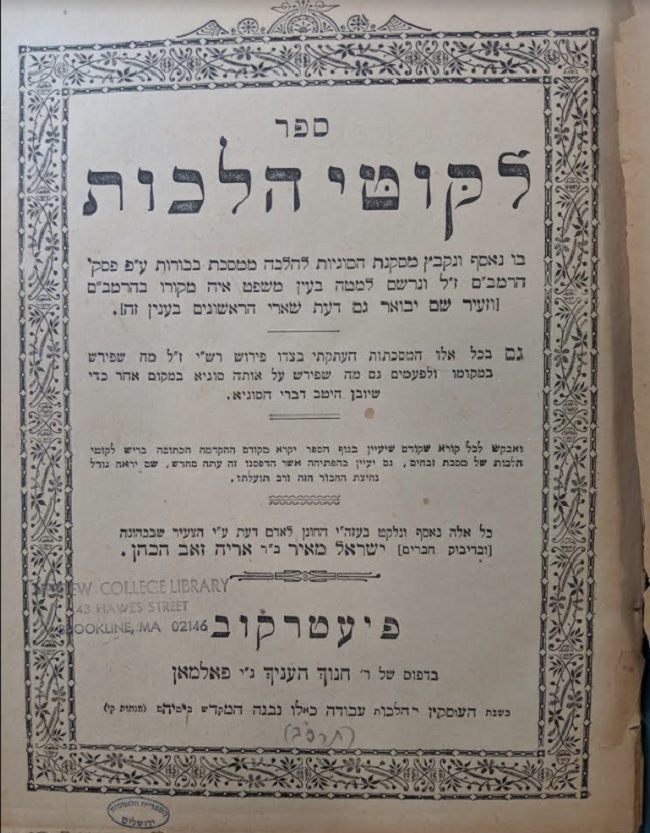


The תרפ”ב date is derived from the gematria of the emphasized letters: The saying (העוסקין בהלכות עבודה כאלו נבנה המקדש בימיהם (מנחות קי totals 682 ( 25 + 49 + 107 + 56 + 87+ 63 + 295), i.e., תרפ”ב.

As noted, the separate cover page for Arakhin (including Sotah and Nazir) is undated:
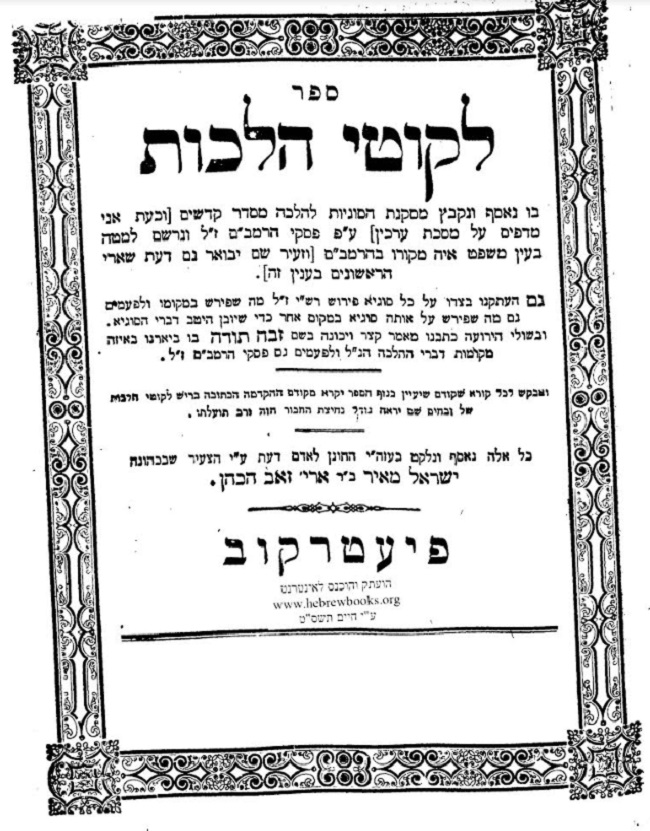


The Ḥafetz Ḥayyim, who was in charge of the printing and distribution of his books, advises on the title page of Likutei Halakhot on Bekhorot not only to read the Introductions, but also to look at the Preface (הפתיחה) “which we have now newly printed” (אשר הדפסנו זה עתה מחדש). The phrase “which we have now newly printed” is ambiguous; it can mean that the Preface is being reprinted or printed for the first time. Although the natural reading today would be the former, we found the Preface printed only in Likutei Halakhot on Sanhedrin, which we date to late תרפ”ב. And on the title page of Niddah, published by Cederbaum in תרפ”ג, we find a reference to the Preface אשר נקוה שנדפיסה בקרוב (“which we hope to print soon.”) This sort of discrepancy should not worry us, especially since Likutei Halakhot on Sanhedrin was printed by Fohlman and on Niddah by Cederbaum.

The Preface, published for the first time in תרפ”ב enables us to provide a clear terminus a quo for the publication of Likutei Halakhot on Sotah. In the middle of the first paragraph, the Ḥafetz Ḥayyim lists the tractates already completed (parentheses in the text below appear originally in the kuntresim as square brackets; the square brackets here are our own):

Barukh Ha-Shem, we have collected, according to our meager opinion, the words of the Rambam that he codified from the sugyot on thirteen tractates that pertain to matters of kodeshim, namely, Zevaḥim, Menaḥot, Tamid, Pesaḥim (from Tamid ha-Nishḥat to ‘Arvei Pesaḥim), Hagigah, Yoma, Tamid, Temurah, Keritot, Bekhorot [the three final chapters), ‘Arakhim, Me‘ilah, and Nazir (the later also has many things that are relevant to kodeshim), and likewise the first two chapters of Shavuot […] and now, only a few tractates are missing from the Shas, may God grant that over time some Jews will be found to complete the entire Shas […].[20]

And in the second paragraph he writes:

I wrote all this [i.e., the Preface until the present point] more than ten years ago. We have experienced many wanderings because of the war. Barukh Ha-Shem, who has kept us alive and did not allow our feet to falter. And now that I have come from the diaspora to my home, Ha-Shem, yitborakh, has helped me in his abundant kindness and goodness for the merit of Israel to complete Likutei Halakhot on the other tractates of the Shas that do not have the commentaries of the Rif and the Rosh. (And these are: Rosh Hashanah, Makkot, Horayot, Sotah, and Niddah […]).[21]

The second paragraph of the Preface attests to a time gap in both the composition of the Preface and in the publication of the tractates. The first paragraph of the Preface was written more than ten years earlier, i.e., no later than late 1910 or 1911. At that time the Ḥafetz Ḥayyim had completed, but not published, all the tractates mentioned in the first part of the Preface. Again, he did not publish the Preface itself until late 1921 or 1922. So although there is no date on Likutei Halakhot of Sotah itself, we can infer that it was published in תרפ”ב. As for the date of actual composition, we have no evidence in the Preface or anywhere else to suggest that it was written much earlier. Given that Niddah appears separately in תרפ”ג, the kuntres containing Sotah may have appeared late in תרפ”ב, after the aforementioned assembly of the Agudat Rabbanim in Warsaw. The Ḥafetz Ḥayyim would go on to complete other tractates and finish the work in 1925.

In short, the publication of Likutei Halakhot on Sotah is to be dated to late 1921 or the first two-thirds of 1922 (תרפ”ב) and not to 1911 or 1918,[22] according to the date of the aforementioned volume, and no earlier than Summer 1921, the date of the Ḥafetz Ḥayyim’s return to Radin, according to the Preface.

Part II. The Historical Context of the Footnotes on Jewish Education in Likutei Halakhot on Sotah

The Ḥafetz Ḥayyim was 83 years old when he declared it to be a great mitzvah to educate women in various Torah matters. To understand both the context and content of the statement, we first present the text and the two relevant footnotes. The main text of Likutei Halakhot on Sotah 11a (p, 21) may be translated as follows:

Rabbi Eliezer says, “Whoever teaches his daughter Torah teachers her tiflut.” You thought [actual] tiflut? Rather [it is] as if he teaches her tiflut. R. Abbahu says, “What is R. Eliezer’s reason? It is written, ‘I, wisdom, dwell with cunning,’** When wisdom enters a person, cunning enters with it.” And how do the Rabbis understand “I, wisdom”? The verse is needed for [the interpretation] of R. Yossi b. Rabbi Haninah, for R. Yossi b. R”H says, “The words of Torah stand permanently only for the person who makes himself naked for them, as it is written, ‘I, wisdom, dwell with nakedness.” In any event, the reasoning of R. Eliezer is not thereby rejected, and the halakha is according to his statement. [Later] rabbis said that “Torah” here refers davka to the Oral Torah. But even though the Written Torah should not be taught to one’s daughter ab initio,*** [teaching her Written Law] is not as if one teachers her tiflut. And women are obligated to learn from the Oral Torah the laws that pertain to them.[23]

(The asterisks refer to footnotes on this passage. Footnotes are rare in Likutei Halakhot, and rarer still are footnotes that refer to contemporary issues.)

Let us begin with the note preceded by three asterisks, on the prohibition of teaching the written Torah to women ab initio (based on M.T. Hilkhot Talmud Torah 2:13):

It seems that all this [the admonition not to teach written Torah ab initio to women] applies to previous times, when everyone dwelled in the place of his fathers, and the paternal tradition was very strong for each person to behave in the way that his fathers had tread, as the verse says, “Ask your father and he will tell you”. [Then] we could say that [a woman] should not learn Torah but should rely for her conduct on her upright fathers. But now, on account of our many sins, the paternal tradition has weakened considerably, and it is common that one does not dwell in one’s fathers’ location at all, and, particularly for those [women] who have accustomed themselves to learn to write and speak the languages of the nations, it is certainly a great mitzvah to teach them ḥumash, and also nevi’im and ketuvim, and the musar lessons of Ḥazal, such as tractate Avot, and Menorat ha-Ma’or, and the like, in order that our holy faith be confirmed for them. For otherwise, they are liable to stray completely from the way of the Lord, and to transgress all the foundations of the religion, God forbid.[24]

The Ḥafetz Ḥayyim holds that the admonition not to teach women written Torah ab initio pertained to the past, when a woman could rely for her conduct on the example of her fathers. But today, we find a weakening of paternal tradition and the dislocation of the Orthodox from their paternal homes, which requires educating women, especially those women who are accustomed to learn the language of the gentiles; without Torah education, such women are likely to stray from the true path and to become heretics. What historical reality does this reflect?

As is well known, the use of legal literature as a source of history, even literature that purports to refer to historical events, is not unproblematic. On the one hand the geographical dislocation of Polish Jews because of the war indeed meant that many parents and children were no longer in the town and villages that had anchored their faith and practices for generation.[25] On the other hand, it would be wrong to infer from the Ḥafetz Ḥayyim’s remarks that in his view, pre-war Poland reflected a golden age of Jewish observance. Throughout much of his life he had railed against the weakening of observance among the Orthodox, and many of his published works tried to strengthen observance through teaching both the halakha and its centrality in the life of the Jew – and the penalties for its non-observance.

For example, the Ḥafetz Ḥayyim was well aware that for decades there had been a weakening of traditional observance among women from some Orthodox homes. His son, R. Aryeh Leib Kagan, relates that when he came of marriageable age in the early 1880s, his father would not consider a match for him with a young woman from an Orthodox family who had attended a gymnasium (high school), or even an elementary school; such women and their families, even though they were Orthodox, were suspect in his eyes. In one case, the Ḥafetz Ḥayyim ultimately forbade his son to accept an offer of the substantial financial assistance by a wealthy prospective father-in-law; it turned out that the prospective bride’s sister had been sent by her father to learn at a gymnasium in Grodno, where she had fallen in love with a gentile officer whom she had met (“presumably at the theater”), converted, and died in childbirth at the age of 15.[26]

In his 1905 handbook on family purity laws, Taharat Yisrael, the Ḥafetz Ḥayyim attributes the decline of some women observing the mitzvah of mikveh to the shame they feel, not because of any foolish modesty (which is the case with some other women), but because they have been educated to look down at the laws of Torah. These women feel shame because

they have been raised in their free-thinking ways from their youth, when they attended schools, and became “wiser in their own eyes” than their predecessors, to the extent that they feel shame in observing the laws of the Torah according to the law of Moses and Israel, and particularly in a matter they consider to be beyond the boundaries of modesty.[27]

The Ḥafetz Ḥayyim responds to such women’s contempt of the Torah by providing well-worn arguments for its superiority and perfection. His defense is part of the larger project of the book, written both in Hebrew and Yiddish, to educate men and women in the importance of observing family purity laws. Urging Jews to observe Torah and mitzvot, and educating them for that purpose, is the leitmotiv that runs throughout the Ḥafetz Ḥayyim’s writings. Even his Likutei Halakhot on Kodeshim, though ultimately intended as an educational tool for learning Torah, was written as practical halakhic guide for the messianic age that Ḥafetz Ḥayyim thought imminent.[28]

This emphasis on deepening Torah observance in all sectors of the Orthodox community led him to publish a kuntres directed to women, Geder Olam, in 1889, on the importance of covering their hair. The kuntres was published in Hebrew and in Yiddish, and it includes at the end a basic halakhic guide to the laws of Niddah.[29] The halakhic guide was reprinted by the Ḥafetz Ḥayyim in two other works: his book addressed to Jews migrating to places like America and South Africa, Nidhei Yisrael (1895), and his aforementioned book on family purity laws, Taharat Yisrael (1905); The Yiddish translation appears in all three works, which indicates that these sections were intended also for women to read.[30] Indeed, the Ḥafetz Ḥayyim urges women who are literate to teach the book to women who are not, and to learn the Maayan Tahor of R. Moshe Teitelbaum of Ujhely (the Yismah Moshe) (reprinted many times in the Korban Minḥah siddur for women). The Ḥafetz Ḥayyim writes, “We have written only the legal principles that are most common, that all women are obligated to learn abundantly, and to become expert in them, so they not stumble because of them.”[31] This is a clear call for women to learn halakha, albeit in a rudimentary fashion, from books written for them.

From the above we see how important it was for the Ḥafetz Ḥayyim to write educational materials for women on family purity and female modesty. This in itself was a novelty; we are not aware of such materials being written in Lithuania at the time by Orthodox talmidei ḥakhamim of the Ḥafetz Ḥayyim’s stature. Contrast, for example, the words of the Ḥafetz Ḥayyim’s contemporary, Rabbi Yehiel Mikhel Epstein, in Arukh ha-Shulḥan, Yoreh Deah 246:19:

Ours has never been the custom to teach [women] from a book, and we never heard of that custom. Rather every woman teaches the relevant laws to her daughter and daughter-in-law. Recently, laws pertaining to women have been published in the vernacular for women who can read from them. Our women are fervent (zerizot); in every doubtful matter they ask [a rabbi] and don’t decide for themselves in the smallest matter.[32]

To what recently-published laws pertaining to women was R. Epstein referring? Arukh ha-Shulḥan, Yoreh Deah was composed in the years, 1887-1894;[33] the early editions of Geder Olam were 1889, 1893, and 1894. In the latter, the Ḥafetz Ḥayyim admonishes women who need to ask a halakhic question not to ask another women, but only a moreh hora’ah, “and for G-d’s sake, a woman should not dare to decide the law!”[34] It is very likely that R. Epstein was referring to this when he wrote, “Our women are eager; in every doubtful matter they ask [a rabbi] and don’t decide for themselves in the smallest matter.” Here we have two conflicting views on the education of women in practical halakha: R. Epstein sees no need to compose halakhic guidelines in Yiddish for women, since the women with whom he is familiar have learnt the material from their mothers or mothers-in-law and know when to ask questions. The Ḥafetz Ḥayyim, observing women who are lax about observance, writes a halakhic/hashkafic manual in Hebrew and Yiddish that urges them (and their husbands) to study these guidelines diligently and to teach them to other women.

The importance of educating women in their religious duties, especially in the realm of family purity, remained with the Ḥafetz Ḥayyim for the rest of his life. As is well-known, he traveled to Vilna when he was old and frail to deliver a lecture in Yiddish at the central Synagogue on the importance of observing the mitzvah of mikveh in front of an audience of hundreds of women, with men listening in from the women’s gallery.[35]

To be sure, publishing educational materials on family purity for women is not the same as advocating Torah education for girls, but then, again, the situation in 1905 for Polish and Lithuanian Orthodox Jewry was not the same as in 1922. Orthodox Jewry in the Second Polish Republic was under severe stress. Dislocation and pressures – economic, ideological, and governmental — had accelerated the defection of Jews from the tradition; the dire situation provided an opportunity for conservatives to respond positively to new Orthodox initiatives to stem the tide. In particular, Orthodox Jewish education was at a crisis point, even more so for boys than for girls, which explains in part why much more attention was paid by Orthodox politicians and rabbis to the challenges facing the ḥadarim, than to the education of women, since, as we noted above, the compulsory education of law of 1919, which was in the early stages of implementation, required all Polish boys and girls to attend government certified schools. Agudat Yisrael negotiated repeatedly with the Polish authorities to have the ḥadarim certified, which meant that they needed to include subjects mandated by the Polish ministry of education; otherwise, even more ḥadarim would close. The negotiations with the government concerned how many hours of secular subjects would be taught, and what were those subjects to contain.[36] Formal Torah education for girls was already well underway, partly as a response to mandatory education, the general trend in female education, and the prevalence of alternatives to the ḥeder that attracted Orthodox parents, partly as a response to the weakening of observance among the Orthodox.

When the Ḥafetz Ḥayyim returned to Radin in 1921, he was faced not only with the fait accompli of formal Jewish education for women in Telz, Kovno, and elsewhere, but with the threat to both boys and girls posed by the implementation of universal compulsory education by the State. Unlike in Russia and Lithuania, compulsory education for Jewish girls had been the norm in Galicia, the part of Poland that had belonged to the Austrian Empire until the end of the First World War. Galician Jewish Orthodox girls, bereft of formal Jewish education, had attended Polish private and public schools for decades with disastrous consequences; the same now happened elsewhere in Poland. When, in his footnote, the Ḥafetz Ḥayyim refers to “those [women] who have accustomed themselves to learn to write and speak the languages of the nations” he was, whether aware of it or not, referring to all Jewish girls in the Second Polish Republic, since, as Polish citizens even the strictest Hasidim were required to send their daughters to government certified schools. And unlike the case of their brothers, no Orthodox politicians negotiated with the government to exempt girls from these schools. School attendance for Hasidic girls was a well-entrenched tradition, even among the daughters of the zealots.

It is not surprising that the rabbi who raised the issue of women’s education at the assembly of the Polish Agudat ha-Rabbanim in 1922, Maharam Shapira, hailed from Galicia, where the situation had been bleak for decades. In his survey of the state of Orthodox Jewish education, he first turns to the challenges facing the ḥeder from the mandatory education law, on the one hand, and the attacks from the [Jewish] leftists (smoliyim) on the other. If the Polish government wished to spread general education among the people, it should take into consideration the most necessary requirements of the [Jewish] nation, which is the ḥeder. And if the Orthodox try to accommodate the government’s demands, it can only be in such a way that will not destroy the ḥeder. Most importantly, Orthodox boys need to be exempt from the obligation to attend general schools. And since the ḥadarim will now have to limit somewhat their hours for Jewish subjects, it is important that they be subject to universal standards, and that the instruction be overseen by experts and pedagogues. The Maharam Shapira then turned to the question of the education of girls:

We speak a great deal about the education of girls, which is a very painful subject for us. Our situation has become so bad because we have only taken a little interest in the subject for many years. At the same time as we devoted much of our thought, and always concerned ourselves, whether a lot or a little, with the education of boys, we continued to apply to the girls, “Kol kevudah bat melekh pnimah” as in earlier times, when a Jewish daughter did not come into contact and connections with the marketplace and the public sphere, and with the currents of the time that mostly oppose Yahadut. Then we did not need to give her an antidote and a powerful and effective counterforce against them. (“Whoever teaches his daughter Torah is as if he teaches her tiflut. (Sotah 20a).” Only men had in particular to learn Torah, for they needed the antidote – the countercurrent that repels foreign currents. But the daughter and the Jewish woman sat at home, where only that environment acted educationally upon them, and developed them and made them into true Jewish women and fit Jewish daughters.) We thus did not pay attention that the girls, unarmed and lacking any concept pertaining to Torah and Yahadut, have been taken outside from us into cultures and currents. They have become so educated and raised in the lap of foreign culture and anti-Jewish ways that every “common wind” and light attempt to ensnare their spirits, to penetrate into their souls, to poison and uproot them from their place, have wielded their evil ways upon them.

And we are faced with another grave question, which is strongly related with the education of the daughters, and this is the purity of the daughters of Israel….[37]

The Maharam Shapira diagnoses the illness but does not prescribe the remedy, anyway, not in the written version of his address. But as we saw above, the Assembly subsequently called for the establishment of Jewish schools for girls (supplementary to the general schools which they would attend). Connecting the crisis in the observance of the family purity laws with girl’s lack of education meant that rabbis like the Maraham Shapira understood that female observance of Jewish law could not be taken for granted. The Maharam Shapira also called for the production of Jewish youth literature, including textbooks, for the youth that would be free of all defect, and that would educate them in the spirit of faith and religion. This call was also ratified by the Assembly.

The question of the creation of textbooks that would be appropriate for use in ḥadarim seems to be alluded to in the earlier note in Likkutei Halakhot on Sotah on R. Abbahu’s explanation to R. Eliezer’s prohibition that “once wisdom enters into an individual, cunning enters with it.” The Ḥafetz Ḥayyim writes:

According to this, one should be even more careful not to teach boys and girls flippant writings and romances, which consume their heart and soul. One who reads them regularly is in the category of one who reads external books, who was treated with great severity by our sages, as is in the beginning of Helek (Sanhedrin 90). It makes no difference wheteher they are published in the Holy Tongue or the vernacular. See S. A. Orah Ḥayyim.307:16, and in the Mishnah Berurah ad loc.[38]

While attention in recent years has been focused on the footnote on Torah education for women, the Ḥafetz Ḥayyim’s previous footnote on the education of boys and girls appears to have been entirely neglected. Why would a halakhic authority like the Ḥafetz Ḥayyim be concerned with teaching Orthodox Jewish boys and girls “flippant writings and romances”, i.e., literature written by Poles or by Jewish maskilim? Yet his concern makes sense in the context of the new Polish government’s requirement that general studies be included within the curriculum of the ḥadarim, and also in the context of Orthodox parents sending their children to non-Orthodox Jewish schools, like the Tarbut and Yiddishist schools. Even though the Ḥafetz Ḥayyim acquiesced to the limited introduction of secular subjects in the ḥadarim, we see from this note and the passage below that he insisted that only appropriate books be read by children. That was also the line taken by Agudat Yisrael in its attempts to control the growing popular youth literature, both in lending libraries youth, and in curricular materials for the ḥadarim and the Bais Yaakov schools under its auspices.[39]

In short, underlying both footnotes referring to contemporary matters in the Likutei Halakhot on Sotah are not the challenges of “modernity” in general, but rather the specific challenges facing the Polish Orthodox leadership in the interwar period brought about by the weakening of traditional authority, geographical dislocation, the introduction of universal primary education in the Second Polish Republic, and the attraction of Bundism, Zionism, and Socialism to the youth. Although the weakening of traditional authority, and the phenomena of Orthodox women attending Polish schools predated by decades World War I, the situation after the war threatened the very future of Torah Judaism in the eyes of the Orthodox establishment.

Part III. Other Statements of the Ḥafetz Ḥayyim on Torah Education for Women

In the waning years of his life, the Ḥafetz Ḥayyim returned several times to the question of Torah education for girls. Thus we read in his 1930 “Admonition to Kelal Yisrael”:

There is another principle that every talmid hakham in every town needs to enact, namely, to see to it that there is a kosher ḥeder in which our little sons (and also our little daughters) will be provided a kosher education in the way of the Torah, and not in schools that are full of heresy and sectarianism, which are completely bereft of teaching our holy Torah….

[One should accustom his son to learn the the aggadot of the Talmud…]. But even more one should distance his son from schools in which heresy and sectarianism is taught, where instead of the holy ḥumash, they make up books in which are found only stories of the ḥumash that they have copied without any sense of our Holy Torah – and that’s Torah in its entirety for them And all the laws and mitzvot like in Vayikra and Devarim they denigrate and do not copy. A father must be exceedingly careful not to allow his son to go to such schools where he destroys them with his own hands (and likewise he should be careful to educate his daughters in the way of Torah).[40]

And in a public appeal for the strengthening of religion that that he published in Sivan, 1931:

First of all, we must become fortified with all our strength in the education of boys and girls, to establish for them ḥadarim and kosher schools according to the law of our Holy Torah, not to deviate to the right or the left, or to forego anything of our Holy Torah, and not to allow them to attend such schools as are full of heresy and sectarianism, God save us….”[41]

We have found no mention of the importance of educating girls in the Ḥafetz Ḥayyim’s numerous writings devoted to education before World War I: educating women to observe and appreciate family purity, yes, but not teaching Torah to girls. This changed after the Ḥafetz Ḥayyim’s return to Radin in 1921. Already in 1922 there is abundant reason to believe that the Ḥafetz Ḥayyim’s foonote in Likutei Halakhot on Sota referred to formal Jewish education for girls, which was already well underway. As we noted above, his position was used to justify the establishment of schools for girls by the Agudah’s Keren ha-Torah in 1925. From the 1930s he made his position explicit: teaching Torah to Jewish daughters includes establishing “kosher schools” for them.

So it is hardly surprising that in 1933, when attempts to open a Bait Yaakov school in Fristik (Frysztak), Poland, were met with opposition by the local rabbi, R. Menachem Mendel Halberstam, the Ḥafetz Ḥayyim signed a public approbation of Beit Yaakov in order to convince Jewish parents from the town to send their daughters to the school:

B”H 23 Shevat, Tarzag [= Feb. 19, 1933]

To the worthy lovers and esteemers of Torah, the Godfearing people of Fristik, may the Rock guard them,

When I heard that Godfearing people had devoted themselves to establish in the towns a Beit Yaakov school, in which is taught Torah, the fear of Heaven, morals, and manners, which is Torah for the girls of our Jewish brethren, I addressed their fine action [saying] “May the Lord strengthen them and establish the work of their hands!” For [that action] is a greatly needed matter in these day, when the current of heresy, God save us, reigns in all its force, and all sorts of freethinkers lie in wait to ensnare the souls of our Jewish brethren. Whoever’s heart has been touched with the fear of God is obligated to send his daughter to learn in this school. And there is no room for concern in this day and age for all the apprehensions and doubts arising from the prohibition of teaching one’s daughter Torah. This is not the place to elaborate.

For our generation is not as the earlier ones, for in previous generations each Jewish house had a paternal and maternal tradition to walk in the way of Torah and religion, to read Zeenah u’Reenah every Shabbat. But this is not the case, due to our many sins, in our generation. Therefore we must strive to increase schools such as these and to save everything that we possibly are capable of saving.[42]

The appeal seems to have worked because there was still a Beit Yaakov in Fristik in 1935, according to the list of schools provided by Deutschländer.

* * *

We conclude with a final comment: Some have inferred from the Ḥafetz Ḥayyim’s footnote in Likutei Halakhot and the appeal on behalf of Bais Yaakov schools that in his eyes formal education for girls should be considered “bediavad”, i.e., that in an ideal Jewish world, girls would not need to be taught Torah outside the home. If that is true, then the bediavad status of women’s education is somewhat akin to the bediavad status of the compilation of the Mishnah: in a world without the persecution and dispersion of the Jewish people, Rabbi Judah ha-Nasi would not have had to compile the Mishnah and thereby transgress the prohibition of committing Oral Torah to writing.[43] But the Torah, which is eternal, is adapted by the Torah sages in each generation to the world in which God-fearing Jews live. Formal Torah education for girls became for the Ḥafetz Ḥayyim “in this day and age” a “mitzvah gedolah,” in other words, lekhatkhilah, and his statements on the subject reflect that.

On the other hand, to say that it is a mitzvah gedolah to teach Torah and yirat shamayim to women is not to say that the Ḥafetz Ḥayyim wished to extend the commandment of Talmud Torah to include women.[44] That conflates the commandment of Talmud Torah, which applies only to Jewish men, with the obligation of teaching yiddishkeit to Jewish women through teaching them, inter alia, selections from Tanakh. While the Ḥafetz Ḥayyim emphasizes the former repeatedly and at great length in his writings and public activity, he barely mentions the latter. One need only compare his brief mention of teaching girls “ḥumash, nevi’im, ketuvim” in his footnote in Likutei Halakhot with his frequent statements about the necessity of teaching ḥeder boys ḥumash with Rashi “without skipping anything.” Even after his return to Radin, his public activities on behalf of women’s observance focused mainly on family purity, modesty, shabbat, and kashrut – not girls’ education.

Still, it is no wonder that the conservative Ḥafetz Ḥayyim, who had written numerous tracts to strengthen the observance and piety of Jewish baalei ha-batim and their families, embraced in later years the formal Jewish education of girls. Decades earlier he had called upon literate women to teach their illiterate sisters family purity laws from a book. He was not concerned with expanding the study of Torah among women, as much as expanding its observance and taking its message to their hearts. The Torah these girls were to be taught was a combination of Torah, the fear of heaven, morals, and manners. His goals were similar to that of Bais Yaakov movement, which was not to teach Torah to the daughters of Israel as an intellectual activity, or to make them life-long learners of Torah, but to form their character as religiously observant Orthodox Jewish women.[45]

Notes:

[1] Likute Halakhot on Sotah, 11ab (pp. 21-2). Unless otherwise stated, we have consulted the 1969-1970 edition of R. Menahem Mendel Yosef Zaks (Jerusalem, 1969-1970). This appears to be a reprint of the edition published in Brooklyn 10 years earlier.
[2] “This leniency enabled the opening of the first school of Beit Yaakov.” See Benjamin Brown, “The Baal ha-Bayit: R. Yisrael Meir ha-Cohen, the Ḥafetz Ḥayyim,” in Benjamin Brown and Nissim Leon, ed., Ha-Gedolim’: Ishim she-‘izvu et pene ha-Yahudut ha-haredit be-Yisrael. ed. (Jerusalem: Magnes, 2017), 106-151, esp. 133 (Hebrew)
[3] See Haym Soloveitchik, “Rupture and Reconstruction: The Transformation of Contemporary Orthodoxy,” Tradition, vol. 28, no. 4 (Summer 1994): 106-107 note 6.
[4] M. Yashar, Dos leben un shafn fun Ḥofets Ḥayyim (New York, 137), II, 377, 381.
[5] This is inferred from the celebration in Purim of 1931 of the school’s tenth anniversary.
[6] Yizhak Rafael Ha-Levi Etzion (Holzberg), “The Yavneh Educational System in Lithuania,” in Yahadut Lita (Tel-Aviv, 1972), II, 160-163
[7] According to one graduate of the school, “Chavatzelet’s general studies program was of a high caliber. It was headed by a non-religious woman and the teachers were either gentiles or secular Jews, since it was very difficult for a religious Jew to obtain the degree needed to teach secular studies. The religious studies, however, was not so successful […] The religious studies principal was the only religious faculty member – a Yekke (a German Jew). Under his influence Chavatzelet was conducted in the German manner of Torah im Derech Eretz. He taught us Chumash, Navi, history, and basic Hebrew grammar […] At any rate, the Torah portion of our education took only an hour of the day. The other six hours were devoted to secular studies.” Gutta Sternbuch and David Kranzler, Gutta: Memories of a Vanished World (Jerusalem and New York: Feldheim, 2005), 19-20.
[8] Ibid., pp. 17, 21.
[9] יא) לחנך את הבנות ברוח היהדות וללמוד עמהן מראשית ילדותן מעט מעט דת ומוסר, וכפי רבות שנותיהן כן יוסיפו ללמוד עמהן היובים שעליהן באופן כשיגיעו לפרק נישואין יקבלו בנקל החיובים השייכם לטהרת בנות ישראל, והחברים מחויבים להשתדל שיתיסד בעירם בית ספר מיוחד לזה בעד הנערות. Peratei-kol me-ha-ve‘idah ha-rishonah shel agudat ha-rabbanim be-Folin (Warsaw, January 23-25), published at the end of Kovetz Derushim, Ḥelek Rishon, Kera Sheni, ed. M. Warszawiak and Y. M. Sagaloṿits (Piotrkow, 1924), f. 9b.
[10] Mikhtavim u-maamarim mi-Maran Rabenu ba‘al ha-Ḥafetz Ḥayyim, Ḥelek Bet, ed. Z. H. Zaks (Kol Kitvei ha-Ḥafetz Ḥayyim [Jerusalem, 1990], IV, pp. 83-34)
[11] Leo Deutschländer, ed., Beth Jakob: 1928, 1929 (Frankfurt a. M.: Hermon, 1929), p. 7. Deutschländer cites the footnote and refers to it as a pesak din in Keren ha-Torah’s report on the state of Jewish education delivered at the Second World Assembly (ha-Knesiyal ha-Gedola) of Agudat Yisrael (Vienna, Elul,1929), 44-45. (The full report is available at https://hebrewbooks.org/36599.)
[12] In The Rebellion of the Daughters: Jewish Women Runaways in Habsburg Galicia (Princeton UP, forthcoming), p. 204, Rachel Manekin discusses a 1923 letter from Sarah Schenirer, in which she reveals that she consulted with the Belzer rebbe over whether the girls in her school could stage her play, Judith. Although the rebbe forbade staging it as “uqqat ha-goy,” she expressed the hope that it could be performed as a declamation. From this one may infer that the Belzer rebbe was the school’s rabbinic authority until it came under the auspices of the Keren Ha-Torah of Agudat Yisrael in 1924-1925.
[13] See, for example, the letters in Mikhtavim u-ma’amarim, Ḥelek Bet, 24-39 (Kol Kitvei ha-Ḥafetz Ḥayyim, IV, 24-39), and the kuntres, Torah Or at the end of Kol Kitvei ha-Ḥafetz Ḥayyim, II.
[14] See Likutei Halakhot, Second Introduction, f. 6a-b.
[15] Ibid., f. 7a
[16] Likutei Amarim, ch. 7, pp. 10-12, esp. p. 11 (Kol Kitvei ha-Ḥafetz Ḥayyim III).
[17] The Bar Ilan University Library web catalogue lists a copy of Likutei Halakhot on Zevaḥim with prenumerants, bound with the gemarrah of Zevaḥim, that dates from 1891/2. See R. Aryeh Leib ha-Kohen’s account of the delays in publishing Likutei Halakhot in his biography of his father, Mikhtevei ha-Rav ha-Ḥafetz Ḥayyim, ed. Aryeh Leib ha-Kohen, p. 51, in Kol Kitvei ha-Ḥafetz Ḥayyim, III. R. Aryeh Leib saw his father’s decision to write on Kodeshim, in part, as a reaction to the wave of migration to Eretz Yisrael from Eastern Europe following the expulsion of Jews from Moscow in 1890-1891, and the sense of messianic expectation; see ibid., pp. 38-39.
[18] M. Gellis, Kitvei ha-Ḥafetz Ḥayyim…reshimah bibliografit (Jerusalem, 1984), p. 56. Brown (see n. 2 above) relies on Gellis.
[19] The date also appears in Shoshana P. Zolty, And All Your Children Shall Be Learned: Women and the Study of Torah in Jewish Law and History (Northvale, N.J: J. Aronson, 1993), p. 67, n. 34 (The place of publication is given as “St. Petersburg” rather than Piotrków.) An edition of Likutei Halakhot, Part Two, of R. Natan Sternhartz, was published in Warsaw in 1918-1919; perhaps this explains the confusion
[20] ובה על י״ג מסכתות ששייכים לעניני קדשים והם זבחים ומנחות ותמיד ופסחיס (מפרק תמיד הנשחט עד ערבי פסחים) וחגיגה ויומא ותמיד ותמורה וכריתות ובכורות (שלשה פרקים אחרונים), וערכים ומעילה ונזיר (שגם היא יש בה הדבה ענינים ששייכים לקדשים) וכן שני פרקים הראשונים ממסכת שבועות על כל אלו לקטנו בעניות דעתנו מדברי הרמב״ם מה שהעתיק מהסוגיות לדינא […].וכעת אין חסר מן השס רק איזה מסכתות יתן ד׳ שבמשך הזמן ימצאו בישראל משליטים לכל הש״ס […]
[21] והנה כל זה כתבתי יותר מעשרה שנים ועבר עלינו נדודים הרבה מפני המלחמות וב״ה ששם נפשינו בחיים ולא נתן למוט רגלינו. וכעת שבאתי מן הגולה בשלום לביתי עזרני הש״י ברוב חסדו וטובו בזכות כלל ישראל להשלים הליקוטי הלכות גם על יתר מסכתות של הש״ס שאין עליהם רי״ף ורא״ש (ואלו הן ראש השנה וסנהדרין ומכות והוריות וסוטה ונדה […]) ]. The Ḥafetz Ḥayyim mentions that there are other tractates on which there are no Rif and Rosh, and he suggests that others may come to complete his work. In fact, he himself completed the work and revised the Preface in 1926; the revised Preface was published posthumously as chapter seven (“A Worthy Article on the Study of the Holy Torah”) in Likutei Amarim, pp. 10-12 (In Kol Kitvei ha-Ḥafetz Ḥayyim, III.)
[22] Although Deutschländer writes in his 1929 historical account of Bait Yaakov schools that their legal sanction had been provided “decades ago” (vor Jahrzenten) by the Ḥafetz Ḥayyim in Likutei Halakhot on Sota, he may have been unaware of the publication history of Likutei Halakhot. In any event, he does not repeat the claim in his more detailed Hebrew report, published in the same year. For references see n. 8 above.
[23] ראליעזר אומר כל המלמד את בתו תורה מלמדה תפלות. תיפלות סד אלא כאילו מלמדה תפלותאר אבהו מאי טעמא דרבי אליעזר דכתיב אני חכמה שכנתי ערמה מכיון שנכנסה חכמה באדם נכנסה עמו**) ערמומית. ורבנן האי אני חכמה מאי עבדי ליה מיבעי ליה לכדריוסי ברבי חנינא דאמר רבי יוסי ברח אין דת מתקיימין אלא במי שמעמיד עצמו ערום עליהן שנאמר אני חכמה שכנתי ערמה וממ לדינא אין נדחה מפני זה סברת ראליעזר ונקטינן כן להלכה. וכתבו רבוותא דהיינו דווקא תורה שבעפ אבל תורה שבכתב אף שאין ללמדה ***) לכתחילה ממ המלמדה אינו כמלמדה תפלות וגם מתורה שבעפ הדינים השייכים לאשה מחוייבת ללמוד.
[24] **ונראה דכל זה דווקא בזמנים שלפנינו, שכל אחד היה דר במקום אבותיו, וקבלת האבות היה חזק מאוד אצל כל אחד ואחד, להתנהג בדרך שדרכו אבותיו, וכמאמר הכתוב שאל אביך ויגדך‘; בזה היינו יכולים לומר שלא תלמוד תורה, ותסמוך בהנהגה על אבותיה הישרים. אבל כעת בעוונותינו הרבים, שקבלת האבות נתרופף מאוד מאוד, וגם מצוי שאינו דר במקום אבותיו כלל, ובפרט אותן שמרגילין עצמן ללמוד כתב ולשון העמים, בוודאי מצווה רבה ללמדם חומש וגם נביאים וכתובים ומוסרי חזל, כגון מסכת אבות וספר מנורת המאור וכדומה, כדי שיתאמת אצלם עניין אמונתנו הקדושה; דאי לאו הכי עלול שיסורו לגמרי מדרך ד‘, ויעברו על כל יסודי הדת חו
[25] According to Leo Deutschländer’s report of Keren ha-Torah at the Second Kenesiya Gedolah in Vienna in 1929, between 40 and 50 thousand children had been taken from their parents during the war and its aftermath, and these children had grown up without Torah, ethics, education, and faith. See Ha-Kenesiyah ha-Gedolah ha-Sheniyah shel Agudat Yisrael, ed. Shabbetai Sheinfeld (Vienna, 1929), p. 29. The situation among Polish Orthodox youth led Agudat Yisrael to establish, for the first time in Poland, organizations for the purpose of strengthening the faith and commitment of the younger generation. See Gershon C. Bacon, The Politics of Tradition: Agudat Israel in Poland, 1916-1939 (Jerusalem: Magnes, 1996), 181-141.
[26] Mikhtevei ha-Rav ha-Ḥafetz Ḥayyim, pp. 20-22, in Kol Kitvei ha-Ḥafetz Ḥayyim, III.
[27] Taharat Yisrael, ch. 8, pp. 10-11, esp. 10, in Kol Kitvei ha-Ḥafetz Ḥayyim, III.
[28] See Mikhtevei ha-Rav ha-Ḥafetz Ḥayyim, pp. 53-54, in Kol Kitvei ha-Ḥafetz Ḥayyim, III.
[29] This guide is attributed in the early editions of Geder Olam to a יצחק ברז, who says that they are based on the tract, Dinei Niddah, by Shlomo Zalman Lifschutz, the authors of the Ḥemdat Shelomo on the Shulhan Arukh. יצחק ברז is likely the Ḥafetz Ḥayyim’s close associate in Warsaw, R. Isaac b. Zeev (“Itche”) Grodzienski. According to R. Aryeh Leib Kagan, R. Grodzienski translated Geder Olam into Yiddish in a second printing, in 1890, which explains why the name Isaac is on the title page. However, the first 1889 edition also has both Yiddish and Hebrew and more to the point, subsequent editions remove all mention of Isaac. Since the the Yiddish appears in two other books by the Ḥafetz Ḥayyim printed under his own name, one assumes that the Yiddish translation, too, was the work of the Ḥafetz Ḥayyim, perhaps in partnership with R. Grozdienski
[30] The reference to the Dinei Niddah of the Ḥemdat Shelomo is omitted in these works. The Yiddish is absent from R. Zaks’ edition, which also omits the chapter on family purity in Geder Olam. It was not unusual for the Ḥafetz Ḥayyim to reuse parts of his kuntresim.
[31] Geder Olam (Warsaw 1889), f. 19 ,p. 37.
[32] Arukh ha-Shulhan (Jerusalem, 1969), VI, f.18, p. 35.
[33] Eitam Henkin, “The Books of the Arukh ha-Shulhan – The Order of Their Composition and Their Publication,” Ḥitzei Giborim –Pleitat Soferim, vol. 7 (2014): 515-536, esp. 516 (Hebrew), available online here (https://tinyurl.com/y8t7a7ncThis).
[34] Ed. 1895, 15a, p. 29
[35] For the Yiddish address, with Hebrew translation, see Kol Kitvei ha-Hafetz Ḥayyim III, 171-174.
[36] For an account of these negotiations, and the “quiet revolution” in Orthodox education, see Bacon, The Politics of Tradition, pp. 147-177.
[37]מדברים אנו הרבה עד חנוך הבנות, שהוא אצלנו שאלה מכאבת מאד. מצב הענין הזה רע אצלנו כל כך משום שאך מעט מזעיר התענינו בו שנים הרבה, בה בשעה שעל אודות חנוך הבנים הרבינו לחשוב מחשבות ולהתעניין בו תמיד ברב או במעט, השארנו הבנות על חשבון כל כבודה בת מלך פנימה“, כבשנים קדמוניות, בשעה שבת ישראל לא באה כל כך ביחס וקשור עם השוק ורשותהרבים, עם זרמי העת המתנגדים לרוב להיהדות ולא היינו צריכים גכ לתת לה איזו תבלין וכחמנגד חזק נגדם. (‘כל המלמד את בתו תורה כאילו למדה תפלותתורה היו צריכים ללמוד ביחוד רק הגברים, שהיו נחוצים להם תבלין, זרםמנגד ודוחה לזרמים הזרים, אולם הבת והאשה הישראלית ישבו להן בביתן, במקום שרק הסביבה פעלה עליהן פעולה חנוכית ופתחה ועשתה אותן לבנות ישראל כשרות ויהודיות אמתיות). לא שמנו אפוא את לבנו לזה, כי גם הבנות מוצאות לחוץ, ברשות הרביות וזרמים זרים המזורה לרגליהן, בהיותן אימזוינות, בלי היות להן כל מושג בתורה ובהיהדות, נתחנכו ונתגדלו בחיק תרבות זרה, ודרכים אייהודיים, וכל רוח מצויוכל נסיון קל לצודד נפשותיהן ולחדור לתוך נשמותיהן ולהרעיל ולעקרן ממקומן – פעלו עליהן את פעולתם הרעהץ עומדות לפנינו עוד שאלה חמורהת הקשורה בקשר אמיץ עם חנוך הבנות והיא טהרת בנות ישראל.
[38] **) הערה ולפז כש שיש ליזהר מללמד להנערים והנערות כתבי לצון ובדברי חשק שזהו ממש מכלה לבן ונפשן והמרגיל עצמו בזה הוא בכלל הקורא בספרים החצונים שהחמירו החכמים מאוד בזה כדאיתא בריש פרק חלק (סנהדרין דף צ) ואין נמ אם הם נדפסות בלשהק או בלשון לעז ועיין בשוע אוח בסימן שז סטז ובמב שם.
[39] The Maharam Shapira, in the aforementioned address to the Polish Agudat ha-Rabbanim, also remarks on creating appropriate literature for Jewish youth.
[40] עוד ישנו עיקר גדול שעל כל התח שבכל עיר לתקן והוא לראות שיהבעירו חדר כשר שבו יתחנ כובנינו הקטנים (וגם הבנות הקטהות שלנו) בחינוך כשר בדרך התורה ולר בבתי ספר כאלו המלאים כפירה ומינות שאין בהם שום זכר ללמוד תורהקאבל ביותר צריך להרחיק את בנו מבתי ספר כאלו שלומדים שם כפירה מינות, שבמקום החומש הקדוש המציאו ספרים כאילו שבהם נמצאו רק סיפורי החומש שהעתיקו אותם בלי שום טעם וריח של תורהק, וזה להם כל הצורה כולה. וכל דיני התורה והמצוה כמו ספר ויקרא וספר דברים בזו להם ולא העתיקם כללומאד מאד יזהר האב, מלהניח את בניו ללכת לבתי ספר כאלה שהוא מאבד בידים את בניו (והה גם בנותיו יזהר לחנכן בדרך התורה) Mikhtavim u-ma’amarim, Ḥelek Bet, pp. 56-57 (Kol Kitvei ha-Ḥafetz Ḥayyim, IV). For the Ḥafetz Ḥayyim’s attack on the “methods” pedagogy of the non-Orthodox Hebrew schools, see Ḥomat ha-Dat, pp. 20, 52-55 (Kol Kitvei ha-Ḥafetz Ḥayyim, II), and his 1927 appeal against teaching the Bible in this fashion in Mikhtevei ha-Rav ha-Ḥafetz Ḥayyim, pp. 24-26 (Kol Kitvei ha-Ḥafetz Ḥayyim, III)
[41]ראשית הדבר,עלינו להתחזק בכל כחנו בענין חנוך הבנים והבנות,ליסד עבורם חדרים ובתי ספר כשרים כדין תורהק, שלא להטות ימין ושמאל ושלא לוותר על שום דבר מתורהק ולא להניחם ללמוד בבתי ספר כאלו, מלאים כפירה ומינות, רל…. “Appeal for the Strengthening of Religion,” in Mikhtevei ha-Rav ha-Ḥafetz Ḥayyim, p. 99 (Kol Kitvei ha-Ḥafetz Ḥayyim, III).
[42] בה, יום כג לחודש שבט תרצג אל כבוד האלופים הנכבדים חובבי ומוקירי תורה החרדים לדבר האשר בעיר פריסטיק ני. כאשר שמעתי שהתנדבו אנשים יראים וחרדים לדבר דליסד בערים ביס בית יעקבללמוד בו תורה וירש מידות ודרך ארץ זו תורה לילדות אחינו בני ישראל. אמרתי לפעלם הטוב יישר דחילם ומעשה ידיהם יכונן כי ענין גדול ונחוץ הוא בימינו אלה. אשר זרם הכפירה רל שורר בכל תקפו והחפשים מכל המינים אורבים וצודים לנפשות אחבי וכל מי שנגעה יראת דבלבבו המצוה ליתן את בתו ללמוד בביס זה וכל החששות והפקפוקים מאיסור ללמד את בתו תורה אין שום מיחוש לזה בימינו אלה. ואין כאן המקום לבאר באריכות. כי לא כדורות הראשונים דורותינו אשר בדורות הקודמים היה לכל בית ישראל מסורת אבות ואמהות לילך בדרך התורה והדת ולקרות בספר צאינה וראינהבכל שבת קודש מה שאין כן בעוונותינו הרבים בדורותינו אלה. ועל כן בכל עוז רוחנו ונפשנו עלינו להשתדל להרבות בתי ספר כאלו ולהציל כל מה שבידינו ואפשרותנו להציל. הכותב למען כבוד התורה והדת ישראל מאיר הכהן, in Mikhtavim u-ma’amarim, Ḥelek Bet, pp. 24-39 (Kol Kitvei ha-Ḥafetz Ḥayyim, IV).
[43] See Mishneh Torah, Introduction. Although Rambam does not say explicitly that the compilation of the Mishnah was a violation of the prohibition of writing Oral Torah down, he suggests that the compilation was a novelty required by the travails of the time. For a look at this question see Michael Wygoda, “‘You Are Not Permitted to Write Down Oral Statements,’ On the Development of a Forgotten Halakha,” Dimuy 26 (1996): 48-63 (Hebrew).
[44] Cf. Benjamin Brown, “The Value of Torah Learning in the Ḥafetz Ḥayyim’s Writings and His Ruling on Women’s Torah Learning,” Diné Yisrael, vol. 24 (2007): 79-118, esp. 116-11
[45] For this see Manekin, The Rebellion of the Daughters, 182-235.


A year in Berlin: The Beginning of Hebrew Printing in Berlin in c. 1699

A Year in Berlin:
The Beginning of Hebrew Printing in Berlin in c. 1699
by Marvin J. Heller

The publishing of Hebrew books in Berlin is a relatively late phenomenon. The article provides a background to early Hebrew printing and then discusses the first Hebrew press in Berlin. It addresses Jewish history in Berlin, explaining why Hebrew printing began there at the end of the seventeenth century, almost two hundred and fifty years after it began elsewhere. Several unique works, rather than the usual communal prayer books and bibles, are described in some detail in the article.

Hebrew printing has a rich and lengthy history. The first Hebrew books were printed close to the mid-fifteenth century, in 1469 and 1472, approximately a decade and a half after Johann Gutenberg printed the first Bible in c. 1455 in Mainz, Germany. Those first Hebrew books, printed in Rome by Obadiah, Menasheh, and Benjamin of Rome, and several who followed, are undated. Their name appears in the colophon of R. Moses ben Nahman’s (Nahmanides, Ramban, 1194–1270) Torah commentary[1] The first dated Hebrew book was Abraham ben Garton ben Isaac’s edition of Rashi’s Torah commentary (Reggio di Calabria, 1475, completed 10 Adar, 5235 = Friday, February 17, 1475). It was followed soon after by Jacob ben Asher’s Arba’ah Turim, printed in Piove di Sacco, Padua province on 28 Tammuz, 5235 (July 3, 1475).[2]

A conservative listing of Hebrew books that can be said with certainty to have been printed prior to 1500 are, according to A. K. Offenberg, 139 titles, which he writes “may yet be too high.”I[3] In an index Offenberg records close to twenty locations in which Hebrew incunabula were printed, in Italy, Spain, and a 1493 Constantinople edition of the Arba’ah Turim.[4] Among the more notable locations in which Hebrew printing occurred in the incunabular period are Mantua, Bologna, Ferrara in Italy, and Guadalajara in Spain.

In contrast to the small number of incunabular imprints, approximately 2,700 titles were printed in the following century, that is, from 1500-1599. To be more precise, 2,672 Hebrew titles (or books with Hebrew letters) were printed, according to Yeshayahu Vinograd, in the sixteenth century. In the seventeenth century the number of Hebrew books published increased to 3,526 entries.[5] The primary centers of Hebrew printing in those centuries were, respectively, Venice and Amsterdam. Parenthetically, the latter’s imprints were sufficiently popular that publishers in other locations frequently wrote with a small font “printed with” and in a large font “Amsterdam,” and again in a small font “letters.” Below, again in a small font, the actual place of printing.[6]

That Hebrew printing began so much later in Berlin than in other centers of printing might seem unlikely, given the subsequent importance of that city’s Jewish community and press. However, it is not surprising in light of the early history of Berlin Jewry, which was difficult, indeed stormy. Expelled in the middle-ages, during the Black Death, Jews were allowed to return in 1354, but not permitted a synagogue. There is no further mention of Jews until the sixteenth century. Subsequently, Jews were expelled and readmitted several times. Gotthard Deutsch and A. Freimann write that “The real history of the Jewish community of Berlin does not begin until the year 1671.” At that time, Jews expelled from Vienna were admitted to Berlin. On Jan. 3, 1676, a decree was issued which stated “die Juden in Berlin in ihren Freyheiten und Privilegien nicht zu turbiren, noch zu kränken, sondern sie vielmehr dabey gebürend zu schützen” (not to disturb or worry the Jews of Berlin in their grants and privileges, but to protect them properly).”[7]

Hebrew printing in Berlin began soon after, that is, in the last decade of the seventeenth century. According to the Jüdisches Museum Berlin, Hebrew printing in Berlin, “which commenced later than in other German cities,” began when Daniel Ernst Jablonski published a Hebrew Bible in 1699.[8] Yeshayahu Vinograd, in the Thesaurus of the Hebrew Book, records eleven works printed from 1690 through 1699, eight in the latter date. He begins with a 1690 quarto format (40) Bible attributed to a Knebell, who Moritz Steinschneider describes in his entry for the 1699 Bible as “Opera et impensis Jo. Henri Knebel . . .” (the works and expenses of Jo. Henri Knebel),” the printer given as Jablonski.

The 1690 Bible entry is followed by two 1698 octavo editions (80: 90 pp., no pagination given for the second edition) of Psalms both in the Bodleian library and then the 1699 imprints.[9] Steinschneider dates the first Psalms as “3–9 Tischri 458 (18-24, Sept. 1697), the second as [ca. 1697-9]. These are followed by an edition of Bereishit (Genesis).[10] Also printed at this time was a siddur (prayer book) and another edition of Psalms. All of these works, as well as the following titles, were printed at the Jablonski press.

Daniel Ernst Jablonski’s (1660-1741) involvement with Hebrew printing is surprising given his background and career. He was the son of Peter Figulus, a minister of Unity of the Brethren (Unitas fratrum) and grandson of Johann Amos Comenius, the last bishop of the Unity. Jablonski served as a preacher at Magdeburg in 1683, and from 1686 to 1691 as head of the Brethren College at Polish Leszno (Lissa), a position filled by his grandfather. In 1691, Jablonski was appointed court preacher at Königsberg by the elector of Brandenburg. In 1693, he was transferred to Berlin as court preacher, and in 1699 he was consecrated a bishop of the Unity of the Brethren, where he worked to bring about a union between the followers of Luther and Calvin. In 1700, Jablonski became a member of the Academy of Sciences (Brandenburgische Societät der Wissenschaften), serving between 1710 and 1731 as director of Philology and Oriental Studies and, from 1733 and 1741, as president of the Academy.[11] He was also the author of several books on Christian theology and philosophy.

In Berlin, Jablonski established a Hebrew printing press. Vinograd very conservatively crediting him with having printed as many as twenty titles. However, a significant multiple of that number of titles were printed in Berlin at that time with no printer’s name assigned to them in the Thesaurus, or, in some instances, attributed to an editor at the press.[12] Concerning Jablonski’s heading a Jewish press in Berlin, it may not seem as improbable as it appears. Jews could not initially obtain licenses to own a printing-press, so that of necessity, the owner had to be a non-Jew, although the managers and workers were usually Jewish. Jablonski employed a number of Jewish workers at his press. The most important was Judah Loeb ben David Neumark (d. 4 Nissan = April 9, 1723) from Hanau, author of Shoresh Yehudah (Frankfort on the Main, 1692), the manager of and an editor at the Jablonski printing-house.[13]

Another of Jablonski’s achievements relates to the printing of the Talmud. He was instrumental in securing approval for Michael Gottschalk, the Frankfurt an der Oder printer, and Johann Christoph Beckman, professor of theology at the University of Frankfurt an der Oder, to publish the Frankfurt an der Oder Talmud (1697-99). Jablonski’s opinion was requested by Friedreich III, Elector of Brandenburg, after Gottschalk and Beckman sought permission to print the Talmud. Jablonski’s measured response was, overall, positive; he found the Talmud to be, with reservations, a work of value, and recommended that Friedreich approve the request to republish that work. Jablonski subsequently printed the first Frankfurt on the Oder/Berlin Talmud together with Gottschalk (1715-22).

We turn now to the more distinct books published at the Jablonski press, that are non-biblical nor prayer books, although the press issued both. Our first title is Azmot Yosef, novellae on tractate Kiddushin by R. Joseph ben Isaac ibn Ezra (c. 1560–1620), attributed in bibliographies to Neimark, as it is his name that appears on the title-page. Perchance, he managed the press and Jablonski was the proforma owner.

Azmot YosefAzmot Yosef was published in folio format (20: 125 ff.) in the year “[Show me a sign of] Your favorאות לטובה ( 459 = 1699) that my enemies may see and be frustrated because you. O Lord, have given me aid and comfort (Psalms 86:17). R. Joseph ben Isaac ibn Ezra (c. 1560–1620) was a scion of the renowned Ibn Ezra family of Spain. Publication of Azmot Yosef is attributed by Vinograd to L. Neimark. Joseph ben Isaac Ibn Ezra was a student of 1R. Samuel de Medina (Maharashdam, 1506-89) and of R. Aaron ben Solomon ben Hasson (16th Cent.). Ibn Ezra subsequently headed the yeshivah of Don David ben Yahya, where he had several eminent students, among them R. Shabbetai Jonah. He later left Salonika for Constantinople, and afterwards served as rabbi in Larissa and Sofia.[14]

The first paragraph of the title-page, a reprint of the first edition, states that it is an explanation of the rules by which the Torah is explicated, and that it is:

a commentary in iyyun and pilpul (deliberation and casuistry) of tractate Kiddushin, from the beginning until the end, on the Talmud, Rashi, Tosafot, Rif, Rambam, Rosh, his son the Ba’al ha-Turim, and others on the laws of kiddushin (betrothal). After the iyyun and pilpul I conclude with the halakhah . . . .

Also, for the benefit of the students [I explain] the rules of [kal ve-homer] (a fortiori inference), dayyo (sufficiency), and other rules: I also delve deeply into the passages of parah ve-rahel in Kol ha-basar and at the end of Kaitzad ha-regel.

The second paragraph, somewhat lengthy, informs that Azmot Yosef was printed previously in Salonica in 1601, further expounds it virtues, and informs that it is being printed for the second time in the praiseworthy city of Berlin and extols Friedreich III.


Azmot Yosef

Courtesy of the Library of Agudas Chassidei Chabad Ohel Yosef Yitzhak

In addition to the peshat (clear meaning of the text) on Kiddushin, Azmot Yosef also addresses Talmudic methodology. Ibn Ezra was also the author of Rosh Yosef, novellae on the Tur, Ḥoshen Mishpat, of which the part on taxes and associated communal issues was published as Massa Melekh (Salonica (1601). Some of his responsa were published in the responsa of R. Shabbetai Jonah, R. Solomon ha-Kohen, and R. Samuel Hayyun.

Azmot Yosef is an important work on Kiddushin and has been reprinted several times. Initially printed in Salonika (1601), as noted above, at the press of Abraham and Joseph BathSheba, this is the second edition; four additional printings of Azmot Yosef are recorded in the Bet Eked Sepharim, the most recent a Warsaw edition (1883).[15]

Gefen YehiditOur next work, Gefen Yehidit is a multi-part work, primarily on ethics, by R. Ze’ev Wolf ben Judah Leib of Rosienie. It was published in a small sextodecimo format (160: 59 ff.)

Gefen Yehidit

Courtesy of the National Library of Israel

The title page of Gefen Yehidit has a brief text that states that it is:

A book, small in size but of great quality. It speaks of matters of ethics and reverence in a clear language . . . The author should have merit. He is one of the maskilim (a person of understanding) and in this small book he demonstrates his expertise and sharpness. . .

Included is Sefer Luah ha-Hayyim which speaks of remedies in order that a person should be healthy and strong in order to serve his God continuously.

The title page is dated “a sign for good אות לטובה (459 = 1669)” (Psalms 86:17). Next is the introduction (1b-2a) of R. Judah Leib Hanau,[16] who brought the book to press. In his introduction, Ze’ev Wolf begins with a quote from Midrash Ruth in which Rav Ashi says that this Megillah is not primarily wisdom nor Torah, but to learn from it gemillut hasadim (acts of kindness), so too the work that he is writing. He informs that he has had a difficult life, and frequently quotes from the Zohar.

The text, in a single column in rabbinic letters, is comprised of Gefen Yehidit, a work of mussar (ethics); an accounting (39a-40b), beginning with and based on the memorial prayer El Malei Rahamim, of what befell the Jews of Podhajce (Podgaitsy), Ukraine in 1677 during a Tartar incursion and massacre of the Jews; followed by a dirge (40b-41a); Zemer le-Purim (42a-46b), verse for that festival in both Hebrew and Yiddish, translated word for word into the latter language because that is the language of Ashkenazim; and concluding with Luah ha-Hayyim (47a-59b), a popular medical work.

Gefen Yehidit has been reprinted several times, beginning with a Hanau (1717) edition.

Luah ha-Hayyim – Although included in Gefen Yehidit Luah ha-Hayyim is an independent work. In contrast to the other additional parts of the former title, Luah ha-Hayyim has its own title-page. Written by R. Hayyim ben Benjamin Ze’ev Bochner,[17] (for our ealier discussion regarding Bochner on the SEfohere), a prolific writer, whose works include Orḥot Ḥayyim, a commentary on R. Isaac Tyrnau’s Minhagim (1669, Prague), Mayim Ḥayyim, homilies and comments on Bible and Talmud, and Toẓeot Ḥayyim on grammar. This edition of Luah ha-Hayyim is based on earlier edition printed by Johann Christoph Wagenseil (Altdorf, 1687), also part of a larger work.

Luah ha-Hayyim

Courtesy of the National Library of Israel

The title-page states that it is:

Luah ha-Hayyim

It will be a cure for your body [a tonic for your bones] (Psalms 3:8) etc.” “They are life to him who finds them; healing for his whole body (Psalms 4:22):

Abbreviated rules of conduct for a person in the matter of healing to maintain a healthy body and it is a primary principle in the service of the Lord. In order to benefit the public, we have printed anew R. Hayyim ben Benjamin Ze’ev Bochner of Cracow’s work. It received in the past approbations from leading medical authorities for all these words are true and correct to those who are knowledgeable and meritable.

This is followed by approbations of two doctors from Lublin. An example of the text (51a-52b) is:

a clear white wine , sweet and aromatic, is healthy and caring. If one drinks a measure of wine, it is a balm for the body, for it increases bodily heat and strengthens as a lion. It gladdens the heart and hones the mind. It also helps in the digestion of food. The measure of a reviis as the amount to drink is logical.[18] More than this measure one should cease and desist. However, if one is accustomed to become inebriated from it and drinks more then enough than the head is ill and the heart is pained. One whose nature is warm and thirsts to drink should mix a little water every time. Honey that is clear and of average sweetness and strength is somewhat comparable to the nature of wine in all respects. . . .

A popular work the Thesaurus of the Hebrew Book records twelve editions of Luah ha-Hayyim, but again these are generally not independent publications.[19]

Keter Torah – Keter Kehunah – our final publication, is a Kabbalistic work on Psalms and liturgy by R. Joseph ben Moses (Ashkenazi), darshan of Przemyslany (17th cent.) Printed in quarto format (40: 91, 62-66, [1]; 76 ff.) Keter Torah and Keter Kehunah are, respectively, the second and third parts of Keter Yosef, the first part of which was printed in 1700.[20] Joseph ben Moses, who was a darshan (preacher), served as rabbi and dayyan in Przemyslany.

Each part was printed separately and has its own title page, albeit with the same frame but somewhat varying text. The pillared frame has cherubim at the top and at the bottom of the frame an eagle with a shield, and holding a sword in one talon and a scepter in the other. In its beak is a banner with the date of the respective volume.[21]

The title page of Keter Torah states that it is the second part of Keter Yosef,

A holy workbook, old replete with new, a desirable commentary, where is its like? On Psalms by the author of Zafenat Pa’ne’ah and Haluka de-Rabbanan. He is the great darshan, grandson of the gaon R. Abraham Ashkenazi, descended from Rashi, son-in-law of R. Abraham av bet din in Luntshits, and a branch and descendant of R. Saul Wahl.

It is dated “Now Israel loved Joseph אהב את יוסף וישראל (459 = 1699)” (Genesis 37:3). Keter Torah has an introduction from the author followed by the text, comprised of Psalms in the middle of the page in square vocalized letters with Joseph’s expansive commentary, Keter Yosef, on the sides in rabbinic letters. The text is divided by the days of the week and has the heading Keter Yosef. The title page of Keter Kehunah states that it is part three of Keter Yosef and that

It is the threefold part that “is not quickly broken” (cf. Ecclesiastes 4:12). In it are found at intervals some sharp novellae on Tosafot and gemara. I have entitled it Keter Torah on the order of the avodah (divine service) for the entire year. It is by the great darshan . . .

Keter Kehunah
Courtesy of Hebrewbooks.org

Keter Kehunah is dated “This is the Torah of the burnt offering זאת תורת העולה (459 = 1699)” (Leviticus 6:2). Here, too, the text is comprised of the liturgy of the daily ma’amadot (division of prayers) in the center of the page in square vocalized letters, the commentary Keter Yosef on the sides in rabbinic letters, and the heading Keter Yosef. After the daily ma’amadot are bakashot for the day and bakashot in the manner of Kabbalah. The daily ma’amadot are followed by kabbalistic prayers for special occasions such as selihot for Mondays and Thursdays, fast days, Rosh Hodesh, Shabbat with special Torah readings, Shabbat Teshuvah, Hanukkah, Purim, brit milah, kinnot for Tishah be-Av, and for dreams. There is also a prayer for someone incarcerated from R. Leone (Judah Aryeh) Modena.

This is the sole edition of any of the parts of Keter Yosef. Joseph was also the author of a commentary included in Haggadah Haluka de-Rabbanan (Amsterdam, 1695), a commentary on the Passover Haggadah; Ketonet Passim (Lublin, 1691), discourses on festivals and the Haggadah; and Zafenat Pa’ne’ah he-Hadash (Frankfurt am Oder, 1693-94, above) on diverse subjects.

In conclusion, we have described individual publications that are not part of the customary frequently printed works comprising traditional and necessary parts of Jewish literature, that is, biblical and liturgical books, although, as noted above, such works were also published by the Jablonski press. The subject matter of these other varied books addressed here encompasses Talmudic novellae, ethics, medical recommendations, and a Kabbalistic work.

What is particularly noteworthy is, given the late start of Hebrew publishing in Berlin, that it rapidly became a center of Hebrew printing. The Thesaurus records 457 titles issued by the Berlin press in the following century (1700-1799), a remarkable growth for a new press that had hardly published any books in the previous century and for a community that was initially young and relatively small compared to other Jewish communities. Despite the small number of works published in that early period, at the end of the seventeenth century, the books published not only addressed communal needs, but also included a variety of valuable works expressing the varied intellectual needs and interests of the community. It quickly grew from a small but press that had from its beginning began by serving its community with needed and valuable varied works to a press of significance.

[1] Concerning those first Hebrew imprints see Moses Marx, “On the Date of the Appearance of the First Hebrew Book,” in Alexander Marx Jubilee Volume (New York, 1950), pp. 481-501.
[2]
The above dates are Julian dates. The dates in the Gregorian calendar, adopted in Rome in 1582 in place of the Julian calendar are, for Rashi’s Torah commentary, February 26, 1475. The Gregorian date for the Arba’ah Turim would be July 12, 1475.
[3] A. K. Offenberg, Hebrew Incunabula in Private Collections (Nieuwkoop, 1990), p. xxiii-xxv, 186-94. It should be noted that other authorities cite a higher number of titles for the incunabular period. A significantly lower number is given by Richard Gottheil and Joseph Jacobs in “Incunabula” Jewish Encyclopedia vol. 6 (New York, 1901-06), p. 575 who write that 101 works printed in Hebrew letters can be identified as certainly printed before 1500. In contrast, according to Herrmann M.Z. Meyer / Angel Sáenz-Badillo, write there are “175 (207) editions printed with Hebrew letters ascertained by copies preserved in public collections.” “Incunabula” (Encyclopedia Judaica, vol. 9 (Jerusalem, 2007),vol. 9 pp. 757-58.
[4] The dating of the 1493 Constantinople edition of the Arba’ah Turim has been questioned, many bibliographers consider the correct date to be 1503. Offenberg in a convincing article, substantiates the correct date as 1493 (Offenberg, “The First printed Book Produced at Constantinople (Jacob ben Asher’s Arba’ah Turim, December 13, 1493),” in A Choice of Corals: Facets of Fifteenth-Century Hebrew Printing, pp. 102-32.
[5] Yeshayahu Vinograd, Thesaurus of the Hebrew Book. Part I Indexes. Books and Authors, Bibles, Prayers and Talmud, Subjects and Printers, Chronology and Languages, Honorees and Institutes. Thesaurus of the Hebrew Book (Jerusalem, 1993-95), pp. xxiv-xxvi [Hebrew].
[6] Mozes Heiman Gans describes this practice, writing “so highly-prized were books ‘printed in Amsterdam’ or ‘be-Amsterdam’ that cunning rivals invented the phrase ‘nidfas ke-Amsterdam’, i.e. in the manner of Amsterdam, hoping to deceive the readers by relying on the similarity of the Hebrew k and b.” Mozes Heiman Gans, Memorbook. History of Dutch Jewry from the Renaissance to 1940 with 1100 illustrations and text (Baarn, Netherlands, 1977), p. 140: Also see Marvin J. Heller, “Who can discern his errors? Misdates, Errors, Deceptions, and other Variations in and about Hebrew Books, Intentional and Otherwise: Revisited,” http://seforim.blogspot.com/, Sunday, July 03, 2016, reprinted in Essays on the Making of the Early Hebrew Book (Leiden/Boston, 2021), pp. 507-36.
[7] Gotthard Deutsch, A. Freimann, “Berlin,” Jewish Encyclopedia vol. 3. pp. 69-71.
[8] Jüdisches Museum Berlin: https://www.jmberlin.de/en/collection-hebrew-printing-in-berlin.
[9] Moritz Steinschneider, Catalogus Liborium Hebraeorum in Bibliotheca Bodleiana (CB, Berlin, 1852-60), col. 112 no. 702; Vinograd, Thesaurus of the Hebrew Book. Part II, p. 111.
[10] Steinschneider, nos. 694, 1050, 1028.
[11] https://en.wikipedia.org/wiki/Daniel_Ernst_Jablonski.
[12] Vinograd, Thesaurus of the Hebrew Book. Part I, p. 451.
[13] Ch. B. Friedberg, History of Hebrew Typography of the following Cities in Central Europe: Altona, Augsberg, Berlin, Cologne, Frankfurt M., Frankfurt O., Fürth, Hamberg, Hanau, Heddernheim, Homberg, Ichenhausen, Neuwied, Wandsbeck, and Wilhermsdorf. Offenbach, Prague, Sulzbach, Thannhausen from its beginning in the year 1513 (Antwerp, 1935), pp. 87-88 [Hebrew].
[14] See Ya’akov Shemuel Speigel’s introduction to Ibn Ezra’s responsa for additional biographical information. She’elot u-Teshuvot Rebi Yosef ibn Ezra, ed. Ya’akov Shemuel Speigel (Jerusalem, 1989), 5-30. Speigel specifically discusses Azmot Yosef, its editions and its reception. Id. 21-24.
[15] Ch. B. Friedberg, Bet Eked Sepharim, (Israel, n. d), ayin 1064 [Hebrew]. Eli Genauer updated the Bet Eked entry, which records books from 1474-1950, informing that later editions of Azmot Yosef were published in Jerusalem by Levin-Epstein in 1951, 1958, 1962, 1969, and 1976. There was also a Warsaw 1912 and a New York edition form the 1950’s as well as a Jerusalem 1988 edition, all attesting to the popularity of Azmot Yosef. Genauer quoted a yeshiva student’s joke concerning Azmot Yosef “how do you know that Jews were learning Maseches Kiddushin when they left Mizrayim [Egypt]? Because it says they took the Atzmos Yosef [bones of Joseph’ with them” (Exodus 13:19) and is also included in Kovets Mifarshim ‘al Meskhet Kiddusin, published in 2000 and 2019.
[16] He is the father of the famed grammarian Shlomo Zalmen Hanau. On some of his title pages, he indicates that his father was a sha”tz (cantor).
[17] For our discussion regarding Bochner and his works, see our post on the Seforim Blog, “Hayyim Ben Benjamin Ze’ev Bochner: Kabbalist, Talmudist, and Grammarian.”
[18] A reviis equals 1-½ eggs (see Mishna Berura 271:68) https://oukosher.org/halacha-yomis/what-is-the-volume-of-a-reviis/.
[19] Vinograd, Thesaurus of the Hebrew Book. Part I, p. 67
[20] Regarding the possible Sabbatian elements in this work, see Shnayer Leiman, Sefarim Ha-Hashudim be-Sha’abatot, in Sefer ha-Zikhron le-Reb Moshe Lipschitz, Rafael Rosenbaum, ed., (New York, 1996), p. 887.
[21] Concerning the eagle motif see Marvin J. Heller, “The Eagle Motif on 16th and 17th Century Hebrew Books,” Printing History, NS 17 (Syracuse, 2015), pp. 16-40, reprinted in Essays, pp. 5-29.


Benefits of the Internet: Besamim Rosh and its History

Benefits of the Internet: Besamim Rosh and its History
By: Dan Rabinowitz & Eliezer Brodt
    In a new series we wanted to highlight how much important material is now available online.  This, first post, illustrates the proliferation of online materials with regard to the controversy surrounding the work Besamim Rosh (“BR”). 

[We must note at the outset that recently a program has been designed by Moshe Koppel which enables one, via various mathematical algorithims, to identify documents authored by the same author. We hope, using this program, to provide a future update that will show what this program can demonstrate regarding the authorship of the BR and if indeed the Rosh authored these responsa.]

Background

    Before turning to the BR and discussing its history we need to first discuss another work.  R. Raphael Cohen the chief rabbi of triple community, Altona-Hamburg-Wansbeck (“AH”W”), [1] published a book, Torat Yekuseil, Amsterdam, 1772 regarding the laws of Yoreh DeahTorat Yekuseil is a standard commentary and is unremarkable when compared to other works of this genre.  While the book is unremarkable in and of itself, what followed is rather remarkable. 

    Some years later, in 1789, a work with the putative author listed listed as Ovadiah bar Barukh and titled Mitzpeh Yokteil [2] was published to counter R. Raphael Cohen’s Torat Yekuseil (“TY”)Mitzpeh Yokteil (“MY”), was a vicious attack both against the work TY as well as its author, R. Raphael Cohen.  R. Raphael Cohen was a well-known and well-respected Rabbi. In fact, he was the Chief Rabbi of the triple community of AH”W.  The attack against him and his work did not go unanswered.  Indeed, the beit din of Altona-Wansbeck placed the putative author, Ovadiah, and his work, under a ban.

    The Altona-Wansbeck beit din could not limit the ban to just Altona-Wansbeck as the attack in the MY was intended to embarrass R. Raphael Cohen across Europe.  Indeed, the end of the introduction to MY indicates that copies were sent to a list of thirteen prominent rabbis across Europe.  Specifically, copies were sent to the Chief Rabbis of Prague, Amsterdam, Frankfort A.M., Hanover, Bresslau, Gloga, Lissa, etc., “as well as The Universally Know Goan haHassid  R. Eliyahu from Vilna.”  Thus, the intent of the book was to diminish R. Raphael Cohen’s standing amongst his peers. 

    The Altona-Wansbeck beit din, recognizing the intent of the book, appealed to other cities courts to similarly ban the author and book MY – the ban, entitled, Pesak mi-Beit Din Tzedek, the only known extant copy was recently sold at Sotheby’s (Important Judaica, Nov. 24, 2009, lot 136).[3]


These concerns lead the ban’s proponents to the Chief Rabbi of Berlin, R. Tzvi Hirsch Berlin, and to solicit him to join the ban. Initially, it appeared that R. Tzvi Hirsch would go along with the ban.  But, as he was nearing deciding in favor of signing the ban, someone whispered in his ear the verse in Kings 2, 6:5, אהה אדני והוא שאול – which R. Tzvi Hirsch understood to be a play on the word “שאול” in the context of the verse meaning borrow, but, in this case, to be a reference to his son, Saul. That is, the real author of MY was Saul Berlin, Tzvi Hirsch’s son.  Needless to say, R. Tzvi Hirsch did not sign the ban. [4]

    Not only did he not sign the ban, he also came to his son’s defense.  Aside from the various bans that were issued, a small pamphlet of ten pages, lacking a title page, was printed against MY and Saul. [5]  Saul decided that he must respond to these attacks.  He published Teshuvot ha-Rav. . . Saul le-haRav [] Moshe  Yetz,[6] which also includes a responsum from R. Tzvi Hirsch, Saul’s father.  Saul defends himself arguing that rabbinic disagreement, in very strong terms, has a long history.  Thus, a ban is wholly inappropriate in the present case. 

    R. Tzvi Hirsch explained that while MY disagreed with R. Cohen, there is nothing wrong with doing so.  The author of MY, as a rabbi – Saul was, at the time, Chief Rabbi of Frankfort – Saul is entitled to disagree with other rabbis.  Of course, Saul’s name is never explicitly mentioned. Moreover, in the course of R. Tzvi Hirsch’s defense he solicits the opinions of other rabbis, including R. Ezekiel Landau.  R. Landau, as well as others, noted that aside from the propriety of disagreement within Judaism, the power of any one particular beit din is limited by geography.  Thus, the Altona-Wansbeck’s beit din‘s power is limited to placing residents of Hamburg under a ban but not residents of Berlin, including R. Saul Berlin, the author of MY.[7]

    The controversy surrounding the MY was not limited to Jewish audiences. The theater critic, H.W. Seyfried, published in his German newspaper, Chronik von Berlin, translations of the relevant documents and provided updates on the controversy.  Seyfried agitated on behalf of the maskilim and editorlized that the Danish government should take actions against R. Cohen. It appears, however, that Seyfried’s pleas were not acted upon.[8] 

The Publication of Besamim Rosh


    With this background in mind, we can now turn to the Besamim Rosh.  Prior to publishing the full BR, in 1792, Saul Berlin published examples of the responsa and commentary found in the BR – a prospectus, Arugat ha-Bosem.  This small work whose purpose was to solicit subscribers for the ultimate publication of BR. It appears that while Saul may have been trying for significant rabbinic support, the majority of his sponsors were householders. 

    In 1793, the BR was published.  The BR contains 392 responsa (besamim equals 392) from either R. Asher b. Yeheil (Rosh) (1259-1327) or his contemporaries.  This manuscript belonged to R. Yitzhak di Molina who lived during the same time period as R. Yosef Karo, the author of Shulchan Orakh.  Additionally, Saul appended a commentary of his own to these responsa, Kasa de-Harshana

    The BR contains two approbations, one from R. Tzvi Hirsch Berlin and the other from R. Yehezkel Landau.  R. Landau’s approbation first explains that Rosh’s responsa need no approbation.  With regard to R. Saul Berlin’s commentary, he too doesn’t need an approbation according to R. Landau.  This is so because R. Saul’s reputation is well-known.  R. Landau’s rationale, R. Saul’s fame, appears a bit odd in light of the fact that among some (many?) R. Saul’s reputation was very poor due to the MY. 

    R. Tzvi Hirsch’s approbation also contains an interesting assertion. Saul’s father explains that this book should put to rest any lingering question regarding his son.    

    In addition to the approbations there are two introductions, one from di Molina and the other from Saul. Di Molina explained the tortured journey of the manuscript. He explains that, while in Alexandria, he saw a pile of manuscripts that contained many responsa from Rosh that had never before been published. He culled the unpublished ones and copied and collected them in this collection.  What is worthy of noting is that throughout the introduction di Molina repeatedly asks “how does the reader know these responsa are genuinely from Rosh.” 

    R. Saul, in his introduction, first notes that the concept of including introductions is an invention long after Rosh, and is not found amongst any of the Rishonim. 

    As mentioned previously, the BR is a collection of 392 responsa mostly from Rosh or his contemporaries.  Additionally, R. Saul wrote his own commentary on these responsa, Kasa diHarshena. [9]  This commentary would contain the first problem for Saul and the BR.  In responsum 40, Rosh discusses the position of Rabbenu Tam with regard to shaving during the intermediate days (ho ha-moad).  While Rosh ultimately concludes that one is prohibited from shaving on hol ha-moad, R. Saul, in his commentary, however, concludes that shaving on hol ha-moad is permissible.  In so holding, R. Saul recognized that this position disagreed with that of his father.  Almost immediately after publication, R. Saul printed a retraction regarding this position allowing for shaving on hol ha-mo’ad.  This retraction, Mo’dah Rabba, explains that Saul failed to apprise his father of this position and, as Saul’s father still stands behind his negative position, Saul therefore retracts his lenient position. [Historically, this is not the only time a father and son disagreed about shaving on hol ha-moad.  R. Yitzhak Shmuel Reggio (YaSHaR)and his father, Abraham, disagreed on the topic as well.  As was the case with Saul and his father, the son, YaSHaR took the lenient position and his father the stringent.  Not only did they disagree, after YaSHaR published his book explaining his theory, his father attacked him in an anonymous response.  For more on this controversy see Meir Benayahu, Shaving on the Intermediary Days of the Festival, Jerusalem, 1995.] 

    This retraction, while may be interperated as evidence of Saul humbleness in his willingness to admit error and not stand on ceremony, others used this retraction against him.  The first work published that questioned the legitimacy of BR is Ze’ev Yetrof, Frankfort d’Oder, 1793, by R. Ze’ev Wolf son of Shlomo Zalman.  (This book is very rare and, to my knowledge, is not online.  Although not online, a copy is available in microfiche as part of the collection of books from the JTS Library, and on Otzar Hachomah see below)  The author explains that eight responsa in BR are problematic because they reach conclusion that appear to run counter to accepted halahik norms. In addition, the author states in his introduction, “that already we see that there is something fishy as it is known that the author [Saul Berlin] has retracted his position regarding shaving.” It should be noted that no where does R. Ze’ev Wolf challenge the authenticity of the manuscript for internal reasons – it is incorrectly dated, incorrectly attributed etc.  Apparently, Ze’ev Yetrof, was not well-known as it is not cited by other contemporaries who too doubted the authenticity of BR.  Samat theorizes that either wasn’t printed until later or, was destroyed.[10]  

    The second person to question the legitimacy of BR was R. Rafael Hamburg’s mechutan, R. Ya’akov Katzenellenbogen.  In particular, he wrote to R. Cohen’s student, R. Mordechai Benat. As was the case with Wolf, R. Katzenellenbogen located 13 responsa where he disagreed with the conclusions.  R. Katzenellenbogen indicated that R. Benet shold review the BR himself and apprise R. Katzenellenbogen regarding R. Benet’s conclusions. 

    R. Katzenellenbogen also wrote to Saul’s father, Tzvi Hirsch, and Tzvi Hirsch eventually responded in a small pamphlet.  R. Tzvi Hirsch first deals with the predicate question, is the manuscript legitimate. That is, prior to discussing the conclusions of particular responsum, regarding the manuscript, R. Tzvi Hirsch testifies that he is intimately familiar with this manuscript. He explains that for 11 years, the manuscript was in his house.  In fact, R. Tzvi Hirsch created the index that appears in BR from this manuscript.  Additionally, he had his other son Hirschel (eventual Chief Rabbi of London) copy the manuscript for publication.  Thus, R. Tzvi Hirsch argues that should put to rest any doubt regarding the authenticity of the manuscript.

    R. Tzvi Hirsch then turns to the issue regarding conclusions of some of the responsa. He first notes, that at most, there are a but a small number of questionable responsa.  Indeed, it is at most approximately 5% of the total responsa in BR.  That is, no one questions 95% of the responsa (at least not then).  Second, with regard to the conclusions themselves, that some conclusions are different than the halahik norms, that can be found in numerous books, none of which anyone questions their authenticity.  Thus, conclusions prove nothing.

Leaving the history and turning to the content of BR.  One of the more controversial responsa is the one discussing suicide.  In particular, according to the responsum attributed to Rosh, the historic practices that were applied to a suicide – lack of Jewish burial, no mourning customs – are not applicable any longer.  This is so, because suicides can be attributed to the poor conditions of the Jews and not philosophical reasons.  Thus, we can attribute the motivations of a suicide to depression and remove the restrictions that applied to suicides. 

    This responsum was what lead some, including R. Moshe Sofer (Hatam Sofer), to conclude that the entire BR was a forgery.  Indeed, this responsum was one of the two that were removed in the second edition.  Others, however, point out this responsum and its conclusions are not in any conflict with any accepted halakhic norms.  And, instead, while providing new insight into the current motivations of a suicide, the ultimate conclusion can be reconciled with all relevant laws.  [11]  

This particular example illustrates the problematic nature of merely relying upon a particular conclusion to demonstrate the authenticity or lack thereof of a work. Although R. Sofer was certain this responsum ran counter to a statement of the Talmud, others were easily able to reconcile the Talmudic statement with the conclusion of the responsum.

    Another controversial responsa deals with someone who is stuck on the highway as the Shabbat is fast approaching.  The traveler is thus faced with the following dilemma, stop in a city where he will require the charity of strangers or continue on and get home.  The BR rules that the traveller can continue and is not required to resort to charity.  This, like the responum above, was similarly removed from the second edition. These are the only two responsa removed from the second edition.  Of course, this removal isn’t noted anywhere except that the numbers skip over those two.  In fact, the index retains the listing for the two responsa. 

    Other controversial responsa include one dealing with belief in the afterlife and messianic era, kitnoyot – BR would abolish the custom, and issues relating to mikvah. 

Today, common practice regarding suicide appears, for the most part, to conform with the position of BR.

Status Today

    After its publication in 1793, it would be almost one hundred years before the BR would be reprinted.  In 1881, the BR was reprinted in Cracow.  This edition was published by “the well-known Rabbi Yosef Lazer from Tarnow'” R. Lazer’s was part of a well-known Hassidic family.  His grandfather, R. Menachem Mendel Lazer was the author of Sova Semochot, Zolkiov, 1845.[12] It appears that the BR was the only controversial book that R. Yosef Lazer published.  Although he published approximately 30 books, the are mainly run-of-the mill works, Machzorim, haggadot, as well as some standard rabbinic works. It is unclear what prompted R. Lazer to republish the BR.  Lazer provides no explanation.  Although Lazer’s publishing activities are difficult to reconcile with his publication of the BR, the printers, Yosef Fischer and Saul Deutscher, other publications indicate that they were more open to printing all types of books. For example, the same year they published BR, they published a translation of Kant, Me-Ko’ach ha-Nefesh, Cracow, 1881.  In all events, it appears that Lazer (or perhaps the printers) was aware of the controversy surrounding the BR as he removed Saul Berlin’s introduction as well as two of the more controversial responsa, one discussing suicide and the other allowing one to continue to travel home after sunset on Friday to avoid having to rely upon the charity of strangers.  In addition, one responsa was accidentally placed at the end of the volume, not in its proper order.[13]  Although the two responsa were removed in the text, they still appear in the index. A photo-mechanical reproduction of this edition was published in New York in 1970, and a copy is available on Hebrewbooks. 

    In 1984, the BR was reprinted for only the third time.  This edition, edited by R. Reuven Amar and includes an extensive introduction, Kuntres Yafe le-Besamim, about BR.  Additionally, commentary on the BR by various rabbis is included.  The text of this edition is a photo-mechanical reproduction of the first edition.  This edition contains two approbations, one from R. Ovadiah Yosef, who in his responsa accepts that BR is a product of R. Saul Berlin, but R. Yosef holds that doesn’t diminish the BR’s value.  The second approbation is from R. Benyamin Silber.  But, R. Silber provides notes in the back of this edition and explains that he holds the BR is a forgery and that he remains unconvinced of Amar’s arguments to the contrary.

    In his introduction, Amar attempts to rehabilitate the BR.  Initially, it should be noted that Amar relies heavily upon Samet’s articles on BR, but never once cites him.  Samet had complied a bibliography of works about BR as well as where the BR is cited, Amar also provides the latter in a sixty four page Kuntres, ריח בשבמים, in the back of his edition. In his introduction Amar relates the history of the BR and attempts to demonstrate that many accepted the BR and those that did not, Amar argues that many really did accept BR.  This introduction contains some very basic errors, many of which have been pointed out by Shmuel Ashkenazi in his notes that appear after the introduction.  

Difficulties in Authentication   

    Today, various theories have been put forth to demonstrate that the BR is a forgery.  Specifically, some have pointed to “hints” or “clues” that R. Saul left for the careful reader which would indicate that BR is a carefully created forgery.  For example, some note that the number of responsa, 392, the Hebrew representation of that number is שצ”ב which can be read to be an abbreviation of Saul’s name – Saul ben Tzvi.  Others take this one step further and point to the was R. Asher (Rosh) is referenced – רא”ש – which again can be read R. Saul.  Obviously, these clues are by no means conclusive.  In the academic world, the BR is written off as a “trojan horse” intended to surreptitiously get R. Saul’s masklik positions out in the masses or something similar.  All of these positions, however, rely upon a handful of responsa at best and no one has been able to conclusively demonstrate that the entirety of BR is a forgery. At best, we are still left with the original criticisms – that a few of the responsa’s conclusions espouse positions that appear to be more 18th century in nature than 13th century. [14]   

 R. Yeruchum Fischel Perlow aptly sums up much of what has been written regarding the question of authenticity of BR:

Just about all who have examined [the question of the authenticity of BR] walk around like the blind in the dark, and even after all their long-winded essays, they are left with only their personal feelings about the BR without ever adducing any substantive proofs in support of their position. And, on the rare occasions that they actual do provide proofs for their positions, it only takes a cursory examination to determine that their is nothing behind those proofs. [R. Yeruchum Fischel Perlow, “Regarding the book ‘Besamim Rosh,'” Noam 2 (1959), p. 317. For some reason this article is lacking in some editions of Noam]

    Assuming that one discounts the testimony of Saul and his father regarding the manuscript, it is not easy to determine if the BR is authentic or not.  For example, responsum 192, according to R. Moshe Hazan, one of the defenders of BR, this responsum “is clear to anyone who is familiar with the language and style of the Rishonim, from the Rishonim.” Responsum 192, is attributed to R. Shlomo ben Aderet (Rashba), and discusses the opinion of Rosh that allowed for capital punishment for pregnancy out of wedlock.  Thus, according to R. Hazan, 192 is conclusive proof that BR is authentic. 

    Simcha Assaf, however, has shown that responsum 192 is a forgery – or there is a misattribution.  Assaf explains that if one looks at the date of this incident, responsum 192 could not have been written by Rashba.  Rashba died 10 years prior to this event.  Simcha Assaf, Ha-Onshim Ahrei Hatemat ha-Talmud, Jerusalem, 1928, pp. 69-70.  Thus, the very same responsum whose “language and style” demonstrated that it was from the times of the rishonim has attribution problems.  To be sure, Assaf isn’t saying this responsum isn’t necessarily from the rishonim period, however, it surely isn’t from Rashba.[15]

    Or, to take another example. Talya Fishman argues that “[halakhic literature of the seventeenth and eighteenth centuries . . . climbed to new (and fantastic) heights of theoretical speculation, creating, in effect, a body of non applied law.”  Talya Fishman, “Forging Jewish Memory: BR and the Invention of Pre-emancipation Jewish Culture,” in Jewish History and Jewish Memory, ed. Carlbach et al., Hanover and London: 1998, pp. 70-88.  Based on this understanding of seventeenth and eighteenth century literature, as contrasted with literature from the period of Rosh, she turns to the BR and finds such speculative responsa.  This, according to Fishman, implicitly demonstrates that BR is a product of the seventeenth or eighteenth century. Indeed, Fishman concludes “[i]n short, [BR], has an unusually high concentration of eyebrow-raising cases.”  Id. at 76. 

    But, if one subjects Fishman’s argument to even a minimal amount of scrutiny, her argument, as presented, is unconvincing.  First, in support of Fishman’s “high concentration” of odd responsa, Fishman provides three examples.  That is, Fishman points to three out of 392 responsa that contain “eyebrow-raising cases” and concludes this represents “an unusually high concentration.”  I think that most would agree that less than 1% does not represents an unusually high concentration.  Second, of the three examples Fishman does provide, one is from Kasa deHarshena, which everyone agrees is a product of the eighteenth century.  Third, one of the examples, no. 100, it appears that Fishman misread the responsa.  Fishman provides that responsa 100 is a “bizarre question about whether a one-armed man should don tefilin shel yad on his forehead alongside tefilin shel rosh.”  Id. at 76.  Indeed,  responsa 100 is about a one-armed man and whether because he cannot fulfill the arm portion of tefilin if that absolves him of the head portion.  Nowhere, however, not in BR or Kasa de-harshena, does it mention the possibility of putting the tefilin shel yad on one’s forehead.  Thus, if we discount these two responsa, Fishman is left with a single responsum to prove her generalization about BR.[16]   

    Regarding the manuscript, that too is an unsolved mystery.  We know that a manuscript that may have been the copy which R. Hirschel made is extant but the manuscript from di Molena is unknown.  Additionally, although we know that the Leningrad/St. Petersberg library had Tzvi Hirsch’s copy with his annotations, the current location of that book is unknown. See Benjamin Richler’s post regarding the manuscript here.

    The BR’s most lasting effect may be in that this was to be the first of many newly discovered manuscripts to be accused of forgery because of the conclusions reached.  Subsequent to the BR, responsa or works in other areas of Jewish literature were tarred with cry of forgery because of their conclusions. [See Yaakov Shmuel Spiegel, Chapters in the History of the Jewish Book, Writing and Transmission, Ramat-Gan, 2005, 244-75, (“until the publication of BR, there were no questions raised regarding the authenticity of a book”) Spiegel also demonstrates that we now know that in many instances that the charge of forgery was wholly without basis and today there is no question that some of the books that are alleged forgeries are legitimate.]

Other Works by Saul Berlin

    One final point.  While we discussed Saul’s work prior to BR, there was another book that he wrote, that was published posthumously.  This work, Ketav Yosher, defended Naftail Wessley and his changes to the Jewish educational system.  Indeed, Ketav Yosher, is a scathing attack on many traditional sacred cows. [17]  Ketav Yosher, like MY, was published without Saul’s name, but again, we have testimony that Saul was in fact the author.  In light of the position Ketav Yosher takes, it is no surprise that this book doesn’t help Saul’s standing among traditionalists.  

    Saul may have written additional works as well, however, like the BR itself, there is some controversy surrounding those additional works.  R. Saul’s son, R. Areyeh Leib records an additional 11 works that Saul left behind after he died.  The problem is these very same works – although all remaining in manuscript – have been attributed to someone else.  But, before one jumps to conclusions, it should be pointed out that this story gets even more complicated.  The book which attributes these works to another is itself problematic.  Indeed, whether this list attributing the books to another even exists is a matter debate.  And, while that sounds implausible, that, indeed is the case.  Ben Yaakov, Otzar ha-Seforim (p. 599 entry 994) says there is a 1779 Frankfort Order edition of Sha’ar ha-Yihud/Hovot ha-Levovot that includes an introduction (and other material) that lists various manuscripts which the editor, according to Ben Ya’akov, was a grandson of Yitzhak Yosef Toemim, ascribes to his grandfather – and not Saul. Weiner, in his bibliography, Kohelet Moshe, (p. 478, no. 3922) says that Ben Ya’akov is wrong – not about the edition, Weiner agrees there was a 1779 Frankfort Oder edition, just Weiner says there is no introduction and Toemim wasn’t the editor (and other material is missing). Vinograd, Otzar Sefer ha-Ivri lists such a book – 1779 Frankfort Oder, Hovot ha-Levovot/Sha’ar ha-Yichud, but there is no such edition listed in any catalog that we have seen including JNUL, JTS, Harvard, British Library etc. It appears that Samat couldn’t locate a copy either as although he records the dispute between Weiner and Ben Yaakov, he doesn’t offer anything more.  Thus, Saul’s other writings, for now, remains an enigma.

    It is worthwhile to conclude with the words of R. Matisyahu Strashun regarding Saul and the BR:

“After all these analyses, even if we were able to prove that the entire BR from the begininning to end is the product of R. Saul, one cannot brush the work aside . . . as the work is full of Torah like a pomegranate, and the smell of besamim is apparent, it is a work full of insight and displays great breadth, the author delves into the intricacies of the Talmud and the Rishonim, the author is one of the greats of his generation.”  Shmuel Yosef Finn, Kiryah Ne’amanah, notes of R. Strashun, p. 93.

The Internet


    As hopefully should be apparent, most of the books discussed above or referenced below are available online.  These include the rare retraction that R. Saul published regarding his position on shaving on hol ha-ma’od, Ketav Yosher, the prospectus for BR, as well as the BR itself.  Indeed, not only is the BR online but both editions are online. And, the BR exemplifies why one should be aware of multiple internet sources.  Hebrewbooks has a copy of BR which they indicate is the first edition “Berlin, 1793,” however, in reality it is the later, 1881 Warsaw edition of the BR.  As noted above, that edition, however, is lacking two responsa.  This highlights an issue with Hebrewbooks, the bibliographical data is not necessarily correct.  The JNUL, has the first edition. Indeed, in the case of the JNUL, the bibliographical information is much more reliable than Hebrewbooks. Thus, one needs to use both the JNUL as well as Hebrewbooks if one wants to get a full picture of the BR. Or, another example.  Both the JNUL site as well as Hebrewbooks has MY online; but, the JNUL version was bound with two rare letters at the end and those appear online as well.  Additionally, when it comes to Hebrewbooks, one must be aware that they have removed books that someone presumably finds objectionable so although MY and KY are there now, there is no guarantee it will be in the future.  Similarly, although not online, and unlike the MY the JNUL has, Otzar haChomah has the Ze’ev Yitrof with additional material bound in the back. Besides for all these rare seforim mentioned, many of the other seforim quoted in this post, as is apparent from the links, can now be found on the web in a matter of seconds instead of what just a few short years ago would have taken a nice long trip to an excellent library.

Saul’s Epithet, he was buried in the Alderney Road Cemetery in London, next to his brother, Hirschel, Chief Rabbi 
Notes

[1] For more on R. Raphael Cohen see the amazingly comprehensive and insightful bibliography by the bibliophile R. Eliezer Katzman, “A Book’s Luck,” Yeshurun 1 (1996), p. 469-471 n.2. See also R. Moshe Shaprio, R Moshe Shmuel ve-Doro pp.103-110 especially on the BR see 108-09. C. Dembinzer, Klielas Yoffee, 1:134b, 2:78b writes that the work on TY caused R. Saul to lose his position as Chief-Rabbi of Frankfort and his wife divorced him because of it. See also, S. Agnon, Sefer Sofer Vesipur, p.337. On R. Raphael Cohen and his connection with the Gra and Chasidus see D. Kamenetsky, Yeshurun, 21, p. 840-56. As an aside this article generated much controversy for example see the recent issue of Heichal Habesht, 29, p.202-216 and here.
[2] Regarding the correct pronunciation of this title see Moshe Pelli, “The Religious Reforms of ‘Traditionalist’ Rabbi Saul Berlin,” HUCA (1971) p. 11.  See also R. Shmuel Ashkenzi’s notes in the BR, Jerusalem, 1983 ed., introduction, n.p., “Notes of R. Shmuel Ashkenzi on Kuntres Yefe le-Besamim, note 6.  
Additionally, MY was not Saul’s first literary production, nor was it his first that was critical of another’s book.  Instead, while he was in Italy in 1784, he authored a kunteres of criticisms of R. Hayyim Yosef David Azulai’s Birkei Yosef.  See R. R. Margolis, Arshet pp. 411-417; Moshe Samat, “Saul Berlin and his Works,” Kiryat Sefer 43 (1968) 429-441, esp. pp. 429-30, 438 n.62.  On Chida’s opinion of the BR see for example Shem Hagedolim:

עתה מקרוב נדפס ספר זה בברלין… ועוד יש הגהות כסא דהרסנא. ואשמע אחרי קול רעש כי יש בספר זה קצת דברים זרים ואמרו שהמעתיק הראשון בארץ תורגמה מכ”י הרב יצחק די מולינא ז”ל יש לחוש שהוסיף וגרע. ולכן הקורא בסי’ זה לא יסמוך עליו דאפשר דתלי בוקי סריקי בגדולים עד אשר יחקור ויברר הדברים ודברי אמת ניכירים ודי בזה… (שם הגדולים, ערך בשמים ראש, וראה שם, ערך מר רב אברהם גאון)

See also the important comments of R.Yakov Chaim Sofer, Menuchas Sholom, 8, pp. 227-230 about the Chida.
[3]  Eliezer Landshut, Toldot Anshei Shem u-Puolotum be-Adat Berlin, Berlin: 1884, 89-90 for the text of the ban as well as its history.  Additionally, for the proclamation read in the main synagogue of Altona see id. at 90-1. This proclomation has been described as “one of the harshest condemnations” of the time.  See Shmuel Feiner, The Jewish Enlightenment in the Eighteenth-Century, Jerusalem: 2002, p. 310. 
[4]  Id. at 91. Samat, however, notes that neither Saul nor his father ever admitted Saul’s authorship of MY.  Samat, “Saul Berlin and his Works,” p. 432, 4.  
[5] According to A. Berliner, the author of this pamphlet is R. Eliezer Heilbot. See Samat, id. Saul and MY were not the only ones attacked. The publisher of MY, Hinukh Ne’arim, was also attacked and, not only MY but all the books they published were prohibited by some. The publishers, however, defended their decision to publish MY.  They argued that the whole point of MY was to ascertain if R. Raphael Cohen’s book was riddled with errors or, the author of MY was mistaken.  The publishers pointed to the above mentioned introduction to MY wherein the MY’s author explains that he has sent copies of the book to leading rabbis to determine the question regarding R. Cohen’s book. Thus, MY is either right or wrong, but there can be nothing wrong with merely publishing it.  See id. at 92-3.
Additionally, it should be noted that according to some, Saul authored a second attack on R. Raphael.  R. Raphael published Marpeh Lashon, Altona, 1790, and was soon after attacked in the journal Ha-Meassef by someone writing under the pen-name EM”T.  Many posit that this is none other than Saul.  Katzman, Yeshurun 1, 471 n.3, disagrees and points to internal evidence that it is unlikly that Saul is the author of this critique. 
According to Feiner, these attacks were not one-sided.  Feiner argues that R. Cohen criticizes Saul, albeit in a veiled manner, in Marpeh Lashon.  See Feiner, Jewish Enlightenment, op. cit., 314-15.  
[6] Landshuth, id., suggests that Moshe is a non-existent figure like MY’s putative author Ovadiah. See also, Samet, “Saul Berlin and his Works,” 432 n.4 who similarly questions the existence of Moshe.  Carmilly-Weinberg makes the incredible statement that his Moshe is none other than Moses Mendelssohn.  Carmilly-Weinberg, Sefer ve-Seiyif,  New York, 1967, p. 215, (Carmilly-Weinberg’s discussion about both MY and BR are riddled with errors).  As Pelli notes this is impossible as the letter is signed 1789, the same year MY was printed, and Mendelssohn died three years prior. Pelli resurrects Moshe and links him with a known person from Amsterdam, Saul brother-in-law. See Pelli, HUCA (1971) p. 13 n.75.  Ultimately, however, Pelli rejects this and demonstrates that Moshe is indeed a pseudonym but a well-selected one.  See id.  
[7]  See Landshuth, 93-9; Pelli, 13-15.  See also R. Alexander Sender Margolioth, Shu”t ha-RA”M, Lemberg, 1897, no. 9.    
[8] See Feiner, The Jewish Enlightenment, op. cit., 312-13.  This newspaper is online here, and Feiner provides the relevant issues which are 1789 pp. 484-88, 520-24, 574-81, 680-82, 768-74, 791-802, 867-92, 932-72.   
One of which includes this portrait of R. Cohen.
Which is a very different portrait, both in time and look, to the one appearing in E. Duckesz, Ivoh le-Moshav, Cracow, 1903.

[9] For the deeper meaning of the title Kasa de-Harshena, see Moshe Pelli, The Age of Haskalah, University Press of America, 2006, 183 n.51.
[10] See Samat, who discusses the exact progression of the ban.

[11] See Yechezkel Shrage Lichtenstein, Suicide: Halakhic, Historical, and Theological Aspects, Tel-Aviv, 2008, pp. 438-44. See also,Yeshurun 13:570-587 especially pp.578-581; Marc B. Shapiro, “Suicide and the World-To-Come,” AJS Review, 18/2 (1993), 245-63. 
On the issue of suicide there are others who similarly reach the same holding as the BR see Strashun in his מתת-יה pp. 72a-72b (this source is not quoted by Samet or Amar).
[12] Biographical information on R. Yosef Lazer is scant.  For information on his father and grandfather, see Meir Wunder, Me’orei Galicia, Israel, 1986, vol. III, pp. 456, 462-3. See also T.I. Abramsky, “‘Besamim Rosh’ in the Hassidic Milieu,” Taggim, (3-4), 56-58.   
[13] Samat only notes the removal of one responsum, he fails to note that exclusion of the second.  He does, however, note the misplaced responsum.  Additionally, Kuntres ha-Teshuvot ha-Hadash, fails to record that any are missing or that one responsum was moved to the end. 
[14] See Pelli, Age of Haskalah, pp. 185-89, comparing a few responsa with 18th century haskalah literature.
[15] Assaf was not the first to use this responsa and note its historical anacronisms.  Leopold Zunz, also highlights the issues with this responsum (as well as others).  Leopold Zunz, Die Ritus des Synagogalen Gottesdienstes, Geschichtlich Entwickelt, Berlin: 1859, 226-28.  Zunz’s critique is quoted, almost in its entirety by Schrijver, but Schrijver appears to be unaware of Assaf’s additional criticisms of the responsum (and others).
Assaf provides one other example where he shows through internal data that there is a misattribution.  Assaf concludes that he has other examples of historical anacronisms in BR but doesn’t provide them here or, to our knowledge, anywhere else.
[16] For another critique of Fishman’s position see Emile G.L. Schrijver, “Saul Berlin’s Besamim Rosh: The Maskilic Appreciation of Medieval Knowledge,” in Sepharad in Ashkenaz, Netherlands: 2007, pp. 249-259, esp. pp. 253-54. 
[17] Regarding Ketav Yoshor see Pelli, Age, 176-79. See also here and here.

Additional Bibliography:
M. Samet has two articles on the topic, R. Saul Berlin and his Writings, Kiryat Sefer, 43 (1969) 429-41; “Besamim Rosh” of Saul Berlin, Kiryat Sefer 48 (1973) 509-23, neither of which are included in the recent book of Samet’s articles.

To add to Samet’s and Amar’s very comprehensive lists of Achronim who quote BR: (I am sure searches on the various search engines will show even more): Malbim in Artzos Hachaim, 9:41 (in Hameir Learetz); Shut Zecher Yosef,1:32b; Keter Kehunah p. 30; Matzav Hayashar 1:2a; Pischei Olam 2:218,228; Birchat Yitchcak (Eiskson), pp. 6,14,24; Maznei Tzedek, p.26,45,254; R.Yakov Shor, Birchat Yakov, pp.212  Sefer Segulos Yisroel pp.116b; R. Rabinowitz, Afekei Yam 2:14; R. Leiter, Zion Lenefesh Chayah# 43; Shut Sefas Hayam, OC siman 14; R Meir Soleiveitck, Hameir Laretz 45a, 45b, 54b, 55a; Emrei Chaim p.26; R. Sholom Zalman Auerbach, Meorei Eish p. 108 b

In general on BR see: R.Yakov Shor,Eytaim Lebinah (on Sefer Haeytim) p. 256; Pardes Yosef, Vayikrah 220b Pardes Yosef, Shelach p. 517; R.Yakov Chaim Sofer, Menuchas Sholom, 8, pp. 222- 230; Shar Reven p. 54; A. Freimann, HaRosh ; Y. Rafel, Rishonim Veachronim, pp. 123-130; B. Lau, MeMaran Ad Maran, pp.133; S. Agnon, Sefer Sofer Vesipur, pp.337-339.

R. Pinhas Eliyahu Horowitz writes:

ולפעמים תולים דבריהם באילן גדול וכותבים מה שרוצים בשם איזה קדמון אשר לא עלה על לבו… כספר בשמים ראש שחיבר בעל כסא דהרנסא לא הרא”ש וזקני ישראל תופסי התורה יעלו על ראשם… (ספר הברית, עמ’ 232).

The Steipler was of the opinion in regard to the BR that:
שבאמת ניכר מהרבה תשובות שהם מהרא”ש ז”ל רק כנראה שיש שם הרבה תשובות מזויפות שהמעתיק הכניס מעצמו כי ישנם שם דברים מאד מזורים ואיומים  (ארחות רבנו, א, עמ’ רפה)

R Zevin writes in Sofrim Veseforim (Chabad) p.354 :
אלא שבתשובות בשמים ראש המיחוס להרא”ש ושכידוע נמנו וגמרו שמזוייף הוא

R. Yakov Kamenetsky said: “Do you think Just we (he meant people of his own caliber) were fooled? Even R. Akiva Eiger was fooled.” (Making of a Godol, pp.183-184)

About Rav Kook and the BR see: http://www.biu.ac.il/JS/JSIJ/5-2006/Gutel.pdf

R. Avigdor Nebensal writes:

כשמביאם את הבשמים ראש ראוי להזכיר שיש מסתייגים חריפות מהספר הזה (השתנות הטבעים, עמ’ 16).
R Zalman Nechemiah Goldberg writes:
אכן בעיקר הענין אם להביא דברי בשמים ראש בודאי צדק הג”א נבנצל שליט”א שיש להביאו בהסתייגות, ובפרט בענינים אלו שהוחזק למזייף ולמביא עקומות וכוזבות (השתנות הטבעים, עמ’ רסד).


Book week 2014

Book
week 2014
By:
Eliezer Brodt
Book week just began in
Eretz Yisrael. As I have written in previous years every year in Israel, around
Shavous time, there is a period of about ten days called Shavuah Hasefer – Book
Week (see here, here, here here, here  here and here).
One should take
advantage of this sale as a law was passed recently against sales on newly
published books, for the first 18 months after the book was published, except
for book week. Many of the companies offer sales for the whole month. Shavuah
HaSefer
is a sale which takes place all across the country in stores, malls
and special places rented out just for the sales. There are places where
strictly “frum” seforim are sold and other places have most of the secular
publishing houses. Many publishing houses release new titles specifically at
this time.
 In my lists I sometimes include an older
title if I just noticed the book. As I have written in the past, I do not
intend to include all the new books. Eventually some of these titles will be
the subject of their own reviews. I try to include titles of broad interest.
Some books I cannot provide much information about as I just glanced at them
quickly. Some books which I note, I can provide Table of contents if requested,
via e mail.
As this list shows
although book publishing in book form has dropped greatly worldwide, Academic
books on Jewish related topics are still coming out in full force.
As in previous years I
am offering a service, for a small fee to help one purchase these titles (or
titles of previous years). For more information about this email me at
Eliezerbrodt-at-gmail.com. Part of the proceeds will be going to support the
efforts of the the Seforim Blog.
1.      בד”ד 28
2.      סידרא כז-כח
3.      עלי ספר כג
4.      פאת ועירים אחרות
במרוקו, 420 עמודים
5.      דעת 76, עדות
לאהרן, ספר היובל לכבוד ר’ אהרן ליכטנשטיין, הוצאת בר אילן, 304 עמודים
6.      קרן חוה
קירשנבום, ריהוט הבית במשנה, הוצאת בר אילן, 342 עמודים
7.      יומנו של מוכתר
בירושלים, קרות שכונות בית ישראל וסביבתה בכתביו של ר’ משה יקותיאל אלפרט
[1938-1952], בעריכת פינסח אלפרט ודותן גורן, הוצאת אוניברסיטת בר אילן,414 עמודים
8.      אברהם
אופיר שמש, חומרי מרפא בספרות היהודית של ימי הביניים והעת החדשה, פרמקולוגיה,
היסטוריה והלכה [מצוין], הוצאת בר אילן,  655 עמודים.
9.      מקראות גדולות,
הכתר, מהדורה מוקטנת, יחזקאל
10.  מקראות גדולות,
הכתר,  פורמט גדול, שמות ב
11.  אסופה ליוסף,
קובץ מחקרים שי ליוסף הקר, , [מצוין], [ניתן לקבל תוכן ענינים], 596 עמודים
12.  יוסף
דן, תולדות תורת הסוד העברית, ט, 535 עמודים,
13.  יוסף דן, תולדות
תורת הסוד העברית, י, 504 עמודים
14.  גדי שיב, השושלת:
בית צ’רנוביל ומקומו בתולדות החסידות, 472 עמודים
15.  בן ציון
קליבנסקי, כצור חלמיש, תור הזהב של הישיבות הליטאיות במזרח אירופה [מצוין], 550
עמודים, [ניתן לקבל תוכן הענינים]
16.  יעקב שביט, יהודה
ריינהרץ, חמוריות, מסע בעקבות החמור, מיתולוגיה, אלגוריה, מליות וקלישאה, 202  עמודים
This year at the Shazar
booth there are some otherwise hard to track down books, related to Poland from
Tel Aviv University available for some reduced prices amongst the titles of
interest are;
17.
זיכרונות יחזקאל קוטיק דוד אסף (מהדיר) שני חלקים
18. פנקס פתוח, מרדכי נדב
19. קרקא קזימייז קראקוב, אלחנן ריינר (עורך)
20. בין זיכרון להכחשה, יואל רבא
21.
פירוש רש”י למסכת ראש השנה, מהדורה ביקורתית, מהדיר אהרן ארנד, מוסד ביאליק,     
22. ברכה זעק, ממעיינות
ספר אלימה לר’ משה קורדובירו ומחקרים בקבלתו, אוניברסיטת בן גוריון, 262 עמודים.
23. עמנואל טוב, ביקורת
נוסח המקרא, מהדורה שנייה מורחבת ומתוקנת, נ+411+32 עמודים
 24. שמא יהודה
פרידמן, לתורם של תנאים, אסופות מחקרים מתודולוגיים ועיוניים, ביאליק, 534 עמודים
[מצוין], [ניתן לקבל תוכן העניינים].
25. שמואל ורסס, המארג של
בדיון ומציאות בספרותנו, מוסד ביאליק
 26. יהושע בלאו, בלשנות עברית, מוסד ביאליק
 27. יוסף פרל, מגלה טמירין, ההדיר על פי
דפוס ראשון וכתבי-יד והוסיף מבוא וביאורים יונתן מאיר, מוסד ביאליק.  ג’
חלקים. כרכים ‘מגלת טמירין’ כולל 345  עמודים +מח עמודים; כרך ‘נספחים’ עמ’
349-620;  כרך ‘חסידות מדומה’ עיונים בכתביו הסאטיריים של יוסף פרל, 316
עמודים.
Machlelet Herzog:
28. תוספות רמב”ן לפירושו לתורה, שנכתבו בארץ ישראל, יוסף
עופר יהונתן יעקבס, 718 עמודים, [מצוין] [ראה כאן]
29. נטועים, גליון יח,
214 עמודים
  30. היא שיחתי, על דרך לימוד התנ”ך, ישיבות הר עציון והוצאת
קורן, 264 עמודים [מלא חומר מעניין].
31. תמיר גרנות אמונה ואדם לנוכח השואה, ב’ חלקים, [ראה כאן]
ישובות הר עציון.
Magnes Press:
32.  קובץ על יד כרך
כב [ניתן לקבל תוכן העניינים]
33.  עזרא פליישר,
תפילה ומנהגי תפילה ארץ-ישראליים בתקופת הגניזה’ [מהדורה שניה] כריכה רכה.
34.  אהבה בתענוגים,
לר’ משה בן יהודה חלק א מאמרים א-ז, איגוד העולמי למדעי היהדות, [מהדיר: אסתי
אייזנמן], 355 עמודים
35.  לוי
חן לר’ לוי בן אברהם, מעשה מרכבה, מכ”י, ההדיר והוסיף מבוא והערות חיים
קרייסל, האיגוד למדעי היהדות, 330 עמודים , [כרך שלישי מתוך החיבור] [ניתן לקבל
תוכן העניינים].
36.   ליאורה אליאס בר לבב, מכילתא דרשב”י, פרשת
נזיקין, נוסח מונחים מקורות ועריכה, בעריכת מנחם כהנא, מגנס, 392 עמודים
37.  רוני מירון, מלאך
ההיסטוריה דמות העבר היהודי במאה העשרים, מגנס, 388 עמודים
38.  טל קוגמן,
המשכילים במדעים חינוך יהודי למדעים במרחב דובר הגרמנית בעת החדשה, מגנס 243
עמודים
39.  כחלום
יעוף וכדיבוק יאחז, על חלומות ודיבוקים בישראל ובעמים, מגנס
40.  תרביץ, פב חוברת
א, [מצוין] [ניתן לקבל תוכן], 216 עמודים
41.  תולדות האוניברסיטה
העברית בירושלים, כרך ד
42.  Daniel
Abrams, Kabbalistic Manuscripts and Textual Theory: Methodologies of Textual
Scholarship and Editorial Practice in the Study of Jewish Mysticism (second edition), 820 pp. (updated)
 Reuven Mass:
43.  תלמוד האיגוד,
מסכת סוכה, פרקים ד-ה, משה בנוביץ, 802 עמודים
44.  תשובת
הרמב”ם, ג’ חלקים יהושע בלאו, עם הוספות רבות
  
Mechon
Ben Tzvi
:  
45.  אייל בן אליהו,
בין גבולות, תחומי ארץ ישראל בתודעה היהודית בימי הבית השני, ובתקופת המשנה
והתלמוד,  348 עמודים, [מצוין]
46.  יוצרות רבי שמואל
השלישי [מאה העשירית] ב’ חלקים, מהדירים: יוסף יהלום, נאויה קצומטה, בן צבי, 1139
עמודים
47.  גנזי קדם חלק ט
48.  אורי טל, ארץ
ישראל במקורות ערביים בימי הביניים (643-1517) אסופות תרגומים, 571 עמודים
49.  ראשית של פולמוס
הרמב”ם במזרח, איגרת ההשתקה על אודות חיית המים ליוסף אבן שמעון, שרה סטרומזה
[מהדורה שניה] (כריכה רכה), 170 עמודים
50.  ספר
הודו, ד, שני חלקים, מכתבים של חלפון הסוחר עם המשורר ר’ יהודה הלוי, כולל ניתוח
חשוב של כל המכתבים מאת מרדכי עקיבא פרידמן [מצוין],
51.  סדר
עולם, שני חלקים, [מצוין] מהדורה פירוש ומבוא, חיים מיליקובסקי
52.  שירי
שיש, כתובות מבתי החיים של פדובה 1529-1862 דוד מלכיאל
53.  רוני
רייך, מקוואות טהרה בתקופות הבית השני המשנה ותלמוד
54.  אלישה
קימרון, מגילות מדבר יהודה, כרך שני החיבורים העבריים
55.  אוריאל
רפפורט, בית חשמונאי, עם ישראל בארץ ישראל בימי החשמונאים, 499 עמודים.
56.  ארץ
ומלואה, חלק ב, מחקרים בתולדות קהילת ארם צובה (חלב) ותרבותה, 250+ 62 עמודים
Kibutz Hamuchad:
57.  מאיר רוט,
אורתודוקסיה הומאנית, מחשבת ההלכה של הרב פרופ’ אליעזר ברקוביץ, ספריית הילל בן
חיים, 475 עמודים
58.  יחיל צבן, ונפשו
מאכל תאוה, מזון ומיניות בספרות ההשכלה, ספריית הילל בן חיים, 195 עמודים
59.  נעמי סילמן,
המשמעות הסמלית של היין בתרבות היהודית, ספריית הילל בן חיים, 184 עמודים
60.  יצחק נתנאל גת,
המכשף היהודי משואבך, משפטו של רב מדינת ברנדנבורג אנסבך צבי הריש פרנקל, ספריית
הילל בן חיים, 211 עמודים
Shocken –JTS:
61.  שמואל גליק
[מהדיר] שרידי תשובות מחכמי האימפריה העות’מנית, חלק ג
Carmel Publishers:
62.  רחל אליאור,
ישראל בעל שם טוב ובני דורו, שני חלקים, 686 + 727 עמודים
63.  שד”ל,
הויכוח, ויכוח על חכמת הקבלה ועל קדמות ספר הזוהר, וקדמות הנקודות והטעמים,
כרמל,41+ 142 עמודים
64.  קתרסיס יט,
[פורסמה תגובה של בנימין בראון למאמר הביקורת של פרופ’ שלמה זלמן הבלין
שפורסמה בגליון הקודם של קתרסיס, וגם תגובה של שלמה זלמן הבלין לתגובה של בראון]  
The Israel Academy of
Sciences
:
65.  Benjamin Richler, Guide
to Hebrew manuscript collections
, Second revised edition, Israel Academy of
Sciences and Humanities, 409 pp. [TOC available]
Koren- Maggid
66.   ר’ אהרן
ליכטנשטיין, מנחת אביב, חידושים ועיונים בש”ס, 659 עמודים
67.  Rabbi Binyamin Lau,
Jermiah, The fate of a Prophet
, Maggid- Koren, 225 pp.
68.  Rabbi Dovid Brofsky, Hilkhot
Mo’adim
, Understanding the laws of the Festivals, Maggid-Koren, 753 pp.
69.  Rabbi J. David Bleich, The
Philosophical Quest of Philosophy, Ethics, Law and Halakhah
, Maggid-Koren,
434 pp. [Excellent]
70.  Rabbi Mordechai Willig, The
Laws of Cooking and Warming Food on Shabbat,
194+285 pp.
71.  Rabbi Adin Steinsaltz, My
Rebbe
, 246 pp.
Yeddiot Seforim:
72.  ר’ אברהם יצחק
הכהן קוק, לנובכי הדור [מצוין] מכתב יד, כולל מבוא והערות
73.    אמנון בזק,
עד היום הזה, ידיעות ספרים, שאלות יסוד בלימוד תנ”ך [מלא חומר חשוב],
 470 עמודים
74.  חיים זיכרמן,
שחור כחול לבן
75.  מסתר המגירה,
מכתבים של ר’ משה נריה לאשתו
76.  יואל אליצור,
מקום בפרשה, גיאוגרפיה ומשמעות במקרא, ידיעות ספרים, 480 עמודים, [מציון]
77.  שלום רוזנברג,
בעקבות הזמן היהודי, הפילוסופיה של לוח השנה, ידיעות ספרים, 383 עמודים
Some Random Academic
works at book week:
78.  משנת ארץ ישראל,
שמואל וזאב ספראי, שביעית מהדורה שניה
79.  משנת ארץ ישראל ,
שמואל וזאב ספראי, דמאי, 293 עמודים
80.  משנת ארץ ישראל
שמואל וזאב ספראי, מעשרות ומעשר שני, 460 עמודים
81.  משנת ארץ ישראל,
אבות, זאב ספראי, 390 עמודים
Ahavat Sholom is also having a book
sale this week. Here is a list of some of their newer titles:
א.      
ר’ יוסף חיים בעל ספר בן איש חי, שו”ת תורה לשמה, מכתב יד קדשו,
 כולל הערות ומבוא מקיף על הספר, מכון אהבת שלום, תרפח עמודים.
ב.      
סידור
אור השנים, לבעל הפרד”ס, ר’ אריה ליב עפשטיין, אהבת שלום, תתקצג עמודים
ג.       
מכתב
מאליהו, שאלות של ר’ יוסף חיים בעל ‘בן איש חי’ לר’ אליהו סלימאן מני, עם הערות של
ר’ יעקב הלל, רצא עמודים
ד.      
שבחי
האר”יהאר”י וגוריו כתבוני לדורות, ג’ חלקים, מהדורה רביעית
ה.      
מן
הגנזים, ספר ראשון, ‘אוסף גנזים מתורתם של קדמונים גנזי ראשונים ותורת אחרונים
דברי הלכה ואגדה, נדפסים לראשונה מתוך כתב יד,
 תטז עמודים
ו.       
מן
הגנזים, ספר שני, ‘אוסף גנזים מתורתם של קדמונים גנזי ראשונים ותורת אחרונים דברי
הלכה ואגדה, נדפסים לראשונה מתוך כתב יד,
 תיח עמודים
ז.       
תלמוד
מסכות עדיות, למהר”ש סיריליאו, על פי כ”י, אהבת שלום, 73 + שיג עמודים
[מצוין]


New Seforim and books 2014

New Seforim and books 2014
by Eliezer Brodt
Although the world, has been shifting more and more to E- books, seforim and books are still being printed in full force in the Jewish world. What follows is a list of new seforim and books I have seen around in the past few months. Some of the titles are brand new others are a bit older. I am well aware that there are new works worth mentioning that are not included. Due to lack of time I cannot keep track of every book of importance nor comment properly on each and every work. I just try to keep the list interesting. For some of the works listed I am able to provide a Table of contents or a sample feel free to email me at eliezerbrodt@gmail.com. I hope you enjoy!
ספרים
1.      פיוטים לארבע פרשיות, קרובץ לפורים עם פירוש רש”י ובית מדרשו [ניתן לקבל תוכן הענינים], רלט עמודים
2.      פירוש רש”י למסכת ראש השנה, מהדורה ביקורתית, מהדיר אהרן ארנד, מוסד ביאליק,
3.      ספר משלי עם פירוש הרוקח, מכ”י ע”י ר’ אליעזר שווארץ, רכב עמודים
4.      ספר המצות להרמב”ם, השגות הרמב”ן עם ביאורים והערות, שרשים, חלק א, ר’ שלמה אריאלי, שלט עמודים
5.      אהבה בתענוגים, לר’ משה בן יהודה חלק א מאמרים א-ז, איגוד העולמי למדעי היהדות, [מהדיר: אסתי אייזנמן], 355 עמודים
6.      פירושים פילוסופיים של רבי ידעיה הפניני, על מדרשי רבה, תנחומא, ספרי ופרקי דרבי אליעזר, מתוך כ”י, אוצרות המגברב, 351 עמודים
7.      תלמוד מסכות עדיות, למהר”ש סיריליאו, על פי כ”י, אהבת שלום, 73 + שיג עמודים [מצוין]
 I hope to return to this special work shortly.
8.      ר’ יעקב פראג’י, שו”ת מהרי”ף החדשות, מכ”י, מכון טוב מצרים, שפט עמודים
9.      ר’ אליעזר נחמן פואה, דרכי תשובה, על ענין התשובה עם קונטרס בקשות ווידויים כפי הזמן  על פי כ”י,  שפט עמודים [מצוין]
10.  תפארת ישראל, מגילת ספר על מגילת אסתר, להרשב”ץ האחרון [נדפס לראשונה בשנת שנ”א], שסג עמודים
11.  ר’ זאב וואלף אולסקר, חידושי הרז”ה, [אחד מגדולי חכמי הקלוז דבראד בזמן הנודע ביהודה],  ב’ חלקים, [מהדיר: ר’ אהרן וויס], חלק גדול על פי כת”י, חידושי מסכת ברכות, שיעורי תורה, דיני חדש, מכירת חמץ, הערות בשו”ע, [מצוין] כולל מבוא על הספר מאת דר’ מעוז כהנא, תרלא +רפג+117 עמודים, מכון זכרון אהרן
12.  הדרת קודש, מדרש הנעלם מגילת רות, גר”א, מהדיר: ר’ דוד קמנצקי, מוסד רב קוק, שמא עמודים
13.  ר’ ישראל איסורל מפאניוועז’, מנוחה וקדושה, תיח עמודים
A few years ago I wrote about this sefer and the censorship of various parts. This new editions is complete. What is interesting is that the censored edition had a Haskamah from Rabbi Shmuel Auerbach while the new edition is uncensored, based on the advice of Rabbi Steinman and Rabbi Chaim Kanievsky.
14.  ר’ יהודה ב”ר נתן הלוי, מחנה לויה, על הלכות שמחות למהר”ם מרוטנברג, מכון המאור, תקנט עמודים
15.  סדר הכנסת שבת מאת אדמו”ר הזקן, [זמנים], עם ביאור ר’ שלום דובער לוין, קלב עמודים
16.  ר’ אליהו הכהן האתמרי, בעל שבט מוסר, מגלה צפונות, שמות, [עם מפתחות], תרסב עמודים
17.  דרשות וחידושי רבי אליהו גוטמאכר, ויקרא, רסז עמודים
18.  יד דוד על התורה, רבי דוד אופנהיים, מכון נצח יעקב, שלח עמודים ומפתחות של סג עמודים
19.  תורת חכמי מיץ, מכ”י, ביאורים, חידושי סוגיות ודברי אגדה על פרשיות השבוע ועל המועדות, [מה’שאגת ארה’, יערות דבש, רבינו שמואל הילמן, רבינו אברהם ברודיא רבינו אהרן וורמסר עוד], שכח עמודים
20.  שו”ת נחל אשכול, כולל שו”ת מ’ ר’ צבי אויערבך, ורבו ר’ יעקב באמבערגער, וגם שו”ת עוללות אביעזר ופסקי דינים מאת ר’ יוסף זינצהיים, ושו”ת עזרי מקדש, מכון שמרי משמרת הקדש, שמד עמודים, [מצוין]
21.  משפט שלום, מהרש”ם, חושן משפט סי’ קעה-רלז, רמא- רצ, שני חלקים
22.  מהרש”ם, תכלת מרדכי מועדים, תפא עמודים
23.  צפנח פענח, על מסכת ברכות, מתוך גליונות הגמרא שלו, מכון המאור, תקכג עמודים
24.  ר’ אברהם יצחק הכהן קוק, לנבוכי הדור, [מצוין] ידיעות ספרים,  366 עמודים
25.  פנקס בית הדין בחרבת רבי יהודה החסיד מיסודו של מרן רבי שמואל סלנט, תרס”ב- תרפח, פסקים והכרעות דין בענייני הציבור והיחיד הוראות בענייני הלכה ומנהג, תקנות וחזקות, מכון הרב פרנק, שסח עמודים
26.  אוסף מכתבים ממרן בעל ‘ברכת שמואל’, נדפס ע”י ר’ קלמן רעדיש, סח עמודים
27.  ר’ אלחן ווסרמן, קונטרס דברי סופרים עם מילואי דעת סופרים, גליונות חזון איש וקהילות יעקב ומפתחות, שנב עמודים
28.  ר’ עובדיה יוסף, חזון עובדיה, שבת חלק ו, שסד עמודים
29.  ר’ רפאל בנימין פוזן, פרשגן, ביאורים ומקורות לתרגום אונקלוס, שמות, 780 עמודים, [מצוין]
30.  ר’ שמואל קמנצקי, קובץ הלכות חנוכה, רנ עמודים
31.  ר’ שמואל קמנצקי, קובץ הלכות שבת, א, תשפט עמודים
32.  ר’ מרדכי אשכנזי, שערי תפילה ומנהג, ביאורים בנוסח התפילה בסידור רבינו הזקן ובמנהגי התפילה, א, תפילות חול וברכת המזון, תקלח עמודים
33.  קנה בינה, מגן אברהם המבואר, הל’ שבת סי’ רמב-ש, תיד עמודים
34.  ר’ יצחק וויס, בינה לעתים חנוכה, קי עמודים
35.  אם הבנים שמחה [ראה כאן]
36.  ר’ מנחם שורץ, מנחת אליהו, עיונים בעמוק הפרשיות, בראשית, תתקי עמודים
37.  פסקי הגרי”ש, קובץ קיצור הלכות, או”ח, שנכתבו ע”י ר’ יוסף ישראלזון, ריג +63 עמודים
38.  חידושי מנחת שלמה, סוכה, לר’ שלמה זלמן אויערבאך, שיח עמודים
39.  ר’ יעקב בלויא, נדרי יעקב, הלכות נדרים ושבועות,  תלד עמודים
40.  ר’ דוד כהן, מזמור לדוד, מאמרים בסדר פרשיות התורה ומועדי השנה, חלק ב, תקנו עמודים
41.  ר’ יצחק שילת, רפואה הלכה וכוונות התורה, 278 עמודים [ניתן לקבל תוכן עינינים והקדמה]
42.  אנציקלופדיה תלמודית כרך לב [כפרות-כתבי קודש] [ניתן לקבל תוכן הענינים]
43.  אנציקלופדיה תלמודית כרך לג [כתובה – לא יומתו אבות על בנים] [ניתן לקבל תוכן הענינים]
44.  ישורון, קונטרס חנוכה ופורים תיד עמודים
45.  סידור אור השנים, לבעל הפרד”ס, ר’ אריה ליב עפשטיין, אהבת שלום, תתקצג עמודים
46.  סידור עליות אליהו אשכנז מהדורה שניה, 817 עמודים
47.  סידור אזור אליהו, כמנהג רבנו הגר”א ע”פ נוסח אשכנז, מהדורה תשיעית, [כיס]
48.  קובץ מאמרי טוביה פרשל לרגל מלאת השלשים לפטירתו, 149 עמודים
49.  קובץ מאמרי טוביה פרשל, כרך ב, 129 עמודים
50.  ספר בנות מלכים, עניני לידת הבת בהלכה ובאגדה, קס עמודים
51.  ר’ זאב זיכערמאן, אוצר פלאות התורה, שמות, תתקא עמודים
52.  ר’ שריה דבליצקי, תנאים טובים, תנאים בכוונת השמות הק’, נז עמודים
53.  ר’ יאיר עובדיה, קונטרס הלכה ומציאות בזמן הזה, כללים ביחס ההלכה כלפי המציאות, 75 עמודים
54.  ר’ דוד פלק כנור דוד, חדושים ובאורים בפיוטי זמירות שבת קודש, תצה עמודים
55.  ר’ ישראל מורגנשטרן, החמשל בשבת בזמנינו, קכ עמודים
56.  משוש דור ודור, מסכת חייו וקצות דרכיו בקודש של מרן רבנו יוסף שלום אלישיב זצוק”ל, חלק א, 442 עמודים
57.  ר’ דוד אברהם, מפיו אנו חיים, תולדות רבינו חיים פלאג’י, מכון ירושלים, שה עמודים
58.  ר’ בן ציון בערגמאן, מיכאל באחת, פרקי חייו  והליכותיו בקודש של רבנו מיכאל אליעזר הכהן פארשלעגער, תלמיד של ה’אבני נזר’, תלא עמודים [כולל מכתבים חשובים ועוד]
59.  ר’ נחום סילמן, אדרת שמואל, לקט הנהגות ופסקים של רבי שמואל סלנט, כולל קובץ ימי שמואל, פרקי חיים, תש”ן עמודים [ניתן לקבל דוגמא]
60.  מסורה ליוסף, עיונים במורשתו של ר’ יוסף קאפח, הלכה ומחשבה, חלק ח, 597 עמודים
61.  ר’ חיים קדם, נהג כצאן יוסף, משנתו החינוכית של הרה”ג יוסף קאפח, 219 עמודים
62.  ר’ מרדכי שפירא, דברות מרדכי, בדיני ברכת מעין שלש, קונטרס בענין אחיזת הבשמים בשמאל בהבדלה, רעח עמודים
63.  ר’ דוד יוסף, הלכה ברורה, ה’ אמירה לנכרי בשבת, ב’ חלקים
64.  ר’ יצחק אדלר, תדיר קודם, כללים ובירורי הלכה בדין תדיר ושאינו תדיר תדיר קודם, שפ עמודים הגדות
1.      הגדה של פסח מיטיב נגן, להגאון ר’ יעקב עמדין, עם הוספות מכתב יד המחבר [ניתן לקבל דוגמא], ר’ בומבך, כולל הדרשות ‘פסח גדול’ ו’שערי עזרה’.
2.      ר’ אליעזר אשכנזי הגדה של פסח עם פירוש מעשי ה’ החדש עם באורים והערות, מהדיר:  ר’ יהושע גאלדבערג, שלא עמדים
3.       הגדה של פסח, עם פירוש הגר”א כפי שהדפיס תלמידו רבי מנחם מענדיל משקלאוו עול פי דפוסים קדמונים, נערך ע”י ר’ חנן נובל, קפג עמודים + פירוש הגר”א לשיר השירים, צח עמודים
4.     רבי בנימין גיטעלסאהן, הגדה של פסח עם באור נגיד ונפיק, [נדפס לראשונה בתרס”ד בסיוע של האדר”ת], עם הרבה הוספות חדשות הערות ותיקונים שהעלה המחבר בכתב ידו בגליון שלו, נפדס ע”י ידידי ר’ שלום דזשייקאב, רנב עמודים [מצוין]
קבצים
1.      המעין גליון 208
2.      המעין גליון 209
3.      ישורון כרך ל [מצוין] [ניתן לקבל תוכן הענינים] [כולל בין השאר חומר חשוב על ר’ יעקב עמדין מכ”י וגם הרבה חומר מאת הגאון ר’ חיים לוין]

כידוע, לפני כמה שנים יצאה בהוצאת מאגנס ספר גדול ממדים ע”י ד”ר בנימין בראון בשם: ‘החזון איש’ הפוסק, המאמין המהפכה החרדית. הספר זכה לכמות חריגה של ביקורות, פנימיות וחיצוניות. לאחרונה גם קובץ ישורון הדפיס מאמר גדול על הספר ובקובץ החדש הגיב ד”ר בנימין וגם הכותב של המאמר הראשון, יהושע ענבל, הגיב לתגובה. בגלל חסר מקום בקובץ ישורון הדפיסו רק חלק של שני מאמרים אלו. באינטרנט עלו שני המאמרים השלמים, שאפשר לשולח למי שמבקש.
4.      אור ישראל גליון סח
5.      עץ חיים גליון כא
6.      מן הגנזים, ספר ראשון, ‘אוסף גנזים מתורתם של קדמונים גנזי ראשונים ותורת אחרונים דברי הלכה ואגדה, נדפסים לראשונה מתוך כתב יד, תטז עמודים
7.      קובץ אסיף, שנתון איגוד ישיבות ההסדר, ב’ חלקים, 413+414 עמודים, תלמודהלכה תנ”ך ומחשבה [מלא חומר חשוב]
8.     ארזים, גנזות וחידושי תורה, חלק ב מכון שובי נפשי, תתכב עמודים
מחקר וכדומה
1.      מסכת סוכה, פרקים ד-ה, משה בנוביץ, 802 עמודים
2.      אסופה, ארבעה מאמרים מאוצרות הר”ש אשכנזי שליט”א [‘העלם דבר וטעות סופר’, ‘הגונב מן הספר’, ‘הרמב”ם כמתרגם מלשון התלמוד ללשון המשנה’, ‘מילונות עברית כיצד’?], ערך והשלים והביא לבית הדפוס, יעקב ישראל סטל, בהשתתפות אליעזר יהודה בראדט, כריכה רכה, 166 עמודים.
3.      שלום רוזנברג, בעקבות הזמן היהודי, הפילוסופיה של לוח השנה, ידיעות ספרים, 383 עמודים
4.      אסופה ליוסף, קובץ מחקרים שי ליוסף הקר, מרכז זלמן שזר, [מצוין], ניתן לקבל תוכן ענינים, 596 עמודים
5.      גבורות ישעיהו, דרישות וחקירות אמרות ברורות על ישעיהו צבי וינוגרד, בהגיע לשנת הגבורות, נדפס במאה עותקים בלבד, 110 עמודים [ניתן לקבל תוכן ודוגמא]
6.      שליחות, מיכאל ויגודה, 1008 עמודים, המשפט העברי
7.      ר’ דוד משה מוסקוביץ, המבוא לספרי הרמב”ם, [פירוש המשניות, ספרי המצות, משנה תורה] ניתן לקבל דוגמא,
8.      אייל בן אליהו, בין גבולות, תחומי ארץ ישראל בתודעה היהודית בימי הבית השני, ובתקופת המשנה והתלמוד,  בן צבי,  348 עמודים, [מצוין]
9.      יעל לוין, תפילות לטבילה, 29 עמודים [ראה כאן] [להשיג אצל המחברת ylevine@013net.net]
10.  יוצרות רבי שמואל השלישי [מאה העשירית] ב’ חלקים, מהדירים: יוסף יהלום, נאויה קצומטה, בן צבי, 1139 עמודים
11.  קובץ על יד כרך כב [ניתן לקבל תוכן ענינים]
12.  יואל אליצור, מקום בפרשה, גיאוגרפיה ומשמעות במקרא, ידיעות ספרים, 480 עמודים, [מציון]
13.  זר רימונים, מחקרים במקרא ופרשנותו מוקדשים לפר’ רימון כשר, ניתן לקבל תוכן העינים, 640 עמודים
14.  משנת ארץ ישראל , שמואל וזאב ספראי, דמאי, 293 עמודים
15.  משנת ארץ ישראל שמואל וזאב ספראי, מעשרות ומעשר שני, 460 עמודים
16.  משנת ארץ ישראל, אבות, זאב ספראי, 390 עמודים
17.  תרביץ, פב חוברת א, [מצוין] [ניתן לקבל תוכן], 216 עמודים
18.  נטועים, גליון יח, 214 עמודים
19.  בד”ד 28
20.  דעת 76, עדות לאהרן, ספר היובל לכבוד ר’ אהרן ליכטנשטיין, הוצאת בר אילן, 304 עמודים
21.  ברכה זעק, ממעיינות ספר אלימה לר’ משה קורדובירו ומחקרים בקבלתו, אוניברסיטת בן גוריון, 262 עמודים.
22.  עמנואל טוב, ביקורת נוסח המקרא, מהדורה שנייה מורחבת ומתוקנת, נ+411+32 עמודים
23.  ליאורה אליאס בר לבב, מכילתא דרשב”י, פרשת נזיקין, נוסח מונחים מקורות ועריכה, בעריכת מנחם כהנא, מגנס, 392 עמודים
24.  שד”ל, הויכוח, ויכוח על חכמת הקבלה ועל קדמות ספר הזוהר, וקדמות הנקודות והטעמים, כרמל,41+ 142 עמודים
25.  יחיל צבן, ונפשו מאכל תאוה, מזון ומיניות בספרות ההשכלה, ספריית הילל בן חיים, 195 עמודים
26.  רחל אליאור, ישראל בעל שם טוב ובני דורו, שני חלקים הוצאת כרמל,
27.  מאה סיפורים חסר אחד, אגודת כתב יד ירושלים בפולקלור היהודי של ימי הביניים, עם מבוא והערות מאת עלי יסיף, אוניבריסיטת תל אביב, 351 עמודים
28.  רוני מירון, מלאך ההיסטוריה דמות העבר היהודי במאה העשרים, מגנס, 388 עמודים
29.  יצחק נתנאל גת, המכשף היהודי משואבך, משפטו של רב מדינת ברנדנבורג אנסבך צבי הריש פרנקל, ספריית הילל בן חיים, 211 עמודים
30.  טל קוגמן, המשכילים במדעים חינוך יהודי למדעים במרחב דובר הגרמנית בעת החדשה, מגנס 243 עמודים
31.  נעמי סילמן, המשמעות הסמלית של היין בתרבות היהודית, ספריית הילל בן חיים, 184 עמודים
32.  שמואל ורסס, המארג של בדיון ומציאות בספרותנו, מוסד ביאליק
33.  יהושע בלאו, בלשנות עברית, מוסד ביאליק
34.  יוסף פרל, מגלה טמירין, ההדיר על פי דפוס ראשון וכתבי-יד והוסיף מבוא וביאורים יונתן מאיר, מוסד ביאליק.  ג’ חלקים. כרכים ‘מגלת טמירין’ כולל 345  עמודים +מח עמודים; כרך ‘נספחים’ עמ’ 349-620;  כרך ‘חסידות מדומה’ עיונים בכתביו הסאטיריים של יוסף פרל, 316 עמודים.
35.  קרן חוה קירשנבום, ריהוט הבית במשנה, הוצאת בר אילן, 342 עמודים
36.  מאיר רוט, אורתודוקסיה הומאנית, מחשבת ההלכה של הרב פרופ’ אליעזר ברקוביץ, ספריית הילל בן חיים, 475 עמודים
37.  גלעד ששון, מלך והדיוט, יחסם של חז”ל לשלמה המלך, רסלינג, 243 עמודים
38.  יומנו של מוכתר בירושלים, קרות שכונות בית ישראל וסביבתה בכתביו של ר’ משה יקותיאל אלפרט [1938-1952], בעריכת פינסח אלפרט ודותן גורן, הוצאת אוניברסיטת בר אילן,414 עמודים
39.   אהרן סורסקי, אש התורה,  על ר’ אהרן קוטלר, ב’ חלקים
40.  ר’ משה סופר, המנהיג, תרפ”א- תשע”ד, פרקי מוסף ממסכת חיו המופלאה של מרן ר’ עובדיה יוסף, 525 עמודים
41.  ר’ יחיאל מיכל שטרן, מרן, תולדות חיין של מרן רבי עובדיה יוסף, שפג עמודים,
42.  ר’ דב אליאך, ובכל זאת שמך לא שכחנו, חלק ב, זכורות בני ישיבה שיחות אישיות עם בחורי ישבות של פעם, 399 עמודים
43.  ר’ אליהו מטוסוב, עין תחת עיון, כיצד חוקרים אישים בישראל, אודו הרמב”ם והצדיק רבי משה בן רבינו הזקן [כנגד דוד אסף ועוד], 202 עמודים
44.  שואף זורח, בסערות התקופה במערכה להעמדת הדת על תילה, מכון דעת תורה, 739 עמודים
45.  ר’ עובדיה חן, הכתב והמכתב, פרקי הדרכה והנחיה באמנות הכתיבה התורנית, [מהדורה שניה], תמד עמודים
46.  קתרסיס יט, [פורסמה תגובה של בנימין בראון למאמר הביקורת של פרופ’ שלמה זלמן הבלין שפורסמה בגליון הקודם של קתרסיס, וגם תגובה של שלמה זלמן הבלין לתגובה של בראון]  Available upon request
English
 
1.
Dialogue, 4, 305 pp.-
2.
Hakirah 16, 246+45 pp.
3.
Benjamin Richler, Guide to Hebrew
manuscript collections
, Second revised edition, Israel Academy of Sciences
and Humanities, 409 pp. [TOC available]
4.
Chaeran Y. Freeze & Jay Harris [editors], Everyday
Jewish life in Imperial Russia,
Select Documents, Brandeis University
Press, 635 pp
5.
Rabbi Daniel Mann, A Glimpse at Greatness,
A study in the work of Lomdus (Halachic Analysis), Eretz Hemdah, 262 pp.
This work deals with four great Achronim; the Machaneh Ephrayim, K’tzot
HaChoshen,
Rabbi Akiva Eiger, and the Minchat Chinuch. The author
provides a brief history of each one of these Achronim and then he delves into
their methods. He provides four samples of Torah of each one of these Achronim
with the background of the related sugyah and presents their methods clearly.
It’s a more in-depth version of Rav Zevin classic work Ishim Vishitos in
English. A Table of contents is available upon request.
6.
Rabbi Binyamin Lau, Jermiah, The fate of a
Prophet
, Maggid- Koren, 225 pp.
7.
Moshe Halbertal, Maimonides Life and
thought
, Princeton University Press, 385 pp.
8.
Rabbi Mordechai Trenk, Treasures,
Illuminating insights on esoteric Torah Topics, 244 pp
9.
Daniel Sperber, On the Relationship of
Mitzvot between man and his neighbor and man and his Maker
, Urim Press 221
pp.
10.
Rabbi Dovid Brofsky, Hilkhot Mo’adim,
Understanding the laws of the Festivals, Maggid-Koren, 753 pp.
11.
Rabbi Moshe Meiselman, Torah Chazal and
Science
, Israel book Shop, 887 pp.
12.
Rabbi J. David Bleich, The Philosophical
Quest of Philosophy, Ethics, Law and Halakhah
, Maggid-Koren, 434 pp. This
book is beautiful and will hopefully get its own post in the near future.


Book Week Sale 2021

Book Week Sale 2021

By Eliezer Brodt

This Book list of over four Hundred titles, from many different companies. I have attempted to put them in some sort of categories to make it easier to use. Most of these titles were printed in the past five-six years and are not found in regular stores.

  1. Almost all the books are either brand new or in good shape.
  2. Email your order to eliezerbrodt@gmail.com. I will than send you a bill based on what is available. Payment is with PayPal or Chase QuickPay, but other arrangements can be made.
  3. Shipping is not included in the price; that depends on the order and size of the book.
  4. All books will be air mailed out after I receive payment.
  5. There are other shipping possibilities available depending on the quantity of books ordered.
  6. Most of the titles are only available at these prices for the next two weeks.
  7. For every 5 titles purchased there is a 10 percent discount [not including the shipping] [a set counts as one title].
  8. Feel free to ask for details about any specific book on the list, or for books not found on the list.
  9. All questions should be sent to me at eliezerbrodt@gmail.com
  10. Part of the proceeds of this sale will be going to help support the efforts of the Seforim Blog.
  11. Enjoy!

תפילה ומנהג

  1. מקראה בחקר התפילה, $26
  2. נפתלי וידר, התגבשות נוסח התפילה במזרח ובמערב, 2 חלקים $34
  3. מחזור גולדשמידט, סוכות $25
  4. מחזור גולדשמידט, פסח $26
  5. מחזור גולדשמידט, שבועות $26
  6. עזרא פליישר, תפילה ומנהגי תפילה ארץ-ישראליים בתקופת הגניזה [מהדורה שניה] כריכה רכה, $25
  7. אורי ארליך, תפילת העמידה של ימות החול, נוסחי הסידורים בגניזת הקהירות שורשיהם ותולותיהם $28
  8. משה בר אשר, לשוננו רנה, עיוני תפילות בלשון ובסגנון בתכנים בנוסחות ובמנהגים, 382 עמודים, $27
  9. יעקב גרטנר, עיוני תפילה, מנהגים ותולדות, $25 [מצוין] [ניתן לקבל תוכן הענינים]
  10. יצחק לנדיס, ברכת העבודה בתפילה העמידה, $24
  11. ישראל תא-שמע, מנהג אשכנז הקדמון, $25
  12. ישראל תא-שמע, הלכה מנהג ומציאות באשכנז, $25
  13. ישראל תא-שמע, התפילה האשכנזית הקדומה, $25
  14. אליעזר בראדט, ליקוטי אליעזר 9$
  15. בין כסה לעשור, אליעזר בראדט, 14$
  16. יצחק זימר, עולם כמנהגו נוהג, פרקים בתולדות המנהגים וגלגוליהם [הדפסה שניה] $24
  17. יוסף תבורי, מועדי ישראל בתקופת המשנה והתלמוד $25
  18. ראובן קימלמן, לכה דודי וקבלת שבת, $25
  19. יואל רפל, התפילה לשלום המדינה, תולדותיה תכניה ופירושה $20
  20. יוסף קאפח הליכות תימן $23
  21. ר’ בן ציון אייכארן, זמירת ציון, בעניני זמירת שבת, תולדותיה ומנהגיה ובמיוחד הפיוט כל מקדש שביעי, ונספח בסופו ספר תפלה ורנה מכ”י על זמירת שבת מאת החכם ר’ יעקב רייפמן 15$
  22. יוסף תבורי, פסח דורות $20
  23. ברכה יניב, מעשה רוקם, תשמישי קדושה מטקסטיל בבית הכנסת האשכנזי, הספרדי והאיטלקי $17

מקרא וחזל

  1. עדיאל קדרי, עד שיבוא אליהו, דמותו של אליהו הנביא, בספרות התנאים, 202 עמודים
  2. ר’ אליעזר שמשון רוזנטל, עיונים בספרות התלמוד – שני כרכים, $42
  3. מנחם כהנא, מפני תיקון עולם, פרק ד ממסכת גיטין, $25
  4. משה הלברטל, הולדת הספק, $21
  5. נעה יובל חכם, אמנות ללא דמות – מגמות אנטי־פיגורטיביות באמנות היהודית בשלהי התקופה הביזנטית ובראשית התקופה המוסלמית , $28
  6. ג’פרי רובינשטיין, סיפורים תלמודיים, $23
  7. המשפחה: בשלהי העת העתיקה בין שארות לקהילה, אוריאל סימונסון ויניב פוקס (עורכים), $20
  8. יעקב ליכט, מעולמה הרוחני של יהדות הבית השני פרקי עיון במגילות מדבר יהודה ובספרים החיצונים, $20
  9. רונה טאוזינגר, תמר אשת ער – פואטיקה, מיסטיקה ופוליטיקה של תימה מקראית בספרות העברית, $28
  10. תלמוד האיגוד, גיטין פרק ט, $49
  11. יוסף פליישמן, תורת האבות מבראשית, $21
  12. דוד יעקבסון, קסמו של ההיסוס הנבון, סיפורי התלמוד בתרבות הישראלית , $21
  13. יוסי חקלאי, לא תעשה לך – יחסה של ההגות היהודית לאומנות החזותית, $21
  14. צחי כהן, פסוק לי פסוקך, $21
  15. חגי ארליך, ים סוף הים העצוב, $21
  16. אביגיל ראק, פרשני המקרא, $23
  17. אברהם יהושע השל, תורה מן השמים, א-ג, $48,
  18. אהרן קסל, העולם המופלא של נוסח התורה, $21
  19. אמנון בזק, נצחוני בני, שאלות יסוד בלימוד תורה שבעל פה, 486 עמודים, $25
  20. יונתן גרוסמן, יעקב סיפורה של משפחה, $23
  21. הרב ברנדס, מדע תורתך – על מסכת ברכות, $24
  22. משניות ארץ ישראל, ספראי, נדה, $22
  23. יונתן (תני) פיינטוך, כי בענן אראה – אגדה והלכה במסכת יומא, 292 עמודים, $20
  24. אליהו עסיס, איכה – מייאוש לתפילה, $18
  25. מיכאל רוטנברג, סופה להתקיים; הקיום המשותף בצל המחלוקת, $20
  26. בין יהודים לשומרונים – אידאולוגיה ומציאות בספרות הפולמוסית שבמקרא, $18
  27. ישי רוזן-צבי, בין משנה למדרש, קריאה בספרות התנאית, $26
  28. גנזי הירושלמי, יעקב זוסמן, בהשתתפות בנימין אליצור, בתוספת: שלמה נאה הערות ללשון קטעי הגניזה של התלמוד הירושלמי, 831 עמודים, $56
  29. נורית בארי, יצא לתרבות רעה, אלישע בן אבויה – אחר, 212 עמודים, $20
  30. רבקה חביב, חמודות אתה: דניאל וספרו באספקלריה של ספרות חז”ל, $21
  31. ניסן רובין, מסגרות מתעקמות: תהליכים של שינוי במסורות חז”ל, $21
  32. משה עסיס, אוצר לשונות ירושלמיים, ג’ חלקים, $90
  33. ישראל ייבין, המסורה למקרא $28 [מצוין]
  34. רפאל פוזן, העקיבות התרגומית בתרגום אונקלוס $24
  35. היא שיחתי, על דרך לימוד התנ”ך, ישיבות הר עציון והוצאת קורן [חומר מעניין] $15
  36. אמנון בזק, עד היום הזה [שאלות יסוד בלימוד תנ”ך – חומר חשוב] 24$
  37. ר’ יואל בן נון ור’ שאול ברוכי, מקראות עיון רב תחומי בתורה, יתרו, 278 עמודים $25
  38. ר’ יואל בן נון ור’ שאול ברוכי, מקראות עיון רב תחומי בתורה, משפטים, 608 עמודים $25
  39. מגילת תענית $26 מהדיר: ורד נעם
  40. סדר עולם, מהדורת חיים מיליקובסקי, ב’ חלקים, [מצוין], $67
  41. ספרות חז”ל הארץ ישראלית – מבואות ומחקרים [שני חלקים] [ניתן לקבל תוכן העניינים] $54
  42. חנן גפני, פשוטה של משנה, עיונים בחקר ספרות חז”ל בעת החדשה [מצוין] $20
  43. ספר מקבים ב מבוא תרגום ופירוש $26
  44. עדיאל שרמר, זכר ונקבה בראם הנישואים ימי הבית השני ובתקופת המשנה והתלמוד $21
  45. אהרן אופנהיימר, על נהרות בבל: סוגיות בתולדות בבל התלמודית $13
  46. דניאל שוורץ, אגריפס הראשון: מלך יהודה האחרון $23
  47. ישעיהו גפני, יהודי בבל בתקופת התלמוד $20
  48. ורד נעם, מקומראן למהפכה התנאים: היבטים בתפיסת הטומאה $23
  49. שאול ליברמן, הירושלמי כפשוטו $21
  50. שאול ליברמן, תוספת ראשונים, 2 חלקים, $38
  51. מדרש ויקרא רבה מהדורת מרדכי מרגליות, 2 חלקים, $30
  52. אבות דר’ נתן (שכטר) $20
  53. דוד הנשקה, מה נשתנה, ליל הפסח בתלמודם של חכמים, 650 עמודים $33
  54. דוד הנשקה, שמחת הרגל בתלמודם של תנאים, $24
  55. ספרי זוטא, ליברמן $22
  56. נחמן דנציג, מבוא לספר הלכות פסוקות $20
  57. ליאורה אליאס בר לבב, מכילתא דרשב”י, פרשת נזיקין, נוסח מונחים מקורות ועריכה, בעריכת מנחם כהנא, מאגנס, 392 עמודים, $26
  58. אייל בן אליהו, בין גבולות, תחומי ארץ ישראל בתודעה היהודית בימי הבית השני ובתקופת המשנה והתלמוד, 348 עמודים, [מצוין] $26
  59. מנחם כהנא, ספרי זוטא דברים $32
  60. שמא פרידמן, סוגיות בחקר התלמוד הבבלי $25
  61. מירה בלברג, פתח לספרות חז”ל $22
  62. ברכיהו ליפשיץ, ההלכה על דעת המקום או על דעת הקהל, $27
  63. יעקב זוסמן, תורה שבעל פה פשוטה כמשמעה – כוחו של קוצו של יו”ד, 228 עמודים $25
  64. חנן גפני, מפי סופרים – תפיסת התורה שבעל פה בראי המחקר, 342 עמודים, $25
  65. אהרן שמש, עונשים וחטאים מן המקרא לספרות חז”ל, הדפסה שנייה, מאגנס, 250 עמודים, $23
  66. שמא יהודה פרידמן, לתורתם של תנאים, אסופות מחקרים מתודולוגיים ועיוניים, ביאליק, 534 עמודים [מצוין], [ניתן לקבל תוכן העניינים] $32
  67. משנת ארץ ישראל, שמואל וזאב ספראי, כל כרך $20
  68. שמא פרידמן, מחקרי לשון ומינוח בספרות התלמודית, 565 עמודים [ניתן לקבל תוכן הענינים] $28
  69. משנת ארץ ישראל, ספראי, נדרים $23
  70. משנת ארץ ישראל, ספראי, כתובות, 2 חלקים $40
  71. ענת רייזל, מבוא למדרשים, $23 [מצוין]
  72. מדרש קהלת רבה א-ו, בעריכת מנחם הירשמן, קנ+363 עמודים, $20
  73. תלמוד ירושלמי, מפעל המילון ההיסטורי, הדפסה שלישית עם קו’ תיקונים מורחב, $70
  74. מדרש אסתר רבה, מהדירים: יוסף תבורי וארנון עצמון, קלג+284 עמודים, $20
  75. מדרש חדש על התורה, מהדירה: גילה וכמן, עא+297 עמודים, $20
  76. מדרש שמואל, $20
  77. תמר קדרי, מנחה ליהודה, יהודה תיאודור ועריכתם של מדרשי האגדה הארץ ישראליים, מכון שכטר, 217 עמודים, $19
  78. והנה רבקה יוצאת, עיונים במדעי היהדות לכבוד רבקה דגן, 293 עמודים [ניתן לקבל תוכן הענינים], $15

הלכה

  1. ד”ר יוסף בן לולו, קטניות בפסח, $25
  2. דניאל שפרבר, סדר נשי – הלכות לאשה המודרנית, 332 עמודים $25
  3. תשובות רבי משה יהודה עבאס, בשני כרכים, מהדיר: שמואל גליק, $53
  4. ובשנה השביעית, חלק ב’ / הרב ד”ר בועז הוטרר [מומלץ], $19
  5. ובשנה השביעית, חלק א’ / הרב ד”ר בועז הוטרר, $19
  6. הגהות הגר”א, מועד א / הרב אוריאל שלמוני $16
  7. הגהות הגר”א, מועד ב/ הרב אוריאל שלמוני, $16
  8. הגהות הגר”א, נשים, נזיקין, קדשים וטהרות / הרב אוריאל שלמוני $16
  9. הגהות הגר”א, מסכת שקלים \ הרב אוריאל שלמוני $16
  10. נועה ששר, גברים נעלמים – עגונות במרחב האשכנזי, $23
  11. אבי גורמן, גלגולה של הלכה, איסור נישואי מעוברת ומינקת, $23
  12. אבי גורמן, בין מסורת לחידוש, סוגיות מסדר נשים, $23
  13. יחזקאל ליכטנשטיין, ואמונתך בלילות, סוגיות מימי השואה בראי ההלכה, $19
  14. יחזקאל ליכטנשטיין, והסנה איננו אכל: סוגיות מימי השואה בראי ההלכה, 363 עמודים, $19
  15. יחזקאל ליכטנשטיין, מטומאה לקדושה, תפילה וחפצי מצווה בבתי קברות ועלייה לקברי צדיקים, $20
  16. יחזקאל ליכטנשטיין, המאבד עצמו לדעת, היבטים הלכתים, היסטוריים והגותיים, $20
  17. אברהם אופיר שמש, ריח גן עדן, ריחות בשמים וקטורת במסורת היהודית, 348 עמודים, $31
  18. יעקב כץ, גוי של שבת, $14
  19. דניאל שפרבר, דרכה של ההלכה, $27
  20. דניאל שפרבר, נתיבות פסיקה, $27
  21. ר’ יחיאל גולדהבר, קונדיטון [לשאלת החרם על ספרד; אסון הטיטאניק מנקודת מבטו של העולם היהודי] 15$
  22. יוסף שלמון, ובחוקותיהם לא תלכו, נתיבות בחקר האורתודוקסיה, $22
  23. פנקס דק”ק טיטקין שפ”א-תקס”ו מהדיר מרדכי נדב, 2 חלקים $38

ספרים של ריואל שילה

  1. היא חכמתכם [האסטרונומיה בהלכה] $21
  2. ראשית דגנך [הלכות תרו”מ חלה ערלה כלאים] $14
  3. היקף השבת [עירובין ושתילי זיתים] $14
  4. אור ההלכה [תרו”מ ערלה חלה כלאים עירובין ומקוואות – מתומצת עם תמונות רבות] $10
  5. אל יוציא [תחומין]$10
  6. מקוה טהרה [מקוואות – הלכות, סקירה היסטורית, שיפורים, חימוש חכמים] $10
  7. כל השביעין [הלכות שביעית] $10
  8. ותשקט הארץ [פאה נכרית]$11
  9. ממזרח שמש [זמן התפילה בהנץ החמה] + קו התאריך $10
  10. כעין תער [השימוש במכונת גילוח + איסור לא תקיפו פאת ראשכם] $10
  11. ממלכת כהנים [השימוש בכהן] + שתילי זיתים [שיעורי המצוות] $9

אהבת שלום

  1. תלמוד מסכת הוריות כת”י פאריש רש”י ותוס’ ראש מכתב יד, $16
  2. מנחת סוטה, שיטה על מסכת סוטה, $20
  3. ר’ שלמה סיריליאו, תלמוד מסכת עדיות, $20
  4. דברי יוסף ר’ יוסף סמברי, $20
  5. ספר הזכרונות, לר’ שמואל אבוהב, $17
  6. דרך חיים לר’ מנחם די לונזאני, $20 [מצוין]
  7. שו”ת תורה לשמה, $20
  8. הלכות ראו \ הלכות פסוקות, מכון אהבת שלום, ויד הרב ניסים, מהדיר: יוחנן ברויאר, כח+290 עמודים, $22
  9. מן הגנזים, א-יד, כל כרך $15
  10. אוצר כתבי האדר”ת: מכשירי מצווה, $13
  11. אוצר כתבי האדר”ת: זכור לדוד, אחרית השנים $15
  12. אוצר כתבי האדר”ת: הר המוריה אוזני ירושלים, $15
  13. אוצר כתבי האדר”ת: מגלת סימנים, תשובה מיראה, $15
  14. אוצר כתבי האדר”ת: עיני בנימין, קושט אמרי אמת, $15
  15. שער התפילה, אריז”ל, מהדורה בתרא, $23
  16. רנו ליעקב, מכתב יד, לר’ יעקב צמח , $15
  17. תפארת אדם, לר’ יעקב צמח, $16
  18.  מכתב מאליהו, מכתבים בין ר’ אליהו מני ובן איש חי, רצב עמודים, $19
  19. ספרי מהר”ם פאפרש, תורה אור, אור בהיר, אור הנר, אור השבת, אור צדיקים, $19
  20. מהר”ם פאפרש, אור זרוע, $19
  21. ר’ יעקב הלל, גבורת האר”י, $15
  22. ר’ משה בנימין מבגדאד, מעשה רב, ביאור מאמרי רבה בר בר חנה, $20
  23. ר’ יעקב כולי, משנה כסף על רמב”ם מדע, $16
  24. פחד יצחק, ר’ שם טוב גאגין, ב’ חלקים, $30

ספריות וספרים

  1. ספר הזכרון למאיר בניהו, שני חלקים [מומלץ], $56
  2. דרך ספר – ספר היובל לכבוד זאב גריס, $27 [מומלץ]
  3. עלי ספר כט, $20
  4. שושנה הלוי, ספרי ירושלים הראשונים, $50 [מצוין]
  5. הגדת היטלר, נסים בן שמעון, חיבור יהודי ממרוקו מתקופת מלחמת העולם השנייה, $22
  6. צבי ברסקי, חנות ותווית, מוכרי ספרים בארץ ישראל, 1870-1948, 308 עמודים, $30
  7. יעקב שמואל שפיגל, עמודים בתולדות ספר העברי, הדר המחבר, $25
  8. אמנון רז-קרקוצקין, הצנזור הערוך והטקסט, הצנזורה הקתולית והדפוס העברי במאה השש עשרה $22
  9. שרה צפתמן, הסיפורת ביידיש מראשיתה עד שבחי הבעש”ט, ביבליוגרפיה מוערת [הדפסה שניה], $17
  10. אלפא ביתא קדמיתא דשמואל זעירא – ר’ שמואל אשכנזי חלק א 852 עמודים $95
  11. אלפא ביתא תניתא דשמואל זעירא – ר’ שמואל אשכנזי, 2 חלקים 45$
  12. אגרות שמואל, ר’ שמואל אשכנזי, ג’ חלקים
  13. זאב גריס, הספר העברי פרקים לתולדותיו, $35
  14. מחווה למנחם – אסופת מחקרים לכבוד מנחם שמלצר [ניתן לקבל תוכן העניינים], $28
  15. ספריות ואוספי ספרים, משה סלוחובסקי יוסף קפלן עורכים, $17
  16. גיל וייסבלאי, קב ונקי – תחייתה של אמנות הספר העברי ברפובליקת ויימאר, $36
  17. Benjamin Richler, Guide to Hebrew manuscript collections, Second revised edition, Israel Academy of Sciences and Humanities, 409 pp. $66

לשון ובלשנות

  1. אהרן דותן, אוצר קונטרסי המסורה: מִכְמַנֵּי לָשׁוֹן מִנִּי קֶדֶם, $37
  2. אליצור בר-אשר סיגל, עיונים בלשניים ופילולוגיים בחקר העברית והארמית, $28
  3. עֵת הֵאָסֵף, א: מילים ומילונאות, $37
  4. אילן אלדר, תחייתה והתחדשותה של העברית: מחקרים ועיונים , $22
  5. יוחנן ברויאר, מארמית לעברית: שיטת התרגום בהלכות ראו, $33
  6. גלוסר המילים השאולות מן היוונית ומן הרומית במקורות היהודיים הבתר־מקראיים, $17
  7. ספר ה”מליץ” המיוחס לפינחס הכהן בן יוסף הרבן: מהדורה מדעית בצירוף מבוא ופירוש, $33
  8. ענייני התחביר שבכתאב אלתנקיח (ספר הדקדוק) לר’ יונה אבן ג’נאח, דוד טנא, $21
  9. ספר הההשגה; הוא כתאב אלמסתלחק לר’ יונה אבן-ג’נאח, מהדורת ד’ טנא וא’ ממן, $40
  10. אילן אלדר, תורת טעמי המקרא של ספר הוריית הקורא לפי קריאת ארץ ישראל במאה הי”א, $23
  11. אליקים ח’ וייסברג, הארמית הבבלית ומסורת הטקסט של התלמוד, $32

גאונים והתקופה

  1. יהושע בלאו, עיונים בתרגום רב סעדיה גאון לתורה, כרך א: בראשית, $26
  2. כתאב אלשהאדאת ואלות֒איק והוא ספר העדויות והשטרות לרב סעדיה גאון בעריכת ירחמיאל ברודי ומנחם בן ששון, $50
  3. רב סעדיה גאון במוקד של פולמוס בין-רבני בבגדאד, $21
  4. עוזיאל פוקס, תלמודם של גאונים: יחסם של גאוני בבל לנוסח התלמוד בבלי, 562 עמודים, $25
  5. ירחמיאל ברודי, ציון בן הפרת לחידקל עולמם של גאונים בבל, $28
  6. חיבורים הלכתיים לרב סעדיה גאון, $24
  7. ספר הבגרות לרבי שמואל בן חפני גאון, $23
  8. אוצר הגאונים, מסכת בבא בתרא, $25
  9. המעשים לבני ארץ ישראל הלכה והיסטוריה בארץ ישראל הביזנטית, הלל ניומן, $24
  10. חגי בן שמאי, עיונים במשנתו של רס”ג [מצוין], $33
  11. יורם ארדר, דרכים בהלכה הקראית הקדומה, $20

ראשונים והתקופה

  1. שמחה עמנואל, עטרת זקנים, עיון מחודש בתולדותיהם של חכמים [מצוין], $27
  2. פירוש האגדות לרבי עזריאל (מהדורה חדשה), $25
  3. שרה צפתמן, שבחי רבי שמואל ורבי יהודה חסיד ראשיתה של ספרות השבחים ביהדות אשכנז, $32
  4. עודד ישראלי, ר’ משה בן נחמן, ביוגרפיה אינטלקטואלית [מצוין], $25
  5. פירוש רש”י למסכת סוכה על פי כתבי יד, מהדיר: אהרן ארנד,$31
  6. שו”ת מן השמים, מהדורה חדשה [מלפני כמה שנים] [על פי כת”י] $26
  7. ר’ יהודה ליאון בן ר’ משה משוקני, אבן העזר, על פירוש לר’ אברהם אבן עזרא, ג’ חלקים, בעריכת חיים קרייסל, $52
  8. ר’ שמשון בר צמח דוראן, אוהב משפט על איוב, $20
  9. מורה נבוכים חלקים ב-ג מפעל הרמב”ם, כל כרך $35 [מצוין ומומלץ]
  10. רמב”ם המדויק ב’ חלקים, ר’ יצחק שילת [כל הסט], $92
  11. סידור קטלוניא, $25
  12. מגילת פירנצה – מסע מצויר של עולה רגל יהודי מימי הביניים, $44
  13. יצחק טברסקי, כמעיין המתגבר, הלכה ורוח ביצירת חכמי ימי הביניים, עורך: כרמי הורוביץ, 749 עמודים, $32 [מומלץ]
  14. אור השם מספרד, חייו, פועלו והגותו של ר’ חסדאי קרשקש, $28
  15. יהושע פראוור, תולדות ממלכת הצלבנים בארץ-ישראל, ב’ חלקים, $52
  16. יהושע פראוור, הצלבנים דיוקנה של חברה קולוניאלית , $32
  17. אברהם גרוסמן, רש”י והפולמוס היהודי־הנוצרי, $28
  18. רמי ריינר, רבינו תם פרשנות, הלכה, פולמוס, $31 [מומלץ]
  19. ספר המספיק לעובדי השם מאת ר’ אברהם בן הרמב”ם, מהדורה שניה מתוקנת, 358 עמודים [מומלץ], $32
  20. שרה הלר-וילנסקי, ר’ יצחק עראמה ומשנתו הפילוסופית, הדפסה שניה, $20
  21. מקראות גדולות, הכתר, איוב , $23
  22. מקראות גדולות, הכתר, דניאל, עזרא נחמיה, $20
  23. מקראות גדולות, הכתר, משלי, $19
  24. שלמה קלמן (סטפן) רייף, הגניזה מקהיר, $21
  25. פירוש רש”י למסכת ראש השנה [על פי כ”י], מהדיר אהרן ארנד, $22
  26. ספר הכוזרי, תרגום מיכאל שורץ, $27
  27. דיוואן שמואל הנגיד – קודקס מן הגניזה, יהונתן ורדי ומיכאל רנד, 230 עמודים, $28
  28. ר’ שת הרופא, חמאת החמדה – לחמישה חומשי תורה, מהדיר משה אורפלי, אוניברסיטת תל אביב, $28
  29. רבי אשתורי הפרחי, חלוץ חוקרי ארץ ישראל (קובץ מחקרים), $25
  30. אברהם גרוסמן, אמונות ודעות בעולמו של רש”י, $21
  31. אוריאל סימון, אזן מלין תבחן [מהדורה שניה], מחקרים בדרכו הפרשנית של ר’ אברהם אבן עזרא, 568 עמודים, $35
  32. שמחה עמנואל, מגנזי אירופה, חלק א, 512 עמודים, $26
  33. שמחה עמנואל, מגנזי אירופה, חלק ב, $26
  34. מחקרים במדעי היהדות לזכרו של י’ תא שמע, שני חלקים, $32
  35. שלם יהלום, בין גירונה לנרבונה, אבני בניין ליצירת הרמב”ן, $26
  36. איבן מרקוס (עורך), דת וחברה במשנתם של חסידי אשכנז, $12
  37. חיים סולוביצ’יק, היין בימי הביניים יין נסך פרק בתולדות ההלכה באשכנז, $26
  38. משה הלברטל, הרמב”ם, $20
  39. זאב הרוי, ר’ חסדאי קרשקש, $20
  40. רש”י דמות יצירתו, 2 חלקים, $32
  41. יואל קרמר, הרמב”ם – ביוגרפיה, 593 עמודים, $26
  42. ברכות לאברהם – יום עיון לכבוד אברהם גרוסמן בהגיעו לגבורות, $21
  43. פירוש רש”י לספר משלי, בעריכת ליסה פרדמן, $26
  44. חיים סולוביצ’יק, השו”ת כמקור היסטורי, $15
  45. אברהם גרוסמן, והוא ימשל בך? האישה במשנתם של חכמי ישראל בימי הביניים, $23
  46. שמחה עמנואל, שברי לוחות, ספרים אבודים של ‘בעלי התוספות’ $25 מצוין
  47. אברהם גרוסמן, חסידות ומורדות: נשים יהודיות באירופה בימי הביניים, $19
  48. איבן מרקוס, טקסי ילדות, חניכה ולימוד בחברה היהודית בימי הביניים, $14
  49. טלי מרים ברנר, על פי דרכם, ילדים וילדות באשכנז, $23
  50. א”א אורבך, בעלי התוספות, 2 חלקים, $$40
  51. דב רפל, הרמב”ם כמחנך $19

תקופת האחרונים

  1. מעוז כהנא, תרנגולת בלי לב, דת ומדע בכתיבה הרבנית במאה השמונה-עשרה, 430 עמודים, $23 [מצוין]
  2. ר’ יוסף קארו, היסטוריה, הלכה, קבלה, $29
  3. קונטרס מסעות, יוצא לאור לראשונה מכתב יד של מרן החיד”א, $22
  4. ר’ יוסף הכהן, ספר דברי הימים למלכי צרפת ומלכי בית אוטומאן, מהדיר: ראובן בונפיל, $48
  5. ר’ יוסף הכהן, עמק הבכא, מהדיר: ראובן בונפיל, $24
  6. שמואל פיינר, עת חדשה: יהודים באירופה במאה השמונה עשרה, 1750–  1800 [חלק ב], $31
  7. שמואל פיינר, עת חדשה: יהודים באירופה במאה השמונה עשרה, 1700–  1750 [חלק א], $31
  8. ר’ אהרן תמרת, כנסת ישראל ומלחמת הגויים, $25
  9. סופי בן ארצי, ענף הגדוע של הגרף פוטוצקי, רומן היסטורי על הַגֵּר אברהם בן אברהם, $26
  10. אילן וואיה, המבי”ט לדורו, 206 עמודים, $26
  11. מיכל טיקוצ’נסקי, משפטיך למדני, ניצני הלמדנות המשפטית בספר מנחת חינוך ואצל מחברו ר’ יוסף באב”ד, $50
  12. הראל גורדין, הרב משה פיינשטיין – הנהגה הלכתית בעולם משתנה, $22
  13. מאיר בניהו, מאמרים ברפואה לרבי רפאל מרדכי מלכי, מרבני ירושלים במאה הי”ז, $15
  14. מאיר בניהו, דור אחד בארץ, אגרות רבי שמואל אבוהב ורבי משה זכות בענייני ארץ ישראל, $20
  15. שאול רגב, הרמ”א משלוניקי – תולדותיו והגותו של ר’ משה אלמושנינו, $21
  16. ר’ אליה דלמדיגו, בחינת הדת, $28
  17. הרב יעקב מאיר 1856 – 1939 מחכם באשי לרב ראשי, $26
  18. יואל מרציאנו, חכמי ספרד בעין הסערה, תורה והנהגה במוצאי ימי הביניים, $22
  19. מיכאל גרוס, בן יהוידע, עיונים בפירושי הרב יוסף חיים לאגדוות התלמוד, $22
  20. שו”ת שארית יוסף $30
  21. מהר”ל אקדמות, פרקי חיים, משנה, השפעה, בעריכת אלחנן ריינר, 602 עמודים [ניתן לקבל תוכן הענינים] [מצוין], $22
  22. עמנואל אטקס, הציונות המשיחיות של הגאון מווילנה: המצאתה של מסורת [מומלץ], $24
  23. עמנואל אטקס, יחיד בדורו: הגאון מווילנה, $20
  24. רוני באר-מרקס, על חומת הנייר: עיתון הלבנון והאורתודוקסיה, 350 עמודים $17
  25. עיר ווילנא חלק ב (מהדיר: מרדכי זלקין), $24
  26. חיים גרטנר, הרב והעיר הגדולה הרבנות בגליציה ומפגשה עם המודרנה, 1815-1876, $15 [מצוין]
  27. מעוז כהנא, מהנודע ביהודה לחתם סופר, הלכה והגות לנוכח אתגרי הזמן, 486 עמודים, [מצוין], $20
  28. הגדולים – אישים שעיצבו את פני היהדות החרדית בישראל, בעריכת בנימין בראון ונסים ליאון, 968 עמודים [מהדורה שניה] $35
  29. מרדכי זלקין, מרא דאתרא? רב וקהילה בתחום המושב, 332 עמודים, $22
  30. יהודה פרידלנדר, בכבשונו של פולמוס, פרקים בספרות הפולמוס בין רבנים למשכילים בליטא במאה התשע-עשרה, 332 עמודים [רוב הספר הוא מאמרים של הגאון ר’ יוסף זכריה שטרן מתוך העיתונות] [מומלץ], $30
  31. רחל מנקין, יהודי גליציה והחוקה האוסטרית, ראשיתה של פוליטיקה יהודית מודרנית, 287 עמודים, $16
  32. גליקל: זכרונות 1719-1691, $28
  33. יעקב כץ, במו עיני, אוטוביוגרפיה של היסטריון, $14
  34. סדריק כהן סקלי, דון יצחק אברבנאל, 286 עמודים, $20
  35. מחזות של הרמח”ל ג’ חלקים: מעשה שמשון \ לישרים תהילה \ מגדל עוז $26
  36. ורד טוהר, חיבור המעשיות והמדרשות וההגדות (פירארה שי”ד) $21
  37. יעקב ברנאי, המראה של אירופה, פרקים בתולדות הקהילה היהודית באזמיר במאות השבע עשרה והשמונה עשרה [כולל בין השאר הרבה חומר על ה’כנסת הגדולה’], 433 עמודים, $21
  38. זיכרונות יחזקאל קוטיק, ההדיר: דוד אסף, 2 חלקים, $40 [מומלץ]
  39. מאיר רוט, אורתודוקסיה הומאנית על פר’ אליעזר ברקוביץ, $21

ישיבות

  1. חנה שטרר, הוויה ושברה, על פי הפרוזה של חיים גראדה, 380 עמודים, $50
  2. בן ציון קליבנסקי, כצור חלמיש, תור הזהב של הישיבות הליטאיות במזרח אירופה [מצוין], 550 עמודים, [ניתן לקבל תוכן הענינים], $26
  3. שאול שטמפפר, הישיבה הליטאית בהתהוותה, $17
  4. שלמה טיקוצינסקי, למדנות מוסר ואליטיזם, ישיבת סלבודקה מליטא לארץ ישראל, 394 עמודים, $20
  5. בנימין בראון, תנועת המוסר הליטאית, אישים ורעיונות, 178 עמודים, $20
  6. מרדכי ברויאר, אוהלי תורה: הישיבה תבניתה ותולדתיה, $24
  7. ישיבות ליטא, פרקי זכרונות, $21
  8. אסף ידידיה, ביקורת מבוקרת אלטרנטיבות אורתודוקסיות ל’מדע היהדות’1956-1873 , $21

קבלה

  1. יוסף יובל טובי, יהדות תימן, קבלה ומשיחיות, אסופת מאמרים, 450 עמודים [חדש]
  2. ישעיהו תשבי, תורת הרע והקליפה בקבלת האר”י (מהדורה חדשה), $20
  3. יוסף דן, תולדות תורת הסוד העברית: ימי הביניים – כרך יג, $33
  4. ליקוטים, מאת יוסף וייס, בעריכת יוסף שוויג ואבינעם סטלמן, $20
  5. יונתן מאיר, דמותו המיתולוגית של הבעש”ט, $20
  6. הלל צייטלין, געגועים ליופי, שלש מסות, בעריכת יונתן מאיר ולי ברטוב, $25
  7. הלל צייטלין, בחביון הנשמה, שלש מסות, בעריכת יונתן מאיר ושמואל גלובר-זמרה, $25
  8. יעקב ברנאי: שבתאות – היבטים היסטוריוגרפיים, $37
  9. דפנה לוין, הילכו שניים יחדיו בלתי אם נועדו – בין מורה לתלמיד האר״י ור׳ חיים ויטאל, $37
  10. משה חלמיש, לקט פתגמים וילקוט מאמרים, $37
  11. רפאל שוחט, שיחות ר’ חיים מוולוזין עם תלמידי הישיבה, 274 עמודים, $37
  12. ר’ יוחנן אלימנו, חשק שלמה, שיר השירים, מכתב יד, $56
  13. יוסף אביב”י (מהדיר), קיצור סדר האצילות, כתיבת ר’ חיים ויטל, העתקת ר’ מנחם די לונזאנו, 24$
  14. בועז הוס, כזוהר הרקיע, פרקים בהתקבלות הזוהר ובהבניית ערכו הסמלי, 500 עמודים, $28
  15. יובל הררי, הכישוף היהודי הקדום מחקר שיטה מקורות, $23
  16. יוסף אביב”י, קבלת האר”י, 3 חלקים, $92
  17. גרשם שלום, תולדות התנועה השבתאית, שוקן, 407 עמודים, $20
  18. רונית מרוז, הביוגרפיה הרוחנית של רבי שמעון בר יוחאי – דיון ביסודותיו הטקסטואליים של הזוהר, $29
  19. דוד רוטמן, דרקונים, שדים ומחוזות קסומים, על המפולא בסיפור העברי בימי הביניים, 575 עמודים, $20
  20. ישראל תא-שמע, הנגלה שבנסתר, $20
  21. יובל הררי, חרבא דמשה, $27
  22. יוסף דן, תולדות הסוד העברית ימי הביניים, בעקבות הזוהר, כרך יב, $27
  23. ברית המנוחה, ההדיר: עודד פורת, מהדורה מדעית ומבואות, ספריית הילל בן חיים, מאגנס, 610 עמודים, $25
  24. פאבל מצ’ייקו, ערב רב, פנים וחוץ בוויכוח הפרנקיסטי, 352 עמודים, $23
  25. ספר הבריאה לרבי נתן מעזה [נתן העזתי], 499+82 עמודים, $55
  26. יצחק נתנאל גת, המכשף היהודי משואבך, משפטו של רב מדינת ברנדנבורג אנסבך צבי הירש פרנקל, ספריית הילל בן חיים, 211 עמודים, 20$
  27. מורן הכהן, מחקר הקבלה בישראל, היסטוריוגרפיה אידיאלוגיה ומאבק על הון תרבותי, 315 עמודים
  28. יוסף דן, תולדות תורת הסוד העברית, ימי הביניים, יא, ספר הזוהר, 515 עמודים $28
  29. שד”ל, הויכוח, ויכוח על חכמת הקבלה ועל קדמות ספר הזוהר, וקדמות הנקודות והטעמים, כרמל, 41+142 עמודים, $24
  30. גרשם שלום, זרמים ראשיים במיסטיקה היהודית, 502 עמודים, $25
  31. יוסף אביב”י, זוהר רמח”ל, $21
  32. יוסף יצחק ליפשיץ, אחד בכל דמיונות: הגותם הדיאלקטית של חסידי אשכנז, 234 עמודים, $20
  33. סהדותא דמהימנותא לר’ שלמה לאנייאדו, מהדיר אבי אלקיים, $23
  34. משה חלמיש, סדר יומו של מקובל, $31
  35. כף הקטורת, פירוש קבלי לספר תהילים לרבינו יוסף טאיטאצאק, $56
  36. רות קרא-איוונוב קניאל, קדשות וקדושות, אמהות המשיח במיתוס היהודי, $20
  37. שרה צפתמן, צא טמא, גירוש רוחות ביהדות אשכנז בראשית העת החדשה, 597 עמודים, $30
  38. יהודה ליבס, לצבי ולגאון, משבתי צבי אל גאון מווילנא, 408 עמודים, $30
  39. משה חלמיש, הריטואל הקבלי – שילוב של הגות ומעשה, $24
  40. יהודי ביטי, הפילוסוף המקובל, עיונים בספר קול הנבואה, $20
  41. נמרוד זינגר, בעל שם והרופא, רפואה ומאגיה בקרב יהודי בראשת העת החדשה, $23

חסידות

  1. דוד אסף, הציץ ונפגע: אנטומיה של מחלוקת חסידית $28
  2. דוד אסף, דרך המלכות, ר’ ישראל מרוז’ין, $25
  3. שמואל ורסס, גנזי יוסף פרל, $21
  4. משה רוסמן, הבעש”ט מחדש החסידות, $20
  5. עמנואל אטקס, בעל השם: הבעש”ט מאגיה מיסטיקה הנהגה, $20
  6. עמנואל אטקס, בעל התניא, $20
  7. שמואל ורסס ויונתן מאיר, ראשית חכמה, חיבור גנוז בגונתה של החסידות, $20
  8. אוריאל גלמן, ספר חסידים חיבור גנוז בגונתה של החסידות, $12
  9. אהרן אשכולי, החסידות בפולין, $21
  10. צדיק ועדה, היבטים היסטוריים וחברתיים בחקר החסידות, בעריכת דוד אסף, $21
  11. עדה רפפורט-אלברט, חסידים ושבתאים אנשים ונשים, 522 עמודים, $20
  12. בנימין בראון, כספינה מיטלטלת, חסידות קרלין בין עליות למשברים, $29
  13. אוריאל גלמן, השבילים היוצאים מלובלין, צמיחתה של החסידות בפולין, $23
  14. דוד אסף, נאחז בסבך: פרקי משבר ומבוכה בתולדות החסידות, $20
  15. יוסף פרל, מגלה טמירין, ההדיר על פי דפוס ראשון וכתבי-יד והוסיף מבוא וביאורים יונתן מאיר, מוסד ביאליק.  3 חלקים: כרך ‘מגלה טמירין’ כולל 345 עמודים +מח עמודים; כרך ‘נספחים’ עמ’ 349-620;  כרך ‘חסידות מדומה’ עיונים בכתביו הסאטיריים של יוסף פרל, 316 עמודים, $56
  16. עמנואל אטקס, לשם שמים: חסידים, מתנגדים, משכילים ומה שביניהם, 466 עמודים, [מצוין] $26
  17. מרדכי וילנסקי, חסידים ומתנגדים, 2 חלקים, $35

הרב קוק

  1. יהודה מירסקי, הרב קוק: מבט חדש, 303 עמודים, $20
  2. אגרות הראי”ה, תרצ”א (א), $15
  3. ר’ אברהם וסרמן, קורא לדגל הראי”ה קוק ודגל ירושלים, 388 עמודים, $17
  4. יצחק שילת, בין החסידות לראי”ה, $25
  5. הרב חרל”פ, מי מרום, חלק כ, אגרות, $28
  6. אגרות מרום, מכתבים מאת ר’ יעקב חרל”פ [בעריכת יאיר חרל”פ], 541 עמודים , $28
  7. ר’ אברהם יצחק הכהן קוק, מציאות קטן, פנקס ביכורים [נכתב בעת כהונתו בזוימל שבליטא], תרמז עמודים $30
  8. יוסף אביב”י, קבלת הראי”ה, 4 חלקים [ניתן לקבל תוכן ודפי דוגמה], $92
  9. ר’ אברהם יצחק הכהן קוק, לנבוכי הדור [מצוין] מכתב יד, כולל מבוא והערות, $25
  10. יואל בן נון, המקור הכפול, השראה וסמכות במשנת הרב קוק לאחד את הבלתי מתאחד, 438 עמודים, $21
  11. בנימין איש שלום, בין רציונליזם למיסטיקה [מהדורה חדשה עם הוספות], 465 עמודים,$23
  12. בין שני כהנים גדולים, הקשרים בין החפץ חיים והראי”ה קוק, $20

יהדות זמננו

  1. מנחם קרן-קרַץ, הקנאי, הרבי מסאטמר – רבי יואל טייטלבוים, $29
  2. בנימין בראון, חברה בתמורה: מבנים ותהליכים ביהדות החרדית, 483 עמודים, $21
  3. הרב יהודה ברנדס, יהדות וזכויות אזרח: המסורת האזרחית בישראל, $21
  4. ד”ר ביטון, “הדין השכל והזמן”: מנהיגות, הלכה ומטא-הלכה בתורת הרב יוסף משאש, $14
  5. קיימי קפלן, עמרם בלוי – עולמו של מנהיג נטורי קרתא, $24
  6. ארלה הראל, יערב שיחי, שיחות עם הרב יעקב אריאל על השפקה עבודת ה’ ופרקים חיים, $21
  7. בנימין בראון, מדריך לחברה החרדית, אמונות וזרמים, 451 עמודים, $22
  8. יאיר אטינגר, נסים ליאון, באין רועה ש”ס וההנהגה החרדית מזרחית אחרי עידן הרב עובדיה יוסף, $18
  9. אבישי בן חיים, מרן הרב עובדיה יוסף – מנהיג בין הלכה לקבלה, $33
  10. יוסף פונד, תנועה בחרבות, מנהגיות אגודת ישראל לנוכח השואה, $23

שונות

  1. ר’ יחיאל היילפרין, סדר הדורות, מאנסי תשפ”א, חלק שני: סדר התנאים והאמוראים, ב’ חלקים, [אות א, 820 עמ’\ אותיות ב-ט, 717 עמ’] מהדירים : ר’ ישעיה מילער ור’ יצחק האגער, $40
  2. מכילתא א, $15
  3. מכילתא ב, $16
  4. ר’ אשר וויס, מנחת אשר על קורונה, $23
  5. כתבי תפארת ישראל, ר’ ישראל ליפשיץ, מכתב יד, $15
  6. ר’ אחיקם קשת, דרכי התלמודים, שורשיהם של חילוקים רבים בין הבבלי לירושלמי, 536 עמודים, $22
  7. ר’ טרענק, קונטרס ברא גברא, בדיני גולם, והאם הוא נחשב בר מצוה, $7
  8. ר’ יחיאל מיכל טוקצינסקי, אוצר חיים, $15
  9. ר’ נפתלי הירץ וויזל, פשוטו של מקרא – ביאור על חומש ויקרא , $25
  10. ר’ נפתלי הירץ וויזל, אמרי שפר, ב’ חלקים על חומש בראשית, מכתב יד, $32
  11. ר’ נפתלי הירץ וויזל, רוח חן, $28
  12. ר’ נפתלי הירץ וויזל, יין לבנון, על אבות, $25
  13. ר’ עזריאל קרעלענשטיין, המגיד מלאמזא, שארית עזריאל – ג’ כרכים – על התורה וההפטרות, מכתב יד, $36
  14. עלי מרבצך וערן רביב, הלוח העברי הקבוע – תולדות ומבנה, $15
  15. ר’ שמואל הילמן, אור הישר, דרשות ע”י ר’ פינחס דונר ואחרים [כולל תולדותיו ב-127 עמודים נכתב על ידי ר’ יחיאל גולדהבר], $21
  16. מי כמוך אדון חסדך, מאת ר’ יהודה הלוי בעל הכזורי עם הערות ונספחים על פי כת”י מאת ר’ ישראל אליהו, $15
  17. נחלת אבות, פירוש דון יצחק אברבנאל למסכת אבות, יד הרב נסים $24
  18. מסכת שקלים עם פי’ תקלין חדתין, על פי דפוס ראשון, $10
  19. ביאור הרלב”ג לתורה, פרקי מבוא, מאת ברוך ברנר כרמיאל כהן, הוצאת מעליות, $24
  20. רבינו מנחם מירזבורק, ב’ חלקים, מכתב יד, נימוקים ותשובות על ד’ חלקים שלחן ערוך, וחיבור על שחיטות ובדיקות, מהדיר: ר’ אפרים פישל הערשקאוויטש, $30
  21. פירוש העקידה למגילת רות על פי כתב יד, $10
  22. פרקי שירה, עם פירוש שיח יצחק ושער שמעון, נדפס לראשונה בווינציה תכ”ד, שד עמודים, $23
  23. בר און, הטלת גורל, אלהים ואדם במסורת היהודית, $24
  24. ר’ מרדכי ציון, הלכות קוויטל, $21
  25. ר’ מרדכי ציון, הלכות שטריימל, $21
  26. ר’ מרדכי ציון, הלכות טיש, $21
  27. ר’ מרדכי ציון, ניטל נאכט, $21
  28. ר’ עובדיה חן, הכתב והמכתב חלק ב, $21
  29. ר’ שמואל ואלדבערג, דרכי השינויים, על דרכי מדרש הכתובים בחז”ל, [דפוס מקור] 28$
  30. ספר המצרף, ביאורים והגהות לאגדות חז”ל, אברהם דובזויץ, (דפוס צילום, אודעסא תרל”ו) 9$
  31. ריכב רובין, צורת הארץ, ארץ ישראל במפה העברית מרש”י ועד ראשית המאה העשרים, $36
  32. זהר עמר, בעקבות תולעת השני הארץ ישראלית, 14$
  33. זהר עמר, חמשת מיני דגן, $18
  34. זהר עמר, החן שבאבן, $18
  35. זהר עמר, הארגמן, $18
  36. בתורתו של ר’ גדליה $28
  37. ספר היובל לכבוד מרדכי ברויאר, שני חלקים [הדפסה שניה] כריכה רכה, $35
  38. נטועים כ [חומר חשוב], 283 עמודים, $13
  39. נטועים כא [חומר חשוב], $15
  40. נעמי פריש, אתרוג הלב מסה על ארבעת המינים, 257 עמודים, $21
  41. יעקב אזואלוס, תורת המלאכים בתרגומים הארמיים לתורה, 222 עמודים, $17
  42. פירוש שד”ל על התורה, 5 חלקים על פי כ”י, כולל הרבה הוספות $65
  43. פירוש שד”ל על נ”ך, 5 חלקים על פי כ”י, כולל הרבה הוספות $70
  44. אנציקלופדיה של הסיפור היהודי, ד, $23
  45. מעשה סיפור, ד, $23