R. Nathan Nata ben Reuben David Tebele Spira and his Works: Among them Ma’amar Yayin ha-Meshummar, on the Prohibition against Drinking Stam Yeinam (gentile wine), and Contemporary Books on that Subject

R. Nathan Nata ben Reuben David Tebele Spira and his Works:
Among them Ma’amar Yayin ha-Meshummar, on the Prohibition against Drinking Stam Yeinam (gentile wine), and Contemporary Books on that Subject[1]

By Marvin J. Heller

Wine gladdens the hearts of men,
to make the face shine from oil,
and bread that sustains man’s life (Psalms 104:15).

The life and works of the seventeenth century rabbinic figure, R. Nathan Nata ben Reuben David Tebele Spira (Shapira), his books, among them Ma’amar Yayin ha-Meshummar, on the prohibition of stam (setam) yeinam (gentile wine), and other contemporary works by rabbis on that controversy are the subject of this multi-part article. Concerning the dispute over stam yeinam it should be noted, emphasized, that this article is not a halakhic study nor does it, in any way, intend to provide decisions in Jewish law. It is an overview, from the perspective of Hebrew bibliography, Jewish literature, and history, of an issue that does involve those subjects, but, again, from a literary and historical perspective, and that only.

I

R. Nathan Nata ben Reuben David Tebele Spira (d. 1666) was born in Cracow, where his father served as a dayyan. His grandfather, R. Nathan Nata ben Solomon Spira (Shapira, c. 1585-1633) after whom he is named, was the renowned kabbalist and author of Megalleh Amukkot (Cracow, 1637), two hundred fifty-two explanations of Moses’ prayer, at the beginning of parashat Va-Ethannan, to cross the Jordan and see Eretz Israel (Deuteronomy 3:23 ff.). Our Nathan Nata Spira served as rabbi in several cities in Poland, subsequently going up to Eretz Israel when already elderly. He became, in Jerusalem, the rabbi of the Ashkenaz community.

The Chmielnicki massacres of 1648-49 (tah-ve-tat) in Europe and the ensuing devastation resulted in a severe reduction in the financial aid provided by the Jews of Eastern Europe to the Jewish community of Jerusalem.[2] This necessitated Spira traveling to Europe as a communal representative to seek increased support for the needy Jews of Jerusalem.[3] His journey, begun in 1655, took him to Italy, Holland, and Germany. Among the communities Spira visited was Amsterdam, where his influence caused Menasseh Ben Israel to bring the plight of Polish Jewry to the attention of Oliver Cromwell. Although Spira returned to Jerusalem, the needs of his community necessitated his returning to Europe, where he passed away in Reggio, Italy in 1666. Parenthetically, two of his son-in-laws subsequently served in that city’s rabbinate.[4]

It was in Italy that Spira published his books, all at the Vendramin press.[5] That press, established by Giovanni Vendramin in 1630, broke the monopoly enjoyed until then by Alvise Bragadin. For the first ten years the press operated under the name of its founder, but after his death it became known by the names Commissaria Vendramina and Stamparia Vendramina. The press eventually joined with that of Bragadin, and the combined presses continued to operate well into the eighteenth century.[6] Spira had formed a close relationship with R. Moses Zacuto (c. 1620–1697), among the foremost contemporary exponents of Lurianic kabbalah in Italy, who encouraged and was instrumental in assisting Spira in both his agency and in printing his books. Spira also edited the writings of such kabbalists as R. Chaim Vital (1542-1620), the foremost disciple of R. Isaac Luria (ha-Ari ha-Kadosh, 1534-72), R. Moses Cordevero (Ramak, 1522-70), and R. Abraham Azulai, 1570-1643).

II

The first of Spira’s titles is Tuv ha-Aretz (Venice, 1655), a relatively small kabbalistic work (80: [4] 76 ff.), on the holiness of the land of Israel. The title page of Tuv ha-Aretz has an architectural frame and is dated “the holy הקדושה (415 = 1655) land” It describes the contents which include praise of Eretz Israel, segulot (formulaic remedies), Tikkun Hazot (midnight prayers recited in memory of the destruction of the Temple), tikkun for the night of Shavu’ot, and tikkun for Hoshana Rabbah. These tikkunim are according to the rite of the kabbalists in Eretz Israel. There is also a kinah (dirge) on the exile of the Shekhinah (Devine presence).

Zacuto, who encouraged Spira to print this work, wrote a versified preface, the initial letters of lines forming an acrostic of his name. This is followed by introductions from the author and from Zacuto, who was the editor, and who also added prefatory remarks to some of the tikkunim. Spira, in his introduction, writes that Tuv ha-Aretz is based on the writings of R. Isaac Luria (ha-Ari), R. Hayyim Vital (including the tikkun from his Etz Hayyim, with glosses from the author), R. Moses Cordovero (Remak), and R. Abraham Azulai, concerning the holiness of the land, the need to sustain its inhabitants, and rebuking those whose criticism results in reduced support. He concludes that those who hearken, “shall eat the good of the land (tuv ha-Aretz)” (Isaiah 1:19).


1655, Tuv ha-Aretz
Courtesy of the Library of Agudas Chassidei Chabad Ohel Yosef Yitzhak

Tuv ha-Aretz is recorded in Shabbetai Bass’ (1641-1718) Siftei Yeshenim (Amsterdam, 1680), the first bibliography of Hebrew books by a Jewish author. His description of Tuv ha-Aretz states that it is “in praise of Eretz Israel and explains its ten levels of holiness. It also includes tikkun hatzot and tikkun for the night of Shavu’ot according to Kabbalah.”[7]

Tuv ha-Aretz has been republished several times. The first reported reprint is Constantinople (1706).[8]

In 1660, two additional works by Spira, Mazzat Shemurim and Ma’amar Yayin ha-Meshummar. were published. Mazzat Shemurim was published by Antonio Rezzin, Vendramin in quarto format (40: 8, [4], 9-12, 21-84 ff.). Its name notwithstanding, Mazzat Shemurim מצת שמורים, despite the allusion to Pesah (Passover) and mazzah in its’ title, the word mazzat מצת does not, as its name implies, have anything to do with the festival, but rather is a kabbalistic work on the laws of mezuzah מ, zizit צ, and tefillin ת, the initial letters spelling Mazzat מצת.


1660, Mazzat Shemurim
Courtesy of the National Library of Israel

The text of the title page, which has an outer frame of florets and an inner border; comprised of verses on all four sides, primarily related to the subject matter, the bottom verse including the publication date, “You shall be blessed above all other peoples ברוך תהיה מכל העמים” ([5]420 = 1660)” (Deuteronomy 7:14). The text of the title-page states that it is:

Mazzah, “a commandment of men learned by rote” (Isaiah 29:13), kept with all honor, according to the arcanum of mezuzah, zizit, and tefillin. Also, the morning benedictions according to the order of service, most precious to all “men of stature” (Isaiah 45:14) and to “all delightful craftsmanship” (Isaiah 2:16). . . .

Be-mizvat ha-Sar ha-Gadol Morisini

in the year, “And this is the Torah of the sacrifice of peace offerings השלמים ([5]420 = 1660)” (Leviticus 7:11) from the creation.

There is a brief introduction, and below it prefatory remarks, of which each line begins with an acrostic from Vintorin ben David. The text follows, in two columns in rabbinic type, excepting headers and initial words, which are in square letters. It begins with Sha’ar ha-Berakhot, set in a decorative frame, the initial words being minhagei ha-Ari. Hilkhot Tefillin has illustrations as to the proper order of placing tefillin according to Spira. Mazzat Shemurim is also recorded by Bass, who writes “on the deep meanings of of mezuzah, zizit, and tefillin and the order of their writing, letter by letter, and all their rules, according to Kabbalah.[9]

Mazzat Shemurim was reprinted in Amsterdam (1776) and Zolkiew (1865).[10]

III

Our next Spira title is Ma’amar Yayin ha-Meshummar, on the prohibition against drinking Stam Yeinam (gentile wine). Before discussing Ma’amar Yayin ha-Meshummar an introduction to the issue of prohibitedwine and the dispute that occurred concerning that wine is necessary. Stam Yanim is defined by OU Kosher as:

Stam yainum refers to wine which might have been poured for an idolatrous service, but we did not see it happen. In the days of the Mishnah, there was a pagan ritual to pour off some wine from every bottle in honor of an idol. Because of the uncertainty, the rabbis decreed that wine that was produced by a nachri [non-Jew], or even kosher wine which was left unattended with a nachri, is forbidden for drinking and benefit because it may have been poured for idolatry. After the rabbinic decree was enacted we treat stam yainum as if we saw it being poured (Tur Y.D. 123).

Even if the nachri who touched the wine was a monotheist, and he would therefore certainly not serve an idol, the rabbis still forbade the wine, for another reason—because sharing wine can lead to intermarriage. However, in this case, it is only forbidden to drink the wine, but one may benefit from this wine in other ways (e.g., it may be bought and sold). (See Shulchan Aruch Y.D. 123:26 and Shach 123:51.)[11]

The Talmud and Shulhan Arukh address stam yeinam as follows:

R. Asi says in the name of R. Yoḥanan who says in the name of R. Yehuda ben Beseira: There are three kinds of prohibited wines: yein nesekh (libation wine) from which it is prohibited to derive any benefit from the wine and which imparts severe ritual impurity when it has the volume of an olive-bulk.

stam yeinam, the ordinary wine of a gentile which is prohibited for benefit which imparts the ritual impurity of liquids when it has the volume of one-quarter of a log.

With regard to the wine of one who deposits his wine with a gentile, one is prohibited from drinking it, but one is permitted to derive benefit from it.

And thirdly, if one deposits his wine with an idolater, for safekeeping it is prohibited from drinking, but permitted for benefit. (Avodah Zarah 30b-31a)

stam yeinam of gentiles, idol worshippers, is prohibited from benefit and similarly, our wine which is touched by them is prohibited. Hagah (Notations of Rema) Because of the decree of wine poured out as a libation for idols. In contemporary times we do not find that wine is poured out for a libation. There are those who say that wine touched by a gentile is not prohibited from benefit and therefore it is permissible to take gentile wine to fulfil an obligation (repayment of a debt) as it is saving (from a loss). That is also the case for other instances in which there would be a loss, for example, if one transgresses and purchases or sells. However, initially it is prohibited to acquire or to sell in order to profit (Shulhan Orah Y. D. 123:1)

Given the above, an unlikely dispute arose roiling Jewish communities in the late sixteenth and early seventeenth centuries. It involved rabbinic participants from Eretz Israel through Italy to Poland, and concerned stam yeinam, wine prohibited for consumption from Talmudic times. Among those who were lenient on the prohibition of stam yeinam was R. Samuel Judah Katzenellenbogen (1521-97). The son of R. Meïr of Padua (Maharam of Padua, 1482-1565), Samuel Katzenellenbogen served as rabbi in Venice and was highly regarded. His responsa are included in the responsa of several rabbis. According to Avraham Yaari, it was well known that Katzenellenbogen was lenient on the prohibition, as it concerned drinking with non-Jews which could lead to intermarriage. However, to acquire wine and drink it where weddings are not a concern, what does it matter?[12]

Also, as noted above, no less an authority than R. Moses Isserles (Rema, c. 1530-1572) the halakhic decisor for Ashkenazim, was apparently lenient on the prohibition of stam yeinam. He expressed a somewhat lenient view in his responsa, (no. 124) (Cracow, 1640), permitting Jews to do business with non-Jewish wine, vital to them to make a living. Rema noted that there was not a concern that it had been used for idolatrous purposes. Nevertheless, “what he has proposed is not in accord with settled halakhah and should not be relied upon.”

In that responsa, Rema permitted non-Jewish wine to be consumed by someone who was ill, not dangerously so, “and even those who while in perfect health drink such wine—as many did in the sixteenth century in France and as is now commonly done in nearly all countries—are not to be considered as neglecting any ritual requirement, and consequently are not to be suspected in regard to other commandments or are not to be considered as neglecting any ritual requirement, and consequently are not to be suspected in regard to other commandments or invalidated as witnesses.”[13]

Marc B. Shapiro informs that this was “quite shocking to later halakhists” who feared that this would weaken to consumption of such wine. Shapiro writes that as a result “it was too dangerous for publication. It was then censored out of the Amsterdam 1711 edition of Isserles’ responsa . . .” Shapiro relates that in contrast, R. Judah Loew of Prague (Maharal, 1525-1609) writes that in Moravia the masses and even rabbis did drink such wine. Maharal adopted a different and more severe approach, instituting “a special prayer (mi sheberakh) for those who abstained from such wine.” Lastly, Shapiro reports that more recently, R Sheftel Weiss of Nagysimonyi, Hungary (1866-1944) held that given a choice of eating pork or drinking non-Jewish wine, the former would be preferable.[14]

IV

We turn now to Ma’amar Yayin ha-Meshummar, Spiras’s work on the prohibition against drinking gentile wine (stam yeinam) as well as addressing the issue of shaving one’s beard. It too was published by the Vendramin press, this in quarto format (40: [8], 38 ff.). Spira’s approach is kabbalistic, as is that of many of the other contributors to Ma’amar Yayin ha-Meshummar.


1660, Ma’amar Yayin ha-Meshummar, Venice
Courtesy of the Library of Agudas Chassidei Chabad Ohel Yosef Yitzhak

The title page has an attractive frame comprised of an outer border of florets belonging to the Vendramin press, although that printer’s name does not appear in the book. The inner frame is comprised of four lines of biblical verses between them on all four sides – all associated with wine, all from song of Songs:

“He brought me to the banquet room (lit. house of wine) and his banner of love was over me (Song of Songs 1:4)
“Oh, give me of the kisses of your mouth, for your love is more delightful than wine” (1:2)
“How much more delightful your love than wine, Your ointments more fragrant than any spice!” (Song of Songs 4:10).
“The king has brought me to his chambers . . . Savoring it more than wine” (Song of Songs 1:4).

The text of the title-pages states that it is a comprehensive work on the grave prohibition of drinking stam yeinam (gentile wine) or destroying “the corner of their beard” (Leviticus 21:5), and that it was printed be-seder ve-zot Hukat ha-Torah in the year “the holy הקדושה (420 = 1660) land.”

R. Spira’s lengthy introduction follows, in which he recounts how “Fear of God” (Genesis 20:11, Nehemiah 5:15) has caused him to leave his place and go out as an emissary, traveling through many places, where they have changed their ways and drink in a manner not in accordance with halakhah, a situation he bemoans in strong language. He includes the “reproofs of instruction” (Proverbs 6:23) of other rabbis, some deceased נוחי עדן, who over a period of time have inveighed against these serious iniquities, some previously printed, others not, and included here.

The text is set in two columns in rabbinic type, excepting headers, introductory text, and initial words. Eminent rabbis whose works on these subjects are printed here for the first time from Salonika are R. Samuel de Medina (Maharashdam, 1506–1589), R. Jacob Taitazak, R. Solomon le-Bet ha-Levi (1532-1600), R. Solomon ha-Kohen, R. David ben Nahmias, R. Moses Garshon, R. David ibn Sasson, R. Hiyya de Boton; from Constantinople are R. Meir ben Shango, R. Hananiah ben Yakar, R. Shem Tov Atiah, R. Hayyim Bassan, R. Eliezer Nahmias, R. Samuel Jaffe, and R. Isaac Ashkenazi. A comparable number of rabbis whose writings were published previously are also included in Ma’amar Yayin ha-Meshummar.

Two brief examples of Spira’s approach, exemplified by his multi-faceted concern with wine, is the attribution (f. 5a) of the sin of Adam ha-Rishon and Eve (Genesis 3:6), where Spira writes that “the sin was that Eve squeezed grapes and gave it to him [Adam].” He continues attributing Leah taking the crown of Rachel with wine, relating that the numerical value of grapes ענבים (172) is equal to effect עקב (172), concluding that “The effect of humility is fear of the LORD” (Psalms 22:4), and that wine in grapes is the judgement resulting from this.

Further on (6b), he continues with the attribution of the prohibition on wine touched by a non-Jew to Adam and Eve, writing that Eve ate from the tree of knowledge for she added to the original command “thou shalt not touch it’ (Genesis 3:3) causing [the demonic angel) Samael to come and touch the tree and make it yayin nesekh (libation wine). Therefore, the sages enacted that the touch of a gentile makes it nesekh and prohibit benefit from it.

Contemporary Italian Jewry was considered lax in their observance of these mitzvot, stam yeinam, a rabbinic decree based on the Talmud, noted in detail above, the latter, a biblical decree, also codified in the Shulhan Arukh. Ma’amar Yayin ha-Meshummar has been reprinted several times.[15]

In addition to the above works, Spira also wrote Torat Natan, published posthumously (Lemberg, 1884). Torat Natan is an elucidation of passages in the Zohar, and Me’orot Natan, a large work in three parts on kavvanot in prayer and the order of festivals with glosses by Zacuto, R. Samuel David Ottelenghi, and others, still in manuscript.[16]

V

The prohibition of stam yeinam has been addressed in numerous rabbinic works in addition to Spira’s Ma’amar Yayin ha-Meshummar. It was not only Spira and those rabbis included in Ma’amar Yayin ha-Meshummar who expressed concern and disapproval over the slackness in observance of these mitzvot. Most of the sixteenth and seventeenth century volumes concerned with the subject of gentile wine did so as part of a considerably larger subject matter, including it as one of numerous topics in responsa. Ten works from that period addressing the proscription have been identified.[17] The majority are not primarily concerned with stam yeinam.

Several examples of those works, one primarily concerned with our subject, others noting stam yeinam as just one of numerous issues, are described below in a relatively concise manner. The subject of gentile wine, as noted above, is included in works comprised of a very wide and varied subject matter, as evident from the following works. The sole book described here that directly address the issue of stam yeinam is our first work, that is, Dimyon Aryeh.

Dimyon AryehR. Judah Leib ben David Pisk (Pisek) of Nikolsburg’s (d. c. 1644) Dimyon Aryeh (1616, Prague) is a collection of responsa on the issue of leniency on setam yeinam (gentile wine). A small work, it was printed at the press of Moses ben Joseph Bezalel Katz in quarto format (40: [18] ff.).

Pisk’s censure of stam yeinam, the drinking of gentile wine, is such that he compares it to a Torah prohibition on yein nesekh (libation), even criticizing early prominent sages for not being sufficiently emphatic on the prohibition.


1616,
Dimyon Aryeh, Judah Leib ben David Pisk, Prague
Courtesy of the Valmadonna Trust Library

At the end of the book is an approbation from R. Moses ben David Levi and then the editor’s introduction, who writes that this book, small in size but of great value, came to hand. When he saw Pisk’s great erudition and sharpness in Talmud and poskim, he entitled it

Dimyon Aryeh, from the verse, “He is like a lion (dimyon aryeh) that is greedy [for its prey]” (Psalms 17:12), for as his name so he too is like a lion in the Torah, for his heart is as the heart of a lion. His intent is not to instruct in practical halakhah but rather his intent, which is pure, is to compare one case to another מילתא למילתא, one side to another, until at the end “selecting the food from the waste” (cf. Shabbat 74a) bringing to light the correct way, as the one who sees can see. . . .

Below the introduction is verse in praise of the author, in two columns, the initial letters in both columns forming an acrostic of Joseph Prague. The verso of that page lists the contents, consisting of eleven responsa, all erudite, none immediately evident that they are on the book’s subject matter. The responsa are from leading contemporary rabbis, among them R. Ephraim Luntshits, R. Isaiah Horowitz, and R. Yom Tov Lipmann Heller. Dimyon Aryeh concludes with three brief responsa on the subject from R. Mordecai Lipshitz, R. Phineas Horowitz, and R. Lippman Segal.

For example: 5) on the obligation to spend money in order to not transgress a negative or positive precept from the Torah and what that entails: 7) explaining for which transgressions one should die rather than violate [a commandment] and on which transgressions one should violate and not transgress. This last responsum deals with the sotah (errant wife), and, with great erudition, quoting several Talmudic tractates, it is connected to the prohibition on stam yeinam. Below the approbation of R. Moses ben David Levi ([17b]) is a crowned, two-tailed lion, passant, the symbol of Bohemia.[18]

Dimyon Aryeh has been reprinted once only (Monsey, NY, 2006).

Gevurot ha-Shem
– An example of the former is the Maharal’s Gevurot ha-Shem (1581-82, Cracow); Maharal was among the preeminent rabbinic sages of the late sixteenth and early seventeenth centuries; his position on stam yeinam was noted above. Gevurot ha-Shem is on the Exodus, the Haggadah, Divine providence, exile and redemption, and consists of seventy-two chapters, fifty-one to sixty-five a commentary on the Haggadah. The volume concludes, with kizzur hilkhot Pesah and hilkhot yein nesekh ve-issuro, that is, the prohibition on gentile wine. At the beginning of that section Maharal refers to the prohibition due to socializing, noting that by drinking four cups of wine from yayin nesekh at the Passover seder sin one is adding to sin and is performing a mitzvah through a transgression. They are “The people who provoke My anger, continually, to My very face” (Isaiah 65:3).

Sefer ha-Zikhronot – Another example is R. Samuel ben Abraham Aboab’s (1610–94) Sefer ha-Zikhronot (1631-51, Prague). Born in Hamburg, Aboab was sent by his father at the age of thirteen to study with R. David Franco, whose daughter he married after the latter’s death. He initially served as rabbi in Verona, but in 1650 became rabbi in Venice, where he headed a yeshivah and rabbinic court. Aboab, who was known for his erudition, piety, and humility, fasted frequently.


c. 1631-51, Sefer ha-Zikhronot
Courtesy of Virtual Judaica

Despite his reputation for halakhic stringencies, Aboab was widely turned to, receiving numerous inquiries on matters of Jewish law. Published as an anonymous work, the title page not giving the author’s name, date or place of publication, it is attributed to Aboab and placed by bibliographic sources between 1631-51 in Prague.

Sefer ha-Zikhronot is a halakhic work explicating enactments, customs, and laws on contemporary issues. Sefer ha-Zikhronot is divided into ten zikhronot which are further sub-divided into chapters. The zikhronot are ethical principles arranged according to positive and negative precepts, dealing with those commandments, the observance of which individuals are lax in or fail to observe properly. The third of the zikhronot, comprised of three chapters, is on the prohibition of stam yeinam.

She’elot u’Teshuvot – Again, stam yeinam is addressed but is not the subject of R. Moses ben Joseph di Trani’s (Mabit, 1500-1580) She’elot u’Teshuvot (1629, (Venice). This collection of responsa consists of eight hundred and six entries. There is an index; Examples of the headings include laws of festivals (10 entries), laws pertaining to women (7) with such subheadings as betrothal (19), divorce (21), yibbum (levirate marriage) and halizah (4) ketubbot (21), dowries (7), stipulations in the ketubbot (3), support (3), and rebellious wives (3). The heading issur ve-heter has ten subheadings, among them food that is not kosher and prohibited wine, usury, Sefer Torah and parapet (ma’akeh), excommunication, vows and nazirite oaths, dedicated things, sabbatical year, prozbul, and mourning.

Masat Binyamin – The subject of stam yeinam is also addressed in R. Benjamin Aaron ben Abraham Slonik’s Masat Binyamin (1632-33, Cracow). The author was rabbi in Silesia and Podhajce. Masat Binyamin, authoritative responsa and brief halakhic novellae was published by Slonik’s grandson, R. Israel Isaac ben Hayyim Menahem Man. The title is from “Benjamin’s portion” (masat Binyamin, Genesis 43:34).

The title page is followed by Israel Isaac’s introduction, comprised of six paragraphs, each beginning Benjamin. He remarks that he has so carefully edited the work that errata are unnecessary. Next is a summary index by subject of the 112 responsa, on such subjects as gittin and halizah (12 responsa); ketubbah and dowry (7); kiddushin (5); agunah (10); business issues (8); mourning (11); other (2); zizit, prayer, and synagogue (6); Sefer Torah and its reading (6); Shabbat and eruvin (3); hamez (5); shofar, lulav, Purim, and fast days (6); forbidden foods (19); yein nesekh and usury (4); hallah, firstling of animals, and charity (3); and niddah and ritual immersion (2).


1632-33, Masat Binyamin, Benjamin Aaron ben Abraham Slonik, Cracow
Courtesy of Virtual Judaica

One responsa suggests a close relationship between Jews and their Christian neighbors. May a Jew loan clothing and jewelry to a non-Jew to wear to church on their holidays (86)? Slonik permits it as the clothes are worn for pleasure and prestige, not for religious purposes. On the sanctity of a printed Bible as opposed to a codex Bible, he rules that they have equal sanctity (99). May the margin of a Bible, trimmed when the printer binds the volume, be discarded (100)? Slonik writes that since all books are so bound it is as if the original intent was to do so and no sanctity adheres to the trimmings.

In an extensive responsa (29) Slonik deals with yein nesekh (gentile wine) where a Jew, Moses, entrusted sealed barrels of new wine to be delivered by non-Jewish waggoners under the supervision of Jews traveling on the wagon. The latter left the wagon, leaving the wine unsupervised. Moses found the wagon with the seals unbroken. Slonik writes that normally two seals are required as the seller will not see his wine again, not the case here. He permits the wine where great loss will occur with the caveat that if the wine bubbles through the tar sealing the barrel, as often happens with new wine, it is forbidden.

Davar she-bi-Kedushah – A popular kabbalistic work to arouse repentance is R. Abraham Reuben ben Hoeshke Katz (d. 1673) Davar she-bi-Kedushah. Katz is best known as the author of Yalkut Re’uveni and Oneg Shabbat. Davar she-bi-Kedushah was printed in Sulzbach (1684), at the press of Moses ben Uri Shraga Bloch. A small work, Davar she-bi-Kedushah was printed in octavo format (40: 12 ff.).


1684, Davar she-bi-Kedushah
Courtesy of the Library of Agudas Chassidei Chabad Ohel Yosef Yitzhak

There is an introduction by Abraham Reuben, in which he informs that the work is entitled Davar she-bi-Kedushah because there are ten ma’amorot for each het (sin), which is a davar shel kedushah; the initial and final letters of the title spell derasha; and for “those who seek (dorshei) the Lord shall not lack any good thing” (Psalms 34:11). It concludes with a list of twenty-two categories of sins in alphabetic order expressed as the viddui (confession of sins) on Yom Kippur, that is, the al het (for the sins that we have sinned before you). These are sins people customarily transgress and should be confessed daily.

Each sin begins with a heading of the sin, repeated as the viddui, for example, א eating and drinking, “for the sin that we have sinned before you through eating and drinking,” and then ten paragraphs from a wide selection of kabbalistic, Midrashic, and aggadic sources on that entry, the subject matter including: ב birkat ha-mazon; ג pride; ד vows and oaths: ה thoughts; י wine and yein nesekh; כ honor of sages; לevil talk and slander; מ tithes and charity; נ netilat yadayim (hand washing); צ zizit, tefillin, and mezuzot; and ת Torat Moshe. Examples from wine (3, 7) are:

3. Also these erred with wine for in that they drank wine they “fashioned a calf” (Exodus 32:4) and said “These are your gods” (Exodus 32:4, 8) and these also erred with wine. (Tanhuma)

7. The wine that Isaac gave to Jacob to drink Michael brought from Gan Eden and one does not find such wine as this for blessing except by Abraham and Melchizedek. (Midrash)

VI

R. Nathan Nata ben Reuben David Tebele Spira was, in his time, a rabbi of repute, but like many other prominent individuals is not well remembered today. His works, albeit highly regarded, are not well recalled today. While that is the case for many early rabbis of import, in Spira’s case that might be attributed to the specialized and esoteric nature of his works, as well as their kabbalistic content. Moreover, what might be considered his most important work, Ma’amar Yayin ha-Meshummar, on the prohibition against drinking Stam Yeinam (gentile wine), is on a subject that is not as prominent, or sensitive today.

The subject of stam yeinam (gentile wine) was, as noted above, a topic of some discussion in Spira’s time. There were rabbis who permitted the consumption of gentile wine that was not designated for ritual use (libations), while others were adamant that there were no leniencies where stam yeinam was concerned. Spira was clearly on the stricter side of that dispute, as expressed in Yayin ha-Meshummar. That the dispute over the admissibility of such wine was widespread and of concern is clearly demonstrated by the number of works that address the issue.

Today, stam yeinam is no longer an issue, being clearly forbidden in strictly religious circles, and no longer a matter of concern among more liberal Jews. R. Nathan Nata Spira clearly expressed the strict negative opinion on the subject.

Again, his other works, which are not controversial, are most certainly of value. R. Nathan Nata ben Reuben David Tebele Spira was, in his time, a prominent rabbi who wrote significant kabbalistic works. In addition to Ma’amar Yayin ha-Meshummar, Tuv ha-Aretz on the holiness of the land of Israel and Mazzat Shemurim on the laws of mezuzah and tefillin are valuable works that deserve to be better remembered today.

[1] I would like to express my appreciation to Eli Genauer for his several comments and emendations.
[2] The most well-known chronicle of the tribulations of tah-ve-tat is R. Nathan Nata ben Moses Hannover’s Yeven Metsulah. Concerning that work and Hannover’s other titles see Marvin J. Heller, “R. Nathan Nata ben Moses Hannover: The Life and Works of an Illustrious and Tragic Figure,” Seforim.blogspot.com, December 28, 2018, reprinted in Essays on the Making of the Early Hebrew Book (Brill, Leiden/Boston, 2021), pp. 256-72.
[3] Aryeh Leib Frumkin (Toldot Hakhme Yerushalayim II (Jerusalem, 1927-30, reprint Jerusalem, 2002), p. 40 [Hebrew]) quotes Divrei Yimei Shemu’el informing that of seven hundred widows and indigent who dwelled in Jerusalem four hundred died of famine.
[4] Hersh Goldwurm, ed. The Early Acharonim (Brooklyn, 1989), pp. 173-74; Frumkin, pp. 38-40; Mordechai Margalioth, ed., Encyclopedia of Great Men in Israel IV (Tel Aviv, 1986), cols. 1184-85 [Hebrew]; Avraham Yaari, Sheluhei Eretz Yisrael (Jerusalem, 1951, reprint Jerusalem, 1997), I p. 153 [Hebrew].
[5] The narrative of the following books is from Marvin J. Heller, The Seventeenth Century Hebrew Book: An Abridged Thesaurus, ( Leiden/Boston, 2011), var. cit.
[6] David Amram, The Makers of Hebrew Books in Italy (Philadelphia, 1909, reprint London, 1963), p. 372; Joshua Bloch, “Venetian Printers of Hebrew Books,” in Hebrew Printing and Bibliography (New York, 1976), p. 86).
[7] Shabbetai Bass, Siftei Yeshenim, (Amsterdam, 1680), p.26, tet 2. Concerning Shabbetai Bass see Marvin J. ller, “Bass, Shabbetai ben Joseph Meshorer,” The YIVO Encyclopedia of Jews in Eastern Europe, Gershon David Hundert, ed. I (New Haven & London, 2008), pp. 129-30.
[8] Yeshayahu Vinograd, Thesaurus of the Hebrew Book. Part II Places of print sorted by Hebrew names of places where printed including author, subject, place, and year printed, name of printer, number of pages and format, with annotations and bibliographical references (Jerusalem, 1993), pp. 611 no.366.
[9] Bass, p, 48, mem 293.
[10] Menahem Mendel Slatkine, Shemot ha-Sefarim ha-Ivri’im: Lefi Sugeihem ha-Shonim, Tikhunatam u-Te’udatam (Neuchâtel-Tel Aviv, 1950-54), p. 143 [Hebrew].
[11] https://oukosher.org/halacha-yomis/yayin-nesech-stam-yainum-difference/
[12] Avraham Yaari, “An unknown document pertaining to the dispute in Rovigo,” in Studies in Hebrew Booklore (Jerusalem, 1958), p. 424 [Hebrew].
[13]
 Wilhelm Bacher  Jacob Zallel Lauterbach, “Nesek,” Jewish Encyclopedia, IX (1901-06), pp. 227.
[14] Marc B. Shapiro, Changing the Immutable: How Orthodox Judaism Rewrites Its History (Oxford: Portland, Oregon, 2015), pp.81-2, 95-98. For a more detailed discussion of the controversy over setam yeinam see Gershon Kohen, “On the History of the Controversy over Stam Yayin in Italy and its Sources,” Sinai 77 (Jerusalem, 1975), pp. 64-88.
[15] Ch. B. Friedberg, Bet Eked Sepharim, (Israel, n.d), yod 542 records three additional editions after the above printing, Levon 1867, and Munkatch 1887 and 1902 records [Hebrew].
[16] Mordecai Samuel Ghirondi and Hananel Neppi, Toledot Gedolei Yisrael u-Ge’onei Italyah ve-Hagahot al Sefer Zekher Tzadikim li-Berakhah (Trieste, 1853, reprint Brooklyn, 1993), p. 276 [Hebrew].
[17] Among the works noted for this period and the list is not necessarily comprehensive, are, in chronolofical order, R. Judah ben Bezalel Loew (Maharal), Gevurot ha-Shem (1581-82, Cracow); R. Mordecai ben Gershom ha-Kohen, She’ilot u-Teshuvot ha-Geonim (1590, Prague); R. Solomon ben Abraham ibn Adret (Rashba), Avodat ha-Kodesh (1601-02, Venice); R. Judah ben Moses Saltero of Fano: Mikveh Yisrael // Palgei Mayim Moses ben Jehiel ha-Kohen Porto-Rafa (Rapaport) Judah ben Moses Saltero of Fano: (1607-08, Venice); R. Judah Leib ben David Pisk, Dimyon Aryeh (1616, Prague); R. Moses ben Joseph di Trani (Mabit), She’elot u’Teshuvot (1629, Venice); R. Samuel ben Abraham Aboab, Sefer ha-Zikhronot (1631-51, Prague); R. Benjamin Aaron ben Abraham Slonik, Masat Binyamin (1632-33, Cracow); R. Abraham Reuben ben Hoeshke Katz Davar she-bi-Kedushah (1684, Sulzbach); and R. Yom Tov ben Moses Zahalon, She’elot u’Teshuvot Yom Tov Zahalon (1694, Venice). Concerning these titles see Marvin J. Heller Marvin J. Heller, The Sixteenth Century Hebrew Book: An Abridged Thesaurus (Leiden, 2004; and ibid. The Sixteenth Century Hebrew Book: An Abridged Thesaurus. Brill, Leiden, 2004, The Seventeenth Century Hebrew Book. op. cit. var. cit.
[18] Concerning the widespread use of the lion image as a pressmark with Hebrew books see Marvin J. Heller “The Lion Motif on Early Hebrew Title-Pages and Pressmarks” Printing History, NS 22 (Syracuse, 2017), pp. 53-71, reprinted in Essays on the Making of the Early Hebrew Book. Brill, Leiden/Boston, 2021, pp. 30-61.


Crafting the Commandments

Albert D. Friedberg’s Crafting the Commandments has just appeared. The Seforim Blog is happy to present the following excerpt from the book’s conclusion.
Scholars have ascribed far too much importance to Maimonides’ enumeration of the commandments and far too little to the motivations that lay behind his appropriation of R. Simlai’s aggadah as the basis for the enumeration and to the significance that Maimonides attached to this aggadah. The proximate reason for creating an enumeration was his need to have a reasoned and methodical outline of all Torah legislation in front of him, a reminder of topics to guide his preparation of the upcoming code of law, a massive and unique undertaking. Thus we find him saying in the introduction to the ShM [Sefer ha-Mitzvot]:
All this [I would do] in order to guard against omitting any topic [emphasis added] from discussion, for only by including them in the enumeration of the commandments [heading the various treatises] would I insure against such omission.
This sense is reinforced by some of the Rules, especially Rules 7 and 10-14, which are essentially taxonomic rules rather than definitions of what constitutes a mitsvah. I posited that the logically unnecessary identification of this outline with R. Simlai’s count of 613 commandments owed its existence to Maimonides’ desire to incorporate the two fundamental beliefs of the Jewish faith, God’s existence and His oneness, into the legal realm, and thus transform their intellection into obligations, a dramatic departure from the preceding geonic paradigm. I inferred this conclusion from a dispassionate and unapologetic assessment of the mitsvah count. Maimonides stretched the meaning of mitsvat ‘aseh well beyond its common rabbinic usage, relying uncharacteristically on an aggadah of questionable legal worth, a homiletic creation with didactic aims and no pretensions of being precise, and resorted to a contrived and hardly compelling logic to arrive at the numerical target, likely fully aware of the variant results that could be legitimately obtained.
The enumeration, qua a reasoned list of commandments, has diverted the attention of the countless students of his works ever since the ShM left his hands. But I posit that it was not R. Simlai’s dictum that 613 commandments were given to Moses at Sinai that was significant, but rather R. Hamnuna’s accompanying exegesis. Maimonides used R. Hamnuna’s midrashic exegesis that the verses I am the Lord thy God and Thou shalt have no other God before Me specifically formed part of the count of 613 commandments to prove that to intellect the existence of God and His oneness constituted a positive, performative obligation. The credibility of R. Hamnuna’s exegesis was even more firmly established when Maimonides inferred from its language what he believed was a theological truth: the nature of the commandments to believe in the existence of God and to believe in His oneness was categorically distinct from the nature and motivation underlying the rest of the commandments. He explained this distinction by averring that the former were philosophically demonstrable truths, capable of being apprehended without the medium of revelation, while the latter were only conventions, necessitating the mediation of a lawgiver and prophet.
The two articles of faith occupy the most prominent position in the MT, appearing in the opening lines of the Sefer ha-Madda’. In a letter to his disciple, Joseph b. Judah, Maimonides wrote that he undertook to compile a code of law in his zeal for the glory of God, “in seeing a nation bereft of a truly comprehensive book (diwan) of law, and bereft of clear and correct [theological] notions.”  Only the inclusion of these two beliefs in the canon of law could have satisfied the requirements of “a truly comprehensive book (diwan)” containing “correct theological notions.”  In sum, the unequivocal and unique statement found in R. Simlai’s aggadah, that the beliefs in God’s existence and His oneness constituted positive obligations, led Maimonides to appropriate the aggadah, adopt its numerical value of 613, and conflate it with the outline that he was preparing—all despite the constraints that it imposed.
In the second half of the book, I turned my attention to the sub-section of positive commandments and drew some conclusions from the way they are described and defined in the Halakhot. While my readings hinged on what Maimonides actually wrote, I recognized that, being human, Maimonides was bound to make the occasional mistake. That said, the exceptional (but more than occasional) omission of the formulaic phrase “X is a mitsvat ‘aseh” at the start of a topical discussion held my special attention because of the implausibility of it being forgotten: the phrase is rich, bold, highly informative, and consistent with Maimonides’ sustained interest for making categorical distinctions. Additionally, and just as importantly, my readings focused on how Maimonides expressed himself. The rhetoric, the literary presentation of his ideas, and the logic of composition mattered as much to me as the slight inferences one could arrive at by noting the absence or presence of a particular term, elements which have constituted the more traditional way of studying his works.
I began the book’s second section by noting that in the Halakhot, Maimonides moves away from the contrived artificiality adopted in the ShM of using the term mitsvat ‘aseh to designate all types of legal themes: here he applies the term to a very specific case, that of an absolute and unconditional obligation. Combing scriptural and rabbinic sources, Maimonides searches for clear indications of unconditional commands and imperatives to perform well-defined acts. These he designates boldly and prominently at the commencement of each topical
discussion, with a formulaic phrase that states that the directive at hand is a mitsvat ‘aseh. Where Maimonides withholds the mitsvat ‘aseh designation, I theorized that he must have done so because the scriptural and/or rabbinic evidence was insufficient to make such a determination. I tested for this evidentiary insufficiency, and when confirmed, I theorized further that under the influence of reigning Islamic legal theory (which was also heavily if not wholly influenced by rabbinic thinking), Maimonides opts for a softer definition. As a result, certain scriptural directives are categorized as recommendations rather than orders, wise pieces of advice rather than commands. Supporting these with scriptural proof texts, he labels them with the solo term mitsvah, a label that he also uses to designate rabbinical directives. The scriptural mitsvot include such prominent directives as to love and fear God, to imitate Him, to appoint a king, to heed the call of a prophet, to rebuke the sinner, to honor the wise, to testify in court, and a few others.
I conjectured further that Maimonides deliberately withheld the scriptural designation from certain commandments that had been labeled as scriptural in the ShM when the plain reading of the scriptural text did not appear to provide sufficient evidence for them, even when rabbinic interpretation suggested otherwise. To this end, he chose an artful but somewhat concealed literary device to designate them as such, the participle of correct practice. This is the case with such prominent practices as the recitation of the Shema, the binding of the tefillin, the writing and placing of the mezuzah and the study of Torah.
In the heavily politicized atmosphere of Cairo, where Rabbanites were both assiduously courted and continuously attacked by sectarian groups (largely Karaites) over the role of the oral law in interpreting Scripture, Maimonides chose to keep his radical opinions hidden yet recoverable. When applied to the legal sections of the Torah, Maimonides’ peshateh di-qera hermeneutics would likely raise hackles among his own co-religionists and, worse yet, give comfort to the deniers of the oral law. His carefully planted literary cues could lead the reader who is familiar with rabbinic terminology and unburdened by popular and superficial conclusions to discover the Master’s true opinion or at the very least sense his ambivalence.
Maimonides was informed by a hermeneutics of peshateh di-qera that was firmly and demonstrably anchored in the Andalusian tradition. His insistence on presumed philological validity, however, left him uneasily placed, uncomfortably close to sectarian investigation and interpretation. Ironically, this led him at times to mount a struggling defense of his own traditional Rabbanite views, well aware that the plain sense of Scripture did not lend convincing support for such a stance.
Consciously or unconsciously, Maimonides navigated his legal system between the Rabbanites and the Karaites, upholding the former’s respect for authoritative tradition and the latter’s insistence on relying only on philologically informed readings. Maimonides’ extraordinarily novel application of peshateh di-qera to the halakhic corpus threatened the very foundations of a Rabbanism, one that was intimately intertwined with the Talmud and its authority. Nahmanides understood this too well when he criticized Rule 2:
[F]or this book of the master, its content is delightful, full of love [based on Song of Songs 5:16] except for this principle, which uproots great mountains of the Talmud and throws down fortified walls of the Gemara. For the students of the Gemara, this notion is evil and bitter. Let it be forgotten and not said.
Of course, Maimonides would not have conceded this point: he would have maintained that his paradigm flowed quite naturally from the pages of the Talmud. Did not the Talmud’s quest for peshateh di-qera support the distinction between divine and man-made law? Did not the rabbis of the Talmud acknowledge that explicitly stipulated scriptural laws enjoyed an epistemic advantage over and a distinction from man-made laws? To Maimonides the answer to these two questions was a resounding yes.


Thanks to his remarkable codification, Maimonides left an indelible mark on Jewish law. Unfortunately, an important part of his jurisprudence, the exquisitely fine distinctions he made between divine and human law and between command and advice, was never fully appreciated, perhaps because of its radical import—or perhaps because Maimonides, for his own good reasons, hid many of these contributions behind formulaic omissions, terminological nuances, and subtle literary devices. It is this rich and layered nuancing that in some modest way I have tried to recover.


The Satmar Rebbe and a Censored Mishnah Berurah, and R. Baruch Rabinovich of Munkács

The Satmar Rebbe and a Censored Mishnah Berurah, and R. Baruch Rabinovich of Munkács

Marc B. Shapiro

1. In my recent interview in Der Veker, available here, I said that I hope to discuss how the Satmar Rebbe was mistaken in identifying a Zionist censorship in the Mishnah Berurah.

In Ha-Maor, Elul 5716, p. 30, M. Abramson tells the following story that appears under the heading על זיוף המשנה ברורה. The Satmar Rebbe was away from home and asked his assistant, R. Joseph Ashkenazi (who is the source of the story), to bring him a book. Ashkenazi brought the first book that came to his hand. It was a Mishnah Berurah printed in Israel. After investigating the history of the printing of the Mishnah Berurah at the National Library of Israel, I concluded that the copy the Satmar Rebbe was given was published by Pardes in 1955 (one year before the event described). Here is the title page.

Later the Rebbe returned the book to Ashkenazi and said that as far as he remembers, the language in section 156 of this copy of the Mishnah Berurah differs from what appears in other editions. Ashkenazi checked an older edition of the Mishnah Berurah and discovered that the Israeli edition had altered the original text.

The original Mishnah Berurah 156:4 reads:

מצוה על כל אדם לאהוב את כ”א מישראל כגופו שנא’ ואהבת לרעך כמוך וכו’ ודוקא רעך בתורה ומצוות אבל אדם רשע שראה אותו שעבר עבירה המפורסמת בישראל ולא קיבל תוכחה מצוה לשנאתו.

I have underlined the words that Abramson calls attention to. While the original text reads: לאהוב את כ”א מישראל, the Pardes edition has לאהוב את עמיתו. Abramson notes, “In this they wanted to show their support for democracy, that one needs to love not just the Jews but also the Arabs.” The Pardes edition also omits the second series of words that I have underlined, which express sentiments that are not very tolerant of the irreligious,[1] as well as some other words.

Here is the uncensored page in the Mishnah Berurah.

Here is the censored page in the Pardes edition.

Upon looking again at the Abramson article, I see that I misremembered, as it does not actually say that the Satmar Rebbe attributed this censorship to the Zionist publisher. He simply noticed the problem in the Israeli edition and said that this Mishnah Berurah is not like the others he has seen. It is Abramson who explicitly blames the Zionists (although perhaps the Rebbe agreed with Abramson). Abramson sarcastically writes that apparently they also provide copies of the Mishnah Berurah “to the children of Mapai and Mapam,” and this explains why they altered and censored the text.

Yet the truth is that what we have just seen has nothing to do with the Israeli publisher, Pardes. I found the same censorship in a Mishnah Berurah that appeared in Warsaw in 1895, and interestingly, it is this very edition that is found on hebrewbooks.org here. In other words, the changes we have seen were inserted under Czarist rule, and the Israeli publisher simply reprinted a copy of the Mishnah Berurah without realizing that it was a censored version.[2]

I know of another example where the altering of a text was blamed on the Zionists, and this time the one doing the blaming was a Mizrachi rabbi, R. Avigdor Cyperstein. In the Mossad ha-Rav Kook Archive of Religious Zionism there is a letter from R. Cyperstein to Dr. Yitzhak Rafael dated May 14, 1967. The relevant section reads as follows:

ידידי היקר – אני רוצה לזכות אותך בזכות הרבים, ובטח לא תחמיץ את המצווה הזו: כעת בכל העולם נפוצים הסידורים תוצרת הארץ הוצאת “בית רפאל”, ת”א – “סדור התפלה השלם” – והנה מצאתי בסידור זה דבר נורא: במעמדות של יום הששי מובא הגמ’ מנחות מד. המעשה באדם אחד שהי’ זהיר במצוות ציצית וכו’ ושם כתוב “באה לבית מדרשו של ר’ חייא, אמרה לו רבי צוה עלי ויעשוני גיורת וכו’, – והמולי”ם הללו העיזו לשלוח יד בגירסת הגמ’, ובמקום ויעשוני גיורת – השליכו את הגיורת החוצה, והכניסו במקומה “עברית” . . . והמרחק-התהום בין גיורת לעברית – אין צורך לבאר, וגם כוונתם הטרופה, בוקעה מזה, ומעלה סרחון, בכי’ לדורות. דומני שאין מי שהוא שהעיז לכבוש את המלכה בבית וכל ישראל – מתפללים מסידור זה, וע”כ מצווה לפרסם זה ברבים, ולתקן בהוצאות החדשות.

It is hard to know whether what R. Cyperstein refers to was indeed a Zionist inspired alteration. I say this because the version ויעשוני עברית is also attested to in a few sources that pre-date Zionism. I think it is more likely that the publisher just assumed that this is a more authentic reading.

Since I have been discussing the Satmar Rebbe, here is as good a place as any to note that contrary to popular belief, the name Satmar does not come from St. Mary. The original meaning seems to be a personal name, and in popular etymology the word came to mean “great village.”[3] Yet even in the Satmar community some believe that the word comes from St. Mary, and because of this they pronounce it as “Sakmar”. In pre-war Hungary this pronunciation was common among many Orthodox Jews, not only Satmar hasidim.[4] For one example of this, here is Samuel Noah Gottlieb’s entry on Satmar in his rabbinic encyclopedia, Ohalei Shem (Pinsk, 1912), p. 425. As you can see, while “Szatmar” appears in the vernacular, in the Hebrew the city is spelled “Sakmar”. There are many more such examples.

This avoidance of saying the word “Satmar” is similar to the way Jews referred in Hebrew and Yiddish to the Austrian town Deutschkreutz. Unlike the case with Satmar, when it came to Deutschkreutz the universal Jewish name was Tzeilem (Kreutz=cross=tzelem). On the other hand, there was a significant Jewish community in the Lithuanian city of Mariampole, whose name comes from Mary. Yet I am not aware of anyone who avoided saying the name of this city. Shimon Steinmetz emailed me as follows:

We might also note other cities with Christian-y names, like Kristianpol. Kristianpoler was a name used even by rabbis, cf. Rabbi Yechiel Kristianpoler, and his son Rabbi Meir. In addition, the Lithuanian town Kalvarija, which has a very Christian association, Jews used it without any issue. On the other hand, the Jews called St Petersburg, “Petersburg,” without the “St.”

One other point about Satmar: In a lecture I mentioned that one of the old-time American rabbis met with the Satmar Rebbe and concluded that when it came to the State of Israel, you simply could not speak to him about it. He was like a shoteh le-davar ehad when it came to this in that no matter how much you tried to convince him otherwise, he refused to listen to reason. Someone asked me which rabbi said this. It was R. Ephraim Jolles of Philadelphia (as I heard from a family member). I don’t think his formulation is too harsh, as anyone who has read the Satmar Rebbe’s writings can attest. It does not bother me if he or anyone else wants to be an anti-Zionist. However, the anti-Zionist rhetoric found in the Satmar Rebbe’s writings, and those of his successors, is often more extreme than what we find among the pro-Palestinian groups. Take a look at this passage from Va-Yoel Moshe, p. 11.

אם נקח כל פירצות הדור והעבירות המרובות הנעשות בכל העולם וישימו אותם בכף מאזנים אחת, ומדינה הציונית בכף מאזנים השני’, [המדינה הציונית] תכריע את הכל, שהוא השורש פורה ראש ולענה של אבי אבות הטומאה שבכל אבות הנזיקין שבכל העולם כולו, והן המה המטמאים את כל העולם כולו.

By what logic can one claim that such an outrageous passage would be anti-Semitic if said by Mahmoud Abbas, Linda Sarsour, Tamika Mallory, or Max Blumenthal, but not so if the very same thing is said in Satmar?

If anyone wants to see the results of this rhetoric, here are two videos with kids from Satmar. In this one the children are being taught that the Zionists started World War II and to hope for the destruction of the State of Israel.


In this video children were told that Netanyahu was in the car and they were to throw eggs at it.

It is very painful to see how children are being indoctrinated with such hatred. Again I ask, if such a video surfaced from a leftist camp, there would be no hesitation in labeling it anti-Semitic. So why are people hesitant to conclude that Satmar is also involved in spreading anti-Semitism?

The general assumption is that the Satmar Rebbe hated Zionism and the State of Israel so much, that he was inclined to believe even the most far-out anti-Semitic canards against the State. I have always found this difficult to believe. Say what you will about the Rebbe, there is no denying that he was very intelligent. Thus, I have a hard time accepting that he could have really believed in Zionist control of the media and other anti-Semitic tropes found in his polemical writings. In other words, I think it is more likely that he did not believe in any of these things but said them anyway in order to convince his followers not to give up the fight against Zionism, a fight that had been abandoned by so many former anti-Zionists after the Holocaust and the creation of the State of Israel in 1948. In such a battle it was necessary to turn Israel not only into something bad, but actually the worst sin imaginable.

R. Nahum Abraham, a Satmar hasid and prolific author, has recently written that the Satmar Rebbe would deny things that he knew were true. He regarded his denials as “necessary lies,” in order to prevent people from being led in the wrong direction.[5] If the Rebbe thought that it was permissible to deny the truth of certain hasidic stories in order to prevent his followers from being influenced by them, isn’t it possible that he would exaggerate the evils of the State of Israel in order to best indoctrinate his followers with an anti-Zionist perspective?

This approach also would explain a big problem that no one has been able to adequately account for. How was the Satmar Rebbe able to have friendly and respectful relationships with people who, based on what he writes, he should have regarded as completely out of the fold due to their involvement with the State of Israel? This includes even men like R. Aharon Kotler who supported voting in the Israeli elections, which the Satmar Rebbe claimed is “the most severe prohibition in the entire Torah.”[6] Yet we know that the Satmar Rebbe respected R. Aharon and others who had a very different perspective.[7] Can’t this be seen as evidence that there is a good deal of ideologically-driven exaggeration in the Satmar Rebbe’s writings, and that not everything he says really reflects his actual views? After all, if he really thought that voting in the elections was the most severe prohibition in the Torah and the State of Israel was completely destroying Judaism, would he still be able to be on good terms with rabbis who instructed their followers to vote and be part of the State?

2. Since I mentioned Munkács in this post, let me return to another recent post here where I discussed R. Baruch Rabinovich, the son-in-law of R. Hayyim Eleazar Shapira and his successor as Munkácser Rebbe. When I wrote the post I was unaware of the fact that R. Baruch’s grandson, R. Yosef Rabinovich, recently published Ner Baruch, which is a collection of Torah writings and letters from R. Baruch. He includes in the volume the haskamot written by R. Baruch. I examined new printings of the volumes with haskamot that I was unaware of and found that R. Baruch’s haskamah to the first edition of R. Yitzhak Adler, Seder Shanah ha-Aharonah (Munkács, 1937) was deleted in subsequent printings. The same thing happened with R. Baruch’s haskamah to R. Judah Zvi Lustig’s Yedei Sofer (Debrecen, 1938). Here is how the page with the haskamot looks in the original printing.

Here is how the page with the haskamot looks in the reprint, where R. Baruch’s haskamah has been deleted.

Another point about R. Baruch: In 1946 he tried to become chief rabbi of Tel Aviv but lost out to R. Isser Yehudah Unterman. This is discussed in Samuel Heilman’s Who Will Lead Us? From a letter that appears in the archive of R. Isaac Herzog, and was sent to an unknown rabbi, we see that in 1950 R. Baruch was also interested in becoming av beit din in Tel Aviv.

This information is, to the best of my knowledge, not recorded anywhere else. In this letter, which I found here (a site that contains more interesting information and pictures about R. Baruch) we that R. Herzog, R. Unterman, and R. Yaakov Moshe Toledano were strongly opposed to R. Baruch receiving this appointment. Although the reason for this opposition is not mentioned, it is perhaps because they felt it was an abomination that someone from the anti-Zionist Munkács dynasty should have such a position in the State of Israel. However, as I have mentioned in my previous post, it is doubtful that R. Baruch ever really shared his father-in-law’s strong anti-Zionism. It is possible that the anti-Zionist statements he made in the pre-war years might not have reflected his actual beliefs but were due to his position as rebbe. That is, as the successor of R. Hayyim Eleazar Shapira he felt that he had to make such statements. It is also the case that had he not continued his father-in-law’s anti-Zionist stance he would not have retained much of a following in Munkács.

When R. Baruch wanted to become chief rabbi of Tel Aviv, a letter in opposition to this was published by Chaim Kugel, head of the Holon Municipal Council:

Is it conceivable that this man . . . who hounded Zionism and Zionists . . . who loyally continued the line of the Munkács court, which cursed and banned any Jew who pronounced the word Zion on his lips . . . is it conceivable that this man will appear as a representative and moral leader in the first Hebrew city, and be a guide to its residents and Zionists?[8]

In those days it was obvious that positions of chief rabbis of important cities would go to Zionist rabbis. Here, for example, is a letter to R. Unterman from David Zvi Pinkas, an important Mizrachi figure and signatory of Israel’s Declaration of Independence.[9] Note how Pinkas tells R. Unterman that the Mizrachi expects him to follow the Mizrachi approach in everything he does. If R. Unterman could not commit to this, then Pinkas would have found another rabbi who could.

In my earlier post I neglected to mention R. Baruch’s Hashav Nevonim that appeared in 2016. This book is full of interesting material, and the more I read from R. Baruch, the more impressed I am. He really was a fascinating figure in so many ways.

There is a good deal I can say about Hashav Nevonim, but let me just call attention to the first essay that appears in the book, focused on conversion. Conversion is a matter often in the news. I have said on numerous occasions that what currently passes as the standard approach to conversion was not the case at all in previous years. To begin with, among the rabbis there were different understandings of what kabbalat ha-mitzvot entailed, and the currently accepted view that a prospective convert must commit to become fully halakhically observant, as practiced today in Orthodox communities, was not the view of many, and perhaps not even the view of most. The notion that a conversion could be annulled after the fact was hardly ever put into practice, although even this is found on occasion and R. Baruch cites some authorities who speak about this very point. Thus, it is not, as has often been alleged, a modern haredi idea with no historical basis although, as mentioned, it was very rare.

After going through the various views on conversion, R. Baruch concludes as follows (p. 47).

מנהג העולם נראה כמקבל דיעה זו, וכל מי שנתגייר, בין ששומר מצוות, ובין שחוזר ועובר עבירות, דינו כישראל, כל שקיבל עצמו עול מצות עם גירותו.

I have underlined the words which are not currently accepted by many (most?) conversion courts and which are at the heart of the controversy regarding voiding conversions. Today, the assumption of many conversion courts is that if someone who converts is later seen violating halakhah in a serious way, we can assume that this person never really accepted the mitzvot at the conversion, and the conversion is therefore not valid. It is this argument which was hardly ever put into practice in previous years and now appears to be quite common, so much so that converts claim to feel that their conversions are always “on condition,” namely, that even many years after converting there is the possibility that the conversion will be declared invalid because of a lack of proper kabbalat ha-mitzvot.

On pp. 27-28, R. Baruch calls attention to the novel view of R. Isaac Benjamin Wolf, author of Nahalat Binyamin (Amsterdam, 1682), a book reprinted a number of times and which carries the haskamah by R. Jacob Sasportas. Here is the title page.

R. Isaac is described as rabbi of מדינת מרק. This refers to the German county of Mark, about which see here.

Here is page 89a in Nahalat Binyanim

According to R. Isaac, in places such as Spain and Portugal, where one could not practice Judaism openly, if a Jewish man marries a non-Jewish woman, and the woman chooses to practice Judaism, both she and her children are regarded as Jewish. How can she be Jewish when she never immersed in the mikveh and there was no beit din to preside over the conversion? R. Isaac says that there is no obligation to immerse in the mikveh when there is danger (as there would be in a place with the Inquisition looking to find Crypto-Jews). Although he does not elaborate, it is obvious that according to R. Isaac kabbalat ha-mitzvot in front of a beit din is not an absolute requirement. In other words, he holds that in a she’at ha-dehak one can convert on one’s own, without a beit din.

This is a fascinating position that is at odds with accepted halakhah, so much so that most people won’t even believe that such a position is possible. R. Baruch is not able to cite anyone who agrees with it. The position of Nahalat Binyamim is discussed by R. Eliezer Waldenberg, who not surprisingly completely rejects it.[10] However, he does cite a medieval view that has some similarity to Nahalat Binyamim:

היה מקום להביא סמוכין לזה משיטת האביאסף שהובא במרדכי ביבמות סו”פ החולץ שמפרש דברי הגמ’ שם שאומרת מי לא טבלה לנדותה שמשמע דבדיעבד הוי גר גמור גם בטבילה בלי ג’.

Unlike R. Waldenberg, R. Hayyim Amsalem, Zera Yisrael, p. 290, does not reject Nahalat Binyamin out of hand. Instead he writes:

חזו דברי גאון קדמון זה לאיצטרופי, ולדון להקל בבני האנוסים ובבני יהודים לענין גיורם וחזרתם לדת, שכל שימולו ויטבלו לשם יהדות בהודעת מקצת מצוות כהלכה, סגי להו אף לכתחילה, אע”פ שאנחנו לא יודעים מה שהיה אח”כ לענין קיום המצוות, וזה אתי אפי’ למ”ד קבלת מצוות מעכבת.

See also Jacob Sofer, Sipurei Yaakov (Lvov, 1913), vol. 2, pp. 7ff. (no. 42), for a lengthy story starring the Maharal. The tale is obviously fictional, but of importance for our purposes is that the story, reported in a hasidic text, tells of a woman who ran away from her non-Jewish husband and married a Jewish man, had children, and was a righteous woman. However, this woman never converted with a beit din, and yet on p. 8a it specifically states that she and her children are to be regarded as Jewish. R. Nahum Abraham points to this as an example of an anti-halakhic hasidic story that cannot be true.[11]

Finally, Nahmanides in his commentary to Yevamot 45b has an interesting view and I do not know if it is accepted.

ואיפשר לומר דגבי קבלת מצוות צריך שלשה אפילו בדיעבד דמשפט כתיב ביה מה התם שנים שדנו אין דיניהן דין אף כאן אינו גר אפילו בדיעבד, אבל מי שהודיעוהו מקצת ענשן של מצות ומתן שכרן של מצות וקיבל עליו בב”ד לטבול ולמול, אם הלך ומל וטבל שלא בפני ב”ד הרי זה כשר ולא פסלינן לזרעיה

3. There are many new books to speak about. One of them is Chaim I. Waxman, Social Change and Halakhic Evolution in American Orthodoxy. The content of the book can be seen from the title. I will be reviewing this book in an academic journal, so I do not need to speak about it here. I would, however, like to call attention to one point that will not be mentioned in my review. Chapter 5 is titled “Tensions Within Modern Orthodoxy.” Not surprisingly, it deals with women rabbis. On pp. 109-110, Waxman refers to R. Jeremy Wieder’s view on the matter (the name is misspelled “Weider”). He quotes from an article in the Yeshiva University Commentator, which summarizes R. Wieder’s position as follows: “[I]n light of the success of the yoetzet halacha program in increasing overall observance in the communities that he has observed, it may be very beneficial to have women rabbis.”

I was quite surprised to see such a liberal position expressed by a YU Rosh Yeshiva, and I checked the source which appears here. R. Wieder is indeed quoted saying, among other things, that there is no binding tradition on the matter of women rabbis since the issue of women in leadership positions is a new question, thus preventing the development of a “stream of Jewish tradition.” However, when I read the article I did not find anything about how it may be “beneficial to have women rabbis.” I then noticed the following at the beginning of the article. “Editor’s Note: This article has been edited to more precisely convey the opinions represented.” In this case, I think the meaning of “more precisely convey” is that what originally appeared was altered (presumably at R. Wieder’s request) in order to prevent controversy. Yet even with the removal of R. Wieder’s view that it may be “beneficial to have women rabbis,” the current text of the article does not alter the substance of R. Wieder’s opinion. Thus, we find the following:

Lastly, Rabbi Wieder talked about the issue from a philosophical standpoint. He argued that expanding the pool of rabbinic students could lead to an increase in qualified rabbinic candidates. Rabbi Wieder added that he has observed the yoetzet halacha program increase overall halachic observance in the communities it serves and he expressed his optimism that women rabbis could generate similar improvement.

These words are certainly in opposition to the OU’s recent statement on women and religious leadership which is available here.

The question I have been asked a few times is if in the current political climate it is possible for a rabbi at a mainstream Modern Orthodox synagogue, or a teacher at a mainstream Modern Orthodox school, to feel free to express support for the ordination of women. Would such a rabbi or teacher risk censure from his colleagues or even the possibility of losing his job? The answer to these questions will determine if we are dealing with a real wedge issue (as I think we are).

Another new book is R. Bezalel Naor’s Shod Melakhim. R. Naor is well known as an outstanding interpreter of R. Kook. His great knowledge of the entire scope of Jewish thought (not just R. Kook) is apparent to anyone who examines his writings. Yet I do not know how many are aware of R. Naor’s achievements when it comes to rabbinic literature. This latest book is a collection of R. Naor’s studies on various halakhot in the Mishneh Torah. As part of R. Naor’s explication of these halakhot, he offers the reader wide-ranging enlightening discussions using numerous sources, both traditional and academic. For those who can appreciate the synthesis of the traditional and the academic approaches to the study of Maimonides, R. Naor’s new book is a real treat.

In the past I have spoken about the late R. Mordechai Spielman’s great work on the Zohar, Tiferet Zvi. The seventh volume of Tiferet Zvi has recently appeared, and can even be purchased on Amazon. Anyone who is interested in how the Zohar has been interpreted, and the impact of the Zohar on later rabbinic literature, will benefit greatly from of R. Spielman’s writings.

A new book (over 600 pages) by Benjamin Brown has appeared. It focuses on the Karlin hasidic dynasty. When I received the book in the mail, the first thought that came to my head is that Brown is a phenomenon. There is no other way to put it. It is not just the quantity of his literary output that is astounding, but also the quality, as everything he writes is worth reading.

____________

[1] Regarding the Hafetz Hayyim’s view of the non-religious, which is very much at odds with current approaches in the Lithuanian yeshiva world (at least in America), see Benjamin Brown, “Ha-‘Ba’al Bayit’: R. Yisrael Meir ha-Kohen, he-‘Hafetz Hayyim,’” in Brown and Nissim Leon, eds., Ha-Gedolim (Jerusalem, 2017), pp. 127ff. Brown also shows that in a few letters the Hafetz Hayyim adopts a more moderate perspective.
[2] In future posts I hope to say a good deal more about the Satmar Rebbe’s writings. For now, let me just respond to someone who emailed me and compared R. Hayyim Eleazar Shapira, the Munkácser Rebbe, to the Satmar Rebbe. It is true that they are similar in terms of their strong opposition to Zionism, and the Satmar Rebbe can be seen as the Munkácser Rebbe’s successor in this matter. However, in terms of their scholarly approach, they are quite different, as the Satmar Rebbe did not have the Munkácser’s critical sense. In fact, I was quite surprised to learn that the Satmar Rebbe accepted as authentic the forged anti-Zionist letters published by Chaim Bloch in his three volume Dovev Siftei Yeshenim. See R. Dov Schwartz, Meshiv Devarim (New York, 2011), pp. 140-141.
[3] See here.
[4] Shimon Steinmetz called my attention to סאקמאר appearing as the name of the city as early as 1859 in R. Hayyim Meir Ze’ev ha-Kohen, Sha’arei Hayyim (Pressburg 1859), in the list of subscribers at the beginning of the book. (You can find this on Google books, but the version of the book on hebrewbooks.org is missing these pages, as well as other pages.) This shows that referring to the city as “Sakmar” was already common. Steinmetz also called my attention to the same thing in the list of subscribers found at the end of R. Hayyim Joseph David Azulai, Kise Rahamim (Ungvar, 1870). In this case, you can see the subscribers in the copy on hebrewbooks.org, but it has been removed from the copy on Otzar ha-Chochmah. If this was removed intentionally, on the assumption that it is not really part of the sefer, it is a big problem, as the subscriber information can be of great historical importance. It is vital that both hebrewbooks.org and Otzar ha-Chochmah scan books in their entirety, without making any changes whatsoever.

R. Yoel Teitelbaum used the term Satmar all the time, and it was on his stationery, but I did find a number of places where he wrote Sakmar, spelled סאקמער and סאקמיר. See e.g., his approbations to R. Abraham Hayyim Reinman, Va-Yetze Perah (Satmar, 1940), R. Asher Steinmetz, Mikveh Yisrael ha-Shem (Jerusalem, 1961), and his letter in Divrei Yoel: Mikhtavim (Brooklyn, 1981), vol. 2, p. 81. See also Esther Farbstein, Be-Seter ha-Madregah (Jerusalem, 2013), p. 862, for a 1949 letter from Budapest to R. Yoel in which the word Sakmar is used. Shimon Steinmetz wrote to me as follows:

I think you can see by his [R. Yoel’s] correct spelling in Latin letters that he didn’t take it seriously, and perhaps not too many Jews did. After all, R. Joel Teitelbaum himself, who I think most people would consider fairly zealous, did not insist or use it very much. . . . This tells me that when people did call it Sakmar, most of them were probably just calling it that because it was already what Jews called it. Perhaps it was even a sly joke to begin with.

[5] Peti Ya’amin le-Khol Davar (n.p., 2017), p. 31
[6] Divrei Yoel, Mikhtavim, no. 90.
[7] In a future post I will publish a letter I received from Moshe Beck dealing with this point. Beck is the chief rabbi of the U.S. Neturei Karta.
[8] Translation in Heilman, Who Will Lead Us?, p. 45.
[9] The letter is found in the Israel State Archives, David Zvi Pinkas collection, 3070/15-פ.
[10] Tzitz Eliezer, vol. 17, no. 42:11.
[11] Heikhal ha-Besht 18 (Nisan 5767), p. 18. For an Arabic version of this story, see Bayit Neeman 96 (26 Tevet 5776), pp. 4-5.


Finders Keepers? The Itinerant History of Strashun Library of Vilna, Pt I

Finders Keepers? The Itinerant
History of Strashun Library of Vilna

by Dan Rabinowitz
            Since the 1990s, the issue of reparation of items looted by the Nazis has become a high-profile issue, with numerous successful attempts at reuniting owners with their stolen possessions. The recent movie, Monuments Men, fictionalized the
Allies’ post-war efforts that led to the locating some of these looted treasures. While some of the best-known examples of these recovered treasures are related to art, gold, or Swiss bank accounts, Hebrew books were also part of the Nazi’s appropriation scheme and were included in the items recovered after World War II. Some of the books recovered belonged to a unique institution, the first Jewish public library, and tracing the journey of these books, up to present day, parallels that of its patrons, tortured, uncertain, and yet despite all odds, surviving.
 
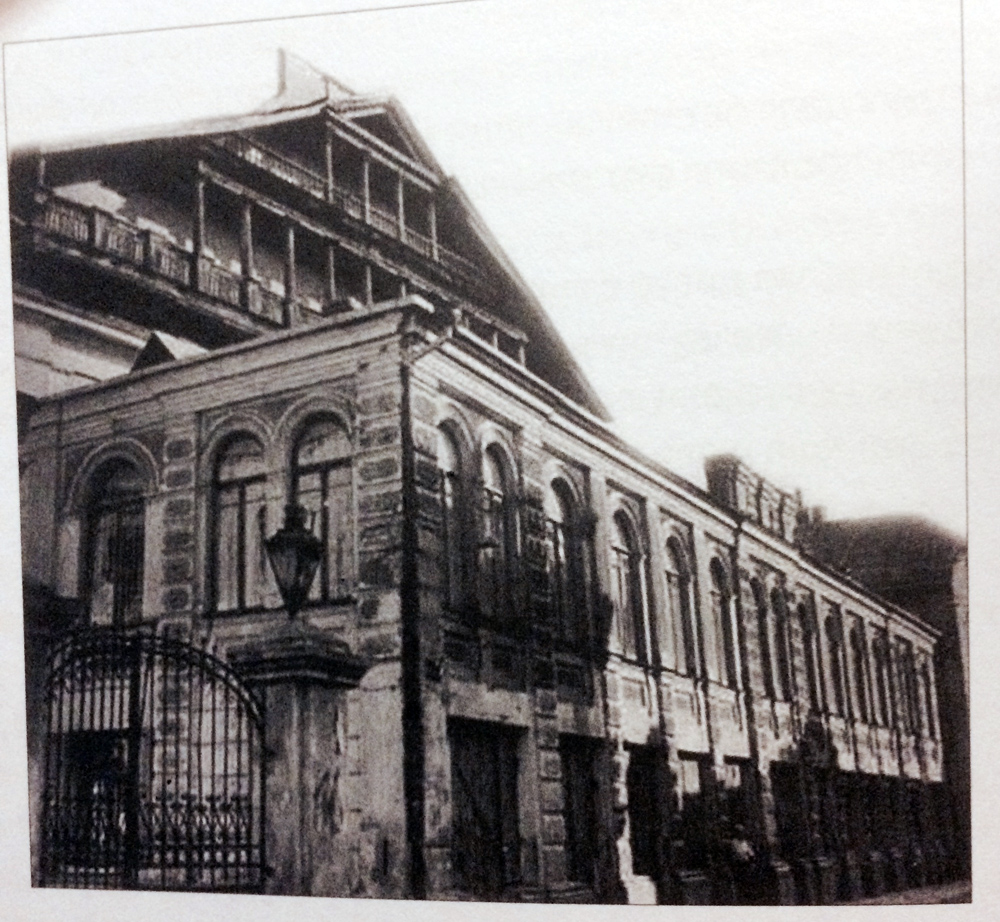
Matisyahu Strashun the Library’s Architect and Founder
 
Matisyahu Strashun[1] was born in 1817 in Vilna.  His family was among the Vilna elite.  His father, Samuel Strashun (also known as Rashash), whose notes/annotations – he never published a stand-alone work – to numerous classic rabbinic works, including Midrash Raba, Mishna, and Maimonides’ Mishna Torah, and Talmud Bavli.[2]  In terms of breadth, the latter is most
impressive, as his notes cover nearly every single page[3] of the Talmud Bavli.[4]
Matisyahu too was a Talmudist, his comments to Baba Batra and Eruvin are incorporated into the Vilna edition of Talmud Bavli, and was proficient in the entire corpus of rabbinic literature.[5] Matisyahu espoused views that were consistent with the haskalah movement.[6] For example, Matisyahu supported Max Lilienthal’s controversial attempt to reform “the Jewish educational system within the Pale Settlement,”[7] and Matisyahu help found and financially supported two schools in Vilna aligned with the haskalah.[8] Matisyahu corresponded with leaders of the haskalah movement, Isaac Ber Levinsohn, among others, and Strashun’s articles appeared in both rabbinic as well as haskalah newspapers and journals.[9] And, his home was a salon of sorts for traditionalists and the maskilim of Vilna.[10]
Strashun was independently wealthy and derived his substantial income from commercial and banking activities rather than rabbinic activities.  Yet he was considered a leader of the Vilna community.  He served on a number of communal institutions including the Vilna Tzedakah Gedolah.  And, at his death, he donated over 50,000 rubles to charity (approximately $1 million today). Leading Eastern European rabbis, R. Yitzhak Elchonon Spector and R. Jacob Joseph (later Chief Rabbi of
New York) among them, eulogized Strashun.[11] Posthumously, a street in Vilna was named after him.[12]
Throughout his life, he was an avid book collector, and, at the time of his death, amassed a collection of over 5,700 books and manuscripts.[13] His collection included incunabula, rare and controversial works (e.g. Me’or Eynaim), and manuscripts – from his father in addition to other authors. As reflected in his outlook during his lifetime, Strashun’s collection included rabbinic and haskalah works and books in non-Hebrew languages.[14]
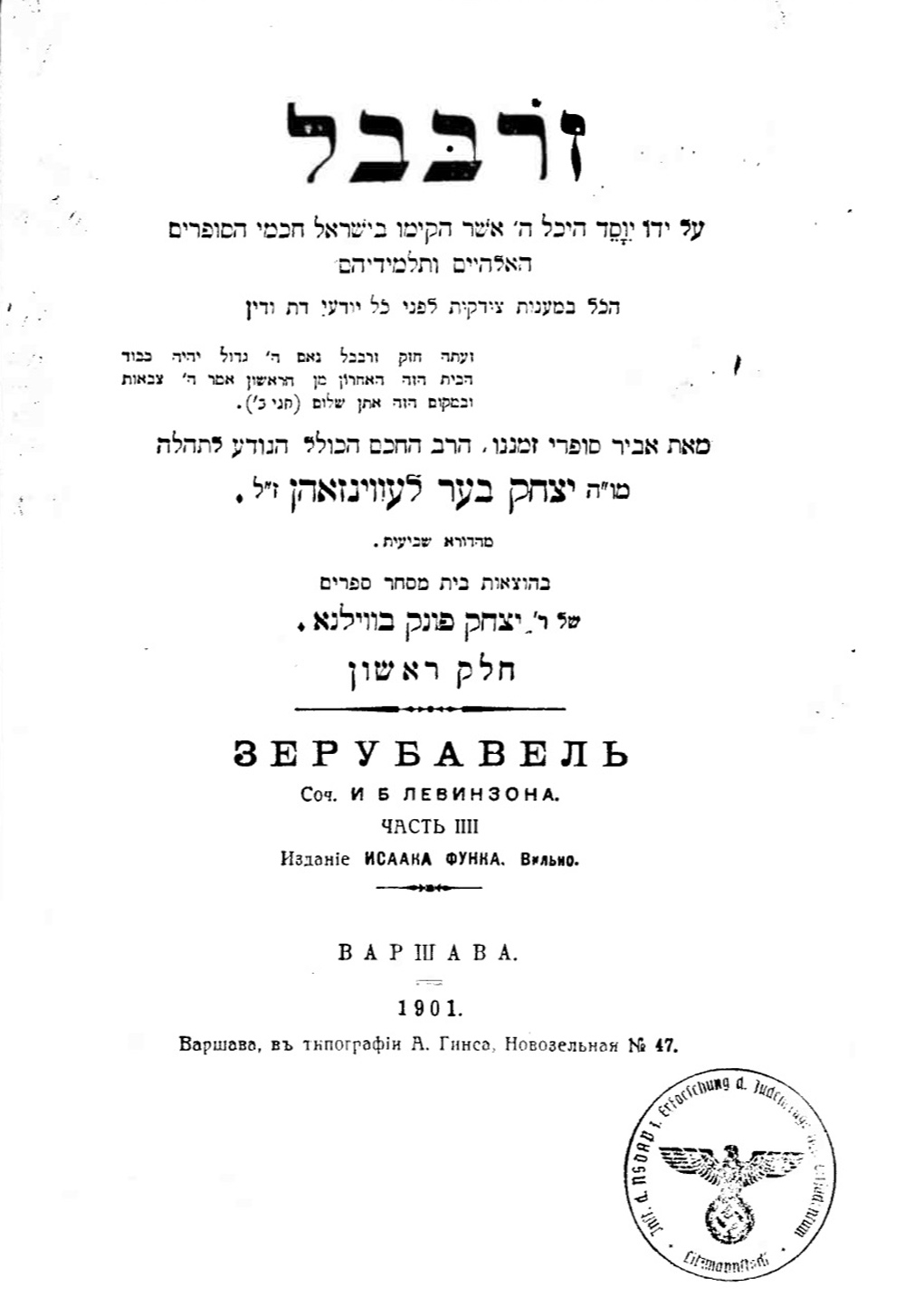
During Strashun’s lifetime, numerous printing houses and bookstores populated Vilna, providing access to most contemporary books, including in languages other than Hebrew.[15]  But, unfortunately, we do not have much information regarding how and when Strashun amassed his collection that extended well beyond those contemporary books, beyond that when he traveled he took the opportunity to seek out and purchase books. For example, when he took therapeutic trips to the spa he also took that opportunity to seek out and purchasing books.  In addition to Strashun’s spa trips, in 1857 he went on a Rabbinic tour of Eastern Europe and visited R. Shlomo Yehuda Rappaport (Shi”r) in Prague and R. Tzvi Hirsch Chajes.[16] But, R. Rapahel Nathan Rabinowicz, a book dealer and noted book collector, commented after visiting Strashun that while Strashun’s collection was larger than Rabinowicz’s, his collection was richer in rare and older books.[17]


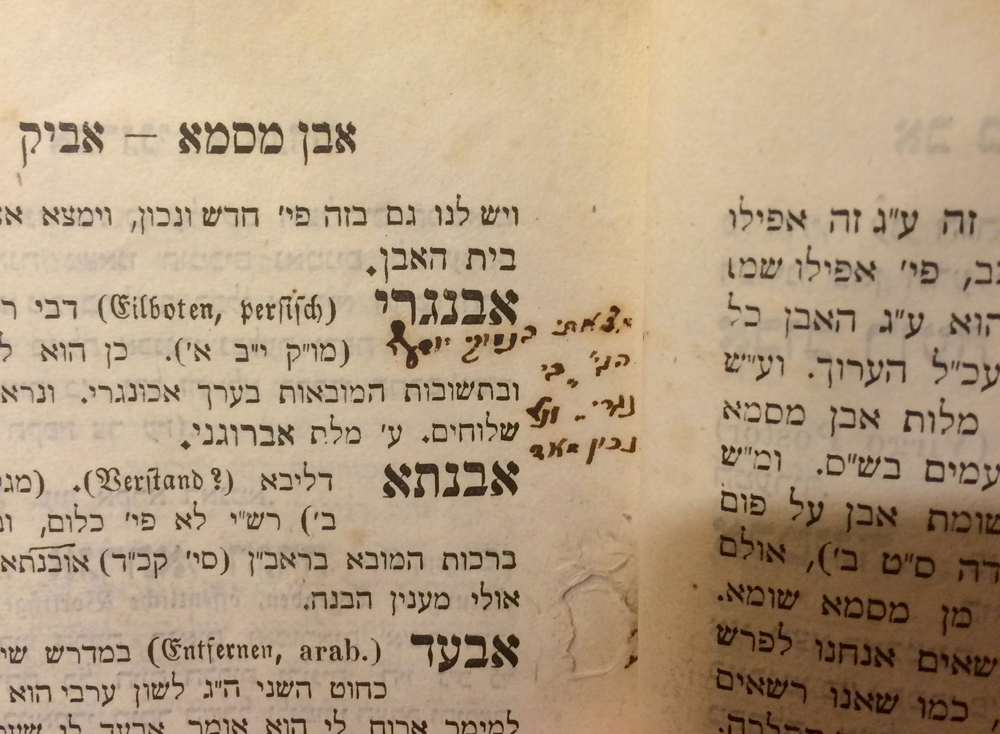
STRASHUN’S COPY OF SHIR’S EREKH MILIM


STRASHUN MARGINALIA TO EREKH MILIM
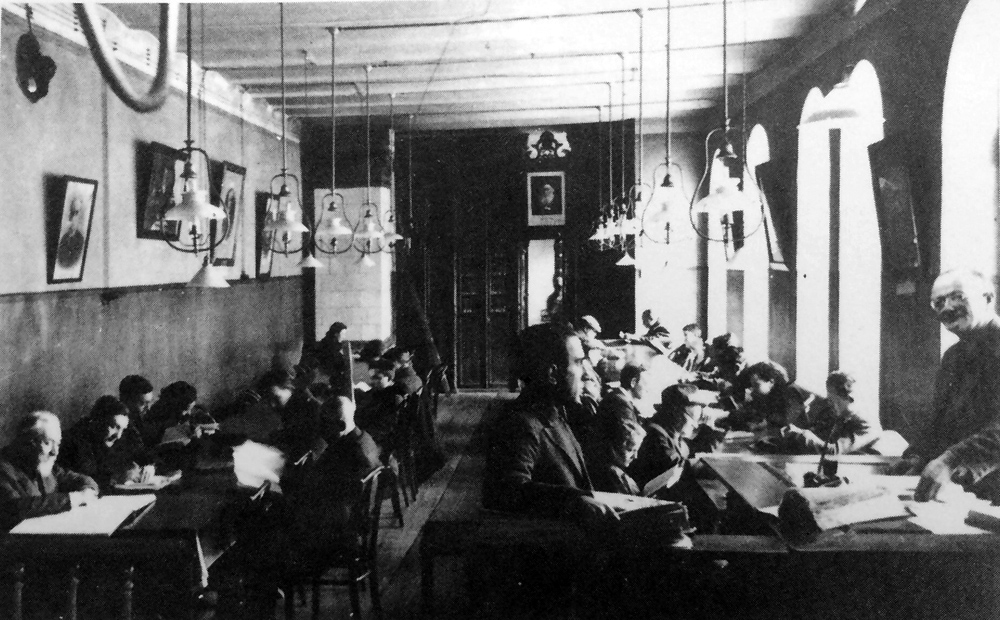
Creation of the Vilna Jewish Public Library
 
At his death in 1885, Strashun left no direct heirs.  He did, however, provide for the disposition of his library in his will.  In the past, those with large libraries had sold or left it to relatives,[18] Strashun elected a novel approach, rather than an individual or individuals he bequeathed his library to the Vilna Jewish community writ large, with instructions to establish a stand-alone public library.[19] His vision for the library was modeled on “the non-Jewish libraries that he saw [20] in the Diaspora.”[21] To that end, Strashun provided not only the books but also the funds to support the creation and sustainment of the library.[22]  Immediately the impact of this decision was apparent. At his funeral, among other enumerated good deeds and scholarship mentioned was, “the large library he left after death for the benefit of the community,” and which will “provide a
lasting legacy beyond that of any actual blood descendants.”[23]
            The creation of a public library out of Strashun’s personal collection was not a swift one, for seven years following Strashun’s death “the books remained under
lock and key” and were available only to those with special access.[24]  It remained in this state even though there were trustees and enough money to cover its operations.[25] Although the
library did not open to the public, the trustees were not idle during this time; and in 1889, published a complete catalog of Strashun’s collection.  His collection was comprised of 5,753 items, 63 of which contained marginalia in his hand.[26]
The Library is Open to the Public
 
In 1892, the Library was finally opened to the public. At the time, however, it remained in Strashun’s home.[27]  For years
after the library was opened to the public, in legal documents, the listed owner was not the Vilna community but one of the Library’s trustees. Although Strashun’s intent was clear – that the Library belonged to the community and not a trustee or any other individual – the Library’s legal status clouded that directive. In the late 1890s, there was a successful campaign to correct that issue, and the community becomes the sole owner of the Library, fulfilling Strashun’s wishes regarding ownership.[28]
The Library & Its Impact on the Vilna Community
 
In 1902, the Library finally moved into a building of its own in the courtyard of the Great Synagogue of Vilna.[29]  From this
point forward, the Strashun Library would be one of Vilna’s most important institutions.
            The Strashun Library was a Jewish public institution and, to fulfill the needs of the public, additional steps were required beyond building and maintaining
infrastructure and clarifying ownership.
Specifically, although Strashun’s collection was substantial both in
terms of size and breadth, it was still the product of one man’s idea of a library.  For this reason, Hillel Noach Steinschneider, one of Vilna’s leading scholars and historians, pleaded with the public to donate books and ensure the completeness of the library and fulfill its mission of serving the entire community.  He acknowledged that Strashun amassed a very impressive private collection, but that for a public library his collection alone was insufficient because “it is lacking in books for people” whose interests did not align with Strashun’s.
That is, a public library is not only a place open for all but also one that provides value for all.  Consequently, the library’s composition must reflect the entirety of its audience and not a single collector. Apparently, this plea was successful,[30] many Vilna scholars donated their collections to the Library in addition to the general public, and, by the 1930s, the Library had grown to over 35,000 volumes.[31] Additionally, Vilna’s Tzedakah Gedolah organization also provided funds for acquisitions.  Books acquired through those funds contain a special stamp or receipt.
The Library was open seven days a week and became the central meeting location for the residents of Vilna.[32]  The Library’s visitors were representative of Strashun’s commitment to both traditional and modern ideas and ideals.  Patrons included “rabbis and talmudic scholars who were studying responsa and Halakhic
works” and who sat side-by-side with the “younger generation who were reading haskalah works.”[33] When dignitaries came to Vilna, the Strashun library
was a waypoint.[34]
 The intent was to have Herzl be the first visitor to the Library, however, the Russian government prohibited him appearing at the Library.[35]  Other famous Jewish personalities did visit and signed the guest book, known as the Golden Book, including Sholem Yankev Abramovitsh (Mendele Mokher Seforim), and Hayim Nachum Bialik, in addition to more traditionalists, R. David Friedman of Karlin, R. Shlomo Ha-kohen, and the Chafetz Chayim.[36] The Library was not only known for its visiting
Jewish celebrities, but also for its well-regarded holdings.  According to A.J. Heschel, it was the largest public Hebraic library in Eastern Europe reported holding over 40,000 volumes.[37]  On the one hand, the Strashun library was recognized as one of the greatest cultural institutions in Eastern Europe, on the other, like so many public institutions, the Library struggled to raise sufficient funds throughout the early part of the 20th century, consistently hampering its ability to maintain and build its
collections in addition to limiting its public access.[38]  But, it would not be funding that led to its demise but the Nazis and their campaign to appropriate Jewish cultural treasures.
The Nazi’s Looting of the Strashun Library
 
            During World War II, Vilna was occupied and controlled first by the Soviets, then the Lithuanian government, the Soviets again, and finally by the Germans.[39]  While under Lithuanian and Soviet rule, the Library had its share of challenges, but none
of those compared to the Nazi’s systematic campaign to identify, collect, and appropriate important Jewish treasures –specifically books – and, consequently, important libraries. The intent was that these pillaged libraries would supplement the already substantial Judaic holdings of Frankfort City Library.[40]  Immediately after the Nazis occupied Vilna, the Strashun Library as Vilna’s “oldest and perhaps most distinguished” library was identified as a target for this campaign.[41]
            Less than a month after occupying Vilna, the Nazis “enlisted” the Library’s librarian, Chakil Lunski, who had served in that capacity for over forty years, in addition to others, to select, identify and catalog important books including “the incunabula and manuscripts in the Strashun Library” to be sent back to Germany.[42]  Needless to say, Lunski was “distraught” that “he [was] supposed to help remove the treasures from ‘his’ Strashun Library that he protected for 45 years!”[43] Consequently, a number of books from the Strashun Library ended up in Frankfort, Germany.[44]


Post War Efforts to Reclaim Heirless Jewish Property 
 
            The Library’s building did not survive the war, but some of its books did.[45]  After WWII, the Allies recovered thousands of items the German’s looted and collected them at the Offenbach Depot outside of Frankfort.[46]  Much of what was recovered was likely heirless and the Allies faced with the dilemma of restitution. Initially, the Americans took the position that heirless property should return to the country from which it was looted.[47]  This position raised the specter of rare and important Judaica and Hebraica returning to Poland or even Germany.  This outcome was unacceptable to many Jews.[48]  Some elected to influence the fate of looted heirless books through traditional democratic means, others took matters into their own hands.[49]
Free For All? The Disposition of Other Significant European Libraries
 
The Strashun Library was by no means the only library identified at the Offenbach depot.  There were numerous other
libraries, both public and private that ended up at Offenbach, without any clear method of repatriation. This lack of clarity leads to inconsistent results at best.  Indeed, first-hand accounts of post-war Germany confirm the ad-hoc, doubtful legal grounds and sometimes completely lawless reparation regime in the post-war chaos.  In many instances, individuals made many of the decisions regarding disposition with little information and virtually to no oversight.
For example, Solomon B. Freehof, who himself amassed one of the greatest responsa collections in the 20th century, spent time in post-war Germany and encountered heirless property and describes attempts of repatriation. He indicates that
half of the heirless Jewish books recovered by the Allies went to the Jewish National and University Library (“JNUL”) at the Hebrew University (now the National Library of Israel),[50] which was “quite right” because some unnamed person or entity had determined “that clearly the [JNUL] should take the place of the vanished Jewish communities of Europe.”[51]
            Others agreed with Freehof that the natural repository for heirless books of European origin was the JNUL in Jerusalem.  Most notably, Judah Magnes, and the trustees of the JNUL wanted to recover and claim for the JNUL as much heirless Judaica as possible.  The JNUL dispatched Gershom Scholem, the eminent Kabbalah scholar, and bibliophile, to Europe to locate and return heirless property.  He discovered a significant number of important books and manuscripts in the Offenbach Depot
and did everything in his power, including employing very underhanded means, to repatriate items to Hebrew University.[52]
Initially, Scholem had a very difficult time securing authorization to even enter Germany and the Offenbach Depot.[53]  When he was eventually granted permission to view the contents of the Depot, it was with the explicit condition that he
could not remove any items.  But, for Scholem, some items proved too enticing.  Scholem identified a number of rare and important books and manuscripts.  He was concerned that if the disposition of these items were left to the Allied authorities the items would not end up in Jerusalem, but, instead, at the Jewish Theological Seminary, or some other institution, in the United States.  This was unacceptable to Scholem. To facilitate the transfer of these items to the JNUL, Scholem colluded with a Jewish American serviceman to smuggle the works out of Offenbach. Scholem placed the collection into five boxes but did not label
their contents and provided a fake name on the invoice.  The American serviceman personally ensured that the boxes were shipped to Paris, after which they were sent to the JNUL.  Eventually, the Allies found out about the theft, and demanded the return of the five boxes, even lodging a formal diplomatic complaint.  In the end, after much back and forth, the boxes remained at the JNUL.[54]
As germane here, eventually, the boxes’ content were cataloged and it was determined that a third of the works were not heirless – their ownership was clear and restitution was possible.[55]  Nevertheless, the content of the five boxes were incorporated into the JNUL.
Another example of unilateral ostensive benevolent restitution occurred with the “library of the prestigious Klaus synagogue of Mannheim, [that] ended up with U.S. Army Chaplin, Rabbi Henry Tavel.” Who, “on his own authority . . . shipped it to his alma mater, the Hebrew Union College in Cincinnati.”[56]
The Lost & Found: The Strashun Library Post-WWII
 
The determination regarding the disposition of the Strashun library after the Holocaust was no different from other heirless property, ad hoc and questionable.  Lucy Dawidowicz, worked for YIVO before WWII and spent time in Vilna.
After WWII, on behalf of the Jewish Distribution Committee after World War II, she went to the Offenbach Depot to assist with identification of heirless books.  Prior to coming to Offenbach, she had “promised [herself] that [she] would do [her] best to
safeguard the rights of possible owners and heirs.”[57]  And, when she came upon some of the remains of the YIVO collection,[58] she “was in a state of exaltation” and in a letter home wrote that she “had ‘a feeling akin to holiness, that [she] was touching something sacred.’”[59]
Dawidowicz also came upon books that she “could identify came from the Strashun Library.”  Whereupon she recalled “a
strange story” that the head of YIVO, Max Weinreich,[60] had told her “back in 1940.” Weinreich told her that during the brief period of time when the Soviets had returned Vilna to Lithuanian control, YIVO attempted to move its library out of Vilna.[61]  And, that “the trustees of the Strashun Library, also fearing for the sake of their library, asked the Vilna YIVO to ship [the Strashun Library] too.” Unfortunately, the shipment never occurred and both libraries remained in Vilna and ultimately plundered by the Nazis.
While the shipment never occurred, in Dawidowicz’s telling the attempted shipment was an irrevocable act with significant implications regarding the Library’s ownership.  She inferred that the Strashun trustees request to join the YIVO shipment also implicitly ceded ownership of the Strashun Library to YIVO. Thus, there she had no doubt regarding the proper disposition of the Strashun Library. Based entirely upon the “strange story” she heard, and even though according to her retelling the Strashun trustees had only intended YIVO to act as a shipper,[62] Dawidowicz told the Director of the Offenbach Depot that the heirless “remains of the Strashun Library ought to be considered as YIVO property.” She appealed to the Allied authorities and her position carried the day and the remnants of Strashun Library went to YIVO in New York.[63]
In a recent exhibit devoted to YIVO’s Strashun collection, the issue of the Strashun Library’s provenance is not discussed in any detail.  Instead, the book accompanying the exhibit simply states that all the remnants of the Strashun Library “were
rescued from the ruins of Europe and brought back to YIVO in New York in 1947.”[64] YIVO’s library catalog again implies that all the recovered books went to YIVO and links the disposition of the Strashun Library with that of YIVOs, the provenance note explains that “[t]he Strashun Collection, along with the YIVO Vilna collections, were liberated by the American Army, and
re-repatriated to YIVO in New York in April 1947.”[65]
            In reality, not all the remaining Strashun books went to YIVO, nor did everyone agree with the determination that YIVO was the rightful heir of the Strashun Library.
To be continued in Pt. II…


[1] For biographical information and sources see Tzvi Harkavy, Le-Heker Misphahot, (Jerusalem: Hotsa’at ha-Sefarim ha-Erets-Yisre’elit, 1953), 47-48 and n.79.
[2] A complete bibliography of his works, both published and unpublished, appears in Tzvi Harkavy, Le-Heker Misphahot, (Jerusalem: Hotsa’at ha-Sefarim ha-Erets-Yisre’elit, 1953), 45-46. Rashash’s comments on Rambam were printed in
Mekorei Rambam, first published in 1870 in Vilna, and while not a true stand-alone work, Rashash’s comments appear
alone, without the Rambam’s text.  See Mekorei ha-Rambam, Harkavy ed., (Jerusalem, Hatsa’at ha-Sefarim ha-Erets-Yisre’elit, 1957, Im ha-Madurah, and p. 59.
[3] For a list of the handful of pages he omitted, see Rafael Katzenellenbogen, Rash”sh le-Shitato, in Mekori Ha-Rambam Le-Rash”sh, ed. Harkavy, (Jerusalem, 1957), 64.
[4] For general biographical details on the Strashun family, see Frida Shor, From “Likute Shoshanim” to “The Paper Brigade” The Story of the Strashun Library in Vilna, (Tel Aviv: Ariel, 2012), 15-28, and the sources cited therein.  See also Shua Engelman, “Rabbi Samuel Strashun and his Haggahot on the Babylonian Talmud,” (PhD dissertation, Bar-Ilan University, 2009; Hebrew); regarding Samuel’s Talmudic annotations as compared to others, see Yaakov Shmuel Spiegel, Chapters in the History of the Jewish Book, Scholars & their Annotations (Ramat-Gan: Bar Ilan University, 2005), 421-22. Cf. Mordechai Zalkin, “Samuel and Mattiyahu Strashun: Between Tradition and Innovation,” in Mattiyahu Strashun, 1817-1885: Scholar, Leader, and Book Collector, (New York: YIVO Institute, 2001), 6-7.
[5] Moshe Shimon Anktokolski, Evel Kaved, infra n.12, 23.
[6] Mordechai Zalkin, “Samuel and Mattityahu Strashun: Between Tradition and Innovation,” in Yermiyahu Aharon Taub, ed., Mattityahu Strashun, 1817–1885: Scholar, Leader, and Book Collector (New York: YIVO Institute, 2001), 1-27. Samuel has made a very small number of comments that can be read to be consistent with ideas of the haskalah, but these do not approach Matisyahu’s active involvement with the movement, including his very public support of the movement.  Additionally, it is unclear if Samuel’s comments are simply limited to their specific context.
Indeed, the examples Zalkin provides regarding Samuel’s alignment with haskalah do not support Zalkin’s thesis. Id. at 25
n.10. First, Zalkin, cites Strashun’s comment in Gitten 6b, that “we find many amora’im who did not know how to read scripture” as proof of his “unorthodox” views.  But we find a similar statement from the medieval period.  See Tosefot, Bava Batra, 113a.  Zalkin’s second citation is to Rashas’s comments, Rosh ha-Shana 26a, “certain things that were uttered in a particular time and particular place are inserted by editors of the Talmud in their appropriate location in the text.” This misrepresents the Rashash.  Rashash is attempting to answer how the Talmudic sage, Levi, was unaware of an explicit verse as the TB in RH 26a implies.  Rashash explains that although there is no explicit mention of the time or place that this story occurred, Rashash posits that the story in Rosh Hashana occurred at the same time as another story with Levi, Yevamot 105a, where he had a moment of senility.
Rashash is not offering his opinion regarding the redaction of the Talmud, instead he is merely dating the story in Rosh ha-Shana. Finally, it is unclear the relevance of Zalkin’s third example, “you will find many contradictions between different locations is (sic) Rashi’s text.” Locating and alleging contradictions in Rashi is hardly remarkable.
[7] Zalkin, id., at 15.
[8] Shalom Pludermacher, Zikaron le-Hakham: Zeh Sefer Tolodot ha-Rav ha-Go’an, he-Hakham ha-Kollel Rabbi Matitayahu
Strashun Z’L
, in Mattiyahu Strashun, Matat-Ya, Haghot, Hidushim ve-He’arot Me’irot ‘al Midrash Raba Pri Eito Shel Matityahu Strahsun, (Vilna: The Widow and Brothers Romm, 1893), 15.
[9] A partial bibliography of Strashun’s articles appears in his Sefer Matat Yah (Vilna, 1893), 41-74 (Hebrew), available online here.  Reading, and certainly actively participating with, haskalah related newspapers was considered inconsistent with Ultra-Orthodox values and was grounds for expulsion from Volozhin Yeshiva. Shaul Stampfer, The Lithuanian Yeshiva, Revised & Expanded Edition,  (Jerusalem: The Zalman Shazar Center for Jewish History, 2005), 176.
[10] Aviva Astrinsky, “A Brief History of the Strashun Library,” in Yermiyahu Aharon Taub, ed., Mattityahu Strashun, 1817–1885: Scholar, Leader, and Book Collector (New York: YIVO Institute, 2001), i.
[11] Duberosh ben Aleksander Torsh, Me’arat ha-Makhpelah, shnei Hepadim . . ., (Warsaw, 1887), 50.
[12] Moshe Shimon Antokolski, Evel Kaved, (Vilna: be-Defus Avhram Tzvi Katzenellenbogen, 1886), 8; Tzvi Harkavy, Le-Heker Misphahot, supra n.1, 47.  During his lifetime he also donated to public institutions, among them, the yeshivot of Mir and Volozhin.  Id. at 24.
[13] Moshe Shimon Antokolski, Evel Kaved, supra n.12, 11.
[14] Mordechai Zalkin, supra n.6, 17-8.
[15] Hagit Cohen, At the Bookseller’s Shop, The Jewish Book Trade in Eastern Europe at the End of the Nineteenth Century,
(Jerusalem: The Hebrew University Magnes Press, 2006), 48-52.
[16] Shalom Pludermacher, Zikaron le-Hakham, 1893), 17. His meetings are reflected in Strashun’s ownership of their works.
See Likutei Shoshaim, nos. 386,1024,1178, 2522, 3352, 3650, 3781, 4377, 5399, 5592. Regarding other well-known Hebrew book collectors and their collections, see Alexander Marx, “Some Jewish Book Collectors,” in his Studies in Jewish History & Booklore, (New York, 1941), 198-237; Cecil Roth, “Famous Jewish Book Collections & Collectors,” in Essays in Jewish Booklore, (New York: Ktav Publishing House, 1971)330-35.
[17] “A Collection of Letter from Jewish Scholars to ShZH”H,” in Yad ve-Shem, reprinted in Yeshurun.
[18] David Oppenheimer’s library was the first library that was posthumously sold intact – to the Bodleian Library.  See
Alexander Marx, “Some Notes on the History of David Oppenheimer’s Library,” Revue des Études Juives 82 [=Israel Lévi
Festschrift] (1926): 451-460; Charles Duschinsky, “Rabbi David Oppenheimer: Glimpses of His Life and Activity, Derived from His Manuscripts in the Bodleian Library,” Jewish Quarterly Review 20:3 (January 1930): 217-247; Alexander Marx, “The History of David Oppenheimer’s Library,” in Studies in Jewish History and Booklore (New York: Jewish Theological Seminary of America, 1944), 238-255; and more recently in Joshua Teplitsky, “Between Court Jew and Jewish Court: David Oppenheim, The Prague Rabbinate, and Eighteenth-Century Jewish Political Culture (PhD dissertation, New York University, 2012); and Abraham Schischa, “Rabbinic Writings from the Collection of Rabbi David Oppenheim,” Yeshurun 31 (2014): 781-794 (Hebrew).
For other significant personal Hebrew libraries and their purchasing history, see Binyamin Richler, Hebrew Manuscripts: A
Treasured Legacy
(Clevland/Jerusalem: Ofeq Institute, 1990) 66-67.
[19] For earlier examples of private libraries see Nehemya Allony, The Jewish Library in the Middle Ages, Book Lists from the Cairo Genizah (Jerusalem:  Ben-Zvi Institute, 2006); S.D. Goitein, A Mediterranean Society (Berkley: University of California Press, 1967), vol. II, 206, 248; vol. V 3-4, 425.
[20] It is unclear whether Strashun meant this literally because while the 19th century witnessed the modern period of the public library, there were not any public libraries in Eastern Europe during Strashun’s lifetime.
[21] Shor, supra n. 4, at 26.
[22] Sefer Matat Yah, supra n. 9, at 35, listing Strashun’s bequests.
[23] Moshe Shimon Anktokolski, Evel Kaved, supra n.12, 17.
[24] Among those who had access during this time was Ya’akov Wallensky.  During this time, Wallensky was writing his supplement to Piskei Teshuvot on Yoreh De’ahPiskei Teshuvot itself is a collection of obscure and rare works discussing issues
appearing in Yoreh De’ah. Because Wallensky’s materials were even more obscure and rare, the only place he could access these was the Strashun Library. Ya’akov Wallensky, Daltei Teshuva, (Vilna, 1890), Introduction, 5-6, (link).
[25] Shor, supra n. 4, at 29
[26] Cf. Aviva Astrinsky, “A Brief History of the Strashun Library,” in Yermiyahu Aharon Taub, ed., Mattityahu Strashun, 1817–1885: Scholar, Leader, and Book Collector (New York: YIVO Institute, 2001), iii, who provides that his collection was only
comprised of 5,739 items.
[27] Shor, supra n. 4, at 29.  Regarding the conflicting reports of the Library’s locations during this period, see id., n.71.
[28] Shor, supra n.4, 32-3.
[29] While the Library moved to the new building in 1901, and its dedication ceremony occurred on April 14, 1902, it would not be until October 20, 1902, that the Library secured the necessary governmental permits to fully open to the public.  See Shor at 34-35.  The government license is reproduced in Layzer Ran, Jerusalem of Lithuania, vol. 2, (New York: Laureate Press, 1974),
346.
[30] Frida Shor, supra n.4, 51-65,174-87. See Berger, “The Strashun Library in Vilna,” in Zevi Scharfstein, ed., Hebrew Education and Culture in Europe Between the Two World Wars (New York: Ogen Publishing House of Histadrut HaIvrit BeAmerica, 1957), 513 (Hebrew), who discusses the varied subject matter of the Library’s collection.
[31] Id.
[32] According to one account, the Library had over 200 patrons daily, but only 100 seats, forcing people to share chairs and encounter waits of over a half-hour just to enter the Library.  Id. at 513.
[33] Ben Tzion Dinur, “Yerushalim de-Lita,” in Layzer Ran, Jerusalem of Lithuania, vol. 1 (New York: Laureate Press, 1974), XVI; but see the English translation of Dinur’s article that comingles the two groups and has both the Orthodox and younger generation studying “respona or modern Hebrew novels.”  Id. at XX.  It is unclear what accounts for this discrepancy in translation. Lucy S. Dawidwowicz, From That Place And Time, A Memoir 1938-1947, (New York: Bantam Books, 1991), 119, provides a remarkably similar account to Dinur’s (“On any day you could see, seated at the two long tables in the reading room,
venerable long-bearded men, wearing hats, studying Talmudic texts, elbow to elbow with bareheaded young men and even young women, bare-armed sometimes on warm days, studying their texts. The old men would sometimes mutter and grumble about what the world had come to. The young people would titter.”).
For a breakdown of the Library’s readership by type (i.e. students, academics and public intellectuals, workers, etc.), see Berger, supra n. 28, 514-15.
[34] See Shor, supra n. 4, 174, see also the description of David Wolfson’s Vilna visit, Israel Klausner, “The Zionist Movement in
Lithuania,” in Yahdut Lita (Tel Aviv: Am Hasefer Publishers, 1950), 522 (Hebrew). For a photo of one such visit, see Layzer Ran, Jerusalem of Lithuania, vol. 2 (New York: Laureate Press, 1974), 416.
[35] Shor, supra n. 4, 174-75.
[36] Berger, “The Strashun Library in Vilna,” at 519; Shor, MeLekutei, supra n. 4, 169; Khaykl Lunski in Yeshurin’s ‫ווילנע
(New York, 1935 – in Yiddish), p. 286-7
[37] Abraham Joshua Heschel, “Yerushalim de-Lita,” in Ran, Jerusalem, vol. I, XVII; David E. Fishman, The Rise of Modern Yiddish Culture (Pittsburgh, PA, University of Pittsburgh Press, 2005), 143, provides that the holdings of the Strashun Library prior to the Holocaust was comprised of “some forty thousand volumes.”
[38] See Shor, MeLekutei, 38-9; 42 (discussing a 1926 public appeal that the Library undertook where it described its financial condition as “dire and catastrophic”); id. at 43 (“The Strashun Library underwent many difficult financial periods throughout the nineteen years of Polish rule (10/9/1920- 9/19/1939).  But, it continued to major Vilna cultural institution.”).
[39] Shor, MeLekutei, 44-7.
[40] Sem C. Sutter, “The Lost Libraries of Vilna and the Frankfurt Institut zur Erforschung der Judenfrage,” in Lost Libraries, The Destruction of Great Book Collections Since Antiquity, ed. James Raven (New York: Palgrave Macmillan, 2004), 220-22.
[41] Id. at 223 & 224 discussing other Vilna Libraries that were targeted by the Nazis.  See also Dov Schidorsky, Burning Scrolls and Flying Letters (Jerusalem: Magnes Press, 2008), 165-201; David E. Fishman, The Rise of Modern Yiddish Culture (Pittsburgh, PA: University of Pittsburgh Press, 2005), 141-44; Frida Shor, supra n.4, 189-200.
[42] Sem C. Sutter, “The Lost Libraries of Vilna,” supra n.38, 224.
[43] Id. at 226.
[44] Berger, “The Strashun Library of Vilna,” at 517.  The books that were not deemed important we pulped or used as heating fuel. Schidorsky, supra 39, 182. The exact date of when the Strashun Library was transferred to Germany is unclear; however, it was some date after April 1943.  See David E. Fishman, supra n.39,173 n.9. Similarly unclear is the exact number of books that were sent to Frankfort.  Sem C. Sutter, “The Lost Libraries of Vilna,” supra n.38, 228.  But, according to Aviva Astrinsky, “almost all of the Strashun books were crated and shipped by rail to Germany.  Aviva Astrinsky, “Mattitayahu (Mathis) Strashun,” supra n.24, i.
[45] See Ran, Jerusalem, vol II, 522, for a photo of post-war building. For a discussion regarding the numbers of books that survived from the Strashun Library, see Frida Shor, supra n.4, 204-05.
[46]  Dov Schidorsky, supra n.39, 225, listing the countries and libraries who books were deposited at the Offenbach Depot. Sem C. Sutter, “The Lost Libraries of Vilna,” supra n.38, 229-32.
[47] Lisa Moses Leff, The Archive Thief: The Man who Salvaged French Jewish History in the Wake of the Holocaust (United
States:  Oxford University Press, 2015), 121.
[48]  Id. at 124-30, 136-40.
[49]  Id.
[50] Dov Schidorsky, supra n.39, 233, provides the numbers and location of heirless books returned by the Jewish Culture Reconstruction.  For a listing of U.S. institutions that received heirless cultural property from the Offenbach Depot, see Herman
Dicker, Of Learning and Libraries, The Seminary Library at One Hundred, (New York: The Jewish Theological Seminary, 1988), Appendix B. See also F.J. Hoogewoud, The Nazi Looting of Books and its American ‘Antithesis’. Selected Pictures
from the Offenbach Archival Depot’s Photographic History and Its Supplement,” Studia Rosenthaliana 26:1-2 (1992): 158-192; and F.J. Hoogewoud, “Dutch Jewish Ex Libris found among looted books in the Offenbach Archival Depot (1946),” in Chaya Brasz and Yosef Kaplan, eds., Dutch Jews as Perceived by Themselves and by Others (Leiden: Brill, 2001), 247-261.
[51] Solomon B. Freehof, On the Collecting of Jewish Books, (New York, NY: Society of Jewish Bibliophiles, [196-]), 17; regarding the books that Hebrew University received, and its efforts to locate and claim heirless works throughout Europe through its Otzrot Ha-Goleh committee, see Shlomo Shunami, About Libraries and Librarianship, (Jerusalem: Rubin Mass, 1969), 56-65; Zvi  Baras, A Century of Books, The Jewish National & University Library 1892-1992, (Jerusalem: Jewish National & Univ. Library,1992), nos. 94-101; Dov Schidorsky, supra n.39, 212-91.
[52] Dov Schidorsky, supra n. 39, 250-51.
[53] Id. at 248-50.  According to Scholem, Abraham Ya’ari, Scholem’s partner on behalf of Hebrew University and its Goleh ha-Otzrot program, returned to Israel, in part, because of the difficulty in securing the necessary authorizations to enter Germany.
Id. 248; 351.
[54] Id. at 250-51.
[55] Id. at 251 n.51.
[56] See  Druker, Of Learning and Libraries, 58.  Druker, however, concludes that Tavel’s unilateral decision “resulted in
no real harm.”  One wonders if any surviving heirs who had legal claims to the Manheim collection would reach the same conclusion.
[57] Lucy S. Dawidwowicz, From That Place And Time, A Memoir 1938-1947, (New York: Bantam Books,1991), 314-16.
[58] See David E. Fishman, supra n.39, 143-53 174 n.20, discussing the YIVO Library under the Nazis and its ultimate transfer to YIVO in New York.
[59] Id. at 318.
[60] For more information regarding Weinreich and YIVO, see id. at 126-39.
[61] Id.; for a fuller treatment of this attempt see Shor, From ‘“Likute Shoshanim”, 44.
[62] Aside from Dawidowicz’s telling, according to the documents that discuss YIVO’s efforts to save its library and the Strashun and the Lithuanian government’s response throughout this attempt, the Strashun Library is described as a Vilna community
library and not the property of one institution or another.  See Shor, From “Likutei Shoshanim”, at 44.
[63] Her argument has the perverse effect that the trustees attempt to save the library immediately resulted in completely losing control of the library.
[64] Aviva E. Astrinsky, Mattistyahu Strashun 1817-1885, Scholar, Leader, and Book Collector, YIVO, New York: 2001, ii, iv.  But, Astrinsky also indicates that YIVO recovered “a substantial part of the Strashun Library.”  Id. at i.  According to YIVO’s website, however, YIVO only received part of the Strashun Library and the remainder “were transferred to the library of the Hebrew University in Jerusalem. (link).
Similarly, Berger, “The Strashun Library in Vilna,” p. 517 claims that part of the Strashun Library went to YIVO and the other part to Hebrew University.
Beyond these unsupported statements, there is no evidence that any books from the Strashun Library were sent to the JNUL.  While the JNUL’s post-war efforts at obtaining heirless books are well documented, see supra, there is no mention of the Strashun Library.
Similarly, the JNUL catalog does not list any items whose provenance extends to the Strashun Library. It is possible that YIVO and Berger confused the JNUL with the Jerusalem Central Library discussed below.  Or simply conflated the Strashun Library with the numerous other European libraries that the JNUL successfully rescued.
[65] See, e.g., the YIVO catalog entry for Solomon Adret’s Hidushe Nidah leha-Rashba, Altona, [1737].


The Hanukkah Miracle

The Hanukkah Miracle

Marc B. Shapiro
In an earlier post I mentioned that I hoped to write about the nineteenth-century dispute about the historicity of the Hanukkah miracle of the oil. This dispute broke out after the publication of Hayyim Zelig Slonimski’s article claiming that Maimonides did not believe in the miracle. Fuel was added to the fire when R. Samuel Alexandrov publicly supported Slonimski and argued that the miracle of the oil was intended to be understood in a non-literal fashion, with the oil representing Torah. (He later retracted this view, presumably due to public pressure.) There is no longer a need for me to write in any detail about this matter after Zerachyah Licht’s recent comprehensive Seforim Blog post here, which also includes Slonimski’s original article.[1]
However, there are a few points I would like to add.
In my post here I wrote:
To give an example . . . of how [R. Samuel Moses] Rubenstein’s later thought broke with tradition, see his Ha-Rambam ve-ha-Aggadah (Kovno, 1937), p. 103, where he claims that the story of the miracle of Hanukkah is almost certainly a late aggadic creation, and like many other miracle stories in aggadic literature was not originally intended to be understood as historical reality:[2]
ספק הוא אם הנס של “פך השמן” הוא אפילו הגדה עממית קדומה, קרוב שהוא יצירה אגדית חדשה מבעל הברייתא עצמו או מאחד מבעלי האגדה, ונסים אגדיים כאלו רבים הם בברייתות וגמרא ומדרשים ע”ד ההפלגה כדרכה של האגדה. ולבסוף הובן נס זה למעשה שהיה. עיין שבת כ”ג א’. [טעם ברייתא זו הובא גם במגילת תענית (פ”ט) אבל כמו שנראה היא הוספה מאוחרת, ועיין (שם) ובפסיקתא רבתי (פיסקא דחנוכה) עוד טעם להדלקת נרות חנוכה[.
During the most recent Hanukkah I was using R. Joseph Hertz’s siddur, the Authorized Daily Prayer Book. Based upon how he describes the holiday and the lighting of the menorah, omitting any mention of the miracle of the lights (pp. 946-947), I assume that he also didn’t accept it literally. Note how he states that the lights were kindled during the eight-day Dedication festival, and this is the reason for the eight days of Hanukkah, rather than offering the traditional reason that the eight days of Hanukkah commemorate the eight days that the menorah miraculously burnt.
Three years to the day on which the Temple was profaned by the blaspheming foe, Kislev the 25th 165, Judah Maccabeus and his brethren triumphantly entered the Holy City. They purified the Temple, and their kindling of the lights during the eight-day festival of Dedication—Chanukah—is a telling reminder, year by year, of the rekindling of the Lamp of True Religion in their time.
Ad kan my words in the prior post. Some time ago I was asked if I know of any other traditional authors who deny the literalness of the Hanukkah miracle. It could be that R. Isidore Epstein should be added to the list, as in his classic work Judaism he describes Hanukkah and the kindling of lights, but mentions nothing about the miracle. However, unlike Hertz whose comments were in a siddur and directed to Jews, Epstein’s book is directed towards a general reader, and can still be used as a college text. Understandably, one would hesitate to include in such a book anything about a miracle. Yet I think it is telling that he does not even say something like, “according to tradition a cruse of oil with enough for one day burnt for eight.”
Another traditional author who must be mentioned in this regard is R. Zev Yavetz. Here is his picture.
And to remind people of what Slonimski looked like, here is his picture.[3]

And here is a picture of R. Alexandrov.
Yavetz was one of the leaders (and founders) of the Mizrachi movement, and Kfar Yavets, a religious moshav, is named after him. After his death, R. Kook wrote about how Yavetz was able to combine Torah and secular wisdom without being negatively affected and distorting religious values.[4] Yavetz is best known for his writings on Jewish history. His magnum opus is his 14 volume Toldot Yisrael. In volume 4, pp. 89-91, he discusses the Hanukkah story.

As you can see, there is no mention of the miracle of the oil. The eight day holiday is portrayed as a commemoration of the original eight day celebration that took place when the Temple was rededicated. I don’t think there is any other conclusion that can be drawn other than that Yavetz did not regard the miracle of the oil as an actual historical event.

In 1900 R. Aryeh Leib Feinstein published his Elef ha-Magen. On p. 35b he writes that whereas R. Judah (bar Ilai) believed in the Hanukkah miracle, R. Yose and R. Judah ha-Nasi did not, and that is the reason why R. Judah ha-Nasi did not include the laws of the Hanukkah lights in the Mishnah.
חיוב נר חנוכה עתה אינו בשביל המלוכה רק מפני הנס שנעשה בפך השמן שהדליקו בו שמונה ימים, ואף שגם טעם זה תלוי במחלוקת שבין ר’ יודא ור’ יוסי בהוריות [יא ע”ב] שלדעת ר’ יודא נסים רבים אירעו בשמן המשחה, ור’ יוסי חולק עליו שלא היה בו שום נס, ומטעם זה ג”כ השמיט רבי דיני נר חנוכה, ולא הזכירו בשום משנה, רק מזכירו לענין ניזקין בשם ר’ יודא שפוטר החנוני, לפי שר’ יודא לשיטתו סובר שנר חנוכה הוא מצוה לזכר הנס שאירע בפך שמן המשחה. אבל רבי פוסק כר’ יוסי לפי שנימוקו עמו. אך התלמוד אוחז בזה כר’ יודא לפי שהנס מהשמן כבר נתפרסם בהאומה.
On p. 36a Feinstein refers to the dispute between Slonimski and the rabbis, and says that many good Jews adopted Slonimski’s position. He tells us that he informed Slonimski that the dispute between him and the rabbis was actually an old dispute.
ואחריו נמשכו עוד רבים וכן שלמים שמהרו ויחליטו כדבריו . . . והראיתיו לדעת שבאמת ענין זה כבר דשו בו רבים, ונחלקו עליו משפחות משפחות, וביחוד ר’ יודא ור’ יוסי בהוריות. אך בכ”ז רבינו הקדוש אף שנטה למלכות בית דוד ולדעת ר’ יוסי, לא ערב לבו לנגוע במנהג ישן שקימו וקבלו עליהם הדורות שלפניו.
Not long ago I was listening to some recordings from R. David Bar-Hayim of Machon Shilo. One of them is entitled “The Story of the Macabees, part 2.” You can find it here. In this lecture, beginning at minute 27, R. Bar-Hayim explains that in his opinion there was no miracle of the oil, and it is simply a legend that developed in Babylonia, “because without that Hanukkah makes no sense for a Jew in galut.” Rather than attempt to summarize his perspective, it is preferable for readers to listen to his entire shiur.
Because of his originality, I would not have been surprised had R. Chaim Hirschensohn adopted the same sort of approach. Yet this is not the case, and R. Hirschensohn writes that the Hanukkah miracle was the final open miracle in Jewish history, by which he means that after this Jewish history is to be explained in a more naturalistic way, just like the history of other peoples. However, he adds that it must also be recognized that the very existence of the Jewish people over so many years in exile is itself a miracle.[5]
נר חנוכה הוא חותם הניסים בדברי ימי עמנו, כמלאכי חותם הנביאים.
אחרי נצחון החשמונאים החלו אצלנו דברי הימים כאשר לכל העמים, אם שאין ספק שגם מקודם היה לנו דברי הימים אבל המסופר לנו המה רק מעשה ניסים ובתוכם עלינו לבקש גרעיני דברי הימים, אבל המסופר לנו אחרי מלחמת החשמונאים כלו דברי הימים אבל הדברי הימים בעצמו הוא כלו מעשה נסים כי בארצות הגולה בנס אנו עומדים.
Since Slonimski claimed that Maimonides did not believe in the Hanukkah miracle, I think it is worth noting that although Maimonides could have stated that Hanukkah commemorates the military victory or the rededication of the Temple, he actually appears to say that the entire holiday is in commemoration of the lighting of the Menorah.[6] There are many sources[7] that state that the real miracle commemorated by Hanukkah is not the oil but the military victory, but this does not seem to be Maimonides’ perspective. Here is what he writes in Mishneh Torah, Hilkhot Hanukkah 3:2-3[8]:
ב. וכשגברו ישראל על אויביהם ואיבדום בחמישה ועשרים בחודש כסלו היה ונכנסו להיכל ולא מצאו שמן טהור אלא פך אחד ולא היה בו להדליק אלא יום אחד בלבד והדליקו ממנו נרות המערכה שמונה ימים עד שכתשו זיתים והוציאו שמן טהור.
ג.  ומפני זה התקינו חכמים שבאותו הדור שיהיו שמונת הימים האלו שתחילתן מלילי חמישה ועשרים בכסלו ימי שמחה והלל ומדליקין בהן הנרות בערב על פתחי הבתים בכל לילה ולילה משמונת הלילות להראות ולגלות הנס וימים אלו הןן הנקראין חנוכה.
In fact, this is the talmudic perspective as well. Shabbat 21b asks what is the reason for the holiday of Hanukkah (מאי חנוכה), and rather than speak about the military victory or rededication of the Temple all it mentions is the miracle of the oil. Many will find this strange, since can this really be the reason for the holiday? It is one thing to say that this is the reason for the eight days of celebration, but can this be the reason for the holiday itself? The Sheiltot of R. Ahai Gaon[9] preserves another version of the talmudic text. Instead of מאי חנוכה it reads מאי נר חנוכה. With this as the question, the answer which explains about the miracle of the oil makes much more sense.[10]
Slonimski did not argue that Maimonides’ philosophy does not leave room for the Hanukkah miracle. He simply pointed out that when Maimonides records the talmudic story of the miracle he leaves out three words: נעשה בו נס. Here is the relevant section of the talmudic text in Shabbat 21b. I have underlined the crucial words:
וכשגברה מלכות בית חשמונאי ונצחום בדקו ולא מצאו אלא פך אחד של שמן שהיה מונח בחותמו של כהן גדול ולא היה בו אלא להדליק יום אחד נעשה בו נס והדליקו ממנו שמונה ימים לשנה אחרת קבעום ועשאום ימים טובים בהלל והודאה.
Here is what Maimonides writes in Hilkhot Hanukkah 3:2, and as you can see the underlined words do not appear.
וכשגברו ישראל על אויביהם ואיבדום בחמישה ועשרים בחודש כסלו היה ונכנסו להיכל ולא מצאו שמן טהור אלא פך אחד ולא היה בו להדליק אלא יום אחד בלבד והדליקו ממנו נרות המערכה שמונה ימים עד שכתשו זיתים והוציאו שמן טהור.
According to Slonimski, the omission of the words נעשה בו נס indicates that Maimonides does not believe that there was any miracle. Rather, Maimonides is telling us that since there was not enough oil to last for more than one day, they used a little of the oil on each of the eight days, until they were able to get more oil.
A weakness in Slonimski’s argument, which of course was pointed out, is that in the very next halakhah, 3:3, Maimonides appears to explicitly mention the miracle.
ומדליקין בהן הנרות בערב על פתחי הבתים בכל לילה ולילה משמונת הלילות להראות ולגלות הנס
 
It is hard to see the underlined words as referring to anything other than the miracle of the oil.
Needless to say, Slonimski would have been very happy to learn that these underlined words, although they appear in the standard printed editions of the Mishneh Torah going back to early printings, do not appear in manuscripts and are not authentic (and have thus been removed from the Frankel edition). Presumably, these words were added by someone to “correct” Maimonides’ omission of the miracle of the oil.[11] (Slonimski, who did not know that להראות ולגלות הנס was a later addition, was forced to claim that these words referred to the military victory.[12])
If this was all we had to go by, I might agree that Maimonides is hinting to us that he did not accept the historicity of the miracle of the oil. However, if we examine Mishneh Torah, Hilkhot Hanukkah, chapter 4, we find that Maimonides mentions “the miracle,” and again, the miracle he refers to appears to be that of the oil.[13]
In 4:12 he writes:
מצות נר חנוכה מצוה חביבה היא עד מאוד וצריך אדם להיזהר בה כדי להודיע הנס ולהוסיף בשבח הא-ל והודיה לו על הנסים שעשה.
In 4:13 he writes
הרי שאין לו אלא פרוטה אחת ולפניו קידוש היום והדלקת נר חנוכה מקדים שמן להדליק נר חנוכה על היין לקידוש היום הואיל ושניהם מדברי סופרים מוטב להקדים נר חנוכה שיש בו זכרון הנס.
 
Isn’t the most likely understanding that these two halakhot refer to the miracle of the oil? In 4:12 he first mentions “the miracle,” which I believe refers to the miracle of the oil, and then mentions “the miracles” in plural, which would also include the military victory. I don’t believe that Maimonides generally leaves esoteric hints in the Mishneh Torah, so I don’t think leaving out the words נעשה בו נס are intended to hint to us that he rejects the historicity of the miracle. In fact, since Maimonides denies the historicity of some events recorded in the Bible, regarding them as dreams or visions, it would not have been a theological problem for him to do so with the miracle of the oil, the source of which is a talmudic aggadah. However, as we have seen, he seems to explicitly affirm this miracle in the Mishneh Torah. Therefore, one who wants to claim that Maimonides did not believe in the miracle (despite what he says in the Mishneh Torah), will have to base this claim on an interpretation of Maimonides’ approach to miracles as set out in the Guide.
As mentioned, Slonimski’s rejection of the miracle of the oil created a great controversy, but what appears to be unknown is that he was not the first of the Hebrew writers to bring this matter to the fore. The newspaper Ha-Magid published articles by both maskilim and traditional Torah scholars. On December 9, 1868[14] Nahum Bruell[15] published an article which states: “In truth, the story of this miracle is not accepted by all sages of the Talmud and Midrash.” He then cites Pesikta Rabbati, ch. 2, which asks why we light נרות on Hanukkah. Its answer is not the story of the miracle but that after the Jews entered the Temple they took eight spears and put נרות on them.
נכנסו לבית המקדש מצאו שם שמונה שפודין של ברזל וקבעו אותם והדליקו בתוכם נרות.
Bruell also cites the medieval tosafist R. Isaac ben Judah ha-Levi who in his Pa’neah Raza,[16] in explaining why the Hasmoneans decreed lighting of the נרות, mentions nothing about the miracle:
נסמכה פרשת נרות לחנוכת המזבח וע”ז סמכו בית חשמונאי לתקן נרות בחנוכה
Although Bruell cited this text to show that not everyone accepted the Hanukkah miracle, I find it impossible to believe that R. Isaac (or any other medieval Ashkenazic sage) did not accept the traditional story of the miraculous burning of the oil. If I am correct that R. Isaac’s explanation is not in place of the Hanukkah miracle but only to offer an additional explanation, then perhaps even a text like Pesikta Rabbati cites the explanation it does, not because it did not know or accept the story of the miraculous oil, but because it wanted to offer another explanation, perhaps one not as well known.
Bruell further suggests that the talmudic aggadah about the Hanukkah miracle was never meant to be taken literally:
ואפשר גם בתשובתם על השאלה מאי חנוכה רמזו לנו כעיון גדול ועמוק כי אין מעצר לד’ להושיע ברב או במעט ואם גם נמשכו כל כוכבי התקוה ורבים חללו את ברית קדש מ”מ מפך שמן טהור המונח בחותמו של כה”ג דהיינו משארית הצדיקים אשר יחזיקו במעזם ויבטחו בד’ נעשה נס, יבא עזרם מעם ד’ עשה שמים וארץ ועוד יזרח להם אור התשועה.
One more point worth noting is about the number 8. According to the traditional story of the miracle of the oil, what is special about the number 8? Most people have probably heard the reason, also accepted by Maimonides, Hilkhot Hanukkah 3:2, that in the days of the Hasmoneans this is how long it would take for those in Jerusalem to get new olive oil.[17] I never understood this explanation as why should getting new oil be a problem. It is not like olive trees are a rare thing in the Land of Israel. In any event, this explanation does not appear in the Talmud but is first found in a geonic responsum.[18]
למה אנו עושין שמונה ימי חנוכה מפני הנס שאירע שטמאו יונים וכו’. ומה טעם יש לשמנה לילות ולא הספיקו ממנו פחות או יותר.
מפני שהשמנים באים מחלקו של אשר כדכתיב (דברים לג, כד) וטובל בשמן רגלו ומקום היה לו שנקרא תקוע כדאמרינן תקוע אלפא לשמן שממנו השמנים יוצאים ומשם עד ירושלים היה מהלך שמנה ימים בין הליכה וחזרה והכי אמרינן במנחות ולפיכך המתין להם עד שיביאו משם שמן טהור וזה שנעשה להם נס לשמנת ימים.
There are a number of difficulties with this responsum. To begin with, we are told that olive oil came from the area of the tribe of Asher which is in the extreme north of the Land of Israel. This information is based on the fact that in Moses’ blessing for the tribe of Asher in Deuteronomy 33:24, he states, “let him dip his foot in oil.” This means that there would be lots of olive trees in Asher’s territory, but since there were plenty of olive trees closer to the Temple, why did they have to travel all the way to the land of Asher which, we are told, would require an eight day round trip. Even if one supposes (without any evidence) that normally they would go there since that was where the best olive oil was to be found, if they only had enough to light the menorah for one day, it is hard to imagine that they would not set out to find olive oil closer to the Temple.
The next point in the responsum is that there was a specific place in Asher’s territory called Tekoa, and that was where the oil came from. It cites Menahot 85b where the Mishnah states that “Tekoa ranks first for the quality of its oil.” Yet as I’m sure most people reading this know, Tekoa is near Jerusalem in the territory of Judah, not in the land of Asher. II Chronicles 11:5-6 states: “And Rehoboam dwelt in Jerusalem, and built cities for defense in Judah. He built even Bethlehem, and Etam, and Tekoa.”
As proof for the statement that it would take eight days to travel to the north and back in order to get the olive oil, we are told והכי אמרינן במנחות. Yet nowhere in Menahot is this information found. In Sefer Abudarham, Seder Hadlakat Ner Hanukkah, this geonic passage is quoted, but instead of referring to Menahot, we are told that the information is found in the Jerusalem Talmud. The same reference to the Jerusalem Talmud also appears in Hiddushei R. Yehonatan mi-LunelShabbat 21b, and Sefer ha-Eshkol, ed. Auerbach, vol. 2, p. 20. For those who assume that Auerbach’s edition of Sefer ha-Eshkol is a forgery, this reference is just another example of the work incorporating passages from other writings.
I don’t have an answer as to why anyone assumed that the oil had to come from the land of Asher, but as for the city of Tekoa, it could be that there was another city also named Tekoa, in addition to the one we know about in the territory of Judah. The Soncino Talmud, Menahot 85b, informs us that both Graetz and Bacher think that the Tekoa mentioned there is in the Galilee, which could be said to include part of the territory of Asher.[19] Furthermore, Samuel Klein, the leading geographer of the Land of Israel, also argues that there was a city named Tekoa in the Galilee.[20]
What about the Tekoa that Amos came from? If you look at R. David Kimhi’s commentary to Amos 1:1, he tells us that Tekoa was a large city in the land of Asher (see also his commentary to Amos 7:10). In his commentary to II Samuel 14:2, he writes, quoting the Talmud in Menahot 85b (except for the first four words):
העיר בחלקו של אשר דכתיב ביה וטוב בשמן רגלי שמושך שמן כמעין
The biblical story Radak is commenting on is when Joab fetched a wise woman from Tekoa and told her to go to King David and pretend to be a mourner. I am surprised that Radak would assume that Joab was summoning a woman from all the way in the territory of Asher. In his response to Radak, R. Profiat Duran (Efodi[21]) states that it is obvious that the story is dealing with a city near Jerusalem.[22]
והשכל הישר ישפוט כי תקוע היה קרוב לירושלם כי איך ישלח לקרות אשה מארץ אשר היה רחוק מירושלם.
Again we have to ask, just because a city named Tekoa happened to be known for its olive oil, why should anyone assume that it is in the territory of Asher? The fact that the tribe of Asher was blessed with having a lot of olive trees in its territory does not mean that the other tribes did not also have a good supply. In fact, it appears to me that the peshat of Menahot 85b, where the Mishnah speaks of Tekoa as having good olive oil, is that it is speaking about the Tekoa near Jerusalem.[23] It is true that in the talmudic discussion Tekoa and the land of Asher are mentioned regarding olive oil, but their only connection would seem to be this, not that Tekoa has anything to do with Asher’s territory.[24]
Jeremiah 6:1 states: “Gather the sons of Benjamin from the midst of Jerusalem, and blow the horn in Tekoa.” Here Jeremiah is telling the tribe of Benjamin, who lived near Jerusalem, to blow the horn in Tekoa in order to warn the people about the danger from the approaching enemy. Malbim on this verse comments that Tekoa is part of Asher. I don’t understand how Malbim could view this as peshat. Why would the people of Benjamin travel to the territory of Asher to blow the shofar? This territory was occupied by foreign troops, the local inhabitants having been deported a long time before. Here are Malbim’s words:
העיזו אתה בני בנימין התאספו מקרב ירושלים, כי בני בנימין לא היו מבני העיר ורצו לחסות שם בירושלים, אומר כי יתרחקו משם, וגם בתקוע שהוא בחלק אשר, תקעו שופר.
Based on Jeremiah 6:1, Efodi states that Tekoa is actually in the territory of Benjamin and not, as I mentioned before, in Judah’s territory.[25]
Returning to our discussion of the Hanukkah miracle, R. Sharon Shalom recently published a very interesting book entitled Mi-Sinai le-Ethiopia (Tel Aviv, 2012). This book, which is a code of halakhah for Ethiopian Jews, has haskamot from R. Nachum Rabinovitch and R. Shabtai Rappaport. It is significant in that it takes into account that it is not so easy for the older generation of Ethiopian Jews to entirely reject their traditions in order to become modern rabbinic Jews. As such, R. Shalom permits certain things that would not make sense in the larger Jewish world but are part of what he terms “Ethiopian halakhah.” For example, R. Shalom permits Ethiopian Jews, especially of the older generation, to carry items regarded as muktzeh when this is related to holy matters, for example, bringing money to synagogue on the Sabbath for charity. This was not regarded as prohibited in Ethiopia and R. Shalom allows the practice to continue today (pp. 170-171).
This is a fascinating book as it attempts to slowly ease the Ethiopian community into the wider halakhic community rather than requiring an immediate abandonment of long-standing practices, something that would certainly be demanded by haredi poskim. You can see R. Shalom discuss his book here, and he is introduced by R. Rappaport.
While the book deserves detailed analysis, I only want to call attention to one additional point that is relevant to this post. Here is R. Shalom’s discussion of Hanukkah, from pp. 214-215 in the book. There is no mention of the Hanukkah miracle in explaining why we celebrate an eight day holiday.


I would like to call readers’ attention to a short essay by R. Nosson Fried on Megilat Antiochus.[26] Here is the title page.
R. Fried points out that in the version of Megilat Antiochus that he published in Kovetz Beit Aharon ve-Yisrael[27] there is no mention of the miracle of the oil. He is quite surprised by this for as he says, “this is the central miracle in commemoration of which they established the lighting on Hanukkah.” He adds that this miracle is not mentioned in Al ha-Nisim or in Pesikta Rabbati which has a good deal to say about Hanukkah. He then notes that all of the Eretz Yisrael paytanim, which includes Yanai and R. Eleazar ha-Kalir, and some of the European paytanim also do not mention the miracle. (Other European paytanim, such as R. Menahem ben Machir, do mention the miracle.) How can this be explained?
R. Fried’s answer is quite unexpected (p. 8): “The sages of the Land of Israel in the time of the Talmudim and Midrashim knew nothing about the miracle of the cruse of oil.” He explains that the story of the miracle is a Babylonian tradition and thus was not known in the Land of Israel, or even by some of the early European paytanim. He writes (p. 9):
שכל אותן המקורות הקודמים, החל מספרי החשמונאים וכלה בפייטני א”י ומקצת מפייטני אירופה הקדמונים, לא ידעו כלל שאמנם היה נס בשמן . . . [הנקודות במקור] לשיטתם נקבע חג החנוכה לזכר הנצחונות והנסים שאירעו לבני חשמונאי במלחמותיהם נגד היונים.
Coming from a haredi writer this is quite surprising, and let me explain why. All of the scholars who have argued against the historicity of the miracle of the oil have pointed out that none of the oldest texts dealing with Hanukkah mention this miracle. This includes 1 and 2 Maccabees, the earliest version of Megilat Ta’anit, tannaitic texts, and Josephus. Josephus even suggests a different explanation for why the holiday is called “Lights.” Those who defend the historicity of the miracle have to explain why these sources chose not to mention it.Before Fried, no traditional author had ever suggested that the miracle story was unknown to the tannaim and later rabbinic authors, and that is for an obvious reason. If you say that the tannaim did not know the miracle, to say nothing of the authors of the Book of Maccabees 1 and 2, the earliest version of Megilat Ta’anit, and Josephus, how is it possible that someone who lived a few hundred years later in Babylonia would know about the miracle? By saying that the people who lived in the Land of Israel close to the time of the events did not know the miracle, Fried is providing an argument that the miracle never happened and that the much later story recorded in the Babylonian Talmud is an aggadah which is not to be regarded as historical but rather teaches a lesson as many aggadot do. In other words, Fried’s argument leads to the same conclusion as Slonimski and R. Alexandrov, and for some reason he doesn’t see it.

R. Tuvyah Tavyomi has another approach to the matter.[28] He claims that since the miracle of the oil was only seen by a small group, the leaders of the generation were afraid that the masses, many of whom were hellenized, would not believe the story and thus not adopt the holiday. Therefore, they ordained the lighting of נרות without giving a reason, hiding the real reason from the people. The masses would believe that it was because of the military victory, while those who knew that holidays are only proclaimed for “out of the ordinary” miracles, they would find out about the story of the oil and would certainly believe it. According to R. Tavyomi, this explains why in the Al ha-Nissim prayer which is to be said by all people there is no mention of the miracle of the oil.
Finally, I was surprised that an article by Avraham Ohayon could be published in Shenaton Shaanan, the annual of Shaanan, a religious teachers college.[29] Ohayon’s article not only critically examines the story of the Hanukkah miracle, which he calls מיתוס נפ”ה (נס פך השמן)  (p. 59), but concludes that that it is most likely that the miracle never happened and was invented by the Sages for religious reasons. On pp. 58-59 he writes:
שתיקתם של המקורות ההיסטוריים, ובמידה מסוימת גם של חז”ל ומקורות הלכתיים בעניין נפ”ה – מעוררת שאלות בקשר למשמעות העובדתית של נס זה: האם הנס התרחש, וכתוצאה ממנו קבעו חז”ל את סממניו ההלכתיים, או שכדי לקבוע הלכות לדורות היה צריך קודם לסמוך להם נס?
חלק הארי של המקורות דלעיל – מחזק יותר את קיומה של האפשרות השנייה. . . .
חז”ל החילו שני שינויים במהותו של החג, ושניהם קשורים זה בזה:
האחד – שינוי עיקרו של הנס, מסגידה לניצחון הצבאי – לנס על-טבעי שהוא נפ”ה.
השני – הענקת צביון דתי לחג על-ידי קביעת איסורים שונים, תפילות מיוחדות ומצוות הדלקת הנרות שמונה ימים – כזכר לנפ”ה.
In a note on this passage, Ohayon cites Gedaliah Alon who explains what would have led the Sages to invent the Hanukkah miracle:
[אלון] תומך בדעה השנייה מן הטעם, שחז”ל רצו להשכיח את שם החשמונאים וגבורתם מזיכרון האומה, ואולם לא יכלו לעקור את חג החנוכה גופו. לכן קבעו טעם אגדי ובדרך זו “קיפלו” בו את תקופת החשמונאים, שהרי סיפור נפ”ה התחיל ממקורות חז”ל בלבד. הוא מביא גם נימוקים ליחס זה של חז”ל לחשמונאים.
Nothing Ohayon writes would be surprising if it appeared in a general academic journal, but as mentioned, his article appeared in a religious journal and that is what I find significant.
Returning to R. Samuel Alexandrov, who as mentioned at first supported Slonimski, Geulah bat Yehudah has a nice article on him[30] as does Ehud Luz,[31] and there is a master’s dissertation on him by Tsachi Slater.[32] Yet I would like to call attention to a few things that these authors have not mentioned. To begin with, R. Alexandrov reports that after the death of R. Shemariah Noah Schneersohn he was asked to take the latter’s place as rav of Bobruisk (R. Alexandrov’s place of residence), yet he refused this offer.[33]
In Mikhtevei Mehkar u-Vikoret (1932), pp. 86-87, R. Alexandrov offers a provocative suggestion in explaining why Maimonides was so opposed to rabbis taking money from the community. He calls attention to Hullin 132b which states: “R. Simeon says. A priest who does not believe in the [Temple] service has no portion in the priesthood.” Rashi explains this to mean a priest who thinks the Temple service is nonsense and rather than having been commanded by God was invented by Moses. As for having no portion in the priesthood, Rashi explains that he does not receive a portion of the sacrificial meat.
Maimonides, Hilkhot Bikurim 1:1, codifies the law as follows:
וכל כהן שאינו מודה בהן אין לו חלק בכהנים ואין נותנין לו מתנה מהן.
According to R. Alexandrov, this is the key to understanding why Maimonides opposes rabbis taking money from the community. R. Alexandrov assumes based on what Maimonides writes in the Guide of the Perplexed that he did not really believe in the value of sacrifices. )R. Alexandrov himself did not believe that there would ever be a return to the sacrificial system.[34]) He further states that Maimonides realized that if he were a kohen he would have no portion in the priestly dues. Since the rabbinate, as the religious leadership of the community, replaces the old system of the kehunah, Maimonides reasoned that just as if he were a kohen he could not receive any priestly dues, so too as a rabbi he could take nothing from the community.
בספרו המורה הלא איננו מודה בקרבנות לפי המובן המורגל, ולכן חש בנפשו הנפש היפה שאין לו חלק במתנות כהונה . . . [הנקודות במקור] ובכן על פי טבעו ורוחו אוסר לקבל שכר רבנות, כי אמנם הרבנות הוא דמות זעיר אנפין של הכהונה בימים הקדמונים, כנודע.
R. Alexandrov also says a few things that some haredi readers will appreciate. For example, he explains Avot 2:2:  וכל תורה שאין עמה מלאכה סופה בטלה וגוררת עון in a very original fashion. He understands מלאכה to mean the work of creating Torah novellae! This passage in the Mishnah is always used against the Israeli haredi approach of shunning work in favor of study, and I have never seen a good justification offered as to why the Mishnah’s words can be so easily set aside. Yet with R. Alexandrov’s explanation, this is no longer a problem.[35]
ומה שאמר “כל תורה שאין עמה מלאכה סופה בטלה וגוררת עון”, יש לכוין על מלאכת החדוש והפלפול וההגיון בתורתנו, ואומר כי תורה שאין עמה מלאכה ר”ל מלאכת החדוש סופה בטלה כי באמת רק כח החדוש הנותן פנים להתורה הקדושה בכל דור ודור לפי הרוח השורר אז, הוא הוא המקיים את התורה הישנה בעם ישראל.
* * * * *
1. Dov Weinstein called my attention to the following very significant responsum by R. Ovadiah Yosef that appeared in the journal Beit Yosef, Iyar 5776, no. 169. Over a century ago, R. Shalom Mordechai Schwadron suggested a way of “cleansing” a mamzer by having the husband send his wife a get and then void it before it is delivered. According to the Talmud, in such a case the marriage is to be regarded as annulled despite the fact that the husband voided the get. The problem the Sages had to deal with was if the husband was allowed to void a get after having sent it, the woman who received it would not know that it was invalid and would remarry. Although it would not be her fault, such a situation would result in her future children being mamzerim. The way around this was to decree that in such a case her original marriage was to be regarded as never having been actualized, something which the rabbis have authority to do. R. Schwadron’s originality comes in suggesting that this mechanism could also be used to solve the problem of mamzerut even after the fact, since if the original marriage is annulled in this fashion, by sending a get and then cancelling it before delivery, there is no subsequent adultery. This proposal, which was never put into practice by R. Schwadron, is discussed by R. J. David Bleich in Contemporary Halakhic Problems, vol. 1, pp. 162ff.
R. Ovadiah’s responsum is of great importance since his approach would solve the problem of mamzerut in many case. In earlier years, R. Isser Yehudah Unterman suggested that R. Schwadron’s approach be followed in a particular case,[36] and R. Zvi Pesach Frank actually did so in another case.[37]

2. Is it significant that a haredi website recently published an article from a woman in which she argues that women should be able to become halakhic authorities? Was the website just looking to stir up trouble or is this a sign of something afoot even in the haredi world?
3. There has recently been a problem with the commenting whereby many comments that have Hebrew in them are rejected as spam. One of the rejected comments was by R. Moshe Maimon and is very insightful. Responding to R. Hershel Schachter’s point, discussed here, that Daas Torah authorities must be poskim, R. Maimon wrote:
Here is the Rambam’s formulation of the ‘Daas Torah’ concept:

כן ראוי להמון שימסרו הנהגתם לנביאים בעלי העינים באמת, ויסמכו על מה שיודיעום שהדעת הפלונית אמתית והדעת הפלונית שקר. ואחר הנביאים – החכמים הדורשים יומם ולילה הדעות והאמונות, עד שידעו ויכירו האמת מן השקר.

I don’t recall seeing this passage from אגרת תימן (Sheilat ed. p. 149) quoted in the various articles on the subject, but at any rate it seems to serve as a clear repudiation of Rav Schachter’s view that only poskim can issue Daas Torah directives.
Regarding Daas Torah, someone challenged my statement in my post here that R. Kanievsky actually declared in a formal way that R. Steinman is to be regarded as the new leader. Readers can look at the actual words where R. Kanievsky indeed declares that everyone is “obligated” to follow what R. Steinman says. (An English translation is found here.) I don’t know of any other such declaration in Jewish history. The gedolim have always been “created” by the religious community at large, and the gadol ha-dor (when there has been such a figure) emerged from this group of gedolim based on public acknowledgment. Yet here we have a declaration from one gadol establishing who the gadol ha-dor is and obligating everyone to follow his guidance. Will this be the new model in the haredi world for how to determine who the gadol ha-dor is?

Thanks to the person who doubted what I wrote, I was motivated to find R. Kanievsky’s statement and I see that I did say something incorrect. I wrote that R. Kanievsky’s statement was made after R. Elyashiv’s death, but in fact it was made shortly before R. Elyashiv’s passing, when he was no longer in the position to serve as leader of the generation.


[1] One source not cited by Licht is a recent article by Yisrael Rozenson that focuses on R. Alexandrov and the miracle of the oil. “‘Asukh shel Shemen Ehad,’ Al Nes ve-Hukiyut be-Mishnato shel Shmuel Alexandrov,” Badad 30 (Elul 5775), pp. 103-116.
[2] There is a good deal of interesting material in R. Rubenstein’s Ha-Rambam ve-ha-Aggadah. Relevant to what I mentioned in the text is that R. Rubenstein claims that many aggadot are not intended to be viewed as historical, and he refers to a number of such examples. See e.g., p. 101, that when the Talmud states that Solomon came up with the idea of an eruv, this is not to be taken literally but only means that it is an old idea which was later attributed to Solomon.
והמצאת היתר זה נעשה בזמן מן הזמנים שלא נדעהו, ומפני שתקנה זו היא המצאה מחוכמת מאד מאנשים חכמים נתנו למיסדי התקנה שם שלמה ואמרו שבשעה שתקן שלמה ערובין וכו’ והוא מאמר אגדי.
He also mentions that some aggadot about biblical figures were created for their dramatic effect and that those who take them literally are missing the point. See p. 94:
אבל באמת ספורים כאלו אינם מעשיות שהיו לא בהקיץ ולא בחלום אלא הן יצירות דרמטיות במעלי האגדה כיד השירה הטובה עליהם. ויצירות כאלו הרבה הן בש”ס ובמדרשים וביחוד מהאנשים הקדמונים שנזכרו בתנ”ך. עיין לדוגמא האגדה ע”ד האבן שבקש עוג מלך הבשן לזרוק על ישראל (ברכות נ”ד א’ [צ”ל ב’]) [מחזה התולי משונאי ישראל המבקשים להמיט רעה על ראשי ישראל וחוזר על ראשיהם עצמם בעטים של ישראל]. והאגדה ע”ד מיתתו של דוד שבת ל’ א’ [צ”ל ב’]) [מחזה על יקרת ערך החיים]. והאגדה ע”ד מפלתו של המן (מגילה ט”ז א’) [מחזה נקמי]. והאגדה ע”ד דוד וישבי בנוב (סנהדרין צ”ה א’) [מחזה מרחמי האב על זרעיו . . .] כל אגדות כאלו אינן מעשיות שהיו אלא יצירות דרמטיות.
I know there are some people who treat aggadot as if they are historical, but when it comes to the sort of aggadot mentioned by R. Rubenstein, do any really disagree with his understanding?
[3] It is perhaps noteworthy that Slonimski’s two sons apostatized and it appears that Slonimski himself, despite being an observant Jew, deserves some blame for this. See Eliyanah Tzalah, “Tenuat ha-Hitbolelut be-Polin,” in Yisrael Bartal and Yisrael Guttman, eds., Kiyum ve-Shever: Yehudei Polin le-Doroteihem (Jerusalem, 1997), pp. 344-345. See also Avraham Aryeh Akaviah, “HaZaS, Hayyim Yehiel Bornstein, Pesah Shapira,” Areshet 5 (1972), p. 387.
[4] S. Arnst, Sefer Yavetz (Tel Aviv, 1934), pp. 34-35.
[5] Apiryon 2 (1925), pp. 99-100.
[6] He also leaves no doubt that the obligation to light the menorah dates from the Hasmonean period. I say this even though R. Moshe Sternbuch argues that Maimonides agrees with R. Sternbuch’s own view that the obligation for individuals to light the Menorah only dates from after the destruction of the Temple. See Moadim u-Zemanim, Hanukah, vol. 6, no. 89. For a rejection of R. Sternbuch’s position, see R. Simhah Lieberman, Bi-Shevilei ha-Nisim, p. 11. R. Lieberman’s many volumes encompass vast areas of Torah scholarship and show incredible erudition. Yet for some reason, I hardly ever see his works quoted, while other books which don’t approach his level of scholarship are quoted very often.
[7] See R. Simhah Lieberman, Bi-Shevilei ha-Nisim, pp. 52ff.; R. Menahem Kasher, Divrei Menahem, vol. 4, pp. 134ff.
[8] This point is made by R. Yaakov Koppel Schwartz, Likutei Diburim (Brooklyn, 2015), p. 159.
[9] Parashat Va-Yishlah, section 26 (p. 177 in the Mossad ha-Rav Kook edition with the commentary of R. Naphtali Zvi Judah Berlin). This source was noted by Nahum Bruell, “Mai Hanukkah,” Ha-Magid, Dec. 2, 1868, p. 373, and Jacob Reifman. See Reifman’s letter in Or ha-Mizrah 18 (Tishrei 5729), p. 95. Regarding this matter, R. Naphtali Zvi Judah Berlin mentions Bruell by name in Ha-Amek She’alah, vol. 1, p. 178. For some reason, the Netziv refers to Bruell as בעל המגי’ which is strange, as Bruell only contributed articles to Ha-Magid but was not the editor.
[10] The Sheiltot, vol. 1, p. 178, preserves another important alternate text of the Talmud. Our version of Shabbat 21b reads: ולא היה בו להלדיק אלא יום אחד
The Sheiltot reads:  ולא היה בו להדליק אפילו יום אחד
The word I have underlined means that the oil they found was not even enough for one day. This means that the burning of the oil for the complete first day was also a miracle, and thus provides an answer to the famous question why there is an eighth day of Hanukkah if there was enough oil for one day, meaning that the miracle was only for seven days.
Of all the answers to this question, the strangest one has to be that of R. Yerahme’el Yisrael Yitzhak Danziger (1853-1910), the Rebbe of Alexander. He claims that the cruse of oil they found was completely empty, and this empty cruse produced enough oil for eight days. He says this even though the Talmud, Shabbat 21b, states explicitly that they found .פך אחד של שמן See R. Danziger, Yismah Yisrael (Bnei Brak, 2007), vol. 1, p. 98a  (Hanukkah, no. 58).
[11] Another addition that is not found in manuscripts is in 3:2 where Maimonides writes:
ונכנסו להיכל ולא מצאו שמן טהור אלא פך אחד
The standard printed versions read:  .ולא מצאו שמן טהור במקדש Even though the word במקדש is not found in manuscripts in this case for some unknown reason Frankel includes this mistaken word in his text and only in the textual note on the page informs the reader that it is not found in the manuscripts.
[12] Ha-Tzefirah, Nov. 28, 1892, p. 1069.
[13] R. Abraham Joel Abelson, the editor of the Torah journal Keneset Hakhmei Yisrael, which appeared from 1893-1900, polemicizes against those who deny the miracle of the oil. Yet interestingly enough, he accepts Slonimski’s point that Maimonides does not mention the miracle, and even explains why Maimonides omits it. Contrary to what I have written, he assumes that the miracle Maimonides refers to in Hilkhot Hanukah, ch. 4, is the military victory, as the lighting of the candles is a commemoration of this (Keneset Hakhmei Yisrael 6 [1896], p. 131.).
אין מקום כלל להקשות על הרמב”ם מה שלא הביא ביד החזקה מהנס של פך השמן, כי אין מדרכו לכתוב בכל הלכותיו טעמים עליהן כידוע, וגם נס פך השמן הלא רק כעין טעם על מה שקבעו הזקנים ימי החנכה לדורות . . . ועיקר הנס הלא הי’ במלחמות החשמונאים שע”ז קבעו להדליק נרות חנכה גם לדורות ולהודות ולהלל לשמו הגדול.
[14] “Mai Hanukkah,” p. 382.
[15] Bruell was the grandson of R. Nahum Trebitch, chief rabbi of Moravia and predecessor to R. Samson Raphael Hirsch in this position. Bruell himself became rabbi of the Reform community of Frankfurt in 1870, succeeding Abraham Geiger.
[16] Beginning of parashat Be-Ha’alotkha.
[17] As we know, the oil in the Temple was made impure by the Greeks, as the Talmud, Shabbat 21b, states: טמאו כל .השמנים שבהיכל
What does this mean? How could the oil have been made impure and what about the halakhic principle of טומאה הותרה בציבור which would have allowed them to light the menorah even with impure oil? Daniel Sperber argues that when the word “impure” is used it does not mean טמא in a technical ritual sense. Rather, it means that the oil was uses for idolatrous purposes and in a colloquial sense it was regarded as טמא. See Sperber, “Al ha-Mesorot be-Hanukat ha-Bayit,” Sinai 54 (1964), pp. 218-225.
[18] Otzar Geonim, ShabbatTeshuvot, p. 23. See also Meiri, Beit ha-Behirah, Shabbat 21b; R. Nissim, Shabbat, p. 9b in the pages of the Rif, s.v. תנו רבנן.
[19] I haven’t found the reference in Bacher. For Graetz, see Geschichte der Juden (Leipzig, 1893), vol. 4, p. 183.
[20] Eretz ha-Galil (Jerusalem, 1967), pp. 20-21. R. Israel Horowitz also believes that there were two cities named Tekoa. See his Eretz Yisrael u-Shkenoteha (Vienna, 1923), index, s.v. Tekoa.
[21] Duran is known as Efodi because this is how his commentary on Maimonides’ Guide of the Perplexed was named by the first printer. Yet he actually referred to himself as Efod אפד, not Efodi. This is usually understood to be an acronym of אני פרופיאט דוראן. Yet Norman Roth sees this as unlikely. He assumes that the name Efod alludes to Arakhin 16a which states that the efod atones for idolatry, “i.e., he sought atonement for his own conversion and for others in his generation.” See Roth, Conversos, Inquisition, and the Expulsion of the Jews from Spain (Madison, 2002), p. 192. See also Maud Kozodoy, The Secret Faith of Maestre Honoratus: Profayt Duran and Jewish Identity in Late Medieval Iberia (Philadelphia, 2015), pp. 4-5, 20, 25-26.
[22] Ma’aseh Efod (Vienna, 1865), p. 199. See also Abarbanel, II Sam. 14:2, who cites Efodi.
[23] See R. Yehosef Schwartz, Divrei Yosef, vol. 3, pp. 14a-b.
[24] Regarding oil and the tribe of Asher, there is a theory that the Bene Israel of India, who for centuries were engaged in oil pressing, originated from the upper Galilee which was famous for its oil. See Shirley Berry Isenberg, India’s Bene Israel (Berkeley, 1988), p. 8.
[25] See Ma’aseh Efod, p. 199.
[26] Megilat Antiochus Murhevet (n.p., 1992).
[27] No. 38 (Kislev-Tevet 5752), pp. 111-121.
[28] Tal Orot  vol. 1, pp. 91ff. This source is cited by Yaakov Rosenblum in Datche 17 (27 Kislev 5768), p. 11.
[29]  “Nes Pakh ha-Shemen ve-Derekh Hatma’ato be-Halakhah,”Shenaton Shaanan 19 (2014), pp. 47-60.
[30] “Rabbi Shmuel Alexandrov,” Sinai 100 (1987), pp. 195-221.
[31] “Spiritualism ve-Anarchism Dati be-Mishnato shel Shmuel Alexandrov,” Da’at 7 (1981), pp. 121-138.
[32] “Leumiut Universalit: Dat u-Leumiut be-Haguto shel Shmuel Alexandrov” (unpublished master’s dissertation, Ben Gurion University, 2014). See also Slater’s recent article, “Tziyonut Ruhanit Datit – Dat u-Leumiut be-Haguto shel Shmuel Alexandrov,” Daat 82 (2016), pp. 285-319.
[33] Mikhtevei Mehkar u-Vikoret (Jerusalem, 1932), p. 56.
[34] See Mikhtevei Mehkar u-Vikoret (Vilna, 1907), p. 12, where R. Alexandrov writes as follows to R. Kook:
ואמנם כן היא שהמוסריות המתפתחת מעצמה באה להחליט כדעת האומר שכל הקרבנות בטלים . . . גם אנכי הנני מסכים כי כל הקרבנות בטלים מפני שלא היו קדושים רק לשעתן.
In Mikhtevei Mehkar u-Vikoret (1932), p. 24, he speaks of the abolishment of sacrifices as a natural result of humanity’s developing sense of morality:
הנה נודעה היא למדי השקפת הרמב”ם ע”ד עבודת הקרבנות איך היתה מוכרחת בזמן הקדום ואיך היא נבטלת לאט לאט מעצמה ע”י התפתחות הרוח של האדם, ובאופן שמין האדם מבטל מעצמו את מצות הקרבנות וכל אבזרייהו מבלי הופעה דתיית  משמי מרומים, והנה תקון דתיי כזה הוא תקון שהזמן עושה, כלומה זה נעשה על פי התפתחות המוסריית האנושיית התלויה בזמן, ובאופן שהכל נעשה יפה בעתו ובזמנו, ולו עמדו כעת מתקנים במין האדם הנאור שהיו חפצים להנהיג את עבודת הקרבנות מחדש אז היה החפץ הזה נדחה מפני המוסריות האנושיות המנגדת לעבודה דתיית כזאת בכל כחה, ואין כל ספק כי יד המוסרית תהיה על העליונה כי לכל זמן ועת לכל חפץ תחת השמים.
In another letter to R. Kook, Mikhtevei Mehkar u-Vikoret (1907), p. 15. Alexandrov explains that the reason why in their day so many of the Orthodox youth, including sons of rabbis, were “going of the derech,” is because they saw their fathers up close and this turned them off religion.
רואה אנכי כי הנסבה הראשית להרחקת בני הרבנים והחרדים מדרכי אבותיהם ואשר עפ”י הרוב הלכו למקום שלא ישובו עוד לנו הוא מפני שנסתכלו במעשי אבותיהם לפני ולפנים . . . כמובן מעצמו שישנם אבות ובנים יוצאים מן הכלל אבל הרוב הניכר הנראה לעינים ילמדנו דעת כי שחת ישראל דרכו מחטאת כהניו ונביאיו ודור לפי פרנסו.
[35] Tal Tehiyah (Vilna, 1897), p. 8a.
[36] Shevet mi-Yehudah, vol. 2, no. 12.
[37] Details of this will be provided in a future post.


A Little-Known Rabbi Doctor and his Exceedingly Rare Medical Diploma Leon Cantarini- AKA Yehuda HaKohen Katz Me-HaHazzanim (University of Padua, 1623)

A Little-Known Rabbi Doctor and his Exceedingly Rare Medical Diploma
Leon Cantarini- AKA Yehuda HaKohen Katz Me-HaHazzanim (University of Padua, 1623)

Rabbi Edward Reichman, MD

Professor of Emergency Medicine, Albert Einstein College of Medicine
Isaac and Bella Tendler Chair of Jewish Medical Ethics, Yeshiva University


“He obtained a degree in medicine and philosophy on 31 October 1623, as can be seen from his original diploma which has been perfectly preserved despite the destructive effects of time.” (translated from the Italian)

Marco Osimo 1875

Original Books and manuscripts of past centuries known to historians throughout the ages have sometimes been lost forever to the ravages of time or war. Every so often, these works disappear from the public eye and are preserved in an intentional or accidental state of hibernation, only to reappear centuries later.

In late 2024, Manfred Niekisch, a German biologist, nature conservationist, and former director of the Frankfurt Zoo, died at the age of 73. He left a vast archive covering a wide range of topics, including taxonomy, ecology, behavior and reproduction of reptiles, amphibians and birds, not a place one would expect to find any items of Jewish interest, let alone of importance.

In April 2025 I was contacted to assess the historical significance of a single item from Niekisch’s massive collection. A thematic outlier, it is a small leatherbound volume, the contents of which comprise a seventeenth century medical diploma, and for a Jewish student, nonetheless. I was enlisted to address whether this item has any unique value or contribution to Jewish or medical history. This article constitutes the substance of my response. We will attempt to breathe a little life into this comatose medical document, resuscitate some long-forgotten and little-known archives, and perform at least a preliminary examination of the life of a remarkable, if little-known, Jewish medical graduate of the Early Modern period.


The Graduate- Leon Cantarini

The name of our graduate is Leon Cantarini. Leon, the son of Shmuel Cantarini, was one of eight children and a member of a prominent dynastic family in Early Modern Italy. Leon was also known as Yehuda HaKohen Katz Me’ha-Hazzanim. The synonymous Italian and Hebrew family name purportedly derives from family members having led the synagogue services as the hazzan, or cantor. Standard literature searches, including main search engines, library databases (such as the National Library Israel), or archival records (such as Internet Archives and Haithi Trust) yield next to nothing about our graduate. The few brief biobibliographical entries for him are scant, inconsistent, and often error filled.

Much of what we know about Leon is found in a comprehensive nineteenth century Italian biography of the Cantarini family by Marco Osimo, himself a medical graduate of Padua centuries later in 1851. This work was seemingly inaccessible or unknown to many of Leon’s biographers. In this essay we draw on the work of Osimo, correct some earlier biographies (including Osimo), and add much important previously unknown archival material to flesh out the existing skeletal biography of Leon Cantarini.


Dates of Birth and Death

Confusion abounds regarding the dates of both Leon’s birth and death. We begin with his date of death, as Leon’s birth date is inferred therefrom. The Jewish Encyclopedia entry for “Cantarini, Judah (Leon) ben Samuel Ha-Kohen,” authored by Louis Ginzberg and Israel Berlin, reads, “Italian physician and rabbi; born about 1650 at Padua; died there April 28, 1694.”[1] While the description is clearly of our graduate, the dates are grossly in error. Perhaps they confused Leon’s date of death with his date of birth. These dates were unfortunately perpetuated by others.[2] Osimo, the definitive biographer of the Cantarini family, places Leon’s date of death in July of 1651 based on a decree from July 20, 1651, announcing the election of Leon’s pupil to a community position, replacing his mentor upon the latter’s death. While this proves that Leon had already died by this date, it does not pinpoint his date of death.

There is a single unexpected, unimpeachable source that states the exact Hebrew date of Leon’s death. Leon’s relative, Isaac Hayyim Cantarini, also a rabbi and graduate of Padua’s medical school, engaged in a correspondence with the Christian theologian Christian Theophil Unger from 1717 to 1719. The exchange was first published by Shadal in his Otzar Nehmad in 1860.[3] While scholars have studied these letters for obvious reasons, they also contain a wealth of biographical information about the Jewish Italian scholars of this period. In a list of the dates of death of a number of prominent members of the Italian Jewish community, we find the following

The date of Leon’s death is listed as 26 Nisan 5410, corresponding to April 27, 1650. He is buried in the ancient (Via Wiel) cemetery of Padua,[4] though his tombstone does not remain.

There is one non-Jewish source, published in 1728, which correctly lists the exact date of Leon’s death.[5]

This is because the Christian author was familiar with the letter exchange of Cantarini and Unger, unlike his Jewish counterparts who only learned of it through the journal of Shadal published over a century later.

There is no independent source confirming the day or year of Leon’s birth. What is known with certainty is that he died at the age of fifty-six, a fact recorded in multiple sources, including a memorial book for the Jewish community of Padua.[6] Since Osimo dated Leon’s death in 1651, he placed his date of birth fifty-six years earlier, “around 1595.” The year 1595 is widely quoted as Leon’s birth year, based on Osimo. Since we now know the exact date of Leon’s death as being in 1650, we would revise his date of birth to “around 1594.”

Leon’s Father’s Name

The name of Leon’s father was Shmuel. Yet, he is also referred to as Simon, including on Leon’s medical diploma (see below). Simon (or Simeon) today is the English name for Shimon. What is the origin of this alternate name. The answer is surprisingly found in the aforementioned letter exchange between Isaac Cantarini and Christian Theophil Unger.

Among the numerous questions posed by Unger to Cantarini is why, for example, Rabbi Menahem Porto is called by the first name Emanuel instead of his Hebrew first name.[7] Cantarini answers that while all Italian Jews have a given Hebrew name, many have an additional secular or vernacular “translation” or substitute for their Hebrew name. He provides two examples. One is the name Mandolin for Menahem. The other is the name of one of his own children: “In my home I have a young child whom I named Shmuel, but in la’az (vernacular) he is called Simon, which is (synonymous with the Hebrew) Shimon.” This analysis of Isaac Cantarini’s child’s name provides direct insight into the double name of Leon’s father, after whom this child was likely named. It appears that while today our English correlate for Shmuel is Samuel, and for Shimon is Simon, at that time Simon was the accepted latinized form for Shmuel.

Leon’s Relationship to Isaac Hayyim Cantarini

The historical record of Leon Cantarini is dwarfed by his more famous relative, Isaac Hayyim Cantarini,[8] whose writings contribute to Leon’s biography as well. Isaac, a physician, rabbi, poet and orator, is one of the towering figures of Early Modern Jewish history. How were Leon and Isaac related? Nepi and Ghirondi identify Isaac as Leon’s “nekhed.”[9] While this typically means grandchild, perhaps they were using the term to mean descendant. Leon was in fact Isaac’s uncle, the brother of Isaac’s father, Ventura Yaakov Yitzchak. Isaac, born in 1644, would have been only six years old at the time of Leon’s death, precluding any substantive personal relationship. Nepi and Ghirondi state that they viewed a eulogy written by Isaac for his uncle Leon.[10] It is unclear to me when this eulogy would have been written, given Isaac’s age at the time of Leon’s death, though perhaps he wrote some form of eulogy when he was older to commemorate his uncle’s yartzheit (anniversary of his death). Isaac clearly had great reverence for his uncle Leon, always referring to him in a highly praiseworthy fashion. In his historical work, Pahad Yitshak, Isaac refers to Leon twice describing him as expert in both Torah and medicine.[11]

Leon Cantarini the Rabbi

Leon obtained his rabbinic ordination in 1618, at the age of twenty-four.[12] Rabbi Judah Saltara, who would later serve as a witness for his medical graduation (see below), was one of the granting rabbis. In the Padua community archives (pinkassim) for the years 1603-1630, his name appears on two occasions (October 28, 1621, and October 31, 1625) in his rabbinic capacity serving as judge for routine community matters.[13] Leon founded a yeshivah in the Ashkenazi synagogue, where he taught Talmud. He also officiated as preacher and delivered sermons and eulogies in both Padua and Venice.

I am aware of only one published responsum from Leon,[14] which he penned to Yaakov ben Yisrael Levi dealing with a dispute between three sons regarding the disposition of their father’s estate after their father had left very explicit and equitable instructions. Leon was clearly well versed in rabbinic literature, citing multiple references to support his position, and dealt among other issues with the propriety of bypassing the biblical requirement to grant a double portion to the firstborn.

Osimo was in possession of numerous rabbinic related manuscripts of Leon in varying stages of completion, the whereabouts of which are unknown to me. These manuscripts include sermons, biblical commentaries, philosophical and theological treatises. As Osimo was not versed in rabbinic literature, he forwarded Leon’s Jewish related manuscripts to a Rabbi Benedetto Levi of the Rabbinical Institute of Padua for evaluation of their content.[15] The text of Rabbi Levi’s response is provided where he comments on Cantarini’s familiarity and facility with rabbinic literature and philosophy and the areas where his work may or may not have exhibited originality. Osimo bases his laudatory comments in his work on Levi’s analysis.

Leon Cantarini the Physician

Leon’s medical degree was from the University of Padua. This university, over 800 years old, plays a prominent role in Jewish medical history.[16] As the first, and for some time only, medical school in Europe to officially admit Jewish students, it was the hub of Jewish medical training from the sixteenth to eighteenth centuries, during which some 400 Jewish students attended.

Leon graduated from Padua on October 31, 1623. We would be remiss if we did not mention that Leon wasn’t the only Cantarini to walk down the aisle of the Aula Augustiori (Grand Hall) that day to receive his medical diploma. Caliman, his younger brother by two years, graduated right alongside him. These two Cantarini brothers would be the first of a total of eleven members of the Cantarini family who would graduate from Padua over a span of some one hundred and twenty years. There is even an entry in the Padua University Archives which includes both brothers, Clemente (Latinized form of Caliman/Kalman/Kalonymus) and Leo, together.

Leon maintained a large practice among both the Christian and Jewish population of Padua. He is also recognized for his exemplary treatment of the poor, visiting them up to three or four times a day without receiving compensation.

Osimo was in possession of multiple medical manuscripts of Leon, the whereabouts of which today are unknown to me. The medical material he notes as summaries or comments on the works of Hippocrates, Galen and Avicenna, the latter explicitly mentioned in Leon’s diploma, as discussed below, and copies of his medical school lectures.

An entry in the archives of the Venetian Senate mentioning Leon reflects on the challenges and discrimination facing Jews and Jewish physicians at that time. Jews in Italy were obligated to wear distinctive clothing to identify them as members of the Jewish faith.[17] This included a specific color hat, sometimes red, sometimes yellow. This would preclude Leon, or any other Jewish physician, from wearing the black hat (biretta or cappello) which was granted them upon graduation from medical school and associated with the medical profession.[18] On May 15, 1643, Leon requested permission from the Venetian Senate to be exempted from the prohibition against wearing the black cappello on the basis of his medical degree. While Leon’s request was granted, and he was permitted to wear the black cappello both during the day and at night without any hindrance,[19] the Venetian Senate was generally conflicted about whether Jewish physicians should qualify for this exemption.[20] Other Jewish medical graduates of Padua often petitioned for similar exemptions.[21]

Leon Cantarini’s Marriage

On March 10, 1628 Leon married Mindele, daughter of Yosef Kohen Rofeh De Datolis (Tamari). They had three children.[22]

Impact of the Padua Plague of 1631 on Yehudah and the Cantarini Family

Any biographical discussion of Leon would be woefully inadequate, both literally and figuratively, without discussion of the impact on his life of the 1631 Plague in Padua. Indeed, this is exactly how Nepi and Ghirondi introduce his brief biography:[23]

The plague’s toll on the Jewish community of Padua was profound with around a fifty percent fatality. The plague was assiduously chronicled by Abraham Catalano, a physician and one of the administrators of the plague for the Jewish community, in his Olam Hafukh. One of the many remarkable aspects of this unique plague chronicle is Catalano’s scrupulous documentation for posterity of the names of all those involved, including each one of the victims. Catalano includes a passage about the Cantarini family where he singles out our graduate:


After recording the death of Leon’s brothers in the plague, Catalano writes, “May my mouth speak the praise of God
[24] that their brother the physician, prominent leader (aluf), Rabbi Yehuda Katz was not present in Padua during the plague, having married a woman from Venice and settling there. He provided aid and assistance (during the plague).”

Though the impact of Leon’s family losses during the 1631 plague is inestimable, there is likely one loss that affected him differently than others. Leon’s brother Caliman was also a physician, having graduated together with him on the very same day. Caliman was living in Padua during the plague and served as a physician for the Jewish community. Acutely aware of the raging and highly fatal epidemic in Padua, and concerned for the welfare of his dear physician brother on the medical battlefield, on July 18, 1631, Leon penned a letter to Caliman, advising him of some effective remedies recommended to overcome the dreaded disease, as well as appropriate precautions to prevent the contracting or spread of the infection.[25] Leon specifically recommended the use of emeralds, which since the Black Death had been considered a cure for plague. Leon emphatically warned his brother to exercise extreme caution and diligence in order to preserve his health. It would be only twelve days after the writing of Leon’s letter, on July 30, that Caliman succumbed to the plague at the age of 38. Below is a record of Caliman’s death in the Libro De Morti, the Padua City Death Registry.

His death is recorded in the city death registry alongside his profession, which was unusual for these records. He is also identified as “ebreo.

In order to fully assess the nature of the impact of the plague on the entire Cantarini dynasty, one would need to carefully read every line of Olam Hafukh and to note every time a member of the Cantarini family is mentioned. It turns out that this work has already been done already, by none other than Isaac Hayyim Cantarini. Isaac painstakingly transcribed the entire manuscript of Olam Hafukh by hand. While this manuscript, housed at Columbia University, is well known to Jewish scholars and historians, there is one “key” factor which has gone overlooked. For every mention of a Cantarini family member in the work, Isaac added a notation shaped like a key, akin to an asterisk, referring the reader to the margin, where he noted how the individual was related to him. Below are some examples:

Shmuel Katz MeHazanim, Isaac’s maternal grandfather, died from the plague 8 Tammuz


Menahem Katz MeHazanim, Isaac’s paternal great uncle died on 22 Tammuz


During the plague Leon lost his father, three brothers and many additional extended family members.

Leon Cantarini and the Venice Plague of 1630

While Leon’s absence from Padua during the 1631 plague is recorded for posterity by Catalano, it is not as if he completed evaded the impact of the Bubonic plague. The impact on his life of the Venetian Plague, which preceded that of Padua by just one year, has gone unnoticed. It is unappreciated that the very same bubonic plague, on its way to Padua, devastated Venice in 1630,[26] where Leon was living at the time.

We know from other sources that a young Jewish physician by the name of Isaac Gedalia served as the physician for the Jewish community of Venice during the plague. This is the same physician who wrote a poem in honor of Leon’s graduation, and Leon would certainly have been in contact with him. Tragically, Gedalia met the same fate as Leon’s brother Caliman, and succumbed to the plague. Gedalia died in 1630 at the age of 32 and is buried in the Lido Cemetery of Venice. His epitaph, composed by Rabbi Yehuda Aryeh Modena, reflects his service as a physician to the Jewish community during that time.[27] Below is the epitaph in the autograph of Modena,[28] followed by the transcription of Berliner.[29]


We have not known, however, what medical role if any Leon played in the Venice plague of 1630. Was he simply a bystander, or perhaps worked side by side with Gedalia, his fellow Padua alumnus. Leon’s diploma, discussed below, sheds new light on this question.

Leon Cantarini’s Graduation Diploma

Leon Cantarini’s magnificently bound and meticulously calligraphed medical diploma was ceremoniously placed into his hands on October 31, 1623 accompanied by the traditional pomp and circumstance of the University of Padua graduation. He put it to good use during his lifetime. Over three hundred years later, we find Leon’s diploma in the possession of Marco Osimo, a Padua-trained physician. In his definitive history of the Cantarini family he writes regarding Leon: “He obtained a degree in medicine and philosophy … and his original diploma … has been perfectly preserved despite the destructive effects of time.” The renowned Hungarian Jewish historian David Kaufmann recalled that he had viewed Leon’s diploma at Osimo’s home.[30] The Cantarini biography was published in 1875 and Osimo died in 1881. As the family biographer, Osimo likely procured the diploma from members of the Cantarini family. While details of the journey from Osimo’s home to that of Professor Manfred Niekisch, whose collection contained Leon’s diploma, are unknown, it appears that no one, not Osimo nor Kaufmann, has previously carefully examined Leon’s diploma.

One of the archival items that reflects the unique historical chapter of Jewish medical training at the University of Padua is the medical diploma.[31] Prior to reviewing Leon Cantarini’s diploma, I had identified, in libraries, museums and private collections, eighteen extant diplomas of Jewish medical graduates of the University of Padua, the earliest of which was 1647.[32] One of these is the diploma of Gershon Cantarini (1703),[33] Leon’s grandnephew. Below we review the features found in our “new” graduate’s diploma, as compared to those of his fellow Padua alumni.

Form

Leon’s diploma is a bound quarto booklet with a red Italian tooled leather binding consistent with the typical Padua diploma of this period.

In its original form, a pair of wax seals would have been attached to the binding, as pictured in the diploma of Emanuel di Jacob (Del) Medigo de Dattolis (Menachem Kohen Rofeh Tamari)[34] from 1686,[35] a member of Leon’s wife’s family.[36]

The text is written in period calligraphy appointed with periodic gold leaf lettering. The text of the diploma, written with generous font size and spacing, as well as wide margins, occupies ten double sided pages. This is unusual, as the typical diploma text usually fills four to six sides. 

Content

The diplomas of Jewish medical graduates of Padua contain some deviations from the standard issue. As the standard Padua diploma contained a number of Christian references, the university accommodated the Jewish students by allowing certain alterations or emendations:

  1. The invocation was changed from “In Christi Nomine Amen” to “In Dei Aeterni Nomine Amen.” Leon’s diploma conforms to this pattern:

  1. The convention for writing the year of the graduation invariably contained a Christian reference, such as anno Domino, anno Christiano, or anno a Christi Nativitate. In many Jewish diplomas this reference is omitted. Here we do not see an alteration of the date and it retains the Christian reference, Anno Christiano.

  1. The graduation for the Christian student was held in the Episcopal palace, a religious venue. This is mentioned in the text of the diploma. The graduation for the Jewish student was convened in a non-ecclesiastical location, a fact reflected in the diploma text. Leon’s graduation was held in the “Aula Augustiori” (grand hall) of the university, the largest hall in the university at the time and not designated for religious use.[37]

  1. Many diplomas contained ornate illustrations and images, typically of a Christian nature. If the Jewish student diploma were illustrated, it would be with flora and fauna and devoid of any Christian imagery. This diploma has no added illustrations.

  1. The identifier “ebreo” or “hebreus” was added for Jewish students. This was a convention followed consistently in Padua, and less so in other European universities. This was not specifically requested by the student, nor was its presence a reflection of antisemitism.

  1. Witnesses were required to attest to the graduation. Jewish graduates often enlisted Jewish witnesses. Leon’s three witnesses were Jewish.

The above changes are not found uniformly or consistently in every Jewish student diploma, and Leon’s diploma contains all but one of them.

General Diploma Observations

Chronological Precedence

This is the earliest extant diploma for a Jewish medical graduate of the University of Padua of which I am aware. Previously the earliest extant diploma of this type was from 1647.[38]

During the early centuries of the University of Padua Medical School, doctoral degrees were granted exclusively by the Sacred College of Philosophers and Physicians in a Catholic religious ceremony. Non-Catholics who received training at the university could obtain medical degrees through a different pathway outside of the university walls, granted by specific individuals known as Counts Palatine, who received their authority from the Holy Roman Emperor. These ceremonies were held privately before a notary and witnesses.[39] It was only in 1615 that the Collegio Veneto was established to serve the purpose of granting formal degrees to non-Catholic students and essentially replaced the Counts Palatine. Leon was the fifteenth Jewish graduate after the procedure changed.[40]

Faculty Support for Graduation

In order to graduate, a student required the support of a number of faculty to promote his candidacy. Names of the faculty members promoting the graduate are listed in the diploma. One such faculty member identified in the diploma maintained a unique relationship with Leon and the Jewish community regarding an important aspect of the educational experience of the Jewish medical students.

Caesar Cremonin was a Professor of Philosophy in Padua, as philosophy at this stage of history was an integral part of medical training. In fact, the medical diploma for each graduate, including Leon, certified a degree in “Philosophia et Medicina.”

We know from historical records of the Padua Jewish community that Professor Cremonin served as a university representative to the Jewish community on a matter of utmost significance. Since the expansion of the anatomy curriculum during the tenure of Vesalius in the mid sixteenth century, and the subsequent construction during the time of Fallopius of the first historical dedicated anatomical theater, the demand for cadavers for teaching at the university exponentially increased. The university turned to the student body, including the Jewish students, to provide cadavers from their respective communities. As this request ran counter to Jewish law, which prohibited the desecration of the corpse after death, the Jewish community negotiated a compromise arrangement whereby a fee would be paid to the university in exchange for an exemption to provide cadavers.[41] The following entry appears in the Padua Jewish Community Archives from April 19, 1624.[42]

In that the spirit of God has enlightened the esteemed philosopher Senior Caesar Cremonin to declare freedom (from dissection) for our deceased, through the continued annual designated payment to the College of Arts, generation after generation. As a result, they are obligated to allow us to properly bury our dead during the season of dissection. Any violators will be fined, and they have coordinated with us to obtain from the government permission for a required fine for all who violate this agreement in a way amenable and sufficient for our needs.

The continuation of the archival entry mentions the Jewish community member delegated to negotiate with Cremonin. It is none other than our graduate.

The aforementioned Master Caesar and Yehudah Katz have already spoken on this matter and have begun discussion regarding the amount the Jewish community is willing to pay for this privilege.

The archival entry is dated just a few months after Leon’s (Yehudah’s) graduation, and he was an ideal representative for the community given his preexisting relationship with Cremonin, one of his medical school professors and graduation promoters.

Curriculum

The diploma contains a list of the student’s professors and course subject matter. For example, Leon was taught the works of Avicenna by Professor Francisco Bonardo.

Avicenna (980–1037), known in Hebrew sources as Ibn Sina, was a Persian physician of great renown. His main work, The Canon, was considered the authoritative work on medicine for many centuries and is quoted extensively by rabbinic sources. The only extant Hebrew medical incunabula is a copy of Avicenna’s Canon (Naples, 1491). Many Hebrew manuscripts of Avicenna were found in the Cairo Geniza.[42]

The Identity of the Witnesses

Two of Leon’s witness were prominent local rabbis and are known to us from other sources.

  1. Rabbi Jacob Alpron (also known as Helipron or Heilbronn)[44]

Alpron was a Talmudic scholar, author, and translator, most known for his popular work, Mitzvot Nashim,[45] a Hebrew translation of an Italian work on the three mitzvot specific to women, the laws of niddah, hallah, and lighting of Sabbath candles, which, if not observed, “are the three transgressions for which woman die in childbirth” (Shabbat 31b).

  1. Rabbi Leon (Yehudah) Saltaro da Fano (1505-1629)[46]

Saltaro was one of the rabbis who granted Leon his rabbinic ordination five years earlier.[47] It must have been meaningful for him to serve as a witness for his student’s medical graduation.

Saltaro authored a work, Sefer Sha’arei Gan Eden, attempting to identify the location of the Garden of Eden.[48] In his Mikveh Israel on the laws of the ritual bath, inter alia, Saltaro provides insight into the Jewish education of students attending the medical school in Padua. He mentions Avtalyon miModena, the uncle of Yehuda Aryeh da Modena, who in addition to his medical studies at the University of Padua, learned Torah in the Yeshiva of Rabbi Meir Katzenelenbogen (Maharam Padua).[49]

In fact, the Jewish Ghetto of Padua was and remains mere steps from the University of Padua campus, and other students over the centuries pursued Torah study with the prominent rabbis of Padua while enrolled in the city’s famous medical school.

Addenda to the Diploma- New Evidence of Leon’s Medical Involvement in the Venice 1630 Plague

It is not uncommon to find handwritten records appended to Padua diplomas documenting subsequent academic or clinical experiences. Occasionally, a student would present his diploma as part of his application for a medical position and the institution would inscribe acceptance or approval on the diploma itself. We find such an entry in Leon’s diploma that sheds some light on his clinical role in the Venice plague. On the inside of the back cover appears the following entry dated August 1630:

The diploma was presented to the Officio di Sanità in Venice (Provveditori e sopraprovveditori alla sanità) and “admesso” (accepted). This was required in order for Leon to practice in Venice. Until now, we have had no evidence of Leon himself practicing medicine during the plague. These few lines reveal that Leon was indeed providing medical service during the Venice 1630 plague, and like his fellow Padua graduates, including Gedalia and his own brother Caliman, put his life at risk in the process. While the latter two succumbed to the plague, Leon was fortunate to survive and to live for another twenty years practicing medicine and teaching Torah.

Congratulatory Poems for Leon’s Graduation

In seventeenth century Italy it was common for Jews to compose celebratory or commemorative poems for a variety of occasions, such as weddings or funerals. One such occasion that precipitated a poetic response was the graduation of Jewish students from the medical school of the University of Padua. I have identified over one hundred such poems written in the seventeenth and eighteenth centuries, most of which are extant. Rabbi Yehudah Arye Modena compiled an entire book of collected poems in honor of Joseph Hamitz, a fellow graduate of Leon from Padua in 1623.[50]

Sometimes the poems were composed by fellow students or alumni. Isaac Gedalia, a Padua medical graduate of 1622,[51] composed two poems for our graduate, one in Spanish and one in Latin.[52] There is also a record in the Padua city medical archives from April of 1625 of Gedalia treating a number of Jewish patients,[53] one of whom was Jacob Alpron, a witness for Leon’s medical graduation.

April 20 1625
Giacob Alpron Rabi Hebreo di anni 85 in circa ammalato giorni 15 di mal di muchi visitato dall’Ecc.mo Gadilia Hebreo nel ghetto.

Giacob Alpron Rabi Hebreo aged about 85. He was ill for about 15 days with a sore throat [?]. His Excellency Gadilia Hebreo examined him in the Ghetto.[54]


A Diploma for a Rabbi Doctor

Leon was a rabbi by the time he graduated medical school and he is identified as such in his diploma. Just how rare is it find a medical diploma for a rabbi doctor? Throughout history there have numerous attempts to create institutions or formal curricula combining the study of both Torah and Medicine.[55] These initiatives, well intentioned as they may have been, were of only limited duration and success. It was thus left to the individual physician to navigate his Torah study independently, something most physicians did informally. Some however sought more formal training. The Haver degree, a lower and less rigorous form of rabbinic ordination, was one such option. Unlike rabbinic ordination, with its expansive requirements to master specific areas of practical Jewish law, there was no uniform curriculum for the Haver degree.[56] Each location designed its own program. The student would be required to spend a period dedicated to Torah study and display basic competency, as well as character traits consistent with Torah values. Those deemed worthy would receive the title Haver within a few short years or less, typically bestowed by local rabbinic authorities.[57] A number of Padua alumni chose the Haver option,[58] including Leon’s fellow graduate, David Morpurg.[59] We have record of one Padua graduate receiving his Haver degree on the very same day as his medical graduation.[60]

A select few physicians throughout Jewish history chose the more advanced and labor-intensive course of study to obtain rabbinic ordination. These physician-rabbis have garnered the attention of scholars such as Holub,61] Sergei,[62] Epstein,[63] Margalit,[64] Salah,[65] and Steinberg.[66] Of this elite group, a large number received their medical training through apprenticeship, especially prior to the sixteenth century, when, with few exceptions, Jews were barred from university training. There is thus no official diploma to be found for these rabbi doctors.

As the University of Padua was the first European university to officially admit Jewish students and remained a major center of Jewish medical training into the late eighteenth century, many of our rabbi doctors in this period are counted among its alumni.[67] Leon, though less known and not mentioned by the aforementioned scholars, was one of these university-trained rabbi doctors.

Even among this relatively small group of rabbi doctors from Padua, most obtained their rabbinic ordination after completion of their medical training. The average age of the Jewish medical students upon entry to medical school was late teens to early twenties. This would have been too young to obtain rabbinic ordination, which was not typically granted to students of this age.

In 1651, the community of Padua, set specific age requirements for both the Haver and Rabbinic degrees.[68] For unmarried men, the age requirement for Havrut was twenty-five and above, while for married men it was age twenty and above. Rabbinic ordination was restricted to those thirty and above irrespective of marital status, though I am unsure if these age limits were either in force or enforced prior to this date. It is thus rare to find a Padua medical graduate who was already a rabbi at the time of his graduation.

Leon Cantarini is one such example. Born in 1594, Leon obtained his rabbinic ordination in 1618,[69] around the age of twenty-four, and had already been an ordained rabbi for five years by the time he graduated medical school at the (atypical) age of twenty-nine. In his diploma, he is identified as “Rabbi” Leon Cantarini throughout the entire twenty-page text of the diploma.

Of note, in the university records of his graduation, maintained to this day in the archives, he is not identified as a rabbi.

Leo Cantarinius hebreus[70]

Leon’s own brother Caliman, two years his junior, also obtained rabbinic ordination, though we do not know when.[71]

While it was indeed rare for a medical graduate of Padua to have already been a rabbi, another example happens to be one of Leon’s fellow Class of 1623 graduates, Moises Uziel.72 We do not possess Uziel’s diploma, but in his archival record, unlike Leon, he is identified as a rabbi.

Rabi Moises Uziel hebreus

Leon’s however is the only extant Padua medical diploma for a rabbi, and I have not seen any other medical diplomas elsewhere where the graduate was identified as a rabbi.

Conclusion

In sum, I hope our resuscitative efforts have been successfully for both Leon Cantarini and his diploma. Leon’s diploma is the earliest known extant diploma of a Jewish medical graduate of the University of Padua, and I believe it is the only extant diploma (of any kind) granted to a rabbi who is identified as such in the text. Furthermore, it possesses nearly all the alterations, accommodations and features that can be found in the diplomas of the Jewish medical graduates of the University of Padua. Moreover, an addition later appended to the document fills an important historical lacuna in Leon’s biography and established his role in the Venice plague of 1630.

While Leon Cantarini’s diploma may be one of the least artistically adorned of the Jewish Padua graduates, it may also be one of the most historically noteworthy. A rare unicum of no mean significance, this diploma sheds light on one of the greatest chapters in Jewish medical history and its resurfacing has afforded us the opportunity to explore the life of a prominent Early Modern rabbi physician. I look forward to the reawakening of other diplomas and archives from their state of hibernation.

[1] This is all the more perplexing as in the bibliography to the entry they cite the letter exchange published by Shadal mentioned below, wherein we find the exact date of Leon’s death.
[2]
Salah, who has only one line on Leon, follows Ginzberg and Berlin and includes the date of 1694, associating it with Leon’s medical education, which would thus have had to have been postmortem. See Asher Salah, La Republique des Lettres: Rabbins, Ecrivains et Medecins, Juifs en Italie au XVIIIe Siecle (Brill: Leiden, 2007), 120. Friedenwald also followed the JE Jews and Medicine (Johns Hopkins University Press, 1944), 606.
[3]
Otzar Nehmad 3 (1860), 145.
[4] Meir Benayahu, Kabbalistic Writings of Rabbi Moshe Hayyim Luzzatto (Hebrew) (Jerusalem, 5739), 303.
[5] Christoph Wolfii Bibliothecae Hebrae 3 (Hamburg, 1728). Shadal even mentions in his introduction to the Cantarini-Ungar letters that some of the material from Cantarini’s letters were incorporated in the “Bibliotheca shel Vulfius.”
[6] Marco Osimo, Narrazione della Strage Compiuta nel 1547 Contro gli Ebrei d’Asolo e Cenni Biografici della Famiglia Koen-Cantarini (Casale-Monferrato, 1875). 108.
[7] Otzar Nehmad 3 (1860), 144.
[8] On Cantarini, see, for example, H. A. Savitz, Profiles of Erudite Jewish Physicians and Scholars (Spertus College of Judaica Press, 1973), 25-28; C. Facchini, “Icone in sinagoga: emblemi e imprese nella predicazione barocca di I.H. Cantarini”, in Materia Giudaica, 7 (2002), 124–144. I thank Professor David Ruderman for this last reference. Cantarini’s Jewish legal responsa were published in both Yitzak Lampronti’s Paad Yitzak and Samson Morpurgo’s Shemesh Tzedakah. Cantarini authored a work, also entitled Paad Yitzak, in which he records an account of an anti-Jewish incident in the Jewish ghetto of Padua in 1684 relating the anatomical dissection at the University of Padua. For his correspondence with the Christian intellectual Theophilo Ungar, see Y. Blumenfeld, Otzar Nehmad 3 (Vienna, 1860), 128-50. For the definitive work on the Cantarini family, see Marco Osimo, Narrazione della Strage Compiuta nel 1547 Contro gli Ebrei d’Asolo e Cenni Biografici della Famiglia Koen-Cantarini (Casale-Monferrato, 1875). For a comprehensive bibliography on Cantarini, see Asher Salah, La Republique des Lettres: Rabbins, Ecrivains et Medecins, Juifs en Italie au XVIIIe Siecle (Brill: Leiden, 2007), 120-124.
[9] Hananel Nepi and Mordechai Girondi, Toledot Gedolei Yisra′el (Trieste, 1853),198-199.
[10] Ibid.
[11] Pahad Yitshak, 10a and 42a. Nepi and Ghirondi also mention another manuscript of Isaac’s, Lev Hakham, which mentions his uncle Leon. I have been unable to locate a copy.
[12] Osimo, 61.
[13] I thank Pia Settimi and Laura Roumani for their assistance.
[14] It is cited by Marco Mortara, Indice alfabetico dei rabbini e scrittori israeliti di cose giudaiche in Italia : con richiami bibliografici e note illustative (Padova: F. Sacchetto, 1886), 10, though the reference is incorrect. Yaakov ben Yisrael HaLevi, Shu”t Yaakov l’Beit Levi section 8, n. 68 (not 88).
[15] Osimo, 110. The letter appears in the appendix as document (z), but does not seem to be referenced in the text.
[16] Jacob Shatzky, “On Jewish Medical Students of Padua,” Journal of the History of Medicine 5 (1950), 444-447; David B. Ruderman, “The Impact of Science on Jewish Culture and Society in Venice (with Special Reference to Jewish Graduates of Padua’s Medical School,” in Jewish Thought and Scientific Discovery in Early Modern Europe (Yale University Press: New Haven, 1995), 519-553; K. Collins, “Jewish Medical Students and Graduates at the Universities of Padua and Leiden: 1617-1740,” Rambam Maimonides Medical Journal 4, no. 1 (January 2013), 1-8; E. Reichman, “The Valmadonna Trust Broadside Collection and a Virtual Reunion of the Jewish Medical Students of Padua,” Verapo Yerapei: Journal of Torah and Medicine of the Albert Einstein College of Medicine Synagogue 7 (2017), 55-76.
[17]  See Benjamin Ravid, “From Yellow to Red: On the Distinguishing Head-Covering of the Jews of Venice,” Jewish History 6:1-2 (1992), 179-210.
[18] See Benjamin Ravid, “In Defense of the Jewish Doctors of Venice, ca. 1670,” in M. Perani, ed., Una manna buona per Mantova: Man Tov le-Man Tovah: Studi in onore di Vittore Colorni per il suo 92 compleanno. (Leo S. Olschki: Florence, 2004), 479-506.
[19] ASV, Cattaveri, b. 248, reg. 15, 37v-38r, 15 May 1643 (cited in Ravid).
[20] Ravid, “From Yellow to Red,” 190.
[21] Edward Reichman, “From Graduation to Contagion: Jewish Physicians Facing Plague in Padua, 1631” Lehrhaus (thelehrhaus.com), September 8, 2020.
[22] Osimo provides a history of the children. Mindele’s father Yosef De Datolis died in prison in October 1632 and Leon subsequently served as guardian for his under-aged brother-in-law for a brief period of time.
[23] Nepi and Ghirondi, 198-199.
[24] Excerpted from Tehillim, a section of the Ashrei prayer.
[25] Osimo, 109.
[26] See Yaffa Kohen, The Development of Organizational Structures by the Italian Jewish Commnities to Cope with the Plagues of the Sixteenth and Seventeenth Centuries (Hebrew) (Ph.D. Dissertation, Bar Ilan University, 1979).
[27] See Abraham Berliner, Lukhot Avanim: Hebraische Grabschriften in Italien (Frankfurt a. Main 1881), p. 40, n. 59. Berliner erroneously lists the year for Leon Cantarini’s graduation as 1618 instead of 1623.
[28] JTS Library. MS 3551 JTS. Soave’s marginalia mention the poems written by Gedalia for Leon, citing Osimo.
[29] I believe Berliner erred in his transcription. In the second line, middle section, it should be v’tov avad (dalet instead of reish).
[30]
 Zeitschrift für die Geschichte der Juden in Deutschland 4(1890), 98. Kaufmann mentions other diplomas he had seen at Osimo’s home, including those of Leon’s brother Caliman and his nephew Isaac. These are not mentioned in Osimo’s biography and may have been acquired after 1875, the date of the book’s publication.
[31] I have catalogued and analyzed the extant Padua medical diplomas of Jewish students elsewhere. See Edward Reichman, A Catalogue of the Diplomas and Poems of the Jewish medical Graduates of the University of Padua, in Press.
[32] Edward Reichman, ” The Medical Diploma of Moses Crespino from the University of Padua (1647): The Only ‘Jewish’ Medical Diploma in History,” Tradition Online (July 24, 2022).
[33] University of Pennsylvania Library, Call number Mapcase CAJS Rar Ms 531, identifier 9978072224103681. I thank Arthur Kiron for bringing this diploma to my attention.
[34] Modena and Morpurgo, n. 104; Salah, n. 276.
[35] Private Collection of Dr. Aaron Feingold.
[36] Leon married Mindele de Dattolis.
[37] Correspondence with Francesco Piovan, Archivist at the University of Padua Archives (April 24, 2025).
[38] Edward Reichman, ” The Medical Diploma of Moses Crespino from the University of Padua (1647): The Only ‘Jewish’ Medical Diploma in History,” Tradition Online (July 24, 2022).
[39] On the Counts Palatine, see Paul Grendler, The Universities of the Italian Renaissance (Johns Hopkins University Press: Baltimore, 2002), 183-186; Andreas Rehberg, “Le Lauree Conferite dai ContiP di Nomina Papale: Prime Indagini,” in Anna Esposito and Umberto Longo, eds., Lauree Università e Gradi Accademici in Italia nel Mmedioevo e Nella Prima età Moderna (Cooperativa Libraria Universitaria Editrice: Bologna, 2013), 47-76. For discussion of the Counts Palatine in a Jewish context, see Harry Friedenwald, “On the Giving of Medical Degrees During the Middle Ages by Other than Academic Authority,” in his Jews and Medicine 1 (Johns Hopkins University Press, 1944), 263-267; Benjamin Ravid, “In Defense of the Jewish Doctors of Venice, ca. 1670,” in M. Perani, ed., Una Manna Buona per Mantova: Man Tov le-Man Tovah: Studi in onore Vittodire Colorni per il suo 92 compleanno. (Leo S. Olschki: Florence, 2004), 479-506, esp. 480.; Debra Glasberg Gail, Scientific Authority and Jewish Law in Early Modern Italy, Ph.D Dissertation, Columbia University (2016), Chapter 3.
[40] Abdelkader Modena and Edgardo Morpurgo, Medici E Chirurghi Ebrei Dottorati E Licenziati Nell Universita Di Padova dal 1617 al 1816 (Bologna, 1967), 7.
[41] For a more expansive discussion of this historical chapter, see E. Reichman, “The Anatomy of an Auction: A Previously Undissected Body of Literature on the History of the Jews and Postmortem Dissection,” Seforim Blog (https://seforimblog.com), June 13, 2023.
[42] (entry #545) headlined “compromise with the students during the season of dissection.”
[43] Haskell D. Isaacs, Medical and Para-Medical Manuscripts in the Cambridge Genizah Collections (Cambridge, 1994).
[44] On Alpron, see Edward Fram, “Where to Turn? How One Italian Rabbi Understood Ashkenaz, ca. 1600,” Jewish History 37 (2024), 173-208; Marvin Heller, “Jacob ben Elhanan Heilbronn- A Multifaceted erudite scholar,” The Seforim Blog (February 8, 2022).
[45] On this work, see Edward Fram, My Dear Daughter. Rabbi Benjamin Slonik and the Education of Jewish Women in Sixteenth-Century Poland (HUC Press: Cincinnati, 2007).
[46] On Saltaro, see Nepi, Hananel and Mordechai S., Girondi, Toledot Gedolei Yisra′el (Trieste, 1853), 193; Andrew Berns, “The Place of Paradise in Renaissance Jewish Thought,” Journal of the History of Ideas 75:3 (July 2014), 351-371.
[47] Osimo.
[48] Berns, op. cit.
[49] Judah Saltaro Fano, Mikveh Israel (Venice, 1607) 35a-36b.
[50] B’leil Hamitz (Venice, 1623). On amitz and this collection of poems, see David Ruderman, “Padua and the Formation of a Jewish Medical Community in Italy” in his Jewish Thought and Scientific Discovery in Early Modern Europe (Yale University Press: New Haven, 1995), 100-117.
[51] See A. Modena and E. Morpurgo, op. cit., p. 4, n. 10.
[52]  Osimo 61, 109. Osimo does not mention the location of the poems.
[53] Jacob Alpron (Heilpron), Jacob Aboav and Jacob Figlio. See Ufficio di Sanita, vol. 469 for April 20, 24 and 30 for the year 1625. I thank Pia Settimi for this reference.
[54] The scribe describes his illness with forgotten words. Muchi is the plural of Mucus, i.e., phlegm, and Mal di muchi can indicate a respiratory condition, such as a lung infection or bronchitis, with cough, phlegm, or breathing difficulties. I thank Pia Settimi for the transcription and translation.
[55] E. Reichman, “The Yeshiva Medical School: The Evolution of Educational Programs Combining Jewish Studies and Medical Training,” Tradition 51:3(Summer 2019), 41-56.
[56] The famous case of the non-Jew who received rabbinic ordination, was actually a Haver degree. See Shimon Steinmetz, “On non-Jews with rabbinic ordination, real and imagined: some notes on Dr. Leiman’s post on Tychsen,” On the Main Line Blog (September 20, 2011).
[57] While the title was intended as an honorific for religious purposes, such as when being called up to the Torah, it could be used at the bearer’s discretion. See Bunim Tausig miMatersdorf, Minhagei HaKehilos in the environs of Bergenland-Austria (Jerusalem, 5765), 210-218, for a lengthy discussion of both the origin and evolution of the term Haver, as well as a list of decrees from different European locations relating to its practice and application. I thank Rabbi Eliezer Brodt for the important reference.
[58] E. Reichman, “The Physician-aver in Early Modern Italy: A Reunion of Long Forgotten ‘Friends,'” Seforim Blog (https://seforimblog.com), December 4, 2023. The earliest Haver degree
[59] Abdelkader Modena and Edgardo Morpurgo, Medici E Chirurghi Ebrei Dottorati E Licenziati Nell Universita Di Padova dal 1617 al 1816 (Bologna, 1967); Edward Reichman, “From Graduation to Contagion: Jewish Physicians Facing Plague in Padua, 1631” Lehrhaus (thelehrhaus.com), September 8, 2020; S. Simonsohn, Zikne Yehuda (Mosad HaRav Kook: Jerusalem, 5716), 48. Simonsohn mentions the Haver degree but does not provide a reference.
[60] Edward Reichman, “Enhancing the Luster of HeHaver HaRofeh Solomon Lustro, an Illustrative Medical Graduate of the University of Padua,” Korot, in press.
[61] David Holub, Pardes David, 2 vols. (Vienna, 1880 and 1882).
[62] Menachem Mendel Leib Sergei, Meshiv Nefesh (Vilna, 1906).
[63] Rabbi Barukh Halevi Epstein, Mekor Barukh vol. 2 (Ram Publishers, Vilna, 1928), 1113-1130.
[64] David Margalit, Hakhmei Yisrael ke-Rofim (Jerusalem: Mosad HaRav Kook, 1962).
[65] Asher Salah, La République des Lettres: Rabbins, écrivains et medecins juifs en Italie au 18th siècle (Leiden: Brill, 2007).
[66] Avraham Steinberg, HaRefuah Ke-Halakhah 6 ,2nd edition (Jerusalem, 5782), 196-206.See also Edward Reichman, “Jewish Medical History in Barukh Epstein’s Mekor Barukh: When the Doctor’s Became Rabbis, the Jewish People Were Healthy,” Hakirah 38 (in press).
[67] Examples include Isaac Hayyam Cantarini, Isaac Lampronti, Samson Morpurgo, and Shabtai Marini.
[68] HM 3102 photo 811, folio 168b (for date Heshvan 5412-1651 and participants), photo 813 folio 169b decision 74 (for the decision).

ליל מש”ק ליל ראשון של ר”ח חשון התי”ב

הושמה פארטי מצד מעכ”ה שמכאן ולהבא לא יוכלו לתת סמיכה מחברות לשום אחד שאינו נשוי אשר לא יהיה מבן חמשה ועשרים שנה ומחמש ועשרים שנה ולמעלה ואם נשוי אשה יוכלו לתת סמיכה לו מחברות אם יהיה מבן עשרים שנה ומעשרים שנה ולמעלה, ולא יוכלו לתת סמיכה מרבנות לשום אחד אם לא יהיה מבן שלשים שנה ומשלשים שנה ולמעלה, ועל שאר מהפארטי על זה התקפה ובגבורתה תעמוד, ולא יוכלו לכשל פארטי זו אם לא יהיה נועד כל נועדי הקק”י חוץ משנים ושתשאר ע”פ שלשה רביעים מאשר ימצאו אז בועד. ונשאר ע”פ י”ז הן ח’ לאו

[69] Osimo
[70] It appears that at the time of the entry of the archival graduation records for Clemente (Caliman) and Leon, the scribe was not aware of the name of their father. A space for the name was left and the name Simeonis was later added in different ink for both of their entries.

In addition to their separate graduation records, there is an entry for both Clemente and Leon together.

[71] See Pachad Yitzchak 10a and Osimo 59. Caliman is not identified as a rabbi in the university archives.
[72]
Abdelkader Modena and Edgardo Morpurgo, Medici E Chirurghi Ebrei Dottorati E Licenziati Nell Universita Di Padova dal 1617 al 1816 (Bologna, 1967).