New Writings from R. Kook and Assorted Comments, part 2

New Writings from R. Kook and Assorted Comments, part 2
Marc B. Shapiro
Continued from here.
I must now deal with R. Joseph Ibn Caspi, who is often described as holding a view similar to what we have seen already, but more radical in that he saw it as a general principle of interpretation. I refer to the notion that the Torah incorporates all sorts of untruths because these were what people believed at the time. It is said that this is how Ibn Caspi understands the rabbinic phrase “The Torah speaks in the language of men.” Here is a lengthy quotation from the late Isadore Twersky taken from his classic article on Ibn Caspi.[1]
Kaspi frequently operates with the following exegetical premise: not every Scriptural statement is true in the absolute sense. A statement may be purposely erroneous, reflecting an erroneous view of the masses. We are not dealing merely with an unsophisticated or unrationalized view, but an intentionally, patently false view espoused by the masses and enshrined in Scripture. The view or statement need not be allegorized, merely recognized from what it is. . . . Many scriptural statements, covered by this plastic rubric, are seen as errors, superstitions, popular conceptions, local mores, folk beliefs, and customs (minhag bene adam), statements which reflect the assumptions or projections or behavioral patterns of the people involved rather than an abstract truth. In its Kaspian adaptation, the rabbinic dictum may then be paraphrased as follows: “The Torah expressed things as they were believed or perceived or practiced by the multitude and not as they were in actuality.” Leshon bene adam is not just a carefully calculated concession to certain shortcomings of the masses, that is, their inability to think abstractly, but a wholesale adoption of mass views and local customs. . . . The Torah did not endorse or validate these views; it merely recorded them and a proper philosophic sensibility will recognize them.
Many people have understood Twersky to be saying that the Torah includes within it all kinds of superstitions and folk beliefs that were shared by the masses. (According to Ibn Caspi, the Torah does contain “necessary beliefs” that are not true, but these are of a different sort, as they relate to the masses’ inability to grasp philosophical truths.) While it is true that according to Ibn Caspi these beliefs are included in the Torah, they are not advocated by the Torah, but are to be understood as mistaken beliefs of the masses. In other words, Ibn Caspi does not say that the Torah itself, that is, when it is God speaking to Moses or in general narrative sections, should be regarded in this fashion.
So, for example, in the story of Rachel, Leah and the mandrakes (Gen. 30: 14-17), Ibn Capsi suggests that Rachel and Leah shared a common superstition that these mandrakes would help one conceive, and the story in the Torah is from these women’s perspective.[2] Yet the Torah itself never states that the mandrakes have magical properties. That is, the Torah does not incorporate a superstition because this is what people believed, but rather records a superstition that was believed in by some. Another example is that the Torah mentions that God told the Israelites (Ex. 12:13) to put blood on their doorposts. Ibn Caspi explains that this was due to the ancient superstition that blood had magical qualities.[3] The Torah thus commanded an action that took into account the masses’ superstition, but it was not the Torah itself advocating the superstition.
I am unaware of any place in his writings where Ibn Caspi states that the Torah itself is expressing a superstitious belief, that is, where it affirms the efficacy of a superstition or a folk belief because it is reflecting the views of the masses.
Readers will recall that in part 1 I quoted examples where the Bible, including the Torah, includes incorrect scientific information because this was what was believed at the time. Someone who wishes to remain anonymous called my attention to Samuel David Luzzatto’s commentary to Gen. 1:6. Shadal offers another example of what he thinks is the Torah using incorrect science because of what was the common ancient belief, and he includes this example under the rubric of “the Torah speaking in the language of men”. The Torah speaks of a rakia, and describes it as standing between the waters, that is, the water on earth and the water in the heavens. Shadal explains, and brings other biblical verses to show that this conception of water being found in the heavens was later rejected.
Because the term rakia was based on the belief in higher waters, “the waters that are above the heavens” (Ps. 148:4) and which the rakia supported, and because this belief became obsolete and forgotten, the term rakia itself became obsolete. . . . Hence the Torah spoke on a human level and according to human belief when it said, “let there be a rakia.” However, its intended message remains true and settled: God set the waters in nature to be lifted up and then to fall to earth.[4]
R. Samuel Moses Rubenstein offers another example of what he thinks is the Torah using language that is not accurate but reflects the mistaken beliefs of the masses.[5] He refers to the fact that the Torah speaks of God in a way that implies that there are also other gods in existence, a phenomenon scholars refer to as “monolatry”. This means belief in many gods but worship of only one.
Monolatry was clearly the belief of much of Israel throughout the biblical period. When Israelites worshipped the Baal or other gods, it is not that they rejected the existence or power of the God of Israel. It is just that they were hedging their bets, and if they were in need of rain it made sense to them to also worship Baal, the storm god. The question is, does the Bible itself assume a monolatrous world? Traditional commentators assert no, while many academic scholars believe that it does. (Yechezkel Kaufmann was a notable exception.)
The academic biblical scholars argue that the Bible takes the existence of other gods for granted, and cite many biblical verses in support of this assumption. For example, Ex. 15:11: “Who is like thee, O Lord, among the gods.” See also Deut 4:19: “And lest though lift up thine eyes unto heaven, and when thou seest the sun and the moon and the stars, even all the host of heaven, thou be drawn away and worship them, and serve them which the Lord thy God hath allotted unto all the peoples under the whole heaven.”
As mentioned, traditional commentators offer alternative interpretations of verses such as these. Yet Rubenstein concluded that the Bible reflects the mistaken monolatrous views of the masses. In Kadmoniyot ha-Halakhah (Kovno, 1926), pp. 44-45, he writes:
מקומות אין מספר בכתה”ק מתארי ה’: “הא-ל הגדול הגבור והנורא”, א-להי האלהים”, “ה’ א-ל רחום וחנון” ודומיהם המראים שה’ א-להי ישראל לא היה גם אצל ישראל לא-לוה יחידי מוחלט לכל העמים והארצות רק לא-להי ישראל והארץ ובעל תארים נכבדים שאין כמוהם לאלהים אחרים.
He is careful to point out—contrary to critical biblical scholars— that this was not the belief of Moses or of the wise men of Israel. Yet he also insists that the peshat of the Torah and other parts of the Bible indeed reflects the mistaken views of the masses (ibid., pp. 44-45, n. 1):
אין מספר להמקומות המתבארים ומובנים על אמתתם בכתה”ק על פי זה. אבל יש לדעת כי אמונה זו היתה רק אמונת ההמון. והגדולים וגם המחוקק בעצמו הוכרחו לדבר לפי רוח ההמון ואמונתם. אבל אין לחשוב בשום אופן כי כן היה גם אמונת ראשי העם והגדולים. ולזה א”א שתמצא חוק בתורה שתחזק אמונה זו.
The notion that the Torah records things that are incorrect actually goes back to Maimonides. In Limits of Orthodox Theology, pp. 68-69, I noted how according to Maimonides the corporeal descriptions of God were intended to be taken literally by the masses. This was the way to educate then about God’s existence. Only after His existence was certain in their minds were they able to move beyond the corporeal conception of the Deity.
There is also Maimonides’ famous conception of “necessary truths” in Guide 3:28. For example, the Torah describes God as expressing anger. Yet God has no emotions, so why does the Torah describe Him this way? Maimonides says that this is a “necessary belief” and as explained by Efodi, Shem Tov and many others, this means that even though the belief is not true, the Torah teaches it so that the masses will be led to obedience of God. Only the elites can be expected to understand that God doesn’t have emotions and thus interpret the verses figuratively. However, and this is the novelty of Maimonides (as explained by many of his interpreters), the Torah intended for the masses to adopt an untruth that the Torah itself taught. In other words, according to this interpretation, not everything in the Torah is “true”, that is, factually true. However, these untruths are contained in the Torah because they accomplish an important goal. Here are Shem Tov’s words:
ועוד צותה התורה להאמין קצת אמונות שאמונתם הכרחית בתקון עניני המדינה כמו שצוה להאמין שהשם חר אפו ויכעס על עוברי רצונו, וזאת האמונה אינה אמתית כי הוא לא יתפעל ולא יחר אפו כמו שאמר אני ה’ לא שניתי, וצריך שיאמין זאת האמונה האיש המוני שהוא יתפעל ואף שהוא שקר הוא הכרחי בקיום המדינה ולכן נקראו אלו אמונות הכרחיות ולא אמתיות, והחכם יבין כי זה נאמר בלשון דברה תורה כלשון בני אדם.
While on the subject of “necessary beliefs,” I want to call attention to an error that was very common for decades. In Guide 3:28 Maimonides gives as one of the necessary beliefs the notion that God responds immediately to the prayer of someone wronged or deceived. (He obviously means one whose prayer is expressed in a proper fashion.) Now I don’t think that any of the masses today really believe this, though you can correct me if I am wrong. I think that even the masses today are sophisticated enough to realize that you can pray all you want, with the best kavvanah, and you still might not be answered. For example, if it is your time to die, then all the prayer in the world will not prevent this.
Maimonides, however, saw this as a “necessary belief”, something that it was important for the masses to accept. In other words, it was vital to their spirituality to think that if they only prayed better, they would be spared whatever bad thing was upon them. As mentioned already, I have never met people who think like this. However, it could be that even today there are those who are convinced that if only he or she would have prayed with more kavvanah then the evil decree would have certainly been averted. Yet anyone with some degree of sophistication knows that this isn’t always the case. Even complete believers in divine providence are aware that sometimes, when God has made a decision (such as to destroy Sodom and Gomorrah), nothing you do can change this.
With this in mind, which appears obvious from so many Jewish sources, I was surprised to find that the Tur, Orah Hayyim 98, has a different perspective. He writes, after describing how one should pray: ואחר שיעשה כל זה מובטח לו שתתקבל תפלתו
R. Joseph Karo must have also found this formulation strange, because in his comment in the Beit Yosef he writes: הם דברי עצמו. In other words, there is no rabbinic source for the Tur’s notion, which Maimonides sees as a primitive belief, namely, that proper prayer will automatically bring about a good result.
Returning to Maimonides in Guide 3:28, I have often seen articles where people write that in Maimonides’ opinion it is a “necessary belief” that God responds to prayer. In fact, within the last year I read a manuscript from a contemporary scholar who made the same comment. My reply to him was that Maimonides nowhere says that God does not respond to prayer. If you want to argue that this is his esoteric teaching, and the only reading that makes sense when speaking of an unchanging God, that is one thing. But to say that Maimonides regards the notion that God responds to prayer as suitable only for the unsophisticated, and to give as a source Guide 3:28, is incorrect. As mentioned already, all Maimonides says in this chapter is that the “necessary belief” is that God responds immediately to prayer. Yet he says nothing about God responding to prayer per se.
It always bothered me that so many people, including scholars, had made such an error. I never knew what to make of it, since anyone who looks in the Guide can see clearly what Maimonides is talking about. Just a few months ago I stumbled across the answer to my problem. If you look at Michael Friedlaender’s translation of the Guide, which is found online and was the standard English translation for some seventy years, this is how he translates the end of Guide 3:28: “[I]n other cases, that truth is only the means of securing the removal of injustice, or the acquisition of good morals; such is the belief . . . that God hears the crying of the oppressed and vexed, to deliver them out of the hands of the oppressor and tyrant.” In other words, according to Friedlaender’s rendering, which is in opposition to all the other translations, Maimonides is denying that God ever responds to prayer. It is based on this translation that so many were led astray.
Returning to R. Kook’s Li-Nevokhei ha-Dor, in chapter 5 he tells us that there comes a point when the events at the beginning of Genesis move from a general story of humanity’s development to the actual historical tale of one man, whom he refers to as .האדם ההיסטורי This is the one of whom the Torah lists his descendants in precise detail. R. Kook is not prepared to read the genealogies given in Genesis in a non-literal fashion.
The genealogy beginning with Cain in Gen. 4, as well as the detailed genealogy of Seth’s descendants in Gen. 5, are obviously a difficulty for those who want to read more than the first few chapters in a non-literal fashion. In fact, it was the children that Eve is said to have bore (and for two of these children there follows genealogical lists) that convinced Gersonides that both Eve and Adam of Gen. 2-3 were real people.[6] His comment is directed against Maimonides, whom he identifies by name,[7] for he understands Maimonides to regard Eve as an allegory. Gersonides cannot accept this approach, for what then are we to do with the genealogy beginning with Eve that the Torah provides? While Gersonides asserts that the story with the snake must be understood allegorically,[8] he is equally certain that Adam and Eve are historical.[9]
The same question about genealogy that Ralbag asks with regard to Maimonides can also be asked of Ibn Caspi, who explains Maimonides as saying that the Torah does not speak of a historical Adam.[10] According to this reading, the “Adam” described in the opening chapters of Genesis is really speaking of Moses who is the first “man,” that is, the first human to reach the heights of intellectual perfection.[11] As Lawrence Kaplan has further pointed out,[12] Ibn Caspi states that according to Maimonides the account of creation continues through Gen. 6:8. This means that the detailed genealogy of Gen. ch. 5 is also not to be regarded as historical, and the first real genealogy we get is in ch. 10, with the descendants of Noah..[13]
Returning to ch. 5 of Li-Nevokhei ha-Dor, there is one other point that is noteworthy. R. Kook describes how life would have continued in Paradise, had it not been for human sin. There would have been the potential for all sorts of things, including space travel and settlement in outer space!
כי ברב ההשתלמות ההדרגית יתגלו עוד בנקל דרכים להתיישב בכוכבים רבים ועולמות אין מספר.
* * * *
1. Someone sent me the following page from R. Aharon Feldman’s new book, The Eye of the Storm.
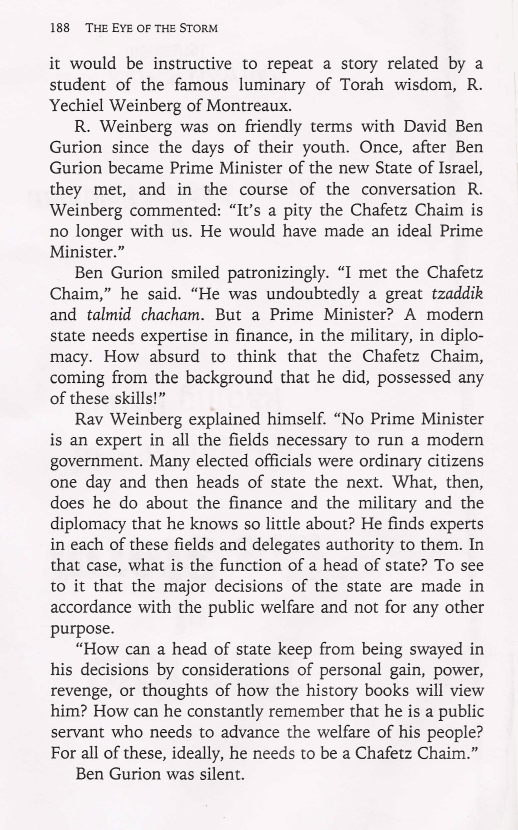
My correspondent asked me if there is any truth to this story. I have to say that it is a complete fiction. R. Weinberg did not know Ben Gurion from his youth, and he never met him after he became Prime Minister. I am also certain that the Ben-Gurion never met the Chafetz Chaim.
2. With all that has been in the news recently, I am sure that I am not the only one looking at the writings from the Spinka dynasty. I recently found a passage that I don’t understand. I understand the words, but I don’t understand how the Rebbe could have said it, and if anyone can explain the passage I will be grateful. It appears in Hekel Yitzhak, parashat Toldot, p. 30b:
ושמעתי מאאמו”ר זצוק”ל שמקובל מרבותינו שמעולם לא נתגייר גר מישמעאל כי הוא כולו ערלה ר”ל . . . אבל מעשו נתגייר כמה גרים כדאי’ בדחז”ל, ולעת”ל כולם יתגיירו משום דשרשם בקדושה כדאי’ בהארי ז”ל.
My concern is not with the notion that Esau and his progeny are superior to that of Ishmael. Rather, how could he possibly state that there have never been Arab converts?
To be continued
[1] “Joseph Ibn Kaspi: Portrait of a Medieval Jewish Intellectual,” in Twersky, ed., Studies in Medieval Jewish History and Literature (Cambridge, 1979), pp. 239-241.
[2] Matzref Kesef, p. 74. The same approach is adopted by Radak in his commentary to Gen. 30:14. This is only one possible answer given by Ibn Caspi, and he also suggests that perhaps mandrakes do indeed have special properties that help a woman to conceive.
[3] See Matzref Kesef, p. 137. Based on this Ibn Caspi explains why Tziporah circumcised her son (Ex. 4:25):
ותקח צפורה וכ’. אין עלינו עכ”פ לתת טעם הכרחי מה זאת הרפואה לחולי משה, כי לא כתבה התורה שציוה לה משה שתעשה כן, ואיך שהוא, מבואר כי בימים ההם היה דעת פשוט בהמון העם, כי הדם יש לו סגולה לכל חרדה והתגעשות, ולכן צוה השם שישימו דם על המשקוף ועל המזוזות בבתי ישראל, בחרדתם והתגעשם על צעקת כל מצרים . . . לכן ותקח צורה צור ותכרות את ערלת בנה.

The example of the mandrakes and Tziporah circumcising her son are cited by Isaiah Dimant, “Exegesis, Philosophy and Language in the Writing of Joseph Ibn Caspi” (unpublished doctoral dissertation, UCLA, 1979), pp. 55-56
[4] Translation in Daniel A. Klein, The Book of Genesis: A Commentary by Shadal (Northvale, 1998).
[5] Rubenstein began as a traditional rabbi, as can be seen from his Avnei Shoham (Warsaw, 1902), which includes correspondence between him and R. Joseph Zechariah Stern. However, he later adopted an approach that today we would term “academic”. There is a great deal that can be written about Rubenstein, but as of yet only one article has appeared: Hanan Gafni, “R. Shmuel Moshe Rubenstein, ha-Hoker ha-Rabani mi-Shavli (1870-1943),” Moreshet Yisrael 5 (2008), pp. 139-158. To give an example, not mentioned by Gafni, of how Rubenstein’s later thought broke with tradition, see his Ha-Rambam ve-ha-Aggadah (Kovno, 1937), p. 103, where he claims that the story of the miracle of Hanukkah is almost certainly a late aggadic creation, and like many other miracle stories in aggadic literature was not originally intended to be understood as historical reality:
ספק הוא אם הנס של “פך השמן” הוא אפילו הגדה עממית קדומה, קרוב שהוא יצירה אגדית חדשה מבעל הברייתא עצמו או מאחד מבעלי האגדה, ונסים אגדיים כאלו רבים הם בברייתות וגמרא ומדרשים ע”ד ההפלגה כדרכה של האגדה. ולבסוף הובן נס זה למעשה שהיה. עיין שבת כ”ג א’. [טעם ברייתא זו הובא גם במגילת תענית (פ”ט) אבל כמו שנראה היא הוספה מאוחרת, ועיין (שם) ובפסיקתא רבתי (פיסקא דחנוכה) עוד טעם להדלקת נרות חנוכה].
During the most recent Hanukkah I was using R. Joseph Hertz’ siddur, the Authorized Daily Prayer Book. Based upon how he describes the holiday and the lighting of the menorah, omitting any mention of the miracle of the lights (pp. 946-947), I assume that he also didn’t accept it literally. Note how he states that the lights were kindled during the eight-day Dedication festival, and this is the reason for the eight days of Hanukkah, rather than offering the traditional reason that the eight days of Hanukkah commemorate the eight days that the menorah miraculously burnt.
Three years to the day on which the Temple was profaned by the blaspheming foe, Kislev the 25th 165, Judah Maccabeus and his brethren triumphantly entered the Holy City. They purified the Temple, and their kindling of the lights during the eight-day festival of Dedication—Chanukah—is a telling reminder, year by year, of the rekindling of the Lamp of True Religion in their time.
There is no mention of this passage in Benjamin J. Elton’s recent wonderful discussion of Hertz’s theology and religious policy. See Britain’s Chief Rabbis and the Religious Character of Anglo-Jewry, 1880-1970 (Manchester, 2009), chs. 7-8. (He also doesn’t mention Hertz’s comment that those Jewish commentators who understand aggadah literally are “fools.” See Hertz’s Foreward to the Soncino Talmud, printed at the beginning of tractate Berakhot.)
[6] Commentary to Gen. 3 (end of chapter).
[7] Lawrence Kaplan, ”Rationalism and Rabbinic Culture in Sixteenth Century Eastern Europe: Rabbi Mordecai Jaffe’s Levush Pinat Yikrat” (unpublished doctoral dissertation, Harvard University, 1975), p. 246 n. 139, comments that when Ralbag later in this passage criticizes those who understand Cain, Abel and Seth allegorically, he has Maimonides in mind, but avoids mentioning him out of respect.
[8] Regarding Eve and the serpent, R. Chaim Hirschensohn speaks of רעיוני ההתפתחות במליצי המיטלאגי
In other words, he sees the Torah as using mythological language in the Creation story. See Penei Hamah, p. 6, which is part 2 of Hirschensohn’s Musagei Shav ve-Emet (Jerusalem, 1932). Dov Schwartz has recently discussed this passage. See his “Maimonides in Religious-Zionist Philosophy,” in James T. Robinson, ed., The Cultures of Maimonideanism (Leiden, 2009), p. 399:
Hirschensohn assumes as self-evident that the Bible had been influenced by mythological language. The author of the Creation story “couches the ideas of development in mythological metaphors.” How did Hirschensohn explain these mythological stories? He separated paganism from the “original” mythology. In his view, the mythological stories had been, from the start, a description of a class struggle for which the narrators resorted to symbolic language, just as the Bible refers to the sons of God and the daughters of men (Gen. 6:2). Only later, then, did their deference and their fear of their ancestors lead Greeks to literal interpretations of their mythology: “But before philosophy became dominant there, the later Greeks had mistakenly revered their ancestors and thought of them as gods” [Penei Hamah, p. 36]. The Bible, then, uses a mythological style but its messages are social and ideological.
[9] When one sees how Ralbag describes Eve, I think many readers would wish that he had interpreted her allegorically. Here is his comment earlier in Gen. 3 (p. 110 in the Birkat Moshe edition):
והנה קרא האדם שם אשתו “חוה”, כאשר השיג בחולשת שכלה, רוצה לומר שלא עלתה מדרגתה על שאר הבעלי חיים עילוי רב, ואם היא בעלת שכל, כי רוב השתמשותה אמנם הוכן לה בדברים הגופיים, לחולשת שכלה ולהיותה לעבודת האדם, ולזה הוא רחוק שיגיע לה שלמות השכל.
Ralbag’s view of Eve was also transferred to women in general. One of my teachers once referred to him as the first advocate of the kollel philosophy, for as Ralbag explains in a number of places, the role of women is to enable men to reach their intellectual perfection. That is, their essence is entirely utilitarian. All the relevant references can be found in Menachem Kellner’s essay comparing Ralbag’s and Maimonides’ view of women, which has now appeared in English in his just published Torah in the Observatory. (This book was published by Academic Studies Press, which in the last few years has published a number of important volumes by top scholars including José Faur, David Berger, David Shatz, and Zvi Mark.)
Take a look at this passage referring to women and tzitzit, from towards the end of Ralbag’s commentary on Shelah (p. 188a in the old edition):
למדנו שאין הנשי’ חייבות בציצית וראוי היה להיות כן כי הענין אשר העיר עליו זאת המצוה הוא רב העומק ולא יתכן שיגיע אליו שכל הנשים לקלות דעתן
I wonder, if a haredi spokesman quoted this Ralbag as part of his attack on Orthodox feminism, would he take any flak in his own community? Would the haredi women protest? I have another question and I am curious to hear readers’ responses. (I have my own view, but also want to hear from others.). Do leaders of the haredi world believe in separate but equal when it comes to men and women? This is what is often claimed, but I wonder, do they really hold a Ralbag-like position?
The same question I asked at the beginning of the previous paragaph with regard to Ralbag can also be asked about Radak. Here is what he writes in his commentary to Gen. 3:1:
ואמר אל האשה ולא אמר לאדם, האשה קרובה להתפתות יותר מן האיש, כי דעתה קלה
If this explanation appeared in say the English Yated, independently offered by a contemporary rabbi with no mention of Radak, would haredi women be offended?
And would women be offended if the following passage, from R. Zvi Travis’ Pirkei Hanhagat Bayit, ch. 2 (which I am told used to be a popular sefer), appeared in an English newspaper (called to my attention by Dr. Yitzhak Hershkowitz; emphasis added):
אף אחר בריאת האשה אין כאן שותפות. אלא, וטול כלל זה בידך, תכלית הבריאה היא האיש, והקדוש ברוך הוא נתן לאיש מתנה שתעזור לו, והיא האשה.
Another good example is found in R. Avraham Blumenkrantz’ Gefen Poriah, p. 352, where he quotes approvingly another rabbi who states as follows (emphasis added):
Her tears are ever ready to flow at the most miniscule suggestion of being dealt with as a maidservant. She will concede you the service of והוא ימשל בך. She will consent to call you בעלי, but don’t accent the דגש in the בית too heavily. She must constantly be reassured that there is honor and dignity in her subservience. Honor her more than you honor yourself. She must be compensated for her subjugation, and be made to feel that she has a genuine share in the dignity of the throne.
Do haredi women really feel that they are subservient or subjugated? Do haredi men feel this way about their wives? Haven’t the masses in haredi society (American haredi society at least) also accepted the notion of separate but equal when it comes to men and women?
[10] Commentary to Guide 1:2:
רמז המורה על קצת נסתר במעשה בראשית כי האדם הנזכר שם לא היה אחד רמוז לבד אבל על הכלל
[11] Commentary to Guide 1:14.
[12] “Rationalism,” p. 251 n. 150.
[13] In his commentary to Guide 2:30, Ibn Caspi also discusses the creation story, and records what was apparently a popular saying in his day. For those of you who sometimes get frustrated with some of your co-religionists, it is worth bearing in mind: אלמלא המשתגעים יהיה העולם חרב. Regarding the saying, see also R. Judah Leib Zlotnick, Midrash ha-Melitzah ha-Ivrit (Jerusalem, 1938), p. 57. The saying is also found in Maimonides’ introduction to Nezikin.
ftn


Notes on RASHI, ArtScroll Censorship, and Emendation of Rabbinic Texts

Notes on RASHI, ArtScroll Censorship, and Emendation of Rabbinic Texts
By David Shasha
A new post on the Seforim blog by Professor Marc Shapiro discusses the problem of ArtScroll publishers and the way that it routinely censors rabbinical texts:
Shapiro looks at the issue of RASHBAM’s commentary to Genesis 1, a big problem for Orthodox literalists.
Here is a post from Failed Messiah that explains the difficulty:
RASHBAM is the grandson of RASHI and the brother of Rabbenu Tam; a central figure in one of the most illustrious of all the rabbinical dynasties in the Ashkenazi tradition.
RASHBAM’s comment to Genesis 1 asserts that, according to the literal meaning of the text, the day, contrary to Jewish law, begins in the morning and not the evening.
I will leave the legal controversy to Shapiro and others, but would like to discuss his point on textual emendation.
It is interesting to see the plethora of Ashkenazi figures that Shapiro cites, including Rabbenu Tam and Abraham ben David (RABAD) to support the idea that no texts should be emended based on personal opinion.
The problem with this formulation is that the principle of textual emendation was most emphatically adopted by RASHI, the most important figure in the Ashkenazi rabbinical tradition.
Jose Faur in his classic article “The Legal Thinking of the Tosafot” discusses the matter in some detail:
He notes the freedom Ashkenazi rabbis accorded themselves to emend texts:
The Franco-German school had a liberal attitude toward the text of the Talmud, It is well known that this school felt free to amend, interpolate and delete from the text of the Talmud.
Referencing the classical Ashkenazi source Sefer ha-Yashar and academic discussions by Joseph Weiss and Benjamin Lewin, Faur explains that RASHI’s famous “Hachi Garsinan” – the code term for his many emendations of Talmudic texts – was a central part of the Ashkenazi rabbinical heritage:
The liberal attitude toward the text is reflected in the Franco-German position that the Talmudic text was not put into writing until post-talmudic times, late in the Middle Ages. Accordingly, the Talmudic text was never authoritatively fixed. Since there was no authoritative transmission of the text, it was subject to further development and errors.
We have seen this principle dangerously expanded in the current school of academic Talmud studies which holds that the Talmud was not completed until the late Geonic period, when the bulk of what is called the STAM (anonymous) layer of the corpus was written; contrary to the traditional formulation found in the canonical Epistle of Sherira Ga’on.
For more on the current scholarly revolution against the normative Jewish tradition, led by David Weiss-Halivni, see the following books:
Without any actual documentary or historical evidence, the revisionist scholarship – similar to German Higher Criticism of the Hebrew Bible – demands that we see different historical strata in the Babylonian Talmud.  This would undermine its literary unity and its historical presentation of the classical rabbinic tradition as formulated in the academies of Sura and Pumbedita.
The new scholarship claims that the text is a frightful hodge-podge of confused materials that is often sloppily and incoherently edited.  Texts are ignorantly assembled by anonymous rabbis who lack a historical connection to their predecessors.  It is all a fabrication lacking the firm authority of tradition.
The close of the Talmudic canon, as formulated by Sherira Ga’on in his famous Epistle, is in the 6th century:
Jose Faur has written an excellent treatment of the matter in his “Textuality in the Rabbinic Tradition,” chapter 4 of his book Golden Doves with Silver Dots, which is an important corrective to this benighted revisionism:
A good deal of the current scholarship attacking the Geonic tradition and its dating of the Talmudic corpus seeks to aggressively negate Faur’s assertions about the Oral Law and its textual manifestations. The written form of the Talmud and the tradition of emendation by Ashkenazi rabbis, and now academic scholars, has thus become part of a larger problem of the authority of the Oral Law in contemporary Judaism. Shapiro claims that the Ashkenazi rabbis, and their Sephardic followers like Moses Nahmanides, were firmly against this method of emendation, even though the leader of their school, RASHI, was a strong proponent of it:
The following discussion by Jacob Neusner reviews the salient points involved the matter of RASHI and the Tosafist School:
Neusner claims that RASHI emended the Talmudic text over 2,300 times based on his own personal opinion!
It is interesting to note both the parallels and differences between the emendation process in the older Ashkenazi tradition and the way it is now being deployed by Ultra-Orthodox fundamentalists like ArtScroll.  The idea of censorship has become a very modern way of dealing with inconvenient historical details.  So while the substantive elements of RASHI and ArtScroll are indeed quite different it should be noted that the role of PILPUL and “Da’as Torah,” the imposition of personal opinions and values on Jewish texts, remain a central part of Ashkenazi rabbinic authoritarianism and its modern academic offshoots.
The historical dialectic is quite striking.
In addition to the emendation process during the early Middle Ages in Germany and France, the Ashkenazi tradition as embodied in the PILPUL methodology of Rabbenu Tam and the Tosafists developed the “Davqa/Lav Davqa” method of analysis which would interpret texts in a relativistic manner.  Some texts were, Davqa, to be interpreted as written, others, Lav Davqa, were not to be interpreted as written.
Again, it is Jose Faur who has been best able to decode this casuistic methodology, finding a connection with the hermeneutics of Peter Abelard and his Scholastic apologetics:
The Tosafot, occasionally, prefaced their analysis of the Talmud by declaring that the sense of the text is lav davqa (not exact). The lav davqa methodology revolutionized the study of the Talmud and changed the content of Jewish law. This methodology is grounded on the assumption that the rabbinic texts may be interpreted not in accordance to their usual sense. The methodology, as well as the philosophy of language that it projected, was brilliantly formulated by Abelard. Abelard, in his attempt to reconcile the conflicting views found in the writings of the Church Fathers, formulated the semantic principles that the same word may be differently used by different writers.
Here is how Faur sums up the matter:
It is intellectually acceptable to describe things not in accordance to what they really are.
This explication ties together the various anti-rational strains that are inherent to the Ashkenazi rabbinical tradition and its modern exponents.
In the end it affirms the absolute power of the interpreter over the text, the rabbi over the Law. It removes agency from the community and dangerously invests absolute power in the rabbinical class.
It is therefore quite interesting to read Shapiro’s attack on ArtScroll which does not at all reference the history of RASHI’s emendations, the PILPUL method of the Tosafot, or the shocking revisionism of contemporary Judaic scholars which has essentially sought to eviscerate the historical integrity of the Talmudic tradition.


Modesty and Piety: Improving on the Past

Modesty and Piety: Improving on the Past
by: Michael K. Silber
The Hebrew University of Jerusalem
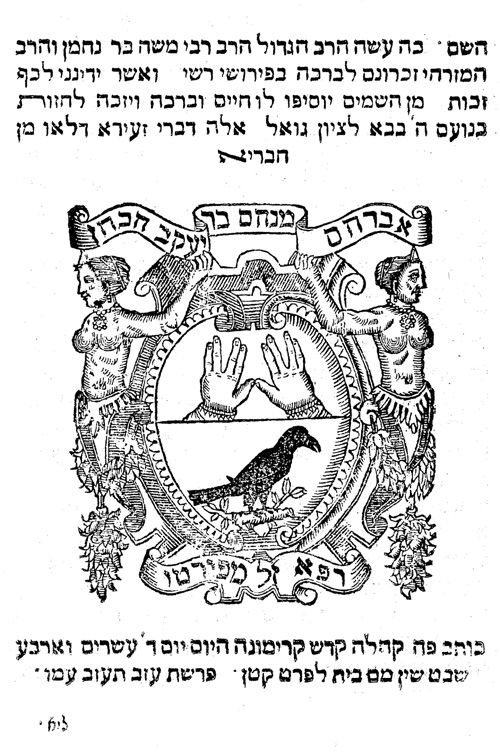
The well known “coat of arms” of the priestly Rapaport family first appeared as a colophon at the end of Avraham Menachem Rapa of Porto’s Mincha Belulah (Verona, 1594), fol. 207b, readily at HebrewBooks.org (here). Instead of a motto, a banner proclaimed the author’s name above and below the shield which featured a pair of hands raised in priestly benediction in the upper half, while below was depicted a crow (Rabe in German) on a branch, a reference to the author’s family name. The shield is flanked by two heraldic supporters, and this is what interests us here.
The supporters feature two female torsos rampant facing away from the shield. They are nude from the waist up.

It was by no means rare to encounter nude women in Hebrew books between the sixteenth and the early eighteenth centuries, even prominently displayed on the covers (Adam accompanied at times by a buxom Eve is a ready example). But no doubt such nudity proves unsettling to the Orthodox public nowadays.
Benjamin Shlomo Hamburger’s recently published magisterial three volume history, Ha-Yeshiva ha-Rama bi-Fiorda (Bnei Brak, 5770) is a rich, learned study by one who has dedicated many scholarly books to the heritage of German Jewry. The volumes are noteworthy also for their rich illustrations, but one in particular catches the eye.
A chapter dedicated to Baruch Kahana Rapaport who served for many years as rabbi of Fürth (1711-1746), reproduces, as many a study on the Rapaports, the “coat of arms” from Mincha Belulah (volume 1, page 390).  
But the supporters here have been modestly transgendered and piously rendered with beards! 

Several studies by Jacob J. Schacter and others have noted the tendency to “verbessern” the past in Orthodox historiography. This then is a modest (but not very pious) contribution to the topic from the perspective of visual evidence of the past.
Addendum:
Dan Rabinowitz
the Seforim blog
It is indeed import to note as Dr. Michael K. Silber has, that we have yet another example of doctoring history to conform with today’s anachronistic views.  But, we should note that this is not the first time the Rapoport coat of arms has undergone a change.  Before turning to this early example, we need to a make a few points.
As Dr. Silber notes, this coat of arms appears at the end of the first edition of Mincha Belulah, Verona, 1594. Rapoport created this herald and the herald contains allusions to his name – Rapoport.  Hida, R. Hayyim Yosef David Azulai, no Reform rabbi, includes an entry on Rapoport in Hida’s Shem HaGedolim (Machret Seforim, Mem, sub. Mincha Belula).  Importantly, although the herald appears at the back of Mincha Belulah, Hida calls attention to this herald. Hida notes that “Rapoport” is spelled differently on the herald than on the title page.  But, no where does Hida question the inclusion of the bare-breasted women on this rabbinic herald. Moreover, Hida doesn’t alert that reader that if one looks up the herald there are these “offensive” images.  Hida’s silence is remarkable but only if one ignores the prevalence of such imagery in Hebrew books.  That is, Mincha Belula is not the only work to include such imagery.  For example, as we have previously discussed, other works include similar imagery (see herehere, here, here, for examples of nudes, and here for examples of mythological images).
We also note that this was not the first time the herald from the Mincha Belulah has been modified. In the 1989 Beni Brak reprint of Mincha Belulah, the images are also altered.  While they haven’t been turned into men, the women are more modestly clothed.  The image below is taken from this edition.


Charles H. Manekin — Moritz Steinschneider’s Indecent Burial

Moritz Steinschneider’s Indecent Burial
Charles H. Manekin
University of Maryland, College Park / Bar Ilan University

Over a century has passed since the death of Moritz Steinschneider, the great orientalist, bibliographer, and historian of Jewish literature and culture. When Steinschneider died in 1907 at the age of 91, he was recognized by many as the greatest Jewish scholar of the previous century. His scholarly output numbered over fourteen hundred publications, ranging from short notices to books of over a thousand pages, a number that does not take into account many of his brief book reviews, not to mention his correspondence, which still awaits to be studied.[1] The breadth of Steinschneider’s knowledge was extraordinary. Unlike other nineteenth-century Jewish scholars of Wissenschaft des Judentums, the movement initiated by Immanuel Wolf and made great by men like Leopold Zunz and Abraham Geiger, Steinschneider’s work was not limited to subjects with a direct Jewish connection. He wrote classic works on the European translations from the Arabic and the Arabic translations from the Greek,[2] and was familiar with almost everything that had been written about premodern science, philosophy, and medicine. Yet a glance at his voluminous bibliography shows that he was first and foremost a scholar of medieval Judaica.
What sort of recognition has posterity accorded to one of the great scholars of Judaism, arguably the greatest of the nineteenth century? Sadly, Steinschneider’s contribution to the history of Jewish literature in all its aspects has gone virtually unnoticed outside a small circle of scholars. If he is remembered at all, it as a cold, antiquarian scholar who reportedly said that “the task of Jewish studies is to provide the remnants of Judaism with a decent burial.” This is the portrait, or better, caricature, of Steinschneider drawn by Gershom Scholem in his well-known diatribe against Wissenschaft published in 1945.[3] Scholem, an ardent zionist, viewed Steinschneider and his mentor Zunz as “gravediggers” and “liquidators” of the Jewish national values that they considered no longer relevant after the advent of emancipation and liberalism. Scholem’s negative evaluation of Steinschneider’s scholarly motivation and outlook in no way implied a disparagement of the nineteenth-century scholar’s achievements. On the contrary, Scholem writes in the Hebrew edition of his memoir From Berlin to Jerusalem “Despite the enormous distance I felt from the men of the [Wissenchaft] group, I revered Steinschneider and pursued his works, major and minor, as well as off-prints of his articles, all of my life.”[4] He also relates that as a university student, his familiarity with Steinschneider endeared him to his teacher, and later doktorvater, the great scholar of scholastic philosophy, Clemens Bäumker. I come here not to praise Steinschneider, but rather to bury him more decently than did Scholem. To do so I will sketch a preliminary picture of his contribution to the ideology of Wissenschaft des Judentums that is less biased than the polemical one offered by Scholem. I say “preliminary” because Steinschneider made few theoretical statements on the subject of Wissenschaft. His views on that subject, like on so many others, must be gleaned from his voluminous writings and correspondence. For over a century articles on Steinschneider have begun with a call for a full-fledged intellectual biography of the man. That call has not yet been answered. Steinschneider’s principal reflections on Wissenschaft are found in his short essay, Die Zukunft der jüdischen Wissenschaft, published in1869, a half-century after Zunz had issued his programmatic-statement on Etwas über die rabbinische Literatur.[5] The science of Judaism during the last fifty years, writes Steinschneider, was motivated externally by the struggle for emancipation and internally by the desire for religious reform. Scholars thought that examining the Jewish achievements of the past would pave the way for greater acceptance of the Jews in the present, and would provide models and precedents for modernizing the religion. In recent years, a third motivation for Wissenschaft has been proposed, namely, the training of modern rabbis, and a modern rabbinical seminary in Breslau had been opened. But as important as these practical motivations were, they do not address other fundamental questions: “What about Jewish history and literature as a link and source of history and cultural history in general? Is it a part of theology? What will become of it if the universities, according to the Dutch example, leave theology as a practical science to the care of the various religious communities?” “Where and how should this academic study be conducted — in Jewish communal institutions or in German universities? “Where will it find its support — in the community or the government?” Although Steinschneider’s expressed intent was merely to raise these questions, his personal opinions are not hard to infer from his article. The task of scholars of Judaism is to investigate their subject as objectively as possible, without ideological tendencies, and in its intellectual and historical context, i.e., as connected with other cultures. This sort of study can be conducted best only in universities, not in the faculty of theology, whose focus is narrowly religious, but in the faculty of philosophy, i.e., the humanities. Jewish religious seminaries, even modern ones, are primarily interested in the training of rabbis; they focus almost exclusively on areas of importance to Jewish theology, and their students and faculty are exclusively Jewish. Jewish studies within the framework of even the most enlightened seminary cannot be free and independent. Who should support Wissenschaft? Steinschneider implies that this is an obligation for the state and not for the Jewish community, not only because of the general importance of exploring civilization’s past — after all, the state supports scientific research into the pyramids and the ruins of Pompeii — but because “the spirit that created the great works of Jewish literature is still alive in the citizens of their state.” This is an interesting argument which refutes, by the way, the view of Steinschneider as a curator of a dead or dying religion. For he seems to be implying that the state has a special obligation to support the research and teaching of subjects that inform the identity, even the group identity, of minorities within the state. In fact, there should be no difference in principle between minority and majority cultures. According to Steinschneider — again, by implication — as long as the state supports the education of Christian teachers of religion, it has the obligation to support Jewish teachers of religions, through supporting Jewish seminaries. Certainly Steinschneider was aware that the likelihood of the German state supporting the teaching of Jewish history and literature in universities, much less Jewish religion in seminaries, was remote. In fact, not a single chair devoted to Jewish history or literature was established in German universities until well after World War II. He was also aware that private money — Jewish, of course — would have to be found to support academic Jewish studies. In a letter written to his friend, the historian Meyer Kayserling in 1876, in which he refused Kayserling’s offer of a position at the Budapest Rabbinical Seminary, he writes, It seems to me that the task of our times is to prefer the endowment of untenured instructorships in Jewish history and literature in the philosophy faculties, thereby compelling the authorities to establish professorships and schools in which regular high school students can be prepared for the study of Jewish literature. We certainly do not want boarding schools in which bachurische clumsiness, impoliteness, and beggarliness is preserved and glossed-over.[6] The last statement reveals Steinschneider’s prejudices against the Eastern European yeshiva students who made up a good proportion of the students at the rabbinical seminaries. The aims of Wissenschaft required the proper preparation of students in high schools. For this Jewish donors had to be found. In the same letter Steinschneider claims that his principled opposition to Jewish Studies outside the university did not conflict with his own association with the Veitel Heine Ephraimschen Leharanstalt (Beth ha-midrasch), the old school of the Berlin Jewish community. Steinschenider was a part-time lecturer for nearly fifty years for that institution, which counted Jews and Christians, including Paul Lagarde, Georg Hoffman, and Hermann Strack, among its students. The school was open to all, its faculty all had university doctorates, and it did not confer doctoral degrees. Steinschneider had declared publicly that he would resign were it to offer a single doctorate.[7] Steinschneider did not address a question that has remained with us to this very day, namely, why wealthy Jewish individuals would wish to endow instructorships in Jewish history and literature at German universities, where the return to the Jewish community was neither immediate nor guaranteed. Perhaps he thought that he could get others to share his own passion for the study of what he called the “international literature of the Jews,” e.g., works of philosophy, science, medicine, and belles-lettres. After all, his teaching had been supported, in part, by the Berlin Jewish community for half a century. And, to my knowledge, at this stage of his life he expressed neither pessimism nor apprehension about the future of the academic study of Judaism. Nor is there any support, at least to my knowledge, for the strange idea that Steinschneider became progressively detached from Judaism culture or religion, or that he saw its inevitable assimilation into secular culture. Steinschneider remained throughout his adult life a liberal Jew whose ideals were those of the enlightenment and the revolution of 1848, in which he took part as a student. In the remarkable credo that makes up the Foreword to one of his last works, Die Arabische Literatur der Juden, he lashes out against those who use the insufficiency of reason, “this weapon of all kinds of unreason,” to justify “the forcing of myths in new clothes or of monstrosities of fantasy, let alone the clinging to institutions of fake authority or to obsolete customs.”[8] Given that this line follows a reference to the zoologist Ernst Haeckel, it is clear that Steinschneider is taking aim against the myths of racial supremacies, which he felt had replaced the myth of religious supremacies. His reference to the “obsolete customs of religion” reaffirmed his decades-long abandonment of orthodoxy, nothing more. But nothing in the Forward suggests a weakened commitment to Judaism per se, not even the claim that “it is the task of whoever feels entitled to lead the sum [of society] to stress what is common to the different circles of mankind, to point towards the ‘one Father of us all’ – towards what brings human beings nearer to each other.”[9] Steinschneider expresses these sentiments in a book chronicling the Jewish literature that was dearest to his heart, that of the Jews living in Muslim lands. After characterizing Ashkenazic Jewish life as one of “segregation in government, trade and society; expulsion, inquisition, agitation, and persecution” and Ashkenazic Jews as possessing “a surplus of mental acumen, squandered in casuistic and hermeneutical quibbles, faith and superstition linked to each other like Siamese twins,” he writes in an intensely personal passage, The historian likes to direct his attention to places where a human existence was granted to the tolerated subject, an existence in which his spirit was allowed to soar above and beyond the national barriers towards the highest existential questions. Such a person believed to have attained already on earth the ideal of human thought, the conjunction with the active intellect.[10] Steinschneider strongly identified with a literature that was not confined by the narrow parochialism of a national culture. He was under no illusion that such a literature was representative of Judaism, much less than it constituted its “essence.” With his unparalleled knowledge of Jewish books, he knew precisely what its place had been. But it was a literature with which he felt a strong personal affinity, and which reinforced the Jewishness of his commitment to liberalism and universalism, at a time when the growth of nationalism and antisemitism had made him pessimistic. As for Steinschneider’s alleged comment that it is the task of scholars to provide the remnants of Judaism with a decent burial, it has not been found in his writings, but was attributed to him in a necrology published shortly after his death in the German zionist periodical Jüdische Rundschau by the young orientalist Gotthold Weil, who had recently been one of Steinschneider’s students.[11] Weil had participated in the short-lived zionist “National-jüdische Verein der Hörer an der Lehranstalt für die Wissenschaft des Judentums in Berlin,” which numbered among its members Arthur Biram, Judah Magnes, and Max Schloesinger.[12] An active zionist leader in Germany, he later came to the Hebrew University of Jerusalem after the Nazis dismissed him from his post as professor of oriental literature at the university of Frankfurt. The context of Steinschneider’s reported comment is a discussion that Weil conducted with Steinschneider about the latter’s alleged proto-zionistic activity in his youth, when he supported Jewish colonization in Palestine as a possible solution for anti-Jewish discrimination in Germany. One imagines that this was a topic of considerable interest among Steinschneider’s zionist students, considering the elderly scholar’s open antagonism towards zionism. According to Weil, Steinschneider admitted to participating in a scheme in the1830’s to further the colonization of persecuted German Jews in Palestine. But he felt that the events of 1848 obviated the need for a separatist political solution to the Jewish problem. According to Steinschneider, Weil informs us, the history of the Jews had ceased in 1848 and that as a result, “the only task we have left is of giving the remains of Judaism a decent burial.”[13] It is easy to see how political zionists like Weil and Scholem would see an offhand comment as an epitaph for Jewish people as a nation; according to Scholem, “a breath of the funereal did in fact cling to the atmosphere of this discipline for a century; occasionally there is something ghostlike about this literature.”[14] They interpreted Steinschneider as holding that Jewish national existence was rendered obsolete by political emancipation, and that assimilation was inevitable and desirable. But there is no indication from Steinschneider’s writings that the scholar felt that the end of Jewish history, or for that matter, the extinction of the Jews as a “nation” had occurred in 1848, or that it was inevitable or even desirable. True, political emancipation had at least in principle removed the necessity for the Jews to segregate themselves in their own land in order to escape persecution. But almost fifty years later Steinschneider would write that the Jews indeed constituted a nation, in the original meaning of that word…united, at least thus far, by an ideal fatherland and Scripture reaching back into their remotest antiquity…We affirm, in fact, that the concept “Jewish” cannot be understood merely in terms of dogmas and rituals, but that the entire Jewish cultural evolution must be viewed as a mirror of the underlying religious and moral ideas and national convictions.[15] It was not the history of the Jews that ceased in 1848, according to Steinschneider, but the history of the Jews as an entity that required a political solution in its own state. He considered anti-Jewish discrimination not to be a Jewish problem but rather a human problem that should be solved within the confines of the modern liberal state. What Steinschneider increasingly detested was the romanticism, sentimentality, and separatism that he found in nationalism in general and zionism in particular. Not a great admirer of nationalism to begin with — according to Weil, he would occasionally say that “Nationalism is brutality; humanity is freedom and truth” — he never missed an opportunity to show his despisal of romantic Jewish nationalism, even in the oddest of places. Thus in his great work on the Hebrew translations of the Middle Ages, while mentioning that Judah ha-Levy had been driven to emigrate to Palestine by a somewhat mystical — another disparaging term for Steinschneider — national sentiment, he adds in a footnote that the Hungarian scholar David Kauffman, “der Apologet von Daniel Deronda,” called such an attraction “realistic.”[16] This was a disparaging reference to Kaufmann’s enthusiastic review of George Eliot’s proto-zionistic novel that Steinschneider had sharply criticized.[17] The reference, completely out of place in a footnote on translations of Halevy, showed how passionate this supposedly cold, rationalist scholar could be on the subject of Jewish national revival. Steinschneider’s ironic remark to his student Weil on the task of scholars of Wissenschaft is best seen within the context of his deeply rooted antipathy towards zionism, as well as his opposition towards tendentious scholarship of all sorts. The task of Jewish scholarship, he wished to say, is not to serve the interests of Jewish political interests, national or otherwise. “My intention,” he wrote in 1902 “is the most objective and historical portrayal possible, neither apologetically nor polemically painted, nor nationally or theologically prepared.”[18] Steinschneider intended to produce an objective scholarship possible that avoids apologetics, polemics with Christians, nationalism, and theology. Given this antipathy, his comment to Weil was perhaps intended to preach the gospel of independent scholarship. Although his students may have thought that the task of Wissenschaft was to help revive the spirit of the nation, Steinschneider did not. Given his negative views of Graetz,[19] it is not difficult to see how he would have viewed the excesses of the Jewish nationalist historians of the twentieth century. But this explanation of Steinschneider’s comment seems inadequate. For there are many ways to emphasize the virtues of objective scholarship without using the image of death and burial. Why did he employ this particular phrase? Perhaps his remark should be read as an ironic appropriation of Samuel Raphael Hirsch’s attack on Wissenschaft des Judentums. Hirsch wrote that the scholars of Wissenshaft keep alive the memory of the old Judaism as it is carried to its grave; in another metaphor of death, he called Wissenschaft “the fine dust wafting from the stone coffins of moldering corpses.”[20] Steinschneider was a master of the ironic retort. Perhaps he was saying to his student Weil, “Just as Hirsch and the orthodox have said, we are burial societies — let’s at least make sure that the burial is an honorable one.” On the other hand, Steinschneider may have been genuinely pessimistic about the future of the Jews in Germany, not because of assimilation, but because of the steep rise of antisemitism in the last two decades of the nineteenth-century. In 1893 he writes “The history of the daughter religions is a constant series of attempts to murder their own mother; if one of them ever succeeds, the crime will bring down the criminal.”[21] Nine years later he commented dryly on a historical pamphlet written by a Prussian gymnasium teacher that calls on Germany to emulate the example of Spain and Portugal and expel its Jews. “The self-appointed historian wisely omits that the brutality of the mob was aroused not only by bull fights but by the live burnings of hundreds of Jews and apostates.”[22] Steinschneider feared German nationalism, according to Weil. Perhaps he felt that the remains of Judaism deserved a decent burial because the Jews themselves were in for difficult times from antisemitism. But these are mere speculations. It is futile to read too much into the sarcastic quip of an aged scholar, which, if reported accurately, was never intended for publication. Can there be anything more indecent than having this comment serve as the summation of Steinschneider’s attitude towards the academic study of Judaism, or the task of its scholars? It is not surprising that both neo-Orthodox Jews like Hirsch and secular Zionists like Scholem assigned to the practitioners of Wissenschaft the role of gravediggers of Jewish nationalism.[23] If their visions of the Jewish nationalism were not only mutually exclusive but exhaustive, then it is a role that Steinschneider would have accepted willingly. But his vision of the Jewish nation was different from theirs. It is ironic that in articulating the differences between the visions of Wissenschaft “now” and “then,” Scholem reaffirmed much of the vision of Steinschneider – not of Steinschneider the “gravedigger,” but of Steinschneider the advocate of an open, unapologetic, and untendentious scholarship that only a university-setting could enable. Steinschneider would indeed have been pleased with the establishment of centers of the academic study of Judaism, such as the Institute of Jewish Studies at Hebrew University, where, in Scholem’s words, “everyone is free to say and to each whatever corresponds to his scholarly opinion without being bound to any religious (or anti-religious) tendency.”[24] After all, Steinschneider was the most consistent advocate of the idea that Jewish studies can only flourish in such an atmosphere. Scholem also reaffirmed Steinschneider’s distaste for nationalist history when he noted with regret that “the heritage of an apologetics in reverse, an apologetics which now, so to speak, has revised everything in terms of zionism, has produced notable examples in our scholarly work.”[25] Steinschneider consistently opposed apologetic scholarship of all kind. In sum, what connects the scholarship of Steinschneider and Scholem seems vastly to outweigh the differences, once we have adjusted the scale to allow for changing tastes and fashions in scholarship. The view of the Jewish people as a living and organic phenomenon was no doubt foundational in Scholem’s scholarly approach, but the growth in Jewish studies in the second half of the twentieth century had more to do with the sociology, economic abilities, and changing identities of the Jewish communities than with the growth of Jewish national consciousness. More to the point — if the “antiquarian” scholarship of the nineteenth century had given way to the “scientific and empirical” scholarship of the twentieth – both of Scholem’s phrases seem a bit quaint today – the reason was not because of Jews had undergone a national revival, but because scholarly tastes and methods had changed. Steinschneider’s scholarly approach was no more “antiquarian” than that of contemporary orientalists like LeClerc, Wenrich, or Wüstenfeld; just as Scholem’s scholarly approach was shaped by his intellectual training and cultural context. One shouldn’t make judgments about the scholarship of a bygone age by using contemporary fashions as a yardstick. The presence of university-trained scholars in the history of medieval Jewish culture and history would have pleased Steinschneider greatly, even more so when he learned that some of the leading scholars are not Jewish. One suspects that here too Scholem would agree. Notes: This post for the Seforim blog — dedicated to Dan Rabinowitz’s weekly shiur following hashkamah minyan at his local synagogue — is based on my article, “Steinschneider’s ‘Decent Burial’: A Reassessment,” Study and Knowledge in Jewish Thought Vol. I., ed., Howard Kreisel (Jerusalem: Mossad Bialik, 2006), 239-251. [1]Some of the correspondence has recently been published. See Briefwechsel mit seiner Verlobten Auguste Auerbach, 1845-1849: ein Beitrag zur jüdischen Wissenschaft und Emanzipation, eds., Marie Louise Steinschneider and Renate Heuer (Frankfurt/New York, 1995). The longest biographical treatment is still Alexander Marx, “Moritz Steinschneider,” in his Essays in Jewish Biography (Philadelphia, 1947), 112-184. Marx has a very useful bibliography on pp. 294-95. For a list of Steinschneider’s writings, see George Alexander Kohut, “Bibliography of the Writings of Professor Dr. Moritz Steinschneider,” in Festschrift zum Achtzigsten Geburtstage Moritz Steinschneider’s (Leipzig, 1896), v-xxxix. Steinschneider’s secretary, Adeline Goldberg, published additions to the bibliography in Zeitschrift fur hebräische Bibliographie 5 (1901): 189-91; 9 (1905): 90-92; 13 (1909): 94-95. [2] Die Arabischen Überzetungen aus dem Griechischen (Leipzig, 1897) and Die Europäischen Übersetzungen aus dem Arabischen (Graz, 1956). See D. Gutas, Greek Thought, Arabic Culture: The Graeco-Arabic Translation Movement in Baghdad and Early ‘Abbâsid Society (2nd-4th/8th-10th centuries) (London/New York, 1998), p. 195: “There is as of yet no modern bibliographical survey of the Arabic translations of all the Greek philosophers; Steinschneider’s Die Arabischen Überzetungen aus dem Griechischen remains the only single treatment.” [3] “Mi-tokh hirhurim al hokhmat yisrael” in Devarim be-go (Tel Aviv, 1975), pp. 385-405. This celebrated essay was published first in Luah ha-Arez and republished several times during Scholem’s lifetime. It has recently been translated into English by Jonathan Chipman as “Reflection on Modern Jewish Studies,” in On the Possibility of Jewish Mysticism in our Time and Other Essays, ed. A. Shapira (Philadelphia and Jerusalem, 1997), pp. 51-71. Scholem, who planned to publish a similar critique in Walter Benjamin’s journal in the early 20’s, returned to the same issue several times during his career, notably in “Wissenchaft vom Judentum einst und jetzt” (see n. 14 below) and “Hokhmat yisrael ve-yahadut” (“The Science of Judaism and Judaism,” which was printed in German, English, and Hebrew, in Perspectives of German-Jewish History in the 19th and 20th Centuries (Zur Geschichte der Juden in Deutsch-land im 19. und 20. Jahrhundert), the proceedings of a symposium on Jewish studies organized by Ephraim Urbach (Jerusalem, 1971) and reprinted in ‘Od Davar (Tel Aviv: Am Oved, 1989), pp. 143-5. For an assessment of the impact of Scholem’s zionism on his scholarship, see Daniel Abrams, “Presenting and Representing Gershom Scholem: A Review Essay,” Modern Judaism 20:2 (2000): 226-243. [4] Mi Berlin li-Yerushalayim (Tel Aviv, 1982), p. 141. This and most other comments about Steinschneider are not in the original German edition of the memoir, from which the English translation was made, but appear in the expanded German edition of the book based upon the Hebrew translation. See Von Berlin nach Jerusalem, trans. Michael Brocke and Andrea Schatz. Erweiterte Fassung (Frankfurt am Main, 1994), p. 148. Scholem’s enthusiasm for Steinschneider also earned him the favor of Prof. Aaron Freimann, who had served as librarian of the Judaica collection of the Frankfurt municipal library, and who had been Steinschneider’s student (Hebrew: 184, German: 193). One cannot but wonder why Scholem decided to add to the Hebrew version of his book several anecdotes testifying to his admiration for Steinschneider. [5] Hebraeische Bibliographie 9 (1869), pp. 76-78. A partial translation is offered by J. Hessing and P. Mendes-Flohr in Paul Mendes-Flohr and Jehuda Reinharz, The Jew in the Modern World: A Documentary History, Second Edition (New York and Oxford, 1995), pp. 230-2. I cite from that translation here, with slight emendation. [6] “Die Aufgabe unserer Zeit scheint mir vorzugsweise die zeitweileige Dotirung von Privatdocenten für jüd. Geschichte und Literatur an den Philosophischen Fakultäten, damit die Regierungen zur Errichtung von Professuren getrieben werden und Lehranstalten in welchen regelmässige Gymnasiasten sich für das Studium der hebr. Literatur vorbreiten können. Nur keine Internate, in welchem bachurische Unmanier, Unbeholfenheit und Bettelhaftigkeit in ihrem Dünkel erhalten und beschönigt werden. See Alexander Marx, “Steinschneideriana II,” in Jewish Studies in Memory of George A. Kohut, eds. Salo W. Baron and Alexander Marx (New York, 1935), pp. 492-527, esp. p. 521. [7] Ibid, p. 521. [8] Die Arabische Literatur der Juden (Frankfurt a. M., 1902), p. ix. [9] Ibid., p. x. [10] Ibid., p. viii. [11] No. 6, February 8, 1907, pp. 53-5. [12] See Yehuda Eloni, Ziyyonut be-Germaniyah mi-Reishitah ‘ad 1914 (Tel Aviv, 1991), p. 372 n. 55. [13] “Wir haben nur noch die Aufgabe die Ueberreste des Judentums ehrenvoll zu bestatten,“ p. 54. [14] See Scholem’s German Essay in the Bulletin of the Leo Baeck Institute 3 (1960):10-20; Hebrew version in De’ot 4:19 (1961), pp. 8-9, rept. in ‘Od Davar (Tel Aviv: Am Oved, 1989), pp. 136-142; English trans. by Michael Meyer in The Messianic Idea in Judaism and Other Essays on Jewish Spirituality (New York: 304-313.) The quotation is from Meyer’s translation on p. 307. [15] See Hebraeische Bibliographie 2 (1859): 82-83 (Steinschneider’s review of M. Kayserling’s Sephardim: Romanische Poesien der Juden in Spanien), as translated by S. Baron in, “Steinschneider’s Contributions to Historiography,” in Alexander Max, Jubilee Volume (New York, 1950), 83-148, esp. 90-1. [16] Die Hebraeischen Übersetzungen des Mittelaters und die Juden als Dolmetscher (Berlin, 1893), p. 402 n. 227. [17] Baron, “Steinschneider’s Contributions,” p. 135. [18] Die Arabische Literatur der Juden, p. viii. [19] Baron, “Steinschneider’s Contributions,” pp. 119-120. [20] See, for example, “Die Trauer des 9. Av,” Gesammelte Schriften (Frankfurt am Main, 1902), vol. 1, pp. 130-1. A partial translation is offered by J. Hessing in Paul Mendes-Flohr and Jehuda Reinharz, The Jew in the Modern World, pp. 234-5. [21] Die Hebraeischen Übersetzungen des Mittelalters, p. xxiv. [22] Die Arabische Literatur der Juden, p. x, n. 1. [23] The similarity between the neo-Orthodox and Zionist critique is noticed by Mordecai Breuer in “Three Orthodox Approaches to Wissenschaft” (Hebrew), in the Jubilee Volume for R. Joseph Dov Soloveitchik (Jerusalem/New York, 1984), vol. 2, pp. 856-60, esp. p. 857. [24] “The Science of Judaism – Then and Now, ” trans. Meyer, p. 310. [25] Ibid., p. 312.

Dr. Charles H. Manekin is Associate Professor of Philosophy at the University of Maryland. His publications include: The Logic of Gersonides (Kluwer), On Maimonides (Wadsworth), and the forthcoming Medieval Jewish Philosophy (Cambridge). Dr. Manekin is currently co-editing an English translation, revision, and updating of the first half of Steinschneider’s, The Hebrew Translations of the Middle Ages, for which he received a three-year NEH collaboration grant.


Marc B. Shapiro – Forgery and the Halakhic Process

Forgery and the Halakhic Process
by Marc B. Shapiro


What is the role of academic learning in the determination of halakhah? In particular, I am referring to knowledge which is not available to the posek and which would affect his halakhic decision. This is, of course, a wide-ranging issue of which I will only discuss one aspect here, that relating to forgery. However, since the issue of the Mosaic text and R. Moshe Feinstein is relevant here, and I mentioned both of them in my last posting, let me make a few brief preliminary comments on this.


In The Limits of Orthodox Theology I quoted the following comment of R. Bezalel Naor, who was quoting his teacher, the Gaon R. Shlomo Fisher of Jerusalem: “The truth, known to Torah scholars, is that Maimonides’ formulation of the tenets of Jewish belief is far from universally accepted.” For those who don’t know, R. Fisher is one of the gedolim of our time, and you can see many of his shiurim on yeshiva.org.il. Many of these shiurim focus on Talmud (and he has published the great rabbinic work, Beit Yishai), but R. Fisher is also the only one of our gedolim who is an expert in Jewish philosophy. This explains why his Derashot Beit Yishai are very different than other collections of derashot. Professor Zev Harvey told me that from R. Fisher’s edition of Crescas’ Or ha-Shem, it is clear that he used Wolfson’s Hebrew text found in Crescas’ Critique of Aristotle.[1]

Someone I know currently attends R. Fisher’s weekly shiur on Avnei Miluim, the last half-hour of which is devoted to issues of hashkafah. Interestingly enough, he reported to me that a few weeks ago R. Fisher declared that he believes the Rambam abandoned his system of 13 Principles, the proof being that they are never mentioned as a unit in the Mishneh Torah.[2] In my book, I noted that R. Shlomo Goren held the same view. R. Goren also makes another interesting point, that while in the Commentary on the Mishnah Maimonides requires one to actually believe in certain principles, in the Mishneh Torah he only requires you not to deny any principles. One who has never heard of a principle obviously does not believe in it, which makes him a heretic according to the Commentary on the Mishnah. But according to the Mishneh Torah, since this person does not actually deny the principle, he is not regarded as a heretic.


Getting back to R. Moshe, as is well known, he ruled that the Commentary of R. Yehudah he-Hasid was a forgery, as he could not imagine that a rishon would acknowledge that there were some post-Mosaic passages in the Torah.[3] Only after my book appeared did Rabbi Naor tell me that the comment I quoted above in the name of R. Fisher was stated precisely with reference to R. Moshe’s positon on this issue. After R. Moshe banned R. Yehudah he-Hasid’s Commentary, R. Fisher commented that R. Moshe assumes that R. Yehudah he-Hasid has to accept the Rambam’s Principles, but in truth there were many disagreements with the Rambam, and R. Yehudah he-Hasid’s position on Mosaic authorship is one of them.

Along these lines, I read a recent shiur by R. Moshe Zuriel, a well-known baal machashavah in which he affirmed that all must accept the Thirteen Principles. I wrote to him asking what he would say about those who accepted the views of sages who disagreed with the Rambam, and I specifically referred to Ibn Ezra’s (exoteric) position that the last twelve verses were written by Joshua, which is a rejection of Maimonides’ insistence in the Eighth Principle that the entire Torah is Mosaic. He replied (emphasis added):

ודאי אני מודה שהסומך על ראב”ע (או אברבנאל וכיו”ב) ביחס לפסוקים הנוספים, איננו
נחשב לכופר, והוא נחשב ישראל . . . וכן כל דבר שיש מחלוקת ראשונים
In fact, in addition to the sources I cited in my book, Ralbag also says something interesting in this regard. Joshua 24:6 states:
ויכתב יהושע את הדברים האלה בספר תורת א-להים
Regarding this verse, the Talmud records a view that the reference is to the last eight verses of the Torah. But Ralbag explains it as referring to different verses:

ויכרת יהושע ברית לעם: על זה להיותם עובדים את ה’ ולהשאיר זכר לזה המעשה למען יבושו ישראל אם יסורו מאחרי ה’ כתב יהושע את הדברים האלה בספר תורת הא-להים

Another relevant source, which I also recently found, is R. Solomon David Sassoon, who wrote as follows (Natan Hokhmah li-Shelomo, p. 106; emphasis in original):

הדגש הוא על מה שאומר כי משה אמר זה מפי עצמו, אבל אם יאמר פסוקים אלה נביא אחר כתב אותם מפי הגבורה ומודה שקטע זה הוא מן השמים ומפי הגבורה, אדם שאומר כך אינו נקרא אפיקורוס, מה שהגדיר אותו כאפיקורוס אינו זה שאמר שלא משה כתב את הקטע אלא בזה שהוא אומר שדבר שזה מדעתו ומפי עצמו אמרו ושאין זה מן השמים

According to R. Sassoon, one who believes that parts of the Torah were written by a post-Mosaic prophet is not a heretic. (In another post I might speak more about the great R. Sassoon and his unique family.)

One of the strange passages in R. Yehudah he-Hasid’s Commentary is his assertion that the Hallel ha-Gadol (Psalm 136) was originally part of the Pentateuch and was later removed by David and placed in the Book of Psalms. In my book I note that this idea is also found in both R. Avigdor Katz (a rishon) and R. Menahem Zioni. I wrote: “Apparently, there was some tradition regarding this verse, the source and nature of which is unknown.” After my book appeared, R. Yaakov Hayyim Sofer published his Hadar Yaakov, vol. 1. On page 39, he notes that in two works of R. Eleazer ben Judah of Worms (the Rokeah), he mentions that Hallel ha-Gadol was recited by the Israelites at the Red Sea, a notion that is not found in extant rabbinic literature. (In Pesahim 117a it states that they recited the regular Hallel.) In R. Eleazar’s Siddur, p. 214, he cites Seder Olam as the source for this tradition. The editors refer the reader to Seder Olam Rabbah, yet nothing relevant appears there. Either R. Eleazar had a different version or he was referring to another book with this title. What is important for our purposes is that this tradition ties in with what is quoted by R. Yehudah he-Hasid and R. Avigdor Katz, even though the Rokeah doesn’t mention anything about this section being removed by David. Hopefully, more research into the writings of Ashkenazic rishonim will further illuminate matters.

Let me now speak of another issue, not of falsely ascribing forgery where there is none, but accepting as authentic that which is actually a forgery. The classic example is, of course, Besamim Rosh. There is no doubt that the volume is a forgery. There are those who have believed that at least some of the responsa are authentic, but it is more likely that the non-controversial material is a smokescreen for the controversial responsa. I plan to write an article about Besamim Rosh so I will not now reveal an internal proof, arrived at by use of a computer, that the book is a forgery. In an earlier article, I called attention to the fact that the Besamim Rosh assumes that a suicide has no share in the world to come, which is a popular 18th century conception, but not found among Ashkenazic or Sephardic rishonim.[4]

There is a talmid hakham, Rabbi Reuven Amar, who republished the Besamim Rosh and argues in his introduction that Saul Berlin was one of the gedolim. For all of his talmudic learning, Amar is very ignorant in this matter. He knows nothing about the history of Berlin and his haskalah ties. If he did, he would not have wanted to defend him. Yet Amar did know that many halakhic authorities quoted the Besamim Rosh, and he therefore wanted to turn it into a kosher book.

The problem Amar was faced with is what concerns me. What is one supposed to do with pesakim that rely on the Besamim Rosh? Fortunately, there can’t be many. In fact, offhand, I don’t know of any responsum in which a decision is based entirely, or even heavily, on Besamim Rosh, so that if you took this work away the decision would fall.

However, this is not the case with another forgery, as here the forgery is cited by all halakhic authorities of the last 140 years. I am referring to the Sefer ha-Eshkol, attributed to Rabbi Abraham ben Isaac. It was published by Rabbi Zvi Benjamin Auerbach (1808-1878), one of the leading German rabbis of his time. He was also the most prominent member of the famous Auerbach rabbinic family, which together with the Bamberger and Carlebach families (the ABCs, as they were known) were the most prominent rabbinic families in Germany.

According to Auerbach, his Sefer ha-Eshkol came from a Spanish manuscript. The work quickly became popular among scholars and was adorned with Auerbach’s commentary Nahal Eshkol, which is a mine of rabbinic knowledge. It came as quite a shock when in 1909, many years after Auerbach had died, the great scholar R. Shalom Albeck accused him of having invented the story of the Spanish manuscript in order to enable him to forge the work. This accusation aroused a great storm and four of the leading Orthodox scholars – David Zvi Hoffmann, Abraham Berliner, Jacob Schor, and Hanokh Ehrentreau – rushed to defend Auerbach, publishing the booklet Tzidkat ha-Tzadik (Berlin, 1910).

It is obvious that Auerbach’s defenders never gave Albeck’s charge any serious consideration. In their eyes, the fact that Auerbach was universally regarded as a tzadik, as well as one of the gedolim of Germany, rendered the accusation invalid from the start. There was no way they could impartially consider the evidence. In their mind they knew that for a pious Jew, some things are just impossible. Albeck responded to Tzidkat ha-Tzadik with the booklet Kofer ha-Eshkol (Warsaw, 1911), which explains how Albeck knew that the work is a forgery. In discussing the dispute between the four scholars on one side, and Albeck on the other, R. Shlomo Yosef Zevin[5] showed which side he was on.


אחד מול ארבעה – וההרגשה היא, שהנצחון לצדו של האחד

As far as I know, every academic scholar who has examined the evidence has concluded that Albeck is correct, and Auerbach’s Sefer ha-Eshkol is a forgery. This is so despite the defense of Auerbach by Issachar Dov (Bernard) Bergman in his essay in the Joshua Finkel Festschrift (New York, 1974;[6] it also appears in Sefer ha-Eshkol, vol. 4 [Jerusalem, 1986]).[7]

Needless to say, the supposed Spanish manuscript has never been found. In the words of Prof. Haym Soloveitchik, “Auerbach’s Eshkol appears as a clear forgery, incorporating arguments found in sixteenth, seventeenth, and even eightennth-century writings. . . . [The work] should not be used for historical purposes.[8] For this reason, I criticized Avi Sagi and Zvi Zohar for citing Auerbach’s Eshkol in their Giyur u-Zehut Yehudit.[9] R. Bezalel Naor writes:
I was told the following anecdote by Rabbi Aharon Lichtenstein. Licthenstein’s father-in-law, Rabbi Joseph Baer Soloveitchik (of Boston) expressed to Rabbi [Hayyim] Heller his amazement that the same obscure opinion of Mordecai in Niddah was to be found in the Eshkol, to which his mentor Hayyim Heller responded: “That is all?! You can find in Auerbach’s Eshkol a peckel Peri Megadims.” (Yiddish, a pack of Peri Megadim). . . . Prof. S.Z. Leiman informs me he found other irregularities in Auerbach’s historical works.”[10]
The late Prof. Israel M. Ta-Shma assumed that Auerbach’s Eshkol is a fourteenth-century forgery that he innocently published.[11] In discussing the issue, Ta-Shma makes the following incredible statement:

לדעתי עשה זאת משה די ליאון, וכך שמעתי גם מפי חברי פרופ’ י. זוסמן

De Leon is commonly said to have died in 1305, so unless the forgery was done at the very end of his life, we would be dealing with a 13th century forgery. In his Ha-Nigleh she-ba-Nistar, p. 144 n. 203, Ta Shma indeed writes

ויש רגליים לדבר כי זיופו, במגמה לקרבו לספר הזהר ותכניו, נעשה כבר במאה הי”ג

Yet Ta-Shma’s assumption doesn’t take into account that Auerbach’s Eshkol almost certainly contains material from later centuries. Furthermore, Ta-Shma ignored the well-founded assumption Auerbach forged other documents. According to Moshe Samet, some of Auerbach’s forgeries were actually designed to further a Neo-Orthodox agenda.[12] (It is well known that people who forge rarely do so once. Rather, seeing that they got away with it, they continue in this path, getting some sort of perverse pleasure from fooling the world.)

In Mordechai Breuer’s Modernity Within Tradition, p. 202, in discussing Orthodox scholarship and how it was often not rated highly by others because of its binding preconceptions, he writes:

One such example was the attempt of some scholars, especially R. Kirchheim in Frankfurt and Schalom Albeck in Poland, to expose the chief scholarly work of the late Rabbi B.H. Auerbach of Halberstadt (Ha-Eshkol, with commentary and notes, Nahal Eshkol, Halberstadt, 1861), as a plagiarism and a forgery. In spite of certain discrepancies in Auerbach’s work, this attempt failed after his defenders could prove that the attacks had not been free of prejudice.

In Between The Yeshiva World and Modern Orthodoxy, p. 77 n. 8, I responded to this as follows:

Breuer seems to be mistaken in pointing to the dispute over the authenticity of B. H. Auerbach’s edition of the Eshkol as an example of this phenomenon [i.e., Orthodox scholarship being looked down on]. To begin with, the main assault on Auerbach was led by Shalom Albeck (1858-1920), himself an Orthodox Jew. Secondly, this dispute had nothing to do with dogma interfering with scholarship, but was simply a question of whether Auerbach had forged the text. Finally, it is not so clear that Albeck’s attempt failed, as Breuer would have it. On the contrary, the authenticity of Auerbach’s edition is still highly questionable.
When I wrote this paragraph I didn’t want to appear disrespectful to Prof. Breuer, which is why I used soft language. In truth, as far as scholars of medieval halakhic literature are concerned, Albeck was entirely successful. As I note above, the attack of Albeck on Auerbach had nothing to do with the sort of “Orthodox scholarship” Breuer was referrring to, and which was subject to criticism by non-Orthodox scholars. Albeck wasn’t attacking Auerbach because of his supposed Orthodox close-mindedness.

Yet the point Breuer makes actually has relevance to another aspect of this dispute, and here I refer to the defense of Auerbach by the four scholars. Here we do find dogma of a sort, since they make it clear in their defense that the whole accusation is ipso facto invalid, and they even cite the Rambam, Commentary to Avot 1:6, that if you see a tzaddik do something that looks like a sin, you must assume that there is a reasonable explanation, even if it is very far-fetched.

Albeck’s response to this is that the Rambam is referring to a tzaddik who commits a sin between him and God, but not someone who


מתעה את לבות גדולי ישראל מורי ההלכה ודורשי החכמה, ודאי מצוה וחובה על כל איש המכיר בו, להוציא את בלעו מפיו, למען יהיה לאות לבני מרי, ולא יוסיפו לחלל ש”ש ולזייף את התורה

The issue mentioned by Albeck, that of the poskim being misled by a forgery, is what I would now like to raise. What is one to do if one sees that a posek has decided a halakhah based on the forged Eshkol? Is this person obligated to reject the pesak, or can he rely on the authority of the posek, even though the posek himself was misled. This obviously has implications for the use of the Zohar in pesak as well, as the poskim regard it as a tannaitic work. Yet I think everyone outside of the haredi community who has studied the issue assumes that it is a medieval work.

Rabbi Jehiel Jacob Weinberg raised a similar concern with regard to the Shulhan Arukh. There are certain halakhot which are based on false readings. He wondered if in a case like this we have to establish a new halakhah, or since we have accepted the Shulhan Arukh’s ruling we don’t change the halakhah but rather find a different justification for it.

Some might also see some connection with another position of R. Weinberg. As I noted in my book. R. Tam’s states that sex with a Gentile does not cause a woman to become forbidden to her husband. R. Weinberg had ethical problems with the reason R. Tam gives, and I don’t think it goes too far to say that he thought that, from our modern perspective, R. Tam’s justification is to be regarded as immoral.[13] Yet I also note that in seeking to find a heter for a woman who committed adultery with a non-Jew to return to her husband he is prepared to make use of R. Tam’s position.[14] I don’t think this raises any problems, since at the end of the day, R. Tam’s position is part of the halakhic tradition. If it can be used to to reach a lenient decision, then it serves a purpose, even if the contemporary posek doesn’t agree with the underlying assumptions of R. Tam’s pesak (Parallel to this is the widely accepted view that there is nothing wrong with using information derived from Nazi experiments on humans if it can help people. Obviously, everyone agrees that the experiments should never have been carried out, but once they were, the information can be used) As I said, I don’t see this as problematic, but I mention it since some might see it as an inconsistency in R. Weinberg.

An example which is more directly relevant is the following. In June of this year Prof. David Berger gave a presentation at Yeshivat Chovevei Torah on Jewish views of Christianity (as well as how to relate to Chabad). In his discussion of Christianity he explained the concept of shittuf, first mentioned by the Tosafists, and how in its original meaning it did not mean that non-Jews are permitted to believe in one God divided into different parts. Those who want the details on this can see Katz’ discussion in Exclusiveness and Tolerance. Katz was the first academic scholar to point to what he regarded as the common misinterpretation of the Tosafot. In addition, a number of poskim have concluded similarly, most notably the son of the Noda bi-Yehudah, whose responsum was published in his father’s work.

In my response to Berger I asked the following question (addressing myself to him):

You are certain that the common understanding of Tosafot is mistaken. Yet this understanding became the standard for poskim in Western Europe. It is also shared by the Rama. Do you feel that there is anything wrong with someone who agrees with you as to the historical truth nevertheless relying on those poskim who misinterpreted the Tosafot? In other words, do the decisions of the poskim based on Tosafot have independent validity even if their interpretation of Tosafot is incorrect?[15a]
Prof. Berger replied that he did not regard as illegitimate to rely on a pesak even if from the standpoint of historical scholarship, the pesak is incorrect. In the case we were discussing, one could legitimately rely on heterim which are based on the notion that according to Tosafot Gentiles are not obligated in shittuf, even though from a historical, i.e., factual perspective, Tosafot never said this. Historical truth and halakhic pesak thus occupy different realms.

While I understand Berger’s point, I think some reading this might be very uncomfortable with such a notion, namely, that one can have a historical truth and a halakhic truth, with the two being at odds with each other; or to put it another way, that a halakhic truth can be based on a historical error and yet still have validity. This brings us dangerously close to the old Latin Averroist notion of “double truth.” [15b]


Returning to Auerbach’s Eshkol, I am aware of only one posek who has refused to grant it any validity, and I daresay that the overwhelming majority of poskim are not even aware that it has been subject to controversy. The posek I am referring to is Rabbi Yitzhak Ratsaby. For those who don’t know, R. Ratsaby is one of the leading – if not the leadiing – Yemenite posek in Israel. He is an incredible scholar whose many works are particularly valuable as he records a variety of Yemenite practices and quotes from relatively unknown Yemenite writings, including from manuscript. He comes from the Kabbalah-friendly Yemenites, as uses the appellation of אחר in referring to R. Joseph Kafih. [16] Reflecting the typical haredi outlook, when he needs to refer to R. Kook, he writes “הרא”ק.” Doing so denies R. Kook the rabbinic titles given other great rabbis, and also spares haredi eyes from even seeing the name “Kook” in print.[17] Most haredi readers won’t even recognize who he is referring to. This is particularly unfortunate as it was R. Kook who stood together with many of the great Yemenite rabbis in opposing R. Yihye Kafih’s anti-Kabbalah stand. In Emunat ha-Shem, the volume published against R. Yihye Kafih, R. Kook’s two letters appear at the beginning. R. Kook is referred to as

רבנו הכהן הגדול נר ישראל וקדושו גדול הדור ונזרו מרן

R. Ratsaby is an example of how Ashkenazic haredi extremism and close-mindedness has also influenced those who do not come from this tradition.

Despite this flaw, there are many very interesting things in his works. Because my last post dealt with issues of dogma, let me refer to what R. Ratsaby states in Olat Yitzhak vol. 2 no. 259. He refers to the list of 24 heretics with no share in the world to come, enumerated by Rambam in Hilkhot Teshuvah, ch. 3. Among those are people who say there is no God, or there is more than one god – in other words, classic heretics. But according to R. Ratsaby, even though these people are heretics with no share in the world to come, that doesn’t mean that they can’t fulfill someone else’s religious obligation. As R. Ratsaby puts it

אפילו אותן עשרים וארבעה והנוספים עליהם שברור ומוסכם שאין להן חלק לעוה”ב, לא שמענו שאינן מוציאין אחרים ידי חובתן בברכות וכיוצא בזה, דסוף סוף הוא מחוייב בדבר וכל המחוייב מוציא יד”ח

R. Ratsaby is not referring to allowing such a person to daven for the amud, for which someone must be a proper Jew. Rather, he is speaking of the halakhah per se, i.e., if a heretic can be motzi someone else. I think the instinctive response of people would be that, of course, someone who is a heretic cannot be motzi someone else, and R. Moshe Feinstein states so explicitly. R. Ratsaby removes the issue from one of belief, and instead focuses on the obligation.which all Jews share.

In this same teshuvah, R. Ratsaby also points out something else quite interesting. Following the list of the twenty four who have no share in the world to come, Rambam gives a list of another group who, if they persist in certain evil actions (e.g., embarrassing someone in public, shaming scholars, etc.) also have no share in the world to come. He quotes R. Avraham ben ha-Rambam (hiddushim at the beginning of Ma’aseh Rakah) who cites his father as explaining that the way this works is that someone who is accustomed to do such bad things things will, almost of necessity, not be inclined to do what needs to be done to achieve immortality. In fact, it is much more likely that he will be led to those sins that really do deprive you of the world to come. But one should not take what Rambam writes literally, namely, that these sins by themselves cause one to lose his share in the world to come.


Returning to the Eshkol, many years ago I was studying R. Ratsaby’s Olat Yitzhak, vol. 1, and on page 410 I came across the following:

לענ”ד אין לחוש לדברים מחודשים שבספר זה שהוא בחשש גדול של זיוף, ואין להכחיש מה שהלב מרגיש

I found this quite amazing, since I knew of no other posek that recognized what modern scholars had determined. I was curious if he came to this on his own or had read Albeck’s pamphlet. He replied to me on 13 Iyar 5750


חשד הזיוף אצלי הוא מתוך העיון בדברים החדשים שם בקרב הראשונים ולקוחים מדברי אחרים (מה שראיתי דר”כ [=דרך כלל] היה לקוח מהבית יוסף) וגם הסגנון, שחנני השי”ת להכיר כזאת בטביעות-עין והלואי שאני טועה, אבל רחוק בעיניי מלצרפו עכ”פ לענין הלכה. ספר כופר האשכול לא בא לידי


I wrote back to him asking why, if he regards Auerbach as a forger, does he cite the Nahal Eshkol. He replied

נחל אשכול שאני מביא על אף החשד שלי נגד ספר האשכול גופו משום שאין לפסול גוף הדברים אם הם ניתנים להאמר מצד עצמם, רק לא לסמוך על ספר האשכול כמשקל בהכרעה בהלכה

R. Ovadiah Yosef offers the same justification in his haskamah to Amar’s 1983 edition of Besamim Rosh

חרף הביקורת שנמתחה על הספר “בשמים ראש”, במילי מעלייתא דאית ביה דרשינן

The last words come from Sanhedrin 100b, where R. Joseph says about the book of Ben Sira, “we may expound the good things it contains.” It would seem that using this logic, there can be no objection to studying the talmudic commentaries and halakhic writings of non-Orthodox rabbis, since one might find there a good argument or explanation of the sources. After all, Saul Berlin, the forger of Besamim Rosh, was a subversive, trying to destroy traditional Judaism from within. This makes him much worse than the typical Reform rabbi who has nothing to do with the Orthodox.


The summer is fast coming to an end, and with it, my free time to write things like this. But I have a number of other examples of forgery which I might post here, if people are interested (I am saving my examples of censorship for the book which I am hard at work on). Many people have told me that they like my “derekh agavs,” so I threw a lot of them in here, and I apologize to those who don’t like the many tangents.


Appendix


Since I don’t know when I will have a chance to write a new introduction to my book, and it is once again in the news with Rabbi Leff’s review, let me quote the following passages from R. Kook’s Shemonah Kevatzim 1:30-31 (I hope that R. Kook is still an acceptable authority for Jewish Action). Two important things stand out. First, while not condoning orthopraxy, R. Kook states that one who is observant, despite the fact that he denies ikkarim, is to be regarded as an erring Jew, not as a heretic. R. Kook’s position is a complete rejection of the idea that people who are shomrei Torah u-mitzvot can be read out of the fold and be regarded as heretics because of their incorrect beliefs. The second important point is that he rejects the Rambam’s entire theological conception of Principles of Faith and alligns himself with the Ra’avad, showing once again that the Rambam’s position has not attained unanimity.

אף על פי שהטעות בדברים האלהיים הוא דבר מזיק עד מאוד, מכל מקום אין עיקר ההיזק הנמשך מהמושגים המשובשים יוצא אל הפועל, עד כדי להמית את בעליו מיתת נשמה, רק כשהוא מתגלם במעשים, או לפחות כשהוא יורד לתוך דעות ורגשות כאלה שסופן מוכרח להתגלות במעשים. אבל כל זמן שהדבר עומד בצורתו המופשטת, אין כאן עקירה עקרית
ובזה הננו קרובים לסברת הראב”ד, שהשיג על הרמב”ם במה שקרא למי שמאמין ההגשמה באלהות מין. ונוכל להסכים, שכל זמן שאותו המגשם לא יעשה לו פסל ותמונה, הרי לא גמר את מחשבתו, ונשארה היא עדיין בחוג הרוח שלא תוכל להיות נכללת בשם עקירה ויציאה מן הדת

In a wide-ranging article which deals among other things with R. Kook’s view of heresy, the important scholar R Yoel Bin Nun[19] explains why R. Kook rejected the Rambam’s approach to heresy. R. Bin Nun also states that if you take what the Rambam says seriously, the Rambam himself, if he were alive today and saw how Aristotelian science has been overthrown, would not regard people who disagreed with his principles as heretics. In R. Bin Nun’s words (emphasis added):[19]

שיטת הרמב”ם ברורה: יסוד שתלוי באמונה, ואין בו הוכחה שכלית, וכל החכמים מתווכים עליו, אי אפשר להגדיר את מי שאינו מאמין בו כ”כופר” או כ”מין”. עצם העובדה שהדבר נתון בוויכוח שכלי בין החכמים מאפשר ומחייב לבנות על עולם האמונה, אך אינו מאפשר לשפוט ולדון את הכופרים. רק ודאות שכלית מוחלטת מאפשרת לדון אדם כמזיד בשאלות של אמונה וידיעה

In other words, according to R. Bin Nun there is no justification today for calling people heretics because they reject one (or more) of the Thirteen Principles.[20] (when he refers to hakhamim disputing matters, he is not referring to Torah scholars, but the general scientific-intellectual world). Whether R. Bin Nun is correct in his analysis of Rambam is not my purpose at present; I only wish to show that this outstanding rabbinic figure has a very tolerant view, one which rejects the Thriteen Principles as determining who is a heretic.

Notes:
A future post will deal with other issues of this controversy, and at that time S. Z. Havlin’s article on the issue in Yeshurun vol. 13 will be discussed.

[1] Professor Isadore Twersky once mentioned in class that although this book’s title should have mentioned Maimonides, in 1929 Harvard University Press would not publish a book with such a title. In this regard, he also called attention to the title of Sarah Heller Wilensky’s doctoral dissertation, “The Teaching of Issac Arama in the Framework of Philonic Philosophy.” This, too, is a false title, and the subject of the dissertation is seen more clearly by the title of the Hebrew book: R. Yitzhak Arama u-Mishnato. As Twersky explained, Harvard’s Department of Near Eastern Languages and Civilizations did not want a dissertation on a Spanish Jewish thinker unless it was given a more universal theme, hence the “Philonic Philosophy,” an allusion to Wolfson’s theory of philosophy, but this was put in just for show. Incidentally, Fisher’s edition of Or ha-Shem is responsible for my taking credit as being the only student ever to have made Prof. Twersky laugh in class. It was the 1990-1991 year and we were studying Crescas in his seminar. Twersky would often ask me to read, during the course of which he would often correct my pronounciation. When Fisher’s edition of Crescas appeared I immediately bought it and brought it to class. When Twersky called upon me to read, I replied that this time he wa not going to be able to correct my pronounciation. He asked, “why not?” to which I replied, holding up my new book, that I just purchased a new edition of Or ha-Shem, and it is “menikid.” This was too much for even the eternally staid Twersky, and he too was brought to a chuckle. (From inyana de-yoma, someone asked me if Noah Feldman studied with Prof. Twersky. He was not in any of Twersky’s seminars that year. He was, however, in Prof. Septimus’ seminar as well as that of Prof. Leiman, who was at Harvard in fall 1989 as a visiting scholar. In those years, long before he became famous [now, notorious] I would often tell people that one of my fellow students, an undergraduate taking graduate classes, was perhaps the most brilliant person I knew – a much better head than mine – and I have known many intellectual heavyweights. Yet I have read some people, who certainly don’t know him, describing Feldman as an expert in Shas and poskim. This is laughable. He has a great mind, and can grasp a Tosafot quicker than almost anyone, but he never spent any serious time in limudei kodesh after high school. I think my father best summed matters up after reading his article. He said: “Feldman may be very smart, but he isn’t very wise.”).

[2] R. Fisher has also expressed his support for the position of those rishonim – in opposition to the Rambam and R. Chaim Soloveitchik – who believe that one who, through no fault of his own, holds a heretical view is not to be regarded as a heretic.

[3] R. Moshe also detected a forgery in that R. Yehudah he-Hasid asks why homosexuality is forbidden, and then explains that the prohibition is to ensure that men procreate. According to R. Moshe, even asking such a question, and offering such a weak explanation, is a sign that the passage was not written by R. Yehudah he-Hasid but by a gay-friendly subversive. Yet as R. Chaim Rapoport points out, R. Yehudah he-Hasid is also quoted saying the same thing in the medieval Moshav Zekeinim al ha-Torah. Furthermore, the explanation he offers is also found in Ramban, Sefer ha-Hinnukh and Radbaz. See Rapoport, Judaism and Homosexuality: An Authentic Orthodox View (London, 2004), pp. 155-156.

[4] See my “Suicide and the World to Come,” AJS Review 18.2 (1993): 257 n. 54. Perhaps Prof. Shlomo Zalman Havlin will also use a computer to prove the forgery, much like he used a computer to show that R. Joseph Hayyim also wrote the book Torah li-Shma (link).

[5] Soferim u-Sefarim (Tel Aviv, 1959), p. 107.

[6] See also D. Simonsen, “Ueber die Vorlage des Sefer ha-Eshkol,” in Studies in Jewish Bibliography and Related Subjects in Memory of Abraham Solomon Freidus (New York, 1929), pp. 290-291.

[7] Israel M. Ta-Shma writes, concerning this defense (falsely attributing it to the editors of Sefer ha-Eshkol, vol. 4, rather than Bergman):

אולם לא מפיהם אנו חיים, ואילו זקוק היה הרב אויערבך להגנתם זו היה לוקה בכפלים

See Rabbi Zerahyah ha-Levi Ba’al ha-Meor u-Venei Hugo (Jerusalem, 1992), p. 40 n. 27.

[8] Haym Soloveitchik, “Review of Olam ke-Minhago Noheg, by Yishaq (Eric) Zimmer,” AJS Review 23.2 (1998): 227-228.

[9] See my “Review of Circles of Jewish Identity: A Study in Halakhic Literature by Avi Sagi and Zvi Zohar,” AJS Review 27.1 (2003): 120-122.

[10] Post-Sabbatian Sabbatianism (Spring Valley, 1999), p. 209.

[11] Rabbi Zerahyah ha-Levi Ba’al ha-Meor u-Venei Hugo, pp. 40-41.

[12] He-Hadash Asur min ha-Torah (Jersualem, 2005), pp. 69-70, 152 n. 255.

[13] Regarding judging positions of rishonim as immoral, R. Shlomo Aviner writes (Am ve-Arzto (Jerusalem, 2002), vol. 2 pp. 436-437):

וברור שבהלכה פנים לכאן ולכאן. לכן כיוון שנתיבים אלה הם נתיבים מוסריים יותר, עלינו להכריע על פיהם. לפעמים ההלכה מוכרעת, בגלל שעת הדחק, ולפעמים ההלכה מוכרעת כי כך המנהג. אם כן, בימינו ‘המנהג’ הוא להיות מוסרי . . . שאלה: האם ראשונים אחרים, שלא סוברים כרש”י הם מוסריים פחות? תשובה: כולם מוסריים בתכלית המוסריות, אך יש גם מושגים מוסריים המשתנים על פי המציאות. אב הסוטר לבנו הקטן, אינו דומה לאב הסוטר לבנו בן השמונה עשרה. האם סטירת לחי לבנו היא מעשה מוסרי או לא מוסרי? תלוי בנסיבות. לא כל הכרעות הפוסקים הן הכרעות נצחיות. לכן מזכירים במשנה גם דעת יחיד כדי לסמוך עליה בעתיד (עדויות א, ה). במצבנו כיום ישנם שיקולים מוסריים שמצטרפים להכרעותינו ההלכתיות דוד המלך היה מודד אנשים בחבל, ובוודאי הוא ראה כורח מוסרי לנהוג כן. מרן הרב קוק מסביר, שלא היתה אז דרך אחרת להרתיע את הרשעים (איגרות א, ק). יתכן שבנסיבות שלנו, דוד לא היה נוהג כן

[14] Kitvei R. Weinberg, vol. 1, p. 58.

[15a] One should not assume that this is a verbatim transcription of my remarks, as they were not written out at the time.

[15b] Prof. Berger recently noted to Menachem Butler the following point: “At the same time, those realms [i.e., history and halakhah] are not so distinct that someone weighing the question of which position to adopt must, or even should, ignore his judgment about historical truth. Thus, I personally do not regard the pesak that Christianity is not avodah zarah for Gentiles as one I should adopt, even though it has desirable consequences. I do, however, grant legitimacy to an opinion affirmed by major authorities and do not quarrel with those who rely on it.”

[16] Olat Yitzhak, vol. 2, p. 51.

[17] See ibid., p. 440.

[18] See his biography at http://www.ykd.co.il/hebrew/hebrew.htm.

[19] “’Kahal Shogeg’ Hiloniyim ve-Hiloniyut be-Halakhah,” Akdamut 10 (2000), p. 263.

[20] For those who don’t have access to the article, I should note that when he refers to hakhamim disputing matters, he is not referring to Torah scholars, but the general scientific-intellectual world.


From Medina Raḥamim to Elul Seliḥot: Toward a Prehistory of Nocturnal Penitential Prayer

From Medina Raḥamim to Elul Seliḥot:
Toward a Prehistory of Nocturnal Penitential Prayer

Aton M. Holzer

Shulamit Elizur, the undisputed doyenne of piyyut scholarship, published in 2016 a characteristically magisterial study on the origins of the seliḥot liturgy.[1] This liturgical category – like the prayerbook as a whole – is not attested before the eighth and ninth centuries. The great payyetanim of late antique Eretz Israel – Yose ben Yose, Yannai, and R. Eleazar ha-Qalir – composed qinot, qerovot, and other poetic forms, yet, as Elizur has demonstrated elsewhere,[2] seliḥot cannot be ascribed to this early Eretz-Israeli stratum. Contrary to earlier assumptions that located their genesis in the pre-classical Palestinian milieu, the genre is in fact a Babylonian creation, nurtured in a setting where “primitive” poetic styles persisted well into later centuries. The available evidence indicates that seliḥot entered the liturgical repertoire of the land of Israel only after the late eighth century, and even then only in a limited and sporadic fashion. From Babylonia, the genre subsequently radiated westward, leaving its imprint on Italy, Ashkenaz, and Sefarad.

The seliḥot as they have come down to us consist of two distinct components. The seliḥot proper are payyetanic compositions structured upon the framework of a primordial abecedarian proto-seliḥah preserved in the Seder of R. Saʿadyah Gaon. This early prototype interwove biblical verses drawn alternately from Torah, Writings, and Prophets. Three verses, however – the Thirteen Attributes (Exod. 34:5–6), the Prayer of Moses (Num. 14:19–20), and the Prayer of Daniel (Dan. 9:18–19) – were singled out for repetitive or responsive recitation, while the remaining verses were gradually supplanted by confessional passages (viduy) or thematic prose paragraphs. Elizur contends that the genre most plausibly derives from a pre-classical Palestinian text embedded in the Qedushat ha-Yom blessing for Yom Kippur, where prayers composed entirely of biblical verses were customary. In Babylonia, this early piyyut – and, in due course, the expanding sequence of piyyutim modeled upon it – was transplanted into the Amidah at the selah lanu blessing, thereby establishing the formal locus of the seliḥot within the liturgy.

A second, distinct component of the seliḥot service is the raḥamim – the repetitive litanies beginning with ʾEl raḥum shimekha. This section was not initially bound to the fixed liturgy but was instead recited in assemblies convened during the ashmoret ha-boker (“the third watch of the night,” before dawn) throughout the month of Elul, the Ten Days of Repentance, and Yom Kippur. As with seliḥot, this practice finds no precedent in the late antique liturgy of Eretz Israel, but rather emerges within the Babylonian milieu. In the course of time, the raḥamim were often relocated to the taḥanun following the morning prayer, and, once the seliḥot component was excised from the Amidah, the two elements were joined. Thus, on Yom Kippur, only the evening service retained raḥamim, while the other services preserved seliḥot. In Sephardic communities, the seliḥot rites that remained independent of the fixed liturgy – those recited at ashmoret during Elul and the Ten Days of Repentance – developed in a more fluid and less regimented manner: seliḥot-type piyyutim were freely interwoven with raḥamim-litanies, precisely because their origins lay outside the structured framework of the Amidah.

When, then, did these nocturnal gatherings originate? No documentary evidence attests to seliḥot or raḥamim before the eighth century. Nevertheless, there is reason to suspect that Babylonian Jewish communities had already consecrated the month of Elul to penitential supplication by the close of late antiquity. A fascinating recent study by Michael E. Pregill traces the evolution of traditions surrounding the Golden Calf episode across late antique Judaism, Christianity, and Islam. He demonstrates that the ḥet ha-ʿegel was a charged theme in Eastern Christianity from the fourth century onward, generating a distinctive cross-pollination between Jewish and Syriac Christian traditions in the Sasanian orbit.

A striking motif emerges in the writings of Ephrem of Nisibis (306–373) – who integrates certain midrashic elements, such as the murder of Hur and apologetic defenses of Aaron – namely, the portrayal of Israel as an unfaithful bride:

“The Holy One took the Synagogue up to Mount Sinai
He made her shine with pure white garments, though her heart was dark
She whored with the Calf (bĕ-ʿeglâ gārat), and He came to despise her
He smashed the Tablets, the book of her covenant (kĕtābâ da-qyāmāh).”[3]

This imagery appears to have acquired particular resonance in the Aramaic-speaking milieu, aided by the rendering of saru (Exod. 32:8) as satu in the targumim – a translation evocative of sotah – and echoed, albeit in less explicitly sexualized form, in the Peshitta. The motif was subsequently taken up by Syriac Christian theologians and exegetes such as Theodoret of Cyrrhus and Jacob of Serugh. As Pregill persuasively argues, rabbinic sources themselves came to embrace this image, precisely as both a product of and a response to this polemical environment.

It may therefore be that the month of Elul – the period traditionally associated with Moses’ ascent to atone for the sin of the Golden Calf – was observed with particular intensity, at least on an individual level, within the Babylonian milieu, where the Golden Calf served as a focal point of interreligious controversy.[4] A possible allusion to such a practice appears in Seder Eliyahu Zuta, a distinctive rabbinic midrashic work and moral treatise,[5] likely composed in Babylonia between the fifth and ninth centuries:

“Were it not for God’s forbearance toward Israel during the first forty days that Moses was up on Mount Sinai to bring the Torah to his people, the Torah would not have been given to Israel. By what parable may the matter be illustrated? By the parable of a mortal king who wed a woman he loved with utter love. Having sent for a man to act as a go-between between him and his future queen, he showed the emissary all his nuptial chambers, his halls of state, and his private living quarters. The king then said to the go-between: Go and say on my behalf to the lady, ‘I do not require anything from you. You need make for me only a small nuptial chamber where I can come and dwell with you, so that my servants and the members of my household will know that I love you with utter love.’ Yet even while the king was concerning himself with the measurements of the nuptial chamber [she was to make for him] and while he was dispatching a messenger to convey many, many gifts to the lady, people came and told him: ‘Your future wife has committed adultery with another man.’ At once the king put aside all the plans he had in hand. The go-between was expelled and withdrew confounded from the king’s presence, as is said, While the King was thinking [about the measurements] of His nuptial chamber, my spikenard let go [and lost] its fragrance (Song 1:14)… During the last forty days when Moses went up a second time to Mount Sinai to fetch the Torah, Israel decreed for themselves that the daytime hours of each day be set aside for fasting and self-affliction. The last day of the entire period, the last of the forty, they again decreed self-affliction and spent the night also in such self-affliction as would not allow the Inclination to evil to have any power over them. In the morning they rose early and went up before Mount Sinai. They were weeping as they met Moses, and Moses was weeping as he met them, and at length that weeping rose up on high. At once the compassion of the Holy One welled up in their behalf, and the holy spirit gave them good tidings and great consolation, as He said to them: My children, I swear by My great name that this weeping will be a joyous weeping for you because this day will be a day of pardon, atonement, and forgiveness for you – for you, for your children, and for your children’s children until the end of all generations.” (Ch. 4, Braude translation)

The precedent for individual supplications is reflected within the raḥamim-style litanies themselves – for example, “He who answered Abraham our father … to Isaac his son … to Daniel … to Ezra.” Daniel Boyarin has noted that the prayers of the narrator in the extracanonical 4 Ezra (late first century CE) bear striking affinities to the litanies, confessions, and invocations of the divine attributes that later characterize the seliḥot.[6] Even if one remains cautious about retrojecting the fully developed genre – absent from both Talmuds and unattested in the Palestinian West – back to so early a period, and even if many of Boyarin’s textual parallels must undoubtedly be assigned to later strata,[7] the evidence nonetheless suggests the possibility of an early use of penitential litanies in private devotion. This, in turn, stands in contrast to their later employment within the communal ʿAmidah of fast days, as recorded in m. Taʿanit 2:4.

Other, later developments within “Babylonian territory” – regions under the halakhic and tributary jurisdiction of the Babylonian center by the close of late antiquity – may likewise hint at the existence of such practices and illuminate stages in their historical evolution.

Recent scholarship suggests that rabbinic Judaism maintained a significant presence in the Arabian Peninsula, at least in its northern regions – possibly even reflected in the toponym Khaybar (deriving from ḥaver[8]) – as well as in the Jewish city of Yathrib/Medina, which some now identify as a community of halakhah-observant, rabbinic Jews.[9] This line of research is relatively recent, its conclusions necessarily tentative, yet it opens promising avenues for further inquiry.

While the midrashic material drawn upon by the Qurʾan appears to be of Eretz-Israeli provenance[10] – attesting to the earlier dominance of the Eretz-Israeli center – the Arabian Peninsula after 570 was largely under the sway of the Sasanian Empire or its clients, with direct Sasanian control extending as far south as Najrān and Jeddah. The Ḥijāz itself is later described as long having functioned as a “backyard” of the Babylonian academies:[11]

“’Abdur Rahman bin ‘Abdul Qari said, ‘I went out in the company of ‘Umar bin Al-Khattab one night in Ramadan to the mosque and found the people praying in different groups. A man praying alone or a man praying with a little group behind him. So, ‘Umar said, ‘In my opinion I would better collect these (people) under the leadership of one Qari (Reciter) (i.e. let them pray in congregation!).’ So, he made up his mind to congregate them behind Ubai bin Ka’b. Then on another night I went again in his company and the people were praying behind their reciter. On that, ‘Umar remarked, ‘What an excellent Bid’a (i.e. innovation in religion) this is; but the prayer which they do not perform, but sleep at its time is better than the one they are offering.’ He meant the prayer in the last part of the night. (In those days) people used to pray in the early part of the night.’” (Ṣaḥīḥ al-Bukhārī, Vol. 3, Book 32, Hadith 227)

The “Prophet’s Mosque” of Medina, in its original form, seems to have resembled a synagogue, with the qibla (direction of prayer) even initially facing Jerusalem. In the first decades of the seventh century, before the coalescence of an “Islamic” identity, Jews might actually have been included in the proto-Islamic muʾminūn (“believers”) movement.[12] This hinges, to some extent, on whether the word characterizing the Jews’ relationship to the new movement is umma (“[one] community”), as Fred Donner reads it, or amāna (“secure”), as Michael Lecker would have it.[13]

Regardless, in the early period of Islam Jews and Christians seem to have joined the “community” without having to recant their previous faith or identity, and there was no “conversion” rite or procedure.[14]

The brief “honeymoon” between Muhammad and the Jewish tribes of Yathrib ended abruptly, culminating in the bloody execution of some four hundred men of the Jewish tribe of Banū Qurayẓa.[15] More recent revisionist scholarship, however, tends to regard this episode – attested only in sources written a century or more later – as altered,[16] exaggerated, or even fabricated, serving primarily the purpose of boundary-setting.[17] These retellings were likely shaped by later Muslim conflicts with Jewish communities in Damascus and Baghdad, while the original events, insofar as they occurred, are better understood as a matter of political expediency rather than religious confrontation.[18]

In any case, many Jews appear to have remained in Medina for several decades thereafter. The expulsion of non-Muslims from the Ḥijāz – the western province of Arabia – was long attributed to the second caliph, ʿUmar ibn al-Khaṭṭāb (r. 634–644), who was also credited with the shurūṭ ʿUmar (“Pact of ʿUmar”), the charter assigning dhimmī status to Jews and Christians and thereby marking clear boundaries between them and the emergent Islamic polity. More recent research, however, tends to assign both the expulsion and the Pact not to ʿUmar I, but rather to ʿUmar ibn ʿAbd al-ʿAzīz (r. 717–720).[19]

Jewish sources themselves offer little contemporary testimony datable to this formative period. One exception is an apocalyptic work composed around the mid-eighth century, Nistarot de-Rabbi Shimon bar Yoḥai, pseudepigraphically attributed to R. Shimon bar Yoḥai – cast here as the fiercest rabbinic adversary of Rome.[20] This work strikingly celebrates ʿUmar ibn al-Khaṭṭāb, conqueror of Jerusalem from the Byzantines, as a beneficent figure whose reign would prepare the ground for Israel’s redemption. The text prophesies that the Ishmaelite regime would vanquish Christendom and create the conditions for the advent of the Messiah:

“The second king who will arise from Ishmael will be a friend of Israel. He will repair their breaches and mend the breaches of the Temple; he will shape Mount Moriah and make the whole of it a level plain. He will build for himself there a place of prayer (hishtaḥavayah) upon the site of the ‘foundation stone’ (ʾeven shetiyyah), as Scripture says: ‘and set your nest on the rock’ (Num. 24:21). He will wage war with the children of Esau, slaughter their troops, and capture a great multitude of them. And in the end, he will die in peace and with great honor.”

ʿUmar acquired the epithet al-Fārūq (“the redeemer”) – from the same root as purqan – most likely through Jewish usage.[21] The early Islamic movement may at first have been perceived in terms akin to contemporary Noahides: strict monotheists who acknowledged Israel’s chosenness and with whom joint prayer posed no obstacle. ʿUmar’s acceptance of the Byzantine surrender in 637 and his subsequent activities in Jerusalem – including the readmission of Jewish residents, the clearing of refuse from the Temple Mount, and the construction of an initial “prayer-house” open to all worshippers, Jews among them[22] – could only have deepened Jewish admiration for him and for the movement he led in its formative environment.

It was during ʿUmar’s caliphate that the month of Ramadan, having been unmoored from the solar calendar after 632, fell successively in Iyyar,[23] then in Tishrei (637–639), and thereafter in Elul (640–642). Jews observing the Babylonian rite of raḥamim by night would naturally have assembled in Medina’s spacious prayer-house during the nights of Tishrei and Elul/Ramadan. Before the incorporation of seliḥot, these supplications were recited individually. ʿUmar evidently regarded the practice as salutary but preferred that it be performed collectively; hence, alongside the adoption of seliḥot, the communal ashmoret service became standard across lands under Babylonian influence. Intriguingly, however, the seliḥot embedded in these ashmoret gatherings retained an individualistic tenor for centuries – most clearly visible in the piyyutim of R. Isaac ibn Ghiyyat, composed especially for the nights of Elul. Thus, even as the ashmoret gatherings assumed a communal form, they continued to be conceptualized as assemblies of individuals.[24]

The Geonic treatment of this custom, preserved in R. Isaac ibn Ghiyyat’s Hilkhot Teshuvah (§58), records that both the ninth-century Gaon R. Kohen Ẓedeq b. Abimai of Sura and the renowned eleventh-century R. Ḥayya Gaon of Pumbeditha restricted the practice to the Ten Days of Repentance in their own locales. Yet R. Ḥayya also concedes that in “some places in Persia” the recitation of taḥanunim extended through the entire month of Elul, and R. Isaac ibn Ghiyyat notes that such was likewise the practice in his native al-Andalus. To one line of speculation, then, another may be added: the custom of seliḥot throughout Elul – attested both in Persia at the eastern edge of the Jewish world and in Spain at its westernmost reach, both within the orbit of Babylonian influence – appears to have “skipped over” the very center itself, namely, the Geonic academies of Babylonia.

As Simcha Gross has demonstrated,[25] the Iggeret of R. Sherira Gaon, in recounting the Geonic academies’ greeting to the Islamic conquerors, reflects the rising prominence of the ʿAlids as the Abbasid caliphate matured; in this recension, it is specifically Caliph ʿAlī whom the Geonim are said to have welcomed with great affection. By the late tenth century, the Shiʿite Būyids had assumed control of Baghdad and much of the Iraq–Iran region. Within Shiʿi circles, the prayer service introduced by ʿUmar – the Tarāwīḥ – was condemned as an illegitimate innovation, and both Fāṭimid and Būyid rulers actively suppressed its observance.[26] Indeed, even today Shiʿi sources continue to enumerate its perceived deficiencies: that it is performed at the wrong time (in the early evening rather than at the close of night), that it diminishes the primacy of individual prayer, and that it is conducted with undue haste.[27] It is not difficult to imagine that similar criticisms contributed to the suppression of month-long nocturnal supererogatory prayer within the Geonic academies of Baghdad and its environs – the very setting in which anti-Tarāwīḥ polemics were most vigorously advanced. Moreover, the month of Elul coincided with the kallah, when vast numbers of students converged upon the Geonic centers for intensive study, thereby directing the academies’ energies away from nocturnal penitential assemblies at precisely this season.

Notes:

Many thanks to Prof. Y. Tzvi Langermann, Prof. Shulamit Elizur, and Prof. Gabriel Said Reynolds, for their valuable comments on several of the ideas discussed in this article. Needless to say, all errors remain the sole responsibility of the author.

[1] Shulamit Elizur, “The Origins of the Selihot Piyyutim,” Tarbiz, vol. 84, no. 4 (2016): 503-542 (Hebrew), available here (https://www.academia.edu/36608670).
[2] Shulamit Elizur, “The Character and Influence of the Babylonian Center of Poetic Production: Considerations in the Wake of Tova Beʾeri’s Books,” Tarbiz, vol. 79, no. 2 (2010-2011): 229-248 (Hebrew), available here (https://www.academia.edu/36608504).
[3] Hymns on Faith 14.6, translation in Michael E. Pregill, The Golden Calf between Bible and Qur’an: scripture, polemic, and exegesis from late antiquity to Islam (Oxford University Press, 2020) 216.
[4] Fascinatingly, in Second Temple times the month of Elul appears to have been the season when numerous calves – specifically, since ovine and caprine births occurred earlier in the year, prior to the preceding goren – were brought to the Temple for the tithe of animals (maʿasar behemah). One may wonder whether a symbolic connection was drawn between this practice and the atonement for the sin of the Golden Calf observed at this time of year. See Ze’ev Safrai, Mishnat Eretz Yisrael: Tractate Bekhorot, with Historical and Sociological Commentary (Yavneh: Kvutzat Yavne, 2020), 297–298 (Hebrew).
[5] Lennart Lehmhaus, “‘Were not understanding and knowledge given to you from Heaven?’ Minimal Judaism and the Unlearned ‘Other’ in Seder Eliyahu Zuta,” Jewish Studies Quarterly, vol. 19, no. 3 (2012): 230-258, available here (https://www.academia.edu/1817892).
[6] Daniel Boyarin, “Penitential Liturgy in 4 Ezra,” Journal for the Study of Judaism, vol. 3, no. 1 (January 1972): 30–34, available here (https://www.academia.edu/36253296).
[7] Shulamit Elizur, “The Character and Influence,” p. 243, fn. 54.
[8] See discussion in Raphael Dascalu, “Revisiting the Qur’anic aḥbār in Historical Context,” Journal of Qur’anic Studies, vol. 23, no. 2 (2021): 41-65.‏
[9] See Haggai Mazuz, The Religious and Spiritual Life of the Jews of Medina (Leiden: Brill, 2014).‏
[10] Holger M. Zellentin, “Aḥbār and Ruhbān: Religious Leaders in the Qurʾān in Dialogue with Christian and Jewish Literature,” in Angelika Neuwirth and Michael Sells, eds., Qurʾānic Studies Today (New York: Routledge, 2016), 258-289, available here (https://www.academia.edu/34810735).
[11] See Robert Brody, The Geonim of Babylonia and the Shaping of Medieval Jewish Culture (New Haven: Yale University Press, 1998), 125.
[12] See Fred M. Donner, Muhammad and the Believers: At the Origins of Islam (Cambridge, MA: Harvard University Press, 2010).‏
[13] See summary in Mark R. Cohen, “Islamic Policy Toward Jews from the Prophet Muhammad to the Pact of ‘Umar,” in Abdelwahab Meddeb and Benjamin Stora, eds., A History of Jewish-Muslim Relations: From the origins to the present Day (Princeton University Press, 2013), 58-77, available here (https://www.academia.edu/37423214).
[14] Ilkka Lindstedt, Muḥammad and his followers in context: the religious map of late antique Arabia (Brill, 2024), ‏319.
[15] Meir Jacob Kister, “The Massacre of the Banū Qurayẓa: A Re-Examination of a Tradition,” Society and Religion from Jahiliyya to Islam (Routledge, 2022), VIII 61-VIII 96.‏
[16] JaShong King, “The Message of a Massacre: The Religious Categorization of the Banū Qurayẓa,” Ancient Judaism, vol. 6 (2018): 203-226.‏
[17] See Mohammed Ahmed, “The Literary Role of Jews in Qur’anic Exegesis,” (Ph.D Diss., University of Cambridge, 2025).‏

Gabriel Said Reynolds, who serves as the Jerome J. Crowley and Rosaleen G. Crowley Professor of Theology and Assistant Professor of Islamic Studies at the University of Notre Dame, expresses skepticism regarding the traditional accounts in the Sīra literature about the Jewish tribes of Yathrib and their interactions with Muhammad and his followers. Nonetheless, he emphasizes that the existence of Jewish tribes in the Hijaz is beyond dispute, a fact confirmed by the discovery of rock inscriptions in the region (personal communication).
[18] See e.g. Juan Cole, Muhammad: Prophet of Peace Amid the Clash of Empires (Hachette UK, 2018).‏
[19] Milka Levy-Rubin, Non-Muslims in the Early Islamic Empire: From Surrender to Coexistence (Cambridge University Press, 2011); and Harry Munt, “‘No two religions’: Non-Muslims in the early Islamic Ḥijāz,” Bulletin of the School of Oriental and African Studies, vol. 78, no. 2 (2015): 249-269.‏
[20] See the discussion by John C. Reeves, Trajectories in Near Eastern Apocalyptic: A Postrabbinic Jewish Apocalyptic Reader (Atlanta: Society of Biblical Literature, 2005), 76-77. Translation in ibid., p. 81-82.
[21] Suliman Bashear, “The Title ‘Fārūq’ and Its Association with Umar I,” Studia Islamica, no. 72 (1990): 47-70.‏
[22] Beatrice St Laurent, “Discovering Jerusalem’s First Mosque on the Haram al-Sharif and Capitalizing Jerusalem in the Seventh Century,” Bridgewater Review, vol. 36, no. 1 (2017): 23-28.‏
[23] Ben Abrahamson and Joseph Katz, “The Islamic Jewish Calendar: How the Pilgrimage of the 9th of Av became the Hajj of the 9th of Dhu’al-Hijjah,” Paper presented at the‏ Jamalullail Chair for Prophetic Sunnah International Conference (JCICI), Malaysia, October, 2020, available online here (https://www.alsadiqin.org/history/The%20Islamic%20Jewish%20Calendar.pdf).
[24] Ariel Zinder, “‘There They Stand at Midnight, Time and Again’: Selihot for Repentance Nights by Yitzhak Ibn Giyyat; A Critical Edition with an Introductory Essay and Literary Analysis,” (Ph.D Diss., Hebrew University of Jerusalem, 2014; Hebrew).
[25] Simcha Gross, “When the Jews Greeted Ali: Sherira Gaon’s Epistle in Light of Arabic and Syriac Historiography,” Jewish Studies Quarterly, vol. 24, no. 2 (2017): 122-144, available here (https://www.academia.edu/33854404).
[26] Christine D. Baker, Medieval Islamic Sectarianism (Leeds: Arc Humanities Press, 2019), 55. Incidentally, the Sunni call to the morning fajr prayer – al-ṣalāt khayr min al-nawm (“prayer is better than sleep”) – bears a striking resemblance to the opening of the piyyut of unknown provenance, Ben adam mah lekha nirdam; qum qera be-taḥanunim (“O mortal, why do you slumber? Arise and call out in supplication”)
[27] See, e.g., “Chapter One: The lies, innovations & conjectures behind Tarawih,” available here (https://shiapen.com/comprehensive/tarawih-a-parody-of-prayers/chapter-one-the-lies-innovations-conjectures-behind-tarawih).