Jacob’s Dream: Reproducing a Talismanic Illustrated Title Page

Jacob’s Dream: Reproducing a Talismanic Illustrated Title Page

(Illustrations are from the following sources: the Edut Be Yosef, Rabot, Shivim Tekunei Zohar, and Yefeh Anaf are from the Gross Family Collection.  The Minhat Shai is from Dan Rabinowitz’s personal collection, and the rest are courtesy of the internet.)

One of the earliest examples of Jewish art are the biblical paintings at the Dura Europos Synagogue, completed in 244-5 C.E. Among those images is that of Jacob’s dream. The importance of the Dura Europos iconography in the development of Jewish art is hard to overestimate. “The iconographic formulas, seen for the first time in the Dura synagogue would recur both in Jewish art and Christian art, in widely differing media – manuscripts, murals, mosaics, ivories and silver utensils – frequently without modification, or with only the modifications necessitated by different materials or techniques, or the need to emphasize a new theological perspective.”[1]

By the time of its discovery in the 1920s, only a fragment of Jacob’s dream scene remained visible. Nonetheless it is possible to discern the subtly of the artist. In the fragment, Jacob is depicted as a figure wearing Greek costume – the then contemporary dress – leaning on his elbow, in the posture of Palmyrene funerary reliefs. Only the body is preserved, the head and upper body are lost. Near the figure is planted an inclined ladder, which one or perhaps two (it is unclear) personages in Persian dress are ascending. This custom, consisting of a short-belted tunic adorned with braid at the throat and hem, and wide trousers gathered into short supple boots, represents in the language of the Dura painter the garb of kings and princes, and court temple  personnel.[2] 

Scholars have voiced a number of opinions to explain the Persian court dress. According to one scholar the artist was referencing a midrash that appears in Pirkei de-Reb Eliezer. The angels, rather than merely serving as Jacob’s protection, also allude to “the four kingdoms that would conquer and subjugate the Jews, each as represented by its prince.”[3]One of the kingdoms is Persia. Thus, the artist’s choice of iconography was deliberate.

Jewish Title Pages

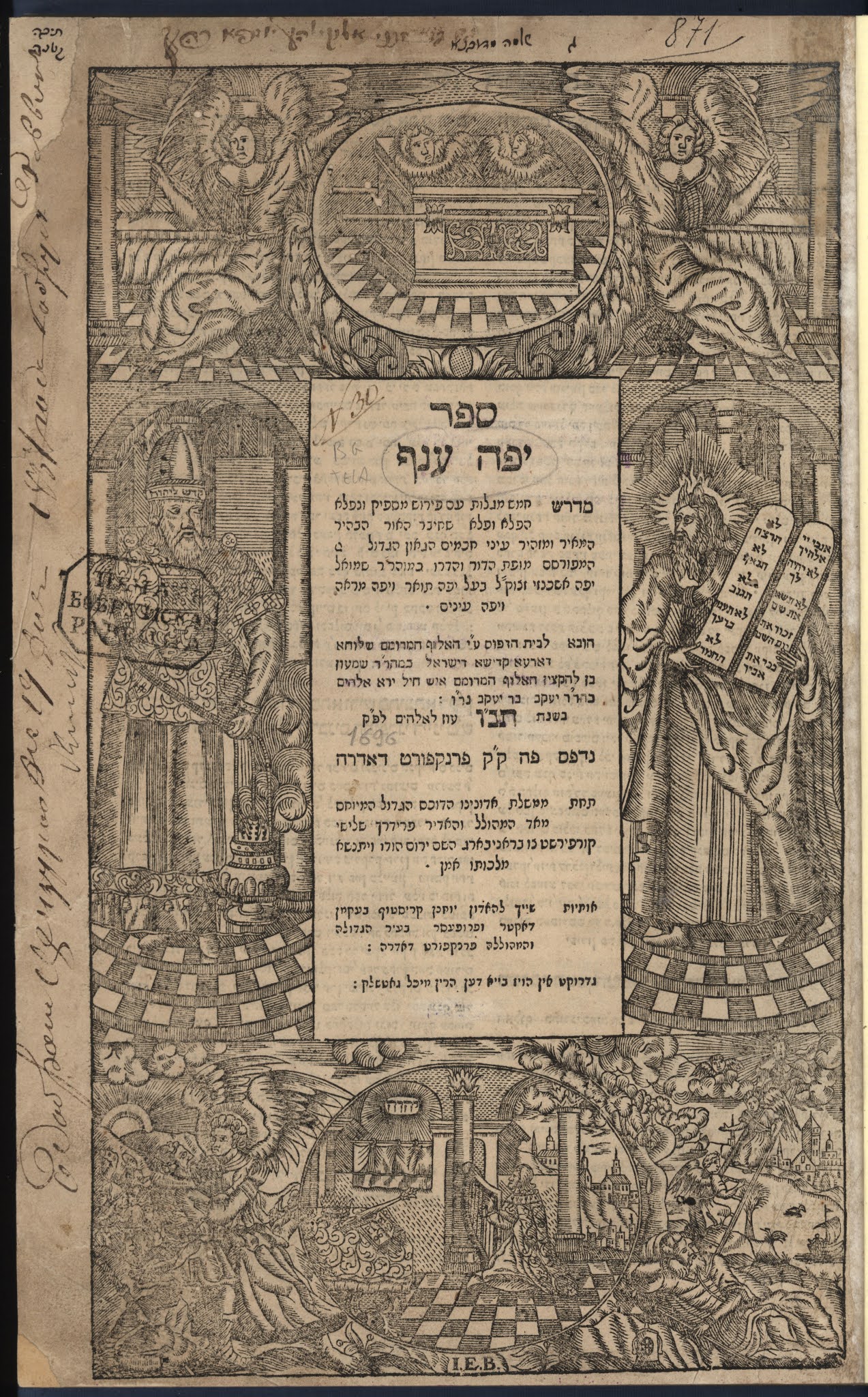
The first illustrated Jewish title pages appeared in the early seventeenth century. In 1693, the first depiction of Jacob’s dream graced a Jewish title page. That book, Sefer Rabbot, Midrash Rabba, with the commentary of R. Yisachar ben Naftali Katz, printed in Frankfurt on the Oder by Michael Gottschalk.


He was a local bookbinder and bookdealer who took over the management of Johann Christoph Beckman’s printing press in Frankfort d.O. in 1693, and led the press for almost forty years.[4]  Sefer Rabbot’s title page includes Moses and Aaron (who first appear in the 1610 edition of the She’a lot u-Teshuvot Mahril, printed in Hanau (see “Aaron the Jewish Bishop”), at the top, angels around the ark, and at the bottom, three biblical scenes, Jacob wrestling with the angel, David praying, and Jacob’s dream. It is obvious that these images are modeled after Matthaeus Merian’s engravings of biblical scenes that accompanied his Icones Biblicae printed between 1625-1630. All three of these images can be traced to Merian based upon a number of similarities and artist conventions.

The image of Jacob’s dream depicts, in both instances, Jacob laying next to a tree, boats and houses appear in the background, and angels’ hands are outstretched to greet Jacob. There is one significant puzzling difference. In Merian’s depiction, he substitutes the letters (reversed) of tetragram for God. In the Jewish book, God is depicted as an old man with a beard wearing a crown. This, despite Judaism’s strong prohibition on depicting God in a human form.

(This is not the only instance of a Jewish book containing a human image for God. The title-page of the first edition of R. Yedidia Shlomo of Norzi’s commentary on the biblical mesorah, Minhat Shai, Mantua, 1742-44, includes a depiction of God with a human face.   The images on the title page are various biblical vignettes and in the one for the resurrection of the “dry bones” that appears in Yehkezkel, God is shown as an old man with a white beard.)

Here is that image in detail:

Michael Gottschalk reused the Rabot title page at least five times; in 1695, for R. Shmuel Yaffe, Yafe Anaf, in 1696, Mattityahu ben Asher Lemle Liebermann, Mattat Yah, in 1698 in R. Benjamin Ze’ev Wolf ben Samuel Romaner’s Ir Binyamin,  in 1699 in Ohel Yaakov, and in 1602 in Yisrael b. Aaron Yaffa, Or Yisrael.


These title pages are just a few of Gottchalk’s illustrated title pages. Gottshalk artistic sensibilities are on full display in his 1697-99 edition of the Talmud, a work for which the Frankfurt press is best known to this day. It contains arguably the most magnificent Talmudic title page ever printed.

In 1695, the first illustrated copperplate Haggadah was published in Amsterdam. All the images are modeled based upon Merian. The title page too contains a number of biblical scenes in circular medallions. One of which is Jacob’s dream.

The next title page that depicts Jacob’s dream appears in Tzvi Hirsch ben Rachmiel Chotsh’s, Shiv’im Tikunei ha-Zohar, Hemdat Tzvi, Amsterdam, Moshe ben Avraham Mendes Coutinho, 1706.[5] Like the Gottchalk’s image that includes heretical iconography, those of Shiv’im Tikunei ha-Zohar would prove equally problematic.[6]

Despite Hemdat Tzvi’s impressive approbations, R. Jacob Emden accused Chotsh, and specifically this book, of holding and expressing Sabbatian beliefs.[7] It has been conclusively demonstrated that indeed Chotsh’s book contains Sabbatian ideas.[8] Evidence of Chotsh’s embrace of Sabbateanism is identifiable amongst the title page images. Indeed, Chotsh calls attention to the larger meaning of the title page’s images. At the bottom of the title page Chotsh provides that “whosoever wishes to know the secret of the above frontispiece, should see the introduction to the Tikkunim at the beginning of the first article.” An inspection of that section yields likely Sabbatian passages. Thus, Chotsh is indicating that like the introduction, the title page also contains allusions to Sabbateanism.

The title page depicts a variety of biblical figures and Jacob’s dream appears at the top center of the page. Above that are two deer holding a crown with the verse from Isaiah 28:5, “On that day will the Lord of the hosts be for a crown of glory, and for a diadem of beauty.” The “crown of glory” or in Hebrew “Ateret tzvi” has a double meaning here, “glory” and “deer” and, of course, is alluding to Sabbatia Tzvi, who, “on that day” will be presumably wearing the crown.[9]

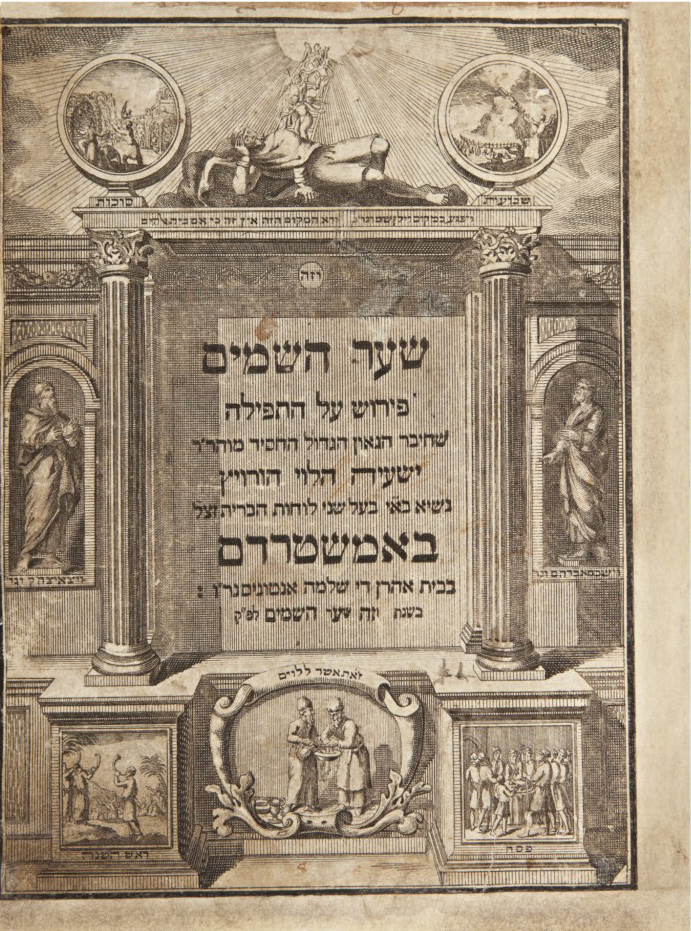
The most long-lasting depiction of Jacob’s dream is that which appeared in Siddur Shaarei Shamyim from R. Isaiah ha-Levi Horowitz (Shelah), Amsterdam, 1717.[10]

This title page is notable in that the accompanying images that align with the book which was not always the case. This is a complete machzor and as such four holidays, Sukkot, Pesach, Shavout, and Rosh Hashana, are represented on the top encased in circles, and underneath the columns. On one side of the bottom of the pillars. On either side is a niche, on the right with Abraham with the legend and on the left, Isaac, underneath each is a verse corresponding to prayer. Displayed prominently at top center, depicting his dream, with the verse from which the book’s title is derived. Underneath the title is a depiction of the Levites pouring water over the priest’s hands with the legend above, Ze hasher la-leviim. This is a reference to R. Horowitz’s lineage. All of the biblical images correspond with Merian’s depictions.

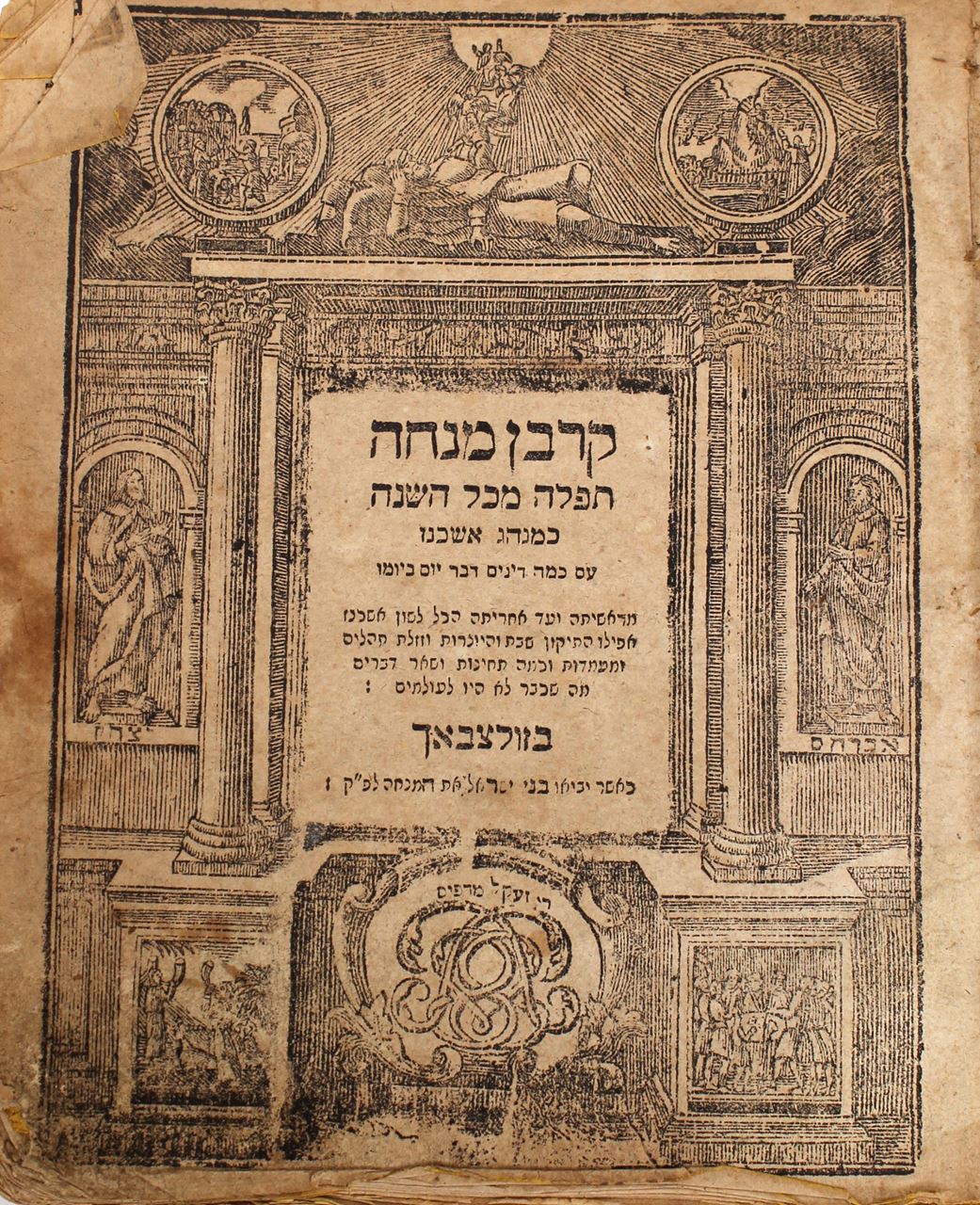
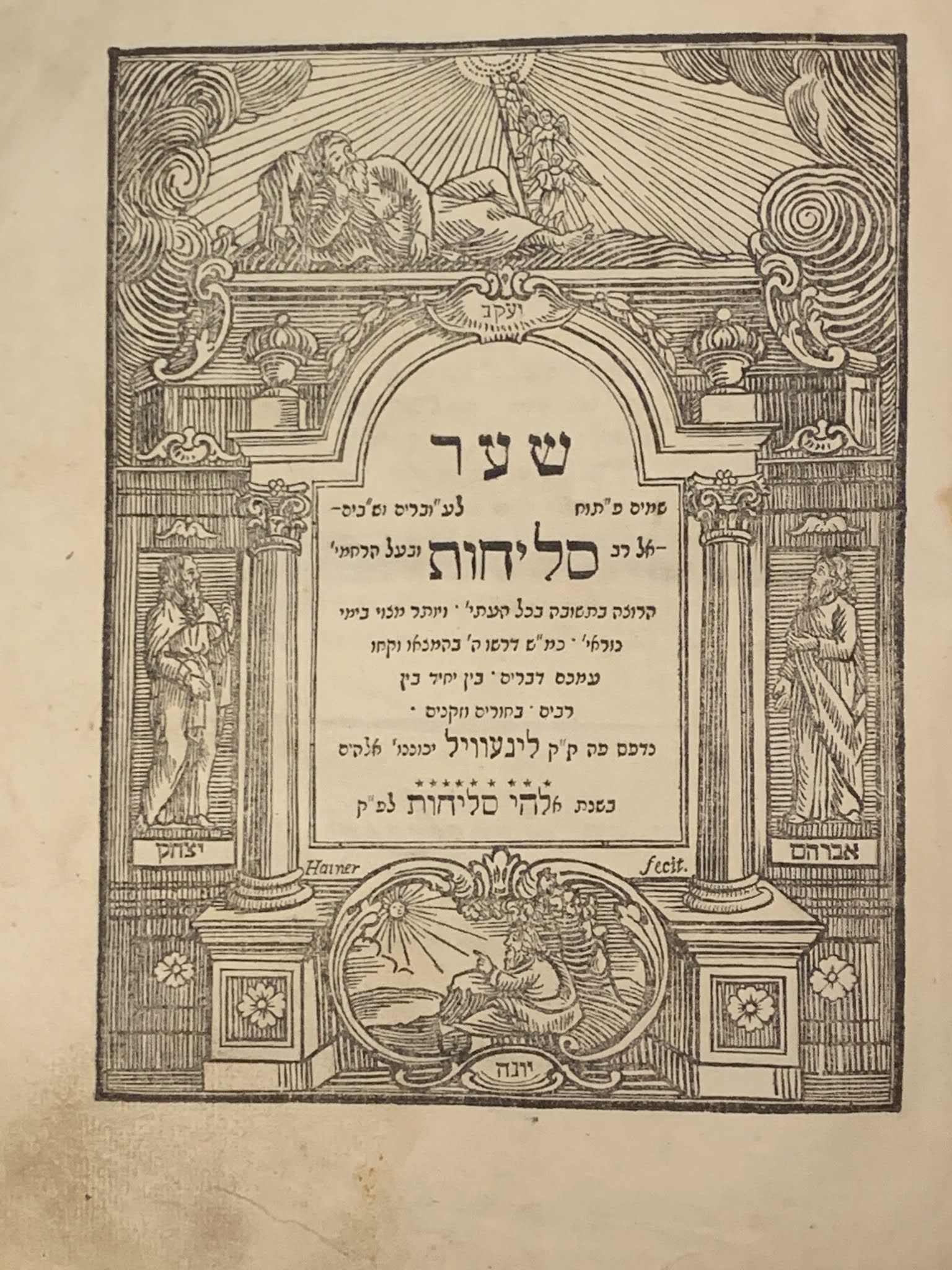
This title page, with small modifications, was repeatedly copied and is found in books from across Europe. One explanation for the ubiquity of this title page is that the Siddur ha-Shelah was imbued with talismanic effect. R. Yoel Sirkes in his approbation assures that whoever prays from this book their prayers would be answered. As evidence of the talismanic effect of the book one only needs to look to recent auctions where the book is regularly sold for tens of thousands of dollars. Perhaps printers looking to capitalize on the aura surrounding the Siddur ha-Shelah incorporated the images in their books.

For example, the title page appears in Edut be-Yaakov, Sulzbach, 1741,[11] in 1765, Furth, Siddur Korban Minha, and in 1797, in the north west of France in Luneville, Sha’ar Selihot ve-Tahanunim. In the latter, the Levite is substituted for Jonah as that is more aligned with the High Holiday themes of the book, and the four depictions of the holidays are removed because they conflict with the singular nature of the book.

Illustrated Hebrew title pages are perhaps the most ubiquitous, and certainly the most accessible form of Jewish art. Yet, the study of the art of the Hebrew title page has not attracted commensurate scholarly interest. Our example, tracing the depiction of Jacob’s dream, is but one instance that illustrated Hebrew title pages fit within the larger history of Jewish art. Here, the Hebrew title pages seventeenth- and eighteenth-century Hebrew books harken back to the iconography identified at Dura Europos that continued to appear in Jewish artistic forms, in this instance books.

[1] Gabrielle Sed-Rajna, Jewish Art (New York: Harry N. Abrams, Inc., 1997), 127.

[2] Gabrielle Sed-Rajna, Jewish Art (New York: Harry N. Abrams, Inc., 1997), 559.

[3] E.L. Sukenik, Bet-haKeneset shel Dura-Europa ve-Tserayav (Jerusalem: Mossad Bialik 1947), 112-3.

[4] B. Friedberg, History of Hebrew Typography in Central Europe (Antwerp, 1935), 35-49.

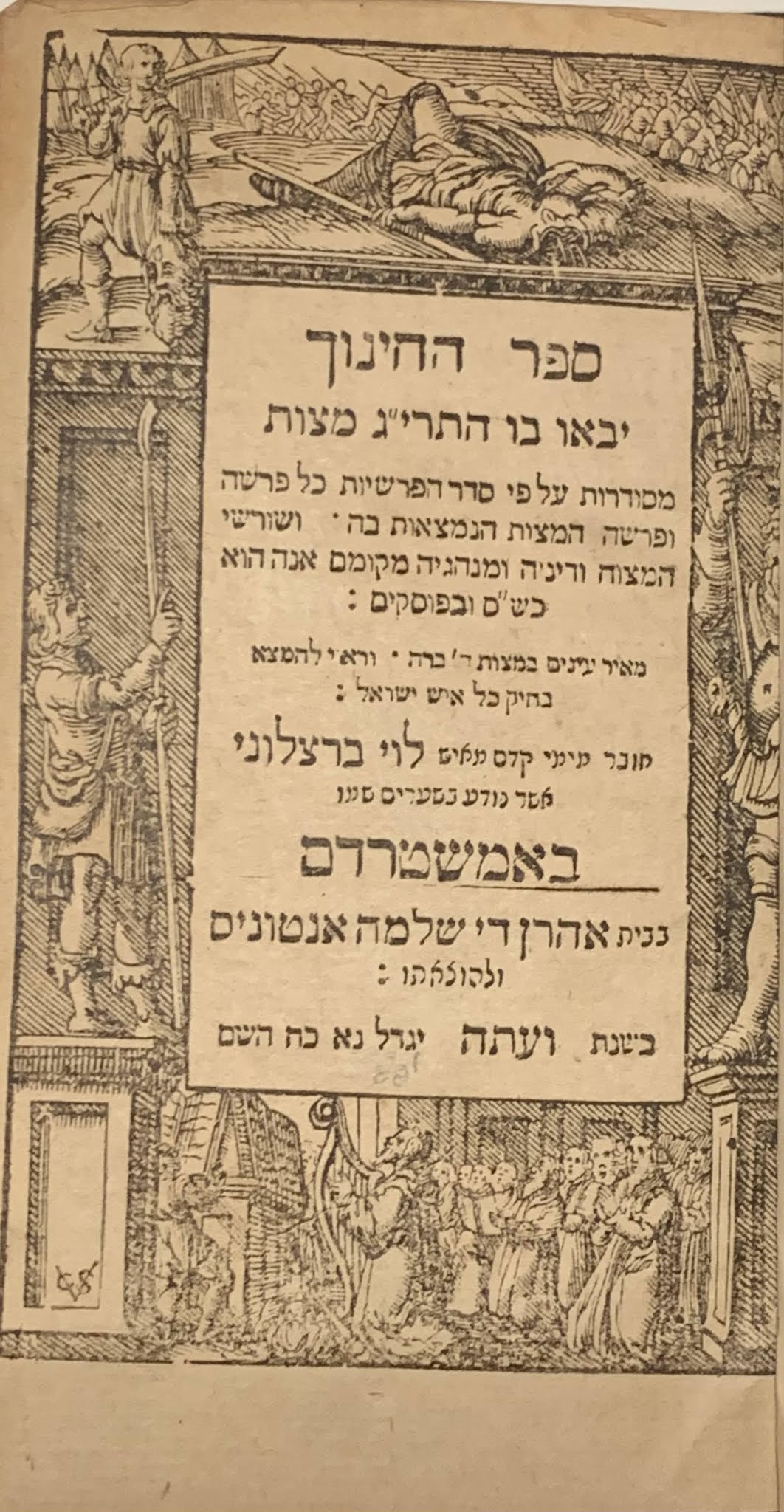
[5] Like Gottschalk, Coutinho also produced a number of other illustrated title pages with biblical images.In 1696, the year before he published the siddur, he published at least two books with illustrated title pages, Sefer Hinukh and the Mishna. This title page was reused in Coutinho’s 1698 edition of R. Hayim Moshe Karinal, Yemin Moshe.   

[6] Bezalel Naor, Post-Sabbatian Sabbatianism, (Spring Valley, NY: Orot, 1999),79-82.

[7] See Shnayer Leiman, “Sefarim ha-Hashudim be-Shabbta’ot: Rishimat shel ha-Gaon Yavet”z Tzal,” in Sefer ha-Zikhron le-Rebi Moshe Lifschitz, (New York, 1996), 890

[8] See Naor, Post-Sabbatian, 80-81 and the sources cited therein.

[9] Of course, Shabbatai Tzvi is not the only “Tzvi,” Chotsh’s first name is Tzvi. Perhaps the image is an allusion to his name – a somewhat common theme in Hebrew title page illustrations. Recently, however, one scholar noted that the deers are not the only Sabbatian reference. According to his theory, the layout of the biblical figures aligns with kabbalistic representations of the sefirot.  See Naor, 81.

[10] Horowitz’s other book, Sheni Luhot ha-Brit, Amsterdam, 1698, also contains a beautifully illustrated title page.

[11] The title page was reused for decades in the Sulzbach presses. As late as 1794, there are examples of the title page. See, e.g. Tsenah u-Renah, Sulzbach, 1794.


The Meaning of the Word Hitpallel (התפלל)

The
Meaning of the Word Hitpallel (
התפלל)
By
Mitchell First[1]

It is clear from the many places that it
appears in Tanakh that התפלל connotes praying. But what was the
original meaning of this word? I was always taught that it meant something like
“judge yourself.” Indeed, the standard ArtScroll Siddur (Siddur Kol Yaakov) includes the following in its introductory
pages: “The Hebrew verb for praying is מתפלל;
it is a reflexive word, meaning that the subject acts upon himself. Prayer is a
process of self-evaluation, self-judgment…”[2]
More recently, when I searched Jewish
sites on the internet for the definition that was offered for hitpallel and mitpallel, I invariably
came up with a definition similar to the above. Long ago, Rabbi S. R. Hirsch
(d. 1888) and R. Aryeh Leib Gordon (d. 1912) also gave definitions that focused
on prayer as primarily an action of the self.[3]
In this post, I would like to share a different
interpretation offered by some modern scholars, one based on a simple insight
into Hebrew grammar. This new and compelling interpretation has unfortunately
not yet made its way into mainstream Orthodox writings and thought. Nor has it
been given proper attention in academic circles. For example, it did not make
its way into the widely consulted lexicon of Ludwig Koehler and Walter
Baumgartner.[4] By sharing this new interpretation of התפלל,
we can ensure that at least the next generation will  understand the origin of this critical word.
                                                            
——
There
are two issues involved in parsing this word: 1) what is the meaning of the
root פלל? and 2) what is the import of the hitpael stem, one that typically implies
doing something to yourself?
With
regard to the root פלל, its meaning is
admittedly difficult to understand. Scholars have pointed out that the other
Semitic languages shed little light on its meaning.[5]
If
we look in Tanakh, the verb פלל is found 4 times:[6]
1)      It
seems to have a meaning like “think” or “assess” at Genesis 48:11: re’oh fanekha lo filalti…(=I did not
think/assess that I would see your face).[7]
2)      It
seems to have a meaning like “intervene” at Psalms 106:30: va-ya’amod Pinḥas va-yefalel, va-teatzar ha-magefah (=Pinchas
stood up and intervened and the plague was stopped).[8]
3)      It
seems to have a meaning like “judge” at I Sam. 2:25: im yeḥeta ish le-ish u-filelo elokim…(If a man sins against another
man, God will judge him…).[9]
4)      It
also appears at Ezekiel 16:52:  את שאי כלמתך אשר פללת לאחותך גם (= You also should bear your own shame that you pilalt to your sisters). The sense here is difficult, but it is
usually translated as implying some form of judging.                                                                                     
    
What
I would like to focus on in this post, however, is the import of the hitpael stem in the word התפלל. 
Most students of Hebrew grammar are taught early on that the hitpael functions as a “reflexive” stem,
i.e., that the actor is doing some action on himself. But the truth is more
complicated.
One
source I saw counted 984 instances of the hitpael
in Tanakh.[10] It is true that a
large percentage of the time, perhaps even a majority of the time, the hitpael in Tanakh is a “reflexive” stem.[11] Some examples:
●       “station
oneself”; the verb יצב is in the hitpael 48 times in Tanakh (e.g., hityatzev)
●       “strengthen
oneself”; the verb חזק is in the hitpael 27 times in Tanakh (e.g., hitḥazek)
●       “sanctify
oneself”; the verb קדש is in the hitpael 24 times in Tanakh (e.g., hitkadesh)
●       “cleanse
oneself”; the verb טהר is in the hitpael 20 times in Tanakh  (e.g., hitaher)
        But it is also clear that the hitpael transforms meanings in other
ways as well. For example: 
●       At
Genesis 42:1 (lamah titrau), the form
of titrau is hitpael but the meaning is likely: “Why are you looking at one
another?”   This is called the
“reciprocal” meaning of hitpael.
Another example of this reciprocal meaning is found at II Chronicles 24:25 with
the word hitkashru; its meaning is
“conspired with one another.”
●       The
root הלך appears in the hitpael 46 times in Tanakh,
e.g., hithalekh. The meaning is not
“to walk oneself,” but “to walk continually or repeatedly.” This is called the
“durative” meaning of the hitpael.
There are many more durative hitpaels
in Tanakh.[12]
Now
let us look at a different word that is in the hitpael form in Tanakh: התחנן. The root here is חנן which means “to be gracious” or “to show favor.”  חנן
appears in the hitpael form many
times in Tanakh (התחנן, אתחנן, etc.). At I Kings 8:33 we even have a hitpael of פלל
and a hitpael of חנן adjacent to one another: 
והתחננו והתפללו.  If we are constrained to view התפלל as doing something to yourself, then what
would be the meaning of התחנן?  To show favor to yourself? This
interpretation makes no sense in any of the contexts that the hitpael of חנן
is used in Tanakh.
Rather,
as recognized by modern scholars, the root חנן
is an example where the hitpael  has a slightly different meaning: to make
yourself the object of another’s action.
(This variant of hitpael has been
called “voluntary passive” or “indirect reflexive.”) Every time the root חנן is used in the hitpael, the actor is asking another
to show favor to him. As an example, one can look at the beginning of parshat va-et-ḥanan. Verse 3:23 states
that Moshe was אתחנן to God.   אתחנן
does not mean that “Moshe showed graciousness to himself.” Rather, he was
trying to make himself the object of God’s
graciousness.
Let
us now return to our issue: the meaning of התפלל.
Most likely, the hitpael form in the
case of התפלל is doing the same
thing as the hitpael form in the case
of התחנן: it is turning the word into a voluntary
passive/indirect reflexive.[13]  Hence,
the meaning of התפלל is to make oneself the object of God’s פלל (assessment, intervention, or judging). This is a much
simpler understanding of התפלל than the ones that
look for a reflexive action on the petitioner’s part. Once one is presented
with this approach and how it perfectly parallels the hitpael’s role in התחנן,
it is very hard to disagree.[14]
  
Some
Additional Comments
1.      It
is interesting to mention some of the other creative explanations for התפלל that had previously been proposed (while
our very reasonable interpretation was overlooked!):
a.       The
root is related to a root found in Arabic, falla,
which means something like “break,” and reflected an ancient practice of
self-mutilation in connection with prayer.[15] Such a rite is referred to at 1
Kings 18:28 in connection with the cult of Baal (“and they cut themselves [=va-yitgodedu] in accordance with their
manner with swords and lances, until the blood gushed out upon them”).[16]
b.      התפלל  is derived from the root נפל (fall) and reflected the ancient practice of prostrating
oneself during prayer.[17]
c.       התפלל  did not originate based on a three-letter
root, but was a later development derived from a primary noun תפלה. In this approach, one could argue that התפלל  is not even a  hitpael.
(This approach just begs the question of where the word  תפלה
would have arisen. Most scholars reject this approach because תפלה does not look like a primary noun. Rather, it looks like a noun
that would have arisen based on a verb such as פלל
or פלה.) 
2.
There are other examples in Tanakh of
words that have the form of hitpael
but are either voluntary passives (like  התפללand התחנן)
or even true passives, as the role of the hitpael
expanded over time.[18] Some examples:[19]
a.       Gen
37:35: va-yakumu khol banav ve-khol
benotav le-naḥamo, va-yemaen le-hitnaḥem
…(The
meaning of the last two words seems to be that Jacob refused to let himself be
comforted by others or refused to be comforted; the meaning does not seem to be
that he refused to comfort himself.)
b.      Lev.
13:33: ve-hitgalaḥ (The
meaning seems to be “let himself be shaved by others.”)
c.       Numb.
23:9: u-va-goyim lo yitḥashav
d.      Deut.
28:68:  vehitmakartem sham
le-oyvekha la-avadim ve-li-shefaḥot…
(It is unlikely that the meaning is
that the individuals will be selling themselves.)
e.       Psalms
92:10: yitpardu kol poalei
aven 
(The evildoers are not
scattering themselves but are being scattered.)
f.       Is.
30:29: ke-leil hitkadesh ḥag…(The holiday is not sanctifying
itself.)
g.      Prov.
31:30:  ishah yirat Hashem hi tithalal
h.      Jonah
3:8: ve-yitkasu sakim ha-adam ve-ha-behemah… (Animals
cannot dress themselves!)
i.       
II Kings 8:29 (and similarly II Kings
9:15, and II Ch. 22:6): va-yashav Yoram
ha-melekh
le-hitrape ve-Yizre’el… (The
meaning may be that king Yoram went to Jezreel to let himself be healed by
others or to be healed.)
              
3.  As we see from this post, understanding the
precise role of the hitpael is
important to us as Jews who engage in prayer. Readers may be surprised to learn
that understanding the precise role of the hitpael
can be very important to those of other religions as well. A passage at Gen.
22:18 describes the relationship of the nations of the world with the seed of
Abraham:
.והתברכו בזרעך כל גויי הארץ 
(The phrase is found
again at Gen. 26:4.) Whether this phrase teaches that the nations of the world
will utter blessings using the name
of the seed of Abraham or be blessed
through the seed of Abraham depends on the precise meaning of the hitpael here. Much ink has been spilled
by Christian theologians on the meaning of hitpael
in this phrase.[20]
                                                                ——
Whoever suspected that grammar
could be so interesting and profound!
         
             !ונתחזק  חזק חזק
(Does the last word
mean “let us strengthen ourselves,” “let us continually be strengthened,” or
“let us be strengthened”?   I will leave
it to you to decide!)
Notes:
[1] I would like to
thank my son Rabbi Shaya First for reviewing and improving the draft.
[2]  P. xiii.
[3]   The edition of Rav Hirsch’s Pentateuch
commentary translated by Isaac Levy includes the following (at Gen. 20:7): התפלל means: To take the element of God’s truth,
make it penetrate all phases and conditions of our being and our life, and
thereby gain for ourselves the harmonious even tenor of our whole existence in
God….  [התפלל
is] working on our inner self to bring it on the heights of recognition of the
Truth and to resolutions for serving God…Prior to this, the commentary had pointed
out that the root פלל  means “to judge” and that a judge brings
“justice and right, the Divine Truth of matters into the matter….”
R.
Aryeh Leib Gordon explained that the word for prayer is in the hitpael form because prayer is an
activity of change on the part of the petitioner, as he gives his heart and
thoughts to his Creator; the petitioner’s raising himself to a higher level is
what causes God to answer him and better his situation. See the introduction to Siddur Otzar Ha-Tefillot (1914), vol. 1,
p. 20. The Encylcopaedia Judaica is
another notable source that uses the term “self-scrutiny” when it defines the
Biblical conception of prayer. See 13:978-79. It would be interesting to
research who first suggested the self-judge/self-scrutiny definition of prayer.
I have not done so. I will point out that in the early 13th century
Radak viewed God as the one doing the judging in the word התפלל. See his Sefer
Ha-Shorashim
, root פלל.
[4] The Hebrew
and Aramaic Lexicon of the Old Testament
(1994). The authors do cite the
article by E.A. Speiser (cited in the next note) that advocates the
interpretation. But they cite the article for other purposes only. The
interpretation of התפלל that Speiser
advocates and that I will be describing is nowhere mentioned.
[5]  For example, E.A. Speiser writes that
“[o]utside Hebrew, the stem pll is at
best rare and ambiguous.” See his “The Stem PLL
in Hebrew,” Journal of Biblical
Literature
82 (1963), pp. 301-06, 301. He mentions a few references in
Akkadian that shed very little light. There is a verb in Akkadian, palālu, that has the meaning: “guard,
keep under surveillance.” See the  פללarticle in Theological
Dictionary of the Old Testament
, vol. 11, p. 568 (2001), and
Koehler-Baumgartner, entry פלל, p. 933. This perhaps
supports the “assess” and “think” meanings of the Hebrew פלל.
[6]  Various forms of a related noun, פלילים, פללים, פלילי and פליליה, appear 6 times. The meanings at Deut. 32:31 (ve-oyveinu pelilim), Job 31:11 (avon pelilim), and Job 31:28 (avon pelili) are very unclear. The
meaning at Is. 16:3 (asu pelilah) is
vague but could be “justice.” The meaning at Is. 28:7 (paku peliliah) (=they tottered in their peliliah) seems to be a legal decision made by a priest. Finally,
there is the well-known and very unclear ve-natan
be-flilim
of Ex. 21:22. Onkelos translates this as ve-yiten al meimar dayanaya. But this does not seem to fit the
words. The Septuagint translates the two words as “according to estimate.” See
Speiser, p. 303. Speiser is unsure if this translation was based on guesswork
or an old tradition, but thinks it is essentially correct.
[7]  Note that Rashi relates it to the word maḥshavah. Sometimes the verb is
translated in this verse as “hope.” Even though this interpretation makes sense
in this verse, I am not aware of support for it in other verses. That is why I
prefer “think” and “assess,” which are closer to “intervene” and “judge.” Many
translate the word as “judge” in this verse: I did not judge (=have the
opinion) that I would see your face. See, e.g., The Brown-Driver-Briggs Hebrew and English Lexicon, entry פלל. 
[8] Brown-Driver-Briggs translates ויפלל using a similar verb: “interpose.” See
their entry פלל.  Alternatively, some translate ויפלל here as “executed judgment.”
[9] It has been
suggested that the “judge” meaning is just a later development from the
“intervene” meaning.
[10] The exact number
given varies from study to study. I have also seen references to 946, 780 and
“over 825.” See Joel S. Baden, “Hithpael and Niphal in Biblical Hebrew:
Semantic and Morphological Overlap,” Vetus
Testamentum
60 (2010), pp. 33-44, 35 n.7.
[11]  We must be careful not to assume that the hitpael originated as a reflexive stem.
Most likely, the standard Hebrew hitpael
is a conflation of a variety of earlier t-stem forms that had different roles.
See Baden, p. 33, n. 1 and E.A. Speiser, “The Durative Hithpa‘el: A tan-Form,” Journal of the American Oriental Society
75 (2) (1955), pp. 118-121.
[12]  See the above article by Speiser. For example,
with regard to the hitpael of אבל, the implication may be “to be in mourning
over a period of time.” With regard to התמם
(the hitpael of תמם; I I Sam. 22:26 and Ps.18:26.), the implication may be “to be
continually upright.” Some more examples: משתאה  at Gen. 24:21 (continually gaze),  תתאוה
at Deut. 5:18 (tenth commandment; continually desire), ויתגעשו  at Ps. 18:8 (continually
shake), and  התעטף
at Ps. 142:4 (continually be weak/faint ). Another example is the root נחל. When it is in the hitpael, the implication may be “to come into and remain in
possession.”
[13] See T. Lambdin, Introduction to Biblical Hebrew (1971),
pp. 249-250, and Speiser, The Stem PLL,
p. 305.
[14] Rav Hirsch views התחנן as “to seek to make himself worthy of
concession.” See his comm. to Deut. 3:23. This is farfetched. Hayim Tawil
observes that there is an Akkadian root enēnu,
“to plead,” and sees this Akkadian root as underlying the Hebrew התחנן. He views the hitpael as signifying that the pleading is continous (like the
import of the hitpael in hithalekh). See his An Akkadian Lexical Companion For Biblical Hebrew (2009), pp.
113-14. But there is insufficient reason to read an Akkadian root into התחנן, when we have a very appropriate Hebrew
root חנן.
[15]  See Theological
Dictionary of the Old Testament
, vol. 11, p. 568, Ernest Klein, A Comprehensive Etymological Dictionary of
the Hebrew Language for Readers of English
(1987), p. 511,
Brown-Driver-Briggs, entry פלל, and
Koehler-Baumgartner, entry פלל, p. 933.
[16] The Soncino commentary
here remarks that this was “a form of worship common to several cults with the
purpose of exciting the pity of the gods, or to serve as a blood-bond between
the devotee and his god.”
[17] See Theological Dictionary of the Old Testament,
vol.  11, p. 568,  Klein, p. 511, and Koehler-Baumgartner, entry
פלל, p. 933.
[18] One scholar claims
to have located as many as 68 such instances in Tanakh, but does not list them. For the reference, see Baden, p.
35, n. 7. Baden doubts the number is this high and believes that the true
number is much lower. Baden would dispute some of the examples that I am
giving. Hitpaels with true passive
meanings are found more frequently in Rabbinic Hebrew. The expansion of the
meaning of the hitpael stem to
include the true passive form took place in other Semitic languages as well.
See O.T. Allis, “The Blessing of Abraham,” The
Princeton Theological Review
(1927), pp. 263-298, 274-278.
[19] These and several
others are collected at Allis, pp. 281-83. 
For a few more true passives, see Kohelet 8:10, I Sam. 3:14, Lam. 4:1,
and I Chr. 5:17.

[20] See, e.g., Allis,
and Chee-Chiew Lee, “Once Again: The Niphal and the Hithpael of ברך in the Abrahamic Blessing for the
Nations,” Journal for the Study of the
Old Testament
36.3 (2012), pp. 279-296, and Benjamin J. Noonan, “Abraham,
Blessing, and the Nations: A Reexamination of the Niphal and Hitpael of ברך in the Patriarchal Narratives,” Hebrew Studies 51 (2010), pp. 73-93.


Kalir, False Accusations, and More

Kalir, False Accusations, and More
by Marc B. Shapiro
1. I now want to return to Kalir and the criticism of me. To recap, I had earlier mentioned how Artscroll originally correctly identified Kalir as post-tannaitic, but later changed what it wrote in order to be in line with Tosafot’s opinion that he was a tanna. Some think that it is wrong to criticize Artscroll by using academic methodology instead of judging them by traditional sources, since they don’t recognize the academic approach.
My first response is that this is nonsense and a textbook example of obscurantism. If there is evidence of a certain fact, one can’t say that it is only a fact if it appears in some “traditional” source, and therefore one who ignores this evidence gets a pass.
Furthermore, when it comes to Kalir one can also date him using traditional sources.[1] One of these sources is quite fascinating. Whether there is any truth to the event described, I can’t say, but the fact that a traditional source dates him after the tannaitic era is what is important for us at present. This shows that Tosafot’s dating is not the only traditional source in this matter. The source I refer to is the medieval R. Ephraim of Bonn who states that the paytan Yannai, who is usually dated to the seventh century but could even be a few centuries earlier (but still post-tannaitic), was the teacher of Kalir.
R. Ephraim notes that Yannai was not the most kind of teachers and he was jealous of his student Kalir, showing that the Sages’ statement that people are jealous of all, except for a son and student (Sanhedrin 105b), can have exceptions. In order to deal with his problem, Yannai decided to terminate Kalir, with extreme prejudice of course. He therefore put a scorpion in Kalir’s sandal which took care of matters. R. Ephraim reports that because of this murder, in Lombardy (Italy) they refused to recite one of Yannai’s hymns.[2]
אוני פטרי רחמתים. ואמר העולם שהוא יסוד ר’ יניי רבו של רבי אלעזר בר קליר, אבל בכל ארץ לומברדיאה אין אומרים אותו, כי אומרים עליו שנתקנא בר’ אלעזר תלמידו והטיל לו עקרב במנעלו והרגו. יסלח ה’ לכל האומרין עליו אם לא כן היה.
R. Ephraim is the source for this report and as you can see from his final words, he took the report very seriously and literally, declaring that if it wasn’t true then those who spread this rumor were in need of repentance. Israel Davidson, however, claims that to take the report literally would be “absurd”, and the report of the scorpion is merely an “idiom, undoubtedly Oriental in origin, for expressing unfriendliness.”[3] The problem with this is, as we have seen, R. Ephraim and the community of Lombardy did take the report literally, so why should Davidson, living well over a thousand years after the supposed event, know more than people who lived in medieval times?[4] It is one thing to say that the murder never occurred, but that doesn’t mean that the story as told was not meant to be understood literally, and there is every reason to assume that it means what it says. If it happened, it would hardly be the first murder committed by a Jew. Thus, although the story is almost certainly a legend, our reason for making this determination is not because it is impossible to imagine one Jew doing such a thing to another.
Another important source is found in R. Hayyim Joseph David Azulai, Mahazik Berakhah, Orah Hayyim 112 (end). Azulai, as we all (should) know, had a keen bibliographical sense, and knew rabbinic history very well. After mentioning how Tosafot and the Rosh state that Kalir was really the tanna R. Eleazar ben Shimon,[5] the Hida quotes R. Isaac Luria as follows:
דהפייטן היה בו ניצוץ מנשמת ר’ אלעזר ברבי שמעון.
In other words, it is not that Kalir was actually a tanna, but that his soul was connected with R. Eleazar ben Shimon. I presume that this is an attempt to preserve the old tradition identifying the two, while at the same time recognizing that historically they were two different people. We find the same approach among many commentaries that deal with aggadic statements that make all sorts of identifications, of what can perhaps be called the rabbinic “conservation of people.” In other words, there is a tendency to identify biblical figures with other known biblical figures, such as Elijah with Pinhas and Harbonah, Hagar with Keturah, Pharaoh with the King of Nineveh, Yocheved and Miriam with Shifrah and Puah, Mordechai with Malachi[6] and Ezra, Tziporah with the Cushite woman,[7] Balaam with Laban, Daniel and Haman with Memukhan, to mention just a few.[8]
I don’t think people should be surprised that also among traditional commentators one can find the viewpoint that these identifications are not to be taken literally[9]—kabbalists are often inclined to see these texts as referring to reincarnation[10]—and some modern scholars have spoken of these identifications as examples of what they term “rabbinic fancy.” Some of these identifications are so far-fetched that I have no doubt that R. Azariah de Rossi and R. Zvi Hirsch Chajes are correct that the Sages who expounded them never intended them to be taken literally.[11]  Although I haven’t investigated the matter, I assume one would find the same tendency to non-literal interpretation when dealing with Aggadot that insert historical figures into other biblical episodes, e.g., Balaam and Jethro becoming Pharoah’s advisors, or when the Aggadah identifies spouses, e.g., Caleb marrying Miriam and Rahab marrying Joshua (and having daughters with him[12]).
2. In the previous post I quoted what the late R. David Zvi Hillman said in the name of R. Shlomo Yosef Zevin regarding Saul Lieberman. Some people were incredulous, and this raises the question of how reliable Hillman was and if he would distort things for ideological purposes.[13] I have spoken about him before, and I reproduced his defense of the Frankel edition of the Mishneh Torah not citing R. Kook.[14] Despite his strong ideological leanings, as of yet I haven’t found any evidence that he would purposely distort. My sense is that he was quite honest in his scholarship (and the issue with R. Zevin and Lieberman might have been something he misunderstood or perhaps R. Zevin wasn’t clear in what he said. It simply is impossible now to reconstruct events.)
Even though I believe that Hillman was honest in his scholarship (i.e., not intentionally distorting as is so often the case with haredi writers), we do find that his ideology led him to unfounded conclusions. These are not intentional distortions because he really believed what he was saying, but they are distortions nonetheless. Here is one example.
In 1999 a memorial volume appeared called Ohel Sarah Leah. Beginning on p. 246 is an article by Hillman dealing with R. Joseph Saul Nathanson’s view of the International Date Line. In this article, he deals with a letter by R. Zvi Pesah Frank published by R. Menachem M. Kasher. He believes that Kasher added material to the letter so as to align it with his own viewpoint. The fact that Kasher published the letter in 1954, almost seven years before R. Zvi Pesah Frank’s death, does not deter Hillman from his argument. Other than Hillman, I think everyone realizes that if you are going to forge something in another’s name, you don’t do it when they are still alive![15] We can thus completely discount Hillman’s argument and see it as an ideologically based distortion.
Despite this defense of Kasher, it must also be pointed out that there are serious questions about the reliability of some things he published. In Between the Yeshiva World and Modern Orthodoxy I mentioned R. Eliezer Berkovits’ claim that the Weinberg letter Kasher published was not authentic. Berkovits clearly thought that Kasher forged it, but when I pressed him to say so openly, he wouldn’t. All Berkovits would say is that Weinberg never wrote such a letter, and it was fraudulent. When I asked, “So R. Kasher forged it?” he replied that he wasn’t going to speculate about this, and would only say that the letter did not exist. Being that Kasher claimed that Weinberg wrote the letter to him, this means that Berkovits was accusing him of forgery, but for whatever reason did not want to say so openly.
I have a 1982 letter from Berkovits to another rabbi, and in this letter he is not as circumspect as he was with me. Here he pretty much states that Kasher forged the letter “le-shem shamayim.”
בענין מו”ר הגאון זצ”ל אני בטוח שהוא מעולם לא כתב אותם הדברים שהרב כשר מוסר בשמו בנועם. אדרבה יראה לנו את מכתבו של מו”ר זצ”ל. לפני כשנה כתבתי לו בדואר רשום ובקשתי בעד צילום או העתק של מכתבו של הרב וויינברג זצ”ל. עד היום לא קבלתי תשובה ממנו. מבטחני שהדברים שנאמרו ושנכתבו בשמו אינם אמיתייים. בעונותינו הרבים הגענו למצב שגם אנשים ירא שמים וכו’ מורים היתר לעצמם בכל מיני ענינים כשהם חושבים שכל כוונתם לשם שמים היא. והוא רחום יכפר וכו’.
In the recently published Genazim u-She’elot u-Teshuvot Hazon Ish, pp. 263ff. the unnamed editor also levels serious accusations against Kasher, in a chapter entitled הזיוף החמור והנורא. He puts forth a series of claims designed to show that another letter Kasher published on the International Date Line, this time a posthumous letter from R. Isser Zalman Meltzer, is also forged. I have to say that in this example, unlike the one dealt with by Hillman, there is at least circumstantial evidence, but no smoking gun. The most powerful proof comes from Kasher himself in which he tells of a meeting with the Hazon Ish and how at that meeting he told the Hazon Ish about the letter he received from R. Isser Zalman in opposition to the Hazon Ish’s position. Yet the letter Kasher publishes from R. Isser Zalman is dated from after the Hazon Ish’s death. There is clearly a problem here, but more likely than assuming forgery is that Kasher was simply mistaken in his description of his visit with the Hazon Ish. Let’s not forget that this element of the account of his visit was published thirty-three years after the event, and it is possible that Kasher didn’t recall everything that was said. The followers of the Hazon Ish have indeed always claimed that his description of his visit, in Ha-Kav ha-Ta’arikh ha-Yisraeli (Jerusalem, 1977), pp. 13-14, is not to be relied upon. Since his own recollection of his visit is the strongest evidence in favor of Kasher forging R. Isser Zalman’s letter, it is not very convincing.
In the previous paragraph I wrote that “this element” of Kasher’s account was published thirty-three years after his visit, so let me explain by what I mean by that. In Ha-Pardes, Shevat 5714, p. 30, soon after the Hazon Ish’s death, he originally published his account. Only when he later published his Kav ha-Ta’arikh ha-Yisraeli did he mention that he told the Hazon Ish that he received letters from R. Zvi Pesah and R. Isser Zalman, and this point is mentioned after his description of his visit. In his original description he mentions nothing about receiving letters, only that R. Zvi Pesah told him his opinion and R. Isser Zalman agreed with this. I think what likely happened is that in the passing decades Kasher forgot that the letters he received only arrived after the Hazon Ish’s death. As mentioned, if you look at what he wrote right after the death of the Hazon Ish, he doesn’t mention any letters, and he even states explicitly that he didn’t have anything in print from R. Zvi Pesah. I think this shows that while Kasher’s recollection was not exact, there is no evidence that he forged the letter.
I do, however, have to mention that in the 1977 version of the visit Kasher adds something that is not in the original recollection and must therefore be called into question. In the original recollection he reports that the Hazon Ish began reading Kasher’s work on the dateline and then said that he is tired and asked if he could hold on to the work to read later. In the 1977 version Kasher then adds the following, which shows the Hazon Ish as not very committed to his own position, a point which is at odds with everything else we know about the Hazon Ish and the dateline:
והוסיף בזה הלשון: נו, יעדער מעג (קען) זיך האלטען ווי ער פערשטעהט. [כל אחד רשאי (יכול) להחזיק כפי הבנתו].
Kasher was also involved in another problematic episode related to his book Ha-Tekufah ha-Gedolah, which is dedicated to showing the messianic significance of the State of Israel. In the book, pp. 374ff., he includes a proclamation urging participation in the Israeli elections. This proclamation is signed my many rabbinic greats and states that the State of Israel is the beginning of the redemption. This is a very significant document and is often referred to, because among the signatories are some who were never identified with Religious Zionism.
But is the document authentic? Zvi Weinman has shown (and provided the visual evidence) that a number of the rabbis signed a document that did not mention anything about athalta di-geula but instead referred to kibutz galuyot.[16] In Kasher’s book, their names are listed together with those who signed the document referring to athalta di-geula, even though they never agreed with this formulation. This would appear to be a Religious Zionist forgery (unless it is simply a careless error), although it is impossible to know whether Kasher was responsible for this or if he was misled by someone else.
If it can ever be proven that Kasher was indeed responsible for a forgery, there is still a possible limud zekhut for this type of behavior (and I mentioned it in a prior post): If you are convinced of the correctness of your position, it is not hard to construct an argument, based on traditional Jewish sources, that false attribution and even forgery is permissible. In the book I am currently working on I bring all sorts of examples of this which I think will be very distressing for readers, as it is in complete opposition to what most of us regard as basic intellectual honesty.
Returning to the recently published Genazim u-She’elot u-Teshuvot Hazon Ish, the editor also makes an outrageous accusation and I am surprised that no one has yet publicly protested. The canard is leveled at Chief Rabbi Isaac Herzog, whose saintliness was universally acknowledged even by those who opposed his Zionist outlook. It was R. Herzog who in early 1940 flew to London and was able to convince the English government to grant a number of visas for Torah scholars. He was thus directly responsible for saving the lives of, among many others, R. Velvel Soloveitchik and R. Shakh.[17] This fact alone should have been enough to prevent any scurillous accusations directed against R. Herzog.
On pp. 226ff. there appears a 1941 letter, dated 24 Elul, from R. Shlomo Yosef Zevin to the Hazon Ish asking him about the problem of Shabbat in Japan for those who had escaped the Nazi clutches. R. Zevin wrote to the Hazon Ish at the request of R. Herzog, who said that only two people in the Land of Israel were expert in this matter, R. Tukatchinzky and the Hazon Ish.
There is a good deal that can be said about R. Zevin’s letter and the Hazon Ish’s response, but that is not my concern at present. Yet I must at least mention that the editor provides another letter from the Hazon Ish in which he expresses his displeasure that R. Zevin’s Torah writings had appeared in the newspaper Ha-Tzofeh. According to the Hazon Ish, these should have been published as a special booklet, as it is inappropriate to publish Torah articles in a newspaper that in the end is used to wrap food in. He also mentions that Ha-Tzofeh itself is not suitable, referring obviously to its Religious Zionist outlook. (R. Zevin would, over his lifetime, write hundreds of articles for Ha-Tzofeh, many of which have not yet been collected in book form.)
Also noteworthy is that in his reply to R. Zevin the Hazon Ish raises the possibility that the viewpoint of the rishonim would have to be rejected if it turns out that they were mistaken in their understanding of the metziut.

העומד עדיין על הפרק הוא אם טעם הראשונים ז”ל הוסד על המחשבה שאין ישוב בתחתית הכדור, ואז נקח עמידה נועזה לנטות מהוראת רבותינו ז”ל ולעשות למעשה היפוך דבריהם הקדושים לנו ולכל ישראל, או שאין לדבריהם שום זיקה לשאלת ישוב התחתון.
(In a later letter, quoted on p. 231, we see a different perspective.) In R. Zevin’s letter he mentions why the issue of Shabbat in Japan was so pressing. R. Herzog had recently received a telegram from Kobe, Japan, asking on what day the Jewish refugees should fast.[18] Here is a copy of the telegram, as it appears in David A. Mandelbaum’s Giborei ha-Hayil, vol. 1.


Genazim u-She’elot u-Teshuvot Hazon Ish, p. 227, makes the astounding assertion that this telegram was a scheme cooked up by the Chief Rabbinate (i.e., R. Herzog).This would enable R. Herzog to call a gathering a great Torah scholars at which time he could push them to accept his opinion in opposition to the viewpoint of the “gedolei Yisrael.” It is hard to imagine a more outrageous accusation directed against a man of unquestioned piety such as R. Herzog.

Quite apart from the slander I have just pointed to, the volume also contains a good deal of ideologically based distortion, which is why it is noteworthy that it not only includes the letter from the Hazon Ish to Saul Lieberman (p. 330) that I published in Saul Lieberman and the Orthodox,,[19] but even identifies him in the following respectful way:
המכתב נשלח לבן דודו פרופ’ ר’ שאול ליברמן ז”ל מחה”ס תוספתא כפשוטה, ירושלמי כפשוטו וש”ס.
Considering how Lieberman is persona non grata in the haredi world, I find this identification, as well as mention of his books, nothing sort of remarkable.[20]
In fact, the story gets even more interesting. A couple of months ago volume two of Genazim u-She’elot u-Teshuvot Hazon Ish appeared. Before I was able to get a copy, people emailed me to let me know that this volume contained a lengthy letter from Lieberman to the Hazon Ish. (I thank Ariel Fuss for sending me a copy of the letter.) It appears on pages 207-209 and is really fascinating. Leaving aside the talmudic analysis, the end of the letter shows the different outlooks of these cousins. We see that the Hazon Ish had criticized Lieberman for referring to Prof. Jacob Nahum Epstein as mori ve-rabbi. Lieberman didn’t understand why the Hazon Ish found this objectionable, since Epstein was a pious Jew and Lieberman learnt many things from him, “true Torah and not the path of the maskilim but that of our teachers of blessed memory, who search for the truth in the words of Hazal, in all possible ways, and many obscure places in the Jerusalem Talmud were explained to me precisely through this approach.”[21]
Lieberman then turns to another criticism of him by the Hazon Ish, that he was not devoting himself adequately to his Torah study. It is hard to know what to make of this critique, as who was more devoted to his studies than Lieberman. Lieberman defends himself from this accusation, noting:
אני לפעמים נופל על הספסל מחוסר אונים מרוב התאמצות ויושב אני לפעמים כמה ימים על סוגיא אחת עם ראש חבוש.
Here is Lieberman’s grave, in the Sanhedria cemetery. Note who he is buried next to. (As I mentioned in Saul Lieberman and the Orthodox, according to Chaim Herzog, Lieberman was R. Herzog’s closest friend. It is therefore fitting that he be buried next to R. Jacob David.)
3. Regarding the last post, a number of people emailed me pointing out other “immodest” title pages and also learned women that I didn’t mention. I thank all who emailed. Many of the other title pages I knew about and might refer to at a future time, but the post was specifically concerned with censorship of title pages, and this explains the ones I cited. One of the commenters did refer to a title page that I did not know, from a 1731 Hamburg manuscript. See here (the rest of the Haggadah has other interesting pictures). If you ever needed an example of how what we today regard as unacceptable is not necessarily how people hundreds of years ago viewed matters, this is it.[22]
Regarding learned women, a great deal has obviously been written about this and I don’t see it as my purpose to simply repeat what others have written elsewhere. I hope that in the prior post (and indeed in all my posts), people find new material and learn things that they wouldn’t know from elsewhere, even those who are experts in the various topics.
Since the matter has been raised again, le me mention something that I originally was going to write about. At the last minute I took it out, as I was convinced (by both a scholar who will remain anonymous and Prof. Shamma Friedman) that I was in error.
Tosefta Ketubot 4:7 (and the parallel passage in J. Ketubot 5:2) reads:
נושא אדם אשה . . . על מנת שתהא זנתו ומפרנסתו ומלמדתו תורה.
It then follows by telling us that R. Joshua son of R. Akiva arranged exactly this sort of marriage. I think that if you show this passage to people, and cover up the commentaries, they will translate it to mean that a man can marry a woman on the condition that she will take care of his physical sustenance “and will teach him Torah.” (This is how Neusner translates in his Tosefta and Yerushalmi translation, and is also found in some academic articles.) Yet all of the traditional commentaries understand this text to mean that the woman provides the financial support her husband needs in order that he is able to study Torah on his own. For a while I assumed that this was an apologetic understanding by the commentators, and we know that the Talmud does offer a few examples of learned women. Yet as mentioned, I was convinced of my error.[23] In email correspondence, Friedman also called attention to other unusual Hebrew formulations which don’t mean what they literally say. For example, Yevamot 13:12 states: בא על יבמה גדולה תגדלנו. Yet this does not mean that she has to raise the boy, but only that she has to wait until he is of age to give her a divorce. He also pointed to Nazir 2:6 (and see also 2:5) which uses the language of הרי עלי לגלח חצי נזיר and this has nothing to do with shaving the Nazir.
One final point I would like to make about learned women is that before drawing any conclusions about their knowledge, we must be sure that we are not dealing with ghost writers. For example, Dov Katz, Tenuat ha-Mussar (Jerusalem, 1982), vol. 1, p. 242 n. 30, refers to the wife of R. Aryeh Leib Horowitz (the son of R. Israel Salanter) as a “learned woman” based on the introduction she wrote to her deceased husband’s Hayyei Aryeh (Vilna, 1907). Here is the text.

I can’t prove it, but I am very confident that someone wrote this on behalf of the wife, who was a traditional rebbetzin, not a maskilah.

4. In preparation for the trip I am leading to Italy in July (we still have room for some more people, and also for the August trip to Central Europe), I thought it would be helpful to read the letters of R. Ovadiah Bartenura. Right at the beginning of the first letter[24] I found something very interesting. I immediately suspected that this passage would be omitted from a translation directed towards the Orthodox masses. I checked, and lo and behold, the passage is indeed deleted. Here is the text:

Note how R. Ovadiah testifies that while the Jews in Palermo were careful about not drinking non-Jewish wine, which was noteworthy since elsewhere in Italy Jews routinely consumed this, their sexual morality and observance of the Niddah laws left something to be desired. He claims that most young women there were already pregnant at their wedding.
Here is how the page appears in the translation by Yaakov Dovid Shulman:
This text was censored even though the preface to the book states: “In publishing these letters in their entirety, including the critical comments made by Rabbi Ovadiah Bartenura of those people and practices of which he disapproved, the assumption is made that these criticisms were written to instruct the reader and not to denigrate any individuals.” As you can see, the letter has not been published in its entirety, and if one were to go through the text carefully, perhaps some other deleted passages would be discovered.[25]
5. I have done six posts on R. Kook and from email I receive I know that some people want me to return to this. I plan to, but I still have a few more posts to do before I get to that. In the meantime, however, I want to inform readers that a new volume of R. Kook’s writings has just appeared. It is called Ginzei ha-Rav Kook and I thank R. Moshe Zuriel for drawing my attention to it. My sense is that this volume does not have much importance, as much of it, and maybe even the majority, has already appeared in other collections, particularly the Shemonah Kevatzim. I was able to determine this using the R. Kook database, which except for the most recently published material includes all of R. Kook’s writings.
I did find one passage (p. 87, no. 85) which I am pretty sure has not yet appeared, even in the most recent writings. It relates back to a point I already called attention to in R. Kook, namely, his privileging of the pious masses over the Torah scholars in certain ways. One rabbinic text that would appear to oppose R. Kook’s conception is the famous Avot 2:5: ולא עם הארץ חסיד. See how R. Kook neutralizes this text, pointing out that there are a lot of things more important than being a hasid. Here is R. Kook, a member of the rabbinic elite, nevertheless insisting that the am ha-aretz can have just as much holiness as the Torah scholar, be visited by Elijah, and even have ruah ha-kodesh:
“ולא עם הארץ חסיד”. אבל מה שהוא למעלה מהחסידות, כמו קדושה וענוה ותחית-המתים וגילוי אליהו ורוח-הקודש, מפני גודל קדושתם הם שוים לכל נפש. כי כל לבבות דורש ד’, ואחד המרבה ואחד הממעיט ובלבד שיכוון לבו לשמים, ומעיד אני עלי שמים וארץ, אמר אליהו, בין איש בין אישה, בין עבד בין שפחה, בין נכרי בין ישראל, הכל לפי מעשיו רוח הקודש שורה עליו. וכיון שלא יצאו שפחה ונכרי מכלל רוח-הקודש, קל-וחומר שלא יצא עם-הארץ שהוא מזרע קודש, מעם ה’ וצבאותיו אשר הוציא ממצרים להיות לו לעם נחלה כיום הזה, סגולה מכל העמים.
(The reference to Elijah is from Tanna de-Vei Eliyahu, ch. 9.)
P. 112, no. 104, returns to a theme I have also dealt with, that study of halakhic details can be problematic for a mystical personality such as R. Kook.[26] Yet he adds that this is still the job of the righteous ones, and we can see here an autobiographical reflection.
אף על פי שלימודם של המצוות המעשיות בדקדוק קיומם מכביד לפעמים הרבה על הצדיקים הגדולים השרויים תמיד באור המחשבה העליונה, מכל מקום מתוך כח היראה העליונה שבלבבם, מתגברים הם גם על שפע קדושתם, ועוסקים בתורה ובמצוות במעשה ובדקדוק, אף על פי שהם צריכים למעט על ידי זה את אורם העליון.
Can we also see an autobiographical reflection on p. 114, no. 106, where R. Kook speaks about the righteous who want the world to recognize their greatness and holiness?
לפעמים מתגלה בצדיקים גדולים תשוקה גדולה, שיכירו הכל את מעלתם ושיאמינו בקדושתם. ואין תשוקה זו באה כלל משום גסות הרוח או אהבת כבוד המדומה, כי אם מפני החשק הפנימי של התפשטות האור הטוב שבהם על חוג היותר רחב האפשרי. וזהו מעין התשוקה של הופעת החכמה על ידי המצאות טובות וספרים טובים שכשהיא אידיאלית היא עומדת בנקודה היותר עליונה שבאור הנשמה הא-להית.
He then returns to the difficulty the Tzaddik has with halakhic particulars (p. 115):
ישנם צדיקים גדולים כאלה, שהם למעלה מכל שרש הדינים, ועל כן אינם יכולים ללמוד שום דבר הלכה. וכשהם מתגברים על טבעם ועוסקים בעומקא של הלכה, מתעלים למעלה גדולה לאין חקר, והם ממתקים את הדינים בשרשם.
[1] R. Yaakov Yisrael Stoll, in his recently published Segulah (Jerusalem, 2012), pp. 50ff., takes it as a given that Kalir is post-tannaitic.
[2] Israel Davidson, Mahzor Yannai (New York, 1919), p. xlix                     
[3] Ibid, p. xxv.
[4] Unless R. Ephraim was misinformed about Lombardy, this practice must have changed at some time because we know that in Lombardy the piyut was recited on Shabbat ha-Gadol. See R. Moshe Rosenwasser, Le-Hodot u-le-Halel  (Jerusalem, 2001), p. 379. As Rosenwasser points out, R. Ephraim is also the source for the story of R. Amnon of Mainz writing U-Netaneh Tokef.
[5] This is impossible as in one of his hymns he tells us that is father’s name is Jacob. See R. Simon Federbush, Ha-Lashon ha-Ivrit be-Yisrael u-ve-ha-Amim (Jerusalem, 1967), pp. 70-71.
[6] This identification explains how in Italy Jews with the Hebrew name Mordechai were sometimes given the vernacular name Angelo (= מלאכי). See Cecil Roth, Venice (Philadelphia, 1930), p. 168.
[7] This identification is rejected by Rashbam. See his commentary to Num. 12:1. Regarding Rashbam’s comment, see the lengthy discussion of Lockshin in his translation. While Rashbam rejects the notion that the Cushite is Tzipporah, he apparently has no problem repeating the legend  that “Moses reigned in the land of Cush for forty years and married a certain queen [from there].” He knew this legend from the work Divrei ha-Yamim de-Moshe Rabbenu, although as Lockshin mentions, it is also found in more “kosher” sources, such as Yalkut Shimoni. Ibn Ezra also cites the legend of Moses ruling in Cush in his commentary to Num. 12:1, despite the fact that in his commentary to Ex. 2:22 he writes:
Do not believe what is written in the book called the History of Moses. I will give you a general rule. We should not rely on any book not written by prophets or by the sages who transcribed traditions passed on to them. We definitely should not rely on these books when they contradict reason. The same applies to the Book of Zerubavel, the Book of Eldad ha-Dani, and similar compositions.
In a previous post I discussed Rashi’s understanding of the word Cushite, and how it is not to be taken literally. Ibn Ezra does take it literally (and still thinks that it refers to Tziporah). As with Rashi, he assumes that Cushites are not very attractive and explains that Miriam and Aaron, who spoke negatively about Moses, “suspected that Moses refrained from sleeping with Tzipporah only because she was not beautiful.” (Commentary to Num. 12:1).
Regarding the Cushite woman, I found something strange in R. Joseph Solomon of Posen’s Yesod Yosef (Munkacs, 1907), p. 8b. This is how he explains Aaron’s and Miriam’s talk against Moses on account of the Cushite he married (Num. 12:1):
מרים ואהרן רצו לתלות בוקי סריקי במשה ולהטיל מום בקדשי’ לפי דברי התרגום שני שפירש אשה כושית מלכה כוש שטימא את ברית קודש ובעל בת אל נכר וכל ביאה שאינה בהיתר נקרא הוצאת זרע לבטלה
R. Joseph Solomon goes on to explain why Aaron and Miriam were mistaken in their judgment.
[8] See R. Joseph Zekhariah Stern, Zekher Yehosef, Orah Hayyim no. 121 (p. 34a). R. Shmuel Avraham Adler, Aspaklaryah, vol. 27, s.v. shem, pp. 119ff
[9] R. Menahem Azariah of Fano acknowledges that when it comes to Elijah-Pinhas, most scholars understood this literally. Yet he rejected this position, perhaps because it would require Pinhas to have lived at least 350 years.) See Asarah Ma’amarot, Hikur Din section 4 ch. 18:
ואף על פי שיש מרבותינו אומרים בפשיטות פינחס הוא אליהו אין הדבר כמחשבת המון החכמים שפינחס לא מת ושקיים בעצמו שנוי השם.
[10] Opponents of gilgul had argued that if this was an authentic Jewish doctrine, certainly the Talmud would have mentioned it. R. Elijah Benamozegh argues that these texts, identifying various people as one and the same, are the proof that the talmudic sages indeed accepted reincarnation. He assumes that for many of these passages, where the different eras of the individuals mentioned is an obvious problem, no one with any intelligence can believe that the Talmud meant these passages to be understood literally. The meaning must therefore be reincarnation. See Eimat Mafgia, vol. 2, p. 2b:
איככה יוכל האיש לא טח עיניו מראות להניח כי לבן הארמי אשר חי בימי יעקב אבינו הוא עצמו בלעם הרשע, אשר היה בימי בני בניו האחרונים . . . וחירם שהיה בימי שלמה הוא אשר היה בימי יחזקאל . . . כיצד נוכל לייחס הבנתם הפשטית לחכמינו הקדושים אשר גם לפי דעות המנגדים לא יתכן לתלות בהם חסרון ושגעון כ”כ עצום כאשר כל אחד יראה בדמיונות האלה.
There are two books entitled Eimat Mafgia, one by Benamozegh and the other by R. Moses ben Ephraim of Brody (Warsaw, 1888). Both of them are directed against R. Leon Modena’s Ari Nohem. The title comes from Shabbat 87b: אימת מפגיע על ארי
[11] Meor Einayim, ch. 18; Mevo ha-Talmud, ch. 21, in Kol Sifrei Maharatz Chajes, vol. 1. In other words, the peshat is not literal. According to traditional commentaries, we find plenty of examples of this in the Bible also. Thus, when the Torah speaks of God’s outstretched arm, Maimonides insists that the peshat is that these words are not to be understood literally. Many have argued that even according to the peshat “an eye for an eye” is not to be understood literally. I think that most people today who read the book of Job will conclude, as did Maimonides, that the peshat is that it is not a historical tale.
[12] See Megillah 14b, Tosafot, Megillah 3b s.v. melamed, Maharsha, Hidushei Aggadot, Eruvin 63b (why does he quote Tosafot and not the Talmud in Megillah14b?), R. Samuel Strashun’s note to Eruvin 63a.
[13] Some people might have been led to thinking this because his letter was published in Yeshurun, which has in the past published articles that have engaged in censorship and ideological distortion. In the most recent volume, Nisan 5772, which also contains the Hillman letter, we find another instance of the disrespect for Torah scholars that is routine, and almost required, in haredi literature, and which in previous posts I have provided numerous examples of. (I refer obviously to Torah scholars not in the haredi camp.) On pp. 456-467,  there are letters from five deceased rabbis to R. Avraham Zeleznik. Four of them have the acronym זצ”ל put after their name. The only one who doesn’t merit זצ”ל, and instead is given ז”ל , is the Zionist R. Avraham Shapira (who incidentally was by far the most distinguished Torah scholar of the five.) R. Shapira also wasn’t provided with a short biography, presumably because then his position as Rosh Yeshiva of Merkaz ha-Rav and Chief Rabbi of the State of Israel would have to be mentioned.
[14] See here. With regard to Hillman, in this post I misstated his genealogy. Prof. Shlomo Zalman Havlin wrote to me as follows:
יש לתקן: הגרד”צ אינו נכד של הגרמ”מ חן הי”ד כפי שכתב [ע”פ האיזכור מבטאון חב”ד שהשתבש.] הוא בנו של ד”ר אשר הילמן בעל משרד רו”ח בת”א, נינו של הגרד”צ, רבה הידוע של צ’רניגוב, אביו של הרמ”מ. אגב, גם המשוררת זלדה [מישקובסקי] היתה נכדת הגרד”צ מצ’רניגוב, ואף אחיינית האדמו”ר האחרון מליובאוויטש.מאחיו של הגרמ”מ היה הרב אברהם חן, שהיה סופר מעולה, מחבר ‘במלכות היהדות’, קונטרס יפה ומרגש על אביו  
הגאון. היה רבה של שכונת בית הכרם [כמדומה שהיתה זו שכונה שלא נזקקה לרב]. מעניין לעניין, כדאי להוסיף, כי לגרמ”מ דובר בשעתו שידוך עם בתו של ר’ חיים מבריסק. לצ’רניגוב בא שליח להכיר את החתן המיועד, ולפי התיאורים ששמעתי ,הוא היה כנראה הגאון ר’ זלמן סענדר, אביו של הגאון ר’ אברהם בעל דבר אברהם, ורבה של קובנה [הוזכר ג”כ במאמר זה]. וכמה נשים ממשפחת הגרד”צ נסעו לבריסק להכיר את הכלה ומשפחתה. בגלל שיבושי הדואר הרוסי, חשבו בצ’רניגוב שאין תשובה, בעוד התשובה החיובית נדדה לעיר אחרת, והשידוך כידוע לא יצא אל הפועל. אגב, שמעתי, כי הנשים ממשפחת הגרד”צ כששבו אמרו, שלאור המסופר על גדולת ר’ ‘חיים וכו’, הרי כאשר שמעוהו בתפילת ערבית, אמרו, אצל אבא רואים יותר אפילו ב”אשר יצר
[15] See the response to Hillman by R. Ephraim Greenbaum (Kasher’s grandson), in Ohel Leah Sarah, pp. 942-943.
[16] Mi-Katovitz ad Heh be-Iyar (Jerusalem, 1995),  pp. 130ff.
[17] See A. Bernstein et al., Yeshivat Mir: Ha-Zerihah be-Fa’atei Kedem (Bnei Brak, 1999), vol. 1, pp. 218-219.
[18] One of my high school teachers was with the Mir yeshiva during the War. He told us how on Yom Kippur some people actually fasted for two days, eating pahot mi-ke-shiur after the first day so that they would be able to fulfill both the opinion of R. Herzog and the rabbis aligned with him as well the Hazon Ish’s view.
Fasting two days on Yom Kippur is actually not new. Ibn Ezra records how certain people did it in medieval times. He minces no words about what he thinks of them. See Sefer ha-Ibur, ed. Halbertam, pp. 4a-b:
ואם טען טוען הלא אתם אומרים כי שני ימים טובים צוו לעשות קדמונינו בעבור הספק למה לא קבעתם צום כפור שני ימים גם יש טפשי עולם מחברינו שיתענו שני ימים ואני אראה להם שלא יועיל להם תעניתם כי הוא שוא ושקר.
[19] This letter was previously printed in Sefer Zikaron Tuv Moshe (Bnei Brak, 2008), p. 253, and here too Lieberman is referred to respectfully. This book does not inform the reader where it found this letter, although Genazim u-She’elot u-Teshuvot Hazon Ish informs us that its source is Sefer Zikaron Tuv Moshe. I know that a number of copies of Saul Lieberman and the Orthodox made their way around Bnei Brak, and one of them apparently found its way to the editor of Sefer Zikaron Tuv Moshe.
[20] With reference to the Hazon Ish’s family, in Saul Lieberman and the Orthodox I noted how the Steipler stated that one should not study Lieberman’s books since he left the Orthodox world. Last year a new edition of the Tosefta was published and included some questions to R. Chaim Kanievsky. In the original question the authors spoke negatively about Lieberman. When they gave the page with their question and R. Hayyim Kanievsky’s reply to the typist (who might even have been a woman) they added the word להשמיט with reference to the comment about Lieberman. Perhaps this was because they didn’t want people to know about the family connection between the Hazon Ish and Lieberman. However, the typesetter didn’t understand their intention and included the word להשמיט, thinking that this word was to be added to the text. Here is the page (click to enlarge, or see detail directly below it).

Portions of the letter of the Hazon Ish to Lieberman, referred to on this page, are also found in Kovetz Iggerot Hazon Ish, vol. 3, no. 2.

I just mentioned women typists, which is common in the haredi world (Kitvei R. Weinberg vol. 1, which was printed by a Satmar company, was typed by a woman.) Let me now turn to what I think is an example of a woman translator, and I thank Elchonon Burton for bringing this text to my attention. Here are two pages from R. Shakh’s Lule Toratekha.

In it he mentions how the Hafetz Hayyim famously referred to Adam ha-Kohen as yemah shemo. Adam ha-Kohen was the pen name of Abraham Dov Baer Lebensohn, and for more on how the Hafetz Hayyim viewed him, see S.’s post here. Note how R. Shakh adds שר”י  to Adam ha-Kohen’s name. This stands for שם רשעים ירקב (“the name of the wicked shall rot” – Prov. 10:7) and is only applied to the most wicked.

Here is how this passage appears in Artscroll’s English translation, Rav Shach on Chumash.

The translator did not understand what שר”י means and assumed that it was part of his name, creating a previously unknown maskil, Adam HaKohen Sherry. Based on this error, I assume that the initial translation was done by a woman who knew modern Hebrew but not “rabbinic code.” The final translator, who is a talmid hakham, probably just revised the initial translation. Now knowing anything about the Haskalah, when he saw the name Sherry it didn’t raise a red flag leading him to check the original. S. pointed out to me that in the Wikipedia entry for Yimach Shemo, Adam HaKohen Sherry also makes an appearance.

[21] While on the topic of Lieberman, let me note that he has an unknown article in Otzar ha-Hokhmah 10 (1934), pp. 83-84, signed ש. ל.. In this short article he criticizes some of what R. Leopold Greenwald wrote about the Jerusalem Talmud. I refer to this article as “unknown” because I have never seen anyone refer to it, and it is not found in Tuvia Preschel’s bibliography of his writings included in Sefer ha-Zikaron le-Rabbi Shaul Lieberman, ed. Shamma Friedman (New York and Jerusalem, 1993).
 [22] After writing these words I saw that the title page of this haggadah was included in Leon Wieseltier’s article in the most recent Jewish Review of Books (Spring 2012), which is presumably where the commenter saw it. See here. See also this post regarding a different Haggadah, and see also Dan’s post here.
Here are some other pictures that I think people will find interesting. They appear in R. Leon Modena’s Tzemah Tzadik (Venice, 1660). This is not found on hebrewbooks.org but is on Otzar ha-Hokhmah (at least for now). This particular copy was originally part of Elkan Nathan Adler’s collection. (Adler used for his middle name the name of his father, R. Nathan Adler, chief rabbi of England. This was not unusual. To give another example, R. Samson Raphael Hirsch’s father’s name was Raphael.) Here is Adler’s book plate. His Hebrew name was Elhanan.
From Tzemah Tzadik, here is an illustration showing love of people.
Here is one showing love of man and wife.

Here is an “immodest” picture showing mermaids, which Modena, like so many others of his time, believed in.

Modena’s name does not appear on the title page of Tzemah Tzedek, but he reveals his authorship at the beginning of ch. 1, where first letters of the first sixteen words read: יהודה אריה ממודינא

Here is the page.

[23] He had already corrected Tal Ilan in this regard. See “A Good Story Deserves Retelling – The Unfolding of the Akiva Legend,” Jewish Studies Internet Journal 3 (2004), p. 85 n. 96.
[24] Darkhei Tziyon (Kolomea, 1886), pp. 5a-b
[25] As part of my preparations for the trip I have also been reading Elliot Horowitz’ many important articles on Italy. Not long after finding the censored text I saw that Horowitz had already discussed this passage and showed that there is indeed a history of omitting and distorting it. See “Towards a Social History of Jewish Popular Religion: Obadiah of Bertinoro on the Jews of Palermo,” Journal of Religious History 17 (1992), pp. 140ff. While the examples Horowitz discussed are motivated by a Victorian style of writing, the example I give is probably motivated by a desire to shield the masses from the knowledge that even in pre-Reform Europe violation of halakhah was in many places a common phenomenon. It never ceases to amaze me how little knowledge of history some otherwise very intelligent people have, which I guess means that the censorship and rewriting of history is having an effect. Not long ago I was with someone who had spent a number of years in yeshiva, and he really believed that in 19th century Eastern Europe the porters and wagon drivers were all great talmidei hakhamim whose free time was devoted to mastering Shas.
[26] See also Tomer Persico, “Ha-Rav Kook: Al Tzadikim Gedolim ve-Yishrei Lev – be-Ma’alah ha-Hasagah ha-Mistit,” Moreshet Yisrael 5 (2008), available here.


Post-script by S. of On the Main Line:

Two points may be of further interest.

1) Regarding the Western Askenazic custom of using the father’s name as a middle name ala  the aforementioned R. Hirsch and Elkan Nathan Adler, E. N.’s two older half brothers also used  their father’s name, Nathan, as middle names; there was Marcus Nathan Adler, best known for his edition of Benjamin of Tudela’s Travels. In addition, Chief Rabbi Herman Adler also used it as a middle name, especially in his earlier years. In his university matriculation record from 1856 he is listed as “Hermann Nathan Adler.”

2) In addition to the coded acrostic self-reference by the author of Zemach Zedek in the opening lines referred to above (‘יושר האהבה וכו), R. Yehuda Aryeh Modena also refers to himself in the opening lines of the hakdamat ha-mekhaber: נודע ביהודה אלקים ובישראל אריה שאג.


Mossad HaRav Kook Sale 2016

Mossad HaRav Kook Sale 2016
By Eliezer Brodt
For over thirty years, starting on Isru
Chag
of Pesach, Mossad HaRav Kook publishing house has made a big sale on
all of their publications, dropping prices considerably (some books are marked as low as 65% off). In recent years their practice has been to publish several new
titles in the few weeks prior to the sale; during the rest of the year not as many titles are printed. They also reprint some of their older out of print titles. Some years important works are printed; others not as much. This year they have printed many valuable works, as they did last year. (See here
for a review of some of last year’s titles.)
If you’re interested in a PDF of
their complete catalog email me at eliezerbrodt@gmail.com
As in previous years, I am offering
a service, for a small fee, to help one purchase seforim from this sale.–The
sale’s last day is Sunday. For more information about this, email me at
Eliezerbrodt-at-gmail.com. Part of the proceeds will be going to support the
efforts of the Seforim Blog
.
What follows is a list and brief
description of some of their newest titles.
1. ר’ אברהם אבן עזרא, ספר צחות, מהדיר: ר’ מרדכי
גודמן, עניני דקדוק בלשון הקדוש ופירוש פסוקים קשים לפי פשוטם ודקדוקם, רצח עמודים
2. ר’ אברהם אבן עזרא, ספר מאזנים, מהדיר: ר’ מרדכי
גודמן, עניני דקדוק בלשון הקדוש ופירוש פסוקים קשים לפי פשוטם ודקדוקם, רי עמודים
These
two volumes are critical editions of the Ibn Ezra works Sefer Tzachus
and Sefer Moznayim, based on manuscripts and include numerous
useful notes and indexes.
3. ר’ יוסף חיון, פירוש לתהלים מכ”י, תרסה עמודים
This
work printed once before in 1522. This edition is based on manuscripts. The
Pirush is by one of the talmidim of R’ Yitzchack Kanpanton and is more Peshat
oriented. It includes an introduction and notes.
4. ר’ משה איסרליש הרמ”א, תורת חטאת,על פי
כ”י ודפוס ראשון עם הערות, תמח עמודים
This
is a new edition of the Rama classic work Toras Chatas based upon an
hitherto unused manuscript. In the introduction the editor explains various
reasons for the significance of printing this edition, based on this new
manuscript.
5. חשבון הנפש, מהדורה מתוקנת עם הוספות רבות, 24+ קעה
עמודים
This
is yet another edition of the famous classic Musar book which has
“ties” to Benjamin Franklin (a subject I will hopefully return to).
This volume begins with a very good introduction and includes many useful notes
throughout the work. It also includes some new pieces from the author’s other
manuscripts.
6. ר’ אהרן מרקוס, קסת הסופר, פירוש על בראשית- לך לך,
כולל מפתחות, תנג עמודים
This
is a retyped version of R’ Aron Marcus’s work on Chumash. The rest of the work
is lost. Some are fans of his, others not (see my Likutei Eliezer, p.
63), but it is definitely an interesting read. This new edition includes an
index.
7. ר’ אברהם לנדא, צלותא דאברהם, תתקפז
עמודים
It’s
special news for many that this classic has been reprinted, as it has been
sought after by many for years since it was last in print. This work is one of
the best collections out there on Tefilah. It systematically deals with the
sources for the weekday siddur, based on a wide range of classic sources. It
also deals with the Nuschaos of Tefilah. This edition includes corrections and additions
to the previous versions. 
8. אוסף כתביו של דב זלוטניק, ב’ חלקים, 287+389
עמודים
This
is a collection of all of the late Professor Dov Zlotnick’s writings, in Hebrew
and English. Included are several articles about his teacher Professor Saul
Leiberman as well as a collection of various articles containing material from
the notes of his great teacher’s personal copies of seforim which Prof.
Zlotnick had published. In addition, this collection includes his book Pillar
of Iron: the Mishna
which has been out of print for some time along his
introduction to his edition of the Tractate of Mourning for Yale Press
(with some notes of his on the side).
9. ר’ ראובן רז, הרב קוק בין חסידים
למתנגדים, מפגש של שלושה עולמות ויחסם לציונות, 200 עמודים
Looking
at the title of the book and its table of contents it appears to have
interesting material related to topics such as R’ Kook and Chasidim, the Gra,
R’ Chaim Volozhiner, Ger Chasidus and more. Admittedly, I have not yet had
a chance to get deeper into the book.
10.ר’ נריה גוטל, שלמי שמחה, עיוני מועדים
וזמנים, 629 עמודים
This
work from R’ Gutel is a collection of his articles printed in numerous journals
spanning a wide range of topics. Many (including myself) are great fans of his,
especially from his classic work Histanut Hatvi’im B’Halacha.
Here
is a very accurate description of the work as it appears on the back:
יש שימצא
בה בקעה למדנית ויש שימצא בה ניתוח מחקרי, יש שיעדיף היבט הלכתי מעשי, ויש שיבכר
דווקא זווית הגותית אגדית פעמים שהמאמר בה בארוכה ופעמים שהוא בא דווקא  בקצרה וכן הלאה על דרך זה. לאחר פרסומם הראשון
עלו חלק מן המאמרים על שלחנם של גדולי ישראל, וזכו להארות הערות והתייחסויות מצדם
התגובות שבכתב הובאו בספר זה, והן מתפרסמות בו לראשונה יחד עם המאמרים שפורסמו זה
מכבר. בנוסף צורפו לספר זה מספר מאמרים שטרם ראו אור.
Here
is a scan of the table of contents to give one some sense of the wide range of
subjects:

11. ר’ איתם הנקין הי”ד, אש תמיד,
חידושים וביאורי דינים על סדר שלחן ערוך ומשנה ברורה, 369 עמודים
It’s
only been a few months since the terrible tragedy of the murder of R’ Eitam
Henkin and his wife. R’ Eitam was a special and unique person combining many
talents all in one. He was a great talmid chacham, Historian and talented writer all “wrapped
up” in one package. This work was something he had completed before his murder
and which he was very proud of. It received many impressive Haskomos which in
my opinion (for whatever it’s worth) are not exaggerated at all. He had the
unique ability to write clearly and concisely – penetrating to the heart of the
issue. This is a very valuable contribution to the world of Halacha
specifically Hilchos Shabbos. Sample pages are available upon request.


The Pros and Cons of Making Noise When Haman’s Name is Mentioned: A historical perspective (updated)

The Pros and Cons of Making Noise
When Haman’s Name is Mentioned: A historical perspective (updated)
By:
Eliezer Brodt
Severalweeks before Purim, one can already see children of various ages playing with cap guns and other loud noisemakers. All of this is done in the spirit of preparing for the laining of the Megillah and the noise that will be made whenever the name of Haman is mentioned—sort of like reviewing the halachos of Yom Tov 30 days before the chag!
On a more serious note, what are the reasons for the minhag of “banging” whenever the name of Haman is said? In this article I will try to trace some of the sources and their various aspects.[1] This post first appeared last year as an article in Ami Magazine; the current version contains many additions to that article. A much more expanded version of this article will appear in Hebrew (IY”H) in the future.
According to the Yerushalmi, one should say “arur Haman ubanav, Haman and his children should be cursed, but it does not specify when. It then mentions that R’ Yonasan would curse Nevuchadnetzar after he was mentioned during the Megillah.[2] However, in Masechtas Sofrim, where this is also brought down, it says that “arur Haman ubanuv” was said after the Megillah was read. From this it is clear that the reason for saying this is the pasuk in Mishlei, that when one mentions the name of a tzaddik he should say “zecher tzaddik livrachah” and “shem reshaim yirkav” whenever an evil person is mentioned.[3]  Today, the practice is to say “arur Haman ubanav after the Megillah, during the piyyut Asher Heini[4], and specifically when its most famous stanza is recited, Shoshanas Yaakov.[5] In fact, this might be what the Gemara is referring to when it says one should be intoxicated to the point of not knowing the difference between “arur Haman” and “baruch Mordechai.”[6]
The Manhig writes that in Spain the custom was to say “arur Haman baruch Mordechai” after the Megillah reading. The children in France and Provence had a custom to write Haman’s name on the bottom of rocks and bang them together in fulfillment of ““shem reshaim yirkav.”[7] From this source it would appear that this was done specifically by children and each and every time Haman’s name was mentioned.
Rav Aharon Hakohen Miluneil (d. 1330) in his work Orchos Chaim adds that the children of France and Provence did this for the additional reason of fulfilling “macho timcheh es zecher Amalek,” but does not specify when this was done. It appears that this was simply a custom that was done on Purim although not necessarily during the Megillah, reading. [8]
The Avudraham mentions the custom from the Manhig and adds that there is a source in the Midrash saying that one should erase Amalek from wood and stones.[9]
The Sefer HaAsufot cites another Midrash (which we don’t have) to show that the children banged on the wall when Haman’s name was mentioned.[10]  The Shibolei Haleket writes that some people in Italy had the custom of stamping their feet, banging stones and breaking pots, after which everyone would get up and thank Hashem for saving the nation;[11] he writes that while it is not obligatory, it is a good custom. It appears that this was done by everyone, not only the children.
From the Sefer Hatadir, it appears that “children who were zealous to do mitzvos” would break pots when Haman and Zeresh were mentioned.[12] It seems from both of these Italian sources that it was not done during the Megillah reading, but neither gives a reason for this custom.
In yet another Italian source, the Machzor Kiminhag Roma printed by Soncino in 1485-1486, we find that they would
smash pots when the piyyut was recited after the Megillah, but during the Megillah laining they would stamp their feet, clap
their hands and make other sounds. It’s also clear that this was done by everyone.[13]
A bit later, R’ Yehudah Aryeh Modena (1571-1648) wrote about Italy that some would bang when Haman’s name was said.[14]
R’ Zalman of St. Goar, in his work Sefer Maharil, writes that he observed that his Rebbe, the Maharil, did not bang when Haman’s name was said.[15] The Rama brings this down in his Darchei Moshe.[16] Various Acharonim have different explanations as to why the Maharil did not bang.[17] There is, however, a manuscript written by the Maharil’s son saying that his
father did indeed bang when Haman’s name was mentioned.[18]
R’ Avraham Saba writes that some have the custom to bang two stones together, based on the words “vehayah im bin hakos harasha,” as the final letters of the first three words spell Haman[19]. This remez is also brought by the Sifsei Kohen Al Hatorah[20], Minchah Beilulah[21], Levush[22] and Mateh Moshe.[23]
The Rama writes that there was custom among children to make a picture of Haman or write his name on wood or rocks
and erase them in fulfillment of “macho timcheh” and “shem reshaim yirkav.” From this they developed the custom of banging during the Megillah reading, and one should not abolish or belittle any custom because there was a good reason for it being established.[24] In Darchei Moshe he writes that his source is from the Manhig as quoted by the Avudraham.
In the very popular Yiddish book by R’ Shimon Ginsburg, first printed in 1590, we find the custom of the children “banging”[25]. Similarly, the Levush also writes that we should keep this custom, as does the Magen Avraham.[26] The Levush then says that when Haman’s name is mentioned one should actually say “shem reshaim yirkav”[27]. At first glance this appears to be a big chiddush, as talking during the Megillah reading is a hefsek. The Mishnah Berurah[28] and Rav Moshe Feinstein conclude that one should not say this during the Megillah.[29] However, after quoting the Levush, the Magen Avraham writes “see Midrash Rabbah about Nevuchadnetzar”.[30] The Magan Avrhom is referring to the Medrash we quoted in the beginning, of Esther which says R’ Yonasan would curse Nebucadnetzar after it was mentioned during the Megilah. So from this Medrash we see clearly that during  the Megilah reading he would say this and he would not wait for after the Megilah. This supports the Levush.[31]
R’ Avraham Klozner writes that the reason children bang rocks together is that they do not know how to say “shem reshaim yirkav, Whereas the adults say that during the Megillah”.[32] The anonymous comments, in Sefer Haminhagim of Rav Isaac Tirina writes the same.[33]
Those Opposed to “Banging”
R’ Binyamin Halevi writes in the Machzor Maagalei Tzedek (first printed in 1550) that he is opposed to these customs,
as well as the burning of a mock Haman in effigy. Not only do they cause a great disturbance in shul, but we live among non-Jews who are constantly looking for reasons to attack us. In other words, these minhagim are dangerous and should be abolished, as was done with other customs.[34]
To illustrate how these things can get out of control, R’ Eliyahu Capsili describes an incident that occurred in Crete in 1545 when a firecracker went off and caused utter pandemonium in shul. A takanah was subsequently made forbidding this kind of thing on Purim.[35]
R’ Avrohom Chaim Naeh writes about Yerushalayim in the 1940’s :
הרמ”א כתב על מנהג הכאת המן דאין לבטל שום מנהג… אבל המנהג היה להכות בעצים, ויומא כי האדינא חידשו להם הילדים מנהג חדש שמכין עם כדור פולווער [חומר נפץ], שנשמע קול יריה והפולווער הזה מוציא עשן מסריח ומחניק, עד שאי אפשר כלל לעמוד בבית הכנסת. העשן נכנס בגרון הקורא, וקולו נעשה צרוד, ובקושי אפשר לו להמשיך הקריאה, וכן הצבור סובלים מחוסר אויר, ומצפים מתי יגמרו הקריאה. בודאי חובה לעקור המנהג של היריות שעת הקריאה, דזה אינו מנהג וותיקין ועל דבר זה צריך לעמוד לפני הקריאה בכל תוקף, ולהוציא מידם כלי היריות [קצות השלחן, הערות למעשה, עמ’ קמו אות ה].
Another reason to refrain from banging is found in the Shelah Hakadosh, which is that it simply makes too much noise and people can’t fulfill the obligation to hear the Megillah.[36] The Pri Megadim writes something similar, that it confuses people.[37]
Another early source opposed to banging R’ Shmuel Portaleone (1570-1648).[38] One of his concerns was that the non-Jews would make fun of us.
The Seder Hayom (1599) writes that it’s not proper to make a ruckus in shul but if it’s being done by small children there’s no need to be concerned, due to simchas hayom.[39]
In Egypt and in London[40] (1783) they abolished the noisemaking completely.[41] Rabbi Avraham Levinson in Mekorei Haminhaghim[42] and R’ Ovadiah Yosef[43] were also for abolishing it. Similarly, Rav Yosef Henkin writes that the banging should be stopped during the actual Megillah laining.[44]
A Compromise
Rabbi Chaim Benveniste (1603-1673) in his work Sheyarei Knesses Hagedolah writes that in Izmir the chazzan would say the names of Haman and his children very loudly so the children would hear it and bang on the floor;[45] this was the intention of the Orchos Chaim. The banging was only done this one time during the Megillah. However, it’s worth pointing out that eventually the banging was abolished completely in Izmir.[46]
Rabbi Yuzpeh Shamash (1604-1678) of Worms writes that noise was made only when the Haman of “asseres bnei Haman” was said.[47] The Mekor Chaim writes the same but adds that woman and children did stamp their feet when Haman’s name was mentioned.[48] The Ben Ish Chai writes that the community would bang when “asseres bnei Haman” was read in Bagdad, but he himself would stamp with his foot after the first and last Haman.[49]
R’ Avrhom Chaim Naeh writes:
בעיה”ק חברון ת”ו, שהצבור היו אומרים עשרת בני המן לפני שהבעל קורא אומרם, ובזמן זה היו התינוקות מכים, ואחר כך אומרם הקורא מתוך המגילה. ויש לומר, דמשום זה זכו עשרת בני המן שהציבור יקרא אותם תחלה, כדי שיוכלו לספוג המכות, דבזמן שהקורא אומרם אי אפשר להכות כיון שצריך לאמרם בנשימה אחת [קצות השולחן, הערות למעשה, עמ’ קמו].
We find a few sources showing that attempts were made to abolish the minhag but for the most part they were unsuccessful.
In her memoirs, Pauline Wengeroff (b. 1833 in Minsk) wrote: “Whenever the hateful name of Haman was heard the men stamped their feet and the young people made an uproar with shrill graggers. My father was irritated by this and forbade it but it was of no use; every year people did it again”.[50] Her father was R’ Epstein, a talmid of R’ Dovid Tevel, author of Nachalas
Dovid
who was a talmid of R’ Chaim Volozhiner.[51]
R’ Yosef Ginsburg writes that it best to bang only when Haman’s name is mentioned with his father’s, as done in communities in Lita and Rasin.[52]
In a memoir written describing Kovno the author relates how a local talmid chacham unsuccessfully tried to convince the children not to throw firecrackers during the Megillah laining.[53]
In a letter written in Telz in 1915 R’ Avraham Eliyhau Kaplan notes that Purim has passed and the children have already made their disturbances with their graggers.[54]
According to the Orach Hashulchan, one should make sure that the noise does not get out of control; otherwise it is preferable to hear the Megillah at home with a minyan.[55]
Sources that they did bang
Still, it appears that for the most part, the minhag remained.
R’ Yair Chaim Bachrach writes:
כלי נקישה שעושין לתינוקות לנקש כמו בפורים יזהר גדול מלטלטלו, אבל ביד התינוקות אין מוחין, כ”ש כשחל פורים ביום א’ כשהולכין בערב לבה”כ [מקור חיים, סי’ שמג]
This appears to be some sort of noise maker.
R’ Yakov Emden brings down that his father the Chacham Tzvi used to bang with his feet when Haman’s name was said during the Megilah.[56]
In the cynical, anonymous, satire Ketav Yosher, first printed in 1794 (and attributed to Saul Berlin), we find one of the Minhaghim he makes fun of is the banging by Haman.[57]
In 1824 a parody called the Sefer Hakundos (trickster) was printed in Vilna. This parody was written by a maskil as a vicious attack on the Jews of the time poking fun at many things. The plus about this parody is we get a very interesting glimpse into Jewish life in those days.[58] When discussing Purim he writes “He (the trickster) must bang with all his strength for a long time every time Haman’s name is mentioned until he is either thrown out or quieted down. If he gets thrown out due to his long
banging even better and he must scream welcome when Haman’s name is said”.
See here what On the Main line brings about New York in 1841.
In a very informative Memoir describing life in Lithuania in the 1880’s the author describes: “We all went to the Synagogue equipped with our Haman Dreiers… and each time the reader of the Megillah… mentioned the name haman the nosie of the rattles was deafening”.[59]
In a diary describing Russia in the 1890s the author writes: “At every mention of Haman’s name there are general cries while the children howl and make as much noise as possible with graggers…the adults beat their pews with sticks as a token of their desire to beat Haman”.[60]
S. Ansky writes in his memoirs of World War One: “On Purim I went to Synagogue to hear the reading of the book of Esther. At the the mention of Haman’s name the children traditionally make noise say by clapping but when these children tried to clap, though very softly, their frightened parents hastily shushed them. Why didn’t they let the children make noise? I asked somebody afterword. Someone might object he stammered. Try and prove that they meant the ancient Haman and not the present one.”[61]
R’ Elayshiv, zt”l, never stopped the crowd from making noise but he himself did not.[62]
Jews in the Eyes of Gentiles
Many of sources of information about how various minhaghim were observed come from non-Jews or meshumadim, which must obviously be used with caution because some of these writers were tendentious or may not have fully understood what they observed or heard of even if they tried to be objective. These accounts however seem sound.
Johannes Buxtorf (1564-1629) writes in his Synagoga Judaica: ” There is also the custom that as often as the name of Haman is mentioned the young Jews knock him, and there is a great commotion. They used to have two stones, on one of which was written “Haman,” and they knocked them together until the name had disappeared, and they said and called out: Jimmach Schmo, his name shall be blotted out, or, Schem reschaim jirkabh, the name of the wicked shall rot. Arur Haman, cursed be Haman…”.[63]
In a letter written by John Greenhalgh in 1662 to a minister friend of his we find the following description of his visit to a shul: “My Rabbi invited me afterward to come and see the feast of Purim which they kept he said for the deliverance from Haman’s conspiracy mentioned in the Book of Esther in which they use great knocking and stamping when Haman is named”.[64]
In the Present State of the Jews (1675) Lancelot Addison writes: “Both the women and children…at the naming of Haman make a hideous noise with their hands and stamping with their feet.”
Johann Eisenmenger (1654-1704) writes that “the boys… clench their fists and strike them together, and hissing at the name of Haman make a mighty noise”.[65]
In the Ceremonies of the Present Jews (1728) we find: “They clap their hands or beat the benches to signify that they curse [Haman]”.[66]
In the book Religion, Ceremonies and Prayers of the Jews the pseudonymous Gamaliel Ben Pedazhur (1738) writes: “All the Jews, young and old, stamp their feet on the floor… the children generally have hammers with them at the synagogue… this
is done by way of rendering [Haman’s] memory as obnoxious as they can.”
Hyam Isaacs in Ceremonies Customs Rites and Traditions of the Jews, first printed in 1794, writes (second edition, 1836, p. 89): “and as often as the reader mentions the name Haman… it is customary for the children, who have little wooden hammers to
knock against the wall as a memorial that they should endeavor to destroy the whole seed of Amalek”.
 In his notes, a Christian traveler describes the events of a visit of his in a shul in Jerusalem, he also writes how the kids would make noise with graggers whenever haman’s name was said and the adults would bag with their feet or sticks.[67]
Reasons for this Custom
What follows from all this is that according to some Rishonim it ties specifically to Shem Rishoim Yirkav whereas others tie it to Mochoh Timcha Es Zeicher Amalek. According to some it was done specifically by the children; according to others it was also
done by adults. Some sources report it as being done after the Megilah reading; others say it was done during the Megilah reading.
The Rama (S.A. 690:17), after bringing some of the earlier sources for this custom, writes that one should not abolish or make fun of any custom because there was a good reason for its establishment.
It is interesting that the Rama, who brings many customs throughout his work, specifically chose this case to spell out this rule.[68] Two, the Magan Avrohom specifically here (690:22) has a lengthy discussion as to various “halachos” of Minhaghim. The question is, why?
Throughout history there were many who were against the “banging of Haman”. So the question is, what lies behind this Minhag. If we can understand that then perhaps we can better understand the Rama and Magan Avrohom.
To backtrack a bit, the Gemara in Sanhedrin (64b) mentions something about jumping on Purim “kmashvarta d’puria.” R’ Nissim Gaon and Rashi understand this to be referring to fires that the children made to jump through on Purim. But the Aruch says that it refers to a minhag to make an effigy of Haman that the children would hang from the roofs and burn on Purim, dancing and singing around it.[69] This is mentioned by others such as such as the Orchos Chaim[70] and Avudraham[71] as well as in Mesechtas Purim by R. Kalonymus ben Kalonymus (1286-1328).
Many have also noted that in the year 408 (!) a law was passed banning the Jewish custom of burning an effigy of
Haman on a gallows in the form of a cross.[72]
In Yemen they did not “bang” but fashioned a man out wood, dressed him up and dragged him around the whole day before hanging him in effigy.[73] The same was done in Baghdad[74] and other communities.[75]
Another minhag related to all this; R’ Tzvi Hirsch Koidonover in his classic work Kav Hayashar brings from his Rebbe R’ Yosef MeDubnov that R’ Heschel[76] (known as the Rebbe R’ Heshel) had a custom when he tested out his writing instrument he used to write either the name Haman or Amalek and then he would erase it to “fulfil” Mocho Timcha Es Zeicher Amalek.[77]
The significance of this source is this work was first printed in 1705-1706 in both Hebrew and Yiddish and was printed over eighty times! It was extremely popular amongst all kinds of readers so this custom of R’ Heschel was very famous.
An additional reason for the widespread popularity of this custom was that the Sefer Zechirah from R’ Zecariah Simnar also brings it, first printed in 1709.[78] This work was extremely popular in its time and was printed over 40 times.
It appears that the custom has to do with both Shem Rishoim Yirkav and Mochoh Timcha Es Zeicher Amalek.
But why did they do this?
What follows is an adaptation of Shut Mili D’avos (3:13) by R’ Yisroel Margolis Yafeh, a talmid of the Chasam Sofer, 9 with some additions and elaboration):
The Torah enjoins us to remember what Amalek did to us. The question is how do we go about doing this, and how often do we need to? The Arizal had a custom to say it every day.[79] What is behind this? It’s to remind us how Amalek set out to completely destroy us. But it also represents our other enemies throughout time, even if they are not direct descendants of Amalek.
The Chinuch writes that the reason for this mitzvah is to impress upon us that whoever oppresses us is hated by Hashem and that their punishment is commensurate with their wrongdoing.[80] Doing an action helps us remember. The banging is to help us remember that part of what we are doing is Mocho Timcha Es Zeicher Amalek, when we read the Megilah. Furthermore it takes time to read the Megilah so to constantly remind us, we bang. It’s also to keep us awake during the leining,[81] but even more so, writes R’ Margolis Yaffe, that similar to Pesach where we do many things for the children’s sake, on Purim as well the children were also saved from this decree of Haman. To get them to learn and remember about Purim we do all this, i.e. have them bang etc. Therefore it is not considered a Hefsek to bang or say Shem Rishoim Yirkav.
In various Rishonim we find a custom to say certain Pisukim of the Megilah out loud. The reason given is that it adds to the Simcha[82] while  some add to this that it’s specifically for the children.[83]
On Rosh Hashonah we have a custom to eat various fruits and say Tefilos. Many ask why we do this. Numerous Achronim,[84] when explaining this Minhag point to a Ramban[85] who writes that when an action is done down here it has an affect ‘upstairs’ causing something on earth to happen. To illustrate this a bit better this Ramban is used to explain numerous issues. There is a custom amongst some that when they say Poseach Es Yodecha during Ashrei, where one is supposed to have in mind about asking Hashem for parnasha, they keep their hands open to “receive” the parnasa.[86]
When an action is done ‘down here’ it has an affect ‘upstairs’, thereby causing something to happen in the physical world.[87] When we make noise when Haman’s name is mentioned, it “triggers” Hashem to destroy Amalek and our other enemies. This, R’ Dovid Pardo in his work on the Sifrei writes, is what is behind this Mitzvah of “Remembering what Amalek did to us” and why some say it daily.[88]
Moreover, when R’ Yehudah Hachasid was asked why we bang on the walls when Haman is mentioned, he answered that they do the same thing in gehinom.[89]
Connected to all this is the second reason brought for banging by Haman which is Shem Rishoim Yirkav. The Nezer Hakodesh explains that when evil people are cursed it has a great effect on their punishments in gehinom[90].  According to some this lies behind the reason when referring to Yoshkah we say Yeshu (Yud-Shin-Vav) as it’s the abbreviation of Yemoch shemo Vizichro[91]. With this we can easily understand its connection to Haman and the banging by Haman, all of the above explanations lie behind the custom.
R’ Eliezer Hakalir even wrote a piyyut for Parshas Zachor in which one says “yimach shemo vezichro” after every (other) stanza.[92]
Another reason is found in the Kaf Naki. He writes that we find Jews, children and adults, from all over, bang with sticks and stones for Haman as if he is still alive. He writes that although the Goyim mock us for this, there is a sound reason for all the commotion. The reason is to remind us that Haman and other enemies were destroyed by Hashem, therefore we bang and make a big deal to remind us of this fact and so that the children will learn that if another enemy rises against us, he too will be destroyed.[93]
Perhaps with all this we can understand why the Rama wrote about Minhaghim not to make fun of them; to teach us that even though it appears to not make sense to us, there is more to the story.
[1]The first large collection of sources on this subject was printed by Yom Tov Lewnsky, Keisad Hekahu Es Haman Betufuzos Yisroel, 1947, 89 pp. For other useful collections on this topic see; Rabbi Avrohom Levinson, Mekorei Ha-Minhaghim, Siman 62; R’ Shem Tov Gagin, Keser Shem Tov, 2, pp. 542-545; S. Ashkenazi, Dor Dor Uminhagahv, pp. 98-104; Rabbi Gedaliah Oberlander, Minhag Avosenu Beydenu, 2, pp. 307-324; Rabbi Tuviah Freund, Moadim Li-Simcha, 3, pp. 299-323; Pardes Eliezer, (Purim) pp. 186- 252; Rabbi Gur-Aryeh, Chikrei Minhaghim,1, pp. 218-222; Rabbi Rabinowitz,  Iyuni Halachot, 3,pp.
488-515; Daniel Sperber, Minhagei Yisroel, 3, pp. 156-159; 4, pp. 331-333; 6, pp. 242-246; Ibid, Keisad Mackim Es Haman, 47
pp. See also M. Reuter, The Smiting of Haman in the Material Culture of Ashkenzai Communities: Developments in Europe and the Revitalized Jewish Culture in Israel- Tradition and Innovation, (PhD Hebrew University 2004) (Heb.).
Another important work that was very helpful for this topic is Eliot Horowitz, Reckless Rites, Princeton 2006. I hope to deal with all this more in depth in the future.
[2]  Yerushalmi, Megillah, 3:7. See the comments of the Korban HaEdah; Shiurei Korban; R’ Eliyahu Hacohen, Midrash Eliyhau, 89b; R’ Shlomo Kluger, Chochmas Shlomo, 690. See also R’ Ratner, Ahavas Tzion Vi-Yerushlayim, Megillah pp. 77-78; S. Abramson, Rav Nissim Gaon, p. 279; R’ Yissachar Tamar, Alei Tamar, Megillah, pp. 142-144; R’ Palagi, Yafeh Li-Lev, 690:6-7.
[3]  Mesechtas Sofrim, 14:6-7. See the Mikra Sofrim (on Mesechtas Sofrim), and the sources in the Higger edition of Mesechtas Sofrim, pp.254-255.  For other versions of this Chazal, see the Midrash Bereishis Rabbah (Theodore-Albeck), pp. 496-497; Yalkut Makheri Mishlei printed from a manuscript by Yakov Spiegel, Sidra 1 (1985), pp. 123-125; Torah Sheleimah, Esther, p. 62. 200; Esther Rabbah, (Tabori and Atzmon Ed.) pp. 178-179, 114-115, [on this new edition see here].
[4]  On the Piyyut Asher Heni see I. Davidson, Otzar Hashira Vehapiyyut 1, p. 372, #8215; R’ Fack, Yemei Mishteh Vsimcha, pp. 158-161; Avrohom Frankel, “Asher heniya – toldoteha shel berakhah mefuyetet, available on the Piyyut website here; Rabbi Yakov Stahl. Segulah (2012), p. 32, no. 30-31.
[5]  On the exact Nussach of Shoshanas Yakov and the censors see R’ Yakov Laufer, Mei-Soncino Vi-ad Vilna, pp. 41-43; Sefer
HaZikuk
in Italia 18 (2008), p. 183.
[6]  Some Rishonim assume it is referring to a Piyyut;  See Sefer Hamanhig, 1, p. 242; Zror Ha-Chaim, p. 118; Shita leMesechtas
Megillah,
pp. 34-35; Avudraham, p. 209; Rashash, Megillah 7b; Meir Rafeld, Nitivei Meir, p. 198. I hope to return to this topic;
for now see Rafeld, ibid, pp. 190-209.
[7]  Sefer Hamanhig, 1, pp. 242-243.
[8]  Orchos Chaim, Purim, 41. The Beis Yosef (690) appears to have a different version of the Orchos Chaim than we have.  On
the Orchos Chaim, see Dr. Pinchas Roth, Later Provencal Sages- Jewish Law and Rabbis in Southern France, 1215-1348, (PhD Hebrew University 2012), pp. 38-41.
[9] Avudraham, p. 209. I believe this addition is not a quote from the Manhig, contra Y. Rafael (in his notes to Sefer Hamanhig, 1, pp. 242) and others appear to have understood the Avudraham.
Regarding the source of this Midrash, Rashi at the end of Ke Sisa brings such a Midrash. The Minchas Chinuch writes he does not know the source for it (Mitzvah 604) The Aderes (Chesbonot Shel Mitzvah, pp. 377-378) and R’ Meir Simcha point to the Mechilta in Beshalach [See Mechiltah Di R’ Yishmael at the end of Parshas Bishalach and the Mechiltah Di Rashbi, p. 126; R’ Menachem Kasher, Torah Sheleimah, Beshalach p. 270 (120), 274 (130); See also Menachem Kahana, Hamechiltos Li Parshas
Amalek
, pp. 190-191, 194, 314, 355. See also the important comments of Daniel Sperber, Minhagei Yisroel, 4, pp. 331-333.
[10] Meorot Rishonim, pp. 168-169.
[11] Shibolei Haleket, Purim, 200. See also the Tanyah Rabosi (Purim, 40) who says the same.
[12]  Sefer HaTadir, p. 209. On this work see R’ Rafael Nosson Rabinowitz, Ohel Avrohom, pp. 14-15.
[13] Machzor Ki-Minhag Roma (1485) in the 2012 reprint p. 62a. See Yitzchack Yudolov, Kovetz Mechkarim Al Machzor Ki-Minhag Bnei Roma (2012), p. 34, and pp. 32-33. M. Gidman, Ha-Torah Ve-Hachaim, 2, pp. 189-190 brings another Italian Machzor from manuscript that says the same. See also E. Horowitz, Reckless Rites, p. 272.
[14]  Shulchan Orach, p. 84.
[15]  Maharil, pp. 427-428. On this work see the Y. Pelles, The Book Of Maharil According to its autograph manuscripts and its specialty as a Multi-Draft versions work (PHD, Bar Ilan University 2005).
[16] Darchei Moshe, 690. See Magan Avrohom, 690:19 who brings down the Maharil.
[17] See Shut Maharam Shick, Y.D. # 216
[18]  Maharil, p. 428, note 6.
[19] Eshkol Hakofer, 9:32. About him see the introduction to the recent edition of his work Tzror Hachaim, Jerusalem 2014.
[20] End of parshas Ki Sisa.
[21] Ki Sisa, 25:2.
[22] Levush, 690:17.
[23] Mateh Moshe, 1006.
[24] S.A. 690:17
[25] On this work See Jean Baumgarten, “Prayer, Ritual and Practice in Ashkenazic Jewish Society: The Tradition of Yiddish Custom Books in the Fifteenth to Eighteenth Centuries”, Studia Rosenthaliana, Vol. 36, (2002-2003), pp. 121-146.
[26]The Magan Avrhom (690:19) says to be careful not to miss words [See the Noheg Ketzon Yosef p. 200 who says the same]. The Magan Avrhom says to say a pasuk or two from the Chumash (because might have missed it). However the Mekor Chaim says this is only if you have a kosher Megillah.
[27] 690:17.
[28]  Sharei Tzion, 690:57.
[29] Igrot Moshe (O.C., 1:192). R’ Moshe deals with the intention of the Yerushalmi and more. See also Chazon Ovaadiah, pp. 93-94; Haghot Pnei Menachem, (printed in the back of the Zichron Aron Levush).
[30]  690:21. See the important comment of the Machtzis Hashekel. See also the Yafeh Mareh on the Midrash Raba on parshas Va-Yayra 49:1.
[31]  There is much more to this story, depending on the exact Girsa in the various Midrashim that talk about saying ‘Aror Haman Ubanuv’. I hope to return to this in the future; for now see the important notes in Midrash Rabah (Theodore-Albeck), pp. 496-497; Yalkut Makheri Mishlei printed from a manuscript by Yakov Spiegel, Sidra 1 (1985), pp. 123-125. See also the important Teshuvah of R’ Yissachar Teichtal, Mishnat Sachir, siman 228-229 where he deals with when exactly do we say Shoshanas Yakov, which relates to all this.
[32]  Sefer Ha-Minhaghim Li R’ Avrohom Klozner (2006), p. 74. On this work see Rachel Mincer, Liturgical Minhaghim Books: The Increasing Reliance on written texts in late Medieval Ashkenaz, (PhD JTS, 2012), pp. 91-149.
[33]  Sefer HaMinhaghim Li R Issac Tirina, (2000), p. 48 # 55. On the authorship of these notes see the Introduction Ibid.
[34]  Maagalei Tzedek, (2000), pp. 175-176. I hope to return to this work in the near future.
[35]  Takonot Kandyah, pp. 130-131. See also the Kitzur Shelah, p. 88a, who describes a similar incident. For the most recent work on R’ Capsali see: Aledia Paudice, Between Several Worlds: The life and writings of Elia Capsali, Munchen 2010.
[36]  Shelah, p. 87a.
[37]  The Mishna Berurah quotes this but it’s not clear what his outcome with all this is.
[38]  Printed in Meir Benayhu, Yosef Bechiri, p. 437,418.
[39]  Seder Hayom, p. 240.
[40] Keser Shem Tov (above note 1).
[41] See Niveh Sholom, Dinei Purim, 7; Na-har Mitzrayim, pp, 52b-53b.
[42]  Siman 62. See also R’ Yakov Reifman, Ha-maggid (1858), issue # 11, p. 44.
[43]  Chazon Ovadiah, Purim, pp. 62-63.
[44]  Shut Gevurot Eliyhau, p. 209.
[45]  Shirei Knesses Hagedolah, 690. About him see the recent work of Yakov Barnai, HaMaruh Shel Europia, Jerusalem 2014.
[46]  Yafeh Li-Lev, 690:15.
[47]  Minhaghim De-Kehal Vermeizah, (1988), pp. 259-260.
[48]  Mekor Chaim, 690.
[49] Ben Ish Chai, first year, Parshas Tzaveh, 10.
[50] Pauline Wengeroff, Memoirs of a Grandmother, 2010, p. 113
[51]  Her father authored an important work called Minchas Yehudah. On this work see S. Abramson, Sinai, 112 (1993), pp.1-24; N. Steinschneider, Ir Vilna, pp. 248-249.
[52]  Itim LeBinah, p. 237.
[53]  Yoser Yasrani, 1, p. 168.
[54]  Be-Eikvot Ha-Yeriah, p. 162,
[55]  Oruch hashulchan, 690:23.
[56]  Siddur R’ Yakov Emden 2, p. 472.
[57] Prakim BeSatira Haivrit (1979), p.93.
[58] See the critical edition of this work printed in 1997, p. 67.
[59] Benjamin Gordon, Between Two worlds: The Memoirs of a Physician, p. 37.
[60] M. Zunser, Yesterday, p.42.
[61] The Enemy at his Pleasure (p. 284).
[62]  I witnessed this myself a few times when I davened there. See also Halichos VeHanhagot, (Purim), p. 14; Ish El haedah, 2, p. 275.
[63]  Synagoga Judaica, pp. 556-557.
[64] Dr. A. Cohen, An Anglo-Jewish Scrapbook 1600-1840, London 1943, p. 267.  See also Ibid, p. 260.
[65] Johann Eisenmenger, The Traditions of the Jews, U.S.A. 2006, p. 853. On this work see E. Carlebach, Divided Souls, London 2001, pp. 212-221.
[66] Ceremonies of the Present Jews, p. 44.
[67] Masei Notzrim Le Eretz Yisroel, p. 802.
[68] See Maharatz Chayes, Darchei Horaah, pp.235-235. For general information about the importance of Minhaghim, see R’ Heller, Maoz Hadat, Chapter 3.
[69] Aruch, s.v. Shvar quoted by the Rama in Darchei Moshe (690). See R’ Yakov Shor, Mishnat Yakov, pp. 398-399; S. Abramson, Rav Nissim Gaon, p. 278; Sefer haManhig, Mossad Harav Kook ed. vol. 1, pp. 249;  Herman H. Pollack, Jewish Folkways in Germanic Lands (1648-1806), pp. 175-177,328.
[70]  Orchos Chaim, Purim, 42.
[71]  Avudraham, p. 209.
[72]  See Yom Tov Lewnsky, (above note one), p. 16; Daniel Sperber, Minhagei Yisroel, 1, p.17; E. Horowitz, Reckless Rites, pp. 213-217; Sarit Gribetz, “Hanged and crucified: The book of Esther and Toledot Yeshu”, in Toledot Yeshu Revisited, (Peter Schafer and others ed.), Tubingen 2011, pp. 171-175. See also another early source that appears to be alluding to this, Shirat Bnei Ma-Aravah (Yahlom and Sokolof ed.), pp. 216-217, 33.
See also Levi Ginsburg, Shut Ha-Geonim Min Hagenizah New York 1909, pp. 1-3; R. S. Schick, Sefer Haminhaghim p. 51a; Korot Luv Ve-Yhudehah, p. 198; Israel Davidson, Parody in Jewish Literature, pp. 21-22; E. Horowitz, Reckless Rites, pp. 93-106. See also R’ Reuven Margolis, Margaliyot Hayam, Sanhadrin 64 b (17-18); Israel Yuval, Two Nations in your Womb, pp.165-166; T. Gaster, Festivals of the Jewish Year, pp. 227-229.
[73] See Rabbi Yosef Kapach, Haleichos Teiman (1968), p. 40. Earlier about Teiman the famous traveler R’ Yakov Sapir already describes this, Even Sapir, pp, 86b-87a [R’ Reuven Margolis Nefesh Chayah, 690].
[74] See R’ Dovid Sasson, Maseh Bavel, p. 226. See the nice collection of sources about this in Pineinim 54 (2012); Pineinim 55, (letters to the Editor); Pineinim 64, (letter to the editor) [Thanks to Yisachar Hoffman for sending me these sources].
[75]  This kind of stuff gets out of control in 1932 some youngsters made such a Mock Haman out of R Kook! See Rabbi S. Goren’s autobiography, With Might and strength (Heb.), p. 68; R’ Menachem Porush, Besoch Hachomos, (1948), pp. 323-324. See also the recent collection of Material on this called “Einei Yochel Lehashlim Im Das Hakanoyim“.
[76] E. Horowitz, Reckless Rites, p. 109 identifies this R’ Heshel incorrectly to be R’ Heshel Zoref. However already in the first edition printed by the author in the Yiddish part he writes he is referring to R’ Heshel Av Beis Din of Cracow. See also R’ Shmuel Ashkenazi’s notes to the Kav Ha-Yosher (1999), p. 23.
[77] Kav Ha-Yosher, ch. 99; Yesod Yosef, Ch. 82. On this work see: Y. Schachar, Bikurot Hachevrah, pp. 3-6; Jean Baumgarten, ‘Eighteenth-Century Ethico-Mysticism in Central Europe: the “Kav ha-yosher” and the Tradition’, Studia Rosenthaliana, Vol. 41, Between Two Words: Yiddish-German Encounters (2009), pp. 29-51; see also his Introduction to old Yiddish Literature, index; Yakov Elbaum, ‘Kav Ha-Yashar: Some remarks on its structure, content and literary sources’, Chut Shel Chein (heb.), pp. 15-64.  On the Yesod Yosef, see: Yeshurun 3 (1997), pp. 685-687.
[78] Sefer Zechirah, (1999), p. 273. See R’ Shmuel Ashkenazi’s notes to the Kav Ha-Yosher (1999), pp. 4-5. On this work see my Likutei Eliezer, pp. 13-25. For additional sources on this see E. Horowitz, Reckless Rites, pp. 107-109; Pardes Yosef, Devarim
beis, pp. 1077-1078 [Thanks to Professor Yakov Speigel for pointing me to this source].
[79] See Olat Tamid (O.C. 1:6); Magan Avrohom 60:2 See also his important comment in his Zayis Raanan, p. 51 b; Radal, Pirkei Di R’ Eliezer, Ch.44:5 (Haghot); Malbim, Artzos Hachaim, Eretz Yehudah, 1:4; Moshe Chalamish, Chikrei Kabbaah UTefilah, pp. 209-226 who collects numerous sources on this topic. See also: Aderes, Chesbonot Shel Mitzvah, pp. 382-383; R’ Zevin, Leor Ha-Halacha, (2004), pp. 270-278; Encyclopedia Talmudit, 12, pp. 217-223.
[80] Chinuch, Mitzvah 603.
[81] Some say this is why some pesukim of the Megilah are read out loud by everyone (see more on this further on).
[82] Sefer Hamanhig, 1, p. 243.
[83] See Yakov Spiegel, Pischei Tefilah UMoed, pp. 195-204.
[84] See for example R’ Margolis in his Shut Machlos Hamachanyim, pp. 27b-28a.
[85] Breishis, 12:6; 48:22.
[86] R’ Yosef ben Naim, Noheg BiChochma, pp. 167-168. See Daniel Sperber, Minhagei Yisroel, 3, pp. 113-172.
[87]  See Daniel Sperber, Minhagei Yisroel, 3, pp. 113-172.
[88] Sifri DeBei Rav, 4, (1990), pp. 181-183.
[89] Meorot Rishonim, p. 171; M. Gidman, Ha-Torah Ve-Hachaim, 1, p. 121. A similar idea is found in R’ Eliyahu Hacohen, Midrash Eliyhau, 89b.
[90]  Nezer Hakodesh, 2, (2014) p. 400. On the actual concept of Shem Rishoyim see Chida in his work Kisay Rachamim on Mesctas Sofrim, 14:7 I hope to return to this in the future.
[91]  R’ Avigdor Hazarfati, p. 414. For additional sources on this see R’ Hamberger, Mishichei Sheker Umisnagdeyium, (2009), pp. 121-122.
[92]  In the recently discovered Pirish from the Beis Medrash of Rashi on the piutim [Piyutim LeArbah Parshiyous, (2013), p. 77] it says the reason for saying Yemoch shemo Vizichro in this piyyut is because of the Medrash quoted earlier.
[93]  Kaf Naki, Lud 2014, pp. 95-96. The Chida brings this piece down from manuscript in his Machzik Beracha, Kuntres Achron, Siman 687 and in his Midbar Kadmot, Ois peh:12.


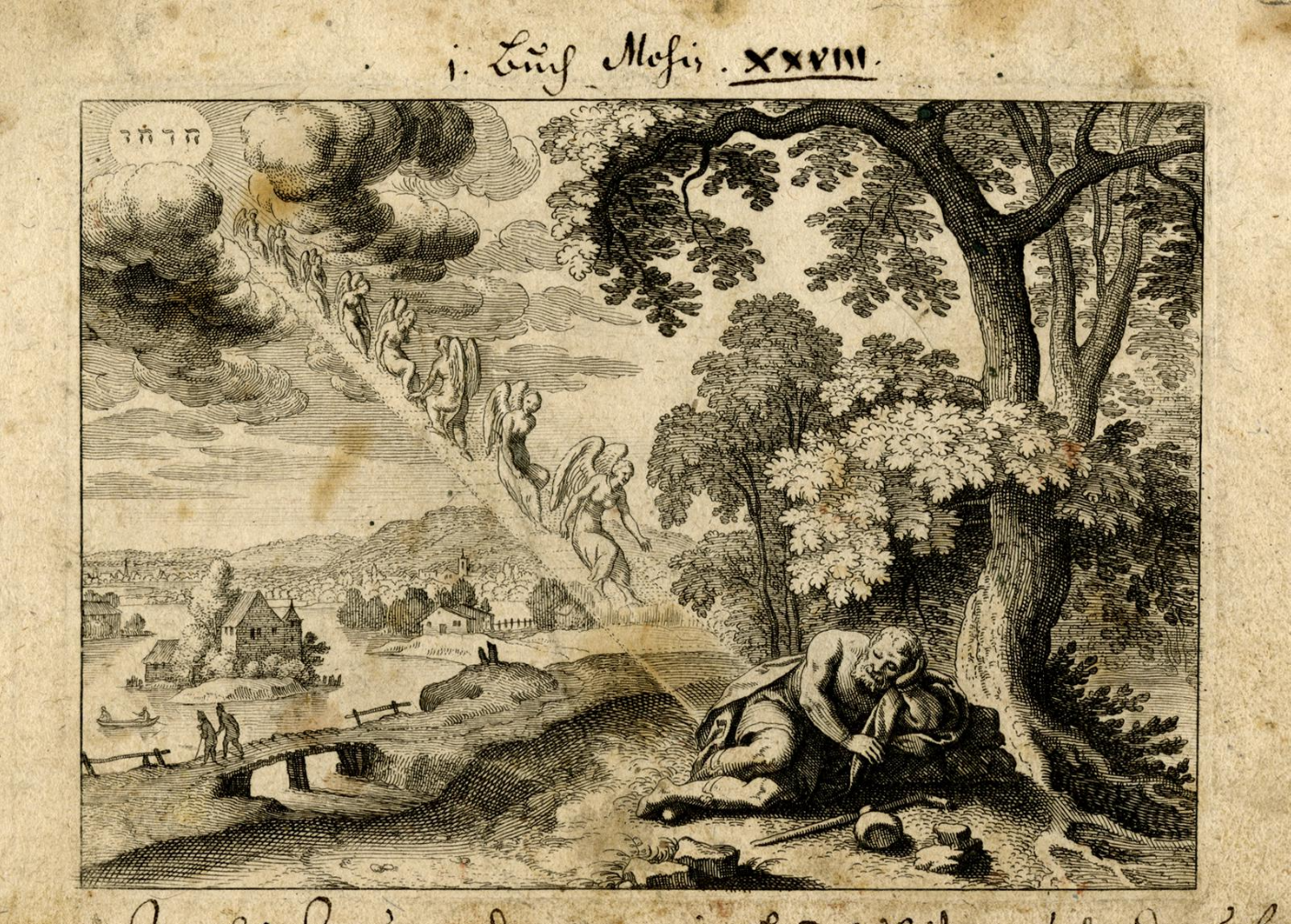
“Seeing the Infinite in Torah” A Memorial to the Gaon Rabbi Shelomo Fisher (Author of Beit Yishai)

Seeing the Infinite in Torah”: A Memorial to the Gaon Rabbi Shelomo Fisher (Author of Beit Yishai)

By Rabbi Bezalel Naor

ANCESTRY

Rabbi Shelomo Yehonathan Yehudah Fisher was born in Jerusalem in 1932 to Rabbi Aharon and Devorah Fisher. He was named after his paternal grandfather, Shelomo Fisher (1852-1932), Rabbi of Karlsburg, Siebenbürgen.

Rabbi Shelomo Fisher the Elder, an Oberlander, was a disciple of Rabbi Abraham Samuel Benjamin Schreiber of Pressburg (Ketav Sofer) and of Rabbi Isaac Dov (Seligmann Baer) Bamberger (Würzberger Rav). When Rabbi Fisher assumed the rabbinate of Karlsburg in 1891, it was a Status Quo community. Eventually, he prevailed upon the community to become Orthodox. (In Hungary there were three types of Jewish communities: Neolog or Reform, Status Quo Ante, and separatist Orthodox.) After his passing, his son Aharon published in Jerusalem his sefer, Korbani Lahmi (2 parts, 1933-1937). Besides Talmudic erudition, the work evidences linguistic ability. (His son Aharon was also known to be a talented linguist.) At the beginning of the sefer there is a photo of the author. Our Rabbi Shelomo Fisher bore an uncanny resemblance to his paternal grandfather.

Rabbi Aharon Fisher arrived in Jerusalem in 1919. Settling into the Old Yishuv, he changed his clothing from European couture to the traditional Yerushalmi levush. Thus, the inhabitants of the Old Yishuv viewed him as a “ba‘al teshuvah,” or newcomer in their midst. In 1923, he married Devorah Yager. (See more on her background below.) Aharon became a disciple of the venerated Sephardic sage, Hakham Shelomo Eliezer Alfandari (MaHaRaShA, later known as the “Sabba Kadisha”) (d. 1930). Ideologically, Aharon Fisher followed Rabbi Yosef Hayyim Sonnenfeld, Rabbi of the separatist community of Jerusalem, known as the ‘Edah ha-Haredith. Along with the Dutchman Dr. Jacob Israel de Haan, Aharon Fisher lent a worldliness to Rabbi Sonnenfeld’s camp. Subsequent to de Haan’s assassination in 1924, Rabbi Aharon Fisher named his son “Yisrael Ya‘akov” after him. The Gaon Yisrael Ya‘akov Fisher (1928-2003) would go on to become the Rav of the Zikhron Moshe neighborhood of Jerusalem and dayyan of the Beth Din Tsedek of the ‘Edah Haredit, as well as author of the multivolume set Even Yisrael on Rambam and responsa.

Rabbi Aharon Fisher was the brother-in-law of the renowned posek, Rabbi Alter Shaul Pfeffer (1874-1936) of New York. They were married to two sisters. Rabbi Feffer’s Rebbetsin Hayah Sarah and Rabbi Aharon Fisher’s Rebbetsin Devorah were the daughters of R’ Meir Yehudah (Leib) and Rahel Yager of Bitchkov, Hungary. (Rabbi Pfeffer, a born and bred Galician, went to reside in Bitchkov, where he established a yeshivah, and would later serve as Rabbi of New York’s Beth ha-Medrash ha-Gadol Anshei Ungarn.) Responsum no. 99 of the second volume of Rabbi Pfeffer’s Avnei Zikaron (New York, 1931) is addressed to his brother-in-law Aharon Fisher of Jerusalem. The responsum concerns something Aharon Fisher’s maternal ancestor, “ha-gaon he-‘atsum Tiv Gittin” (i.e. Rabbi Tsevi Hirsch Heller) wrote concerning the mahtot (fire-pans) of Korah’s congregation. Rabbi Pfeffer also wrote to his brother-in-law a letter approving Korbani Lahmi.

ROSH YESHIVAH AND DAYYAN

Rabbi Aharon died prematurely in 1942, leaving young orphans. In the introduction to his Derashot Beit Yishai, his son, Rabbi Shelomo Fisher expresses his gratitude to the gaon and tsaddik, Rabbi Matisyahu Davis who raised him and his brothers. (Rabbi Matisyahu Davis was a kanai, a zealot, who after Rav Kook’s passing, revised his thinking about the man, and pointedly attended the levayah or funeral procession of Rebbetsin Reiza Rivkah Kook in 1951.) Rabbi Shelomo Fisher edited Rabbi Davis’ posthumous work on Rambam, Matat Melekh (Jerusalem, 1968).

In that same preface, the author expresses his eternal gratitude to Rabbi Eliezer Yehudah Finkel, Rosh Yeshivah of Mir in Jerusalem, where Rabbi Shelomo studied for some years. As he put it, he merited Rabbi Finkel’s “great closeness” (“kirvato ha-gedolah”).

Rabbi Fisher married Leah Brandt, the daughter of Rabbi Eliezer Brandt, a Jerusalem Torah scholar. (More on this remarkable tsaddeket later.)

Rabbi Fisher’s first “shtelle” (position) was as a maggid shi‘ur in Rabbi Yissakhar Meir’s Yeshivat ha-Negev in Netivot. Later he would become Rosh Yeshivah of Rabbi Mordekhai Elefant’s Yeshivat ITRI in Beit Tsefafa, Jerusalem. (Rabbi Elefant, an American, called his yeshivah, “Israel Torah Research Institute,” or ITRI.) Rabbi Fisher remained in that position for decades until his passing.

The lifestyle of Rabbi Fisher was spartan, to say the least. The entire week, he resided in a simple room of the yeshivah dormitory. There were no “creature comforts,” to speak of. In Lithuanian tradition, Rabbi Shelomo would learn standing at his “shtender” for hours on end. To that barebones room, would come visitors of various types: questioners seeking halakhic guidance; young men thirsting for knowledge. On one of my visits, Rav Shelomo told me that I had been preceded by three “mekubbalot” (women kabbalists)!

Once a week, for Shabbat, Rabbi Fisher would return home. Originally, the Fisher family lived in Me’ah She‘arim. Later, Rabbi and Rebbetsin Fisher moved to Rehov Hakablan 13 in the new Har Nof section of Jerusalem.

Rabbi Fisher would speak to his wife on the yeshivah phone in the morning at the conclusion of Shaharit. Otherwise, the Rebbetsin was on her own. In the introductions of all his works, Rabbi Fisher sings the praise of his beloved wife, “the tsaddeket Mrs. Leah who … all the days carries alone with true love and amazing devotion the entire yoke of the house and the family, and ‘without her help, Tushiyah (i.e. Torah) would be far from me.’(Rabbi Aharon Fisher had written those last words—a quote from Job 6:13, as interpreted in b. Yevamot 62b—concerning his wife, Shelomo’s mother, Devorah; see Korbani Lahmi, Introduction, p. 12.) Rebbetsin Leah Fisher passed in 2016.

At the invitation of Chief Rabbi Avraham Shapira, Rabbi Fisher also served for a time, in the 1990s, as a dayyan of the Beit Din of Jerusalem.

DEREKH HA-LIMMUD (METHODOLOGY)

Rav Shelomo Fisher’s intellectual hero was the Hazon Ish, Rabbi Abraham Isaiah Karelitz, the sage of B’nei Berak. In the introduction to Beit Yishai Hiddushim, he refers to him as “the greatest of the aharonim (late authorities), the man of God (ish ha-Elohim), our teacher, Maran he-Hazon Ish, of blessed memory.” Though Rav Shelomo encountered the Hazon Ish but once in his life, when, as a youth, he filed by to give “Shalom” to the great man, his printed works exerted an enormous influence upon him.

Rav Shelomo had some exposure to the Brisker Rav, Rabbi Isaac Ze’ev Soloveichik, in Jerusalem, yet his hero was definitely the Hazon Ish.

These two sages—the Brisker Rav and the Hazon Ish—represented two different darkhei ha-limmud or methods of studying Talmud. Rabbi Hayyim Soloveichik of Brisk had innovated a new method of analyzing a Talmudic sugyah. His hasbarah or conceptualization conquered the yeshivah world. The Hazon Ish, on the other hand, maintained the older method of peshat, or simple reading of the text. The Hazon Ish viewed himself as preserving the legacy of the Vilna Gaon, the pashtan par excellence. (It is not coincidental that Rabbi Fisher became proficient in the works of the Gaon, both nigleh and nistar, exoteric and esoteric. He once edited from manuscripts the Gaon’s notes to the Sifra or Torat Kohanim.)

In none of this was there any personal animosity. This was truly a “mahloket le-shem shmayim,” “a controversy for the sake of heaven” (m. Avot 5:17). Rabbi Fisher related that the Hazon Ish’s critique of Hiddushei Rabbeinu Hayyim Halevi (since published) was delivered to the Hazon Ish’s students on the Eve of Yom Kippur, so that none would suspect him of harboring any “negi‘ot” or vested interests.

Rav Shelomo did not think that the two methods of Brisk and the Hazon Ish were mutually exclusive. He viewed them as complementary, and in his teaching and writing, he would present insights of both the Brisker Rav and the Hazon Ish, providing the best of both worlds.

BEKI’UT (ENCYCLOPEDIC KNOWLEDGE)

Besides his photographic recall of the Talmud, Rabbi Fisher was also thoroughly conversant with Hakirah, or Jewish philosophy, and Kabbalah (Jewish mysticism). His penchant for philosophy led him to publish a new edition of Hasdai Crescas’ ’Or Hashem (Jerusalem, 1990). His attraction to Kabbalah expressed itself especially in the expertise he developed in the Kabbalistic writings of the Vilna Gaon.

This made him unique among the sages of Jerusalem. Those in his league in Halakhah, such as Rav Yosef Shalom Elyashiv and Hakham ‘Ovadiah Yosef, did not claim proficiency in these other fields of Jewish learning. In this respect, Rav Fisher resembled—Rav Kook.

RAV FISHER AND RAV KOOK

Many wonder about Rav Fisher’s relation to the works of Rav Kook. One might say that he viewed Rav Kook’s sifrei mahshavah (works of Jewish Thought) the way Maimonides’ Guide of the Perplexed is viewed by some. Which is to say, if one is perplexed, then one needs to study the Guide; if one is not perplexed, then one need not study it. There were individuals whom Rav Fisher advised to study Rav Kook’s works; others, he would dissuade. He found ludicrous the recitation of Orot as if it were the Book of Psalms, just as he derided Breslover Hasidim who recited Likkutei MOHaRaN in this manner. (Rav Fisher himself made a careful study of Likkutei MOHaRaN and occasionally quoted the book.)

Rav Fisher came from a background that was highly critical of Rav Kook, yet he was able to free himself of many of the prejudices of his upbringing. (For the record, this writer [BN] once read a letter written by Rav Shelomo’s father, Aharon Fisher, to the editor of Kol Yisrael, the Agudah’s newspaper in Jerusalem, insisting that the paper not disrespect Chief Rabbi Kook.)

The last time I visited Rav Fisher, on a Friday morning, in his home in Har Nof, he gifted me the second, revised editions of his works, Beit Yishai Derashot and Beit Yishai Hiddushim, which had been recently published. On that occasion, he showed me how he slipped into a footnote a reference to Rav Kook’s Eder ha-Yekar. (See Beit Yishai Derashot [2004], p. 126, end note 3. In the earlier edition of 2000, the footnote is found on page 110.) The context is the important concept of “kabbalat ha-’ummah,” Kelal Yisrael’s acceptance as a Halakhic principle. The chapter in Beit Yishai (chap. 15) is entited “Be-‘Inyan Kabbalat ha-Rabbim.”

Perhaps the best way to sum up Rav Fisher’s perspective on Rav Kook, is by saying that it was “yeshivish” by today’s standards. He shared this outlook with his mehutan, Rabbi Simhah Kook of Rehovot, shelit”a. (Rabbi Fisher’s daughter is married to Rabbi Kook’s son, Rabbi Hayyim Kook.)

KELAL YISRAEL

Rabbi Fisher was unique in yet another aspect: his ability to bridge the gap between the “black hat” yeshivot of the so-called Haredim and the yeshivot of the “knitted kippot” (kippot serugot) or so-called Datiyim-Le’umiyim. (Back in the day, it was the great divide between Agudah and Mizrahi.)

Dressed in his distinctive Me’ah She‘arim apparel, consisting of a long black frock and a low, flat samet hat, Rav Fisher taught in the many yeshivot hesder: Kiryat Arba, Beit El, Gush ‘Etsion, Ma‘aleh Adumim, Sha‘alvim.

THE SPIRITUAL RENASCENCE IN ERETS YISRAEL

Rav Shelomo viewed our post-Holocaust era as being on a par with the generation that followed the Spanish Expulsion of 1492. In the aftermath of that tragic event, there exploded in Tsefat in the sixteenth century a burst of unparalleled creative energy. In a single generation, there was produced both Rabbi Joseph Caro’s Shulhan ‘Arukh and the Kabbalah of Rabbi Moses Cordovero and Rabbi Isaac Luria. Rabbi Fisher viewed the rebirth of Torah in Erets Yisrael after the terrible destruction of World War Two on such a grand historical scale.
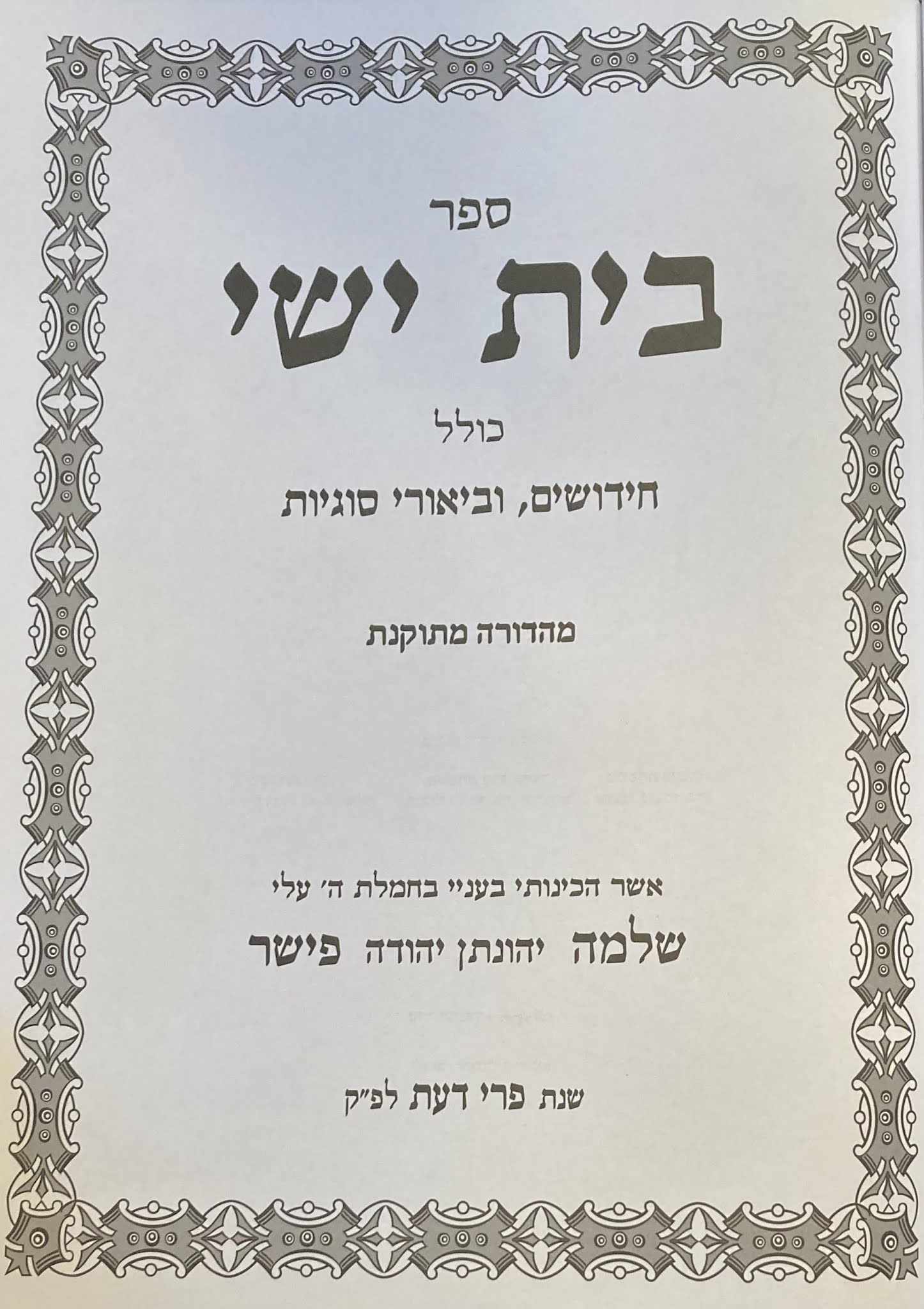
REPOSITORY OF THE HISTORY OF THE OLD YISHUV

I would be remiss if I did not mention Rabbi Fisher’s role as a historian. Having grown up in the Old Yishuv of Jerusalem, he was often able to set the record straight on many accounts.

For starters, Hakham Shelomo Eliezer Alfandari—unlike the distortion of Rabbi Asher Zelig Margulies and the dramatization of Mas‘ot Yerushalayim (Munkatsh, 1931)—was not a kanai or zealot. (On the other hand, Rabbi Shelomo Eliashov, author of the kabbalistic work, Leshem Shevo ve-Ahlamah, was a kanai.)

Rabbi Fisher knew too of the intimate friendship of Rabbi Akiva Porush and Rabbi Ya‘akov Moshe Harlap before “a mountain rose up between them” (“gavah tura beinayhu”). Once an inseparable havruta, Rabbi Porush would go on to become Rav Kook’s worst detractor, and Rabbi Harlap, Rav Kook’s greatest defender.

LAKU HA-ME’OROT” (“THE LIGHTS WENT OUT”)

Rav Shelomo passed on the fourteenth of Kislev, 5782. He was buried that evening on the Mount of Olives. On that very night, the fifteenth of Kislev, in faraway North America, we witnessed a spectacular lunar eclipse. (Some astronomers called it “a once in a century celestial event”; others, “once in five hundred years”; others, “once in a millennium.”) The beraita in b. Sukkah 29a states: “A lunar eclipse is a bad omen for Israel, for Israel count time by the moon.” (See the discussion in Beit Yishai Derashot, pp. 207-208, note 13, regarding the supposed philosophic problem posed by the scientific predictability of eclipses.)

SEEING THE INFINITE IN TORAH

If one would ask me what was so special about Rabbi Shelomo Fisher, I would respond (in the words of Rav Ya‘akov Moshe Harlap): Through Rabbi Shelomo, hk”m, “we merited to see the aspect of the Ein Sof, the Infinite, that is in Torah.” (See Mei Marom, vol. 8, Bereshit [Jerusalem, 1994], Noah, ma’amar 8, p. 28.)