Torah mi-Sinai and More

Torah mi-Sinai and More
by Marc B. Shapiro
1. Some people have requested that I do more posts on theological matters, as I have done in the past. So let me begin with what I think will be a three-part series on Torah mi-Sinai.
In a previous post, available here, I mentioned R. Shlomo Fisher’s rejection of R. Moshe Feinstein’s view that R. Yehudah he-Hasid’s “biblical criticism” was not authentic. As R. Fisher put it, R. Moshe assumed that even in the past everyone had to accept Maimonides’ principles, but that was not the case, and when it came to Mosaic authorship R. Yehudah he-Hasid disagreed with Maimonides. R. Uri Sharki has apparently also discussed this with R. Fisher, as he cites the latter as claiming that the issue of whether post-Mosaic additions are religiously objectionable is a dispute between the medieval Ashkenazic and Sephardic sages. See here
What this means is that in medieval Ashkenaz it was not regarded as heretical to posit post-Mosaic additions, while the opposite was the case in the Sephardic world (and this would explain why Ibn Ezra could only hint to his view). I am skeptical of this point, particularly because Ibn Ezra’s secrets are, in fact, explained openly by people who lived in the Sephardic world.[1] Yet Haym Soloveitchik has also recently made same point, and pointed to differences between Jews living in the Christian and Muslim worlds. His argument is that since medieval Ashkenazic Jews were not confronted with a theological challenge of the sort Jews dealt with in the Islamic world, where Jews were accused of altering the text of the Pentateuch, there was no assumption in medieval Europe that belief in what we know as Maimonides’ Eighth Principle was a binding doctrine of faith.
Here is some of what Soloveitchik wrote (the emphasis does not appear in the original):
One tanna had stated, simply and with no ado, that the last eight verses were of Divine origin but not of Mosaic authorship, and R. Yehudah he-Hasid added that there were several more verses that were not penned by Moses. Was such a position seen as being thoroughly mistaken? Most probably. Was it viewed as odd and non-conformist? Undoubtedly; though hardly more eccentric than R. Yehudah’s view that King David, to flesh out his book of Psalms, lifted from the text of the “original” Pentateuch many anonymous “psalms” that Moses had penned! Were these strange and misguided views, however, perceived as being in any way heretical or even dangerous? At that time and place, certainly not. They contained no concession to the surrounding culture, opened no Pandora’s Box of questions. Indeed, one can take the religious temperature of R. Yehudah he-Hasid’s explanation by the matter of fact way European medieval commentators (rishonim) treated the passages in Menahot and Bava Batra where the tannaitic dictum of Joshua’s authorship is brought.[2] In their world, these words did not abut any slippery slope of a “documentary hypothesis” or of “Jewish forgery”. No need, therefore, to reinterpret this passage or to forfend any untoward implications. What concerned R. Yehudah he-Hasid’s contemporaries, the Tosafists, in this statement were its practical halakhic implications for the Sabbath Torah readings, not its theological or dogmatic ones, for to them, as to R. Yehudah, there were none.[3]
Sharki, who is a leading kiruv figure in the Religious Zionist world, adds something quite amazing. From the standpoint of Ibn Ezra and R. Yehudah he-Hasid, which he sees as an acceptable approach, he writes that what is important is the belief that the Torah is true and from God.
 עיקר האמונה הוא להאמין שכל דברי התורה אמת ושהם מפי ה’
In other words, Mosaic authorship is not something people need to put such a focus on.
Sharki goes even further, stating that according to the Kuzari, post-Mosaic prophets could add to and delete material in the Torah. As support for this viewpoint, he cites an article by R. Yosef Kellner in Tzohar 22. (Kellner is a leading interpreter of R. Kook from the hardali camp.) I looked at Kellner’s article and found nothing that says this explicitly. However, I did find an interesting statement in Kellner’s article, and presumably this is what Sharki was referring to (although it still doesn’t say what Sharki claims it does):
אך לכוזרי, כמו לבה”ג, לא כל התרי”ג מצוות התגלו בסיני ההיסתורי, אם כי כולם דברי קבלה ממשה בסיני-הפנימי-נשמתי
This could be a very radical statement, depending on how it is interpreted. On the one hand, it could mean that some mitzvot in the Torah were actually established in a post-Mosaic era, but that is OK since these mitzvot arose from the spiritual wellsprings of Sinai. This is how Sharki must understand the passage. But I think it is obvious that Kellner doesn’t mean this at all, and the reference to the Halakhot Gedolot is the give-away. As is well known, the Halakhot Gedolot counts among the 613 commandments certain rabbinic laws. What the logic of this position is is not our concern at present. For our purposes what is important is that the Behag, and Kuzari, never say that  there are mitzvot in the Torah that are post-Mosaic, only that post-Mosaic mitzvot can be counted as part of the 613. There is an enormous difference between this understanding and the following, which is Sharki’s formulation:
לפי שיטת הכוזרי שגם הנביאים יכולים להוסיף או לגרוע בתורה, בניגוד לדעת הרמב”ם
David Halivni, Breaking the Tablets: Jewish Theology After the Shoah, p. 99 (called to my attention by Cemmie Green), states that according to R. Saadiah Gaon, “certain areas of the Law were originally more complete and more explicit in the Torah given by Moses to the people.” Here is the text he bases this statement on, found in Lewin’s introduction to Iggeret R. Sherira Gaon, p. X:
שבתורת משה אנו מוצאים הרבה ענינים הכתובים באריכות כמו למשל מעשה משכן, פרשת מלואים, פקודי ישראל וחנוכת המזבח. ובנגוד לזה כתובים בקצור נמרץ חוקי הזיבות, וחוקי עבור השנה נכללים רק במלת “אביב” גרידא, מה שהוא תמוה מאד אם לא נניח, שגם החוקים הללו היו כתובים באר היטיב אלא שאינם אצלינו בכתב אלא מסורים בעל פה.
It certainly does seem as if R. Saadiah is saying that some laws were removed from the Torah. Yet I also see how someone can argue that, contrary to Halivni, it does not say anything about these laws originally appearing in the Torah. It could be that he is only telling us that part of the “Oral Law” was written down in Moses’ day.
Assuming the latter explanation is what R. Saadiah means, there is good reason to assume that he was not being frank here. At a lecture at the University of Scranton, Prof. Daniel Lasker memorably stated that “all is fair in love and polemics.” If R. Saadiah issaying that part of the Oral Law was written down in Moses’ day, I believe he was twisting the truth as part of his battle with the Karaites. The Karaites were arguing that the Oral Law was not authentic, and R. Saadiah replied that not only was it authentic, but at least some of it was even written down in Moses’ day, thus precluding the sorts of errors that would arise from an oral tradition. R. Saadiah’s approach here would thus be no different than his claim that the calendar was the original way to determine the new moon, with sighting a later innovation. Already Maimonides declared that R. Saadiah did not really believe this, but found it useful to argue this way in the midst of a polemic against the Karaites.[4]
R. Yuval Sherlo was recently asked if it is acceptable to posit post-Mosaic authorship of passages of the Torah, following in the paths of R. Judah he-Hasid and Ibn Ezra.[5] Rather than reject the latter viewpoint, he claims that it is important to stress the ikkar ha-ikkarim, namely, that the authority of the Torah does not depend on who wrote it. What is crucial is that it was given by God. Even if there are verses that were written by someone else other than Moses, as was held by R. Judah he-Hasid and Ibn Ezra, this is not heresy, unless one assumes that these portions were not written through Divine Inspiration. Sherlo himself acknowledges that there is a good deal of evidence apparently pointing to the fact that some verses are post-Mosaic.
ישנם סימנים רבים בתורה שלכאורה מעידים על כך שחלק מפסוקי התורה נכתבו לאחר משה רבינו
 He concludes:
על כן, בשעה שמאמינים במוצא העליון המוחלט של כל פסוקי התורה אין איסור להרחיב את מה שאמרו חכמינו על הפסוקים האחרונים בתורה לעוד מקומות בתורה, בשל העיקרון הבסיסי הקיים בדברים אלה – התורה היא מוצא “פיו” המוחלט של ריבונו של עולם.
Needless to say, this is in direct contradiction to Maimonides’ Eighth Principle, and is an opening for Higher Biblical Criticism to enter the Orthodox world. For those who don’t read Hebrew, what Sherlo is saying is that Mosaic authorship does not matter, as long as one accepts that the Torah is divine. This is a huge theological step (a “game changer”), which for those who accept it entirely alters the playing field. This is such a break with the standard Orthodox view that I don’t know why Sherlo’s position has not received any publicity. Let me say it again, in case people haven’t been paying close attention: Sherlo’s argument permits Higher Criticism, as long as one asserts that the entire Torah is divinely inspired.
Sherlo is not some fringe figure. He is Rosh Yeshiva of the Hesder Yeshiva in Petah Tikva and a major personality in religious Zionism. (In the next installment of this series I will present further evidence that in some parts of the Modern Orthodox world the old taboo against Higher Criticism has begun to fade.)
Not surprisingly, Sherlo’s position was challenged by some commenters and he in turn defended what he wrote. Interestingly, one of the commenters writes about Ezra editing the Torah, and Sherlo does not reject this. Instead, he asserts that whoever arranged the Torah did it with prophecy that was the equal of Moses’ prophecy.
מי שסידר את התורה אף הוא עשה זאת בנבואה [!] התורה ולא בנבואה שהיא פחות מנבואת משה רבינו
In other words, Sherlo has adopted Rosenzweig’s point that “R”, instead of standing for “Redactor”, really means “Rabbenu.”[6]
When this formulation was challenged, since how could there be prophets of the level of Moses as this would contradict the Seventh Principle, Sherlo was unperturbed.
[שאלה] מה פירוש נביא שסדר את התורה עשה זאת בנבואת משה רבינו. האם היו עוד נביאים כמשה? הלא מעיקרי הדת שלא היו.
[תשובה] לפי הרמב“ם אלו עיקרי הדת. ברם, אפילו אמוראים סברו אחרת לגבי הפסוקים האחרונים בתורה
In other words, since there are amoraim who disagree with Maimonides’ Principle, it is not binding.[7]
In speaking of the Torah, Sherlo uses this provocative formulation (emphasis added):
ניסוח התורה הוא ניסוח שאנו מתייחסים אליו כולו כאילו כולו יצא מרבונו של עולם בדרגת “תורה” ולא בדרגה נמוכה ממנה.
One of the commenters asks as follows (and both of the possibilities he suggests are far from traditional):
הרב כותב כי “ניסוח התורה הוא ניסוח שאנו מתייחסים אליו כולו כאילו כולו יצא מריבונו של עולם”. האם זהו רק יחס שלנו, והיינו שיש לכתוב סמכות של תורה, או שבאמת אלוקים דיבר וסיעתו של עזרא כתבה?
Sherlo replies that he simply does not know, and that we don’t know what the Torah looked like in the years after it was given (until the days when the Torah she-ba’al peh was written down, and quotations of the Torah are found there). In other words, it might be significantly different than the Torah we have today:
אנחנו לא יודעים. יש חור שחור בתולדות מסירת התורה, כי אין לנו בדיוק מושג מה היה באלף השנים שבין מתן תורה לבין כתיבת התורה שבעל פה. לכן התנסחתי בנוסח זה.
In a previous post I already called attention to a comment by the great R. Solomon David Sassoon, who wrote as follows (Natan Hokhmah li-Shelomo, p. 106 [emphasis in original; I learnt of this passage from  R. Moshe Shamah]):

אבל אם יאמר פסוקים אלה נביא אחר כתב אותם מפי הגבורה ומודה שקטע זה הוא מן השמים ומפי הגבורה, אדם שאומר כך אינו נקרא אפיקורוס, מה שהגדיר אותו כאפיקורוס אינו זה שאמר שלא משה כתב את הקטע אלא בזה שהוא אומר שדבר שזה מדעתו ומפי עצמו אמרו ושאין זה מן השמים

This too can provide a religious justification for Biblical Criticism.

Let me make one more comment relating to Biblical Criticism. (There is, of course, more to say, but this can wait until the next installment.) Those who have read my posts know that I find it very interesting when Orthodox figures attack a position as foolish or heretical not knowing that this very position was stated by a great sage. If one was dealing with a detached academic, obviously heresy wouldn’t be a concern. And as for regarding a position as foolish, even if it is pointed out to the detached academic that, for example, Aristotle held this view, he would not retract from his statement that the position he criticized was foolish. It would just be an example where the great Aristotle adopted a foolish position. But in the Torah world, this sort of attitude is improper, so people are in a bind when they learn that the position they thought was foolish was actually held by a great sage.[8] In many cases I assume the people cannot change the way they think. They still think the position is foolish, but they can’t say this publicly anymore. Let me given an example of this relating to Biblical Criticism.

As is well-known, one of the arguments of early Biblical Criticism was that the “Book of the Law”, found by Hilkiah and given to Josiah (see 2 Kings 22 and 2 Chronicles 34), was actually the book of Deuteronomy, which the Critics assume to be the latest of the books of the Pentateuch.[9] They regard it as a pseudepigraphical document, attributed to Moses. In other words, it was a pious fraud created to provide the basis for Josiah’s reform. Readers can correct me if I’m wrong, but I don’t think that this theory has many advocates in recent scholarship. In any event, what concerns me here is that when rabbis and polemicists argue against Biblical Criticism, they often tear part the claim that Deuteronomy is the subject of the Josiah story. One can find lectures online where the speaker will mention this notion, and then reject it with great contempt. The attitude expressed is that anyone with any understanding of the Torah, or even of simple peshat of the relevant verses, would realize that Josiah story must be dealing with a complete Torah, not one book of the Pentateuch. Some go so far as to make it seem that only an idiot could conclude that Josiah is dealing with the book of Deuteronomy. For a traditionalist, this would appear to make perfect sense, since who ever heard of dividing the Torah into separate scrolls?[10]         
Yet if the people arguing so strongly against the Josiah-Deuteronomy connection would look at the version of the story in 2 Chron. 34, they would find something that would shock them. While verses 14 and 15 speak of finding ספר תורת ה’ ביד משה  and ספר התורה, the commentary attributed to Rashi understands this to mean משנה תורה, i.e., the book of Deuteronomy! In other words, the position of the Bible Critics as to which book was “found”,[11] and the position attacked so mercilessly by the opponents of the Biblical Critics, is in fact held by a rishon! I am not saying that this rishon is a proto-Biblical Critic, or that he denies the Mosaic authorship of Deuteronomy. But he does say that the book found, and which was read to Josiah and so affected him, was not the Torah itself, but only the book of Deuteronomy. I grant that this is an unusual position, but now that we have seen what this rishon holds, does this mean that this viewpoint now has to be treated with more respect, as opposed to the current treatment it gets at the hands of Orthodox polemicists?[12]
This notion, that the book Hilkiah found was Deuteronomy, is also advocated by R. Elijah Benamozegh. [13] Benamozegh states that if this viewpoint is correct, it means that from early on there was a practice to write the book of Deuteronomy separately from the rest of the Pentateuch. He also cites a rabbinic view that the Torah that the king carried was only the book of Deuteronomy.[14] Based upon this, he explains why the book found was brought to the king, since it was precisely this book that the king was obligated to write and carry with himself. Benamozegh concludes:
סוף דבר קרוב ונראה שהיו מעתיקים ס’ מ”ת בפ”ע כמו שנוכיח להבא בע”ה כי ספר תורת משה נכתבה בימי קדם חלקים ונתחים כל א’ בפ”ע, ובראש כל אתוון מה שהעידו רבותינו באומרם: תורה מגלה מגלה נתנה
2. Since in the previous section I referred to Ibn Ezra’s view on post-Mosaic additions to the Torah, let me say a little bit more about this. At the beginning of his commentary to Deuteronomy chapter 34, Ibn Ezra states that the last twelve verses of the Pentateuch were written by Joshua. The Talmud only offers this possibility concerning the last eight verses. The Kol Bo, Seder Tefillat ha-Moadot (ed. Avraham [Jerusalem, 1992), vol. 3, p. 220) writes:
ושמנה פסוקים אשר בזאת הברכה שהם מויעל משה עד ויהושע בן נון, יחיד קורא אותם.
The problem with this formulation is that there are twelve verses from ויעל משה (Deut. 34:1), not eight. I presume that instead of ויעל משה  the text should read וימת משה (Deut. 34:5), which is the eighth verse from the end and what the Talmud refers to. It is also possible that instead of stating “eight verses” it should read “twelve verses,” and the Kol Bo would then be agreeing with Ibn Ezra.[15]
In The Limits of Orthodox Theology I referred to Avat Nefesh, an anonymous medieval commentary on Ibn Ezra, as one of those who understood the latter as positing post-Mosaic additions. I had access to the Genesis portion of the commentary which appeared in William Gartig’s 1994 Hebrew Union College doctoral dissertation. A typescript of the complete commentary is now available on Otzar ha-Hokhmah, and this typescript pre-dates 1994. (In the preface to the typescript, the transcriber presents evidence that the author is R. Yedayah ha-Penini [ca. 1270-1340].)[16] In his commentary to Gen. 12:6, Avat Nefesh states that according to Ibn Ezra “many verses” in the Torah were only added after Moses’ death. He also notes that this is the focus of most of Ibn Ezra’s “secrets”.
כי כונתו שזה לא כתב משה אך נכתב אחר שנכבשה הארץ וכן דעתו בהרבה פסוקים ורוב סודותיו סובבים בזה כאשר אמר בראש אלה הדברים.
With the complete commentary we can also see what he says in Deut. 1:1. Here again he explains Ibn Ezra’s secret to be referring to post-Mosaic verses. Yet he also expresses his disagreement with Ibn Ezra and defends Mosaic authorship, although it is not clear if he is disagreeing in general or only with regard to the example he is discussing, where he explains why the expression בעבר הירדן is not an anachronism.
The principle by which Ibn Ezra determined that certain verses are post-Mosaic is if they contain what he regarded as clear anachronisms. All of the examples he gives in his commentary to Deut. 1:1 fall into this category. R. Joseph Bonfils famously argues that while Ibn Ezra acknowledged post-Mosaic additions of individual words and verses, which function as explanatory glosses, Ibn Ezra did not believe that there could be entire sections that are post-Mosaic. This is how Bonfils explains why Ibn Ezra, in his commentary to Gen. 36:31, responded so sharply to Yitzhaki’s suggestion that Gen. 36:31-39 is post-Mosaic:
וחלילה חלילה שהדבר עמו . . . וספרו ראוי להשרף
The problem with these verses is that they begin with the following: “And these are the kings that reigned in the land of Edom, before there reigned any king over the children of Israel.” Some viewed it is an anachronism to speak of the Israelite monarchy when still in the desert. As mentioned in The Limits of Orthodox Theology, R. Judah he-Hasid, R. Avigdor Katz, and according to one Tosafist collection also Rashbam identified these verses as post-Mosaic. As far as I can tell, there is no evidence to support Bonfil’s supposition that Ibn Ezra, for dogmatic reasons, denied that there could be post-Mosaic additions of entire sections. In the case of Gen. 36:31-39, there are internal reasons why Ibn Ezra would not see it as problematic, as he explains in his commentary.
Returning to Avat Nefesh, there is something else noteworthy in the commentary. He mentions that Ibn Ezra believes that “many verses” are post-Mosaic. Although Ibn Ezra himself doesn’t supply us with that many verses, once we assume that Ibn Ezra was guided by what he viewed as anachronisms in pointing to post-Mosaic additions, there is no reason to conclude that the examples he gives in his commentary to Deut. 1:1 exhaust the list. In support of Avat Nefesh’s point, let me mention the following: Ibn Ezra lists Gen. 12:6, “And the Canaanite was then in the land,” as one of the post-Mosaic additions. Understood according to their simple sense, these words can be seen as anachronistic as the Canaanites were still in the Land of Israel in the days of Moses. In other words, the words are written from the perspective of one living in a generation when there were no longer Canaanites in the Land of Israel. If these words are post-Mosaic, then the second half of Gen. 13:7 must also be post-Mosaic, as it says, “And the Canaanite and the Perizzite dwelt then in the land.” Just as Ibn Ezra didn’t feel it was necessary to spell out his view with regard to Gen. 13:7, so too, Avat Nefesh believes, there are other similar cases.
Avat Nefesh provides an example of this in his commentary to Num. 13:24, where he writes that according to Ibn Ezra (see his commentary, ibid.) at least some of what appears in this verse was written in the days of the Judges.
ר”ל שוירדוף עד דן נכתב לפי דעתו בימי השופטים שאז נקרא שם העיר דן כשם דן אביהם, כן כוונתו בנחל אשכול שנכתב אחרי כן בשמו שקראו הקורא
3. Let us now return to R. Shlomo Fisher, with whom we began this post. Despite coming from a very haredi background, he has close ties with the religious Zionist world. You can see many of his shiurim on www.yeshiva.org.il and here is his picture.
It is because of his ties with religious Zionists that R. Shach criticized him in conversation with R. Mordechai Elefant, late Rosh Yeshiva of the ITRI yeshiva, presumably as a way of pressuring R. Elefant to fire R. Fisher.

Here is how R. Elefant told the story, in his own words:

Rav Shlomo Fisher is a member of my faculty and one of the most brilliant talmudists of this generation. He was born and raised in the heart of Meah Shearim, but he has connections with religious Zionist institutions. I once came into Rav Shach, and he started calling Rav Shlomo a kalyekker [someone not firmly devoted to the purest Torah ideals]. I was annoyed, but I didn’t say anything. This happened a second time. I said to myself then, “If this happens again, I have to do something about it.” It happened again. So I went into Rav Shlomo’s room here in the yeshiva, and I took out a letter written by the Steipler in which he calls Rav Shlomo “pe’er ha-dor” (glory of the generation). Next time I went to Rav Shach, he said again that Rav Shlomo is a kalyekker. I said, “Rav Shach, listen to me. The Steipler is also a kalyekker.” He looked at me like I was crazy, but then I showed him the letter. I never heard any more complaints about Rav Shlomo. I told this to Rav Shlomo and it didn’t mean a thing to him. The only thing he cares about is understanding the Torah.
R. Elefant continued with the following story:
Then there was a time when a member of my own staff came to me with similar objections. He wanted me to get rid of Rav Shlomo. He quotes Bialik, Nietzsche, and all sorts of other things that are generally unacceptable in yeshivot.[17] I told him, “You’re right, but I’ve got one problem. You and me, we can teach these boys here how to understand Talmud. But there’s a lot more to education than that. Who’s going to teach these kids about purity, humility, and integrity? You? Me? That’s what we need Rav Shlomo for.” The guy chuckled and agreed with me.
I have previously mentioned that R. Fisher is, to my knowledge, the only gadol be-Yisrael who is also an expert in medieval Jewish philosophy. Many are disappointed that he does not take a public profile and express his views on issues of the day. If you are part of the group that studies with him every week, then you are fortunate to hear his views (which sometimes filter out). But what about the rest of the world?
A couple more stories R. Elefant told of his relationship with R. Shach are worth repeating. The two of them were close friends for decades, from before the time when R. Shach was recognized as the leader of the Lithuanian Torah world. That is why R. Elefant was able to speak to him in a way that others would never have dared.
Once R. Elefant was in Bnei Brak to give a shiur, and he went to visit R. Shach.
I went into Rav Shach’s room. He greeted me and asked what my lecture was about. I said, “Rav Shach, let’s be frank with each other. You don’t want to know what I lectured about, and I don’t want to know what you lectured about. I came here because you want to shoot the breeze.” His laugh was worth a million bucks to me.

The other story relates to a conflict between R. Shach and R. Yehudah Zev Segal of Manchester. R. Shach was upset with R. Segal because the latter didn’t accept R. Shach’s views which were creating great conflict between the yeshiva world and the hasidim.

Rav Shach heard that I was a friend of Rabbi Segal’s, so he told me he wanted to talk with me about him next time I was in Bnei Brak. It wasn’t too long before I was there, and Rav Shach asked me what I knew about Rabbi Segal. I told him, “I’ll tell you the truth. Rav Shach, you are the most powerful man in this world. You build governments, you break governments. What you say goes. People say about you “kocho ug’vuraso molei olam.” But Rabbi Segal is different. His opinion counts over there in the other world.Rav Shach’s attendants were dumbstruck. They couldn’t believe I had the nerve to say that to his face. But I didn’t meant to insult Rav Shach and he wasn’t fazed. He asked, “Do you really mean that?” I said I did, and after that he left Rabbi Segal alone.
Here is some of what R. Elefant said about Saul Lieberman.

When Lieberman came to Israel, the Brisker Rav acted like he was his best friend. They asked him why, and he had a one-word explanation, “mishpochoh.” They were cousins.

One of the Rav’s sons, I think it was Meir, got engaged to a girl from a family called Benedikt. I was invited to the engagement party. The Brisker Rav was sitting next to Saul Lieberman. I saw it. On Lieberman’s other side was the Mir Rosh Yeshiva, Reb Leizer Yehudah Finkel. That time Lieberman was persona non grata.
Here is another story from R. Elefant.
Lieberman was good friends with Rav Hutner. They were both students of Rav Kook, and they palled around in New York back in the fifties. They both used to go to the 42nd Street Library because there were lots of seforim there. Rav Hutner had a beard as black as coal back then. He wore a short jacket. Lieberman was once standing there in the library and who should come in but his friend, Rav Hutner. Lieberman says in Yiddish, “Here comes God’s dog.” Rav Hutner retorted, “Better to be a dog of God than to be a god to dogs.” Rav Hutner told me that one himself.
4. In a recent post on his blog, R. Daniel Eidensohn refers to my comment in this post where I suggested that the lenient attitude towards pedophilia in much of right wing Orthodoxy is due to the fact that the real trauma of sexual abuse is not something that one can learn about in traditional Jewish sources but comes to us from psychology, and as such is suspect in those circles that see psychology as a “non-Jewish” discipline. Let me offer another example that illustrates how today we take sexual abuse much more seriously than in previous years. Here is a responsum no. 378 from R. Joseph Hayyim’s Torah li-Shemah.

As you can see, the sexual abuse of a child under nine years old was not regarded by him as an earth-shattering violation (certainly not at the level of violating Shabbat or eating non-kosher food). While we regard child sexual abuse as one of the worst things imaginable, it is easy to see how someone whose only exposure to these matters would have been through traditional sources would not see it as such a terrible offense, namely, an offense that would require one turn the person into the police. In another responsum, Torah li-Shemah no. 441, R. Joseph Hayyim writes as follows regarding one who has sex with a child under nine years old:
והרי זה הבועל כמי שמשחית זרעו ע”ג עצם ואבנים
In other words, he sees this as an issue of wasting seed, without any cognizance of the terrible damage done to the child.[18] Responsa like this are important in showing how, with increased knowledge, attitudes have changed. What our generation regards as the most vile behavior was often seen in a very different light in previous generations. This is the only limud zekhut for those who in past years did not take sexual abuse seriously.
R. Ysoscher Katz also called my attention to a relevant discussion on a Yiddish site. See here. One of the matters discussed is a responsum of R. Yair Hayyim Bacharach, Havot Yair no. 108.

I think any modern person reading it will be surprised to see that there is no emotion shown, no reflection on the difficult circumstances of the girl. Everything is examined from a halakhic standpoint. But this again shows how differently we approach these sorts of matters than was the case years ago.
If sexual abuse is treated just like another sexual transgression, then the lenient approach some rabbis have adopted towards it makes sense. After all, shouldn’t a rabbi want to give a sinner the opportunity to repent? Sexual sins have always been regarded differently than kashrut or Shabbat violations. If a rebbe was seen eating a hamburger in McDonalds or driving on Shabbat he would immediately be fired, without any opportunity to repent. But more leeway is given when it comes to sexual sins, the reason being, no doubt, that everyone understands the power of the evil inclination in this area. A good illustration of my point is seen in R. Aaron Walkin, Zekan Aharon, vol. 2, no. 30.

The responsum deals with a shochet who was seen entering the home of a “loose” woman. R. Zalman Sorotzkin didn’t know what do about it and wrote to R. Walkin. R. Walkin refuses to disqualify the shochet, and tells R. Sorotzkin that even if there were two witnesses testifying to the matter it would not change his mind, since this would only turn the shochet into a mumar le-davar ehad! It is true that not all rabbis would have been as lenient as R. Walkin,[19] but the fact that this great posek ruled the way he did is quite significant.[20]

Finally, I am curious to hear what some of the lawyers reading this post have to say about the following: Some time ago, I was contacted by a man who wanted to talk to me about being an expert witness for the defense in the appeal of a sexual abuse conviction. The case is actually one of the worst we have seen. I was told that my role would only be to answer questions about sexual mores in the hasidic world, in particular, how they understand tzeniut. While I am far from an expert on this, not being from that world, the defense team wanted an academic on the stand. (Needless to say, there are academics who would also be much better choices than me.) .

Nothing came of this discussion, and I myself decided that I would have nothing to do with the case after learning the particulars, which are indeed sickening. My question is as follows: We know that defense lawyers are not personally tainted even if they represent horrible people. We recognize that this is their job. My sense is that people would not give the same leeway to an expert witness, and he would be viewed very negatively, as one who was helping to free a sexual abuser. Yet I would like to get some feedback from the lawyers. If I would have agreed to be called to the stand to answer general questions about halakhah and tzeniut, does the fact that I was part of the defense team’s strategy mean that I would be “helping” the defense? It was made clear to me that my role would be to simply to answer general questions and I would have nothing to do with the defendant per se. Another way of framing the question is, would it have been immoral for me to agree to this role if, after having examined the evidence, I was convinced that the defendant committed terrible crimes and  should remain in jail?  

5. For the runoff quiz I asked the following:

A. What is the first volume of responsa published in the lifetime of its author?
B. There is a verse in the book of Exodus which has a very strange vocalization of a word, found nowhere else in Tanach. (The word itself is also spelled in an unusual fashion, found only one other time in Tanach). The purpose of this vocalization is apparently in order to make a rhyme. What am I referring to?
Some got the answer to the first question, and others got the answer to the second question. But only one person, Peretz Mochkin, got the answers to both.
The answer to the first question is the responsa volume Binyamin Ze’ev (Venice, 1539), by R. Benjamin Ze’ev of Arta.
The answer to the second question is the word אתכה in Ex. 29:35. It is spelled and vocalized the way it is in order to rhyme with the word ככה that appears earlier in the sentence.
וְעָשִׂיתָ לְאַהֲרֹן וּלְבָנָיו, כָּכָה, כְּכֹל אֲשֶׁר-צִוִּיתִי, אֹתָכָה
One of the sources that refers to this text is Zev Grossman, Darkhei ha-Melitzah be-Sefer Tehillim. This is a very interesting book on aspects of grammar in Tanach. Here is the title page, with an approbation of sorts from William Chomsky. I don’t know of any other book that puts the approbation on the title page, and in this case the approbation is in English. (William Chomsky, incidentally, is the father of Noam Chomsky.)

One of the things Grossman points out in his book is that there are many examples of verses where we find words in non-grammatical forms in order that they rhyme. Here is just one example, from Psalms 5:8:
וַאֲנִי–בְּרֹב חַסְדְּךָ, אָבוֹא בֵיתֶךָ;    אֶשְׁתַּחֲוֶה אֶל-הֵיכַל-קָדְשְׁךָ, בְּיִרְאָתֶךָ
In context, the final word, ביראתך, means “in fear of you”, even though this is not grammatically correct. This form is used to make the rhyme, because if one were applying grammatical rules it would not be spelled this way.
At the end of the Hebrew section of the book, Grossman has a page listing his published books.

As you can see, he also produced a set of gedolim cards. When I was young, in the 1970s, there were gedolim cards. I know this because I collected them.[21] But I never imagined that they existed already in the early 1950s.
6. In my post of January 13, 2013, I wrote: “R. Meir Schiff (Maharam Schiff) is unique in believing that one without arms should put the tefillin shel yad on the head, together with the tefillin shel rosh. This is the upshot of his comment to Gittin 58a.” I saw this comment of Maharam Schiff many years ago, and unfortunately did not examine it carefully before adding this note. As R. Ezra Bick has correctly pointed out, Maharam Schiff is not speaking about wearing tefillin shel yad on the head to fulfill the mitzvah, but only stating that this is a respectful way to carry the tefillin shel yad if you have to remove it from your arm. This has no relevance to what I wrote about someone without arms (unless he has to carry the tefillin shel yad).

[1] In The Limits of Orthodox Theology I listed numerous rishonim and aharonim who understood Ibn Ezra’s hints to mean that there are post-Mosaic additions the Torah. I have added to this list in various blog posts, and we are now up to around thirty-five different sources. Yet until now I overlooked an important text, namely, a comment by Tosafot. See Tosafot ha-Shalem, ed. Gellis, to Gen. 12:6 (p. 14):
זהו אמרו ואם איננו כן יש לו סוד, כי כוונתו שזה לא כתבו משה אך נכתב אחר שנכבשה, וכן דעתו בהרבה פסוקים
Tosafot rejects this opinion, stating:
 ואנחנו לא ניאות בזה הדעת שכל התורה כתבה משה מפי ה’ בלא חילוק ושנוי.
It is significant that Tosafot does not refer to Ibn Ezra’s interpretation as heretical. For another source that assumes that Ibn Ezra believes that there are post-Mosaic additions in the Torah, see R. Aharon Friedman, Be-Har ha-Shem Yeraeh (Kerem be-Yavneh, 2009), p. 30.
[2] I am aware of no evidence that the rishonim in the Islamic world interpreted these passages in a fundamentally different way than the Ashkenazic rishonim. As noted in The Limits of Orthodox Theology, R. Joseph Ibn Migash openly accepted the viewpoint that Joshua wrote the last eight verses of the Torah.
[3] “Two Notes on the Commentary on the Torah of R. Yehudah he-Hasid,” in Michael A. Shmidman, ed. Turim (New York, 2008), pp. 245-246. In his just published The Intellectual History and Rabbinic Culture of Medieval Ashkenaz (Detroit, 2013), p. 32, Ephraim Kanarfogel writes: “The availability of this kind of interpretational freedom and variety also allowed Hasidei Ashkenaz to be comfortable with Ibn Ezra’s stipulation of verses that may have been added to the Torah after the revelation at Sinai.” 
[4] I deal with this in my forthcoming book, where the relevant citations will be found.
[5] See here
http://www.moreshet.co.il/web/shut/shut2.asp?id=68707
[6] Rosenzweig wrote: “We, however, take this R to stand not for Redactor but for rabbenu [our rabbi]. For whoever he was, and whatever text lay before him, he is our teacher, and his theology is our teaching.” See Dan Avnon, Martin Buber: The Hidden Dialogue (Lanham, 1998), p. 50.
[7] Sherlo’s answer is not clear. He was asked about the Seventh Principle, that Moses’ prophecy is superior to all others. Rather than replying to this, he answers that there were amoraim who did not think that Moses wrote the last verses of the Torah. This, however, relates to the Eighth Principle, not the Seventh. None of the amoraim who thought that Joshua wrote the last verses assumed that he was on Moses’ prophetic level, so Sherlo’s answer is really a non-sequitur.
[8] In recent years I have seen many examples of this. Some extreme statement or ban is attributed to a haredi gadol, and commenters on haredi news sites declare that Gadol X could never have made such a hurtful and counterproductive statement. These commenters argue that it must be the “askanim” who are responsible for this. (I specifically remember such arguments in the first few days after the ban on Making of a Godol was announced.) When a few days later it becomes clear that the statement is accurate, and was indeed made by the gadol, what then are these people to do, people who just a few days prior were so adamant in rejecting the position? 

People convincing themselves that their leaders could not really mean what they say is obviously not merely a haredi issue. Here is what Paul Veyne writes: “Under France’s Old Regime, people believed and wanted to believe in the king’s kindness and that the entire problem was the fault of his ministers. If this were not the case, all was lost, since one could not hope to expel the king the way one could remove a mere minister.” See Did the Greeks Believe in Their Myths (Chicago, 1988), p. 91.

[9] Regarding the Sefer Torah found by Hilkiah, R. Jacob Emden, Birat Migdal Oz (Zhitomir, 1874), p. 152a, claims that Josiah was unable to read the old Hebrew script in this Torah, and that is why it had to be read to him. For a rejection of this view, see R. Jacob Bachrach, Ha-Yahas la-Ketav Ashuri u-le-Toldotav (Warsaw, 1854), pp. 47-48.
[10] The division of the Pentateuch into different books is itself quite ancient. See R. Hayyim Hirschensohn, Seder la-Mikra (Jerusalem, 1933), vol. 1, p. 52.
[11] As mentioned already, the Bible Critics of whom I speak don’t really believe that it was “found”.
[12] There is another unusual tradition that appears in Yemenite texts according to which the entire Torah (and also the rest of the Bible) was forgotten by the Jews during the First Exile, and Ezra later reconstituted it from memory. See R. Saadiah ben David, Midrash ha-Beur, ed. Kafih, vol. 2, p. 676. See also here.
[13] Mavo le-Torah she-Baal Peh, ed. Zini (Jerusalem, 2002), pp. 25-26.
[14] See also Bezalel Naor, The Limit of Intellectual Freedom (Spring Valley, 2011), pp. 77, 253. In Deut. 17:18 it says about the king: וְהָיָה כְשִׁבְתּוֹ, עַל כִּסֵּא מַמְלַכְתּוֹ–וְכָתַב לוֹ אֶת-מִשְׁנֵה הַתּוֹרָה הַזֹּאת
For a rejection of the view that the words “Mishneh Torah” refer to Deuteronomy, see Bachrach, Ha-Yahas la-Ketav Ashuri u-le-Toldotav, p. 70.
I have often heard the notion expressed, in line with Ibn Ezra to Deut. 4:14, Nahmanides to Lev. 8:38 and in his introduction toDeuteronomy, and Abarbanel in his introduction to Deuteronomy, that all of the mitzvot were given at Sinai or soon after. I don’t think this is the simple meaning of the Torah. After all, there are loads of mitzvot in the book of Deuteronomy, and this was years after the revelation at Sinai. Apparently, Nahmanides’ viewpoint was motivated by his dogmatic assumption. R. Bahya ben Asher, Commentary to Gen. 24:22, and Radbaz did not share Nahmanides’ outlook, with Radbaz writing: ודברי [הרמב”ן] תימה הם בעיני. See She’elot u-Teshuvot ha-Radbaz, no. 2143. Radbaz has a very provocative formulation in this responsum, and I am not sure what to make of it.
אין הכי נמי שצוה במצוות רבות בערבות מואב וכמה מצוות מצינו שאמרן משה לישראל ולא נאמר בהם צו את בני ישראל או דבר אל בני ישראל אלא משה יושב ודורש והכל יודעין שהכל מפי הגבורה
The words משה יושב ודורש are found in Bava Batra 119b where it means that Moses was expounding on a certain biblical law. As these words are used here, however, they appear to mean that Moses generated new mitzvot by means his יושב ודורש. This is not the same as God directly informing Moses of these new commandments, and I don’t know any earlier source that portrays mitzvot as originating in this fashion. It is also contradicted by how Maimonides describes the revelation of the Torah in his Eighth Principle.
               
Yet I am not certain about this, since the passage immediately following the one quoted above seems to offer a different perspective: 
וכל המצוות המחודשות אשר במשנה תורה הקב”ה אמר למשה בערבות מואב ומשה אמרן לישראל בכלל שבאר להם המצוות אשר כבר נאמרו וכל מה שנתחדש בהם מפי הקב”ה הוא ומשה לא דרש דבר מדעתו.
[15] See R. Eliah Shapiro, Eliah Rabbah 669:17.
[16] Avat Nefesh is discussed here.
[17] One student told me that he would often cite Kierkegaard.
[18] Both of these responsa, and others as well, are analyzed by Dr. Yitzhak Hershkowitz in a forthcoming article. I thank him for sharing his article with me prior to publication.
[19] For more stringent rulings, see R. Yekutiel Yehudah Greenwald, Ha-Shohet ve-ha-Shehitah ve-Sifrut ha-Rabbanut (New York, 1955), pp. 86ff.
[20] In Between the Yeshiva World and Modern Orthodoxy, p. 211 n. 172, I refer to R. Walkin as R. Jehiel Jacob Weinberg’s “short lived successor to the rabbinate of Pilwishki.” Some have wondered how I know this information, and indeed there is nothing about this in Eliezer Katzman’s articles on R. Walkin in Yeshurun vols. 11 and 12. That R. Walkin was rav of Pilwishki is found in R. Weinberg’s article about the town in Kitvei R. Weinberg, vol. 2, p. 390. In a letter to R. Kook, R. Walkin asks his advice on whether he should accept the rabbinate of Pilwishki. See Iggerot la-Reiyah (Jerusalem, 1990), no. 151. The date given in R. Walkin’s letter to R. Kook is Heshvan 5684 (1923), but this can’t be correct, as by this time R. Walkin was the rav of Pinsk. The original must say תרפ”ב not  תרפ”ג.
[21] A few readers might remember my bar mitzvah party, where some of these gedolim pictures were turned into posters. Also, smaller blow-ups were placed on each table as the table identifier. While most of the posters were thrown out, I saved one. When I attended JEC in Elizabeth for high school, I brought in the poster made from this picture of R. Elchanan Wasserman, and hung it on my classroom wall..

Everyone in the class thought this was very nice. One day I came to school and the poster was gone. Someone told me that R. Pinchas Teitz had taken it down. I couldn’t for the life of me understand why he would do that. I didn’t know then what I know now, about how many people strongly opposed R. Elchanan’s viewpoints (e.g., R. Zvi Yehudah Kook wouldn’t allow R. Elchanan’s Kovetz Ma’amarim in Merkaz ha-Rav’s library. See Hilah Wolberstein, Mashmia Yeshuah [Or Etzion, 2010], pp. 192-193, 404). But even if I knew that, this would not have been a reason for R. Teitz to take down the poster. I went to see him, first to get my poster back, and also to understand why he took it down. He explained that since we had a minyan in the classroom, it was improper to have a picture of a man on the wall, even if this man was R. Elchanan.


In Praise of the Soncino Talmud

In Praise of the Soncino Talmud
By David S Farkas*

Not long ago one of our local schools hosted a Giveaway day in its library, making many of the older seforim in its considerable collection free to a good home. As expected, the local citizenry plundered and pillaged, carrying off large numbers of books, many still in quite good condition. I was only able to attend towards the end, “after the last of the gleaners had gone.”[1] Only a few scattered Siddurim and Chumashim were left, when I spotted a box in a corner of the room, filled with small red volumes. Close inspection revealed that the books were none other than the Soncino Talmud, a complete set. My heart sank a little to see this classic work, neglected and abandoned. I felt, in a small way, as though I had seen the tongue of Chutzpith the Translator lying in the dust.[2]

The Soncino Press sees no press at all these days, it seems. Its groundbreaking complete English translation of the Talmud has almost entirely been supplanted by Artscroll’s Schottenstein edition. Indeed, studying with the latter presents a very much different type of engagement with the Gemara, and Artscroll has undoubtedly done a master job of it. Yet for all of its depth and analysis, Soncino to this day brings to the table things that Artscroll does not. What follows, then, is not an attempt to sing the praises of one at the expense of the other, but only to point out some of the unique features of the now-neglected Soncino, and to suggest some of its alleged flaws may have been greatly exaggerated.[3]

To begin with, the canard so many of us heard in our yeshiva days – that Soncino was edited by less than fully-religious Jews – is a terrible misimpression that, to the best of my knowledge, seems to be based purely on the evidence that it was edited by a man named Isidore. Yet Rabbi Yechezkel Epstein (as he is in fact identified, in Hebrew, on the opposite front-page of most volumes) was very much an observant Jew, who attended the Pressburg Yeshivah founded by the Chasam Sofer, and was said to know Shas by heart. The project began with Seder Nezikin in 1935 with a heartfelt prayer to Almighty God, capped with the traditional phrase יה”ר מלפני ה’ כשם שעזרתני לסיים סדר נזיקין, כן תעזרני להתחיל סדרים אחרים ולסיימם.  It concluded in 1948, as printed in Seder Kodshim, with a heartfelt תם ונשלם שבח לבורא עולם, and the traditional Hadran written out nearly in full. We can certainly say of Soncino, if we may modify R. Yosi’s summation of Kelim, “Happy art thou, Soncino – thou began in purity, and finished in purity.”[4]

Moreover, a review of the individual contributors to each volume – a list that, to my knowledge, has never before been assembled – reveals that each and every one of them were strictly orthodox, and not identified with any other stream of Judaism.[5]

The entire series is written in the best of the King’s English. Somewhat amusingly, this itself has sometimes been offered as a reason not to use the Soncino, as though students today are incapable of understanding proper English. It is true that the series occasionally uses words no longer current (such as “dam” for a mother bird or animal, or “usufruct”.) It also actually translates Biblical or Talmudic concepts, rather than simply transliterating them, a device that has become popular today. Still, the language is eminently readable to anyone devoting to it the proper attention, and it is precisely the insistence upon proper translations that sometimes leads to a better grasp of the text.[6]

Turning to more substantive matters, one key item that jumps out is the brevity of the work. In its most compact English-only edition, the entire set – and that includes all sixty tractates, plus a full-length Index volume – comes in at a trim eighteen volumes. Even with the facing Hebrew page, the set numbers no more than 30 or 35 volumes, depending on the edition.[7] Artscroll, by contrast, which incudes only those tractates with Bavli (plus Shekalim, Eduyos, and Midos) comes in at a jaw-dropping, new-bookshelves-requiring, 73 volumes.[8]

And there is something to be said for concision. At times, when I have encountered a difficulty in the (original) text, checking with Artscroll has only made things more difficult. The Artscroll method is generally to translate or paraphrase the entirety of Rashi, and doing so in English sometimes leaves the reader confused. By contrast, Soncino tends to collapse the entirety of every question and answer into one or two lines. Keeping things short and to the point, I have found, often leads to better understanding of the basic give and take of the Gemara.

This brevity is especially important – and here is a key distinction between the two translations – for those who can learn the Gemara in the original, but either lack the time or the patience to do so. Artscroll effectively prevents the user from doing anything on his own. The text is spoon-fed to the user, and because of the interlinear format, the reader never gets entirely away from the English. Though one can go to the full Hebrew text, the Hebrew woven into the English also means users can – and do – simply use the translation.  It is quite often tedious and time consuming to read, in part because the sentences are broken up every few words, and in part because of the copious long and involved footnotes. Soncino, on the other hand, rather than leading the reader by the hand, simply gives him a head start. Quickly perusing a few English-only paragraphs provides the reader with an overview of the upcoming sugya, and allows him to go back into the regular text and then read everything on his own. In essence, it requires the reader to still go back to the traditional Hebrew text, especially if he wants to fully understand the discussion.

That, of course, might well be considered a flaw, rather than a feature. As noted by R. Gil Student, the Soncino does have “limited value in helping one understand the “sugya” (progression of ideas at large).”[9] Artscroll does an excellent job of laying out for the reader where the passage is heading, and identifying what the Gemara intends to accomplish with each step of the discussion. Soncino does none of this, expecting the student to do this on his own. In some volumes, however, the text is broken up into shorter paragraphs, which on their own help the astute reader realize the Gemara’s direction.

Footnotes help, too.  Soncino very often paraphrases Rashi, only without calling attention to the fact. Moreover, it also regularly cites traditional commentators. As noted in the Introduction, these include, in addition to Rashi, “the Tosafists, Asheri, Alfasi, Maimonides, Maharsha, the glosses of BaH, Rashal, Strashun, the Wilna Gaon, etc.” I have also seen cited Rishonim like Rabbeinu Chananel or Ritva, and Achronim like R. Yaakov Emden and R. Tzvi Hirsch Chajes. Of course, and again, in no way does it approach the information provided by Artscroll. Readers with questions will often find them addressed in the lengthy notes of Artscroll, and will even more frequently encounter issues they had never considered. For sheer depth of analysis, Artscroll stands alone. Still, it is a mistake to think that Soncino gives the reader only the bare Gemara by itself.

Yet Soncino also provides information often absent from Artscroll. As the Chief Editor wrote, while he did not attempt to secure uniformity among the several authors – more on that in a moment – he himself added footnotes in brackets containing matters of historical and geographical interest. (To be sure, R. Epstein also added in many pshat based comments, though both functions noticeably decline in frequency as the series progresses into Kodshim.)

Citations to journals like the Jewish Quarterly Review or other German-language periodicals abound. Where parallels to the Gemara exist in Josephus or Apocrypha like Ben Sira, we are informed.  Likewise, parallels in Greek and Roman sources are also frequently noted.[10] Most place names are identified via Obermeyer’s 1929 geographical guide to Talmudic Babylon. Textural variants from the Septuagint are sometimes noted. Herford is also cited on anything that relates to Christianity, though, it may be said, Soncino displays somewhat of an obsession on this topic, and often perceives statements of the sages to be a disguised polemic, with very little justification.[11]

Each of the six Sedarim has its own introduction. The introductions to each of the individual volumes contain very useful summaries of the topic of each chapter, an important feature for learning the Talmud (and quite helpful for review), where the forest can easily be lost sight of. An appendix to Gittin gives what I believe to still be the best short summation of the Talmudic-era medicine described in the 7th chapter of that Masechta, as well as a similar lengthy passage in Avoda Zara. In one of the volumes (Eruvin) diagrams are gamely used, though the technology of the time did not permit anything much more than rudimentary line drawing and shading. Similarly, the anatomical skeleton of an ox is presented in Chulin.

I noted above that the editor did not seek to achieve uniformity of style, and the uneven quality shows. Some volumes are simply better than others. In one or two cases the translation can only be called wooden, and the notes do little more than add an emphatic “Surely not!” after obviously rhetorical questions. Happily, though, in most cases the individuality of the authors accrues to the benefit of the overall translation, providing different perspectives and viewpoints. Thus, for example, the translations of Chulin and Menachos done by Eli Cashdan, a European-born Talmid Chacham of note, are particularly lucid and clear. The translation to Moed Kattan by Dayan Lazarus preserves the poetry of the original in the elegies of the third chapter by translating them into English poetry, in the classic British style of Israel Zangwill and Nina Salaman,[12] The work to the first half of Kesubos by Samuel Daiches, the only barrister at law to participate in the series (though also an ordained rabbi), is particularly rich with citations to both Roman Cannon law and English jurisprudence.[13] And a number of these highly-educated authors find parallels in Talmudic sayings to classics of literature. [14]

In short, there is much to say in favor of the Soncino Talmud. It contains many gems of scholarship and interpretation, some of them not found, to my knowledge, in any other sources. If it is not perfect – no translation ever is – it is far better than it is often given credit for. The Soncino Talmud was, and fill forever remain, a landmark of Torah literature. To echo (via paraphrase) the words of Dr. Shnayer Leiman in these pages a number of years ago, said in connection with a different classic series thought to be out of date: “Hold on to your Soncino Talmuds! Public libraries and private collectors will do well to retain them and keep them precisely on the same shelves they have now occupied these many years.”[15]

Note from the Seforim Blog editors: Prof. Saul Lieberman refers to “responsible English translations of rabbinic texts (like those of Soncino Press)” at the end of his classic poison-pen review of Jacob Neusner’s acumen as a talmudic translator. See Lieberman, Saul. “A Tragedy or a Comedy?” Journal of the American Oriental Society, vol. 104, no. 2, 1984, pp. 315–319.

* Mr. Farkas received his rabbinic ordination from Ner Israel Rabbinical College in 1999. He lives with his family in Cleveland, Ohio, where he serves as Senior Corporate Counsel for a large energy company.   

[1] See Peah 8:1, Bava Metzia 21b

[2] See Chulin 142b.

[3] I have used the device of contrasting with Artscroll to highlight certain aspects of the Soncino. It should be self-understood that these points of preference are in no way intended to derogate that outstanding work, which enjoys deserved worldwide popularity. In the same vein, I use Artscroll as a contrast simply because of its wide-spread use, and not from any intent to disregard the also excellent Koren and Steinsaltz editions.

[4] The foreword and epilogue to the set – what we might today call הסכמות – contain similar sentiment. They are cited, along with brief comments on the Soncino series, in Words, Meaning, and Spirit: The Talmud in Translation (A. Mintz, Torah U’Maddah Journal 1995).

[5] The Complete list of Contributors to the Gemara include the following Rabbis, Doctors, and Misters, in alphabetical order: I. Abraham (Chagigah); Eli Cashdan (Menachos, Chulin); Abraham Cohen (Sotah, Avoda Zara); Samuel Daiches (Kesubos); H. Freedman (Sabbath, Pesachim, Nedarim, Kiddushin, Bava Metzia, Sanhedrin, Zevachim); M. Ginsberg (Betzah); L. Jung (Yoma, Arachin); E. W. Kirzner (Bava Kama); B. D. Klein (Nazir); L. Miller (Bechoros, Temurah); I. Porusch (Kerisos, Meilah); J. Rabinowitz (Taanis)  Jacob Shachter (Sanhedrin) H. M. Lazarus (Moed Kattan, Makkos); A. E. Silverstone (Shevuous);  Maurice Simon (Brachos, Eruvin, Rosh Hashana, Megilah, Gittin, Bava Basra, Bechoros, Tamid); and Israel Slotki (Sukah, Yevamos, Horayos, Bava Basra, Nidah).

The additional Mishnayos were translated by the aforementioned Israel Slotki, and Rabbis/Dcotors H. Bornstein, Phillip Cohen, Isidore Fishman, J. Israelstam, S. M. Lerhrman, and M. H. Segal.

Biographical data is available for many of these figures in Encyclopedia Judaica or Wikipedia. Information can also be found in the Jewish Communities and Records of the United Kingdom database, by clicking on the “rabbinic profiles” tab. (Available here: https://www.jewishgen.org/jcr-uk/Profiles) Note that all the figures listed here are found in the section designated for Orthodox Ministers & Cantors.

I am grateful to Dr. Marc Shapiro, who provided me with very interesting information on some of these men, and who also referred me to Rabbi Benjamin Elton, of the Great Synagogue in Australia, who likewise did the same. R. Elton, in turn, referred me to Professor David Newman, who sent me some photographs of some of the contributors – looking very rabbinic indeed.

[6] This is particularly true for the realia of the Gemara. See for example Pesachim 37a, סריקין מצויירין  which Soncino translates as “Syrian cakes”, but Artscroll transliterates as “decorated Sirikin”; Yoma 38a נחושת קלוניתא which to Soncino is Corinthian Bronze, but to Artscroll, “refined copper.”; In Moed Kattan 27a, in the context of items a mourner may sit upon, such as the chair or ground, אודייני גדולה is listed and translated by Artscroll simply as a “large mortar”, with no additional comment. Soncino translates it as “a large bench for water jugs”, footnoting to the Roman Uranariun and showing the term in parallel passages as אורנריי. Many such examples can be cited.

[7] For more on these different editions see Words, A. Mintz, Id., at fn. 49.

[8] Though this set too, now looks small, compared to the complete Hebrew-language Mesivta edition – a stupendous 136 volumes.

[9] “Tackling the Talmud: One Daf at a Time” (Jewish Action, Fall 2012)

[10] See for example Nazir 4b, showing parallels to the story described therein to the tale of Narcissus found in Ovid.

[11] See, for example, the Commentary to Sukkah 5a, Nedarim 38a and 64b. (I hasten to add, as someone once observed, “Just because you’re paranoid doesn’t mean they aren’t after you.” I myself recently wrote, of a Mishna in Beitzah, that it too, contained a hitherto unnoticed reference to Christianity. See my article Of Fish and Fishermen: An Unknown Christian Passage in the Talmud (Tradition 52:3 2020).)

[12] See also his nifty rendering of the phrase found there on 9b בת שיתין כבת שית לקל טבלא רהטא : “As sixty as six: the sound of a timbrel makes her nimble.”

[13] See there, for example, 17b and 20a.

[14] See Chagigah 13b, in connection with Sandalphon, referencing Longfellow’s similarly named poem; Avoda Zara 4a, comparing R. Chanina’s advice to pray for the government for without it men would swallow each other alive to a phrase in Shakespeare’s Coriolanus.

[15] The New Encyclopedia Judaica: Some Preliminary Observations. (Shnayer Leiman, Seforim Blog, June 5, 2007)


Parshat Tetzaveh. Greek letter Chi and Tav in Paleo-Hebrew

Parshat
Tetzaveh. Greek letter Chi and Tav in Paleo-Hebrew
By Chaim
Sunitsky
Rashi[1] on Parshat
Tetzave
writes that the priests were anointed with oil, poured in the shape
of the Greek letter כי.[2] One would assume this is referring to
letter Χ[3] – 22nd
letter of the Greek alphabet which sounds somewhere between English K and H[4]. This
letter spelled χῖ in Greek, is usually spelled “Chi” in English and indeed if one wanted to write it
in Hebrew, he would probably transcribe it as כי
(where Chaf is intended without dagesh). Moreover[5], when
Hebrew names are transliterated into Greek, Chi is used for Hebrew Chaf. In
addition, if the Talmud meant this letter it becomes clear why it didn’t use an
example of any Hebrew letter, as this shape is not found in Ashuri script of
Hebrew.
Despite all this
evidence we find various other shapes offered by the Rishonim[6]. In
fact in our printed editions of the Gemora only in Rashi on Kritot (5b) the printed
illustration looks like an “X.” Some of Rambam’s editions (Kelei Hamikdash 1:9)
also printed this shape, but the Frankel edition of Rambam[7]
claims that neither Rashi nor Rambam had this shape in mind and it was changed
later by some publishers[8]. Still,
one is inclined to think that the correct explanation is that it is the letter
X, and most Rishonim simply didn’t know Greek or have access to find out, and the correct tradition regarding
the shape of “Greek Chi” was forgotten, despite the fact that it pertains to
many halachot[9].
Before we go on, I’d
like to make another interesting point: Greek X has the same shape as the last
letter Tav in Paleo-Hebrew. Let us first examine the relationship of Greek
letters to Phoenician[10] and Paleo-Hebrew[11]. R.
Shaul Lieberman[12]
brings a very interesting idea with regards to the letter Tav in Paleo-Hebrew. We
find in Yehezkel (9:4) that Tav was marked on the foreheads of people to
distinguish the righteous from the wicked who were sentenced to death. According
to Hazal (Shabbat 55a) the mark was the actual letter Tav. As we mentioned this
letter in Paleo-Hebrew looked like the Greek Chi (X)[13] and
indeed became symbolic for a number of reasons[14]. R.
Lieberman brings that the X shape was used for crossing out a debt and was
therefore represented an annulment of a bad decree. On the other hand, Tav was pronounced
similarly to Greek Theta, whose shape was also associated with a death sentence[15]. We
thus have a double association of Tav (X) with Theta and with Chi. (Note in
general that while most letters in Greek alphabet clearly come from respective[16]  letters in Phoenician[17],
there are a few Greek letters, where it’s not certain which Phoenician letter
they correspond to and the Greek X is one of them[18].)
R. Lieberman further proposes
that originally the symbol of X written in blood was taken to mean forgiveness (crossing
out the decree) while X in ink was symbolic of death sentence (verdict written
in ink). However, since X has a shape similar to a cross, the early Christians started
to utilize cross in blood as symbolic of atonement, and therefore our sages
reversed that symbolism[19].
Coming back to the
shape of “Greek Chi,” it seems logical that the Hazal’s tradition is based on
an earlier tradition that the shape was that of letter Tav in Paleo-Hebrew[20] –
the last letter of the alphabet. It’s also possible that there was some
connection between the “sign” on the forehead in Yehezkel and the anointing of
a High Priest. Though the correct shape of this letter became subject to
multiple disputes over time, we may now be able to restore its ancient
symbolism[21].
[1] On verse 29:7
based on the Talmud (Kritot 5b, Horayot 12a). He also brings the same shape in
verse 29:2 in regards to the way oil was poured on the meal offerings.
[2] In some places
instead of Chi Yevanit there are versions that say Chaf Yevanit, but the
preferred girsa is Chi. While it is possible if the original version had Chi,
some copyists changed it to familiar Chaf, but if the original was Chaf, why would
someone change it to Chi? It is also possible that the Hazal themselves
sometimes used an expression Chaf Yevanit and sometimes Chi Yevanit.
[3] See additions
to Aruch by R. Benjamin Mussafia (Erech כי יונית) and Tiferet Yisrael on Menachot 6:3 and
after the last Mishna in the 10th perek of Zevachim.
[4] The Russian
letter Х (kha) also comes from it, and it is usually transliterated as kh into
English (e.g. Mikhail Gorbachev).
[5] We will discuss
this in the 17th footnote below. Similarly for those Greek words that
made it into rabbinical Hebrew, כ is generally used for χ (e.g. אוכלוסא –
populace – όχλος). However there are some exclusions, as קנקנתוס (or קנקנתום) has the first letter χ in Greek but for
some reason is not spelled with כ but with ק.  
[6] See Rabeinu
Gershom on Kritot 5b and Menachot 74b, Rashi (ktav yad) on Menachot 74b and Kritot
5b, Tosafot Menachot 75a, Rashi on Shemot 29:2, Rambam, Perush Hamishna
Menachot 6:3, Rash and Rosh on Mishna Kelim 20:7, Meiri, Horayot 12a.
[7] In the end of
Frankel’s edition they have a section where variant girsaot are brought.
[8] At least one of
the “corrections” is based on “Mesoret Hashas” in Horayot 12a, but Frankel’s
Rambam points out that Rashi’s explanation on the Gemora actually contradicts
this shape. Indeed Rashi writes different explanations in various places and the
shapes in our editions include that of Hebrew Chet (Horayot) and Tet (Menachot)
and Nun (Torah commentary to Shemot, but Tosafot quote him as mentioning the
shape of a Gimel there, see also the super-commentaries on Rashi, Shemot 29:2
and the English Artscroll where all the variant shapes of Rashi are explained).
Tosafot (ibid) also mentions Kaf and that is the shape in some editions of
Rambam. They also seem to understand Aruch to mean a shape like ^ (similar to a
Greek Lambda). These shapes are reasonably similar, they all contain a type of
semicircle (כ,ט,נ) with
possibly a sharp angle (^) or two angles (ח), see Tzeda Laderech super commentary on
Rashi ibid. None of these shapes look even remotely similar to X. (Note also
that Lekach Tov on Shemot 29 apparently has a shape of Kappa, but I didn’t find
anyone who agrees with this).
[9] See for
instance Menachot 74b-75a regarding pouring oil on certain types
meal-offerings; also this crisscross shape seems to be mentioned in Kelim 20:7,
see TIferet Yisrael there. We find another shape based on the Greek Gamma used in
various halachot (e.g. Kelim 28:7, Pesachim 8b, Baba Batra 62a, Zevachim 53b
and many other places) which was preserved quite well (see commentators to
these sugias).
[10] This is ancient
Canaanite script very close to Paleo-Hebrew. Note that Ramban (Bereshit 45:12)
and Ibn Ezra (Yeshayahu 19:18, see also his perush hakatzar to Shemot
21:2) knew that Canaanites spoke the Hebrew language, (though Hazal also thought
that Hebrew was a somehow unique Holy Tongue used only by Avraham and his
descendants, see for instance Sotah 36b).
[11] This ancient
Canaanite Hebrew script is called Ktav Ivri, see Sanhedrin 21b. In times
of Rishonim the shape of Ktav Ivri letters was not too well known
(see Haara Nosefet printed in the end of Ramban’s Torah commentary, how when he was shown an ancient coin with Ktav Ivri he had to ask a Samaritan to read it for
him). Still these letters apparently did retain some influence in certain
communities. Some Yemenite Jews actually make Shin-Dalet-Yod with Tefillin
straps on their hands in Ktav Ivri, not like the prevalent custom to make a
Shin and Dalet in Ashuri script. R. Reuven Margolios proposed that our
“four-headed” Shin on the left side of Tefillin Shel Rosh is actually based on
the Shin in Ktav Ivri (which looks similar to English “W”).
[12] “Greek in
Jewish Palestine”, pages 185-191.
[13] And
interestingly both are the 22nd letters of their respective
alphabets. 
[14] Besides being
the last letter of the alphabet this letter is taken by Hazal to stand for life
or death (Shabbat 55a), but the primary reason for its symbolism according to
R. Lieberman is its shape.
[15] This tradition
was also preserved in R. Bahye to Yitro (20:14) who discusses why there is no
letter Tet in the 10 commandments and associates Tet and Theta with death: כי לשון טיט”א סימן הריגה, see also comments of R. Chavel ad loc. in the name of Emuna
Vibitachon.
[16] On an unrelated
topic I’d like to mention that R. Reuven Margolios (HaMikra Vehamesora, 22)
wanted to prove, based on the shape of Paleo-Hebrew letters, that the so called
Arabic numbers (that are assumed to have come from India) were actually
invented by Jews. I find this theory far-fetched. If one looks at the
Paleo-Hebrew alphabet only Bet, Dalet and Het seem to look like 2, 4 and 8 and
moreover the shape of the “Arabic numerals” changed drastically over time and
in the times “the Jews” could have possibly invented them, they didn’t look
similar to the way we write them today. As for his other proofs that sometimes
we find gematrias of numbers used together with the position of the
digits as for example in Midrash (see Theodor Albeck edition of Bereshit
Rabbah
, 96) about the number of animals Yakov had: קבזר : מאה ותרתין רבוון ושבעה אלפין ומאתיין (1027200) that uses קב
(102) then ז (7) and thenר  (200), at most this shows
that for very large numbers they already started using some letters to indicate
thousands and ten-thousands (רבבות) separately. Similarly we write for year 5776: תשעו ’ה, but this is a far
stretch from system developed in India where the value of each digit depends on
its position. Indeed the Rishonim that R. Margolius himself mentions all
attribute this to Indian system. (As a side point, just to illustrate the advantage
of current mathematics symbols, look at the Rif on Pesachim, 23b, where he
calculates the reviit in terms of cubic fingers. In current notation, his
calculations taking half a page, would take one line: 3*243/(40*6*4*4)=10.8=2*2*2.7.)
 
[17] Many of them
look like Phoenician letters, except they are inverted vertically, since in
Greek the writing is from left to right.
[18] Certainly this
letter can’t come from Tav since it is pronounced completely differently. Note
that the issue of correspondence between Greek and Phoenician letters is not
related to the issue of how various Hebrew letters were transliterated in the
Septuagint and other Greek translations of Hebrew writings. By the time these
translations were made, the pronunciation of many letters changed both in
Hebrew and in Greek. For example, Theta is usually used to transliterate Tav,
and Tau to transliterate Tet, while their origins are the opposite: Tau came
from Tav, and Theta from Tet, as their names and shapes indicate. Perhaps by
the time of Septuagint the Tav without dagesh was pronounced in some areas closer
to English “th” and so was Theta, and that’s why the translators chose to use
Theta for Tav. Similarly, Mitchell First in an article “The Meaning of the Name
‘Maccabee,’ ” (available on this blog here), writes that Kuf is usually
transliterated as Kappa and Kaf-Chaf as Chi, even though originally the Greek
letter Kappa came from Kaf-Chaf. The reason for this might be similar, at the
time of these translations, the pronunciation of Chaf and Chi was similar,
while Kuf sounded like Kappa. (Other examples of this include Samech that is transliterated
as Sigma, not as Xi which originally came from it, but sounded at the times of
Septuagint like English X=KS, not S; similarly in Greek words used by Hazal,
Sigma is transliterated not as Sin from which it came but as a Samech, possibly
because at that time Sin and Samech were pronounced the same but since Sin is
written as Shin, Samech was chosen to make it clear the sound is S, not Sh.)
[19] See the
above-mentioned sugia in Shabbat 55a. We find occasionally that the sages had to
change the explanation “keneged haminim,” see for example Sanhedrin 31b, see
also Berachot 59a, 12a.
[20] It’s not
surprising that they used a Greek letter rather than not well known Paleo-Hebrew.
Moreover they sometimes used Greek letters instead of Ashuri, see Shekalim 3:2.
[21] It might be
possible to suggest that in medieval times this shape was purposefully
misrepresented, especially when dealing with the way anointing is performed.
The associations regarding Messiah, “the anointed one,” with anointing an X on
the High Priest’s head would certainly make many Jews living in Christian lands
recoil. Later on, this may have influenced the Jews living in Muslim lands.
Interestingly the Frankel edition of Rambam and R. Kapach (in his edition of Rambam’s
Mishna commentary) bring that in the manuscript attributed to Rambam’s own
writing (Kritot), the picture of Chi was blotted out.


New book announcement; He-Gedolim

New book announcement; He-Gedolim
By Eliezer Brodt
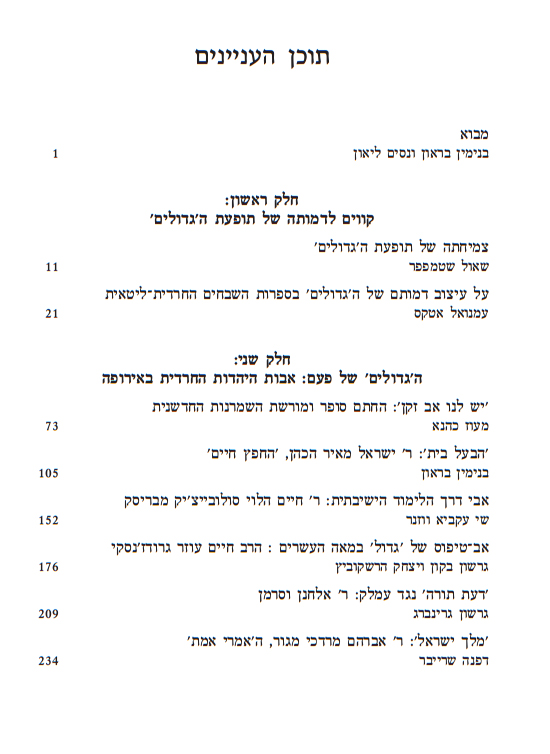
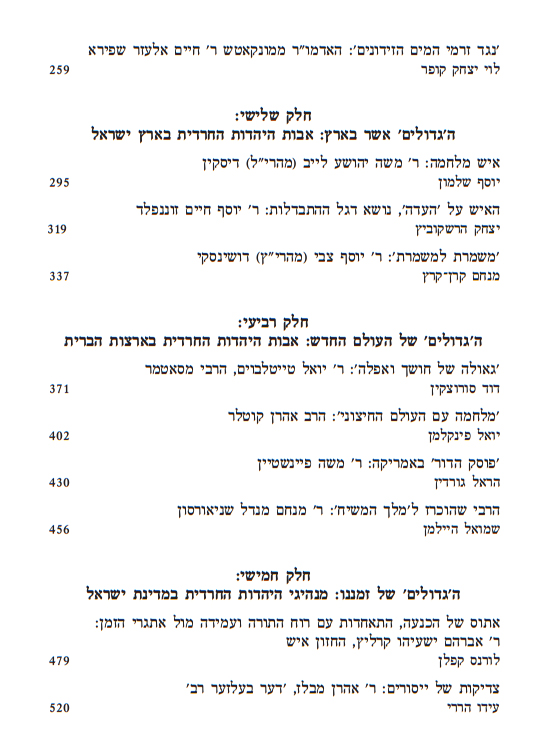
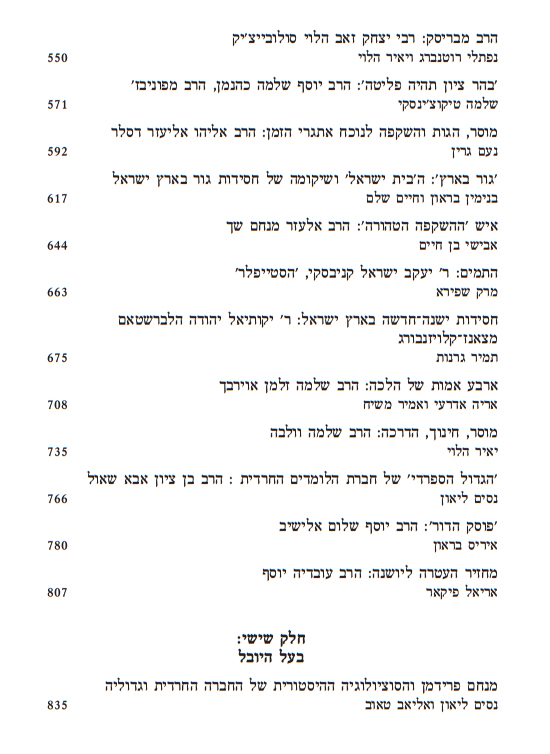
הגדולים: אישים שעיצבו את פני היהדות החרדית בישראל, בעריכת בנימין בראון, נסים ליאון, קובץ מאמרים לכבוד פרופ’ מנחם פרידמן ובהשראתו, מגנס מכון ון ליר, 968 עמודים

The Gdoilim:  Leaders Who Shaped the Israeli Haredi Jewry, Edited by Benjamin Brown, Nissim Leon, The Hebrew University Magnes Press, Van Leer Institute, 968 pages
For the most part, academic books are not found or read in regular “layman” or Chareidi circles, nor are those types of books available at most “seforim stores.” From time to time a volume emerges from the world of academia, that breaks through the status-quo and captivates and makes waves among various crowds of regular people and Chareidim. Examples include, the works of Professor Dovid Assaf (here) which many Chassdim were fascinated to read, and the work of Professor Benny Brown on the Chazon Ish, which the Yeshiva world was very curious to read. When Brown’s book (see here) came out a few years back, over 1,000 copies were sold in a period of two weeks. That may well be the record for an academic book (in Hebrew) selling in such a short amount of time. There were advertisements in Jerusalem and Bnei Brak stating that this work is a must-have for a Jewish home. Until today it’s unknown who put up the signs. Of course, within a few months, the book was attacked, as mentioned here.
This new volume, Ha-Geldolim, hot off the press from Magnes and Van Leer, promises to be another such work. It contains thirty chapters discussing Charedi Gedolim, from all different constituencies, the Yeshivah, Chassidic and Sefardi world, many of which have never really been properly discussed in academia. A similar lacuna was identified by Israel Ta Shema, in that instance, the lack of study of the Achronim. Keneset Mekhekarim, vol. 4, 283

 חקר הספרות הרבנית של מאות השנים האחרונות, הלוא היא תקופת ‘האחרונים’, הוזנח כליל במחקר המודרני, וממילא נשמט הנושא כולו מסדר היום של מחקר ההשכלה בישראל..
Just to give a plug to the Seforim Blog – it is quoted at least three times, (I even made it into a footnote; this is my second “Footnote” – of prominence in academic literature similar to the movie The Footnote 🙂 ) Professor Marc Shapiro, a regular contributor to the Seforim blog, has an essay in the volume. I am sure some of these essays will be the starting point of much further research and discussion of these Gedolim.
Of course, the immediate reaction of many when they look through the table of contents is: “why isn’t so and so there?” and “what exact criteria is applied to determine who ‘gets in’ to the volume?”. The editors anticipated these issues and others, and deal with it in the introduction (PDF available upon request, see my email address below).
The volume is dedicated to Professor Menachem Friedman, who is one of the “founders” of the academic research of the Charedi world.
Here are the Table of Contents of this special work.

The book can be purchased via Magnes Press or through me at Eliezerbrodt@gmail.com
Part of the proceeds will be going to help support the efforts of the Seforim Blog.
Copies of this work will be arriving at Biegeleisen shortly.


“Why are the Books of Ruth and Esther so much alike?”

Reuven Kimelman/Brandeis University

וְנַהֲפוֹךְ הוּא

“Why are the Books of Ruth and Esther so much alike?”

No title is more intriguing than “Why are the Books of Ruth and Esther so much alike?” for a study of two biblical books ostensibly having nothing in common besides the featuring of a heroine. Otherwise, there are hardly two narrative biblical books seemingly more unalike.[1] The Book of Ruth takes place in rural Judea, in Bethlehem, in the period of the Judges, before the establishment of the Jewish monarchy. The Book of Esther takes place in Shushan HaBirah, the fortressed-capital city of the Persian empire in the period of the Persian kings, over a half millennium later after the dissolution of the Jewish monarchy. The Book of Ruth employs classical Hebrew on the model of the Books of Samuel and Kings along with some locutions mostly found in late biblical Hebrew. The Book of Esther is of late biblical Hebrew, replete with Persian words and practices. In Ruth, a Moabite woman marries a Jew leading to the fathering of a king; in Esther, a Jewish woman marries a Gentile king with no mention of heirs. Ruth revolves around family; Esther revolves around politics. Ruth is idyllic and agrarian; Esther is hellish and urban. Esther is a story of good versus evil with villains and heroes. Ruth is a story of passivity versus activity without villains or dramatic heroism. In Ruth, the worst eventuality is the destitution of two widows. In Esther, the worst eventuality is the destruction of a people.

Even in the Bible, the two books lack linkage. In the Protestant version of the Bible, following the Septuagint, their locations conform to their historical context. Ruth is placed near the beginning of the historical section between the Book of Judges and Samuel; Esther is placed near the end between Nehemiah and Job. In the current Jewish version of the Bible, following medieval Ashkenazi manuscripts, the Books of Ruth and Esther are placed with the other three Megillot or Scrolls but not juxtaposed. The five are ordered according to their lectionary use in the synagogue, starting with the Song of Songs for Pesach, Ruth for Shavuot, Lamentations for Tishah B’Av, Ecclesiastes for Sukkot, and finally Esther for Purim. Others resorted to a presumed chronological order. The Talmud (B. Baba Batra 14b) places Ruth at the beginning of the Writings right before Psalms, likely due to the David connection.

These differences are consequential in distinguishing Ruth and Esther in terms of narrative, not in terms of narratology. A story can be analyzed by its narrative, or by its narratology. The former focuses on the content; the latter on the construction. On the surface, the Books of Ruth and Esther share little; below the surface, however, the techniques for the structuring of the plot share much. As narrative, they diverge; as narratology, they converge. Narrative consists of what is told; narratology consists of how it is told. The issue is not the storyline, but its fashioning, namely, its emplotment. Emplotment deals with the fashioning of a narrative structure or plot by connecting the various elements in a coherent manner. This involves the arrangement of the individual elements into a larger framework to create a sense of purpose within the narrative. In sum, narrative deals with plot; narratology deals with emplotment.

From the perspective of narratology, the Books of Ruth and Esther share much. The most obvious is the status of Ruth and Esther as heroes in both senses, namely, most admired and most active in moving the story forward to its conclusion. On its own, this is not that telling, as there are many biblical heroines who determine the outcome of the story from Eve to Rebecca, from Rahab to Yael, from Deborah to Abigail and then later, in the Apocrypha, Judith. In Genesis alone, the subtlety and initiative of women resolve progeny issues from Sarah to Lot’s daughters, from Rebecca and Rachel to Tamar. Nonetheless, motherhood plays a minor role in Ruth while totally absent from Esther.

More significant is the sharing of the three narrative unities of time, place, and character. Unlike the stories of Abraham, Isaac, Jacob, Joseph, Moses, Samuel, and David which extend over a lifetime, or take place in different countries, or involve a change of characters, the Books of Ruth and Esther share a limited time, mostly a single place, and consistency of characters. Both stories take less than two years; both occur primarily in a single city, Bethlehem for Ruth, Shushan for Esther; and both begin and end with the same characters, Naomi and Ruth for one, Mordechai and Esther for the other. Each is self-contained, not part of some grand narrative as in Genesis-Exodus and Joshua-Kings.

God plays a backseat role in both; neither speaking, nor directly addressed, nor directly intervening. Still, The Book of Ruth attributes much to God positively (1:6, 4:13) and negatively (1:13, 21-22). God’s blessing is invoked (1:8-9, 2:4, 20, 3:10, 4:14) and God’s aid is evoked (1:9, 2:12). It is the coincidence of events that most points to a behind-the-scenes director, sensed starkly in the happenstance of Ruth (2:3, 2:4, 4:1) as well as throughout Esther. The absence of an explicit God is countered by the presence of an implicit God. The lack of explicit God-directedness correlates with the other historical biblical books of the Persian period such as Ezra and Nehemiah and, of course, Esther in contrast to the pronounced presence of God in Samuel and Kings of the classical biblical period.

Focusing on the pattern or structure of events produces surprising connections such as the pivotal role of marriage and family. In The Book of Ruth, a quondam non-Jewish woman (Ruth) marries a Jewish man (Boaz); in The Book of Esther, a Jewish woman (Esther) marries a non-Jewish man (Achashverosh). In Ruth, a widowed Moabite woman becomes the wife of a Jewish landowner initiating a line of future Jewish kings. In Esther, a Jewish orphan becomes the wife of a Persian king saving the Jewish people. In both cases, an outsider becomes an insider through marriage. Both marriages are of questionable propriety if not once downright prohibited.

Esther herself is the second wife of Achashverosh, having assumed the perquisites of the banished Vashti (2:17b). Boaz is the second husband of Ruth, having assumed the perquisites of the deceased Mahlon (4:9-10).

In Ruth, a distressed widow prevails upon her to-be-husband to extricate her and her mother-in-law from their plight. In Esther, a distraught queen prevails upon her husband to extricate her and her people from their plight.

Both end in unexpected succession. Ruth ends in an unexpected genealogical succession — from Ruth and Boaz to Obed and David. Esther ends in an unexpected political succession — from Haman to Esther and Mordechai.

Besides the move from outsider to insider, Ruth and Esther advance from alien to actual or potential royalty, and from dependency on others to dependency of others on them as illustrated by the reversal of roles of Naomi versus Ruth and Mordechai versus Esther discussed below.

Most significant for establishing commonality is the overlap of terminology starting off with וַיְהִי בִּימֵי, “And was in the days of.” This unique biblical opening establishes the link from the outset.[3] The linkage is tightened by the common terms employed for Esther and Ruth finding favor in the eyes of their patron, making them stand out from among the women courting the attention of their patron.

Regarding Ruth and Boaz, it says:

וַתֹּאמֶר אֵלָיו: מַדּוּעַ מָצָאתִי חֵן בְּעֵינֶיךָ לְהַכִּירֵנִי וְאָנֹכִי נׇכְרִיָּה.

“She said to him, ‘Why have I found favor in your eyes to acknowledge me, being that I am a foreigner?’ ” (2:10b).

Regarding Esther and Achashverosh, it says:

וַיֶּאֱהַב הַמֶּלֶךְ אֶת־אֶסְתֵּר מִכׇּל־הַנָּשִׁים וַתִּשָּׂא־חֵן וָחֶסֶד לְפָנָיו

“The king loved Esther more than all the other women, as she gained his favor and grace” (2:17).

Similarly,

וַיְהִי כִרְאוֹת הַמֶּלֶךְ אֶת־אֶסְתֵּר הַמַּלְכָּה עֹמֶדֶת בֶּחָצֵר נָשְׂאָה חֵן בְּעֵינָיו

“As soon as the king saw Queen Esther standing in the court, she gained his favor” (5:2).

The expression of Ruth’s for finding favor מָצָאתִי חֵן בְּעֵינֶיךָ in the eyes of Boaz is used repeatedly in Esther (5:8, 7:3, 8:5) for finding favor in the eyes of Achashverosh. The חֶסֶד also appears in both albeit of contrasting meanings. For Esther, it is her external beauty, her grace (2:9, 17); for Ruth, it is her internal beauty, her kindness (3:10) or that of God (1:8, 2:20).

Two rare Hebrew usages clinch the case for verbal linkage. The first is the term for guardian or caretaker. Naomi upon taking care of Ruth’s child is designated omenet, תְּהִי־לוֹ לְאֹמֶנֶת (4:16) while Mordechai is designated Esther’s omein, וַיְהִי אֹמֵן אֶת־הֲדַסָּה (2:7). The term usually refers to female caretakers of royalty.[3] By using a term which designates a protective woman[4] for Mordechai designates him, mutatis mutandis, Naomi’s double.

The second is the rare usage of the verb שבר for “looking forward.” Elsewhere, it appears in a religious context.[5] Here alone it applies to non-Jews in a general context. For Ruth 1:13, it is the false hope of Ruth and Orpah looking forward to grown-up children from Naomi: הֲלָהֵן תְּשַׂבֵּרְנָה עַד אֲשֶׁר יִגְדָּלוּ. For Esther 9:1, it is the false hope of the enemies of the Jews looking forward to dominating them: שִׂבְּרוּ אֹיְבֵי הַיְּהוּדִים לִשְׁלוֹט בָּהֶם וְנַהֲפוֹךְ הוּא.

The common use of קים6 also connects them, though it shows up elsewhere.[7] Its distinctive Hebrew use as “legally authorizing,” as in Ruth 4:7 and Esther 9:32, is matched only by the Aramaic use of Daniel 6:8.

The drinking of Boaz and Achashverosh on the verge of making a fateful decision appears in corresponding terms:

Ruth says regarding Boaz:

וַיֹּאכַל בֹּעַז וַיֵּשְׁתְּ וַיִּיטַב לִבּוֹ

“And Boaz ate and drank and got into a good mood” (3:7).

Esther says regarding Achashverosh:

כְּטוֹב לֵב־הַמֶּלֶךְ בַּיָּיִן

“When the king got into a wine-induced good mood” (1:7).

The number ten figures prominently explicitly and implicitly. Explicitly: Ruth specifies that Naomi spent ten years in Moab (1:4), and that ten men are assembled at the city’s entrance gate (4:2). Esther specifies that Esther is taken to the royal quarters on the tenth month (2:16), and that the ten sons of Haman were to be hanged, meriting four mentions (9:10-14). Implicitly: According to Ruth, the generations from Peretz to David add up to ten.[8] According Esther, the number of times the gate of the king is designated as Mordechai’s station comes to ten[9] as do the number of banquet-parties.[10]

Sensitivity to spousal parallels makes others noticeable. Both begin with the loss of a spouse: Ruth loses her husband; Achashverosh loses his wife. Coming at the beginning, both losses create an expectation of a turnaround to make up for the loss. In The Book of Ruth, Naomi resolves the issue by having Ruth marry Boaz. In The Book of Esther, Mordecai resolves the issue by having Esther marry Achashverosh. In both cases, the older relative (Naomi and Mordechai) mentors the younger relative (Ruth and Esther) by guiding the younger on turning around the situation. In both cases, the advice is accepted by the younger though adjusted by their feminine wiles to turn the tables and achieve their goal. The result is that both induce their ruling man (Boaz and Achashverosh) to intervene and save them and company.

The night is the common watershed. Ruth evokes the salvific mid-night of the Exodus by using the identical expression of the Exodus (12:29) וַיְהִי בַּחֲצִי הַלַּיְלָה saying:

וַיְהִי בַּחֲצִי הַלַּיְלָה וַיֶּחֱרַד הָאִישׁ וַיִּלָּפֵת וְהִנֵּה אִשָּׁה שֹׁכֶבֶת מַרְגְּלֹתָיו

At mid-night, the man gave a start and recoiled—behold a woman lying at his feet (3:8).

Esther says:

בַּלַּיְלָה הַהוּא נָדְדָה שְׁנַת הַמֶּלֶךְ.

That night, sleep eluded the king (6:1).

Neither Boaz nor Achashverosh get an uninterrupted night’s sleep. Indeed, the night constitutes the turnaround precipitating the denouement.

The dramatic tension grabs the reader’s attention awaiting the outcome of the heroine’s (Ruth or Esther) daring encroachment on the space of the man in control (Boaz or Achashverosh). Both Ruth (3:3) and Esther (5:1) get dressed up for the occasion. Both resolutions involve a type of exposure, admittedly somewhat distinct, at the respective deciding point: Ruth (3:6) exposes the leg of Boaz at his threshing floor; Esther exposes Haman’s plot to Achashverosh at her party. Both have a potential spoiler: “Tov” or peloni almoni in Ruth; Haman in Esther. The man in control (Boaz or Achashverosh) responds favorably to the heroine’s entreaty and resolves the issue by the disposal or circumvention of the spoiler, “Tov” (Ruth 4:4-10) or Haman (Esther 7:10).

The removal of legal obstacles smooths the way to the final resolution. For Ruth (4:4-10), a prior claim needs to be circumvented to allow Boaz to exercise his option. For Esther (8:8-11), a previous edict needs to be circumvented to allow for Jewish self-defense.

Even Orpah and Vashti have their parallels. Orpah serves as Ruth’s foil; Vashti serves as Esther’s foil. Orpah and Vashti do the sensible and vacate the stage. Ruth and Esther do the outrageous and occupy center stage.

How do Ruth and Esther implement their center-making roles? Both revise their mentors’ urgings to intervene. Ruth subtly amends Naomi’s advice. Naomi instructs Ruth to interrupt Boaz’s sleep on the threshing floor and do what he says, וְהוּא יַגִּיד לָךְ אֵת אֲשֶׁר תַּעַשִׂין (3:4b). Instead, Ruth turns the tables leading Boaz to say:

וְעַתָּה בִּתִּי אַל־תִּירְאִי
כֹּל אֲשֶׁר־תֹּאמְרִי אֶעֱשֶׂה־לָּךְ.

And now, my young lady, have no fear,
whatever you say I will do for you (3:11a).

Naomi assumed that Boaz, the wealthy landowner, would call the shots; Ruth, the destitute foreigner, proved otherwise.

Note also the parallel between Boaz and Achashverosh.

The former says to Ruth: “whatever you say I will do for you” (ibid.);

the latter says to Esther:

וּמַה־שְּׁאֵלָתֵךְ וְיִנָּתֵן לָךְ
וּמַה־בַּקָּשָׁתֵךְ עוֹד וְתֵעָשׂ

Whatever is your wish, it shall be granted.
And whatever is your request? It shall be done (9:12).

Ruth also pointedly revises Boaz’s own compliment to her about God into her directive to Boaz:

(אֲשֶׁר־בָּאת לַחֲסוֹת תַּחַת־כְּנָפָיו = “that you sought refuge under His wings” [2:12b]
וּפָרַשְׂתָּ כְנָפֶךָ עַל־אֲמָתְךָ כִּי גֹאֵל אָתָּה

Spread your wing (= corner of the garment[11]) over your handmaid, for you are the redeemer (3:9).

This expression for being taken under God’s wings indicating solicitude, as in Ruth 2:12b, is frequent in Psalms.[12] Its use at 3:9, however, in the light of Ezekiel 16:8,[13] conjures up conjugality intimating minimally eligibility if not a marriage proposal.[14] Ruth thereby instigates the process of redemption by turning the tables on the male in charge initiating the denouement.

Esther, for her part, deflects Mordechai’s rash advice to barge in on the king and plead the case of her people. Instead, she sets up Haman by inviting him to a party in her private quarters with her husband with whom she has not been for thirty days (4:11b). The impervious Haman, so full of himself (7:5b), as Achashverosh notes, falls for the trap oblivious of the repercussions of a ménage à trois.[15]

Both books record two interventions of women offering advice. In Ruth, the local women speak up twice. The first at 1:19-20 is negative regarding Naomi’s self-pitying bitterness upon her return to Judea and the irony of being called Naomi, which plays on the Hebrew for pleasantness. The second is positive regarding the birth of Obed, her new-born, as it were, grandchild:

וַתֹּאמַרְנָה הַנָּשִׁים אֶל־נׇעֳמִי
בָּרוּךְ יי אֲשֶׁר לֹא הִשְׁבִּית לָךְ גֹּאֵל הַיּוֹם
וְיִקָּרֵא שְׁמוֹ בְּיִשְׂרָאֵל

And the women said to Naomi:
“Blessed be the Lord who has not deprived you of a redeemer today.
May he achieve renown in Israel” (4:14).

In Esther, the first is positive reflecting Haman’s spectacular rise:

She (Zeresh) says along with others “Let a stake be put up fifty cubits high, and in the morning ask the king to have Mordecai impaled on it. Then you can go gaily with the king to the feast” (5:14).

The second is negative projecting his spectacular fall:

His advisers and his wife Zeresh said to him, “If Mordecai, before whom you have begun to fall, is of Jewish stock, you will not prevail; you will fall before him to your ruin” (6:13).

In fact, at 7:8, Haman falls before Esther.

They also share a common historical perspective albeit reversed.

The Book of Ruth projects three generations forward to David, Boaz’s great-grandson:

וּבֹעַז הוֹלִיד אֶת־עוֹבֵדוְעֹבֵד הוֹלִיד אֶת־יִשָׁי וְיִשַׁי הוֹלִיד אֶת־דָּוִד

Boaz begot Obed, Obed begot Jesse, and Jesse begot David (4:21b-22).

The Book of Esther retrojects three generations backward to Kish, Mordechai’s great-grandfather:

אִישׁ יְהוּדִי הָיָה בְּשׁוּשַׁן הַבִּירָה וּשְׁמוֹ
מׇרְדֳּכַי בֶּן יָאִיר בֶּן־שִׁמְעִי בֶּן־קִישׁ אִישׁ יְמִינִי

In the capital Shushan lived a Jew by the name of
Mordecai, son of Jair, son of Shimei, son of Kish, a Benjaminite (2:5).

In the end, the prominence of the younger heroines, Ruth and Esther, yields to that of the older mentors, Naomi and Mordechai. The plot of The Book Ruth begins (1:2) and ends (4:17) with Naomi. Beginning as the mother of Ruth’s husband, she ends up as the mother of Ruth’s child, nearly edging Ruth out. In the middle, at the turning point, Ruth dominates. The plot of The Book of Esther begins (2:5) with Mordechai as Esther’s uncle/cousin and the dominant one. In the middle, at the turning point, Esther dominates. By the end of chapter 9, they appear as coregents albeit with a subtle variance. At 9:29, Esther’s name precedes Mordechai’s, whereas at 9:31 Mordechai’s name precedes Esther’s. True, Esther appears alone at 9:32; but by the end, Mordechai has edged out Esther as evidenced by the closing encomium to Mordechai:

For Mordecai the Jew ranked next to King Ahasuerus and was highly regarded by the Jews and popular with the multitude of his brethren; he sought the good of his people and interceded for the welfare of all his kindred (10:3).

Following suit, II Maccabees 13:42, designates Purim as “the day of Mordechai.”

Ruth ends with the birth of David (4:22), the future regent of Israel. Esther ends with the rise of Mordechai as coregent of Persia (10:3). Mordechai is the great-grandson of an exile from Jerusalem along with the last reigning descendant of King David (2:6). David is the great-grandson of Ruth who left Moab to accompany Naomi on her return to the land of Judah (1:7b).

Two tales of dizzying reversals; so different in content, yet so alike in structure. Both feature individual and collective reversals. Ruth: Individually, a Moabite childless, destitute widow becomes the Jewish spouse of a wealthy landowner and progenitress of David, the future king of Israel. Collectively, in the period of the Judges are planted the seeds of the future monarchy. Esther: Individually, an orphan Jewish girl becomes the Queen of Persia. Collectively, a people threatened with extermination emerge politically dominant and religiously attractive.[16]

Most dramatic are the reversals of Esther regarding those of Haman and Mordecai.[17] Haman — instead of hanging is hanged. Mordechai — instead of being hanged on raised gallows is raised to viceroy of Persia. Haman, seeking the king’s authorization to shame Mordecai by hanging him in public (5:14), is authorized by the king to honor him in public (6:11). Wishing to be exalted by the king (6:6b), Haman is debased by the king. Instead of riding on the king’s horse exultingly, he draws Mordecai on it humiliatingly (6:11). Finally, Mordecai displaces Haman as the king’s second getting Haman’s ring (8:2) and adorned in the royal garments, לְבוּשׁ מַלְכוּת (13:15), of Haman’s aspiration (6:8).

Esther — instead of going down with her people (7:4), becomes the savior of her people (8:5-6). As Esther assumes Vashti’s role (2:17b), so Mordechai assumes Haman’s role (8:2a). Indeed, the leitmotif וְנַהֲפוֹךְ הוּא, “reversal” (9:1, 22), epitomizes the whole book, smacking of a Divine hand. In an upside-down moral world only a reversal can set things right.

Reversals, as noted, also characterizes Ruth, most notably in the land of Israel transitioning from famine (1:1) to abundance (1:6) as Ruth transitions from barrenness to fruitfulness. What, however, is a secondary narratological technique in Ruth emerges as the dominant engine in Esther.

There are even reversals common to both. Both highlight the reversal from non-Jewishness to Jewishness. For Ruth, it involves the individual switching of ethnic and religious loyalties:

עַמֵּךְ עַמִּי וֵא-לֹהַיִךְ אֱ-לֹהָי =

Your people are my people, and your God my God (1:6).

For Esther, it involves the mass switching to Jewishness throughout the Persian empire:

ְרַבִּים מֵעַמֵּי הָאָרֶץ מִתְיַהֲדִים =

Many of the native population profess to be/act like Jews (8:17).

Ruth, who aligns with God and people, is blessed to God by her people (2:20, 3:10). Esther, who aligns with her people (8:6), saves herself and her people (8:5).

There might even be some correlation in the fact that The Book of Ruth ends with the planting of the seeds of the Jewish monarchy while The Book of Esther ends with the Jewish integration into the Persian monarchy.

Both resonate with their own peals of redemption. For The Book of Ruth, redemption is that of Israel in its land; for The Book of Esther, redemption is that of Israel outside its land. Introducing Mordechai as a descendant of Kish who was exiled from Jerusalem along with the Judean king (2:6) could have prompted a finale of the return of Israel to its land as at the end of Chronicles or the beginnings of Ezra or Nehemiah were it not for the restraints of historical verisimilitude.

The result is that The Book of Esther only features an interim redemption, dependent on the whim of a mercurial king. Lacking explicit terminology for redemption, not even a nod to any return, it stands in sharp contrast with The Book of Ruth with its use of a form of the verb שב (= “return”) some twelve times in chapter one about half of which refer to returning to the land and its repetition of the lexeme גאל (= “redeem”) twenty-one times (nine as a noun and twelve as a verb) concentrated in the last two chapters of Ruth. The repeated mention of redemption albeit of individuals and land cannot help but allude to that of the people in its land constituting real redemption. The term is just too repercussive to be contained in or restrained by its denotation especially in the light of the echoes of Exodus 20:2,

, אָנֹכִי יְי אֱלֹהֶיךָ אֲשֶׁר הוֹצֵאתִיךָ מֵאֶרֶץ מִצְרַיִם מִבֵּית עֲבָדִ͏ים

in the formulation of Ruth 3:13: וּגְאַלְתִּיךְ אָנֹכִי חַי־יְי; the redemptive allusion of Ruth 3:8 to the forecited Exodus 12:29; and the revealing double mention of the genealogical line to David (4:17b, 22) making “David” the final word. The redemptive resonances of גאל are most audible in the forecited 3:9 כִּי גֹאֵל אָתָּה and in the reverberating 4:14 –

בָּרוּךְ יְי אֲשֶׁר לֹא הִשְׁבִּית לָךְ גֹּאֵל הַיּוֹם וְיִקָּרֵא שְׁמוֹ בְּיִשְׂרָאֵל

Blessed be the Lord who has not deprived you of a redeemer today. May he be renown in Israel (4:14) –

thereby intimating not so subtly the to-be Davidic role in the redemption of Israel. The combination of גֹּאֵל with וְיִקָּרֵא שְׁמוֹ בְּיִשְׂרָאֵל is the clincher, as the standard way of naming is merely יִקָּרֵא שְׁמוֹ, whereas וְיִקָּרֵא שְׁמוֹ בְּיִשְׂרָאֵל is unique to Ruth 4:14[18] intimating that the גֹּאֵל that emerges on the horizon today is to be renown in Israel. This conforms to the usage of the comparable terminology in the redemption-oriented verse of Isaiah 54:5:

כִּי בֹעֲלַיִךְ עֹשַׂיִךְ יי צְבָאוֹת שְׁמוֹ וְגֹאֲלֵךְ קְדוֹשׁ יִשְׂרָאֵל אֱלֹהֵי כָל־הָאָרֶץ יִקָּרֵא

The Ruth reference thus far exceeds the otherwise unknown Obed. Limiting גֹּאֵל to Obed who somehow redeems Naomi, his mother’s mother-in-law, with which he has no blood relationship, is an unattested usage unable to account for either denotation or connotation. This leads to the allusive possibility that the “redemption” encompasses also the return to the Land.[19]

Esther deftly molds the various plot elements and literary strategies of Ruth into its own version of redemption. As in Ruth, female intuition and initiative engineer the redemption determining the destiny of Israel. The insights and plans of the women prevail over those of the men. Whereas the men — Achashverosh, Haman, Mordechai, and Boaz — tend to misread the situation somewhat blinded by their own set of circumstances; the women — Esther, Vashti, Zeresh, Ruth and Naomi – perceptively size up the situation knowing what to do and when to do it.

Singularly engaging in lucid Hebrew, Ruth and Esther are eminently readable, plot-based narratives, unlike the other three Megillot. Every scene advances the narrative. All purported incidental elements are integrated, nothing remains extraneous. Like a well-structured drama, each character, however introduced, ends up contributing to the plot at the appropriate time. The result is the two most self-contained yet reverberating literary gems of the Bible.

In the final analysis, the surface differences fail to mask the subsurface commonalities. Esther so echoes Ruth that the divergences of narrative pale before the convergences of narratology.[20] The correlation of the roles of Naomi and Mordechai, Boaz and Achashverosh, and — above all — Ruth and Esther seal the case. It’s the latter two that renders the midrashic observation regarding the Exodus —

בזכות נשים צדקניות… נגאלו ממצרים

“By virtue of the righteous women… Israel was redeemed from Egypt”[21] — applicable to both heroines of Shavuot and Purim[22] as we look forward to the merit of righteous woman effectuating other redemptions.[23]

[1] For a fuller treatment of the two books without raising this issue, see the introductions to The JPS Bible Commentary on Esther and Ruth, the first by Adele Berlin, 2001, and the second by Tamara Cohn Eskenazi and Tikva Frymer-Kensky, 2011. The issue is somewhat touched upon by P. Meltsar, Ruth, Da’at HaMikra, amesh Megillot (Jerusalem: Mossad Harav Kook, 1990), pp. 21-22. The issue of the comparability of the two is taken up by Orit Avnery, Liminal Women: Belonging and Otherness in the Books of Ruth and Esther (Hebrew), Shalom Hartman Institute, Jerusalem 2015, from a speculative feminist perspective with little overlap with this study.
[2] According to ancient authorities this portends negatively for both (B. Megillah 10b).
[3] See 2 Samuel 4:4; 2 Kings 10:1, 5; Isaiah 49:12, 60:4.
[4] As confirmed by Moses’s metaphorical use in Numbers 11:12.
[5] See Psalms 104:27, 119:166, 145:15.
[6] Ruth 4:7; Esther 9:21, 29, 31, 32.
[7] See Ezekiel 13:6; Psalms 119:28, 106; Daniel 4:23; 6:8, 16, 27. The four occurrences in Daniel and Esther reflect its frequency in post-exilic Hebrew.
[8] As opposed to 1 Chronicles 2:4-15 which starts with Judah, as would be expected, and traces eleven generations to David. Ten reflects a turning point as in from Adam to Noah (Genesis 5:3-32) and from Shem to Abraham (Genesis 11:10-26), the correlation of which is made explicit in Mishnah Avot 5:2. In the latter, Shem’s father, Noah, is not mentioned just as Perez’s father, Judah, is not mentioned here making for ten in both cases. Genealogical lines climax at ten, with Noah, Abraham, and David, none of which is make explicit.
[9] See Esther 2:19, 2:21, 3;3, 4:2 (2x), 4:6, 5:9, 5:13, 6:10, 6:12.
[10] See Eskenazi, The JPS Bible Commentary Esther, xxiv-xxv.
[11] See 1 Samuel 15:27; 24:5-6, 12.
[12] Psalms 7:2, 17:8, 36:8, 91:4
[13] וָאֶעֱבֹר עָלַיִךְ וָאֶרְאֵךְ וְהִנֵּה עִתֵּךְ עֵת דֹּדִים וָאֶפְרֹשׂ כְּנָפִי עָלַיִךְ וָאֲכַסֶּה עֶרְוָתֵךְ

“When I passed over you and saw it was your time for lovemaking, I spread My garment over you and covered your nakedness.” See Deuteronomy 23:1, 27:20.
[14]For the range of possibilities, see Eskenazi, JPS Bible Commentary Ruth, p. 59.
[15] See Rashi, Esther 5:4, 6:1, along with Alshikh and Alkabetz, ad loc., in Sefaria.
[16] See Esther 8:11.
[17] See Berlin, The JPS Bible Commentary to Esther, p. xxiv.
[18] Albeit close to the related formulation of Deuteronomy 25:10.
[19] This is all the more likely were Ruth composed in the Persian period.
[20] This builds on Esther’s use of biblical motifs especially that of the Joseph story; see Berlin, The JPS Bible Commentary, pp. xxxvii, lvi-lvii. Note specifically Esther’s contraction and inversion of יֵּט אֵלָיו חָסֶד וַיִּתֵּן חִנּוֹ for Joseph (Genesis 39:21) into the unique biblical use of חֵן וָחֶסֶד for Esther (Esther 2:17).
[21] B. Sotah 11b.
[22] For the prior application to Esther, see Rashi, B. Pesahim 108b.
[23] אין הדורות נגאלים אלא בזכות נשים צדקניות שבדור (Midrash Ruth Zuta 4.11, ed. S. Buber, p. 48).


Altering of Rabbinic Texts?, Shlomo Rechnitz and the Eighth Principle of Faith, R. Yair Hayyim Bacharach, the Ridbaz and “Chemistry,” and R. Yitzhak Barda

Altering of Rabbinic Texts?, Shlomo Rechnitz and the Eighth Principle of Faith, R. Yair Hayyim Bacharach, the Ridbaz and “Chemistry,” and R. Yitzhak Barda
Marc B. Shapiro
1. People continue to send me examples of censorship and altering of texts. If I would discuss all of them, I would have no time for other matters, but I do intend to get to some of these examples. Let me also share an “updating” of a classic rabbinic text that I discovered on my own in the old fashioned way. This is one of those examples that I wish I knew about when I wrote my book. It is not a case of someone in the Orthodox world altering a text, as this example goes back many centuries. Bereshit Rabbah 36:1 states:
ויהיו בני נח היוצאים וגו’: והוא ישקיט ומי ירשיע וגו’ (איוב לד, כט)  דרש ר’ מאיר “והוא ישקיט” מעולמו “יסתר פנים” לעולמו כדיין שמותחין כילה על פניו ואין יודע מה נעשה מבחוץ ]כך אמרו דור המבול (שם כב) “עבים סתר לו ולא יראה [“.א”ל דייך מאיר. אמר להון ומה הוא דכתיב “והוא ישקיט ומי ירשיע” וגו’. אמרו נתן שלוה לדור המבול ומי בא וחייבן.
And the Sons of Noah, that went forth: It is written, When he giveth quietness, who then can condemn, etc. (Job 34:29)? R. Meir interpreted it: He quieteneth Himself from His world, And He hideth His face (ibid.) from His world, like a judge before whom a curtain is spread, so that he does not know what is happening without. [So said the generation of the flood, Thick clouds are a covering to Him, that he seeth not (Job 22:14)] Let that suffice thee, Meir, said they to him. [Soncino: You have said more than enough – heaven forfend that this teaching should be true!] Then what is meant by, When He giveth quietness, who can condemn? he demanded. They replied: Was not ease given to the generation of the flood; who then can condemn them?
The words that I have included in the first brackets are not found in most manuscripts of Bereshit Rabbah consulted by J. Theodor for his critical edition. However, they do appear in Va-Yikra Rabbah 5:1. The words “So said the generation of the flood” are problematic, since if they said the prior sentence, why is Rabbi Meir being rebuked? If you remove those words then the text makes perfect sense, as we see that R. Meir is saying (or is attributing to Job[1]) the notion that God chooses to remove himself from knowledge of and guidance of the world.[2] This is a very radical statement and it is understandable why a later copyist would prefer to attribute such a statement to the generation of the flood, rather than R. Meir. In other words, it appears that the original text of the midrash was altered for theological reasons. 
In its note on the Bereshit Rabbah text, the Soncino translation explains: 
He [God] is unconcerned by what is done in the world and is not incensed by the deeds of the wicked – a remarkable teaching of God’s trancendence. Cur. edd. alter the meaning by adding: so said that generation of the Flood (according to this R. Meir merely puts these words into the mouth of the wicked), Thick clouds are a covering to Him, that He seeth not (Job xxii, 14). But in that case it is difficult to see why his colleagues so sharply rejected this interpretation.
Louis Finkelstein takes note of this midrashic passage and writes:
Even in the school of R. Akiba, we find R. Meir, the sage who so frequently expresses patrician ideas, denying Providence in individual human life. “God,” he says, “is like a judge who spreads a curtain before him and knows not what proceeds without.” The earnest protest of R. Meir’s colleagues against this heresy shows that it was meant seriously, and that R. Meir, in the second century of the Common Era, actually held views akin to those defended by the patricians for six centuries before him.[3]
It is also worth noting that the medieval R. Asher ben Gershom, as part of his defense of the medieval followers of Maimonides, refers to the Bereshit Rabbah passage and his text did not have any reference to the Generation of the Flood. He therefore understands the passage to mean that R. Meir indeed denied God’s providence. He also adds that it appears that R. Meir later rejected this view, although he doesn’t provide any evidence for this assertion. R. Asher contrasts the vehemence of the attacks on the followers of Maimonides with the calmer way the talmudic sages reacted when their colleagues put forth radical views.[4]
ראו מה בין רבותינו וביניכם. הנה להלל באמרו אין משיח לישראל. לא אמרו עליו אלא מריה שרא ליה [!]. ולר’ מאיר בדרשו בבראשית רבה הוא ישקיט בעולמו ויסתר פנים מעולמו כדיין וכו’. והוא דבר גדול בענין השגחת הבורא ית’ עד שנראה שחזר בו. לא אמרו חבריו אלא דייך מאיר.
2. In a previous post I referred to R. Menahem Navarra’s book Issur Kedushah. This book was published together with another book by R. Navarra called Kero Mikra which deals with grammatical points in the liturgy. On pp. 24a-24b he quotes Maimonides’ Eighth Principle of Faith and a passage by Abarbanel in order to reject the notion that the text of the Torah was ever in a confused state and that Ezra corrected the Torah in any way. He understands Maimonides’ principle to be teaching that the Torah text we have today is the exact same that was given to Moses.
שיחוייב כל בעל דת להאמין והוא שהתורה שבידינו היום היא הנתונ’ למשה בהר סיני מבלי חלוף ושנוי כלל . . . ומלתא אגב אורחין קמ”לן כמה יש להחמיר בענין הספרי’ וקריאתם.
The assumption of R. Navarra is also found in, of all places, Shlomo Rechnitz’s famous (or infamous, depending your perspective) speech on the Lakewood school situation.
In this incredibly courageous speech, delivered, as it were, in the lion’s den itself, Rechnitz strongly attacked the phenomenon whereby, he claims, many children in Lakewood are not allowed into the schools that their parents would like them to attend, as their families are not of the right sort. Since he is a major philanthropist, in general Rechnitz is given some leeway in what he says, but in this speech he went over the line and the powers that be responded very strongly, forcing Rechnitz to issue an apology and declare that he will no longer speak about this matter. It was interesting to see all the comments on the different haredi news sites that reported on the Rechnitz speech. The people were overwhelmingly in favor of what Rechnitz said. However, this creates an enormous problem for haredi society, since laypeople, even important wealthy philanthropists, are not the ones to be making communal policy, and certainly not to be criticizing this policy in public. By the leadership’s strong response, and seeing how quickly Rechnitz folded, it sent a clear signal who the bosses really are.
The entire video is of great interest in terms of the sociology of the American haredi community, but I want to call attention to a tangential point made by Rechnitz. At minute 21 he says that he has a difficulty with a formulation of Maimonides in his eighth principle of faith. He also states that he never saw anyone who discusses this difficulty (which I assume means he never read The Limits of Orthodox Theology). 
He begins by saying that Maimonides’ principles of faith are eternal, applying for all time. Thus, the principle that God created the world or that the Messiah will come are things that one must believe in all times. He then says that the eighth principle of faith is difficult since it requires belief that our Torah scrolls are the exact same as the one given to Moses. Rechnitz asks, how can this be a principle of faith? How can there be a guarantee that the text never changed? This is not a question of theology but of historical reality, and how could Maimonides know what would happen in the future? Maybe after recording his principle there would be confusion in the Jewish people, and it would lead to a mistake in the text. Rechnitz quotes the Ani Ma’amin version of the eighth principle and wonders, “How could Chazal [!] possibly make such a statement?” He then says that in the “last few thousand [!] years since that Ani Ma’amin was written” much has happened with the Jewish people, wars, pogroms, ghettoes, etc. So how can we know that there haven’t been any changes in the text? “How can we say with a straight face that the Torah we have in our hands today is letter by letter the exact Torah we received at Har Sinai. And more importantly, how did Chazal know that the Torah would never even slightly deviate ad sof kol ha-doros?” He then says that this is based on a promise from God that the Torah would never be forgotten.[5]
All this is of course incorrect, and I don’t mean to criticize Rechnitz on this account. He is not a scholar and isn’t expected to know these things. Yet what he says is illustrative of the common view of many who have no idea about masoretic matters, and it was precisely this sort of perception that Maimonides created with his formulation of the eighth principle. (In The Limits of Orthodox Theology I offer a suggestion as to why Maimonides put forth a formulation that he knew was inaccurate.)
In response to Rechnitz, and I hope someone shows him this post, let me go over what I wrote here where I cited R. Yosef Reinman who has the same basic misconception as Rechnitz (although unlike Rechnitz, he knows that Yemenite Torah scrolls are not identical to Ashkenazic and Sephardic Torah scrolls). 
Reinman writes as follows in One People, Two Worlds, p. 119:
[A]n examination of Torah scrolls from all over the world, from Ireland to Siberia to isolated Yemen, all handwritten by scribes, yielded just nine instances of one-letter spelling discrepancies. Nine! And none of them affect the meaning of the text. Why is this so? Because every week we take out the scrolls and read them in public. The people follow the reading closely and if something is wrong, they are quick to point it out.
Unfortunately, Reinman  [and Rechnitz] doesn’t realize that it was the invention of printing that unified Torah texts by creating a standard version that soferim could have access to and be guided from (and those who review the parashah each week with Rashi will know that Rashi’s Torah text was not identical to the one we currently have[6]). Printed humashim also enabled people listening to the reading to point out errors. Yet let us not forget that most of the differences in Torah scrolls have concerned male and haser. Contrary to Reinman’s implication in his last sentence, there is no way for the people following the reading to catch such an error.
I must also point out that Reinman’s first sentence is an egregious error, and one doesn’t need to go to Ireland or Siberia to prove this (and contrary to what he states no one has ever performed such an examination). If one simply takes fifty Torah scrolls from Lakewood one will find all sorts of discrepancies. I know this because the people who check sifrei Torah by computer claim that the overwhelming majority of scrolls they check, including those that have been in use for decades, have contained at least one error.[7] In other words, contrary to what Reinman has stated, the truth of Torah does not rise or fall because of scribal errors. If it did, then we would be in big trouble because as I just mentioned, almost every Torah scroll in the world has discrepancies. What Reinman doesn’t seem to get is that while contemporary halakhic authorities are in dispute about only nine letters, this has nothing to do with the quality of actual Torah scrolls, which are obviously subject to human errors by scribes.
3. In my post here I discussed a possibly fictional responsum by the fascinating figure R. Yair Hayyim Bacharach.[8] There is so much of interest in his responsa, but I want to offer one further example. In Havot Yair, no. 136, he mentions that some wicked Jews have become accustomed to bribing non-Jewish judges when they have a case before them, and even brag about this. He also mentions that his brother-in-law, R. Isaac, the rav of Mannheim, had a discussion about this issue with Karl Ludwig I, the Elector Palatine. R. Bacharach actually puts ז”ל after Karl Ludwig’s name. ז”ל is almost never added to the name of a non-Jew and thus shows the positive feelings R. Bacharach had for Karl Ludwig.[9]
והיה הדוכס קאריל לודוויג ז”ל המופלג בחכמה משתעשע לפרקים בגיסי הנזכר בדברי שכליים.
R. Bacharach records that Karl Ludwig once told R. Isaac that has a complaint about the Jews whose cases often come to the government courts. He says that they bribe the judges, an action “which is against all religion, and certainly against what is written in your Torah.” He also told R. Isaac that it was his responsibility to fix this problem.
R. Isaac agreed with Karl Ludwig that bribery of judges is a terrible thing, and he doesn’t deny that Jews have been guilty of this. He adds that even if there is no Torah prohibition to bribe a (non-Jewish) judge, it still needs to be forbidden in order for there to be a properly functioning society.
דאפילו לא נאמר איסורו בתורה ראוי לאסרו מצד השכל וישוב העולם ותיקון המדינה כמו רציחה וגזילה וגניבה ואונאה וזנות ועול מידות, וכלם דברים שהשכל מחייב, ודין ודת חק ומשפט עולה על כלנה שאם יקולקל המשפט איש הישר בעיניו יעזה.
R. Bacharach was not in the room when R. Isaac spoke to Karl Ludwig. It is possible that he is recording the gist of what R. Isaac told him he said, but is it also possible that what are seeing is R. Bacharch’s invention of a conversation, and that R. Bacharach is using the opportunity to put forth his own ideas about the matter?
R. Bacharach then records that R. Isaac told Karl Ludwig that if a Jew is owed money by a non-Jew and the non-Jew denies this, while there can be no permission for the Jew to offer the judge a bribe, from God’s perspective if a bribe was given it is not wrong since the Jew is entitled to the money and the only way he can get it was by bribing the judge. He also said that perhaps the bribe can be seen as evening the scales, since the Jew is afraid that his adversary has also bribed the judge. This argument is intended to show that the Jews of R. Bacharach’s time who bribed non-Jewish judges were really not doing something so bad.
R. Bacharach then says the following (again, supposedly in the name of his brother-in-law), which is just as true today as when he said it: והנה ידוע שאין שנאה כשנאת הדת. He explains that when the Jew and non-Jew come before the judge, the judge naturally inclines to favor his co-religionist. The Jew therefore assumes that the only way he can get a fair trial is by bribing the judge. In other words, he is not bribing him to have the case thrown his way, but only to get a fair trial. R. Bacharach concludes that what he has said should not be seen as a justification of bribery, but as a limud zekhut which explains the circumstances that lead Torah observant people to behave this way.
R. Bacharach tells us that Karl Ludwig liked what R. Isaac said but asked him what about when two Jews are having a court case and they still bribe the judge. In that circumstance there is no reason to think that the judge will favor one side, as neither side shares his religion. R. Bacharach reports how R. Isaac was able to respond properly to this question, but again, is it possible that this is an invention of R. Bacharach in order to enable him to get his ideas across?
After recording the supposed conversation between R. Isaac and Karl Ludwig, R. Bacharach elaborates on the matter of bribery and why there is no explicit Torah prohibition on giving a bribe, only on taking a bribe (Deut. 16:19). In this discussion he notes that he does not think that there is a prohibition to bribe a non-Jewish judge if do not know that you are in the wrong, and thus you are not asking the judge to award you something that doesn’t belong to you by right. He also says that one who offers such a bribe does not make it a quid pro quo that he gives the money and the judge rules in his favor. All he intends by the money is that the judge look carefully at his case and listen to his claims, and then render a just decision. In his description of R. Isaac’s conversation with Karl Ludwig, Bacharach reports that R. Isaac said that he was only offering a limud zekhut for those who bribe judges, but “halilah” to say that this is proper behavior. Here, however, R. Bacharach is saying that there is no prohibition. In other words, in the very same responsum R. Bacharach is showing the difference between an answer motivated by apologetics and one that needn’t be concerned with this.
ולכן בשוחד לשופטיהם אין בו חשש דלפני עיור אם הוא מדיני ממונות, שלא נתברר לבעלי דבר עצמן שחבירו עושה עול רק כל אחד סובר שהדין עמו, וגם השופט דעתו לשפוט צדק, וגם נותן השוחד אינו מתנה שיזכהו רק שיחפש זכותו וישים דברי טענתו אל לבו.
Examining what halakhic authorities say about the matter of bribing non-Jewish judges shows very clearly how at least some Jews regarded themselves as living in a parallel universe from non-Jewish society, and did not feel bound by the rules of the latter society, only by internal Jewish rules. Even though most halakhic authorities assume that it is forbidden to bribe non-Jewish judges,[10] the fact that some think it is permitted is also of great significance in showing that this was not regarded as an obvious matter. Thus, R. Jonathan Eybeschuetz[11] raises the question if one can bribe a non-Jewish judge. He refers to R. Bacharach’s responsum and tells us that R. Bacharach did not come to a conclusion in this matter. He then adds that the “world” has long been accustomed to be lenient in this matter, and R. Eybeschuetz provides a halakhic justification for the bribery, which would only be in a case when the Jew was in the right. 
והעולם נוהגין היתר משנים קדמוניות . . . וצ”ל דס”ל דכל הטעם של שוחד דהוא חד דמקרביה דעתיה גביה וזהו בישראל דקרובים אסורים לדון אבל בבן נח שכל הקרובים מותרים לדון אין לך קירוב יותר מזה והכל יודעין שדעת האב קרוב לבן יותר מאדם אחר שנותנים לו אלף דינרים ומכל מקום האב כשר לדון בנו הבן נח, אף ליתן שוחד להצדיק הצדיק וכו’ מותר דמ”ש מקרובים.
I think it is very likely that despite the halakhic justification provided, the real motivation for any Jewish bribery of non-Jewish judges was the assumption that the judge would not be fair when dealing with Jews as well as a fear that the non-Jewish litigant was also bribing the judge.
R. Abraham Zvi Eisenstadt, Pithei Teshuvah, Yoreh Deah 151:1, states that any bribery is only permissible באופן שאין בו חשש גזל, and even for this permissible bribery, it is only OK if the money is not given directly to the judge but to one of his assistants who will then give it to the judge. See also Pithei Teshuvah, Hoshen Mishpat 9:2, who after citing authorities who disagree with R. Eybeschuetz nevertheless justifies offering bribes when it is obvious that the non-Jewish judge is not going to render a just verdict.
R. Simeon Anolik, in a book published in 1907, states that there is no prohibition of lifnei iver if one bribes a non-Jewish judge, as the non-Jewish legal system is not in accord with Torah law. However, this is only permitted if the intent of the bribe is to arrive at the correct, Torah mandated result .[12]
לא שייך בזה לפני עור מה שנותן שוחד לזכות את הזכאי ולחייב את החייב אם דנו עפ”י חק שלהם. ומש”כ רמב”ן בפ’ וישלח בשם הירושלמי דב”נ מוזהר בלא תקח שוחד היינו בדין שהוא כדיננו. או דמרא דירושלמי הוא ר’ יוחנן ולדידיה מבואר ברמ”א שם [שו”ת הרמ”א סי’ י] דב”נ מחוייב בדינים שחקקו להם כרצונם. אבל לדידן דקי”ל דמצווים על הדינים היינו דינים שלנו שפיר פשט ההיתר מטעם זה.
The words that I have underlined would appear to show that Anolik’s position was widely accepted. 
Regarding bribery, in Between the Yeshiva World and Modern Orthodoxy, p. 35 n. 93, I mention a forthcoming article which will deal with paying off community leaders in order for someone to be given a town rabbinate. After completing the just-mentioned book, my interests moved in different directions, but I do still hope to write that article which will have a lot of material that has never been discussed in scholarly literature. Here is one interesting source from R. Elhanan Wasserman that I only recently found. In Kovetz Shiurim: Bava Batra no. 71, R. Elhanan suggests that if you are the most qualified to serve as a dayan in the community, then there is no prohibition to pay the community leaders to appoint you to the position, and no prohibition for the community leaders to accept this money. I don’t know of anyone else who holds this position which, needless to say, would open up a can of worms, since lots of people think that they are the most qualified. We obviously can’t have a situation where all such people feel that they can pay off the community leaders in order to be appointed to a position. Furthermore, the Rambam makes no distinction of the sort R. Elhanan does, but states flatly that it forbidden for a dayan to give money in order to be appointed. See Mishneh Torah, Hilkhot Sanhedrin 3:9
כל דיין שנתן ממון כדי שיתמנה אסור לעמוד מפניו וציוו חכמים להקל אותו ולזלזל בו. ואמרו חכמים שהטלית שמתעטף בה תהי בעיניך כמרדעת של חמור.
4. In my post here I wrote:
The Ridbaz’s attack on the Brisker method is well known. In the introduction to his responsa, Beit Ridbaz (Jerusalem, 1908), Ridbaz writes as follows:
A certain rabbi invented the “chemical” method of study. Those in the know now refer to it as “chemistry,” but many speak of it as “logic.” This proved to be of great harm to us for it is a foreign spirit from without that they have brought in to the Oral Torah. This is not the Torah delivered to us by Moses from the mouth of the Omnipresent. This method of study has spread among the yeshivah students who still hold a gemara in their hands. In no way does this type of Torah study bring men to purity. From the day this method spread abroad this kind of Torah has had no power to protect its students. . . . It is better to have no rosh yeshivah than to have one who studies with the “chemical” method.
In his ethical will, printed at the end of his responsa, Ridbaz returns to this criticism and directs his sons: “Be careful, and keep far away from the new method of study that has in recent years spread through Lithuania and Zamut. Those knowledgeable in Torah refer to it as ‘chemistry.'” (Just before this post appeared, R. Eliezer Katzman sent word that in his opinion, Ridbaz is not referring to R. Hayyim and the Brisker approach, but rather to Telz and its method of talmudic analysis. I don’t believe this is correct, and hope to return to this subject in a future post.)
In the first edition of Shaul Stampfer’s Ha-Yeshivah ha-Lita’it be-Hithavutah, p. 113 n. 29, he quotes Saul Lieberman’s opinion that Ridbaz’ words were directed against R. Isaac Jacob Reines. This is clearly incorrect. Reines’ method had no influence whatsoever, and Ridbaz is speaking about a method of study that was widespread in the yeshivot. It is obvious that he can only be referring to the method of R. Hayyim. Lieberman’s incorrect speculation was removed in the second edition of Stampfer’s book. . . .[13]
Needless to say, because of his attacks on R. Hayyim, Ridbaz did not endear himself to the Soloveitchik family. Once when a student referred to Ridbaz, R. Joseph B. Soloveitchik became very angry and told the student never to mention his name again. He also said that some gedolim are always right, some are sometimes right, and some are never right, and the Ridbaz falls into the latter category![14]
Thus far what I wrote in my prior post. It is worth noting that Benjamin Brown defends Lieberman’s suggestion that the Ridbaz’s words were directed against Reines.[15] However, as I have written, I see no justification for this. Daniel Price called my attention to Shai Akiva Wosner’s recently published a book on R. Shimon Shkop, Hashivah Mishpatit bi-Yeshivot Lita: Iyunim be-Mishnato shel ha-Rav Shimon Shkop. On p. 32 he refers to my post and rejects my assumption that the Ridbaz was referring to R. Hayyim Soloveitchik. He claims that his negative comments were directed against Telz and its method, a view that as mentioned is also shared by Katzman.
I don’t deny that the Ridbaz could also have had Telz in mind, but this doesn’t change my assumption that the main target of his words was R. Hayyim Soloveitchik. Is there a source that can settle this argument conclusively? I believe there is, but I was not aware of it when I wrote my previous post. In 1935 Moshe Aharon Perlman published his Mi-Pi Dodi. Here is the title page.
This volume records things he heard from his uncle, R. Moses Kliers, the rav of Tiberias. R. Kliers knew the Ridbaz personally, and the information that appears on p. 35 is obviously of great importance to what we have been discussing: 
מסדר למוד הבריסקאי לא היתה דעתו נוחה וקרא לו חימיא
In other words, R. Kliers told Pearlman that the Ridbaz opposed the Brisker approach and referred to it as “chemistry”. This source is more significant than any speculation by contemporary scholars.
There is a good deal in Mi-Pi Dodi that I think readers will find of interest, but for now I will just mention one example.
P. 25. R. Kliers said that all manner of dress worn by the Slobodka students can be justified, but what can’t be justified is the forelock of hair that the students had. 
(In Changing the Immutable, p. 268 n. 156, I cited a fascinating passage from Mi-Pi Dodi, pp. 9-10, showing that R. Kliers thought that it was better for people to carry on a particular Shabbat and violate a rabbinic commandment rather than learning that a rabbi had made a mistake in setting up the eruv, and thus come to lose respect for him which would violate a Torah commandment. The eruv could be fixed after Shabbat, but the negative effect on the rabbi’s reputation would remain.[16])
5. In my last post I referred to R. Yitzhak Barda and his book Kinyan Torah which argues that Maimonides’ view is binding, even if this means rejecting the Shulhan Arukh. Here is the title page of Kinyan Torah, vol. 3. 

At least one reader was wondering if R. Barda is Yemenite. He is not, and his view granting final authority to the Mishneh Torah is unique among Sephardic authorities. R. Barda is in charge of a group of Torah institutions in Ashkelon called Yitzhak Yeranen. He is also the brother-in-law of R. Meir Mazuz and often appears together with him at events. Here is a picture of them during the last Israeli elections.

Halakhic authorities have had different perspectives on how to relate to newly discovered manuscripts that contain halakhic rulings. The Hazon Ish did not pay these texts much mind, not regarding them as having been part of the halakhic tradition. Most halakhic authorities, on the other hand, had a more positive opinion of such newly published texts. However, even those who welcomed the newly published texts and integrated them into the halakhic system generally agreed that halakhot that that were recorded in the Shulhan Arukh and were thus generally accepted could not be rejected based on a newly published text.[17] That is one reason why the 2014 appearance of R. Yitzhak Barda’s tenth volume of responsa Yitzhak Yeranen is of interest, as in this volume one finds that the author indeed rejects a universally accepted halakhah.[18]

The question R. Barda deals with is whether one can bake or cook on the first day of Yom Tov for the second day (and his conclusion would apply to other relevant matters, such as setting the table on one day for the next). This would appear to be an easy question to answer, as the Talmud, Betzah 17a, states: “Our Rabbis taught: One may not bake on the first day of a festival for the second.” This halakhah is recorded in Shulhan Arukh, Orah Hayyim 503:1. One might think that this would be the end of the matter, and for centuries it was. However, R. Barda has reopened the discussion. According to him, it is permitted to bake or cook on the first day of Yom Tov for the next day. How does he arrive at such a decision, one at odds with the Shulhan Arukh?
R. Barda begins by pointing out that R. Hananel records a different version of the talmudic text. In his version, the Talmud states that it is forbidden to bake on Yom Tov for Shabbat or for after the holiday, but it says nothing about baking from the first day of Yom Tov for the next next day. R. Isaac Alfasi, R. Asher ben Jehiel, and other geonic and medieval sources also have the version recorded by R. Hananel.[19] Not noted by R. Barda, but certainly a support for his position, is that the Tosefta and Jerusalem Talmud also have nothing about baking on the first day of Yom Tov for the next day.[20]
R. Barda further points out that Maimonides must also not have had our version of the talmudic text, since in the Mishneh Torah all he says is that on Yom Tov one may not bake or cook anything that will be eaten after the holiday.[21] He says nothing about not baking or cooking on the first day of Yom Tov for the next day. Also important for R. Barda’s case is that Maimonides, Mishneh TorahHilkhot Shevitat Yom Tov 6:14, states that the observance of the second day of Yom Tov is not on account of doubt, but is a minhag. What this means is that it is not a question of maybe the second day not really being a Yom Tov, in which case one could understand the prohibition of baking or cooking on the first day for the second. I would only add that R. Barda’s point also works if you adopt Maimonides’ other formulation that Yom Tov Sheni is an actual decree of the Sages.[22] In either case, the second day is treated like Yom Tov no different than the first day, and thus R. Barda states that there is no reason why one cannot bake or cook on the first day for the second. As for Rosh ha-Shanah, he tells us that the two days of this holiday are regarded by the Talmud as one long day,[23] and therefore there is even more reason for it to be permitted to bake on the first day for the second.
R. Joseph Karo, in the introduction to the Beit Yosef of which the Shulhan Arukh is an abridgment, tells us that he is going to decide the halakhah based on the three central authorities, R. Isaac Alfasi, Maimonides, and R. Asher ben Jehiel. As R. Barda points out, in the case we have been discussing, none of these three authorities state that it is forbidden to bake or cook from one day of Yom Tov to the next, and yet the Shulhan Arukh does forbid this. 
R. Barda notes that there are medieval authorities who record the prohibition, most prominently R. Jacob ben Asher, Tur, Orah Hayyim 503. Prior to this, Halakhot Pesukot[24] and Halakhot Gedolot[25] also record this prohibition, even though according to R. Barda their version of the Talmud did not state that it is forbidden to bake on the first day of Yom Tov for the next day, only that it is forbidden to bake on Yom Tov for after the holiday. In other words, even though baking or cooking on the first day of Yom Tov for the next day is forbidden by Halakhot Pesukot and Halakhot Gedolot, this is an original deduction made by these authorities, not a recording of earlier talmudic halakhah. (Actually, it would have made more sense for R. Barda to say that the rulings in Halakhot Pesukot and Halakhot Gedolot originated in an earlier source.) Yet the stringent position codified by these two sources and later by R. Jacob ben Asher and other rishonim is not determinative for R. Barda, since as mentioned this halakhah does not appear in the more important sources, namely, R. Isaac Alfasi, Maimonides, and R. Asher ben Jehiel (R. Jacob ben Asher’s father).
Readers might be convinced by R. Barda’s argument that R. Isaac Alfasi, Maimonides, and R. Asher ben Jehiel did not view it as forbidden to bake or cook on the first day of Yom Tov for the next day. But this still does not mean that it should be permitted today, for as we have seen the Shulhan Arukh forbids this action. R. Barda’s assumption is that R. Joseph Karo’s text of the Talmud was not pristine, but as with our version had incorporated the addition of the Halakhot Pesukot and Halakhot Gedolot, forbidding baking on the first day of Yom Tov for the next day. Since the Shulhan Arukh’s ruling is based on an error, namely, R. Karo’s false assumption that the Talmud forbids baking or cooking on the first day of Tom Tov for the next day, R. Barda declares that one need not accept the Shulhan Arukh’s ruling. (This statement is directed towards the Sephardic community as a whole, which follows the Shulhan Arukh. R. Barda personally follows Rambam, and since the Rambam does not record the prohibition, that alone is enough for him to permit baking and cooking on the first day of Yom Tov for the second day.)
R. Barda further states that had R. Joseph Karo known what has been mentioned so far, he, too, would have decided differently. He adds that to refrain from baking or cooking on the first day of Yom Tov for the next day takes away from some of the joy of Yom Tov, as it makes it more difficult to prepare food for the second day of the holiday.[26] He also calls attention to a responsum of R. Isaac Bar Sheshet from which we see that there were people who indeed baked and cooked on the first day of Yom Tov for the second day. (R. Isaac Bar Sheshet himself states that this is forbidden.[27])
After many pages of justification of his ruling, R. Barda publishes two letters he received from R. Serayah Deblitzky in which the latter takes issue with what R. Barda wrote. R. Deblitzky begins by stating that it is an absolute principle that a halakhah that has been accepted among all of Jewry cannot be overturned due to the discovery of new manuscripts or based on the fact that important earlier authorities did not record this particular halakhah. He further notes that R. Jacob ben Asher did forbid baking and cooking on the first day of Yom Tov for the next day, even though his father, R. Asher ben Jehiel, did not mention this prohibition. R. Deblitzsky does not think it is reasonable that R. Judah would disagree with his father in this matter, and assumes that R. Asher ben Jehiel’s omission of the halakhah does not imply that he had a more liberal perspective.

[1] See Mordechai Margaliyot’s note in his edition of Va-Yikra Rabbah, ad loc.
[2] Malbim, Deut. 13:7 (p. 87a) cites the Midrash without the words כך אמרו דור המבול. Yet as far as I can determine, every printed edition of the Midrash has these words. Does this mean that the Malbim independently concluded that the words should be deleted?
[3] The Pharisees (Philadelphia, 1938), p. 260.
[4] The text is published in Joseph Shatzmiller, “Les tossafistes et la premiere controverse maïmonidienne: le témoignage du rabbin Asher ben Gershom,” in Gilbert Dahan, et al., eds., Rashi et la culture juive en France du Nord au moyen âge (Paris, 1997), p. 67.
[5] Rechnitz also says that the Torah cannot be changed, “no Reform, no Modern Orthodoxy.” Does Rechnitz really feel that Modern Orthodoxy is akin to Reform? Or was this comment strategic? In other words, since he is attacking a widespread practice in Lakewood, he has to show them that despite the attack he is still on the “right” side, and the way to do this is by slandering Modern Orthodoxy.
[6] See Rashi to Ex. 25:22. Even the ArtScroll-Sapirstein Rashi translation is forced to admit: “Rashi’s Sefer Torah evidently had a ו where ours does not.” Siftei Hakhamim writes:
 אע”פ שאין כתיב ואת בוא”ו בס”ת של רש”י היה כתוב בוא”ו.
See also Rashi to Gen. 25:6. Artscroll writes: “Rashi’s text of the Torah had the spelling פילגשים, without the letter י of the ים suffix which indicates the plural.”
[7] For the information on errors in Torah scrolls, including eye-opening pictures, see Kolmos, Elul 5748. Here is part of R. Shmuel Wosner’s letter quoted on p. 7:

עכשיו שנכנס עבודת הקאמפיוטער בזה למסלולו, ונתברר על ידו לתמהון לבב כולנו, שמבערך ששים ספרים, ס”ת שהיו בחזקת בדוקים יצאו רק תשע ספרים נקיים מכל שגיאה וברובא דמינכר מאד נמצאו שגיאות פוסלות לרוב. וכן בדידן הוי עובדא בס”ת שנכתב ע”ש תלמידים גדולים וצדיקים שנספו בעו”ה, נמצאו ה’ טעיות ממש בחסר ויתר.

[8] I am inclined to see the responsum’s description of a storybook romance as fictional, and I think there might be other fictional responsa in Havot Yair. None of this can be proven, and it is just a sense I have that some of the questions were created by R. Bacharach in order to establish halakhic principles. I think this might be the case with no. 183 where he discusses a man confronted with a choice to drink non-kosher wine or have his ear cut off. See also no. 79 regarding a convert to Judaism, if he needs to return money he stole from Jews and non-Jews before he converted.
[9] In no. 139 R. Bacharach mentions the hillul ha-shem that results when a Jew is a thief, as the non-Jews blame the entire Jewish community for his actions. Yet R. Bacharach adds that it is only the masses who have this feeling, while the wise people and the government leaders don’t engage in such stereotyping.
ואף כי יש חילול השם באשר הגוים מרשיעים על כלל יהדות בשביל כך, אין אלו רק דברי המון עם ולא חכמים שבהם ושלטונים.

[10] See R. Asher Weiss, Minhat Asher, vol. 1, no. 92.
[11] Urim ve-Tumim, Hilkhot Dayanim 9:1.
[12] Orah Mishpat (Petrokov, 1907), p. 17a.
[13] [See p. 124, n. 30, where Stampfer quotes Prof. Chimen Abramsky, a descendant of the Ridbaz, that in the family it is accepted that the Ridbaz was referring to R. Hayyim.]
[14] I heard this from an eyewitness. The event took place in the 1950s.
[15] Ha-Hazon Ish  (Jerusalem, 2011), p. 321 n. 44.
[16] See also Shabbetai Dov Rosenthal, Geon ha-Hora’ah (Jerusalem, 2011), vol. 2, pp. 186-187, for two similar cases with R. Samuel Salant and R. Zvi Pesah Frank.
[17] However, what should a posek do if it is clear that a halakhah in the Shulhan Arukh is based on a mistaken text? R. Jehiel Jacob Weinberg was unsure. See Kitvei ha-Gaon Rabbi Yehiel Yaakov Weinberg, vol. 2, p. 433:
הוכחתי שהב”י השתמש בכת”י מקולקלים וע”י נדחק לפרש ולהסיק הלכה מנוסחאות של ספרי ראשונים שהי’ בהם השמטות בשגיאת סופרים – השאלה היא אם להניח הכל כמו שהוא ורק להסביר ולנסח בלשון ובהגיון מתקבלים על הלב, או לשוב למקורות הראשונים ולחקור ולבדוק הכל מחדש.
[18] We will be focusing on nos. 20-24, where R. Barda explains his position and defends it against criticism. Here is the title page of Yitzhak Yeranen, vol. 11, R. Barda’s most recent volume of responsa.

[19] R. Barda mistakenly states that the Munich manuscript of the Talmud is also missing the words מיו”ט לחברו. This error does not affect his argument, as the Munich manuscript is from the 14th century and R. Barda acknowledges, p. 262, that there were medieval texts of the Talmud that had מיו”ט לחברו. Yet he believes that these words are not original but were inserted based on what appears in the Halakhot Gedolot (which I will soon discuss).
[20] See Saul Lieberman, Tosefta ki-Feshutah, Beitzah, p. 947.
[21] See Mishneh Torah, Hilkhot Shevitat Yom Tov, ch. 6.
[22] See my Studies in Maimonides and His Interpreters (Scranton, 2008), p. 59.
[23] See Beitzah 4b-5a.
[24] Halakhot Pesukot (Versailles, 1886), p. 8. Since I am sure some will be skeptical that a sefer was ever printed in Versailles, here is the title page.

[25] Halakhot Gedolot, Makhon Yerushalayim ed. (Jerusalem, 1992), Hilkhot Yom Tov, p. 215.
[26] See Yitzhak Yeranen, p. 263.
[27] She’elot u-Teshuvot ha-Rivash, no. 254. See also ibid., no. 16.