Approbations and Restrictions: Printing the Talmud in Eighteenth Century Amsterdam and Two Frankfurts

Approbations and Restrictions:
Printing the Talmud in Eighteenth Century Amsterdam and Two Frankfurts
by Marvin J. Heller
Approbations designed to protect the investment of printers and their sponsors when publishing a large work such as the Talmud were well intentioned. Unfortunately, the results were counter-productive, resulting in acrimonious disputes between publishers within and between cities. This article discusses the first approbations, issued for the Frankfurt on the Oder Talmud (1697-99), and the resulting dispute with printers in Amsterdam in 1714-17. The background of the presses and the pressmarks utilized by the printers are discussed, giving a fuller picture of the printing of the Talmud in the subject period, as well as addressing antecedent (Benveniste) and subsequent editions.
Approbations for books have multiple purposes, among them commendations, indicating approval or praise for the subject work, confirming that a book’s contents do not contain forbidden or prohibited matter, and to protect a publisher’s investment from competitive editions for a fixed period of time. This article is concerned with the last purpose, here rabbinic approbations (hascoma, pl. hascomot) limiting or preventing rival editions of the Talmud published in the last decade of the seventeenth century into the first half of the eighteenth century.
The restrictive approbations discussed here are unlike those issued previously, such as the first approbations for a Hebrew book, R. Jacob Barukh ben Judah Landau’s (15th cent.) concise halakhic compendium, Sefer Ha-Agur (Naples, 1487), one of seven approbations, that of R. Judah ben Jehiel Rofe (Messer Leone, 15th cent.) stating he has examined ha-Agur, and, “it is a work that gives forth pleasant words. . . . I have, therefore, set my signature unto these nectars of the honeycomb, these words of beauty,” or those in Italy or in Basle, which assured the authorities that nothing untoward or offensive to Christianity was included in the book, or to current approbations, which assure the reader that a work’s contents are in conformity with the community’s religious standards. In contrast, the approbation issued for the Frankfurt on the Oder Berman Talmud, and to subsequent editions, was a license for a fixed number of years, prohibiting other publishers from printing competitive editions that would prevent the printer and his sponsor(s), who would otherwise be reluctant to make the substantial investment required to print such a large multi-volume work as the Talmud, from realizing a return on their investment.
The discord arising from restrictive approbations for printing the Talmud were not the first such disputes. In Amsterdam, disputes between printers arose over editions of the Bible. Johannes Georgius Nisselius and Joseph Athias competed in the mid-seventeenth century over a Sacra Biblia (Hebrew Bible) for the use of students and several years later Athias and Uri Phoebus were involved in controversy over their translations of the Bible into Yiddish, competing for the Jewish market in Poland. Arguing over the right to publish for and sell to that market, they sought to reinforce their positions by seeking approbations from the Polish, as well as the Amsterdam rabbinate.[1] Nevertheless, their competition pales in contrast to the recurring altercations over the right to print the Talmud, which spanned several centuries and much of the European continent.
Raphael Natan Nuta Rabbinovicz writes that the intent in granting this and subsequent approbations was for the good of the community, to insure investors a reasonable return on their investment. The result, however, was that the Talmud was printed only eight times in the century from 1697 to 1797, and the price of a set of the Talmud was dear. Prior to that the Talmud had been printed several times in Italy and Poland within a relatively short period of time, the primary impediment then being the opposition of the Church and local authorities. Rabbinovicz concludes that after 1797 the use of restrictive approbations declined, with the consequence that within four decades, to 1835, the Talmud was printed nine times.[2]
During last decade of the seventeenth century into the first half of the eighteenth century several rival editions of the Talmud appeared, beginning with the Frankfurt on the Oder Talmud (1697-99) followed by two incomplete editions in Amsterdam (1714-17 and 1714), the Frankfurt on the Main Talmud (1720–22), again in Amsterdam (1752–1765), and finally the Sulzbach Red (1755-63) and Black (1766-70). We are concerned with and focus on the early editions, that is, on the dispute between the Frankfurt on the Oder and Amsterdam printers, their dispute resulting from restrictive approbations issued to presses printing the Talmud. This article discusses the background of the Hebrew presses that published these Talmud editions in the seventeenth and eighteenth century; its primary focus, being the disputes resulting from the restrictive approbations.
I Amsterdam – Benveniste Talmud
Amsterdam has a distinguished place in Jewish history. Among the notable features of that city’s Jewish community are its printing-houses, among the foremost in Europe for centuries. Highly regarded, Amsterdam imprints were distributed and sold throughout all of Europe. The preeminence of Amsterdam as a European book center is evident, for it is estimated that the output of the Dutch presses in the seventeenth century exceeded the combined production of all the presses of all other European countries. The number of book-printers totaled 273 at its peak in 1675-99, employing at its height in excess of 30,000 people supported through some facet of the book trade.[3] The important works published by its presses include editions of the Talmud, beginning with the Benveniste Talmud of 1644-47, through the much praised Proops’ Talmud of 1752-65. In addition to complete editions of the Talmud individual treatises, frequently in a smaller format, were also published for students and individuals who did not require or who could not afford a complete Talmud.[4]
The printing of Hebrew books in Amsterdam by Jews begins in 1627, when two printers published books, Manasseh (Menasseh) Ben Israel (1604-57) and Daniel de Fonesca. The former’s press was the first to publish with a Sephardic rite prayer-book, completed on January 1, 1627. Manasseh Ben Israel would achieve acclaim that, together with its founder’s many other achievements, is still recalled today. Manasseh did not publish Talmudic tractates but his press did issue three critical editions of Mishnayot (1632, 1643, and 1646). He also intended to publish an edition of the Talmud but that did not come to pass.
The next printer of Hebrew books of import in Amsterdam was Immanuel (Imanoel) Benveniste. Benveniste is believed to have been among the Jewish refugees from Spain or Portugal, and that he was descended from the illustrious Sephardic family of that name.[5] Beneveniste relocated to Amsterdam because, by the mid-seventeenth century that city offered better opportunities for the distribution of Hebrew books than any city in Italy.[6] Beneveniste was the publisher of the first Amsterdam Talmud, printed from 1644-47. The Benveniste Talmud is in a smaller (c. 260:195 cm.) quarto format than the usual large folio editions.[7]

Fig. 1
Although not subject to restrictive approbations it is included here due to its relevance to the history of the printing the Talmud in Amsterdam and because the title-pages of Benveniste’s publications are distinguished by his escutcheon, an upright lion facing inward towards a tower; a star is above the lion and the tower. The lion is on the viewer’s right, the tower on the left. At least six forms of Benveniste’s device have been identified. In all cases, excepting his Talmudic treatises, Benveniste’s insignia is set in a crest above an architectural frame surrounding the text of the title page. On the title-pages of the Benveniste tractates his mark appears at the bottom of the page in an ornamental shield, with a helmet in the crest (fig. 1). Given the high regard of most Benveniste imprints this device was subsequently used by several printers in Amsterdam, including two of the following subject editions, as well as by other presses in various locations.[8]
This Talmud has been has been praised for restoring expurgated material. Unlike Benveniste’s other publications, however, the Beneveniste Talmud is not highly regarded. Raphael Natan Nuta Rabbinovicz quotes from an approbation given by R. Moses Judah ha-Cohen, Av Bet Din, of the Ashkenazi community in Amsterdam, for the Berman Talmud (Frankfurt on the Oder, 1697-99) which states that Benveniste, due to his concern over expenses, printed a Talmud edition which was, due to its small size, difficult to learn from. Furthermore, Benveniste used letters that were “the smallest of the small and blurred so that the users eyes become heavy and his sight wanders as if from old age.”[9] This notwithstanding, no less a personage than the Vilna Gaon (R. Elijah ben Soloman Zalman, Gr”a, 1720-70) made use of the Benveniste Talmud, Rabbinovicz writing that “he had heard from a great Talmudic scholar who related that he had seen a Talmud from which the Gr”a had learned by R. Judah Bachrach (1775-1846) av bet din Seiny with his (Gr”a’s) handwritten annotations, brief and varied from his printed annotations, and that it was a Benveniste Talmud.”[10]
II – Frankfurt on the Oder – Michael Gottschalk
Printing with Hebrew letters in Frankfurt on the Oder begins when the Christian printers Joachim and Friedreich Hartmann (1594-1631), who, using new Hebrew fonts and vowels cast by Zechariah Crato (?) of Wittenberg, published a Hebrew Bible in 1595-96. While there are references to an even earlier Bible, half a century earlier, that is uncertain. More than a century later, Johann Christoph Beckmann (1641-1711), professor of Greek language history, and theology at the University of Frankfurt on the Oder, operated a printing-press in Frankfurt on the Oder from 1673 to 1717, which he acquired from his brother Friedreich on June 1, 1673 for 400 Thaler; Friedreich, in turn, had purchased the press for a like amount. Beckmann obtained a travel scholarship from the Brandenburg Elector and, during his travels in Europe came to Amsterdam. In 1663, in that city, Beckmann met Jewish students, the renowned R. Jacob Abendana (1630-85), and studied Talmud. In 1666, Beckmann returned to Frankfurt, where he obtained a position at the university (Viadrina), teaching there until his death in 1717 and serving as rector eight times. Because of the admission of Jewish students, the Viadrina became the “Amsterdam of the East,” both Hebrew and oriental studies being of importance.[11]
Beckmann was granted, initially, on May 1, 1675, a license to employ two Jewish workers, under the direct protection of the university, to print a Hebrew Bible, this despite of the protests of Frankfurt city. By 1693, however, Beckmann found that his responsibilities at the university left him with insufficient time to manage the press. Therefore, he contracted with Michael Gottschalk, a local bookbinder and book-dealer to manage the printing-house, transferring all of the typographical equipment and material to Gottschalk. Their arrangement was noted on the title-pages of the books issued by the press, which stated “with the letters of Lord Johann Christoph Beckmann, Doctor and Professor . . . at the press of Michael Gottschalk.” Gottschalk became the moving spirit of the press for almost four decades.
After printing several varied Hebrew titles Gottschalk approached Beckmann, requesting that he obtain permission to reprint the Talmud. Beckmann petitioned Friedreich III, Elector of Brandenburg (1657-1713, reigned 1688-1713, from 1701 King of Prussia), requesting a license to print the Talmud. Friedreich, in turn, sought the counsel of the Berlin professor Dr. Daniel Ernest Jablonski (1660-1741), from 1691, court preacher at Königsberg for the elector of Brandenburg, Friederick III. Jablonski, a Christian German theologian of Czech origin, an orientalist, had been associated with universities in Holland and England, settling in Lissa in 1686, and from there moving to Berlin. In 1700, Jablonski became a member of the Academy of Sciences in Berlin. Jablonski established a Hebrew press in Berlin, publishing a scholarly edition of the Hebrew Bible based on the Leusden edition (Amsterdam, 1667, Atthias) and a translation of Richard Bentley’s A Confutation of Atheism into Latin (Berlin, 1696). Jablonski, was to become personally involved with Hebrew printing in Berlin, and would be participate in the publishing of two later editions of the Talmud.
When a sponsor was sought for the Frankfurt on the Oder Talmud, Beckmann found one in the Court Jew Issachar (Ber Segal) ha-Levi Bermann (1661-1730) of Halberstadt, known as Bermann Halberstadt or, in his commercial dealings with the non-Jewish world, as Behrend Lehmann. It was Bermann who bore the cost of this Talmud, and whose name is associated with it. Selma Stern observes that Bermann was a pious and observant Jew throughout his life. He was held in high regard by his fellow Jews; and was described as “a second Joseph of Egypt” and “the chosen of the Lord, who warns him about the machinations of his enemies and miraculously rescues him when he is in dire straits.” Bermann was known among his people as “the founder of the Klaus in Halberstadt, the publisher of the Talmud, the man who defeated the first Prussian king at chess and who even in the glittering world of the Court never forgot Eternal Truth, corresponded to the ideal which Jews have had of their great men leaders.”[12]
Beckmann and Bermann entered into an agreement to publish the Talmud, Beckmann transferring his rights to Bermann, and the latter accepting responsibility for publishing the entire edition, making an initial payment of three hundred reichsthalers at the time of the agreement.[13] The printer was to be the Christian, Michael Gottschalk. Approximately half of the sets of this Talmud, known as the Berman Talmud, were distributed by Bermann to yeshivot and penurious scholars who could not otherwise have acquired a complete Talmud. Not only did he spend fifty thousand reichthalers of his own money to publish the Talmud, from which he apparently saw no financial gain, distributing copies to Talmudic students, but afterwards granted permission to the Amsterdam and Frankfurt on the Main printers to publish a complete Talmud, this in spite of the fact that he had approbations preventing republication of competitive editions.[14]
Fig. 2
Each volume of this Talmud has two title-pages. The first, a volume header page, has an engraved copper plate title-page (fig. 2) by the craftsman Martin Bernigeroth (1670-1733), Dt. Kupferstecher u. Zeichner (engraver and illustrator).[15] This initial title-page consists of an upright lamb with a pitcher on top of a portico. Below it, on the sides of the page, are Moses to the right and Aaron to the left. Beneath them, similarly situated, are King David with a harp, and King Solomon. Above each figure is that individuals’ name. Avraham Habermann and Avraham Yaari both write that the sheep and laver represent Bermann, who was a Levi. Yaari adds that the sheep further represents Bermann’s “mazel” or constellation, for Bermann was born on the 24th of Nissan (April 23), 1661, the astrological symbol for that month being a sheep.[16]
The second textual tractate title-page follows immediately after the volume title-page. The tractate title-pages are basically copied, with several modifications, from the Benveniste Talmud; but also includes some features characteristic of the Basel Talmud, which is supposed to be the source of this edition. The text concludes in Latin, informing that it is “in accordance with expurgations of the Council of Trent. . . .” and that it was printed in conformity with the Basle edition (1578 – 1581). Between the Hebrew and Latin text is Michael Gottschalk’s printer’s mark (fig. 3), which appears on the title-pages of this Talmud. It is a mirror-image monogram (cipher) of his name, the first usage of such a monogram in a Hebrew book.[17]

Fig. 3
Printed with this Talmud are approbations for the edition. When Johann Christoph Beckmann secured permission in 1695 from the Kaiser, Leopold, and from Friedreich Augustus, Elector of Saxony and King of Poland, to print the Talmud, he was given not only authorization to print the Talmud, but was also granted the sole and exclusive right to do so for twelve years. Leading rabbinic figures, according to Rabbinovicz, issued restrictive approbations, the first instance in which such rabbinic licenses were granted. The rabbis who signed the approbations were R. Naftali ben Isaac ha-Kohen Katz, av bet din (head of the rabbinical court) of Pozna, R. Joseph Samuel of Cracow, av bet din of Frankfurt on the Main, R. David ben Abraham Oppenheim, av bet din of Nikolsburg, and R. Moses Judah ha Kohen and R. Jacob Sasportas of Amsterdam concurred in granting this monopoly, issuing approbations (hascomas) for twenty years.
These approbations were unlike those issued previously in Italy, which assured the authorities that nothing untoward or offensive to them was included in the book, or current approbations, which assure the reader that a work’s contents are in conformity with the community’s religious standards. The approbation issued for this Talmud, and to subsequent editions, was a license for a fixed number of years, prohibiting other publishers from printing competitive editions that would prevent the printer and his sponsor(s), who would otherwise be reluctant to make the substantial investment required to print the Talmud, from realizing a return on their investment.
Oppenheim refers to the burning of the Talmud and other Hebrew books in the Chnielnicki massacres tah ve-tat (1648–49), fires that resulted in the loss of many Hebrew books, resulting in a dire need for Talmudic tractates. Indeed, he writes that the entire Jewish educational system was endangered due to insufficient copies of the Talmud. He praises Lehmann, noting his benevolence in distributing half of the copies to needy students free of charge.[18] Towards the end of his long and flowery approbation Oppenheim forbids the printing of the Talmud by anyone without the permission of Issachar Bermann SG”L, from the day that printing commences until twenty years have elapsed from its completion. This prohibition is “whether for all or for part, even for one tractate only, whether for oneself or for others, and is not to be done by means of guile or ruse.” To enforce his decree R. Oppenheim states that “this decree falls equally upon the purchaser as well as the seller, for that which a rabbinic court declares ownerless is ownerless. Any [such tractate] found in a person’s possession without license, is to be taken forcibly, without payment or deed . . .”[20]
Similarly, R. Joseph Samuel of Cracow begins by praising Berman, noting that all realize that these many days many thought to print the Talmud due to its being unavailable, not to be found, except one to a city and two to a family. He notes, however, that although many wanted to print the Talmud it was to no avail, for it is a large project of much work and difficult to complete, until the Lord aroused the spirit of R. Berman of Halberstadt for the public benefit and the honor of the Torah, to print an entire Talmud on good paper, with fine ink, and diligent workers, well edited. Lest there be many who “bear gall and wormwood” (Deuteronomy 29:17) who also wish to print the Talmud and therefore cause great harm R. Berman’s interests, and “lock the door before him” (cf. Bekhorot 10b) who performs a great mitzvah to benefit the public, for “such is such theTorah, and such is its reward” (Berakhot 21b, Menahot 21b)? He therefore, concurs with the other leading rabbis to decree,
Excommunication and a ban on each and every person who should take it upon himself to print the Talmud in its entirety or in whole or in part without the agreement and knowledge of the noble R. Berman, except for a section needed to learn in yehivot, which is not included in the ban. It is permitted to print only that section and not a complete tractate in order to “magnify the Torah, and make it glorious” (Isaiah 42:21). A blessing should come upon he who hearkens to our words, may blessings of good come upon him and may he receive good from God Who is good. But “he who breaches through a fence, shall be bitten by a serpent” (Avodah Zara 27b) . . . and all the curses written in the Torah shall come upon him. . . .
Even before the privilege for this Talmud had expired the need for a new edition became apparent, numerous appeals being made to Issachar Bermann to republish the Talmud. Gottschalk, who had the rights granted to Beckmann, was also favorable to reprinting the Talmud. The Talmud had sold well and Gottschalk, as a result, had become a wealthy man.[20] Frederick William I of Prussia acceded to their request on May 23, and a new privilege, dated October 13, 1710, was granted to Gottschalk by Joseph I, successor to Leopold, in 1705, to print the Talmud and sell it throughout his domain, albeit with the customary restrictions and with the provision, as with all Hebrew books, that five copies be brought to the Imperial court. Similarly, on January 11, 1711, Frederick Augustus I (Augustus II), Elector of Saxony and King of Poland, also granted such a privilege. Nevertheless, these privileges were not immediately acted upon by Gottschalk and it would be several years before he printed the second of his three editions of the Talmud.[21]
III – Marches and de Palasios and Solomon Proops
Individual tractates were frequently published in Amsterdam, to address the continuing communal need for treatises for study purposes. The printers of these tractates include Moses Mendes Coutinho, Asher Anshel and Issachar Ber, Issac de Cordova, Joseph Dayyan and Moses Frankfurter, the latter two dayyanim (judges) of the Ashkenaz religious court. During the interval between the Benveniste and the Frankfurt on the Oder editions of the Talmud no complete Talmud had been printed. It must have appeared unseemly, however, that in Amsterdam, the center of Hebrew printing, with the greatest number of, and the largest, Hebrew printing-presses, that no Talmud edition had been issued for over six decades.
An attempt to correct this, even if that was not the printers’ primary intent, occurred during the interval between the first and second Frankfurt on the Oder editions of the Talmud. two independent editions of the Talmud were begun in Amsterdam in 1714. The first was published by the partners Samuel ben Solomon Marcheses and Raphael ben Joshua de Palasios, the second by Solomon Proops. Both publishers began to print in 1714; both editions are in attractive large folio format; the title-pages of both Talmuds have, as a printer’s device, copies of the Benveniste escutcheon (figs. 4, 5). Most importantly, neither Talmud edition was completed.
Except for a Sephardic rite prayer-book, printed by Samuel Marcheses at the press of Joseph Athias, neither partner, prominent members of the Amsterdam Sephardic community, had previously published any works. Their motivation in establishing a press was for the specific purpose of printing the Talmud. Furthermore, they intended to do so in such a manner as to produce an especially fine and accurate edition. The workers would not be hurried, so that they could work with care, reducing errors, supervised by R. Moses Frankfurter, who would help establish the correct text.[22] Marcheses and de Palasios did so under the influence of R. Judah Aryeh Loeb ben Joseph Samuel Schotten ha-Kohen (1644-1719), av bet din of Frankfurt on the Main, and his father-in-law R. Samuel Settin of Frankfurt n Main. Judah Aryeh Loeb had previously attempted to have a Talmud printed in Frankfurt in 1710 but, due to the prior approbations granted to the Frankfurt on the Oder Talmud his efforts were to no avail, and he was unable to get authorization from the emperor to print the Talmud. In 1713, Judah Aryeh Loeb explored the possibility of obtaining permission to print in Frankfurt from the Kaiser in Vienna, but did not even receive a response to his inquiries. Judah Aryeh Loeb next turned to Amsterdam where, with the assistance of his father-in-law and the agreement of R. Issachar (Ber Segal) ha-Levi Bermann who had the prior approbation he commenced to print the Talmud.[23] Subsequently Samuel Settin arranged for Samuel Marches and Joshua de Palasios to undertake this venture, arranging for R. Zvi Hirsh of Sharbishin, at the time a resident of Amsterdam, to visit various Jewish communities, seeking subscribers to defray the cost of publication.[24]
Printing began with tractate Berakhot in 1714; the following tractates are recorded by Rabbinovicz as having been printed: 1715 – Shabbat and Seder Zera’im: 1716 – EruvinPesahimHagigahMo’ed KatanYomaShekalimMegillah, and Ketubbot: 1717 – BezahRosh Ha-ShanahSukkahTa’anit, and Yevamot.[25] Printing was discontinued in 1717 due to the approbations issued to the Frankfurt on the Oder printer for the Berman Talmud.
The approbations for this edition appear in tractate Shabbat. They are from R. Solomon ben Jacob Ayllon, R. Gabriel ben Judah Loeb of Cracow, R. Samuel ben Joseph Schotten ha-Kohen, R. Baruch ben Moses Meir Rappaport, R. Ezekiel ben Abraham of the house of Katzenellenbogen, R. Menahem Mendel Ashkenazi, R. Isaac Aaron ben Joseph Israel of Metz, and R. Phineas ben Simeon Wolff Auerbach of Cracow. The approbation of R. Menahem Mendel Ashkenazi, at the time Landesrabbiner in Bamberg and Baiersdorf, subjected anyone who violated the copyright to excommunication, placing a
ban, and anathema, and death on anyone who would reprint the Talmud during twenty years from the completion of this edition without the knowledge or permission of the above [Judah Aryeh Loeb] in any manner, whether in its entirety or in part, even a single tractate, excepting a section needed for learning in the yeshivot according to the requirements of the times, whether by himself or by his agent or his agent’s agent, directly or indirectly, whether a member of his household or not a member of his household . . . and he who heeds our words shall be blessed . . .
Marcheses and de Palasios acknowledge the existence of the prior restrictive approbation for the Berman Talmud on the title-pages of their tractates, which note that most of its benefits can be attributed to the Talmud of R. Issachar Bermann of Halberstadt, and also state
[And even though] most of the qualities to be found in this Talmud were acceded to me by the noble, the eminent, the distinguished R. Issachar Bermann Segal of Halberstadt even though the time restricting publication established by the geonim of the land for the above noble (Berman) for printing his Talmud has not yet elapsed. An palanquin to the above eminent noble for this. Now “My eyes and my heart are always toward the Lord” (cf. Psalms 25:15) . . .

Fig. 4. 1714, Berakhot, Marches and de Palasios 

Fig. 5. 1714, Berakhot, Solomon Proops
In the same year, 1714, that Berakhot was published a second Talmud was begun in Amsterdam. The publisher of that edition was Solomon ben Joseph Proops, then a book dealer, Maecenas to numerous Amsterdam publishers, and the founder of the famous Proops press. He had been a book-dealer and financed and partnered in a number of works published at other presses before establishing his own press in 1704. The printing-house founded by Solomon Proops would become one of the most illustrious in the history of Amsterdam Hebrew printing. It issued, almost simultaneously with the Marches and de Palasios edition, a copy of Berakhot with Seder Zera’im, possibly followed by Bezah.
Proops was unable to continue with his proposed Talmud edition, publishing one (two) volume(s) only. Judah Aryeh Loeb, relying on the approbations given his Talmud prior to the Proops edition, objected to the publication of a rival Talmud, and brought the matter before a rabbinic court. The court’s enjoined Proops from printing additional tractates, and trespassing on Judah Aryeh Loeb’s rights as a printer. To avoid further difficulties of this sort, Marques and de Palasios secured approbations from leading rabbinic authorities for their Talmud, prohibiting other printers from publishing a Talmud.
Rabbinovicz observes that Proop’s defense, that he was unaware that Samuel Marches and Joshua de Palasios were already engaged in the publication of the Talmud, was untenable. Proops had to know that R. Judah Aryeh Loeb was publishing tractates in Amsterdam. Proops might argue that he had begun Berakhot prior to the other press, was unaware of their approbations, and having begun, should be allowed to complete his work.
This was not the last law suit concerning the Talmud that Judah Aryeh Loeb had to contest. Although we can sympathize with Judah Aryeh Leib’s difficulties with Solomon Proops, there is a certain poetic justice to his situation, for just as he protested the Proops Talmud in Amsterdam, so too did he face objections from the Frankfurt on the Oder printer. As noted above, Michael Gottschalk, the Berlin and Frankfurt on the Oder printer, who had printed his first Talmud (1697-99) and would subsequently print two additional two editions of the Talmud (1715-22, 1734-39), brought a suit to force Judah Aryeh Loeb and the partners to cease printing their Talmud. In addition to his prior approbations Gottschalk claimed that he had obtained the sole authorization to print his second Talmud, again for twenty years, from Kaiser Joseph I of Germany in 1710, King Frederick Augusta of Poland and Saxony in 1711, Kaiser Karl VI and King Frederick Wilheim in 1715. Gottschalk filed his complaint in mid-1717.
Rabbinovicz writes that he does not know why Gottschalk waited so long to exercise his rights to stop the printing of this edition. Gottschalk had obtained royal permission, as well as rabbinic approbations, as early as 1715. Instead, he permitted Judah Aryeh Loeb to print a number of tractates over a period of several years before he acted. According to Friedberg, in that year, Samuel Schotten took tractates from the Amsterdam Talmud to the book fair in Lippsia (Leipzig).
There were several book fairs of importance in Germany, among the most important being those of Frankfurt on the Main from as early as 1240 and the Leipzig (Lippsia) fair, which predates it, from 1170. Both locations were centers of the printing industry, Frankfurt midway between north and south, Lippsia in the north. Although Frankfurt initially overshadow Leipzig, it later “was forced to yield to the Saxon city. . . . which became . . . the centre of German book publishing.” Leipzig’s importance can be further credited, “not in its number of presses but in its number of shops, its number of book dealers, and publishing houses.” Furthermore, although many German cities had book fairs, “Leipzig was one of the most important fairs eastern and south Eastern Europe and soon utilized the advantage of her connections for the development of the book trade.”[26] It is not surprising then, that Moses Schotten, the son of Samuel Schotten, attended the book fair.[27]
Returning to Friedberg’s account of events, Moses Schotten attended the Leipzig book fair, bringing samples of the tractates printed in Amsterdam. Gottschalk “waited for him and then ambushed him in secret.” Immediately after Schotten arrived in Leipzig Gottschalk contacted the fair officials, that the tractates brought by Schotten should be confiscated. The fair officials did not act, however, instead awaiting instructions from the prince of the district capital, Dresden, who delayed until the conclusion of the fair. In the interim, Schotten was able to sell the tractates that he had brought without hindrance.
Gottschalk returned home, bitter, and submitted a complaint on January 3, 1716 to the king. In it Gottschalk related what had occurred at the fair and petitioned the king for recourse against those who had trampled “with their feet” on his legal rights. The king responded to affirmatively to Gottschalk on February 12, 1716, prohibiting the sale of the Talmud at the fair by anyone except Gottschalk. Several additional tractates were printed in Amsterdam and Schotten returned, in October 3, 1717, to the fair. Gottschalk, when he became aware of this, informed the officials of their obligations and this occasion all the books (tractates) that Schotten brought with him were seized. Moses Schotten justified his actions, stating that he had come only as an agent of his father, Samuel Schotten, from Frankfurt on the Main. If the fair officials had complaints they should bring them to that city. Although Gottschalk was successful in preventing the sale at the fair and the further publication of tractates from this Talmud in Amsterdam ceased in 1717, his victory was short lived. Soon after Judah Aryeh Loeb was able to resume printing in Frankfurt on the Main, publishing a fine and complete Talmud.[28]
III
Frankfurt on the Main Talmud
Printing was relatively late in coming to Frankfurt on the Main, partly due to its proximity to Mainz, an early center of printing. The first Frankfurt printer was Beatus Murner, who printed nine books in 1511-12. Among those nine titles are the first books printed in Frankfurt with Hebrew letters, a 1512 editions of a Birkat ha-Mazon Benedicite Judeorum’ (Hebrew in woodcut) and Hukat ha-Pesach Ritus et celebrate phase judeorum’ by Beatus Murner’s better known brother, Thomas Murner, a Maronite brother and enemy of Martin Luther.
The printing of a significant number of Hebrew books begins in the last decades of the seventeenth century, in about 1675. Four hundred ninety titles, albeit some questionable, are ascribed to Frankfurt in the hundred-year period from 1640 to 1739.[29] Johann Koelner (1708–28), who published a complete Talmud (1720-22) is credited with more than one hundred titles, although that number includes each of the tractates in his edition of the Talmud.[30] This Talmud was initially the completion of the Talmud begun in Amsterdam in 1714 by R. Judah Aryeh Loeb together with Samuel Marches and Joshua de Palasios interrupted by the suit, based on approbations for his edition, brought by Michael Gottschalk
Judah Aryeh Loeb now attempted, successfully, to complete the Talmud he had begun in Amsterdam in Frankfurt on the Main. Given that Gottschalk, based on the approbations he had received for his second Talmud, was able to prevent publication of Judah Aryeh Loeb’s Talmud in Amsterdam, only three years earlier, how was Judah Aryeh Loeb able to publish a complete Talmud only three years later in Frankfurt? Friedberg writes, tersely, that “the eminent, the prominent R. Samson Wertheimer from Vilna, court Jew of Karl VI, influenced him to give Aryeh Loeb ben Joseph Samuel av bet din Frankfurt on the Main authorization to print a new edition of the Talmud. The sovereign acceded to his request and authorized publication of the Talmud in Frankfurt from 1720.”[31] Rabbinovicz remarks that the interruption in the work on the Amsterdam edition and the ensuing great expense, as well as the bribes in the courts until Aryeh Leib succeeded, left him in reduced financial condition, until Samson Wertheimer, became involved, making it possible to continue and publish this fine edition.[32]

Fig. 6
Approbations were also published with this Talmud, primarily reprints from the Amsterdam edition and with one new approbation, from R. Jacob ben Benjamin Katz (Poppers, Shav Ya’akov) (1719). Another example of the continuity of the two editions is that the volumes issued in both cities are alike, the title pages showing minor textual variations only, such as the new place of publication, and on some but not all of the Frankfurt tractates, the inclusion of accompanying Latin text, confirming that it was printed in accordance with the text of the censor Marco Marino (Basle Talmud, 1578-81) and variations of the printer’s mark. Whereas the treatises printed in Amsterdam have a new woodcut of the Benveniste printer’s mark, the Frankfurt volumes, although retaining the outer crest with helmet, replace the lion and tower with the double headed eagle of the Hapsburgs (fig. 6).
Printing began in Frankfurt on the Main in 1720 with tractate Kiddushin, it having been anticipated that they would be allowed to bring the tractates printed previously in Amsterdam to Frankfurt. However, this was not permitted, so that they began to print the remainder of the Talmud, beginning with Berakhot completing the Talmud until Kiddushin that year, except for Seder Zera’im and tractate Ta’anit which were printed in 1722. Another possibility, suggested by Rabbinovicz, is that they were allowed to publicly sell the tractates printed in Amsterdam in Germany, but the market for the tractates printed in Frankfurt exceeded expectations, so that, to complete sets of the Talmud it was necessary to reprint those tractates printed earlier in Amsterdam.[33]
IV Aftermath
The next controversy over rival editions of the Talmud occurred with the second printing of the Talmud by the Proops’ press in 1752 – 1765. This edition, published by Solomon Proop’s sons, Joseph, Jacob, and Abraham, is a large, very fine folio edition. Publication was interrupted for several reasons, but primarily due to the publication of rival editions of the Talmud in Sulzbach by Meshullam Zalman Frankel and afterwards by his sons, Aaron and Naphtali, that is, the Sulzbach Red (1755-63) and the Sulzbach Black (1766-70). The first Sulzbach Talmud is known as Sulzbach red because the first title-page in the volume was printed with red ink, in contrast to Sulzbach black, in which the first title-page in the volume is printed entirely in black ink. Both the red and the black are smaller folio and not highly regarded.
Resolution of the dispute between the two publishing houses was settled by a rabbinic court that determined, among its findings, that despite Proops’ prior approbations the Sulzbach printer did not have to desist from publishing, for the Sulzbach Talmud was less expensive and therefore available to individuals who could not afford the larger and finer Amsterdam Talmud, the latter marketed to a more affluent market.
One other dispute of significance, that embroiled leading rabbis in Europe, was over the rival editions of the Talmud printed by the Shapira press in Slavuta and the Romm press in Vilna of their respective editions of the Talmud in 1835. Both the Amsterdam-Sulzbach and Slavuta-Vilna disputes are beyond the scope of this article. However, they, as well as the controversy surrounding the Frankfurt on the Oder and Amsterdam editions of the Talmud, the subject of this article, confirm Raphael Natan Nuta Rabbinovicz’s observation as to the negative and disruptive results of restrictive approbations.
Even though the intent in granting approbations was for the good of the community, to insure investors a reasonable return on their investment, the result, as noted above, was detrimental. The Talmud was printed only eight times in the century from 1697 to 1797, and the price of a set of the Talmud was dear. Prior to that the Talmud had been printed several times in Italy and Poland within a relatively short period of time, the primary impediment then being the opposition of the Church and local authorities. After 1797 the use of restrictive approbations declined, with the consequence that within four decades the Talmud was printed nine times, this notwithstanding the Slavuta-Vilna rivalry. Given these controversies and their negative outcomes, perhaps a better course for all would have been to apply Hillel’s admonition in Avot.
Be of the disciples of Aaron, loving peace and pursuing peace.
(Avot 1:12)
[1] L. Fuks and R. G. FuksMansfeld, Hebrew Typography in the Northern Netherlands 1585-1815, (Leiden, 1984-87), I pp. 45-48, II pp. 237-40, 297.
[2] Raphael Natan Nuta Rabbinovicz, Ma’amar al Hadpasat ha-Talmud with Additions, ed. A. M. Habermann pp. 100, 155-56 (Jerusalem, 1952) [Hebrew].
[3] H. I. Bloom, The Economic Activities of the Jews of Amsterdam (Port Washington, 1969), p. 45.
[4] Concerning individual tractates not printed as part of a Talmud in this period see Marvin J. Heller, Printing the Talmud: A History of the Individual Treatises Printed from 1700 to 1750 (Leiden, 1999).
[5] The Benveniste family, distinguished and widespread in Spain and Provence, is mentioned as early as 1079 in documents from Barcelona. After the expulsion of the Jews from Spain in 1492 the family was widely dispersed, but primarily throughout the Ottoman Empire where many eminent rabbis were named Benvensite. (“Benveniste,” Encyclopaedia Judaica. Ed. Michael Berenbaum and Fred Skolnik. 2nd ed. Vol. 3 (Detroit, 2007. 382. Gale Virtual Reference Library. Web. 4 Jan. 2012).
[6] A. M. Habermann, The History of the Hebrew Book. From Marks to Letters; From Scroll to Book (Jerusalem, 1968), p. 155 [Hebrew].
[7] In addition to the well-known commercial edition, there was also a deluxe edition, measuring 310 x 225 mm. This was brought to my attention by of Daniel Kestenbaum of Kestenbaum and Company.
[8] Concerning the widespread use of the Benveniste device see my “The Printer’s Mark of Immanuel Benveniste and its Later Influence,” Studies in Bibliography and Booklore XVIII (Cincinnati, 1993), pp. 3-14, reprinted in Studies in the Making of the Early Hebrew Book (Brill, Leiden/Boston, 2008), pp. 54-71. Parenthetically, among the first to employ the Benveniste escutcheon on a tractate title-page was the press of Asher Anshel ben Eliezer Chazzen and Issachar Ber ben Abraham Eliezer of Minden in their edition of Bava Batra (1702). Their other tractate, Bava Mezia (1699) does not have the Benveniste escutcheon.
[9] Rabbinovicz, pp. 95-6.
[10] Rabbinovicz, p. 129 no. 1. Yaakov Shmuel Spiegel, Amudim be-Toldot ha-Sefer ha-Ivri: Hagahot u-Megihim (Ramat-Gan, 1996), pp. 404-05 [Hebrew] adds that the Vilna Gaon learned from and made annotations on the Berlin – Frankfurt on the Oder Talmud of 1715-23. 
[12] Selma Stern, The Court Jew. A Contribution to the History of Absolutism in Central Europe (Philadelphia, 1950), pp. 55-59.
[13] Friedberg. History of Hebrew Typography of the following Cities in Central Europe: Altona, Augsberg, Berlin, Cologne, Frankfort M., Frankfort O., Fürth, Hamberg, Hanau, Heddernheim, Homberg, Ichenhausen, Neuwied, Wandsbeck, and Wilhermsdorf. Offenbach, Prague, Sulzbach, Thannhausen from its beginning in the year 1513 (Antwerp, 1935), p. 37 [Hebrew].
[14] Manfred R. Lehmann, “Behrend Lehmann: The King of the Court Jews” In: Sages and Saints, ed. Leo Jung (Hoboken, 1987), p. 205; Ya’akov Loyfer, Mi-Shontsino ve-ad Ṿilna (Jerusalem: ha-Modia, 2012), p. 139 [Hebrew].
[15] A highly regarded engraver, Martin Bernigeroth is known to have done as many as 1600 engravings, many portraits. His sons, John Martin (1713-1767) and Johann Benedict (1716-1764), were also worked noted engravers. Concerning the former see, Joseph Strutt, A Biographical Dictionary, containing an historical account of all the engravers, from the earliest period of the art of engraving to the present time, and a short list of their most esteemed works . . . I (London, 1785), p. 88.
[16] Avraham Habermann, Title Pages of Hebrew Books, (Tel Aviv, 1969), pp. 63, 130 no. 47 [Hebrew]; Yaari, Printers’ Marks, pp. 49, 152 no. 78.
[17] Avraham Yaari, Hebrew Printers’ Marks (Jerusalem, 1943), pp. 50, 152 no. 79 [Hebrew]; Marvin J. Heller, “Mirror-image Monograms as Printers’ Devices on the Title Pages of Hebrew Books Printed in the Seventeenth and Eighteenth Centuries,” Printing History 40. Rochester, N. Y., 2000, pp. 2-11, reprinted in Studies, pp. 36-38, 363, figs. 21-23.
[18]  Menahem Schmelzer, “Hebrew Printing and Publishing in Germany, 1650-1750,” in Leo Baeck Institute Year Book XXXIII (London, Jerusalem, New York, 1988), p. 375.
[19] “That which a rabbinic court declares ownerless is ownerless’ is discussed in Yevamot 89b, Gittin 36b and Jerusalem Talmud Shekalim 3a. The source for this concept is Ezra 10:8 “And anyone who will not come within three days, as according to the counsel of the princes and the elders, all his property will be forfeited and he will be separated from the congregation of the captivity.”
[20] Institut für angewandte Geschichte – Gessellschaft und Wissenschaft im Dialog e. V. http://www.juedischesfrankfurtvirtuell.de/en/en_C.php
[21] Friedberg, Central Europe, pp. 40-41; William Popper, The Censorship of Hebrew Books (New York, 1899, reprint New York: Burt Franklin, 1968), pp. 111-12.
[22] Ch. B. Friedberg, History of Hebrew Typography of the following Cities in Europe: Amsterdam, Antwerp, Avignon, Basle, Carlsruhe, Cleve, Coethen, Constance, Dessau, Deyhernfurt, Halle, Isny, Jessnitz, Leyden, London, Metz, Strasbourg, Thiengen, Vienna, Zurich. From its beginning in the year 1516, (Antwerp, 1937), p. 43[Hebrew].
[23] Friedberg, Central Europe, pp 44-45; William Popper, The Censorship of Hebrew Books (New York, 1899, reprint New York: Burt Franklin, 1968), p. 115.
[24] Friedberg, Amsterdam, p. 43.
[25] Rabbinovicz, p. 101.
[26] James Westfall Thompson, The Frankfort Book Fair. The Francofordiense Emporium of Henri Estiene: Edited with Historical Introduction Original Latin Text with English Translation on Opposite Pages and Notes (Chicago, 1911, republished New York, 1968), pp. 10-11, 15, 42.
[27] Jewish attendance at book fairs appears to have been common place. It was at the Frankfurt on the Main book fair in 1577 that Ambrosius Froben met R. Simon Guenzburg (Simon zur Gemze) of Frankfurt, a meeting that eventually culminated in the Basle Talmud (1578-81). Concerning this see my Printing the Talmud: A History of the Earliest Printed Editions of the Talmud (Brooklyn, 1992), p. 244-45.
[28] Friedberg, Central Europe, p. 46.
[29] Yeshayahu Vinograd, Thesaurus of the Hebrew Book. Listing of Books Printed in Hebrew Letters Since the Beginning of Printing circa 1469 through 1863 II (Jerusalem, 1993-95), pp. 579-90 [Hebrew].
[30] Vinograd, I p. 459.
[31] Friedberg, Central Europe, p. 67.
[32] Rabbinovicz, p. 111.
[33] Rabbinovicz, pp. 109-10.


Ha-Osek be-Mitzvah Patur min ha-Mitzvah: The Case of Prayer and Torah Study

Daniel Sperber has just published a new book, On the Relationship of Mitzvot Between Man and His Neighbor and Man and His Maker. The Seforim Blog is happy to present chapter 4 from the book. 
Ha-Osek be-Mitzvah Patur min ha-Mitzvah: The Case of Prayer and Torah Study
Daniel Sperber
We find in Sefer ha-Rokeah, section 369 ad fin., that a person who is sitting in the synagogue, wrapped in his talit and with his tefillin on his head and is reciting liturgical songs, must, nonetheless, rise up before his teacher, since he can carry out both actions and he will receive fine rewards in both worlds. Now there are early authorities who hold that the principle that one who is engaged in one mitzvah is exempt from another is also the case when both could be carried out. (See Shulhan Aruch Orah Hayyim 38:8, and in the Beur Halachah, ibid., and also R. Yaakov Hayyim Sofer, Brit Yaakov [Jerusalem: 1985], section 2, 36; R. Ovadiah Yosef, Hazon Ovadiah: Sukkot [Jerusalem: 2005, 167].) The author of the Rokeah, R. Elazar of Germaiza, was a disciple of R. Yehudah (b. R. Shmuel) he-Hasid, the author of Sefer Hasidim. And it is the view of R. Yehudah he-Hasid that even if one can carry out both mitzvot, one is exempt from doing so, if one is engaged in a prior mitzvah; and this, indeed, is the view of R. Elazar Rokeah himself (Rokeah, Hilchot Sukkah, section 299; see Sofer). Why then should one who is engaged in praising the Lord in the synagogue, have to rise up before his teacher? Surely he is already engaged in a mitzvah, and therefore exempt from others! The answer, I suggest, is because ritual synagogue worship is directed towards God, but respect for one’s teacher is a mitzvah between man and his fellow, and he is therefore not exempt from it. So too the Hida, R. Hayyim Yosef David Azulai, rules, that even in the hour of prayer one rises before a Torah scholar, (Birkei Yosef Orah Hayyim, section 244:1; and see Sofer, note 8 on page 37; and see most recently the discussion of R. Yitzchak Eliyahu Stessman, Kimah ve-Hidur [Jerusalem: 2011, 88–91], with additional references).
Indeed, the severity of not rising before one’s teacher is expressed by R. Eleazar in very extreme terms in BT Kiddushin 33b:
Any scholar who does not rise before his teacher is called a wicked person (רשע), and will not live long and will forget his learning.
(See also R. Yaakov Hezkiyahu Fisch, in his Ve-Haarachta Yamim, ed. Y.M. Sofer, [Jerusalem: 2010, 71–72].)
To this we may add what we are told of the Arizal, by his disciple R. Hayyim Vital, that he was very particular in paying his workers exactly on time and without delay. And if he did not have the money with which to pay these wages, he would delay his afternoon prayer (minhah) until close to sunset in order to search out a loan with which to make the payment. Only afterwards would he hurriedly daven minhah. He would explain himself by saying: “How can I pray to the Lord, may He be blessed . . . , when such an important mitzvah is incumbent upon me, and I have not carried it out?” (See R. Hayyim Vital, Shemonah Shearim: Shaar ha-Mitzvot [Jerusalem: 1872], Parshat Tetzeh; Avraham Tobolsky, Hizaharu be-Memon Haverchem, vol. 2, [Bnei Brak: 1981, 211–212].)
In a somewhat different vein, but with much the same principle as its basis, we read in Niflaot Beit Levi, by A. Kleiman (Pietrokov: 1911, 32, [Yiddish]), cited in Louis I. Newman and Samuel Spitz, The Hasidic Anthology: Tales and Teachings of the Hasidim (New York: 1944, 178:2, 480) as follows:
A teamster (=wagon driver) sought the Berditchover’s (Reb Levi Yitchak of Berditchov’s) advice as to whether he should give up his occupation because it interfered with regular attendance at the synagogue. “Do you carry poor travellers free of charge?” asked the Rabbi. “Yes,” answered the teamster. “Then you serve the Lord in your occupation just as faithfully as you would be frequenting the synagogue.”
(However, see A.Y. Pfoifer, Ishei Yisrael [Jerusalem: 1998, 104, section 11, and notes ad loc].)
And indeed, the Rambam in Hilchot Talmud Torah 3:4, followed by the Shulhan Aruch, Yoreh Deah 246:8, rules:
If there came before him [the choice of performing] a mitzvah and (i.e., or continuing) learning Torah, if that mitzvah could be carried out by another, he should not interrupt his learning; but if not, he should carry out that mitzvah and then return to his study. And when it comes to giving charity, one should always give charity first.[1]
This indeed is the conclusion to be drawn from the sugya in Yerushalmi Pesahim 3:7 (and parallel to JT Hagigah 1:7). There we read that R. Abahu, who lived in Caesarea, sent his son R. Haninah to study in Tiberias, in the Yeshiva of R. Yohanan.
They came and informed him that [his son] was engaged in charitable activities (i.e., in the burial of dead). He sent him a message, saying to him: “Are there no graves in Caesarea that I sent you to Tiberias?” (i.e., for such activities you could have stayed at home).
The Talmud continues that it was already decided at Beit Nitzeh in Lod that “study is greater for it leads to deeds,” (see below). However, the rabbis of Caesarea qualified this by saying:
This is the case when there is someone else to carry out the deeds. But if there is not anyone else to carry them out, the deed comes before [the study], (i.e., has precedence).
We then are told a tale:
R. Hiyya, R. Yosi [and] R. Ami were late coming to R. Eleazar [for their lesson with him]. He asked them, “Where were you?” They replied, “We were involved in charitable activity” (meaning in the burial of someone). “Was there no one else [who could do this?]” he asked of them. They replied, “He was a neighbor [according to the Pnei Moshe, or a proselyte – according to the Korban ha-Edah,” i.e., and there was no one else to deal with his burial.]
Incidentally, we may add here that the interpretation of the Pnei Moshe is supported by a passage in Sefer Haredim, (by R. Eleazar Azikri, [Safed: 1533–1600]), Mitzvot Aseh . . . ha-Teluyot be-Lev 22, which states that:
A person is obligated to act charitably towards his neighbors and his relations more than to other people, as is clearly stated in the Bavli and the Yerushalmi.
(See S. Lieberman, HaYerushalmi Kiphshuto [Jerusalem: 1934, 426] and his other comments.) And the parallel text in JT Hagigah 1:7., begins with an additional passage, namely:
R. Yehudah, when he would see a dead person (i.e., a burial) or a bride (i.e., a marriage procession), [and people] praising them (i.e., honoring them in the processions), he would turn to his students (נותן עיניו בתלמידים), and say: “The [dealing with] the dead precedes the study of Torah (תלמוד).”
And a somewhat similar notion, but expressed in a Hassidic vein, may be found in a story related in Yehezkel Shraga Fraenkel’s Rabbenu ha-Kaddosh mi-Shinyeve (Ramat Gan: 1992, 256–257). He relates that once the Rabbi of Warsaw came to visit the Divrei Hayyim, R. Hayyim of Sanz. The Sanzer Rebbe asked him, “Do you learn?” “Yes,” the Warsaw Rabbi replied. The Rebbe repeated, “Do you always learn?” The reply was, “When someone who is embittered and needs help comes to me, I close my gemara and deal with him, to help and encourage him.” “This is what I wanted to hear,” said the Sanzer, “whether you have the good sense to close your gemara when someone needs your help,[2] both in word and in deed, and in any case to encourage him and bolster his spirit.”[3]
Here we must make something of a digression, which is not really a digression, as this touches upon a very important point. For the Mishnah in Peah 1:1 states that: “the study of Torah is equal to all of them,” i.e., even to those mitzvot listed in the Mishnah which are social ones, such as honoring one’s parents, doing charitable deeds, bringing peace between rival individuals, etc. The question we ask ourselves is: is the study of Torah (תלמוד תורה) a ritual or a social mitzvah? Into which category does it fall? For if the former, according to our suggestion how can it be superior to those other social mitzvot?
To clarify this issue we must go back to a very ancient discussion that took place in the attic at Beit Nitzeh in Lod, between R. Tarfon and the Elders. For this question was put before them: which is greater, or more important תלמוד או מעשה, learning or deeds? R. Tarfon answered: Deeds are greater. While R. Akiva said study is greater. And they all replied: Study is greater for it leads to deeds (BT Kiddushin 40b).[4] That is to say the importance of study is in that it constitutes the key to the proper execution of the mitzvot. This is also the meaning of R. Shimon the son of Rabban Gamliel’s statement in Avot 1:17: Not the expounding of the law (midrash) is the chief thing, but the doing [of it] (maaseh). And this is amplified by Rabbenu Bachya in his commentary ad loc.: that the aim of man’s labor in Torah is not that he should just learn a lot, but that [his learning] should lead to deeds, as we have learned from the verse [in Deuteronomy 5:1], ‘and ye may learn them [i.e., the statutes and judgments], and keep and do them.’ And this is further amplified in Shulhan Aruch ha-Rav, by R. Shneur Zalman Mi-Ladi, in his Hilchot Talmud Torah 4:2, by telling us that “it is impossible to fulfill all the mitzvot in all their details without intensive study and knowledge of them. And for this reason it is equal to all of them,” i.e., not intrinsically, but as a means to their proper application.[5]
This issue has been analyzed recently by R. Yitzchak Shapiro, in his article in Hakirah 9, (2010), 221–243, entitled “To know the Forbidden and the Permitted: An Analysis of Rambam’s View of the Purpose and Goals of Talmud Study.” He shows that the Rambam’s view, as expressed in his letter to his disciple R. Yosef,[6] is that “learning Torah is a utilitarian endeavor, with extracting halachic conclusions its functional objective” (227).[7] He goes on to show that “the simplicity and obviousness [of this position] might go unnoticed if not for its staggering ramification and total incompatibility with contemporary realities in derech halimud ” (227–228). For as he earlier showed (223–224): “the Aharonim do identify an aspect of Torah study, unrelated to fulfillment of the other mitzvot, based on the verse והגית בו יומם ולילה – ‘but thou shalt meditate therein day and night’ (Joshua 1:8, cf. BT Menachot 99b). This mitzvah of ‘limud ha-Torah’ is distinct from the mitzvah of ‘yediat ha-Torah,’ and can be fulfilled regardless of the subject matter that is learned, whereas the mitzvah of yediat ha-Torah requires a curriculum that is limited to ‘halachah’ (or at least the sharpening of one’s mental acuity, which is necessary for accurate application of halachah). However, one may fulfill both facets of the mitzvah simultaneously only by learning halachic subject matter.”[8]
This is the view of the Meiri, as formulated in his commentary to BT Berachot 7b:
The knowledge of how the Torah actually expresses itself indeed requires serving or observing Torah scholars. While intellectual learning is the cause of wisdom, observing the Sages is the cause of knowing how the Torah manifests itself. This is both true for monetary matters as well as that which is prohibited and permitted.
Hence, we may well understand the statement of Rav in BT Megillah 3b, that Talmud Torah is greater than the sacrifice of the daily offerings (­temidin).
Here we may also call attention to R. Meir Triebitz’s insightful analysis (in his introduction to R. Daniel Eidensohn’s Daas Torah: A Jewish Sourcebook [Jerusalem: 2005, 31–35]). He begins by noting that God commands us twice to study Torah: once in Deuteronomy 11:19, and again in Deuteronomy 4:9–11. He analyzes the differences between these two formulations in all their details – e.g., one in the plural and the other in the singular; one talks of teaching, the other telling; one focuses on parents to children, while the other lists three generations. He concludes that “the two verses which obligate us to learn the Torah actually refer to two types of study. One refers to the study of the legal part of Torah, and the other to the study of Torah’s theology. Each form of study is deemed a separate scholarly enterprise.” He characterizes these two forms of study as “legal” (i.e., halachic) study, and “faith” study, which he states “deals primarily with Aggadic parts of the Torah.” But for our purposes it is important to emphasize that both verses, that is to say both classes of study, require the student also to be a teacher, and to pass on his learning to future generations. Hence, Torah study has a social aspect too.
This is a very broad subject that requires a study in its own right, and we cannot enlarge on it here. But what emerges very clearly is that the mitzvah of Torah study is in a very special category, for without it one would not know how to carry out ritual or social mitzvot correctly. Nonetheless, the Or Zarua and the Rav
Baal ha-Tanya agree that one interrupts learning Torah to fulfill other mitzvot, if both cannot be carried out at the same time, and one is not exempt because one is already involved in a prior mitzvah.[9]
This is clear from the baraita in BT Ketubot 17a (BT Megillah 3b, 29a) that we interrupt our study of Torah (מבטלין תלמוד תורה) not merely for a met mitzvah and to accompany the dead (הוצאת המת), but also for wedding ceremonies (הכנסת כלה) – all supreme social mitzvot.[10] And in this way, we may better understand the passage in Avot de-R. Natan, chapter 41, (ed. Schechter, Vienna: 1887, 133):
It once happened that R. Tarfon was sitting and teaching his disciples, and a bride went past him. He ordered that she be brought into his house, and told his mother and his wife that they should bathe her, anoint her, and decorate her with jewelry, and dance before her until she goes to her husband’s house.
Apparently, he interrupted his teaching in order to carry out the mitzvah of hachnasat kallah.[11] And indeed we read in the letters of the Hafetz Hayyim (Michtevei ha-Hafetz Hayyim he-Hadash, vol. 2, Bnei Brak: 1986) II, 86:
You occasionally see a Jew who [in a praiseworthy way] learns Torah [as much as possible] and values his time [not wasting a minute]. But if he does not set aside part of the day to do deeds of kindness, what a lack of intelligence!
And interestingly enough, this also becomes evidence from the commentary of R. David ha-Nagid, the Rambam’s grandson, to Avot 1:15. There Shammai is cited as saying: “Make thy [study of the] Torah a fixed
habit (קבע); . . . . And receive all men as its cheerful countenance.” And this is explained by the Nagid to mean that even when you are engaged in your fixed period of Torah study, you should not desist from receiving people cheerfully, thinking that in doing so you are “wasting” Torah-study time.[12] So apparently he regarded proper interpersonal relationship of such importance as even to override one’s involvement in Torah learning. And this presumably goes under the category of kevod ha-beriyot, respect for the individual. (Cf. below, sections 15 and 19.)
We are reminded of the statement of Reb Yisrael of Rizhyn (died 1850), who expounded the verse in Psalms 115:16, “the heavens are the heavens of the Lord; but the earth hath He given to the children of men.”
There are two kinds of tzaddikim. Those of the one sort learn and pray the livelong day and hold themselves far from lowly matters in order to attain holiness. While the others do not think of themselves, but only of delivering the holy sparks which are buried in all things back to God, and they make all lowly things their concern. The former, who are always preparing for Heaven, the verse calls “the heavens,” and they have set themselves apart for the Lord. But the others are the earth given to the children of men.
(Martin Buber, Tales of the Hasidim: The Later Masters, New York: 1948, 53–54)
Here, he is contrasting the Lithuanian mitnagdim’s way, (in a double-edged complementary fashion), with that of the Hasidim, while we well know with which way he personally sided.
At the same time we should recollect how Yehudah ha-Levi in his ­Kuzari, begins his definition of the religious man according to Jewish tradition with the negative statement that “in Jewish opinion, the religious man is not to be defined as one who cuts himself off from the world” (Book III, sect. I, ed. Hirschfeld, Leipzig: 1882, 140–141). Perhaps he was combating predominant contemporary Sufi views on extreme asceticism. (See Franz Rosenthal, “A Judaeo-Arabic Work under Sufic Influence,” HUCA XV 1940,
440, and cf. page 465 for an extreme view of this form of asceticism, and note 104.)

[1] See Le-Hair Hilchot Tzedakah be-Or Yekarot (Jerusalem: 2010, 6–7). And see below sect. 16 on the overriding importance of charity, and Appendix.
[2] See, for example, the practice of the Brisker Rav, Reb Hayyim Soloveitchik, as described in Aharon Sorasky, Marbitzei Torah u-Musar bi-Yeshivot Nusah Lita mi-Tekufat Volozin ve-ad Yameinu, vol. 1 (Jerusalem: 1976, 110).
[3] Cf. BT Shabbat 127a: Said R. Yohanan: Great is the hosting of guests as are those rising up early to the House of Study [of Torah], as we have learned: to make room for guests [to avoid] hindrance in the House of Study. But Rav Dimi of Nehardea said: It is greater than rising up early to the House of Study. For we learned: “for guests,” and only afterwards “to avoid hindrance in the House of Study.” And see below sects. 11 and 12 on hosting guests.
[4] On this text see Benedict Thomas Viviano, Study as Worship: Aboth and the New Testament (Leiden: 1978, 105–109). Directly related to this is the text in JT Pesahim 3:7, and JT Hagigah 1:7, cited above, from which the Rabbis learned that if others can carry out these charitable activities, a person should not interrupt his Torah studies. And this seems to be the dominant view among the poskim. See further BT Moed Katan 9a; Shulhan Aruch Yoreh Deah 246:18; Meiri to BT Shabbat 9a and Moed Katan ibid.; Rabbenu Yeruham 22a in the name of the Ravad, etc. See R. Asi ha-Levi Even Yuli, Shulhan Aruch ha-Middot, vol. 2, Halachah u-Musar (Jerusalem: 2009, 243–244).
[5] See R. Mordechai Shmuel Ashkenazi’s magnificent commentary to Hilchot Talmud Torah Mi-Shulhan Aruch Admor ha-Zaken, vol. 5 [= ha-Rav] (Kefar Habad: 2000, 86).
[6] Ed. Y. Shilat, Iggrot ha-Rambam, vol. 1 (Jerusalem: 1987, 254–259); and see editor’s note on 257–258 to line 4).
 [7] At the simplest level, there is, in the Rambam’s view, an obligation upon one who has learned Torah,
also to teach it to others. See Hilchot Talmud Torah 1:2, and so too in the listing of the positive commandments at the beginning of his Mishneh Torah, no. 11. (This list is also that of the Rambam, as attested by the author of the Magid Mishneh in his introduction to Hilchot Eruvin, and the Kesef Mishneh in Hilchot Hannukah 3:6; Responsa Noda bi-Yehudah Kama, Orah Hayyim, sect. 29; Petah ha-Dvir, vol. 2, sect. 194, subsect. A. See R. Yaakov Hayyim Sofer, Drupteki de-Oraita, vol. 1 [Jerusalem: 1987, 45]. And see further his remarks, 68–69, on the need to teach others.) Of related interest is the article of Sarah Pessin, “Maimonides and the Sacred Art of Teaching,” apud Adaptations and Innovations: Studies in the Interaction between Jewish and Islamic Thought and Literature from the Early Middle Ages to the Late Twentieth Century, Dedicated to Professor Joel Kraemer, ed. Y. Tzvi Langermann (Paris & Louvin: 2007, 285–298). See also, most recently, the remarks of R. Aharon Lichtenstein, in H. Sabato and A. Lichtenstein, Mevakshei Panecha (Tel Aviv: 2011, 212–215).
[8] See the material R. Yitzchak Shapiro brings from the letters of R. Yisrael Salanter (no. 27), in this regard. See also Kuntres Aharon shel Shulhan Aruch ha-Rav, Talmud Torah 3:1, ed. Y.A. Lev (Ashdod: 1989, 39 et seq.). And see R. Aharon Lichtenstein’s very comprehensive study entitled “Does Involvement in Torah Study Exempt One from Mitzvot?”, which appeared in Alei Etzion 16 (5769 [2009]), 71–107, which examines this issue in depth, dealing with questions of delaying procreation, Megillah reading, prayer, all mitzvot, etc., and seeks to explain Rambam’s position that “ha-osek be-mitzvah patur min ha-mitzvah” theoretically applies to Torah study too, when “it is studied with the purpose of performing” (91); and cf. ibid., 105, for his suggestive interpretation of the view of the Maharach Or Zarua. His study of this very complex issue is extremely rich and requires intense study. See also Moshe Zvi Polin, Sefer ha-Mitzpeh al ha-Rambam, vol. 1, (on Hilchot Talmud Torah) (Jerusalem: 2005, 11–26), that studying (lilmod ) and teaching (lelamed ) are two interconnected mitzvot. See Ramban Hilchot Talmud Torah 1:1; Hilchot Hagigah 3:1: that anyone who is obligated to study is obligated to teach, and cf. ibid., 1:4. I think this is the meaning of the statement in Seder Eliyahu Rabba, ed. Friedman, p. 63 =Tanna Debe Eliyahu, transl. W.G. Braude & I.J. Kapstein (JPS, 1981, 183) that “one who toils in Torah is like a lamp which provides light for the eyes of many.” And in this connection, it is also worth reading Benjamin Blech’s article “Personal Growth or Communal Responsibility: A Question of Priorities,” The Torah U-Madda Journal 2 (1990), 134–142. However, to give a slightly different point of view, see Hatam Sofer to Nedarim 81a; R. Hayyim Volozin’s Nefesh ha-Hayyim, Shaar Dalet, sect. 3; Ruah Hayyim to Avot 6:1, and the introduction to Eglei Tal.
A very extreme expression of this view is to be found in R. David Baharan’s “Hanhagot u-Piskei Halachah,” in Otzrot Yerushalayim, vol. 13 (Jerusalem: [2010?]), 40, where he insists one must learn halachah every day, and it is not sufficient to learn merely Gemara. He goes on to say that one must learn Shulhan Aruch Orah Hayyim or Hayyei Adam, and he who does not do so will surely have no part in the World to Come. (See also ibid., 41–42.)
See further R.S.Z. Auerbach, Halichot Shlomo . . . al Moadei ha-Shanah, ed. Y. Terner and A. Auerbach (Jerusalem: 2007), 537–539, who also is of the opinion that there are two aspects to Torah study: the one being to study in order to learn how to act properly, and the other as an independent positive commandment which is not just in order to know how to act, but the actual practice of learning as an end in its own right. He expands on this position bringing biblical and rabbinic sources to bear out this point of
view. However, here too he agrees that ultimately this is in order “to purify his body through the light of Torah, in order to cleave to God . . . who orders the world (àùø äìéëåú òåìí ìå), and without which the world cannot subsist (åáìà ÷éåîí – àéï î÷åí ÷éåí ìòåìí)” so that in the final reckoning this non-action-orientated
study is nonetheless direct to úé÷åï òåìí, the betterment of our world, (see ibid., 536).
[9] See Kuntres Aharon ibid., in the editor’s Midrashei ha-Kuntres, 36; and also Kuntres Aharon, Talmud Torah 4:3, that one interrupts
learning for persuading others to give charity, where others are less
persuasive, or helping in burying the dead, etc. See R. Mordechai Shmuel
Ashkenazi, ibid., 87 et seq.
See
further R. Ovadiah Yosef, Hazon Ovadiah: Sukkot
(Jerusalem: 2005, 168), on the special status of Talmud
Torah, because it is mandated at all times (îöåä
úîéãéú), and, hence, cannot exempt from other mitzvot, as this
would free us from all other mitzvot (citing the Birkei
Yosef of the Hida 38:7).
This
subject has most recently been examined in considerable detail, with a wealth
of sources, by R. Asi ha-Levi Even Yuli, in his Shulhan
Aruch ha-Middot, vol. 2, Halachah ve-Musar
(Jerusalem: 2009, 243–247). He shows that there are two opposing views. For the
Yosef Omez, by R. Yosef Juspa Kahn Neurelingen (c.
1639), (Frankfurt am Main: 1908, [reprint, Jerusalem: 1965] 316), writes that
the Rabbis said: Anyone who is involved in Torah learning and not in gemilut hasadim, acts of charity, is as one who has no
God. And therefore he wrote that a Torah scholar should make sure that every
day he should carry out one act of charity. And the Seder
ha-Yom (by R. Moshe ibn Machir [Venice: 1599], and numerous editions)
wrote that one must not interrupt the learning of Torah for any mitzvah which
can be carried out by another, with the exception of acts of charity. And
therefore the enthusiastic should take this to heart and pursue acts of charity
as one pursues life itself. (And see the continuation of this passage.) Even
Yuli further refers us to Responsa Aderet Tiferet
(by R. Avraham Dori, vol. 4, sect. 44), who following on the words of the Seder ha-Yom seeks to find additional support for this
view in the Rambam, citing the gemarot in BT Megillah 3b, 29a; BT Ketubot
17a as further proof, in that one interrupts Torah learning to accompany the
dead to his final resting place. (See below on this subject.) He then refers us
to the Sdei Hemed to which we referred earlier on.
However, this runs counter to the prevailing majority view found in a multitude
of rabbinic sources, to which he referred on 243–244, and therefore very
convincingly he rejects and refutes this argument on 246–247. See there in
detail. However, the above just underscores what we have tried to point out,
namely the complex ambiguity of the status of Torah study.
[10] See Rema, Even ha-Ezer 65:1; Ba”h
ibid., that even the leading Torah authority, Gedol
ha-Dor, does so. And even public learning is so interrupted, (Pnei Yehoshua to BT Ketubot
ibid., on the basis of Tosafot Megillah ibid.). However, see D. Friedman, Piskei Halachot, vol. 3 (Warsaw: 1901, 35), argues that
nowadays, that we are not intimately acquainted with the laws and our studies are directed to their correct understanding, therefore,
we do not interrupt Torah learning for wedding ceremonies. See, in detail, on
all the rules related to this subject, B. Adler, Ha-Nisuim
ke-Hilchatam, 2nd ed., vol. 2 (Jerusalem: 1985, 394–395).
Clearly
hachnasat kallah is related to the mitzvah of procreation,
which is one of the paramount duties of a man, in Jewish halachic thought. See
my Netivot Pesikah (Jerusalem: 2008, 162–163, n.
251). (And cf. below, sect. 30.)
Here
we may add that a communal positive mitzvah always takes precedence and outweighs
a private individual’s positive mitzvah. A teacher sitting shiva is forbidden to learn and teach Torah. However, he
is permitted to do so if the community needs him (Shulhan
Aruch Yoreh Deah 384:1). See Tzvi Marx, Halakha
and Handicap (Jerusalem: 1992–1993, 228).
[11] See Schechter’s note
in his edition of Avot de-R. Natan, n. 24, and p.
131, n. 10.
[12] Midrash
R. David ha-Nagid to Avot, ed. BenTziyyon
Kipnis (Jerusalem: 1944). The Arabic original appeared in Na Amon 1901. However, there are some doubts as to the
attribution of authorship. See Milhamot Ha-Shem by
R. Avraham ben ha-Rambam, ed. M. Margaliot (Jerusalem: 1953, 38, n. 8); A.
Katz, JQR 48
(1957), 140–160; Midrash R. David ha-Nagid to
Genesis, ed. A. Katz (Jerusalem: 1964, 16–18). On R. David ha-Nagid himself,
see A. Strauss (Ashtor), Toldot ha-Yehudim be-Mitzrayim
ve-Suriah tahat Shilton ha-Mamelukim, vol. 1 (Jerusalem: 1944, 117–128).


The Writings of R. Hayyim Gulevsky, Part 2

The Writings of R. Hayyim Gulevsky, part 2
By Marc B. Shapiro

Many of the stories Gulevsky tells cannot be verified, and we have to take his word that he is faithfully recording that which he heard. Thus, he tells us about R. Abraham Eliezer Alperstein, who was an early rosh yeshiva at Yeshivat R Yitzhak Elhanan and the author of the first commentary on the Talmud published in the United States. It appeared in Chicago in 1887. Gulevsky tells the story of Alperstein’s move to Chicago, where, after arriving, he supposedly gave a speech in which he said the following (Du Yovlin, p. 30):
יהודי נוי יארק הם בעלי זדון ומשוגה ואינם שומעים לקול מורים, רק לקול מורדים. אבל את יהודים יקרים בשיקאגא כי לכל העם בשגגה, ואשר את המלה בשגגה חיריק תחת השין גימל הראשון פתח וגימל השני קמוצה, וזה נקרא שיגאגא.
(Alperstein’s pun, שגגה=Chicago, is also found in the introduction to the second edition of his commentary.)
Gulevsky claims that Alperstein left New York for Chicago because the people in charge of bringing a chief rabbi to N.Y. were not interested in a great scholar but in a fine speaker and that is why they chose R. Jacob Joseph, who was the leading preacher in Vilna. Although he was also served as a dayan, he was not esteemed as a halakhic authority. Gulevsky adds that when Yeshivat R. Yitzhak Elhanan was established, they didn’t consider R. Jacob Joseph worthy of being the head rosh yeshiva. According to Gulevsky, even though he was a great talmid hakham, he was not of the level that an important community in Europe would have picked him as its rav.
With regard to R. Jacob Joseph, let me point out an error I made in an earlier post.[1] I referred to the Aderet’s responsum attacking R. Jacob Joseph and I assumed that the publishers didn’t know who R. Jacob Joseph was or they wouldn’t have allowed this to appear. It was pointed out, however, that I was wrong as in the index at the back of the volume the editors indeed identify who R. Jacob Joseph was. This makes it even more unusual that the text wasn’t censored.
While Alperstein at first was very happy in Chicago, this did not last long, As Yosef Goldman points out, “Alperstein had only praise for his congregation in Chicago in the first edition [of his talmudic commentary]; in the second edition he referred to its members as ‘wild boars.’”[2]
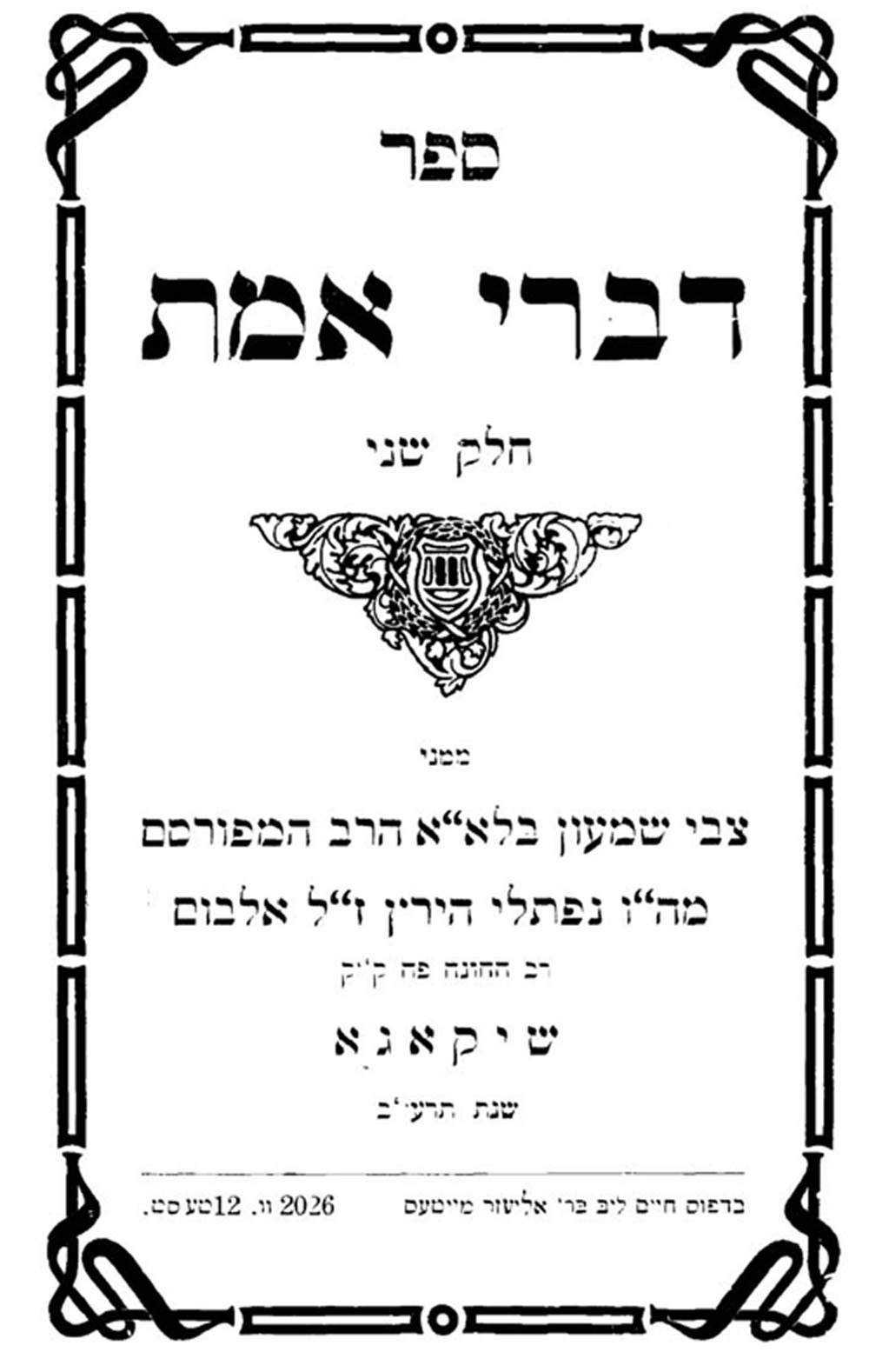
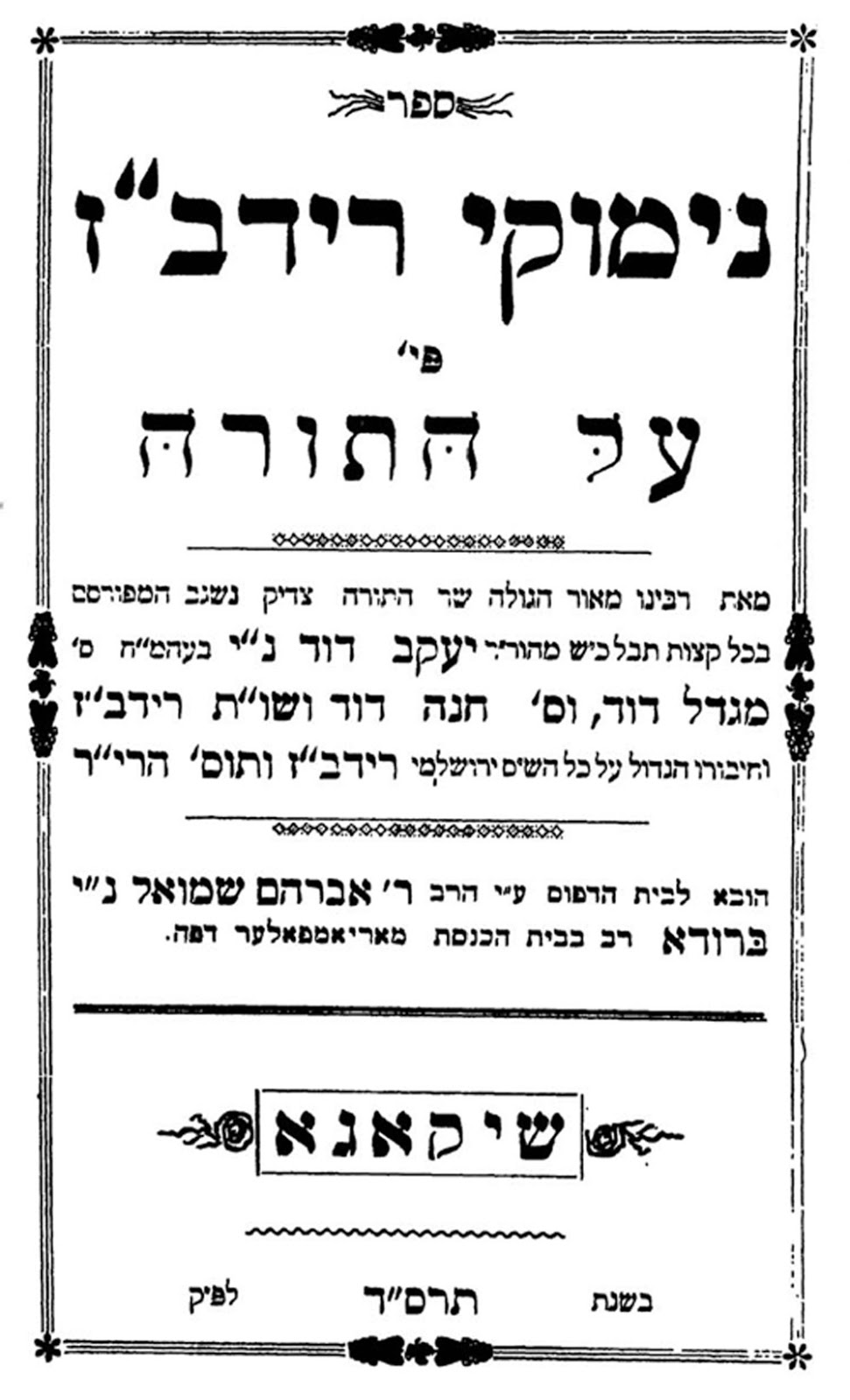
Only a few years later R. Jacob David Wilovsky (Ridbaz) also came to Chicago and he too found a great deal of difficulty there. In particular, he was opposed by R. Zvi Simeon Album who saw Ridbaz as a threat to his own kashrut supervision. While today everyone knows the Ridbaz and no one has heard of Album, we shouldn’t let this prejudice us in this particular matter. After all, Album was also a fine talmid hakham, although obviously not at the Ridbaz’ level. He published two volumes detailing his terrible dispute with Ridbaz, in which aside from dealing with kashrut matters, he also accuses Ridbaz of plagiarism and of creating controversy where ever he goes. Here are the title pages.


While the history of kashrut supervision is a great interest of mine, I will leave that for another time. For now, let me just call attention to two interesting points he makes in his polemic against Ridbaz.
The Ridbaz’ attack on the Brisker method is well known. In the introduction to his responsa, Beit Ridbaz (Jerusalem, 1908), Ridbaz writes as follows:

A certain rabbi invented the “chemical” method of study. Those in the know now refer to it as “chemistry,” but many speak of it as “logic.” This proved to be of great harm to us for it is a foreign spirit from without that they have brought in to the Oral Torah. This is not the Torah delivered to us by Moses from the mouth of the Omnipresent. This method of study has spread among the yeshivah students who still hold a gemara in their hands. In no way does this type of Torah study bring men to purity. From the day this method spread abroad this kind of Torah has had no power to protect its students. . . . It is better to have no rosh yeshivah than to have one who studies with the “chemical” method.

In his ethical will, printed at the end of his responsa, Ridbaz returns to this criticism and directs his sons: “Be careful, and keep far away from the new method of study that has in recent years spread through Lithuania and Zamut. Those knowledgeable in Torah refer to it as ‘chemistry.'” [Just before this post appeared, R. Eliezer Katzman sent word that in his opinion, Ridbaz is not referring to R. Hayyim and the Brisker approach, but rather to Telz and its method of talmudic analysis. I don’t believe this is correct, and hope to return to this subject in a future post.]
In the first edition of Shaul Stampfer’s Ha-Yeshivah ha-Lita’it be-Hithavutah, p. 113 n. 29, he quotes Saul Lieberman’s opinion that Ridbaz’ words were directed against R. Isaac Jacob Reines. This is clearly incorrect. Reines’ method had no influence whatsoever, and Ridbaz is speaking about a method of study that was widespread in the yeshivot. It is obvious that he can only be referring to the method of R. Hayyim. Lieberman’s incorrect speculation was removed in the second edition of Stampfer’s book.
This new edition is of great importance for it contains the documents that reveal the true reason why Volozhin was closed. In fact, On the Main Line has recently printed a report from the Jewish Chronicle that shows that even in England they had heard that the reason for closing down the yeshiva had to do with the “nihilists.”[3] Incidentally, the report in the Jewish Chronicle’s second story (also cited by On the Main Line) that the Netziv went to Western Europe is incorrect. In fact, I found it quite strange, as it is well known that the Netziv never left Eastern Europe. I asked R. Nathan Kamenetsky about this, and he responded as follows:

They confused him with his son R’ Hayyim Berlin, who did travel to Western Europe to raise funds. In MOAG (p. 449) I quote part of a letter R’ Hayyim wrote FROM PARIS, four months after the closure of the yeshiva to the Rav of Tripoli, Libya . . . From the text of [R.] Berlin’s signature on that letter, I prove (among other proofs) that the Berlins expected the closure of the yeshiva to be temporary.[4]

He also wrote me that he finds the article on the closure significant as “this proves that even among Jews it was known that the yeshiva was closed for the actual reason that is set down in the government records that Stampfer discovered and publicized in his later edition of ‘Yeshivot Lita be’Hit’havutah’. . . . It is invaluable.”

Returning to the Ridbaz, it is not surprising that Album, Divrei Emet, vol. 2, p. 45, points to Ridbaz’ comments as proof that the latter had contempt for the Torah scholars of Eastern Europe. Ridbaz never responded to this volume, but in the introduction to Nimukei Ridbaz (Chicago, 1904), he had already given his view of Album (without mentioning him by name).[5] There was another attack on Album in the book Akhen Noda ha-Davar (n.p., n.d). This latter work is very rare and I have never seen a copy of it. Although its author is given as P. Gwirtzman, Album claims that it was really written by Ridbaz (Divrei Emet, vol. 2, pp. 3, 9, 31).
Needless to say, because of his attacks on R. Hayyim, Ridbaz did not endear himself to the Soloveitchik family. Once when a student referred to Ridbaz, R. Joseph B. Soloveitchik became very angry and told the student never to mention his name again. He also said that some gedolim are always right, some are sometimes right, and some are never right, and the Ridbaz falls into the latter category![6]
Album also points to something else in order to attack Ridbaz. Here is the title page of Ridbaz’ Nimukei Ridbaz.

Look at how Ridbaz is described with such grandiose titles. Album picks up on this and writes (Divrei Emet, vol. 1, p. 34b):

עשה עטרה לעצמו בראשו וכתב על עצמו על פתח השער, ספר נימוקי הרידב”ז, מאת רבינו מאור הגולה שר התורה צדיק נשגב המפורסם בכל קצות תבל כק”ש מה’ יעקב דוד נ”י המפורסם בחיבורו הגדול על הירושלמי. כן כתב הרידב”ז על עצמו – ועשה נגד הירושלמי מפורש בפ’ ז’ דפסחים וז”ל הירושלמי ושנא את הרבנות מלמד שלא יניח אדם עטרה לעצמו בראשו שנאמר יהללוך זרים ולא פיך
He continues by mocking Ridbaz’ learning. Here is one example, where he picks up on something Ridbaz writes in Nimukei Ridbaz (ibid., p. 35a):
וכמה דברים אשר נמצאים בתוכו הוא אפס ואין – ואין זה כי אם ראות עין. כמו למשל כתב בפ’ וירא דלכך לא הכניס אברהם המלאכים לתוך האוהל משום דהצדיקים אין הקב”ה מביא תקלה על ידם, ואם הכניסם לתוך האוהל היה שרה רואה אותם, וקיי”ל דאשה נדה אסורה להביט על הס”ת ע”כ באם היו באוהל היתה בע”כ שרה רואה אותם ע”כ. והנה כל דבריו בזה דברים בטלים המה, ראשית שאין שום איסור על האשה להביט על הס”ת רק מצד מנהג וכבוד, עיין במג”א וגם אין צדיקים הקב”ה מביא תקלה על ידן לא שייך אלא במידי דאכילת איסור.
He continues the assault on this point in vol. 2, p. 39:
ומלבד שדבריו דברי ליצנות המה, ומה ענין מלאכים לס”ת, והיכן מצינו שיהי’ מלאכים בגדר ס”ת.
It is very sad to read how Ridbaz and Album speak about each other, and as more than a few have quipped, “There is no hatred like the hatred between rabbis.” Another version of the comment is that “There is no hatred like the hatred between rabbis, especially when money is involved.” Yet in this case, at least, I don’t know how significant the financial angle was. Album claimed that he never received remuneration for giving his hashgachah, and this isn’t something he could have put in print if it was not true. However, Harold Gastwirt assumes that Album was upset that Ridbaz had been chosen as chief rabbi of Chicago, instead of him, and this position certainly did come with a salary.[7])
In seeking to explain the phenomenon or rabbinic hatred, R. Jacob Eskolsky gives the following insightful answer (Taryag Mitzvot [New York, 1926], vol. 1, p. 32a.
פעם אחת השבתי לבעל הבית אחד בעיר סקרענטאן, אשר הייתי שם רב איזה שנים, אשר שאלני השאלה הנושנה של העם, מדוע נשתנו הרבנים מכל בני מלאכה אחרת, אשר הם יושבים זה בצד זה ברחוב אחד או בבית חרושת אחד ואינם שונאים זה לזה, והרבנים מכיון שנמצאים שנים בעיר אינם נוחין זה לזה, אדרבה שונאים הם זה את זה ומחרפים אחד את חבירו, היש איזו סיבה לפליאה זו? והשבתי לו בפשיטות, הלא אם יבואו איש לביתו ויבשר בשורה נעימה לאשתו, כי עזרהו ה’ בפרנסתו ויוכל להוסיף לה שפחה על שפחתה שתהיה עזר כנגדה ותוכל לישב בקתדרא, תגיע להגברת שמחה מזה, וגם השפחה היושבת בבית הבישול בשמעה זאת אחורי הדלת נתמלאה רצון משמועה הזאת, כי תהיה לה חברה לעבודתה ולא יפול משא כל הבית עליה. לא כן אם יבוא איש הביתה בבשורה נעימה ומספר לאשתו כי עזרהו ה’ בריווח גדול יוכל לקחת עוד אשה אחת על אשתו, כי יוכל לפרנס שתי נשים, אז תמלא קנאת עזה כמוה ותשפוך כל חמתה עליו ובקול רעש גדול תחיל הזעק עליו, כי איננה שפחה בביתו להיות שמח בחברתה, כי בעלת הבית היא ואינה חפצה בשום אופן להניח שניה לצוות ולהנהיג עניני הבית ורק קולה ישמע בכל ענין הנהגת הבית, ואם לא ישמע לה ויקח אשה אחרת עליה תהיה צרה לה. כמו כן אם הרבנים מקיימים מה שנאמר בהוריות (דף י’) לא שררות אני נותן לכם, עבדות אני נותן לכם, כי אז היו שמחים אם הקהל מקבל עליו עוד רב, ובקבלת עוד עבד לצרכי הקהל הוקל מעליו עבודת העיר, אך אם הרב מחשיב את עצמו לשר ושופט ונוהג נשיאותו ברמה וכל מילי דמתא יהיו נמתחים אך על פיו ובלעדו לא ירים איש את ידו, אז מביט בעין קנאה על רב השני ואינו מניחו להרים ראש. ועל זה אמרו חכמנו (יומא עא) אלו תלמידי חכמים שדומים לנשים ועושים גבורה כאנשים, כי דרך נשים להם להיות מתקנאות בירך חברתה ולהיות צרה להשניה.
Before coming to New York, Eskolsky had served as a rav in Scranton[8] and was no stranger to rabbinic disputes himself.[9]
Exalted egos from both sides also helps to explain rabbinic feuds. As the Maharal commented, this is a particular problem of Torah scholars, because they are aware of their own great scholarship (Netivot Olam: Netivot ha-Anavah, ch. 6):
כי הגאוה הוא על בעל תורה בטבע וכל זה מצד הגדולה והמעלה שיש לתורה . . . ומפני כך בעל התורה יש בו קצת גאוה שרואה עצמו ג”כ גבוה ונבדל משאר הבריות.
Sometimes these rabbinic disputes even reach the level of what R. Jehiel Jacob Weinberg referred to as “murder.” Here is what he wrote in a letter to R. Joseph Apfel (Kitvei ha-Rav Weinberg, vol. 1 no. 3):
לפני שנתיים באו לכאן הרב גרוסנאס ביחד עם הפרופ’ דומב להתיעץ עם הגרי”א הרצוג ז”ל ששהה כאן והם הי’ גם אצלי ואני יעצתי להגריא”ה לבלי להורות הוראה בזה כי אם בהסכמת כל גדולי ירושלים כי . . . יש קנאים גדולים שאינם מודים על האמת אלא מחמירים עפ”י שיקול דעתם ורגשי לבם. ועמם אין להתוכח והם חשודים גם על שפיכת דם של המקילים וד”ל.
I published this volume as a sefer, to be used in the beit midrash, so I took out something which I didn’t think was proper to appear in such a work (as opposed to a scholarly book or blog where these considerations do not apply). In accordance with scholarly convention, I indicated this with an ellipses. Incidentally, when the late R. Joseph Apfel gave me the letters he received from R. Weinberg, there was only one place where he told me to omit a name. Other than that, he gave me permission to publish the letters in their entirety.
The complete sentence reads (and I have emphasized the deleted word):
כי אם בהסכמת כל גדולי ירושלים כי ביניהם יש קנאים גדולים שאינם מודים על האמת
In other words, R. Weinberg includes in his criticism even some people regarded as gedolim. This should not surprise us, and it doesn’t mean that these individuals are not, in fact, gedolim. Even well-meaning people can at times be led to extreme statements and “shefihut damim”. We have seen this in the last few years when rabbis, without any real knowledge of the facts, have declared that certain hashgachot are not reliable. We have seen gedolim declare that certain authors are dangerous without having even read their books (in the original or in translation) or spoken to them. I know from speaking to some of the mashgichim and the authors that they regard this as real “shefihut damim,” for they have been publicly condemned as either not reliable in matters of kashrut[10] or as destroyers of Torah society. If the accusations are true, then the rabbis have no choice but to speak out. But if the allegations are false, or even uncertain, is there any greater “shefihut damim” than this?
With regard to Weinberg’s comment, the late Yonah Emanuel wrote to me:
[תרשה] לי להתייחס לקטע הנ”ל, בו הרב ויינברג כתב שהקנאים חשודים על שפיכות דמים של המקילים. יש להביא אסמכתא מעדות אישה (!). רות בלוי בספרה “שומרי העיר” (י”ם תשל”ט) , פרק יז-יח, מתארת איך הקנאים רצו למנוע נישואי רבי עמרם בלוי איתה, בהיותה גיורת. אבל למה להביא ממרחק לחמנו? פעם הלכתי לשיעור אצל מו”ר הרב ש”ז אויערבך זצ”ל, ופתאום ראיתי במדרגות בית מו”ר זצ”ל קנאים רבים, חלק מהם דחפו עצמם לתוך הדירה, וחלק עמדו בחוץ. הם רצו ללחוץ בענין מסויים על מו”ר זצ”ל, והשיטה הבדוקה לבוא בהמונים, ללחוץ ולהפחיד. על זה התריע הרב ויינברג זצ”ל ממרחקים. על כגון זה נאמר “את בנציבין ומצודתך פרוסה בירושלים” (פסחים ג ע”ב).
Regarding rabbinic disputes, it is also worth recalling these memorable words, quoted by R. David Sperber (grandfather of Prof. Daniel Sperber)[11]:
מוטב להעמיד צלם בהיכל מלהחזיק במחלוקת
Returning to Ridbaz, all of the controversy in Chicago was too much for him and he left Chicago. Legend has it that he was locked in the freezer, in an attempt by his enemies to kill him, and upon being freed he immediately took his family and grabbed a train to New York. It was Friday night but he felt this was a case of was pikuach nefesh. I doubt that the story is true, although in a previous post I did mention a case where the mashgiach was locked in the freezer. We also have another recorded case where this happened. I refer to Rabbi Luntz of Paterson, N. J. who was locked in the icebox by one of the butchers he certified. This would have been bad enough, but Luntz also had to contend with R. Judah Leib Seltzer, who was later one of the leaders of Agudat ha-Rabbonim. He too was in Paterson and had a terrible feud with Luntz, which “climaxed by a public fight between the two rabbis in the synagogue.”[12]
Speaking of rabbis who were chased out of their communities, let me repeat what I heard from the late Rabbi Louis Jacobs.[13] This story is not documented anywhere, but is something that Jacobs no doubt heard growing up in Manchester. R. Abraham Aaron Yudelevitz was a rav in Manchester at the turn of the twentieth century. He would later come to the United States where he served as a rav in Boston and later in New York, and he was also a rosh yeshiva at Yeshivat R. Yitzhak Elhanan. As with a few others, while in N.Y. he even had the title “Rav ha-Kollel.”
Yudelevitz might have been the most brilliant Torah scholar in the United States. He was also prepared to stand up to anyone (including the Rogochover),[14] and is known for one incredible pesak that created enormous controversy: He permitted a woman to appoint another woman as her shaliah to carry out the halitzah ceremony. A short discussion of Yudelevitz’ life and the controversy is found in the second volume of Yeshurun,[15] the series which continues to publish massive volumes full of important and fascinating material. The typical haredi nonsense is, of course, to be found there, but since it is not so common it is no more than an unpleasant distraction.[16]
Here is a picture of Yudelevitz. He is on the right and the other rabbi is Gavriel Zev Margulies, whom I mentioned in my last post (see also note 12).[17]

Jacobs told me that when the machers had tired of Yudelevitz, they let him know it was time to leave in the following way. When his carriage pulled up one day, inside it were a couple of prostitutes waiting for him. This was the message to Yudelevitz to get out of town! Rather than stay and fight, he set his sights on the United States.

Returning to Gulevsky, in his book Du Yovlin (New York, 1988) he focuses on American Orthodoxy and its various rabbinic leaders. Since R. Emanuel Rackman recently passed away, let me quote a little of what he says (p. 45) about R. David Rackman, who was R. Emanuel’s father. He is the author of Kiryat Hanah David (New York, 1967), published by his son, and was a Rosh Yeshiva at RIETS for a couple of years beginning in 1907.

אחד מראשוני התלמידים שבאו ללמוד בישיבה ואחרי כן הרביצו תורה בישיבה, זה היה הרה”ג רבי דוד רקמאן. כפי ששמעתי מזקנים, הרה”ג מוהר”ר דוד רקמאן בא לארצות הברית עם סמיכת חכמים בידו. הרה”ג רבי נחום דן מסלוצק היה משגיח הראשון בישיבה, והוא לא היה קשור עם תנועת המוסר לגמרי. אבל היה אביהם של כל בני הישיבה, ויותר מזה אביהם ואמם. הוא יעץ להרה”ג דוד רקמאן שימשיך ללמוד ולא לרוץ אחרי הבלי עולם הזה . . . בשנת תרס”ז כבר נתן שיעורים בישיבה קרוב לשלש שנים. היה חכם מופלג ותמך בישיבה כל ימיו. כאשר באו לישיבה מאורי ישראל רבותינו העילוי ממיטשט ואחרי כן רבי משה הלוי סאלאווייציג עזב הרה”ג רבי דוד רקמאן כל עסקיו, וממש התאבק בעפר רגליהם. פעם ראיתי אותו בסביבת החכם השלם איש האשכולות מרן חיים העליר, ויבדל לחיים טובים “הרב” שליט”א. מעולם לא ראיתי פה במדינה הזאת רב שיעמוד ביראת הכבוד כלפי גדולי ישראל אמיתיים כרבי דוד רקמאן.
Gulevsky gives descriptions of other early students at RIETS. One of those he mentions is Moses Romm, who was later a rabbi in Minneapolis. I believe he is the grandfather of Rabbi Romm who taught at BMT for many years. He also mentions Henry Guterman, who was the rav of Scranton for half a century, and has recollections of Samuel K. Mirsky, Dov Baer Abramowitz, and many others. There is so much material here, for those interested in American Orthodoxy, that I can’t even begin to summarize it.
Regarding R. Benjamin Fleischer, many of whose books are now on HebrewBooks.org, Gulevsky says the following (p. 46):
טיפוס מיוחד במינו היה הרה”ג העצום רבי בנימין שלייפער [צ”ל פליישער] שהיה רב בבית מדרש הגדול במורד העיר. היה עילוי נפלא ובקיאותו בש”ס ופוסקים היה משהו מיוחד. ובגלל שהיה עילוי בכל המובנים לכן לא נעשה הפוסק במורד העיר. היה מחמיר גדול בשאלת נשים, אפילו בדרבנן. השיטה שלו היתה שבמדינה הזאת אין חשש מאכולת, הנשים נקיות ביותר וצריכים לבטל לגמרי כל הקולות של כתמים. התרעם הרבה על כמה פסקים של הרה”ג א. ה. בניו יראק, והרה”ג ח. מ. בשיקגא, לא רק בשאלת נשים.
The New York rabbi he alludes to is undoubtedly R. Joseph Elijah Henkin but I don’t know who the Chicago rabbi is. Maybe one of the readers can help out here. As mentioned before, Gulevsky uses this type of code throughout his works. With regard to his categorization of Fleischer as an “illui,” it is worth recalling R. Moshe Feinstein’s comment that: אין לנו הרבה נחת מהעילויים.[18
In the previous post I quoted the very harsh things Gulevsky had to say about YU. Yet Du Yovlin was written while he was still employed there, and from this book we get an entirely different picture. YU is referred to as “yeshivatenu ha-kedoshah”, and on p. 1 Dr. Norman Lamm is described as follows:
ידידי ורב חביבי וכו’, החכם השלם איש האשכולות כליל המדעים וכו’ וכו’ וכו’ הרה”ג נחום לאם שליט”א
At the beginning of this post I mentioned that Gulevsky is descended from both R. Hayyim of Volozhin and his brother R. Simcha. While everyone knows that R. Hayyim became the student of the Vilna Gaon, Gulevsky tells us the following about his forefather, R. Simcha, which is amazing in that it testifies to Lithuanian opposition to the Vilna Gaon (Du Yovlin, p. 2):
אאמו”ז רבינו שמחה התנגד לנסוע אל אדונינו הגר”א כפי שרמז מר זקני הגאון החסיד קדוש ישראל זצוק”ל הי”ד. זקנינו רבינו שמחה בתמימותו הכנה חשב שהגר”א הולך לשנות מנהגן של ישראל, והתנגד לזה הרבה. אדונינו בעל השאגת אריה לא שינה שום דבר מלבד שהכשיר מכה בדופן וכו’, אולם אדונינו הגר”א, שמעו עליו שאינו מניח תפילין בחול המועד וכדומה.
With regard to the Vilna Gaon, and why he never made it to the Land of Israel, Gulevsky writes as follows (Shabbat Shabbaton, p. 134):
ושמעתי מאאמו”ז הגאון החסיד קדוש ישראל עמוד ההוראה ואביר הרועים מרנא שמחה זעליג זצוק”ל הי”ד, ששמע ממרא דמתיבתא עלאה הגה”ח המובהק מרן רפאל מוואלאזשין ששמע מאביו רבינו אריה ליב שאפירא מקאוונא, היו הרבה טעמים שהגר”א חזר מדרכו לארץ ישראל. אבל רבינו אריה ליב סבר שאחד מהטעמים בנגלה היה שהגר”א סבר העיקר כהמבי”ט נגד הבית יוסף וכל חכמי הדור ההוא.
According to the Mabit all produce grown in the Land of Israel in the Sabbatical year, even on non-Jewish land, has sanctity and must be given special treatment. I assume that Gulevsky’s report means that the Gaon did not want to come to the land of Israel and create controversy by adopting a practice in opposition to R. Joseph Karo’s view, which was minhag Eretz Yisrael.[19] (In the twentieth century the Chazon Ish had no compunctions in advocating the Mabit’s opinion, especially as there are reports – hotly disputed, to be sure – that before his death R. Joseph Karo abandoned his position.[20])
An interesting comment which is not of a historical nature is found in Shabbat Shabbaton. p. 96. R. Moshe Feinstein states that anytime Rabad doesn’t express his disagreement with the Rambam, this shows that he agrees with him. R. Moshe is hardly the first to argue in this fashion,[21] yet Gulevsky points out that this is a methodological error and that there are numerous times that Rabad disagrees in his other works and doesn’t record this disagreement in his hassagot. R. Yaakov Hayyim Sofer, who has a bekiut unlike that of anyone alive today, has a very long list of such disagreements, and if all we had were the hassagot we would know nothing of this.[22] We can conclude, therefore, that Rabad’s hassagot were never intended to be a comprehensive list of all of his criticisms, but were written in an ad hoc fashion.
Quite apart from what appears in his books, there are some other interesting tidbits he told me which as far as I know do not appear in print.
1. The grandfather of the famous bibliographer, E. R. Malachi, was named Engleman, and he emigrated from Brisk to the Land of Israel in 1837.
2. R. Simcha Zelig Rieger was head of a kollel le-hora’ah in Volozhin. This kollel focused on practical halakhah.
3. R. Hayyim Soloveitchik and R. Velvel never preached to the community, not even on Shabbat ha-Gadol and Shabbat Shuvah.[23]
4. Although R. Velvel was officially rav of Brisk for twenty years, he only resided in the city for six and a half of these years. He was often ill and had to spend much of his time in places more congenial to his health. He was not living there during the 1937 pogrom, but after this event he returned to the city for two weeks.
5. In Kelm “they held of” Wessely’s Yein ha-Levanon.(I include this because I think Gulevsky meant the yeshiva as a whole, not simply R. Simcha Zissel. R. David Zvi Hillman has seen the manuscript essays of R. Simcha Zissel, and they contain references to Wessely. When these were published in Hokhmah u-Mussar [New York, 1957], Wessely’s name was deleted.[24])
6. Rabbi Rakefet has asserted on numerous occasions that as a young man R. Shneur Kotler attended R. Soloveitchik’s shiurim at YU. Gulevsky denies this. According to him, R. Shneur only went to hear the Rav at Moriah.[25]
7. R. Joseph Zekhariah Stern, Zekher Yehosef, Orah Hayyim no. 177, has a responsum addressed to ר’ מנחם שרגא רעוויל. This is Bernard Revel’s father (The first name was actually Nahum, not Menahem.)

I would be remiss in not mentioning that one has to question many of the stories Gulevsky tells, simply because they don’t agree with what we know from other sources. While he tries to be careful in his facts, some of his reports are no different than the typical “frum history” in which all sorts of stories get repeated as if they were facts. There are a number of examples of this but let me note one that doesn’t appear in his books, but which he told me. According to Gulevsky, the reason Yeshiva College did not offer a job to Saul Lieberman is because his father-in-law, Meir Bar-Ilan, almost bankrupted the institution when he served as temporary president during Bernard Revel’s leave of absence. Yet this is completely false. There are also times when Gulevsky writes things that are not merely incorrect, but downright foolish. See e.g., here.

The link just given refers to Gulevsky’s stringent view of eruvin. In this he is following not only the Brisker tradition but also that of his grandfather, who did not believe that an eruv could be established in the typical town. Yet Gulevsky has also noted that despite this opposition, there was an eruv in Brisk and his grandfather checked it every week.[26] (When the young Joseph Baer visited Brisk he checked it together with R. Simcha Zelig.[27] He also used to check the eruv in Chaslovitz, where his father was the rav.) Originally I thought that the presence of an eruv in Brisk was an example of R. Hayyim not wishing to force the community to adopt his stringent position. Yet from R. Moshe Sternbuch’s recently published Teshuvot ve-Hanhagot, vol. 5, no. 101, we see that this was not the case. He heard from R. Velvel that R. Hayyim wanted to forbid the eruv, and even publicized this, but the people refused to listen to him. (You see, it is not only Modern Orthodox Jews who ignore what the rabbis tell them!) The people must have thought that if other cities with great rabbis can have an eruv, then why should they suffer because of R. Hayyim’s humra. Faced with this rejection, R. Hayyim told R. Simcha Zelig that the kashrut of the eruv was to be his responsibility. R. Hayyim wanted nothing to do with it. R. Velvel himself would only check the eruv once a year, before Rosh Hashanah, and it bothered him greatly that his own city was relying on what he regarded to be unacceptable leniencies.[28]
In Boston, as long as R. Joseph B. Soloveitchik was active, there was no eruv. The Rav publicly declared:
I am opposed to the establishment of eruvin. An eruv in American means the abolishment of the prohibition of carrying on Shabbat. Aside from certain [meta-halakhic] reasons, I also have halakhic reasons why I can’t give my approval to the establishment of eruvin. [29]
As soon as the Rav was no longer able to protest, an eruv was established in Brookline. I was in the Bostoner Rebbe’s shul when he spoke about how important the eruv was and that everyone should rely on it. He insisted that there must be no distinction between the “frum,” who don’t carry, and everyone else. It is interesting that the Modern Orthodox world, which places the Rav on such a pedestal, has not accepted one of his few public halakhic pronouncements.

[1] See here
[2] Hebrew Printing in America, p. 501.
[3] See here.
[4] In his e-mail to me Kamenetsky mistakenly wrote R. Meir Berlin. I have corrected it.
[5] The introduction to this book and also his Beit Ridbaz (Jerusalem, 1908), are fascinating, because he describes in detail many of the communal problems he saw. One wonders if he was writing his book today, which problems he would identify. I don’t think English sermons would still be an issue for him, although I think it is fair to say that advertising a “Pretty Woman” sheitl would definitely outrage hiim. After all, the sheitl is supposed to represent modesty, and Julia Roberts’ profession in that particular movie was not exactly tzniusdik. See here (Unfortunately, some of the comments to this post are inappropriate.)
[6] I heard this from an eyewitness. The event took place in the 1950s.
[7] See Fraud, Corruption, and Holiness (Port Washington, 1974), p. 91.
[8] Quiz question: Which contemporary gadol be-Yisrael was born in Scranton?
[9] See Gastwirt, Fraud, p. 145, that Eskolsky was expelled from Agudat ha-Rabbanim for giving a hekhsher on a plant that produced both kosher and non-kosher meat. This was in violation of the Agudat ha-Rabbanim takkanah. Those rabbis who opposed Agudat ha-Rabbanim’s policy formed the competing Kenesset ha-Rabbonim, which was led by R. Gavriel Zev Margulies.
[10] Experience has shown that a rabbi who is financially corrupt can easily win back his reputation (and in some circles financial corruption doesn’t affect his reputation to begin with). Yet if a rabbi is accused of not being reliable in matters of kashrut, even if the accusation is false, it is almost impossible for him to turn this around. Unfortunately, when it comes to kashrut supervision, American Orthodoxy has distorted our tradition. People are constantly told that if they see a hashgachah on a product or restaurant, that they cannot rely on it without investigating who the rav ha-machshir is. This is completely mistaken. According to halakhah every rav is regarded as trustworthy unless you have been reliably informed otherwise. Without receiving negative information, one should always assume that a rav is reliable. This is no different than if you arrive in a new city and go to shul on Shabbat and you are invited to someone’s house for lunch. One should assume, unless he has reason to think otherwise, that the person inviting him keeps kosher, as religious Jews have a hezkat kashrut. Certainly, if the rabbi invites you to his house you must assume this. The notion that is currently rampant, that we don’t trust a rav until we investigate him, is the exact opposite of what the tradition has always held. Rather, we are supposed to trust the rav unless we are given reason to think otherwise. Every rav, even a rav ha-machshir, has a hezkat kashrut and is assumed to be doing his job reliably.
To show how far this idiocy has gone, let me share something that happened a couple of years ago when I was visiting a city that shall remain nameless. Someone was eating with us and mentioned that he was going to be travelling to Elizabeth, New Jersey. He asked me if I knew about kosher food in the area. I told him that Elizabeth has a very nice Jewish community, with plenty of kosher food. He then asked who gave the hashgachah, and I replied that it is Rabbi Teitz. The man wasn’t happy with my answer, which troubled me since I had never heard of anyone question R. Teitz. In fact, in speaking to him it was apparent that he had never even heard of R. Teitz. Yet he announced for everyone that his family would have to avoid visiting any of the kosher eateries when he was in Elizabeth. I was really shocked and I asked him, “Why? What is wrong with R. Teitz?” I further asked him where he thinks the people he will be visiting in Elizabeth get their food. Yet he would only reply: “We only eat at places under the supervision of a Vaad.” I told him that I didn’t think that there was a Vaad in Elizabeth, and why in any case does he need a Vaad? A Vaad might be a good idea from a practical standpoint, in order to create one communal standard, yet there is nothing in the Shulhan Arukh about a Vaad, and R. Teitz is as reliable as anyone. Yet all I got from him was the same nonsense about how without a Vaad a hashgachah cannot be trusted. (I never asked him what he would do in a one-rabbi town.)
[11] Afarkasta de-Anya, vol. 1, no. 165:3. While Sperber later became a mainstream haredi posek, in his youth he was also exposed to Haskalah. See Joseph Ibn Kaspi, Asarah Kelei Kesef ed. Last (Pressburg, 1903), vol. 2, pp. 190ff. (Hebrewbooks.org for some reason splits up Asarah Kelei Kesef into separate volumes. If you search hebrewbooks.org under נקדות כסף you will find the Sperber letters.) Sperber, p. 193, asks Last, when he publishes his letters, to describe him as a hasid. His reason is incredible:
נא לתארינו [צ”ל לתאריני] בשם “חסיד” והיה אם לא ייטבו דברי בעיניהם ידינני לכ”ז, ויאמרו כי חסיד הוא וחכמה מה לו, ואם אולי ימצאו דברי נכונים, אז ירומם שם חסיד תחת לשונם ויאמרו הגם חסיד יודע ומבין דבר.
[12] See Gastwirt, Fraud, p. 93. Cf. Jenna Weissman Joselit, New York’s Jewish Jews (Bloomington, 1990), p. 62, regarding R. Moses Z. Margolies and his kashrut battles: “Determined to teach the Ramaz a lesson, a band of disgruntled butchers alledgedly banded together to poison the meat at his daughter’s wedding supper, sickening some 2000 guests, including the bride.” During his great dispute with R. Shalom Elhanan Jaffe, R. Gavriel Zev Margulies was physically attacked by shohatim who supported Jaffe. See Gastwirt, Fraud, p. 121.
[13] Since I mention Jacobs, I must also note the following. In a recent AJS Review (vol. 32, 2008), pp. 450-452, I reviewed Miri Freud-Kandel’s history of Orthodox Judaism in Britain. I mentioned the “Jacob’s Affair” and there is a note explaining what this was.
“The term ‘Jacobs Affair’ refers to the controversy surrounding the potential appointment of Rabbi Louis Jacobs as chief rabbi of England. In 1961, Rabbi Louis Jacobs, z”l, was nominated as the principal of Jews’ College, a position considered a potential way station for the chief rabbinate of the British Commonwealth. That appointment, however, was blocked by the then-chief rabbi Israel Brodie because of his published views. Brodie then prohibited Louis from returning to his post at the New West End synagogue in London, upon which a new congregation was established for him.”
This was added by the editor. I never would have referred to Jacobs as “Louis.” I have, incidentally, many letters from Jacobs that I hope to publish. Although we only met three times, we corresponded for almost twenty years. Only now do I realize how lucky I was, that this world-renowned scholar took the time from his busy life to correspond with a young student, especially a student who had no compunctions telling Jacobs when he disagreed with him. Occasionally, I would send Jacob’s material that I thought would interest him. One time I sent him R. Joseph Messas’ Mayim Hayim, and was surprised to later see that he cited this work in Beyond Reasonable Doubt (London, 1999), pp. 216-217. He showed great insight in describing Messas as follows: “As is evident from his responsa, Mashash, for a rabbi of the old school, was something of a modernist. But his historical sense was sufficiently acute not to allow him to read modern ideas into the sayings of the ancient rabbis.” I also sent him Haym Soloveitchik’s famous article, “Religious Law and Change,” AJS Review 12 (1987), pp. 203-221, which surprisingly he had never seen. When A Tree of Life was reprinted in 2000, he added a new introduction and cited this article as further support for the thesis of his book.
Regarding editors adding material to an author’s work without asking, see the recent comment by Haym Soloveitchik in “Mishneh Torah: Polemic and Art,” in Jay M. Harris, ed., Maimonides After 800 Years (Cambridge, 2007), p. 333 n. 25. (This is a truly wonderful article.) In referring to an entry he wrote for the Oxford Dictionary of the Jewish Religion, Soloveitchik notes: “The editors, wishing to improve upon my scant bibliography, added Shemuel Argaman, The Captivity of the Maharam: A Narrative of the Events Surrounding the Arrest and Captivity of the Maharam of Rothenburg (New York, 1990)—a children’s storybook published by the Lakewood Heder.”
[14] See here. This source does not give the book and page no. that is excerpted: It is Av be-Hokhmah (New York, 1927), pp. 85-86.
[15] R. Moshe Zvi Berger, “Av le-Hakhamim: Ha-Gaon R. Avraham Aharon Yudelevitz,” Yeshurun 2 (1997)), pp. 686-691.
[16] For an example from the most recent volume, see Yeshurun 21 (Nisan 5769) p. 417, where in discussing “Ha-Gaon R. Moses Aaron Poleyeff” we are told that he שימש אז כראש ישיבה באחד מהישיבות שבאמריקה. If this was someone who taught at RIETS for a short period of time, I might understand it, but Poleyeff spent his entire adult life teaching there. (He began teaching at RIETS in 1920.) He was also widely regarded as Yeshiva’s most beloved teacher. Poleyeff, more than anyone else, would be offended at this attempt to “kasher” him by hiding the fact that he taught at RIETS. (An outstanding talmid hakham recently commented to me that in his opinion Poleyeff was a greater lamdan than R. Moshe Feinstein!)
[17] I found the picture here.
[18] R. Michel Shurkin, Meged Giv’ot Olam ( Jerusalem, 2005), vol. 2, p. 23. He also quotes R. Leib Malin as saying that it is not good to be an illui.
[19] Eliezer Brodt called my attention to the fact that R. David Luria offered this reason as well. See Dov Eliach, Ha-Gaon (Jerusalem, 2002), vol. 3, p. 1286.
[20] See Dayan I. Grunfeld, The Dietary Laws (London, 1972), vol. 2, pp. 180-181
[21] R. Yitzhak Yosef, in his new work, Einei Yitzhak (Jerusalem, 2009), vol. 3, p. 439, also accepts this methodological rule.
[22] Keneset Hayyim (Jerusalem, 1993), pp. 9-12. See also Isadore Twersky, Rabad of Posquieres (Cambridge, 1962), pp. 175-176.
[23] In the recently published Kol Brisk (Jerusalem, 2009), p. 20, it refers to R. Hayyim delivering words of Mussar on Shabat Shuvah. Gulevsky strongly denies this. The most that he would acknowledge is that perhaps in his first year or two he gave derashot, but never after that. (R. Chaim’s and the Brisker Rav’s way of “rabbinating” did not find favor in the eyes of all of Brisk’s citizens, ואכמ”ל.) In general, there are historical points in this book that are doubtful, leading me to question its reliability in such matters. Even if the historical information came from R. Aaron Soloveichik, it was not uncommon for R. Aaron to err in such matters, and again אכמ”ל. (Kol Brisk is authored by one of R. Aaron Soloveichik’s son. He doesn’t give his name on the title page so I will respect this.)
Let me give one example of the questionable material in this book. On p. 33 there is a whole story, seemingly legendary, to explain how R. David Feinsten, R. Moshe’s father, received the name Feinstein, since the family’s original name was not this. Yet in the introduction to vol. 8 of Iggerot Moshe, p. 6, the children of R. Moshe state that Feinstein was indeed the family name.
Perhaps in another post I will return to this book, as it has a number of what are certain to be controversial statements. For example, on p. 656 it blasts the OU for naming its Israel center after someone who, we are told, caused R. Aaron Soloveichik so much trouble:
בפעולה זו הם מבזים גדול בתורה שכל ימיו הרביץ תורה לאלפים.
[24] See Naftali Hertz Wessely, Yein ha-Levanon (Rishon le-Tzion, 2003), p. 28.
[25] Regarding R. Shneur, a recent article in Ha-Ma’ayan reveals that in the mid-1940’s he was involved in founding the first yeshiva in Palestine that taught secular studies. See R. Yoel Amital, “Sabi ha-Rav Zvi Yehudah Meltzer,” Ha-Ma’ayan 49 (Tamuz, 5769), p. 66.
[26] See R. Menasheh Klein, Mishneh Halakhot, vol. 8, no. 128, vol. 15, no. 127 (responsum to Gulevsky; this last source quotes R. Moshe Feinstein as stating that there was also an eruv in Karlin, despite the fact that R. Yaakov of Karlin was the leading opponent of city eruvin). In his responsum to Gulevsky, Klein says some of the strangest things imaginable, which raise questions as to how he can be taken seriously as a posek in matters of eruvin. According to his calculations, and this is directly related to his halakhic understanding, in Second Temple days there were billions (!) of Jews in the Land of Israel, and roughly thirty million of them would descend on Jerusalem for the holidays. He concludes (vol. 15 p. 201):
והבוליווארדיס והמעטראפאליטין של קווינס וגרענד סענטאראל אף לא הגיעו לקרסולי ירושלים עיה”ק וזה לפענ”ד פשוט
In another responsum to Gulevsky dealing with eruvin (Mishneh Halakhot, vol. 8, no. 168), he says something equally strange:
גם מרן הח”ס נחשב מתלמידי בעש”ט שהי’ תלמיד מובהק של מרן בעל הפלאה
[27] Schachter, Nefesh ha-Rav, p. 170.
[28] R. Sternbuch adds:
ומאמר היה בפיו בשם אביו הגר”ח זצ”ל, “קשה למצוא עירוב כשר וקשה למצוא מקוה פסול”, וכוונתו שבעירוב נכנסים לדחוקים ומכשירים, ובמקוה אף שמדינא יש להקל מחמירים.
[29] Ha-Pardes (January, 1979), p. 26.


The Rogochover and More: Excursus on Fasting

The Rogochover and More: Excursus on Fasting
Marc B. Shapiro
Relevant to what appeared in the last post (see note 13), I wish to mention some leniencies regarding fast days that contradict mainstream halakhah. I have also included other interesting material regarding the fast days.
1. R. Israel Jacob Fischer, dayan on the beit din of the Edah Haredit, stated that in our day all pregnant women up until the ninth month must eat on Yom Kippur פחות מכשיעור. See his haskamah to R. Baruch Pinchas Goldberg, Penei Barukh (Jerusalem, 1985), where he writes:
כיום הזה שנחלשו הדורות, ועשרות רבות של נשים מפילות ע”י התענית, צריכין כל הנשים המעוברות עד החודש התשיעי לאכול ביוהכ”פ פחות מכשיעור.
For a criticism of this great leniency, which contradicts Shulhan Arukh, Orah Hayyim 617:1, see R. Eliezer Waldenberg, Tzitz Eliezer, vol. 17, no. 20. Elsewhere, R. Fischer states that pregnant women are forbidden to fast on Tisha be-Av.
מעוברת אסורה להתענות בת”ב, ואין כאן דין שיעורים, כי במקום סכנה לא גזרו חז”ל
See Even Yisrael, vol. 9, no. 62. This too is at odds with Shulhan Arukh, Orah Hayyim 554:5, which rules that pregnant women are obligated to fast on Tisha be-Av.
In an article on the OU website[1] R. Y. Dov Krakowski writes:
There are those who are Noheg that pregnant women do not even begin to fast on Tisha B’Av (there is very little if any Halachik backing to this hanhaga, but many of the chosheve senior Poskim have such a Mesorah. I have personally heard this from many family members who heard this from my great uncle the Veiner [!] Rov Zetzal and from my wife’s grandfather Harav Lipa Rabinowitz who says it in the name of his grandfather the Sundlander Rov Zatzal).
R. Yosef David Weissberg also reports that many halakhic authorities rule that in contemporary times pregnant women are not obligated to fast on Tisha be-Av.[2]
2. R. Akiva Joseph Schlesinger writes that he has a tradition from the Hatam Sofer that pregnant and nursing women should only fast on Yom Kippur, and even women who are not pregnant should only fast on Tisha be-Av and the other fast days if they are very healthy.[3] He also quotes an oral tradition from the Hatam Sofer which seems to be saying that if he had the authority, he would have abolished the fast days other than Yom Kippur and Tisha be-Av. (See note 4 for another source where the Hatam Sofer says this explicitly.)
ובפרט אחרי כי בא חולשא לעולם, שמענו מהחת”ס זיע”א שאמר אי לאו דמיסתפינא כלפי ד’ תעניות חוץ מיוהכ”פ ות”ב מטעם חשש סכנה לכמה בני אדם, ובפרט לנשים ה’ ירחם, ולא להניח לבנותיו להתענות חוץ מהנ”ל.
His last words are not entirely clear. I think they mean that he would have preferred not to allow his daughters to fast except on Yom Kippur and Tisha be-Av, but not that he did so in practice. He does not say ולא הניח לבנותיו but ולא להניח לבנותיו.
The editor adds a note explaining the passage just quoted, but he misunderstands what R. Schlesinger means when he writes .מטעם חשש סכנה לכמה בני אדם He also mistakenly understands the passage to mean that the Hatam Sofer forbade all women to fast, other than on Yom Kippur and Tisha be-Av.
כאן כתב רבינו פסק החת”ס לענין שאר תעניות, דהיה אוסר להתענות לכל הנשים ואפילו למי שאינם מעוברות ומניקות, ולאנשים היה מתיר לכמה בני אדם אי לא דמסתפינא, אבל לנשים החליט להיתר.
R. Schlesinger also states that the rabbis did not allow women to fast except for Yom Kippur and Tisha be-Av.
בענין התעניות, בחולשתינו, רבותינו לא הניחו לנשים להתענות חוץ מט”ב ויוהכ”פ.
R. Schlesinger himself suggests that the women not fasting should give some money to charity and fast a few hours or even abstain from food the evening before the fast actually begins.
Returning to the Hatam Sofer’s comment that if he had the authority, he would abolish the fast days other than Yom Kippur and Tisha be-Av, the exact same thing was said by R. Abraham Joshua Heschel of Apta. He added that on Yom Kippur, who needs to eat (since we should be so involved in our prayers), and on Tisha be-Av, who is able to eat (as we should be so focused on mourning what we have lost)?[5]
אם הייתי בכוחי הייתי מבטל כל התעניתים חוץ מיום המר והמנהר (הוא ט’ באב), שאז מי יוכל לאכול. וחוץ מיום הקדוש והנורא (הוא יום כפור), דאז מי צריך לאכול.
R. Abraham also reported that he was told by his teacher, R. Elimelech of Lizhensk, that if he could find two others to join with him, he would abolish “the fasts” (presumably, everything except for Yom Kippur and Tisha be-Av).[6]
3. R. Ovadiah Yosef, Yabia Omer, vol. 10, Orah Hayyim no. 39, discusses the laws of a nursing woman and the various fasts. On p. 503, in the hosafot u-miluim, he adds:
מש”כ להקל במינקת שאפילו הפסיקה להניק אם היא בתוך כ”ד חודש ללידה פטורה מלהתענות ג’ צומות ותענית אסתר. יש להסתייע ממ”ש הגאון בעל דרכי תשובה בשו”ת צבי תפארת סוף סי’ מח: וז”ל: ודע כי שמעתי מפה קדוש של מורי הגאון הקדוש אדמו”ר רבי יחזקאל משינאווא זצללה”ה, שאמר, כי הוא מקובל מגאוני וצדיקי הדור הקודמים זצ”ל, שכל אשה שעומדת עדיין בימים שיכולה ללדת, ובימי הצומות היא חלושת המזג, אפילו היא בריאה ושלימה, נכון יותר שלא תתענה, ורק לאחר שיפסוק זמנה מללדת עוד, אם תהיה בבריאות תשלים אותם התעניות, לחיים ברכה ושלום. ע”כ
This is a fascinating passage as R. Ovadiah is quoting R. Zvi Hirsch Shapira in the name of R. Ezekiel Halberstam of Shinova, who himself is passing on a tradition from earlier geonim and tzadikim, that women of childbearing age, even if they are not pregnant, do not have to fast if they feel weak. This ruling is in contradiction to Shulhan Arukh, Orah Hayyim 550:1, which states that women are also obligated to fast on the 10th of Tevet, 17th of Tamuz and Tzom Gedaliah, and does not give any exemption if they feel weak (as pretty much everyone feels a little weak when fasting). As we have already seen, R. Akiva Joseph Schlesinger states that “our rabbis” did not allow any women, not just those of childbearing age, to fast on these days.
R. Meir Mazuz, Sansan le-Yair (2012 ed), p. 354, notes this passage of R. Zvi Hirsch Shapira and reacts very strongly:
והוא נגד חז”ל חכמי התלמוד וכל הפוסקים שלא התירו רק למעוברת ומניקה. ומזה למדו רוב המורות והתלמידות בבית יעקב בימינו שלא לצום כל ד’ תעניות, ואוכלות בריש גלי בשעת ההפסקה כאילו לא היו ד’ תעניות בעולם ולא תיקנו אותם הנביאים.
Is R. Mazuz correct that most teachers and students at Bais Yaakov schools do not fast on the 10th of Tevet, 17th of Tamuz, Tzom Gedaliah, and Ta’anit Esther? I know that in the yeshiva world many do not fast, but my question is, is this really the majority, and are there any differences between Bais Yaakov schools in the U.S. and Israel? (Even though R. Mazuz refers to ד’ תעניות established by the prophets, I am assuming he means the 10th of Tevet, 17th of Tamuz, Tzom Gedaliah, and Ta’anit Esther, as religious women of all stripes fast on Tisha be-Av.)
See also here where R. Yitzhak Yosef states that he heard that in some seminaries they tell the young women that they do not have to fast except for Yom Kippur and Tisha be-Av.
When I told a friend about what this post is focused on, he mentioned that he knows that many women do not fast other than on Yom Kippur and Tisha be-Av, but that he never heard of a “mainstream” posek who had this position. From R. Mazuz’s harsh comment it seems that he too assumes that there is no real halakhic basis for the practice of not fasting. My response to my friend, which I now share with readers, is that you can’t get any more mainstream than the great R. Shlomo Zalman Auerbach, and this was indeed his position. In Halikhot Shlomo: Moadei ha-Shanah, Nisan-Av, p. 401 n. 16, the following appears:
ולענין נשים הי’ דרכו של רבנו להשיב לשואלים שהמנהג במקומותינו היה שהנשים אינן מתענות כלל, ואף הנערות, מלבד תשעה באב ויוהכ”פ. אבל לאנשים אין להקל כלל בד’ תעניות ותענית אסתר יותר מהבמואר בפוסקים.
It is hard to criticize women for not fasting on the 10th of Tevet, 17th of Tamuz, Tzom Gedaliah, and Ta’anit Esther when R. Shlomo Zalman Auerbach saw no problem with this practice.
As with R. Mazuz, R. Eliezer Shlomo Schik, here, uses the expression “4 fast days” and it refers to the 10th of Tevet, 17th of Tamuz, Tzom Gedaliah and Ta’anit Esther. He notes that the practice in Breslov is that no women fast on these days. I have been told that among other hasidic groups there is variation. Some women fast on these days, others never fast, and some do not fast if they are married and of childbearing age. (In discussing unusual leniencies, there is no need to mention standard kulot that deal with pregnant and nursing women.)
R. Yohanan Wosner, a dayan in the Skverer community, writes that while some permit married women of childbearing age to forego the fasts (other than Tisha be-Av and Yom Kippur), there are those who permit even unmarried women to do so.[7]
In R. Simhah Rabinowitz’s Piskei Teshuvot, Orah Hayyim 550:1, he states that a few great figures (gedolei ha-dorot) were lenient and permitted all women of childbearing age to forego the fasts (other than Tisha be-Av and Yom Kippur). I must note, however, that none of the figures he refers to were halakhic authorities. The first source he cites was mentioned by me in the last post, note 13.[8] In it we see that the hasidic master R. Nathan David of Szydłowiec said that no women of childbearing age should fast, except for on Yom Kippur. The fact that he said that even on Tisha be-Av such women should not fast is, I think, quite radical. The passage also records a subversive comment from R. Ezekiel of Kozmir about how the Anshei Keneset ha-Gedolah, who instituted the fast days, are embarrassed now because they did not anticipate the much weaker recent generations. R. Ezekiel  The point of such a comment was presumably to “give cover” for those who find it difficult to fast and thus choose not to.
ושמעתי מחסיד ישיש א’ שנסע להרה”ק ר’ יחזקאל מקאזמיר ז”ל שהוא היה מקיל גדול בתעניות, ואמר שאנשי כנסה”ג שתקנו התעניות מתביישין על שלא הסתכלו בדורות אלו, וסיפר כמה ענינים מקולותיו שהיה קשה לי לכתוב, ובשם רבינו הקדוש ז”ל מפאריסאב שמעתי שאמר בזה”ל מוזהר ועומד אני מהה”ק ר’ נתן דוד ז”ל משידלאווצע לדרוש ברבים ששום אשה שראויה עדיין לילד לא תתענה כ”א ביום הקדוש, ולכן עכ”פ אדרוש זאת לידידיי.
The second source R. Rabinowitz cites is a report that R. Menahem Mendel of Kotzk said that with women one must be lenient when it comes to the fast days, as they need strength to give birth.[9]
שמעתי מהה”ג מהו”ר מאיר בארנשטיין ז”ל ששמע מפ”ק כ”ק מרן הקדוש זצוקלל”ה מקאצק דבאשה יש להקל בתעניות משום שצריכה כח להוליד בנים.
This is a very sensible statement which incidentally all poskim would agree with. But contrary to what R. Rabinowitz states, it says nothing about exempting women of childbearing age from any fast days. It only says that when dealing with such women the posek should be lenient.
The final source R. Rabinowitz quotes is from R. Ezekiel Halberstam of Shinova which was mentioned already.
4. R. Sadqa Hussein (1699-1772) was the leading rabbi in Baghdad in his day. He ruled that no pregnant women should fast on Tisha be-Av, as it was so hot in Baghdad that fasting created a situation of sakanat nefashot.[10]
5. Here is a fascinating section of a 1953 letter from Joseph Weiss to Gershom Scholem.[11] It provides evidence that there was a time that members of the Ruzhiner “royal family” did not complete the fast of Tisha be-Av.[12] Do any readers know anything about this?
 
It could be that this practice relates to the tradition that R. Israel of Ruzhin died at the premature age of 54 as a result of fasting on Yom Kippur. Ahron Marcus writes:[13]
הוא נפטר מצמאון הלב שנגרם לו, כעדות הרופא המפורסם מלבוב, ד”ר יעקב רפפורט, ביום הכפורים האחרון תרי”א, כאשר התגבר על הבולמוס של צמא והשלים את תעניתו, מבלי לגמוע טיפת מים במשך היממה. הרבנים הנוכחים, אשר מורי הרבי שלמה רבינוביץ זצ”ל גינה את מבוכתם, לא העיזו להתיר לו את השתיה, על אף הדין המפורש בשולחן ערוך במקרה כזה. הוא הסתפק בכך, שטבל את קצות אצבעותיו בקערת מים ונשם את ריח המים, ובזה הגביר את ענוייו. המסכנים לא הבינו, כי גופו של אותו צדיק, על אף כפיפותו המוחלטת לכוחות הנפש, היה נתון לחוקי טבע רגילים. הוא לא שב לאיתנו, ונסתלק בג’ מרחשון.
In discussing this story, R. Shlomo Yosef Zevin writes:[14]
ומכל הרבנים הגדולים שהיו שם לא עלתה אף על דעת אחד מהם, שאם הצדיק אמר כן, בודאי הוא מרגיש כי בנפשו הוא, ויש פקוח נפש בדבר. שתקו הרבנים ומכיון שלא התירו לו, סבל הצדיק, וקפצה עליו מחלת הלב, שקורין “הערץ-וועסער זוכט”, ומאנה להרפא. מחלתו נמשכה עד יום ג’ מרחשון, ונשמתו הטהורה עלתה אז לגנזי מרומים.
This is obviously an extreme example of being “frum” at someone else’s expense, in this case at the expense of literally his life.
Regarding R. Israel of Ruzhin, it is also recorded that he said that if someone feels a little bit weak he should not fast.[15]
וכשם שמצוה לשמור ישראל מעבירה כן מצוה ליזהר לכל איש אם יש לו מעט רפיון כח שלא יתענה.
It is not clear if this advice refers to all fasts, including Yom Kippur and Tisha be-Av.
Since the above-mentioned permission to eat on Tisha be-Av – and no doubt this also applied to the other fast days aside from Yom Kippur – was reserved for members of the Ruzhin “royal family,” it reminded me of a passage in R. Moses Sofer, Hatam Sofer al ha-Torah, vol. 2, p. 165a (haftarah for parashat Pekudei). The Hatam Sofer states that in theory, if one is able to focus all of his intentions on the glory of God, without getting any physical benefit, then it would permissible to eat on Yom Kippur. But he adds that this is something that only gedolei Yisrael can accomplish.
דודאי לאכול ביה”כ לשם מצוה אם אדם יכול לכוון כל מחשבתו לכבוד ה’ בלי שום כונה אחרת להנאת הגוף אזי היא צורך גבוה כמו קרבנות נשיאים ועוד טוב ממנו ויפה דנו ק”ו אך מי יכול לעמוד בזה כ”א גדולי ישראל שהרי משום כך ס”ל לאבא שאול [יבמות לט ע”ב] מצות חליצה קודם למצות יבום לרוב העולם שאינם יכולי’ לעמוד על מחשבתם שלא לכוון להנאת הגוף.
6. R. Joseph Mordechai Yedid Halevi, Yemei Yosef (Jerusalem, 1913), vol. 1, Orah Hayyim, no. 9, states that scholars and melamedim, if their fasting will affect their learning or teaching, are not obligated in any of the fasts other than Yom Kippur and Tisha be-Av. He says that his ruling is halakhah ve-lo le-ma’aseh.
7. The practice in Stockholm used to be that the community ended the fast of the 17th of Tamuz nine and a half hours after hatzot, which is before it is dark. This practice was defended by R. Benjamin Zvi Auerbach in his Nahal Eshkol, Hilkhot Tisha be-Av, p. 16 n. 1. I have heard from R. Chaim Greisman, the Chabad rabbi in Stockholm, that today they end the fast of 17th of Tamuz when it is dark. According to the times provided on www.chabad.org, in 2018 this will be at 11:38pm, with the fast beginning that morning at 12:51am (alot ha-shachar).[16] R. Michael Melchior, the chief rabbi of Norway, informs me that they also end the fast at darkness. This means that in 2018 in Oslo the fast of the 17th of Tamuz will end at 12:19am, with the fast beginning at 1:20am.[17]
R. Aaron Worms, Meorei Or, vol. 4 (Be’er Sheva), p. 14b, writes as follows about the northern European countries:
וכבר שמענו שהקילו רבנים קדמונים במדינו’ ההם לסיים תעניתם בצום הרביעי וצום החמישי בעוד היום גדול בשעת חשיכה לרוב גלות ישראל ואף שתענית שלא שקעה עליו חמה לאו תענית שאני התם שמעקרא לא קבלו יותר מרוב ישראל.
Notice how he also refers to ending Tisha be-Av (tzom ha-hamishi) when it is still daylight. The justification he offers is the same as was later given by R. Auerbach, but R. Auerbach’s justification was only stated with regard to the 17th of Tamuz, not Tisha be-Av.
8. R. Ernst Gugenheim, Letters from Mir (New York, 2014), p. 106, wrote as follows in 1938:
Tomorrow [the day before Purim] will be a day of fasting. Here [in the Mir Yeshiva], they are rather meikil with respect to this viewpoint, and many bachurim, too weak, do not fast completely. It is true that every day for them is a day of half-fasting, such that they are quite weakened.[18]
9. R. Mordechai Eliyahu ruled that a pregnant or nursing woman can break her fast on Tisha be-Av if she is having difficulty fasting, and she does not need to ask a halakhic question. Rather, she is to determine herself if it is too difficult for her.[19] In 2007, because it was very hot on Tisha be-Av, R. Eliyahu ruled that no pregnant women needed to fast.[20]
10. R. Shmuel Salant was very liberal when it came to the fasts other than Yom Kippur and Tisha be-Av. If someone merely said that he was thirsty and wished to drink, R. Salant would immediately tell him to do so. If someone told R. Salant that fasting was difficult for him, R. Salant would permit him not to fast, and he did not ask for any particulars from the questioner. This was based on a teaching he had from R. Isaac of Volozhin, “that one safek sefeka related to pikuah nefesh pushes aside many fasts.”[21] Once, on a fast day between minhah and maariv, he heard someone say that he was thirsty and was waiting for maariv so that he could drink. R. Salant immediately got the man a cup of water and told him to drink it.[22]
A similar approach is recorded with regard to R. Meir Shapiro[23].
והיה אומר כי בדורות החלשים כבימינו כל מה שאוכלים הוי ככדי חייו, וצום הוי כסכנה לאנשים רבים, ולכן התיר להרבה לאכול בימי צום.
11. R. Haim Ovadia, a contemporary liberal Orthodox rabbi, argues that the minor fasts (which include all fasts other than Yom Kippur and Tisha be-Av) are optional in today’s day and age. See his discussion here. He concludes his analysis as follows:
In the current state of the Jewish people in Israel and abroad, the Talmudic rule demands that fasting on the minor fast days should be optional, and according to Ha’Meiri, fasting would even be forbidden, maybe because it shows lack of gratitude to God. For that reason, one who chooses not to fast on these days cannot be considered one who breaches the law, and can definitely rely on the ruling of Rashba. Hopefully, in the coming years, more and more individuals will choose to acknowledge the fact that we leave [!] in better times and develop a more positive worldview, and as a result maybe persuade the rabbinic leadership to reassess the situation and leave us with only two fast days, Tisha Be’Av and Yom Kippur, thus making those two much more meaningful.
12. R. Herschel Schachter, Nefesh ha-Rav, pp. 261-262, writes:
כשהורי רבנו התחתנו, שלח הגר”ח להודיע להכלה מרת פעשא שא”צ להתענות ביום חתונתה, כי כך היה דן כל אדם בזה”ז כחולה שאב”ס, שא”צ להתענות בשאר תעניות [ואפי בט’ באב, כדעת המחבר (תקנ”ד ס”ו) והאבני נזר (חאו”ח סי’ תכ”ט), ודלא כדעת הט”ז (שמה סק”ד), (כן שמעתי)] חוץ מביוה”כ. . . . נהג רבנו להתענות בכל התעניות, ואפילו ביאה”צ.
R. Schachter cites R. Chaim Soloveitchik as saying that today everyone is regarded as suffering from a non-life-threatening illness and thus there is no obligation to fast other than on Yom Kippur. He adds that R. Joseph B. Soloveitchik did not follow this view but fasted on all the fast days, including when he had yahrzeit.
This is a radical view, as I do not know anyone else who stated that other than Yom Kippur, there is no longer an obligation to fast, even on Tisha be-Av. I must note, however, that there is no real source for this report in the name of R. Chaim. I spoke to R. Schachter about this and he told me that there is also a story that R. Chaim left a will stating that people should not fast on Tisha be-Av. Again, there is no source for this report, and like many such stories it is hard to know if there is any truth to it. Had R. Chaim felt strongly about this matter he could have announced his supposed view to his community, but he never did so.
There is something else that should be mentioned in this regard. The late Professor Aaron Schreiber told me that he heard from R. Simcha Sheps, who studied in Brisk, that one day on the 17th Tamuz he visited the Brisker Rav, R. Isaac Zev Soloveitchik, in Jerusalem. He entered the Brisker Rav’s home and found him at the table eating! It is hard to know how much faith we can put in such a report as with the passage of time people’s memories can change. Someone I know was told by R. Ahron Soloveichik that the Brisker Rav ate on Tishah be-Av, but this was for a medical reason, not because of any halakhic rationale regarding the current binding nature of the fasts.
13. The Ben Ish Hai, parashat Shoftim (first year), no. 17, rules that a groom – the same would apply to a bride – within the week of his wedding does not fast on Tzom Gedaliah, 10th of Tevet, Ta’anit Esther, and 17th of Tamuz. [24] He adds this was the practice in Baghdad.[25] (The exemption from fasting on Ta’anit Esther is mentioned by many others.[26])
R. Ovadiah Yosef is more stringent in this matter. He states that only if the 17th of Tamuz is pushed off to Sunday (and this would apply to the other fasts as well), then the bride and groom do not need to fast.[27]
R. Elijah Mani, another Baghdadi, records an additional liberal opinion (which he himself does not accept) in line with what the Ben Ish Hai wrote.[28]
נשאלתי אם החתן חייב להתענות [בעשרה בטבת]. ואני שמעתי ממורי הי”ו [הרב עבדאללה סומך] ששמע מהרב הגדול משה חיים זלה”ה, שאומר לחתן כרצונו אם תרצה להתענות ואם תרצה שלא להתענות.
14. R. Shmuel Wosner, Shevet ha-Levi, vol. 8, no. 261, states that someone who flies from Israel to the United States on a fast day such as the 17th of Tamuz does not need to wait until it is dark in the United States in order to break his fast. Rather, he can break the fast at the time that it is over in Israel. Since R. Wosner writes ביום תענית וכמו בי”ז בתמוז  I assume that he excludes Tisha be-Av from this lenient ruling.[29]
15. In my post here I discussed the original halakhic approach of R. Yitzhak Barda. When it comes to the fast days he also has an original perspective in that he holds that on Tzom Gedaliah, 10th of Tevet, Ta’anit Esther, and 17th of Tamuz, one can break the fast at sunset rather than waiting until darkness, which is the standard practice. See here. This is a more lenient position than his earlier approach found in his Yitzhak Yeranen, vol. 3, no. 20 and vol. 5, no. 41, where he only permits one to break the fast of the 10th of Tevet at sunset when the fast is on Friday.
16. In Teshuvot ha-Geonim: Shaarei Teshuvah, no. 325, the following appears:
זקן חלש שהיה מתענה ובתוך התענית שעבר עליו רובו של יום בתענית וכבר בא לידי חלישות בענין שחושש לסכנה מאכילין אותו אפילו ביום כיפור ולא שבקי ליה דימות וגמרינן מההיא עוברה דהריחה כו’ כ”ש אם הוא זה זקן נכבד שאם ימות ויסתכן על תענית זה יהיה הפסד לרבים.
This geonic responsum has been cited numerous times and no one saw anything problematic with it. However, in 1995 R. Yehiel Avraham Silber published his Birur Halakhah: Telita’ah, and he has a different perspective.[30] He states that “there is no doubt” that this responsum is a forgery. His reason is that nowhere in halakhic discussions of pikuah nefesh is consideration ever given to whether a person is “honorable”. Yet in the geonic responsum it speaks of a זקן נכבד as a factor to be considered in permitting someone to break his Yom Kippur fast, as his life is not just an individual matter but is of importance to the community as a whole.
R. Silber writes:
תשובות הגאונים שערי תשובה נדפס לראשונה בשאלוניקי בשנת תקס”ב – תקופת הנסיון של עקירת התורה על ידי זיופים; סמוך לזה בשנת תקנ”ג יצא לאור לראשונה הספר שכולו זיוף בשמים ראש.
I think all readers can see that his argument has no basis whatsoever. Furthermore, the appearance of Besamim Rosh, a rabbinic forgery published by a maskil in Berlin in 1793, has absolutely nothing to do with a volume of responsa published in 1802 Salonika, a place far removed from any Haskalah influence. R. Silber’s claim is so unreasonable that I would never even refer to it in an academic article, and only mention it here as another curiosity from the world of seforim.
17. Here is a fascinating text that was called to my attention by R. Chaim Rapoport. It appears in R. Samuel Elijah Taub’s Imrei Esh (Jerusalem, 1996), p. 186, and has been subsequently included in other works.
 
R. Taub, the Modzitzer Rebbe (1905-1984), states that his forefather, R. Ezekiel of Kozmir (1772-1856), was lenient with all the fast days other than Yom Kippur and Tisha be-Av.[31] He then says that R. Ezekiel was very opposed to Tzom Gedaliah, and used to say that in Heaven Gedaliah is embarrassed that they established a fast day in his memory. Earlier in this post I cited a passage from R. Abraham Yelin that mentions how R. Ezekiel said that Anshei Keneset ha-Gedolah are now embarrassed for having instituted the fast days (see the source in n. 8). R. Yelin also writes that “it is difficult for him to record” some of R. Ezekiel’s leniencies regarding the fast days.[32]
R. Ezekiel’s opposition to Tzom Gedaliah was such that in his beit midrash it was declared that whoever wishes to fast on this day should leave Kozmir. We can thus assume that none of R. Ezekiel’s followers fasted on Tzom Gedaliah. Does anyone know if this antinomian view about Tzom Gedaliah continued among his descendants, which include the rebbes of Modzitz?
18. There is a joke in the “frum” world which goes as follows: There are three reasons not to fast on Tzom Gedaliah.
            1. It is a nidcheh (as he was killed on Rosh ha-Shanah).[33]
            2. Even if he was not killed he would not have been alive today.
            3. He would not have fasted for me if I was killed.
While this is only a joke, R. Ephraim Bilitzer records that it was widely reported that certain hasidic rebbes said that Gedaliah was troubled in heaven by the fact that thousands of Jews fasted on his account.[34] Therefore, followers of these hasidic rebbes did not fast on Tzom Gedaliah. R. Bilitzer finds it hard to believe such stories, but after what we have seen with R. Ezekiel of Kozmir, it is obvious that, at least with regard to R. Ezekiel, this was indeed the case.
Would R. Ezekiel, or any other hasidic rebbe who told his followers not to fast on Tzom Gedaliah, be impressed by R. Bilitzer’s very non-hasidic objection?
הלא דין הוא בש”ע להתענות ומה זה שנהגו שלא להתענות נגד הש”ע
After all, the Shulhan Arukh also gives the times for prayer, and a number of hasidic rebbes ignored these as well.[35]
In general, it should not surprise us to find hasidic rebbes with lenient approaches to fast days. R. Bilitzer himself informs us that R. Yissachar Dov Rokeah, the Belzer Rebbe, told his followers who were with him for the High Holy Days that anyone who felt the least bit weak on Tzom Gedaliah should immediately eat. This is a very lenient approach, and if followed by the Jewish world at large it would mean, I think, that not many teenagers would fast on this day. While fasting gets easier as one gets older, my experience has been that most teenagers find it at least a little bit difficult to fast.
The following story, about R. Solomon of Radomsk, even shows great leniency with regard to Tisha be-Av. I am sure readers will wonder why R. Solomon thought it was necessary for people to drink when the fast was just about over. If he wanted people to break the fast, why not have them drink earlier in the day?[36]
היה נוהג להקל בתעניות. פעם אחת, בערב תשעה באב ארעה שרפה בבית בנו, והיו הכל טרודים בכבוי השרפה. לפני גמר התענית, בשעת בין השמשות, הלך אל הבאר, הסמוכה לבית המדרש, וצוה לכל אחד לשתות מים.

Here is another interesting passage, from R. Abraham Yelin, Derekh Tzadikim, p. 13b, no. 44:

It states that R. Mordechai of Nes’chiz used to pray minhah when it was already dark. However, on the 17th of Tamuz he finished maariv when it was still light. It is true that this text does not mention actually eating when it was still light, but isn’t that the implication of the passage? What else could it be coming to tell us, without having to be too explicit? I can’t imagine that it means that they finished maariv early so that people could go home and be ready to eat as soon as the fast was over.
It was not only hasidic rabbis who had such a liberal perspective (and I have already referred to R. Chaim Soloveitchik). Here is a story that was told by a hasidic rabbi to the grandson of R. Baruch Bendit Gliksman.[37] (R. Baruch Bendit was a misnaged.[38]):
פעם ישבתי ביום תענית בליטומירסק ולמדתי יחד עם בן גיסי, האדמו”ר רבי חנוך העניך מאלקסנדר וחתן גיסי, רבה של לודז הג”ר יחזקאל נומברג. נכנס אלינו זקנך הג”ר בנדיט מלאסק ומיני מזונות בידו, דורש מאתנו כי נטעום מעט ונפסיק את התענית, אמר: “מובטחני כי תהיו פעם מורי הלכה בישראל, לכן עז רצוני כי תלמדו להקל בתעניתים”.
Returning to Tzom Gedaliah, I found an interesting passage in R. Yitzhak Meir Morgenstern’s She’erit Yaakov on Tractate Megillah.[39] He writes:
וראיתי דיש אנשים שנהגו להקל בצום גדליה כשנוסעים בדרך, ותמהתי עליהם איה מקורם.
R. Morgenstern is not referring to Modern Orthodox people. He is referring to those in his own hasidic circle, and he tells us that among them there are some who do not fast on Tzom Gedaliah when they are traveling. He wonders what the source for this practice is and is not able to find a good justification. For the purposes of this post, however, the very fact that he acknowledges the existence of a laxity when it comes to Tzom Gedaliah is significant.
R. Raphael Aaron Ben Shimon (1848-1928), the chief rabbi of Cairo, also speak of laxity regarding the fast days other than Tisha be-Av and Yom Kippur.[40] However, unlike R. Morgenstern, he was referring to a traditional Sephardic community rather than a haredi population.
בעון פשתה המספחת להקל בתעניות הצבור חוץ מט’ באב ויוה”כ
I think R. Ben Shimon’s description is also applicable to many in the Modern Orthodox world, at least in the United States. That is, while they are careful to fast on Yom Kippur and Tisha be-Av, this is not the case regarding the other fast days. But unlike what we have seen with R. Morgenstern, no one would think to ask if there is any halakhic support for this. Even those who eat on the fast days know that their behavior is not in line with halakhah.[41]


[1] I mention the source since I was surprised that the OU would post an article written in “yeshivish” rather than converting it to standard English.
[2] Otzar ha-Berit (Jerusalem, 2002), vol. 1, 5:2.
[3] She’elot u-Teshuvot Rabbi Akiva Yosef, vol. 1, no. 174.
[4] See Minhagei Rabotenu ve-Halikhoteihem (Jerusalem, 2009), p. 317, citing the book Elef Ketav, no. 671:
החת”ס זלה”ה אמר, אם היה בכוחו היה מבטל כל התעניתים זולת ת”ב ויוה”כ.
Megillah 5b states that R. Judah ha-Nasi wished to abolish the fast of Tisha be-Av but the Sages disagreed. Another version recorded ibid., is that he only wanted to abolish Tisha be-Av if it was postponed to Sunday, but the Sages disagreed.
[5] Yalkut Ohev Yisrael (Jerusalem, 1998), p. 124.
[6] R. Israel of Ruzhin, Irin Kadishin, parashat Va-Yikra (p. 19a). When the text mentions abolishing “the fasts”, I don’t think it is merely referring to individual fasts that pious people undertake, as the term “abolish” would not seem to fit in that context.
[7] Hayyei ha-Levi, vol. 6, Orah Hayyim no. 95. It is interesting that some treat unmarried women with more leniency than men, because when it comes to the fast of the 20th of Sivan, commemorating the Chmielnicki massacres, Shaarei Teshuvah, Orah Hayyim 580:1, writes:
שמעתי בימי חרפי שנכתב בפנקס הארצות שהגזרה היא לבן י”ח בזכר ולבת ט”ו בנקבה.
For some reason, when it came to the fast of the 20th of Sivan the rabbis wanted 15-year-old girls to fast, but boys were only supposed to do so from the age of 18.
[8] R. Abraham Yelin, Derekh Tzadikim (Petrokov, 1912), pp. 13b-14b.
[9] R. Abraham Pitrokovski, Piskei Teshuvah (Jerusalem, 2001), no. 88 (Hilkhot Ta’aniyot, p. 88).
[10] See R. Hussein, Tzedakah u-Mishpat (Jerusalem, 1978), p. 10.
[11] Gershom Scholem ve-Yosef Weiss: Halifat Mikhtavim 1948-1964 (Jerusalem, 2012), p. 102.
[12] Rabbi and Mrs. Samuel Sperber, mentioned in the letter, are the parents of Professor Daniel Sperber.
[13] Ha-Hasidut, trans. M. Shenfeld (Tel Aviv, 1954), p. 223. See also R. Yissachar Tamar, Alei Tamar, Yoma, p. 396, who records in the name of the Rebbe of Husiatyn a different version of what R. Israel did with the water placed before him.
לרה”ק מריזין היתה לו דלקת גדולה בפיו וביחוד על השפתיים מתוך הצימאון הגדול, והעמידו לפניו קערה עם מים קרים כדי ששפתיו יתקררו מעט ע”י האדים היוצאים ממים קרים.
[14] Sipurei Hasidim (Tel Aviv, 1957), vol. 2, p. 85.
[15] Irin Kadishin, parashat Va-Yikra (pp. 19a-b).
[16] This time for alot ha-shahar is accompanied by the following note: “On this date at this location the sun does not set far enough below the horizon to use the standard calculation. The Chabad custom is to use Chatzot for this time.”
[17] These times were given to me by R. Melchior. Chabad’s site has the fast in Oslo ending at 12:18am (one minute earlier than R. Melchior) and beginning at 1:20am (the same time as R. Melchior). There are significant differences between these times and the times that appear on the popular myzmanim.com. On the latter site it says that this year in Oslo the fast begins at 2:48 am, which is significantly later than the official community practice and the Chabad practice. Myzmanim.com states that the fast ends according to R. Tukatzinsky at 12:34am, which, we are told, is the emergence of ג’ כוכבים בינונים. This is a later time than that of R. Melchior and Chabad. For Oslo, myzmanim.com does not give a time for the end of the fast according to R. Moshe Feinstein.
There are also divergences when it comes to Stockholm. As noted, the Chabad site has the fast of the 17th of Tamuz this year beginning at 12:51am and ending at 11:38pm. Myzmanim.com has the fast beginning at 2:25am and ending at 11:45pm according to R. Tukatzinsky and at 12:09am according to R. Moshe Feinstein.
Readers can correct me if I am wrong, but I do not think that people who will be in Oslo or Stockholm on the 17th of Tamuz (or any other day for that matter) are halakhically permitted to rely on what appears on myzmanim.com in opposition to the local community’s practice.
[18] Among other passages that readers will find interesting is p. 160:
I have already gedavent [prayed] and listened to the weekly Inyan of Reb Chatzkel – Yechezkel [Levenstein]. He has already spoken very often against the datsche = vacations, wanting only the weak or sick bachurim really to go rest, but I observe he has not had much success in this respect and that there will be exactly the same number leaving. On the other hand, the yeshiva had gotten into the habit of rowing on the lake – but a single Inyan sufficed to bring an end to this custom from one day to the next – which constituted in a way a chillul Hashem, because in doing it the bachurim put themselves in the same category as the town people. Yet, is it not correct that, since the Torah is different from everything that exists, a ben Torah is distinguished by his behavior from his entire entourage? In Yiddish, it’s much better. I am sure that on my arrival in Mir, I would not have been able to understand that it was base to ride a bicycle or to go rowing. It is obvious that these restrictions are only valid here in this place, but you can also see how much the städtische [city dwellers] feel respect or anger to the yeshiva-leit.
On p. 96 he writes: “Our milk is purely Jewish milk, but the butter comes from goyim and is subject to no shemira of any sort.”
[19] R. Moshe Harari, Mikraei Kodesh: Hilkhot Ta’aniyot, p. 220 n. 6.
[20] R. Harari, Mikraei Kodesh: Hilkhot Ta’aniyot, p. 221 n. 7.
[21] Aderet Shmuel (Jerusalem, 2014), p. 145.
[22] Ibid., p. 146.
[23] R. Natan Lubert, She’erit Natan (Ashdod, 2013), p. 147.
[24] R. Solomon Laniado of Baghdad found the Ben Ish Hai’s position so astounding that he claimed that there is a printing error, and the text should be corrected to say that the groom needs to fast on all days except for Ta’anit Esther. See his letter in R. Yitzhak Nissim, Yein ha-Tov, vol. 2, Even ha-Ezer no. 2. (The title of R. Nissim’s book is often pronounced Yayin ha-Tov, but that is incorrect. See Song of Songs 7:10.)
[25] The Ben Ish Hai’s testimony about the practice in Baghdad is problematic, as his contemporary, R. Elisha Dangor, writes that the practice in Baghdad is that the groom does fast in the week of his wedding, with the exception of Ta’anit Esther. See Gedulot Elisha (Jerusalem, 1976), Orah Hayyim 549:5. R. Ovadiah Yosef, Halikhot Olam, vol. 2, p. 211, cites the Ben Ish Hai’s student, R. Joshua Sharbani, who says that the because the Ben Ish Hai was so busy and involved in Torah study, he is not such a reliable source for the practices of Baghdad.
שהרב בן איש חי לא היה בקי כל כך במנהגי בגדאד לרוב טרדתו ושקידתו בתורה
This is quite a surprising this to say, as the Ben Ish Hai lived in Baghdad so how could he not be aware of things? Yet R. Ovadiah Yosef finds support for R. Sharbani’s comment in a responsum of R. Hayyim Joseph David Azulai, Hayim Sha’al, vol. 2, no. 35:2. R. Azulai cites a few examples where R. Joseph Karo testifies as to what the accepted practice was, and yet we have evidence that contradicts what R. Karo states. R. Azulai explains the reason for R. Karo’s mistake:
ויתכן שלרוב קדושתו וטרדת לימודו לא דקדק וסבר שהמנהג כך ואינו כן
[26] See R. Ovadiah Yosef, Yehaveh Da’at, vol.2, no. 78.
[27] Yehaveh Da’at, vol. 3, no. 37. In Yalkut Yosef: Kitzur Shulhan Arukh 265:13 (מילה במועדי השנה), it states that a groom can only eat on the pushed-off fast day after hatzot.
[28] Ma’aseh Eliyahu (Jerusalem, 2017), no. 119.
[29] In an earlier responsum, Shevet ha-Levi, vol. 7, no. 76, he does not say to break the fast when it is over in Israel. Rather, he says that one can break the fast when one feels weak.
[30] See Birur Halakhah: Telita’ahOrah Hayyim 618.
[31] It is interesting that he quotes R. Ezekiel as saying something very similar to what I cited earlier in this post from R. Abraham Joshua Heschel of Apta:
בשחור מי יכול לאכול – והכוונה היתה לתשעה באב שהוא יום חורבן ואבילות, ומי יכול אז לאכול. ובלבן מי צריך לאכול – היינו ביוהכ”פ ומי צריך לאכול, הרי בני אדם כמלאכים.
[32] Yelin, Derekh ha-Tzadikim, pp. 13b-14a.
[33] This is how the joke was told to me. While many indeed assume that Gedaliah was killed on Rosh ha-Shanah, Maimonides believes that he was killed on the third of Tishrei. See Mishneh Torah, Hilkhot Ta’aniyot 5:2.
On the assumption that he was killed on Rosh ha-Shanah (which is the dominant opinion), and the fast day was pushed off from its actual date, does this mean that every year Tzom Gedaliah has the status of a pushed-off fast day, with the various leniencies that go with it? Most say no, but there are some who say yes. R. Yair Rosenfeld has recently discussed the matter in Ha-Ma’yan 56 (Tishrei 5777), and he concludes (p. 18):
לאור זאת, יולדת במקום שמנהג הנשים לצום בד’ צומות יכולה להמנע מהצום, וכן אבי הבן, ובצורך גדול אף הסנדק והמוהל, מתענים ולא משלימים. כן יש להוסיף שאף חתתן בשבעת ימי המשתה יכול להקל בצום זה כדינו בצום נדחה.
[34] Yad Efraim (Tel Aviv, 1970), no. 29 (p. 206, third numbering). This book is found on Otzar ha-Hokhmah together with many other books from R. Bilitzer. It is worth noting that most of his books on Otzar ha-Hokhmah, including six volumes of responsa, are still in manuscript. It appears that there is no money to prepare these works for publication, and they were therefore put on Otzar ha-Hokhmah in manuscript form. Fortunately, his handwriting is easy to read.
[35] The other objection of R. Bilitzer is that Tzom Gedaliah is not on account of the death of Gedaliah per se, but due to what befell the Jewish people in the Land of Israel as a consequence of his death. Even if this is correct, R. Bilitzer’s anger with the reported hasidic flaunting of Tzom Gedaliah apparently caused him to exaggerate somewhat. In his defense of fasting on Tzom Gedaliah, R. Bilitzer states that what happened to the Jews after Gedaliah’s death “was like the destruction of the Temple.”
Furthermore, it seems that the fast has more to do with Gedaliah the individual than R. Bilitzer is willing to acknowledge. I say this because some authorities have pointed to leniencies with regard to Tzom Gedaliah precisely because it is a pushed-off fast (i.e., it does not take place on the day of the event it commemorates). This shows the centrality of Gedaliah the individual and the importance of the day of his assassination to the fast. If the entire focus was on what befell the Jewish people after his death, the actual date of his death, and the resulting issue of a pushed-off fast, would not have any real significance.
I cannot locate the source at present, but Gerson Cohen, chancellor of the Jewish Theological Seminary, had no liking for Tzom Gedaliah. He wondered why a fast was declared in memory of a man he called “a Quisling.” Yet if Gedaliah is to be regarded as a Quisling, does that make Jeremiah, who told the Jewish people to accept Babylonian rule, a “Tokyo Rose”?
[36] Moshe Tzvi, “Ha-Tiferet Shlomo” me-Radomsk (Bnei Brak, 1989), p. 182.
[37] Yehuda Leib Levin, Beit Kotzk (Jerusalem, 1959), vol. 2, p. 159.
[38] See Pinhas Gliksman, Ir Lask ve-Hakhameha (Lodz, 1926), p. 43.
[39] There are actually two such volumes. I am referring to the first one that appeared (it has no date), p. 32.
[40] Nehar Mitzrayim (Jerusalem, 2007), Hilkhot Tefillin, no. 4 (p. 14).
[41] The one exception to this generalization would be the congregants and followers of R. Haim Ovadia. As we have seen in this post, R. Ovadia claims that the fast days other than Yom Kippur and Tisha be-Av are not obligatory. Thus, his congregants and followers would not regard eating on these fast days as deviant. As far as I can tell, no other liberal Orthodox rabbis have adopted R. Ovadia’s position.


The Identity and Meaning of Chashmonai

The Identity and Meaning of Chashmonai [1]
By Mitchell  First
(MFirstatty@aol.com)
        The name Chashmonai appears many times in the Babylonian Talmud, but usually the references are vague. The references are either to beit Chashmonai, malkhut Chashmonai, malkhut beit Chashmonai, malkhei beit Chashmonai, or beit dino shel Chashmonai.[2]  One time (at Megillah 11a) the reference is to an individual named Chashmonai, but neither his father nor his sons are named.
           The term Chashmonai (with the spelling חשמוניי) appears two times in the Jerusalem Talmud, once in the second chapter of Taanit and the other in a parallel passage in the first chapter of Megillah.[3] Both times the reference is to the story of Judah defeating the Syrian military commander Nicanor,[4] although Judah is not mentioned by name. In the passage in Taanit, the reference is to echad mi-shel beit Chashmonai.[5] In the passage in Megillah, the reference is to echad mi-shel Chashmonai. Almost certainly, the passage in Taanit preserves the original reading.[6] If so, the reference is again vague.
 
           Critically, the name Chashmonai is not found in any form in I or II Maccabees, our main sources for the historical background of the events of Chanukkah.[7] But fortunately the name does appear in two sources in Tannaitic literature.[8] It is only through one of these two sources that we can get a handle on the identity of Chashmonai.
————
       Already in the late first century, the identity of Chashmonai seems to have been a mystery to Josephus. (Josephus must have heard of the name from his extensive Pharisaic education, and from being from the family.) In his Jewish War, he identifies Chashmonai as the father of Mattathias.[9] Later, at XII, 265 of his Antiquities, he identifies Chashmonai as the great-grandfather of Mattathias.[10] Probably, his approach here is the result of his knowing from I Maccabees 2:1 that Mattathias was the son of a John who was the son of a Simon, and deciding to integrate the name Chashmonai with this data by making him the father of Simon.[11] It is very likely that Josephus had no actual knowledge of the identity of Chashmonai and was just speculating here. It is too coincidental that he places Chashmonai as the father of Simon, where there is room for him. If Josephus truly had a tradition from his family about the specific identity of Chashmonai, it would already have been included in his Jewish War.
   The standard printed text at Megillah 11a implies that Chashmonai is not Mattathias: she-he-emadeti lahem Shimon ha-Tzaddik ve-Chashmonai u-vanav u-Matityah kohen gadol…This is also the implication of the standard printed text at Soferim 20:8, when it sets forth the Palestinian version of the Amidah insertion for Chanukkah; the text includes the phrase: Matityahu ben Yochanan kohen gadol ve-Chashmonai u-vanav…[12] There are also midrashim on Chanukkah that refer to a Chashmonai who was a separate person from Mattathias and who was instrumental in the revolt.[13]
        But the fact that I Maccabees does not mention any separate individual named Chashmonai involved in the revolt strongly suggests that there was no such individual. Moreover, there are alternative readings at both Megillah 11a and Soferim 20:8.[14] Also, the midrashim on Chanukkah that refer to a Chashmonai who was a separate person from Mattathias are late midrashim.[15] In the prevalent version of Al ha-Nissim today, Chashmonai has no vav preceding it.[16]
        If there was no separate person named Chashmonai at the time of the revolt, and if the statement of Josephus that Chashmonai was the great-grandfather of Mattathias is only a conjecture, who was Chashmonai?
           Let us look at our two earliest sources for Chashmonai.  One of these is M. Middot 1:6.[17]
                        …המוקד בבית היו לשכות ארבע  [18]…ייון מלכי ששיקצום המזבח אבני את חשמוניי בני גנזו בה צפונית מזרחית
From here, it seems that Chashmonai is just another name for Mattathias. This is also the implication of Chashmonai in many of the later passages.[19]
             The other Tannaitic source for Chashmonai is Seder Olam, chap. 30. Here the language is: malkhut beit Chashmonai meah ve-shalosh =the dynasty of  the House of Chashmonai, 103 [years].[20] Although one does not have to interpret Chashmonai here as a reference to Mattathias,  this interpretation does fit this passage.
          Thus a reasonable approach based on these two early sources is to interpret Chashmonai as another way of referring to Mattathias.[21] But we still do not know why these sources would refer to him in this way. Of course, one possibility is that it was his additional name.[22] Just like each of his five sons had an additional name,[23] perhaps Chashmonai was the additional name of Mattathias.[24] But I Maccabees, which stated that each of Mattathias’ sons had an additional name, did not make any such statement in the case of Mattathias himself.
         Perhaps we should not deduce much from this omission. Nothing required the author of I Maccabees to mention that Mattathias had an additional name. But one scholar has suggested an interesting reason for the omission.  It is very likely that a main purpose of I Maccabees was the glorification of Mattathias in order to legitimize the rule of his descendants.[25] Their rule needed legitimization because the family was not from the priestly watch of Yedayah. Traditionally, the high priest came from this watch.[26] I Maccabees achieves its purpose by portraying a zealous Mattathias and creating parallels between Mattathias and the Biblical Pinchas, who was rewarded with the priesthood for his zealousness.[27] Perhaps, it has been suggested, the author of I Maccabees left out the additional name for Mattathias because it would remind readers of the obscure origin of the dynasty.[28] (We will discuss why this might have been the case when we discuss the meaning of the name in the next section.)
—–
             We have seen that a reasonable approach, based on the two earliest rabbinic sources, is to interpret Chashmonai as another way of referring to Mattathias.
        The next question is the meaning of the name. The name could be based on the name of some earlier ancestor of Mattathias. But we have no clear knowledge of any ancestor of Mattathias with this name.[29] Moreover, this only begs the question of where the earlier ancestor would have obtained this name.[30] The most widely held view is that the name Chashmonai   derives from a place that some ancestor of Mattathias hailed from a few generations earlier. (Mattathias and his immediate ancestors hailed from Modin.[31]) For example, Joshua 15:27 refers to a place called Cheshmon in the area of the tribe of Judah.[32] Alternatively, a location Chashmonah is mentioned at Numbers 33:29-30 as one of the places that the Israelites encamped in the desert.[33] In either of these interpretations, the name may have reminded others of the obscure origin of Mattathias’ ancestors and hence the author of I Maccabees might have refrained from using it.
        It has also been observed that the word חשמנים  (Chashmanim) occurs at Psalms 68:32:
                     .לאלקים מני מצרים; כוש תריץ ידיו חַשְׁמַנִּים יאתיו
      Chashmanim will come out of Egypt;  Kush shall hasten her hands to God.
(The context is that the nations of the world are bringing gifts and singing to God.[34])
             It has been suggested that the name Chashmonai is related to חשמנים here.[35] Unfortunately, this is the only time the word חשמנים appears in Tanakh, so its meaning is unclear.[36] The Septuagint translates it as πρέσβεις (=ambassadors).[37] The Talmud seems to imply that it means “gifts.”[38] Based on a similar word in Egyptian, the meanings “bronze,” “natron” (a mixture used for many purposes including as a dye), and “amethyst” (a quartz of blue or purplish color) can be suggested.[39] Ugaritic and Akkadian have a similar word with the meaning of a color, or colored stone, or a coloring of dyed wool or leather; the color being perhaps red-purple, blue, or green.[40] Based on this, meanings such as red cloth or blue cloth have been suggested.[41] Based on similar words in Arabic, “oil” and “horses and chariots” have been proposed.[42] A connection to another hapax legomenon, אשמנים,[43] has also been suggested. אשמנים perhaps means darkness,[44] in which case חשמנים, if related, may mean dark-skinned people.[45] Finally, it has been suggested that חשמנים derives from the word שמן  (oil), and that it refers to important people, i.e., nobles, because the original meaning is “one who gives off light.” (This is akin to “illustrious” in English).[46]
      But the simplest interpretation is that it refers to a people by the name חשמנים.[47] An argument in favor of this is that חשמנים seems to be parallel to Kush, another people, in this verse. Also, יאתיו is an active form; it means “will come,” and not “will be brought.”[48]
        Whatever the meaning of the word חשמנים, I would like to raise the possibility that an ancestor of Mattathias lived in Egypt for a period and that people began to call him something like Chashmonai upon his return, based on this verse.
                                             Conclusions
       Even though Josephus identifies Chashmonai as the great-grandfather of Mattathias, this was probably just speculation. It is too coincidental that he places Chashmonai as the father of Simon, precisely where there is room for him.
        The most reasonable approach, based on the earliest rabbinic sources, is to interpret Chashmonai as another way of referring to Mattathias, either because it was his additional name or for some other reason. A main purpose of I Maccabees was the glorification of Mattathias in order to legitimize the rule of his descendants. This may have led the author of I Maccabees to leave the name out; the author would not have wanted to remind readers of the obscure origin of the dynasty.
       Most probably, the name Chashmonai derives from a place that some ancestor of the family hailed from.
—–
       A few other points:
            º Most probably, the name חשמונאי did not originally include an aleph. The two earliest Mishnah manuscripts, Kaufmann and Parma (De Rossi 138), spell the name חשמוניי.[49] This is also how the name is spelled in the two passages in the Jerusalem Talmud.[50] As is the case with many other names that end with אי (such as שמאי), the aleph is probably a later addition that reflects the spelling practice in Babylonia.[51]
            º The plural חשמונאים is not found in the rabbinic literature of the Tannaitic or Amoraic periods,[52] and seems to be a later development.[53] (An alternative plural that also arose is חשמונים; this plural probably arose earlier than the former.[54]) This raises the issue of whether the name was ever used in the plural in the Second Temple period.
       The first recorded use of the name in the plural is by Josephus, writing in Greek in the decades after the destruction of the Temple.[55] It is possible that the name was never used as a group name or family name in Temple times and that we have been misled by the use of the plural by Josephus.[56] On the other hand, it is possible that by the time of Josephus the plural had already come into use and Josephus was merely following prevailing usage. In this approach, how early the plural came into use remains a question.
      Since there is no evidence that the name was used as a family or group name at the time of Mattathias himself, the common translation in Al ha-Nissim: “the Hasmonean” (see, e.g., the Complete ArtScroll Siddur, p. 115) is misleading. It implies that he was one of a group or family using this name at this time. A better translation would be “Chashmonai,” implying that it was a description/additional name of Mattathias alone.
  °  The last issue that needs to be addressed is the date of Al ha-Nissim.
    According to most scholars, the daily Amidah was not instituted until the time of R. Gamliel, and even then the precise text was not fixed.[57] Probably, there was no Amidah at all for most of the Second Temple period.[58] The only Amidot that perhaps came into existence in some form in the late Second Temple period were those for the Sabbath and Biblical festivals.[59] Based on all of the above, it is extremely unlikely that any part of our text of Al ha-Nissim dates to the Hasmonean period.
    The concept of  an insertion in the Amidah for Chanukkah is found already at Tosefta Berakhot 3:14. See also, in the Jerusalem Talmud, Berakhot 4:1 and 7:4, and in the Babylonian Talmud, Shabbat 24a, and perhaps Shabbat 21b.[60] But exactly what was being recited in the Tannaitic and Amoraic periods remains unknown. The version recited today largely parallels what is found in the sources from Geonic Babylonia. The version recited in Palestine in the parallel period was much shorter. See Soferim 20:8 (20:6, ed. Higger).[61] The fact that the Babylonian and Palestinian versions differ so greatly suggests that the main text that we recite today for Al ha-Nissim is not Tannaitic in origin. On the other hand, both versions do include a line that begins biymei Matityah(u), so perhaps this line is a core line and could date as early as the late first century or the second century C.E.[62]
    In any event, the prevalent version of Al ha-Nissim today, Matityahu … kohen gadol Chashmonai u-vanav, can easily be understood as utilizing Chashmonai as an additional name for Mattathias. But this may just be coincidence. It is possible that the author knew of both names, did not understand the difference between them, and merely placed them next to one another.[63]
        On the other hand, we have seen the reading ve-Chashmonai in both Al ha-Nissim and Tractate Soferim. Perhaps this was the original reading, similar to the reading in many manuscripts of Megillah 11a. Perhaps all of these texts were originally composed with the assumption that Mattathias and Chashmonai were separate individuals. But there is also a strong possibility that these vavs arose later based on a failure to understand that the reference to Chashmonai was also a reference to Mattathias.
——
      Postscript: Anyone who is not satisfied with my explanations for Chashmonai can adopt the explanation intuited by my friend David Gertler when he was a child. His teacher was talking to the class about Mattityahu-Chashmonai and his five sons, without providing any explanation of the name Chashmonai. David reasoned: it must be that he is called חשמני because he had five sons (i.e., חמשי metathesized into חשמי/חשמני)![64]


[1] I would like to thank Rabbi Avrohom Lieberman, Rabbi Ezra Frazer, and Sam Borodach for reviewing the draft.  I will spell the name Chashmonai throughout, as is the modern convention, even though the vav has a shuruk in the Kaufmann manuscript of the Mishnah and Chashmunai may be the original pronunciation
[2]  The references to beit dino shel Chashmonai are at Sanhedrin 82a and Avodah Zarah 36b.    The balance of the references are at: Shabbat 21b,  Menachot 28b  and 64b, Kiddushin 70b, Sotah 49b, Yoma 16a, Rosh ha-Shanah 18b and 24b, Taanit 18b, Megillah 6a, Avodah Zarah 9a, 43a, and 52b, Bava Kamma 82b, and  Bava Batra 3b. For passages in classical midrashic literature that include the name Chashmonai, see, e.g., Bereshit Rabbah 99:2, Bereshit Rabbah 97 (ed. Theodor-Albeck, p. 1225), Tanchuma Vayechi 14, Tanchuma Vayechi, ed. Buber, p. 219, Tanchuma Shofetim 7,  Pesikta de-Rav Kahana, p. 107 (ed. Mandelbaum), and Pesikta Rabbati 5a and 23a (ed. Ish Shalom). See also Midrash ha-Gadol to Genesis 49:28 (p. 866). The name is also found in the Targum to I Sam. 2:4 and Song of Songs 6:7.
     The name is also found in sources such as Al ha-Nissim, the scholion to Megillat Taanit, Tractate Soferim, Seder Olam Zuta, and Midrash Tehillim. These will be discussed further below.
     The name is also found in Megillat Antiochus. This work, originally composed in Aramaic, seems to refer to bnei Chashmunai and/or beit Chashmunai. See Menachem Tzvi Kadari, “Megillat Antiochus ha-Aramit,” Bar Ilan 1 (1963), p. 100 (verse 61 and notes) and p. 101 (verse 64 and notes). There is also perhaps a reference to the individual. See the added paragraph at p. 101 (bottom). This work is generally viewed as very unreliable. See, e.g., EJ 14:1046-47.
Most likely, it was composed in Babylonia in the Geonic period.  See Aryeh Kasher, “Ha-Reka ha-Historiy le-Chiburah shel Megillat Antiochus,” in Bezalel Bar-Kochva, ed., Ha-Tekufah ha-Selukit be-Eretz Yisrael (1980), pp. 85-102,  and Zeev Safrai, “The Scroll of Antiochus and the Scroll of Fasts,” in The Literature of the Sages, vol. 2, eds. Shmuel Safrai, Zeev Safrai, Joshua Schwartz, and Peter J. Tomson (2006). A Hebrew translation of Megillat Antiochus was included in sources such as the Siddur Otzar ha-Tefillot and in the Birnbaum Siddur.
[3] Taanit 2:8 (66a) and Megillah 1:3 (70c). In the Piotrkow edition, the passages are at Taanit 2:12 and Megillah 1:4.
[4] This took place in 161 B.C.E. On this event, see I Macc. 7:26-49, II Macc. 15:1-36, and Josephus, Antiquities XII, 402-412.  The story is also found at Taanit 18b, where  the name of the victor
is given more generally as  malkhut beit Chashmonai.
[5] Mi-shel and beit are combined and written as one word in the Leiden manuscript. Also, there is a chirik under the nun. See Yaakov Zusman’s 2001 edition of the Leiden manuscript, p. 717.
[6] The phrase echad mi-shel Chashmonai  is awkward and unusual; it seems fairly obvious that a word such as beit is missing. Vered Noam, in her discussion of the passages in the Jerusalem Talmud about Judah defeating Nicanor, adopts the reading in Taanit and never even mentions the reading in Megillah. See her Megillat Taanit (2003), p. 300.
   There are no manuscripts of the passage in Megillah other than the Leiden manuscript. There is another manuscript of the passage in Taanit. It is from the Genizah and probably dates earlier than the Leiden manuscript (copied in 1289). It reads echad mi-shel-beit Chashmonai. See Levi (Louis) Ginzberg, Seridei ha-Yerushalmi (1909), p. 180.
   Mi-shel and Chashmonai are combined and written as one word in the Leiden manuscript of the passage in Megillah and there is no vocalization under the nun of Chashmonai here.
[7]  I Maccabees was probably composed after the death of John Hyrcanus in 104 B.C.E., or at least when his reign was well-advanced. See I Macc. 16:23-24.  II Maccabees is largely an abridgment of the work of someone named Jason of Cyrene. This Jason is otherwise unknown. Many scholars believe that he was a contemporary of Judah. Mattathias is not mentioned  in II Macc. The main plot of  the Chanukkah story (=the persecution of the Jews by Antiochus IV and the Jewish rededication of the Temple) took place over the years 167-164 B.C.E.
[8] M. Middot 1:6 (benei Chashmonai) and Seder Olam, chap. 30 (malkhut beit Chashmonai).
[9] I, 36. This view is also found in Seder Olam Zuta, chap. 8.
   Earlier, at I, 19, he wrote that Antiochus Epiphanes was expelled by ’Ασαμωναίου παίδων (“the sons of”  Chashmonai; see the Loeb edition, p. 13, note a. ). This perhaps implies an equation of Chashmonai and Mattathias, But παίδων probably means “descendants of” here.
[10] XII, 265. Jonathan Goldstein in his I Maccabees
(Anchor Bible, 1976),  p. 19,  prefers a different translation of the Greek here. He claims that, in this passage, Josephus identifies Chashmonai with Simon. But Goldstein’s translation of this passage is not the one adopted by most scholars.
   There are also passages in Antiquities that could imply that Chashmonai is to be identified with Mattathias. See XX, 190, 238, and 249. But παίδων probably has the meaning of  “descendants of ” (and not “sons of”) in these passages, and there is no such identification implied.
   The ancient table of contents that prefaces book XII of Antiquities identifies Chashmonai as the father of Mattathias. See Antiquities, XII,  pp. 706-07, Loeb edition. (This edition publishes these tables of contents at the end of each book.) But these tables of contents may not have been composed by Josephus but by his assistants. Alternatively, they may have been composed centuries later.
In his autobiographical work Life (paras. 2 and 4), Josephus mentions Chashmonai as his ancestor. But the statements are too vague to determine his identity. This work was composed a few years after Antiquities.
[11] Goldstein suggests (pp. 60-61) that Josephus did not
have I Macc. in front of him when writing his Jewish War, even though Goldstein believes that Josephus had read it and was utilizing his recollection of it as a source. Another view is that Josephus drew his sketch of Hasmonean history in his Jewish War mainly from the gentile historian Nicolaus of Damascus.
    Most likely, even when writing Antiquities, Josephus did not have II Macc. or the work of Jason of Cyrene. See, e.g., Daniel Schwartz, Sefer Makabim ב (2008), pp. 30 and 58-59, Isaiah M. Gafni, “Josephus and I Maccabees,” in Josephus, the Bible, and history, eds. Louis H. Feldman and Gohei Hata (1989), p. 130, n. 39, and Menachem Stern, “Moto shel Chonyo ha-Shelishi,” Tziyyon 25
(1960), p. 11.
[12] I am not referring to the Palestinian version as Al ha-Nissim, since it lacks this phrase. The text of Al ha-Nissim in the Seder R. Amram (ed. Goldschmidt, p. 97) is the same (except that it reads Matityah). See also R. Abraham Ha-Yarchi (12th cent.), Ha-Manhig (ed. Raphael), vol. 2, p. 528, which refers to Matityah kohen gadol ve-Chashmonai u-vanav, and seems to be quoting here from an earlier midrashic source. Finally, see Midrash Tehillim, chap. 30:6 which refers to Chashmonai u-vanav and then to beney Matityahu. The passages clearly imply that these are different groups.
[13] See the midrashim on Chanukkah first published by
Adolf Jellinek in the mid-19th century, later republished by Judah
David Eisenstein in his Otzar Midrashim (1915). Mattathias and Chashmonai are clearly two separate individuals in the texts which Einsenstein calls Midrash Maaseh Chanukkah and Maaseh Chanukkah, Nusach ‘ב. See also
Rashi to Deut. 33:11 (referring to twelve sons of  Chashmonai).
[14] As  I write this, Lieberman-institute.com records four manuscripts that have Chashmonai with the initial vav like the Vilna edition, two manuscripts that have Chashmonai without the initial vav (Goettingen 3, and Oxford Opp. Add. fol. 23), and one manuscript (Munich 95) that does not have the name at all. (Another manuscript does not have the name but it is too fragmentary.) There are three more manuscripts of Megillah 11a, aside from what is presently recorded on Lieberman-institute.com. See Yaakov Zusman, Otzar Kivei ha-Yad ha-Talmudiyyim (2012), vol. 3,  p. 211. I have not checked these.
    With regard to the passage in Soferim 20:8, there is at least one manuscript that reads חשמונאי (without the initial vav). See Michael Higger, ed., Massekhet Soferim (1937), p. 346, line 35 (text). (It seems that Higger printed the reading of  ms.ב  in the text here.)
[15] These midrashim are estimated to have been compiled in the 10th century. EJ 11:1511.
[16] The prevalent version is based on the Siddur Rav Saadiah Gaon (p. 255): Matityah ben Yochanan kohen gadol Chashmonai u-vanav. This version too can be read as reflecting the idea that Chashmonai was a separate person.
[17] Middot is a tractate that perhaps reached close to
complete form earlier than most of the other tractates. See Abraham Goldberg, “The Mishna- A Study Book of Halakha,” in The Literature of the Sages, vol. 1, ed. Shmuel Safrai (1987).
[18] The above is the text in the Kaufmann Mishnah manuscript. Regarding the word beney, this is the reading in both the Kaufmann and Parma (De Rossi 138) manuscripts. Admittedly, other manuscripts of Mishnah Middot 1:6, such as the one included in the Munich manuscript of the Talmud, read ganzu beit Chashmonai.
But the Kaufmann and Parma (De Rossi 138) manuscripts are generally viewed as the most reliable ones. Moreover, the beit reading does not fit the context. Since the references to Chashmonai in the Babylonian Talmud are often prefixed by the word beit and are never prefixed by the word beney, we can understand how an erroneous reading of beit could have crept into the Mishnah here.
      The Mishnah in Middot is quoted at Yoma 16a and Avodah Zarah 52b. At Yoma 16a, Lieberman-institute.com presently records five manuscripts or early printed editions with beit, and none with bnei. At Avodah Zarah 52b, it records three with beit and one with beney. (The Vilna edition has beit in both places.) Regarding the spelling חשמוניי in the Mishnah, most likely, this was the original spelling of the name. See the discussion below.
[19] See, e.g., Bereshit Rabbah 99:2: חשמונאי  בני ביד  נופלת  יון מלכות  מי ביד,  Bereshit Rabbah 97 (ed. Theodor-Albeck, p. 1225): לוי של משבטו היו חשמוניי שבני,  Pesikta Rabbati 5a, Tanchuma Vayechi 14, Tanchuma Vayechi, ed. Buber, p. 219, Pesikta de-Rav Kahana, p. 107, and Midrash ha-Gadol to Genesis 49:28. See also the midrash published by Jacob Mann and Isaiah Sonne in The Bible as Read and Preached in the Old Synagogue, vol. 2 (1966), p. עב.
      I also must mention the scholion to Megillat
Taanit
. (I am not talking about Megillat Taanit itself. There are no references to Chashmonai there.) As Vered Noam has shown in her critical edition of Megillat Taanit, the two most important manuscripts to the scholion are the Parma manuscript and the Oxford manuscript.
      If we look at the Parma manuscript to the scholion to 25 Kislev, it uses the phrase nikhnesu beney Chashmonai le-har ha-bayit, implying that the author of this passage viewed Chashmonai as Mattathias.
        On 14 Sivan, the Oxford manuscript of the scholion tells us that חשמונאי יד וכשגברה, the city of קסרי was conquered. Probably, the author of this passage is referring to the acquisition of Caesarea by Alexander Yannai, and the author is using Chashmonai loosely. Probably the author meant beit Chashmonai or malkhut beit Chashmonai. (One of these may even have been the original text.)
       On 15-16 Sivan, the Parma manuscript of the scholion tells us about the military victory of  חשמונאי בני over Beit Shean. We know from Josephus (Antiquities XIII, 275-83 and Jewish War I,  64-66) that this was a victory that occurred in the time of John Hyrcanus and that his the sons were the leaders in the battle. But it would be a leap to deduce that the author of this passage believed that John was חשמונאי. Probably, the author was using חשמונאי בני loosely and meant beit Chashmonai or malkhut beit Chashmonai. Not surprisingly, the Oxford manuscript has beit Chashmonai here.
       In the balance of the passages in the scholion, if we look only at the Parma and Oxford manuscripts, references to beit Chashmonai or malkhut beit Chashmonai  are found at 23 Iyyar, 27 Iyyar, 24 Av, 3 Tishrei, 23 Marchesvan, 3 Kislev, 25 Kislev, and 13 Adar.
[20] This passage is quoted at Avodah Zarah 9a. In the
Vilna edition, the passage reads malkhut Chashmonai. The three
manuscripts presently recorded at Lieberman-Institute.com all include the beit preceding חשמונאי. The other source recorded there is the Pesaro printed edition of 1515. This source reads  חשמוניי מלכות.
[21] One can also make this argument based on the passage
in the first chapter of Megillah in the Jerusalem Talmud: משלחשמוניי אחד ויצא. This passage tells a story about Judah (without mentioning him by name). But the parallel passage in the
second chapter of Taanit reads:  חשמוניי בית משל אחד אליו ויצא. As pointed out earlier, almost certainly this is the original reading. Moreover, if a passage intended to refer to a son of Chashmonai, the reading we would expect would be: חשמוניי מבני אחד ויצא.
[22] Goldstein, p. 19, n. 34, writes that the Byzantine
chronicler Georgius Syncellus (c. 800) wrote that Asamόnaios was
Mattathias’ additional name. Surely, this was just a conjecture by the chronicler or whatever source was before him.
[23] The additional names for the sons were: Makkabaios
(Μακκαβαîος),  Gaddi (Γαδδι), Thassi (Θασσι), Auaran (Αυαραν) and Apphous (Απφους). These were the names for Judah, John, Simon, Eleazar and Jonathan, respectively. See I Macc. 2:2-4.
[24] See, e.g., Goldstein, pp. 18-19.  Goldstein also writes (p. 19): Our pattern of given name(s) plus surname did not exist among ancient Jews, who bore only a given name. The names of Mattathias and his sons were extremely common in Jewish priestly families. Where many persons in a society bear the same name, there must be some way to distinguish one from another. Often the way is to add to the over-common given name other names or epithets. These additional appellations may describe the person or his feats or his ancestry or his place of origin; they may even be taunt-epithets. The names Mattityah and Mattiyahu do occur in Tanakh, at I Ch. 9:31, 15:18, 15:21, 16:5, 25:3, 25:21, Ezra 10:43, and Nehemiah 8:4. But to say that these names were common prior to the valorous deeds of Mattathias and his sons is still conjectural. (Admittedly, the names did become common thereafter.)
[25]  See, e.g.,
Daniel R. Schwartz, “The other in 1 and 2 Maccabees,” in Tolerance and Intolerance in Early Judaism and Christianity, eds. Graham N. Stanton and Guy G. Stroumsa (1998), p. 30, Gafni, pp. 119 and 131 n. 49,  and Goldstein,  pp. 7 and 12. See particularly I Macc. 5:62. As mentioned earlier, I Maccabees was probably composed after the death of John Hyrcanus in 104 BCE, or at least when his reign was well-advanced. See I Macc. 16:23-24.
[26] According to I Macc. 2:1, Mattathias was from the priestly watch of Yehoyariv. Of course, even if he would have been from the watch of Yedayah, the rule of his descendants would have needed legitimization because they were priests and not from the tribe of Judah or the Davidic line.
[27] See, e.g., Goldstein, pp. 5-7 and I Macc. 2:26 and 2:54. Of course, the parallel to Pinchas is not perfect. As a result of his zealousness, Pinchas became a priest; he did not become the high priest.
[28]
Goldstein, pp. 17-19. Josephus, writing after the destruction of the Temple and not attempting to legitimize the dynasty, would not have had this concern. (I am hesitant to agree with Goldstein on anything, as his editions of I and II Maccabees are filled with far-reaching speculations. Nevertheless, I am willing to take his suggestion seriously here.)
[29] As mentioned earlier, the identification by Josephus of
Chashmonai as the great-grandfather of Mattathias is probably just speculation.
[30] It has been suggested that it was the name of an
ancestor. See, e.g., H. St. J. Thackeray, ed., Josephus: Life
(Loeb Classical Library, 1926), p. 3, who theorizes that the Hasmoneans were named after “an eponymous hero Hashmon.” Julius Wellhausen theorized that, at I Macc. 2:1, the original reading was “son of Hashmon,” and not “son of Simon.”
See Emil Schürer, The History of the Jewish People in the Age of Jesus Christ, revised and edited by Geza Vermes, Fergus Millar, and Matthew Black, vol. 1 (1973),  p. 194, n. 14.
[31] See I Macc. 2:70, 9:19, and  13:25.
[32]  See, e.g., Isaac Baer, Avodat Yisrael (1868), p. 101, EJ  7:1455, and Chanukah (ArtScroll Mesorah Series, 1981), p. 68.
[33] See, e.g., EJ 7:1455.  Another less likely alternative is to link the name with Chushim of the tribe of Benjamin, mentioned at I Ch. 8:11.
[34] The probable implication of the second part of verse
32 is that the people of Kush will hasten to spread their hands in prayer, or hasten to bring gifts with their hands. See Daat Mikra to 68:32.
[35] This is raised as a possibility by many scholars. Some of the rabbinic commentaries that suggest this include R. Abraham Ibn Ezra and Radak. See their commentaries on Ps. 68:32. See also Radak, Sefer ha-Shoreshim,חשמן , and R. Yosef Caro, Beit Yosef, OH 682. The unknown author of Maoz Tzur also seems to adopt this approach (perhaps only because he was trying to rhyme with השמנים).
[36] Some scholars are willing to emend the text. See, for example, the suggested emendations at Encyclopedia Mikrait 3:317,  entry חשמנים (such as משמנים = from the oil.) The Brown-Driver-Briggs Hebrew and English Lexicon (1906) writes that there is “doubtless” a textual error here.
[37] So too, Origen (third century). Some Rishonim interpret the termחשמנים  here as rulers or people of importance. See, e.g., the commentaries on Psalms 68:32 of Ibn Ezra (סגנים) and Radak. See also Radak, Sefer ha-Shoreshim, חשמן
,
and  R. Yosef Caro, Beit Yosef, OH 682. What motivates this interpretation is the use of the term in connection with Mattathias. But we do not know the meaning of the term in connection with Mattathias.
   [38] See Pes. 118b (דורון). Perhaps supporting this is verse 68:30 (lekha yovilu melakhim shai).  See Rashbam to Pes. 118b. Also, the interpretation מנות דורונות is found at Midrash Tehillim (ed. Buber, p. 320). It also seems to be the view of Rashi.
[39] On the Egyptian word ḥsmn as bronze or natron,
and reading one of these into this verse, see William F. Albright, “A Catalogue of Early Hebrew Lyric Poems,” Hebrew Union College Annual 23 (1950-51), pp. 33-34. Jeremy Black, “Amethysts,” Iraq 63 (2001), pp. 183-186, explains that ḥsmn also has the meaning amethyst in Egyptian. But he does not read this into Ps. 68:32. (He reads it into the Biblical  חשמל.)
[40] See, e.g., Black, ibid., and Itamar Singer, “Purple-Dyers
in Lazpa,” kubaba.univ-paris1.fr/recherche/antiquite/atlanta.pdf.
[41] Ludwig Koehler and Walter Baumgartner, The Hebrew
and Aramaic Lexicon of the Old Testament
(1994),  vol. 1, p. 362, interpret “bronze articles or red cloths.” Mitchell Dahood, Psalms II:51-100 (Anchor Bible, 1968) interprets “blue cloth.”
    Based on the Akkadian, George Wolf suggests that חשמנים refers to nobles and high officials because they wore purple clothing. See his Studies in the Hebrew Bible and Early Rabbinic Judaism (1994), p. 94
[42] For “oil,” see Encyclopedia Mikrait 3:317,
entry חשמנים (one of the many possible interpretations mentioned there).  For “horses and chariots,” see Daat Mikra to 68:32 (citing the scholar Arnold Ehrlich and the reference to the coming of
horses and chariots at Is. 66:20).
[43] See Is. 59:10  באשמנים (in the ashmanim).
[44] Ernest Klein,  A
Comprehensive Etymological Dictionary of the Hebrew Language for Readers of English
(1987), p. 58, writes that it usually translated as “darkness.” Some Rishonim who adopt this interpretation are Menachem ben Saruk (quoted in Rashi) and Ibn Janach. Note also the parallel to Psalms 143:3. On the other hand, the parallel to בצהרים at Is. 59:10 suggests that the meaning of  באשמנים is “in the light,” as argued by
Solomon Mandelkern in his concordance Heikhal ha-Kodesh (1896), p. 158.
[45] See Midrash Tehillim (ed. Buber, p. 320):  שחורים
אנשים.  This is the fourth interpretation suggested there. Buber puts the second, third, and fourth interpretations in parenthesis, as he believes they were not in the original text. The first interpretation is  מנות דורונות. The second and third interpretations are farfetched plays on words.
     Also, the original reading in the Targum Pseudo-Jonathan translation of חשמנים seems to be אוכמנא or אוכמנאי,    meaning “dark people.” See David M. Stec, The Targum of Psalms (2004) p. 133. The standard printed editions have a different reading (based on an early printed edition) and imply that חשמנים was the name of a particular Egyptian tribe.
[46] See Mandelkern, p. 433, who cites this view even though he disagrees with it.
[47] A modern scholar who takes this approach is Menachem
Tzvi Kadari. See his Millon ha-Ivrit ha-Mikrait (2006). This also seems to be the approach taken in the standard printed edition of the Targum Pseudo-Jonathan, even though this does not seem to be the original reading. See also Rashi to Ps. 68:32, citing Menachem ben Saruk who claims that they are the residents of  Chashmonah. See also Radak, Sefer ha-Shoreshim, חשמן (second suggestion) and Mandelkern, p. 433.
     Gen. 10:14 mentions כסלחים as one of
the sons of Mitzrayim. Interestingly, one of the three early texts of
the Septuagint (codex Alexandrinus, fifth cent.) reads Χασμωνιειμ
(=Chasmonieim) here. If this were the original reading, this would suggest that there were a people called Hashmanim (or something similar) in second century B.C.E. Egypt. But the Sinaiticus and Vaticanus codices (which are earlier than the Alexandrinus codex) do not have this reading; they have something closer to the Hebrew. Most likely, the reading in the Alexandrinus codex is just a later textual corruption. See John William Wevers, Notes on the Greek Text of Genesis (1993), p. 136.
[48] See similarly Deut. 33:21, Proverbs 1:27, Isaiah 41:5
and 41:25, and Job 3:25, 16:22, 30:14, and 37:22.
[49] The Kaufmann manuscript dates to the tenth or eleventh century. The Parma (De Rossi 138) manuscript dates to the eleventh century. The vocalization in both was inserted later. In the Kaufmann manuscript, there is a patach under the nun and a chirik under the first yod. Also, the vav is dotted with a shuruk. (The Parma manuscript does not have vocalization in tractate Middot; the manuscript is not vocalized throughout.).
     The Leiden manuscript of the Jerusalem Talmud includes a chirik under the nun in the passage in Taanit (66a). See Zusman’s 2001 edition of the Leiden manuscript, p. 717. There is no vocalization under the nun in the passage in Megillah (70c).
[50] חשמונאי is the spelling in all but one of the manuscripts and early printed editions of Seder Olam. One manuscript spells the name חשמוני. See  Chaim Joseph Milikowsky, Seder Olam: A Rabbinic Chronography (1981), p. 440.
     Also, חשמוניי  is the spelling in the text of Pesikta de-Rav Kahana that was published by Bernard Mandelbaum in his critical edition of this work (p. 107). (But see the notes for the variant readings.) Also, חשמוניי  is the spelling in the text of the Theodor-Albeck edition of Bereshit Rabbah, at section 97 (p. 1225). (But see the notes for the variant readings.). See also ibid., p. 1274, note to line 6 (חשמניי).
     Also, Lieberman-institute.com cites one manuscript of Menachot 64b with the spelling  חשמוניי. This is also the spelling used by R. Eleazar Kallir (early seventh century). See his piyyut for Chanukkah לצלעי נכון איד (to be published by Ophir Münz-Manor).
[51] I would like to thank Prof. Richard Steiner for pointing this out to me.
[52] Jastrow, entry חשמונאי, cites the plural as appearing in some editions of Bava Kama 82b (but not in the Vilna edition.) Lieberman-institute.com presently records five manuscripts of Bava Kama 82b. All have the word in the singular here. The EJ (7:1454) has an entry “Hasmonean Bet Din.” The entry has a Hebrew title as well: חשמונאים של דין בית. The entry cites to Sanhedrin 82a and Avodah Zarah 36b, and refers to “the court of the Hasmoneans.” (In the new edition of the EJ, the same entry is republished.) Yet none of the manuscripts presently recorded at Lieberman-institute.com on these two passages have the plural.
(Lieberman-institute.com presently records two manuscripts of Sanhedrin 82a and three manuscripts of Avodah Zarah 36b. According to Zusman, Otzar Kivei Ha-Yad Ha-Talmudiyyim, vol. 3, p. 233 and 235, there are three more manuscripts of Sanhedrin 82a extant. I have not checked these.)
     Probably, the reason for the use of the plural in the EJ entry is that scholars began to use the plural for this mysterious bet din, despite the two references in Talmud being in the singular. See, e.g., Zacharias Frankel, Darkhei ha-Mishnah (1859), p. 43.  Other erroneous citations to a supposed word חשמונאים are found at Chanukah (ArtScroll Mesorah Series), p. 68, n. 6.
[53] The earliest references to this plural that I am are
aware of are at Midrash Tehillim  5:11
(ובניו  חשמונאים),  and 93:1 (חשמונאים בני). But it is possible that
חשמונאים may not be the original reading in either of these
passages. The reference at 5:11 is obviously problematic. Also, the line may be a later addition to the work. See Midrash Tehillim, ed. Buber, p. 56, n. 66. (This work also refers to חשמונאי בית  and ובניו חשמונאי. See 22:9, 30:6, and 36:6.) The next earliest use of this plural that I am aware of is at Bereshit Rabbati, section Vayechi, p. 253 (ed. Albeck): חשמונאים בני. This work is generally viewed as an adaptation of an earlier (lost) work by R. Moshe ha-Darshan (11th cent.)
[54] חשמונים is found in the piyyut שמנה כל אעדיף   by R. Eleazar
Kallir (early seventh century) and in the works of several eighth century paytannim as well. Perhaps even earlier are the references in Seder Olam Zuta. See, e.g., the text of this work published by Adolf Neubauer in his Seder ha-Chakhamim ve-Korot ha-Yamim, vol. 2 (1895), pp. 71, 74 and 75. See also the Theodor-Albeck edition of Bereshit Rabbah, section 97, p. 1225, notes to line 2, recording a variant with the reading חשמונים. Also, Yosippon always refers to the חשמונים when referring to the group in the plural. (In the singular, his references are to חשמונאי and חשמוניי.) Also, Lieberman-institute.com
cites one manuscript of Megillah 6a (Columbia X 893 T 141) with the reading חשמונים.
[55] See his Jewish War, II, 344, and V, 139, and Antiquities
XV,403 (Loeb edition, p. 194, but see n. 1).
[56] It is interesting that a similar development occurred
in connection with the name “Maccabee.” The name was originally an additional name of Judah only. Centuries later, all of the brothers came to be referred to by the early church fathers as “Maccabees.” See Goldstein, pp. 3-4.
[57] See, e.g., Allen Friedman, “The Amida’s Biblical and Historical Roots: Some New Perspectives,” Tradition 45:3 (2012), pp.  21-34, and the many references there. Friedman writes (pp. 26-27): The first two points to be noted concerning the Amida’s history are that: (1) R. Gamliel and his colleagues in late first-century CE Yavneh created the institution of the Amida, its nineteen particular subjects, and the order of those subjects, though not their fully-fixed text, and (2) this creation was a critical part of the Rabbinic response to the great theological challenge posed by the Second Temple’s destruction and the ensuing exile…See also Berakhot 28b.
[58] Admittedly, this view disagrees with Megillah 17b which attributes the Shemoneh Esreh of eighteen blessings to an ancient group of 120 elders that included some prophets (probably an equivalent term for the Men of the Great Assembly.) But note that according to Megillah 18a, the eighteen blessings were initially instituted by the 120 elders, but were forgotten and later restored in the time of R. Gamliel and Yavneh. See also Berakhot 33a, which attributes the enactment of  תפילות to the Men
of the Great Assembly.
[59] See, e.g., the discussion by Joseph Tabory in
“Prayers and Berakhot,” in The Literature of the Sages, vol. 2, pp.
295-96 and 315-316. Tabory points to disagreements recorded between the House of Hillel and the House of Shammai regarding the number of blessings in the Amidot for Yom Tov and Rosh ha-Shanah when these fall on the Sabbath. See Tosefta Rosh ha-Shanah 2:16 and Tosefta Berakhot 3:13. Disagreements between the House of Hillel and the House of Shammai typically (but not exclusively) date to the last decades of the Temple period. See EJ 4:738. The reference to Choni ha-Katan in the story at Tosefta Rosh ha-Shanah also perhaps supports the antiquity of the disagreement. (This individual is not mentioned elsewhere in
Tannaitic or Amoraic literature.)
[60] With regard to Birkat ha-Mazon, the practice
of reciting Al ha-Nissim here seems to only have commenced in the Amoraic period. See Shabbat 24a.
[61] The first two words of the Palestinian version, פלאיך וכניסי, are also referred to in שמנה כל אעדיף, a Chanukkah piyyut by R. Eleazar Kallir (early seventh century).
[62] Early authorship of Al ha-Nissim is suggested
by the fact that some of its language resembles language in I and II Macc. See particularly I Macc. 1:49, 3:17-20, 4:24, 4:43, 4:55, and II Macc. 1:17 and 10:7. See also perhaps I Macc. 4:59. The original Hebrew version of I Macc. was still in existence at the time of Jerome (4th century). See  Goldstein,
p. 16.
[63] It has already been pointed out that Josephus, having I Maccabees 2:1 in front of him (=Mattathias was the son of  John who was the son of  Simon), was faced with a similar problem. The
solution of Josephus was to conjecture that Chashmonai was the father of
Simon.
[64] I Macc. 2:2-4 states explicitly that Mattathias had
five sons: John, Simon, Judah, Eleazar and Jonathan. Another brother, Ιωσηπον (=Joseph), is mentioned at II Macc. 8:22.But it has been suggested that the original reading here was Ιωαννης (=John), or that Joseph was only a
half-brother, sharing only a mother.


Christian M. Rutishauser on Being Drawn to the Rav

Christian M. Rutishauser on Being Drawn to the Rav
Christian M. Rutishauser’s The Human Condition in the Thought of Rabbi Joseph B. Soloveitchik has just been published by Ktav (having earlier appeared in German). Quite apart from Rutishauser’s scholarship, the book is noteworthy in that Rutishauser is a prominent Jesuit priest (see here; for those who don’t know, the University of Scranton is also Jesuit). The Seforim Blog is happy to present the introduction to the book where Rutishauser explains what led him to the Rav.
A Catholic Glimpse of Rav Soloveitchik

I never met Rav Soloveitchik personally. The reason is not only that I was born in the second half of the twentieth century and live in Europe. Actually, apart from a few scholars, Soloveitchik was hardly known in the German speaking world of the 1980s and 1990s. As a student of Catholic theology with a deep interest in philosophy, I neither met him nor came across his work, even though I moved around the academic world of Germany and France with an open and interested mind. As a Jesuit and a chaplain at Bern University, I organized study tours to Israel almost every year, but even there I never heard of him. Neither my involvement in Jewish-Christian dialogue in Switzerland nor my deep interest in Judaism altered any of this, at least for some time.

Then a lucky coincidence changed everything. In July 1997, I was attending an Ulpan at the Hebrew University in Jerusalem. During a break one day, I walked over to the Hecht Synagogue on the Mount Scopus campus. I decided look around, more to kill time than out of any particular interest. I wandered about the room, enjoying its coolness on this hot summer day, browsing aimlessly among the books displayed on the shelves along the wall. By chance I picked up a copy of Halakhic Man by the Rav—naturally in the English translation, as my Ivrit would not have allowed me to read the original. The name Soloveitchik did not ring a bell. Opening the book at random, I read a few chapters and became so fascinated by its outline of the Orthodox life ideal that I “kidnapped” the book from the synagogue. Naturally the books were not supposed to be removed, but as everyone knows, students find ways to get around rules of this kind. Actually, I returned the book four days later, after I finished reading it. I would have liked to know more about Soloveitchik, but I didn’t follow up on my interest at that time. Nevertheless, I was deeply impressed by the original way he presented, and above all differentiated, the homo religiosus; the modern scientist and the halakhic man stayed with me.

One and a half years later, when I began to look for a suitable subject for my doctoral dissertation, my discovery on that hot summer day in Jerusalem came to mind. I felt a desire to delve more deeply into Soloveitchik’s life and works. Moreover, I was not much inspired by the topic suggested by Prof. Clemens Thoma, my thesis adviser. An analysis of the Servant Songs from the Book of Isaiah really did not turn me on. Too much has already been written on this subject. Furthermore, I truly wanted to become more familiar with the theological and philosophical domain of Jewish thought, this being much more up to date. Meanwhile, I had been dealing with mattan Torah, the rabbinic concept of revelation, and had been intending to consecrate my energy to the interrelated theology of canons. However, I had to give up this topic too, because it went too far and had become too complex to be treated in a dissertation. Thus, the materials I had prepared for a discussion of revelation also had to be laid aside, and it was only several years later that I was able to use them in my first lecture at the Jesuit Philosophical School in Munich. In other words, the extended endeavor had not been in vain.

In the winter of 1999 I seriously began my research on Soloveitchik. My first discovery was his collected oral discourses in On Repentance. Once again, I was fascinated by his presentation of a traditional core concept of Judaism organized in modern philosophical categories with an eminently practical sense. My reading of this text was a spiritual and intellectual experience that filled me with the talmudic spirit. As a Christian who had long been interested in Judaism and had studied in depth the works of such German-Jewish philosophers as Moses Mendelssohn, Franz Rosenzweig, Martin Buber, and Walter Benjamin, I was somewhat disappointed, for I did not find Soloveitchik to be as philosophically innovative as I had hoped. Nevertheless, I was convinced that I had discovered the authentic bedrock of Orthodoxy and Halakhah, presented in a reliable and responsible form that corresponded to an important strand of modern thought. I was particularly thrilled by the way he conveyed talmudic-rabbinical tradition in a modern idiom as a line of thought and way of life for the world of today. This version of Judaism, living and reflective, was exactly what I, as a Jesuit, was anxious to know. We Jesuits are charged with the vital mission of transposing the Catholic faith and the wider Christian tradition, in an intellectually responsible way, into a form appropriate to modern and postmodern society. It was essential for me to understand how somebody whose background was so different from mine had dealt with the same challenge in respect to his own tradition; this became my very personal motivation for devoting my dissertation to the Rav.

Unfortunately, my adviser’s reaction to my desire to concentrate on Rav Soloveitchik was far from encouraging. “How can you possibly write about a person who opposes Jewish-Christian dialogue?” was his reaction, more or less. I had discussed my project with very few people, and the even fewer among them who had heard of Soloveitchik knew little more about him than his refusal to engage in dialogue, because the Rabbinical Council of America had publicized his essay “Confrontation.” The image of the Rav held by non-Jews did not bother me, because my interest in him had nothing to do with his views on Christianity or his attitude toward dialogue. Nevertheless, I was very pleased when, during the months of my stay in Jerusalem, I heard a shiur by David Hartman, a student of Soloveitchik, in which he refuted the too simplistic interpretation of “Confrontation.” Hartman showed that the Rav was not fundamentally opposed to dialogue, but insisted on certain conditions. Actually, for me the Rav represented exactly the type of qualified Orthodox figure who would be necessary for a serious interreligious dialogue. Later, subsequent to my own analysis of Soloveitchik’s writings, I could only agree with Hartman, especially after I realized that the Rav must have seriously studied Christian theology in connection with his encouraging selected educated people to take an interest in this field. However, Jewish-Christian dialogue was neither his main concern nor the reason for my interest in him. On the contrary, what I so eagerly wanted to know in greater depth was his exposition of the self-understanding and thought of Orthodox Judaism.

My dissertation presented the philosophy of the Rav to a German-speaking and predominantly non-Jewish public. The Jewish community, I realized, might also find some value in my research, because while both On Repentance and Halakhic Man were fairly well known, only a handful had studied Soloveitchik in depth. In my dissertation, it was essential for me to fully grasp Soloveitchik’s intellectual and philosophical context, which were hardly presented in the writings about him I found. This is most unfortunate, because he was actually a product of German and European culture and philosophy. His time in the Berlin of the Weimar Republic, where he studied from 1926 to 1932, had a profound impact upon him. In the German metropolis, he majored in philosophy, with a focus on the work of the recently deceased Jewish philosopher Hermann Cohen (d. 1918). The young and very talented Soloveitchik, already trained in talmudic studies, was receptive to the search for the scientifically based truth of the neo-Kantianism that prevailed in Berlin. In the pure thought of Hermann Cohen, he discovered a system of categories that helped him to protect the revelation of Torah against the challenge of historical relativism. Nineteenth century historico-critical research had reduced the Holy Scriptures to no more than literary products of their time. However, it was not only research on the very existence of the Bible and the Talmud that threatened to dissolve the revelation. For a person so intensely devout, the identification of religiousness with inward feelings and subjective perceptions was the greater temptation and challenge. Psychology of religion and philosophy of religion at that time, as represented by William James and Rudolf Otto among others, reduced the origin of religion to the personal experience of the inner self. The reduction of religion to a historical and psychological phenomenon, so mightily in effect even today, was the adversary Soloveitchik fought against. He considered the Halakhah to be the specific core of the revelation, understanding it as a process of pure thought that he described by means of the reconstruction method of Paul Natorp, who held that psychic processes can only be perceived with the help of the categories of reason, because pure experience does not exist. Although the philosophical movement known as idealism had broken away, Soloveitchik succeeded in separating the Halakhah from subjective religiosity and placed it as an opposition. As a result, he was able to engage in a productive dialectic. It is obvious from some of his writings that the dialectical theology of Karl Barth was a great help in his endeavors.

Thus, the Rav searched for an authentically Jewish way of acknowledging reality, tackling it face to face, and shaping its form. He did not turn only to halakhic concepts or religious topics. The way he understood Halakhah was more as an instrument of world encounter. This enabled him to integrate into his Orthodox way of life the most diverse aspects of society, environment, and the preconceptions of modernity. Through this method, he attached less of his Orthodox identity to external facts and contents, becoming more and more rigid during the course of history, with a tendency to incline toward a fundamentalist stance. Identity, with Halakhah in hand, can be newly reestablished under any conditions and everywhere, as our whole life is constantly being reshaped through it. Soloveitchik introduced a uniquely Jewish approach to reality in the modern world, which is of interest to me as a Christian even though I am not supposed to, and do not want to, follow the Halakhah. Catholicism too does not wish to turn religion into a subjective, individualized exercise of piety, but, as postulated by Soloveitchik, wants it to be seen as an objective “truth” that man has to adhere to and make the main guideline of his life. Although there are great differences as regards content, there are nevertheless many similarities on the structural level.

There is a second element that Soloveitchik took along to the New World; something that added depth and seriousness to his American-rabbinical pragmatism. This was his existentialist view of man, most certainly shaped by Sören Kierkegaard. He personally makes only a few tangible statements in this vein when discussing certain philosophers, theologians, and writers. He does not convey much about the sources of his ideas, in order not to cast a shadow on his crucial source, the Halakhah, and its regulatory status. The silence that from time to time shrouds his life in Berlin and his personal intellectual history in the “Old World” envelops him in an aura of mystery within which he led his existence as the lonely man of faith he really was. In any case, his encounter with Kierkegaard may have taken place early in his life. The works of the Danish philosopher had already been translated into Yiddish in Lithuania during the Haskalah of the nineteenth century. Moreover, since Soloveitchik wrote his most important works in the period from the 1940s to the 1970s, we must not underestimate the influence of the existentialist spirit of the postwar years. Experiencing the breakdown of tradition, not only in the premodern era but also in the middle-class European world to which most Jews belonged at the time, seems to have driven him into the isolation of a displaced person who had lost his home. Looking at his biography, it is evident that his migration from an East European Orthodox Jewish environment, to the sophisticated Berlin metropolis, and finally to the Jewish no-man’s land of Boston, mirrors the external symptoms of his uprooting and loneliness. The experience of loneliness, however, turned the Rav’s line of thought into an explosive, existentially fundamental experience, out of which human existence grows in a qualified sense. This throwing into loneliness signifies for him the conditio humana that can bring man into authentic life. He correlates it with Halakhah, because for Orthodox Jews the Halakhah is the instrument that shapes their existence. Halakhic existence takes place between these two poles of the ellipsis; it is the duty of the Orthodox Jew to accept both deliberately and to lead his life with their guidance.

In a similar area of tension, a spiritual life is drawn for every human being who, in the modern, open world of today, feels committed to the revelation of God. That is why for me as a Jesuit priest, as well as for my Catholic brothers and sisters, Rav Joseph Dov Soloveitchik is of interest and his work is a source of inspiration.