Disenchantment with Zionism? Leon Roth and Yeshayahu Leibowitz on the Qibyā Raid

Disenchantment with Zionism?

Leon Roth and Yeshayahu Leibowitz on the Qibyā Raid

Warren Zev Harvey[1]

The infamous Qibyā reprisal raid (peʿulat tagmul), led by Major Ariel Sharon, later to become Israel’s Prime Minister, was the first military operation for which the young State of Israel was severely condemned by the UN, major nations, and the world Jewish community. It was carried out on the night of October 14, 1953, in response to many terror attacks by Arab fidāʾiyūn who had infiltrated Israel from Jordan, from the vicinity of the village of Qibyā. In particular, the raid was carried out in response to an attack on the town of Yehud, in which Sultana (Suzanne) Kanias, her three-year-old daughter Shoshana, and her one-and-a-half-year-old son Benny were murdered. Her thirteen-year-old son, Yitzhak, was seriously wounded, and died three years later. The raid was officially named “Operation Shoshana.”

When they saw the Israeli soldiers approaching, most of the men of Qibyā fled, and the village was conquered easily. The Israelis blew up more than 40 buildings, killing 69 residents, mostly women and children.

In the wake of the Qibyā raid, many leading Jewish personages in both Israel and the Diaspora wrote responses to it, probing its ethical and political dimensions.[2]

Among those responding were two of the foremost Maimonidean philosophers of the 20th century, Leon Roth (1896-1963) and Yeshayahu Leibowitz (1903-1994), both renowned professors at the Hebrew University of Jerusalem.

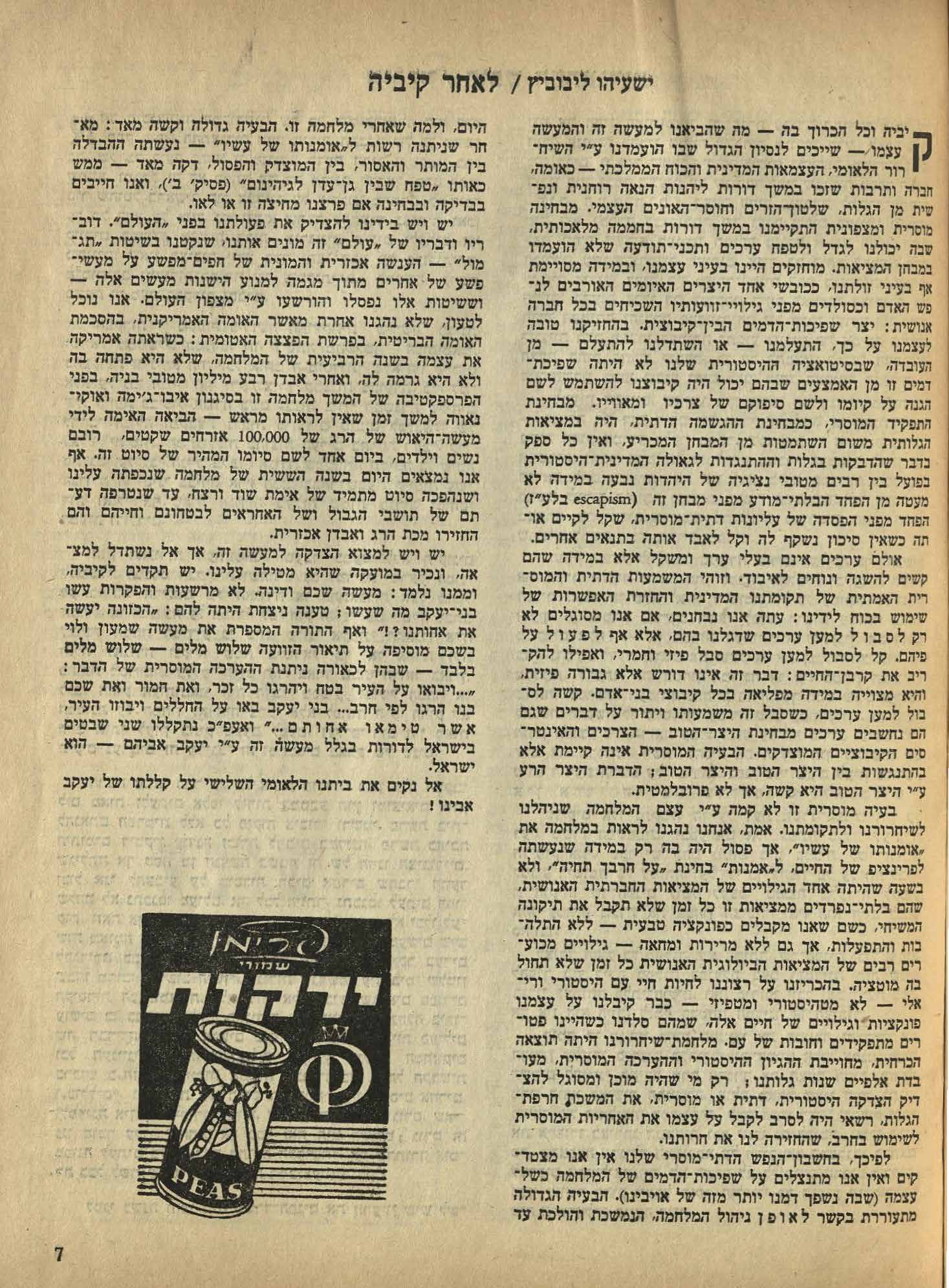
Roth’s response (“The Moral Issue”) appeared as a Letter to the Editor in The Jewish Chronicle (London) on 4 December 1953.[3] Leibowitz’s response (“After Qibyā”) appeared in the Israeli biweekly Beterem on 15 December 1953 and 15 January 1954. Roth’s intervention came near the close of a sustained Anglo-Jewish debate (October 23 – December 11, 1953), initiated by The Jewish Chronicle’s editorial “Right Is Might.”[4] Participants in this debate included Norman Bentwich (twice),[5] Selig Brodetsky, Abraham Cohen (twice), Albert Montefiore Hyamson, Harry Samuels, Ernst Akiba Simon,[6] Sefton David Temkin, and Robert Weltsch. Leibowitz’s response, by contrast, inaugurated a long Israeli debate (December 15 – March 15), whose participants included Rabbi Benjamin (Yehoshua Radler-Feldman / Hatalmi), Yuval Elitzur (twice), Amitai Etzioni, Pepita Haezraḥi (twice), Eliezer Schweid, and Ernst Akiba Simon (twice).

Leon Roth, known in Hebrew as Ḥayyim Yehudah Roth (ח״י רות, erut = Freedom), was born in London and educated at Oxford.[7] He was the older brother of the historian Cecil Roth.[8] During World War I, he served as a lieutenant in the Jewish Legion of the British Army. He co-founded the Department of Philosophy at the Hebrew University of Jerusalem in 1928 together with Samuel Hugo Bergmann, and became its first Aḥad Haʿam Professor.[9] He later served as Rector of the University (1940-1945) and Dean of Humanities (1949-1951). He was the author of many lucidly argued works in English and Hebrew on Greek, medieval, and modern philosophy, including Spinoza, Descartes, and Maimonides (1924) and Judaism: A Portrait (1960).[10] In July 1951, at the age of fifty-five, he resigned his chair at the Hebrew University of Jerusalem and returned to England,[11] despite efforts by the University and senior figures in the Israeli government to persuade him to remain.[12] He died suddenly of a heart attack on 2 April 1963 while visiting Wellington, New Zealand, where he is buried.[13]

Yeshayahu Leibowitz was born in Riga and studied chemistry and medicine at Berlin and Basle. He was the older brother of the Bible scholar, Neḥamah Leibowitz. He moved to Jerusalem in 1935, and taught biochemistry, organic chemistry, and neurophysiology at the Hebrew University. During Israel’s War of Independence, he served as a platoon commander in the Haganah. A selection of his trenchant Hebrew essays on Jewish philosophy appeared in English translation under the title, Judaism, Human Values, and the Jewish State (1992). He was fifty years old when he wrote his response to the Qibyā raid, an intervention that marked the beginning of his long and influential engagement with the tensions between political sovereignty, religious commitment, and moral responsibility.

In his response to the raid, Roth asked two main questions: (1) Do we as Jews today have an obligation to traditional Jewish values? (2) What manner of human beings could have carried out the Qibyā raid? In his response to the raid, Leibowitz, in effect, engaged with Roth’s two questions, and gave thought-provoking replies. Although Leibowitz did not mention Roth, it seems clear that he had read his response and was in conversation with it – at least with regard to the second installment (January 15), if not also with regard to the first one (December 15).

Roth’s Response

Whereas the debate in the Jewish Chronicle had focused on whether Diaspora Jews should publicly criticize the Israelis, Leon Roth was interested in a different question. His concern, rather, was Judaism itself. “The problem,” he wrote, “is whether…Judaism…can acquiesce in this incident.” The Qibyā raid, he continued, “is the type of action which we have been accustomed to say that Judaism taught the world to condemn and from which Jewry itself has so often suffered.” If we do not censure the Israeli raid, we hypocritically deny our own sacred values and our own past. Roth asked: “Shall we still be able to say that we demand one law for all and that we do not do to others what we do not wish others to do to us? That the lex talionis is not Jewish; that we abhor the spilling of blood, even of animals; that we are commanded in the Pentateuch to care for the non-Jew (‘love the stranger’), as was noted by the rabbis of another day, thirty-six times?… Dare we repeat the old commonplace of which we were once so proud that Jewish courts were so careful to avoid the shedding of blood that they disallowed all circumstantial evidence and in practice all but abolished the death penalty?” In other words, if we abandon our Jewish values, can we still consider ourselves Jews?

This was Roth’s first question. Do we as Jews today have an obligation to traditional Jewish values? However, he also had a second question, namely: What manner of human beings could have carried out the Qibyā raid?

Roth phrased his second question as follows: “The real tragedy is…for the Israelis… What manner of men are these who could contrive this action, or what persons could carry it out? And what manner of men are those who, arrogantly dismissing the moral issue, bemuse themselves and us with their Realpolitik?” If the conduct of the Israelis was not Jewish, then what was it?

Roth left his two questions unanswered. It was up to Leibowitz to answer them.

Leibowitz’s Response

Like Roth, Leibowitz begins his response to the Qibyā raid by raising the question of our relationship today as Jews to our traditional values. However, he does not speak simply about “Jews,” but Jews in the State of Israel. The “true religious and moral significance” of our Jewish political independence, he argued, is that it is “a test” or “a trial” (Hebrew: nissayon, like the nisyonot of Abraham) of our traditional values. In the Diaspora, Leibowitz explained with wry irony, we enjoyed “spiritual benefits from conditions of exile, foreign rule, and political impotence.” We spoke well about morality, but our morality “was never tested.” Diaspora existence (Hebrew: galut) “was a form of escapism.” True, we did not engage in mass murder, but we did not have an army to do so. We did not have the power to be moral. We could suffer for our values, but could not act on their behalf. “Now we are being tested.”

The notion that morality presupposes power is of course Nietzschean. But not only Nietzschean. The distinguished Israeli philosopher of education, Ernst Akiba Simon, who was the only personage who participated in the debates on Qibyā in both the Jewish Chronicle and Beterem, called Leibowitz’s attention to a relevant passage in Rabbi Judah Halevi’s philosophic dialogue, The Kuzari, I, 113-114.[14] In that passage, Halevi’s rabbinic protagonist boasts to the King of the Khazars that the Christians and the Muslims are engaged in terrible wars, but we Jews are virtuous, meek, and do not kill anyone. The King immediately retorts: “Your humility is not by choice! As soon as you have a moment of triumph, you’ll kill too [idhā aṣabtum ẓafra, qataltum]!”[15]

Again like Roth, Leibowitz distinguishes between our traditional values and Realpolitik. It is possible to find a moral justification for the Qibyā raid, but “we shouldn’t try to do so,” because it was an atrocity (zevaʿah). He compared the Qibyā raid to the raid on the city of Shechem by Jacob’s sons (Genesis 34).[16] The sons gave a moral justification for their act, saying: “Should one deal with our sister as with a harlot?!” (ibid., v. 31). Nonetheless, Jacob cursed the act, saying: “Simeon and Levi…weapons of violence their kinship… Cursed be their anger… I will scatter them” (ibid., 49:5-7). There are acts, insisted Leibowitz, that may be morally or politically justifiable, but are accursed. He concluded his response to the Qibyā raid with the chilling words: “We may find ourselves erecting our Third Commonwealth upon the curse of Jacob our Father.”

Leibowitz also engaged with Roth’s second question, “What manner of men are these who could contrive this action,” carry it out, or defend it?[17] In his own response, Leibowitz asks: “From where have these youths come who felt no inhibition…to perform the atrocity?” Leibowitz, unlike Roth, gives an explicit answer. He replies: “They were nurtured on the values of a Zionist education… Their conduct is among the consequences of applying the religious category of holiness [Hebrew: qedushah] to social, national, and political interests… The concept of holiness – which is absolute and beyond all categories of human thought and evaluation – is transferred to the profane. From a religious standpoint only God is holy, and only His imperative is absolute. All human values…are profane… Country, state, and nation… are never holy… They are always subject to criticism.” The moment secular Zionist education transformed the old religious categories, like “holiness,” into social, national, or political categories, it created a generation of Israelis who did not have the ability to criticize their government. They held the State and its policies to be sacred. The secularization of religious concepts is accordingly dangerous and can be fatal. Leibowitz never tired of preaching: Only God and His commandments are “holy” or absolute. The orders of David Ben-Gurion or Ariel Sharon should always be subject to criticism. It was, according to Leibowitz, the secularizing Zionist education that made possible the atrocity of Qibyā.

Disenchantment with Zionism?

Both Roth and Leibowitz devoted decades to the creation of a renewed Hebrew culture in Zion. In the years before the proclamation of the State of Israel, both lectured and wrote extensively on questions of government, citizenship, and education with an eye to preparing Palestinian Jews for independence. Yet both were controversial personalities, who were at times accused of anti-Zionism and even treason. When in 1947 Roth advocated the extension of the British Mandate in Palestine, he was widely denounced as a traitor.[18] Roth had argued that the required conditions for Jewish independence had not yet been achieved, and the premature proclamation of the Jewish State would necessarily lead to a bloody war with the Arabs whose end could not be foreseen. Similarly, when in the 1980s Leibowitz advised young Israeli soldiers to refuse to serve in the occupied territories,[19] he was widely denounced as a traitor.

Did Roth or Leibowitz ever become disenchanted with Zionism?

Roth left Israel in the summer of 1951. His abrupt departure (Hebrew: yeridah) was related to his disappointment with the nationalistic policies of the newly proclaimed State, in particular the discrimination against its Arab citizens. However, he never stated that he was disenchanted with cultural Zionism.

After his departure from Israel, Roth lectured throughout the world on the subject of Judaism, emphasizing its ethical and universalist dimensions. In his classic 1960 book, Judaism: A Portrait, he does not discuss Zionism at all. He avoids the subject entirely.[20] However, he does discuss the Land of Israel. Although he criticizes Rabbi Judah Halevi’s version of Judaism, which he characterizes as “a mystical and geographical nationalism,”[21] he stresses that when Halevi himself, like the rabbinic protagonist of his Kuzari, ascended to the Land of Israel, he did so ultimately because of a “moral ideal,” that is, “he journeyed to the Holy Land in order to live the life of holiness.”[22] Roth himself, while rejecting “mystical,” “geographical,” and Realpolitikal Zionism, remained faithful to the Zionism of his youth, a Zionism based on moral idealism and holiness. The Land of Israel, he wrote, “is the land where Judaism was begotten and flourished, and where its holy men, under the influence of the divine spirit, lived the life of holiness.”[23] Nonetheless, he chose to conclude his Judaism: A Portrait with a paean to Jewish universalism: “As God is found everywhere, so man can live everywhere. He can survive even in the inside of a whale. And just as God can put man there, so from there can man seek for God, and so too can God find man [Jonah 2:1-11]. ‘Lord, Thou hast been our dwelling place in all generations’ [Psalms 90:1].”[24] Not Jerusalem, not London, but the Lord is our dwelling place.

As for Leibowitz, he was very often asked if he had become disappointed with Zionism, and he always gave the same answer. No, he replied, all his expectations for Zionism have been fulfilled. He never expected Zionism to solve our moral or religious problems. Zionism, for him, was simply a program to achieve Jewish political independence in the Land of Israel.[25] “We were fed up being ruled by the gentiles,” he used to say. Zionism, as he understood it, was intended to provide a political arena in which individual Jews could struggle for their own diverse values and aspirations. It was intended to provide only the arena, not the values and aspirations.

Leibowitz may never have become disappointed in Zionism, but there were, I believe, three times when he became disappointed in Israelis.

The first disappointment came right at the beginning of the State. In the years preceding its proclamation, Leibowitz had called upon the Palestinian rabbinic authorities to prepare Jewish law for the governance of a modern state (hilkhot medinah). He entreated them to enact bold halakhic rulings concerning government, technology, and economics, subjects which had understandably been neglected in the Diaspora. However, after the establishment of the State, it became quite clear that neither the rabbis nor the religious public were desirous of enacting such rulings. This lack of a will for halakhic initiative on the part of religious Israelis profoundly disappointed him.

The second disappointment was the Qibyā raid. Leibowitz became disappointed in the secular (or secularizing) Zionist education, but still believed that those Israeli youth who were educated in the religious Zionist schools were immune to the distorted nationalism that he had perceived among the perpetrators of the Qibyā raid.

The third disappointment came after the Six-Day War with the radicalization of the Religious Zionist public. This was surely Leibowitz’s greatest disappointment. The religious Zionist youth, reared on torah u-mitzvot, who he had thought should be immune to aberrant nationalism, had now become the most nationalistic and least critical of all sectors in Israeli society. This was a hard blow that left Leibowitz staggered and reeling for the rest of his life.

Qibyā and Us

Written more than seventy years ago, the responses of Leon Roth and Yeshayahu Leibowitz to the Qibyā raid confront difficult existential questions which remain pertinent in today’s Israel and for today’s Zionism. The admonitions of those two maverick Maimonideans have not lost their relevance. Far from it, they have become more urgent.

Appendix 1

Reproduced here is the original page featuring Leon Roth’s Letter to the Editor (“Professor Roth on the Moral Issue”), The Jewish Chronicle (December 4, 1953): 21.

Appendix 2:

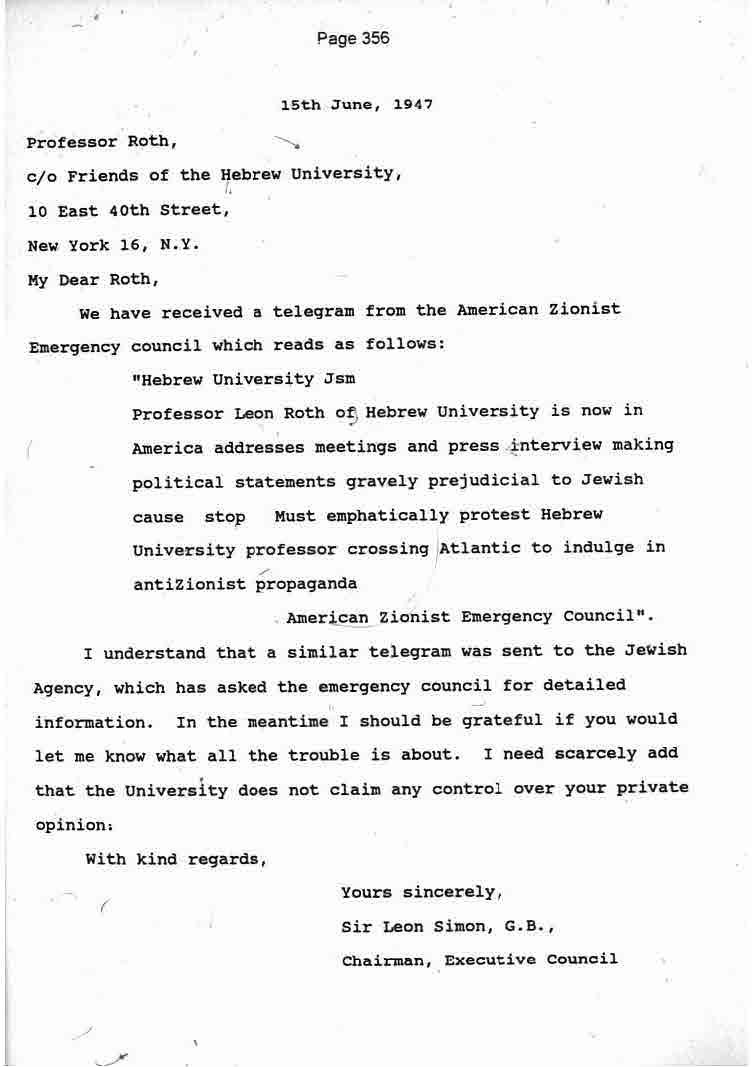
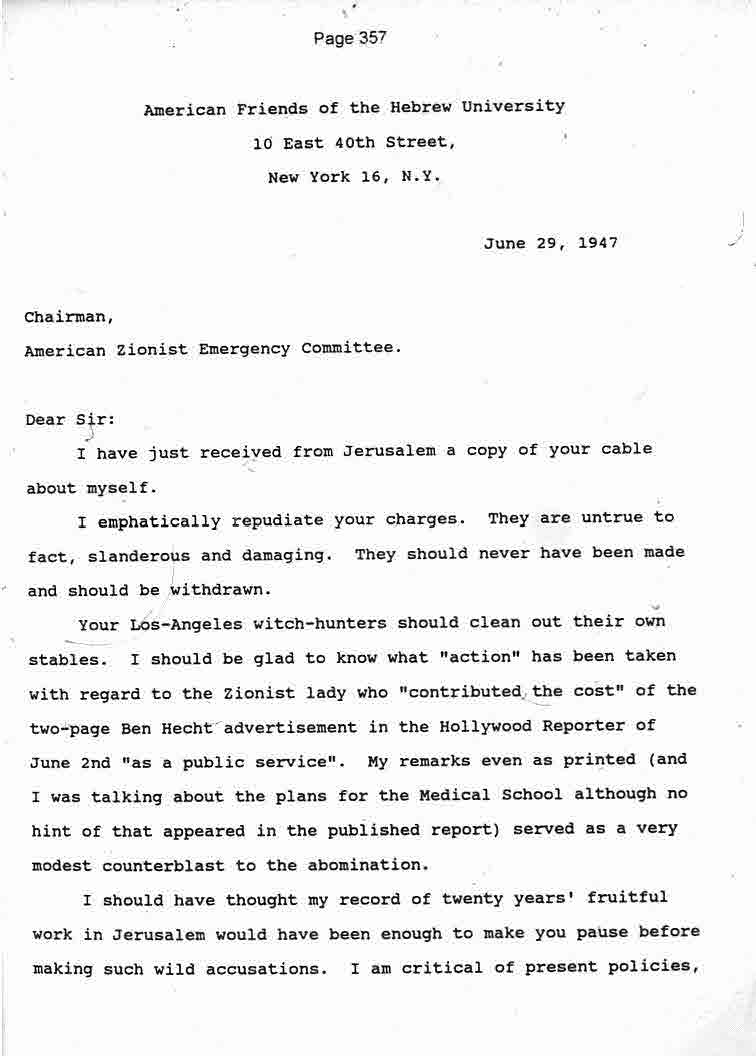
Reproduced here is the full exchange of correspondence between Leon Roth and Sir Leon Simon following Roth’s public remarks in the United States in June 1947 opposing the proposed partition of Palestine. The documents include Simon’s letter conveying the protest of the American Zionist Emergency Council, Roth’s reply rejecting the accusations, and related communications. The texts are reproduced here in full, without alteration, from Jan Katzew, “Leon Roth – His Life and Thought: The Place of Ethics in Jewish Education” (PhD dissertation, Hebrew University of Jerusalem, 1997), Appendix, pp. 355-358.
Appendix 3

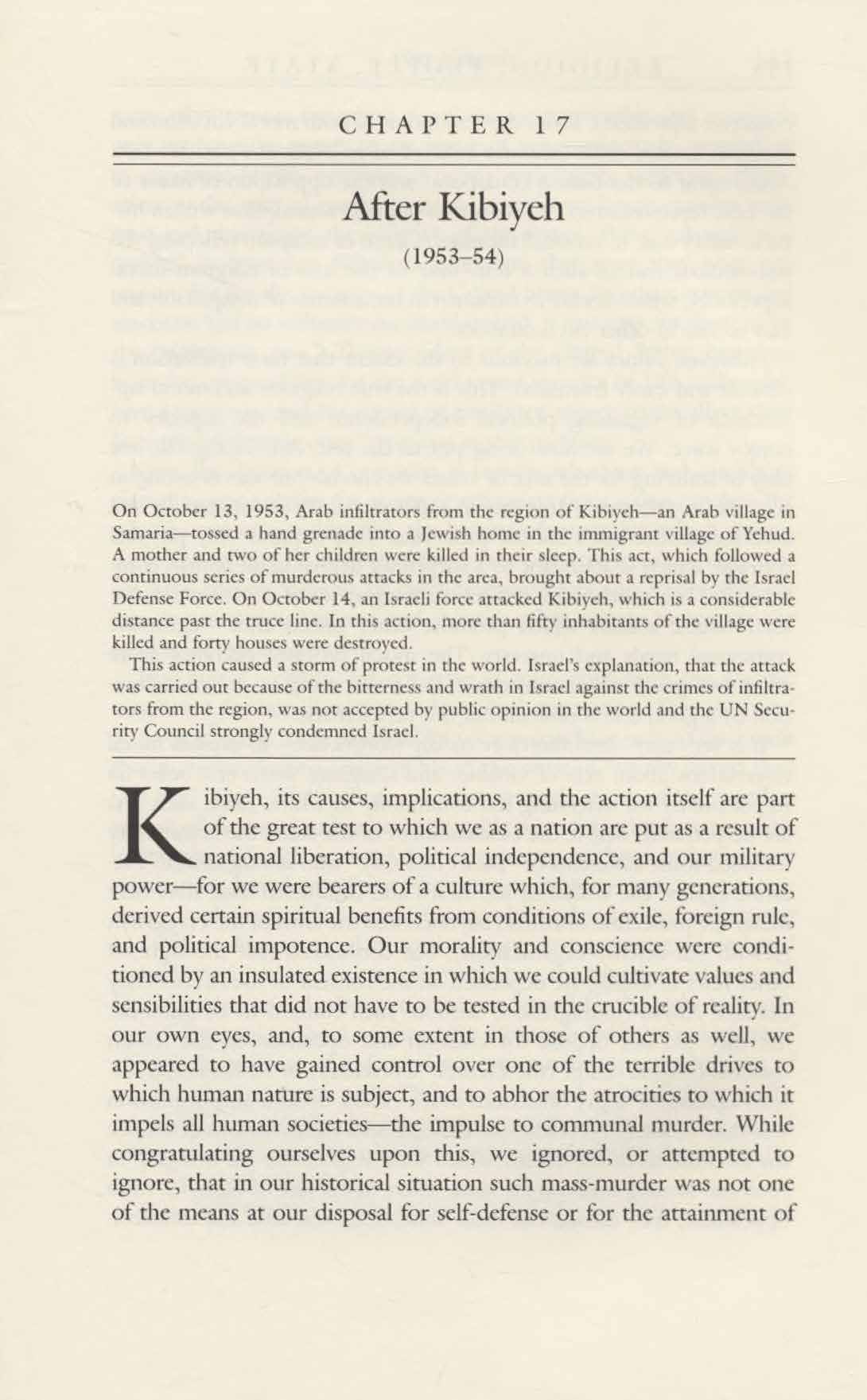
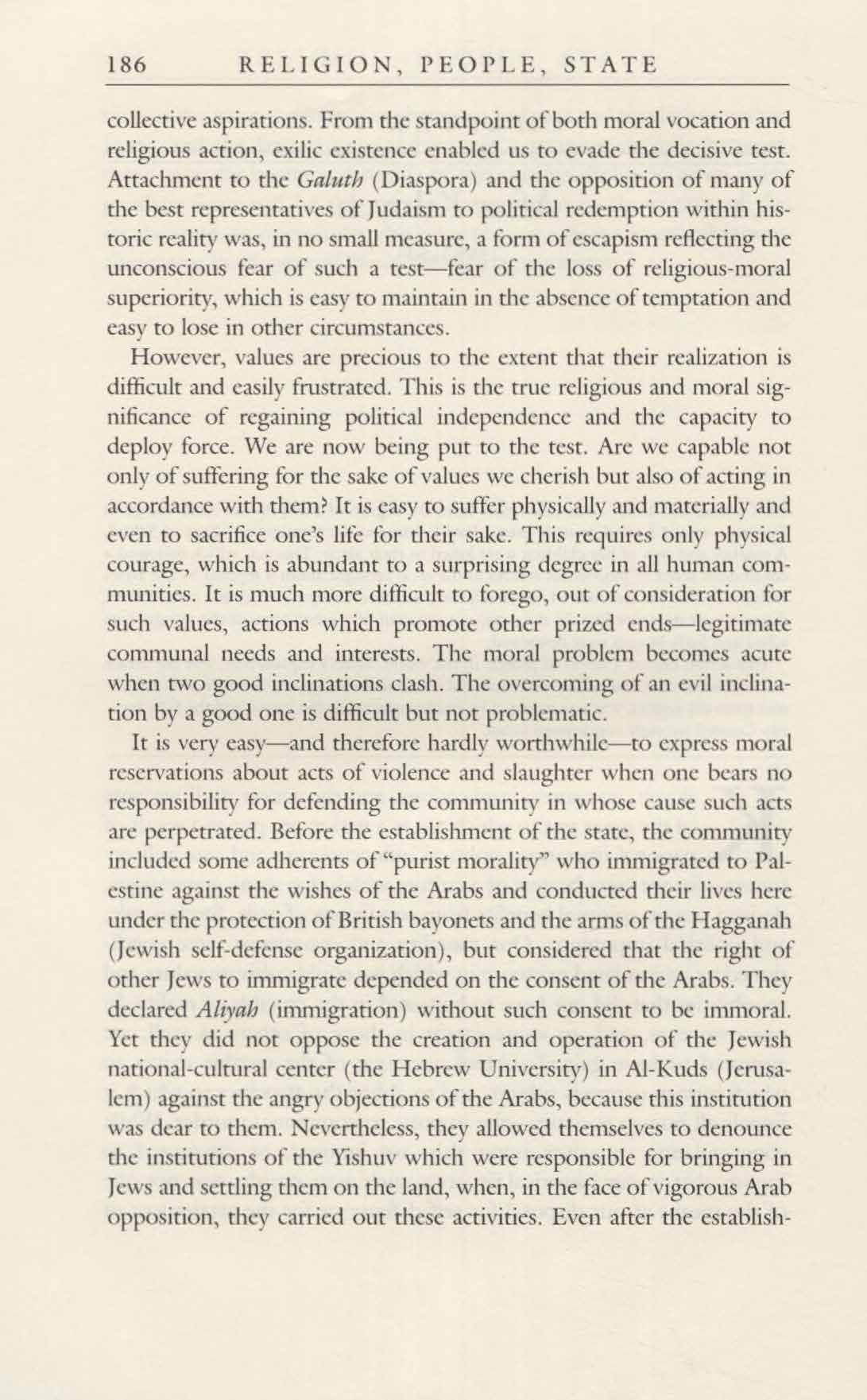
Reproduced here is Leibowitz’s original article “After Qibyā,” Beterem, no. 189 (15 December 1953): 7 (Hebrew).
Appendix 4

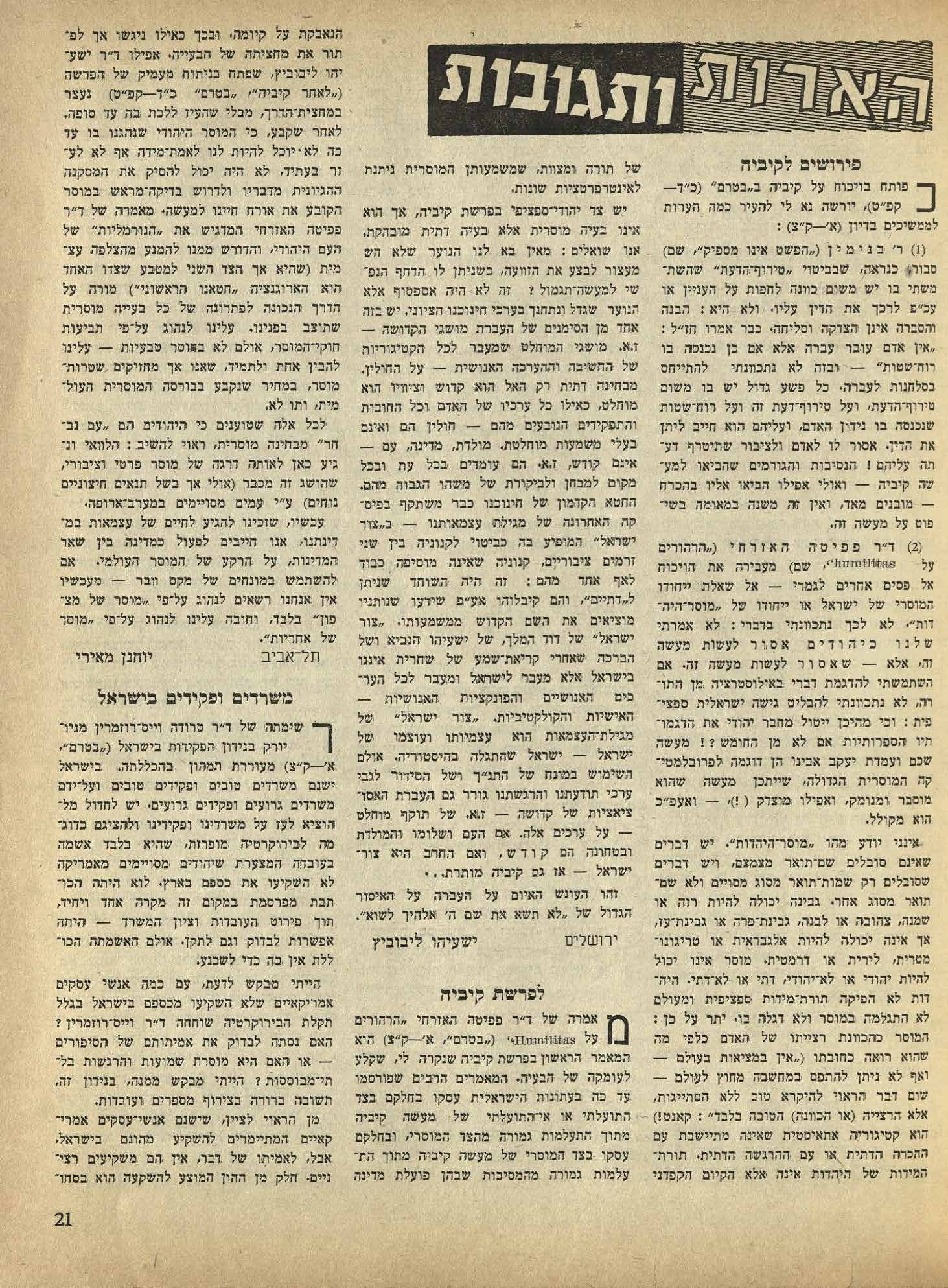
Reproduced here is Leibowitz’s follow-up article, “Letter – Commentaries on Qibyā,” Beterem, no. 191 (15 January 54): 21 (Hebrew).[26]
Appendix 5:

Reproduced here is the Hebrew text of “After Qibyā” as it appears in Yeshayahu Leibowitz’s 1954 book Torah u-Mitzvot ba-Zeman ha-Zeh. Passages reproduced from the original Beterem article of 15 December 1953 (see above, Appendix 3) are printed in plain font. Material drawn from the follow-up article in Beterem of 15 January 1954 (see above, Appendix 4), written in reply to Pepita Haezraḥi, appears in bold. Material first added in Torah u-Mitzvot ba-Zeman ha-Zeh is underlined.

The original December 15 text was copied in Torah u-Mitzvot ba-Zeman ha-Zeh with only minor changes; e.g., “emet, lefanim nahagnu” instead of “emet, anaḥnu nahagnu”; or “maʿaseh zevaʿah shel hereg” instead of “maʿaseh yeʾush shel hereg.”

The material deriving from the January 15 article was incorporated in it with many stylistic changes; e.g. “ha-problematikah ha-musarit ha-maḥridah” instead of “ha-problematikah ha-musarit ha-gedolah”; or the placement of “ha-hadgamah, etc.,” before “maʿaseh Shekhem, etc.,” instead of vice versa. It will be noted that Leibowitz’s well-known criticism of the secularization of religious concepts seems to have had its origin in his reply to Pepita Haezraḥi. His remarks about “tzur yisraʾel” repeat an urban legend. In point of fact, the dictum mentioning tzur yisraʾel was included already in the early draft of the Declaration of Independence by Mordecai Beham and Harry Davidowitz, written around April 22, 1948.[27]

The controversial paragraph on the Jerusalem “tzaddiqim,” added in Torah u-Mitzvot ba-Zeman ha-Zeh, illustrates the chasm in those days between Leibowitz and the Hebrew University “peace camp,” which consisted of famed professors like Samuel Hugo Bergmann, Martin Buber, Judah Leon Magnes, Gershom Scholem, Ernst Akiba Simon.” Roth also was not usually considered to be one of the members of that camp. See Bergmann’s article cited above, note 7.

The final sentence originally read: “al naqim et beytenu,” etc., which is stronger, simpler, and less preachy than the revised version.

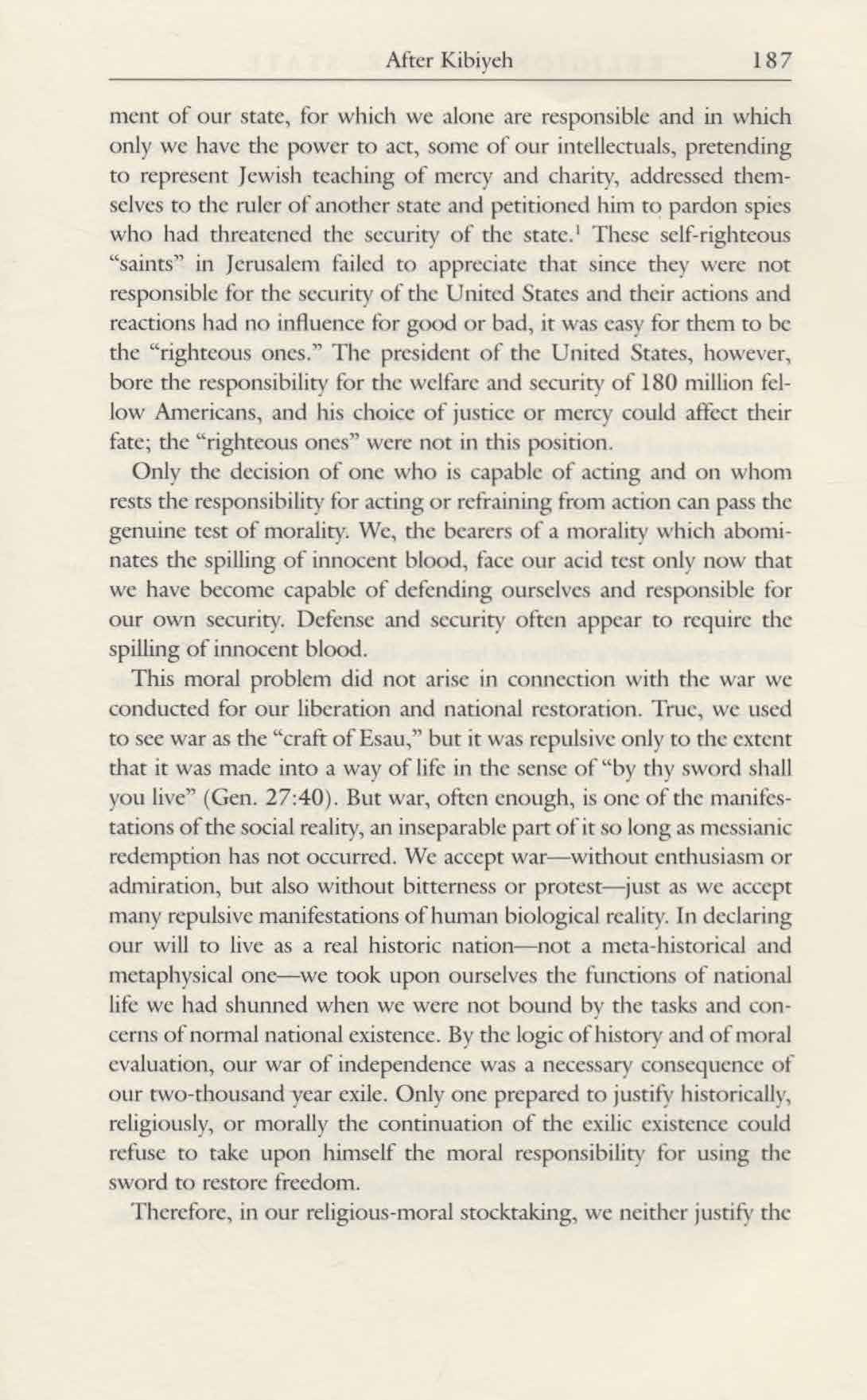
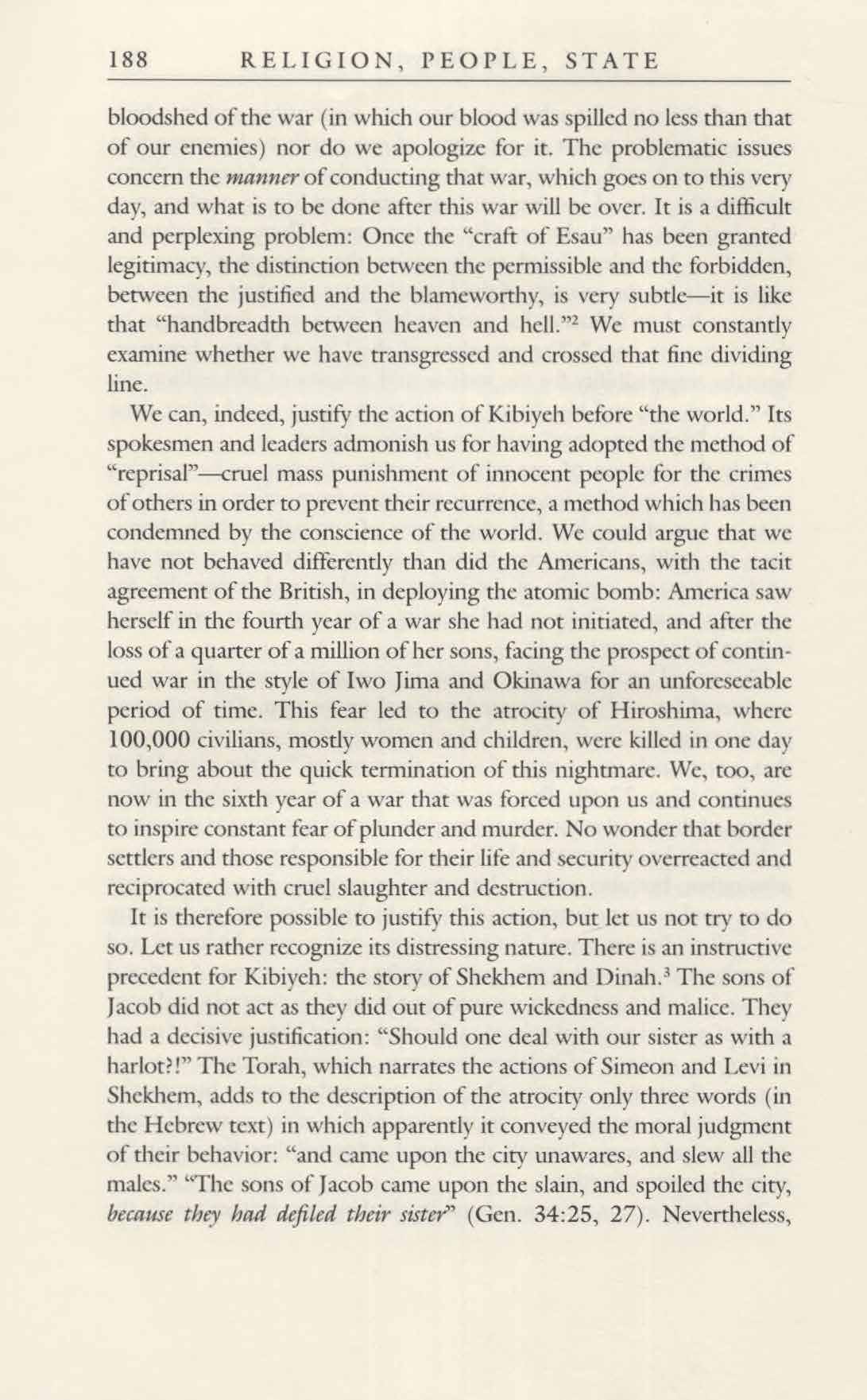
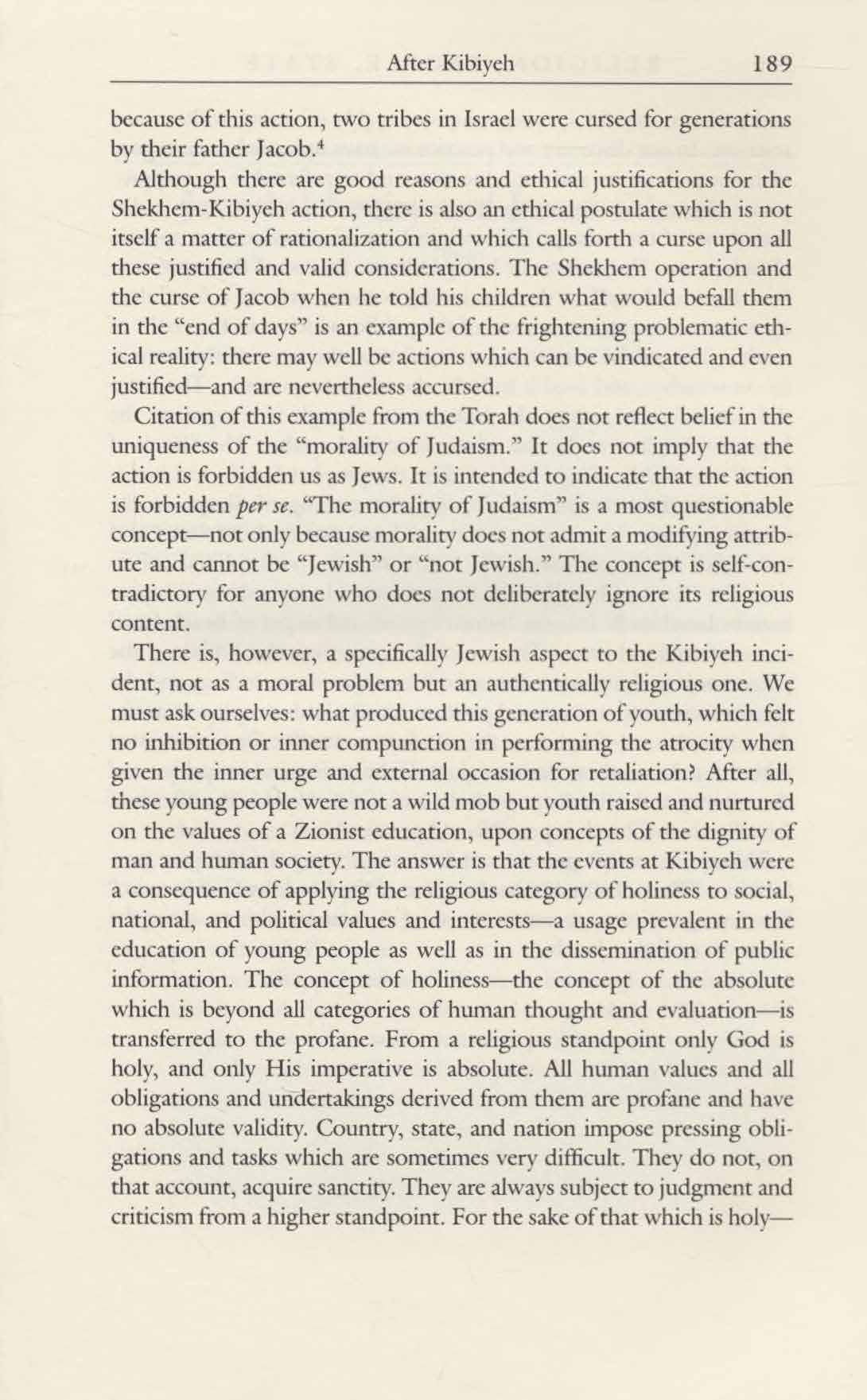
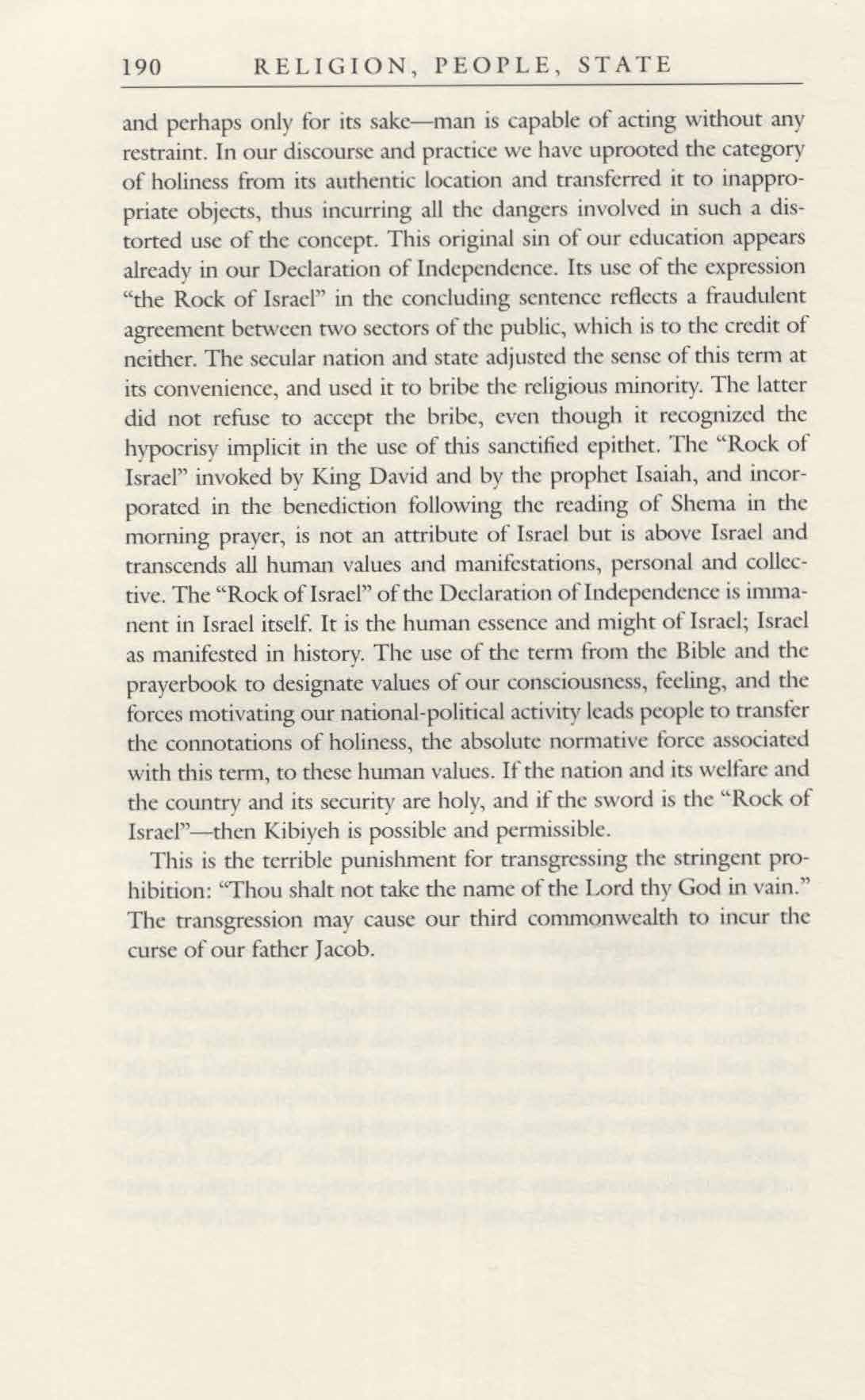
After Qibyā

קיביה וכל הכרוך בה – מה שהביא למעשה זה והמעשה עצמו – שייכים לנסיון הגדול שבו הועמדנו ע”י השיחרור הלאומי, העצמאות המדינית והכוח הממלכתי – כאומה, חברה ותרבות שזכו במשך דורות ליהנות הנאה רוחנית ונפשית מן הגלות, שלטון-הזרים וחוסר-האונים העצמי. מבחינה מוסרית ומצפונית התקיימנו במשך דורות בחממה מלאכותית, שבה יכולנו לגדל ולטפח ערכים ותכני-תודעה שלא הועמדו במבחן המציאות. מוחזקים היינו בעיני עצמנו, ובמידה מסויימת אף בעיני זולתנו, ככובשי אחד היצרים האיומים האורבים לנפש האדם וכסולדים מפני גילויי-זוועותיו השכיחים של חברה אנושית : יצר שפיכות-הדמים הבין-קיבוצית. בהחזיקנו טובה לעצמנו על כך, התעלמנו – או השתדלנו להתעלם – מן העובדה, שבסיטואציה ההיסטורית שלנו לא היתה שפיכת-דמים זו מן האמצעים שבהם יכול היה קיבוצנו להשתמש לשם הגנה על קיומו ולשם סיפוקם של צרכיו ומאווייו. מבחינת התפקיד המוסרי, כמבחינת ההגשמה הדתית, היתה במציאות הגלותית משום השתמטות מן המבחן המכריע, ואין כל ספק בדבר שהדבקות בגלות וההתנגדות לגאולה המדינית-היסטורית בפועל בין רבים מטובי נציגיה של היהדות נבעה במידה לא מעטה מן הפחד הבלתי-מודע מפני מבחן זה ( escapism בלע”ז) – הפחד מפני הפסדה של עליונות דתית-מוסרית, שקל לקיים אותה כשאין סיכון נשקף לה וקל לאבד אותה בתנאים אחרים.

אולם ערכים אינם בעלי ערך ומשקל אלא במידה שהם קשים להשגה ונוחים לאיבוד. וזוהי המשמעות הדתית והמוסרית האמיתית של תקומתנו המדינית והחזרת האפשרות של שימוש בכוח לידינו : עתה אנו נבחנים, אם אנו מסוגלים לא רק לסבול למען ערכים שדגלנו בהם, אלא אף לפעול על פיהם. קל לסבול למען ערכים סבל פיזי וחמרי, ואפילו להקריב את קרבן-החיים : דבר זה אינו דורש אלא גבורה פיזית, והיא מצוייה במידה מפליאה בכל קיבוצי בני-אדם. קשה לסבול למען ערכים, כשסבל זה משמעותו ויתור על דברים שגם הם נחשבים ערכים מבחינת היצר הטוב ; הבעייה המוסרית מתעוררת בכל חריפותה בהתנגשות בין היצר הטוב והיצר הטוב ; הדברת היצר הרע ע”י היצר הטוב היא קשה, אך לא פרובלמטית.

נוחה מאד – ולכן גם זולה ועלובה מאד – היא מוסריות המסתייגת ממעשי אלימות ושפיכות-דמים מבלי שתהא בצידה של מוסריות זו גם האחריות לעניינים ולערכים שלמענם או בשמם נעשים מעשים אלה ונשפך דם זה. לפני הקמת מדינתנו היינו עדים במחננו לבעלי מוסריות צרופה, שהם עצמם עלו לא”י נגד רצונם של הערבים וחיו ופעלו בה בחסותם של הכידונים הבריטיים והאקדחים של ההגנה, אולם את זכות עלייתם של יהודים אחרים התנו בהסכמתם של הערבים, ואת העליה בכוח – שלא בהסכמת הערבים – פסלו כלא-מוסרית ; הם לא התנגדו להקמתו ולקיומו של המרכז התרבותי-לאומי היהודי באל-קודס (ירושלים) על אפם ועל חמתם של הערבים – כי המוסד הזה היה יקר בעיניהם -, אך הם הרשו לעצמם לגנות את פעולתם של מוסדותינו שהיו אחראים להעלאת יהודים וליישובם על הקרקע כשהללו עשו את המוטל עליהם על אפם ועל חמתם של הערבים. ואף אחר הקמת מדינתנו שרק לה אנו אחראים, ורק בה יש בידנו סיפק לעשות, פנו אנשי-רוח בקרבנו, שנתעטפו באיצטלת תורת החסד והרחמים של היהדות, אל שליטה של מדינה אחרת ודרשו ממנו לחון מרגלים שהתנכלו לבטחונה של המדינה ההיא(הזוג יוליוס ואתל רוזנברג בארה”ב, שנמצאו אשמים בריגול לטובת ברה”מ לשם השג מידע סודי על החימוש הגרעיני; הם נידונו למיתה והוצאו להורג ב-19.6.1953). ולא חלו ולא הרגישו צדיקים אלה בירושלים, שמאחר שאין הם האחראים לבטחונה של ארצות-הברית ושמעשיהם ותגובותיהם אינם משפיעים על בטחון זה לא לטובה ולא לרעה – קל ונוח להם להיות “צדיקים” ; ואילו בידו ובאחריותו של נשיא ארצות-הברית הופקדו שלומם ובטחונם של 180 מליון מבני-עמו, ומידת-הדין או מידת-הרחמים שבה הוא נוקט עלולה להשפיע על סיכון קיומם מחמת הפצצה האטומית. ולא הבינו צדיקי- ירושלים שאין הם רשאים לדון את נשיא ארצות-הברית עד שיגיעו למקומו.

המבחן הממשי של המוסריות אינו אלא בהכרעתו של מי שסיפק בידו לעשות והאחריות לעשיה או לאי-עשיה עליו. הנסיון המוסרי שלנו הגיע כשנעשינו אנו – נושאי המוסר המתעב שפיכת דם נקי – בעלי-יכולת ואחראים לעניני הגנה ובטחון, ענינים שבעיותיהם נראות לפעמים כניתנות לפתרון ע”י שפיכת דם נקי.

בעייה מוסרית זו לא קמה ע”י עצם המלחמה שניהלנו לשיחרורנו ולתקומתנו. אמת, לפנים נהגנו לראות במלחמה את “אומנותו של עשו”, אך פסול היה בה רק במידה שנעשתה לפרינציפ של החיים, ל”אומנות” בחינת “על חרבך תחיה”, ולא בשעה שהיתה אחד הגילויים של המציאות החברתית האנושית, שהם בלתי נפרדים ממציאות זו כל זמן שלא תקבל את תיקונה המשיחי, כשם שאנו מקבלים כפונקציה טבעית – ללא התלהבות והתפעלות, אך גם ללא מרירות ומחאה – גילויים מכוערים רבים של המציאות הביולוגית האנושית כל זמן שלא תחול בה מוטציה. בהכריזנו על רצוננו לחיות חיי עם היסטורי וריאלי – לא מטאהיסטורי ומטפיזי – כבר קיבלנו על עצמנו פונקציות וגילויים של חיים אלה, שמהם סלדנו כשהיינו פטורים מתפקידים וחובות של עם. מלחמת-שיחרורנו היתה תוצאה הכרחית, מחוייבת ההגיון ההיסטורי וההערכה המוסרית, מעובדת אלפיים שנות גלותנו ; רק מי שהיה מוכן ומסוגל להצדיק הצדקה היסטורית, דתית או מוסרית, את המשכת חרפת-הגלות, רשאי היה לסרב לקבל על עצמו את האחריות המוסרית לשימוש בחרב, שהחזירה לנו את חרותנו.

לפיכך, בחשבון-הנפש הדתי-המוסרי שלנו אין אנו מצדיקים ואין אנו מתנצלים על שפיכות-הדמים של המלחמה כשלעצמה (שבה נשפך דמנו לא פחות מזה של אויבינו). הבעייה הגדולה מתעוררת בקשר לאופן ניהול המלחמה, הנמשכת והולכת עד היום, ולמה שאחרי מלחמה זו. הבעייה גדולה וקשה מאד : מאחר שניתנה רשות ל”אומנותו של עשו”, נעשתה ההבדלה בין המותר ואסור, בין המוצדק והפסול, דקה מאד – ממש כאותו “טפח שבין גן-עדן וגיהנום” (פסיק’ ב’), ואנו חייבים בבדיקה ובבחינה אם פרצנו מחיצה זו או לאו.

יש ויש בידינו להצדיק את פעולתנו בפני “העולם”. דובריו ודבריו של “עולם” זה מגנים אותנו על שנקטנו בשיטות “תגמול” – הענשה אכזרית והמונית של חפים-מפשע על מעשי-פשע של אחרים מתוך מגמה למנוע הישנות מעשים אלה, בשיטות שנפסלו והורשעו על-ידי מצפון העולם. אנו נוכל לטעון, שלא נהגנו אחרת מאשר האומה האמריקנית, בהסכמת האומה הבריטית, בפרשת הפצצה האטומית : כשראתה אמריקה את עצמה בשנה הרביעית של המלחמה, שלא היא פתחה בה ולא היא גרמה לה, ואחרי אבדן רבע-מיליון מטובי בניה בפני הפרספקטיבה של המשך מלחמה זו בסיגנון איבו-ג’ימה ואוקינאוה למשך זמן שאין לראותו מראש – הביאה האימה לידי מעשה-הזוועה של הרג 100,000 אזרחים שקטים, רובם נשים וילדים, ביום אחד לשם סיומו המהיר של סיוט זה. אף אנו נמצאים היום בשנה הששית של מלחמה שנכפתה עלינו ושנהפכה סיוט מתמיד של אימת שוד ורצח, עד שנטרפה דעתם של תושבי הגבול ושל האחראים לבטחונם וחייהם והם החזירו מכת הרג ואבדן אכזרית.

יש ויש למצוא הצדקה למעשה זה, אך אל נשתדל למצאה, ונכיר במועקה שהיא מטילה עלינו. יש תקדים לקיביה, וממנו נלמד : מעשה שכם ודינה. לא מרשעות והפקרות עשו בני-יעקב מה שעשו : טענה ניצחת היתה להם : “הכזונה יעשה את אחותנו” ? ! ואף התורה המספרת את מעשה שמעון ולוי בשכם מוסיפה על תיאור הזוועה שלוש מלים – שלוש מלים בלבד – שבהן לכאורה ניתנת ההערכה המוסרית של הדבר : “…ויבואו אל העיר בטח ויהרגו כל זכר, ואת חמור ואת שכם בנו הרגו לפי חרב.. בני יעקב באו על החללים ויבוזו העיר, אשר טימאו אחותם…”. ואעפ”כ נתקללו שני שבטים בישראל לדורות בגלל מעשה זה ע”י יעקב אביהם – הוא ישראל.

אפשר ואפשר לנמק ולבסס, להסביר ולהצדיק את מעשה שכם-קיביה מבחינת כל עקרונות המוסר הניתנים לשיקול ולחישוב ראציונלי. אולם קיים גם פוסטולט מוסרי, שאינו כלל בגדר שיקול וחישוב, ושממנו נובעת קללה על כל השיקולים והחישובים המוצדקים והנכונים הללו. מעשה-שכם וקללת יעקב אבינו, בשעה שחזה לבניו את ואחרית-הימים – זוהי דוגמה לפרובלימטיקה המוסרית המחרידה, שייתכן מעשה שהוא מוסבר ומנומק, ואפילו מוצדק (!) – ואעפ”כ הוא מקולל.

ההדגמה מן התורה – אין משמעותה האמונה בייחודו המוסרי של ישראל או בייחודו של “מוסר-היהדות”. אין משמעותה שלנו כיהודים אסור לעשות מעשה זה ; אלא זוהי הדגמה שאסור לעשות מעשה זה. “מוסר-היהדות” הוא מן המושגים המפוקפקים ביותר – ולא רק משום שאין המוסר סובל שם-תואר מצמצם ואינו יכול להיות “יהודי” או “לא-יהודי” : עצם המושג “מוסר-היהדות” הוא סתירה מיניה וביה בשביל כל מי שאינו מתעלם בכוונה מן התוכן ומן המשמעות הדתיים של היהדות – ז. א. בשביל מי שאינו מזייף את היהדות. המוסר כהכוונת רצייתו של האדם כלפי מה שהוא רואה כחובתו (“אין במציאות בעולם – ואף לא ניתן להיתפס במחשבה מחוץ לעולם – שום דבר הראוי להיקרא טוב ללא הסתייגות, אלא הרצייה [או הכוונה] הטובה בלבד” : קאנט !) או כלפי מה שהוא מבין בטבע המציאות (הסטואה; שפינוזה) – המוסר הוא קטיגוריה אנתרופוצנטרית-אתיאיסטית, שאינה מתיישבת עם ההכרה הדתית או עם ההרגשה הדתית ; זו אינה מכירה אלא את “הטוב והישר בעיני ה’ “ – לא את ”הטוב והישר”! ואינה מעריכה את “החכם בחכמתו” אלא את “המשכיל ויודע את ה’ “. עובדה היסטורית- אמפירית היא – במחילת עצמותיהם של שד”ל, אחה”ע והרמן כהן – שהיהדות לא הפיקה תורת-מידות ספציפית ומעולם לא התגלמה במוסר ולא דגלה בו. תורת-המידות של היהדות אינה אלא הקיום הקפדני של תורה ומצוות שמשמעותן המוסרית ניתנת לאינטרפרטציות שונות.

יש, אמנם, צד יהודי ספציפי בפרשת קיביה, אך הוא אינו בעייה מוסרית אלא בעיה דתית מובהקת. אנו חייבים לשאול את עצמנו : מאין בא לנו הנוער הזה, שלא חש מעצור ומניעה נפשית לבצע בידיו את הזוועה, כשניתן לו הדחף הפנימי או החיצוני למעשה-תגמול ? והרי נוער זה לא היה אספסוף, אלא הנוער שגדל ונתחנך בערכי חינוכו הציוני, במושגי ערכי האדם והחברה. דבר זה הוא מן התוצאות של השימוש בקטיגוריה הדתית של קדושה לענינים ולערכים חברתיים, לאומיים ומדיניים שימוש שהוא רווח אצלנו בחינוך הנוער ובהסברה ציבורית : מושגי קדושה – ז. א. מושגי המוחלט שמעבר לכל הקטגוריות של החשיבה וההערכה האנושית – מועברים על החולין, מבחינה דתית רק האל הוא קדוש ורק צוויו הוא מוחלט, ואילו כל ערכיו של האדם וכל החובות והתפקידים הנובעים מהם – חולין הם ואינם בעלי משמעות מוחלטת. מולדת, מדינה, עם – חובות ותפקידים נעלים הם, המחייבים לפרקים אף למעשים קשים מאד, אך לעולם אין הם נעשים קודש, ז. א.לעולם הם עומדים למבחן ונתונים לביקורת של משהו הגבוה מהם. על דברים שבקדושה – ואולי רק עליהם – מסוגל האדם לפעול ללא כל מעצור. אנו עוקרים את הקטגוריה של קדושה ממקומה ומעבירים אותה על דברים שלא להם נועדה, עם כל הסיכון הכרוך בשימוש מסולף זה. החטא הקדמון הזה של חינוכנו כבר משתקף במגילת עצמאותנו – ב”צור ישראל” המופיע בסיומה כביטוי לקנוניה בין שני זרמים ציבוריים, קנוניה שאינה מוסיפה כבוד לאף אחד מהם : העם והמדינה החילוניים, שהוציאו מושג זה ממשמעותו, נתנו את המונח כשוחד למיעוט הדתי, וזה לא נמנע מלקבלו, אעפ”י שידע את הדו-פרצופיות הגלומה בשימוש זה בכינוי הקדוש. ו”צור ישראל” של דוד המלך, של ישעיהו הנביא, של הברכה שאחרי קריאת-שמע של שחרית – אינו בישראל אלא מעבר לישראל ומעבר לכל הערכים, הגורמים והגילויים האנושיים – האישיים והקולקטיביים כאחד. “צור ישראל” של מגילת העצמאות הוא בישראל עצמו – הוא עצמותו ועוצמתו האנושיים של ישראל : ישראל שנתגלה בהיסטוריה. אולם השימוש במונח של התנ”ך והסידור לגבי ערכי תודעתנו והרגשתנו האנושיים ולגבי הכוחות המניעים של פעולתנו הלאומית-מדינית – שימוש זה גורם שגם האסוציאציות של קדושה – ז.א. של תוקף מוחלט – הכרוכות בכינוי זה מועברות על ערכים אלה. אם העם ושלומו והמולדת ובטחונה הם קודש, ואם החרב היא-היא “צור ישראל” – אז גם קיביה אפשרית ומותרת…

זהו העונש האיום של העבירה על האיסור החמור של “לא תשא את שם אלהיך לשוא”.

מתוך עבירה על איסור זה אנו עלולים להקים את ביתנו השלישי על קללתו של יעקב אבינו.

The text was also translated by the philosopher Eliezer Goldman on the basis of later versions, while taking into consideration the earlier ones, as published in Yeshayahu Leibowitz, Judaism, Human Values, and the Jewish State (Cambridge, MA: Harvard University Press, 1992), 185-190, 277.
Appendix 6

Halakhic Engagements with the Qibyā Raid and the Renewal of the Laws of War

By Menachem Butler

The present appendix situates the halakhic discussion of the Qibyā raid within the context of recent scholarly efforts to recover, contextualize, and critically assess Jewish legal discourse on sovereignty, military service, and war in the State of Israel. It does not seek to adjudicate the halakhic permissibility of Qibyā, but rather to map the emergence, structure, and internal tensions of the halakhic discourse the episode generated.

Among the more recent of these scholarly efforts is the Milḥemet Mitzvah series, edited by Aviad Hacohen, Yitzchak Avi Roness, and myself. This multi-volume project is devoted to the halakhic, historical, and ideological foundations of military obligation in modern Israel, bringing together newly translated primary sources alongside contemporary scholarship in order to reconstruct the formative debates through which categories such as milḥemet mitzvah, collective obligation, and the relationship between Torah study and national defense were rearticulated under conditions of Jewish statehood.[28] A forthcoming volume in the Milḥemet Mitzvah series will extend this inquiry to the Qibyā raid and its halakhic aftermath, situating the episode within the longer arc of post-1948 Jewish legal reflection on war, retaliation, and civilian harm. Whereas the volumes published to date focus primarily on the War of Independence and its immediate halakhic reverberations, the events of October 1953 mark a subsequent – and in many respects decisive – moment in the development of modern halakhic thought on warfare. The halakhic debates of 1948 were largely oriented toward questions of obligation, authority, and participation in collective defense; Qibyā, by contrast, compelled a direct confrontation with issues that had previously remained largely implicit, including the legitimacy of retaliatory violence, the halakhic status of civilian populations, and the reconciliation of inherited legal norms with the operational realities of modern warfare.

At the center of the halakhic discourse on Qibyā stands Rabbi Shaul Yisraeli’s extended responsum, which quickly became the unavoidable point of reference for subsequent Religious Zionist engagement with the episode and, more broadly, with questions of war, responsibility, and state violence.[29] Written in close proximity to the events of 1953, it constitutes one of the earliest systematic attempts to evaluate Qibyā through halakhic reasoning rather than through moral intuition or political necessity. Its enduring influence lies not only in its substantive conclusions, but in the methodological seriousness with which it applies classical legal sources to a modern military operation involving civilian casualties. As the literature surveyed here demonstrates, the responsum quickly assumed a canonical role, shaping subsequent Religious Zionist halakhic treatments of military force and the limits of legitimate violence under conditions of Jewish sovereignty.

Beyond ethical, philosophical, or political reactions, Qibyā also generated a sustained halakhic discourse that sought to situate the events within inherited legal categories while testing their elasticity in the face of modern military power. This body of writing reflects neither straightforward apologetics nor wholesale repudiation, but a concerted effort to articulate norms of legitimacy and restraint within a legal tradition long shaped by political powerlessness. Rabbi Yisraeli’s responsum first appeared in Ha-Torah ve-ha-Medinah, a journal founded in the early years of the State of Israel by leading figures within the Religious Zionist movement to confront, in a systematic halakhic register, the unprecedented challenges posed by Jewish sovereignty.[30] Conceived as a forum for the renewal of hilkhot medinah – of the laws of statehood – the journal brought together senior rabbinic authorities from Israel and the Diaspora to deliberate questions of governance, security, agriculture, economics, and public authority that had long remained underdeveloped in the absence of Jewish sovereignty. Under Rabbi Yisraeli’s editorial leadership, Ha-Torah ve-ha-Medinah rejected both apologetics and abstract theorization, insisting instead on rigorous engagement with concrete realities and on the integration of classical halakhic mastery with intimate knowledge of contemporary conditions.

The programmatic ambitions of Ha-Torah ve-ha-Medinah were articulated with unusual clarity by Rabbi Yisraeli himself in a contemporaneous interview reflecting on the aims and methods of the forum he edited.[31] From the outset, he rejected the assumption – prevalent even among committed religious thinkers – that “the laws of state and society do not exist at all within the Torah,” insisting instead that Jewish law is capable of sustaining “ordinary political life” without recourse to miracles or messianic suspension. Against both those who regarded the state as a theological aberration and those who treated halakhah as relevant only to the private sphere, Rabbi Yisraeli framed the task of the forum as reconstructive rather than apologetic: to recover areas of halakhah long relegated to the category of “law for the messianic era” and to clarify them through sustained engagement with classical sources and contemporary realities alike. It was precisely this commitment – to determining positions “not on the basis of moral agitation or political excitement alone, but on the basis of solid halakhic sources” – that governed the inclusion of the Qibyā raid among the journal’s most urgent and controversial subjects. Read against this backdrop, Rabbi Yisraeli’s responsum on Qibyā emerges not as an exceptional intervention prompted by political pressure, but as a paradigmatic test case within the programmatic framework of Ha-Torah ve-ha-Medinah, oriented toward collective responsibility and the exercise of coercive power by a Jewish state. Published as “The Qibyā Incident in Light of Halakhah,”[32] the responsum exemplifies the journal’s ambition to subject even the most morally fraught acts of state violence to sustained halakhic scrutiny rather than rhetorical evasion. In this capacity, it functions as the foundational text for the halakhic discussion of Qibyā and as a formative intervention in the development of Religious Zionist legal thought on war and sovereignty.

A crucial caveat is therefore in order. The halakhic engagement with Qibyā examined here unfolded largely in advance of, and largely independent from, the broader moral reckoning with the operation in Israeli public discourse. As Efrat Seckbach has shown, Qibyā was framed for decades within Israeli collective memory as a tragic, defensive, or even necessary act, and only much later came to be stabilized as a paradigmatic moral transgression.[33] The early rabbinic and halakhic discussions surveyed in this appendix thus did not emerge in response to sustained public condemnation, nor were they shaped by a settled moral consensus regarding the operation’s illegitimacy. Rather, they developed within a discursive environment in which the moral meaning of Qibyā remained fluid, contested, and largely underdetermined in the public sphere. This temporal and discursive disjunction is analytically significant: it cautions against retrojecting later ethical judgments onto early halakhic reasoning and underscores that these responsa were formulated in a context where halakhic analysis functioned not as post hoc legitimation, but as an initial site of normative articulation under conditions of unresolved moral uncertainty.

Unlike Professor Leon Roth’s moral indictment or Professor Yeshayahu Leibowitz’s theological warning, Rabbi Shaul Yisraeli’s intervention is deliberately juridical: it insists that Qibyā be evaluated as a matter of halakhic classification rather than moral expression or prophetic protest. He opens his analysis by sharply delimiting the scope of halakhic categories traditionally invoked to justify violence outside the context of war. He examines, and ultimately rejects, the applicability of rodef, judicial punishment, and collective liability, emphasizing that none can justify the foreseeable killing of non-combatants, especially children. This refusal to rely on expansive constructions of culpability constitutes an important boundary-setting move and signals resistance to dissolving halakhic distinctions under the pressure of political exigency.

Having rejected these alternatives, Rabbi Yisraeli treats milḥamah as the sole halakhic category within which the events of Qibyā can be assessed. War, in his account, is governed by norms distinct from those that regulate interpersonal violence or judicial punishment: it is structured by collective agency and strategic necessity rather than individualized culpability. On the basis of classical discussions of siege warfare and national defense, he argues that halakhah does not require absolute differentiation between combatants and civilians where such distinctions cannot be operationally maintained. Yet this claim is narrowly framed. Civilian harm is neither trivialized nor treated as halakhically neutral, and Qibyā is not presented as unproblematic. Instead, the operation is situated within ezrat Yisrael miyad tzar – assistance to Israel against an enemy threat – understood as a form of defensive war oriented toward deterrence and protection. This classification permits halakhic authorization of the operation while leaving intact a residue of moral unease that resists full juridical resolution.

The most consequential element of the responsum lies in Rabbi Yisraeli’s treatment of milḥemet mitzvah. He rejects the claim that defensive war is obligatory solely by virtue of pikuaḥ nefesh, noting that halakhah does not, as a rule, require one to endanger one’s life for the sake of others. To address this problem, he recasts defensive war as a binding collective obligation, grounded not in emergency rescue but in biblical models of national preservation and reprisal. In doing so, he relocates the normative basis of military action from individual ethical calculus to communal responsibility, thereby providing a conceptual structure that would prove influential for later halakhic discussions of warfare. Yet the responsum does not resolve its own tensions. Rabbi Yisraeli repeatedly signals unease and declines to subsume Qibyā under familiar categories of punishment or self-defense. The argument moves between legal authorization and acknowledged moral disquiet, registering the pressure placed on inherited halakhic frameworks by the conditions of modern, state-sponsored violence.

Subsequent halakhic and scholarly treatments of Qibyā have largely proceeded from Rabbi Yisraeli’s responsum.[34] These later authors have extended, modified, or even contest his conclusions, but they all have done so within the conceptual framework he set in place.[35] The responsum thus operates less as a conclusive ruling than as a point of orientation, shaping the terms in which questions of halakhic authorization and the moral burdens of sovereignty would thereafter be posed.

The reception of Rabbi Yisraeli’s responsum has been mapped most systematically by Professor Gerald J. Blidstein,[36] who reconstructs the emergence of a post-Qibyā discourse in which Rabbi Yisraeli’s analysis furnished later decisors with a conceptual grammar for addressing civilian harm within the logic of war. By relocating the discussion from individualized self-defense to the framework of collective warfare, the responsum made it possible to engage questions of civilian casualties without negating civilian status – a shift that both constrained and expanded the scope of permissible violence. Blidstein devotes particular attention to the post-Qibyā expansion of rodef. Whereas classical halakhah construes the rodef narrowly, later writers increasingly attribute derivative responsibility to civilian populations through functional analogies that blur the distinction between combatants and non-combatants. What concerns Blidstein is not merely the expansion itself, but the manner in which it proceeds: descriptive claims about the realities of modern warfare are allowed to perform normative work without explicit halakhic argument. This slippage between descriptive realism and legal authorization constitutes the central ethical risk identified in Blidstein’s essay. Modern warfare undoubtedly challenges classical distinctions, but difficulty alone does not license their abandonment. When empirical claims dictate legal conclusions, halakhah risks mirroring military practice rather than governing it; Qibyā thus becomes emblematic of the moral hazards confronting halakhic reasoning under conditions of sovereignty.[37]

A wider historical and jurisprudential framing is offered by Professor Arye Edrei, who situates Qibyā within a longue durée narrative of halakhic reactivation. In his account, Jewish law entered modernity with the laws of war largely dormant, and the advent of sovereignty transformed war from an abstract category into an unavoidable halakhic reality.[38] Within this framework, Qibyā marks a shift from questions of the obligation to wage war (jus ad bellum) to questions of how war is to be conducted (jus in bello).[39] Rabbi Yisraeli’s responsum exemplifies this shift through its methodological boldness: classical categories are not merely applied but reconfigured in order to address deterrence, civilian entanglement, and asymmetric warfare. Edrei emphasizes the ambivalence of this renewal – necessary for halakhic relevance yet destabilizing long-standing assumptions about civilian immunity and proportionality. He further traces the interpretive trajectory from Qibyā to later conflicts, particularly Lebanon, showing how early interpretive decisions acquired precedential force. While acknowledging internal pluralism and critique, Edrei argues that sovereignty established a shared framework in which war became central to halakhic self-understanding, thereby exposing halakhic discourse to the pressures inherent in regulating state violence.

The internal complexity of Rabbi Yisraeli’s position is examined by his disciple, Rav Prof. Neria Guttel, who situates the Qibyā responsum within Rabbi Yisraeli’s broader intellectual biography and his sustained involvement in the institutions of Religious Zionism.[40] Rav Guttel opens with a polemical claim: Rabbi Yisraeli has been remembered within the movement through what he describes as a “rather flat, highly plastic, and one-dimensional image,” whereas his actual halakhic posture was “far more complex.” This mischaracterization, Rav Guttel argues, obscures the disciplined character of Rabbi Yisraeli’s legal reasoning.[41] In the case of Qibyā, his refusal to extend the categories of rodef or collective punishment is presented not as moral hesitation but as fidelity to halakhic boundaries that resist ideological inflation. At the same time, Rabbi Yisraeli’s decision to legitimate the operation within the framework of war reflects his acceptance of what Rav Guttel elsewhere describes as the inescapable responsibilities generated by sovereignty and institutional participation. For Rav Guttel, this combination of legal authorization and acknowledged discomfort belongs to a broader pattern of rebuke issued from within loyalty rather than from withdrawal. The responsum thus exemplifies a mode of halakhic engagement that neither sanctifies state violence nor dissociates itself from it, and Rav Guttel cautions that later readings which extract permissive conclusions while neglecting this internal tension risk reproducing precisely the flattening of Rabbi Yisraeli’s thought that his essay seeks to correct.[42]

A more narrowly focused doctrinal analysis is offered by Yitzchak Avi Roness, who examines Rabbi Yisraeli’s reconceptualization of milḥemet mitzvah. Challenging the grounding of defensive war in pikuaḥ nefesh, Roness argues that Rabbi Yisraeli instead relocates it within a theory of collective obligation rooted in national preservation.[43] This move expands the halakhic space for legitimating military action while simultaneously exposing the ideological dimensions of interpretive choice. Roness further shows how this reconceptualization is operationalized in Qibyā, where retaliatory action is legitimated as part of an ongoing defensive war rather than as an immediate act of rescue; while enhancing doctrinal coherence and halakhic relevance, the shift weakens the internal tools available for critique, increasing reliance on strategic judgment and assessments of national interest.

Taken together, this body of halakhic literature demonstrates that the moral and political unease elicited by Qibyā was neither external to Jewish legal thought nor resolved outside it, but was internalized, debated, and reformulated within halakhic categories themselves. Far from functioning merely as a vehicle of retrospective legitimation, halakhic discourse became a sustained arena of normative contestation, in which inherited legal frameworks were pressed to account for the realities of sovereign violence, retaliation, and civilian harm. Readers approaching Qibyā primarily through ethical theory or political critique may therefore profit from attending to these halakhic engagements, not as exercises in doctrinal closure, but as serious and often unsettled attempts to articulate responsibility, restraint, and moral remainder within a legal tradition newly compelled to confront the burdens of political power.

Appendix 7

Ariel Sharon on the Qibyā Operation:

A Contemporaneous Record of the 1965 Eshkol-Sharon Meeting

By Menachem Butler

The following is an annotated English translation of an Historical Document from the 1965 meeting between Levi Eshkol and Ariel Sharon, as recorded contemporaneously by Eshkol and published by Arnon Lamfrom and Ze’ev Elron.[44]

A revealing retrospective window onto the logic of Qibyā is provided by this document. Speaking twelve years after the operation, amid a bitter intra-Zionist political struggle, Sharon rejected the claim that Qibyā marked a departure from prior practice, maintaining instead that most earlier reprisal actions had likewise targeted civilians and that the later distinction between military and civilian objects was largely retrospective. The novelty of Qibyā, in his account, lay not in intent but in its successful outcome: the seizure of an entire village, the large-scale demolition of houses, and the operation’s deterrent impact on the Arab population, its achievement of security, and its “restoration of honor to the IDF. Civilian deaths are acknowledged but minimized: he was aware of no more than a dozen men killed in the conquest of the village, but unaware of the deaths of the many women, children, and others who were hiding silently in the houses. Read against the contemporaneous responses of Leon Roth and Yeshayahu Leibowitz, this document does not resolve the moral problem of Qibyā so much as confirm its depth, exemplifying – without euphemism – the subordination of ethical language to state power, deterrence, and prestige that Roth feared Judaism could not survive and that Leibowitz denounced as the sacralization of the profane.

Historical Document

Ariel Sharon came on the initiative and with the knowledge of the Chief of Staff [Yitzhak Rabin].

He wishes to set matters on their factual truth. Ben-Gurion’s declaration concerning Qibyā motivates him.

I [Sharon] carried out the act and reported it. This group [Rafi] is capable of anything. The tendency is not a matter concerning Pinhas Lavon. The matter is directed against civilian objects, to bind the government’s hands from action. On the other hand, there is a feeling that we are not responding [today] sufficiently and adequately. The public expects action. Ben-Gurion’s intention is [on the one hand] to bind [the government], and [on the other hand] in order to cause the government to fail.

At a house gathering in Nazareth, [Shimon] Peres said that the army and the paratroopers [–]. He spoke of their contributions [operations?] and also related many military secrets. This is not fair.

And now to the matter of Qibyā. Ben-Gurion says that in his time operations were carried out against military objects, and that Pinhas Lavon is responsible for the operation against civilian objects. He [Sharon] examined and found that this is not correct and not true. Moshe Dayan also scoffs. It is true that in that period [before the establishment of Unit 101 in the summer of 1953] these operations simply did not succeed. There was an operation against Sharafat [Sharfaṭ] near Jerusalem, 7.2.1951. The mukhtar’s house and additional houses were blown up. On 8.2.1951, in Dir Bṭut [Balut], an attack on civilians that did not succeed.

25.9.1951, an attack on a-Ṣafi – Dead Sea, did not succeed, although five civilians were killed.

6.1.1952, three attacks: I. Beit Jala, II. Beit Furiq, III. Idna – Beit Govrin.

23.1.1953, two attacks on Falama near Qalqilya.

18.5.1953 [19.5.1953], operations against the village of Husan near the approaches [Mavo] of Beitar. An operation against Far‘un near Tulkarm. An operation near Midya near Ben Shemen. And against Bedouin civilians in the south along the Beersheba–Hebron road.

Almost all the operations were not carried out properly. Most of the operations in those days were carried out against civilians. Both Tawfiq [1960] and Nuqeib [1962] were also operations against civilians.

Precisely against military objects did operations begin in the days of Pinhas Lavon: the raid on the Legion camp at ‘Azzun – [east of] Qalqilya, after the murder of a Jew in Ra‘anana, end of June 1954. The aggressive operation against an Egyptian position near Kissufim.

Ariel [Sharon] was wounded there.

A third operation – the kidnapping of Legion personnel at Beit ‘Ur al-Tahta, Lower Beit Horon, near Latrun. Another operation against the police station at Tzurif in January 1955 was not carried out; we were turned back en route because of new information. In the days of Pinhas Lavon there was strict insistence on meticulous execution. He himself received reprimands for deviation. There was a severe prohibition on using fire in houses prior to inspection with flashlights.

And now Qibyā.

He, Ariel, planned and was responsible for the execution. He was on site. He led the men. He checked the houses, gave instructions what to blow up. There were [?] five names there. The order was no different from other orders: to blow up the maximum number of houses and to strike men, exactly as in all orders for previous operations. The difference was that this time the operation succeeded, and incidentally it had a first-degree impact on the Arabs, as well as on the IDF – which had almost previously lost its prestige – and also on the Arabs. The Arabs were not accustomed to large and successful operations on our part. They had become accustomed to the IDF coming and blowing up some house at the edge of the village. This time the IDF came, took control of the village. There was a deathly silence in the village. There were 10–12 fatalities, all during the occupation and penetration action. This was reported already in the morning [after the operation].

But 40–50 [people] were blown up in houses. Apparently some of the inhabitants hid in the houses; we did not see them. In one case, an explosives officer heard the crying of a child after he had already ignited the fuse. He endangered himself, jumped into the house, and took the girl out. After that, no people were seen.

I was summoned to Ben-Gurion three or four days later in Jerusalem. I reported on the operation. He was satisfied with the operation and said: “It is not important what the world will say. What is important is what the Arabs in the region will think.” The conversation ended.

A month before he resigned – his final resignation – he summoned me and asked whether perhaps I remember who gave the order in the Qibyā operation. I answered that I do not remember who gave the order; I remember to whom I reported the operation. He, Ben-Gurion, said: “I was ashamed of that operation.” And Ariel said: “I do not know what your view of it is today. I will remind you of what you said to me then.” I repeated his words and explained to him how the operation was carried out. Ben-Gurion did not retract his words and said that he had been ashamed at the time.

In any event, Ben-Gurion knows the truth and heard the description from me, and the things that he, Ben-Gurion, said then [thus!], 1963. He was also angered to hear my words.

And further: all along, the situation and the manner of searching for a way against Pinhas Lavon influenced me [Sharon]. Moshe Dayan also mocks the way and the method of theirs [of the Rafi people] to seek means to blacken Pinhas Lavon.

  1. This article is based on a talk given at the Limmud Festival, Birmingham UK, December 2025. A Hebrew version appeared in Yashar, 21 January 2026, available here. See also my more extensive discussion: Warren Zev Harvey, “After Qibyā: Yeshayahu Leibowitz, Leon Roth, and Neḥamah Leibowitz,” in Aviezer Ravitzky, ed., Yeshayahu Leibowitz, Between Conservatism and Radicalism: Reflections on His Philosophy (Jerusalem: Van Leer Institute, 2007), 354-365 (Hebrew), available here. I thank Mr. Menachem Butler for providing links to various relevant materials, adding much historical and bibliographical information to the notes, and authoring the important Appendices 6 and 7.
  2. See Efrat Seckbach, “The Qibyā Operation in Israeli Public Memory, 1953-1985,” Iyunim Bitkumat Israel, no. 27 (2017): 274-301 (Hebrew), available here, who documents that the dominant Israeli public opinion initially tended to see the operation as justified, minimized civilian casualties, and avoided moral evaluation, but from the mid-1970s onward, in the wake of the Yom Kippur and Lebanon Wars, Qibyā came to be remembered as a paradigmatic moral transgression.On the halakhic dimensions of the Qibyā raid, including contemporary rabbinic responses and their later reception, see Appendix 6, by Menachem Butler, “Halakhic Engagements with the Qibyā Raid and the Renewal of the Laws of War.”
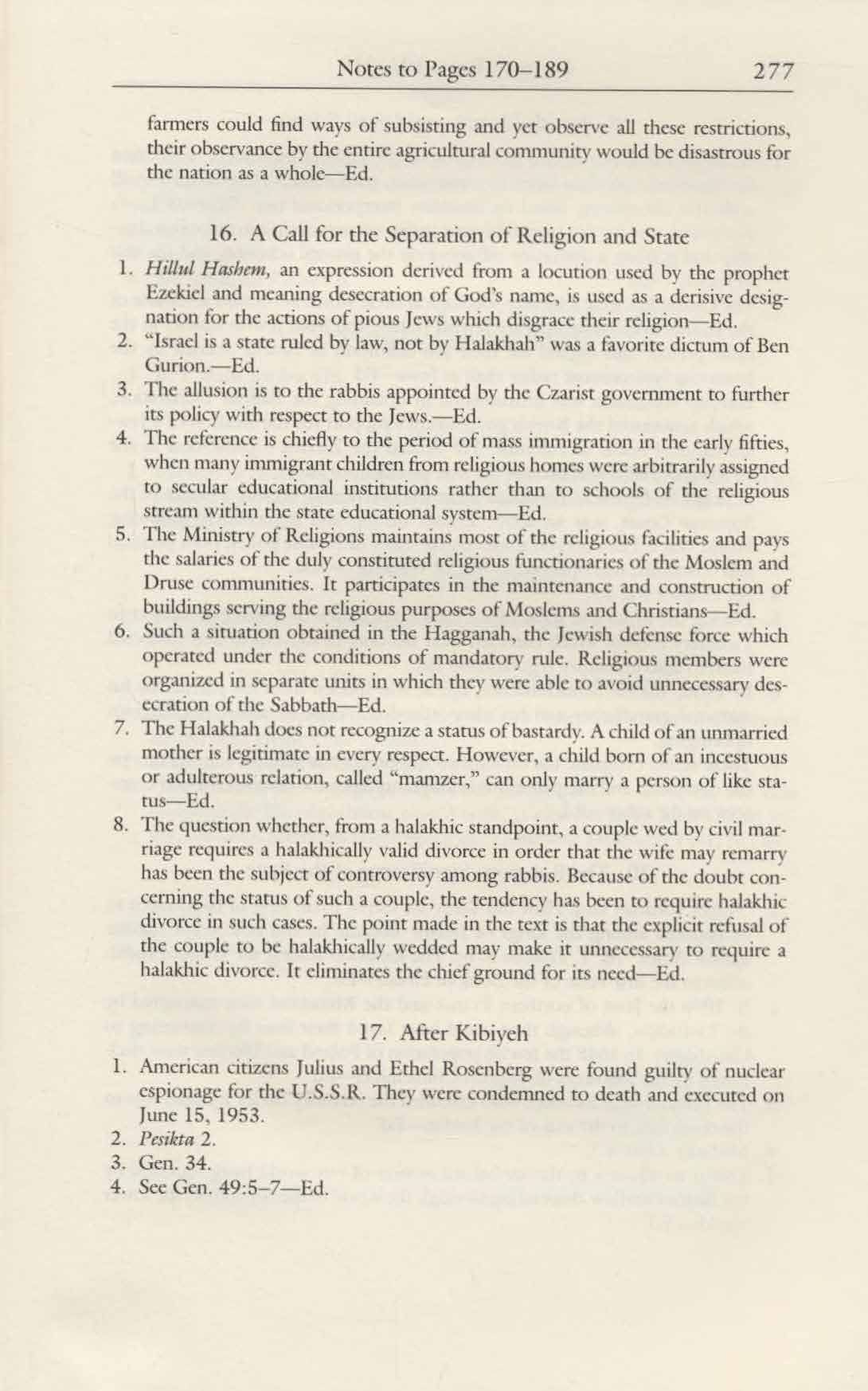
  3. Leon Roth, “Letter – Professor Roth on the Moral Issue,” The Jewish Chronicle (4 December 1953): 21, reprinted in Raphael Loewe, “Note,” in Leon Roth, Is There a Jewish Philosophy? Rethinking Fundamentals (Oxford: The Littman Library of Jewish Civilization, 1999), xviii-xx, available here. See also below, Appendix 1. The British discussion of the Qibyā raid was exacerbated by the intervention of Dr. Cyril Garbett, Archbishop of York: “Archbishop Accuses Israel: ‘Cruel Massacre’ of Arab Villagers,” The Jewish Chronicle (13 November 1953). The Board of Deputies of British Jews issued an immediate reply, rejecting his censure as “provocative and one-sided” (ibid.).
  4. “Right Is Might,” The Jewish Chronicle (October 23, 1953): 16. David F. Kessler was the Chronicle’s managing director and John Maurice Shaftesley its editor. On the editorial’s contemporary reception, see David Cesarani, The Jewish Chronicle and Anglo-Jewry, 1841–1991 (Cambridge: Cambridge University Press, 1994), 206, who shows it was widely regarded as an important moral statement. It was praised by Ernst Akiba Simon and Selig Brodetsky, and endorsed by Rabbi Leo Baeck who personally congratulated Kessler. It was sharply criticized by the Israeli Embassy in London, although Ambassador Eliahu Elath later conceded to Kessler that the criticism had been warranted.
  5. In his first intervention (“Israel Border Conflict – The Deputies’ Statement, 23 October 1953), Bentwich repudiated an apologetic statement issued by the Board of Deputies in response to the Foreign Office’s censure of Israel, and he criticized the Qibyā action as “a shocking indefensible act which violates the fundamental ethic of Judaism.” In his second intervention (“Professor Bentwich’s Reply,” 27 November 1953), he responded directly to Rabbi Abraham Cohen, President of the Board of Deputies. He rejected his claim (20 November 1953) that condemnation of the reprisal raid was permissible only for those who could swear they themselves would not retaliate in a similar situation, and he insisted that he himself would oppose the Qibyā action “in any circumstances.” Roth’s December 4 letter continued Bentwich’s criticism of Cohen’s opinion that although the Qibyā action was morally wrong, Jews should not hasten to condemn it.
  6. Simon, Professor of Education at the Hebrew University of Jerusalem, was in England in October 1953 on a lecture tour under the auspices of the Leeds Zionist Association and the Zionist Federation. In his lectures Simon emphasized the tension between Jewish moral consciousness and political existence, warning that “Israel will not solve your educational problem – you must solve it yourself,” and calling for “a new equilibrium between Jewish consciousness and Jewish existence.” See “Needs of Jewish Education: Professor Simon’s Lectures,” The Jewish Chronicle (October 9, 1953): 5.
  7. See Raphael Loewe, “Memoir about Leon Roth,” in Raphael Loewe, ed., Studies in Rationalism, Judaism and Universalism – In Memory of Leon Roth (London: Routledge & Kegan Paul, 1966), 1-11, available here.
  8. See Irene Roth, Cecil Roth, Historian Without Tears: A Memoir (New York: Sepher-Hermon Press, 1982), 114, for an anecdote from Irene and Cecil Roth’s 1935 visit to Palestine. When in Safed, Cecil Roth mentioned to “an elderly man clad in a long silk caftan” that he had a brother in Jerusalem named Leon: “[T]he man grew excited. ‘Do you mean Professor Leon Roth, the philosopher?’ he said in surprise. ‘How is it possible that you did not say so at once? To have such an eminent scholar in one’s family and not to proclaim it from the housetops – this I cannot understand.’ Then he continued, ‘I, too, am something of a philosopher. I have published a number of pamphlets on the subject.’ Cecil had never heard of these pamphlets, but he was amazed at the fact that their author, a complete stranger and seemingly far removed from western Jewish thought, should know of his family.” See also Cecil Roth, “Types Seen in Palestine,” Opinion: A Journal of Jewish Life and Letters 5, no. 12 (October 1935): 13-15; and idem, “Jerusalem, Paradise of Ethnologist,” The Palestine Post (30 April 1935), reporting a visit to his brother in Jerusalem.
  9. See Samuel Hugo Bergmann, “On the Figure of Prof. H. Y. Roth,” Haaretz Literary Supplement (12 April 1963): 3 (Hebrew); and Neve Gordon and Gabriel Motzkin, “Between Universalism and Particularism: The Origins of the Philosophy Department at the Hebrew University and the Zionist Project,” Jewish Social Studies 9 (2003): 99-122; and see also Tal Meir Giladi, “Jerusalem Divided: The Hebrew University’s Philosophy Department Between Rotenstreich and Bar-Hillel,” in Yfaat Weiss and Uzi Rebhun, eds., The History of the Hebrew University of Jerusalem: The Nation-State and Higher Education (Jerusalem: Magnes, 2024), 767-798 (Hebrew). See soon Niv Perelsztejn, “The Genesis of Israeli Philosophy, 1917-1967: Cross-cultural Dialogue or Academic Isolation” (Ph.D. dissertation, Haifa University, to be submitted in Spring 2026).
  10. For a list of his publications, see Raphael Loewe, “Bibliography of the Writings of Leon (Hebraice Hayyim Yehudah) Roth,” in Raphael Loewe, ed., Studies in Rationalism, Judaism and Universalism – In Memory of Leon Roth (London: Routledge & Kegan Paul, 1966), 523-536, available here.
  11. The Israeli press framed Roth’s departure as an expression of disillusionment with the policies of the State and the University. See, e.g. “Prof. Roth Returns – Disillusioned – to England,” Maariv (15 March 1951): 4 (Hebrew), available here.
  12. Loewe reports that Roth’s resignation was met with resistance not only by the University but also by senior figures in the Israeli establishment, who regarded him as a major national asset and sought to retain him through offers of high office. Proposals were made that he assume the presidency of the University or, alternatively, enter the government as Minister of Education; but “he was not to be dissuaded,” and in July 1951 he returned to England. See Loewe, “Memoir about Leon Roth,” 1-11, esp. 5, available here.
  13. A photograph of his tombstone, taken by Mr. Menachem Butler during an Aseret Yemei Teshuvah visit to Karori Cemetery in Wellington, New Zealand, on Sunday, 23 September 2012, as part of his High Holiday tour of New Zealand, has been published in David Assaf, “A Book Dedication: ‘I Will Go and Return to My First Husband’ – A Farewell Gift from Ḥayyim Yehudah Roth,” The OnegShabbat Blog (11 March 2012), available here. (Note: the post was originally published in March 2012 and has been updated periodically in subsequent years, including the addition of the tombstone photograph.)
  14. Ernst Akiba Simon, “Letter – After Qibyā and Rabbi Judah Halevi,” Beterem, no. 190 (1 January 1954): 21 (Hebrew).
  15. Warren Zev Harvey, “Judah Halevi on War and Morality,” in Aviad Hacohen and Menachem Butler, eds., Praying for the Defenders of Our Destiny: The Mi Sheberach for IDF Soldiers (Cambridge, MA: The Institute for Jewish Research and Publications, 2023), 317-318, available here.
  16. See Elliott Horowitz, “Genesis 34 and the Legacies of Biblical Violence,” in Andrew R. Murphy, ed., ‪The Blackwell Companion to Religion and Violence (Blackwell Publishing, 2011), 163-182, available here.
  17. The discussion of Roth’s second question does not appear in Leibowitz’s original article of 15 December 1953, but was introduced only in his follow-up piece of 15 January 1954, and was written in explicit response to Pepita Haezraḥi, “Thoughts on Humilitas,” Beterem, no. 190 (1 January 1954): 9-11 (Hebrew); see below, Appendix 4. Since Leibowitz’s discussion appeared a full six weeks after Roth’s letter in the Jewish Chronicle, there is no reason to doubt that he was influenced by it. The length and thoughtfulness of Leibowitz’s reply to Dr. Haezraḥi reveals the great respect he had for the independent-minded young philosopher, then 32.
  18. Nearly three decades ago, my student Rabbi Dr. Jan Katzew documented the controversy that erupted in 1947 around Leon Roth’s public opposition to the proposed partition of Palestine. While on a visit to the United States on behalf of the Hebrew University of Jerusalem, Roth was quoted in “Professor Gives Some Opinions on Palestine,” Los Angeles Times (3 June 1947): 4, arguing that partition was impracticable and warning that it would leave “two sore spots that will eventually lead to violence.” His remarks, made less than six months before the United Nations vote on partition, provoked heated reactions from American Zionist leaders, who accused him of anti-Zionist agitation. In a letter of protest, Sir Leon (Arie) Simon, then Chair of the University’s Executive Council and later its President, cited a telegram from the American Zionist Emergency Council charging that “Professor Leon Roth of Hebrew University is now in America … making political statements gravely prejudicial to the Jewish cause.” Roth rejected the accusation as “untrue to fact, slanderous and damaging,” insisting on his right, “after twenty years’ fruitful work in Jerusalem,” to criticize prevailing policies. See Jan Katzew, “Leon Roth – His Life and Thought: The Place of Ethics in Jewish Education” (PhD dissertation, Hebrew University of Jerusalem, 1997), 72-74; the full exchange between Roth and Simon is reproduced below in Appendix 2 (from Katzew’s appendix, pp. 355-358).
  19. See Yeshayahu Leibowitz, Judaism, Human Values, and the Jewish State (Cambridge, MA: Harvard University Press, 1992), 241-248.
  20. When taken to task by Shubert Spero for omitting reference to the State of Israel and Zionism, Roth responded: “I fancy that the reviewer has fallen into the conventional confusion between the ‘Land of Israel’ and the ‘State of Israel.’ The State of Israel has worries which neither I nor your reviewer can, or has the right to try to, solve; but are they, all or in part, connected with Judaism? In any case would it not be wiser for us to try and make up our minds first what Judaism is and only afterwards…what our attitude to the new State is to be?” See Leon Roth, “Communications – Are There Authoritative Beliefs?” [Response to Shubert Spero], Tradition: A Journal of Orthodox Jewish Thought 5, no. 1 (Fall 1962), 123-124, available here. After forsaking the State of Israel in 1951, Roth devoted his final years to trying to clarify what Judaism is.
  21. Leon Roth, Judaism: A Portrait (New York: Viking Press, 1960), 104.
  22. Ibid., 107.
  23. Ibid., 107.
  24. Ibid., 230-231.
  25. See, Judaism, Human Values, and the Jewish State, pp. 191-192.
  26. In this article, Leibowitz responded to Pepita Haezraḥi, “Thoughts on Humilitas,” Beterem, no. 190 (1 January 1954): 9-11 (Hebrew); and Rabbi Benjamin, “The Plain Sense Is Not Sufficient…,” ibid., 11 (Hebrew).
  27. See Warren Zev Harvey, “Theopolitical Notes on Israel’s Declaration of Independence,” Journal of Ecumenical Studies 56 (2021): 338-346, available here.
  28. Milhemet Mitzvah, vol. 1: Halakhic Foundations, Religious Authority, and Military Service in Israel’s War of Independence, eds. Aviad Hacohen, Yitzchak Avi Roness, and Menachem Butler (Cambridge, MA: The Institute for Jewish Research and Publications, 2025), available here; and Milhemet Mitzvah, vol. 2: Religious Leadership and Halakhic Responsibility in the Military Service Debate, eds. Aviad Hacohen, Yitzchak Avi Roness, and Menachem Butler (Cambridge, MA: The Institute for Jewish Research and Publications, 2025), available here.
  29. See Neria Guttel, “Missing from the Book – Review of War in Light of Halakhah,” in Aviad Hacohen, Yitzchak Avi Roness, and Menachem Butler, eds., Milhemet Mitzvah, vol. 2: Religious Leadership and Halakhic Responsibility in the Military Service Debate (Cambridge, MA: The Institute for Jewish Research and Publications, 2025), 318-328, who offers a detailed analysis of the systematic marginalization of Religious Zionist halakhic treatments of war in the Encyclopedia Talmudit and the editors’ deliberate preference for citing ḥaredi authorities while excluding Religious Zionist halakhic thinkers.
  30. See Aharon Kampinsky, “Torah Publications,” in Rabbinism and Politics in Religious Zionism (Boston: Academic Studies Press, 2024), 37-52, on the establishment of Ha-Torah ve-ha-Medinah as a halakhic forum for questions of sovereignty, governance, security, and agriculture in the early years of the State of Israel; see also Asher Cohen and Aharon Kampinsky, “Religious Leadership in Israel’s Religious Zionism: The Case of the Board of Rabbis,” Jewish Political Studies Review 18, nos. 3-4 (Autumn 2006): 119-140.
  31. “Creators on Their Works – Rabbi Shaul Yisraeli: Editor and Reviewer,” ha-Tsofeh Literary Supplement (7 January 1955): 5-6 (Hebrew), available here.
  32. Shaul Yisraeli, “The Qibyā Incident in Light of Halakhah,” Ha-Torah ve-ha-Medinah, nos. 5-6 (1953-1954): 71-113 (Hebrew), available here, and later revised and expanded as “Military Actions for the Protection of the State,” in ʿAmud ha-Yemini (Tel-Aviv-Jaffa: Moreshet, 1966), 162-199 (Hebrew).
  33. See Efrat Seckbach, “The Qibyā Operation in Israeli Public Memory, 1953-1985” (cited above, n. 2). Her otherwise comprehensive study does not engage the contemporaneous halakhic discussions of Qibyā, treating them neither as part of Israeli public discourse nor as relevant to the formation of public memory. This omission accords with her focus on secular political, cultural, and media arenas, but it also underscores the extent to which halakhic discourse operated in a largely parallel register, marginal to the sites in which Israeli collective memory of Qibyā was shaped. The absence of halakhic material from this historiography thus reinforces the claim that early rabbinic and halakhic engagements with Qibyā unfolded independently of the later moral reckoning traced here.
  34. See Michael J. Broyde, “Just Wars, Just Battles, and Just Conduct in Jewish Law: Jewish Law Is Not a Suicide Pact!,” in Lawrence H. Schiffman and Joel B. Wolowelsky, eds., War and Peace in the Jewish Tradition (New York: Yeshiva University Press, 2004), 1-43, available here, who treats Rabbi Shaul Yisraeli’s responsum on the Qibyā incident as the earliest sustained modern halakhic engagement with civilian harm in asymmetric warfare and traces its subsequent elaboration in the pages of Teḥumin. In his reading, Rabbi Yisraeli’s argument is taken to permit the targeting of civilians who materially assist hostile operations through a widened application of the rodef doctrine, extending even to indirect or expressive forms of support. This analysis reflects a later stage in the reception of Yisraeli’s responsum, in which its categories are preserved but pressed beyond the narrower limits they bear in the original text.
  35. See also Aviad Hacohen, “Ethics and War: A Select Bibliography,” in Eli Bloom, ed., Arakhim be-Mivhan Milhamah: Values in the Test of War – A Symposium in Memory of Ram Mizrachi (Jerusalem: Moreshet, 1985), 252-256 (Hebrew), available here.
  36. Gerald J. Blidstein, “The Treatment of Hostile Civilian Populations: The Contemporary Halakhic Discussion in Israel,” Israel Studies 1, no. 2 (Fall 1996): 27-45, available here; and Gerald J. Blidstein, “The Ethical and Legal Status of Hostile Civilian Populations in Contemporary Halakhic Thought,” State, Government, and International Relations, vols. 41-42 (1997): 155-170 (Hebrew), available here.
  37. See also his related articles in Gerald J. Blidstein, “The Massacre at Shechem, Collective Punishment, and Contemporary Halakhic Thought,” Et Ha-Da’at 1 (1997): 48-55 (Hebrew), available here; Gerald J. Blidstein, “The Ethics of Warfare Revisited,” Me’orot Journal 6, no. 2 (2008): 2-5, available here; and Gerald J. Blidstein, “The Case of Shechem: Maimonides’ Normative Reading,” in Daphne Barak-Erez and Gidon Sapir, eds., Essays in Honour of Izhak Englard (Ramat-Gan: Bar-Ilan University Press, 2010), 375-387 (Hebrew), available here.
  38. Arye Edrei, “From Qibyā to Beirut: The Renewal of the Jewish Laws of War in the State of Israel,” in Yossi Goldstein, ed., Yosef Daʿat: Studies in Modern Jewish History in Honor of Yosef Salmon (Beer Sheva: Ben-Gurion University of the Negev, 2010), 95-127 (Hebrew). An earlier version appeared in Arye Edrei, “Law, Interpretation, and Ideology: The Renewal of the Jewish Laws of War in the State of Israel,” Cardozo Law Review 28, no. 1 (October 2006): 187-227, available here.
  39. See Suzanne Last Stone, “The Jewish Law of War: The Turn to International Law and Ethics,” in Sohail H. Hashmi, eds., Just Wars, Holy Wars, and Jihads: Christian, Jewish, and Muslim Encounters and Exchanges (New York: Oxford University Press, 2012), 342-363.
  40. See Neria Guttel, “‘He Whom One Loves, He Rebukes’: The Complexity of Rav Shaul Yisraeli’s Attitude toward the Personalities, Institutions, and Philosophy of Religious Zionism,” in Yishai Arnon, Yehuda Friedlander, and Dov Schwartz, eds., Studies in Religious Zionism: Developments and Changes (Ramat-Gan: Bar-Ilan University Press, 2012), 145-167 (Hebrew), available here.
  41. See also Neria Guttel, “The Rabbinate and the State,” ha-Tsofeh Literary Supplement (22 June 2001): 11-12 (Hebrew).
  42. See further Neria Guttel, “Combat in an Area Dense with Civilian Population,” Teḥumin, no. 23 (2003): 18-31 (Hebrew), expanded and published in Neria Guttel, “Combat in an Area Dense with Civilian Population,” in Eyal Karim, ed., Ha-Milhamah ba-Terror (Kiryat Arba: ha-Makhon le-Rabanei Yishuvim, 2006), 43-105 (Hebrew), available here. Although not concerned with the Qibyā responsum as such, the article addresses the same operational problems that first emerged there and illustrates how later halakhic discussion of civilian harm can press earlier categories toward more permissive conclusions while leaving aside the hesitations and limits that shape Rabbi Yisraeli’s original analysis.
  43. Yitzchak Avi Roness, “Halakhah, Ideology and Interpretation: Rabbi Shaul Yisraeli on the Status of Defensive War,” Jewish Law Association 10 (2010): 184-195, available here.
  44. Arnon Lamfrom and Ze’ev Elron, “Historical Document: Meeting of Levi Eshkol and Ariel Sharon Concerning the Qibyā Operation – Jerusalem, 3 September 1965,” Yesodot, no. 6 (2024): 269-282 (Hebrew), available here; and see also Ariel Sharon, “The Operation That Restored the IDF’s Honor,” Yediot Ahronoth (18 October 1992): 8-9, 11 (Hebrew), available here, which retrospectively casts the operation as a necessary assertion of deterrence that successfully restored the IDF’s military standing, but gives little attention to the operation’s legal or moral ambiguity.


The Medical Training and Yet Another (Previously Unknown) Legacy of Rabbi Dr. Abraham J. Twerski, zt”l

The Medical Training and
Yet Another (Previously Unknown) Legacy
of Rabbi Dr. Abraham J. Twerski, zt”l

by Edward Reichman and Menachem Butler

Rabbi Dr. Edward Reichman is a Professor of Emergency Medicine and Professor in the Division of Education and Bioethics at the Albert Einstein College of Medicine. He writes and lectures widely in the field of Jewish medical ethics.

Mr. Menachem Butler is Program Fellow for Jewish Legal Studies at The Julis-Rabinowitz Program on Jewish and Israeli Law at Harvard Law School. He is an Editor at Tablet Magazine and a Co-Editor at the Seforim Blog.

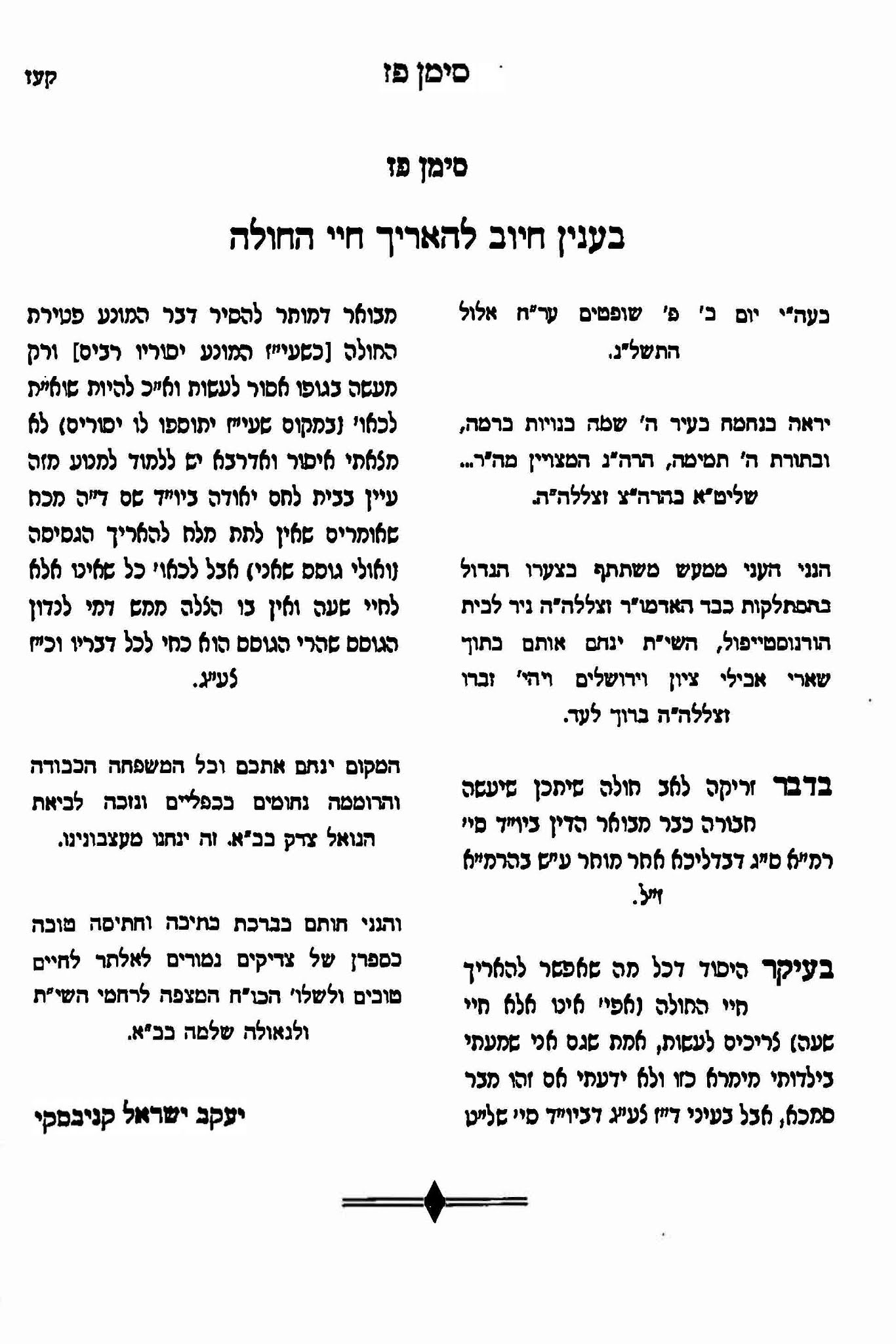
On erev Shabbat Shira last week, in the course of a typically wide-ranging conversation between the authors of this article, Menachem mentioned that unfortunately Rabbi Dr. Abraham J. Twerski was critically ill. As hashgachah would have it, Menachem had happened upon a little-known precious work from 1997, entitled Sefer Ye’omar le-Yaakov u-le-Yisrael, compiled by Rabbi Dr. Abraham J. Twerski and comprised of letters written to him by Rabbi Yaakov Yisrael Kanievsky, zt”l (1899-1985), known as the Steipler Gaon and author of the multi-volume work Kehillot Yaakov.[1]

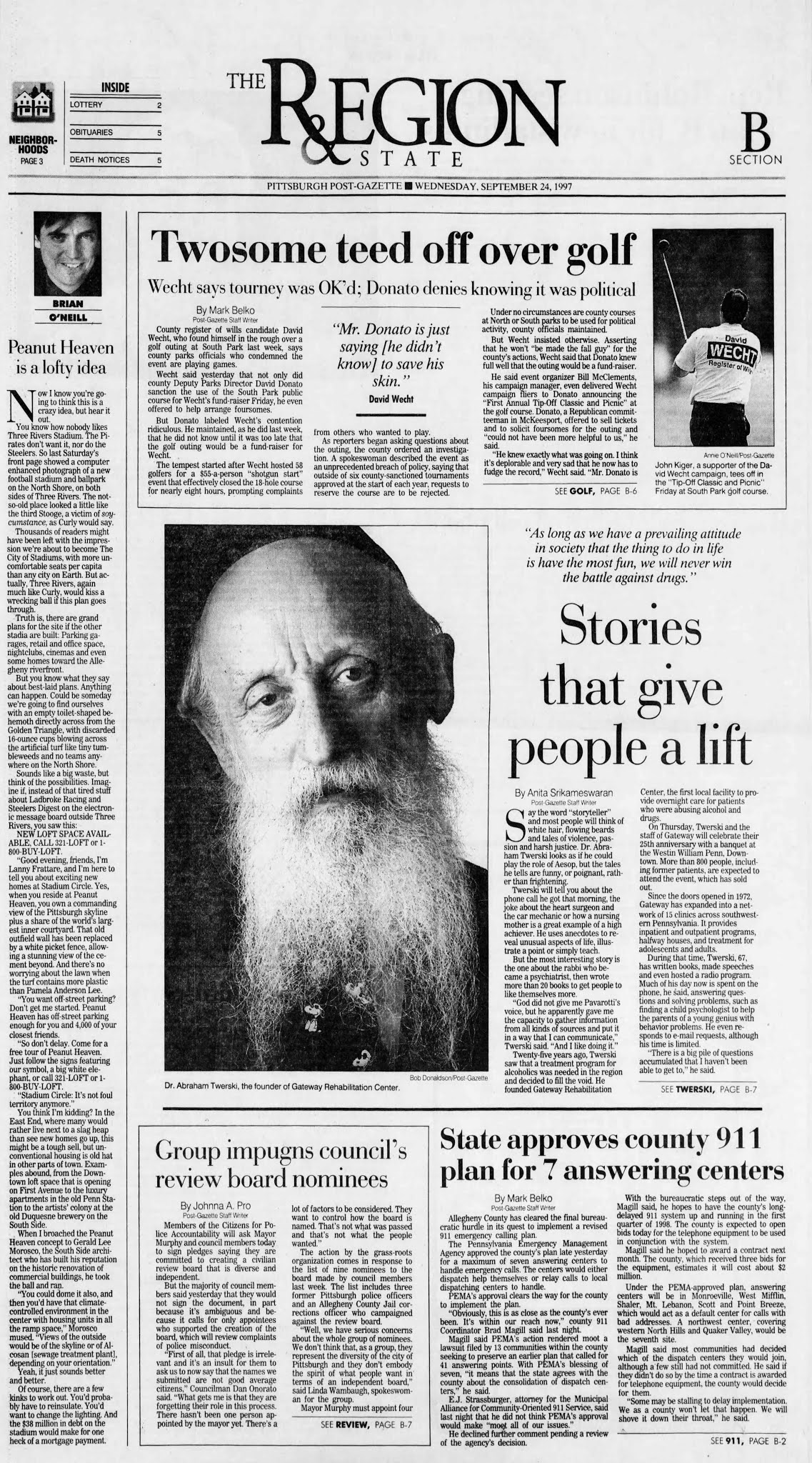
Scion of prominent Hasidic dynasties and related to the current Rebbes of Bobov, Karlin, Klausenberg, Talner, and Skver, Abraham J. Twerski was born in Milwaukee in 1930 to Rabbi Yaakov Yisrael Twerski and his wife Devorah Leah (née Halberstam), where he attended public school as a child.[2] After he received his rabbinic ordination from the Hebrew Theological College in Chicago, he began to serve as an assistant rabbi in his father’s congregation in Milwaukee in the 1950s, as Aaron Katz described in his 2015 profile of Rabbi Dr. Abraham J. Twerski (“The Wisdom of Peanuts”) at Tablet Magazine. He married Goldie (née Flusberg) in March 1952; and starting that summer, directed the Hebrew School at his father’s congregation Beth Jehudah, as well as officiated religious lifecycle events in his father’s community in Milwaukee. However, as he would later reflect in an interview “after I had practiced as a rabbi for a number of years, I felt I was not fulfilled in my work and — after consultation with the Steipler Gaon — I went to medical school to become a psychiatrist.”

Abraham J. Twerski wrote to the Steipler Gaon and expressed concerns about the propriety of attending medical school as an Orthodox Jew. He would regularly visit Rav Kanievsky at his home in Bnei Brak and corresponded with him by mail, maintaining an ongoing relationship with him until the Steipler’s passing in 1985. That year, a volume of collection of letters entitled Karyana de-Igarta was published, and included, for the first time, two letters that the Steipler Gaon had sent some thirty years earlier to a young Abraham J. Twerski in Milwaukee, who was then seeking his advice regarding his career choice.

The first letter was written at the end of the Summer of 1955 by a twenty-four-year-old Abraham J. Twerski and in this letter the Steipler Gaon addresses the value of making one’s livelihood through a non-rabbinic profession. As to the specific profession, he adds that medicine may be a preferred choice, as it is a mitzvah to learn, and additionally, excluded from the ban on secular knowledge of the Rashba.[3] However, this is on the proviso that the education is provided by proper teachers and in an environment conducive to Torah observance. As this is clearly not the case in a modern university, he offers some general guidelines, culled from the seforim hakedoshim, if not to guarantee, at least to enhance the chances of success: 1) kove’a itim – learn in-depth at least two hours daily; 2) recite all tefillos with a minyan; 3) regular mikva immersion; 4) meticulous Shabbat observance; and 5) a daily musar seder.[4]

The second question Abraham J. Twerski posed, the following year, was more specific to his situation. He inquired whether it was preferrable for him to be a rabbi in a largely non-observant community (he was serving as an assistant rabbi to his father in Milwaukee at that time), which would involve immersion in an irreligious environment with potential negative impact on the Jewish education of his children; or should he choose a medical career, which would allow him to remain in an environment of Torah observance.

Suffice it say, the Steipler Gaon’s tone in this letter is less than supportive of a career in medicine than its predecessor. His written response is unequivocal, “the rabbinate is much preferred” (adifa yoter viyoter). He lists no less than five reasons not to become a physician, relating to the challenges in maintaining Torah observance and modesty, as well as the time commitment, which would preclude Torah study. He adds on a personal note that given his estimation of the exceptional talents of the young Rabbi Twerski, the latter would likely become a highly successful and sought-after physician. As such, he would find no rest from those constantly “knocking on his door” and seeking his consultation. He was particularly concerned about what would happen to his Torah learning and observance in such a case.[5]

Notwithstanding the serious concerns expressed by the Steipler Gaon, and perhaps now better informed of the potential pitfalls, Abraham J. Twerski proceeded to pursue his medical education, as he wrote, “I went to medical school with the Steipler’s blessing and continued an ongoing relationship with him for years.”[6] Their fathers both grew up as friends in Hornsteipel, “and spent their boyhood years together and were on first name terms,” reminisced Rabbi Dr. Abraham J. Twerski many years later in a biographical memoir of his Hasidic ancestors.[7]

However, several years into his studies at Marquette University’s medical school, Abraham J. Twerski could no longer afford the tuition.[8] His assistance would come from a most unlikely source, as he would later describe in an interview with the Pittsburgh Quarterly:[9]

By that time, I had several children, so my dad and some members of the congregation helped me to pay for school. I applied for a scholarship through a foundation, but it didn’t come through, so in my third year, I fell two trimesters behind on tuition. One day, I called my wife at lunch as always, and she asked, “What would you do if you had $4,000?” I said, “I’m too busy to talk about fantasies.” She said, “But you really do have $4,000!” I said, “From where?” She said, “From Danny Thomas.” “Who’s Danny Thomas?” She said, “The TV star.” Then she read me an article from The Chicago Sun. Local officials had told Mr. Thomas about a young rabbi who was struggling to get through medical school. Thomas asked, “How much does your rabbi need?” They said, “Four thousand dollars.” He said, “Tell your rabbi he’s got it.”[10] So, I did my internship in general medicine, went to the University of Pittsburgh Psychiatric Institute for three years, and then worked two more years for a state hospital.

While the Steipler Gaon’s assessment of the success of Rabbi Dr. Abraham J. Twerski’s medical career was prophetic, his concerns about Torah observance and learning, at least for Dr. Twerski, would turn out to be unfounded. Upon his graduation from medical school several years later, Time Magazine (June 15, 1959) published a brief article about him entitled “Rabbi in White.” It is worth reprinting in its entirety:

Abraham Joshua Twerski, 28, graduated from medical school this week. It was no mean feat, for Twerski is a Jewish rabbi like his father, two uncles, father-in-law, two older brothers and (when they finish their studies) two younger twin brothers. And to keep the Torah as an Orthodox Jew for six years of studies in Milwaukee’s Roman Catholic Marquette University was something like running a sack race, an egg race and an army obstacle course at the same time.

First there was the problem of keeping his religion from growing rusty: he rose each day at 5:30am, put in an hour’s study of the Talmud before early service at Milwaukee’s Beth Jehuda Synagogue, where he is assistant rabbi. Medical school classes began at 8am, and here real complications set in. His full black beard was a sanitary problem in surgery, requiring special snood-like surgical masks. His tallith katan, a small prayer shawl worn by many Orthodox Jews under their shirts, had to be made of cotton instead of wool – which might set off a static spark and ignite the anesthetic in an operating room.

Lectures on Saturday.[11] Religious holidays sometimes required months of advance planning. The nine-day Feast of Tabernacles, for instance, with four days when work is forbidden, fell during a series of lectures before a make-or-break exam in pathology. Abe, as students and professors call him, met the situation by studying by himself all the preceding summer, put himself so far ahead of his class that he could afford to miss the lectures. “I hated like heck to miss them,” he explains, “but I creamed that exam.”

When lectures came on Saturdays – during which Orthodox Jews are forbidden to work, ride in a vehicle or talk on the phone – Abe would have a friend put a sheet of carbon paper under his lecture notes and hope he remembered to use a ballpoint pen. Sabbath restrictions begin on Friday night, just before sundown, and on occasion Fridays only a lucky break in the traffic has saved him from having to abandon his 1952 De Soto and walk the rest of the way home. On Saturdays Abe was not on duty, but sometimes, to follow up on one of the cases he had been observing, he would leave his car in the garage and walk five miles to the hospital and back.

Work on Tishah Be’ab. Abe brought his own kosher food to school every day and ate it in the student lounge, where he also said his midday prayers in a corner, surrounded by chattering fellow students. Hospital duty during the 24-hour fast without food and water at Tishah Be’ab (commemorating the destruction of the Second Temple in 70 A.D.) Dr. Twerski describes as “murder,” and the last six years have left him hollow-eyed and slightly sallow.[12] But he is eagerly looking forward to the next stage: a year of internship in Milwaukee’s Mount Sinai Hospital, followed by a three-year residency in psychiatry.

“Psychiatric training was the motivation for my going into medicine,” he says. “I felt I could be a better adviser to my people and more help to them with their problems.”

The Time Magazine profile of Abraham J. Twerski included just one photograph (wearing “a snood for surgery” over his yarmulke), but members of the Twerski family have shared in recent years nearly a dozen of the other photographs that were taken by George P. Koshollek Jr., a local photographer with The Milwaukee Journal, and later deposited in the LIFE Photo Archive. The following are two photographs of newly-minted physician Abraham J. Twerski, together with his philanthropic patron who supported his medical school studies, the comedian Danny Thomas:

Upon his 1959 graduation from Marquette University Medical School, Rabbi Dr. Abraham J. Twerski left his pulpit in Milwaukee and moved with his family to Pittsburgh, where he completed his psychiatric training at the University of Pittsburgh’s Western Psychiatric Institute four years later, and was then named clinical director of the Department of Psychiatry at St. Francis General Hospital in Pittsburgh, supervised by Sisters of the Third Order of St. Francis, where he advanced his expertise for treating addiction. In 1972, Rabbi Dr. Abraham J. Twerski founded the Gateway Rehabilitation Center with the Sisters of St. Francis.[13]

Returning to our pre-Shabbat conversation, Menachem suggested that perhaps it might be appropriate for us to study through the 1997 volume of Rabbi Dr. Abraham J. Twerski, Sefer Ye’omar le-Yaakov u-le-Yisrael – one of his only Hebrew-language books of more than his eighty-authored volumes published over the past half-century – as a merit for Rabbi Dr. Abraham J. Twerski’s complete recovery. Menachem further asked if I would perhaps identify any medically related material that might be significant or previously unknown. Before Shabbat, I identified one particular letter, the final one in the book, which was of medical relevance, and I printed it out for learning, with Rabbi Twerski in mind. The topic: the obligation to prolong the life of a critically ill patient.

Just two days after our conversation, we read of the tragic passing of Rabbi Dr. Abraham J. Twerski, whose passing took place on Sunday, Chai Shvat 5781 (January 31, 2021). The nature of the letter from the Steipler Gaon to Rabbi Dr. Abraham J. Twerski, and its heretofore unknown origins, compels us to write this brief note l’zecher nishmato (in honor of his memory) and to add yet an additional item to his legacy.

Rabbi Dr. Abraham J. Twerski’s astonishing accomplishments, known to the Jewish community worldwide, are primarily in the fields of mental health, self-esteem, and addiction medicine.[14] We will leave it those with expertise in these areas to recall and recount his manifold contributions, including his voluminous literary output.[15] Here we note a contribution, which though indirect, may be on par with respect to its Jewish communal impact as those more widely known.

The Letter

In the introduction to this 230-page-work, Sefer Ye’omar le-Yaakov u-le-Yisrael, published in 1997 by the Kollel Bais Yitzchok on Bartlett Street in Pittsburgh (and with an effusive approbation from Rav Chaim Kanievsky, son of the Steipler Gaon), Rabbi Dr. Abraham J. Twerski recounts his unique connection to Rav Yaakov Yisrael Kanievsky, the Steipler Gaon. It stemmed back to the city in present-day Ukraine called Hornsteipel, to which they both trace their roots.[16] Rav Kanievsky had lived there in his youth and the appellation “the Steipler” is derived from the name of the town. Rabbi Dr. Abraham J. Twerski, though born in Milwaukee, Wisconsin is a direct descendant of Rebbe Yaakov Yisrael Twerski of Cherkas, the founder of the Hornsteipel Hasidic dynasty, which originated in that city.[17] His father was named Rabbi Yaakov Yisrael Twerski and was known both as the Hornsteipler Rebbe, and as the Milwaukee Rebbe.[18]

The last letter of this volume presents a medical halakhic query Rabbi Dr. Abraham J. Twerski posed to the Steipler Gaon in the Summer of 1973 about his ailing father. “May a son administer an injection to his ill father?” Despite the fact that Rabbi Dr. Abraham J. Twerski was a physician, and injections were part of his clinical scope of practice, he was acutely aware of the potential halakhic ramification of something as simple as an injection. An injection may cause bodily injury, and it is Biblically prohibited for a son to cause a wound to his father.[19] Rav Kanievsky answered that it would be permitted as long as there are no other options: “On the matter of delivering an injection to one’s father, as it may cause a wound, the law is found in Yoreh De’ah #241:3, that when no one else is available, it is permitted … .”[20]

It appears however that between the sending of the query and the completion of the response, Rabbi Dr. Abraham J. Twerski’s father passed away, as Rav Kanievsky offers condolences: “Behold, I who am bereft of good deeds [an allusion to the introduction to the High Holiday Musaf prayer recited by the chazzan] join in your great sorrow upon the passing of the honorable, great rabbi of the Hornsteipel dynasty. May God comfort you among the mourners of Zion and Jerusalem, and may his memory be a blessing for eternity.”[21]

It is the following paragraph, which includes a general comment about end-of-life issues, to which we draw your attention:

“Regarding the principle that one should do everything possible to prolong the life of the ill patient [even if he is in a terminal state (chayei sha’ah)]. In truth I also heard such a notion in my youth, and I do not know if this derives from a ‘bar samcha’ (authoritative source). In my opinion, this requires serious analysis…”

As I [ER] read these words, they were familiar to me. This letter appears in the Steipler Gaon’s collection of letters entitled Karyana de-Igarta,[22] though the questioner is not identified. It is only from this work of their correspondences that we learn that Rabbi Dr. Abraham J. Twerski is the author of the query!

It is not a lengthy halakhic analysis. In fact, the Steipler Gaon goes on to cite only two sources. The citations relate to the passage in Shulhan Arukh, Yoreh De’ah #339 regarding the treatment of a ‘gosses’, one whose death is imminent. Yet this pronouncement of Rav Kanievsky’s on the approach to the patient at the end of life may possibly be his most cited reference on any medical halakhic topic. Moreover, it is one of the more frequently cited sources in contemporary halakhic discussions on the end of life.

In the Modern era, with the likes of respirators and antibiotics, we now have the ability to prolong life to an extent not imaginable in the past. Must we utilize the entire armamentarium of medicine to prolong life in every circumstance, despite any associated suffering? There are some, such as Rav Eliezer Waldenberg, zt”l, who would answer in the affirmative.[23] Others, like Rav Moshe Feinstein, zt”l, allow for circumstances to refrain from aggressive care.[24] This debate has been the substance of halakhic discussions on end-of-life care in our generation.[25]

For someone of the stature of Rav Kanievsky’s to write that the notion to prolong life in all circumstances and at all costs may not derive from a “bar samcha” (authoritative source) is nothing short of revelational. This statement has guided many a rabbinic authority in their general approach to the treatment of the patient at the end-of-life and has certainly been part of the thought process of countless practical halakhic decisions.

It appears that this noteworthy contribution of Rabbi Dr. Abraham J. Twerski, zt”l to medical halakhic discourse, albeit indirect, has gone largely unnoticed. He is not only to be credited for his legendary contributions to broadening the possibilities of mental health in the Jewish community and beyond,[26] but he is also responsible for eliciting this letter of Rav Yaakov Yisrael Kanievsky, which has informed and guided halakhic-decision-making at the ‘end-of-life’ in the Modern era.

Sadly, we now invoke the same sentiment that the Steipler Gaon expressed above about the loss of another great rabbinic leader and member of the Hornsteipler dynasty:

May his memory be a blessing for eternity.

Notes:

[1] See Marc B. Shapiro, “The Tamim: Rabbi Yaakov Yisrael Kanievsky (‘The Steipler’),” in Benjamin Brown and Nissim Leon, eds., The Gedolim: Leaders Who Shaped the Israeli Haredi Jewry (Jerusalem: Magnes, 2017), 663-674 (Hebrew). A full biographical treatise on The Steipler Gaon along the lines of the magisterial scholarly work of The Hazon Ish, in Benjamin Brown, The Hazon Ish: Halakhist, Believer and Leader of the Haredi Revolution (Jerusalem: Magnes, 2011; Hebrew) remains a scholarly desideratum.
[2] In a December 25, 2020 email to Menachem Butler, Rabbi Dr. Abraham J. Twerski clarified some important details of an anecdote from when he participated in the Christmas play at his Milwaukee public school in his childhood. He wrote here:

That’s not quite the way it was. The week after the play, my mother called the teacher, to meet her. The teacher said, ‘I knew that Mrs. Twerski would reprimand me for putting Abraham in the Xmas play. But all she wanted to know was whether Abraham was self-conscious because he was shorter than the other children.’ I said, ‘I thought you were going to reprimand me for putting Abraham in the Xmas play.’ Mrs. Twerski said ‘If what we have given him at home is not enough to prevent an effect of a Xmas play, then we have failed completely.’

[3] For an overview of the controversy, see David Berger, “Judaism and General Culture in Medieval and Early Modern Times,” in Cultures in Collision and Conversation: Essays in the Intellectual History of the Jews (Boston: Academic Studies Press, 2011), 21-116, esp. 70-78. See also Joseph Shatzmiller, “Between Abba Mari and Rashba: The Negotiations That Preceded the Ban of Barcelona (1303-1305),” Studies in the History of the Jewish People and the Land of Israel, vol. 3 (1973): 121-137 (Hebrew); David Horwitz, “The Role of Philosophy and Kabbalah in the Works of Rashba,” (unpublished MA thesis, Yeshiva University, 1986); David Horwitz, “Rashba’s Attitude Towards Science and Its Limits,” Torah u-Madda Journal, vol. 3 (1991-1992): 52-81; and Marc Saperstein, “The Conflict over the Ban on Philosophical Study, 1305: A Political Perspective,” in Leadership and Conflict: Tensions in Medieval and Early Modern Jewish History and Culture (Oxford: Littman Library, 2014), 94-112.
[4] Avraham Yeshaya Kanievsky, Karyana de-Igarta: Letters of Rabbi Yaakov Yisrael Kanievsky, vol. 1 (Bnei Brak: privately published, 1985), 101-103, no. 86 (Hebrew), dated August 31, 1955.
[5] Avraham Yeshaya Kanievsky, Karyana de-Igarta: Letters of Rabbi Yaakov Yisrael Kanievsky, vol. 1 (Bnei Brak: privately published, 1985), 72-74, no. 66 (Hebrew), dated April 5, 1956.
[6] Rabbi Dr. Abraham J. Twerski, “Who is Honored? He Who Honors Others” (Pirkei Avos 4:1) at TorahWeb.org.
[7] See Abraham J. Twerski, The Zeide Reb Motele: The Life of the Tzaddik Reb Mordechai Dov of Hornosteipel (Brooklyn: Mesorah Publications, 2002), 11.

In 1965, Rabbi Dr. Abraham J. Twerski visited Bnei Brak and requested that he be permitted to take a photograph of Rav Kanievsky. After sharing a story about how Rav Meir Shapiro of Lublin convinced Rav Joseph Rosen, the Rogatchover Gaon, to allow him to take a photograph so that future generations would know what “a true Jew should look like,” the Steipler consented to a photograph to be taken.
[8] Financial difficulties for Jewish medical students are certainly not a new phenomenon. Indeed precisely four hundred years before Rabbi Twerski’s financial woes, in 1658, Chayim Palacco, another rabbi training as a physician in the University of Padua Medical School petitioned the Jewish community of Padua for assistance in paying his medical school tuition. The request, the only one of its kind in the archival records, was granted. See Daniel Carpi, “II Rabbino Chayim Polacco, Alias Vital Felix Montalto da Lublino, Dottore in Filosofia e Medicina a Padova (1658),” Quaderni per la Storia dell’ Universita di Padova, vol. 34 (2001): 351-352.

[9] Jeff Sewald, “Abraham J. Twerski, Psychiatrist and Rabbi: The Psychiatrist and Rabbi in His Own Words,” Pittsburgh Quarterly (Winter 2008), available here.

[10] For further details, see “Catholic Danny Thomas to Help Rabbi Become Doctor,” The Wisconsin Jewish Chronicle (27 June 1958): 1 and 3.

[11] The medical student Judah Gonzago, who trained in Rome in the early 1700s, recounts how one of his final (oral) exams was on Rosh Hashana. He recalls how he left the synagogue after the shacharit (morning) service and returned in time to hear the blowing of the shofar. His other trials and tribulations are reminiscent of those of Rabbi Dr. Twerski, though reflect a different historical reality. Though not a rabbi, Gonzago taught Torah in the local Jewish school. See Abraham Berliner, “Memoirs of a Roman Ghetto Youth,” Jahrbuch für Jüdische Geschichte und Literatur, vol. 7 (1904): 110-132 (German), of which excerpts are summarized and translated in Harry Friedenwald, “The Jews and the Old Universities,” in Harry Friedenwald, ed., The Jews and Medicine: Essays, vol. 1 (Baltimore: John Hopkins University, 1944), 221-240.
[12] How Rabbi Dr. Abraham J. Twerski navigated medical school while simultaneously maintaining meticulous religious observance, not to mention finding time for Torah learning, is truly exceptional. It reflects the challenges that every religious Jew faces in pursuing a medical education. These challenges have existed throughout history, though they have evolved over time. See Edward Reichman, “From Maimonides the Physician to the Physician at Maimonides Medical Center: The Training of the Jewish Medical Student throughout the Ages,” Verapo Yerape: The Journal of Torah and Medicine of the Albert Einstein College of Medicine, vol. 3 (2011): 1-25; Edward Reichman, “The Yeshiva Medical School: The Evolution of Educational Programs Combining Jewish Studies and Medical Training,” Tradition: A Journal of Orthodox Jewish Thought, vol. 51, no. 3 (Summer 2019): 41-56. See also Edward Reichman, “The History of the Jewish Medical Student Dissertation: An Evolving Jewish Tradition,” in Jerry Karp and Matthew Schaikewitz, eds., Sacred Training: A Halakhic Guidebook for Medical Students and Residents (New York: Amud Press, 2018), xvii-xxxvii.
[13] See Abraham J. Twerski, The Rabbi & the Nuns: The Inside Story of a Rabbi’s Therapeutic Work With the Sisters of St. Francis (Brooklyn: Mekor Press, 2013).

On his appointment to this position in August 1965, Sister Mary Adele announced: “The addition of Dr. Twerski to our staff is another important move toward our goal of making complete, comprehensive mental health care and treatment available to all the people of the community.” The following month, both Sister Mary Adele and Rabbi Dr. Abraham J. Twerski rejected the suggestion that his appointment embodies any aspect of the ecumenical movement, and she told The Pittsburgh Press: “The appointment came at an opportune time to fit into the spirit… but it was accidental.” See “St. Francis Ecumenical Movement? Rabbi, Catholic Hospital Team Up In Psychiatry: Mental Ward on the Move,” The Pittsburgh Press (26 September 1965): 11
[14] Rabbi Dr. Abraham J. Twerski’s contributions also extend to the sphere of music. A noted composer of Hasidic melodies (and also of musical grammen that he composed to be delivered at celebratory occasions, such as weddings and sheva brachot), one of his best-known (although often unattributed) compositions is “Hoshia Es Amecha,” which he composed more than six decades ago on the occasion of his brother’s wedding, and set to the words from Tehillim 28:9. The song is often chanted on Simchat Torah following each of the hakkafot in the synagogue, and has become a helpful tune to count the minyan-members ahead of starting prayer services. His story of the song’s composition is recorded here. At his request, there were no eulogies delivered at his funeral. Instead, he requested that his family sing “Hoshia Es Amecha,” which he had once described as his “ticket to Gan Eden…because people dance with it.” See the video of the funeral march here.
[15] For example, see Andrew R. Heinze, “The Americanization of Mussar: Abraham Twerski’s Twelve Steps,” Judaism: A Journal of Jewish Life & Thought, vol. 48, no. 4 (Fall 1999): 450-469.
[16] For the geographic map of the Hasidic dynasties that emerged from Hornsteipel, see Marcin Wodziński, Historical Atlas of Hasidism (Princeton: Princeton University Press, 2018), 159,162.
[17] See his book-length tribute to Reb Motele, the father of Rebbe Yaakov Yisrael Twerski of Cherkas ancestor, see Abraham J. Twerski, The Zeide Reb Motele: The Life of the Tzaddik Reb Mordechai Dov of Hornosteipel (Brooklyn: Mesorah Publications, 2002).
[18] See Israel Shenker, “The Twerski Tradition: 10 Generations of Rabbis in the Family,” The New York Times (23 July 1978): 38, which includes a photo of Rabbi Yaakov Yisrael and Devorah Leah Twerski, with their children and their spouses at a family wedding in 1958.

Peter Leo, “He Defies Melting Pot Tradition,” Pittsburgh Post-Gazette (4 September 1978): 15:

Anita Srikameswaran, “Stories That Give People A Lift,” Pittsburgh Post-Gazette (24 September 1997): B2,B7

[19] For treatise on the topic of providing medical care to one’s parent, see Avraham Yaakov Goldmintz, Chen Moshe (Jerusalem: privately published, 2002; Hebrew), available here.
[20] Abraham J. Twerski, Sefer Ye’omar le-Yaakov u-le-Yisrael (Pittsburgh: Kollel Bais Yitzchok, 1997), 177 (no. 86) (Hebrew), dated August 27, 1973.
[21] Grand Rebbe Yaakov Yisrael Twerski passed away on August 7, 1973.
[22] Avraham Yeshaya Kanievsky, Karyana de-Igarta: Letters of Rabbi Yaakov Yisrael Kanievsky, vol. 1 (Bnei Brak: privately published, 1985), 201, no. 190 (Hebrew)
[23] Alan Jotkowitz, “The Intersection of Halakhah and Science in Medical Ethics: The Approach of Rabbi Eliezer Waldenberg,” Hakirah, vol. 19 (2015): 91-115.
[24] See Moshe Dovid Tendler, Responsa of Rav Moshe Feinstein, vol. 1: Care of the Critically Ill (Hoboken, NJ: Ktav Publishing House, 1996). See also Daniel Sinclair, “Autonomy in Matters of Life and Death and the Withdrawel of Life-Support in the Responsa of Rabbi Moses Feinstein,” Jewish Law Association, vol. 23 (2012): 231-245; and Alan Jotkowitz, “Death as Implacable Enemy – Or Welcome Friend in the Theology and Halakhic Decision Making of Rabbis Moshe Feinstein, Eliezer Waldenberg, and Haim David Halevy,” in Kenneth Collins, Edward Reichman, and Avraham Steinberg, eds., In the Pathway of Maimonides: Festschrift on the Eightieth Birthday of Dr. Fred Rosner (Haifa: Maimonides Research Institute, 2016), 73-99.
[25] For a comprehensive review of the halakhic issues at the end of life – well beyond the scope of this brief essay – see, most recently, Avraham Steinberg, Ha-Refuah ka-Halakhah, vol. 6: The Laws of the Sick, the Physician, and Medicine (Jerusalem: privately published, 2017), 338-388 (section 10) (Hebrew).
[26] See, for example, his books in Abraham J. Twerski, Let Us Make Man: Self Esteem Through Jewishness (Brooklyn: Traditional Press, 1987); Abraham J. Twerski, The Shame Borne in Silence: Spouse Abuse in the Jewish Community (Pittsburgh: Mirkov Publications, 1996); Abraham J. Twerski, Addictive Thinking: Understanding Self-Deception (Center City, MN: Hazelden, 1997); Yisrael N. Levitz and Abraham J. Twerski, eds., A Practical Guide to Rabbinic Counseling (Jerusalem: Feldheim, 2005), and his dozens of other works published over the past half-century, including more than fifty works at the catalog of ArtScroll/Mesorah Publications.


The Legend of R. Yehuda Halevi’s Death: Truth or Fiction?

The Legend of R. Yehuda Halevi’s Death: Truth or Fiction
by Eliezer Brodt

Among the more famous kinos that we recite on Tisha B’Av is Zion Halo Tishali. This kinah was written by one of the greatest paytanim, R. Yehudah Halevi author of the classic Kuzari. This piyut is about the author’s passion to walk on the holy soil of Eretz Yisrael. In the Artscroll commentary on the kinos, R. Avraham Chaim Feuer writes

an ancient manuscript states that R. Yehuda Halevi composed this kina while journeying towards Eretz Yisroel and recited it when he reached Damascus, facing the direction of Zion. Although many historians believe that R. Yehuda Halevi only got as far as Egypt, never even reaching Damascus, tradition has it that he finally reached Jerusalem (in 1145). There he fell to the ground in a state of ecstasy. . . . As he was embracing the dust near the temple mount, he was trampled and killed by an Arab horseman.

In this post I intend to discuss the above legend of R. Yehuda Halevi’s death, did he actually reach Eretz Yisrael? When did he compose the piyut of Zion Haloeh Tishali? I will conclude with a discussion on R. Yehuda Halevi’s connection to R. Abraham Ibn Ezra. I do not, however, intend to discuss R. Yehuda Halevi’s classic work the Kuzari nor his life in general for more on those topics one can see the excellent study by Adam Shear, “The Later History of a Medieval Hebrew Book, Studies in the Reception of Judah Halevi’s Sefer HaKuzari” (PhD dissertation, University of Pennsylvania, 2003); soon to be printed in book form.

R. Abraham Zacuto (1452-1514) in Sefer Yuchsin (first printed in 1566) writes that “R. Yehuda Halevi was fifty [years old] when he came to Eretz Yisroel and he is buried together with his first cousin, the Ibn Ezra.” (p. 217, Filipowski ed.). Later, however, R. Zacuto writes that R. Yehuda Halevi is buried with R. Yehudah Bar Elayh in Tzefat. (idem., p. 219). Setting aside the apparent contradiction regarding R. Yehuda Halevi’s burial place, in both of these descriptions R. Yehuda Halevi actually made it to Eretz Yisrael. Nevertheless, the legend of an Arab horseman killing him is absent. The earliest source for Arab horseman legend appears in R. Gedaliah Ibn Yachi, Shalsheles Hakabbalah (first published in Venice, 1587) and he states that he heard this legend from “an old man” (p. 92). Although the Shalsheles Hakabbalah appears to be the source for the R. Feuer’s statement, the Shalsheles Hakabbalah has one addition to the legend — omitted by R. Feuer — that R. Yehuda Halevi recited the kinah of Zion Halo Tishali right before the Arab horseman killed him.

The next time that this legend appeared, after the mention in the Shalsheles Hakabbalah, is by R. David Conforte (1618-c.1678) in Koreh Hadoros (first printed in Venice, 1746), p. 13, followed by R. Yechiel Halprin (1660- died sometime between 1746-1749) in Seder Hadoros (first printed in Karlsruhe, 1769), p. 201, it is then repeated by R. Wolf Heindheim in his edition of the Kinos. By the 19th century, this legend became perhaps the most famous story about R. Yehudah Halevi as not much else was known about him.

R. Matisyahu Strashun, however, questions the legend. He explains that Jerusalem, in the times of R. Yehuda Halevi, was ruled by Christians and not by Arabs. R. Strashun allows that although it is possible R. Yehuda Halevi composed Zion Halo Tishali when he got to Jerusalem — not that we know that he did — but the part of the story with the Arab killing him is certainly not true. As a general matter, R. Strashun notes that it is well known that the Shalsheles Hakabbalah is not a reliable sefer at all (Mivchar Kitavim, pp. 215-216). R. Shmuel David (ShaDaL) Luzzatto in his collection of poems from R. Yehuda Halevi, Besulas Bas Yehuda (Prague, 1840), also questions the the legend due to the Christian and not Arab control during the time of R. Yehuda Halevi. Further, even if there were Arabs around they would not have done such a blatant act right at the city gate (pp. 25-26). So Shadal concludes that he died on his way from Egypt never even reaching Eretz Yisroel. Interestingly enough, David Kaufmann uses other evidence to prove that the poems of R. Yehudah Halevi have Jerusalem under Christian rule (Mechkarim Besafrus Haivrit Byemei Habenyim p. 194).

Israel Zinberg writes that most likely R. Yehuda Halevi returned home to Spain, after visiting Eretz Yisrael, based on the fact that R. Shlomo Parcon, a student of R. Yehuda Halevi who lived in Spain, quotes a statement from R. Yehuda Halevi “after R. Yehuda Halevi was in Egypt” (Machberes Hauruch p. 5). Specifically, R. Yehuda Halevi had told Parcon that he was doing teshuva and therefore no longer composing. Independently, we know that during while R. Yehuda Halevi was in Egypt he composed much, Zinberg therefore argues that this statement to Parcon must have taken place after R. Yehuda Halevi was in Egypt, thus R. Yehuda Halevi must have returned to Spain (Toldos Safrus Byisroel, vol. 1, p. 115). David Kaufman also uses R. Shlomo Parcon to adduce how R. Yehuda Halevi died. Kaufman points out that had R. Yehudah Halevi died in such a spectacular fashion as the legend has it, R. Shlomo Parcon was sure to note it. As R. Parcon makes no note of an extraordinary death, R. Yehuda Halevi must have died a natural death. (Mechkarim Besafrus Haivrit Byemei Habenyim, p. 195). In Amudei Avodah, Landshuth also questions the legend due to lack of evidence that R. Yehuda Halevi ever made it to Eretz Yisrael. (p. 70).

In regard to the piyut, Zion Haloh Tishali, Landshuth brings different opinions where this was written, in Spain or Damascus, Syria (p. 76). Yitzhak Baer (Kinos p. 130) and David Kaufmann (supra, p. 195) cite an manuscript — housed at Oxford — which says that R. Yehuda Halevi said this piyut when he got to the Yerushalayim. Shadal writes it was written in Spain (supra).

Earlier I mentioned that the Sefer Yuchsin writes that R. Yehuda Halevi was fifty years old when he came to Eretz Yisrael and he is buried with his first cousin, Abraham Ibn Ezra. Later he writes that he is buried with R. Yehuda Bar Elayh in Tzefas. In the Travels of R. Benjamin of Tudela, written around 1170 – thirty years after the R. Yehuda Halevi died – Benjamin records that he visited the grave of R. Yehuda Halevi in Teveriah (there are actually various readings of these words in the manuscripts, but Adler accepts this as the correct reading; p. 29). In the travels of R. Yitzchak Ben Alfurah, written around 1441, he writes that he visited the grave of the Ibn Ezra and R. Yehuda Halevi (Avraham Yari, Masos Eretz Yisrael, p. 110). Both of these provide strong evidence that R. Yehuda Halevi actually made it to Eretz Yisrael. Nevertheless, an anonymous traveler in 1473 (Masos Eretz Yisroel, p. 113) and R. Yosef Sofer in 1762 (Iggrot Eretz Yisroel, p. 301) write that they visited the grave of the Ibn Ezra but make no mention that R. Yehuda Halevi is buried there as well. In the travels of R. Moshe Yerushalmi from 1769, he writes that he visited the graves of the Ibn Ezra and R. Shlomo Ibn Gabriel (Masos Eretz Yisroel, p. 438). I would venture to say the author confused R. Shlomo Ibn Gabriel with R. Yehuda Halevi both being famous composers and are sometimes confused. Furthermore, we have no source that R. Shlomo Ibn Gabriel ever came to Eretz Yisrael (aside from a very late letter written in 1747 printed in Egrot Eretz Yisrael, p. 273). (See also David Kaufmann, p. 205 and Sinai, vol. 28, p. 290). In a manuscript from the author of the Koreh Hadoros (printed in Sinai vol. 28, p. 284) it seems that the R. Yehuda Halevi was buried in Jerusalem.

Over one hundred years ago the Cairo Genizah was accidentally discovered and due to this incredible find every areas of Jewish Literature and History have been greatly enriched. Before this discovery the history of R. Yehuda Halevi written by the early scholars of Jewish History was based on the poems of Halevi that were printed by Shadal and others. However, much has been discovered in Geniza Manuscripts in the past sixty odd years which adds an incredible amount of detailed information to what we knew about the end of R. Yehuda Halevi’s life including original autograph letters of Halevi. [One can view some of these online here, and here is an example of one of documents relating to R. Yehudah Halevi.] These discoveries were made by the great scholar of the Cairo Genizah, Shlomo D. Goitein. Starting in 1954, Goitein printed his discoveries with his explanations of the material, in various journals mostly in Tarbitz. Later on, in his classic A Mediterranean Society (volume V, pp. 448-468), he included an excellent chapter on R. Yehuda Halevi based on all the material which he had found over the years. Most of his interpretations of the material he discovered have been accepted by Professors C. Sherman and Ezra Fleischer. In A Mediterranean Society Goitein writes “a full publication of all the geniza letters referring to Judah Halevi would fill a book.” (p. 462). Although Goitein never got around to writing such a book, in 2001 Professors Moshe Gil and Ezra Fleischer did write such a book. The title of the book is Yehudah Halevei U’bnei Chugo this book is a six hundred and forty page study of all the material from the genizah discovered by Goitein. This book includes all the original documents with notes and an in-depth history of all that can be gleaned from these letters. It is simply incredible to read what Goitein and than Gil and Fleischer discover in these letters.

The relevant documents are from a Cairo business man named Abu Said Halfon who was a very close friend of R. Yehuda Halevi. What follows is a brief time line of R. Yehuda Halevi’s journey to Eretz Yisrael based on the research of these professors. In 1129, when R. Yehuda Halevi was fifty four years old he decided to make the journey to Eretz Yisrael. In the year 1130, R. Yehuda Halevi began his journey. He intended to travel through Egypt. We don’t know why he didn’t. But we do know that he ended up in North Africa. In North Africa, he became good friends with the Ibn Ezra. For some unknown reason, he ended up back in Spain. Not too much information is known about why this journey to Eretz Yisrael did not end up happening. Ten years later, in 1140, R. Yehuda Halevi began the journey again. He ended up in Alexandria on September 8. He had intended to leave from Egypt to Eretz Yisrael immediately, but was delayed. He ended up going to Cairo until Pesach. After that he returned to Alexandria. A few days before Shavuos of 1141, he boarded the boat, and on Shavuos, he set sail to Eretz Yisrael. In a letter written about 6 months later indicates that R. Yehuda Halevi was no longer alive. It seems that he was alive for 2 months in Eretz Yisrael. We don’t have any information about his stay in Eretz Yisrael. It would seem that either he got sick or died a natural death. There is no clear answer whether the legend is true or not. It’s rather sad that with all the manuscripts discovered in the Cairo geniza that enriched us with an in-depth, heavily detailed history of R. Yehuda Halevi’s last years until he left to Eretz Yisrael, does not tell us anything more. However, there was one letter written three months after the death of R. Yehuda Halevi that does indicate that perhaps the legend is true. The letter (the ellipsis appear in the original) says as follows:

ולא נעלם ממנה אודות רבינו יהודה הלוי הצדיק החסיד זק”ל אשר עליו באמת ניבאו נביאי האמת עין לא ראתה, ההיה גבור ביראת אלהים ובתורתו, ומאמרי פעליו מעידים צדקו, באודותיו ירונו כצפורים בעתותן למנוחת עולם הוטע כבוד גן אלהים, וברמה הוא נשא נס גדולותיו והליכות גבורותיו, אשר תרונה ביקרו, והתיקר… וביקרו, ותמונת ה’ הביט… בשדה צען להאירה… זק”ל לא… צור… מחנה שדי… להתנחל לרשת… עזי…וישם… בדמות השכינה ובמראה… בשערי ירושלים
This letter was first printed by Jacob Mann, Goitein highlights the line ולא נעלם ממנה אודות רבינו יהודה הלוי הצדיק החסיד זק”ל which would seem to indicate that his death was not natural (calling him a kodesh is typically reserved for a martyrs) and especially the end where it says בשערי ירושלים but the letter is damaged and hard to read so one can not say anything conclusively. But Fleischer (pg 255) is willing to use the letter even with it’s missing parts to support the legend! Especially, he says, the author of the letter using the word קודש twice in the phrase זק”ל instead of the usual ז”ל. From this concludes Fleischer that we are not far off at all about Halevi death. Fleischer concludes by noting that one should be careful not to make fun of legends!

Notes:

There was certainly a strong connection between the Ibn Ezra and R. Yehudah Halevi. Professor D. Kaufman (supra p. 206) gives a listing of the many times which the Ibn Ezra quotes Halevei throughout his works. R. Azariah de Rossi, in his Me’or Eynaim, writes that R. Yehuda Halevi was the Ibn Ezra’s father-in-law (chapter 42). Koreh hadoros also brings that he heard this (p. 13). Shalsheles Hakabblah brings a whole legend which he had heard how exactly the Ibn Ezra became the son-in-law of R Yehudah Halevi (pp. 92-93). Interestingly enough the Meiri in his Seder Hakablah and the Sha’ari Zion make no mention of this relationship between the Ibn Ezra and R. Yehuda Halevi. Both Goitein and Fleischer say that although R. Yehuda Halevi was not the father in law of the Ibn Ezra the son of the Ibn Ezra, Yitzhak did marry R. Yehuda Halevi’s only daughter (see Yehuda Halevei U’bnei Chugo pp. 247-251). However, M. Gil writes that in the end Goitein changed his mind and realized there was no relation through marriage (p. 250-251). Also, see N. Ben Menachem, Inyai Ibn Ezra, pp. 224-240, 346-356 regarding the relationship between Ibn Ezra and Yehuda Halevi including any relationship through marriage.
It is worthwhile noting that R. Immanuel Aboab in his Bemavak ‘al Erko shel Torah, written in 1615, claims that the Ibn Ezra was both R. Yehuda Halevi’s son-in-law as well as a cousin. (p. 247).

On this topic in general see also: Adam Shear, The Later History of a Medieval Hebrew Book, Studies in the Reception of Judah Halevi’s Sefer Ha Kuzari, pp. 95, 513-514; C. Shirman, Toldos Hashirah Haivrit Besefard Hamuslamit, pp. 441-443. On the Ibn Ezra and Eretz Yisrael in general, see N. Ben Menachem, Sinai, vol. 10 p. 276 and onwards; see also N. Ben Menachem, Inyai Ibn Ezra, pp. 182-190.

More sources on R. Yehuda Halevi and Eretz Yisrael see: Adam Shear, supra, pp. 516-517; C. Shirman, Letoldos Hashirah Vehadramah Haivrit, vol. one, pp. 319-341; C. Shirman, Toldos Hashirah Haivrit Besefard Hamuslamit, pp. 466-480. Franz Kobler, A Treasury of Jewish Letters, vol. one, p. 155; Abraham Haberman, Toldos Hashirah Vhapiut, vol. one, p. 185;

On the reliability of Shalsheles Hakabbalah in general see: A David’s doctorate and E. Yassif in Sippur Ham Haevrei pp. 351-371)


The Ethics of the Case of Amalek: An Alternative Reading of the Biblical Data and the Jewish Tradition

 The Ethics of the Case of Amalek: An Alternative Reading of the Biblical Data and the Jewish Tradition
by Reuven Kimelman
This study of Amalek deals with seven questions.
1. Is the battle against Amalek primarily ethnic or ethical?
2. What is the difference in reading the biblical data starting with Exodus and Deuteronomy or starting with I Samuel 15?
3. What is the evidence that the Bible already seeks ethical justification for punishing Amalek?
4. How does post-biblical literature in general and rabbinic literature in particular further the transformation of Amalek into an ethical category?
5. How is the “Sennacherib principle” applied to Amalek?
6. How is Amalek de-demonized?
7. How can Haman be an Amalekite when according to 1 Chronicles 4:43 the remnant of Amalek had been wiped out?
                                                1. Introduction
This study deals with the wars against Amalek. The popular conception is that the Bible demands their extermination thereby providing a precedent for genocide.[1] This reading of Amalek filters the Torah material through the prism of Saul’s battle against Amalek in the Book of Samuel. The total biblical data is much more ambiguous making the most destructive comments the exception not the rule as will be evident from a systematic analysis of all the Amalek material in the Bible.
                                                2. AMALEK
The first biblical reference to Amalek appears in Exodus 17:
7The place was named Massah and Meribah, because the Israelites quarreled and because they tried the Lord, saying, “Is the Lord present among us or not?” 8Amalek came and fought with Israel at Rephidim. 9Moses said to Joshua, “Pick some men for us, and go out and do battle with
Amalek. Tomorrow I will station myself on the top of the hill, with the rod of God in my hand.” Joshua did as Moses told him and fought with Amalek, while Moses, Aaron, and Hur went up to the top of the hill. 11Then, whenever Moses held up his hand, Israel prevailed; but whenever he let down his hand, Amalek prevailed. 12But Moses’ hands grew heavy; so they took a stone and put it under him and he sat on it, while Aaron and Hur, one on each side, supported his hands; thus his hands were faithful until the sun set. 13And Joshua overwhelmed the people of Amalek with the sword. Then the Lord said to Moses, “Inscribe this in a document as a reminder, and recite in the ears of Joshua:[2] ‘I will utterly blot out the memory of Amalek from under heaven.’ ” 15And Moses built an altar and named it Adonai-nissi. He said, “It means, ‘Hand upon the thro[ne] of the Lo[rd]!’ The Lord will be at war with Amalek throughout the ages.”
This text raises many questions: (1) why could Moses not keep his hands up fully aware that as long as they were raised Israel prevailed, (2) why are the hands of Moses called “faithful,” (3) why was it inscribed in a document and told specifically to Joshua that God — not he — is to blot out Amalek, (4) why is it God — not Israel — who will be at war with Amalek, and if God is waging the war (5) why does God not finish them off as was done with the Egyptians at the Sea rather than extending it throughout the ages. Finally, (6) why do the terms for God and throne appear in the Hebrew orthographically truncated? The inability to account for these matters in literal terms has generated the view that the battle between Amalek and God serves as a metaphor for the conflict between human evil and divine authority where human evil truncates, as if were, the divine presence and authority.[3] The metaphorical reading would account for locating the war with Amalek in Exodus after a crisis of faith — “Is the Lord present among us or not?” (17:7)[4]  and why the hands of Moses are described as faithful, namely, faith generating. It also accounts for its location in Deuteronomy after a warning against dishonest business practices that ends with “For everyone who does those things, everyone who deals dishonestly, is abhorrent to the Lord your God” (25:16).[5]
The appearance of Amalek is thus correlated with the absence of faith and morality. Its presence signifies their absence. The position is epitomized in the rabbinic statement: “As long as the seed of Amalek is in the world neither God’s name nor His throne is whole. Were the seed of Amalek to perish from the world the Name would be whole and the throne would be whole.”[6] In fact, an alternative version explicitly states “the wicked” instead of Amalek.[7] Thus the war against Amalek is not against a specific ethnicity, but the human ethical condition. Such a battle ultimately can only be waged by God not Joshua. Therefore Joshua is pointedly told that what he started with the historical Amalek is not his job to finish since that can only be done by God. In sum, the more Amalek comes to embody moral evil, the more it moves from ethnicity to ethics.
It is generally assumed that the metamorphosis of Amalek from the ethnic to the ethical is a product of post-biblical exegesis, absent in the Bible itself. Alternatively, the aforementioned terminological peculiarities reflect a process of metaphorization already evident in the Bible. The possibility that the Exodus text was already understood metaphorically in the Bible may be gathered from the other references to the actual nation of Amalek which lack awareness of the Exodus text. Thus in the next reference to Amalek, in Numbers 13:29 and 14:25, they are designated by their location only. Numbers 14:43-45 warns Israel:
42Do not go up, lest you be routed by your enemies, for the Lord is not in your midst. 43 For the Amalekites and the Canaanites will be there to face you, and you will fall by the sword, inasmuch as you have turned from following the Lord· and the Lord will not be with you.” 44Yet defiantly they marched toward the crest of the hill country, though neither the Ark of the Covenant nor Moses stirred from the camp. 45And the Amalekites and the Canaanites who dwelt in that hill country came down and pummeled them to/at Hormah.
There is no allusion to the Exodus episode unless it is in the metaphorical explanation that Israel meets defeat because they turn away from God. In any case, there is no command to do away with Amalek nor any special comment about them. In Numbers 24:20, it is predicted that Amalek will be gone or perish forever without any mention that Israel will destroy them.[8] It correlates well with the last biblical mention of Amalek in 1 Chronicles 4:43 where it is recorded that the last remnant of Amalek was done away with as part of its conflict with the tribe of Simeon, but not because of any mandated war against them.
The next reference to Amalek is in Deuteronomy 25. It adds three elements. It seeks to provide a basis for retributive justice by charging Amalek with an unprovoked ambush of the defenseless, seeking to “cut down all the stragglers in your rear.” It is precisely their immorality
that triggered the demand for retribution.[9] It also delays the battle until all the borders have been secured thereby removing it from any defense or security agenda. This process is extended by later authorities who further postponed the struggle with Amalek till the kingship was instituted and the Temple built,[10] while others delayed it to the messianic age.[11] And lastly, it shifts the responsibility for such retribution from God to Israel. It goes like this:
17Bear in mind what Amalek did to you on your journey, after you left Egypt—18how, he surprised you on the march, when you were famished and weary, and undeterred by fear of God, cut down all the stragglers in your rear. 19Therefore, when the Lord your God grants you safety from all your enemies around you, in the land that the Lord your God is giving you as a hereditary portion, you shall blot out the memory of Amalek from under heaven. Do not forget!
This description, especially the expression “undeterred by fear of God,” provoked various classical commentators to level against Amalek a slew of charges such as insolence, immorality in warfare, undermining divine authority,[12] and provoking other nations to attack Israel.[13] Thus it was claimed that they were “justly suffering the punishment which they wrongly strove to deal to others.”[14] Others, however, claimed that the expression “not fearing God” applied to Israel just as do the preceding expressions “famished and weary.”[15] Faulting Israel for “not fearing God” correlates with faulting Israel for the lack of faith, in Exodus 17:7, which precipitated the onslaught of Amalek in 17:8.[16]
 Amalek next appears in The Book of Judges.[17] He is described as a launcher of raids into the Israelite heartland without any special comment. In fact, he is sometimes associated there with Midian, who becomes the object of Israel’s wrath (ibid., 6:15), not Amalek. The absence of any special enmity for Amalek is telling.
The next reference to Amalek in 1 Samuel 15 is fateful. It places the responsibility to blot out the memory of Amalek on the king and identifies “the memory” with all the people and livestock. This position was harmonized with Deuteronomy’s position that it is the people’s responsibility by maintaining that the demand devolves upon the people only when led by a king in an act of war.[18]  It states:
1Samuel said to Saul, “I am the one the Lord sent to anoint you king over His people Israel. Therefore, heed the voice of the Lord’s words. 2‘Thus said the Lord of Hosts: I am exacting the penalty for what Amalek did to Israel, for the assault he made upon them on the road, on their way up from Egypt.’ 3“Now, go attack Amalek, and proscribe all that belongs to him. Spare no one, but kill alike men and women, infants and sucklings, oxen and sheep, camels and asses.”
There are two ways of parsing this section. Either both verse two and three are God’s, or only verse two while three is Samuel’s inference. According to the second parsing, we have here Samuel’s interpretation and application. He places the responsibility to blot out the memory of Amalek on the king, he interprets “blotting out” as physical extermination, and identifies “the memory” with all the people and livestock. Samuel thereby extends the innovation of Deuteronomy seven of including Canaanites in the proscription of Israelite idolators to the Amalekites.[19] This move was perceived as so harsh that the talmudic rabbi, R. Mani, had King Saul himself protest the order objecting that even if the adult males were guilty the children and livestock were not.[20] Since there is no similar objection with regard to the Amalek material in the Torah, the Torah material was not understood as including children and livestock. Saul’s objection in the Talmud must hence be against Samuel’s interpretation that the proscription of Amalek includes the destruction of those who did not partake in Amalek’s dastardly deeds. After all, Exodus faults Amalek for mounting the attack at all, whereas Deuteronomy focuses on their crude cowardice of attacking the stragglers. Both accusations are limited to those who fought.
 Just as Samuel expanded the biblical data, Maimonides later on circumscribed Samuel’s
position and harmonized it with Deuteronomy by limiting the attack on Amalek to the people when led by a king in an act of war.[21] He thus ruled that the appointment of a king precedes the war against Amalek. Since he also ruled there that the destruction of Amalek precedes the building of the Temple,[22] he ends up severely restricting its application to the period between the appointment of the king and the building of the Temple. In biblical chronology, that limits it to the reign of Saul and David. Even that, is not as limiting as the Bible itself since there is no mention of Amalek with regard to David’s failed attempt, or Solomon’s successful attempt, to build the Temple nor do either seek to do away with Amalek. Presumably, Amalek was already irrelevant or that Samuel’s understanding of Amalek was never accepted. This, as shall see, makes most sense of the biblical data.
Besides limiting the morally outrageous ruling on Amalek to a specific time, it was limited by a process of moral justification. This process begins already in Deuteronomy by spelling out their felonious behaviour and continues in the Book of  Samuel. Samuel thus justifies his slaying of the king of Amalek, Agag, not by referring to crimes of long ago but to recent ones, saying: “As your sword has bereaved women, so shall your mother be bereaved among women” (I Samuel 15:33).[23] By understanding the king as representative of the people, a four hundred year vendetta becomes a quid pro quod judicial execution. Only those who have wielded the sword will die by the sword. [24] Lurking behind this understanding is obviously the verse “A man shall be put to death [only] for his own sin” (Deuteronomy 24:16). A verse which was already used in the Bible (2 Kings 14:6 = 2 Chronicles 25:4) to prevent cross-generational vendettas. A similar understanding of the battle against Amalek as justified retribution appears in the reference to Amalek immediately preceding our story in 1 Samuel 14:48: “He (King Saul) was triumphant, defeating the Amalekites and saving Israel from those who have plundered it.” If the Hebrew of “and” is taken, as it sometimes is, as “namely,”[25] then Saul’s defeat of the Amalek is in response to Amalek’s plundering of Israel.
This reading that Amalek should only get as they gave is justified by David’s tit-for-tat response to Amalek’s plundering. 1 Samuel 30 states what Amalek did to Israel:
1By the time David and his men arrived in Ziklag, on the third day, the Amalekites had made a raid into the Negev and against Ziklag; they had stormed Ziklag and burned it down. 2They had taken the women in it captive, low-born and high-born alike; they did not kill any, but carried them off and went their way.
Again Amalek attacked the weak left behind. What did David do? Not knowing what to do he inquired of the Lord:
7David said to the priest Abiathar son of Ahimelech, “Bring the ephod up to me.” 8When Abiathar brought up the ephod to David, inquired of the Lord, “Shall I pursue those raiders? Will I overtake them?” And He answered him, “Pursue, for you shall overtake and you shall rescue.”
Evidently, there was no recourse to any standing order to kill Amalek. Indeed, nothing is made of the fact that they are Amalekites. They are simply called raiders. David’s counterattack sought only to recoup his own. Amalekites who fled are left alone and the livestock is taken as spoil:
17David attacked them from before dawn until the evening of the next day; none of them escaped, except four hundred young men who mounted camels and got away. 18David rescued everything the Amalekites had taken; David also rescued his two wives. 19Nothing of theirs was missing—young or old, sons or daughters, spoil or anything else that had been carried off —David recovered everything. 20David took all the flocks and herds, which [the troops] drove ahead of the other livestock; and they declared, “This is David’s spoil.”
Note that there is no condemnation of David, à la Saul, for not slaying Amalek or for taking the spoil. Similarly, 1 Chronicles 18:11 records that David dedicated to God the spoils of Amalek[26] just as he did to those of Edom, Moab, Ammon, and the Philistines. Again Amalek is treated as other enemies without a distinctive comment or special treatment just as is the case in Psalm 83:7-9 which lists Amalek among the many enemies of Israel. One tradition, cited by Rashi and Radak to 2 Chronicles 20:1, has the Amalekites trying to pass as Ammonites to wage war against Israel in the time of Jehoshaphat, whereas another, based on Numbers 21:1, has them trying to pass as Canaanites to exploit Israel’s vulnerability upon the death of Aaron.[27]
The final case which shows that the treatment of Amalek was not different from other enemies is David’s encounter with the Amalekite who slew King Saul in 2 Samuel 1:
4“What happened?” asked David. “Tell me!” And he told him how the troops had fled the battlefield, and that, moreover, many of the troops had fallen and died; also that Saul and his son Jonathan were dead. 5“How do you know,” David asked the young man who brought him the news, “that Saul and his son Jonathan are dead?” 6The young man who brought him the news answered, “I happened to be at Mount Gilboa, and I saw Saul leaning on his spear, and the chariots and horsemen closing in on him. 7He looked around and saw me, and he called to me. When I responded, ‘At your service,’ 8he asked me, ‘Who are you?’ And I told him that I was an Amalekite. 9Then he said to me, ‘Stand over me, and finish me off for I am in agony and am barely alive.’ 10So I stood over him and finished him off, for I knew that he would never rise from where he was lying. Then I took the crown from his head and the armlet from his arm, and I have brought them here to my lord.” … 13David said to the young man who had brought him the news, “Where are you from?” He replied, “I am the son of a resident alien, an Amalekite.” 14“How did you dare,” David said to him, “to lift your hand and kill the Lord’s anointed?” 15Thereupon David called one of the attendants and said to him, “Come over and strike him!” He struck him down and he died. 16And David said to him, “Your blood be on your own head! Your own mouth testified against you when you said, ‘I put the Lord’s anointed to death.’ ”
The Amalekite who informed David that he had slain Saul at his request expected a reward not retribution. The fact that he tells David that he informed Saul that he is an Amalekite indicates his obliviousness of any Israelite crusade to do away with Amalek. Indeed, as we have seen, David treated Amalek no different than any other enemy.
Samuel’s demand for the wholesale killing of Amalek thus stands as the exception not the norm. It does not even coincide with the other biblical data. After all, if Saul had slain all the Amalekites why did they remain so numerous in David’s time? In Numbers, Judges, and elsewhere in 1 Samuel (14:48, 27:8) Amalek gets the same quid pro quod treatment as other ancient enemies. This is even their lot at the hands of Saul in 1 Samuel 14:48.
The normalization of Amalek reaches its peak in the en passant record of their destruction in 1 Chronicles 4:41-43:
41 Those recorded by name came in the days of King Hezekiah of Judah and attacked their encampments and the Meunim who were found there, and wiped them out to this day, and settled in their place because there was pasture there for their flocks. 42 And some of them, five hundred of the Simeonites, went to mount Seir with Pelatiah, Neariah, Rephaiah, and Uzziel, sons of Ishi, at their head. 43 Having destroyed the last surviving Amalekites, they live there to
this day.
The destruction of the remnant of Amalek is told as part of a local conflict with the tribe of Simeon during the reign Hezekiah in the late eighth century BCE. Neither king, prophet, or God is involved. No biblical precedent is noted. It simply is not a big deal. Any subsequent reference or allusion to Amalek is perforce metaphorical. The major biblical example of the metaphoraization of Amalek is Haman, the would-be exterminator of the Jews in the Book of Esther. The association of Amalek with Haman through the term ‘Agagite’ is a consequential development in the move from the ethnic to the ethical. Since, as 1 Chronicles 4:43 notes, the last Amalekites were done away centuries earlier, the association of Amalek with Haman is part of the move of identifying Amalek with their historical wannabees.  Apparently, aware of the historical problem, the Greek versions of Esther 3:1 call Haman, or his father Hammedatha, a Bougaean or Macedonian not the Agagite. The Talmud itself understood Hammedatha, in Esther 3:1, 10, as an expression of moral opprobrium.[28]
The Haman case is complex and requires extended analysis. It is common to see the conflict between Mordecai and Haman as an episode in the ongoing bout between Israel and Amalek by linking Mordecai with King Saul and Haman with Amalek. Both links are problematic. The identification of Mordecai with Saul is based on identifying Saul with “the son of Jair, the son of Shimi, the son of Kish, a man of Benjamin” (Esther 2:5). The assumption is that Kish is the Benjaminite Kish, the father of Saul (1 Samuel 9:1),[29] yet no mention is made of the most illustrious and pertinent ancestor — King Saul. Moreover, Jair is not a Benjamite name, but rather a son of Manasseh according to Numbers 32:41, or a priest of David according to 2 Samuel 20:26. Finally, Shimi is identified only as a member of the clan of Saul (2 Samuel 16:5), not as a descendant of Saul. Frustrated by these discrepancies, the Talmud takes Jair, Shimi, and Kish to be metaphorical epithets of Mordecai himself.[30]
With regard to designating Haman the Agagite (Esther 3:1, 10; 5:8; 8:1, 3, 5; 9:10, 24), note that Haman is not designated an Amalekite as other Amalekites are but only as an Agagite.[31] Moreover, the antagonism of Haman for Mordecai is attributed to Mordecai’s provocative
behavior (Esther 3:2-5), a stance he maintains even after the decree (Esther 5:9), and not to Haman’s genealogy. There is no evidence that Haman on his own had it in for the Jews.  Similarly, the Greek Addition A to Esther (v. 17) attributes Haman’s ire against Mordecai and his people to Mordecai having exposed the plot against the king of the two eunuchs who, according to Josippon 4, were relatives of Haman. He only becomes subsequently the nefarious model of classical Judeophobia; ticked off by one Jew he seeks to eliminate all Jews.
Note that Haman is not executed because of his genealogy, but because of his murderous machinations. He is specifically hanged on the gallows he prepared for Mordecai as an expression of poetic justice and not for any long standing vendetta. As Samuel justifies Agag’s execution by his iniquitous acts so does the Book of Esther justify Haman’s by his. Neither is punished for the sins of their fathers. Similarly, the Book of Esther no more concludes with a mandate to remember Amalek than does the story of Saul and Agag. In both cases by doing away with the enemy, in Haman’s case also his sons, there remains no remnant in the story itself and the case is closed. Even Haman’s sons are slain not because of their father but because, as 9:5-10 notes, they numbered among the foes of the Jews. Had this been part of a historical vendetta, a tit-for-tat allusion to the impalement of Saul’s sons by the vindictive Gibeonites in 2 Samuel 21:9 would have been in order. Clearly, the moral structure of the book is predicated on a measure for measure system not on any historical retribution or squaring of accounts.
Instructively, if not ironically, Haman’s plan “to destroy, massacre, and exterminate all the Jews, young and old, children and women” (Esther 3:13) smacks of Samuel’s order to Saul: “kill alike men and women, infants and sucklings” (1 Samuel 15:3). In pointing out the moral absurdity of Haman’s designs there is an oblique critique of Samuel’s. Josephus indeed states that Haman’s hatred of the Jews derives from this incident,[32] as if to say that the Jews are now getting as they gave. A vendetta against Amalek has become a vendetta against the Jews. The Midrash, however, sees this as a preemptive comeuppance arguing that “God gave Amalek a taste of his own future work.”[33] The Midrash is extending Samuel’s moral justification for slaying Agag. Just as Samuel justified killing Agag because he killed others, so the Midrash justifies the order for wiping out Amalek because Haman ordered the wiping out of the Jews. Not able to anchor Amalek’s extraordinary punishment in any prior behavior, the Midrash perforce extends its moral compass to include Amalek’s future behavior. In any case, the issue remains moral.
This moral self-criticism extends to comments made about Amalek’s mother Timna. Accordingly to the Talmud, her efforts to convert were rejected by all three Patriarchs. Wanting to join this people at all cost, she marries Isaac’s grandson, through Esau, Eliphaz. The fruit of
this relationship is Amalek who goes on to aggrieve Israel for their having ticked off his mother Timna.[34] The insight is that Israel’s lack of receptivity to converts can trigger a resentment that leads to retributive vindictiveness.
The allusion to the Saul-Amalek incident explains another relevant peculiarity of the Book of Esther. Thrice, it states that “they did not lay hands on the spoils” (9:10, 15, 16) of those persons slain in trying to kill the Jews even though the royal edict (8:11) explicitly permitted it. Since the original decree specifically mentioned (3:13) the right of spoils for the slain Jews why did the Jews not act in kind? Unless it was to avoid transgressing the prohibition against taking the spoils of Amalek mentioned in 1 Samuel 15:3. But the murderous Persians are not of Amalek stock,[35]  unlike the sons of Haman where the same scruple was adhered to (see Esther 9:10). If they are not of Amalek why were they treated as if they were? if not because they were Amalek in character. Despite no chance for spoils, now that government support had been rescinded, they pressed on to kill the Jews. Wanting to kill Jews for its own sake, they are dubbed thrice-fold not just the enemies of the Jews, but also their haters (Esther 9:1, 5, 16).[36]
Acting like Amalek, they are treated as Amalek, no longer an ethnic designation but an ethical metaphor.[37]
Maimonides also makes no special provision for Amalek when he argues that all wars must be preceded by overtures of peace indicating that were Amalek to sue for peace they would not be subject to destruction.[38] The ruling that all must be offered terms of peace flows from the following Midrash:
God commanded Moses to make war on Sihon, as it is said, ‘Engage him in battle’ (Deuteronomy 2:24), but he did not do so.  Instead he sent messengers . . . to Sihon . . . with an offer of peace (Deuteronomy 2:26). God said to him: ‘I commanded you to make war with him, but instead you began with peace; by your life, I shall confirm your decision.  Every war upon which Israel enters shall begin with an offer of peace, as it is written, “When
you approach a city to attack it, you shall offer it terms of peace”
(Deuteronomy 20:10).[39]
Since Joshua is said to have extended such an offer to the Canaanites,[40] and Numbers 27:21 points out Joshua’s need for inquiring of the priestly Urim and Tumim to assess the chances of victory, it is evident that also divinely-commanded wars are predicated on overtures of peace as well as on assessments of the outcome.[41] Moreover, the cross-generational struggle against Amalek, according to Maimonides, is limited to Amalek maintaining the practices of their biblical ancestors of rejecting the Noachide laws which stipulate the norms of human decency and civil society.[42] Were Amalek to accept them they would achieve the status of other Noachites. Again morality trumps biology.
The concern with the humanity of the enemy is also a factor. Referring to Deuteronomy 21:10ff. Josephus says the legislator of the Jews commands “showing consideration even to declared enemies.  He . . . forbids even the spoiling of fallen combatants; he has taken measures to prevent outrage to prisoners of war, especially women.”[43] Apparently reflecting a similar sensibility, R. Joshua claimed that his biblical namesake took pains to prevent the disfigurement of fallen Amalekites,[44] whereas David brought glory to Israel by giving burial to his enemies.[45] It is this consideration for the humanity of the enemy that forms the basis of
Philo’s explanation for the biblical requirement in Numbers 31:19 of expiation for those who fought against Midian. He writes:
For though the slaughter of enemies is lawful, yet one who kills a man, even if he does so justly and in self-defense and under compulsion, has something to answer for, in view of the primal common kinship of mankind.  And therefore, purification was needed for the slayers, to absolve them from what was held to have been a pollution.[46]
The position that the negation of Amalek is ethical not ethnic is also reflected in the following talmudic anecdote about Amalek’s ancestor Esau[47] who was later identified with Rome:
Antoninus (the Roman Emperor) asked Rabbi (Judah the Prince): Will I enter the world to come?” “Yes,” said Rabbi. “But,” said Antoninus, “is it not written, ‘And there will be no remnant to the house of Esau’ ” (Obadiah 18). (Rabbi replied) “The verse refers only to those who act as Esau acted.” We have learned elsewhere likewise: “And there will be no remnant of the house of Esau,” might have been taken to apply to all (of the house of Esau), therefore Scriptures says specifically — “of the house of Esau,” to limit it only to those who act as Esau acted.[48]
Once the criterion becomes behavior and not birth, the Talmud can claim that even the descendants of Haman the Amalekite became students of Torah.[49] Following suit, Maimonides ruled: “We accept converts from all nations of the world.”[50] Radak even entertains the possibility that the Amalekite who refers to himself as a ger in 2 Samuel 1:13 meant a convert to Judaism. For him and Maimonides, the wiping out of Amalek can be accomplished by the wiping out of Amalekite qualities. This is why Maimonides states with regard to Amalek: “It is also a positive commandment to remember always his evil deeds.”[51] He adopts the position of Sifrei Deuteronomy[52] that “remember” is fulfilled with the mouth, and “do not forget” is fulfilled through the heart. No act of violence is mandated against Amalek. So why, according to him, was Amalek punished so harshly to begin with? To deter future Amalek wannabees.[53]
As Amalek became more and more a metaphor for human evil, the eradication of Amalek from the national-historic plane was shifted to the metaphysical and psycho-spiritual.[54] The interioralization of Amalek imposes the duty of eradication on all. This shift parallels the aforementioned rabbinic reading of the Amalek episode in Exodus if not that of the Bible itself.
In the post-biblical period the shift from ethnicity to ethics is total. In both the Saul-Amalek and Haman episodes, Scripture indicates that no one remained. Their ethnicity was also rendered operationally defunct by applying the same “Sennacherib principle” to them that was applied to the long gone Canaanites.[55] This principle was based on the fact that Sennacherib, the king of Assyria, erased the national identity of those he conquered which included all of the nations of ancient Canaan and surrounding nations,[56] as he says: “I have erased the borders of the peoples; I have plundered their treasures, and exiled their vast populations” (Isaiah 10:13). Independent of the “Sennacherib principle,” others limited the moral relevance of the command against Amalek by restricting the waging of a war of total destruction against Amalek to King Saul.[57] Such limitations best reflects the total biblical data. Applying the “Sennacherib principle” and limiting the commandment to a specific period in the past or postponing it to the messianic age effectively removes the case of Amalek from the post-biblical ethical agenda.
In sum, there are four ways of rendering Amalek operationally defunct:
1. The recognition that the mandate for their extermination was a minority position based on Na”kh (1 Samuel 15), not confirmed in the rest of the Bible indeed implicitly denied.
2. The realization that the process of transmuting Amalek into a metaphor for human evil is rooted in the Torah (Exodus 17).
3. The limitation of the conflict to King Saul and/or postponing the battle to the messianic era
4. The application of the same “Sennacherib principle” to Amalek that was applied to the long gone Canaanites.
 These four overlapping stratagems of the biblical and post-biblical exegetical tradition mitigate the ruling regarding the destruction of the Amalekites. This trumping of genealogy by ethics helps account for the absence of any drive to exterminate or dispossess Amalek even when Israel was at the height of its power under the reigns of David and Solomon.
[1]On the practice of
genocide in antiquity, see Louis Feldman, “Remember Amalek!”: Vengeance,
Zealotry, and Group Destruction in the Bible according to Philo, Pseudo-Philo,
and Josephus
, (Cincinnati: Hebrew Union College Press, 2004), pp. 2-6.
[2]Taking kee as
introducing direct speech; see The Hebrew and Aramaic Lexicon of the Old
Testament
, eds. L. Koehler, W. Baumgartner, et al., (3 vols.,
Leiden: Brill, 1994-1996), 2:471a; and Amos Ḥעakham, Sefer Shmot,
(2 vols., Jerusalem: Mosad Harav Kook, 1991), 1:329a.
[3]See Pesikta deRav
Kahana 3; and Pesikta Rabbati 12.
[4] Which is how the
Midrash takes it; see Midrash Tanḥעuma, BeShalaḥע
25, p. 92; and Pesikta deRav Kahana 3.8, ed.
Mandelbaum, 1:47 with parallels in n. 5. Otherwise it should probably be
located several chapters later after the Sinaitic narrative.
[5]So Pesikta de
Rav-Kahana
3.4, ed. Mandelbaum, 1:42-43:
R. Banai, citing R. Huna, began his discourse
[on remembering Amalek] with the verse “A false balance is an abomination to
the Lord …” (Proverbs 11:1). And R. Banai, citing R. Huna, proceeded: When you
see a generation whose measures and balances are false, you may be certain that
a wicked kingdom will come to wage war against such a generation. And the
proof? The verse “A false balance is an abomination to the Lord” … which is
immediately followed by a verse that says, “The immoral kingdom will come and
bring humiliation [to Israel]” (Prov. 11:2).
See Rashi and Abarbanel
to Deuteronomy 25:17 with Tosafot to B. T. Kiddushin
33b, s. v. ve-eima.
[6]Pesikta DeRav Kahana
3.16, ed. Mandelbaum, 1:53 with parallels in n. 8.
[7]See Menaḥem Kasher,
Torah Shelemah
(Jerusalem: Beth Torah Shelemah, 1949-1991), 14:272f.
[8]This may be what allowed
Josephus (Antiquities 3:60) to say that Moses predicted that the
Amalekites would perish with utter annihilation.
[9]As spelled out in the
end of the first stanza of the kerovah of Parshat Zakhor; see the Yotzer
for Parshat Zakhor in The Complete ARTScroll Siddur for
Weekday/ Sabbath/ Festival, Nusach Ashkenaz
(Brooklyn: Mesorah
Publications, 1990), p. 880f.
[10]Sifrei Deuteronomy 67, T.
Sanhedrin 4.5, B. T. Sanhedrin 20b.
[11]The eschatological
reading may already be in the Dead Sea Scroll 4Q252, 4.1-3; see Louis
Feldman, “Remember Amalek!”: Vengeance, Zealotry, and Group
Destruction in the Bible according to Philo, Pseudo-Philo, and Josephus

(Cincinnati: Hebrew Union College Press, 2004), p. 52f. It is clearly already
tannaitic. Rabbi Joshua reads Exodus 17:6 to mean “When God will sit on His
throne and His kingship is established — at that time will the Lord war on
Amalek.” And according to Rabbi Eliezer: “When will their names be blotted out?
When idolatry is uprooted along with its devotees,when the Lord is alone in the
world and His kingdom lasts forever– then the Lord will go out and war on
those people” (Mekhilta deRabbi Ishmael, ed.
Horowitz-Rabin, p. 186). See the version and discussion in Menahem Kahana, The
Two Mekhiltot on the Amalek Portion
[Hebrew] (Jerusalem: Magnes Press,
1999), p. 239f. The Aramaic translation, Targum Jonathan, takes
the word “end” in Numbers 24:20, which refers to Amalek, as an allusion to the
Messianic era. For medievals who also postponed the conflict to the messianic
period, see Moses b. Jacob of Coucy, Sefer Mitsvot Gadol (SeMaG),
negative commandment #226; and R. David b. Zimra (RaDBaZ) with Maimonidean
Glosses to Hilkhot Melakhim 5:5.This probably includes Maimonides
since he made the battle with Amalek contingent upon a king, see his “Laws of
Kings and Their Wars,” 1:2.
[12]See Nachmanides,
Abarbanel, and Sforno ad loc., and Exodus 17:16 along with Josephus, Antiquities
4.304.
[13]See Josephus, Antiquities
3.41; Mekhilta de-Rabbi Ishmael, Amalek 1 (ed. Horovitz-Rabin), p. 176; Mekilta
de-Rabbi Shimon bar Yohai
81 (ed. Epstein-Melamed) 119; and the end of the
second stanza of the kerovah of Parshat Zakhor in The Complete
ARTScroll Siddur for Weekday/ Sabbath/ Festival, Nusach Ashkenaz
(Brooklyn:
Mesorah Publications, 1990), p. 882f.
[14]Philo, The Life
of Moses, 1:218 (LCL 6:391).
[15]Mekhilta, Amalek 1, ed.
Horowitz-Rabin, p. 116, l. 9 (see p. 116, lines 3 and 18). See Ralbag
(Gersonides) as cited by Abarbanel ad loc.
[16]See Midrash Tannaim,
ad loc., ed. Hoffmann, p. 170; and Hizkuni ad loc.
[17]Judges 3:13; 6:3-5, 33;
7:12; 12:15. The
word עמלק
appears also in 5:14, but, based on the Septuagint, probably should be emended
to עמק.
[18]Based on B. T.
Sanhedrin 20b, Maimonides explicitly
states that the commandment devolves only on the collectivity not the
individual; see his Book of Commandments,
end of positive commandments #248. In his “Laws of Kings and Their Wars,” 1:2,
based on 1 Samuel 15:1-3, Maimonides rules that the appointment of a king
precedes the war against Amalek. He also rules there that the destruction of
Amalek precedes the building of the Temple; see Sifrei Deuteronomy  67, ed. Finkelstein, p. 132, with n. 4.
Nonetheless, there is no mention of Amalek with regard to David’s failed
attempt, or Solomon’s successful attempt, to build it. Presumably, Amalek had
already disappeared or was irrelevant.
[19]See Michael Fishbane, The JPS Bible Commentary Haftarot
(Philadelphia: The Jewish Publication Society, 2002), p. 344f.
[20]B. T. Yoma
22b; and Yalqut Shimoni 2:121 (Genesis–Former
Prophets
[10 vols., ed. Heyman-Shiloni, Jerusalem: Mosad Harav Kook,
1973-1999], Former Prophets, p. 242 with parallels).
[21]Based on B. T.
Sanhedrin 20b, Maimonides explicitly
states that the commandment devolves only on the collectivity not the
individual; see his Book of Commandments,
end of positive commandments #248.
[22]“Laws of Kings and Their
Wars,” 1:2; see Sifrei Deuteronomy  67, ed. Finkelstein, p. 132, with n. 4.
[23]This sentiment leads, in
the nineteenth century, Avraham Sachatchover (Bornstein) to reject the idea
that the seed of Amalek is punished for the sins of their fathers, for it is
written (Deuteronomy 24:16): “Fathers shall not be put to death for children,
neither shall children be put to death for fathers.” Thus the punishment
of Amalek is contingent upon their maintaining the ways of their fathers (Avnei Nezer, part 1: Orahע Ḥayyim [New York: Hevrat Nezer, 1954]
2.508).
[24]As Maimonides states:
“Amalek who hastened to use the sword should be exterminated by the sword” (Guide for the Perplexed 3:41. ed. Pines, p. 566); see
Eugene Korn, “Moralization in Jewish Law: Genocide, Divine Commands and
Rabbinic Reasoning,” The Edah Journal
5:2 (Sivan 5766/2006), pp. 2-11, especially p. 9.
[25]See The Hebrew and Aramaic
Lexicon of the Old Testament,
eds. L. Koehler, W. Baumgartner, et al., (3 vols., Leiden: Brill, 1994-1996)
1:258a
[26]Just as Saul, in 1
Samuel 15:15b, claimed was his intention.
[27]See Numbers Rabbah 19.20, Yalkut Shimoni 1:764 with Menahem Kasher, Torah Shleimah 41:196,
nn. 4-5.
[28] צורר בן צורר, see  P. T.
Yevamot  2:5 with Penei Moshe ad loc.; and Agadat Esther 3.1, ed.
Buber, p. 26, along with Louis Ginzberg, Legends
of the Jews
, 7 vols. (Philadelphia: The Jewish Publication Society, 1968)
6:461, n. 88, and 462f., n. 93.
[29]See Midrash Psalms 7.13-15,
and B. T. Moed Qatan 16b
[30]B. T. Megillah
12b; see Menachem Kasher, Torah Sheleimah, Megillat Ester (Jerusalem 1994), p. 60, n. 45.
[31]Accordingly, Targum Rishon adds “Agag son of Amalek” and Targum Sheinei traces the
genealogy all the way back to Esau echoing Genesis 36:12.
[32]Josephus, Antiquities 11.212
[33]Pesikta Rabbati 13.7, ed.
Friedmann, p. 55b; ed. Ulmer, 13.15, p. 205. For the demonization of Amalek,
see the Yotzer for Parshat Zakhor, Birkat Avot, found in The Complete ARTScroll Siddur for Weekday/ Sabbath/ Festival, Nusach
Ashkenaz
(Brooklyn: Mesorah Publications, 1990), pp. 880-883.
[34]See B. T. Sanhedrin 99b, Midrash HaGadol, Genesis, ed. Margulies, p. 609
[35]Pace Targum Rishon 9:6, 12; Rabbenu Baḥעyעa to
Exodus 17:19 and Ralbag to 1 Samuel 15:6
[36]The combination of
“enemies and haters” recurs in the blessing after the Shema of the evening
service referring to Israel’s opponents in general not just the Egyptians.
[37]This is similar to the
classical Soloveitchikean position which identifies Amalek with those groups
whose policy with regard to the Jewish people is “Let us wipe them out as a
nation” (Psalm 83:5). See the discussion of Norman Lamm, “Amalek and the Seven
Nations: A Case of Law vs. Morality,” in War
and Peace in the Jewish
Tradition, ed. Lawrence Schiffman and
Joel Wolowelsky (New York: Yeshiva University Press, 2007), p. 215.
[38]“Laws of Kings and Their
Wars,” 6.1, 4. This became the normative position; see Aviezer Ravitsky,
“Prohibited Wars in Jewish Tradition,” ed. Terry Nardin, The Ethics of War
and Peace (Princeton: Princeton University Press, 1998), pp. 115-127.
[39]Deuteronomy Rabbah 5.13 and Midrash
Tanhעuma, Sעav 5.
[40]“Who came and told the
Cannanites the Israelite were coming to their land?
R. Ishmael b. R. Nahman said, ‘Joshua
sent them three orders: “He who wants to leave may leave; to make peace may
make peace, to make war against us may make war.” ’ The Girgashites left …
The Gibeonites made peace… Thirty-one kings made war and fell” (Leviticus
Rabbah 17.6, ed. Margulies, p. 386 and parallels).
[41]The position that all
wars must be preceded by an overture of peace gained widespread acceptance; see
Maimonides, “Laws of Kings and Their Wars” 6:1, 5; Nahmanides and Rabbenu
Baḥaya to Deuteronomy 20:10; SeMaG
positive mitzvah #118; Sefer Ha-Hעinukh mitzvah #527 along with Minḥat
Hעinukh
, ad loc.; and possibly
Sa’adyah Gaon, see Yeruḥעam Perla, Sefer
Ha-Mitsvot Le-Rabbenu Sa’adyah
(3 vols., Jerusalem, 1973) 3:251-252. Cf. Tosafot, B. T. Gittin 46a, s.v. keivan.
[42]See Maimonides, “Laws of
Kings and Their Wars” 6.4, with Joseph Caro, Kesef Mishnah, ad  loc.; and Avraham Bornstein, Avnei Nezer, to Oraḥע Ḥעayyim
508.
[43]Josephus, Contra Apion II. 212-13.
[44]Mekhilta, Amalek 1, ed.
Horovitz-Rabin, p. 181; ed. Lauterbach, 2:147; and Naftali Zvi Yehudah Berlin, Ha‘ameq Davar to Deuteronomy 17:3.
[45]See Rashi and Radak to 2
Samuel 8:13. In general, no one is to be left unburied. Deut. 21:23 allows for
no exceptions; see B. T. Sanhedrin 46b with Saul Lieberman, “Some
Aspects of After life in Early Rabbinic Literature, in Harry Austryn Wolfson Jubileee Volume (Jerusalem: American Academy
of Jewish Research, 1965), pp. 495-532, 516.
[46]Philo, Moses 1.314.
[47]See Genesis 36:12, 16; I
Chronicles 1:36.
[48]B. T. Avodah
Zarah 10b. A later midrash even
applies “Your priests O Lord,” (Psalm 132:9, or 2 Chronicles 6:41) to Antoninus
the son of Severus; see Bet HaMidrasch,
ed. Jellinek (Jerusalem: Wahrmann, 1967) 3:28; and Yalqut Shimoni 2:429. He
is also included among the ten rulers who became proselytes; see Louis
Ginzberg, Legends of the Jews, 7
vols. (Philadelphia: The Jewish Publication Society, 1968), 6:412, n. 66.
[49]B. T. Sanhedrin 96b, B. T. Gittin 57b. For a range of modern traditional opinion on the
issue, see Yoel Weiss, “Be-Inyan Mi-Benei Banav Shel Haman Lamdu Torah Be-Benei
Beraq, Ve-Ha’im Meqablim Gerim Me-Zera Amaleq,” Kovets Ginat Veradim 1.1 (5768 [20008]), pp. 193-196.
[50]“Laws of Prohibited
Relations,” 12:17.
[51]“Laws of Kings and Their
Wars” 5.5. Not dealing with messianic reality, the subsequent codes, Arba‘ah Turim and the Shulkhan Arukh, make no mention of Amalek’s elimination only the possible
(!) requirement of reading it from the Torah; see Joseph Karo, Shulkhan Arukh, Orakh Hayyim 685:7.
[52]296; see Finkelstein
edition, p. 314, l. 8, with n. 8.
[53]Guide for the Perplexed
3:41 (ed. Pines, p. 566).
[54]See Zohar 3:281b. The approach gained currency in medieval philosophy, in
medieval and Renaissance biblical exegesis, in Kabbalah, in Hasidic literature,
and in other modern traditional commentaries; see Eliot Horowitz, Reckless Rites: Purim and the Legacy of
Jewish Violence
(Princeton: Princeton University Press, 2006), pp. 134-35;
Alan Cooper, “Amalek in Sixteenth Century Jewish Commentary: On the
Internalization of the Enemy,” in The
Bible in the Light of Its Interpreters: Sarah Kamin Memorial Volume
, ed.
Sara Japhet (Jerusalem: Magnes Press, 1994), pp. 491-93; Avi Sagi, “The
Punishment of Amalek in Jewish Tradition: Coping with the Moral Problem,” The Harvard
Theological Review, 87 (1994), pp. 323-346, esp. 331-36; and Yaakov Meidan, Al Derekh
HaAvot (Alon Shvut: Tevunot, 2001), pp. 332-35.
[55]See Elimelech (Elliot)
Horowitz, “From the Generation of Moses to the Generation of the Messiah: Jews
against Amalek and his Descendants,” [Hebrew] Zion 64 (1999), pp.
425-454; and Sagi, “The Punishment of Amalek in Jewish Tradition: Coping with
the Moral Problem,” op. cit. pp. 331-336, who cites Yosef Babad, Minḥat Ḥinukh, 2. 213 (commandment
604); and Avraham Karelitz, Ḥazon Ish Al
Ha-Rambam
(Bnei Brak, 1959), p. 842.
[56]See M. Yadayim 4:4, T. Yadayim 2:17 (ed. Zuckermandel, p.
683), T. Qiddushin 5:4 B. T. Berakhot
28a, B. T. Yoma 54a, with Osעar HaPosqim, Even HaEzer 4.
[57]See Minhעat Hעinukh to Sefer HaHעinukh,
end of mitzvah #604; and Avraham
Karelitz, Ḥעעazon Ish Al
HaRambam (Bnei Brak, 1959), p. 842.


Was Professor Saul Lieberman “Orthodox” or “Conservative”? [1]

Was Professor Saul Lieberman “Orthodox” or “Conservative”? [1]
by David Golinkin
Saul Lieberman (1898–1983) is universally regarded by Talmud scholars as the foremost talmudist of his generation, and some regard him as one of the foremost talmudists of all times.
Immanuel Low wrote to him in Hebrew in 1938: “In the depth of your articles there are many sparks of the spirit of the Gaon of Vilna.” E. S. Rosenthal wrote in Hebrew in 1963: “… until we can almost say about him: there was no king like him before him, according to his custom and his method.” Jacob Neusner, who later attacked Lieberman after Lieberman had panned Neusner’s Yerushalmi translation, wrote to Lieberman on December 10, 1981: “I am enjoying Hayerushalmi Kifshuto so much, that I wanted to tell you so…. It reminds me of why I have long ago concluded you are the greatest exegete of rabbinic texts of the twentieth century and among the true greats among the ones I have studied and used—of all times.” Yitzhak Rafael wrote in Hebrew in 1983: “I am not authorized nor do I dare assert that Professor Rabbi Saul Lieberman z”l was the greatest Talmud scholar in recent generations, but it seems that no one would attempt to dispute this assertion.” David Weiss Halivni wrote in 1986: “Professor Lieberman was not only a yahid b’doro, unique in his generation, but a yahid b’dorotav, unique in all generations.” Elijah Schochet wrote in 1988: “Rabbeinu Eliyahu, the Gaon of Vilna, was born on the first day of Pesah, 1720. Rabbeinu Shaul, our own Gaon, was laid to rest on the eve of Pesah, 1983. Between them, there was no other like Saul Lieberman.”[2]
Finally, in 2002, Israel Ta-Shema recounted an amazing story that took place in 1981, in which he asked Professor Lieberman a riddle about the Yerushalmi. Ta-Shema had heard the riddle from Rabbi Shlomo Goren in 1961 and since then had been unable to find the answer. Professor Lieberman spent about three minutes in silence, during which he opened one volume of the Yerushalmi and closed it. Finally he returned to the bookshelf, pulled out Yerushalmi Sotah 2:1, and showed Ta-Shema the correct answer. Lieberman later explained to Ta-Shema that “in my youth, I would have answered immediately that the answer is not in the Yerushalmi at all. But now that I am old, I do not rely on my memory, which is already weakened; and therefore I decided to flip through all the pages of the Yerushalmi in my mind, in order to make certain that it is not found in any place. And when I arrived at chapter 2 of Sotah, I found the place and showed you.” Ta-Shema concluded the story: “I had the merit over the course of the years to be a frequent visitor to the houses of quite a few of the greatest talmidei hakhamim [scholars] of the generation and among the beki’im [those who possess encyclopedic knowledge] in their generation … but [bekiut] of such magnitude I have never seen, not before and not after, and the memory of that Shabbat has not departed from me until today.”[3]
In addition to his amazing memory and breadth of knowledge, Lieberman was one of the most prolific Talmud scholars of all times. He published 225 books and articles, for a total of approximately 11,500 pages—devoted, for the most part, to the explication of rabbinic texts.[4] Finally, he published books and articles related to almost every area of Jewish studies, including Bible, Dead Sea Scrolls, Mishnah, Tosefta, Yerushalmi, Bavli, ancient piyyut, Hellenism, Greek, Latin, and medieval rabbinic literature.[5] Therefore, it is not surprising that over eighty books and articles have been devoted to Lieberman and his œuvre between 1948 and 2008.[6] Indeed, three entire books have been published about Lieberman since 2002.[7]
This essay will respond to the most recent monograph, Marc Shapiro’s Saul Lieberman and the Orthodox.[8] Professor Shapiro has shown in his writings that he is adept at archival research.[9] This monograph is no exception; it quotes and/or publishes at least twenty-five letters related to Lieberman. Indeed, it should be entitled “What the Orthodox Thought of Saul Lieberman,” since it quotes the opinions of Rabbis Yaakov Halevi Herzog, Yitzhak Nissim, Shlomo Goren, Isser Yehuda Unterman, Abraham Isaac Hakohen Kook, Meir Ben-Zion Hai Uziel, Ḥayim Ozer Grodzinsky, Isaiah Karelitz, Pinchas Hirshprung, Meshulam Rathe, Mordechai Gifter, Yehiel Yaakov Weinberg, Yehudah Leib Maimon, Yaakov Yisrael Kanievsky, David Zvi Hillman, Yaakov Kamenetski, Aaron Kotler, Menahem Mendel Kasher, Shlomo Yosef Zevin, Menahem Mendel Shneerson, Ze’ev Wolf Leiter, Samuel Belkin, Yosef Dov Soloveitchik, and She’ar Yashuv Cohen. We are in debt to Marc Shapiro for this very useful anthology based on archival sources.
However, it would appear that Shapiro has missed the mark regarding three critical points: (1) the character of the Jewish Theological Seminary from 1940 and following, (2) Lieberman’s motives for accepting a position at JTS and remaining there, and (3) whether Lieberman consider himself “Orthodox” or “Conservative.” This essay will address these three critical issues in Lieberman’s biography.
The Character of the Jewish Theological Seminary from 1940 and Following

Shapiro’s basic assumption is that Lieberman was “Orthodox” and JTS was “Conservative.” Thus, he writes: “It can be imagined what a shock it was for the Orthodox when in 1940 the internationally renowned Jerusalem illui Saul Lieberman accepted an invitation to join the Seminary faculty.”[10] This assumption about JTS, which repeats itself throughout the monograph, is basically incorrect, for the following nine reasons:
1.   During most of the years that Lieberman taught at JTS (1940–1983), almost all of the Talmud faculty at JTS were “Orthodox” or strictly observant Jews, including Rabbis Alexander Marx, Louis Ginzberg, Louis Finkelstein, Moses Hyamson, Abraham Sofer, Moshe Zucker, H. Z. Dimitrovsky, A. S. Rosenthal, Yehezkel Kutscher, Mordechai Margaliot, Jose Faur, David Weiss Halivni, Dov Zlotnick, Israel Francus, and Shamma Friedman.
2.   During the 1940s and 1950s, most of the students at JTS were observant Jews; a large percentage of them came from Orthodox homes and/or were graduates of Yeshiva College. This point is stressed by Schochet and Spiro in their recent biography of Lieberman, and more importantly, it is stressed by Shapiro himself: Between 1946 and 1957, 60% of JTS rabbinical students came from Orthodox homes and 30% were graduates of Yeshiva College.[11] Similarly, both Rabbi Isaac Klein and my father, Rabbi Noah Golinkin z”l, began their studies at Yeshiva University in the 1930s and then transferred to JTS. Rabbi Klein said that he did so in order to learn the critical methodologies of Professor Louis Ginzberg. Indeed, he received s’mikhah yoreh yoreh yadin yadin from Ginzberg. He certainly was not looking for a more lax halakhic approach.[12]
3.   From 1940 to the late 1950s, the division between Orthodox and Conservative Judaism was not at all clear. Indeed, this was pointed out by Shapiro himself as well as by other scholars, such as Jonathan Sarna.[13]
4.   Beginning in the 1950s, the mehitzah become the main dividing line between Orthodox and Conservative Judaism,[14] but the Seminary synagogue maintained separate seating for men and women from the days of Solomon Schechter until Professor Lieberman passed away in 1983.[15]
5.   During all of the years that Lieberman taught at JTS, the Seminary synagogue did not use any of the siddurim produced by the Rabbinical Assembly and edited by Rabbis Silverman, Hadas, or Harlow. It used, instead, a rather obscure Orthodox prayer book edited by Rabbi A. Th. Philips. Indeed, I was informed by someone who prayed in the Seminary synagogue with Professor Lieberman for nine years that at one point, two of the students told Professor Lieberman that the Philips siddurim were falling apart. They, of course, wanted to replace Philips with a more modern siddur. Professor Lieberman said that he would take care of the problem. He then proceeded to purchase two boxes of brand new Philips siddurim! [16]
6.   From 1940 until 1959, Higher Criticism of the Bible was not taught at JTS.[17] This opposition began way back in the days of Sabato Morais, who headed JTS from 1887 until 1897.[18] Solomon Schechter, who served as president of JTS from 1902 until 1915, called Higher Criticism “Higher Anti-Semitism.”[19] Cyrus Adler, who was president of JTS from 1915 until 1940, was also opposed to Biblical Criticism; in his day, Bible was taught at JTS with medieval Bible commentators.[20] Finally, Louis Finkelstein, who headed JTS from 1940 until 1972, was also opposed to Higher Criticism.[21] In 1944, he asked Lieberman to “gently” tell H. L. Ginsberg to write his article on biblical history in a proposed volume entitled Judaism and the Jews “from an extremely conservative point of view,” so as to “avoid various pitfalls of higher criticism.”[22]
7.   Furthermore, in the 1940s when Lieberman started teaching at JTS, the rabbinical students dressed just like rabbinical students at Yeshiva University.[23]
8.   More importantly, Louis Finkelstein, who together with Louis Ginzberg invited Lieberman to teach at JTS in 1940, saw JTS—as had Solomon Schechter and Cyrus Adler before him[24] —as an institution for k’lal yisrael, the collective Jewish people, and not just of the Conservative Movement. Finkelstein stated in 1941: “If someone calls us traditional, orthodox or conservative, it is he who makes a division in Judaism, not us … I think that the members of the faculty generally prefer the term ‘traditional Judaism’….”[25] After quoting this passage, Schochet and Spiro add: “Finkelstein preferred viewing JTS as an umbrella institution for all traditional Jews, which he hoped would attract to it Orthodox Jews, rather than one reflecting a specific denominational ideology. Finkelstein made no secret of the fact that he hoped that Orthodoxy would eventually find a home at the Seminary. He would therefore counsel his associates, ‘Let’s not be too Conservative; let’s not prevent [Orthodox Jews] from coming.’”[26]
Indeed, Shapiro himself stresses[27] that when Haim Zalman Dimitrovsky came to study with Lieberman at JTS in 1951, he did not even know that JTS had a connection with the Conservative Movement!
9.   Finally, Shapiro himself[28] quotes a letter written by Rabbi Yehiel Yaakov Weinberg in 1948, when he was informed by someone supposedly “in the know” that Finkelstein was interested in him joining the faculty, alongside Ginzberg and Lieberman. Weinberg wrote to his friend Samuel Atlas (in Hebrew): “How could it be possible that they are asking me, when they have two great teachers like L. Ginzberg and Sh. Lieberman?” Weinberg did not say that he could not teach at JTS because it was Conservative or heretical; he simply said that they did not need him, because they already had Ginzberg and Lieberman.
Thus, from 1940 when Lieberman began to teach at JTS, until 1959—and, to a large extent, until 1972, when Louis Finkelstein retired—it was difficult to call JTS a Conservative institution. The faculty and students were mostly Orthodox or traditional; the lines between the movements were not clearly drawn; the Seminary synagogue maintained separate seating and used an Orthodox prayerbook; Higher Criticism was not taught; and the students at JTS even dressed like the students at YU. Louis Finkelstein viewed JTS as an institution for k’lal yisrael and even Rabbi Weinberg had no ideological objections to teaching at JTS.
Thus, there is no basis for Shapiro’s surprise that an “Orthodox” Jew like Lieberman accepted a position teaching at a “Conservative” institution.
Lieberman’s Motives for Leaving Israel, Accepting a Position at JTS, and Remaining There Until the End of His Life

Shapiro says[29] that Lieberman’s main motives were economic security, which he did not have in Jerusalem, and a desire to draw the students at JTS nearer to Torah and Judaism. These points are undoubtedly true, but I believe that there are at least six reasons why Lieberman left Israel, came to JTS, and stayed there for forty-three years:
1.   Saul Lieberman could not earn a living in Jerusalem. This is what Rabbi Meir Bar-Ilan, Lieberman’s father-in-law, told Rabbi Aaron Pechenik and others,[30] and this was the reason that Lieberman later gave Pechenik for remaining there.[31] Indeed, while in Israel (1927–1940), Lieberman worked as a clerk at the Tel-Aviv Chamber of Commerce, as a teacher in Herzlia, as a part-time lecturer at the Mizrahi Teachers Institute.[32] as a secretary at Yeshivat Shaar Hashamayim, as a Talmud teacher at Hebrew University (from 1932–1937, a position from which he was fired and only received severance pay a year later),[33] and as Dean of the Harry Fischel Institute for Talmudic Research.[34]
2.   Shapiro also says that Lieberman wanted to draw the students at JTS closer to Torah and Judaism,[35] as indicated by his brother Meir, by Pnina Herzog, and in a letter to Gershom Scholem from 1941. Furthermore, Lieberman himself said this in a Hebrew letter to Hapardes in 1945, which Shapiro published in 2003. There he says: “Young Jewish men are innocent (t’mimim) and there is nothing that will influence them more than the light of Torah planted by a teacher who believes in the holiness of the Torah.”36] 
3.   At Hebrew University, Lieberman’s Talmud course in the 1930s shrank from six to two students, he was fired, and Hebrew University refused to award him a Ph.D. for Talmuda Shel Kisrin or Tosefet Rishonim.[37] The Harry Fischel Institute, which Lieberman headed for five years, was not an academic institution. Indeed, Lieberman himself spelled out in 1937 the requirements for Talmud scholarship; the students at Harry Fischel did not possess many of those qualifications.[38] In other words, at Hebrew University he had scholars to talk to but no job, while at Harry Fischel he had a job but no one to talk to. Thus, in 1940, JTS was the only serious academic center of Jewish studies in the world, as Lieberman himself wrote to Louis Ginzberg in Hebrew on April 30, 1940: “And I also hope that I could bring benefit to your Bet Midrash, which is now the only scientific institution [i.e., of Jewish studies] in our world.”[39]
4.   In 1940, and for most of the years that Lieberman taught there, JTS had the best Jewish library in the world, with a large collection of manuscripts and Genizah fragments.[40] Schochet and Spiro relate that Seminary librarian, Nahum Sarna, advised Menahem Schmelzer, his successor, to open the Rare Book Room at any time so that Lieberman could consult the thirteenth-century manuscript of the Mishneh Torah, which was placed on a table there especially for his use.[41] 
5.   Lieberman had a very warm relationship with Louis Ginzberg of JTS.[42] They met in 1929 when Ginzberg served as visiting lecturer at Hebrew University and Ginzberg asked Lieberman to prepare for publication Ginzberg’s lecture, “The Significance of Halakhah for Jewish History.” They then corresponded from 1930 to 1940. Louis Finkelstein explicitly praised Ginzberg for his indefatigable efforts to persuade Lieberman to come to JTS. This special relationship is evident from a Hebrew letter from Lieberman to Ginzberg from 1940.[43]
6.   Finally, Lieberman had an incredibly close relationship with Louis Finkelstein, who gave Lieberman whatever he needed and treated him like a king. Their relationship has been dealt with at length by Schochet and Spiro.[44] A few examples will suffice: Rabbi Bernard Mandelbaum, long-time Vice President of JTS, said: “Finkelstein gave Lieberman whatever he needed.”[45] Lieberman said as much in his Hebrew introduction to Hilkhot Hayerushalmi in 1947: “And last but not least is my friend, Rabbi E. A. Finkelstein, the President of our Bet Midrash, who provides me with special conditions for Talmud Torah and work with all possible convenience.”[46]
But their relationship went way beyond one of providing scholarly needs. Finkelstein viewed Lieberman as the most important Talmud scholar in the world and he told him so, both privately and publicly, on a regular basis. He referred to Lieberman’s arrival in the United States as “a historic one in the development of American Judaism … Even if the Seminary across the years had done nothing else than lay the foundation for such a work [=Tosefta Kifshutah on Zera’im], the institution would have justified itself.”[47] Finkelstein further stated that “Professor Lieberman does not exist for the Seminary; the Seminary exists for Professor Lieberman.” Faculty member Professor Judah Goldin once said, “Finkelstein believed in God and worshipped Lieberman.”[48] 
On December 1, 1959, Finkelstein informed Lieberman that he would become Rector of JTS, with all the powers and no administrative responsibilities: “It seems obvious to me that with your increasing preoccupation with the Tosefta Kifshutah (which …will turn out to be probably the most significant single accomplishment of the Seminary) …”[49] In a letter to Edward B. Lawson, American Ambassador to Israel, in 1955, Finkelstein introduced Lieberman as “Professor of Talmud in the Seminary and one of the most learned men in the world.”[50] Finally, when Finkelstein got Lieberman involved in the agunah dilemma in 1953, he introduced the Lieberman ketubah at the Rabbinical Assembly Convention in hyperbolic terms and compared it to the accomplishments of the tannaim.[51]
Thus, it appears that Lieberman came to JTS and stayed there for six reasons: because he could not earn a living in Jerusalem; in order to draw the students closer to Torah and Judaism; because JTS was the only scientific institution of Jewish studies in the world; because JTS had the best Jewish studies library in the world, to which he had open access at all times; because of his warm relationship with Louis Ginzberg between 1929 and 1953; and because of his unique relationship with Louis Finkelstein from the 1930s until 1983.
Did Lieberman Consider Himself “Orthodox” or “Conservative”?

Shapiro claims that Lieberman “regarded himself as an Orthodox Jew”[52] and he faults me[53] for categorizing Lieberman as a Conservative rabbi,[54] but he himself writes: 
In 1959, Lieberman became rector of the Seminary, and one of his responsibilities was “guarding the general religious policy of the institution.” Thus, there is certainly justice in the assertion that whatever his personal religious commitments, Lieberman had become part and parcel of the Conservative Movement and was assisting it at the time that the Orthodox were attempting to expose what they regarded as the Conservatives’ distortion of halakhah.[55]
Shapiro’s confusion is well-justified; I myself have debated whether Lieberman considered himself Orthodox or Conservative.[56]
On the one hand, he taught at the only Conservative rabbinical seminary from 1940 until 1983, and he served as its rector from 1959 until 1983. When he proposed his takkanah regarding the ketubah to the Conservative Rabbinical Assembly in 1953, he attacked “the Orthodox rabbis”:
I saw that some of you were accused of being frightened by the Orthodox rabbis. I want to tell you that I am not frightened by them at all. I want, therefore, to give you a point of information. In truth, they were frightened, and I want you to know why they were frightened. They weren’t afraid that the Bet Din would issue some takkanot. No, not at all. They were afraid that the Bet Din will issue takkanot in accordance with the law.
As a matter of fact, one of the very important members of the Orthodox rabbis said so in many words: If this Bet Din of the Rabbinical Assembly will issue atakkanah, that will be takkanato kalkalato. It will be a great misfortune because they will get authority and that is the reason why they oppose this. Many of them think that [if] that Bet Din will begin to move in this line, the movement can become strong and it will affect them.[57] 
When, during the negotiations about a Joint Bet Din, the Orthodox insisted that the RA sanction rabbis who perform a wedding even without aget, “Lieberman’s spontaneous response was that the Conservative Jews do not like inquisitions …”[58] He also wrote a letter that enabled Rabbi Theodore Friedman, a leading Conservative rabbi, to receive permission to perform weddings in Jerusalem, and another letter to Chief Rabbi Unterman in 1964, which defended the gittin performed by Rabbi Israel Silverman and other Conservative rabbis.[59]
On the other hand, Schochet and Spiro cite an undated interview in the Jerusalem Post in which “Lieberman explicitly stated that he himself was not a Conservative Jew; however, he praised Conservative Jews for their sincerity and their success in appealing to young people.”[60] Furthermore, in 1974, the Israeli daily Maariv published an article claiming that Golda Meir had asked Lieberman to influence the Conservative Movement to accept a compromise on the “Who Is a Jew” issue. Lieberman was described there as “one of the leaders of the Conservative Movement and as the Vice-President of the Jewish Theological Seminary in New York.” Lieberman wrote an indignant letter to the editor in Hebrew in which he denied the whole story and in which he said:
I am not one of the heads of the Conservative Movement and I am not, nor have I ever been, the Vice President of the [Jewish] Theological Seminary. I teach Torah to the Jewish people and I don’t understand much about politics.[61]
Finally, when a group of Seminary professors, graduates, and students held a “Conference on Halakhic Process” in 1979 in order to urge JTS not to ordain women, Lieberman wrote a letter to the Conference praising them for deciding to discuss “how to guard the last spark of the halakhah, that it should not be extinguished.”[62]
There are three possible ways to interpret this contradictory data. The first approach is followed by Hillel Goldberg, who, in a nasty review of Schochet and Spiro’s biography, would have us believe that Lieberman was Orthodox and taught and stayed at JTS simply because it was a cushy job which allowed him to do his research.[63] This approach contradicts everything we know about Lieberman’s piety and integrity, and barely merits a response. The second approach is put forth by Marc Shapiro, who maintains throughout his monograph that Lieberman was “Orthodox.” When he defended Conservative rabbis during the attempts to set up a joint Bet Din, “Lieberman was only reflecting on the mindset of the Conservative rabbinate, not describing his own feelings.”[64]
There is, however, a third way to interpret the data. I agree with Shapiro that Lieberman did not consider himself “Conservative.” However, neither did he consider himself “Orthodox.” An “Orthodox” Jew would not have spoken about Orthodox rabbis in the third person and in such a critical tone as Lieberman used in the 1950s. Furthermore, neither Shapiro nor Schochet and Spiro adduce even one text in which Lieberman himself calls himself “Orthodox.” Shapiro[65] simply refers to Schochet and Spiro.[66] but the latter offer no such proof. They quote Rabbi Berel Wein, who said that Lieberman “was personally an observant Jew.” They quote Rabbi Emanuel Rackman who said that Lieberman was “a Jew whose Orthodoxy was beyond question.” They themselves say: “These citations from prominent Orthodox rabbis reflect the common perception that Saul Lieberman was indeed ‘Orthodox’ in his religious practices” (emphasis added). They then cite numerous instances of “his firm adherence to halakhic practice and accepted custom.” They later quote someone who said that Lieberman “stressed that he wanted to be known as ‘Orthodox’ (note 266), but Lieberman himself never wrote such a thing.”
Furthermore, Shapiro mistranslates a key passage in Lieberman’s important Hebrew letter to Hapardes from 1945, which Shapiro himself published in 2003. Shapiro writes:
In his letter, Lieberman states that at the Seminary he is permitted to teach what he wishes. He also mentions that if another two or three Orthodox teachers joined the faculty (italics added), they could turn it into a wonderful place.[67]
However, that is not what Lieberman wrote. He wrote:
זהו מוסד חשוב שלו היו נכנסים לשם עוד שנים שלשה מורים משלומי אמוני ישראל היו מהפכים אותו לבית ספר למופת
This is an important institution. If two or three teachers “who seek the welfare of the faithful in Israel” [cf. II Samuel 20:19] would enter it, they would turn it into an exemplary school.[68]
Similarly, in his 1964 letter to Rabbi Unterman defending the gittin of Rabbi Israel Silverman.[69] he states that “Rabbi Silverman, when he was my student, observed Torah and mitzvot as is fitting.”
היה שומר תורה ומצוות כראוי וכיאות
He goes on to say
that it is essential to arrange matters related to gittin in America, and if there is good will on all sides, it is possible to arrive at a mutual agreement. Otherwise, I am afraid that chaos will take over this profession too and we will come to a similar situation to giving a hekhsher to a treif kitchen in an Israeli boat. And behold this hekhsher was not given by the Conservatives (who rejected the offer with disgust), but by an irresponsible group which calls itself Orthodox, and this group also performs gittin!
The picture that emerges from Lieberman’s letter to Hapardes in 1945, from his attempt to set up a joint Bet Din in 1953, and from his letter about gittin in 1964, is that Lieberman meant exactly what he said in his letter to Maariv in 1974: “I teach Torah to the Jewish people and I don’t care much about politics—that is: I am neither ‘Orthodox’ nor ‘Conservative.’ There are “Conservative” rabbis who are halakhic and there are ‘Orthodox’ rabbis who are not. I care that the teachers at JTS should be sh’lomei emunei yisrael and that the students and graduates should beshomrei torah u-mitzvot ka-rauy v’khayaut.” Lieberman did not care about labels but rather about substance, and in this he was a true disciple of Rabbi Judah the Prince who said: Al tistakkeil ba-kankan, ella b’mah she-yeish bo—do not look at the vessel, but rather at its substance.[70] 
Notes

[1] This article is based on a lecture given in Hebrew in Jerusalem on Professor Lieberman’s 30th Yahrzeit, 9 Nisan 5773 (2013). It originally appeared in Conservative Judaism 65 (Summer 2014), pp. 13-29, published here with the permission of The Rabbinical Assembly.
[2] The first quotation is from Elijah J. Schochet and Solomon Spiro, Saul Lieberman: The Man and His Work (New York: Jewish Theological Seminary, 2005), p. 303 (and cf. pp. 53, 139). The other quotations are from David Golinkin, “The Influence of Seminary Professors on Halakhah in the Conservative Movement, 1902–1968,” in Jack Wertheimer, ed., Tradition Renewed: A History of the Jewish Theological Seminary, vol. 2 (New York: Jewish Theological Seminary, 1997), p. 473, n. 36. For Lieberman’s attack on Neusner’s translation of the Yerushalmi, see Journal of the American Oriental Society 104:2 (April–June 1984), pp. 315–319. For Neusner’s counterattacks against Lieberman, see History and Theory 27:3 (1988), pp. 241–260 = Jacob Neusner, Wrong Ways and Right Ways in the Study of Formative Judaism (Atlanta: Scholars Press, 1988), pp. 3–27; and idem, Why There Never Was a Talmud of Caesarea: Saul Lieberman’s Mistakes (Atlanta: Scholars Press, 1994).
[3] Ta-Shema in Meir Lubetski, ed., Saul Lieberman (1898–1983): Talmudic Scholar and Classicist (Lewiston, Queenston, Lampeter: The Edwin Mellen Press, 2002), pp. 88-90 = Israel Ta-Shema, Knesset Mehkarim, vol. 4 (Jerusalem: 2010), pp. 337–339 (Hebrew). See Shamma Friedman in Lubetski, pp. 91–95, for an explanation of the riddle.
[4] A. S. Rosenthal wrote in Proceedings of the American Academy for Jewish Research 31 (1963), Hebrew section, p. 1, that Lieberman wrote 10,000 pages. A careful count of Tuvia Preschel’s 1993 bibliography of Lieberman in Shamma Friedman, ed., Sefer Hazikaron L’rabbi Shaul Lieberman (New York and Jerusalem: Jewish Theological Seminary, 1993), pp. 1–28, adds up to approximately 11,500 pages.
[5] See Preschel’s bibliography (above, n. 4) as well as the essays in the Lubetski volume.
[6] See Golinkin, pp. 472–473, n. 35, for a listing of thirty items and Elinor Grinet, “A Bibliography About Saul Lieberman: The Man and His Work,” in Lubetski, pp. 91–96, for seventy-seven items (some of them overlap). More recent works include: Aviad Hacohen, Madda’ei Ha-yahadut 42 (5763–64), pp. 289–301; a letter from Lieberman to the editor of Hapardes from 1945, published by Marc Shapiro in Kitvei Ha-Gaon Rabbi Yehiel Yaakov Weinberg, vol. 2 (Scranton: University of Scranton Press, 2003), pp. 449–450; review of new edition of Hayerushalmi Kif-shuto edited by Menahem Katz (New York and Jerusalem, 2008), by Yehoshua Schwartz in Makor Rishon Hatzofeh,April 11, 2008, pp. 10, 13; Naomi G. Cohen, “In Memoriam: Chana Safrai (1946–2008), Friend and Colleague,” in Nashim 15 (Spring 5768/2008), pp. 198, 201. For reactions to Schochet and Spiro’s book, see: Hillel Goldberg, Tradition 40:3 (Fall 2007), pp. 69–75; Aaron Rakefet, Tradition 40:4 (Winter 2007), pp. 68–74; and Bernard Septimus and David Horwitz, Tradition 41:1 (Spring 2008), pp. 114–115.
[7] The books are Lubetski (n. 3 above), Schochet and Spiro (n. 1 above), and Shapiro (n. 8 below).
[8] Marc B. Shapiro, Saul Lieberman and the Orthodox (Scranton: University of Scranton Press, 2006).
[9] See, for example, his book Between the Yeshiva World and Modern Orthodoxy: The Life and Works of Rabbi Jehiel Jacob Weinberg, 1884–1966 (London and Portland: Littman Library of Jewish Civilization, 1999); Kitvei Ha-gaon Rabbi Yehiel Yaakov Weinberg, 2 vols (Scranton: University of Scranton Press 1998 and 2003); and “Scholars and Friends: Rabbi Jehiel Jacob Weinberg and Professor Samuel Atlas,” in The Torah Umadda Journal 7 (1997), pp. 105–121.
[10] Shapiro, p. 16.
[11] Schochet and Spiro, p. 22, and Shapiro, p. 16. Both base themselves on Jeffrey S. Gurock, “Yeshiva Students at the Jewish Theological Seminary,” in Wertheimer (n. 2 above), vol. 1, p. 473.
[12] Regarding Rabbi Isaac Klein, see what I wrote in my introduction to his Responsa and Halakhic Studies, second revised and expanded edition (Jerusalem: Schechter Institute of Jewish Studies, 2005), p. xii.
[13] Shapiro, pp. 14–15; Jonathan Sarna, American Judaism: A History (New Haven and London:Yale University Press, 2004), pp. 237ff. Shapiro, pp.14–15.
[14] See my book The Status of Women in Jewish Law: Responsa (Jerusalem: Schechter Institute of Jewish Studies, 2012), pp. 14–15, and n. 27; p. 31, n.3; pp. 308–340.
[15] See JTS Semi-Centennial Volume (New York: Jewish Theological Seminary, 1939), p. 59; Jonathan Sarna, “The Debate Over Mixed Seating in the American Synagogue,” in Jack Wertheimer, ed. The American Synagogue: A Sanctuary Transformed (Cambridge: Cambridge University Press, 1987), pp. 379–380; David Golinkin, ed., The Responsa of Prof. Louis Ginzberg (New York and Jerusalem: Jewish Theological Seminary, 1996), pp. 85–100; Wertheimer, vol. 1, p. 395, Harvey E. Goldberg, “Becoming History: Perspectives on the Seminary Faculty at Mid-Century”, Schochet and Spiro, p. 22.
[16] Personal communication from Dr. Baruch Schwartz, April 13, 2008. The siddur was entitled Daily Prayers with a Revised English Translation (New York: Hebrew Publishing Co., 1914), and reprints.
[17] David Ellenson and Lee Bycel, “A Seminary of Sacred Learning: The JTS Rabbinical Curriculum in Historical Perspective,” Wertheimer, vol. 2, p. 559.
[18] Ibid., pp. 536, 656.
[19] Solomon Schechter, Seminary Addresses and Other Papers (New York: The Burning Bush Press, 1959), pp. 35–39 and cf. pp. 1–7.
[20] David Ellenson and Lee Bycel, “A Seminary of Sacred Learning: The JTS Rabbinical Curriculum in Historical Perspective,” Wertheimer, vol. 2, p. 546.
[21] JTS Semi-Centennial Volume, p. 25.
[22] Schochet and Spiro, p. 29.
[23] Compare the pictures in Jeffrey Gurock, The Men and Women of Yeshiva (New York: Columbia University Press, 1988), after p. 120; to the pictures in Baila R. Shargel, “The Texture of Seminary Life During the Finkelstein Era,” Wertheimer, vol. 1, pp. 527, 535.
[24] Regarding Schechter, see Mel Scult, “Schechter’s Seminary,” in Wertheimer, vol. 1, pp. 58–59; Michael Panitz in Robert Fierstien and Jonathan Waxman, eds., Solomon Schechter in America: A Centennial Tribute (New York: The Joint Convention Committee, 2002), p. 14; and Solomon Schechter, Seminary Addresses and Other Papers, pp. 48–49. Regarding Adler, see Schochet and Spiro, p. 17, which is based on Mel Scult (in Wertheimer, vol. 1), pp. 85–88.
[25] Schochet and Spiro, pp. 21–22.
[26] Ibid., p. 22. Regarding Finkelstein’s desire for JTS to serve all denominations, see Michael B. Greenbaum, “The Finkelstein Era,” in Wertheimer, vol. 1, pp. 163ff.; Jack Wertheimer, “JTS and the Conservative Movement,” in Wertheimer, vol. 2, pp. 419–420; and Michael B. Greenbaum, Louis Finkelstein and the Conservative Movement: Conflict and Growth (Binghamton: Global Publications, 2001), pp. 48, 60–67. Ibid., p.22.
[27] Shapiro, p. 48.
[28] Ibid., p. 9, n. 30.
[29] Shapiro, pp. 17–18.
[30] Ibid., p. 17.
[31] Ibid.
[32] See Saul Lieberman, Mehkarim B’torat Eretz Yisrael, ed. David Rosenthal (Jerusalem: Magnes, 1991), pp. 601–602, for a beautiful vignette from that period of time.
[33] Schochet and Spiro, pp. 8–10.
[34] Ibid., pp. 10–11.
[35] Shapiro, p. 18.
[36] Shapiro, Kitvei Ha-gaon Rabbi Yehiel Yaakov Weinberg, vol. 2 (Scranton: University of Scranton Press, 2003), p. 449.
[37] Schochet and Spiro, pp. 9–10.
[38] Ibid., pp. 10–11; and cf. Lieberman’s English introduction to Harry Fischel Institute Publications, Section III, Rishonim, vol. 1 (Jerusalem: Harry Fischel Institute Press, 1937), pp. vi-viii, where he spells out the qualities necessary to do scientific talmudic research. My thanks to Professor Shamma Friedman, who called my attention to this passage a number of years ago. Cf. Preschel (n. 4 above), who lists this article in item 36 even though the Hebrew and English introductions to that volume are totally different. Ibid., pp.10–11.
[39] Shapiro, Hebrew side, p. 17, also quoted in the English side, n. 64.
[40] Regarding the Seminary library, see Alexander Marx in The JTS Semi-Centennial Volume, pp. 87–120; Menahem Schmelzer, ed., Alexander Marx, Bibliographical Studies and Notes, (New York: Jewish Theological Seminary and Ktav, 1977); Herman Dicker, Of Learning and Libraries: The Seminary Library at One Hundred (New York: Jewish Theological Seminary, 1988); and Menahem Schmelzer, “Building a Great Judaica Library—At What Price?” in Wertheimer, vol. 1, pp. 678–715.
[41] Schochet and Spiro, p. 16.
[42] Ibid., pp. 9, 18–20.
[43] Shapiro, Hebrew section, pp. 17–18.
[44] Schochet and Spiro, pp. 23–39.
[45] Ibid., p. 16.
[46] Saul Lieberman, Hilkhot Hayerushalmi L’harambam (New York: Jewish Theological Seminary, 1947), p. 3
[47] Schochet and Spiro, p. 24.
[48] Both quotations are from Schochet and Spiro, p. 26.
[49] Ibid., p. 37.
[50] Ibid., p. 40.
[51] David Golinkin, ed., Proceedings of the Committee on Jewish Law and Standards of the Conservative Movement 1927–1970 (New York and Jerusalem: The Rabbinical Assembly and the Institute of Applied Halakhah [of the Schechter Institute], 1997), vol. 2, pp. 825–829.
[52] Shapiro, p. 26.
[53] Ibid., p.20, n. 72
[54] Golinkin, Proceedings, vol. 1, p. v.
[55] Ibid., p. 24.
[56] Golinkin, “Influence,” pp. 451–452. Golinkin, “Influence,”pp.451–452.
[57] Shapiro, pp. 26–27 = Proceedings of the Rabbinical Assembly 17 (1953), pp. 75–76 = Golinkin, Proceedings, vol. 2, pp. 810–811.
[58] Rabbi Wolfe Kelman, unpublished letter to Sheldon Engelmayer, May 14, 1987. I received a copy from Professor Jack Wertheimer and I gave a copy to Marc Shapiro, who quotes from the letter in his monograph, p. 20.
[59] Golinkin, “Influence,” p. 452, n. 55. Shapiro published the second letter on the Hebrew side of his book, pp. 33–34.
[60] Schochet and Spiro, p. 99, end of n. 163.
[61] I quoted this letter in Golinkin, “Influence,” p. 452. Shapiro published the entire letter in Shapiro, Hebrew side, pp. 35–36 and discusses it on the English side, p. 20, n. 72.
[62] Shapiro, Hebrew side, p. 40.
[63] See above, n. 5.
[64] Shapiro, p. 20, n. 72.
[65] Ibid.
[66] Schochet and Spiro, pp. 66 ff., 99 n. 163.
[67] Shapiro, p. 22.
[68] Shapiro, Kitvei Ha-gaon Rabbi Yehiel Yaakov Weinberg, vol. 2 (Scranton: University of Scranton Press, 2003), pp. 449.
[69] Shapiro, Hebrew section, pp. 33-34
[70] Pirkei Avot 4:20.


In Praise of Ephemera: A Picture Postcard from Vilna Reveals its Secrets More than One Hundred Years after its Original Publication

In Praise of Ephemera:
A Picture Postcard from Vilna Reveals its Secrets
More than One Hundred Years after its Original Publication*

by Shnayer Leiman

I belong to a small group of inveterate collectors of Jewish ephemera. We collect artifacts that many others consider of little or no significance, such as postage stamps; coins and medallions; old posters, broadsides, and newspaper clippings; outdated New Years cards; wine-stained Passover Haggadot; Jewish ornaments, objects (e.g., Chanukkah dreidels) and artwork of a previous generation; photographs and postcards; and the like. The items we collect – all of Jewish interest – take up much space in our homes; they can also be costly at times. Often, we end up paying much more for an item than it is really worth, especially if it completes a set. Collectors of ephemera suffer from a disease that has no known remedy. The only respite we have from the disease is when we write scholarly essays about what we have collected, for – as I know from experience – it is not possible to write scholarly essays and actively collect ephemera at the same time.

The Picture Postcard.

Several years ago, I acquired the following postcard. It measures 5½ inches by 3½ inches, a standard size for its time. It is a mint copy, meaning that no message was penned on its back and it was never mailed. Thus, I cannot date the postcard by a recorded date or postmark on its reverse side (but see below). We present the obverse and the reverse of the postcard for the benefit of the reader:

Obverse. The obverse presents a black and white photograph, also standard for its time. It features a tombstone with a Hebrew inscription; a mausoleum behind the tombstone, with a brief Hebrew inscription; and what appears to be a cemetery attendant, with his hand atop the tombstone. Most important, it contains a German heading under the photograph, which reads in translation: “From the Eastern Front of the Theater of War, Wilna, An Old Jewish Tombstone [with Inscription].”

Reverse. The reverse prints the name of the publishing company that produced the postcard: “The Brothers Hochland in Koenigsberg, Prussia.”

Historical Context.

In terms of historical context, the information provided by the postcard (a German heading; Vilna is defined as the eastern front of the theater of war; the postcard was produced in Koenigsberg) can lead to only one conclusion, namely that the postcard was produced on behalf of the German troops that had occupied, and dominated, Vilna during World War I. German troops occupied Vilna on September 18, 1915 and remained in Vilna until the collapse of the Kaiser’s army on the western front, which forced the withdrawal of all German troops in foreign countries at the very end of 1918. Thus, our photograph was taken, and the postcard was produced, during the period just described. Its Sitz im Leben was the need for soldiers to send brief messages back home in an approved format. The ancient sites of the occupied city made for an attractive postcard. (This may have been especially true for Jewish soldiers serving in the German army.)

Due to a wonderful coincidence, a distinguished scholar of Yiddish and a dear colleague, Professor Dovid Katz, recently published a copy of the very same postcard we publish here.[1] Unlike my copy, his copy includes on the reverse side a dated message penned by the German soldier who mailed it, as well as a dated postmark. The message was written on December 3, 1917 and postmarked the next day, on December 4. Thus, we can narrow the timeline somewhat, and suggest that the postcard was almost certainly produced circa 1916 or 1917.

The Old Jewish Cemetery.

The old Jewish cemetery was the first Jewish cemetery established in Vilna. According to Vilna Jewish tradition, it was founded in 1487. Modern scholars, based on extant documentary evidence, date the founding of the cemetery to 1593, but admit that an earlier date cannot be ruled out. The cemetery, still standing today (but denuded of its tombstones), lies just north of the center of the city of Vilna, across the Neris River, in the section of Vilna called Shnipishkes (Yiddish: Shnipishok). It is across the river from, and just opposite, one of Vilna’s most significant landmarks, Castle Hill with its Gediminas Tower. The cemetery was in use from the year it was founded until 1831, when it was officially closed by the municipal authorities. Although burials no longer were possible in the old Jewish cemetery, it became a pilgrimage site, and thousands of Jews visited annually the graves of the righteous heroes and rabbis buried there, especially the graves of the Ger Zedek (Avraham ben Avraham, also known as Graf Potocki, d. 1749), the Gaon of Vilna (R. Eliyahu ben R. Shlomo, d. 1797), and the Hayye Adam (R. Avraham Danzig, d. 1820). Such visits still took place even after World War II.

The cemetery, more or less rectangular in shape, was spread over a narrow portion of a sloped hill, the bottom of the hill almost bordering on the Neris River. The postcard captures the oldest mausoleum and rabbinic grave in the old Jewish cemetery, exactly at the spot where the bottom of the hill almost borders on the Neris River. It was an especially scenic, and historically significant, site in the old Jewish cemetery, and it is no accident that the photographer chose this site for the postcard.

The Tombstone and its Hebrew Inscription.

The tombstone is that of R. Menahem Manes Chajes (1560-1636). He was among the earliest Chief Rabbis of Vilna. Indeed, his grave was the oldest extant dated grave in the Jewish cemetery, when Jewish historians first began to record its epitaphs in the nineteenth century. R. Menahem Manes’ father, R. Yitzchok Chajes (d. 1615), was a prolific author who served as Chief Rabbi of Prague. Like his father, R. Menahem Manes published several rabbinic works in his lifetime, and some of R. Menahem Manes’ unpublished writings are still extant in the Bodleian Library at Oxford University. His epitaph reads:[2]

The Mausoleum and its Hebrew Inscription.

In the old Jewish cemetery, many of the more famous rabbis were buried in mausoleums. All rabbis buried in mausoleums were buried underground. The mausoleum itself served as an honorific place of prayer that a visitor could enter and then pray at the grave of the rabbi of his choice. All tombstones were placed outside the mausoleum, and were affixed to its outside wall, directly opposite the body of the deceased rabbi named on the tombstone (but buried inside the mausoleum). Often, the names of famous rabbis were painted on the outside wall of the mausoleum (much like street signs) identifying who was buried in it. The mausoleums sometimes contained the graves of several famous rabbis. R. Menahem Manes Chajes was buried in the mausoleum that can be seen behind his tombstone. A famous rabbi buried in the same mausoleum was R. Moshe Rivkes (d. 1672), author of באר הגולה on the Shulhan Arukh.[3] The inscription on its wall, and above the tombstone of R. Menahem Manes, reads:

פה מצבת הגאון הגדול ר‘ מאנש חיות

Here is the tombstone of the great Gaon, R. Manes Chajes

The Cemetery Attendant.

What has remained a mystery for more than one hundred years is the identity of the cemetery attendant. We shall attempt to identify him, and to restore him to his proper place in Jewish history.

The reader will wonder how I know that the person in the photograph was a cemetery attendant. Perhaps he was a tourist who just happened to be there on the day the Hochland Brothers Publishing Company arranged for a photograph to be taken for its postcard collection?

Initially, it was simply a hunch, largely due to ephemera, that is, other photos of visitors to the old Jewish cemetery in the interwar period. I have a collection of such photos, and either they feature the tourist (who handed his camera to the tour guide or to the cemetery attendant, and asked that his picture be taken in front of the Vilna Gaon’s tombstone or at the Ger Zedek’s mausoleum), or they feature a cemetery attendant who stands in those places, while the tourist, who knows how to use the camera, takes the photo. The tourists can always be recognized by their garb, which matches nothing worn by anyone else in Vilna. The cemetery attendants, functionaries of a division of the Jewish Kehilla (called Zedakah Gedolah at the time), all wear the same dress, a “Chofetz Chaim” type cap and a long coat, both inevitably dark grey or black. While I am not aware of another old Jewish cemetery photograph featuring the specific cemetery attendant seen in our postcard, his dress is precisely that of all the other cemetery attendants whose photos have been preserved.

But there is no need for guesswork here. Sholom Zelmanovich, a talented artist and Yiddish playwright, published his דער גרצדקווילנער גראף פאטאצקי  in 1934.[4]

This three-act play commemorates the life and death of the legendary Ger Zedek of Vilna in a new and mystical mode.[5] The volume includes sixteen original drawings by Zelmanovich. Several of the drawings preserve details of Vilna’s old Jewish cemetery with seemingly incredible accuracy. Thus, for example, Zelmanovich depicts the northern entrance gate to the old Jewish cemetery, as well as the nearby Jewish caretaker’s house on the cemetery grounds, even though few photographs are extant that even begin to capture the details of those sites. His depiction of the Ger Zedek’s grave (and the human-like tree that hovered over it) is perfectly located in the south-eastern corner of the old Jewish cemetery, and is surrounded by the wooden fence that existed in that corner prior to 1926. Only someone who spent quality time in Vilna’s old Jewish cemetery could have known exactly where to place the entrance gate, the caretaker’s house, and the Ger Zedek’s grave.

One other matter needs to be noticed. Zelmanovich dedicated the volume in memory of his deceased parents, Meir Yisrael son of Mordechai and Sheyne daughter of Broyne.[6]

In the summer of 1935, the municipal authorities of Vilna, then under Polish rule, announced their plan to demolish Vilna’s old Jewish cemetery and replace it with a soccer stadium. Vilna – and worldwide – Jewry did not stand idly by. Instead, they engaged in an extensive, and ultimately successful, battle against the municipal authorities. As part of its efforts to win over the municipal authorities, the Vilna Jewish community charged a young Jewish scholar, Israel Klausner,[7] with writing a history of the old Jewish cemetery. It would offer clear documentation and prove beyond doubt that various Polish kings and municipal authorities throughout the centuries had authorized the Jewish community to construct the cemetery and maintain it. The cemetery was legally the property of Vilna’s Jewish community. Klausner’s monograph, entitled קורות בית-העלמין הישן בוילנה (Vilna, 1935), includes a discussion of the Ger Zedek’s grave. In a footnote,[8] Klausner mentions in passing Sholom Zelmanovich’s “recently published drama on the Ger Zedek,” and adds that Zelmanovich was the son of the caretaker of the old Jewish cemetery (Hebrew: בן בעלהקברות ), Meir Yisrael Zelmanovich! The plot thickens.

The full force of the Hebrew term בעלהקברות is not really captured by the English term “caretaker.” There were a variety of cemetery attendants who worked in the old Jewish cemetery in various capacities (such as guiding visitors and leading them to the graves they wished to visit, reciting prayers at the graves, ground-keeping, repairing broken tombstones and re-inking their inscriptions, and guard duty). But one cemetery attendant was in charge of all the other attendants, and as we shall see, he and his family lived in the house on the cemetery grounds. He was called: בעלהקברות, perhaps best rendered as: “Cemetery Keeper” or “Managing Director” of the old Jewish cemetery. We have established that Meir Zelmanovich served in that capacity. But who was he when did he live?

Meir Zelmanovich.

Sadly, almost nothing is known about the life of Meir Zelmanovich. He published no books and wrote no essays. As best I can tell, only one newspaper report mentions his name during his lifetime.[9] The report itself is significant. It records a complaint made by Meir Zelmanovich in 1919 that the Polish legionnaires had desecrated the old Jewish cemetery. But it would be Zelmanovich’s tragic death in 1920 that would perpetuate his memory. Here, we need to provide some historical context. Israel Cohen begins his discussion of the impact of World War I on Vilna, as follows:[10]

Within the small space of eight years, from 1914 to 1922, the Jews of Vilna tasted of the blessings of nine different governments, and suffered from a combination of other evils even more noxious. They became a prey to economic depression, military requisitions, unemployment, famine and disease; thousands of them were subjected to forced labor, imprisonment, plunder and brutal attacks; and physical and material deterioration inevitably engendered a certain degree of social demoralization. All the variegated differences of principle, of religious outlook and sociological doctrine, were now forgotten in the inferno created by the common foe. The long protracted fight for civil and political rights had to yield to the more primitive and desperate struggle for mere existence.

Almost certainly, the greatest concentration of Jewish suffering in this period came in April of 1919, when the Polish legionnaires unleashed a pogrom against Vilna’s Jews. Israel Cohen describes the horrors that followed:[11]

The [Polish] legionnaires[12] defiled and desecrated the [old Jewish] cemetery, smashed the tombstones, and opened the graves (including some of Vilna’s earliest rabbis) in the belief that they would find in them arms and money. Disappointed in their search, the Poles transferred their attentions from the dead to the living and ran amuck in the Jewish quarter. For three days they seized Jews in the streets, dragged them out of their homes, bludgeoned them savagely, and looted their houses and shops. About 80 Jews were shot, mostly in the suburb of Lipuvka, where some were ordered to dig their own graves; others were buried alive, and others were drowned, with their hands tied, in the Vilia [now: Neris] River… All sorts of outrages were committed in those days by the Poles in celebration of their victory. They tied a Jew to a horse and dragged him through the streets for three miles. They took a sadistic delight in cutting off the beards and earlocks of pious Jews. They even arrested, assaulted and humiliated Rabbi Rubinstein and Dr. Shabad. Altogether, thousands of Jews in Vilna, as well as in Lida and Bialystock were imprisoned in various concentration camps where they were ill fed and beaten, and where they suffered from hunger and typhoid. Moreover the total loss due to destruction and pillaging of Jewish people in the pogrom, in Vilna alone, was estimated at about 20 million roubles (about $10,000,000).

Polish rule of Vilna came to an end when the Russians recaptured Vilna on July 14, 1920. Russian rule lasted for six weeks, after which the Russians retreated and left Vilna in the control of the Lithuanians. Lithuanian rule lasted until October 8, 1920, when the Poles once again recaptured Vilna. One can only imagine the fear that gripped the Jewish community in Vilna, when they heard the sounds of the approaching Polish legionnaires. In fact, hundreds (some claim: thousands) of Vilna’s Jews fled on October 8 to Kovno, then part of Independent Lithuania.[13] Indeed, there was what to fear, for the Polish legionnaires were free again to wreak havoc with Jewish lives. And although the severity of the pogrom of 1919 did not repeat itself, the indiscriminate murder, rape, and looting of Jews that took place in Vilna between October 8-10, 1920 was, at least in the eyes of the victims, yet another pogrom.[14] Briefly, eye-witness Yiddish accounts[15] record that at least 6 Jewish men and women were murdered, numerous women were raped, and some 80 Jews were mugged and robbed. No one was brought to justice for committing these crimes! On October 10, 1920 Meir Zelmanovich, Cemetery Keeper of the old Jewish cemetery in Vilna was murdered by the Polish legionnaires. He was 70 years old when he died. The official Jewish record of his death lists his home address as “Derewnicka 3.” This is the address of the house on the grounds of the old Jewish cemetery. It is no wonder that Sholom Zelmanovitch could depict so vividly the northern entrance gate to the cemetery, its nearby caretaker’s house, and the human-like tree hovering over the Ger Zedek’s grave. His childhood playground was the old Jewish cemetery in Vilna.

On the picture postcard from 1916-1917, one sees an elderly Jew. One possibility is that it depicts none other than Meir Zelmanovitch, the Cemetery Keeper of the old Jewish cemetery until his death in 1920 at age 70. I suspected that this was the case, but could not prove it until recently — when a small miracle occurred.

Miracles Sometimes Do Occur.

In March of this year, out of the clear blue sky, I was contacted by Laurie Cowan, who introduced herself as a great-granddaughter of Meir Zelmanovich! She basically was interested in any information I could provide about her great-grandfather that she didn’t already know. I was delighted to make her acquaintance, but wondered what led her to me. It turns out that both of us were seeking information about the same person – Meir Zelmanovich – from the Lithuanian State Historical Archives in Vilnius. An alert researcher at the Archives noticed this, and made the “shidduch” between us. I shared with Laurie whatever I knew about her great-grandfather. In turn, I asked her to send me copies of whatever documents she had relating to her great-grandfather. She sent me a scan of the following photograph of her great-grandmother and great-grandfather, Sheyne[16] and Meir Zelmanovich:

Never has it been so easy to identify an unidentified picture on a one-hundred year old picture postcard! One suspects that the picture postcard company representative, and a photographer, met with the Cemetery Keeper Meir Zelmanovich at the old Jewish cemetery in Shnipishok. He led them to the mausoleum of R. Menahem Manes Chajes, and was asked to pose at the tombstone just outside it. He graciously accepted the invitation. This may well have been the last photo taken of Zelmanovich, and it preserves, together with the photo provided by Laurie Cowan, the likeness of a martyr who fell during the October 1920 mini-pogrom in Vilna.[17]

At least six Jews were murdered between October 8-10 in 1920 in Vilna. They died for one reason only, namely, because they were Jews. Such Jews are regarded as martyrs and their names, at the very least, deserve to be recorded and remembered. Until now, none of the names of the Vilna martyrs of 1920 have been published in any public Jewish record, whether in a contemporary Jewish newspaper, or a Jewish historical essay or book, or an online posting. Having examined the extant records in the Lithuanian State Historical Archives, I have been able to retrieve the 6 names of the Jewish victims who were murdered in Vilna in October of 1920. In each case, the Jewish Kehillah records of Vilna in 1920 state clearly in Hebrew that the cause of death was either נהרג or נהרגה (i.e., murdered). The names are:

1. Shmuel ben Mendel Katz, age 56, died October 9.

2. Etel Natin, age 36, died October 9.

3. Basya Natin, age 32, died October 9.

4. Rokhl Blume Shuster, age 45, died October 9.

5. Meir Zelmanovich, age 70, died October 10.

6. Shlomo Abramovich, age 17, died October 12.[18]

May the memory of these martyrs be forever for a blessing! [19]

NOTES:

עם הספר, the People of the Book the world over, mourn the death of R. Shmuel Ashkenazi in Jerusalem, at the age of 98. He was שר הספר, the consummate master of the Hebrew book. Bibliographer, bibliophile, and book collector, his encyclopedic knowledge of all of Hebrew and Yiddish literature remains unparalleled in our time. His most recent contributions appeared in three massive volumes, replete with some 1,794 pages of immaculate scholarship. He never wasted a word; he wrote with precision and parsimony. Among his many accomplishments, he edited the Kasher Passover Haggadah, one of the most significant scholarly editions of the Passover Haggadah ever published. He was largely responsible for the single most accurate bibliography of Hebrew books ever produced, מפעל הביבליוגרפיה העבריתThe Bibliography of the Hebrew Book 1473-1960. Aside from his scholarly distinction, R. Shmuel Ashkenazi wrote in an elegant Hebrew with its own special charm. Not only did he advance discussion, but he did so in an aesthetically pleasing manner. For those of us who knew him personally, he evinced the same charm in his personal relationships that he did in his writings. He set a standard of excellence that we can only strive to emulate, but never really replicate. יהא זכרו ברוך!

This essay is dedicated to his memory, a token of appreciation for all he has taught me.

[1] Dovid Katz, “World War I Postcard of the Grave of Rabbi Menachem Manes Chayes (1560-1636) in the Old Vilna Jewish Cemetery,” Defending History (11 March 2020), available here) A copy of our postcard can also be seen online at ‘YIVO 1000 Towns’, record ID 10743 (http://yivo1000towns.cjh.org).
[2] For a fuller discussion of R. Menahem Manes Chajes and his epitaph, see S. Leiman, “A Picture and its One Thousand Words: The Old Jewish Cemetery of Vilna Revisited,” The Seforim Blog, January 14, 2016, especially notes 7-11, online here.
[3] Aside from his pivotal commentary on R. Joseph Karo’s Shulhan Arukh, R. Moshe Rivkes was a great-great grandfather of the Vilna Gaon.
[4] Precious little is known about Sholom Zelmanovich (1898-1941). See the brief biographical entry in לעקסיקאן פון דער נייער יידישער ליטעראטור (Martin Press: New York, 1960), vol. 3, column 670, which mistakenly lists him as being born in a town near Kovno, circa 1903. He was born in Vilna in 1898 (JewishGen) and died during one of the first Nazi aktions in the Kovno Ghetto.
[5] In general, see Joseph H. Prouser, Noble Soul: The Life and Legend of the Vilna Ger Tzedek Count Walenty Potocki (Gorgias Press: Piscataway, 2005). Prouser’s excellent monograph is a study of the many literary reworkings of the legends surrounding the Vilna Ger Zedek, with primary focus on 20th century Jewish literary contributions. Strangely, he offers no discussion of Zelmanovich’s contribution.
[6] On the feminine Yiddish name “Broyne,” see Alexander Beider, Dictionary of Ashkenazic Given Names (Avotaynu: Bergenfield, 2001), pp. 484-486.
[7] Klausner (1905-1981) settled in Palestine in 1936 and continued to be a prolific author of studies and books on the history of Vilna’s Jewish community. Aside from several important monographs, like his history of the old Jewish cemetery, he wrote a two-volume history of Jewish Vilna entitled 1939-1881 וילנה ירושלים דליטאדורות האחרונים (Ghetto Fighters’ House: Tel-Aviv, 1983), to which a third volume treating 1495-1881 was added posthumously, based largely on studies previously published by Klausner.
[8] קורות ביתהעלמין הישן בוילנהp. 45, note 1.
[9] See Vytautas Jogela, “The Old Jewish Cemetery in the Nineteenth and Twentieth Centuries,” Lituanus, vol. 61, no. 4 (2015), pp. 81-82.
[10] Israel Cohen, Vilna (Jewish Publication Society: Philadelphia, 1943), pp. 358-359.
[11] Ibid., pp. 378-379.
[12] Cohen regularly spells the word: “legionaries.” For the sake of consistency, I have spelled the word “legionnaires” throughout this essay.
[13] See, e.g., Boaz Wolfson, “מיטלליטע” in פנקס פאר דער געשיכטע פון ווילנע אין די יארן פון מלחמה און אקופאציע (B. Zionson: Vilna, 1922), column 387.
[14] There are probably as many definitions of “pogrom” as there are scholars and politicians. Since it is unclear whether the crimes committed on October 8-10, 1920 were planned and implemented by either a government or a political action committee, and since the duration of the attacks was short and rather swiftly brought under control, historians are reluctant to refer to the events that occurred on October 8-10, 1920 as a pogrom. On the other hand, to label those events a mere “disturbance” does not begin to capture the malevolent intent of the perpetrators directed specifically against Jews, and does not address the intensity of Jewish suffering at the time. For some of the different views regarding the definition of “pogrom,” and how the term has been manipulated by political interests, see Szymon Rudnicki’s forthcoming essay “The Vilna Pogrom of 19-21 April 1919,” to appear in Polin 33 (2020). Professor Rudnicki kindly allowed me to see a pre-publication copy of his lucid and informative essay.
[15] Wolfson, loc. cit. Cf. Jacob Wygodski, אין שטורם (B. Kletzkin: Vilna, 1926), pp. 217-221.
[16] Sheyne Zelmanovich died in Vilna on October 26, 1921, at age 68 (JewishGen). She lived in her home on the old Jewish cemetery grounds until her death. In a personal communication, Laurie Cowan informed me that the Zelmanoviches had 10 children who survived to adulthood. The 6th child, Beirach (popularly called: Berik; and later, Ben), was her grandfather, an older brother of Sholom mentioned above.
[17] The only other extant likeness of Meir Zelmanovich (known to me, and recovered on July 15, 2020) is an undated passport photo (circa 1916) preserved in the Lithuanian State Historical Archives. During the German occupation, all residents of Vilna were required to have – and to carry at all times – a German passport (we would call it: an Identity Card). Meir Zelmanovich’s German passport photo confirms the identity and authenticity of the photos of Zelmanovich published in this essay. All three photos are of one, and the same, person.
[18] One suspects that Abramovich may have been shot or beaten on October 9 and 10, like the others, but did not die from his wounds until the 12th.
[19] This essay could not have been written without the help of Regina Kopilevich, researcher (and tour guide) extraordinaire, who located whatever documents I sought at the Lithuanian State Historical Archives (Lietuvos Valstybes Istorijos Archyvas) in Vilnius. I am indebted to the librarians at the Archives for allowing her and me to examine these and other documents during my visits to Vilnius. Next to Google, JewishGen is a modern Jewish historian’s best friend, and we are grateful to all who contribute to making JewishGen the great historical resource that it is. Matt Jelen’s careful reading of an earlier draft has significantly improved the final version. I alone am responsible for whatever errors appear in this essay.