A Knife, Is it A Dangerous Gift for Rosh haShana?
By: Bency Eichorn
I. R. Nachman of Breslov’s Position on Knife GivingAs Erev Rosh Hashanah approaches, let me remind you of a popular trend some people, prior to Rosh Hashana, buy knives for their households, or as presents for others. Why all this enthusiasm? Some will explain that buying a new knife for Rosh Hashana is a popular segulah for livelihood. This segulah is so powerful that many wives insist that their husbands buy a new knife each approaching Rosh Hashana. This custom will be discussed in length in a different article. The topic that I wish to discuss here is the other extreme, the widespread superstition that people should avoid buying knives as presents for others, in the belief that possible dangers linger with the giving of a knife. This once very popular superstition has not diminished through time. Recently, I experienced this belief during a simcha of mine. I received many interesting gifts, yet one stuck out. It was a beautiful silver knife, with a single dollar. The giver explained that the dollar was meant to thwart the dangers which linger with the giving of a knife.[1] Immediately a famous quote of Karl Goldmark[2] was whispered into my ears: “Civilized people lose their religion easily, but rarely their superstitions.”
The giving of gifts to friends, family members or the host of a happy occasion is part of our ancient customs. [3] It is found in the Bible as early as the story of Eliezer, the humble servant of Abraham, who is given gifts by his master to give when Eliezer finds a wife for Isaac. When Eliezer meets Rivka and realizes that she is the perfect wife for Isaac, he gives her gold, silver and garments, and to her mother and brother, precious things [Braishis 24:52].[4] This gift was a way of bridging a connection between two people who had no connection before. Then, soon after, Jacob gives Eisav a huge gift consisting of two hundred female goats, and twenty male goats, two hundred ewes, and twenty rams, thirty nursing camels with their colts, forty cows, and ten bulls, twenty female donkeys, and ten male donkeys [Braishis 32:13-20].‘The ritual of giving a present’ is a very integral part of the Jewish culture today as well. [5] Often, gifts are exchanged at family occasions, be it at a brit, bar mitzvah, or wedding. A knife is a very common wedding gift, given its practicality as a kitchen utensil, or its significance as a Judaic piece. However, this gift is often avoided by many people as it is considered a danger in the world of superstition. After much research on this topic, this superstition does not seem to have any concrete basis in central Jewish religious belief.The earliest Jewish source to mention the danger of giving a knife as a gift is an 18th century work, in the name of the great Chasidic Master, Rabbi Nachman of Breslov [1772-1810]. Reb Nosson, a disciple, recorded all the teachings which he heard directly from his teacher. In Sefer Sichot HaRan[6], R. Nosson quotes his teacher, R. Nachman, who in turn refers to a tradition from his great-grandfather, the Holy Baal Shem Tov [Rabbi Yisroel Ben Eliezer, 1698-1760, known by his acronym The Besh”t] and the founder of the Chasidic movement. “In the name of the Baal Shem Tov, that a knife should not be given as a present, which means one should not give his friend a knife for a present.”[7]
Rabbi Nachman did not provide an explanation for this belief. Rather, he refers to it as a tradition that should be guarded and accepted. The fact that his ultimate source is the Besh”t indicates that this belief was not known to the public at large; rather, it was a tradition solely of the Besh”t. Only much later, Rabbi Shabtzi Liphshutz writes in his Shemira Mealyah,[8] based on the Talmud in Baba Metzia 27b, “People do not generally lend a moneybag, a purse because people superstitiously believe [Rash”i there] that by doing so they transfer their good fortune to the borrower.” Rabbi Shabtzi Liphshutz[9] explains that “for the same reason I have a tradition that one should not give his friend a knife for a present.” An additional reason I recently saw states that knives are symbloic of one’s livelihood, therefore one can forfeit his livelihood by giving another a knife.[10] After quoting the tradition of not giving a knife as a present, Rabbi Shmuel Hakatan[11] cites a Midrash,[12] where Resh Lakish told R’ Yehudah, “take nothing from anyone, then you will not have to give anything to anyone.” While sitting there, a woman came and brought him a slaver with a knife on it. He took the knife and returned the salver. Subsequently, a royal courier saw the knife, took a liking to it, and carried it away.[13]
Rabbi Yitzchok Yosef Lerner shlita”h, in his amazing work, Shemiras ha-Guf veha-Nefesh, writes,“There are those that don’t give a knife as a gift to a friend.”[14] This same religious belief is cited in several other contemporary works.[15] II. Potential Problems with this CustomAs we have discussed, the main danger associated with giving a knife as a present is the belief that this action can transfer one’s good fortune, ‘mazal,’ from the giver to the receiver. However, it is difficult to apply the Talmud in Baba Metzia 27b, which appears to be limited to lending a purse or a money bag but not anything else. Assuming arguendo that this principle does apply to knives, the question that must be asked is why are knives singled out over any other present? It is worth stating at the outset that this entire belief regarding gifting knives may be nothing but a belief of the common folk, adapted from the gentiles of the times of the Talmud, who had an incredible influence on the Jews,[16] a point to which we shall return.
Another point to consider is that the earliest source for this belief is Rabbi Nachman of Breslov, who is claiming the source as the Besh”t. It is impossible that Rabbi Nachman heard about this belief directly from the Besh”t as he was not alive during the Besh”t’s lifetime. Therefore, it must be that Rabbi Nachman heard about this belief from a family member, as they were descendents of the Besh”t, or that he heard it from a non-relative in the name of the Besh”t. Because Rabbi Nachman did not hear about this belief directly from the Besh”t, this already casts some doubt on its authenticity, or, at the very least, something was lost in the transmission of this custom. For example, it’s possible that this belief was influenced by gentile practices that occurred in the Besh”t’s lifetime, and then attributed to the Besh”t[17]. Or, it’s possible that this belief is based on a one time occurrence, in which the Besh”t ruled not to give a knife as a present. This would explain why no other disciple of the Besh”t has recorded this belief.This leads us to the obvious problem of why no one else before Rabbi Nachman record this belief, including any of the other disciples of the Besh”t.For example, Rabbi Boruch of Mezhbizh (1753-1811), a grandson of the Besh”t, and, according to many, his supposed successor, does not mention this superstition. To the contrary, Rabbi Boruch of Mezhbizh practiced the opposite of this custom. In a letter to Rabbi Menachem Mendal of Vitebesk he writes, “Please accept from me a minor gift a silver knife and fork, and it should be accepted as a good offering.”[18] Another disciple, who lived a little while later, Rabbi Yaakov Yitzchak of Lublin, otherwise known as The Chozeh of Lublin, would distribute knives to his chasidim on Rosh Hashonah as a segulah for wealth. He is recorded as saying “he [God] ‘cuts’ life for all living beings and as it says he opens his hands and the last letter of each word is the Devine name of wealth.”[19]
Because of the previous point, Rabbi Pinchas Epstein zt”l, in his notes[20] on the Shemira Mealyah, limits the danger of giving knives as a present. He writes, “the reason that the Lubliner had no problem giving knives to his chassidim is because when the knives are brand new knives for the purpose of giving as a segulah, then there is no danger.” Rabbi Epstein zt”l makes an important distinction between giving new and used knives as a present.[21] Although Rabbi Epstien zt”l asserts that “this distinction is very logical” this distinction is difficult to accept as no one else, including Rabbi Nachman and the Shemirah Mealyah make such a distinction. III. Iron in Jewish Thought Perhaps, R. Nacham’s version of the Besh”t’s belief stems from the Biblical and Talmudic (mystical) concept that iron (and the like) should not be present in a place where blessing is found. This concept is based on a verse in Exodus (20:22) “And if you make for me an alter of stones, do not build it of hewn stones; for by wielding your tool you have profaned them,” and on another verse in Devarim (27:5) “An alter of stones, do not wield an iron tool over them.” The Mishnah in Midos (3:4) echoes this idea, “Brought thence whole stones upon which no iron (tool) had been wielded, for iron invalidates (the stones of the alter even) by contact …they did not plaster them with iron trowel lest it touch (the stones) and render (them) invalid…”The Torah does not explain how the alter is profaned by using iron to cut its stones. It was left to Chazal, who explained it in the Mishnah ibid. and Mechilta de-Reb Yishmael.[22] As the Mechilta explains, the alter has the ability to lengthen a man’s life (by way of atonement). It is therefore improper that iron, which is used to shorten man’s life (when used as weapons), come in contact with the alter.[23]That is was constructed without iron was the alter’s perfection. Therefore, there are Rishonim who expain that if the alter came in contact with iron, the material that contradicts its essence, it was deemed profane.[24] There are Rishonim, however, who understood that when iron coexists with the mizbeach, it brings negativity and actual danger into the world.[25]
For a long period of time, iron symbolized the sword, a weapon used to shorten man’s life. Therefore, people were careful not to associate iron with blessing, specifically with the blessing of long life. Many saw it as an actual danger.In the medieval times this concept was applied to a knife left on the table, specifically during Birchat Hamazon. The table which people eat on is considered an alter. As the Talmud[26] explains in the name of Rabbi Yochanan and Rabbi Elazar, “when the Beis Hamikdash was around the alter would atone for Israel, but now the table of a person atones.” Therefore, many laws associated with the alter and the concept of the alter’s sanctity applies to today’s table,[27] including covering the knife during Birchat Hamozon.[28] A knife, made of iron, and the antithesis of blessing, should not be exposed at the “mizbeach table,” specifically during Birchat Hamazon, which is the epitome of blessing.In the same vein, we find that a sword should not be brought into a shul, as prayer lengthens life and a knife shortens life.[29] This concept seems far extended from the original concept which applies to iron on the mizbeach. However, as far extended as it may seem, the reality is that iron (sword/knife) is an antithesis to prayer and the two cannot coexist. It seems clear that the concepts of covering the knife during Birchat Hamazon, and not bringing a knife/sword into a shul, did not proceed medieval times.The Besh”t extended the original law of not placing iron on the mizbeach even further. For example, he preferred not to use an iron mezuzah cover. This is recorded by Rabbi Abraham David Wahrman (1770–1840) in his Da’as Kedoshim.[30] “I heard in the name of the Besh”t that it is better not to place the mezuzah in an iron holder. It is comparable to what Chazal reasoned that it is improper that a thing that shortens ones life should be placed with a thing that lengthens one’s life. The Torah states in the krias shema [Devarim 11:2] that it is in order to lengthen one’s life, and Chazal said this is going on the mitzvah of mezuzah. Also with regard to any metal, one should be careful not to use it as the mezuzah holder.”[31] The Da’as Kedoshim comments on this. “I don’t know if the person that heard this from the Besh’t added the part about all metal, for from Chazal it seems that only by iron do we apply the concept that it is something that shortens one’s life.”[32]
Later, the concept of not placing a mezuzah in an iron holder was recorded in R’ Shabtzi Liphshutz’s Segulas Yisroel[33] and R’ Matzliach Mazuz’s Abiah Segulos,[34] both in the name of the Besh”t.It seems that the Besh”t extended the prohibition of iron on the mizbeach to any circumstance involving iron and blessing (especially of lengthening one’s life), explaining that the two should not coexist.Therefore, one can understand why the Besh”t would prohibit giving a knife as a present. A knife, symbolic of shortening life, is not the ideal item with which to convey messages of love, peace, and blessing. As well, there is a concept of “al tiftach peh sattan.”[35] We do not want the exchange of knives to rouse the Satan to act morbidly. In addition, there may be intrinsic danger in a transaction involving an item which symbolizes death (such as a knife). According to this belief, there is no difference between a new and old knife.In conclusion, it would seem that Rabbi Nachman had a tradition (not to give a knife as a present) from the Besh”t that was unknown to the rest of his disciples.[36] What is certain is that this belief, as a Jewish custom, stems exclusively from the Besh”t. There is no mention of this belief, as a Jewish custom, prior to the Besh”t, and those that record it after his lifetime are all his disciples, or followers.[37]
IV. Non-Jewish Sources Regarding Gifting KnivesAmongst the non-Jews, the superstition of not gifting knives was very widespread and mention of it precedes the first Jewish source by a few hundred years. However, the reason given for this superstition differs from the explanations recorded in Jewish sources. Non Jewish sources, dating back to the year 1470, explain that if a knife is given as a present, it can “cut up,” or destroy love and friendship.The earliest non Jewish source to mention the already widespread superstition preceded Rabbi Nachman by over 300 years. The Gospelles of Dystaues records, “he that gyueth [gave] a payre [pair] of knues [knives] ti his lady paramour on newe yeres daye [on new years days] knowe that theyr loue shall ware colde [know[ing] that their love shall become cold [severed]].”[38] In 1578, Peter Bornemisza echoed this belief in his book, On the Temptation of the Devil, as he writes, “one ought not to give one’s financee a knife.”[39] Soon after ,in the year 1611, Francis Davidson in Peotical Rapsodi writes,“a paire of kniues: Fortune doth giue this paire of Kniues to you. To cut the thred of loue if ’t be not true.” [40]
From its earliest source in the year 1470, this belief could be found in many different parts of the world, especially in England and America.[41] Eventually, around the year 1654,[42] this belief extended not only to knives but to any sharp [metal] tool or object as well, such as pins and scissors. Giving sharp objects as gifts, just like knives, was believed to carry danger, and, it appers that people accepted these “prohibitions.”[43]
In the year 1707,[44] we find that the non-Jews thought up a solution to the danger of giving sharp items/knife as a present. This solution has been employed by both non-Jews[45] and by many Jews up to present day. [46] Specifically, the solution entails the recipient to give money or an item of value to the giver, in return for the knife. I assume that by giving money to the giver, it is considered as the recipient bought the knife, and the knife loses its status as a gift. There is no danger in buying a knife.It is interesting to point out that this non Jewish belief is recorded in the general beliefs of the Iraqi Jews. They believed that one should not give his friend a knife as a present [for the reason given by the gentiles]. However, if the recipient gives the giver a minimal amount of money, then it is permitted.[47] I would assume that the Iraqi Jews were influenced by this very popular belief of the non Jews.Although inconclusive, this widespread superstition of the Gentiles (not to give a knife as a present) may have played a role in the development of the Jewish belief. This claim is not definite; rather an assumption gleaned from the evidence at hand. Hopefully, with ongoing research on this topic, definite evidence will surface and prove the exact origins of this belief, practiced by many Jews.
[1] See later in the article for a comparative study of non Jewish beliefs, which they believe by the receiver giving a dollar you can defend the dangers of such a present. It seems however this relative not only did she possess a non-Jewish superstition and protection(this way of protection does not have to be exclusive to non Jews for it just makes the knife as an acquisition instead of a present), she also mixed it up and gave me the dollar (I am not complaining!).[2] Karl Goldmark (1830-1915), Viennesse Jewish music teacher, composer, and conductor. His autobiography, was translated into English in 1927 under the title Notes from the Life of a Viennese Composer.[3] Whatever the origin of this tradition is, according to one scholar, giving presents is one of the oldest, universal, acts in human history. Horst A. Wessel, The Babylonian Laws, Oxford 1968, pp. 311-13, 343, 377. [4] See Richard Booker, Here Comes The Bride: Jewish Wedding Customs And The Messiah, (Houston: Sounds of the Trumpet, 1995), p. 78; Roni Weinstein, Marriage Rituals Italian Style, Brin: 2004, pp. 262-310. For the custom of the bride gifting presents to the groom see Hershavitz, Otzar kol Minhagai Yeshurun, p. 27; S. M. Lehrman, Jewish Customs and Folklore, London 1949, pp. 143, 149. On giving present upon attending a wedding, see Hershavitz, Otzer Kol Minhagai Yeshurun, p. 30. [5] For the custom of giving gifts on Purim, Chanuka, and marriage occasions to the Rabbi’s see Zohar Chai, Veyairah, Midrash Hanelam 115. For giving charitable gifts to poor by inviting them over Shabbos night, sponsoring candles and Torah covers to the synagogue, funding dowries, and hospital care see Chazeres Hoatoroh, Israel 2008, p. 48;, Hershavitz, Otzar Kol Minhagai Yeshurun, p. 449, . In the Cairo Geniza we find all types of gifts given. See S.D. Goitein, A Mediterranean Society, (University of California Press: 1993) vol. III, p. 22 (gifts from a brother to his sister); id. pp. 167-68 (gifts from husband to his wife); id. vol. I, p. 167 (gifts amongst friends). [6] Sichot Haran no. 9. First printed in 1798-99. Maaglei Tzedek pg. 3a. This tradition is also found in Baal Shem Tov al Hatorah, Parshas Re’ah in the Mekor Mayim Chaim, no. 6.[7] This is not to say that Rabbi Nachman held that a knife had no good usages the world of segulah’s. In Sefer Hamidos, Bayis II 8, R. Nachman is recorded as offering that upon entering a new house bring in a sword or knife. See also, id. segulah II 7, to one who got mute pass a knife… Ibid Segulah II 10, upon entering a new house bring in a knife or sword [See Shaul Mieslish, Sefer Ani Mamin,Israel 1996, pg. 9, brings the very same segulah]. Regarding iron being a positive source to fight off evil and evil spirits, see Joshua Trachtenberg, Jewish Magic and Superstition, New York: 1984, pp. 160, 258, 313 n.14. Frazer, Folklore in the Old Testament, vol. I, p. 521, (“It is said among high caste Hindoos of the Punjab, a Bridegroom on entering the bridal chamber always carries an iron weapon with him to drive away the evil spirits that haunt him.”). Similarly, Trachtenberg, id. p. 174, cites a similar belief by some Jews. Frazer, id. p. 521, records that some brought daggers to drive away evil spirits. [8] Notes on Sefer Shemiras Hanefesh,Yisroel Matisyahu Auerbach, Lemberg: 1871; Shemiras HaNefesh, New York 1992, Preisler ed. no. 153 p. 59.[9] Id. no. 85 p. 59.[10] Segulos Habaal Shem Tov Vetalmidov, Magen Yeshuos Yisroel, 1999, no. 81, in the name of the Sichos Hara”n, notes therein.[11] Rabbi Shmuel Hakatan, Tiferes Shmuel, grandson of Rabbi Shmuel Kaminikar, New York 1926, p. 216. [12] Braishis Rabbah, Vayishlach 87:12.[13] As I wrote it is only an allusion because you can’t prove from here that you should not give a knife as a present. [14] Shemiras Haguf VeHanefesh, Jerusalem 1987, p. 304 siman 243:2[15] Segulos Yisroel,[printed without name of author] Jerusalem 1998, p. 55. Segulos Habaal Shem Tov Vetalmidov, Magen Yeshuos Yisroel, 1999, no. 81. Mechon Zera Avraham, Chazeres Hoatoroh, Israel 2008, p. 344.[16] See Tosfos there that asks why you don’t transgress the prohibition of … c.f. Reshash and Maharatz Chayos, Pischei Teshuvah Y.D. 179:3, and the Toras Chaim. See, Rabbi Yehudah Yudel Rosenberg, Refael Hamalach, p. 14 sub. Hatzlocha, that brings the Gemarah that one should be careful not to lend to his friend his wallet or money belt because by doing so, he will sell or give away his mazel. See also Shaul Mieslish, Sefer Ani Mamin, Israel: 1996, p. 97 also records this precaution.[17] See Baal Shem Al Hatorah for many more segulos that originated from the Besh”t.[18]See Botzina Denehorah, Jerusalem: 2007; Igros Hakodesh, p. 176. Yitzchok Warfel, Sefer Hachasidus, Tel Aviv: 1957 p. 10. See also Aron Surasky, Israel 2000, II pp. 73-74. See also Siach Sarfie Kodesh, Bnai Brak 1989, part 4, pg 141, num. 51, a story “where a great holy Tzaddik sent Rabbi Menachem Mendal of Kotkz a knife as a present. The Kotkzer would not accept the present and said even a one time acceptance can ruin a friendship. It was assumed that he didn’t accept it because because it was not Toveled first. [However it could be explained that the reason he would not accept the present is because he knew of the danger of accepting a knife as a present].See also Yisroel Wasertil, Yeshua Verachamim, p. 19, also in Kovetz Ohr Yisreol, Monsey 1997, p. 128, that Rabbi Moshe Mordechai Bidderman of Lelov would go out on Erev Rosh Hashanah and buy lots of knives and give each of his sons a knife for Rosh Hashanah.[19] R. Mordechai Meneshchiz, Rishfai Aish Hachodosh, Jerusalem: 1997, Kuntres Zichron Tov, p. 72, no. 12. R’ Avraham Yitzchok Sperling, Israel 1982 ed., Shabbath, pg. 118, Num. 246 Notes there. [20] Shemirah Mealyah ibid. pg. 151.[21] It can be assumed that because the giver never used the knife, his mazel is not associated with it, and therefore cannot be transferred when given over to another person. [22] End of Parshas Yisro. See also Toras Kohanim, Kedoshim Perek 11 Halacha 9. Yalkut Shemoni, Kedoshim, no. 624. Midrash Aggadah, Jerusalem: 1971, p. 194 for a alternative reading. [23] See James George Frazer, The Golden Bough, New York 1966, III, Taboo And the Perils Of The Soul, pg. 230, in which he writes “Amongst the Jews no iron tool was used in building the Temple at Jerusalem or in making an alter.” See there in which he brings from early Gentiles sources that they too, held iron as a taboo.[24] As explained in length by the Ramba”n and Tur Ha’oruch Al Hatorah Shemos ibid they write, “Sherak lehidur hamitzvah.” [25] See Rabbeinu Ephraim Al Hatorah, Jerusalem: 1992, Shemos ibid., After writing that iron should not be in contact with the mizbeach because the mizbeach lengthens a man’s life and iron shortens ones life. Therefore one who brings weapons into a shul shortens his life. So it would seem that he connected these to rules for he saw an actual danger by iron being in contact with the mizbeach. See Joshua Trachtenberg, op cit., p. 298 n.5, where he gives a new reason for the danger of a knife and applies it to the covering of a knife by Brichat Hamozon and to the prohibition of bringing a knife into a shul.[26] Chagigah 27a, Menochos 97a. See also Zohar Shemos, Teruma, pg, 153b. [27] Brought by Rabbi Nachman, Sefer Hamidos, Jerusalem p. 52. For a lengthy discussion on this subject see Daniel Sperber, Minhagai Yisroel, Jerusalem: 1994, p. 161.[28] Rokeach no. 332, Shnersohn ed. Jerusalem: 1967, p. 230. Sefer Chasidim, Margolios ed. no. 102, p. 136. See also Minhag Yisroel Torah no. 167. For a lengthy discussion on this topic see the upcoming Yerushosainu. [29] See Kol Bo, Avraham ed. Jerusalem: 2007, p. 334. R’ Moshe of Pramamsla, Mateh Moshe, London: 1958 p. 118.[30] Hilchos Sta”m Hilchos Mezuzah no. 289:1.[31] The Daas Kedoshim ibid. concludes, “however, one does not have to be extra careful.” See R’ Dovid Sperber, Teshuvas Afrakasta Deanyah, Romania: 1940, p, 88, responsum no. 99 (explaining that this means that the proper thing is to be careful). The author asked Rabbi Chaim Kenevsky Shlita”h winter 2008, “Should one be careful not to have a mezuzah holder made of iron”? He answered “that there are those that are makpid, however I am not.”[32] The Magen Avraham end of siman 180, explictly writes that the whole hakpadah is with regard to iron. R’ Moshe Tzvi Landau, Mezusas Melochim, p. 42b, cites the Besh”t that one should be careful not to use a holder of iron, but is not clear that this custom should also apply to all metal and he continues that even regarding iron one does not have to be so stringent not to use it. See R’ Uri Fievel Halevi Braudstien, Mikdash Me’at, where he argues that one does not have to be careful not to have a holder of iron. R’ Yehuda Shienfeld, Osrei Legefen, Jerusalem: 2002, p. 393, responsum no. 551, asserting that the hakpadah is only with metal that you make a knife or sword, such as iron and even copper you should try to be careful not to use it, but other types of metal is fine to use. But see, R’ Dovid Sperber, Teshuvas Afrakasta Deanyah, who asks that it would seem from the poskim that it is not so clear that it doesn’t apply to the also to other metals and on the contrary it would seem it is also prohibited. See also Ohr Yisroel, Monsey N.Y. 2000, 5-1-(17), p. 147.[33] R’ Shabtzi Liphshutz, Segulas Yisroel, Jerusalem: 1993, p. 191.[34]R’ Matzliach Mazuz, Abiah Segulos, Tel Aviv: 2001, p. 19.[35] See Joshua Trachtenberg ibid. pg. 56-57 to what extent people took to be careful not to give any ideas to the Sattan.[36] An explanation to how the Lubliner and others had no problem to buy knives and give them out to others is because if it is for Rosh Hashanah or even a segulah or if it was a present to other for Shabbos Kodesh then there is no danger as the Mitzvah protects. Also it may be offered that if it was bought directly for others so it is like they bought it themselves. [37] We find many instances where Jews gave a knife as a present without hesitation. See Avraham Yari, Masoet Eretz Yisroel, p. 476; see also Hagar Salomon, The Hyena People, California: 1999, pp. 43-44; David Biale, Cultures of the Jews, New York: 2002, p. 984. The people of the Beth Israel are recorded as giving a gift of knives to their Christain friends at the occasion of a wedding. These gifts carried particular symbolic meanings charged with hidden messages. The Manestricher Rebbe, Rabbi Yitzcok Yoel Rabinowitz zt’l although knowing of the belief of the Baal Shem Tov he would still give silver challah knives as a present Lekovod Shabbos (as heard from his son). The present Belz Rebbi shlita”h often gives challah knives a gifts. [As heard from Chasidim]. When the author asked Rabbi Chaim Keneyevski Shlita”h Winter 2008 “Should one be careful not give a knife as a present and is there a source for this superstition “? He answered he never heard of such a thing.[38] Gospelles of Dystaues, pt. 2 xx. (quoted in A Dictionary of Superstitions, Opie & Tatem, Oxford: 1989, p. 217). The Gospel was written around 1470 is an anonymous work that appears to have many contributors, in 1507 it was translated into English a nd published by editor Wynkyn de Worde.[39] Quoted in Teklu Domotoc, Hungarian Folk Beliefs, Indiana: 1981 p. 62.[40] Poetical Rapsodie 6, F. Davidson, 1611, Minors Poems 91:11.[41] Notes and Queries Feb 8, 1890, p. 117, From Two Wise Men and All the Rest Fools, A Comicall Morall, 1619, attributed to George Chapman: Levita: ‘what! Knives? O, I will not take them in any wise: they will cut love.’ See also John Gay, Sheppards Week 26 [Tuesday II 101-102], quoted in a Dictionary of Superstitions and in N&Q Feb. 8, 1890 pg. 117, I quote ‘But woe is me! Such presents luckless prove, for knives; they tell me, always sever love. See Dictionary of superstitions ibid. with many source See North Carolina Folklore, Frank Brown, North Carolina 1961, vol. 6, pg. 632 num. 4650, pg. 473-4 num. 3578-80 [brings may different sources from north American recordings]. Also see Funks and Wagnalls Standard Dictionary of Folklore, 1972, pg. 584. See also A Dictionary of English Folklore, Jacqueline Simpson & Steve Roud, Oxford University Press 2000, pg. 205. See Notes and Queries, Sept. 16, 1893. pg. 231. N&Q. July 22, 1893, pg. 78, Rev. Samuel Bishop, head master of Merchant Taylor’s School 1783-95. wrote the following line on the subject, on presenting a knife to his wife: ‘a knife, they say, dear girl, cuts love, mere modish love it may, for any tool of any kind, can separate what was never joined.’ [A very interesting exclusion to the superstition and a very light look by Bishop of such a known belief]. J.S.T.O.R., Superstition from Oregon, Donald M. Hines, pg. 6 of 14. giving a knife as a gift is bad luck as it cuts friendship. Also Superstition and Maxims from Dutchess Count, N.Y. by Gertuse Barnes 4 of 7, you must not thank any one when given a knife or a pin or anything sharp it will cut the friendship.[42] See Dorthy Osborne, letter 13-15 Jan. 1654, quoted in a Dictionary of Superstitions p. 345 (“Did not you say once you knew where good French tweezes were to bee had? Send me a prayer, they shall cut noe love”). Also in 1707, letters from Elizabeth Wentworth quoted id.(“Dearest brother, I give you a grate many thanks for the siszers you sent me by Mr. Shokman. I gave him six spences for fear that should not cute love one your side: but for mine ‘tis well grounded to fear ather siszers or knife cutting of it”). Also in 1711 in Spectator July 14, quoted in ibid pg. 309 I quote: ‘This very old women had a reputation of a witch… There was not a maid in the parish that would take a pin of her, though she should offer a bag of money with it. See Connoisseur 20 Feb.,1755, quoted in A Dictionary of Superstitions ibid I quote: ‘neither would on any account run the risk of cutting love, by giving or receiving such a gift as a knife or a pair of scissors.’ [43] See a Dictionary of Superstitions id. and p. 309, 345, with many sources. North Carolina Folklore ibid. pg 634, num 4651-4653, and pg. 474, num 3579-3580. N&Q Feb. 24., 1912, pg. 157. A Dictionary of English Folklore ibid, Funk and Wagnalls Standard Dictionary of Folklore ibid. [44] See Letter from Elizabeth Wentworth [Wentworth Papers ed. Cartwright, 76] Feb, 1707, quoted in A Dictionary of Superstition ibid pg. 345. I quote ‘Dearest brother, I give you a grate many thanks for the siszers you sent me by Mr. Shokman. I gave him six spences for fear that should not cut love one your side…See also Grose, Provincial Glossary, superstition 63. brought in a Dictionary of Superstitions ibid. pg. 217 and in a dictionary of English folklore ibid, I quote: ‘ it is unlucky to gift a knife, scissors, razor, or any sharp or cutting instrument, to one’s mistress or friend, as they are apt to cut love and friendship. To avoid the ill effects.. a pin, a farthing, or some trifling recompense, must be taken.’[45] See A Dictionary of Superstitions ibid. pg. 217 and pg. 345 pg. 309. North Carolina Folklore ibid. pg. 473 num 3578, a Dictionary of English Folklore ibid, Funk and Wagnalls standard dictionary of folklore ibid, N&Q May 15, 1858 pg. 391, and in Dec. 14, 1889 pg. 469. Feb. 24 1912 pg. 157. J.S.T.O.R. The Journal of American Folklore vol 36. by Martha Warren Beck [Superstitions collected from American College girls] pg. 4. num. 36, Some West Sussex Superstitions 1878 [lingering in 1860] collected by Charlotte Latham pg. 12 9th of 63, num. 43.[46] For an example, I saw brought down that Reb Tzvi Aryeh Rosenfeld said over that once he went to visit Reb Avraham Sthernhauz zt”l a previous leader of Breslov, and he gave Reb Avraham a challah board and knife. Reb Avraham agreed to accept the board but not the knife until he paid for it. [47] Otzar Hasegulot, Avraham Ben Yaakov, Jerusalem 1991, pg. 124.
Cherubim: Winged Celestial Beings on the Title-Pages of Early Hebrew Books
by
Marvin J. Heller[1]

And having driven out the man, He stationed at the east of the Garden of Eden the Cherubim and the flame of the ever-turning sword, to guard the way to the Tree of Life (Genesis 3:24).
You shall make two Cherubim of gold—hammered out shall you make them—from both ends of the cover. You shall make one cherub from the end at one side and one Cherub from the end at the other; from the cover shall you make the Cherubim at its two ends. The Cherubim shall be with wings spread upward, shielding the Cover with their wings with faces toward one another; toward the cover shall be the faces of the Cherubim being turned toward the cover. (Exodus 25: 18-20).
Rav Ketina said: When the Jewish people would ascend for one of the pilgrimage festivals, the priests would roll up the curtain for them and show them the cherubs, which were clinging to one another, and say to them: See how you are beloved before God, like the love of a male and female (B.T. Yoma 54a).
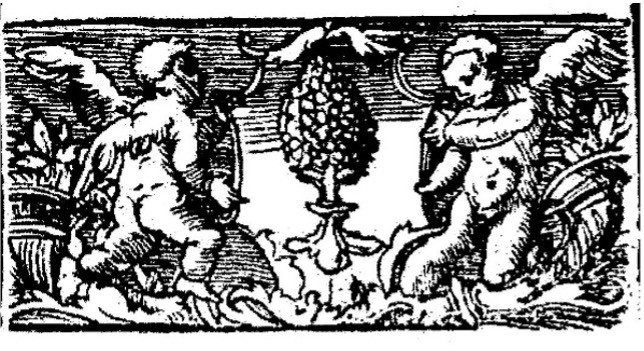
Cherubim (angels) are a frequent presence on the title-pages of early Hebrew imprints in the sixteenth century and afterward, the latter beyond the scope of this article. They are also to be found in incunabula, on the frames of initial pages and head-pieces for text.
How do you define what are cherubim? One definition, that of the Encyclopedia Judaica, is “a winged celestial being which appears in the Bible in several different guises.” It then proceeds to give several descriptions of cherubim. The Jewish Encyclopedia begins with a more detailed description, stating cherubim are “the name of a winged being mentioned frequently in the Bible. The prophet Ezekiel describes the cherubim as a tetrad [set of four] of living creatures, each having four faces—of a lion, an ox, an eagle, and a man—the stature and hands of a man, the feet of a calf, and four wings.”[2]
The use of cherubim is also noted in the 1911 Encyclopædia Britannica where they are described as “imaginary winged animal figures of a sacred character, referred to in the description of Solomon’s temple (1 Kings vi. 23-35, vii. 29, viii. 6, 7), and also in that of the ark of the tabernacle (Ex. xxv. 18-22, xxvi. 1, 31, xxxvii. 7-9). . . . In Gen. iii. 24 the cherubim are the guards of Paradise . . .”[3]
The frequency of the appearance of cherubim in Hebrew literature can be found on Sefaria, a bibliography of Jewish texts, which records fifty-six entries for cherubim under biblical, Mishnah 27, and Talmud 991. Among other entries are Midrash, 590; Halakhah 7947; Kabbalah 747; and yet still others as well as multiples of commentaries on the first works.[4]
These multi-winged creatures are also a feature in general literature. Franz Sales Meyer, under the heading Miscellaneous heads, describes the “Angel faces, youthful heads, with a circular or disc-like halo, are first met-with in the Byzantine style, as the result of ecclesiastic articles,” He continues that in the early Italian Renaissance such renderings were charmingly naïve. They appeared as adornments on friezes and arches, medallions, and in borders. They also are to be found on tombs and are “Much used in Modern ecclesiastical decorations.” The text is accompanied by a page of examples of the cherub head, including one of a skull.[5]
It had been my intention to describe Hebrew title-pages with images of cherubim over a period of two centuries.[6] The numerous instances of such usage, however, has necessitated a considerable limiting of our subject period. Indeed, rather than noting all the examples in our current period, in the sixteenth century, we only describe several exemplars, giving background about the books in which they appear, that is, the publisher, author, and book subject.[7] This article is expansive, that is, in describing cherubim, it discusses the varieties of Hebrew literature, the authors of the subject works, the presses that published them, and even Hebrew book history. The title-pages and infrequent text pages with displays of cherubim addressed here are in chronological order, but from diverse locations and, again, on a variety of books, indicative of how widespread Hebrew publishing was and even more so the depth and nature of Hebrew literature.[8]
1514-18, Hameshei Humshei Torah – Our first work with the appearance of cherubim is a folio (20) edition Hameshei Humshei Torah (Pentateuch) with haftorat and commentary of Rashi printed in 1514-18 in Prague at the press of Gershom ben Solomon ha-Kohen and partners. Gershom later received a royal privilege from King Ferdinand of Bohemia, allowing him, that is Gershom alone, to enjoy a monopoly on Hebrew printing in Prague. His descendants, known as the Gersonides, continued to print in Prague until the mid-seventeenth century.


1514, Hameshei Humshei Torah
Courtesy of the Library of the Jewish Theological Seminary
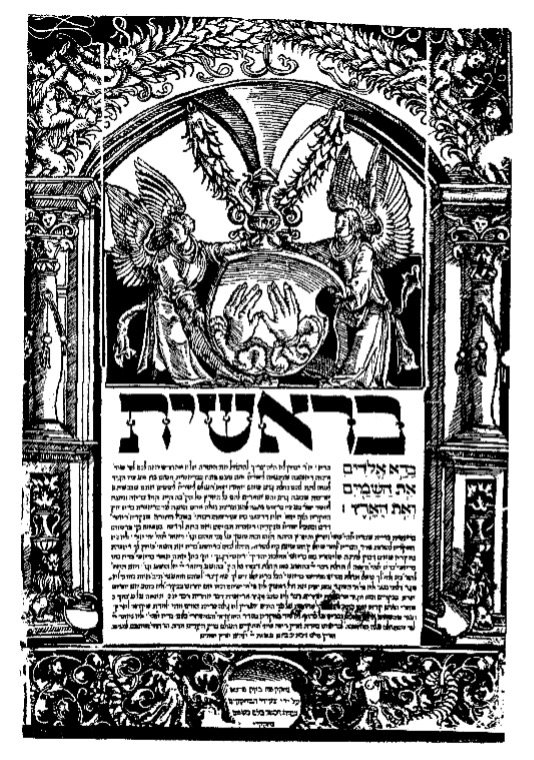
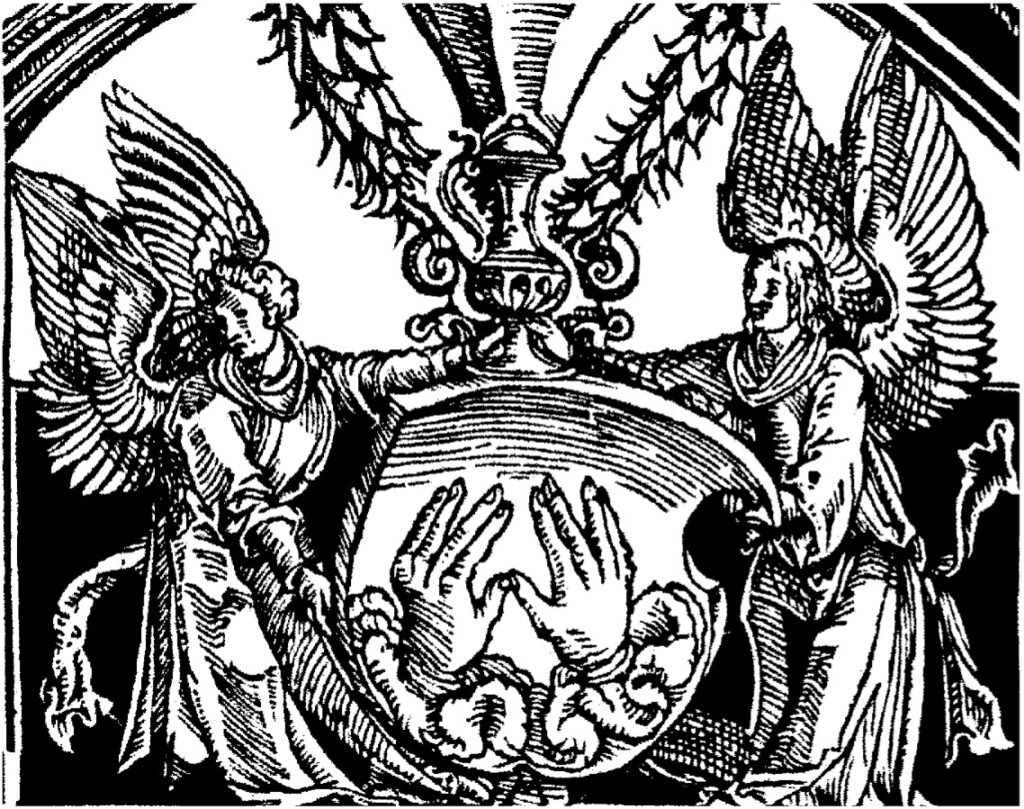
A magnificent edition, with ornate woodcut frames and large type for the text. Each book has a unique decorative opening page, there is no title page, comprised of four separate pieces, those on the pillared sides with vases, leaves, and cherubim, similar but not identical, the top piece with a concave bottom edge. Genesis has a convex curved piece to fit with this top piece on the upper half of the page, with winged cherubim holding a shield with the spread hands of the Kohen giving the priestly blessing.[9]
Work on the Pentateuch began on 10 Sivan (June 14, 1514) but, perhaps as a result of the success of the prayer book, the partners found they had overextended themselves and found it necessary to suspend work on this project for two years. In 1530 Gershom and his sons reprinted this Pentateuch in an identical format, except for changes to the decorated initial pages.
1527, Dictionarium Chaldai – Our next entry with cherubim is an Aramaic grammar by the Christian-Hebraist scholar Sebastian Muenster (1489-1552). It was printed in Basle in 1527 at the press of Johannes Froben in quarto format (40: [1], 434, [7] pp.). The Froben family was the most significant printers of Hebrew books in Basle. Johannes Froben published as many as 250 titles, among them Hebrew/Latin books of the Bible and grammatical works, primarily works by Muenster.
Sebastian Muenster, a cosmographer, astronomer, and orientalist was, for twenty three years, professor at Basle. Born in Niederingelheim, Hesse, the son of a Spitalmeister (hospital master), Muenster had no university education nor did he ever receive a degree. His education consisted of some private instruction in Latin and later studies at Frieberg and attendance at lectures given by the Franciscans. In 1506, Muenster entered the Minorite order and was sent to study in Rufach under Conrad Pellican (Pellicanus, 1478-1556). The following year he took vows and, in 1512, was ordained a priest. Muenster assisted Pellican in teaching in Pforzheim and, from 1524-29, occupied the chair of Hebrew at the University of Heidelberg. In 1529, Muenster converted to Protestantism and moved to Basle, where he occupied the chair of Hebrew, at a salary of 60 gulden; from 1547/8 he was rector. From about 1525, Muenster was a student of Elijah Levita, translating and editing his grammatical works. Muenster also translated a number of other Hebrew works into Latin and was a prolific author in his own right. By the time of his death more than 100,000 volumes of his works were in circulation. His Jewish oeuvre, more than three-score publications, covers all aspects of Judaica, excepting Kabbalistic studies, which did not interest him. In 1523, Muenster published Dictionarium Hebraicum . . . adiectis Chaldaicis vocabulis, his study of the Aramaic language. The book reads from left to right but the text follows the Hebrew alphabet. Words are given in vocalized Hebrew, followed by their etymology, definition and examples.
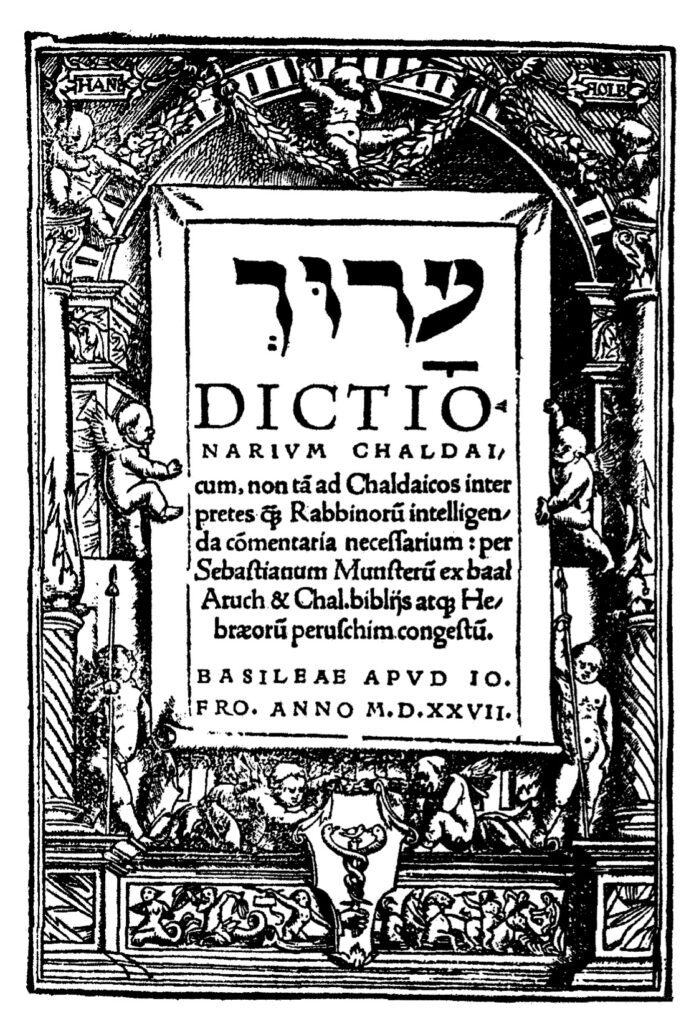
The title page of the Dictionarium Chaldai has an architectural frame with cherubim in various positions, as well as additional cherubim below mounted and otherwise. This title page, designed by Hans Holbein, was used as early as 1516 on Basel statutes and into the seventeenth century.[10] [11]
Not long afterwards, from 1540 through 1543, at least five titles were printed in three locations with varied images of cherubim on the title-page, that is Augsburg, Prague, and Bologna. That is not to say these frames were not used on other books, most likely they were, but rather these are examples of cherubim used by the printers of Hebrew books at the time.
Augsburg has an early history related to Hebrew printing. Several early anti-Jewish works beginning with the apostate Johannes Pfefferkorn’s Der Judenfeind (1509) and other anti-Semitic books by apostates were published there. Another early Augsburg publication of note, this certainly more positive, albeit not a Hebrew edition of that popular and much republished work, is the first printing of R. Joseph ben Abraham Gikatilla’s (1248–c. 1325) kabbalistic classic, Sha’arei Orah, which explains and analyzes the ten Sefirot. This edition of Sha’arei Orah is a Latin translation of that work by the apostate Paulus Ricius (Paulus Israelita, 1480-1541) under the title Portae lucis, published in 1516 at the press of Johann Miller.


1527, Dictiorionarim Chaldai
Courtesy of the Fales Library and Special Collections, New York University
Serious Hebrew printing in Augsburg begins when Hayyim ben David Shahor, among the pioneers of Hebrew printing outside of Italy, came to Augsburg in about 1533/34. In Augsburg, Schwarz worked in the print shop of Silvan Otmar (d. 1540), a renowned and highly productive printer, and resided in the home of Bonifacius Wolfhart, a Protestant pastor who also served as the censor of Hebrew books for Augsburg.[12] Shahor printed several works in conjunction with his son, Isaac, and his son-in-law, Joseph ben Yakar, who assisted him at the press, although their names are not mentioned on the title-pages.[13]
Shahor likely joined with a non-Jewish printer, perhaps August Wind, a printer of Hebrew works for Christian clergyman. Hayyim left for Italy, returning to Augsburg in 1540. He then printed three books, Avkat Rokhel, Arba’ah Turim and a prayer book for, according to the Thesaurus of the Hebrew Book, a total of ten works in Augsburg. Due to a lawsuit by an apostate, Paulus Aemilus, with whom Shahor had been associated in Ferrara, resulting from their failed venture, Shahor and his family were forced to cease publication and leave Augsburg. Aemilus, seeing a market in Augsburg for Hebrew/Yiddish books, began to print on his own account. He issued a small number of titles, most notably the Melokhim Bukh (1543) and the Shmuel Bukh (1544), Yiddish poetical renditions of the books of Kings and Samuel, both with images of cherubim (below).[14]
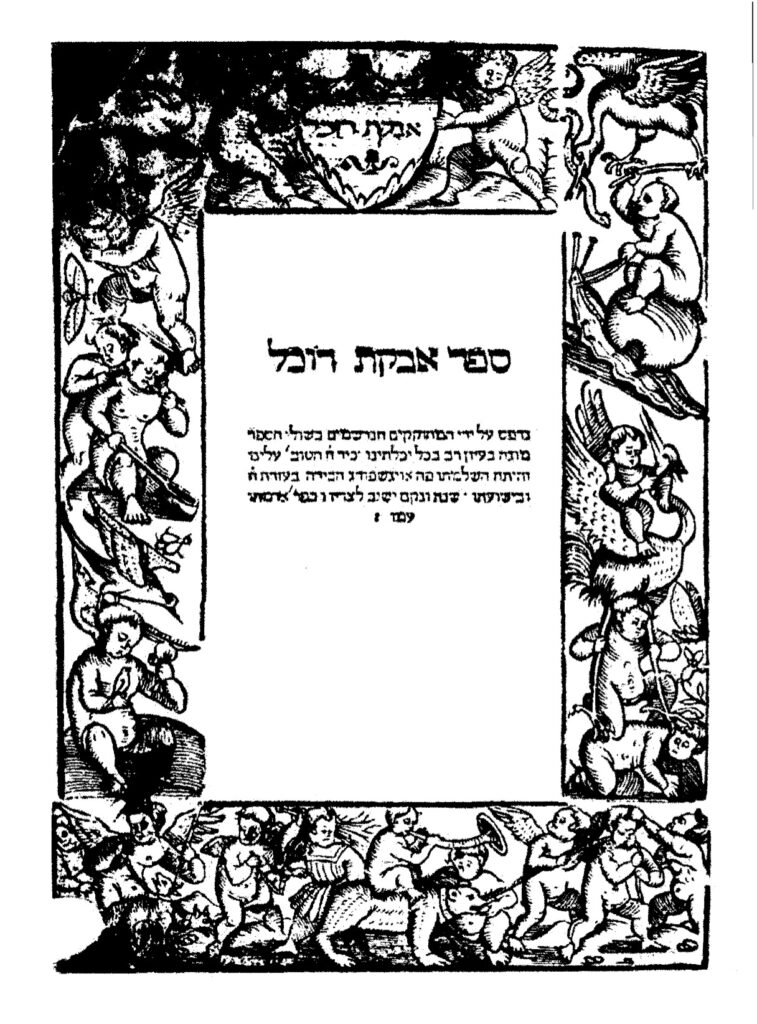
1540, Avkat Rokhel – Our first Augsburg title is Avkat Rokhel, an eschatological work on the principles of faith attributed to R. Machir ben Isaac Sar Hasid, a student of R. Judah ben Asher, son of the Rosh. Printed in octavo format (80: 18 ff.), perchance by Shahor. The Thesaurus of the Hebrew Book attributes it, albeit in brackets, to Hayyim Shahor, in contrast to the National Library of Israel that records the printer as unknown.[15]
The text of the title page is set within a decorative frame with nineteen cherubim and a number of animals. The title-page states that it is,
Sefer Avkat Rokhel
Printed by the printers named at the end of the volume. Edited with great care, with all our ability, “the good hand of our [Lord] upon us,” (ref. Ezra 8:18). And it was completed, here Augsburg, the great city, with the help of the Lord and His salvation. In the year, “[Rejoice, O you nations, with his people; for he will avenge the blood of his servants,] and will render vengeance to his adversaries, and will make expiation כפר (300=1540) for the land of his people” (Deuteronomy 32:43).
The names of the printers, Hayyim Shahor, Isaac ben Hayyim, and Joseph ben Yakar, the statement on the title page notwithstanding, are not given at the end of the volume. A brief introduction informs that the work was named Avkat Rokhel (the perfumer’s powders, Song of Songs (3:7)) for as the perfumer’s powders strengthen the soul, so too when one reads this book will he fear and cause his soul to be pure and free from all sin and transgression, thus meriting the good.
1540, Avkat Rokhel
Courtesy of the Dorot Jewish Division New York Public Library
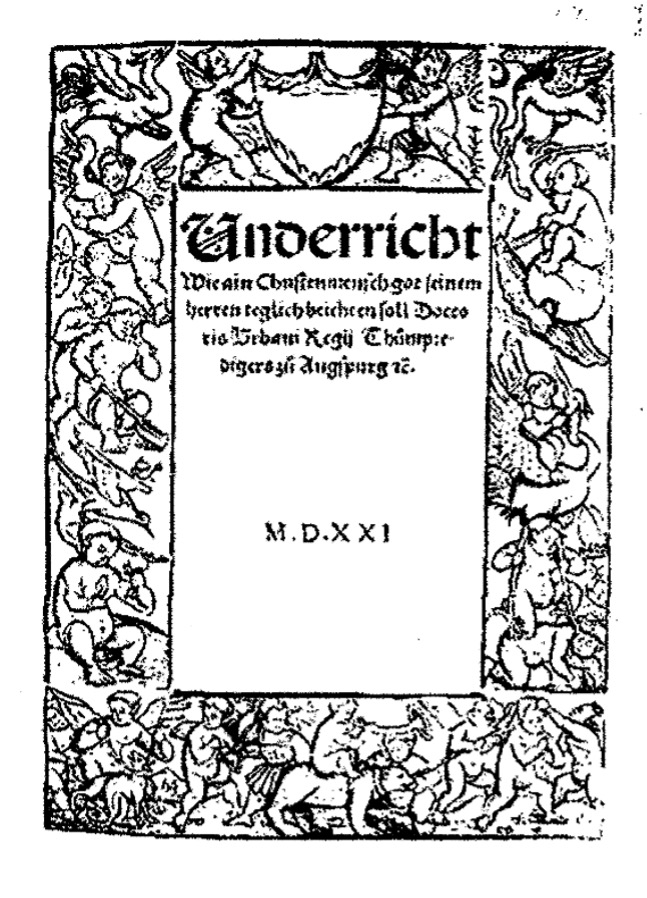
The like title-pages of Avkat Rokhel and Unterricht Wie ain Christenmensch, the latter a non-Hebrew work printed approximately two decades earlier, reflect a relationship between Jewish and Christian printers, that is, Christian printers published Hebrew books in association with Jewish associates. The relationship between the printers was mutually beneficial. For the Christian publisher “the Hebrew books sector, being unique, was attractive to investors, being more limited and not so wildly competitive as the Italian book sector.”[16] In addition to the non-Jewish printer’s access to the Jewish book market, the Jewish publisher was able to not only publish Hebrew books, but he also gained access to the typographical material of his Christian associate. The latter, for example, frequently provided attractive frames to the former after having used them for his market and the Jewish partner also utilized the printer’s other ornamentation. This was of value to the Jewish partner as he did not have to go the expense of having decorative material prepared, at a relatively much greater expense as it would be utilized for a much smaller market. This despite the fact that the frames were often incompatible with traditional Jewish sensibilities.[17]
1521, Unterricht Wie ain Christenmensch [18]
The like title-pages of Avkat Rokhel and Unterricht Wie ain Christenmensch, the latter a non-Hebrew work printed approximately two decades earlier, reflect a relationship between Jewish and Christian printers, that is, Christian printers published Hebrew books in association with Jewish associates. The relationship between the printers was mutually beneficial. For the Christian publisher “the Hebrew books sector, being unique, was attractive to investors, being more limited and not so wildly competitive as the Italian book sector.”[19] In addition to the non-Jewish printer’s access to the Jewish book market, the Jewish publisher was able to not only publish Hebrew books, but he also gained access to the typographical material of his Christian associate. The latter, for example, frequently provided attractive frames to the former after having used them for his market and the Jewish partner also utilized the printer’s other ornamentation. This was of value to the Jewish partner as he did not have to go the expense of having decorative material prepared, at a relatively much greater expense as it would be utilized for a much smaller market. This despite the fact that the frames were often incompatible with traditional Jewish sensibilities.[20]
The title-page of Avkat Rokhel has the largest number of cherubim of our title-pages, nineteen in all, of our title-pages. The cherubim appear on the bottom, sides, and top of the frame, all active, albeit in different activities. The text of Avkat Rokhel is in three parts, each further subdivided. The first section addresses the struggle against one’s evil urge prior to redemption and the birth pangs and advent of the Messiah, and an explanation of the pertinent midrashim; the second part discusses the rewards and punishments of the soul after the resurrection, the nature of the world to come according to Judaism, in contrast to the views of non-Jews, and resurrection; and the third part the laws stated by the sages of the Talmud as halakhah Moshe me-Sinai, the formation of man and the number 248 limbs in a person, the statement of our sages concerning three partners in that process (God, man, and woman) and some gematriot.
This is the third edition of Avkat Rokhel, it having been printed previously in Constantinople (1516) and Rimini (1526). Ch. B. Friedberg records, in his Bet Eked Sepharim, more than twenty-five printed editions of Avkat Rokhel. It was translated into Latin by A. Hulsius and printed in his Theologia Judaica, (Breda, 1653) and a Yiddish edition was prepared by Naphtali Pappenheim (Amsterdam, 1647).[21]
1543, Melokhim Buch – Two additional works printed in Augsburg, attributed to Moses (Esrim ve-Arbeh) Ashkenazi, are Yiddish poetical renditions of the books of Kings and Samuel. Moses’ appellation, Esrim ve-Arbeh (24), derives from either his birthplace, Vierundzwanzig Hoefe (24 courts) in Wuerttemberg, or from his extensive knowledge of the 24 books of the Bible. Moses’ accreditation with either authoring or transcribing the Melokhim Bukh is due to its similarity to the Shmuel Bukh, more reliably attributed to him. Nevertheless, sufficient differences exist between the two works that many scholars believe they do not share a common author. It is clear, however, that the author, even if not this Moses, was an Ashkenazi Jew. The Melokhim Bukh was published in quarto format (40: [123] ff.) by, according to the colophon, Paulus Aemilus. A Latin colophon states, Augustae Vindelicorum/ per Paulum Aemilium, Anno/ Domini M. D. XLIII. Meyer Waxman suggests that it is doubtful, the colophon notwithstanding, that the publisher was Aemilus; more likely it was Hayyim Shahor.
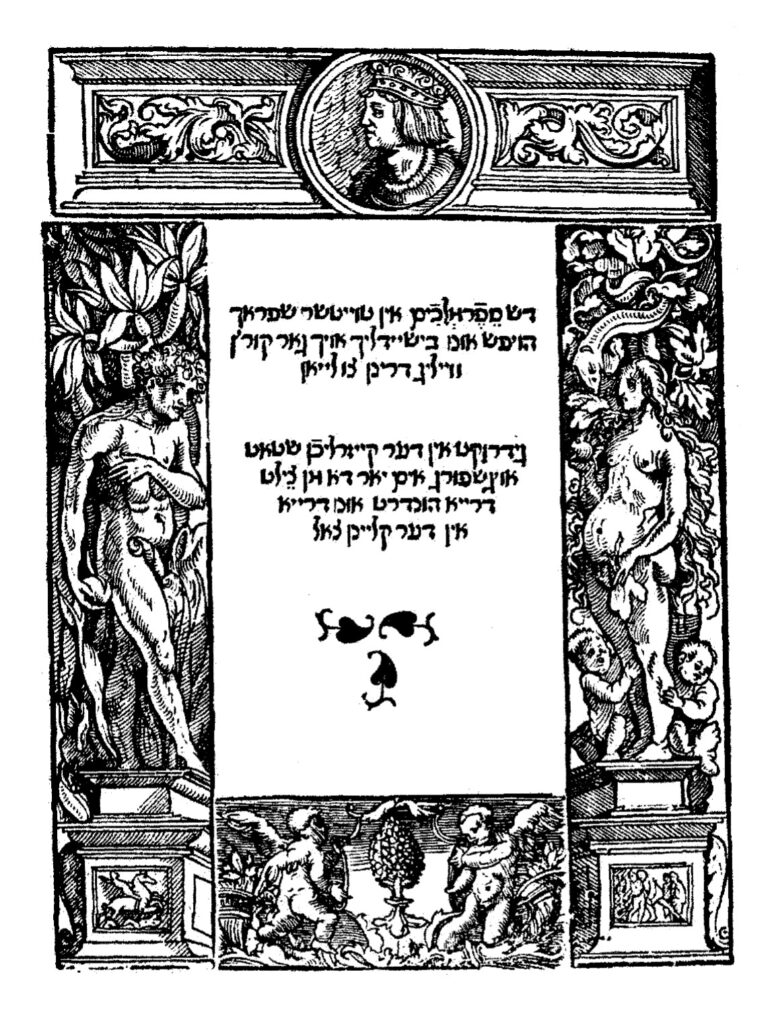
We have noted above that the frames on these title-pages were first used by Christian printers and that when that market no longer needed the frames, they were made available to Jewish printers. The cherubim frames noted above were generally acceptable to a contemporary renaissance Jewish public, although some, many, were questionable and would not be used today. In contrast, the title-page of the Melokhim Buch has a border made up of a four-part frame, the top with a representation of a king, the left and right sides respectively with images of Adam and Eve, unclad, the latter with the snake, two small children, and expecting. At the bottom are two cherubim. Use of this frame is surprising, for in contrast to other frames its’ contents appear to be objectionable, more so than other frames, even those with mythological characters. It seems likely that this frame might also be distasteful to Christian sensibilities.[22]
1543, Melokhim Buch
Courtesy of Dr. Moshe Rosenfeld
The title page states that it is “The book Melokhim (Kings) in Taytsher sprach, beautiful and clear and very entertaining to read. Printed in the imperial city of Augsburg in the year 303 (=1543)” [23] The colophon dates the completion of the work to Friday, 14 Av, 303 (July 25, 1543), which was a Sunday in 1543.
The Melokhim Bukh was not written as a sequel to the Shmuel Bukh. It is the older of the two books, originally written as a separate work, possibly as early as the fourteenth century. The format of the Melokhim Bukh, a rhymed paraphrase of the book of Kings, is that of the heroic epic, stylistically modeled after comparable German sagas, such as the Nibelungen. The subject matter is the events in Kings I and II, imaginatively and colorfully enhanced by material from the Talmud and Midrashim, all expressed with a deep piety. Intended as a complete history, it begins with a hymn of praise to God in three strophes followed by nine strophes from the Exodus to the last days of David, the contents of Kings, and as a sequel, the history of the Jews to the end of the second commonwealth in thirty strophes). An example of the text is,
You have frequently performed signs for the children of Israel;
Therefore they are obliged to have You for their Lord.
And to fear Your name-that is useful and good for them.
That man is foolish who acts contrary to Your word.[24]
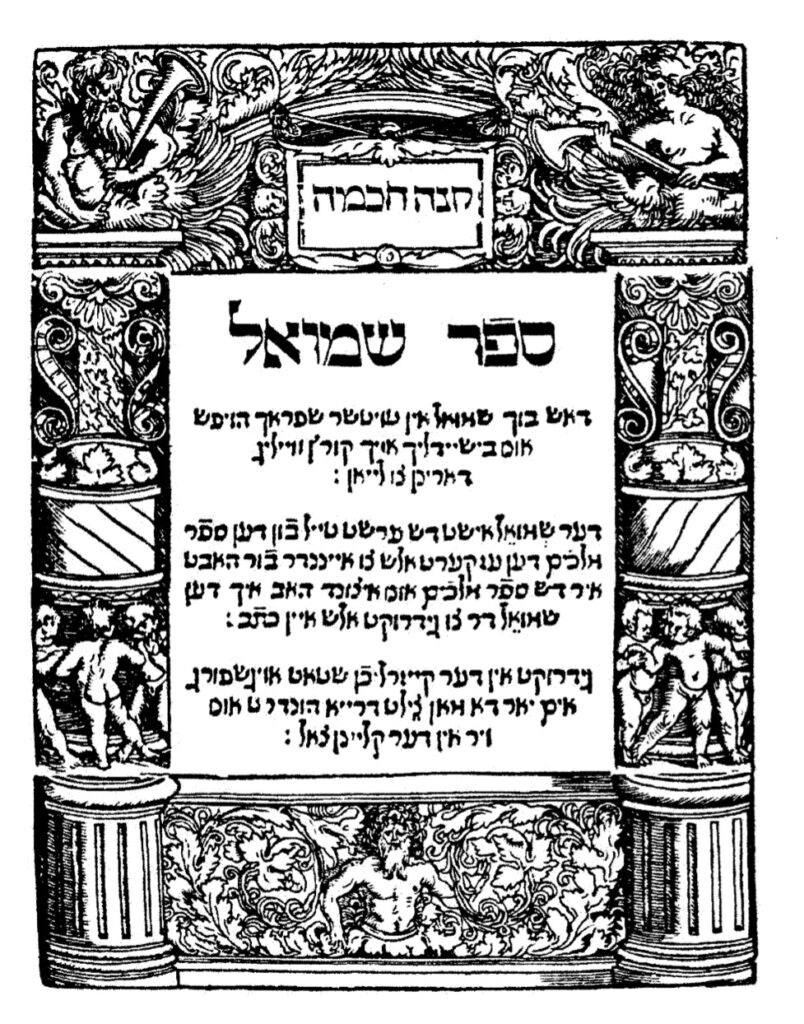
1544, Shmuel Bukh – The Shmuel Bukh was published, also likely by Hayyim Shahor in quarto format (Format 40: [102] ff.). It has an ornate title page made up of figurines above and about pillars with cherubim on the sides. It too is in Vaybertaytsh; among its reprints is a Latin edition (Ingolstadt,(1562). Waxman suggests that the Shmuel Bukh was likely written at least a hundred years earlier, most likely an original production of medieval Jewry. The author reworked the biblical material and incorporated aggadic elements. It was written in “vigorous poetic style” in eight line strophe and was meant to be sung.[25]
1544, Shmuel Bukh
Courtesy of Dr. Moshe Rosenfeld
In contrast to what was written above, “works that many scholars believe they do not share a common author,” Zinberg informs that both the Melokhim Bukh and the Shmuel Bukh are composed in the same verse-meter. Moreover, the title-page states that “Shmuel is the first part of
the book Melokhim, for it is all related.” Nevertheless, Zinberg quotes other sources that “these are two quite different works and were probably written by two different poets.”[26]
1553, Ma’yan Gannim – A composition book comprised of sample letters from R. Samuel ben Elhanan Jacob Archivolti (c. 1515-1611). Ma’yan Gannim was published in a small sextodecimo format (160: 45, [1] ff.) at the Venice press of Alvise Bragadin. The Bragadin press was active before the papal bull, dated August 22, 1553, by Cardinal Giovanni Pietro Caraffa, the future Pope Paul IV, an extreme reactionary and bitter anti‑Semite, who ordered the confiscation and burning of the Babylonian and Jerusalem Talmuds. This had a chilling effect on Hebrew printing and resulted in a considerable decline if not outright cessation of printing in Venice, and the subsequent expurgation and censorship of Hebrew books. When Hebrew printing resumed in Venice in 1563, among the Christian printers who took up the publication of Hebrew books was Alvise Bragadin. Bragadin died in the mid-1570’s, he was succeeded by his son, and after him by successive members of the family well into the eighteenth century, the last known Bragadin being Alvise III. Throughout that time the press remained a leading printer of Hebrew books in Venice.
1553, Ma’yan Gannim
Courtesy of the Library of Agudas Chassidei Chabad Ohel Yosef Yitzhak
Archivolti, a student of R. Meir Katzenellenbogen (Maharam, 1473-1565), served as rabbi, av bet din, and rosh yeshivah in Padua. Among his students was R. Judah Aryeh (Leon) Modena (1571-1648). Prior to settling in Padua in 1568, Archivolti worked as a corrector for the Hebrew presses in Venice.
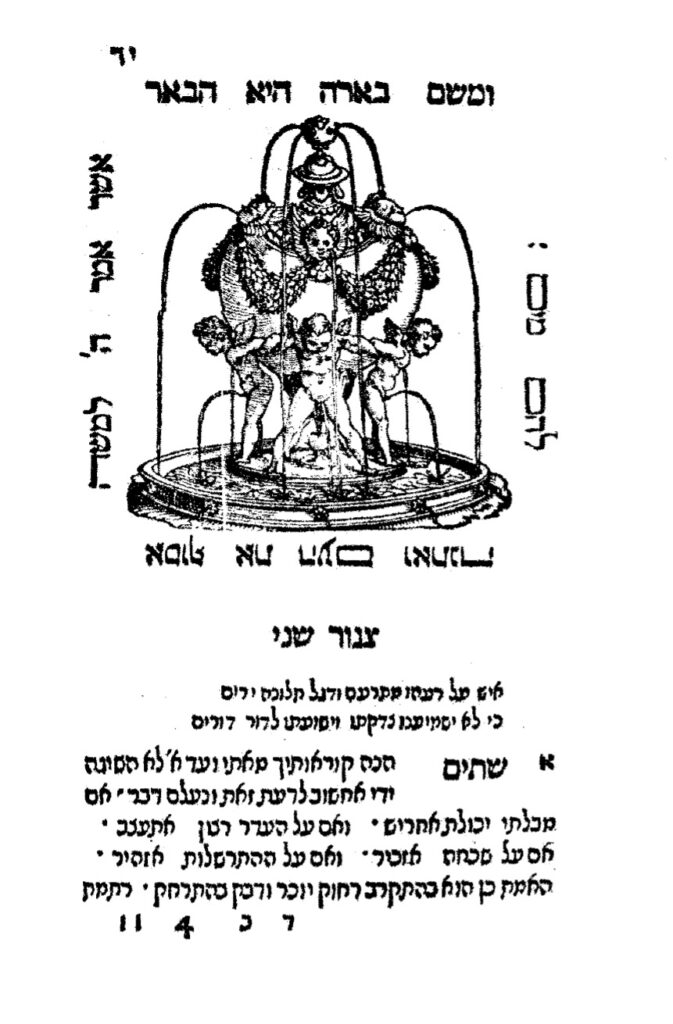
In contrast to our preceeding examples of cherubim, this exemplar does not appear on the title-page of the book, which has the Bragadin device, that is, three crowns, but rather at the beginning of each of the book’s five chapters, a woodcut illustration comprised of three cherubim in a cage, surrounded on all four sides by a verse.
The title is from “A fountain of gardens (ma’yan gannim), [a well of living waters, and streams from Lebanon” (Song of Songs 4:15). The text states that there are fifty letters, that is, twenty-five letters with their responses, written by Archivolti. There is a preface and introduction from Archivolti, followed by a table of contents, and, beginning on 7a, the text. Ma’yan Gannim is the first book written by Archivolti, for he describes it as his first fruits, an offering to the Lord. Archivolti also wrote Degel Ahavah (Venice, 1551), an ethical work; He’arot le-Sefer he-Arukh (Venice, 1553), textual references for the Arukh of Nathan ben Jehiel; and, his most important title, Arugat ha-Bosem (Venice, 1602) a grammatical work in 32 chapters.
The sections or chapters, each on a different theme, are correspondence between a father and son; between friends; from an older to a younger man; with government officials; and others, including letters of a romantic, and even sensual nature. Such letters, at the very least inappropriate by modern religious standards, are intermingled with those of a sacred nature, reflecting contemporary mores and addressing current issues, including therefore, information of historical and cultural value. Ma’yan Gannim is designed to teach through example the rules of correspondence. The letters are in metrical form, designed by Archivolti as literary models, many with ethical content, for his students.[27]
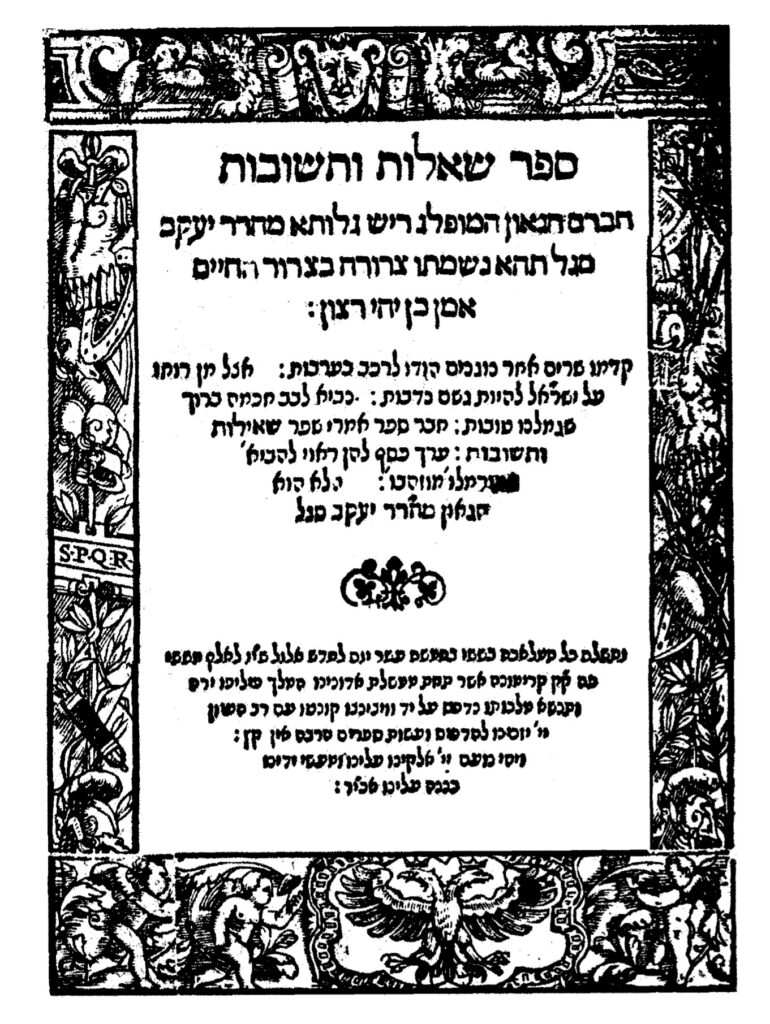
1556, She’ilot u’Teshuvot Jacob ben Moses Moellin (Maharil) – Two hundred and five responsa from R. Jacob ben Moses Moellin (Maharil, c. 1360-1447). The She’ilot u’Teshuvot were published in Cremona at the press of Vincenzo Conti in octavo format (80: [7] 79 ff.). After the Talmud was burned in Venice in 1554 there was a precipitous decline, if not a complete cessation, in the number of Hebrew books printed in Venice for several years. The breach was filled by presses in Ferrara, Sabbioneta, Cremona, and Riva di Trento. Vincenzo Conti (d. 1569) printed briefly in Sabbioneta and subsequently in Cremona, where his press was active from 1556 to 1567, issuing more than forty titles.
Maharil was the leading halakhic authority of his time. His most important work is Sefer Maharil (Minhagei Maharil, 1556, Sabbioneta), a popular and influential work on customs and laws. It was composed by his pupil Eleazar ben Jacob (Zalman of St. Goar), from the discourses that he heard from Maharil. She’ilot u’Teshuvot is comprised of Two hundred and five responsa, a small part only of Maharil’s responsa. The subject matter, as in the Sefer Mahril, deals to a great extent with custom, but also includes much personal material. They also reflect Maharil’s considerable humility and compassion.


1556, She’ilot u’Teshuvot Jacob ben Moses Moellin (Maharil)
Courtesy of the Library of Agudas Chassidei Chabad Ohel Yosef Yitzhak
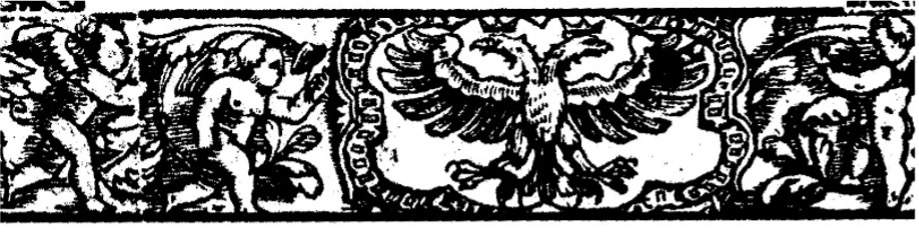
The title-page has an ornamental frame made up of four parts, enabling the printer to use them in other arrangements, although this is the manner in which the parts are most often employed. The top frame has the face of a man and cherubin; on the sides are suits of armor, shrubs, and musical instruments and, in the center of the left vertical frame the letters SPQR, reputedly standing for Senatus Populusque Romanus; and on the bottom a two headed crowned eagle and on the sides the cherubim. This frame was used by Conti on his early imprints, appearing on about ten works.
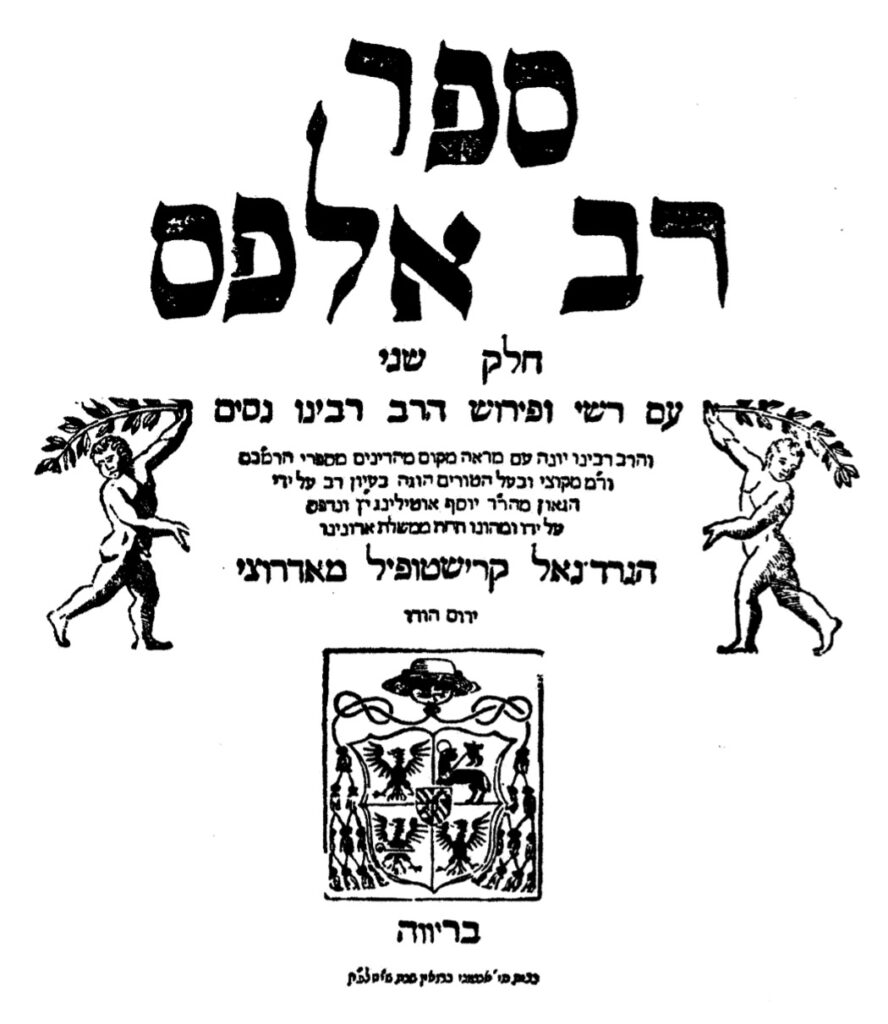
1558, Sefer Rav Alfas – Sefer Rav Alfas, (Hilkhot Rav Alfas, Sefer ha-Halakhot of Alfasi, Rif) was published in Riva di Trento by R. Joseph Ottolenghi and Cardinal Cristoforo Madruzzo in a three volume folio format (20: 288, 268, 302 [8] ff.). The Tyrolese town of Riva di Trento is the source of an unusual episode in the history of the Hebrew book. It was for a short time, from 1558 to 1562, a refuge for the Hebrew book; one in which about forty Hebrew titles were printed. Believed to be the first work printed in Riva di Trento, Hilkhot Rav Alfas was likely selected, in addition to its inherent popularity and value, due to the ban on the Talmud, the Rif, being a halakhic compendium of the Talmud, filling, to some extent, the gap left by the scarcity of that work.
It was in Riva di Trento that Cardinal Cristoforo Madruzzo (1512-78), Cardinal of Trent, a scholar and supporter of learning, who argued at the Council of Trent (1562) for leniency and moderation in condemning books, became the patron and protector of a Hebrew press, which was also a source of revenue for him. Ottolenghi (d. 1570), originally of Ettlingen, in Baden, Germany, reflected in its Italianized form in his name, was rosh yeshivah at Cremona, and under his tutelage Talmudic studies had continued in Cremona after that work had been banned and burned elsewhere. He assisted the press, providing indices and annotations to a number of works and assuring that material offensive to the church had been deleted from those books of value to his yeshiva. and R. Jacob Marcaria, a dayyan on the bet din presided over by Ottolenghi and a physician, recruited by Madruzzo help finance and play a role in the press. Marcaria edited and wrote brief prefaces for most of the books printed in Riva di Trento. The press was located in the house of Antonio Broën.
Sefer Rav Alfas is a halakhic compendium by R. Isaac ben Jacob Alfasi (Rif, 1013-1103). Alfasi, born in the Algerian village of Qal’at Hammad, was a student of the great sages R. Nissim ben Jacob (c, 990-1062) and Hananel ben Hushi’el (d. c. 1055) in Kairouan. After learning with them Alfasi relocated to Fez, from where his surname al-Fasi (Rif) is derived, and became recognized as the leading Talmudic sage of the time. In 1088, at the age of 75, two informers denounced him to the government – the charges are unknown – and he was forced to flee to Spain. Eventually settling in Lucena, Alfasi succeeded R. Isaac ben Judah ibn Ghayyat (c. 1020-89), who had died a few months earlier, as head of the yeshiva.

1558, Sefer Rav Alfas
Courtesy of the National Library of Israel
The text of the title-page of each volume has cherubim at the sides, and below bears the Cardinal’s coat‑of‑arms , a significant statement of the Cardinals’ support and protection of the press at a time when his church was burning and banning Hebrew books. Furthermore, the title pages informs that Sefer Rav Alfas was edited with great care by the gaon R. Joseph Ottolenghi and was printed and financed by him, and that this was done, “in the dominion of” the following in bold letters “Cardinal Cristoforo Madruzzo.”
Sefer Rav Alfas, Alfasi’s major work, is one of the greatest works in halakhic literature. It is extracts all pertinent legal decisions from the Talmud, eliminating non-halakhic material, discussions, and subject matter not applicable today. It covers the following orders of the Talmud, Mo’ed, Nashim, and Nezikim, as well as tractates Berakhot and Hullin. Laws in Kodashim and Tohorot, such as mezuzah and tefillin, are organized as Halakhot Ketannot. Sefer Rav Alfas differs from earlier works, such as Halakhot Gedolot, in that it is more comprehensive, more detailed, and by the inclusion of material from the geonim, although, like them, it follows the order of the tractates.
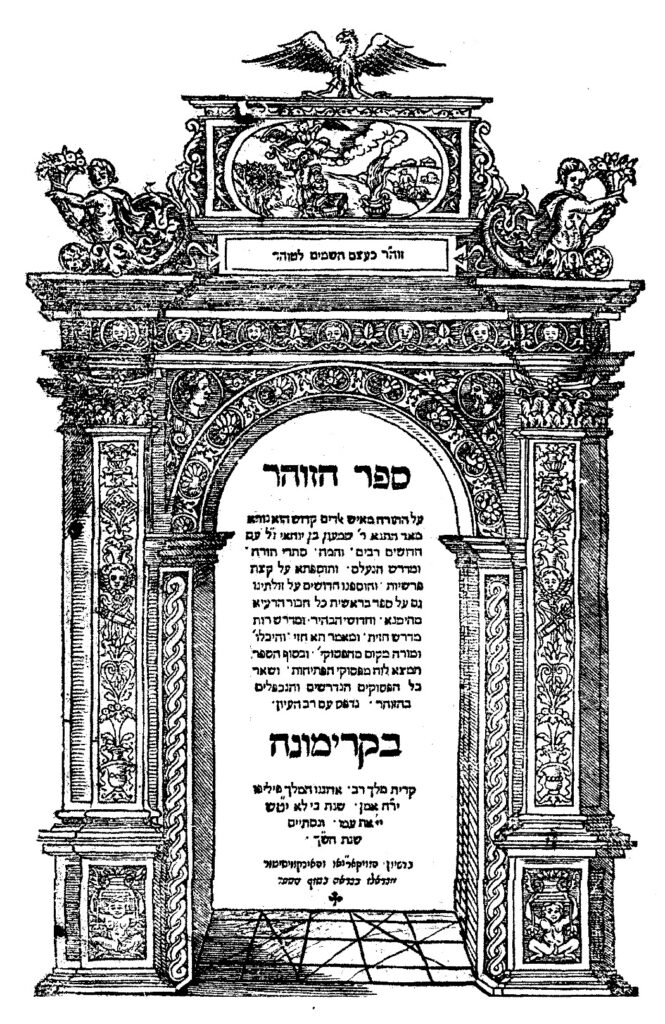
1559-60, Zohar – Classic kabbalistic work of Jewish mysticism, attributed to R. Simeon bar Yohai (second century). This, the second printing of the Zohar, it was published previously in Mantua (1558-60), published in Cremona at the press of Vincenzo Conti in a three volume folio format (20: 132, 122, 146 ff.) by Vincenzo Conti (d. 1569). Conti, who had printed briefly in Sabbioneta, is better known for his activity in Cremona, where his press, active from 1556 to 1567, issued more than forty titles.
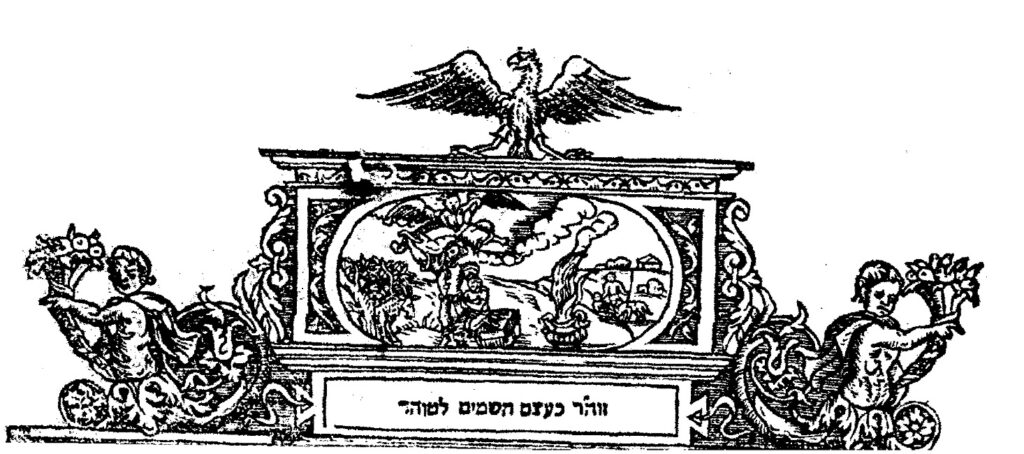
The title page of has a decorative architectural frame with an arch, at the top a vignette of Akedat Yizhak (the binding of Isaac), surmounted by an eagle, and accompanying cherubim; below in the bottom squares, figurines, perchance also cherubim. It is dated, “For the Lord will not forsake כי לא יטש (319=1559) his people [for his great name’s sake] (Samuel I 12:22), and it was completed in the year ש”ך ([5]320=1560).” At the bottom of the page is an imprimature from the Inquisition on the title page, the sole Cremona imprint to place it there, as well as a longer permission at the end of the book.


1559-60, Zohar
Courtesy of the Library of the Jewish theological Seminary
Written in Aramaic and Hebrew, Sefer ha-Zohar al ha-Torah is a comprehensive system of kabbalistic theosophy, encompassing cosmology, the soul, and good and evil. It is an esoteric commentary on the Torah, with homilies, midrashic passages, parables, and numerous discursive passages. It is based on the concept that within scriptures is a concealed stratum, deciphered by Kabbalah, expressing the inner meaning of the Torah, with its “splendor, beauty, and greatness.”
The corrector (and expurgator) was the apostate Vittorio Eliano, grandson of the foremost grammarian, Elijah Bahur Ashkenazi Segal. A member of a Dominican commission to review Hebrew books, Eliano was associated with all the books published by Conti from 1558 through 1559. Although begun later than the Mantua edition, noted above, this printing, done in haste, was completed earlier. Nevertheless, it was not immediately released for sale, for when more than 10,000 Hebrew books were burned in Cremona, with the complicity of Eliano, the entire edition was seized. It was just barely saved, in contrast to other works, by the apostate Dominican, Sixtus of Siena. It is known as the Zohar Gadol (large Zohar), in contrast to the smaller Mantua edition (Zohar Katan), and is also referred to, because of Eliano’s involvement, as the “Christian edition.” This notwithstanding, the Cremona edition was the preferred of the two editions by eastern European kabbalists.[28]
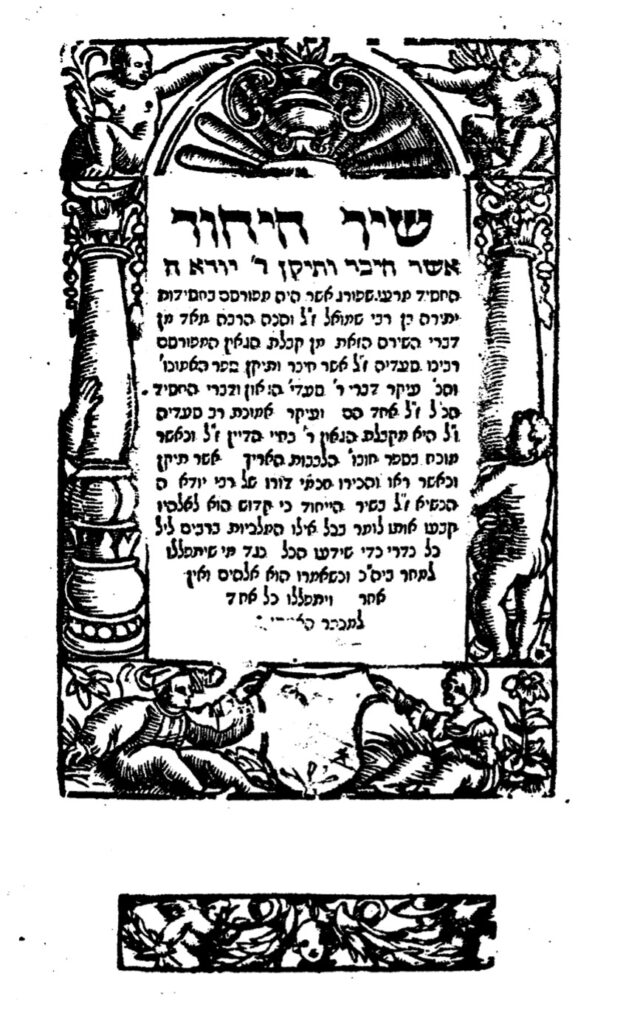
1560, Shir ha-Yihud – Shir ha-Yihud (Hymn of Divine Unity) an anonymous piyyut (liturgical poem) written in the mid-twelfth century, most often attributed to Samuel ben Kalonymus he-Hasid (c. 1130-1175), less often to his son, Judah ben Samuel he-Hasid (c. 1150-1217), author of the Sefer Hasidim, both among the foremost representatives of the Hasidei Ashkenaz, and, on occasion, to yet others.

Shir ha-Yihud
Courtesy of the National Library of Israel
Shir ha-Yihud was published at the press of Eliezer and Joseph ben Naphtali Hertz Treves. Active for one year only, in 1560, they issued six books, before being forced to close by a meeting of the leaders, both Protestant and Catholic, of the Swiss Confederation in June, 1560, who feared that they were about to print the Talmud.
The frame, one of several with cherubim employed by the press, also was used on the title-page of Begidat Hazman, an allegoric maqāma (a poetic narrative in rhymed prose) by Mattathias (Mattityah ben Moses), a 15th century Spanish or Provençal Hebrew poet or Mattathias ha-Yiẓhari, a representative of the Jewish communities of Aragon at the Tortosa disputation (1413–14).
1568, Passover Haggadah – Passover Haggadah printed in Mantua in folio format (20: 36 ff.) by Joseph Shalit ben Jacob Ashkenazi of Padua. This edition is a reprint of the 1560 Passover Haggadah, also printed in Mantua, but with modifications and the addition of the marginalia of R. Joseph Shalit ben Jacob Ashkenazi of Padua entitled Nimukei Yosef.

1568, Passover Haggadah
Courtesy of the National Library of Israel
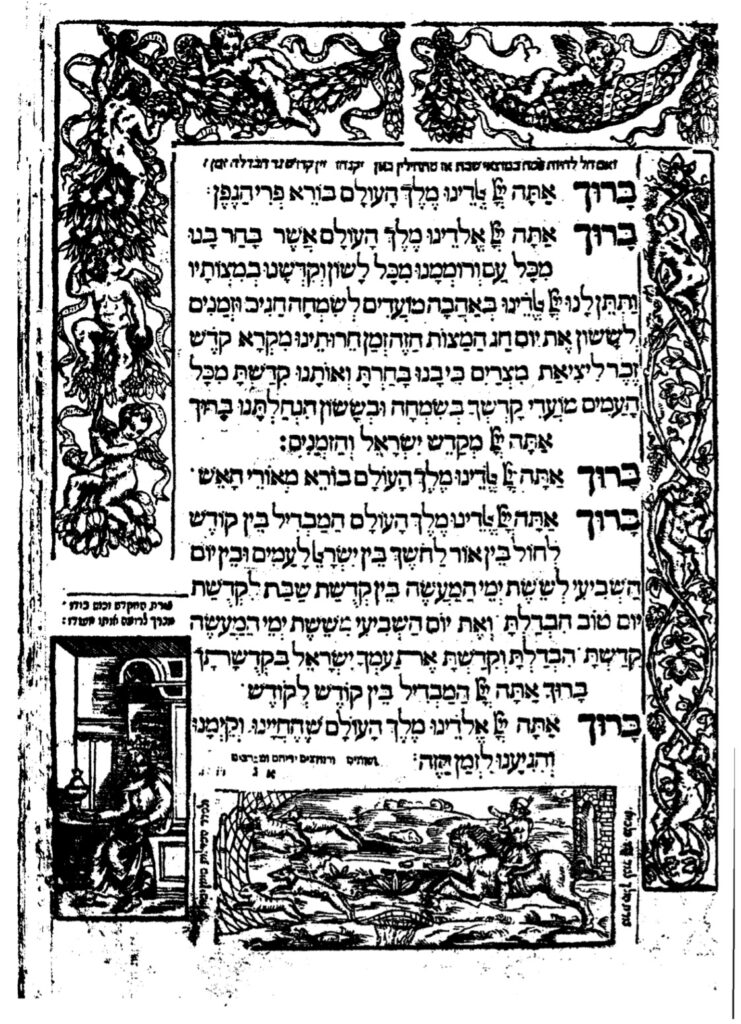
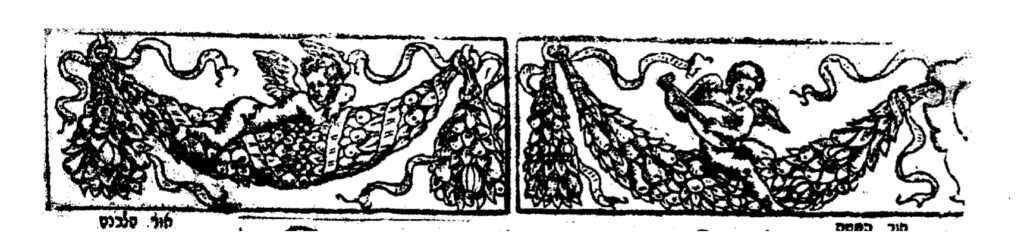
The title page frame has representations of the Mars and Minerva followed by the first text page, which has two woodcuts of cherubim along the top. Following text pages have those cherubim image, as well as numerous other cherubim images, including several marginal cherubim images. This Haggadah shares some features with the Prague Haggadah of 1526. Woodcuts are accompanied by captions, given as rhymed couplets, a feature of Ashkenaz manuscript Haggadot. In some instances, for example, by the four questions, the earlier edition was framed by a lush Italian border, without illustrations. Here the types and the top and upper left borders with their vines and cherubs only are alike.[29]
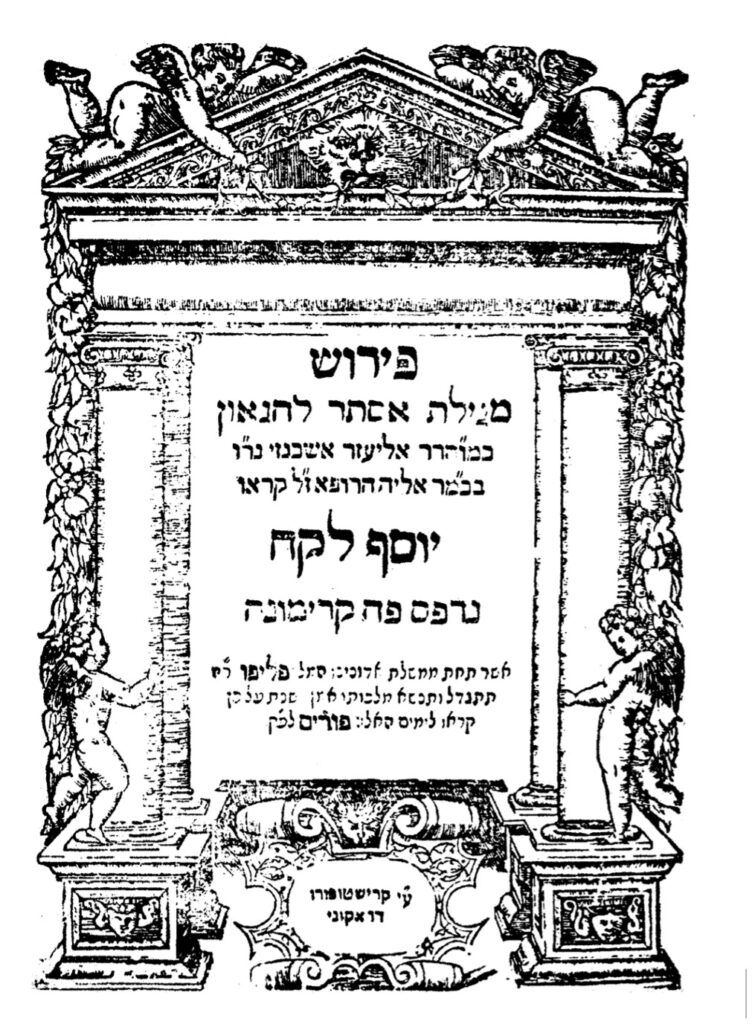
1576, Yosef Lekah – Yosef Lekah is a commentary on Megillat Esther by R. Eliezer ben Elijah Ashkenazi (1513-86). It was published in Cremona in 1576 by Christopher Draconi in octavo format (40: 83, 1 ff.). Draconi, previously associated with Vincenzo Conti, attempted to publish Hebrew books in Cremona. Although he would issue Latin books from 1569 to 1614, he printed one Hebrew book only, Yosef Lekah.
1576, Yosef Lekah
Courtesy of the Fales Library and Special Collections, New York University
R. Eliezer ben Elijah Ashkenazi was a multi-faceted individual, a Talmudist, physician, and well-rounded scholar, who served as rabbi in a number of varied communities. His first rabbinic position, from 1538-61, was in Fostat, Egypt. Forced to leave Fostat, Ashkenazi went to Famagusta, Cyprus, where he was rabbi for two years, and then to Venice. He left for Prague (1561), after a dispute with the Maharam of Padua, and after traveling as far as the Crimea, returned, via Famagusta, to Venice. Ashkenazi was next rabbi in Cremona, where he published Yosef Lekah. Shortly after he left to be rabbi of Posen, and, from 1584, was in Cracow. Ashkenazi experienced difficulties in Poland, disputing over his right to open a yeshiva in close proximity to an existing yeshiva, so that Joseph Solomon Delmedigo (1591-1655) wrote about him, “You have brought a vine from Egypt; you have cast out the nations, and planted it” (Psalms 80:9). Ashkenazi was highly regarded by his contemporaries, corresponding with prominent rabbinic figures such as R. Joseph Caro, R. Joseph Ha-Kohen (Katz), R. Moses Isserles (Rema), and R. Solomon Luria (Maharshal), several mentioning him in their responsa. R. Elijah of Pesaro, in Famagusta in 1563, praised Ashkenazi’s scholarship, noting that he was fluent in twelve languages.
The title-page has four cherubim images, two reclining at the top of the structure, two standing erect by the pillars at the sides. The title-page is dated “Therefore they called these days Purim קראו לימים האלו פורים (336 = 1576)” (Esther 9:26). Yosef Lekah is dedicated to Don Joseph Nasi, Duke of Naxos, whom Ashkenazi, in the introduction, compares to Joseph in Mizraim and Mordecai at the time of Ahasuerus. Ashkenazi, therefore, entitled this work Yosef Lekah. Two, almost identical, editions of Yosef Lekah exist, both dated 1576. Although almost exact copies of the original, it is clear, upon close examination, that the book was reset. Christopher Draconi’s Yosef Lekah was the last Hebrew book printed in Cremona.
Ashkenazi’s most important work is Ma’aseh HaShem (Venice, 1583), on the historical occurrences in the Torah, with a commentary on the Passover Haggadah; selichot; and, not extant today, a super-commentary on the Ramban (Nachmanides) and annotations to R. Caro’s Beit Yosef.[30]
Conclusion – In this article we have described books printed in Augsburg, Basle, Cremona, Mantua, Prague, and Venice. The cherubim imagery on these title-pages, reflecting the influence of Renaissance humanism, their attractiveness notwithstanding, do not appear on the title-pages or accompanying the text in Hebrew books published in more modern times. A review of the title-pages reproduced here, all dissimilar, with their numerous depictions of cherubim, attest to the popularity of that image. Given the strictures on Hebrew printing from the mid-sixteenth century in Italy, the frequent use of cherubim testify to the cooperation of Jewish and non-Jewish printers, their frequency perchance suggesting a positive relationship going beyond mere monetary gain.
We conclude with the Talmudic statement above, which suggests why the image of cherubim was so popular:
Rav Ketina said: When the Jewish people would ascend for one of the pilgrimage festivals, the priests would roll up the curtain for them and show them the cherubs, which were clinging to one another, and say to them: See how you are beloved before God, like the love of a male and female. (Yoma 54a)
Lastly, in conclusion an image of a cherub, both chronologically and, in cherubian activity, quite different from those depicted in this article. It is included as it is unusual and eye catching, an image of a Cherub smoking a pipe. It appears in in at least two Basle imprints published by Israel ben Moses ben Abraham Halle, active in Offenbach, although not continuously, from 1718/19 to c. 1738/43. The works are Anaf Etz Avot, R. Benjamin ben Yekutiel Wulff’s commentary on Pirke Avot, and tractate Sanhedrin (1721).[31]

- Once again, I would like to express my gratitude and appreciation to Eli Genauer for reading the article and his insightful comments. ↑
- Emil G. Hirsch, W. Muss-Arnolt, J. Frederic McCurdy, Louis Ginzberg, “Cherub (
; plural, Cherubim)” Jewish Encyclopedia IV (New York, 1901-06), pp. 13-16; Shalom M. Paul, Louis Isaac Rabinowitz, “Cherub” Encyclopedia Judaica IV (Jerusalem, 2007), pp. 600-01. ↑ - Thomas Kelly Cheyne, 1911 Encyclopædia Britannica, Volume 6, reproduced in https://en.wikisource.org/wiki/1911_Encyclop%C3%A6dia_Britannica/Cherubim ↑
- https://www.sefaria.org/search?q=%D7%9B%D7%A8%D7%95%D7%91%D7%99%D7%9D&tab=text&tvar=1&tsort=relevance&svar=1&ssort=relevance. ↑
- Franz Sales Meyer, Handbook of Ornament: a Grammar of Art, Industrial and Architectural Designing in all its Branches for Practical as well as Theoretical use (New York, 1957), pp. 108-09. ↑
- Codices and early imprints did not have title-pages, the first leaf normally being left blank to protect the book, that page later becoming a dedicated page. The first book with a detailed title-page was the Calendarium of Johannes Regiomontanus, appearing in 1476 (Venice), being a fifty-five year calendar (1475-1530), printed by Johannes Regiomontanus. The first Hebrew book with a title-page was the Sefer ha‑Roke’ah (Fano, 1505) of R. Eleazar ben Judah of Worms (c. 1165 – c. 1230). ↑
- Cherubim also appear on the frames of Hebrew books printed in the incunabular period. For examples of such frames see Marvin J. Heller “Behold, you are beautiful, my love: The Use of Ornamental Frames in Hebrew Incunabula” Printing History NS 10 (New York, July, 2011), pp. 39-55, reprinted in Further Studies in the Making of the Early Hebrew Book (Leiden/Boston, 2013), pp. 3-33. ↑
- The following book descriptions are selected, modified from Marvin J. Heller, The Sixteenth Century Hebrew Book: An Abridged Thesaurus ( Brill, Leiden, 2004), var. cit. ↑
- Avraham Yaari, Hebrew Printers’ Marks (Jerusalem, 1943), pp. 7 and 126-27 n. 10 [Hebrew]. ↑
- Jerome Friedman, The Most Ancient Testimony. Sixteenth-Century Christian-Hebraica in the Age of Renaissance Nostalgia (Athens, Ohio, 1983), pp. 44-48, 214-15; A. M. Habermann, Title Pages of Hebrew Books (Tel Aviv, 1969), p. xi [Hebrew with English introduction], pp. 19-20, 125-26 nos. 4-5; Joseph Prijs, Die Basler Hebräischen Drucke (1492-1866) (Olten, 1964), pp. 49-51 n. 26; Frank Rosenthal, “The Rise of Christian Hebraism in the Sixteenth Century,” Historia Judaica II (New York, 1945), (New York, 1945), pp. 182-91; and Richard S.Westfall, “Sebastian Muenster,” http://es.rice.edu/ES/humsoc/Galileo/Catalog/Files/muenster.html ↑
- An interesting example of this later usage is R. Moses ben Hanokh Altschul’s (c. 1546–1633) Brant Shpigl, a popular Yiddish work on ethics, correct demeanor, and customs for women, published by Konrad Waldkirch (Basle, 1602), also indicative of the passage of typographic material between printers. ↑
- Stephen G. Burnett, “German Jewish Printing in the Reformation Era (1530-1633),” University of Nebraska – LincolnUniversity of Nebraska – Lincoln DigitalCommons@University of Nebraska – LincolnDigitalCommons@University of Nebraska. ↑
- Ch. B. Friedberg, History of Hebrew Typography of the following Cities in Central Europe: Altona, Augsberg, Berlin, Cologne, Frankfort M., Frankfort O., Fürth, Hamberg, Hanau, Heddernheim, Homberg, Ichenhausen, Neuwied, Wandsbeck, and Wilhermsdorf. Offenbach, Prague, Sulzbach, Thannhausen from its beginning in the year 1513 (Antwerp, 1935), pp. 29-31 [Hebrew]. ↑
- A. M. Habermann, “The Printer Hayyim Shahor, his Son Isaac and Son-in-law Joseph Yakar,” in Studies in the History of Hebrew Printers and Books (Jerusalem, 1978), pp. 103-07 [Hebrew]. ↑
- Yeshayahu Vinograd, Thesaurus of the Hebrew Book. place, and year printed, name of printer, number of pages and format, with annotations and bibliographical references II (Jerusalem, 1993-95), p. 2 no. 10 [Hebrew]. ↑
- Zipora Baruchson, “Money and Culture: Financing Methods in the Hebrew Printing Shops in Cinquecento Italy,” La Bibliofilia 92 (1990), 25. ↑
- For examples of such usage see Marvin J. Heller, “Behold, you are beautiful, my love: The Use of Ornamental Frames in Hebrew Incunabula” Printing History NS 10 (New York, July, 2011), pp. 39-55, reprinted in Further Studies in the Making of the Early Hebrew Book. (Brill, Leiden/Boston, 2013), pp. 3-33; “Mars and Minerva on the Hebrew Title Page,” The Papers of the Bibliographical Society of America 98:3 (New York, N. Y., 2004), pp. 269-92, reprinted in Studies in the Making of the Early Hebrew Book (Brill, Leiden/Boston, 2008), pp. 1-17; and the “The Printer’s Mark of Marc Antonio Giustiniani and the Printing Houses that Utilized It,’ Library Quarterly, 71:3 (Chicago, July, 2001), pp. 383-89, reprinted in Studies, pp. 44-53. ↑
- Unterricht Wie ain Christenmensch by Urbanus Rhegiosu (1489-1541), a Protestant Reformer active in Northern and Southern Germany promoting Lutheran unity in the Holy Roman Empire. Unterricht is one of several titles with this frame printed by Silvan Otmar of Augsburg (https://www.flickr.com/photos/58558794@N07/6576279085). ↑
- Zipora Baruchson, “Money and Culture: Financing Methods in the Hebrew Printing Shops in Cinquecento Italy,” La Bibliofilia 92 (1990), 25. ↑
- For examples of such usage see Marvin J. Heller, “Behold, you are beautiful, my love: The Use of Ornamental Frames in Hebrew Incunabula” Printing History NS 10 (New York, July, 2011), pp. 39-55, reprinted in Further Studies in the Making of the Early Hebrew Book. (Brill, Leiden/Boston, 2013), pp. 3-33; “Mars and Minerva on the Hebrew Title Page,” The Papers of the Bibliographical Society of America 98:3 (New York, N. Y., 2004), pp. 269-92, reprinted in Studies in the Making of the Early Hebrew Book (Brill, Leiden/Boston, 2008), pp. 1-17; and the “The Printer’s Mark of Marc Antonio Giustiniani and the Printing Houses that Utilized It,’ Library Quarterly, 71:3 (Chicago, July, 2001), pp. 383-89, reprinted in Studies, pp. 44-53. ↑
- Ch. B. Friedberg, Bet Eked Sepharim, (Israel, n. d), alef 286 [Hebrew]. ↑
- A later example of an objectionable title-page is the responsa of R. Joel ben Samuel Sirkes’ (Bach, 1561-1640), She’elot u-Teshuvot Bayit Hadash, printed in Frankfurt am Main (1697) by Johann Wust. The title-page had an ornate frame with forms of unclad women which aroused rabbinic opposition, for those authorities considered the title-page inappropriate and offensive to Jewish sensibilities. The quire had to be reprinted with a new title-page, now with two cherubim holding a floral wreath with grapes. A similar situation occurred earlier in Hanau in 1630. Sefer ha-Roke’ah, by R. Eleazer of Worms, was issued in a small format, 12×16 cm., due to the economic restrictions resulting from the Swedish War. On the title-page “Venus rises naked from the waters on a seashell – a common pagan motif” (The book was issued by a press belonging to a non-Jew, Hans Jacob Hena, so that, it has been suggested, no attention was initially given to the title-page. When the book was sold, “many Jewish purchasers tore out the offending page” (Raphael Posner and Israel Ta-Shema, ed. The Hebrew Book: An Historical Survey [Jerusalem: Keter Publishing House, 1975]). There does not appear to have been any opposition to this last title-page in Venice, for the Venus rising from the waters motif appears in Hebrew works printed there, where it was the press mark of Alessandro Gardoni (Venice, 1577-78) and can be found in the Mishneh Torah printed by Meir Parenzo at the press of Alvise Bragadin in 1574. ↑
- Taytsher sprach (Vaybertaytsh), is a type generally but not exclusively reserved for Yiddish books, so named because these works were most often read by the less educated and women. Concerning the early use of Vaybertaytsh see Herbert C. Zafren, “Variety in the Typography of Yiddish: 1535-1635,” Hebrew Union College Annual LIII (Cincinnati, 1982), pp. 137-63. ↑
- Israel Zinberg, A History of Jewish Literature, translated and edited by Bernard Martin VII (Cleveland, 1973), p. 116.
↑ - Meyer Waxman, A History of Jewish Literature (1933, reprint Cranbury, 1960), II pp. 632-33. ↑
- Zinberg, p. 106. ↑
- Robert Bonfil, Jewish Life in Renaissance Italy (Berkeley, 1994), tr. Anthony Oldcorn, pp. 133, 169; Deror Schwartz, “Samuel Archivolti, his Life and Writings,” Asufot VII, ed. Meir Benayahu (Jerusalem, 1993), pp. 82-83 [Hebrew]; and Zinberg, II p. 130. ↑
- Amram, pp. 324-27; Robert Bonfil, “Change in the Cultural Patterns of a Jewish Society in Crisis: Italian Jewry at the Close of the Sixteenth Century,” in Essential Papers on Jewish Culture in Renaissance and Baroque Italy, ed. David B. Ruderman (New York, 1992), p. 418; Rachel Elior, “Messianic Expectations and Spiritualization of Religious Life in the Sixteenth Century,” in Essential Papers . . ., p. 286. ↑
- Yaari, Printers’ Marks, pp. 12, 132 n. 19; Yosef Hayim Yerushalmi, Haggadah and History (Philadelphia, 1975), nos. 28-31; and Isaac Yudlov, The Haggadah Thesaurus. Bibliography of Passover Haggadot: From the Beginning of Printing until 1960 (Jerusalem, 1997). p. 4 n. 25 [Hebrew]. ↑
- David Amram, The Makers of Hebrew Books in Italy (Philadelphia, 1909, reprint London, 1963), p. 319; Meir Benayahu, Hebrew Printing at Cremona: Its History and Bibliography (Jerusalem, 1971), pp. 22-24, 232-34; and Jacob Elbaum, Openness and Insularity. Late Sixteenth Century Jewish Literature in Poland and Ashkenaz (Jerusalem, 1990), p. 47, [Hebrew]. ↑
- This image appeared in my article “Offenbach Revisited: An enigma Reexamined,” published in the Gutenberg-Jahrbuch (Mainz, 2012), pp. 219-28, and reprinted in Essays on the Making of the Early Hebrew Book (Brill, Leiden/Boston, 2021) pp. 273-92. It was noted there that “in his observations to a draft of this paper, Professor Dr. Hans Schneider observes that he has never seen ‘a cherub smoking a pipe’ and suggests that if the figure is an angel the instrument is a flute. He agrees, however, that the object in question does look like a clay pipe as in the self-portrait of Gerrit Dou. Professor Dr. Schneider suggests that the figure might be an oriental man or boy, as was often painted in the seventeenth and eighteenth century, wearing a turban-like cap with plumes, and that what appears to be an angel’s wings might be a fluttering cape. The reader may draw his or her own conclusions.” ↑
R. Chaim Vital and his Unknown Work Sefer ha-Pe'ulot
ספר הפעולות רבי חיים ויטאל, תש”ע, תלט עמודים כולל מבוא ומפתחות
As mentioned above, the author is R. Chaim Vital (1543- 1620). R. Vital is most well-known in the realm of kabbalah, and, specifically, as being the primary student of the Arizal entrusted with disseminating the Arizal’s works. R. Vital’s reputation, however, wasn’t confined to the Arizal’s teachings and kabbalah. R. Vital was well-represented in the niglah (revealed Torah) arena. R. Vital studied niglah with R. Moshe Alschich and R. Vital received (real) semikha during the time when such semikha was being given in Sefat.[1] Unfortunately, we do not have much of his writings in niglah with the few exception where his son quotes R. Vital in his son’s various works. For example, five responsa of R. Vital appear in Shu”t Baer Mayim Chaim (82-86) and the various pesakim scattered in his son’s works Chochmas Nashim, Chaim Shnayim Yeshalayim, and some of R. Vital’s other statements appear in Tosetos Chaim on Rashi. [2].
In Sefer ha-Chezyonot, R. Vital records R. Karo’s admonition to R. Alschich regarding R. Vital’s study in niglah:צוה מהר”ר יוסף קארו ז”ל למורי הר’ משה אלשיך בשם המלאך המגיד הדובר בו שיזהר מאוד ללמדני בכל יכלתו, כי אני הוא העתיד לישאר אחריו בדור ההוא ממלא מקומו של מהרי”ק (חזינות א:ג).
M. Benayhu in his work Toldos ha-Ari quotes R. Chaim Hakohen, a student of R. Vital, regarding R. Vital:וגם היה מקפיד מאוד שלא לכתוב קמיעות גם בתפילה לא הי’ מאריך כל כך רק אמר מלה במלה. והי’ אומר שאני רוצה ללמוד בשעה שאני זו שאני מאריך, וגם לא כאותן שמתפללין כל היום. והי’ לומד כל היום וכל הלילה (ספר תולדות האר”י, עמ’ 243)
For all the Kabbalah aspects related to R. Vital see Y. Avivi work’s Binyan Ariel, which caused great controversy, and his more recent three volume masterpiece Kabbalat ha-Ari. See also Lawrence Fine, Physicians of the Soul, Healers of the Cosmos.
Returning to the Sefer ha-Pe’ulot, it was first mentioned in brief by Gershon Scholem in Alchemie und Kabbala [recently translated into English by Klaus Ottman]. The alchemy section of this book was discussed by Raphael Patai in his book, Jewish Alchemists. Meir Benayahu discusses it in various places in his writings (amongst them in his book on the Ari and in two articles in Korot (9:3-17,9:91-111). Gerrit Boss, wrote an extensive article on this book called “Hayyim Vital’s Practical kabbalah and Alchemy; a 17th Century book of secrets” in the Journal of Jewish Thought and Philosophy, Volume 4, pp. 54-112. In this article Boss reorders the book, as the book, as it is appears in the manuscript isn’t a model of clarity, doing an excellent job of putting each remedy into its proper categories. [Boss also criticizes the discussion of Patai on the topic of alchemy in relation to this work.]. Yosef Avivi briefly discusses in his catalog of the Musayif collection (Ohel Shem, pp.191-93) as that it where this manuscript came from. The whereabouts of the actual manuscript today are a mystery, rumors are that it is sold page by page for a segulah, and each page fetches a large sum of money.
More recently, Prof. Zohar Amar and Yael Buchman in published two articles in Sinai (121:231-38 and 125:202-215) they focus upon the various halachic aspects discussed in this work. Buchman also wrote her doctorate on this work of R. Vital, Aspects of Material Culture, Realia and Medicine in the works of Rabbi Hayyim Vital (1543-1620), Bar Ilan Univ., (Heb). Buchman’s main focus is not the kabbalah parts but rather the science and medical aspects of this work. She demonstrates, at length, that this is an excellent document to give us a picture of the medical world during that time period. She also has an additional article about this work based on her doctorate in Katedra (99:48-64). In 2007, Buchman and Amar printed part of this book, Refuah Ma’asiyot le-Rav Chaim Vital. But, they printed only the medical portion. This edition, however, is very useful in understanding the medical aspects of the sefer. They note that a volume on the realia part is being prepared.
What makes Sefer ha-Pe’olot especially interesting is that we see R’ Chaim Vital in a different light than previously known. In the first part of this work we see him as a doctor of sorts. He provides remedies to people for all kinds of illnesses, in all areas of health, asthma, infertility, headaches, toothaches and much more. Much of the advice was based on Segulos or the like. In this work he shows a familiarity with real medical procedures from that time period. He quotes various pieces of medical advice that he had had read in various medical works.
We already were aware of Vital’s interest in science as he wrote a work called Sefer ha-Techuna related to astronomy. But, in Sefer ha-Pe’olot aside from showing him to be very involved in medicine we also see him interested in other things. For example, Vital provides in-depth descriptions of how to make wine, various milk products and the making of honey. He has a lengthy discussions of how to remove stains from clothes, how to dye garments, how to make ink and reeds for writing. These discussions are a gold mind of information for those studying realia of various time periods of Eretz Yisroel. Realia is a prime topic of interest for Professor Amar and Bochman and they deal with that in their excellent introduction to Refuah Ma’asiyot le-Rav Chaim Vital. This is also the main focus of Bochman’s previously mentioned doctorate. As Bochman writes in her doctorate ”this manuscript… is the sole Hebrew source originating in 16th century EY still known today, which discusses directly and in detail different aspects of material culture, realia and medicine. He thus provides a rare insight into the daily routine of the Jewish community in EY during this period, of the problems it faced and the ways in which those problems were solved.” Gerit Bos in his above cited article (pp. 59-62) also touches a bit on this aspect of realia. Bochman suggest an interesting reason for R. Vital interest in writing about all these practical things such as wine making dyeing, cheese making etc. ”R. Chaim Vital’s purpose in writing about everyday issues is in fact a reflection of his Halachic world view. A study of his Halachic and practical teachings confirms that R. Vital preferred to make the goods he needed himself rather than buying them from gentiles. In order to do so he had to find ways of simplifying the manufacturing process of many products. He succeeded, and thus avoided the Halachic problems raised as a result form purchasing from foreign sources.”
She’elot Chalom – Asking Questions via DreamsHe includes many methods to find out information via dreams (pp. 11-12, 193, 250-51, 265, 276). We find many methods and instances for performing a dream question and answer from the Geonic period into the Middle Ages the process is generally referred to as שאלת חלום. One of the most famous works which was written utilizing this method is the Shu”t Min ha-Shamyim. Much has been written on this topic in general, as the use of such a procedure appears to run afoul of Rabbinic rule that Torah is not in heaven (Torah lav ba-shamayim). A nice collection of material on this topic has been collected by A. Heschel in a classic article printed in the Sefer Hayovel Lekovod Alexander Marx (see especially pp. 183-186, 195-208). R. Reven Margolis in his edition of Shu”t Min ha-Shamayim also does a great job of putting together the material on the topic. One should also read the introduction of R. Aron Marcus to his edition of Shut Min Ha-shmayim. Recently this topic has been dealt with in a doctorate by M. Goldstein called Histayos Begormim Min Hasmayim Be Hachras Halacha. See also the forthcoming article on this topic from Professor Kanarfogel called ”’For its not in heaven’: Dreams as a Determinant of Jewish Law and Practice in Northern Europe During the High Middle Ages”. See also Hagar Kahana-Smilansky, “Aristotle on Sleep and Wakefulness: A Medieval Hebrew Adaptation of an Unknown Latin Treatise,” Aleph 10:1 (2010): 67-118; (especially at the end of the piece); A. Kuyt, Hasidut Askenaz on the Angel of Dreams, in Creation and Re-creation in Jewish Thought. Yuval Harrari, “‘The Opening of the Heart’: Magical Practices for Gaining Knowledge, Understanding and Good Memory in Judaism of Late Antiquity and Early Middle Ages,” in Shefa Tal: Studies in Jewish Thought and Culture presented to Bracha Sack, eds., Z. Gries, H. Kreisel, and B. Huss (Beer Sheva, 2004), 336-344. See also. M. Idel, Mekubulim Shel Leiylah. See also the manuscript of a sefer Segulot from Italy available here p. 8,12,14,19,21,24 (of the PDF).Shadal writes about his father:ומה תאמר אם אגיד לך כי גם אדוני אבי זצ”ל היה עושה לעת הצורך שאלת חלום על פי חכמת קבלה מתות מה שלמד בס’ הברית, והשיג לפעמים חלומות צודקים כוללים הגדת עתידות שנתקיימו (ויכוח על חכמת הקבלה, עמ’ 125 [על אביו וספר הברית ראה: פרקי חיים (שולוואס) עמ’19 ]).
Interestingly to note while looking for early sources that mention the Beshet, G. Scholem (The Latest Phase, (Heb.), p. 119) found one from the Shages Aryeh where he said:
ואמר כל מה שהבעל שם טוב ידע היה הכל על ידי שאלת חלום בכל לילה.And one quoted from manuscript by S. Dubnov:
זכרתי בהיות הרב המפורסם הבקי בחכמת אלקות מוה’ ישראל בעל שם זצ”ל עשה שאלת חלום והראו לו שנשמת אבי מורי ז”ל נשמת רב אלפס, ובעבור שלא חבור הרב אלפסי בסדר קדשים בא אדמ”ו לתקן זה (תולדות החסידות, עמ’ 484).Just for bibliographical purposes G. Scholem got the exact sources wrong it was the Gra who said it and not the Shages Aryeh – he misread the source. It says:
גם אמר שהגאון אמר על השאגת אריה שהוא מרבה אחר הפלפול והשאגת אריה אמר על הגאון זצ”ל שהוא מרבה בפשטות. ועוד אמר שהבעל שם טוב מה שידע הי’ על ידי שאלות חלום בכל לילהThis is from a list of statements that R. Chaim Volzhiner told a student of his printed in the Tosfos Maseh Rav (p.18b, #113). Scholem understood that the whole statement was from the Shages Aryeh, as R. Chaim Volzhiner also studied with him. But, the statement following the period is really a new piece and is going back to the Gra which is what most of the sefer is material R. Chaim heard from the Gra. Today we have other manuscripts which contain this statement and confirm that this statement was made by the Gra and not by the Shages Aryeh, see Keser Rosh, (last chapter #13); Eliach, Kol Hakosev Lechaim, p. 239. Be that as it may it is clear the Gra held that the Beshet used this method often. But, R. A. Kemlar in his work Dor De’ah (p. 29) writes that Beshet was very anti using such methods. The source for R. Kemlar was probably R. Aron Marcus who makes this claim in his Keses Hasofer on Shut Min Ha-shmayim (p.8) and he used his works extensively.
There is another possible source of the Besht using dreams and that is regards to eating Chadash:וסיפר שהבעל שם טוב שאל בחלומו על חדש בזמן הזה איך הדין. וענו לו שלאחר פטירת הב”ח צ”ל ציינו את הגהינם ארבעים יום מחמת שהיה צריך זה לכבוד הב”ח. ובבוקר עמד הבעל שם טוב זצ”ל ושלח להביא שכר מחדש ושתהו. ואמר כדאי הב”ח שמתיר לסמוך עליו (זכרון טוב, פיעטרקוב תרנב, דף יב ע”א אות יא).This story is very famous and has been dealt with at length by Y. Mondshine here. I will quote two sources from Mondshine’s article as this leads us into this next topic. He shows that how the story developed and to when this piece of the Besht and a dream was added to it. See also Pardes Yosef, Vayikra, p. 274; R. G. Oberlander, Minhag Avosenu Beyadnu, 2, pp. 512-24.Even if The Besht did not use dreams he used other methods such as השבעת עליית הנשמה as it is clear from the famous document אגרת עליית הנשמה. For the sources on this see Y. Mondshine, Shivhei ha-Besht, pp. 233-39; Shivhei ha-Besht (Rubenstein ed.), pp. 92-3; M. Rosman in Founder of Hasidism: A Quest for the Historical Ba’al Shem Tov pp. 99-113; E. Etkes, Baal Shem, (heb.), pp. 292-301.[Completely off topic but in light of tumult of two hundred and fiftieth Yarzheit of Beshet, Scholem in the earlier quoted lecture missed another early source about the Besht- in the Shem Hagedolim the Chida writes:אור החיים… ושמענו כי עתה בפולוניא הם מחשבים אותו הרבה ונדפס עוד שני פעמים ונתעורר זה על ידי שהרב החסיד קדוש מהרר”י הגיד גדלות נשמת מהר”ח הנזכר (שם הגדולים, ערך אור החיים).How To: Exorcisms
R. Vital brings methods to remove dybukim, shedim and/or reuach rah that may attach themselves to people (pp. 176, 208, 222, 258-59). For recent discussion, on this topic see: J.H. Chajes, Between Worlds Dybbuks, Exorcists and Early Modern Judaism. See also J.H. Chajes, Jewish Exorcism: Early Modern Traditions and Transformations, pp.386-398, in Judaism in Practice, Ed. L. Fine; D. Ruderman, Kabbalah, Magic and Science, pp. 55-58; G. Nagel, Sipurei Dybuk Besafrus Yisroel; Dybbuk and Maggid: Two Cultural Patterned of Altered Consciousness in Judaism, AJS Review, 21:2(1996):341-366; Nishmat Chaim, 3:10; Ish ha-Emunah, p.45; C. Hamberger, Three Worlds, (heb.), 3:69-70. There is even a story of the Gra and a Dybbuk, see Ha-goan, pp. 499-502. For an additional story with a Dybuk in Lita, see Y. Kotick, What I saw,(Heb.), ed. D. Assaf (end of chapter eight); Etkes, Baal Shem, (heb.), p. 290; See also Emet le-Ya’akov, p.264. On the Chasam Sofer and a Dybuk see Chut ha-Mishulash, pp. 38a-38b. See also this great article from Y. Mondshine here.
Some other well-known sources on dybukim:וכבר שמענו בזמננו זה מפי מגידי אמת הגדה מפורסמת שיקרה לאנשים נופלים נרדמים בבטול חושיהם ומפיהם יצא עתק לדבר ולהשיב ושפותותיהם בלתי נעות וקול דברים יוצא מגרונם שואלים ומשיבים כענין. וכן ראיתי כתב בא מצפת תוב”ב בשנה הזאת שנת ש”ס לפ”ק לענין אשה שהיתה נופלת כן (מעשי ה’ מעשה בראשית פרק ב, עמ’ יב .).The Simchas Hanefesh writes:
Rav A. Landau brings:
Another group of ideas mentioned in this work are methods related to helping ones memory (pp. 270, 299). Some of which are for Petihat Lev (pp. 270, 329, 348). One of the methods he mentions is eating baladur (p. 348, 343) which has been the subject of its own post:
פתיחת לב לחכמי צרפת וכך היו נוהגים לעשות לבניהם וכך היו נותנין להם בכל בוקר… ונקרא בלאדור קטן… (עמ’ שמח)The subject of Petihat Lev has been discussed much in recent literature. This concept of Petihat Lev is found in many different sources where people used to do all kinds of things to help with memory and understanding Torah enabling one to understand and recall the Torah effortlessly. One example something done for Petihat Lev of this are the customs relating to the educational initiation ceremony of young boys still done today in many circles.Professor Y. Ta Shema printed a piece from manuscript (included in his Kneset Mechkarim 1:154) from a work written in 1294 called Sefer Hamaskil which gives us a little insight into this Petihat Lev it says: ומאותו היום שאכלו אדם הראשון ניתנו לו חדרדים בלבו לקבל כוח רוח עץ הדעת, שהוא רוח מעורבב מטוב ורע, ויש לו לאדם כמה חדרים בליבו, כל חדר ממונה על ממשלת חכמה אחת, חדר זה ממונה על מלאכת החרש… ובאמצעית הלב יש חדר גדול המקבל רוח שכל עץ הדעת ושותין ממנו שאר חדרים כולו. נסתם חדר אחר או שנים נסתמים ממונים עליהם, כאשר אתה רואה קצת בני אדם שהם סכלים בחכמות העולם והם חכמים גדולים בחכמת המלאכים. ובזמן שהחדר האמצעי כולו סתום, ואין הרוח יכול להתפשט מתמלא המוח עשן ומשתטה”.Some general sources on Petihat Lev can be found in: Ephraim Kanarfogel, in his Peering through the Lattices, Mystical, Magical and Pietistic Dimensions in the Tosafist Period (pp. 140-41,156, 237), Ivan G. Marcus, Rituals of Childhood, Jewish Acculturation in Medieval Europe (p. 28), and in the excellent article by Yuval Harrari, “‘The Opening of the Heart’: Magical Practices for Gaining Knowledge, Understanding and Good Memory in Judaism of Late Antiquity and Early Middle Ages,” in Shefa Tal: Studies in Jewish Thought and Culture presented to Bracha Sack, eds., Z. Gries, H. Kreisel, and B. Huss (Beer Sheva, 2004), 303–347 (available here). See also in his recent book Ha-Kishuf ha-Yehudi ha-Kodom picture 20 (at the end of the book) and the very recent Yeruschatanu 4:48. See also the manuscript of a sefer Segulot from Italy available here pp. 7,20, 30 (of the PDF).
Remedies Against Lilith Another batch of remedies discussed by R. Vital are ways to prevent Lilith (p. 203, 140, 216). R. Vital writes that he used one particular procedure over two thousand times:בענין לילות… הנה פעמים רבות לאין קץ יותר מאלפים פעמים כתבתי אותם…”During the sixteenth century, many were concerned about Lilith. For example, R. Eliyahu Bocher [Elias Levita] (1469-1549) writes in his classic work Sefer Ha-Tishbi, in his entry for Lilith:לילת… נמצא כתוב, שאותן מאה ושלושים שנה שהיה אדם פרוש מחוה באו שדים ונתחממו ממנו והוליד שדין ורוחין ומזיקין. ובמקום אחר מצאתי ארבע נשים הם אמות השדים, לילית ונעמה ואוגרת ומחלת… ובספר בן סירה בשאלה הששית ששאל נבוכדנצאר אותו, וזה לשונו מפני מה הבנים מתים כשהם בני שמונה ימים? אמר לו, מפני שלילית הורגת אותם, והאריך שם הרבה, וקצתי לכותבם כי אינני מאמין בהם, אך מנהג פשוט בינינו האשכנזים שעושין עגול סביב כותלי החדר ששוכבת בה היולדת עם נתר או גחלים וכותבין בכל כותל אדם חוה חוץ לילית, ובפתח החדר מפנים כותבין שמות שלשה מלאכים אלו… כמו שהמסרה להם לילית בעצמה בשעה שרצו המלאכים האלו להטביע אותה בים, כל זה מבואר היטב בספר בן סירה, יעיין שם מי שמאמין בו. (ספר התשבי, ערך לילית).A little later R. Chaim Me-Friedberg (c. 1520-88), the Maharal’s brother, writes: “וכן המנהג לעגל את החיות בעת לידתם אחר שם שכובים על המטה, כדי שלא ישלוט בהם רוחין ולילין, וכל כן כותבים לילית חוץ בהזכרת שלשה שמות של המלאכים (ספר החיים, ספר חיים טובים פרק ח). R. Zev Rabinowitz offers a very different perspective on this custom, after quoting the words of the Tishbi, R. Rabinowitz writes:”ועוד בזמננו מצוי בינינו קמיע זה נדפס על נייר ותולין אותו למעלה מכל דלת שבבית היולדת. והמנהג למהר לתלותו תיכף אחר הלידה מפני חשש סכנה לדעת ההמון וגדוליו. וב”ה כי בטלתי קמיע זה (אשר לא ממקור טהור נובע) מביתי… והיולדת ובניה היו שלמים ובריאים, כי שומר ישראל ישמור מכל רע את כל הבוטח בו בלי שום כלי סגולה, תמיה תהיה עם ה’ (שערי תורת בבל, עמ’ 498)There are many articles devoted to the topic of Lilith see for example R. Reven Margolis in his Malechei Elyon. Additionally, Gershom Scholem wrote a few essays in which he collected a lot of the material on the topic and for recent updated versions of these essays see his work Shedim Ruchos and Neshmos edited by E. Leibes pp. 61-102 [also printed in his Mechkrei Kabalah, pp. 201-24] Although Scholem quotes many excellent sources including many from manuscript and he was aware of the manuscript Sefer ha-Pe’olot (as mentioned earlier) of R. Vital he does not quote with regard to Lilith. He also does not quote the source from Sefer ha-Chaim. See Mivchar Kitvei Mordechai Gimpel Shnaver, pp.4-6; Y. Stal notes to his edition of R. Y. Hachassid’s Amaros Tehoros. pp. 176-77; N. Rubin, Reshis ha-Chaim, pp. 56-59. See also D. Sperber, The Jewish Life Cycle, pp. 26-31; C. Hamberger, Three Worlds, (heb.), 3:7-9; Y. Dan, Toldot Torat ha-Sod ha-Ivrit, 2:532-37. See also this recent work which is devoted to the topic available here.
Bibliomancy Another interesting method found in this sefer is the method of gorel using a Chumash to find out what to do:
ואני הצעיר הכותב קבלתי שצריך לעשות הגורל הנז’ בחומש מכתיבת יד שאין בו כי אם חמשה חומשי תורה ואפילו לא הפטרות. והשלך שבעה שביעיות שהם מט, ומן שער החמישים יוצא כזה השלך ז’ עלין… (עמ’ קפט)This concept has been used by many and is more recently the subject of two books, Gorel Hagra and Hegyon ha-Gorel from E. Martzbach. See also Bromberg’s book, Me-Gedolei ha-Torah veha-Chasidut on the Marsham, pp. 129,144; Eliach in his book Ha-Goan, pp. 1110-1127; Alei Tamar, Shabbat, pp.83-4; R. Reuven Margolis, Mekor Chesed, p.214.
ודבר ברור ומפורסם לאנשי ספרד ומסורת בידם מאבותיהם כי מר נטרונאי גאון ז”ל בקפיצת הדרך בא אליהם מבבל ורבץ תורה וחזר וכי לא הלך בשיירא ולא נראה בדרך. וכמה ספרים מצויין אצלינו כתוב בהם מהשמות וכמה שמות מלאכים וצורת חותמות ואומ’ הרוצה לעשות כך והרוצה להגיע לכך יכתוב כך וכך כמו זה על כך וכך ויעשה כך ויתקיים לו המעשה (תשובות הגאונים החדשות, מהד’ עמנואל סי’ קטו, עמ’ 125).This Teshuva has been printed earlier in a few places amongst them in Perush le-Sefer Yetzirah Li-Ha-Ri Barcelona (p.103). It is worth reading the most complete version of this teshuva in S. Emanuel edition as it is the most comprehensive discussion of magic etc. in a Rabbinic source from that time period. Especially, as always it is worth reading, Emanuel’s excellent notes there (pp.121-46). See also R. Brody, The Geonim of Babylonia and the Shaping of Medieval Jewish Culture, Yale University Press 1998, pp.142-147 and Tzemichat ha-Kehillah ha-Yihudit be-Artzot ha-Islam 275-78; Yuval Harrari, Ha-Kishuf ha-Yehudi ha-Kodom, pp. 258-61; J.Tractenberg, Jewish Magic And Superstition: A Study In Folk Religion, p. 88; Louis Jacobs, Theology in The Responsa, pp. 18-21; Y. Dan, Toldos Torat ha-Sod he-Ivrit, 3:154-72. Another early source where we find kefisiot ha-derekh mentioned is in Megilat Achimatz (pp. 20-21). A later source for kefisiot ha-derekh can be found in R. Katzenelenbogen’s Yeish me-Nechlin, p. 65, 96. See also the manuscript of a sefer Segulot from Italy available here p. 13 (of the PDF). See also R. Margolis in the back of his edition of Sefer Chasidim pp. 586-89 and G. Nigal, Magic Mysticism and Hasidism, Heb. ,pp. 33-42,170-77. The Chida even brings in Shem Hagedolim (entry on R. Vital) a story of R. Vital himself doing kefisiot ha-derekh.For an amusing yet unsuccessful account of an attempt to do ‘Kefisios haderech’ see A. Ber Gotliber, Zikhronot u-Maseot, p. 120:אני וחברי אמרנו ננסה הפעם אחת מנפלאותינו הנה נא ידענו לעשות קמיע על קפיצת הדרך מה לנו לשבת בעגלה רתומה לסוסים נלכה ברגלנו והקמיע על צווארנו, ונראה מה יהיה, ונעש כן… ויהי העם רצים בסוסים אחרי מרכבת הרב, ואנחנו, אני ויעקב יוסף, רודפים אחריהם ברגל, כגיבור ששנו לרוץ אורח ברגלינו, לא הלכנו עוד כל ימי חיינ… ימים רבים הייתי כלוא אחר כך בביתי ולא יכולתי צאת ובוא כי רגלי בצקו, והכאב גדול מאוד, כי לא נוסיתי באלה,
R. Yakov Emden writes about kefisiot ha-derekh:
R. Vital brings a method for ‘automatic writing’ which basically via using a Shem so that the pen writes itself (p.175).
The Chida writes in his travels that the Shach was able to perform this feat:עוד סיפור שהש”ך היה יודע שם הכותב והוא היה מדבר והקולמוס כותב מאליו ומשו”ה כתב כמה ספרים (מעל טוב השלם, עמ’ 144)
R. Luria writes about his uncle the Radal (printed in the introduction of many editions of the Radal’s Pirkei De R’Eliezer) who writes:כח מהירת הכתיבה אשר חחנו הש”י הי’ מפליא עיני כל רואי עד שהיה כמפורסם לכל שזכה להשבעת הקולמוס, ובפרט כי היה נמצא בכתב יד במגלת סתרים שלו סדר השבעת הקולמוס.
On automatic writing see also, M. Benayhu, Ha-Chida pp. 292, 563-68, and the important comments of Y. Tishbi, in Mishichut be-Dor Gerush Sefard u-Purtchagal, pp.55-56.
There is even a story with the Chida and ‘automatic writing’ see Sefer Ha-Chida p.191 where he was in Paris and he saved the King’s son from drowning and as the story goes the queen asked him what he wanted as a reward:
שתבקשי מהמלך שיתן לי רשות כדי שנוכל ליכנס ולראות הספריה של פאריס המפורסמת בכל העולם. אשת המלך עשתה רצונו מפני הטובה שקדם ועשה לה התחיה את בנה, ביקשה מבעלה ונתן לו רשות לזמן קצר, דהיינו שלושה ימים, כל יום שתי שעות, מפני שהדבר קשה עליו בפרט לאיש יהודי. לפיכך הוצרך החיד”א להשתמש בשבעות הקולמוס, כלומר שהיה משביע את הקולמוס בשמות הקדוש שיכתוב מאליו כל מה שירצה בקלות מרובה ובזמן מועט. בשלושה ימים אלה בלבד הספיק כמעט להעתיק כל מה שרצה בקיצור, ואחר כך התחיל ללמוד ולהתבונן בהם כראוי והוציא מהם כמה דברים חדשים ויקרים שהאיר את העולם בהם.Evil Eye
This work is full of methods to remove the evil eye see pp. 175, 194, 241, 298-99.Torat Chaim writes
C. Hamberger, Three Worlds, (2:145) in his excellent chapter on the Torat Chesed writes regarding the Torat Chaim:
R. Gedalih Nadel writes:
R. Y. Kamentsky writes
For some additional sources on evil eye. See: Nishmat Chaim, 3:27; R. David de Silva, Pri Megadim p.50; R. Yosef Zecariah Stern, Maymar Talchoet ha-Aggadot, p.13; R. Eliyahu Gutmacher, Sukkat Sholom, pp.84-85; Seder Eliyahu, p. 21; Shu”t Kol Mevaser, 2:7; S. Ashkenazi, Avnei Chain, pp. 221-253; C. Hamberger, Three Worlds, 3:7-10; Ish HaEmunah, p. 81. See also Yuval Harrari, Ha- Kishuf ha-Yehudi ha-Kodom, pp. 298-302 and his piece in The Literature of the Sages (pp. 534-36).
It is worth quoting about this from the satirical work Ketav Yosher:
Segulah of the Afikomon
Many people have the custom to save a piece of the afikomon after Pesach for various reasons R. Vital writes: לשתוק הים מזעפו כזית מצה שמורה מן האפקומין תשליך לד’ רוחות הספינה… (עמ’ רמא).This custom of saving the afikomon has been dealt with by many, most recently by Bentcy Eichorn in his Simchat Zion (73 pps.). The earliest source he found at the time mentioning this segulah was from the Tur Brekes a talmid of R. Chaim Vital. In this work we have R. Vital himself recording this custom. One famous personality who actually used this segulah was Sir Moses Montefiore. See Cecil Roth, Personalities and Events in Jewish History, p. 85. See also Abigail Green, Moses Montefiore: Jewish Liberator, Imperial Hero (Cambridge, Mass.: Harvard University Press, 2010, pp. 83 and 447 n.104. [Thanks to Menachem Butler for this last source]. See also Gamliel Ben Pedahzur, The Book of Religion, Ceremonies and Prayers of the Jews, London 1738, p. 78 where he says it is used to prevent Evil Eye. [On this work see Cecil Roth, Personalities and Events in Jewish History, p.87-90, David B Ruderman, Jewish Enlightenment in an English Key, pp. 242-49]. See also See also D. Sperber, The Jewish Life Cycle, p. 585. Another source (not cited by B. Eichorn) is found in the rare book from R. Dovid Askenazi called Beis Dovid (available here) p. 46b. This work is quoted often by H. Pollack in his Jewish Folkways in Germanic Lands (1648-1806).
Another method which R. Vital brings in this collection is how to have a angel visit you to teach you Torah (p. 299). The most famous person to have had this experience was R. Yosef Karo. For the most extensive discussion on this see J.Z. Werblowsky, Joseph Karo: Lawyer and Mystic. I hope to return to this topic shortly. For an earlier source of somone who had a angel visit him see R. Aron Marcus in his Ha-chasidut (p.242).
Another rather strange method found in this work is how to kill one’s enemy (p. 209) but later on he says:
On this topic see: R. Yosef Toemim (Pri Megadim) in Noam Megadim, 14b; the sources in Y. Goldhaver, Minhaghei Kehilot, 2:31; A. Brover, Zicronot Av u-Beno, p. 353, and my article in Yeruschnu 2:211.
R. Vital explains that reciting Parshas ha-Akieda helps for many things:להנצל מגנבים או לכל צרה תאמר כל פרשת העקידה בכונה שלימה (עמ’ קעו)
Elsewhere in this work R. Vital writes a method to help one stay up:
להקיץ בלילה ולא יאנוס אותך השינה אומר… (עמ’ רלז)Bos already points out that this probably has to do with the custom of Tikun Chatzos and staying up afterwords. See also Elliott Horowitz, “Coffee, Coffeehouses, and the Nocturnal Rituals of Early Modern Jewry,” AJS Review 14:1 (Spring 1989): 17-46.
Eating olives
About eating olives R. Vital writes:ראיתי במופת כי הרגיל לאכול זיתים הרבה… מביא שכחה גדולה לאדם ההוא (עמ’ כא).
R. David de Silva (son of the Pri Chodosh) writes in his work Pri Megadim:הזית עצמו עם היות שאמרו רז”ל בגנותו שהוא מטמטם את הלב, עכ”ז האוכל מעט מהם עם מזון בתוך הסעודה מחזק האיצטומכא וגורם תאות המאכל (פרי מגדים, עמ’ 123).
On eating olives see: Zecher Aseh, pp. 406-09 and Shmirat Ha-guf Ve-Hanefesh pp. 38-41. On olives in general see Z. Amar, Agriculture Produce in the Land of Israel in the Middle Ages, (heb.), pp.136-64.
About raising doves R. Vital writes:
יונים… המגדלים בתוך ביתו הוא בהכרח שימותו אחד או שנים מאנשי הבית בשנה ההיא. גם שאר היונים שמעתי שאינן סימן טוב לגדלם בבית לא לסבת הבנים ולא לסבת מיעוט ההצלחה בממון. ולכן טוב להתרחק גם מלגדל תורים… (עמ’ שיח) There is a nice comment from the Netziv on this topic: יש להתבונן למה שלח שני עופות הללו דווקא ערב ויונה. והלא יש הרבה עופות שפורחים טוב יותר מהם. ותו מאין היה רשות לנח להוציאם מן התבה לפני הזמן היציאה לכולם על כן היה נראה לפי הפשט דעורב ויונה הללו לא היו מן הזוגות שנכנסו להחיות זרע בדבר ה’. אלא בשביל שהיה נח לפני מי המבול כאחד מן השרים שמנהגם הי’ גם אז לגדל עורבים ויונים. כדאיתא בפ’ מפנין ונכנסו גם המה בכלל וכל ביתך כמ”ש לעיל והי’ מנהג העורב הגדל בבית שלא לשלחו במרחקים משא”כ יונה היא מלומדת לכך לשאת מכתבים למרחוק ולהביא דבר בפיה… (העמק דבר, נח, ח:ז).On this topic in general see: Tzar Balei Hachaim p. 237-40; R. Lerner in Shmirat Ha-guf Ve-Hanefesh pp. 709-11; Kovetz Eitz Chaim, 5:334-349.
R.Vital quotes about being a sandek at a Bris Milah:
גם מי שהוא סנדקוס לנימול אחד לא יהיה פעם אחרת סנדקות בשנה ההיא כי ח”ו א’ משני הנמולים ימות בשנה ההיא. אבל צוואת רבינו יהודה החסיד ז”ל היא שלא יהיה אדם א’ סנדקות לשני ילדים אחים בני איש אחד (עמ’ קמד).We see in this piece he was aware of the famous Tzavah of R. Yehudah Hachassid yet he disagreed with it.Sources of this work
As mentioned much of the material from this book is collected from many different sources one such source is R. Yeuhdah Aryeh Modena work Sod Yesharim first published in 1595. This work of Modena as described by Howard E. Adelman in “Success and Failure in the Seventeenth-Century Ghetto of Venice: The Life and Thought of Leon Modena, 1571-1648,” (PhD dissertation, Brandeis University, 1985), (p. 334) as a collection of “cures remedies and magic… was collected from Galen, a second century Greek Physician, Italian folklore and popular Italian books . . . These show no relation to Talmudic or medical rabbinic traditions.” What is a bit interesting regarding R. Vital use of this source is aside from much of Modena’s work being sourced from non-Jewish works, Modena was very anti-Kabbalah and even against the teachings of the Arizal and still R. Chaim Vital quotes a large part of this work. See also Z. Gries, Safrut Ha-Hanhagot, p.95.
Rashi and Kabbalah
R. Chaim Vital brings a method from Rashi saying certain shemot (p. 223). This would be an addition source to show that Rashi was familiar with kabbalah. For more on this see my Bein Kesseh Leassur, p.177. For additional sources on this see: Chasdei Dovid, Sotah 159a; A. Berliner, Ketavim Nevcharim, vol. 2, p. 212; Zunz, Toldot Rashi, p. 25b; M. Idel, Kabblah, New perspectives, p. 238; Shadal, Vechuach Hakabalah, p.8; Maznei Zedek, p.239. See also R. Yitchack Dimin Akko who writes:ואילו היה רש”י ז”ל מקובל בסודות התורה לא היה שותק מלומר דברי כוונת רז”ל במאמר זה ובמקומות רבים ששתק, ואע”פ שהאיר עיני הגולה בתורה שבכתב ותורה שבעל פה וכל רז ממנו לא נעלם זכרו לחיי עולם (מאירת עינים, פרשת בהר, עמ’ רכט).
Maharam Me-Rutenberg and Kabbalah
Another person R. Chaim Vital brings a method from is Maharam Me-Rutenberg saying certain shemot (p. 222). M. Gudeman in Ha-Torah ve-Hachaim (1:135) writes that the Maharam had nothing to do with kabbalah. But, R. Aron Marcus in his Ha-chasidut (p.242) demonstrates that Gudeman was wrong. More recently, Ephraim Kanarfogel, in his Peering through the Lattices, Mystical, Magical and Pietistic Dimensions in the Tosafist Period (pp. 115-24) demonstrates quite conclusively that Maharam had plenty to do with Kabbalah.
Another person R Chaim Vital brings (p.96) a method for someone having difficulty giving birth, is from the Marash Serlov. Marash Serlov was famous from his work on Mishnayois printed in many editions of Yachen Uboez called Melakhet Shlomo. But until now we did not have any sources connecting him to these kind of things.[Bos already point this out in his article (p.84)]
What Rashi and Arizal were learning when they died
A rather interesting historical statement found in this work is:
גם כל רב ישיבה שלומד בישיבתו אחד מג’ מסכתות אלו והם יבמות ונדה ובבא בתרא הוא מסוכן שימות טרם ישלים אותה לקרותה. ורש”י ז”ל נפטר במסכת בתרא ומורי זלה”ה נפטר בהיותו קורא מסכת יבמות דרך בקיאות עם תלמידיו (עמ’ קמד).There are a few points of interest here one, he lists only these three volumes, Yevamot, Niddah, and Babba Batra are dangerous omitting the ones that other earlier sources list as being dangerous like Chulin and Moed Koton. Two, he brings the well-known legend that Rashi died while writing on Bava Basra. Three, he records something which had been unknown until now that the Arizal died while teaching Yevomos. Fourth, why is it considered dangerous to learn because they died during these Mesectos other great Gedolim died while learning other ones so are they dangerous to learn to?
On Rashi dying while writing on Bava Basra Koreh Hadores brings the famous question that many ask (he brings it from R. Shlomo Algazi): if Rashi died in middle of writing his work on Baba Batra, how is it that others say he died while working on Makot? R. Conforte’s seemingly obvious answer is that Rashi must have been working on both at the same time (p.56).Another point about Rashi dying while working on Baba Batra is made by the Sredei Eish:במסכת בברא בתרא בפרק חזקת הבתים כתוב כאן מת רש”י ואחר כך מתחיל פירוש רשב”ם, והנה, אנשי המדע עמלו ולא גילו עד היום את הקבר של רש”י, הם לא מצאו אותו, האם זה בטרויש או בוורמש, החוקרים אינם יודעים אבל הלומדים יודעים! במסכת בבא בתרא נפטר, הוא מת בתוך הגמרא. וכך נאמר על משה רבינו ולא ידע איש את קבורתו אבל הוא מת בתוך התורה. הקב”ה כתב לו במצבה ולא קם עוד בישראל כמשה, ואת הזכות הזו היתה גם לרש”י, הוא מת במסכת בבא בתרא, לא צריך לחפש קברו פה הוא חי ופה הוא מת, זהו האידיאל של תלמיד חכם אמיתי”. (לפרקים, עמ’ תר).A different version of the story is:
About this piece missing in the Pesaro edition printed by Soncino See R. N. Rabinovitz, Mamar Al ha-Dfasot ha-Talmud, p. 21; Marvin Heller, Printing the Talmud, p.119.
Influence of this work on Chida
This work clearly had an influence on the Chida as one can see in his travels, Magel Tov he writes:
ולזה הוצרכתי להזכר שם קודש משמירת הדרך… (עמ’ 47).Elsewhere in the Magel Tov he writes:ובתוכם ראיתי ספר מופלא מכ”י מהרח”ו זצ”ל בקבלה מעשית וחכמת הצירוף וענינים אחרים… (עמ’ 59).We find him using Kabblah Maasios in his travels (p. 91), performing pidyonis (p.75,87) gorel (p.70) and שאלת חלום (p.116). We have a whole collection of his שאלת חלומות printed in Ha- Chida (pp. 556-563) For more on the Chida and Kabblah Maasios see Ha-Chida pp. 134-140. It is unclear why the editor of this new edition does not assume, as many others do, that the Chida had the Sefer ha-Pe’ulot. A possible proof (but not a strong one) to the opinion of the editor of this new Sefer ha-Pe’ulot could be is that in his travels the Chida brings a segulah to prevent someone from going off the derech (p.121, p. 76). But, although Vital, in Sefer ha-Peulot, (p. 188), records one segulah for this problem, the Chida’s is different from, Chida’s is from the Rema Mepano. Now it could very well be because he knew this one worked and not because he was not aware of the one in the Sefer ha-Pe’ulot.
For other sources on Jewish alchemists some of which are cited in the works of Scholem and Patai some not.The Kuzari writes:כבר ראינו חרפת כל מי שהשתדל בדבר מהדרכים האלה מבעלי הכמי”א ובעלי הרוחניות. ואל תשיבני ממה שיכולים עליו האנשים מבריאת בעלי חיים בעשות הדבורים מבשר הבקר, והיתושים מהיין, כי זה איננו משעורם וחכמתם, אבל הוא מנסיונות שמצאום, כאשר מצאו המשגל יהיה ממנו הולד, ואין לאדם בה יותר מהנחת הזרע באדמה, שהיא מזומנת לקבולו ולהצלחתו בה ושעור הערכים שראויה להם הצורה האנושית איננו כי אם ליוצרה יתברך. וכן שעור האומה החיה הראויה לחול הענין האלהי בינה, איננו כי אם לאלהים לבדו, וצריך לשמוע אותו השעור והערך ממנו, ואל יתחכם אדם על דברו, כמו שאמר: אין חכמה ואין תבונה ואין עצה לנגד ה’. ואיך אתה רואה התחבולה שנתדמה לאבותינו ללכת אחריהם ולא נתחכם אנחנו בתורה (כוזרי, מאמר ג אות כג)…. כמו זה טעו בעלי הכמי”א והרוחניים. הכמיים חשבו שישערו האש הטבעית במשקליהם עד שיהיה להם מה שירצו, ותהפך להם העצמים, כאשר תעשה אש החום הטבעי בחיים אשר יהפך המזון לדם ובשר ועצם ושאר האיברים, וטורחים למצוא כאש הזאת. והתעו אותם נסיונות שמצאו אותם במקרה לא משעורם (שם, אות נג).In the Cheshek Shlomo on the Kuzari (recently printed from manuscript) he writes that this passage is referring to alchemy and he then goes on describe the process (p. 312-313). See also the Kol Yehudah in both places in his work on the Kuzari. Another early source on the topic is the Ibn Ezra:מי זהב. כן שמו. והגאון אמר צורף זהב. ואחרים אמרו רמז לעושים זהב מנחושת ואלה דברי רוח (אבן עזרא, וישלח, לו:לט).Elsewhere he writes: כי יש דבר שיושם באש עם הזהב, ומיד ישרף ויהיה שחור, ולעולם לא ישוב זהב. וזה דבר מנוסה ואמת הוא (אבן עזרא, כי תשא, לב:כ)The Tzfnos Paneiach and Ohel Yosef (both commentaries on Ibn Ezra) understand these places to be refering to alchemy (see also the Michokei Yehudah). Mendelson in his Biur – Nesivot Sholom writes (Shemot):וכן עמדו בעל החימ”יא הדור האחרון על הנסיון הזה, ואמרו שכשתערב מלח טר”טרי עם גפרית תוכל לפרר את הזהב באש עד אשר דק כעפר.
In the Middle Ages there was a manuscript that was supposedly authored by the Rambam containing methods to do alchemy. Scholem, in his work on alchemy (p. 18) and in his famous article on the Rambam becoming a Mekubal (Mechkarei Kabalah, p. 195) explains that it is incorrect to associate the Rambam with this manuscript. See also Y. Shilat, Igres HaRambam 2:693. But, Vital, in Sefer ha-Pe’olot (p. 345) references a method for alchemy that he attributes to the Rambam.
R. Yosef Kaspi writes:כי אין ספר שמלאכת אלכימיאה היא מלאכה אמתית, עד שהיודעה הנה תחת הנחשת יביא זהב (משנה כסף, עמ’ 18) R. Eliezer Ashkenazi in his Maasei Hashem writes (Thanks to my friend Zev Schonbrun for this source):
הצעה שביעית. שכל הידיעות נכללו תחת שני סוגים עליונים, אחת ידיעת הטבעיות, ושנית, ידיעת האלהיות אשר המה למעלה מן הטבעיות. ואמנם הידיעה באלהיות כאשר תושג על אמתותה היא אין בה רק טוב, כמ”ש (תהלים ה, ה) לא יגורך רע, אבל הידיעה בטבעיות אפילו שתשיג אותה על אמתותה בין שתדע מצד החכמה הטבעית להחריב עיר אחת או שתדע לבנותה ולהעמידה הכל יקרא ידיעה, וכן כאשר תדע לעשות באלכימיי”א מהנחשת זהב או מהזהב נחשת עם היותו רע תקראנה ידיעה בטבעיות (מעשה ה’, מעשה בראשית, פרק טז, עמ’ 49).
חושבי מחשבות לעשות בזהב ובכסף, יודעים כי הטביע ה’ בטבע המתחכות בפרט, יסוד דק אשר בכח אש אולאנביקו יוציאוהו מהם, ונשאר המעט מחזק את המרבה ומתקיים זמן רב בלי הפסד (מדבר יהודה, דרשה טז).
See also his Arei Noam, p. 30 And His Iggerot, p. 98. For more about Modena on this topic see Howard E. Adelman in “Success and Failure in the Seventeenth-Century Ghetto of Venice: The Life and Thought of Leon Modena, 1571-1648,” (PhD dissertation, Brandeis University, 1985), (pp. 231-32, 328-29).R. Delmedigo writes:ומשבח אני אמציאים איזו מלאכה לתעולת הרבים, ועסקי בעלי מהפכת המתכות חכמי פילוסופי הארלקימיאה המארים לעין אמתות התפלספותם (מצרף לחכמה, פרק ז).R. Emden on Alchemy
R. Yakov Emden discusses alchemy in a few places in his writings:גם מדוע החריש ממלאכת האלקימיא הנכבדת, אשר יש בה ברכה, גם למי שלא עמד בסודה התכליתי, תועלתה רב בחלק הנגלה ממנה, ממנה תוצאות רפואות הרבה, חיים ומות בקרבה, ואוהביה יאכל פריה (מטפחת ספרים, פרק ט, עמ’ קה).Elsewhere he writes:
על החלק העלם שבחכמת הטבע הנקרא אלקומיא שהיא חלק המעשי שבה להכיר ולידע הפרדת היסודות… שמא היינו מודים שהיא ססעיף ממעשה בראשית (מגדל עוז, אוצר הטוב, מוסר ד, אות י, דף כה ע”א)Additonally he writes:הרואה חכמי או”ה… ראוי לברך ברכה זו…ואפילו הגיעו למדרגה שיוכלו לשנות העצמים ממיני המתכות, כמו שאומרים בעלי האלקימיאה, מכל מקום היא מלאכה, ויוכל אדם לקבלה במסורת מבלי עיון. אמנם אשר השיג אותה על פי עיון ולימוד, שהעמיק להתחכם באותו מלאכה… כדומה שיתכן להקרא חכם (מור וקציעה, סי’ רכ”ד).In another place he writes:דוגמת זה מה שהפליגו בעלי האלקימיא לספר בשבח עוצם מעלת רפואה תעלת כללית. שאם אמת נכון הדבר בפיהם לדעתי היא באה מספר רפואות של שלמה המלך… ונראים הדברים שרבותינו חכמי המשנה והתלמוד היו בקיאין באותו חכמה וממנה נתעשרו כל העושר העצום המפולג ראב”ח… ראב”ע, ור”ע ורבי נכדו… וכיוצא בהם רבים שזכו לעושר שיעור שלא יאומן כי יספור על מלכי ארץ (אגרת בקורות, דף כו ע”א).See also his Shu”t Sheliot Yavetz (1:41, at the end). I was rather surprised to find no real discussion of this topic in Jacob J. Schacter, “Rabbi Jacob Emden: Life and Major Works,” (PhD dissertation, Harvard University, 1988). In R. Patai, The Jewish Alchemist he has a chapter on R. Emden but it is missing most of the above quoted sources.Sefer ha-Brit writes:לכן… שאסור להשתמש בקבלה מעשיית כי הקליפות מתדבקים מאד באדם העוסק… ולכן מפתין אותו ומטין אותו לדרכים לא טובים ומגלים לו ממשלת שדים ועניני הבל עולם הזה במלאכת האלכימיה… (ספר הברית, חלק ב, מאמר יא פרק א)
R. Dov Ber Torish writes:אך הכה המחקר באלפיו והסכלות ברבבותיה, ועד היום לחט חרב הסכלות מתהפכת בעולם ועצומים הרוגיה (גנזי המלך, עמ’ 79).Another intresting person who was involved in alchemy was Mordechai Levison as he helped A. Nordeskjold translate his work A Plain System of Alchemy into English. See D. Ruderman in Jewish Thought and Scientific Discovery in Early Modern Europe, pp.345-357 esp. p. 348. See also this work Mivchar Kisvei Mordechai Gimpel Shnaver put out by S. Sprecher p. 7. See also, Moshe Pelli, Mordechai Gumpel Schnaber, “The First Religious Reform Theoretician of the Hebrew Haskalah in Germany,” JQR, New Series, Vol.64, No.4, (Apr.1974), pp.289-313; Moshe Graupe Heinz, “Mordechai Gumpel Shnaber-Levison The Life, Works and Thought of a Haskalah Outsider,” Leo Baeck Institute Year Book, 41 (1996) 3-20. Thanks to on the main line for these last two sources. See also here.
R. Samuel Falk, aka “The Ba’al Shem of London,” who was a very colorful character was also a student of alchemy (his portait apears on the cover of Patai’s book-it is him and not the founder of Hassidut as been errouneously attributed). The Chida writes about him:
R. Eliyahu Bahur writes in his definition of kemyiot:
“ודישתמש בתגא, חלף”The source for this is a Mishna in Avot de Rebbe Nosson which says
The Semak brings from R. Yehudah Hachassid
“וזהו סוד ענין קבלה מעשית… ולכן אסור להשתמש בה, כי בהכרח יתדבק גם ברע המתדבק בטוב וחושב לטהר נפשו ומטנפה בסבת הרע ההוא. וגם אפילו שישיג, הוא אמת בתערובת שקר… וטומאת הקלפות מתדבקות באדם המתקרב להשיג על ידי קבלה מעשית, ולכן שומר נפשו ירחק מהם… וקח ראיה מרבי יוסף דילא ריינ”י ורבי שלמה מולכו שנשתמשו בקבלה מעשית ונאבדו מן העולם וכל זה לסבה הנזכר כי אין טוב בלתי רע. ולא עוד אלא שמכריחים אותן בעל כרחן על ידי השבעות ואז מפתים אותן ומטין אותן לדרכים לא טובים עד שמאבדים נפשם, וגדולה מזו כי כל דרכי ההשבעות האלו העלימום הראשונים ואין אנו בקיאים היטב בדרכיהן וראוי להתרחק מהם בתכלית” (שערי קדושה, ירושלים תשמה, חלק ג שער ו, עמ’ צו ).R.Yakov Emden writes pretty much the same thing:
“טפשים מתעתעי’ כבן כוזביא… ר’ שלמה מולכו ורא”ל וזולתם המשתמשי’ בהשבעות וקבלה מעשית. פתאום עברו ונענשו אף על פי שהיתה כוונה לטובה (מגדל עוז, זיטאמיר תרלד, בית מדות, עליית הטבע, אות ז, עמ’ 242).
But the issue we must deal with is how did all these people write methods of kabblah maasiot to use we do not have the efer Parah Adumah today and even more problematic it is against the Mishna in Avot? A partial answer for this can be found in the introduction of Mifolot Eloyhim where R. Yoel Bal Shem writes:
Furthermore there is a great danger in using kabbalah maasiot. Sefer Chassdim writes,
Some say that he wrote this work before he met the Arizal but that is not true simply because he quotes the Arizal a few times in this work always in context of him being dead already (pp.144, 148, 265) and as I quoted earlier he even mentions when the Arizal died what he was learning (p.144). Be that as it may it is clear that his opinion on this topic needs clarification. [Amar and Buchman also address this problem in their work Refuah Maasiot le-Rav Chaim Vital, pp. 59-60].
One rather interesting thing he writes in the beginning of the work is
[6] ראה בפירושו של רבינו בחיי, בתוך: ר’ מרדכי קצנלנבוגן, (מהדיר) משנת ראובן, ירושלים תשס”ה, עמ’ קפד, ובפירוש לר’ יעקב ב”ר שמשון, שם. וראה ש’ עמנואל (מהדיר), תשובות הגאונים החדשות, ירושלים תשנ”ה, עמ’ 133. וראה בפירוש של ר’ עובדיה מברטנורא שהביא דברי האבות דר’ נתן בשם ‘שמעתי’. וראה סיכום חשוב בכל זה בדברי ר’ יעקב הלל, שו”ת וישב הים, ירושלים תשנ”ד, א, סי’ יג; ובספרו תמים תהיה, ירושלים תשנו; ור’ ראובן מרגליות בהערותיו לשו”ת מן השמים, ירושלים תשמ”ח, עמ’ נד-נו.
[[7 ראה פירש ספר יצירה לר’ יהודה ברצלוני, (מהדיר: ש’ הלברשטאם), ירושלים תשל”א, עמ’ 103: “שאלה לרבינו האי ז”ל… כי ראוי פלוני אדם ידוע מבעלי השם…”. וראה ש’ עמנואל (מהדיר), תשובות הגאונים החדשות, ירושלים תשנ”ה, עמ’ 124. וראה: ב’ קלאר, מגילת אחימעץ, ירושלים תשל”ד, עמ’ 22: “והזכיר הרב השם בכח היד…”. וראה מ’ בן-ששון, צמיחת הקהילה היהודית בארצות האסלאם קירואן, 800-1057, ירושלים תשנ”ז, עמ’ 275-278; R. Brody, The Geonim of Babylonia and the Shaping of Medieval Jewish Culture, Yale University Press 1998,
p.142-147.
Another interesting source of a great person who knew Kabblah Maasios was R. Avrhom Simcha, the nephew of R. Chaim Volzhiner. The Netziv writes in his Hesped on R. Avrhom:אבל בפטירת הגאון מוהרא”ש זצ”ל אשר היה משיירי תלמידי הגאון אביר הרועים מוהר”ח זצ”ל והי’ מקובל ממנו כמה ענינים וסודות, וגם קבלה מעשית אשר היה מועיל הרבה בזה, רחוק שיעמיד אחר במקומו, באשר כי אין בדורות אלו ממי ללמוד ומי יבוא לעסוק באלו… (דרשות הנצי”ב, דרוש יח).To make this even more interesting recently a letter of the Netziv was printed about a amulet for a woman giving birth in the letter the Netziv writes:ודבר קמיע זו קלה וקצרה כאשר הנני שולחה לך, ומסודרת היא מפי הצדיק ר’ אברהם שמחה צ”ל אמנם אמר לי שאינו יודע אם תועיל ממני, באשר אין כל הנשמות מסגולות לכאלה, והיינו אתמחי גברא כמובן. ותאמין לי מחמדי כי עוד היום איני יודע אם היא לתועלת כאשר היתה באמנה מיד חותני זצ”ל או מיד הצדיק הנ”ל. הן אמת שהנשים המילדות אומרות שמועיל בכל זה איני מאמין כל כך. ומכל מקום הנני נותנה כדי לחזק בזה לב היולדת באשר חזוק הלב הוא דבר גדול… (ספר זכרון תפארת רפאל, עמ’ פו-פז).
In the Matzav Hayashar he brings while discussing writing segulos:וכן שמעתי אומרים על הר”ר יצחק אבד”ק וואלאזין כידוע ומפורסם עוד היום מכמה מיני מעשיות אלא שאין דרכי להעלות בכתב סיפורי מעשיות והיינו שכוונתו היתה בזה שזכותו וזכות אביו הרב הצדיק ז”ל יגן על מותו האדם (מצב הישר, ב, דף ט ע”ב ).
R. Eliyahu Gutmacher writes:ויש הכרח ממני לכתוב כאן בקיצור, שבל יאמר מי: הלא נשמע כמה מעשיות אשר נעשים על ידך בעזה”י להציל מצרות רבות, אין זאת רק על ידי קבלת מעשית. וכאשר הגעתי אגרת ממרחק מחכם גדול… בהיותי שאני בקי בקבלה מעשיות ארחם לעשות בבזה שנתייאש מכל הרופאים. בקראי זאת נפלה עלי להיות חשוד בכך… קודם כל אודיע כי בכל התאמצות דחיתי מעלי כל הבא, אבל ראיתי סיבות נפלאות שכן היה רצון ה’. באשר שגדולי ישראל הסיעו הנדכאים עלי. ומה היה לי לעשות אם באו אב ואם ואחד מקרוביהם והביאו לי בנם, בוכים וצועקים לרחם. ישבתי ללמוד עם בחורים בבית המדרש והובא נער מן י”א שנה בכתף אביו וצעק לרחם עליו… והנער לא היה יכול לדבר מאומה… וקולו פעמים בנביחה ככלב ופמעים כעגל…וגם כל העוברים דרך העיר בשמעם עניניו לביתו לראות הנפלאות. ואני ידעתי שאין לי מאומה במה לרפאותו. בכל זאת חשבתי הלא ד’ ברוך הוא שולחו… ולקחתי ספר תהילים ובמקום שנפל אמרתי, והבאתי לכל תיבה כוונה לענין שלפני. וכוונתי היטב בשורש האותיות, ובמיוחד בהזכרת השם הקודש… פתאום הוציא הנער קול אשר נבהלו כולם, והראה באצבע למקום אחד. ואמרתי מהר לפתוח החלון, וכן היה ודיבר הנער ואמר יצאה אחת מן המכשפות ממנו ופתחתי לראות בבטנו כי אמר עוד שלש מכשפות בו… ואמרתי כיון שיש עת רצון אתפלל עוד. וכאשר אמרתי שוב בערך ד’ מינוטין שוב צעק בקול אשר בכל השכונה ברחוב ההוא נבהלו והחלון היה פתוח ושוב אמר הנה כולם יצאו… והיה כזה עוד בכמה אשר יש לכתוב כמעט ספר מכל הענינים, והכל היה בעל כרחי שהפיל עלי בכח. ורק על ידי תפלות ובקשות ולפעמים גם סגולות השכיחות… (עי”ש עוד דברים חשובים בזה, צפנת פענח, מאמר ט).
R. Eliyahu Gutmacher became a famous Baal Mofos. Eventually he published an ad in the Ha-maggid to beg people to stop coming and sending him letters for help. See Mechitav me-Eliyahu, pp. 89-91; See also Bromberg’s book, Megedolei ha-Torah veha-Chasidut on R. Gutmacher, pp. 143-152 where he prints some letters from manuscripts of R. Gutmacher about this.
וראה: ג’ שלום השלב האחרון עמ’ 100 ועמ’ 110;ז’ גריס, ספרות ההנהגות, ירושלים תש”נ, עמ’ יט ועמ’ 97; הנ”ל, הספר כסוכן תרבות, תל אביב תשס”ב, עמ’ 41מ’ פייקאז’ בימי צמיחת החסידות, עמ’ 136 -137 [וראה על זה א’ רובינשטין, עלי ספר, יד עמ’ 184-186
The Fish Motif on Early Hebrew Title-Pages and as Pressmarks
by Marvin J. Heller

Fish are a symbol replete with meaning, among them, in Judaism, representing fertility and good luck, albeit that fish are not an image that, for most, quickly comes to mind when considering Jewish iconography. Created on the fifth day of creation, fish symbolize fruitfulness, and, as Dr. Joseph Lowin informs, the month of Adar on the Hebrew calendar (February-March, Pisces) is considered “a lucky month for the Jews (mazal dagim).” He adds that in Eastern Europe people named sons Fishl as a symbol of luck, and that in the Bible, the father of Joshua is named fish, that is, Nun, which is fish in Aramaic.[1] Similarly, Ellen Frankel and Betsy Platkin Teutsch note the allusion to fertility and blessing, the former that when Jacob blesses Ephraim and Manasseh, Joseph’s sons, he says “May they multiply abundantly ve-yidgu, like fish) in the midst of the earth” (Genesis 48:16) and the latter to the Leviathan, the great sea monster the Jews will feast upon in the messianic age.[2]
Other biblical references to fish include Dagon, the fish-god of the Philistines, also worshipped elsewhere in the Middle East, mentioned several times in the Bible (Joshua15:41, 19:27; Judges 16:23; I Samuel 5:2–7; and I Chronicles 10:10). A fish also appears in the biblical story of Jonah, a large fish (dag gadol), not the popular whale that swallowed the prophet.
Not only Jewish sources and printers used devices that were fish related. The Medjed fish, a species of elephant fish, a medium-sized freshwater fish with a long downturned snout, abundant in the Nile, was worshipped at Oxyrhynchus in ancient Egypt and appears in Egyptian art. Fish are a not infrequent image on medieval coat of arms. Indeed, there are as many as 181 shields of salmon alone in heraldry.[3] The most well-known printer device with a fish is the anchor and dolphin of Aldus Manutius (1449-1515), albeit not strictly speaking a fish, as a dolphin is actually an aquatic marine mammal. Among the most novel of the marine pressmarks is that of the Liege printer J. M. Hovii, active during the latter half of the seventeenth century, whose mark consisted of a mermaid enwrapped about a tree with a skull at the foot of the tree.[4]
This article is the most recent in a series describing printer’s devices and motifs appearing on the title-pages and with the colophons of early Hebrew printed books.[5] The use of the fish images described here are varied, comprised of pressmarks and full page frames which include representations of marine life. The discussion of the images and the presses are for the sixteenth into the eighteenth century. Although a number and variety of presses that that utilized marks with fish are addressed in this article they are examples only and not necessarily complete. Furthermore, the entries are expansive, that is, printers’ marks are not described in isolation but with discussions of the presses that employed them and examples of the books on which they appeared. Entries are in chronological.[6]
As noted above, the month of Adar is, if not exactly, coterminous with the astrological sign of Pisces. That sign is represented by a pair of fish swimming in opposite directions, as fish swimming against the stream represents the powerful Pisces potential. They can be ‘sharks’ – charismatic, strong leaders with vision and clarity about leadership that can guide an entire nation, like Moses, who was also a Pisces. But those Pisces who prefer to go with the flow can be weak people who get carried away easily and are prone to addictive patterns of behavior.
Pisces is known for the holiday of Purim. According to the sages, it will be the only holiday to continue to be celebrated throughout the world after the Messiah comes. “When Adar begins, joy enters,” as the famous Hebraic phrase goes. It is a month of happiness, miracles and wonders. It affords us the ability to achieve mind over matter, to overcome our doubts, and connect to the Light.[7]
Another compatible view of Adar and fish states that “The astral sign of Adar is the fish (Pisces). Fish are very fertile, and for that reason are seen as a sign of blessing and fruitfulness. The Hebrew word for blessing is bracha, from the root letters bet, reish, kaff. In Jewish numerology (gematria), the letter bet has a value of 2, reish is 200 and kaff is 20. Each of these is the first plural in their number unit. What this tells us is that the Jewish concept of ‘blessing’is intertwined with fertility, represented by the fish of Adar.”[8]
Our first example of a pressmark with a fish is the most unusual in the article, the only device in which the fish is not only completely inconsistent with the above description but is the least prominent representation of a fish of all the pressmarks in the article. Among the earliest printers to make utilize of the fish in a pressmark is Joseph ben Jacob Shalit in Sabbioneta. Although the Sabbioneta press is commonly associated with Tobias ben Eliezer Foa, it was Shalit who appears to initially have been the motivating force behind the press and, with other partners, the provider of necessary financial support. Tobias Foa is credited with providing only the physical quarters, Duke Vespasian Gonzaga’s patronage, and limited financial assistance. Also associated with the press were Cornelius Adelkind, Vincenzo Conti, and R. Joshua Boaz Baruch, all prominent names in mid-sixteenth century Hebrew printing in Italy.
The first title printed at the press was Don Isaac ben Judah Abrabanel’s (1437-1508) Mirkevet ha‑Mishneh (1551), a commentary on Deuteronomy. Abrabanel began work on Mirkevet ha‑Mishneh when still in Lisbon, unlike the remainder of his commentary on the Torah which was written much later. Its completion was postponed, however, due to his responsibilities at the Portuguese court. The incomplete manuscript of Mirkevet ha-Mishneh was lost when Abrabanel was forced to flee Portugal in 1483. However, on his later peregrinations after the expulsion of the Jews from Spain Abrabanel came to the island of Corfu in 1493, where he serendipitously (miraculously) found a copy of the manuscript. Leaving aside other work he turned to completing this commentary, but after the departure of French troops from Naples, Abrabanel went to Monopoli (Apulia), where Mirkevet ha-Mishneh was finally completed in the first part of 1496.
The title page, dated 5311 Rosh Hodesh Sivan (Wednesday, May 16, 1551) is comprised of an architectural border with standing representations of the mythological Mars and Minerva. This border was first employed by Francesco Minizio Calvo in Rome in 1523 and as late as 1540 in Milan. This is its earliest appearance in a Hebrew book. It would be often reused and copied, appearing on the title pages of books printed as far apart as Salonika and Cracow.[9]
On the final unfoliated leaf are two devices, on the right that of Foa, a palm tree with a lion rampant on each side and affixed to the tree a Magen David, about it the verse, “The righteous flourish like the palm tree” (Psalms 92:13), all within a circle, and to the sides the letters ט and פ for Tobias Foa. On the left is Shalit’s device, a peacock standing on three rocks, facing left, with a fish in its beak within a cartouche, although Avraham Yaari, after describing the peacock with a fish, adds, in parenthesis, (or a worm?). The letters יביש about this device stand for Joseph ben Jacob Shalit. Also printed by the press that year was R. Isaac ben Moses Arama’s (c. 1420–1494) Ḥazut Kashah, on the relationship of philosophy and religion. It too has the Mars and Minerva title-page, but here the last leaf is foliated and has one pressmark only, the peacock with fish of Shalit.[10] Parenthetically, Arama too was a refugee from Spain.

Fig. 1 pressmarks of Joseph Shalit (left) and Tobias Foa (right)
The peacock with fish pressmark was reused by Shalit in Mantua at the press of Venturin Rufinelli with the colophon of several works, for example the late 10th century ethical work based on animal tales, translated from the encyclopedic Arabic Rasa`il ikhwan as-safa` wa khillan al-wafa` (Epistles of the Brethren of Purity and Loyal Friends) into Hebrew by Kalonymus ben Kalonymus (c. 1286-c. 1328) as Iggeret Ba’alei Hayyim (1557). The original is comprised of 52 eclectic volumes (pamphlets) on philosophy, religion, mathematics, logic, and music. The portion from which Iggeret Ba’alei Hayyim is taken appears at the end of the 25th book. The original was prepared by the Brethren of Purity, a secret Arab confraternity which flourished in Basra, Iraq in the second half of the tenth century. The tales themselves have an Indian origin. Four other varied works of note with the peacock with fish pressmark are R. Saadiah ben Joseph Gaon’s (882-942) Sefer ha-Tehiyyah ve-Sefer ha-Pedut (1556) on resurrection; R. Abraham ben Samuel ha-Levi ibn Hasdai’s (13th century) Ben ha-Melekh ve-ha-Nazir (1557), also based on an Indian romance and here derived from the Arabic; Berechiah ben Natronai ha-Nakdan’s (12th-13th century) Mishlei Shu’alim (1557-58) popular collection of fables, and a Haggadah with the Mars and Minerva title-page (1568).
The Shalit pressmark also appears on the title-page of several books printed in Venice at the press of Giovanni di Gara, without mention of Shalit, so that Yaari suggests he was not involved with the books but it was used simply as an ornament. Among the titles with this pressmark are R. David Kimhi’s (Radak, c. 1160-c.1235) commentary on Psalms (1566), R. Moses ben Baruch Almosnino’s (c.1515 – c.1580) Me’ammez Ko’ah (1587-88), R. Samuel ben Abraham Laniado’s (d. 1605) Keli Hemdah (1596), each with a biblical verse about the frame, and R. Aaron ibn Hayyim of Fez’s (1545–1632) Lev Aharon (1608), this last without the biblical verses about the cartouche. The Shalit pressmark appears in various places in the books, after the introduction, by the colophon, least often on the title-page. Yaari notes that the Shalit device was also employed by Georgi di Cavilli in an Ashkenaz rite Mahzor (1568).[11]
Leaving Italy, for now, and Shalit, we turn to Cracow where Isaac ben Aaron Prostitz, who together with his sons after him, printed Hebrew books for fifty years, beginning in 1569. In 1578, Prostitz printed at least three large format attractive tractates from the Talmud, Avodah Zarah, Ketubbot, and Rosh Ha-Shanah, the last extant in a ten folio unicum fragment in the library of the Jewish Theological Seminary. Moritz Steinschneider writes that Avodah Zarah was printed “si revera Supplementi tantum instar ad ed. Basil,” and “seu castrata . . .Cracoviae vero supplementi instar excusus,” that is, to compensate for its omission of the entire tractate from the much censored Basle Talmud.[12] Another feature of this tractate is that it is the first employ by Prostitz of the shield with two fish facing in opposite directions, the upper facing left, the lower facing right, above a printer’s inker, as his device.
Prostitz’s apparent next use of this device, this the first noted in bibliographic sources, is a Mahzor (1584) printed with the support of four partners, and reused frequently afterwards on such varied titles as Josippon (1589) at the end of the book, Avot with the commentary Derekh Hayyim by R. Judah Loew ben Bezalel (Maharal of Prague, c. 1525-16) after the introduction (1589), R. Moses ben Jacob Cordovero’s (Ramak, 1522-1570) Pardes Rimmonim (1591), between the books introductions, R. Bahya ben Joseph ibn Paquda’s (late 11th century) Hovot ha-Levavot, after the translator’s preface (1593) and R. Naphtali Hirsch ben Asher Altschuler’s (16th-17th cent.) Ayyalah Sheluha c. 1595. Pardes Rimmonim was actually printed in Cracow/Nowy Dwor, the change in location due to a serious outbreak of plague in Cracow, Prostitz and his family forced to flee to Nowy Dwor with the press’ typographical equipment. Pardes Rimmonim was completed in that location, the only Hebrew book printed in that Nowy Dwor.[13]

Fig. 2 Pressmark of Isaac Prostitz
Yaari questions Prostitz’s use of this pressmark. While the employ of the printer’s tool is clear, that is not the case for the fish. He suggests that it might be a propitious sign for the partners in the printing of the Mahzor in 1584, which Prostitz continued to use afterwards. This is unlikely, however, for, as we have noted, this device had been employed previously in 1578 on tractate Avodah Zarah. Another possibility is that the fish alludes to the month (Adar) in which Proztitz was born, but he then inquires why the pressmark was not used previously on all the books printed by the press. Yaari notes Steinschneider’s suggestion that the fish represented Prostitz’s entreaty for children, as his sons were borne at an old age. Here to, however, he observes that Prostitz’s four sons were born earlier, being mentioned in the colophon to Toledot Yitzhak in 1593. Another suggestion is that the fish allude to the name of R. Naphtali Hirsch ben Asher Altschuler who was known by all as Hirsch mokhir seforim (bookseller) in Lublin and for whom Prostitz printed books, for example Hovot ha-Levavot, the fish alluding to the name Naphtali, for the portion of the tribe Naphtali included the Kinneret Sea, in which fish were plentiful, but Yaari concludes this is only speculative.[14] I would question why, even if this is true for R. Altschuler, what does this have to do with Prostitiz and why he should have adopted this fish image for his pressmark?
A short lived press existed in Thannhausen, Bavaria, near Augsburg, a zoltot (supplementary festival prayers for the period between Passover and Shavu’ot) and a Mahzor (c. 1594) for the entire year according to the Ashkenaz rite were printed in the last decade of the sixteenth century. The press was a furtive effort to print Hebrew books by R. Isaac Mazia, whose name, it has been suggested, is an abbreviation for mi-zera Yehudim anusim, that is, he was of Marrano origin, or that he had served as rabbi in several communities in southern Germany, together with R. Simeon ben Judah ha-Levi of Guenzburg (Simon zur Gemze) of Frankfurt, who arranged with the Munich printer Adam Berg, to issue those works. When printing the mahzor the printers, concerned about the Christian response to sensitive passages and accusations of blasphemy, left blanks to be filled in by the purchasers.
After an examination of the still incomplete mahzorim by the censor at the University of Ingolstadt the press run of 1,500 copies was destroyed; only five copies are known to be extant today. In August, 1597, Mazia was fined 200 florin and released, while Berg, as late as 1604, was still attempting to have his impounded press returned. All of this occurred despite the fact that the authorities concurred that the mahzorim had been approved for publication by the imperial authorities in Prague. Nevertheless, the printers had neither received nor sought permission from the local authorities in Burgau to print. Moreover, as the books were for export they gave the impression that printing was done with the permission of those authorities.

Fig. 3b Zoltot

Fig. 3a Zoltot Extract
Both titles have a like frame comprised of an ornamental border with three entwined fish at the top (the signet of Mazia), at the sides are armed men in armor each with a shield, the right shield engraved with the name R. [Isaac] Mazia, the left with the name R. Simeon Levi. At the bottom is a laver pouring water on two hands, representative of the [Simeon] Levi. Isaac Yudlov informs that the fish here represent Isaac Mazia; this appearance of three fish as a printer’s mark is apparently unique. [15]
Not long afterwards we find the fish image employed in Lublin at the press of Zevi bar Abraham Kalonymous Jaffe. Lublin has a long and proud history as a Hebrew printing center, beginning with the press established by the family of Hayyim Shahor (Schwarz), that is, his son Isaac and his son-in-law Joseph ben Yakar. This press, through descendants and collateral members, would be active for almost a hundred and fifty years. The presses’ began publishing in 1551, with a folio Polish rite mahzor for the entire year, continuing until 1646 when a fire forced the press to close; printing resumed in 1648 when tah-ve-tat (gezerot Polania, the Chmielnicki massacres of 1648-49), broke out. That and the 1655-60 Swedish Muscovy wars, combined with others conflicts besetting the area made it impossible for Jaffe to continue and he had to close the press. Printing did resume when Solomon Zalman Jaffe ben Jacob Kalmankes of Turobin, encouraged and supported by his father, reestablished a Hebrew press. He printed 30 books until 1685 and the entire Jaffe family is credited with as many as 180 Hebrew titles.

Fig. 4 Pressmark of Zevi Jaffe
A device employed by Zevi Jaffe, found on the title page of tractates in the large folio edition of the Babylonian Talmud published from 1617-1639, and after the introduction to R. Joel Sirkes’ (Bah, 1561–1640), Meishiv Nefesh, and possibly other works is a deer with raised forelegs, above a crown atop a shield with two fish, the upper facing left and the lower facing representative of the fact that he was a Levi, often accompanied by two fish, here too indicating that he was born in the month of Adar.
Among the many prominent printers of Hebrew books in Amsterdam is Uri Phoebus ben Aaron Witmund ha-Levi. He had previously worked for Immanuel Benveniste; in 1658, Uri Phoebus established his own print-shop. He would print about one hundred titles, from 1658 to 1689, the period he was active in Amsterdam, generally traditional works for the Jewish community, encompassing Bibles, prayer-books, halakhic works, haggadot, aggadot, and historical treatises (Yosippon). Prostitz’s first pressmark, employed in 1569 on the title-page of R. Naphtali Hertz ben Menahem of Lemberg’s Perush le-Midrash Humash Megillot Rabbah and intermittently afterwards was a stag within a cartouche. Subsequently, Uri Phoebus employed as his device a hand pouring water from a laver, representative of the fact that he was a Levi, often accompanied by two fish, here too indicating that he was born in the month of Adar.
The first usage by Uri Phoebus of this device was in 1660 on the title-page of Ketoret ha-Mizbe’ah, R. Mordecai ben Naphtali Hirsch of Kremsier’s (d. 1670) work on the aggadic portions of tractate Berakhot dealing with the destruction of the Temple and the length of the exile. The title-page of this folio book has an arabesque frame and across the lower half of the page is Uri Phoebus’s fish mark. That device would be frequently used as a decorative ornament in many of the books that Uri Phoebus printed, placed in various locations, after introductions or the colophons.

Fig. 5a Ketoret ha-Mizbe’ah

Fig. 5b Ketoret ha-Mizbe’ah Extract
Examples of the fish woodcut appears in other works, but not necessarily on the title-page, for example, in R. Hayyim ben Benjamin Ze’ev Bochner’s Or Hadash (c. 1671-75), on the laws of benedictions in a concise and abridged form, the title page of Or Hadash has an architectural frame headed by an eagle but no fish, that device being but one of several tail-pieces.
In 1662 Uri Phoebus printed an illustrated Haggadah accompanied by the commentary of R. Joseph Shalit ben Jacob Ashkenazi of Padua entitled Nimukei Yosef. The title-page of this quarto Haggadah has an architectural frame with two robed men at the sides, above winged cherubim and between them two fish with the winged head of a cherub. At the bottom are two vignettes; on the left the punishment of Shehem for the rape of Dinah and on the right the tribe of Levi killing the worshipers of the golden calf. In 1667-68, Uri Phoebus printed, also with this title-page, Nahalat Shivah (below and extract to right), R. Samuel ben David Moses ha-Levi’s (c.1625–1681) work on legal documents, particularly relating to divorce and civil matters. Nahalat Shivah has the same title-page as the Haggadah, here dated, “The Messiah ben David is coming משיח בן דוד בא (427 = 1667),” reflecting the referring to the false messiah Shabbetai Zevi. This title-page and fish crest (below) would be reused by Uri Phoebus for many years and elsewhere besides Amsterdam.

Fig. 6a Nahalat Shivah

Fig.6 Nahalat Shivah Extract
Other title-pages employed by Uri Phoebus, with different architectural frames but with a like laver and fish image include such varied works as R. Jonah ben Isaac Teomim (d. 1669) of Prague’s Kikayon di-Yonah (1669-70), novellae on tractates of the Babylonian Talmud and, attributed to R. David ben Aryeh Leib of Lida (c. 1650-96) Migdal David (1680), both with the Benveniste frame; and R. Isaac Benjamin Wolf ben Eliezer Lipman (d. c. 1698), rabbi of Landsberg, Germany’s Nahalat Binyamin (1682), the first part of a commentary on the taryag [613] mitzvot and R. Shabbetai ben Meir Ha-Kohen’s (Shakh, 1621–1662) Siftei Kohen, a commentary and halakhic novellae on Shulhan Arukh Hoshen Mishpat these with a frame with rectangular shapes, all with the fish and lave at the apex.[16] The title-page of Siftei Kohen, the first part of a commentary on the taryag [613] mitzvot dates the beginning of the work to 21 Tammuz, days of the Messiah ימי המשיח (423 = Thursday, July 26, 1663). The colophon dates completion of the work to Monday, 21 Heshvan, in the days of the Messiah בימי המשיח (425 = November 9, 1664, actually a Sunday), both dates (Messiah) a possible allusion to Shabbbtai Zevi.[17]
Among the more elaborate title-pages is that of the first complete translation of the Bible (1676-78) into Yiddish by R. Jekuthiel ben Isaac Blitz, a rabbi from Witmund, Germany and corrector at the press of Uri Phoebus. This edition was the subject of a serious controversy with the Amsterdam printer Joseph Athias, who published an almost simultaneous and related Yiddish edition by Joseph Witzenhausen printed (Amsterdam, 1679-87).

Fig. 7a Bible – Engraved Front-piece

Fig. 7b Later Prophets


Figs. 7c, 7d Extracts
The Bible has an engraved front-piece title-page with depictions of Moses and Aaron, Mount Sinai at the top, and in the lower right hand corner a coronet and below it the raised hands of the Kohen giving a benediction. In the lower left hand corner is a fish and laver image, here the two fish are crisscrossed. The engraved title page is incorrectly dated תזל כטל (439 = 1679), whereas the like title-pages for each of the biblical divisions are correctly dated תלז(437 = 1677), such as Later Prophets, below. The text has a separate but like title-page for Former Prophets, Later Prophets, and Writings. Note that in the otherwise like depictions of the fish and laver the position of the laver and water is reversed.
In 1689, Uri Phoebus ceased printing in Amsterdam, in order to relocate to Poland. Faced with competition from the large number of Hebrew printers in Amsterdam, Uri Phoebus felt that he would be more successful in Poland, located closer to its large Jewish population, a major market for the Hebrew printing-houses of Amsterdam. He established the first Hebrew press in Zolkiew in 1691, bringing his typographical material with him. Uri Phoebus’ descendants continued to operate Hebrew printing-presses in Poland into the twentieth century.
One of, if not the first book printed by Uri Phoebus in Zolkiew is R. Mordecai ben Moses Katz of Prostitz’s Derekh Yam ha-Talmud (1692) a super-commentary on the Hiddushei Halakhot of R. Samuel Eliezer ben Judah ha-Levi Edels (Maharsha). The title-page of this small work (40: 8ff.), much worn, appears to be the Benveniste frame, but at the apex is the same fish image as at the apex of Siftei Kohen. Among the decorative material, after the introduction and after the colophon is Uri Phoebus’ four fish mark, one on each side facing a laver from which water is being poured.
Among the other works published by Uri Phoebus in Zolkiew with the Nahalat Shivah title page reproduced above, is R. Jekuthiel ben Solomon Zalman ha-Levi Suesskind’s Dat Yekuthiel (1696,), a concise (80: 16 ff.) versified enumeration of the taryag mitzvoth (613 commandments). After the approbations to Dat Yekuthiel, there are thirteen, is the press mark comprised of four fish and laver. The title-page informs that the manuscript was found by Jekuthiel’s son Jonah of Kalish in his father’s bag, and arranged and brought to press by his grandson Menahem Feibush.
After the approbations is a letter from Jekuthiel to his son Eliezer. Jekuthiel, who was incarcerated at the time, in which he writes from his dark cell of his painful existence, where he had “wormwood, and gall to drink” (cf. Jeremiah 9:14) until “‘My soul is weary of my life’ (Job 10:1) ‘and my soul became impatient’ (Zechariah 11:8) to die in this way with this ‘light bread’ (Numbers 21:5) that I eat, absorbed in all my limbs, ‘the bread of adversity, and the water of affliction’” (Isaiah 30:20). Jekuthiel continues, describing his hardships, and then writes, “I will pay my vows to the Lord” (Psalms 116:14, 18) and that he took “of that which came to my hand a (new) offering” (cf. Genesis 32:14) on the taryag mitzvot. He thought to write on them in verse, “parallel, one with the other” (Exodus 26:17, 36:22), in single stanzas to the end, in the order of the Torah with references to the Hamishah Homshei Torah in the margins. Jekuthiel tells his son to take this as his blessing, which will be for a remembrance for both of them.
Uri Phoebus passed away in c. 1705.[18] He was succeeded in Zolkiew by his son Hayyim David, who had assisted his father at the press. Unfortunately, Hayyim David died shortly after his father, leaving the print-shop, in turn, to his sons, Aaron and Gershon. Uri Phoebus’ descendants continued to operate Hebrew printing-presses in Poland into the twentieth century. Aaron and Gershon did not use the ornamental material brought by Uri Phoebus to Zolkiew, instead preparing new frames that also reflected that they were Levi’im, and employed on such small format books as R. Raphael Lonzano’s Kinyan Avraham (1723) and R. Meir ben Levi’s Likkutei Shoshanim (1727). This ornate frame continued to be used by their descendants, among them Judah Solomon Yarsh Rappaport in Lvov on a Shir ha-Shirim with the commentary Magishi Minhah (1817) in Lvov.[19]

Fig. 8a Kinyan Avraham

Fig. 8b Kinyan Avraham Extract
Turning to, Germany, we find two fish, here facing in the same direction, on a title-page with an architectural pillared title-page, and at the bottom a palm tree, about it on the left a crab facing right and on the right two fish, both facing left, the former the sign of Tammuz (Cancer, scorpio), and, as already well noted, the latter the sign of Adar. The two zodiacal emblems may have had a personal significance, but, as Yosef Hayyim Yerushalmi observes describing a slightly later usage “the significance of this combination is difficult to ascertain.[20]
First employed in Fuerth by Joseph ben Solomon Zalman Schneur and his sons from 1691 through 1698, beginning with Torat Kohanim, and other folio volumes, primarily from the Shulhan Arukh, a like frame was subsequently used by Aaron ben Uri Lippman Frankel beginning with a Haggadah, in Sulzbach (below). Aaron was active in Sulzbach from the mid-1690’s until he passed away in 1720 at the age of seventy-five, first utilizing the fish image on a Mahzor printed in 1699 and afterwards in his folio imprints. Among those titles is a Haggadah (1711) with an attractive engraved copperplate front-piece (but without fish) followed by the second architectural pillared title-page described above. The architectural title-page was subsequently reused in Feurth by Hayyim ben Zevi Hirsch, who is credited with printing as many as 164 titles in that location, among the works with this frame and fish mark are several Haggadot (1746, 1752, and 1756).[21]

Fig. 9a Aaron ben Uri Lippman Frankel

Fig. 9b Aaron ben Uri Lippman Frankel Extract
The site of yet another press that employed fish on the title-page, here apparently once only, was in Wandsbeck, a borough in north-west Hamburg in Schleswig-Holstein. The first printed books in Wandsbeck are dated to the late sixteenth and early seventeenth centuries, beginning with the Astronomiae instauratae Mechanica of Tycho Brahe (1546-1601), the famous Danish astronomer, published in 1598 by the printer Phillip van Ohr. Hebrew printing in Wandsbeck is a later occurrence, beginning approximately a century after its non-Jewish counterparts. It flourished for a brief period, primarily, albeit not solely, at the press of Israel ben Abraham.[22] The Thesaurus of the Hebrew Book enumerates forty-four titles from 1688 through 1744, several of which, including the titles previous to Israel’s sojourn in Wandsbeck, are listed as doubtful and includes duplicates as well.[23]
Israel ben Abraham was a proselyte who, reputedly, had previously been a Catholic priest. After his conversion Israel eschewed the sobriquets common among converts such as Avinu or the Ger (convert). Israel converted to Judaism in Amsterdam, where he wrote a Yiddish-Hebrew grammar Mafte’ach Leshon ha-Kodesh (Amsterdam, 1713). In 1716, after leaving Amsterdam, Israel ben Abraham acquired the typographical equipment belonging to Moses Benjamin Wulff, the court Jew in Dessau, and printed in Koethen, Jessnitz, and then in Wandsbeck from 1726-33, returning, after a brief retirement, to Jessnitz in 1739, printing a small number of titles to 1744.

Fig. 10a Selihot with ma’ariv be-zemanah

Fig. 10b Selihot with ma’ariv be-zemanah Extract
Selihot with ma’ariv be-zemanah (evening prayers in its time) is one of if not the first dated book attributed to Israel ben Abraham in Wandsbeck; it is a small octavo book (80: 7, 9, [4], 10-13, 13-23, [3] ff.). Its distinct title-page states that it is a Selihot with ma’ariv be-zemanah and that it contains matter pertaining to women; it informs that it was printed “as vowed and accepted upon themselves by the men of the hevra kaddisha (burial society) of the gemilut hasadim (charitable association) of HALBERSTADT,” and that it was “brought to press by the heads, the officers of the hevra kaddisha, R. Wulff and the noble R. Leib Warburg.” The title-page is dated in the year “You resuscitate the dead מחיה מתים אתה (469 = 1709),” a misdate, as noted by Moritz Steinschneider, who rejects the 1709 date (non admittunt; recusus ergo . . .) and dates it to 1730?[24] At the bottom of the title-page are images of a lion at the left supporting a signet enclosing a pail, at the right a wolf supporting on the right side of the signet, two vertical fish, facing in different directions. The symbolism of these images is not clear, although it might be related to Wulff and Warburg, prominent contemporary family names.
The most dramatic, eye catching title-page with a fish motif was printed in Bad Homburg vor der Höhe at the press of Aaron ben Zevi Hirsch of Dessau. This Homburg is the district town of the Hochtaunuskreis, Hesse, Germany, on the southern slope of the Taunus, bordering, among others, Frankfurt am Main and Oberursel.[25] The title-page appears on successive editions of R. Meir ben Jacob ha-Kohen Schiff’s (Maharam Schiff, 1605-41, var. 1608-44) Hiddushei Halakhot, novellae on tractates of the Talmud, printed in Homburg in 1737, 1741, and 1747. Maharam Schiff, scion of a distinguished rabbinic family, a prodigy, was appointed rabbi of the important city of Fulda at the age of 17, where he was also served as a Rosh Yeshivah. There is a tradition that he was appointed rabbi of Prague in 1641, but if, as his grandson, who brought his works to press, reports, that he lived only 36 years, Maharam Schiff must have passed away immediately after his appointment. Maharam Schiff’s novellae are highly regarded and are reprinted in standard editions of the Talmud.[26]
The title-page has a four part frame, the top image of a fish (sea creature) attacking a ship and within the fish two men, apparently roasting a small fish (?). Below the fish (sea creature) appears to be the face of a man. On the other editions the other portions of the frame are varied. A. M. Habermann, in his work on Hebrew title-pages describes the top portion of the frame as mythological.[27]

Fig. 11 1741, Hiddushei Halakhot
Returning to Amsterdam, an edition of Avot de-Rabbi Nathan with the commentary Ahavat Hesed (1777) by R. Abraham ben Samuel Witmond (1696-1773), also the author of novellae on the Pentateuch and Babylonian Talmud (1734). Avot de-Rabbi Nathan is one of the minor tractates, fourteen (fifteen, depending upon the enumeration) minor non-canonical tractates of the Talmud today appended to Seder Nezikin. It is an ethical work, considered a supplement to or a further development of Avot but with much aggadic material not related to the Mishnah, suggestive of an aggadic midrash. Ahavat Hesed was published posthumously by Witmond’s son-in-law and grandson at the press of Gerard Johann Janson. The header and place of publication on the title-page are printed in an oversized font in red letters. At the bottom of the page is a pressmark

Fig. 12a Ahavat Hesed

Fig. 12b Ahavat Hesed Extract
At the bottom of the title-page is a shield with topped by a coronet and within it on the right are two fish facing in opposite directions, above them the sun, moon, and a star, and above them the phrase “and (Samson) said, [O Lord God,] remember me, I pray you, and strengthen me” (Judges 16:28); on the left a hand holding a pail above water, again above the sun, moon, and a star, and above the phrase “And David blessed the Lord” (I Chronicles 29:10). Yaari informs that the two phrases, allude to Witmond’s son-in-law, R. David, son of the late Solomon Bloch, together with the author’s grandson, Samson ben Moses, who brought the book to press. Furthermore, the fish refer to Samson ben Moses, born in the month of Adar, the sign of which is a fish, and the pail refers to his son-in-law David, born in the month of Shevat, that month’s sign being a pail.[28]
The fish image, replete with its symbolism of fertility and good fortune, continued to be used in Jewish imagery and pressmarks. Indeed, shortly after its appearance on Ahavat Hesed it was again employed, if only occasionally, on the title-page of works from another Amsterdam printer, this into the nineteenth century. The usage over centuries depicted here attest to the popularity and power of the fish image, persisting to the present.


[1] Joseph Lowin, “Hebrew Root Word [D-Y-G]” Jewish Heritage on Line Magazine, http://www.jhom.com/topics/fish/lowin.html.
[2] Ellen Frankel and Betsy Platkin Teutsch, The Encyclopedia of Jewish Symbols) Northvale, London, 1995), p. 55.
[3] https://commons.wikimedia.org/wiki/Category:Salmons_in_heraldry
[4] W. Roberts, Printers’ Marks. A Chapter in the History of Typography, (London, 1893), pp. 201-02.
[5] Previous articles in this series are “Mirror-image Monograms as Printers’ Devices on the Title Pages of Hebrew Books Printed in the Seventeenth and Eighteenth Centuries,” Printing History 40 (Rochester, N. Y., 2000), pp. 2-11, reprinted in Studies in the Making of the Early Hebrew Book (Brill, Leiden/Boston, 2008), pp. 33-43; “The Cover Design, ‘The Printer’s Mark of Marc Antonio Giustiniani and the Printing Houses that Utilized It,’” Library Quarterly, 71:3 (Chicago, July, 2001), pp. 383-89, reprinted in Studies, pp. 44-53; “Mars and Minerva on the Hebrew Title Page,” The Papers of the Bibliographical Society of America 98:3 (New York, N. Y., 2004), pp. 269-92, reprinted in Studies, pp. 1-17; “The Bear Motif on Eighteenth Century Hebrew Books” The Papers of the Bibliographical Society of America 102:3 (New York, N. Y., 2008), pp. 341-61, reprinted in Further Studies in the Making of the Early Hebrew Book (Brill, Leiden/Boston, 2013), pp. 57-76; “Akedat Yitzhak (the Binding of Isaac) on the Title-Pages of Early Hebrew Books,” in Further Studies, pp. 35-56; “The Eagle Motif on 16th and 17th Century Hebrew Books,” Printing History, NS 17 (Syracuse, 2015), pp. 16-40; “The Lion Motif on Early Hebrew Title-Pages and Pressmarks,” (Printing History, NS 22, (Syracuse, 2015), pp. 53-71.
[6] Among the primary sources for this article are my The Sixteenth Century Hebrew Book: An Abridged Thesaurus (Brill, Leiden, 2004) and my The Seventeenth Century Hebrew Book: An Abridged Thesaurus. Brill, Leiden/Boston, 2011, and Avraham Yaari, Hebrew Printers’ Marks From the Beginning of Hebrew Printing to the End of the 19th Century, (Jerusalem, 1943), Hebrew with English introduction.
[7] Kabbalah Centre, https://livingwisdom.kabbalah.com/pisces-adar.
[8] Aish.com, http://www.aish.com/h/pur/b/The_Choice_of_Adar.html.
[9] Concerning the widespread use of this frame see my “Mars and Minerva on the Hebrew Title Page,” noted above.
[10] Yaari, Hebrew Printers’ Marks, pp. 12, 132 no. 19.
[11] Yaari, p. 132.
[12] Moritz Steinschneider, Catalogus Liborium Hebraeorum in Bibliotheca Bodleiana (Berlin, 1852-60), col. 220 n. 1407, col. 228 n. 1427.
[13] Nowy Dwor, Polish for ‘new manor’, is the prefix of several locations with that title. Another Nowy Dwor, Nowy Dwor Mazowiecki, was home to a Hebrew press in the late eighteenth – early nineteenth centuries, printing a significant number of Hebrew titles from 1781 through 1818.
[14] Yaari, pp. 26, 139 no. 42.
[15] A. M. Haberman, Title Pages of Hebrew Books (Safed, 1969), pp.m 48,129 no. 34; Isaac Yudlov, Hebrew Printers’ Marks: Fifty-Four Emblems and Marks if Hebrew Printers and Authors (Jeruslaem, 2001), pp. 36-40 [Hebrew]. He also informs that three small fish are the mark of the Gronim family of Prague in the sixteenth century, appearing on their headstones.
[16] Concerning Lida and Migdal David see my“David ben Aryeh Leib of Lida and his Migdal David: Accusations of Plagiarism in Eighteenth Century Amsterdam,” Shofar 19:2 (West Lafayette, Ind., 2001), pp. 117-28, reprinted in Studies in the Making of the Early Hebrew Book, pp. 191-205.
[17] Another work refering to Shabbetai Zevi noted by Ch. B. Friedberg, History of Hebrew Typography of the following Cities in Europe: Amsterdam, Antwerp, Avignon, Basle, Carlsruhe, Cleve, Coethen, Constance, Dessau, Deyhernfurt, Halle, Isny, Jessnitz, Leyden, London, Metz, Strasbourg, Thiengen, Vienna, Zurich. From its beginning in the year 1516 (Antwerp, 1937), p. 29 [Hebrew] published by Uri Phoebus is Tikkun Keria with a depiction of Shabbetai Zevi “sitting upon a throne, high and lifted up” (Isaiah 6:1).
[18] Ch. B. Friedberg, History of Hebrew Typography in Poland from the beginning of the year 1534, and its development up to our days . . . Second Edition, Enlarged, improved and revised from the sources (Tel Aviv, 1950), p. 64 [Hebrew] and Yaari, p. 158, date Uri Phoebus death to 1705. L. Fuks and R. G. In contrast, Fuks-Mansfeld, Hebrew Typography in the Northern Netherlands 1585 – 1815, II (Leiden, 1984), p. 242, writes that although Uri Phoebus was very productive in Zolkiew, he returned to Amsterdam in 1705, where, in 1710, he wrote “a short history of the first settlement of the Sephardic Jews in Amsterdam,” and where he died on 23 Shevat 5475 (17 January, 1715).
[19] Yaari, p. 158.
[20] Yosef Hayyim Yerushalmi, Haggadah and History, A Panorama in Facsimiles of Five Centuries of the Printed Haggadah from the Collections of Harvard University and the Jewish Theological Society of America, (Philadelphia, 1976), plates 64, 65.
[21] Yeshayahu Vinograd, Thesaurus of the Hebrew Book. Listing of Books Printed in Hebrew Letters Since the Beginning of Printing circa 1469 through 1863 I (Jerusalem, 1993-95), I, p. 450 [Hebrew]; Yaari, pp. 51, 152-52 no, 82; Yudlov, pp. 59-61
[22] Concerning Hebrew printing in Wandsbeck see Marvin J. Heller, “Israel ben Abraham, his Hebrew Printing-Press in Wandsbeck, and the Books he Published,” Further Studies in the Making of the Early Hebrew Book (Brill, Leiden/Boston, 2013), pp. 169-93.
[23] Vinograd, II, pp. 168-69.
[24] Steinschneider, cols. 2792-93 no. 7517, 446-47 no. 2939.
[25] Concerning Hebrew printing in Homburg see my “Early Hebrew Printing in Bad Homburg vor der Höhe,” in progress.
[26] Itzhak Alfassi, “Schiff, Meir ben Jacob Ha-Kohen,” Encyclopaedia Judaica, (Detroit, 2007) vol. 18, p. 131; Mordechai Margalioth, ed. Encyclopedia of Great Men in Israel IV (Tel Aviv, 1986), col. 1028-29 [Hebrew].
[27] A. M. Habermann, Title Pages of Hebrew Books (Tel Aviv, 1969), pp. 104, 134 no. 88 [Hebrew].
[28] Marvin J. Heller, Printing the Talmud: A History of the Printed Editions of the Talmud from the mid-17th Century to the end of the 18th Century and the Presses that published them (Brill: forthcoming); Yaari, Hebrew Printers’ Marks, pp. 89, 169-70 no. 145.
The Birkhat ha-Mazon as an Early Modern Supplementary Prayerbook
Morris M. Faierstein Ph.D.
The opportunity to meet the liturgical needs of the Jewish community in the age of printing presented both possibilities and problems for the publishers and printers who wished to publish prayerbooks. Unlike biblical and rabbinic texts that were the same for all Jewish communities, prayerbooks were very diverse with different communities having their own rites and sub-rites. Another problem was what to include and what not to include in the text of given prayerbook. To include everything that one might need for the whole cycle of the year, was not practical as one sixteenth century printer explained in his introduction:
“Observing that the material in this work is constantly increasing, that it is attaining the size of the Shulhan Arukh … and has become too cumbersome to be carried into the synagogue, the present publisher, with a pure heart, decided to print the siddur in two volumes, the first to contain the daily prayers, and the second the prayers for the holy days. This arrangement will enable one to purchase either part, as he may desire.”[1]
In addition to the division of the prayerbooks into one for the daily and weekly prayers and a second volume for the annual holidays, more specialized texts were published like Kinot for the Ninth of Ab, and the Passover Haggadah. The subject of this study is a subgenre of the daily /weekly prayerbook. It is called Birkhat ha-Mazon or Siddur Berakhah[2] but is very different from the modern publications of this name. The Early Modern prayerbook typically had the regular prayers but did not include all the other prayers and rituals that were not part of the synagogue services but still played an important role in Jewish religious life. The Seder Tefillot, as it was commonly called, contained the standard prayers for the morning [Shaharit], afternoon [Minchah] and evening [Ma’ariv] services for weekdays and Sabbaths, and occasionally added the special prayers for the New Moon [Rosh Hodesh]. These prayerbooks also had to be adjusted to the specific rite of its intended market. The Ashkenazi prayerbook usually came in either the Ashkenazi rite, which meant Germany, and the Polish rite,[3] which covered the area from Bohemia eastward to Poland and Lithuania. These prayerbooks did not normally include the special prayers for holidays. To solve this problem, another genre of prayerbook was created, called the Mahzor. This was not the large medieval Mahzor that contained the whole cycle of the year’s prayers along with rules and laws.[4] Rather it was small book that contained those parts of the High Holiday and Festival services that were unique to those occasions and not included in the standard prayerbook. Jacob ben Abraham of Meseritz, who published a Mahzor in 1599 describes the situation that he saw that convinced him of the need publish his Mahzor. He writes in his preface:
Blessed be the Lord, God of Israel, forever and ever, who helped me to print small Mahzorim for the whole year according to the Ashkenazi Rite, in order to benefit the public. I saw the great need for every Jew, and particularly in this time when Jews travel and make journeys from land to land, city to city, and place to place, with merchandise and for other needs. I decided to print a small Mahzor to lighten their load, and it should be in the hands of everyone. In particular, the visitors to the fair in the holy community of Frankfurt, on the three Pilgrim Festivals and the High Holy Days. It should be in their hands, to bring it with them to the holy community, to the fair where God has been gracious to me, and to fulfill their [religious] obligations in this way. I saw with my own eyes, the visitors standing outside the synagogue, running back and forth, and not paying attention to the cantor reciting the piyyutim. The reason for this is that each person does not have a Mahzor in their hand. Therefore, I was awakened, and many householders in the holy community of Frankfurt agreed with me, to print this Mahzor so that it will be in the hands of everyone, like this small prayerbook. With it, everyone will be able to fulfill their [religious] obligation.[5]
Another group of prayers and rituals that were missing from the Early Modern prayerbook were a whole variety of prayers and rituals that were not part of the normal prayer service but were integral to Jewish religious life. To meet the need for a collection of these prayers, another type of prayerbook which contained the prayers and rituals of Jewish life, was created, called, Birkhat ha-Mazon or Seder Berakhot.[6] This subgenre of prayerbook has not been the subject of previous scholarly study. The term Birkhat ha-Mazon has come to refer in the modern world to a small pamphlet containing the Grace after meals [Birkhat ha-Mazon] along with Sabbath songs and occasionally some other additions. The Early Modern Birkhat ha-Mazon was a much larger and more significant source of religious rituals and prayers. It was the repository for the prayers and rituals that were not part of the statutory daily prayers but were integral to the cycle of Jewish life and the rhythms of the Jewish calendar.
This study of the Early Modern Birkhat ha-Mazon as a supplementary prayerbook is preliminary for several reasons. First and foremost, it is based on a sample and not on a comprehensive survey of every work bearing this title. There are at least 25-30 editions of books entitled Birkhat ha-Mazon and Siddur Berakhot that can be found in the classic bibliographies of the Hebrew Book that are not included in this study.[7] A certain percentage of these are the small pamphlet that only includes the Birkhat ha-Mazon and some Sabbath songs, like the modern pamphlets of this name. My sample consists of twenty-four editions that I was able to download and examine the complete text. The publication dates ranged from 1563 to 1780. Seventeen editions are titled Birkhat ha-Mazon and are Ashkenazi in their ritual. All of these editions are bilingual, Hebrew-Yiddish. Six other editions were published in Italy and represent the Ashkenazi (3), Sephardi, Italian, and Rome (one each) rites. These editions are all in Hebrew but may have directions or brief discussions applicable laws and rules in a different language.[8] The last edition is the most unusual. It was published in Amsterdam in 1640 and has Hebrew and Spanish texts on facing pages.[9] The editions I chose to study were based on availability. The parameters were from the beginning of printing until 1800. I included every edition that I was able to find digitized and readable online or downloadable, so that a thorough description of the contents would be possible. Each edition included in this study is described in the Appendix.
The selection of prayers that were included in all of these editions, Ashkenazi, and Italian/Sephardi, are more or less similar. All of them include Festival prayers that are not part of the synagogue liturgy and prayers for the major life cycle events. Beyond that there is some variation in the exclusion or addition of prayers that were not as central. The sequence of some of the prayers also varies, but these variations are not of consequence for this study. They are editorial decisions made by the printer. The most significant difference between the two groups is the bilingualism of the Ashkenazi editions. All of them are bilingual, with most of the prayers translated into Yiddish along with the Hebrew originals. Occasionally a prayer or group of prayers will only be in Hebrew. Most commonly, the prayers relating to the circumcision ceremony and the redemption of the firstborn are only in Hebrew. On the other hand, the prayers relating to the wedding ceremony are usually translated. This is understandable, since in the first two cases, a rabbi or specialist officiates and translation of the prayers is not important, since everyone understands what is happening and why. On the other hand, people who are not fluent in Hebrew might have an interest in the meaning of the blessings that are part of the wedding ceremony.
The prayers of the Italian/Sephardi editions are completely in Hebrew and do not have translations. Even the Italian edition for the Ashkenazi rite does not have Yiddish translations of the prayers. All of the sixteenth and seventeenth century editions have instructions only in Hebrew. The two eighteenth century editions, published in 1737 and 1739, for the Italian and Ashkenazi communities in Italy respectively, have instructions in Italian, in the Latin alphabet. Most unusual is the Amsterdam, 1640 edition, which has a long Introduction in Spanish, and the text is completely translated with facing pages of Hebrew and Spanish. This edition was prepared for the recently organized community in Amsterdam whose members had a low level of Hebrew knowledge, which explains the variation for the Spanish–Portuguese community in Amsterdam.
Another interesting question is the introduction of kabbalistic elements, which were introduced into different communities at different times and ways. The earliest kabbalistic influence is found in the Venice, 1623. It includes the three Sabbath hymns attributed to Rabbi Isaac Luria. They were to be sung at the beginning of the three Sabbath meals, one for each meal. These hymns were mentioned only once more, for a second time in the Venice, 1739 Seder Berakhah. The Ashkenazi Birkhat ha-Mazon has no explicit kabbalistic material before the Frankfurt am Oder, 1753 edition. It includes for the first time the suggestion to sing Shalom Aleichem and Eshet Hayil before the Friday night meal.[10] The Prague, 1773 edition also recommends these two hymns and]adds the suggestion to recite Psalm 137 before the Birkhat ha-Mazon during the week and Psalm 126 instead on the Sabbath and Festivals.[11]
The question of Early Modern Ashkenazi bilingualism needs some clarification. There was a clear division between public worship and private worship and study. Public worship was only in Hebrew and the prayerbooks published for worship were only in Hebrew, though many did have brief instructions in Yiddish. On the other hand, Yiddish was a tool for study and was acceptable for private prayers by women and others who might not understand the meaning of the Hebrew prayers. Tehinnot, prayers of petition, in Yiddish are well known and both women and even men would pray in Yiddish at appropriate occasions.[12] However, when one moves into the realm of the texts used for public worship, prayerbooks and Humashim, to follow the Torah reading in the synagogue, are always in Hebrew. At most we find prayerbooks that have brief instructions in Yiddish.
There are a few prayerbooks and Humashim that might challenge this conclusion and need to be considered. I found three editions of Yiddish prayerbooks in the course of my research that should be considered. The oldest published Yiddish prayerbook was published by Joseph ben Yakar in Ichenhausen, 1555. The Introduction makes it clear that it was published for women who did not understand Hebrew, so that they could study it and understand the meaning of the prayers.[13]The second prayerbook was published in Mantua in 1562 and reprinted in Venice, in 1599. This prayerbook is unusual in that it was bilingual, Hebrew and Yiddish. It was the only one that I could find that was bilingual. The printer offers very little in the way of explanation for the publication. He writes in the title page, “Prayer book for the whole year, in Hebrew and Yiddish, the like of which you have never seen. men and women will see that nothing is missing. Blessed be the one who made it for us with such skill.”[14] Similarly, there were Humashim published in Yiddish, but they too were for personal study or for educational use to teach children. They could not have been used to follow the Torah reading in the synagogue.[15]
The purpose of this preliminary study has been to establish the existence of the Birkhat ha-Mazon/ Siddur Berakhah as a distinct subgenre within the broader category of Jewish liturgical texts. Many questions remain about these texts. Why do the particular prayers vary from edition to edition? Are there things that should have been included that were not, and vice versa? What is their place in Jewish society? The editions published in Western and Central Europe are bilingual, while the Italian editions are only in Hebrew. We know that Ashkenazi Jews in Italy abandoned Yiddish for Italian as early as 1600.[16] Sephardi and Roman Jews in Italy bever used Yiddish. Was Yiddish a liturgical language or just a language of study is an important question. A preliminary conclusion is that was used as a language of study and private prayer, but Hebrew remained the language of public prayer. There are other questions that may be of interest to experts in the history of Jewish prayer and its development. These remain for further research and study.
Birkhat ha-Mazon Editions
The majority of editions do not have a Preface, colophon or other paratexts beyond the title page. In the few case where these items are found, they will be included. Some editions are illustrated. This has been noted. The list of prayers in each individual work follows the sequence found in that edition. It is worth noting that there is no standard order, as one finds in Hebrew prayerbooks.
Libraries where the digitized editions are found.
Basel – University of Basel Library, online
FKT – Digitized Yiddish book collection, University of Frankfurt, online
HB – Hebrewbooks.org
NLI National Library of Israel, digitized books, online
Part I. Birkhat ha-Mazon editions. All of these editions have all or a majority of the prayers in both Hebrew and Yiddish. Occasionally, a few prayers are only in Hebrew.
1. Prague, 1580? [NLI][17]
2. Contents.
1. Title page is missing. 2. Begins in middle of Zemirot. 3. Havdalah. 4. 5. Hanukkah. 6. Song for Shabbat Hanukkah. 7. Purim Song. 8. Purim Reshut. 9. Wedding ceremony. 10. Circumcision ceremony. 11. Redemption of the first born. 12. Eruv Tavshilin. 13. Kapparot. 14. Visiting the cemetery on the eve of Rosh Hashanah and Yom Kippur. 15. Shema before sleeping. 16. Kiddush for Pesach, Shavuot, Sukkot. 17. Passover Haggadah. Ends ¾ through the Haggadah, end is missing. [95 pages]
2. Basel, 1600. [Basel]
1. Title Page.
Birkhat ha-Mazon
Songs printed in Hebrew and in Yiddish that the women understand what they are blessing or what the songs say, and also the blessings that they are obligated to recite over all food, before and after. Also, over wine, and over fruit, and all drinks. I also added the Four Questions [the Passover Haggadah], which has not yet been found in any bentshen, and also how we do things on Passover, as will be shown below.
Commissioned by Jacob son of Abraham, of blessed memory, Tihinger, along with Jacob son of Abraham, of blessed memory, Pollak, who is called Jacob the Bookseller, from the land of Reisen, from the holy community of Mezeritz of Lithuania, near Brisk.,
Here in Basel the great city.
At the press of Konrad Waldkirch and household.
In the year, “Bestow Your faithful care on those devoted to You”[18] [360] in the small counting.
2. Preface.
I, Jacob ben Abraham, may his memory be for a blessing, the writer, have published this Yiddish bentshen for all pious women. Therefore, dear ladies, pay attention to me and buy the book quickly, so that I may rush home to my wife and children as soon as possible, for I have been in German lands for three years. I pray to God that my children are not ashamed by the fact that I carried around books. I hope that no one will speak badly of me. I behaved well in this endeavor, and I was held in esteem by others. My name is Jacob the bookseller; I am known throughout the German lands. I hope to have a good reward for fulfilling the commandment from this. In all the communities they ask for me, when will the bookseller come here, so that he might bring us books? At home, I did not have, because of our many sins, anything to eat, when I was in the land of Reisen. However, in Germany, God almighty did not forget my need. I hope to Him that I will also not, heaven forbid, forget Him. Therefore, I have had this Yiddish bentshen published. Your heart will rejoice in it. I hope you will always think well of me when I will be far from you. Therefore, dear ladies, buy it quickly from me, so that I will soon be able to run to my wife and children, since I have been away too long. My wife and children will be worried about me. With this you will be worthy that you will soon come to the Holy Land. This prays your servant, Jacob Pollack, bookseller.
3. Contents.
1. Psalm 23. 2. Birkhat ha-Mazon. 3. Zemirot. 4. Havdalah. 5. Hanukkah. 6. Purim songs. 7. Purim Reshut. 8. Wedding ceremony. 9. Eruv Tavshilin and Eruv Hazerot. 10. Kapparot. 11. Prayers for visiting Cemetery. 12. Circumcision ceremony. 13. Shema at Bedtime. 14. Sabbath Kiddush. 15. Kiddush for Rosh Hashanah. 16. Kiddush for Pesach, Shavuot, Sukkot. 17. Havdalah for festivals when the second day is a Sabbath. 18. Passover Haggadah. 19. Birkhot ha-Nehenin. 20. Al ha-Michyah. 21. Tehinnah for women to be recited after candle lighting on Friday night. [150 pages]
3. Wilhermsdorf, 1687. [NLI – Has Illustrations].
1. Title Page.
Seder Birkhat ha-Mazon
The Zemirot printed in Hebrew and in Yiddish. The Ma Nishtana [Haggadah] also beautifully and finely printed with all of the illustrations, as in the large Haggadot, with good paper and ink: As we find in the Italian Haggadot with Yiddish on the side, much nicer than the previous ones. With many laws in Yiddish on the side: This was newly produced.
Under the rule of our lord, Baron Wolfgang Julius, General Field Marshall, His Highness, May his lordship be glorified and magnified, and he have long life, amen selah.
Printed here in the holy community of Wilhermsdorf
By the printer, Isaac son of Leib Yudel’s Katz, of blessed memory, of the Gershuni family.
“Satisfy us with Your Goodness”[19][447], in the small counting.
2. Contents.
1. Birkhat ha-Mazon. 2. Zemirot. 3. Havdalah. 4. Hanukkah. 5. Song for Shabbat Hanukkah. 6. Purim songs. 7. Purim Reshut. 8. Wedding ceremony. 9. Circumcision ceremony. 10. Redemption of the First Born. 11. Eruv Tavshilin and Hazerot. 12. Kapparot. 13. Shema for bedtime. 14. Passover Haggadah. 15. Birkhot ha-Nehenin. [104 pages]
4. Dyhernfurth, 1692. [HB – Has Illustrations.]
1. Title Page.
Seder Birkhat ha-Mazon
The Zemirot printed in Hebrew and in Yiddish. The Ma Nishtana [Haggadah] also beautifully and finely printed with all of the illustrations, as in the large Haggadot, with good paper and ink: As we find in the Italian Haggadot with Yiddish on the side, much nicer than the previous ones. With many laws in Yiddish on the side: This was newly produced.[20]
Printed here in Dyhernfurth
By the noble Rabbi Shabbetai Bass, may his Creator protect him, from Prague:
Printed in the year, “Please, my blessing” [452], in the small counting.
Cum Licentia Superiorum
2. Contents.
1. Birkhat ha-Mazon. 2. Zemirot. 3. Havdalah. 4. Hanukkah. 5. Purim. 6. Wedding ceremony. 7. Circumcision ceremony. 8. Eruv Tavshilin and Hazerot. 9. Kapparot. 10. Shema for bedtime. 11. Kiddush for Sabbath and Festivals. 12. Passover Haggadah. [100 pages]
5. Wilhermsdorf. 1694 (?).[20] [Basel – Has Illustrations.]
1. Title Page.
Seder Birkhat ha-Mazon
The Zemirot printed in Hebrew and in Yiddish. The Ma Nishtana [Haggadah] also beautifully and finely printed with all of the illustrations, as in the large Haggadot, with good paper and ink: As we find in the Italian Haggadot with Yiddish on the side, much nicer than the previous ones. With many laws in Yiddish on the side: This was newly produced.
Under the rule of our lord, Baron Wolfgang Julius, General Field Marshall, His Highness, May his lordship be glorified and magnified, and he have long life, amen selah.
Printed here in the holy community of Wilhermsdorf
By the printer, Isaac son of Leib Yudel’s Katz, of blessed memory, of the Gershuni family.
2. Contents.
1. Birkhat ha-Mazon. 2. Zemirot. 3. Havdalah. 4. Hanukkah. 5. Song for Sabbath of Hanukkah. 6. Purim. 7. Wedding ceremony. 7. Circumcision ceremony. 8. Redemption of the Firstborn. 9. Eruv Tavshilin and Hazerot. 10. Kapparot. 11. Shema for bedtime. 12. Kiddush for Sabbath and Festivals. 13. Passover Haggadah. 14. Birkhot ha-Nehenin. [100 pages]
6. Frankfurt a. Main, 1696. [NLI].
1. Title Page.
Birkhat ha-Mazon for Satiety and not for Hunger
Bless us, Lord our God
This Bentshen is printed according to the customs of Ashkenaz and Poland together, so that everyone should be able to understand the Hebrew and the Yiddish with ease. Therefore, you pious men and women, look at this new Bentshen. Nothing like it has been printed before, with Vayishlach and Ribono shel Olam that we recite Saturday night.
The flower of the staff ,in the small counting.
Aaron of the house of Levi [456]
Printed in Frankfurt am Main
In the new Press of Juspa Tadir Katz
2. Contents.
1. Birkhat ha-Mazon. 2. Zemirot. 3. Havdalah. 4. Hanukkah. 5. Purim Reshut. 6. Wedding ceremony. 7. Circumcision ceremony. 8. Redemption of the firstborn. 9. Eruv Tavshilin and Hazerot. 10. Kapparot. 11. Prayers for visiting cemetery. 12. Prayers for visiting cemetery before High Holy Days. 13. Tehinnot on the eve of the High Holy Days. 14. Shema for bedtime. 15. Kiddush for Sabbath and Festivals. 16. Passover Haggadah. 17. Birkhot ha-Nehenin. [95 pages]
7. Frankfurt a. Oder, 1701. [NLI –Has Illustrations.]
1. Title Page.
Seder Birkhat ha-Mazon
The zemirot printed in Yiddish. The Ma Nishtana [Haggadah] also beautifully and finely printed with all of the illustrations, as in the large Haggadot, with good paper and ink: As we find in the Italian Haggadot with Yiddish on the side, much nicer than the previous ones. With many laws in Yiddish on the side: This was newly produced.
Printed in the year 461, in the small counting.
Here in the holy community of Frankfurt am Oder
Under the rule of our lord, His Majesty, king of Prussia, Fredrick the Third, and Grand Duke of Brandenburg. May God elevate his majesty and his kingdom, higher and higher, amen.
Printed in the press of the noble Michael Gottschalk:
Commissioned by the noble Rabbi Gershon Wiener from Frankfurt am Oder:
2. Contents.
1. Psalm 23. 2. Birkhat ha-Mazon. 3. Zemirot. 4. Havdalah. 5. Hanukkah. 6. Shabbat Hanukkah. 7. Purim Reshut. 8. Wedding ceremony. 9. Circumcision ceremony. 10. Redemption of the firstborn. 11. Eruv Tavshilin and Hazerot. 12. Kapparot. 13. Shema at bedtime. 14. Kiddush for Sabbath, Rosh Hashanah, and Festivals. 15. Havdalah when second day is Saturday night. 16. Passover Haggadah. [115 pages]
8. Amsterdam, 1701. [NLI].
1. Title page.
Birkhat ha-Mazon
This Bentshen is printed according to the customs of Ashkenaz and Poland together, so that everyone should be able to understand the Hebrew and the Yiddish with ease. Therefore, you pious men and women, look at this new Bentshen. Your children will rejoice when they read in this Bentshen. Through this you will be worthy to soon come into the land of Israel. May the Messiah of David come speedily in our days. Amen, so may it be His will:
In Amsterdam
In the House of and commissioned by the young man Emanuel son of the venerable Joseph Athias, of blessed memory
“Then Israel sang this song”[Exodus, 15:1], in the small counting [461]
2. Contents.
1. Psalm 23. 2. Birkhat ha-Mazon. 3. Zemirot. 4. Havdalah. 5. Hanukkah. 6. Shabbat Hanukkah. 7. Purim songs and Reshut. 8. Wedding ceremony. 9. Circumcision ceremony. 10. Redemption of the firstborn. 11 Eruv Tavshilin and Hazerot. 12. Kapparot. 13. Prayers for visiting cemetery. 14. Prayers for visiting cemetery before Rosh Hashanah and Yom Kippur. 15. Shema at bedtime. 16. Kiddush for Sabbath, Rosh Hashanah, and Festivals. 17. Passover Haggadah. 18. Birkhot ha-Nehenin. 19. Tehinnah for women to be recited after candle lighting on Friday night. 20. Yiddish prayer to be recited every day before the prayers. 21. Additional prayers after Havdalah. 22. Counting the Omer. [143 pages]
9. Amsterdam, 1702. [NLI].[22]
1. Title page.
Birkhat ha-Mazon
The Bentshen according to the custom of Ashkenaz and Poland
We have had it printed anew, with many more blessings and accompanying laws. Also, translated the zemirot completely differently. This is because much was missing in previous translations. Therefore, everyone laments that that they cannot have any understanding from the Yiddish translation. I hired someone who made the rhymes so that one should be able to sing them with one’s own tune, very beautifully. For women and maidens who do not understand Hebrew. each law is placed separately. It will be a wonder for the one who reads it. I have not spared any money, and all the mistakes from the previous Bentshen corrected, and everything has been placed in its proper order. The has never been anything like it in the world. I know that everyone will be well pleased, and nobody will be disappointed with what he paid for it.
Commissioned by the young man, Solomon son of Rabbi Joseph Katz, of blessed memory, Proops, bookseller.
In Amsterdam
In the House of the young man Emanuel son of the venerable Joseph Athias, of blessed memory
In the year, “The writing was God’s writing” [Exodus, 32:16], [462]
2. Contents.
1. Birkhat ha-Mazon. 2. Tehinnah for women to be recited after candle lighting on Friday night. 3. Kiddush for Sabbath. 4. Zemirot. 5. Havdalah. 6. Hanukkah. 7. Shabbat Hanukkah. 8. Purim songs. 9. Wedding ceremony. 10. Circumcision ceremony. 11. Redemption of the firstborn. 12. Eruv Tavshilin. 13. Kapparot. 14. Prayers for visiting cemetery. 15. Prayers for visiting cemetery before Rosh Hashanah and Yom Kippur. 16. Shema at bedtime. 17. Kiddush for Rosh Hashanah, and Festivals. 18. Passover Haggadah. 19. Birkhot ha-Nehenin. 20. Yiddish prayer to be recited every day before the prayers. [141 pages]
10. Frankfurt a. Main, 1713. [FKT].
1. Title page.
Birkhat ha-Mazon for Satiety and not for Hunger
The Bentshen according to the custom of Ashkenaz and Poland
Set very evenly to live by it. At the end as at the beginning nothing has been spared. Beautiful print and paper. It will not be too expensive for anyone, sharply printed and beautiful, so that the women and maidens will be able to understand. No money has been spared for it, and many mistakes corrected. One will see that not much remained standing. I did what I could, and with this it has an end. The Holy One should send us the Messiah soon, and the exile should soon be removed from us, speedily in our days. May the Lord our God bless us. Amen, so may it be His will:
Printed here in the holy community of Frankfurt am Main, with the fonts of
Amsterdam
In the year, “When you have eaten your fill, give thanks to your God” [Deuteronomy, 8:10], in the small counting
2. Contents.
1. Birkhat ha-Mazon. 2. Kiddush for Sabbath. 3. Zemirot. 4. Havdalah. 5. Hanukkah. 6. Shabbat Hanukkah. 7. Purim songs. 8. Wedding ceremony. 9. Circumcision ceremony. 10. Eruv Tavshilin. 11. Kapparot. 12. Prayers for visiting cemetery. 13. Shema at bedtime. 14. Kiddush for Rosh Hashanah, and Festivals. 15. Passover Haggadah. 16. Passover Haggadah. 17. Birkhot ha-Nehenin. 18. Prayers for Kiddush ha-Levanah. [93 pages]
11. Amsterdam, 1722. [NLI – Has Illustrations].
1. Title Page.
Birkhat ha-Mazon
According to the custom of Ashkenaz and Poland
The Bentshen
We have had it printed anew, with many more blessings and accompanying laws. Also, translated the zemirot completely differently. This is because much was missing in previous translations. Therefore, everyone laments that that they cannot have any understanding from the Yiddish translation. We have made the rhymes in Yiddish so that one should be able to sing them, with one’s own tune, very beautifully, and it will please everyone. For women and maidens who do not understand Hebrew. Each law is placed separately. It will be a wonder for the one who reads it. I have included much more in this printing. One can see everything in it, how many illustrations are in it, and to honor the Holy One. In order that children become accustomed to like the commandments. Everything is placed in order, and it’s like has not yet been seen in the world.
In Amsterdam
Commissioned by and at the press of
Rabbi Solomon son of Rabbi Joseph Katz, of blessed memory, Proops, bookseller.
In the year, “The Lord your God will bless all your enterprises” [Deuteronomy, 14:29], in the small counting [482]
2. Colophon.
This expanded Bentshen and all sorts of books, which make it exceptional. It can be purchased from the printer himself, the famous bookseller, Rabbi Solomon, Katz, may His Creator protect him, Proops, living in the Broad Street in Amsterdam.
3. Contents.
1. Birkhat ha-Mazon. 2. Tehinnah for women to be recited after candle lighting on Friday night. 3. Kiddush for Sabbath. 4. Zemirot. 5. Havdalah. 6. Hanukkah. 7. Shabbat Hanukkah. 8. Purim. 9. Wedding ceremony. 10. Circumcision ceremony. 11. Redemption of the firstborn. 12. Eruv Tavshilin and Eruv Hazerot. 13. Kapparot. 14. Prayers for visiting cemetery. 15. Prayers for visiting cemetery before Rosh Hashanah and Yom Kippur. 16. Shema at bedtime. 17. Kiddush for Rosh Hashanah, and Festivals. 18. Passover Haggadah. 19. Birkhot ha-Nehenin. 20. Yiddish prayer to be recited every day before the prayers. [141 pages]
12. Amsterdam, 1723. [HB – Has Illustrations].[23]
1. Title Page.
Birkhat ha-Mazon
According to the custom of Ashkenaz and Poland
The Bentshen
We have had it printed anew, with many more blessings and accompanying laws. Also, translated the zemirot completely differently. This is because much was missing in previous translations. Therefore, everyone laments that that they cannot have any understanding from the Yiddish translation. We have made the rhymes in Yiddish so that one should be able to sing them, with one’s own tune, very beautifully, and it will please everyone. For women and maidens who do not understand Hebrew. Each law is placed separately. It will be a wonder for the one who reads it. I have included much more in this printing. One can see everything in it, how many illustrations are in it, and to honor the Holy One. In order that children become accustomed to like the commandments. Everything is placed in order, and it’s like has not yet been seen in the world.[24]
In Amsterdam
In the house and press of
Rabbi Isaac, son of, Jacob De Cordova bookseller
In the year, “All who are inscribed for life in Jerusalem” [Isaiah, 4:3], in the small counting [483]
2. Contents.
1. Birkhat ha-Mazon. 2. Tehinnah for women to be recited after candle lighting on Friday night. 3. Kiddush for Sabbath. 4. Zemirot. 5. Havdalah. 6. Hanukkah. 7. Shabbat Hanukkah. 8. Purim. 9. Wedding ceremony. 10. Circumcision ceremony. 11. Redemption of the firstborn. 12. Eruv Tavshilin and Eruv Hazerot. 13. Kapparot. 14. Prayers for visiting cemetery. 15. Prayers for visiting cemetery before Rosh Hashanah and Yom Kippur. 16. Shema at bedtime. 17. Kiddush for Rosh Hashanah, and Festivals. 18. Passover Haggadah. 19. Birkhot ha-Nehenin. 20. Yiddish prayer to be recited every day before the prayers. [142 pages]
13. Frankfurt a.M., 1727. [HB – Has Illustrations].
1. Title Page.
Birkhat ha-Mazon
According to the custom of Ashkenaz and Poland
The Bentshen
We have had it printed anew, with many more blessings and accompanying laws. Also, translated the zemirot completely differently. This is because much was missing in previous translations. Therefore, everyone laments that that they cannot have any understanding from the Yiddish translation. We have made the rhymes in Yiddish so that one should be able to sing them, with one’s own tune, very beautifully, and it will please everyone. For women and maidens who do not understand Hebrew. Each law is placed separately. It will be a wonder for the one who reads it. I have included much more in this printing. One can see everything in it, how many illustrations are in it, and to honor the Holy One. In order that children become accustomed to like the commandments. Everything is placed in order, and it’s like has not yet been seen in the world.[25]
Printed here in the holy community of Frankfurt am Main
Commissioned by and published by the printers
Rabbi Zalman, son of, Rabbi David Aptrood, may he live long:
And Moses, son of, Rabbi Jonah Gomberg, of blessed memory
In the fonts of Amsterdam:
In the year, “The Lord your God will bless all your enterprises” [Deuteronomy, 14:29], in the small counting [487]
Printed by Henrich Bayerhefer
2. Colophon.
Bentshen and all sorts of books can be obtained for purchase without exception, from the printers themselves, the famous bookseller, the famous, Moses, son of, Rabbi Jonah Gomberg, of blessed memory, who lives near the Jews bridge in Frankfurt am Main:
3. Content.
1. Birkhat ha-Mazon. 2. Tehinnah for women to be recited after candle lighting on Friday night. 3. Kiddush for Sabbath. 4. Zemirot. 5. Havdalah. 6. Hanukkah. 7. Shabbat Hanukkah. 8. Wedding ceremony. 9. Circumcision ceremony. 10. Redemption of the firstborn. 11. Eruv Tavshilin and Eruv Hazerot. 12. Kapparot. 13. Prayers for visiting cemetery. 14. Shema at bedtime. 15. Kiddush for Rosh Hashanah, and Festivals. 16. Passover Haggadah. 17. Birkhot ha-Nehenin. [93 pages]
14. Homburg a.d.Hohe, 1727. [NLI – Has Illustrations]
1. Title Page.
Birkhat ha-Mazon
According to the custom of Ashkenaz and Poland
The Bentshen
We have had it printed anew, with many more blessings and accompanying laws. Also, translated the zemirot completely differently. This is because much was missing in previous translations. Therefore, everyone laments that that they cannot have any understanding from the Yiddish translation. We have made the rhymes in Yiddish so that one should be able to sing them, with one’s own tune, very beautifully, and it will please everyone. For women and maidens who do not understand Hebrew. Each law is placed separately. It will be a wonder for the one who reads it. I have included much more in this printing. One can see everything in it, how many illustrations are in it, and to honor the Holy One. In order that children become accustomed to like the commandments. Everything is placed in order, and it’s like has not yet been seen in the world:[26]
Printed here in the holy community of Homburg an der Hohe
Established by Seligman, son of, Itzik Rothschild
In the fonts of Amsterdam:
In the year, “The Lord your God will bless all your enterprises” [Deuteronomy, 14:29], in the small counting [487]
2. Contents.
1. Birkhat ha-Mazon. 2. Tehinnah for women to be recited after candle lighting on Friday night. 3. Kiddush for Sabbath. 4. Zemirot. 5. Havdalah. 6. Hanukkah. 7. Shabbat Hanukkah. 8. Wedding ceremony. 9. Circumcision ceremony. 10. Redemption of the firstborn. 11. Eruv Tavshilin and Eruv Hazerot. 12. Kapparot. 13. Prayers for visiting cemetery. 14. Shema at bedtime. 15. Kiddush for Rosh Hashanah, and Festivals. 16. Passover Haggadah. 17. Birkhot ha-Nehenin. Missing some pages at the end. [82 pages]
15. Frankfurt a. O., 1753. [NLI – Has Illustrations]
1. Title Page.
This edition is missing the title page and several pages at the beginning. Bibliographical information is taken from NLI catalog entry.
2. Contents.
1. Birkhat ha-Mazon. 2. Tehinnah for women to be recited after candle lighting on Friday night. 3. Tikkunei Shabbat [Includes Shalom Aleichem and Eshet Hayil].[27] 4. Zemirot. 5. Havdalah. 6. Hanukkah. 7. Shabbat Hanukkah. 8. Wedding ceremony. 9. Circumcision ceremony. 10. Redemption of the firstborn. 11. Eruv Tavshilin and Eruv Hazerot. 12. Kapparot. 13. Prayers for visiting cemetery. 14. Shema at bedtime. 15. Kiddush for Rosh Hashanah, and Festivals. 16. Passover Haggadah. [83 pages]
16. Prague, 1773. [NLI – Has Illustrations]
1. Title Page.
Seder Birkhat ha-Mazon
With all the laws, Zemirot, Shema before bed, Kiddush for the whole year, Wedding ceremony, Circumcision and Redemption of the Firstborn, Kapparot, Prayers recited at the cemetery, Passover Haggadah. Also, with the Yiddish translation and all the illustrations included. This is very necessary, so come running and buy this. Pay what you can afford. The Messiah should come in our days, amen.
Printed here in Prague
Under the rule of the noble lady …[28] Maria Theresa, Queen of Hungary and Bohemia … and Austria … may her kingdom flourish, and may no stranger occupy her throne, and may her honor and her kingdom exceed that of her fellows, for length of days forever. Amen, so may it be Your will.
Gedruckt zu Ding in der Kakischen Buchdruck[29]
2. Colophon.
Completed, Praise to the Lord, Creator of the world
By the worker in the holy craft the typesetter and printer, Rabbi Selig, son of, Rabbi Wolf Bak, craftsman, judge, and teacher, here in Prague, may his memory be for a blessing.
By the worker in the holy craft the typesetter, the young man, David son of Lipman Bak, may his Creator protect him.
By the worker in the holy craft the printer, Lieberl, son of Rabbi Meir Stroz, of blessed memory. Grandson of Rabbi Lieberl, Rabbi, and teacher, here in Prague, author of Sefer Matitya’
3. Contents.
1. Proper practices for meals. [these are all in Yiddish]. 2. Hand washing, with laws relating to it, and Psalm 23. 3. Viduy [Confession] in the singular. 4. Good customs before eating, along with tehinnot to be recited. 5. Laws of ha-Motzi blessing and proper practices relating to meals. 6. “By the waters of Babylon” [Psalm 137] and “A song of Ascent when we returned to Zion” [Psalm 126]. These are recited before the Birkhat ha-Mazon.[30] 7. Laws and rules relating to Birkhat ha-Mazon. 8. Birkhat ha-Mazon. 9. Shema before bed. 10. Laws relating to lighting candles on the Sabbath and other festivals. 11. Laws relating to Friday night, including the following prayers, Shalom Aleichem, a Tehinnah, and Eshet Hayil.[31] 12. Laws relation to the recitation of Kiddush. 13. Kiddush. 14. Kiddush for Festivals. 15. Kiddush for Rosh Hashanah along with customs for Rosh Hashanah. 16. Zemirot for Shabbat. 17. Havdalah, preceded by laws and customs. 18. Laws and customs for Sanctification of the New Moon, along with appropriate prayers. 19. Laws and prayers for Hanukkah candle lighting. 20. Shabbat Hanukkah. 21. Laws concerning the Fast of Esther and Purim. 22. Wedding ceremony. 23. Circumcision ceremony. 24. Redemption of the Firstborn. 25. Laws and customs for Shavuot. 26. Tehinnot for visiting cemetery. 27. Laws and customs for the Ninth of Ab. 28. Kapparot. 29. Laws relating to Yom Kippur and the Sukkot. 30. Laws of Passover and text of the Haggadah. 31. Eruv Tavshilin and Eruv Hazerot. [151 pages]
17. Fürth, 1780.[32][FKT]
1. Title Page.
Birkhat ha-Mazon
According to the custom of Ashkenaz and Poland
The Bentshen
We have had it printed anew, with many more blessings and accompanying laws. Also, translated the zemirot completely differently. This is because much was missing in previous translations. Therefore, everyone laments that that they cannot have any understanding from the Yiddish translation. We have made the rhymes in Yiddish so that one should be able to sing them, with one’s own tune, very beautifully, and it will please everyone. For women and maidens who do not understand Hebrew. Each law is placed separately. It will be a wonder for the one who reads it. I have included much more in this printing. One can see everything in it, how many illustrations are in it, and to honor the Holy One. In order that children become accustomed to like the commandments. Everything is placed in order, and it’s like has not yet been seen in the world.
Printed here in the holy community of Fürth
In the house and praiseworthy and learned press of, Rabbi Itzik, may his Creator protect him, son of Rabbi David, of blessed memory.
In the fonts of Amsterdam:
In the year, “The Lord your God will bless all your enterprises” [Deuteronomy, 14:29], in the small counting [540]
2. Contents.
The contents of this edition are also a reprint of the Amsterdam, 1722 edition. [78 pages]
Part II. Italian and Spanish editions. All of the editions in this section are from the NLI.
1. Mantua, 1563. [NLI]
1. Title page.
Order of Blessings
According to the custom of the Ashkenazim
See, this is new, containing the blessings for things that are enjoyed. Everyone who sees its explanations and additions will appreciate it.
Here in Mantua
Under the rule of our lord, his majesty Duke Gulielmo Gonzaga
By Rabbi Joseph son of Rabbi Jacob, of blessed memory of Padua
2. Colophons.
a. First Colophon.
Completed
To the blessed Lord I give pleasantries that we have lived to this time, to benefit the populace, young and old. They should praise the name of God with them, since the exalted task of the making of these zemirot completely, with the addition of the prayer, “the compounding of the incense” and other beautiful things. On the twelfth of Adar I, 323 [1563], in the small counting.
Here in Mantua
By Rabbi Joseph son of Rabbi Jacob, of blessed memory of Padua
b. Second Colophon.
Completed, praise to the Lord of the world
Rosh Hodesh Adar II, 323 [1563], in the small counting, by Jacob of Gezolo and Rabbi Joseph son of Rabbi Jacob, of blessed memory of Padua
3. Contents.
1. Psalm 23. 2. Birkhat ha-Mazon. 3. Zemirot. 4. Havdalah. 5. Hanukkah. 6. Shabbat Hanukkah 7. Purim. 8. Wedding ceremony. 9. Shema before bedtime. 10. Circumcision ceremony. 11. Redemption of Firstborn. 12. Bettering a bad dream [Hatavat Halom].13. Eruv Tavshilin and Eruv Hazerot. 14. Kapparot. 15. Pitum ha-Ketoret.[33] 16. Prayers for visiting Cemetery. 17. Funeral prayers. 18. Birkhot ha-Nehenin with explanations. 19. Sabbath Kiddush. 20. Kiddush for Rosh Hashanah. 21. Kiddush for Pesach, Shavuot, Sukkot. 22. First colophon. 23. Passover Haggadah. 24. Second colophon. [103 pages]
2. Venice, 1617. [NLI]
1. Title Page.
Order of Blessings
According to the custom of the holy community of Sepharad:
Printed at the request of the humble Abraham Haver Tov:
Commissioned by their excellencies
Pietro and Lorenzo Bragadin
In the house of Giovanni Kiutz, in the year 377 [1617]
Apresso i Clar. Sig. Pietro Lorēzo Bragadin
2. Contents.
1. Birkhat ha-Mazon. 2. Sabbath Kiddush. 3. Havdalah. 4. Shema before bedtime. 5. Bettering a bad dream [Hatavat Halom]. 6. Sanctification of the New Moon. 7. Hanukkah. 8. Purim. 9. Passover Haggadah. 10. Kiddush for Rosh Hashana, Shavuot, Sukkot. 11. Blessings for Lulav, Sukkah. 12. Wedding ceremony. 13. Circumcision ceremony. 14. Eruv Tavshilin and Eruv Hazerot. 15. Prayer upon leaving the city. 16. Prayer when someone has a miracle happen for him. 17. Prayer after bathroom use. 18. Prayer before bloodletting. 19. Birkhot ha-Nehenin. 20. Deathbed confession. 21. Prayers for mourners. 22. Laws of slaughtering. [110 pages]
3. Venice, 1623. [NLI]
1. Title Page.
Order of Blessings
According to the custom of the holy community of Ashkenazim, may their Creator protect them:
Commissioned by and printed by their excellencies, Pietro and Lorenzo Bragadini:
In Venice, in the year, 5383 [1623]
In the house of Giovanni Coliani
Appresso gli Illustris. Sig Pietro e Lorenzo Brag.
2. Contents.
1. Birkhat ha-Mazon. 2. Azamer Bishevakhin, Asader be-Seudeta, Bnei Heichalah.[34] 3. Zemirot. 4. Havdalah. 5. Hanukkah. 6. Shabbat Hanukkah 7. Purim. 8. Wedding ceremony. 9. Circumcision ceremony. 10. Redemption of Firstborn. 11. Bettering a bad dream [Hatavat Halom]. 12. Eruv Tavshilin and Eruv Hazerot. 13. Kapparot. 14. Prayers for visiting Cemetery. 15. Funeral prayers. 16. Birkhot ha-Nehenin with explanations. 17. Miscellaneous Blessings. 18. Sabbath Kiddush. 19. Kiddush for Rosh Hashanah. 20. Kiddush for Pesach, Shavuot, Sukkot. [77 pages]
4. Amsterdam, 1640. [NLI]
1. Title Page.
Order of Blessings
Orden de BENDICION conforme el uso K. K. de Sepharad.
Añadido y acrescentado en muchas cosas a las prededentes imprensiones.
Estampado en casa de IMANUEL Benbeniste, Año 5400.
2. Introduction.
It has a seven-page Introduction, “To the Reader.” The prayers are in Spanish and Hebrew on facing pages. The Spanish is written in the Latin Alphabet.
3. Contents.
1. Birkhat ha-Mazon. 2. Sabbath Kiddush. 3. Havdalah. 4. Shema before bedtime. . 5. Bettering a bad dream [Hatavat Halom]. 6. Sanctification of the New Moon. 7. Hanukkah. 8. Purim. 9. Passover Haggadah. 10. Kiddush for Rosh Hashana, Shavuot, Sukkot. 11. Blessings for Lulav, Sukkah. 12. Wedding ceremony. 13. Eruv Tavshilin and Eruv Hazerot. 15. Prayer upon leaving the city [Tefillat ha-Derekh]. 16. Birkhot ha-Nehenin. 17. Deathbed confession. 18. Prayers for mourners. 19. Circumcision ceremony. 20. Redemption of the Firstborn. [191 pages]
5. Venice, 1673. [NLI]
1. Title Page.
Order of Blessings
According to the custom of the holy community of Rome, may their Creator protect them:
Including everything that was previously done:
“I greatly rejoice in the Lord, my whole being exults in my God” [Isaiah, 61:10] [1673]
In Venice
At the Bragadin press
IN VENETIA, M.DC.LXXIII
Nella Stamperia Bragadina. Per Christoforo Ambrosini.
Con Licenza de Superiori, e Pruilegio
2. Contents.
1. 1. Psalm for the Day, from Sunday to Friday. 2. Laws concerning Birkhat ha-Mazon [Hebrew]. 3. Birkhat ha-Mazon 4. A brief Birkhat ha-Mazon for workers having their meal at the place of their employer. 5. A piyyut to be recited Friday evening before prayers, composed by R. Judah Moscato [in the same place and time as Lekha Dodi would be in other communities. 6. Piyyutim for Shabbat [many same as Zemirot]. 7. Psalm 92 and other Psalms to be recited before the meal on Friday night. 8. Kiddush for Shabbat. 9. Zemirot. 10. Psalms 111, 15 recited for Shabbat. 11. Prayers and songs for conclusion of Shabbat. 12. Havdalah. 13. Sanctification of the New Moon. 14. Hanukkah. 15. Purim. 16. Passover Haggadah. 17. Eruv Tavshilin and Hazerot. 18. Kiddush for Rosh Hashana, Shavuot, Sukkot. 19. Circumcision ceremony. 20. Redemption of the Firstborn. 21. Engagement and wedding ceremony. 22. Funeral service. 23. Bettering a bad dream [Hatavat Halom]. 24. Shema before bedtime. 25. Prayer for travelers. 26. Havinenu prayer. 27. One Hundred blessings [various prayers]. 28. Birkhat ha-Nehenin. [175 pages]
6. Venice, 1737. [NLI]
1. Title Page.
Order of Blessings
According to the custom of the holy community of the Italians, may God protect them:
Con tutte le dichiarationi In volgare, & Haggadah Con la sua cerimonia ben Distinta.
Printed for the desire of the pleasant student Gad, son of the physician, Rabbi Isaac Foa may his Creator protect him
In Venice
NELLA STAM. BRAGADI.
Con Licenza de Superiori.
In the year, “Yea, you shall leave in joy” [Isaiah, 55:12], in the small counting [1737]
2. Contents.[35]
1. Psalm for the Day, from Sunday to Friday. 2. Zemirot. 3. Sabbath Kiddush. 4. More zemirot. 5. Havdalah. 6. Sanctification of the New Moon. 7. Hanukkah. 8. Purim. 9. Passover Haggadah. 10. Counting the Omer. 11. Eruv Tavshilin and Hazerot. 12. Kiddush for Rosh Hashana, Shavuot, Sukkot. 13. Wedding ceremony. 14. Circumcision ceremony. 15. Redemption of the Firstborn. 16. Prayers for Ninth of Ab. 17. Funeral service. 18. Bettering a bad dream [Hatavat Halom]. 19. Shema before bedtime. 20. Havinenu prayer. 21. Prayer for travelers. 22. One Hundred blessings [various prayers]. [107 pages]
7. Venice, 1739. [NLI]
1. Title Page.
Order of Blessings
According to the custom of the holy community of Ashkenazim, may their Creator protect them:
With greater vigor for the ancients
Con tutte ie dichiarationi In volgare; Et l, הגדה Con la sua cerimonia ben Distinta.
Now printed anew
In Venice
Nella Stamparia Vendramin, Con Licenza de Superiori,
In the year 5499, in the large counting.
2. Colophon.
By the one who works in the holy craft, David the son of the sage Raphael Hayyim Bueno, of blessed memory.
3. Contents.[36]
1. Psalms 23. 2. The psalms for each day of the week. 3. Birkhat ha-Mazon. 4. Three Sabbath Hymns by R. Isaac Luria.[37] 5. Zemirot. 6. Havdalah. 7. Hanukkah. 8. Shabbat Hanukkah. 9. Purim. 10. Kapparot. 11. Prayers for eve of Rosh Hashanah and Yom Kippur. 12. Kiddush for Sabbath. 13. Kiddush for Rosh Hashana, Shavuot, Sukkot. 14. Passover Haggadah. 15. Counting the Omer. 16. Eruv Tavshilin and Hazerot. 17. Wedding ceremony. 18. Circumcision ceremony. 19. Redemption of the Firstborn. 20. Funeral service. 21. Bettering a bad dream [Hatavat Halom]. 22. Shema before bedtime. 23. Prayer for travelers. 24. Pitum ha-Ketoret.[38] 25. Havinenu prayer. 26. Birkhat ha-Nehenin. 27. One Hundred blessings [various prayers]. [99 pages]
[1] Quotation from, J.D. Eisenstein, “Prayerbooks.” Jewish Encyclopedia. 12 Vols. New York: Funk & Wagnalls, 1909, 10: 172.[28]
[2] The former term is used in the Ashkenazi realm while the latter term is used by Sephardi and Italian communities.
[3] In medieval rabbinic literature, it is also called minhag Ostreich (Austria).
[4] A well-known example of the medieval Mahzor is the Mahzor Vitry, by Simcha of Vitry.
[5] This is taken from the Preface to the Mahzor for the Whole Year, published by the partners, Jacob bar Abraham o.b.m. Tihinger and second, Jacob bar Abraham o.b.m from the holy community of Meseritz of Lithuania, in the land of Reisen, who is called Jacob the Bookseller. Basel: Waldkirch, 1599. For more details see, Joseph Prijs, Die Basler Hebräischen Drucke. Freiburg im Breisgau: Urs Graf Verlag, 1964, No. 157.
[6] For convenience, the term Birkhat ha-Mazon will be used to describe both, but as we will see, their contents and format are similar.
[7] These include: M. Steinschneider, Catalogus Librorum Hebraeorum in Bibliotheca Bodleiana. 2 Vols. Berlin: Friedlander, 1852-1860, Nos. 2599 – 2658; C.B. Friedberg, Bet Eked Sefarim. 4 Vols. Tel Aviv: Friedberg, 1951, s.v., Birkhat ha-Mazon; Y. Vinogard, Ozar Sefer ha-Ivri. Jerusalem: Institute for Computerized Bibliography, 1994, s.v., Birkhat ha-Mazon.
[8] These details are included in the discussions of the individual editions in the Appendix.
[9] The Spanish text is in the Latin alphabet.
[10] Faierstein, Morris M. Jewish Customs of Kabbalistic Origin. Boston: Academic Studies Press, 2013, 39.
[11] Ibid. 18-20.
[12] The role of Tehinnot is discussed at greater length in,Morris M. Faierstein, “The Earliest Published Yiddish Tehinnot (1590–1609). Hebrew Union College Annual 91 (2020): 157–206.
[13] For more details about this edition and the text of the Introduction see, A. M. Habermann, “The Printer Hayyim Shachor, His Son Isaac, and his Son-in-Law Joseph ben Yakar.” Studies in the History of Hebrew Printers [Hebrew]. Jerusalem: Reuben Mass, 1978, 122–124, No. 17.
[14] Chava Turniansky, and Erika Timm. Yiddish in Italia: Manuscripts and Printed Books. Milan: Associazione Italiana Amici dell’Uuniversità di Gerusalemme, 2003, 22, No. 13 and 24, No. 14.
[15] This is discussed in my forthcoming monograph, The Early Modern Yiddish Bible: From the Mirkevet ha-Mishneh to Blitz and Witzenhausen. Cincinnati: Hebrew Union College Press, forthcoming.
[16] This is documented in Turniansky, and Timm, Yiddish in Italia.
[17] The bibliographical information for this text is taken from Isaac Yudlov, Sefer Ginzei Yisrael: Osef Dr. Yisrael Mehlman. Jerusalem: National and University Library, 1985, No. 271.
[18] The verse is from Psalms, 36:11.
[19] The phrase is taken from the Sabbath morning Amidah prayer.
[20] This text is the same as the Wilhermsdorf, 1687 edition.
[21] This edition does not have a date on the title page and there is no colophon. According to Isaac Ben-Jacob, Otzar ha-Sefarim. Romm: Vilna, 1880, 88, no. 663, lists a second Wilhermsdorf edition in 1694. Perhaps this is that edition. This copy is found in the Basel University library.
[22] Yudlov, Sefer Ginzei Yisrael, No. 273.
[23] This edition is a copy of the Amsterdam, 1722 edition. The publisher is different.
[24] The Yiddish text is the same as the Amsterdam, 1722 edition.
[25] The Yiddish text is the same as the Amsterdam, 1722 edition.
[26] The Yiddish text is the same as the Amsterdam, 1722 edition.
[27] This is the first edition that contains these kabbalistically influenced hymns.
[28] This indicates words that can’t be read.
[29] This and a number of other things are approximations, as the print is indistinct.
[30] These are kabbalistic innovations. See, Morris M. Faierstein, Jewish Customs of Kabbalistic Origin. Boston: Academic Studies Press, 2013, 18-20.
[31] Ibid., 39. This was also introduced by the Safed kabbalists.
[32] This edition is the same as the Amsterdam, 1722 edition.
[33] A group of prayers relating to the incense in the Temple. It was believed to be a protection against the plague.
[34] These three passages are from the Zohar and are recommended by Rabbi Isaac Luria to be recited at the three Sabbath meals. See, Faierstein, Jewish Customs of Kabbalistic Origin, 40-41. It is particularly interesting that it is quite early to be included in a prayerbook and particularly in an Ashkenazi one.
[35] This edition has discussions of applicable laws and instructions in Italian in the Latin alphabet.
[36] This edition has instructions in Italian, written in the Latin alphabet.
[37] For more details, see the Venice, 1623 edition above.
[38] A group of prayers relating to the incense in the Temple. It was believed to be a protection against the plague.