Simchas Torah and its Customs Including an Appendix from: R’ Chaim Zev Malinowitz Zt”l Celebrating Simchas Torah All Year Round

Simchas Torah and its customs
Including an Appendix From R’ Chaim Zev Malinowitz Zt”l
Celebrating Simchas Torah All Year Round

By Eliezer Brodt

At the end of the Yom Tov of Succos there is a special Yom Tov called Simchas Torah. While in Eretz Yisroel it’s celebrated on the eighth day of Succos, Shmini Atzeret; in Chutz L’Aretz it’s celebrated the day after Shmini Atzeret. Simchas Torah is a day of great Simcha and like all of our Yom Tovim is replete with its own unique customs. This article is in no way an attempt to cover all of the many aspects of this Yom Tov, but rather to touch upon some of its rich minhaghim, an intellectual smorgasbord of sorts.[1]

The Name of the Chag

The Tur and other Rishonim write that the reason behind the name Simchas Torah is that on this day we complete our weekly reading of the Torah and as such it is proper to be BeSimcha. The Tur also points out that the custom is to begin reading Parshos Bereishis on this day to prevent the Satan from denigrating the Jewish people.

The Hagahos Haminhagim on R’ Issac Tirnah’s Sefer Minhagim expands this point thusly: the Satan berates the Jews before Hashem with the claim that they study Torah but never complete it, and even when they finish the Torah, they do not begin their study anew.[2] Therefore, the minhag is to begin the Torah anew immediately upon its completion in order to preemptively silence the Satan from offering any critique.

The Tur continues by noting that in some communities many Piyutim are said, some of them having the custom to take out all of the Sifrei Torah from the Aron Kodesh while doing so. Other communities make a big Seudah to celebrate the Simcha of completing and starting the Torah anew.[3] From other Rishonim it appears that those responsible for the Seudah are the Choson Torah and Chosson Bereishis.[4]

The Rama adds to above explanation of the Simcha on Simchas Torah as a celebration of completing reading the Torah by correlating the minhag to circle the Bima with the Sifrei Torah to that with the Daled Minim on the earlier days of Succos.[5]

However, in a late-antiquity work called Chilukim Bein Bnei Bavel L’bein Bnei Eretz Yisroel we find that while Bnei Bavel celebrated Simchas Torah every year, the custom in Eretz Yisroel was to finish the Torah once every three and a half years (or so), and only then did they celebrate ‘Simchas Torah’.[6] This custom is mentioned by the Rambam who notes that most communities finished once a year but some had a custom to do so only once every three and a half years. The famous traveler, R’ Binyomin of Tudela, mentions[7] seeing these two customs still in practice in Egypt in the 1160’s-1170’s, as does R’ Avraham ben HaRambam a few years later.[8] [I deal with this last aspect in my Presentation on All Daf Here.]

Additional insight into this special day can be found in the Netziv who writes:

ובהעמק שאלה סוף סימן קע”א הראינו לדעת דסיום התורה הוא גם כן יום שמחה לישראל, ובסימן קמ”ו אות ה’ הכרחנו משיטת רבותינו התוספות, דזה שאומרים הלל ומברכים ביום שמחת תורה, אינו משום ספיקא דיומא של שמיני עצרת, אלא משום שמחת גמרה של תורה, והיינו משום דזהו כעין חנוכת בית המקדש. ונראה דמשום הכי משונה קריאת התורה דזה היום מדיני קריאת התורה בכל השנה, והיינו משום דהוא כמו יום חנוכת המזבח דמשונה הבאת הקרבנות מדיני הקרבנות בכל השנה, כמו שכתבתי לעיל ז’ י’ עיין שם, כן היום ביום סיום התורה משונה מנהגיה מכל השנה. ובאמת הוא זה בעת שאנחנו בגלות והשגחת ה’ עלינו על ידי ד’ אמות של הלכה הוא דבר אחד עם חנוכת המזבח בזמן שישראל בארץ ישראל ובית המקדש קיים, שהשגחת ה’ עלינו ושכינתו היה תלוי בעבודת בית המקדש, שמשום הכי כתיב בכרובים שעשה שלמה ופניהם לבית, ללמדנו שגם עיני ה’ וגם עינינו תלויות על הבית כמש”כ בפרשת תרומה ובפרשת פקודי. כך בזמן הזה סיום התורה והתחלתה הוא שמחת לבבנו. דרך כלל אין שמחת ישראל כמו בזמן שאנחנו עושים סיבה להשכין את אלהי ישראל בקרבנו, כי הוא חיינו הרחב דבר, פרשת בהעלותך, י:י אות (ב) ]9

Simcha and Dancing

One of the ways to find data and get a glimpse of how Yom Tovim were celebrated in the past is through personal memoirs and autobiographical accounts.

Rabbi Elozor Reich described Simchas Torah in Eretz Yisroel in 1953, while he was learning there, thus:

On Simchas Torah in Yerushalayim, Chevron is the center of attraction and hundreds of people pack the beis hamedrash for hakafos and the actual dancing is a showpiece here. The queue of spectators waiting to get into the gallery stretches for a distance. So as to enable them to dance with energy the oilam makes kiddush and has a snack straight after maariv, and in the morning session the hakafos are also preceded by dinner! Even though the chevron performance was outstanding with special shticklech and minhagim I must say that the simchah in Yeshivas Hamasmidim with a heimishe oilam appealed to me more. Just before Yom Tov ends the yeshiva makes a rekkidah which is joined by hundred’s and watched by hundreds more in a square near the yeshiva called Kikar Shabbos. It is near to the entrance to the Meah Shearim area and has been the scene of many battles against chillul Shabbos.[10]

Further on R’ Reich describes[11] Simchas Torah in 1954:

“On Simchas Torah all, or nearly all, Yerushalayim comes to Chevron. The art of singing and dancing has been developed to a fine degree and it is one of the sights of the year. One of the specialties is “Se’u she’arim rasheichem” when the sifrei Torah are taken out. The is a block of about a hundred jumping up and clapping over their heads in front of the aron kodesh, whilst behind them are seim-circle and semi-circle charging backwards and forwards to the magnificent tune. The hakafos ended at 2 a.m. but singing continued until 3:30. You must be wondering when we ate – well, Kiddush was made before Maariv and dinner was served all through the night and the oilam went down in groups. To return to Simchas Torah. In the morning the seder was davening until after mussaf and then dinner followed by hakafos which carried on until four, when after mincha the ulam went out to the main crossroads and several hundred watched by many more, continued enthusiastic rekidos (if not without alcoholic support) until well after nightfall, when the crowd danced up to the Brisker Rav shlit”a and back. What a sight!

Rabbi Reich’s lengthy descriptions grant us a rare glimpse of the Yerushalayim Yeshivah world in the 1950’s.

Rav Chaim Stein, Rosh Yeshivah of Telz kept a diary throughout his travels during World War II. It chronicles his great mesiras nefesh for whatever mitzvos he was able to perform during that bleak period. The entry on Simchas Torah in his home town in 1940 relates Yom Tov was celebrated with great simcha despite the foreboding and funereal atmosphere.[12]

In an account about Mir Yeshivah before the war we find:

בשמחת תורה היה שמח משהו משהו! ר’ ירוחם היה נוהג לתת בשמחת תורה שיחה קצרה בין כל הקפה להקפה. הבחורים רקדו ורקדו זמן ממושך, ואז בתום כל הקפה היו נאספים ליד הבימה, ור’ ירוחם התיישב ודיבר כעשר דקות עד רבע שעה… [שמך לא שכחנו, א, עמ’ 190-191].

In a different account of pre-World War Two life, we find many very familiar details:

Simchat Torah begins, there were processions… the reins are almost completely released. We start with the verse “You have learned to know” and at times the right of distributing to prominent townsmen the honor of reciting the appropriate selections, verse by verse, was sold for the benefit of the synagogue.Sometimes this led to quarrels and to a diminution of the honor, since the person buying the right would privilege only his own relatives and friends, which the town considered to be spiteful. Eventually, selling the right to distribute these verses was abandoned in our town. Then the synagogue official or officials begin to distribute the honor of carrying the Torahs in procession: First the kohanim and Levites, then the town dignitaries, and after them the others. And woe to the official who does not follow the rules of precedence, especially with the procession during which the verse “Helper of the weak” is recited.The cantor leads those holding the Torah scrolls and the children follow them, holding flags. They circle the bimah, then stop before the ark to sing and dance, and the first circuit is completed. And we dare not stop until seven circuits around the synagogue are completed. After the processions, members of the congregation are honored by being called up for the reading of the Torah,… and then people disperse to their homes to eat and to rejoice in the spirit of the holiday.”[13]

A Galician author details the tremendous Simcha felt on Simchas Torah, relating how everyone would visit the Chasan Torah, Chasasn Bereishis and other important members of the city to take part in a kiddush… and how during the Hakafah of ‘Ozer Dalim’ the simcha felt was incredible; in the main shul people from all backgrounds dancing together…[14]

Why is Dancing Permitted?

An important Halachic question that needs to be addressed is, how is all aforementioned dancing etc. permitted if the Halachah rules[15] is one may not dance on Yom Tov?

The Rama, in his Darchei Moshe (OH 699), cites a Maharik who quotes the Geonim as having ruled to permit dancing on Simchas Torah since it is for the Kovod of the Torah.[16]

It is worth noting that the original German Minhag was not[17] to perform any sort of Hakofos with the Sifrei Torah[18] or dancing on Simchas Torah, neither by night or by day!

However, The Arizal and Gra did dance with great Simcha with Sifrei Torah.[19] As the Chayay Adam writes:

והגר”א היה מקיף שבע פעמים ואמר הנוסח שנדפס בסידורים ואחר כך אתה הוא אלהינו, והאדרת והאמונה כמו שנדפס במחזורים, והיה מקיף ומרקד לפני הספר תורה בכל כחו [כלל קנג]

R’ Nochumka of Hordona would also show tremendous simcha on Simchas Torah and even sang special niggunim.[20]

R’ Yaakov Ettlinger writes that one should not say that it’s not befitting my Kovod and Kovod Hatorah, to dance as this was exactly the sin of Michal, Shaul’s daughter.[21] Since the Mishna Berurah cites this ruling,[22] it is quite interesting to find in his son R’ Aryeh’s glowing biography of his father, the Chafetz Chaim, a description of the Chafetz Chaim’s display of intense Simcha during the Hakofos; encouraging all present to take an active part, he himself danced with the Sifrei Torah each Hakafah… he also wanted everyone to get a chance to dance with the Torah and avoid fights.[23]

In Rav Chaim Stein’s World War II diaries (quoted above) he describes how in 1941 he and his friends danced with great simchah; having no Sefer Torah, they danced instead with Chumashim.[24]

In a similar vein, it is reported that R’ Meir Shapiro of Lublin would dance with Gemaras printed by the Slavita publishing house.[25] R’ Aryeh Kagan, son of the Chafetz Chaim, recalls how in his youth the children would dance with the Megilot of Neviyim, but this lead to physical fights among the children at which point the Chafetz Chaim gave his son R’ Aryeh a copy of the Semag to dance with, explaining to him this is an important work that included both the written and oral Torah.[26]

Which brings us to point regarding children and Simchas Torah.

Children and Simchas Torah[27]

It hardly bears saying that this Yom Tov was extremely special for children all over, and they took an active part in the singing and dancing. Thus we find quoted in the account above “the cantor leads those holding the Torah scrolls and the children follow them, holding flags”.

In another account we find:

Every child carried a paper flag or banner on which were painted a lion and hare and the words: “Be swift as a hare and strong as a lion to carry out the commandments of the Torah.” On the flag was perched a large red apple and on top of the apple a lit candle. I still picture all the townspeople gathered in the Beis Medrash , the Torah Scrolls taken out of the Holy Ark, the seven Hakafot (processional circuits) around the synagogue, the men taking turns in carrying the Torah Scrolls and the singing and the dancing. We children joined the processions and heard the Yiddish expression “Derlebt iber ah-yohr” (may you have a good year and be privileged to celebrate again next year) repeated over and over again.[28]

This minhag is noted as early as the Orach Hashulchan.[29] In 1824 a parody called the Sefer Hakundas (trickster) printed in Vilna. Through this parody we get a very interesting glimpse into Jewish life in those days. When talking about Simchas Torah he mentions the big flags carried by ‘the trickster’.[30]

There is a special minhag in Stolin that before the Hakofot they say the 13 Anei Mamin with the children in Yiddish. Rabbi Abish Shor points to early origins for this minhag.[31]

Children participated in numerous other ways and even receive Aliyot; some chicken out or are too young and just stay under the Talis during Kol HaNe-Aryim!

Dancing around a Bonfire

The Magan Avraham rules the following: it is prohibited to light Pulvyer to produce Noise as a form of Simcha. What is he referring to?

The answer is ‘Pulvyer’ is gunpowder and the sentence refers to a custom of making a fire, leaping over it and shooting gunpowder. As mentioned earlier, the custom in many German communities was not to dance with Sifrei Torah or to perform any sort of Hakofos. However, in an early account of life in Worms by Rav Yuzpeh Shamash (1604-1678) we find a lengthy description at how later on in the day, when the Chasan Torah and Chasan Bereishis would make their Seudah, they would light a big fire and eventually they would dance around it. The hagahos to R’ Yuzpeh sefer describe how the Pnei Yehoshua took part in one such fire, during his temporary residence in the city (1753-4).[32]

Interesting enough the Maharil (already quoted by the Darchei Moshe) relates how some children would take apart the Sucah and burn it on Simchas Torah in this fire. The Maharil’s father did not let him do it but the Maharil himself did allow the children do it because of simchas Yom Tov.[33]

Another item that was burned in this fire, according to R’ Pinchas Katzenelenbogen’s account in his fascinating autobiography, was the Shul’s sheimos.[34] Apparently at some point they began adding gun powder to the fire and this is what the Magan Avhrhom is referring to in his aforementioned prohibition.[35]

These are not the only minhaghim the children were involved in.

Fruit and Fruit throwing[36]

In R’ Binyamin Halevi’s Machzor Maagalei Tzedek (first printed in 1550) we find that the adults would give out fruits to the children.[37] Much later, we find this custom mentioned by Y. Gibralter in his memoirs of pre-World War II Kovno, describing how the Gabbai would give out fruit to the children.[38]

Certain Rishonim mention that the adults would through the fruit at the children. Eliyahu Raba says that Rabbenu Bechayah was against this, but he says there is a source for this custom in the Midrash. Although he does not give precise details to his source, it appears that he is referring to a midrash quoted in the Targum Sheini on Esther (3:8), which says that on Atzeres they would go to the roofs of their shuls and they would throw down stuff, which is then gathered. In Amsterdam in 1770 a commentary on this Targum was printed, which added in a few words to this Midrash, to wit that they threw down apples and grass. This is the source for many to show that spreading out grass on Shavuos is a very early minhag. However, the words apples and grass are absent in all earlier editions of Targum Sheini; neither do they appear in other midrashic works that quote this same midrash. Still, there are numerous early sources in the Rishonim to throw apples on Simchas Torah; some chassidim still do so today, understanding the word ‘Atzeres’ as referring to Sukkos-Shemini Atzeres and not Shavuos. Thus, this midrash is not a source for Shavuos but rather for Simchas Torah.[39]

In Rav Yuzpeh Shamash’s work on Worms, while discussing throwing fruit at the children, he describes how a non-Jewish woman bequeathed the Jewish Community her garden upon her death, on condition that they use her garden for the Simchas Torah fruit. R’ Yuzpeh writes that he saw fruit from this garden used.[40]

Related to this last point, this is not the only “involvement” of Goyim with Simchas Torah.

One of the more famous accounts is the British diarist Samuel Pepys’ unexpected visit to Congregation Shaar Hashamayim in London on Simchas Torah in 1663. In his diary entry for Wednesday, October 14th, he writes:

after dinner my wife and I, by Mr. Rawlinson’s conduct, to the Jewish Synagogue: where the men and boys in their vayles, and the women behind a lattice out of sight; and some things stand up, which I believe is their Law, in a press to which all coming in do bow; and at the putting on their vayles do say something, to which others that hear him do cry Amen, and the party do kiss his vayle. Their service all in a singing way, and in Hebrew. And anon their Laws that they take out of the press are carried by several men, four or five several burthens in all, and they do relieve one another; and whether it is that everyone desires to have the carrying of it, I cannot tell, thus they carried it round about the room while such a service is singing. And in the end they had a prayer for the King, which they pronounced his name in Portugal; but the prayer, like the rest, in Hebrew…”.[41]

Women

We now return our focus to the custom to throw fruit; according to some accounts, it was the women who threw the fruit. This in turn leads our attention to the role of women and Simchas Torah.

Rebbetzin Ginsburg, R. Yechezel Levenstein’s daughter, while describing Simchas Torah in Yeshivas Mir in Europe said: “the woman stood behind the mechitzos and watched”. However, I had heard that other witnesses of Simchas Torah in the Mir in Europe had said that the women were not relegated behind the Mechitzah.[42] While checking up the source of Rebbetzin Ginsburg’s interview, I saw that it’s a Hebrew version of an article originally printed in English in the book Daughters of Destiny (Artscroll). However, in the original English version it says, as I had heard from others: “The woman would stand in a corner of the bais medrash separated from the men and wait excitedly for the Hakofos to begin” (p.76). No mention of the woman standing behind a Mechetziah.

Elsewhere I found someone write about the Mir;

בשמחת תורה היה… מעמד זה היה מאד יפה… כל העיירה היתה באה גם נשות העיירה באו לחזות בשמחת תורה מעזרת הנשים… [שמך לא שכחנו, א, עמ’ 190-191].

There are few other sources from other communities that woman came in to the Beis hamedrash on this night to watch the dancing up close.[43] Rav Yuzpeh Shamash of Worms describes how the woman would gather in a circle outside of shul and sing with the wives of the Chasan Torah and Chasan Bereishis.[44] In Baghdad, R’ David Sasson relates a local custom involving woman; all of the shuls would leave the Sifrei Torah out and men and woman would go from shul to shul to kiss them.[45] We find a similar custom mentioned a bit earlier, in his letters, R’ Ovadia Bartenurah relates seeing women doing so on Yom Kippur and Hoshanah Rabah night.[46]

In yet another account we find as follows:

“Simhat Torah is considered the most joyous day in the Hebrew calendar. It is the holiday to commemorate the occasion when the reading of the Pentateuch is finished. On the eve of this day the cantor leads the hakafot as it encircles around the almemer, and girls as well as married women are permitted to take part in some of the exercises usually reserved for men in the bet hamidrash. Everyone lines up to kiss the Torah and to participate in the singing when the hakafot changes hands. The services of the following morning were a repetition of those of the evening before and were characterized by singing and dancing”.[47]

In an Italian work from 1801 we find:

חיפוש דשלושה ס”ת, שאנו עושים תכף אחר ערבית, וכשגמר… פותחים הארון הקודש ומוציאים הג’ ס”ת, וס”ת נותנים אותו למע’ הרב ויוצא עם הס”ת לעזרה, עם זקן א’ ללוות הס”ת כדי לזכות את הנשים שבאות לנשק התורה… [פינקסי קהילות אשכנזיות באיטליה, עמ’ 89]

One other point regarding woman and Simchas Torah; Rivkah Tiktiner (died in 1605), the first Jewish woman to write a complete work (Minkes Rivkah) composed a Yiddish song for Simchas Torah. Yaari suggested that this song was sung while the woman decorated the Sifrei Torah.[48]

Excessive Drinking[49]

By way of introduction to this topic, the Mishna Berurah writes here in his introduction to the Siman about Simchas Torah

מה שנוהגין באיזה מקומות שאחר מנחה של יום טוב ראשון קובעין עצמן לשתות עד הערב ולפעמים נמשך ד”ז עד שעה ויותר בלילה שלא כדין הוא מפני כמה טעמים א) דקי”ל בסימן צ”ט דאם שתה יין כדי רביעית אל יתפלל אף שיכול לדבר עדיין בפני המלך וה”ה אם שתה שאר משקין המשכרין עי”ש בסק”א ואפילו אם שותה שאר משקין שאין משכרין כיון שהגיע ספק חשיכה חל עליו חובת קידוש ואסור לטעום עד שיקדש ואפילו לאחר קידוש הלא מעוכב לאכול מחמת ק”ש של ערבית ואינו מותר רק טעימה בעלמא דהוא מיני פירות או פת כביצה ולא יותר אכן יש לחפש עליהם זכות דרבים מדכרי אהדדי ולא יבואו לשכוח תפלת ערבית אבל עכ”פ יש ליזהר שלא לשתות אז משקה המשכר ומבואר הכל לעיל בסצ”ט ס”ק א’ וב’:

The Source for this (even though the MB does not cite it here) is the Shulchan Shlomo (1771) who writes:

מה שנוהגין בכל י”ט אחר מנחה של יום ראשון שותין ומשתכרין מאוד שאסור לקבוע לשתות דבש או יין ע”ש לעיל ועוד דמשתכרין ואין יכולים לעשות הקידוש ובפרט בשמחת תורה כי אז אחר המנחה מסורין הפתקין מה שנחתם על כל כל השנה ואין להשיב לכן יזהר ללמוד באותו הזמן א”א או להתפלל או לדבר צרכי מצוה…

Then the Shulchan Shlomo writes: that when they would dance around the Bima there were many fights, oftentimes leading to violence especially as some offenders were drunk and people were jealous who got to hold the Torah first. To prevent any altercations, he suggested assigning the honors through Gorel.[50] He then concludes this siman by again encouraging people not to get drunk and fight.[51]

As mentioned, the Chosson Torah and Chosson Bereishis made a Kiddush for the town or shul. In different accounts it was held in shul before Mussaf. Numerous sources describe how the participants would become a bit tipsy and even drunk.[52]

Drunkenness had “Halacha ramifications” too. The Levush writes that although the Kohanim normally Duchen on Yom Tov[53] but as drunkenness is common on Simchas Torah, we do not Duchen on Simchas Torah!

The Mishna Berurah writes:

בא”ר כתב שבפראג נוהגין לעלות במוסף ויש עולין בשחרית וכל מקום לפי מנהגו ויזהרו שלא ישתו [סק יז]

The Menucha uKedusha writes:

תקנו לקדש על יןן טוב המשמח… לעבוד ה’ בשמחה, וכל זה לשתות מעט יותר מהרגלו עד לשמחה, וחס ושללום להשתכר אף בשמחת תורה, ואסור הוא! אבל המתקבצים בבית היין וששים ושמחים ומרקדים בשירים על מלוי תאותם, ובפיהם יתברכו לאמר לכבוד התורה, גונבים דעת של מעלה וסוברים שאין הקדוש ברוך הוא יודע עשתונותיהם [מנוחה וקדושה, עמ’ רעא].

Others got tipsy later on in the day. Pauline Wengeroff (b. 1833 in Minsk), writes:

“On simkhas torah this joy burst all bounds. On this day, you saw drunken Jews in the streets, something we otherwise only very rarely had occasion to experience. In our house, too, there was plenty of excitement. All kinds of drinks were prepared; the Jewish kitchen had to offer the best foods. Many guests were invited to lunch; the children and servants, too, were given full freedom, and strict discipline was abolished. My father, like all the guests, considered it a mitsve (a religious deed) to get tipsy at the table. My parents did not stop the young men when they danced and sang playfully, indeed wildly; Father even sang gaily along with them. Only the notes of the fiddle were missing, since the Jew was never allowed to touch a musical instrument on the festivals. There were also many religious table songs that made allusion to this joyful day and were sung in chorus. For my father, simkhas torah day had particular significance. As I have already said, my father’s main occupation was Talmud study, which he was even more eager to pursue whenever his business suffered losses. He would turn his back to the world, escape into his study room, and live only al hatauro ve‘al ho‘avaudo, as the Jew put it succinctly, that is, only in learning the laws and in prayer, which was the chief purpose of his life. Thus, from time to time, he would make a siyyum; such an event was celebrated very joyously and brought respect and honor, especially when it was a siyyum over the whole shas, that is, completing study of the entire Talmud, whose extent and unfathomable depth our sages compared to the ocean! My father used to keep his siyyum for a simkhas torah”.[54]

This account is of particular significance, as her father was R’ Yehudah Epstein, a talmid of R’ Dovid Tevel, author of Nachalas David; who was a talmid of R’ Chaim Volozhiner.[55]

In another account we find:

“After the processions, members of the congregation are honored by being called up for the reading of the Torah, … and then people disperse to their homes to eat and to rejoice in the spirit of the holiday. Again, the reins are loosened. People go from house to house and drink no end of liquor. Even those who have taken a vow of abstinence don’t abide by it strictly on this day; they get drunk and engage in all sorts of childish behavior, all in the name of rejoicing over the Torah”.[56]

See this special letter of R’ Zundel of Salant, Talmid of R’ Chaim Volozhiner from 1865 who wrote asking for Mechilah from a friend of his which happened when he was younger due to drinking in Yeshiva. The original letter was recently sold by Genazym Auction 8 (2020) item #90 for $4000.

While the Mishna Berurah is against getting drunk, he does encourage A seudah with Simcha quoting the Bikurei Yakov and others:

כתב הא”ר מבואר מהפוסקים דיש לשמוח לרבים בכל מה דאפשר בשמחה של מצוה ודלא כיש שמכין ודוחין אלו לאלו עד שהשמחה נהפך לתוגה ח”ו גם מתוך כך מונעין משמחה של מצוה ולכן יש לגעור בהן עכ”ל גם מהרי”ק בשורש ט’ האריך מאוד שלא לבטל שום מנהג שנהגו לכבוד שמחת התורה ע”ש ולכן רעה עושין בהרבה מקומות במה שביטלו מקרוב שלא לעשות משתה ושמחה בשמחת תורה אף גם ששמחין בשארי ימים וכל ימיהם כחגים ובעו”ה ביזוי כבוד התורה גרם זה שהתורה מונחת בקרן זוית ואין דורש ואין מבקש ומי יתן ישיב וירחם שבר ב”י ב”ב [בכורי יעקב]

R’ Avhrhom Zakheim writes in his memoirs, about Simchas Torah of Volozhin in 1874:

בשמחת תורה נערכה סעודה לכל התלמידים. אם מספרם לא היה גדול עשו את הסעודה בבית הנצי”ב, ואם היו תלמידים רבים ערכו את הסעודה בבית הישיבה. והנצי”ב היה נוהג ביום זה לשרת בעצמו את התלמידים, מגיש להם משקאות, עוגות ופרות. בסעודה היו מאריכים עד השקיעה. תיכף אחר הסעודה מהרו כל התלמידים לתפוס את החזקות. וזה דבר החזקה: כל תלמיד קנה לו זכות על מקום קבוע ללמודיו, והתפיסה נכללה מזה שהוא מהר על המקום שנתן עיניו בו, הניח את הגמרא על השלחן פתחה ולמד בה שעה קלה, וע”י כך קנה לו חזקה על מקומו לכל השנה. ומחר התחדשו הלמודים כסדרם על פסח… [נטעי איתן, ה, עמ’ 50]

Strange custom of Bowing

In 1921, Yitzchak Rivkind described a strange custom he saw when he was learning in Volozhin (after it was reopened and headed by R’ Rephael Shapiro); they would open the Aron when saying Aleinu and then, with the Niggun reserved for Mussaf of Yom Kippur, they would sing and bow on the floor exactly like we do on Rosh Hashonah and Yom Kippur. When he asked for the source of the Minhag he was told it comes from the Gra. Upon visiting Vilna, sometime after, he found the only place where this unique Minhag was observed was in the Gra’s Kloiz, and nowhere else in Vilna.[57]

In 1933, R’ Meir Bar-Ilan printed his memoirs in Yiddish; there he describes the great Simcha in Volozhin on Simchas Torah, both his father, the Netziv’s and the Talmidim’s. Amidst this recollection he relates that when they reached Aleinu the Aron was opened and then, with the Yom Kippur Mussaf Niggun, they would sing and bow on the floor exactly like we do on Rosh Hashona and Yom Kippur – just as Rivkind described.[58] Curiously, this custom is not mentioned in the Maaseh Rav or any of the other collections of the Gra’s Minhagim.

Recently, R’ Dovid Kamenetsky printed a very important manuscript related to the Maaseh Rav, which sheds light on how this important sefer of the Gra’s Minhaghim was written. The Gra had a very close talmid named R’ Saadyah who wrote down various customs he witnessed by his Rebbe, which formed the basis of the Maaseh Rav. He then embellished his work with material from other sources. The original work was recently discovered by Rabbi Kamenetsky who subsequently published it Within, we find that R’ Saadyah writes that on Rosh Hashonah and Yom Kippur the Gra would prostrate fully when saying Aleinu and did the same when saying Aleinu Simchas Torah night.

בר”ה וי”כ וש”י כשאומר הש”ץ זכרנו:… כשהגיע לכורעים הי’ כורע ונופל על אפיו בפשיטת ידים ורגלים וכן בשמחת תורה בלילה היו אומרים מזמורים ותפילות …בים ואח”כ היו נופלים על אפיה’ כנ”ל באימ[ה] בעלינו

Thus for the first time we have the exact source of the Gra’s and Volozhin custom in regards to Simchas Torah.[59]

In an incredible manuscript called Sefer LiKutim written in Vina during the life time of the Gra we find about RH and YK But not about ST:

הנה ראיתי הרבה ב”א מתמיהים על מנהג החסיד דקהלתינו בענין ההשתחואה ברה וביוהכ – שהוא משתחוה בפישוט ידים, לא כמנהג העולם. אבל אדרבה, הם מן המתמיהים, שהחסיד הנ”ל קיים דינא דגמרא, דאי’ בדף הנ”ל [מגילה ד’ כב] ע”ב דיליף מקרא, ד’השתחואה’ זו פישוט ידים ורגלים, ע”ש. רק על כל ישראל יש לדונו ג”כ לכף זכות, שא”א להם לעשות כן אא”כ נעשה לנו נס כמו שהיה בזמן שבהמ”ק היה קיים, שהיו עומדים צפופים ומשתחוים רווחים כי סדנא דארעא חד הוא, שבימים נוראים שחיוב להתפלל בכנופיא ובפרט ע”פ זוה”ק ובכל המדינות בב”כ ובבתי מדרשות דחוק מאוד [ספר הליקוטים, הובא ב’ישורון ו, עמ’ רמז-רמח].60

A possible explanation for this Minhag is when things were getting a bit wilder, i.e. too Lebidick, this served to remind those gathered of Kedushas Yom Tov. This is not the only Simchas Torah minhag based upon the Yomim Noraim; in one account we find: “The Musaf was chanted with the music of the New Year’s ritual”.[61]

Interesting we find in the memoirs[62] of R’ Avrohom Zakheim about Volozhin in 1874, where he describes the Simchas Beis HaShoeva as follows:[63]


Leining at night

Returning to the Night of Simchas Torah. After the dancing and after the Sifrei Torah are returned, Rav Isaac Tirna writes in his Sefer Minhagim that the custom was to again take out the Sifrei Torah and make sure they are prepared for the next day’s leining. However, the Rama both in his Darcei Moshe and in his Mapa writes they the minhag is not so; rather Parshas Nedarim was read. This statement is very puzzling for a few reasons: One there does not appear to be any early sources that mention such a custom; in point of fact, we never find any Leinig from the Torah at night the rest of the year.[64] Two, what does he mean by ‘Parshas Nedarim’? Three, does he mean to do so with a Beracha and call up others.

The Chayay Adam writes that in Prague they did not lein at night. In the various numerous collections of Minhaghim of German Jews we do not find any of them mentioning such a Leining. Neither did the Chasam Sofer Lein in his minyan.[65] The Orach Hashulchan says it’s a strange custom and thus many do not lein at night.[66] However, the Gra did do s [67] and R’ Efrayim Zalman Margolis brings it down in his classic work, Sharei Efrayim.[68]

A possible suggestion as to where this Minhag came from could be based on the fact that some Rishonim bring a custom that some had to finish leining the whole Torah on Simchas Torah night while some had the custom to do so Hoshana Rabbah at night (others did just Sefer Devaryim).[69] In a recent manuscript printed for the first time just a a year ago called Emek Succos we find that at the beginning of the fourteenth century there was a custom in Provence to Lein the whole Torah on Simchas Torah at night in front of the men, woman and children.[70] Most possibly this Minhag has to do with what the Rama brings and eventually they just leined only a small part.

Some other Halacha Questions

What happens when there are only Kohanim and Yisraelim that did not get an Aliyah do we call up a Levi that already got one?

So the Netziv writes once we do the five Aliyot than we do not need to call up the Levi again.

בעזהי”ת יום ה’ ה’ ניסן, תרמ”ג: להרב וכו’ מ’ אליהו ליבאן נ”י מו”צ בקאלאניע זאטישאק מכתב מע”כ מיום ב’ תזריע הגיע במועדו, ומחמת טרדות הימים נתאחר תשובתו, ועתה באתי בעזרו יתש

עוד שאל מע”כ נ”י בשמחת תורה שמרבים לקרות את כל הנמצאים בביהכ”נ, וקורין כ”פ כהן, ואם אין שם לוי שלא עלה לתורה אם יותר טוב לקרות עוד הפעם אותו לוי, או לקרות הכהן במקום לוי, זה הדין מבואר באו”ח (סי’ קל”ה ס”י) נהגי לקרות כהן אחר כהן בהפסק ישראל ביניהם, והקשה הב”י הרי יש לחוש לפגם השני, ויישב דקורא עוד הפעם ללוי בין הכהן וישראל, והקשו האחרונים אם אין שם לוי מה יעשו, ויישב המג”א דקורא הכהן פעמים, וסיים ואפשר לומר דכולי האי לא שרינן לקרות כהן באמצע ושיקרא פעמים, והט”ז יישב בא”א. הא כו”ע מודו שא”א לקרות את הלוי שקרא בראשונה עוד הפעם, והכי מוכח בטור שם שכתב בשם רב עמרם ובתר דקרי כהן לוי וישראל קרי מאן דבעי אי בעי כהן למיתני ומיקרי שפיר דמי, וכשאין שם כהן וקורא לישראל במקומו אומר במקום כהן כדי כו’, אבל העולה במקום לוי א”צ לומר במקום לוי כו’. ולכאורה אינו מובן היאך אפשר לעלות במקום לוי הלא הכהן קורא פעמים, אלא צ”ל דמיירי בפעם השני אחר שקרא ישראל שקורין כהן ואח”כ ישראל במקום לוי, כיון שאין שם לוי שלא קרא עדיין, וכך המנהג אצלנו בשת… ומרוב טרדא הנני בחותמי שים שלום וברכה יאושר חילו ויושבי בצלו ישאו ברכה לרגלו כנפשו ומשאלו וכנפש העמוס בעבודה: נפתלי צבי יהודא ברלין. [שות משיב דבר, ב ,סי’ מח].71

In addition, see the Mishna Berurah

במקום צורך ודחק וכו’ – כגון בשמחת תורה וכה”ג יש לסמוך דמיד שקרא ג’ קרואים הראשונים כהן לוי וישראל מותר לקרות אח”כ כהן או לוי וכמ”ש לעיל בדעת המחבר… [קלה ס”ק לז]

Chasan Torah

Much has written about different aspects of the Chasan torah.

Just to mention two sources:

R’ Efrayim Zalman Margolis writes in his, Sharei Efrayim

יש מקומות שנהגו לעשות חתן תורה אף הקטן פחות מבן יג שנה אך ברוב המקומות נוהגין סלסול בעצמם לכבוד גמרה של תורה ומהדרי’ שיהיה ת”ח הגון ועכ”פ אדם נכבד וגדול במקומו מחמת חשיבתו ועשרו וכך ראוי לעשות [שערי אפרים, שער ח’ אות סא].

Here is a Takanah from Prague 1823 from R’ Eleazar Fleckeles and his Beis Din[72]

Appendix:

By R’ Chaim Zev Malinowitz Zt”l

Celebrating Simchas Torah All Year Round[73]

Yes, I know that Sukkos is already over. Sorry, I am simply not ready to get back to the weekly parshah just yet. The month of Elul, Rosh Hashanah, Aseres Yemei Teshuvah, Shabbos Shuvah, Yom Kippur, preparing for Sukkos, Sukkos, Simchas Beis Hashoeivah, Hoshanah Rabbah, Shemini Atzeres, tefillas geshem, Simchas Torah… It is no small feat to return to “plain ordinary” life. On the other hand, that is exactly what Hashem wants of us. Moreover, the true test of what the Yamim Tovim did for us —did to us— is, of course, the manner we return to what most of our lives consist of —the routine, the standard, the customary. Are we different, did we gain anything more than pounds or inches to our waistlines? It is told that a Rebbe of mine, Hagaon Harav Mendel Kaplan zt”l, was asked the inevitable question, “Nu, Rebbe, how was Yom Tov?” His answer? “I don’t know, come back to me in about a year and I’ll be able to tell you.” Clearly, Reb Mendel had a definitive grasp of what a Yom Tov is and what is supposed to be accomplished through it.

Let us at least dwell on the last day of Yom Tov, Simchas Torah, on which we rejoiced with the Torah and our accomplishments in learning Torah.   This is a universal celebration, encompassing the more learned, the less learned, men, women and children. We rejoice with our communion with the wisdom and ratzon of Hashem, and with our ability to understand it with our human, finite minds and intelligence. Let us delve into this a bit deeper, and try to understand it on a more profound level.

It is really quite interesting that we are so insistent on immediately starting Bereishis after finishing Vezos Haberachah and Sefer Devarim. However, we do so, barely giving the ba’al koreh a chance to catch his breath. We have a Chasan Bereishis, as we have a Chasan Torah. The poem we sing to the Chasan Bereishis when we call him to the Torah speaks darkly in one line of the Satan trying to trip us up in the Heavenly Court if we would dare not start again upon finishing. What is that all about?

Hashem is perfect. That premise is absolutely true by definition, not by happenstance. Which makes it quite peculiar to find as we go through the Torah that —ostensibly— everything He seemed to want to happen —did not! From Adam’s original sin which changed the course of all of history, to Cain’s  inability to share a world with just four other people, to the Flood (which apparently has Hashem saying, “Ok, let’s try this again…”), to Bnei Yisrael’s sin at the very giving of the Torah, which resulted in the breaking of the original Tablets of the Ten Commandments resulting in their having to be “re-given.”, to the sin of the spies which irrevocably changed the history of Bnei Yisrael’s entry into their land, the land of Israel… Why is our history so peppered with doing it over again? Why is Hashem’s world always developing through second chances?

The answer lies in the very purpose of the world’s creation. Hashem said, “Na’aseh Adam,” “Let us make man.” This can be interpreted to mean that man actually shares in the creation. It is man’s input, humankind’s struggles, in which Hashem wants to be a partner in the development of history and humankind. We struggle, we attempt, we try, we fail, and we try again. Hashem is interested in the human struggle. Therefore, imperfection is perfect —for it is exactly and precisely what Hashem is looking for— for that indeed is human nature.

We do not have Torah in an ex-post facto situation. Hashem’s world is not a world of ex-post facto. Eretz Yisrael was not obtained in a second-class way. The failures of mankind are in effect their successes —if, of course, they repair that which they have wrought. For such a world manifests the handiwork of humankind, rather than one handed to humankind on a silver platter.

The Rambam (Hilchos Tefillah 13:8) makes clear that the reading of Vezos Haberachah on Simchas Torah is not simply because that is the end of the Torah and, after all, we are now concluding the Torah and celebrating Simchas Torah.  Rather, there is some aspect of parshas Vezos Haberachah that is inyana deyoma —a timely topic, having to do with the celebration of Simchas Torah. What would that be though?

I would suggest that the answer lies in the famous passuk at the beginning of the parshah, “Torah tzivah lanu Moshe, morashah Kehillas Yaakov.” “Moshe Rabbeinu commanded us concerning the Torah; it is a heritage for the Congregation of Jacob.” Rashi provides some context for this verse, explaining that despite the many persecutions, pogroms, expulsions, killings, attempted forced baptisms and all of the other forms of oppression that the Jewish people have endured; we still maintain the Torah, understanding that it is our heritage.

Now, the word morashah is closely related to the word yerushah —an inheritance. And what is a morashah if not an inheritance of sorts? However, the difference between the two is that an inheritance that I have received is mine, and I am free to do with it as I please. A heritage, a morashah, on the other hand, implies that I have something very unique and special to a particular group. Thus, even when I get it, I have a responsibility to future generations to maintain it and treasure it and make sure that it survives me, and is handed over intact to the future. Truly, the Torah is our morashah.

It is truly our Torah; it is ours to treasure, ours to maintain. Na’aseh —we too have a share in the Torah’s existence in this world. We had to go through the ordeal of the Golden Calf to get the luchos sheniyos (the second tablets). We had to survive centuries of persecution… but the reading of Simchas Torah is the statement that the Torah is indeed our morashah —and we have it in our peculiarly human way. We finish it and we immediately start it again. We may never relinquish our diligence in studying it and maintaining it. We have it as our morashah.

This is a truly inspiring and practical message to take with us into the sometimes cruel, sometimes just cold and indifferent world. Something to teach to and a message with which to inspire our children.

[1] This piece was originally written but not published in 2018. I updated it since then and hope to elaborate on it more in a future Hebrew version IYH.

For useful collections on this topic, the most comprehensive work on this day was written by the legendary expert on Seforim, Avraham Yaari, Simchas Torah (530 pp.) See also the Recently published comments of R’ Shmuel Ashkenazi, in Igrot Shmuel pp. 273-274, 291-293 to his Friend Avraham Yaari. Many later authors who wrote on the Chag seem to have “borrowed” material from Avraham Yaari and “forgot” to attribute it to him. A more recent, comprehensive work, written in a different style is called Simchas Torah from Rabbi Tzvi Varshner.

For general information see R’ Y. Reifmann, Shulchan HaKriyah, Berlin 1882, pp. 92a-99b; Rav Zvi Hirsch Grodzinsky, Mikraei Kodesh, 2, pp. 61-74; R’ S.Y. Zevin, HaMoadim BeHalacha, pp. 158-164; R’ Yechiel Goldhaber, Minhagei Hakehilot 2, pp. 153-182; R’ Ovadiah Yosef, Chazon Ovadiah (Sukkos), pp. 455-478; Luach HaHalachos Uminhaghim; R’ Deblitsky, Kitzur Hilchos HaMoadim (Sukkos), pp. 244-281; R’ Tchezner, Sharei Chag HaSukkos, pp. 273-305, 472-491; Rabbi Tuviah Freund, Moadim L’Simchah, 1, pp. 452-529; R’ Y. Mondshine, Otzar Minaghei Chabad, pp. 345-400; R’ Cohen, Olat Cohen (2014). See also the recently published manuscript by R’ Yakov Stahl [from 1359-1390] published in Yeshurun 37 (2017), pp. 167-199.
[2] In regards to when to do Shnayim mikra ve-echad targum See R’ Yismach, HaOtzar 20 (2019), pp. 244-289.
[3] Tur, no. 669. See Beis Yosef ibid.
[4] See Darchei Moshe ibid.
[5] For recent discussion about the Rama See R’ Shaul Bar ilan, HaMayan 239 (2022), pp. 54-68; Ibid, HaMayan 243 (2023), pp. 44-53.
[6] Chilukim Bein Bnei Bavel, no. 48. See R’ Ezra Altshuler’s comments on this chiluk. See also R’ Greenspan, Melches Machsheves, 2, pp. 353-355; R’ Greivisky, Bris Halevi, p. 480; the final piece of Meshech Chochma, V’Zos Habracha. For the most current bibliography on this work, see Rabbi Y.M. Dubovick, Yeshurun, 34, pp. 15-24.
[7] The Itinerary of Benjamin of Tudela, (Adler Ed.), p. 70.
[8] HaMaspik (Dana Ed.), p. 180.
[9] The following ideas were sent to me by my friend, R’ Benish Ginsburg based on ideas he heard from R’ Chaim Malinowitz (and can be found in his book R’ Benish Ginsburg, Ki BaSukkos Hoshavti, Insights into Sukkos, 2016, pp. 299-307): “Shemini Atzeres is a day on which one can achieve tremendous closeness to HaKadosh Baruch Hu... After achieving kedusha and tahara on Rosh Hashana and Yom Kippur, we experience the simcha of Sukkos, when we feel the hashra’as hashechina in the sukka. In the sukka, one is in the same dwelling, so to speak, as the Shechina. He is very close to Hashem. But there is an even higher level, and that level can be reached on Shemini Atzeres. I heard a mashal… from Rav Chaim Malinowitz… If you have a roommate in yeshiva, that creates closeness. After all, you share a room. But if your roommate is a family member, there is an extra level of love and connection. On Sukkos, we share a dwelling with Hashem, but on Shemini Atzeres, we become, in a sense, family with Hashem, “בנים למקום.” You don’t need any ma’aseh mitzva to help you focus on your simcha and closeness when you are with a family member, because the closeness is just there… However, Chazal understood that this is difficult for us. To focus on the special closeness without doing anything special… That is why the minhag developed to complete the Torah reading cycle so that we celebrate Simchas Torah on Shemini Atzeres. The way we express our highest level of closeness to HaKadosh Baruch Hu is through limud Torah and our dedication to limud Torah. On Shavuos, we celebrate kabbalas haTorah and the opportunity to learn. Shemini Atzeres is when we celebrate learning itself, as that is what helps us develop this direct connection with Hakadosh Baruch Hu. This is why we dance with the sifrei Torah on Simchas Torah. We are celebrating the special closeness with HaKadosh Baruch Hu that results from our limud Torah.
[10] A Treasure of Letters, pp. 57-58
[11]  A Treasure of Letters, pp. 148-149
[12] Mi-Telz Ad Telz, pp. 147-148.
[13] A Jewish Life on Three Continents, pp. 160-161
[14] Zichronos Av Ubno, p. 352
[15] See Rabbi Gedaliah Oberlander, Minhag Avoseinu B’yadeinu (Shonot), pp. 134-147.
[16] See Bikurei Yakov, 669:5,6,9; Rabbi Tzvi Varshner, Simchas Torah, pp. 41-46. See also VaYishma Koli, (Yaakov Spiegel Ed,) pp. 165-166.
[17] See R’ Geiger, Divrei Kohlet, p. 340. See Yerushaseynu 10 (2019), pp. 654-655.
[18] About the Amount of Sifrei torah and the origins of this aspect of ST See Yari, pp. 287-290; Yakov Spiegel, Moriah 37:7-9 (2019), pp. 49-61.
[19] See Maseh Rav, #232-233.
[20] Toldos Menachem, p. 41 see also ibid, p. 128. See Yari, pp.259-318.
[21] Bikurei Yakov, 669:9.
[22] Shar HaTzion, 669:10.
[23] Dugmah MeDarchei Avi, p. 33.
[24] Mi-Telz Ad Telz, p. 277. See also p. 319.
[25] Eleph Kesav, 2, p. 44.
[26] Dugmah MeDarchei Avi, p. 33. See also See also R’ Benish Ginsburg, Ki BaSukkos Hoshavti, Insights into Sukkos, 2016, pp. 328-331; R’ Asher Weiss, Minchas Asher, Sichos al HaMo’adim, pp. 225-226 (cited by R’ Ginsburg).
[27] See Yari, pp. 243-250; Tali Berner, Al Pi Darkom, pp. 237-240, 268-273.
[28] A. Gannes, Childhood in a Shtetl, p. 94-95.
[29] 154:11.
[30] Sefer HaKundas, p. 66. See also Hugo Mandelbaum, Jewish Life in the Village Communities of Southern Germany, p. 69. On flags, see R’ Shevat, L’Harim Es Hadegel; Aron Arend, Pirkei Mechkar LeYom Ha’atzmaut (1998), pp. 103-117.
[31] Ketavim, pp. 1216-1219.
[32] Minhaghim D’Kehal Vermeiza, (1988), pp. 229-232.
[33] See MaHaril, pp. 376-377; Bikurei Yakov, 669:5. On the significance of this passage in the MaHaril see R’ Peles, Sifri Maharil, p. 38, 399.
[34] Yesh Manchilin, pp.319-320. On the author see Maoz Kahana, From the Nodeh Be-Yehudah To the Chasam Sofer, pp.53-60,77-79.
[35] See Herman Pollack, Jewish Folkways in Germanic Lands (1648-1806), pp.174-177.
[36] This custom has been the subject of a many recent articles. See: A. Yaari, Toldos Chag Simchas Torah, pp.231-237; D. Sperber, Minhaghei Yisroel, 6, pp.140-154; R’ S. Hamberger, Shorshei Minhag Ashkenaz, 4, pp. 430-461; R’ Y. Goldhaver, Minhaghei Hakehilos, 2, pp. 147-152; R’ Y. Tessler, Hiechiel Habesht, issue 20, pp. 75-100; Or Yisroel, 41, p. 187.
[37] See Maglei Tzedek, p. 142.
[38] Yosor Yasrani, p. 110. See also Hugo Mandelbaum, Jewish Life in the Village Communities of Southern Germany, p.72.
[39] See My article in Ve-Hinneh Rivkah Yotzet, (2017), pp. 215-217.
[40] Minhaghim D’Kehal Vermeiza, (1988), pp. 228-229.
[41] The Diary of Samuel Pepys, vol. 4: 1663, eds. Robert Latham and William Matthews (London: HarperCollins, 2005), 334-336. My thanks to Menachem Butler for this source. See also Yaari, pp. 255-258 for more sources on this.
[42] Mi-pehem (p. 199) which is a collection of interviews with various Gedolim.
[43] See also Toldos Chag Simchas Torah. pp.251-252.
[44] Minhaghim D’Kehal Vermeiza, (1988), p. 220.
[45] Masseh Bavel, p. 227.
[46] Igros Eretz Yisroel, p. 106.
[47] Between Worlds, p. 93
[48] Toldos Chag Simchas Torah, p.464. This song was recently reprinted by Y. Levine with an introduction and a translation in Hebrew (Simchat Torah Leyad). On Rivkah Tiktiner, see Levine’s Introduction (ibid); Z. Gries, Hasefer Kesochen Tarbut, p.172. Meneket Rivkah, with Introduction of Frauke Von Rohden (2009).
[49] See the results of drunkenness in R’ Avhrhom Zakheim, Nitei Eytan 3 (1927), pp. 11-12.
[50] Shulchan Shlomo, 669:3-4
[51] About this important work see Yeshurun 35 (2016), pp. 788-814
[52] See Kotik, Ma Sherueti, p.330; David Daiches, Two Worlds, p. 127; A. S. Sachs, Worlds That Passed (Jewish Publication Society of America, 1928), pp. 198-204.
[53] See Zichronos Umesoras Al HaChasam Sofer, p. 203; Aderet, Tefilas Dovid, p. 147; R’ Yechiel Goldhaver, Minhagei Hakehilot 2, pp.169-170; Yaari, pp. 237-240; Rabbi Akiva Males, Friends Don’t Let Friends Drink and Dukhen: Birkat Kohanim and Simhat Torah in the Diaspora, Tradition 49:2 (2016), pp. 53-64. See also Hugo Mandelbaum, Jewish Life in the Village Communities of Southern Germany, p.71.
[54] Memoirs of a Grandmother, pp. 167-168.
[55] Her father authored an important work called Minchas Yehudah. On this work see S. Abramson, Sinai, 112 (1993), p. 1-24; N. Steinschneider, Ir Vilna, pp. 248-249.
[56] A Jewish Life on Three Continents, pp. 160-161.
[57] HaIvri, 10:35, (1921), pp. 6-7. See Yaari, p.366.
[58] MeVolozhin Ad Yerushlayim, 1, p. 115. See also Yeshurun 40 (2019). P. 775; HaTzadik R’ Shlomo Bloch, pp. 112-113, (cited in the Yeshurun article).
[59] See Toras Hagra, p. 212. On this work see: Toras Hagra, pp. 127-226.
[60] See also R’ Slutzki, Etz Efrayim, p. 4A; Yakov Spiegel, Moriah 38:10-12 (2023). Pp. 43-54.
[61] Between Worlds, p. 93
[62] Nitei Eytan 5 (1931), p. 50, quoted by Rabbi Feffer, Simchas Beis HaShoeva LeHagra, pp. 216-217.
[63] For discussion about the Gra and the tremendous Simcha in regards to the Simchas Beis HaShoeva See Rabbi Feffer, Simchas Beis HaShoeva LeHagra.
[64] See Yaari, pp. 194-203; Bikurei Yakov, 669:13; R’ Yechiel Goldhaver, Minhagei Hakehilot 2, pp.161-165, 271-277; Rabbi Gedaliah Oberlander, Minhag Avoseinu B’yadeinu, 1, pp.164-184; Rabbi Tzvi Varshner, Simchas Torah, pp. 47-49.
[65] Zichronos Umesoros Al HaChasam Sofer, p. 202.
[66] 669:2.
[67] Maaseh Rav, #230.
[68] See also Aderet, Tifelas Dovid, p. 110, 146.
[69] See my previous article in Ami Magazine “The Mysteries of Hoshana Rabbah”, for sources about this.
[70] See R’ Yakov Stahl, Ginzei Chag HaSuccos, p.95, 152.
[71] See the Luach Halachos Uminhaghim who brings this down, p. 155 and Rabbi Tzvi Varshner, Simchas Torah, pp. 208-212 challenges the Pesak of the Netziv.

This Particular Teshuvah of the Netziv is special to me. I heard it mentioned many times by my Rav, R’ Yisroel Reisman, growing up as a Teenager, along with the following beautiful story. R’’ Reisman was a Levi, he related:

“Twenty years ago, as I began developing a relationship with Rabbi Pam, an incident tozok place, on a Simchas Torah night at the Yeshiva. I had a she’eila, which would come up the next day. At a break in the hakafos, I asked Rabbi Pam this query. He replied that the question had been addressed by the Netziv, in his Meishiv Davar, but struggled to remember the response. (The sefer was then out of print, and not available at the Yeshiva.) After a few moments, his face lit up. He remembered the Netzivs ruling, and the Tur on which it was based. I was certainly satisfied, and returned to the hakafos. A little while later, as I was dancing, I felt a tap on my shoulder. It was Rabbi Pam. “Do you have a raincoat? Come. I have a Meishiv Davar at home. Let’s look up the teshuva (responsum).” I was surprised, and very excited to have the opportunity for such a close personal experience. I rushed to get my coat. As we were leaving, Rabbi Avrohom Talansky, a member of the Yeshiva staff, approached us. He had heard of my question. He told us that Rabb Yaakov Kamenetzky had been asked the she’eila, and had responded in the same manner. My heart sank. I thought our walk home was lost. Rabbi Pam politely thanked Rabbi Talansky and then – together -we went to his home, where we learned through the teshuva. It was exactly as he had said. Rabbi Pam’s Meishiv Davar was full of notations. Numerous teshuvos were marked off; he had listed others in the back cover. (Rabbi Pam enjoyed learning teshuva sefarim. His personal notes contain many pages of she’eilos tha crossed his path and the sefer in which he had come across a p’sak.) We learned through two other teshuvos before heading back to Yeshiva It was a wonderful experience but quite unusual. During the walk back to Yeshiva, I gently asked Rabbi Pam what had prompted him to walk home during the hakafos. Was he unsure if he had remembered the teshuva correctly? Rabbi Pam answered that the bachurim from the dorm had visited his home that day for a Simchas Yom Tov. Rabbi Pam had spoken of dedication to learning, and in particular, mentioned Reb Zalmen of Volozhin’s mesiras nefesh in traveling a distance to look up a teshuva. He explained, “Initially, I could not remember the teshuva. It disturbed me that, at that moment, I didn’t plan to go home to check the teshuva. I had just spoken about this! This is why I had to walk home to check the sefer. “A person must always be honest with himself. (Jewish Observer, 2001, pp. 15-16).”

[72] Published in Kerem Sholomo 8 (1985) (80), pp. 46-47. I found this in R’ Shmuel Ashkenazi’s copy of Avraham Yaari, Simchas Torah which he had received as a gift from Yaari in 1965.
[73] This is an article of the Rav’s published in a Local Newspaper a few years ago. Published here with Permission from the Malinowitz Family.



R. Eliezer Waldenberg’s Hilkhot HaMedinah

In light of the previous post regarding the Hilkhot HaMedinah, I have been able to obtain further information of the ban. The BaDaTz issued an Issur (reproduced below) noting that Hilkhot HaMedinah was published without the permission of the descendants of R. Waldenberg and the descendants object to its publication. Although Hilkhot HaMedinah is not mentioned by name – instead only “the books printed after his [R. Waldenberg’s] death” – to my knowledge the only book published after his death has been Hilkhot HaMedinah.

What is ironic is R. Waldenberg appears to have addressed this very issue – people printing books of those who have died without the permission of the descendants. R. Waldenberg (in Tzitz Eliezer, vol. 20, no. 51, pp. 129-130) was asked about books published where the author reserved the right to publication and is now dead and his descendants are not going to publish it can it be published without their permission? R. Waldenberg responded that in such a case one is allowed to republish such a book. R. Waldenberg marshals the case of the where the author of the Kitzur Shulhan Orach, R. Ganzfried, was asked to republish his own work with the commentary of the Mesgeret haShulhan. R. Ganzfried declined. But, when R. Ganzfried died the author of the Mesgeret haShulhan did exactly that – he republished the Kitzur with his own commentary. The Mesgeret haShulhan obtained haskamot to justify what he did, one from the author of the Shaul u-Mashiv who explicitly permitted the republication even though the author objected during his lifetime.

Thus, R. Waldenberg argued that in cases where the author objected to the republication of his work, such objections are insufficient to stop publication after his death. Consequently, it would appear that if R. Waldenberg’s descendants are not otherwise intending on republishing Hilkhot HaMedinah, at least according to R. Waldenberg, one would be permitted to republish the work, even without their permission, even if they object.


The Haftarah of Parashat Shemot

The Haftarah of Parashat Shemot[1]

By Eli Duker

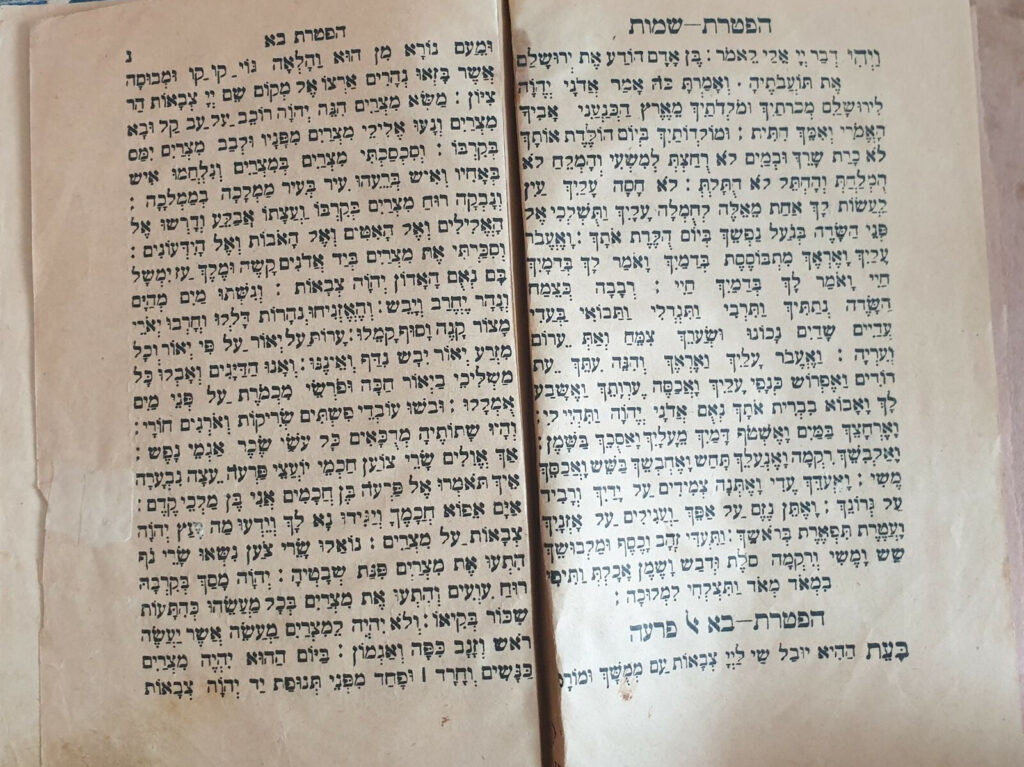
The Babylonian haftarah for Parashat Shemot was from Ezekiel 16: “Hoda’ et yerushalayim.

The haftarah appears in at least six fragments from the Cairo Geniza,[2] is the haftarah used in the “Emet” piyyut of R’ Shemuel Hashelishi[3] and in the “Zulat” piyyut of R’ Yehuda Beirabbi Binyamin,[4] and is listed in the Seder Hatefillot in Rambam’s Yad Hahazakah as well as in the Siddur of R Shlomo Beirabbi Natan.[5]

This haftarah, an extremely graphic and difficult prophecy, was chosen because it begins by describing the Egypian enslavement and the Exodus. In all of the fragments that describe where the haftarah ends, the last verse is verse 16:15, likely so as not to continue with the difficult words of rebuke that follow that do not have anything to do with the parasha. The Baylonian custom allowed for haftarot that were less than twenty one verses even if the subject is left uncompleted because they still had the practice to read Jonathan’s Targum along with the haftarah, and thus were exempted from the twenty-one verse minimal requirement, as per the ruling of R’ Tahlifa bar Shemuel (Megilla 23b).[6]

This choice of haftarah seems to be problematic in light of the Mishna (Megilla 4:10):

מעשה ראובן נקרא ולא מתרגם מעשה תמר נקרא ומתרגם מעשה עגל הראשון נקרא ומתרגם והשני נקרא ולא מתרגם ברכת כהנים מעשה דוד ואמנון נקראין ולא מתרגמין אין מפטירין במרכבה ורבי יהודה מתיר ר’ אליעזר אומר אין מפטירין (יחזקאל טז, ב) בהודע את ירושלם.

The Mishna brings, without dissent, the opinion of Rabbi Eliezer, which forbids this haftarah. However, the Tosefta as it appears in MS Vienna National Library Heb. 20 seems to allow this haftarah, while Rabbi Eliezer’s view is brought as a dissent:[7]

הודע את ירושלם נקרא ומתרגם ומעשה באחד שהיה קורא לפני ר’ ליעזר הודע את ירושלם אמ’ לו צא והודע תועבותיה של אמך.

However, according to that same Tosefta as it appears in MS Berlin Staatsbiliothek Or. Fol. 1220, the Tanna Kamma merely permits haftarot with general rebuke directed at Jerusalem (תוכחת ירושלים), while Rabbi Eliezer objected to the particular choice of Ezekiel 16:

תוכחת ירושלים נקרא ומתרגם ומעשה באחד שהיה קורא לפני ר’ ליעזר הודע את ירושלים ואמ’ לו צא והודע תועבותיה של אמך.[8]

Like the Mishna above, the Talmud Yerushalmi brings Rabbi Eliezer’s prohibitive opinion regarding this haftarah, and presents no other view:

ר’ אליעזר אומר אין מפטירין בהודע את ירושלם את תועבותיה מעשה באחד שהפטיר בהודע את ירושלם את תועבותיה אמר לו ר”א ילך אותו האיש וידע בתועבותיה של אמו ובדקו אחריו ונמצאו ממזר.[9]

The following appears in both printed versions of the Talmud Bavli [10] as well as in three manuscripts of the Bavli:

הודע את ירושלם את תועבותיה נקרא ומתרגם פשיטא לאפוקי מדרבי אליעזר דתניא מעשה באדם אחד שהיה קורא למעלה מרבי אליעזר הודע את ירושלם את תועבותיה אמר לו עד שאתה בודק בתועבות ירושלים צא ובדוק בתועבות אמך בדקו אחריו ומצאו בו שמץ פסול .

This is very difficult to understand. How can the Gemara assume (פשיטא) that this haftarah can be read if the Mishnah already brought Rabbi Eliezer’s unchallenged opinion forbidding it?

Accordingly, two other manuscripts do not have the word פשיטא.

For example, MS. Columbia 294-295 has the following:

הודע את ירושלם את (..)[ת]ועבותיה נקרא ומיתרגם ומעשה באחד שקרא לפני ר’ אליעזר הודע את ירוש’ את תועב’ אמ’ לו צא והודע תועיבות שלאימך עד שאתה בודק בתועבות ירושלם צא ובדוק בתועבות אמו בדקו אחריו ומצאו בו שמץ פיסול.

Here, the story with Rabbi Eliezer is brought within the context of the view of the Tanna Kamma that it is permissible to read this haftarah. Rabbi Eliezer clearly does not reject this view outright, but still deemed this haftarah a poor choice and an inappropriate one at least under the circumstances.[11]

All of the other manuscripts besides this one feature an explicit disagreement between the Tanna Kamma, who permits this haftarah, and Rabbi Eliezer, who forbids it. The Gemara rejects Rabbi Eliezer’s opinion.

Communities that followed the triennial cycle of the Torah reading never read the beginning of Ezekiel 16 as a haftarah. However for the sidra of V’atta Tetzaveh, they did begin the haftarah from Ezekiel 16:10.[12] It could very well be that this haftarah was deemed permissible despite the Yerushalmi’s ban on the preceding prophecy due to the fact that they held a view later cited by the Levush[13] that the problem with Ezekiel 16 is not the severity of the rebuke but but merely verse 16:3, “Your father was an Amorite and your mother a Hittitess,” which was referenced in Rabbi Eliezer’s retort, seemingly because it casts aspersions of the kind with which no one would be comfortable.

In Europe there were two alternative haftarot for Parashat Shemot: Jeremiah 1:1 and Isaiah 27:6. It seems that many communities either did not want to read Ezekiel 16 even though it was allowed by Halacha because of the weight of Rabbi Eliezer’s rejection, or because they had versions of the Talmudic sources which unanimously presented the haftarah as permissible but undesirable.

In the Iberian peninsula, there were communities that retained the haftarah of Ezekiel 16. It is brought as the haftarah for Parashat Shemot by the Sefer Hashulhan, which was authored by Rabbeinu Hiya ben Shlomo ibn Habib, a student of the Rashba. However, R’ Shemuel Hanagid’s list of haftarot in Sefer HaEshkol lists Jeremiah 1 as the haftarah of Parashat Shemot. The same can be found in Sephardic haftarah books in manuscript[14] and in Sephardic lists of haftarot found in the Cairo Geniza.[15] The reason for this choice of haftarah is the parallel between Jeremiah’s first prophecy and that of Moses. Abudarham lists both of these practices, although it is unclear whether he meant that they were both read in Sepharad or whether he had other locales in mind.

In an early printed humash that is assumed to be Spanish and from around the year 1480, the haftarah for Parashat Shemot is Jeremiah 1:1, while the Hijar Humash from 1487-90 (the only dated humash with haftarot printed before the Expulsion) has Ezekiel 16 as the haftarah.[16] It would be at least over two hundred years later before any other humash was again printed with this as the haftarah.

The Italians adopted Jeremiah 1 as the haftarah for Parashat Shemot as well[17] which is quite surprising, as they preserved more Babylonian haftarot than any other community.[18]

In Ashkenaz, France-England, and Provence the practice was to read Isaiah 27:6 as the haftarah for Parashat Shemot. The same was used as the haftarah for the sidra of V’Eila Shemot in the triennial cycle of Eretz Yisrael.[19] This haftarah was chosen due to its literary rather than thematic associations with the Torah reading, as was generally the case with the rest of the haftarot read according to the triennial cycle. (The haftarot favored in the annual cycle were chosen for their thematic content.)

The first verse of the haftarah,הבאים ישרש יעקב יציץ ופרח ישראל parallels the first verse in the sidra: ואלה שמות בני ישראל הבאים מצרימה את יעקב איש וביתו באו. Three of the haftarah’s first six words are in the first verse of the sidra.[20] We also find that the Romaniote community, which often adopted haftarot from the triennial cycle, adopted Isaiah 27:6 as the haftarah for Parashat Shemot.[21]

This haftarah is also attested to in the Ginzburg manuscript of Mahzor Vitry, in Sefer Etz Haim, in the Sefer HaEshkol’s glosses on the Nagid’s list (where it begins at 27:5, one verse earlier), and in all Ashkenazic humashim and sifrei haftarot in manuscript (although three of them also begin the haftarah one verse earlier).[22]

This haftarah was read in some Morrocan communities.[23]

There were different practices regarding the end of this haftarah. In some manuscripts the final verse is 28:13 making it a “classic” haftarah of exactly twenty one verses, especially appropriate as it was never read with its translation by any community using the annual cycle. Some, in order to end on a clearly positive note, would skip from 28:13 to 29:22 and read two more verses. This is how it appears in all printed humashim with Ashkenazic haftarot. In other manuscripts, we find an alternate practice of extending the reading to verse 28:16, instead of skipping to a later point.

The ensuing printed humashim with Sephardic haftarot post-Expulsion all listed Jeremiah 1 as the Sephardic haftarah for Parashat Shemot

In spite of its absence from the printed humashim, Ezekiel 16 was still retained by many communities as the haftarah for Parashat Shemot. This created a bit of difficulty for those communities. In the recently published Kaf Naki, R. Khalifa Malka, who was active in Agadir, Morocco, between c. 1720-1760,[24] wrote:[25]

The early Magreb practice, as well as our practice, is to read for Parashat Shemot the haftarah of “Hoda’,” based on the Rambam at the end of Sefer Ahava. It is proper to act this way, as he is the rabbi of the Sephardim and the Magrebim. Also concerning this haftarah,[26] I requested of the printer, R’ Shlomo Proofs, to print it together with the haftarah of Hoda’…and he did this to please me in the humashim that he published later on, which had not been done in the days of the publishers who preceded me.[27]

I have not been able to locate any such humashim.[29] The first printed post-expulsion humash I was able to find with this haftarah was printed in Jerusalem by Zuckerman in 1866.

Besides Agadir, this haftarah was (dare I say, miraculously,) retained in many places in various Medditerian and Middle Eastern communities including Algiers,[29] Tafilalt,[30] Fez,[31] Libya,[32] Djerba,[33] Persia/Bukhara,[34] Yemen, and Baghdad.[35] In order to deal with the fact that it did not appear in printed humashim, the practice in Baghdad was to print this haftarah along with the haftarah from Isaiah they would read for Parashat Bo (that was not commonly featured in many printed humashim[36]) in special “Nokh” booklets which had lists of verses and selections from the Mishna that would be recited at home on Shabbatot.[37]


Nokh booklet with the haftarot for Shemot and Bo according to the Bavli custom. (Baghdad, 1930)

[1] I would like to thank Rabbi Avi Grossman for editing this.

[2] Cambridge T-S A-R A13, T-S A-S 19.241, T-S B14.54, T-S B14.62f, T-S B15.5, T-S B20.4

[3] The Yotserot of R. Samuel the Third, Yahalom and Kastuma ed., Vol. 1, pg. 294-295.

[4] Piyyutei R’ Yehuda Beirabbi Binyamin, Elitzur ed., P. 136.

[5] Siddur Rabbeinu Shemuel Beirabbi Natan Hagi ed. Pg. 200.

[6] See Teshuvot Hageonim, Sha’arei Teshuva 84, in the name of R Hai.

[7] Megilla 3:34

[8] See Tosefta Kifshuta, Part V, pg. 1216

[9] Megilla 4:12, This is the version in MS Leiden and all printings of the Yerushalmi.

[10] Vilna, Venice 1520-3, and Pesaro 1509-17.

[11] See Hiddushei HaRan there for an explanation as to why he objected in spite of its permissibility.

[12] See Ofer’s list at https://faculty.biu.ac.il/~ofery/papers/haftarot3.pdf

[13] Levush Hahur 478. See also Duker, Hahaftarot Lefarashiyot Aharei Mot UKdoshim L’fi Minhag Ashkenaz in Hitzei Gibborim Vol. 11, pg. 387-498.

[14] PARM 2054 and Angelica Rome 55.

[15] Cambridge T-S B20.2 and T-S B20.14

[16] Based on this and the Sefer Hashulchan, it could be that the retention of that haftarah was an Aragonian practice

[17] MS Parm 2169.

[18] Besides from retaining the original haftarot for Bo, Behar, and Behukkotai, the Italians only read the special haftarot of Destruction and Consolation during the month of Av, but not in Tammuz or Elul, thus retaining the Babylonian haftarot for the parashiyot of Matot, Masei, Shoftim, Ki Tetzei, Ki Tavo, and Nitzavim. The fact that, unlike as in other communities, the Italians did not read Jeremiah 1 on the Sabbath following the Seventeenth of Tammuz, may indicate that the practice of reading Jeremiah 1 as the haftarah for Shemot originated in Italy, but this is just conjecture at this point.

[19] Ibid. Ofer’s list.

[20] Heard orally from Prof. Yosef Ofer.

[21] See Fried list in the back of Encyclopedia Talmudit Vol. 10

[22] The haftarah appears as such in Geniza Fragment Cambridge T-S B16.19b as well. It is also the haftarah in the “Emet” piyyut of R’ Shelomo Suleiman al-Sinjari, but he vacillates between using haftarot from the Babylonian custom and the haftarot from the triennial cycle. See The Yoserot of Rabbi Selomo Suleiman al-Sinjari for the Annual Cycle of Torah Reading. Hacohen, ed. Pg. 368-370.

[23] Naziri, Otzar HaMinhagim VeHamesorot LiKhillot Tafilalt V’Sijilmasa pg. 84 footnote 128, and Danino, Miminhagei Yahadut Morocco. Avaialble at http://www.daat.ac.il/daat/toshba/minhagim/mar-tfi.htm. Avitan, Minhagei Halacha Lefi Kehillot Morocco., link. The fact that Isaiah 27:6 was read as the haftarah for Parashat Shemot in Morocco opens up the possibility that this may have been the practice somewhere in Spain prior to the Expulsion. Moroccan communities retained all three of the haftarot that we have for Parashat Shemot, as Jeremiah 1 was read in Sefrou (Naziri, ibid.) and is still read today in at least some communities that follow Morrocan practices. Others read Ezekiel 16, as discussed below.

[24] Published 2012, Orot Yehudei HaMagreb, Halamish M. ed.

[25] I would like to thank Rabbi Yehoshua Duker for translating this.

[26] Referring to Isaiah 19 as the haftarah for Parashat Bo.

[27] He proceeds to claim that it had not been printed due to the influence of the Levush which, (in his opinion,) was influential because of the dearth of other works on the Shulhan Aruch back then. I think it is merely because the haftarah was not printed in the Venetian humashim published by Bromberg (in particular, the 1524 edition), which had a heavy influence on the selection of haftarot in later humashim. I will address this in an article on the haftarot of Vayetze and Vayishlach that I hope to publish soon.

[28] He clearly saw the humash with these haftarot as he wrote about how the last verse of the haftarah for Shemot was left out.

[29] Zeh Hashulhan, Minhagei K”K Algier p. 245

[30] Naziri, pg. 84

[31] Ibid. footnote 128 quoting Sefer Ahavat HaKadmonim pg. 6a. It is also written there that this was the practice in Izmir and Turkey.

[32] Biton, Nahalat Avot, p. 65

[33] HaCohen, Brit Kehuna, pg. 16.

[34] Zuckerman Humash

[35] Sitbon, Alei Hadas, pg. 360.

[36] It was only printed in humashim with Italian haftarot (before the late 20th century) such as the following: Manitoba 1589, Amsterdam 1712 (Proofs), 1729 (Binyamin ben Uri Katz), and Venice 1820.This list not exhaustive.

[37] Simanei Pesukei Nokh, 1920. A complete listing of the various printings (seven in all) can be found in Ben Yaakov, Minhagei B’nei Bavel B’Dorot HaAharonim.


Ha-Osek be-Mitzvah Patur min ha-Mitzvah: The Case of Prayer and Torah Study

Daniel Sperber has just published a new book, On the Relationship of Mitzvot Between Man and His Neighbor and Man and His Maker. The Seforim Blog is happy to present chapter 4 from the book. 
Ha-Osek be-Mitzvah Patur min ha-Mitzvah: The Case of Prayer and Torah Study
Daniel Sperber
We find in Sefer ha-Rokeah, section 369 ad fin., that a person who is sitting in the synagogue, wrapped in his talit and with his tefillin on his head and is reciting liturgical songs, must, nonetheless, rise up before his teacher, since he can carry out both actions and he will receive fine rewards in both worlds. Now there are early authorities who hold that the principle that one who is engaged in one mitzvah is exempt from another is also the case when both could be carried out. (See Shulhan Aruch Orah Hayyim 38:8, and in the Beur Halachah, ibid., and also R. Yaakov Hayyim Sofer, Brit Yaakov [Jerusalem: 1985], section 2, 36; R. Ovadiah Yosef, Hazon Ovadiah: Sukkot [Jerusalem: 2005, 167].) The author of the Rokeah, R. Elazar of Germaiza, was a disciple of R. Yehudah (b. R. Shmuel) he-Hasid, the author of Sefer Hasidim. And it is the view of R. Yehudah he-Hasid that even if one can carry out both mitzvot, one is exempt from doing so, if one is engaged in a prior mitzvah; and this, indeed, is the view of R. Elazar Rokeah himself (Rokeah, Hilchot Sukkah, section 299; see Sofer). Why then should one who is engaged in praising the Lord in the synagogue, have to rise up before his teacher? Surely he is already engaged in a mitzvah, and therefore exempt from others! The answer, I suggest, is because ritual synagogue worship is directed towards God, but respect for one’s teacher is a mitzvah between man and his fellow, and he is therefore not exempt from it. So too the Hida, R. Hayyim Yosef David Azulai, rules, that even in the hour of prayer one rises before a Torah scholar, (Birkei Yosef Orah Hayyim, section 244:1; and see Sofer, note 8 on page 37; and see most recently the discussion of R. Yitzchak Eliyahu Stessman, Kimah ve-Hidur [Jerusalem: 2011, 88–91], with additional references).
Indeed, the severity of not rising before one’s teacher is expressed by R. Eleazar in very extreme terms in BT Kiddushin 33b:
Any scholar who does not rise before his teacher is called a wicked person (רשע), and will not live long and will forget his learning.
(See also R. Yaakov Hezkiyahu Fisch, in his Ve-Haarachta Yamim, ed. Y.M. Sofer, [Jerusalem: 2010, 71–72].)
To this we may add what we are told of the Arizal, by his disciple R. Hayyim Vital, that he was very particular in paying his workers exactly on time and without delay. And if he did not have the money with which to pay these wages, he would delay his afternoon prayer (minhah) until close to sunset in order to search out a loan with which to make the payment. Only afterwards would he hurriedly daven minhah. He would explain himself by saying: “How can I pray to the Lord, may He be blessed . . . , when such an important mitzvah is incumbent upon me, and I have not carried it out?” (See R. Hayyim Vital, Shemonah Shearim: Shaar ha-Mitzvot [Jerusalem: 1872], Parshat Tetzeh; Avraham Tobolsky, Hizaharu be-Memon Haverchem, vol. 2, [Bnei Brak: 1981, 211–212].)
In a somewhat different vein, but with much the same principle as its basis, we read in Niflaot Beit Levi, by A. Kleiman (Pietrokov: 1911, 32, [Yiddish]), cited in Louis I. Newman and Samuel Spitz, The Hasidic Anthology: Tales and Teachings of the Hasidim (New York: 1944, 178:2, 480) as follows:
A teamster (=wagon driver) sought the Berditchover’s (Reb Levi Yitchak of Berditchov’s) advice as to whether he should give up his occupation because it interfered with regular attendance at the synagogue. “Do you carry poor travellers free of charge?” asked the Rabbi. “Yes,” answered the teamster. “Then you serve the Lord in your occupation just as faithfully as you would be frequenting the synagogue.”
(However, see A.Y. Pfoifer, Ishei Yisrael [Jerusalem: 1998, 104, section 11, and notes ad loc].)
And indeed, the Rambam in Hilchot Talmud Torah 3:4, followed by the Shulhan Aruch, Yoreh Deah 246:8, rules:
If there came before him [the choice of performing] a mitzvah and (i.e., or continuing) learning Torah, if that mitzvah could be carried out by another, he should not interrupt his learning; but if not, he should carry out that mitzvah and then return to his study. And when it comes to giving charity, one should always give charity first.[1]
This indeed is the conclusion to be drawn from the sugya in Yerushalmi Pesahim 3:7 (and parallel to JT Hagigah 1:7). There we read that R. Abahu, who lived in Caesarea, sent his son R. Haninah to study in Tiberias, in the Yeshiva of R. Yohanan.
They came and informed him that [his son] was engaged in charitable activities (i.e., in the burial of dead). He sent him a message, saying to him: “Are there no graves in Caesarea that I sent you to Tiberias?” (i.e., for such activities you could have stayed at home).
The Talmud continues that it was already decided at Beit Nitzeh in Lod that “study is greater for it leads to deeds,” (see below). However, the rabbis of Caesarea qualified this by saying:
This is the case when there is someone else to carry out the deeds. But if there is not anyone else to carry them out, the deed comes before [the study], (i.e., has precedence).
We then are told a tale:
R. Hiyya, R. Yosi [and] R. Ami were late coming to R. Eleazar [for their lesson with him]. He asked them, “Where were you?” They replied, “We were involved in charitable activity” (meaning in the burial of someone). “Was there no one else [who could do this?]” he asked of them. They replied, “He was a neighbor [according to the Pnei Moshe, or a proselyte – according to the Korban ha-Edah,” i.e., and there was no one else to deal with his burial.]
Incidentally, we may add here that the interpretation of the Pnei Moshe is supported by a passage in Sefer Haredim, (by R. Eleazar Azikri, [Safed: 1533–1600]), Mitzvot Aseh . . . ha-Teluyot be-Lev 22, which states that:
A person is obligated to act charitably towards his neighbors and his relations more than to other people, as is clearly stated in the Bavli and the Yerushalmi.
(See S. Lieberman, HaYerushalmi Kiphshuto [Jerusalem: 1934, 426] and his other comments.) And the parallel text in JT Hagigah 1:7., begins with an additional passage, namely:
R. Yehudah, when he would see a dead person (i.e., a burial) or a bride (i.e., a marriage procession), [and people] praising them (i.e., honoring them in the processions), he would turn to his students (נותן עיניו בתלמידים), and say: “The [dealing with] the dead precedes the study of Torah (תלמוד).”
And a somewhat similar notion, but expressed in a Hassidic vein, may be found in a story related in Yehezkel Shraga Fraenkel’s Rabbenu ha-Kaddosh mi-Shinyeve (Ramat Gan: 1992, 256–257). He relates that once the Rabbi of Warsaw came to visit the Divrei Hayyim, R. Hayyim of Sanz. The Sanzer Rebbe asked him, “Do you learn?” “Yes,” the Warsaw Rabbi replied. The Rebbe repeated, “Do you always learn?” The reply was, “When someone who is embittered and needs help comes to me, I close my gemara and deal with him, to help and encourage him.” “This is what I wanted to hear,” said the Sanzer, “whether you have the good sense to close your gemara when someone needs your help,[2] both in word and in deed, and in any case to encourage him and bolster his spirit.”[3]
Here we must make something of a digression, which is not really a digression, as this touches upon a very important point. For the Mishnah in Peah 1:1 states that: “the study of Torah is equal to all of them,” i.e., even to those mitzvot listed in the Mishnah which are social ones, such as honoring one’s parents, doing charitable deeds, bringing peace between rival individuals, etc. The question we ask ourselves is: is the study of Torah (תלמוד תורה) a ritual or a social mitzvah? Into which category does it fall? For if the former, according to our suggestion how can it be superior to those other social mitzvot?
To clarify this issue we must go back to a very ancient discussion that took place in the attic at Beit Nitzeh in Lod, between R. Tarfon and the Elders. For this question was put before them: which is greater, or more important תלמוד או מעשה, learning or deeds? R. Tarfon answered: Deeds are greater. While R. Akiva said study is greater. And they all replied: Study is greater for it leads to deeds (BT Kiddushin 40b).[4] That is to say the importance of study is in that it constitutes the key to the proper execution of the mitzvot. This is also the meaning of R. Shimon the son of Rabban Gamliel’s statement in Avot 1:17: Not the expounding of the law (midrash) is the chief thing, but the doing [of it] (maaseh). And this is amplified by Rabbenu Bachya in his commentary ad loc.: that the aim of man’s labor in Torah is not that he should just learn a lot, but that [his learning] should lead to deeds, as we have learned from the verse [in Deuteronomy 5:1], ‘and ye may learn them [i.e., the statutes and judgments], and keep and do them.’ And this is further amplified in Shulhan Aruch ha-Rav, by R. Shneur Zalman Mi-Ladi, in his Hilchot Talmud Torah 4:2, by telling us that “it is impossible to fulfill all the mitzvot in all their details without intensive study and knowledge of them. And for this reason it is equal to all of them,” i.e., not intrinsically, but as a means to their proper application.[5]
This issue has been analyzed recently by R. Yitzchak Shapiro, in his article in Hakirah 9, (2010), 221–243, entitled “To know the Forbidden and the Permitted: An Analysis of Rambam’s View of the Purpose and Goals of Talmud Study.” He shows that the Rambam’s view, as expressed in his letter to his disciple R. Yosef,[6] is that “learning Torah is a utilitarian endeavor, with extracting halachic conclusions its functional objective” (227).[7] He goes on to show that “the simplicity and obviousness [of this position] might go unnoticed if not for its staggering ramification and total incompatibility with contemporary realities in derech halimud ” (227–228). For as he earlier showed (223–224): “the Aharonim do identify an aspect of Torah study, unrelated to fulfillment of the other mitzvot, based on the verse והגית בו יומם ולילה – ‘but thou shalt meditate therein day and night’ (Joshua 1:8, cf. BT Menachot 99b). This mitzvah of ‘limud ha-Torah’ is distinct from the mitzvah of ‘yediat ha-Torah,’ and can be fulfilled regardless of the subject matter that is learned, whereas the mitzvah of yediat ha-Torah requires a curriculum that is limited to ‘halachah’ (or at least the sharpening of one’s mental acuity, which is necessary for accurate application of halachah). However, one may fulfill both facets of the mitzvah simultaneously only by learning halachic subject matter.”[8]
This is the view of the Meiri, as formulated in his commentary to BT Berachot 7b:
The knowledge of how the Torah actually expresses itself indeed requires serving or observing Torah scholars. While intellectual learning is the cause of wisdom, observing the Sages is the cause of knowing how the Torah manifests itself. This is both true for monetary matters as well as that which is prohibited and permitted.
Hence, we may well understand the statement of Rav in BT Megillah 3b, that Talmud Torah is greater than the sacrifice of the daily offerings (­temidin).
Here we may also call attention to R. Meir Triebitz’s insightful analysis (in his introduction to R. Daniel Eidensohn’s Daas Torah: A Jewish Sourcebook [Jerusalem: 2005, 31–35]). He begins by noting that God commands us twice to study Torah: once in Deuteronomy 11:19, and again in Deuteronomy 4:9–11. He analyzes the differences between these two formulations in all their details – e.g., one in the plural and the other in the singular; one talks of teaching, the other telling; one focuses on parents to children, while the other lists three generations. He concludes that “the two verses which obligate us to learn the Torah actually refer to two types of study. One refers to the study of the legal part of Torah, and the other to the study of Torah’s theology. Each form of study is deemed a separate scholarly enterprise.” He characterizes these two forms of study as “legal” (i.e., halachic) study, and “faith” study, which he states “deals primarily with Aggadic parts of the Torah.” But for our purposes it is important to emphasize that both verses, that is to say both classes of study, require the student also to be a teacher, and to pass on his learning to future generations. Hence, Torah study has a social aspect too.
This is a very broad subject that requires a study in its own right, and we cannot enlarge on it here. But what emerges very clearly is that the mitzvah of Torah study is in a very special category, for without it one would not know how to carry out ritual or social mitzvot correctly. Nonetheless, the Or Zarua and the Rav
Baal ha-Tanya agree that one interrupts learning Torah to fulfill other mitzvot, if both cannot be carried out at the same time, and one is not exempt because one is already involved in a prior mitzvah.[9]
This is clear from the baraita in BT Ketubot 17a (BT Megillah 3b, 29a) that we interrupt our study of Torah (מבטלין תלמוד תורה) not merely for a met mitzvah and to accompany the dead (הוצאת המת), but also for wedding ceremonies (הכנסת כלה) – all supreme social mitzvot.[10] And in this way, we may better understand the passage in Avot de-R. Natan, chapter 41, (ed. Schechter, Vienna: 1887, 133):
It once happened that R. Tarfon was sitting and teaching his disciples, and a bride went past him. He ordered that she be brought into his house, and told his mother and his wife that they should bathe her, anoint her, and decorate her with jewelry, and dance before her until she goes to her husband’s house.
Apparently, he interrupted his teaching in order to carry out the mitzvah of hachnasat kallah.[11] And indeed we read in the letters of the Hafetz Hayyim (Michtevei ha-Hafetz Hayyim he-Hadash, vol. 2, Bnei Brak: 1986) II, 86:
You occasionally see a Jew who [in a praiseworthy way] learns Torah [as much as possible] and values his time [not wasting a minute]. But if he does not set aside part of the day to do deeds of kindness, what a lack of intelligence!
And interestingly enough, this also becomes evidence from the commentary of R. David ha-Nagid, the Rambam’s grandson, to Avot 1:15. There Shammai is cited as saying: “Make thy [study of the] Torah a fixed
habit (קבע); . . . . And receive all men as its cheerful countenance.” And this is explained by the Nagid to mean that even when you are engaged in your fixed period of Torah study, you should not desist from receiving people cheerfully, thinking that in doing so you are “wasting” Torah-study time.[12] So apparently he regarded proper interpersonal relationship of such importance as even to override one’s involvement in Torah learning. And this presumably goes under the category of kevod ha-beriyot, respect for the individual. (Cf. below, sections 15 and 19.)
We are reminded of the statement of Reb Yisrael of Rizhyn (died 1850), who expounded the verse in Psalms 115:16, “the heavens are the heavens of the Lord; but the earth hath He given to the children of men.”
There are two kinds of tzaddikim. Those of the one sort learn and pray the livelong day and hold themselves far from lowly matters in order to attain holiness. While the others do not think of themselves, but only of delivering the holy sparks which are buried in all things back to God, and they make all lowly things their concern. The former, who are always preparing for Heaven, the verse calls “the heavens,” and they have set themselves apart for the Lord. But the others are the earth given to the children of men.
(Martin Buber, Tales of the Hasidim: The Later Masters, New York: 1948, 53–54)
Here, he is contrasting the Lithuanian mitnagdim’s way, (in a double-edged complementary fashion), with that of the Hasidim, while we well know with which way he personally sided.
At the same time we should recollect how Yehudah ha-Levi in his ­Kuzari, begins his definition of the religious man according to Jewish tradition with the negative statement that “in Jewish opinion, the religious man is not to be defined as one who cuts himself off from the world” (Book III, sect. I, ed. Hirschfeld, Leipzig: 1882, 140–141). Perhaps he was combating predominant contemporary Sufi views on extreme asceticism. (See Franz Rosenthal, “A Judaeo-Arabic Work under Sufic Influence,” HUCA XV 1940,
440, and cf. page 465 for an extreme view of this form of asceticism, and note 104.)

[1] See Le-Hair Hilchot Tzedakah be-Or Yekarot (Jerusalem: 2010, 6–7). And see below sect. 16 on the overriding importance of charity, and Appendix.
[2] See, for example, the practice of the Brisker Rav, Reb Hayyim Soloveitchik, as described in Aharon Sorasky, Marbitzei Torah u-Musar bi-Yeshivot Nusah Lita mi-Tekufat Volozin ve-ad Yameinu, vol. 1 (Jerusalem: 1976, 110).
[3] Cf. BT Shabbat 127a: Said R. Yohanan: Great is the hosting of guests as are those rising up early to the House of Study [of Torah], as we have learned: to make room for guests [to avoid] hindrance in the House of Study. But Rav Dimi of Nehardea said: It is greater than rising up early to the House of Study. For we learned: “for guests,” and only afterwards “to avoid hindrance in the House of Study.” And see below sects. 11 and 12 on hosting guests.
[4] On this text see Benedict Thomas Viviano, Study as Worship: Aboth and the New Testament (Leiden: 1978, 105–109). Directly related to this is the text in JT Pesahim 3:7, and JT Hagigah 1:7, cited above, from which the Rabbis learned that if others can carry out these charitable activities, a person should not interrupt his Torah studies. And this seems to be the dominant view among the poskim. See further BT Moed Katan 9a; Shulhan Aruch Yoreh Deah 246:18; Meiri to BT Shabbat 9a and Moed Katan ibid.; Rabbenu Yeruham 22a in the name of the Ravad, etc. See R. Asi ha-Levi Even Yuli, Shulhan Aruch ha-Middot, vol. 2, Halachah u-Musar (Jerusalem: 2009, 243–244).
[5] See R. Mordechai Shmuel Ashkenazi’s magnificent commentary to Hilchot Talmud Torah Mi-Shulhan Aruch Admor ha-Zaken, vol. 5 [= ha-Rav] (Kefar Habad: 2000, 86).
[6] Ed. Y. Shilat, Iggrot ha-Rambam, vol. 1 (Jerusalem: 1987, 254–259); and see editor’s note on 257–258 to line 4).
 [7] At the simplest level, there is, in the Rambam’s view, an obligation upon one who has learned Torah,
also to teach it to others. See Hilchot Talmud Torah 1:2, and so too in the listing of the positive commandments at the beginning of his Mishneh Torah, no. 11. (This list is also that of the Rambam, as attested by the author of the Magid Mishneh in his introduction to Hilchot Eruvin, and the Kesef Mishneh in Hilchot Hannukah 3:6; Responsa Noda bi-Yehudah Kama, Orah Hayyim, sect. 29; Petah ha-Dvir, vol. 2, sect. 194, subsect. A. See R. Yaakov Hayyim Sofer, Drupteki de-Oraita, vol. 1 [Jerusalem: 1987, 45]. And see further his remarks, 68–69, on the need to teach others.) Of related interest is the article of Sarah Pessin, “Maimonides and the Sacred Art of Teaching,” apud Adaptations and Innovations: Studies in the Interaction between Jewish and Islamic Thought and Literature from the Early Middle Ages to the Late Twentieth Century, Dedicated to Professor Joel Kraemer, ed. Y. Tzvi Langermann (Paris & Louvin: 2007, 285–298). See also, most recently, the remarks of R. Aharon Lichtenstein, in H. Sabato and A. Lichtenstein, Mevakshei Panecha (Tel Aviv: 2011, 212–215).
[8] See the material R. Yitzchak Shapiro brings from the letters of R. Yisrael Salanter (no. 27), in this regard. See also Kuntres Aharon shel Shulhan Aruch ha-Rav, Talmud Torah 3:1, ed. Y.A. Lev (Ashdod: 1989, 39 et seq.). And see R. Aharon Lichtenstein’s very comprehensive study entitled “Does Involvement in Torah Study Exempt One from Mitzvot?”, which appeared in Alei Etzion 16 (5769 [2009]), 71–107, which examines this issue in depth, dealing with questions of delaying procreation, Megillah reading, prayer, all mitzvot, etc., and seeks to explain Rambam’s position that “ha-osek be-mitzvah patur min ha-mitzvah” theoretically applies to Torah study too, when “it is studied with the purpose of performing” (91); and cf. ibid., 105, for his suggestive interpretation of the view of the Maharach Or Zarua. His study of this very complex issue is extremely rich and requires intense study. See also Moshe Zvi Polin, Sefer ha-Mitzpeh al ha-Rambam, vol. 1, (on Hilchot Talmud Torah) (Jerusalem: 2005, 11–26), that studying (lilmod ) and teaching (lelamed ) are two interconnected mitzvot. See Ramban Hilchot Talmud Torah 1:1; Hilchot Hagigah 3:1: that anyone who is obligated to study is obligated to teach, and cf. ibid., 1:4. I think this is the meaning of the statement in Seder Eliyahu Rabba, ed. Friedman, p. 63 =Tanna Debe Eliyahu, transl. W.G. Braude & I.J. Kapstein (JPS, 1981, 183) that “one who toils in Torah is like a lamp which provides light for the eyes of many.” And in this connection, it is also worth reading Benjamin Blech’s article “Personal Growth or Communal Responsibility: A Question of Priorities,” The Torah U-Madda Journal 2 (1990), 134–142. However, to give a slightly different point of view, see Hatam Sofer to Nedarim 81a; R. Hayyim Volozin’s Nefesh ha-Hayyim, Shaar Dalet, sect. 3; Ruah Hayyim to Avot 6:1, and the introduction to Eglei Tal.
A very extreme expression of this view is to be found in R. David Baharan’s “Hanhagot u-Piskei Halachah,” in Otzrot Yerushalayim, vol. 13 (Jerusalem: [2010?]), 40, where he insists one must learn halachah every day, and it is not sufficient to learn merely Gemara. He goes on to say that one must learn Shulhan Aruch Orah Hayyim or Hayyei Adam, and he who does not do so will surely have no part in the World to Come. (See also ibid., 41–42.)
See further R.S.Z. Auerbach, Halichot Shlomo . . . al Moadei ha-Shanah, ed. Y. Terner and A. Auerbach (Jerusalem: 2007), 537–539, who also is of the opinion that there are two aspects to Torah study: the one being to study in order to learn how to act properly, and the other as an independent positive commandment which is not just in order to know how to act, but the actual practice of learning as an end in its own right. He expands on this position bringing biblical and rabbinic sources to bear out this point of
view. However, here too he agrees that ultimately this is in order “to purify his body through the light of Torah, in order to cleave to God . . . who orders the world (àùø äìéëåú òåìí ìå), and without which the world cannot subsist (åáìà ÷éåîí – àéï î÷åí ÷éåí ìòåìí)” so that in the final reckoning this non-action-orientated
study is nonetheless direct to úé÷åï òåìí, the betterment of our world, (see ibid., 536).
[9] See Kuntres Aharon ibid., in the editor’s Midrashei ha-Kuntres, 36; and also Kuntres Aharon, Talmud Torah 4:3, that one interrupts
learning for persuading others to give charity, where others are less
persuasive, or helping in burying the dead, etc. See R. Mordechai Shmuel
Ashkenazi, ibid., 87 et seq.
See
further R. Ovadiah Yosef, Hazon Ovadiah: Sukkot
(Jerusalem: 2005, 168), on the special status of Talmud
Torah, because it is mandated at all times (îöåä
úîéãéú), and, hence, cannot exempt from other mitzvot, as this
would free us from all other mitzvot (citing the Birkei
Yosef of the Hida 38:7).
This
subject has most recently been examined in considerable detail, with a wealth
of sources, by R. Asi ha-Levi Even Yuli, in his Shulhan
Aruch ha-Middot, vol. 2, Halachah ve-Musar
(Jerusalem: 2009, 243–247). He shows that there are two opposing views. For the
Yosef Omez, by R. Yosef Juspa Kahn Neurelingen (c.
1639), (Frankfurt am Main: 1908, [reprint, Jerusalem: 1965] 316), writes that
the Rabbis said: Anyone who is involved in Torah learning and not in gemilut hasadim, acts of charity, is as one who has no
God. And therefore he wrote that a Torah scholar should make sure that every
day he should carry out one act of charity. And the Seder
ha-Yom (by R. Moshe ibn Machir [Venice: 1599], and numerous editions)
wrote that one must not interrupt the learning of Torah for any mitzvah which
can be carried out by another, with the exception of acts of charity. And
therefore the enthusiastic should take this to heart and pursue acts of charity
as one pursues life itself. (And see the continuation of this passage.) Even
Yuli further refers us to Responsa Aderet Tiferet
(by R. Avraham Dori, vol. 4, sect. 44), who following on the words of the Seder ha-Yom seeks to find additional support for this
view in the Rambam, citing the gemarot in BT Megillah 3b, 29a; BT Ketubot
17a as further proof, in that one interrupts Torah learning to accompany the
dead to his final resting place. (See below on this subject.) He then refers us
to the Sdei Hemed to which we referred earlier on.
However, this runs counter to the prevailing majority view found in a multitude
of rabbinic sources, to which he referred on 243–244, and therefore very
convincingly he rejects and refutes this argument on 246–247. See there in
detail. However, the above just underscores what we have tried to point out,
namely the complex ambiguity of the status of Torah study.
[10] See Rema, Even ha-Ezer 65:1; Ba”h
ibid., that even the leading Torah authority, Gedol
ha-Dor, does so. And even public learning is so interrupted, (Pnei Yehoshua to BT Ketubot
ibid., on the basis of Tosafot Megillah ibid.). However, see D. Friedman, Piskei Halachot, vol. 3 (Warsaw: 1901, 35), argues that
nowadays, that we are not intimately acquainted with the laws and our studies are directed to their correct understanding, therefore,
we do not interrupt Torah learning for wedding ceremonies. See, in detail, on
all the rules related to this subject, B. Adler, Ha-Nisuim
ke-Hilchatam, 2nd ed., vol. 2 (Jerusalem: 1985, 394–395).
Clearly
hachnasat kallah is related to the mitzvah of procreation,
which is one of the paramount duties of a man, in Jewish halachic thought. See
my Netivot Pesikah (Jerusalem: 2008, 162–163, n.
251). (And cf. below, sect. 30.)
Here
we may add that a communal positive mitzvah always takes precedence and outweighs
a private individual’s positive mitzvah. A teacher sitting shiva is forbidden to learn and teach Torah. However, he
is permitted to do so if the community needs him (Shulhan
Aruch Yoreh Deah 384:1). See Tzvi Marx, Halakha
and Handicap (Jerusalem: 1992–1993, 228).
[11] See Schechter’s note
in his edition of Avot de-R. Natan, n. 24, and p.
131, n. 10.
[12] Midrash
R. David ha-Nagid to Avot, ed. BenTziyyon
Kipnis (Jerusalem: 1944). The Arabic original appeared in Na Amon 1901. However, there are some doubts as to the
attribution of authorship. See Milhamot Ha-Shem by
R. Avraham ben ha-Rambam, ed. M. Margaliot (Jerusalem: 1953, 38, n. 8); A.
Katz, JQR 48
(1957), 140–160; Midrash R. David ha-Nagid to
Genesis, ed. A. Katz (Jerusalem: 1964, 16–18). On R. David ha-Nagid himself,
see A. Strauss (Ashtor), Toldot ha-Yehudim be-Mitzrayim
ve-Suriah tahat Shilton ha-Mamelukim, vol. 1 (Jerusalem: 1944, 117–128).


Some More Assorted Comments, part 1

Some More Assorted Comments, part 1
by: Marc B. Shapiro
1. Following my last post, a number of people have corresponded with me about the issue of anti-Semitism and how it it sometimes self-inflicted because of Jewish actions that cause a hillul ha-Shem, meaning that we can’t always claim ידינו לא שפכו את הדם הזה. As many readers know, R. Jehiel Jacob Weinberg already pointed out that some anti-Semitism arises for precisely this reason. He was not the first. R. Israel Moses Hazan (Kerakh shel Romi, p. 4a), speaks of the bad impression given non-Jews by Jewish texts (and obviously also Jewish behavior):
שאנחנו מצד אמונתנו אנחנו מחוייבים להיות משחיתים הקיבוץ המדיני
See also the words of R. Solomon Alami, Iggeret ha-Mussar, ed. Haberman (Jerusalem, 1946), pp. 11-12:
עם היותנו עבדים נכבשים להם התלנו בם וחיללנו שם קודש א-להינו בקרבם כי הלכנו אתם באונאה ובמרמה וקבענו אותם בחוקים לא טובים בערמה עד אשר מאסונו והחזיקונו כגנבים ורמאים מנאפים עצרת בוגדים.
See also Maharsha to Ketubot 67a, which so accurately describes what we often face[1]:
ורבים בדור הזה שמקבצין עושר שלהם שלא באמונה ובחילול השם כגזילת עכו”ם ואח”כ מתנדבים מאותו ממון להיות להם כבוד בכל שנה ולתת להם ברכת מי שברך להיות להם שם ותפארת, ואין זה אלא מצוה הבאה בעבירה, ואין לעושר הזה מלח וקיום
(To understand the last words, see Ketubot 66b: מלח ממון חסר)
But there are limits to what we can do, and even if we were all complete tzadikim, it would not mean the end of anti-Semitism. Yet listen to a youthful passage recorded by Gershom Scholem in his diary in 1913. It is certainly an exaggeration, but in speaking of Jews living in the modern world (as opposed to the Shtetl) there is also some truth to it: “If Judaism were as Samson Raphael Hirsch thinks it should be, there wouldn’t be any such thing as anti-Semitism.”[2] As Hirsch taught, it is incumbent on us to show that we are a great benefit to society, and we cannot behave as if the rules, and the consequences of violating these rules, only apply to everyone else. ודי בזה.
2.  In my review of Gurock’s book (see here)  I referred to Aish HaTorah honoring intermarried people at its events. In fact, they were not the first Orthodox organization to do so, as one can see from R. Avraham Weinfeld’s Lev Avraham, no. 134, which dates from the early 1970’s.

If anyone knows which institution he is referring to, please share it. For some earlier comments of mine with regard to Orthodox views of intermarriage, see here.
In general, there have been some real changes in how Orthodoxy deals with the non-Orthodox, and Adam Ferziger has recently published a valuable article on the topic.[3] In reading the article, I was surprised to learn how even  haredi Orthodoxy has begun to expand the boundaries in dealing with non-Orthodox movements and institutions. It appears that the Reinman-Hirsch book was only one aspect of this change. Here is some of what Ferziger reports:
ASK [Atlanta Scholars Kollel], however, has demonstrated a willingness to meet its constituency on its own terms by running a biweekly introductory prayer service in one of Atlanta’s largest Reform houses of worship, Temple Sinai of Sandy Springs. To be sure, the meetings take place in a social hall rather than in the synagogue sanctuary, but this is a clear departure from the guidelines set down by Feinstein. Similarly, members of the Phoenix Community Kollel have taught classes at the community sponsored Hebrew High that is housed at the Reform Temple Chai. . . . [T]he head of Pittsburgh’s Kollel Jewish Learning Center, Rabbi Aaron Kagan, meets on a regular basis with his local rabbinic colleagues from Reform and Conservative synagogues to study Torah together. . . . Based in Palo Alto, California, the Jewish Study Network—one of the most dynamic and rapidly expanding of these kiruv kollels—does not limit its interdenominational contacts to private study. Its fellows work together with Conservative and Reform representatives to create new Jewish learning initiatives throughout the Bay Area and to offer their own programming in non-Orthodox synagogues. Rabbi Joey Felsen, head of the Jewish Study Network and a veteran of five years of full-time Torah study at Jerusalem’s venerable Mir yeshivah, made clear that he was not opposed to presenting Torah lectures in a non-Orthodox synagogue sanctuary, although he preferred to teach in the social hall. Indeed, according to Rabbi Yerachmiel Fried, leader of the highly successful Dallas Area Torah Association (DATA) Kollel and a well-respected halakhist, insofar as Jewish religious institutions were concerned the only boundary that remained hermetically sealed was his unwillingness to teach in a gay synagogue. . . . 
3. Here is the link to my recent article in Milin Havivin in which I published R. Eliezer Berkovits’ responsum permitting one to enter churches.[4] (R. Jeremy Rosen agrees with Berkovits. See here.)

In addition to the figures I mentioned who are known to have entered churches, the young scholar Chaim Landerer called my attention to the famed bibliophile, Judah David Eisenstein, who in his autobiography, Otzar Zikhronotai, testifies to entering churches on a few different occasions. These are mentioned by R. David Zvi Hillman in his article in the most recent Yerushatenu 4 (2010) as part of his effort to delegitimize Eisenstein, both from a scholarly as well as from a religious standpoint.[5] The article is actually twenty pages of excerpts from Eisenstein’s writings designed to accomplish this objective.
There is no question that Hillman accomplishes at least one of his goals, which is to show that Eisenstein often misinterpreted rabbinic texts. Yet for the life of me I can’t figure out what possible objection Hillman could find in some of what he records. For example, what is wrong with Eisenstein mentioning, in his autobiography, that as a young man he served on a jury (בית דין של שנים עשר), learnt to play the piano, to ride a horse, to swim [!], to sail, to fence and to play billiards? What does Hillman expect, that Eisenstein is supposed to say that his entire life was spent in a beit midrash, never once venturing out to enjoy what the world has to offer? Hillman also finds objectionable that Eisenstein mentions that he played chess on Shabbat and Yom Tov and that in general he liked sports as they strengthened his body. Hillman even notes that Eisenstein tells the reader how much he weighed at various times of his life, and here too, I can’t figure out what the sin. In my opinion, the craziest of Hillman’s criticisms focuses on the following passage in Eisenstein’s autobiography:
בשנת 1886 הייתי בין הראשונים שעלו במדרגות לראש פסל החרות ובשנת 1928 עליתי שם ע”י המכונה נושאת אנשים עד הראש ועד מאתים מדרגות עד הלפיד של החשמל שהוא גדול בכמות רבבות אלפים נרות.
Is it possible that Hillman has never heard of the Statue of Liberty and instead thinks that Eisenstein made a pilgrimage to some pagan temple?
Here is another of the passages Hillman strangely cites in order to criticize Eisenstein:
תרפ”ב ברלין. ציר ארה”ב ואשתו הושיטו ידם לי לברכני
But if you really want to see Hillman’s extremism, look at the following passage which he finds objectionable:
עין חרוד בעמק והוא מקום הטומאה לחיי המשפחה . . . שאכלו חמץ בפסח להכעיס . . . אנחנו מקוים כי גם החלוצים יטיבו את דרכם במשך הזמן ובפרט כי הורגלו לדבר עברית ויש בכח הלשון הקדש ובמאור שבה לבדה להחזירם תחת כנפי השכינה
There is no question that Eisenstein was naive in his hope that the Hebrew language would help bring people back to religion, but does this make him a bad person? Citing this passage to disqualify Eisenstein says more about Hillman than it does about Eisenstein. (I will return to Hillman in a future post.)
Here is another of Hillman’s criticisms, but this time of a scholarly nature:
“חוה”מ נקרא מועד קטן”. היש לזה מקור הוא [!] שהוא סברת כרסו של בעל האוצר?
We all know that Tractate Moed Katan deals with Hol ha-Moed. The reason the tractate is called such is presumably to distinguish it from the Order Moed. In fact, there is evidence that the original name of the tractate was Moed “and throughout this tractate the intermediate days are referred to as Mo’ed and not as hol ha-mo’ed.”[6]  It is because of this that Hillman is so dismissive of Eisenstein’s suggestion that Moed Katan can be understood as the “lesser holiday” and refer to hol ha-moed.
Yet Hillman spoke too fast in this case, because the great R. Aryeh Zvi Frommer, Eretz Zvi (Bnei Brak, 1988), pp 351ff, also assumes that hol ha-moed is referred to as Moed Katan. Here are two pages from his derashah.


Here is an article in R. Eliyahu Schlesinger’s Areshet Sefatenu (Jerusalem, 2005), vol. 1, pp. 16-17.


It is obvious that Schlesinger’s piece is taken from Frommer. In the introduction to Areshet Sefatenu, he tells the reader that he is going to be quoting ideas found in other sources, and that he is careful to acknowledge them, but if on occasion he forgets to do so we should excuse him. This doesn’t sit well with me. How can one copy another person’s words, include them in his book, and then forget to mention where he got it from? We are not talking about a source or two that someone saw in another’s book (and about which we can debate if one needs to cite the book that led him to these sources). Here we are talking about copying another rav’s hiddush.[7]
Returning to Eisenstein, he mentions how he was a member of the Freemasons. Hillman, of course, points to this as another of Eisenstein’s religious defects. Yet the issue of Freemasonry and traditional Judaism needs to be examined carefully to see if there is any conflict between the two. (To this day, the Church forbids all Catholics from becoming Masons.)  Interestingly, Chief Rabbi Israel Brodie of the United Kingdom was a well-known Mason (as was an unnamed nineteenth-century Orthodox rabbi in New York, who was even head of a lodge[8]). Rabbi Louis Jacobs told me about the time Brodie visited Manchester, where Jacobs was then the young rabbi of the city’s Central Synagogue. Jacobs and some of the other rabbis decided to play some mischief on Brodie. They told Rabbi Isaac Jacob Weiss, who was then serving as a dayan in Manchester (later he headed the Edah ha-Haredit), all about the strange practices of the Masons that Brodie took part in. Weiss was understandably shocked, and Jacobs told me how they later watched Weiss quiz Brodie about this, and how Brodie was put on the defensive and forced to explain how all the various Masonic practices were symbolic and had nothing to do with Avodah Zarah.
There is actually a responsum about Freemasonry in R. Isaac Akrish, Kiryat Arba (Jerusalem, 1876), no. 14. He only has negative things to say about it and sees it as “complete idolatry.” He also believes that the special terms used by the Masons are משמות הטומאה מהסט”א.
Akrish himself was quite an interesting character. Although we are not used to seeing real religious fanaticism in the Sephardic world, he was an exception. When someone in Constantinople opened a school that also had secular studies, Akrish burst into his house and, accompanied by shofar blasts, placed the man under herem. Understandably, this created enormous controversy, and led to the chief rabbi R. Chaim Palache placing Akrish in herem. This forced Akrish to leave the city and travel to the Land of Israel.[9]
If people today were aware of this story, I think it could help defuse the current controversy taking place in Israel. As I am sure all are aware, we have a situation where some Ashkenazic haredi schools are reluctant to accept Sephardim.[10] But the case of Akrish shows that there is no need for this discrimination, as we see from here that Sephardim can also be extreme and intolerant. If these schools would allow the Sephardim to enter, and if they are given the proper education, one can assume that they too can be properly molded. Many of them would even become real Sephardic Uncle Toms (to use the expression coined by one of my friends). You know the type, the ones who are so embarrassed by their heritage that they that can’t wait to speak Yiddish with Moroccan accents and to change their last names, the ones who instruct their sons not to wear a tallit until they are married, the ones who insist on having a yichud room at their wedding, and the list goes on. They have been recently referred to as “anusei Sefarad shel yameinu.”[11]
The truth is, and anyone who examines the writings of young Sephardic rabbis can testify to this, that there already is a great deal of extremism out there. For every R. Hayyim Amsalem, who tries to preserve the old Sephardic approach,[12] there are rabbis who write as if they are part of the Edah Haredit. To give just one example of many, here is the title page of a recent responsa volume by R. Eleazar Raz, Mi-Tziyon Orah (Jerusalem, 2007).

In Even-ha-Ezer no. 2, Raz discusses if a woman is permitted to attend parents’ night at her son’s school. In case people are wondering why she would have any interest in doing so, well, she is a mother and normally mothers want to know how their children are doing. The problem, of course, is that by attending she would be forcing the teacher to look at her, and unlike other poskim, Rabbi Raz holds that
דמצד עיקר ההלכה הסתכלות אסורה אפילו שאין מתכוין להנות ואין לו שום הרהור
In other words, only a quick glance at a woman is permitted, but not actually looking at her.[13] But Raz is even uncomfortable with this heter:
מיהו אעפ”כ אין ראוי לאדם לראות פני אשה “כלל”. והמחמיר במקום שאפשר ולא מקל אפילו בראיה בעלמא, “קדוש” יאמר לו. ובפרט שלדעת איזה פוסקים אסור אף ראיה בדרך העברה
With this type of attitude, there isn’t much hope that he will permit a mother to come to parents’ night. Here is his conclusion:
זאת תורת העולה, שנכון מאוד למנוע הנשים שלא תבאנה ל”אסיפת הורים”. וכבר יפה עשו ויפה נהגו בכמה ת”ת וביה”ס, ששירטו וביקשו: ש”לא יבואו אלא האבות”
Raz’s book was added to hebrewbooks.org in a recent update. Coincidentally, another of the books added at this time was Livyat Hen by Rabanit [14] Hena Kossowski. Here is the title page.
  

This book records her Torah thoughts. What interests me at present is the preface which mentions how she spoke before a large gathering in Volozhin at the establishment of a girl’s school. We are told that she was congratulated after her talk by one of the rabbis. In other words, she was not only speaking before the women. The preface also records that R. Joseph Kahaneman, Rosh Yeshiva of Ponovezh, liked to talk Torah with her. He even said “that he enjoys speaking with her in Torah matters more than with many well-known rabbis.”
I find this all very interesting: Raz doesn’t think that a mother is permitted to briefly speak to her son’s teacher to see how he is doing in school, while R. Kahaneman enjoyed his many conversations with Rabanit Kossowski. Haredi Orthodoxy has two directions in front of it when it comes to how women will be treated. Which way will it go?[15]
In reading Raz I wondered why he doesn’t suggest a simple solution, namely, to allow the mother to have a telephone conference.[16] Perhaps he also views this as forbidden. If so, he could have cited one of my favorite commentators, Joseph Ibn Caspi. (Are there any Twersky students who didn’t fall in love with Ibn Caspi?) In Mishneh Kesef, part 2, p. 55 (to Gen. 18:13), Ibn Caspi raises the question why the verse says that God spoke to Abraham and not to Sarah. He replies: “It is not proper for one who is exalted and holy to speak to women.” Perhaps we can identify a little medieval misogyny here, but what I find most fascinating about this passage is what comes directly after this: “And therefore, I have guarded myself from this all my life.”
Before anyone starts associating Ibn Caspi with the Vaad le-Tzeniut, let me disabuse you of this notion. Ibn Caspi avoiding women has nothing to do with halakhic humrot, but with a desire to remove himself from the “matter” that women represent, so that he can concentrate on the spiritual realm. As I have often explained, there is a reason why the Torah had to command procreation. Some people find this a strange commandment because certainly people would have done so without a specific mitzvah. Yet this commandment was not given for the average person but for those like Ibn Caspi, and I daresay Maimonides. Had it not been for the commandment then Judaism would also have developed an elitist class that thought, much like in Christianity and Buddhism, that avoidance of physical pleasures and the burden of parenthood is the way to get close to God. The philosophy of Ibn Caspi (and Maimonides) leads directly to at least the first assumption, and perhaps also the second. Therefore, by making procreation a commandment, the Torah ensures that even those who would choose to remove themselves from physicality so as to be bound to the spiritual, they too are still forced to be part of the physical world. The Torah is making sure that there is no spiritual caste system in Judaism, between those who succumb to the weakness of the flesh and marry, and those who are more “holy” and devote themselves only to spiritual things. For us, the spiritual can only be found together with the physical.
Nevertheless, where there is a will, there is a way, and Jews have a lot of ingenuity. Judaism therefore saw the development of its own form of asceticism which acknowledged that procreation had to be fulfilled, yet once the husband had fathered children the door was left open for real asceticism.[17] And if you are wondering, well doesn’t the husband have to satisfy his wife sexually? The answer given is that this is not applicable if the woman is agreeable to ending sexual life, in part or even in whole. As you can imagine, this opened up the door for all sorts of ascetic practices (think of Gerrer hasidim) on the assumption that the wives don’t mind, and when they married they agreed to this. Those who have read Gandhi’s autobiography will find this all familiar, and as with Gandhi’s wife, I can’t imagine that the wife of one of these Jewish men who chooses to live an ascetic life really has much of a say in the matter. After all, are they supposed to complain and by doing so show how selfish and lustful they are, while their husbands are trying to reach great spiritual heights?[18] The pressure on them to support their husbands in their spiritual path is enormous. It is precisely because of this that the Steipler had to write his famous letter on this matter, as he saw the contemporary ascetics as completely undermining Jewish sexual values and selfishly seeking to raise themselves in holiness at the expense of their wives.[19]

R. Yitzhak Abadi’s new sefer, Or Yitzhak vol. 2, has just appeared, and he too deals with this issue. (For those who know Abadi’s brilliance and originality, they will not be disappointed. I think the most radical responsum in the book is Orah Hayyim no. 166, where he permits one who forgot to turn off the refrigerator light before Shabbat to open and close it throughout Shabbat without doing anything special, not even a shinui.) Abadi is hardly a liberal when it comes to relations between the sexes. He does not even believe it is permitted to kiss an adopted child of the opposite sex (Or Yitzhak, vol. 1 Even ha-Ezer no. 4). In this responsum he also says that one can’t make a yeshiva dinner in which there will be mixed seating and you also cannot go to someone’s house for Shabbat if the wife and daughters sing zemirot. In his new volume, p. 250, he states that it is not permitted for a male photographer to take pictures of the women dancing at a wedding, and you must make sure to have a women photographer do that. He also tells us, vol. 2 p. 253, that he asked the Hazon Ish about shaking a woman’s hand. The Hazon Ish told him that it is yehareg ve-al ya’avor, and this is the viewpoint Abadi adopts.

Yet Abadi is also sensitive to the problems of intimacy for modern people. As he states, this was the motivating factor for his famous and controversial responsum in which he declares that today very few newlyweds need concern themselves with the issue of dam betulim (Or Yitzhak, vol. 1, Yoreh Deah no. 33. Abadi’s conclusion is rejected by R. Yehudah Herzl Henkin, Bnei Vanim, vol. 4 no. 14, in a responsum addressed to a חוקר אחד). So it is not surprising to see him deal with this in his new volume, Orah Hayyim no. 95. Here he shows that he is opposed to any sort of asceticism in marriage and asks why the modern day ascetics have to be more pious than the rabbis of the Talmud. As he states elsewhere in this responsum: איפה היא שמחת העונה. Most fascinating is the end of the responsum where he rejects the common view that the reason for washing one’s hands after sex is to get rid of the ruah ra’ah. Such a conception, which itself leads to a negative view of sex, is, as Abadi shows, a fairly recent development.

Despite Abadi’s efforts, we must admit that asceticism has a long tradition in Judaism. In a future post I will cite many more examples of it, as well as examples from the non-ascetic tradition. One that falls into the latter category is the story told in R. Shlomo of Karlin, Shema Shlomo (Jerusalem, 1956), no. 58 (p. 96). Here we read of a pious young hasidic man who as part of his conditions for marriage tells the woman suggested to him by the Maggid of Koznitz that he needed to have sex every day:

שהוא צריך תמיד בכל יום לאשה ואינו פרוש להמתין משבת לשבת

Needless to say, the woman was shocked, and all who are interested can consult the book to see how the Maggid convinced her that despite the man’s unusual demand, she should nevertheless agree to the match.
  
3. JOFA recently published Women and Men in Communal Prayer. This contains a complete translation of Daniel Sperber’s book on the subject, as well as the famous article of  Mendel Shapiro and the responses of Eliav Shochetman and Shlomo Riskin. On p. 322, Shochetman writes:
Among other sources R. M. Shapiro finds a basis for permitting women’s aliyyot outside the synagogue in an anonymous opinion quoted in Sefer ha-Batim. . . . Indeed, here we find a clear statement that one opinion considers women’s aliyyot problematic only in the context of public reading in a synagogue, whereas when a group prays at home, women may receive aliyyot.
In fact, there is also another source that permits women’s aliyot if done in a private minyan, yet none of the scholars who have dealt with the issue have mentioned it. Here is what the sixteenth-century R. Samuel Portaleone writes (Asupot 3, p. 199-200):
ולא נהגו היתר בינינו באשה כלל משום כבוד הצבור והצניעות, דלא אכשור דרי עכשו כבתחילה. ונערה שאין מקפידין להביאה לב”ה של אנשים, מותר להעלותה לס”ת ולהפטיר, אלא שלא נהגו כן. נפקא מינא בב”ה של יחידים שמותר. ואולי גם בזה לא נהגו משום שעכשו הנשים אינן נזהרות בכל מילי דצניעותא שהיה להן ליזהר, ומרבות שיחה עם האנשים, וסייג יש בדבר. לכן המקל יהיה מן המתמיהין.
Despite his final words, he leaves no doubt that women are permitted to receive an aliyah and read the haftarah.
I was happy to write a blurb for this book, but it was not included in its entirety. So here it is.
The proper role of women in the synagogue is an issue that Modern Orthodoxy has been struggling with for over forty years. While everyone agrees that halakhah has to guide all changes in synagogue practice, women’s changing self-perception and religious sentiment must be central to any discussion of synagogue life. In recent decades many avenues for Modern Orthodox women have been opened, and have achieved widespread communal support. Yet when it comes to a fuller participation in public prayer and reading of the Torah great conflict has ensued. In this provocative book, Rabbi Prof. Daniel Sperber, using his characteristic erudition, makes the case that in the twenty-first century it is time for women to be given their halakhic right, and be permitted to read from the Torah. Together with the responses of Rabbi Shlomo Riskin and Prof. Eliav Schochetman, this book is Torah study on the highest level, by scholars who thankfully choose to be engaged in an important issue affecting the Modern Orthodox world.[20]
4. In a previous post I quoted from the recently published writings of R. Kook. In the next post (or maybe the one after that), I will deal with more of these writings, and also discuss in detail R. Kook’s Li-Nevokhei ha-Dor. A number of people were curious as to how much from R. Kook still remains in manuscript. That is a great question, and I don’t have any definitive answer. Some years ago R. Avraham Shapiro spoke of 200,000 pages that hadn’t appeared in print. I am certain that this was a great exaggeration on R. Shapiro’s part, but hopefully not. For a long time the people who were in charge of R. Kook’s writings were able to stop publication of some of the most provocative material, as they held the position of the Gaon R. Yaakov Ben-Nichol that the people couldn’t handle the truth.[21] Thankfully, in recent years the embargo has been broken.
In the next post on R. Kook  I hope to also respond to some comments I was sent about R. Kook and sacrifices. For now, however, let me just say that when it comes to R. Kook’s ideas on vegetable sacrifices and vegetarianism in general, some of the most opposed to R. Kook’s views expressed themselves very similarly to the Daas Torah of R. Avraham Bunker.[22] I am sure this will make them very happy.
For those for whom every word from R. Kook is precious, you must get a hold of R. Moshe Tsuriel’s recently published Peninei ha-Rav, especially as it contains excerpts from an unpublished book of the Rav (which is how R. Kook is referred to in Israel). Tsuriel’s book is almost 800 pages long and is full of important material, in particular his hundreds of pages of articles (and there are also great pictures). I know I am going out on a limb to say this, and some might object and offer the name of Rabbi X or Professor Y, but I don’t think that there is anyone else in the world who knows the works of R. Kook as well as Tsuriel. I am not commenting here on his interpretations of R. Kook and comparing him in this regard to other scholars. I am only speaking of sheer mastery of the Rav’s works.  Tsuriel  has also published more of R. Kook’s writings than anyone else in our time. If that was all that Rav Tsuriel worked on, it would be an incredible achievement, but there is so much more. His other writings will, however, have to wait for a future post.
5. In a previous post (see here), I dealt with the “inflation” that is often seen in rabbinic titles. Among the sources I mentioned in this regard, I neglected to call attention to R. Yehudah Herzl Henkin’s Bnei Vanim, vol. 2, no. 35. While there are many sources that discuss the phenomenon, Henkin’s responsum is noteworthy for it has a practical aspect that concerns Jewish books, the focus of this blog. But before getting to that, Henkin points out that there is a distinction between הג”ר and הרה”ג in that the former is reserved for someone whose essence is that of a gaon, while the latter is for one whose essence is that of a rav. In other words, everyone gets הרה”ג but only a few get הג”ר. While not actually adhered to by all authors, if you pay attention you will find that this is indeed a common practice. In fact, I first noticed this years ago in the responsa of R. Ovadiah Yosef. When R. Ovadiah gives someone the title הרה”ג, it is a sign that he does not regard him as one of the outstanding authorities. R. Yitzhak Ratsaby also picked up on this. In Ner Yom Tov, p. 76, he writes:
ותמהני טובא נמי על הרב הטוען שליט”א, שכתב על בעל שושנת המלך הרב הגאון מלא, ועל מהרי”ץ בראשי תיבות הרה”ג, ואין ספק בעיני המבין והיודע, שאין זה במקרה. וכי יציבא בארעא וגיורא בשמי שמיא.
Returning to Rabbi Henkin’s responsum, he says that while it is understandable in writing to someone to use all sorts of exalted descriptions, even if undeserved, writing this way for publication is improper and causes people to regard someone as much greater than he really is. Henkin even states that this sort of exaggeration sometimes causes financial loss, since if a rabbi is described as a great gaon people will be led to buy his books. [23] In other words, this is false advertising, no different than if Toyota would tell the world that they make the safest cars. If I go out and buy a book because I am told that the author is a great scholar, and then I find out that the book is nothing special, who is going to reimburse me for the wasted money? It will certainly not be the person who passed out the high praise, and obviously not the publisher (as we saw when Rav Tzair tried to return a flawed book, see here).
In fact, long before Rav Tzair tried this, we are told that R. Eizel Harif (died 1873) stated that after he died he was going to take R. Ezekiel Landau to a heavenly beit din for causing him  monetary loss. It turns out that in his responsa(Noda bi-Yehudah, Even ha-Ezer, I, no. 74) R. Ezekiel gives all sorts of exalted titles to R. Isaac ben David of Constantinople, the author of a work entitled Divrei Emet. Here is its title page.

Upon reading what the Noda bi-Yehudah wrote, R. Eizel bought the book. Yet after examining it a bit, he realized that he had wasted his money, as there was nothing of value in this work. R. Hayyim Soloveitchik, however, pointed out that in one responsum the author made a valuable point, and that R. Eizel therefore had no case against R. Ezekiel.[24] This reminds me of something said by Jacob Neusner, when he was responding to attacks that he published too much and that in some of his books there was nothing of value. He replied that in every one of his books there was at least one significant thought. There might not be more than that, but there was at least one. In other words, if you learn even one thing from a book it has some value. Rare indeed are the books from which there is literally nothing to be learnt (but sometimes we come across these books also).
6. In a previous post, see here, I discussed the way some in the haredi world try to cover up R. Yerucham Gorelik’s association with YU, where he was a Rosh Yeshiva for so many years.[25] We recently saw another example of this. R. Yerucham’s son unfortunately passed away recently, and here is the way his death was reported on the haredi website Matzav.
It is with great sadness that we report the petirah of Rav Tzvi Abba Gorelick zt”l, rosh yeshiva of Yeshiva Gedolah Zichron Moshe of South Fallsburg, NY. Rav Gorelick’s most noted accomplishment was his leadership of Yeshiva Gedolah Zichron Moshe of South Fallsburg, where thousands of bochurim and yungeleit have grown in Torah and yiras Shomayim. The yeshiva was founded in 1969 in the Bronx and later relocated to South Fallsburg. Rav Gorelick was a son of Rav Yeruchom Gorelick zt”l, a talmid of the Brisker Rov zt”l who founded an elementary boys school and later a girls school, Bais Miriam, in the Bronx, and combined had an enrollment of over 800 students. The boys’ school was named Zichron Moshe after Moshe Alexander Gross z”l, a young man who was drafted into the Navy during World War II and whose ship sank during the D-Day invasion in 1944. As the neighborhood began to decline, Rav Gorelick looked for other places to move. The Laurel Park Hotel in South Fallsburg, NY, was available and Rav Gorelick decided to buy the property with money that he had from the yeshiva. In 1970, Rav Elya Ber Wachtfogel, a friend of Rav Gorelick, joined the hanhalla as rosh yeshiva. The rest is history, as the yeshiva grew and grew, becoming one of the most respected yeshivos in the world. To this day, bochurim from across the globe come to learn at Yeshiva Zichron Moshe. The yeshiva’s mosdos, under the direction of Rav Gorelick, burgeoned and currently consist of the yeshiva gedolah and mesivta, a premier kollel, as well as a cheder and Bais Yaakov elementary school. The passing of Rav Gorelick is a blow to the entire South Fallsburg Torah community and the greater Olam Hatorah. The levaya will be held tomorrow at 11 a.m. at Yeshiva Gedolah Zichron Moshe, located at 84 Laurel Park Road in South Fallsburg, NY. The aron will leave South Fallsburg at approximately 1:30 p.m. to JFK Airport, where the levaya will continue (exact time to be determined). Kevurah will take place in Eretz Yisroel.
In omitting any mention of R. Yerucham’s primary activity throughout his life, that of Rosh Yeshiva at RIETS, we have another example of the Big Lie seen so often in the haredi press. As with all such lies, if you repeat it enough times, eventually some people will begin to accept it. Unfortunately, there are many examples that can be brought to show that the Big Lie has been quite successful in the creation and popularization of numerous haredi myths, especially when it comes to issues relating to Zionism, the State of Israel, and especially R. Kook.

Here is a picture of R. Yerucham from his youth. It has appeared in a number of places. (I also thank David Eisen for sending me a copy of it.) The rabbi in the middle is R. Baruch Ber Leibowitz and the one on the right is R. Hanoch Eiges, the Marheshet.

[1] These last two sources are cited in H. Z. Reines, “Yahas ha-Yehudim le-Nokhrim,” Sura 4 (1964), p. 197.
[2] Lamentations of Youth (Cambridge, 2007), p. 25. See the index to locate other positive references to Hirsch. In later years Scholem had a much more negative view of Hirsch’s philosophy, referring to it as a “ghastly accomodation theology.” See The Messianic Idea in Judaism (New York, 1971), p. 329.
[3] “From Demonic Deviant to Drowning Brother: Reform Judaism in the Eyes of American Orthodoxy,” Jewish Social Studies 15 (Spring/Summer 2009), pp. 56–88.
[4] For my article from this journal on pilagshim, see here. For my article on the Frankfurt rabbinical dispute, see here.
[5] I will deal with R. Chaim Kanievsky’s criticisms of Eisenstein in the next post.
[6] Encyclopedia Judaica, s.v. Moed Katan.
[7] In a future post I will deal extensively with the phenomenon of plagiarism in seforim, an issue that goes back to medieval times. In the meantime, see this hilarious example of plagiarism from the internet age (called to my attention by David Assaf).
[8] See Yosef Goldman, Hebrew Printing, no. 1115. The book referred to by Goldman is David Moses Hermalin, Ha-Yehudim ve-ha-Bonim ha-Hofshim (New York, 1899).
[9] The story is briefly recounted in Shmuel Glick, Kuntres ha-Teshuvot he-Hadash (Jerusalem, 2007), vol. 2, no. 3482, who also provides references. This is not the only time that Palache came to the aid of one who was persecuted by extremists. After the rabbis of Aleppo burnt R. Elijah Benamozegh’s commentary on the Torah, Palache wrote to Benamozegh offering his support. See Ha-Levanon, July 3, 1872, p. 351. Interestingly, on this page in Ha-Levanon, Benamozegh states that according to Ibn Ezra there are post-Mosaic additions to the Torah, and he strongly rejects this viewpoint. I mention this because every now and then I get an e-mail from someone citing his rosh yeshiva or some other talmid chacham that it is impossible, and even laughable, to assert that Ibn Ezra believed this. For some of them, even to suggest this approaches heresy. If these people would simply disagree with the widespread assumption that Ibn Ezra held these radical views, that is fine, and I would very much like to hear their arguments. But generally, the people claiming as such have no idea what the issue is and make it seem like only an idiot (or a heretic) could accuse the great Rabbi Ibn Ezra of such an assumption. I already discussed how this is R. Yosef Reinman’s tactic. See here.

At the risk of being repetitive, let me say again that to assert that no one with any Torah knowledge could conclude that Ibn Ezra had these “critical” views not only shows an ignorance of the relevant literature, but also degrades numerous great Torah scholars. In Limits of Orthodox Theology I cite 26 rishonim and aharonim who understand Ibn Ezra as advocating a “critical” position, and we can now add Benamozegh to the list. There can also be little doubt R. Ezra of Gerona is referring to Ibn Ezra when he writes (Kitvei Ramban, p. 548):
והנה השמר על נפשך להיות מין, לאמור כי עזרא הסופר הוסיף בה בלבו [מלבו] בהעתקתו כמו והכנעני אז בארץ, והנה ערשו ערש ברזל כי זו היא כפירה גמורה
This passage was brought to my attention by Bezalel Naor, Ma’amar al Yishmael (Spring, Valley, 2008), p. 26. Another source that can be added to the list is R. Judah Halawa (fourteenth century), for he too identifies Ibn Ezra as holiding critical views. See his Imrei Shefer, ed. Hershler (Jerusalem, 1993), p. 335. Halawa doesn’t agree with Ibn Ezra in this matter, and writes:
וזה הדעת רחוק מדעת רבותינו שדעתם שכל התורה כלה מפי הש”י למשה
See also R. Solomon Judah Rapoport, Iggerot Shir (Przemysl, 1885), pp. 25-26.
While on the topic of Benamozegh, and since a recent post of mine dealt with Maimonides’ view of sacrifices, readers might find the way Benamozegh characterizes Maimonides’ approach interesting (Eimat Mafgia, vol. 1, p. 11a):
והטעם המדומה והמגונה לעבודת הקרבנות
[10] R. Yaakov Yosef was at the forefront of this issue, and encouraged the Sephardi parents to take their case to the secular courts. For a relevant video, see here
See also here for a video taken on June 23, 2010, which shows R. Yaakov’s supporters. At this event, one of the Sephardic rabbis from Emanuel appeared together with R. Yaakov. He attacked the Slonimer hasidim and said that there was no choice but to take the case to the Supreme court. According to one source, see here, he even stated that the Slonimers are worse than the Nazis! R. Yaakov how now (June 25, 2010) given his first radio interview explaining his position. See here.
[11] See Ha-Absurd: Al ha-Absurd ha-Gadol she-be-Yahasei Sefaradim ve-Ashkenazim u-Mah she-Beinehem  (Ashkelon, n.d.), p. 16.
[12] For Amsalem’s latest “bombshell,”, this time in opposition to “Torah only” as a lifestyle choice, see here.
In R. Meir Mazuz’ just published Arim Nisi: Gittin, p. 109 (first pagination), we see that he agrees with his student Amsalem.

כן מ”ש הרמב”ם שצריך להיות לת”ח מלאכה המפרנסת, אילו שמעו בקולו כמה צער היה נחסך לאברכים בזמננו, המצפים בכל חודש למילגה עלובה של נערי האוצר

It was only a matter of time before the haredi gedolim attacked Amsalem, and this has now come. Here is the placard that went up against him, and relates to his new book Zera Yisrael which argues for a more liberal approach to the concept of kabbalat mitzvot in conversion.

See here for the report in Yated Neeman, which even removes the title “rabbi” from Amsalem. See here where R Binyamin Lau argues that if R. Ovadiah Yosef sacks Amsalem, it will be the end of the Shas party and R. Ovadiah’s Sephardic revolution. For Amsalem’s website, see here.

Zera Yisrael appeared with haskamot from, among others, Rabbis Meir Mazuz (whom I regard as the gadol ha-dor), Zalman Nehemiah Goldberg, Shlomo Dichovsky, Shear Yashuv Cohen, Dov Lior, Yaakov Ariel, and Nachum Eliezer Rabinovitch. I am certain that the rabbis who condemned Amsalem have never seen his book, the second volume of which contains numerous responsa from great sages who, according to the placard, have the status of eino bar hora’ah. Unfortunately, the attack on Amsalem is just the latest example of haredi verbal assaults—others will call it bullying—on those who don’t “toe the line.” These attacks have become very popular in recent years, and the list of those targeted is already quite long. Since, to mention only Sephardic gedolim, R. Mazuz, R. Amar, R. Bakshi-Doron and even R. Ovadiah have been subjected to this, the attack on Amsalem was certainly not unexpected.
[13] Regarding looking at women, I think most people will be surprised by what Maimonides writes in his Commentary to Sanhedrin 7:4
ואשה שאינה נשואה מותר למי שאינה ערוה עליו ליהנות בהסתכלות בצורתה, ואין איסור בכך אלא בדרך הצניעות והפרישות מן המותר כדי שלא יכשל באסור
[14] This is how she is described on the title page. Incidentally, R. Hayyim Joseph David Azulai has an entry for “rabbanit” in his Shem ha-Gedolim. He lists there a few learned women. When Azulai uses the term rabbanit, it does not mean “rebbetzin” but “female rabbi”. I am sure that there are those who would object to Hida that these women were never “ordained”. Yet Hida also includes many others who were not ordained, but I don’t think anyone would take the title of “rabbi” away from them. One such figure was Moses ben Maimon.
I know that some in the Modern Orthodox world do not like the modern title “rabbanit” or “rebbetzin.” It bothers them that rebbetzins have a title which comes to them only by virtue of whom they married, and yet learned women who are not married to rabbis are not given any title. However, the practice of calling a woman by her husband’s title actually has biblical precedent. See Isaiah 8:3: “And I was intimate with the prophetess and she conceived.” Here Isaiah is speaking about his wife. As Radak and Ibn Ezra point out, the wife of a prophet is called a prophetess even if she herself never received prophecy. (Rashi, Is. 7:14, disagrees, but I think the peshat is in accord with Radak and Ibn Ezra.) Also, let us not forget the notion that אשת חבר כחבר, which in modern times I assume works in reverse as well. (As to why there is no obligation to stand up for a rebbetzin, as is done with her husband, see R. Yitzhak Yosef’s recent Shulhan ha-Maarekhet, vol. 2, p. 248, ma’arekhet heh no. 17. Here R. Yosef states that all agree that standing up for an אשת חבר is only midat hasidut and that there is no halakhic obligation. He also quotes that Hida that after the death of a rebbetzin’s husband, it might not even rise to midat hasidut. Yet in his Kitzur Shulhan Arukh 242:19, R. Yosef states the exact opposite: מצוה לקום מפני אשת חבר, ואפילו אחר מות בעלה מצוה לקום מפניה)
Would it be so hard for Modern Orthodoxy to come up with a title recognizing those women who are talmidot hakhamim? I am not referring to a title that has anything to do with the practicing rabbinate, as we have seen how divisive that is, but simply a way to acknowledge achievement (which would also bring the recipients certain practical benefits).
The RCA has recently reaffirmed its support for women’s Torah study: “In light of the opportunity created by advanced women’s learning, the Rabbinical Council of America encourages a diversity of halakhically and communally appropriate professional opportunities for learned, committed women, in the service of our collective mission to preserve and transmit our heritage.”
I am curious as to how this will work in the real world. Before this statement was issued, I was told by a learned woman that a Modern Orthodox high school refused to hire her to teach Talmud. They told her that they thought these positions should only be held by men. I wonder, would the typical Modern Orthodox high school, where girls are taught Talmud and halakhah by men, ever hire a woman to do this as well? And if yes, would she ever be allowed to teach these subjects to boys or to a co-ed class? If the answer is no, I think that this should be made very clear. It is not fair to encourage all these women to study advanced Talmud and halakhah if at the end of their studies they find that there is a glass ceiling. If it is true that there will be no jobs for them, then they should be told this up front.
The RCA should also explain what positions are “communally appropriate”. Is it ever appropriate for a woman to give a shiur in Humash to the community (men and women)? If yes, what about a shiur in Talmud or halakhah? If yes, can such a woman answer halakhic questions? The purpose of the advanced Talmud study programs for women at Stern and elsewhere should also be explained. Are they only Torah li-Shemah, or is there some expectation that these women will be given the opportunity to make use of their knowledge in the Jewish community? (For R. Nachum Eliezer Rabinovitch’s recent defense of the Yoatzot Halakah, see his Siah Nahum, no. 60. He even has no problem with the Yoatzot actually “poskining” she’elot)
Basically, Modern Orthodoxy opened up a can of worms when it sanctioned advanced Jewish education for women. It has not yet found the way to make this work without creating controversy on the one side and dashing expectations on the other.
               
[15] For sources on the permissibility of hearing a woman lecture, see the outstanding young scholar R. Yonatan Rosman’s Taher Libenu (Staten Island, 2009), pp. 138-139. Hardal Orthodoxy has many of the same issues as the haredim. I was surprised to see that R. Shmuel Eliyahu, Chief Rabbi of Safed and one of the leaders of the hardalim, who is extremely stringent in matters of tzeniut (to the extent that he holds that women’s pictures should not be published), actually sang before hundreds of young women. He did this during sefirah no less. Even though the event took place on Rosh Hodesh Iyar, since when does Rosh Hodesh affect the sefirah restrictions? Presumably, the heter was for kiruv purposes. See his performance here.
[16] He also doesn’t deal with Moed Katan 3:9, which shows that in Mishnaic days a woman led the wailing: “The woman speaks up and all respond after her.” Along these lines, it is very interesting to see how haredi and hardal authors deal with Ta’anit 4:8, which describes how young women in search of husbands would dance in front of the young men. (In a future post I will discuss whether they did so also on Yom Kippur or only on the 15th of Av.) Many assume that this didn’t raise any tzeniut problems, because in the days of the Second Temple the young men were at a much higher level than today. They could be trusted not to set their eyes on beauty but on spiritual traits, which were somehow best conveyed through the women’s dancing . . .
According to R. Shimon Schwab, in ancient days the women danced in circles, which was more modest than what occurs today. It was therefore permitted for the men to gaze upon them. See R. Yitzhak Abadi, Or Yitzhak, vol. 2, p. 251. You can be sure that today, no matter how modest the dancing, it would be regarded as a violation of tzeniut for the men to watch the women.
[17] To give just one example, see R. Hayyim Eleazar Wachs, Shem ve-She’erit le-Nefesh Hayah, no. 13, who discusses a “holy man” who was completely celibate with his wife for the last fifteen years of her life.
[18] Regarding how women were viewed as lustful, the Shulhan Arukh, Even ha-Ezer 22:18, states:
אלמנה אסורה לגדל כלב מפני החשד
Rashi, Avodah Zarah 22b s.v. lo,  explains the underlying Talmudic passage: שמא תתאוה ותרביענו עליה
This is, to put it mildly, not a very sympathetic view of woman’s nature, and I daresay that of the mentally deranged people who are into this stuff, a much higher percentage are men (as seems to be the case with all such perversions). Tosafot, Bava Metzia 71a s.v. lo, completely disregards Rashi’s reason, and assumes that there is no actual prohibition. According to Tosafot, there is a concern not with what the woman will actually do, but what people will say about her. From our perspective, this too is strange. We assume, with good reason, that when it comes to matters of sexual morality, the generations have declined, and yet today no one would ever dream of insinuating anything improper about someone who has a dog, even if the person is regarded as completely dissolute. I also can’t imagine any rabbi suggesting to a widow that she get rid of her dog, because what woman wouldn’t be insulted by such a request? Hundreds of years ago, R. Yitzhak Lampronte already noted that this law of the Shulhan Arukh was ignored. See Pahad Yitzhak, s.v. almanah, p. 73a:
והאידנא לא ראיתי מוחים באלמנה מלגדל כלב, אולי דעתה לא נחשדו ישראל על כך
Yet see R. Haggai Levy, Ginat ha-Egoz, no. 79, who rejects Lampronte, and states that even a female divorcee is forbidden to have a dog. I am curious, however, why there is no distinction made between owning a male or female dog.
[19] The letter is found in Orhot Rabbenu, vol. 5 pp. 29-31. Portions of it first appeared in print in R. Nathan Drazin’s 1989 book, Zivug min ha-Shamayim, pp. 110-111. Since Drazin is trying to present what he regards as a healthy attitude towards sex, it is understandable that he quotes the Steipler’s letter. Yet Drazin’s discussion is not entirely accurate. For example, in dealing with the somewhat ascetic approach of the Kitzur Shulhan Arukh, Drazin states that is directed towards
גדולי תורה אשר הגיעו לדרגה גבוהה ויכולים למצוא את סיפוקם במישור הרוחני, וכל זה בהסמכתה המלאה של האשה ובמחילה בלב שלם אך לא לאנשים בינוניים.
When confronted with the approach of the Kitzur Shulhan Arukh, the proper answer by Drazin should have been that this work represents a tradition that is not suitable for modern people, or that other gedolim disagree. But to state that something in the Kitzur Shulhan Arukh is directed towards gedolei Torah and not the masses is simply a distortion. The Kitzur Shulhan Arukh is the halakhic work for the masses par excellence, and has been printed hundreds of times in various languages. If there is any work which is not directed towards the gedolim, it is the Kitzur Shulhan Arukh.
With regard to the Kitzur, we can see a reflection of the decline in Jewish learning in that abridgements of the Abridged Shulhan Arukh were published. One such example is R. Israel Kanovitz, Hayyei ha-Yehudi (New York, 1929. This book describes itself as:  תמצית הס’ קצור ש”ע מהר”ש גנצפריד
In fact, this book was itself abridged. See Ve-Hai ba-Hem (Montevideo, 1956).
[20] Since it is a shame for anything written to go to waste, here is what I wrote in 2003 for the website hebrewbooks.org when it was still in its infancy. In those days the site only focused on American rabbis. Shortly after writing the letter, the focus of the website changed, meaning  my piece was no longer suitable. I publish it here for the sake of posterity
The history of Orthodox Judaism in the United States in the years before World War II still awaits careful study. Many, in fact, are under the misconception that until the 1930’s the United States lacked great Torah scholars. The truth is that already at the turn of the twentieth century, there were many outstanding Torah scholars who had settled here. Had they remained in Europe it is likely that some of them would now be well known in the Torah world. 
For a variety of reasons these rabbis were forced to leave Russia and Europe and travel to a new land. They ended up in communities throughout the country. Although it is hard to imagine it today, there were world-renowned scholars in such places as Omaha, Nebraska, Burlington, Vermont, and Hoboken, New Jersey. These were men who lived in the wrong place at the wrong time, and their communities did not appreciate the greatness that dwelled within them. The challenges of the new land were indeed difficult and unfortunately, many of these rabbis’ children did not follow the path of their fathers. 
The works of these rabbis, in addition to being major contributions to Torah literature, are also priceless historical documents. They reflect a time, unlike today, when Orthodoxy was on the defensive, appearing to many to be on its way out. After their deaths, these rabbis were forgotten as were their books. Thanks to the miracles of modern technology, and the indefatigable efforts of Chaim Rosenberg, this situation is being rectified. The Torah writings of these forgotten American rabbis are now being made available. Those who peruse these works will see the learning and dedication of our American sages. They will see how these rabbis grappled with challenging halakhic problems, and how they attempted to offer religious inspiration to their congregants. It is they, the “Gedolei America,” who laid the groundwork for Orthodoxy in the United States, and for this we are all grateful.
[21] See here.
[22] See here.
[23] For R. Yuval Sherlo’s recent pesak (which should have been obvious to anyone) that it is not regarded as lashon hara to negatively review a book, see here.
[24] See R. Zvi Schachter, Nefesh ha-Rav, pp. 234-235.
[25] In this post I quoted R. Mark Urkowitz’ recollection of how R. Gorelik viewed the importance of YU. Subsequently, Urkowitz wrote to me that he recalls just about verbatim the language of Gorelik. R. Yerucham prefaced the remark with something to the effect that he always makes negative comments about YU. He then added:
אבער איר זאלט וויסען אז דאס איז די איין אונד איין איינזיגער מקום תורה אין אמריקא ווייל נאר פון דא גייען די בחורים ארוים צו זעהן אז עס זאל בלייבען ידישקייט אין די לאנד


Hasidism in America

Hasidism in America

Marc B. Shapiro
There is a tape of R. Joseph B. Soloveitchik in the 1950s saying that there is no real Hasidism in the United States. He says that he saw real Hasidism in Warsaw, and America does not have it. When the Rav made this statement, I think most non-hasidim would have agreed that Hasidism did not have any real future in the United States. The 1950s was a time when the focus was on the melting pot. In such an era, Hasidism would have been as out of place in wider American society as Muslim women walking down the streets of New York City or Los Angeles wearing hijabs. How things have changed!
There are many reasons for the great success of Hasidism in the United States, among them the turn to multiculturalism which has made the public square more welcoming of a variety of lifestyles. The coarsening of the wider culture has also pushed religious people to a more inward direction, and those looking to escape from this culture can easily be drawn towards Hasidism. Also important is that for many young hasidim the wider culture does not have the same draw it once did. And for those who do want to be part of the wider culture, in today’s day and age one can be a hasid and live a much more open life, even if only virtually, then people did a generation or two ago. The rise of the welfare state has also been crucial to hasidic growth, as without the welfare state hasidic communities as we know them would be unsustainable.[1] Finally, there is one other element that has been important to hasidic growth, and also to its fracturing, and that is the leadership that has been able to provide guidance in post-war America.

Samuel Heilman’s engrossing new book discusses this very point, that of leadership. Its title is Who Will Lead Us? The Story of Five Hasidic Dynasties in America, and it is required reading for anyone interested in the contemporary hasidic world.

The dynasties Heilman focuses on are Munkács, Boyan, Bobov, Satmar, and Lubavitch. There is also an introductory chapter on succession in Hasidism which itself is an important issue. I do not know if people in the hasidic world give it much thought, but for non-hasidim the whole matter of succession is somewhat strange, since by what right should a son (sometimes even a very young son) or son-in-law be able to take over religious leadership? Very few outsiders will be impressed with the hasidic concept of “holy seed,” as in the non-hasidic world, at least until recent years, it was understood that one rises to greatness based on one’s own achievements, not based on who one’s father was (though that always helps). It is thus interesting to learn that in the early years of Hasidism the concept of family succession did not exist.[2] Yet as we all know, for many years now succession has been based on lineage and in that way the hasidic court is just like the royal court.[3] (I was struck by Heilman’s use of the term “dowager” to describe the widow of the rebbe. I have never seen the term used in this way but is a good usage.) Of course, there have been times when there were disputes as to who should be the rightful successor, and this always had the potential to lead to a split in a hasidic group, a point we will return to.
Heilman was fortunate that he “was helped immensely by several rebbes who graciously consented to be interviewed and who for long hours and over many months and years opened their lives to me” (p. xv). Some readers might find it strange for a rebbe to be so open with an academic researcher, but it shows that at least some rebbes are interested that academic discussions about them be accurate, and that their perspectives be taken into account.[4]
Heilman’s chapter dealing with Munkács is riveting, and never before has the story been told in print. By “story,” I have in mind the life of R. Baruch (Boruchel) Rabinowitz, the rebbe of Munkács, who did what is almost unheard of, namely, giving up his “rebbeship.” Freed from this role, he was able to become more “modern” and publicly abandon the anti-Zionism so much associated with his father-in-law, R. Hayyim Eleazar Shapira, his predecessor as rebbe of Munkács. While living as a rabbi in Brazil (the “chief rabbi” of São Paulo), he even acceded to his new wife’s wishes to get a dog (which he himself walked). He read widely in secular literature, earned a university degree in philosophy and psychology, and taught philosophy at the University of São Paulo. (p. 51).
While some have seen the Holocaust as changing R. Baruch’s outlook, it appears that this is not entirely the case. As Heilman informs us (p. 44), during the Munkácser Rebbe’s famous 1930 trip to the Land of Israel, in which R. Baruch the future son-in-law accompanied him, R. Baruch snuck out at night to meet secretly with R. Yaakov Moshe Charlop, the leading follower of R. Kook. (Heilman refers to R. Charlop as head of Yeshivat Merkaz ha-Rav, but that would only happen after R. Kook’s death.) This shows that already in his youth he had a much broader perspective than his future father-in-law.
By the time his metamorphosis is complete, it appears that R. Baruch should be categorized as a Religious Zionist – or perhaps even a Modern Orthodox – rabbi. There is a picture in the book of him with Ben Gurion. Unfortunately, Heilman does not identify the other rabbi in the picture – R. Shlomo Goren. Here is another picture of R. Baruch in the Sinai desert after the 1967 war.[5]

Because R. Baruch had given up the role of rebbe, this meant that it was to pass to his son. Yet R. Baruch did not seem too happy about this and appears to have never regarded it as a real option, as he did not raise any of his sons to become a rebbe. Heilman does a wonderful job describing how it came to pass that the young Moshe Leib became the rebbe. The story he tells is also one of great sadness, of a deep human tragedy, as in the end there was a complete break between R. Baruch and three of his children from his first marriage (which includes the current Munkácser Rebbe), even to the extent of R. Baruch forbidding them to attend his funeral or to say Kaddish for him. (You can see R. Baruch’s letter here.)  Is there anything more tragic for a family than this?
While it is often stated that the hasidim rejected R. Baruch because he became a Zionist, the truth is that he rejected them, in that he chose not to continue as the rebbe. The bitter and public break with his children was a real family tragedy, but it is difficult to read the book and not conclude that the fault for this lay in R. Baruch’s unresolved issues – Heilman speaks of “Oedipal overtones” (p. 63) – seen most vividly in R. Baruch’s shocking behavior at R. Moshe Leib’s wedding. The result of all this is that R. Baruch has been completely erased from Munkács history and has no significance to the movement. When a book with his approbation is reprinted, such as R. Joseph Lustig’s Amudei Esh le-Veit Yosef, it is not surprising that the approbation is removed. Here is the title page of the edition with the approbation removed.

Despite the family tragedy, it must be said that R. Baruch’s son and successor, R. Moshe Leib, has been remarkably successful in leading a revival of the dynasty. He has also played a role in wider Jewish affairs, both publicly and behind the scenes, and is a fine example of what a successful rebbe can be.
Let me add a few more points about R. Baruch that are not mentioned in Heilman’s book. One might have assumed that as R. Baruch became more modern he would distance himself from his father-in-law, a man very much identified with extremism. But that did not happen. Until the end of his life he continued to display awe for R. Hayyim Eleazar Shapira. In Binat Nevonim (2012 ed.) pp. 153-154, he defends R. Shapira against the accusation that he was a “ba’al machloket.” What about his well-known attacks against the Religious Zionists and those non-Zionist Orthodox who wished to go on aliyah intending to work the land?[6] R. Baruch explains, very unconvincingly, that R. Shapira reacted the way he did because he hoped that the Messiah would soon arrive and people would then be able to immigrate to the Land of Israel without confronting any irreligiosity. R. Baruch’s own opinion comes a few pages later, p. 157, where he writes that the ingathering of Jews, including non-religious, to the Land of Israel is a fulfillment of biblical prophecy. Only later will God send His Holy Spirit to purify the people from all of its sins, and then He will send the Messiah. Such a perspective is very much at odds with what R. Shapira advocated.
Interestingly, in dealing with the accusation that his father-in-law was a “ba’al machloket,” R. Baruch says nothing about R. Shapira’s battles against the Agudah and its rabbis,[7] or his battles against non-Agudah rabbis and rebbes, in particular the Spinka Rebbe, R. Isaac Eizik Weiss, and the Belzer Rebbe, R. Yissachar Dov Rokeah. In the latter case, R. Shapira’s actions were very extreme, and it was alleged that he even attempted to get the government to expel the Belzer Rebbe from the city.[8] He attacked the Belzer Rebbe personally and referred to his hasidim as חזירי בעלז.[9] His attacks on Belz did not stop even after the Belzer Rebbe’s death, and the Belzer community of Munkács decided to separate from the wider Orthodox community of the city which was controlled by R. Shapira.[10] Since they were not legally allowed to create another Orthodox community, they officially became the Neolog community of Munkács. Although they were as distant from the Neologs as their persecutor, R. Shapira, declaring themselves as Neolog was the only way for them to create their own community which would be recognized by the government.[11]
In Binat Nevonim, pp 173-174, we see very clearly R. Baruch’s Religious Zionist feelings. He reviews the modern growth of the Land of Israel beginning with the early immigrations, and mentions how Jews hoped that this growth was the beginning of the redemption. He even states that the British did not live up to their expected role when they removed a large part of biblical Israel from the Jewish homeland. Could anything be further from the old Munkács approach than the following words from R. Baruch, after summarizing the various nineteenth-century attempts to build up the Land of Israel (p. 174)?
הארץ השוממה מתחילה לנשום ולהחיות מחדש. היא מתחילה להעלות תקווה בלב יושבי הארץ ובלב העם היהודי כולו, שהנה הגיע הזמן של שיבת ציון של חזון הגאולה לעם ישראל ולחזון הגאולה לכל העמים שעם יהודי נשא בקרבו מאז אברהם אבינו דרך הנביאים עד היום הזה.
He recognizes that we have not yet reached the end of the road, but like any Religious Zionist he is confident that the time is coming when the State of Israel will live up to its promise (p. 176):
עם ישראל, זה הנולד לגדולות ולנצורות, לא בדור הזה שהוא כדורו של דוד המלך ייהפך לאור לגויים, לא בדור הזה יהפוך את מדינתו למדינה לדוגמא. אבל יבוא הדור, דור שיהיה דומה לדורו של שלמה, דור שידע מנוחה, דור שלא יצטרך לנהל מלחמות, דור שידע להעמיד את כח החכמה לפני כח הגבורה – והדור הזה יקים את המדינה לדוגמא, מדינה שבה מדע התורה, המוסר, והצדק, והשוויון ישמשו תשתית לחיי האנושות, ואז יבוא משיח צדקנו, נצר דוד מלכנו ומציון תצא תורה ודבר ה’ מירושלים.
In discussing the Holocaust, R. Baruch states that we cannot ask why God was silent and did not hear the cries of the millions of victims (p. 158). He strongly rejects the notion that the Holocaust, which was an unparalleled national suffering, can be explained as due to any particular sins (p. 198). Regarding the Holocaust, it is also important to mention that R. Baruch was very involved in the efforts to save Hungarian Jewry.[12]
Returning to Heilman, the story of Boyan, which he tells with great skill, did not have the conflict and tragic aspects that were described in the chapter on Munkács. Yet here too we find the same theme, namely, a dynasty without an obvious successor. And again, we see that with the right man, and with proper guidance from the hasidic elders, he can grow into the role. As with Munkács, the Boyaner Rebbe has blossomed into a respected rebbe, either overcoming his more modern background (as some would say), or using this background to allow him to better understand the Jewish people as a whole.
For those interested in conflict in religious life, the chapters on Bobov and Satmar, focusing on the split in these movements, provide plenty of that. In fact, even before the dispute over who would be the current Satmar rebbe, conflict was a basic feature of Satmar life already in Europe. Heilman writes, “For Satmar hasidim conflicts served as a form of socialization and identity formation. . . . [T]his relish for conflict, framed as a steadfast ideological purity, would become the essential identity of Satmar Hasidism.” (pp. 163, 164)
In addition to discussing the conflicts over succession, Heilman also provides the necessary background to understand matters. Thus, in the chapter on Bobov, long before we get to the conflict that led to the split in the movement, Heilman reviews the history of Bobov, its fate during the Holocaust, and its rebirth after the war. Heilman does the same in all of the chapters, allowing readers to appreciate the unique aspects of each of the different Hasidic groups. In his chapter on Satmar, here is how Heilman summarizes what defined this group for its rebbe, R. Joel Teitelbaum.
The struggle to remain apart as well as distinctive and to argue that these positions were the only and authentic way of being Jewish not only made Yoelish’s followers feel that they were part of a great cause and the true defenders of Jewry and Judaism but made Satmarism and its inventor a kind of model for what steadfast Orthodox Judaism was meant to be, a vanguard of contra-acculturation and authenticity. Second, he had to make sure that his educational system did not provide his hasidim with the skills that would make leaving the enclave easy. Third, he had to demonize the world outside so that his followers would either be afraid of entering it or be confident that their own ways were infinitely superior. (p. 173)
I would like to add a few final comments and corrections.
I am not sure why Heilman includes a chapter on Chabad. While obviously the story here is not the fight over succession but the fact that there has not been a succession, for those who read Heilman’s and Menachem Friedman’s biography of the Lubavitcher Rebbe, the material in Who Will Lead Us? focusing on R. Menachem Mendel is not new. The first half of the chapter deals with prior Lubavitcher rebbes, not really the focus of the book which deals with the American scene, but helpful to understanding later events.[13]
It seems that spending so much time among the hasidim has led some of their hagiography to rub off on Heilman. How else to explain his statements that R. Baruch knew Maimonides’ Guide of the Perplexed by heart (p. 42) and R. Joel Teitelbaum “was able to review a folio of Talmud at age five” (p. 156)? Both of these men were scholars, and thus the hagiography focuses on their scholarship. I would be interested to know if in the hagiography about current rebbes, and in particular the ones discussed by Heilman, is scholarship even mentioned. Do current hasidim even assume that their rebbes are great Torah scholars?
In the preface, p. xiv, Heilman tells us that he will look at five different successions. In Munkács and Boyan a successor was lacking. In Bobov and Satmar two individuals claimed the throne. In Habad, the “hasidim denied a need for a successor at all, claiming that their rebbe had never really died.” While it is true that the Habad hasidim have no interest in a successor, there is only a very small number who claim that the Rebbe did not die (and thus they do not go to his grave). The mainstream messianist view is that the Rebbe indeed died and will be resurrected as the Messiah.[14] Even those who do not write זצ”ל or זי”ע do not deny that the Rebbe died and was buried. Yet they assume that his soul is still involved in this world and as such they do not want to treat him as someone who has passed from the scene.
P. 58. Heilman writes that the Lubavitcher Rebbe “claimed to have attended the Sorbonne and other European universities.” (p. 58) I do not understand the use of the word “claimed,” as it appears to cast doubt on what the Rebbe said. Yet in Heilman’s book, The Rebbe, he himself mentions that the Rebbe was a registered student at both the University of Berlin and the Sorbonne.
Pp. 85-86. Heilman states that R. Yerucham Gorelick “came from Slutzk, Belarus, and had studied in the famous non-Hasidic yeshiva there.” This is incorrect as R. Gorelick studied in Lomza, Radin, and also in Brisk, but not in Slutzk. In fact, in 1923 (when R. Gorelick was twelve years old) the Slutzk yeshiva moved to Kletzk.
P. 169. In discussing the Kasztner train and the inclusion in it of the Satmar Rebbe, Heilman writes: “Kasztner was persuaded, after someone paid a ‘huge sum,’ to include Yoelish and some of those connected to him among the 1670 in the train.” Why the leading anti-Zionist, R. Joel Teitelbaum, was included on the Kasztner train is a question that has never been convincingly answered. A popular legend is that Kasztner’s mother appeared to him in a dream and requested that he include the Rebbe. Yet even if this explains why the Rebbe was included, there were also other anti-Zionist rabbis who were on the train, which was a microcosm of larger Hungarian Jewish society.[15]
Before reading Heilman’s book, I had never heard that it was only money that enabled the Rebbe to be rescued. The source Heilman provides for this is a Satmar biography of the Rebbe that relied on an item that appeared in the Satmar paper Der Yid. These are precisely the sorts of sources that have to be used very carefully, and in many cases are simply useless if one is trying to find out the truth. At the very least, Heilman should have written that it is “alleged” that someone paid a huge sum, rather than state it as fact. One of the “problems” of the Satmar Rebbe’s biography is that despite being saved by the Zionist Kasztner, there is no evidence of the Rebbe ever having expressed any gratitude towards Kasztner or the Zionists as a whole for saving his life, something that has often troubled people. However, if the only reason the Rebbe was on the train was because of a simple monetary transaction, then he would have no reason to feel grateful to Kasztner or the Zionists. To put it another way, there is good reason for Satmar writers to portray the event this way in order to burnish the reputation of the Rebbe. As such, the unsubstantiated report Heilman relies on here must be treated with a great deal of suspicion.
The hasidic world is obviously of great significance in Orthodoxy. There are so many different hasidic groups that just when I think I know them all, I see an article about another rebbe whom I have never heard of. In fact, some years ago someone produced a “yellow pages” of all the hasidic rebbes. There are 554 listed, and by now no doubt a few more need to be added. Here is the first page.
There are significantly more rebbes now than a hundred years ago. Marcin Wodzinski has written that “there were approximately three hundred tsaddikim active in 1900.”[16]
What I know from friends in the hasidic world is that there are also people who should be regarded as “independent hasidim.” I first heard this expression a few years ago in Budapest where I became friendly with a visiting American hasid. When I asked him which group he was part of, he replied, “independent.”
Here was a man who looked like a hasid, who considered himself a hasid, who valued the hasidic way of life, and yet he did not have a rebbe. Since then I have met other “independent hasidim,” and their story is pretty much the same. They grew up as hasidim and love Hasidut, but they do not find any of the rebbes appealing. Some of them have also seen things that caused them to be disillusioned with the contemporary rebbes. They do not deny the value of a rebbe, and believe that great rebbes existed in the past. It is just that today they do not see such figures.
I would love to see an article dealing with the phenomenon of the independent hasidim. Is this something that can continue in a family over generations, or is it a one generation event, with the children brought up in such a family generally joining a hasidic group or linking up with the yeshiva world? Interestingly, Wodzinski notes the existence of independent hasidim around the time of World War I, and I wonder when they first appeared. In Wodzinski’s words: “During the war and after it, shtiblekh sprang up, gathering the half-rejects and half-deserts from the Hasidic world, shtiblekh unaffiliated with any court.”[17]
The independent hasidim should be distinguished from what Wodzinski has termed “à la carte Hasidism.” This is a phenomenon that also existed in the early twentieth century, and consisted of “young Hasidim who sampled different courts, picking various festivals with different tsaddikim depending on individual taste or indeed on the way different tsaddikim enacted different elements of Hasidic ritual.”[18]
Another point of interest which has not yet been analyzed is the position of the rebbe when he was still a child and teenager. Heilman’s book discusses this with regard to the current Munkácser Rebbe, but when he was young there was not yet an expectation that he would become the rebbe. What about those who knew that they would become rebbe. What type of childhood did they have? Did they have friends like other children, or were they regarded as too special to mix with the masses? And how about when they were teenagers and realized the significance of their fathers, who served as rebbes? It would be fascinating to hear from current rebbes about how they experienced childhood and young adulthood. People often forget that even the most important figures were once young and enjoyed the same sort of fun that all young people do. I actually have a photo of a young Shlomo Halberstam (1907-2000) in his bathing suit having fun in a lake. Heilman discusses in detail his experiences during the war and how after the war he rebuilt the Bobov dynasty, a task that fell to him as his father, R. Ben Zion, was murdered by the Nazis.[19] Yet the photo I just mentioned reminds us that even future rebbes were able to enjoy themselves like everyone else.
* * * * * *
Since this post deals with Hasidism, it is a good place to call attention to an unfortunate example of censorship in the writings of the Hatam Sofer. Here is the title page of volume 2 of the Derashot of the Hatam Sofer, first published by R. Joseph Naphtali Stern in 1929. R. Stern’s edition is based on the Hatam Sofer’s own manuscripts.

Beginning on p. 371a one can find the eulogy for the Hatam Sofer’s teacher, R. Nathan Adler. On p. 373a, in speaking of the great piety of R. Adler, the Hatam Sofer writes: ולא כחסידי הזמן ח”ו.


Now take a look at the Pressburg 1881 edition of Torat Moshe, Va-Yikra, p. 41b. You can see that the words ולא כחסידי הזמן ח”ו do not appear. It is not known if the publisher was responsible for this censorship, as he informs us in the introduction to volume 1 that some of what appears in the book was copied from the Hatam Sofer’s manuscripts and sent to him.

And while on the topic of censorship, here is another example dealing with a leading student of the Hatam Sofer, R. Moses Schick. Here is Derashot Maharam Schick, p. 30b, published in Cluj around 1936.[20]

You can see that he mentions Wessely’s Yein Levanon. Now take a look at the Derashot Maharam Schick published in Jerusalem, 2003.

As you can see, the reference to Yein Levanon has been removed. R. Moses Schick believed that Yein Levanon was a fine book, worthy of being quoted. However, the publisher thought differently. Ironically, the new edition was published by Makhon Maharam Schick. Here is the title page

So we have a publishing institute named after R. Moses Schick, and the people who run it would no doubt insist that they have the greatest respect for R. Schick. Yet this respect does not include respecting the sanctity of what he actually wrote.

R. Moses Schick refers to Wessely’s comment to Avot 1:1. In the new edition of Yein Levanon (Rishon le-Tzion, 2003), p. 44, the editor points out that R. Samson Raphael Hirsch, in his commentary to Avot 1:1, also cites Wessely by name. While this comment appears uncensored in the English translation of Hirsch’s commentary, in the Hebrew translation Wessely’s name has been replaced by “one of the commentators.” The editor adds: “The translators think that they are wiser  and more understanding than R. Samson Raphael Hirsch.”

* * * * * *
In Changing the Immutable, p. 211, I write that R. Hayyim Vital “records” and “mentions” certain negative information about Israel Najara. Yitzy Weinberg commented to me that I neglected to state a very important point, namely, the source of R Vital’s information. Weinberg feels, and others probably do as well, that knowing the source is important, since if R. Vital recorded information that he had personal knowledge of it would have more significance than if it came from another source.

Before coming to this point, I must note from a modern perspective, it is hard not to conclude that R. Vital was overly credulous. He was ready to believe the most far-fetched tales of angels, demons, magic, spirit possession, and exorcisms, and has no reticence in describing personal experiences with some of these things. He himself was even possessed by a powerful evil spirit. Morris M. Faierstein has recently discussed this episode and reaches the following striking conclusion: “Within the universe of Lurianic Kabbalah and the stories found in Vital’s mystical diary, the Book of Visions [Sefer Hezyonot], it can only be Jesus of Nazareth who was the evil spirit that possessed Hayyim Vital.”[21] 

Knowing all this, I do not believe that the information about Najara quoted by R. Vital should be accepted at face value,[22] especially when the charges made (homosexual behavior and sexual relations with a non-Jewish woman) are so serious. I would say this even if the ultimate source of this information was R. Vital himself.[23] 
Nevertheless, I agree that I should have mentioned that the information recorded by R. Vital came from a spirit that had entered a woman (a phenomenon that only after R. Vital’s time came to be known as a dybbuk[24]). Furthermore, in the book I noted: “Because of this, Vital wrote that ‘the hymns that he has composed are themselves good, but whoever speaks to him and whatever leaves his mouth is forbidden, because he always used foul languages and was a drunkard his whole life.’” This too is a statement from the spirit.
Among the information revealed by the spirit was that “between the fast days,” Najara “prepared a meal at that hour at the house of Jacob Monides, put his hat on the ground, sang songs in a loud voice, ate meat, drank wine, and even became drunk.”[25] R. Vital writes that Najara admitted that this incident occurred, meaning that in this case R. Vital wants us to know that the spirit spoke the truth. R. Vital does not record asking Najara about the spirit’s more serious accusations, and he would have told us if he had.[26]
Despite what I have just written, some seem to assume that everything that appears in R. Vital’s Sefer ha-Hezyonot must be attributed to himself, even if he attributes it to a spirit. Thus, Lawrence Fine writes: “In his dream diary, Vital alleges that Israel Najara engaged in homosexual behavior in his drunkenness, and contends, in connection with Damascus, that ‘there is much homosexuality . . . in this land.’”[27] As you can see, Fine does not mention the spirit but states that “Vital alleges.”
Another example is that Israel Zinberg writes that “Vital declares,” and then cites the passage I quoted in my book, which first appeared in Shivhei R. Hayyim Vital.[28] “The hymns that he has composed are themselves good, but whoever speaks to him and whatever leaves his mouth is forbidden, because he always used foul language and was a drunkard his whole life.” Zinberg does not mention the spirit.
Avraham Amazleg writes as follows (emphasis added)[29]:
שם רח”ו גם בפי הרוח דברי גנאי וביקורת על נג’ארה. רח”ו או הרוח אמנם מודים שהפזמונים שהוא חיבר הם טובים, אבל אסור לאומרם או לדבר עם המחבר, כי פיו דובר נבלה, וממילא הוא שיכור כל ימיו.
Almog Behar writes[30]:
המקובל רבי חיים ויטאל, תלמיד האר”י, בן תקופתו, כתב עליו ב”ספר החזיונות” שלו.
I could bring a number of additional examples where the words of the spirit are attributed to R. Vital, but I think readers get the point.
Although in all texts of Shivhei R. Hayyim Vital Najara’s name was deleted – it first appeared in the 1954 edition of R. Vital’s Sefer ha-Hezyonot – it was not too difficult for Zinberg and others to figure out who was being referred to. R. Moses Sofer appears to have also been aware of the passage in Shivhei R. Hayyim Vital, or perhaps there even was an oral tradition about the more serious charges against Najara that only appeared in print in 1954. I say this because when asked by his son why he did not sing Najara’s spiritually moving Y-ah Ribon, the Hatam Sofer replied: “Rather than telling you why I do not sing it, it is better to sing it.” From that point on he sang Y-ah Ribon.[31]
* * * * * *
R. Yechiel Goldhaber is well known as an outstanding scholar, whose many publications are always enlightening.[32] Not many know that he also offers tours of the Old City of Jerusalem. Having had the pleasure of participating in one of his tours, I highly recommend it to all who are interested in the history of Jerusalem (which I believe includes all Seforim Blog readers).
My own Torah in Motion tours to Europe in summer 2018 have also been announced. You can read about them here.

The young scholars R. Yisachar Dov Hoffman and R. Ovadiah Hoffman are known to many Seforim Blog readers. R. Yisachar has authored Avodat Ovadiah which focuses on practices of R. Ovadiah Yosef. R. Ovadiah Hoffman is a Seforim Blog contributor, and both of them have published three volumes of Ha-Mashbir, dedicated to studies on R. Ovadiah Yosef. I think readers will be interested to know about an event they are organizing to commemorate the yahrzeit of R. Ovadiah Yosef. It is to take place on Sunday, October 22, 2017, from 6:25pm-9pm (refreshments available), followed by maariv. It will be an evening of shiurim dealing with contemporary halakhic issues and reflections on the legacy of R. Ovadiah Yosef. It will be held at Beis Midrash Kerem Shlomo, 1880 East 27th Street (between Ave. R and S), in Brooklyn. The scheduled speakers are R. Herschel Schachter, R. Aryeh Ralbag, R. Yitzchok Yisraeli, and R. Betzalel Rudinsky. It promises to be a fascinating evening.

[1] See Heilman, Who Will Lead Us, p. 193, where he mentions that in 1984, under the leadership of R. Moshe Teitelbaum, the Satmar were officially designated by the government as a “disadvantaged minority, which allowed them access to various government benefits.”
[2] R. Hayyim Halberstam, Divrei Hayyim,vol. 2,  Hoshen Mishpat. no. 32, writes against the practice of family succession when it comes to the Rebbe, and contrasts this with the position of town rav where there is such a concept:
ועל דבר ירושת הכבוד הנה במח”ת כ”ת הבוררים הרבנים וכי רבני החסידים שליטתם בתורת משרה כמו רב שבנו קודם הלא ידוע שהקדוש ר”א ואביו הק’ זלה”ה לא היו רבנים ורק מחמת גודל קדושתם ויראתם נשמעו דבריהם לכל הגליל וינהו אחריהם ללמוד תורה ויראה מהם גם נתנו להם נדבות לכבד יראי השם כמותם ירבו בישראל ושאלו עצות כאשר ישאל איש בדבר אלקים כי היו בעלי רוח הקודש ותפלתם ודיבורם בקדושה עשו פרי ומה נעשה אם הבאים אחריהם אין בהם קדושה זו. מה ירשו לשאול עצה דעת אין בהם. אם להתפלל מי יודע העולה למעלה לא ידעתי שום צד ירושה בזה. והנה מצינו למופת כגון הרב הקדוש איש אלקים רשכבה”ג מו”ה דוב בער זלה”ה ממעזריטש השאיר הגדולה לתלמידיו הרב הק’ מברדישטוב ומאור עינים ואור המאיר זלה”ה, וכן רבו הבעש”ט הניח המשרה זו לתלמידיו לא לבנו שהי’ קדוש ה’ וכן רבינו הקדוש בעהמ”ח נועם אלימלך הניח המשרה לתלמידיו לא לבנו הגם שהיו קדושים למאד כידוע לכן אין בזה שום ירושה ורק מעשיו יקרבוהו ומעשיו ירחקוהו.
[3] In R. Zvi Yehudah Kook’s recently published Sihot R. Zvi Yehudah: Emunah, ed. S. Aviner (Jerusalem, 2017), p. 200, Berdyczewski is quoted explaining what led him to abandon traditional Judaism. In short, it was seeing how his learned grandfather had to humble himself before a young rebbe. While Hasidism and attachment to a (worthy) rebbe are wonderful things, one should always remember what R. Kook states in Orot, p. 146, about the possible dangers:

הדבקות בצדיקים, כדי שיתערב כח המציאות שבנשמתם עם הנשמה הבלתי-נשלמת, היא דבר נכבד מאד במהלך התפתחות הנפשות, אבל צריך שמירה גדולה, שאם יטעה בצדיק אחד, וידבק בו דבקות פנימים הויתית, וידבק ג”כ בחסרונותיו, הם יפעלו לפעמים על הדבק במדה גרועה הרבה ממה שהם פועלים על האיש המקורי. אשריהם ישראל שהם דבקים בנשמת האומה, שהיא טוב מוחלט, לשאוב על ידה אור ד’ הטוב

[4] Heilman never mentions a rebbe by name as his source, but on p. 53, in quoting the recollections of an unnamed family member, it is the Munkácser Rebbe who is being quoted. There were only two family members who were present at the event discussed, the Rebbe (R. Moshe Leib) and his brother, Chaim Elazar. Since Chaim Elazar spoke on the record and on numerous occasions is mentioned by name as the source for information, the “unnamed family member” must be the Rebbe himself. The Rebbe must also be the source for the information on pp. 57-58, where Heilman records what R. Baruch told the young Moshe Leib, including his recommendation that Moshe Leib attend university. Heilman also mentions what Moshe Leib told his father: “Today, if someone puts a college diploma on his wall, his rebistve is finished.”
[5] The picture comes from this article. For a bar mitzvah video made by one of R. Baruch’s grandsons, see here.
[6] See Yitzhak Alfasi, Ha-Hasidut ve-Eretz Yisrael (Jerusalem, 2010), pp. 175-176; Menachem Keren-Kratz, “The Politics of Jewish Orthodoxy: The Case of Hungary 1868-1918,” Modern Judaism 36 (October 2016), 8pp. 232-233.
[7] As part of his battle against the Agudah, he also took on Daf Yomi which in his mind was simply ridiculous:

טפשות וצחוק מכאיב
“For how can one learn a page every day when the pages almost always end in the middle of a subject.” Divrei Torah (Brooklyn, 1998), vol. 6, no. 82. Elsewhere he explained that the great danger in joining a Daf Yomi group is that one might be led to adopt the Agudat Israel ideology, “and Heaven forbid to join with them.” Iggerot Shapirin (Brooklyn, 1983), p. 319. He also accused the Agudah of initiating the Daf Yomi in order to have at its disposal ready-made groups that could be used to colonize the Land of Israel. See Sha’ar Yisaschar (Brooklyn, 1992), p. 382.
For other examples of rabbinic opposition to Daf Yomi, due to its association with Agudat Israel, see Tikun Olam (Munkács, 1936), p. 106; Aharon Rosenberg, ed., Mishkenot ha-Ro’im (New York, 1987), vol. 3, pp. 901-902; Nitzotzei Or 3 (Elul, 5758), pp. 33-41. While I do not think that R. Joseph B. Soloveitchik can be called an opponent of Daf Yomi, I was present at a shiur in the summer of 1985 where he expressed his dismay that due to the growing popularity of Daf Yomi, people were no longer studying all six orders of the Mishnah, much of which has no Talmud and is thus not included in the Daf Yomi cycle. (For reasons that are unclear, Middot and Kinnim are the only tractates of Mishnah included in Daf Yomi.)
[8] See Yeshayahu A. Jelinek, The Carpathian Diaspora: The Jews of Subcarpathian Rus’ and Mukavchevo, 1848-1948 (New York, 2007), p. 172; Shmuel ha-Kohen Weingarten, “Pulmus Munkács-Belz,” in Yehudah Erez, ed., Entziklopedyah shel Galuyot: Karpatoros (Jerusalem-Tel Aviv, 1959), p. 230; and my Changing the Immutable (Oxford, 2015), p. 229.
[9] See Weingarten, “Pulmus Munkács-Belz,” p. 230.
[10] Not surprisingly, this dispute led to violence. The topic of violence, which has been a part of certain hasidic courts, is worthy of a study. Let me offer a few relevant sources. There is a report of hasidim murdering a mitnaged. See Mordechai Wilensky, Hasidim u-Mitnagdim (Jerusalem, 1970), vol. 2, p. 178. This report, contained in the early anti-hasidic text Shever Posh’im, includes names and places and was written not long after the event described. Nevertheless, I would not accept the story as historically accurate without confirmation from other sources, which as far as I know has not been found. See also S.’s post here which discusses another alleged murder by hasidim. (I do not believe there is any truth to this story.)
There are, unfortunately, hasidic stories that present violence as an acceptable option to settle disputes. It is safe to assume that such teachings have an impact on some impressionable minds (think New Square). For example, in Sippurei Niflaot mi-Gedolei Yisrael (Tel Aviv, 1969), p. 279, it reports that R. Menahem Mendel of Kotzk thought that R. Shmelke of Nikolsburg made a mistake when he forced his “enlightened” opponents to leave the city. What he should have done, according to the Kotzker, is have them killed.
Some relevant material is found in the book Zikhron Asher (1980) by R. Asher Edelstein. This book is not found on Otzar ha-Chochmah or hebrewbooks.org. I learnt about it from R. Nahum Abraham, Darkhei ha-Ma’amarim (n.p., 2017), section Peti Ya’amin le-Khol Davar, pp. 113-114 (who cites the stories I mention). Here is the title page.
Here is pp. 14-15 where we are told that the Kosover Rebbe tried to drown the follower of another rebbe. Following this it mentions how each of the rebbes discussed would bring punishments upon the followers of the other rebbe.
Here is pp. 31-32 where it records that the Kosover Rebbe was angry that one of his hasidim went to the Belzer Rebbe, and this anger caused the man’s factory to burn down. It also tells a story of violence that took place at the wedding of one of the Ruzhiner Rebbe’s sons. This story ends with the death of the man who during the wedding had stabbed the Kosover Rebbe with a needle. 
Here is pp. 63-64 where it describes how the rebbe R. Yissoschar Berish Eichenstein once removed a fly from his plate on Shabbat, in violation of the halakhah. When this was mentioned to him by R. Menahem Mendel Stern, the rav of Sighet, R. Eichenstein replied that a man had been reincarnated in this fly, and he had to be metaken it. R. Stern replied that he does not seen any tikunim but only regular Shabbat violation. The story ends that R. Eichenstein’s brother cursed R. Stern and R. Stern returned the curse, leading to the brother’s early death and R. Stern not having any “nachas” from his descendants. 
None of the pages I have reproduced are found in the 2004 edition of Zikhron Asher. Here is the title page.
Yitzhak Even, Mahloket Sanz ve-Sadegura (New York, 1916), has a lot to see about violence between the Sanzer and Sadegura hasidim. On p. 68, he tells how some Sanzer hasidim murdered a Sadegura hasid. On pp. 79-80, he discusses the stabbing of a Sanzer hasid and further violence against Sanzer hasidim. He also mentions a report that in response to being attacked, the Sanzers murdered an elderly Sadegura hasid. See also pp. 83, 86-87. I do not know how reliable Even’s information is.
[11] See here. This action led to R. Shapira issuing the following statement in 1929, declaring that the Belz community is to be regarded as no different than the Reform community:
הן כבר הודענו כי אותן שמחזיקים בבית התפלה של הנעאלאגים דפה – דינם כמו שאר הנעאלאגים האוכלים נבילות וטריפות – ופשוט שאין להם נאמנות וחזקת כשרות כלל.
See Weingarten, “Pulmus Munkács-Belz,” col. 230 n. 2. See also ibid., col. 232, that originally the Belzers wished to be recognized as a Status Quo community. Only when the government did not agree to this, did they then request, and receive, government recognition as a Neolog community. Weingarten’s father was the secretary of the Munkács community. See Weingarten, “Ha-Admor Mi- Munkács, Rabbi Hayyim Eleazar Shapira,” Shanah be-Shanah (1980), p. 447. Even though Weingarten was a Zionist, he still had a very good relationship with R. Shapira. See Weingarten, Perurim mi-Shulhanam shel Gedolei Yisrael (Jerusalem, 2004), pp. 17-37.
[12] Regarding this, see Binat Nevonim.
[13] On p. 216, Heilman mentions that already the Tzemach Tzedek sent out shluchim to the wider Jewish world. Apropos of this, I know that some have wondered why Chabad calls its emissaries שלוחים and not  ,שליחי which any Hebrew dictionary will tell you is the plural of שליח. Yet as R. Meir Mazuz points out, in rabbinic Hebrew the plural is indeed שלוחים. Thus, we find in Rosh ha-Shanah 18a: על ששה חדשים השלוחין יוצאים. Also, Maimonides has a section in the Mishneh Torah that is called הלכות שלוחין ושותפין. See R. Mazuz’s note to Hannah Peretz, Patish he-Hazak (Bnei Brak, 2013), vol. 2, p. 384 n. 26, and his recently published Mi-Gedolei ha-Dor, vol. 3, p. 129 n. 2. R. Mazuz thinks that the term שליחים originates in Christian circles, and that it was perhaps because of this that Jews used the term שלוחים. Yet as far as I know there is no evidence that Christians used the term שליחים in the days of the Mishnah. 

I do not believe that the term  שלוחappears in classic rabbinic literature, but we do have it with a suffix. E.g., Mishnah Berakhot 5:5: ששלוחו של אדם כמותו. See Ben Yehudah’s dictionary, s.v. שלוח, שליח. Ben Yehudah, s.v. שלוח, explains the difference between שלוח and שליח as follows:

[שלוח] זה שנשלח, בהבדל מה מן שליח, שתפקידו הקבוע הוא לשמש כנשלח בשליחות.
In s.v. שליח he writes:
ואפשר שבא שליח בעקר כצורה ארמית שליח, שליחא במק’ שלוח בעבר.
[14] The only time I have ever had contact with a Chabad group that apparently denies the Rebbe’s death was in New Delhi. Here is a picture of the sign in front of the Chabad House and the stamp that is found in its siddurim and seforim.


ללא שינוי דגניזה means that the Rebbe’s soul continues to function in his body as there was no death.
[15] R. Jacob Elimelech Panet, the rav of Dej, Hungary, was on Kasztner’s list as one of the rabbis to be saved. However, R. Panet refused to leave the Dej ghetto and was later murdered in Auschwitz. See Shlomo Spitzer, Kehilot Hungaryah (Jerusalem, 2009), p. 111.
[16] “War and Religion; or, How the First World War Changed Hasidism,” Jewish Quarterly Review 106 (Summer 2016), p. 289 n. 20.
[17] Wodzinski, “War and Religion,” p. 305.
[18] Wodzinski, “War and Religion,” p. 299.
[19] In the recently published English translation of R. Pinchas Hirschprung’s Holocaust memoir, The Vale of Tears, trans. Vivian Felsen (Toronto, 2016), pp. 152-153, he discusses the Shabbat he spent with R. Ben Zion in Lemberg shortly after the start of the war. This memoir originally appeared in Yiddish in 1944. Fortunately, it was not translated by ArtScroll or one of the other haredi publishing houses as I am certain they would have deleted some of R. Hirschprung’s wonderfully honest comments. See e.g., p. 222, where he confesses that he thought of suicide. On p. 156, he writes, “I slept well, woke up past noon and recited the morning prayers far too late.” P. 160: “I was envious of this woman’s profound belief in divine providence.” P. 166: “I stealthily took some water from the town ritual bath.” On p. 221, he writes that R. Chaim Ozer Grodzinski told him that he was not worried about Lithuania losing its independence, a view that was soon shown to be incorrect. On pp. 246-247, he writes about how R. Chaim Ozer told him that he and his yeshiva should not take the visas for Curacao that were available, but should remain in Vilna. Had R. Hirschprung and his colleagues listened to R. Chaim Ozer it would have meant their deaths. I do not think that a haredi publication would ever record such an error in Daas Torah. R. Hirschprung also mentions how a hasid who was with him argued that precisely because R. Chaim Ozer, the misnaged, said not to get the visas, that this was a sign from heaven to do the exact opposite.
Regarding R. Hirschprung, in 1985 I was present at a siyum ha-shas where R. Shlomo Goren said that R. Hirschprung was the only person alive who knew the entire Talmud by heart. I found two talmudic notes published by R. Hirschprung when he was only fourteen years old. See Or Torah )Lvov) 1 (1926), p. 18, Beit Va’ad le-Hakhamim )Satmar), Adar 5686 (1926), p. 67. See also ibid., Kislev 5687 (1927), pp. 37-38. When he was sixteen he began to edit the Cracow Torah journal Ohel Torah. Regarding R. Hirschprung’s book Peri Menahem, which was written when he was apparently only thirteen years old, see Gedulat Pinhas (Brooklyn, 1999), p. 14; Yaakov Shmuel Spiegel, Amudim be-Toldot ha-Sefer ha-Ivri: Be-Sha’arei ha-Defus (Jerusalem, 2014), p. 65.
At a future time I can discuss the rabbis who told people to remain in Europe even after World War II had begun. Since in this post I have discussed the Satmar Rebbe, I will only mention that R. Asher Anshil Yehudah Miller reports that during the Holocaust the Rebbe told his followers to remain in Hungary, which in hindsight was clearly a wrong decision. See Miller, Olamo shel Abba (Jerusalem, 1984), p. 309. R. Miller writes:
בשעה שהיהודים עמדו במבוכה ולא ידעו להחליט האם כדאי לברוח, מכיון שלא הכירו את מזימתם ואכזריותם של הגרמנים, עשו הוראותיו של האדמ”ר מסאטמער רושם עצום על כל יהודי חרדי “לא להבהל ולא להמלט, כי קרובה הישועה לבוא”. לדאבונינו לא כך היו פני הדברים – אלפי נפשות של יהודים טובים עם בני משפחותיהם הגיעו למחנות השמדה, למרות שהתגוררו בקרבות הגבול.
[20] There is no publication date on the title page, but the introduction is dated 1936.
[21] See Faierstein, “The Possession of Rabbi Hayyim Vital by Jesus of Nazareth,” Kabbalah 37 (2017), p. 36.
[22] In his introduction to Jewish Mystical Autobiographies (New York, 1999), p. 12, Morris M. Faierstein writes:
A related question is how are we to deal with Vital’s assertions when he cites the dreams and visions of others that were supposedly told to him, or when he recounts various “omens” that foretold his greatness in his childhood or youth. Similarly, when he ascribes certain thoughts or actions to others, should we assume that he is a reliable reporter or that these are his own invention? Data that cannot be verified from external sources, and this includes most of the contents of the Book of Visions, must be treated as Vital’s perception or belief. It would not be helpful to use judgmental terms like fantasy or invention or say that Vital “alleges” this or that. It is obvious that we are dealing with a “visionary” document and it should be approached from that perspective.

Regarding the larger question of how seriously we should take accusations found in written works, especially when we know that the author had negative feelings about the person he was writing about, I saw something relevant in Pawel Maciejko’s new book, Sabbatian Heresy. This is a very helpful book, which includes translations of a number of important texts. In the introduction, p. xxiv, Maciejko writes as follows:

While Sabbatians did not always display a positive or even tolerant attitude toward non-Jews, they never ignored other religions and traditions. They studied them with an intensity that sometimes bordered on obsession (according to contemporary testimony, Rabbi Jonathan Eibeschuetz developed an “uncontrolled urge to read books of the priests”). 

What is the source for the information about R. Eibeschuetz? None other than R. Jacob Emden, who said all sorts of negative things about R. Eibeschuetz. Thus, I do not feel it is appropriate to refer to such a source as “contemporary testimony.” 
[23] Israel Zinberg, who died before the most serious accusations against Najara were published, wrote as follows:

To be sure, Hayyim Vital is not a completely reliable witness. Apparently, he had some personal scores to settle with the poet. Furthermore, the vain and arrogant Vital envied Najara, because Isaac Luria was so enchanted by his verses. Luria used to say that even among the “family on high” Najara’s hymns are received with great enthusiasm, and that his soul is a “spark” of no less a soul than that of King David, the godly poet of the Psalms. (A History of Jewish Literature, trans. B. Martin [Cincinnati and New York, 1975], vol. 5, p. 95)
It is one thing to say that R. Vital believed in all sorts of superstitions, but Zinberg crosses the scholarly line by casting aspersions on R. Vital’s character. See also Meir Benayahu, “Rabbi Yisrael Najara,” Asupot 4 (1990), pp. 234-235, who defends Najara against the attacks on him, in particular by R. Menahem Lonzano. He writes:
ואולי דווקא משום הדרשות לתשובה שהיה ר’ ישראל נאגארה דורש ורבים חסידים וישרים נלקטו אליו בג’ובאר, שכל מעיינם היה בתיקון עצמם וקירוב זמן הגאולה, קינאו בו וטפלו עליו דברים שלא כן?
In his criticism of Najara, R. Lonzano pointed to what he regarded as the totally inappropriate erotic language used by Najara in describing the loving relationship between man and God. See Benayahu, “Rabbi Yisrael Najara,”, pp. 223ff. One example of such erotic language is found in Najara’s poem ידד שנת עיני  (Shirim, ed. Tova Beeri [Tel Aviv, 2015], pp. 126-127):
לו אהיה יונק ואתה אומני
אינק שדי יופיך צמאי אשברה
דוד נעלה חמדת מהללי . . .
לו אהיה אהל ואתה שוכני
נתעלסה אהב בגיל נתאזרה
דוד נעלה חמדת מהללי
לו אהיה לשון ואתה מעני
אשקיט יקוד חשקך בשיר ואזמרה
דוד נעלה חמדת מהללי
Here is my attempt at a translation:
If I were a suckling infant and You my wet nurse
I would suckle at Your beautiful breasts, quenching my thirst
My beloved, exalted and praiseworthy . . .
If I were a tent and You dwelled within
We would revel in love, gird ourselves in joy
My beloved, exalted and praiseworthy
If I were a tongue and You my response
I would calm my flaming desire for You with song
My beloved, exalted and praiseworthy
The first line of the last stanza is difficult. I have followed Prof. Joseph Yahalom’s suggestion. Prof. Tova Beeri in her note to the passage believes that the translation should be, “If I were a tongue and You the enabler of my speech,” based on Prov. 16:1. See also here s.v. פירוש. At this time, let me thank the incomparable Peter Cole for his e-mails to me discussing some of the problems of translations of poetry.
Najara would no doubt defend himself against R. Lonzano’s criticism by stating that he was following in the path of Song of Songs. Cf. Andreas Tietze and Joseph Yahalom, Ottoman Melodies Hebrew Hymns (Budapest, 1995), p. 19.
[24] See Encyclopaedia Judaica, s.v. Dibbuk.
[25] Faierstein, Jewish Mystical Autobiographies, p. 71.
[26] Sefer ha-Hezyonot, p. 34. Benayahu, “Rabbi Yisrael Najara,” p. 231, quotes all the bad things the spirit said about Najara and writes (emphasis added):
הרח”ו ראה בכך אשמה כבדה ולכן סיפר לנאג’ארה על כל אשר נאמר עליו, והוא כותב: “והודה לי שכן היה”.
Yet this is incorrect. As I indicated in the text, R. Vital did not speak with Najara about the more serious accusations.
[27] Physician of the Soul, Healer of the Cosmos: Isaac Luria and His Kabbalistic Fellowship (Stanford, 2003), p. 176.
[28] A History of Jewish Literature, vol. 5, p. 95.
[29] Ha-Moreshet ha-Musikalit shel Kehilot Yisrael, vols. 7-8 (Tel Aviv, 1986), p. 76.
[30] See here.
[31] Minhagei Ba’al Hatam Sofer, ch. 5:14 n. 1; Zemirot le-Shabbat Beit Soferim (London, 2015), p. 57. See also here.
[32] A recent video of a lecture of his on “Mesoros of Esrogim” can be seen here.