R. Chaim Vital and his Unknown Work Sefer ha-Pe'ulot
ספר הפעולות רבי חיים ויטאל, תש”ע, תלט עמודים כולל מבוא ומפתחות
As mentioned above, the author is R. Chaim Vital (1543- 1620). R. Vital is most well-known in the realm of kabbalah, and, specifically, as being the primary student of the Arizal entrusted with disseminating the Arizal’s works. R. Vital’s reputation, however, wasn’t confined to the Arizal’s teachings and kabbalah. R. Vital was well-represented in the niglah (revealed Torah) arena. R. Vital studied niglah with R. Moshe Alschich and R. Vital received (real) semikha during the time when such semikha was being given in Sefat.[1] Unfortunately, we do not have much of his writings in niglah with the few exception where his son quotes R. Vital in his son’s various works. For example, five responsa of R. Vital appear in Shu”t Baer Mayim Chaim (82-86) and the various pesakim scattered in his son’s works Chochmas Nashim, Chaim Shnayim Yeshalayim, and some of R. Vital’s other statements appear in Tosetos Chaim on Rashi. [2].
In Sefer ha-Chezyonot, R. Vital records R. Karo’s admonition to R. Alschich regarding R. Vital’s study in niglah:צוה מהר”ר יוסף קארו ז”ל למורי הר’ משה אלשיך בשם המלאך המגיד הדובר בו שיזהר מאוד ללמדני בכל יכלתו, כי אני הוא העתיד לישאר אחריו בדור ההוא ממלא מקומו של מהרי”ק (חזינות א:ג).
M. Benayhu in his work Toldos ha-Ari quotes R. Chaim Hakohen, a student of R. Vital, regarding R. Vital:וגם היה מקפיד מאוד שלא לכתוב קמיעות גם בתפילה לא הי’ מאריך כל כך רק אמר מלה במלה. והי’ אומר שאני רוצה ללמוד בשעה שאני זו שאני מאריך, וגם לא כאותן שמתפללין כל היום. והי’ לומד כל היום וכל הלילה (ספר תולדות האר”י, עמ’ 243)
For all the Kabbalah aspects related to R. Vital see Y. Avivi work’s Binyan Ariel, which caused great controversy, and his more recent three volume masterpiece Kabbalat ha-Ari. See also Lawrence Fine, Physicians of the Soul, Healers of the Cosmos.
Returning to the Sefer ha-Pe’ulot, it was first mentioned in brief by Gershon Scholem in Alchemie und Kabbala [recently translated into English by Klaus Ottman]. The alchemy section of this book was discussed by Raphael Patai in his book, Jewish Alchemists. Meir Benayahu discusses it in various places in his writings (amongst them in his book on the Ari and in two articles in Korot (9:3-17,9:91-111). Gerrit Boss, wrote an extensive article on this book called “Hayyim Vital’s Practical kabbalah and Alchemy; a 17th Century book of secrets” in the Journal of Jewish Thought and Philosophy, Volume 4, pp. 54-112. In this article Boss reorders the book, as the book, as it is appears in the manuscript isn’t a model of clarity, doing an excellent job of putting each remedy into its proper categories. [Boss also criticizes the discussion of Patai on the topic of alchemy in relation to this work.]. Yosef Avivi briefly discusses in his catalog of the Musayif collection (Ohel Shem, pp.191-93) as that it where this manuscript came from. The whereabouts of the actual manuscript today are a mystery, rumors are that it is sold page by page for a segulah, and each page fetches a large sum of money.
More recently, Prof. Zohar Amar and Yael Buchman in published two articles in Sinai (121:231-38 and 125:202-215) they focus upon the various halachic aspects discussed in this work. Buchman also wrote her doctorate on this work of R. Vital, Aspects of Material Culture, Realia and Medicine in the works of Rabbi Hayyim Vital (1543-1620), Bar Ilan Univ., (Heb). Buchman’s main focus is not the kabbalah parts but rather the science and medical aspects of this work. She demonstrates, at length, that this is an excellent document to give us a picture of the medical world during that time period. She also has an additional article about this work based on her doctorate in Katedra (99:48-64). In 2007, Buchman and Amar printed part of this book, Refuah Ma’asiyot le-Rav Chaim Vital. But, they printed only the medical portion. This edition, however, is very useful in understanding the medical aspects of the sefer. They note that a volume on the realia part is being prepared.
What makes Sefer ha-Pe’olot especially interesting is that we see R’ Chaim Vital in a different light than previously known. In the first part of this work we see him as a doctor of sorts. He provides remedies to people for all kinds of illnesses, in all areas of health, asthma, infertility, headaches, toothaches and much more. Much of the advice was based on Segulos or the like. In this work he shows a familiarity with real medical procedures from that time period. He quotes various pieces of medical advice that he had had read in various medical works.
We already were aware of Vital’s interest in science as he wrote a work called Sefer ha-Techuna related to astronomy. But, in Sefer ha-Pe’olot aside from showing him to be very involved in medicine we also see him interested in other things. For example, Vital provides in-depth descriptions of how to make wine, various milk products and the making of honey. He has a lengthy discussions of how to remove stains from clothes, how to dye garments, how to make ink and reeds for writing. These discussions are a gold mind of information for those studying realia of various time periods of Eretz Yisroel. Realia is a prime topic of interest for Professor Amar and Bochman and they deal with that in their excellent introduction to Refuah Ma’asiyot le-Rav Chaim Vital. This is also the main focus of Bochman’s previously mentioned doctorate. As Bochman writes in her doctorate ”this manuscript… is the sole Hebrew source originating in 16th century EY still known today, which discusses directly and in detail different aspects of material culture, realia and medicine. He thus provides a rare insight into the daily routine of the Jewish community in EY during this period, of the problems it faced and the ways in which those problems were solved.” Gerit Bos in his above cited article (pp. 59-62) also touches a bit on this aspect of realia. Bochman suggest an interesting reason for R. Vital interest in writing about all these practical things such as wine making dyeing, cheese making etc. ”R. Chaim Vital’s purpose in writing about everyday issues is in fact a reflection of his Halachic world view. A study of his Halachic and practical teachings confirms that R. Vital preferred to make the goods he needed himself rather than buying them from gentiles. In order to do so he had to find ways of simplifying the manufacturing process of many products. He succeeded, and thus avoided the Halachic problems raised as a result form purchasing from foreign sources.”
She’elot Chalom – Asking Questions via DreamsHe includes many methods to find out information via dreams (pp. 11-12, 193, 250-51, 265, 276). We find many methods and instances for performing a dream question and answer from the Geonic period into the Middle Ages the process is generally referred to as שאלת חלום. One of the most famous works which was written utilizing this method is the Shu”t Min ha-Shamyim. Much has been written on this topic in general, as the use of such a procedure appears to run afoul of Rabbinic rule that Torah is not in heaven (Torah lav ba-shamayim). A nice collection of material on this topic has been collected by A. Heschel in a classic article printed in the Sefer Hayovel Lekovod Alexander Marx (see especially pp. 183-186, 195-208). R. Reven Margolis in his edition of Shu”t Min ha-Shamayim also does a great job of putting together the material on the topic. One should also read the introduction of R. Aron Marcus to his edition of Shut Min Ha-shmayim. Recently this topic has been dealt with in a doctorate by M. Goldstein called Histayos Begormim Min Hasmayim Be Hachras Halacha. See also the forthcoming article on this topic from Professor Kanarfogel called ”’For its not in heaven’: Dreams as a Determinant of Jewish Law and Practice in Northern Europe During the High Middle Ages”. See also Hagar Kahana-Smilansky, “Aristotle on Sleep and Wakefulness: A Medieval Hebrew Adaptation of an Unknown Latin Treatise,” Aleph 10:1 (2010): 67-118; (especially at the end of the piece); A. Kuyt, Hasidut Askenaz on the Angel of Dreams, in Creation and Re-creation in Jewish Thought. Yuval Harrari, “‘The Opening of the Heart’: Magical Practices for Gaining Knowledge, Understanding and Good Memory in Judaism of Late Antiquity and Early Middle Ages,” in Shefa Tal: Studies in Jewish Thought and Culture presented to Bracha Sack, eds., Z. Gries, H. Kreisel, and B. Huss (Beer Sheva, 2004), 336-344. See also. M. Idel, Mekubulim Shel Leiylah. See also the manuscript of a sefer Segulot from Italy available here p. 8,12,14,19,21,24 (of the PDF).Shadal writes about his father:ומה תאמר אם אגיד לך כי גם אדוני אבי זצ”ל היה עושה לעת הצורך שאלת חלום על פי חכמת קבלה מתות מה שלמד בס’ הברית, והשיג לפעמים חלומות צודקים כוללים הגדת עתידות שנתקיימו (ויכוח על חכמת הקבלה, עמ’ 125 [על אביו וספר הברית ראה: פרקי חיים (שולוואס) עמ’19 ]).
Interestingly to note while looking for early sources that mention the Beshet, G. Scholem (The Latest Phase, (Heb.), p. 119) found one from the Shages Aryeh where he said:
ואמר כל מה שהבעל שם טוב ידע היה הכל על ידי שאלת חלום בכל לילה.And one quoted from manuscript by S. Dubnov:
זכרתי בהיות הרב המפורסם הבקי בחכמת אלקות מוה’ ישראל בעל שם זצ”ל עשה שאלת חלום והראו לו שנשמת אבי מורי ז”ל נשמת רב אלפס, ובעבור שלא חבור הרב אלפסי בסדר קדשים בא אדמ”ו לתקן זה (תולדות החסידות, עמ’ 484).Just for bibliographical purposes G. Scholem got the exact sources wrong it was the Gra who said it and not the Shages Aryeh – he misread the source. It says:
גם אמר שהגאון אמר על השאגת אריה שהוא מרבה אחר הפלפול והשאגת אריה אמר על הגאון זצ”ל שהוא מרבה בפשטות. ועוד אמר שהבעל שם טוב מה שידע הי’ על ידי שאלות חלום בכל לילהThis is from a list of statements that R. Chaim Volzhiner told a student of his printed in the Tosfos Maseh Rav (p.18b, #113). Scholem understood that the whole statement was from the Shages Aryeh, as R. Chaim Volzhiner also studied with him. But, the statement following the period is really a new piece and is going back to the Gra which is what most of the sefer is material R. Chaim heard from the Gra. Today we have other manuscripts which contain this statement and confirm that this statement was made by the Gra and not by the Shages Aryeh, see Keser Rosh, (last chapter #13); Eliach, Kol Hakosev Lechaim, p. 239. Be that as it may it is clear the Gra held that the Beshet used this method often. But, R. A. Kemlar in his work Dor De’ah (p. 29) writes that Beshet was very anti using such methods. The source for R. Kemlar was probably R. Aron Marcus who makes this claim in his Keses Hasofer on Shut Min Ha-shmayim (p.8) and he used his works extensively.
There is another possible source of the Besht using dreams and that is regards to eating Chadash:וסיפר שהבעל שם טוב שאל בחלומו על חדש בזמן הזה איך הדין. וענו לו שלאחר פטירת הב”ח צ”ל ציינו את הגהינם ארבעים יום מחמת שהיה צריך זה לכבוד הב”ח. ובבוקר עמד הבעל שם טוב זצ”ל ושלח להביא שכר מחדש ושתהו. ואמר כדאי הב”ח שמתיר לסמוך עליו (זכרון טוב, פיעטרקוב תרנב, דף יב ע”א אות יא).This story is very famous and has been dealt with at length by Y. Mondshine here. I will quote two sources from Mondshine’s article as this leads us into this next topic. He shows that how the story developed and to when this piece of the Besht and a dream was added to it. See also Pardes Yosef, Vayikra, p. 274; R. G. Oberlander, Minhag Avosenu Beyadnu, 2, pp. 512-24.Even if The Besht did not use dreams he used other methods such as השבעת עליית הנשמה as it is clear from the famous document אגרת עליית הנשמה. For the sources on this see Y. Mondshine, Shivhei ha-Besht, pp. 233-39; Shivhei ha-Besht (Rubenstein ed.), pp. 92-3; M. Rosman in Founder of Hasidism: A Quest for the Historical Ba’al Shem Tov pp. 99-113; E. Etkes, Baal Shem, (heb.), pp. 292-301.[Completely off topic but in light of tumult of two hundred and fiftieth Yarzheit of Beshet, Scholem in the earlier quoted lecture missed another early source about the Besht- in the Shem Hagedolim the Chida writes:אור החיים… ושמענו כי עתה בפולוניא הם מחשבים אותו הרבה ונדפס עוד שני פעמים ונתעורר זה על ידי שהרב החסיד קדוש מהרר”י הגיד גדלות נשמת מהר”ח הנזכר (שם הגדולים, ערך אור החיים).How To: Exorcisms
R. Vital brings methods to remove dybukim, shedim and/or reuach rah that may attach themselves to people (pp. 176, 208, 222, 258-59). For recent discussion, on this topic see: J.H. Chajes, Between Worlds Dybbuks, Exorcists and Early Modern Judaism. See also J.H. Chajes, Jewish Exorcism: Early Modern Traditions and Transformations, pp.386-398, in Judaism in Practice, Ed. L. Fine; D. Ruderman, Kabbalah, Magic and Science, pp. 55-58; G. Nagel, Sipurei Dybuk Besafrus Yisroel; Dybbuk and Maggid: Two Cultural Patterned of Altered Consciousness in Judaism, AJS Review, 21:2(1996):341-366; Nishmat Chaim, 3:10; Ish ha-Emunah, p.45; C. Hamberger, Three Worlds, (heb.), 3:69-70. There is even a story of the Gra and a Dybbuk, see Ha-goan, pp. 499-502. For an additional story with a Dybuk in Lita, see Y. Kotick, What I saw,(Heb.), ed. D. Assaf (end of chapter eight); Etkes, Baal Shem, (heb.), p. 290; See also Emet le-Ya’akov, p.264. On the Chasam Sofer and a Dybuk see Chut ha-Mishulash, pp. 38a-38b. See also this great article from Y. Mondshine here.
Some other well-known sources on dybukim:וכבר שמענו בזמננו זה מפי מגידי אמת הגדה מפורסמת שיקרה לאנשים נופלים נרדמים בבטול חושיהם ומפיהם יצא עתק לדבר ולהשיב ושפותותיהם בלתי נעות וקול דברים יוצא מגרונם שואלים ומשיבים כענין. וכן ראיתי כתב בא מצפת תוב”ב בשנה הזאת שנת ש”ס לפ”ק לענין אשה שהיתה נופלת כן (מעשי ה’ מעשה בראשית פרק ב, עמ’ יב .).The Simchas Hanefesh writes:
Rav A. Landau brings:
Another group of ideas mentioned in this work are methods related to helping ones memory (pp. 270, 299). Some of which are for Petihat Lev (pp. 270, 329, 348). One of the methods he mentions is eating baladur (p. 348, 343) which has been the subject of its own post:
פתיחת לב לחכמי צרפת וכך היו נוהגים לעשות לבניהם וכך היו נותנין להם בכל בוקר… ונקרא בלאדור קטן… (עמ’ שמח)The subject of Petihat Lev has been discussed much in recent literature. This concept of Petihat Lev is found in many different sources where people used to do all kinds of things to help with memory and understanding Torah enabling one to understand and recall the Torah effortlessly. One example something done for Petihat Lev of this are the customs relating to the educational initiation ceremony of young boys still done today in many circles.Professor Y. Ta Shema printed a piece from manuscript (included in his Kneset Mechkarim 1:154) from a work written in 1294 called Sefer Hamaskil which gives us a little insight into this Petihat Lev it says: ומאותו היום שאכלו אדם הראשון ניתנו לו חדרדים בלבו לקבל כוח רוח עץ הדעת, שהוא רוח מעורבב מטוב ורע, ויש לו לאדם כמה חדרים בליבו, כל חדר ממונה על ממשלת חכמה אחת, חדר זה ממונה על מלאכת החרש… ובאמצעית הלב יש חדר גדול המקבל רוח שכל עץ הדעת ושותין ממנו שאר חדרים כולו. נסתם חדר אחר או שנים נסתמים ממונים עליהם, כאשר אתה רואה קצת בני אדם שהם סכלים בחכמות העולם והם חכמים גדולים בחכמת המלאכים. ובזמן שהחדר האמצעי כולו סתום, ואין הרוח יכול להתפשט מתמלא המוח עשן ומשתטה”.Some general sources on Petihat Lev can be found in: Ephraim Kanarfogel, in his Peering through the Lattices, Mystical, Magical and Pietistic Dimensions in the Tosafist Period (pp. 140-41,156, 237), Ivan G. Marcus, Rituals of Childhood, Jewish Acculturation in Medieval Europe (p. 28), and in the excellent article by Yuval Harrari, “‘The Opening of the Heart’: Magical Practices for Gaining Knowledge, Understanding and Good Memory in Judaism of Late Antiquity and Early Middle Ages,” in Shefa Tal: Studies in Jewish Thought and Culture presented to Bracha Sack, eds., Z. Gries, H. Kreisel, and B. Huss (Beer Sheva, 2004), 303–347 (available here). See also in his recent book Ha-Kishuf ha-Yehudi ha-Kodom picture 20 (at the end of the book) and the very recent Yeruschatanu 4:48. See also the manuscript of a sefer Segulot from Italy available here pp. 7,20, 30 (of the PDF).
Remedies Against Lilith Another batch of remedies discussed by R. Vital are ways to prevent Lilith (p. 203, 140, 216). R. Vital writes that he used one particular procedure over two thousand times:בענין לילות… הנה פעמים רבות לאין קץ יותר מאלפים פעמים כתבתי אותם…”During the sixteenth century, many were concerned about Lilith. For example, R. Eliyahu Bocher [Elias Levita] (1469-1549) writes in his classic work Sefer Ha-Tishbi, in his entry for Lilith:לילת… נמצא כתוב, שאותן מאה ושלושים שנה שהיה אדם פרוש מחוה באו שדים ונתחממו ממנו והוליד שדין ורוחין ומזיקין. ובמקום אחר מצאתי ארבע נשים הם אמות השדים, לילית ונעמה ואוגרת ומחלת… ובספר בן סירה בשאלה הששית ששאל נבוכדנצאר אותו, וזה לשונו מפני מה הבנים מתים כשהם בני שמונה ימים? אמר לו, מפני שלילית הורגת אותם, והאריך שם הרבה, וקצתי לכותבם כי אינני מאמין בהם, אך מנהג פשוט בינינו האשכנזים שעושין עגול סביב כותלי החדר ששוכבת בה היולדת עם נתר או גחלים וכותבין בכל כותל אדם חוה חוץ לילית, ובפתח החדר מפנים כותבין שמות שלשה מלאכים אלו… כמו שהמסרה להם לילית בעצמה בשעה שרצו המלאכים האלו להטביע אותה בים, כל זה מבואר היטב בספר בן סירה, יעיין שם מי שמאמין בו. (ספר התשבי, ערך לילית).A little later R. Chaim Me-Friedberg (c. 1520-88), the Maharal’s brother, writes: “וכן המנהג לעגל את החיות בעת לידתם אחר שם שכובים על המטה, כדי שלא ישלוט בהם רוחין ולילין, וכל כן כותבים לילית חוץ בהזכרת שלשה שמות של המלאכים (ספר החיים, ספר חיים טובים פרק ח). R. Zev Rabinowitz offers a very different perspective on this custom, after quoting the words of the Tishbi, R. Rabinowitz writes:”ועוד בזמננו מצוי בינינו קמיע זה נדפס על נייר ותולין אותו למעלה מכל דלת שבבית היולדת. והמנהג למהר לתלותו תיכף אחר הלידה מפני חשש סכנה לדעת ההמון וגדוליו. וב”ה כי בטלתי קמיע זה (אשר לא ממקור טהור נובע) מביתי… והיולדת ובניה היו שלמים ובריאים, כי שומר ישראל ישמור מכל רע את כל הבוטח בו בלי שום כלי סגולה, תמיה תהיה עם ה’ (שערי תורת בבל, עמ’ 498)There are many articles devoted to the topic of Lilith see for example R. Reven Margolis in his Malechei Elyon. Additionally, Gershom Scholem wrote a few essays in which he collected a lot of the material on the topic and for recent updated versions of these essays see his work Shedim Ruchos and Neshmos edited by E. Leibes pp. 61-102 [also printed in his Mechkrei Kabalah, pp. 201-24] Although Scholem quotes many excellent sources including many from manuscript and he was aware of the manuscript Sefer ha-Pe’olot (as mentioned earlier) of R. Vital he does not quote with regard to Lilith. He also does not quote the source from Sefer ha-Chaim. See Mivchar Kitvei Mordechai Gimpel Shnaver, pp.4-6; Y. Stal notes to his edition of R. Y. Hachassid’s Amaros Tehoros. pp. 176-77; N. Rubin, Reshis ha-Chaim, pp. 56-59. See also D. Sperber, The Jewish Life Cycle, pp. 26-31; C. Hamberger, Three Worlds, (heb.), 3:7-9; Y. Dan, Toldot Torat ha-Sod ha-Ivrit, 2:532-37. See also this recent work which is devoted to the topic available here.
Bibliomancy Another interesting method found in this sefer is the method of gorel using a Chumash to find out what to do:
ואני הצעיר הכותב קבלתי שצריך לעשות הגורל הנז’ בחומש מכתיבת יד שאין בו כי אם חמשה חומשי תורה ואפילו לא הפטרות. והשלך שבעה שביעיות שהם מט, ומן שער החמישים יוצא כזה השלך ז’ עלין… (עמ’ קפט)This concept has been used by many and is more recently the subject of two books, Gorel Hagra and Hegyon ha-Gorel from E. Martzbach. See also Bromberg’s book, Me-Gedolei ha-Torah veha-Chasidut on the Marsham, pp. 129,144; Eliach in his book Ha-Goan, pp. 1110-1127; Alei Tamar, Shabbat, pp.83-4; R. Reuven Margolis, Mekor Chesed, p.214.
ודבר ברור ומפורסם לאנשי ספרד ומסורת בידם מאבותיהם כי מר נטרונאי גאון ז”ל בקפיצת הדרך בא אליהם מבבל ורבץ תורה וחזר וכי לא הלך בשיירא ולא נראה בדרך. וכמה ספרים מצויין אצלינו כתוב בהם מהשמות וכמה שמות מלאכים וצורת חותמות ואומ’ הרוצה לעשות כך והרוצה להגיע לכך יכתוב כך וכך כמו זה על כך וכך ויעשה כך ויתקיים לו המעשה (תשובות הגאונים החדשות, מהד’ עמנואל סי’ קטו, עמ’ 125).This Teshuva has been printed earlier in a few places amongst them in Perush le-Sefer Yetzirah Li-Ha-Ri Barcelona (p.103). It is worth reading the most complete version of this teshuva in S. Emanuel edition as it is the most comprehensive discussion of magic etc. in a Rabbinic source from that time period. Especially, as always it is worth reading, Emanuel’s excellent notes there (pp.121-46). See also R. Brody, The Geonim of Babylonia and the Shaping of Medieval Jewish Culture, Yale University Press 1998, pp.142-147 and Tzemichat ha-Kehillah ha-Yihudit be-Artzot ha-Islam 275-78; Yuval Harrari, Ha-Kishuf ha-Yehudi ha-Kodom, pp. 258-61; J.Tractenberg, Jewish Magic And Superstition: A Study In Folk Religion, p. 88; Louis Jacobs, Theology in The Responsa, pp. 18-21; Y. Dan, Toldos Torat ha-Sod he-Ivrit, 3:154-72. Another early source where we find kefisiot ha-derekh mentioned is in Megilat Achimatz (pp. 20-21). A later source for kefisiot ha-derekh can be found in R. Katzenelenbogen’s Yeish me-Nechlin, p. 65, 96. See also the manuscript of a sefer Segulot from Italy available here p. 13 (of the PDF). See also R. Margolis in the back of his edition of Sefer Chasidim pp. 586-89 and G. Nigal, Magic Mysticism and Hasidism, Heb. ,pp. 33-42,170-77. The Chida even brings in Shem Hagedolim (entry on R. Vital) a story of R. Vital himself doing kefisiot ha-derekh.For an amusing yet unsuccessful account of an attempt to do ‘Kefisios haderech’ see A. Ber Gotliber, Zikhronot u-Maseot, p. 120:אני וחברי אמרנו ננסה הפעם אחת מנפלאותינו הנה נא ידענו לעשות קמיע על קפיצת הדרך מה לנו לשבת בעגלה רתומה לסוסים נלכה ברגלנו והקמיע על צווארנו, ונראה מה יהיה, ונעש כן… ויהי העם רצים בסוסים אחרי מרכבת הרב, ואנחנו, אני ויעקב יוסף, רודפים אחריהם ברגל, כגיבור ששנו לרוץ אורח ברגלינו, לא הלכנו עוד כל ימי חיינ… ימים רבים הייתי כלוא אחר כך בביתי ולא יכולתי צאת ובוא כי רגלי בצקו, והכאב גדול מאוד, כי לא נוסיתי באלה,
R. Yakov Emden writes about kefisiot ha-derekh:
R. Vital brings a method for ‘automatic writing’ which basically via using a Shem so that the pen writes itself (p.175).
The Chida writes in his travels that the Shach was able to perform this feat:עוד סיפור שהש”ך היה יודע שם הכותב והוא היה מדבר והקולמוס כותב מאליו ומשו”ה כתב כמה ספרים (מעל טוב השלם, עמ’ 144)
R. Luria writes about his uncle the Radal (printed in the introduction of many editions of the Radal’s Pirkei De R’Eliezer) who writes:כח מהירת הכתיבה אשר חחנו הש”י הי’ מפליא עיני כל רואי עד שהיה כמפורסם לכל שזכה להשבעת הקולמוס, ובפרט כי היה נמצא בכתב יד במגלת סתרים שלו סדר השבעת הקולמוס.
On automatic writing see also, M. Benayhu, Ha-Chida pp. 292, 563-68, and the important comments of Y. Tishbi, in Mishichut be-Dor Gerush Sefard u-Purtchagal, pp.55-56.
There is even a story with the Chida and ‘automatic writing’ see Sefer Ha-Chida p.191 where he was in Paris and he saved the King’s son from drowning and as the story goes the queen asked him what he wanted as a reward:
שתבקשי מהמלך שיתן לי רשות כדי שנוכל ליכנס ולראות הספריה של פאריס המפורסמת בכל העולם. אשת המלך עשתה רצונו מפני הטובה שקדם ועשה לה התחיה את בנה, ביקשה מבעלה ונתן לו רשות לזמן קצר, דהיינו שלושה ימים, כל יום שתי שעות, מפני שהדבר קשה עליו בפרט לאיש יהודי. לפיכך הוצרך החיד”א להשתמש בשבעות הקולמוס, כלומר שהיה משביע את הקולמוס בשמות הקדוש שיכתוב מאליו כל מה שירצה בקלות מרובה ובזמן מועט. בשלושה ימים אלה בלבד הספיק כמעט להעתיק כל מה שרצה בקיצור, ואחר כך התחיל ללמוד ולהתבונן בהם כראוי והוציא מהם כמה דברים חדשים ויקרים שהאיר את העולם בהם.Evil Eye
This work is full of methods to remove the evil eye see pp. 175, 194, 241, 298-99.Torat Chaim writes
C. Hamberger, Three Worlds, (2:145) in his excellent chapter on the Torat Chesed writes regarding the Torat Chaim:
R. Gedalih Nadel writes:
R. Y. Kamentsky writes
For some additional sources on evil eye. See: Nishmat Chaim, 3:27; R. David de Silva, Pri Megadim p.50; R. Yosef Zecariah Stern, Maymar Talchoet ha-Aggadot, p.13; R. Eliyahu Gutmacher, Sukkat Sholom, pp.84-85; Seder Eliyahu, p. 21; Shu”t Kol Mevaser, 2:7; S. Ashkenazi, Avnei Chain, pp. 221-253; C. Hamberger, Three Worlds, 3:7-10; Ish HaEmunah, p. 81. See also Yuval Harrari, Ha- Kishuf ha-Yehudi ha-Kodom, pp. 298-302 and his piece in The Literature of the Sages (pp. 534-36).
It is worth quoting about this from the satirical work Ketav Yosher:
Segulah of the Afikomon
Many people have the custom to save a piece of the afikomon after Pesach for various reasons R. Vital writes: לשתוק הים מזעפו כזית מצה שמורה מן האפקומין תשליך לד’ רוחות הספינה… (עמ’ רמא).This custom of saving the afikomon has been dealt with by many, most recently by Bentcy Eichorn in his Simchat Zion (73 pps.). The earliest source he found at the time mentioning this segulah was from the Tur Brekes a talmid of R. Chaim Vital. In this work we have R. Vital himself recording this custom. One famous personality who actually used this segulah was Sir Moses Montefiore. See Cecil Roth, Personalities and Events in Jewish History, p. 85. See also Abigail Green, Moses Montefiore: Jewish Liberator, Imperial Hero (Cambridge, Mass.: Harvard University Press, 2010, pp. 83 and 447 n.104. [Thanks to Menachem Butler for this last source]. See also Gamliel Ben Pedahzur, The Book of Religion, Ceremonies and Prayers of the Jews, London 1738, p. 78 where he says it is used to prevent Evil Eye. [On this work see Cecil Roth, Personalities and Events in Jewish History, p.87-90, David B Ruderman, Jewish Enlightenment in an English Key, pp. 242-49]. See also See also D. Sperber, The Jewish Life Cycle, p. 585. Another source (not cited by B. Eichorn) is found in the rare book from R. Dovid Askenazi called Beis Dovid (available here) p. 46b. This work is quoted often by H. Pollack in his Jewish Folkways in Germanic Lands (1648-1806).
Another method which R. Vital brings in this collection is how to have a angel visit you to teach you Torah (p. 299). The most famous person to have had this experience was R. Yosef Karo. For the most extensive discussion on this see J.Z. Werblowsky, Joseph Karo: Lawyer and Mystic. I hope to return to this topic shortly. For an earlier source of somone who had a angel visit him see R. Aron Marcus in his Ha-chasidut (p.242).
Another rather strange method found in this work is how to kill one’s enemy (p. 209) but later on he says:
On this topic see: R. Yosef Toemim (Pri Megadim) in Noam Megadim, 14b; the sources in Y. Goldhaver, Minhaghei Kehilot, 2:31; A. Brover, Zicronot Av u-Beno, p. 353, and my article in Yeruschnu 2:211.
R. Vital explains that reciting Parshas ha-Akieda helps for many things:להנצל מגנבים או לכל צרה תאמר כל פרשת העקידה בכונה שלימה (עמ’ קעו)
Elsewhere in this work R. Vital writes a method to help one stay up:
להקיץ בלילה ולא יאנוס אותך השינה אומר… (עמ’ רלז)Bos already points out that this probably has to do with the custom of Tikun Chatzos and staying up afterwords. See also Elliott Horowitz, “Coffee, Coffeehouses, and the Nocturnal Rituals of Early Modern Jewry,” AJS Review 14:1 (Spring 1989): 17-46.
Eating olives
About eating olives R. Vital writes:ראיתי במופת כי הרגיל לאכול זיתים הרבה… מביא שכחה גדולה לאדם ההוא (עמ’ כא).
R. David de Silva (son of the Pri Chodosh) writes in his work Pri Megadim:הזית עצמו עם היות שאמרו רז”ל בגנותו שהוא מטמטם את הלב, עכ”ז האוכל מעט מהם עם מזון בתוך הסעודה מחזק האיצטומכא וגורם תאות המאכל (פרי מגדים, עמ’ 123).
On eating olives see: Zecher Aseh, pp. 406-09 and Shmirat Ha-guf Ve-Hanefesh pp. 38-41. On olives in general see Z. Amar, Agriculture Produce in the Land of Israel in the Middle Ages, (heb.), pp.136-64.
About raising doves R. Vital writes:
יונים… המגדלים בתוך ביתו הוא בהכרח שימותו אחד או שנים מאנשי הבית בשנה ההיא. גם שאר היונים שמעתי שאינן סימן טוב לגדלם בבית לא לסבת הבנים ולא לסבת מיעוט ההצלחה בממון. ולכן טוב להתרחק גם מלגדל תורים… (עמ’ שיח) There is a nice comment from the Netziv on this topic: יש להתבונן למה שלח שני עופות הללו דווקא ערב ויונה. והלא יש הרבה עופות שפורחים טוב יותר מהם. ותו מאין היה רשות לנח להוציאם מן התבה לפני הזמן היציאה לכולם על כן היה נראה לפי הפשט דעורב ויונה הללו לא היו מן הזוגות שנכנסו להחיות זרע בדבר ה’. אלא בשביל שהיה נח לפני מי המבול כאחד מן השרים שמנהגם הי’ גם אז לגדל עורבים ויונים. כדאיתא בפ’ מפנין ונכנסו גם המה בכלל וכל ביתך כמ”ש לעיל והי’ מנהג העורב הגדל בבית שלא לשלחו במרחקים משא”כ יונה היא מלומדת לכך לשאת מכתבים למרחוק ולהביא דבר בפיה… (העמק דבר, נח, ח:ז).On this topic in general see: Tzar Balei Hachaim p. 237-40; R. Lerner in Shmirat Ha-guf Ve-Hanefesh pp. 709-11; Kovetz Eitz Chaim, 5:334-349.
R.Vital quotes about being a sandek at a Bris Milah:
גם מי שהוא סנדקוס לנימול אחד לא יהיה פעם אחרת סנדקות בשנה ההיא כי ח”ו א’ משני הנמולים ימות בשנה ההיא. אבל צוואת רבינו יהודה החסיד ז”ל היא שלא יהיה אדם א’ סנדקות לשני ילדים אחים בני איש אחד (עמ’ קמד).We see in this piece he was aware of the famous Tzavah of R. Yehudah Hachassid yet he disagreed with it.Sources of this work
As mentioned much of the material from this book is collected from many different sources one such source is R. Yeuhdah Aryeh Modena work Sod Yesharim first published in 1595. This work of Modena as described by Howard E. Adelman in “Success and Failure in the Seventeenth-Century Ghetto of Venice: The Life and Thought of Leon Modena, 1571-1648,” (PhD dissertation, Brandeis University, 1985), (p. 334) as a collection of “cures remedies and magic… was collected from Galen, a second century Greek Physician, Italian folklore and popular Italian books . . . These show no relation to Talmudic or medical rabbinic traditions.” What is a bit interesting regarding R. Vital use of this source is aside from much of Modena’s work being sourced from non-Jewish works, Modena was very anti-Kabbalah and even against the teachings of the Arizal and still R. Chaim Vital quotes a large part of this work. See also Z. Gries, Safrut Ha-Hanhagot, p.95.
Rashi and Kabbalah
R. Chaim Vital brings a method from Rashi saying certain shemot (p. 223). This would be an addition source to show that Rashi was familiar with kabbalah. For more on this see my Bein Kesseh Leassur, p.177. For additional sources on this see: Chasdei Dovid, Sotah 159a; A. Berliner, Ketavim Nevcharim, vol. 2, p. 212; Zunz, Toldot Rashi, p. 25b; M. Idel, Kabblah, New perspectives, p. 238; Shadal, Vechuach Hakabalah, p.8; Maznei Zedek, p.239. See also R. Yitchack Dimin Akko who writes:ואילו היה רש”י ז”ל מקובל בסודות התורה לא היה שותק מלומר דברי כוונת רז”ל במאמר זה ובמקומות רבים ששתק, ואע”פ שהאיר עיני הגולה בתורה שבכתב ותורה שבעל פה וכל רז ממנו לא נעלם זכרו לחיי עולם (מאירת עינים, פרשת בהר, עמ’ רכט).
Maharam Me-Rutenberg and Kabbalah
Another person R. Chaim Vital brings a method from is Maharam Me-Rutenberg saying certain shemot (p. 222). M. Gudeman in Ha-Torah ve-Hachaim (1:135) writes that the Maharam had nothing to do with kabbalah. But, R. Aron Marcus in his Ha-chasidut (p.242) demonstrates that Gudeman was wrong. More recently, Ephraim Kanarfogel, in his Peering through the Lattices, Mystical, Magical and Pietistic Dimensions in the Tosafist Period (pp. 115-24) demonstrates quite conclusively that Maharam had plenty to do with Kabbalah.
Another person R Chaim Vital brings (p.96) a method for someone having difficulty giving birth, is from the Marash Serlov. Marash Serlov was famous from his work on Mishnayois printed in many editions of Yachen Uboez called Melakhet Shlomo. But until now we did not have any sources connecting him to these kind of things.[Bos already point this out in his article (p.84)]
What Rashi and Arizal were learning when they died
A rather interesting historical statement found in this work is:
גם כל רב ישיבה שלומד בישיבתו אחד מג’ מסכתות אלו והם יבמות ונדה ובבא בתרא הוא מסוכן שימות טרם ישלים אותה לקרותה. ורש”י ז”ל נפטר במסכת בתרא ומורי זלה”ה נפטר בהיותו קורא מסכת יבמות דרך בקיאות עם תלמידיו (עמ’ קמד).There are a few points of interest here one, he lists only these three volumes, Yevamot, Niddah, and Babba Batra are dangerous omitting the ones that other earlier sources list as being dangerous like Chulin and Moed Koton. Two, he brings the well-known legend that Rashi died while writing on Bava Basra. Three, he records something which had been unknown until now that the Arizal died while teaching Yevomos. Fourth, why is it considered dangerous to learn because they died during these Mesectos other great Gedolim died while learning other ones so are they dangerous to learn to?
On Rashi dying while writing on Bava Basra Koreh Hadores brings the famous question that many ask (he brings it from R. Shlomo Algazi): if Rashi died in middle of writing his work on Baba Batra, how is it that others say he died while working on Makot? R. Conforte’s seemingly obvious answer is that Rashi must have been working on both at the same time (p.56).Another point about Rashi dying while working on Baba Batra is made by the Sredei Eish:במסכת בברא בתרא בפרק חזקת הבתים כתוב כאן מת רש”י ואחר כך מתחיל פירוש רשב”ם, והנה, אנשי המדע עמלו ולא גילו עד היום את הקבר של רש”י, הם לא מצאו אותו, האם זה בטרויש או בוורמש, החוקרים אינם יודעים אבל הלומדים יודעים! במסכת בבא בתרא נפטר, הוא מת בתוך הגמרא. וכך נאמר על משה רבינו ולא ידע איש את קבורתו אבל הוא מת בתוך התורה. הקב”ה כתב לו במצבה ולא קם עוד בישראל כמשה, ואת הזכות הזו היתה גם לרש”י, הוא מת במסכת בבא בתרא, לא צריך לחפש קברו פה הוא חי ופה הוא מת, זהו האידיאל של תלמיד חכם אמיתי”. (לפרקים, עמ’ תר).A different version of the story is:
About this piece missing in the Pesaro edition printed by Soncino See R. N. Rabinovitz, Mamar Al ha-Dfasot ha-Talmud, p. 21; Marvin Heller, Printing the Talmud, p.119.
Influence of this work on Chida
This work clearly had an influence on the Chida as one can see in his travels, Magel Tov he writes:
ולזה הוצרכתי להזכר שם קודש משמירת הדרך… (עמ’ 47).Elsewhere in the Magel Tov he writes:ובתוכם ראיתי ספר מופלא מכ”י מהרח”ו זצ”ל בקבלה מעשית וחכמת הצירוף וענינים אחרים… (עמ’ 59).We find him using Kabblah Maasios in his travels (p. 91), performing pidyonis (p.75,87) gorel (p.70) and שאלת חלום (p.116). We have a whole collection of his שאלת חלומות printed in Ha- Chida (pp. 556-563) For more on the Chida and Kabblah Maasios see Ha-Chida pp. 134-140. It is unclear why the editor of this new edition does not assume, as many others do, that the Chida had the Sefer ha-Pe’ulot. A possible proof (but not a strong one) to the opinion of the editor of this new Sefer ha-Pe’ulot could be is that in his travels the Chida brings a segulah to prevent someone from going off the derech (p.121, p. 76). But, although Vital, in Sefer ha-Peulot, (p. 188), records one segulah for this problem, the Chida’s is different from, Chida’s is from the Rema Mepano. Now it could very well be because he knew this one worked and not because he was not aware of the one in the Sefer ha-Pe’ulot.
For other sources on Jewish alchemists some of which are cited in the works of Scholem and Patai some not.The Kuzari writes:כבר ראינו חרפת כל מי שהשתדל בדבר מהדרכים האלה מבעלי הכמי”א ובעלי הרוחניות. ואל תשיבני ממה שיכולים עליו האנשים מבריאת בעלי חיים בעשות הדבורים מבשר הבקר, והיתושים מהיין, כי זה איננו משעורם וחכמתם, אבל הוא מנסיונות שמצאום, כאשר מצאו המשגל יהיה ממנו הולד, ואין לאדם בה יותר מהנחת הזרע באדמה, שהיא מזומנת לקבולו ולהצלחתו בה ושעור הערכים שראויה להם הצורה האנושית איננו כי אם ליוצרה יתברך. וכן שעור האומה החיה הראויה לחול הענין האלהי בינה, איננו כי אם לאלהים לבדו, וצריך לשמוע אותו השעור והערך ממנו, ואל יתחכם אדם על דברו, כמו שאמר: אין חכמה ואין תבונה ואין עצה לנגד ה’. ואיך אתה רואה התחבולה שנתדמה לאבותינו ללכת אחריהם ולא נתחכם אנחנו בתורה (כוזרי, מאמר ג אות כג)…. כמו זה טעו בעלי הכמי”א והרוחניים. הכמיים חשבו שישערו האש הטבעית במשקליהם עד שיהיה להם מה שירצו, ותהפך להם העצמים, כאשר תעשה אש החום הטבעי בחיים אשר יהפך המזון לדם ובשר ועצם ושאר האיברים, וטורחים למצוא כאש הזאת. והתעו אותם נסיונות שמצאו אותם במקרה לא משעורם (שם, אות נג).In the Cheshek Shlomo on the Kuzari (recently printed from manuscript) he writes that this passage is referring to alchemy and he then goes on describe the process (p. 312-313). See also the Kol Yehudah in both places in his work on the Kuzari. Another early source on the topic is the Ibn Ezra:מי זהב. כן שמו. והגאון אמר צורף זהב. ואחרים אמרו רמז לעושים זהב מנחושת ואלה דברי רוח (אבן עזרא, וישלח, לו:לט).Elsewhere he writes: כי יש דבר שיושם באש עם הזהב, ומיד ישרף ויהיה שחור, ולעולם לא ישוב זהב. וזה דבר מנוסה ואמת הוא (אבן עזרא, כי תשא, לב:כ)The Tzfnos Paneiach and Ohel Yosef (both commentaries on Ibn Ezra) understand these places to be refering to alchemy (see also the Michokei Yehudah). Mendelson in his Biur – Nesivot Sholom writes (Shemot):וכן עמדו בעל החימ”יא הדור האחרון על הנסיון הזה, ואמרו שכשתערב מלח טר”טרי עם גפרית תוכל לפרר את הזהב באש עד אשר דק כעפר.
In the Middle Ages there was a manuscript that was supposedly authored by the Rambam containing methods to do alchemy. Scholem, in his work on alchemy (p. 18) and in his famous article on the Rambam becoming a Mekubal (Mechkarei Kabalah, p. 195) explains that it is incorrect to associate the Rambam with this manuscript. See also Y. Shilat, Igres HaRambam 2:693. But, Vital, in Sefer ha-Pe’olot (p. 345) references a method for alchemy that he attributes to the Rambam.
R. Yosef Kaspi writes:כי אין ספר שמלאכת אלכימיאה היא מלאכה אמתית, עד שהיודעה הנה תחת הנחשת יביא זהב (משנה כסף, עמ’ 18) R. Eliezer Ashkenazi in his Maasei Hashem writes (Thanks to my friend Zev Schonbrun for this source):
הצעה שביעית. שכל הידיעות נכללו תחת שני סוגים עליונים, אחת ידיעת הטבעיות, ושנית, ידיעת האלהיות אשר המה למעלה מן הטבעיות. ואמנם הידיעה באלהיות כאשר תושג על אמתותה היא אין בה רק טוב, כמ”ש (תהלים ה, ה) לא יגורך רע, אבל הידיעה בטבעיות אפילו שתשיג אותה על אמתותה בין שתדע מצד החכמה הטבעית להחריב עיר אחת או שתדע לבנותה ולהעמידה הכל יקרא ידיעה, וכן כאשר תדע לעשות באלכימיי”א מהנחשת זהב או מהזהב נחשת עם היותו רע תקראנה ידיעה בטבעיות (מעשה ה’, מעשה בראשית, פרק טז, עמ’ 49).
חושבי מחשבות לעשות בזהב ובכסף, יודעים כי הטביע ה’ בטבע המתחכות בפרט, יסוד דק אשר בכח אש אולאנביקו יוציאוהו מהם, ונשאר המעט מחזק את המרבה ומתקיים זמן רב בלי הפסד (מדבר יהודה, דרשה טז).
See also his Arei Noam, p. 30 And His Iggerot, p. 98. For more about Modena on this topic see Howard E. Adelman in “Success and Failure in the Seventeenth-Century Ghetto of Venice: The Life and Thought of Leon Modena, 1571-1648,” (PhD dissertation, Brandeis University, 1985), (pp. 231-32, 328-29).R. Delmedigo writes:ומשבח אני אמציאים איזו מלאכה לתעולת הרבים, ועסקי בעלי מהפכת המתכות חכמי פילוסופי הארלקימיאה המארים לעין אמתות התפלספותם (מצרף לחכמה, פרק ז).R. Emden on Alchemy
R. Yakov Emden discusses alchemy in a few places in his writings:גם מדוע החריש ממלאכת האלקימיא הנכבדת, אשר יש בה ברכה, גם למי שלא עמד בסודה התכליתי, תועלתה רב בחלק הנגלה ממנה, ממנה תוצאות רפואות הרבה, חיים ומות בקרבה, ואוהביה יאכל פריה (מטפחת ספרים, פרק ט, עמ’ קה).Elsewhere he writes:
על החלק העלם שבחכמת הטבע הנקרא אלקומיא שהיא חלק המעשי שבה להכיר ולידע הפרדת היסודות… שמא היינו מודים שהיא ססעיף ממעשה בראשית (מגדל עוז, אוצר הטוב, מוסר ד, אות י, דף כה ע”א)Additonally he writes:הרואה חכמי או”ה… ראוי לברך ברכה זו…ואפילו הגיעו למדרגה שיוכלו לשנות העצמים ממיני המתכות, כמו שאומרים בעלי האלקימיאה, מכל מקום היא מלאכה, ויוכל אדם לקבלה במסורת מבלי עיון. אמנם אשר השיג אותה על פי עיון ולימוד, שהעמיק להתחכם באותו מלאכה… כדומה שיתכן להקרא חכם (מור וקציעה, סי’ רכ”ד).In another place he writes:דוגמת זה מה שהפליגו בעלי האלקימיא לספר בשבח עוצם מעלת רפואה תעלת כללית. שאם אמת נכון הדבר בפיהם לדעתי היא באה מספר רפואות של שלמה המלך… ונראים הדברים שרבותינו חכמי המשנה והתלמוד היו בקיאין באותו חכמה וממנה נתעשרו כל העושר העצום המפולג ראב”ח… ראב”ע, ור”ע ורבי נכדו… וכיוצא בהם רבים שזכו לעושר שיעור שלא יאומן כי יספור על מלכי ארץ (אגרת בקורות, דף כו ע”א).See also his Shu”t Sheliot Yavetz (1:41, at the end). I was rather surprised to find no real discussion of this topic in Jacob J. Schacter, “Rabbi Jacob Emden: Life and Major Works,” (PhD dissertation, Harvard University, 1988). In R. Patai, The Jewish Alchemist he has a chapter on R. Emden but it is missing most of the above quoted sources.Sefer ha-Brit writes:לכן… שאסור להשתמש בקבלה מעשיית כי הקליפות מתדבקים מאד באדם העוסק… ולכן מפתין אותו ומטין אותו לדרכים לא טובים ומגלים לו ממשלת שדים ועניני הבל עולם הזה במלאכת האלכימיה… (ספר הברית, חלק ב, מאמר יא פרק א)
R. Dov Ber Torish writes:אך הכה המחקר באלפיו והסכלות ברבבותיה, ועד היום לחט חרב הסכלות מתהפכת בעולם ועצומים הרוגיה (גנזי המלך, עמ’ 79).Another intresting person who was involved in alchemy was Mordechai Levison as he helped A. Nordeskjold translate his work A Plain System of Alchemy into English. See D. Ruderman in Jewish Thought and Scientific Discovery in Early Modern Europe, pp.345-357 esp. p. 348. See also this work Mivchar Kisvei Mordechai Gimpel Shnaver put out by S. Sprecher p. 7. See also, Moshe Pelli, Mordechai Gumpel Schnaber, “The First Religious Reform Theoretician of the Hebrew Haskalah in Germany,” JQR, New Series, Vol.64, No.4, (Apr.1974), pp.289-313; Moshe Graupe Heinz, “Mordechai Gumpel Shnaber-Levison The Life, Works and Thought of a Haskalah Outsider,” Leo Baeck Institute Year Book, 41 (1996) 3-20. Thanks to on the main line for these last two sources. See also here.
R. Samuel Falk, aka “The Ba’al Shem of London,” who was a very colorful character was also a student of alchemy (his portait apears on the cover of Patai’s book-it is him and not the founder of Hassidut as been errouneously attributed). The Chida writes about him:
R. Eliyahu Bahur writes in his definition of kemyiot:
“ודישתמש בתגא, חלף”The source for this is a Mishna in Avot de Rebbe Nosson which says
The Semak brings from R. Yehudah Hachassid
“וזהו סוד ענין קבלה מעשית… ולכן אסור להשתמש בה, כי בהכרח יתדבק גם ברע המתדבק בטוב וחושב לטהר נפשו ומטנפה בסבת הרע ההוא. וגם אפילו שישיג, הוא אמת בתערובת שקר… וטומאת הקלפות מתדבקות באדם המתקרב להשיג על ידי קבלה מעשית, ולכן שומר נפשו ירחק מהם… וקח ראיה מרבי יוסף דילא ריינ”י ורבי שלמה מולכו שנשתמשו בקבלה מעשית ונאבדו מן העולם וכל זה לסבה הנזכר כי אין טוב בלתי רע. ולא עוד אלא שמכריחים אותן בעל כרחן על ידי השבעות ואז מפתים אותן ומטין אותן לדרכים לא טובים עד שמאבדים נפשם, וגדולה מזו כי כל דרכי ההשבעות האלו העלימום הראשונים ואין אנו בקיאים היטב בדרכיהן וראוי להתרחק מהם בתכלית” (שערי קדושה, ירושלים תשמה, חלק ג שער ו, עמ’ צו ).R.Yakov Emden writes pretty much the same thing:
“טפשים מתעתעי’ כבן כוזביא… ר’ שלמה מולכו ורא”ל וזולתם המשתמשי’ בהשבעות וקבלה מעשית. פתאום עברו ונענשו אף על פי שהיתה כוונה לטובה (מגדל עוז, זיטאמיר תרלד, בית מדות, עליית הטבע, אות ז, עמ’ 242).
But the issue we must deal with is how did all these people write methods of kabblah maasiot to use we do not have the efer Parah Adumah today and even more problematic it is against the Mishna in Avot? A partial answer for this can be found in the introduction of Mifolot Eloyhim where R. Yoel Bal Shem writes:
Furthermore there is a great danger in using kabbalah maasiot. Sefer Chassdim writes,
Some say that he wrote this work before he met the Arizal but that is not true simply because he quotes the Arizal a few times in this work always in context of him being dead already (pp.144, 148, 265) and as I quoted earlier he even mentions when the Arizal died what he was learning (p.144). Be that as it may it is clear that his opinion on this topic needs clarification. [Amar and Buchman also address this problem in their work Refuah Maasiot le-Rav Chaim Vital, pp. 59-60].
One rather interesting thing he writes in the beginning of the work is
[6] ראה בפירושו של רבינו בחיי, בתוך: ר’ מרדכי קצנלנבוגן, (מהדיר) משנת ראובן, ירושלים תשס”ה, עמ’ קפד, ובפירוש לר’ יעקב ב”ר שמשון, שם. וראה ש’ עמנואל (מהדיר), תשובות הגאונים החדשות, ירושלים תשנ”ה, עמ’ 133. וראה בפירוש של ר’ עובדיה מברטנורא שהביא דברי האבות דר’ נתן בשם ‘שמעתי’. וראה סיכום חשוב בכל זה בדברי ר’ יעקב הלל, שו”ת וישב הים, ירושלים תשנ”ד, א, סי’ יג; ובספרו תמים תהיה, ירושלים תשנו; ור’ ראובן מרגליות בהערותיו לשו”ת מן השמים, ירושלים תשמ”ח, עמ’ נד-נו.
[[7 ראה פירש ספר יצירה לר’ יהודה ברצלוני, (מהדיר: ש’ הלברשטאם), ירושלים תשל”א, עמ’ 103: “שאלה לרבינו האי ז”ל… כי ראוי פלוני אדם ידוע מבעלי השם…”. וראה ש’ עמנואל (מהדיר), תשובות הגאונים החדשות, ירושלים תשנ”ה, עמ’ 124. וראה: ב’ קלאר, מגילת אחימעץ, ירושלים תשל”ד, עמ’ 22: “והזכיר הרב השם בכח היד…”. וראה מ’ בן-ששון, צמיחת הקהילה היהודית בארצות האסלאם קירואן, 800-1057, ירושלים תשנ”ז, עמ’ 275-278; R. Brody, The Geonim of Babylonia and the Shaping of Medieval Jewish Culture, Yale University Press 1998,
p.142-147.
Another interesting source of a great person who knew Kabblah Maasios was R. Avrhom Simcha, the nephew of R. Chaim Volzhiner. The Netziv writes in his Hesped on R. Avrhom:אבל בפטירת הגאון מוהרא”ש זצ”ל אשר היה משיירי תלמידי הגאון אביר הרועים מוהר”ח זצ”ל והי’ מקובל ממנו כמה ענינים וסודות, וגם קבלה מעשית אשר היה מועיל הרבה בזה, רחוק שיעמיד אחר במקומו, באשר כי אין בדורות אלו ממי ללמוד ומי יבוא לעסוק באלו… (דרשות הנצי”ב, דרוש יח).To make this even more interesting recently a letter of the Netziv was printed about a amulet for a woman giving birth in the letter the Netziv writes:ודבר קמיע זו קלה וקצרה כאשר הנני שולחה לך, ומסודרת היא מפי הצדיק ר’ אברהם שמחה צ”ל אמנם אמר לי שאינו יודע אם תועיל ממני, באשר אין כל הנשמות מסגולות לכאלה, והיינו אתמחי גברא כמובן. ותאמין לי מחמדי כי עוד היום איני יודע אם היא לתועלת כאשר היתה באמנה מיד חותני זצ”ל או מיד הצדיק הנ”ל. הן אמת שהנשים המילדות אומרות שמועיל בכל זה איני מאמין כל כך. ומכל מקום הנני נותנה כדי לחזק בזה לב היולדת באשר חזוק הלב הוא דבר גדול… (ספר זכרון תפארת רפאל, עמ’ פו-פז).
In the Matzav Hayashar he brings while discussing writing segulos:וכן שמעתי אומרים על הר”ר יצחק אבד”ק וואלאזין כידוע ומפורסם עוד היום מכמה מיני מעשיות אלא שאין דרכי להעלות בכתב סיפורי מעשיות והיינו שכוונתו היתה בזה שזכותו וזכות אביו הרב הצדיק ז”ל יגן על מותו האדם (מצב הישר, ב, דף ט ע”ב ).
R. Eliyahu Gutmacher writes:ויש הכרח ממני לכתוב כאן בקיצור, שבל יאמר מי: הלא נשמע כמה מעשיות אשר נעשים על ידך בעזה”י להציל מצרות רבות, אין זאת רק על ידי קבלת מעשית. וכאשר הגעתי אגרת ממרחק מחכם גדול… בהיותי שאני בקי בקבלה מעשיות ארחם לעשות בבזה שנתייאש מכל הרופאים. בקראי זאת נפלה עלי להיות חשוד בכך… קודם כל אודיע כי בכל התאמצות דחיתי מעלי כל הבא, אבל ראיתי סיבות נפלאות שכן היה רצון ה’. באשר שגדולי ישראל הסיעו הנדכאים עלי. ומה היה לי לעשות אם באו אב ואם ואחד מקרוביהם והביאו לי בנם, בוכים וצועקים לרחם. ישבתי ללמוד עם בחורים בבית המדרש והובא נער מן י”א שנה בכתף אביו וצעק לרחם עליו… והנער לא היה יכול לדבר מאומה… וקולו פעמים בנביחה ככלב ופמעים כעגל…וגם כל העוברים דרך העיר בשמעם עניניו לביתו לראות הנפלאות. ואני ידעתי שאין לי מאומה במה לרפאותו. בכל זאת חשבתי הלא ד’ ברוך הוא שולחו… ולקחתי ספר תהילים ובמקום שנפל אמרתי, והבאתי לכל תיבה כוונה לענין שלפני. וכוונתי היטב בשורש האותיות, ובמיוחד בהזכרת השם הקודש… פתאום הוציא הנער קול אשר נבהלו כולם, והראה באצבע למקום אחד. ואמרתי מהר לפתוח החלון, וכן היה ודיבר הנער ואמר יצאה אחת מן המכשפות ממנו ופתחתי לראות בבטנו כי אמר עוד שלש מכשפות בו… ואמרתי כיון שיש עת רצון אתפלל עוד. וכאשר אמרתי שוב בערך ד’ מינוטין שוב צעק בקול אשר בכל השכונה ברחוב ההוא נבהלו והחלון היה פתוח ושוב אמר הנה כולם יצאו… והיה כזה עוד בכמה אשר יש לכתוב כמעט ספר מכל הענינים, והכל היה בעל כרחי שהפיל עלי בכח. ורק על ידי תפלות ובקשות ולפעמים גם סגולות השכיחות… (עי”ש עוד דברים חשובים בזה, צפנת פענח, מאמר ט).
R. Eliyahu Gutmacher became a famous Baal Mofos. Eventually he published an ad in the Ha-maggid to beg people to stop coming and sending him letters for help. See Mechitav me-Eliyahu, pp. 89-91; See also Bromberg’s book, Megedolei ha-Torah veha-Chasidut on R. Gutmacher, pp. 143-152 where he prints some letters from manuscripts of R. Gutmacher about this.
וראה: ג’ שלום השלב האחרון עמ’ 100 ועמ’ 110;ז’ גריס, ספרות ההנהגות, ירושלים תש”נ, עמ’ יט ועמ’ 97; הנ”ל, הספר כסוכן תרבות, תל אביב תשס”ב, עמ’ 41מ’ פייקאז’ בימי צמיחת החסידות, עמ’ 136 -137 [וראה על זה א’ רובינשטין, עלי ספר, יד עמ’ 184-186
“Praiseworthy are You Talmidei Chachamim” – Self-Definition, Torah Study, and Jewish Martyrdom
“Praiseworthy are You Talmidei Chachamim”
Self-Definition, Torah Study, and Jewish Martyrdom
Yaakov Jaffe
There is a unique genre of video on youtube, facebook, or twitter, featuring Yeshivah students of a wide variety of ages, locations, and types of dress singing the song “Ashreichem Talmidei Chachamim” while standing or dancing around the Beit Midrash of their school or Yeshivah. The song, often also heard at wedding, praises the portion of students of Torah scholars with the following words:
Praiseworthy are you, O students of the wise,
As words of Torah are exceedingly beloved[1] to you.
How much do I love Your [=G-d’s] Torah,
All day long she is my speech.
The words of the song are a quote from the Talmud (Menachot 18a, with the last two lines, themselves, being a quote from Psalms 119:97), and the implication of the song is that those that sing it (or those that dance at the wedding when it is sung) have achieved the status of Torah scholars and are aptly described as those for whom the words of Torah are “exceedingly beloved.” The song exists as a quasi-performative, self-definitional, transformational act, as the singing of the words, themselves, confer a status and title upon those whom it is sung about.
Like many other Hebrew songs, this quote from the Talmud is taken out of context, and consequently it disguises what exactly are the conditions to consider Torah to be “exceedingly beloved” to someone. The context is fascinating, and it provides necessary insight for the understanding of this song.
Thought-Based Invalidations of Temple Sacrifices
Tractate Menachot is a challenging Tractate, one of the dozen longest, studied through the Daf Yomi and in elite sub-groups of elite schools of Torah study; it is not for the faint of heart. While some of the very lengthy Talmudic tractates are frequently studied on account of their contribution to the practice of Jewish ritual and family law (Shabbat, Chullin, Psachim, Yevamot and Ketubot), and others as they are vital for building the principles of community and social law (the three Bavot), Menachot is lengthy and on the whole not particularly relevant for contemporary Jewish life and practice.
The first 18 pages are the hardest part of the Tractate, focused less on the Korban Mincha, itself, but more on thought-based invalidations of a Korban Mincha, a Mincha that becomes invalid because of the intentions the Kohein had when performing the sacrifice. Large parts of Menachot are concrete as they involve the process of the offering and real-world errors made while performing the sacrifice; the first dozen-and-a-half pages are formal, where the sacrifice looks no different from how it always looks but may be invalidated on account of improper thoughts. In these cases, even if the sacrifice was physically offered exactly as required, it might still be invalid because of the ruinous intent.
Much of the discussion focuses on invalidations that are at least alluded to in the Bible: “Pigul,” intent to eat or burn the sacrifice at the wrong time, or “Lo Leshmah,” intent for the action to find favor as a different sacrifice type than required by the owner or a different sacrifice substance. The long, challenging discussion concludes with another type of thought-based invalidation, so rare that is only discussed in two pages in the entire Talmud, and never in the Bible commentaries or Midrash Halacha, intent to leave over the sacrificial substances of the sacrifice unused indefinitely. Leaving over the eaten part of a sacrifice, “Notar,” is discussed in the Torah and frequently in the Talmud; leaving over the sacrificial substances is not discussed beyond Menachot 18a and Zevachim 36a. Intent to sacrifice sacrificial substances on the wrong day, “Pigul,” is discussed in the Torah and frequently in the Talmud; intent to leave over sacrificial substances indefinitely, never to be used, is not discussed beyond Menachot 18a and Zevachim 36a.
In the final outcome, intent to leave over blood un-sprinkled until the next day does not invalidate a sacrifice according to the majority opinion, and so Rambam rules (Psulei Ha-Mukdashim 13:8). The focus of Menachot 18a is how Yosef Ha-Bavli was interested in exploring the question, nevertheless. Few realize that this often-sung tune is grounded in an esoteric, arcane sub-sub-topic of sacrificial law, irrelevant to daily practice, rejected in the final halachic conclusion, disconnected from the Biblical text, and regarding largely settled law, which still bothered the praiseworthy student of the wise, Yosef Ha-Bavli.
Who was Yosef Ha-Bavli?
Yosef Ha-Bavli is known for one teaching regarding a Kohen in mourning or who had not yet offered his post-impurity sacrifices who burned a red heifer (Tosefta Para 4:3, cited in Zevachim 117b and Yevamot 74a). The Talmud (Psachim 113b, Yoma 52b) says that he was also known by a number of pseudonyms which would increase the number of teachings associated with his name from one to a handful; whether the Talmudic teaching should be taken literally is outside the scope of this essay (but see Tosafot and Aruch La-Ner, Nidda 36b and Hyman, Toldot Tanaim Ve-Amoraim, 152). Yosef Ha-Bavli is not unique among the sages for having composed many Mishnayot, having taught many students, having mastered much Torah, or possessing deep insight; what makes him unique is precisely his care and concern for this rather esoteric topic. Yosef Ha-Bavli was a grand-student of Rebbi Akiva, and so appears to have lived in the late 2nd century, just around the time of the publication of the Mishnah. Any law related to thought-based invalidations had not been relevant for a century when he lived, and was a detailed, theoretical question about a Temple that was fading from memory.
In his youth, Yosef Ha-Bavli had learned from his teacher, Rebbi Yehudah, that a Kohein’s intent to leave blood un-sprinkled indefinitely invalidates a sacrifice. Yet, as he grew older, Yosef Ha-Bavli only heard discussions of the opinion of the other rabbis that it was valid. One Shabbat, he sat before Rebbi Elazar ben Shamua, who taught him evening, morning, and midday that it was valid, in accordance with the majority opinion. “Afternoon he said to him ‘It is Kosher, but Rebbi Yehudah says it is invalid.’ Yosef Ha-Bavli’s face brightened from joy… ‘Rebbi Yehudah taught me that it was invalid,[2] and I went after all his students and searched for a colleague [who had the same recollection as me] and did not find one. Now that you taught me ‘invalid’ you have returned to me my lost object.’ ”
Seeing this scene, Rebbi Elazar ben Shamua burst into tears of joy and commented how beloved Torah was for Yosef Ha-Bavli. Note, however, that it was not Yosef Ha-Bavli’s application of Torah, mastery of Torah, or even mere study of Torah that earned him praise, it was the passionate, deep connection to Torah that led him for years to travel, ask, and search for a sage that confirmed Yosef Ha-Bavli’s studies of his own youth. Torah is exceedingly beloved when one passes by day from land to land, asking, inquiring, confirming the exact details of every possible law. Learning the daily practical Halacha or the parsha is not evidence of a passionate, intimate relationship a scholar has with Torah; being madly driven to confirm every last piece of minutia that one has ever learned does. That is what means for the Torah to be exceedingly beloved, in the view of the author of the text of the song, Rebbi Elazar ben Shamua.
Who was Rebbi Elazar ben Shamua?
We have demonstrated how the identity of the object of the quote, the Talmid Chacham Yosef Ha-Bavli, and the context of the conversation, thought based invalidations, is crucial in understanding the meaning of the quote in question. Knowing the background of the speaker, Rebbi Elazar ben Shamua, is also vital.
Rebbi Elazar ben Shamua was a student of Rebbi Akiva (Yeavmot 62b), and so he lived through a number of challenging times, including the various Roman persecutions which followed the Bar Kochva revolt and the death of Rebbi Akiva’s earlier generation of students. A teacher of Rebbi (Yoma 79b, Eiruvin 53a), he was an important bridge figure between two different illustrious ages of sages of the Mishnah who lived an unusually long life (Megillah 27b). Sanhedrin 14a relates that Rebbi Elazar ben Shamua was ordained by Rebbi Yehudah ben Bava just before the latter was martyred by the Romans for having perpetuated the chain or ordination. He is a critical figure in the perpetuation of the tradition, and his eyes witnessed how close the tradition was to being lost.[3]
Moreover, the Midrash[4] and liturgy (Tisha B-Av’s Kinah “Arzei Ha-Levanon,” and Yom Kippur’s Slicha “Eileh Ezkera” [Reish]) count Rebbi Elazar ben Shamua among the 10 Martyrs, in which case he was the last of the 10 great sages who lost their lives Al Kiddush Hashem, for no reason other than the fact that they were Jewish. According to these sources, Rebbi Elazar ben Shamua died at the start of Shabbat, while in the middle of reciting Kiddush; his soul departed while performing a Mitzvah.
The costs of living a life of a Talmid Chacham are much lower today than they were in the past. Jews across the globe live without fear of persecution for their Torah study and the financial stability of our community means that Jews who study Torah are mostly free of the fear of financial distress that may have been felt in the past. Yet, speaking just before the year 200 and knowing the dramatic cost of being a Torah scholar, Rebbi Elazar ben Shamua proclaimed how praiseworthy Yosef Ha-Bavli was for his dedication to Torah, a statement that he would not make cavalierly or apply to just anyone who studied Torah in a situation of basic security.
By Choice or by Necessity?
Today’s Torah scholars become Torah scholars by choice; they enjoy Torah study, feel nourished by, see its value, and are prodded and supported by a community to embrace that avocation. Rebbi Eleazar ben Shamua was a Torah scholar by necessity – perpetuating a chain nearly lost, which would not have survived were it not for his dedication, and for which he eventually was murdered. Yosef Ha-Bavli, too, felt similarly, the heart within himself burning for decades as he passed from land to land desperate with agony to substantiate the teachings of the earlier sages. He didn’t choose to study the esoteric, complicated details of thought-based-temple-invalidations because he found it enjoyable, meaningful, applicable, or valuable, but because of an obsession and a dedication to both the truths of the Torah and to the concept of the tradition.
Rebbi Elazar ben Shamua doesn’t cry because of happiness that a student of his made a good choice to dedicate himself to Torah. Rebbi Elazar ben Shamua cries because he sees the perseverance of the Torah and the legacy of the tradition even through challenging times, even decades after the Temple’s destruction, through the selfless dedication of students of the wise.[5] Indeed, had Rebbi Elazar ben Shamua not lived so long, and had Yosef Ha-Bavli not persevered to ask him the same question four times that one Shabbat, the teaching of Rebbi Eliezer might have been lost to Judaism for all of time and never have made its way into the Talmud. 100 years and one long summer Shabbat were needed to preserve one detail of Torah and ready it for inclusion in the Talmud. And so, this is less a song for a wedding feast, as the words of Rebbi Elazar the martyr leave one of sense forlorn. It’s a song of dedication and commitment to Torah, not a song of joy and happiness.
In the words of the Chazon Ish (Emunah U-Bitachon 3:20):
The words of are sages are like fine oil which descends upon the bones to excite the hearts towards the love of Torah, and to enjoy the luster of its delight, until the soul of Yosef Ha-Bavli wasted away having lost one law, such that his face brightened upon the intense happiness in having his lost object returned. And the enthusiasm of Rebbi Elazar upon his affection to his student, that he cried tears of happiness and pleasure of the luster of being exact in one’s learning.[6]
Those are the Talmidei Chachamim, and praiseworthy are they.
[1] We translate “exceedingly beloved” based on how the way Rashi uses the word “Chibah” to indicate a deep, intimate connection between two subjects; for Rashi it is not it is not merely a word which indicates liking, appreciating, or enjoyment of an object by its subject. See Rashi’s Bible commentary: Bereishit 18:18, 22:11, 33:2; Shemot 1:1, 15:17, 19:5; Vayikra 1:1; Bamidbar 10:31, 14:14, 23:21, 29:36; Devarim 1:15, 2:16, 33:3; Shmuel 1:1:7, Tehillim 105:22, Shir Ha-Shirim 1:1, 4:10, 6:5; Talmud commentary Ketubot 75a, 96a.
In Rabbinic Literature, the word “Chaviv” is often used in the context of the strong emotional connection one feels towards the preservation of one’s own body, see the famous Brayta of Rebbi Eliezer: Brachot 61b Psachim 25a, Yoma 82a, Sanhedrin 74a; the ironic reversal when considering the righteous Sota 12a, and as variations of this Bava Batra 110a. “Beloved” is also the best translation of the word in Shabbat 105a. The word is translated “like” or “want” in Brachot 39a, Sanhedrin 8a and Bava Kama 117b, so the translation in Menachot cannot be established with absolute certainty.
[2] Rebbi Elazar ben Shamua explains that Rebbi Yehudah had heard this view from his father, Rebbi Ilay, who heard it from the late and post second temple period sage Rebbi Eliezer, but that the other rabbis disagreed with this view. In any event, one can sketch the chain of transmission of this idea as follows: Rebbi Eliezer taught Rebbi Ilay around the year 100, who then taught his son Rebbi Yehudah around the year 130, who taught Yosef Ha-Bavli around the year 160, who then had the view confirmed close to the year 190 by Rebbi Elazar ben Shamua.
Our presentation above simplifies the Talmudic discussion in some measure for simplicity’s sake. In truth, the Talmud supposes that though Rebbi Elazar ben Shamua generally supported Yosef Ha-Bavli’s memory, there was a discrepancy between the two presentations. Yosef Ha-Bavli may have learned a different nuance from Rebbi Yehudah, that all Tannaim agree that it is invalid, both Rebbi Eliezer and his colleagues. Still other rabbis believed that Rebbi Eliezer and his colleagues all agreed that it was valid. For Rebbi Elazar ben Shamua, the question was a debate between Rebbi Eliezer and the other rabbis.
[3] Understanding his life story and his role in perpetuating a tradition can also help explain his teaching in Pirkei Avot (4:15) “Rebbi Elazar ben Shamua said: the honor of your student should be exceedingly important (Chaviv) upon you like your own, and the honor of your friend like fear of your teacher, and fear of your teacher like fear of Heaven.” The tradition survives through students and teachers, through the Rebbi Yehudah ben Bava’s and Yosef Ha-Bavli’s of Jewish history.
[4] Midrash Asarah Harugei Malchut in Judah Eisenstein, Ozar Midrashim (New York, 1915), 448. His death does not appear in other Midrashim, however, and so others doubt that he was one of the 10 Martyrs, see Alter Welner, Asarah Harugei Malchut Be-Midrash U-Be-Piyut, (Jerusalem, 2005), 80-84. Even if he was not a martyr himself, he was the student of martyrs and a Rabbi who spanned multiple generations of Torah study.
[5] Perhaps he even also cries for his dead teachers and colleagues, simultaneously sad for the parts of the Mesorah lost to the persecutions, while also happy for the parts that still live on.
[6] The Hebrew phrase used, “Mitzuy midot,” is borrowed from the idiom for allowing liquids to settle in a liquid measure, in a way resembling squeezing them (as in Vayikra 1:15). In that context it indicates an exactness and a precision because the measurement is more precise after the liquid has settled. As a metaphor, it is used here to mean being exact about learning, and to clarify things that are not clear.
על שיבושי הצנזורה שנמצאים בהדפסות החדשות של התלמוד
ברוך אבערלאנדער
הבד”צ דקהילות החרדים דבודאפעסט
דקהילת חברה ש”ס – ליובאוויטש
בתלמוד מאז ‘דפוס באסיליאה’
לארבע מאות וחמשים שנה, בשנים של”ח-שמ”א, נדפסה התלמוד הבבלי בעיר בזל
שבשוצריה. ש”ס זה ידוע בשם ‘דפוס באסיליאה’ של הנוצרי אמברוסיאו פרוביאנו. מהדורה
זו נדפסה על-פי ביקורת הצנזור מארקו מארינו, וזה השחית את תוכן המסכתות במאות
מקומות. מסכת עבודה זרה לא הדפיסו כלל – והטעם מובן. הדפוסים הבאים נמשכו אחרי
דפוס זו בלי לתקן השינויים ולהשלים ההשמטות שנעשו מפני הצנזורה.
‘חסרונות הש”ס'[1], “והוא ספר קבוצת ההשמטות כולל כל
הדברים חסרים בתלמוד בבלי ורש”י ותוספות ורא”ש והג”א ופי’ המשניות
להרמב”ם… וכן השלמת החסרון חדושי הלכות ובח”א מהרש”א…”.
בהסכמתו לספר כותב הגאון בעל ‘הכתב והקבלה’: “איש נבון דעת ישתדל להוציא לאור
העולם את הספר הנקרא בשם ‘קבוצת ההשמטות’, וכל איש משכיל יודע התועלת הגדולה בל
ישכחו ברוב ימים, ומהראוי לעמוד בימין עזרתו ולסייעו להוציא מחשבתו הטובה מן הכח
אל הפועל”.
הגר”מ פיינשטיין מתופעת הצנזורה
המהרש”ל ב’ים של שלמה’ (בבא קמא פ”ד סי’ ט, ע”פ גמרא שם לח, א
ותוד”ה קראו), שאם שאלו גוי על דין מדיני התורה ואינו יכול להישמט ממנו, ואם
יאמר לו את הדין יוכל לבוא לידי סכנה, אסור לו לשנות את הדין, שכל דבר ודבר מן
התורה נקרא תורת השם, ואם הוא משנה מפטור לחיוב וכיוצא בזה הריהו ככופר בכל התורה,
ולכן צריך למסור נפשו על זה, עיי”ש באריכות. (דברי המהרש”ל נעתקו בספרים שונים וכן ב’אנציקלופדיה
תלמודית’ כרך כב עמ’ ע והערה 193 שם.)
דוד קאהן בספרו ‘העקוב למישור’ (עמ’ לד) שהציע פעם את דברי היש”ש להגאון ר’ משה
פיינשטיין זצ”ל, “וענה לי הגר”מ זצ”ל דלית הלכתא כוותיה, שהרי
אנו רואים שהמדפיסים כתבו שכל מקום שנאמר עכו”ם או כותי בש”ס או בספרים
שונים אין המכוון לגוי שבימיהם ולא מיחו בידם חכמי הדור”[2].
לציין שמצינו להגרמ”פ בכמה מקומות בספריו שהסתמך על דברי היש”ש
הנ”ל – שו”ת ‘אגרות משה’ (או”ח ח”ב סי’ נא), ‘דברות משה’
עמ”ס שבת (עמ’ קנט) ו’דברות משה’ עמ”ס כתובות (תשובה ג שבסוף הספר אות
ו).
הלוי’: “ההשמטות של הצנזורה… מצוה גמורה איכא להשלים החסר”
מכתבו של הגאון ר’ שמואל הלוי ואזנר זצ”ל, בשו”ת ‘שבט הלוי’ (ח”ח
סי’ רכה), ואעתיקו מפני חשיבותו:
מאד פאר היחס והמעש הה”ג השלם כש”ת מוה”ר שבתי פרנקל שליט”א.
וש”ת באה”ר.
נ”י לפאר גם את התלמוד בבלי (אחרי שזכה לזה בהרמב”ם) בהוספות יקרות,
ולרגל עבוה”ק נולד ספק לכ”ת למעשה היות ידוע כי במשך הדורות גרמו הגוים
לשנות לשונות בהש”ס וגם להוציא קטעים שלמים ממנו, וגם בש”ס וילנא עם כל
הבקורת והגה עדין נשארו טעויות הדפוס למאות כידוע, ועד עכשיו כל המדפיסים לא
הסתכלו על זה רק מצלמים או מעתיקים הש”ס וילנא כמות שהוא עם המעלות וחסרונות
הטעויות, והיות כי ע”י טכניקה של היום אפשר לתקן את הסילופים של הצנזורה ואת
טעויות הדפוס שנשארו עדין אלא שעולה הרבה כסף, ע”כ נסתפק כ”ת לדינא, אם
מצלם את הש”ס כמות שהוא הוא [אי] ארוך להלכה כי כבר דשו ורגילים בו כלל ישראל,
או כיון שסו”ס אפשר בעולם לתקנו לגמרי ואם אינו מגיהו עד הסוף עדין עובר על
לא תשכון באהליך עולה שנדרש בכתובות י”ט ע”ב על המשהה ספר שאינו מוגה ל’
יום, ונפסק להלכה ביו”ד סי’ רע”ט. אלו דברי מכ”ת בתוס’ קצת, וגם
העיר מתשובת הרמ”א סי’ י’ שפסק כעין זה בנוגע לספרי הרמב”ם.
שכיון שהש”ס הזה הוגה בשעתו אלא לרבוי התיבות ואותיות לאלפי אלפים רבבות לא
יתכן בלי טעויות, מכ”מ הטעויות אינם יסודים בהלכה, ואין חשש שיצא מזה מכשול
בהוראה, בפרט לדידן שפוסקים מתוך השו”ע לא מהש”ס, א”כ אין בזה משום
אל תשכון באהליך עולה, ואפילו ההשמטות של הצנזורה נהי דמצוה גמורה איכא להשלים
החסר אבל גם בזה אין חסרון הזה יכול לגרום בלבול בהוראה וכיו”ב.
בזה עכ”פ תבא עליו ברכה איכא בודאי, וגם מצוה לתקן, וע”כ השבושים
שמזדמנים לכם דרך עבודת הקודש שלכם בודאי מצוה וחיוב לתקן ובפרט במקום שרואים
בעליל שהוא מטעות המדפיסים, אבל לחפש עוד אין שום חיוב נגד מה שנדפס כזה כבר עשרות
פעמים, אבל בדרך תבא עליו ברכה אם אפשר כן ולהמציא לכלל ישראל דבר מושלם ומתוקן
ביותר מה טוב ומה נעים ותבא על כ”ת ברכת טוב.
שכתב ש”ההשמטות של הצנזורה… אין חסרון הזה יכול לגרום בלבול בהוראה”
יש להעיר מפסק הרמב”ם (הל’ ע”ז פ”ה ה”י): “ואפילו להזכיר
שם עבודה זרה שלא דרך שבועה אסור”, וכתב ב’הגהות מיימונית’ (סוף אות ג
במהדורת פרנקל): “…אבל שם הדיוטות כגון שמות בעלמא כשמות הגוים, אע”פ
שעשאוהו אלוה, כיון שבזה השם אין בו אלהות ואדנות וגם לא ניתן לו לשם כך מותר…
ובכמה מקומות בתלמוד הוזכרו ישו הנוצרי ותלמידיו, ואין אלוה גוים יותר ממנו”
(והועתק ב’ביאור הגר”א’ יו”ד סי’ קמז סק”ג). הרי שלומדים הלכה
מהסיפורים שבהם הוזכרו “ישו הנוצרי ותלמידיו” בתלמוד, הרי שגם סיפורי
ישו ותלמידיו חשובים להלכה.
כ”ק אדמו”ר זי”ע מליובאוויטש על הדפסת ההשמטות
הקטעים שנשמטו על-ידי הצנזורה האריך פרופ’ יעקב ש’ שפיגל בספרו ‘עמודים בתולדות
הספר העברי – הגהות ומגיהים’ (מהדורה שניה עמ’ 584-588, 592-595), והביא הדברים
השונים שנכתבו בזה עיי”ש.
רק על פרט אחד, על מה שהביא בשמי שם (עמ’ 587 הערה 45) להעיר מדעתו של הרבי
מליובאוויטש בזה. ויש להוסיף ולתקן שהכוונה למבואר ב’תורת מנחם’ תשי”ב (ח”ב
עמ’ 46-47, 51-52). ואלו דברי הרבי שם:
פעמים שכאשר כ”ק מו”ח אדמו”ר ביקר בווינא נטפלו אליו יהודים
מהקהילה החרדית… שיש להם טענות על הנהגתו: ישנו סימן בשולחן ערוך [חו”מ סוף
סי’ תכה] – טענו הם –שיש בו פס”ד אודות אלה ש’לא מעלין ולא מורידין’, ויתירה
מזה, ‘מורידין ולא מעלין’, ח”ו, וכיון שכן – טענו הם – למה צריכים להחמיר
יותר מהשו”ע… ולהתעסק בהצלתם של יהודים כאלה שהם בגדר ד’לא מעלין ולא
מורידין’, ועאכו”כ להתעסק בהצלתם של יהודים כאלה שהם בגדר ד’מורידין ולא
מעלין’?!…
שפרטי הדינים הנ”ל הם באחד הסימנים האחרונים שבחלק האחרון
דהשו”ע (שבזה מודגש כאמור שלימודם צ”ל לאחרי לימוד וקיום כל
השו”ע) – היתה בזה גם השמטת ה’צענזור’ של הקיסר.
בעצמו חשב שהסיבה לכך היא מפני שאין זה מתאים לחוקי המלכות של ממשלתו, אבל האמת
היא שישנה סיבה אחרת לדבר: כיון שהעלם והסתר הגלות התגבר ביותר עד כדי כך שקיימת
אפשרות לעשות שימוש בסימן הנ”ל בשו”ע… בנוגע לקיום הדברים בפועל
ממש… לכן, סיבבו מלמעלה שיבוא גוי, שאינו בעל-בחירה, וישמיט חלק
מהתורה, רחמנא ליצלן, כדי שלא יהיו כאלה שיטעו להתנהג בהתאם לכך – ביחס
ליהודי אחר – בפועל ממש!”
כתב פרופ’ שפיגל שם:
שדברי האדמו”ר היו למקומם ולשעתם, והוא רצה בזה ‘להביא ראיה’ לגישת חסידות
חב”ד, שיש לקרב כל יהודי, וח”ו לומר לגביו ‘לא מעלין ולא מורידין’ וכד’.
אבל גם האדמו”ר יודה שאם נבוא להדפיס היום את השולחן ערוך יש להעדיף להדפיסו
ללא ההשמטות הללו”.
שפרופ’ שפיגל מהסס לקבוע דברים באופן ברור, לדעתי אין מקום לספק כלל שלדעת הרבי יש
להדפיס היום את ה’שלחן ערוך’ ללא ההשמטות. ושתי הוכחות ברורות לדבר.
מקומות בכתבי הרבי אנו מוצאים שמתייחס ל”דפוסים שלא שלטה יד הצענזור”,
וכן ש”יש לחפש בדפוסים ובכתבי-יד שלא שלטה בהם יד הצענזור”, ולדוגמא
אציין כמה הפניות ב’ליקוטי שיחות’ (חלק כה
עמ’ 56 הערה 29, חלק כו עמ’ 160 הערה 5, חלק ל עמ’ 130 הערה 34, חלק לד עמ’ 24
הערה 7), ב’אגרות קודש’
שלו (חלק יח עמ’ שלא, חלק
ל עמ’ עז) וב’תורת מנחם’ (תשי”א ח”א עמ’ 218 הערה ב,
תשט”ז ח”ב עמ’ 257, תשמ”ב ח”ד עמ’ 1951, תשמ”ג ח”ג
עמ’ 1333, תשמ”ה ח”ג עמ’ 2001, תשמ”ו ח”א עמ’ 608). ועוד.
התחיל להדיר מחדש בשנת תש”כ את שו”ע אדה”ז בעל ה’תניא’, ציין ב’פתח
דבר’ לחלק הראשון בין הדברים המיוחדים שנתחדשו בהוצאה זו: “לאחר חלק ששי בא
שער ההוספות, הכולל: א) השמטות בשו”ע רב[י]נו שנשמטו מפני יראת
הצענזאר…”. לפועל כשאכן נדפס החלק הששי בשנת תשכ”ח לא נכללו בו
ההשמטות הללו “מפני סיבות טכניות” (כפי שציינו מערכת ‘אוצר החסידים’ ב’הקדמה’
שם), אמנם אלו נתפרסמו
בסוף ספרי ‘מראי מקומות וציונים’ שנערכו לכל חלקי שו”ע אדה”ז, ויצאו
לאור ע”י הוצאת קה”ת[3].
דברי הרבי הנ”ל אכן תוקנו בפנים כל השינויים וההשמטות במהדורת קה”ת
החדשה (שנדפס משנת תשס”א ואילך).
לעומת הוצאת ‘עוז והדר’
החדשות של התלמוד בבלי שיצאו לאחרונה ישנן מגמות הפוכות.
קצר’ שבראש מסכת ברכות של הש”ס ‘נהרדעא’, שיוצא לאור על-ידי הוצאת וגשל, כותב
המו”ל (בפרק “השלמת הגהות והערות”): “במהדורה זו הושלמו כל
חסרונות הש”ס שהושמטו על ידי הצנזור הנוצרי, ושייכים לגמרא, ובמהדורתינו
הושלמו להחזירם למקומם על הדף. (מלבד תיבות מיוחדות שסילפו בכל הש”ס במקום
‘גוי’ תיבת עובד כוכבים, ובמקום ‘משומד’
כתבו מומר, ובמקום ‘גמרא’ כתבו ש”ס, תלמוד[4]. דבזה לא החזרנו התיבות כבמקור ודי בהערה
זו כאן)”.
ב’מבוא לתלמוד בבלי מהדורת עוז והדר’ שבראש מסכת ברכות (עמ’ ו) כתוב: “בגוף
הגמרא השארנו בדרך כלל את שבושי צנזורה שבש”ס וילנא (עי’ שו”ת ארץ צבי
ח”ב סי’ עד), והערנו עליהם בהגהות וציונים. במפרשים שבסוף מסכת תיקננו אותם
לפעמים”.
לעורכי ‘עוז והדר’ שלא לתקן את שיבושי הצנזורה?
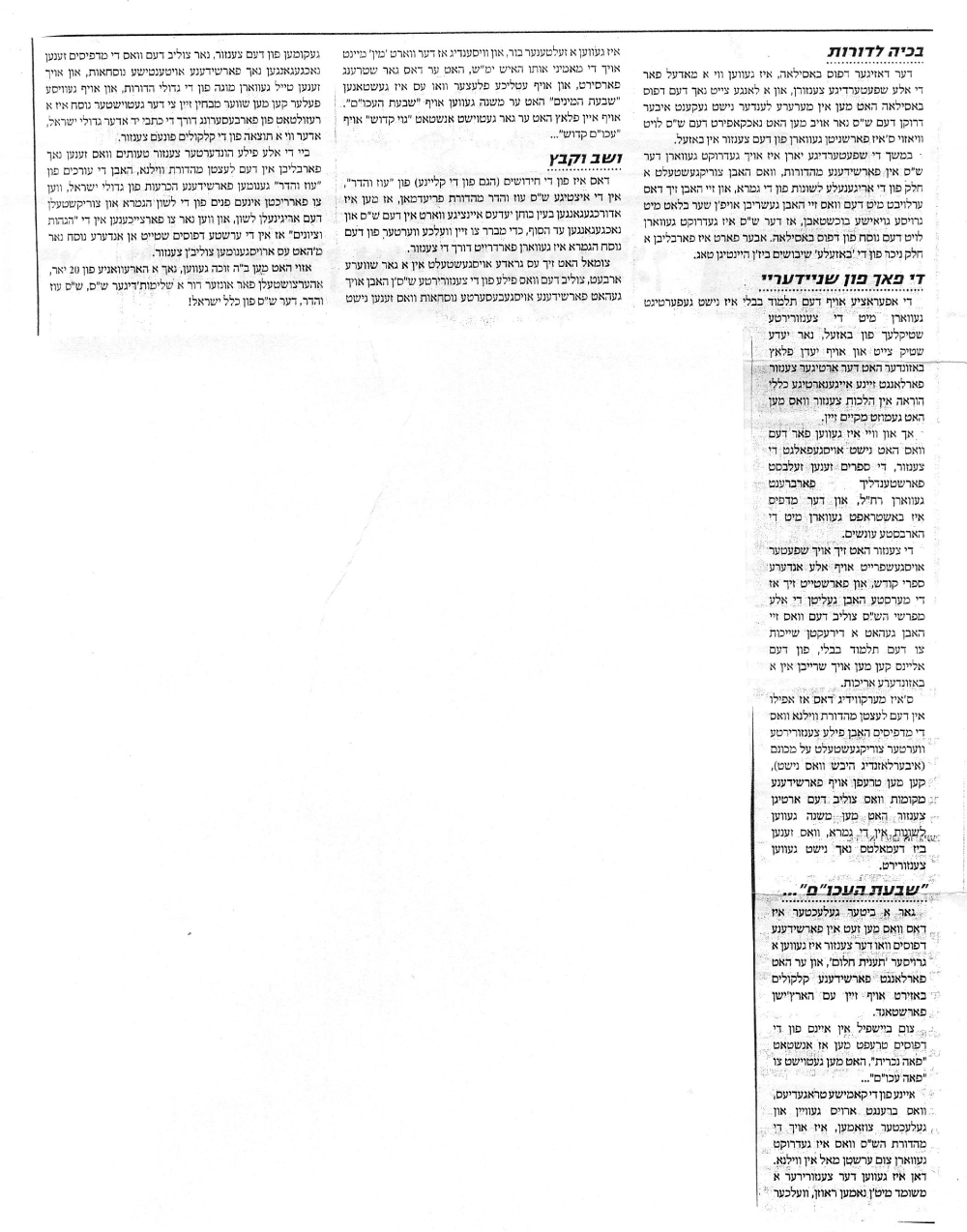
ר’ שלום שי’ אבערלאנדער העביר לי צילום מאמר שהופיע בעיתון באידיש שיצא לאור בניו
יארק (‘דער איד’ ה’ טבת תשס”ח, צווייטע אפטיילונג ב/36), לכבוד סיום עריכת
והדפסת הש”ס מהדורת ‘עוז והדר’.
מגולל חלק מההיסטוריה של הצנזורה בהדפסות התלמוד. ושוב מספר שעורכי ‘עוז והדר’ היו
להם ספיקות גדולות האם להחזיר עטרה ליושנה ולנקות את התלמוד משיבושי הצנזורה, ועל
כן הם פנו להגאון ר’ יצחק טובי’ ווייס שליט”א גאב”ד העדה החרדית
בירושלים, שהכריע נגד זה, כיון שגם היום יש לחשוש מעלילות מצד הנכרים למיניהם.
מאד באמיתות הסיפור, נוסף לזה שידיעה חשובה זו לא מופיעה ב’מבוא’ הנ”ל, הרי
לפי שיטה זו מה הועילו חכמים בזה שלא החזירו את ההשמטות למקומם, הרי אחרי שאלו
מופיעים בלשונם בשולי הגליון, הרי שוב יש לחשוש מפגיעתם רעה של מחפשי רעתנו.

הצנזורה בש”ס ‘נהרדעא’, בהוצאת ‘עוז והדר’ ובפירוש ‘שוטנשטיין’
מג, א אודות משפט ישו
ותלמידיו הוא ודאי הדוגמא הכי בולטת על אופן ההתייחסות לדברים שנשמטו מפני צנזורה.
‘נהרדעא’ החזירו את ההשמטה למקומה בפנים הגמרא, ובהערה (אות י) העירו: “מכאן
ועד סוף העמוד הושמט ע”י הצנזורה ונוסף כאן ע”פ ויניציאה ר”פ
וס”א”.
‘עוז והדר’ לא החזירו את ההשמטה למקומה, אמנם העתיקו את זה ב’הגהות וציונים’ (אות
ב): “בדפו”י (שלפני הצענזור) נוסף… (כל הענין נשמט בדפוסים מפני
הצענזור והעתקנוהו מדפו”י עם הוספות ותיקונים ע”פ כת”י)”.
בלה”ק נדפס “תבנית ש”ס ווילנא מהדורת עוז והדר” מהדורה קמא
(שבו לא מופיע מדור ‘הגהות וציונים’) ששם זה לא מופיע. ובעמוד שממול בפירוש סתמו כתבו:
“המשך הדיון בענין אינו מופיע לפנינו בגמרא”. והוסיפו בשוה”ג (הערה
38): “בגירסת הש”ס של הדפוסים שלפנינו, חסר בגמרא החלק הבא אחר שאלה זו.
לנוסח השלם של הדברים, ראה דקדוקי סופרים”. הקורא אינו מקבל אפילו רמז לתוכן
ההשמטה הארוכה.
לפי סדר הש”ס עוד דוגמאות שונות להשמטות ותיקונים והאופן שבו זה מופיע
בהוצאות השונות.
א: וקורין עשרת
הדברות שמע והיה אם שמוע ויאמר אמת ויציב ועבודה וברכת כהנים. אמר רב יהודה אמר
שמואל: אף בגבולין בקשו לקרות כן, אלא שכבר בטלום מפני תרעומת המינין (שלא יאמרו
לעמי הארץ אין שאר תורה אמת, ותדעו שאין קורין אלא מה שאמר הקב”ה ושמעו מפיו
בסיני. רש”י). ומפרש רש”י: “המינין. עכו”ם”.
ונציה נדפס (תחילת ע”ב): “המינין – תלמידי ישו”.
‘נהרדעא’ העירו (אות ט): “בס”א: תלמידי ישו”.
‘עוז והדר’ העירו (אות ז): “בדפו”י: תלמידי ישו”.
בלה”ק פירשו: “מפני תרעומת מינין (עובדי עבודה זרה)”, והרחיבו על
כך בשוה”ג (הערה 3): “רש”י. ואין הכוונה כאן לאותם ה’מינים’
הנזכרים לקמן עמוד ב, ובמקומות אחרים, שהם יהודים המאמינים בתורה שבכתב אלא
שכופרים בקבלת חז”ל והופכים דברי התורה שלא כהלכה. [עיין צל”ח
ומהר”ץ חיות; ועיין גם מגדים חדשים.]”
הדברים: הצל”ח מדייק בלשון רש”י שפירש “המינין. עכו”ם”,
שבא לשלול מינין שמאמינים בתושבע”פ. אמנם ה’מגדים חדשים’ העיר: “הצל”ח
כתב דבריו לפי מש”כ ברש”י לפנינו המינין עכו”ם. אמנם אין זה מלשון
רש”י, אלא הוא ‘תיקון’ מעשה ידי הצנזור” (וכן העירו על כך בהערה טו בצל”ח
שי”ל ע”י מכון ירושלים). ולפי
הגירסא האמיתית ברש”י הרי גם המינין שבעמוד א, וגם המינין שבעמוד, שניהם הם
תלמידי הנוצרי.
ב: פרשת ציצית מפני
מה קבעוה? אמר רבי יהודה בר חביבא: מפני שיש בה חמשה דברים: מצות ציצית, יציאת
מצרים, עול מצות, ודעת מינים, הרהור עבירה, והרהור עבודה זרה וכו’. והרהור עבודה
זרה מנלן? דתניא: אַחֲרֵי לְבַבְכֶם [במדבר
טו, לט] – זו מינות.
ופרש”י: “ההופכים טעמי התורה למדרש טעות ואליל”.
ונציה נדפס (דף יג, א): “תלמידי הנוצרי ההופכים טעמי התורה למדרש טעות ואליל”.
‘נהרדעא’ העירו (אות מ): “בס”א: תלמידי הנוצרי”.
‘עוז והדר’ העירו (אות ח): “בדפו”י: תלמידי ישו הנוצרי”.
בלה”ק לא העתיקו דברי רש”י, וסתמו לכתוב: “שלא להתבונן בדברי
מינות”.
ב: אין פרץ – שלא תהא
סיעתנו כסיעתו של דוד שיצא ממנו אחיתופל, ואין יוצאת – שלא תהא סיעתנו כסיעתו של
שאול שיצא ממנו דואג האדומי, ואין צוחה – שלא תהא סיעתנו כסיעתו של אלישע שיצא
ממנו גחזי, ברחובותינו – שלא יהא לנו בן או תלמיד שמקדיח תבשילו ברבים.
ונציה נדפס (דף יח, א): “תלמיד שמקדיח תבשילו ברבים, כגון הנוצרי”.
‘נהרדעא’ לא תוקן ואף לא העירו ע”ז.
‘עוז והדר’ העירו (אות ב): “בדפו”י ובכת”י ובע”י נוסף: כגון
ישו הנוצרי”.
בלה”ק לא העירו כלום.
ב–נז, א: אונקלוס
בר קלוניקוס בר אחתיה דטיטוס הוה, בעי לאיגיורי, אזל אסקיה לטיטוס בנגידא וכו’. אזל
אסקיה לבלעם בנגידא וכו’. אזל אסקיה בנגידא לפושעי ישראל וכו’.
ונציה נדפס: “אזל אסקיה לישו בנגידא”.
‘נהרדעא’ העירו (אות ב): “בס”א: ליש”ו”.
‘עוז והדר’ העירו (אות ג): “צ”ל אסקיה לישו בנגידא (דפו”י לפני
הצענזור)”.
בלה”ק פירשו: “ועלה באוב אחד מפושעי ישראל”, והרחיבו על כך
בשוה”ג (הערה 4): “לפי כתבי יד ודפוסים ישנים, מדובר בתלמיד רבי יהושע
בן פרחיה שיצא לתרבות רעה והסית והדיח את ישראל (ראה סוטה מז, א; סנהדרין קז,
ב)”.
א: אמר רבי יוחנן:
אין מושיבין בסנהדרי אלא בעלי קומה, ובעלי חכמה, ובעלי מראה, ובעלי זקנה, ובעלי
כשפים. ופרש”י: “להמית מכשפים הבוטחים בכשפיהם להנצל מידי בית דין,
ולגלות על המכשפין המסיתין ומדיחין בכשפיהן, כגון המצרים“.
ונציה נדפס: “כגון [ישו] הנוצרי”.
‘נהרדעא’ העירו (אות י): “בס”א: נוצרי או הנוצרים”.
‘עוז והדר’ העירו (אות נ): “צ”ל כגון ישו נוצרי (דק”ס ע”פ
דפו”י שלפני הצענזור)”.
בלה”ק סתמו ולא העירו כלום.
ב: תנו רבנן לעולם
תהא שמאל דוחה וימין מקרבת. לא כאלישע שדחפו לגחזי בשתי ידים.
ונציה נוסף בסוף דברי הברייתא: “ולא כרבי יהושע בן פרחיא שדחפו לישו בשתי ידים”.
‘נהרדעא’ הוסיפו את זה בגליון (אות ז), וכתבו בסוף: “הושמט ע”י הצנזורה
ונוסף כאן ויניציאה ר”פ וס”א”.
‘עוז והדר’ הוסיפו את זה בגליון (אות ג) וכתבו: “בדפו”י (לפני הצענזור)
נוסף…”.
ראה לקמן דוגמא ז.
הגמרא שם נוסף בדפוס ונציה: ר’ יהושע בן פרחיה מאי היא? כדקטלינהו ינאי מלכא לרבנן
אזל רבי יהושע בן פרחיה וישו לאלכסנדריא של מצרים. [ובהמשך מובא סיפור ארוך שקרה
בין הרב והתלמיד.]
‘נהרדעא’ הוסיפו את זה בתוך דברי הגמרא, ובגליון (אות ט) כתבו: “מכאן עד את
ישראל הושמט ע”י הצנזורה והועתק ע”פ ויניציאה ר”פ וס”א”.
‘עוז והדר’ הוסיפו את זה בגליון (אות ג) וכתבו: “בדפו”י (לפני הצענזור)
נוסף…”.
בלה”ק הוסיפו תוכנו של קטע זה והקודם (דוגמא ז) בשוה”ג (הערה 17) בהשמטת
שמו התלמיד, וכתבו: “בהשמטות הש”ס מובא מקרה נוסף של רב שדגחה את תלמידו
בשתי ידיו והתוצאות הקשות שיצאו מאותה דחיה…”.
העריכה במהדורות השונות
‘עוז והדר’ אפשר
להבחין בשיטה עקבית. ה’מהדורה קמא’ שלהם, שבו לא מופיע מדור ‘הגהות וציונים’, היתה
העתק מושלם של ש”ס ווילנא וההוצאות הקודמות לו, כולל כל השמטות הצנזור
והתיקונים שנשארו בתוך הטקסט בלי להעיר עליהם. גם ב’מהדורה בתרא’ שלהם לא תיקנו
כלום בתוך הטקסט של הגמרא או של פירושי הגמרא, אבל במדור ‘הגהות וציונים’ העירו באופן
עקבי על כל השינויים והעתיקו אותם בלשונם, ואף נתנו לקורא להבין שהשינויים הללו
קשורים ל”דפו”י שלפני הצענזור”.
‘נהרדעא’ אין שיטה
עקבית. יש שהחזירו את ההשמטה לתוך דברי הגמרא (דוגמא א), אמנם לפעמים השמיטו גם הם ואף לא העירו על
כך (דוגמא ד), אמנם ברוב המקרים לא החזירו את ההשמטה
לתוך דברי הגמרא אמנם העירו על השינויים בגליון והעתיקו אותם בלשונם (דוגמאות ב-ג, ה-ו). ויש שבאותו עמוד עצמו החזירוו קטע אחד
לתוך דברי הגמרא וקטע אחר העתיקו רק בגליון (דוגמאות
ז-ח). ברוב המקרים אין
לומד מבין ממה נובעים השינויים ש”בס”א [=בספרים אחרים]”, אמנם יש
והם מגלים שזה קשור לצנזורה (דוגמאות ז-ח).
בלה”ק החליטו
שאין להזכיר את שמו של הנוצרי כלל וכלל, ועל כן יש שמשמיטים לגמרי קטעים מהגמרא (דוגמא א, ד, ו), ויש שמצטטים את התוכן (ולא את לשון
הגמרא!) אבל משמיטים את שמו (דוגמא ה,
ח). בפירושם יש
שמתעלמים מדברי רש”י הלא מצונזרים (דוגמא
ג), ועוד יותר תמוה
לפרש לפי הגירסא המצונזרת דוקא (דוגמא ב)[5].
שלפעמים כן מעירים לשיבושי הצנזורה וכגון: “הגירסא שלפנינו ‘לכותים’ היא
משיבושי הצנזורה, וצריך לומר ‘לגוים'” (ביצה
כ, ב הערה 16),
“כידוע ‘לעובדי כוכבים’ הוא משיבושי הצנזורה, וצריך לומר כאן ובכל הסוגיא
להלן ‘לגוים'” (שם כא, א
הערה 24). אמנם מסיימים:
“לא שינינו בפנים את הגירסא שלפנינו” (הוריות יא, א הערה 37).
רש”י” מיוסד על שיבושי הצנזורה
עורכי מהדורת ‘עוז והדר’ להעיר על השינויים רק ב’הגהות וציונים’ גורם לטעויות,
וכגון בראש השנה (יז, א), ששם אומרת הגמרא ש”המינין… יורדין לגיהנם
ונידונין בה לדורות”, מפרש רש”י (כפי שנדפס בדפוסים שלפנינו):
“האנשים אשר הפכו דברי אלהים חיים לרעה, כגון צדוקים ובייתוסים”, ובצדק
העירו שם במהדורת ‘עוז והדר’ (הערה ע) שהגירסא הנכונה היא: “תלמידי ישו
הנוצרי אשר הפכו דברי אלהים חיים לרעה”.
ב’ליקוטי רש”י’ שם ליקטו מדברי רש”י בכמה מקומות בש”ס:
“המינין. עכו”ם [ברכות
יב.]. משרתים לעבודה
זרה [שבת קטז.]. שאינם מאמינים לדברי רז”ל כגון
צדוקים [חגיגה ה:]. תלמידי ישו שאינם מאמינים לדברי רבותינו
זכרונם לברכה [שם
ע”פ רש”י ישן]. כומרין
לעבודת כוכבים בין עובדי כוכבים בין ישראלים [ע”ז כו:]”[6].
מהציטוטים אלו אינם אלא משיבושי הצנזורה, וכך זה יראה באם נגיה אותם ע”פ
הדפו”י שרובם נעתקו ב’הגהות וציונים’: “המינין. עכו”ם תלמידי ישו
[ברכות יב.]. משרתים משומדין לעבודה זרה [שבת קטז.]. שאינם מאמינים לדברי רז”ל כגון צדוקים
[חגיגה ה:]. תלמידי ישו שאינם מאמינים מודים לדברי
רבותינו
זכרונם לברכה חכמים [שם ע”פ רש”י ישן]. כומרין לעבודת כוכבים לעבודה זרה
בין עובדי
כוכבים גוים בין ישראלים [ע”ז כו:]”.
קֹדֶשׁ לְקֹדֶשׁ.
‘חסרונות הש”ס’, ראשון ביניהם אמ”ד תס”ט. ולא ראיתי זכרם במקום
אחר.
ב’ספרים-בלוג‘ שם (הערה
28) ציין שכדברים האלו נמצא כבר ב”כתב התנצלות ותשובה מחכמי פראג על הדפסת
התלמוד עם השמטות בשנת תפ”ז לפ”ק” (נתפרסם ב’המגיד’ י”ח סיון
תרל”ז עמ’ 199), וכך כתבו: “…דעת מהרש”ל להחמיר אף במקום סכנה.
אמנם מעשים בכל יום שמהפכין הדין ומשנין מדרכי השלום בהפקעת הלואה וכדומה, ולא
שמענו פוצה פה לעולם. וכן נראה היפוכו בדברי מהר”ם רבק”ש [ב’באר הגולה’]
בש”ע ח”מ סי תכ”ה [ס”ק ש] ודברים המה מועתקים בספרים רבים”.
“סעיפים שלימים וביאורים ארוכים שב’קונטרס אחרון’ נשמטו בעטיית
הצנזורה”. והוא ערך שם (עמ’ לז-מז) רשימה של רוב ההשמטות והשינויים של
הצנזורה.
זה כמובן טעות, ואדרבה, וכפי שכתב הרנ”נ רבינוביץ ב’מאמר על
הדפסת התלמוד’ (עמ’ עז במהדורת הברמן): “ותחת המלה תלמוד נדפס שם גמרא או
ש”ס או למוד”.
מפורט למהות הצדוקים, מיוסד על שיבוש הצנזורה “אמר ליה ההוא צדוקי”,
במקום הגירסא הנכונה: “אמר ליה ההוא מינא”. הערה זו נשמטה מ’שוטנשטיין’
בלה”ק שם.
‘שוטנשטיין’ בלה”ק שם נמשכו אחרי ‘עוז והדר’ וכתבו בפירושם:
“אנשים המסלפים את התורה להפוך דברי אלהים חיים לרעה, כגון הצדוקים וכתות
אחרות כמותם”, וציינו מקורם (הערה 8): “עיין ליקוטי רש”י”.
Tikkun Olam Revisited
Tikkun Olam Revisited
Shmuel Lesher
Shmuel Lesher is the assistant rabbi of the BAYT in Toronto, Canada. You may reach him at shmuel.lesh@gmail.com.
Tikkun Olam, translated as either “healing the world” or “repairing the world” is a phrase that evokes a variety of reactions today. This two-word Hebrew phrase has become known to many even outside of the Jewish world as the Jewish term for social action. In fact, while President of the United States, Barak Obama invoked tikkun olam in a speech he delivered in Israel in 2013.[1]
Notwithstanding the terms’ acclaim, there have been those who have severely criticized its popularity. In 2018, Jonathan Neumann, in his book To Heal The World? How the Jewish Left Corrupts Judaism and Endangers Israel writes that the “tikkun olam movement” (a term he coined) is one that is born out of a rejection of traditional Jewish law and practice is synonymous with a politically leftist agenda. In his words:
Tikkun olam has no basis in Judaism. It was conceived by Jews who rejected the faith of their fathers and midwifed by radicals who saw it as a pretext to appropriate Jewish texts and corrupt Jewish rituals — such as the Pesach Seder — to further political ends. Tikkun olam represents…for all the talk of liberation, the enslavement of Judaism to liberal politics.[2]
Neumann argues that the current popularity of tikkun olam actually undermines Jewish peoplehood and “gives sanction to Anti-Zionism and assimilation.”[3]
Neumann is right and he is wrong. He is right that many have used tikkun olam to further their own political agenda without much of a basis in traditional Torah sources. He is also correct to challenge those who have jumped onto the tikkun olam bandwagon. As none other than Rabbi Jonathan Sacks, a vocal advocate for tikkun olam and social action himself, has noted, for some, “social justice has become a substitute for religious observance or G-d.”[4]
This trend is further evidenced by Jack Wertheimer, a professor of American Jewish history at the Jewish Theological Seminary of America and its former provost:
The large majority of non-Orthodox Jews have internalized a very contemporary set of values and ways of thinking about ethical decision making indistinguishable from those of their non-Jewish peers. They have been encouraged in this direction by religious leaders who invented a new commandment in the 1980’s — the injunction to engage in tikkun olam…Whatever act a Jew undertakes in a well-meaning way has come to be seen as an act of tikkun olam.”[5]
However, Neumann is wrong to assert that tikkun olam, a concern for the welfare of general society, has no basis in Judaism.
Granted, as R. Jonathan Sacks has argued in the context of “progress” and Judaism’s view of social justice, “It is anachronistic to read back into ancient sources ideas that made their appearance centuries later.”[6] Some of the literature on tikkun olam suffers from this mistake. It is intellectually dishonest for an author to use the term “tikkun” used in Kabbalah and Jewish mysticism, or in the Aleinu prayer, “li-taken olam bi-malkhut shakay,” a hope for a world devoid of idol worship that recognizes one single G-d, and repurpose it to support the cause of feeding the hungry, universal health care, caring for those who suffered from AIDS, and other social justice causes.[7] Neumann is certainly on point by noting that the usage of the term “mipnei tikkun ha-olam” in the Talmud and in most of rabbinic literature refers to rabbinic enactments specifically for the Jewish community and not for the betterment of society at large – a far cry from the way in which the concept is used in Jewish social justice activism.[8] However, if one looks beyond the technical usage and context of this one term, there are certainly traditional sources for the importance of Jewish involvement in the betterment of general society.
A Light Unto the Nations
When one takes a look at the sources, from the Talmud until the contemporary halakhic literature, it is clear that the recognition that the Jewish people is charged with the improvement of mankind as a whole has widely been accepted among rabbinic scholars.[9]
There is a Breita (a Tannaic teaching) cited in Gittin (61a) that states that Jews are to support the gentile poor, visit their sick, and bury their dead along with the dead of Israel, and maintain their poor “mipnei darkei shalom, for the ways of peace.” Whereas some authorities interpret this phrase to mean that we adopt a non-discriminatory policy for these social issues in order to avoid non-Jewish animosity,[10] Rambam appears to see a far-reaching principle in the Mishnah. When codifying this law, his formulation is instructive:
Even with respect to Gentiles, our Sages admonish us (tzivu hakhamim) to visit their sick, bury their dead along with the dead of Israel, and maintain their poor as well as the Jewish poor in the interests of peace (mipnei darkei shalom). Behold it is written, “The L-rd is good to all, and His mercies are over all His works” (Psalms 145:9). It is also written, “Its ways are ways of pleasantness and all its paths are peace (vikhol netivoseha shalom)” (Proverbs 3:17).
Rambam is advocating for a positive obligation given to the Jewish community by Hazal to engender peace with non-Jews. Complementing this, Rabbeinu Bahya writes that “tzedek tzedek tirdof”, “one should chase after justice” (Deuteronomy 16:20) includes our obligation to act justly with non-Jews as well.[11]
Rabbi Elazar and Rabbi Yoḥanan state in Pesahim (87b) based on a verse in Hoshea (2:25), that the purpose for the exile of the Jewish people among the nations was so that converts would join them. The Maharsha interprets this to mean not to proselytize, but rather “to spread faith among idol worshipers.”[12] These sources clearly demonstrate a legal and moral concern for the nations of the world.
Going even further, Rabbi J. David Bleich notes, “There are sources indicating that the divine intent is that…the nations of the world adopt the standards that are normative for Jews.”[13] R. Bleich cites the positions of Rabbi Yaakov Ettlinger, the author of the Arukh Laner, Rabbi Samson Raphael Hirsch, and Rabbi Naftali Tzvi Yehuda Berlin, or the Netziv, in support of his thesis.
The Netziv, in a number of places, emphasizes the Jew’s obligation towards general society. In the introduction to Shemot in his Ha-amek Davar, he writes, “It is Hashem’s desire that [gentiles] study Scripture and for that reason [He] commanded it be translated into seventy languages.”[14] Netziv comments on the character of our Patriarchs who “conducted themselves with nations of the world, even…idolaters…with love and with concern for their benefit since that is what sustains creation.”[15] He also writes of the concept of being a “light unto the nations.”[16] In his words, “Israel was created to be an illumination to the nations [of the world] and to cause them to achieve knowledge of Hashem.”[17]
R. Ettlinger interprets the same concept of the Jewish people being a light unto the nations, as serving as a moral example to which they should aspire.[18] R. Ettlinger’s student, R. Samson Raphael Hirsch writes at length of the Jewish people’s obligation to serve as a moral example for all of mankind.[19]
In his landmark 1964 essay on interfaith dialogue, Rabbi Yosef Dov Soloveitchik writes of the double confrontation we face with those outside of our faith community:
We Jews have been burdened with a twofold task: we have to cope with the problem of a ‘double confrontation.’ We think of ourselves as human beings, sharing the destiny of Adam in his general encounter with nature, and as members of a covenantal community…In this difficult role, we are summoned by G-d, who revealed himself at both the level of universal creation and that of the private covenant, to undertake a double mission — the universal human and the exclusive covenantal confrontation.[20]
R. Soloveitchik refers to the Jewish commitment towards society, the “universal human covenant” as the “story [the non-Jewish faith community] already knows.” In his words:
We are human beings committed to the general welfare and progress of humanity, that we are interested in combating disease, in alleviating human suffering, in protecting man’s rights, in helping the needy, etc. – but also what is still unknown to it, namely our otherness as a metaphysical covenantal community.[21]
Notwithstanding the many Torah sources cited above supporting a commitment to the general welfare of society, as well as R. Soloveitchik’s words themselves, I have a feeling that this story is regrettably not known to many, neither in the non-Jewish faith community or in our community. [22]
The Seven Noahide Laws
The Talmud in Sanhedrin (56a) states that non-Jews are obligated in the seven Noahide laws. The Rambam emphasizes a Jew’s obligation to encourage non-Jews to adhere to the seven Noahide laws in the land of Israel.[23] In fact, the Rambam writes that the Jewish courts are obligated to establish judges for non-Jewish residents in order to enforce adherence to the Noahide Laws.[24]
Some contemporary poskim have strongly cautioned against publicizing and encouraging non-Jews to observe the Noahide Laws. Rabbi Moshe Sternbuch was staunchly opposed to Jews in any way encouraging non-Jews to observe the Noahide laws.[25] Although less adamant than R. Sternbuch, Rabbi Moshe Feinstein writes that, although it is permitted to teach the Noahide Laws to gentiles, it best not to publicize this.[26]
Rav Yosef states in Bava Kama (38a) that Hashem saw that the nations of the world were not observing the Noahide laws and therefore, He revoked the prohibitions and permitted them. Based on a number of verses, the Gemara connects Rav Yosef’s statement to the moment in history when Hashem chose to give the Torah to the Jewish people. There are a variety of explanations offered for this passage in the Talmud. The Hatam Sofer cites a ruling of the Pnei Yehoshua who explains this passage to mean that after the giving of the Torah, there is no obligation whatsoever for Jews to influence non-Jews to observe the Noahide Laws as they are no longer commanded to keep them.[27]
However, the Hatam Sofer himself disagrees and posits that the when Rav Yosef stated Hashem permitted the Noahide laws, he only meant to say that non-Jews no longer receive reward for their obligated observance of the Noahide laws, rather they receive reward like an “eino metzuveh,” someone who is not commanded, however they are still punished for violating what they are obligated in.[28] According to this reading of the Gemara, one could still argue that Jews should still encourage the observance of the Noahide Laws.
Rabbi Yosef Dov Soloveitchik, although not an advocate of interfaith dialogue within a religious context, somewhat surprisingly, does support teaching the Noahide laws:
The Torah was not given to non-Jews directly, but the Almighty has offered it to all of mankind indirectly, as a promise, a vision, an eschatological expectation, the ultimate end of history. The Torah was given to us so many millennia ago. Our task was and still is to teach Torah to mankind, to influence the non-Jewish world, to redeem it from an orgiastic way of living, from cruelty and insensitivity, to arouse in mankind a sense of justice and fairness. In a word, we are to teach the seven mitzvot that are binding on every human being.[29]
The strongest case for a Jew’s obligation to encourage non-Jewish observance of the Noahide laws can be found in the writings of Rabbi Menachem Mendel Schneerson, the Lubavitcher Rebbe, whose approach to social action will be analyzed in depth below. In a letter to Chaplain Brigadier General Israel Drazin, the Rebbe emphasized the importance of the Noahide laws and the Jewish community’s obligation to encourage the observance of these commandments.[30]
The Lubavitcher Rebbe: A 20th Century Hasidic Socio-Mystical Thinker and Social Activist
One contemporary Jewish thinker who took an active role in general society stands in a league of his own — the Lubavitcher Rebbe, Rabbi Menachem Mendel Schneerson. One would be hard-pressed to find a better example in the 20th century of someone who was both staunchly committed to authentic Torah values and at the same time dedicated to the betterment of general society than the Lubavitcher Rebbe. The Rebbe developed a comprehensive, holistic, and deeply spiritual mandate for what sociologist Philip Wexler refers to as the “resacralization” of society.
The Re-enchantment and Resacralization of Society
Borrowing from a term coined by Abraham Maslow, Wexler argues that today’s culture is in dire need of “resacralization,” a process of reintroducing values, creativity, emotion, and ritual into society. Instead of the social sciences and education in general assuming a totally secularized approach to the world, according to Wexler, we have now reached, what he deems to be, a post-secular era that demands a paradigm shift and a resacralization.[32]
Menorahs in the Public Square
The Rebbe’s campaign for the public lighting of Hanukkah menorahs is likely the most visible example of the Rebbe’s mission to bring spirituality, light, and a moral awareness to society at large. The public lighting of a giant menorah began in 1974 at the foot of Philadelphia’s Liberty Bell. By the late 1970’s, the practice began to gain visibility and traction. In fact, in 1979, President Jimmy Carter left a one-hundred-day self-imposed seclusion during the Iran hostage crisis in order to light the Chabad menorah in front of the White House.[33] But the Rebbe’s activities did not go without objections. In 1978, Rabbi Joseph Glaser, the head of the Central Conference of American Rabbis (CCAR), the organization of Reform Rabbis, penned a letter to the Rebbe criticizing the public display of religion:
It has come to my attention that the Lubavitcher Chassidim are erecting Hanukkiot and holding religious services in connection therewith on public property in various locations throughout the United States. This is as much a violation of the constitutional principle of separation of church and state as is the erection of Christmas trees…It weakens our hands when we protest this institution of Christian doctrine into the public life of American citizens and thus, it is really not worth the value received.[34]
In an additional letter, Glaser indicates the future legal efforts that were to come to the fore to stop the Menorah Campaign.[35] He ends his letter with an appeal to the Rebbe to end the menorah lightings immediately.[36] In the Rebbe’s response, he notes that there has already been positive acclaim observed over a number of years as a result of the menorah lightings:
The fact is that countless Jews in all parts of the country have been impressed and inspired by the spirit of Chanukah which has been brought to them, to many for the first time.[37]
Regarding the constitutional issue, an issue that emerged a number of times throughout his career, the Rebbe was more forceful and unequivocal:
I can most assuredly allay your apprehension on this score. I am fully certain that none of those who participated in or witnessed the kindling of a Chanukah Lamp in a public place (and in all cases permission was readily granted by authorities) felt that his or her loyalty to the Constitution of the U.S.A. had been weakened or compromised thereby…seeing that the U.S. Congress opens [its daily sessions] with a religious invocation…and surely the U.S. Congress, comprising each and every state of the Union, is the place where the Constitution…should be most rigidly upheld.[38]
In his final letter to the Rebbe, Glaser makes a new argument, one that may be quite surprising to today’s reader. Glaser notes that the Rebbe sees some intrinsic value in having Jews attend a public menorah lighting. Glaser counters, “Ultimately the survival of Judaism depends on the home.” It is there that the menorah should be lit. Having people observing the ceremony in public constitutes a “flamboyant religious exercise instead of sacred home ritual.”[39] It is more than ironic that a major figure in the very movement that champions contributing to general society as their raison d’etre, hence the centrality of tikkun olam, claimed that Judaism’s rituals should be relegated to the Jewish home.
Although it is not explicitly stated in the Glaser correspondence, the Rebbe’s advocacy of menorah lighting was rooted in his deeper conviction in the crucial role religion must play for society as a whole. In a 1990 worldwide menorah-lighting satellite event the Rebbe made this clear:
G-d gave each of us a soul, which is a candle that He gives us to illuminate our surroundings with His light…We must not only illuminate the inside of homes, but also the outside, and the world at large.[40]
The Educational Model of The Lubavitcher Rebbe
Building on the social theories of Max Weber and Emile Durkheim, Wexler argues in his groundbreaking work Social Vision: The Lubavitcher Rebbe’s Transformative Paradigm for the World, that religion, and specifically the socio-mystical community model of Habad Hasidim, has the potential to usher in a new social paradigm for society today.[41] Wexler documents that the Rebbe’s educational program provided the foundation for an all-encompassing revision of social policy and social life in the United States.[42]
The Lubavitcher Rebbe’s educational agenda made its way into the public square when in 1978 President Jimmy Carter acted upon a congressional resolution to declare R. Schneerson’s 76th birthday “Education Day, U.S.A.,” recognizing the Rebbe’s commitment to general education in the United States for over three decades.
This was a reflection of the active role the Rebbe took throughout his life in the advancement of education in American society. In 1960, R. Schneerson sent a four-person delegation to the White House Conference on Children and Youth where they argued that “children and youth be granted greater opportunities for specific religious education.”[43] A decade later, a fuller memorandum of Lubavitch policy proposal was entered into the Congressional Record. Here, the Rebbe’s vision for education in the United States is sharply articulated:
An educational system must have a soul. Children are not computers to be fed a mass of informational data, without regard for their human needs for higher goals and ideals in life.[44]
Yet, the Rebbe did not stop at what was taught in the classroom. His approach to educational policy is that it is equally important for an educational model to impact the homes, streets, and the entire social context of the students. According to Wexler, in the new social ethos of Hasidism, as conceived by R. Schneerson, lies an alternative to our current educational system. In such a model, using Wexler’s terminology, pedagogy can be seen as “initiatory, awakening, interactive…imaginative divinization.”[45]
The Non-Denominational Prayer
The Rebbe’s view of the paramount importance of an education with a soul was given concrete expression in his advocacy for non-denominational prayer in public school classrooms in the United States. In 1962, in the Supreme Court case Engel v. Vitale, this proposition was deemed unconstitutional.[46] The case sparked a great level of controversy about the nature of education in America and how schools should best negotiate the separation of Church and State. Many Jewish groups applauded the decision of the courts.[47] However, the Rebbe, in two powerful letters, one written in 1962 and one in 1964, made his position clear. I cite excerpts of the 1964 letter below at length because I feel it clearly shows the Rebbe’s passion about this issue:
Let me assure you at once that my view… [has] not changed…On the contrary, if there could have been any change at all, it was to reinforce my conviction of the vital need that the children in the public schools should be allowed to begin their day at school with the recitation of a non-denominational prayer, acknowledging the existence of a Creator and Master of the Universe, and our dependence upon Him. In my opinion, this acknowledgment is absolutely necessary in order to impress upon the minds of our growing-up generation that the world in which they live is not a jungle, where brute force, cunning and unbridled passion rule supreme, but that it has a Master Who is not an abstraction, but a personal G‑d; that this Supreme Being takes a “personal interest” in the affairs of each and every individual, and to Him everyone is accountable for one’s daily conduct.
Juvenile delinquency, the tragic symptom of the disillusionment, insecurity and confusion of the young generation, has not abated; rather the reverse is the case…The remedy lies in removing the cause, not in merely treating the symptoms. It will not suffice to tell the juvenile delinquent that crime does not pay, and that he will eventually land in jail (if he is not smart enough?). Nor will he be particularly impressed if he is admonished that law-breaking is an offense against society. It is necessary to engrave upon the child’s mind the idea that any wrongdoing is an offense against the Divine authority and order.
According to the Rebbe’s shrewd analysis, for most people, well-reasoned argumentation or rational decision making, is simply not enough of a foundation to compel the observance of universal moral standards. A deep and lasting moral sensibility is best cultivated through a more basic socio-spiritual sense of a personal relationship with the all-knowing G-d.[48]
The Rebbe was also a realist. He understood that if society was to change, it would not be enough to relegate his prayer to places of worship or synagogues. Prayer had to be brought to the masses, and especially to the children:
At first glance this seems to be the essential function of a house of prayer and of the spiritual leaders. However, anyone who does not wish to delude himself about the facts of house of prayer attendance, both in regard to the number of worshippers and the frequency of their visits, etc., etc., must admit that shifting the responsibility to the house of prayer will not correct the situation. Nor can we afford to wait until the house of prayer will attain its fitting place in our society, and in the life of our youth in particular, for the young generation will not wait with its growing-up process.
Children have to be “trained” from their earliest youth to be constantly aware of “the Eye that seeth and the Ear that heareth.” We cannot leave it to the law-enforcing agencies to be the keepers of the ethics and morals of our young generation. The boy or girl who has embarked upon a course of truancy will not be intimidated by the policeman, teacher or parent, whom he or she thinks fair game to “outsmart.” Furthermore, the crux of the problem lies in the success or failure of bringing up the children to an awareness of a Supreme Authority, Who is not only to be feared, but also loved. Under existing conditions in this country, a daily prayer in the public schools is for a vast number of boys and girls the only opportunity of cultivating such an awareness.
The Rebbe wholeheartedly believed in the civic utility of prayer. In his view, a more prayerful and soulful education for America’s youth would lead to a more moral America. Accordingly, the Constitution should not be a barrier to the best interests of the country:
To oppose non-denominational prayer “on constitutional grounds” is, in my opinion, altogether a misunderstanding or misrepresentation of the problem. The issue is: Whether a non-denominational prayer wherewith to inaugurate the school day is, or is not, in the best interests of the children. If the answer is “yes,” then obviously it should be made constitutional, for there can be no difference of opinion as to the fact that the Constitution has been created to serve the people, not vice versa.[49]
Following the establishment of “Education Day, U.S.A.” in 1978, the Rebbe delivered a talk at a farbrengen in his Brooklyn synagogue to mark the occasion. In this address, the Rebbe stated that the Torah requires Jews to pay attention to the nation’s educational concerns and not merely to ensure that their own community’s educational needs are met.[50]
In an even broader vision, the Rebbe advocated strongly for a new and independent department of education. Well ahead of his time, the Rebbe encouraged the raising of teacher’s salaries and more federal spending to improve the public schools. He believed this would in turn cause diminishing expenses in the penal system, crime prevention, health and welfare. In the Rebbe’s words, “A morally healthy, strong and united nation is in itself a strong deterrent against any enemy.”[51] Remarkably progressive, as part of his broad vision for a healthy and morally strong society, the Rebbe also advocated for criminal justice reforms, creating alternative energy sources, especially solar energy.[52]
The Moment of Silence Initiative
Later, in 1981, after the election of Ronald Reagan to the presidency, the debate over the non-denominational prayer took off once again. In May 1982, Reagan proposed an amendment to the constitution that would support non-denominational prayer. While the Rebbe supported this, he understood that it would be the subject of much debate and may never be enacted. Therefore, at this time he vied for the establishment of a daily moment of silence in the public schools which he thought had the potential to gain more support.
In a 1983 talk the Rebbe delivered, he voiced his support for a moment of silence and also stressed the need for parents to contribute to their children’s education:
The actual situation in this country is that parents have no time — and even those who do have the time do not have the patience — to invest themselves in the education of their children.[53]
The Rebbe’s solution to this was a moment of silence each and every morning in school before classes or instructions began. According to Wexler and other scholars, the moment of silence initiative created an opening for a post-secular turn in education. According to the Rebbe, the teacher’s role during the moment of silence is not to fill it with educational content but rather to “empower the students to go beyond all the normative axioms of education and find their own ways to make good use of an educational opportunity of an entirely different sort.”[54] More broadly speaking, the Rebbe’s support of the moment of silence represents his universalization of contemplative prayer within broader society. Here again we see a shift within the Rebbe’s worldview, of how a successful educational model is to be imagined.
The Contemporary Scene
The Lubavitcher Rebbe notwithstanding, R. J. David Bleich has noted that most community activities done on behalf of tikkun olam have been done in the non-Orthodox camp. He attributed the apparent neglect of broader social causes in the Orthodox community to their manifold commitments to intra-communal values such as Jewish Education, Kashrus, and other important religious activities that take up much time, energy, and attention.[55]
While it may be true that the Orthodox community has a variety of additional community causes that vie for their attention not held by their non-Orthodox brethren, I believe there is a deeper reason for the Orthodox community’s hesitation about involvement in social action. For thousands of years, the Jewish people have been the victims of discrimination, oppression, and antisemitism from the non-Jewish world. This tragic history has caused us to collectively develop a form of communal isolationism as a defense mechanism. Perhaps this is why, on the whole, and understandably so, more traditional communities have generally steered away from taking any active role in promoting religion or values in the public square.
A few notable exceptions should be made. R. Jonathan Sacks is a towering exception to this rule. A central theme within the career and thought of R. Sacks is the belief in Judaism’s ability and obligation to influence general society. R. Sacks argued that, if understood properly, religion, and particularly Judaism, can be a source of developing a shared and collective vision for society at large.[56] Often in his writings, he emphasized the importance of religion on the world stage arguing that “a Judaism divorced from society will be a Judaism unable to influence society or inspire.”[57]
There have been others as well. The chief rabbi of South Africa, Rabbi Warren Goldstein has worked to bring the voice of religion and values into the public school system in South Africa. In 2008, as part of the National Religious Leaders Forum, he played a major role in drafting a “Bill of Responsibilities for South African Youth.”[58] However, these exceptions prove the rule. For the most part, the frum community has not taken an active role in the betterment of society at large.
Although this is understandable, considering our troubled history with society at large, there can be some collateral damage. Over twenty years ago, Rabbi Berel Wein told interviewer and author Faranak Margolese of the book Off the Derech, that he sees a lack of interest in general society and its issues as a contributing factor for today’s youth leaving a life of Torah and mitzvot. In his words:
To a great extent, I think one of the greatest problems that Orthodoxy faces is that it doesn’t promise anything. It should. On an individual basis perhaps it does; but [not] on a national basis. I mean let’s say everybody would vote for the Orthodox parties tomorrow. What would be its platform? What are we going to do? We have no idea. The Torah [has ideas], but someone has to articulate them. What’s our attitude toward labor unions? What’s our attitude toward the poorer section of society? Toward the Arabs? Toward anything? So now the attitude is: do Torah and mitzvot. But doing Torah and mitzvot is not a foreign policy and it’s not a domestic policy either. We don’t promise anything to anyone…We don’t say that we are going to fix the world; we don’t say those things even though it is part of our heritage, even though that’s part of Torah. We don’t express it. It could be the reason we don’t is that we have been under attack for so long; we have been the minority of a minority so we can’t afford grandiose dreams. But I think that if we don’t express grandiose dreams, we doom ourselves to remain the minority within the minority.”[59]
If as a community, we do not want to remain “the minority within the minority,” devoid of any public policy at the national or global level, it would do us well to consider an alternative model. Tikkun Olam, perhaps more accurately understood as care and concern for the society in which we live, is not our only priority. However, following the Lubavitcher Rebbe’s example, more attention must be placed on it. In the last century, Orthodox leaders and public figures, including the Rebbe, R. Sacks, and R. Goldstein have made significant contributions to betterment of general society but there is still more work to be done.
[1] “Remarks of President Barack Obama To the People of Israel at the Jerusalem International Convention Center in Jerusalem” Obamawhitehouse.archives.gov (March 21, 2013).
[2] Jonathan Neumann, To Heal The World? How the Jewish Left Corrupts Judaism and Endangers Israel (All Points Books, 2018), xvi-xvii.
[3] Ibid. xvii.
[4] R. Jonathan Sacks, To Heal a Fractured World (Schocken, 2005), 9.
[5] Jack Wertheimer, The New American Judaism (Princeton University Press, 2018), 41. Also see Paul David Kerbel, “The Tikkun Olam Generation,” Conservative Judaism 61(3) (January 2010), 88-91. For more on the misuse of the term, see Rabbi Yitzhak Aharon Korff, “The Fallacy, Delusion and Myth of Tikkun Olam,” Jewish News Syndicate (June 3, 2013) (https://www.jns.org/the-fallacy-delusion-and-myth-of-tikkun-olam/).
[6] R. Sacks, To Heal a Fractured World 78-79.
[7] Jane Kanarek, “What Does Tikkun Olam Actually Mean?” In Or N. Rose, Jo Ellen Green Kaiser, Margie Klein (ed.), Righteous Indignation: A Jewish Call For Justice (Jewish Lights Publishing, 2008), 19-22.
With regards to Aleinu, Mitchell First argues that a very strong case can be made that the word “letaken” in the original version of Aleinu was actually written with a khaf (meaning to establish the world under G-d’s sovereignty), and not with a kuf (meaning to perfect/improve the world under God’s sovereignty). See Mitchell First, “Aleinu: Obligation to Fix the World or the Text?” Hakirah, Vol. 11 (Spring 2011), 187-197.
[8] Neumann 133-135. The content of the Talmudic enactments referred to as “mipnei tikkun ha-olam,” are generally additional rabbinic rulings made to account for and circumvent potentially negative outcomes of previous legislature for the Jewish community. For examples of Talmudic applications of the term see Gittin 33a-35a and Gittin 45a. Neuman cites many scholars who have noted the incorrect usage of the term tikkun olam to refer to Jewish social action. See Eugene Borowitz, Renewing the Covenant: A Theology for the Postmodern Jew (Jewish Publication Society, 1996), 51; Gilbert S. Rosenthal, “Tikkun ha-Olam: The Metamorphosis of a Concept,” Journal of Religion, Vol. 85, no. 2 (2005); Levi Cooper, “The Assimilation of Tikkun Olam,” Jewish Political Studies Review 25 no. 3-4 (Fall 2014).
[9] See Rabbi J. David Bleich, The Philosophical Quest (Maggid, 2013), 209-252.
[10] See for example Ramban, Bava Metzia 78b.
[11] Rabbeinu Bahya, Kad Ha-kemah, Gezel 1:3.
[12] Maharsha, Pesahim 87b s.v. lo higlah.
[13] R. Bleich, Philosophical Quest 236-237.
[14] Netziv, Kidmat Ha-emek. Translation adapted from R. Bleich 238.
[15] Netziv, Ha-amek Davar, Introduction to Bereishit. Translation adapted from R. Bleich 243.
[16] Isaiah 49:6.
[17] Netziv, Ha-amek Davar, Shemot 12:51. Also see Netziv, Harhev Davar, Bereishit 17:4 and Ha-amek Davar, Bereishit 9:27.
[18] R. Yaakov Ettlinger, Minhat Ani, Bamidbar. See R. Bleich, Philosophical Quest 236-237.
[19] See R. Bleich 239-246. For more on R. Hirsch’s belief in Judaism’s concern for mankind as a whole see my “For the Love of Humanity: The Religious Humanism of Rabbi Samson Raphael Hirsch,” Hakirah, Vol. 33 (Fall 2022), 65-98.
[20] R. Joseph B. Soloveitchik, “Confrontation,” Tradition 6:2 (RCA, 1964) republished in R. Joseph B. Soloveitchik, Confrontation and Other Essays (Maggid, 2015), 100.
[21] Ibid., 104.
[22] For more see David Shatz, Chaim I. Waxman, Nathan J. Diament (ed.) Tikkun Olam: Social Responsibility in Jewish Thought and Law (Aronson, 1997); Yosef ben Shlomo Hakohen, The Universal Jew (Feldheim, 1995); Rabbi Netanel Wiederblank, “Our Responsibility To Humanity,” Yadrim 4, (Sivan 5782), 5-29; R. Jonathan Sacks, “Tikkun Olam: Orthodoxy’s Responsibility to Perfect G-d’s World” (Speech delivered at the Orthodox Union West Coast Convention, December 1997 – Kislev 5758); Rabbi Dr. Jacob J. Schacter, “Tikkun Olam: Defining the Jewish Obligation,” in Rafael Medoff, ed., Rav Chesed: Essays in Honor of Rabbi Dr. Haskel Lookstein, vol. 2 (Jersey City: Ktav, 2009), 183-204.
[23] Rambam, Mishneh Torah, Melakhim 8:9-10.
[24] Rambam, Mishneh Torah, Melakhim 10:11.
[25] R. Moshe Sternbuch, Teshuvot Vi-hanhagot Vol. 3 no. 317.
[26] R. Moshe Feinstein, Igrot Moshe, Yoreh Deah Vol. 3 no. 89.
[27] Teshuvot Hatam Sofer, Hoshen Mishpat, Vol. 5, no. 185.
[28] Ibid. Whether non-Jews are obligated in the Noahide laws after the giving of the Torah is the subject of an earlier debate. Tosafot in Hagigah (13a) rule that although it is forbidden to teach Torah to non-Jews, there is no prohibition to teach them the Noahide laws. However, Tosafot cited in the Hagahot Ha-bah (Ibid. no. 40) disagree and state that after the giving of the Torah, gentiles are not obligated in the Noahide laws and there would be a prohibition of teaching them to non-Jews. For more on this see Dovid Lichtenstein, Headlines 2: Halachic Debates of Current Events (Orthodox Union Press, 2017), 125-128.
[29] Rabbi Joseph B. Soloveitchik, Abraham’s Journey (Ktav, 2008), 182. Thanks to my father-in-law, Rabbi Hanan Balk for pointing this source out to me.
[30] Letter to Israel Drazin from R. Menachem Mendel Schneerson (October 31, 1986). See “What Could Have Prevented the Holocaust, Chabad.org. For more statements of the Rebbe on the importance of encouraging non-Jews to observe the Noahide laws see R. Menachem Mendel Schneerson, “The Seven Noachide Laws,” Sichos In English Vol. 16 (Kislev-Nissan 5743). This talk was delivered on Shabbat Parshat Beshalach, 15th Day of Shevat, 5743 (1983). Also see “Reach Out to the Non-Jews”, Disc 31, Program 123 (Event Date: 4 Tishrei 5747 – October 07, 1986) Chabad.org.
[31] Feist and Feist: Theories of Personality, 7th edition, (The McGraw−Hill Companies, 2009), 303.
[32] Philip Wexler, Mystical Sociology: An Emerging Social Vision (Westview Press, 2000), 42-46.
[33] Joseph Telushkin, Rebbe (Harper Collins, 2014), 262.
[34] Jonathan Sarna and David G. Dalin, Religion and State in the American Jewish Experience (Notre Dame University, 1997), 288-300 cited in Telushkin 263-268.
[35] The most significant legal case made against public menorah lighting was brought before the Pennsylvania Supreme Court in 1989. See Allegheny County v. ACLU, 492 U.S. 573 (1989). Today, Chabad’s public menorah lightings have become normative in North American society. Several thousand public lightings take place every year under Chabad auspices with an increasing amount of non-Chabad and even non-Orthodox involvement. See Telushkin 269-270.
[36] Telushkin 264.
[37] Ibid. 265.
[38] Ibid. 266.
[39] Ibid. 268.
[40] Ibid. 269.
[41] Philip Wexler, Eli Rubin, and Michael Wexler, Social Vision: The Lubavitcher Rebbe’s Transformative Paradigm for the World (Herder & Herder, 2019).
[42] Wexler 148.
[43] Ibid. 149.
[44] Cong. Rec. – Volume 116, Part 33 (December 28, 1970, 43738) cited in Wexler 173n12.
[45] Wexler 152.
[46] Engel v. Vitale, 370 US 421 – Supreme Court (1962).
[47] Most, although not all, of the opposition to the public prayer came from the organized Jewish community. See Telushkin 255.
[48] The Rebbe’s point that morality cannot be properly developed merely by reason and rational thinking, is not dissimilar to sociologist Jonathan Haidt’s theory that moral development happens primarily through intuitive and emotional processes rather than cognitive and reason-based judgments. See Jonathan Haidt, “The Emotional Dog and its Rational Tail: A Social Intuitionist Approach to Moral Judgment,” Psychological Review, 108 (2001), 814-834.
[49] R. Menachem Mendel Schneerson, “Prayer in Public Schools and Separation of Church and State,” 26th of Nissan, 5724 (April 8, 1964) https://www.chabad.org/therebbe/letters/default_cdo/aid/2051611/jewish/Prayer-in-Public-Schools-and-Separation-of-Church-and-State.htm.
For the first letter see “Excerpt from the Lubavitcher Rabbi’s שליט”א Letter on the Question of the Regents Prayer, (24th of MarCheshvan, 5723, November 21, 1962)” Chabad.org
https://www.chabad.org/therebbe/letters/default_cdo/aid/1274011/jewish/Non-Denominational-Prayer-in-Public-Schools.htm.
[50] R. Menachem Mendel Schneerson, Sihot Kodesh 5738, Vol. 2 (Vaad Hanachot Hatemimim, 1986), 119-20.
[51] “Excerpt from a Letter by the Rebbe שליט”א on the Proposal Creation of a Special Department of Education,” in Report on “Education Day–U.S.A.” Legislation, 18-19 cited in Wexler 176n49.
[52] Wexler 194-217.
[53] R. Menachem Mendel Schneerson, “A Moment to Save the World – Part 2”: 10 Shevat 5743 (January 24, 1983) Chabad.org cited in Wexler 168.
[54] Wexler 171.
[55] R. J. David, Bleich, “Tikun Olam: A Jew’s Responsibility to Society,” YUTorah.org (Oct 26, 1988).
[56] See R. Jonathan Sacks, The Persistence of Faith (Weidenfeld & Nicolson, 1991. This book is an expansion on R. Sacks’s BBC Reith Lectures (1990).
[57] R. Jonathan Sacks, “A Judaism Engaged With The World” (2013). Also see his The Politics of Hope (Vintage, 1997); The Home We Build Together (Continuum, 2009); “Reconciling Religion’s Role in the West: An Interview with Rabbi Lord Jonathan Sacks,” Harvard International Review 38:1 (Fall 2016), 52-54 and Rabbi Yitzchok Alderstein, “How the Torah Helped Shape the Modern World,” Jewish Action (Fall 2010).
[58] Jonathan Rosenblum, “Hail to the Chief (rabbi),” Jerusalem Post (July 1, 2011). Also see the South African government’s website for the text of the “Bill of Responsibilities.” I thank Rabbi Daniel Korobkin for pointing this out to me.
[59] Faranak Margolese, Off The Derech (Devora, 2005), 202-203. The interviews with R. Wein were held on August 28, 2000 and January 8, 2001
Hirschian Humanism After the Holocaust: An Analysis of the Approach of Rabbi Shimon Schwab
Hirschian Humanism After the Holocaust:
An Analysis of the Approach of Rabbi Shimon Schwab
By Rabbi Shmuel Lesher
Rabbi Shmuel Lesher is a Machon Beren Kollel fellow at RIETS / Yeshiva University. Prior to completing his rabbinic ordination at RIETS, Rabbi Lesher studied at the Mirrer Yeshiva in Jerusalem and Yeshiva of Greater Washington in Silver Spring, Maryland. Rabbi Lesher lives in Washington Heights, with his wife Leora and their three children.
This is his first contribution to the Seforim Blog.
In 1959, Rabbi Shimon Schwab[1] made a unique contribution to the way his community and others commemorate the Holocaust. Shortly after he joined the rabbinate of K’hal Adath Jeshurun in Washington Heights, Manhattan, R. Schwab was asked by R. Joseph Breuer[2] to compose a special Tisha B’av kinnah for their kehillah. Although it was originally written for the KAJ community, many other congregations have adopted the custom of reciting it on Tisha B’av.[3] To be sure, there have been others who authored kinnot to commemorate the Holocaust.[4] However, it appears that, especially in America, R. Schwab’s kinnah is perhaps one of the first written by a rabbinic figure to gain widespread popularity.
In addition to his innovative Holocaust kinnah, the events of the Holocaust played a significant role in how R. Schwab interpreted and perpetuated the Torah Im Derekh Eretz philosophy to which he was heir. According to R. Schwab, Torah Im Derekh Eretz was seen by R. Samson Raphael Hirsch as the ideal model. However, openness to secular culture has historically been the minority opinion among gedolei yisrael.[5]
R. Schwab reached this conclusion after re-evaluating his position multiple times throughout his life. In a speech he delivered in 1990,[6] he recalled how the events of Kristallnacht (Nov 9, 1938 – Nov 10, 1938), and later the Holocaust, shook his belief in Torah Im Derekh Eretz to the core. How could R. Hirsch have believed the humanism of Germany would lead to an uplifted and righteous society when the same humanistic society ended up committed genocide without much protest from the “enlightened students of Schiller and Goethe?”[7] R. Hirsch must not have seen German humanistic Bildung[8] as anything more than a time-bound compromise in order to save his community from assimilation.[9] R. Schwab was referring to an essay he wrote in 1934 entitled Heimkehr ins Judentum (Homecoming To Judaism).[10] Here R. Schwab claimed R. Hirsch only intended Torah Im Derekh Eretz as a temporary allowance. This book was the first substantial rejection of Torah Im Derekh Eretz written by someone who grew up in the Hirschian community.[11]


An English version of this essay, prepared by K’hal Adath Jeshurun translator Gertrude Hirschler, appeared in 1978.[12]


Around the same time he published Heimkehr ins Judentum, R. Schwab wrote to a number of Eastern European Torah leaders asking them about the permissibility of incorporating secular studies into a yeshiva curriculum.[13] Dr. Marc B. Shapiro notes that this was yet another sign of the waning popularity of Torah Im Derekh Eretz at the time, even in Germany itself.[14] Apparently, R. Schwab, who had studied in Lithuanian yeshivot, was not convinced of the permissibility of what had been established as normative practice in his own country. Dr. Shapiro’s analysis is correct. However, consider R. Schwab’s query in light of his unequivocal rejection of Torah Im Derekh Eretz in his Heimkehr ins Judentum. Based on the dates of his letters and the responses of his interlocutors, it appears that even as he published Heimkehr ins Judentum, R. Schwab felt the viability of Torah Im Derekh Eretz was still an open question — or at least one still worthy of inquiry.[15]
Later in his life, after re-assessing R. Hirsch writings, R. Schwab came to believe that his earlier view was incorrect. In this later re-evaluation, R. Schwab felt that Hirsch did, in fact, wholeheartedly believe in the significance of humanism for society. After this realization, in 1966, R. Schwab wrote an essay entitled, “Elu ViElu: These and Those,” which showed the validity and necessity of both the “Torah Only” approach of many gedolei yisrael and the Hirschian “Torah Im Derekh Eretz” approach. R. Schwab wrote this 47-page pamphlet in the form of a series of dialogues intended as the “echoes of endless discussions amongst our searching youth.”[16]

On the 48th anniversary of Kristallnacht, in 1986, R. Schwab echoed his previous concern, expressing that in a post-Holocaust world, although he accepted R. Hirsch’s Torah Im Derekh Erech application to science, medicine, and history, he could no longer believe in the power of culture and secular humanism.[17] Although R. Hirsch celebrated Schiller, and all the values of ethics and humanism he represented, this vision was “broken by the shattering of windows and the screaming of frightened children in the night.”[18] “We do not extend Torah Im Derekh Eretz to include philosophy, ethics, morality or humanism…No longer are we going to seek out Schiller to teach us about humanity. It no longer interests us.”[19] He therefore discouraged the study of these disciplines, stating unequivocally:
“The age of Humanism was a passing episode in the annals of history…The lessons of Kristallnacht – don’t believe there is Torah among the goyim (gentiles). Let us not make the same mistake as our ancestors, to believe there is any other ethical culture for us beside the Torah.”[20]
However, as forceful as this statement was, it is unclear if this was in fact R. Schwab’s final position. In his last comments on the matter in 1990, he argued for Torah Im Derekh Eretz as an ideal model.[21] Although he did caution about the dangers of the arts and literature influencing our moral compass, he did not vouch for a complete break with those disciplines.[22] As indicated by the title of his essay, R. Schwab believed, “Elu ViElu divrei Elokim hayim” – These and those are the words of the Living God.[23] Both the “Torah Only” approach of the majority of gedolei yisrael, and the “Torah Im Derekh Eretz” approach are of equal validity and importance for the Jewish community.[24] However, as the Holocaust demonstrated, we should be cautious when approaching secular humanism. Ultimately, there is no other true ethical code that produces an uplifted and righteous society other than the Torah. Although commitment to both disciplines – Torah and humanism – was seen by R. Hirsch as the ultimate goal, it appears that the same cannot be said for R. Schwab.[25]
Although R. Schwab apparently regained some of his conviction in Hirschian humanism, the Holocaust challenge has been posed to the Hirschian position and to religious humanism in general. How can one believe the study of the humanities can guarantee humaneness? R. Aharon Lichtenstein marshals the words of the literary critic George Steiner:
“We now know that a man can read Goethe or Rilke in the evening, that he can play Bach and Schubert, and go to his day’s work in Auschwitz. To say he has read them without understanding or that his ear is gross, is cant. In what way does this knowledge bear on literature and society, on the hope, grown almost axiomatic from the time of Plato to that of Mathew Arnold, that culture is a humanizing force, that the energies of the spirit are transverse to those of conduct?”[26]
R. Lichtenstein notes this is a “terrifying question for believers in the self-sufficiency of secular humanism, [and] a formidable one for advocates of religious humanism.”[27] In response to this challenge, R. Lichtenstein argues as long as the ultimate source of morality is the Torah and our humanism is fettered in religious conviction, religious life can gain much from the study of the humanities.[28]
We cannot know how R. Hirsch himself would respond to this challenge, however, one can certainly hear echoes of Hirschian thought in R. Lichtenstein’s defense of religious humanism.[29] According to the Hirschian authority Dayan Isidor Grunfeld, R. Hirsch argued for a religious humanism anchored by divine revelation. In fact, Grunfeld loosely translated Torah Im Derekh Eretz, the slogan most commonly associated with R. Hirsch, as “God-rooted religious humanism.”[30]
In this view, an irreligious or secular humanism is bound not to elevate man, but rather to debase him. Religious humanism, on the other hand, embraces the intrinsic dignity of man because he was created in the image of God.[31] For R. Hirsch, this principle is fundamental to his view of all of mankind joined in one universal “brotherhood.”[32] By ceasing to regard man as being of a higher and divine origin, secular humanism, paradoxically results in the diminishing of man’s value.[33]
In fact, R. Hirsch in his commentary on the Torah, argues for the intrinsic value of Torah Im Derekh Eretz, or culture, even in the face of the potential negative impact of secular culture:
“Culture starts the work of educating the generations of mankind and the Torah completes it; for the Torah is the most finished education of Man…culture in the service of morality is the first stage of Man’s return to God. For us Jews, Derekh Eretz and Torah are one. The most perfect gentleman and the most perfect Jew, to the Jewish teaching, are identical. But in the general development of mankind culture comes earlier…
But of course, where culture and civilisation are used in the service of sensuality and degeneration only gets all the greater. But still such misuse of culture does not do away with the intrinsic value and blessing of Derekh Eretz.”[34]
Although what can be called “low culture” or “degenerative humanism” corrupts Torah ideals, this does not negate the intrinsic value of “good and true culture.” Indeed, according to R. Hirsch, “Jews rejoice whenever or wherever culture elevates people to a perception of true values and to nurture goodness.”[35]
Perhaps the Hirschian response to the Holocaust challenge is that if we do not believe we are the ultimate arbiters of truth and morality, fundamentally, our value system remains sacrosanct even when it is not recognized by society, namely, even in Nazi Germany. The utter failing of a secular humanistic society does not undermine the value of a God-fettered humanism. Even after the horrors of the Holocaust, Hirschian humanism remains intact. In the words of Jacob Breuer, Torah Im Derekh Eretz is indeed a “Timeless Torah.”[36]
Notes:
Thank you to Dan Rabinowitz and the editors at the Seforim Blog for their assistance. Thank you to my father-in law R. Hanan Balk and Yehuda Geberer who shared some important sources with me. I am indebted to my rebbe and mentor R. Netanel Wiederblank in general, and in particular for his advice and insight into this topic.
[1] R. Schwab served as a rabbinic leader K’hal Adath Jeshurun from his arrival in 1958 until his passing in 1995. For biographical details on R. Schwab, see R. Moses L. Schwab, “Rav Simon Schwab: A Biography,” in Moreshet Tzvi – The Living Hirschian Legacy: Essays on ‘Torah im Derech Eretz’ and the Contemporary Hirschian Kehilla (New York: K’hal Adath Jeshurun, 1988), 45-51. For other essays in this volume, see the Table of Contents:


See also R. Moshe L. Schwab, “Biography of Rav Shimon Schwab,” in Rav Schwab on Prayer (Brooklyn: ArtScroll Mesorah, 2001), ix-xx available here; R. Eliyahu Meir Klugman, “The Ish Ha’Emes: The Man of Impeccable Integrity, Rabbi Shimon Schwab,” The Jewish Observer, vol. 28, no. 5 (Summer 1995): 11-22, available here.
[2] Rabbi Dr. Joseph Breuer, the grandson of R. Samson Raphael Hirsch, was the founding Rav of K’hal Adath Jeshurun in Washington Heights, Manhattan. For biographical details on R. Breuer, see David Kranzler and R. Dovid Landesman, Rav Breuer: His Life and His Legacy (New York: Feldheim, 1998) and Dr. Ernst J. Bodenheimer and R. Nosson Scherman, “Rav Dr. Joseph Breuer zt”l, One Year After His Passing,” The Jewish Observer, vol. 15, no. 6 (May 1981): 3-10, available here.
[3] See R. Avrohom Chaim Feuer and R. Avie Gold, eds., Tefillah L’Moshe: The Complete Tisha B’av Service (Brooklyn: Artscroll Mesorah, 1992), 392-394, who cite the background story to the kinnah from R. Schwab himself. Also see Moshe Schwab, “A Biography of Rav Shimon Schwab,” Rav Schwab on Prayer, xix, who also references the story. For the text of R. Schwab’s Holocaust Kinnah, see here, courtesy of ArtScroll/Mesorah.
[4] For other kinnot composed for the Holocaust, see Mordechai Meir, “Zakhor Na Ha-Bikhiot Bi-Tahom HaGoyot: Kinnot L’zekher HaShoah,” Akadamot, vol. 9 (2000): 77-99 (Hebrew), available here; and Jacob J. Schacter, “Holocaust Commemoration and Tish’a be-Av: The Debate Over ‘Yom ha-Sho’a’,” Tradition: A Journal of Orthodox Jewish Thought, vol. 41, no. 2 (Summer 2008): 164-197, available here, especially 194-195n36-41 for sources on R. Joseph B. Soloveitchik’s position. See also Jacob J. Schacter, “The Rav and the Tisha B’Av Kinot,” in Zev Eleff, ed., Mentor of Generations: Reflections on Rabbi Joseph B. Soloveitchik (Jersey City: Ktav, 2008), 303-314, available here, and earlier in Jacob J. Schacter, “Rabbi Joseph B. Soloveitchik zt”l on the Tisha B’Av Kinos,” Jewish Action, vol. 54, no. 4 (Summer 1994): 11-12, available here.
[5] Anonymous, “A Letter Regarding ‘the Frankfurt Approach’,” ha-Ma’ayan, vol. 6, no. 4 (1966): 4-7 (Hebrew)


A translation of this anonymous essay appears in Shnayer Z. Leiman, “From the Pages of Tradition – R. Shimon Schwab: A Letter Regarding the “Frankfurt’ Approach,” Tradition: A Journal of Orthodox Jewish Thought, vol. 31, no. 3 (Spring 1997): 71-77, available here. Dr. Leiman writes in 77n4 that members of ha-Ma’ayan’s editorial board confirmed his suspicion that the Anonymous author was R. Shimon Schwab.
[6] R. Shimon Schwab, “Torah Im Derech Eretz – A Second View,” in Selected Speeches: A Collection of Addresses and Essays on Hashkafah, Contemporary Issues and Jewish History (New York: C.I.S. Publishers, 1991), 236-252, the transcript of an address delivered at K’hal Adath Jeshurun on February 19, 1990.
[7] Ibid.
[8] Referring to the German tradition of self-formation through acculturation and education attributed to Wilhelm Von Humboldt (1791-1810).
[9] R. Shimon Schwab, “Torah Im Derech Eretz – A Second View,” in Selected Speeches: A Collection of Addresses and Essays on Hashkafah, Contemporary Issues and Jewish History (New York: C.I.S. Publishers, 1991), 239.
[10] R. Shimon Schwab, Heimkehr ins Judentum (Homecoming To Judaism) (Frankfurt: Hermon-Verlag, 1934; German).
[11] Marc B. Shapiro, Between The Yeshiva World and Modern Orthodoxy: The Life and Works of Jehiel Jacob Weinberg 1884-1966 (Portland: Littman Library, 1999), 152. Dr. Shapiro notes that one of the first articles written by the great Jewish historian Jacob Katz was a review of Heimkehr ins Judentum. See Jacob Katz, “Umkher oder Rückkehr – Review of ‘Heimkehr ins Judentum’, by Simon Schwab,” Nahalat Tsevi, vol. 5 (1935): 89-96, available here; and Jacob Katz, With My Own Eyes: The Autobiography of an Historian, trans. Ziporah Brody (Hanover, NH: New England Universities Press, 1995), 96.
[12] R. Shimon Schwab, Heimkehr ins Judentum (Homecoming to Judaism), trans. Gertrude Hirschler (New York, 1978).
[13] See Marc B. Shapiro, Between The Yeshiva World and Modern Orthodoxy: The Life and Works of Jehiel Jacob Weinberg 1884-1966 (Portland: Littman Library, 1999), 152, who notes that a copy of the original letter exists in the Joseph Rozin Archive, Yeshiva University. The four Eastern European rabbis who are known to have responded in writing are R. Elhanan Wasserman, R. Barukh Ber Leibowitz, R. Avraham Yitzhak Bloch, and R. Yosef Rozen. Their replies are printed in Yehuda (Leo) Levi, Shaarei Talmud Torah (Jerusalem: Feldheim, 1981), 296-312 (Hebrew) and R. Bloch’s response was first published in Proceedings of the Association of Orthodox Jewish Scientists, vol. 1 (New York: AOJS, 1966), 107-112, available here. For more on the background of R. Schwab’s letter and the responses he received, see Jacob J. Schacter, “Torah u-Madda Revisited: The Editor’s Introduction,” The Torah u-Madda Journal, vol. 1 (1989): 1-22, available here, especially 15n1-2; Yehuda (Leo) Levi, “Rabbi Samson Raphael Hirsch-Myth and Fact,” Tradition: A Journal of Orthodox Jewish Thought, vol. 31, no. 3 (Spring 1997): 5-22, esp. 11, available here, and Marc B. Shapiro, “Torah im Derekh Erez in the Shadow of Hitler,” The Torah u-Madda Journal, vol. 14 (2006-2007): 84-96, esp. 85-86,95 available here.
[14] See Marc B. Shapiro, Between The Yeshiva World and Modern Orthodoxy: The Life and Works of Jehiel Jacob Weinberg 1884-1966 (Portland: Littman Library, 1999), 152.
[15] There seems to be some discrepancies among those who record the story. Marc B. Shapiro dates the letter to 1933, whereas Jacob J. Schacter says it was 1934. Most surprising, is R. Dr. Norman Lamm’s assertion that the question was posed from America. See R. Norman Lamm, Torah Umadda: The Encounter of Religious Learning and Worldly Knowledge in the Jewish Tradition (Northvale, NJ: Jason Aronson, 1990), 39. Either way, contrary to what Dr. Levi writes that R. Schwab was still a student in a Lithuanian yeshiva when he posed the question, R. Schwab had already left the Mir Yeshiva by 1931. By September of 1933 he had already accepted a rabbinic position in Ichenhausen, Bavaria. See Moshe L. Schwab, “Biography of Rav Shimon Schwab,” Rav Schwab on Prayer, x-xi. It appears more likely that R. Schwab sent his letters as he started making arrangements to open a yeshiva in Bavaria. This is, in fact, how I heard the story from R. Dovid Landesman, R. Breuer’s biographer. See his R. Dovid Landesman, There Are No Basketball Courts In Heaven (McKeesport, PA: Jewish Educational Workshop, 2010), 142-143. Nevertheless, there is reason to believe that Dr. Levi’s record of the story should be the most accurate. In addition to publishing the four responses to R. Schwab, Dr. Levi writes in his Torah Study: A Survey of Classic Sources on Timely Issues (New York: Feldheim, 2002), 363n13, available here, that R. Schwab himself shared R. Yosef Rozen’s response with him personally. It is unlikely that Dr. Levi would not have gotten the context of the letters accurately from R. Schwab. Perhaps one can suggest in Dr. Levi’s defense, that R. Schwab may have posed the question at least twice. Once when he was a yeshiva student in Lithuania and then again in writing later when opening a yeshiva in Bavaria.
[16] It was published by Philipp Feldheim, Inc., and included a brief preface by R. Dr. Joseph Breuer. See also the related essay by R. Joseph Breuer, “Torah im Derech Eretz: A Hora’at Sha’ah?” Mitteilungen, vol. 26 (August – September 1965): 1-2 (German), and then translated into Hebrew as R. Joseph Breuer, “Torah ‘im Derekh Erez. —Hora’at Sha’ah?” ha-Ma’ayan, vol. 6, no. 4 (1966): 1-3 (Hebrew). See also Shnayer Z. Leiman, “Rabbinic Responses to Modernity,” Judaic Studies, no. 5 (Fall 2007): 1-122, available here, especially pp. 57-96 on R. Samson Raphael Hirsch, and esp. 84-85n122 on this article by R. Breuer. It is beyond the scope of this essay to explore this article by R. Schwab.
[17] R. Shimon Schwab, “Kristallnacht: A Historical Perspective,” in Selected Writings: A Collection of Addresses and Essays on Hashkafah, Jewish History and Contemporary Issues (New York: C.I.S, 1988), 81-87. See also R. Shimon Schwab, “Fifty Year After Kristallnacht,” in Selected Speeches: A Collection of Addresses and Essays on Hashkafah, Contemporary Issues and Jewish History (New York: C.I.S. Publishers, 1991), 30-36, the transcript of an address delivered at K’hal Adath Jeshurun on October 30, 1988.
[18] R. Shimon Schwab, “Kristallnacht: A Historical Perspective,” in Selected Writings: A Collection of Addresses and Essays on Hashkafah, Jewish History and Contemporary Issues (New York: C.I.S, 1988), 84-86.
For further on R. Samson Raphael Hirsch and Friedrich von Schiller, see the annotated translation of R. Samson Raphael Hirsch’s address delivered at “the Celebration of the Israelitischen Religionsgesellschaft’s School in Frankfurt am Main on November 9, 1859 on the Eve of the Schiller Festival,” which was first translated to English in Marc B. Shapiro, “Rabbi Samson Raphael Hirsch and Friedrich von Schiller,” Torah u-Madda Journal, vol. 15 (2008-2009): 172-187, available here. Several years later, in 2012, the official publication committee of R. Samson Raphael Hirsch’s writings for the Hirschian community published an English translation of R. Samson Raphael Hirsch, “Address Delivered on the Eve of the Schiller Centenary,” in The Collected Writings of Rabbi Samson Raphael Hirsch, vol. 9: Timeless Hashkafah (New York: Rabbi Dr. Joseph Breuer Foundation, 2012), 137-152, with the translation having been decades earlier by Gertrude Hirschler.
[19] R. Shimon Schwab, “Kristallnacht: A Historical Perspective,” in Selected Writings: A Collection of Addresses and Essays on Hashkafah, Jewish History and Contemporary Issues (New York: C.I.S, 1988), 86.
[20] Ibid. Also see Rav Schwab on Prayer, 54 where R. Schwab noted on November 10th, 1990, on the anniversary of Kristallnacht, that “this nation [Germany] of poets and thinkers’ was, at its core, really nothing but a horde of highly organized wild animals. All their developments in medicine, science, art, music, and philosophy did not make them one iota more human.”
[21] R. Shimon Schwab, “Torah Im Derech Eretz – A Second View,” in Selected Speeches: A Collection of Addresses and Essays on Hashkafah, Contemporary Issues and Jewish History (New York: C.I.S. Publishers, 1991), 236-252. In fact, in his Ma’ayan Beit Ha-Shoevah (Brooklyn: ArtScroll Mesorah, 1994), Parshat Yitro, 194 (Hebrew) he takes a more humanistic approach to explain the very same Midrash he mentioned as the lesson of Kristallnacht – “If a person tells you there is Torah among the nations of the world, do not believe him. However, if a person tells you there is wisdom among the gentiles, believe him (Eicha Rabba 2:13).
[22] R. Shimon Schwab, “Torah Im Derech Eretz – A Second View,” in Selected Speeches: A Collection of Addresses and Essays on Hashkafah, Contemporary Issues and Jewish History (New York: C.I.S. Publishers, 1991), 246.
[23] A reference to Eruvin 13b.
[24] R. Shimon Schwab, These and Those (New York: Feldheim, 1966), 40-42.
[25] For more on the development of R. Schwab’s position vis a vis Torah Im Derekh Eretz as well as his criticisms of Modern Orthodoxy and Torah u-Madda, see Zev Eleff, “American Orthodoxy’s Lukewarm Embrace of the Hirschian Legacy, 1850-1939,” Tradition: A Journal of Orthodox Jewish Thought, vol. 45, no. 3 (Fall 2012): 35-53, available here; and Zev Eleff, “Between Bennett and Amsterdam Avenues: The Complex American Legacy of Samson Raphael Hirsch, 1939-2013,” Tradition: A Journal of Orthodox Jewish Thought, vol. 46, no. 4 (Winter 2013): 8-27, esp. 20-26, available here.
[26] George Steiner, Language and Silence: Essays, 1958-1966 (London: Faber and Faber, 1967), 15-16.
[27] R. Aharon Lichtenstein, “Torah and General Culture: Confluence and Conflict,” in Jacob J. Schacter, ed., Judaism’s Encounter with Other Cultures – Rejection or Integration? (Northvale, NJ: Jason Aronson, Inc, 1997), 217-292, quote at 316.
[28] Ibid., 317.
[29] Ionically, R. Lichtenstein was critical of R. Hirsch’s humanism. He wrote that, “it is precisely the sense of accommodation and concession – at times, even apologetics – that is persistent, if not pervasive. The humanism is genuine and genuinely Jewish; and yet at many points, the sense that we are dealing with an element that has been engrafted is inescapable.” See R. Aharon Lichtenstein, “Legitimization of Modernity: Classical and Contemporary,” in Moshe Z. Sokol, ed., Engaging Modernity: Rabbinic Leaders and the Challenge of the Twentieth Century (Northvale, NJ: Jason Aronson, Inc., 1997), 3-33, quote at 30. See also R. Aharon Lichtenstein, “‘Mah Enosh’: Reflections on the Relation between Judaism and Humanism,” Torah u-Madda Journal, vol. 14 (2005-2006): 1-61, available here, where although he does not quote R. Samson Raphael Hirsch, he does quote from his son in Dr. Mendel Hirsch, Humanism and Judaism, trans. J. Gilbert (London: Beddo Press, 1928), at 51n2. See also Mendel Hirsch, “Humanism and Judaism,” in Jacob Breuer, ed., Fundamentals of Judaism: Selections from the works of Rabbi Samson Raphael Hirsch and outstanding Torah-true thinkers (New York: The Rabbi Samson Raphael Hirsch Society, 1949), 167-179, available here. This critique predates R. Lichtenstein. See Gershom Scholem, “Politik der Mystik, Zu Isaac Breuer’s ‘Neuen Kusari’,” Jüdische Rundschau, vol. 39, no. 57 (17 July 1934): 1-2 (German), available here and cited in Mordechai Breuer, The Torah Im Derekh Eretz of R. S.R. Hirsch (New York: Feldheim, 1970), 61n117, available here.
[30] Dayan Isidor Grunfeld, Introduction to Horeb (London: Soncino, 1962), xciii.
[31] See R. Akiva’s statement in Avot (3:14), “Beloved is man for he was created in the image [of God].”
[32] R. Samson Raphael Hirsch, The Pentateuch, trans. Isaac Levy (London: L. Honig & Sons, 1959), Genesis 5:1.
[33] Dayan Isidor Grunfeld, Judaism Eternal, vol. 1: S.R. Hirsch – The Man and His Mission (London: Soncino, 1956), xx.
[34] R. Samson Raphael Hirsch, The Pentateuch, Genesis 3:11.
[35] Ibid.
[36] See the title of Jacob Breuer, ed., Timeless Torah: An Anthology of the Writings of Rabbi Samson Raphael Hirsch (New York: The Rabbi Samson Raphael Hirsch Society, 1957).
Shnayer Leiman: Did a Disciple of the Maharal Create a Golem?
What follows is a short essay by Prof. Shnayer Leiman, whose article on this topic, “The Adventure of the Maharal of Prague in London: R. Yudl Rosenberg and the Golem of Prague,” appeared in Tradition 36:1 (2002): 26-58 [PDF].
Shnayer Leiman
I. In March 2006, Dei’ah VeDibur, a Charedi internet newsletter, published an essay on the Maharal and the Golem. Its conclusion was that “it is unclear whether or not the Maharal ever made a golem.”[1]
At the time, I responded on the internet with a congratulatory note praising Dei’ah VeDibur for its sober assessment of the evidence, and for its readiness to admit that it may be that the Maharal did not create a Golem.[2]
Shortly thereafter I received what appeared to be an angry email note from a distinguished academician at the Hebrew University in Jerusalem. It read
“You still haven’t responded to the evidence that a talmid of the Maharal is known to have created a Golem and that this factoid is documented.”
Since I had never claimed that a disciple of the Maharal either did or did not create a Golem, it was unclear to me why I had to respond to such a claim. Nonetheless, I knew precisely what my academic colleague had in mind. The author of the Dei’ah VeDibur essay mentioned in passing that the story connecting the Maharal to the making of a Golem was ”invented at some stage or, alternatively , it was mistakenly attributed to the Maharal while in fact it was his talmid HaRav Eliyahu Baal Shem of Chelm who made a golem (though the Maharal might have played a part).”[3]
Alas, we know precious little about R. Eliyahu (b. R. Aharon Yehudah) Ba’al Shem of Chelm (16th century).[4] In 1564, he joined a coalition of distinguished rabbis including R. Solomon Luria (the Maharshal, d. 1574) — that permitted an agunah to remarry.[5] Most importantly, he was an ancestor of R. Yaakov Emden (d.1776), who preserved the following tradition about him:[6]
As an aside, I’ll mention here what I heard from my father’s holy mouth regarding the Golem created by his ancestor, the Gaon R. Eliyahu Ba’al Shem of blessed memory. When the Gaon saw that the Golem was growing larger and larger, he feared that the Golem would destroy the universe. He then removed the Holy Name that was embedded on his forehead, thus causing him to disintegrate and return to dust. Nonetheless, while he was engaged in extracting the Holy Name from him, the Golem injured him, scarring him on the face.
Thus, there clearly existed a 16th century rabbi by the name of R. Eliyahu Ba’al Shem of Chelm (contemporary sources prove this), and the creation of a Golem was ascribed to him (so according to 17th and 18th century sources).[7] Not a word is mentioned about his being a disciple of the Maharal.
So I sent off a note to my academic colleague in Jerusalem. It read in part:
“There is no evidence that any talmid of the Maharal created a Golem. You write: “this factoid is documented.” Let me assure you that no such “factoid” is documented. The claim has been made – I am well aware of that, but the claim is based on a misreading of texts that I plan to expose in a footnote or essay in a future publication.”
The remainder of this essay is devoted to fulfilling the promise I made to my academic colleague in Jerusalem.
II. The claim that a disciple of the Maharal created a Golem appears most prominently in an essay published by a close friend — and scholarly colleague – of mine, Dr. Shlomo Sprecher, in the Torah periodical Yeshurun. [8] I am certain he will forgive me for correcting him, if I am right. And if I am wrong, I urge him to correct my error publicly, thereby advancing discussion, and pray that he forgives my indiscretion.
The ישורון essay reads in part:[9]
“Regarding R. Eliyahu of Chelm, we know that he studied Torah under the Maharal and that he was a colleague of the Rabbi, author of the Tosafot Yom Tov…. The “true” Golem — according to a reconstruction based upon trustworthy sources — was the creation of R. Eliyahu Ba’al Shem, Chief Rabbi of Chelm, who was a disciple of the Maharal (as mentioned earlier). For whatever reason, the Master and the disciple were confused, with the resulting confusion [as to who created the Golem.]”
In fact, R. Eliyahu of Chelm was neither a student of the Maharal nor a colleague of the Tosafot Yom Tov. Sprecher can hardly be faulted; he was misled by the source he quotes, namely R. Menahem Mendel Krengil (d. 1930) in his commentary to R. Hayyim Yosef David Azulai’s Shem Ha-Gedolim.[10] In turn, Krengil was misled by the source he quotes, R. Yitzhok Shlomo of Ozorkov’s introduction to Mikhlol Yofi (Warsaw, 1883).[11] In turn, R. Yitzhok Shlomo was misled by the source he quotes, R. Yehiel Heilprin’s (d. 1746), Seder Ha-Dorot.[12] In common, all these sources – and others not mentioned here – confused two different rabbis with the same name and cognomen, Eliyahu Ba’al Shem, and compressed them into one person. Despite the best efforts of nineteenth and twentieth century Jewish historians to expose this error,[13] shabashta keyvan d’al ‘al.
The above-mentioned R. Eliyahu Ba’al Shem of Chelm, the ancestor of R. Jacob Emden, may have created a Golem. But he was not a disciple of the Maharal, and he was not a colleague of the Tosafot Yom Tov, and — so far as anyone knows – he never set foot in Prague. Yet another R. Eliyahu Ba’al Shem was R. Eliyahu (b. R. Moshe) Loanz (1564-1636) of Worms.[14] Distinguished kabbalist and author, he was a disciple of the Maharal[15] and a colleague of the Tosafot Yom Tov, but no one ever suggested that he created a Golem! This is not even a case of the proverbial “two Yosef b. Shimons.” For R. Eliyahu Ba’al Shem of Chelm’s father’s name was R. Aharon Yehudah, whereas R. Eliyahu Ba’al Shem of Worms’ father’s name was R. Moshe.[16] Moreover, each was buried in the city where he served as Rabbi. Pilgrimages to the grave of R. Eliyahu Ba’al Shem of Chelm — in Chelm –were commonplace until World War II.[17] The tombstone inscription on the grave of R. Eliyahu Ba’al Shem of Worms – in Worms – was published in the nineteenth century.[18]
Other famous disciples of the Maharal include his son, R. Bezalel; his son-in-law, R. Yitzhok b. R. Shimshon; R. Yom Tov Lipmann Heller, author of Tosafot Yom Tov; and R. David Ganz, author of Tzemah David.[19] No source prior to the twentieth century ever imagined that these — or any other – disciples of the Maharal were involved in creating a Golem. In sum, until new evidence is forthcoming, the answer to the question raised in the title of this note appears to be: “No.”
Notes:
[1] B.Y. Rabinowitz, “The Golem of Prague – Fact or Fiction?” Dei’ah VeDibur, March 1, 2006.
[2] Posting on Mail-Jewish, March 6, 2006.
[3] See note 1.
[4] In general, see J. Günzig, Die Wundermänner in jüdischen Volk, Antwerpen, 1921, pp. 24-26; A. Brik, “רבי אליהו בעל שם זצ”ל מחעלם,” Moriah 7 (1977), n. 6-7, 79-85; and M.D. Tzitzik, “מהר”ר אליהו בעל שם מחעלם,” Yeshurun 17 (2006), 644-667.
שו”ת ב”ח החדשות, ס’ ע”ז [5]
[6]
שו”ת שאילת יעב”ץ, ח”ב, ס’ פ”ב. Cf. his בירת מגדל עוז, Altona, 1748, p. 259a; מטפחת ספרים, Altona, 1768, p. 45a; and מגילת ספר, ed. Kahana, Warsaw, 1896, p. 4. See also שו”ת חכם צבי, ס’ צ”ג, and the references cited in שו”ת חכם צבי עם ליקוטי הערות, Jerusalem, 1998, vol. 1, p. 421 and in the periodical כפר חב”ד, number 351 (1988), p. 51.
[7] See the sources cited by M. Idel, גולם, Tel Aviv, 1996, pp. 181-184 (English edition: Golem, Albany, 1990, pp. 207-212).
[8] S. Sprecher, בסתר בצל’:קווים לדמותו הסמויה של הג”ר בצלאל בנו יחידו של המהר”למפראג זצ”ל in Yeshurun 2 (1997), 623-634.
[9] See the text on p. 629; and the end of note 24 on p. 632.
[10] R. Menahem Mendel Krengil, ed., שם הגדולים השלם, Podgorze, 1905, vol. 1, p. 11b, n. 85. Cf. Krengil’s remarks at p. 12a, n. 90, and at p.117a, n. 12.
[11] R. Eliyahu Loanz, מכלול יופי, Warsaw, 1883, introduction. R. Yitzhok Shlomo of Ozorkov (near Lodz), who wrote the introduction, arranged for this reissue of R. Eliyahu Loanz’ commentary on Koheleth. The introduction is particularly confused and misleading.
[12] סדר הדורות , Karlsruhe, 1769, p. 64a. Cf. סדר הדורות השלם, Jerusalem, 1985, part 1, p.248. The passage reads:
הג”מ אליהו בעל שם אב”ד דק”ק חעלם בווירמז חבר ספר אדרת אליהו פירוש על הזוהר כ”י (הוא היה מקובל גדול ובעל שם וברא ע”י שמות אדם.)
[13] See, e.g., H.N. Dembitzer, כלילת יופי , Cracow, 1888, part 1, pp. 78b-79a; H. Michael, אור החיים , Frankfurt, 1891, pp. 170-171; and E.L. Gartenhaus, אשל הגדולים, Brooklyn, 1958, pp. 92-94.
[14] See J. Günzig, op. cit. (above, note 4), pp. 37-39; N.Y. Ha-Kohen, אוצר הגדולים, Haifa, 1966, vol. 2, p. 184; and the entry in Encyclopaedia Judaica, Jerusalem, 1971, vol. 11, column 420.
[15] See R. Barukh b. R. David of Gniezno, גדולת מרדכי, Hanau, 1615, letters of approbation (reissued: Jerusalem, 1991, p. 3). R. Eliyahu Loanz, in his letter of approbation to this volume, writes:
“ והנה ידוע שמ”ו ה”ה הגאון מהר”ר ליווא מפראג היתה תורתו אומנותו מיום הכיר את בוראו.”
For legendary accounts of R. Eliyahu Loanz and his meetings with the Maharal of Prague and the author of the Tosafot Yom Tov, see R. Moshe Hillel, בעלי שם, Jerusalem, 1993, pp. 10-87.
[16] Already noted by A. Brik (above, note 4), p. 81.
[17] A. Brik (above, note 4), p. 85. Cf. J. Günzig, op. cit., p. 26.
[18] L. Lewysohn, נפשות צדיקים, Frankfurt, 1855, p. 59-60. Cf. E.M. Pinner, כתבי יד, Berlin, 1861, p. 166 and notes.
[19] See A. Gottesdiener, המהר”ל מפראג, Jerusalem, 1976, pp. 88-97.