Modesty and Piety: Improving on the Past

Modesty and Piety: Improving on the Past
by: Michael K. Silber
The Hebrew University of Jerusalem
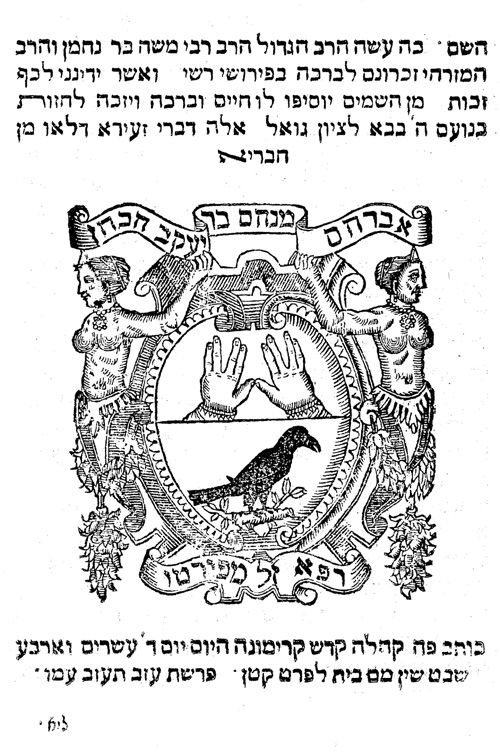
The well known “coat of arms” of the priestly Rapaport family first appeared as a colophon at the end of Avraham Menachem Rapa of Porto’s Mincha Belulah (Verona, 1594), fol. 207b, readily at HebrewBooks.org (here). Instead of a motto, a banner proclaimed the author’s name above and below the shield which featured a pair of hands raised in priestly benediction in the upper half, while below was depicted a crow (Rabe in German) on a branch, a reference to the author’s family name. The shield is flanked by two heraldic supporters, and this is what interests us here.
The supporters feature two female torsos rampant facing away from the shield. They are nude from the waist up.

It was by no means rare to encounter nude women in Hebrew books between the sixteenth and the early eighteenth centuries, even prominently displayed on the covers (Adam accompanied at times by a buxom Eve is a ready example). But no doubt such nudity proves unsettling to the Orthodox public nowadays.
Benjamin Shlomo Hamburger’s recently published magisterial three volume history, Ha-Yeshiva ha-Rama bi-Fiorda (Bnei Brak, 5770) is a rich, learned study by one who has dedicated many scholarly books to the heritage of German Jewry. The volumes are noteworthy also for their rich illustrations, but one in particular catches the eye.
A chapter dedicated to Baruch Kahana Rapaport who served for many years as rabbi of Fürth (1711-1746), reproduces, as many a study on the Rapaports, the “coat of arms” from Mincha Belulah (volume 1, page 390).  
But the supporters here have been modestly transgendered and piously rendered with beards! 

Several studies by Jacob J. Schacter and others have noted the tendency to “verbessern” the past in Orthodox historiography. This then is a modest (but not very pious) contribution to the topic from the perspective of visual evidence of the past.
Addendum:
Dan Rabinowitz
the Seforim blog
It is indeed import to note as Dr. Michael K. Silber has, that we have yet another example of doctoring history to conform with today’s anachronistic views.  But, we should note that this is not the first time the Rapoport coat of arms has undergone a change.  Before turning to this early example, we need to a make a few points.
As Dr. Silber notes, this coat of arms appears at the end of the first edition of Mincha Belulah, Verona, 1594. Rapoport created this herald and the herald contains allusions to his name – Rapoport.  Hida, R. Hayyim Yosef David Azulai, no Reform rabbi, includes an entry on Rapoport in Hida’s Shem HaGedolim (Machret Seforim, Mem, sub. Mincha Belula).  Importantly, although the herald appears at the back of Mincha Belulah, Hida calls attention to this herald. Hida notes that “Rapoport” is spelled differently on the herald than on the title page.  But, no where does Hida question the inclusion of the bare-breasted women on this rabbinic herald. Moreover, Hida doesn’t alert that reader that if one looks up the herald there are these “offensive” images.  Hida’s silence is remarkable but only if one ignores the prevalence of such imagery in Hebrew books.  That is, Mincha Belula is not the only work to include such imagery.  For example, as we have previously discussed, other works include similar imagery (see herehere, here, here, for examples of nudes, and here for examples of mythological images).
We also note that this was not the first time the herald from the Mincha Belulah has been modified. In the 1989 Beni Brak reprint of Mincha Belulah, the images are also altered.  While they haven’t been turned into men, the women are more modestly clothed.  The image below is taken from this edition.


Organizing the Mitzvot and the Sefer Ha-Chinukh

Organizing the Mitzvot and the Sefer Ha-Chinukh
Yaakov Taubes

Yaakov Taubes is the rabbi at Mount Sinai Jewish Center in Washington Heights, New York. He also serves as an assistant director at the Rabbi Isaac Elchanan Theological Seminary at Yeshiva University, and is a PhD candidate in Medieval Jewish History at the Bernard Revel Graduate School for Jewish Studies. He can be reached at rabbi@mtsinaishul.com.

This article follows from the excellent piece by Eli Genauer about the printing and reorganization of the Sefer ha-Chinukh. To review, Genauer described how the Sefer ha-Chinukh’s original order, reflected in both manuscripts and early printed editions, listed the positive commandments followed by the negative commandments in each parasha, but later editions did away with this division and instead listed the mitzvot in strict order of the Biblical  verses. He noted further that, contrary to what is printed in Chavel’s semi-critical edition of the Sefer ha-Chinukh, the first edition to alter the organization was a Chumash with commentaries printed in Amsterdam in 1767 that included the Chinukh. In the first half of this article, I will explain the Chinukh’s original organization, as well as the reasoning behind and impact of the later editions that changed it. In the second half, I will analyze the earliest published mitzvah lists  that enumerated the mitzvot according to the Torah’s order.

Part I
Reorganizing the Chinukh

At its core, the Chinukh is a Sefer Ha-Mitzvot, an enumeration and explication of 613 mitzvot of the Torah. It primarily follows in the footsteps of the Maimonides’s Sefer Ha-Mitzvot, while also regularly citing Nahmanides when he disagrees with Maimonides. In the anonymous author’s opening missive (to which he adjured later copyists by oath to include), he noted that the work of clarifying the mitzvot and halakhot had already been accomplished by R Isaac Alfasi (Rif), Maimonides, and Nahmanides. Indeed, the Sefer Ha-Chinukh did not innovate in in terms of mitzvah enumeration, i.e. in listing what constitutes the 613 commandments, but rather loyally followed the enumeration of Maimonides, even when he found the opinions of Nahmanides more compelling.[1] Instead, the stated goal was to organize the mitzvot based on the parshiyot of the Torah, so that the youth will be inspired to study them on Sabbaths and festivals and “they will be accustomed to inquire as to how many mitzvot appear in a given parasha.”[2] The division into parshiyot was thus for pedagogical purposes (as the title Sefer ha-Chinukh, or Book of Education, implies), namely, to create a separate unit for a student to study each week.

This didactic concern is also evident from the places where the author informs us that a given parasha does not have any mitzvot. By contrast, when Rashi, for example, has nothing to say on a given verse, he does not comment that there is nothing to say on the verse. But as a work based on the parshiyot, to be studied according to the parshiyot, the Chinukh needed to inform the reader that there are no mitzvot on a given week. In addition to its noteworthy contributions to particularly topics, it was the organization that set the Chinukh aside and contributed to its great popularity.

The gemara in Makkot (23b), which serves as the primary source for the idea that there are 613 mitzvot, also notes that there are 248 positive commandments and 365 negative commandments. Maimonides, the Sefer Mitzvot Gadol of R. Moses of Coucy and most other Sifrei Mitzvot divided the mitzvot this way in their respective works, by first listing one category and then the other. The Chinukh maintained this division, but only within each Parasha, first listing all the positive commandments, followed by the negative commandments, and then starting again in the next Parasha.

This division can be found in the original manuscripts of the Chinukh and in the first published editions from the 16th century. In the 18th century, however, publishers began to print the mitzvot of Chinukh in strict order of the verses of the Torah, erasing the division between positive and negative commandments. In Genauer’s article, he noted an error in Chaim D. Chavel’s scholarly introduction to his edition of the Chinukh, where Chavel writes that the first edition to make this change was the edition printed in Frankfurt an der Oder in 1783.[3] In fact, as Genauer notes, the first published book to reorganize the work was the Chumash Tikkun Soferim, published by Yosef, Yaakov and Avraham Proops in Amsterdam in 1767, which included the Chinukh as well as other commentaries on the Torah. This edition printed the Chinukh on the page alongside the Torah text, adjacent to the Biblical verse that are the source for the commandment, and by extension, recorded the mitzvot according to the strict order of the verses, thereby abandoning the original organization. Virtually all later editions of the Chinukh followed this structure such that, apart from Chavel’s edition, the Chinukh was never again printed using the order in which it was originally written.   

This Proops edition did more than change the order of the mitzvot. The reordering also required a modification of the mitzvah list in the introduction to the Chinukh so that that the numbering there accurately reflected the placement of the mitzvot contained within the work. But, confusingly, many internal cross-references to other mitzvot were left intact. For example, at Lev. 19:9, the Chinukh records the prohibition of not leaving over part of the corner of the field (peah). This is Mitzvah 228 in the original work but appears as 217 in the reorganized (now standard) versions. The Chinukh there references what he wrote previously in “Positive Mitzvah 2” of the Parasha, a somewhat less helpful reference to locate if the mitzvot are not divided between the positive and negative commandments.

More generally, this reordering has pros and cons. Putting the mitzvot in the order of the Torah allows related positive and negative commandments to be listed adjacent to one another, which is useful as they may have many aspects in common, including what the author called their shoresh (perhaps meaning “cause”). For example, in the discussion of the holidays in Parashat Emor, the new arrangement places the positive commandment to refrain from labor on a given holiday adjacent to the related negative commandment against working on that holiday.[4] On the other hand, in a number of instances, the reorganization clearly disrupts the disrupts the flow of the work. For example, In Lev. 22:32, the Torah presents the prohibition of profaning God’s name before the obligation to sanctify it. This is how the Proops edition (and subsequent editions) list them, matching the order of the verses. In the original, however, the commandment to sanctify, a positive commandment, is listed first, and it is there that the root and essence of the mitzvot related to sanctifying and profaning God’s name are explained. In the negative commandment, i.e. the prohibition to profane God’s name, the reader is referred to what the author already wrote regarding the positive commandment, which the new editions place afterward. Similar examples can be found throughout the work and modern editions of the Chinukh, including those published by Feldheim, Machon Yerushalayim and Artscroll, will typically provide the appropriate page number or mitzvah reference in their edition. This is helpful, but the need to do so highlights the disparity the reorganization of the work created.          

When the Chinukh was next printed in Frankfurt an der Oder in 1783-4, also part of a Chumash, all of the mitzvot that come from a given book of the Chumash are printed in the back of the relevant volume, divided by parasha with a separate title page introducing them.[5] As in the earlier Proops edition, the mitzvot are listed in strict order of the verses without a division between the positive and negative ones.

The decision to print the Chinukh in strict verse order was significant, even though it had been done previously. As Genauer notes, the Proops edition editors justified their decision to reorganize the Chinukh by saying that it allowed the reader to follow the weekly Parasha more easily. Placing the verse on the page according to the verses facilitated studying the Chinukh almost like a commentary on those verses. Printing the Chinukh in the back of the Chumash on the other hand, meant that a reorganization was no longer necessary; since the Chinukh was no longer alongside the text of the Chumash, it was no longer technically bound to its order. Despite this, the editors still chose to align the Chinukh with the verses, forgoing the original order, presumably to allow easily reference between the Biblical verses and the Chinukh.

In 1783, this same Frankfurt edition of the Chinukh was published as a standalone volume, without the text of the Chumash at all.[6] Printing it as a separate volume would seem to remove any connection to the order of the text of the Torah, yet this edition still follows the strict verse order. It lacks a publisher’s introduction, but the title page includes the following subtitle:

The Sefer Ha-Chinukh with the 613 Commandments to quench the thirsts of the soul. Presented now, newly organized and built upon the order of the Parshiot as they appear written in the Torah, and to not bring the earlier one before the later one, but only in the spot where they are to be found.

As explained, this was not technically new (as Chavel thought) as it had been already been done in 1767 in the Proops/Tikkun Soferim Chumash.[7] But this edition was the first to alter the order when the form did not require it, meaning, it was the first standalone edition to alter the order.[8] As opposed to the Proops edition, where such a edit was more required to integrate the Chinukh into a Chumash, this edition included the change because it was perceived as a better, more intuitive order. That no explanation for the reorganization was provided may be because the publishers thought it was obvious. Indeed, the reorganization certainly makes mitzvot easier to find than if they were divided between positive and negative commandments within each Parasha. Thus, while the Frankfurt edition was preceded in its choice to reorganize the Chinukh, it set the standard for future editions because it was the first to do so as a standalone edition. 

There is no evidence that the publishers of the Frankfurt edition were working off the earlier Proops edition and even if they were, they may have still seen their edition to be innovative by changing the order in a standalone edition. There is, however, a change in the introduction that both editions exhibit that would seem to indicate some level of borrowing. The Chinukh’s introduction can be divided into three parts: (i) an Iggeret (epistle) about the nature, goals and influences of the work; (ii) a list and accounting of the mitzvot contained therein, listed according to the parshiot, with positive commandments listed before the negative ones (this is followed by an overview of the commandments that are applicable and no longer applicable[9]); and (iii) a  longer essay discussing key ideas in Jewish thought and faith.

The Proops/Tikkun Soferim edition maintains this sequence of the introduction but preceding the second part is a title, “Luach HaMitzvot, and then the words “The 613 commandments which were said to Moses, peace be upon him, at Sinai, in the order as they are written in the Torah and according to how they were said by the Rabbi, the author of the Chinukh.” As noted above, the printers also altered the order of the Mitzvot to accord with the verses in the Torah. These added words, “as they are written in the Torah and according to how they were said by the Rabbi, the author of the Chinukh” seems to mean that they have presented a reorganized version of the Chinukh’s enumeration.

Following the list, the publishers added a list of seven rabbinic commandments, followed by the words “the total amount of commandments is the amount of KeTeR [the numerical value of 620, that is 613 biblical commandments plus the seven rabbinic ones] and the way to remember it is KeTeR Torah (the crown of Torah).”[10] In the Frankfurt edition, the mitzvah list (section ii) is moved to the end of the introduction, after the longer essay (section iii).[11] Preceding the list are the same title and introductory lines as the Proops edition. The Frankfurt edition’s use of these words would seem to indicate that they borrowed from the earlier one and made still more changes.

In any event, by the time the Chinukh was printed next in 1799, the reorganization of the mitzvot had already become standard. The publishers, who reference the 1783 edition of the Chumash as well as the standalone edition in their introduction, make no mention that they have altered the original order.[12] The reorganization was the new organization for the Chinukh.

Part II
Early Listing of Mitzvot in the Order of the Torah

While the editions described above were the first to reorganize the Chinukh’s list, neither the Tikkun Soferim/Proops edition nor the Frankfurt edition were the first to organize the 613 mitzvot according to the order of the Torah, either as a separate work or alongside the verses in a Chumash. These particular achievements were already earned by publishers in the early sixteenth century.[13] In Venice in 1517, the famed printer Daniel Bomberg published what is commonly known as the first Rabbinic Bible, a complete Tanakh with commentaries, titled Arba’ah Ve-esrim, namely, the Twenty-Four books of the Hebrew Bible. In the back of the third volume (after the books comprising Ketuvim), the text of Maimonides’s 13 principles of faith from his commentary on Mishnah Sanhedrin are followed by a list of the 613 mitzvot divided by Parasha, but in strict order of the verses, i.e., not divided between positive and negative commandments.         

This listing was originally created by Abraham ibn Hassan HaLevi, an otherwise unknown figure who seems to have thrived in the 15th century.[14] It includes the commandments, the relevant source verse, and a cross-reference to the pertinent discussion in Maimonides’s Mishneh Torah. The version included in the 1517 Bible was a version of ibn Hassan’s that was expanded by R. Yehuda ben Sasson, who added further cross-references to the Talmud and Midrashe Halacha (Sifra and Sifrei etc.).[15]

The brief introduction included before the list explains that the mitzvot enumeration will be based on that of Maimonides but will be organized according to the parshiyot and verses, claiming that this structure is an idea that every child understands and will assist with study and understand of the Parasha. The introduction expresses surprise that such a straightforward system of organization had not been before attempted. Interestingly, he makes no mention of the Chinukh, which had already organized the mitzvot according to the parshiyot. He was either unaware of the work (which, although written in the late 13th century, was not published until 1523) or ‘disqualified’ it, since it was not organized according to strict order of the verses.   

Of the various enumerations of the 613 commandments, that of Maimonides was certainly the most famous and influential of them, and it is thus unsurprising that both the Chinukh and Ibn Hassan made use of it for their own respective works. Additionally, Maimonides’s insistence that each mitzvah be connected to a specific verse meant that reorganizing them according to Torah was a more straightforward endeavor.

Still, even utilizing Maimonides’s enumeration presented difficulties. In his Sefer HaMitzvot, Maimonides often cites multiple verses in the context of a given mitzvah, and it is not always clear which verse is the primary one or if one is to be given precedence over the other. The discussion of the relevant law in his Mishneh Torah did not necessary clarify matters.

Although he followed Maimonides’s enumeration, the Chinukh made his own judgment on the most relevant verse for each commandment. In general, the Chinukh places the commandment in conjunction with the verse where it first appears in the Torah. For example, regarding the mitzva forbidding  labor on the Sabbath, a prohibition that appears many times in the Torah, the Chinukh counts in Exod. 20:9, the first time it appears. But there are exceptions. The mitzvah of Tefillin appears in Exod. 13:9 and 13:16, but the Chinukh does not count it until its appearance in Deut. 6:8,.[[16] When it comes to negative commandments, the Chinukh usually utilizes the azhara, the verse containing the warning, rather than the verse that lays out the punishment. For example, the prohibition to curse a judge is counted at Exod. 22:27 (Mishpatim) instead of Lev. 24:16 since the former is the warning while the latter is the punishment. But again, there are some exceptions. The prohibition to eat slaughter sacrifices outside the Temple, for example, is counted at Lev. 17:3-4 (Acharei Mot) despite the azhara being derived from Deut. 12:14.[17] Ultimately, however, the Chinukh is an independent work with full entries for each mitzvah. The author was thus able explain his choice of placement as he does in the some of the above examples, while also citing any other relevant verses. The verse serves as a positional mechanism and one that structures the entire work, but it was not the complete story for any given mitzvah.

A shorthand list, on the other hand, enjoyed no such luxury, as there was not usually room for further explanation; the mitzvot in such a count follow the order of the verses and the author only provides limited, if any, elucidation. The Mitzvah List originally prepared by Ibn Hassan and printed in the 1517 Rabbinic Bible, solved these issues by basing itself on what is known as the Minyan HaKatzar found in the introduction to the Mishneh Torah. Maimonides there included a shorter enumeration of the commandments almost always listing only the commandment and an accompanying verse, assumed to be the one that most explicitly laid out the commandment. The 1517 Rabbinic Bible list used both the language and verses from this list, reorganized according to Parasha and in strict verse order. In the few places where the Minyan HaKatzar adds a few words of clarification, this language is used in the Chumash list as well.[18]

Although the Chinukh is based on Maimonides, there are discrepancies between the verses utilized by the Chinukh and those of the list based on Maimonides’s Minyan HaKatzar. For example, while the Chinukh (Mitzvah 2) and Maimonides in the Sefer HaMitzvot (P 215) cite the verse Gen. 17:7 (in Lech Lecha) as the source for the commandment of circumcision, the Minyan HaKatzar cites Lev. 12:3, where the commandment is repeated. The 1517 Rabbinic Bible Mitzvah List follows suit placing it in Tazria. Likewise, while the Chinukh places prayer (Mitzvah 433) in Eikev (Deut. 10:20), the 1517 Rabbinic Bible list puts it in Mishpatim (Ex. 23:25), again following the Minyan HaKatzar.

There is an additional (albeit more limited) difficulty with relying on Maimonides enumeration. The second of Maimonides’s 14 shorashim, or principles, used to devise his list was that any mitzvah learned from one of the thirteen exegetical principles would not be counted as part of the 613.[19] There were, however, a few exceptions. For example, Maimonides himself noted that there is no explicit verse prohibiting incest between a father and daughter, and that the Talmud derives it from both a kal vachomer (an a fortiori argument), and a gezerah shavah, two of the 13 exegetical principles by which rabbinic law is derived, about which Maimonides specifically states he will not derive commandments from. Maimonides (Neg. 336) counts the prohibition against father-daughter incest despite this, for reasons he explains at length and need not concern us now. Similarly, the Torah does not explicitly forbid an uncircumcised kohen from partaking of Terumah, but the Talmud (Keritot 5a) derives it from a gezerah shavah (referring to it as gufei torah) and Maimonides counts this as well and once again provides a justification. In the Minyan HaKatzar, when it comes to prohibitions against a father revealing the nakedness of his daughter, and an uncircumcised kohein eating terumah, he writes (following the commandments listing) “that it is not explicit in the Torah“ but insists it still Biblical. If one is placing the mitzvot according to their verse, there might be some question as to where to place these two commandments.

  Perhaps unsurprisingly, the Chinukh places the incest prohibition in Acharei Mot in the context of the other forbidden sexual relationships immediately following the prohibition against sexual relationship with a granddaughter, the source of the kal vachomer. The prohibition for an uncircumcised kohein to eat terumah (282) is placed in Emor immediately following the prohibition for a kohein who is a toshav or sachir to eat terumah, as that verse is part of the gezera shava from which the Talmud derives that prohibition. This too makes sense, although one could have placed it near the prohibition against an uncircumcised person from eating the Passover sacrifice, the other part of the gezarah shavah.

After the mitzvah list printed in the 1517 Rabbinic Bible, there appears an epilogue that provides a tally of the weekly Torah parshiot (and notes that Zot HaBracha is excluded because lacks its own Shabbat to be read on), and that 15 of those parshiot lack any mitzvah, leaving 38 that do contain mitzvot. Gematriot (mnemonics) are provided to remember the totals. The epilogue then notes how 611 commandments were said in explicit verses (followed by another gematria), leaving two which lack an explicit verse and were learned out from tradition at Mount Sinai. The two commandments are, not surprisingly, the aforementioned prohibitions on incest and the uncircumcised priest eating terumah. These can be found, the author tells us, in the Parasha of arayot (in Acharei Mot) and in Emor, the same places where the Chinukh puts them. Again, this is unsurprising as it places them adjacent to the verses from which they are derived from, even if not explicitly. Additionally, Maimonides’s Sefer HaMitzvot and the corresponding Minyan HaKatzar, while not organized according to the order of the verses, also lists them adjacent to the commandment from which they are derived from.

Interestingly, the author felt it important to point this out to the reader, even instructing the reader not to go looking for them. The issue of Maimonides’s statement that some commandments lack underlying verses has attracted attention by modern scholars, who generally find more than two such cases.[20 It would seem that the effort to reorganize Maimonides’s enumeration according to the verses highlighted this issue as well, since the editor had to decide where to place it, something he did not need to do for the other commandments. 

This edition seems to be the first time the mitzvot (of any order) were printed strictly in order of the verses, while also including the Parasha breakdown.[21] The list would prove popular and was included in many future editions. It was even translated into Latin in 1597 by  Phillip Ferdinand, a Jewish convert to Christianity![22]

 There is, however, another possible contender for the first published work to list the mitzvot in the order as they appear in the Torah: the Avodat HaLevi of Solomon b. Eliezer HaLevi.[23] This work is a listing of the commandments which provided references to where the a given commandment was discussed in the Talmud, Midrashe Halacha (Sifra, Sifrei and Mekhilta), Mishneh Torah (spelling out the book, halacha and chapter), Sefer Mitzvot Gadol, Sefer Mitzvot Koton (known as Amudei Golah), the location in the Arba’a Turim of R. Jacob b. Asher (including “column “and siman), Sefer Toldos Adam V’Chava of R. Yerucham ben Meshullam (including exact location), the Kol Bo, the Rokeach, Sefer HaAgur of R. Jacob ben Judah Landau, and the Sefer Halakhot of the Rif. As the author informs us, this list too is based on Maimonides, and the verses and order are based on that of the Minyan HaKatzar (although the language is abbreviated in a few places). This is an incredibly impressive collection of sources and is a good example of the increase of indices with the advent of print.[24] While we know this work was published in Constantinople, it is not evident in what year. The National Library of Israel’s Bibliography of the Hebrew Book catalogue lists it at around 1515, but also cites Morris Steinschneider who suggested that it was published after the end of 1516 when the Sefer Toldos Adam V’Chava (which is one of the works referenced) was printed. In his study of Hebrew printing in Constantinople, Avraham Yaari writes that it was printed between 1515 and 1520.[25] Since the Rabbinic Bible was printed in 1517, the correct year between that range would determine which was the first to list the mitzvot in order of the Torah. Both works predate the printing of the first edition of Chinukh, which was not published until 1523.

In 1547, another Chumash was printed in Venice by the Giustiniani publishing house and included targumim, commentaries, as well as a listing of the 613 commandments in the margins next to the appropriate verse, the first time a list structured this way appeared in print. The title page states that the list will include each mitzvah placed by its appropriate verse, according to the enumeration of Maimonides and according to the opinion of Nahmanides in his calculation of the accounting and listing of the commandments. The inclusion of Nahmanides on the title page would seem to be a mistake, as the Chumash’s introduction, penned by Jehiel ben Jekuthiel, who edited this edition, makes no mention of Nahmanides in his explanation of the work, nor is Nahmanides’ counting of the mitzvot incorporated into the body of the work in any apparent way.[26]

The title plage also write that the work includes a cross reference to the appropriate place in the Talmud, Maimonides, R. Moses of Coucy (in his Sefer Mitzvot Gadol) and R. Jacob, the author of the Tur, “as is explained on the next page in the editor’s introduction.” Indeed, the introduction explains this system in greater depth and then proceeds to include an example from the listing regarding the mitzvah of circumcision.[27]  Students of the Talmud will recognize the list of sources as the very same included in the Ein Mishpat and Ner Mitzvah of R. Joshua Boaz b. Shimon Baruch, which essentially footnotes the Talmud and provides cross-references for where the Talmudic ruling is codified in those works. The Ein Mishpat was incorporated onto the page of the Talmud in the 1546-51 edition of the Talmud, printed in Venice by Marco Antonio Giustiniani, the same publisher as the Chumash under discussion, and is thus not surprising that there is overlap between the referenced works.[28] The mitzvot and references themselves are included in the margins adjacent to the relevant source verse, but as there was not always sufficient space for the full listing of the relevant sources, many mitzvot are instead listed at the end of each Parasha

It is not immediately evident which enumeration Jehiel used to create this list. It certainly does not match the list from the 1517 Rabbinic Bible. While there is no explicit mention of the Chinukh, there is evidence that he relied upon its enumeration and not that of Maimonides or anyone else. In Maimonides’ Sefer HaMitzvot, the prohibition of Yayin Nesekh, wine used for idol worship, is sourced from Deut. 32:38 (in Haazinu).[29] Nahmanides (in his Hasagot to the Sefer HaMitzvot), however, writes that the source of the prohibition is really from Exod. 34:12 (in Ki Tisa). The Chinukh (Mitzvah 111) follows Nahmanides in this instance and explains that while he usually follows the path of Maimonides, he prefers the verse in Exodus due to the specific negative language used there. He also writes that one of the “great Mitzva enumerators,” probably a reference to the Sefer Mitzvot Gadol (SMaG, Neg. 148), cited this as the source verse as well.[30] The 1547 Chumash maintains this order and indeed lists the prohibition of Yayin Nesekh in Exodus instead of Deuteronomy.[31]

Clearer evidence comes from a more direct divergence from Maimonides’s enumeration in the Chinukh. The Chinukh writes in his introduction that his listing will be based on that of Maimonides, even in situations where he finds Maimonides’s inclusion of a mitzvah difficult. There are cases throughout the work where the Chinukh indicates that he finds the view of Nahmanides more compelling but follows Maimonides nonetheless, as per his introduction.[32] Indeed, the Chinukh’s enumeration is identical to that of Maimonides for 612 of the 613 commandments. The discrepancy is the inclusion of the prohibition to bring a Pesach offering on a private altar (Mitzvah 487), which is not counted by Maimonides, and the omission of the prohibition for a non-kohein to eat kodshim kalim, which is counted by Maimonides (Sefer HaMitzvot, Neg. 102). It is likely that both of these changes reflect an alternate text or version of Maimonides’s Sefer HaMitzvot that the Chinukh was utilizing.[33] In the 1547 Chumash, the enumeration of the commandments is identical to that of the Chinukh, including the addition of the prohibition of bringing the Korban Pesach on private altars (in Re’eh) and the omission of the prohibition for a non-kohein to eat kodshim kalim. While there are other Mitzvah enumerators who include the prohibition regarding the Korban Pesach, that the enumeration of Chumash matches the Chinukh identically including for most of the order would seem to belie the latter’s influence.[34]

One more indication of the Chinukh’s influence comes at the end of the Chumash. Following the last mitzvah (in Vayelech), we find the same text as in 1517 Chumash, which describes the number of parshiot and how many lack mitzvot, and the accompanying gematriot. The lines that follow note that not all mitzvot are relevant nowadays, and that among those that are, some are in the category of Mitzvot that a person may never come to be obligated in. After this, there is an accounting of the total number of mitzvot that are relevant nowadays and not situationally dependent, followed by an enumeration of the six commandments that apply at every moment (mitzvot tamidiot). This paragraph is lifted almost verbatim from the Chinukh, with the additional of mnemonics. This Chumash was especially popular and was reprinted multiple times with some minor alterations of the page format. Thus, while it would be another 200 years before the Chinukh was actually reorganized according to the strict order of the verses as described in the first half of this article, it was already influencing other Chumashim that did indeed place the mitzvot in that order.[35]

Once the Chinukh itself was reprinted and reorganized in the 18th century it would reclaim its crown as the primary order of the mitzvot, a role it plays until this day. While one can find lists of the mitzvot organized according to the strict order of the verses based on Maimonides (often printed in the back the Sefer HaMitzvot), as we indexes that reorganize the listing of other mitzvah enumerators to allow for easy reference to the Biblical verses, it is the reorganized Chinukh’s listing that remains the most widely cited and used.    

[1] See Mitzvah 138 and 153. All references to the mitzvot in the Chinukh are to the Mechon Yerushalayim edition unless otherwise specified.
[2] See the Chinukh’s Iggeret HaMechaber.
[3] This mistake is likewise repeated in the Machon Yerushalayim Edition.
[4] I.e. Mitzvot 297-298 are the positive and negative commandments related to rest on the first day of Pesach; 300-30 are the same for the Last Day of Passover; and so on for each holiday.
[5] The Chinukh’s introductions appears in the first volume. The Mossad HaRav Kook Torat Chaim edition, printed in the 20th century, also follows places the corresponding mitzvot from the Chinukh in the back of each volume. The publisher utilized Chavel’s edition for the text and thus the order follows the original division between positive and negative commandments.
[6] It is not clear to me which, if any, volumes from the Chumash, had already come out since they were published over the course of the years 1783-1784. The separate title page for the Chinukh in the Genesis volume has a different appearance than the title page for the standalone volume but the text on it is identical.
[7] It is possible that the publishers’ language here is what led Chavel to mistakenly think this was the first edition to make the change.
[8] I am not aware of any other edition of the Chinukh printed on the page of the Chumash, although the Milstein Edition Chumash with the Teachings of the Talmud printed by Artscroll includes very brief writeups for each mitzvah as they appear in the Chumash based on the Chinukh.
[9] These comments are heavily based on Maimonides’s own overview, placed at the end of the listing of the positive mitzvot in his Sefer HaMitzvot.
[10] The seven rabbinic commandments are not mentioned In original Chinukh, although later editions would enumerate and explicate them further.
[11] Other editions also moved around the different pieces of the introduction. Even the first edition of the Chinukh, published in 1523 in Venice, placed the overview of the mitzvot after section iii. Some variances can be found in a few of the manuscripts as well. See Chavel’s edition, pp. 18-24, where he notes some of the changes to the introduction in the published editions. Interestingly, in the Artscroll edition, the Mitzvah list is likewise placed at the very end of the introduction. They also place the overview paragraph before the mitzvah list instead of following it where it appears it originally appeared. A footnote points out the change and adds “Since in this edition, the list of mitzvos cover many pages, possibly leading many to overlook Chinukh’s concluding remarks, we have followed the precedent of some printed editions which place these remarks before the list of mitzvos.” While this is technically true, it is misleading, as they fail to mention that moving the entire list to the end of the introduction following the longer essay, which is arguably a much larger change.
[12] They also moved around the parts of the introductions and include the Mitzvah list title and the paragraph describing the mitzvot. See Chavel ibid.
[13] The remainder of this essay will focus on published editions of the mitzvot list only. There are several works medieval works that organize the mitzvot according to the verses of the Torah, including of course the Chinukh, but also lesser-known authors. I explore these further in a forthcoming article.
[14] The list is extant in several manuscripts which dated from this time. To be clear, there are other versions of the list of mitzvot according to Maimonides, organized in order of the verses which exist only in manuscript, but the first published one was based on Hassan’s list.
[15] The Jewish Encyclopedia “Abraham Ibn Hassan Ha-Levi” writes that Yehuda Ben Sasson translated the text from Arabic. This seems to be an error, reading ma’atik for “translator” instead of “copyist.” Ben Sasson does mention he had translated other texts, but he is not referring to the Mitzvah list, which was originally in Hebrew.
[16] Although this may be because the command is more explicit in the later source. To pick a prominent (although admittedly less representative) exception, the prohibition of eating a live animal is not counted in Noach (Gen. 9:4), despite its appearing there, and instead listed in Re’eh at Detu 12:23. See Minchat Chinukh after Mitzvah 1
[17] As before, the azhara is far from explicit which is likely the reason the Chinukh used the earlier source.
[18] For example, in the Minyan HaKatzar (N 236), Maimonides clarifies that we derive from tradition that the prohibition referenced in Deut. 23:20 is on the borrower to pay back with interest. This language appears in the Chumash as well.
[19] See Maimonides’s second shoresh in his Sefer HaMitzvot.
[20] See Marc Herman, “What is the Subject of Principle Two in Maimonides’s Book of the Commandments? Towards a New Understanding of Maimonides’s Approach to Extrascriptural Law,” Association for Jewish Studies Review 44:2 (2020), 345-367.
[21] Modern publishers would later reorganize Maimonides’s list according to the verses as well. See Dienstag Jacob I. Dienstag, “Ein ha-Mizvot: A Bio-bibliography of Scholars and Commentators on Maimonides’ Book of Commandments” (Hebrew), Talpioth, vol. 9, no. 3-4 (September 1970): 676-677, 703, 709-710, 738.
[22] This was not the first Latin version of a Sefer HaMitzvot although it seems to have been the first to organize the mitzvot according to the order of the Torah. See Siegfried Stein, “Phillipus Ferdinandus Polonus“ in Essays in honour of the Very Rev. Dr. J. H. Hertz, chief rabbi of the United Hebrew Congregations of the British Empire, on the occasion of his seventieth birthday, September 25, 1942 (5703) ed. I. Epstein, E. Levine et al. (London, 1944), 397–412.
[23]  The work is sometimes called the Moreh Tzedek. The author mentions that he was only 20 years old when he composed although the wandering has made him feel like he was 70. He also writes that he had intended to write out the halakhot as well but did not complete such a work.
[24] See Bella Hass Weinberg, “The Earliest Hebrew Citation Indexes,” Journal of the American Society for Information Science 48.4 (1997): 318–30.
[25] See Abraham Yaari, Hebrew printing at Constantinople: Its History and Bibliography, (Jerusalem, 1967).pp 82.
[26] Thus, the mitzvot which Nahmanides argues are part of the 613, e.g., the mitzvah to live in the Land of Israel, remembering Miriam etc., are not noted.
[27] The introduction mentions a mafteach, or index at the beginning of each book “according to this way.” It is not clear to me what this refers to, as the edition I examined contained no such mafteach. Perhaps it refers to this extended listing at the end of each parasha. The cover page and introduction also mention an index to be included at the end of the twenty-four books listing all the places with references to the page of the Talmud where a verse is explicated.
[28] See Weinberg, ibid., 320 who suggests that the compiler of the Ein Mishpat may have been inspired by Avodat HaLevi. The genesis of the Ein Mishpat itself and how it ended up on the page of the Talmud is beyond the scope of this article.
[29] This verse appears in the Minyan HaKatzar as well as the Mishneh Torah.
[30] It is also likely that the Chinukh diverged from Maimonides on this issue because he wished to have the final mitzvah in the Torah to be the commandment for each person to write a Sefer Torah, a far more dramatic ending. Had he followed Maimonides, Yayin Nesekh would have been the final commandment instead.
[31] It is of course possible that this Chumash was following Nahmanides in this instance or the Sefer Mitzvot Gadol which, as noted, counts the verse from here. This is unlikely, however, since, as noted above, Nachmanides’ enumeration is not incorporated into the Chumash, nor is the SMaG followed in any other instance.
[32] See, for example, Mitzvot 138 and 151.
[33] R. Daniel HaBavli questioned R. Abraham b. HaRambam as to why his father included a prohibition to bring the Korban Pesach on a private altar if the prohibition was no longer relevant once the Temple had been built and all sacrifices on private altars were permanently banned. R. Avraham responded that his father had counted no such prohibition and that R. Daniel HaBavli’s text was inaccurate. See Chavel’s edition of the Chinukh, 8n5 . The author of the Chinukh presumably had a different version or translation of the Sefer HaMitzvot and that this would accounts for the other discrepancies between the two works.
[34] The only differences between the Chinukh’s placement of the mitzvot and this edition are as follows. (1) Chinukh counts the prohibition to curse a parent in Leviticus 20:9 (Kedoshim, 260) but notes that this is really the source for the punishment, not the prohibition. He notes further that Maimonides counts it at Ex. 21:17 but the same problem is present in that verse, so he will count it here. The 1547 Chumash list the prohibition at Ex. 21:17, which means all the following commandments (until Lev. 20:9) are one mitzvah off from the count of the Chinukh (like the later additions discussed above, which reorganized the Chinukh based on the strict verse order, as opposed to the original). (2) The other discrepancy concerns the mussaf sacrifices. The Chinukh counts the mitzvot to bring a korban musaf on Passover, Rosh HaShanah, Yom Kippur, Sukkot and Shemini Atzeret respectively, in Emor (Lev. 23), as they are alluded to there (through the word olah), even though he admits that the full explication of these sacrifices is really in Pinchas (Num. 28). This diverges from Maimonides, who cites the source verses from Pinchas, but the Chinukh explains that he is counting them from their first appearance in the Torah (see Mitzvah 320). This decision forces the Chinukh to divide the commandments relating to the musaf sacrifice with the aforementioned mitzvot counted in Emor, while the Musaf of Shabbat, Rosh Chodesh and Shavuot (which are not mentioned in Emor) are counted in Pinchas. This is somewhat counterintuitive, and perhaps this is why the 1547 Chumash places them all in Pinchas. Following Pinchas, the list and numbering is identical to that of the Chinukh.
[35] In 1590–1591, a different edition of the Chumash was printed by the famed Bragadini publishing house. This edition also included marginal notes which pointed out the placement of each mitzvah near the relevant verse. The title page simply says “…the order of the laws of the TaRYaG mitzvot, each one set in its place” and does not match any of the known lists.


“Whence Worry?” – On the Murky Trail Of An Aphorism

by Yitzhak, of בין דין לדין

[I am greatly indebted to Wolf2191 and Mississippi Fred MacDowell for reading an earlier draft of this essay and for providing numerous valuable references.] This past Rosh Ha’Shanah, my friend A.F. showed me a collection of various homilies of the Rav related to the days of Awe, “prepared, translated and edited by B. David Schreiber”. While browsing through them, I noticed the following passage:

Every Jew must also ensure the continuity of future generations

(45) There is another dimension to the equation between man and tree, כי האדם עץ השדה. In addition to roots, a tree also has נוף, branches which form a panoramic vista. Chazal debate if אילן בתר עיקרו או בתר נופו, whether the roots of a tree are more important than its expanse. A tree must have both roots and branches in order to exist and flourish. Likewise, it is insufficient for man to be merely involved in the past; he must also identify with the future. The roots are bound to the tree’s past; the flowers and branches relate to its future. Likewise, the bris yisroel comprises both past and future. Nowadays, Jews are concerned with the bris of the past, but in the days of antiquity, in the time of Avraham and Moshe, they were concerned with the future. את אשר ישנו פה ואת אשר איננו פה עמנו היום. Moshe was very troubled and wanted to ensure the continuity of the Jewish religion. Through אדם עץ השדה, man is bound to the past, nonetheless, he must anticipate the future and take all actions necessary to ensure that continuity. The past requires a future, and the future requires a past. Had Jews not identified with both the past and the future, the Jewish people could not have survived.

People often say incorrectly and sarcastically,

,העבר אין, העתיד עדיין, ההווה כהרף אין, אם כן דאגה מניין,

The past is remote, the future has not yet occurred, the present is fleeting, why, then, should one be concerned?

Yahadus disagrees. Yahadus proposes:

העבר יש, והעתיד יש, וההווה גשר המקשר את העבר ואת העתיד. אם כן, יש לדאוג.

The past exists. The future exists. The present is the bridge between the past and the future. Therefore, one should be concerned.i

The first time I ever heard this “incorrect, sarcastic” aphorism was a decade or two ago, as a catchy hit song composed by Yossi Green and sung by Mordechai ben David (a contemporary cover of the song at a wedding). In an interview with the Israeli magazine בקהלה, Green discusses the provenance of the lyrics and his composition of the song:

“הקריטריון שלי”, מספק יוסי גרין את הנוסחה, “אינו אם השיר יהיה קצבי או רגוע. הניגון צריך להיות מיוחד וחייב להיות בו חידוש מוזיקלי או קונספטואלי. זה המוטיב המאפיין כל שיר שלי. אתן לך דוגמא. כשהלחנתי את ‘דאגה מניין’, זה היה בתקופה שבה רווח בכל מקום המשפט ‘דונט וורי, בי הפי’ (אל תדאג, היה שמח). לאברמ’ל פריד הלחנתי באותה עת את ‘נישט געדאגהט יידן’ ולמרדכי בן דוד את ‘דאגה מניין’. זה היה בלתי שגרתי בעליל, משהו שכולם דיברו עליו”.

על ‘דאגה מניין’ יש לו גם סיפור, אחד מני רבים. “זאת באמת שאלה טובה, איך הגעתי למילים הללו”, הוא אומר כשאני תוהה על כך באוזניו. “אמי הייתה מאושפזת במצב לא טוב. רציתי להשמיע באוזניה דברים שייתנו מרגוע לנפשה. עיינתי בספרים הקדושים ומצאתי באבן עזרא את המילים הללו, שהן מילים נפלאות והקראתי לה מתוכן. הדברים נסכו בה עידוד רב.

“כשבאתי הביתה, קראתי למרדכי בן דוד לביתי ואמרתי לו, יש לי מילים נפלאות לשיר. כשהשמעתי לו את המילים, הוא אמר לי, אני לא מאמין. איפה מצאת מילים כאלו. הוא תמיד קורא לי, ‘הנה יוסף בעל החלומות’. גם הפעם השתמש בביטוי הזה באומרו, מאיפה אתה מוצא את המילים הללו. כך הולחן השיר”.

Green’s attribution of the aphorism to Ibn Ezra is a common error; while there are, indeed, many relatively recent works that do so (one of which Green probably encountered), none provide a source, and it is fairly certain that this is a misattribution. Wolf2191 points out another apparent misattribution; Rav Baruch Epstein ascribes authorship to Shelah, but unfortunately provides no source:

ולפעמים כשהיה אבי זקני רואה איש שקוע בצער ודאגה, היה משתדל לפזר מעליו ענני העצבות ולהשיב רוחו ולהרגיע נפשו, והטעים לו דברי נחומים ותקוה, ובתוכם זכר את דברי השל”ה שכתב בענין מניעת הדאגה בכלל, כזה:

העבר אין והעתיד עדיין וההוה כהרף עין ואם כן הדאגה מנין

והכוונה, כי אחרי אשר הזמן העבר כבר איננו, ואם כן איננו בדאגה עוד, והעתיד – איש לא ידענו, ועל כן אינו צריך להיות בדאגה עליו, וההוה ימשך כהרף עין, ומה ערכו ושויו של זמן קצר כזה כי נדאג עליו ..ii

As Wolf2191 notes, not only is our aphorism not to be found in Shelah, but on the contrary, Shelah is quite in favor of worrying:

גם יהיה דאגה בלבו. הנה צער ויגון שייך על העבר, שיצטער ויהגה על העבר דהיינו מה שעשה. ודאגה על העתיד, ידאג ויפחד מעונש עוונותיו, כי יש עוונות שהתשובה תולה כפרתן ויסורין ממרקין, כמו שנאמר (תהלים לח:יט) ,כי עוני אגיד אדאג מחטאתי’.

ועוד שנית, ידאג ויפחד תמיד אולי הוא מקצר בחובת התשובה, בצער ובמרירות ובצום ובכי. וגם כי הרבה צער והרבה בכי, יזחיל ויירא, אולי לעומת זה הרבה אשמה ולא השלים חקו, ויבונן בגודל עבודת הבורא על יצוריו, וכי אין קץ לרעת הממרה את פיו. כל אשר יוסיף בעבודת ד’ ובדרכי התשובה, הלא מצער אצלו ויהיה למעוט בעיניו.iii

The aphorism is found, though, in a work by a contemporary of Shelah, whom the latter esteemed – the יוסף אומץ (Frankfurt 5483) of Rav Yosef Yuspa Nördlinger, chief דיין of Frankfurt , who mentions and explains a version of the “מליצה”, but gives no hint of its provenance:

ואכתוב עוד צרי ליגון מחלת לב תוחלת ממושכה על ידי מיעוט הבטחון והיא מליצה, לחזק לב האדם שיבטח בלב שלם באלקיו ולא יצטער כלל על מה שישיגהו בעניני העולם הזה וזאת היא המליצה:

אנוש מה תדאג ותעיין, העבר אין והעתיד עדיין, וההוה כהרף אין, אם כן דאגה מניין.

וזה פירוש המליצה: העבר אין ולמה תצטער עלין הלא מה שעבר עבר ולא תוכל לשנות מה שכבר נעשה, והעתיד עדיין רצוני לומר עדיין עתיד לבא ולמה תצטער עליו והלא ישועת ד’ כהרף עין, גם אפשר שתצטער על עולם שאינו שלך כי שמא קודם באו עת הדאגה שעתה מצטער עליה יקחך ד’ לעולמך, וההוה כהרף עין רצוני לומר ההוה אין זמנו אלא כרגע ואם כן למה תצטער על דבר שאינו אלא כרגע ורצוני לומר אף אם זמן צערך ויגונך ארוך הלא כל רגע ורגע זמן בפני עצמו ואפשר שאחרי כלות הרגע ישתנה ענינו כמו שפירשתי העתיד עדיין.

אתה בן אדם כתוב זאת המליצה על לוח לבך ואז תפיק דאגותיך.iv

[From the Jewish Encyclopedia:

Hahn was the author of “Yosif Omeẓ,” which was published at Frankfort-on-the-Main in 1723 by Moses Reiss Darum, son-in-law of Joseph ben Moses Kosman. This interesting work treats of liturgical questions, of the most important moments of religious life, of education, charity, morality, the Christian holidays, and the civil calendar. It is written in a popular style; and short remarks show the author to have been a master of the Halakah. As such he was acknowledged by his contemporaries Isaiah Horowitz, author of “Shene Luḥot ha-Berit,” and Joel Särkes, author of “Bayit Ḥadash.” He expresses rational views in regard to pedagogics. He recommends adherence to the old rule given in Prov. xxii. 6, “Train up a child according to its way” (A. V. “in the way he should go”), and that the scope, method, and subject of instruction be adapted to the capacity of the child: it should not be compelled to learn what is beyond its comprehension. If not fit for the study of the Talmud, it should receive thorough instruction in the Bible, which is plain and wins the heart for the fear of God. In this work Hahn also tells of the troubles that befell the Frankfort Jews before and during the persecutions caused by Vincent , of their expulsion in 1614, and of their readmission in 1616.]

The יוסף אומץ was brought to my attention by Wolf2191, who also notes that the work הדרת אליהו‎ (Prague 5545) attributes it to “the early ones” and an anonymous “sage”:

והואיל דאתא לידן דברי הרב בעל עקרים הנ”ל … אזכור מה שפרשתי בזה בס”ד דברי התנא במס’ (אבות פרק א’) וז”ל

הוא היה אומר אם אין אני לי מי לי וכו’ ואם לא עכשיו אימתי.

… ועתה לא באתי אלא לפרש הסיפא דאמר ואם לא עכשיו אימתי. אשר בזה נפלא ממני פירושו שעל איזה זמן אמר התנא בלשון עכשיו כאלו הזכיר קודם לזה איזה זמן מוגבל.

אמנם על פי דברי הרב בעל עקרים הנ”ל דיבר התנא דברי תוכחת מוסר. ונפרש תחילה דברי הרב הנ”ל שאמר לעיל וז”ל

ואולם העתה עצמו אינו זמן על דרך האמת וכו’

רצונו בזה כי אין עת בעולם אשר יאמר עליו כי הוא זה עתה או יעלה במחשבה שהזמן זה הוא עתה. כי טרם יכלה מחשבת מלת עתה ממחשבתך אף שהוא זמן קצר מאוד מאוד. עם כל זה כבר עבר וחלף הזמן המעט הזה ונעשה ממנו עבר ואין זמן בעולם נמצא אשר תהיה וחל עליו זמן עתה אף במחשבה ופשיטא שלא יכלכלו הדבור לומר עתה כי טרם יפתח פיו לומר מלת עתה כבר עבר זמנו ובטל מחשבתו ונעשה עבר. ואם כן אין זמן עתה בעולם כי אם העבר והעתיד נפגשים זה בזה תמיד ואין תווך מבדיל בינותם.

וכבר ידוע מה שהביאו הקדמונים ז”ל. אמר החכם

העבר אין והעתיד עדיין אם כן דאגה מניין.

אך פן יאמר האומר אמת דעל זמן העבר אין לי שום דאגה ועל העתיד גם כן לא אדאג כמאמר החכם אל תצר צרות מחר. אך עכשיו הנה רע ומר לי. לזה בא התנא ואמר ואם לא עכשיו כלומר אם אין עכשיו בעולם נמצא על איזה זמן תדאג וק”ל:v

Returning to Yossi Green – he was actually apparently not the first to turn the aphorism into a song; it is claimed that it used to be sung in the great Yeshivah of Novardok:

סיפר הרב שנשאל מהו המקור של המאמר שהיו שרים בנובהרדוק “העבר אין והעתיד עדיין וההוה כהרף אין ודאגה מנין”, ופלוני אמר שהוא ב”אבן עזרא”, ולא מצאתיו אבל מקור המאמר נמצא בספר “פלא יועץ” (אות “דאגה”).vi

The ‘Rav’ (Rav Chaim Kanievsky) refers us to the celebrated nineteenth century moralistic treatise פלא יועץ, by the Bosnian-Bulgarian Rav Eliezer Papo:

כתיב (משלי יב:כה) דאגה בלב איש ישחנה. ופרשו רבותינו ז”ל (יומא עה.) יסיחנה מדעתו, אי נמי ישיחנה לאחרים.

ותרויהו איתנהו, שבתחלה ישתדל להסיחה מדעתו במחשבות טהורות וטענות מספיקות שיש ויש כדי לדחות הדאגה,

ואם לא יכול ישיחנה לאחרים, דהינו תלמידי-חכמים ואנשי מדע שידעו לתקנו בעצה טובה וידברו לו דברים המבטלים הדאגה ומישבים את הלב, כי כבר אמר החכם (מראה מוסר, ה) העבר אין, העתיד עדין, דאגה מנין, קום שתה יין. שאם הדבר כבר עבר מה יועיל בדאגה, האם יוכל להשיבו, ולא די לו רעת הרעה שארע לו אלא שיוסיף רעת הדאגה וחיי צער יחיה יסיחנה מדעתו. ואם הוא דבר שעתיד להיות, אם יש תקנה יעשה התקנה, ואם לא יש תקנה מה יועיל בדאגה, יבטח בשם ד’ וישען באלקיו זה כלל גדול להסיר הדאגה:vii

[The referral of the sufferer of depression to “men of science who will know how to repair him with good counsel and will speak to him words that will nullify the worry and settle his heart” is a remarkably modern-sounding endorsement of therapy.] While the earlier editions of the work, from its first publication in 1824 and on, that I have checked provide no source for the “sage’s” statement, a recent edition (Yerushalayim 5767) refers us to something called מראה המוסר. As described in בית עקד ספרים:

מראה מוסר, דער צוכט שפיגל, איין געטליך אונ’ וועלטליך ספר, שפריך ווערטר פאן אונזרע חכמים, מה”ר זליגמן אולמא מגינצבורג

A mere decade ago, I might have given up here, since I do not have ready access to a good library, but today, thanks to the incredible work of those behind HebrewBooks.org, the work is easily available with the proverbial click of a mouse. While the work is now rather obscure, it was apparently quite popular in its day, going through four printings in the seventeenth and eighteenth centuries. It is an alphabetical collection of miscellaneous aphorisms, moralisms and other quotable passages, in Hebrew and Aramaic, with Yiddish explanations, many from the Talmud, but many of much murkier provenance, our aphorism obviously among the latter.viii HebrewBooks has the third edition (Ovibach 5476):

אנוש אח קין. מה תדאג ותעיין.

בהפקד קנין. ורוב ענין

במשקל ובמנין. הכל הבל ורעיון.

העבר אין. והעתיד עדין.

וההוה כהרף עין. אם כן דאגה מנין:ix

Anyone can use HebrewBooks, but it takes Mississippi Fred MacDowell to point out that the other three editions (in addition to the Ovibach one) are available from the Jiddische Drucke collection at the Universitätsbibliothek Frankfurt a.M.:

The claim that this is the (direct) source of the פלא יועץ is problematic, though, in light of the differences between the versions: R. Papo omits the phrase “וההוה כהרף עין”, and adds the phrase “קום שתה יין”. In any event, here the trail goes cold; while מה”ר זליגמן אולמא מגינצבורג is clearly not the originator of these verses, I have been unable to trace them back any further, and so I pass the baton to the erudite readership of the Seforim blog: where and when does this aphorism originate?

iנוראות הרב, חלק חמשה עשר, דרשות על ברכות מלכיות, זכרונות ושופרות, קדושת יום הכיפורים, והגיונו של אדם, נערך, תורגם והוגה על ידי ב. דוד שרייבער, עמוד 97
iiמקור ברוך חלק ראשון פרק ג’ “החיים והלשון” סעיף ה’ עמודים שפט.-:‏
iiiשני לוחות הברית, מסכת יומא פרק נר מצוה, אות ס”ט
ivיוסף אומץ (פ”פ דמיין תפ”ג) עמוד קסח: – קשר
vהדרת אליהו חלק ראשון דרוש שני סימן ה’ עמודים לד:-לה. ד”ה ונשובה – קשר, קשר
viדרך שיחה עמוד ז.
viiפלא יועץ ערך דאגה
viiiContrary to the citation in the פלא יועץ, it actually appears under the letter א and not ה, as it is part of a larger poem beginning with the word אנוש.
ixמראה המוסר (אוביבאך תע”ו), אות א’ עמוד ה. – קשר
xבית עקד ספרים gives 374, but the title page explicitly states 438, as per the Universitätsbibliothek catolog.
xiבית עקד ספרים has 493; the Universitätsbibliothek gives “ca. 1750”.


Torah Genius, Infallibility and Augmented Intelligence

Torah Genius, Infallibility and Augmented Intelligence

by Avinoam Fraenkel

For details of Avinoam Fraenkel’s new book, Shomer Emunim: The Introduction to Kabbalah, and his previous two-volume Nefesh HaTzimtzum, see here.

To view his series of short Shomer Emunim Kabbalah explainers, that introduce the basic concepts of Arizal’s Kabbalah in the context of contemporary science and technology, see here.

This essay explores the nature of Torah genius, and how it can be dramatically enhanced by embracing technology. It investigates why, notwithstanding the remarkable awe-inspiring stature of true Torah geniuses, they must never be thought of as being beyond genuine human error. It also provides some insights on how the accelerating technological changes we are all witnessing around us, may shape the abilities of the Torah genius of the future.

With its central focus on Torah study, Jewish society has always prized scholastic excellence. Throughout the ages, the pursuit of excellence has been used as the primary tool to motivate Torah students. The Talmud therefore queries which of two types of Torah genius is optimal.[1] Would it be the “Sinai,” the person whose predominant skill is the instant recall and mastery over the breadth of scholarly sources, as fresh as if just heard at Mount Sinai? Or could it be the “Oker Harim/uprooter of mountains,” one who primarily has penetratingly deep analytical skills enabling the logical clarification of issues from first principles, even if unaware of all the sources? The Talmud states that the optimal quality is that of the wide erudition of the “Sinai.”

Some argue that the leaning towards being a “Sinai” was only applicable in Talmudic times due to the scarcity of written resources, and that with the proliferation of books in the age of printing, the primary skill that should now be encouraged is the “Oker Harim.” However, it appears that in the main, rabbinic consensus sides with the Talmud, in that while the intellect of the “Oker Harim” is certainly valued, the sheer scope of knowledge of the “Sinai” is deemed advantageous.[2] Jewish literature frequently records instances of great rabbis who were seen to have developed a balanced hybrid of both these areas of genius, referring to them with the ultimate accolade of “Sinai and Oker Harim.”

Nevertheless, it is also clear that gifted genius can sometimes not only be less than optimal in achieving correct Torah understandings but can even be an impediment. R. Avraham Yeshaya Karelitz, the Chazon Ish, beautifully expressed this paradox. Sometimes with great people who are geniuses and are lightning-fast at grasping concepts, it can be that their very genius puts them at risk of simply missing the point, especially with complex, deep topics expressed in difficult language. The Chazon Ish wrote a response challenging the Halachic legal ruling made by R. Yechiel Meir Tukachinsky about the nature of the International Date Line. R. Tukachinsky was known to be a genius not only in Halachic law but also in mathematics, which he used in arriving at this ruling. The Chazon Ish’s Halachic critique of R. Tukachinsky was published in Kuntres Shmoneh Esreh Shaot, where he includes the following statement:

It is human nature to read the contents of a book superficially and quickly, like when reading a letter. One of the attributes of acquiring wisdom is to become accustomed to being precise with the language of the Sages as their words were written with analytical precision. Reading quickly and reading analytically are generally opposites with divergent outcomes. Because of the human tendency to be hasty, which is especially so with those who grasp concepts quickly [with geniuses], it happens that Sages read books and attribute things to them that were not thought of [by their authors] and are indefensible, or that they don’t relate to their subtlety. This is particularly so with matters that are truly deep [expressed] with difficult text that emphasizes their depth.[3]

This same sentiment is also succinctly expressed more than once by the Talmud describing a sage who:

… because of his sharp intellect, he did not [properly] investigate it.[4]

This can be understood to be a possible flaw in the ability of an “Oker Harim,” who is potentially at risk of skimming over material and missing highly relevant information needed to reach a sound conclusion.

It can also be argued that there is a potential risk that can sometimes compromise the ability of a “Sinai” to reach correct conclusions, distorting this kind of sage’s understanding in his Torah study. This potential impediment comes from a combination of two primary factors.

The first factor is the essential nature of what Torah study has become over the millennia of exile. While the Jewish People are living in exile before the final redemption there is a lack of clarity of Torah, which is also in exile. This lack of clarity generates differences in opinion, a position that will remain until the onset of a final process of clarification with the final redemption. Consequently, it has unfortunately become second nature for us to accept differences and even great differences in all areas of potential Torah discussion. These differences deeply impact all the finer points of such discussion, ranging from the Halachic to the philosophical, and include approaches to serving God. This has cultivated a historical Torah study culture of primarily focusing on highlighting differences between views, instead of investing the lion’s share of our study effort on how to reconcile and unify these differences. Acceptance of difference is expressed by our Talmudic Sages with the principle of “both these and these are words of the Living God.”[5] This principle is used when we reach a stalemate in our understanding of a topic and cannot see any possibility of consensus, by allowing us to accept the current status quo and the acceptance of difference. It biases us to primarily focus on highlighting difference and to potentially miss opportunities for seeing unity.[6]

The second factor relates to those gifted with exceptional memories, who seldom forget anything, a key skill of a “Sinai.” The Talmud highlights that there are times when “Shikcha/forgetfulness” can be considered a blessing. In particular, in relation to the passing of beloved ones where the pain of their passing can be so great that if we were not able to forget them, our daily lives would be adversely impacted and, in some cases, we would cease to be properly functional.[7]

The dysfunctional impact of persistent memory was clearly illustrated with the case of Solomon Shereshevsky, a mnemonist, who was studied over a 30 year period starting from the 1920s, by the Russian neuropsychologist, Prof. Alexander Luria.[8] Shereshevsky’s remarkable memory was such that he retained everything he read, saw or heard, including lengthy sequences of random words and numbers, with his memory persisting with instant recall over many years. In later years, this caused Shereshevsky to have great social difficulties. He had total recall of the finest detail of every face he saw and the context in which he saw it. However, over time, a person’s face naturally changes. Most people, with regular memory ability, remember the general appearance of a person’s face without paying much attention to the finer details, and as a result, can recognize them. This is because the general appearance remains static and recognizable over time even if many finer points of detail in a person’s face change. Shereshevsky’s memory however, was so acute and precise that his memory stored the finest details of every face he saw, every time he saw it. His memory bank of faces was so vast that even the subtlest differences over time between faces of the same person were differentiated in his memory. Even differences in mood of a single person would be reflected in a different facial expression, which was enough to distinguish the face seen in one mood state from the face seen in another mood state. The result was Shereshevsky’s inability to recognize that it was the same person. While skilled in the most incredible way with the ability to identify difference, this prevented him from relating to the larger unified picture, to the extent that he became severely disabled in his ability to recognize people.

Although Shereshevsky’s case was extreme, his case helps us to understand the potential risk of error that a “Sinai” can make. Even someone with a lesser memory than Shereshevsky, but still with a significant power of instant recall of textual sources, is at risk of only seeing the difference in detail between them and of missing the bigger picture that may connect them. Such a person is in danger of sometimes not seeing the forest for the trees. This risk is significantly amplified when taking the first factor into account, where our current Torah study culture generally disposes us to focus on differences in the first place.

In sum, every person, no matter how great and how endowed with genius they may be, is therefore potentially at risk of human error.

To put the concept of potential human error on the part of our great leaders into perspective, there is no sage or leader greater than Moshe Our Teacher. Moshe was the primary lawgiver and the direct conduit through which the Jewish People received the details of most of its laws from God. Any possibility of even the slightest error on Moshe’s part would therefore risk provoking people to question the legitimacy of all the information he directly transmitted from God. In stark contrast, every other leader in Jewish History would only base their decisions on details derived from the laws received from Moshe and not directly on the word of God. The gravity of a potential error on their part would therefore be of far less consequence in comparison to an error on Moshe’s part. It would therefore be of paramount importance for Moshe to ensure that there would be no doubt cast over the accuracy of his transmission from God.

Nevertheless, Moshe considered that even with the gravity of this point, it was outweighed by the sheer magnitude of imparting a moral message to the future generations. A message that all Torah sages, no matter how distinguished, brilliant, or Divinely inspired they may be, are at risk of human error. Our Sages candidly explain an error that Moshe made in his statement of the law in an instance where his brother Aharon corrected him. Their comment in the Midrash states the following:

[The verse states] “And Moshe heard and it was good in his eyes,” [upon which the Midrash comments:] he [Moshe] made a public announcement saying, “I erred and my brother Aharon taught me.”[9]

R. Naftali Tzvi Berlin, the Netziv, highlights the significance of Moshe’s message, in his commentary on the Torah:

Moshe made a public announcement that he erred as per [Vayikra] Rabba [above]. The reason for this announcement was to teach the sages of the generation and of the future generations that a great person should neither be embarrassed nor flinch over an error in teaching, as Moshe Our Teacher also erred![10]

Therefore, no matter how great Torah leaders may be, to the extent that our Sages teach us to even accord them with an almost Divine reverence[11] and to carefully study their small talk,[12] no Torah sage is above the potential for human error and there is absolutely no concept of rabbinic infallibility in Judaism.[13]

Moreover, the possibility of potential leadership infallibility is categorically dismissed by the Torah when it explicitly provides instruction for how a Jewish High Court or leader should potentially atone, should it cause or act on an inadvertent error.[14] In Judaism the open acceptance of the possibility of unintentional human error of a leader and the forthright admission of such an error should it happen, does not compromise the preeminence of such a leader. In fact, it is the very mark of true human greatness.

On a deeper level it can be understood that it is the very nature of learning itself that requires errors to be made as part of the process of successful study. The inherent nature of analytical study is the breakdown of a concept into its component parts which are then reconstructed into a refined idea. This process is intrinsically prone to potential error as it is not straightforward to produce a refined idea from a place of conceptual breakdown. It is as the Talmud unequivocally states:

No person establishes [a proper understanding of] words of Torah unless he has first stumbled over [his interpretation of] them.[15]

R. Moshe Chaim Luzzatto, the Ramchal, amplifies this sentiment:

There is no sage that will not err and will not need to learn from his colleagues, and in many instances even from his students.[16]

R. Yosef Ergas highlights that this is even true for the most accomplished Torah scholar who regularly studies the deepest parts of the Torah, the Acts of Merkava and Creation:

It is impossible for even one who regularly studies the Acts of Merkava and Creation, not to be caused to stumble over them with some incorrect analogy and the like, to the extent that he needs the rebuke of admonition to cleanse him.[17]

Notwithstanding the sheer awe required to be accorded to one’s Torah teacher and ultimately to the Torah Sages, it does not mean there is no latitude for independent thought on the part of the student. On the contrary, the essential nature of true Torah study is such that all Torah students are actively encouraged to intellectually engage with the teachings handed down to them, independently debating and analyzing them within the framework of Torah. It was no less than R. Chaim Volozhin, a Torah sage of immense stature who deeply venerated his teachers,[18] who explains that it is the process of studious debate with one’s teacher which refines and expands a person’s understanding of Torah. He refers to it as “the war of Torah”[19] and that in the context of this war, even a father and son and a teacher and student are respectfully pitched as enemies in debate against each other[20] and that “it is forbidden for a student to accept his teacher’s words when he has serious questions about them and that sometimes the truth is with the student.”[21] It is significant that R. Chaim’s position of a student requiring independent thought was encouraged by no less than his own primary teacher, the Vilna Gaon.[22]

While it is rare for a Torah genius to err in his studies, should such an error genuinely be found, it in no way compromises the stature of that Torah sage, and that sage’s general teachings are all very much worthy of deep and close study.[23] Nevertheless, as has already been highlighted, it is the very nature of genius itself that can cause a true Torah sage to be disposed to occasional error. See examples of such occasional error in the note.[24]

As technology progresses in our current age of the “Digital Transformation,” Torah accessibility has and is being transformed in ways previously unimaginable even just a few decades ago. The widespread immediacy of textual and analytic access to huge libraries of Torah sources, has already fundamentally revolutionized the ways in which we can learn Torah. Therefore, it is now highly relevant to ask if the skills required to optimize Torah study excellence have changed in any way. More specifically, what skills should we reasonably expect the “Sinai” or a “Oker Harim” to have to acquire in our Information Age? Furthermore, is there scope to seriously reconsider which of the “Sinai” or the “Oker Harim” may now be thought of as being optimal?

Before presenting an approach to this, it is relevant to appreciate the nature of this revolutionary advancement and exactly why a change in skillset may be needed. This understanding delves deeply into the very essence of how humanity is being transformed by the Digital Transformation. Physical human beings are far from what most people conceive. We are not independent beings, separated from other life forms and materials in our world environment. Rather, we are a symbiotic composite of all those life forms and our lives are entirely dependent on them.

This is captured by an ancient understanding that there are 4 very general levels of created physical existence. These 4 levels are integrated in that they hierarchically build upon each other. First there is the inanimate, the basic minerals and materials from which everything is constructed. Then there is plant life. This is followed by animal life. The fourth and highest level is human life, a level characterized by speech, our ability to communicate in a sophisticated way. The key point here is that each higher level is a composite of all the lower levels. A human being is therefore a symbiosis of the mineral, plant and animal levels, with additional intellectual and communication dimensions that makes a person uniquely human. Surprisingly to many, the majority of the cells within a human body do not have human DNA and cannot be considered human. Nevertheless, without them a human cannot live. One example is the microbiota cells in the gut that form an essential part of digestive process. Another is the need for bacteria to stimulate the postnatal development of the brain. A human is nothing less than a symbiosis of all these levels, a remarkable ecosystem where these levels are integrated through a mind bogglingly complex set of interacting processes that are totally dependent on the wider environment.[25]

With the Digital Transformation, the ecosystem of mankind’s wider environment is fundamentally changing. It is now possible for a person to supplement and augment his intellectual abilities with computer resources. This is such that each component, the human brain (an analog processor) and the computer (a digital processor), combine their unique abilities to optimize problem solving and intellectual processes.

A striking example of this was demonstrated in the world of chess. Over an extended period, computers had been entered into chess tournaments pitted against the chess grandmasters. For many years the grandmasters always won these competitions. However, with the accelerating improvements in computing power, the inevitable happened in 1997. IBM’s Deep Blue supercomputer beat the reigning world champion, Gary Kasparov. In the face of the subsequent prospect of computers always defeating humans, a new type of chess tournament was invented. “Freestyle” tournaments were introduced where teams of human chess players and/or computers would play against each other. The shock came in 2005, when two amateur chess players with strong chess programming skills using ordinary computers, won the tournament, beating several teams of grandmasters who were supported by well-known advanced chess computers. The secret of this success is that certain human skills are unmatched by even the most powerful digital computers such that when humans and computers team up with optimum balance, the refined combination of their complementary skills gives such a team an unprecedented advantage. This resulted in an optimized inexpert human and ordinary computing hybrid that surpassed both grandmaster and supercomputer excellence.

With this in mind, we can now consider how the skills of a “Sinai” and “Oker Harim” may need to be enhanced. Traditionally, the primary skill of a “Sinai” would be to accurately amass Torah information. However, with the technological resources available today, everyone has immediate access to extensive databases and search capabilities of Jewish resources, such as the Bar-Ilan Responsa project, D.B.S., Sefaria, Hebrewbooks, Otzar HaChochma and many other internet resources. The sheer amount of information available at everyone’s fingertips far eclipses the amassed knowledge and the accurate immediacy of access to it of almost every historic “Sinai.” The skillset required to command this incredible body of knowledge is no longer the ability to amass it in the first place. Rather it is the ability to learn how to quickly identify what may be relevant out of this huge amount of information when pursuing a specific inquiry.

This is significantly assisted by mastering the use of sophisticated search tools. To do this efficiently, in addition to some computing skills needed to understand data and how to maximize use of search technology, new Torah study skills are required. To optimize searching, a deep understanding is needed of the expected similarities and differences in word usage, expression deployment and conceptual coded nuance, together with word and expression spelling differences, across the vast history of Jewish scholarship. The more effective this combined understanding, the more focused the search query and the smaller the search results. The search results can still often be large and will then require expert perusal to quickly identify which sources found are most likely to be relevant to probe further, to shed light on the inquiry being investigated. So, it seems that the key skill of a modern day “Sinai” is already fundamentally transformed and is now more about harvesting relevant information rather than having to acquire it all in the first place.

On the other hand, the primary skill of the “Oker Harim” has traditionally been one of deep analysis driven by the ability to ask penetrating questions. Perhaps the effectiveness of this skill is captured by the well-known adage “a Torah scholar’s question is already half the answer.”[26] Advanced computer searches now make it possible to ask a whole different genre of insightful questions, that were not previously possible. It is now relatively easy to investigate the development of concepts aided by the original context, usage and development of words, expressions and concepts, and to trace their historical usage over time. The greater the insight in framing the search question, the more refined the search result, enhancing the ability to harvest focused sources from which meaningful answers can be constructed. Therefore, while the adoption of technology augments the “Oker Harim’s” toolkit and dramatically extends his skillset, it has not yet fundamentally replaced it.

However, it could be strongly argued that with the currently available technology the excellence of the transformed “Sinai” is no longer the preserve of the rare genius and now has a lower entry bar accessible to a wider group of people. On the other hand, the qualities of an “Oker Harim” are thus far not yet transformed, but with the augmented ability of using technology to extend the depth of analysis, there is now an enhanced ability for the “Oker Harim” to widen the excellence gap. Moreover, it is now more than ever within the reach of an “Oker Harim” to also garner most of the skill of a current day “Sinai.” There is therefore scope to now consider that the optimum skill for scholastic excellence in Torah may indeed be that of the “Oker Harim.”[27]

Nevertheless, we are only at the beginning of the Digital Transformation. Attempting to predict what a future technology augmented “Sinai” or “Oker Harim” may be capable of, is near impossible. Technology industry experts already openly admit that with the incredible accelerating pace of technological change they can no longer predict what the technological landscape will look like in even as early as 5 years’ time. Technologies in areas such as cloud computing, big data, predictive analysis, artificial intelligence, swarm intelligence, augmented intelligence, brain research and biotechnology are rapidly developing and integrating together in truly unpredictable ways.

Although there is no clear visibility of how all this will be manifest, perhaps the most significant expected transformative change is the physical integration of humans with technology. Currently, this is at an embryonic stage, however it does already exist. Brain integrated technology already enables paraplegics to walk. Monkeys can already interact with computers through wireless brain implanted computer chips.[28] It is therefore only a matter of time before the human mind will become directly connected to an implanted computer and there will ultimately be a true symbiosis of humans with technology, literally taking mankind to a new level of existence. In this context it is impossible to predict what future transformations of the “Sinai” and “Oker Harim” will look like. One can however safely conclude that the future landscape for Torah study excellence will be unimaginably transformed and future Torah students will be motivated by the emergence of a new breed of technologically augmented Torah genius.[29]

[1] Berachot 64a; Horiot 14a.

[2] A good summary of the various views and sources is provided by R. Yisrael Eisenstein in his Amudei Eish, Siman 15, Sect. 4 (brought on p. 76a of the first edition, published in Lemberg, 1880).

[3] Kuntres Shmoneh Esreh Shaot, Chorev, Jerusalem, 1943, at the beginning of Ot 14.

[4] Eruvin 90a; Bava Batra 116b.

[5] Eruvin 13b; Gittin 6b.

[6] For in-depth discussion about the concept of “Torah in Exile” and how, in Messianic Times, there will be a “New Torah” (as per the expression in, e.g., Vayikra Rabba Shemini 13:3), that is new to us in the very specific sense that all perceived differences will be reconciled, clarified and unified, see Shomer Emunim: The Introduction to Kabbalah, pp. 923-924; Nefesh HaTzimtzum, Vol. 2, pp. 119-124; 126-127.

Specific examples reconciling famous differences of rabbinic opinion are presented in Shomer Emunim: The Introduction to Kabbalah, pp. 324-328. Another specific example is given in the early Chassidic work, Meor Einayim, Shemot, which prefaces it with the general statement: “We have a Torah wide principle that both these and these are words of the Living God. It is just that we won’t understand how this is so until the arrival of our Messiah, speedily in our days.” R. Shlomo Elyashiv similarly generally comments in his Leshem Shevo VeAchlama, Sefer HaDe’ah, Vol. 1, Maamar Kelali Al Yesod HaSefer, Ot 5, p. 4a, col. 1: “The concept of how the practice of Torah and Mitzvot is subject to conflicting opinions in the words of our Sages will be clarified in the times of the Messiah, how it is that both these and these are truly the words of the Living God.” Notwithstanding isolated examples of reconciliation, before the arrival of the Messiah, we are obliged to generally accept and focus on difference.

[7] Pesachim 54b, lists 3 things that were factored into the Creation to enable it to function properly, with one of them being about “the dead, that they should be forgotten from the heart/mind.” Also see Berachot 58b and Moed Katan 8b, which state different time periods after which the dead are forgotten.

[8] Prof. Luria’s The Mind of a Mnemonist (first published in 1968), recorded his research on Solomon Shereshevsky.

[9] Vayikra Rabba Shmini 13:1 quoting Vayikra 10:20. Also see Yalkut Shimoni, Shmini, Remez 533; Targum Yonatan on Vayikra 10:20.

[10] Harchev Davar commentary on Vayikra 10:20. Also see the Netziv’s Meishiv Davar 2:9.

[11] Mishna Avot 4:12, which states “the awe of your teacher should be like the awe of Heaven.”

[12] Sukkah 21b; Avodah Zarah 19b, as there is much to learn even from their incidental small talk.

[13] The Talmudic Sages are frequently recorded to have issued statements of error and retraction. E.g., “The statements I told you were my error,” in Shabbat 63b; Eruvin 16b/104a; Chulin 56a; Niddah 68a. E.g.2, “What I said was incorrect,” in Rosh Hashana 13a; Yevamot 20b; Ketuvot 33a; Gittin 23a; Bava Metzia 6b; Bava Batra 131a; Sanhedrin 61a; Makot 8a/8b; Zevachim 94a; Menachot 12b.

[14] Vayikra 4:13-26.

[15] Gittin 43a. Also see Shabbat 119b and Chagiga 14a. In Kabbalistic terminology, the concept of breakdown is known as “Shevira” and reconstruction is known as “Tikun.” The process of the creation or advancement of anything and everything in this world, whether it is the development of Torah ideas or the production of an item, goes through a process of Shevira/breakdown followed by Tikun/reconstruction/rectification. This is captured in Mishna Avot 5:23 that “according to the pain is the reward,” (or as commonly stated in contemporary language “more pain, more gain”). It is also captured by the expression commonly used in Chassidic literature of “Yerida LeTzorech Aliyah,” i.e., that a relative descent from a current level is a necessary step in order to ascend to anything higher than the current level. The concept of Shevira and Tikun and the sheer extent of its impact on our world is explained in detail in Shomer Emunim: The Introduction to Kabbalah, Kabbalah Overview, Chaps. 3-4.

[16] Mesilat Yesharim, Chap. 22.

[17] Shomer Emunim: The Introduction to Kabbalah, p. 368-369, where R. Ergas makes this comment based on a quotation he provides from Sefer HaBahir 150 immediately preceding it.

[18] R. Chaim Volozhin was the primary student of the R. Eliyahu, the Vilna Gaon. The awe and respect he had for his teacher are captured in the largest repository of student published anecdotes of the Vilna Gaon, that R. Chaim presented in his introduction to the Vilna Gaon’s commentary on Sifra DeTzniyuta (which is fully translated and commented on in Nefesh HaTzimtzum, Vol. 2, pp. 469-517). R. Chaim’s son, R. Yitzchak, in his introduction to his father’s work, Nefesh HaChaim, describes that the extent of his father’s veneration of the Vilna Gaon was even manifest physically in that, “When he would talk in learning and mention the name of his teacher [the Vilna Gaon], his whole body would tremble and his appearance changed.”

[19] Sanhedrin 111b.

[20] Kiddushin 30b.

[21] R. Chaim Volozhin’s Ruach Chaim commentary on Mishna Avot 1:4.

[22] See R. Chaim’s ninth responsum recorded in Chut HaMeshulash. Towards the end of this responsum he states, “… and my teacher, the holy one of Israel, our great master, the prodigy, the pious one, our Rabbi, Eliyahu of Vilna has already warned me not to be influenced by others in rendering Halachic decisions.”

[23] In addition, where an error was made, there is much to be positively learned from closely studying the circumstances and thought processes giving rise to that error.

[24] Shomer Emunim: The Introduction to Kabbalah includes several footnotes that provide detailed examples in the wider context of the main themes presented, of occasional factual errors made by various genuinely great Torah scholars, renowned for their outstanding and remarkable genius. These include:

  • An error apparently made by R. Shlomo Elyashiv, the Leshem, in his understanding of the position of R. Naftali Hertz Videnbaum HaLevi on the concept of Tzimtzum, on p. 780, fn. 358.
  • An error by the last Lubavitcher Rebbe, R. Menachem Mendel Schneerson, in stating that the Baal Shem Tov initiated a new understanding of Divine Providence where, in fact, the Baal Shem Tov’s position is unsurprisingly identical to that of the Arizal, on p. 859, fn. 452.
  • An error apparently made by R. Tzadok HaCohen, R. Baruch of Kosov, R. Pinchas Eliyahu Horowitz of Vilna, R. Yaakov Emden, in their understanding that Yosher Levav physicalized God, on p. 865, fn. 464.
  • A second error by R. Menachem Mendel Schneerson in how he related to those expressing a position of what is known as “Tzimtzum Kipshuto” and his understanding of the Vilna Gaon’s position on Tzimtzum, on p. 903, fn. 537 (also see Nefesh HaTzimtzum, Vol. 2, pp. 106-117).

[25] The Rambam mentions these 4 levels in Moreh HaNevuchim 1:72. It is beyond any question that these 4 general levels were expressed in terms of the scientific understanding of the Rambam’s day, deeply rooted in Greek philosophy. E.g., Aristotle’s De Anima/On the Soul discusses these 4 categories referring to the inanimate, the plant soul, the animal soul, and then to humans as having an intellectual soul. They are also mentioned in the introduction to the Ramban’s Commentary on the Torah. In R. Bachye’s Commentary on the Torah, these 4 levels are clearly framed in the context of the Creation Narrative at the beginning of the Torah, in the introduction to the portion of Vayakhel, Shemot 35:1, which states:

It is known that there are 4 categories of the lowly creations with one above the other. They are the inanimate, plant life, animal life, and the one who speaks [humans]. The inanimate are the mountains and the hills. This category does not have a soul at all, not a plant [soul], not a soul that animates [an animal soul] and not an intellectual soul [a human soul]. Above it there is plant life. It has an additional property over and above the inanimate in that it has a plant soul within it. Above the plant life are the other life forms, [animal life,] that have [both] an animate soul and a plant soul. Above animal life, which does not speak, there is man, who incorporates all of them with the plant soul and animate soul within him. He has the additional property over all of them with the intellectual soul. You will similarly find this sequence of coming into existence in the Creation Narrative. The inanimate, as written [on the third day of creation], “and let the dry land appear” [Bereishit 1:9]. Plant life, as written after this [on the third day of creation], “let the earth sprout [vegetation]” [Bereishit 1:11]. Animal life, as written on the fifth [day of Creation], “let the waters swarm with swarming living creatures” [Bereishit 1:20]. The one who speaks [human life], as written on the sixth [day of Creation], “let us make man in our image” [Bereishit 1:26]. With the lowly creations you will find that the later they are in the sequence [of creation] the better they are. This is the opposite of the supernal creations where the earlier they are in the sequence [of creation] the better they are. [I.e.,] the light on the first day [of creation]. On the second day, the firmament which is on a lower level than the light. On the fourth day [of creation], the luminaries which are on a lower level than the firmament.

This is reflected by R. Yitzchak ben Moshe Aramah in his Akeidat Yitzchak, Parshat Bereishit, Gate 3 (towards the end of the Gate):

This is the compelling reason why man was not created first. For if the one with the speaking soul [man] would have been created before the inanimate, the plant life and the rest of the animals, it would have opposed the natural order …. Therefore, the natural sequence is necessitated, and this is the reason that man was necessitated to be the last of all of them.

The concept of the advancement of the creation through the 4 levels of life is also reflected in the Arizal’s teachings in Etz Chaim 50:10, where each higher level is described as being given additional structure and organization, over and above each lower level. This piece from Etz Chaim is elaborated on in detail, within the context of a contemporary scientific framework of understanding called “Emergence,” in Shomer Emunim: The Introduction to Kabbalah, pp. 794-797.

[26] This maxim seems to have been first stated in the 14th century by R. Shem Tov ben R. Avraham ibn Gaon, in his Migdal Oz commentary on the Rambam’s Mishneh Torah, Hilchot Teshuva, Chap. 5.

[27] See R. Nachman of Breslov’s Likutei Moharan, Part 1, Sect. 15, which links the domain of the “Sinai” to a level of revealed knowledge and that of the “Oker Harim” to a higher level of currently concealed knowledge. He comments that while the Talmud identifies the “Sinai” as being optimal, that is in pre-messianic times. However, he highlights that in the future messianic times, the higher level of “Oker Harim” will be merited, together with an associated incomparably higher dimension of Torah knowledge.

[28] See an excellent example here, and independent in-depth analysis and validation of this example here.

[29] The concept of “Emergence” and how it leads to greater intellectual insight and ultimately to an explanation of the Messiah’s identity, is explained at length and in context in Shomer Emunim: The Introduction to Kabbalah.


Review of Ha-Sefer ha-Kollel (Kitāb al-Ḥāwī) by Rabbi David ben Saʿadya al-Ger

Review of Ha-Sefer ha-Kollel (Kitāb al-Ḥāwī) by Rabbi David ben Saʿadya al-Ger

Marc Herman

Marc Herman is an assistant professor in the Department of Humanities and a core member of the Centre for Jewish Studies at York University. His research focuses on Jewish and Islamic intellectual history in the medieval Mediterranean. He is the coeditor of Accounting for the Commandments in Medieval Judaism: Studies in Law, Philosophy, Pietism, and Kabbalah (Brill, 2021) and his monograph, titled After Revelation: The Rabbinic Past in the Islamic World, is under contract with the University of Pennsylvania Press.

The study of medieval halakhah was recently enriched by the long-awaited publication of The Comprehensive Book (Kitāb al-Ḥāwī) by David ben Saʿadya al-Ger,[1] one of the earliest legal compendia that survives from Sefarad. Pieced together from Genizah fragments, other manuscripts, and citations in later medieval works, and comprising much of the original text, this new edition of Kitāb al-Ḥāwī recovers a once-prominent halakhist who fell into obscurity in the centuries after his death. Its publication is a landmark in the study of Jewish al-Andalus and Judeo-Arabic law. Not only does this volume recover a mostly lost, early rishon, it also bears witness to the reception of the last geonim in the Islamic West and it provides a new window into the beginnings of Iberian halakhic culture.

Next to nothing is known with certainty about the life of David ben Saʿadya, author of the Kitāb al-Ḥāwī and other halakhic works. David’s period of activity can be fixed sometime after the death of Hayya Gaon (d. 1038), who David cited with some frequency, and before the death of Isaac Ibn al-Bālīya (d. 1094), who mentioned David as deceased.[2] This might place David in the circle of Samuel ha-Nagid. In fact, the twentieth-century scholar, Mordecai Margaliot (1909-1968), suggested that David was the subject of a laudatory poem in the Dīwān of the Nagid, where a certain “Rabbi David” is praised for his persuasive knowledge and keen abilities.[3] But what about the uncommon appellation אלגר? Some historians have understood that David descended from converts, but others have connected this word to the Arabic muhājir, i.e., migrant. (The latter would imply that David’s father, or an earlier family member, was not native to al-Andalus.) David Sklare noticed that one Genizah fragment vocalizes this word as אלגֵר (al-ger, i.e., the convert), supporting the view that David ben Saʿadya was the descendant of proselytes.[4]

ENA 2859.7v, Courtesy of the Library of the Jewish Theological Seminary, The National Library of Israel. “Ktiv” Project, The National Library of Israel.

This reading coincides with the sole appearance of David’s name in the writings of Abraham Ibn Ezra, who called David “Rabbi David the judge, son of the convert (ha-dayyan ben ha-ger), Sefardi, from the city of Granada.”[5] The editor of this new edition, Y. Zvi Stampfer, who is a lecturer and researcher in the Department of Talmud and Halakha at Hebrew University of Jerusalem, accepts this interpretation of אלגֵר, noting that Jews in the medieval Islamic world had few qualms about such ancestry. Stampfer even proposes that David proudly announced his forebearer’s conversion (as did other converts).[6]

David ben Saʿadya composed several works. In addition to the Kitāb al-Ḥāwī, written in a mixture of Judeo-Arabic and Aramaic, they include Judeo-Arabic volumes on the laws of oaths and on the laws of bequests, as well as commentaries on the Talmud and, according to Ibn Ezra, a work on Hebrew grammar. Of these additional writings, only the one on the laws of oaths survives. This work was translated into Hebrew by Isaac ben Reuven of Barcelona and printed, since 1521, in standard editions of tractate Shavuot bearing the title שערי שבועות. Unfortunately for David’s legacy, it has long been incorrectly ascribed to Isaac al-Fāsī.[7]

The ascription of this last work to al-Fāsī is something of an irony, as al-Fāsī was wont to criticize David ben Saʿadya.[8] In a responsum about the distinctions between biblically and rabbinically mandated oaths, al-Fāsī declared that David was wrong and would have been better off following the view of Hayya Gaon.[9] This may have been more than a straightforward halakhic disagreement. If David did travel in the circle of Samuel ha-Nagid, the charge that Hayya was correct would have had particular potency, as the Nagid and his faction sought to downplay—and thereby surpass—geonic expertise and hegemony, and they were especially wary of Hayya. Solomon Ibn Gabirol, whom the Nagid supported, praised his patron with the phrase וְַרב הָאיָי כְּלֺא הָיָה לְפָנָיו—it was as if Hayya was nothing compared to him![10] Al-Fāsī might have been hinting, then, that a whole generation of Andalusi scholars were betraying their shortcomings when they veered too far from the geonim. Stampfer himself suggests that al-Fāsī’s attacks on David may have been part of a larger program to disparage earlier Sefardic tamludists.[11] Indeed, Abraham Ibn Dāʾūd reported that al-Fāsī entered into debates with both Isaac al-Bālīya and Isaac Ibn Ghiyāth, two of the leading figures in eleventh-century Sefarad.[12]

Did al-Fāsī’s criticisms play a role in consigning David and his works to obscurity? It is hard to know. But before the advent of critical scholarship, David’s writings were mostly known only through brief citations by later rishonim, mostly of Sefardic extraction. These include al-Fāsī, Maimonides, and Abraham Maimonides. The last figures to have been familiar with texts by David ben Saʿadya were David ben ʿAmram ha-ʿAdani (fourteenth century), in his Midrash ha-Gadol, and Bezalel Ashkenazi (sixteenth century), who probably knew of David’s writings indirectly, in his Shittah mequbeset.[13] Most of the manuscripts of the Kitāb al-Ḥāwī are no later than the thirteenth century, apparently when this work fell out of circulation. A single manuscript is later, from seventeenth-century Yemen.[14]

David’s Kitāb al-Ḥāwī and other writings were first noticed by Samuel Poznański, B.M. Lewin, and Simḥa Assaf, scholars who pioneered the recovery of geonim and rishonim, especially from Arabic-speaking lands. As a student at the Jewish Theological Seminary of America in the early 1950s, Shraga Abramson submitted a doctoral thesis, written for Saul Lieberman,[15] on David ben Saʿadya,[16] though this project did not see the light of day until now.[17] Stampfer has helpfully included the first five chapters of Abramson’s thesis as an appendix in this volume (pp. 363-399); the remaining six will hopefully be published alongside a new edition of David’s work on the laws of oaths. Sklare was the next scholar to identify major pieces of David’s work, dedicating an important article to David’s identity, corpus, and thought, and Stampfer added many previously unidentified manuscripts to reconstruct a large portion of the Kitāb al-Ḥāwī.

The Kitāb al-Ḥāwī follows a unique arrangement, perhaps unparalleled in the writings of the rishonim.[18] Its structure is worth reviewing. David ben Saʿadya began this book with a sizeable consideration of jurisprudential topics. He followed this with three sections dedicated to practical law: section two treats holidays and the calendar; section three treats the laws of marriage (this is the only section that survives only in a medieval Hebrew translation, not in the Judeo-Arabic original); and section four treats monetary law. The fifth section provides perhaps the longest early medieval analysis of the thirteen hermeneutical middot. And the sixth section presents a series of challenges to Halakhot Gedolot. (Was this part of eleventh-century Sefardic attempts to move away from geonic-era works? Al-Fāsī, in another responsum, defended Halakhot Gedolot from one of David’s attacks.[19]) Stampfer shows that at least some of these sections were originally independent works.[20]

The sections on applied law suggest that, in part, David intended the Kitāb al-Ḥāwī to be a practical manual. Sklare proposed that this work was meant to be a handbook for judges or for second-tier rabbinic leadership who offered rulings in smaller Jewish communities.[21] This might even explain why some of this book was written in Aramaic, a curious feature that is shared by Samuel ha-Nagid’s mostly lost Hilkheta Gavratta.[22] Sklare suggested that some Sefardic readership may have been more comfortable with Aramaic than Judeo-Arabic—a fascinating possibility in light of the usual emphasis on the Arabization of Jewish elites in al-Andalus.[23]

The other parts of Kitāb al-Ḥāwī, however, clearly had other goals in mind. David’s decision to open with a discussion of the sources of the law was undoubtedly stimulated by the attention that this topic received among both Jewish and Muslim writers of his day. David was an innovative theorist regarding the sources of halakhic authority. The geonim, especially Saʿadya, generally portrayed revelation as all-encompassing, and they tended to downplay or even deny that the talmudic-era rabbis created new law. (This is usually, though not always, understood as a defense of the Oral Torah from Qaraite criticisms.[24]) David, on the other hand, expressed no qualms with the rabbinic innovation of norms. He even took many of the Arabic terms that Saadia had associated with the accursed jurisprudence of the Qaraites and applied them to the late antique rabbis.

David’s consideration of the thirteen hermeneutical middot might be thought of in this vein as well. In the tenth century, Saʿadya Gaon rejected the idea that the rabbis had created new law using the middot. He instead insisted that they just matched up received oral traditions with the text of the Torah.[25] David, by contrast, saw the middot as tools for generative and novel interpretations. Thus, when the Torah does not explicate the law, David asserted that the rabbis created it through legal reasoning (using the Arabic term qiyās).

David ben Saʿadya, of course, was only the first of many figures to break with the geonim on the question of how Jewish law developed. Among Andalusi Jews, Maimonides proposed the most powerful alternative to the ideas of Saʿadya Gaon. Even if Maimonides did not know much of the Kitāb al-Ḥāwī directly, there are distinct parallels between the Maimonidean picture of the Oral Torah and David’s. Maimonides, like David, fiercely rejected the Saadianic approach to the rabbis. Both Andalusis instead celebrated rabbinic legal creativity, and both did so by way of similar Arabic concepts.[26]

Stampfer’s edition of the Kitāb al-Ḥāwī is handsomely produced. It begins with a detailed introduction to David ben Saʿadya and presents the text in the Judeo-Arabic original with facing Hebrew translation. Stampfer provides learned notes with detailed references to relevant passages in the writings of the geonim and rishonim. He cites many unpublished geonic texts, suggesting that this is the first of many such books in the works. Anybody interested in medieval Jewish law should await further contributions with much anticipation.

Notes:

[1] Ha-Sefer ha-Kollel (Kitāb al-Ḥāwī) by Rabbi David ben Saʿadya al-Ger, ed. and trans. Y. Zvi Stampfer, incorporating work by David E. Sklare, Nissim Sabato, and Eliezer Reif (Jerusalem: The Ben-Zvi Institute for the Study of Jewish Communities in the East and The Rabbi Moses and Amalia Rosen Foundation, 2024; Hebrew), available here.
[2] For the latter, see Yaakov Miller, “Responsa of Our Rabbi Isaac son of Rabbi Baruch on the Matter of Collecting Debts from Orphaned Estates,” Kovetz Hitzei Giborim, vol. 7 (2014): 18-34, esp. 30 (Hebrew), available here.
[3] Mordecai Margaliot, ed., Hilkhot ha-Nagid (Jerusalem: American Academy for Jewish Research, 1962), 63 (Hebrew); see David Sklare, “R. David Ben Seʿadya al-Ger and His Work al-Ḥāwī,” in Joshua Blau, Haggai Ben-Shammai, Mordecai A. Friedman, and Joel L. Kraemer, eds., Encounters in Medieval Judaeo-Arabic Culture [=Teʿuda, no. 14] (Tel-Aviv: Tel-Aviv University, 1998), 103-123, esp. 115n40 (Hebrew), available here; for the poem, see Dov Yarden, ed., Dīwān Shmuel ha-Nagid: Ben Tehillim (Jerusalem, 1985), 151-53 (Hebrew), available here.
[4] David Sklare, “R. David Ben Seʿadya,” 111-12.
[5] Abraham Ibn ‘Ezra’, Sefer Moznayim, ed. Ángel Sáenz-Badillos (Madrid: Ediciones El Almendro, 2000), 6* (the editio princeps is available here. As Stampfer notes (32n85), some manuscripts of this passage read “Rabbi Judah,” however.
[6] David ben Saʿadya, Ha-Sefer ha-Kollel (Kitāb al-Ḥāwī), 21-24.
[7] David ben Saʿadya, Ha-Sefer ha-Kollel (Kitāb al-Ḥāwī), 27-32.
[8] David ben Saʿadya, Ha-Sefer ha-Kollel (Kitāb al-Ḥāwī), 79-82.
[9] Isaac Rothstein, ed., Shut ha-Rif (New York, 1977), 156-57 (#51); noted in Shraga Abramson, “Two Chapters from a Study on the Book ‘Sha‘are Shevuot’,” Sinai, vol. 104, no. 3-4 (1989): 122 (Hebrew).
[10] Ḥayim Brody and Ḥayim Schirmann, eds., Shelomoh Ibn Gabirol: Shire Ḥol (Jerusalem: Schocken, 1975), 47 (#85) line 53.
[11] David ben Saʿadya, Ha-Sefer ha-Kollel (Kitāb al-Ḥāwī), 82.
[12] Gerson D. Cohen, A Critical Edition with a translation and Notes of ‘The Book of Tradition (Sefer ha-qabbalah) by Abraham Ibn Daud (Philadelphia: Jewish Publication Society of America, 1967), 86 (English), 64 (Hebrew).
[13] David ben Saʿadya, Ha-Sefer ha-Kollel (Kitāb al-Ḥāwī), 68-90.
[14] The one seventeenth-century manuscript is described in David ben Saʿadya, Ha-Sefer ha-Kollel (Kitāb al-Ḥāwī), 107.
[15] For Abramson on Lieberman, see his “R. Saul Lieberman’s Method of Investigating Talmudic Literature,” in Researches in Memory of Saul Lieberman (Jerusalem: The Israel Academy of Sciences and Humanities, 1983), 23-33 (Hebrew).
[16] Y. Zvi Stampfer, “Introduction,” in David ben Saʿadya, Ha-Sefer ha-Kollel (Kitāb al-Ḥāwī), 100-101 (Hebrew):

“In the years 1950 or 1951, the student (later Professor) Shraga Abramson, at the Jewish Theological Seminary of America in New York, submitted a doctoral dissertation to Professor Saul Lieberman titled “Rabbi David ben Saadia ben ha-Ger: His Works and Times.” In his research, Abramson examined references to Rabbi David’s works in Talmudic and halakhic literature, along with various Genizah fragments, and discussed the question of Rabbi David’s era, location, and writings.”

[17] Y. Zvi Stampfer, “Introduction,” in David ben Saʿadya, Ha-Sefer ha-Kollel (Kitāb al-Ḥāwī), 9-10 (Hebrew):

“Professor Shraga Abramson z”l laid a broad foundation for research into Rabbi David ben Saadia and his works in his doctoral dissertation on the book Sha‘are Shevuot, its author, its era, and its location. He submitted this research to Rabbi Professor Saul Lieberman in the early 1950s as a doctoral thesis. However, this work was never published, except for two brief articles derived from it. Mrs. Araleh Abramson z”l transferred a typed copy of the dissertation to Professor Haggai Ben-Shammai when he headed the Ben-Zvi Institute and co-directed of the Center for the Study of Judaeo-Arabic Culture and Literature, who then forwarded it to me.

The first part of the dissertation, which deals with the figure of Rabbi David and his writings, is included as an appendix at the end of this edition. The second part, which involves the study of Sha‘are Shevuot, I hope to publish along with an annotated edition of that work. Abramson’s research was not prepared for publication, and the primary challenge in preparing it for publication was identifying the references he alluded to. Since his writing was essentially directed at Lieberman, a scholar of unparalleled expertise, Abramson often sufficed with general references or vague hints to sources in rabbinic literature or scholarly works, mostly published in Hebrew and German. I have endeavored to locate the sources mentioned in his research as far as I could. To remain faithful to Abramson’s original manuscript and his research style, when he referred to editions published up to his time, I indicated, as much as possible, the editions that were in his library. However, in cases where he referred to rabbinic literature sources that have more accessible editions published after his death, I noted the newer editions. I also expanded the abbreviations and corrected typographical errors and incorrect references.”
[18] Another somewhat later, but still pre-Maimonidean, Andalusi work is even more diverse in its contents; see Y. Tzvi Langermann, “The Topic of Rosh Chodesh—Chapter 18 from the Composition ‘Issur ve-Heter’,” Kobez al yad 24 (34) (2016): 161-180, esp. 165-166 (Hebrew).
[19] See Abraham Harkavy, Teshuvot ha-Geonim (Berlin, 1887), 301 (Hebrew), available here.
[20] Y. Zvi Stampfer, “Introduction,” in David ben Saʿadya, Ha-Sefer ha-Kollel (Kitāb al-Ḥāwī), 32-37 (Hebrew).
[21] David Sklare, “R. David Ben Seʿadya,” 119, 123.
[22] See Shraga Abramson, “From the Teaching of R. Samuel ha-Nagid of Spain,” in Yitzhak Rafael, ed., Sinai Centenary Volume [=Sinai, vol. 100] (Jerusalem: Mosad ha-Rav Kook, 1987), 7-73, esp. 13 (Hebrew), available here, and Shraga Abramson, Perush Rabbenu Ḥananel la-Talmud (Jerusalem: Wagshal, 1995), 55-56.
[23] David Sklare, “R. David Ben Seʿadya,” 116-122.
[24] See Marc Herman, “Prophetic Authority in the Legal Thought of Saadia Gaon,” Jewish Quarterly Review, vol. 108, no. 3 (Summer 2018): 271-294, available here.
[25] See most recently Y. Zvi Stampfer, “Saʿadia Gaon’s Interpretation of the Thirteen Hermeneutical Principles according to the Arabic Source Commentary, Tendencies, and Unknown Sources,” Tarbiz, vol. 87, no. 4 (July – September 2020): 655-660 (Hebrew), available here.
[26] See Marc Herman, “Situating Maimonides’s Approach to the Oral Torah in Its Andalusian Context,” Jewish History, vol. 31, no. 1-2 [=Special Issue: New Perspectives on Jewish Legal History] (December 2017): 31-46.


No, Achashverosh Never Served a Stable-Boy

No, Achashverosh Never Served a Stable-Boy

Yaakov Jaffe

Writings about Purim from virtually every stripe make reference to a well-known myth that Achashverosh, King of Persia, rose to power from being a former stable-boy. A simple google search yields dozens of online results for this myth, some in passing and others expanded,[1] some academic[2] and others some more traditional;[3] some on blogs and others in books.[4] Yet, it seems that these references to Achashverosh the stable-boy are all rooted in a common mistranslation of the Talmud in Megilah.

This essay will investigate the myth that Achashverosh was a stable-boy from a bibliographical, traditional, and textual perspective, and not from a Biblical, historical, or archeological perspective. Our goal is not to prove – based on historical or archeological evidenced – that a king of Persia did or did not rise to power from the stables; it is to analyze whether Jewish tradition has such a view about one specific king of Persia.

Before looking at the key texts, we should note two important factors in this midrash about Achashverosh and reasons to be skeptical about it:

  1. Most Midrashim are grounded in some Biblical textual evidence. Haman comes from Amaleik as he is “Agagi” the name of the prior king of Amaleik; the king’s party recalls the exile from Jerusalem as Mordechai’s exile from Jerusalem and the subsequent dispersal of all Jews is a leitmotif across the megillah. But there is no textual evidence anywhere in Tanach connecting Achashverosh with stables or horses.

  2. Many of the Midrashim related to Megilat Esther, find numerous echoes across the many Midrashic texts about Esther – the Midrashim in the Talmud (Megilah 11-17), Esther Rabba, and the two Targumim to Esther. Indeed, the idea that Haman came from Amaleik or that the king’s party and garments related to the temple appear numerous times across the many Midrashim. Yet, outside of the gloss of one line in the Megilah found in Talmud Megilah, the other extended Midrashic tradition never develops the idea of the king who was once a stable boy.

We should already therefore be skeptical whether the Jewish Midrashic tradition treats Achashverosh as a former stable-boy or stable-mater. Closer inspection of the Talmud reveals that the Talmud, itself, seems also to not consider him a former stable master, either.

Megilah 12b

The Talmud reads as follows (Megilah 12b):

“ויקצף המלך מאד” אמאי דלקה ביה כולי האי? אמר רבא, שלחה ליה “בר אהורייריה דאבא אבא ‘לקבל אלפא חמרא שתי‘ ולא רוי; וההוא גברא אשתטי בחמריה.” מיד “וחמתו בערה בו

This Talmudic quote begins and end with the same verse in Megilat Esther (1:12), that the king became very angry, and his anger burned hot within him. In between the quotes from the Megillah, the Talmud wonders why the king became so angry, and answers that it was because his first wife Vashsti had sent a particularly egregious insult in his direction. The thrust of the insult is that Achashverosh had gotten drunk, intoxicated after a little bit of wine, but that a greater figure from Vashti’s own family had the capacity to drink wine in the presence of 1000 other people[5] and not become drunk. Essentially, the king’s virility is insulted through his inability to consume large quantities of alcohol. The queen has successfully insulted her husband the king, but without invoking stables or horses.

But is there a second insult here as well? The insult includes an unusual Talmudic word “בר[6] אהורייריה” that appears to be part of the criticism. The word is used in only one other occasion in the Talmud (Bava Metziah 85a and its verbatim parallel in Shabbat 113b), and its meaning is not clear in that context either. The traditional translation of the word is that the אהורייריה runs the stables of a king or another wealthy individual, and so explain Rashi (to Megilah,[7] Bava Metziah, and Shabbat[8]) and Aruch (אהורייר).[9]

As a result, Soncino and most Talmudic translations take the reference to stables to be a second insult:

She sent him back answer: Thou son of my father’s steward![10] My father drank wine in the presence of a thousand, and did not get drunk, and that man [=Achashverosh] has become senseless with his wine. Straightway, his wrath burnt within him.

Clearly, this translation is the basis of the view that Achashverosh served as a stable-master prior to becoming king. Yet, the translation should give us pause for grammatical reasons. At the start of Vashti’s answer, Achashverosh is addressed directly “Thou son of my father’s steward!” But at the end, he is referenced coldly in the third person as “that man.” The shift from the second to the third person renders the sentence clunky and difficult to read. We have already been skeptical of this view to begin with, and the feel of the translation seems to be lacking somehow.

Comparatives and Stable-Masters

The wider context of the Talmud in Bava Metzia is a conversation about the great wealth of Rebbi Yehudah Ha-Nasi. His wealth is demonstrated using a comparative sentence, contrasting Rebbe’s great wealth, with the wealth of the Persian King Shapur. The comparative sentence follows the structure that the stable masters of Rebbi were wealthier than King Shapur. The stable master is not an actual person who exists in the story, the stable master provides an even more extreme basis of comparison: not only was Rebbi great, even his stable-masters were great! We can diagram as follows:

“a”

Were more “Y”

Than “b”

אהורייריה דבי רבי

הוה עתיר

משבור מלכא

The stable master of Rebbe

were wealthier

than King Shapur

This suggests that referring to a wealthy individuals stable masters is a turn of phrase to indicate how great the wealthy person’s attendants were, and not an actual fact or reference about his stables, horses, or mules. Indeed, a similar quip appears also in Hebrew regarding the comparison between the mules of Yitzchak and king Avimelech (Bereishis Rabba 64:7 cited by Rashi 26:13), “the dung of the mules of Yitzchak, and not the gold and silver of Avimelech (see Ritva Bava Metziah).

Having deduced this special אהורייריה sentence form, which is a special comparative for a very wealthier or powerful individual, suggests a different punctuation of the Gemara in Megillah, consisting of one insult not two:

“a”

Were more “Y”

Than “b”

אהורייריה דאבא אבא

חמרא שתי ולא רוי לקבל אלפא

וההוא גברא אשתטי בחמריה

The stable master of grandfather

Drank more and did not become intoxicated

Compared to that man who has become intoxicated

Punctuated not בר אהורייריה דאבא! אבא ‘לקבל אלפא חמרא שתי‘ ולא רוי, וההוא גברא אשתטי בחמריה

But בר אהורייריה דאבא אבא ‘לקבל אלפא חמרא שתי‘ ולא רוי, וההוא גברא אשתטי בחמריה

In this view, the only insult was that the stable master of Vahsti’s grandfather could hold his alcohol better than Achashverosh could. The virility of her grandfather’s lowly stablemaster demonstrates how greater her grandfather was. This translates fits the grammar of the sentence in Megilah better, and has the added benefit of not inventing a new Midrash that Achashverosh served as a stable master. Indeed, one version of the Talmud in megillah reads: בר אהורייריה דאבא ‘לקבל אלפא חמרא שתי‘ ולא רוי וההוא גברא אשתטי בחמריה, and in this version the deletion of the second word “aba” necessitates our reading as well: my parents stable master drunk before 1000..

Which ancestor of Vashti’s was worthy of a boast?

Our reading of the Talmud confers yet another benefit, besides its consistency with the rest of Midrashic literature and its conformity to the grammar and sentence structure of the Talmud. It shifts the queen’s boast from her father Belshatzar, to her grandfather Nevuchadnetzar. The Talmud and Midrash often present Vashti as the granddaughter of Nevuchadnetzar; see Megilah 10b where as part of two separate drashot, one from Isaiah 14 and one from Isaiah 55, she is called the granddaughter of Nevuchadnetzar. Targum Esther 1:11 also refers to “Nevuchadnetzar Avuy de-aba,” her grandfather.[11] Associating her more with her grandfather than her father is sensible, because Nevuchadnetzar is a heroic, conquering figure throughout Tanach – expanding territory, exiling the Jews, “even the beasts of the field I have given to him” (Jeremiah 28:14). Nevuchadnetzar’s sons were not heroic figures, and Belshatzar the second son (see Daniel 5:2, 11, 13, 18, 22[12]) was stricken by fear and then defeated by the Persians in the famous story of the handwriting on the wall (Daniel 5). Thus, when boasting of Vashti’s lineage, it would make more sense that she would boast of the virility of her grandfather more than of her father. Our reading correctly connects her with the great Nevuchadnetzar, and not with his less impressive sons.

The common mistranslation of the Talmud, in contrast, connects the boast to her father, ostensibly Belshatzar.[13] Was Belshatzar known for holding his alcohol? Daniel 5:1 does indicate that Belshatzar was able to drink large quantities of wine, but the balance of the chapter suggests the exact opposite of Vashti’s boast – that he was indeed affected by his drinking, weakened by it, and not that he was strong and able to overcome it. As the last Babylonian king, defeated by the Persians, Belshatzar would be a curious choice to be included in any boast about the strength of the Babylonians.[14]

Vashti’s boast speaks about having the capacity to drink in the presence of 1000 men, a turn of phrase which recalls the party of Belshatzar in Daniel 5. But does the Talmud intend to quote and reference the party and drinking of Belshatzar directly? Or does it just use the turn of phrase that appears in that context? The Torah Ohr Commentary of Yehoshua Boaz to the standard Vilna Shas does not source the quote – implying the Talmud uses the language of the phrase but does not intend to reference Belshatzar’s party. In contrast, Rashi does explicitly connect the words to Daniel 5, implying Vashti boasted of her father Belshatzar’s own virility, and not of the fortitude of the stable-masters of her grandfather Nevuchadnetzar.[15]

Was Achashverosh born into royalty?

One final topic related to the stable-boy myth is the question whether Achashverosh was born into royalty or not. Clearly, had the Talmud referenced humble, stable boy origins, then we would see him as a warlord or ruthless strongman who rose to power from outside. Yet, the Midrashim give no account of him exterminating the previous royal family or rebelling and usurping power from the previous king.

In contrast, Targum Sheni argues that Achashverosh was the son of Darius the Mede;[16] thus even if Beltshatzar was Vashti’s father, Achashverosh would still not be considered a stable master. Midrash Aba Gurion shares this view as well. Yalkut Esther (1049) is also of the view that Achashverosh was born into royalty, and was not her father’s stablemaster – but yet still quotes the boast of the king being unable to hold his alcohol compared to the stablemasters of Nevuchadnetzar. The primary boast stands, whether or not Achashverosh was a stable master.

The story of the stable-boy who rose to become king is an imaginative one that grips the mind and inspires the imagination. Yet, it seems to be a particularly late addition to Rabbinic literature, and one based in its core on a mistranslation of the Talmud.

[1] See https://www.ou.org/holidays/a-literary-analysis-of-the-book-of-esther-based-on-midrashic-comments-and-psychological-profiling/
[2] See Geoffrey Herman “Ahasuerus, the former Stable-Master of Belshazzar, and the Wicked Alexander of Macedon: Two Parallels between the Babylonian Talmud and Persian Sources” AJS Review 29(02):283 – 297 (November 2005), or https://www.thetorah.com/article/ahasuerus-the-son-of-a-stable-master
[3] See Yosef Deutsch, Let My Nation Live (Artscroll, 2002), 23. See also multiple times in the 16th century Bible commentary to Esther of Alshich, the early 19th century commentary on the Talmud “Iyey Hayam” commentary to Megilah 11a, the mid 18th century commentary Rosh Yosef to Megilah 12b, and Vilna Gaon to Esther 1:12-18.
[4] J.T. Waldman, Megillat Esther (Jewish Publication Society, 2010), 16.
[5] It remains unclear both within the Talmud and in the verses in Daniel (5:1) why drinking in the presence of others is a greater feat than drinking in private. Perhaps one drinking in public requires greater fortitude not to be carried away by full intoxication than one drinking in private. Tosafot Ha-Rosh to Megilah explain that the verse means he was the best drinker found among 1000 individuals, not that he drunk wine before 1000.
[6] In some versions of the text in Megilah, this word “son of” is absent. Its presence or absence is largely immaterial for the discussion that follows.
[7] See Rashash and Ein Yaakov. Rashi should read שומר סוסים and not שומרי סוסים in the plural. This is also the text of Rashi in the 1714 Amsterdam printing.
[8] Adding horses or mules.
[9] As a proof, he cites Targum to Yeshayahu 1:3.
[10] Whether we refer to a steward or stable-master, the position is similar. Jastrow’s dictionary also reads “thou, son of my father’s steward.” Jastrow believes the word derives from horrearius (a storehouse), and not from horse. Yet, the proof from Targum Yeshyahau suggests that the position involves care of animals and not just general storage.
[11] Targum Esther believes her father was Nevuchadnetzar’s first son Avel-Merodach, who also appears at the end of the book of Melachim.
[13] The sheer number of times he is called Nevuchadnetzar’s son suggest that he was actually his son, and not his grandson, and this is the view of Megilah 10b. Some versions of Seder Olam (28) say Belshatzar was Avel Merodach’s son. There is considerable confusion on this point. Contrast for example Rashi to Daniel 5:1 and Yeshayahu 14:22 with Rashi Yirmiyahu 27:7 and Chabakuk 2:5. For our purposes, we recall that we are less interested in factually determining the relationships based on the historical record, than we are in establishing how the Talmud would have understood the Belshatzar-Vashti-Nevuchadnetzar relationship.
[13] Many midrashim consider her the daughter of Belshatzar, and this is the sense one gets from Megilah 10b, but not from Targum 1:1 (who says she is the daughter of Avel-Merodach). Targum Sheini also appears to connect her to Avel Merodach and not Nevuchadnetzar.
[14]
 Targum Sheini does connect the boast to Belshatzar, however. Yet, see previous note.
[15] One cannot tell definitively how Rashi read the Gemara. A number of earlier Midrashim, both seemingly working off of the Gemara and glossing it offer the translation later associated with Soncino (Midrash Aba Gurion [see also] and Midrash Lekach Tov). The exact date and provenance of those Midrashim is not fully known, but they appear to be post-Talmudic.
[16] There is much controversy about the identity of Darius the Mede, who is featured in Daniel 6:1, and my be a different person entirely form the more famous Darius the Persian who gave the final permission to rebuild the second temple (Chagai 1:1, Zecharyah 1:1, Daniel 9:1, Ezra 6:1). See Megilah 11b and D. J. Wiseman, “Some Historical Problems in the Book of Daniel,” D. J. Wiseman, ed., Notes on Some Problems in the Book of Daniel. London: The Tyndale Press, 1965. pp. 9-18. Who Darius the Mede was, and whether he actually existed isn’t the focal point, however; our interest is in demonstrating that for the Midrashic tradition, he was born inro royalty.