Should we celebrate birthdays or not? Is it better to ignore them?

Should we celebrate birthdays or not? Is it better to ignore them?
By Rav Binyamin Wattenberg

This post was originally an answer posted on july 25 2016 on the French website techouvot.com (https://www.techouvot.com/feter_les_anniversaires-vp46393.html).

The author agreed to have it translated into English but did not review the translation.

The author, Rav Binyamin Wattenberg teaches Talmud in Neuilly sur Seine, France, among other talmudic activities (techouvot.com…)

This subject is widely debated in our sefarim. Some are convinced that it is entirely a “non-Jewish” custom which is important not to follow, but I think that it is rather because of ignorance of what has been written on the subject.

I will try to summarize the different rabbinical positions with their reason, and as we will see we can find anything and everything.

GOOD MAZAL

The Yerushalmi Rosh Hashana (III, 8) relates that Amalek placed soldiers on their birthday at the battle front because they would have a good “mazal” and Moshe had to “mix mazalot”. Korban Haeda explains that by raising his hands, Moshe “mixed / disturbed” the Mazalot to counter the good mazal of Amalek’s warriors.

This idea is also found in the Chida who writes (Chomat Anakh, Iyov 3) on behalf of the Kabbalists that the birthday is a day of good mazal.[1]

That would explain the wish of the day: Mazal Tov!

There is also Rabbi Tsadok Hacohen Rabinovicz of Lublin in his Resisei Layla (Divrei Chalomot 20) who writes that a man has nothing to fear on his birthday and while the Gmara Kiddushin (38a) says that Tzadikim die on their birthday (and therefore have something to fear about), it is because for them, death is an accession to a higher level (and is therefore a positive occasion).[2]

There is a more plausible explanation of the Maguen Avraham in his Zayis Raanan on Yalkut Shimoni (‘Habakkuk 3) who answers that it is a blessing for the tzaddik to die on his birthday because “the Holy One, Blessed be He, sits and completes the years of the righteous from day to day” (Kiddushin 38a, Sotah 13b and Rosh Hashana 11a).[3]

But some consider that this good mazal on this day concerns only non-Jews (like Amalek).[4]

This is perhaps why we find several authors who are very reluctant about the idea that a Jew could celebrate such a day.

AGAINST CELEBRATING:

For example, in his Torah Shleima (Vayeshev p.1522 note 49), Rav Menachem Kasher quotes a manuscript (Chemat Hachemda) commentary on Bereshit 40, 20, that still today, non-Jews celebrate birthdays (meaning that Jews do not).[5]

Certainly, in the Gmara (Moed Katan 28a) we are told that Rav Yossef celebrated his 60th birthday, but that also indicates that he did not celebrate his other birthdays – neither he nor the other Amoraim – and it is only for its 60th that he wished to celebrate because – as he says it – it excluded Karet’s punishment.

The Minchat Elazar (the Munkasz’ Rebbe) writes[6] that there is nothing to celebrate on one’s birthday since the Sages tell us (Eruvin 13b) that it would have been better for the man not to be born.[7]

It is also the position of many authors, such as : Rav Horovitz of Strasbourg (and then of Badats of Jerusalem) in his Shout Kinian Torah Bahalacha (III, §21), Arugat Habossem (II, §215),[8] Abelsohn (Shut Knesset Avraham Yoel, §6 p.116 – linked with Shut Etz Chaim),[9] R. Tsadok Hacohen (Likutei Maamarim §13, p.140), the Klausenburg-Sanz Rebbe (Michtevei Torah II, 82 p.55), Rav Shlomo Zalman Bloch (Hatzadik R. Shlomo, p.29, ot 18), Patsovsky rav (Pardes Yosef Vayeshev Milouim p.48 and in the new edition, Bereshit II, p.777), Rav Dunner (Leket Sheelot Hametzuyot IV, p.13 and Kol Hatorah 65, p.164), Rav Stern (Beer Moshe) and Rav Wozner (Shevet Halevy) both quoted by Rav Harfenes in Beit Vaad LaChachamim (adar 2009, p.356), Shut Lehorot Natan (IX, §5, 9),[10] Gdulat Yehoshua (Chelek 2, Hakdama), Rav Shmuel Mohliver (Midei Chodesh BeChodsho, II, Jerusalem 1957, p.192 and Shana Beshana 1976, p.237).

In Hapeles (shana III, 1903, p.633) it cites the Beer Yitzchak of rav Itzchak Ber Levinzohn (p.34) stating that birthdays were non-Jewish holidays close to Avoda zara, although this Rav himself was close to Haskala![11]

The Kinian Torah Bahalacha (III, §21) is also opposed to celebrating birthdays, and quotes in support the Vizhnits’ Rebbe, Ahavat Israel, who refused to make a seuda for his 70th birthday and recited a lot of Tehilim and Bakachot instead.[12]

Rav Israel of Rouzhin also vigorously refused the surprise birthday organized by his wife and dismissed all the guests.[13]

The Otsar Kol Minhaguei Yeshurun (4th ed., §XXVII, 4, p.60 and 3rd ed., St Louis 1917-8, Hashmatot §14, p.304) considers that celebrating one’s birthday is a non-Jewish custom and the only character in the Choumash that one finds celebrating his birthday is Paro.[14]

It seems that it is also the opinion of the Aderet in his Nefesh David (p.129) who did not appreciate when we wished him a happy birthday, saying that it was never a holiday among the Jews and that the only one that one finds celebrating his birthday in the Chumash is Pharaoh, while the Gmara Erouvin (13b) tells us that it would have been better not to be born … He even states that he tries to forget that it is his birthday because it causes him great sadness[15] (because “it is better not to be born …”).[16]

He emphasizes, however, that the Tzadikim have something to celebrate their birth, according to the opinion of Tosfot (Avoda Zara 5a).

He nevertheless rejoiced on the day of his 60 years for the same reasons as Rav Yosef in Moed Katan (28a), as he wrote in a letter (Eder Hayakar II, Igrot, p.93, §14 ).

Not that you have to be ashkenaz to oppose birthdays. The Rav Chalfon Moshe HaC ohen in his Yad Moshe (Vayeshev, §63 daf 70b) writes that the custom of celebrating birthdays is very present in Europe, but we (the Jews) mark this date with fasting and repentance, preferring in this the useful to the pleasant.

There is in any case a very clear tendency to connect the birthday party to Pharaoh and that would therefore be considered as a “non-Jewish” rejoicing.[17]

IN FAVOR OF CELBRATING BIRTHDAYS :

However, one could just as easily see things differently.

For the Sadigura Rebbe,[18] if the Torah tells us that there was a celebration in honor of Pharaoh’s birthday, it is not in vain, it is here for us to learn that we must celebrate birthdays. And even though Pharaoh is not a good person, the fact that the Torah mentions it indicates it has to be a followed practice. He brings as a support we learn the principle of not mixing two feasts (ein mearvin simcha bessimcha) from the Torah relating the habit of the non-Jews and particulary Lavan (see Bereshit XXIX, 27 and see Yeroushalmi Moed Katan I, 7) ; and Lavan is also the source for the idea of the seven days of wedding’s festivities.

Therefore, it should not be considered as a non-Jewish minhag, and there is no problem of Chukot hagoyim in celebrating birthdays (see also Shut Beth David, §176).

Rabbi Meir Mazouz also writes (annotations on Ben Ish Chai shana 1, Ree §7, p.580) that he has heard that some people are against celebrating birthdays but since he remembers reading that the Baal Shem Tov was celebrating his – on Elul 18th – and deduces that there is no problem.[19]

His brother-in-law, Rav Yitzchak Berdah, is even clearer in his Shut Yitzak Yeranen (V, §54) and validates the birthdays minhag by writing that those who do so have whom to rely upon.

Rav Nissim Karelitz (Chut Hashani, §195, 1, 6 p.215), unlike Rav Zeldner cited above, does not seem to consider it problematic to offer a birthday present.[20]

Ben Ish Chai (I, Ree, §17) writes that it is a good custom to celebrate birthdays every year and note that some are celebrating the anniversary of their circumcision, indicating that in his family, they usually follow the first minhag (= celebrate the day of birth).[21]

R. Avraham Pallagi in his Veavraham Zaken (Yod, §19) mentions also the minhag of celebrating birthdays. Yabia Omer (VI, WH, §29) also finds this positive.

The custom of a birthday seuda, has also been endorsed by multiple and different authors such as’ Havot Yair (§70), Shout Beth Israel (Landau) (§32), Beer Moshe (Yeroushalaimsky) (Maamar Zikhron Tov, daf 138a, §5).

The Tiferet Israel, in his will prompts his children to mutually wish each other good wishes on the days of their respective birthdays (Hamaayan -Tamuz 1971- ot 6).

It is also a habit taken seriously by Loubavitsh Chassidim. The chabad literature is full of advice and remarks on to conduct oneself on one’s birthday and even tracks sources for it in Kabbalah (Shaarei Halakha UMinhag II, §302).

We also find many Tzadikim who have celebrated their birthdays themselves.

Rabbi Avraham Pallagi already mentioned, celebrated his birthday every year from the age of 70 – according to the testimony of his son Rabbi Avraham Pallagi (Tsavaa Mechaim §40 and see also Guinzei Chaim, yud §16). And this is also the case of Rabbi David Chazan quoted in Yishrei Lev (daf 2b).[22]

We also find the Midrash Sechel Tov (XL, 20 ; p.247) stating that “the majority of “people” enjoy (mechavevim) their birthday, rejoice and make a feast”. (But it’s not clear if he speaks only of gentiles or also of jews.)

The Ktav Sofer probably did not celebrate each of his birthdays with great fanfare, but celebrated his 50th one publicly (see Shut Ktav Sofer Y “D, §148).[23]

We also know – as mentioned above – that Rav Yosef celebrated his 60th birthday (Moed Katan 28a).

And this habit was followed by several rabanim, such as the Trumat Hadeshen, quoted by his pupil (Leket Yosher II, Y “D, p.40), or the Tshortkov Rebbe and the Rudzimin’s Rabbi both cited by R.A Nayerman in his Toafot Reem (volume 1, Warsaw 1936, p.30, §23).

We also find the idea of especially ​​thanking G-d on one’s 60th birthday, as Pele Yoets in his Chesed Laalafim (§221-230, sk.8, p.372) who advocates reciting Shehechiyanu without shem UMalchut or else to prepare a fruit or a new garment for that. This is also the Ben Ish Chai’s opinion (I, Ree, §9) for the 60th and 70th birthday.

For the 70th birthday, we find in Shut Chavot Yair (§70) that it is necessary to recite Shehechiyanu (without restriction). But this opinion is not followed and the Chida (Birkei Yosef-Shiyurei Bracha §223, sk.2) will impose the same restrictions as for 60th birthday, i.e without pronouncing the name of G-d or wearing a new garment (or eating a new fruit).

See as well the Pri Megadim (Mish Zahav §444, sk.9), Shut Tzitz Eliezer (XVIII, §33), Shut Tshuva Meahava (II, §239), Samach Nefesh (erekh Shehechyanu), Rabbi Avraham Pallagi (Tsavaa Mechaim, §40), Hagahot Chatam Sofer (O.C §225), Shut R. Yedidia Tia Weill (Y “D §106 p.224 of the recent edition), Kaf Hachaim (§223, sk.28), Shut Beth Israel (Landau) (§32), Shut Beth David (§176), Chesed Laalafim (§221-23, sk.8), Divrei Israel (II, p.175) and Afarkasta Deania (I, §123), who all oppose reciting shehchiyanu “only because of the 70th birthday”, since this blessing should only be recited for the situations indicated by Chazal, as Shut Olat Shmuel (Kauder) writes (I, §22 ).[24]

However, it will still be necessary to mark the hit. The Chafetz Chaim, for his 70th birthday, invited rav Elchanan Wasserman and rav Yossef Shlomo Kahaneman for a little cake and drink and recited Shehechiyanu! (Mishnat Yaakov II, §225).

But according to other sources (Hechafetz Chaim, chayav UPealo, p.312), he did it (on his 70th birthday) on a new garment.[25]

The Chafetz Chaim also celebrated his 90th birthday and finished his Beth Israel that day (see Hechafetz Chaim, chayav UPealo, p.25).

I was myself invited to the 80th birthday (the last one) of my teacher Rabbi Chaim Yaakov Rottenberg (see Shut Beth Israel -Landau- §32), he did not recite shehechiyanu, but there was cake anyway.

Rav Fishman-Maïmon also celebrated his 80th birthday, and Rav Reuven Margulies participated to the “party” (Machanayim LXXII of Elul 5722 -1962, page 41).

Rav Nathan Adler, from London, traveled to Hanover, Germany for his mother’s 80th birthday (Letter from Rav Shlomo Eiger, printed in Igrot Sofrim, 1, p.83).

It seems that Rav Sonnenfeld also “celebrated” his 80th birthday and Rav Mendel Alter (son of the Sfas Emes) presented him his wishes despite some hesitation about the dubious origin of the birthday minhag (see his letter printed in Kerem Shlomo – Bobov – vol.205, p.47).

But for the 60 years, it is likely that there was nothing dubious, since his older brother, since the Imrei Emes, organized his (the Imrei Emes) 60th birthday party and during the meal he explained the reason for rejoicing, i.e Moed Katan 28a (Shut Maharaav – R. Avraham Binyamin Zilberberg – NY 1941, Volume 2, §61).

Returning to the 70th birthday, Rav Schneebalg (Shut Shraga Haméir IV, §69) was in favor of celebrating it.

Sdei Chemed also celebrated his (Hameassef X, Tevet 5665, IV, p.43 and p.46), and it is also the case of the Vizhnitz rebbe who celebrated it joyfully with his pupils (Israel Saba Kadisha, II, p. 177). This is also what Rav Michael Goldberger did.[26]

In 1860, for Shir’s 70th birthday (Rav Shlomo Yehuda Rapoport), his students had prepared a feast and honors for him, but he refused the honors, humbly explaining that he was born in the year Takan / TIKEN (1790) but he has not been Metaken – Ma Tikanti? (Toldot Shir of Bernfeld, p.126).

See also Voice of Truth (p.282-3) or in Hebrew Kol Chotsev (p.263-4) about the 70th birthday of Rav Schwadron.[27]

We ca find another rationale for the celebration of the 70th birthday. In the Mekor Chesed (Rav Reouven Margulies) on Sefer Chasidim (§213, note 1 ), it brings that the Yerushalmi (Yevamot VIII, 3) states that a plague occurs (at least) once every 60 or 70 years. Therefore, whoever reaches his 70 years has certainly escaped the plague that has declared “in his day”, and that’s a good reason to make a “seudat Hodaa”!

Finally, we even find in the Orchot Chaim (Bukhner) (Krakow edition 1654, §16) that the 60th and 70th birthday’s meals are of the nature of a Seudat Mitzvah.

We realize therefore that many (to the exception of those mentioned in the previous part) view positively the birthday party, and especially those of the 60th and 70th one. But we still have to define what should be done to celebrate a birthday properly.

HOW TO CELEBRATE?

On one’s birthday, it is proper to :

– as we have seen bless Shehechyanu on a fruit or a new garment (Shut Guinzei Yossef §4, 2 quoting his father-in-law, Rav Deutsch, author of Shut Pri Hassadé);

– give a lot of tzedakah (R. Chaim Pallagi in Tzedaka Lechaim – maarechet ayin §555)

– make it a “day of prayer” (Melitsei Esh p.54)

– dedicate this day or at least most of it for divine service (Torat Shalom-Schneersohn-p.398 ; Kerem Habad II, p.102 ; see also Hapardes, year 62 volume 9, p.2 on the name of the Lubavitsh Rebbe)

– learn a lot (Shut Hillel Omer, O “H §139).[28]

One should also be careful to reserve a moment for introspection and Cheshbon Hanefesh over the past year, as the Chut Hameshoulash (Munkasz edition 1893, volume 1, daf 59b-60a footnote) brings about the Ktav Sofer who had locked up hiself on his birthday (54th one) and someone who mistakenly entered the room found him sitting on the floor crying, and asked him what was happening to which he replied that he was crying over the loss of time over the past years (see also the preface to Ktav Sofer Al Hatorah, p.29)

In Shut Hadar (§18), the author states that his master – the Rav of Stretin – wanted to have an aliyah to the Torah on his birthday (which is not feasible every year …). In the same vein, the Divrei Yechezkel Shraga (parshat Vayakel) and the Tehilat Caim (p.409) bring down that the Divrei Yechezkel of Shinova wanted to be shaliach tzibur on his birthday (which is practicable more often). And this is also what R. Shaul Broch did (Shaul Behir Hashem, Ashkavta derabbi, p.275)

See also Torat Shalom (p. 406) who – for his birthday – advocates having an aliyah to the Torah, giving tzedakah, adding moments of prayer, tehilim, study and introspection, bless shehechiyanu on a fruit or a garnment (etc).

I have also read in the name Spinka Rebbe quoted in the Shut Chakal Yitzchak (I, 3) that it is appropriate on one’s birthday, to take upon oneself the commitment on something one knows he has to work on.[29]

There is also a notion of making a Siyum on a birthday.

Several rabanim wanted to make a siyum on their birthday, the Terumat Hadeshen did one on his 60th birthday (Leket Yosher II, Y “D, p.40).

See also Leket Hakemach (131) that it is appropriate to mix this rejoicing with a siyum massechet.

Thus, the Chatam Sofer planned that the end of the cycle of chumash study with his pupils falls on his birthday – the 7th Tishri (Minhaguei CS, VII, §14, p.31).[30]

His son Ktav Sofer also completed a massechet each year on his birthday (Chout Hameshoulash ed Munkasz 1893, Volume 1, daf 59b footnote).

Another fact deserves to be emphasized:

In the Sheerit Natan (p.392 ; quoted in Or Israel 46, p.249) we find a very particular siyum minhag that was taking place at Yeshivat Chachmei Lublin, every 7th Adar, birthday of the Rosh yeshiva Rabbi Meir Shapira (initiator of the study of Daf Yomi). Talmud treatises were “dispatched”, and each student took a massechet or half of it, in order that they altogether fnished Shas in one night, so that on the next day, the 7th of Adar, they were all together making a great Siyum Hashas with the Rav.

All this being said, personally, I will be tempted to give an argument in favor of those who celebrate their birthdays, but I have not seen any Acharon underlining this aspect (except Torat Shalom -Schneersohn (p.399-400 ) I found recently):

The halacha is to celebrate annually a miracle that would have happened to us (see Mishna Berura end of §218), for example the one who survives a fatal accident must celebrate this event every year.

If it is so, given the great danger of a baby birth, one could consider that it is necessary to celebrate the miracle of his birth each year.

True, nowadays, in civilized countries, the risk of miscarriage is pretty much reduced and infant mortality has also fallen down, B “H, but if the minhag has been implanted since a time when it was not the case, we may continue this custom because the danger is still not totally absent.

Only that according to this, it should also be that each mom celebrates the birthday of each of her children, because she also escaped death that day.

And, according to this rationale, we should celebrate the Hebrew date rather than the civil one.[31]

Anyway, even if no halakhic argument would push to celebrate the birthdays (and it is probable because we proved Moed Katan 28a that the Amoraim did not celebrate any birthday, only Rav Yosef distinguished itself by celebrating 60 years old – and only that one …), there is another reason, especially for children: nowadays this custom is widespread and children are sometimes misled and are tempted to move away from family. It is beneficial to show each child in the family that he is important and at least one day a year, we celebrate together. He becomes the hero of a day.

See also, a bit in this way, Kitvei Reb Eizik (Schwei) (p.273) and Torat Shalom (p.405).

At the time of the Talmud, it was not necessary, but today it can be according to the situations, the families and the place.

It would be inappropriate to say that since the Amoraim did not celebrate them, we must refrain from doing so.

To refrain from them at their time meant nothing particular, because no one was celebrating them (among the Jews at least). Today it would have another meaning for the child …

It cannot be said that he fails to celebrate, but that those who are accustomed to it should not lose it under a “religious” pretext, they must perhaps channel its spirit and enhance it by making it look, more “kadosh”, by giving more meaning to it.

See also Shut Mayim Hahalacha (Metzger) (IV, §46) who writes that it is necessary to know how to give a kedusha spirit to birthdays and not to celebrate them in frivolity.

More generally, Rav Shach used to say (see Machshevet Zkenim p.342 and also p.141 and 332) that each birthday brings us closer to death, so why rejoice? That is why only the “ben aliya”, the one who progresses from year to year in the Torah, must rejoice, because each passing year carries a new advance in Avodat Hashem, so it is closer to Chayei Netsach, the reverse of death, for the tzaddikim are called alive even after their death (Brakhot 18a).

Once a rav had suggested to the great and famous Rav Yechezkel Lewinstein – when he was mashgiach of Ponovez – to suppress the minhag of the “Santukha” (small celebration among friends of the Yeshiva when one of them is engaged) for it is systematically engaged in flattery to highlight the qualities of the chatan and the speaker, in a laudatory spirit, sometimes praises too much, which necessarily leads to a uncontrollable feeling of pride so repudiated by Baalei Moussar.

Rav Lewinstein exclaimed: “Once in the life of a man it happens that his friends give him compliments and even that you want to suppress?! “

IN CONCLUSION: It is perfectly legitimate to wish and celebrate birthdays, but you must know how to do it.

Those who are not used to accompany a family snack with Cheshbon Hanefesh are not required to adopt this minhag. But those who already celebrate this day with a small party should not abandon this beautiful habit because of some rabbis who grumble against birthdays; as we have seen, the rabbis who attached importance to these moments of rejoicing are very numerous and to the extent that one does not feast bestially but for a constructive purpose, with a feeling of Hodaa, Tshuva and introspection, it’s a very good Minhag.

[1] See also Ben Yehoyada Brachot 28a, that if a miracle happens on one’s birthday, it does not diminish his merits…
[2] It seems that some Tzadikim were not so happy to leave this world. The story that is told about the Gaon or the ‘Hazon Ish (or others, depending on the version), who would have cried before dying while saying regret a world where we can buy mitzvot for some pennies like Tzitzis, shows us that feelings are mixed ….
[3] Which means that by dying on that day, it indicates that they could have died before but have benefited from an extension, so it is “positive”.
[4] Taam Vodaas Bereichit XL, 20, however, see Nefesh Chaya (Orach Chaim §580).
[5] From Rav Aharon Zeldner’s Mate Aharon (p.68) it is deduced that giving a gift to a friend on his birthday is a non-Jewish custom not to follow.
[6] Minchat Elazar in his Divrei Torah (V, §88).
[7] This argument seems strange. In fact, we find in the prayers, all kind of different expressions of gratitude to G-d for the life He gives us (the Gomel, for example), which seems to indicate that life has its interest …

Moreover, Ramban (Shemot XIII, 16) writes that we must thank G-d for creating us.

We must therefore temper the teaching quoted (Erouvin 13b), since it is impossible to interpret it as if God had made a mistake by creating us!

It is only from men’s viewpoint that he would have been “noach“, pleasant/easier, to not have been created. Easier, certainly, but not “preferable” since G-d knows what He does.
[8] But his son (Shut Migdalot Merkachim, O.C, §31) greatly relativizes his father’s opposition by explaining the very particular context of this responsum and the specific case of the person who was concerned. Shut Vayaan Yossef (§73) also diminish the opposition of Arugat Habossem stating he was only opposed to big feasts, but not to small family party at home (see also in the same way Kvod Chachamim (Jerusalem 1982 – p.208, rav Meir Eisenstein’s maamar).
[9] See also in his Knesset Chachmei Israel, kountras 3, §66, 4 daf 65b and Kountras 6, §115, 1 daf 125a.
[10] Though he tolerates a birthday meal if it is exclusively reserved for scholars, as Rav Yossef did in Moed Katan 28a – see Lehorot Natan IX, § 5, 11.
[11] Rav H.D Halévy (Asse Lecha Rav IV, §26) has not read it, but writes that it is obvious that there is no issur Avoda Zara nor Chukot Hagoyim, because the Avoda Zara part was only the sacrifices they brought to their gods, but to celebrate a birthday is in itself a healthy idea.
[12] He quotes also his grandfather Rav Pinchas Chaim Horovitz, the Pitcha Zuta, whom he was surprised to see on his birthday – on the 18th Tamouz 1938 – crying while reading Tehilim. He explained to his grandson (the Ahavat Israel) that he was crying over the suffering he had cause to his mother when he was born 80 years earlier … However, see how Rav Eisenstein (Zichron Shlomo, p.214 and following) rejects every argument of Rav Horovitz.
[13] Shout Knesset Avraham Yoel – Abelsohn – §6 p.116 and Knesset Chachmei Israel §115, 1 daf 125a.
[14] He also states that when the pupils of Rav Yitzchak Elhanan Spektor of Kovno in 1889 wanted to celebrate the anniversary of his 50th year in the rabbinate, he was firmly opposed it – but this was not really a birthday [Actually, it was for his 25th years (not the 50th) in Kovno, as we see in Hatzfira (No. 68) and later on in Shana Beshana (1976, p.237), even if it was already his 52th in the rabbinate in different cities].

The opposition of the Rav was also published in Hatzfira (No. 77 – 11 Nissan 1889) and for more on this subject see Toldot Yitzchak p.114 of Rav Yaakov Lifshitz, Darkenu (shana II , guilion 3, p.16) and Pardes Yosef (Vayeshev Miluim p.48) who quotes several opponents of birthdays, including “the Toldot Yitzchak of an Italian rav with the Kotna rav’s haskama” [There is indeed a Toldot Yitzchak of the rav Yitzchak Luzzato but it is a book of poems and songs which does not contains neither an approval of the Kotna’s rav, nor opposition to birthdays party. In fact, the Pardes Yossef mixed up when copying the references on this subject from the Darkenu (op cit) which quotes Toldot Yitzchak and then Kochav MiYaakov of an Italian rav with approval of Kotna’s rav (in the Kochav MiYaakov it’s p.54)].

As an aside, many other rabanim did not mind celebrating the anniversary years of their rabbinate or action for Torah, often by the publication of a sefer Hayovel, as for R. Shimon Schkop for his 50 years of teaching (see what Moshe Avigdor Amiel writs in this collection, in 1943 there will also be a sefer Hayovel for him), Rabbi Meir Shapira from Lublin (in 1930) for his 20 years in the service of the Torah, Rav Fishman-Maïmon for his 50 years (in 1926), sefer Hayovel for Rav Rabinovicz’s 70th birthday (NY 1930), another for 70 years of rav Azriel Hildesheimer (Shay Lemora), and for his rav, rav Yitzchak Bernays, for whom his 25 years of rabbinate in Hamburg were celebrated with great fanfare in 1846 (Shana Beshana 5736 p.238).
[15] Rabbi David Pardo, author of many sfarim including Lamnatzeach LeDavid and Chasdei David, writes at the end of his commentary Shoshanim LeDavid that he finished it on his 34th birthday, 1st Nissan 1752, and it does not seem to sadden him at all …
[16] But he himself writes in his Har Hamoria (Ahavat Shalom ed., P.59) that he requoted the Bracha of Shehechiyanu for his birthday with great joy! [However, in this instance, he was sick, with 41 ° C fever (!) and thought he would pass away. So, when he had the strength to pray Shavuos Maariv BeTzibur, he rejoiced (and thus the Shehechiyanu blessing). Especially since having been born in Shavuot, he perhaps said it for the Yom Tov, although he wrote that he requoted it for his birthday).
[17] We also find some who were opposed to the celebration of a death day (yohrtseit) of a tzaddik! In 1890, some wanted to celebrate the 50 years of the death of Chatam Sofer, but his students, Rav Naftali Sofer (see the beginning of Kountras Beth Efraim printed at the end of Et Sofer Volume 2) and Rav Yehuda Modern (strange name for a disciple of Chatam Sofer, symbol of the opposition to modernism deviating from the massoret) for whom it was a non-Jewish custom directly inspired by Maskilim who had recently (in 1886) celebrated the 100 years of the death of their master Mendelssohn, opposed it. “Yohrtzeit” yes, but “specifically for the 50th years”, no ! (Leket Shoshana (1942, §19) and Beth Vaad Lachachamim (Nissan 5771, p.463)). It is the idea that there would be a particular reason to celebrate only the symbolic years because “round”, which displeased these Rabanim.

Personally, I do not see why this notion should be classified as heretical / non-Jewish, if not – and it is this their real motive – in my opinion – because of the likeness with the Maskilim whose aspirations were rarely holy. The Rabanim at that time were doing everything to remove their flock from the Maskilim in order to stop the spread of the Haskala “virus”, it is a kind of prophylactic disposition. It would have been purely conjunctural, so, nowadays “the prohibition” would no longer be appropriate, but disbanded. And it is probably what could explain why for the 100th years of the death of Chatam Sofer (in 1940), they published a Sefer Hazikaron with a great ceremony in Pressburg, presided over by R. Akiva Sofer himself.
[18] Quoted in Messilot-Kislev 5747 ; see also Abir Yaakov – of the Sadigura Rebbe- p.161
[19] He does not remember where he has read this about the Baal Shem Tov, but I suppose it’s in Chabad literature, for example in Sefer Hasichot (1943, p.154, 187), Kountras Chay Elul, and Kerem Chabad (II, p.100).
[20] See also Rav Halevy in Assé Lecha Rav (IV, §26) for whom there is also no problem.
[21] Shut Beer Eliyahu (Katz) (II, Y “D §32) writes that, in his opinion, the advantage of the day of circumcision can only concern the first twelve birthdays, but from the Bar Mitzvah and on, it is more logical to celebrate the day he took upon himself to commit to the mitzvos, which is birth.
[22] See the Knesset ChaChmei Israel – kountras 3 – §115, 1 for which only birthdays of 60 and 70 deserve attention, but not the following ones.
[23] see Afarkasta Deania (I, §123) who is surprised about it because it seems to be against his father’s position. In fact, the Chatam Sofer states (Torat Moshe, Vayera, Bereshit XXI, 8) that Avraham used to celebrate every year on his son Yitzchak’s circumcision day – not his birthday.
[24] This rationale is rejected by the Tshuva Meahava for whom the Chavot Yair is not absurd (when advocating the shehechiyanu blessing in other occasion than those of takanat chazal) because, as the Bach (où, O.C 225 ?) writes, it is a bracha that has been instituted on man’s joy (and not only on the precise situations listed by chazal.

The Komarno Rebbe (Chulchan Hatahor §223, 7) sides with the Chavot Yair and indicates – at odds with all the poskim listed- to recite the bracha (he often has marginal positions in this book).

See also Rav Shlomo Tzvi Shik (Shout Rashban I, §61). According to whom, Chavot Yaïr does not hold one should recite shehechiyanu (!), but he personally thinks we should.
[25] Hard to know who to trust when the two are also contradicted by Rav Shlomo Zalman Bloch who, when he heard that the Chafetz Chaim would have given a small snack for his 70th birthday, exclaimed : “Sheker Gomur! Dos iz nit kein arbeit far Chofetz Chaim, s’iz nit a yiddishe weg!” (Hatzadik R. Shlomo, p.29, ot 18). In other words, according to him, it is absolutely impossible for the Chafetz Chaim to do so, because it is not “Jewish” to celebrate his birthday … (see Or Israel 24, p.193 note 103).
[26] see Shut Rashban I, §61 where Rav Shik wrote to him that he learned from his son (the son of rav Goldberger) that his father (rav Michael Goldberger) was about to celebrate his 70th birthday and according to him (rav Shik) it would be appropriate to recite Shehechyanu, and that he himself, if he was able to attend, would have recited it (because of Haroe et chavero achar 30 yom) as well as shechalak MeChoChmato liyereav (which is recited at the sight of a great sage in Torah).
[27]
To celebrate the 70th years of a Tzadik is noble and desirable according to the Chesed LeAvraham (Brudno) (volume 2, pticha, p.6 §4)

We also find the idea of ​​rejoicing on the birthday -at least a tzadik’s one- in the Midrash Tanchuma (Pekoudei XI) which states that G-d wished to mix the joy of the Mishkan with the joy of the birthday of Yitzchak (the 1st Nissan).

See also Tosfot and Rosh (Nazir 14a) explaining there is a doubt arising when someone says “I will be as Moshe the 7th adar” (is he Nazir or not?) because this person might allude to Moshe’s death a sad day when mourners engage in a Nezirut, or he alludes Moshe’s birthday a day of celebration and joy …

Still on the subject of celebrating important people birthdays, it seems (from see Oshea (VII, 5) “yom malkenou” and Metzudas David, ad loc) that contrary to what Rav Fraenkel writes in his Labar-mitzvah Encyclopedia (p.217), Jews did celebrate their kings’ birthdays, who explains that this is the birthday of the king and there was a feast. However, Malbim (ad loc) explains otherwise.
[28] In yeshivos, the custom is to “have a mishmar”, i.e to study all the night of the 20 years anniversary.
[29] If we do not find one (we are a great tzaddik or we do not understand the concept), we can always work on acquiring a ” Jewish spirit “. In fact, it is sometimes thought that doing all the mitzvot makes us a good Jew, but the truth is that we can do lots of mitzvot, pray three times a day, put on tfilin and tzitzit, keep Shabbat, eat strictly kosher etc. … and yet … being far from a true Judaism.

The Piaseczner Rebbe, R. Kalmish Shapiro (killed by the Nazis in Trawniki camp on 4th Heshvan 1943 after being deported from the Warsaw Ghetto in April 1943 following the insurrection), had a diary in which he wrote on his 40th birthday (19 Iyar 1929) that he should take a commitment on himself, but that he does not know what to take as “kabala” this year, “to study more? it seems to me that I’m not wasting a moment in my schedule; stay away from Taavos ? Baruch Hashem I am not dependent on any material Taava ; so what do I lack ? What I lack … is being “a Jew”! I feel like a human form, with its colors and shapes etc. to which only one thing is missing: the Neshama! Master of the world! … This is what I wish for this year (from now on), I want to convert and become a Jew! “(Quoted in Mimaayanot Hanetsach p.294).
[30] However, in the Shut Afarkasta Deania (§123), he quotes the Chatam Sofer as being opposed to choosing the birthday rather than circumcision day (see on this subject Or Israel 49, p.142, note 46).
[31] But Zichron Shlomo (Jerusalem 1994, p.219) emphasizes that according to the idea that birthdays are days of good Mazal (as mentioned in the first part), as it is related to the stars (mazalot), one must follow the solar/civil calendar ! But more on this (which date someone should celebrate) in a future post.


A review of some Recent Torah Journals

A review of some Recent Torah Journals

By: Eliezer Brodt


In this post I would like to focus on some recent Torah Journals that have come out in the past few weeks. In the future I hope to return to this topic of these Journals with a more in-depth look at their goals and the history of early Journals in general in relationship to this.

As many of these journals have only been distributed this week I am just offering some quick remarks on them. In general different people like different journals depending on tastes, interests and what they are expecting from them. If one wants to see some heated and sometimes comical discussions in Hebrew on these journals, one should visit the Otzar Hachochma forums.

1) מקבציאל גליון לז – ישיבת אהבת שלום

Mechon Ahavat Sholom began putting out this journal many years ago. Originally the volumes were very thin and did not come out frequently; over time they started getting thicker and thicker and coming out more often. This volume is the first (as far as I recall) to being printed in hardcover. This Journal focuses on many different areas related to Halacha. A section found in this journal not found in others is devoted to Kabbalah. They usually have a few pieces related to manuscripts that they are working on. However, the time from when they print these sample pieces to the time that the seforim are actually printed takes a long time. Usually the manuscripts and seforim they print are related to Sefaradim. There have been a few exceptions of this of late, namely manuscripts of the Litvish Goan the Aderes. To date they have printed eight volumes of his seforim. (I hope to return to these seforim in a future post). This new Journal has many letters between the Aderes and the famous Maskil R. Yaakov Reifman. Another very interesting section usually found in this journal are a few articles devoted to History. In this volume they have a fascinating manuscript from R. Betzalel Askenazi, famed for his Shita Mikubetzes related to the topic of learning pilpul. This is based on manuscripts (79 pages) on the topic never printed before with a sharp correspondence on the topic with R. Moshe Galante. The letters are preceded with a nice historical overview of the topic.

2) קובץ עץ חיים באבוב- חלק יד, שסה עמודים.

This journal usually focuses on a wide range of topics ranging from manuscripts, to halacha, minhag and even a some history. In general one interested in articles on these topics will not be disappointed, although I must say that some volumes are much better than others. In the past we have pointed out censorships from the editors. The previous issue had a nice piece from R. Goldhaber on the topic of whether there were two people with the name Jesus. However a careful reading of the footnotes will show comical censorships. Besides for this piece, the last volume was rather disappointing compared to their previous volumes. But this recent volume was a bit better. In general it’s a matter of taste what one expects in a journal; I am just expressing my feelings which many could argue on.

3) היכל הבעש”ט גליון לא, רכ”ד עמודים.

This Journal is devoted to Chassidus. Originally it came out four times a year, but now it’s down to two issues a year. There are pieces from manuscripts (of Torah and letters), minhaghim, history and in-depth pieces of Chassidic Torah. Anyone interested in Chassidus will find valuable material in every issue. On page 223 my recent work Likutei Eliezer was quoted – but the author misquotes me on the topic.

4) אור ישראל גליון סב, שנב עמודים.

This Journal has been getting thicker and thicker as time goes on. Originally it came out quarterly, but now it’s down to two issues a year. The main focus is on Minhag and Halacha but there are often some pieces related to seforim or history. There is often a nice piece on a particular Minhag related either to Shabbos or Yom Tov from R. Oberlander; unfortunately this issues does not have such a piece. Some interesting pieces in this issue that I enjoyed were the overview of the controversy in regard to the Turbot Fish, including new manuscripts (this topic has been dealt with in Kovetz Eitz Chaim volume eleven). Another piece of interest was from R. Y. Spitz on the topic of which cheeses one has to wait between eating them and meat. There is a piece on the same topic, though not nearly as thorough, in the current issue of Eitz Chaim. Another piece I enjoyed was from R. Dandorovitz on הא לחמא עניא. This piece has a point of bibliographic information in regard to Yakov Reifman. Reifman had written about the Hagaddah which was collected and reprinted in 1969 by Naftoli Ben Menachem and again in 2001 by S. Sprecher. However neither of them were aware of an additional piece of his printed after his death in Lunz’s periodical Yerushalayim. Another piece worth mentioning was from R. A Meisels on sources of over one hundred pisgamim. It’s unfortunate that he was not aware of R. S. Askenazi’s work on these topics. Another piece worth mentioning is a collection of sources about the famous gemarah of כל מה שיאמר לך בעל הבית עשה חוץ מצא. In the recently printed work of R. S. Askenazi one can find some more information on this topic. Another piece worth mentioning is the sharp piece against Nobel Laureate Professor Yisroel Robert Aumann’s article printed in Moriah a few years ago explaining a gemarah in Kesuvot based on Game Theory. There have been other discussions about this article of Professor Aumann’s in different journals such as Beis Aron Veyisroel and Hamaayan.

5) מוריה שנה שלושים ואחת, ניסן תשע”א (שס”ד-שס”ו), רעא עמודים.

This journal from Mechon Yerushlayim has been coming out for years and it has had its ups and downs. This recent issue has many nice pieces, including a long one from a manuscript of a Talmid of the Rosh on Hilchos Pesach (22 pages). This was published by Professor Yakov Spiegel. There are few other pieces from manuscript and many on Halacha and minhag. When reading this journal one finds news of future works to be released. In this volume we are treated to another section of R. Kinarti’s forthcoming critical edition of the Yosef Ometz. There is a nice piece about the fast of the Bechorim on Erev Peasch (a topic I hope to deal with at length in a forthcoming article). We also learn that after years of waiting Mechon Yerushlayim is about to print their Minchas Chinuch with notes (much more voluminous than the current editions). Amongst other titles they plan on releasing shortly is another volume of the Shu”t Tashbatz, תשב”ץ קטן and a sefer כללי הרש”ש which sounds interesting.

6) המעין, כרך נא גליון ג.

This Journal, although smaller in size than many of the other journals, is always full of excellent content on wide-ranging subjects. The issues usually go up on the web for free download shortly after publication. This issue has a letter on Eretz Yisroel from the Chazon Ish with a part previously unpublished. Another letter printed here for the first time is from R. Aryeh Levine to his future brother-in-law. One can get a glimpse of this special Tzadik from this letter. There is a nice short article from R. Peles on illustrations found in old Haggadas, particularly one than has become famous in recent years of the husband pointing to the wife when he says מרור זה. Another nice piece is from Professor Zohar Amar and Aryeh Cohen on the making of the Lechem Hapanim. Some other pieces of interest to me were the short articles with more information on the great Gaon from Tavrik R. Avraham Aharon Burstein, and the short review on the new edition of Shmirat Shabbat Kehilchata. A very interesting debate can be found in here about a very critical review of the recent edition of Sefer Haterumah printed by Mechon Yerushlayim. The first review was printed in the previous issue. In this issue someone attempts to defend the new edition, but in my opinion does not do a good job. One of my favorite parts of this journal is the last part. In this section, the editor R. Yoel Catane reviews recent Torah works, and he always has interesting points to make.

7) ירושתנו ספר חמישי תשע”א, תמח עמודים , מכון מורשת אשכנז.

This volume, like the previous volumes, has not let us down. The long wait so for it was very worthwhile. As in previous volumes its main focus is on Ashkenaz including sections on manuscripts, Halacha, Minhag history and book reviews. It also has a calendar for all year around of Minhag Ashkenaz. Amongst the pieces of manuscripts there are notes of R. Yeruchem Fischel Perlow on the Shu”t Chasam Sofer and notes of R. Dovid Tzvi Hoffman to Massches Nazir. Some of the pieces are on a much higher level than others. There is a very nice piece on saying Nishmas during the week from R. Y. Stal. Another good piece was from R. E. Blumenthal with new information about the Sefer Haterumah. Some other good pieces worth highlighting is one on Sefer Hatagin, on the Maharam Mi-rutenberg in jail, the Choir and Chazan of R. Hirsch and the early years of London’s Askenazi Community (this last piece is in English). Another piece of great interest is from R. Y. Prager on the topic of the Takkanot against מותרות in Frankfurt. This is a critical edition of the Takkanot printed by Schudt in 1716 with pictures. In the bibliography R. Prager mentions a soon to be printed work on this topic from Professor Rakover.

Another piece worth mentioning is R. Y. Meir on the pilpul method of learning called “Regensburg.” This is R. Meir second article on the topic of pilpul. The first appeared in his father-in-law R. B.S. Hamburger’s book Ha-Yeshiva ha-Rama be-Fuerth and focused on the Nuerenberg method. Both pieces were very good, but they would have benefited from using the academic literature on the topic. One very important but non-academic source on the topic which he also did not use is R. Nachman Shlomo Greenspan’s excellent work Melekhet Machshevet. A great job on this topic can be found in P. Meth, From Pilpul to Lomdut: A chapter in the Development of Derekh Halimmud, Yeshiva University 2008.

One piece which in my opinion is simply incredible was from R. Goldhaver. The gemarah relates that Hillel obligated all poor people to learn – after reading this R. Goldhaver’s piece I think that he will obligate all people who work on researching minhagim to new levels. The topic of the article was about the well known minhag to cover the Shofar during the berachos. I also have a piece in this volume about various things people did to help their memories, including an updated version of what I have written here about Baladhur (link).

8) ישורון כד תשע”א, תתקעד עמודים.

This volume continues in the path set of previous volumes giving readers of all kinds of interests first rate material on a wide range of topics from manuscripts of Rishonim and Achronim, Halacha pieces of famous gedolim of previous generations, pieces of Torah from our times and articles on historical and bibliographical topics. Usually the volumes focus on a few themes. This volume continues with that and focuses on a few topics among them the Haflaah and R. Nosson Adler. There are many new pieces of the Haflaah’s works on Torah never before printed. Besides for this there is an excellent (and long) piece from R. Dovid Kamentsky on the Pinkas of Frankfurt, which includes a lot of new halachah and history material which relates to both the Haflaah and R. Nosson Adler.

Another section of great interest to me is on R. R.N.N. Rabinowich, author of Dikdukei Soferim. This section continues with the project started in the previous volume of Yeshurun. Two more letters of his were printed, including a rare work of his on the gedolim of Cracow. There are two articles in this section from me so I cannot comment on their quality! One article is about the acceptance of the Dikdukei Sofrim. I also deal with other works of R. Rabinowich and his incredible collection of seforim. A second article is comments on the previous volume of Yeshurun where the notes of the Dikdukei Sofrim on the Hida’s Shem Hgedolim were printed.

Other sections deal with R. Eliyahu Weintraub and R. Baruch Solomon. There is a great section devoted to R. Dovid Tzvi Hillman (hopefully in future volumes more material from him will be printed). Besides for all this there are many great articles on random topics. Originally when the journal Yeshurun began they were planning to come out three times a year. But that plan never materialized and instead they came out twice yearly. But over time they went down to one issue a year; this year they printed two issues, just like in the early years. At one point people were saying that they would not be able to continue with being able to put out such top quality and quantity articles. However the past two volumes show that they are still at the top of their game and can still produce top quality volumes. One hopes that they are able to continue with this level in the future.

Table of contents of some of the journals are available upon request. Email me at eliezerbrodt@gmail.com.


Special Sale

Special Sale

By Eliezer Brodt

פרנס לדורו, התכתבות ר’ אליעזר ליפמן פרינץ עם חכמי דורו, ההדיר וביאר מאיר הרשקוביץ, עורכת ראשית אלס בנדהיים, ערך והקדימם מבואות ר’ נריה גוטל, ירושלים תשנ”ב, 503+ 45 עמודים

פרנס לדורות, ר’ אליעזר ליפמן פרינץ הגהות ומאמרות, ההדיר וביאר מאיר הרשקוביץ, עורכת ראשית אלס בנדהיים, ערך משנה ר’ נריה גוטל, ירושלים תשנ”ט, 496 +15 עמודים.

About twenty years ago I discovered two remarkable seforim titled Parnas Ledoro and Parnas Ledorot in a library. Baruch hashem at the time I was able to find copies to purchase. Eventually I found some more copies and was able to supply them to some other friends.

These two volumes are beautifully produced and are “must owns” for those interested in the kind of works that contain fascinating bibliographical materials along side correspondences with many Gedolim and other “book people”. Just to Highlight some of the who’s who that the author R’ Eliezer Liepman Philip Prins corresponded with was the Netziv, R’ Chaim Berlin, R’ Meir Yona, His son R Mordechai, R’ Yaakov Shor the Chafetz Chaim and many others. In addition, the volumes include his glosses on Shas, the Yosef Ometz, Netziv , and numerous articles he wrote. These volumes are fully annotated, along with introductions to each letter, full of valuable background material.

In a recent, beautiful Tablet Magazine article devoted to the Person Behind the production of these remarkable volumes, Mrs. Els Salomon-Prins Bendheim, Dr. Theodor Dunkelgrun writes:[1]

Els Salomon-Prins Bendheim, who died this past January in her hundredth year, happened upon a spectacular library, a collection of more than 6,000 manuscripts, printed editions, and ephemera, when she first visited Jerusalem in 1949 at the age of 26. The library was the life’s work of the Dutch scholar Eliezer Liepman Philip Prins (Arnhem 1835-Frankfurt 1915). Els Salomon-Prins Bendheim was his granddaughter. With time, she discovered, the library had become an archive of sorts. The margins teemed with manuscript annotations and tucked between the pages she found letters from some of the most prominent rabbis and scholars of the 19th and early 20th centuries. The encounter with his books lit a double flame of love and learning within her, and she devoted the rest of her life to safeguarding her grandfather’s memory by editing his correspondence and his marginalia, in Hebrew and in Dutch, faithfully trying to capture the portrait in his library.

Dr. Theodor Dunkelgrun than goes on to describe:

Mrs. Bendheim… gave me copies of the three books (two in Hebrew, one in Dutch) that she had devoted to her grandfather: Liepman Philip Prins: His Scholarly Correspondence (1992), Liepman Philip Prins: His Scholarly Contribution (1999) and Marginalia: An Amsterdam Scholar from the Mediene (2001). Together, those books painted a portrait of a remarkable figure—a learned independent scholar, book collector, contributor to Jewish scholarly journals of the late 19th and early 20th centuries as well as to the Dutch Jewish press. From his home in Arnhem, he had set out to connect with the leading Jewish figures of his time. Eventually, his correspondents would include Solomon Buber, Meir Friedmann (Ish-Shalom), Solomon Geiger, Louis Ginzberg, Esriel Hildesheimer, British Chief Rabbis Nathan Marcus Adler and Herman Adler, Yisrael Meir Kagan (the Chafetz Chaim), Naftali Zvi Judah Berlin (the Netziv), his son Chaim Berlin, and Samson Raphael Hirsch.

It was through his membership of this modern republic of rabbinic letters that Prins had made his greatest contributions to Jewish scholarship, as a connector and go-between with unsurpassed knowledge about the worlds of Jewish scholarship and Jewish books. Aware of the Romm publishing house’s preparations for a new edition of the Babylonian Talmud and with an insider’s intelligence about Amsterdam’s Hebrew printers, Prins managed to secure a unique and invaluable source for Vilna editors to include: a copy of the Frankfurt 1720 edition of the Babylonian Talmud densely annotated by the brilliant Rabbi Jacob Emden (1697-1776) that had come into the possession of Amsterdam’s Proops printing family (Emden’s copy of the Talmud survived, and came to Jerusalem in 1934 when the National Library acquired books and manuscripts from the Romm printing house).

The inclusion of her grandfather’s glosses on Tractate Hullin in the “Vilna Shas” and the acknowledgement of his contribution to what became the Talmud’s canonical edition in the Acharit Davar (the publishers’ general epilogue at the end of Tractate Niddah) were the source of Mrs. Bendheim’s greatest yichus. Several years later, Prins supplied the Moravian scholar David Kaufmann with one of two surviving manuscripts to use for the first edition (1896) of the memoirs of Glikl bas Leib of Hameln (1646-1724), the most important surviving ego-document of any Jewish woman written prior to modern times.

For a short time only these two volumes are available for purchase ($24 for the TWO volumes before shipping). For more information about this email me at Eliezerbrodt-at-gmail.com.

Part of the proceeds will be going to support the efforts of the the Seforim Blog.

Here are the TOC of the two volumes.

Volume I:

Volume II:.

[1] Reprinted here with Permission from the Author.


New Writings from R. Kook and Assorted Comments, part 4

New Writings from R. Kook and Assorted Comments, part 4
Marc B. Shapiro
Continued from here.
Returning to the issue of creation, I found an interesting comment in R. Hayyim Hirschensohn’s commentary on Rashi, Nimukei Rashi. For those who are unaware of this commentary, I recommend that you examine it. You can order a bound copy (even soft-cover) very cheaply at hebrewbooks.org. I think that this is one of Hirschenson’s greatest works.[1]
In his comment to Gen. 1:13 Hirschensohn writes that belief in eternity (which here apparently means eternal matter in the Platonic sense, not an eternal universe in the Aristotelian sense) is not heretical, just foolish. He explains that something foolish by definition cannot be heretical, and gives an example: If you say that 2+2=5 this is false, but it is not heretical. It would be interesting to develop this theme further, and to see to what conclusions it takes you.
Also regarding creation, see his comment to Gen. 2:6 where he explains how evolution fits in with Torah, and where he differs with Darwin.[2] He sees support for his view in Rashi, although he acknowledges that Rashi himself didn’t have evolution in mind. Rather, one can explain Rashi in accord with modern views even though Rashi himself had no knowledge of modern science. Here is an example where a book, in this case Rashi’s commentary, is explained with no concern given to original intent, the notion being that a book has a life of its own and is not bound to the interpretations of its author. I cited material on this theme in Studies in Maimonides, and there is a good deal more I can add from traditional Jewish writings. (In my Hakirah response to Buchman, I promised to explore this issue in a future Hakirah article).
Here is Hirschensohn’s passage:
אל יחשוב הקורא שדעתי שרש”י ז”ל ידע מענין ההתפתחות והי’ לו שיטה מצוינה מיוחד בזה, שאהי’ בזה לצחוק לכל שומע, אמנם דעתי שרוח הקודש הופיע בבית מדרשו ופירושו בהפסוקים מתאימים לפרש על ידיהם שיטות פילוסופיות וטבעיות לפי אמתתם
Quite apart from his main point, I find Hirschensohn’s opening words here fascinating. We get a sense of whom he felt he was writing for when he says that if he were to claim that Rashi knew of the most advanced scientific thought, that it would be regarded as laughable. I think that even today if someone were to attribute prophetic-like scientific knowledge to Rashi, there are some circles where this would not occasion laughter, but great respect, on the assumption that as with Hazal, Rashi’s knowledge in these matters is all-encompassing.
I could have an entire post on the provocative material in Nimukei Rashi, but let me just give a couple of more examples. In his commentary to Gen. 4:16, Hirschensohn says that prophets can make mistakes, just like the rest of the people of their time. He says that they can even make such errors when it comes to principles of faith:
כי לא כל הנביאים ידעו הפילוסופיא האלקות האמתית . . . יכולים לטעות בטעותים אשר בני אדם בדורם טועים
He applies this insight to prophets who lived before the giving of the Torah. However, those prophets who lived after the Revelation at Sinai and were able to study Torah in a proper philosophical fashion were spared these types of errors.
ורק נביאי ישראל אשר למדו תורת ה’ עמדו מן התורה ומן החכמה ודעת על אמתת הפילוסופיא האלקות . . . כי הנבואה לא בא להודיע רק את הדבר אשר הודיעה מפורש ובשאר דברים יכול האדם להשאר בטעותיו הקדומים ורק התורה עם החכמה והדעת המה מודיעים את האמתית [!] ועקרי האמונה והפילוסופיא . . . כי הקב”ה חפץ שהאדם יהי’ דורש למצא את האמת לא ליתן לו את האמת בנבואה בלתי דרישה וחקירה.
In a previous installment of this series I dealt with Maimonides’ view that prophets can make errors, with the proof being how Ezekiel’s prophecy was based on incorrect science. I also noted Ralbag’s claim that one of Abraham’s prophecies contained an error. In other words, Hirschensohn’s basic point has an honored precedent.
However, as far as I know, no one prior to Hirschensohn claimed that prophets could make errors in basic theological points. Yet Hirschensohn’s argument is very strong, for his proof is from Cain. Cain must be regarded as a prophet, as God spoke to him. Yet Cain also erred in a basic theological point, as he didn’t think that God’s knowledge was all-encompassing. This incidentally illustrates why according to Maimonides the entire Cain and Abel story cannot be understood as historical. While Hirschensohn is able to say that “not all prophets knew the true divine philosophy,” for Maimonides this is the basis of prophecy and the only way it comes about. The notion that Cain, or Adam for that matter, could have developed his mind philosophically in order to achieve prophecy is obviously not a serious proposition. Therefore, according to Maimonides, it is clear that God never spoke to Cain. In other words, from Maimonides’ perspective the story never actually happened, and must be understood as a philosophical or moral tale.
This interpretation of Maimonides is nothing new. Lawrence Kaplan has already noted that the standard commentaries on Maimonides’ Guide—Efodi, Shem Tov, Falaquera, Ibn Caspi, and Narboni—leave little doubt that in their mind Maimonides’ position is that the births of Cain, Abel, and Seth are to be understood allegorically.[3] When it comes to the Cain story I think the matter is fairly clear-cut, for if a brute like Cain can be regarded as a prophet this would contradict Maimonides’ entire philosophical understanding of what prophecy is.
R. Hananel Sari makes an interesting point that is relevant to what we are discussing.[4] He calls attention to the fact that matters which Maimonides does not regard as having been real historical events are treated as such, for educational or spiritual purposes, in the Mishneh Torah. Maimonides himself writes about how this was the practice of ancient courts in dealing with the Wayward Woman (Hilkhot Sotah 3:2):
ומגידין לה מעשה יהודה ותמר כלתו, ומעשה ראובן בפילגש אביו על פשטו
Sari offers two examples of this phenomenon in Maimonides’ writing. One is the story of the angels coming to visit Abraham, which Maimonides famously understands to have taken place in a dream. Yet from Hilkhot Evel 14:2 the reader would assume that Maimonides understood this event to have actually occurred. The second example Sari offers relates to Cain and Abel. According to the standard medieval commentators to Guide 2:30, Maimonides understands the Cain and Abel episode allegorically. Yet as Sari points out, in Beit ha-Behirah 2:2 Maimonides treats the Cain and Abel story as historical: והוא המזבח שהקריב עליו קין והבל
In fact, it is not only in the Mishneh Torah that we find the phenomenon Sari discusses, but in the Guide as well. Thus, while in Guide 2:42 Maimonides tells us that the entire story of Balaam and the donkey happened in a vision, in Guide 2:6 he speaks of the movements of the donkey as if this was an actual event.[5]
With regard to the story of Cain and Abel, Shalom Rosenberg has explained how Maimonides understood it allegorically:
Cain and Abel embody two types of life which epitomize the fullest development of human potential in man before he has reached his rational level. Maimonides refers here to the legend which says that before Adam begat his third son, Seth, his children for 130 years were demons.[6] For Maimonides, there is no doubt that the demons mentioned in this legend are none but Cain and Abel. Both Cain and Abel stand, for Maimonides, as symbols of types of life which have not reached their full perfection. This is the meaning of demons. For what, after all, is a demon? A demon is created when reason and thought, which are devised for protecting man’s perfection, are exploited by all sorts of devices which produce evil consequences. Thus, Maimonides sees the existence of demons as the most widespread sort of existence, the existence of human beings who are endowed with reason, but use their reason for evil purposes. Thus, a demonic existence is that of Abel, who—as one of Maimonides’ commentators remarks—stands for the fool, or for foolishness. But Cain, too, stands for man who had arrived at many technological achievements, but the purpose of these achievements is evil. When this evil predominates, it becomes the source of murder and war. These are the devices of human reason when used for evil purposes.[7]
Herbert A. Davidson writes:
Maimonides had hinted that the scriptural story of the creation of adam has in view the bringing forth of the entire human species, in other words, mankind in general; that in the rabbinic account of the formation of Eve out of Adam’s side, the male aspect of the original Adam symbolizes the human intellect, and the female aspect, man’s nonintellectual nature; that the serpent’s temptation of Eve and Eve’s temptation of Adam are an allegory for the deflection of the human intellect by the lower faculties of the human soul; that the names of Adam’s first sons, Cain and Abel, have allegorical significance, and that there is significance in Seth’s being the son of Adam from whom the entire species is descended.[8]
In 2000 R. Nissim of Marseilles’ commentary on the Torah, Ma’aseh Nissim, ed. Kreisel, was published, and it too deals with Cain and Abel. R. Nissim states explicitly (p. 271):
וכן שלשה בני אדם: קין והבל ושת – משל. או אם נמצאו ונולדו לאדם, יש בקריאת שמותם רמז והערה לשלש שלמויות האדם.
I think everyone who reads R. Nissim’s commentary will conclude that his preference is for the first possibility, namely, the non-historicity of Adam’s three children.
* * *
1. In this post I referred to what I termed an anti-intellectual comment from R. Kook’s Shemonah Kevatzim. I noted the radical nature of this comment, as it places the Jewish masses, and their natural morality, on a higher plane than the talmudic scholars.[9] I also noted that it is not surprising that R. Zvi Yehudah, recognizing the subversive nature of the comment, did not publish it.
R. Ari Chwat called my attention to the fact that, unlike R. Zvi Yehudah, the Nazir actually published the same sort of comment in Orot ha-Kodesh, vol. 2, pp. 364-365 (=Shemonah Kevatzim 1:140). While here too R. Kook speaks of how the masses need the Torah scholars, again we see that it is actually the Torah scholars who have more to learn from the masses then the reverse. Note how R. Kook privileges the masses, not only when it comes to natural morality, but in a whole host of areas. We see here how R. Kook felt that excessive book learning, with all of its details, had a negative effect on the pure Jewish soul.
הצד הבריא של היושר מצוי הוא באנשים גסים יותר ויותר ממה שהוא מצוי במלומדים ומוסריים, בעלי מחשבה. יותר מובהקים הם המלומדים בדברים הפרטיים של המוסר, בחוקיו ודקדוקיו, אבל עצם הרגשתו זאת היא מצויה באנשים בריאים טבעיים, שהם הם המון, עם הארץ. ולאו דוקא בהרגשת המוסר השרשית עולה הוא ההמון על אנשי הסגולה. גם בהרגשת האמונה, הגדלות האלהית, היופי, החושיות, הכל אשר לחיים בדרך ישרה, בלתי מסוננת על ידי הציורות המלאים שכר אגמי נפש של הדעה והחכמה הוא יותר בריא וטהור בההמון
Again I ask, is this not incredibly subversive? Since the writings of the early hasidic masters, have any of our great sages written anything that so undermines the status of the rabbinic elite? I will have more to say about this, with additional citations in R. Kook’s writings, in future installments to this series.
While not going to the extreme of R. Kook, let me mention a couple of other non-hasidic examples where book learning is “put in its place”, as it were. The late R. Mordechai Elefant told the following story: R. Chaim Ozer Grodzinski once asked R. Elijah Hayyim Meisels, the rav of Lodz, why a man of his stature didn’t publish a book. R. Elijah got up, went into the other room, and came back with ledgers full of lists of widows and orphans whom he had helped. He told R. Chaim Ozer, “This is my sefer. All my life I was like you. I thought the important thing was to write a sefer on the Rambam. But as I got older, I realized this sefer is more important.”[10]
R. Hayyim Haikel Greenberg[11] recorded the same lesson in the name of another sage:
שבעת שהיה צעיר חשב שכל העולם זהו ספרים – ועכשיו לעת זקנותו העלפען א ארימע אלמנה אוף שבת און אאידען, וויכטיקער ווי אלע ספרים.
Greenberg mentions that after publishing this he was criticized by many important rabbis, but R. Jehiel Jacob Weinberg supported him:
מי כמוני שאוהב ספרים ומחברים וכל העולם שלי זהו רק ספרים – ואני אומר בפה מלא ובלב שלם יישר כח שהדפיס והעתיק זאת.
In speaking of opposition to book learning, here is a text that is simply unbelievable, and which I have never seen mentioned in the scholarly literature.
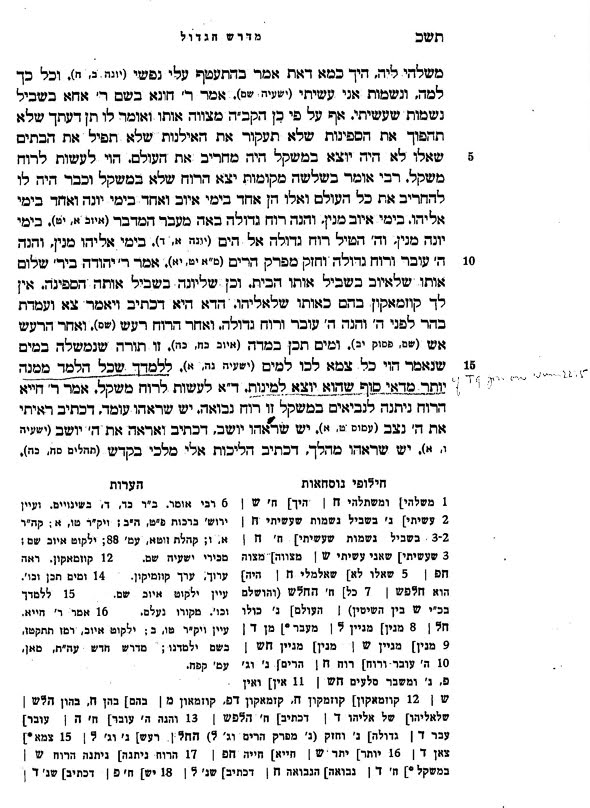
It is from Midrash ha-Gadol on Genesis (Mossad ha-Rav Kook edition). I don’t understand how the lesson is derived from the verse, but the lesson itself is clear enough: too much Torah study will lead to heresy. This is the sort of thing that one might expect to see in a medieval Catholic source, in justification of keeping the laity ignorant. Yet here we find the same attitude in a Jewish source. There are examples in rabbinic literature where we see that Torah study can have a negative result,[12] but I don’t know of any other text that is so blatant in its opposition to “excessive” Torah study. In the highly unlikely event that there are any high school students reading this who have been slacking off in Torah study, and have been challenged by their rebbe or parents to explain their inaction, see what happens if you pull out this text to explain matters.
I had seen this text a few years ago, and wanting to include it in the post I ordered the volume from interlibrary loan. The copy sent to me was from the University of Pennsylvania, and was originally found in the personal library of the late Dr. Judah Goldin. On the page we are looking at, Goldin underlined the strange passage (and also noted it on the first page of the book). On the side he added a reference to Targum Ps. Jonathan, Num. 22:5. Here it says that Balaam (who is identified with Laban) acted foolishly “from the greatness of his wisdom.” In other words, it was Balaam’s great wisdom that led to his thinking that he could curse the Israelites. Yet this passage only refers to Balaam’s general wisdom. It says nothing of Torah knowledge leading him astray.
With regard to R. Kook’s comments about the natural morality of the simple Jew, Joel Rich sent me chapter 4 of R. Soloveitchik’s Reflections of the Rav, ed. Besdin. The chapter is entitled “The Profundity of Jewish Folk Wisdom,” and is well worth reading. Yet you don’t find in R. Soloveitchik the notion expressed by R. Kook, that the natural morality of the simple Jew is superior to that of the scholar. For R. Kook, the simple Jew has something that the scholar does not have, and the scholar has that which the simple Jew lacks (halakhic knowledge). In this way, each can learn, and indeed is dependant, on the other. In dialectical fashion, the result of this will be a new type of Jew who combines in himself the best of both the scholar and the simple Jew. This is parallel to R. Kook’s discussion of the role of the non-religious. In the creation of the new Eretz Yisrael Jew the non-religious have that which is lacking among the religious, namely, the attachment to the physical world and the strength which Jews used to have when they lived on the Land, but which was forgotten during the long Exile. So the non-religious will bring that to the table, and the religious Jew will obviously bring Torah and spirituality. The result with be a synthesis of the two and the creation of an Eretz Yisrael Jew who, while being both Torah observant and spiritually enlightened will also be strong physically, able to build roads and fight wars. This is how Jews lived in days of old and how they are supposed to live when they return to the Land of Israel.
While R. Soloveitchik might have been attracted to dialectical-type thinking, there was no way that he would see the masses as having anything to give the halakhic scholar. The most the Rav speaks of in this essay is that the common man, even in his speech, reflects Torah values, but not that he is superior in any way to the learned ones.[13]
In this essay the Rav offers a beautiful interpretation of the aggadah in Niddah 30b that before birth a fetus learns all of the Torah and then forgets it when he is born:
Rabbi Simlai is apparently saying that every Jew comes into the world with a natural responsiveness to Torah teaching. Every Jew begins with a share in Torah was vested him before his birth, and, though he is made to forget it, it is preserved in the deep recesses of his soul, waiting to be awakened by study and a favorable environment. Scholars, of course, convert this latent knowledge into actual living knowledge; but the simple Jew also has a share. Some members of the Massorah[!][14] community are scholars whose knowledge is well formulated and codified, while others, though unlearned, may be endowed with inspired and intuitive Torah wisdom . . . [W]hen a Jew studies Torah, he finds it native to his spiritual personality and he responds to it readily.
R. Shalom Messas[15] also offers an interpretation of this Aggadah. According to him, it means that before birth God planted in the fetus the ability to study all of the Torah. The angel, who causes him to forget, represents the yetzer hara which distracts people from studying Torah[16]:
אלא האמת דאין כאן לא מלאך ולא שו”ד, והכל רמז ומשל בעלמא, והכוונה היא כמו שאמרנו, שבשעה שיצר השי”ת את העובר, נתן בו כחות עצומים באופן שיכול לעתיד ללמוד כל התורה אם ירצה . . . ויש בכחו ללמוד את כולה, וכשיוצא לאור העולם בא מלאך הוא הטבע, שכאשר מתחיל לצמוח מתערב עמו היצה”ר ומראה לו יופי הטבע והבריאה ונמשך אחריהם, ומעכבים עליו מללמוד תורה
This, too, is a beautiful perspective. I think people will therefore be surprised to learn that R. Messas was actually criticized by two separate authors, each of whom thought that his allegorical understanding of the Talmud was incorrect. In their opinions the Talmud should be taken literally, that the child really does know all of the Torah. Both of these authors refer to a “yeshivishe story” (with minor discrepancies between them) about how a certain baby was born knowing all the Torah, and from the moment of his birth began “talking Torah.”
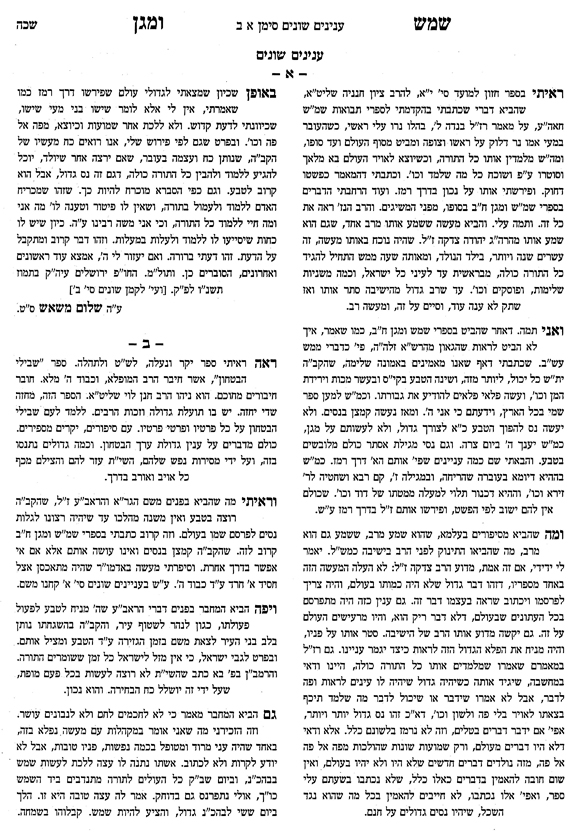
I always wonder when I hear Torah knowledgeable Jews repeat such nonsense as this yeshivishe story. What does this say about the Torah they learnt that they can be so gullible? I think the best we can say is that there is a difference between having book knowledge and being wise, and it is the latter that appears to be in such short supply. R. Messas replied to one of the authors in Shemesh u-Magen, vol. 2 pp. 322ff, and here is his reply to the second one, from Shemesh u-Magen vol. 3, p. 325.
I think R. Messas deserves a lot of credit for responding in such a polite fashion. Yet I have no doubt that if you spoke to him privately about this, his words would be much harsher in reflecting on how Torah students can be so foolish in believing such nonsensical stories.[17]
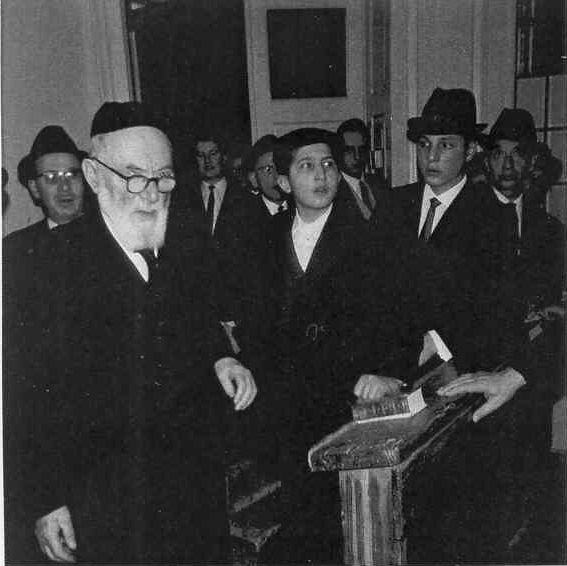
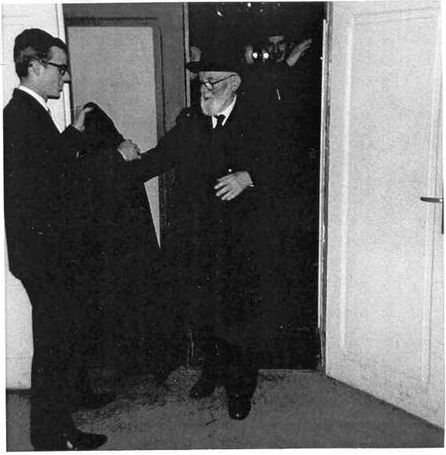
2. I have often been asked if I have pictures of R. Jehiel Jacob Weinberg. As a matter of fact I do, and here are two that I was given by Moshe Weisz of Zurich, who in the 1960’s was a student in the Montreux yeshiva. In the second picture, Weisz is the one handing Weinberg his coat.
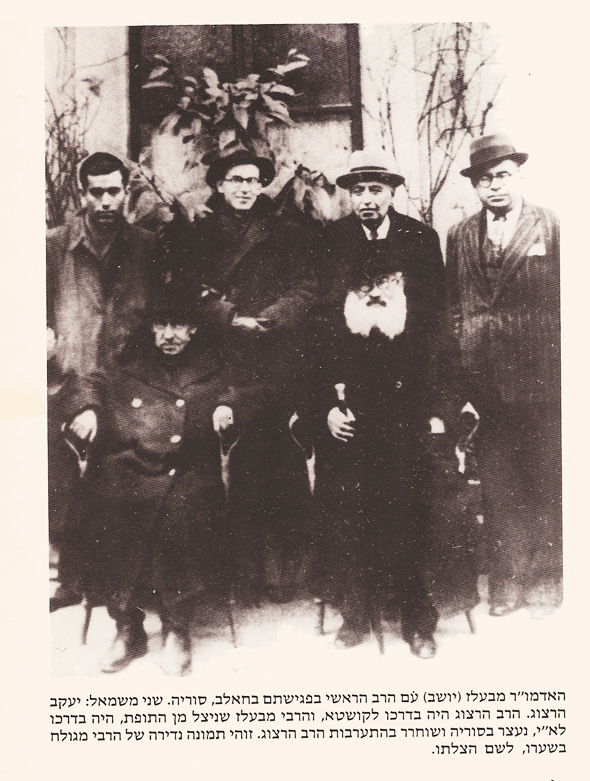
There is actually an amazing picture of Weinberg from his time in the prisoner of war camp. I would have loved to include this in my book, but the person who showed it to me refused to allow me to do so. He didn’t think it was respectful to a great Torah sage for people see him in this state. Yet why is this disrespectful? How was Weinberg supposed to look in such circumstances? Was he supposed to have a black suit and hat? Obviously, Jews did not look their normal selves during the years of the Holocaust. Here, for instance, is a picture of the Belzer Rebbe, R. Aharon Rokeach, with R. Herzog. It appears in Shaul Maizlish, Rabanut be-Sa’arat ha-Yamim, p. 61.
The Belzer Rebbe was one of those rebbes who, for religious reasons, did not like to have pictures taken of himself. Yet because R. Herzog exerted so much effort in order to secure permission for the Rebbe to enter the Land of Israel, he agreed to have his picture taken when R. Herzog requested this. (Or Yisrael 21 [5761]. p. 257). This last source also records the following great story, told by R. Aharon about his father, the previous Rebbe R. Yissachar Dov.
פ”א דיבר מרן מוהר”א מענין זה בשם אביו זצ”ל שאמר שבספר יערות דבש כתוב דברים חריפים אודות עשיית תמונה, אבל היות שכל היהודים אינם מקפידים ע”ז אין ברצוני להיות פרוש מהם, שכלם יהיו בגיהנום ואני יחידי יהיה בגן עדן, טוב לי להיות עם כלל ישראל ביחד
(Yes, I know that someone will point out the irony of R. Yissachar Dov saying that he would rather be in gehinnom with the Jewish people when his son chose precisely the opposite course, and left the gehinnom of Europe. Here is not the place to go into this story. Suffice it to say that I find Monday morning quarterbacking very distasteful. In this case it is even worse, as R. Aharon’s children and grandchildren were all murdered.)
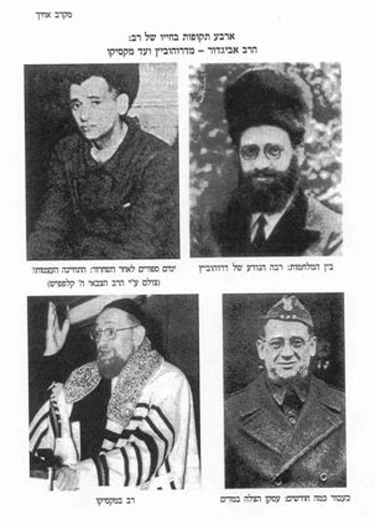
Here is a picture of R. Jacob Avigdor, whom I believe was a Belzer, from those difficult days (together with happier pictures).[18] Does anyone think this reduces him by showing how he looked during the Nazi years?
Incidentally, Moshe Weisz also told me about how in November 1965 Weinberg gave a hesped for four recently deceased rabbis, among them R. Yerucham Warhaftig and R. Eliezer Yehudah Finkel. These latter two were good friends of Weinberg, and Weinberg’s friendship with Finkel went back to their youth. After the eulogy Weinberg asked everyone in the room to stand up. They stood silently for around ten seconds and then he asked them to sit down. I presume this was intended as a show of respect rather than as a moment of silence, since the latter could be done sitting down.
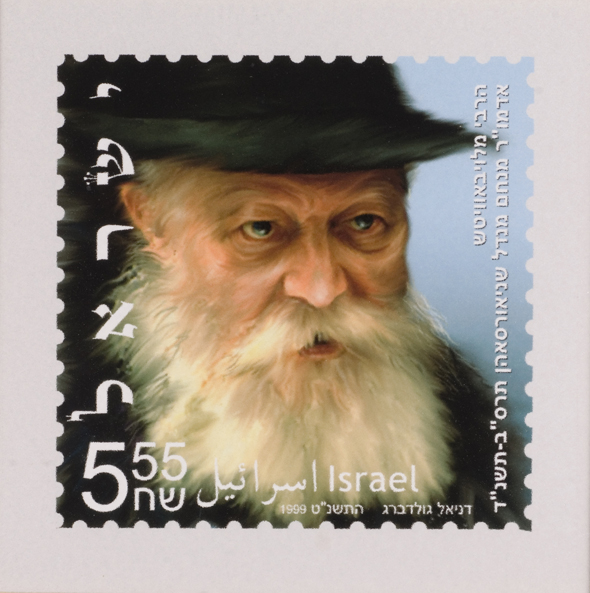
Since I have spoken about pictures in this post, let me also include this picture of the Lubavitcher Rebbe. It appears courtesy of the Library of the Jewish Theological Seminary, and I thank Rabbi Jerry Schwarzbard who first showed it to me a few years ago.
As you can see, it is an Israeli stamp from 1999, and it can now be added to Shnayer Leiman’s collection of stamps of rabbis.[19] Yet for some reason the stamp was never put into circulation. I have been unable to find the reason for this, and there is no mention of the stamp in Maya Balakirsky Katz’s recently published The Visual Culture of Chabad (Cambridge, 2010). There are many Lubavitchers who read the Seforim Blog. Perhaps one of you knows the story of this stamp and why it was never released.
As for Balakirsky Katz’s book, I urge Lubavitchers to read it, without preconceptions, and offer their opinions. It appears, to me at least, to be a quite interesting book. I stress the need for no preconceptions since Balakirsky Katz has now been placed by Lubavitchers in the “enemy camp”, along with other contemporary authors such as R. David Zvi Hillman z”l, David Kamenetsky, David Berger, Bryan Mark Rigg, David Assaf, Menachem Friedman, and Samuel Heilman. Balakirsky Katz angered Chabad with her recent article in the AJS Review 34 (2010; “An Occupational Neurosis: A Psychoanalytic Case History of a Rabbi”), and this article is summarized in the new book (but is only a very small part of the book). She argued that the Rebbe R. Shalom Dov Baer Schneersohn (Rashab) was the rabbi who visited the psychoanalyst Wilhelm Stekel in 1903. In those meetings the rabbi spoke about being sexually molested from his youth until his marriage. He also told about his sexual dreams and how he masturbated,[20] and described how his own brother carried on an improper relationship with his (i.e., the rabbi’s) wife (although it does not appear to have led to actual adultery).
I understand that Lubavitchers will regard Balakirsky Katz’s argument as beneath contempt. They will also regard as scandalous the fact that her essay was published in such a prestigious journal as AJS Review. I would not even ask them to dignify the argument with a response, any more than a non-Lubavitcher should be asked to respond to such claims about a close family member; for a hasid, the feelings for a Rebbe are just like those of a close relative. Yet there is a lot more to the book than the few pages dealing with the rabbi and Stekel, and I wonder how Habad insiders will appraise the rest of what she says.
Appendix
It is common to hear among YU figures the expression “hakhmei ha-mesorah,” referring to authoritative rabbinic spokesmen. Readers can correct me if I am mistaken, but I don’t think that this expression, with the meaning currently applied to it, is part of the traditional rabbinic vocabulary. I also don’t recall ever seeing it in haredi writing. (When the words appear in rabbinic literature they refer to Masoretes.) The first mention of it that I know of appears in R. Soloveitchik’s famous attack on R. Emanuel Rackman regarding nullification of marriage. Needless to say, the expression makes an appearance in R. Schachter’s new book, Divrei ha-Rav. See e.g., p. 233.
This latter reference is part of an article that R. Schachter earlier published in Beit Yitzhak 38 (2006). The reprint in Divrei ha-Rav has two changes from the original. On p. 237 a sentence is added, according to which the Rav stated that in Europe he never heard the expression “Daas Torah.” The second change is that one entire paragraph, on pages 5-6, has been removed. Here is the paragraph.
From this paragraph we see that the Rav’s strong personal opposition to prayer in a synagogue without a mechitzah was not shared by all other rabbis, and that the Rav was willing to show some flexibility in this matter. The case discussed here was not like the other times that the Rav gave permission for a rabbi to take a position at a synagogue without a mechitzah. In those cases the heter was for a rabbinic appointment designed to be for a few years, and during that time the rabbi was supposed to try to convince the synagogue to install a mechitzah. The issue discussed in the Beit Yitzhak article was simply a High Holiday position at a non-mechitzah synagogue in order to make some money.
This paragraph provides important testimony that can balance some of the Rav’s more strident statements in this matter. If anyone can get a straight answer from R. Schachter as to why the paragraph has been removed, please share it with us. I would hate to think that we have here an example of revisionism—in other words, R. Schachter decided to delete the paragraph because he concluded that it is best that people not know this information, or he was responding to others who criticized him for including the paragraph.
With regard to the larger issue of how R. Schachter presents the Rav, Lawrence Kaplan has already noted that there are revisionist aspects of R. Schachter’s presentation of the Rav’s legacy. See his “Revisionism and the Rav,” Judaism, summer 1999, available here.
One aspect of this revisionism that Kaplan does not mention is that while Nefesh ha-Rav has an entire chapter on the State of Israel, there is no mention of the Rav’s view—which was expressed on a number of occasions, as well as publicly before hundreds of people—that there is no halakhic prohibition for Israel to return land to the Arabs.
It certainly says something about the transformation of American Orthodoxy in the last generation that R. Schachter became the one to carry on the Rav’s legacy. Unlike the Rav, R. Schachter is a talmudist and posek, and has no involvement with the broader philosophical and cultural issues of Western Civilization. Yet despite this, he is, by far, the most important and influential rabbi in Modern and Centrist Orthodoxy. When it comes to matters of halakhah, I wonder if there is anyone in the American haredi world who can compare to his wide-ranging knowledge. I have heard him in person and on tape many times, and I continue to be amazed at how he can speak for long periods, without notes, on literally any topic of halakhah. I have never seen anything like it. It is all at his fingertips, and he presents it in a fashion that keeps the audience’s attention. As for the liberal Orthodox, who oppose R. Schachter because of his strong stand against feminist innovations, even they must applaud his leading role in dealing with husbands who refuse to give their wives gittin. This has earned him the opprobrium of the Orthodox lunatic fringe, and one member of this group, Abraham Samuel Judah Gestetner, who styles himself a dayan, has even placed R. Schachter in herem (together with two well-known California rabbis). See here.
Gestetner is also the author of the ridiculous book Megilat Plaster, which attempts to show that R. Jacob Emden’s Megilat Sefer is a forgery perpetrated by the evil maskilim. Here is the title page.
His argument is completely demolished by R. Menachem Mendel Goldstein in Etz Hayyim (Bobov), no. 8(Shevat 5769), pp. 239-266. (Goldstein resides in that bastion of Haskalah known as Kiryas Yoel.). On the very first page of his article, Goldstein complains that the various publishers of Emden’s Megilat Sefer did not consult with gedolei Yisrael in order to determine what should have been censored. In other words, he takes it as a given that the masses need to be protected from what Emden has to say.
הספר מגילת ספר נדפס על ידי אינשי דלא מעלי שאין רוח חכמים נוחה מהם, ולא נתיעצו בגדולי חכמי ורבני דור דור האיך ומה להדפיס ומה להשמיט
To be continued.
[1] There is still a good deal more I plan to say about the whole Garden of Eden story. For now, let me respond to one question. We have seen the medieval philosophical approach that the episode with the snake is to be understood allegorically, and the snake represents the evil inclination. A few people want to know if we can find such an approach in Hazal. I actually think we can. In Pirkei de-Rabbi Eliezer, ch. 13 (referred to by Maimonides in Guide 2:30), it mentions that the serpent had a rider, Samael (Satan). Since at least some of the Sages identify Satan with the evil inclination, this opens the possibility that the snake in our story is also to be understood this way. Yet I think that most of the Sages probably understood the passage literally. For one example, see Bereishit Rabbah 19:1, where R. Hoshaya states that the snake stood up like a reed, and that he had feet. Whereas the medieval philosophers were reluctant to take literally a text that spoke of a talking snake (and donkey), this did not seem to bother the talmudic Sages.
[2] A fuller discussion of Hirschensohn’s view of evolution will appear in a future post. In the meantime, see his Seder la-Mikra, vol. 1, pp. 76-77:
אין השיטה הדארוונית מתנגדת כלל להתורה בדבר הבריאה בששה ימים, כי הימים בעצמם כל אחד הוא יום שכלו אורך תקופה שלמה . . . כי עדיין לא הי’ עוד השמש לאור יומם לראשון השני והשלישי ובכל זאת נקראים ימים וגם אחרי בריאת המאורות לא ידענו כמה לקח זמן התפתחותם לאותות למועדים לימים ושנים שלנו, ואריכת ימי בראשית לא נדע לנו שכל יום הוא תקופה שלמה
In another twenty years, I wonder if the younger generation will believe us when we tell them that Hirschensohn’s position was accepted throughout the haredi world, and was standard fare in the kiruv movement and in “science vs. Torah” discussions. There was a time when I, and so many others, would never have believed that “young earth” fundamentalism could ever become a binding principle of faith in the wider haredi world, precisely because it would mean rejecting a position that had been so central to the haredi Torah-science reconciliation.
[3] Link”Rationalism and Rabbinic Culture,” pp. 240ff.
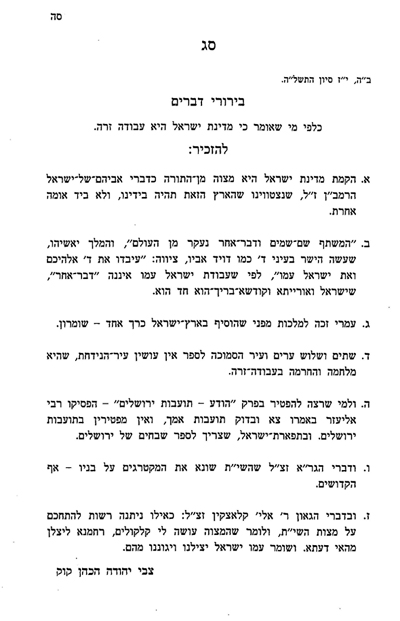
[4] Mesorah le-Yosef 4 (2005), p. 183.
[5] This point was noted by Kaplan, Link”Rationalism,” p. 300 n. 225.
[6] See Studies in Maimonides and His Interpreters, p. 111.
[7] Good and Evil in Jewish Thought (Tel Aviv, 1989), p. 63.
[8] Moses Maimonides (Oxford, 2005), p. 407.
[9] See also my post here where I noted R. Itzele of Ponevezh’s statement that how the Jewish masses feel is more important than what the rabbis think: וכלל ישראל הוא גבוה ונעלה מגדולי התורה . This is obviously diametrically opposed to the haredi conception of Da’as Torah. In my Torah in Motion lectures I discussed how R. Itzele’s conception parallels the Catholic notion of “sense of the faithful.”
In addition to the passages of R. Kook referred to in my earlier post, there are many other sources that one could quote. One that comes immediately to mind is Haym Soloveitchik’s understanding of medieval Jews committing suicide. He sees this as an example of the “sense of the faithful” which was not in line with established halakhah, but which ex post facto had to be justified. Even the murder of one’s children to prevent them from being forcibly apostatized could not be judged according to halakhic texts, or else people regarded as kedoshim would lose this status, an untenable possibility under the circumstances of medieval Jewish life. See ‘Religious Law and Change: The Medieval Ashkenazic Example,’ AJS Review 12 (1987), pp. 205-221. Soloveitchik writes (p. 209):
The magnitude of this halakhic breach is enormous. Whether one is permitted to suffer voluntary martyrdom is highly questionable; suicide is forbidden beyond question, and the permissibility of murder needs no discussion. Thus, if the law were to be followed, the scholars of these communities would have had to rule that all the martyrs—qedoshim, or “holy ones,” as they were called—were not only not “holy,” but they were “self-killers,” and murderers; that not only should they not be buried with honor, but perhaps they should even be denied burial, or at best be buried in the far end of the cemetery where the most vile criminals are interred. Such a conclusion, needless to say, was an emotional impossibility.
After speaking of the “sense of the faithful,”—or what Jacob Katz and Soloveitchik describe as “ritual instinct,” “religious intuition,” and “religious sense”—this article concludes with a couple of paragraphs that I think readers will find very interesting:
I remember my own shock when, after studying Yoreh Deah, I realized that there is no need for separate milk and meat dishtowels, separate dishracks or cabinets, and that if food is served cold, there is no need for separate dishware altogether. Again, there is all the difference in the world between not having hamets in the house (בל יראה ובל ימצא) and the house being what we call pesahdiq.
The simple truth is that the traditional Jewish kitchen and pre-Passover preparations have little to do with halakhic dictates. They have been immeasurably and unrecognizably amplified by popular religious intuition. We all know this, but our religious sense, our religious experience belies this knowledge, and our instincts reject this fact out of hand. To serve cold cuts on a “dairy” dish is treif—everything in Yoreh Deah to the contrary notwithstanding.
The prevalent has not here expanded the normative, it is the normative, and anything less is inconceivable.
Upon hearing one of my TIM lectures, R. Yonasan Rosman sent me a nice example of how the “sense of the faithful” operates independently of, and sometimes even in opposition to, halakhic particulars. It comes from Making of a Godol, p. 1188:
My father also was fond of quoting an interpretation of the Mozhirer Maggid, R. Shmuel Rabinowitz, of the gemara in Massekheth Brakhoth that
כנור היה תלוי למעלה ממטתו של דוד וכו’ ומנגן מאליו
(a fiddle hung above the bed of King David, etc., and it played on its own) to mean that Jewry senses what policy is vital for its existence and does not probe whether the course of action (or inaction) is halakhically sound or not. One of the several examples he gave was by asking rhetorically, “Who gave the Slabodka Yeshiva bahurim the halakhic permission [היתר] to marry at so late an age?” and in answer, he paraphrased the gemara (which he translated into Yiddish), “און דער פידעלע שפילט פון זיך אליין (and the little fiddle plays on its own.”) He was out to prove that when some position is of crucial importance to Jewry—such as increasing the number of intelligent Jews getting in more years of Torah study before going off into their occupations—halakhic minutiae are set aside.
It is precisely sources like this, and the others I have quoted, that are crucial for anyone wishing to challenge the pan-halakhic understanding of Judaism that has taken root in Centrism.
(Regarding yeshiva students marrying later, see R. Shlomo Sofer, Hut ha-Meshulash [Munkacs, 1894], p. 7b, that in late eighteenth-century Frankfurt, yeshiva students would sometimes wait until age thirty to marry.)
[10] For R. Jehiel Jacob Weinberg’s essay on Meisels, see Seridei Esh, vol. 4, pp. 345-352.
[11] See Ahiezer: Kovetz Rabani-Torani, vol. 4 (1969), p. 17.
[12] Sotah 21b states: “R. Eliezer says: Whoever teaches his daughter Torah teaches her obscenity. . . . Read, rather: as though he had taught her obscenity” Rashi explains: שמתוכה היא מבינה ערמומית ועושה דבריה בהצנע
Meiri, Sotah 20a explains (and as with the Ralbag quoted in a prior post, apologies to the women reading): שמתוך הבנתה ביתר מגדרה היא קונה ערמימות מעט, ואין שכלה מספיק להבנה הראויה והיא סבורה שהשיגה ומקשקשת בפעמון להראות את חכמתה לכל
[13] There are, of course, many other differences between R. Soloveitchik and R. Kook. From the excerpt printed in The Rav Thinking Aloud, pp. 155-156, we see that the Rav regarded R. Kook as a saintly figure, but not as an intellectual great. Yet this impression was derived from one short conversation. All the gedolim who knew R. Kook had the exact opposite impression. They correctly saw that R. Kook was a master of the entire Torah, in all of its facets. I think you have to go back to Maharal, or perhaps even Nahmanides, to find such a wide-ranging Torah scholar as R. Kook.
Experts on the Rav’s writings can correct me, but the only place I recall where he mentions R. Kook is in On Repentance, p. 161 (and this was not actually published by the Rav himself, but by Pinchas Peli). See incidentally, ibid., p. 224, where the Rav states, referring to the State of Israel: “Bondage to the State can also become idolatry.” When this appeared in 1975, in the original Hebrew edition Al ha-Teshuvah, R. Zvi Yehudah Kook responded with a very sharp statement (later reprinted in Le-Hilkhot Tzibbur):
The Rav in turn said about R. Zvi Yehudah: “If you follow the philosophy of Tzvi Hirsch [!] Kook a Jew outside of Eretz Yisrael is a non-Jew. And this is exactly against the passuk of כי לי כל הארץ. A Jew outside of Eretz Yisrael can be a perfect Jew. Where you accomplish more is up to the individual. . . . Kook comes out with the Ramban [who says that mitzvah observance in the Diaspora is not at the same level as in the Land of Israel] as if he is the only one to whom the Ramban has entrusted the text.” The Rav Thinking Aloud, pp. 225, 229. See also, ibid., p. 154, where he says that R. Zvi Yehudah “has an aura of kedushah about him.”
[14] See Appendix.
[15] Introduction to his Tevuot Shemesh, Even ha-Ezer, and Shemesh u-Magen, vol. 2, p. 321.
[16] See also Maharsha, Niddah 30b.
[17] With regard to what else fetuses are said to be doing in the womb (aside from learning Torah), there is a very strange passage in Otzar ha-Geonim, Berakhot 28b (p. 71). I hesitate to elaborate on it lest this post be blocked by internet filters:
כשאדם כורע במודים צריך לו לכרוע עד ברכיו לפי שהילד בעודו במעי אמו ראשו מונח בין שתי יריכיו והמילה שלו בתוך פיו ובעבור זה צריך לשוח עד ברכיו.
[18] The picture comes from Esther Farbstein’s Be-Seter Ra’am (Jerusalem, 2002).
[19] See here.
[20] With regard to masturbation, R. Simcha Ross called my attention to the responsum printed here by an unnamed talmid hakham. He argues that masturbation is permissible. When Rabbi Ross first alerted me to this (and also expressed his disagreement with the arguments of the author), I thought this was some sort of Purim Torah. But then I examined the responsum, and other responsa on the site, and I could see pretty quickly that this was a serious man, whose arguments were carefully thought out. There are so many books published today that simply repeat what others have said, without offering anything new, that it is a pleasure to see original thinking, Based on his permission to masturbate, he also concludes that homosexual activity is permissible, as long as there is no mishkav zakhur. See here.
(This anonymous author has also placed on his website his commentary on R. Baruch Ber Leibowitz’s Birkat Shmuel, and also many posts discussing talmudic sugyot.)
I showed this responsum to someone. Yet instead of examining the arguments, all he was interested in was the identity of the author, who, as can be seen from various responsa on the site, is clearly from the haredi world. Maybe some readers know who he is, but I think that someone like this has to be in “deep cover.” We all know how the powers that be would destroy anyone who argued that masturbation is permissible. Since this involves a halakhic matter, I am certain the response would be even more severe than how they dealt with Slifkin and Kamenetsky. This talmid hakham would be branded not merely a heretic and a Reformer, but also a sexually dissolute degenerate. So yes, I understand why the author chooses to remain anonymous. My request to readers is as follows: The argument permitting masturbation is so far removed from anything I have ever seen that I would like those with more halakhic learning than myself to examine his teshuvah and let us know if you think there is anything to his argument.
Also, please look at other material on his site. Is it possible that instead of a “progressive” talmid hakham we are dealing here with a Trojan Horse? That is, someone who aims to undermine traditional Judaism from within, much like Saul Berlin attempted to do.


Mezuzah Revisited. Parshat Vaetchanan.

Mezuzah
Revisited. Parshat Vaetchanan.
By
Chaim Sunitsky.
Rashi on
this Parsha (Devarim 6:9) says that since the word Mezuzot is
written without the Vav[1], only
one Mezuzah is necessary. It’s generally assumed that Rashi can’t argue with a
clear Talmudic statement that every door of the house needs a Mezuzah[2] and
therefore he can’t be understood at face value. However the custom in many
places in Medieval Europe had always been to only affix one Mezuzah per house[3]. We
will now try to examine if indeed there ever was a tradition that supported
this minhag.
The Rema makes a
unique statement in Yoreh Deah (287:2): “The commonly spread minhag in
these countries is to attach only one Mezuzah per house and they have nothing
to rely on”. This statement is very unusual. Rema is known for
supporting Jewish minhagim and it’s very common for him to use the
expression “common minhag” often followed by a statement that this minhag
should not be changed, or at least that this minhag can be relied on.
Here however the Rema is saying just the opposite: the minhag has
nothing to rely on and a “yere Shamaim” person should affix the Mezuzot
on every entrance.
It’s hard to understand
how this incorrect “minhag” could have possibly become wide spread. R. Yissachar
Dov Eilenburg[4]
(the author of Beer Sheva on the Talmud) suggested that this mistake became
widespread due to incorrect understanding of our Rashi. However I find
it strange if the previous minhag was to affix a Mezuzah on every
doorpost, how would it change in many countries simply because they misunderstood
the Rashi’s Torah commentary[5]. As
for the correct understanding of Rashi, two possibilities were offered:
either Rashi is saying that we don’t have to affix two Mezuzot on each
doorframe[6], or
that Rashi is following the opinion of R. Meir that if an entrance has
only one doorpost on the right, there is a need to affix Mezuzah (despite the
lack of second doorpost[7]). As
for Rashi’s actual drasha[8]
we don’t see it in any known source in Hazal[9].
In general there was[10] some
attempt to explain the custom of affixing only one Mezuzah based on the fact
that many of the inside rooms in their houses were not clean enough, but this
does not explain what people relied on when the house itself had more than one
entrance[11].
However Rashi[12]
on our Gemorah brings an interpretation according to which if a house
has exactly two entrances, it needs only one Mezuzah on the more commonly used
entrance, since the other entrance is batela (is unimportant) compared
to the first one. Only if the house has more than two entrances then we don’t
say that two entrances are batelim to the one commonly used entrance.
Maybe then Rashi on the Chumash is following his shita and
saying that a house (or room) with two entrances requires only one Mezuzah. Interestingly,
in Yerushalmi[13]
there is even a stronger statement that seems to imply that only one entrance per
house requires a Mezuzah:
בית
שיש לו שני פתחים נותן ברגיל היו שניהן רגילין נותן בחזית היו שניהן חזית נותן על איזה
מהן שירצה
The simple meaning of Yerushlami
seems to contradict the Talmud Bavli and imply that only the entrance that’s
used more often needs the Mezuzah. If he uses both entrances equally, then the
Mezuzah is affixed to the “stronger” entrance and is they are equally strong,
one can affix the Mezuzah on either entrance.
To conclude we seem to
have found a possible explanation of Rashi according to the simple
meaning of his words[14] and
a possible justification for the old minhag in Europe[15]. Needless
to say our words are only theoretical and Baruch Hashem that minhag has
disappeared a long time ago and every Orthodox Jew today affixes a Mezuzah on
every entrance.


[1] Apparently Rashi
implies that Mezuzot is written without the second Vav and can be read as Mezuzat.
Our scrolls written according the Mesorah, Rambam (Sefer Torah
2:6), Semag (Asin 22) and Minhat Shai have the first Vav
between two Zain’s missing, but Leningrad scroll (used on Bar Ilan disk)
in fact has the second Vav missing. It’s also possible that Rashi meant
that as long as some Vav is missing we can “transfer” the missing Vav to the
last position and thus read the word as Mezuzat. See also Minhat Shai,
Shemot
12:7. Interestingly the famous statement of the GR”A that
there are 64 different Tefilins one would need to put on to fulfil all opinions
does not consider the various opinions about how to write various words like “mezuzot”,
“totafot”, which would bring the numbers of different Tefillins to hundreds.
[2] See for
instance Menachot 34a.
[3] In this article
we only discuss if there is any justification for the custom of affixing one
Mezuzah on one’s home. See however Semag (Asin 3) that there were
some people in Spain who did not affix Mezuzot at all, and see there in Asin
23 some weird “justification” they used for their “minhag”.
[4] In his super-commentary
on Rashi called Tzeda Lederch and his “Beer Maim Chaim” usually
printed in the end of Beer Sheva.
[5]  To say nothing about the fact that Halacha is
rarely learned from a Torah commentary as Rashi does not “pasken
there.
[6] In Yalkut
Shimoni
on Mishley (remez 943) indeed there is an opinion
that each of the doorposts requires two Mezuzot, but our Gemorah (Menachot
34a) does not hold like this opinion and does not even mention it (see also Shu”t
Minchat Yitzchak
1:9).
[7] Obviously the
Biblical word Mezuzah means not the parchment but the pole itself, so one Mezuzah
in Rashi means one doorframe.
[8] Which Rabeinu
Bahya quotes as words of Razal.
[9] See however Mordachai
(962) who brings in the name of Rif that R. Meir and Rabonan who
argue about the above law apparently learn from the spelling of Mezuzot. It may
be according to this girsa, not found in our Rif, R. Meir had no
Vav and Rabonan had a Vav in the word “Mezuzot” in Devarim 6:9. The
Talmud mentions that R. Meir was a scribe and it’s possible he had some
especially accurate scrolls that were different from the more commonly used
ones (his “Torah scroll” is mentioned in Midrashim, see for instance Bereshit
Rabbah
94:9). Our Gemora however only mentions the learning from “Mezuzot”
with the Vav to support the shita of Rabonan (see also the first Tosafot
on 34a).
[10]
See Maharil, Minhagim, Laws of Mezuzah, 1 and Tshuvot 94 . In practice the
Maharil and Rema did not accept these explanations.
[11] See also Shu”t
Divrey Yatziv Yore Deah 191
who proposes that maybe only the Mezuzah on the
outside doorpost is a Biblical command, but the question of a house with two
entrances still remains.
[12] Menachot 33a
starting with words Holech Achar Haragil and 34a starting with words
Af Al Gav Deragil Beechad.
[13] The end of Megila,
34a (see however second perek of Tractate Mezuzah, in Vilna Shas
it’s printed at the end of the volume with Avoda Zara). Even if our
interpretation off the Yerushalmi is correct, if the house has many
rooms, it would seem to need a Mezuzah for each one even according to Yerushalmi.
[14] In Sefer
Zechor Leavraham
on Rashi in Likutim in the back the author
also interprets Rashi to mean only one Mezuza is needed. He proposes
that Rashi quotes a lost Midrash similar to the one preserved in Yalkut
Shimoni
I quoted above. According to the author the dispute there is not whether
the Mezuzah is placed on both sides of one entrance but whether there is a need
for a Mezuzah on every entrance of the house.
[15] It’s known that
many European communities started in Italy, where Yerushalmi was often
followed to a greater extent than Bavli and therefore it’s possible that
the earliest settlers in France and Germany were told only to affix one Mezuzah
on the main entrance leading to the street. Regarding inside rooms, maybe they
did not have any since simple houses had only one room in those times or maybe
they relied on some of the weak reasons mentioned in Maharil (who
rejects them) but regarding the outside doors if there are only two they may
have followed Rashi and if some of their houses had more than two entrances
they may have followed Yerushalmi or some other lost opinion (partially
preserved in the Yalkut Shimoni).   


[1]: א״ל הקב״ה … יודע אני כוונתו של אהרן היאך היתה לטובה On a Short Wedding Wish to the Lichtensteins from the Pen of Rabbi Jehiel Jacob Weinberg

[1]: א״ל הקב״ה … יודע אני כוונתו של אהרן היאך היתה לטובה
On a Short Wedding
Wish to the Lichtensteins from the Pen of Rabbi Jehiel Jacob Weinberg
By Shaul Seidler-Feller
I
Rabbi Aharon Lichtenstein, zts”l, the late, lamented, “irreplaceable”[2] gedol ha-dor of the Modern Orthodox and Religious Zionist communities,[3] has been characterized by those who knew him as a larger-than-life – indeed, angelic[4] – leader whose complete command of every facet of Torah learning was matched only by his sterling character and superlative (almost Hafets Hayyim-like) piety.[5] One of the things that struck me most, however, in listening to and reading several of the eulogies delivered or published after his passing was precisely how genuinely human this prince among men was in his personal and family life. Mrs. Esti Rosenberg, one of Rav Lichtenstein’s daughters and the head of the Stella K. Abraham Beit Midrash for Women – Migdal Oz, used the biblical metaphor of “a ladder set up on the earth, whose head reached unto heaven” (Gen. 28:12)[6] to capture how her father managed to radiate both a rarefied aura of sanctity and, crucially, a true humanity that extended to such mundane matters as doing most of the laundry in the house,[7] getting the kids ready in the mornings,[8] helping them with their homework in the evenings,[9] coming to learn with them after seder twice a week,[10] making sure to eat dinner with them almost every night,[11] washing the dishes after Shabbat had ended so that his kids would not fight over whose responsibility it was,[12] attending their performances in the Ezra youth group or at school,[13] teaching them how to ride a bike,[14] playing Scrabble and chess with them,[15] taking an interest in their friends,[16] buying them gifts and clothing during his visits to the States,[17] etc. – all of them activities that might be undertaken by normal devoted fathers but that I think we usually, rightly or wrongly, do not associate with people of Rav Lichtenstein’s intellectual caliber and spiritual stature. Indeed, in the words of Rabbi Avishai David, a student of Rav Aharon’s, “Rav Lichtenstein was a normal gadol ba-Torah, a very normal gadol ba-Torah.”[18]
And, of course, the same level of devotion was manifest in his relationship with his wife, Dr. Tovah Lichtenstein (nee Soloveitchik). Rav Aharon’s children reflected at the levayah on the mutual respect and unwavering support each partner showed the other,[19] while his students described some of the (ever-modest) manifestations of their affection for one another.[20] Dr. Lichtenstein herself summed it up best in a video produced in honor of her husband’s eightieth birthday when she said, “He invested both intellectually and emotionally in our children.[21] And he invested in our marriage as well – he was not only a family man but also a husband.”[22]
II
It is in this context, then, that I wish to digress for a moment and travel back in time to the Lichtensteins’ wedding, the point at which this whole story started, by way of a unique text discovered by Menachem Butler in a volume on the shelves of Yeshiva University’s Mendel Gottesman Library of Hebraica/Judaica. The year is 1959, and Rabbi Jehiel Jacob Weinberg (1884–1966), famed prewar rector of the Hildesheimer Rabbinical Seminary in Berlin and author of the Seridei esh compendium of responsa, halakhic novellae, and topical essays, is living out the last stage of his life in Montreux, Switzerland. Meanwhile, across the ocean in the United States, Rav Lichtenstein has just received semikhah from Yeshiva University’s Rabbi Isaac Elchanan Theological Seminary, having completed his doctorate in English literature at Harvard two years prior,[23] and is engaged to be married to Tovah Soloveitchik, daughter of Rabbi Joseph B. Soloveitchik, Rav Aharon’s rav muvhak.[24] The couple originally planned to wed Tuesday night, 22 Kislev 5720 (December 22, 1959), in the Dorothy Quincy Suite of the John Hancock Building in Boston, the bride’s hometown (see Fig. 1).[25]


 Fig. 1

In anticipation of the joyous occasion, to which he apparently could not arrive in person, Rav Weinberg sent an inscribed volume of Yad sha’ul,[26] a collection of essays compiled in memory of his beloved talmid muvhak (and the person primarily responsible for bringing him to Montreux in the first place),[27] Rabbi Saul Weingort (ca. 1914–1946),[28] who had passed away following a tragic train accident while on his way to deliver a shi‘ur at the yeshivah in Montreux.[29] Through some serendipitous twist of fate, it is this copy of the sefer which made its way into the open stacks of the Gottesman Library. The dedicatory text (see Fig. 2) and my translation thereof follow:

Fig. 2
מזכרת ידידות
ושי לחתונה
של הרה״ג ד״ר אהרן ליכטנשטיין
עב״ג
מרת טובה סולוביציק ילאי״ט
בתו
של גאון הדור ותפארתו
ידידי הגאון הגדול מאוה״ג
מהרי״ד הלוי סולוביציג [!][30] שליט״א
שתתקיים במז״ט ובשעה מוצלחת
בכ״ב לחודש כסליו שנת תש״כ
ויה״ר שהזוג היקר יתברך
ממעון הברכות בחיים ארוכים
טובים ומאושרים ומוצלחים בכל
דרכי חייהם, והבית אשר יוקם
,יהי׳ לשם ולתפארת בישראל
ולמקור עונג ושמחת עולמים
.להוריהם הדגולים
יחיאל יעקב וויינברג
מונתרה, ח׳ בכסליו, תש״כ

A gift and token of friendship presented on the occasion of the marriage of the ga’on, Rabbi Dr. Aharon Lichtenstein, to his soul mate, Ms. Tovah Soloveitchik[31] – may their years be long and good – the daughter of this generation’s pride and splendor, my friend, the great ga’on and Luminary of the Diaspora, our teacher, Rabbi Joseph B. ha-Levi Soloveitchik – may his years be long and good, amen – which is set to take place, under a lucky star and at an auspicious hour, on 22 Kislev [5]720. May it be His will that this precious couple be blessed from the Abode of Blessing with long, good, and joyous lives and with success in all of their endeavors. And may the home that they build be of fame and of glory in Israel [see I Chron. 22:5] and a source of eternal delight and happiness for their distinguished parents.
Jehiel Jacob Weinberg
Montreux, 8 Kislev [5]720 [December 9, 1959]

I think this text is historically significant for at least two reasons. First, while I am unaware of any subsequent contact between the Lichtensteins and Rav Weinberg following the wedding,[32][32] this message certainly attests to a longstanding relationship of mutual regard
between Rabbis Weinberg and Soloveitchik, two leading rashei yeshivah whose formative years were spent in both the Lithuanian yeshivah world and the German academy. We know from other sources that they first met while the Rav was a student at the University of Berlin in the 1920s; according to testimony cited by Rabbi Aaron Rakeffet-Rothkoff, the Rav audited classes at Rav Weinberg’s Seminary during the 1926–1927 academic year.[33] Their encounters extended well beyond the classroom, however,[34] and even though Rav Weinberg was generally not enamored of the Brisker derekh ha-limmud espoused by Rav Soloveitchik and his forebears,[35] these two intellectual powerhouses maintained a deep appreciation for one another throughout their lives[36] – as can certainly be seen in Rav Weinberg’s above inscription.

The second issue that I wish to discuss here relates to the date of the wedding itself. As of 8 Kislev 5720, Rav Weinberg, quite justifiably, thought that it would take place two weeks hence. However, that very evening, December 9 – the same night the Rav delivered the aforementioned (n. 35) hesped for his uncle, Rabbi Isaac Ze’ev Soloveitchik (1886–1959) – Rav Soloveitchik “informed his family that he had been diagnosed with colon cancer, and would be returning to Boston the next day for surgery. His daughter Tovah and her fiancé R. Aharon Lichtenstein postponed their wedding (which had been set to take place in the coming days) until a few weeks later, so that the Rav could participate.”[37] Thus, the wedding was not actually held until Tuesday night, 27 Tevet 5720 (January 26, 1960) (see Figs. 3 and 4),[38] something Rav Weinberg could not have predicted at the time he penned his wishes to the young couple.

Fig. 3


Fig. 4
III
In any case, returning to the present after our brief historical sojourn, it seems to me that, aside from all he taught us about avodat Hashem, lomdes, morality, and how to live as deeply committed Jews in the modern world, Rav Lichtenstein also modeled what it means to be a “totally devoted” family man.[39] As Rabbi Menachem Genack, who began his undergraduate studies at Yeshiva College when Rav Lichtenstein was already a rosh kolel in RIETS, remarked, “Rav Aharon’s gadlus batorah is well-known, but less celebrated is his gadlus as a father and as a son, his commitment and dedication to his family. Rav Aharon was always learning, but nevertheless managed to spend time with all of his children.”[40] Indeed, anyone who sees the pictures of Rav Aharon and his family featured in the aforementioned video will immediately understand what Rabbi Mayer Lichtenstein meant when he said that his father fulfilled the talmudic principle of ner hanukkah ve-ner beito, ner beito adif (Shabbat 23b).[41] With this background, it should not surprise us that, when asked, “What are you most proud of having accomplished during these years of service?” Rav Lichtenstein answered:

Looking back over
the past 50 years, what I am proudest of is what some would regard as being a
non-professional task. I’m proudest of having built, together with my wife, the
wonderful family that we have. It is a personal accomplishment, a social
accomplishment, and a contribution – through what they are giving and will
give, each in his or her own way – in service of the Ribbono shel Olam in the future.[42]

I think the lesson for us, his students, is clear. May we be zokheh to rise to the challenge of carrying forth all aspects of Rav Lichtenstein’s multifaceted legacy for many years to come.


*
I wish at the outset to express my appreciation to yedidi, Reb Menachem Butler, ne‘im me’assefei yisra’el, for furnishing me with the opportunity, as well as many of the bibliographical sources (including the primary text itself!) required, to compose this essay. Additional thanks go to his fellow editors at the Seforim Blog for their consideration of this piece and, generally, for their great service to the public in maintaining such an active and high-quality platform for the serious discussion of topics of Jewish interest. Finally, I am indebted to my friends Eliyahu Krakowski, Daniel Tabak, and Shlomo Zuckier for their editorial corrections and comments to earlier drafts of this piece which, taken together, improved it considerably.
[1]

[1] See Shemot
rabbah
(Vilna ed.) to Parashat
tetsavveh
37:2.

[2]

[2] Dr. David Berger quoted Rabbi Yosef Blau
as describing Rav Lichtenstein in this way and went on to characterize him in
similar terms here
(listen at about 1:04:40). Rabbi Ezra Schwartz said in effect the same thing here,
and in some ways went even further (listen at about 58:00).

[3]

[3] For evidence of how strongly his loss
has already been felt in the Modern Orthodox/Religious Zionist communities, one
need only peruse the ever-expanding number of articles and tributes that have
been cataloged on the Yeshivat Har Etzion websites here and here.

[4]

[4] One set of verses to which maspidim kept returning when describing
Rav Lichtenstein was those that appear in Malachi 2:5-7, together with the
rabbinic interpretation thereof: “If a given rabbi can be compared to an angel
of the Lord of Hosts, let them ask him to teach them Torah, and vice versa” (Hagigah 15b, Mo‘ed katan 17a). See the hespedim
of Rabbis Mayer Lichtenstein here
(listen at about 7:50), Mordechai Schnaidman here
(listen at about 23:00), and my friend Mordy Weisel here
(listen at about 5:05). Similarly, others have described him as angelic without
specific recourse to the verses in Malachi; see the hespedim of Rabbis Mosheh Lichtenstein here
(listen at about 9:25) and Avishai David here
(listen at about 1:03:25).

[5]

[5] So according to Rabbi Mordechai
Schnaidman here
(listen at about 16:00); see also Yosef Zvi Rimon, “Keitsad magdirim gedol dor?
JobKatif (May 4, 2015). Similarly,
Rabbi Ari Kahn compared Rav Lichtenstein to Rabbi Israel Salanter (1810–1883) here
(listen at about 9:00 and 48:55), and Mrs. Esti Rosenberg said that the stories
people tell about her father remind her of those told about Rabbi Aryeh Levin
(1885–1969); see her interview with Yair Sheleg: “Yaledah ahat mul 700 otobusim,” Shabbat: musaf le-torah, hagut, sifrut
ve-omanut
927 (May 15, 2015).

[6]

[6] See her hesped here
(listen at about 0:35 and 2:25).

[7]

[7] See the hesped of Mrs. Tanya Mittleman, Rav Lichtenstein’s youngest, here
(listen at about 10:15).

[8]

[8] See the hesped of Rabbi Nathaniel Helfgot here
(listen at about 46:55).

[9]

[9] See the hesped of my friend David Pruwer here
(watch at about 18:50).

[10]

[10] See the hespedim of Rabbis Mosheh Lichtenstein here
(listen at about 4:50), Mayer Lichtenstein here
(listen at about 12:35), and Assaf Bednarsh here
(listen at about 14:05), as well as the video produced in honor of Rav
Lichtenstein’s eightieth birthday here (watch at about
9:25 and 11:35) and that of a public conversation between Rabbi Benny Lau and
Rav Aharon and Dr. Tovah Lichtenstein on the topic of “Education and Family in
the Modern World” held in Ra’anana on May 13, 2012 here (watch at about
27:45 and 28:55). See also the recently-released essay “On Raising Children,” The Israel Koschitzky Virtual Beit Midrash
(May 2015), based on a sihah
delivered by Rav Lichtenstein in July 2007.

[11]

[11] See the video produced in honor of Rav
Lichtenstein’s eightieth birthday here (watch at about
11:25), as well as the hesped of Mrs.
Tanya Mittleman here
(listen at about 19:05) and Mrs. Esti Rosenberg’s interview with Yair Sheleg, “Yaledah ahat mul 700 otobusim.”

[12]

[12] See the hesped of Mrs. Tanya Mittleman here
(listen at about 11:00). Similarly, Rabbi Julius Berman relates in his hesped here
that when Rav Aharon would stay at his house during visits to the States, he
would always wash his own dishes when he had finished eating (listen at about
20:30).

[13]

[13] See the hespedim of Mrs. Esti Rosenberg here
(listen at about 3:05) and Mrs. Tanya Mittleman here
(listen at about 19:20), as well as the video produced in honor of Rav
Lichtenstein’s eightieth birthday here (watch at about
11:15).

[14]

[14] See the hesped of Rabbi Shay Lichtenstein here
(listen at about 23:00). See also the hesped
of David Pruwer here
(watch at about 18:45), as well as Rav Lichtenstein’s “On Raising Children.”

[15]

[15] On Scrabble, see the hesped of Rabbi Shay Lichtenstein here
(listen at about 4:40). On chess, see the video produced in honor of Rav
Lichtenstein’s eightieth birthday here (watch at about
12:20).

[16]

[16] See the hesped of Mrs. Tanya Mittleman here
(listen at about 19:10).

[17]

[17] Ibid. (listen at about 10:30).

[18]

[18] See his hesped here
(listen at about 16:50).

[19]

[19] See the hespedim of Rabbi Mayer Lichtenstein here
(listen at about 16:15 and 17:30), Mrs. Esti Rosenberg here
(listen at about 13:35 and 15:25), and Mrs. Tanya Mittleman here
(listen at about 21:30); see also that of my friend Noach Lerman here
(listen at about 37:35).

[20]

[20] Rabbi Assaf Bednarsh recounted here
that when Rav Lichtenstein would call his wife on the phone, he would address
her as “darling,” rather than “rebetsin” (listen at about 14:35). (Dr.
Lichtenstein herself reminisced here about how her
husband would sometimes jokingly address her as “Mrs. L.,” and she, in turn,
would call him “Reb Aharon” [watch at about 1:10]). Noach Lerman talked here
about how Rav Aharon would open the car door for his wife when they drove
somewhere (listen at about 34:25). Similarly, see the video here for a picture of
husband and wife going rafting together (watch at about 12:22) and, of course,
the dedication Rav Lichtenstein inscribed at the front of his two-volume Leaves of Faith (Jersey City, NJ: Ktav
Pub. House, 2003–2004): “To Tovah: With Appreciation and Admiration.”

For Rav Lichtenstein’s analysis of the Torah’s attitude
toward the institutions of marriage and family and how they square with more
modern conceptions, see his “Ha-mishpahah ba-halakhah,” in Mishpehot beit yisra’el: ha-mishpahah bi-tefisat ha-yahadut
(Jerusalem: Misrad ha-Hinnukh ve-ha-Tarbut – Ha-Mahlakah le-Tarbut Toranit,
1976), 13-30, esp. pp. 21-30; “Of Marriage: Relationship
and Relations
,” Tradition 39:2
(Summer 2005): 7-35, esp. pp. 10-13 (reprinted here
in Rivkah Blau, Gender Relationships in
Marriage and Out
[New York: Michael Scharf Publication Trust of the Yeshiva
University Press; Jersey City, NJ: Ktav Pub. House, 2007], 1-34, and in Aharon
Lichtenstein, Varieties of Jewish
Experience
[Jersey City, NJ: Ktav Pub. House, 2011], 1-37); and “On Raising Children.”
[21]

[21] In the course of the aforementioned (n.
10) public conversation on the topic of “Education and Family in the Modern
World” here, Dr. Lichtenstein
recalled that at the berit milah of
the couple’s firstborn son Mosheh, her father, Rabbi Joseph B. Soloveitchik
(1903–1993), sensing that Rav Lichtenstein harbored grand aspirations to save
the world, spoke about the importance of the father’s role in raising his
children and not leaving the job solely to his wife (watch at about 26:00). See
Rav Aharon’s parallel account in “On Raising Children,” as
well as his comment there that “I feel very strongly about the need for
personal attention in child-raising, and have tried to put it into practice.”

[22]

[22] Watch here at about 12:15.
Incidentally, during a different part of that same public event in Ra’anana,
available here, Rav
Lichtenstein commented on the role of children in strengthening the emotional
bond between partners (watch at about 35:15; see also 53:55).

[23]

[23] Shlomo Zuckier and Shalom Carmy, “An Introductory
Biographical Sketch of R. Aharon Lichtenstein
,” Tradition 47:4 (2015): 6-16, at p. 7. His dissertation would
eventually appear as Aharon Lichtenstein, Henry
More: The Rational Theology of a Cambridge Platonist
(Cambridge, MA:
Harvard University Press, 1962).

[24]

[24] According to my friend Jonathan Ziring, in
an e-mail communication dated May 28, 2015, the Lichtensteins first met, by
chance, at the home of Rabbi Ahron Soloveichik (1917–2001), the Rav’s brother
and another major influence on Rav Lichtenstein. The Rav would later encourage
Rav Aharon to court his daughter, and the rest, as they say, is history.

[25]

[25] Image courtesy of Naftali Balanson’s Facebook page, as brought
to my attention by Rabbi Jeffrey Saks.

[26]

[26] Jehiel Jacob Weinberg and Pinchas Biberfeld (eds.), Yad
sha’ul: sefer zikkaron a[l] sh[em] ha-rav d”r sha’ul weingort zts”l
(Tel Aviv: The
Widow of Saul Weingort, 1953).

[27]

[27] See Rav Weinberg’s memorial essay,
“Le-zikhro,” printed at the beginning of Yad
sha’ul
, pp. 3-19, at p. 13.

[28]

[28] The date of Rabbi Weingort’s birth seems
somewhat controversial. Rav Weinberg himself, in “Le-zikhro,” 4,
estimates that his student was born in either 5673 or 5674 (1913 or 1914),
whereas the frontmatter
of the Yad sha’ul volume gives the
precise date 12 Kislev 5675 (November 30, 1914); Marc B. Shapiro, Between the Yeshiva World and Modern Orthodoxy: The Life and Works of
Rabbi Jehiel Jacob Weinberg, 1884–1966
(London; Portland, OR: Littman
Library of Jewish Civilization, 1999), 161, claims he was born in 1915; and the website of the Yad Shaoul
kolel in Kokhav Ya’akov, opened in
2011 and dedicated in Rabbi Weingort’s memory, concurs with Shapiro.

[29]

[29] See Weinberg, “Le-zikhro,” 15.

[30]

[30] Most readers are probably familiar with
the more common Hebrew spelling of “Soloveitchik” with a final kof. Rav Weinberg, however, generally
preferred ending the name in a gimel
(except, strangely, in the case of the Rav’s daughter Tovah).

[31]

[31] Dr. Lichtenstein would go on to complete
her doctoral studies in social work at Bar-Ilan University following the
family’s arrival in Israel in 1971, writing her dissertation on “Genealogical
Bewilderment and Search Behavior: A Study of Adult Adoptees Who Search for
their Birth Parents” (1992). She is therefore referred to here without her
doctoral title.

[32]

[32] It should be noted that Rav Lichtenstein
served as coeditor of the rabbinic periodical Hadorom during the mid-1960s and, as such, may have been involved
in editing some of Rav Weinberg’s last publications to appear during his
lifetime. (For a partial bibliography of Rav Weinberg’s oeuvre, see Michael
Brocke and Julius Carlebach, Biographisches
Handbuch der Rabbiner: Teil 2: Rabbiner im Deutschen Reich, 1871–1945
, vol.
2 [Munich: K. G. Saur, 2009], 639-640 [no. 2657]. For a fuller inventory, see Shapiro,
Between the Yeshiva World and Modern Orthodoxy, 239-246.) Discovery and analysis of any
potential remaining correspondence between the two during this period remain
scholarly desiderata.

[33]

[33] See Aaron Rakeffet-Rothkoff, The Rav: The World of Rabbi Joseph B.
Soloveitchik
, ed. Joseph Epstein, vol. 1 (Hoboken, NJ: Ktav Pub. House,
1999), 27 with n. 13. Similarly, see Shalom Carmy, “R. Yehiel Weinberg’s Lecture on Academic Jewish
Scholarship
,” Tradition
24:4 (Summer 1989): 15-23, at p. 16.

[34]

[34] See Werner Silberstein, My Way from Berlin to Jerusalem, trans.
Batya Rabin (Jerusalem: Special Family Edition Published in Honor of the Author’s 95th
Birthday, 1994), 26-27, as quoted in Aaron Rakeffet-Rothkoff, “Rabbi Joseph B. Soloveitchik: The Early Years,” Tradition 30:4 (Summer 1996): 193-209,
at p. 197; idem, The Rav, 28; and idem, From
Washington Avenue to Washington Street
(Jerusalem; Lynbrook, NY: Gefen; New
York: OU Press, 2011), 108 (available here).

[35]

[35] See his letter to Rabbi Jacob Arieli of
Jerusalem composed sometime after 2 Nisan 5711 (April 8, 1951), as reproduced
in Jehiel Jacob Weinberg, Seridei esh:
she’elot u-teshuvot hiddushim u-bei’urim be-dinei orah hayyim ve-yoreh de‘ah
, vol. 2 (Jerusalem:
Mossad Harav Kook, 2003), 355-357 (sec. 144), at pp. 356-357; his letters to Dr. Gabriel Hayyim Cohn,
dated 27
Tevet 5725 (January 1, 1965) and 19 Kislev 5726 (December 13, 1965), as
reproduced in Jehiel Jacob Weinberg, Kitvei
ha-ga’on rabbi yehiʼel yaʻakov weinberg, zts”l
, ed. Marc B. Shapiro, vol. 2
(Scranton, PA: Marc B. Shapiro, 2003), 219 n. 4 (esp. the latter one); and the
beginning of the selection from his eulogy for Rabbi Weingort printed in Yad sha’ul, 16. For a partial translation of the Rav’s famous hesped “Mah dodekh mi-dod,” which
originally appeared in Hebrew in Hadoar
43:39 (September 27, 1963): 752-759 and is referred to by Rav Weinberg in the
last letter cited above, see Jeffrey Saks, “Rabbi Joseph B. Soloveitchik on the Brisker Method,” Tradition 33:2 (Winter 1999): 50-60.

For further discussion of these and similar sources, see
Judith Bleich, “Between East and West: Modernity and
Traditionalism in the Writings of Rabbi Yehi’el Ya’akov Weinberg
,” in Moshe Z. Sokol
(ed.), Engaging Modernity: Rabbinic
Leaders and the Challenge of the Twentieth Century
(Northvale, NJ;
Jerusalem: Jason Aronson Inc., 1997), 169-273, at p. 239; Marc B. Shapiro, “The Brisker Method Reconsidered,” Tradition 31:3 (Spring 1997): 78-102, at
p. 86, with n. 25; idem, Between the
Yeshiva World and Modern Orthodoxy
, 194-195, with nn. 95-98; and Nathan
Kamenetsky, Making of a Godol: A Study of
Episodes in the Lives of Great Torah Personalities
, vol. 1, 1st
ed. (Jerusalem: Hamesorah, 2002), 432-433. See also Rabbi Eliezer Berkovits’
assessment of his teacher’s derekh
ha-limmud
in “Rabbi Yechiel Yakob Weinberg zatsa”l: My Teacher and Master,” Tradition 8:2 (Summer 1966): 5-14, at
pp. 5-10. For Rav Lichtenstein’s own reflections on the types of criticisms of
the Brisker derekh expressed by Rav
Weinberg, see his “Torat Hesed and Torat Emet: Methodological Reflections,”
in idem, Leaves of Faith, 1:61-87,
esp. at pp. 78-83, as well as an earlier version of this essay cited in
Shapiro, “The Brisker Method Reconsidered,” 93-94. (I am indebted
to Eliyahu Krakowski for bringing the Kamenetsky and Lichtenstein references to
my attention.) See also Aharon Lichtenstein, “The Conceptual Approach to Torah
Learning: The Method and Its Prospects,” in idem, Leaves of Faith, 1:19-60, esp. at pp. 43-44, 48-50.
As an aside, and as far as I can tell, allusions to a
“Rabbi Moses Soloveitchik” in Rav Weinberg’s published works, excluding those made
in the above letters, generally refer not to the Rav’s father (1879–1941) but
to his Swiss first cousin (1915–1995), son of Rabbi Israel Gerson Soloveitchik
(1875–1941), son of Rabbi Hayyim Soloveitchik (1853–1918).
[36]

[36] Indeed, Rav Weinberg would consistently
refer to the Rav in writing by his honorific rabbinic handle, “Ha-g[a’on]
r[abbi] y[osef] d[ov],” or a variant thereof (as in our case); see his Seridei esh, 2:196-201 (sec. 78),
at p. 198 (dated 29 Adar 5716 [March 12, 1956]), and idem, Kitvei ha-ga’on rabbi yehiʼel yaʻakov weinberg, zts”l, 219 n. 4. According to Shapiro, Between the Yeshiva World and Modern
Orthodoxy
, 163, Rav Weinberg also contacted the Rav after the War to seek
his assistance during his long recovery.

For the Rav’s part, the postwar written
record with which I am familiar is a bit more reticent, although Rabbi Howard
Jachter reports the following in the context of a discussion of the prohibition
of kol ishah and Rav Weinberg’s
now-famous lenient ruling on the question:
Interestingly, I
asked Rav Yosef Dov Soloveitchik in July 1985 whether he agrees with this
ruling of Rav Weinberg. The Rav replied, “I agree with everything that he
wrote, except for his permission to stun animals before Shechita” (see volume
one of Teshuvot Seridei Eish). Rav Soloveitchik related his great appreciation
of Rav Yechiel Yaakov Weinberg. Rav Shalom Carmy later told me that Rav
Soloveitchik and Rav Weinberg had been close friends during the years that Rav
Soloveitchik studied in Berlin.
See Howard Jachter, “The Parameters of Kol Isha,” Kol Torah 11:17 (February 2, 2002).
For more on the shehitah controversy referred to here, see H. J. Zimmels, The Echo of the Nazi Holocaust in Rabbinic
Literature
(New York: Ktav Publishing House, Inc., 1977), 183-189; Bleich,
Between East and West,” 260-261, 271-272;
and Shapiro, Between the Yeshiva World
and Modern Orthodoxy
, 117-129, 192. For Rav Soloveitchik’s own involvement
in questions relating to the humane slaughter of animals, see Joseph B.
Soloveitchik, Community, Covenant and
Commitment: Selected Letters and Communications
, ed. Nathaniel Helfgot
(Jersey City, NJ: Toras HoRav Foundation, 2005), 61-67.
[37]

[37] Jeffrey Saks, “Rabbi Joseph B. Soloveitchik and the Israeli Chief
Rabbinate: Biographical Notes (1959–60)
,” BDD 17 (September 2006): 45-67, at p.
53.

[38]

[38] Fig. 3 is courtesy of Naftali Balanson’s
Facebook page, as
brought to my attention by Rabbi Jeffrey Saks. Fig. 4 derives from the video
produced in honor of Rav Lichtenstein’s eightieth birthday here (watch at about
1:03). (I am indebted to Rabbis Dov Karoll, Jeffrey Saks, and Reuven Ziegler
for confirming some of the details of the Lichtenstein wedding for me.)

[39]

[39] See the interview with Rabbi Dov Karoll
on Voice of Israel here
(listen at about 2:55). See also the hesped
of Rabbi Mosheh Lichtenstein here
(listen at about 5:15). Similarly, at a sheloshim
event held at the Hechal Shlomo Jewish Heritage Center in Jerusalem on May 18,
Mrs. Esti
Rosenberg, in speaking of her father’s self-identification with the Levites as
the prime exemplars of ovedei Hashem par excellence, commented that just as the
Levites were netunim netunim to Aaron
and his sons in Parashat be-midbar (Num.
3:9) (which also happened to be Rav Lichtenstein’s bar mitzvah parashah), so was Rav Aharon completely
dedicated to his family. See the video here (watch at about 11:40). And for a
visual representation of just how central avodat
Hashem
was to Rav Lichtenstein’s core identity, see the photograph of his matsevah posted to Yeshivat Har Etzion’s
Facebook page.

[40]

[40] From a forthcoming article to be published
in Jewish Action.

[41]

[41] See his hesped here
(listen at about 10:30).

[42]

[42] See Rav Lichtenstein’s interview with
Yaffi Spodek: “Reflecting
on 50 Years of Torah Leadership
,” the
YUNews blog
(October 11, 2011). Similarly, see this video produced in honor
of Rav Lichtenstein receiving the Israel Prize in 2014 (watch at about 10:20),
as well as the hespedim of Mrs. Esti
Rosenberg here
(listen
at about 8:45) and Rabbi Baruch Gigi here (listen at about 16:30) and the
former’s interview with Yair Sheleg, “Yaledah ahat mul 700 otobusim.” Finally, see Rav Lichtenstein’s sihahOn Raising Children,” where
he states unequivocally: “There are very few people about whom it can […]
genuinely be said that there is something objectively more important in their
life than raising children.”