The 1526 Prague Haggadah and its Illustrations

The 1526 Prague Haggadah and its Illustrations
By ELIEZER BRODT

This piece was originally printed in Ami Magazine’s Kunteres 9 Nisan 5777 – April 5, 2017

The topic perhaps most written about in Jewish literature is the Haggadah shel Pesach. There are many kinds in many languages and with all kinds of pirushim and pictures. Whatever style one can think of, not one but many Haggados have been written—be it on derush, kabbalah, halachah, mussar or chassidus. There are people who specialize in collecting Haggados, even though they don’t regularly collect sefarim. In every Jewish house today one can find many kinds of Haggados. Over the years, various bibliographers collected and listed the various Haggados. In 1997, Yitzchak Yudolov printed The Haggadah Thesaurus, which contains an extensive bibliography of Haggados from the beginning of printing until 1960. The final number in his bibliography listing is 4,715! Of course, many more have been printed since 1960. New Haggados are printed every single year. Even people who never wrote chiddushim on the Haggadah have had one published under their name based on their collected writings. When one goes to the sefarim store before Pesach, it has become the custom to buy at least one, although it is very easy to become overwhelmed, not knowing which to pick.
The one I would like to focus on in this article was printed in Prague in 1526.[1] The Prague  edition of the Haggadah is considered by experts to be one of the most important illustrated Haggados ever published. It is perhaps the earliest printed[2] illustrated Haggadah for a Jewish audience, and it served as a model for many subsequent illustrated Haggados. Some insist that it is the greatest single Haggadah ever printed. “Certainly it is one of the chief glories in the annals of Hebrew printing as a whole and for that matter in the history of typography in any language.”[3] Printing came to Prague in 1487 (around 40 years after its invention), and the first Hebrew book was printed there in 1518. The Prague 1526 edition was published by the brothers Gershom (Cohen) and Gronom Katz on Sunday, 26 Teves 5287 or December 30, 1526.[4]
This Haggadah contains many of the halachos of the Seder beginning with bedikas chametz, a collection of pirushim on various parts of the Haggadah, and 60 illustrations made from woodcuts. However, we do not know who authored these halachos and divrei Torah (which are full of interesting ideas). The halachos written here are very significant, as they were written and printed before the Shulchan Aruch. The illustrations are also significant, as they had a tremendous impact on the illustrated Haggados printed afterward.
I would like to discuss some of the interesting things we can learn about the Seder and Haggadah via this Haggadah and some of its illustrations.
The first general question is why they chose to illustrate the Haggadah. Who was their intended audience? Various people who studied this Haggadah have debated this issue,[5] but to me it’s pretty clear that it had to do with one of the most important parts of the Seder night—the special audience—the children. This was a tool to help enable us to fulfil the important obligation of v’higadeta l’vincha. Last year, in an article in this magazine, I outlined many customs done during the Seder with the underlying theme to get the children “into” the Seder. One of the best ways to get kids “into” it is via visual aids, showing them pictures or acting out certain things.  Simply reciting the Haggadah and just saying “some Torah” is not as effective. It would seem to me that this was their intention when they illustrated the Haggadah. It could be that some of the pictures were to lighten it up for the adults too, as I will soon explain.
The significance of this point is that Rav Shlomo Zalman Auerbach, zt”l, raises possible issues with looking at illustrated Haggados on Pesach based on the halachos in the Shulchan Aruch (307:15) dealing with reading captions of images on Shabbos.[6]
If we are correct that the purpose is to educate the children, it might be a possible reason to permit looking at these images. To be sure, some of the Haggados with images were printed with the involvement of great gedolim, such as the illustrated 1590 Prague Haggadah, which had a kitzur of the Zevach Pesach of the Abarbanel written by Rav Yitzchak Chayis (1538-1610).
Just to emphasize the significance of visual aids when learning, in a haskamah for a work about shechitah that was written but never printed, the Aderes stresses the benefit of the numerous diagrams and illustrations of animals in the book for the understanding of the various complex halachos of shechitah.[7]
Similarly, Rav Belsky dissected an animal on video to give a visual aid for those learning Maseches Chulin. It is also related that when the Minsker Gadol, Rav Yerucham Perlman, zt”l (1835-1896), first became rav he made it his business to go to the head shochet of the city to learn all the aspects of animals for the laws of treifos and the like. The shochet asked him how he could possibly teach the rav anything. The Minsker Gadol replied, “It’s one thing to learn the halachos in sefarim, but when it comes to psak halachah one needs to know the exact aspects as they are on the actual animal.[8]
Additionally, there is a great benefit for us to analyze the pictures nowadays, as it can give us a glimpse into how they conducted the Seder in those days.
Halachos
One of the first parts of the Seder is the eating of karpas. Nowadays, for the most part, the custom is for the children to say, “We wash our hands, but we don’t say the brachah for this washing.” In the instructions to the Prague Hagadah it says to say the brachah for washing.[9] In fact, there are a number of Rishonim who say that one should say the brachah of al netilas yadayim.
Who pours the wine?
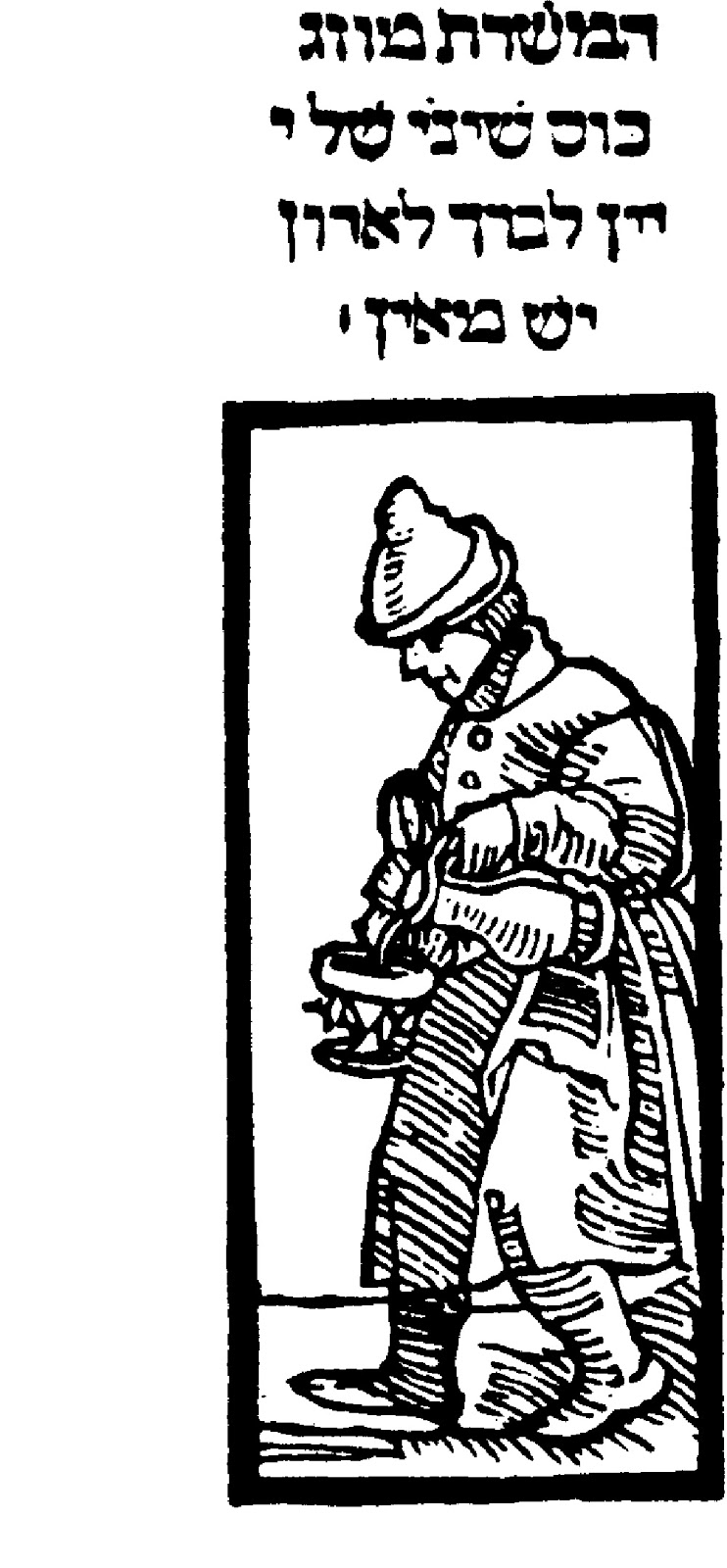
After saying Ha Lachma Anya the cups of wine are refilled. There is a picture of someone refilling the wine with a caption stating that the servant should refill the wine. The Rama in Darchei Moshe says that the person who is conducting the Seder should not fill the cups of wine; rather, someone else should do it for him.[10] This would appear to be an earlier writter source with the same idea.[11] Interestingly enough, the Aruch Hashulchan writes that we do not do this. The leader can pour the wine for himself, and there is no reason that his wife should have to pour for him.[12] Rav Yitzchak Chayis writes in Siach Yitzchak—which is a halachic work about the Seder night first printed in Prague in 1587—that one should train his six or seven-year-old child to do this mitzvah.[13] Perhaps another minhag related to this statement of the Rama is that the one leading the Seder does not get up to wash his hands; rather, the water is brought to him.[14]
Pouring out the wine for the Ten Makkos
 
After saying Ha Lachma Anya the cups of wine are refilled. There is a picture of someone refilling the wine with a caption stating that the servant should refill the wine. The Rama in Darchei Moshe says that the person who is conducting the Seder should not fill the cups of wine; rather, someone else should do it for him.[10] This would appear to be an earlier writter source with the same idea.[11] Interestingly enough, the Aruch Hashulchan writes that we do not do this. The leader can pour the wine for himself, and there is no reason that his wife should have to pour for him.[12] Rav Yitzchak Chayis writes in Siach Yitzchak—which is a halachic work about the Seder night first printed in Prague in 1587—that one should train his six or seven-year-old child to do this mitzvah.[13] Perhaps another minhag related to this statement of the Rama is that the one leading the Seder does not get up to wash his hands; rather, the water is brought to him.[14]
Another minhag found in this Haggadah is the famous custom of dipping the fingers into the wine when saying the Ten Makkos. In this section of the Haggadah there is an illustration of someone dipping his finger into his cup and there is also a caption under the picture stating that some dip with the pinky, followed by a reason for this custom.[15]
The earliest known source for this minhag can be found in a drashah of the Rokei’ach, recently printed from a manuscript by Professor Simcha Emanuel.[16] But this source speaks about dipping the index finger. The Rama also writes to dip the index finger. Interestingly, the Magen Avraham says to dip with the kemitzah, which is the ring finger.
Walking with a sack on the back
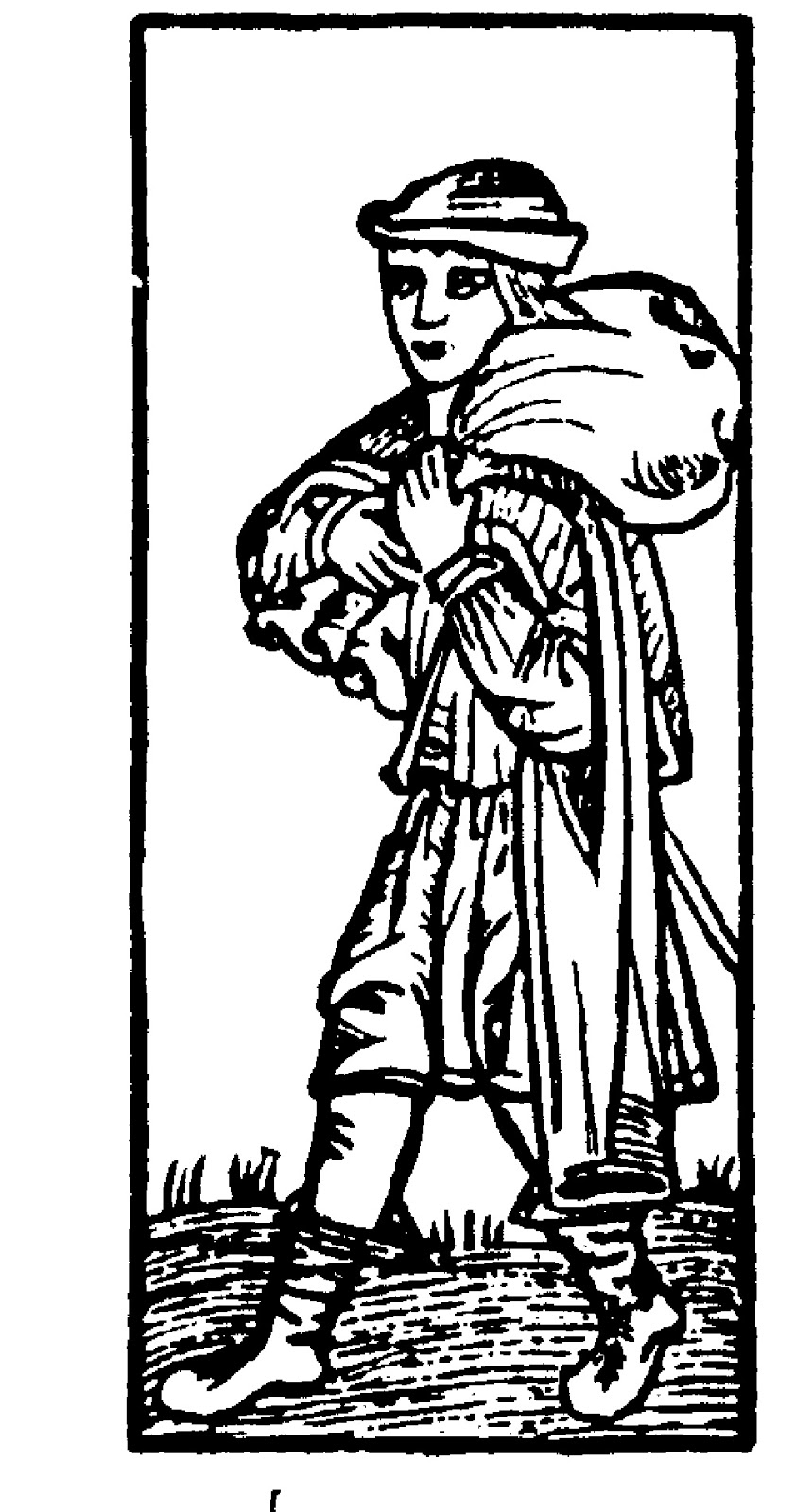
There a few places in the Haggadah, such as near the paragraph of B’chol dor vador, where we find an illustration of someone walking with a sack (of matzah) on his back. The source for this can be found in some of the Rishonim and early Acharonim. After mentioning breaking the matzah in their description of Yachatz they add that the leader of the Seder puts it on his shoulders and walks with it for a bit; others do this only later on when they eat the afikoman.[17]
Eliyahu Hanavi coming to the Seder
I traced the sources for this in a previous article in Ami Magazine. When discussing the sources for this, Rabbi Sperber notes[18] that in a few of the illustrated Haggados there are pictures of a man on a donkey near Shefoch Chamascha. In some of them he is being led by someone else; for example, in the Prague Haggadah of 1526.
I also noted that Rabbi Yuzpeh Shamash writes that mazikin run away from any place where Eliyahu’s name is mentioned. He says that because of this some make a picture of Eliyahu and Moshiach for the children, so that the children seeing it will say “Eliyahu,” causing the mazikin to disappear.[19] This could indicate that the illustrations were shown specifically to the children, as I claimed earlier.
Nusach of the Haggadah
The actual nusach of the Haggadah is its own large topic, starting from the Gemara and moving onward to manuscripts and discussions among the poskim. In the beginning of the Haggadah we begin with the famous Aramaic passage of Ha Lachma Anya. Much has been written about different aspects of this passage. One aspect is whether the exact nusach should be Ha Lachma Anya or K’ha Lachma Anya. The Rama quotes Rav Avraham of Prague, who says to specifically say Ha Lachma Anya and not K’ha Lachma Anya. The Maharal says the same. We see that two great sages from the city of Prague paskened that we should say Ha Lachma Anya.
Who was this Rav Avraham of Prague quoted by the Rama?
Rav Dovid Ganz (a talmid of the Maharal) writes in his historical work Tzemach Dovid that he was the rosh yeshivah and av beis din of Prague in the 1520s. He also authored some notes to the Tur, which were printed by Gershom (Cohen) Katz in Prague in 1540.[20] Thus, it is interesting that in the Haggadah the nusach was different from that of the av beis din of the city. Interestingly enough, his sons printed two more Haggados (1556 and 1590) in Prague and there too the nusach is different from that of Rav Avraham. Ultimately, the Magen Avraham concludes that whichever nusach one says is fine.[21]
What to use for maror
Another interesting picture is of the maror. In two places in the Haggadah the illustration used for maror is that of a lettuce—chasah. This is chazeret, which is the first of the five types enumerated in the Mishnah that one can use for maror.
There is a famous teshuvah from the Chacham Tzvi where he writes at length that this is the ideal item to be used for maror, as it’s the first in the list of the Mishnah.[22] We also find that the Netziv wrote a letter to his son, Rabbi Chaim Berlin, urging him to use it for maror instead of sharper vegetables, especially after fasting and drinking wine.[23] There are also numerous earlier illustrated manuscripts that show pictures of lettuce for the maror.[24]
More on maror
Speaking of maror, the inscription next to the picture is of great interest. It says, “There is a custom when saying maror that the man points to his wife, as it says ‘An evil wife is worse than death.’” Much has been written about this illustration. Some have written that it is ridiculous and there cannot be such a custom. On the other hand, Rabbi Wengrov and, more recently, Rabbi Yisroel Peles,[25] have demonstrated that there are pictures of a man pointing to his wife near the paragraph of maror in various illustrated Haggadah manuscripts. It is clear, however, as Rabbi Wengrov writes, that this was done in a joking manner to lighten up the Seder, but it isn’t serious, chas v’shalom. Rabbi Wengrov demonstrates that other pictures found in these Haggados show that the authors had a sense of humor and drew certain illustrations to lighten up the mood.[26]
Explanation via illustration
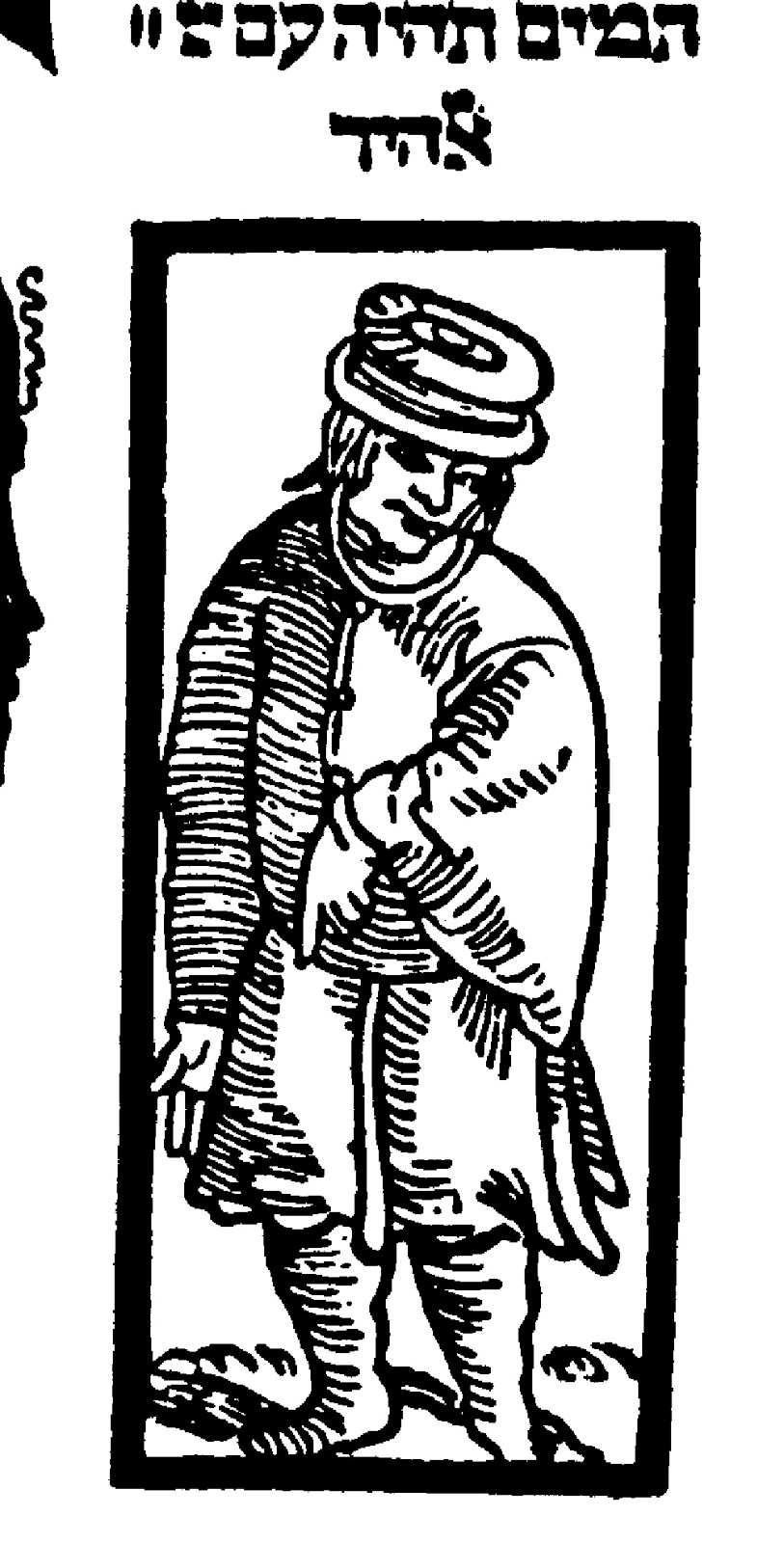
 
 
Some of the pictures in the Haggadah are to explain a particular passage. One such example is the image of the four sons. The tam is often translated as a derogatory term—the foolish son. However, the caption above the picture says, “Tamim tihyeh im Hashem” – always be complete with Hashem, which means that they understood the tam to be a man of piety.[27]
Omission
At the end of the Haggadah we conclude the Seder with a few songs, such as Echad Mi Yodei’a[28] and Chad Gadya. The authors and earliest sources for reciting them are unknown.[29] Rabbi Shemaryah Adler suggests that Chad Gadya may have been written by Daniel.[30] Rabbi Yedidyah Tiyah Weil writes in Marbeh L’sapeir on the Haggadah that he heard that these two songs were found in a manuscript from the beis midrash of Rav Elazar Rokei’ach. Numerous pirushim have been written about Chad Gadya, based on all the methods of learning Torah.[31] Be that as it may, many have noted that they are not found in this Haggadah. The first time they appear in print are in the Haggadah printed in Prague in 1590.
Another notable omission is the stealing of the afikoman. I wrote in the past in this magazine that one of the earliest sources in print can be found in the Siach Yitzchak, which mentions stealing the afikoman, but not in the same way as we do it nowadays.[32] It would seem that since no mention of it is made in the instructions of the 1526 Haggadah that it was not yet a widespread custom at that time.
Kiddush and Hunting
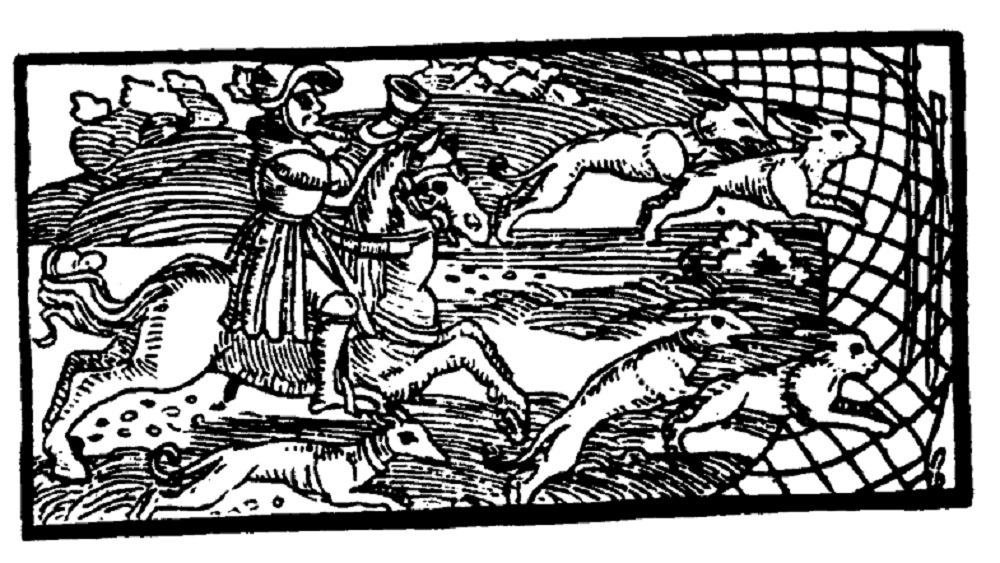
 

In the beginning of the Haggadah, on the bottom of the page of Kiddush, we find a mysterious picture of someone hunting hares with a horn and dogs. This picture can also be found in a bentcher printed by the Katz brothers in Prague a few years earlier. The question is obvious: What in the world does this have to do with Kiddush, especially as it is not a Jewish hobby? One of the answers suggested is that when Yom Tov occurs on Motzaei Shabbos we use an abbreviation known as Yaknehaz to remember the order in which to say Kiddush and Havdalah. The pronunciation of Yaknehaz is similar to jagen hasen, which is German for hunting hares, so this picture is meant to serve as a reminder of the abbreviation.[33]
Moreon Kiddush
Throughout the Haggadah there are illustrations of people holding cups of wine; sometimes the one holding the cup is dressed like a king. It would appear that this is to reflect the halachah to act like a king on the Seder night as part of the celebration of our freedom.
At other times the image is of an older man holding the cup either in his left hand or in his right. Rabbi Shaul Kook points out that some of the time it’s in the palm of his hand, which is the way it should be held according to various mekubalim, while at other times he holds the cup by its stem. He suggests that near the passage where Rabbi Elazar ben Azaryah says, “I am like someone who is 70 years old,” he is depicted as holding the cup in his left hand while stroking his white beard with the other to show that he’s really not that old.[34] At that point in the Haggadah one would not be holding the cup for the purpose of drinking one of the four kosos and that’s why he’s not holding it in his palm. Whereas in the pictures near where one would hold the cup for drinking he is holding it in the palm of his right hand. However, there is another picture on the page of Kiddush that is similar to the one of Rabbi Elazar holding the cup in his left hand and stroking his beard. Rabbi Kook says that this is because the printer was not educated and, not realizing the reasons for the difference, used the wrong woodcut.[35]
 
The problem with this is that the earliest source we have for holding the cup of wine specifically in the palm of the hand is in the Shalah HaKadosh, which was first printed in 1648—long after this Haggadah was printed.[36] It is, however, very possible that mistakes were made because printing with woodcuts is very difficult and confusing.
Sitting during Kiddush
Other customs that we can possibly learn from the illustration of Kiddush are that the person is both sitting and looking at the cup. These are also mentioned by various poskim in regard to the halachos for how Kiddush should be said.[37] There are other halachos of Kiddush that can perhaps be learned from these illustrations, but one has to be careful as to how much to “read into” them.
[1] On this Haggadah, see A. Yaari, Bibliography Shel Haggadot Pesach, p. 1. Y. Yudolov, Otzar Haggados, p. 2, # 7-8; the introduction to the 1965 reprint of this Haggadah; Yosef Yerushalmi, Haggadah and History, plate 13; Yosef Tabori, Mechkarim B’toldos Halachah (forthcoming), pp. 461-474. See especially the excellent work of Rabbi Charles Wengrov, Haggadah and Woodcut, (1967), which is completely devoted to this Haggadah. Another recent work devoted to this Haggadah was printed this year by R’ Yehoshua Goldberg, Haggadas Prague. Many thanks to my friend Dan Rabinowitz for the discussions about this Haggadah over the past few years. Here are two earlier posts by Dan on manucript Haggados and the 1526 Prague Haggadah: here and here. Thanks also to Mr. Yisroel Israel for his help with the images.
[2] As there are numerous illustrated manuscript haggadas.
[3] Yerushalmi, Haggadah and History, p. 30.
[4] This detailed publication information does not appear on the title page; rather, it appears at the end of the book in what is referred to as the colophon. On the printers see Chaim Friedberg, Toldos Hadefus Haivri, pp. 1-10. On various aspects about printing in these years in Prague, see Hebrew Printing in Bohemia and Moravia (Prague 2012).
[5] Richard Cohen, Jewish Icons, (1998), pp. 94-97; Chone Shmeruk, The Illustrations in Yiddish Books of the Sixteenth and Seventeenth Centuries (Heb. 1986).
[6] Halichos Shlomo (Pesach), pp. 267-268.
[7] Intro to Shu”t Ohel Yosef, 1903.
[8] Hagadol MiMinsk, p.51.
[9] Drashah L’Pesach L’Rabbi Elazar MiVermeiza, p. 96. See: Haggadah Shevivei Eish, p. 152; Y. Tabory, Pesach Dorot, pp. 216-244. See also what I wrote in my work Bein Kesse Le’assor, pp. 148-153.
[10] Darchei Moshe, 486:1.
[11] See also Siach Yitzchak (Brooklyn 2016), p. 241.
[12] Aruch Hashulchan, 473:6.
[13] Siach Yitzchak, p. 239, 252.
[14] Siach Yitzchak, p. 239.
[15] On this minhag see Zvi Ron, Our Own Joy is Lessened and Incomplete; The History of an Interpretation of Sixteen Drops of Wine at the Seder, Hakirah 19 (2015), pp. 237-255. I hope to return to this in the future.
[16] Drashah L’Pesach L’Rabbi Elazar MiVermeiza, p. 51, 101, 127.
[17] Rabbi Wengrov (above note 1), p. 60. See also Hanhagot HaMaharshal, pp. 10-11; Magen Avraham, 473:22; Chidushei Dinim MeiHilchos Pesach, p. 38. See Rabbi Chaim Benveniste, Pesach Me’uvin, 315; Vayageid Moshe, pp. 116-117.
[18] Minhagei Yisroel 4, pp. 168-170.
[19] Minhaghim Dik’hal Vermeiza, p. 86
[20] Tzemach Dovid, p. 139. See also Tzefunot 7 (1990) pp. 22-26.
[21] See also Siddur R’ Shabsei Sofer, 1, p. 5; Rabbi Yosef Zechariah Stern, Zecher Yosef, p. 4. [22] Chacham Tzvi, 119. On using this even though it is not bitter see also Dovid Henshke, Mah Nishtanah (2016), pp. 250-255, 215-220, 224-227, about Maror being bitter.
[23] Meromei Sadeh Pesachim 7b, See also Arthur Schaffer, History of Horseradish as the Bitter Herb of Passover, Gesher 8 (1981) pp. 217-237; Levi Cooper, Bitter Herbs in Hasidic Galicia, JSIJ 12 (2013), pp. 1-40; Z. Amar, Merorim, pp. 67-83. See also Rabbi Yehudah Spitz, Maror Musings, the not so bitter truth about Maror, Ami Magazine (2014), pp. 230-234.
[24] See Rabbi Wengrov (above note 1), p. 54. See also Rabbi Dovid Holtzer, Eitz Chaim 25 (2016), pp. 285-292.
[25] Hamaayan 51 (2011), pp. 11-14.
[26] On this and other pictures related to humor in the Haggadah see Rabbi Wengrov (above note  1),pp. 54-59.
[27] See also Rabbi Wengrov (abovenote 1), pp. 43-44; HaggadasMidrash B’chodesh (2015) of Rav Eliezer Foah (talmid of the Rama MiFano), p.135; R’ Elazer Fleckeles, Maaseh B’Rabbi Elazar, p. 63-64. See also Dovid Henshke, Mah Nishtanah (2016), pp. 358-359.
[28] See Rabbi Toviah Preshel, Kovetz Maamarei Tuviah 2, pp.64-65.
[29] See Chone Shmeruk, “The Earliest Aramaic and Yiddish Version of the Song of the Kid (Khad Gadye),” in The Field of Yiddish, 1 (New York 1954), pp. 214-218; Chone Shmeruk, Safrut Yiddish,pp. 40-42, 57-60; Asufot, 2 (1988), pp. 201-226; Rabbi Yisroel Dandrovitz, Eitz Chaim 23 (2015), pp. 400-416. Shimon Steinmetz discusses the origin of Chad Gadya here.
[30] Minchas Cohen, p. 73. Many thanks to my friend Rabbi Shalom Jacob for sending copies of this extremely rare work.
[31] Marbeh L’Sapeir, p. 140, 151. See also Rabbi Yosef Zechariah Stern in his Haggadah Zecher Yosef (p. 30), who writes that he did not find this piyut printed before the sefer Maasei Hashem. See also the Haggadah Shleimah ad. loc.; Assufot, vol 2 pp. 201-226; Mo’adim L’simcha vol. 5 ch. 11; Y. Tabory, Pesach Doros, pp. 341-342 and the note on pp 379.
[32] Siach Yitzchak, p. 21a. About this gaon see the introduction of Rabbi Adler in his recent edition of Pnei Yitzchak – Apei Ravrevi.
[33] See Rabbi Wengrov (above note 1), pp. 36-37.
[34] See Rabbi Yosef Zechariah Stern, Zecher Yosef, pp. 5a-6a.
[35] See Yeida Haam 2 (1954), p. 148; Iyunim Umechkarim, 1 pp. 81-83.
[36] See also R’vid Hazahav, Vayeishev (Kaf Paroh); Rabbi Mordechai Rosenbalt, Hadras Mordechai, Bereishis, 259. See also Shu”t Beis Yaakov, (1696) 174 who quotes such a custom from the Arizal.
[37] See Rabbi Dovid Deblitsky, Birchos L’rosh Tzaddik, pp. 25-31.


Of Clowns, Giants, Mules, and Centaurs: The Enigmatic Anah

Of Clowns, Giants, Mules, and Centaurs:

The Enigmatic Anah

By Yecheskel Sklar

Yecheskel Sklar, a student of Beth Medrash Govoha in Lakewood NJ, is the author of various essays and kuntreisim. His most recent work – an overview of a debate in Amsterdam between Rabbis Sasportas and Morteira about false witnesses – can be purchased on Amazon.

The verse tells us that Anah is he (or she[1]) who found הימם in the desert while herding the donkeys of his father[2]. What exactly are הימם? What exactly did Anah do regarding them? There are many views on this matter and the following is my attempt to present them.

I. MULES

Perhaps the most well-known interpretation is that הימם refers to mules. In the Talmud it states:

Rabbi Shimon ben Gamliel says, Mules {came into existence} in the days of Anah, as it says, He is Anah who found הימם in the desert…Anah was unfit, therefore he brought unfitness into the world”[3], “Said Rabbi Yehoshua ben Levi, Why are they called ימים, for their fear is placed on mankind, for Rabbi Chanina said, No one has ever asked me about the wound inflicted by a white mule…that was healed”[4].

According to this explanation, it would seem that “found” means ‘invented’ or ‘discovered’[5]. Some commentators point out that while Rashi seems to say that Isaac had mules[6], this is not necessarily a contradiction, since it is possible that mules existed before Anah, but only came into being naturally. According to this hypothesis, what Anah discovered was not the mule itself. Rather, Anah discovered the science of crossbreeding animals.[7] For that time the ability to recognize that the two species could crossbreed was considered a mark of great wisdom.[8] Alternatively, it is possible that until Anah mule breeding was exclusive to royalty. Anah introduced the technique to the general populace[9]

This would seem quite straightforward. However, in the Jerusalem Talmud we find an argument about the meaning of this word:

“What are הימם, R’ Yehuda ben Simon says המיונס, and the Rabbis say [10]המיסו, half horse and half donkey. And these are its signs, Rabbi Yehuda says, If it has small ears its mother is a horse and its father a donkey, If they are big its mother is a donkey and its father a horse…What did Tzivon and Anah do, They brought a female donkey and they mated a male horse with it, and a mule came from that.”[11]

What is המיונס and המיסו and what is the difference between them? This difficulty is compounded by the Sefer Mosef Ha’Aruch. In the entry for המיונס he writes “R’ Yehuda Ben Simon says המיונס; The explanation in the Greek language is mule”. The Aruch is referring to the Ancient Greek word for mule, ἡμῐ́ονος, a compound of ἡμῐ, which means half, and ὄνος, meaning donkey[12]. The phonetic pronunciation of this compound would be hēmíonos. In the entry on המיסו, The Mosef Aruch states: ”And the Rabbis say המיסו, half horse and half donkey; The explanation in the Greek language is half”. This is the word ἥμισυ in ancient Greek, which means half[13], and would be pronounced hḗmisu. It is clear, then, that both המיונס and המיסו refer to mules. What, then, is the difference between the two?

This difficulty has already been raised by Rabbi Marcus Lehman. Rabbi Lehman posits that המיונס refers to a mule whose father is a donkey and whose mother is a horse, known in German as Maultier. המיסו however, refers to the adverse, i.e. the product of a male horse and a female donkey. In German this is called a Maulesel. According to this explanation, the Jerusalem Talmud’s statement regarding Tzivon and Anah, “They brought a female donkey and they mated a male horse with it”, is only according to the Rabbis, as Rabbi Lehman readily points out[14].

In fact, in English too there are different names for the two. While a mule born of a male donkey is known simply as a mule, one with a horse for a father is called a hinny. According to this explanation it would be quite understandable why the JT proceeds to describe the method of determining which is which.

However, the etymology is problematic. Rabbi Lehman says that anyone who knows Ancient Greek would recognize the difference between the two. Yet, according to the Aruch and modern dictionaries, as stated above, while המיונס means half-donkey, המיסו means half. There is no evidence, to my knowledge, of המיסו meaning hinny. In fact, the very word hinny comes from the Greek word ‘hinnos’ which means little mule, thus suggesting that there was no word for a hinny in Ancient Greek, and both versions of mules were called by the general ‘hēmíonos’. How, then, does המיסו refer to a hinny? A colleague of mine, Rafael Vim, suggested that because mules in general are more donkey-like, they could be called half-donkey. However, hinnies are not horse-like enough to be called half-horse. Therefore, to reference them one would just say ‘half’.

Alternatively, the argument between Rabbi Yehuda ben Simon and the Rabbis could be along the lines of the argument of Rabbi Yehudah and Chananya in the Babylonian Talmud:

Rabbi Yehuda says: Those {mules} born from a horse, even though their father is a donkey, are permitted to {be mated with} each other. But those born from a {female} donkey, are forbidden {to be mated} with those born from a {female} horse. Says Rabbi Yehuda says Shmuel: These are the words of Rabbi Yehuda who says that the seed of the father is not taken into consideration. However, the Rabbis say: All types of mules are one. Who are the Rabbis? Chananya, who says we do take the father’s seed into consideration, and whether it is the son of a {female} horse and a {male} donkey, or the son of a {female} donkey and a {male} horse, they are all one species”. [15]

It is possible that Rabbi Yehuda ben Simon says המיונס because he was of the opinion that we consider only what type of animal the mother was to ascertain what legal status this animal has. Hence, ‘Half-donkey’. The Rabbis, however, were of one opinion with Chananya, namely that all mules are the same. Therefore, they could all be called just ‘half’.[16] What is gained by this interpretation, aside from a Halachic difference, is that the statement of the Jerusalem Talmud, “They brought a female donkey and they mated a male horse with it”, could have been said in accordance with the views of both Rabbi Yehuda ben Simon and the Rabbis[17]. In fact, it could be suggested that because of this Midrashic tradition, namely that Anah’s mule was a hinny, Rabbi Yehuda ben Simon says half-donkey, for only the mother is taken into account.

I would like to suggest another possible explanation. Many commentators explain המיסו to be a Hebrew word meaning half[18]. This is based on the Mishna that says that pomegranates are required to be tithed משימסו. The Jerusalem Talmud explains what משימסו means, “When half is ripened. Rabbi Yonah asked: Maybe you heard this from the Haggadic Rabbis, {who explain the verse[19]} אחינו המסו את לבבנו, {to mean} Split our hearts[20].”

If we accept this premise, perhaps we can explain that all the sages agree that הימם are mules. The dispute revolves around the root of the word. Rabbi Yehuda ben Simon believed that הימם is derived from the Greek word המיונס, to which the Rabbis responded that the word is simply a Hebraic word meaning half, i.e. half-horse half-donkey[21].

As previously stated, (though not explained), the Babylonian Talmud circumvents the whole issue by stating that the word is derived from the Hebrew word אימה, meaning fear, so called because of the severity of mule inflicted wounds.

However, that the word הימם refers to mules is far from universally agreed upon. As Ramban already points out, this is only the view of some of the Talmudic sages. He is referring to the fact that in the aforementioned Talmud, Rabbi Shimon ben Gamliel, who says that Anah created mules, is arguing with Rabbi Yose. Rabbi Yose is of the opinion that God put the thought of creating mules in Adam’s mind, and Adam bred them. According to Rabbi Yose, then, mules were already being created well before the time of Anah.

II. Giants

Another explanation of the meaning of הימם is based on the somewhat cryptic translation of the Targum Unkelos. There, הימם is translated as גבוריא, strong ones. The Ramban explains that Unkelos is connecting הימם with the nation called אמים, a nation of giants referred to in the Torah. According to this hypothesis, מצא would either mean that the אמים were attempting to steal Tzivon’s donkeys and Anah was saved from them[22], or that they found him and he was saved. He was thereafter known by this act of great strength.

The אמים are mentioned a few times in the Torah. The Ramban refers to the verse that states, “The אמים had previously lived there, a big and populous nation, and as strong as giants. The רפאים were considered like giants, and the Moabites called them אמים”[23]. They were so called because their fear is placed on mankind.[24] This explanation is lent credence by the fact that the Zohar suggests this is a possible explanation of our verse, before rejecting it because the words are spelled differently.[25]

Some point out that Unkelos there renders אמים as אימתני and not גבוריא. If the Ramban is interpreting Unkelos correctly, why then does Unkelos not interpret ימים to be אימתני? I believe the answer to this question can be found in the commentary to a different verse. In Genesis it states:

“And in the fourteenth year K’darlaomer came, and the kings that were with him, and they struck the רפאים in Ashteros Karnayim, and the זוזים in Ham, and the אמים in Shaveh Kiryasayim”[27].

Rashi writes “The זוזים: They are the זמזומים”. Rabbi Eliyahu Mizrachi explains that because רפאים, אמים, and זמזומים are three names for the same people, therefore Rashi infers that the זוזים are in fact זמזומים. The Yefe Toer, however, says that this can’t be. If they are all the same, why were they all in different places? Therefore, he says, it is clear that the אמים were a nation in their own right, and later the רפאים were called אמים after them, because of the fear that they too inspired. In other words, while there was a nation called אמים, it was also a word used to describe any people who inspired fear. Therefore, where the verse is referring to the naming process, “and the Moabites called them אמים”, it is appropriate to translate אימתני, namely those that inspire fear. However, when the verse refers to a group of nondescript ימים that were encountered, the correct translation is, in fact, strong ones or giants. For that is the name used to connote giants.

Now, let us move on to the nature of these giants. The Midrash says that they have seven names, and that among those are אמים and נפילים.[28] If so, it seems that we should investigate the Nephilim to discover the true nature of the אמים. The verse states:

“The Nephilim were in the land in those days, and even after, they which the sons of אלהים came onto the daughters of man, they are the strong men, who were always renowned people”.[29]

The identities of both the “sons of אלהים” and the “daughters of man” is a subject of some debate. Some suggest that it refers to the children of Seth, who were of a more refined nature, marrying the wild and murderous daughters of Cain.[30] Alternatively, the sons of the judges, who should have been the most civilized, instead abused their power to forcefully take women.[31] Finally, perhaps the most well-known explanation is that fallen angels took human women.[32] Regardless of the identity of their parents, it seems to be agreed upon that their children were giants.[33]

The Midrash describes these giants:

“Anyone who saw them, his heart melted like wax, Mentromin[34] and Magisters of war, the skull of one of them was measured to be eighteen cubits”. [35]

When the spies saw these giants when they went to scout the Land of Milk and Honey, they reported, “And we were like locusts in our eyes, and so we were in their eyes”.[36] Rashi, quoting the Talmud[37], writes that they overheard the giants, referring to the spies, commenting that ants were seen roaming through the fields.[38]

Giants are in fact mentioned numerous times in the Scriptures. From Og, the king of Bashan, who famously survived the Deluge by holding onto the Ark for dear life, and was fed by Noah through a window, to the still more famous Goliath, felled by the puny slingshot of a young shepherd named David, giants play a large role in many of the stories related in the Bible. This, then, at least according to the Targum, is another to be added to the list, the great donkey herder Anah rescuing his or her father’s donkeys from the wanton violence of these giants.

III. Clowns, Centaurs, and Other Mysterious Creatures

The final explanation to be dealt with at length here also centers around the Jerusalem Talmud and the mysterious word המיונס. The commentary on Bereishes Rabba attributed to Rashi[39] explains this word to mean “A species of wild animal”. His words are quoted by many other commentators[40]. However, what animal it is referring to seems to be a mystery.

One of the preeminent commentators on the JT, however, can shed some light on this. He writes, “I found in the Midrash Divrei Hayamim, types of people who are of an odd shape”[41]. The Midrash Divrei Hayamim, commonly known as Sefer Hayashar[42], records the following story:

And it happened when {Anah} was herding the donkeys of his father, and he brought them into the desert, as he had many other times, to pasture. And it was on this day, and he brought them into one desert on the shore of the Red Sea, opposite the desert of the nations. And he was herding them thelre and behold! An exceedingly strong whirlwind came from across the sea, and it rested on the donkeys herding there, and they all stood. Afterwards, there came from across the sea, from the desert, around one-hundred and twenty big and awesome beasts, and they all came to the place of the donkeys and stood there. And these beasts; their lower half was like the shape of a person, and their upper half; some resembled bears, and some resembled monkeys[43]. And they had tails behind them, from between their shoulders, and which reached down to the ground, like the tail of a Duchifas[44]. And these beasts came, and they mounted and rode those donkeys, and led all of them, and they all went away until this day. And one of these beasts approached Anah, hit him with his tail, and chased him away from that place. And he saw this story and he was exceedingly scared for his soul, and he ran, and he sprinted, and he dashed to Seir. And he told his father and brothers all that happened, and many men went to search for the donkeys, and they were not found. And Anah and his brothers did not go to that place anymore, from that day onwards, for they were exceedingly scared for their souls.”[45]

Similarly, the Gaon of Vilna, writes in his glosses, “המיונס, Explanation: Half-human, half-horse”[46].

It seems to be that there is some evidence that המיונס refers to a hybrid human. While the beasts described in Sefer Hayashar have almost no parallels, half-human half-horses are one of the most popular creatures in mythology. Known in English as centaurs, from the Greek Centauros, the stories about them are manifold.

References to half-humans in Jewish sources, however, are few and far in between. Perhaps sirens, (better known as mermaids), are the most spoken about. From the Talmud’s reference[47] to הדלפונין or בני ימא, who procreate either like people[48], or with people[49], explained by Rashi to be “Fish in the sea that half of them are in the shape of a person, and half in the shape of a fish[50], And in French Seirene; to the Toras Kohanim[51] which includes סירונית in the prohibition of eating non-kosher sea animals[52], on which the Raav’ad comments “In French it is called Seirene, and its top half is like the shape of a woman, and it sings like a person”; to the story in the Mosef Aruch about the King of Denmark and Norway almost seeing a siren[53]; all the way to the siren using its unnaturally long[54] hands to open the locked doors of the Egyptians during the plague of wild animals[55], sirens are well documented in Jewish sources.

Other half-human hybrids, however are almost nonexistent. The earliest supposed reference to centaurs is in Genesis Rabbah. [56] It states,

“They asked before Abba Kohein Bardela; Adam, Shes, Enosh, and {than} silence?[57] He said to them: until then they were in the form and image {of God}, from then on , קנטרין

[58]

The Mosef Aruch explains:

“The explanation in Greek and Latin: a type of uncultured people, and the poets invented that from their half up they were people, from their half down horses, to hint that they were as horse, as mule, without understanding”.[59]

However, every other commentator[60] explains קנטרין to mean contrary, that is, in reverse of the form of God. In fact, the continuation of the Midrash would make very little sense if it was actually referring to centaurs, for the Midrash continues:

“Four things changed in the days of Enosh: The mountains became hard, the dead began to rot, their faces became like monkeys, and they became profane for demons”.

If centaurs are being referred to, it should mention the fact that their feet became horse-like. It seems that even the Mosef Aruch sensed this difficulty, which is why he explains the horse-like feature to be an invention of the poets. The Midrash then is only referring to the fact that the later generations weren’t fully cultured in comparison to their predecessors. Instead they were wild and not in the form of God. (This is aside from the obvious difficulty with suggesting that all the post-enoshian generations were centaurs).

I have found two other references to centaurs in Jewish sources. One is in reference to the Dor Haflaga, the Generation of Dispersion, when people decided to build a tower to ascend to the heavens and rebel against God. God responded by changing the people of the world’s language so that they could not cooperate with each other.[61] This is the Biblical story. The Talmud[62] adds a few details: There were three groups of people. There were those who wanted to go up to the sky and live there.[63] They were dispersed. Another group who wanted to go up and worship idols, were punished by having their languages changed. The final group, who wished to ascend to the heavens to wage war on God, were changed into monkeys, spirits, demons, and Liliths.[64] Other sources add that in addition to above, they were also changed to elephants.[65]

In Shalsheles HaKabbalah[66], this theme is expanded on. In his telling, God also changed many of them into other weird creatures. “They say that after the splitting of the languages, God created strange creatures”. He proceeds to list many creatures. One of those listed are: “In Sitea there is a species which has the form of a person, and their legs are similar to a horse, and they are called centaurs”.[67]

The other source, while not strictly Jewish, is the famed letter of that fabled Christian king, Prester John, ostensibly written to the Emperor of Rome and the King of France. It only deserves mention here because it was printed and reprinted many times in Hebrew due to the mention of the Ten Lost Tribes and their fantastical way of living.[68] There too, among unicorns and other mythological creatures it mentions,

“We have in our country bowmen who from the waist up are men, but whose lower part is that of a horse. They carry in their hands bows and arrows, and they can pull harder than any human being, and they live on raw flesh. Some of our courtiers capture them and keep them chained and people come to see this great marvel.”[69]

How does המיונס refer to centaurs or other wild beasts? While it can be argued that this was simply a name for such creatures that was since lost, the Pnei Moshe suggests a different explanation. He refers to the Midrash[70] which talks about the מיומס which is brought into the theaters. He explains that a מיומס is a person who can change his shape, a shapeshifter, and that this word was borrowed here for people who are, in essence, differently shaped.

The word מיומס, in fact, is derived from the Greek word μῖμος, which in turn is the root of the English word Mime. As the Mosef Aruch explains[71], “The explanation in Greek and Roman is: a comedian who acts like another, and at times puts a mask on his face”. According to this explanation we can suggest that perhaps הימם were mimes, and Anah was the first to put the practice of making shows which featured the performances of mimes and clowns. In effect, Anah was the world’s first ringmaster.

Other commentators on the actual verse also suggest that הימם are certain wild animals. Rabbi Meyuchas writes, “And הימם, Species of wild animals, and there is no similar word in Scripture, and according to the Targum[72] they are strong animals, as in ‘יקראו להם אמים’. He seems to believe that הימם is the name of a type of wild animal, and then quotes the Targum who argues that the word is derived from אמים. Others[75], however, while also saying that they were wild animals, suggest that the word is derived from אימה, fear.[76] They are so called because they frighten people. Rabbi Nathan Adler, basing himself on this interpretation, suggests that הימם are gorillas, and they are so called because they scare people and are confused with giants[77].

IV: Other Possibilities

There are other explanations for the word הימם.

The Zohar says that הימם refers to the demonic offspring of Cain, who were created between the sixth and seventh day of creation. Only someone as wicked as Anah had the ability to see them[78].

Some suggest that הימם refers to plants. Ibn Ezra emphatically rejects this view, because the donkeys are then superfluous.

The consensus of the non-Jewish Bible scholars is that הימם refers to hot springs, which seems to be built on a non-traditional vowelization of the word. This view is not accepted by any Jewish scholars.[79]

הימם is transliterated in the Septuagint, suggesting that either it was understood to be a proper noun, or that the translation was unknown. Rabbi Samson Raphael Hirsch, in his German translation, follows the lead of the Septuagint, and does not deign to translate it.

We can suggest that perhaps הימם is referring to the person named הימם whom the Torah mentions a few verses prior. This הימם was a close relative of Anah. Maybe he was lost for some time and Anah found him roaming the desert. The fact that this possibility is not mentioned by any earlier authority, is most probably because they are vowelized differently. However, this does not seem to me to be an insurmountable difficulty, given that the spelling of people’s names often changes throughout Scriptures.

NOTES

[1] Tosfos Bava Basra 115b S.v. Melamed, “And It seemed to Rabbenu Tam that Anah was a woman, as the verses indicate, for it is written, (Genesis 36,14) ‘And these were the sons of Oholivama daughter of Anah daughter of Tzivon’…And that which it states, ‘He is Anah’ in masculine form, that is because she inherited with her brother Tzivon like a male”. Rashi, however, says that Anah was a man and that Oholivama was the daughter of Tzivon and his daughter-in-law who was Anah’s wife, and therefore she is called both the daughter of Tzivon and Anah. (Genesis 36,2. Quoted by the aforementioned Tosfos).

[2] Genesis 36, 24

[3] Pesachim 54b

[4] Chullin 7b, both brought by Rashi Genesis, ad loc.

[5] Ibn Ezra, ad loc. Cf. Pseudo-Jonathan in which it seems that he mated the animals without a specific purpose, and only later did he find mules being born. According to that interpretation “found” can be understood in its traditional sense.

[6] Genesis 26,13

[7] Chizkuni, Bartenoro on Genesis 36, 24

[8] Ramban, ad loc.

[9] Rabbenu Efraim, Genesis 26,13

[10] This is the version of the Aruch and in the Midrash Rabba and seems to be correct. However, in most editions of the JT, we find היימים.

[11] Jerusalem Talmud Brachos 8,4. Bereishes Rabba 83

[12] Liddell & Scott (1940) A Greek–English Lexicon, Oxford: Clarendon Press

[13] Ibid.

[14] Meir Nasiv. JT ad loc.

[15] Chullin 79a

[16] Cf. Chidushei Rabbi Eliezer Simcha on Genesis, ad loc. It is not clear if this is his meaning, וצ”ע.

[17] See Rashi Genesis ad loc. who says that it was the opposite, i.e. a male donkey and a female horse. See Tzeda La’Derech and other supercommentaries.

[18] Rashi BR ad loc., Rabbi Shimon Serliau JT ad loc.

[19] Deuteronomy 1, 28

[20] JT Maasros 1,2

[21] See, however, Aruch מס, who seems to suggest that the JT is explaining that the Mishna is using the Greek (or Latin, see Aruch Hashelem) word for half. I find this explanation difficult, because why than would Rabbi Yona have to point to the Haggadic Rabbis translation of the verse?

[22] Based on Psalms 21,9

[23] Deuteronomy 2,11

[24] Rashi ad loc., Cf. Bereishes Rabba 26,7

[25] Vayishlach 178b

[26] Rabbi Nathan Adler, Nesinah La’Ger

[27] 14,5

[28] Bereishes Rabba 26,7

[29] Genesis 6,4

[30] See Rokeach; Midrash brought by M.M. Kasher, Torah Sheleimah; Rosh; Ibn Ezra; ad loc. See also Rabbi S.R. Hirsch who talks about this at some length.

[31] Bereishes Rabba 26,5; Rashi; Ramban; Ibn Ezra.

[32] Yuma 67b; Pirkei D’Rabbi Eliezer 22; Rashi. See Rosh who brings a Midrash about the creation of a constellation: Angels attempted to seduce a righteous woman. Tricking them into giving her wings, she flew to the heavens, and was placed among the stars. This is the constellation Virgo. The angels were than stuck on earth until they were able to return on the ladder of Jacob’s dream.

[33] Abarbanel suggests that נפילים means stillborns. The sons of Elohim were those who lived unnaturally long lives. They were strong, and humongous in stature. They took by force the regular more ‘human’ women, and impregnated them. Their regular human bodies, however, were not strong enough to carry the huge fetuses growing inside them and this caused them to miscarriage. This explanation is perhaps alluded to in the BR, “And they filled the entire world with נפלים with their licentiousness”. Also see Malbim, who ingeniously re-interprets the verse to be an answer to idolatry. Those mythological gods and demi-gods, says the verse, were not more than the warriors of the day. The pagans attributed divinity to anyone powerful. In fact, however, they were only human.

[34] Interpreted by Mosef Aruch to be from the Greek word for fear, meaning here, those who instill fear. Chanoch Kuhut, Aruch Ha’Shalem, suggests that it refers to either monitors or mandates of war.

[35] Bereishes Rabba 26,7

[36] Numbers 13,33

[37] Sotah 35

[38] Ad loc. Malbim suggests that the word כן, normally translated to mean so, here refers to a louse, the singular form of כנים, lice. Accordingly, the spies were saying that while they considered themselves to be as large as locust when compared to the giants, the giants themselves looked at the spies as small and insignificant as a louse. (Perhaps this is why Rashi refers to ants instead of locust).

[39] Rabbi Yaakov Emden, Introduction to Etz Avos, says that it was not written by Rashi. This is brought by the Chida, Shem Hagedolim, Shin, 35, who argues that since it was printed in Tzfas in the generation after Rabbi Yosef Karo, and all the great rabbis there agreed that it was in fact Rashi, that is the truth. See, however Rabbi Yaakov Chaim Sofer, Menuchas Shalom Vol. 4, Pg. 78, who proves quite convincingly that it was not written by Rashi.

[40] Matnas Kehuna Ad loc., Rabbi Shimon Serliau JT ibid.

[41] Pnei Moshe, ad loc.

[42] The Midrashic work Sefer Hayashar was first printed in Venice in 16??. According to the introduction, it is an ancient work that was found by the Roman Emperor Titus in the ruins of Jerusalem. However, Rabbi Yehuda Aryeh of Modena, who was one of the rabbis of Venice at this time, in his work Ari Nohem, questions the authenticity of this work. The Chida in Shem Hagedolim, on the other hand, identifies it with “The Wars of the Sons of Jacob”, mentioned by early authorities such as the Ramban and Rabbenu Bachye. Rabbi Avraham ben Hagr”a in his Rav Poalim also vouches for this works authenticity. See however Yosef Dan’s introduction to his edition of Sefer Hayashar.

[43] Translated from קופים. There are variants of Sefer Hayashar. See M.M. Noah, The Book of Jashar, pg. 108, who translates it as keephas. I have differed from his translations in a few instances.

[44] One of the non-kosher birds; listed in Leviticus 11, 19. See Rashi ad loc. who quotes from the Talmud Gittin 68b that it is Tarnugal Habar. See also Rashi on Chullin 63a. It is commonly translated as a hoopoe. See Rabbi Chaim Fuchs, Hakol Al Segulas Haduchifas, www.kikar.co.il/לעיוורן-לעקרה-להצלחה-סגולת-הד.html.

[45] Sefer Hayashar, Ad loc.

[46] JT, ad loc.

[47] Bechoros 8a

[48] The accepted version of the Talmudic text. See Aruch brought in footnote 35 who has this version also.

[49] Rashi ad loc.

[50] Ibid. See Mosef Aruch Entry דלפון, however, who quite understandably translates it to be dolphins. See also Ha’aruch Hashalem for an explanation of בני ימא according to this translation.

[51] Shmini, 3,7

[52] Rabbi Chanina even entertains the possibility that a dead siren could cause anyone under the same roof to become ritually impure, a law which is (generally) exclusive to humans!!

[53] Entry for סרני

[54] Ten cubits

[55] Sefer Hayashar Parshas Bo, according to Rabbi Eliyahu Kramer’s glosses on Toras Kohanim, ibid. See also Rabbi Tzvi Hirsch Rapaport, Ezras Kohanim and Tosfos Ha’azarah, who also ties in this Sefer Hayashar, and adds that sirens have scales near their tail. It is worth mentioning that Rabbi Yisroel Meir Kagan, better known as the Chofetz Chaim, in his explanation of Toras Kohanim, writes that even if they have fins and scales they are non-kosher, for otherwise it would be obvious that they are non-kosher. Cf. Rabbi Yechiel Michel Epstein, Aruch HaShulchan YD 83,10, who says that they definitely have fins and scales, but adds that without this Toras Kohanim we would think that the fish half would be permitted.

[56] 23, 6

[57] i.e. In Genesis Chapter 4 it talks about the children of Adam, it mentions Shes, than Enosh, and than it states “These are the descendants of Adam…” and proceeds to list all the generations. What than is special about these 3? (Rokeach Ad Loc)

[58] This seems to be a play on Enosh’s sons name קינן. See Ramban who quotes this Midrash as “from than on,קינןקנטורין.

[59] קינטורין

[60] Pseudo-Rashi, Matnas Kehunah, Maharzav. In fact, as is pointed out by the Mosef Aruch himself, the Aruch brings this Midrash in the entry for קנתר, along with many other places in which the word undoubtedly means contrary, or as the Aruch writes “Words of anger”.

[61] See Genesis 11, 1-9.

[62] Sanhedrin 109a.

[63] Rabbi Yonasan Eybeshutz in his Nefesh Yehonasan ad loc. famously suggested that it was a launching pad for some sort of primitive spacecraft for people who wanted to live on the moon to escape God.

[64] Rashi explains the difference between the three: spirits are bodiless and formless, demons are shaped like humans and have eating patterns similar to them, and Liliths are shaped like humans but have wings. See Rabbi Reuven Margolios, Margoliois HaYam, who asks that in Chagigah 16 it seems that demons have wings too.

[65] Meleches Shlomo, K’layim 8,6 quoting “the wise and pious kabbalist Rabbi Meshulam”, says that in the Generation of the Deluge people were changed into monkeys and elephants, “for monkeys are similar to people, and elephants understand the language of men”. The Meleches Shlomo proceeds to quote the aforementioned Midrash about the days of Enosh as support for this statement. This seems to me to be quite dubious for it says only that their faces were similar to monkeys, and elephants are not mentioned at all. Dovid Yoel Weiss, in his Megadim Chadashim, Brachos 58b, points to what I believe is the correct source for Rabbi Meshulams’ assertion. The Sefer Hayashar, Noach, writes that the people of the Generation of Dispersion were changed into monkeys and שנהבים. שנהבים are mentioned in Kings I 10,22 as things that were brought on the boats of Tarshish to King Solomon along with monkeys and peacocks. It refers to ivory which is made from the tusks of elephants. It is most probable that the Sefer Hayashar was referring to the elephants themselves. This then is the source of Rabbi Meshulam’s statement, and the word ‘Deluge’ should be changed to ‘Dispersion’.

[66] Rabbi Gedalia ibn Yichya. Quoted also in Rabbi Yechiel Halpern, Seder Hadoros. However, Shalsheles HaKabbala is considered notoriously unreliable. See Rabbi Yosef Shlomo Delmidigo, known as Yashar of Candiya, Metzaref Lechochma p.6, quoted by Rabbi Halpern himself in the introduction to Seder Hadoros. (In a play on the title, The Chain of Tradition, Yashar suggests that Rabbi Ibn Yichya should be placed in chains of iron). The Chida in Shem Hagedolim, Aleph, 9; wonders why Rabbi Halpern, who was “exceedingly wise”, brings many things from the Shalsheles Hakabblah which are not true.

[67] See also Rabbi Azriel Rakovsky, Sheleima Mishnasoi, Brachos 56b, who claims that they were also turned into the “people of the forest” who than went to America and were not killed during the Deluge. These are the people that Cristopher Columbus found. He says that this can answer the question raised by the philosophers, as to how these people exist, if all descend from Adam.

[68] See Beckingham, Charles F. and Ullendorf, Edward. The Hebrew Letters of Prester John. Oxford: Oxford University Press, 1982.

[69] Translation from Slessarev, Vsevolod. Prester John: The Letter and the Legend. Minneapolis: The University of

Minnesota Press, 1959. Another being is mentioned there which sounds quite similar, “We have in our country also other men who have hoofed legs like horses and at the back of their heels they have four strong and sharp claws with which they can fight in such a way that no armor can withstand them; and yet they are good Christians and will willingly till their lands and ours and pay us a big tribute.”

[70] Eicha Rabbah, Pesichta 17

[71] ממס

[72] We have discussed this Targum earlier.

[73] Deuteronomy 2, 11

[74] Peirush Rabbi Meyuchas, Genesis Ad loc.

[75] Paneach Raza, Rabbi Yitzchak Ben Yehudah, Ad loc.

[76] As noted before, the Talmud explains הימם this way also, although through this, connecting the word with mules.

[77] Nesinah La’Ger, Ad loc. Similarly, Rabbi Yisroel Lipschutz, Tiferes Yisroel, Klayim 8,5, suggests that the אדני השדה, who according to some could also cause ritual impurity just by being under the same roof, refer to orangutans, who can be taught “to chop wood, draw water, and also to wear clothes exactly as a human, and to sit at a table and eat with a spoon, knife and fork”.

[78] Vayishlach 187b

[79] Aryeh Kaplan, The Living Torah; Nesinah La’ger; Ad loc.


Plagiarism, Halakhic Paradox, and the Malbim on Kohelet

Plagiarism, Halakhic Paradox, and the Malbim on Kohelet
by
Marc B. Shapiro
1. A story recently appeared alleging plagiarism in the writings of R. Yonah Metzger.[1] Such accusations are nothing new and the topic of plagiarism in rabbinic history is of great interest to me. Many of the scholars of Jewish bibliography have also written about the phenomenon,[2] and a good deal on the topic has appeared on the Seforim Blog.[3] Suffice it to say that every generation has had problems in this regard, and we see even see apparent instances of it in the Talmud.[4] The examples range from taking another’s ideas (including one’s teacher[5]), to copying sections of another work, to reprinting an entire book and changing the title page.[6] It is interesting that R. Moses Sofer, unlike others, is reported not to have been troubled by people plagiarizing from him. As he put it, he doesn’t mind if they attach his hiddushim to their names, as long as they don’t attribute their own hiddushim to him.[7]
R. Isaac Sternhell, in the introduction to his Kokhvei Yitzhak, vol. 1, gives a good illustration of how widespread the problem of plagiarism has been in explaining why R. Joseph Karo and R. Moses Isserles don’t mention anything in the Shulhan Arukh about the obligation to repeat a Torah teaching in the name of one who said it (itself of great importance, not to mention the geneivat da’at involved if one doesn’t give proper credit [8]). R. Sternhell states that that since so many people plagiarize, including תלמידי חכמים שיראתם קודמת לחכמתם, therefore, just like it is a mitzvah to say that which people will listen to, so too it is best to be quiet about something they won’t pay attention to [9]. R. Sternhell reports that this reason was actually given by R. Yissachar Dov Rokeah of Belz in explanation of why there is nothing in the Shulhan Arukh about the prohibition of leshon hara.[10]
והם מתוך שחששו מלהביא קטרוג על כלל ישראל התעלמו מדינים אלה בפסקי הלכה והשמיטום. ובכך קיימו דברי הנביא עמוס (ה’ ג’) והמשכיל בעת ההיא ידום
R. Sternhell then lists a few books that plagiarized, and the books from which they stole. The problem is that he only identifies the plagiarizing books by their initials, which makes identifying them quite hard.
Today we have Otzar ha-Hokhmah which makes spotting plagiarism easier. Let me share with you one example. I am a long time reader of the journal Or Torah, which is where so many of R. Meir Mazuz’s writings have been published. In Tamuz 5758 an article appeared by a certain R. Daniel Weitzman. Here are the first two pages. On the second page there is something suspicious, which I don’t know if anyone other than me would take notice of. He cites R. Weinberg’s famous responsum on abortion but instead of citing it from Seridei Esh, he refers to an earlier appearance in Ha-Pardes. This sort of thing immediately sets off bells for me, since how would a rabbi in Israel in the pre-hebrewbooks.org and pre-Otzar ha-Hokhmah era have access to a thirty-year-old issue of Ha-Pardes? How would he ever come to that? In fact, if you look at the article, it seems that he doesn’t even know what Ha-Pardes is, referring to it as Pardes. The title he gives to R. Weinberg’s article is also not correct and is taken from the source he plagiarized from.


Now compare what Weitzman wrote with what appears in R. Shmuel Hayyim Katz’s Devar Shmuel (Los Angeles, 1986).


Weitzman has not just plagiarized, but he has copied word for word from Katz. Needless to say, I was quite distressed when I saw this. Since it is rare that someone plagiarizes only once, I decided to check Weitzman’s other articles that appeared in Or Torah.

Here is an article from Tamuz 5757 (first page, but here is a link to the complete article).

This article is also plagiarized from R. Katz’s Devar Shmuel.

And here Weitzman’s article from Or Torah, Av 5758, and it too is plagiarized from R. Katz’s Devar Shmuel.


Here are the pages from Devar Shmuel:

With the aid of Otzar ha-Hokhmah I was able to find the following. Here is the first page of Weitzman’s article that appears in Or Torah, Heshvan 5761.

It is taken almost word for word from R. Mordechai Friedman’s Pores Mapah (Brooklyn, 1997).


Pores Mapah is not a well-known book (although it has much to recommend it), and having been published in the U.S. was probably hard to come by in Israel. This is the perfect sort of book for an Israeli to plagiarize from, and years ago it would have been virtually impossible for anyone to realize what had happened. Yet with Otzar ha-Hokhmah I was able to locate the plagiarism in a matter of seconds.
I think the explanation for plagiarisms like this is simply because people are greedy. They not only want that which they can achieve, but want to take from others as well. To once again cite the Gaon R. Mizrach-Etz, “a man’s got to know his limitations.”
Yet I must also note are cases of men who plagiarized in their early years but later became great Torah scholars, showing that a youthful error need not determine the course of one’s subsequent development.[11]
Sometimes, what appears to be a plagiarism has a much simpler explanation.[12] Here is a page from R. Moses Teitlebaum’s Heshiv Moshe, no. 87.

Compare this responsum with what appears in R. Abraham Bornstein, Avnei NezerHoshen MishpatLikutei Teshuvot no. 101. The responsa are basically identical except for the dates and addressee.

What is going on here? I think it is obvious that R. Bornstein had a handwritten copy of the responsum, which he presumably copied out of Heshiv Moshe, a work published in 1866. After his death the one who put together his responsa did not realize that this was a responsum of R. Moses Teitelbaum, so he published it adding Bornstein’s signature and a new date. He also assumed that when the original responsum referred to the questioner as ש”נ it meant שינאווי when in fact it means שיאיר נרו or שיחיה נצח. Furthermore, in the original responsum it states דבר זה מתורת משה ילמדני which is an allusion to the one being asked the question, R. Moses Teitelbaum. Yet this was overlooked when the responsum was included in the Avnei Nezer.

Here is another example of what has been alleged to be plagiarism.[13] It is a passage from the Beur Halakhah, 494, s.v. מבחודש השלישי.


Now look at the Shulhan Arukh ha-Rav, 494:8-11, and you can see that it has been copied word for word, even though at the end of the Beur Halakhah it states: זהו תמצית דברי האחרונים


What to make of this? One of the commenters on the site that calls attention to this text sees here an indication that the Hafetz Hayyim’s son was also involved in the writing of the Mishnah Berurah (as he claimed), since the Hafetz Hayyim himself would not do such a thing. Yet matters are more complicated than this, as there are also other places where the Mishnah Berurah copies word for word from the Shulhan Arukh ha-Rav (and presumably from others sources as well).[14] Are we to assume that these were all inserted by his son?

It appears that the Hafetz Hayyim’s conception of what was proper in using earlier sources differed from what is accepted today, much like standards were also different in medieval times. Furthermore, since the Hafetz Hayyim writes זהו תמצית דברי האחרונים, even from a contemporary perspective we are not dealing with plagiarism. But the question is – and I don’t have the answer – why in some places the Hafetz Hayyim did not indicate when he was taking material from the Shulhan Arukh ha-Rav. He does mention in the introduction that the Shulhan Arukh ha-Rav is one of the sources from which his own commentary derives its material, and he constantly refers to it, so why in this case is there no indication of his source? Maybe one of the readers can answer if the Shulhan Arukh ha-Rav is unusual in this regard, or if this is done with other sources as well. As far as I know, we don’t yet have an edition of the Mishnah Berurah that provides all the sources used in the text.
2. In Ha-Ma’ayan, Tishrei 5771 and Tevet 5771 there are articles on the idea of “Halakhic Paradox” by R. Michael Avraham and R. Meir Bareli. You can see Ha-Ma’ayan online here.
Here is another halakhic paradox that I found in the journal Ohel Yitzhak, Sivan 5668, p. 4b. Take a look at R. Menahem Ratner’s second question. I tried to actually put what he is asking into English but was unsuccessful as my mind kept going in circles. As with all such cases, and one immediately thinks of Zeno’s paradoxes, the problem is to determine if we are indeed dealing with a real paradox or if the paradox is only apparent. So I ask those readers who want to try to get their head around what Ratner is saying, is this a real paradox or is he missing something?

3. In the past few years there were many topics I wanted to get to, but simply didn’t have the time. These matters are not much in the news now so I won’t discuss them in detail as I had originally hoped to. However, I will make a few comments as I think readers will still find the topics of interest.
Let’s start with the commentary of the Malbim on Kohelet that was published in 2008. Here is the title page.

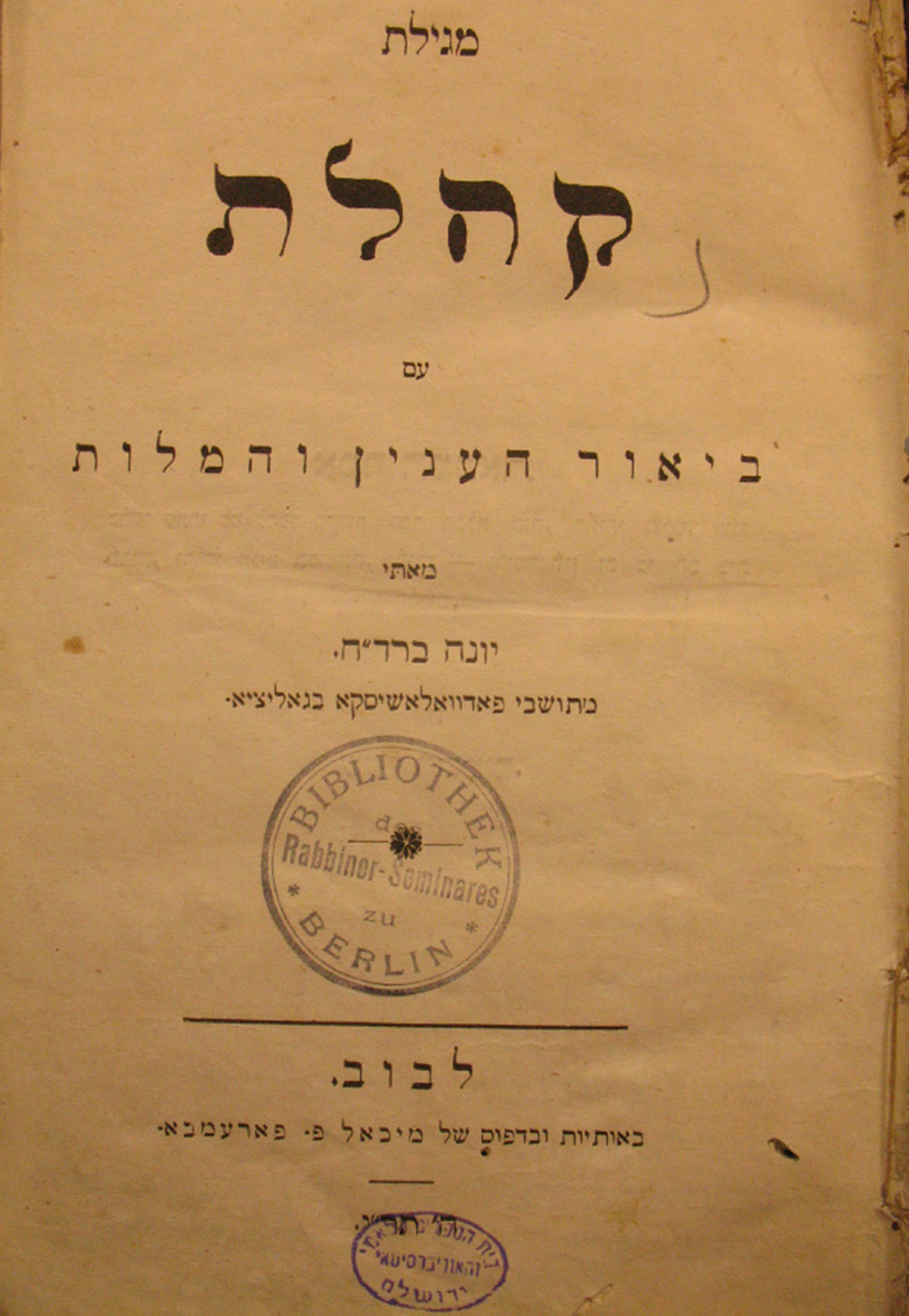
Understandably, there was much excitement when this book appeared since it is quite an event when an unknown commentary of such a major figure is discovered. However, the excitement was short-lived, as it soon became known that the commentary was not by the Malbim but by a nineteenth-century maskil, Jonah Bardah. Even more embarrassing for the publisher, Machon Oz ve-Hadar, is that Bardah’s commentary even appeared in print in 1850. Here are the title pages.


This would be bad no matter who the publisher was, but the fact that Machon Oz ve-Hadar is from New Square, which is as far removed from Haskalah imaginable, makes the mistake drip with irony.
How did such a blunder happen? Today, it seems that everyone is looking for unknown material to publish. There are a number of journals that devote a good deal of space to this, and I often wonder what will happen when we run out of unpublished documents. With this mindset you can imagine how excited the publisher was when he was informed that someone had located a previously unknown commentary by the Malbim. The assumption that this was the Malbim’s text was due to the similarity between the method of commentary in the newly discovered work and other commentaries of the Malbim. Without careful examination, the Kohelet commentary was published and this would in turn lead to great embarrassment, not to mention a lot of wasted time and money.
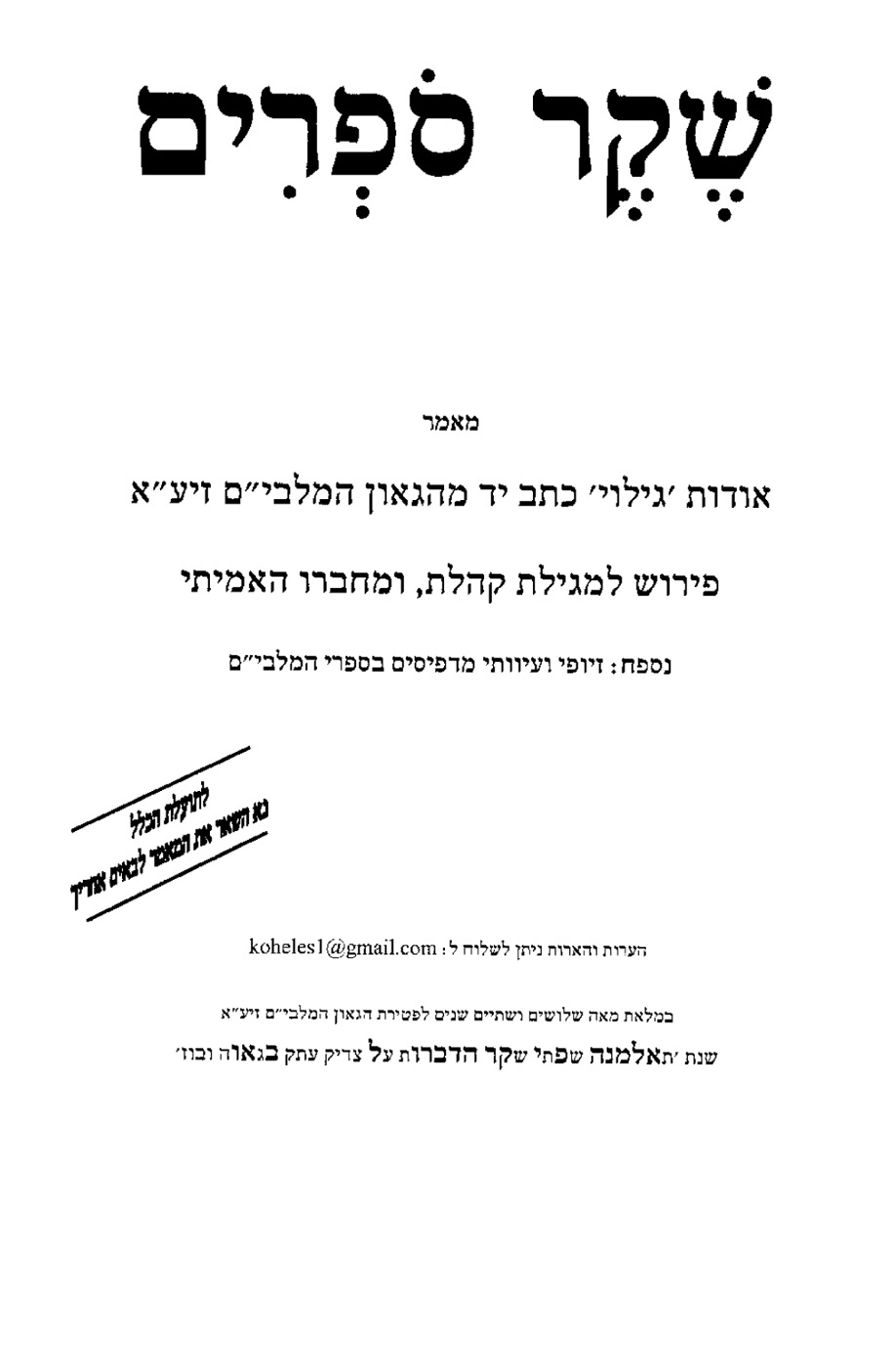
The story of this mistake is found in a document entitled Sheker Soferim. Here is the title page.

(A softened version of this article appeared in Yeshurun 25 [2011], pp. 724ff., and there the author’s name is revealed: R. Avraham Yeshaya Zecharish.[15]) This is really a damning document as it shows that the publisher had already been told that the handwriting of the commentary was not that of Malbim. I am not going to say that the publisher knowingly printed a fraud in order to profit by the Malbim’s name. But I think it is obvious that that the publisher’s great desire to publish the work caused him ignore what he had been told and to instead rely on his own “experts.” Whoever edited the work also showed his (their?) ignorance, since when the commentary referred to רמבמ”ן , not knowing that this referred to Mendelssohn the text was “corrected” to read רמב”ן!
Despite my sense that there was no intentional fraudulence in this publication, I don’t entirely discount the possibility that the publisher knew the commentary was not by Malbim but printed it anyway. I say this because as shown in Sheker Soferim there is one passage in the commentary where the “Malbim” claims that there is a mistake in the biblical text. The editors censored this passage, and this to be expected as from a haredi perspective such a comment is heretical. But if so, could the publisher actually believe that the Malbim wrote that which was censored?
Lest people think that things like this don’t have real effects in the world, let me just note that, as pointed out by Eliezer Brodt, an entire chapter of a doctoral dissertation is devoted to the false Malbim commentary on Kohelet.[16] Just think of how many hours were devoted to this dissertation chapter, all of which were wasted.
While Zecharish points to various “problematic” elements of the commentary that the publisher should have been aware of, he misses one right on the first page.

The notes at the bottom of the page are found in the original manuscript and publication. Here is the page.

In the commentary to the first verse the “Malbim” explains how the beginning of biblical books, where the author is introduced, is written by a later person.
.ואדמה כי לא יטעה כל משכיל לחשוב אשר המחבר בעצמו דיבר אלה הדברים
In the note the “Malbim” adds:
.עיין בהראב”ע בהתחלת ספר דברים
The beginning of Deuteronomy states: “These are the words which Moses spoke unto all Israel beyond the Jordan.” Upon these words Ibn Ezra introduces his “secret of the twelve” which focuses on post-Mosaic additions to the Torah. It is incredible that while the “Malbim’s” intention is crystal clear, namely, that the beginning of Deuteronomy was written after Moses, the editors didn’t catch this and see anything problematic in the comment, a comment that would never have been made by the Malbim.[17]
——

[1] See here. For former French Chief Rabbi Gilles Bernheim’s plagiarism, see the statement in First Things available here.
I think this sentence, from the article, is particularly apt:

One of the perversions of our era is to make a god of intellectual property. Most commentators described Bernheim as “stealing” words and sentences. This is wrongheaded. Plagiarism is a sin against truth, not property. It’s first and foremost a kind of lying, not a kind of stealing. He violated our trust by speaking in a voice that was not his own, which is why in this and other cases of plagiarism the writer loses intellectual and moral authority broadly.

The importance of our spiritual leaders speaking the truth cannot be stressed enough. R. Kook writes about how forces of heresy were strengthened when people saw unethical behavior among בעלי תורה ואמונה. See Eder ha-Yekar, p. 43.
R. Joseph Ibn Caspi explains at length how a prophet, who models himself on God who is called א-ל האמת, always speaks the truth, even when speaking to his wife and children (!). See Shulhan ha-Kesef, ed. Kasher (Jerusalem, 1996), pp. 146, 163. This is so important to Ibn Caspi that he deals with a number of biblical examples where it appears that a prophet did not speak truthfully, and he argues that the meaning is not what appears at first glance. The one case where he acknowledges that we are dealing with a lie is Jacob telling Isaac, “I am Esau your firstborn” (Gen 27:19). Yet this does not affect Ibn Caspi’s thesis because he claims, p. 150, that when Jacob told this lie he was not yet a prophet.
.הנה כחש אבל עדין לא הגיע למדרגת הנבואה עד היותו בדרך חרן וראה הסולם
After his discussion about prophets and how they were always truthful, Ibn Caspi concludes, p. 163, that this is also how a חכם should behave. Our rabbis now stand in place of the prophets of old, thus they too much be paragons of truth.
With regard to Ibn Caspi’s Shulhan ha-Kesef, I would like to make one further point. In a previous post, see here, I discussed how, according to Ibn Caspi, the Torah contains statements that are not actually true, but were believed as such by the ancients. We see another example of this in Shulhan Kesef, p. 147, where he writes, in seeking to explain an example where it appears a prophet lied:
.כי הנביא שם משותף וכבר הרחיב הכתוב ואמר “חנניה הנביא” בסתם
What Ibn Caspi is saying is that even though the Bible refers to someone as a prophet, this doesn’t mean he was really a prophet. It could be that he is referred to as such because this is what the people believed, even though the people were incorrect. In other words, the Bible incorporates the incorrect view of the people in its narrative. The proof he brings is from Jeremiah 28 where Hananiah is referred to as a prophet but in reality he was a fraud.
[2] See most recently Shmuel Ashkenazi, “Ha-Gonev min ha-Sefer,” Yeshurun 25 (2011), pp. 675-690.
[3] See here.
[4] See e.g., Bekhorot 31b, Menahot 93b; R. Moses Zweig, Ohel Moshe, vol. 1, no. 41. The fact that the Sages had this problem in their own day is probably also why they stressed the importance of proper attribution. This is pointed out by R. Nathan Neta Olevski, Hayei Olam Nata (Jerusalem,1995), p. 241:
מזה נראה כי גם בימיהם כבר פשתה המספחת להתגדר בגנבי גנובי את תורת אחרים ולכן ראו חז”ל להגדיל ערך המשתמר מזה ולחשוב דבר זה בין המ”ח דברים שהתורה נקנית בהן
[5] See e.g., R. Yekutiel Yehudah Greenwald, Mekorot le-Korot Yisrael (n.p., 1934), p. 48.
[6] See e.g., Nahum Rakover, Zekhut ha-Yotzrim bi-Mekorot ha-Yehudi’im (Jerusalem, 1991), pp. 38ff.
[7] Otzrot ha-Sofer 14 (5764), p. 91:
.זה אני מוחל לכם אם אתם אומרים חידושיי בשמכם, אבל אם אתם אומרים חידושים שלכם בשמי זה אינני מוחל לכם
For a communal rabbi, who was expected to prepare his own derashot, it was unacceptable to inform his listeners that he was using material from others. However, R. Asher Anshel Yehudah Miller, Olamo shel Abba (Jerusalem, 1984), p. 187, reported one tongue-in-cheek justification of this practice if due to circumstances beyond his control the rabbi was unable to properly prepare for his Shabbat ha-Gadol derashah. Since the Talmud, Pesahim 6a, states שואלין ודורשין בהלכות פסח, one can derive from this that מותר “לשאול” מאחרים בשעת הדחק ולדרוש בהלכות פסח
[8] I mention geneivat da’at, yet according to some one who plagiarizes actually violates the prohibition against actual geneivah. See R. Yaakov Avraham Cohen, Emek ha-Mishpat, vol. 4, nos. 2, 24; R. Yaakov Hayyim Sofer, Hadar Yaakov, vol. 5, no. 38. R. Isaiah Horowitz, Shenei Luhot ha-BeritMasekhet Shevuot, no. 71, writes about plagiarism:  יותר גזילה מגזילת ממון
R. Eleazar Kalir states that the plagiarizer violates a positive commandment. See Havot Yair (Vilna, 1912; printed as the second part of the Malbim’s Eretz Hemdah), p. 26a:
ואומרים חידושי תורה מה שלא עמלו בו רק מפי השמועה שמעו ואומרים משמיה דנפשם ועוברים על עשה . . . שכך אמרו כל האומר דבר בשם אומרו מביא גאולה לעולם
See also the very harsh comments of R. Joseph Hayyim David Azulai in his Berit Olam to Sefer Hasidim, no. 224, which should be enough to scare away at least some of the plagiarizers:
אם כותב ספר וגנב תורת אחרים . . . בחצי ימיו יעזבנו ואחריתו יבא בגלגול אחר ויהיה נבל ויהיה מזולזל כי נבל הוא ונבלה עמו. רחמנא ליצלן
[9] Robert Klein called my attention to the final part of R. Solomon Ephraim Luntshitz’s introduction to his Keli Yekar, where he suspects that some of the commentators who preceded him were guilty of plagiarism. See also his Olelot Ephraim, at the end of the introduction, where he claims that all the plagiarisms are delaying the arrival of the Messiah. He plays on the verse עשות ספרים הרבה אין קץ  and explains that since so many new books are full of plagiarisms, עשיית ספרים הרבה גורם איחור קץ הימים.
R. Solomon Alkabetz, Manot ha-Levi (Lvov, 1911), p. 91b, also refers to the plagiarizers of his day. I called attention to R. Eliyahu Schlesinger’s plagiarism in my review of Avi Sagi’s and Zvi Zohar’s book on conversion, available here. See p. 9 n. 29. See also my post from June 25, 2010, available here, where I cite another case of plagiarism from Schlesinger. I found these examples by chance, and I am sure that if I were to carefully examine the latter’s writings I would come up with more. Yet there doesn’t seem to be much point in doing so, since in the haredi world there simply is no accountability in matters like this.
A number of scholars have discussed plagiarism with regard to Abarbanel, and I hope to return to this. For now, let me just note the following. In his introduction to Trei Asar, p. 13, Abarbanel explicitly denies that he plagiarized, while at the same time accusing R. David Kimhi of doing so.
שהמובחרים והטובים מהפירושים שזכר רבי דוד קמחי מדבר [!] הראב”ע לקחה [!], עם היות שלא זכרם בשמו ואני איחס כל דבר לאומרו פן אהיה ממגנבי דברים
At the end of his commentary to Amos, he repeats the accusation:
ומה שפירש עוד בהלא כבני כושיים בשם אביו הנה הוא לקוח מדברי הרב רבי אברהם בן עזרא ומה לו לגנוב דברים
See R. Dovberish Tursch, Moznei Tzedek (Warsaw, 1905), p. 195; Abraham Lipshitz, Pirkei Iyun be-Mishnat Rabbi Avraham Ibn Ezra (Jerusalem, 1982), p. 131.
[10] It is hard to take this explanation seriously. Talking during the repetition of the Amidah has always been common, yet rather than omit mention of this matter, the Shulhan ArukhOrah Hayyim 124:6, writes:
לא ישיח שיחת חולין בשעה שש”צ חוזר התפלה ואם שח הוא חוטא וגדול עונו מנשוא וגוערים בו
R. Zvi Yehudah Kook reported that his grandfather, R. Shlomo Zalman Kook, once strongly rebuked someone for talking during the repetition of the Amidah. When it was pointed out to him that דברי חכמים בנחת נשמעים, he replied that the Shulhan Arukh uses the word גוערים and that does not mean a gentle suggestion but a sharp rebuke. See R. Yair Uriel, Be-Shipulei ha-Gelimah (n.p., 2012), p. 32. (The story immediately following this one is also of interest. It records that R. Zvi Yehudah opposed the common practice [at least in America] of singing אשמנו בגדנו:
יש לומר את הדברים ברצינות, בצער ובכאב, ולא מתאימה לזה שירה 
It seems that R. Abraham Isaac Kook followed in the path of his father. See ibid., pp. 58-59, for the famous story of how R. Kook, while rav in Bausk, once slapped a “macher” in the face when he insulted R. Zelig Reuven Bengis. (The story is told in great detail in R. Moshe Zvi Neriyah, Sihot ha-Re’iyah [Tel Aviv, 1979], ch. 22.) R. Kook later explained that he did not slap the man in a fit of anger, but was of completely sound mind and did it in order to follow the Sages’ prescription of how to respond to one who degrades a Torah scholar:
“וכך אמר: “דינא הכי, מי ששומע זילותא של צורבא מרבנן צריך למחות
All I would say is that one must be careful with who one slaps. R. Yekutiel Yehudah Greenwald, Li-Felagot Yisrael be-Ungaryah (Deva, 1929), p. 25, records a story from mid-eighteenth-century Hungary where in the synagogue and in front of the congregation the head of the community slapped the rabbi in the face. This was the last straw for the rabbi (who was really a phony), and he, his wife, and children converted to Christianity.
R. Naphtali Zvi Judah Berlin would occasionally slap a student in the face. On one occasion it even led to a noisy protest by the students. Because the students refused to back down, the Netziv unable able to deliver his shiur. This led to him making a public apology to the students, which they happily accepted. See M. Eisenstadt, “Revolutzyah bi-‘Yeshivah,’” Ha-Tzefirah, June 2, 1916, pp. 1-2 (referred to by Shaul Stampfer, Lithuanian Yeshivas of the Ninteenth Century [Oxford, 2012], p. 113).
Since we are on the subject of slapping in the face, and since I mentioned R. Yitzhak Zilberstein in my last post, here is something else from his Hashukei Hemed on Bava Kamma, pp. 492-493.


I think it is quite interesting that he takes it as a given that policemen in Israel will beat thieves until they confess. Is there any truth to this at all? He himself thinks it is good that thieves be given a good slap in the face.

There are many more examples I could cite of people being slapped in the face, including by rabbis. One thing that is clear is that face-slapping has gone out of style.. It is like fainting, which was common in old movies. But when was the last time you saw a woman faint? It just doesn’t happen anymore.
Returning to R. Bengis, it is noteworthy that he and R. Kook were great friends from their days in Volozhin.  See the booklet Or Reuven (Jerusalem, 2011), which is devoted to their relationship R. Bengis’ letters to R. Kook in Iggerot la-Rei’yah show that he regarded R. Kook as rav of Jerusalem and chief rabbi of the Land of Israel. Only after R. Kook’s death did R. Bengis become Rosh Av Beit Din of the Edah Haredit in Jerusalem. His life-long admiration for R. Kook, even in his new position with the Edah Haredit, is, of course, not usually mentioned in haredi discussions of him. Since in the past I have criticized Yeshurun for its conscious distortions (all in the service of the haredi cause), let me now praise it for including the following in vol. 12 (2003), p. 156 n. 35.

Rabbi Nathan Kamenetsky, Making of a Godol, pp. 305-306, reports in the name of R. Yosef Buxbaum that R. Bengis knew the poetry of Pushkin. (He also quotes a report that R. Bengis did not know Russian and when tested by a government official to ensure that secular studies were being taught in Volozhin, he just repeated the page of Pushkin from memory which he had prepared ahead of time by having another student read it for him. This strikes me as an apologetic attempt to “kasher” R. Bengis, as followers of the Edah Haredit will not take kindly to the knowledge that R. Bengis knew Russian poetry.)
For a recent discussion of R. Bengis and his brother, who went by the name of “Ben Da’at”, see here.
According to an unpublished collection of Brisker stories in my possession, R. Velvel Soloveitchik said about R. Bengis that just because one is a great talmid hakham does not mean that he is also a leader. Perhaps R. Velvel had this view of R. Bengis because the latter’s extremist credentials left something to be desired.
[11] Marvin J. Heller, Studies in the Making of the Early Hebrew Book (Leiden and Boston, 2008), p. 204, writes as follows about R. David Lida: “I would suggest, and this is highly speculative and certainly not a justification, that Lida’s acts of literary piracy were youthful improprieties, albeit of a most serious nature. A young man, inexperienced, perhaps immature, from whom much was expected, hoping to impress others and to further a burgeoning career, erred and claimed authorship of works he had not written, but rather discovered in manuscript.”
[12] The following example, with some of the explanations I give, is found here.
[13] This too was noted here.
[14] In a comment to my last post, someone wrote:

“The part about Anshei Keneset ha-Gedolah requiring the Amidah to be recited twice a day and that women are also obligated in this is not from Nahmanides. This is the Mishnah Berurah speaking.”

Actually, these are the words of the Shulchan Aruch HaRav (או”ח קו,ב), quoted here verbatim.

This practice of the MB citing whole paragraphs from the SAH – without attributing the author – is common throughout the his work, in leads many times to run-on sentences and disambiguation such as the one at hand.

[15] See also the online discussion here.
[16] “Ha-Sinonomyah bi-Leshon ha-Mikra al Pi Shitat Malbim,” (unpublished doctoral dissertation, Bar Ilan University, 2009).
[17] See here where I mention how R. Yosef Reinman also didn’t know anything about Ibn Ezra’s “critical” views. In the post I also discuss the controversy regarding Reinman co-authoring a book with a Reform rabbi. In the introduction to his Avir Yosef (Lakewood, 2008), Reinman defends himself.


Legacy Judaica Spring 2021 Auction

Legacy Judaica Spring 2021 Auction

By Dan Rabinowitz and Eliezer Brodt

Legacy Auction Judaica is holding its Spring auction on May 30th (link) and it provides us the opportunity to discuss some interesting bibliographical and historical books and items.

Item #7 is the first edition of Charedim printed in 1601. This is the first appearance of R. Elazar Azkiri’s song Yedid Nefesh in print. For a full discussion of this Tefilah see Bentcy Eichorn, Zemirot Zion, pp. 91-106. This volume also has many unidentified glosses.

Another entry of note is Item #147, the Hida’s copy of the 1545 edition of the Sifra with what may be his marginalia.

An item with important glosses is Item #160 which has the notes of R’ Chaim Sofer known as ‘the Hungarian R’ Chaim,’ on the work Sharei Torah. See also Item #61 which has glosses from R’ Hirsch Berlin.

Item #79, is the first edition, Seder Zera’im. While small portions of the Tiferes Yisrael commentary on the Mishna proved controversial, this volume contains the approbation of R. Akiva Eiger, who is also listed on the subscriber list.

Another controversial work, the late R. Nosson Kamenetsky’s Making of a Godol, is Item #97. This is the first edition, not the later edition which censored material from the first. We discuss some of the controversy, bans, and differences between the editions, in a series of articles here, here, here, and here.

Also a controversial work is Item #100, Pulmus haMussar which discusses the dispute regarding the Mussar movement. Revealing the inner machinations between the parties proved controversial itself and Pulmus was printed just once and it has never been reprinted. Regarding this work, see Eitam Henkin, Ta’arokh le-fani Shulkhan, 123-139.

Item #136’s description contains an interesting cryptic note about the copy of Pe’as Hashulchan: “Includes the rare final page of corrections and polemics”.

Here is the story behind this sentence: In 1799 one of the earliest authorized works of the Gra printed was the Shenos Eliyahu. In the back there was a section called Likutim.

Here is the text of the Gra Related to Mesorah:

In 1821 R’ Wolf Heidenheim wrote about this:

This is what R’ Shklover is referring to in the last page of his work without naming who he was referring to:

Interestingly enough R’ Yitzchaki of Bnei Brak in an article in Yeshurun 5 (1999) pp. 535-537 concludes that R’ Heidenheim was correct. In later editions of the Pe’as Hashulchan has the piece of R’ Shklover added into the proper place in the important introduction of the work. (Thanks to Y. Yankelowitz for his sources and materials).

Another work of the Gra is the first edition of the Biur ha-Gra on Shulhan Orakh (Item #137). This edition removed many standard commentaries (Taz, etc.) but not the Be’er ha-Goleh because he was related to the Gra. A Shulhan Orakh with just the Gra’s commentary proved not viable because when people purchased a Shulhan Orakh they wanted all the standard commentaries in addition to the Gra’s. In the middle of the publication of the Even ha-Ezer volume the publishers decided that they would include the other commentaries even if it meant moving the Gaon’s commentary to the bottom, they received permission from R. Chaim Volozhin to do so.

About Item #18 Messechtas Purim see our discussion earlier on the blog here.

Item #25 is Peirush Megilas Achashverosh, Venice 1565. The description states:

R. Zechariah ben Saruk (1450-c. 1540), was one of the great Chachamim of Spain… With an important introduction, which provides a rare historical glimpse into the travails of Jews who were exiled from Spain as well into as other challenges of that period.

Worth quoting is part of another piece from this interesting introduction:

שהראשונים הניחו לנו לדבר אבל לא לקנטר ואני תמה מאד מן החכם העניו ה”ר שמואל די בידאש נ”ע איך נפל ברשת מאמר האומר אין משיבין על הארי אחר שמת? וזה לשתי סבות הא’ שהוא ידוע לקטני עריסה [רץ המונחים בעריסה] כי קטנם עבה ממתנינו, וההקש והערך שיש בין ידיעתם לידעתנו הוא בערך גלגל ערבות אל נמלה אחת, השנית שהחכמים ההם ע”ה שחברו מה שחברו, האירו לנו בחיבוריהם מפיהם אנו חיים, אם כן מה נהיה כפויי טובה ששתינו מים זכים מבורם ועתה נקנטר כנגדם. ובעת שאמר החכם הנזכר על בעל העטור והרא”ש והרמב”ם ז”ל שהוכו בסנורים, ודברים אחרים, זרים לכל חכם לב לאומרם מאשלי רברבי. ותמהני מחכמתו שאני הייתי מכיר אותו היטב שהוא חכם ועניו איך אמר בהקדמת ספרו מה שסתר אחר כך בספרו? כי אמר בהקדמתו שהסתירה אשר לא יכוןי הסותר לבייש את האשר נעלם ממנו דבר, כי אין זה מורידו מחזקתו. והאמת כן הוא. ובספרו, כשחלק על הגאונים הנזכרים אמר שהוכו בסנורים

ונראה לי דילמא מר נאים כדנפק שמעתתיה מפומיה, כמו שאמרו על רבי יהושע בן לוי, כדאיתא במסכת נדה פרק המפלת. ולא זו בלבד הזהיר לנו חז”ל, אבל גם כן אמרו במוסריהם שלא יחלוק אדם על רבו אפילו בעודו בחיים חייתו, ולכן אמרו בירושלמי לית ריש לקיש מתריס כלפי רבי יוחנן, למפיגל עליה לאפוקי מיניה עובדא. העובדא היה שהוראה רבי יוחנן לתלמידו ריש לקיש שהצפורן אינה מטמא, כמו שהמחלוקת הוא בירשלמי במסכת הורית פרק כהן משוח

ובעבור שזה האיש היה חשוב במדותיו, נאמר שזה היה כשגגה שיוצא מלפני השליט ולכן בכל מה שחלק כנגד גאונים עולם, לא אדבר אלא באחד, בעבור שנשבעתי ואקיימה להיות כנגד כל איש שיחלוק נגד הרא”ש והרמב”ם ז”ל וכו’

על כל שאר הדברים שהטיח כנגדם, ובפרט נגד הראב”ע ז”ל אשר אחר חתימת התלמוד היה רשום ככל הגאונים, אף אלפי שהיה הוא גאון, וראו מה שכתב עליו הרמב”ם לבנו, והוא היה חכם כולל ושלם בכל חכמה. ואנכי ראיתי חדושי הראב”ע ממסכת קידושין [ותוס’ הביאו בקידושין לו א], והם בתכלית הדקות האימות, ובא החכם ר’ שמואל די וידאש, האל יכפרהו לומר עליו, ולא אמר אמת ואינו נכון ודברים אחרים, שאינם ראויים לדבר כנגד האשל הגדול הראב”ע. ומה שאמרתי לא הייתי אומר, אלא שנקרת בפי’ אחד שלו מהמגלה הזאת

Last year this rare work was reprinted based on the first edition and manuscripts with notes and a useful introduction about the work.

Item #37 is the rare work Tal Oros. This work is almost completely unknown to most poskim. One important exception was the Magen Avraham who quoted it numerous times in his classic work on Shulchan Aruch. For additional information about this author see this earlier post on the blog (here).

Previously we have mentioned how we can learn about works found in different people’s libraries. Item #163 is the Beis Halevi’s copy of the classic work of the Malbim on Orach Chaim which sadly was never completed.

An interesting bibliographical scoop about this work can be found in an interview in Mishpacha Magazine in the September 4, 2019 (Issue #776, p. 50) by Rabbi Yonason Sacks. He describes purchasing the Malbim’s own copy which had an important gloss to a specific passage.

The catalog’s letters section is always an important way to learn about interesting unknown historical documents and the like.

Item #229 we learn about a newspaper written in Yeshivas Telz for Purim. This tradition is found already in Volozhin as described by Shaul Stampfer and continues until today.

Item #182 is another Letter of R. Yehiel Mikhel Epstein, author of the Orakh ha-Shulhan.

This letter has a very interesting passage (which the entry downplays) we already wrote about back in 2007 (here). In this letter he wrote not to write to R’ Spektor as he is מוקף מסביב and write to the Netziv even though he is sick.

Shockingly enough R’ Chaim Kanievskey advised R’ Horowitz, the editor of this edition, not to edit out this line.

Item #224 must be highlighted as this is an incredible manuscript, which relates to the famous controversy in Yerushalayim in the 1880’s.

This is a letter from 1887 written by R. Yosef Dov ha-Levi Soloveitchik, the author of the Bes ha-Levi, to his friend R’ Hildesheimer. The catalog description states in part:

During the late 1880’s the old Yishuv of Yerusholayim, then led by the great R. Yehoshua Leib Diskin, was supported by the “Chalukah” system, which was funded by Jews from the Diaspora… He continues that there is still one place that the plague of secular studies has not infiltrated and that is Yerusholayim, and despite the fact that scoffers want to implement secular studies there, the Yishuv, under the leadership of “Rabbeinu HaGadol Me’or Ha’Golah Yochid B’Doreinu B’Torah V’Yirah HaGaon MaHaRIL Diskin Shlit”a, have prevailed and held on to their sacred tradition. However, those who are opposed to the Chachomim are totally persistent in their publications against the Yishuv and the MaHaRIL”. The Beis Ha’Levi therefore requests that R. Hildesheimer publicize that he disagrees with this view, and that he reaffirm that it is forbidden for the school system in the Old Yishuv, which was constituted primarily of students with Lithuanian backgrounds, to implement these changes…

In this letter we see the incredible respect that the Beis Halevi had from R’ Yehoshua Leib Diskin, something known to us from many other sources.

R’ Hildesheimer’s role in this controversy has been discussed a bit by David Ellenson, Rabbi Esriel Hildesheimer and the Creation of a Modern Jewish Orthodoxy, pp. 110-112,123-126.

Many aspects of this fascinating controversy have been dealt with by R’ Eitam Henkin HY”d in various articles.

One important point is from the Beis Halevi letter it sounds like all Lithuanian Gedolim sided with R’ Diskin but this is not so simple at all. R’ Shmuel Salant definitely did not agree with R’ Diskin on this. IYH this will be discussed at greater length in the future.


The Satmar Rebbe and a Censored Mishnah Berurah, and R. Baruch Rabinovich of Munkács

The Satmar Rebbe and a Censored Mishnah Berurah, and R. Baruch Rabinovich of Munkács

Marc B. Shapiro

1. In my recent interview in Der Veker, available here, I said that I hope to discuss how the Satmar Rebbe was mistaken in identifying a Zionist censorship in the Mishnah Berurah.

In Ha-Maor, Elul 5716, p. 30, M. Abramson tells the following story that appears under the heading על זיוף המשנה ברורה. The Satmar Rebbe was away from home and asked his assistant, R. Joseph Ashkenazi (who is the source of the story), to bring him a book. Ashkenazi brought the first book that came to his hand. It was a Mishnah Berurah printed in Israel. After investigating the history of the printing of the Mishnah Berurah at the National Library of Israel, I concluded that the copy the Satmar Rebbe was given was published by Pardes in 1955 (one year before the event described). Here is the title page.

Later the Rebbe returned the book to Ashkenazi and said that as far as he remembers, the language in section 156 of this copy of the Mishnah Berurah differs from what appears in other editions. Ashkenazi checked an older edition of the Mishnah Berurah and discovered that the Israeli edition had altered the original text.

The original Mishnah Berurah 156:4 reads:

מצוה על כל אדם לאהוב את כ”א מישראל כגופו שנא’ ואהבת לרעך כמוך וכו’ ודוקא רעך בתורה ומצוות אבל אדם רשע שראה אותו שעבר עבירה המפורסמת בישראל ולא קיבל תוכחה מצוה לשנאתו.

I have underlined the words that Abramson calls attention to. While the original text reads: לאהוב את כ”א מישראל, the Pardes edition has לאהוב את עמיתו. Abramson notes, “In this they wanted to show their support for democracy, that one needs to love not just the Jews but also the Arabs.” The Pardes edition also omits the second series of words that I have underlined, which express sentiments that are not very tolerant of the irreligious,[1] as well as some other words.

Here is the uncensored page in the Mishnah Berurah.

Here is the censored page in the Pardes edition.

Upon looking again at the Abramson article, I see that I misremembered, as it does not actually say that the Satmar Rebbe attributed this censorship to the Zionist publisher. He simply noticed the problem in the Israeli edition and said that this Mishnah Berurah is not like the others he has seen. It is Abramson who explicitly blames the Zionists (although perhaps the Rebbe agreed with Abramson). Abramson sarcastically writes that apparently they also provide copies of the Mishnah Berurah “to the children of Mapai and Mapam,” and this explains why they altered and censored the text.

Yet the truth is that what we have just seen has nothing to do with the Israeli publisher, Pardes. I found the same censorship in a Mishnah Berurah that appeared in Warsaw in 1895, and interestingly, it is this very edition that is found on hebrewbooks.org here. In other words, the changes we have seen were inserted under Czarist rule, and the Israeli publisher simply reprinted a copy of the Mishnah Berurah without realizing that it was a censored version.[2]

I know of another example where the altering of a text was blamed on the Zionists, and this time the one doing the blaming was a Mizrachi rabbi, R. Avigdor Cyperstein. In the Mossad ha-Rav Kook Archive of Religious Zionism there is a letter from R. Cyperstein to Dr. Yitzhak Rafael dated May 14, 1967. The relevant section reads as follows:

ידידי היקר – אני רוצה לזכות אותך בזכות הרבים, ובטח לא תחמיץ את המצווה הזו: כעת בכל העולם נפוצים הסידורים תוצרת הארץ הוצאת “בית רפאל”, ת”א – “סדור התפלה השלם” – והנה מצאתי בסידור זה דבר נורא: במעמדות של יום הששי מובא הגמ’ מנחות מד. המעשה באדם אחד שהי’ זהיר במצוות ציצית וכו’ ושם כתוב “באה לבית מדרשו של ר’ חייא, אמרה לו רבי צוה עלי ויעשוני גיורת וכו’, – והמולי”ם הללו העיזו לשלוח יד בגירסת הגמ’, ובמקום ויעשוני גיורת – השליכו את הגיורת החוצה, והכניסו במקומה “עברית” . . . והמרחק-התהום בין גיורת לעברית – אין צורך לבאר, וגם כוונתם הטרופה, בוקעה מזה, ומעלה סרחון, בכי’ לדורות. דומני שאין מי שהוא שהעיז לכבוש את המלכה בבית וכל ישראל – מתפללים מסידור זה, וע”כ מצווה לפרסם זה ברבים, ולתקן בהוצאות החדשות.

It is hard to know whether what R. Cyperstein refers to was indeed a Zionist inspired alteration. I say this because the version ויעשוני עברית is also attested to in a few sources that pre-date Zionism. I think it is more likely that the publisher just assumed that this is a more authentic reading.

Since I have been discussing the Satmar Rebbe, here is as good a place as any to note that contrary to popular belief, the name Satmar does not come from St. Mary. The original meaning seems to be a personal name, and in popular etymology the word came to mean “great village.”[3] Yet even in the Satmar community some believe that the word comes from St. Mary, and because of this they pronounce it as “Sakmar”. In pre-war Hungary this pronunciation was common among many Orthodox Jews, not only Satmar hasidim.[4] For one example of this, here is Samuel Noah Gottlieb’s entry on Satmar in his rabbinic encyclopedia, Ohalei Shem (Pinsk, 1912), p. 425. As you can see, while “Szatmar” appears in the vernacular, in the Hebrew the city is spelled “Sakmar”. There are many more such examples.

This avoidance of saying the word “Satmar” is similar to the way Jews referred in Hebrew and Yiddish to the Austrian town Deutschkreutz. Unlike the case with Satmar, when it came to Deutschkreutz the universal Jewish name was Tzeilem (Kreutz=cross=tzelem). On the other hand, there was a significant Jewish community in the Lithuanian city of Mariampole, whose name comes from Mary. Yet I am not aware of anyone who avoided saying the name of this city. Shimon Steinmetz emailed me as follows:

We might also note other cities with Christian-y names, like Kristianpol. Kristianpoler was a name used even by rabbis, cf. Rabbi Yechiel Kristianpoler, and his son Rabbi Meir. In addition, the Lithuanian town Kalvarija, which has a very Christian association, Jews used it without any issue. On the other hand, the Jews called St Petersburg, “Petersburg,” without the “St.”

One other point about Satmar: In a lecture I mentioned that one of the old-time American rabbis met with the Satmar Rebbe and concluded that when it came to the State of Israel, you simply could not speak to him about it. He was like a shoteh le-davar ehad when it came to this in that no matter how much you tried to convince him otherwise, he refused to listen to reason. Someone asked me which rabbi said this. It was R. Ephraim Jolles of Philadelphia (as I heard from a family member). I don’t think his formulation is too harsh, as anyone who has read the Satmar Rebbe’s writings can attest. It does not bother me if he or anyone else wants to be an anti-Zionist. However, the anti-Zionist rhetoric found in the Satmar Rebbe’s writings, and those of his successors, is often more extreme than what we find among the pro-Palestinian groups. Take a look at this passage from Va-Yoel Moshe, p. 11.

אם נקח כל פירצות הדור והעבירות המרובות הנעשות בכל העולם וישימו אותם בכף מאזנים אחת, ומדינה הציונית בכף מאזנים השני’, [המדינה הציונית] תכריע את הכל, שהוא השורש פורה ראש ולענה של אבי אבות הטומאה שבכל אבות הנזיקין שבכל העולם כולו, והן המה המטמאים את כל העולם כולו.

By what logic can one claim that such an outrageous passage would be anti-Semitic if said by Mahmoud Abbas, Linda Sarsour, Tamika Mallory, or Max Blumenthal, but not so if the very same thing is said in Satmar?

If anyone wants to see the results of this rhetoric, here are two videos with kids from Satmar. In this one the children are being taught that the Zionists started World War II and to hope for the destruction of the State of Israel.


In this video children were told that Netanyahu was in the car and they were to throw eggs at it.

It is very painful to see how children are being indoctrinated with such hatred. Again I ask, if such a video surfaced from a leftist camp, there would be no hesitation in labeling it anti-Semitic. So why are people hesitant to conclude that Satmar is also involved in spreading anti-Semitism?

The general assumption is that the Satmar Rebbe hated Zionism and the State of Israel so much, that he was inclined to believe even the most far-out anti-Semitic canards against the State. I have always found this difficult to believe. Say what you will about the Rebbe, there is no denying that he was very intelligent. Thus, I have a hard time accepting that he could have really believed in Zionist control of the media and other anti-Semitic tropes found in his polemical writings. In other words, I think it is more likely that he did not believe in any of these things but said them anyway in order to convince his followers not to give up the fight against Zionism, a fight that had been abandoned by so many former anti-Zionists after the Holocaust and the creation of the State of Israel in 1948. In such a battle it was necessary to turn Israel not only into something bad, but actually the worst sin imaginable.

R. Nahum Abraham, a Satmar hasid and prolific author, has recently written that the Satmar Rebbe would deny things that he knew were true. He regarded his denials as “necessary lies,” in order to prevent people from being led in the wrong direction.[5] If the Rebbe thought that it was permissible to deny the truth of certain hasidic stories in order to prevent his followers from being influenced by them, isn’t it possible that he would exaggerate the evils of the State of Israel in order to best indoctrinate his followers with an anti-Zionist perspective?

This approach also would explain a big problem that no one has been able to adequately account for. How was the Satmar Rebbe able to have friendly and respectful relationships with people who, based on what he writes, he should have regarded as completely out of the fold due to their involvement with the State of Israel? This includes even men like R. Aharon Kotler who supported voting in the Israeli elections, which the Satmar Rebbe claimed is “the most severe prohibition in the entire Torah.”[6] Yet we know that the Satmar Rebbe respected R. Aharon and others who had a very different perspective.[7] Can’t this be seen as evidence that there is a good deal of ideologically-driven exaggeration in the Satmar Rebbe’s writings, and that not everything he says really reflects his actual views? After all, if he really thought that voting in the elections was the most severe prohibition in the Torah and the State of Israel was completely destroying Judaism, would he still be able to be on good terms with rabbis who instructed their followers to vote and be part of the State?

2. Since I mentioned Munkács in this post, let me return to another recent post here where I discussed R. Baruch Rabinovich, the son-in-law of R. Hayyim Eleazar Shapira and his successor as Munkácser Rebbe. When I wrote the post I was unaware of the fact that R. Baruch’s grandson, R. Yosef Rabinovich, recently published Ner Baruch, which is a collection of Torah writings and letters from R. Baruch. He includes in the volume the haskamot written by R. Baruch. I examined new printings of the volumes with haskamot that I was unaware of and found that R. Baruch’s haskamah to the first edition of R. Yitzhak Adler, Seder Shanah ha-Aharonah (Munkács, 1937) was deleted in subsequent printings. The same thing happened with R. Baruch’s haskamah to R. Judah Zvi Lustig’s Yedei Sofer (Debrecen, 1938). Here is how the page with the haskamot looks in the original printing.

Here is how the page with the haskamot looks in the reprint, where R. Baruch’s haskamah has been deleted.

Another point about R. Baruch: In 1946 he tried to become chief rabbi of Tel Aviv but lost out to R. Isser Yehudah Unterman. This is discussed in Samuel Heilman’s Who Will Lead Us? From a letter that appears in the archive of R. Isaac Herzog, and was sent to an unknown rabbi, we see that in 1950 R. Baruch was also interested in becoming av beit din in Tel Aviv.

This information is, to the best of my knowledge, not recorded anywhere else. In this letter, which I found here (a site that contains more interesting information and pictures about R. Baruch) we that R. Herzog, R. Unterman, and R. Yaakov Moshe Toledano were strongly opposed to R. Baruch receiving this appointment. Although the reason for this opposition is not mentioned, it is perhaps because they felt it was an abomination that someone from the anti-Zionist Munkács dynasty should have such a position in the State of Israel. However, as I have mentioned in my previous post, it is doubtful that R. Baruch ever really shared his father-in-law’s strong anti-Zionism. It is possible that the anti-Zionist statements he made in the pre-war years might not have reflected his actual beliefs but were due to his position as rebbe. That is, as the successor of R. Hayyim Eleazar Shapira he felt that he had to make such statements. It is also the case that had he not continued his father-in-law’s anti-Zionist stance he would not have retained much of a following in Munkács.

When R. Baruch wanted to become chief rabbi of Tel Aviv, a letter in opposition to this was published by Chaim Kugel, head of the Holon Municipal Council:

Is it conceivable that this man . . . who hounded Zionism and Zionists . . . who loyally continued the line of the Munkács court, which cursed and banned any Jew who pronounced the word Zion on his lips . . . is it conceivable that this man will appear as a representative and moral leader in the first Hebrew city, and be a guide to its residents and Zionists?[8]

In those days it was obvious that positions of chief rabbis of important cities would go to Zionist rabbis. Here, for example, is a letter to R. Unterman from David Zvi Pinkas, an important Mizrachi figure and signatory of Israel’s Declaration of Independence.[9] Note how Pinkas tells R. Unterman that the Mizrachi expects him to follow the Mizrachi approach in everything he does. If R. Unterman could not commit to this, then Pinkas would have found another rabbi who could.

In my earlier post I neglected to mention R. Baruch’s Hashav Nevonim that appeared in 2016. This book is full of interesting material, and the more I read from R. Baruch, the more impressed I am. He really was a fascinating figure in so many ways.

There is a good deal I can say about Hashav Nevonim, but let me just call attention to the first essay that appears in the book, focused on conversion. Conversion is a matter often in the news. I have said on numerous occasions that what currently passes as the standard approach to conversion was not the case at all in previous years. To begin with, among the rabbis there were different understandings of what kabbalat ha-mitzvot entailed, and the currently accepted view that a prospective convert must commit to become fully halakhically observant, as practiced today in Orthodox communities, was not the view of many, and perhaps not even the view of most. The notion that a conversion could be annulled after the fact was hardly ever put into practice, although even this is found on occasion and R. Baruch cites some authorities who speak about this very point. Thus, it is not, as has often been alleged, a modern haredi idea with no historical basis although, as mentioned, it was very rare.

After going through the various views on conversion, R. Baruch concludes as follows (p. 47).

מנהג העולם נראה כמקבל דיעה זו, וכל מי שנתגייר, בין ששומר מצוות, ובין שחוזר ועובר עבירות, דינו כישראל, כל שקיבל עצמו עול מצות עם גירותו.

I have underlined the words which are not currently accepted by many (most?) conversion courts and which are at the heart of the controversy regarding voiding conversions. Today, the assumption of many conversion courts is that if someone who converts is later seen violating halakhah in a serious way, we can assume that this person never really accepted the mitzvot at the conversion, and the conversion is therefore not valid. It is this argument which was hardly ever put into practice in previous years and now appears to be quite common, so much so that converts claim to feel that their conversions are always “on condition,” namely, that even many years after converting there is the possibility that the conversion will be declared invalid because of a lack of proper kabbalat ha-mitzvot.

On pp. 27-28, R. Baruch calls attention to the novel view of R. Isaac Benjamin Wolf, author of Nahalat Binyamin (Amsterdam, 1682), a book reprinted a number of times and which carries the haskamah by R. Jacob Sasportas. Here is the title page.

R. Isaac is described as rabbi of מדינת מרק. This refers to the German county of Mark, about which see here.

Here is page 89a in Nahalat Binyanim

According to R. Isaac, in places such as Spain and Portugal, where one could not practice Judaism openly, if a Jewish man marries a non-Jewish woman, and the woman chooses to practice Judaism, both she and her children are regarded as Jewish. How can she be Jewish when she never immersed in the mikveh and there was no beit din to preside over the conversion? R. Isaac says that there is no obligation to immerse in the mikveh when there is danger (as there would be in a place with the Inquisition looking to find Crypto-Jews). Although he does not elaborate, it is obvious that according to R. Isaac kabbalat ha-mitzvot in front of a beit din is not an absolute requirement. In other words, he holds that in a she’at ha-dehak one can convert on one’s own, without a beit din.

This is a fascinating position that is at odds with accepted halakhah, so much so that most people won’t even believe that such a position is possible. R. Baruch is not able to cite anyone who agrees with it. The position of Nahalat Binyamim is discussed by R. Eliezer Waldenberg, who not surprisingly completely rejects it.[10] However, he does cite a medieval view that has some similarity to Nahalat Binyamim:

היה מקום להביא סמוכין לזה משיטת האביאסף שהובא במרדכי ביבמות סו”פ החולץ שמפרש דברי הגמ’ שם שאומרת מי לא טבלה לנדותה שמשמע דבדיעבד הוי גר גמור גם בטבילה בלי ג’.

Unlike R. Waldenberg, R. Hayyim Amsalem, Zera Yisrael, p. 290, does not reject Nahalat Binyamin out of hand. Instead he writes:

חזו דברי גאון קדמון זה לאיצטרופי, ולדון להקל בבני האנוסים ובבני יהודים לענין גיורם וחזרתם לדת, שכל שימולו ויטבלו לשם יהדות בהודעת מקצת מצוות כהלכה, סגי להו אף לכתחילה, אע”פ שאנחנו לא יודעים מה שהיה אח”כ לענין קיום המצוות, וזה אתי אפי’ למ”ד קבלת מצוות מעכבת.

See also Jacob Sofer, Sipurei Yaakov (Lvov, 1913), vol. 2, pp. 7ff. (no. 42), for a lengthy story starring the Maharal. The tale is obviously fictional, but of importance for our purposes is that the story, reported in a hasidic text, tells of a woman who ran away from her non-Jewish husband and married a Jewish man, had children, and was a righteous woman. However, this woman never converted with a beit din, and yet on p. 8a it specifically states that she and her children are to be regarded as Jewish. R. Nahum Abraham points to this as an example of an anti-halakhic hasidic story that cannot be true.[11]

Finally, Nahmanides in his commentary to Yevamot 45b has an interesting view and I do not know if it is accepted.

ואיפשר לומר דגבי קבלת מצוות צריך שלשה אפילו בדיעבד דמשפט כתיב ביה מה התם שנים שדנו אין דיניהן דין אף כאן אינו גר אפילו בדיעבד, אבל מי שהודיעוהו מקצת ענשן של מצות ומתן שכרן של מצות וקיבל עליו בב”ד לטבול ולמול, אם הלך ומל וטבל שלא בפני ב”ד הרי זה כשר ולא פסלינן לזרעיה

3. There are many new books to speak about. One of them is Chaim I. Waxman, Social Change and Halakhic Evolution in American Orthodoxy. The content of the book can be seen from the title. I will be reviewing this book in an academic journal, so I do not need to speak about it here. I would, however, like to call attention to one point that will not be mentioned in my review. Chapter 5 is titled “Tensions Within Modern Orthodoxy.” Not surprisingly, it deals with women rabbis. On pp. 109-110, Waxman refers to R. Jeremy Wieder’s view on the matter (the name is misspelled “Weider”). He quotes from an article in the Yeshiva University Commentator, which summarizes R. Wieder’s position as follows: “[I]n light of the success of the yoetzet halacha program in increasing overall observance in the communities that he has observed, it may be very beneficial to have women rabbis.”

I was quite surprised to see such a liberal position expressed by a YU Rosh Yeshiva, and I checked the source which appears here. R. Wieder is indeed quoted saying, among other things, that there is no binding tradition on the matter of women rabbis since the issue of women in leadership positions is a new question, thus preventing the development of a “stream of Jewish tradition.” However, when I read the article I did not find anything about how it may be “beneficial to have women rabbis.” I then noticed the following at the beginning of the article. “Editor’s Note: This article has been edited to more precisely convey the opinions represented.” In this case, I think the meaning of “more precisely convey” is that what originally appeared was altered (presumably at R. Wieder’s request) in order to prevent controversy. Yet even with the removal of R. Wieder’s view that it may be “beneficial to have women rabbis,” the current text of the article does not alter the substance of R. Wieder’s opinion. Thus, we find the following:

Lastly, Rabbi Wieder talked about the issue from a philosophical standpoint. He argued that expanding the pool of rabbinic students could lead to an increase in qualified rabbinic candidates. Rabbi Wieder added that he has observed the yoetzet halacha program increase overall halachic observance in the communities it serves and he expressed his optimism that women rabbis could generate similar improvement.

These words are certainly in opposition to the OU’s recent statement on women and religious leadership which is available here.

The question I have been asked a few times is if in the current political climate it is possible for a rabbi at a mainstream Modern Orthodox synagogue, or a teacher at a mainstream Modern Orthodox school, to feel free to express support for the ordination of women. Would such a rabbi or teacher risk censure from his colleagues or even the possibility of losing his job? The answer to these questions will determine if we are dealing with a real wedge issue (as I think we are).

Another new book is R. Bezalel Naor’s Shod Melakhim. R. Naor is well known as an outstanding interpreter of R. Kook. His great knowledge of the entire scope of Jewish thought (not just R. Kook) is apparent to anyone who examines his writings. Yet I do not know how many are aware of R. Naor’s achievements when it comes to rabbinic literature. This latest book is a collection of R. Naor’s studies on various halakhot in the Mishneh Torah. As part of R. Naor’s explication of these halakhot, he offers the reader wide-ranging enlightening discussions using numerous sources, both traditional and academic. For those who can appreciate the synthesis of the traditional and the academic approaches to the study of Maimonides, R. Naor’s new book is a real treat.

In the past I have spoken about the late R. Mordechai Spielman’s great work on the Zohar, Tiferet Zvi. The seventh volume of Tiferet Zvi has recently appeared, and can even be purchased on Amazon. Anyone who is interested in how the Zohar has been interpreted, and the impact of the Zohar on later rabbinic literature, will benefit greatly from of R. Spielman’s writings.

A new book (over 600 pages) by Benjamin Brown has appeared. It focuses on the Karlin hasidic dynasty. When I received the book in the mail, the first thought that came to my head is that Brown is a phenomenon. There is no other way to put it. It is not just the quantity of his literary output that is astounding, but also the quality, as everything he writes is worth reading.

____________

[1] Regarding the Hafetz Hayyim’s view of the non-religious, which is very much at odds with current approaches in the Lithuanian yeshiva world (at least in America), see Benjamin Brown, “Ha-‘Ba’al Bayit’: R. Yisrael Meir ha-Kohen, he-‘Hafetz Hayyim,’” in Brown and Nissim Leon, eds., Ha-Gedolim (Jerusalem, 2017), pp. 127ff. Brown also shows that in a few letters the Hafetz Hayyim adopts a more moderate perspective.
[2] In future posts I hope to say a good deal more about the Satmar Rebbe’s writings. For now, let me just respond to someone who emailed me and compared R. Hayyim Eleazar Shapira, the Munkácser Rebbe, to the Satmar Rebbe. It is true that they are similar in terms of their strong opposition to Zionism, and the Satmar Rebbe can be seen as the Munkácser Rebbe’s successor in this matter. However, in terms of their scholarly approach, they are quite different, as the Satmar Rebbe did not have the Munkácser’s critical sense. In fact, I was quite surprised to learn that the Satmar Rebbe accepted as authentic the forged anti-Zionist letters published by Chaim Bloch in his three volume Dovev Siftei Yeshenim. See R. Dov Schwartz, Meshiv Devarim (New York, 2011), pp. 140-141.
[3] See here.
[4] Shimon Steinmetz called my attention to סאקמאר appearing as the name of the city as early as 1859 in R. Hayyim Meir Ze’ev ha-Kohen, Sha’arei Hayyim (Pressburg 1859), in the list of subscribers at the beginning of the book. (You can find this on Google books, but the version of the book on hebrewbooks.org is missing these pages, as well as other pages.) This shows that referring to the city as “Sakmar” was already common. Steinmetz also called my attention to the same thing in the list of subscribers found at the end of R. Hayyim Joseph David Azulai, Kise Rahamim (Ungvar, 1870). In this case, you can see the subscribers in the copy on hebrewbooks.org, but it has been removed from the copy on Otzar ha-Chochmah. If this was removed intentionally, on the assumption that it is not really part of the sefer, it is a big problem, as the subscriber information can be of great historical importance. It is vital that both hebrewbooks.org and Otzar ha-Chochmah scan books in their entirety, without making any changes whatsoever.

R. Yoel Teitelbaum used the term Satmar all the time, and it was on his stationery, but I did find a number of places where he wrote Sakmar, spelled סאקמער and סאקמיר. See e.g., his approbations to R. Abraham Hayyim Reinman, Va-Yetze Perah (Satmar, 1940), R. Asher Steinmetz, Mikveh Yisrael ha-Shem (Jerusalem, 1961), and his letter in Divrei Yoel: Mikhtavim (Brooklyn, 1981), vol. 2, p. 81. See also Esther Farbstein, Be-Seter ha-Madregah (Jerusalem, 2013), p. 862, for a 1949 letter from Budapest to R. Yoel in which the word Sakmar is used. Shimon Steinmetz wrote to me as follows:

I think you can see by his [R. Yoel’s] correct spelling in Latin letters that he didn’t take it seriously, and perhaps not too many Jews did. After all, R. Joel Teitelbaum himself, who I think most people would consider fairly zealous, did not insist or use it very much. . . . This tells me that when people did call it Sakmar, most of them were probably just calling it that because it was already what Jews called it. Perhaps it was even a sly joke to begin with.

[5] Peti Ya’amin le-Khol Davar (n.p., 2017), p. 31
[6] Divrei Yoel, Mikhtavim, no. 90.
[7] In a future post I will publish a letter I received from Moshe Beck dealing with this point. Beck is the chief rabbi of the U.S. Neturei Karta.
[8] Translation in Heilman, Who Will Lead Us?, p. 45.
[9] The letter is found in the Israel State Archives, David Zvi Pinkas collection, 3070/15-פ.
[10] Tzitz Eliezer, vol. 17, no. 42:11.
[11] Heikhal ha-Besht 18 (Nisan 5767), p. 18. For an Arabic version of this story, see Bayit Neeman 96 (26 Tevet 5776), pp. 4-5.


Altering of Rabbinic Texts?, Shlomo Rechnitz and the Eighth Principle of Faith, R. Yair Hayyim Bacharach, the Ridbaz and “Chemistry,” and R. Yitzhak Barda

Altering of Rabbinic Texts?, Shlomo Rechnitz and the Eighth Principle of Faith, R. Yair Hayyim Bacharach, the Ridbaz and “Chemistry,” and R. Yitzhak Barda
Marc B. Shapiro
1. People continue to send me examples of censorship and altering of texts. If I would discuss all of them, I would have no time for other matters, but I do intend to get to some of these examples. Let me also share an “updating” of a classic rabbinic text that I discovered on my own in the old fashioned way. This is one of those examples that I wish I knew about when I wrote my book. It is not a case of someone in the Orthodox world altering a text, as this example goes back many centuries. Bereshit Rabbah 36:1 states:
ויהיו בני נח היוצאים וגו’: והוא ישקיט ומי ירשיע וגו’ (איוב לד, כט)  דרש ר’ מאיר “והוא ישקיט” מעולמו “יסתר פנים” לעולמו כדיין שמותחין כילה על פניו ואין יודע מה נעשה מבחוץ ]כך אמרו דור המבול (שם כב) “עבים סתר לו ולא יראה [“.א”ל דייך מאיר. אמר להון ומה הוא דכתיב “והוא ישקיט ומי ירשיע” וגו’. אמרו נתן שלוה לדור המבול ומי בא וחייבן.
And the Sons of Noah, that went forth: It is written, When he giveth quietness, who then can condemn, etc. (Job 34:29)? R. Meir interpreted it: He quieteneth Himself from His world, And He hideth His face (ibid.) from His world, like a judge before whom a curtain is spread, so that he does not know what is happening without. [So said the generation of the flood, Thick clouds are a covering to Him, that he seeth not (Job 22:14)] Let that suffice thee, Meir, said they to him. [Soncino: You have said more than enough – heaven forfend that this teaching should be true!] Then what is meant by, When He giveth quietness, who can condemn? he demanded. They replied: Was not ease given to the generation of the flood; who then can condemn them?
The words that I have included in the first brackets are not found in most manuscripts of Bereshit Rabbah consulted by J. Theodor for his critical edition. However, they do appear in Va-Yikra Rabbah 5:1. The words “So said the generation of the flood” are problematic, since if they said the prior sentence, why is Rabbi Meir being rebuked? If you remove those words then the text makes perfect sense, as we see that R. Meir is saying (or is attributing to Job[1]) the notion that God chooses to remove himself from knowledge of and guidance of the world.[2] This is a very radical statement and it is understandable why a later copyist would prefer to attribute such a statement to the generation of the flood, rather than R. Meir. In other words, it appears that the original text of the midrash was altered for theological reasons. 
In its note on the Bereshit Rabbah text, the Soncino translation explains: 
He [God] is unconcerned by what is done in the world and is not incensed by the deeds of the wicked – a remarkable teaching of God’s trancendence. Cur. edd. alter the meaning by adding: so said that generation of the Flood (according to this R. Meir merely puts these words into the mouth of the wicked), Thick clouds are a covering to Him, that He seeth not (Job xxii, 14). But in that case it is difficult to see why his colleagues so sharply rejected this interpretation.
Louis Finkelstein takes note of this midrashic passage and writes:
Even in the school of R. Akiba, we find R. Meir, the sage who so frequently expresses patrician ideas, denying Providence in individual human life. “God,” he says, “is like a judge who spreads a curtain before him and knows not what proceeds without.” The earnest protest of R. Meir’s colleagues against this heresy shows that it was meant seriously, and that R. Meir, in the second century of the Common Era, actually held views akin to those defended by the patricians for six centuries before him.[3]
It is also worth noting that the medieval R. Asher ben Gershom, as part of his defense of the medieval followers of Maimonides, refers to the Bereshit Rabbah passage and his text did not have any reference to the Generation of the Flood. He therefore understands the passage to mean that R. Meir indeed denied God’s providence. He also adds that it appears that R. Meir later rejected this view, although he doesn’t provide any evidence for this assertion. R. Asher contrasts the vehemence of the attacks on the followers of Maimonides with the calmer way the talmudic sages reacted when their colleagues put forth radical views.[4]
ראו מה בין רבותינו וביניכם. הנה להלל באמרו אין משיח לישראל. לא אמרו עליו אלא מריה שרא ליה [!]. ולר’ מאיר בדרשו בבראשית רבה הוא ישקיט בעולמו ויסתר פנים מעולמו כדיין וכו’. והוא דבר גדול בענין השגחת הבורא ית’ עד שנראה שחזר בו. לא אמרו חבריו אלא דייך מאיר.
2. In a previous post I referred to R. Menahem Navarra’s book Issur Kedushah. This book was published together with another book by R. Navarra called Kero Mikra which deals with grammatical points in the liturgy. On pp. 24a-24b he quotes Maimonides’ Eighth Principle of Faith and a passage by Abarbanel in order to reject the notion that the text of the Torah was ever in a confused state and that Ezra corrected the Torah in any way. He understands Maimonides’ principle to be teaching that the Torah text we have today is the exact same that was given to Moses.
שיחוייב כל בעל דת להאמין והוא שהתורה שבידינו היום היא הנתונ’ למשה בהר סיני מבלי חלוף ושנוי כלל . . . ומלתא אגב אורחין קמ”לן כמה יש להחמיר בענין הספרי’ וקריאתם.
The assumption of R. Navarra is also found in, of all places, Shlomo Rechnitz’s famous (or infamous, depending your perspective) speech on the Lakewood school situation.
In this incredibly courageous speech, delivered, as it were, in the lion’s den itself, Rechnitz strongly attacked the phenomenon whereby, he claims, many children in Lakewood are not allowed into the schools that their parents would like them to attend, as their families are not of the right sort. Since he is a major philanthropist, in general Rechnitz is given some leeway in what he says, but in this speech he went over the line and the powers that be responded very strongly, forcing Rechnitz to issue an apology and declare that he will no longer speak about this matter. It was interesting to see all the comments on the different haredi news sites that reported on the Rechnitz speech. The people were overwhelmingly in favor of what Rechnitz said. However, this creates an enormous problem for haredi society, since laypeople, even important wealthy philanthropists, are not the ones to be making communal policy, and certainly not to be criticizing this policy in public. By the leadership’s strong response, and seeing how quickly Rechnitz folded, it sent a clear signal who the bosses really are.
The entire video is of great interest in terms of the sociology of the American haredi community, but I want to call attention to a tangential point made by Rechnitz. At minute 21 he says that he has a difficulty with a formulation of Maimonides in his eighth principle of faith. He also states that he never saw anyone who discusses this difficulty (which I assume means he never read The Limits of Orthodox Theology). 
He begins by saying that Maimonides’ principles of faith are eternal, applying for all time. Thus, the principle that God created the world or that the Messiah will come are things that one must believe in all times. He then says that the eighth principle of faith is difficult since it requires belief that our Torah scrolls are the exact same as the one given to Moses. Rechnitz asks, how can this be a principle of faith? How can there be a guarantee that the text never changed? This is not a question of theology but of historical reality, and how could Maimonides know what would happen in the future? Maybe after recording his principle there would be confusion in the Jewish people, and it would lead to a mistake in the text. Rechnitz quotes the Ani Ma’amin version of the eighth principle and wonders, “How could Chazal [!] possibly make such a statement?” He then says that in the “last few thousand [!] years since that Ani Ma’amin was written” much has happened with the Jewish people, wars, pogroms, ghettoes, etc. So how can we know that there haven’t been any changes in the text? “How can we say with a straight face that the Torah we have in our hands today is letter by letter the exact Torah we received at Har Sinai. And more importantly, how did Chazal know that the Torah would never even slightly deviate ad sof kol ha-doros?” He then says that this is based on a promise from God that the Torah would never be forgotten.[5]
All this is of course incorrect, and I don’t mean to criticize Rechnitz on this account. He is not a scholar and isn’t expected to know these things. Yet what he says is illustrative of the common view of many who have no idea about masoretic matters, and it was precisely this sort of perception that Maimonides created with his formulation of the eighth principle. (In The Limits of Orthodox Theology I offer a suggestion as to why Maimonides put forth a formulation that he knew was inaccurate.)
In response to Rechnitz, and I hope someone shows him this post, let me go over what I wrote here where I cited R. Yosef Reinman who has the same basic misconception as Rechnitz (although unlike Rechnitz, he knows that Yemenite Torah scrolls are not identical to Ashkenazic and Sephardic Torah scrolls). 
Reinman writes as follows in One People, Two Worlds, p. 119:
[A]n examination of Torah scrolls from all over the world, from Ireland to Siberia to isolated Yemen, all handwritten by scribes, yielded just nine instances of one-letter spelling discrepancies. Nine! And none of them affect the meaning of the text. Why is this so? Because every week we take out the scrolls and read them in public. The people follow the reading closely and if something is wrong, they are quick to point it out.
Unfortunately, Reinman  [and Rechnitz] doesn’t realize that it was the invention of printing that unified Torah texts by creating a standard version that soferim could have access to and be guided from (and those who review the parashah each week with Rashi will know that Rashi’s Torah text was not identical to the one we currently have[6]). Printed humashim also enabled people listening to the reading to point out errors. Yet let us not forget that most of the differences in Torah scrolls have concerned male and haser. Contrary to Reinman’s implication in his last sentence, there is no way for the people following the reading to catch such an error.
I must also point out that Reinman’s first sentence is an egregious error, and one doesn’t need to go to Ireland or Siberia to prove this (and contrary to what he states no one has ever performed such an examination). If one simply takes fifty Torah scrolls from Lakewood one will find all sorts of discrepancies. I know this because the people who check sifrei Torah by computer claim that the overwhelming majority of scrolls they check, including those that have been in use for decades, have contained at least one error.[7] In other words, contrary to what Reinman has stated, the truth of Torah does not rise or fall because of scribal errors. If it did, then we would be in big trouble because as I just mentioned, almost every Torah scroll in the world has discrepancies. What Reinman doesn’t seem to get is that while contemporary halakhic authorities are in dispute about only nine letters, this has nothing to do with the quality of actual Torah scrolls, which are obviously subject to human errors by scribes.
3. In my post here I discussed a possibly fictional responsum by the fascinating figure R. Yair Hayyim Bacharach.[8] There is so much of interest in his responsa, but I want to offer one further example. In Havot Yair, no. 136, he mentions that some wicked Jews have become accustomed to bribing non-Jewish judges when they have a case before them, and even brag about this. He also mentions that his brother-in-law, R. Isaac, the rav of Mannheim, had a discussion about this issue with Karl Ludwig I, the Elector Palatine. R. Bacharach actually puts ז”ל after Karl Ludwig’s name. ז”ל is almost never added to the name of a non-Jew and thus shows the positive feelings R. Bacharach had for Karl Ludwig.[9]
והיה הדוכס קאריל לודוויג ז”ל המופלג בחכמה משתעשע לפרקים בגיסי הנזכר בדברי שכליים.
R. Bacharach records that Karl Ludwig once told R. Isaac that has a complaint about the Jews whose cases often come to the government courts. He says that they bribe the judges, an action “which is against all religion, and certainly against what is written in your Torah.” He also told R. Isaac that it was his responsibility to fix this problem.
R. Isaac agreed with Karl Ludwig that bribery of judges is a terrible thing, and he doesn’t deny that Jews have been guilty of this. He adds that even if there is no Torah prohibition to bribe a (non-Jewish) judge, it still needs to be forbidden in order for there to be a properly functioning society.
דאפילו לא נאמר איסורו בתורה ראוי לאסרו מצד השכל וישוב העולם ותיקון המדינה כמו רציחה וגזילה וגניבה ואונאה וזנות ועול מידות, וכלם דברים שהשכל מחייב, ודין ודת חק ומשפט עולה על כלנה שאם יקולקל המשפט איש הישר בעיניו יעזה.
R. Bacharach was not in the room when R. Isaac spoke to Karl Ludwig. It is possible that he is recording the gist of what R. Isaac told him he said, but is it also possible that what are seeing is R. Bacharch’s invention of a conversation, and that R. Bacharach is using the opportunity to put forth his own ideas about the matter?
R. Bacharach then records that R. Isaac told Karl Ludwig that if a Jew is owed money by a non-Jew and the non-Jew denies this, while there can be no permission for the Jew to offer the judge a bribe, from God’s perspective if a bribe was given it is not wrong since the Jew is entitled to the money and the only way he can get it was by bribing the judge. He also said that perhaps the bribe can be seen as evening the scales, since the Jew is afraid that his adversary has also bribed the judge. This argument is intended to show that the Jews of R. Bacharach’s time who bribed non-Jewish judges were really not doing something so bad.
R. Bacharach then says the following (again, supposedly in the name of his brother-in-law), which is just as true today as when he said it: והנה ידוע שאין שנאה כשנאת הדת. He explains that when the Jew and non-Jew come before the judge, the judge naturally inclines to favor his co-religionist. The Jew therefore assumes that the only way he can get a fair trial is by bribing the judge. In other words, he is not bribing him to have the case thrown his way, but only to get a fair trial. R. Bacharach concludes that what he has said should not be seen as a justification of bribery, but as a limud zekhut which explains the circumstances that lead Torah observant people to behave this way.
R. Bacharach tells us that Karl Ludwig liked what R. Isaac said but asked him what about when two Jews are having a court case and they still bribe the judge. In that circumstance there is no reason to think that the judge will favor one side, as neither side shares his religion. R. Bacharach reports how R. Isaac was able to respond properly to this question, but again, is it possible that this is an invention of R. Bacharach in order to enable him to get his ideas across?
After recording the supposed conversation between R. Isaac and Karl Ludwig, R. Bacharach elaborates on the matter of bribery and why there is no explicit Torah prohibition on giving a bribe, only on taking a bribe (Deut. 16:19). In this discussion he notes that he does not think that there is a prohibition to bribe a non-Jewish judge if do not know that you are in the wrong, and thus you are not asking the judge to award you something that doesn’t belong to you by right. He also says that one who offers such a bribe does not make it a quid pro quo that he gives the money and the judge rules in his favor. All he intends by the money is that the judge look carefully at his case and listen to his claims, and then render a just decision. In his description of R. Isaac’s conversation with Karl Ludwig, Bacharach reports that R. Isaac said that he was only offering a limud zekhut for those who bribe judges, but “halilah” to say that this is proper behavior. Here, however, R. Bacharach is saying that there is no prohibition. In other words, in the very same responsum R. Bacharach is showing the difference between an answer motivated by apologetics and one that needn’t be concerned with this.
ולכן בשוחד לשופטיהם אין בו חשש דלפני עיור אם הוא מדיני ממונות, שלא נתברר לבעלי דבר עצמן שחבירו עושה עול רק כל אחד סובר שהדין עמו, וגם השופט דעתו לשפוט צדק, וגם נותן השוחד אינו מתנה שיזכהו רק שיחפש זכותו וישים דברי טענתו אל לבו.
Examining what halakhic authorities say about the matter of bribing non-Jewish judges shows very clearly how at least some Jews regarded themselves as living in a parallel universe from non-Jewish society, and did not feel bound by the rules of the latter society, only by internal Jewish rules. Even though most halakhic authorities assume that it is forbidden to bribe non-Jewish judges,[10] the fact that some think it is permitted is also of great significance in showing that this was not regarded as an obvious matter. Thus, R. Jonathan Eybeschuetz[11] raises the question if one can bribe a non-Jewish judge. He refers to R. Bacharach’s responsum and tells us that R. Bacharach did not come to a conclusion in this matter. He then adds that the “world” has long been accustomed to be lenient in this matter, and R. Eybeschuetz provides a halakhic justification for the bribery, which would only be in a case when the Jew was in the right. 
והעולם נוהגין היתר משנים קדמוניות . . . וצ”ל דס”ל דכל הטעם של שוחד דהוא חד דמקרביה דעתיה גביה וזהו בישראל דקרובים אסורים לדון אבל בבן נח שכל הקרובים מותרים לדון אין לך קירוב יותר מזה והכל יודעין שדעת האב קרוב לבן יותר מאדם אחר שנותנים לו אלף דינרים ומכל מקום האב כשר לדון בנו הבן נח, אף ליתן שוחד להצדיק הצדיק וכו’ מותר דמ”ש מקרובים.
I think it is very likely that despite the halakhic justification provided, the real motivation for any Jewish bribery of non-Jewish judges was the assumption that the judge would not be fair when dealing with Jews as well as a fear that the non-Jewish litigant was also bribing the judge.
R. Abraham Zvi Eisenstadt, Pithei Teshuvah, Yoreh Deah 151:1, states that any bribery is only permissible באופן שאין בו חשש גזל, and even for this permissible bribery, it is only OK if the money is not given directly to the judge but to one of his assistants who will then give it to the judge. See also Pithei Teshuvah, Hoshen Mishpat 9:2, who after citing authorities who disagree with R. Eybeschuetz nevertheless justifies offering bribes when it is obvious that the non-Jewish judge is not going to render a just verdict.
R. Simeon Anolik, in a book published in 1907, states that there is no prohibition of lifnei iver if one bribes a non-Jewish judge, as the non-Jewish legal system is not in accord with Torah law. However, this is only permitted if the intent of the bribe is to arrive at the correct, Torah mandated result .[12]
לא שייך בזה לפני עור מה שנותן שוחד לזכות את הזכאי ולחייב את החייב אם דנו עפ”י חק שלהם. ומש”כ רמב”ן בפ’ וישלח בשם הירושלמי דב”נ מוזהר בלא תקח שוחד היינו בדין שהוא כדיננו. או דמרא דירושלמי הוא ר’ יוחנן ולדידיה מבואר ברמ”א שם [שו”ת הרמ”א סי’ י] דב”נ מחוייב בדינים שחקקו להם כרצונם. אבל לדידן דקי”ל דמצווים על הדינים היינו דינים שלנו שפיר פשט ההיתר מטעם זה.
The words that I have underlined would appear to show that Anolik’s position was widely accepted. 
Regarding bribery, in Between the Yeshiva World and Modern Orthodoxy, p. 35 n. 93, I mention a forthcoming article which will deal with paying off community leaders in order for someone to be given a town rabbinate. After completing the just-mentioned book, my interests moved in different directions, but I do still hope to write that article which will have a lot of material that has never been discussed in scholarly literature. Here is one interesting source from R. Elhanan Wasserman that I only recently found. In Kovetz Shiurim: Bava Batra no. 71, R. Elhanan suggests that if you are the most qualified to serve as a dayan in the community, then there is no prohibition to pay the community leaders to appoint you to the position, and no prohibition for the community leaders to accept this money. I don’t know of anyone else who holds this position which, needless to say, would open up a can of worms, since lots of people think that they are the most qualified. We obviously can’t have a situation where all such people feel that they can pay off the community leaders in order to be appointed to a position. Furthermore, the Rambam makes no distinction of the sort R. Elhanan does, but states flatly that it forbidden for a dayan to give money in order to be appointed. See Mishneh Torah, Hilkhot Sanhedrin 3:9
כל דיין שנתן ממון כדי שיתמנה אסור לעמוד מפניו וציוו חכמים להקל אותו ולזלזל בו. ואמרו חכמים שהטלית שמתעטף בה תהי בעיניך כמרדעת של חמור.
4. In my post here I wrote:
The Ridbaz’s attack on the Brisker method is well known. In the introduction to his responsa, Beit Ridbaz (Jerusalem, 1908), Ridbaz writes as follows:
A certain rabbi invented the “chemical” method of study. Those in the know now refer to it as “chemistry,” but many speak of it as “logic.” This proved to be of great harm to us for it is a foreign spirit from without that they have brought in to the Oral Torah. This is not the Torah delivered to us by Moses from the mouth of the Omnipresent. This method of study has spread among the yeshivah students who still hold a gemara in their hands. In no way does this type of Torah study bring men to purity. From the day this method spread abroad this kind of Torah has had no power to protect its students. . . . It is better to have no rosh yeshivah than to have one who studies with the “chemical” method.
In his ethical will, printed at the end of his responsa, Ridbaz returns to this criticism and directs his sons: “Be careful, and keep far away from the new method of study that has in recent years spread through Lithuania and Zamut. Those knowledgeable in Torah refer to it as ‘chemistry.'” (Just before this post appeared, R. Eliezer Katzman sent word that in his opinion, Ridbaz is not referring to R. Hayyim and the Brisker approach, but rather to Telz and its method of talmudic analysis. I don’t believe this is correct, and hope to return to this subject in a future post.)
In the first edition of Shaul Stampfer’s Ha-Yeshivah ha-Lita’it be-Hithavutah, p. 113 n. 29, he quotes Saul Lieberman’s opinion that Ridbaz’ words were directed against R. Isaac Jacob Reines. This is clearly incorrect. Reines’ method had no influence whatsoever, and Ridbaz is speaking about a method of study that was widespread in the yeshivot. It is obvious that he can only be referring to the method of R. Hayyim. Lieberman’s incorrect speculation was removed in the second edition of Stampfer’s book. . . .[13]
Needless to say, because of his attacks on R. Hayyim, Ridbaz did not endear himself to the Soloveitchik family. Once when a student referred to Ridbaz, R. Joseph B. Soloveitchik became very angry and told the student never to mention his name again. He also said that some gedolim are always right, some are sometimes right, and some are never right, and the Ridbaz falls into the latter category![14]
Thus far what I wrote in my prior post. It is worth noting that Benjamin Brown defends Lieberman’s suggestion that the Ridbaz’s words were directed against Reines.[15] However, as I have written, I see no justification for this. Daniel Price called my attention to Shai Akiva Wosner’s recently published a book on R. Shimon Shkop, Hashivah Mishpatit bi-Yeshivot Lita: Iyunim be-Mishnato shel ha-Rav Shimon Shkop. On p. 32 he refers to my post and rejects my assumption that the Ridbaz was referring to R. Hayyim Soloveitchik. He claims that his negative comments were directed against Telz and its method, a view that as mentioned is also shared by Katzman.
I don’t deny that the Ridbaz could also have had Telz in mind, but this doesn’t change my assumption that the main target of his words was R. Hayyim Soloveitchik. Is there a source that can settle this argument conclusively? I believe there is, but I was not aware of it when I wrote my previous post. In 1935 Moshe Aharon Perlman published his Mi-Pi Dodi. Here is the title page.
This volume records things he heard from his uncle, R. Moses Kliers, the rav of Tiberias. R. Kliers knew the Ridbaz personally, and the information that appears on p. 35 is obviously of great importance to what we have been discussing: 
מסדר למוד הבריסקאי לא היתה דעתו נוחה וקרא לו חימיא
In other words, R. Kliers told Pearlman that the Ridbaz opposed the Brisker approach and referred to it as “chemistry”. This source is more significant than any speculation by contemporary scholars.
There is a good deal in Mi-Pi Dodi that I think readers will find of interest, but for now I will just mention one example.
P. 25. R. Kliers said that all manner of dress worn by the Slobodka students can be justified, but what can’t be justified is the forelock of hair that the students had. 
(In Changing the Immutable, p. 268 n. 156, I cited a fascinating passage from Mi-Pi Dodi, pp. 9-10, showing that R. Kliers thought that it was better for people to carry on a particular Shabbat and violate a rabbinic commandment rather than learning that a rabbi had made a mistake in setting up the eruv, and thus come to lose respect for him which would violate a Torah commandment. The eruv could be fixed after Shabbat, but the negative effect on the rabbi’s reputation would remain.[16])
5. In my last post I referred to R. Yitzhak Barda and his book Kinyan Torah which argues that Maimonides’ view is binding, even if this means rejecting the Shulhan Arukh. Here is the title page of Kinyan Torah, vol. 3. 

At least one reader was wondering if R. Barda is Yemenite. He is not, and his view granting final authority to the Mishneh Torah is unique among Sephardic authorities. R. Barda is in charge of a group of Torah institutions in Ashkelon called Yitzhak Yeranen. He is also the brother-in-law of R. Meir Mazuz and often appears together with him at events. Here is a picture of them during the last Israeli elections.

Halakhic authorities have had different perspectives on how to relate to newly discovered manuscripts that contain halakhic rulings. The Hazon Ish did not pay these texts much mind, not regarding them as having been part of the halakhic tradition. Most halakhic authorities, on the other hand, had a more positive opinion of such newly published texts. However, even those who welcomed the newly published texts and integrated them into the halakhic system generally agreed that halakhot that that were recorded in the Shulhan Arukh and were thus generally accepted could not be rejected based on a newly published text.[17] That is one reason why the 2014 appearance of R. Yitzhak Barda’s tenth volume of responsa Yitzhak Yeranen is of interest, as in this volume one finds that the author indeed rejects a universally accepted halakhah.[18]

The question R. Barda deals with is whether one can bake or cook on the first day of Yom Tov for the second day (and his conclusion would apply to other relevant matters, such as setting the table on one day for the next). This would appear to be an easy question to answer, as the Talmud, Betzah 17a, states: “Our Rabbis taught: One may not bake on the first day of a festival for the second.” This halakhah is recorded in Shulhan Arukh, Orah Hayyim 503:1. One might think that this would be the end of the matter, and for centuries it was. However, R. Barda has reopened the discussion. According to him, it is permitted to bake or cook on the first day of Yom Tov for the next day. How does he arrive at such a decision, one at odds with the Shulhan Arukh?
R. Barda begins by pointing out that R. Hananel records a different version of the talmudic text. In his version, the Talmud states that it is forbidden to bake on Yom Tov for Shabbat or for after the holiday, but it says nothing about baking from the first day of Yom Tov for the next next day. R. Isaac Alfasi, R. Asher ben Jehiel, and other geonic and medieval sources also have the version recorded by R. Hananel.[19] Not noted by R. Barda, but certainly a support for his position, is that the Tosefta and Jerusalem Talmud also have nothing about baking on the first day of Yom Tov for the next day.[20]
R. Barda further points out that Maimonides must also not have had our version of the talmudic text, since in the Mishneh Torah all he says is that on Yom Tov one may not bake or cook anything that will be eaten after the holiday.[21] He says nothing about not baking or cooking on the first day of Yom Tov for the next day. Also important for R. Barda’s case is that Maimonides, Mishneh TorahHilkhot Shevitat Yom Tov 6:14, states that the observance of the second day of Yom Tov is not on account of doubt, but is a minhag. What this means is that it is not a question of maybe the second day not really being a Yom Tov, in which case one could understand the prohibition of baking or cooking on the first day for the second. I would only add that R. Barda’s point also works if you adopt Maimonides’ other formulation that Yom Tov Sheni is an actual decree of the Sages.[22] In either case, the second day is treated like Yom Tov no different than the first day, and thus R. Barda states that there is no reason why one cannot bake or cook on the first day for the second. As for Rosh ha-Shanah, he tells us that the two days of this holiday are regarded by the Talmud as one long day,[23] and therefore there is even more reason for it to be permitted to bake on the first day for the second.
R. Joseph Karo, in the introduction to the Beit Yosef of which the Shulhan Arukh is an abridgment, tells us that he is going to decide the halakhah based on the three central authorities, R. Isaac Alfasi, Maimonides, and R. Asher ben Jehiel. As R. Barda points out, in the case we have been discussing, none of these three authorities state that it is forbidden to bake or cook from one day of Yom Tov to the next, and yet the Shulhan Arukh does forbid this. 
R. Barda notes that there are medieval authorities who record the prohibition, most prominently R. Jacob ben Asher, Tur, Orah Hayyim 503. Prior to this, Halakhot Pesukot[24] and Halakhot Gedolot[25] also record this prohibition, even though according to R. Barda their version of the Talmud did not state that it is forbidden to bake on the first day of Yom Tov for the next day, only that it is forbidden to bake on Yom Tov for after the holiday. In other words, even though baking or cooking on the first day of Yom Tov for the next day is forbidden by Halakhot Pesukot and Halakhot Gedolot, this is an original deduction made by these authorities, not a recording of earlier talmudic halakhah. (Actually, it would have made more sense for R. Barda to say that the rulings in Halakhot Pesukot and Halakhot Gedolot originated in an earlier source.) Yet the stringent position codified by these two sources and later by R. Jacob ben Asher and other rishonim is not determinative for R. Barda, since as mentioned this halakhah does not appear in the more important sources, namely, R. Isaac Alfasi, Maimonides, and R. Asher ben Jehiel (R. Jacob ben Asher’s father).
Readers might be convinced by R. Barda’s argument that R. Isaac Alfasi, Maimonides, and R. Asher ben Jehiel did not view it as forbidden to bake or cook on the first day of Yom Tov for the next day. But this still does not mean that it should be permitted today, for as we have seen the Shulhan Arukh forbids this action. R. Barda’s assumption is that R. Joseph Karo’s text of the Talmud was not pristine, but as with our version had incorporated the addition of the Halakhot Pesukot and Halakhot Gedolot, forbidding baking on the first day of Yom Tov for the next day. Since the Shulhan Arukh’s ruling is based on an error, namely, R. Karo’s false assumption that the Talmud forbids baking or cooking on the first day of Tom Tov for the next day, R. Barda declares that one need not accept the Shulhan Arukh’s ruling. (This statement is directed towards the Sephardic community as a whole, which follows the Shulhan Arukh. R. Barda personally follows Rambam, and since the Rambam does not record the prohibition, that alone is enough for him to permit baking and cooking on the first day of Yom Tov for the second day.)
R. Barda further states that had R. Joseph Karo known what has been mentioned so far, he, too, would have decided differently. He adds that to refrain from baking or cooking on the first day of Yom Tov for the next day takes away from some of the joy of Yom Tov, as it makes it more difficult to prepare food for the second day of the holiday.[26] He also calls attention to a responsum of R. Isaac Bar Sheshet from which we see that there were people who indeed baked and cooked on the first day of Yom Tov for the second day. (R. Isaac Bar Sheshet himself states that this is forbidden.[27])
After many pages of justification of his ruling, R. Barda publishes two letters he received from R. Serayah Deblitzky in which the latter takes issue with what R. Barda wrote. R. Deblitzky begins by stating that it is an absolute principle that a halakhah that has been accepted among all of Jewry cannot be overturned due to the discovery of new manuscripts or based on the fact that important earlier authorities did not record this particular halakhah. He further notes that R. Jacob ben Asher did forbid baking and cooking on the first day of Yom Tov for the next day, even though his father, R. Asher ben Jehiel, did not mention this prohibition. R. Deblitzsky does not think it is reasonable that R. Judah would disagree with his father in this matter, and assumes that R. Asher ben Jehiel’s omission of the halakhah does not imply that he had a more liberal perspective.

[1] See Mordechai Margaliyot’s note in his edition of Va-Yikra Rabbah, ad loc.
[2] Malbim, Deut. 13:7 (p. 87a) cites the Midrash without the words כך אמרו דור המבול. Yet as far as I can determine, every printed edition of the Midrash has these words. Does this mean that the Malbim independently concluded that the words should be deleted?
[3] The Pharisees (Philadelphia, 1938), p. 260.
[4] The text is published in Joseph Shatzmiller, “Les tossafistes et la premiere controverse maïmonidienne: le témoignage du rabbin Asher ben Gershom,” in Gilbert Dahan, et al., eds., Rashi et la culture juive en France du Nord au moyen âge (Paris, 1997), p. 67.
[5] Rechnitz also says that the Torah cannot be changed, “no Reform, no Modern Orthodoxy.” Does Rechnitz really feel that Modern Orthodoxy is akin to Reform? Or was this comment strategic? In other words, since he is attacking a widespread practice in Lakewood, he has to show them that despite the attack he is still on the “right” side, and the way to do this is by slandering Modern Orthodoxy.
[6] See Rashi to Ex. 25:22. Even the ArtScroll-Sapirstein Rashi translation is forced to admit: “Rashi’s Sefer Torah evidently had a ו where ours does not.” Siftei Hakhamim writes:
 אע”פ שאין כתיב ואת בוא”ו בס”ת של רש”י היה כתוב בוא”ו.
See also Rashi to Gen. 25:6. Artscroll writes: “Rashi’s text of the Torah had the spelling פילגשים, without the letter י of the ים suffix which indicates the plural.”
[7] For the information on errors in Torah scrolls, including eye-opening pictures, see Kolmos, Elul 5748. Here is part of R. Shmuel Wosner’s letter quoted on p. 7:

עכשיו שנכנס עבודת הקאמפיוטער בזה למסלולו, ונתברר על ידו לתמהון לבב כולנו, שמבערך ששים ספרים, ס”ת שהיו בחזקת בדוקים יצאו רק תשע ספרים נקיים מכל שגיאה וברובא דמינכר מאד נמצאו שגיאות פוסלות לרוב. וכן בדידן הוי עובדא בס”ת שנכתב ע”ש תלמידים גדולים וצדיקים שנספו בעו”ה, נמצאו ה’ טעיות ממש בחסר ויתר.

[8] I am inclined to see the responsum’s description of a storybook romance as fictional, and I think there might be other fictional responsa in Havot Yair. None of this can be proven, and it is just a sense I have that some of the questions were created by R. Bacharach in order to establish halakhic principles. I think this might be the case with no. 183 where he discusses a man confronted with a choice to drink non-kosher wine or have his ear cut off. See also no. 79 regarding a convert to Judaism, if he needs to return money he stole from Jews and non-Jews before he converted.
[9] In no. 139 R. Bacharach mentions the hillul ha-shem that results when a Jew is a thief, as the non-Jews blame the entire Jewish community for his actions. Yet R. Bacharach adds that it is only the masses who have this feeling, while the wise people and the government leaders don’t engage in such stereotyping.
ואף כי יש חילול השם באשר הגוים מרשיעים על כלל יהדות בשביל כך, אין אלו רק דברי המון עם ולא חכמים שבהם ושלטונים.

[10] See R. Asher Weiss, Minhat Asher, vol. 1, no. 92.
[11] Urim ve-Tumim, Hilkhot Dayanim 9:1.
[12] Orah Mishpat (Petrokov, 1907), p. 17a.
[13] [See p. 124, n. 30, where Stampfer quotes Prof. Chimen Abramsky, a descendant of the Ridbaz, that in the family it is accepted that the Ridbaz was referring to R. Hayyim.]
[14] I heard this from an eyewitness. The event took place in the 1950s.
[15] Ha-Hazon Ish  (Jerusalem, 2011), p. 321 n. 44.
[16] See also Shabbetai Dov Rosenthal, Geon ha-Hora’ah (Jerusalem, 2011), vol. 2, pp. 186-187, for two similar cases with R. Samuel Salant and R. Zvi Pesah Frank.
[17] However, what should a posek do if it is clear that a halakhah in the Shulhan Arukh is based on a mistaken text? R. Jehiel Jacob Weinberg was unsure. See Kitvei ha-Gaon Rabbi Yehiel Yaakov Weinberg, vol. 2, p. 433:
הוכחתי שהב”י השתמש בכת”י מקולקלים וע”י נדחק לפרש ולהסיק הלכה מנוסחאות של ספרי ראשונים שהי’ בהם השמטות בשגיאת סופרים – השאלה היא אם להניח הכל כמו שהוא ורק להסביר ולנסח בלשון ובהגיון מתקבלים על הלב, או לשוב למקורות הראשונים ולחקור ולבדוק הכל מחדש.
[18] We will be focusing on nos. 20-24, where R. Barda explains his position and defends it against criticism. Here is the title page of Yitzhak Yeranen, vol. 11, R. Barda’s most recent volume of responsa.

[19] R. Barda mistakenly states that the Munich manuscript of the Talmud is also missing the words מיו”ט לחברו. This error does not affect his argument, as the Munich manuscript is from the 14th century and R. Barda acknowledges, p. 262, that there were medieval texts of the Talmud that had מיו”ט לחברו. Yet he believes that these words are not original but were inserted based on what appears in the Halakhot Gedolot (which I will soon discuss).
[20] See Saul Lieberman, Tosefta ki-Feshutah, Beitzah, p. 947.
[21] See Mishneh Torah, Hilkhot Shevitat Yom Tov, ch. 6.
[22] See my Studies in Maimonides and His Interpreters (Scranton, 2008), p. 59.
[23] See Beitzah 4b-5a.
[24] Halakhot Pesukot (Versailles, 1886), p. 8. Since I am sure some will be skeptical that a sefer was ever printed in Versailles, here is the title page.

[25] Halakhot Gedolot, Makhon Yerushalayim ed. (Jerusalem, 1992), Hilkhot Yom Tov, p. 215.
[26] See Yitzhak Yeranen, p. 263.
[27] She’elot u-Teshuvot ha-Rivash, no. 254. See also ibid., no. 16.