What Became of Tychsen?: The Non-Jewish ‘Rabbi’ and his “Congregation” of Jewish Medical Students

What Became of Tychsen?: The Non-Jewish ‘Rabbi’ and his “Congregation” of Jewish Medical Students

By Dr. Edward Reichman, MD

This essay was inspired by two recent Seforim blog posts, one on Professor Shnayer Leiman’s contributions,[1] and the other on a topic related to R’ Yonasan Eybeshutz.[2]
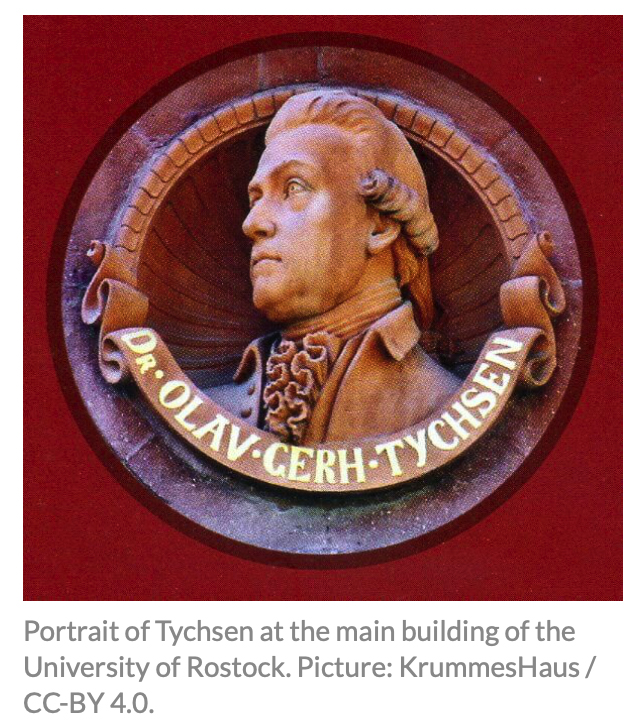
                                           

In November 16, 2006 an article by Dr. Shnayer Leiman appeared in the newly formed Seforim Blog entitled, “Two Cases of Non-Jews with Rabbinic Ordination: One Real and One Imaginary.” The “real” ordination was bestowed upon Olaf Gerhard Tychsen (1734-1815). In 1759, Tychsen received the title of Haver, a lower form of rabbinic ordination, by Moses the son of Rabbi Zvi Hirsch Lifshuetz. Tychsen is perhaps the only known case in Jewish history of a non-Jew receiving such an honor or degree.[3]

Leiman provides a biography of Tychsen. He pursued studies in Hindustani, Ethiopic and Arabic, as well as Hebrew and Yiddish and became an Orientalist of international renown making significant contributions to cuneiform studies and numismatics as well.[4] During his early years he also pursued various missionary activities in the Jewish community, largely unsuccessful by his own account. 

As Leiman notes, in 1752, while a student at the Christian Academy in Altona, Tychsen attended the lectures of R. Yonasan Eybeschutz. Leiman essentially leaves us at the point of Tychsen’s ordination, with brief mention of his subsequent academic career. What became of Tychsen’s “rabbinic” career after he received this singular distinction? Did he apply for a rabbinic position? Did he maintain any connection with the Jewish community? 

In fact, Tychsen did continue to maintain a strong connection to both rabbinic literature and the Jewish community in varying degrees throughout his life. He is perhaps best known for his involvement in the premature burial controversy, which would earn him a place of infamy in Jewish history. Tychsen taught at the university in Butzow, the residence of the Duke of Mecklenberg. During this period there was concern that physicians were misdiagnosing death, and as a result, people were being buried prematurely.[5] On February 19, 1772 Tychsen sent a letter to the Duke of Mecklenberg regarding the Jews’ burial practice, interring after waiting only three hours, where it is known that there can sometimes be misdiagnosis of death. Tychsen detailed the Jewish origins of hastening burial in general, reflecting familiarity with rabbinic literature. He claimed that the need to bury quickly was established in countries with hot climates, where the body would decompose quickly, not applicable to a country like Germany. He also reported cases of people who were supposedly buried alive.[6] On April 30, 1772, Duke Friedrich of Mecklenburg-Schwerin, in response to Tychsen’s letter, issued an order prohibiting the Jews in his realm from immediately burying their dead and requiring that they rather wait for three days after death before interment. This began what would become a worldwide halakhic debate about the halakhic definition of death and the time of burial.[7]

Tychsen was also peripherally involved with one of Jewish history’s greatest seforim collections. Rabbi David Oppenheim amassed an extraordinary collection of books and manuscripts which languished in storage for years after his death.[8] Tychsen visited the collection for three weeks, reporting on its manuscripts to the Italian Christian Hebraist Giovanni Bernardo De Rossi. He attempted to arouse the interest of potential buyers, including Catherine the Great, Empress of Russia, Duke Karl Eugen of Wurtemberg, and Archduke Frederick Francis I of Mecklenberg. His efforts were to no avail and the collection ultimately found its home in Oxford, where it remains to this day.[9]

Here we highlight a little-known, though more substantive, connection of Tychsen with the Jewish community. One year after his ordination, toward the end of 1760, Tychsen was appointed Professor of Oriental Languages at the newly established University of Bützow in Mecklenburg. It is in this capacity that Tychsen exercised a rabbinic role, becoming a university campus rabbi of sorts for a select group of Jews at the university. Though he may not actually have had a “minyan” of students, nonetheless, his impact on this select group was profound and long lasting, akin to that of a rebbe.[10]

The interactions of Tychsen with the Jewish community must be viewed through a particular lens. Tychsen was a devout Lutheran Protestant and trained and engaged in proselytizing activities in his early life. This fact remains at least in the background of all his interactions with the Jewish students at Butzow and has been evaluated elsewhere. Whether his relationships with the Jewish medical students were primarily or partially motivated by his proselytizing tendencies, or whether his proselytizing endeavors had ceased by then, is a matter of historical speculation.[11] This is not the focus of the present essay.[12]

In his capacity as a faculty member of the University of Butzow Tychsen encountered a number of Jewish students attending the university’s medical school. Though an Orientalist and not a physician or scientist, he nonetheless served as a mentor for these students to whom he was drawn by shared interests and possibly proselytizing intentions. Tychen served this role for all the Jewish medical students who attended the University of Butzow during its twenty-nine years of existence. 

The first Jewish student of the Butzow Medical School, and the first with whom Tychsen developed a relationship was Markus Moses. This relationship has been the subject of a number of dedicated essays.[13] Markus Moses was the son of Moshe ben Meir Harif Lemberger (Lvov), Chief Rabbi of Pressburg and head of its yeshiva. Lemberger, as well as his son Markus, were apparently involved in the Emden- Eybeshutz controversy.[14] Markus (Mordechai) was born in Pressburg in 1729, received a traditional Jewish education, and married. Shortly thereafter, his wife and two young children died. In 1758, after the death of his father, Markus began the study of secular subjects. Over the next few years he traveled to Germany and continued study in various cities, including the field of medicine, ultimately ending up in Butzow in 1763. Aron Isak, the leader of the Jewish community, took him under his wing and orchestrated his admission to the recently founded Butzow Medical School,[15] thus waiving the high taxes imposed upon the Jewish community for new town visitors. The faculty were impressed with Moses’ great intelligence and facility with multiple languages and accepted him, with the approval of the Duke and Professor George Detharding, the head of the faculty, with free tuition. Below is a letter in Hebrew from Paul Theodore Carpov, an Orientalist and Christian Hebraist at Butzow, supporting Moses’ acceptance to the medical school at Butzow and advocating for his financial support as well.[16]

As per the letter, Moses brought with him impressive letters of recommendation not only from the great scholars of “his nation,” but also from those of “our nation.” Carpov also notes the Duke’s approval, as well as the financial issues relating to his application. Carpov was clearly taken by the young Jewish student. 

Below is the record of matriculation of Markus Moses in 1764.

Moses clearly had a predisposition for the field of medicine and was soon relied upon by Detharding to see the latter’s private patients.[17]

Tychsen had a working academic relationship with Moses as evidenced by the multiple research papers Moses wrote under his mentorship. It is remarkable that all of the papers were on Jewish topics. I have found a number of cases, though relatively few in number, of Jewish medical students throughout the centuries who wrote their medical school dissertations on a Jewish related topic,[18] but I have never encountered any student who authored so many Jewish related papers as part of their medical training. The topics included the Samaritan Bible, a discussion of the kosher and non-kosher animals based on the work of Rambam, and an essay on the diseases of the old as reflected in Kohelet (chapter 12).[19] Moses’ graduation dissertation, discussed below, was also on a Jewish topic and was supervised by Tychsen.

Disputatio de Pentateucho Ebraeo-Samaritano, 1765[20]

Essay on kosher and non-kosher animals based on Rambam.[21]

The nature of the relationship Tychsen had with Moses, as well as with other Jewish medical students in Butzow, went far beyond the usual Professor-student model. There wrote each other dozens of letters and continued correspondence for years after graduation.[22] In one letter dated March 16, 1765[23] Moses apologizes for not responding promptly to Tychsen’s previous letter. Moses continues that soon he will either write again, or will see Tychsen in person. Moses signs the letter, hamitavek biafar raglekha.

גבר(א) דכולי() בי החכ(ם) הכולל המפורס(ם) שמו נודע בכל השערי(ם) הפרעפעסאר טיקסן

מרוב טרדות היום אין אוכל לתואר בתואר כראוי לגבר(א) כמותו ובאתי בלישנא קלילא אל תשים עלי חטאת שעדיין לא השיבני על כתב ידו הטהור מה שקבלתי ע”י ערל הבוח(ן) לבות יודע שהזמן גרמ(ה) לי רק זאת יהי(ה) לבו בטוח שהשבוע הבע” (?הא עלינו לטובה) או אכתוב לו או בנשיקת פא”פ (פה אל פה) אדבר בו[24] גם יקבל במתנה צורה של ר’ יהונת(ן) זצ”ל יותר אין לחדש כה המתאבק בעפר רגליו מרדכי מפב (?מפרשברג)ג


In the last line, Moses writes that Tychsen will also receive from him a gift of a portrait of Rav Yehonatan zt”l. Moses was obviously aware of the connection between Tychsen and Eybeshutz and believed this would be a meaningful gift. Eybeshutz died in 1764,[25] and his portrait was disseminated shortly thereafter. This is likely the portrait Moses purchased for Tychsen.[26]

As part of the requirements for the completion of a doctorate in medicine at most German universities, the student was required to engage in a public disputation on the topic of their dissertation. [27] The topic of Markus’ disputation was the analysis of a verse in Yehezkel which, according to Moses, reflects an ancient Jewish practice of placing salt of the skin of an infant as a prophylactic against disease. 

Moses engages in an expansive philological and grammatical analysis of the verse then posits that the Jews practiced this procedure and that it protected them from diseases like smallpox. The reason smallpox was prevalent during his time, Moses argues, is because people no longer routinely applied salt to the skin of infants. Moses is the only one of the Jewish medical students at Butzow who wrote his dissertation on a Jewish topic. 

Moses’ disputation was held on January 22, 1766 (11 Shevat, 5526). The event was held in a church, though Tychsen apparently noted that it was primarily a venue for non-ecclesiastic events. This may have been in deference to the halakhic concern about entering a church.[28] A number of Jewish families attended the event. Copies of the dissertation were sent to those invited to the public discourse, and additional copies were provided for the audience on the day of the event. The ceremony began with a Latin oration by the presiding professor, in Moses’ case, Professor Detharding, and was followed by the student’s reading of his dissertation. Upon completion of the reading, designated opponents presented their arguments and criticisms against the substance of the dissertation, with audience members occasionally allowed to participate. This was then followed by the candidate’s rebuttal. Tychsen served as one of the designated opponents for Moses’ disputation. 

On oath was also part of the graduation ceremony, and it typically involved avowing one’s belief in Christianity. Tychsen intervened with the Duke of Mecklenberg on Moses’ behalf to allow him to take his graduation oath invoking the name of the God of Israel as opposed to the Christian deity. He even publicly conversed with Moses in Yiddish at the graduation.[29] 

Below is the approbation of Tychsen appended to the published dissertation of Moses.

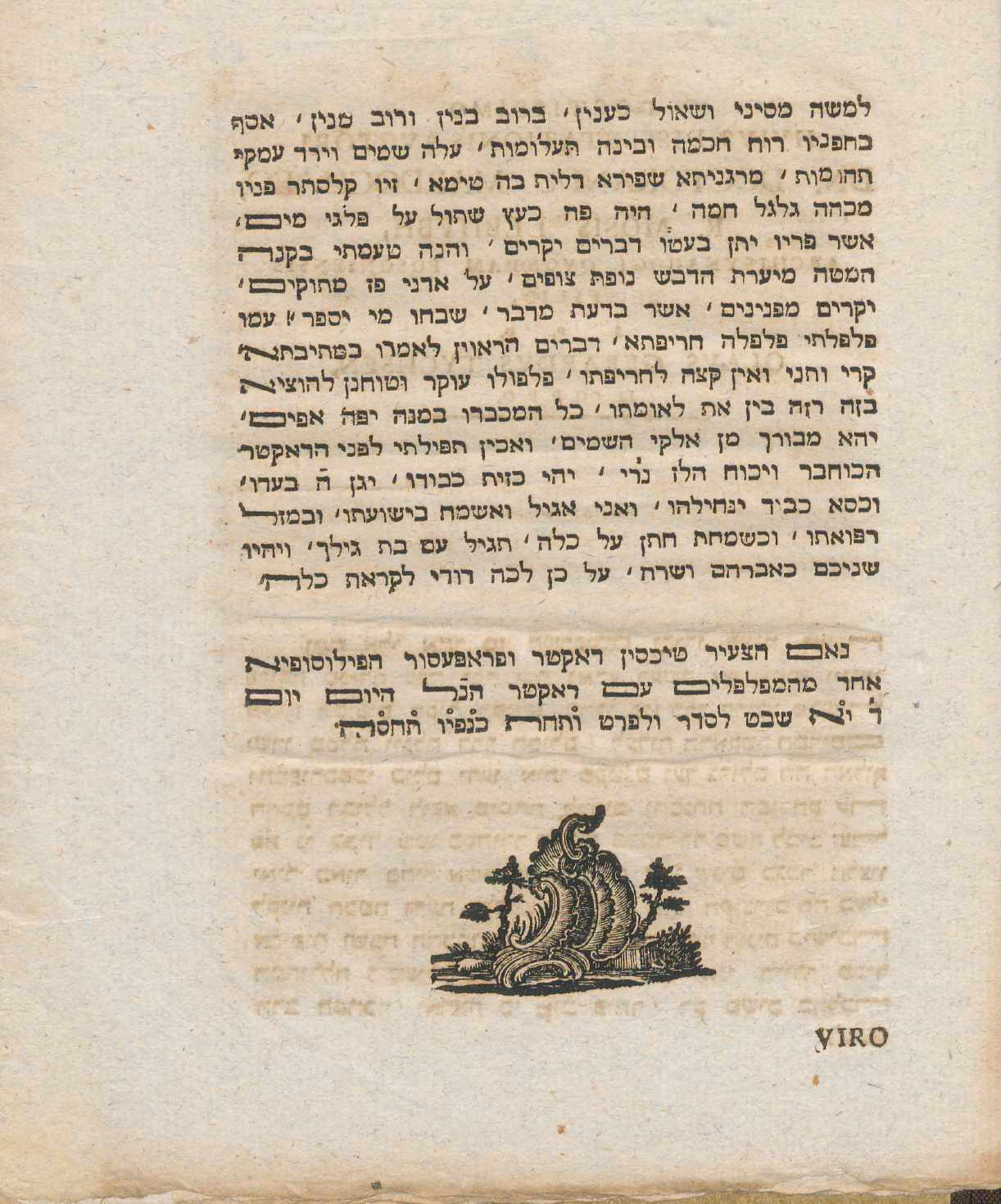
Tychsen’s freely inserts throughout allusions to rabbinic literature. He also uses a chronogram for the Hebrew year, typically done in Hebrew publications, and something Tychsen used frequently, as seen in his letters below. 

At the end of the approbation, Tychsen mentions the upcoming (second) wedding of Moses. Below is the handwritten wedding invitation of Moses to Tychsen.[30]

Both the title and signature of the invitation reflect the type of relationship they had. Moses also adds the clever pun of “hazmanah lav milsa,” assuming that Tychsen will appreciate it. 

The other letters appended to Moses’ published dissertation are also of great interest. In addition to Tychsen, another opponent at the disputation contributed a letter. Karl Leopold Carpov,[31] son of the Orientalist and professor at Butzow, Paul Theodore Carpov, who had written Moses’ letter of recommendation for admission (above). The older Carpov had died the previous year. The younger Carpov describes how beloved Markus was to his father, who considered him as another son, and, impressed by his brilliance, spent days and nights studying with him. Karl himself calls Markus his brother. While many focus on Markus’s close relationship with Tychsen, no mention has been made of his relationship with the other Orientalist, Carpov. 

The remaining letters were written by Judah Levi Strelitz,[32] the brother in law of Moses, and Meier (no other name is written), a fellow medical student. 

Moses was not the only Jewish student Tychsen took under his wings. Over the span of decades, throughout the short existence of the Butzow medical school, he endeared himself to a number of Jewish medical students.[33] He taught them, mentored them, and even financially supported them. They in turn sought his personal advice and recommendations, aided him in his intellectual quests, and invited him to their weddings.

Two Jewish medical students who matriculated in 1783 were also close with Tychsen, Isaac Salomonsen and Wulf Levinson. 

Matriculation record from University of Butzow November 24, 1783
Wulf Levinson and Isaacus Salomonsen[34]

Below is Tychsen’s letter to Levinsohn upon his graduation.[35]
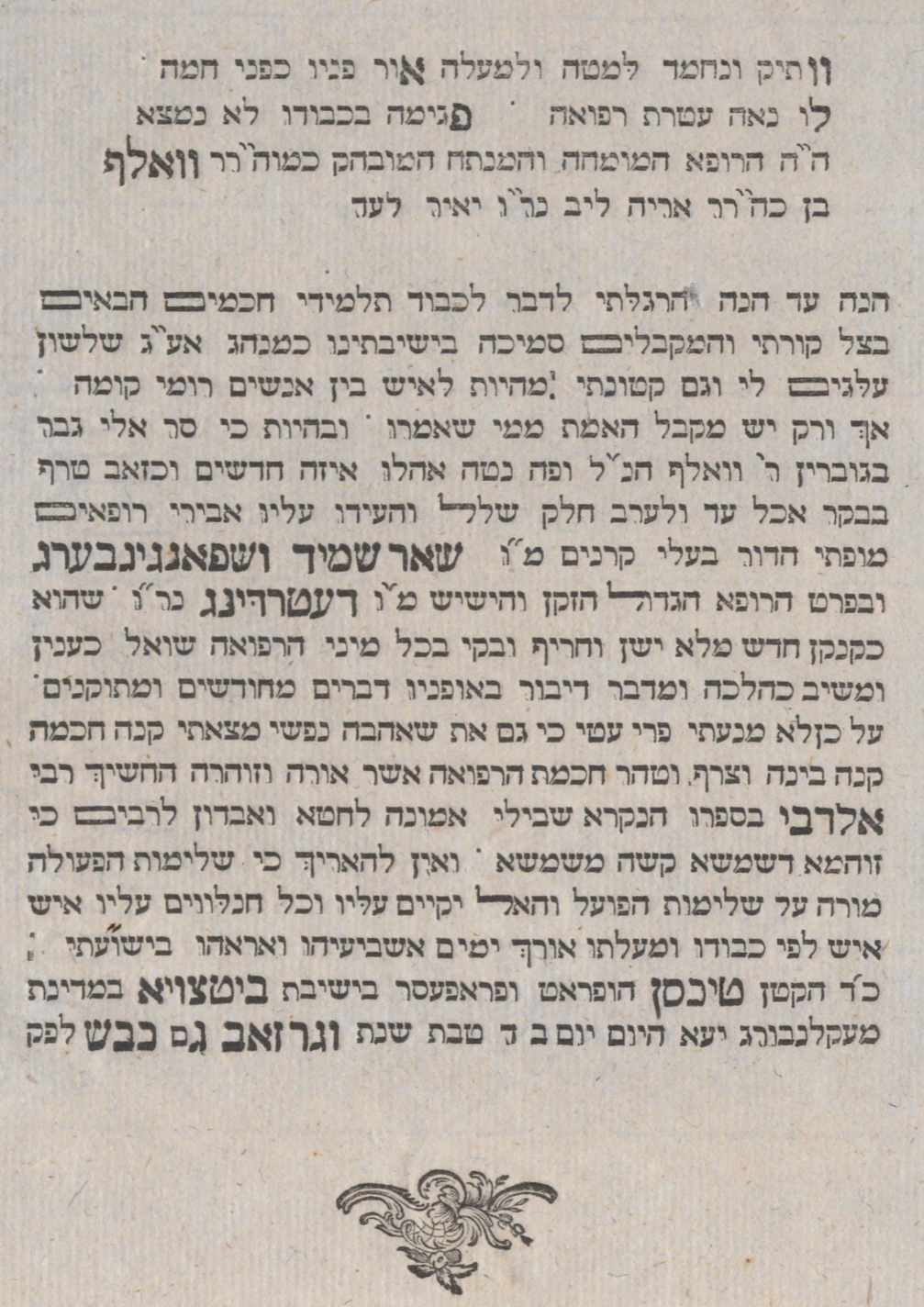
Tychsen includes that the Butzow anatomist August Schaarschmidt and Professor Detharding, who had accepted Markus Moses some twenty years earlier, attest to the student’s qualifications.[36]

Below is the letter of Isaac Salomonsen presenting his dissertation to Tychsen.[37]

Below is Tychsen’s letter of approbation for Salomonsen’s dissertation in 1784. He mentions Isaac’s work in botany, which is in some form a continuation of the work of another Butzow medical student Tzadik de Meza, who died at the age of twenty-three.[38]

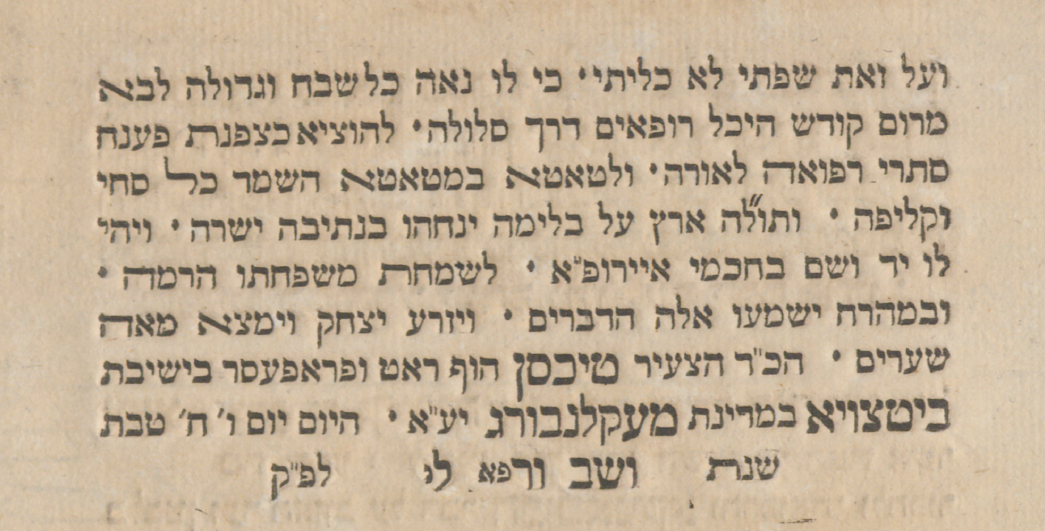
In another letter,[39] Salomonsen complained bitterly to Tychsen about his classmate Levinson, who had apparently been slandering him. He adds that the great personalities in the history of medicine, Aesculapius, Hygea and Hippocrates would be mourning and turning over in their graves if they knew how Levinson was misrepresenting and dishonoring them and the University of Butzow.

In the letter below dated 1784 from Salomonsen to Tychsen[40] we find a number of the elements common in Tychsen’s relationship with all the Jewish medical students. 

Salomonsen mentions the money he owes Tychsen and explains and apologizes for the delay in repayment. Tychsen routinely loaned money to the Jewish students. Salomonsen then reports that he was unable to obtain the sefer (shu”t Rabbi Moshe Alshikh) and Arabic coins Tychsen had requested. Tychsen was an avid bibliophile and his magnificent and important library was ultimately bequeathed to the University of Rostock, which absorbed the University of Butzow after its demise. It remains there to this day. Tychsen also collected Arabic coins and is considered the founding father of Islamic numismatics.[41] Salomonsen also mentions his acquaintance with a man named Mussafia[42] and his children, and how he enjoys spending time with them. Mussafia praised Tychsen and recalled something he had written on Tychsen’s behalf. He also possessed a work of Tychsen. Tychsen delighted in his name and reputation being spread throughout the Jewish community.

In sum, “Rabbi” Tychsen appears to have put his rabbinic degree to good use, at least from his perspective, cultivating an extremely devoted, loyal, and admiring, not to mention highly educated congregation. On the surface, he would be the envy of any modern rabbi, though much complexity lies beneath. While we did not focus on his proselytizing endeavors in this essay, perhaps this is one reason why Tychsen still remains to this day the only non-Jew to have received a form of rabbinic ordination. While Tychsen’s contributions to academia are vast, his tenure at the University of Butzow and his relationship with the Jewish students there represents one of the most unique, if lesser known, chapters in Jewish medical history. With the opening of the Rostock digital archives treasure trove we will certainly see further exploration of this topic. 

Edward Reichman

שנת וַתֵּעָצַ֖ר הַמַּגֵּפָֽה לפ”ק  

[1] Yitzhak Berger and Chaim Milikowsky, “Shnayer Leiman: In Appreciation,” (September 11, 2020).

[2] Moshe Haberman, “The Twice-Told Tale of R. Yonasan Eybeshutz and the Porger,” (September 15, 2020).

[3] For additional information on the semicha of Tychsen, see On the Main Line Blog, “On Non-Jews with Rabbinic Ordination, Real and Imagined: Some Notes on Dr. Leiman’s Post on Tychsen,” (September 20, 2011), http://onthemainline.blogspot.com/2011/09/on-non-jews-with-rabbinic-ordination.html.

[4] David Wilk, “Markus Moses’ Doctoral Dissertation or Who Remembers Butzow,” Koroth 9:3-4 (1986), 408-426, esp. 413.

[5] For an overview of this chapter in medical history, see Jan Bondeson, Buried Alive (Norton Publishers, 2001).

[6] For the text of the letter, see Siegfried Silberstein, “Mendelssohn und Mecklenburg,” Zeitschrift fur die geschichte der Juden Heft 4 (1930), 275-290, esp. 278-279. For reference to Tychsen as a key player in the issue of delayed burial, see for example, Rabbi Dr. Jacob J. Schacter’s doctoral dissertation, Rabbi Jacob Emden: Life and Major Works (Harvard University, 1988), 669, 723-724.

[7] For a comprehensive review of this historical chapter, see Moshe Samet, “Delaying Burial: The History of the Polemic on the Determination of the Time of Death,” (Hebrew) Asufot 3 (1989/1990), 613-665.

[8] For what follows see the comprehensive review of Oppenheim and his library by Joshua Teplitsky, Prince of the Press (Yale University Press: New Haven, 2019), 198.

[9] See Rebecca Abrams and Cesar Merchan-Hamann, eds., Jewish Treasures from Oxford Libraries (Bodleian Library, University of Oxford, 2020), and review of Paul Shaviv, Seforim Blog (July 14, 2020).

[10] The University of Butzow was an offshoot of the University of Rostock and later recombined with Rostock upon its demise. In addition, in 1817, Rostock University acquired the private library, including the manuscript legacy, of Tychsen, which included his significant Judaica and Hebraica collection. Over the last few years, the University of Rostock has devoted research efforts to explore the history of the Jewish students at the university with particular focus on their relationship with Tychsen. See Gisela Boeck und Hans-Uwe Lammel, eds., Jüdische kulturelle und religiöse Einflüsse auf die Stadt Rostock und ihre Universität (Jewish cultural and religious influences on the city of Rostock and its university) (Rostocker Studien zur Universitätsgeschichte, Band 28: Rostock 2014); Rafael Arnold, et. al., eds., Der Rostocker Gelehrte Oluf Gerhard Tychsen (1734-1815) und seine Internationalen Netzwerke (Wehrhahn Verlag, 2019). In the latter volume, see especially, Malgorzata Anna Maksymiak and Hans-Uwe Lammel, “Die Bützower Jüdischen Doctores Medicinae und der Orientalist O. G. Tychsen,” 115-133. I thank Malgorzata Maksymiak for her assistance and for providing me access to the Tychsen archives.

[11] See Wilk, op. cit. and Maksymiak, op. cit.

[12] Nimrod Zinger notes that the universities under Protestant auspices, in particular those affiliated with the Pietistic Movement, were more inclined to admit Jews, as they were interested in the possibility of converting them. He mentions as examples Yitzhak Isaac Wallich and his close relationship with Professor Hoffman at Halle, and that the student Avraham Hyman was admitted to Geissen with the intervention of the head of faculty, who was a Pietist. See his Ba’al Shem vihaRofeh (Haifa University, 2017), 263. Tychsen would certainly align with this theory.

[13] Bernhard Mandl, “Egy Magyar Zsido Orvos Nemet- Orszagban (1763-1782): Dr. Markus Moses, a Pozsonyi forabbi fia,” Evkőnyv Kiadja Az Izr. Magyar Irodalmi Tarsulat (1913), 145-165; Idem, Med. Dr. Markus Moses, Sohn der Pressburger Oberrabbiners R. Mosche Charif, praktischer Arzt in Deutschland von 1776 bis 1786: eine Lebensskizze (J. Pollak: Vienna, 1928); Wilk, op. cit.

[14] Die Juden und Judengemeinde Bratislava in Vergangen heit und Gegenwart (Brunn, 1932), 17-18, 85, cited in N. M. Gelber, “History of Jewish Physicians in Poland in the Eighteenth Century,” (Hebrew) in Y. Tirosh, ed., Shai LeYeshayahu: Sefer Yovel LeRav Yehoshua Wolfsberg (HaMercaz LeTarbut shel HaPoel HaMizrachi; Tel Aviv, 5716), 347-371, esp. 360.

[15] By this time, Jews were able to attend medical schools in Germany. Other German universities with Jewish graduates included Frankfurt on Oder, Duisberg, Halle, Geisen and Heidelberg. On the Jews in German medical schools, see Louis Lewin, “Die Judischen Studenten an der Universitat Frankfurt an der Oder,” Jahrbuch der Judisch Literarischen Gesellschaft 14 (1921), 217-238; Idem, “Die Judischen Studenten an der Universitat Frankfurt an der Oder,” Jahrbuch der Judisch Literarischen Gesellschaft 15 (1923), 59-96; Idem, “Die Judischen Studenten an der Universitat Frankfurt an der Oder,” Jahrbuch der Judisch Literarischen Gesellschaft 16 (1924), 43-87; Adolf Kober, “Rheinische Judendoktoren, Vornehmlich des 17 und 18 Jahrhunderts,” Festschrift zum 75 Jährigen Bestehen des Jüdisch-Theologischen Seminars Fraenckelscher Stiftung, Volume II, (Breslau: Verlag M. & H. Marcus, 1929), 173-236; Idem, “Judische Studenten und Doktoranden der Universitat Duisberg im 18 Jahrhundert,” Monatsschrift für Geschichte und Wissenschaft des Judentums Jahrg. 75 (N. F. 39), H. 3/4 (March/April 1931), 118-127; Monika Richarz, Der Eintritt der Juden in die akademischen Berufe: Judische Studenten Und Akademiker in Deutschland 1678-1848 (Schriftenreihe Wissenschaftlicher Abhandlungen Des Leo Baeck: Tubingen, 1974); Wolfram Kaiser and Arina Volker, Judaica Medica des 18 und des Fruhen 19 Jahrhunderts in den Bestanden des Halleschen Universitatsarchivs (Wissenschaftliche Beitrage der Martin Luther Universitat Halle-Wittenberg: Halle, 1979); M. Komorowski, Bio-bibliographisches Verzeichnis jüdischer Doktoren im 17. und 18. Jahrhundert (K. G. Saur Verlag: Munchen, 1991); Eberhard Wolff, “Between Jewish and Professional identity: Jewish Physicians in Early 19th Century Germany- The Case of Phoebus Philippson,” Jewish Studies 39 (5759), 23-34. John Efron, Medicine and the German Jews (Yale University Press: New Haven, 2001); Wolfram Kaiser, “L’Enseignement Medical et les Juifs a L’Universite de Halle au XVIII Siecle” in Gad Freudenthal and Samuel Kottek, Melanges d’Histoire de la Medicine Hebraique (Brill: Leiden, 2003), 347-370; ) Petra Schaffrodt, Heidelberg- Juden an der Universitat Heidelberg: Dokumente aus Sieben Jahrhunderten (Ruprecht Karls Universitat Heidelberg Universitatsbibliothek, August, 2012).

Below is a chart from Richarz of Jewish medical students in Germany at this time. The University of Butzow is not on this list.

[16] http://rosdok.uni-rostock.de/mcrviewer/recordIdentifier/rosdok_ppn859752100/iview2/phys_0007.iview2.

[17] For the history of Moses prior to attending Butzow, see Mandl, op. cit., and Wilk, op. cit.

[18] E. Reichman, “The History of the Jewish Medical Student Dissertation: An Evolving Jewish Tradition,” in J. Karp and M. Schaikewitz, eds., Sacred Training: A Halakhic Guidebook for Medical Students and Residents (Ammud Press: New York, 2018), xvii- xxxvii.

[19] While the first two essays are housed in the Rostock Library, I have not found a copy of this essay.

[20] http://opac.lbs-rostock.gbv.de/DB=1/XMLPRS=N/PPN?PPN=720262623.

[21] http://opac.lbs-rostock.gbv.de/DB=1/XMLPRS=N/PPN?PPN=304865346.

[22] For the letters in the archive just between Markus Moses and Tychsen, see here.

[23] http://purl.uni-rostock.de/rosdok/ppn860182010/phys_0027.

[24] This is an expression of endearment. See another example of a letter to Tychsen, from a Yehoshua Lifshutz of Apta, where the same expressions, peh el peh acronym and nishikat pihu, are used. http://rosdok.uni-rostock.de/mcrviewer/recordIdentifier/rosdok_ppn859752100/iview2/phys_0019.iview2.

[25] While we have no record of R. Eybeshutz himself communicating with Tychsen at the University of Butzow Medical School, he did send a letter to the faculty of medicine at another German medical school, the University of Halle. This letter related to the famous “heartless” chicken question initially posed to Hakham Tzvi. For more on this letter, its record in the Halle University archives, and its impact on the Emden Eybeschutz controversy, see E. Reichman, “A Letter from a Torah Sage of the 18th Century to the Medical Faculty of the University of Halle (January, 1763): The Selective Deference of Rabbi Yonatan Eybeschutz to Medical Expertise,”Verapo Yerapei: Journal of Torah and Medicine of the Albert Einstein College of Medicine Synagogue 6 (2015), 89-112.

[26] National Library of Israel, NLI 997003186660405171. See also Richard I. Cohen, “’And Your Eyes Shall See Your Teachers’: The Rabbi as Icon,” (Hebrew) Zion (1993), 407-452, esp. 418. The artist is Elimelech Polta ben Shimshon. I have as yet been unable to identify this physician. His name is not found among the Jewish medical students in German universities mentioned above.

[27] T. Broman, The Transformation of German Academic Medicine 1750-1820 (Cambridge University Press, 1996), 32ff.

[28] See Maksymiak, op. cit.

[29] See Wilk, op.cit., 417.

[30] http://purl.uni-rostock.de/rosdok/ppn859752100/phys_0081.

[31] Carpov trained at the University of Rostock before the formation of the University of Butzow. See his matriculation record, here.

[32] Strelitz, also known as Levin Hirsch Levi, lived in Altstrelitz and authored a treatise on resurrection (http://rosdok.uni-rostock.de/resolve/id/rosdok_document_0000014475) which was translated into German by Tychsen under the title,”Die Auferstehung der Todten aus dem Gesetze Mosis Bewiesen,” (1766) (http://rosdok.uni-rostock.de/resolve/id/rosdok_document_0000014215). Strelitz later became rabbi of Birnbaum, and then the first rabbi of Stockholm and Chief Rabbi of Sweden. The Jewish community of Stockholm had been founded only a few years before his arrival by Aron Isak, the sponsor of Markus Moses, Levi’s brother-in-law, and the shadchan for Moses and Levi’s sister. See Wilk, 419-420.

[33] Markus Moses (1764), Israel Joseph Meyer (1765), Justus Zadig de Meza, Isaac Heinrich Salomonsen (1783),Wolff Levinsohn (1783), Abraham Levin Spira (? Benjamin Levin, 1773), Simon Marcus (1771) and Moses Marcus(1785, son of Markus Moses). All of them-with one exception-received their doctorate in medicine in the twenty-nine years of existence of the University of Bützow.See Maksymiak,op.cit., which also addresses the emotional aspect of the ties of Tychsen with his students.

[34] http://dfg-viewer.de/show?set%5bmets%5d=http%3A%2F%2Frosdok.uni-rostock.de%2Ffile%2Frosdok_document_0000000177%2Frosdok_derivate_0000004407%2Fmatrikel1760ws-1788ws-Buetzow.mets.xml&set%5bimage%5d=54. Note that word “Judeus” appears after both of their names. It was common to identify students as Jews in university archives. For example, starting in the 1500s, Jewish students at the University of Padua were identified as“Hebrei.” There does not appear to have been any anti-Semitic associations with this identifier.

[35] http://rosdok.uni-rostock.de/mcrviewer/recordIdentifier/rosdok_ppn835297578/iview2/phys_0168.iview2. For Levinsohn’s dissertation, see http://rosdok.uni-rostock.de/resolve/id/rosdok_document_0000016729?_search=23e52c72-2882-421d-bfd5-16b218d11ae3&_hit=0. The letter was not published with the dissertation.

[36] Tychsen appears to make disparaging remarks against the work Shevilei Emunah, by Meir Aldabi. This work,written in the fourteenth century, was a primary reference on medicine in rabbinic literature for many centuries.

[37] http://rosdok.uni-rostock.de/mcrviewer/recordIdentifier/rosdok_ppn835297578/iview2/phys_0166.iview2.

[38] The Rostock archives contains a number of letters between Tychsen and de Meza.

[39] http://rosdok.uni-rostock.de/mcrviewer/recordIdentifier/rosdok_ppn835297578/iview2/phys_0176.iview2.

[40] http://rosdok.uni-rostock.de/mcrviewer/recordIdentifier/rosdok_ppn835297578/iview2/phys_0180.iview2.

[41] Rafael Arnold, et. al., eds., Der Rostocker Gelehrte  Oluf Gerhard Tychsen (1734-1815) und seine Internationalen Netzwerke (Wehrhahn Verlag, 2019); Ursula Kampmann, Maike Mebmann, trans., “Oluf Gerhard Tychsen (1734-1815), https://coinsweekly.com/oluf-gerhard-tychsen-1734-1815/(July 18, 2019).

[42] This was perhaps a relative of Binyamin Mussafia, a famous graduate of the University of Padua in 1625, and author of Musaf HaArukh, a commentary of the Sefer HaArukh.
Towards A Reappraisal of the Recent Works of Rabbi Shelomoh Luriah (Maharshal)

Towards A Reappraisal of the Recent Works
Of Rabbi Shelomoh Luriah (Maharshal)
By Rabbi Eliezer Brodt

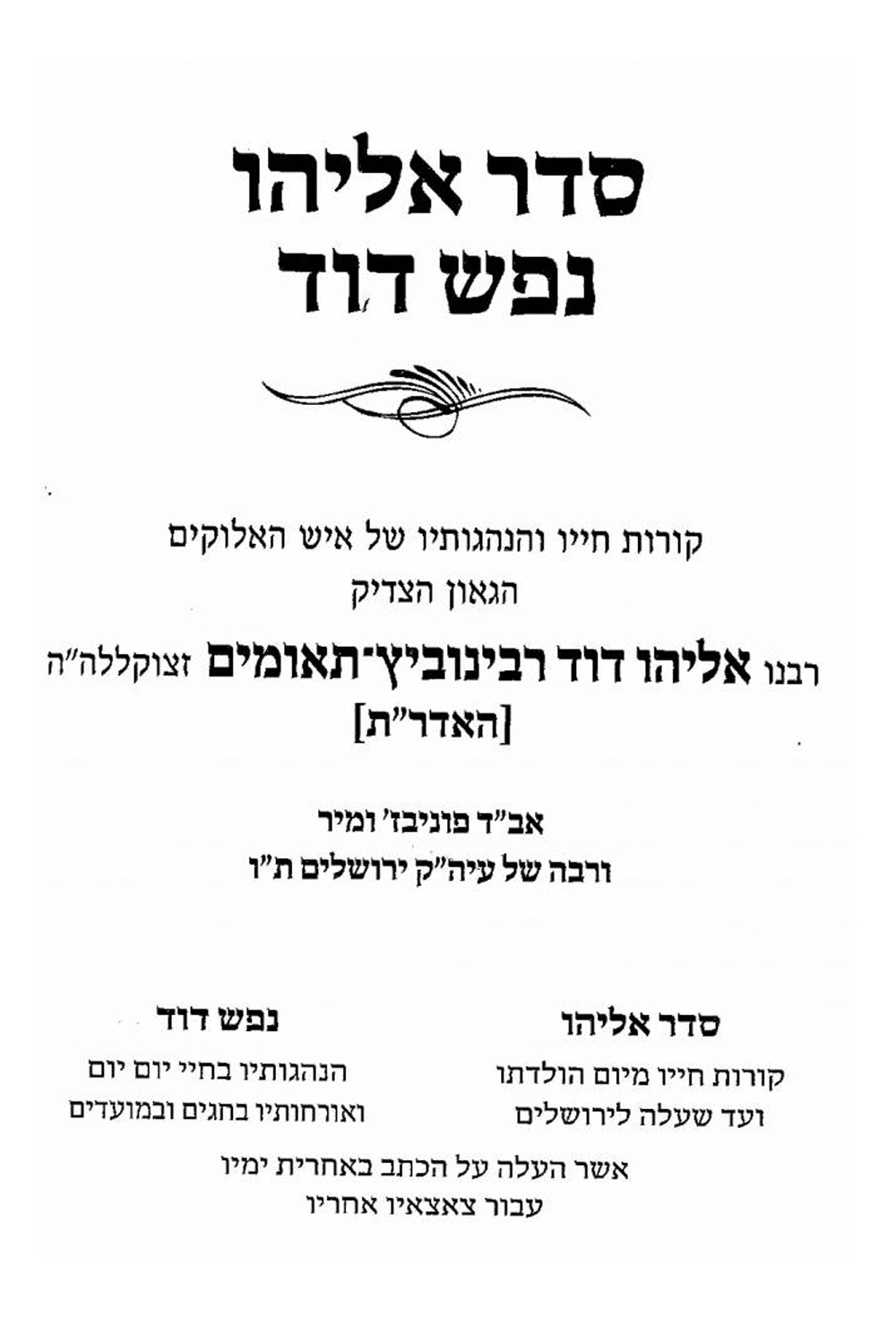
As previously mentioned on the Seforim blog by myself and others, our generation is privileged to something no previous generation has seen, a sheer volume of Jewish books being printed and reprinted. Many of these works are seeing print for the first time – works of Rishonim and Achronim on all sorts of topics brought to the public eye from manuscript form. Some of these printings are beautiful editions, critically edited, and even glossed with illuminating marginal annotations. Other times the only benefit is to see the change from an illegible typeface to a clear block print (oft as not without any particular in the editing). In many cases, specific institutions are founded solely to deal with works from a particular religious group, while at other times, entire publishing houses are established that deal with the writings of one particular author. Recently one Godol, the great prolific writer, the Aderet (Rabbi Eliyahu David Rabinowitz-Teomim), famous for, amongst many things, being the father-in-law of R Kook, has had over five distinct groups working on printing his writings although almost none of his writings were published in his lifetime.

Recently, a rather modest institute called Makhon Iyay HaYam has begun reprinting as well as publishing for the first time, the many writings of the great gaon R. Shelomoh Luria, Maharshal. To date, this Makhon has already printed a few of his works and is currently working on many more. In this post, I would like to discuss this great person, the Maharshal, some of his printed works, and the current and future projects of this particular Makhon. As much has already been written on this great goan, including several biographical sketches, as well as a dissertation by Dr. Meir Raffeld on the Maharshal’s magnum opus, Yam Shel Shelomoh (more later), I have limited myself to but a few highlights.

The Maharshal was born circa 1510 (most likely in the city of Brisk or Posen), and died in 1573 in Lublin. He was a Rav in many cities, including Brisk,[1] Ostra and Lublin.[2] Alongside the rabbinate, the Maharshal established and ran yeshivot, training many famous students. Amongst these students are, notably, R. Yehoshuah Falk Katz (author of the Preisha), R. Moshe Meis (author of Mateh Moshe on minhagim as well as Hoel Moshe on Rashi; more on him later), R. Shelomoh Efrayim Lunschitz (author of the Kli Yakar), R. Chayim of Friedberg (author of Sefer HaChayim and brother of the famous Maharal of Prague), and R. Eliyahu of Chelm (the great-great-grandfather of the Hakham Zvi and Rabbi Jacob Emden, famous for being the only latter day Godol to have created a documented golem (see here for Prof. Shnayer Z. Leiman’s post, “Did a Disciple of the Maharal Create a Golem?” at the Seforim blog) all studied in the Maharshal’s Yeshiva. As an historical aside, it is worth pointing out that in the biography printed by R. Chechik, Sefer Chasdei Hashem (Yerushalayim, 5767, pg. 3), R. Chechik makes the claim that the major talmidim of the Maharshal studied in his yeshiva in Lublin. This appears highly implausible as the Maharshal only came to Lublin in 1569, and by then most of his talmidim were already accomplished poskim. More likely these students studied in one of the Yeshivot the Maharshal headed prior to the Maharshal’s Yeshiva in Lublin.

R. Shelomoh Luria was a contemporary of and related to R. Moshe Isserles, the Rama. In his Maalot Hayuchsin (Yerushalayim, 5764), p. 15, R. Efraim Zalman Margolis traces the various ways in which the Rama and the Maharshal were related. Among those was through the marriage of Maharshal’s daughter Miriam to Rama’s brother Eliezer. Additionally, these two Gedolim carried on extensive correspondence between themselves, some taking a rather sharp tone (most noted are those letters regarding the study of philosophy and dikduk). Yet, as R. Efraim Zalman Margolis notes, the utmost respect and esteem was maintained between the two. In fact, they seem to have been keenly interested in the other’s works, there is evidence that they read the other’s work prior to publication. (See Klilas Yoffe p. 9b and Maalot Hayuchsin of R. Efraim Zalman Margolis, pp. 27-28.) [3]

While both the Rama and the Maharshal were well respected and many of the Poskim of that generation were the Maharsha’s students, in a choice between the two regarding how to decide halakha, the Rama is the clear winner. The Shelah HaKadosh, however, bemoans the fact the Maharshal’s decisions were not accepted. This is so as the Maharshal followed the Rama (i.e. the Maharshal died later) and, as such, should have been awarded consenting rulings out of principle (halachisha k’basrayi). As a result, the Shelah HaKadosh calls upon those who fear Hashem to take upon themselves all stringent dissenting opinions of the Maharshal in opposition to the Rama (Shnei Luchot HaBrit, Shaar Ha’Otiyot, #100, Kedushah).

The Maharshal is well-known for his caustic tone in his writings. Many biographers note his use of rather sharp epithets in his works concerning other Gedolim. R. Chaim Dembitzer cites many instances where the Maharshal writes sharply against various Rishonim (Klilas Yoffe p. 11). But, some have questioned the focus on the Maharshal’s tone. For instance, Shmuel Abba Horedesky, who authored a biography on the Maharshal, Kerem Shlomo, included a discussion of the Maharshal’s caustic tone. Horedesky sent his book to the Sdei Chemed, and in a recently published letter, the Sdei Chemed sharply critiques Horedesky’s inclusion of that portion on the Maharshal.[4] (Dr. M. Raffeld, in his dissertation also bemoans the misguided focus of previous historians at these caustic remarks instead of researching the more unknown eras of the Maharshal’s life).

Aside from his goanus, the Maharshal was an extremely prolific writer, writing on many areas. Some of his more famous works include an outstanding work on Shas called Yam Shel Shelomoh. For itself, the work is pretty well known, unfortunately it is not used to its full potential in today’s yeshivah world (this due to many reasons, most importantly the current mahalach halimud) although of late it has been reprinted in a nice block print edition. The style of the Yam Shel Shelomoh is oriented toward halakha. Typically, each topic is examined systematically from its beginning sources, through the Rishonim and through (the then) current minhag (see further Dr. M. Raffeld). This work has not reached us in its entirety, as parts are missing from those mesechtos present. Furthermore, it is clear from many places in his writings as well as quotes from his talmdim that he wrote more than what we have. (To date we have volumes on seven masekhtot, but according to various sources, the Maharshal wrote on sixteen masekhtot. Dr. Raffeld attempts to construct a list of the remaining nine; not all agree to this listing and several substitutes have been suggested). I seem to recall that recently they discovered the volume of Yam Shel Shelomoh on masekhet Baba Batra, but the collector who owns it does not allow anyone to print it and is only willing to sell it for a very large sum of money. Likewise, rumors of Yam Shel Shelomoh on masekhet Shabbat have been circulating among professional circles, without any concrete evidence.

In addition to the Yam Shel Shelomoh on the Gemara, the Maharshal penned many other notes on many masekhtot, dealing with, among his personal novella, the correct girsa’ot of the Gemara. Known today as Hagahot Hokhmat Shelomoh, this work was originally printed as a separate volume. Present-day editions of Gemara find some of the comments having added into the text of the Gemara and Rashi over time, and the authorship erased along with the original gloss. The remaining glosses are printed in the back of almost all recent editions of the Gemara. In his editing, the Maharshal used old manuscripts, as well as variant texts. In a lengthy article in Alei Sefer, vol. 15, Y. Ron deals with this work. Later on Professor Yaakov Shmuel Spiegel dealt with this work in his classic Amudim be-Toldot ha-Sefer ha-Ivry, Hagot u-Maghim (pp. 279-285). Hokhmat Shelomoh on Masekhet Gitten has been recently reprinted by R. Y. Satz, (Toronto: Otzreinu, 1990). The foreword includes a detailed article elaborating on the need to reprint this work, basing the glosses on the exact comments of the Gemara used by the Maharshal. Large amounts of the glosses have been deleted by editors who mistakenly attributed them to lines already corrected, while in fact the Maharshal had another point in mind.

A partial list of the Maharshal’s other famous works include Teshuvot Maharshal, responsa quoted by all poskim; glosses on Rashi al haTorah called Yerios Shlomo, reprinted several times of late; glosses to Sefer Shaarey Dura by R. Yitzhak of Duren called Ateret Shelomoh. He also wrote glosses on the Sefer haMitzvot haGadol (SMaG) by R. Moshe of Coucy, called Amudei Shelomoh. Makhon Yerushalayim has issued a critical edition of this work, in three volumes, based on manuscripts and first prints, replete with footnotes by R. Yosef Luban. In addition to stand-alone volumes, the Makhon has also included the Maharshal’s valuable glosses in their critical edition of the Sefer haMitzvot haGadol.

Now for the works printed by Makhon Iyay HaYam:

As previously mentioned, the Maharshal routinely wrote marginal notes on a vast number of seforim. Of the most popular, were his glosses on the side of the Tur. In large, these notes are quoted by his talmid, R. Yehoshua Falk Katz, the Preisha, as well as the Bach (Sefer Bayit Chodosh) and many other Poskim, but until this century, these notes were never printed. In 1957, the editors of Tur Hotzaat ‘El Hamikoros’ commissioned R. S. Werner to ‘liberate’ these notes from manuscript ‘captivity,’ allowing for a tremendous find for the halakhic world. Unfortunately, thirty simanim in Yoreh Deah were lost from the copyist, and were listed as missing in the manuscript. In 1995, R. A. Chavatzelet published these simanim in a Sefer Zikaron for R. Werner, with the intention of completing the sefer on Yoreh Deah.

While researching another work, R. Y. M. Dubovick found citations to glosses not printed in R. Chavazelet’s addendum. Further perusal revealed the existence of more manuscripts in libraries worldwide that R. Werner was unaware of, and of which R. Chavatzelet had not availed himself. With more accurate texts, and numerous additional pieces not found in the manuscripts R. Werner had been given, it was clear of the need to edit the hagahot from the beginning. R. Dubovick decided to print this whole work again with all the corrections and missing pieces. First, R. Dubovick published an expository article in the journal Yeshurun (vol. 11) listing many missing parts on Yoreh Deah. In 2000, he issued a limited printing of the hagahot on Even HaEzer (including hagahot on the last ten simanim, a notable lack in R. Werner’s edition). More recently, he released a critical print of the first sixty simanim of Tur, Yoreh Deah with footnotes, surrounding the text of the Tur (Crimea, 1558) as used by the Maharshal. Therein, he references all the relevant writings of the Maharshal and his talmidim to the glosses on the Tur, as well as citations of these glosses by the poskim.

R. Dubovick intends to conclude the rest of Yoreh Deah in the near future and deal with Orah Hayyim and Hoshen Mishpat next, and finally, a reissue of Even HaEzer.

The focus of this recent volume on Yoreh Deah is the Sefer Ateret Shelomoh a commentary on the Shechitos u’Bedikos of R. Yaakov Weil, the hagahot on Tur an addendum to this rare work. As little as less than a hundred years ago every shochet had been tested specifically on this work, and virtually every small-town rav had to be an expert in this area as well. Many of the she’elot presented to a local rav were on these very topics and could not be referred to another Rav, as by than the animal would spoil. Nowadays, a shochet is tested on Sefer Beit David (R. David Tschechovitz), and unfortunately, the shechitot and bedikot of R. Yaakov Weil are almost unknown by anyone today, save for the occasional excerpt in other seforim.

Seeing how this valuable work has not been reprinted with the Maharshal’s notes in the past 400 years, Makhon Iyay HaYam recently undertook this project to enrich the public with yet another one of the Maharshal’s many invaluable works, reprinting the text based on the only two printings, and a manuscript fragment. R. Dubovick set himself to the task, painstakingly annotating along the way with extremely thorough notes on the entire sefer. Albeit some times his notes are a bit lengthy, there is a wealth of singular information contained in them, both on the halakhic field as well as the bio-bibliographic, which the editor could not deny the public, and did not omit them from print. A few examples; when the Maharshal quotes his grandfather, R. Yitzchok Klauber, noted are many of the places where the Maharshal cites his grandfather, throughout his many seforim (p. 3, n.6), along with a brief biographical sketch. [5] The same style note can be found when the Maharshal mentions his father-in-law R. Kalonymus (Kalman) Havarkstein-Yerushalmi; a listing of other citations, along with a thumbnail bio, including the Maharshal’s wife’s name (p. 38, n.28). With an eye on the halakhic ramifications of reprinting this sefer, R Dubovick notes that R. Efraim Zalman Margolis highlighted the importance of studying this sefer for those learning shechita, and yet, due to the sefer having been published as an addendum to the sefer, Sha’arei Dura, and not having a distinct title page from the Sha’rei Dura, remained unknown. (Introduction to Ateres Shlomo, see also Ma’alos haYhuchsin, p. 35) Additionally, regarding R. Efraim Zalman’s work on treifus in lungs (Rosh Efraim), R. Efraim Zalman states that Shechitot u’Bedikot were written last, even after Yam Shel Shelomoh, and the Halakha should be fixed accordingly, even against a dissenting opinion in Yam Shel Shelomoh (p. 38, n.27). In addition, he includes interesting sources to the practice of watering cattle before shechita (p. 55, n.92), as well as bringing to light a fascinating source to the puzzling minhag of peeling off sirchos (lesions) from the lung (p. 64, n.129).

The Maharshal’s extreme regard for maintaining minhagei Ashkenaz and their halakhic impact are spread throughout both his and his talmidim’s many writings. One can especially find this true with regard to R. Moshe Meis’ classic work Mateh Moshe. A while back, a manuscript was discovered of some minhaghim of the Maharshal called Hanhagot HaMaharshal. Dr. Y. Refael printed this work in a Sefer Hayovel and then later on as a separate pamphlet. These minhagim were written anonymously, and the editor attributes them to R. Moshe Meis, author of Mateh Moshe, and known to have been a personal member of the household of his teacher, R. Shelomoh Luria. As these minhagim do not cover the whole year, Dr. Refael concludes that the text is only a segment of a much larger work, which had unfortunately been lost. Interestingly enough, R. Shmuel Ashkenazi told me recently he did all the work in annotating this sefer and preparing it for print, although for some reason he wasn’t credited for it. (While this edition was printed from a manuscript, copied expressly for R. Nachum Ber Friedman of Sadigura (Areshet, vol. 1 397-98), there is another, variant edition, printed in the back of some copies of Nagid uMitzaveh (Sinai, vol. 63, p. 96)).

Among the interesting minhagim included in here is: [6]

מורי מוהר”ש אמר שקצת מינות באמירת י”ג עיקרים שתקנו באני מאמין שיש בו י”ג עיקרים, כי קצת אומרים וחושבים בלבם כשמאמינים בי”ג עיקירים אף על פי שעשו כל התועבות שבעולם ר”ל מכל מקום יש להם תקנה ואינו כן אלא אפילו מדברי חז”ל הוא עיקיר אחד, כמו שמצינו שאמר מה נאה הלכה זו ולא משבח האחרות גם כן אינו עושה כהוגן. ולא נתקנו אלו הי”ג עיקירים רק בשביל פילסוף מימים הקדמונים שהיו עושים עיקרים בכללים ולא עשו כמנין הללו באו חז”ל ותקנו גם כן בכלליהם וכן ביגדל אלקים חי נתקן י”ג עיקירם גם כן ולא אמר מורי אחד מהם ולא יגדל ולא אני מאמין”.

Also, the Maharshal discusses the Shir HaYichud, and offers a rather radical explanation of who the author of Shir HaYichud was: [7]

ביום טוב אחרון של פסח ביום ב’ אירע שנפל נר על דף של סידור ואמר בחור אחד בבית הכנסת של מורי מהר”ש לכבות אותו ולהציל ספרי קודש מדליקה. ואמר אפשר מותר ובפרט ביום ב’ של יום טוב שהוא דרבנן ובחור אחד אמר שהוא משיר היחוד ואמר מורי מהר”ש אל תבכו, גם זה לטובה שנשרף, שהוא סובר שלא בר סמכא עשאו, שמין עשאו

Similarly, in the Siddur Siddur Shabtei Sofer, vol. 1 pp. 89-90, R. Shabtei records in the name of the Maharshal:

והנה נוהג’ ברוב קהלות אשכנז לומר שיר היחוד הזה בכל יום רק במדינת רוסיא בקהלות אשר נהג בהם רבנות הגאון מהר”ר שלמה לוריא ז”ל אין אומרים אותו כל עיקר. ושמעתי מפי רבים מזקני הדור שהגידו לי ששמעו את מהרש”ל שהיה דורש בק”ק לבוב ובק”ק לובלין בתחלת בואו לנהוג שם רבנות ואמר בדרשותיו שאין לומר שיר היחוד מפני שמצא שחיבר אותו מין, ובעבור זה היה מוחה בכל הקהלות מושבותיו מלאמרו

Another rather unknown work of the Maharshal, is his Zemirot for Shabbat. While this work has been printed many times, not one of these editions has been reprinted based on the first printing and manuscript and many of the modern printings have actually detracted from the sefer’s integrity. This rare sefer is comprised of songs the Maharshal composed for Shabbat and Motzei Shabbat, with the author’s commentary to those songs. Included in his explanations are many halakhot and minhagim of Shabbat. Some examples of which are; women should wear a special garment when lighting the Shabbos candles; a reference to the custom of wearing a kittel on Shabbos. Another example, he praises the people of Ashkenaz for having a set system with regard to hosting yeshiva students for Shabbat meals. (Interestingly enough, while Prof. Simha Assaf mentions this minhag in his biographical sketch of the Maharshal printed in Sefer haYovel Lichvod Prof. L. Ginzburg, he makes no note of it in his Mekorot LeToldot HaChinuch biYisrael, even though he does mention several other sources to this custom pp. 229, 236, 633). [8]

Here too, R. Dubovick is working on reprinting these zemirot, along with an excellent commentary of his own on this work. A few samples of his efforts have been published in the journal Yeshurun (vol. 16). Here, I was simply amazed at the sources and comments of R. Dubovick regarding the various points of the Maharshal. One only hopes he will finish this work soon along with all his many projects relating to the Maharshal.

Notes:
I would like to thank R Y. M. Dubovick and Dan Rabinowitz in for their extremely helpful suggestions and sources in writing this post.

[1] On the Maharshal’s tenure in Brisk see the letter of R. Nosson Rabinovitch (author of Dikdukei Sofrim) in Eyur Tehilah p. 198.

[2] On the Maharshal’s time in Lublin, see the story brought in Simchas Hanefesh (see here for an earlier post, “Simchat ha-Nefesh: An Important But Often Ignored Work on German Jewish Customs,” at the Seforim blog) from R Yehudah Chassid pg 109-110. A similar story is quoted by the Chida in Shem haGedolim, erech R Avrhoum Mocher Yerokos.

[3] For a recent lengthy discussion of these correspondences, see Y. Elbaum in his Pisichut Vehistagrot (pg 156 and onwards), as well Dr. Asher Siev’s biography of the Rama (1972). For the exchange of letters between Rama and Maharshal on philosophy, as part of the appendix of translations of primary texts from 16th-century East-European Jewish Thought, see Leonard Levin, “Seeing With Both Eyes: The Intellectual Formation of Ephraim Luntshitz,” (Ph.D., Jewish Theological Seminary of America, 2003), 299-284, esp. 299-311.

[4] On the caustic comments of the Maharshal see Iggerot S’dei Chemed, vol. 1, siman 11, pp. 24-25; see also R. Barukh haLevi Epstein, Mekor Barukh, Introduction, pp. 89-93.

[5] For more on the Maharshal’s grandfather see M. Rafeld, in Daniel Sperber, Minhagei Yisrael (Jerusalem: Mossad Harav Kook, 2007), 8:174-96.

[6] For more on Ani Manmin see HaSiddur, pp. 232-36; Marc B. Shapiro, The Limits of Orthodox Theology: Maimonides’ Thirteen Principles Reappraised (Oxford: Littman Library of Jewish Civilization, 2004), pp. 19-20 (citing opinion of the Maharshal).

[7] For more on this topic see: A. Berliner, Kesavim Nevcharim, vol 1 pg 145-170; R. Dovid Hanazir , Kol Haneveha pgs 124, 143-144; H.J. Zimmels, Askenazim and Sephardim, pp. 132-134; A Haberman, Shiur Hayichud Vhakovod (intro), Y. Dan, Shiur Hayichud (facsimile edition) with the commentary of R. Yom Tov Muelhausem, Introduction; R.Y. Stal, Sefer Gematryios L’Rabenu Yehudah Hachassid, vol 1 pg 32-38; R. Y. Golhaver Minhaghei Hakehlos, vol 1 p. 132: and my forthcoming article in the Yerushasenu volume two.

[8] Another person who missed this source while discussing this topic is Mordechai Breuer, in his comprehensive book on the Yeshivot, Oholei Torah: The Yeshiva, Its Structure and History (Merkaz Zalman Shazar 2003), pp. 405-409.


Teffilah Zakah: History of a Controversial Prayer

Teffilah Zakah:
History of a Controversial Prayer*

Yom Kippur has many unique prayers, many of them have been added through the centuries. For instance, R. Hayyim Yosef Dovid Azulai (Hida) has a longer viduy. Another such addition is the prayer known as Teffilah Zakah. In this prayer the person enumerates and connects their various sins with various acts and asks for forgiveness. Additionally, the person forgives any who have caused them pain or harmed them. This prayer was popularized by R. Avraham Danzig, in his Hayye Adam.

There are two reasons offered for reciting this prayer. Dr. Sperber opines (Minhagei Yisrael, vol. 2, p. 37 and esp. n.10) that the purpose of this prayer is to fulfill the opinion of the Ramban who holds that is an additional viduy on directly prior to Kol Nedrei on Erev Yom Kippur. (He offers that either Teffilah Zakah or a piyyut from R. Abraham ibn Ezra, fulfills this purpose). R. Abraham Ashkenazi (Brit Abraham, Warsaw, 1884, no. 129) offers a different reason for Teffilah Zakah. The purpose according to him, is to accept Yom Kippur early. At the end of Teffilah Zakah, one voices that they are accepting “kedushas Yom Kippurim.” In fact, R. Ashkenazi holds that for the purposes of fulfilling the opinion of the Ramban Teffilah Zakah would be insufficient as it differs significantly from the standard viduy. R. Ashkenazi, however, also holds that one should fulfill the Ramban’s opinion and thus recite the regular viduy after Teffilah Zakkah. (Surprisingly, Dr. Sperber doesn’t discuss R. Ashkenazi’s concern).

As mentioned above, Teffilah Zakah has a passage where one forgives others who may have sinned against him. This is necessary, as although Yom Kippur takes care of sins between man and God, it can’t take care of sins between man and man. Thus, it is necessary for each to receive forgiveness from their fellowman to achieve full forgiveness. Teffilah Zakah is long, and this paragraph that forgives others, appears at the end. The Chofetz Chaim attempted to alleviate this problem “and contacted the printers to change the placement of this paragraph of Teffilah Zakah . That is, to place this later paragraph earlier in prayer, to place the paragraph where one forgives others in the middle or the beginning.” According to the Chofetz Chaim’s son, R. Areyeh Leib, some siddurim did in fact shift around the prayer. (Michtevei Chofetz Chaim, p. 21-2 no. 52; quoted in Sperber, Minhagei Yisrael, vol. 4, 274).

The source to popularize this prayer is the book Hayye Adam.[1] Hayye Adam was first published in 1809, then in 1819 (the discussion regarding Teffilah Zakah only appears in this second edition – and thus, perhaps should be called a mahdurah [2]), and the third edition in 1825 – it would be this third edition that would be used for subsequent printing. [3] And, thereafter there was a flood of reprints – by 1960, Hayye Adam had been published at least 103 times (!) – a very popular book by any measure. While the book was reprinted on many occasions there were slight changes (some for the worse – there were many printing errors that crept in). As relevant to our discussion, in some editions, the portion discussing Teffilah Zakah changed as well.[4] The source that R. Danzig lists for Teffilah Zakah (klall 144), is the Sefer Hemdat Yamim. [5] In light of the fact that Hemdat Yamim is controversial in some editions of the Hayye Adam they removed words “Hemdat Yamim” so as not to have that as the source for this prayer.[6] Not all publishers dealt with the mention of Hemdat Yamim in the same manner. The full passage, as per the second edition of the Hayye Adam (see above – this is the first time this prayer appears in the Hayye Adam):

אח”ז ילך לבית הכנסת באימה ורעדה והמנהג בקהלתינו בכל בתי מדרשים להוציא ס”ת מהיכל כמש”כ בכתבי האר”י ז”ל וכבר נדפס בחמדת הימים התפילה שיסדר ואמנם לא כל אדם מבין הדברים רק מי שבא בסוד ה’ ומי שא”י הוא להם כדברי ספר החתום ולכן העתקתי בספרי’ קדמונים תפלה בלשון קל . . . וכו

In the Zolkeiv(1838) edition the words “וכבר נדפס בחמדת הימים” are missing (this makes the next clause – “but not everyone understands those words” and “those words will be like a closed book” unintelligible); while in the Vilna (1849) edition only the words

אח”ז ילך לבית הכנסת באימה ורעדה והמנהג בקהלתינו בכל בתי מדרשים להוציא ס”ת מהיכל כמש”כ בכתבי האר”י ז”ל

and the rest of the paragraph explaining why R. Danzig was required to create a new prayer in a “simple language” doesn’t appear. In the Vilna (1895) edition they have as follows:

אח”ז ילך לבית הכנסת באימה ורעדה והמנהג בקהלתינו בכל בתי מדרשים להוציא ס”ת מהיכל כמש”כ בכתבי האר”י ז”ל והעתקתי בספרים קדמונים לומר אז וידיו בלשון קל

This way they avoid the ambiguous pronoun (the problem with the Zolkeiv) and provide background for the prayer generally, of course they have still altered what R. Danzig found unremarkable.

The twin factors [7] of the use of a suspect work, Hemdat Yamim, and the creation of a new prayer, made some hesitant to adopt Teffilah Zakah. In the Tosefot Hayyim, a commentary on the Hayye Adam written by R. Meshulum Finkelstein, [8] deals with both of these issues and defends the recitation of Teffilah Zakah (klall 144 n.31). First, he alleges the prayer is not the same as that in Hemdat Yamim.[9] Second, he argues that the concern of saying a later prayer – this concern is attributed to the AriZal and is why, according to some the Yigdal prayer is not recited in some circles – is applicable to “yehidei segulah” (special people) and not to the masses. This is demonstrated by the many piyyutim we recite which are later than the cut-off date for prayers (R. Eliezer HaKalir – whenever he may have lived). Additionally, according to some, any prayer that has been accepted by the masses, this concern is not applicable.[10]

What is worthwhile mentioning is that R. Danzig is not the only talmid HaGra to use the Hemdat Yamim. He is also not the only talmid HaGra to have his work censored for such an inclusion. R. Eliach (Avi HaYeshivos, pp. 184-186) notes that the talmidei HaGra had no problem using and praising the Hemdat Yamim. Aside from R. Danzig, R. Alexander Suesskind, author of the Yesod V’Soresh HaAvodah, in his Last Will and Testament he praises the study of Hemdat Yamim. In at least one edition of R. Suesskind’s Last Will and Testament, Tzavah Yesod V’Soresh HaAvodah, Jerusalem, 1955, the reference to the Hemdat Yamim was removed. Thus, on the one hand we have a group of people who had no issues using the Hemdat Yamim, while on the other hand, there is another group of people who wish to remove any such references.

Whatever the ultimate source of this prayer, there is no doubt that today, it is a popular one.

Notes

*The fullest discussion of this prayer can be found in Mordechai Meyer’s article “On ‘Teffilah Zakah'” in Kenishta, vol. 2 pp. 119-138 including the language above of the various editions of the Hayye Adam.

[1] According to R. Barukh haLevi Epstein, (Mekor Barukh, vol. 3 p. 1260 [end of chapter 21]), R. Danzig titled the book Hayye Adam to avoid any attempt to abridge it as it would then be titled Kitzur Hayye Adam (Shortening the Life of Man). If this is true, it appears it did not help as in 1854 an abridged version was published although the title was Kitzur M’Sefer Hayye Adam (An Abridgement of the Work Hayye Adam). Interestingly, R. Y.S. Nathenson refers to the Sefer Hayye Adam as Kitzur Hayye Adam. Shu”t Shoel u’Meshiv, vol. 2 no. 14 (it is unclear whether there should be a Hey prior to Hayye Adam that would have R. Nathenson as merely listing the Sefer Hayye Adam as an abridgment and the “kitzur” part would not be part of the title.)

[2] For the use of this term “mahdurah” and when it should be applied and more specifically should this second edition of the Hayye Adam should be deemed a mahdurah m’Tukenet or mahdurah Sheneiah, see Y.S. Speigel, Amudim b’Toldot Sefer HaIvri: Kitveah v’Hatakah, Ramat Gan, 2005, 109-60.

[3] Teffilah Zakah was published separately numerous times under the title Teffilah Zakah (it was here it seems the usage of Teffilah Zakah became popular – R. Danzig never refers to it as Teffilah Zakah). The first time it was published was in Minsk, 1833 (see Meir, supra, p. 122)(there is possibly one earlier print by a year or so, in Russia also around 1830 but this is not definite) and republished as a seperate prayer on numerous occasions (by 1900 it had been published close to 50 times). It was first incorporated into the Machzor in 1882 in the Romm edition of the Machzor. (Meir, p. 124) Although the title of Teffilah Zakah was well established as late as 1856 this prayer was published under the title Teffilah HaEtkah M’Sefer Hayye Adam and not Teffilah Zakah.

[4] While the exact nusach of Teffilah Zakah does not appear in Hemdat Yamim, much of it does (see notes below for more). There are those who claim that since the teffilah is not the same, thus, Teffilah Zakah doesn’t really come from Hemdat Yamin. This is wrong. First, R. Danzig states it does – so he had no problem with it. Second, even if it is not word for word, and R. Danzig “improved” on the one in Hemdat Yamim, at the very least the basis for it, and much of it does in fact come from Hemdat Yamim. But, it is unsurprising that people would go to great lengths to void Hemdat Yamim as the source for this popular prayer.

[4] The removal of the mention of Hemdat Yamim both here and in other cases (including the discussion below regarding R. Suesskind’s work) is discussed by R. S. Divlitsky, “HaShmotot Mahdirim,” in Taggim, 1 (1969), 76-77 [Ya’ari, in Talmuot Sefer, also mentions the change to the Hayye Adam see under index under Hayye Adam]. For other examples of removal or changes to various editions of the Hayye Adam see R. A.I. Goldroth, “Al HaSefer ‘Hayye Adam’ U’Mechbro,” in Sefer Margoliyos, Jerusalem, 1973, pp. 262-67 esp. n.1. For a discussion about Teffilah Zakah, as well as the Hayye Adam see R. E. Levin & M. I. Blau, “Teffilah Zakah,” in Mishpacha, Kulmus, Tishrei, 2008, 16-19; and Blau’s earlier article, “Al Sefer Hemdat Yamim,” in Kovetz Bet Ahron v’Yisrael, Nissan, 2004 (112), pp. 161-164.

[5] In the Zolikav, 1838, Vilna, 1849; Tchernowitz, 1864; editions the words Hemdat Yamim are cut out and instead, the line reads, “in the works of the AriZal” and then has Teffilah Zakah. This is not the only mention of Hemdat Yamim in Hayye Adam. When discussing (klall 145) what happens if one has a nocturnal emission on Yom Kippur the Hayye Adam again cites to the Hemdat Yamim. In some editions the words “Hemdat Yamim” are missing, in others, it is abbreviated (“ח”ה”), so only those “in the know” will be able to understand.

[6] There is a third concern raised by the former Pupa Rebbi, who notes that as Teffilah Zakah discusses inappropriate sexual behavior, one should avoid saying it as it may lead to improper thoughts about the possible improper behavior. See R. G. Zinner, Neta Gavreil, Hilchot Yom HaKippurim, Jerusalem, 2001, p. 185 n.4. For a list of those who did not say Teffilah Zakah, see Y. Mondshein, Otzar Minhagei Chabad, [Jerusalem], 1995, pp. 200-01. Among other reasons, a similar reason to the Pupa Rebbi is offered by the wife of the Tzemach Tzedek. Additionally, a entirely new reason is given – that Teffilah Zakah is actually a deficient or inadequate prayer. As it is so bad is why, perversly, it has become so popular because, it seems, people like junk. See id. at n.1 in the name of the Sefer Areyeh Sha’ag.
See also, R. T. Ohrenreich, Katseh haMateh, in Mateh Efrahim, no. 619:17 who offers other methods to fulfill the opinions who hold one must do a viduy prior to the onset of Yom Kippur in lieu of Teffilah Zakah.

[7] It was first published in the Warsaw, 1888 edition of the Hayye Adam. R. Finkelstein wrote not only a commentary on Hayye Adam but also on the Matteh Efrahim, Elef HaMogan, first published in Mateh Efrahim HaShalem, Pitrokov, 1908. He also published a collection of commentaries on the Mishna under the title Tosefot Hakhomim, Warsaw, 1916.

[8] See note 4 above. This justification is bizarre. First, as noted above, the Hayye Adam says he is using the Hemdat Yamim – so at the very least he had no problem if it was there. Second, there are entire passages that do appear in Hemdat Yamim. For instance, the Hemdat Yamim has using kissing the sefer Torah to fix various sins (p. 291 of Tzuriel ed. – all citations are to this edition). Or there is an extensive discussion about the inability to fix something that someone stole from someone else (p. 229-36). There is another list of sins that mimic that in Teffilah Zakah (p. 252-57).

[9] This reasoning appears somewhat circular in that how did the prayer get started if one is prohibited from saying it to begin with? Even if one assumes this is merely extending the concept of “im ain neviem, beni neviem hamah,” it doesn’t excuse the R. Danzig from advocating for something that is prohibited.


Cherubim: Winged Celestial Beings on the Title-Pages of Early Hebrew Books

Cherubim: Winged Celestial Beings on the Title-Pages of Early Hebrew Books
by
Marvin J. Heller[1]


And having driven out the man, He stationed at the east of the Garden of Eden the Cherubim and the flame of the ever-turning sword, to guard the way to the Tree of Life (Genesis 3:24).

You shall make two Cherubim of gold—hammered out shall you make them—from both ends of the cover. You shall make one cherub from the end at one side and one Cherub from the end at the other; from the cover shall you make the Cherubim at its two ends. The Cherubim shall be with wings spread upward, shielding the Cover with their wings with faces toward one another; toward the cover shall be the faces of the Cherubim being turned toward the cover. (Exodus 25: 18-20).

Rav Ketina said: When the Jewish people would ascend for one of the pilgrimage festivals, the priests would roll up the curtain for them and show them the cherubs, which were clinging to one another, and say to them: See how you are beloved before God, like the love of a male and female (B.T. Yoma 54a).

Cherubim (angels) are a frequent presence on the title-pages of early Hebrew imprints in the sixteenth century and afterward, the latter beyond the scope of this article. They are also to be found in incunabula, on the frames of initial pages and head-pieces for text.

How do you define what are cherubim? One definition, that of the Encyclopedia Judaica, is “a winged celestial being which appears in the Bible in several different guises.” It then proceeds to give several descriptions of cherubim. The Jewish Encyclopedia begins with a more detailed description, stating cherubim are “the name of a winged being mentioned frequently in the Bible. The prophet Ezekiel describes the cherubim as a tetrad [set of four] of living creatures, each having four faces—of a lion, an ox, an eagle, and a man—the stature and hands of a man, the feet of a calf, and four wings.”[2]
The use of cherubim is also noted in the 1911 Encyclopædia Britannica where they are described as “imaginary winged animal figures of a sacred character, referred to in the description of Solomon’s temple (1 Kings vi. 23-35, vii. 29, viii. 6, 7), and also in that of the ark of the tabernacle (Ex. xxv. 18-22, xxvi. 1, 31, xxxvii. 7-9). . . . In Gen. iii. 24 the cherubim are the guards of Paradise . . .”[3]
The frequency of the appearance of cherubim in Hebrew literature can be found on Sefaria, a bibliography of Jewish texts, which records fifty-six entries for cherubim under biblical, Mishnah 27, and Talmud 991. Among other entries are Midrash, 590; Halakhah 7947; Kabbalah 747; and yet still others as well as multiples of commentaries on the first works.[4]

These multi-winged creatures are also a feature in general literature. Franz Sales Meyer, under the heading Miscellaneous heads, describes the “Angel faces, youthful heads, with a circular or disc-like halo, are first met-with in the Byzantine style, as the result of ecclesiastic articles,” He continues that in the early Italian Renaissance such renderings were charmingly naïve. They appeared as adornments on friezes and arches, medallions, and in borders. They also are to be found on tombs and are “Much used in Modern ecclesiastical decorations.” The text is accompanied by a page of examples of the cherub head, including one of a skull.[5]

It had been my intention to describe Hebrew title-pages with images of cherubim over a period of two centuries.[6] The numerous instances of such usage, however, has necessitated a considerable limiting of our subject period. Indeed, rather than noting all the examples in our current period, in the sixteenth century, we only describe several exemplars, giving background about the books in which they appear, that is, the publisher, author, and book subject.[7] This article is expansive, that is, in describing cherubim, it discusses the varieties of Hebrew literature, the authors of the subject works, the presses that published them, and even Hebrew book history. The title-pages and infrequent text pages with displays of cherubim addressed here are in chronological order, but from diverse locations and, again, on a variety of books, indicative of how widespread Hebrew publishing was and even more so the depth and nature of Hebrew literature.[8]

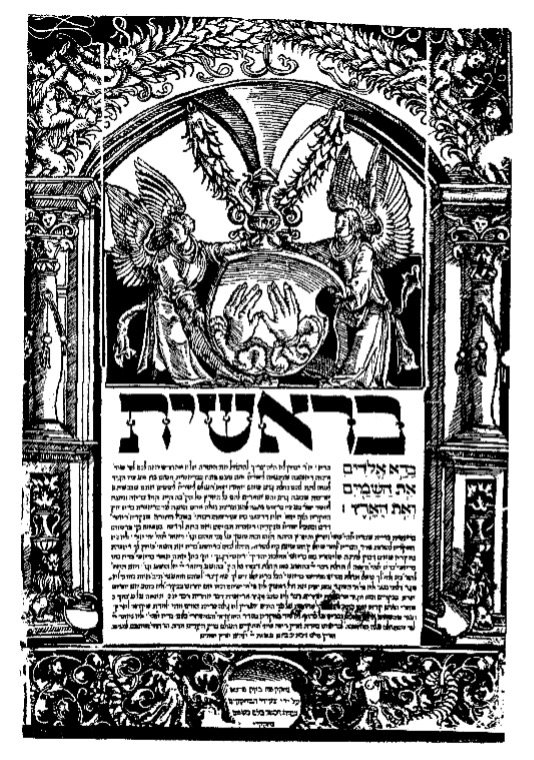
1514-18, Hameshei Humshei Torah – Our first work with the appearance of cherubim is a folio (20) edition Hameshei Humshei Torah (Pentateuch) with haftorat and commentary of Rashi printed in 1514-18 in Prague at the press of Gershom ben Solomon ha-Kohen and partners. Gershom later received a royal privilege from King Ferdinand of Bohemia, allowing him, that is Gershom alone, to enjoy a monopoly on Hebrew printing in Prague. His descendants, known as the Gersonides, continued to print in Prague until the mid-seventeenth century.


1514, Hameshei Humshei Torah
Courtesy of the Library of the Jewish Theological Seminary

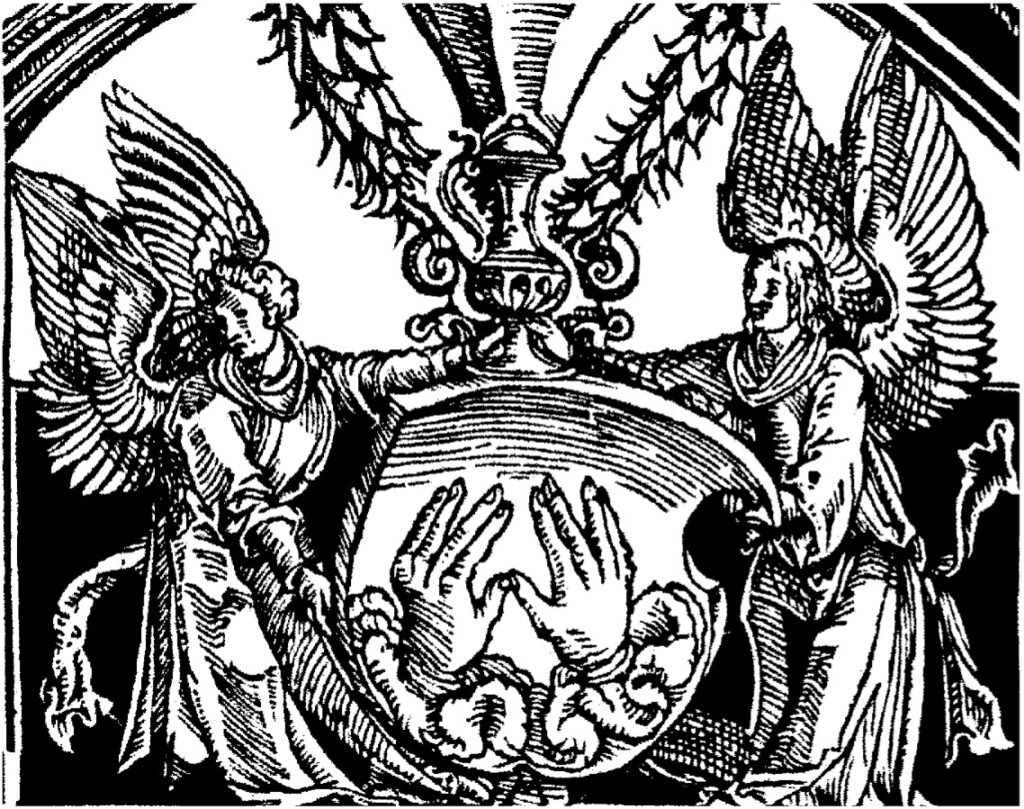
A magnificent edition, with ornate woodcut frames and large type for the text. Each book has a unique decorative opening page, there is no title page, comprised of four separate pieces, those on the pillared sides with vases, leaves, and cherubim, similar but not identical, the top piece with a concave bottom edge. Genesis has a convex curved piece to fit with this top piece on the upper half of the page, with winged cherubim holding a shield with the spread hands of the Kohen giving the priestly blessing.[9]

Work on the Pentateuch began on 10 Sivan (June 14, 1514) but, perhaps as a result of the success of the prayer book, the partners found they had overextended themselves and found it necessary to suspend work on this project for two years. In 1530 Gershom and his sons reprinted this Pentateuch in an identical format, except for changes to the decorated initial pages.

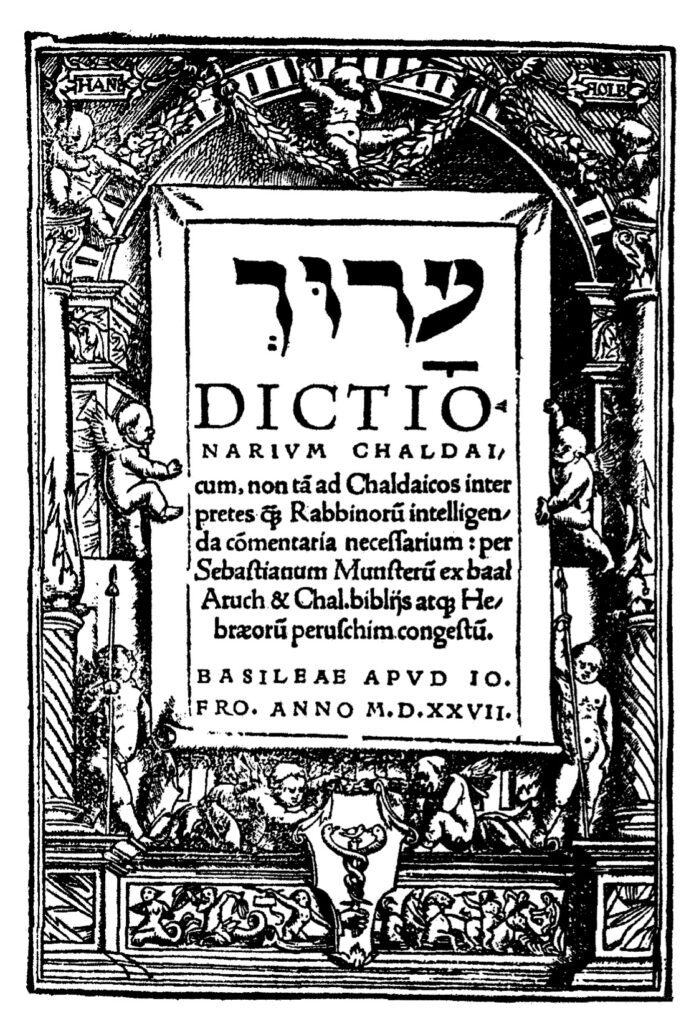
1527, Dictionarium ChaldaiOur next entry with cherubim is an Aramaic grammar by the Christian-Hebraist scholar Sebastian Muenster (1489-1552). It was printed in Basle in 1527 at the press of Johannes Froben in quarto format (40: [1], 434, [7] pp.). The Froben family was the most significant printers of Hebrew books in Basle. Johannes Froben published as many as 250 titles, among them Hebrew/Latin books of the Bible and grammatical works, primarily works by Muenster.

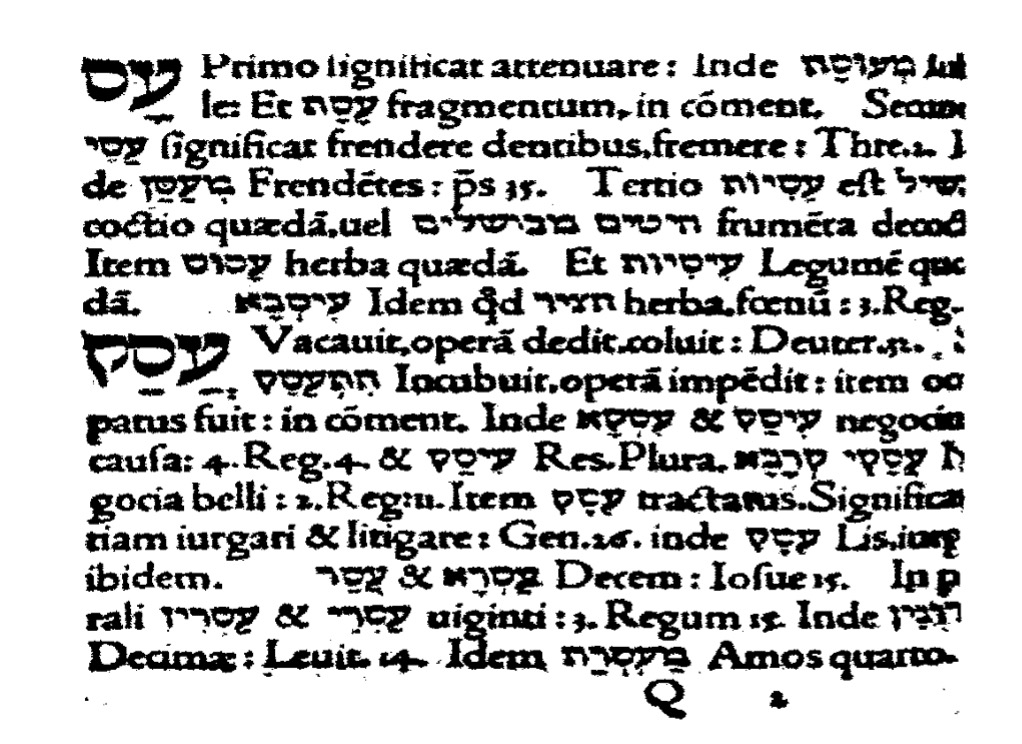
Sebastian Muenster, a cosmographer, astronomer, and orientalist was, for twenty three years, professor at Basle. Born in Niederingelheim, Hesse, the son of a Spitalmeister (hospital master), Muenster had no university education nor did he ever receive a degree. His education consisted of some private instruction in Latin and later studies at Frieberg and attendance at lectures given by the Franciscans. In 1506, Muenster entered the Minorite order and was sent to study in Rufach under Conrad Pellican (Pellicanus, 1478-1556). The following year he took vows and, in 1512, was ordained a priest. Muenster assisted Pellican in teaching in Pforzheim and, from 1524-29, occupied the chair of Hebrew at the University of Heidelberg. In 1529, Muenster converted to Protestantism and moved to Basle, where he occupied the chair of Hebrew, at a salary of 60 gulden; from 1547/8 he was rector. From about 1525, Muenster was a student of Elijah Levita, translating and editing his grammatical works. Muenster also translated a number of other Hebrew works into Latin and was a prolific author in his own right. By the time of his death more than 100,000 volumes of his works were in circulation. His Jewish oeuvre, more than three-score publications, covers all aspects of Judaica, excepting Kabbalistic studies, which did not interest him. In 1523, Muenster published Dictionarium Hebraicum . . . adiectis Chaldaicis vocabulis, his study of the Aramaic language. The book reads from left to right but the text follows the Hebrew alphabet. Words are given in vocalized Hebrew, followed by their etymology, definition and examples.

The title page of the Dictionarium Chaldai has an architectural frame with cherubim in various positions, as well as additional cherubim below mounted and otherwise. This title page, designed by Hans Holbein, was used as early as 1516 on Basel statutes and into the seventeenth century.[10] [11]

Not long afterwards, from 1540 through 1543, at least five titles were printed in three locations with varied images of cherubim on the title-page, that is Augsburg, Prague, and Bologna. That is not to say these frames were not used on other books, most likely they were, but rather these are examples of cherubim used by the printers of Hebrew books at the time.

Augsburg has an early history related to Hebrew printing. Several early anti-Jewish works beginning with the apostate Johannes Pfefferkorn’s Der Judenfeind (1509) and other anti-Semitic books by apostates were published there. Another early Augsburg publication of note, this certainly more positive, albeit not a Hebrew edition of that popular and much republished work, is the first printing of R. Joseph ben Abraham Gikatilla’s (1248–c. 1325) kabbalistic classic, Sha’arei Orah, which explains and analyzes the ten Sefirot. This edition of Sha’arei Orah is a Latin translation of that work by the apostate Paulus Ricius (Paulus Israelita, 1480-1541) under the title Portae lucis, published in 1516 at the press of Johann Miller.

1527, Dictiorionarim Chaldai
Courtesy of the Fales Library and Special Collections, New York University

Serious Hebrew printing in Augsburg begins when Hayyim ben David Shahor, among the pioneers of Hebrew printing outside of Italy, came to Augsburg in about 1533/34. In Augsburg, Schwarz worked in the print shop of Silvan Otmar (d. 1540), a renowned and highly productive printer, and resided in the home of Bonifacius Wolfhart, a Protestant pastor who also served as the censor of Hebrew books for Augsburg.[12] Shahor printed several works in conjunction with his son, Isaac, and his son-in-law, Joseph ben Yakar, who assisted him at the press, although their names are not mentioned on the title-pages.[13]

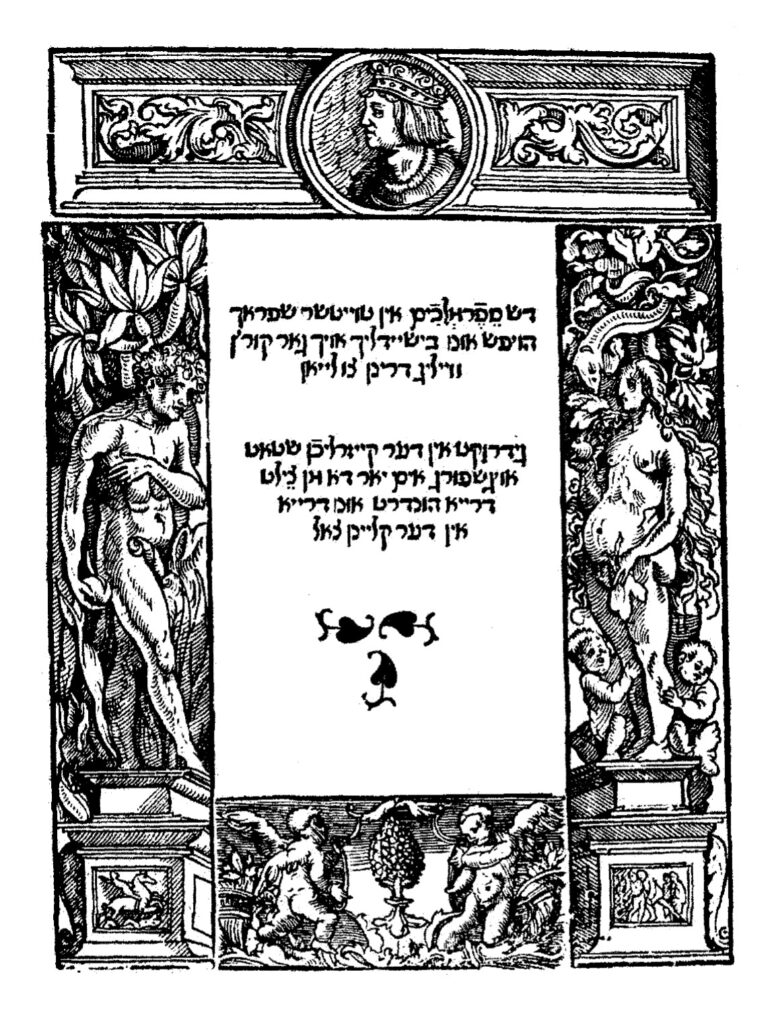
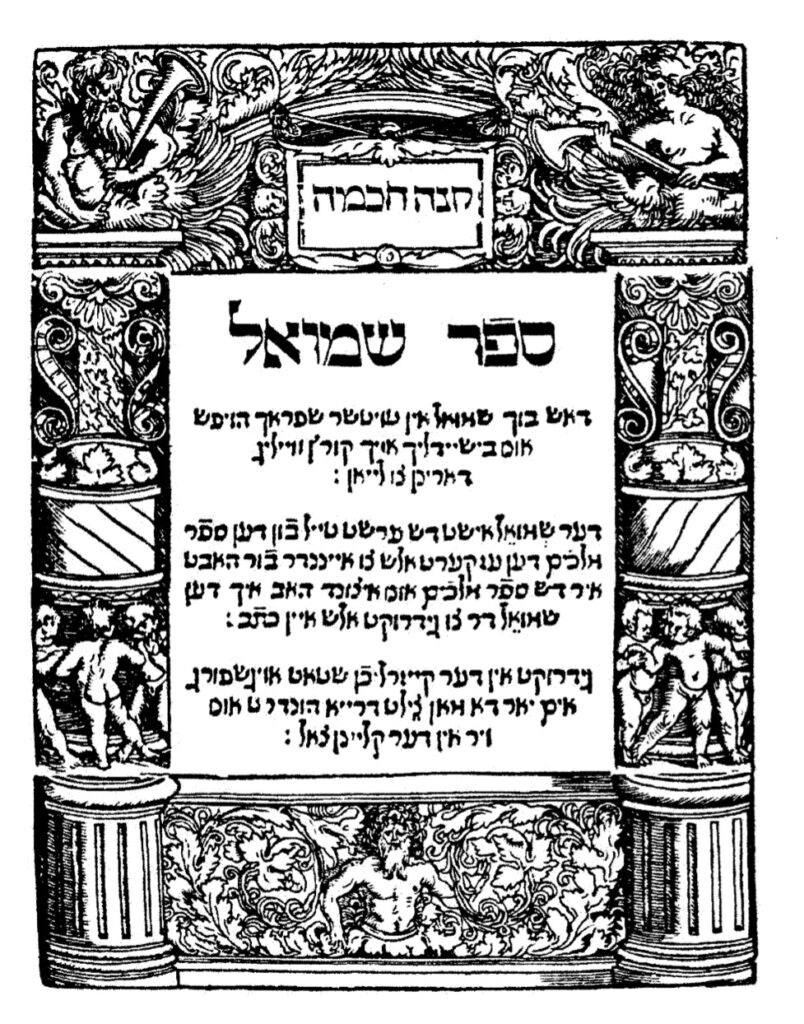
Shahor likely joined with a non-Jewish printer, perhaps August Wind, a printer of Hebrew works for Christian clergyman. Hayyim left for Italy, returning to Augsburg in 1540. He then printed three books, Avkat Rokhel, Arba’ah Turim and a prayer book for, according to the Thesaurus of the Hebrew Book, a total of ten works in Augsburg. Due to a lawsuit by an apostate, Paulus Aemilus, with whom Shahor had been associated in Ferrara, resulting from their failed venture, Shahor and his family were forced to cease publication and leave Augsburg. Aemilus, seeing a market in Augsburg for Hebrew/Yiddish books, began to print on his own account. He issued a small number of titles, most notably the Melokhim Bukh (1543) and the Shmuel Bukh (1544), Yiddish poetical renditions of the books of Kings and Samuel, both with images of cherubim (below).[14]

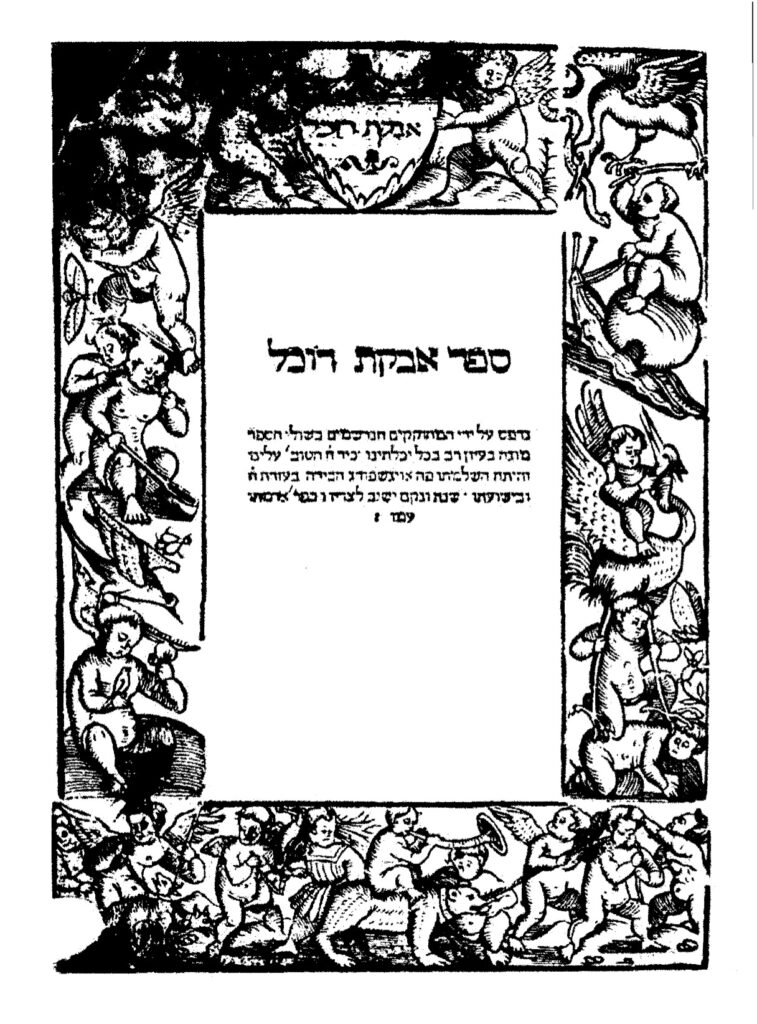
1540, Avkat Rokhel Our first Augsburg title is Avkat Rokhel, an eschatological work on the principles of faith attributed to R. Machir ben Isaac Sar Hasid, a student of R. Judah ben Asher, son of the Rosh. Printed in octavo format (80: 18 ff.), perchance by Shahor. The Thesaurus of the Hebrew Book attributes it, albeit in brackets, to Hayyim Shahor, in contrast to the National Library of Israel that records the printer as unknown.[15]

The text of the title page is set within a decorative frame with nineteen cherubim and a number of animals. The title-page states that it is,

Sefer Avkat Rokhel

Printed by the printers named at the end of the volume. Edited with great care, with all our ability, “the good hand of our [Lord] upon us,” (ref. Ezra 8:18). And it was completed, here Augsburg, the great city, with the help of the Lord and His salvation. In the year, “[Rejoice, O you nations, with his people; for he will avenge the blood of his servants,] and will render vengeance to his adversaries, and will make expiation כפר (300=1540) for the land of his people” (Deuteronomy 32:43).

The names of the printers, Hayyim Shahor, Isaac ben Hayyim, and Joseph ben Yakar, the statement on the title page notwithstanding, are not given at the end of the volume. A brief introduction informs that the work was named Avkat Rokhel (the perfumer’s powders, Song of Songs (3:7)) for as the perfumer’s powders strengthen the soul, so too when one reads this book will he fear and cause his soul to be pure and free from all sin and transgression, thus meriting the good.

1540, Avkat Rokhel
Courtesy of the Dorot Jewish Division New York Public Library

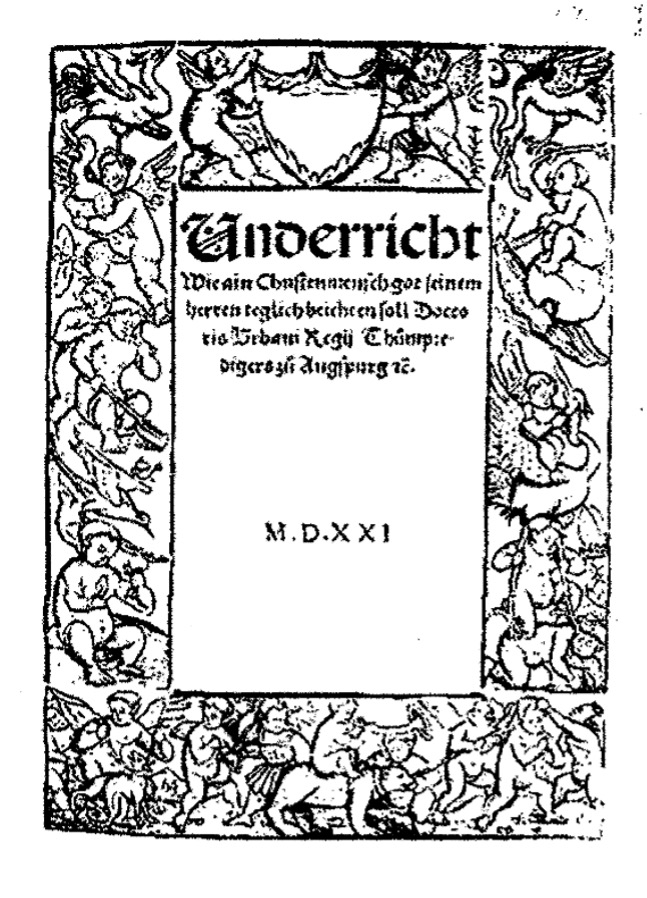
The like title-pages of Avkat Rokhel and Unterricht Wie ain Christenmensch, the latter a non-Hebrew work printed approximately two decades earlier, reflect a relationship between Jewish and Christian printers, that is, Christian printers published Hebrew books in association with Jewish associates. The relationship between the printers was mutually beneficial. For the Christian publisher “the Hebrew books sector, being unique, was attractive to investors, being more limited and not so wildly competitive as the Italian book sector.”[16] In addition to the non-Jewish printer’s access to the Jewish book market, the Jewish publisher was able to not only publish Hebrew books, but he also gained access to the typographical material of his Christian associate. The latter, for example, frequently provided attractive frames to the former after having used them for his market and the Jewish partner also utilized the printer’s other ornamentation. This was of value to the Jewish partner as he did not have to go the expense of having decorative material prepared, at a relatively much greater expense as it would be utilized for a much smaller market. This despite the fact that the frames were often incompatible with traditional Jewish sensibilities.[17]

1521, Unterricht Wie ain Christenmensch [18]

The like title-pages of Avkat Rokhel and Unterricht Wie ain Christenmensch, the latter a non-Hebrew work printed approximately two decades earlier, reflect a relationship between Jewish and Christian printers, that is, Christian printers published Hebrew books in association with Jewish associates. The relationship between the printers was mutually beneficial. For the Christian publisher “the Hebrew books sector, being unique, was attractive to investors, being more limited and not so wildly competitive as the Italian book sector.”[19] In addition to the non-Jewish printer’s access to the Jewish book market, the Jewish publisher was able to not only publish Hebrew books, but he also gained access to the typographical material of his Christian associate. The latter, for example, frequently provided attractive frames to the former after having used them for his market and the Jewish partner also utilized the printer’s other ornamentation. This was of value to the Jewish partner as he did not have to go the expense of having decorative material prepared, at a relatively much greater expense as it would be utilized for a much smaller market. This despite the fact that the frames were often incompatible with traditional Jewish sensibilities.[20]

The title-page of Avkat Rokhel has the largest number of cherubim of our title-pages, nineteen in all, of our title-pages. The cherubim appear on the bottom, sides, and top of the frame, all active, albeit in different activities. The text of Avkat Rokhel is in three parts, each further subdivided. The first section addresses the struggle against one’s evil urge prior to redemption and the birth pangs and advent of the Messiah, and an explanation of the pertinent midrashim; the second part discusses the rewards and punishments of the soul after the resurrection, the nature of the world to come according to Judaism, in contrast to the views of non-Jews, and resurrection; and the third part the laws stated by the sages of the Talmud as halakhah Moshe me-Sinai, the formation of man and the number 248 limbs in a person, the statement of our sages concerning three partners in that process (God, man, and woman) and some gematriot.

This is the third edition of Avkat Rokhel, it having been printed previously in Constantinople (1516) and Rimini (1526). Ch. B. Friedberg records, in his Bet Eked Sepharim, more than twenty-five printed editions of Avkat Rokhel. It was translated into Latin by A. Hulsius and printed in his Theologia Judaica, (Breda, 1653) and a Yiddish edition was prepared by Naphtali Pappenheim (Amsterdam, 1647).[21]

1543, Melokhim Buch Two additional works printed in Augsburg, attributed to Moses (Esrim ve-Arbeh) Ashkenazi, are Yiddish poetical renditions of the books of Kings and Samuel. Moses’ appellation, Esrim ve-Arbeh (24), derives from either his birthplace, Vierundzwanzig Hoefe (24 courts) in Wuerttemberg, or from his extensive knowledge of the 24 books of the Bible. Moses’ accreditation with either authoring or transcribing the Melokhim Bukh is due to its similarity to the Shmuel Bukh, more reliably attributed to him. Nevertheless, sufficient differences exist between the two works that many scholars believe they do not share a common author. It is clear, however, that the author, even if not this Moses, was an Ashkenazi Jew. The Melokhim Bukh was published in quarto format (40: [123] ff.) by, according to the colophon, Paulus Aemilus. A Latin colophon states, Augustae Vindelicorum/ per Paulum Aemilium, Anno/ Domini M. D. XLIII. Meyer Waxman suggests that it is doubtful, the colophon notwithstanding, that the publisher was Aemilus; more likely it was Hayyim Shahor.

We have noted above that the frames on these title-pages were first used by Christian printers and that when that market no longer needed the frames, they were made available to Jewish printers. The cherubim frames noted above were generally acceptable to a contemporary renaissance Jewish public, although some, many, were questionable and would not be used today. In contrast, the title-page of the Melokhim Buch has a border made up of a four-part frame, the top with a representation of a king, the left and right sides respectively with images of Adam and Eve, unclad, the latter with the snake, two small children, and expecting. At the bottom are two cherubim. Use of this frame is surprising, for in contrast to other frames its’ contents appear to be objectionable, more so than other frames, even those with mythological characters. It seems likely that this frame might also be distasteful to Christian sensibilities.[22]

1543, Melokhim Buch
Courtesy of Dr. Moshe Rosenfeld

The title page states that it is “The book Melokhim (Kings) in Taytsher sprach, beautiful and clear and very entertaining to read. Printed in the imperial city of Augsburg in the year 303 (=1543)” [23] The colophon dates the completion of the work to Friday, 14 Av, 303 (July 25, 1543), which was a Sunday in 1543.

The Melokhim Bukh was not written as a sequel to the Shmuel Bukh. It is the older of the two books, originally written as a separate work, possibly as early as the fourteenth century. The format of the Melokhim Bukh, a rhymed paraphrase of the book of Kings, is that of the heroic epic, stylistically modeled after comparable German sagas, such as the Nibelungen. The subject matter is the events in Kings I and II, imaginatively and colorfully enhanced by material from the Talmud and Midrashim, all expressed with a deep piety. Intended as a complete history, it begins with a hymn of praise to God in three strophes followed by nine strophes from the Exodus to the last days of David, the contents of Kings, and as a sequel, the history of the Jews to the end of the second commonwealth in thirty strophes). An example of the text is,

You have frequently performed signs for the children of Israel;

Therefore they are obliged to have You for their Lord.

And to fear Your name-that is useful and good for them.

That man is foolish who acts contrary to Your word.[24]

1544, Shmuel Bukh The Shmuel Bukh was published, also likely by Hayyim Shahor in quarto format (Format 40: [102] ff.). It has an ornate title page made up of figurines above and about pillars with cherubim on the sides. It too is in Vaybertaytsh; among its reprints is a Latin edition (Ingolstadt,(1562). Waxman suggests that the Shmuel Bukh was likely written at least a hundred years earlier, most likely an original production of medieval Jewry. The author reworked the biblical material and incorporated aggadic elements. It was written in “vigorous poetic style” in eight line strophe and was meant to be sung.[25]

1544, Shmuel Bukh
Courtesy of Dr. Moshe Rosenfeld

In contrast to what was written above, “works that many scholars believe they do not share a common author,” Zinberg informs that both the Melokhim Bukh and the Shmuel Bukh are composed in the same verse-meter. Moreover, the title-page states that “Shmuel is the first part of

the book Melokhim, for it is all related.” Nevertheless, Zinberg quotes other sources that “these are two quite different works and were probably written by two different poets.”[26]

1553, Ma’yan GannimA composition book comprised of sample letters from R. Samuel ben Elhanan Jacob Archivolti (c. 1515-1611). Ma’yan Gannim was published in a small sextodecimo format (160: 45, [1] ff.) at the Venice press of Alvise Bragadin. The Bragadin press was active before the papal bull, dated August 22, 1553, by Cardinal Giovanni Pietro Caraffa, the future Pope Paul IV, an extreme reactionary and bitter anti‑Semite, who ordered the confiscation and burning of the Babylonian and Jerusalem Talmuds. This had a chilling effect on Hebrew printing and resulted in a considerable decline if not outright cessation of printing in Venice, and the subsequent expurgation and censorship of Hebrew books. When Hebrew printing resumed in Venice in 1563, among the Christian printers who took up the publication of Hebrew books was Alvise Bragadin. Bragadin died in the mid-1570’s, he was succeeded by his son, and after him by successive members of the family well into the eighteenth century, the last known Bragadin being Alvise III. Throughout that time the press remained a leading printer of Hebrew books in Venice.

1553, Ma’yan Gannim
Courtesy of the Library of Agudas Chassidei Chabad Ohel Yosef Yitzhak

Archivolti, a student of R. Meir Katzenellenbogen (Maharam, 1473-1565), served as rabbi, av bet din, and rosh yeshivah in Padua. Among his students was R. Judah Aryeh (Leon) Modena (1571-1648). Prior to settling in Padua in 1568, Archivolti worked as a corrector for the Hebrew presses in Venice.

In contrast to our preceeding examples of cherubim, this exemplar does not appear on the title-page of the book, which has the Bragadin device, that is, three crowns, but rather at the beginning of each of the book’s five chapters, a woodcut illustration comprised of three cherubim in a cage, surrounded on all four sides by a verse.

The title is from “A fountain of gardens (ma’yan gannim), [a well of living waters, and streams from Lebanon” (Song of Songs 4:15). The text states that there are fifty letters, that is, twenty-five letters with their responses, written by Archivolti. There is a preface and introduction from Archivolti, followed by a table of contents, and, beginning on 7a, the text. Ma’yan Gannim is the first book written by Archivolti, for he describes it as his first fruits, an offering to the Lord. Archivolti also wrote Degel Ahavah (Venice, 1551), an ethical work; He’arot le-Sefer he-Arukh (Venice, 1553), textual references for the Arukh of Nathan ben Jehiel; and, his most important title, Arugat ha-Bosem (Venice, 1602) a grammatical work in 32 chapters.

The sections or chapters, each on a different theme, are correspondence between a father and son; between friends; from an older to a younger man; with government officials; and others, including letters of a romantic, and even sensual nature. Such letters, at the very least inappropriate by modern religious standards, are intermingled with those of a sacred nature, reflecting contemporary mores and addressing current issues, including therefore, information of historical and cultural value. Ma’yan Gannim is designed to teach through example the rules of correspondence. The letters are in metrical form, designed by Archivolti as literary models, many with ethical content, for his students.[27]

1556, She’ilot u’Teshuvot Jacob ben Moses Moellin (Maharil) – Two hundred and five responsa from R. Jacob ben Moses Moellin (Maharil, c. 1360-1447). The She’ilot u’Teshuvot were published in Cremona at the press of Vincenzo Conti in octavo format (80: [7] 79 ff.). After the Talmud was burned in Venice in 1554 there was a precipitous decline, if not a complete cessation, in the number of Hebrew books printed in Venice for several years. The breach was filled by presses in Ferrara, Sabbioneta, Cremona, and Riva di Trento. Vincenzo Conti (d. 1569) printed briefly in Sabbioneta and subsequently in Cremona, where his press was active from 1556 to 1567, issuing more than forty titles.

Maharil was the leading halakhic authority of his time. His most important work is Sefer Maharil (Minhagei Maharil, 1556, Sabbioneta), a popular and influential work on customs and laws. It was composed by his pupil Eleazar ben Jacob (Zalman of St. Goar), from the discourses that he heard from Maharil. She’ilot u’Teshuvot is comprised of Two hundred and five responsa, a small part only of Maharil’s responsa. The subject matter, as in the Sefer Mahril, deals to a great extent with custom, but also includes much personal material. They also reflect Maharil’s considerable humility and compassion.

1556, She’ilot u’Teshuvot Jacob ben Moses Moellin (Maharil)
Courtesy of the Library of Agudas Chassidei Chabad Ohel Yosef Yitzhak

The title-page has an ornamental frame made up of four parts, enabling the printer to use them in other arrangements, although this is the manner in which the parts are most often employed. The top frame has the face of a man and cherubin; on the sides are suits of armor, shrubs, and musical instruments and, in the center of the left vertical frame the letters SPQR, reputedly standing for Senatus Populusque Romanus; and on the bottom a two headed crowned eagle and on the sides the cherubim. This frame was used by Conti on his early imprints, appearing on about ten works.

1558, Sefer Rav Alfas Sefer Rav Alfas, (Hilkhot Rav Alfas, Sefer ha-Halakhot of Alfasi, Rif) was published in Riva di Trento by R. Joseph Ottolenghi and Cardinal Cristoforo Madruzzo in a three volume folio format (20: 288, 268, 302 [8] ff.). The Tyrolese town of Riva di Trento is the source of an unusual episode in the history of the Hebrew book. It was for a short time, from 1558 to 1562, a refuge for the Hebrew book; one in which about forty Hebrew titles were printed. Believed to be the first work printed in Riva di Trento, Hilkhot Rav Alfas was likely selected, in addition to its inherent popularity and value, due to the ban on the Talmud, the Rif, being a halakhic compendium of the Talmud, filling, to some extent, the gap left by the scarcity of that work.

It was in Riva di Trento that Cardinal Cristoforo Madruzzo (1512-78), Cardinal of Trent, a scholar and supporter of learning, who argued at the Council of Trent (1562) for leniency and moderation in condemning books, became the patron and protector of a Hebrew press, which was also a source of revenue for him. Ottolenghi (d. 1570), originally of Ettlingen, in Baden, Germany, reflected in its Italianized form in his name, was rosh yeshivah at Cremona, and under his tutelage Talmudic studies had continued in Cremona after that work had been banned and burned elsewhere. He assisted the press, providing indices and annotations to a number of works and assuring that material offensive to the church had been deleted from those books of value to his yeshiva. and R. Jacob Marcaria, a dayyan on the bet din presided over by Ottolenghi and a physician, recruited by Madruzzo help finance and play a role in the press. Marcaria edited and wrote brief prefaces for most of the books printed in Riva di Trento. The press was located in the house of Antonio Broën.

Sefer Rav Alfas is a halakhic compendium by R. Isaac ben Jacob Alfasi (Rif, 1013-1103). Alfasi, born in the Algerian village of Qal’at Hammad, was a student of the great sages R. Nissim ben Jacob (c, 990-1062) and Hananel ben Hushi’el (d. c. 1055) in Kairouan. After learning with them Alfasi relocated to Fez, from where his surname al-Fasi (Rif) is derived, and became recognized as the leading Talmudic sage of the time. In 1088, at the age of 75, two informers denounced him to the government – the charges are unknown – and he was forced to flee to Spain. Eventually settling in Lucena, Alfasi succeeded R. Isaac ben Judah ibn Ghayyat (c. 1020-89), who had died a few months earlier, as head of the yeshiva.

1558, Sefer Rav Alfas
Courtesy of the National Library of Israel

The text of the title-page of each volume has cherubim at the sides, and below bears the Cardinal’s coat‑of‑arms , a significant statement of the Cardinals’ support and protection of the press at a time when his church was burning and banning Hebrew books. Furthermore, the title pages informs that Sefer Rav Alfas was edited with great care by the gaon R. Joseph Ottolenghi and was printed and financed by him, and that this was done, “in the dominion of” the following in bold letters “Cardinal Cristoforo Madruzzo.”

Sefer Rav Alfas, Alfasi’s major work, is one of the greatest works in halakhic literature. It is extracts all pertinent legal decisions from the Talmud, eliminating non-halakhic material, discussions, and subject matter not applicable today. It covers the following orders of the Talmud, Mo’ed, Nashim, and Nezikim, as well as tractates Berakhot and Hullin. Laws in Kodashim and Tohorot, such as mezuzah and tefillin, are organized as Halakhot Ketannot. Sefer Rav Alfas differs from earlier works, such as Halakhot Gedolot, in that it is more comprehensive, more detailed, and by the inclusion of material from the geonim, although, like them, it follows the order of the tractates.

1559-60, ZoharClassic kabbalistic work of Jewish mysticism, attributed to R. Simeon bar Yohai (second century). This, the second printing of the Zohar, it was published previously in Mantua (1558-60), published in Cremona at the press of Vincenzo Conti in a three volume folio format (20: 132, 122, 146 ff.) by Vincenzo Conti (d. 1569). Conti, who had printed briefly in Sabbioneta, is better known for his activity in Cremona, where his press, active from 1556 to 1567, issued more than forty titles.

The title page of has a decorative architectural frame with an arch, at the top a vignette of Akedat Yizhak (the binding of Isaac), surmounted by an eagle, and accompanying cherubim; below in the bottom squares, figurines, perchance also cherubim. It is dated, “For the Lord will not forsake כי לא יטש (319=1559) his people [for his great name’s sake] (Samuel I 12:22), and it was completed in the year ש”ך ([5]320=1560).” At the bottom of the page is an imprimature from the Inquisition on the title page, the sole Cremona imprint to place it there, as well as a longer permission at the end of the book.

1559-60, Zohar
Courtesy of the Library of the Jewish theological Seminary

Written in Aramaic and Hebrew, Sefer ha-Zohar al ha-Torah is a comprehensive system of kabbalistic theosophy, encompassing cosmology, the soul, and good and evil. It is an esoteric commentary on the Torah, with homilies, midrashic passages, parables, and numerous discursive passages. It is based on the concept that within scriptures is a concealed stratum, deciphered by Kabbalah, expressing the inner meaning of the Torah, with its “splendor, beauty, and greatness.”

The corrector (and expurgator) was the apostate Vittorio Eliano, grandson of the foremost grammarian, Elijah Bahur Ashkenazi Segal. A member of a Dominican commission to review Hebrew books, Eliano was associated with all the books published by Conti from 1558 through 1559. Although begun later than the Mantua edition, noted above, this printing, done in haste, was completed earlier. Nevertheless, it was not immediately released for sale, for when more than 10,000 Hebrew books were burned in Cremona, with the complicity of Eliano, the entire edition was seized. It was just barely saved, in contrast to other works, by the apostate Dominican, Sixtus of Siena. It is known as the Zohar Gadol (large Zohar), in contrast to the smaller Mantua edition (Zohar Katan), and is also referred to, because of Eliano’s involvement, as the “Christian edition.” This notwithstanding, the Cremona edition was the preferred of the two editions by eastern European kabbalists.[28]

1560, Shir ha-Yihud – Shir ha-Yihud (Hymn of Divine Unity) an anonymous piyyut (liturgical poem) written in the mid-twelfth century, most often attributed to Samuel ben Kalonymus he-Hasid (c. 1130-1175), less often to his son, Judah ben Samuel he-Hasid (c. 1150-1217), author of the Sefer Hasidim, both among the foremost representatives of the Hasidei Ashkenaz, and, on occasion, to yet others.

Shir ha-Yihud
Courtesy of the National Library of Israel

Shir ha-Yihud was published at the press of Eliezer and Joseph ben Naphtali Hertz Treves. Active for one year only, in 1560, they issued six books, before being forced to close by a meeting of the leaders, both Protestant and Catholic, of the Swiss Confederation in June, 1560, who feared that they were about to print the Talmud.

The frame, one of several with cherubim employed by the press, also was used on the title-page of Begidat Hazman, an allegoric maqāma (a poetic narrative in rhymed prose) by Mattathias (Mattityah ben Moses), a 15th century Spanish or Provençal Hebrew poet or Mattathias ha-Yiẓhari, a representative of the Jewish communities of Aragon at the Tortosa disputation (1413–14).

1568, Passover Haggadah Passover Haggadah printed in Mantua in folio format (20: 36 ff.) by Joseph Shalit ben Jacob Ashkenazi of Padua. This edition is a reprint of the 1560 Passover Haggadah, also printed in Mantua, but with modifications and the addition of the marginalia of R. Joseph Shalit ben Jacob Ashkenazi of Padua entitled Nimukei Yosef.

1568, Passover Haggadah
Courtesy of the National Library of Israel

The title page frame has representations of the Mars and Minerva followed by the first text page, which has two woodcuts of cherubim along the top. Following text pages have those cherubim image, as well as numerous other cherubim images, including several marginal cherubim images. This Haggadah shares some features with the Prague Haggadah of 1526. Woodcuts are accompanied by captions, given as rhymed couplets, a feature of Ashkenaz manuscript Haggadot. In some instances, for example, by the four questions, the earlier edition was framed by a lush Italian border, without illustrations. Here the types and the top and upper left borders with their vines and cherubs only are alike.[29]


1576, Yosef LekahYosef Lekah is a commentary on Megillat Esther by R. Eliezer ben Elijah Ashkenazi (1513-86). It was published in Cremona in 1576 by Christopher Draconi in octavo format (40: 83, 1 ff.). Draconi, previously associated with Vincenzo Conti, attempted to publish Hebrew books in Cremona. Although he would issue Latin books from 1569 to 1614, he printed one Hebrew book only, Yosef Lekah.

1576, Yosef Lekah
Courtesy of the Fales Library and Special Collections, New York University

R. Eliezer ben Elijah Ashkenazi was a multi-faceted individual, a Talmudist, physician, and well-rounded scholar, who served as rabbi in a number of varied communities. His first rabbinic position, from 1538-61, was in Fostat, Egypt. Forced to leave Fostat, Ashkenazi went to Famagusta, Cyprus, where he was rabbi for two years, and then to Venice. He left for Prague (1561), after a dispute with the Maharam of Padua, and after traveling as far as the Crimea, returned, via Famagusta, to Venice. Ashkenazi was next rabbi in Cremona, where he published Yosef Lekah. Shortly after he left to be rabbi of Posen, and, from 1584, was in Cracow. Ashkenazi experienced difficulties in Poland, disputing over his right to open a yeshiva in close proximity to an existing yeshiva, so that Joseph Solomon Delmedigo (1591-1655) wrote about him, “You have brought a vine from Egypt; you have cast out the nations, and planted it” (Psalms 80:9). Ashkenazi was highly regarded by his contemporaries, corresponding with prominent rabbinic figures such as R. Joseph Caro, R. Joseph Ha-Kohen (Katz), R. Moses Isserles (Rema), and R. Solomon Luria (Maharshal), several mentioning him in their responsa. R. Elijah of Pesaro, in Famagusta in 1563, praised Ashkenazi’s scholarship, noting that he was fluent in twelve languages.

The title-page has four cherubim images, two reclining at the top of the structure, two standing erect by the pillars at the sides. The title-page is dated “Therefore they called these days Purim קראו לימים האלו פורים (336 = 1576)” (Esther 9:26). Yosef Lekah is dedicated to Don Joseph Nasi, Duke of Naxos, whom Ashkenazi, in the introduction, compares to Joseph in Mizraim and Mordecai at the time of Ahasuerus. Ashkenazi, therefore, entitled this work Yosef Lekah. Two, almost identical, editions of Yosef Lekah exist, both dated 1576. Although almost exact copies of the original, it is clear, upon close examination, that the book was reset. Christopher Draconi’s Yosef Lekah was the last Hebrew book printed in Cremona.

Ashkenazi’s most important work is Ma’aseh HaShem (Venice, 1583), on the historical occurrences in the Torah, with a commentary on the Passover Haggadah; selichot; and, not extant today, a super-commentary on the Ramban (Nachmanides) and annotations to R. Caro’s Beit Yosef.[30]

Conclusion – In this article we have described books printed in Augsburg, Basle, Cremona, Mantua, Prague, and Venice. The cherubim imagery on these title-pages, reflecting the influence of Renaissance humanism, their attractiveness notwithstanding, do not appear on the title-pages or accompanying the text in Hebrew books published in more modern times. A review of the title-pages reproduced here, all dissimilar, with their numerous depictions of cherubim, attest to the popularity of that image. Given the strictures on Hebrew printing from the mid-sixteenth century in Italy, the frequent use of cherubim testify to the cooperation of Jewish and non-Jewish printers, their frequency perchance suggesting a positive relationship going beyond mere monetary gain.

We conclude with the Talmudic statement above, which suggests why the image of cherubim was so popular:

Rav Ketina said: When the Jewish people would ascend for one of the pilgrimage festivals, the priests would roll up the curtain for them and show them the cherubs, which were clinging to one another, and say to them: See how you are beloved before God, like the love of a male and female. (Yoma 54a)

Lastly, in conclusion an image of a cherub, both chronologically and, in cherubian activity, quite different from those depicted in this article. It is included as it is unusual and eye catching, an image of a Cherub smoking a pipe. It appears in in at least two Basle imprints published by Israel ben Moses ben Abraham Halle, active in Offenbach, although not continuously, from 1718/19 to c. 1738/43. The works are Anaf Etz Avot, R. Benjamin ben Yekutiel Wulff’s commentary on Pirke Avot, and tractate Sanhedrin (1721).[31]

  1. Once again, I would like to express my gratitude and appreciation to Eli Genauer for reading the article and his insightful comments.
  2. Emil G. Hirsch, W. Muss-Arnolt, J. Frederic McCurdy, Louis Ginzberg, “Cherub ( ; plural, Cherubim)” Jewish Encyclopedia IV (New York, 1901-06), pp. 13-16; Shalom M. Paul, Louis Isaac Rabinowitz, “Cherub” Encyclopedia Judaica IV (Jerusalem, 2007), pp. 600-01.
  3. Thomas Kelly Cheyne, 1911 Encyclopædia Britannica, Volume 6, reproduced in https://en.wikisource.org/wiki/1911_Encyclop%C3%A6dia_Britannica/Cherubim
  4. https://www.sefaria.org/search?q=%D7%9B%D7%A8%D7%95%D7%91%D7%99%D7%9D&tab=text&tvar=1&tsort=relevance&svar=1&ssort=relevance.
  5. Franz Sales Meyer, Handbook of Ornament: a Grammar of Art, Industrial and Architectural Designing in all its Branches for Practical as well as Theoretical use (New York, 1957), pp. 108-09.
  6. Codices and early imprints did not have title-pages, the first leaf normally being left blank to protect the book, that page later becoming a dedicated page. The first book with a detailed title-page was the Calendarium of Johannes Regiomontanus, appearing in 1476 (Venice), being a fifty-five year calendar (1475-1530), printed by Johannes Regiomontanus. The first Hebrew book with a title-page was the Sefer ha‑Roke’ah (Fano, 1505) of R. Eleazar ben Judah of Worms (c. 1165 – c. 1230).
  7. Cherubim also appear on the frames of Hebrew books printed in the incunabular period. For examples of such frames see Marvin J. Heller “Behold, you are beautiful, my love: The Use of Ornamental Frames in Hebrew Incunabula” Printing History NS 10 (New York, July, 2011), pp. 39-55, reprinted in Further Studies in the Making of the Early Hebrew Book (Leiden/Boston, 2013), pp. 3-33.
  8. The following book descriptions are selected, modified from Marvin J. Heller, The Sixteenth Century Hebrew Book: An Abridged Thesaurus ( Brill, Leiden, 2004), var. cit.
  9. Avraham Yaari, Hebrew Printers’ Marks (Jerusalem, 1943), pp. 7 and 126-27 n. 10 [Hebrew].
  10. Jerome Friedman, The Most Ancient Testimony. Sixteenth-Century Christian-Hebraica in the Age of Renaissance Nostalgia (Athens, Ohio, 1983), pp. 44-48, 214-15; A. M. Habermann, Title Pages of Hebrew Books (Tel Aviv, 1969), p. xi [Hebrew with English introduction], pp. 19-20, 125-26 nos. 4-5; Joseph Prijs, Die Basler Hebräischen Drucke (1492-1866) (Olten, 1964), pp. 49-51 n. 26; Frank Rosenthal, “The Rise of Christian Hebraism in the Sixteenth Century,” Historia Judaica II (New York, 1945), (New York, 1945), pp. 182-91; and Richard S.Westfall, “Sebastian Muenster,” http://es.rice.edu/ES/humsoc/Galileo/Catalog/Files/muenster.html
  11. An interesting example of this later usage is R. Moses ben Hanokh Altschul’s (c. 1546–1633) Brant Shpigl, a popular Yiddish work on ethics, correct demeanor, and customs for women, published by Konrad Waldkirch (Basle, 1602), also indicative of the passage of typographic material between printers.
  12. Stephen G. Burnett, “German Jewish Printing in the Reformation Era (1530-1633),” University of Nebraska – LincolnUniversity of Nebraska – Lincoln DigitalCommons@University of Nebraska – LincolnDigitalCommons@University of Nebraska.
  13. Ch. B. Friedberg, History of Hebrew Typography of the following Cities in Central Europe: Altona, Augsberg, Berlin, Cologne, Frankfort M., Frankfort O., Fürth, Hamberg, Hanau, Heddernheim, Homberg, Ichenhausen, Neuwied, Wandsbeck, and Wilhermsdorf. Offenbach, Prague, Sulzbach, Thannhausen from its beginning in the year 1513 (Antwerp, 1935), pp. 29-31 [Hebrew].
  14. A. M. Habermann, “The Printer Hayyim Shahor, his Son Isaac and Son-in-law Joseph Yakar,” in Studies in the History of Hebrew Printers and Books (Jerusalem, 1978), pp. 103-07 [Hebrew].
  15. Yeshayahu Vinograd, Thesaurus of the Hebrew Book. place, and year printed, name of printer, number of pages and format, with annotations and bibliographical references II (Jerusalem, 1993-95), p. 2 no. 10 [Hebrew].
  16. Zipora Baruchson, “Money and Culture: Financing Methods in the Hebrew Printing Shops in Cinquecento Italy,” La Bibliofilia 92 (1990), 25.
  17. For examples of such usage see Marvin J. Heller, “Behold, you are beautiful, my love: The Use of Ornamental Frames in Hebrew Incunabula” Printing History NS 10 (New York, July, 2011), pp. 39-55, reprinted in Further Studies in the Making of the Early Hebrew Book. (Brill, Leiden/Boston, 2013), pp. 3-33; “Mars and Minerva on the Hebrew Title Page,” The Papers of the Bibliographical Society of America 98:3 (New York, N. Y., 2004), pp. 269-92, reprinted in Studies in the Making of the Early Hebrew Book (Brill, Leiden/Boston, 2008), pp. 1-17; and the “The Printer’s Mark of Marc Antonio Giustiniani and the Printing Houses that Utilized It,’ Library Quarterly, 71:3 (Chicago, July, 2001), pp. 383-89, reprinted in Studies, pp. 44-53.
  18. Unterricht Wie ain Christenmensch by Urbanus Rhegiosu (1489-1541), a Protestant Reformer active in Northern and Southern Germany promoting Lutheran unity in the Holy Roman Empire. Unterricht is one of several titles with this frame printed by Silvan Otmar of Augsburg (https://www.flickr.com/photos/58558794@N07/6576279085).
  19. Zipora Baruchson, “Money and Culture: Financing Methods in the Hebrew Printing Shops in Cinquecento Italy,” La Bibliofilia 92 (1990), 25.
  20. For examples of such usage see Marvin J. Heller, “Behold, you are beautiful, my love: The Use of Ornamental Frames in Hebrew Incunabula” Printing History NS 10 (New York, July, 2011), pp. 39-55, reprinted in Further Studies in the Making of the Early Hebrew Book. (Brill, Leiden/Boston, 2013), pp. 3-33; “Mars and Minerva on the Hebrew Title Page,” The Papers of the Bibliographical Society of America 98:3 (New York, N. Y., 2004), pp. 269-92, reprinted in Studies in the Making of the Early Hebrew Book (Brill, Leiden/Boston, 2008), pp. 1-17; and the “The Printer’s Mark of Marc Antonio Giustiniani and the Printing Houses that Utilized It,’ Library Quarterly, 71:3 (Chicago, July, 2001), pp. 383-89, reprinted in Studies, pp. 44-53.
  21. Ch. B. Friedberg, Bet Eked Sepharim, (Israel, n. d), alef 286 [Hebrew].
  22. A later example of an objectionable title-page is the responsa of R. Joel ben Samuel Sirkes’ (Bach, 1561-1640), She’elot u-Teshuvot Bayit Hadash, printed in Frankfurt am Main (1697) by Johann Wust. The title-page had an ornate frame with forms of unclad women which aroused rabbinic opposition, for those authorities considered the title-page inappropriate and offensive to Jewish sensibilities. The quire had to be reprinted with a new title-page, now with two cherubim holding a floral wreath with grapes. A similar situation occurred earlier in Hanau in 1630. Sefer ha-Roke’ah, by R. Eleazer of Worms, was issued in a small format, 12×16 cm., due to the economic restrictions resulting from the Swedish War. On the title-page “Venus rises naked from the waters on a seashell – a common pagan motif” (The book was issued by a press belonging to a non-Jew, Hans Jacob Hena, so that, it has been suggested, no attention was initially given to the title-page. When the book was sold, “many Jewish purchasers tore out the offending page” (Raphael Posner and Israel Ta-Shema, ed. The Hebrew Book: An Historical Survey [Jerusalem: Keter Publishing House, 1975]). There does not appear to have been any opposition to this last title-page in Venice, for the Venus rising from the waters motif appears in Hebrew works printed there, where it was the press mark of Alessandro Gardoni (Venice, 1577-78) and can be found in the Mishneh Torah printed by Meir Parenzo at the press of Alvise Bragadin in 1574.
  23. Taytsher sprach (Vaybertaytsh), is a type generally but not exclusively reserved for Yiddish books, so named because these works were most often read by the less educated and women. Concerning the early use of Vaybertaytsh see Herbert C. Zafren, “Variety in the Typography of Yiddish: 1535-1635,” Hebrew Union College Annual LIII (Cincinnati, 1982), pp. 137-63.
  24. Israel Zinberg, A History of Jewish Literature, translated and edited by Bernard Martin VII (Cleveland, 1973), p. 116.
  25. Meyer Waxman, A History of Jewish Literature (1933, reprint Cranbury, 1960), II pp. 632-33.
  26. Zinberg, p. 106.
  27. Robert Bonfil, Jewish Life in Renaissance Italy (Berkeley, 1994), tr. Anthony Oldcorn, pp. 133, 169; Deror Schwartz, “Samuel Archivolti, his Life and Writings,” Asufot VII, ed. Meir Benayahu (Jerusalem, 1993), pp. 82-83 [Hebrew]; and Zinberg, II p. 130.
  28. Amram, pp. 324-27; Robert Bonfil, “Change in the Cultural Patterns of a Jewish Society in Crisis: Italian Jewry at the Close of the Sixteenth Century,” in Essential Papers on Jewish Culture in Renaissance and Baroque Italy, ed. David B. Ruderman (New York, 1992), p. 418; Rachel Elior, “Messianic Expectations and Spiritualization of Religious Life in the Sixteenth Century,” in Essential Papers . . ., p. 286.
  29. Yaari, Printers’ Marks, pp. 12, 132 n. 19; Yosef Hayim Yerushalmi, Haggadah and History (Philadelphia, 1975), nos. 28-31; and Isaac Yudlov, The Haggadah Thesaurus. Bibliography of Passover Haggadot: From the Beginning of Printing until 1960 (Jerusalem, 1997). p. 4 n. 25 [Hebrew].
  30. David Amram, The Makers of Hebrew Books in Italy (Philadelphia, 1909, reprint London, 1963), p. 319; Meir Benayahu, Hebrew Printing at Cremona: Its History and Bibliography (Jerusalem, 1971), pp. 22-24, 232-34; and Jacob Elbaum, Openness and Insularity. Late Sixteenth Century Jewish Literature in Poland and Ashkenaz (Jerusalem, 1990), p. 47, [Hebrew].
  31. This image appeared in my article “Offenbach Revisited: An enigma Reexamined,” published in the Gutenberg-Jahrbuch (Mainz, 2012), pp. 219-28, and reprinted in Essays on the Making of the Early Hebrew Book (Brill, Leiden/Boston, 2021) pp. 273-92. It was noted there that “in his observations to a draft of this paper, Professor Dr. Hans Schneider observes that he has never seen ‘a cherub smoking a pipe’ and suggests that if the figure is an angel the instrument is a flute. He agrees, however, that the object in question does look like a clay pipe as in the self-portrait of Gerrit Dou. Professor Dr. Schneider suggests that the figure might be an oriental man or boy, as was often painted in the seventeenth and eighteenth century, wearing a turban-like cap with plumes, and that what appears to be an angel’s wings might be a fluttering cape. The reader may draw his or her own conclusions.”


Maccabean Psalms? (and more)

Maccabean Psalms? (and more)
By Marc B. Shapiro
(This post was originally part of the previous one, but since I know people don’t like reading posts more than twenty pages long, I split it up into two parts.)
1. I know that every year around Christmas time some people read my article on Torah study on Christmas eve. At the end of the article I raise the possibility that the various Nittel practices were actually based on non-Jewish superstitions. My suspicion was proven beyond any doubt in a wonderful article by Rebecca Scharbach, “The Ghost in the Privy: On the Origins of Nittel Nacht and Modes of Cultural Exchange.”[1] I recommend that everyone add this article to their “holiday reading”. (Due to reasons beyond my control, this post was not able to appear, as planned, before Christmas.)
As for our own holiday of Hanukkah, let me share something that I think people will find interesting. When it comes to the dating of various Psalms, for those in the Modern Orthodox/Religious Zionist world there don’t appear to be any dogmatic issues involved, much like there are no dogmatic issues raised if one assumes that the prophecies beginning in Isaiah chapter 40 come from a later prophet than those in the first part of the book.[2] Nevertheless, I think people generally assume that traditionalists will not speak about “Maccabean Psalms”. (Truth be told, I don’t know if there are even any academic scholars that still identify some of the Psalms as belonging to the Maccabean period.)
See S.’s post here where he notes that Philip Birnbaum, in his siddur, seems to allude to a psalm as having been written in the Maccabean period. However, S. also quotes R. Samson Raphael Hirsch as stating that Orthodox Judaism rejects the notion of “Pseudo-Isaiah”, and of “Maccabean songs under the name of David.” On the other hand, R. Solomon Judah Rapoport believed that at least one psalm (and perhaps more) were written during the Maccabean period. He identified other psalms as dating from the Second Temple period and defended the religious legitimacy of this view. “If the sages of the Talmud advanced the date of a number of Psalms from the time of David to that of Ezra, a period of more than five hundred years, we must have no scruples in advancing them another two hundred years.”[3] R. Samuel Barukh Rabinkow also felt that “the religious value of any of the Psalms is independent of the time of its composition or any historical consideration or reflection.”[4]
I found a very interesting passage by R. Abraham Saba in his Tzeror ha-Mor.[5] He appears to be saying that Psalm 30, which we recite every day (and which many recite after Hanukkah morning tefillah and after lighting the Hanukkah candles) was written when the Temple was rededicated by the Hasmoneans.
אני סבור כי מזמור שיר חנוכת הבית לדוד נתקן על חנוכת הבית של חשמונאי . . . ולכן נעש’ נס בשמן והדליקו ממנה שמנה ימים ועל זה סדר מזמור שיר חנוכת הבית
R. Saba continues by explaining the various verses in line with this conception. Now I realize that one can argue that what he means is that David prophetically wrote the psalm with the Hasmonean rededication in mind, and this interpretation is actually stated by R. Abraham the son of the Vilna Gaon.[6]
מזמור שיר חנוכת הבית לדוד: עשה המזמור הזה לשיר אותו בחנוכת הבית העתידה להיות בימי החשמונאים
Yet such an approach this does not appear to fit with the words of R. Saba:
נתקן על חנוכת הבית של חשמונאי
In his “translation” of this passage Eliyahu Munk writes: “I am convinced that David, in his holy spirit, foresaw such a period and dedicated Psalm 30, 1-13 to that period, therefore commencing with מזמור שיר חנוכת הבית לדוד ‘a song for the consecration of the House,’ the ‘house’ being the reconsecration of the Temple after the Hasmoneans’ victory.”[7] Yet all readers can see that in the original R. Saba does not mention David or his holy spirit.
R. Joseph Hayyim[8] believes that Psalm 30 as a whole was written by David, and he says it is possible that David also wrote the first verse. But he also says that it is possible that the first verse, which speaks of dedication of the Temple, was added to the psalm during the Maccabean period.
אפשר לומר לעולם דוד הע”ה לא אמר פסוק זה של חנוכת הבית, אלא גם הוא התחיל מן ארוממך, ופסוק זה בזמן בית שני כשעשה הקב”ה להם נסים וניצולו וחנכו הבית והמזבח מחדש הוסיפו על מזמור זה פסוק זה מפני שראו דכל דברי המזמור שייכים גם לעניינם.
He adds that this notion should not trouble anyone, as we know that according to one opinion in the Talmud the last eight verses of the Torah were added by Joshua, and he also notes that there were a couple of verses in the book of Joshua that were added after Joshua’s death. In other words, minor additions to abook after the death of the author are not religiously problematic.
Nevertheless, R. Meir Mazuz is indeed troubled by what R. Joseph Hayyim wrote.[9] He claims that the verses added to biblical books noted by R. Joseph Hayyim were added by prophets.[10] Yet in the case of Psalm 30, R. Joseph Hayyim is suggesting that an addition took place during Second Temple times after prophecy had already ceased and there was no longer the institution of anshei keneset ha-gedolah. According to R. Mazuz this is indeed religiously problematic. One can reply to R. Mazuz that while prophecy might have ceased, ruah ha-kodesh did not,[11] and therefore it was permissible for verses to be added to the book of Psalms even in the Maccabean period. After all, a standard view among rishonim is that the book of Psalms is not the product of prophecy but of ruah ha-kodesh.[12]
R. Mazuz adds a second reason why he cannot accept what R. Joseph Hayyim writes. He claims that R. Joseph Hayyim’s position will give support to the modern biblical scholars who believe that verses in the book of Daniel were added in the Maccabean period, a position he also finds religiously objectionable. I don’t understand this objection as the modern biblical scholars do not need, and do not look for, support from traditional commentators. They are completely oblivious to what rabbis like R. Joseph Hayyim have to say on these matters, and have no reason to cite his view as a support for their own position.R. Moses Isaac Ashkenazi discusses the authorship of Psalms in the introduction to his Ho’il Moshe on Tehillim (Livorno, 1880). Although he has his doubts, he says that one who assumes that Psalm 44 was composed during the Maccabean period “has what to rely on.”

So much for Maccabean psalms, but what about post-Davidic psalms in general? R. Ashkenazi identifies Psalms 79 and 137 as having been written during the Babylonian Exile. He also thinks that Psalms 126 and 129 might have been written then. He is led to his view because he can find no evidence that David was a prophet. While David had ruah ha-kodesh, it is only prophecy that reveals future events, and thus the psalms that reflect a post-First Temple era must indeed have been written centuries after David. 

ואין להניח שמזמורים כאלה נכתבו בנבואה, שלא מצאנו בשום מקום שדוד היה נביא ה’, כלומר שה’ דבר עמו כמו שדבר עם שלמה בנו רק שלח אליו נביאיו נתן וגד, אולי מפני ששפך דם הרבה, רק רוח ה’ לבשתהו תמיד כשבא לחבר מזמוריו

As with R. Ashkenazi, his predecessor R. Eleazar ben Samuel Shmelke claims that Psalms 79 and 137 were composed after the destruction of the First Temple. He states that this was also Ibn Ezra’s opinion.[13] In Ibn Ezra’s introduction to Tehillim (which is not found in all mikraot gedolot editions) Ibn Ezra states that “others” held that Psalm 137 and a number of other psalms were written during the Babylonian Exile, yet he does not signal his acceptance of this view.

One of those Ibn Ezra had in mind who held that some psalms were written during the Babylonian Exile was R. Moses Ibn Gikatilla.[14] R. Raphael Berdugo also states that a number of psalms, including Psalm 137, were composed during the Babylonian Exile.[15]
In addition, Malbim, introduction to Tehillim, states that some Psalms were written during the Exile:
התפלות אשר יסדו בגלות בבל על שרפת המקדש ועל הגלות, עד שוב ה’ את שיבת ציון בימי כורש.
He refers in particular to Psalm 137 and also Psalm 85. After saying this, however, he has a footnote in which he states that what he just mentioned is only on the level of peshat, but that he really believes that these psalms were written prophetically in the days of David. I ask readers to examine the text and footnote, and tell me, does anyone think that Malbim is being frank in his comments in the note?

It appears to me that what he writes in the note does not reflect his actual view, which is indeed found in the text. The note is only apologetic, and designed to protect him from being attacked by those who would see his approach as heretical. He would therefore be able to say, “But look at what I wrote in the note.”
According to Rashbam, Commentary to Pesahim 117a s.v. Yehoshua, R. Yose ha-Gelili was of the opinion that the Hallel in Psalms (Ps. 113-118) originated with Mordechai and Esther, i.e., in the Persian period.[16]
In Rashbam’s commentary to Tehillim (which we can expect ArtScroll to censor if it ever publishes it), he points to psalms which were composed during the Babylonian Exile and also states that other psalms were written after Ezra’s return to Jerusalem. For example, Psalm 122:3 states: “Our feet are standing within thy gates, O Jerusalem. Jerusalem, that art builded as a city that is compact together.” According to Rashbam, these references to Jerusalem must date from after the return from exile.[17]
2. Here is a provocative passage quoted in the name of the hasidic master R. Uri of Strelisk (1757-1826).[18] Would any hasidic leader speak this way today?
והרה”ק מסטרעטן זצ”ל אמר משמו עה”פ שומר נפשות חסידיו מיד רשעים יצילם, שאמר: לפני ביאת המשיח יהיו רבי”ס רשעים גמורים ר”ל, אבל הן החסידים הם בתמימותם סוברים שרבם הוא עובד ה’ ולכן נוסעים אליו, לזאת התפלל דהמע”ה שומר נפשות חסידיו כי השי”ת ישמור את החסידים ומיד רשעים יצילם שלא שלא יכשלו ח”ו ברבי”ס כאלו
His comment was only applicable to the phony rebbes. But for an authentic rebbe it is worth travelling great distances and missing out on Torah and tefillah just to hear one bit of wisdom.[19]
אמר שיש ליסע לצדיק אמת אפילו אלפיים פרסאות ולבטל בהליכתו ובחזירתו מתורה ותפלה והכל כדי דיבור אחד של אמת אשר ישמע מפי צדיק אמת
3. Every year there is discussion about the moment of silence in Israel in memory of the soldiers and Holocaust victims, and we always hear about how this is not a Jewish thing to do. Here is a page from R. Ovadyah Hadaya’s Yaskil Avdi, vol. 6, p. 300 (hashmatot Yoreh Deah 2:2).

He regards the moment of silence as entirely appropriate, seeing it as similar to the silence in a house of mourning which shows acceptance of God’s decree.
See also my post here where I wrote that in November 1965 R. Jehiel Jacob Weinberg gave a hesped for four recently deceased rabbis, among them R. Yerucham Warhaftig and R. Eliezer Yehudah Finkel. These latter two were good friends of R. Weinberg, and R. Weinberg’s friendship with R. Finkel went back to their youth. After the eulogy R. Weinberg asked everyone in the room to stand up. They stood silently for around ten seconds and then he asked them to sit down.
In this post I wrote: “I presume this was intended as a show of respect rather than as a moment of silence, since the latter could be done sitting down.” I now think that my statement is probably incorrect, because a moment of silence is also intended as a show of respect, i.e., the two are not in contradiction. In thinking of the story now, it appears that R. Weinberg’s request to stand in silence is really no different than what takes place in Israel.
4. A haredi biography on R. Isaac Blazer has recently appeared. Here is its title page.


Needless to say, R. Jehiel Jacob Weinberg is quoted a good deal in the book. Here is page 410 which contains a picture of R. Weinberg.


The book does not mention that this picture first appeared on the Seforim Blog; see my post here.
In the quotations from R. Weinberg, the book has no problem making “improvements”. For example, R. Weinberg sometimes refers to R. Isaac Blazer as רי”ב, and the new book has altered this to הגרי”ב. R. Weinberg certainly regarded R. Blazer as a gaon, and he sometimes does refer to him as הגרי”ב. However, he did not feel that it was necessary to always refer to R. Blazer this way. The author of the book therefore decided to “correct” what R. Weinberg wrote. I guess this author (who is unnamed) did not think that R. Weinberg showed proper kavod to R. Blazer, which itself is a crazy thought.
Speaking of R. Weinberg and kavod, I think readers will find the following interesting. R. Weinberg stated: “We are all human. I too like kavod. I try not to chase after it, but if it is put on my plate, I will take it.”[20] How many other great rabbis would be honest enough to admit that they are not at the level of the Hafetz Hayyim and R. Elijah David Rabinowitz-Teomim,[21] and that they too like kavod? What R. Weinberg was saying is that this is normal and nothing to be ashamed of, and that for “mere mortals” what is important is not to chase after kavod.5. In my post here. I discussed Haym Soloveitchik’s newly published volume 2 of his collected essays. I neglected to mention that on pp. 285-287 he deals with R. Yitzchak Grossman’s criticism of one of his essays, criticism that appeared on the Seforim Blog here here. Soloveitchik shows his scholarly honesty in that he is prepared to acknowledge that in two of his criticisms Grossman is correct. He also responds to another criticism of Grossman, and I ask people to read what Soloveitchik says very carefully. It was precisely this sort of interpretation, now standard in the academy, that R. Samson Raphael Hirsch was so opposed to. You can be sure that if these words were stated by R. Dov Linzer or R. Ysoscher Katz, that a certain author, on a certain website, would go after them for “undermining the mesorah”.

Ben sorer u-moreh, according to the setam mishnah, nidon al shem sofo. This runs contrary to every principle in Jewish law and, indeed, in most Gentile law. People are executed for crimes that they have committed, not for crimes that they might commit–preventive detention for the criminally inclined perhaps, but preventive execution?! If I find tanna’im attempting to make the implementation of this law impossible, does it strain the imagination to think that they did so because it contradicts their elementary sense of right and wrong? I, for one, think not.

Rabbi Grossman argues that we find a similar ruling about nig’ei battim and there is no ethical problem in this realm. Indeed, there isn’t; however, no one claimed that all instances of “never was and never will be” (lo hayah ve-lo nivra) are a result of ethical issues. Only those in which we find this type of problem, such as ben sorer u-moreh and, to add to the roster, the “apostate city” (ir ha-niddahat) as R. Eliezer Berkovits has contended (as noted by R. Grossman). . . . An exegesis that makes execution of a law more difficult may be simply a matter of interpretation; an exegesis that makes execution impossible has that in mind to begin with. One plausible reason that one might have sought to render a Divine directive inoperable is that such a dictate appeared inconceivable for a just God.

6. I want to call readers attention to the recently published Kovetz ha-Mashbir, vol. 1, edited by Yissachar Dov Hoffman and Ovadyah Hoffman. This volume is devoted to the writings and teachings of R. Ovadiah Yosef and is full of valuable articles. It can be purchased at Biegeleisen.


[1] Jewish Studies Quarterly 20 (2013), pp. 340-373.
[2] The point about Second-Isaiah has recently been made by R. Amnon Bazak, Ad ha-Yom ha-Zeh: She’elot Yesod be-Limud Tanakh (Tel Aviv, 2013), pp. 161-172. There is a good deal that can be said about this book, which deals with a number of themes we have discussed in previous posts. See e.g., p. 274 n. 60, which accepts the notion that sometimes the numbers given in the prophetic books are only symbolic and don’t reflect historical reality.
[3] Quoted in Isaac Barzilay, Shlomo Yehudah Rapoport (Shir), 1790-1867, and his Contemporaries ([Israel], 1969), p. 54.
[4] See Fritz Gumpertz’s recollections in Jacob J. Schacter, ed., “Reminiscences of Shlomo Barukh Rabinkow,” in Leo Jung, ed., Sages and Saints (Hoboken, N.J., 1987), p. 110. Gumpertz, ibid., also notes that Jacob Barth dated a number of psalms to the Second Temple period.
[5] Parashat Noah, p. 13a in the Venice, 1522 edition, and p. 13a in the Warsaw 1879, edition.
[6] Tehillim: Be’er Avraham (Warsaw, 1887), Psalm 30:1.
[7] Tzror Hamor, vol. 1 (Jerusalem, 2008), p. 156.
[8] Rav Pealim, vol. 3, Orah Hayyim no. 5.
[9] See his Emet Keneh on Psalm 30:1 (p. 513), and his recently published Asaf ha-Mazkir (Bnei Brak, 2014), p. 283. (My thanks to Dov Weinstein for kindly sending me a copy of Asaf ha-Mazkir.)
[10] I have discussed the matter of later prophets adding material to the Torah and other biblical books in a number of posts. This is the phenomenon of multiple authors for one book. What do readers make of the following example, which appears to be an example of attributing one verse to more than one prophet? The Av ha-Rahamim prayer states ועל ידי עבדיך הנביאים כתוב לאמור (“your servants the prophets) and then proceeds to only cite a verse from the book of Joel. Does this make any sense? Jacob Reifman did not think so and he actually found a manuscript that had עבדך הנביא. He claimed that  this must be the authentic text and the one that printers should now use when they publish siddurim. See Ha-Magid, Jan. 23, 1861, pp. 14-15, Feb. 12, 1862, p. 55. Yet we also find in the liturgy for a ta’anit dibur that the words עבדיך הנביאים are used and this is followed by three verses from the book of Micah ch. 7. In other words, הנביאים is again used with regard to only one prophet. See this page from Seder ha-Selihot ha-Shalem Ateret Paz, p. 103 (second pagination).

When the phrase עבדיך הנביאים כתוב לאמר is used in the mussaf of Rosh ha-Shanah, in both the silent amidah and the repetition (two times in each), it is followed by citations from different biblical books.
[11] Although Yoma 9b (and parallels) states that ruah ha-kodesh ceased after the days of Haggai, Zechariah, and Malachi, it was always assumed that there were exceptions to this general statement (and some believed that when the Talmud stated “ruah ha-kodesh” it actually meant real nevuah). Also, the Talmud itself, ibid., states that even without ruah ha-kodesh people still had access to a “bat kol”. See R. Reuven Margaliyot’s introduction to his edition of She’elot u-Teshuvot min ha-Shamayim, pp. 25ff. See also R. Meir Ibn Gabai, Avodat ha-Kodesh, vol. 4, ch. 24; R. Isaac Sternhell, Kokhvei Yitzhak, vol. 2, p. 186; R. Aaron Maged, Beit Aharon, vol. 11, pp. 704-705. R. Joseph Engel, Gilyonei ha-Shas, Yerushalmi Shevi’it, 9:1, writes: צ”ל דתרי גווני רוח הקודש הם
[12] See Maimonides, Guide of the Perplexed 2:45, R. David Kimhi, introduction to his commentary on Psalms, Ritva, commentary to Rosh ha-Shanah 32a (col. 296 in the Mossad ha-Rav Kook edition) commentary to Moed Katan 16b, R. David Abudarham, Abudarham ha-Shalem (Jerusalem, 1963), p. 272. See also Meiri’s introduction to his commentary on Psalms, p. 9:
זהו דעת הקדומים בענין דוד המלך ע”ה ר”ל שלא להיות בכלל הנביאים [אבל] ברוח הקדש
[13] Ma’aseh Rokeah (Amsterdam, 1730), p. 65a. See his Ma’aseh Rokeah al ha-Torah (n.p., n.d.), parashat Va-Yehi, where he does not attribute this view to Ibn Ezra. See also Aharon Marcus, Barzilai (Jerusalem, 1983), pp. 271-272.
[14] See Uriel Simon, Four Approaches to the Book of Psalms, trans. Lenn. J. Schramm (Albany, 1991), pp. viii, ix, 120-121, 130ff.
[15] See Mesamhei Lev (Jerusalem, 1990), pp. 141, 222 (both of these page numbers are from the second pagination).
[16] See Yisrael Moshe Ta-Shma, Keneset Mehkarim (Jerusalem, 2004), vol. 1, pp. 286-287.
[17] See the selections of the commentary printed in Aharon Mondshine, “Al Gilui ha-Perush ha-‘Avud’ shel Rashbam le-Sefer Tehillim,” Tarbiz 79 (2010-2011), pp. 130, 133.
[18] Imrei Kadosh ha-Shalem (Jerusalem, 1961), Or Olam, no. 11.
[19] Imrei Kadosh ha-Shalem, no. 42. Regarding phony rebbes, see R. Pinhas Miller, Olamo shel Abba (Jerusalem, 1984), p. 245, regarding a rebbe in Bucharest who drank non-kosher wine.
[20] Hidushei Ba’al Seridei Esh (Jerusalem, 2012), vol. 3, p. 28 n. 21.
[21] See R. Kook, Eder ha-Yekar, p. 64.


Censorship: The Autobiography of R. Eliyahu David Rabinowitz, ADeReT

Censorship: The Autobiography of R. Eliyahu David Rabinowitz, ADeReT

There are a handful of rabbinic autobiographies, R. Yehuda Areyeh of Modena, Hayyei Yehudah, R. Yaakov Emden, Megillat Sefer, and a few others.[1]  One of the more recent rabbinic autobiographies is that of R. Eliyahu David Rabinowitz, otherwise known as Aderet.  This work, was first published in the journal, Ha-Peles edited by Aderet’s nephew, Eliyahu Akiva Rabinowitz.  Only a portion of the autobiography appears in Ha-Peles. However, the editor did give us the title of this work for posterity.  Although Aderet did not title the work, in Ha-Peles it appears under the title, Seder Eliyahu, this title remains today.[1a] In reality, Seder Eliyahu is one part of three part work, the second part, Nefesh David, records various customs (and has been reprinted a few times), and the third part, regarding how to handle Aderet’s body after his death, Achar Eliyahu or Acharei David, apparently was never written. 

Aderet’s autobiography was first published in its entirety in 1983 by Mossad ha-Rav Kook.   The Mossad received the manuscript from Aderet’s grandson.  As will become apparent, much of what was written, prior to 1983, regarding Aderet is lacking because  prior to its publication in 1983,  his autobiography was virtually unknown.  As an aside, the New Encyclopaedia Judaica reuses the article on Aderet from the original Encyclopaedia Judaica and is but one example of the shortcomings of the New Encyclopaedia, for more examples see Dr. Leiman’s critique here, and Dr. Havlin’s critique here, and Dr. Richler’s critique here of the New Encyclopaedia Judaica. 

The 1983 edition, however, has been out-of-print for years, and this year, some of Aderet’s desendents republished Seder Eliyahu (additionally, they also reprint Nefesh David in this volume).  The editors of this new edition thank Mossad ha-Rav Kook for allowing them to reprint this work.  But, in their introduction, they argue that Aderet “never intended to publish this work and allow others to read it, instead, it was meant for his family.” Seder Eliyahu, Jerusalem, 2010, at 7 (“Jer. ed.” or “New Edition”).  Based upon this assertion, the editors of this edition justify “removing various passages that were never intended for outsiders to read.”  Id. at 9.  They explain that whenever they removed text “three lines (- – -) serve to indicate missing text.”  Id.  As we shall see they are inconsistent at best at using the three dash device and many instances of removal are not noted. 

Regarding the claim that Aderet never intended this book to be published. The original publication in 1983 includes the entire text with no omissions.  Recall that this text was obtained by Mossad ha-Rav Kook from Aderet’s grandson, we have no indication that he objected to publishing the entire text.  Moreover, the first time the autobiography (partially) appeared in Ha-Peles much of the “offensive” material was included. Recall that Aderet’s nephew was the editor of Ha-Peles  and he saw no need to censore anything. Finally, although there may be some indications that an autobiography was merely written for family members and not intended for broader publication, this device is common in autobiographies.  R. Emden also implies that he didn’t intend his autobiography to be widely distributed, but as Dr. Schacter demonstrates, Emden wanted others to read it.[2]  Indeed, according to Schacter, R. Emden’s autobiography can be classified as “that of ‘autobiography as polemic.'”  As Emden writes of his purpose, “[i]n order that the sun of my righteousness should shine forth . . . [and because] many of [my enemies] libelous writings will certainly remain extant in the world for some time.  Therefore, necessity has compelled me to clarify my case before God and man. . . . Behold [this autobiography] will serve as a vindication for me, for my children and my descendants.”[3] Thus, “there is equally no question that the overriding primary impetus behind Megillat sefer was a desire on the part of Emden to clear his name and vindicate himself in his controversy with Eybeschutz,” and “[t]here is no doubt that it is the Emden-Eybeschutz controversy that serves as the ‘center of gravity’ for” Megillat Sefer.[4]  Of course, for R. Emden to be publicly vindicated, presumably the public would need to be aware of the work.[5]

With Emden’s motives in mind, it is important to distinguish Aderet’s work.  While Aderet includes descriptions of others in his work, and, at times, some of these descriptions are far from flattering, it does not appear that Aderet was looking for vindication or had a polemic motive in mind.  While Aderet did not get along with his constituents in Ponovitch, that dispute was mainly surrounding Aderet’s salary and how the community treated him.  Aderet wasn’t involved in any global disputes like the Emden-Eybeschutz controversy and thus Aderet wasn’t required to vindicate himself.  Moreover, Aderet ultimately came out on top, becoming Chief Rabbi of the Ashkenazim in Jerusalem.  Thus, he was well-respected and had no reason to resurrect his image – his image was already good.

Perhaps a better understanding of some of the material as it relates to others in Seder Eliyahu may be better understood by looking at Marcus Mosley’s comments[6] and quote from Rousseau: 

Autobiography operates upon an entirely different set of criteria. For the autobiographer, the significance of the other is determined solely by the role that he or she plays in the formation of the self, regardless of social standing. Thus Rousseau, in the “Neuchatel” variant of the preamble to the Confeinddow: “The relationships I have had with several people compel me to speak as freely of them as of myself. I can only succeed in making myself known by making them known also.” Many of the more decisive encounters with the other in the shaping of the autobiographer’s self occur in the years of childhood and adolescence. Parents, teachers, schoolmates, and domestic staff may thus achieve a prominence in the autobiography that would, in the memoir, be reserved for generals and prime ministers, renowned men of letters, and so on. This is not to say that the formative encounters with the other in an autobiography are restricted to the historically obscure. But when the great do drift in and out of the pages of an autobiography, it is often not on account of the qualities that granted them this status that they are recalled.
Thus, Aderet’s comments about others, most notably regarding R. Yitzhak Elchonon Spector, may be understood as merely providing insight into Aderet’s own life rather than commenting on R. Spector, for example.

The new edition of Seder Eliyahu, however, leaves out much of Aderet’s comments about others, depriving the reader of fully understanding the Aderet as well as distorting history.  We will provide all the examples of where the new edition has altered or removed material from the 1983 edition. 

Biography of Aderet

The basic outlines of Aderet’s biography are not in dispute.  Here are the highlights.  Aderet was born, with his twin, on the first day of Shavout in 1843.  His father was a rabbi and Aderet’s family were descendant from famous rabbinic figures from both his father’s and mother’s side.  When he was five, his mother died and his father remarried.  At twelve, Aderet began writing his first sefer, and began wearing tefflin for his entire twelth year.  At thirteen, he had his bar mitzvah and, contrary to the custom, was allowed to read the haftorah for the first day of Shavout. This haftorah is typically reserved for the rabbi or a talmid hakham due to the content of the haftorah.  But, Aderet’s father argued that it was appropriate for his son to read the haftorah.  Soon after his bar mitzvah he completed his first work with his twin brother, Shevet Achim.  At fifteen he became engaged to girl, and soon after was appointed rabbi of Ragali.  The engagement didn’t end well. His fiancee’s mother died and the step-mother was lax in her observance and the marriage was called off.  But, in due course, Aderet was engaged again to the daughter of a prominent family in Ponovitch.  This time, Aderet went through with the wedding.  He remained in Ponovitch, supported by his in-laws, and studied in a small bet midrash.  In 1875, Aderet was selected to be the rabbi of Ponovitch.  In 1893, the town of Mir approached Aderet to become its rabbi.  Aderet accepted.  Ponovitch, however, wanted its rabbi to remain, but, after receiving advice from various rabbis, eventually, Aderet left and went to Mir.  In 1901 he was invited and accepted to become Chief Rabbi of the Ashkenazim in Jerusalem.  On the 3rd of Adar I, 1905, Aderet died in Jerusalem.

Aderet is known as having a phenomenal memory.  He was also a prolific author, but much of his writings remained in manuscript.  In the last decade or so, many of his books have been published, a bibliography of which will appear soon. 

The above provides a basic outline of Aderet’s biography, but a close examination of his autobiography provides additional detail.    

Autobiography of Aderet

There are a few important gaps in Aderet’s biography that can be filled only by utilizing his autobiography.  For example, Aderet’s father’s second wife.  If one reads some of the biographies, she is mentioned only in passing.  But, Aderet explains she was no minor figure.  To the contrary, it appears that Aderet’s step-mother and his father had a horrible marriage.  Indeed, Aderet couldn’t stand her and he was especially bothered the way she treated his father.  After Aderet’s father died, Aderet immediately left town as he couldn’t bear remaining with her.  He turned down his father’s position as rabbi of Vilkomer because that would mean he would have to live in the same city as his step-mother.  Aderet recalls bitterly how he sped home once and therefore missed out on meeting various rabbis only to find out that his step-mother hadn’t told anyone he was coming and no one was there when Aderet returned causing him to miss meeting the rabbis and not seeing family.

Some biographies make it appear that Aderet had a great relationship with the people of Ponovitch.  These biographies point to the fact that when Mir approached him, Ponovitch tried its hardest to keep Aderet. But, in his autobiography Aderet explains how horrible the people of Ponovich were to him.  They paid him almost nothing and even that little amount wasn’t always timely.  He was so poor that he didn’t have his own bed and had to sleep on a few chairs.  Although Aderet had some of his children die and others were sick, for the most part, the people of Ponovitch made his life even more difficult.  The town didn’t help when he had sick children.  One particularly shocking incident was one of the Ponovitch community members became gabbi.  Aderet didn’t like waiting between Kabbalat Shabbat and Ma’ariv because waiting only meant that people ended up talking and not acting as one should in Shul.  The gabbi, however, wanted to talk and wanted a break.  Thus, when Aderet asked the hazzan to immediately begin ma’ariv, the gabbi told the hazzan “it’s not time yet.”  This type of maltreatment by the Ponovitch community members was not uncommon.  Therefore, when Mir came knocking, and, although Mir was a significantly smaller community, Aderet wanted to get out of Ponovitch and accepted Mir’s offer.

As Aderet was almost always looking to leave Ponovitch, he competed for a job in Riga.  And, although he was the most qualified candidate, the position was given to someone else. Aderet lost out on the position because R. Yitzhak Elchonon Spector backed Aderet’s rival.  Aderet was extremely upset at R. Yitzhak Elchonon and even sent a very nasty letter to R. Yitzhak Elchonon.  R. Yitzhak Elchonon’s reaction was that “the letter was so disrespectful that but for Aderet’s reputation as a talmid hakham, he [R. Yitzhak Elchonon] would see to it that Aderet couldn’t even get a job a beadle in a bet midrash.”  Aderet was so embittered by this episode he remarks that he never forgave R. Yitzhak Elchonon. This was not the only time Aderet had a falling out with R. Yitzhak Elchonon.  At a rabbinic conference, led by R. Yitzhak Elchonon, there was a miscommunication which R. Yitzhak Elchonon took personally.  As such, R. Yitzhak Elchonon refused to entertain anything else during the conference and the conference was totally unsuccessful. Aderet was appalled that R. Yitzhak Elchonon’s personal feelings didn’t allow the conference to produce anything of value. 

Aside from making Aderet’s life miserable, the treatment of the town of Ponovitch also forced Aderet to allow his son-in-law, R. Abraham Isaac Kook, to leave and take up his own rabbinic position.  Although Ponovitch had promised Aderet a higher salary, the town never came through and thus Aderet couldn’t support his daughter and son-in-law.  In his autobiography, he describes how heartbroken he was when his son-in-law and daughter left. 

Comparison of the New Edition and 1983 Edition of Aderet’s Autobiography


As noted above, the editors of the New Edition provide that they have removed material from Seder Eliyahu, and that they have noted any time anything is removed.  This is false.  Although it is true that the editors have removed material but they have not always noted when they did so.  At times removed material is noted by “- – – ” in the text, many times there is no indication that anything is missing.  Moreover, the editors are inconsistent when they alter the text.  That is, in correcting typos or when removing abbreviation, sometimes they note they are altering the text and other times they do not.  Of course, this omission is less serious than wholesale removal of text, but consistency is still important.  For example, in the 1983 edition many persons are only referred to in abbreviated form, while in the New Edition their full name is used; thus the original reads “my uncle רפ”ק” while in the New Edition it reads “my uncle Rabbi Pinchus Cantor.”  The editors don’t note that they have inserted his full name; however, whenever the text uses an abbreviation to refer to R. Shmuel Mohilever – “הגרש”מ” in the New Edition they provide his full name but do so in brackets indicating an insertion into the text. Compare 1983 ed. pp. 84 &  92 & Jer. ed. at 71 & 76. It is unclear why they decided to consistently indicate this insertion and not others.

Turning the censored materials. These materials can roughly be divided into three categories.  (1) materials that mention Zionism or are related to Zionism; (2)  in this category we include what is best described as negative comments about women and marriage; and (3) personal attacks or observations about other Rabbis.  We must note that many of these omissions have been cataloged here as well.

First Category – Zionism

Items from this category include material that appears in the footnotes to the 1983 edition as well as items in the text itself.  The New Edition resuses almost all the footnotes that appear in the 1983 edition but leave out information when that information relates to Zionism.  Thus:

1983 ed. (p. 17 n.5) provides a footnote when the text mentions R. Moshe Telsher “for more information see Sefer Zikhron le-[Rabbi Abraham Isaac Kook] 1945″  Jer. Ed. (p. 15) doesn’t include this note at all. 
1983 ed.  (p. 28 n.14) contains a citation to Maimon’s Sa’arei ha-Meah, Jer. ed. (p. 26 n. 17) removes citation no notation anything is missing.
1983 ed. (p. 29 n.16) explains that R. Mordechai Gimpel Yaffo “was one who espoused emigration to Israel and himself emigrated in 1888”, Jer. ed. (p. 23 n.19) removes this text without notation.
1983 ed. (p. 59 n.46) regarding R. Mordechai Elisberg, the note explains “one of the leaders of the Hovvei Tzion movement,” Jer. ed. (p. 57 n.55), removes this text, no notation.
1983 ed. (p. 72 n.57) regarding R. Shmuel Mohliver “was the head and founder of the Hovvei Tzion movement,” Jer. ed. (p. 69 n.68) removes this text, no notation.
1983 ed. (p. 102 n.78) explaining that the author of Chavush Pe’ar “is R. Kook,” Jer. ed. (p. 96) the note is missing.

We should noted that the editors of the Jerusalem edition didn’t excise every Zionistic mention.  Instead, they retain the sentence “the Hovvei Tzion chapter in Bialystok requested that I [Aderet] give a derasha.”  Jer. ed. at 81.  Similarly, Aderet describes how heart broken he was when his son-in-law and daughter had to leave because Aderet couldn’t support them and how happy Aderet was when he met up with his son-in-law later that year and spent time together.  In the text, however, Aderet doesn’t identify by name his son-in-law.  The New Edition retains the footnote from the 1983 edition which identifies the son-in-law as “The Gaon R. Abraham Isaac Kook ZT”L.”  Jer. ed. at 60 n.57.

Second Category – comments about women

The vast majority of these changes relate to women, and specifically, when there was martial discord or divorce.  There are essentially two women whose mention is censored, Adert’s step-mother and Aderet’s nephew’s first wife.  As mentioned above, Aderet had serious issues with his step-mother and he is very vocal about those problems in his autobiography.  Additionally, Aderet’s nephew’s first marriage didn’t work out.  The first wife was the daughter of R Eliezer the chief rabbi of Anchin but she was uninterested in leading a religious life and thus this marraige ended in divorce.  Whenever mention of either of these two women occurs in Seder Eliyahu the Jerusalem edition leaves them out.  Thus, there is no mention in the Jerusalem edition that Aderet didn’t get along with his step-mother and that the nephew’s first wife wasn’t religious. Rather than explain what is missing each time, as the excised portions are generally similar, we have indicated where a passage relating to Aderet’s feelings about his step-mother is missing and where the excised passage relates to the non-religious first wife of Aderet’s nephew.  We will, however, indicate where there is missing text and the editors of the new edition fail to note that they have removed text.

Step-mother
1983 ed. (18-19) lacking in Jer. ed. (16) noted with – – –
1983 ed. (23) lacking in Jer. ed. (21) no notation
1983 ed. (35) lacking in Jer. ed. (33) noted with – – –
1983 ed. (37) lacking in Jer. ed. (35) noted with – – –
1983 ed. (46) lacking in Jer. ed. (44) noted with – – –
Non-religious wife
1983 ed. (64) lacking in Jer. ed. (60) no notation
1983 ed. (71) lacking in Jer. ed. (68) noted with – – –

There is one final example that arguably fits in this category although it relates to neither of the above mentioned women.  Instead, this instance relates to Aderet spening time in Vienna and meet R. Shlomo Netar.  As part of their conversation R. Netar related some of his problems to Aderet.  One related to his wife who is described – in the 1983 ed. (42)- as “the really horrible woman, may God save us, who is the granddaughter of R. Simcha Bunim Peshischa (or so I [Aderet] recall).” This quote is lacking in the Jer. ed. but is noted with – – -.

We should note that much of the material regarding Aderet’s step-mother appears, in toto, in a separate biography of Aderet that is appended to the beginning of Hiddushei ha-Gaon ha-Aderet, Machon Kitvei Yad ha-Aderet be-Artzot ha-Brit, Israel, 2003.  This is somewhat ironic in that this biography is very careful what it mentions, or doesn’t mention.  Specifically, although Aderet’s son-in-law (and, ultimately, after the untimely death of Aderet’s daughter and remarrying Aderet’s niece, became Aderet’s nephew), R. Abraham Isaac Kook, wrote a fine biography of Aderet, Adar ha-Yakar, and Kook’s biography is used in the biography appearing in Hiddushei, R. Kook’s name is never mentioned.  That is, the mention of R. Kook was controversial (this may be related to the fact that the publisher of this volume is a member of the Satamar sect).[7]  But, regarding Aderet’s step-mother, all that material appears in the biography in HiddusheiSee Hiddushei, at pp. 4, 6, 8 and 10 almost all of which are taken, almost verbatim, from the autobiography. Thus, even without access to the autobiography, any reader can find the relevant passages. 

Third Category – personal observations or attacks on other rabbis

Some of these negative assesments relate to R. Yitzhak Elchonon although comments about other rabbis are also censored. 

1983 ed. (60-61) discussing Aderet’s failed bid to become Riga’s chief rabbi, and, specifically, how R. Yitzhak Elchonon sunk Aderet’s bid.  Additionally, Aderet notes that he sent R. Yitzhak Elchonon a very nasty letter explaining how disappointed Aderet was with R. Yitzhak Elchonon’s involvement and decision to pick someone else.  Jer. ed. (68) the entire story is missing and there is no notation anything was removed.  
1983 ed. (62) Aderet expresses his displeasure with some Ponovitch residents regarding salary negotiations and essentially calls them animals.  Jer. ed. (69) lacking the name calling, no notation anything is missing.
1983 ed. (78) Aderet records the comments of a beadle who questioned R. Yitzhak Elchonon’s authority.  Jer. ed. lacking but noted with – – – .
1983 ed. (79) Aderet meets someone who is wearing two pairs of teffilin neither of which are in their proper place.  Aderet goes on to explain while this person passed himself off as a miracle worker, in reality he was a fraud.  Aderet says the person “is the author of the book Kav Chen.”  This must be incorrect.  The author of Kav Chen, R. Noach mi-Koruv, died in 1855, but Aderet says this meeting took place in 1890. What is more likely is that Aderet was referring to the publisher of Kav Chen, R. Noach’s grandson, R. Hayyim Moshe Ze’ev.  In all events, rather than attempting to correct or ascertain who Aderet is referring to, the Jer. ed. (75) “solves” the problem by removing the passage “the author of the book Kav Chen” and replace it with – – -. 
1983 ed. (83) Aderet mentions “Leib Grabman” who involved the secular authorities in a communal dispute.  Jer. ed. removes “Leib Grabman” and replaced with – – -.  
1983 ed. (87-88) Aderet discusses a rabbinic conference he attended.  In attendence was also R. Yitzhak Elchonon who became personally insulted after a miscommunication.  As such, R. Yitzhak Elchonon refused to allow passage of any of the many “good ideas” the conference attendees offered.  To add insult to injury, in the Jewish press, R. Yitzhak Elchonon blamed the poor result on everyone else.  Jer. ed. (84) removes the entire story and replaced it with – – -.  
1983 ed. (91) Aderet describes some rather insulting behavior directed at him by members of the Ponovitch community, including the gabbi ignoring Aderet.  Jer. ed. (85) leaves out these stories and replaces them with – – -.
1983 ed. (93) after the Aderet leaves Ponovitch a very prominent member of the Ponovitch community died suddenly and “some people said his death was because he failed to show Aderet proper respect and to pay Aderet on time.  As such Aderet is said to have cursed the dead man and his family.”  Jer. ed. (86) removed and replaced with – – -.  
1983 ed. (98) discusses a plan, by persons unconnected to Aderet, to trick R. Yitzhak Elchonon that was ultimately unsucessful. Jer. ed. (91) removed and replaced with – – – .
1983 ed. (99) Aderet details how various rabbis/roshei Yeshiva of Mir weren’t completely honest with Aderet.  Aderet refers to these persons by name.  Jer. ed. (92) removed entirely and replaced with – – -.
1983 ed. (103-04) Aderet details attempts at thwarting him from becoming a teacher at Yeshivat Mir.  Jer. ed. (97) removed and replaced with – – -.  Inetrestingly, much of the background and history of this incident is found in Pinchus Lipschutz’s – the editor of Ya’ated Ne’eman – book Peneni Chen, Monsey, 2000, p. 17 (thanks to a Seforim Blog reader for this citation).  

Additional Comments Regarding Aderet’s Autobiography

Aside from the issues raised above, it should be noted that Aderet’s biography is full of facinating information both about him and his contemporaries as well as of general interest to students of Jewish history, custom, and law. While we intend to devote an entire post to the full contents of Seder Eliyahu we wanted to provide a few particularly interesting passages from Seder Eliyahu.  All of the following examples appear in both editions of Seder Eliyahu.  As mentioned above, Aderet, when he was in Vienna, met R. Shlomo Netar, who was also bookseller and who studied in the Yeshiva of Hatam Sofer.  R. Netar related that he was in class with Hatam Sofer’s son, R. Shimon Sofer (eventual author of Michtav Sofer), was in the same class.  R. Shimon Sofer “was often hit with sticks [by the teacher] and this was at the request of R. Shimon’s father,” Hatam Sofer.  1983 ed. at 42; Jer. ed. at 40.

A few halacha/custom related items.  Aderet records that when he travelled by ship, once the gangplank was lifted and the ship was underway he recited tefillat ha-derekh.  Someone on board the ship questioned this practice arguing that since the ship hadn’t left the city limits, one cannot recite teffilat ha-derekh.  Aderet, however, responded by distinguishing between normal overland transport and ships (and presumably airplanes).  Aderet explained that when going overland there is a fear that one may decide to return home thus one needs to wait until leaving the city limits, the point of no return.  But, once one is onboard a ship and the gangplank is removed one can’t leave and therefore one can immediately recite teffilat ha-derekh. 1983 ed. at 42; Jer. ed. at 40.

Another time, Aderet also advocated for a novel halachic position.  In this case, Aderet wanted to personally perform the circumcision of his son. But, the circumcision fell on Saturday, and, as Aderet hadn’t ever performed a circumcision previously, the rule is that one cannot perform their first circumcision on Saturday.  Aderet, however, argued that the prohibition on performing one’s first circumcision on Saturday applies if one is circumcising someone other than their own child. That is, as there is a unique obligation to circumcise one’s child that trumps the prohibition against performing the first circumcision on Saturday.  Aderet marshalled various sources that supported his position and presented his argument to R. Yosef Zechariah Stern (an equally impressive contemporary) who rejected Aderet’s argument.  Aderet concludes that he “decided to refrain from deciding law in way that runs counter to Shulchan Orach and thus would appear strange to the public.”  1983 ed. 52; Jer. ed. at 51.  

On one Saturday, there was a communal rift which resulted in the secular authorities confiscating the shul’s sefer torah.  Thus, the shul didn’t complete the weekly mandatory reading.  Although Aderet ended up hearing the reading in another shul, Aderet argued that the shul whose sefer torah was confiscated was required the next week to make up the reading it missed.  He argued this position to R. Aaron Halberstam, son of R. Hayyim Halberstam, the Sanzer Rav.  R. Aaron disagreed.  He explained that the torah reading obligation is communal in nature and so long as a community shul recited the proper reading, those in the community that missed it need not repeat it.  Aderet, however, argued that while one needs a minyan and thus is communal in nature, there is an individual obligation to read the weekly portion and if one shul didn’t hear the weekly portion then they need to recite it the next week.  [Hida in his diary/travelouge seems to support Aderet’s postion, see Ma’agel Tov ha-Shalem when he too missed the torah reading].  1983 ed. at 80; Jer. ed. at 77.

One final story relating to custom.  Aderet spends some time on why he picked particular names for his children. One name, however, is particularly noteworthy.  Aderet named one of his sons Mordechai Yonah.  Aderet explains that he picked Yonah because “of [his] mother’s name” Tova which is the Yiddish equivalent of Yonah.  This practice indicates that Aderet wasn’t bothered giving a boy a woman’s name or that naming for someone does not necessarly means using the same form as the original name.  1983 ed. at 51; Jer. ed. at 50.

Post Script Regarding Aderet’s Works & Works About Aderet

Besides for not using the Aderet’s autobiography at all or enough. It is worth pointing out that in the past recent years there has been a virtual explosion of the Aderet’s works which, until now, have remained in manuscript.  The Aderet authored over one hundred works although most still remain in manuscript and are scatered all over the world in various collections.

A few notable works of Aderet that have recently been published.  Mechon Ahavat Shalom has printed eight volumes of Aderet’s works, and, in addition, have published many shorter pieces  in their journal Mekabziel. Worth noting is the recent lengthy correspondence which Machon Ahavat Shalom printed between the Aderet and Yakov Reifman. Mechon Yerushalayim has printed three volumes of the Aderet’s comments on Humash aside from the many pieces they have printed in their journal Moriah. Additionally, there are some other volumes that have been printed from manuscripts. One worth mentioning is the Over Orach which was printed by Mechon Me’or the editor of this work proudly told me how he took out many pieces from this manuscript before printing it for the public as he felt it was not “kovod” for the Aderet. Now this censorship isn’t mentioned anywhere in the work.  Besides for the significance of the Torah found in these works which will be the subject of its own post including a in depth bibliography and description of the works. There is also much important material about Aderet’s life that can be gleaned from these recently published works. 

Below is a (non-comprehensive) list of articles discussing Aderet’s biography, although some are better than others:

Ehad be-Doro, vol. 1, 191-202
Seder Parsheyot le-Aderet, vol. 1, Machon Yerushalyim, Jerusalem, 2004, 329-99 (includes bibliography)
Shlomo Albert, Aderet Eliyahu, Jerusalem, 2003
Hiddushei ha-Gaon ha-Aderet, Machon Kitvei Yad ha-Aderet be-Artzot ha-Brit, Israel, 2003, Katzman 1-42.
Moshe Tzinovitz, Ishim u-Kehilot, Tel Aviv, 1990 128-30
Moshe Tzinovitz, Mir, Tolodot Yeshivat Mir, Tel Aviv, 1981, 175-83
Rabbotenu she-beGoleh, Jerusalem, 1996, vol. 1, 121-28
Asher Yetzaveh, Mechon Ahavat Shalom, Jerusalem, 2004, vol. 1, pp. 395-425 (Nefesh David is reprinted in this work, however, the editors fail to mention that they copied it from the 1983 ed.). 

  
Notes:
[1]  See Jacob J. Schacter, “History & Memory of Self:  The Autobiography of Rabbi Jacob Emden,” in Jewish History & Jewish Memory, Essays in Honor of Yosef Hayim Yerushalmi, eds. E. Carlebach, J. Efron, D. Myers, Brandeis University Press, 1998, 429 and nn. 6-8 discussing these autobiographies and providing additional examples. Emden’s autobiography, the Kahana edition is available online at here, and here with Gershom Scholem’s notes. Scholem penned his own autobiography (although it only covers a small portion of his life), Gershom Scholem, From Berlin to Jerusalem, tr. Harry Zohn, New York, 1980. Elliot Horowitz discusses Scholem’s autobiography in Horowitz’s article, “Confessions of a Jewish Autobiography Reader,” in JQR (n.s.), 95 (1), Winter 2005, pp. 74-80 & Saverio Campanini, “A Case for Sainte-Beuve, Some Remarks on Gershom Scholem’s Autobiography,” in Creation & Re-Creation in Jewish Thought, eds. R. Elior & P. Schafer, Paul Mohr Verlag, 2005, pp. 363-400.  More recently, Scholem’s diaries have also been published, Lamentations of Youth:  The Diaries of Gershom Scholem 1913-1919, ed. & tr. A.D. Skinner, Cambridge, Mass, 2007, a review appears here.   
Returning to Emden’s autobiography aside from the Kahana edition linked to above, there is another edition published by Abraham Bick-Shauli in Jerusalem in 1979, however, Schacter has serious reservations about this edition.  Schacter’s assesment of Bick-Shauli’s edition is that it “is absolutely and totally worthless.”  Schacter, id. at 446 n.13.  Of late, someone attempted to question the authenticity of Emden’s autobiography, Schacter’s comments are equally appropriate regarding this work as well.
Regarding Modena’s autobiography, see also Ariel Rathaus, “Leon Modena’s Autobiography & His Realistic Poetics,” in Italia, ed. Robert Bonfil, Conference Supplement Series, 1, Magnes Press, Jerusalem, 2003, 131-42. Of course, regarding Modena one should always consult Howard Ernest Adelman, Success & Failure in the Seventeenth Century Ghetto of Venice:  The Life of Leon Modena, 1571-1643, unpublished doctoral dissertation, Brandeis Univ., 1985, and this post by Yitzhak and this follow-up post on Ishim ve-Shitos. Modena’s autobiography is available in excellent editions in both Hebrew and English (part of which is online at Google books here), The Autobiography of a Seventeenth-Century Venetian Rabbi: Leon Modena’s Life of Judah, ed. Mark R. Cohen, Princeton Univ. Press, 1998 (English) & Sefer Hayyi Yehuda, ed. Daniel Carpi, Tel Aviv Univ., Tel Aviv, 1985. 
Additionally, regarding Jewish autobiography generally this discussion here, and see  M. Stanislawski, Autobiographical Jews, Essays in Jewish Self- Fashioning, Univ. Washington Press, 2004.  Thanks to both Menachem Butler and Eliezer Brodt for providing many of these sources.
[1a] The Ha-Peles piece has a very nice footnote where Aderet’s sister’s erudition is described.  “She knew Hebrew and the Talmudic language. During the winter, on Friday nights, she would sit by the fire and study the responsa literature of the rishonim, such as the responsa of Rashi, Rambam, Rosh and similar titles that don’t contain pilpul. She was fluent in many responsa.  She also studied the Sefer Hassidim daily.”  She was so well-versed in Sefer Hassidim that her father, when he was unsure of a citation in Sefer Hassidim would ask her. Eliyahu Akiva Rabinowitz also records that after Aderet published an article in Yagdil Torah she read it and asked an insightful question, which Aderet subsequently published, in her name, in Yagdil TorahSee ha-Peles, 720 n.2.
[2]  See id. at 438 and nn. 58-59 (Schacter offers citations to other similar works who employ this device).
[3] Id. at 431 quoting Megillat Sefer, Kahana ed. (“with slight corrections from the manuscript”) pp. 54-55. 
[4] Id. at 433.  
[5] Assuming that Schacter is correct regarding Emden’s motives, the lingering question is why wasn’t Megillat Sefer published during Emden’s lifetime or soon after? Emden had his own press and was not shy about publishing his own works that defended his position, no matter how controversial those works were.  Why didn’t Emden do the same with his autobiography?  Unfortunately, Schacter doesn’t address this question, perhaps in his forthcoming translation of Megillat Sefer, he will provide more background regarding the publication of Megillat Sefer.
[6] Marcus Mosley, “Jewish Autobiography:  The Elusive Subject,” in JQR (n.s.), 95, 1 (Winter 2005), 25.   
[7] The author of this biography, however, is not Satmar.  The author of the biography portion is R. Eliezer Katzman who is perhaps the only person who has demonstrated the similarities between various positions of R. Abraham Isaac Kook and the Satmar Rebbi.  See Eliezer Katzman,  in Ketonet Yosef, ed. D. Gotlieb et. al. New York, 2002.