New Writings from R Kook Part 1 by Marc B. Shapiro

New Writings from R Kook and Assorted Comments, part 1
by Marc B. Shapiro
20 Marheshvan,[1] 5771
I now want to return to R. Kook and discuss some of his writings that have recently appeared. This is the first of what will be a five part post. It will be followed by at least one other multi-part post also dealing with R. Kook’s new writings.
For those who have never read R. Kook and don’t understand why there is such excitement every time a new collection is published, I suggest you do the following: Take one of the volumes and sit with it for an hour, just going through it, page after page. Odds are that you will be hooked. The originality that you find, and the power of his writing, is just breathtaking. It is impossible not to sense the power of his spirit, and it draws you in.
Books will be written on R. Kook, focusing on the insights found in the recently published volumes. They will analyze what is original in these works and the evolution of his thought. My purpose is more limited as I just want to call attention to some passages that caught my attention and which I think are significant, not just in the context of R. Kook’s writings, but also for anyone interested in Jewish thought.
In 2006 R Kook’s Kevatzim mi-Ketav Yad Kodsho appeared, and we can thank Boaz Ofen for this. Included in this volume is what is referred to as the last notebook from Bausk, which was where R. Kook served as rabbi from 1901 until his aliyah in 1904. On pp. 66-67 we find what I think is R. Kook’s first discussion of evolution. Unlike his other writings, here R. Kook mentions that he is relying on Maimonides on how to deal to deal with it. He mentions that Maimonides assumes the eternity of the world when he seeks to prove the existence, unity, and incorporeality of God. Maimonides adopts this model so that his proof will be acceptable to everyone. R. Kook states that this is also how we should deal with the issue of evolution. In other words, even if we don’t accept it, we should, for the sake of argument, assume that evolution is correct and explain the Torah based upon this. This will mean that even people who accept evolution will see the truth of Torah. By rejecting evolution, and declaring that it is in opposition to the Torah, right from the start you are stating that Judaism has no place for those people who accept one of the major conclusions of modern science. It is noteworthy that this text does not have any of R. Kook’s later thought, which speaks of the theory of evolution as being in accord with kabbalistic truth.

Another early statement of his with regard to evolution is found in Shemonah Kevatzim 1:594. Here he says that it is very praiseworthy to attempt to reconcile the Creation story with the latest scientific discoveries. He says that there is no objection to explaining the Creation, described as six days in the Bible, to mean a much longer period. He also states that we can speak of an era of millions of years from the creation of man until he came to the realization that he is separate from the animals. This in turn led to the beginning of family life, in other words, “civilization”.
What R. Kook is saying is that the entire story of the creation of Adam and Eve is not to be viewed as historical. Rather, it is a tale that puts in simple form a long development of man’s intellectual and spiritual nature.[2] He doesn’t see this development as random, for he says that at the end of the long period it was a vision, or perhaps we should call it an epiphany, that offered man the perception that it was time to establish family life. It is, I think, obvious that the אדם referred to by R. Kook as beginning civilized life is not an actual historical man (i.e., Adam), but rather humanity as a whole.[3]

אין מעצור לפרש פרשת אלה תולדות השמים והארץ, שהיא מקפלת בקרבה עולמים של שנות מליונים, עד שבא אדם לידי קצת הכרה שהוא נבדל כבר מכל בעלי החיים, ועל ידי איזה חזיון נדמה לו שצריך הוא לקבע חיי משפחה בקביעות ואצילות רוח.
R. Kook also explains that the deep sleep God placed Adam in (Gen. 2:21) can be understood as representing the length of time it took for humanity to come to the awareness of the idea of “bone of my bones and flesh of my flesh”. In other words, R. Kook sees the opening chapters of Genesis as representing a long period of development of the most important ideas of civilization, that of the dignity of man and the importance of family and the bond of marriage. Nothing here is as it appears, and literalism is out of the question.
We find in R. Kook’s most recently published book, Li-Nevokhei ha-Dor, more passages that relate to what I have been discussing.[4] This is an early work which was being prepared for publication and was released on the internet against the wishes of the editor. It has now been widely distributed and there is no reason not to cite it. R. Kook saw this book as a modern day Guide for the Perplexed, so obviously there is a great deal we can learn from it. Shortly after the work was “released,” another edition of the book was published by the folks at Merkaz ha-Rav. They called it Pinkesei ha-Reiyah, vol. 2, and like everything else produced by these people, it is heavily censored.[5] (Parts of Pinkesei ha-Reiyah have been included in the new Humash ha-Reiyah that was just published. Here is a sample.

Although it would have been better had the editors used Li-Nevokhei ha-Dor, this new Humash is still a wonderful book to take to shul. You can find out more about it here.)

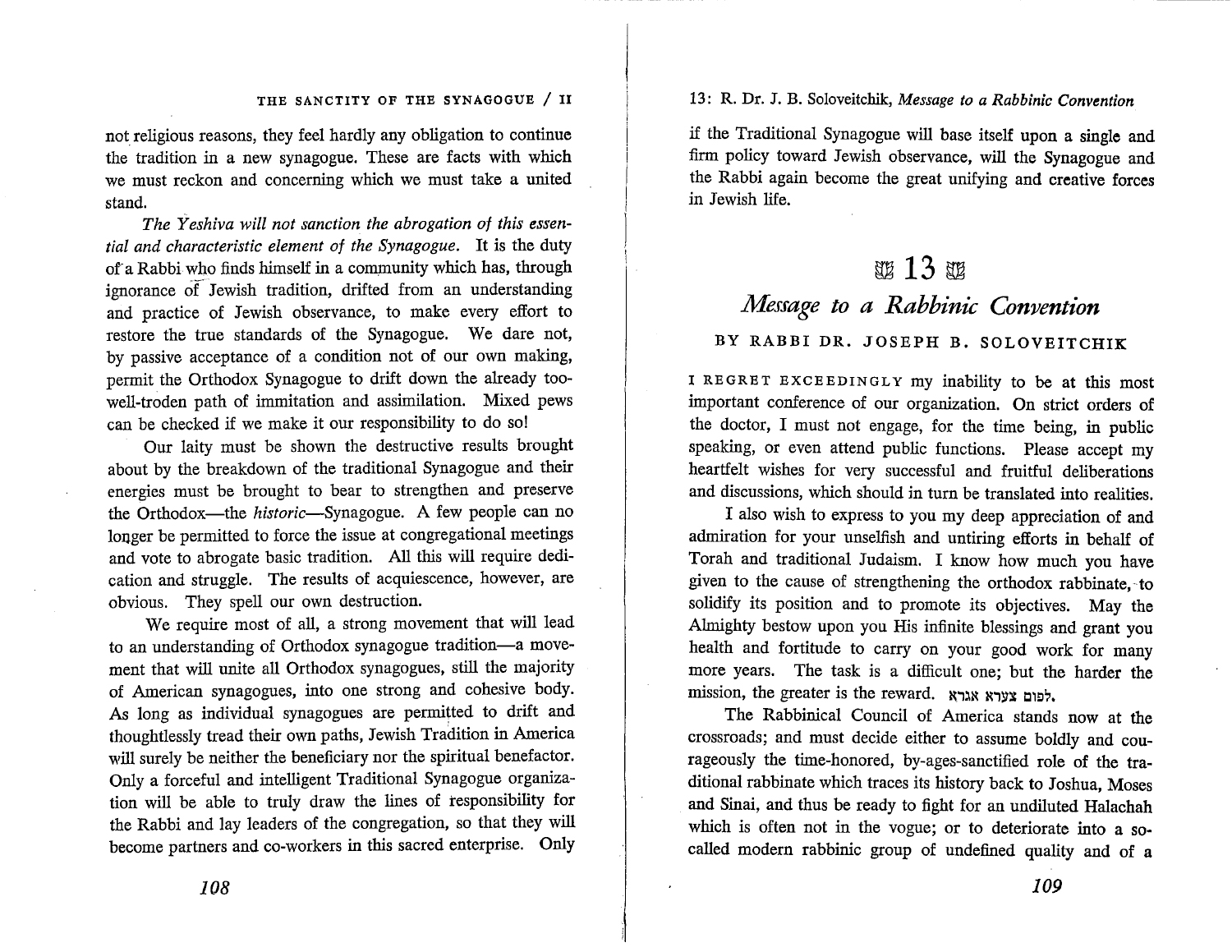
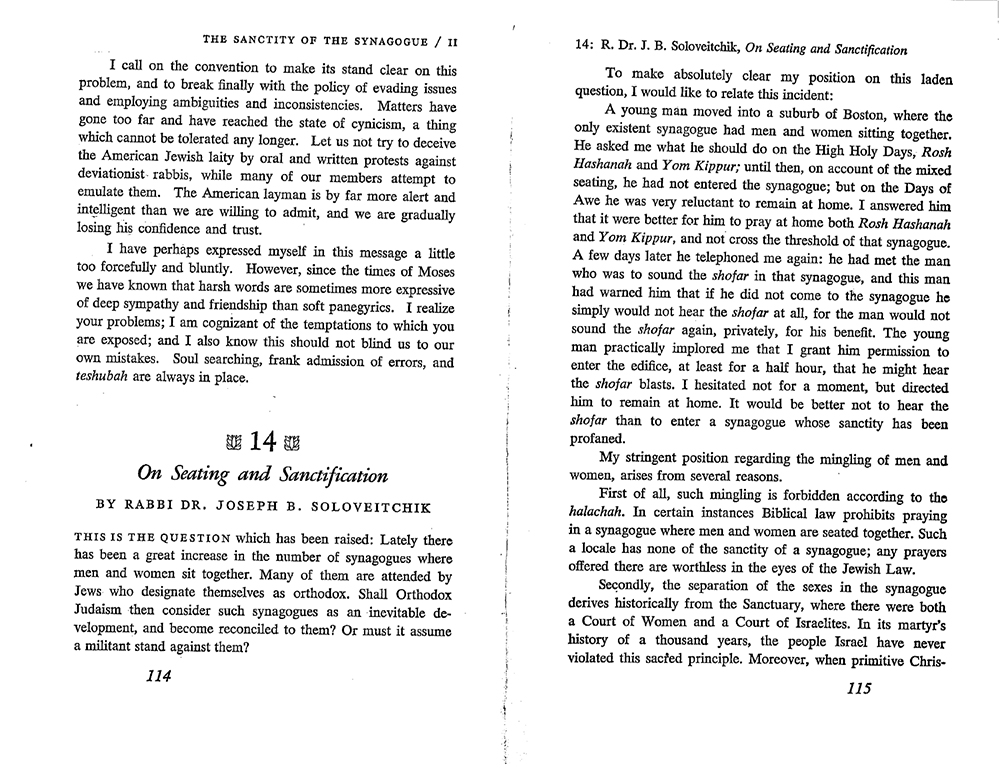
Li-Nevokhei ha-Dor begins (ch. 2) by arguing that it is the “obligation of the true sages of the generation” to follow in the path of the medieval greats who were always concerned about those suffering religious confusion. While the contemporary spiritual leaders must respond to the concerns of modern Jews, R. Kook points out that since the issues confronting people today are so different than those of the medieval period, the works of the rishonim are of only limited value in confronting the current problems.

In ch. 3 R. Kook states that the medieval approach of trying to “prove” religion will not work in our day, and that in place of this, religious leaders should stress justice and righteousness, i.e., the humane values of Judaism.[6] He recognizes that the real problem for modern Jews is not the scientific or philosophical challenges to Torah, but the ethical ones, and that Torah scholars must explain those concepts that appear to stand in contradiction to modern ethical values. He sees this task as just like what the medievals did in dealing with the physical descriptions of God in the Bible, which contradicted the philosophical notion that God has no form. These sages showed the way out of this problem and in the end the truth of the Torah was understood. R. Kook says that contemporary sages must do the same thing with regard to ethical challenges. If not, people will reject the Torah because they view its message as contradicting what they know to be ethical, that which R. Kook refers to as “the laws of natural morality” (חקי המוסר הטבעיים).
With this in mind, let me quote an amazing passage of R. Kook that I have referred to before. It appears in Shemonah Kevatzim 1:75 and the translation is by David Guttmann.[7]

Yir’at Shamayim—fear of heaven—may not supplant the natural sense of morality of a person, for in that case it is not a pure Yir’at Shamayim. The signpost for a pure Yir’at Shamayim is when the natural sense of morality (המוסר הטבעי) that is extant in the straightforward nature of man is improved and elevated by it more than it would have been without it. But if one were to imagine a kind of Yir’at Shamayim that without its input, life would tend to do well and bring to fruition things that benefit the community and the individual, and furthermore, under its influence less of those things would come to fruition, such a Yir’at Shamayim is wrong.

The upshot of this passage is that some (much?) of what passes for piety today is really nothing more than a corrupted religiosity.

This natural morality that R. Kook spoke of was not only in nature, but also in people. This led R. Kook to a unique understanding of the relationship between scholars and masses. Anyone who has studied in a yeshiva knows that it inculcates a certain amount of condescension for the masses. For what could the masses, the typical am ha-aretz, possibly have to offer the scholar? Yet R. Kook saw matters differently, and recognized that there was an element of natural Jewish morality in the masses that was no longer to be found among the scholars, and the scholars ignored this to their own detriment. And let us not forget that the masses that R. Kook was referring to were not like many of our masses who go to day school, yeshiva in Israel, and attend daf yomi before going to work. The East European Jewish masses never opened a Talmud after leaving heder. They were pious and recited Psalms and came to a shiur in Ein Yaakov or Mishnayot, but without having studied in yeshiva, and lacking an Artscroll, the Talmud was closed to them. Incidentally, the rabbis had no problem with this arrangement, unlike today when Talmud study has become a mass movement.

Had the masses in R. Kook’s day had any serious learning, then he couldn’t have said what he did, because his point is precisely that learning “spoils” some of the Jew’s natural morality. Here are R. Kook’s words in Shemonah Kevatzim 1:463:

האנשים הטבעיים שאינם מלומדים, יש להם יתרון בהרבה דברים על המלומדים, בזה שלא נתטשטש אצלם השכל הטבעי והמוסר העצמי על ידי השגיאות העולות מהלימודים, ועל ידי חלישות הכחות וההתקצפות הבאה על ידי העול הלימודי.
This is a an anti-intellectual passage, in which we see R. Kook favoring the natural morality and religiosity of the simple Jew over that of his learned co-religionist. (It was precisely this sort of sentiment that was expressed by Haym Soloveitchik at the end of “Rupture and Reconstruction.”) Can anyone be surprised that this passage was not published by R. Zvi Yehudah? He recognized all too well the implications of these words, which I am only touching on here.

R. Kook continues by saying that the masses need the guidance of the learned ones when it comes to the halakhic details of life. That we can understand, since the masses can’t be expected to know, say, the details of hilkhot Shabbat. But in a passage quite subversive to the intellectual elite’s self-image, R. Kook adds that the learned ones also have a lot to learn from the masses. In fact, if you compare what each side takes from the other, I don’t think there is any question that what the masses give the learned is more substantial than the reverse.
והמלומדים צריכים תמיד לסגל לעצמם כפי האפשרי להם את הכשרון הטבעי של עמי הארץ, בין בהשקפת החיים, בין בהכרת המוסר מצד טעביותו, ואז יתעלו הם בפיתוח שכלם יותר ויותר
In ch. 4 of Li-Nevokhei ha-Dor, R. Kook comes to evolution and here he speaks of the billions of years of history identified by modern science. He says that this is a problem for the קטני דעה who think that evolution is a rejection of God, but those who hold such a position are making a great error. The true believer will be led to even greater wonder at the ways of God when he sees how long it has taken for species to evolve. As for the Creation story, R. Kook begins ch. 5 by telling us that it is not to be understood literally, as Maimonides had already taught. Knowing that some might nevertheless be tied to a literal reading of the opening chapters of Genesis, R. Kook insists that this is not one of the principles of the Torah. (Until a few years ago this was not a principle in the haredi mind either.)
In ch. 5 we see R. Kook’s preference for the evolutionary scheme over the traditional story of creation at one time, and he sees this understanding as bringing us closer to God. Just as we are amazed by the growth of a baby inside the womb, so too we will be in awe at the development of the physical world. He is absolutely clear that the creation story is not a scientific description but is directed towards a moral end:
ויסוד הדבר, שלא דברה תורה כי אם במה שנוגע לכדור ארצינו, וגם זה רק לפי התוכן שיובן הצד המוסרי שנוגע להישרת דרכי האדם הליכותיו החיצוניות ורגשותיו הפנימיים יפה יפה
This is a strong rejection of the neo-fundamentalist hermeneutical acrobatics of people like Gerald Schroeder (and to a lesser extent Nathan Aviezer).[8] They start with the assumption that the Torah’s Creation story is indeed describing scientific reality, yet until they explained it, no one in history had understood the meaning of the verses. From R. Kook’s perspective, this is a great misinterpretation of what the Creation story is telling us. As for the “young earthers’” objection (which I admit to having never understood) that Shabbat depends on seven 24 hour days of creation, R. Kook disposes of that without much ado:
אין כל מניעה בזה לא מצד הכתובים, ולא מצד חובת קדושת השבת שמכוונת כפי הציור הפנימי של האדם
He continues by saying that other parts of the Creation story can also be explained in a non-literal fashion:
ואפילו אם נפרש עוד יותר על פי משל את הסידור של בריאת האדם, שימתו בגן עדן, קריאת השמות, בנין הצלע, אין דבר מתנגד ליסודי התורה . . . ואין קפידא אם נצייר הנחש כולו ציורי, וכן עץ הדעת על התגלות הנטיה לצאת ממצב המנוחה והתמימיות העדינה
Crucial for R. Kook’s understanding is that that there came a point in human development when man was able to recognize the Divine. Only then could he be described as created in the image of God.
Even before the recent publications, these thoughts of R. Kook were not unknown. Here is what he writes in Iggerot ha-Reiyah, no. 134:
אין לנו שום נפ”מ אם באמת היה בעולם המציאות תור של זהב [=גן עדן], שהתענג אז האדם על רב טובה גשמית ורוחנית, או שהוחלה המציאות שבפועל מלמטה למעלה מתחתית מדרגת ההויה עד רומה, וכך היא הולכת ומתעלה
The last part of this quotation refers to the evolutionary understanding, in that existence works its way “from the bottom up”.
Returning to Li-Nevokhei ha-Dor, ch. 5, as an example of how the allegory works, R. Kook refers to Eve being taken from Adam’s rib, which cannot be understood literally if we are dealing with an evolutionary scheme. He sees this as a vision, designed to show that family life can only succeed if both husband and wife join together. The wife cannot be a helpmate alone, but has to be joined with her husband. A surface read of this passage might lead one to think that according to R. Kook this “vision” was an actual event that occurred with the historical “first man”, which would means that this first man had a relationship with God. Yet from Shemonah Kevatzim 1:594, which is a parallel passage to the one in Li-Nevokhei ha-Dor, we see that this is not the case.
להשוות סיפור מעשה בראשית עם החקירות האחרונות הוא דבר נכבד. אין מעצור לפרש פרשת אלה תולדות השמים והארץ, שהיא מקפלת בקרבה עולמים של שנות מליונים, עד שבא אדם לידי קצת הכרה שהוא נבדל כבר מכל בעלי החיים, ועל ידי איזה חזיון נדמה לו שצריך הוא לקבע חיי משפחה בקביעות ואצילות רוח, על ידי יחוד אשה שתתקשר אליו יותר מאביו ואמו, בעלי המשפחה הטבעיים. התרדמה תוכל להיות חזיונית, וגם היא תקפל איזה תקופה, עד בישול הרעיון של עצם מעצמי ובשר מבשרי. והודיע הכתוב שקדושת המשפחה קדם להבושה הנימוסית בזמן, וכן במעלה, שאחר ההתעוררות מהתרדמה הוחלט דבר זאת הפעם, ומכל מקום היו שניהם ערומים ולא יתבוששו.
According to R. Kook’s portrayal of humanity’s development in the direction of a stable family unit, there is only one word to describe the story told in Gen. 2, and that is “myth.” While in the popular mind myth often is identical with fairy tale, this is not how scholars understand myths. For them, myths communicate cosmic truths in non-historical story form, and they are not synonymous with legends. My dictionary explains myth as “a usually traditional story of ostensibly historical events that serves to unfold part of the world view of a people or explain a practice, belief, or natural phenomenon.” This explanation is a perfect description of what R. Kook writes in the passage just quoted from Shemonah Kevatzim.
The problem is, where do you draw the line? Is it only the stories at the beginning of Genesis that can be interpreted in a non-historical fashion, or has the door been opened to other sections of the Torah as well? R. Kook already confronted this issue in one of his classic letters to his student, Moshe Seidel (Iggerot ha-Re’iyah, vol. 2, no. 478), whom he had encouraged to study Semitic languages.[9] R. Kook admitted that there was no clear dividing line, but that the Jewish people as a whole would come to a proper insight.
ואם אין כל יחיד יכול להציב גבול מדויק בין מה שהוא בדרך משל בתורה ובין מה שהוא ממשי – בא החוש הבהיר של האומה בכללה ומוצא לו את נתיבותיו לא בראיות בודדות כי אם בטביעות עין כללית.
Following this, R. Kook raises the issue of what to do if it can be proven that the Torah’s description of matters is not entirely accurate. Often when R. Kook spoke about these matters, he was referring to the Torah’s description of creation vs. what science tells us. Yet I don’t think that this is what he is referring to in this letter. To begin with, he doesn’t speak about issues of science here. He is talking generally about matters described in the Torah that conflict with research (hakirah). These would also include historical descriptions found in the Torah. We must remember that the letter is to Seidel, who was involved in academic Bible study and was struggling with this. I think it is pretty clear that his concern was not with science and creation but with the larger issue of what the Torah recorded vs. what the critical scholars were saying. (Unfortunately, I am informed that Seidel’s letter to R. Kook, which R. Kook is in turn responding to, is not found in the R. Kook archive.)
R. Kook tells Seidel that even if the Torah’s descriptions (“the commonly accepted description”) are not accurate, there must be an important and sacred purpose for these matters to have been presented in this way, rather than being described in an exact fashion. In order to show that this is a proper approach, R. Kook brings two amazing parallels. The first one is the law of yefat toar. In my earlier post dealing with developing morality, available here, I quoted R. Kook’s other recently published comments about yefat toar. Here is making a different point. He refers to the Talmud in Kiddushin 21b which states that this entire law is a concession to human passions, but it is not proper. The proper thing would be for a Jewish soldier never to do this, but since in the real world this sort of thing will happen, the Torah provides a context for it to be done in a more civilized manner.[10] The parallel R. Kook sees is that just like the morality described in the law of yefat toar is not perfect, but rather a concession to human weakness, so too descriptions of various things in the Torah need not be “perfect”, that is, historically accurate. There are times when for its own purposes the Torah needs to describe matters in ways that will accomplish certain goals, even if the descriptions are not “true,” i.e., historically true.
The next parallel he offers is Ex. 18:19, which describes Mt. Sinai at the time of the Revelation and states that “its smoke ascended like the smoke of the lime pit.” Rashi, based on the Mekhilta, comments that this reference to the smoke being like a lime pit was “to explain to the ear that which it can understand (לשבר את האזן).” In other words, it wasn’t really like a lime pit but this description is used to accomplish a larger goal. R. Kook develops this concept, and refers to this Rashi. Here is the passage in full:
ואם נמצא בתורה כמה דברים, שחושבים אחרים שהם לפי המפורסם מאז, שאינו מתאים עם החקירה של עכשו, הלא אין אנו יודעים כלל אם יש אמת מוחלטת בחקירה הזמנית, ואם יש בה אמת, ודאי יש גם מטרה חשובה וקדושה שלצרכה הוצרכו הדברים לבא בתיאור המפורסם ולא המדויק, כמו שהוא פשוט במושגים הרוחנים ובכמה יסודי מעשה, ש”דבר תורה כנגד יצה”ר” או “לשבר את האזן.”
Elsewhere, in Eder ha-Yekar, pp. 37-38, R. Kook explains that the Torah can describe events in a way not in accord with the astronomical or geological (i.e., historical) truth. This is done in order for the Torah to accomplish its goal, which is not focused on such matters but rather on
ידיעת האלהות והמוסר וענפיהם בחיים ובפועל, בחיי הפרט, האומה והעולם
In words very similar to those in his letter to Seidel, R. Kook writes there:
כבר מפורסם למדי שהנבואה לוקחת את המשלים להדרכה האנושית, לפי המפורסם אז בלשון בני אדם באותו זמן, לסבר את האוזן מה שהיא יכולה לשמוע בהוה, “ועת ומשפט ידע לב חכם”, וכדעת הרמב”ם וביאור הרש”ט במורה נבוכים סוף פרק ז’ משלישי, ופשטם של דברי הירושלמי שלהי תענית לענין קלקול חשבונות של תשעה בתמוז.
What R. Kook is saying here is that prophecy uses what is “widely accepted”, even if mistaken, as well as the forms of speech current among contemporary listeners.[11] With this conception, one can’t be disturbed if the Torah or other prophets describe matters not in accord with the facts as we know them today, because the immediate audience of the prophet did think that these were the facts. So, for example, the Torah does not describe a universe billions of years old because that was not part of the mental conception of the ancient Israelites. What is new in this passage is R. Kook’s reference to Maimonides and Shem Tov’s commentary.
He doesn’t explain what he has in mind when he refers to Maimonides, but by examining Shem Tov’s commentary to Guide 3:7, which R. Kook also refers to, all is revealed. Here Shem Tov is discussing Maimonides’ view of Ezekiel and a scientific error the prophet made. Shem Tov concludes his discussion with the following revealing words:
ידבר הנביא בענינים העיוניים במשפט החכם ולא ידבר בהם כמו נביא אם שאמרם הנביא
What this means is that when the prophet is speaking about philosophical or scientific matters, he is speaking from his own wisdom, not prophetic insight. Shem Tov’s point is that the prophet will assimilate his prophetic message to his own words, and the latter, based as they are on his own life experience and knowledge, could also contain error.
This is all based on what Maimonides himself writes in Guide 2:8. Here he explains that there is a dispute if the heavenly spheres emit sounds. The Sages believe they do, and Aristotle rejects this. Maimonides adopts Aristotle’s view and explains that the Sages were mistaken. In Guide 3:3 Maimonides identifies the wheels (ofanim) in Ezekiel’s vision with the spheres, and if you examine Ezekiel 1:24 and 10:5 you find that the prophet describes the wheels (=spheres) as producing sounds. The upshot of this is that according to Maimonides Ezekiel’s prophecy incorporated a mistaken scientific view, a view which he points out was later shared by the Sages of Israel. This explanation of Maimonides, quoted from Narboni, is recorded by Shem Tov in his commentary to Guide 3:7.[12] As mentioned, this is what R. Kook refers the reader to.
Ralbag, commentary to Gen. 15:4 and to Job, end of ch. 39, also refers to Maimonides’ view that the prophets could be in error about scientific matters. He refers in particular to Ezekiel’s scientific error, and expresses his agreement with Maimonides’ position. In his commentary to Job he explains:
ספר זה עם ספורו שאר הדברים הנעלמים להיות זה נעלם לאיוב כי בנבואה יבואו כמו אלו הענינים לפי המקבל . . . שכבר יגיע לנביא דבר כוזב בעת הנבואה, במה שאין לו מצד שהוא נביא מצד הדעות אשר לו בענינים ההם.
In other words, prophetic books might record mistaken ideas because that is what the prophet thought. Ralbag gives another example of this. In Gen. 15 Abraham was told to look at the sky and just as he could not count the stars of heaven so too his children will be so numerous. According to Ralbag, this is an example of a prophet receiving false information in accord with his mistaken conception. Since Abraham falsely believed that there are many stars, his prophecy contained this false conception, while in reality according to Ralbag there are actually a limited number of stars.
Ralbag further explains his view of the stars in Milhamot ha-Shem 5:1:52, which has not yet been published and is quoted from manuscript in the Birkat Moshe edition of Ralbag on Genesis, pp. 222-223. Here Ralbag rejects the view of those who thought that there were many unseen stars and asserts that the only stars are those that can be seen. (Maimonides, Guide 1:31, states that the number of the stars is unknown.) He mentions that others had assumed that there were unseen stars because otherwise the prophecy of Abraham would not make sense. If you look up at the stars there aren’t so many of them, and therefore, what type of promise is it that Abraham’s descendants will be as many as the stars?
Unlike in his commentary to Genesis, here Ralbag does not claim that Abraham’s prophecy was incorrect when it came to the number of stars. Instead, he states that the meaning of the verse is not that Abraham’s descendants will be so many that they can’t be counted. Rather, just like it is difficult to count the stars, so too it will be difficult to count the descendants of Abraham because they will be so many. His proof for this contention is Moses’ words to Israel, Deut 1:10: “The Lord your God hath multiplied you, and, behold, ye are this day as the stars of heaven for multitude.” Moses says this even though he had already counted the Children of Israel. Yet because they were so many that it was difficult to count them, he refers to them as “the stars of heaven”. According to Ralbag, this proves that the comparison with the stars does not mean “too many to count”, but only “difficult to count”.
Ralbag also cites a talmudic passage (Berakhot 32b) which speaks of an enormous number of stars (three hundred and sixty five thousand myriads). This contradicts his own view that the number of stars are quite limited. Yet Ralbag is not troubled and declares, in words that would get him banned today:
שבכמו אלו הדברים לא נרחיק שיהיו לקצת חכמינו אז דעות בלתי צודקות, כמו שיזכרו שחכמי ישראל היו אומרים שהגלגל קבוע ומזלות חוזרים ומה שדומה לזה.
In his commentary to Genesis 15:4 he writes:
לא יחוייב שיהיו אצל הנביא כל הדעות האמיתיות בענין סודות המציאות
Obviously, if you are prepared to say that great prophets such as Abraham and Ezekiel were wrong in scientific matters, it is only natural to assume the same thing when it comes to the Sages.
Of course, we know today how wrong Ralbag was. In fact, it is only in modern times that one can really appreciate Abraham’s prophecy. Later, in Gen. 22:17, he is told that his descendants will be as numerous as the sand and as the stars in the heaven. Centuries ago I think many people must have wondered about this verse. They could understand the promise that his descendants would be like the sand since the sand is so numerous it can’t be counted. Yet how is this comparable to the stars, since anyone can look up at the sky and see that there aren’t that many stars at all? Thus, pre-modern man should have been troubled since the two parts of the verse don’t correspond, even though they are supposed to. It is only with the invention of telescopes that people could see that the two parts of this verse, the sand and the stars, are really saying the same thing. Scientists now believe that the amount of stars runs into the sextillions and that there are more stars than grains of sand on the earth!

Returning to R. Kook’s letter to Seidel, he also refers to the end of Taanit in the Jerusalem Talmud. What is this about? According to Jeremiah 39:2 the Jerusalem city walls were breached on the ninth day of Tamuz. Yet JTaanit 4:5 states that this occurred on the seventeenth of Tamuz. How to make sense of this contradiction? The Jerusalem Talmud answers as follows:
קלקול חשבונות יש כאן

Korban Edah explains:
מרוב הצרות טעו בחשבונות ולא רצה המקרא לשנות ממה שסמכו הם לומר כביכול אנכי עמו בצרה
In other words, the book of Jeremiah records mistaken information, but that is because it chooses to reflect the mistaken view of the people, rather than record the accurate facts. As the final words of Korban Edah explain, there are more important considerations for the prophet than to be accurate in such matters. R. Kook sees the lesson of this talmudic passage as applicable to elsewhere in the Bible, namely, that absolute accuracy in its descriptions (both scientific and historical) is not vital and can therefore be sacrificed in order to inculcate the Bible’s higher truths. R. Kook does not tell us how far to take this principle, and no doubt he himself was not sure.[13] The only thing he could say was that these matters would be settled by, as mentioned already, החוש הבהיר של האומה
Another example of a biblical book containing incorrect information is found in Nehemiah 7:7, as explained by the medieval commentary attributed to Rashi. After noting that the numbers given in Nehemiah ch. 7 are not always the same as those mentioned in the book of Ezra, “Rashi” states:
ולא דקדק המקרא בחשבונות כל כך אבל הכלל שוה . . . ועל זה הכלל סמך כותב הספר ולא דקדק בחשבון הפרטיות כל כך.
What this means is that the author of the book of Nehemiah was not careful in the details he recorded, as long as the big picture—in this case, the total number of people—was correct. How many other places in the Bible can we apply this insight to?
The fourteenth-century R. Eleazar Ashkenazi ben Nathan ha-Bavli has an even more radical approach, as he believes that there are inaccuracies in the Torah itself.[14] It is true that at times he is quite conservative. For example, he rejects Ibn Ezra’s assumption that there are post-Mosaic elements verses in the Pentateuch.[15] He also strongly rejects the aggadah that the Land of Israel was not included in the Flood,[16] because the verse tells us that all life on earth was destroyed: ואין לחוש על דבר משמכחיש גופי התורה
Yet his more “liberal” side is seen many other places. For example, he assumes that the extremely long lifespans found at the beginning of Genesis are not to be taken literally (p. 29).
וימי חייהם אז היו כימי חיי אנשי דורנו לא פחות ולא יותר כי לא היו אז מזהירים כשמש ולא חזקים כנחושה, אבל היו מבשר ודם ומזרע אשה ומדם נדותה ככל אשר אנחנו עושים פה היום
If people never lived so long, why were these number included in the Torah? R. Eleazar claims that Maimonides’ approach is to regard the lengthy lifespans as simple figures of speech, not meant to be taken literally any more than the statement that the Land of Israel was flowing with milk and honey or that the cities in Canaan were “fortified up to Heaven” (Deut. 1:28).[17]

He also offers another explanation for the lengthy lifespans, namely, that the Torah recorded what the popular belief was, no matter how exaggerated, and Moses was not concerned about these sorts of things. In other words, just like today people say that the Torah is not interested in a scientific presentation of how the world was created, R. Eleazar’s position is that the Torah is not interested in a historically accurate presentation. In his mind, this has nothing to do with the Torah’s goals, and therefore there was no reason for the Torah not to present matters as they were believed at the time, even if these perceptions were inaccurate. The important thing, he says, is that the people would know that from the creation of the world until Israel stood at Sinai was close to three thousand years. This would help solidify belief in creation. The records of lifespans are just a means to illustrate this information.[18] He adds that when it came to events closer to Moses’ time, Moses was careful in preserving a more accurate accounting, while leaving the stories of the distant past cloaked in legend.
There are other ways rationalists have dealt with the lengthy lifespans. For example, R. Nissim of Marseilles regards these years not as indicating an individual life, but rather the “lifespan” of the way of life (i.e., laws, customs) instituted by the figure in question, or the time until another one like him arose. He also assumes that when the Torah says that someone bore a son, it doesn’t have to mean a literal son. Here is what he writes in Maaseh Nissim, p. 274:
יש מי שפירש שהכונה בחיים ההם קיום נמוסיו והנהגותיו הזמן [בזמן] הנזכר, בין בחייו בין אחר מותו. כי אלו, אפשר שהיו אנשי שם, מחקים חוקים ונימוסים, ומנהגים במידותיהם, גם במאכלם ומשתיהם ובמלבושיהם, ואחר הזמן ההוא אפשר שנשתכח הכל ובחרו דרך אחרת. או תאמר, שלא קם כמוהו עד זה הסך מן השנים במעלת ידיעת ההנהגה לבני דורו. ובזמן ההוא קם כמוהו במעלה, נמשך לדעתו וכונתו, ונחה רוחו עליו כאשר נחה רוח אליהו על אלישע. ואם לא ראה הראשון זה שקם אחריו ולא היה בזמנו, אפשר למד מספריו או התבונן בדבריו המקובלים, ועל זה כתוב: “ויולד” שהוליד בדמותו במעלה, כאלו הוא הוליד האיש ההוא מאשר הוא בעל הדעת ההוא שלמדוהו.
In support of this approach, he refers to Va-Yikra Rabbah 21:9 which cites an opinion that Scripture intimated to Aaron that he would live 410 years. Although the Torah tells us that he only lived to 123 (Num. 33:39), the Midrash says that the righteous High Priests in the First Temple are called by Aaron’s name. In other words, they represent the spirit of Aaron, so in that sense it can be said that he lived so many hundreds of years. So too, R. Nissim thinks, when Scripture speaks of other people living so many hundreds of years it is to be understood in this fashion.
Another approach was suggested by R. Moses Ibn Tibbon, who is quoted by R. Levi ben Hayyim.[19] According to Ibn Tibbon, the years given for people’s lives are actually the years of the dynasties they established.[20] (His other suggestion is the same as that of R. Nissim, mentioned above.):
והחכם ר’ משה פירש, כי כל אחד מאלו היה מלך או הניח נימוס, וכל זמן התמדת מלכותו ומלכות זרעו, או כל ימי המשכות נימוסו, קרא דור אחד, כאלו היה המלך או מניח הנימוס חי, וטעם “ויולד בנים ובנות” כי לאורך הזמן רבו ועצמו בני מלכותו או אנשי דתו, ושלחו קצתם אל ארץ אחרת.
R. Levi ben Hayyim offers basically the same approach (p. 326):
ונראה לי כי הדורות הנזכרים היו ראשי אבות, וזרע כל אחד נקרא בשמו כפי מספר השנים ההם. כי כל אחד, כמו שנאמר, הוליד בנים ובנות, כמו שנראה היום, עד שנשקע השם מהדורות הבאים אחריו, וקח מאתו זרע איש אחד מפורסם, וקראו בני זרעו ומשפחתו על שמו זמן מה, וכן התמיד עד שנתחדש דור אחר, נקרא [!] בניו ובני בניו על שמו [צ”ל שם] חדש. והורה ספור הדורות ההם מאדם ועד זמן משה על חדוש העולם.
To be continued
* * *
The new semester of Torah in Motion has just begun. The first figure I am dealing with is R. Elijah Benamozegh. You can sign up to participate in the classes here.
You can also sign up for the classes of Moshe Shoshan, Abe Katz, R. Daniel Feldman, and William Gewirtz. Dr. Gewirtz, who has published on the Seforim blog, will be giving three FREE special classes dealing with various aspects of time in Jewish law. This is a topic that few have been able to master and the classes promise to be a treat.
Even if you can’t watch the classes live, videos and audio are sent to you so that you can watch or listen at your convenience.

Also from Torah in Motion, information will soon be coming about the July trip to Central Europe that I will be leading.
[1] For the proper explanation of the etymology of Marheshvan, see Ari Zivotfsky’s article in Jewish Action, Fall 2000, available here. See also Abraham Epstein, Mi-Kadmoniyot ha-Yehudim (Vienna, 1887), pp. 23ff. Zivotofsky does not offer any sources for the mistaken etymology that Heshvan is bitter (mar) because it has no holidays in it. I don’t know the first appearance of this notion, but it already is found in R. David Meldola, Moed David (Amsterdam, 1740), p. 64a.
[2] Among rishonim, Ibn Caspi had already stated that Adam was not the first man. See Matzref ha-Kesef, pp. 16-17 (contained in Mishneh Kesef, vol. 2). In order to understand what Ibn Caspi is saying in this passage, one needs to be attuned to his elusive style. See also his commentary to Guide 1:14, where he understands Maimonides to be saying that the Adam of Genesis is really referring to Moses.
[3] Rishonim already proposed that the word האדם in Gen. ch. 2 refers to humanity, rather than an individual person. See e.g., Ibn Ezra to Gen. 2:8, who states that this interpretation is a secret, i.e., not designed for the masses. See also his commentary to Ex. 3:15. R. David Kimhi also felt that this “truth” should be kept from the masses, who should instead be taught a different “truth”, namely, the Adam and Eve story in a literal fashion. See his esoteric commentary to Genesis, printed in Louis Finkelstein, ed., The Commentary of David Kimhi on Isaiah (New York, 1926), p. LIV:

עתה אשוב לפרש הנסתר אשר מפסוק וייצר ה’ א-להים את האדם (בראשית ב, ז) עד זה ספר תולדות אדם (בראשית ה, א) ותחלה אומר כי האדם הנזכר מפסוק זה עד זה ספר תולדות אדם הנגלה הוא על אדם הראשון והנסתר הוא על שם המין ושניהם אמת אך הנגלה הוא להמון והנסתר הוא ליחידים שהם סגולת ההמון.

Here is how he understands the Garden of Eden (ibid.):

עדן הוא משל לשכל הפועל הוא העדן האמתי הרוחני והא-ל נטע בו גן מקדם בראש בריותיו כשברא השכלים הנבדלים.
[4] You can find the book here
[5] See Eitam Henkin’s post here. For another post by Henkin on this book, see here. English readers are probably unaware of Henkin, the son of R. Yehudah Herzl Henkin. In the last few years he has really created a reputation for himself as he has authored a number of important articles which show an incredible amount of knowledge on the history of Torah Judaism in modern times. He has also written a sefer, soon to be published, which deals with the halakhot of bugs in food. Unlike the rage today, he rejects the extreme positions, one of which is that due to bug infestation, strawberries are no longer permitted to be eaten. See e.g., here. Henkin’s book will carry the following haskamah of R. Meir Mazuz.

[6] R. Jehiel Jacob Weinberg would later argue against trying to “prove” Judaism in the medieval fashion. In the post-Hume and post-Kantian world I thought that this was pretty much agreed upon by everyone. How wrong I was can be attested to all who attended my lecture on Maimonides at the 2008 New York Limmud conference and recall the dispute that took place afterwards. An individual who is involved in kiruv adamantly insisted that the major doctrines of Judaism can be proven to the same degree of certainty as a mathematical proof, and that these truths can thus be proven to non-Jews (who if they don’t accept the proofs are being intellectually dishonest). In this conception, there is no longer room for “belief” or “faith”; since the religion has been “proven” we can only speak of “knowledge”. The notion that Judaism could not be proven in this fashion was, I think, regarded by him as akin to heresy. I have had a lot of contact with “kiruv professionals” and had never come across such an approach. Yes, I know that people speak about the Kuzari proof for the giving of the Torah. However, I always understood this to be more in the way of a strong argument rather that an absolute proof, with the upshot of the latter being that one who denies the proof is regarded as intellectually dishonest or as a slave to his passions. I also know R. Elchanan Wasserman’s strong argument in favor of the viewpoint expressed by my interlocutor (see Kovetz Ma’amarim ve-Iggerot, pp. 1ff.), but before then had never actually found anyone who advocated this position, lock, stock and barrel. So the question to my learned readers is, is there a kiruv “school” today which does outreach based on the “Judaism can be proven” perspective?
[7] See here.
[8] In his latest book, God According to God, Schroeder—who according to his website teaches at Aish ha-Torah— “goes off the haredi reservation” in a much more serious way than Slifkin. Here is how his website describes the book: “In God According to God, Schroeder presents a compelling case for the true God, a dynamic God who is still learning how to relate to creation.” See here. I daresay that one would be hard-pressed to find even a Modern Orthodox rabbi who would not regard this view of an imperfect God as a heretical position.

In a future installment I will deal with Aviezer who unlike Schroeder, has real Judaic learning. Unfortunately, despite his scientific expertise, Schroeder makes numerous errors when he deals with the Jewish side of things. From what I see on the internet, it appears that a majority of his readers are non-Jewish, so these errors will not be noticed by them. Yet they are bound to be annoying to educated Jewish readers. Let me give just a few examples from his new book, God According to God.

P. 11: “The Hebrew word for ‘slave’ is ‘worker’ with all the connotations that differentiate the modern concept of slave from that of a worker.” He then apologetically describes the laws of slavery without distinguishing between the Hebrew slave and the Canaanite slave, and apparently without realizing that the latter was indeed a real slave. See Shulhan Arukh, Yoreh Deah 158:1, where R. Moses Isserles writes:


מותר היה לנסות רפואה בעבד כנעני אם תועיל
P. 11: “Returning an escaped slave to the master was absolutely forbidden (Deut. 23:15-16).” Yet we are not Karaites and a glance at Rashi will show that this is not as “liberal” a law as he makes it out to be.

P. 22: [T]he ancient biblical commentators, those whose writings predate by many centuries the discoveries of modern science (writers of the Talmud, ca. 400; Rashi, ca. 1090; Maimonides, ca. 1190; Nahmanides, ca. 1250), learned from the detailed wording of Genesis that the universe is young and old simultaneously. These ancient commentators actually discuss what science has only recently discovered, that the flow of time is flexible.”

P. 23: “Moses Maimondes refers to a madah teva, the science of nature.”

P. 195: “The [biblical] Hebrew word le’olam has three root meanings: “forever,” “hidden” and “in the universe”.

Nothing I have said should be taken to imply that Schroeder does not have what to offer. However, before he publishes anything it should be reviewed by a Torah scholar, much as I would expect a talmid chacham writing on science to have his writing reviewed by a professional scientist.
[9] See Iggerot la-Re’iyah, vol. 1, no. 108. Seidel would later teach at Yeshiva College where some of the Roshei Yeshiva were upset with his views. See Ari Shvat, “Hahlatato shel ha-Rav Kook le-Tzamtzem et Hazono le-Limud Mehkari-Madai bi-Yeshivat Merkaz ha-Rav,” Talelei Orot 15 (2009), pp. 149-174.
[10] In a recent issue of Iturei Yerushalayim (Sivan 5769, pp. 9-10), R. Shlomo Aviner responds to a soldier who in all seriousness wanted to apply the law of yefat toar today with regard to Palestinian women. The soldier had in mind the understanding that rape of a yefat toar is permitted during battle.
Complete details can be found in the Encyclopedia Talmudit entry for yefat toar. There is a lot in this entry which will distress any reader, and according to the Sages, that is the way people should feel, for the entire law was a concession to human weakness. That is, it was a necessary evil, not something that people should strive for or feel proud of. This is how the entry in the Encylopedia Talmudit begins:

היוצא למלחמה וראה בשביה אשה נכרית וחשק בה, מותר לו לבא עליה – על כרחה.

In other words, it is permitted to rape a captive woman, and it was based on this understanding that R. Aviner was asked the question. Yet it is probably also the case that this view is not held by all. I say this since the Encyclopedia Talmudit entry itself records that there are those who require the woman to be converted before sex, and there are also those who state that the woman cannot be converted against her will. Although I haven’t compared all the positions, it is likely that there is some overlap here, i.e., authorities who require the woman to be converted and also hold that the conversion has to be an act of her free will.

Yet it is also the case that plenty of authorities do permit rape of a yefat toar (including a married woman), either on the battlefield or later. In his commentary to Gen. 34:1, Nahmanides writes:

כל ביאה באונסה תקרא ענוי, וכן לא תתעמר בה תחת אשר עניתה.

I have no doubt that today, when everyone would be horrified by this behavior, and it is forbidden in all civilized societies (and even uncivilized ones), such an action would not be permitted even as a concession to human weakness. I can’t imagine that anyone in our day would condone rape, no matter what the circumstances, and certainly no one would defend the following opinion quoted in the Encyclopedia Talmudit:

היתה השבויה קטנה, כתבו אחרונים שביאה ראשונה – לסוברים שהיא לפני גירות – מותרת אף בקטנותה.

From R. Aviner’s reply we see that he doesn’t believe that the yefat toar law has any applicability today:

בוודאי שאין דין יפת תואר נוהג בימינו, ואני תמה על השאלה הזאת שהנך שואל למעשה, שכידוע לא דיברה תורה אלא כנגד יצר הרע, והרי אדם צריך להלחם ביצר הרע ולא לחפש היתרים ליצר הרע. וכבר כתב רבי יהודה החסיד בספר חסידים [סי’ שעח] שיש דברים שהתורה התירה אבל אם יעשה אותם האדם הוא יבוא לדין עליהם שהרי התורה רק התירה בגלל יצר הרע. ואם אדם נותן שחרור ליצר הרע, הוא ייתן את הדין . . . לגופו של עניין, כל הדין הזה הוא בשביה, ולא שאדם ילך לבתים של אויבים ויעשה שם נבלות, והרי נשים אינן שבויות צה”ל, וגם אם יש שבויה, בוודא שצה”ל לא ירשה כזו נבלה . . . בסיכום, זה לא שייך כלל וכלל. הרחק ממחשבות אלו, אלא אדרבה למד הרבה בספר מסילת ישרים.

In this, R. Aviner is following the approach of R. Kook who speaks of the need to rise above the law of yefat toar. In my previous post dealing with developing morality, referred to in the text, I quoted R. Kook as follows:

כל לב יבין על נקלה כי רק לאומה שלא באה לתכלית חינוך האנושי, או יחידים מהם, יהיה הכרח לדבר כנגד יצר הרע ע”י לקיחת יפת תואר בשביה באופן המדובר. ומזה נלמד שכשם שעלינו להתרומם מדין יפת תואר, כן נזכה להתרומם מעיקר החינוך של מלחמת רשות.

Note that R. Kook speaks of תכלית חינוך האנושי and not Torah education.

We have recently seen the publication of Torat ha-Melekh (which I will discuss in a future installment of this post). When I told a friend about the question of the soldier to R. Aviner, he commented, only half-jokingly, that we will probably soon see a book on how Israeli soldiers can institute the law of yefat toar in modern times.

Finally, I would be remiss in not mentioning that R. Meir Simhah of Dvinsk basically turns the entire law of yefat toar into something completely theoretical, much like ben sorer u-moreh. I say this because R. Meir Simhah assumes that the law is not applicable in a war where the enemy could be holding Jewish prisoners, which in the real world is always the case. Here are his words in Meshekh Hokhmah, Deut. 21:10:

נראה דהוא תנאי בהיתר יפת תואר, שדוקא אם ה’ נותן האויב ביד ישראל. אבל כדרך המלחמות שאלו שובים מהם, והאויב שובה מהם, והדרך כשעושים שלום או בתוך המלחמה, מחליפים שבויים שאינם ניאותים עוד למלחמה. אם כן יתכן כי עבור היפת תואר שמגיירה ונושאה לאשה בעל כרחה, יעכבו ישראל חשוב ונכבד, על זה לא הותר היפת תואר.

[11] The exact same point is made by the Gaon R. Shlomo Fisher, Beit Yishai (Jerusalem, 2004), p. 361:
. . . העיקר גדול שהשרישו לנו הקדמונים שדברה תורה כלשון בני אדם. והכונה היא לאותו לשון שדברו בו בני אדם באותו הדור שבו נאמרו הדברים.

Fisher uses this insight to explain Zechariah 4:10: שבעת אלה עיני ה’ המה משוטטים בכל הארץ

According to Fisher—and this is an incredible insight for a traditional interpreter (although it is already noted in the International Critical Commentary)— this verse alludes to the שבעה כוכבי לכת. These are the seven heavenly bodies identified already by ancient Babylonian astronomers: Mercury, Venus, Mars, Jupiter, Saturn, moon, and sun. Yet with the invention of the telescope we now know that there are more planets, meaning that Zechariah’s prophecy was based on a scientific error. But as Fisher explains, this is not a problem because as mentioned, prophecy is given in accord with the knowledge of the generation. Fisher adds that prophecy is also given in accord with the knowledge of the prophet, which in this case as with Ezekiel was based on a scientific error.
כי הנבואה תבא לו לנביא לפי תמונת העולם שבלבו

As an aside, I wonder why no one has tried to put Fisher’s book under a ban. While Slifkin stated that the Sages didn’t know everything about science, Fisher goes further and says that even the prophets didn’t know it all. He adopts the same approach to explain why classic Kabbalistic texts are based on outmoded scientific assumptions:

שחכמת הקבלה מיוסדת על תמונת העולם וחוקי הטבע שלפי חכמי יון, כגון, מציאות הגלגלים, ז’ כוכבי לכת, וד’ יסודות, וחומר וצורה. וההנחה שכל דבר נמשך למקורו.

Since I deal with R. Eleazar Ashkenazi ben Nathan ha-Bavli in this post, it is worth calling attention to his original understanding of the word שבועה. He sees it as related to the word seven, meaning that one who breaks an oath sins against God who controls the seven heavenly spheres. See Tzafnat Paneah, ed. Rappaport (Johannesburg, 1965), p. 69 (I think he means the seven spheres each of which contains a heavenly body, as opposed to the eighth sphere which contains the so-called כוכבי שבת, or fixed stars):

כי שם נשבעו בשבועת האלה. כי מי שיעבור על הברית ירבצו בו אלות מכח השבעה הגלגלים וזה סוד שם שבועה כי חלל שם ה’ המנהיג השבעה הגלגלים.
[12] Fisher, Beit Yishai, p. 361, accepts this interpretation of Maimonides. Ibn Caspi, Commentary to Guide 2:8, does not believe that Ezekiel’s actual prophecy could contain error. Rather, the error came during a dream of Ezekiel, not an actual prophecy. He also distinguishes between Sages who can err, as they are using their wisdom, and prophets who during actual prophecy do not err. However, when they are not prophesying they are susceptible to error like anyone else.
[13] Shalom Carmy took note of R. Kook’s comments and raised the following questions, without offering any answers:
It seems obvious that Rabbi Kook doesn’t advocate wholesale rejection of biblical statements. To do so would render Tanakh useless as a source of history. Under what circumstances would he countenance “deconstruction” of the text? Only where biblical texts contradict each other or rabbinic statements? Whenever the text appears to contradict well-attested Near Eastern documents? When the exact historicity is immaterial in the judgment of the exegete, to the import of the text? When the exegete detects rhetorical elements in the biblical text itself that point toward such interpretation?
See “A Room With a View, but a Room of Our Own,” in idem, ed., Modern Scholarship in the Study of Torah (Northvale, 1996), pp. 23-24.
[14] As Epstein, Mi-Kadmoniyot ha-Yehudim, pp. 125ff., has shown, Abarbanel used R. Eleazar’s commentary, even though he does not mention him by name (a characteristic that Abarbanel shows at other times as well).
[15] Tzafnat Paneah, p. 46.
[16] Ibid., p. 36. I think one can call this a conservative position with regard to biblical interpretation, but the language he uses to reject the aggadic view, הבל הוא, is quite provocative.
[17] In Guide 2:47 Maimonides says that the people mentioned in the Bible who lived so long were exceptional in this respect, either because of their diet, mode of living, or due to a miracle. R. Eleazar obviously does not see this as reflecting Maimonides’ true view.
[18] He writes (p. 30):

ואל תתמה על זה ואל יקל בעיניך זאת התחבולה הנכבדת שנתכוון אליה כדי לאמץ האמנת החדוש . . . ולזה הוצרך ע”ה לספר לנו חשבון השנים שעברו מזמן חדוש העולם עד זמננו, וזה היה עיקר גדול וצורך נפלא.
[19] Livyat Hen, ed. Kreisel (Beer Sheva, 2004), pp. 324ff. Here is the place to congratulate Howard Kreisel on the publication of the two volumes of Livyat Hen as well as R. Nissim of Marseilles’ Maaseh Nissim. As long as people study Jewish philosophy, they will use these editions. R. Joseph Kafih spent the last night of his life studying Ma’aseh Nissim. See Avivit Levi, Holekh Tamim (n.p., 2003), p. 226.
[20] R. Eleazar Ashkenazi, Tzafnat Paneah, p. 29, cites this approach in the name of Ibn Ezra, but he does not tell us where it is to be found in Ibn Ezra’s Torah commentary or other works.
אבל המשמע מדברי החכם ראב”ע ז”ל שהזקנים היו ראשי האבות לא שחיו המה כל כך.


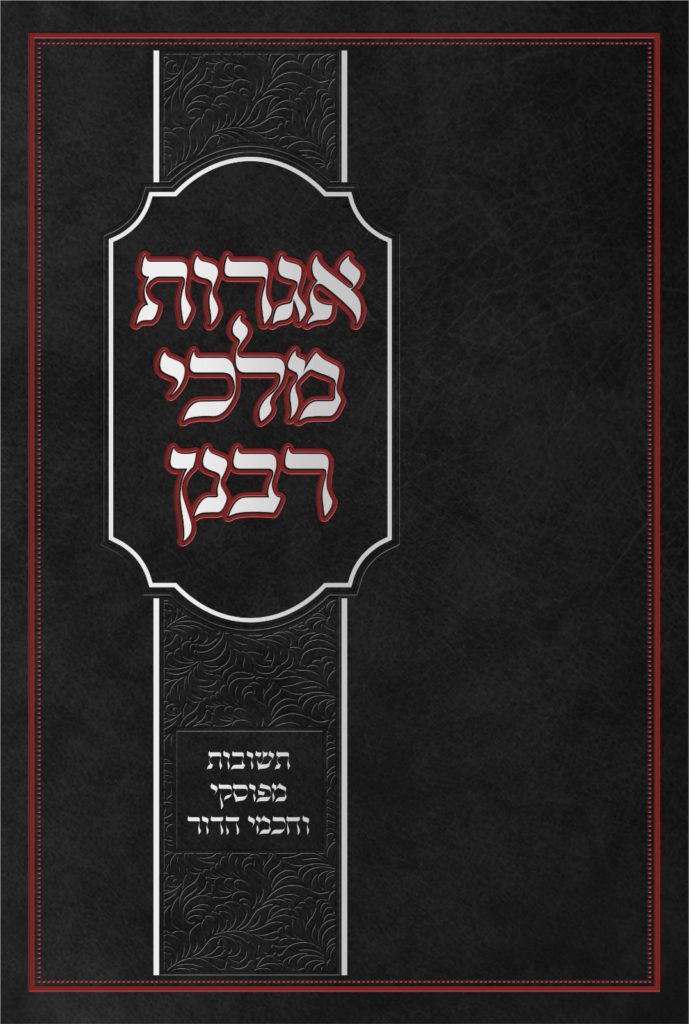
Antoninus, R. Moses Kunitz, and Iggerot Malkhei Rabbanan

Antoninus, R. Moses Kunitz, and Iggerot Malkhei Rabbanan [1]

Marc B. Shapiro

Continued from here

Returning to our discussion of Antoninus, we now come to a figure we have often dealt with in previous posts, R. Moses Kunitz, who for some reason has become much more controversial in recent years than he was during his lifetime.

In his biography of R. Judah ha-Nasi, found at the beginning of the Vilna Mishnayot, R. Kunitz writes as follows:

(ומערה היתה פתוחה לפני בית רבי בעיר טבריא שהיתה גדולה מאד והגיע עד בית מלך בעיר רומי כמאמרם (עבודת כוכבים י ב

Kunitz tells us that there was a cave near R. Judah’s house that led to a tunnel that was very long and connected Tiberas with the house of the king in Rome, as the Talmud states in Avodah Zarah10b.

Yet contrary to what R. Kunitz states, Avodah Zarah 10b does not say anything about a magic tunnel. It states as follows: “Antoninus had a cave which led from his house to the house of Rabbi.”  This must mean that Antoninus (who has not been identified with any certainty) had a house in the land of Israel in the vicinity of R. Judah’s house.[2]

Before looking at where R. Kunitz would have got his story about the magic tunnel, I must note that this very passage of R. Kunitz was the focus of an attack on him in Yated Ne’eman by Reuven Elitzur.[3] Elitzur’s article is titled צלם בהיכל, which gives you an idea of how strong his article is going to be.

Elitzur begins by mocking R. Kunitz’s statement that there was a tunnel going from Tiberias to Rome, which is much longer than even the longest tunnel in the world today. He adds that those who know the passage in Avodah Zarah referred to by R. Kunitz will be even more astounded. Not only does it not say anything about a tunnel to Rome, but it also speaks of Antoninus often visiting R. Judah, which according to R. Kunitz would mean that he went back and from Rome to Tiberias. Elitzur mocks R. Kunitz by adding: “this was, of course, through the miracle of ‘kefitzat ha-derekh’.”

Elitzur seems convinced that no one could be so stupid as to suggest that Antoninus had access to a magic tunnel. So where does that leave R. Kunitz who, it needs hardly be said, was not stupid at all? Elitzur explains that Kunitz’s entire point must have been to mock the Talmud. Whereas the Talmud does not say anything about Antoninus being in Rome, R. Kunitz adds this and then explains about the magic tunnel. Any normal reader seeing that the Sages believed that Antoninus had a magic tunnel will be led to mock them, which according to Elitzur was exactly R. Kunitz’s point, namely, to undermine the authoritativeness of the Talmud. As Elitzur puts it, readers of Kunitz’s essay, who do not know that the Talmud mentions nothing about a tunnel from Rome to Tiberias, will ask, “Is it possible to believe the words of those who are capable of writing such an absurd thing?”

Elitzur’s attack on R. Kunitz, which has a good deal more than this one point, paid off for him. Following the appearance of his essay in Yated Ne’eman, R. Nissim Karelitz ruled that R. Kunitz’s biography of R. Judah ha-Nasi should be removed from new printings of the Mishnayot, as he was not a faithful Jew.[4] Today, I do not think that any new printings include R. Kunitz’s essay.

Let me leave aside for now Elitzur’s general ignorance of the history of R. Kunitz and his relationship with the rabbinic world .[5] Instead, I wish to focus on the magic tunnel which Elitzur uses to defame R. Kunitz.

Moses Alshekh writes as follows in his commentary to Song of Songs 7:6:[6]

הנה זה יובן במאמר רבותינו ז”ל (עבודה זרה י ב) כי מערה אחת היתה בין צפורי שהיה בו רבי, לרומי שהיה דר בו אנטונינוס

Similar to R. Kunitz, R. Alshekh writes that Avodah Zarah 10b states that there was a tunnel between Sepphoris and Rome. As has already been mentioned, the Talmud says nothing of the sort. It does not mention Rome, or Sepphoris for that matter.

Following up on his mistaken statement that the Talmud in Avodah Zarah 10b refers to רומי, R. Alshekh notes the problem of the great distance between Rome and the Land of Israel and states that the Talmud is referring to the Galilean town Ruma, a place mentioned already by Josephus.[7] R. Alshekh also makes the interesting suggestion that when the Talmud[8] speaks of the Messiah sitting at the gate of רומי, it does not refer to Rome, as we are accumstomed to think, but to the Galilean town Ruma.

It seems that R. Kunitz made the unwarranted assumption that when the Talmud speaks of Antoninus’ house it had in mind his palace in Rome. R. Alshekh, however, mistakenly remembered the Talmud as actually using the word רומי, and this led to his suggestion that it must be referring to another place called רומי in the Land of Israel.

What about R. Kunitz’s suggestion of a magic tunnel? I have to say that Elitzur’s notion that R. Kunitz was trying to undermine respect for the Sages is ridiculous. It is obvious that by suggesting what he did, R. Kunitz showed a lack of sophistication, even for the nineteenth century. Indeed, anyone who examines R. Kunitz’s books will see a similar lack of sophistication throughout.

In describing R. Kunitz’s Ben Yohai, his most famous work, J. H. Chajes writes that it contains Kunitz’s “characteristic virtuosity, learned and dialectical, and an undeniable absurdity that did not escape the notice of scholars whose conservative inclinations should have made them natural allies.”[9] I would only add that people often forget that something that sounds crazy today could have sounded much more plausible in previous generations. While it is true that even in previous generations this particular suggestion of R. Kunitz was never taken seriously, it is a far distance from such rejection to conclude that he was trying to destroy the Sages’ reputation. Anyone who bothers to read his works will immediately see how wrong this conclusion is.

Information about R. Kunitz and his relationship to the rabbinic world, is found in the book I just published, Iggerot Malkhei Rabbanan.

This work contains more than thirty years of rabbinic correspondence sent to me by some of the most outstanding Torah scholars. It is currently for sale at both Biegeleisen and Mizrahi Books. The latter store is selling the book online here where you can also view the table of contents (or click here for a version which might be more clear). The book should also be available in Israel soon. Anyone in Israel who would like to acquire a copy should email me.

___________

[1] I had hoped that when Iggerot Malkhei Rabbanan appeared that I would have my regular size post ready. Unfortunately, this was not the case, but I did not wish to postpone the announcement of the new book so I figured that this “mini-post” would have to do.

[2] See Tosafot, Megillah 5b s.v. ve-ha:

נראה שהיה בטבריה בימי אנטונינוס כשהיו יחד

[3] Yated Neeman, parashat Shemot, 5757 (Musaf Shabbat Kodesh). The article is reprinted in Degel Mahaneh Reuven (Bnei Brak, 2011), pp. 350ff.

[4] R. Karelitz’s letter is printed in Degel Mahaneh Reuven, p. 356.

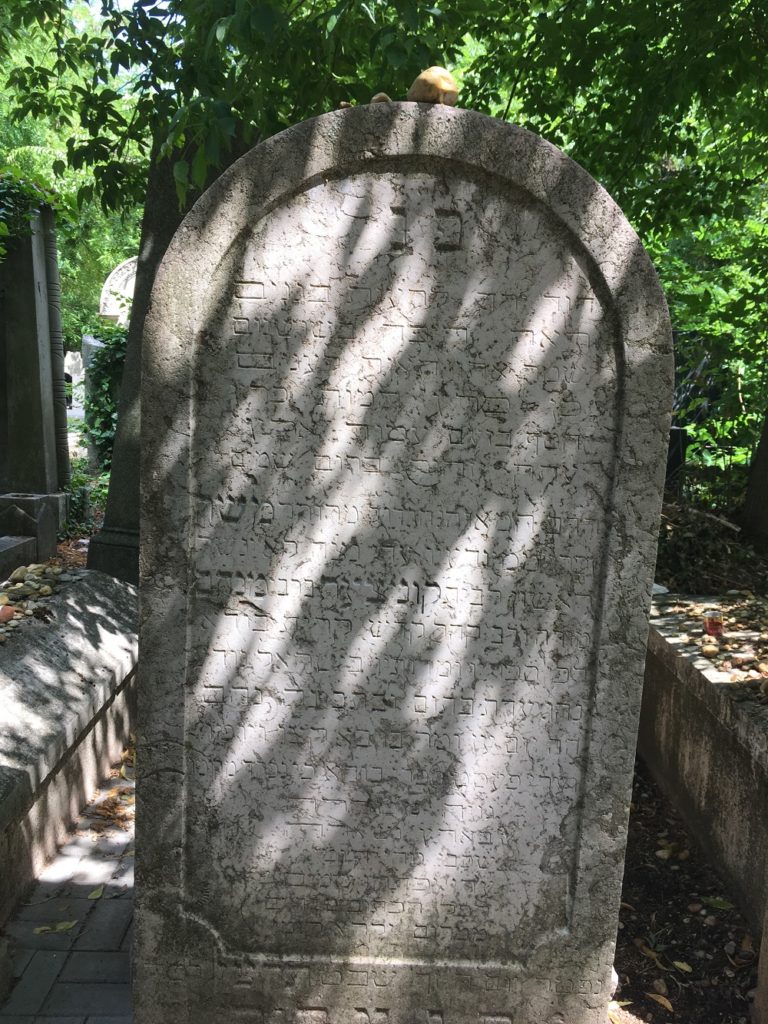
[5] I have been to R. Kunitz’s grave in Budapest many times. It is found together with the other communal rabbis, which is only natural as he served as a leading rabbi in both Buda and Pest. Here is a picture of the tombstone which I took a few years ago.


R. Leopold Greenwald, Mekorot le-Korot Yisrael(Humenne, 1934), p. 27, provided what he claimed is the text of R. Kunitz’s tombstone. But his version differs in a number of places from the original.

There are a few more points worth mentioning. R. Kunitz is the source that the Maharal (R. Kunitz’s forefather), recited the post-talmudic Birkat ha-Hamah without mentioning God’s name. See Kunitz, Ben Yohai, p. 141. Many halakhists know this report from R. Kunitz as it is mentioned by R. Akiva Eger in his note to Shulhan Arukh, Orah Hayyim 229.

R. Kunitz’s first volume of responsa, Ha-Metzaref, vol. 1, no. 20, contains a letter from R. Nathan Adler, which I believe is the only letter of his that ever appeared in print.

For previous discussions of R. Kunitz on the Seforim Blog, see Eliezer Brodt’s post here, and my posts here and here (in this post I include a previously unknown picture of R. Kunitz). See also Shimon Steinmetz’s post here that focuses on R. Kunitz’s responsa.

Those who are interested in R. Kunitz can also listen to my two classes on him here.

[6] (Jerusalem, 1990). This passage is also quoted by R. Jehiel Heilprin, Seder ha-Dorot (Bnei Brak, 2003), p. 412, Tannaim ve-Amoraim, s.v. יוסי בן קסמא

[7] Wars 3:7:21. This might be identical to the Rumah mentioned in II Kings 23:36. There is a tradition that none other than Reuben, the son of Jacob, was buried in Ruma, and other traditions include Gad and Benjamin as buried there. See Michael Ish-Shalom, Kivrei Avot (Jerusalem, 1948), pp. 104-105; Zvi Ilan, Kivrei Tzadikim be-Eretz Yisrael (Jerusalem, 1997), pp. 359-360; Avraham David, Al Bamatei Eretz ha-Tzvi (Jerusalem, 2013), p. 281.

[8] Sanhedrin 98a. This is the version in all manuscripts and older printings, before they were censored. See Dikdukei Soferim, ad loc.

[9] “Romanticising Rashbi: Moses Kunitz’s Ben Yohai,” Kabbalah 40 (2017), p. 75. My assumption was always that the main point of Ben Yohai was to defend the authenticity of the Zohar against R. Jacob Emden’s criticisms, and everything else in the book was secondary to this. However, Chajes shows that this is incorrect.


An Unpublished 1966 Memorandum from Rabbi Aryeh Kaplan Answers Questions on Jewish Theology

An Unpublished 1966 Memorandum
from Rabbi Aryeh Kaplan Answers Questions on Jewish Theology

Marc B. Shapiro and Menachem Butler

Professor Marc B. Shapiro holds the Harry and Jeanette Weinberg Chair in Judaic Studies at the University of Scranton, and is the author of many books on Jewish history and theology. He is a frequent contributor at the Seforim blog.

Mr. Menachem Butler is Program Fellow for Jewish Legal Studies at The Julis-Rabinowitz Program on Jewish and Israeli Law at Harvard Law School. He is an Editor at Tablet Magazine and a Co-Editor at the Seforim Blog.

Over the last ten years Professor Alan Brill has written a series of blogposts, as well as a recent scholarly article on the perennially interesting, yet historically mysterious, rabbinic theologian, Rabbi Aryeh Kaplan (1934-1983).[1] It was from these posts that many have learned about what Kaplan was doing before he burst onto the wider Jewish literary scene in the early 1970s through his writings and public lectures. He passed away in 1983 at the age of 48.[2]

Rabbi Aryeh (Leonard M.) Kaplan was born in the Bronx in 1934, and studied at Mesivta Torah Vodaath in New York, and at the Mirrer Yeshiva in New York and in Jerusalem. In 1953, 20-year-old Aryeh Kaplan joined the group of students assembled by Rabbi Simcha Wasserman under the guidance of Rabbi Shmuel Kamenetsky to establish a yeshiva in Los Angeles,[3] and three years later in 1956 received his rabbinic ordination (Yoreh Yoreh, Yadin Yadin) from Rabbi Eliezer Yehuda Finkel of the Mirrer Yeshiva of Jerusalem, and from the Chief Rabbinate of the State of Israel. After receiving his ordination, Aryeh Kaplan began his undergraduate studies and, in 1961, earned a B.A. in physics from the University of Louisville, and two years later, an M.S. degree in Physics from the University of Maryland, in 1963. While studying towards his undergraduate degree, Aryeh Kaplan taught elementary school at the pluralistic Eliahu Academy in Louisville, and corresponded with Rabbi Moshe Feinstein about some of the challenges that he encountered.[4] He then worked for four years as a Nuclear Physicist at the National Bureau of Statistics in Washington DC.

In February 1965, Rabbi Kaplan and his wife and their two small children moved to Mason City, Iowa, where he was invited to serve as a pulpit rabbi at Adas Israel Synagogue, a non-Orthodox congregation with forty member families. It would be his first pulpit. He remained at that pulpit until July 1966. During his time in Mason City, Rabbi Kaplan and his wife were very active in all aspects of their synagogue activities. Rabbi Kaplan led services and delivered a sermon each week at the Friday Night Service at Adas Israel Synagogue, hosted a Talmud Torah and taught about Jewish tradition to the youth in the community. He was a member of the National Conference on Christians and Jews, and regularly hosted visiting religious groups to the synagogue and participated in interfaith meetings and on panels alongside religious leaders of other faiths. In all of his delivered remarks, Rabbi Kaplan would type out each sermon prior to its delivery and maintain copies of these addresses within his personal archives; to date, these sermons have not yet been published.

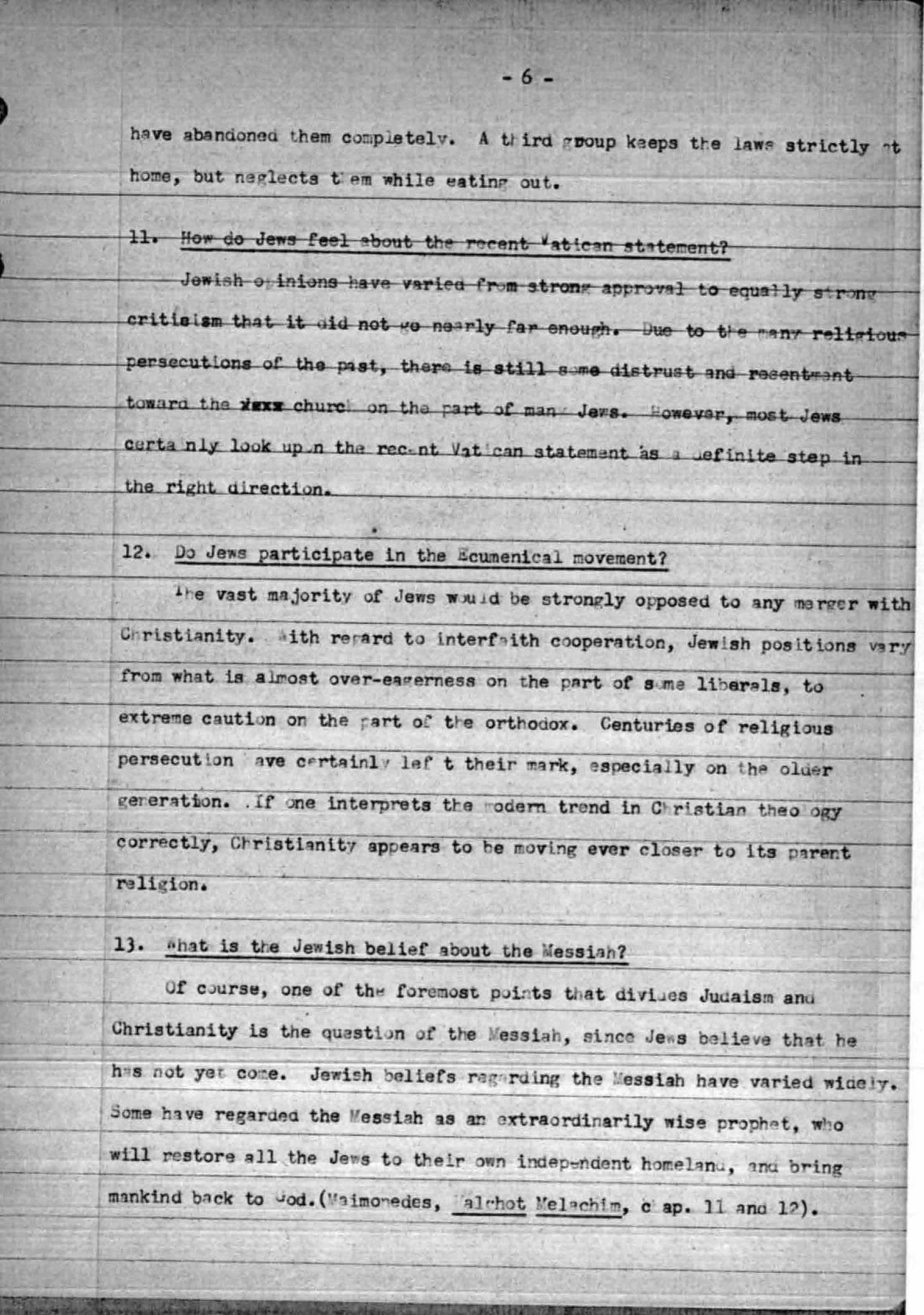
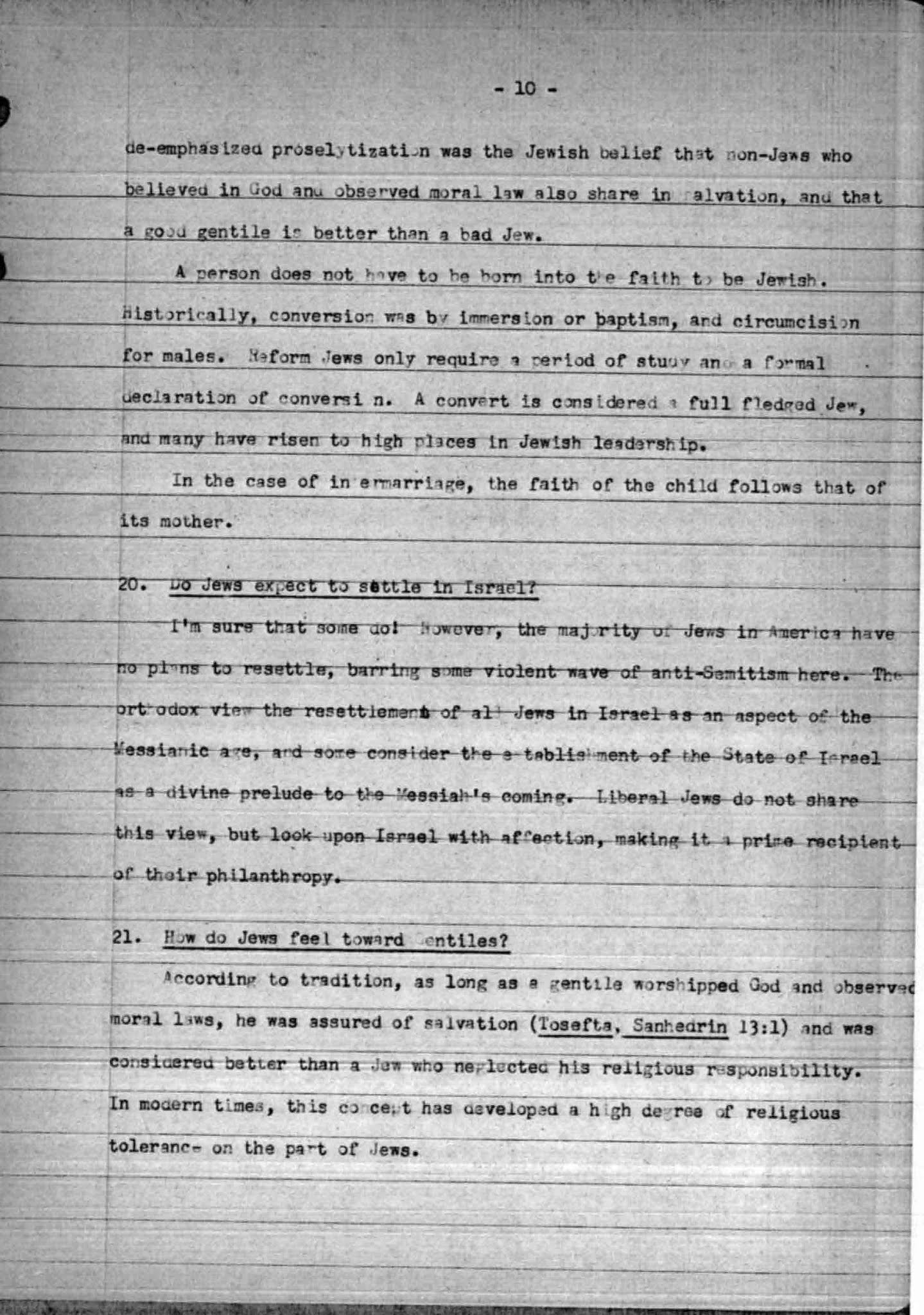
It was during Rabbi Kaplan’s time in Mason City that he authored a fascinating eleven-page-typescript memorandum, dated February 22, 1966, that, thanks to the research discovery of Menachem Butler, we are privileged to share with the readers of The Seforim Blog in the Appendix to this essay.[5]

Kaplan was responding to questions sent out by the B’nai B’rith Adult Jewish Education bureau in Washington DC on matters of basic Jewish theology.[6] We see from the letter that like many other rabbis who were serving in frontier communities, Kaplan maintained a camaraderie with those among the non-Jewish clergy. He was even a member of the “Ministerial Association,” and together with his wife was “founder and chairman of the local chapter of Ministerial Wives.” As one who often hosted non-Jewish groups at the synagogue, Kaplan was well equipped to place Jewish concepts and practices within a context that would make sense for Christians, and this is clearly seen in how he formulates his answers in the letter.

Although Rabbi Aryeh Kaplan’s memorandum is self-explanatory, there are a few points of theological interest that are worth calling attention to:

1. Right at the beginning, Kaplan notes that Jews have no official dogmas, and that in many cases Jewish opinions vary widely.

2. Kaplan states unequivocally that Maimonides does not believe in a literal resurrection. In support of this statement he cites Guide 2:27. If all we had were the Commentary on the Mishnah and the Guide, it would make sense to assume that when Maimonides refers to the Resurrection of the Dead that he intends immortality, not literal resurrection. Even the Mishneh Torah can be read this way, and Rabad, in his note on Hilkhot Teshuvah 8:2, criticizes Maimonides in this regard: “The words of this man appear to me to be similar to one who says that there is no resurrection for bodies, but only for souls.” Furthermore, in Hilkhot Teshuvah 3:6, in speaking of the heretics who have no share in the World to Come, Maimonides writes: והכופרים בתחית המתים וביאת הגואל, “Those who deny the Resurrection and the coming of the [messianic] redeemer.” Throughout his works Maimonides is clear that the ultimate reward is the spiritual World to Come. So how could he not mention among the heretics those who deny the World to Come, and only mention those who deny the Resurrection? It appeared obvious to many that when Maimonides wrote “resurrection of the dead” what he really meant is the spiritual “World to Come.”

As noted, if the works mentioned in the previous paragraph were all we had, then one would have good reason to conclude that for Maimonides resurrection of the dead means nothing other than the World to Come. Yet it is precisely because people came to this interpretation that Maimonides wrote his famous Letter on Resurrection in which he states emphatically that he indeed believes in a literal resurrection of the dead, after which the dead will die again and enjoy the spiritual World to Come. It is true that some have not been convinced by the Letter on Resurrection and see it as an apologetic letter that does not give us Maimonides’ true view, but such an approach means that one is accepting a significant level of esotericism in interpreting Maimonides, as we are not now concerned with a passage here or there but with an entire letter that one must assume was only written for the masses. Since Kaplan ignores what Maimonides says in his Letter on Resurrection, I think we must conclude that, at least when he wrote this letter, he did not regard it as reflecting Maimonides’ authentic view.[7] In Kaplan’s later works, there is no hint of such an approach to Maimonides.[8]

3. In discussing Jesus, Kaplan writes: “In this light, we can even regard the miracles ascribed to Jesus to be true, without undermining our own faith, since his message was not to the Jews at all.”[9]

APPENDIX:

Rabbi Aryeh Kaplan: Response to “Questions Christians Ask Jews” (1966)

[INSERT IMAGES 1-13]

Notes:

[1] See Alan Brill, “Aryeh Kaplan’s Quest for the Lost Jewish Traditions of Science, Psychology and Prophecy,” in Brian Ogren, ed., Kabbalah in America: Ancient Lore in the New World (Leiden: Brill, 2020), 211-232, available here. See also Tzvi Langermann, “‘Sefer Yesira,’ the Story of a Text in Search of Commentary,” Tablet Magazine (18 October 2017), available here.

[2] A complete biographical portrait of Rabbi Aryeh Kaplan remains a scholarly desideratum.

For appreciations of his writings, see “Rabbi Aryeh Kaplan: A Tribute,” in The Aryeh Kaplan Reader: The Gift He Left Behind (Brooklyn: Mesorah Publications, 1983), 13-17; Pinchas Stolper, “Rabbi Aryeh Kaplan z”l: An Appreciation,” Ten Da’at, vol. 1, no. 2 (Spring 1987): 8-9; Baruch Rabinowitz, “Annotated Bibliography of the Writings of Aryeh Kaplan, Part 1,” Ten Da’at, vol. 1, no. 2 (Spring 1987): 9-10; Baruch Rabinowitz, “Annotated Bibliography of the Writings of Aryeh Kaplan, Part 2,” Ten Da’at, vol. 2, no. 1 (Fall 1987): 21-22; and Pinchas Stolper, “Preface,” in Aryeh Kaplan, Immortality, Resurrection, and the Age of the Universe: A Kabbalistic View (Hoboken, NJ: Ktav Publishing House, 1993), ix-xi, among other writings.

[3] See Nosson Scherman, “Rabbi Mendel Weinbach zt”l and The Malbim,” in A Memorial Tribute to Rabbi Mendel Weinbach, zt”l (Jerusalem: Ohr Sameyach, 2014), 13-14, available here; as well as Nissan Wolpin, “The Yeshiva Comes to Melrose,” The Jewish Horizon (March 1954): 16-17.

[4] See responsum by Rabbi Moshe Feinstein as published in Shu”t Iggerot Moshe, Orah Hayyim, vol. 1 (New York: Noble Book Press, 1959), 159 (no. 98), dated 13 July 1955.

Discovery of additional correspondences between Rabbi Moshe Feinstein and Rabbi Aryeh Kaplan during those years would be of great scholarly interest and of immense historical value.

[5] Menachem Butler is also preparing for publication the typescript text of a sermon (“If This Springs From G*D…”) that Rabbi Kaplan delivered the previous month in January 1966, and where he reveals details about a conversation that he had with Dr. Robert Oppenheimer, director of the Los Alamos Project and father of the Atom Bomb.

[6] Menachem Butler writes two interesting details that, though beyond the narrow scope of this essay, are nonetheless of historical worthiness to consider when reading this memorandum:

Rabbi Aryeh Kaplan’s memorandum of February 1966 was written several months *prior* to the famous symposium of “The State of Jewish Belief:” hosted by Commentary in August 1966, and republished shortly-thereafter under the different title The Condition of Jewish Belief: A Symposium Compiled by the Editors of Commentary Magazine (New York: Macmillan, 1966), and reprinted more than two decades later in The Condition of Jewish Belief (Northvale, NJ: Jason Aronson, Inc., 1988). One wonders how Rabbi Aryeh Kaplan might have responded to the five questions sent by Commentary to 38 rabbis and scholars from around North America.

Returning to questions submitted by B’nai B’rith, it should be noted that the 21 questions were composed by Rabbi Morris Adler on behalf of the B’nai B’rith Adult Jewish Education bureau, a commission that he chaired from 1963-1966, and that he was murdered several weeks after the memorandum was submitted by Rabbi Aryeh Kaplan. It is for this reason that I believe that these responses had not been published.

The circumstances of Rabbi Adler’s assassination are that a gunman shot him multiple times during Shabbat morning services in front of hundreds of his congregants at his synagogue in Michigan. Rabbi Adler passed away from his wounds sustained in the attack nearly a month later. For a brief bibliographical portrait, see Pamela S. Nadell, Conservative Judaism in America: A Biographical Dictionary and Sourcebook (New York: Greenwood Press, 1988), 31-32; and for a full book-length account of the episode, see T.V. LoCicero, Murder in the Synagogue (Englewood Cliffs, N.J.: Prentice Hall, 1970), as well as his followup volume in T.V. LoCicero, Squelched: The Suppression of Murder in the Synagogue (New York: TLC Media, 2012), available to be ordered here.

[7] For brief discussion, see Isaiah Sonne, “A Scrutiny of the Charges of Forgery against Maimonides’ ‘Letter on Resurrection’,” Proceedings of the American Academy for Jewish Research, vol. 21 (1952): 101-117; see also Jacob I. Dienstag, “Maimonides’ ‘Treatise on Resurrection’ – A Bibliography of Editions, Translations, and Studies, Revised Edition,” in Jacob I. Dienstag, ed., Eschatology in Maimonidean Thought: Messianism, Resurrection, and the World to Come (New York: Ktav, 1983), 226-241, available here.

[8] See Aryeh Kaplan, Maimonides’ Principles: Fundamentals of Jewish Faith (New York: National Conference of Synagogue Youth, 1984), Aryeh Kaplan, Immortality, Resurrection, and the Age of the Universe: A Kabbalistic View (Hoboken, NJ: Ktav Publishing House, 1993), among other publications.

[9] The notion that in the past non-Jews have performed miracles much like the Jewish prophets needs further analysis, which Marc B. Shapiro will attempt in his forthcoming book on Rav Kook. As well, in Toledot Yeshu Jesus is described as performing miracles, but this is explained by Jesus having made use of God’s holy name.


Conservative Conversions, Some Grammatical Points, and a Newly Published Section of a Letter from R. Joseph B. Soloveitchik

Conservative Conversions, Some Grammatical Points, and a Newly Published Section of a Letter from R. Joseph B. Soloveitchik

Marc B. Shapiro

 
1. Since I mentioned R. Ovadiah Hoffman in the last post, I would be remiss in not noting that he and his brother, R. Yissachar Dov, recently published volume 4 of Ha-Mashbir, devoted to R. Ovadiah Yosef. It can be purchased here.
The volume contains a previously unpublished letter by R. Ovadiah Yosef that I provided, dealing with a rabbi who improperly converted people. It also contains a number of other noteworthy sections, such as R. Ovadiah’s notes to R. Ben Zion Uziel’s Mishpetei Uziel, talmudic notes from R. Uziel published from manuscript, R. Meir Mazuz’s notes to R. Ovadiah’s Yehaveh Da’at, and many valuable articles by contemporary Torah scholars, including the editors. Of particular interest to me was R. Yissachar Dov Hoffman’s article on the practice of a number of great Torah sages of prior generations not to kiss their children. Such a practice is so much against the contemporary mindset of what is regarded as healthy that, as R. Hoffman notes, even a Satmar rabbi, R. Israel David Harfenes, has stated that “in our time it is forbidden to follow this path” (p. 293).
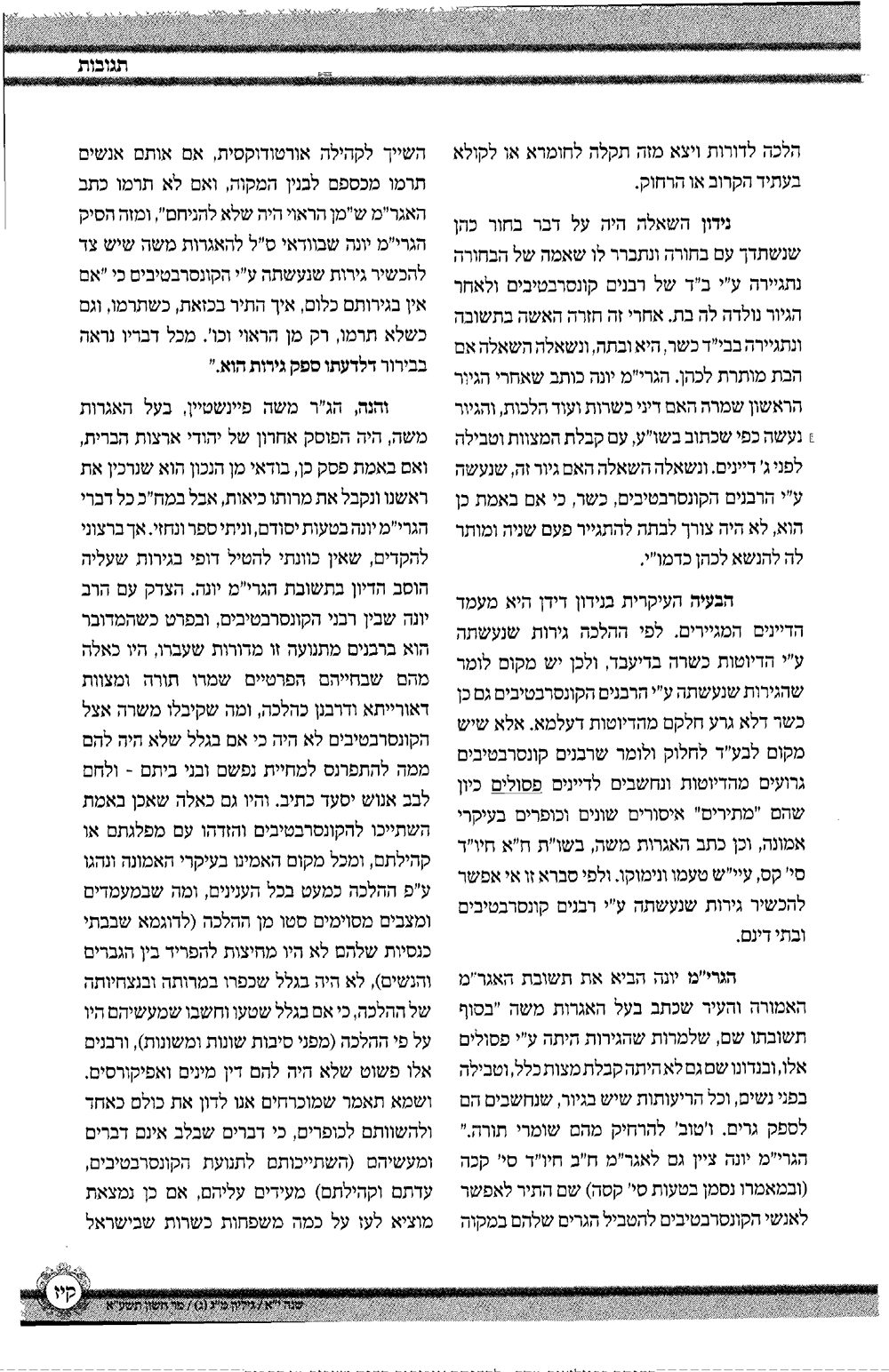
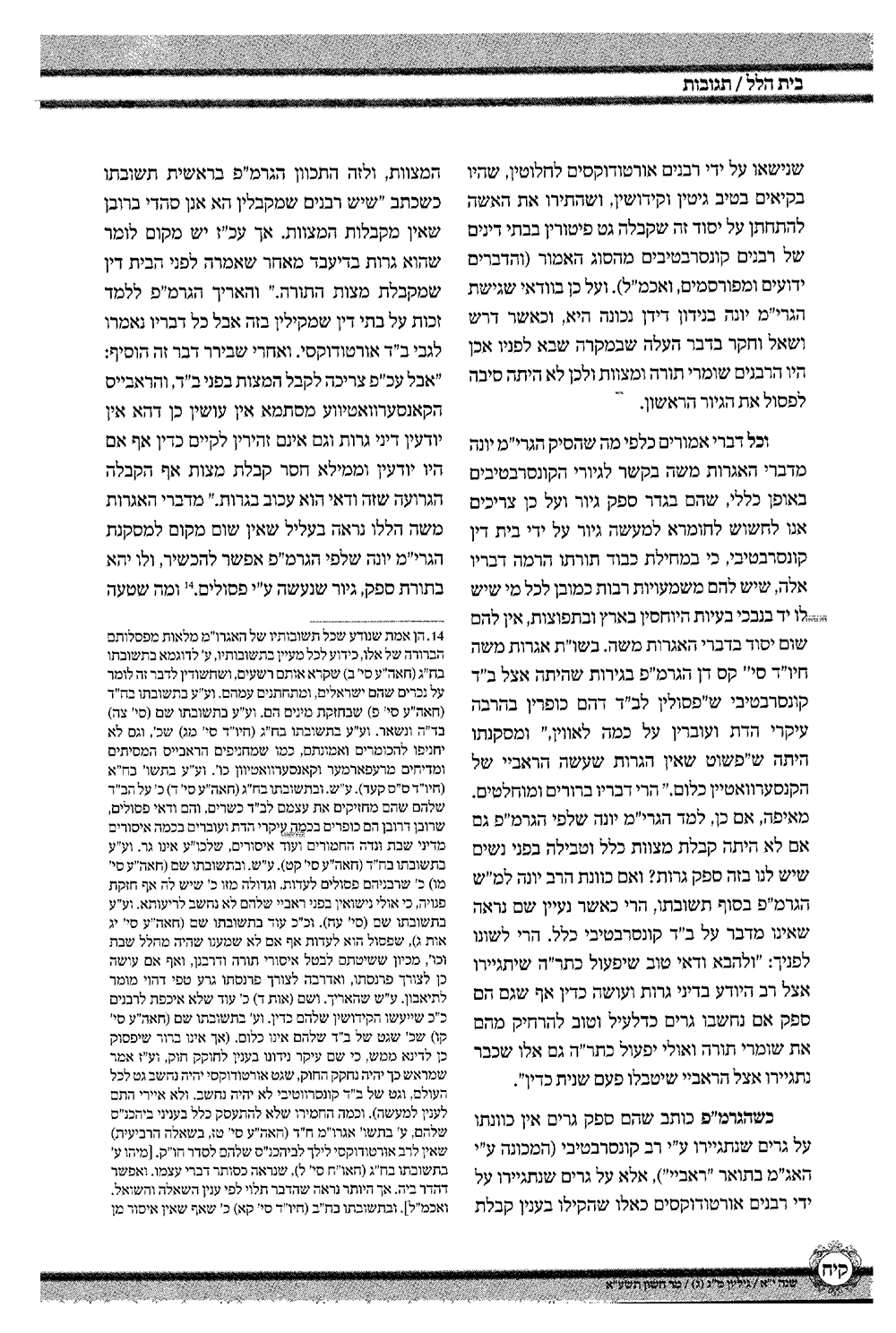
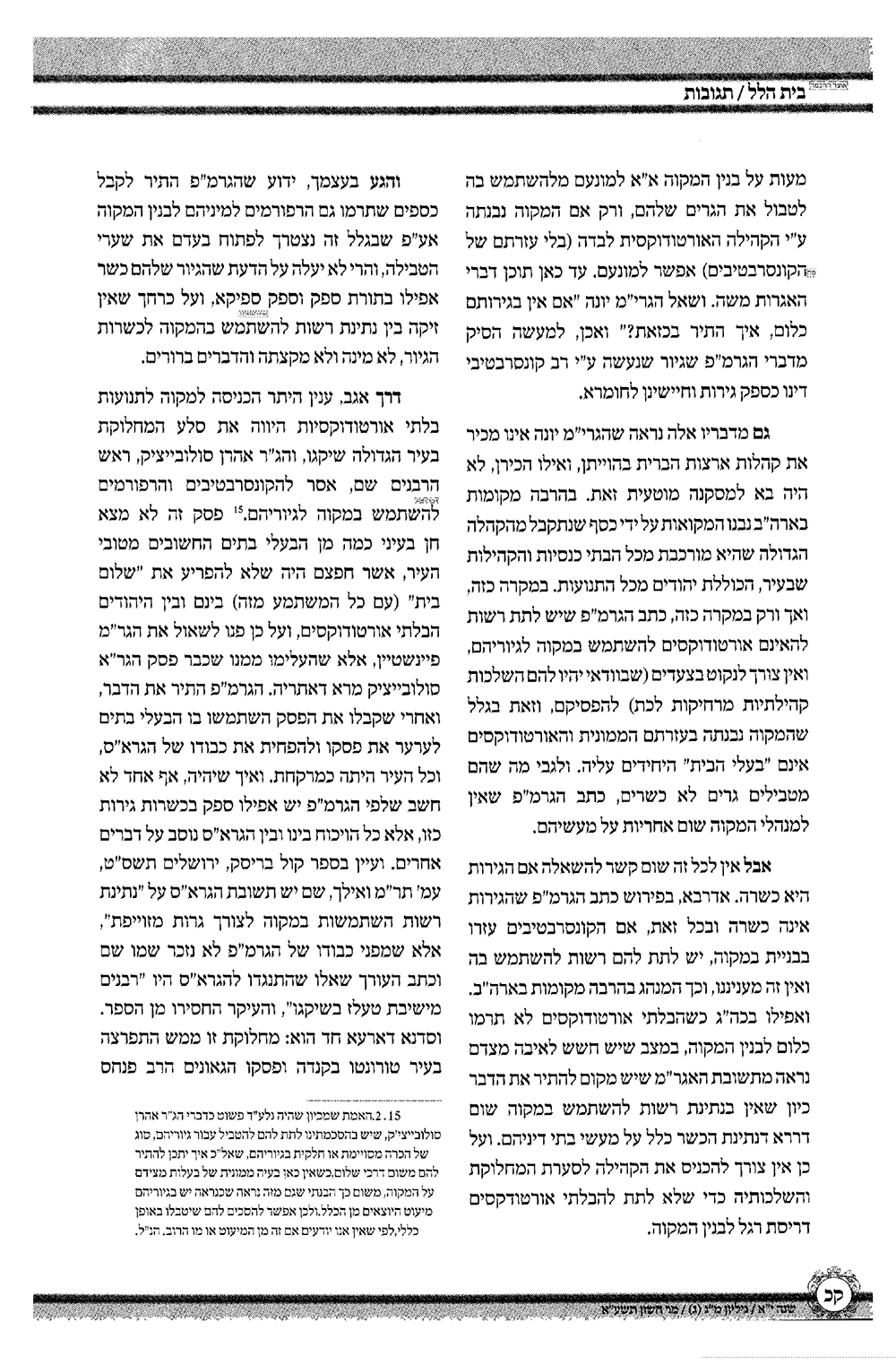
Apropos of the above-mentioned responsum on conversion by R. Ovadiah Yosef, in Beit Hillel, Adar 5770, R. Yisrael Meir Yonah deals with a conversion done by a Conservative beit din. He rules that in this particular case the conversion is valid. This ruling was affirmed by R. Ovadiah.In his responsum, R. Yonah states that R. Moses Feinstein regarded Conservative conversions as doubtful conversions rather than completely invalid, and brought two supposed proofs for this. I responded to R. Yonah in Beit Hillel 43 (Heshvan 5770), and you can see my letter here.[1]

To his credit, R. Yonah acknowledged that he was mistaken in his reading of R. Feinstein’s responsum.[2] It is also the case, as I mention in my letter, that it is possible that a conversion done by a Conservative rabbi, especially from years ago, could be halakhically valid. R. Feinstein himself, who wrote very strongly against Conservative conversions, also writes about such a conversion: כמעט ברור שאין עושין הגרות כדין. The word כמעט shows us that even R. Moshe recognized that there are times when a Conservative conversion can be halakhically valid. In Mesorat Moshe, vol. 1, p. 327, we see as well that R. Moshe acknowledged the possibility that a Conservative conversion could be valid:
אולי יש להסתפק דאפשר לא היו ב”ד של פסולים, דיש אנשים, בעצם דתיים ומאמינים, שמחמת דוחק פרנסה מקבלים משרה כרבנים אצלם, ואפילו אם למדו בסמינר שלהם, אולי בעצמו כן מאמין. ולפיכך למעשה, אם זה אפשר לברר, תבררו. ואם קשה לברר, אז אולי שייך להגיד השערה, שאם זה בכפר או עיר רחוק מעיקר ישוב היהדות הדתי מסתמא אין להסתפק, בוודאי אינו כלום. ואם זה בעיר שיש בו ישוב דתי, נו, אזי כן יש ספק.
I also know someone who offers eyewitness testimony that R. Moshe did not think that every Conservative conversion could be voided without investigation, especially as this would mean that women married to these converts would then be able to remarry without a get. R. Moshe was not willing to go this far.
Similarly, R. Ovadiah Yosef, when asked about a Conservative conversion, replied that before giving a ruling it was necessary to find out which Conservative rabbi did the conversion, “since the Conservatives are not all alike.”[3]
R. Ovadiah was also asked about a woman who had become religious and was interested in going out with a kohen for the purpose of marriage. The problem was that she had slept with a man whose mother was converted by a Conservative rabbi. This man’s family was somewhat traditional as they kept kosher, made kiddush, and lit Shabbat candles. Could the woman in question marry a kohen, which is forbidden if she had slept with a non-Jew? The answer to this question depends on the status of the man whose mother was converted by a Conservative rabbi. If the conversion was invalid then the man was also to be regarded as a non-Jew, and the woman we are discussing, who slept with this man, would be forbidden to a kohen.
R. Ovadiah replied that the woman could marry a kohen, which means that be-diavad he accepted the Conservative conversion. He gave this ruling without even seeking further knowledge about the particular rabbi who did the conversion under question, which appears to me to be an incredible leniency. In seeking to explain this ruling, R. Yehudah Naki writes, “We see that they observed some mitzvot, so be-diavad there is more room to be lenient, at least not to forbid others” (that is, to forbid the woman from marrying the kohen).[4]
As mentioned, R. Ovadiah accepted R. Yonah’s pesak that a particular conversion carried out by a Conservative beit din was valid. In this case, the daughter of a woman who had been converted wished to marry a kohen. This would only be allowed if the daughter was born Jewish, meaning that everything depended on the status of her mother’s conversion. Here is how R. Yonah described this particular Conservative beit din.[5]
ובירורים שעשינו בנ”ד התברר לנו שב”ד הזה שגיירוה, הם אנשים שנקראים וידועים כשומרי תורה ומצוות, ובעצם הם אורטודוכסים, וגם הגיור שעשו, ע”פ כל החקירות ודרישות שעשיתי, הקפידו בכל הדברים כולם, הן בטבילה, חציצה וכו’ וכו’, הן בקבלת מצות, ולימודי יהדות קודם הגיור, לא פחות ואולי יותר, מהרבה בתי דינים אחרים שנחשבים לחרדיים. וא”כ אין כל סיבה לפע”ד לפסול גיור זה.
Here is R. Ovadiah’s affirmation of R. Yonah’s pesak, from Beit Hillel, Adar 5770, p. 60.

That a Conservative conversion might be valid also appears to be assumed by R. Mordechai Eliyahu. This is what he writes in his Ma’amar Mordechai, vol. 2, Even ha-Ezer, no. 16:
ובענין הגר שנתגייר אצל הקונסרבטיבים והוא אינו שומר תורה ומצוות, והיה לכם ספק אם אפשר לכתוב שם יהודי שניתן לו, שם שלא השתמש בו מעולם, או לכתוב בן אאע”ה. נראה לי, מאחר וכל עצם נתינת הגט של אדם זה הוא לחומרא ולא מדינא, כי מי אמר שגרותו – גרות, וגיוריהם של הרבנים הקונסרבטיבים – גיור . . .
R. Eliyahu does not say that there is absolutely no reason for a get when dealing with a Conservative conversion. Rather, he refers to it as a humra. Also, note how he states, “who says that his conversion was a [valid] conversion?” This is the language of safek. He does not say, “certainly his conversion was invalid.”[6]
2. In a previous post here I mentioned a few common pronunciation mistakes in Kiddush. There is one more that I would like to mention, but it is a little more complicated than the ones I previous noted. In the Friday night kiddush we say כי הוא יום תחלה למקראי קודש. Where is one supposed to put the accent in the word למקראי? If you look at ArtScroll you find that it puts the accent on the penultimate syllable, the ר. However, Koren and most of the other siddurim I checked put the accent on the final syllable, the א.
I don’t know why this should be a matter of dispute, because the Torah itself uses the expression מקראי קודש three times (Lev. 23:2, 4, 37), and in every case the accent in מקראי is on the final syllable.[7] The Yom Tov morning kiddush also begins: אלה מועדי ה’ מקראי קודש. For some reason ArtScroll is not consistent, and in this case it puts the accent in מקראי on the א.
After my last post someone emailed me pointing out that another “common mistake” is that in Birkat ha-Mazon, in the second paragraph, people say נודה לך putting the accent on the first syllable instead of the second. In fact, the tune for Birkat ha-Mazon that American children are taught at schools around the country has the word נודה recited with the accent on the first syllable. Should we now start teaching all the children differently, so that they pronounce נודה with the accent on the second syllable which is how ArtScroll, Koren, and almost all the other siddurim have it?
Actually, this matter is not clear at all. I say this because if you open up a Tanakh to Psalms 79:13 and look at the words נודה לך you will find different versions. Some have the word נודה with the accent on the final syllable and others have the accent on the first syllable. The Aleppo Codex has the accent on the first syllable and puts a dagesh in the ל of לך. Although the practice of American children (and adults) pronouncing the word נודה with the accent on the first syllable has nothing to do with the Aleppo Codex, the fact that this pronunciation appears in such an important source means that there is no reason to change how the children are taught. However, this creates a problem because in the Amidah, in Modim, we say נודה לך ונספר תהלתך. If we are going to recite נודה of Birkat ha-Mazon with the accent on the first syllable, then we should be consistent and do the same thing in the Amidah, in ברוך ה’ לעולם in ma’ariv: נודה לך לעולם, and also in the so-called “Three-Faceted Blessing” (ברכה מעין שלש – Al ha-Mihyah): ונודה לך על הארץ.
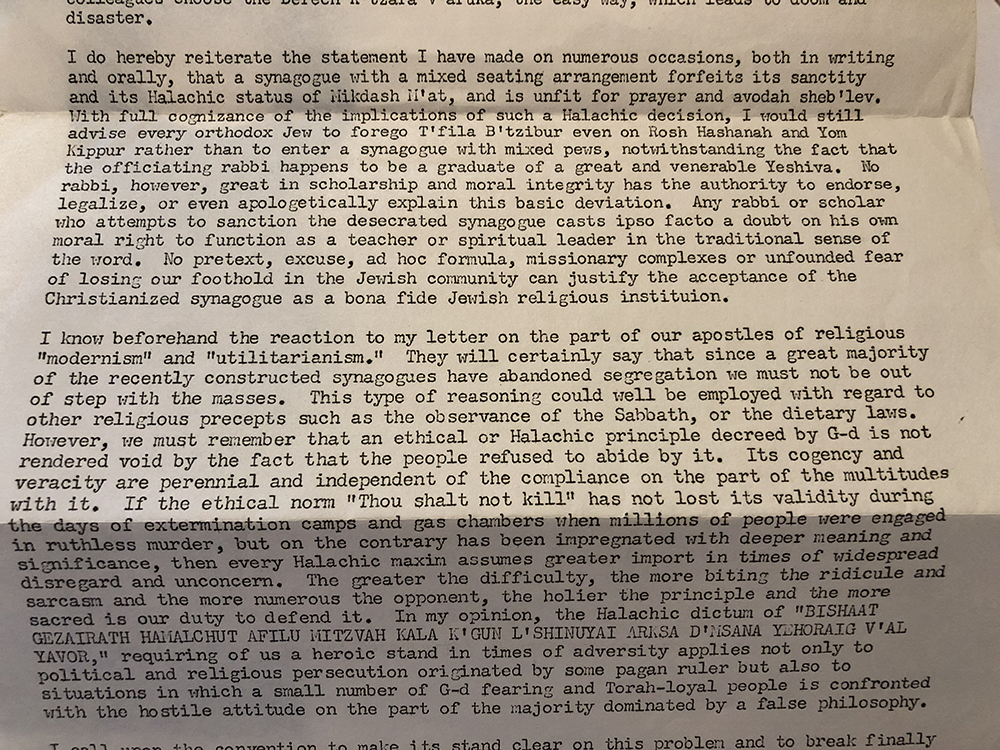
Speaking of consistency, in Birkat ha-Mazon, the Amidah, ברוך ה’ לעולם, and the Three-Faceted Blessing, both the regular ArtScroll siddur and Koren have the accent in נודה on the final syllable. However, in the Amidah, ברוך ה’ לעולם, and the Three-Faceted-Blessing they both place a dagesh in the ל of ונודה לך and נודה לך, but do not place a dagesh in the ל of נודה לך in Birkat ha-Mazon. This makes no sense. If there is a dagesh in one there must be a dagesh in all of them. (In the Hebrew-only ArtScroll siddur they also put a dagesh in the in the ל of נודה לך in Birkat ha-Mazon.)
I think it is a mistake for ArtScroll and Koren to place a dagesh in לך in any of these instances. Since no exception with נודה לך is found in Tanakh, the only reason there would be a dagesh in לך is if the word נודה has the accent on the first syllable, as in the Aleppo Codex (and unlike what appears in ArtScroll and Koren), or if there is a makef between the two words.[8]
Regarding the word נודה, it is worth noting that in Ein Ke-loheinu there is no question that נודה is to be read with the accent on the final syllable (as the matter of where to put the accent in נודה only concerns the phrase נודה לך). Here is an example where the common tune, which puts the accent on the first syllable, cannot be defended grammatically.
I noticed two mistakes in the regular ArtScroll siddur which appear correctly in Koren. In the morning blessings we say אשר נתן לשכוי בינה. Where is the accent in the word לשכוי? ArtScroll puts the accent on the final syllable, and Koren puts the accent on the penultimate syllable, on the ש. Koren is correct as there is an explicit verse in Job 38:36: מי נתן לשכוי בינה. If you look at the trop on this verse you will find that the accent in לשכוי is on the penultimate syllable. Interestingly, in the Hebrew-only ArtScroll siddur they get this right.
The other mistake is that in Birkat ha-Mazon on Sukkot we say:
הרחמן הוא יקים לנו את סכת דויד הנופלת
ArtScroll puts a kamatz under the פ in הנופלת. Koren puts a segol and that is correct. We see this from the appearance of the word in Amos 9:11, and there is no change of vowel even on the etnahta.[9]
I also found an example where ArtScroll gets it right and Koren is mistaken. In ma’ariv, in the paragraph ואמונה כל זאת, we say העושה לנו נסים. Koren has העושה with the accent on the final syllable and the ל of לנו with a dagesh. Yet this doesn’t work. For there to be a dagesh in the ל, the prior word, העושה, has to have the accent on the penultimate syllable, which is how it appears in ArtScroll.
Another example where ArtScroll gets it right and Koren gets it wrong is in the morning blessings where we say שעשה לי כל צרכי. Koren puts the accent in שעשה on the final syllable. Yet this is a mistake, and as is correctly found in ArtScroll the accent is on the penultimate syllable, the ע.
Since I have been speaking about the ArtScroll siddur, let me add a couple of comments about the Yom Kippur Machzor. Here is how Shema Kolenu appears in my copy of the Yom Kippur Machzor (p. 596).

The instructions tell us that “the first six verses of the following prayer are recited responsively, chazzan then congregation.” The problem is that I have never seen a synagogue that says the verses beginning אמרינו and אל תעזבנו responsively. What all these synagogues do is say the following four verses responsively:
שמע קולנו
השיבנו
אל תשליכנו מלפניך
אל תשליכנו לעת זקנה
In my experience, not only does no one say the verses beginning אמרינו and אל תעזבנו responsively, but they don’t say יהיו לרצון quietly either.
The text recorded by ArtScroll is the one found in many old Ashkenazic machzorim. So when and how were אמרינו and אל תעזבנו dropped from the responsive reading, or is it that from the beginning they were not included? As for יהיו לרצון, the old machzorim do not indicate that this is said quietly, so was there ever a tradition to recite it quietly or is ArtScroll simply trying to make sense of a verse that is found in the Machzor but no longer appears to be recited? If יהיו לרצון was originally part of the public reading, we again have to ask, why was it dropped?
Recognizing the problem, in the new edition of the ArtScroll machzor they made a change.
As you can see, אל תעזבנו has now been pushed to the next paragraph. We are also instructed that both אמרינו and יהיו לרצון are to be said quietly. Yet this doesn’t seem to make any sense, as those who are reciting Shema Kolenu responsively will not be saying these verses quietly. And again, I ask, is there any real tradition that these verses are to be said quietly, or is this something made up by people in an attempt to keep the traditional text of the Machzor while dealing with the fact that these verses are not part of the responsive reading? Unfortunately, when updating the Machzor, ArtScroll did not correct the instructions which still refer to the “first six verses” as being recited responsively, when instead it should say the “following four verses”.
Here is how Koren has the prayer.
This version, which puts אמרינו and יהיו לרצון before the final verse, is also attested to in prior machzorim, though the order found in ArtScroll appears to be the older version.To sum up, I am not sure what the best path for ArtScroll would have been. On the one hand, they could have adopted the version found in Koren, which solves all the problems. Keeping what appears to be the more authentic version, which they did, also makes sense, but then they were forced to add the instructions that certain verses are to be said silently. I have checked numerous old machzorim and there is no indication that these verses are to be said silently. Was there perhaps an oral tradition in this matter? Perhaps readers can comment on this. In any event, ArtScroll’s instructions are problematic, since, as mentioned, if people are reciting the prayer responsively, they are not going to be inserting two consecutive sentences quietly.

I noticed another interesting change in the ArtScroll Yom Kippur machzor between the old edition and the new one. Here is והכהנים והעם in the old edition.
It reads היו כורעים ומשתחוים ומודים ונופלים על פניהם.
Here is the new edition, where the word ומודים has been deleted. ArtScroll neglected to change the English translation, so it still appears, now incorrectly, as: “they would kneel and prostrate themselves, give thanks, fall upon their faces.”
Why was the word ומודים deleted? Based on what I have been able to determine, the version without the word ומודים is more common, so presumably that is the reason. Although most people might just chalk this up to a different girsa, R. Soloveitchik saw great significance in the alternative versions, and explained their different implications.[10]
Here are a couple of random mistakes I found in ArtScroll. (I use the ArtScroll siddur every day of the week, which is how I have come across these. I am sure that if I used Koren, I would find mistakes there too.) In the ArtScroll siddur, p. 86 it reads:
ואל מאורי אור שעשית, יפארוך, סלה
There is a dagesh in the ס of סלה. This means that the comma after יפארוך is a mistake, as you cannot place a dagesh in this ס if preceded by a comma.
Another mistake is found on p. 702, in the prayer for dew, which states בעם זו בזו. Its translation is correct: “Among this people, through this prayer.” However, I would have preferred if it appeared as follows: “Among this people, through this [prayer],” which would be a more accurate rendition of the few words. (This is indeed how it is translated in the ArtScroll Passover Machzor.)ArtScroll vocalizes these words be-am zu be-zu. Yet this is incorrect. בזו should be pronounced be-zo, referring to תפלה, the feminine Hebrew word for prayer. Koren gets this correct. This confusion of ArtScroll with zu and zo is also found on p. 202, where in the marriage service we find בטבעת זו and ArtScroll pronounces it zu, instead of zo. Again, Koren gets it right. (The word זו often appears in the Talmud, and the ArtScroll Talmud always pronounces it correctly.)

Let me close with one final mistake in ArtScroll, or perhaps it is not a mistake; readers can decide on their own. The ArtScroll Ohel Sarah Women’s Siddur is a special siddur designed for women. On the very first page of the prayers, this siddur has מודה אני with a segol under the ד. In a women’s siddur doesn’t there need to be a kamatz under the ד so that it reads modah?
This might reflect a broader issue. My experience is that in co-ed kindergartens the girls are also taught to say modeh. This might not be surprising, but I was also told by a number of people that even in girls-only kindergartens, both Ashkenazic and even some Sephardic ones, the girls are taught to say modeh. No doubt recognizing this problem, R. Yitzhak Yosef makes a point of placing a kamatz under the ד so that people will know how women are to pronounce the word.[11] R. Shlomo Zalman Auerbach likewise told the women in his family to say modah.[12]It is noteworthy that in one of the editions of Wolf Heidenheim’s Siddur Sefat Emet, found on Otzar ha-Hokhmah, girls are instructed to say modah.

However, this edition appeared after Heidenheim’s death, and unfortunately there is no way to determine exactly when. (The Basel 1956 date on the title page is just the date of the photo-offset edition, not the original.) As far as I can tell, none of the siddurim that appeared in Heidenheim’s lifetime distinguish between men and women with regard to modeh-modah.In response to questioners, R. Hayyim Kanievsky also stated that women are to pronounce the word as modah.[13] Despite this, when R. Meir Arbah asked Rebbetzin Batsheva Kanievsky, R. Hayyim’s wife, what she did, she replied that she pronounced it modeh![14]

The ArtScroll Women’s siddur also has שלא עשני גוי and not גויה and שלא עשני עבד instead of שפחה. This too would seem to be incorrect in a women’s siddur, but the standard version is defended by R. Shmuel Wosner, as he claims that the words גוי and עבד include both men and women.[15] More about this in the next post.
3. We all know that everything written by R. Joseph B. Soloveitchik is precious.[16] One area in which the Rav was very eloquent and forceful was with regard to the necessity of having a mehitzah in shul. In Baruch Litvin’s 1959 book, The Sanctity of the Synagogue, pp. 109-114, it prints a letter from the Rav to an RCA convention. 


This letter has been reprinted in Nathaniel Helfgot, Community, Covenant and Commitment, pp. 139-142.
Moshe Schwartz found a copy of the original letter in the papers of his grandfather, R. Gedaliah Dov Schwartz. I thank him for sending it to me.

One interesting point which is not found in the Litvin book is that the Rav’s letter, while intended for RCA members, was addressed to R. David Hollander, the president of the RCA at the time. This is important to note because in the second paragraph he is speaking personally to R. Hollander and praising him for his good works. However, the reader of the letter in Litvin’s book will mistakenly think that the Rav is speaking to the RCA as a whole.
Furthermore, some of what R. Soloveitchik included was deleted from the letter as it appeared in the Litvin book. This was apparently because his points were not specifically relevant to the mehitzah issue. I am happy to be able to present here the omitted words of the Rav which until now have never been published, and which present an important personal statement about the halakhic process. Readers should note the end of the second paragraph that is transcribed below, as it is criticism of certain members of the RCA. Similar sentiments are found earlier in the letter (Litvin, p. 110, first paragraph), where the Rav concludes his paragraph with the strong words: “However, many of our colleagues choose the derech ketzarah va’aruchah, the easy way which leads to doom and destruction.”
As chairman of the Vaad Halachah I intended to inform the conference about our activities during the past year. Since I am prevented from doing so I have asked my friend Rabbi Joseph Weiss to take my place.
Permit me to say the following. One of the fundamentals of my faith is that the Halachah is an all-inclusive discipline and system of thought capable of meeting any challenge of modern times and of confronting the most perplexing problems which a technically progressive and scientifically minded society may periodically pose. This optimistic formula, however, cannot always be successfully applied because of the limited knowledge and the imperfect intellectual capability of the human being. I for one, am not always able to behold the Halachic truth and to see the light under all circumstances. Many a time I grope in the dark, pondering, examining and re-examining an intricate Halachic problem – and find myself unable to arrive at a clear decision. Even the Talmud has not solved all problems and has not answered all questions. The Teiku is a very prominent and characteristic feature of Torah She-B’al Peh. We members of the Halachah Commission are not partners in a contracting firm whose task it is to provide every member of the Rabbinical Council of America with a clear-cut answer to his problems. Quite often the solution eludes us. We are beset by grave doubts. We face many alternatives not knowing which to choose since each is supported by sound logical reasoning. We cannot be guided in our decisions by emotional factors or pragmatic arbitrariness and hence we are impelled to employ in such situations the principle of “B’divrai Torah Haloch Achar Hamachmir” which seems to inconvenience some of our members.
Religious Jews have of late developed an intolerant attitude towards what they call the shyness and reluctance on the part of scholars to commit themselves on Halachic issues, not knowing that there is no omniscience in this world and that doubt is an integral part of the Halachic experience as it is of every scientific performance. A rabbi who thinks that he can solve all problems is implicitly admitting his own ignorance. I implore the convention to abstain from leveling charges of evasion at the Halachah Commission. Let us not repeat the complaints which are so common in religious circles in Israel about a lack of boldness on the part of the rabbinate. They come, for the most part, from people who are not conversant with Halachic scholarship. If there is in our ranks some one wise enough to undertake to answer all Halachic questions by return mail, I would not hesitate to relinquish my position as chairman to him.
In the last paragraph of the letter, as it appears in Litvin, p. 114, the following words that I have underlined are omitted (and this appears to be a simple mistake rather than an intentional deletion): “I realize your problems, I am cognizant of the temptations to which you are exposed and I also know the great work you have been doing in the remote parts of our country.”
In this case I think that the Rav is speaking to the RCA members as a whole, not to R. Hollander personally.
The P.S. found in the Rav’s letter is also of interest.
P.S., I would suggest that the convention adopt a resolution condemning the Humphrey Bill pertaining to humane method of slaughter. The convention should also send a letter of thanks to the State Department for the special attention of Assistant Secretary Herbert Hoover, Jr., for its stand against the proposed calendar reform.
4. In my previous post about young rabbis I neglected to mention another such rabbi. R. Yekutiel Yehudah Teitelbaum (born 1912) succeeded his father as rabbi of the town of Sighet, and also as leader of the local hasidic group, at the age of 14.[17]
5. In addition to being the posek of the OU, R. Hershel Schachter is also the one Kashrut Vaads all over America turn to for halakhic decisions. That being the case, now that R. Schachter has publicly declared that swordfish is kosher[18] (his private opinion has been known for a long time), how come no Vaads in the United States will certify it as kosher? (In the first half of the twentieth century Orthodox Jews in the U.S. ate swordfish. See my post here.) Does this mean that in the U.S. the practice of not eating swordfish is for all intents and purposes now regarded as binding, and cannot be overturned even by a great posek?

6. Last summer I spent time in Djerba, Tunisia. I hope to write up my impressions of this amazing community of over one thousand Jews, all of whom are shomer Shabbat. Djerba, and the nearby town of Zarzis which has around a hundred Jews, are the last Arabic speaking Jewish communities in the world. (In Tunis and Morocco the Jews speak French.) Here are some pictures from inside the R. Pinhas Yanah synagogue in Djerba, where you can see the signs in Arabic. 


Here is a small learning group in one of the synagogues after ma’ariv. They invited me to participate but not knowing Arabic I couldn’t follow.

When I came back one of my friends told me that I must share one particular story on the Seforim Blog, so here goes. There are fourteen different synagogues in Djerba. After visiting a number of them I noticed that they had no women’s sections. I asked one of the rabbis about the lack of ezrat nashim. He replied, in words that must sound blasphemous to Modern Orthodox ears, “What do women have to do with a synagogue?” While in the U.S. we build “women friendly” mehitzot, so that as much as possible the women can feel part of the synagogue service, in Djerba women’s spirituality has nothing to do with the synagogue. While I later learned that three of the synagogues do have an ezrat nashim, women never attend on Shabbat, only on Rosh ha-Shanah, Yom Kippur, and Purim. The popular Modern Orthodox notion that it is important for women, especially unmarried ones, to attend synagogue on Shabbat is something the women of Djerba know nothing about.
___________
[1] If I were writing the letter today, I would not refer to R. Ahron Soloveichik as rosh ha-rabanim and mara de-atra. I did so to give him respect, but it is not really accurate. While many people certainly did regard him as the leading rabbi of Chicago, and accepted his halakhic rulings as authoritative, this was by no means everyone’s opinion. Regarding R. Moshe Feinstein’s view permitting the non-Orthodox to use the community mikveh for their conversions, which is mentioned in my letter, it is important to note that this was only when the non-Orthodox institutions contributed to building the mikveh.
[2] The same mistake made by R. Yonah is also made by R. Yehudah Naki in his notes to R. Ovadiah Yosef, Ma’yan Omer, vol. 7, pp. 362-363, 390, 400-401.
[3] Ma’yan Omer, vol. 7, no. 38.
[4] Ma’yan Omer, vol. 7, no. 42.
[5] Beit Hillel, Adar 5770, p.
[6] R. Eliyahu’s responsum was sent to R. Gavriel Cohen, who has a beit din in Los Angeles. See here. This Beit Din also does conversions, and they have a very detailed curriculum for prospective converts. You can see a practice test of the 45 topics prospective converts are supposed to learn about here.
I have to say that until the last generation, converts were never required to have such detailed knowledge. Leaving aside all of the detailed issues of Jewish law the convert is instructed to learn about (including “Trumot and Maasarot, Challah, Bikurim, Maaser Ani and other types of charity”), does a convert really need to know about Elijah at Mt. Carmel or about “Tzedukim, Prushim, Charedim, Zealots (anti Romans and Greeks)”? Does a convert need to be able to “develop in detail” the following: Joshua, Judges (“mention at least 10 Judges and their stories”), Samuel, Saul, Jonathan, Isaiah, Jeremiah, the Twelve Prophets, Daniel, Ezra-Nehemiah, to list just some of the topics required? And  what about Rif, Rosh, Rashba, Tur, Zohar, Kabbalah, Shabbetai Zvi, Orhot TzadikimMesilat Yesharim, etc.? Since when do converts need to know about these things?
In the section dealing with the history of converts, R. Cohen’s website mentions Nero and Antoninus as things to know. Does this mean that if the future convert does not believe that these Roman emperors actually converted to Judaism, that he will not be accepted? (My next post will discuss Nero and Antoninus.) On the positive side, if even yeshiva educated people knew all the things the converts are being asked about, we would be in very good shape.
Contrast all this with how Maimonides says that we deal with future converts, in words that today would be regarded as “non-Orthodox,” or presenting a very low standard. Issurei Biah 14:2 states: “He [the prospective convert] should then be made acquainted with the principles of the faith, which are the oneness of God and the prohibition of idolatry. These matters should be discussed in great detail; he should then be told, though not at great length, about some of the less weighty and some of the more weighty commandments.”
[7] See also here.
[8] See Israel Yeivin, Introduction to the Tiberian Masorah, trans. E. J. Revell (n.p., 1980), no. 404. See also R. Adir Amrutzi, Dikdukei Aviah (Tel Aviv, 2010), p. 146. Regarding the Aleppo Codex and use of the dagesh, the following point is also of interest. Many people wonder why in Hallel the words הושיעה נא and הצליחה נא, taken from Ps. 118:25, only have a dagesh in the נ in הושיעה נא. In fact, in the Aleppo Codex both occurrences of the word נא have a dagesh. Also of interest, since it goes against what one would expect from the grammatical rules, the Aleppo Codex puts the accent on the final syllable of both הושיעה and הצליחה, and there is no makef after either of these words. See Yeivin, Introduction to the Tiberian Masorah, p. 291.
Regarding the makef, ArtScroll has omitted it from its siddur. Yet once they do so, it appears to me that there are a number of corrections that need to be made. For example, in shaharit of Shabbat we read
מי ידמה לך ומי ישוה לך
ArtScroll tells us that ידמה and ישוה have the accent on the final syllable and ArtScroll also puts a dagesh in the ל of לך. Yet the Masoretes who told us that in such a case you put a dagesh in the ל, also told us that you would only do so if there is a makef connecting the word לך and the prior word. Since ArtScroll has deleted the makef, why should the dagesh be included, as there is no reason for one without the other? (Koren also includes the dagesh without a makef.)
For those who want to be technical, once the makef is removed we even have a problem with the word כל. כל, meaning “all”, is only spelled with a kamatz (katan) when it is connected with a makef. However, when the makef is removed it is to be spelled with a holem. (The two exceptions are Ps. 35:10 and Prov. 19:7.) See Bayit Ne’eman 130 (15 Tishrei 5779), p. 5.
In biblical Hebrew there is even a word כל with a kamatz (gadol) and no makef. It is found in Isaiah 40:12:
וכל בשלש עפר הארץ
The passage means, “and comprehended the dust of the earth in a shalish-measure.” The word כל with a kamatz and no makef is from the root כול. The word כל with a kamatz and makef, which is the word we are all familiar with, is from the root כלל.
[9] This point was also noted by the Dikdukian here. For those who don’t know this website, it is a great resource for anyone interested in grammatical matters.
[10] Shiurei Ha-Grid: Kuntres Avodat Yom ha-Kippurim (Jerusalem, 2005), pp. 66-67.
[11] Otzar Dinim la-Ishah ve-la-Bat, ch. 1, no. 2 (p. 22), Yalkut YosefDinei Hashkamat ha-Boker, 1:9. It is noteworthy that R. Yom Tov Lippman Heller was also interested in ensuring proper pronunciation. Mishnah, Toharot 8:5 reads: שוטה אחת בעיר. Tosafot Yom Tov comments:
בקמץ הטי”ת כמו כי רועה היא (בראשית כט)
[12] Halikhot Shlomo, Tefilah, ch. 2 n. 17.
[13] Halikhot Hayyim, ch. 1 no. 1, Da’at Notah, vol. 1, p. 16. The very title of the last book mentioned is an example of what we are talking about, as it is more common for people to write “da’at noteh”, but this is not grammatical.
[14] Meir Oz, vol. 1, p. 27.
[15] Shevet ha-Levi, vol. 10, no. 8.

[16] I have been fortunate to discover a number of unknown letters by the Rav which I hope to publish.
[17] See Isaac Lewin, ed., Eleh Ezkerah (New York, 1961), vol. 4, p. 147. R. Jacob Elimelech Paneth was chosen to succeed his father as rabbi of Marosújvár at age fourteen, but he did not assume the office in practice until four or five years later. See Yosef Kohen, Hakhmei Transylvania (Jerusalem, 1989), p. 37. I thank R. Baruch Oberlander for informing me of the Hungarian name of the city R. Paneth served in.
[18] The interview with R. Schachter reprinted in this post is from the Jewish Press, April 20, 2018.


Eliezer Brodt: Corrections and Clarifications


Corrections and Clarifications on Two Editions of R. Chaim Berlin’s Responsa: An Egregious Example of Censorship
by: Eliezer Brodt


From time to time I get feed back about some of my previous posts some good some bad – aside from the standard criticism of poor grammar, editing or transliterating, all of which are my fault entirely. The blog does not have a full time editor (its all on a volunteer basis), and the goal of the editors, in general, is to get out posts at high speed with good content (many of which could have been printed in journals) but this avoids the whole long process of printing etc. Sometimes the feedback shows that some things need more clarifications or statements I made are simply wrong and need to be corrected. Thus, I definitely encourage all feedback. When I write posts (although I spend much time researching and writing them) I am still collecting information on these topics which I hope to incorporate at future times (at times I have done so already). Another point, which almost goes without saying, is that I am definitely not trying to Pasken any halachic leniency with what I quote.  I just like to bring interesting, nice points to public knowledge. With this introduction I would like to clarify some issues as a few very important remarks and corrections are in order about a previous post of mine Two Editions of R. Chaim Berlin’s Responsa: An Egregious Example of Censorship

In this post I accused the editors of the new edition for censorship in a few places most notably a leniency about shaking woman hands and a pro-Chassidus statement. I then concluded that there are probably more examples of censorship in this work but I do not have time to go through all four volumes. In general before I write a review on a sefer I read the sefer cover to cover a few times carefully. Since this work has four massive volumes I did not do so. Instead I used the many indexes of the sefer based on topics, Shas and names of the people mentioned etc. I could not find the various pieces so I concluded that there was censorship. I recently received a letter from an old friend who read through this post very carefully and had a few very important comments. I would like to deal with some of his comments. 

On Shaking hands with woman

First of all I accuse the editors of the new edition of censoring this Teshuvah by removing it,  but that is simply a false accusation. This Teshvah is included in the new edition in volume two p.257. 
Second of all my friend writes: “I will admit that when I first saw the teshuvah I too understood it to mean that,  but after a careful reading that R. Chaim Berlin actually never permits shaking hands at all. Rather, R. Berlin brings the Gemarah in Brochos about someone who hands money to a woman in order to look at her, R. Berlin therefore deduces that if the intent is not in order to look at her (as is the case in the one who asked the shaila) then this would not apply and it would be permissible to pass money from his hand to hers. He then adds that it would be better to be careful about this too, but if this proves impossible one should not be machmir etc. that’s all. It would seem quite clear that he is discussing a situation of someone who has a business or runs a store (as the one who asked the shaila, R. Alshvang, did) and needs to hand money (or merchandise) to his customers. This is the case of the above mentioned Gemarah (i.e. passing money, not shaking hands). After finding this teshuvah in the new edition I saw that the publishers of the new edition were kind enough to explain this (and were careful to put this explanation in brackets; the accepted form of an editors addition).”

 
I will admit this argument sounds convincing but I am not sure it is correct. The exact quote of the Teshuvah is as follows:
 
אשר שאל על דבר נתינת ידו לרשעים או לנכרית, הנה ליתן יד לפושעים אין שום איסור בזה אם אין בזה הודאה וחיזוק להנהגותיהם בשרירות לבם. ולתת יד לאשה לשון הש”ס הוא ברכות ס”א א’ המרצה מעות לאשה מידו לידה כדי להסתכל בה, מבואר דאם אינו מכוין לשום דבר וכש”כ שאינו עושה כדי להסתכל בה כמו מעלתו שכל מעשיו לשם שמים אין איסור בזה לרצות מעות מידו לידה. ודאי אם יוכל להזהר בזה מה טוב, אבל אם אי אפשר לו להנצל מזה כגון אם הנכרית הקדימה והושיט לו את ידה ואין דעתו לשום הרהור ח”ו אין להחמיר בזה, ודרכיה דרכי נועם, ואהבת את ה’ אלקיך אמרו חכמים יומא פ”ו א’ שיהא שם שמים מתאהב על ידך, ולא יאמרו על יראי ה’ שהם משוגעים ואינם בעלי דרך ארץ.
 

A simple reading of the first part was about shaking the hand of a Rasha or non-Jewish woman as his answer implies where he says “as long as it does not show any agreement to their behavior”. I would assume that is not referring to just taking money from them. He then goes on to dealing with the story by a Jewish woman as he says “to give a hand to a woman”. To which he answers based on the Gemarah of giving money to a woman… which I think also answers the question of shaking a woman’s hand. It would definitely be helpful to have the original question of R. Alshvang but I do not. The new edition after the words אשר שאל על דבר נתינת ידו לרשעים או לנכרית, stuck in the words

[בהושטת הפרקמטיא או המו”מ בהרצאת המעות, האם צריך להקפיד שלא למסור מיד ליד]

Now they do not write that they did (nor do they mention in the introduction that they ever do this) this making you think R. Chaim Berlin writes that. But aside for that I am not sure that this is true as his reply does not make sense when he answers אין שום איסור בזה אם אין בזה הודאה וחיזוק להנהגותיהם בשרירות לבם. if he was talking about shaking hands then this statement makes sense but if its just about handing over money I am not sure what it means.

 
 One last point I am not concluding via this possible pesak of R. Chaim Berlin that it is permitted to shake woman’s hands that is for one to ask their local Rav as where I come from we go with the strict pesak of R Moshe Feinstein that it is prohibited as he writes:
ולהושיט יד לאשה כדרך הנותנים שלום בהפגשם, פשוט שאסור אף לפנויה שהרי הן נדות וכ”ש לאשת איש (אגרת משה, או”ח, א, סי’ קיג).
 
Other cases of supposed Censorship:
The piece I brought of additions to the Mishana where R. Chaim Berlin writes:

שביארתי מאמרם ז”ל התמוה מאד בשלהי מס’ סוטה מ”ט ב’ על משנתינו משמת רבי בטלה ענוה ויראת חטא א”ל ר”י לתנא לא תיתני ענוה דאיכא אנא א”ל ר”נ לתנא לא תיתני יראת חטא דאיכא אנא. והתמיה מפורסמת איך אמוראים קדושים כאלה ישבחו עצמם בענוה ויראת חטא, והמלך החכם אמר יהללך זר ולא פיך. וביארתי בס”ד על פי מש”כ הרע”ב ז”ל על האי בבא משמת רבי בטלה ענוה שתלמידיו של רבי הוסיפו וכתבו זה במשנה, וכ”כ בתוס’ רע”ק בשם הרמב”ן בחי’ ע”ז ל”ז א’ שהוא תוספת שהוסיף בר קפרא או לוי במשנה, והמה היו תנאים אחרונים תלמידי רבי. ואמרתי שהוא הוא התנא שדברו עמו רב יוסף ורב נחמן, שרב יוסף א”ל לזה התנא שהוסיף במשנה משמת רבי בטלה ענוה א”ל לא תיתני ענוה שאתה מסתיר מדותיך הטובים ושונה במשנה משמת רבי בטלה ענוה ואנא ידענא שגם אתה ענוותן כרבי ועדיין לא בטלה ענוה משמת רבי, וכן א”ל רב נחמן לזה התנא שהוסיף במשנה משמת רבי בטלה יראת חטא א”ל לתנא לא תיתני יראת חטא שאתה מסתיר מדותיך הטובים ושונה במשנה משמת רבי בטלה יראת חטא ואנא ידענא שגם אתה ירא חטא כרבי, ועדיין לא בטלה יראת חטא משמת רבי, כן ביארתי זה המאמר לפי חומר הנושא.  


I could not figure out why this piece was edited out but my friend has a much more logical explanation. In the introduction of the sefer the editors write they hope to collect all the pieces of R. Chaim Berlin on Agadah and print them shortly.


The pieces where he writes: 

ועל דבר כסוי ראש האשה במטפחת אחת, אם אין שערה נראין אין בזה שום איסור, ועדיף טובא מפיאה נכרית, ואין צריך כלל שני כסויין, ואם אך אין השער נראה בחוץ די בכסוי אחד אף ברשות הרבים, ורשאי גם לקרות ק”ש כנגדה,ואין להחמיר עוד בזמן הזה.
 
I also accused the editors of the new edition of censoring this Teshuvah out but that is simply a false accusation. This Teshvah is included in the new edition in volume two p.260.
 
The pieces where he writes:
לדבר עם אשה בשוק לא נאסר אלא לתלמיד חכם ולא למי שאינו מוחזק בתלמיד חכם, וכשם שתלמיד חכם המדבר עם אשה בשוק גורם בזה חלול השם כן מי שאינו מוחזק לתלמיד חכם הנזהר בזה שלא לדבר עם אשתו לעיני הבריות הוא מיחזי כיוהרא, ויש בזה גם כן חלול השם …
I also accused the editors of the new edition of Censoring this Teshuvah out but that is simply a false accusation. This Teshvah is included in the new edition in volume two p.261. Furthermore in both of these last two pieces, in the new edition we have an addition – the exact question posed to R. Chaim Berlin see p.258-259.


 The Piece Pro Chassidus:

 R. Chaim Berlin writes:

ולהתפלל בבית הכנסת של החסידים אין שום חשש בזה, וגזירת רבינו הגר”א ז”ל לא הי’ אלא בזמנו שהקילו אז בכבוד תלמידי חכמים לומדי תורה, ולא כן בימינו שהחסידים חולקים כבוד לכל לומדי תורה והם יראי ה’ ושומרים תורהומצוה. אך על דבר שינוי נוסחת התפלה, אסור לשנות בפרהסיא ממנהגיהם ומנוסחאותיהם ובנוסח הקדושה יאמר קדושת כתר בשביל שנאמרת בקול רם ויש בזה איסור לא תתגודדו, וגם שלא לעורר מחלוקת ח”ו, אבל בתפלה בלחש לא ישנה כבודו ממנהג אבותיו וממנהגו מעולם, ויתפלל שמונה עשרה בלחש כנוסח אשכנז.


I claimed that this piece is censored out from the new edition, this too is a a false accusation. This Teshvah is included in the new edition in volume two p. 261. Furthermore in the new edition we have an addition – the exact question posed to R. Chaim Berlin (p.259):

והנה נא הואלתי לשאול עוד דבר אחד לבד. אם ראוי או נכון להתחבר עם החסידים היינו להתפלל בנוסח שלהם, וגם יש בהם חלוקי דעות ואיזה מהם קודם. ואם הגר”א אשר אסר שני פעמים להתחבר עמהם כלל והרחיקם במאוד למה אנו וכל גדולי ישראל נוהגין לקרבן ולהתקרב להם ודבר טוב ראיתי בהם שבחייהם חיי אחדות יותר ממנו.


Reading Newspapers on Shabbos and reliability of Torah Temimah:

Another piece my friend takes issue with is what I write about newspapers on Shabbos. My friend writes: Whether or not the Netziv read newspapers on shabbos I don’t know. I would be inclined to believe what R’ Chaim Berlin says about this; after all even those who opposed him on Volozhin never accused him of being a liar. But either way to bring ‘testimony’ from Mekor Boruch is ludicrous; everyone knows that! As for R’ Meir Bar Ilan’s ‘testimony’ it might be worth something (if his childhood memories can be trusted) it also might be just an ‘echo’ of Mekor Boruch (i.e. he might have sent it there himself), but the truth is that this is not at all important to the issue at hand, because he doesn’t talk about shabbos at all.
 

First I would like to clarify there have been many many articles written about the Mekor Baruch showing plagiarism and mistakes he made. Others have shown that he is not reliable in his quotes from his father about Chabad. I am not here to add to that all I have to say is anything he wrote about his uncle that was public fact I doubt he played around with or lied about. He received a beautiful haskamah from R. Kook I doubt he would have received one had he said such lies about Netziv his rebbe. Also many people at that time were alive at that time who learnt by the Netziv yet no opposition was expressed as far as we know to date. I am not Chas vesholom calling R’ Chaim Berlin a liar. Perhaps he was expressing his opinion based on a conversation he had with his father early on in life whereas maybe the Netziv changed his mind over time and that was what Mekor Baruch was reporting. As for R’ Meir Bar Ilan he does not write that the Netzv read newspapers on Shabbas. All he says is he did in general and on Shabbas he held it was ok as he wrote in Itur Sofrim. I guess he was not aware of what R. Chaim Berlin said on the topic.

 
Woman covering their Hair:

Much has been written about how the responsa literature can aid in reconstructing the history of the period, this sefer also shows us this. Just to cite one example in volume one (p. 88) of the newer version (which shockingly was not edited out) someone wrote to R. Chaim:
גלוי וידוע לכבודו עד כמה פשתה הנגע בארצינו וביתר שאת בארצות אוירפפה ושדה תיכלה כמעט בכל בנות ישראל שוע ודל אשר גם בעליהן ואבותיהן המה משלומי אמוני היהודים המחזקים בדתינו הקדוש והמה גם הנה אינן ח”ו מפורקי עול בדרך כלל, ובכל זאת עברו ושנו ונעשה להן כהתיר לילך בגליות שער ראשיהן אחת המרבה ואחת המטמעטת, עיר ועיר ומדינה ומדינה כמנהגה וכפי חוקות המאדע שלה. ולא ישמרו את נפשותיהן מזה לילך כן גם בבתי כנסיות ובבתי מדרשות ובמסיבות אנשים שרים סביב לשלחן בעת סעודות נשואין שבת ויום טוב…
 
We see from this that the well known phenomena of woman not covering their hair in previous generations. The question which was posed to R. Chaim was what one should do about saying
berokhot or Shema in front of such a woman. To which R. C. Berlin replied:
לענין קריאת שמע גופא יש מקילין בזמן הזה שכבר נהגו לגלות ראשן ודומה לשער שמחוץ לצמתן… ומעתה למעשה בזמן הזה, מי שאינו מחפש למצוא לו יתד על מה לסמוך, ומקלו יגיד לו, יוכל לסמוך על המקילין. ומי שהוא ירא חטא ורוצה לצאת ידי שמים גם בסתר כבגלוי, ודאין אין לו לסמוך על המקילין.
   Some points which my friend pointed out is one this Teshuvah is on p.78, and the writer was referring to Germany in 1909. Another point which is a typo on my part is it should say: 

מי שאינו מחפש אלא למצוא לו יתד על מה לסמוך, ומקלו יגיד לו, יוכל לסמוך על המקילין.

 Meaning if your looking for a heter you have one but that is not what you should be doing.


One last point my friend made is what R. Chaim Berlin concludes:

והעצה היעוצה לו, לעוצם עיניו, שדבר הזה הוא נקל מאוד… דאם אי אפשר לו באופן אחר, יוכל לסמוך על המתירין עצימת עינים, ומי שעוצם עיניו מראות שוא, יזכה לראות פני שכינה.

In conclusion it is proper to quote the famous words of the Rambam which one should ultimately do:

וממה שראוי שתדעהו שהאדם אין לו לדבר ולדרוש באזני העם עד שיחזור מה שרצונו לדבר בו פעם ושתים ושלש וארבע וישנה אותו היטב ואחר כן ידברו… ועל מה שירשם האדם בידו ויכתבהו ראוי שיחזירהו אלף פעמים אלו יתכן זה… (אגרת השמד, שילת, עמ’ לג-לד).


Adam Mintz — Rabbi Yosef Eliyahu Henkin: A Forgotten American Posek

Rabbi Adam Mintz is a visiting professor of Jewish History at Queens College and the immediate past president of the New York Board of Rabbis. He lectures widely on a variety of topics in Jewish History and his weekly streaming video entitled “This Week in Jewish History” is featured on the internet at www.rayimahuvim.org. Rabbi Mintz served in the pulpit rabbinate for over twenty years and is one of the founders of Kehilat Rayim Ahuvim on the Upper West Side of Manhattan. He has recently published a book entitled Jewish Spirituality and Divine Law (Ktav, 2005) and is completing his dissertation “The Evolution of the American Orthodox Community: The History of the Communal Eruv” (New York University, forthcoming). Rabbi Mintz serves on the advisory committee of Sh’ma and is a member of the Board of Directors of The Orthodox Caucus, Kehilat Rayim Ahuvim and Plaza Memorial Chapel.

The post below on Rabbi Yosef Eliyahu Henkin was previously delivered as part of his lecture series “History of American Poskim.” We hope that Rabbi Mintz will contribute several posts, based on this fantastic series, to the Seforim blog.

–Dan Rabinowitz
Rabbi Yosef Eliyahu Henkin:
A Forgotten American Posek
by Adam Mintz

Rabbi Yosef Eliyahu Henkin died in his apartment on the Lower East Side of Manhattan on Shabbat Nachamu, August 12, 1973. Rabbi Moshe Feinstein and Rabbi Yaakov Kaminetzky delivered eulogies at his funeral and Rabbi Joseph B. Soloveitchik attended the funeral but did not speak. Rabbi Henkin was born in White Russia in 1881. He studied, primarily, in the yeshiva in Slutzk and spent ten years as a rabbi and rosh yeshiva in Georgia on the Black Sea. Rabbi Henkin emigrated to America in 1923 and was appointed the rabbi of Congregation Anshei Shtutsen on the Lower East Side. In 1925, he became secretary and then director of Ezras Torah, a rabbinic organization founded in 1915 to assist Torah scholars imperiled by the turmoil of World War I. The organization was later expanded to assist rabbis and their students who attempted to flee Europe during the dark years surrounding World War II. Rabbi Henkin remained at the helm of Ezras Torah for the next forty-eight years. He served as a posek for rabbis and laymen throughout America and wrote numerous articles for a variety of Torah journals. Many of his essays and teshuvot are reprinted in a two-volume work entitled Kitvei ha-Gaon Rabbi Yosef Eliyahu Henkin (New York, 1980).

In spite of Rabbi Henkin’s illustrious rabbinic career, we live today amidst a Torah and scholarly community “who knew not Yosef.” When poskim from the Lower East Side are considered, it is Rabbi Feinstein whose name and works are still authoritative twenty years after his passing. Yet, the first volume of Iggerot Moshe was published in 1959, when Rabbi Henkin was almost 80 years old and had spent a lifetime answering rabbinic questions and recording them for others.

The reasons for the popularity of a posek depend on the culture of the contemporary Orthodox community as much as on the quality of the p’sak. Rabbi Feinstein lived for thirteen years after Rabbi Henkin’s passing. Those years, from 1973-1986, were critical years in the growth of the Torah community of America. Many of Rabbi Feinstein’s teshuvot date from that period and many more teshuvot became known during the last years of his life. Most of Rabbi Henkin’s teshuvot date to an era when interest in the intricate questions of halakhah in America was limited to the scholarly rabbis of the time. Yet, these teshuvot remain relevant for all students of halakhah and of the history of American Orthodoxy. The richness and originality of those teshuvot give us insight into the challenges of that generation of American Orthodoxy and into the pivotal role played by Rabbi Henkin during this period.

I would like to address three issues in which Rabbi Henkin and Rabbi Feinstein reached different halakhic conclusions concerning areas of grave importance to American Orthodoxy.

1. The Mehitzah

While Orthodox leaders have always defined mixed seating in synagogue as the great divide between the Orthodox and the non-Orthodox, the 1950’s and 1960’s saw a growing number of Orthodox synagogues which introduced mixed seating. One source claims that in 1961 there existed “perhaps 250 Orthodox synagogues where family seating is practiced.” While it is difficult to verify the accuracy of this report, it is certain that rabbis serving in mixed-seating synagogues continued to belong to the Rabbinical Council of America without fear of expulsion.[1] The tide began to turn in the late 1950’s as many Orthodox leaders declared their opposition to congregations with mixed-seating. A major step in this direction was introduced by Baruch Litvin, a businessman who belonged to Beth Tefilas Moshe, an Orthodox congregation in Mt. Clemens, Michigan which voted to introduce mixed-seating in 1955. Litvin took up the battle against this ruling based on an established American legal principle that a religious congregation cannot introduce a practice opposed to the doctrine of the congregation against the wishes of even a minority of the congregation. His attorneys, supported by the Union of Orthodox Jewish Congregations of America (OU), introduced a significant amount of evidence to support the claim that mixed-seating was “clearly violative of the established Orthodox Jewish law and practice.” The lower courts sided with the congregation and refused to become involved. However, the Michigan Supreme Court unanimously reversed the decision and accepted the minority’s claim.[2]

Litvin gathered the evidence that he had collected and published it, in 1962, in a volume entitled The Sanctity of the Synagogue. Included in this book are letters from rabbis and roshei yeshiva on the necessity of a mehitzah in an Orthodox synagogue. Litvin incorporated an article by Rabbi Feinstein on the background and requirements of a Mehitzah. Rabbi Feinstein’s opinion is summarized by a personal communication to Litvin dated June 17, 1957 and printed at the conclusion of the article.[3] The correspondence states:

Dear Mr. Litvin,

In reference to what is written in my name, that “the prohibition of mixed pews is Biblical law,” it would be better to change the words to read: “the prohibition against praying in a synagogue without a mechitzah of at least eighteen tefachim (handbreadths) or sixty-five inches high is a Biblical law.” Stronger emphasis should be put on the point that it is prohibited to pray in a synagogue without a proper mechitzah, even though there is separate seating.

Sincerely yours,
Rabbi Moshe Feinstein

This view of the necessity for a mehitzah is shared by Rabbi Joseph B. Soloveitchik and Rabbi Aharon Kotler whose letters are also included in Litvin’s volume.

Rabbi Henkin’s view is not recorded in Litvin’s volume. Rabbi Henkin does, however, take a stand on the issue of mehitzah in a responsum dated 1961 which is included in the second volume of his collected writings.[4] The teshuvah addresses the question whether a Shabbat violator can receive an aliyah. He responds that in our generation in which the Reform movement has “cast its net upon the Jewish people to ensnarl them in their ways” it is incumbent upon the Orthodox community to welcome all Jews without reservation into our synagogues and our communities. In this way many have returned to Orthodoxy and hopefully many will continue to return.

He continues in the following way:

Every individual should live in a place of observant Jews if possible. However, if this is not possible, we should not be strict concerning these matters because it will lead to a potential catastrophe.

However, if the place itself is corrupt in that it has mixed-seating, it has already been established that it is preferable to pray by yourself at home. But, if this is the only synagogue in the area and you will always have to pray at home, you must examine the situation and evaluate the corruption versus the hope that through the involvement of the observant in this congregation, the community will become Orthodox. Yet, in all situations you must reprimand them if you pray in their midst.

While the details of the question addressed to Rabbbi Henkin differ from the issue directed by Mr. Litvin to Rabbi Feinstein, these two great poskim take two very different approaches to the mehitzah issue. Rabbi Feinstein defends the principle of mehitzah and argues that it is a Biblical requirement with no room for compromise or flexibility. Rabbi Henkin, on the other hand, while arguing in favor of the importance of mehitzah and the risks inherent in the movement toward mixed-seating in the synagogue, clearly understands the complexity of the social situation and the possibility that prohibiting someone from praying in a non-mehitzah synagogue may ultimately force that person out of the organized Jewish community and prevent him or her from influencing the community toward observance. Rabbi Henkin argued that the principle of mehitzah must be balanced with an appreciation of the social complexities of the situation and the potential for religious outreach while Rabbi Feinstein contended that the principle is so critical that it cannot be influenced even by the difficult practical problems that may arise.

[to be continued]

Sources:

[1] Jonathan D. Sarna, “The Debate over Mixed Seating in the American Synagogue,” in The American Synagogue: A Sanctuary Transformed, ed. Jack Wertheimer (Cambridge, 1987), 380-81; For a recent overview of the mehitzah within historical context, see Gil Student, “The Mehitzah Controversy: Fifty Years Later,” Bekhol Derakhekha Daehu/BaDaD 17 (September 2006): 7-43.
[2] Jonathan D. Sarna, “The Debate over Mixed Seating in the American Synagogue,” 384.
[3] Baruch Litvin, The Sanctity of the Synagogue (New York, 1962), 125.
[4] Yosef Eliyahu Henkin, Kitvei Hagri’a Henkin (New York, 1989), II: 11.