1. In the last issue of Milin Havivin I published an article dealing with the Zohar and the supposed obligation to accept that it was written by R. Shimon ben Yohai. You can see it here. In the article I mentioned authorities who pointed to passages that in their minds were certainly post-Rashbi interpolations.[1] At the end of the article I also published a letter from R. Isaac Herzog in which he briefly deals with the issue of non-literal interpretation of the Torah. We see that he was uncertain as to what the boundaries are in this matter, and thought that this was an issue that needed to be worked out. That is, he did not believe that the last word on this issue had been stated.
Subsequent to publication I found some more interesting material and I also received a number of emails making various points, so now is as good a time as ever to return to the topic.
First, let me mention what David Farkas wrote to me in an email. In the article I cited Bruriah Hutner-David who brings the following proof that R. Zvi Hirsch Chajes rejected the traditional authorship of the Zohar: In order to show that the Targum to Ecclesiastes should be dated to the geonic period, Chajes notes that while the angel Raziel is mentioned in this Targum, he is not mentioned in talmudic literature. Hutner-David notes that Raziel is mentioned in the Zohar, a fact that Chajes was presumably aware of, meaning that he was hinting that the Zohar is also a late work.
Chaim Landerer called my attention to the fact that in a talmudic era Aramaic incantation bowl the name Raziel does appear, and I cited this to show that Chajes was incorrect in his assumption that the name Raziel post-dates the rabbinic period. However, Farkas has correctly noted that the name Raziel in the bowl refers to God, while Chajes was specifically referring to Raziel as a name of an angel. In other words, there is no refutation of Chajes. Yet I still think that Chajes assumed that the name Raziel itself was post-talmudic. Once we see that the name existed in the rabbinic period, even if so far the only evidence of its use is for God, it is certainly possible that it was also used for angels as well. If that is the case, there is no evidence that the use of the word Raziel as an angel’s name points to a post-rabbinic date.
I also found that Saul Berlin notes, in the introduction to his Kasa de-Harsana (his commentary to Besamim Rosh), that unlike all other ancient Jewish books, the Zohar has an introduction. Because of this, he writes that when it comes to the authorship of the Zohar he inclines to the view of his great-uncle, R. Jacob Emden.
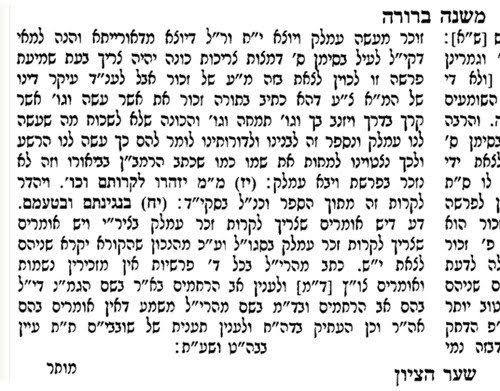
A few years ago the outstanding scholar, R. Yaakov Yisrael Stoll, published the anonymous Sefer Kushyot. Here are pages 123-124.
I ask readers to look at note 887. He discusses a mistake made by many in assuming that an expression is a biblical verse. He then notes that the Zohar also makes the same mistake, and refers to other such mistakes made by בעל הזוהר. He doesn’t say so explicitly, but I think the way he formulates the note lets the reader, who is attuned to these things, know that in his mind בעל הזוהר is not R. Shimon ben Yohai.
I have no idea who the speaker is, and if he has ever even read a page of the Zohar, but he does seem very sure of himself. I have no objection to discussing the authorship of the Zohar and the ideas found there, or Kabbalah as a whole. However, I would think that a little humility is called for when discussing a discipline that was a basic part of the religious worldview of so many central figures. Do the names Nahmanides, R. Joseph Karo, or the Vilna Gaon mean anything to this speaker?
In my article, I cited all sorts of texts by Orthodox figures dealing with the authorship of the Zohar. Yet I overlooked the following by R. Joseph Hertz.
The question of the authorship of the Zohar, like that of Sefer Yetzirah, is one of the cruces of Jewish literature. The authorship by Simeon ben Yochai, or by his immediate disciples, though this is still an article of faith with millions of Jews in Eastern Europe, has from internal evidence long proved to be untenable. The Zohar explains Spanish words, contains quotations from Gabirol, and mentions the Crusades.[2]
As noted, in my article cited a number of sources that point to additions to the Zohar. Rabbi Akiva Males commented to me that I neglected to mention R. Isaac Haver, Magen ve-Tzinah, ch. 21. This book was written in response to R. Leon Modena’s Ari Nohem, a work aimed at disproving the antiquity of the Zohar. Unless one’s head is totally in the sand, it is impossible to deny that there are passages in the Zohar that post-date the tannaitic era. For Modena, this was proof that the Zohar could not have been written by Rabbi Shimon ben Yohai. Haver, who wants to hold onto the ancient dating, adopts the only path open to him, arguing that there are indeed many post-tannaitic additions, but the core of the book is ancient.
ובאמת ספר הזוהר נכתב כמה דורות אחר רשב”י מה שנכתב ונתקבל משמו ומשאר חבריו ותלמידו שהיו בימיו, וגם זה נעשה בו הוספות רבות עד מאוד מן אחרוני האחרונים אחר שבאו בכתב וניתנו להעתיק ושלטו בו ידי רבים כל אחד מה שנראה בדעתו ומה שנתחדש לו וכתב בגליון על ספר הזוה”ק מן הצד ואח”ז בא ריעהו מעתיק מן המעתיק ומצא בגליון דברים רבים ובמעט התבוננות חשב שזה היה חסרון בגוף ספר והכניסם בפנים.
Haver points out that is how we can explain the obviously late passages, where we see that the Zohar includes material that comes from Rashi and R. Tam. Among kabbalists, it was not unheard of to say that Rashi actually knew the Zohar and was influenced by it.[3] But Haver will have none of this and recognizes that the influence is in the reverse direction, i.e., Rashi influencing the Zohar. He states that anyone who understands the Zohar will recognize these additions.
What does Haver mean when he mentions that there is material from R. Tam in the Zohar? I am aware of one obvious example. It says in Kiddushin 30b that “one should always divide his years into three: [devoting] a third to Mikra, a third to Mishnah, and a third to Talmud.” R. Tam explains why the practice in his day was not in accord with what the Talmud states, an explanation that became very influential and served as a justification for the widespread ignoring of the study of Tanakh in the Ashkenazic world[4]
בלולה במקרא ובמשנה וכו’: פירש רבינו תם דבתלמוד שלנו אנו פוטרין עצמנו ממה שאמרו חכמים לעולם ישלש אדם שנותיו שליש במקרא שליש במשנה שליש בתלמוד.
What he says is that since the Talmud itself contains Bible and Mishnah, there is no need to divide one’s time among the three categories. Rather, by studying Talmud one combines all three areas. I always found this a difficult explanation, for if the Talmud agreed with this perspective, it would have said so, instead of stating that one is to divide one’s time. The intention of the talmudic instruction in Kiddushin was that people become well acquainted with all three subjects, and if they only devote themselves to Talmud, there is a great deal of Bible and Mishnah[5] they will never encounter. (According to Maimonides, Hilkhot Talmud Torah 1:12, once one is already a scholar, he does not need to divide his time between the three areas, but can focus almost entirely on Talmud.)
Despite what R. Tam says, R. Samson Raphael Hirsch claims that it was due to a misunderstanding of this opinion that people were led to stop studying Tanakh.[6] Not mentioned by Hirsch is that even before R. Tam some scholars ignored Tanakh. There were even talmudic Sages who were not expert in Bible. Bava Kamma 54b-55a states:
R. Hanina b. Agil asked R. Hiyya b. Abba: Why in the first Decalogue is there no mention of wellbeing [טוב], whereas in the second Decalogue there is a mention of wellbeing?[7] He replied: While you are asking me why wellbeing is mentioned there, ask me whether wellbeing is in fact mentioned or not, as I do not know whether wellbeing is mentioned there or not.
Tosafot, Bava Batra 113a, s.v. travayhu, cites this text to support its contention about the amoraim: .פעמים היו שלא היו בקיאין בפסוקין After referring to this strange passage in Tosafot (concerning which there is an entire literature), R. Moses Salmon sarcastically declares[8]: ועל זה סומכים הלומדים עמי הארץ וד”ל
Unlike Salmon, R. Samuel Strashun, in his note to Bava Batra 8a, defended those talmudists who were deficient in knowledge of Bible.
משמע דאפשר שיהיו בעלי משנה או בעלי גמרא ולא בעלי מקרא . . . ודלא כאותן ששופכין בוז על מקצת גדולי זמנינו בש”ס ופוסקים ואין להם יד כ”כ במקרא.
So returning to my question, what does Haver mean when he says that there is material from R. Tam in the Zohar? Well it turns out that R. Tam’s explanation, which we have just been discussing, is also found in the Zohar Hadash (ed. Margaliyot), Tikunim p. 107b:
תקינו רבנן לשלש שנותינו במקרא בתלמוד . . . ואוקמוה דמאן דמתעסק (במשנה) [בתלמוד] כאלו התעסק בכלא בגין דאיהי בלילא במקרא במשנה בתלמוד.
There is no question that this passage is adopted from R. Tam, who lived a millennium after R. Shimon ben Yohai.
Incidentally, regarding R. Tam’s view, here is a page of an article by R. Yehudah Aryeh Schwartz that appeared in the Agudah journal Kol ha-Torah, Adar 5765 [2005], p. 102 (second pagination).
The following page comes from R. Yehiel Michel Stern’s Ha-Torah ha-Temimah on the Book of Joshua, p. 84 no. 3, which appeared in 2009.
As you can see, Stern’s comment is lifted word for word from Schwartz’s article. I am not sure what to make of this. That is, are dealing with a simple plagiarism? Perhaps one of the readers has some insight. (Stern may be the world’s most prolific writer of Torah publications.)
In my article I referred to passages in the Zohar which traditional authorities had claimed were really later interpolations. There are examples of the opposite phenomenon as well, namely, attributing things to the Zohar that are not found there. The most famous instance of this that I know of is found in the Bah, Orah Hayyim 4 (and quoted from there in Be’er Heitev, Orah Hayyim 1:2) that upon waking up if you walk four amot without washing your hands you are subject to the death penalty![9] This Zoharic text is quoted in the name of the work Tola’at Yaakov, authored by R. Meir Ibn Gabai (1480-ca. 1543). The passage is cited over and over again by aharonim in trying to show the importance of the morning washing. Yalkut Meam Loez, Deut. 4:9, doesn’t even mention the Zohar, stating simply:
ואמרו חז”ל כל המהלך ד’ אמות בלי נטילת ידים חייב מיתה
A few scholars actually point out that this passage is not to be found in the Zohar.[10] One of those who realized this is R. Eleazar Fleckeles, Teshuvah me-Ahavah, vol. 1 no. 14, whom we will come back to later in this post. He writes that he looked in the Zohar and didn’t find the passage referred to. With reference to the Tola’at Yaakov, whom he (falsely) thinks cited the Zohar (since that is what it says in the Bah), Fleckeles writes:
ושארי לי’ מארי’ שעשה רוב ישראל לחייבי מיתות
Because very few of the aharonim actually had the sefer Tola’at Yaakov (which is itself a little strange as the book was printed a number of times), they were unable to see that the Tola’at Yaakov never quotes the Zohar! Here is p. 9a from the Cracow 1581 edition.
If you look in the second paragraph you will see that Ibn Gabai does state that one who doesn’t wash his hands is חייב מיתה, but he doesn’t attribute this to the Zohar. How he derives this idea is worthy of investigation at a different time. For now, it is important to just note that what we have here is an independent idea of a sixteenth-century Kabbalist which for some reason was misquoted by the Bah as if Ibn Gabai was citing the Zohar. This misquotation was to be repeated again and again, down to the present day.
The supposed Zohar text has led to additional stringencies. For example, the hasidic master R. Meshulam Zusha of Anapole stated that that one should not even to put one’s legs on the ground before washing one’s hands.[11]
Here is an interesting story that relates to the false Zohar quotation: A very learned and rich student came to study with R. Simhah Bunim of Peshischa.[12] The problem was that this young man was a bit of an independent thinker, and the Kotzker, who was also there, didn’t think that the young man belonged with them. The story explains how the Kotzker was able to convince the young man to leave. What was it about this man that turned the Kotzker against him? We are told the following:
הוא הגיה בזוה”ק שכתב “ההולך ד’ אמות בלי נטילת ידים חייב מיתה”, והוא הגיה: “והוא שהרג את הנפש”, וזה נגד חז”ל.
So here we have a story of an emendation of a non-existent Zoharic text. And even if we assume that the man was emending the text as it appears in the Bah, we see from the story that the Kotzker thought that the quote was authentic.
I wasn’t sure what to make of this passage. I therefore consulted a learned friend who said that the problem was that the young man who emended the text to read והוא שהרג את הנפש was making a joke at the expense of the (supposed) Zoharic passage. He was saying that you are only deserving of the death penalty if you kill someone while walking the four amot. I then sent him a page from R. Zvi Yavrov, Ma’aseh Ish, vol. 4, p. 113, where it appears that the Hazon Ish took the emendation-explanation just mentioned as an authentic understanding of the passage. The text in Yavrov reads as follows:
על מה שהביא ה”באר היטב” (או”ח סימן א’ סק”ב) שההולך ד’ אמות בלי נטילת ידים שחרית חייב מיתה, אמר רבינו להגאון ר’ שמריהו גריינימן זצ”ל, שמישהו כתב בגליון הספר “והוא שהרג את הנפש” (מבנו הג”ר ברוך שליט”א).
My friend replied by referring me to a discussion on Hyde Park here where the text from Yavrov is also mentioned. One of the commenters there claims that the Hazon Ish was also joking in his remark, and the one who heard this (who was hardly a tyro), or the person who passed on the information to Yavrov, didn’t realize that it was a joke. The commenter also assumes that despite what appears in the Bah and Be’er Heitev, the Hazon Ish would have known that that it wasn’t an authentic quote from the Zohar. I find this very unlikely, as the Hazon Ish is not known to have been an expert in the Zohar, and what reason would there be for him to doubt that which is quoted in numerous earlier sources?
The one point that the commenter has going for him is that he is correct that there are many examples in this book, and others like it, from which we see that the author does not know how to distinguish between what should and should not be included in a book. The commenter gives an example to illustrate this. In vol. 5, p. 141, Yavrov gives us the following important information about the Hazon Ish, recorded by one of his students: They never saw the Hazon Ish picking his nose! I kid you not.
העיד אחד מגדולי תלמידי רבינו: מעולם לא ראו את הרבי עם אצבע באף (מהרב מרדכי ויספיש)
Regarding this issue, R. Eliezer Melamed – who really is a great halakhic scholar – writes that picking one’s nose in public is forbidden.[13]
ויש מעשים שכשאדם עושה אותם בסתר, אין בכך פגם, אבל בפני אנשים אחרים הם נחשבים למגעילים ואסורים משום ‘בל תשקצו’ ומשום המצוות שבין אדם לחבירו. למשל, המחטט באף או מגרד פצעונים שבפניו, עובר באיסורים אלו. וכן אמרו חכמים (חגיגה ה, א): “כִּי אֶת כָּל מַעֲשֶׂה הָאֱלוֹהִים יָבִא בְמִשְׁפָּט עַל כָּל נֶעְלָם. אמר רב: זה ההורג כינה בפני חבירו ונמאס בה. ושמואל אמר: זה הרק (היורק) בפני חבירו ונמאס בה”. ובמיוחד בעת שאוכלים, צריך להיזהר בכך יותר, כי מעשים מאוסים, וכן דיבורים מגעילים, מבטלים את התיאבון ומעוררים בחילה בקרב הסועדים.
Getting back to the supposed Zoharic passage, R. Yitzhak Abadi discusses this in Or Yitzhak, vol. 1, no. 1. He begins his responsum by pointing out that despite the fact that the Mishnah Berurah records how one is not to walk four amot before washing one’s hands, R. Aaron Kotler did not concern himself with this. Abadi then explains that the words of the Zohar are not intended for everyone,[14] and none of the rishonim write that it is forbidden to walk four amot before washing. He concludes by stating that he is inclined to rule – ולולי דמסתפינא הייתי אומר להלכה למעשה – that the entire practice of negel vasser is no longer relevant to us because ruah ra’ah is no longer a concern.[15] Here again we see that the author of a responsum assumes that the issue he is discussing, of not walking four amot before hand washing, is based on the Zohar, when in fact the Zohar doesn’t mention this at all.
Finally, I must mention that R. Hayyim Joseph David Azulai, Birkei Yosef, Orah Hayyim 1:1, recognizes that there is nothing in the Zohar about being subject to the death penalty for walking four amot. However, he notes that both he and his forefather, R. Abraham Azulai, saw an alternate version which indeed states that one who walks four amot אתחייב מיתא לשמיא. Based on this alternate text, the Hida declares that the Tola’at Yaakov is correct in how he quoted the Zohar, and the criticism of him for the inaccurate quotation is therefore misplaced. Even the Hida didn’t have access to the Tola’at Yaakov, and based on the Bah assumed that the Tola’at Yaakov quoted the Zohar and must indeed have had the alternate text. Yet as we have already seen, the Tola’at Yaakov does not quote the Zohar, and there is no actual alternate version of the text such as quoted by the Hida.
What happened was that someone saw the Bah quoting the Tola’at Yaakov as quoting the Zohar that one who walks four amot is subject to the death penalty. Not finding this passage in the Zohar, this individual inserted it into his text of the Zohar in the section that deals with hand washing in the morning (Zohar, vol. 1 p. 10b). I don’t think this was intended as a forgery. Rather, whoever put it in assumed that it was an authentic Zoharic teaching, found in an alternate text, and he was inserting it where it should be. He thought that it was an authentic Zoharic teaching because the Tola’at Yaakov had testified to it. But as we have already seen, Tola’at Yaakov said nothing of the sort. This alternate girsa can therefore be traced back to the Bah’s misquotation of the Tola’at Yaakov.
How can we explain the Bah? I think the answer is simple. When the Bah cited the Tola’at Yaakov he did not have the book in front of him, and was relying on his memory, the sort of mistake that is found among all of our great sages. That is how this error crept in which has had a great influence on Jewish religious texts and practice for hundreds of years, and yet it all goes back to a simple mistaken quotation.
Returning to my article on the Zohar, Rabbi Akiva Males called my attention to the following paragraphs that appear in an essay by R. Aryeh Kaplan.[16] It would be great if a reader has examined the manuscript and can testify to the accuracy of what Kaplan reported.
Rabbi Yitzchok deMin Acco is known for a number of things. Most questions regarding the authenticity of the Zohar were raised by him, since he investigated its authorship. He was a personal friend of Rabbi Moshe de Leon, who published the Zohar. When questions came up regarding the Zohar’s authenticity, he was the one who investigated, going to the home town of Rabbi Moshe de Leon. The whole story is cited in Sefer HaYuchasin, who abruptly breaks off the story just before Rabbi Yitzchok reaches his final conclusion. Most historians maintain that we do not know Rabbi Yitzchok’s final opinion – but they are wrong.
Around three years ago, someone came to me and asked me to translate parts of a manuscript of Rabbi Yitzchok deMin Acco, known as Otzar HaChaim. There is only one complete copy of this manuscript in the world, and this is in the Guenzberg Collection in the Lenin Library in Moscow. This person got me a complete photocopy of the manuscript and asked me to translate certain sections. I stated that the only condition I would translate the manuscript is if I get to keep the copy. This is how I got my hands on this very rare and important manuscript.
Of course, like every other sefer in my house, it had to be read. It took a while to decipher the handwriting, since it is an ancient script. One of the first things I discovered was that it was written some 20 years after Rabbi Yitzchok investigated the Zohar. He openly, and clearly and unambiguously states that the Zohar was written by Rabbi Shimon bar Yochai. This is something not known to historians, and this is the first time I am discussing it in a public forum. But the fact is that the one person who is historically known to have investigated the authenticity of the Zohar at the time it was first published, unambiguously came to the conclusion that it was an ancient work written by Rabbi Shimon bar Yochai.
Leaving aside for now the important information recorded by Kaplan, there is a good deal that can be said about R. Moses de Leon and the creation of the Zohar, and it is questionable if one can even speak of a single author. One essential point that must be recognized by all who investigate this matter is that De Leon himself was involved in other forgeries, in particular forgeries of geonic responsa.[17] As such, he obviously is not the most reliable source when he announces to the world that he is in possession of a text of mystical lore dating from the tannaitic period.
Regarding the Zohar and forgery, I think readers will also find the following interesting. (Many already know some of the story, but it is worth repeating for those who don’t.) In the journal Or Torah, Tevet 5772, p. 362, a reader, whose knowledge of Jewish bibliography is not that great, had a question. He saw the following page in R. Yudel Rosenberg’s Hebrew translation of the Zohar to Va-Yikra.
This is important information, as Emden confesses that his attack against the Zohar was only designed to pull the wool out from under the Sabbatians, whose ideology was linked to the Zohar. The man who wrote to Or Torah, not knowing anything about Rosenberg, asked for help from the readers. He tried to locate the book Tzur Devash quoted by Rosenberg, but was unable.
In Or Torah, Adar 5772, pp. 555-557, two individuals let the first writer in on the “not-so-secret” that there is no book Tzur Devash, and that Rosenberg had a long history of making up texts; see here. This is so even though Rosenberg was a respected rabbi and posek. Here, incidentally, is the picture of Rosenberg that appears at the beginning of his Zohar translation.
With some of Rosenberg’s “forgeries”, it seems that what he was doing was creating a form of literature, and anyone who takes the story literally has only himself to blame (much like anyone who thinks that Animal Farm is really about animals has no one to complain to but himself). At times, Rosenberg would even hint to the reader what he was doing, as in Hoshen ha-Mishpat shel ha-Kohen ha-Gadol, where in the preface he mentions that part of the story also appeared in a work of Arthur Conan Doyle. If any reader would have taken the time to find out who this was, he would have realized that we are dealing with a fictional account. At other times, however, Rosenberg offers no such hint, at least none that I am aware of, and what we have appears to be a simple forgery. That would seem to be the case here, with the phony letter from Emden.
The second correspondent in Or Torah also calls attention to R. Yaakov Hayyim Sofer’s discussion in Etz Hayyim 7 (5769), pp. 267-268. While for a long time everyone has known that the Emden letter was a forgery, Sofer identifies another forgery. Rosenberg’s translation (second edition) vol. 1, contains a letter of approbation from R. Hayyim Hezekiah Medini, the Sedei Hemed.[18] Sofer claims, and I think he is correct, that this approbation is a forgery. His prime proof is that in the approbation Medini refers to the Hida as האזולאי. There are many hundreds, if not thousands, of references to the Hida in Medini’s work, and not once does he refer to the Hida as האזולאי, which is a form only used by Ashkenazic rabbis. What Sofer didn’t realize, and further supports his point, is that Rosenberg himself, in his introduction, p. 5a, refers to Hida as האזולאי.
In Or Torah, Iyar 5772, p. 744, another writer called attention to Sedei Hemed, Peat ha-Sadeh, kelalim, mah’arekhet bet, no. 47, where Medini states that it is disrespectful to use this sort of language, referring specifically to the expression האלגאזי.[19] This is another proof, if any was needed, that Medini would never have referred to the Hida as האזולאי. Let me also add that the way Medini (=Rosenberg) concludes the forged haskamah is not like any of his other letters, which are included in Iggerot Sedei Hemed (Bnei Brak, 2006). In the authentic letters, before his name Medini always adds הצב”י or הצעיר , which he does not do in the forged haskamah.. In his authentic letters, he also never closes them by adding to his name רב ומו”ץ בעיר הקדש חברון. Therefore, there can be no doubt that the letter of approbation sent by Medini to Rosenberg is simply another one of the latter’s forgeries.
Now let us turn to the incredible recent publication of a derashah by R. Yehezkel Landau, the Noda bi-Yehudah.[20] But before doing so, it is necessary to say a few words about R. Eleazar Fleckeles, the outstanding student of the Noda bi-Yehudah. (Fleckeles’ grave, entirely ignored by tourists, stands right near that of his teacher.) Ever since the publication over two hundred years ago of the strong comments of Fleckeles downplaying the authority of the Zohar, people have wondered where this came from. It just seemed strange that an 18th-19th century traditional Torah scholar would express himself this way. We now have the answer. Fleckeles was following in his teacher’s footsteps. Thanks to the publication of the Noda bi-Yehudah’s derashah by Michael Silber and Maoz Kahana, a derashah that had previously only appeared in a censored form, we now know that that the Noda bi-Yehudah had a skeptical view of the Zohar, at least in the form that it has come down to us. The issue that the Noda bi-Yehudah was concerned with was the same thing that bothered Emden and Fleckeles, namely, distinguishing the authentic ancient Jewish mysticism from the many later additions that found their way into the Zohar.
What caused the Noda bi-Yehudah in his later years to adopt a skeptical position, one so much at odds with his earlier outlook, is of course worthy of investigation and something for the scholars to fight over (and they already have!).
Regarding Fleckeles, his negative comments about the Zohar that appear in Teshuvah me-Ahavah are well known and have often been cited. In my article I also referred to Fleckeles’ citation of Wessely who quoted R. Jonathan Eibschuetz as supposedly stating that one need not believe in Kabbalah. (Needless to say, it is very difficult to believe that Eibschuetz could have ever expressed himself this way.) In preparing for my Torah in Motion talks on R. Moses Kunitz,[21] I found another relevant text from Fleckeles that as far as I know has gone unnoticed among those who have discussed the matter. It appears in Kunitz’s responsa Ha-Metzaref,[22] which happens to be one of the strangest responsa works ever published. It is also noteworthy in that it contains something extremely rare, namely, a responsum from R. Nathan Adler, the Hatam Sofer’s teacher. Knowing that some people might doubt that the teshuvah could really have been authored by R. Nathan, he also included a letter from the Hatam Sofer testifying to the responsum’s authenticity.
In Ha-Metzaref, vol. 1 no. 11, Fleckeles again focuses on additions to the Zohar that are not part of the authentic work, but here he adds a new point which is important for an accurate description of Fleckeles’ position. He says that if a Zoharic text is quoted by R. Isaac Luria, R. Moses Cordovero, or R. Menahem Azariah of Fano then you can assume that it is part of the original Zohar, authored by R. Shimon ben Yohai.
One final comment regarding the Noda bi-Yehudah’s derashah: Yehoshua Mondshine somehow got hold of it before it was published by Silber and Kahana. Here is the relevant page, from Or Yisrael, Nisan 5766, p. 202.
Notice how Mondshine doesn’t reveal where this text comes from, something not expected from a careful scholar. Since this is such an amazing passage, and Mondshine’s article was the first time it appeared in print, you can be sure that loads of people must have turned to Mondshine asking him for its source. Presumably, when he was given the text he gave his word not to reveal its source. He might not have even known the source, and was only given the small passage.
2. Due to correspondence with a couple of people, I realized that I forgot to include something about the word מחיה in my last post. So here it is now.
In the Amidah we say מחיה מתים אתה. There is a tzeirei under the yod meaning that this is not a verb. Artscroll correctly translates “Resuscitator of the dead.” Sacks,[23] on the other hand, gives the mistaken translation “You give life to the dead”. The next line reads
מכלכל חיים בחסד, מחיה מתים ברחמים רבים
Is מחיה in this verse a verb? Ifמכלכל is translated as a verb, then מחיה will also have to be translated this way. The Tehilat ha-Shem siddur has a segol under the yod of מחיה, and with this vocalization it is correct to translate it as a verb. However, for siddurim with a tzeirei the only accurate translation is a noun. Metsudah, which we have seen is consistent in this matter, translates: “Sustainer of the living with Kindliness, Resurrector of the dead with great mercy.” Both Artscroll and Sacks, however, translate מחיה as a verb which is incorrect. But why is it incorrect? It is only incorrect because of the vocalization (tzeirei), but I think that in the sentence מחיה is indeed a verb. This means that it is the vocalization that is incorrect, and that instead of a tzeirei under the yod, there should be a segol, as in the Tehilat ha-Shem siddur[24]. So my recommendation to Artscroll and Sacks would not be to change the translation, but only to change the vocalization.
After reading my last post, Ben Katz sent me an example where of all the translations, only Artscroll gets it right. The last lines of Adon Olam read:
בידו אפקיד רוחי בעת אישן ואעירה
ועם רוחי גויתי ה’ לי ולא אירא
Sacks translates as follows (and Metsudah is similar):
What this means is that God has my soul at all times, when I am awake and when I sleep, and that that is why I have no fear.
Artscroll translates as follows:
Into His hand I shall entrust my spirit
When I go to sleep – and I shall awaken!
With my spirit shall my body remain.
Hashem is with me, I shall not fear.
Before getting to what I think is the significant part of the translation, let us look at the last line: ועם רוחי גויתי, ה’ לי ולא אירא. In his translation, Sacks has turned the order of the sentence around. That is OK as it was done so that the rhyme works (and Sacks deserves enormous credit for having most of the song rhyme in English). The real problem is Sacks’ rendering of the words ועם רוחי גויתי. There is no way this can be translated as “Body and soul from harm will He keep.” The words imply nothing about keeping from harm. The typical translation sees ועם as referring to God, meaning that God is with my soul and body and therefore I will have no fear.
However, Artscroll gets it right, I think, by translating these words literally: “With my spirit shall my body remain.” To see how Artscroll gets to this translation, we have to look at the previous verse, and that is where we see Artscroll’s brilliance. בידו אפקיד רוחי בעת אישן ואעירה. The other translations understand this to mean that I place my spirit (or soul) in God’s hands when I sleep and when I am awake. The problem with this rendering is that if my spirit is always in God’s hands, then what sense does it make to say that I place it there? If it is always there, during the day and at night, there is nothing for me to place.
Artscroll translates: “Into His hand I shall entrust my spirit when I go to sleep – and I shall awaken!” This is an allusion to the famous Midrash that we are all taught in school, that when you go to sleep your spirit returns to God, and is given back to you in the morning.[26] This isn’t just some random Midrash, but is derived from Psalm 31:6, which states: בידך אפקיד רוחי.[27] In other words, the Midrash is commenting on the exact words used by Adon Olam. This shows that Artscroll’s translation has indeed beautifully captured the correct meaning.
We now can properly understand the next verse. Since my spirit has returned and joined with my body, I know that God is with me and I shall not fear.
3. There is a relatively new publication for all who are interested in Jewish intellectual life. I refer to the Jewish Review of Books, expertly edited by Abraham Socher. Modeled after the New York Review of Books, each issue is full of great material. In the latest issue I published a translation of part of an essay by R. Jehiel Jacob Weinberg on Berdyczewski. Only subscribers can access the essay, but everyone can see the artwork that went along with it. See here. (Due to copyright restrictions, I can’t reproduce the artwork in the post.)
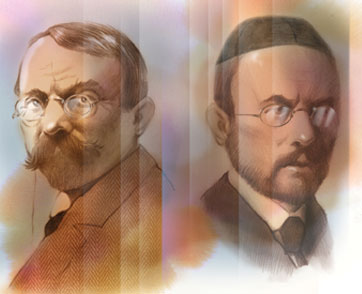
If you examine the picture of Weinberg produced by the artist, you will see that it was modeled after this picture that appears in my book on Weinberg, and also on the front cover of the soft-cover edition.
The original photograph was part of a faculty picture taken when Weinberg taught at the University of Giessen. However, the artistic reproduction adds something that is not found in the original, something that the artist assumed no rabbi should be without; see here.
4. Those outside of the United States who want to post (or read) comments, please access the Seforim Blog site by going to http://seforim.blogspot.com/ncr. Only by doing this will you be taken to the main site (and not have a country code in the URL). Readers outside the United States do not have access to the comments posted in the U.S. We don’t know why this is, or how to fix it yet, but the above instruction fixes the matter.
* * * * Quiz
I have an extra copy of one of the volumes of R. Hayyim Hirschensohn’s commentary on Rashi. The person who answers the following question will receive it. Send answers to me at shapirom2 at scranton.edu
1. Tell me the only place in the Shulhan Arukh where R. Joseph Karo mentions a kabbalistic concept? I am referring to an actual concept e.g., Adam Kadmon, Ein Sof, etc.
2. If more than one person answers the above question correctly, the one who answers the following (not related to seforim) will win: Which is the only United States embassy that has a kosher kitchen?
If no one can answer question no. 2, I will do a lottery with the names of those who answer no. 1 correctly.
[1] R. Moshe Zuriel kindly sent me the following additional sources that should be added to my list.
[א] ספר “אור החמה”, ביאור בשלשה כרכים על הזוהר, נלקט ע”י הרב אברהם אזולאי, מביא דברי ר’ אברהם גלאנטי שם על זהר ח”א קסח, והוא בנדפס דף קנט ע”א ראש טור שמאל, “הם דברי מחבר הספר בימי הגאונים או חכמים אחרים שחברו כל המימרות יחד שכתב ר’ אבא, שהיה סופר של רשב”י והם חלקום לפרשיות כל פסוק בפרשה שלו, והם אמרו משלהם”.
[ב] בפירוש ר’ יוסף חיים מבבל (בן איש חי) בשם “בניהו” (דף ד ע”ב בנדפס) פירוש על תיקוני זהר, בתחילת ההקדמה לתקו”ז (ב ע”ב) מזכיר “ועל האי ציפור רמיזו רבנן בהגדה דבתרא דרבה בר בר חנה” כותב הרב: “נראה פשוט בספר בתקונים הראשון אשר הועתק מכתיבת יד חכמי הזוהר כך כתוב ‘קא רמיזו רבנן’ וכו’ אך חכם אחרון שראה דבר זה כתוב בגמרא דבתרא במאמרי רבב”ח הוסיף על הגליון תיבות אלו בהגדה דבתרא דרבב”ח וכו’ ואחר כמה שנים המדפיסים הכניסו בפנים מה שראו כתוב בגליון. ועל חינם הגאון יעב”ץ הרעיש העולם לערער בדבר זה וכיוצא בו”.
[ג] אדמו”ר ר’ יצחק אייזיק קומרנא בספרו “נתיב מצותיך” שביל התורה אלף, מהד’ שנת תש”ל עמ’ קא כתב: “ור’ אבא היה כותב כל מה ששמע, הן ממנו הן מהחברים וכו’ בסוף ימי רבנן סבוראי תחילת הגאונים היה איש קדוש אאחד שהיה בו נשמת משה רבנו ממש וכו’ וכו’ והוא חיבר ספר רעיא מהימנא וקרא לזוהר חיבורא קדמאה”.
[ד] ר’ צבי אלימלך (מחבר בני יששכר) בספרו “הגהות מהרצ”א” (נמצא בתוכנת אוצר החכמה) על פרשת בא לח ע”א (בנדפס בספר שם דף קכו) כותב: “לפי גירסא הזו ע”כ [על כרחך] צ”ל דהזהר נתחבר בג”ע [בגן עדן] בזמן הגאונים, דהרי רב חסדא אמורא היה בזמן האמוראים” עכ”ל.
[ה] הרב אברהם יצחק קוק, מאמרי הראי”ה, עמ’ 519: מתוך מכתב להרב קאפח: “אפילו אם נשתלשלו דורות רבים והיו בהם הוספות והערות מחכמים שונים, ואם אפילו נתערבו בהם איזה דברים שראויים לביקורת, כמו שעשה הגאון יעב”ץ במטפחתו, אין העיקר בטל בכך”.
[2]Sermons, Addresses and Studies, vol. 3 p. 308. I learnt of this passage from Ben Elton, Britain’s Chief Rabbis and the Religious Character of Anglo-Jewry, 1880-1970, p. 176.
[3] See Studies in Maimonides and his Interpreters, p. 89 n. 376, where I mention that R. Abraham ben ha-Gra, who (for his time) had a critical sense, was among those who thought that Rashi knew the Zohar.
[4] Tosafot, Sanhedrin 24a s.v. belulah. The uncensored text, found in the Venice edition, reads בתלמוד, but the Vilna edition has בש”ס.
[5] Since the Daf Yomi siyum is just about upon us as I write these words, let me add the following: While I don’t think that R. Joseph B. Soloveitchik can be called an opponent of Daf Yomi, I was present at a shiur in the summer of 1985 where he expressed his dismay that due to the growing popularity of Daf Yomi, people were no longer studying all six orders of the Mishnah, much of which has no Talmud and is thus not included in the Daf Yomi cycle. (Due to how the Talmud was printed, Kinnim and Middot are the only tractates of Mishnah included in Daf Yomi. )
[7] See Deut. 5:15: כבד את אביך ואת אמך כאשר צוה ה’ אלקיך למען יאריכן ימיך ולמען ייטב לך על האדמה אשר ה’ אלקיך נתן לך
R. Samuel Schonblum offers an explanation of the talmudic passage that many will no doubt claim attributes a heretical assumption to one of the Sages. See his edition of R. Isaac Ibn Latif, Rav Pealim (Lemberg, 1885), p. 54:
כפי השקפה הראשונה נוכל לומר כי השנוים שבדברות האחרונות משה אמרן מדעת עצמו כמ”ש הראב”ע ז”ל כמוסיף וגורע ואפשר לומר כי לא נאמר טוב בסיני כלל ע”כ כאשר שאל לו מ”מ [מפני מה] בראשונות לא נאמר טוב ובאחרונות נאמר טוב השיב לו שאלני אם נאמר טוב אם לאו, שאפשר שגם באחרונות לא נאמר טוב כך משה הוסיף או גורע עד שבא לר’ תנחום בר חנילאי ואמר לו כי באמת נאמרו כך בסיני ע”י משה וזה שלא נכתבו על הלוחות הראשונות יען כי היו עתידין להשתבר ע”כ לא נאמר ע”י הדיבור הנעלם רק ע”י משה, ה’ יראני מתורתו נפלאות.
In Limits of Orthodox Theology, I did not discuss the commentary of Ibn Ezra (Ex 20:1) referred to by Schonblum. That is because I assumed that he agreed with the standard medieval view that even though Moses may have written things on his own accord, when these texts were later included as part of the Torah given to the Children of Israel, this was done at God’s direction and that is what sanctified the text. I am no longer convinced of this. All Ibn Ezra says in his commentary to Ex. 20:1 is that minor variations in wording are due to Moses changing God’s original words. Nowhere in his commentary does Ibn Ezra state that Moses’ changes were ever given divine sanction.
[9] I wonder if this exaggeration is related to the seeming exaggerations found in Sotah 4b regarding those who are not careful with netilat yadayim: כל האוכל לחם בלא נטילת ידים כאילו בא על אשה זונה . . . כל המזלזל בנטילת ידים נעקר מן העולם See also Yalkut Shimoni, Ki Tisa, no. 386: כל האוכל בלא נטילת ידים כבא על אשת איש (I say “seeming” exaggerations, because maybe these are not exaggerations. See the story with R. Akiva in Eruvin 21b.) Why were the Sages so strident in this matter? After citing the two rabbinic passages just mentioned, R. Zvi Hirsch Chajes points to an anti-Christian motivation. See Kol Sifrei Maharatz Chajes, p. 1003:
והטעם שהחמירו חז”ל בזה, דענין נטילת ידים הוא הענין הראשון אשר זלזל בו המחוקק לנוצרים, כמבואר בספריהם דשאלו אותו מדוע תלמידיו אוכלים בלי נטילת ידים והשיב מה שיצא מן הפה הוא טמא ומה שהולך לפה הוא טהור, ומפני זה למען לא יהיה לנו השתוות עמהם, החמירו בנטילת ידים, דהמזלזל בזה הוי כמודה להם.
See R. Mordechai Fogelman, Beit Mordechai, part 2, no. 15:2 (p. 224), who uses the Christian angle to explain another talmudic passage dealing with washing of hands. (Those who have read R. Israel Meir Lau’s wonderful autobiography will recognize Fogelman’s name.) See also Abraham Buechler, Am ha-Aretz ha-Gellili, ch. 4.
[10] See e.g., R. Pinchas of Koretz, Imrei Pinhas ha-Shalem (Bnei Brak, 2003), p. 209:
מה שכתב הבאר היטב (או”ח א, ס”ק ב) בשם תולעת יעקב בשם הזוהר, ההולך ארבע אמות בלי נטילת ידים חייב מיתה, הקפיד מאד הרב ז”ל על זה, שאינו בזוהר כלל, וגם במגן אברהם (או”ח ד, א) ובתולעת יעקב עצמו לא כתב בשם הזוהר רק דעת עצמו.
[11] See R. Zvi Elimelech of Dinov, Igra de-Firka, no. 9.
[12] See Menachem Yehudah Baum, Ha-Rabbi Rabbi Bunim mi-Peshischa (Bnei Brak, 1997), vol. 1, p. 212.
See also R. Shmuel Eliyahu’s responsum on the topic here, R. Yaakov Peretz, Emet le-Yaakov (Jerusalem, 1979), p. 29, and R. Moshe Zuriel, Tziyon be-Mishpat Tipadeh (Bnei Brak, 2007), pp. 107-108. The section in Zuriel’s book is entitled
בענין הנוהג הנפסד של חיטוט באף ובאוזן, בעת לימוד תורה והתפילה
There might even be enough material for a booklet dealing with the halakhot related to picking one’s nose. I know some of you are laughing right now, but I am entirely serious. See also R. Israel Pesah Feinhandler, Avnei Yoshpeh, vol. 5, Orah Hayyim no. 71, who discusses if it is permissible to pick one’s nose on Shabbat.
See also R. Ovadiah Yosef, Yabia Omer, vol. 5, Orah Hayyim no. 30:
ואתה תחזה שע”פ האמור יש להעיר עמ”ש הגאון מהר”ח פלאג’י בס’ רוח חיים (סי’ שכא סק”ב וסי’ שמ סק”א), ובס’ כף החיים (סי’ ל אות קה), שיש להזהיר לאלה שמקנחים צואת החוטם (ובפרט כשהיא יבשה), שתולשים עי”ז כמה שערות, ואע”ג דדבר שאינו מתכוין מותר, היכא דפסיק רישיה יש להחמיר
There is also the issue of phlegm and hatzitzah that has been dealt with by many. It is interesting that halakhic sources regard putting one’s finger in one’s ear the same way as in one’s nose (e.g., in discussing if you have to wash your hands after this), while contemporary mores sees the latter as being in much poorer taste.
While on the topic of unusual halakhic subjects, let me call attention to a new book by the young scholar R. Yissachar Hoffman, from whom I have learnt a great deal. It focuses on sneezing. In his approbation, R. Gavriel Zinner writes: ראינו חשיבות התורה שיכולים מכל ענין לעשות ספר שלם
Here is the title page.
[14] I heard from a former student of the Lakewood yeshiva that someone once challenged one of R. Abadi’s pesakim by pointing out that the Mishnah Berurah stated that a “ba’al nefesh” should be stringent in the matter. Abadi replied that in the entire yeshiva, of which he was the official posek, maybe there were four people who would fall into the category of what the Mishnah Berurah designates a “ba’al nefesh”.
[15] I asked R. Yehudah Herzl Henkin the following question: Would you have any hesitation telling someone who didn’t believe in demons that it’s OK to only wash one time in the morning, in accordance with the Rambam’s opinion?
He replied:
“I don’t think ruach ra’ah has any operative role nowadays, either, but I hesitate to encourage the abandonment of accepted practices particularly when they are innocuous (as opposed, say, to doing kaparot with a live chicken). There is something to be said for doing what klal Yisrael does even if one doesn’t believe in the activity. That being said, yes, certainly, if the person is bothered about it to that extent, tell him to follow the Rambam.”
Another posek wrote to me: “These are in my view simply matters of minhag yisrael, and not subject to psak in the classical sense of the word. There are questions of minhag ha’avot and the like – but in the end, I do not sense that one would be sinning if one washed only once.”
[16] “The Age of the Universe: A Torah True Perspective,” pp. 17-18, available here.
[17] See Elliot R. Wolfson, “Hai Gaon’s Letter and Commentary on Aleynu: Further Evidence of Moses de León’s Pseudepigraphic Activity,” JQR 81 (1991), pp. 365-409; and the sources cited by Shmuel Glick, Eshnav le-Sifrut ha-Teshuvot (New York, 2012), pp. 237-238. Meir Bar-Ilan sugests that the Zohar is the first example of what would later become a common practice: the creation of a forgery by attributing one’s own work to an ancient manuscript. In earlier times, pseudepigraphical works made no such claims. See “Niflaot Rabbi Yehudah Yudel Rosenberg,” Alei Sefer 19 (2001), available here.
[18] Sofer didn’t realize that the Medini approbation is also found in the first edition, published in 1906.
[19] Medini also says that he will not mention the name of the rabbi who used this expression. Regarding whom he had in mind, see R. Yaakov Hayyim Sofer in Moriah, Av 5769, pp. 143-144. Despite Medini’s feeling, the expression האלגאזי does appear in numerous rabbinic texts.
[20] All bibliographical information for sources cited in this paragraph is found in my article.
[21] Torah in Motion how has a great deal. For only $10.99 you can get a silver membership (good for one month) that allows unlimited access to recorded lectures. See here.
[22] Some have mistakenly transliterated the title as Ha-Matzref. On the title page itself it is spelled in Latin letters Hamzaref; see here.
[23] Regarding the Sacks siddur, I recommend that all listen to the wonderful dialogue between Rabbi Sacks and Leon Wieseltier available here.
I have to say, however, that I was surprised to hear Sacks say at minute 49: “There is no doubt that the actual construction of the Temple was an extraordinarily disastrous moment for the Jewish people.” He then discusses how Solomon, in order to build the Temple, used force labor and thus “turned Israel into Egypt.” What surprises me is that I know of no other Orthodox thinker who sees the building of the Temple as a negative development in Jewish history. Nor, for that matter, have I ever seen an Orthodox thinker read the Bible as criticizing Solomon for this endeavor. If the construction of the Temple was such a negative event, then why on Tisha be-Av are we supposed to mourn its absence?
[24] On my recent trip to Italy, I learnt that the Italian nusah also always puts a segol under the yod of מחיה.
[25] Sacks does not consistently translate ה’ as “Lord”. Metsudah actually translates it as “A-donay”, which I have never seen before.
[26] This is also the meaning of the blessing המחזיר נשמות לפגרים מתים . A similar concept is found among Christians. I am sure many are aware of the Christian prayer recited by children
זהו שאמר הכתוב: ‘בידך אפקיד רוחי’ . . . וכשהוא ישן הוא יגע, ומשלים [ומשליש?] נפשו ונפקדת ביד הקב”ה, ולשחרית היא חוזרת לגופו בריאה חדשה, שנאמר ‘חדשים לבקרים רבה אמונתך’.
See also Devarim Rabbah 5:14
והן ישנים וכל הנפשות עולות אצלו, מנין, שנאמר ‘אשר בידו נפש כל כי’, ובבקר הוא מחזיר לכאו”א נשמתו, מנין, שנאמר ‘נותן נשמה לעם עליה’.
Bereshit Rabbah 78:1 (parallel text in Eikhah Rabbah 3:21) states:
על שאתה מחדשנו בכל בקר ובקר אנו יודעין שאמונתך רבה להחיות לנו את המתים.
See also Tosafot, Berakhot 12a s.v. le-hagid.
Rav Kook’s Attitude towards Keren Hayesod – United Israel Appeal
Rav
Kook’s Attitude towards Keren Hayesod – United Israel Appeal
By Rav Eitam Henkin, Hy”d
(Translated into English by Rachelle Emanuel)
This
article originally appeared
in Hebrew in HaMayan 51:4 (2011), pp. 75-90.
Today is the yahrzeit of the Rav Eitam and Naama Henkin, who were cruelly murdered one year ago. May Rav Eitam’s important writings, surely with us only thanks to Naama’s support, be an aliyat neshama for both. Hy”d.
·
“It is well known that the person
who heads the above [body]” supports Keren Hayesod
·
What is the difference between Keren
Kayemet Le-Yisrael – the Jewish National Fund – and Keren Hayesod — the United
Israel Appeal?
·
The forgery in the 1926 public letter
·
The significance of supporting Keren
Hayesod
·
The halakhic letter of 1928
·
The joint declaration with Rav Isser
Zalman Meltzer
·
Conclusion
“It
is well known that the person who heads the above [body]” supports Keren
Hayesod
The
philosophy of Rav Elĥanan Bunem
Wasserman, follower of the Ĥafetz
Chaim and Rosh Yeshiva of the Baranovich Yeshiva (Lithuania), and among the
most extreme of eastern European Torah leaders between the world wars in his
anti-Zionist approach, is still considered today as having significant
influence on the ideology concerning Zionism and the State of Israel prevalent
in the Hareidi community. In this respect he constitutes almost an antithesis
to the Chief Rabbi of Eretz Yisrael, Rav Avraham Yitzchak HaKohen Kook, in
whose philosophy religious Zionism found its main ideological support for its approach
and outlook.[1]
One
rare statement made by Rav Wasserman, aimed apparently at Rav Kook, has found
resonance with part of the Haredi public, and is used by them as justification
for rejecting Rav Kook and his teachings. In fact, we are not talking of a
direct reference, but of words that appear in a letter sent to Rav Yosef Tzvi
Dushinski, who took over Rav Yosef Ĥaim Zonnenfeld’s position as head of the Eidah Ĥareidit, on June
25, 1924:
A proposal has been made to combine the Ĥareidi Beit
Din with the Chief Rabbinate. It is well known that he who heads [the Chief
Rabbinate] has written and signed on a declaration calling on Jews to
contribute to Keren Hayesod. It is also known that the funds of Keren Hayesod
go towards educating intentional heretics. If that is the case, he who
encourages supporting this organization causes the public to sin on a most
terrible level. Rabbeinu Yona in Sha’arei
Teshuva explains the verse “The
refining pot is for silver, and the furnace for gold, and a man is tried by his
praise” (Prov. 27:21) as
meaning that in order to examine a person one must look at what he praises. If
we see that he praises the wicked, we know that he is an utterly wicked person,
and it is clear that it is forbidden to associate with such a person.[2]
As
far as Rav Wasserman was concerned, because the head of the Chief Rabbinate
publicized statements in which he called to support Keren Hayesod, which among
other activities, funded a secular-Zionist education system, he was causing the
public to sin and it was forbidden to be associated with him.[3]
However,
it seems that Rav Wasserman’s sharp assertion is based on a factual error.[4]
According to Rav Kook’s son, Rav Z.Y. Kook, his father supported KerenKayemet
Le-Yisrael, and called on others to support them, but his attitude towards Keren Hayesod was completely different.
… as a result of the claims and complaints about
their behavior concerning religion and Judaism, [Rav Kook] later delayed giving
words of support to Keren Hayesod, and none of the entreaties and efforts of
Keren Hayesod’s activists could move him. In contrast, even though he continued
to constantly protest concerning those claims and complaints, he never
hesitated giving words of support to Keren Kayemet. None of the entreaties and
efforts of those who opposed Keren Kayemet could change this. On the contrary, with
his sacred fire, he increased his support and encouragement for Keren Kayemet, [considering
its projects as] a mitzvah of redeeming and conquering the Land.[5]
If
these words are correct, Rav Wasserman’s protest loses ground. In light of the
above we would have to say that Rav Wasserman’s sharp statement about Rav Kook
relies on the shaky basis (“It is well known…”) of rumors that were
widespread in certain localities in East Europe.[6]
However, precise research shows that despite Rav Z. Y. Kook’s clear testimony, for
which we will bring below explicit references from Rav Kook himself, Rav
Wasserman’s words were not just based on vague rumors alone. It turns out that
even while Rav Kook was alive, propaganda attempts were made to attribute to
him support for Keren Hayesod. In one case, at least, it was intentional fraud,
upon which it seems Rav Wasserman unwittingly based himself.
What
is the difference between Keren Kayemet LeYisrael – the Jewish National Fund –
and Keren Hayesod – the United Israel Appeal?
Whatever
the case may be, the reader will ask: what is the difference between the Keren
Kayemet and the Keren Hayesod? Perhaps in Rav Wasserman’s opinion they both
were “abominations,” since both organizations were headed by “heretics”;
and even though Keren Kayemet did not deal with education, nevertheless it
enabled heretics to settle on its land. If that was the case even supporting Keren
Kayemet falls into the category of lauding the wicked, etc.! However, one
cannot ignore the fact that R. Wasserman was talking about Keren Hayesod in
particular, on the grounds that its funds were “going towards raising
intentional heretics” in the educational institutions – something not
relevant to the activity of Keren Kayemet. The Keren Kayemet was a veteran
institution, founded at the beginning of the century for very specific,
accepted goals – redeeming land from the hands of gentiles, whereas Keren
Hayesod was established at the beginning of the twenties in a very different
political reality, and its fields of activity were much broader. Rav Kook
himself, in a response from winter 1925 to the famous letter from four Hasidic
rebbes (Ger, Sokolov, Ostrovtza, and Radzhin) who had heard that “your
Honor is indignant over our opposition to giving aid to the Keren Kayemet and
Keren Hayesod,” and in which they explained their opposition, gave his
reasons in full for supporting the Keren Kayemet, and only the Keren Kayemet.[7] In an
earlier draft of his response, in his handwriting, preserved in his archive, he
explicitly notes the difference in his approach to the two organizations:
I myself, in the past gave credentials for aid to
Keren Kayemet alone […] which is busy transferring land from the hands of
gentiles to Jewish possession, […] and for that I gave Keren Kayemet’s activists
a recommendation over the course of several years. This is not the case with
Keren Hayesod, which does not deal in redeeming land, but rather in settling it
and in matters of education. I have never yet given them a recommendation [and
will not do so] until the matter will, please God, be put right, and at least a
significant part of the funds will be assigned to settling Eretz Yisrael in the
way of our holy Torah.[8]
There
is indeed a large amount of information about the extensive relations that Rav
Kook had with Keren Kayemet, most of which involved continuous support for its tremendous
project of redeeming land, together with constantly keeping his eye on, and immediately objecting to, any deviation
from the way of the Torah that was perpetrated on its grounds.[9] On
the other hand, in all the writings of Rav Kook published till now, there are
only a few mentions of Keren Hayesod, and they show reservations in principle
from the organization.[10] Whoever
is fed by rumors and presents Rav Kook as one who “lends his hand to
evil-doers” without reservations, will anyway assume, “as it is
known,” that he similarly called for support of Keren Hayesod. In
contrast, for someone who knows about Rav Kook’s life story, his work, and his
letters, the idea that he would be capable of calling for support for an
organization which directly causes ĥilul Shabbat, secular education, and
so on, is utterly baseless. Even his support for Keren Kayemet was not
complete, but with conditions, restrictions, and even warnings attached. The
following are some salient examples that are sufficient to prove that if Keren
Kayemet had been involved in projects opposed to the spirit of the Torah — as
was the case with Keren Hayesod — Rav Kook would not have agreed to support it
either:
In
a letter to the chairman of Keren Kayemet, Menahem Ussishkin, from February 4,
1927, concerning violations of Shabbat in the Borokhov neighborhood located on
Keren Kayemet land (by the residents, not by Keren Kayemet itself), Rav Kook
warned them “that if they do not take the necessary steps to correct these
wrongdoings that have gone beyond all limits, I will be forced to publicize the
matter in an open letter, loud and clearly, to the whole Jewish People.”[11]
In
a letter to Tnuva from March 2, 1932, that was sent following a report
concerning ĥilul Shabbat on Kibbutz Mizra, Rav Kook announced that so
long as the kibbutz members did not mend their ways, their milk would be
considered as ĥalav akum (milked by a non-Jew) and Tnuva would be
forbidden from using it.[12]
In
a letter to Ussishkin from April 3, 1929, Rav Kook complained about the fact
that Keren Kayemet had started to publish literary pamphlets, “which are
not its subject matter. Money dedicated to the redemption of the Land was not
for literary purposes. Moreover, the essence of this literature damages its
image in public, spreading false views in direct opposition to the sanctity of our
pure faith […] I hope that these few words will have the correct effect, and
that the obstacle will be removed without delay, so that we will all together,
as one, be able to carry out the sacred work of redeeming the Land with the
help of Keren Kayemet Le-Yisrael.”[13]
The
forgery in the 1926 public letter
However, as has been said, because of the
significant weight that Rav Kook’s position bore, over the years many attempts
were made by the supporters of Keren Hayesod to ascribe to him outright support
of the fund. The most prominent case occurred in the winter of 1926 (about a
year after the above-mentioned letter to the hasidic rebbes). Several months
previously the yishuv in Eretz Yisrael entered a severe economic crisis which
seriously hindered its development, causing unemployment of a third of the work
force, a decrease in the number of immigrants, and a steady flow of emigrants
from the country.[14] This
crisis, considered the worst experienced by the yishuv during the
British Mandate, was the first time that the impetus of the yishuv‘s
development, which had been increasing since the end of the First World War, was
brought to a standstill. Against the backdrop of this situation, the Zionist
leadership initiated a “special aid project of Keren Hayesod for the
benefit of the unemployed in Eretz Yisrael.” Because of the severity of
the situation, Rav Kook also volunteered to encourage contributions to improve
the economic situation in Eretz Yisrael, and when R. Moshe Ostrovsky (Hameiri)
left for Poland to help with the appeal, Rav Kook gave him a general letter of
encouragement for the Jews in eastern Europe.[15] At
the same time, on November 8, 1926, Rav Kook wrote a public letter calling for
support of the Zionist leadership’s initiative, in which he wrote, inter alia:
To our dear brothers, scattered throughout the
Diaspora, whose hearts and souls yearn for the building of Zion and all its
assemblies; beloved brethren! The hard times which our beloved yishuv in
the Land of our fathers is experiencing, brings me to raise my voice with the
call, “Help us, now.” Our holy edifice, the national home for which
the heart of every Jew holds great hopes, is now facing a temporary crisis
which requires the help of brothers to their fellow sufferers in order to
endure […] Therefore I am convinced that the great declaration which the
Zionist leadership is proclaiming throughout the borders of Israel, to make
every effort to come to the aid and relief of this crisis, will be heard with
great attention; and that, besides all the frequent donations for all the
general matters of holiness which our brothers wherever they live will give for
the sake of Zion and Jerusalem, all the sacred institutions will raise their
hands for the sake of God, His people, and His Land, to give willingly to the appeal
to relieve the present crisis, until the required sum will be quickly
collected.
Although
the appeal was made through the organization of Keren Hayesod, Rav Kook avoided
mentioning the name of the fund because of his principled refusal to publicize
support for it (as he explained in the letter to the hasidic rebbes). The
version quoted above is what was published in the newspapers of Eretz Yisrael,
under the title “For the Relief of the Crisis.”[16]
However, amazingly, it becomes apparent that in the version published some
weeks later in Warsaw’s newspapers, the words “the Zionist
leadership” were changed in favor of the words “the head office of
Keren Hayesod,” and accordingly, the words were presented as nothing
less than “Rav Kook’s public letter in favor of Keren Hayesod“![17]
Even
if we didn’t have any information other than the two versions of this public
letter, there is no doubt that the authentic version is the one published by
his acquaintances, the editors of Ha-Hed and Ha-Tor in Eretz
Yisrael, close to, and seen by Rav Kook. In contrast, when members of Keren
Hayesod circulated Rav Kook’s public letter among Poland’s newspapers, they were
not concerned that the author would come across the version they had published
in a remote location. They even had a clear interest to insert into Rav Kook’s
words a precedential reference to Keren Hayesod. Even if we only had before us
the east-European version of the letter, we could determine that foreign hands
had touched it. This is not only because of Rav Kook’s words in his letter to
the hasidic rebbes sent about a year earlier, but because of a letter that Rav
Kook sent to the heads of Keren Hayesod a few weeks prior to writing the public
letter. In this letter to Keren Hayesod he informs them in brief that he is
prevented from cooperating with the management of the fund or even visiting its
offices (!) until the list of demands that he presented them with, in the field
of how they conduct religious affairs, would be met. The background to this
letter is a request sent to Rav Kook on December 7, 1926, after the
inauguration of Keren Hayesod’s new building on the site of “the national
institutions” in Jerusalem. The directors of the head office of Keren
Hayesod wrote: “It would give us great joy, and would be a great honor if
our master would be so good as to visit our office – the office of the global
management of Keren Hayesod.”[18] In
reply to this request, Rav Kook wrote a letter – which is published here for
the first time – to the heads of Keren Hayesod, (Arye) Leib Yaffe and Arthur
Menaĥem Hentke:
8th Tevet 5687 [December 13, 1926]
To the honorable sirs, Dr. Yaffe and A. Hentke,
I received your invitation to visit your esteemed
office. I hereby inform you that I will be able to cooperate for the benefit of
Keren Hayesod, and I will, bli neder, also visit Keren Hayesod’s main
office, after Keren Hayesod’s management and the Zionist leadership will
fulfill my minimal demands concerning religious issues in the kibbutzim and in
education.
Yours, with all due respect …[19]
During
the course of the years there were, nevertheless, several opportunities when
Rav Kook came into contact with members of Keren Hayesod, mainly in connection
with matters of budgets for religious needs.[20]
However, as this letter illustrates, even such limited cooperation was
dependent, from Rav Kook’s point of view, on the demand to change the way the
fund conducted its matters with respect to religion.[21] What
were Rav Kook’s exact demands of Keren Hayesod, in order for it to be
considered as having “put things right” (as he wrote in his letter to
the hasidic rebbes), and to benefit from his support and cooperation? We can
clarify this from a document which is also being published here for the first
time. This document, whose heading is “Rav Kook’s answers” to Keren
Hayesod, was apparently written after the previous letter, in reply to a
question addressed to him by Keren Hayesod concerning his attitude towards
them. It was probably written against the backdrop of rumors that Rav Kook
forbade (!) support of Keren Hayesod.[22] We only
have a copy of the document in our possession, but it is written in first
person, meaning that Rav Kook wrote it himself, and the person who copied it
apparently chose to copy just the body of the letter without the opening and
end signature:
1. I
have never expressed any prohibition, God forbid, against Keren Hayesod. On the
contrary – I am very displeased with those who do so. 2. Concerning
my attitude towards the Zionist funds: my reply was that I willingly support
Keren Kayemet at every opportunity without any reservations. However,
concerning Keren Hayesod, at the moment I am withholding my letter in its
benefit until the Zionist management corrects major shortcomings that I demand
be put right, as follows: a.
That nowhere in Eretz Yisrael will
education be without religious instruction, not just as literature, but as the
sacred basis of Jewish faith. b.
That all the general religious needs be
immediately taken care of in every moshav and kibbutz. For example, shoĥet,
synagogue, ritual bath, and where a rabbi is necessary – also a rabbi. c.
That there will be no public profanation
of that which is sacred in any of the places supported by Keren Hayesod, such
as ĥilul Shabbat and ĥag in public. d.
That the kitchens, at least the general
ones, will be particular about kashrut. e. That
all the details here which concern the residents of Keren Hayesod’s locations,
will be listed in the contract as matters hindering use of the property by the
resident, and which will give him benefit of the land only on condition that he
fulfills these basic principles. And because I strongly hope that the management will
finally obey these demands, I therefore am postponing my support of Keren
Hayesod until they are fulfilled. I hope that my endeavors for the benefit of
settling and building our Holy Land will then be complete.
It
should be noted that these conditions are similar in essence to those that Rav
Kook set with Keren Kayemet. However, the latter’s dealings were with redeeming
the Land, in contrast to Keren Hayesod where the areas referred to in Rav
Kook’s demands were at the center of its activity. Therefore, as far as the
Keren Kayemet was concerned, Rav Kook did not give the fulfillment of his
demands as a basic condition for his cooperation and call for support; but he
certainly did so with regard to Keren Hayesod.[23]
Whatever
the case may be, if R. Wasserman did indeed see the public letter of 1926,
without doubt he saw the falsified version published in the Polish newspapers,
and therefore he held on to the opinion that: “It is well known that he
who heads [the Chief Rabbinate] has written and signed on a declaration calling
on Jews to contribute to Keren Hayesod.”[24]
However, as has been clarified, these words have no basis.
The
significance of supporting Keren Hayesod
As
has been said Rav Kook was not prepared to support Keren Hayesod, which dealt
in education and such matters “until the matter will … be put right, and
at least a significant part” of the funds activities will be directed to
settling the Land according to the Torah. The words “at least a
significant part …” seem to give the impression that if a significant part
of the fund’s activity were directed to activity in the spirit of the Torah,
then Rav Kook would give his support even if another part were still directed
to secular education. However, in practice, there is no doubt that Rav Kook’s
demand was much stricter. In Keren Hayesod’s regulations it was determined that
only about 20% of its resources would be directed to education[25] (and
only a certain amount of that budget would be allocated to
“problematic” education) — and despite this fact Rav Kook refused to
call for its support. It must be emphasized that this policy in Keren Hayesod’s
regulations was strictly applied. An inclusive summary of the fund’s activity
between the years 1921-1930, indicates that 61.4% of its resources were
invested in aliya and settlement (aliya training, aid for refugees,
agricultural and urban settlement, housing, trade, and industry), 19.6% in
public and national services (security, health, administration), and only 19.0%
in education and culture – from which a certain part was allocated for
religious needs: education; salaries for rabbis, shoĥtim, and kashrut
supervisors; maintenance of ritual baths, eruvim, and religious
articles; aid for the settlements of Bnei Brak, Kfar Ĥasidim, etc.[26] In
light of this data, it seems that R. Wasserman’s claim against those who call
for support of Keren Hayesod, and his defining them as “utterly
wicked” people, is not essentially different from the parallel claim
against those who demand the paying of required taxes to the State – a claim
heard today only by extreme marginal groups within the Ĥaredi sector.
Indeed,
not surprisingly, it transpires that there were in fact some well-known rabbis
of that generation who did call to contribute to Keren Hayesod, despite the
problematic issues of some of its activity.[27] Just
several months before the publication of Rav Kook’s afore-mentioned public
letter, another declaration was published, explicitly calling for support of
Keren Hayesod, signed by more than eighty rabbis from Poland and Russia. Among
them were well-known personalities such as R. Ĥanokh Henikh Eigash, author of Marĥeshet;
R. Meshulam Rothe; R. Reuven Katz, and more.[28]
Moreover, in several locations, particularly in America, support of Keren
Hayesod was considered as consensus among the rabbis,[29] and
even Rav Kook’s colleague in the Chief Rabbinate, R. Ya’akov Meir, called for
support of Keren Hayesod.[30]
Would R. Wasserman have defined all of these scores of rabbis as evil ones
“who cause the public to sin on the most terrible level”?[31] Whatever
the case may be, it transpires that it was specifically Rav Kook who stands out
as being the most stringent among them, and he consistently agreed to publicize
support only for Keren Hakayemet. In the light of all the data detailed here,
one wonders whether R. Wasserman’s extreme words to R. Dushinski[32] were
only written in order to deter him from cooperating with the Chief Rabbinate
(which he strongly opposed), and perhaps this is the reason that he avoided
mentioning Rav Kook explicitly by name.[33]
The
halakhic letter of 1928
The
public letter of 1926 was indeed the only one in which Rav Kook’s words were
falsified in order to create support for Keren Hayesod. However, in the
following years, too, attempts were made to present what he had written as an
expression of direct support of Keren Hayesod. The element the two cases have
in common is that they were both published far from Rav Kook’s location. In 1928,
an announcement from the “Secretariat for Propaganda among the
Ĥaredim” was published in the Torah monthly journal Degel Yisrael,
published in New York and edited by R. Ya’akov Iskolsky. This secretariat
published a special letter from Rav Kook in Degel Yisrael, emphasizing
that the letter had not yet been publicized anywhere else. According to the
secretariat, the context in which the words were written was the following:
An
occurrence in a town in Europe, where the community demanded that all its
members contribute towards Keren Hayesod, and the opponents disputed
this before the government, and took the matter to court. The judges demanded
that the community leaders prove to them that the matter was done in accordance
to Jewish law, and on the basis of the above responsum (of Rav Kook) the
members of the community were acquitted.[34]
In
other words, according to those who publicized the Rav Kook’s letter, it was
written in order to help the heads of one European community to force all its
members to donate to Keren Hayesod. The problem is that examination of the
letter (see below) raises different conclusions. Similar to what appears above
(note 27) concerning the letter written by R. Meir Simĥa Ha-Kohen of Dvinsk,
here there is also no mention at all of Keren Hayesod. The explanations in the
letter are not relevant to the majority of Keren Hayesod’s projects, and the
letter only deals with clarifying the general virtue of settling Eretz Yisrael
and the obligation to support its inhabitants. Even the title prefacing the
letter only talks about “one community that agreed to impose a tax on its
members for the settlement and building of Eretz Yisrael,” without
mentioning that this was a tax specifically for Keren Hayesod. Towards the end
of the letter it is mentioned only that “the Zionist leadership in Eretz
Yisrael deals with many issues concerning settling the Land,” without any
specific reference to Keren Hayesod, even if the fund was the organization that
managed the appeal for the Zionist Organization. Thus, we again find that
whereas according to those that publicized the letter — the concerned parties —
the letter constitutes declared support for Keren Hayesod, in Rav Kook’s actual
words there is no mention of that.
The
letter, which as far as I know was never printed a second time, is brought here
in full:
When I was asked whether a Jewish community can impose
on an individual the obligation to give charity for maintaining the settlement
of Eretz Yisrael, I hereby reply that there is no doubt in the matter, considering
that the halakha is that one forces a person to give charity, and makes
him pawn his property for that purpose even before Shabbat, as explained in Bava
Batra 8b, and as Rambam wrote in Hilkhot Matnot Aniyim 7:10:
concerning someone who does not want to give charity, or who gives less than
what is fitting for him, the court forces him until he gives the amount they
estimated he should give, and one makes him pawn his property for charity even
before Shabbat. The same is written in Shulĥan
Arukh, Yore Dei’a, 248:1-2. If
this is the case in all charities, all the more so is it the case concerning
charity for strengthening Eretz Yisrael, for this is explicit in Sifrei, and quoted in Beit Yosef, Yore
Dei’a, §251, that the poor of Eretz Yisrael have priority over
the poor outside the Land. And because one forces a person to give charity for
the poor outside the Land, it is clearly even more the case concerning charity
for strengthening the Land and its poor. The obligation to settle in Eretz
Yisrael is very great, as it says in the Talmud Ketubot 110b, and is brought by Rambam as a halakhic
ruling in Hilkhot Melakhim 5:12: A person should always live in Eretz
Yisrael, and even in a town where the majority are idol worshippers, rather
than live outside the Land, even in a town where the majority are Jews. In Sefer Ha-Mitzvot (mitzvah 4) Nachmanides wrote: that we were
commanded to inhabit the Land; “and this is a positive mitzvah for all
generations, and every one of us is obligated,” and even during the period
of exile, as is known from the Talmud in many places.
A great Torah principle is that all Jews are responsible for one another.
Therefore, those who are unable themselves to keep the mitzvah of living in
Eretz Yisrael, are obligated to help and support those who live there, and it
will be considered as though they themselves are living in Eretz Yisrael so
long as they do not have the possibility of keeping this big mitzvah
themselves. It is therefore obvious that any Jewish community can require an
individual to give charity for the benefit of settling Eretz Yisrael and
supporting its inhabitants; and G-d forbid that an individual will separate
himself from the community. Someone who separates himself from the ways of the
community is considered one of the worst types of sinners, as Rambam writes in Hilkhot
Teshuva 3:11. Just as the community must guide the individuals towards all
things good and beneficial, and any general mitzvah, thus must it ensure that
no individual separates himself from the community concerning matters of
charity in general, and all the more so concerning matters of charity relating
to Eretz Yisrael and support of its inhabitants, as I have written. No one can
deny that which is revealed to all, that the Zionist leadership in Eretz
Yisrael deals with al lot of matters concerning settling Eretz Yisrael, hence
it is clear that its income is included in the principle of charity for Eretz
Yisrael.
And as a sign of truth and justice, I hereby sign … Avraham Yitzĥak HaKohen
Kook
The
joint declaration with Rav Isser Zalman Meltzer
Just
as the public letter of 1926 (in the version published in Poland) quickly came
to the notice of the zealots of Jerusalem, who rushed to claim that Rav Kook
supports “a baseless fund,” the same thing happened with the 1928
letter: following its publication under the above headline, the zealots rushed
to upgrade their accusations and to claim that Rav Kook ruled that one may
“force a person to give charity to Keren Hayesod” (see below).
This
fact brings us to yet another claim, raised only recently, that Rav Kook did
indeed sign on a declaration in support of Keren Hayesod. A few years ago,
Professor Menaĥem Friedman wrote about an event that occurred in winter 1930,
when the zealots of the Jerusalem faction of Agudath Israel, with Reb Amram
Blau at their head, came out with a particularly sharp street poster against
Rav Kook. The background to the attack was the joint declaration of Rav Kook,
R. Isser Zalman Meltzer, and R. Abba Yaakov Borokhov, that was published before
the convening of the 17th Zionist Congress in Basel, calling to the
attendants of the convention and its supporters to exert their influence to
prevent ĥilul Shabbat, etc; at the side of this request, writes Prof.
Friedman, was a “call to donate to Keren Hayesod.”[35]
However,
in fact matters are not so clear at all. Prof. Friedman brings no support at
all for his words, and the only source that he brings concerning the event is
that same street poster that the zealots published. It seems that Prof.
Friedman never actually saw the said declaration, but rather assumed its
contents from the information that appears in parallel sources, such as the opposing
street poster, in which there is the claim that Rav Kook ruled that one may
“force people to give charity to Keren Hayesod,” but of course that
does not constitute an acceptable historical source.[36]
An
addition to this affair appears in a manuscript of R. Isser Zalman Meltzer,
which was published several years ago. This is a draft of a public announcement
from 1921, which shows that indeed there were those who understood that the
signature on the declaration meant support of Keren Hayesod (and other such
organizations) — but R. Meltzer clarifies that this was not the case:
Being that I signed on a call to the donors of the
Zionist funds, demanding that they do not support with their money those who
profane the Shabbat, and those who eat non-kosher food, I therefore declare
that my opinion is like it always has been: that so long as schools in Eretz
Yisrael that instill heretical ideas are supported by these funds, it is
forbidden to support them or give them aid in any way whatsoever. Those who
support and help them are destroying our holy Torah, and are ruining the yishuv.
I added my signature only to ask those who support those funds that at least
they should make every effort to influence those funds not to feed Jewish
people in kitchens that provide non-kosher food, and not to support those that
profane the Shabbat, etc.[37]
This
clarification was apparently written after reactions of amazement among some of
the Jerusalem public were voiced in the wake of the publication of the joint
declaration of R. Meltzer, Rav Kook, and R. Borokhov. From R. Meltzer’s words
it becomes clear that the joint declaration was not a call to support Keren
Hayesod, but a call to the supporters of the fund and to the attendants of the
Zionist Congress that they should anyway insist that their money should not be
used for unfitting purposes.[38]
Conclusion
Rav
Kook’s path was falsified many times, both during his lifetime and after his
death, sometimes unintentionally and sometimes intentionally. In what we have
written here, it is proven beyond all doubt that R. Elĥanan Wasserman’s claim
that Rav Kook called for the support of Keren Hayesod — a claim through which
he explained his opposition to cooperation between the Eidah Ĥareidit and the
Chief Rabbinate — is based on a mistake. The historical truth is that Rav Kook,
in his dealings with the institutions of the yishuv, more than once took
a more aggressive and stringent stand than did other rabbis of his generation,
as is expressed in the issue at hand.
[1] In
light of this contrast, it is interesting that Rabbi Wasserman, as a youth, was
privileged to learn from Rav Kook for a while. In 1890 Rabbi Wasserman’s family
moved to Bauska (Boisk),
and five years later Rav Kook was appointed as rabbi of the town. At the time
Rabbi Wasserman was a student in the Telz Yeshiva, and when he returned home
during vacation, he would participate in the classes given by Rav Kook (See R.
Ze’ev Arye Rabbiner, “Shalosh Kehilot Kodesh,” Yahadut Latvia:
Sefer Zikaron [Tel Aviv, 1953], 268; Aharon Surasky, Ohr Elĥanan I [Jerusalem,
1978], 30).
[2] Kovetz
Ma’amarim Ve-Igrot
I (Jerusalem, 2001), 153; previously in Kuntres Be-Ein Ĥazon (Jerusalem,
1969), 92. Concerning R. Wasserman’s dealings with the issues of the Jews in
Eretz Yisrael, we bring the words of R. Ĥaim Ozer Grodzensky, R. Wasserman’s
brother-in-law, which he wrote less than two months later in a reply to R.
Reuven Katz’s complaint regarding the open letter published by R. Wasserman to
Poalei Agudath Israel in Eretz Yisrael, calling on them not to accept help from
Zionist organizations: “I, too, am surprised at what [R. Wasserman] saw
that he publicized his personal opinion without consulting us, and I did not
know of it. He also exaggerated. The matters of the yishuv in Eretz
Yisrael cannot be compared to private matters in the Diaspora for several reasons,
and certainly it is impossible to give a ruling on such a serious matter from
afar without knowing the details…” (Aĥiezer – Kovetz Igrot [Bnei Brak, 1970], 1:299; see ibid., 200-1, a letter to Histadrut
Pagi, where the words are repeated. For R. Wasserman’s open letter and more
material on this subject, see Kovetz Ma’amarim Ve-Igrot I, 133-152).
[3] This
statement is based on the words of Rabeinu Yonah Gerondi (Sha’arei Teshuva,
3:148), and R. Wasserman’s interpretation of them elsewhere (“Ikvete De-Meshiĥa, § 36, translated into Hebrew from the Yiddish by R. Moshe Schonfeld and
printed as a pamphlet in 1942, and in Kovetz Ma’amarim [Jerusalem 1963],
127-28). However, it seems that there is an essential difference between the
actual words of Rabeinu Yona and R. Wasserman’s interpretation (compare with a
parallel commentary of Rabeinu Yona to m. Avot 4:6, and the way his
words were interpreted by Rashbatz, “Magen Avot” 4:8, and R. Yisrael Elnekave, Menorat Ha-Ma’or, Enlau edition, 310-11), and let this suffice. For an
example of a diametrically opposed position, see: R. Tzadok Ha-Kohen, Pri
Tzadik, Vayikra (Lublin 1922), 221.
[4] See R. Yitzchak
Dadon, Imrei Shefer (Jerusalem, 2008), 273.
[5] “Li-Shelosha
be-Elul” (Jerusalem, 1938) §24
(p.22). See also Siĥot Ha-Rav Tzvi Yehuda – Eretz Yisrael (Jerusalem,
2005), 84. On the other hand, R. Shmuel HaKohen Weingarten, who also heard from
Rav Tzvi Yehuda about his father’s refusal to call for support of Keren Hayesod,
pointed out an item in the newspaper Dos Idishe Licht (May 23, 1924),
according to which Rav Kook refused to support a proposal raised at the
American Union of Rabbis to boycott Keren Hayesod (Halikhot 33 [Tel
Aviv, Tishrei 1966], 27). Compare Rav Kook’s reasons for not waging a public
war against the Gymnasia Ha-Ivrit high school, despite his intense opposition
to the school (Igrot Ha-Re’iya II, 160-61).
[6] The existence
of false rumors concerning Rav Kook was mentioned already in 1921 by the Gerrer
Rebbe, R. Avraham Mordechai Alter, in his well-known letter written on the
boat: “Outside Eretz Yisrael what is thought and imagined is different
from the reality. For according to the information heard, the Gaon Rav Kook was
considered to be an enlightened rabbi who ran after bribes. He was attacked
with excommunication and curses. Even the newspapers Yud and Ha-Derekh
sometimes published these one-sided reports. But this is not the correct way of
behavior – to listen to one side, no matter who it is…” (Osef
Mikhtavim U-Devarim [Warsaw, 1937], 68). R. Moshe Tzvi Neriya’s description
is typical: “…these news items even made their way into sealed Russia.
They said: “He’s close to the high echelons, and he has an official
position. This opinion excluded him from the usual description of a great Rav.
And then again it was said, ‘He’s close to the Zionists,’ and he was imagined
to be an ‘enlightened’ rabbi […] however, all those description and imaginations
completely melted away on seeing him.” (Likutei Ha-Re’iya [Kefar
Haro’eh, 1991], 1:13-14). An amazingly similar description was written by R.
Yitzchak Gerstenkorn, founder of Bnei Brak: “I imagined Rav Kook, of
blessed memory, as a modern rabbi […] and how amazed I was, on my first visit
to Rav Kook, when I saw before me a sacred, pious person, few of whom live in
our generation…” (Zikhronotai al Bnei Brak I [Jerusalem, 1942],
74).
[7] See Igrot
la-Re’iya, 303-306. See also his 1923 declaration in support of Keren
Kayemet in which he emphasizes that “it is intended only for redemption of
the Land” (Raz, Malakhim ki-Venei Adam [Jerusalem, 1994], 238) —
meaning, not for educational and other such purposes as those of Keren Hayesod.
In this connection it should be noted that there was sometimes tension between
Keren Kayemet and Keren Hayesod because of the impression created that the
latter also dealt in redeeming lands (see Protokolim shel Yeshivot Ha-Keren
Kayemet Le-Yisrael, Central Zionist Archives, Jerusalem, 4:109, 498/33 —
protocols from March 31 and July 7, 1922. See also the joint agreement of the
two funds, Ha-Olam 10:14 [January 27, 1921], 16). In order to illustrate
the Keren Kayemet’s well-established status among substantial sections of the
rabbinical world, we will refer to the 32nd annual convention of the
Union of Orthodox Rabbis of the United States and Canada, 1937. In the second
section of the convention’s resolutions it states: “The Union of Rabbis
imposes a sacred debt on all Orthodox Jews who will lend generous support to
Keren Kayemet Leyisrael.” It should be noted that the majority of
America’s great rabbis of the time participated in this convention (see Ha-Yehudi
2:10 [New York, Iyar 1927], 195. A similar resolution was made in previous
conventions; see, for example, HaPardes 5:3 [Sivan 1931], p. 31, § 7; HaPardes 6:3 [Sivan 1932], p.
25, § 5-8).
[8] This draft is
quoted by R. Yaakov Filber, Kokhav Ohr (Jerusalem, 1993), 21-22 (Slight
changes in style have been made according to a photocopy in my possession).
Negatives statements about Keren Hayesod were omitted from the response that
was actually sent, and only the positive statements about Keren Kayemet were
included. R. Filber posits that, based on the letter that Rav Kook sent to his
son, Rav Z. Y. Kook, about a week later (ibid.), the reason for the omission
was Rav Kook’s concern that the negative sentences might be used as a means to
attack the Zionist funds in general. In my opinion, taking into account Rav
Kook’s style, it is unlikely that he had such a concern, but rather the omission
is probably connected to his wish not to take part in a public boycott of Keren
Hayesod (see above, note 5).
[9] See R. Neriya
Goutel, “Hilkhot Ve-Halikhot Ha-Keren Ha-Kayemet Le-Yisrael Ve-Haĥug Ha-Hityashvuti
Be-Ma’arekhet Hitkatvuyotav shel Ha-Rav Kook,” Sinai 121 (1998),
103-115; Ĥaim Peles, “Teguvotav shel Ha-Rav A. Y. Kook al Ĥilulei Ha-Shabat
al Admat Ha-Keren Ha-Kayemet Le-Yisrael,” Sinai 115 (1995),
180-186; see also Rav Kook, Ĥazon Ha-Geula (Jerusalem, 1937), 220-230;
ibid., 33-34, et seq. (I have expanded on the topic of Rav Kook’s relationship
with the Keren Kayemet elsewhere).
[10] In a letter
from winter 1924 to R. Dov Arye Leventhal of the Union of Rabbis, about his
trip to America, Rav Kook writes that one of the questions that his trip
depends upon is “whether there will not be a tendency to confuse his
support for this [the Union of Rabbis] with Keren Hayesod” (Igrot Ha-Re’iya
IV (Jerusalem 1984), 177. In a letter from winter 1925 to R. Akiva Glasner of Klausenburg,
he calls on him to make use of “the Zionist funds of Keren Hayesod”
for purposes such as sheĥita and ritual baths in a settlement of
Transylvanian immigrants in Eretz Yisrael. He comments that when all is said
and done, in most places the donors are religious Jews; but of course he should
ensure that everything is done according to the Torah (ibid., 216).
[11] Sinai
115 (1995), 181; the full letter was printed in Mikhtavim Ve-Igrot Kodesh
(ed. R. David Avraham Mandelbaum, New York, 2003), 588. Here, as in the third
example (see below), Rav Kook hints that if they do not take the necessary
steps, he will stop supporting the Keren Kayemet, and will even publicize the
matter.
[12] Sinai
115 (1995), 183
[13] R. Moshe
Zuriel, Otzarot Ha-Re’iya I (Rishon Lezion, 2002), 487.
[14] See inter al.:
Dan Giladi, Ha-Yishuv Bi-Tekufat Ha-Aliya Ha-Revi’it: Beĥina Kalkalit U-Politit
(Tel Aviv, 1973), 171-192. The cause of the crisis was twofold: on the one
hand, the especially large amount of new immigrants in the two years prior to
the crisis, for which the economy was unprepared; on the other hand, the severe
limitations that the Polish government enforced on taking money out of the
country (in an attempt to fight the hyperinflation of the value of the zloty),
which harmed both the donations to Eretz Yisrael, and the capability of the new
immigrants to bring their possessions with them to Eretz Yisrael.
[15] For details of
R. Ostrovsky’s trip see Ha-Zefira 66:30 (February 4, 1927), 8. For the
blessings for success that he received from R. Yeĥiel Moshe Segalovitz, head of
the Mława rabbinical court, see ibid. 66:34 (February 9, 1927), 3. Rav
Kook’s letter to Polish Jewry was published in Ha-Olam on March 4, 1927,
and again in Zuriel, Otzarot Ha-Re’iya II (1998 edition), 1075.
[16] See the monthly Ha-Hed, Kislev 1926, p.12, and the weekly Ha-Tor 7:16 (November
19, 1926), front page. This version was printed later in Ĥazon Ha-Geula,
180. The version quoted here is based on minor corrections of mistakes that
appeared in one of the sources. In the description attached to the public
letter in Ha-Hed the following was written: “In honor of Keren
Hayesod’s special aid program for the benefit of the unemployed in Eretz
Yisrael, Rav Kook published a special public letter….”
[17] Ha-Zefira
65:50 (Warsaw, November 29, 1926), 3. In the description attached to the public
letter it said: “On 2 Kislev [November 8, 1926), the Chief Rabbi of Eretz
Yisrael, Rav A.Y. Ha-Kohen Kook sent the following public letter to the head
office of Keren Hayesod….” A few days later the letter was also published
in Ha-Olam 14:50 (London, December 3, 1926), 944, with the same headline
and description as in Ha-Zefira, but without the insertion of
“Keren Hayesod” in the body of the letter; see also Ha-Olam
14:48 (December 19), 906, where it was reported that “Rav Kook published a
public letter to world Jewry to aid Keren Hayesod, thereby easing the crisis in
Eretz Yisrael.”
[18] Central Zionist
Archives, KH421036. As is explained in this file, Rav Kook’s colleague, R. Y.
Meir, visited the offices of Keren Hayesod.
[19] From a copy of
the letter in the possession of R. Ze’ev Neuman, to whom I am most grateful. It
should be noted that Leib Yaffe was a relative of Rav Kook: his paternal
grandfather, R. Mordechai Gimpel Yaffe, was Rav Kook’s paternal grandmother’s
brother. Nevertheless, at the opening of the letter, Rav Kook does not show any
family sentiment, but starts with a completely neutral tone.
[20] About two years
before the above letter, in 1925, Rav Kook, together with other rabbis,
participated in a meeting with Keren Hayesod where sums allocated for religious
needs, and other allocation options, were decided upon (Yehoshua Radler-Feldman
[R. Binyamin], Otzar Ha-aretz [Jerusalem, 1926], 72-73; see also note 10
above).
[21] The reader
should note the letter of both the chief rabbis from March 27, 1927 – about two
months after the above letter – which was sent, among others, to the secretary
of Keren Hayesod, Mordechai Helfman, with the demand to prevent the profanation
of Shabbat and kashrut in settlements located on the land of Keren Kayemet, or
that are supported by Keren Hayesod. In his reply from March 30 (quoted in
Motti Ze’ira, Keru’im Anu [Jerusalem, 2002], 172), Helfman justified
himself saying: “The management of Keren Hayesod is only a mechanism for
collecting money […] We are, of course, ready to help in [attempting to] have
moral influence, and we hereby promise his honor, that we will use our
influence at every opportunity to emphasize that which is wrong.”
[22] The document
can be found in the Central Zionist Archive KH1/220/2. I am grateful to Mr.
Yitzĥak Dadon, who made me aware of the document’s existence and gave me a
photocopy. Most of the demands in this document were repeated, with different
emphases, in a declaration publicized by Rav Kook in the spring of 1931 (see
note 37 below).
[23] Even though Rav
Kook repeated in this letter that he was not prohibiting support of Keren
Hayesod, later, when in 1932 the Jewish Agency did not fulfill its promise to
transfer an allocated sum for religious matters, Rav Kook protested the matter
in a sharp letter in which he warned that if at least part of the promised sum
was not transferred, he would be forced to turn to the rabbis in America and to
members of Mizrachi in Poland, with the demand to prevent support of the Keren
Hayesod appeal (letter from April 6, 1932, Central Zionist Archive
S255894-419).
[24] Information
about Rav Kook’s supposed support of Keren Hayesod, based on the east-European
version of the public letter, quickly reached Rav Kook’s opponents in Eretz
Yisrael and even in America. In a letter from December 29, 1926, Meir
Heller-Semnitzer, one of the most extreme zealots in Jerusalem (around whom,
that same summer, a major scandal erupted, concerning a harsh declaration that
he published against the Gerrer Rebbe and Rav Kook), informed Reb Zvi Hirsch
Friedman of New York (a distinguished zealot himself who, a year previously, had
been expelled from the Union of Rabbis in America because of attacks against
Rav Kook that he had published in one of his books), that Rav Kook issued a
proclamation calling for support of “the baseless fund” [play on words: yesod means base]. See Friedman, Zvi Ĥemed – Mishpati im
Dayanei Medinat Yisrael (Brooklyn, 1960), 67.
[25] As R. Y. Y.
Trunk pointed out already in 1921 (see note 27 below).
[26] A. Elitzur, “Keren
Hayesod Be-mivĥan Ha-zeman” in Luaĥ Yerushalayim – 5706 (Jerusalem,
1945), 259-268; see also Otzar Ha-aretz, 70-76.
[27] In this
connection it is customary to mention R. Meir Simĥa Ha-Kohen of Dvinsk, author
of Ohr Same’aĥ, who acceded to the request of an emissary of the World
Zionist Organization in preparation for the appeal of Keren Hayesod in Latvia,
and wrote his famous letter calling for support of the yishuv in Eretz
Yisrael (printed in Ha-Tor, 3, 1922, and also in R. Ze’ev Arye Rabiner, Rabeinu
MeirSame’aĥ Kohen [Tel Aviv, 1967], 163-165, et al.). However, even
though the historical context involves the Keren Hayesod, the letter itself
deals with general support of settling Eretz Yisrael, and contains no explicit
mention of Keren Hayesod or any other Zionist organization. Hence it is
difficult to see in the letter a ruling concerning the fundamental question of
whether to support Keren Hayesod despite the fact that part of its budget goes
towards secular education. The same applies to a similar letter written in the
same year and in the same connection by R. Eliezer Dan Yiĥye of Lucyn (See Otzar
Ha-aretz, 84-86). In contrast, R. Yitzĥak Yehuda Trunk of Kotnya, the
grandson of the author of Yeshu’ot Malko and one of the rabbis of the
Mizrachi movement in Poland, wrote a detailed letter in the same year,
explicitly calling for support of Keren Hayesod. He wrote at length rejecting
the arguments against contributing to the fund (See Sinai 85 [Nisan-Elul 1979],
95-96). See also in the following footnotes.
[28] See Otzar
Ha-aretz, 78-82. It should be added that the Chief Rabbi of Tel Aviv (later
the Rishon le-Tziyon), R. Ben-Tziyon Ĥai Uziel, participated, himself, in the
activity of Keren Hayesod (see his books, Mikhmanei Uziel IV (Jerusalem,
2007) 31-32, 283-284, and in vol. VI, 297-299, et al.), as did R. Ostrovsky (as
mentioned above), and others.
[29] In an issue of
Ha-Olam (18:46 [London, November 11, 1930], 911) in honor of Keren
Hayesod’s tenth anniversary, “the declaration of Eretz Yisrael’s rabbis
concerning Keren Hayesod” from September 1930, was published. Hundreds of
rabbis signed the declaration, the majority from America, and others from Eretz
Yisrael, Europe, and Eastern countries. The declaration included an explicit
call to strengthen Keren Hayesod, “which for the last ten years has borne
on its shoulders the elevated task of building our sacred inheritance, and
faithfully supporting all projects that bring us close to that great aim.”
It seems that there is not one well-known rabbi who was active in the Union of
Orthodox Rabbis of the United States and Canada who did not sign this
declaration: R. Yehuda Leib Graubart, R. Elazar Preil, R. Ĥaim Fischel Epstein,
R. Yosef Kanowitz, R. Yosef Eliyahu Henkin, R. Eliezer Silver, R. Ze’ev Wolf
Leiter, R. Ĥaim Yitzĥak Bloch, R. Yehuda Leib Salzer, etc., etc. (nevertheless,
in light of the scope and rare variety of the signatories, one wonders whether
this was a declaration approved by majority vote at the conference of the Union
of Rabbis, such that the weight of the opponents was not reflected, and
therefore the names of all the Union’s members were given as signatories).
[30] See Otzar
Ha-aretz, 77, his letter from December 8, 1925 calling for support of Keren
Hayesod. See note 18, and more below.
[31] A most
interesting fact in this connection is that R. Wasserman’s relative by marriage
from 1929 (the father-in-law of his son R. Elazar Simĥa), R. Meir Abowitz, head
of the rabbinical court of Novardok and author of Pnei Meir on Talmud
Yerushalmi, not only was an avowed member of the Mizrachi movement, and in
1923 even signed a call to join the movement (see Encyclopedia of Religious
Zionism I [Jerusalem, 1958], columns 1-2), but also was one of the
signatories on the aforementioned declaration in favor of Keren Hayesod! (Otzar
Ha-aretz, 81). The fact that R. Wasserman was involved in R. Abowitz’s
younger daughter’s marriage, is testimony to the good relationship between the
families (see R. Wasserman’s daughter-in-law’s testimony in the photocopied
edition of Pnei Meir on the tractate Shabbat [USA, 1944], at the end of
the introduction. R. Abowitz’s letters to his son-in-law are published at the
end of R. Wasserman’s Kovetz Shiurim II [Tel Aviv, 1989], 117-119).
[32] It is
worthwhile comparing these words with R. Yosef Ĥaim Zonnenfeld’s moderate
language in a letter to his brother written in 1921, in which he gives the
benefit of the doubt to the donors of Keren Hayesod: “Those naïve ones,
who contribute to Keren Hayesod out of pure love in order to aid in the
establishment of the settlement in our holy Land, certainly have a mitzvah. I
do not know to what purpose they will actually put the money of Keren Hayesod,
but if it is given into faithful hands, who will use it honestly for settling
the Land, this is anyway a big mitzvah. However, as has been said, it must be
in such hands that will use it for building and not for destruction […] ‘and
because of our sins we were exiled from our Land'” (translated from
Yiddish, S.Z. Zonnenfeld, Ha-ish al Ha-ĥoma III [Jerusalem, 1975], 436).
[33] Although R.
Ya’akov Meir, who explicitly supported Keren Hayesod, was also one ” who
heads the above [i.e. the Chief Rabbinate],” nevertheless, R. Wasserman’s
words are taken to be addressed specifically to Rav Kook. On the other hand, it
is interesting that in a letter that R. Wasserman wrote to his brother on July
30, 1935, the following sentence appears: “What is Rav Kook’s malady, and
how is he feeling now?” (Kovetz Ma’amarim Ve-igrot II, 124).
[34] Degel
Yisrael 2:11 (New York, December 1928), 12-13 (the emphasis is mine). The date
of the secretariat’s letter is April 26, 1928.
[35] Friedman,
“Pashkevilim U-moda’ot kir Ba-ĥevra Ha-Ĥareidit,” in Pashkevilim
(Tel Aviv, 2005), 20. See also his book Ĥevra Va-dat (Jerusalem, 1978),
337.
[36] In the same
year, October 1930, in an issue devoted to the tenth anniversary of Keren
Hayesod, a declaration from Rav Kook was printed under the heading
“Mi-ma’amakei Ha-kodesh,” in which a process of awakening in the
country among the people and the new yishuv is described, together with
a call to base activities on sanctity and to unite (Ha-Olam 18:45
[November 2, 1930], 900). Here, too, there is no explicit mention of Keren
Hayesod or any other organization, even though explicit calls by other
personalities for support of the fund were published close to his declaration
(See also an additional article by Rav Kook, (Ha-Olam 18:47 [November
18, 1930], 926).
[37] Mikhtavim
Ve-Igrot Kodesh, 624. The date of R. Meltzer’s signature on the declaration
is February 18, 1921. He writes using the plural form: “schools … are
supported by these funds,” but in fact only Keren Hayesod referred funds
to educational institutions, such that his main opposition was actually
directed against it in particular, and not against Keren Hakayemet (see next
note). For the moment I have been unable to locate the call mentioned in his
words, which Prof. Friedman dealt with, however it is probably a very similar
declaration to the one published in Ha-Hed, April 1931 (and again in Otzarot
Ha-Re’iya II, 426), in which Rav Kook calls, in preparation for the
“coming Zionist Congress” to present a series of demands in the field
of religion, which have to come together with “material fundraising”
and aid to build up the country. It is superfluous to note that there is no
mention of Keren Hayesod in the declaration, as well as to no other official
institution.
[38] For comparison,
see a similar public letter that the three rabbis, Rav Kook, R. Meltzer, and R.
Borokhov, together with R. Yaakov Meir, published in 1929, calling to the heads
of the Zionist organizations “to immediately send a last warning to the
kibbutzim and moshavot supported by you, that if they do not stop
profaning our religion, and everything sacred, you will stop your support of
them altogether. If our words are not obeyed by you, we will unfortunately be
forced to wage a defensive war against these destroyers of our People and our
Land […] even though this will harm the funds which support the new yishuv” (printed in Ha-Tor 9:37 [August 9, 1929], and again in Keruzei
Ha-Re’iya [Jerusalem, 2000], 90)
A Preliminary Review of The New Koren Talmud Bavli: A Goldilocks edition
A Preliminary Review of The New Koren Talmud Bavli: A Goldilocks edition
by Jeremy Brown
Jeremy Brown lives outside of Washington DC. He is the author of New Heavens and a New Earth:The Jewish Reception of Copernican Thought, to be published later this year by Oxford University Press.
We are only weeks away from finishing the seven-year cycle of Daf Yomi. Right on cue, publishers are ready to meet the demand of those ready to study Daf Yomi the first time as the cycle begins anew, or perhaps students who wish to learn Talmud at a slower pace. We are promised Daf Yomi apps (“apps” did not exist seven years ago) and the publication in English of a new translation and commentary on the Talmud: the Koren Talmud Bavli, with a commentary by Rabbi Adin Even-Israel, better known as Adin Steinsaltz. The team is led by Rabbis Tzvi Hersh Weinreb (formally executive Vice President of the OU) and Joshua Schreier (formally at Midreshet Lindenbaum) both of whom have stellar reputations, and the project will eventually comprise the entire Talmud Bavli in 41 volumes. The regular price of each volume will be $49.95, but Amazon is advertising Berakhot at a significantly discounted rate of $29.54. If these prices are maintained, the entire English Steinsaltz could be purchased for about $1,200; by comparison the entire (full size) ArtScroll English Talmud in 73 volumes, costs about $2,450 – twice as much. Inevitably, comparisons will be drawn to both the older translation by Isidore Epstein and much more recent ArtScroll English translations, and even a cursory glance reveals striking differences between the productions. (To keep things simple, we will refer to the Koren edition as the “Steinsaltz” Talmud; the ArtScroll Schottenstein edition will be called the “ArtScroll” edition; and the translation by Isidore Epstein will be called the “Soncino” edition.)
First, there are significant production differences. While the ArtScroll production team included several women proofreaders, the Steinsaltz team includes women as translators as well as language consultants. This change does not guarantee a better product of course, and the outcome must be judged on the basis of its merits alone. However this approach demonstrates a commitment to a refreshing worldview in Jewish publications in which outstanding scholars are no longer barred from contributing simply because they do not carry a Y chromosome. With the repugnant attempts to marginalize women occurring in some fundamentalist sectors of Jewish society today, the Steinsaltz Talmud reminds us that Talmudic scholarship and teaching are no longer male dominated spheres. It is a message needs to be heard in Jerusalem and in Brooklyn.
Another difference also points to a subtle but palpable embracing of the modern: the approach to transliteration. The Steinsaltz team has adopted a transliteration schema that generally reflects the Academy. Thus the letter ח is transliterated as H with a dot under the letter, a כ is kh, and ת is t. ArtScroll published Berachos, Steinsaltz published Berakhot. Again, such differences do not guarantee a better product, but imply that the Steinsaltz Talmud has an approach that might include lessons from the academy and modern scholarship. Finally, the designers have added a magnificent full color cover to the book, which is both eye-catching but utterly impractical if the volume is to be carried every day since the translucent paper easily scars. Still, there is a simple solution to this. Just remove the cover while learning from the Talmud. If you do this you will notice the warm red tone of the volume, which is remarkably similar to many editions of the standard Hebrew only ש”ס today. Was this a clever way to disguise the book for those who feel the need to do so?
Haskamot
Interestingly the Steinsaltz Talmud includes five haskamot from rabbis who died recently or long ago. Two are from R. Moshe Feinstein dated from 1970 and 1983. An even earlier haskamah from R. Menachem Schneerson, the late Lubavitcher Rebbe, dates from 1969, or some 43 years before the publication of the English edition. There is an undated haskamah from R. Moshe Zevi Neriah who died in 1995, and the final haskamah is from R. Mordechai Eliyahu, who served as the Sephardi Chief Rabbi of Israel and died in 2010. Quite what these haskamot are doing here is not clear; do such things persuade the reader to that the work is indeed appropriate, or do they serve instead as a kind of spiritual shield, meant to deflect any criticism of the project? The five haskamot printed in the Steinsaltz Talmud are all translated, so perhaps the target audience is indeed the reader who is not fluent in Hebrew, although I doubt there is much persuasive power in the haskamah as a book blurb. In comparison, ArtScroll printed twelve signed haskamot, but translated none of them. (Essay question: Compare and contrast the haskamot of the Steinsaltz and ArtScroll editions of the Talmud.)
Introduction
The Steinsaltz Talmud contains an introduction to Masekhet Berakhot which is more or less a translation of the original Hebrew, but generally improves on it. Here perhaps the editors faced an important question: should this opening volume of
ש”ס contain introductory essays about the place of the Talmud in Jewish thought and history, its development and why it must remain a meaningful foundation of Jewish identity? Or should the reader instead be thrown headfirst into the project, learning what Talmud is by, well, learning Talmud. In fact such a guide already exists, written by Steinsaltz and published by Random House in the 1989 English language Reference Guide. This work will soon be reprinted in a re-edited book as part of the larger Steinsaltz English Talmud set. Such a guide will help many of those taking their first steps along the path of Talmud study.
The introduction that is provided is both inspiring and welcoming, as the following will demonstrate. Consider for example, the ArtScroll Talmud, which (after some 37 pages listing the sponsors) opens its introduction to Berachos in this way:
Berachos [“Blessings”] as its name implies, deals primarily with the assorted blessings that are recited at various times and occasions. In essence a ברכה, blessing…is an acknowledgment of God as the Creator of the phenomenon beheld, the Commander of the mitzvah performed or the Provider of the benefit enjoyed.
Here in comparison is the Steinsaltz introduction: “Tractate Berakhot is the first tractate in the order of “Faith.” The primary focus of the tractate is the myriad ways in which a Jewish person expresses faith throughout his life.” There is a certain grandeur here that is captured, a certain look at the big picture that lies behind the detailed halakhic discourse. This theme is echoed later in the introduction when the reader wonders just how the detailed halakhic path can lead to greater appreciation of the divine.
Furthermore, faith, despite its broad scope, is not a palpable presence, in one’s daily life. True, faith as Weltenschauung and as a general approach exists, in one form or another in the hearts of all people, at different levels of consciousness and acceptance. However, the difference between that faith and real life is too significant. There is no comparison between accepting the fundamental tenets of faith in one’s heart and fulfilling them in practice, especially at all of those minor, uninspiring opportunities that constitute a majority of one’s life. If the abstract concepts of faith are not manifest in a practical manner in all of the details of a person’s life, faith will loose its substance; consequently all of life’s details will be rendered worthless and pointless. Indeed the fundamental demand of religion is well characterized in the phrase “if you devote your heart and your eyes to Me, I know that you are mine.”
This introduction addresses one of our great challenges, and yet it is rarely acknowledged. Every day life is often, well, just ordinary everyday life. Although we may, at times, be keenly aware that life is a gift that cannot be taken for granted, in truth, there are many “minor and uninspiring” moments, and these do indeed constitute the majority of life. Yes, there is indeed chasm that separates faith and real life, and the introductory essay addresses this existential reality head on.
Content
The layout of the Talmud is a radical departure from that of the Vilna
ש”ס and follows the earlier decision of Steinsaltz when his Hebrew translation and commentary no longer stuck to the Vilna format. In that version each single amud was split into two pages, whereas in this English edition there is no allotted page format, and hence no automatic rubric that ties the page of the English translation with that of the Vilna
ש”ס . For the ArtScroll translation the need to retain the look and feel of the Vilna
ש”ס was a guiding editorial principle that resulted in the same Hebrew page being reproduced several times in order to accommodate the English translation alongside. The editors of the Steinsaltz Talmud made the wise decision that assumed their reader would be comfortable reading a page of Talmud in a form that no-longer resembled the standard page of Talmud, and the decision works. Should the reader wish to refer to the page of the Vilna
ש”ס , the entire masekhet is reproduced at the back (or front depending on your orientation) of the volume but with the addition of vowels. The result is that Masekhet Berakhot is in one volume, unlike the ArtScroll edition in which the Berachos is spread over two.
Despite this break with traditional formatting, the Steinsaltz page maintains a Talmudic feel with its central text in Hebrew to the left of the English translation, surrounded by notes, just as in the Vilna
ש”ס there is a central Talmudic text surrounded on three sides by later commentaries. In the original Hebrew Steinsaltz edition the various comments were largely to be found at the bottom of the page, whereas in the English edition they are where Rashi and Tosafot are usually to be found. The result is a central ancient text surrounded by later comments – which is very Talmudic indeed.
The actual text is a pleasure to read, using Koren’s by now very familiar fonts. Phrases in Hebrew are widely separated from each other, and the English translations are also printed in a paragraph style, rather than as a running text, which was generally how it appears in the ArtScroll. The Steinsaltz presentation is, as a result, a greater pleasure to read and the Talmudic arguments are easier to follow than the page presented in either the traditional Vilna format or as translated in the ArtScroll or Soncino editions. Small notes direct the reader of the English text to notes found at the borders of the page. Like the original Hebrew Steinsaltz, these comprise of Notes on the Talmudic discussion, Background on material, Halakha (which references the Shulhan Arukh and Rambam), Language and Personalities. These notes are supplemented with high quality color illustrations (although only in black and white in the Steinsaltz Daf Yomi edition). The illustrations are generally a superb addition and aid. In a discussion of ritual impurity (36b), the illustration of the crown of the pomegranate is critical to understanding the text. Similarly the illustration of the issar (28b), a small coin, helps the reader understand the discussion. However the text states an opinion that one must bend down during the Amidah “until he can see an issar [on the ground]” so here the discussion might have been better illustrated with a reproduction of the actual size of the coin since this is most germane to the issue. Some illustrations are vital – like that of a katedra or chair from the Talmudic era (43a) which was significantly different from the modern chair, and Talmudic era burial cave (14b). Others seem rather unnecessary; does the modern reader really need a color picture of a lion (56b) or elephant (57a)? And there are some errors too: Ursa Major is not “the largest a star in Taurus” (59a). Indeed it is not a star at all, but rather a constellation. Nor is it “the eye of the ox;” that would be Aldebaran. Elsewhere we correctly learn that polycythemia vera is one of the only conditions for which bloodletting remains an effective therapy. This is true, but the description of the disease causing excessive bleeding from the gums and from ordinary cuts is not; that would be hemophilia. (There is a subgroup of patients with PV who have thrombocytosis and dysfunctional platelets in whom bleeding can occur, but this is an obscure detail). Perhaps, to complement the impressive group of translators and language consultants, the publisher should add a scientific consultant. These (relatively) minor quibbles aside, the notes provide important clarifications and points of interest which change the often dry Talmudic texts into accessible and even enjoyable reading material.
The censored text
The publisher’s preface to the Steinsaltz Talmud notes that the standard “Vilna edition was read against other manuscripts and older print editions, so that texts which have been removed by non-Jewish censors have been restored to their rightful place.” This is evident with the inclusion of a censored text on 17b in which the censored Vilna (and ArtScroll) text reads שלא יהא לנו בן או תלמיד שמקדיח תבשילו ברבים . The original uncensored text identified the student who caused others to sin by name:שלא יהא לנו בן או תלמיד שמקדיח תבשילו ברבים כגון ישו הנצרי. No mention of the censored text is mentioned in the ArtScroll Talmud, which instead directs the reader to the Ritva “for a specific reference.” The Ritva indeed mentions the reference to Jesus, but why did ArtScroll decline to amend the censored text? Of what precisely, were they afraid?
This is not an isolated example. The text of the Talmud is also censored on 3a. The original uncensored text reads אוי לי שהחרבתי את ביתי ושרפתי את היכלי והגליתים לבין אומות העולם
However the Hebrew text of the English ArtScroll (and the Soncino) reads as follows:
אוי לבנים שבעונותיהם החרבתי את ביתי ושרפתי את היכלי והגליתים לבין אומות העולם
The additional words לבנים שבעונותיהם were added by Christian censors and the corrupted text was noted in Dikdukei Soferim. None of was evident to the editors of the English ArtScroll, who compounded the error by adding the following homiletic note to the corrupted text.
In its effort to comment on (nearly) everything, the ArtScroll edition has added a homiletic explanation of a text written (almost certainly) by a Jewish apostate serving as Christian censor. Fortunately, the Hebrew and English editions of the Steinsaltz, together with the Hebrew Schottenstein (ArtScroll) have returned the text to its original and uncensored form.
While the number of such censored Talmudic texts is not especially large, the modern reader should expect no less than the most accurate text of the Talmud, and the editors of the Steinsaltz Talmud seem to have been sensitive to this need.
Side by side comparisons
The real test of the new Steinsaltz Talmud is how it feels to use it, and how that experience compares to the older ArtScroll and much older Soncino translations. What follows is a comparison of a section of text chosen at random. The comments are preliminary; an in-depth comparison of the three editions would require far more space than this review allows. First the Talmud itself, from ברכות ז:
Here is the Soncino translation togther with the foonotes, (which are not found on the same page in the orginal):
Next, the ArtScroll:
And finally the Steinsaltz with the Notes as they appear on the printed page:
In elucidating the meanings of this passage, the Soncino provides the minimalist approach, which consists of a translation of the biblical verse as it is cited in the Talmud, together with a translation of the comments of R. Yohanan and Resh Lakish. The English text is understandable, but only with some effort. (What exactly are “stripes”?) In order to appreciate the biblical proof text cited the reader would have to look up the verse in its entirety. The notes provided in the Soncino edition are at the foot of the next page, so that in order to know where the verses are from, the reader must divert her attention from the text to the notes. Finally, having studied this passage, the reader is left wondering just why regret is preferable to punishment. Should her skills allow she could read Rashi’s explanation (who emphasizes that regret is reached through a personal reckoning), or provide an explanation of her own.
The ArtScroll translation does more work for the reader, filling in the missing biblical text so that the verse is understood in its entirety without the need to actually reach for a Bible to look it up. But the explanation, like the reference explaining where the verse comes from, is to be found in a footnote under the text, which is distracting. Even more disruptive is the explanation of the verse provided in note thirty-two. It explains how the verse may be understood metaphorically in the context of Hosea’s rebuke of Israel’s infidelity, but this is of no relevance in understanding the Talmud here. Finally, following Rashi’s explanation, the ArtScroll translation of the verse from Proverbs used as the proof text for Resh Lakish is unnecessarily verbose: “The humbleness following from reproof…”
The Steinsaltz Talmud adopts a different approach than the ArtScroll, placing the references into the flow of the text so that the reader never has to search for the biblical citation. Like the ArtScroll translation, it fills in the words missing from the biblical quotes, but it also provides a psychological explanation in the body of its translation, noting that “remorse is more effective than any externally imposed punishment.” The reader’s attention is directed to a note that appears immediately next to, (rather than below and distant from) the text that is being studied, and it here that the text is explained; it reveals an educational methodology in which a student learns best when “approached in a sensitive manner.” This insight is acknowledged to come from Ein Ayeh, although the opportunity to tell the reader that this is a work of Rabbi A. I. Kook was sadly missed. Finally, in its translation of the verse from Proverbs, the less verbose Steinsaltz translation is more germane and better understood: “A rebuke enters deeper into a man of understanding…”
The Soncino translation, once of great service as the only English translation, uses language that is anachronistic. It is difficult to use, and lacks the kinds of explanations that the modern reader is looking for. The ArtScroll translation is busy both esthetically and in its content, with so many references that the reader is often not able to distill what is of true value – namely, understanding the meaning of the Talmud and using it whenever possible to guide contemporary Jewish living. The Steinsaltz approach provides a Goldilocks translation, one that is just right, providing the reader with enough detail and explanation to discern the meaning of the Talmud, and to leave its study with a profound lesson that is applicable to contemporary society. For the student who wishes to study the Talmud in depth but who lacks the Hebrew skills to do so, the ArtScroll translation provides plenty of references and additional material. For the more casual student, and for the reader engaged in the challenge of following the Daf Yomi cycle, the Steinsaltz translation is more readable and the page less overwhelming, without sacrificing any of the ability to understand the text itself. Less is certainly more. Much more.
Conclusion – the Talmud evolves
Writing some one hundred and forty years ago, Raphael Nathan Rabbinovicz described the 1554 edition of the Sabbioneta Masekhet Kiddushin as “the most becoming and beautiful. If the entire Talmud had been printed, it would have been the glory and most beautiful jewel of Israel. All the editions before and after would not have compared to it…” The new English Steinsaltz Masekhet Berakhot deserves no less an accolade. Aesthetically attractive, and containing new and important elucidations of the text, it is not simply a “me-too” translation, but a statement of the relevance and evolution of the central text of rabbinic Judaism. It deserves a place on the shelf of every English speaking modern-Orthodox house and Bet Midrash, or better yet, every English speaking Jewish home. The Koren Steinsaltz Talmud invites us to savor the Talmud. It shows us that far from being a work that is difficult and at times frustratingly opaque, the Talmud can be a colorful work that is not only easy to understand, but a pleasure to read. Ravina and Rav Ashi would have been proud.
Answers to Quiz Questions and Other Comments, part 2
Answers to Quiz Questions and Other Comments, part 2
by Marc B. Shapiro
1. In my previous post, in discussing the words in Ecclesiastes 2:8 עשיתי לי שרים ושרות, I referred to the interpretation in Kohelet Rabbati. This very section of Kohelet Rabbati has an amazing comment, which as far as I know was never referred to in the dispute over Sara Hurwitz’ rabbinical ordination. Commenting on the words שדה ושדות, which appear in the same sentence as שרים ושרות, the Midrash states:
שדה ושדות: דיינים זכרים ודיינות נקבות
In other words, Solomon is portrayed as appointing female dayanim! (See also Ruth Rabbah 1:1 where Deborah and Yael are described as judges.[1]) The standard commentaries find this passage very difficult and offer alternative explanations, sometimes in opposition to the plain sense of the words. Etz Yosef suggests that the job of the women was to judge other women. R. David Luria adopts the lav davka approach, and assumes that דיינות must mean policewomen of sorts.
ודיינות נקבות: לאו דווקא דיינות דאשה פסולה לדון. אלא שופטת להשגיח שלא ישלטו [ישלחו?] הנשים בעולתה איש לרעותה את ידה
His position is rejected by R. Abraham Horowitz, Kinyan Torah ba-Halakhah, vol 1, no. 8:3. Rabbi Horowitz, who was a member of the Edah Haredit beit din, assumed that when the Midrash referred to female dayanim, it didn’t mean that they actually took part in beit din proceedings, but it did mean that they decided halakhic matters, and in that sense they are דיינות. Here are his words, which everyone should examine closely.
ובאמת ל”י [לא ידעתי] מה החרדה הזאת דהא הפת”ש בחו”מ סי’ ז’ סק”ה הביא מספר החינוך מצוה קנ”ח דאשה חכמה ראוי’ להורות . . . אפש”ל דיינות שנתמנו [ע”י שלמה] רק לפסוק הוראה ולא לדון. ועימנ”ח סו”מ ע”ח דפשיטא לי’ דנשים מצטרפות לרוב חכמי הדור אם חולקין באיזו דין . . . מכ”ז נראה דאין לזלזל בסמכות אשה כשירה
I requested that readers examine his words, because in the backlash over Hurwitz’ ordination a number of statements were made the upshot of which was that halakhic decision-making is reserved for men. Ironically, this position is given support by at least some of the women serving as yoatzot, for they are careful to stress that while they provide guidance, they don’t, Heaven forbid, actually decide halakhah. When there is a real halakhic question they turn to the experts, that is, the male rabbis. The message of this is, of course, that women, no matter how learned, are disqualified from deciding halakhah.[2]
Returning to Kohelet Rabbati, R. Yisrael Be’eri accepts that the Midrash means what it says when it refers to dayanim, but suggests that Solomon not only had female courts, but also “co-ed” batei din. See Ha-Midrash ka-Halakhah (Nes Tziyonah, 1960), p. 317:
ולולי מסתפינא אמינא שזה היה הרכב זוגי ז”א אותו דין היה מתברר בפני בי”ד רגיל וכן הוסיף שיתברר בפני דיינות נקבות שאולי יש בהן בינה יתירה וגישה מיוחדת ואחר כך שוקלין זה מול זה ואז היה מתברר הדין בדקדוק ושיקול מיוחד וצ”ע.
It is noteworthy that he sees value in having the female dayanim examine the matter, since they can bring a feminine perspective to bear. If I just presented the text without telling you who the author was and when it was written, I am sure people would assume that only a modern feminist type could have penned these words. Yet we see that this is not the case.
R. Hayyim David Halevi also deals with this Midrash (Aseh Lekha Rav, vol. 8, pp. 247-248). He suggests that the Midrash is indeed operating under the assumption that there is no problem with women dayanim. Alternatively, he suggests that Solomon and his council accepted the authority of the women, and therefore this was permissible. In other words, there is only a halakhic problem when a woman is made a dayan against the will of the community, but if she is accepted by them, then she can serve. And how do we determine if the community accepts her as a dayan? Halevi explains:
וקבלה ודאי שמועילה, והכל כשרים לדון בקבלה, וקבלת גדולי הקהל מספיקה ואין צורך שכל העומדים לדין יקבלו עליהם. וכן מצאנו “דיינות נקבות” כלשון המדרש, ואין סתירה להלכה
What this means is that if the leaders of the community accept women dayanim, then this is sufficient. (I am speaking about in matters of Hoshen Mishpat, not dayanim for Even ha-Ezer.) Therefore, if leaders of the OU or the RCA declare that they accept women, that would open the door to appointing a woman as a dayan on the RCA beit din. Halevi refers to acceptance by גדולי הקהל. In the context of the United States, where there are lots of different kehilot, I would assume that this means that if the leaders of any one community, or even of one synagogue, agree to accept a woman as dayan, then this is sufficient.
R. Ben Zion Uziel also claimed that women can serve as dayanim, and the means of achieving this would be through a takanah. He cites meta-halakhic reasons to explain why this is not a good idea, but from a pure halakhic standpoint, he sees it as entirely acceptable.[3]
Leaving aside the issue of serving as a dayan, it is obvious to me that women rabbis are coming to Modern Orthodoxy, even if the powers that be are standing firmly against it. Yet they have already let the genie out of the bottle. By sanctioning advanced Torah study for women, there is no question that the time will come when there will be women scholars of halakhah who are able to decide issues of Jewish law. The notion that a woman who has the knowledge can “poskin” is not really controversial, and has been acknowledged by many haredi writers as well.[4] Very few rabbis are poskim, but every posek is by definition a “rabbi”, whether he, or she, has received ordination or not.[5] So when we have women who are answering difficult questions of Jewish law, they will be “rabbis”,[6] and no declarations by the RCA or the Agudah will be able to change matters. I am not talking about pulpit rabbis, as this position has its own dynamic and for practical reasons may indeed not be suitable for a woman. Yet as we all know, very few rabbis function in a pulpit setting, and much fewer will ever serve as a dayan on a beit din.
The reason why the issue of ordaining women has been so problematic is because the Orthodox community is simply not ready for it. Yet when women will achieve the level of scholarship that I refer to, and are already deciding matters of halakhah, then their “ordination” will not be regarded as at all controversial in the Modern Orthodox world, and will be seen as a natural progression. People will respond to this no differently than how they responded to the creation of advanced Torah institutes for women. [7] Since women were already being taught Talmud, the creation of these institutes was a natural step.
There is one more thing that needs to be added, and that is that we have not reached the point where there are women halakhic authorities.[8] I hope I won’t be accused of bashing women by pointing out the following fact, that as of 2012 not one traditional sefer, in Hebrew, written by a woman has been published. By traditional sefer I mean a halakhic work or a commentary on a talmudic tractate. I am waiting for this day, which I hope won’t be too long in the future. I also hope that a learned woman is currently working on a commentary to a tractate, even if it is one of the easier tractates such as Megillah. The point is that for women to be recognized as talmudic and halakhic authorities they will have to do exactly what the men do, and that is show the world that they are serious talmidot hakhamim. The major way to do this is through publishing. (Publishing has its own significance, even if no one actually reads the book. Let’s be honest, of the many volumes of commentary on talmudic tractates that are published by people in yeshiva and kollel every year, does anyone read them? With so many great works of rishonim and aharonim on the tractates, as well as the writings of contemporary gedolim, the modern commentaries by unknown talmidei hakhamim are understandably not anyone’s focus. Yet they are of great benefit to the author, in developing his ideas and advancing his learning, and that is reason enough for the works to appear.)
I agree that it isn’t “fair” that while men can be given the title “rabbi” simply by learning sections of Yoreh Deah, the women must do a lot more to be accepted. But that is required any time new developments come into place. I have been assured by people in the know that the day is coming when we will have first-rate women halakhists and talmudists. It will be fascinating to see what insights they bring to matters, and if a woman’s perspective affects how halakhah is decided. But we haven’t reached that day yet, and just as importantly, the Orthodox world as a whole is not yet ready for that day, as they have not yet become comfortable with the idea of a woman poseket.
In note 7 I refer to the recent article by Broyde and Brody in Hakirah 11. While they leave open the possibility of a future with women rabbis, R. Hershel Schachter also has a very short article in that issue, and he is completely opposed. What I think is interesting is that the only recent authority he cites in support of his rejection of women rabbis is “Rabbi Shaul Lieberman.” I guess R. Schachter regards Lieberman as one of the gedolei Yisrael.[9]
Regarding R. Schachter’s opposition to women rabbis, there is one other point worth noting. In an earlier post, available here, I wrote as follows:
R. Hayyim Joseph David Azulai has an entry for “rabbanit” in his Shem ha-Gedolim. He lists there a few learned women. When Azulai uses the term rabbanit, it does not mean “rebbetzin” but “female rabbi”. I am sure that there are those who would object to the Hida that these women were never “ordained”. Yet the Hida also includes many others who were not ordained, but I don’t think anyone would take the title of “rabbi” away from them. One such figure is Moses ben Maimon.
My point in this was to show that women have already been given the title approximating that of rabbi by no less than the Hida (obviously in a pre-feminist context).[10] As far as I know, I was the only one to make this point during the hullabaloo a couple of years ago about the ordination of Sara Hurwitz. I was surprised that no one else picked up on this as I happen to think it would give the pro-ordination side a strong piece of ammunition.
My post went up on June 25, 2010, and someone must have mentioned this to R. Schachter because on July 7, 2010 he responded. You can listen to what he says here (beginning at minute 6). He mentions that the Hida’s use of rabbanit was cited in support of women’s ordination, and concludes that nevertheless this proof is “not so conclusive.” [11]
Flora Sassoon (1859-1936) was an extremely learned woman who lived too late to be included by the Hida.[12] In 2007 the Sassoon family published Nahalat Avot, which is a large collection of letters sent to the Sassoons by great Torah figures. Many of the Torah letters in this book were sent to Flora, and she is addressed in a number of them as “rabbanit”. Her husband held no rabbinic office and I think we can therefore conclude that the term “rabbanit” is being used as a title of respect for her knowledge.[13] Another example of this is seen in how she is introduced by R. Joel Herzog, who published a derashah she delivered in his Imrei Yoel, vol. 3, pp. 204-206. (Are there any other examples of a traditional sefer including something written by a woman?) Herzog too uses the term rabbanit as a title of respect.
Finally, with regard to women’s roles, let me call attention to what I think is a little known fact. Liberal Orthodoxy is very interested in finding ways to expand the opportunities for women to be involved in Jewish rituals. This encompasses everything from reading the Torah and leading Kabbalat Shabbat, to reciting sheva berakhot and reading the ketubah at a wedding. I haven’t yet seen any proposals to have a woman serve as a sandak. This would not be a new practice. R. Meir of Rothenburg writes that in his day in “most places” a woman sat in the synagogue and held the baby during circumcision.[14] In other words, this was the mainstream Ashkenazic minhag. R. Meir opposed this practice and made efforts to uproot it. This opposition was successful and is the background of R. Moses Isserles, Shulhan Arukh, Yoreh Deah 265:11, declaring that a woman cannot be a sandak, because it is peritzut.[15] Yet despite Rama’s comment, my experience is that this is the sort of judgment that the liberal Orthodox are quick to revise. Certainly, the Rama would assume that there is more peritzut in having a woman serve as a hazzan than in holding the baby during a circumcision. Yet for some reason, while the latter has become accepted on the left of Orthodoxy, I haven’t heard anyone speak about instituting female sandakot. (If there are places where women are indeed serving as sandakot, please leave a comment.)
2. In an earlier post I discussed how R. Moses Kunitz’s biography of R. Judah the Prince was censored from a recent printing of the classic Vilna Mishnah. I also included a picture of Kunitz. Here is another, completely unknown, picture of Kunitz.
I found it in the Yeshiva University Archives, call no. 1992.008, and I thank the Archives for permission to publish it here.
In the earlier post dealing with Kunitz, I wrote:
Immediately following Kunitz’ essay, there is another article on the grammar of Mishnaic Hebrew by Solomon Loewisohn.[16] In the very first note he refers to the book of Ecclesiastes, and concludes his comment with והטעם ידוע למשכילי עם. What he is alluding to in this note is that Ecclesiastes is a late biblical book, and thus could not have been written by Solomon. To show this he points to the word חוץ, which in its usage in Ecclesiastes 2:25 is an Aramaism, and thus post-dates the biblical Hebrew of Solomon’s day. To use an expression of the Sages, we live in an olam hafukh. Kunitz’ essay was thought worthy of censorship, and at the same time this note remains in every printing of the Vilna edition of the Mishnah. Yet as I mentioned above, let’s see how long it is before this note, or even the complete essay, is also removed.
What I didn’t realize, and I thank an anonymous commenter for pointing out, is that this note has already been tampered with, and in such an ingenious fashion that there is now no need for it to be deleted. Here is how it appears in the Vilna Mishnah.[17]
And here is the page in the 1999 Zekher Hanokh edition of the Mishnah, published by Wagshal (an edition which also deletes Kunitz’ introduction).
Now, instead of והטעם ידוע למשכילי עם, we have והדבר ידוע למשכילי עם. In the original, Loewisohn is telling the reader that the reason why there is an Aramaism in Ecclesiastes is known to the wise (i.e., the book is post-Solomonic), In the Zekher Hanokh edition all he is saying is that the existence of Aramaisms in Ecclesiastes is known to the wise, with no daring implication as to dating.
I also found something else of interest. Here is the last page of Kunitz’ essay on R. Judah the Prince.
Notice how he mentions Mendelssohn, Rabe’s German translation of the Mishnah, and how in his opinion R. Judah would be happy with such a translation.
This all sounds a little too “maskilish,” and here is what same page looks like as it appears on Otzar ha-Hokhmah.
Look at what has been removed. Is there really such an edition with the removed lines, or did Otzar ha-Hokhmah censor the material itself? (I will return to the censorship of Kunitz in the next post, as new information regarding this has recently come to light.)
There are other examples where I think it is Otzar ha-Hokhmah that is responsible for the censorship. Here is the title page of the book Va-Yakem Edut be-Yaakov (Prague, 1594) as it appears on Otzar ha-Hokhmah
Here is the uncensored page, as is found on hebrewbooks.org
Incidentally, the title page of R. Yitzhak Chajes’ Derashah (Prague, 1589) used the exact same model.
Dan already discussed the Chajes title page here and called attention to how an auction catalog ridiculously suggested, without any evidence whatsoever, that the non-Jewish workers of the Jewish publisher put this immodest picture in.
How were the workers able to get away with this? The catalog has the “religiously correct” answer: it was hol ha-moed and the owner was not around! Since a pious Jew would never have anything to do with such a picture, the non-Jewish workers must have used their own money to buy the plates for this engraving. And why would the non-Jewish workers have spent their own money doing something that would anger the owner and get them fired? It must be that they wanted to cause Jews trouble, which is what non-Jews are always interested in. Knowing that when the owner saw what they did he would never agree to sell a book with such a title page, the non-Jewish workers must have taken all the books from the printing press and, at their own expense, sent them out to all the book sellers. All this could happen without the owner being aware because it was hol ha-moed and during this time the owner of the press wouldn’t dream of dropping by his shop (so much did he trust his workers), just like today none of us know any religious Jews who would ever consider going to work on hol ha-moed.
The title page of Va-Yakem Edut be-Yaakov, published in Prague five years after Chajes’ Derashah appeared, shows us that the non-Jewish workers must have once more, on hol ha-moed of course, surreptitiously inserted the same picture as a title page for a different book. I think everyone has to wonder, why didn’t the publisher learn anything from the first time these non-Jewish trouble makers played around with a Jewish printing press?
Another example of censorship on Otzar ha-Hokhmah is seen with the Venice 1574 edition of the Mishneh Torah. Here is the title page.
Here is how the second page looks, from volume 2 (as seen on hebrewbooks.org). The verse along the edges is from Psalm 45:12: “The king shall desire your beauty.”.
This edition was published in four volumes. In the copy on Otzar ha-Hokhmah, three of the four volumes contain the second page. Two of the pictures are significantly whited out, and in the second picture below you can see that they have whited out enough so that the reader will think he is looking at a man.
There are, to be sure, plenty of examples where the pictures appear without any censorship on Otzar ha-Hokhmah (and even with the examples I have given, it is not clear if Otzar ha-Hokhmah is responsible for the censorship or the book came to them this way). Here, for example, is the famous family crest of R. Abraham Menahem Rapa of Porto, which appears at the end of his Minhah Belulah.
S. has already pointed out that this picture was altered in a recent printing of the sefer.[18] Here is what the altered version looks like.
Michael Silber has noted that in Binyamin Shlomo Hamburger’s recent book Ha-Yeshiva be-Fiorda, the women have been turned into men, complete with beards![19]
Here is what the Encyclopaedia Judaica, s.v. Rapoport, writes:
The name Rapa originated in the German Rabe (Rappe in Middle High German), i.e., a raven. In order to distinguish themselves from other members of the Rapa family, the members of this family added the name of the town of Porto, and thus the name Rapoport was formed . . . The family escutcheon of Abraham Rapa of Porto shows a raven surmounted by two hands raised in blessing (indicating the family’s priestly descent).
Regarding the sefer Minhah Belulah, at the beginning of each book of the Pentateuch the following “immodest” picture also appears.
As far as I know, hebrewbooks.org has not censored any of the books that appear on the site. (We have previously discussed books that it refuses to put up.) A few years ago the Reich collection of reprints was added to hebrewbooks.org and these have all sorts of interesting title pages. Here is the title page of R. Samuel ben David Ha-Levi’s Nahalat Shivah.
The year is expressed as משיח בן דוד בא. This adds up to 427 (i.e., 5427), and is an allusion towards Shabbetai Zvi. The year 5427 corresponded to 1666-1667, and the convention normally would be to write 1667 (and this is the date given in the Harvard catalog). However, in this case I assume it is more accurate to give the date as 1666. We know that Shabbetai Zvi converted on September 15, 1666. By 1667 this information would have reached Amsterdam and the title page would no longer refer to him as the Messiah. Therefore, I think we can conclude that the book appeared after Rosh ha-Shanah of 1666, but before January 1, 1667. Nevertheless, it is noteworthy that if you look at the end of the book there is a comment by the typesetter from which we see that, despite the date on the title page, the book was not actually ready for publication until the beginning of 1668. In other words, the title page was not changed in the interim, despite Shabbetai Zvi’s apostasy.
Among the Reich reprints, here is another fascinating title page (actually the first of two title pages in this book). It is from R. Abraham ben Shabbetai’s Kehunat Avraham (Venice 1719).
Here is the author’s picture, that appears on the second page. He clearly is wearing a wig.
3. In the previous post I mentioned something I was told by R. Avraham Yosef, the son of R. Ovadiah. He is the chief rabbi of Holon and while a great talmid hakham, unlike his brothers R. Yitzhak and R. David he has not published very much. Here is his picture.
Like his father, R. Avraham is known for some controversial statements. He has also surprised people with his viewpoints. See here, for example, where he expressed his support for Livni becoming prime minister. I have found that he is very accessible and will answer any letter written to him. Since we are approaching Passover, let me share with readers the following.
From reading the works of R. Ovadiah Yosef,[20] I have always assumed that in his opinion even Ashkenazim living in Israel are obligated to follow R. Joseph Karo. Despite what R. Yitzhak states in his letter published below, I haven’t seen any convincing explanation as to why the Moroccans and the Yemenites should be obligated in this according to R. Ovadiah, but not the Ashkenazim. And yet R. Ovadiah does not say so openly, perhaps to avoid involving himself in controversy. He also doesn’t say that Ashkenazim should keep their practices in the Land of Israel, except for one issue, namely, kitniyot, where he is explicit that Ashkenazim are obligated to follow their tradition.[21] However, based on my assumptions from reading R. Ovadiah, I assumed that the obligation of kitniyot in the Land of Israel only applied to those who identified as Ashkenazim. If, on the other hand, someone wanted to “convert,” as it were, to Sephardi practice, he would no longer be obligated in kitniyot.
To test my theory, I wrote to three of R. Ovadiah’s sons, R. David, R. Yitzhak, and R. Avraham, asking if it was permissible for an Ashkenazi to adopt Sephardi practices in all areas, meaning that he would no longer have to avoid kitniyot. R. David never replied, but I did receive replies from R. Yitzhak and R. Avraham. Readers might recall how R. David and R. Yitzhak differed about what blessing should be recited over Bamba, and each claimed to have the support of their father. In the kitniyot case as well there is a dispute. R. Yitzhak wrote to me that an Ashkenazi, even in Israel, is bound to his communal practices. The only exception is if he is a baal teshuvah., In this case, he hasn’t yet adopted the Ashkenazic practices, and he can therefore “become Sephardi”. Here is R. Yitzhak’s letter (it was one letter, with two signatures).
However, R. Avraham has a different perspective, believing that he too is properly representing his father’s outlook (and what he writes is what I also assumed based on my own reading of R. Ovadiah). According to R. Avraham, an Ashkenazi in Israel (and only in Israel) is permitted to become Sephardi, בין לטוב ובין למוטב. Here is R. Avraham’s letter.
4. Rabbi Moshe Shamah’s commentary on the Torah has recently appeared. At over one thousand pages, it is titled Recalling the Covenant: A Contemporary Commentary on the Five Books of the Torah. In a future post I hope to deal in more detail with one of Shamah’s essays, but in the meantime I wanted to let readers know about the book’s appearance. Many volumes of Torah commentary appear each year, usually written in the same style. Shamah’s book is different. The sources used and the questions asked will be eye-opening for many. It is not derush and does not psychoanalyze biblical figures. Rather, Shamah’s book is high level Torah scholarship in the tradition of the great peshat commentators, both medieval and modern,. I also found it interesting that the book contains a blurb from the noted biblical scholar Gary Anderson (as well from Yaakov Elman, Barry Eichler, and Jack Sasson).
Just as I was about to send in this post I also received Rabbi Nathaniel Helfgot’s just published Mikra and Meaning: Studies in Bible and Its Interpretation. This is a collection of essays on different themes in Tanakh and is a good example of the Modern Orthodox revolution in the study of Bible. Just as the Rav commented that that it would be impossible today to (successfully) teach Talmud to students who are secularly educated if not for R. Chaim’s approach, something similar can be said regarding Tanakh. For those with a secular education, who have read great books, it is very difficult to connect to Tanakh without the new approach that has been developed in the last forty years or so. As R. Yoel Bin Nun puts in his preface to Helfgot’s book: “It is impossible to study Tanakh in the land of Israel as if we are still residing in Eastern Europe prior to the Holocaust.”[22]
[1] There are, to be sure, opposing passages. See e.g., Bamidbar Rabbah 10:17, where it records that Manoah stated: והנשים אינם בנות הוראה. This text is cited by a number of halakhists to show that women are not to issue halakhic rulings. Both R. Hayyim Hirschensohn, Malki ba-Kodesh, vol. 4 p. 104 and R. Yissachar Tamar, Alei Tamar, Zeraim, p. 151, reject drawing any conclusions from the passage. Both of them claim that one can’t rely on what Manoah said, as he was an am ha-aretz (see Berakhot 61a: מנוח עם הארץ היה). This is an interesting point, but I wonder if it has any validity. It obviously depends on how one is supposed to read Midrash. On the one hand, Manoah may have been an am ha-aretz, but the sage who put this expression in his mouth was not, and neither was the redactor of the text, so perhaps Manoah’s statement should indeed be seen as a rabbinic position. On the other hand, since it was put in the mouth of an am ha’aretz, perhaps it should be regarded as simply that, namely, an uninformed opinion.
It is interesting that the well-known author, R. Aaron Hyman, responded to Hirschensohn in Malki ba-Kodesh, vol. 6, p. 204. He criticized Hirschensohn for writing as if he believed that because the Midrash quoted a statement of Manoah, that the historical Manoah actually said this:
ומה שמביא חתנו הלשון מבמ”ר נשים אינן בנות הוראה, ורוצה אדוני לתלות יען שמנוח ע”ה הי’ אומר דבר זה, חס מלהזכיר שיאמין כבודו שבאמת מנוח אמר דבר זה, האם אמרו חז”ל מדברי נביאות או בקבלה, הלא אך בדרך דרש אמר הדרשן כן וכן והוא דברי הדרשן הי’ מי שהי’ אבל מדרש הוא ואדם גדול קבצם, וכן ידוע כל השקלא וטריא שהיה בין קרח ומשה בענין טלית שכלה תכלת והאלמנה והכבשה, זהו אך מליצה נשגבה אבל לא שבאמת היה כן.
See Hirschensohn’s reply, ibid., p. 209, that his intent was only that the Midrash, בדרך דרש, attributed words to Manoah.
[2] Another irony is that the halakhic textbook written by the most distinguished of these yoatzot turns out to be more stringent, and requires consultation with rabbis more often, than halakhic texts written by men. See Aviad Stollman’s review of Deena R. Zimmerman’s A Lifetime Companion to the Laws of Jewish Family Life in Meorot 6 (2007), p. 5. I can’t imagine that women think that there is an advantage in having halakhic works written by other women if these works actually reduce female autonomy in intimate hilkhot niddah matters and require more consultation with male rabbis.
With regard to calling the women yoatzot and not poskot, Stollman, p. 8, n. 20, believes that “this is merely a tribute to Orthodox political correctness.” Maybe someone who knows the situation better than I can comment on Stollman’s point. That is, are these women really giving halakhic decisions and merely “covering” themselves by using the politically correct term yoatzot?
Regarding Stollman, I should point out that he is an academic scholar, and in addition to articles has published a critical edition and commentary of Eruvin, ch. 10, Ha-Motze Tefillin (Jerusalem, 2008). He has also published a volume of responsa, Pele Yoetz (Jerusalem, 2011). Responsum no. 45 is, I think, unique in responsa literature. Stollman was asked if it is permitted to create Santa Claus dolls that sing Jingle Bells. He rules that it is permissible. If I’m not mistaken, Stollman is the first one since R. Jehiel Jacob Weinberg to combine academic Talmud study with the writing of halakhic responsa.
Returning to yoatzot, I think many will find interesting that in Yemen and in some of the Sephardic world there was never a concept of asking a rabbi intimate niddah questions. This was because the women were embarrassed to do so, seeing it as “untzniusdik”. I mention this only because I have heard rabbis say that in truth there are no tzeniut issues with this, and women shouldn’t be embarrassed. They make it seem that it is only due to modern values that all of a sudden this sort of thing is uncomfortable for women. This is clearly not the case, as we see from what happened in the Yemenite and some of Sephardic worlds, hardly centers of modernity. (I am only speaking of the historical reality, not the wisdom of the Yemenite and Sephardic approaches, which usually meant that any doubt would be assumed to render the woman impure.) R. Yitzhak Shehebar, the Sephardic rav of Buenos Aires, writes as follows in his Yitzhak Yeranen, no. 95 (quoted in Beit Hillel, Tamuz 5769), p. 120:
ואשר לעניין מראות הדמים לא נהגנו בזה כלל, כי מעולם לא ראיתי להרבנים באר”צ [ארם צובה] שטפלו בזה, אך הנהיגו את הנשים שכל מראה הדומה למראית אדמומית שהוא טמא, זולתי אם יהיה כמראה לבן או ירוק שהוא טוהר.
Regarding Yemen, R. Yitzhak Ratsaby writes (Piskei Maharitz, vol. 3, section Be’erot Yitzhak, pp. 339-340):
אצלנו בק”ק תימן יע”א אין שואלין כלל לחכמים בעניין הכרת מראות הדמים, ובכל ספק הנשים מחזיקות עצמן טמאות ויושבות ז’ נקיים [ואפי’ לבעליהן נמנעות מלהראות כדי שלא יתגנו בעיניהן . . .] וכ”ה גם ברב ק”ק ספרדים יע”א . . . האידנא דהשאלה בדרך כלל היא רק לעיתים רחוקות, עי”ז נשתלשל הדבר שנמנעו מלשאול לגמרי מחמת בושתן היתירה וצניעותן המרובה כנודע
Ratsaby points out that this practice developed even though talmudic literature provides plenty of examples showing that in the days of the tannaim and amoraim the Sages did examine ketamim.
Regarding Yemen, see also R. Nachum Eliezer Rabinovitch, Siah Nahum, no. 60. In this responsum, Rabinovitch supports the institution of yoatzot and suggests that this practice, of turning to women in niddah matters, even existed in tannaitic times: כי לפנות לאשה חכמה אין חשש שמא תתגנה
In a note to this responsum, the editor provides further testimony about Yemen.
שמעתי עדות מחכם נאמן, שהיו מקומות בתימן בהם היו זקנות שהיו מוחזקות כבקיאות בעניני מראות, והנשים היו פונות אליהן, ומעולם לא ערער אדם על כך.
R. Moshe Maimon called my attention to the Meam Loez’s discussion of the laws of niddah, addressed to both men and women, and there is no mention there of bringing anything to the rabbi. This omission was rectified by R. Aryeh Kaplan, who in his translation (vol. 1, p. 136) adds: “When in doubt, a competent rabbi should be consulted.”
[4] For sources on women deciding halakhic questions, see the three responsa in support of Sara Hurwitz’ being ordained as a “Maharat,” authored by Rabbis Yoel Bin-Nun, Daniel Sperber, and Joshua Maroof, available here.
[5] The Hafetz Hayyim, who was a “rabbi” if there ever was one, only received semikhah when he was 85 years old, and that was to satisfy a bureaucratic requirement. See Moshe Meir Yashar, He-Hafetz Hayyim (Tel Aviv, 1958), vol. 1, p. 19. According to R. Isaac Abarbanel, rabbinic ordination as currently practiced arose due to Christian influence. See Nahalat Avot, beginning of ch. 6:
אחרי בואי באיטאליאה מצאתי שנתפשט המנהג לסמוך אלו לאלו. וראיתי התחלתו בין האשכנזים כלם סומכים ונסמכים ורבנים. לא ידעתי מאין בא להם ההתר הזה אם לא שקנאו מדרכי הגוים העושים דוקטורי ויעשו גם הם.
[6] The title “rabbi” is indeed significant. This can be seen by the fact that when Sara Hurwitz was called Maharat there wasn’t any outcry, but when she was given the title “rabba” that is when the controversy really broke out, even though her job description didn’t change in the slightest. Does this mean that there was no objection to a woman functioning as a rabbi as long as she didn’t have the title? Only after she was renamed “rabba” did the RCA adopt a resolution rejecting the “recognition of women as members of the Orthodox rabbinate, regardless of the title.” Yet despite that resolution, there are synagogues where women are still serving, for all intents and purposes, as members of the rabbinate minus the title.
[7] Similar, though not identical, perspectives have recently been offered by Rabbis Norman Lamm, Michael Broyde and Shlomo Brody. See Broyde and Brody, “Orthodox Women Rabbis? Tentative Thoughts that Distinguish Between the Timely and the Timeless,” Hakirah 11 (Spring 2011), pp. 25-58. None of them reject the notion of Orthodox women rabbis at some time in the future. From speaking to many people, my own sense is that a majority of the Modern Orthodox community supports women rabbis (although not necessarily pulpit rabbis). When I say “support,” I mean if asked the question, the reply will be yes. But at the same time, the overwhelming majority of the Modern Orthodox world doesn’t care about this issue at all, and this includes women also. However, I believe that the minority will continue to push this issue, and when women rabbis become a reality, the Modern Orthodox will not reject these women or the congregations that employ them, as we can already see at present with Rabba Hurwitz and other female synagogue rabbis (in everything but name). I think this will happen before the natural development of female poskot who, as already indicated, will by definition be rabbis even without a formal ordination.
One more point that needs to be mentioned with regard to women rabbis is the issue of economic fairness. There are significant tax savings, due to parsonage, that an ordained clergyman receives from the government. While it is true that R. Michael Broyde has written that even women teaching Torah are eligible for this even under current tax laws (see here) and a prominent New York law has firm also expressed this opinion, many yeshiva day schools, acting under the advice of their accountants, have refused to adopt this policy. Some sort of formal ordination for women would settle the parsonage question, and give a financial boost to many of our underpaid teachers.
[8] There are, however, a number of very good articles on halakhah written by women. See e.g., Devorah Koren’s article in the recently published Milin Havivin 5 (2011), available here.
[9] Regarding Lieberman, I would like to call readers’ attention to what appears in the latest Yeshurun, vol. 25. On p. 21 the following footnote appears:
“How Much Greek in Jewish Palestine לגרסאות ופירוש תיבות אלה, ראה דברי הגר”ש ליברמן “
Here Lieberman is given the title due a gadol be-Yisrael. Perhaps this can be seen as making up for the censorship of references to Lieberman (and Louis Ginzberg) in an article by R. Mordechai Gifter that appeared in an earlier Yeshurun. See Saul Lieberman and the Orthodox, p. 32 n. 117. After my book appeared, I was informed by one of the editors of Yeshurun that the censorship of R. Gifter’s piece was carried out by the one who prepared the article for print, and the editors knew nothing about this and were upset when they learnt what had occurred.
On p. 632 of the new Yeshurun there is a letter from R. David Zvi Hillman to Prof. Shlomo Zalman Havlin in which he states the following: In the early volumes of the Encylopedia Talmudit Lieberman was referred to as ר”ש ליברמן, a point I noted in Saul Lieberman and the Orthodox. Yet American rabbis protested and insisted that he not be mentioned. These rabbis are identified with the Rabbinical Council of America: מהסתדרות הרבנים ר”ל המזרחניקים. In response to this, R. Zevin from that point on only mentioned the name of Lieberman’s books but not Lieberman himself. A Bar Ilan search reveals that vol. 13 is the last volume where ר”ש ליברמן is mentioned. (Vol. 15 was the last volume to appear in R. Zevin’s lifetime. See Zevin, Ishim ve-Shitot [Jerusalem, 2007], p. 40 [first pagination]).
Why would R. Zevin agree to this? The answer is obvious: money. The Mizrachi in America was an important source of funds for the Encyclopedia Talmudit.
[10] The term “rabbanit” was primarily used for the wife of a rabbi. See Robert Bonfil, Rabbis and Jewish Communities in Renaissance Italy, p. 77 n. 186. My point is only that it was also used for scholarly women.
[11] The continuation of the shiur is also of great interest, as he explains that if one ends up in a hotel on Shabbat and sees that the lights in the hall go one every time one leaves one’s room, it is still permissible to walk in the hallway and it is not even regarded as a pesik reisha.
[12] See the biography and picture of her here. For pictures of Flora and her family, see also here.
[13] Rivka bat Meir of Prague (died 1605) was another learned woman who was called “rabbanit”, see Frauke von Rohden, ed. Meneket Rivkah (Philadelphia, 2009), pp. 6-7. Rivka authored the Yiddish mussar work Meineket Rivka, published in Prague, 1609. On the title page she is referred to as הרבנית הדרשנית . (In the Altneuschul memorial book it also says that she preached. See Von Rohden, p. 6) Here is the first page of the book, where she is again referred to as “rabbanit”.
Lest anyone misunderstand, I must stress that Rivka only served as a rabbi and preacher for other women, and was therefore not a prototype for twenty-first century women rabbis. My point in referring to her is to highlight the use of the term “rabbanit” as designating a learned woman.
[15] See Daniel Sperber, Minhagei Yisrael, vol. 1, pp. 65-66.
[16] I originally wrote Levinsohn, and thank a helpful reader for the correction. Loewisohn’s essay originally appeared in his posthumously published Mehkerei Lashon (Vilna, 1849).
[17] Incidentally, the note as it appears in the Vilna Mishnah has also been altered from what appears in the original work. In the original it states אשר אינם על טהרת לשון עבר, and in order that people understand what Loewisohn was saying, these words were altered to read: אשר המה כפי תכונת לשון הארמי
[22] R. Aharon Lichtenstein also has a preface to the book, where his ambivalence about the new approach comes through very clearly. This short essay deserves its own analysis.
“Seeing the Infinite in Torah” A Memorial to the Gaon Rabbi Shelomo Fisher (Author of Beit Yishai)
“Seeing the Infinite in Torah”: A Memorial to the Gaon Rabbi Shelomo Fisher (Author of Beit Yishai)
By Rabbi Bezalel Naor
ANCESTRY
Rabbi Shelomo Yehonathan Yehudah Fisher was born in Jerusalem in 1932 to Rabbi Aharon and Devorah Fisher. He was named after his paternal grandfather, Shelomo Fisher (1852-1932), Rabbi of Karlsburg, Siebenbürgen.
Rabbi Shelomo Fisher the Elder, an Oberlander, was a disciple of Rabbi Abraham Samuel Benjamin Schreiber of Pressburg (Ketav Sofer) and of Rabbi Isaac Dov (Seligmann Baer) Bamberger (Würzberger Rav). When Rabbi Fisher assumed the rabbinate of Karlsburg in 1891, it was a Status Quo community. Eventually, he prevailed upon the community to become Orthodox. (In Hungary there were three types of Jewish communities: Neolog or Reform, Status Quo Ante, and separatist Orthodox.) After his passing, his son Aharon published in Jerusalem his sefer, Korbani Lahmi (2 parts, 1933-1937). Besides Talmudic erudition, the work evidences linguistic ability. (His son Aharon was also known to be a talented linguist.) At the beginning of the sefer there is a photo of the author. Our Rabbi Shelomo Fisher bore an uncanny resemblance to his paternal grandfather.
Rabbi Aharon Fisher arrived in Jerusalem in 1919. Settling into the Old Yishuv, he changed his clothing from European couture to the traditional Yerushalmi levush. Thus, the inhabitants of the Old Yishuv viewed him as a “ba‘al teshuvah,” or newcomer in their midst. In 1923, he married Devorah Yager. (See more on her background below.) Aharon became a disciple of the venerated Sephardic sage, Hakham Shelomo Eliezer Alfandari (MaHaRaShA, later known as the “Sabba Kadisha”) (d. 1930). Ideologically, Aharon Fisher followed Rabbi Yosef Hayyim Sonnenfeld, Rabbi of the separatist community of Jerusalem, known as the ‘Edah ha-Haredith. Along with the Dutchman Dr. Jacob Israel de Haan, Aharon Fisher lent a worldliness to Rabbi Sonnenfeld’s camp. Subsequent to de Haan’s assassination in 1924, Rabbi Aharon Fisher named his son “Yisrael Ya‘akov” after him. The Gaon Yisrael Ya‘akov Fisher (1928-2003) would go on to become the Rav of the Zikhron Moshe neighborhood of Jerusalem and dayyan of the Beth Din Tsedek of the ‘Edah Haredit, as well as author of the multivolume set Even Yisrael on Rambam and responsa.
Rabbi Aharon Fisher was the brother-in-law of the renowned posek, Rabbi Alter Shaul Pfeffer (1874-1936) of New York. They were married to two sisters. Rabbi Feffer’s Rebbetsin Hayah Sarah and Rabbi Aharon Fisher’s Rebbetsin Devorah were the daughters of R’ Meir Yehudah (Leib) and Rahel Yager of Bitchkov, Hungary. (Rabbi Pfeffer, a born and bred Galician, went to reside in Bitchkov, where he established a yeshivah, and would later serve as Rabbi of New York’s Beth ha-Medrash ha-Gadol Anshei Ungarn.) Responsum no. 99 of the second volume of Rabbi Pfeffer’s Avnei Zikaron (New York, 1931) is addressed to his brother-in-law Aharon Fisher of Jerusalem. The responsum concerns something Aharon Fisher’s maternal ancestor, “ha-gaon he-‘atsum Tiv Gittin” (i.e. Rabbi Tsevi Hirsch Heller) wrote concerning the mahtot (fire-pans) of Korah’s congregation. Rabbi Pfeffer also wrote to his brother-in-law a letter approving Korbani Lahmi.
ROSH YESHIVAH AND DAYYAN
Rabbi Aharon died prematurely in 1942, leaving young orphans. In the introduction to his Derashot Beit Yishai, his son, Rabbi Shelomo Fisher expresses his gratitude to the gaon and tsaddik, Rabbi Matisyahu Davis who raised him and his brothers. (Rabbi Matisyahu Davis was a kanai, a zealot, who after Rav Kook’s passing, revised his thinking about the man, and pointedly attended the levayah or funeral procession of Rebbetsin Reiza Rivkah Kook in 1951.) Rabbi Shelomo Fisher edited Rabbi Davis’ posthumous work on Rambam, Matat Melekh (Jerusalem, 1968).
In that same preface, the author expresses his eternal gratitude to Rabbi Eliezer Yehudah Finkel, Rosh Yeshivah of Mir in Jerusalem, where Rabbi Shelomo studied for some years. As he put it, he merited Rabbi Finkel’s “great closeness” (“kirvato ha-gedolah”).
Rabbi Fisher married Leah Brandt, the daughter of Rabbi Eliezer Brandt, a Jerusalem Torah scholar. (More on this remarkable tsaddeket later.)
Rabbi Fisher’s first “shtelle” (position) was as a maggid shi‘ur in Rabbi Yissakhar Meir’s Yeshivat ha-Negev in Netivot. Later he would become Rosh Yeshivah of Rabbi Mordekhai Elefant’s Yeshivat ITRI in Beit Tsefafa, Jerusalem. (Rabbi Elefant, an American, called his yeshivah, “Israel Torah Research Institute,” or ITRI.) Rabbi Fisher remained in that position for decades until his passing.
The lifestyle of Rabbi Fisher was spartan, to say the least. The entire week, he resided in a simple room of the yeshivah dormitory. There were no “creature comforts,” to speak of. In Lithuanian tradition, Rabbi Shelomo would learn standing at his “shtender” for hours on end. To that barebones room, would come visitors of various types: questioners seeking halakhic guidance; young men thirsting for knowledge. On one of my visits, Rav Shelomo told me that I had been preceded by three “mekubbalot” (women kabbalists)!
Once a week, for Shabbat, Rabbi Fisher would return home. Originally, the Fisher family lived in Me’ah She‘arim. Later, Rabbi and Rebbetsin Fisher moved to Rehov Hakablan 13 in the new Har Nof section of Jerusalem.
Rabbi Fisher would speak to his wife on the yeshivah phone in the morning at the conclusion of Shaharit. Otherwise, the Rebbetsin was on her own. In the introductions of all his works, Rabbi Fisher sings the praise of his beloved wife, “the tsaddeket Mrs. Leah who … all the days carries alone with true love and amazing devotion the entire yoke of the house and the family, and ‘without her help, Tushiyah (i.e. Torah) would be far from me.’”(Rabbi Aharon Fisher had written those last words—a quote from Job 6:13, as interpreted in b. Yevamot 62b—concerning his wife, Shelomo’s mother, Devorah; see Korbani Lahmi, Introduction, p. 12.) Rebbetsin Leah Fisher passed in 2016.
At the invitation of Chief Rabbi Avraham Shapira, Rabbi Fisher also served for a time, in the 1990s, as a dayyan of the Beit Din of Jerusalem.
DEREKH HA-LIMMUD (METHODOLOGY)
Rav Shelomo Fisher’s intellectual hero was the Hazon Ish, Rabbi Abraham Isaiah Karelitz, the sage of B’nei Berak. In the introduction to Beit Yishai Hiddushim, he refers to him as “the greatest of the aharonim (late authorities), the man of God (ish ha-Elohim), our teacher, Maran he-Hazon Ish, of blessed memory.” Though Rav Shelomo encountered the Hazon Ish but once in his life, when, as a youth, he filed by to give “Shalom” to the great man, his printed works exerted an enormous influence upon him.
Rav Shelomo had some exposure to the Brisker Rav, Rabbi Isaac Ze’ev Soloveichik, in Jerusalem, yet his hero was definitely the Hazon Ish.
These two sages—the Brisker Rav and the Hazon Ish—represented two different darkhei ha-limmud or methods of studying Talmud. Rabbi Hayyim Soloveichik of Brisk had innovated a new method of analyzing a Talmudic sugyah. His hasbarah or conceptualization conquered the yeshivah world. The Hazon Ish, on the other hand, maintained the older method of peshat, or simple reading of the text. The Hazon Ish viewed himself as preserving the legacy of the Vilna Gaon, the pashtan par excellence. (It is not coincidental that Rabbi Fisher became proficient in the works of the Gaon, both nigleh and nistar, exoteric and esoteric. He once edited from manuscripts the Gaon’s notes to the Sifra or Torat Kohanim.)
In none of this was there any personal animosity. This was truly a “mahloket le-shem shmayim,” “a controversy for the sake of heaven” (m. Avot 5:17). Rabbi Fisher related that the Hazon Ish’s critique of Hiddushei Rabbeinu Hayyim Halevi (since published) was delivered to the Hazon Ish’s students on the Eve of Yom Kippur, so that none would suspect him of harboring any “negi‘ot” or vested interests.
Rav Shelomo did not think that the two methods of Brisk and the Hazon Ish were mutually exclusive. He viewed them as complementary, and in his teaching and writing, he would present insights of both the Brisker Rav and the Hazon Ish, providing the best of both worlds.
BEKI’UT (ENCYCLOPEDIC KNOWLEDGE)
Besides his photographic recall of the Talmud, Rabbi Fisher was also thoroughly conversant with Hakirah, or Jewish philosophy, and Kabbalah (Jewish mysticism). His penchant for philosophy led him to publish a new edition of Hasdai Crescas’ ’Or Hashem (Jerusalem, 1990). His attraction to Kabbalah expressed itself especially in the expertise he developed in the Kabbalistic writings of the Vilna Gaon.
This made him unique among the sages of Jerusalem. Those in his league in Halakhah, such as Rav Yosef Shalom Elyashiv and Hakham ‘Ovadiah Yosef, did not claim proficiency in these other fields of Jewish learning. In this respect, Rav Fisher resembled—Rav Kook.
RAV FISHER AND RAV KOOK
Many wonder about Rav Fisher’s relation to the works of Rav Kook. One might say that he viewed Rav Kook’s sifrei mahshavah (works of Jewish Thought) the way Maimonides’ Guide of the Perplexed is viewed by some. Which is to say, if one is perplexed, then one needs to study the Guide; if one is not perplexed, then one need not study it. There were individuals whom Rav Fisher advised to study Rav Kook’s works; others, he would dissuade. He found ludicrous the recitation of Orot as if it were the Book of Psalms, just as he derided Breslover Hasidim who recited Likkutei MOHaRaN in this manner. (Rav Fisher himself made a careful study of Likkutei MOHaRaN and occasionally quoted the book.)
Rav Fisher came from a background that was highly critical of Rav Kook, yet he was able to free himself of many of the prejudices of his upbringing. (For the record, this writer [BN] once read a letter written by Rav Shelomo’s father, Aharon Fisher, to the editor of Kol Yisrael, the Agudah’s newspaper in Jerusalem, insisting that the paper not disrespect Chief Rabbi Kook.)
The last time I visited Rav Fisher, on a Friday morning, in his home in Har Nof, he gifted me the second, revised editions of his works, Beit Yishai Derashot and Beit Yishai Hiddushim, which had been recently published. On that occasion, he showed me how he slipped into a footnote a reference to Rav Kook’s Eder ha-Yekar. (See Beit Yishai Derashot [2004], p. 126, end note 3. In the earlier edition of 2000, the footnote is found on page 110.) The context is the important concept of “kabbalat ha-’ummah,” Kelal Yisrael’s acceptance as a Halakhic principle. The chapter in Beit Yishai (chap. 15) is entited “Be-‘Inyan Kabbalat ha-Rabbim.”
Perhaps the best way to sum up Rav Fisher’s perspective on Rav Kook, is by saying that it was “yeshivish” by today’s standards. He shared this outlook with his mehutan, Rabbi Simhah Kook of Rehovot, shelit”a. (Rabbi Fisher’s daughter is married to Rabbi Kook’s son, Rabbi Hayyim Kook.)
KELAL YISRAEL
Rabbi Fisher was unique in yet another aspect: his ability to bridge the gap between the “black hat” yeshivot of the so-called Haredim and the yeshivot of the “knitted kippot” (kippot serugot) or so-called Datiyim-Le’umiyim. (Back in the day, it was the great divide between Agudah and Mizrahi.)
Dressed in his distinctive Me’ah She‘arim apparel, consisting of a long black frock and a low, flat samet hat, Rav Fisher taught in the many yeshivot hesder: Kiryat Arba, Beit El, Gush ‘Etsion, Ma‘aleh Adumim, Sha‘alvim.
THE SPIRITUAL RENASCENCE IN ERETS YISRAEL
Rav Shelomo viewed our post-Holocaust era as being on a par with the generation that followed the Spanish Expulsion of 1492. In the aftermath of that tragic event, there exploded in Tsefat in the sixteenth century a burst of unparalleled creative energy. In a single generation, there was produced both Rabbi Joseph Caro’s Shulhan ‘Arukh and the Kabbalah of Rabbi Moses Cordovero and Rabbi Isaac Luria. Rabbi Fisher viewed the rebirth of Torah in Erets Yisrael after the terrible destruction of World War Two on such a grand historical scale.
REPOSITORY OF THE HISTORY OF THE OLD YISHUV
I would be remiss if I did not mention Rabbi Fisher’s role as a historian. Having grown up in the Old Yishuv of Jerusalem, he was often able to set the record straight on many accounts.
For starters, Hakham Shelomo Eliezer Alfandari—unlike the distortion of Rabbi Asher Zelig Margulies and the dramatization of Mas‘ot Yerushalayim (Munkatsh, 1931)—was not a kanai or zealot. (On the other hand, Rabbi Shelomo Eliashov, author of the kabbalistic work, Leshem Shevo ve-Ahlamah, was a kanai.)
Rabbi Fisher knew too of the intimate friendship of Rabbi Akiva Porush and Rabbi Ya‘akov Moshe Harlap before “a mountain rose up between them” (“gavah tura beinayhu”). Once an inseparable havruta, Rabbi Porush would go on to become Rav Kook’s worst detractor, and Rabbi Harlap, Rav Kook’s greatest defender.
“LAKU HA-ME’OROT” (“THE LIGHTS WENT OUT”)
Rav Shelomo passed on the fourteenth of Kislev, 5782. He was buried that evening on the Mount of Olives. On that very night, the fifteenth of Kislev, in faraway North America, we witnessed a spectacular lunar eclipse. (Some astronomers called it “a once in a century celestial event”; others, “once in five hundred years”; others, “once in a millennium.”) The beraita in b. Sukkah 29a states: “A lunar eclipse is a bad omen for Israel, for Israel count time by the moon.” (See the discussion in Beit Yishai Derashot, pp. 207-208, note 13, regarding the supposed philosophic problem posed by the scientific predictability of eclipses.)
SEEING THE INFINITE IN TORAH
If one would ask me what was so special about Rabbi Shelomo Fisher, I would respond (in the words of Rav Ya‘akov Moshe Harlap): Through Rabbi Shelomo, hk”m, “we merited to see the aspect of the Ein Sof, the Infinite, that is in Torah.” (See Mei Marom, vol. 8, Bereshit [Jerusalem, 1994], Noah, ma’amar 8, p. 28.)
Summary of Jordan Penkower on reading Zekher or Zeikher Amalek
Summary of Jordan Penkower on reading Zekher or Zeikher Amalek
This post originally appeared here. It is a summary of Prof. Jordan Penkower’s Minhag u-Mesorah: ‘Z-kh-r Amalek’ be-hamesh o be-shesh nekudot by his student Yosef Peretz. It appears here with permission, with some additions by the Seforim Blog editor.
It is common practice in most Ashkenazi congregations to read the words z-kh-r Amalek, in Deut. 25:19, twice: once with a tzere under the zayin (zeikher) and once with a segol (zekher). Sephardic congregations, however, who do not distinguish between the pronunciation of these two vowels, read it only once, and they point it with a tzere. What is the origin of this practice, when did it begin, and is this double reading necessary to fulfill the command of reading these verses of Parshat Zakhor, the special reading on the Sabbath before Purim? These questions are discussed in several articles by R. Mordechai Breuer and Dr. J. Penkower,[1] two of the most eminent among contemporary scholars of the masorah and Biblical text. In their opinion, zeikher with a tzere is beyond a shadow of doubt the original and correct pointing of the text; and that is how the verse should be read in Parshat Zakhor. It must be stressed that the custom itself of a double reading is quite surprising and completely unique in Torah reading, for it was customary to decide in favor of one reading or another whenever there was a conflict between variant readings, pointing of vowels, or assignment of cantillation marks (as in cases of kri and ktiv, where a word is written one way but read another). R. David Kimhi, in his Sefer ha-Shorashim (in the manuscript versions), was the first to note the discrepancies regarding the pointing of these vowels in Sephardic biblical manuscripts. Under the root z-kh-r he says: “‘blot out the memory (zekher) of Amalek’ (Deut. 25:19), with six dots (i.e., segol twice), but ‘praise [in remembrance of (le-zekher)] His holy name’ (Ps. 30:5), with five dots (i.e., a tzere and a segol), and this occurs nowhere else; thus it appears in some books [i.e. manuscripts of the bible containing the Masorah]. But in others, z-kh-r is always pointed with five dots.” In other words, Radak noted that in some books he found z-kh-r pointed with segol and in others, with tzere. In printed editions of Sefer ha-Shorashim, however, beginning with the Venice edition and carrying through the 19th century, Radak’s remark concludes with the words “and this occurs nowhere else.” In other words, he found zekher in Parshat Zakhor always pointed with double segol.[2] Here is a typical example in a manuscript (from 1481): And here is the Venice edition:Here is the manuscript text restored in Biesenthal and Lebrecht’s Berlin 1847 edition: Various prayer books and Pentateuchs published in the 16th, 17th and early 18th centuries were redacted according to Radak’s remark as it appears in these printed editions; for example, the siddur of R. Shabtai Sofer (in the word zekher in the Ashrei prayer and in the prayers on the eve of the New Year), and Meor Einayim, the Pentateuch published by R. Wolf Heidenheim.* The Basel 1579 Seder Tefillot Mi-kol Ha-shanah (Ashkenaz): The manuscript of R. Shabtai’s siddur: In 1832, about fifteen years after publication of Heidenheim’s edition, a book by R. Issachar Baer appeared, entitled Ma`aseh Rav, containing a description of the practices of the Vilna Gaon. The author mentions that the Gaon’s disciples disagreed over the way their teacher used to read the word zekher in Parshat Zakhor. The author attested as follows: “When he would read Parshat Zakhor, he would say zekher, with a segol under the letter zayin. R. Hayyim of Volozhin, however, whose endorsement is on the book, wrote there, `As for his writing that in Parshat Zakhor one should read [z-kh-r] with six dots, I heard from the saintly person [i.e., the Gaon of Vilna] that he read with five dots (=zeikher).’ I do not know whether those hearing him were mistaken, and thought they heard segol twice, or whether he changed his practice in his later years.” Here is the text, with the footnote referring to R. Hayyim of Volozhin’s testimony:
Here is R. Hayyim’s testimony in his approbation at the beginning of this work:
Approximately eighty years later, R. Israel Meir Ha-Cohen, otherwise known as the Hafetz Hayyim, came out with his Mishnah Berurah on the Shulhan Arukh. Since the special reading of Parshat Zakhor is a command from the Torah, and there was some doubt as to the correct reading, he ruled that the words z-kh-r Amalek should be read twice. In his own words, “Some people say it should be read as zeekher Amalek (Deut. 25:19) with a tzere, and others say that it should be read as zekher Amalek with a segol; therefore the correct practice is to read both ways, to satisfy them both” (Mishnah Berurah 685.18). Later, a variety of customs emerged in this regard. Some readers only repeat the two words, z-kh-r Amalek, while others repeat the entire phrase, timhe et z-kh-r Amalek, and still others repeat the entire verse.[3] Here is the Mishnah Berurah: As mentioned above, Rabbi Breuer and Dr. Penkower note that the correct pointing of z-kh-r is with a tzere and the custom of double reading is unfounded. This follows from the arguments they cite from the masorah, from the ancient and highly precise Tiberian manuscripts and teachings of the Masoretes. R. Jedidiah Solomon Norzi, a seventeenth century masoretic scholar, held to be the final arbiter on the text of the Bible,[4] wrote a work entitled Minhat Shai, in which he remarks on inaccuracies that entered all the books of the Bible in the 1547-1548 Venice edition of Mikraot Gedolot and other editions published around then.[5] He says nothing about zekher ,which is pointed with a tzere followed by segol, from which it follows that he agreed with this pointing and had no doubts about it being correct.[6] Minhat Shai from the first edition (Mantua 1742-4): The most conclusive proof is found in ancient manuscripts, dating to the time of the masorah, and held to be very precise in their pointing and cantillation marks: the Leningrad manuscript (known as B19),[7] the Sassoon 1053 manuscript and others. All point z-kh-r with a tzere under the zayin.[8] Leningrad manuscript: Today we have in our hands a famous ancient manuscript, the Keter Aram-Tzova,[9] the most ancient and best authorized text of the entire Bible. The pointing and masoretic annotation of this manuscript were done in Israel over one thousand years ago by Aharon Ben-Asher, considered the greatest Masorete of all generations. Due to Ben-Asher’s precision and reputation, Maimonides chose to base his Hilkhot Sefer Torah on Ben-Asher’s work.[10] In the 15th century, at the latest, the Keter manuscript was transferred to Aleppo, Syria, where it was stored in the Sephardic synagogue until the riots against the Jews of Aleppo (Aram Tzova) that broke out in 1948, during which the manuscript was damaged, most the entire Pentateuch being lost, including Parshat Zakhor. Because the Keter manuscript was so special, the Jews of Aleppo did not allow others to photograph the manuscript or to examine it. Whoever wished to clarify a question of variants in the text had to write down the query and the person in charge would relay the version found in the Keter. The most famous of those addressing queries was R. Jacob Saphir, who submitted over five hundred questions, seeking to find out what variant appeared in the Keter. Fortunately, one of his questions pertained to the pointing of z-kh-r in Parshat Zakhor. The question and response were as follows: “(Deuteronomy) 25:19 z-kh-r h”n [question]. Yes [response].” In other words, is the word z-kh-r pointed in the Keter with five dots [h”n = hamesh nekudot, five dots,i.e., tzere followed by segol]? The answer provided by the keeper of the manuscript, R. Menashe Sitton, was” yes”.[11] The entry in the published version of this manuscript (Rafael Zer Meorot Natan Le-rabbi Ya’akov Saphir, Leshonenu 50:3,4 Nisan-Tamuz 5746): Dr. Penkower examined the pointing of z-kh-r in dozens of medieval manuscripts and found that in those manuscripts reputed to be more precise (some of the Sephardic ones) it was pointed with a tzere, and in those reputed to be less precise (some of the Sephardic ones and most of the Ashkenazi ones) it was pointed with a segol. These findings led him to note, “If we were to start taking into account the pointing in manuscripts far removed from the precise Tiberian ones, and were to begin reading doubly all instances of variation between them and the precise manuscripts, the Torah reading each week would last an inordinately long time.”[12] All editions of the Bible today point z-kh-r with tzere followed by segol, leaving no vestige of the double segol variant. One cannot but agree with R. Breuer and Dr. Penkower that there is no need for Ashkenazim to read zekher, for zeikher will suffice. To sum up: * R. David Kimhi mentions two methods of pointing which he observed in Sephardic manuscripts: zekher and zeikher. * The disciples of the Vilna Gaon disagreed about how their Rabbi used to read this word in Parshat Zakhor, whether with a tzere or a segol. * Because of uncertainty as to which was correct, the Mishnah Berurah ruled that z-kh-r Amalek should be read twice, once with tzere and once with segol. * The findings presented by R. Breuer and Dr. Penkower prove conclusively that the correct and original pointing of this word is zeikher (with a tzere). Therefore, in their opinion, one should return to the ancient practice, and all Jewish communities ought to read the word only once, as zeikher. [1] M. Breuer, “Mikraot she-yesh lahem hekhre`a,” Megadim 10 (1990), pp. 97-112; J. S. Penkower, “Minhag u-Mesorah: ‘Z-kh-r Amalek’ be-hamesh o be-shes nekudot” (with appendices, in R. Kasher, M. Tzippor and Y. Tzefati, eds., Iyyunei Mikra u-Farshanut, 4, Bar Ilan University Press, Ramat Gan 1997, pp. 71-127. [2] Penkower (loc. cit., p. 80 ff.) discusses at length the differences between manuscript and printed versions of Sefer ha-Shorashim. [3] On other practices, see Penkower, loc. sit., p. 71, n. 1. [4] Y. Yevin, Mavo la-Masorah ha-Tverianit, Jerusalem 1976, p. 101 ff. [5] J. S. Penkower, Ya`akov Ben Hayyim u-Tzmihat Mahadurat ha-Mikraot ha-Gedolot I-II (Dissertation), Jerusalem 1982. [6] R. Jedidiah Solomon Norzi was preceded by another important masoretic scholar, R. Menahem de Lonzano, author of Or Torah. In his book, he remarks on the same editions of Mikraot Gedolot on the system of vowel pointing and cantillation marks, but also says nothing about z-kh-r being pointed with a tzere followed by segol. [7] The printed Bible published for the IDF, prepared by Prof. A. Dothan, is based on this manuscript.[8]For further detail, see R. Breuer’s article (cited in n. 1), p. 110, and Penkower’s article (cited in n. 2), p. 101. [9] This manuscript is also known as the Aleppo Keter, or simply the Keter for short. [10] Several printed Bibles based on the Keter are available today. The most important of these is undoubtedly the Mikraot Gedolot- ha-Keter, redacted and edited by Prof. Menahem Cohen, Bar Ilan University Press, Ramat Gan 1992 and following years. Thus far five volumes have been published, covering the following six books of the Bible: Joshua-Judges (including a general introduction to the edition), Samuel I and II, Kings I and II, Isaiah, and Genesis vol. 1. [11] The manuscript containing these questions and responsa is known as Meorot Natan. See here. [12] At the Project on Bible and Masorah at Bar- Ilan University, headed by Prof. M. Cohen, dozens of medieval manuscripts of the Bible were examined, and the findings of these studies reinforce Penkower’s conclusions regarding variant pointings in the manuscripts. * Seforim Blog editor note: the issue is discussed in the En Hakore commentary included by Heidenheim in Humash Meor Einayim, only in the parashah of Amalek in Exodus 17, not in Deuteronomy. En Hakore is a masoretic commentary by R. Yekutiel (or Zalman) Ha-nakdan who lived in Prague in the 13th century. Here is how it appears in Heidenheim’s Humash Meor Einayim. However, it appears to be a misstatement to say that Heidenheim was among those whose work was “redacted according to Radak’s remark,” for while there is no example of Zekher from Psalms to compare with in his Humash Meor Einayim, Zekher is also pointed with tzere , rather than segol, in the Ashrei prayer included in Humash Moda Le-vina. This would seem to indicate that he did not follow the Radak. He merely published En Hakore, which dealt with the issue raised by Radak.
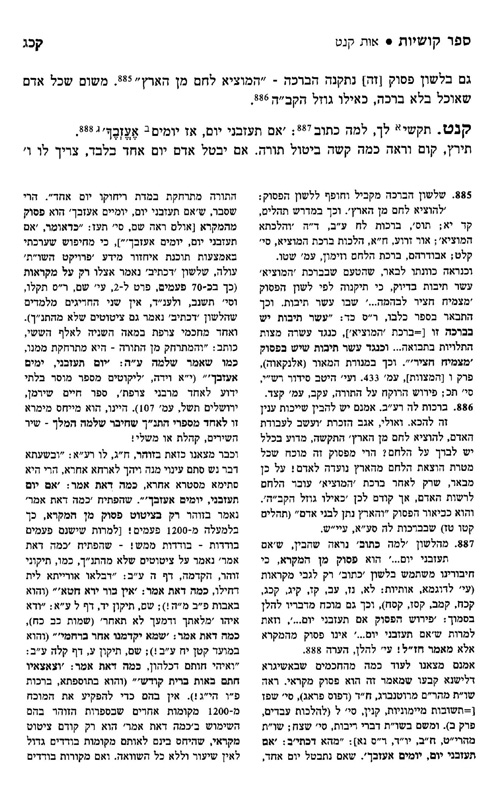
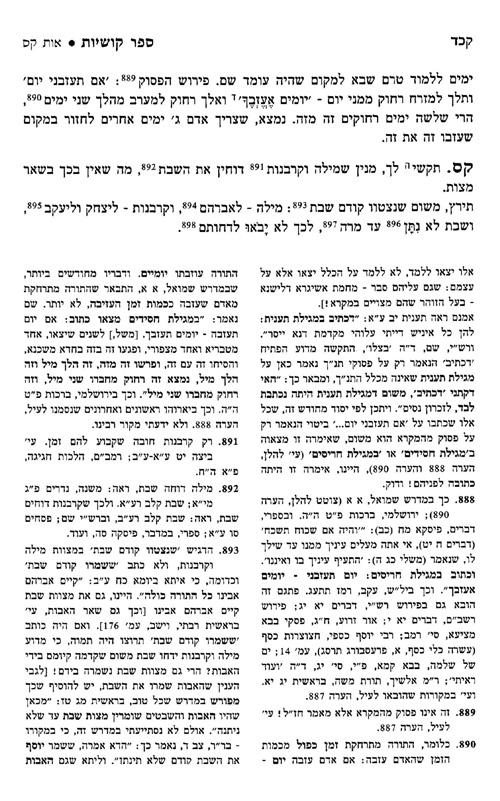
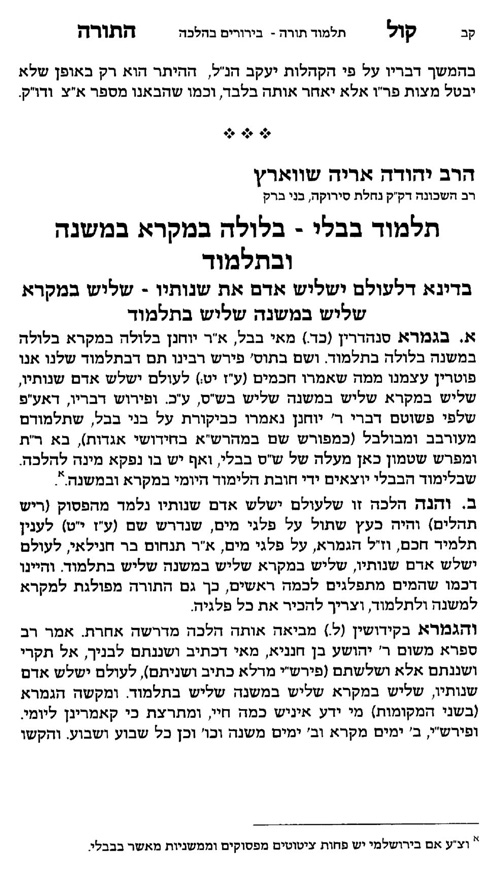
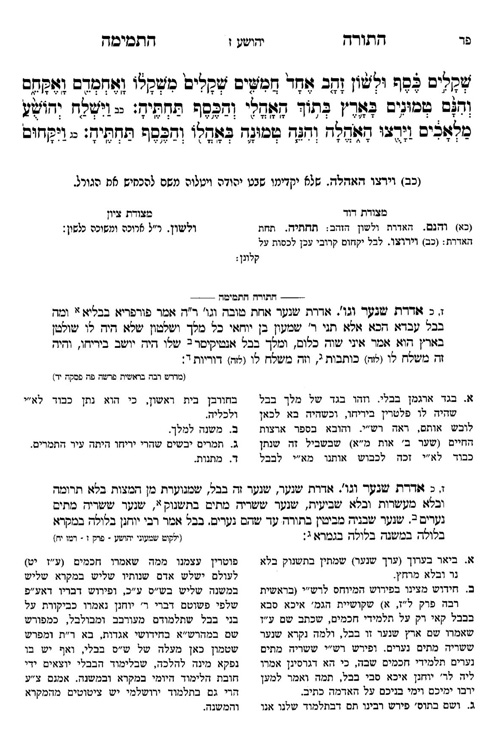
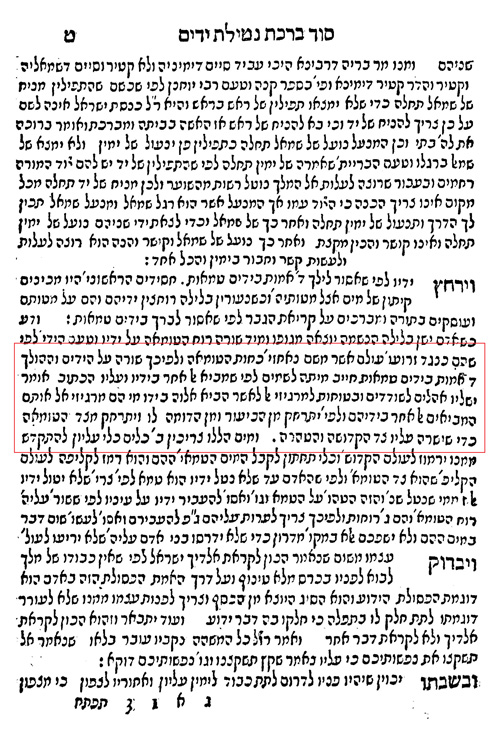
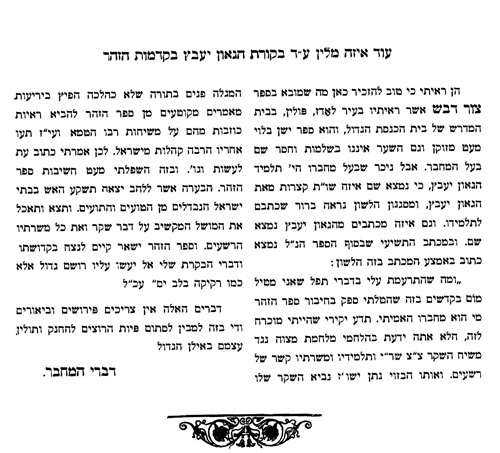
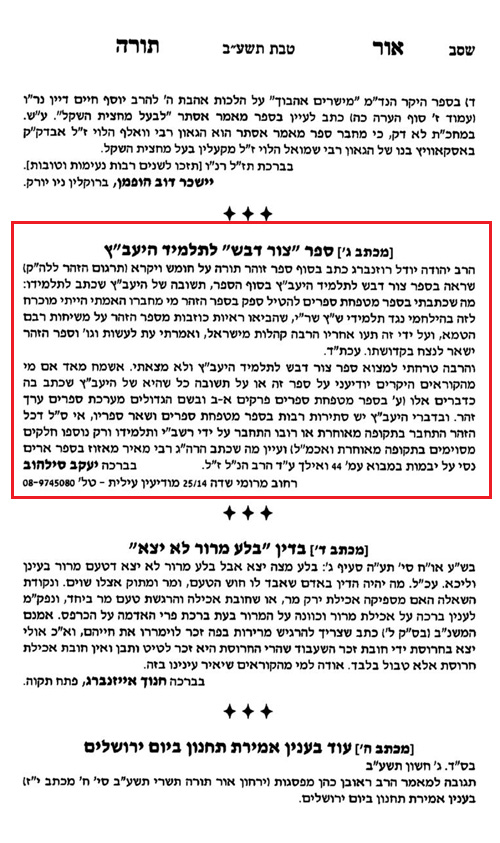
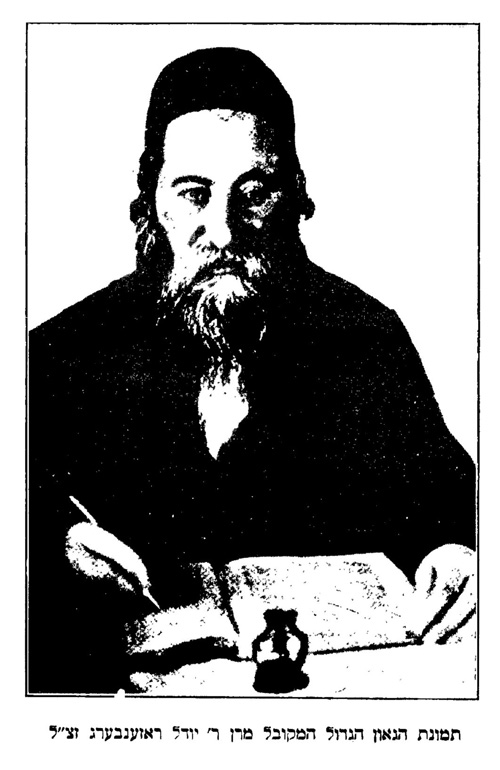
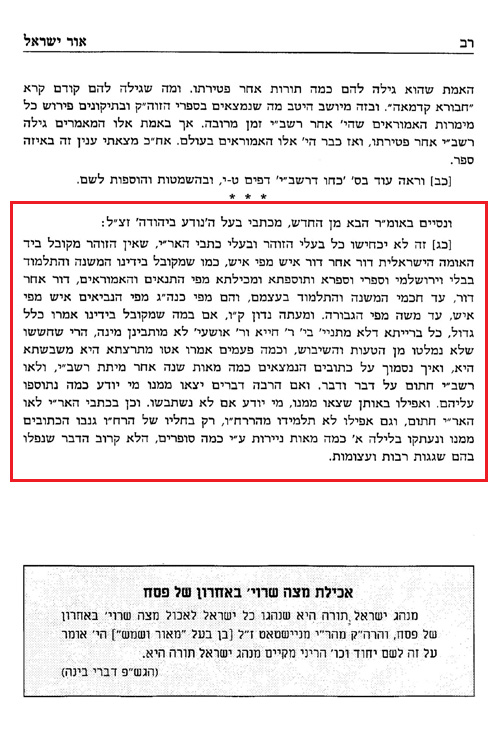
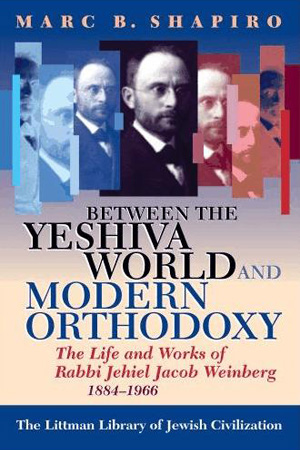
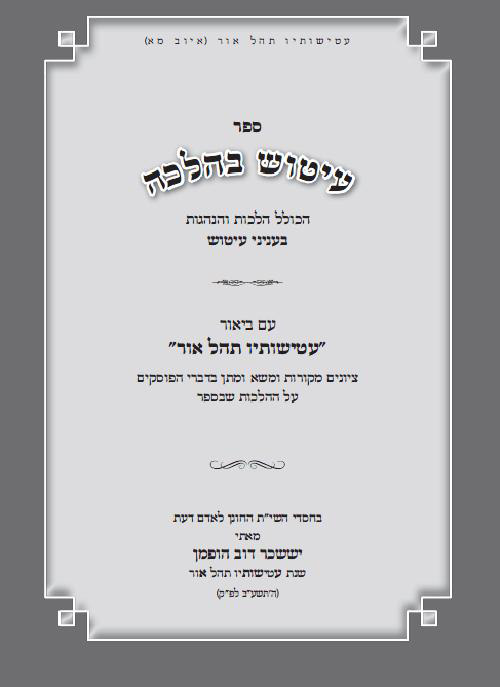
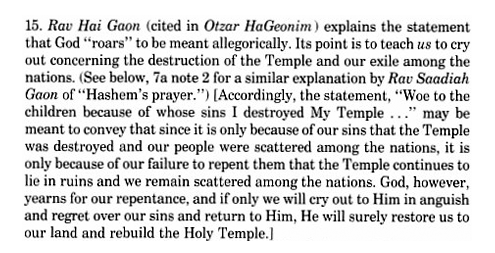

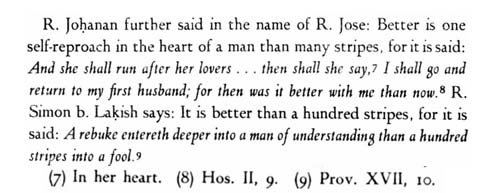
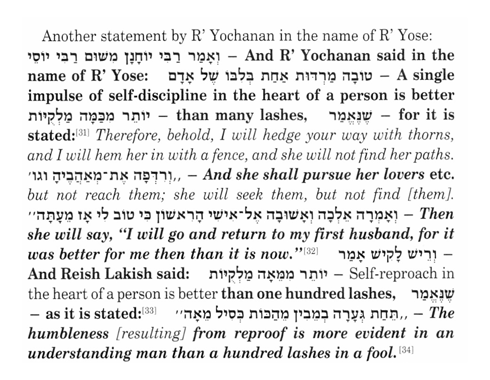
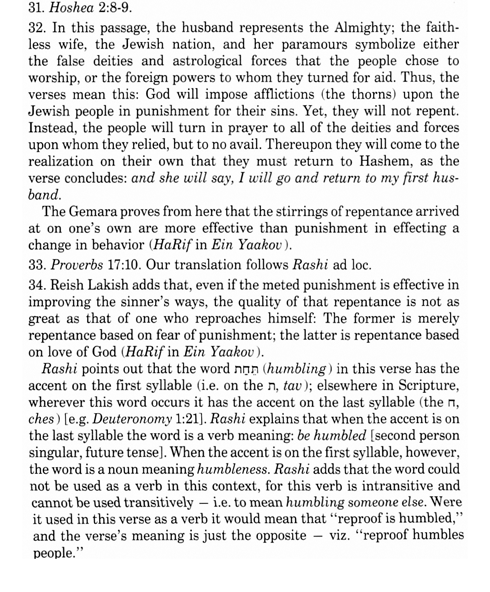

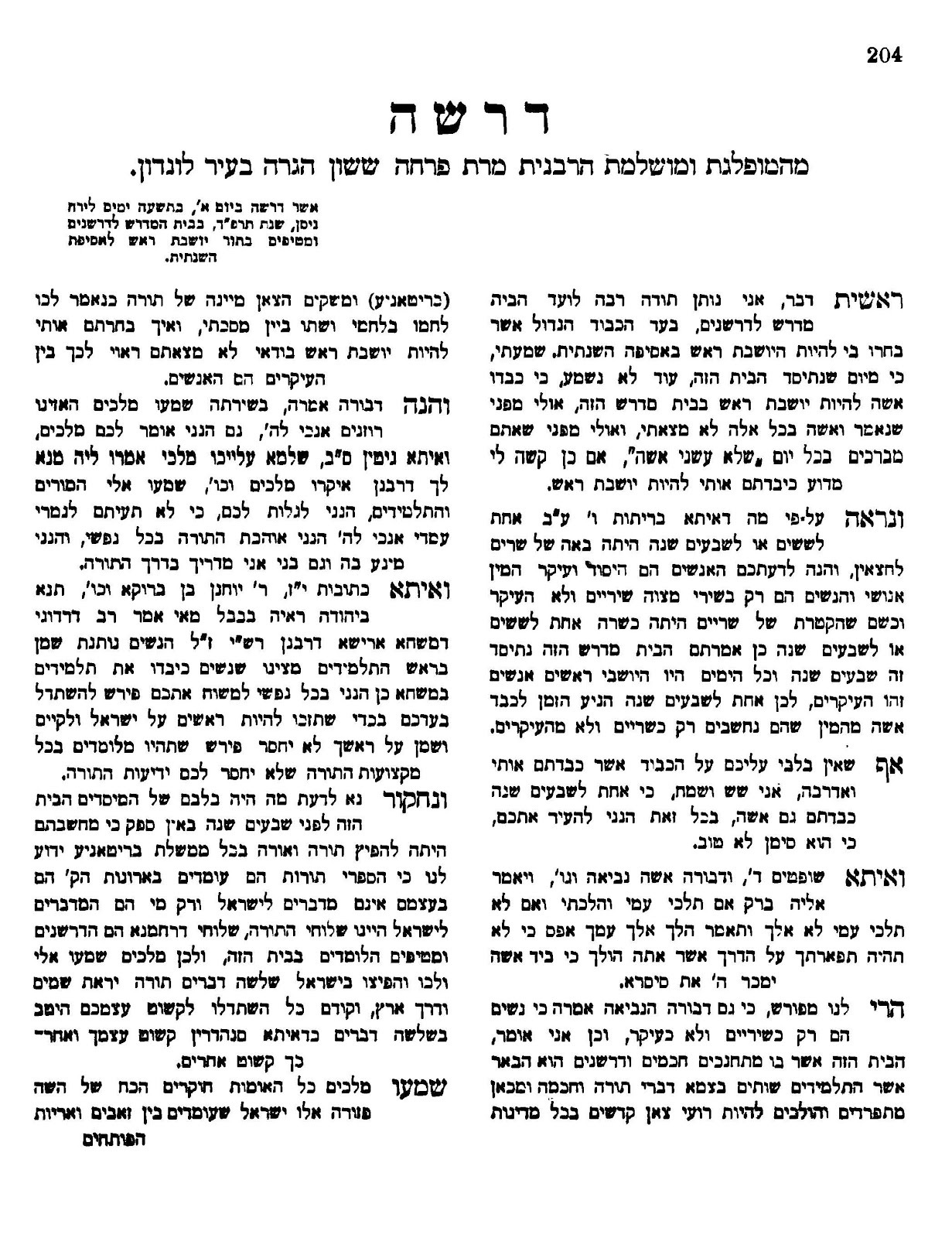
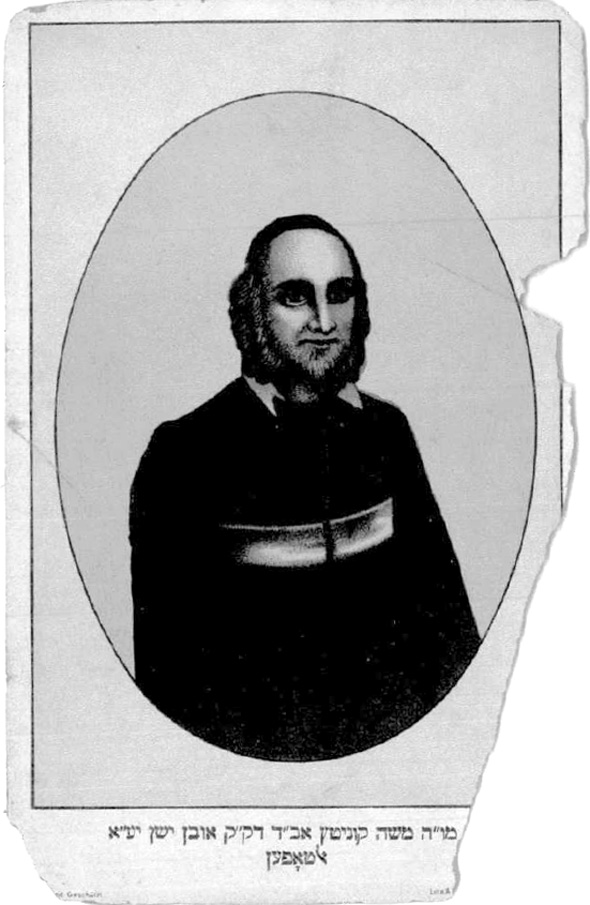
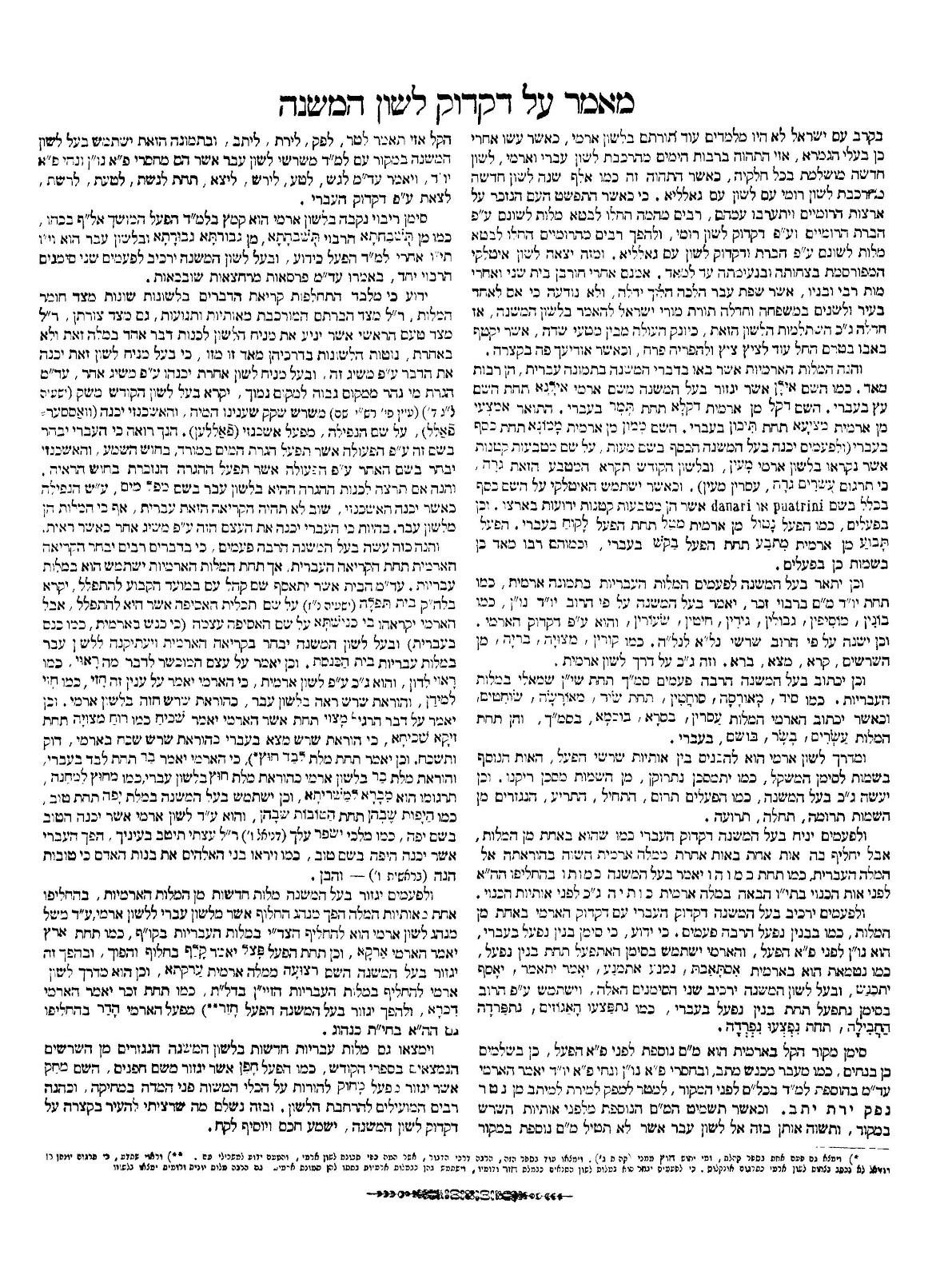


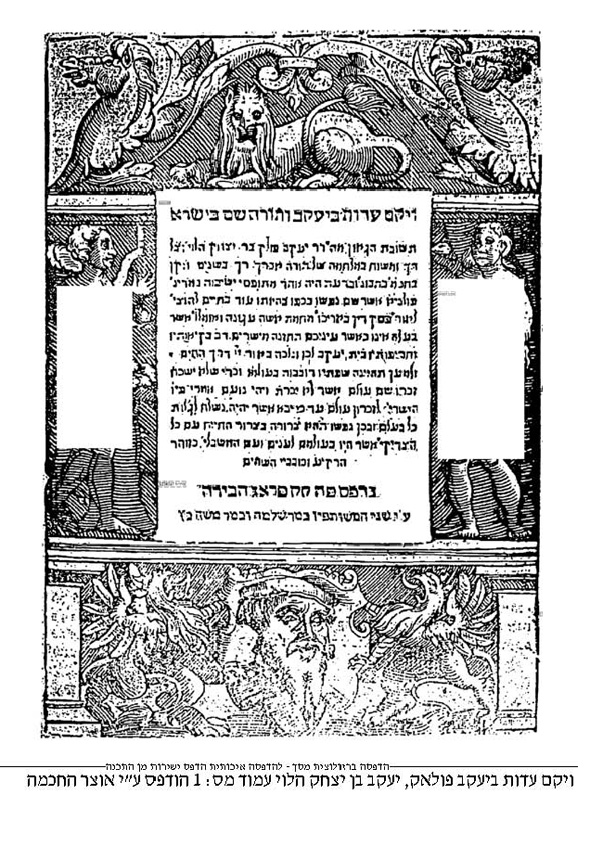

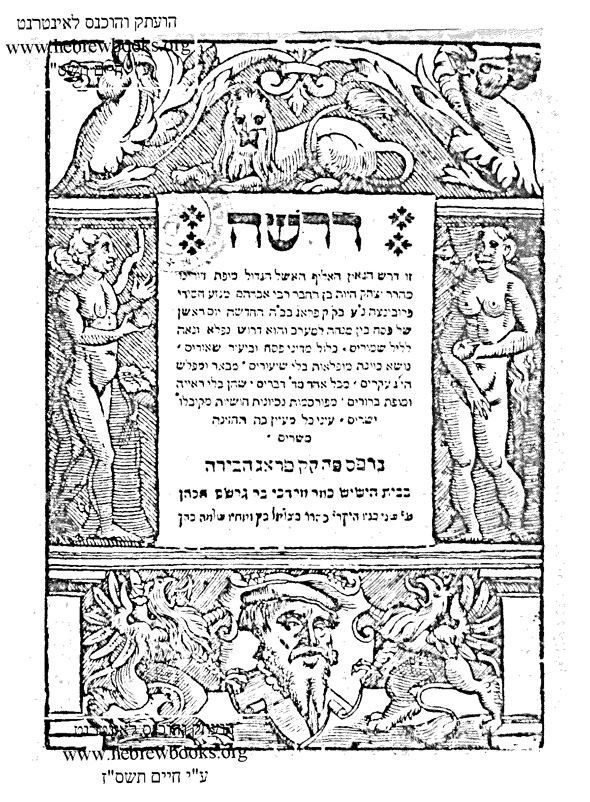
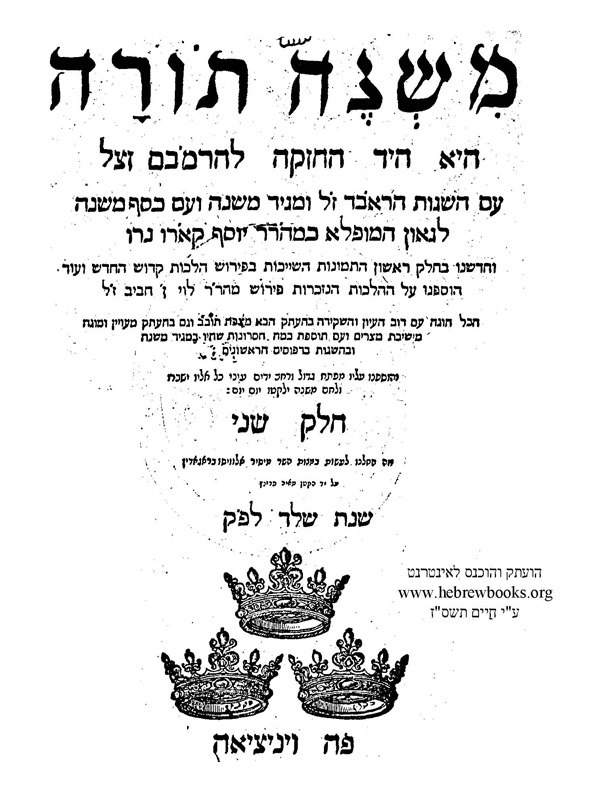



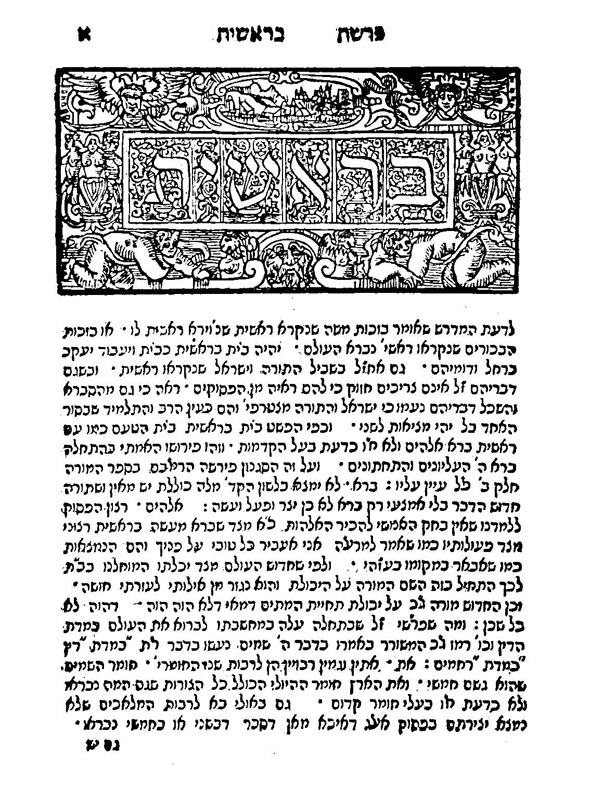
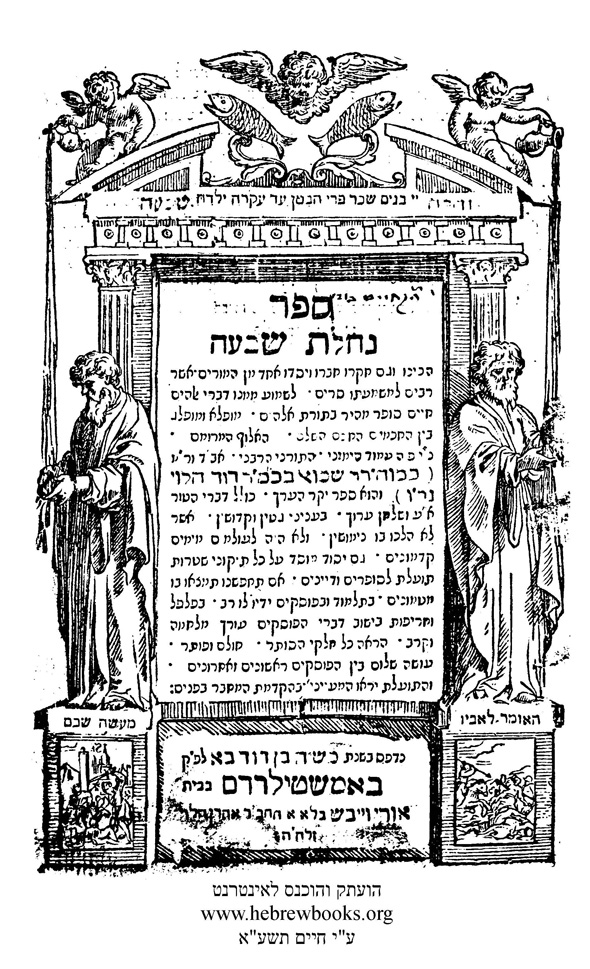
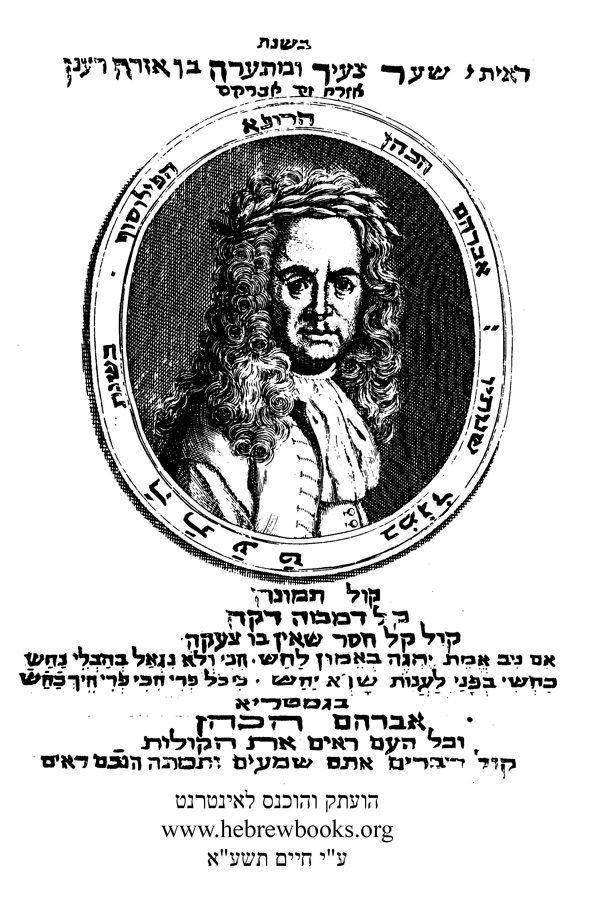

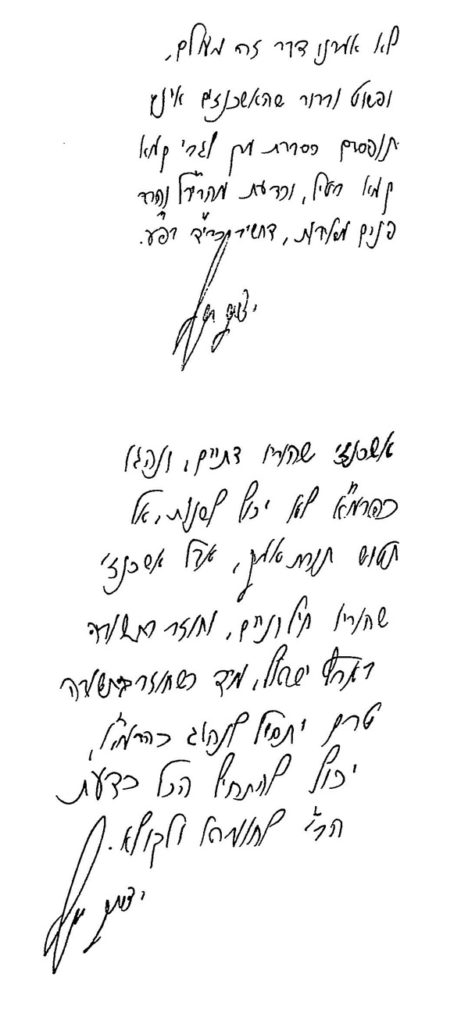
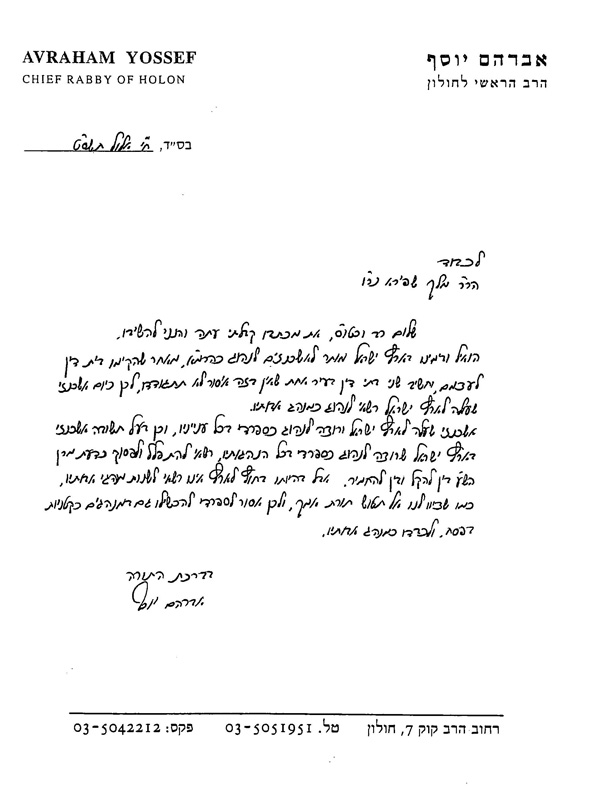
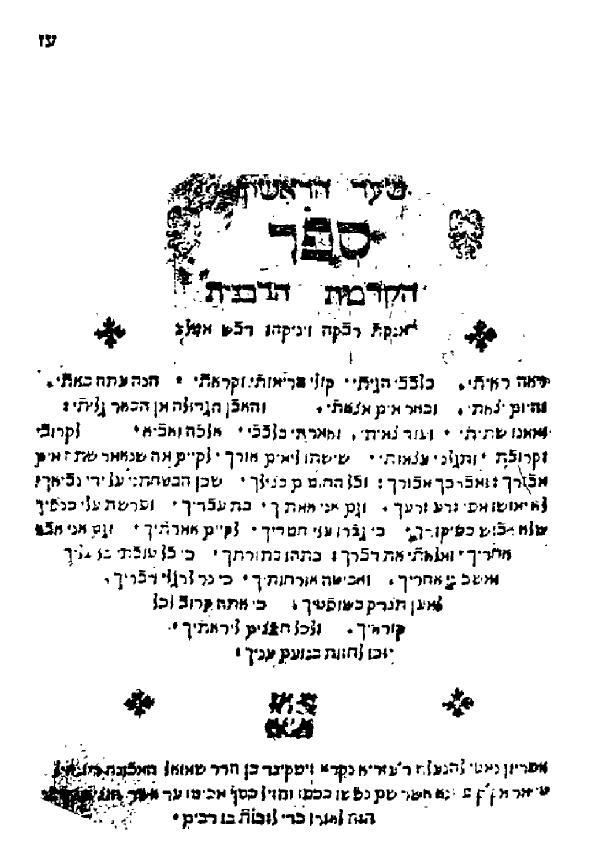
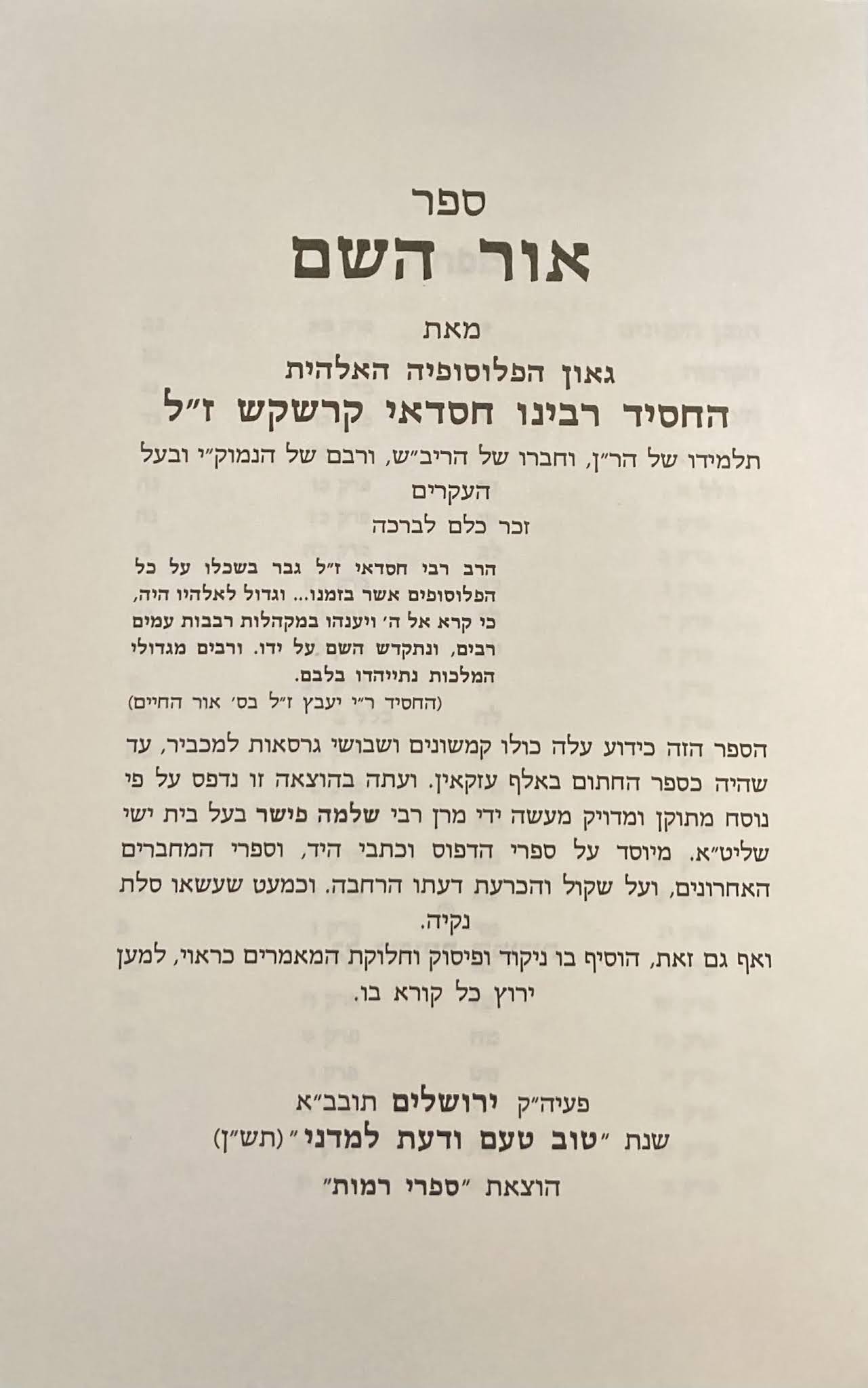
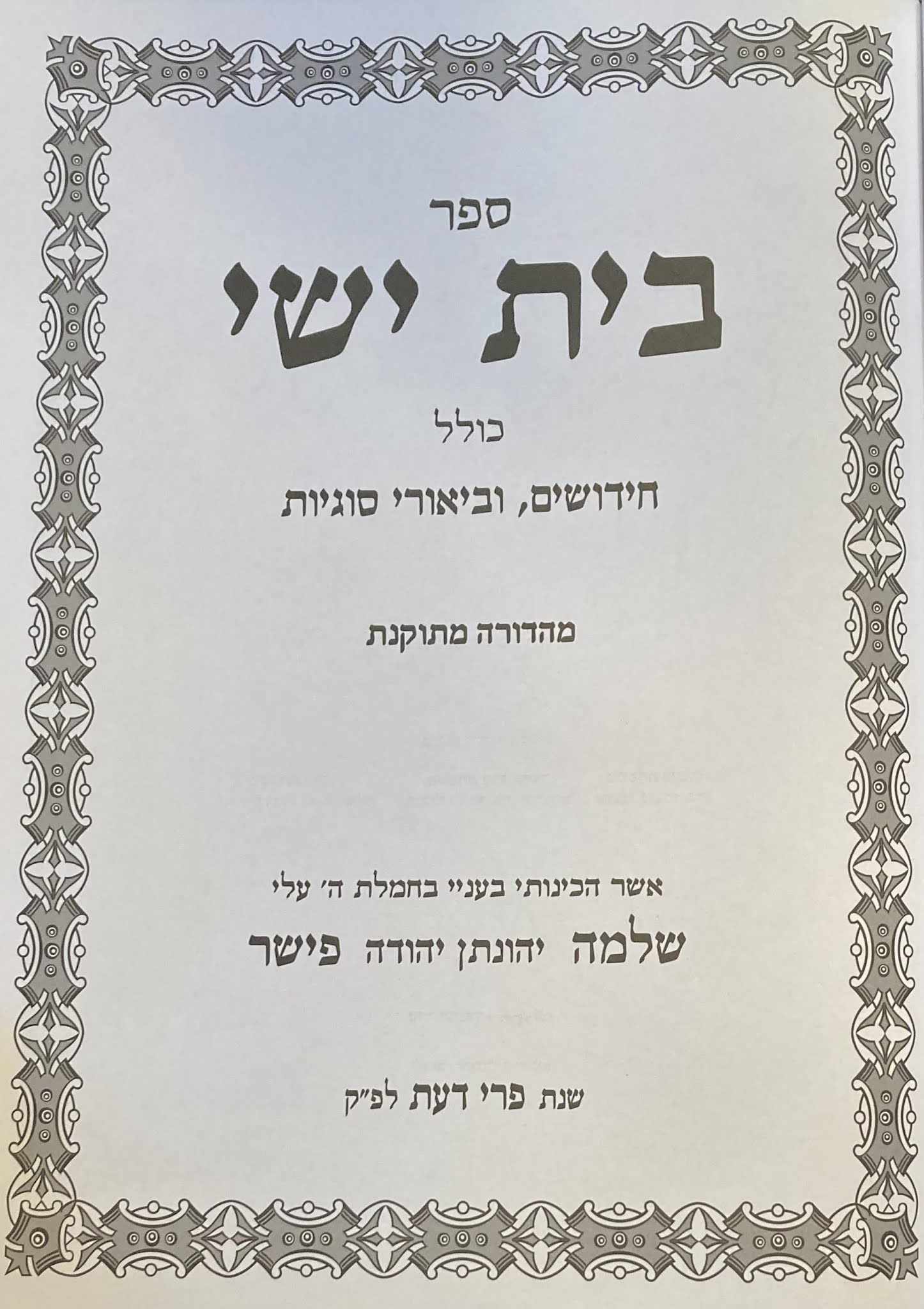


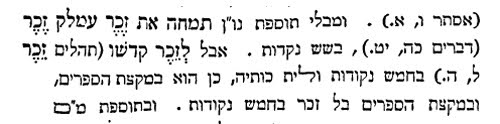
 In 1832, about fifteen years after publication of Heidenheim’s edition, a book by R. Issachar Baer appeared, entitled Ma`aseh Rav, containing a description of the practices of the Vilna Gaon. The author mentions that the Gaon’s disciples disagreed over the way their teacher used to read the word zekher in Parshat Zakhor. The author attested as follows: “When he would read Parshat Zakhor, he would say zekher, with a segol under the letter zayin. R. Hayyim of Volozhin, however, whose endorsement is on the book, wrote there, `As for his writing that in Parshat Zakhor one should read [z-kh-r] with six dots, I heard from the saintly person [i.e., the Gaon of Vilna] that he read with five dots (=zeikher).’ I do not know whether those hearing him were mistaken, and thought they heard segol twice, or whether he changed his practice in his later years.”