The Writings of R. Hayyim Gulevsky, Part 2

The Writings of R. Hayyim Gulevsky, part 2
By Marc B. Shapiro

Many of the stories Gulevsky tells cannot be verified, and we have to take his word that he is faithfully recording that which he heard. Thus, he tells us about R. Abraham Eliezer Alperstein, who was an early rosh yeshiva at Yeshivat R Yitzhak Elhanan and the author of the first commentary on the Talmud published in the United States. It appeared in Chicago in 1887. Gulevsky tells the story of Alperstein’s move to Chicago, where, after arriving, he supposedly gave a speech in which he said the following (Du Yovlin, p. 30):
יהודי נוי יארק הם בעלי זדון ומשוגה ואינם שומעים לקול מורים, רק לקול מורדים. אבל את יהודים יקרים בשיקאגא כי לכל העם בשגגה, ואשר את המלה בשגגה חיריק תחת השין גימל הראשון פתח וגימל השני קמוצה, וזה נקרא שיגאגא.
(Alperstein’s pun, שגגה=Chicago, is also found in the introduction to the second edition of his commentary.)
Gulevsky claims that Alperstein left New York for Chicago because the people in charge of bringing a chief rabbi to N.Y. were not interested in a great scholar but in a fine speaker and that is why they chose R. Jacob Joseph, who was the leading preacher in Vilna. Although he was also served as a dayan, he was not esteemed as a halakhic authority. Gulevsky adds that when Yeshivat R. Yitzhak Elhanan was established, they didn’t consider R. Jacob Joseph worthy of being the head rosh yeshiva. According to Gulevsky, even though he was a great talmid hakham, he was not of the level that an important community in Europe would have picked him as its rav.
With regard to R. Jacob Joseph, let me point out an error I made in an earlier post.[1] I referred to the Aderet’s responsum attacking R. Jacob Joseph and I assumed that the publishers didn’t know who R. Jacob Joseph was or they wouldn’t have allowed this to appear. It was pointed out, however, that I was wrong as in the index at the back of the volume the editors indeed identify who R. Jacob Joseph was. This makes it even more unusual that the text wasn’t censored.
While Alperstein at first was very happy in Chicago, this did not last long, As Yosef Goldman points out, “Alperstein had only praise for his congregation in Chicago in the first edition [of his talmudic commentary]; in the second edition he referred to its members as ‘wild boars.’”[2]
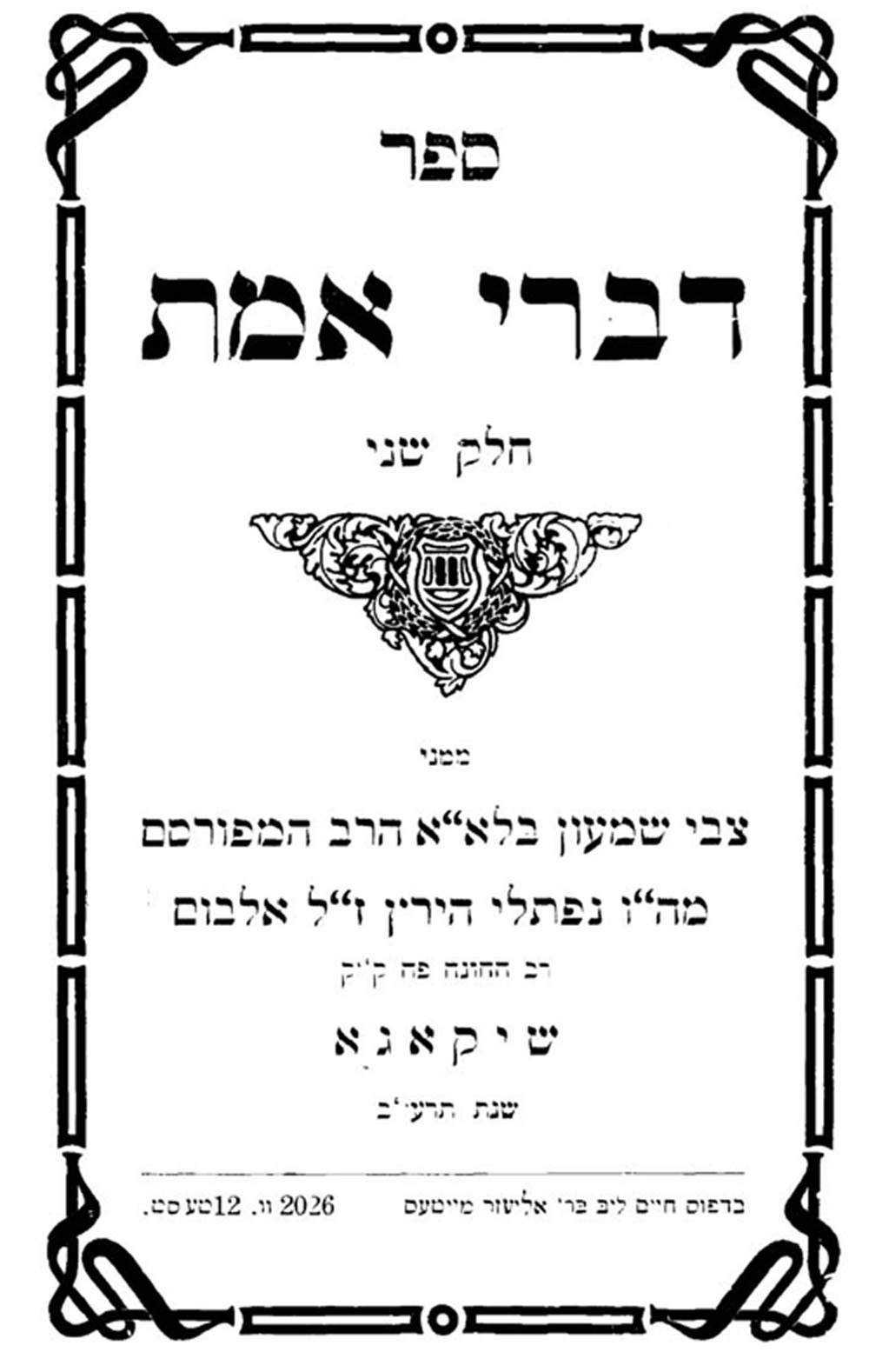
Only a few years later R. Jacob David Wilovsky (Ridbaz) also came to Chicago and he too found a great deal of difficulty there. In particular, he was opposed by R. Zvi Simeon Album who saw Ridbaz as a threat to his own kashrut supervision. While today everyone knows the Ridbaz and no one has heard of Album, we shouldn’t let this prejudice us in this particular matter. After all, Album was also a fine talmid hakham, although obviously not at the Ridbaz’ level. He published two volumes detailing his terrible dispute with Ridbaz, in which aside from dealing with kashrut matters, he also accuses Ridbaz of plagiarism and of creating controversy where ever he goes. Here are the title pages.


While the history of kashrut supervision is a great interest of mine, I will leave that for another time. For now, let me just call attention to two interesting points he makes in his polemic against Ridbaz.
The Ridbaz’ attack on the Brisker method is well known. In the introduction to his responsa, Beit Ridbaz (Jerusalem, 1908), Ridbaz writes as follows:

A certain rabbi invented the “chemical” method of study. Those in the know now refer to it as “chemistry,” but many speak of it as “logic.” This proved to be of great harm to us for it is a foreign spirit from without that they have brought in to the Oral Torah. This is not the Torah delivered to us by Moses from the mouth of the Omnipresent. This method of study has spread among the yeshivah students who still hold a gemara in their hands. In no way does this type of Torah study bring men to purity. From the day this method spread abroad this kind of Torah has had no power to protect its students. . . . It is better to have no rosh yeshivah than to have one who studies with the “chemical” method.

In his ethical will, printed at the end of his responsa, Ridbaz returns to this criticism and directs his sons: “Be careful, and keep far away from the new method of study that has in recent years spread through Lithuania and Zamut. Those knowledgeable in Torah refer to it as ‘chemistry.'” [Just before this post appeared, R. Eliezer Katzman sent word that in his opinion, Ridbaz is not referring to R. Hayyim and the Brisker approach, but rather to Telz and its method of talmudic analysis. I don’t believe this is correct, and hope to return to this subject in a future post.]
In the first edition of Shaul Stampfer’s Ha-Yeshivah ha-Lita’it be-Hithavutah, p. 113 n. 29, he quotes Saul Lieberman’s opinion that Ridbaz’ words were directed against R. Isaac Jacob Reines. This is clearly incorrect. Reines’ method had no influence whatsoever, and Ridbaz is speaking about a method of study that was widespread in the yeshivot. It is obvious that he can only be referring to the method of R. Hayyim. Lieberman’s incorrect speculation was removed in the second edition of Stampfer’s book.
This new edition is of great importance for it contains the documents that reveal the true reason why Volozhin was closed. In fact, On the Main Line has recently printed a report from the Jewish Chronicle that shows that even in England they had heard that the reason for closing down the yeshiva had to do with the “nihilists.”[3] Incidentally, the report in the Jewish Chronicle’s second story (also cited by On the Main Line) that the Netziv went to Western Europe is incorrect. In fact, I found it quite strange, as it is well known that the Netziv never left Eastern Europe. I asked R. Nathan Kamenetsky about this, and he responded as follows:

They confused him with his son R’ Hayyim Berlin, who did travel to Western Europe to raise funds. In MOAG (p. 449) I quote part of a letter R’ Hayyim wrote FROM PARIS, four months after the closure of the yeshiva to the Rav of Tripoli, Libya . . . From the text of [R.] Berlin’s signature on that letter, I prove (among other proofs) that the Berlins expected the closure of the yeshiva to be temporary.[4]

He also wrote me that he finds the article on the closure significant as “this proves that even among Jews it was known that the yeshiva was closed for the actual reason that is set down in the government records that Stampfer discovered and publicized in his later edition of ‘Yeshivot Lita be’Hit’havutah’. . . . It is invaluable.”

Returning to the Ridbaz, it is not surprising that Album, Divrei Emet, vol. 2, p. 45, points to Ridbaz’ comments as proof that the latter had contempt for the Torah scholars of Eastern Europe. Ridbaz never responded to this volume, but in the introduction to Nimukei Ridbaz (Chicago, 1904), he had already given his view of Album (without mentioning him by name).[5] There was another attack on Album in the book Akhen Noda ha-Davar (n.p., n.d). This latter work is very rare and I have never seen a copy of it. Although its author is given as P. Gwirtzman, Album claims that it was really written by Ridbaz (Divrei Emet, vol. 2, pp. 3, 9, 31).
Needless to say, because of his attacks on R. Hayyim, Ridbaz did not endear himself to the Soloveitchik family. Once when a student referred to Ridbaz, R. Joseph B. Soloveitchik became very angry and told the student never to mention his name again. He also said that some gedolim are always right, some are sometimes right, and some are never right, and the Ridbaz falls into the latter category![6]
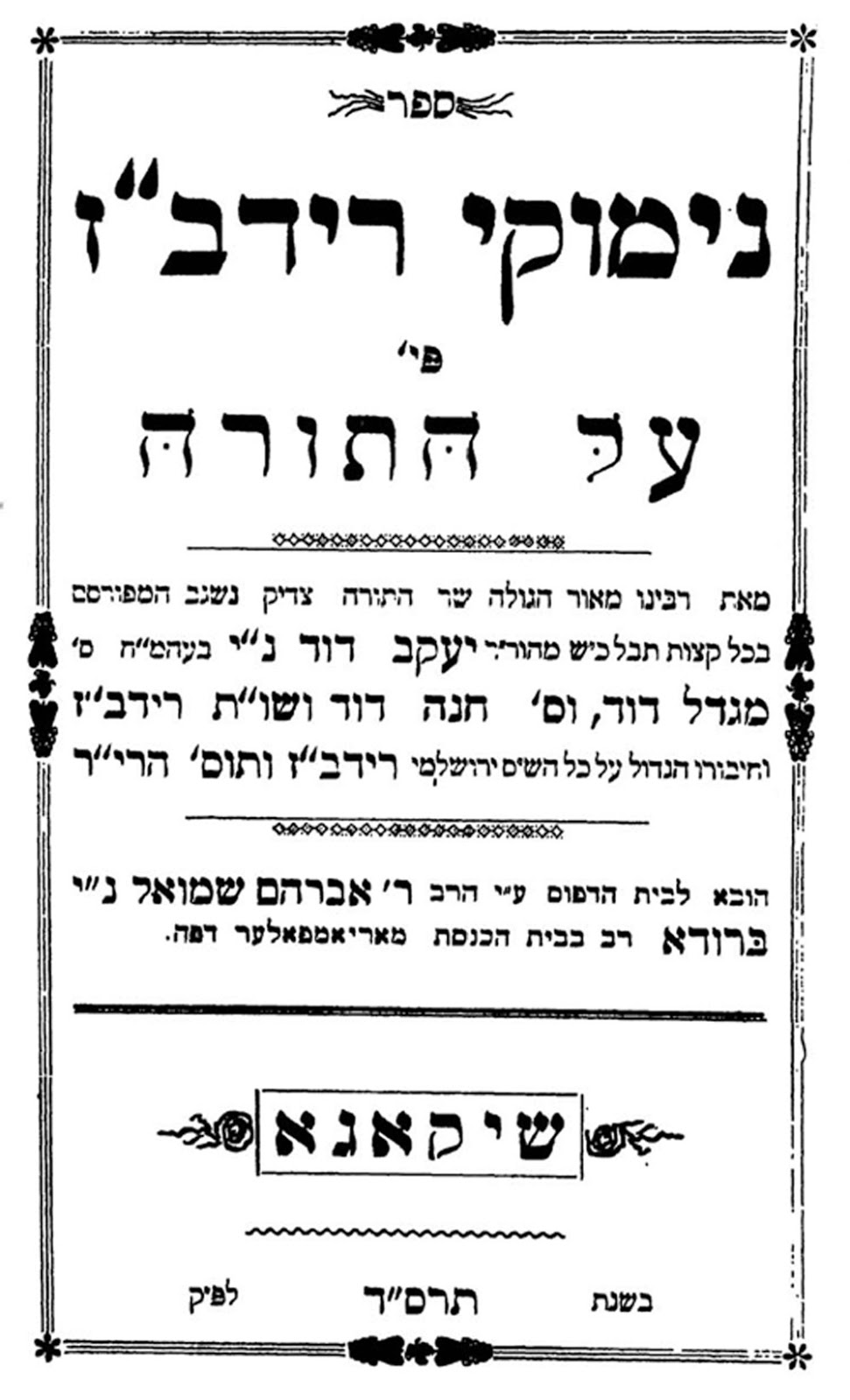
Album also points to something else in order to attack Ridbaz. Here is the title page of Ridbaz’ Nimukei Ridbaz.

Look at how Ridbaz is described with such grandiose titles. Album picks up on this and writes (Divrei Emet, vol. 1, p. 34b):

עשה עטרה לעצמו בראשו וכתב על עצמו על פתח השער, ספר נימוקי הרידב”ז, מאת רבינו מאור הגולה שר התורה צדיק נשגב המפורסם בכל קצות תבל כק”ש מה’ יעקב דוד נ”י המפורסם בחיבורו הגדול על הירושלמי. כן כתב הרידב”ז על עצמו – ועשה נגד הירושלמי מפורש בפ’ ז’ דפסחים וז”ל הירושלמי ושנא את הרבנות מלמד שלא יניח אדם עטרה לעצמו בראשו שנאמר יהללוך זרים ולא פיך
He continues by mocking Ridbaz’ learning. Here is one example, where he picks up on something Ridbaz writes in Nimukei Ridbaz (ibid., p. 35a):
וכמה דברים אשר נמצאים בתוכו הוא אפס ואין – ואין זה כי אם ראות עין. כמו למשל כתב בפ’ וירא דלכך לא הכניס אברהם המלאכים לתוך האוהל משום דהצדיקים אין הקב”ה מביא תקלה על ידם, ואם הכניסם לתוך האוהל היה שרה רואה אותם, וקיי”ל דאשה נדה אסורה להביט על הס”ת ע”כ באם היו באוהל היתה בע”כ שרה רואה אותם ע”כ. והנה כל דבריו בזה דברים בטלים המה, ראשית שאין שום איסור על האשה להביט על הס”ת רק מצד מנהג וכבוד, עיין במג”א וגם אין צדיקים הקב”ה מביא תקלה על ידן לא שייך אלא במידי דאכילת איסור.
He continues the assault on this point in vol. 2, p. 39:
ומלבד שדבריו דברי ליצנות המה, ומה ענין מלאכים לס”ת, והיכן מצינו שיהי’ מלאכים בגדר ס”ת.
It is very sad to read how Ridbaz and Album speak about each other, and as more than a few have quipped, “There is no hatred like the hatred between rabbis.” Another version of the comment is that “There is no hatred like the hatred between rabbis, especially when money is involved.” Yet in this case, at least, I don’t know how significant the financial angle was. Album claimed that he never received remuneration for giving his hashgachah, and this isn’t something he could have put in print if it was not true. However, Harold Gastwirt assumes that Album was upset that Ridbaz had been chosen as chief rabbi of Chicago, instead of him, and this position certainly did come with a salary.[7])
In seeking to explain the phenomenon or rabbinic hatred, R. Jacob Eskolsky gives the following insightful answer (Taryag Mitzvot [New York, 1926], vol. 1, p. 32a.
פעם אחת השבתי לבעל הבית אחד בעיר סקרענטאן, אשר הייתי שם רב איזה שנים, אשר שאלני השאלה הנושנה של העם, מדוע נשתנו הרבנים מכל בני מלאכה אחרת, אשר הם יושבים זה בצד זה ברחוב אחד או בבית חרושת אחד ואינם שונאים זה לזה, והרבנים מכיון שנמצאים שנים בעיר אינם נוחין זה לזה, אדרבה שונאים הם זה את זה ומחרפים אחד את חבירו, היש איזו סיבה לפליאה זו? והשבתי לו בפשיטות, הלא אם יבואו איש לביתו ויבשר בשורה נעימה לאשתו, כי עזרהו ה’ בפרנסתו ויוכל להוסיף לה שפחה על שפחתה שתהיה עזר כנגדה ותוכל לישב בקתדרא, תגיע להגברת שמחה מזה, וגם השפחה היושבת בבית הבישול בשמעה זאת אחורי הדלת נתמלאה רצון משמועה הזאת, כי תהיה לה חברה לעבודתה ולא יפול משא כל הבית עליה. לא כן אם יבוא איש הביתה בבשורה נעימה ומספר לאשתו כי עזרהו ה’ בריווח גדול יוכל לקחת עוד אשה אחת על אשתו, כי יוכל לפרנס שתי נשים, אז תמלא קנאת עזה כמוה ותשפוך כל חמתה עליו ובקול רעש גדול תחיל הזעק עליו, כי איננה שפחה בביתו להיות שמח בחברתה, כי בעלת הבית היא ואינה חפצה בשום אופן להניח שניה לצוות ולהנהיג עניני הבית ורק קולה ישמע בכל ענין הנהגת הבית, ואם לא ישמע לה ויקח אשה אחרת עליה תהיה צרה לה. כמו כן אם הרבנים מקיימים מה שנאמר בהוריות (דף י’) לא שררות אני נותן לכם, עבדות אני נותן לכם, כי אז היו שמחים אם הקהל מקבל עליו עוד רב, ובקבלת עוד עבד לצרכי הקהל הוקל מעליו עבודת העיר, אך אם הרב מחשיב את עצמו לשר ושופט ונוהג נשיאותו ברמה וכל מילי דמתא יהיו נמתחים אך על פיו ובלעדו לא ירים איש את ידו, אז מביט בעין קנאה על רב השני ואינו מניחו להרים ראש. ועל זה אמרו חכמנו (יומא עא) אלו תלמידי חכמים שדומים לנשים ועושים גבורה כאנשים, כי דרך נשים להם להיות מתקנאות בירך חברתה ולהיות צרה להשניה.
Before coming to New York, Eskolsky had served as a rav in Scranton[8] and was no stranger to rabbinic disputes himself.[9]
Exalted egos from both sides also helps to explain rabbinic feuds. As the Maharal commented, this is a particular problem of Torah scholars, because they are aware of their own great scholarship (Netivot Olam: Netivot ha-Anavah, ch. 6):
כי הגאוה הוא על בעל תורה בטבע וכל זה מצד הגדולה והמעלה שיש לתורה . . . ומפני כך בעל התורה יש בו קצת גאוה שרואה עצמו ג”כ גבוה ונבדל משאר הבריות.
Sometimes these rabbinic disputes even reach the level of what R. Jehiel Jacob Weinberg referred to as “murder.” Here is what he wrote in a letter to R. Joseph Apfel (Kitvei ha-Rav Weinberg, vol. 1 no. 3):
לפני שנתיים באו לכאן הרב גרוסנאס ביחד עם הפרופ’ דומב להתיעץ עם הגרי”א הרצוג ז”ל ששהה כאן והם הי’ גם אצלי ואני יעצתי להגריא”ה לבלי להורות הוראה בזה כי אם בהסכמת כל גדולי ירושלים כי . . . יש קנאים גדולים שאינם מודים על האמת אלא מחמירים עפ”י שיקול דעתם ורגשי לבם. ועמם אין להתוכח והם חשודים גם על שפיכת דם של המקילים וד”ל.
I published this volume as a sefer, to be used in the beit midrash, so I took out something which I didn’t think was proper to appear in such a work (as opposed to a scholarly book or blog where these considerations do not apply). In accordance with scholarly convention, I indicated this with an ellipses. Incidentally, when the late R. Joseph Apfel gave me the letters he received from R. Weinberg, there was only one place where he told me to omit a name. Other than that, he gave me permission to publish the letters in their entirety.
The complete sentence reads (and I have emphasized the deleted word):
כי אם בהסכמת כל גדולי ירושלים כי ביניהם יש קנאים גדולים שאינם מודים על האמת
In other words, R. Weinberg includes in his criticism even some people regarded as gedolim. This should not surprise us, and it doesn’t mean that these individuals are not, in fact, gedolim. Even well-meaning people can at times be led to extreme statements and “shefihut damim”. We have seen this in the last few years when rabbis, without any real knowledge of the facts, have declared that certain hashgachot are not reliable. We have seen gedolim declare that certain authors are dangerous without having even read their books (in the original or in translation) or spoken to them. I know from speaking to some of the mashgichim and the authors that they regard this as real “shefihut damim,” for they have been publicly condemned as either not reliable in matters of kashrut[10] or as destroyers of Torah society. If the accusations are true, then the rabbis have no choice but to speak out. But if the allegations are false, or even uncertain, is there any greater “shefihut damim” than this?
With regard to Weinberg’s comment, the late Yonah Emanuel wrote to me:
[תרשה] לי להתייחס לקטע הנ”ל, בו הרב ויינברג כתב שהקנאים חשודים על שפיכות דמים של המקילים. יש להביא אסמכתא מעדות אישה (!). רות בלוי בספרה “שומרי העיר” (י”ם תשל”ט) , פרק יז-יח, מתארת איך הקנאים רצו למנוע נישואי רבי עמרם בלוי איתה, בהיותה גיורת. אבל למה להביא ממרחק לחמנו? פעם הלכתי לשיעור אצל מו”ר הרב ש”ז אויערבך זצ”ל, ופתאום ראיתי במדרגות בית מו”ר זצ”ל קנאים רבים, חלק מהם דחפו עצמם לתוך הדירה, וחלק עמדו בחוץ. הם רצו ללחוץ בענין מסויים על מו”ר זצ”ל, והשיטה הבדוקה לבוא בהמונים, ללחוץ ולהפחיד. על זה התריע הרב ויינברג זצ”ל ממרחקים. על כגון זה נאמר “את בנציבין ומצודתך פרוסה בירושלים” (פסחים ג ע”ב).
Regarding rabbinic disputes, it is also worth recalling these memorable words, quoted by R. David Sperber (grandfather of Prof. Daniel Sperber)[11]:
מוטב להעמיד צלם בהיכל מלהחזיק במחלוקת
Returning to Ridbaz, all of the controversy in Chicago was too much for him and he left Chicago. Legend has it that he was locked in the freezer, in an attempt by his enemies to kill him, and upon being freed he immediately took his family and grabbed a train to New York. It was Friday night but he felt this was a case of was pikuach nefesh. I doubt that the story is true, although in a previous post I did mention a case where the mashgiach was locked in the freezer. We also have another recorded case where this happened. I refer to Rabbi Luntz of Paterson, N. J. who was locked in the icebox by one of the butchers he certified. This would have been bad enough, but Luntz also had to contend with R. Judah Leib Seltzer, who was later one of the leaders of Agudat ha-Rabbonim. He too was in Paterson and had a terrible feud with Luntz, which “climaxed by a public fight between the two rabbis in the synagogue.”[12]
Speaking of rabbis who were chased out of their communities, let me repeat what I heard from the late Rabbi Louis Jacobs.[13] This story is not documented anywhere, but is something that Jacobs no doubt heard growing up in Manchester. R. Abraham Aaron Yudelevitz was a rav in Manchester at the turn of the twentieth century. He would later come to the United States where he served as a rav in Boston and later in New York, and he was also a rosh yeshiva at Yeshivat R. Yitzhak Elhanan. As with a few others, while in N.Y. he even had the title “Rav ha-Kollel.”
Yudelevitz might have been the most brilliant Torah scholar in the United States. He was also prepared to stand up to anyone (including the Rogochover),[14] and is known for one incredible pesak that created enormous controversy: He permitted a woman to appoint another woman as her shaliah to carry out the halitzah ceremony. A short discussion of Yudelevitz’ life and the controversy is found in the second volume of Yeshurun,[15] the series which continues to publish massive volumes full of important and fascinating material. The typical haredi nonsense is, of course, to be found there, but since it is not so common it is no more than an unpleasant distraction.[16]
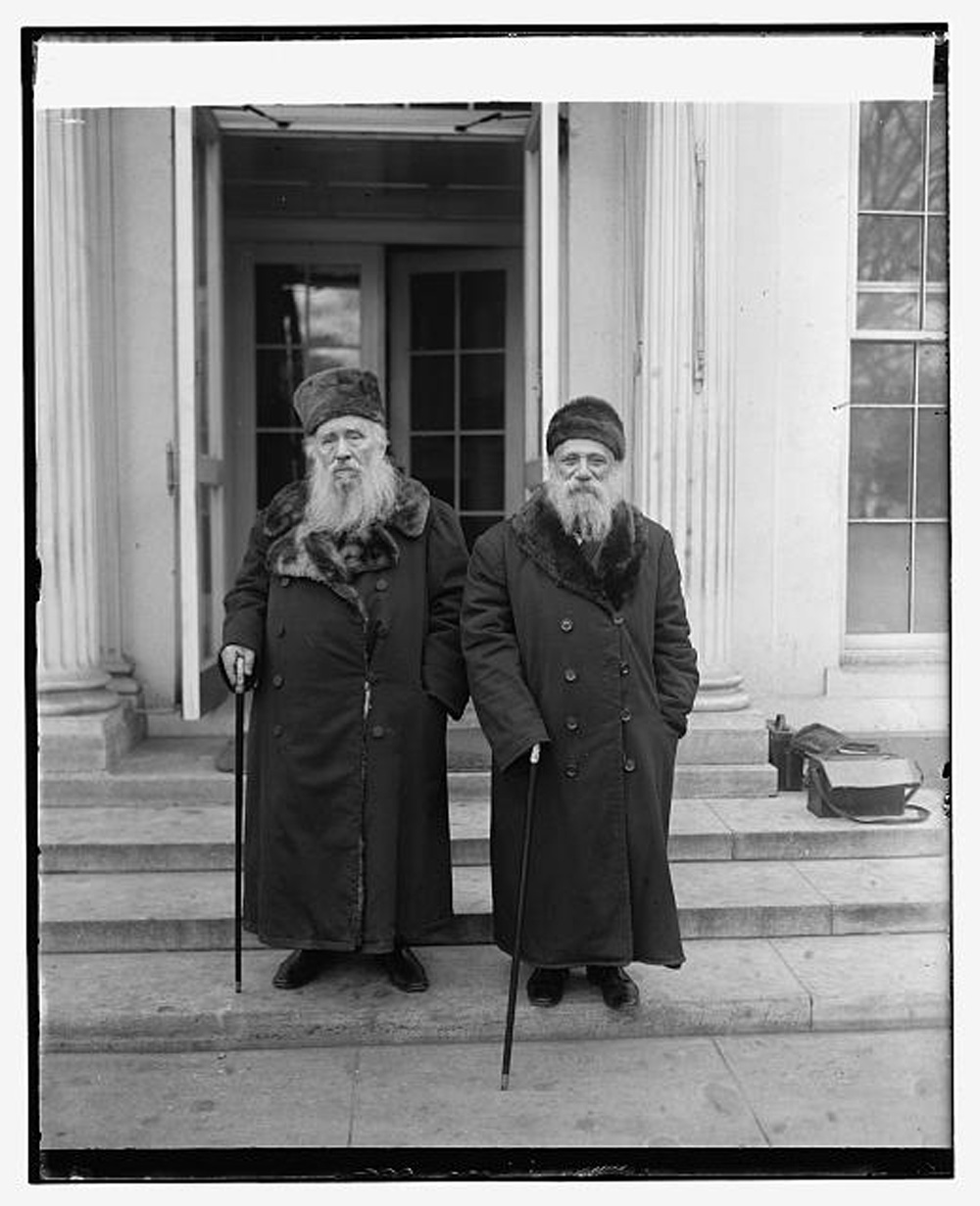
Here is a picture of Yudelevitz. He is on the right and the other rabbi is Gavriel Zev Margulies, whom I mentioned in my last post (see also note 12).[17]

Jacobs told me that when the machers had tired of Yudelevitz, they let him know it was time to leave in the following way. When his carriage pulled up one day, inside it were a couple of prostitutes waiting for him. This was the message to Yudelevitz to get out of town! Rather than stay and fight, he set his sights on the United States.

Returning to Gulevsky, in his book Du Yovlin (New York, 1988) he focuses on American Orthodoxy and its various rabbinic leaders. Since R. Emanuel Rackman recently passed away, let me quote a little of what he says (p. 45) about R. David Rackman, who was R. Emanuel’s father. He is the author of Kiryat Hanah David (New York, 1967), published by his son, and was a Rosh Yeshiva at RIETS for a couple of years beginning in 1907.

אחד מראשוני התלמידים שבאו ללמוד בישיבה ואחרי כן הרביצו תורה בישיבה, זה היה הרה”ג רבי דוד רקמאן. כפי ששמעתי מזקנים, הרה”ג מוהר”ר דוד רקמאן בא לארצות הברית עם סמיכת חכמים בידו. הרה”ג רבי נחום דן מסלוצק היה משגיח הראשון בישיבה, והוא לא היה קשור עם תנועת המוסר לגמרי. אבל היה אביהם של כל בני הישיבה, ויותר מזה אביהם ואמם. הוא יעץ להרה”ג דוד רקמאן שימשיך ללמוד ולא לרוץ אחרי הבלי עולם הזה . . . בשנת תרס”ז כבר נתן שיעורים בישיבה קרוב לשלש שנים. היה חכם מופלג ותמך בישיבה כל ימיו. כאשר באו לישיבה מאורי ישראל רבותינו העילוי ממיטשט ואחרי כן רבי משה הלוי סאלאווייציג עזב הרה”ג רבי דוד רקמאן כל עסקיו, וממש התאבק בעפר רגליהם. פעם ראיתי אותו בסביבת החכם השלם איש האשכולות מרן חיים העליר, ויבדל לחיים טובים “הרב” שליט”א. מעולם לא ראיתי פה במדינה הזאת רב שיעמוד ביראת הכבוד כלפי גדולי ישראל אמיתיים כרבי דוד רקמאן.
Gulevsky gives descriptions of other early students at RIETS. One of those he mentions is Moses Romm, who was later a rabbi in Minneapolis. I believe he is the grandfather of Rabbi Romm who taught at BMT for many years. He also mentions Henry Guterman, who was the rav of Scranton for half a century, and has recollections of Samuel K. Mirsky, Dov Baer Abramowitz, and many others. There is so much material here, for those interested in American Orthodoxy, that I can’t even begin to summarize it.
Regarding R. Benjamin Fleischer, many of whose books are now on HebrewBooks.org, Gulevsky says the following (p. 46):
טיפוס מיוחד במינו היה הרה”ג העצום רבי בנימין שלייפער [צ”ל פליישער] שהיה רב בבית מדרש הגדול במורד העיר. היה עילוי נפלא ובקיאותו בש”ס ופוסקים היה משהו מיוחד. ובגלל שהיה עילוי בכל המובנים לכן לא נעשה הפוסק במורד העיר. היה מחמיר גדול בשאלת נשים, אפילו בדרבנן. השיטה שלו היתה שבמדינה הזאת אין חשש מאכולת, הנשים נקיות ביותר וצריכים לבטל לגמרי כל הקולות של כתמים. התרעם הרבה על כמה פסקים של הרה”ג א. ה. בניו יראק, והרה”ג ח. מ. בשיקגא, לא רק בשאלת נשים.
The New York rabbi he alludes to is undoubtedly R. Joseph Elijah Henkin but I don’t know who the Chicago rabbi is. Maybe one of the readers can help out here. As mentioned before, Gulevsky uses this type of code throughout his works. With regard to his categorization of Fleischer as an “illui,” it is worth recalling R. Moshe Feinstein’s comment that: אין לנו הרבה נחת מהעילויים.[18
In the previous post I quoted the very harsh things Gulevsky had to say about YU. Yet Du Yovlin was written while he was still employed there, and from this book we get an entirely different picture. YU is referred to as “yeshivatenu ha-kedoshah”, and on p. 1 Dr. Norman Lamm is described as follows:
ידידי ורב חביבי וכו’, החכם השלם איש האשכולות כליל המדעים וכו’ וכו’ וכו’ הרה”ג נחום לאם שליט”א
At the beginning of this post I mentioned that Gulevsky is descended from both R. Hayyim of Volozhin and his brother R. Simcha. While everyone knows that R. Hayyim became the student of the Vilna Gaon, Gulevsky tells us the following about his forefather, R. Simcha, which is amazing in that it testifies to Lithuanian opposition to the Vilna Gaon (Du Yovlin, p. 2):
אאמו”ז רבינו שמחה התנגד לנסוע אל אדונינו הגר”א כפי שרמז מר זקני הגאון החסיד קדוש ישראל זצוק”ל הי”ד. זקנינו רבינו שמחה בתמימותו הכנה חשב שהגר”א הולך לשנות מנהגן של ישראל, והתנגד לזה הרבה. אדונינו בעל השאגת אריה לא שינה שום דבר מלבד שהכשיר מכה בדופן וכו’, אולם אדונינו הגר”א, שמעו עליו שאינו מניח תפילין בחול המועד וכדומה.
With regard to the Vilna Gaon, and why he never made it to the Land of Israel, Gulevsky writes as follows (Shabbat Shabbaton, p. 134):
ושמעתי מאאמו”ז הגאון החסיד קדוש ישראל עמוד ההוראה ואביר הרועים מרנא שמחה זעליג זצוק”ל הי”ד, ששמע ממרא דמתיבתא עלאה הגה”ח המובהק מרן רפאל מוואלאזשין ששמע מאביו רבינו אריה ליב שאפירא מקאוונא, היו הרבה טעמים שהגר”א חזר מדרכו לארץ ישראל. אבל רבינו אריה ליב סבר שאחד מהטעמים בנגלה היה שהגר”א סבר העיקר כהמבי”ט נגד הבית יוסף וכל חכמי הדור ההוא.
According to the Mabit all produce grown in the Land of Israel in the Sabbatical year, even on non-Jewish land, has sanctity and must be given special treatment. I assume that Gulevsky’s report means that the Gaon did not want to come to the land of Israel and create controversy by adopting a practice in opposition to R. Joseph Karo’s view, which was minhag Eretz Yisrael.[19] (In the twentieth century the Chazon Ish had no compunctions in advocating the Mabit’s opinion, especially as there are reports – hotly disputed, to be sure – that before his death R. Joseph Karo abandoned his position.[20])
An interesting comment which is not of a historical nature is found in Shabbat Shabbaton. p. 96. R. Moshe Feinstein states that anytime Rabad doesn’t express his disagreement with the Rambam, this shows that he agrees with him. R. Moshe is hardly the first to argue in this fashion,[21] yet Gulevsky points out that this is a methodological error and that there are numerous times that Rabad disagrees in his other works and doesn’t record this disagreement in his hassagot. R. Yaakov Hayyim Sofer, who has a bekiut unlike that of anyone alive today, has a very long list of such disagreements, and if all we had were the hassagot we would know nothing of this.[22] We can conclude, therefore, that Rabad’s hassagot were never intended to be a comprehensive list of all of his criticisms, but were written in an ad hoc fashion.
Quite apart from what appears in his books, there are some other interesting tidbits he told me which as far as I know do not appear in print.
1. The grandfather of the famous bibliographer, E. R. Malachi, was named Engleman, and he emigrated from Brisk to the Land of Israel in 1837.
2. R. Simcha Zelig Rieger was head of a kollel le-hora’ah in Volozhin. This kollel focused on practical halakhah.
3. R. Hayyim Soloveitchik and R. Velvel never preached to the community, not even on Shabbat ha-Gadol and Shabbat Shuvah.[23]
4. Although R. Velvel was officially rav of Brisk for twenty years, he only resided in the city for six and a half of these years. He was often ill and had to spend much of his time in places more congenial to his health. He was not living there during the 1937 pogrom, but after this event he returned to the city for two weeks.
5. In Kelm “they held of” Wessely’s Yein ha-Levanon.(I include this because I think Gulevsky meant the yeshiva as a whole, not simply R. Simcha Zissel. R. David Zvi Hillman has seen the manuscript essays of R. Simcha Zissel, and they contain references to Wessely. When these were published in Hokhmah u-Mussar [New York, 1957], Wessely’s name was deleted.[24])
6. Rabbi Rakefet has asserted on numerous occasions that as a young man R. Shneur Kotler attended R. Soloveitchik’s shiurim at YU. Gulevsky denies this. According to him, R. Shneur only went to hear the Rav at Moriah.[25]
7. R. Joseph Zekhariah Stern, Zekher Yehosef, Orah Hayyim no. 177, has a responsum addressed to ר’ מנחם שרגא רעוויל. This is Bernard Revel’s father (The first name was actually Nahum, not Menahem.)

I would be remiss in not mentioning that one has to question many of the stories Gulevsky tells, simply because they don’t agree with what we know from other sources. While he tries to be careful in his facts, some of his reports are no different than the typical “frum history” in which all sorts of stories get repeated as if they were facts. There are a number of examples of this but let me note one that doesn’t appear in his books, but which he told me. According to Gulevsky, the reason Yeshiva College did not offer a job to Saul Lieberman is because his father-in-law, Meir Bar-Ilan, almost bankrupted the institution when he served as temporary president during Bernard Revel’s leave of absence. Yet this is completely false. There are also times when Gulevsky writes things that are not merely incorrect, but downright foolish. See e.g., here.

The link just given refers to Gulevsky’s stringent view of eruvin. In this he is following not only the Brisker tradition but also that of his grandfather, who did not believe that an eruv could be established in the typical town. Yet Gulevsky has also noted that despite this opposition, there was an eruv in Brisk and his grandfather checked it every week.[26] (When the young Joseph Baer visited Brisk he checked it together with R. Simcha Zelig.[27] He also used to check the eruv in Chaslovitz, where his father was the rav.) Originally I thought that the presence of an eruv in Brisk was an example of R. Hayyim not wishing to force the community to adopt his stringent position. Yet from R. Moshe Sternbuch’s recently published Teshuvot ve-Hanhagot, vol. 5, no. 101, we see that this was not the case. He heard from R. Velvel that R. Hayyim wanted to forbid the eruv, and even publicized this, but the people refused to listen to him. (You see, it is not only Modern Orthodox Jews who ignore what the rabbis tell them!) The people must have thought that if other cities with great rabbis can have an eruv, then why should they suffer because of R. Hayyim’s humra. Faced with this rejection, R. Hayyim told R. Simcha Zelig that the kashrut of the eruv was to be his responsibility. R. Hayyim wanted nothing to do with it. R. Velvel himself would only check the eruv once a year, before Rosh Hashanah, and it bothered him greatly that his own city was relying on what he regarded to be unacceptable leniencies.[28]
In Boston, as long as R. Joseph B. Soloveitchik was active, there was no eruv. The Rav publicly declared:
I am opposed to the establishment of eruvin. An eruv in American means the abolishment of the prohibition of carrying on Shabbat. Aside from certain [meta-halakhic] reasons, I also have halakhic reasons why I can’t give my approval to the establishment of eruvin. [29]
As soon as the Rav was no longer able to protest, an eruv was established in Brookline. I was in the Bostoner Rebbe’s shul when he spoke about how important the eruv was and that everyone should rely on it. He insisted that there must be no distinction between the “frum,” who don’t carry, and everyone else. It is interesting that the Modern Orthodox world, which places the Rav on such a pedestal, has not accepted one of his few public halakhic pronouncements.

[1] See here
[2] Hebrew Printing in America, p. 501.
[3] See here.
[4] In his e-mail to me Kamenetsky mistakenly wrote R. Meir Berlin. I have corrected it.
[5] The introduction to this book and also his Beit Ridbaz (Jerusalem, 1908), are fascinating, because he describes in detail many of the communal problems he saw. One wonders if he was writing his book today, which problems he would identify. I don’t think English sermons would still be an issue for him, although I think it is fair to say that advertising a “Pretty Woman” sheitl would definitely outrage hiim. After all, the sheitl is supposed to represent modesty, and Julia Roberts’ profession in that particular movie was not exactly tzniusdik. See here (Unfortunately, some of the comments to this post are inappropriate.)
[6] I heard this from an eyewitness. The event took place in the 1950s.
[7] See Fraud, Corruption, and Holiness (Port Washington, 1974), p. 91.
[8] Quiz question: Which contemporary gadol be-Yisrael was born in Scranton?
[9] See Gastwirt, Fraud, p. 145, that Eskolsky was expelled from Agudat ha-Rabbanim for giving a hekhsher on a plant that produced both kosher and non-kosher meat. This was in violation of the Agudat ha-Rabbanim takkanah. Those rabbis who opposed Agudat ha-Rabbanim’s policy formed the competing Kenesset ha-Rabbonim, which was led by R. Gavriel Zev Margulies.
[10] Experience has shown that a rabbi who is financially corrupt can easily win back his reputation (and in some circles financial corruption doesn’t affect his reputation to begin with). Yet if a rabbi is accused of not being reliable in matters of kashrut, even if the accusation is false, it is almost impossible for him to turn this around. Unfortunately, when it comes to kashrut supervision, American Orthodoxy has distorted our tradition. People are constantly told that if they see a hashgachah on a product or restaurant, that they cannot rely on it without investigating who the rav ha-machshir is. This is completely mistaken. According to halakhah every rav is regarded as trustworthy unless you have been reliably informed otherwise. Without receiving negative information, one should always assume that a rav is reliable. This is no different than if you arrive in a new city and go to shul on Shabbat and you are invited to someone’s house for lunch. One should assume, unless he has reason to think otherwise, that the person inviting him keeps kosher, as religious Jews have a hezkat kashrut. Certainly, if the rabbi invites you to his house you must assume this. The notion that is currently rampant, that we don’t trust a rav until we investigate him, is the exact opposite of what the tradition has always held. Rather, we are supposed to trust the rav unless we are given reason to think otherwise. Every rav, even a rav ha-machshir, has a hezkat kashrut and is assumed to be doing his job reliably.
To show how far this idiocy has gone, let me share something that happened a couple of years ago when I was visiting a city that shall remain nameless. Someone was eating with us and mentioned that he was going to be travelling to Elizabeth, New Jersey. He asked me if I knew about kosher food in the area. I told him that Elizabeth has a very nice Jewish community, with plenty of kosher food. He then asked who gave the hashgachah, and I replied that it is Rabbi Teitz. The man wasn’t happy with my answer, which troubled me since I had never heard of anyone question R. Teitz. In fact, in speaking to him it was apparent that he had never even heard of R. Teitz. Yet he announced for everyone that his family would have to avoid visiting any of the kosher eateries when he was in Elizabeth. I was really shocked and I asked him, “Why? What is wrong with R. Teitz?” I further asked him where he thinks the people he will be visiting in Elizabeth get their food. Yet he would only reply: “We only eat at places under the supervision of a Vaad.” I told him that I didn’t think that there was a Vaad in Elizabeth, and why in any case does he need a Vaad? A Vaad might be a good idea from a practical standpoint, in order to create one communal standard, yet there is nothing in the Shulhan Arukh about a Vaad, and R. Teitz is as reliable as anyone. Yet all I got from him was the same nonsense about how without a Vaad a hashgachah cannot be trusted. (I never asked him what he would do in a one-rabbi town.)
[11] Afarkasta de-Anya, vol. 1, no. 165:3. While Sperber later became a mainstream haredi posek, in his youth he was also exposed to Haskalah. See Joseph Ibn Kaspi, Asarah Kelei Kesef ed. Last (Pressburg, 1903), vol. 2, pp. 190ff. (Hebrewbooks.org for some reason splits up Asarah Kelei Kesef into separate volumes. If you search hebrewbooks.org under נקדות כסף you will find the Sperber letters.) Sperber, p. 193, asks Last, when he publishes his letters, to describe him as a hasid. His reason is incredible:
נא לתארינו [צ”ל לתאריני] בשם “חסיד” והיה אם לא ייטבו דברי בעיניהם ידינני לכ”ז, ויאמרו כי חסיד הוא וחכמה מה לו, ואם אולי ימצאו דברי נכונים, אז ירומם שם חסיד תחת לשונם ויאמרו הגם חסיד יודע ומבין דבר.
[12] See Gastwirt, Fraud, p. 93. Cf. Jenna Weissman Joselit, New York’s Jewish Jews (Bloomington, 1990), p. 62, regarding R. Moses Z. Margolies and his kashrut battles: “Determined to teach the Ramaz a lesson, a band of disgruntled butchers alledgedly banded together to poison the meat at his daughter’s wedding supper, sickening some 2000 guests, including the bride.” During his great dispute with R. Shalom Elhanan Jaffe, R. Gavriel Zev Margulies was physically attacked by shohatim who supported Jaffe. See Gastwirt, Fraud, p. 121.
[13] Since I mention Jacobs, I must also note the following. In a recent AJS Review (vol. 32, 2008), pp. 450-452, I reviewed Miri Freud-Kandel’s history of Orthodox Judaism in Britain. I mentioned the “Jacob’s Affair” and there is a note explaining what this was.
“The term ‘Jacobs Affair’ refers to the controversy surrounding the potential appointment of Rabbi Louis Jacobs as chief rabbi of England. In 1961, Rabbi Louis Jacobs, z”l, was nominated as the principal of Jews’ College, a position considered a potential way station for the chief rabbinate of the British Commonwealth. That appointment, however, was blocked by the then-chief rabbi Israel Brodie because of his published views. Brodie then prohibited Louis from returning to his post at the New West End synagogue in London, upon which a new congregation was established for him.”
This was added by the editor. I never would have referred to Jacobs as “Louis.” I have, incidentally, many letters from Jacobs that I hope to publish. Although we only met three times, we corresponded for almost twenty years. Only now do I realize how lucky I was, that this world-renowned scholar took the time from his busy life to correspond with a young student, especially a student who had no compunctions telling Jacobs when he disagreed with him. Occasionally, I would send Jacob’s material that I thought would interest him. One time I sent him R. Joseph Messas’ Mayim Hayim, and was surprised to later see that he cited this work in Beyond Reasonable Doubt (London, 1999), pp. 216-217. He showed great insight in describing Messas as follows: “As is evident from his responsa, Mashash, for a rabbi of the old school, was something of a modernist. But his historical sense was sufficiently acute not to allow him to read modern ideas into the sayings of the ancient rabbis.” I also sent him Haym Soloveitchik’s famous article, “Religious Law and Change,” AJS Review 12 (1987), pp. 203-221, which surprisingly he had never seen. When A Tree of Life was reprinted in 2000, he added a new introduction and cited this article as further support for the thesis of his book.
Regarding editors adding material to an author’s work without asking, see the recent comment by Haym Soloveitchik in “Mishneh Torah: Polemic and Art,” in Jay M. Harris, ed., Maimonides After 800 Years (Cambridge, 2007), p. 333 n. 25. (This is a truly wonderful article.) In referring to an entry he wrote for the Oxford Dictionary of the Jewish Religion, Soloveitchik notes: “The editors, wishing to improve upon my scant bibliography, added Shemuel Argaman, The Captivity of the Maharam: A Narrative of the Events Surrounding the Arrest and Captivity of the Maharam of Rothenburg (New York, 1990)—a children’s storybook published by the Lakewood Heder.”
[14] See here. This source does not give the book and page no. that is excerpted: It is Av be-Hokhmah (New York, 1927), pp. 85-86.
[15] R. Moshe Zvi Berger, “Av le-Hakhamim: Ha-Gaon R. Avraham Aharon Yudelevitz,” Yeshurun 2 (1997)), pp. 686-691.
[16] For an example from the most recent volume, see Yeshurun 21 (Nisan 5769) p. 417, where in discussing “Ha-Gaon R. Moses Aaron Poleyeff” we are told that he שימש אז כראש ישיבה באחד מהישיבות שבאמריקה. If this was someone who taught at RIETS for a short period of time, I might understand it, but Poleyeff spent his entire adult life teaching there. (He began teaching at RIETS in 1920.) He was also widely regarded as Yeshiva’s most beloved teacher. Poleyeff, more than anyone else, would be offended at this attempt to “kasher” him by hiding the fact that he taught at RIETS. (An outstanding talmid hakham recently commented to me that in his opinion Poleyeff was a greater lamdan than R. Moshe Feinstein!)
[17] I found the picture here.
[18] R. Michel Shurkin, Meged Giv’ot Olam ( Jerusalem, 2005), vol. 2, p. 23. He also quotes R. Leib Malin as saying that it is not good to be an illui.
[19] Eliezer Brodt called my attention to the fact that R. David Luria offered this reason as well. See Dov Eliach, Ha-Gaon (Jerusalem, 2002), vol. 3, p. 1286.
[20] See Dayan I. Grunfeld, The Dietary Laws (London, 1972), vol. 2, pp. 180-181
[21] R. Yitzhak Yosef, in his new work, Einei Yitzhak (Jerusalem, 2009), vol. 3, p. 439, also accepts this methodological rule.
[22] Keneset Hayyim (Jerusalem, 1993), pp. 9-12. See also Isadore Twersky, Rabad of Posquieres (Cambridge, 1962), pp. 175-176.
[23] In the recently published Kol Brisk (Jerusalem, 2009), p. 20, it refers to R. Hayyim delivering words of Mussar on Shabat Shuvah. Gulevsky strongly denies this. The most that he would acknowledge is that perhaps in his first year or two he gave derashot, but never after that. (R. Chaim’s and the Brisker Rav’s way of “rabbinating” did not find favor in the eyes of all of Brisk’s citizens, ואכמ”ל.) In general, there are historical points in this book that are doubtful, leading me to question its reliability in such matters. Even if the historical information came from R. Aaron Soloveichik, it was not uncommon for R. Aaron to err in such matters, and again אכמ”ל. (Kol Brisk is authored by one of R. Aaron Soloveichik’s son. He doesn’t give his name on the title page so I will respect this.)
Let me give one example of the questionable material in this book. On p. 33 there is a whole story, seemingly legendary, to explain how R. David Feinsten, R. Moshe’s father, received the name Feinstein, since the family’s original name was not this. Yet in the introduction to vol. 8 of Iggerot Moshe, p. 6, the children of R. Moshe state that Feinstein was indeed the family name.
Perhaps in another post I will return to this book, as it has a number of what are certain to be controversial statements. For example, on p. 656 it blasts the OU for naming its Israel center after someone who, we are told, caused R. Aaron Soloveichik so much trouble:
בפעולה זו הם מבזים גדול בתורה שכל ימיו הרביץ תורה לאלפים.
[24] See Naftali Hertz Wessely, Yein ha-Levanon (Rishon le-Tzion, 2003), p. 28.
[25] Regarding R. Shneur, a recent article in Ha-Ma’ayan reveals that in the mid-1940’s he was involved in founding the first yeshiva in Palestine that taught secular studies. See R. Yoel Amital, “Sabi ha-Rav Zvi Yehudah Meltzer,” Ha-Ma’ayan 49 (Tamuz, 5769), p. 66.
[26] See R. Menasheh Klein, Mishneh Halakhot, vol. 8, no. 128, vol. 15, no. 127 (responsum to Gulevsky; this last source quotes R. Moshe Feinstein as stating that there was also an eruv in Karlin, despite the fact that R. Yaakov of Karlin was the leading opponent of city eruvin). In his responsum to Gulevsky, Klein says some of the strangest things imaginable, which raise questions as to how he can be taken seriously as a posek in matters of eruvin. According to his calculations, and this is directly related to his halakhic understanding, in Second Temple days there were billions (!) of Jews in the Land of Israel, and roughly thirty million of them would descend on Jerusalem for the holidays. He concludes (vol. 15 p. 201):
והבוליווארדיס והמעטראפאליטין של קווינס וגרענד סענטאראל אף לא הגיעו לקרסולי ירושלים עיה”ק וזה לפענ”ד פשוט
In another responsum to Gulevsky dealing with eruvin (Mishneh Halakhot, vol. 8, no. 168), he says something equally strange:
גם מרן הח”ס נחשב מתלמידי בעש”ט שהי’ תלמיד מובהק של מרן בעל הפלאה
[27] Schachter, Nefesh ha-Rav, p. 170.
[28] R. Sternbuch adds:
ומאמר היה בפיו בשם אביו הגר”ח זצ”ל, “קשה למצוא עירוב כשר וקשה למצוא מקוה פסול”, וכוונתו שבעירוב נכנסים לדחוקים ומכשירים, ובמקוה אף שמדינא יש להקל מחמירים.
[29] Ha-Pardes (January, 1979), p. 26.


A Bizarre Case of Censoring the Besamim Rosh

In the majority of cases of self-censorship it is fairly easy to surmise why something has been removed. Most typically, it is due to the current writer or publishers either fear of offending their audience or their own ideological sensibilities. Thus, commonly statements, approbations and the like which at the time seemed innocuous, today some may take offense for ideological reasons and thus some people remove them. This, of course, is not to say this justifies such practices but instead is merely to point out the reasons underlying them.

But, it seems there is a very curious case of such self-censorship. This case, where a teshuva [responum] has been removed does not readily conform with the above understanding. Instead, the teshuva in question espouses a rather popular view and while discussing a controversial topic comes out on the traditional side. This case deals with the well known work Besamim Rosh attributed to R. Asher b. Yechiel and claimed to be a forgery. [For more on the history see my earlier post here and upcoming posts.]

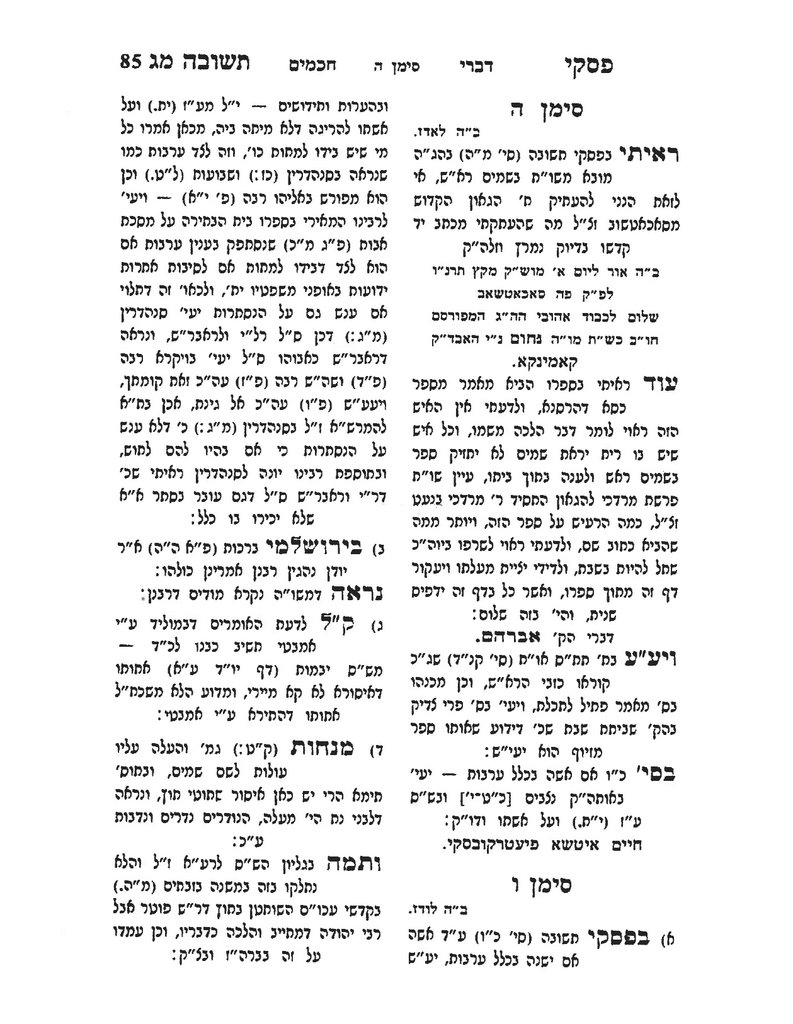
Now, to discuss our instance of censorship. One of the more well-known statements against the Besamim Rosh is by R. Avraham Bornstein (Sochaczew Rav) author of the Avnei Nezer and Eglei Tal. His statement was recorded in the book Piskei Teshuvot. The Piskei Teshuvot is a collection of interesting responsa, which have been abridged and notes added by the editor R. Avraham Pietrekovski. It was published in three volumes and included a fourth volume which contained comments from others about the work and was thus titled Divrei Chachamim. In the Divrei Chachamim, R. Nachum Kamikna wrote in to express his puzzlement at R. Pietrekovski’s mention, in one of his notes, of the Besamim Rosh. R. Kamikna includes the opinion of R. Bornstein on the entire Besamim Rosh issue.

R. Bornstein writes:

I believe that the person [the author and editor of the Besamim Rosh – R. Saul Berlin] is not one who is worthy of quoting any halakha in his name, any person who has a fear of heaven should not have the book Besamim Rosh in his house . . . I believe the book is worthy to be burnt [even] on Yom Kippur that falls on Shabbat.

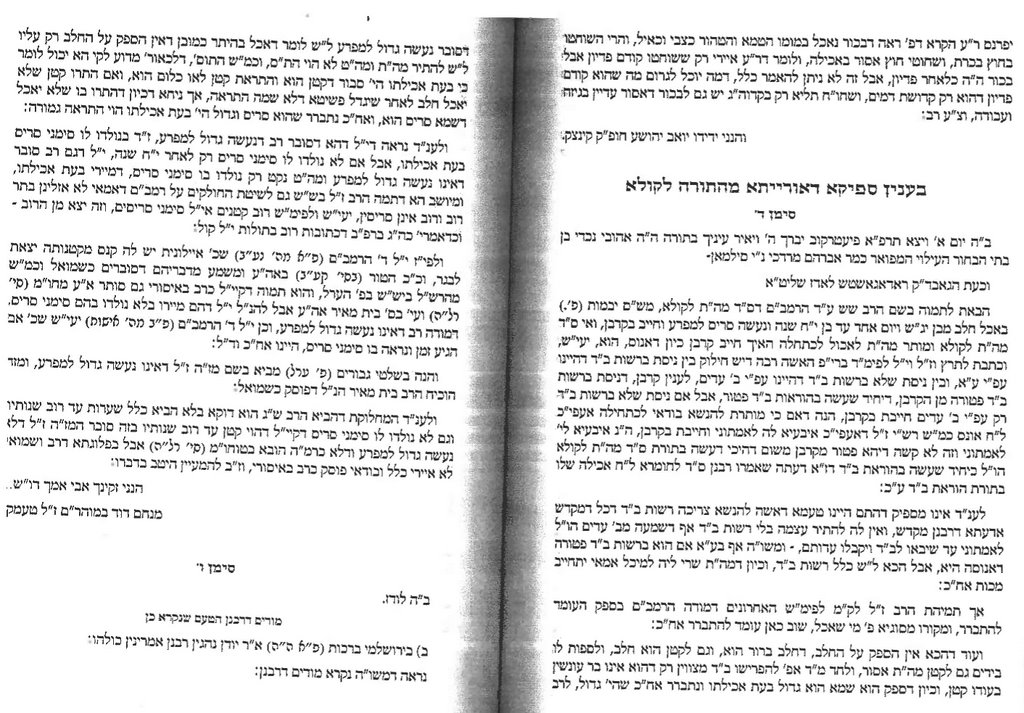
Needless to say, this is not a ringing endorsement of the Besamim Rosh. But, in 2001, a reprint of the Piskei Teshuvot was done, with reset type and organized according the Shulhan Arukh’s divisions. For some reason, however, this teshuva does not appear. In the earlier editions it was number 5 in Divrei Chachamim in this edition the numbering skips from four to six.

While recently, some have attempted to rehabilitate the Besamim Rosh, most notably in the 1984 reprint, these attempts are not part of the mainstream and it does not appear the Besamim Rosh is any more accepted today than he was previously. This is not to say he is never quoted, only that most are aware of the storied history and the question of whether in fact it is representative of the Rosh. In fact, since 1984 no further attempts to reprint this work have materialized. Thus, in light of this, it is rather odd this particular teshuva has been removed.

In addition to my previous post on the Besamim Rosh, see Moshe Samet, “R. Shaul Berlin’s Besamim Rosh: Bibliography, Historiography and Ideology,” (Hebrew) Kiryat Sefer 48 (1973): 509-523; and upcoming posts at the Seforim blog.

Appendix:
Divrei Chachamim: Before/After


Zafenat Pane’ah—A Further Example in the Titling of Hebrew Books

Zafenat Pane’ah—A Further Example in the Titling of Hebrew Books
by Marvin J. Heller[1]

Pharaoh called Joseph’s name Zafenat Pane’ah and he gave him Asenath daughter of Poti-phera, chief of On, for a wife. Thus Joseph emerged over the land of Egypt (Genesis 41:45). Zafenat: Zafenat Pane’ah. This name means decipherer of the cryptic (revealer of secrets). There is nothing similar to pane’ah in Scripture (Rashi).

The titling of Hebrew books is a beguiling subject. It has been addressed in several works and I too have addressed the subject in a number of articles. My articles differ, however, from the other studies which are concerned with the titling of books in an overview or general manner, that is, in the manner in which books are titled.[2]

Hebrew book titles often do not reflect the contents of a book, for as Dr. Joshua Bloch observes, that among the most curious characteristics of Hebrew books is that titles “frequently conceal the contents of important works which might otherwise be consulted in the course of research.” As an example, he quotes “Isaac Samuel Reggio (1784-1855), an eminent Italo-Jewish scholar, in his edition of the Behinot HaDaat (Examination of Religion) by Elijah Del Medigo (1460-1497), significantly observed that the book in addition to its other good qualities carries a title corresponding to its contents – a distinction rare among Hebrew books.”

In contrast, my articles explore the various and multiple uses of single titles, themed book titles, as well as titles from Shir ha-Shirim (Song of Songs).[3] In these cases, as Bloch observed, the subject of the book is not immediately obvious from the book title, indeed it might be considered concealed. This article focuses on a title from a unique biblical verse, employing a name that implies cryptic meaning, making its employ by varied books all the more intriguing.

The books with the cryptic title we are concerned with are entitled Zafenat Pane’ah, from the verse noted above “Pharaoh called Joseph’s name Zafenat Pane’ah.” Sixteen varied books, as well as two books with the expanded title Ẓafenat Pane’aḥ Hadash, are recorded in the Bet Eked Sefarim, a bibliography of titles set in Hebrew letters printed from 1474 through 1950.[4] In addition to the works recorded in the Bet Eked Sefarim there have been several additional printings of books with that title as well as books printed under other titles that are composites of several works, some including parts entitled Ẓafenat Pane’aḥ or with subsections or commentaries so entitled.

The examples of books entitled Ẓafenat Pane’aḥ follows, in chronological order, in two parts. The first part is comprised of expansive descriptions of books with our title, the second is concise descriptions of examples of other works with our subject title. In neither case are the titles to be considered comprehensive but rather an example of the varied and expansive uses made by authors in entitling their books Ẓafenat Pane’aḥ.

I

Abraham Menahem Rapa mi-Porto (Rapaport) Ashkenazi, Sabbioneta , 1555: Our first title, appropriately enough, is a work on cryptography by R. Abraham Menahem ben Jacob ha-Kohen Rapa mi-Porto (Rapaport) Ashkenazi, 1520-c.1594). Abraham Menahem served as rabbi in Verona, as well as heading a famed yeshiva in that location. Prior to accepting his rabbinic position, Abraham Menahem studied secular as well as rabbinic subjects, particularly medicine, and worked as an editor in Hebrew print-shops. His wide scholarship is evident from his other works, particularly his Torah commentary based on Midrashim, Minhah Belulah (Verona, 1594).

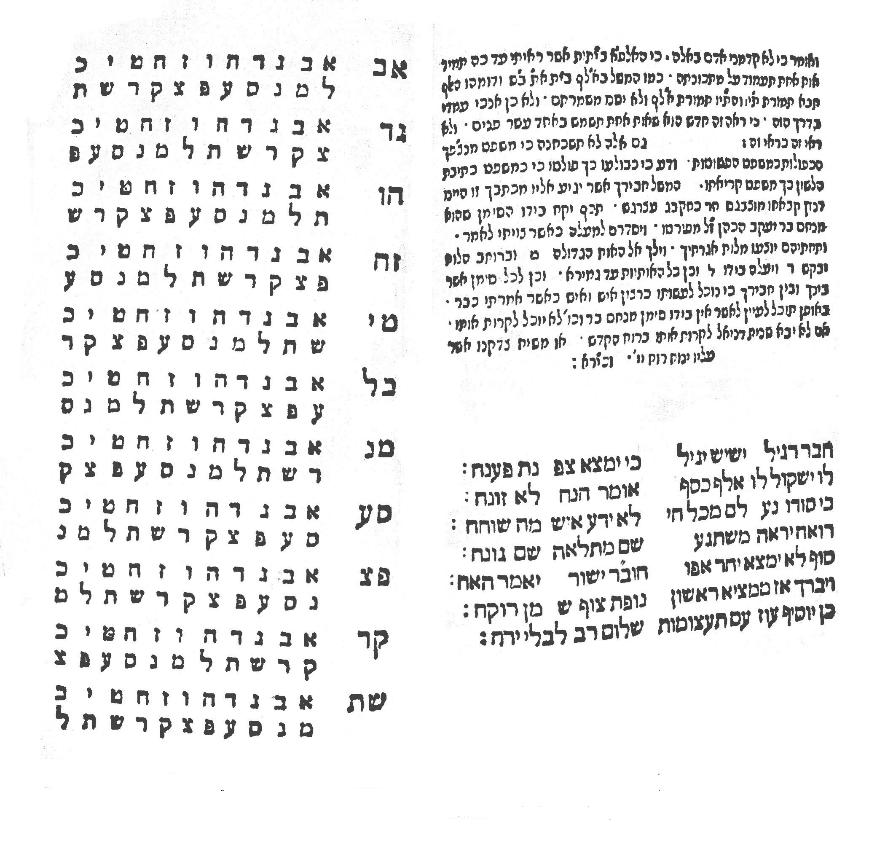
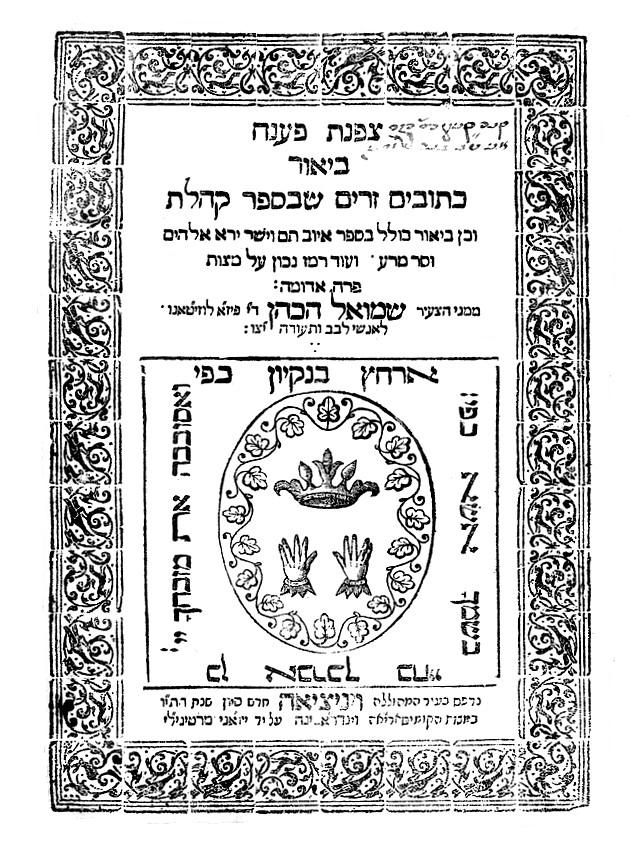
1555, Zafenat Pane’ah Abraham Menahem ha-Kohen Rapaport
Courtesy of the Jewish Theological Seminary 

1555, Zafenat Pane’ah
Courtesy of the National Library of Israel

Abraham Menahem spent two years preparing Zafenat Pane’ah. It is a small work, actually a small booklet, described as either a duodecimo (120) or an octavo (80) consisting of [6ff]. In the absence of the place of publication, locations such as Venice (Steinschneider), Ferrara (BenJacob), and Sabbioneta (Sonne) have been suggested. Avraham Yaari, following Sonne, records Zafenat Pane’ah as a Sabbioneta imprint, including it among the books published by the Foa press in that location.[5] The National Library of Israel records Zafenat Pane’ah, giving the location as Sabbioneta but also notes Riva di Trento as a possible place of publication.[6]

The title-page, perchance intentionally cryptic, does not identify the publisher, place of printing, or author, although the latter is evident from the text. Zafenat Pane’ah was, as noted above, published as a small booklet. The text of the title-page, again, lacking the date and place of publication, as well as having no ornamentation, states,

“See, this is new!” (Ecclesiastes 1:10); “In a levelled way” (cf. Jeremiah 18:15); “that they should do according to every man’s pleasure” (Esther 1:8); to write letters to one’s companion as a sealed book that will not be intelligible to those who see it. Even if alien eyes peruse the writing, in this manner it will be a great marvel, that tens of thousands of men all together should write in this way, that one should not understand the thinking of his companion. Even if “all go to one place” (Ecclesiastes 3:20) and hew from one quarry, something impossible to be heard and from intelligence withheld. If not after searching this page, confirming its great benefit as “your eyes uphold righteousness” (cf. Psalms 17:2).

The title-page is followed by Abraham Menahem’s lengthy effusive dedication to his uncle, R. Jacob Mugil, in which he also discusses the need for and value of cryptography, concluding with the date Tuesday, 15 October, 1555, Venice, signed Menahem of Porto. Next is a brief introduction in which the rules of encryption are discussed. He writes that there should be a sign between the writer and the recipient, whether in Hebrew, Ashkenaz, or whichever language the writer chooses, and it does not matter if the signs are numerous or few in number. “‘One who does much sacrifice and one who does less, as long as’ (Berakhot 5a, 17b) he places one letter with another as I will explain.” After some brief instructions on spacing Abraham Menahem signs his name as Menahem ben Jacob ha-Kohen from Porto.

Abraham Menahem’s name follows given in a bold, brief statement referring to the coding of his name, and, also in bold letters, the verse “If you had not plowed with my heifer, you would not have found out my riddle,” (Judges 14:18 ) This is followed by an example, in which Porto’s name appears as Menahem bar Jacob ha-Kohen mi-Porto, followed by the verse. His name is then spelled out over the verse as an encryption example. The text follows, discussing the subject of cryptography.[7]

Abraham Menahem was an eyewitness to the burning of the Talmud in Venice in 1553, which tragic event is reported in the Minhah Belulah, on the phrase “. . . a fiery law unto them,” (Deuteronomy 33:2), where he writes “I fixed these days for myself, for each and every year, for fasting, weeping, and mourning, for this day was as bitter for me as the burning of the House of our God (the Temple).

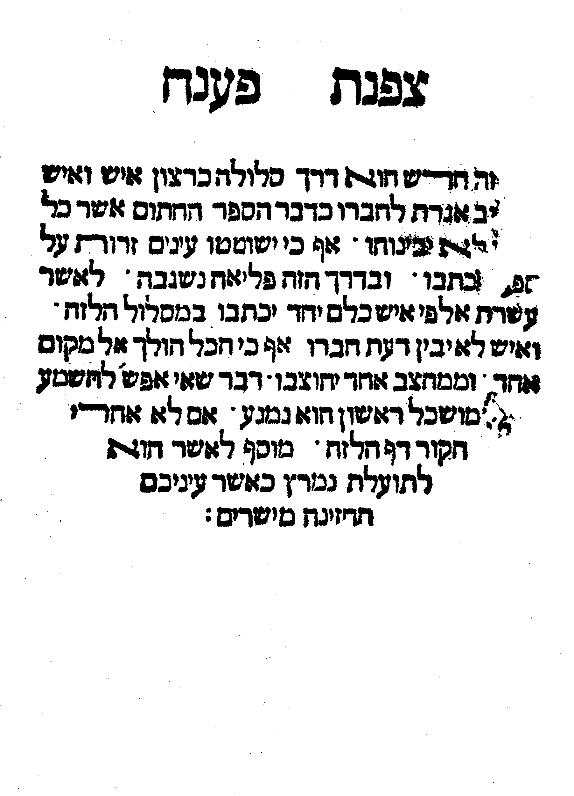
Anonymous, Prague, [1617]: Our second Zafenat Pane’ah, also a small work, is a very different type of book from Abraham Menahem’s Zafenat Pane’ah. This Zafenat Pane’ah is an alphabetical listing of the chapter heads of Mishnayot in the Babylonian Talmud. It was published at the press of Moses ben Joseph Bezalel Katz in Prague ([1617]) as a quarto (40: 4 ff.). Neither the compiler’s name nor the date are given, the latter being an estimate only. The anonymous author provides a detailed title page in lieu of an introduction, writing:


1617, Zafenat Pane’ah, Prague
Courtesy of the Jewish National and University Library

“O taste and see” (Psalms 34:9) this book, small in size but of great value. “The bed is too short” (cf. Isaiah 28:20) the presentation is long. Many run to and fro, seeking but do not find, “for it was not seen to this day” (I Kings 10:12). How do I think to reset that “which the early ones marked out” (cf. Deuteronomy 19:14), to establish markers and to wrap myself in a tallit stolen from its owner. Who is the man who would think so, to think of me an unfit thought, that I draw waters that are not mine, and I had already “hidden myself among the baggage” (I Samuel 10:22) to avoid the complaints of the mockers. However, the majority urgings of my associates and their desire convinced me to fulfill their requests, because “He who withholds grain [the people will curse him]” (Proverbs 11:26). As not everyone is able to acquire every book which is included and mentioned in this work, all is included here, and whatever time would be lost in trying to locate whichever chapter in all of the books, for it is a spread table (shulhan arukh) with all the savory food from which all the house of Jacob will be fed and nurtured. And I say concerning it, “fortunate is he who comes here and has the learning of all his books is in his hand” (cf. Pesahim 50a, Mo’ed Katan 28a, Ketubbot 77b, Bava Batra 10b). . . .

He concludes that that it is Zafenat Pane’ah (revealer of secrets, Genesis 41:45) for it reveals that which is hidden in the hearts of man. One should acquire this book, honor the Lord, and merit to see the coming of the Messiah speedily in our day.

The text follows in three columns in square letters. Each entry is comprised of the initial words of the first Mishnah in a chapter, the chapter umber, and the tractate name, arranged alphabetically by the first word in a Mishnah. At the end of the volume is a brief colophon summarizing the contents.

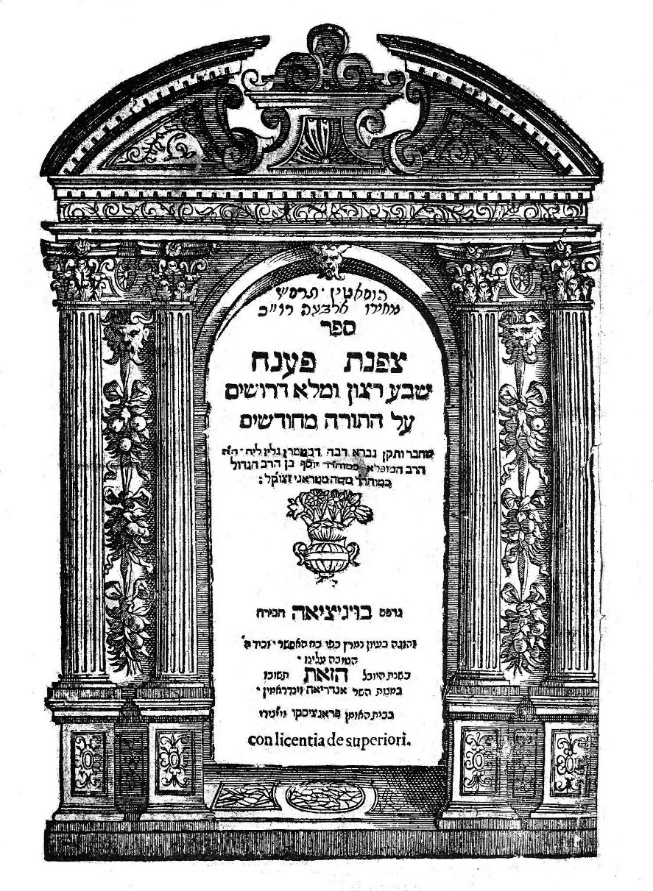
Joseph di Trani’s (Maharit), Venice, 1648: In 1648, the Venentian Vedramin press published a folio (20: [2], 236, 13 ff.) edition of R. Joseph ben Moses di Trani’s (Maharit, 1568–1639) discourses on the weekly Torah portion and festivals, entitled Zafenat Pane’ah. Trani was born in Safed under auspicious signs. On the night that he was born R. Moses Alshekh reputedly saw a great light over his house; his name was selected prior to his birth by R. Moses Cordevoro; his father noted that the year of his birth equaled איש חי (329 = late 1568; a valiant man, II Samuel 23:20), and he received a blessing from R. Joseph Caro prior to the latter’s death. Plague forced him to leave Safed for Egypt, returning, spending some time in Damascus and Jerusalem, but, by 1594 in Safed for an extended period of time where he headed a yeshivah. In 1599, he was sent as an emissary from Safed to Constantinople, and after a second visit, in 1604, heading a yeshivah, and eventually becoming chief rabbi. Among his students were R. Hayyim Benveniste, R. Joshua Benveniste, R. Hayyim Algazi, and R. Solomon ha-Levi.

The title page says that it is Zafenat Pane’ah, “satisfied with favor, and full of” (Deuteronomy 33:23) discourses on the Torah, updated, that were written and corrected by the great man . . . Printed “In the year of this הזאת (5408 = 1648) jubilee you shall return” (Leviticus 25:13).

The title page is followed by two quatrains of verse from the author’s son, R. Moses di Trani, with the heading, “I am the poorest of the poor” (cf. Judges 6:15) “my mouth shall praise you with joyful lips” (Psalms 63:6). Next is Moses’ introduction, the introduction of R. Yom Tov ben Yaish, and verse in praise of the author from his young pupil R. Isaac Alankowa, each paragraph beginning with the word kol (voice), all in a single column in rabbinic letters. At the end of the volume is the introduction of the second editor, R. Jacob ben Moses ha-Levi. The last introduction is printed twice, once with and once without Moses’ name and with variant headings. Zafenat Pane’ah concludes with indexes of verses, Midrashim, and rabbinic sayings. In his introduction Moses begins paragraphs two through nine with the phrase “before the light of the Torah became submerged” due to the destruction of the first Temple; decrees of the wicked Greek kings; destruction of the second Temple; etc. The following ten paragraphs begin “This” is in praise of his father and his work.


1648, Zafenat Pane’ah, Joseph ben Moses di Trani (Maharit), Venice
Courtesy of the Library of Agudas Chassidei Chabad Ohel Yosef Yitzhak

Zafenat Pane’ah is comprised of two to three sermons on each parashah and on festivals. Each homily begins with a quote from a Midrash or equivalent source in square letters, which is then explicated. Sources are given in the margins. The only decorative material is the frame about the heading of the first discourse and a design after the introduction of Jacob ben Moses with his name.

This is the only edition of Zafenat Pane’ah. Other works, excepting di Trani’s responsa and novellae, are no longer extant.

Samuel ha-Kohen di Pisa Lusitano, Venice, 1656: Controversial commentary on the difficult passages in the books of Ecclesiastes and Job by R. Samuel ha-Kohen di Pisa Lusitano (16th-17th cent.). Printed as a quarto (40: [4], 3-33 (should say 31) ff.) in 1656 by the Vendramin press in Venice, this is the only edition of this Zafenat Pa‘ane’ah, the only work of Lusitano, a scholar of Portuguese origin. The title, appropriately, reflects Lusitano’s purpose, to be, appropriately enough for our title, a revealer of secrets (Rashi on Genesis 41:45). Zafenat Pane’ah’s title page states that it is “on the unusual terms in Ecclesiastes and an explanation of Job, ‘a blameless and upright man, one who fears God and turns away from evil’ (Job 1:1, 8, 2:3). Also included are correct allusions on the precept of Parah Adumah (red heifer, Numbers 19:2).”

1656, Zafenat Pa‘ane’ah, Samuel ha-Kohen di Pisa Lusitano, Venice
Courtesy of Virtual Judaica

The title page is dated in the month Sivan in the year 416 (1656). Nevertheless, some bibliographic works, such as the Hebrew Bibliographic Project, based on references in the text, record it as a [1640] imprint. There are several pages of verse (2a-4a) in praise of the book by R. Leone (Judah Aryeh) Modena, R. Jacob ben Moses Levi, יא”ק (R. Joshua Abraham Kalimoni), אמ”ט (I, Moses Treibush of the seed of Jacob), and R. Jacob ben Abraham Shalom, nephew of Lusitano. Next is a warm letter ([4b]-4a) to Lusitano from R. Simhah Luzzatto, who raises the question of whether Job, at the time of his afflictions, denied reincarnation. Lusitano’s brief introduction (4b) follows, in which he notes that it is incumbent upon every Jew to learn Torah and to delve into the books of the Bible. He has turned to the works of “the sage Solomon” in the deep work Ecclesiastes and portions of Job and also to the precept of Parah Adumah. It is not Lusitano’s intent to bring novel interpretations but to elucidate the explanations of the sages.

Zafenat Pane’ah, in a single column in rabbinic letters, is divided into fourteen chapters, one through seven on Ecclesiastes, eight through thirteen on Job, and fourteen on Parah Adumah. Several chapters deal with the Messiah, or other controversial subjects: for example, 2) the time of the Messiah, 3) whether a person born after his coming will die, 4) if after reincarnation the Lord will renew the world in such a manner that they will be angels, 8) whether Job is Job ben Issachar ben Jacob, and 11) allusions to Leviathan on the war of Gog and Megog and whether the Lord revealed to Job his ways, wisdom, and knowledge.

Lusitano’s positions, particularly on reincarnation, incurred opposition from several rabbis. Most notable is R. Samuel Aboab (1610-94), who in his responsa, Devar Shemu’el (Venice, 1702), writes that when he saw the manuscript of Zafenat Pane’ah he was greatly pained and wrote to Lusitano attempting to prevent its publication. Attempting to explain the coming of the Messiah and reincarnation from the verses in Ecclesiastes is like attempting to “make an elephant pass through the eye of a needle” (Berakhot 55b) and attempting to determine these times is in opposition to the Rambam. Worst of all, he endangers the people by confirming that for this generation is written the end of days and Moses’ promise of redemption.

Joseph (Ashkenazi), Frankfurt on the Oder, 1693-94: Zafenat Pane’ah Hadash, homilies on diverse subjects by R. Joseph ben Moses (Ashkenazi), darshan of Przemyslany and rabbi and dayyan in that location (17th cent.) was printed in Frankfurt on the Oder in 1693-94 at the press of Michael Gottschalk as a quarto (40: 60 ff.). Joseph ben Moses was also the author of Keter Torah (Berlin, 1699), and a commentary on the Haggadah included in Haluka de-Rabbanan (Amsterdam, 1695). The title page describes it as:

Discourses, pleasing and delightful, a “work well set” (cf. Isaiah 3:24), a work of great sharpness, “more precious than fine gold” (cf. Isaiah 13:12) and pearls. His Torah was expounded with forty-nine faces, and within each and every entry you will find many views. Written by the great rav, the darshan of Przemyslany, R. Joseph ben Moses, grandson of the gaon R. Abraham Ashkenazi, descended from Rashi, son-in-law of R. Naphtali of Przemyslany, and author of Ketonet Passim.

Beginning of work is dated to Tuesday, the day that it states two times “it was good טוב (15)” (Genesis 1:10, 12) Kislev “And Pharaoh called Joseph’s name Zafenat-Pane’ah (he who explains what is hidden) שם יוסף צפנת פענח (454 = December 5, 1693)” (Genesis 41:45). The colophon (59b) dates completion of the work to Thursday, 2 Shevat, “One law shall be for him who is native born, and for the stranger who sojourns among you תורה אחת יהיה לאזרח ולגר הגר בתוככם (454 = January 28, 1694)” (Exodus 12:49). There is an approbation signed by nine rabbis from the Va’ad Arba Aratzot (1b); Joseph’s introduction (1b-2b), beginning that the Torah is expounded in 49 ways and concluding that the book is named Zafenat Pane’ah for it reveals that which is concealed; the text (3a-59b) in two columns in rabbinic letters; concluding with errata (60a-b) and a list of abbreviations (60b).

Zafenat Pane’ah Hadash is comprised of 60 discourses on diverse subjects, most discourses addressed in several homilies, varying in number from one homily (17 discourses) to sixteen (1) entries and in length from several pages to brief paragraphs The subjects are Adam and Hava, explained in sixteen entries; Patriarchs and Matriarchs; Eretz Israel; first-born; creation; blessing; exile and redemption; robbery; redemption and David (15 Shir ha-Ma’alot); judgment, mercy, and David; hekdesh; confession and repentance; merit and obligation; sin and punishment; tohorah and tuma; Jacob and tribulation; Judah, yibum and halizah; priesthood; honor of Torah and Torah scholars; honor, praise, and rising; learning the written and oral Torahs; Mizraim; Tabernacle and Temple; Moses and Aaron; flood and dispersion; angels; damages, marital property (melog and zon barzel); marriage and divorce; Sodom and Gomorrah; Sanhedrin; witnesses; slaves; Pesah, removal of hamez; Pharaoh and Mizraim; zaddikim; curse and blessing; Korah and his assembly; Cain and Abel and the splitting of the Reed Sea; Kri’at Shema; betrothal; considerable possessions; the wicked; Shabbat; representatives; tribes; oaths; reward and punishment; reward of mitzvah and Torah; resurrection; repentance; and terumot and ma’aserot.

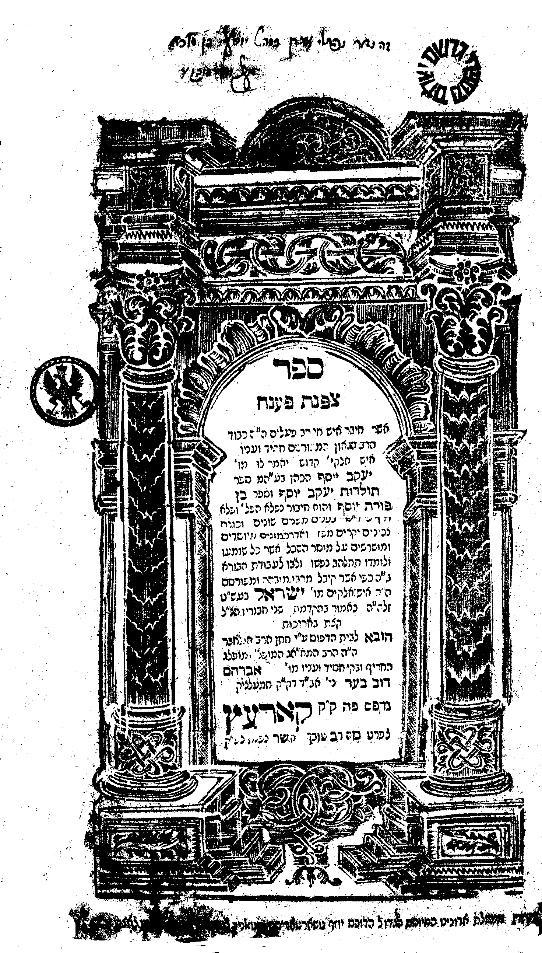
1693-94, Tzofnat Pa’aneah Hadash, Joseph ben Moses of Przemyslany, Frankfurt am Oder
Courtesy of the Society for the Preservation of Hebrew Books

The title-page has an elaborate pillared form comprised of two cherubim at the top blowing horns and at the bottom an eagle with spread wings. Within the wings is a carriage and figures, and in the middle of this scenario is a depiction of the Patriarch Jacob meeting Joseph in Egypt, recalling “And Joseph made ready his chariot, and went up to meet Israel his father, to Goshen, and presented himself to him; and he fell on his neck, and wept on his neck a good while” (Genesis 46:29).[8]

Jacob Joseph ha-Kohen Katz, Koretz, 1782: A commentary on Exodus by R. Jacob Joseph ben Zevi ha-Kohen Katz of Polonnoye (d. c. 1782). Among the foremost disciples of the Baal Shem Tov, Jacob Joseph was a scion of the kabbalists R. Samson ben Pesah of Ostropol (Ostropoler, d. 1648) and R, Joseph Katz (17th century), and of R. Yom Tov Lipman Heller (1579–1654). Jacob Joseph’s most famous work is Toledot Ya’akov Yosef (Korets, 1780), discourses on the weekly Torah readings and the first Hassidic book to be published.[9]

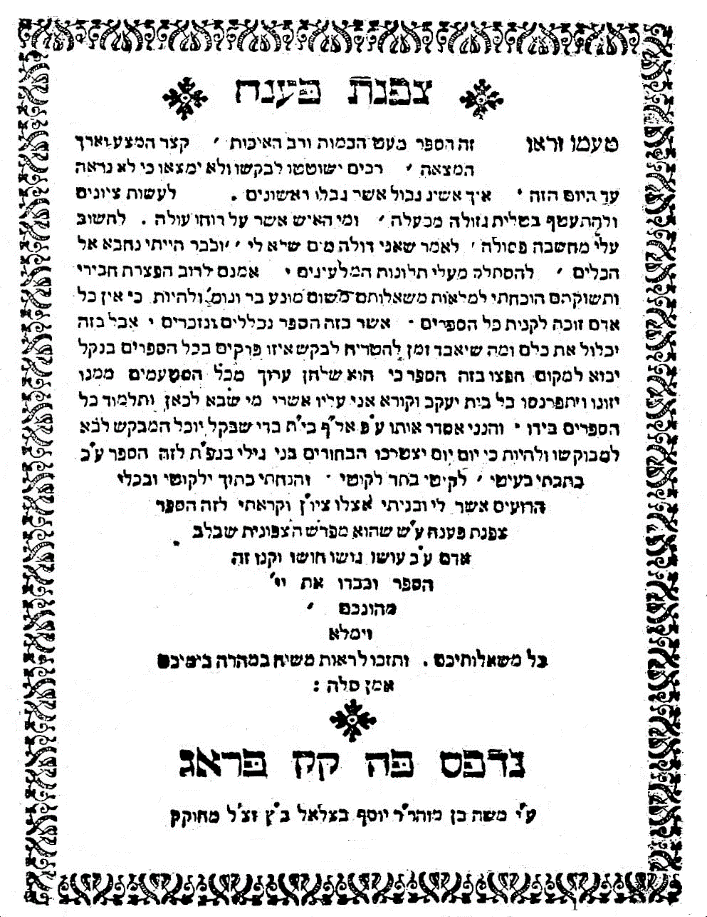
1782, Zafenat Pa‘ane’ah, Jacob Joseph of Polonnoye, Koretz
Courtesy of the National Library of Israel

Jacob Joseph’s Zafenat Pane’ah was printed in Koretz ([1] 35 ff.) at the press of Tsevi Hirsh ben Aryeh Leib Margolis (Margoliot), the first of two of Jacob Joseph’s works printed there at this time. Zafenat Pane’ah was preceded by Ben Porat Yosef (1781), on Genesis. The title-page, dated “How abundant is the good that You have in store [for those who fear You] מה רב טובך אשר צפנת (542 = 1782)” (Psalms 31:20) references Jacob Joseph, noting his Toledot Ya’akov Yosef and refers to the man of God, ISRAEL [Ba’al Shem Tov], informing that it was brought to press by his, Jacob Joseph’s, son-in-law R. Abraham Dov Ber, av bet din Hamaltzik.

The title-page is followed by the introduction which has an interesting and unusual heading, stating that the introduction to this work “has been printed before, twice in two of the author’s books, and is included here so as not to have a blank page. Printed here is an omission from Parasha Ki Sisa (Exodus 30:11-34:35).” It is not only the introductions that are alike, for Ya’aḳov Shemuʼel Shpigel informs that the title-page of Zafenat Pane’ah and Ben Porat Yosef, are also alike. He suggests that Jacob Joseph was not present and it is difficult to know who was responsible for the title-pages. Shpigel does note, however, that the reference to Jacob Joseph’s son-in-law is modified and either he or the printer might be responsible. The reference to the Ba’al Shem Tov is unchanged.[10]

Jedaiah ben Abraham Bedersi (Ha-Penini); Isaac Eisig ben Isaiah Auerbach (Reis) 1797: Classical ethical work, Beḥinat Olam (Examination of the World), by R. Jedaiah ben Abraham Bedersi (Ha-Penini, c. 1280 – c. 1340) with the commentary Zafenat Pane’ah by R. Isaac Eisig ben Isaiah Auerbach (Reis, early 18th century). A popular work, the Bet Eked Sefarim records as many as many as seventy-three printings of Beḥinat Olam, including editions with varied commentaries, three with Zafenat Pane’ah.[11] This printing of Beḥinat Olam, with the commentary Zafenat Pane’ah, was published in Brunn at the press of Joseph Karl Neiman as an octavo (80: 45 ff.). It was preceded by a Sulzbach edition (1744). Parenthetically, Beḥinat Olam was first printed in Mantua in 1478. This is the twenty-fifth edition of that work.

Jedaiah ben Abraham Bedersi (Ha-Penini), was a poet, physician, and philosopher. Among the other works credited to him is Baḳḳashat ha-Memim (The Mem Prayer) composed when he was fifteen. A versified prayer of 1,000 words each of which begins with the letter mem. He also wrote a commentary on the Haggadah, Ohev Nashim (In Defense of Women), Sefer ha-Pardes on such various subjects as isolation, worship, science, and grammar. Beḥinat Olam, Bedersi’s best known work, written after the expulsion of the Jews from France in 1306, is a versified examination, in thirty-seven chapters, of the vicissitudes and vanities of life, with religious and philosophical insights.

This Zafenat Pane’ah is a commentary on Beḥinat Olam by Isaac Eisig ben Isaiah Auerbach. Auerbach was a German grammarian and commentator. He was the author of several books on Hebrew grammar, reputedly motivated by his inability to understand Rashi, causing him to study philology. He eventually wrote Be’er Reḥovot (Sulzbach, 1730), a commentary on the Rashi on the Torah. He was the author of this Zafenat Pane’ah, a Yiddish translation and adaptation of Beḥinat Olam.[12]

1789, Beḥinat Olam with Zafenat Pane’ah, Brunn
Courtesy of the Jewish National and University Library

The title-page is followed by Auerbach’s introduction in which, at both the beginning and the end he describes Zafenat Pane’ah as being an explanation and interpretation (Zafenat Pane’ah). It is followed by the text which is in two columns, the inner columns the text of Beḥinat Olam in square vocalized letters, the outer column Zafenat Pane’ah set in Yiddish in Vaybertaytsh, a type generally but not exclusively reserved for Yiddish books, so named because these works were most often read by the less educated and women.[13]

II

Zafenat Pane’ah, as noted above, is an intriguing title for a book. Based on the rare appearance of the verse “Pharaoh called Joseph’s name Zafenat Pane’ah . . . (decipherer of the cryptic (revealer of secrets), a name that appears once only in the Bible. Zafenat Pane’ah is a name of Egyptian origin, it being the name given by Pharoah to Joseph, albeit one recognizing his rare ability to decipher Pharoah’s dreams. As a title, Zafenat Pane’ah has had an allure for authors. Of the books described above one only deals with cryptography, while several of the first group of books’ authors are named Joseph. Perhaps the allure of the name, Zafenat Pane’ah, decipherer of the cryptic (revealer of secrets) is seen by the authors as being applicable to their works, finding meaning in their interpretations of obscure passages in scriptures and other challenging works.

Our Zafenat Pane’ahs, the subject matter of this article, are early printings. It is important to note that later publications with our title, beyond the scope of this article, while not addressed in any detail, are also of interest. Indeed, note should be taken that several of these later works are, valuable and noteworthy. Below are concise examples of several later works entitled Zafenat Pane’ah

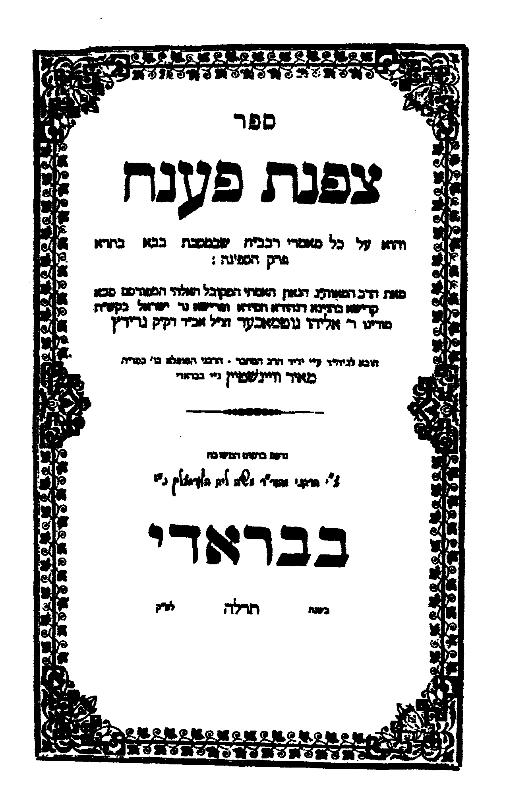
R. Elijah Guttmacher (1795–1874), a student of both Kabbalah and general studies, served as rabbi in Pleschen and Grodzisk Wielkopolski, attracting followers who came to him for amulets, cures, and guidance. He was unusual, in contrast to both Orthodox and assimilationist rabbis, in being a supporter of the Ḥibbat Zion movement. Author of works on Mishnayot and the Talmud, Guttmacher’s titles also include a Zafenat Pane’ah (Brody, 1875, below) “devoted to the tales of Rabbah b. Ḥana as told in Bava Batra.”[14] R. Saul Nathan Nathansohn, in his approbation to this work, writes that Zafenat Pane’ah is so entitled because it is an explanation of the aggadah of Rabbah bar Ḥana which is “obscure and sealed,” all the earlier geonim put their hearts to elucidating it and even the Vilna Gaon wrote a commentary on it.

A sad, tragic Zafenat Pane’ah is the eulogy by R. Asher Nissan ben Judah Leib Levinsohn for his only son, R. Menahem Nahum Nathan. Printed in Vilna (1875), the title-page describes Menahem Nahum Nathan as a gaon, gadol, and sage, and informs that Asher Nissan was the author of such works as Gan Ne’ul, Afikei Yehudah, and Likkutei Shoshanim. In a preface to the reader, Asher Nissan informs that he has entitled the eulogy Zafenat Pane’ah “Because his name is becoming נאה to him and he is becoming to his name, for my son, the gaon.”

Among the later editions of Zafenat Pane’ah are several books entitled Zafenat Pane’ah by the illustrious R. Joseph Rozin (Rosen, Rogachover, 1858–1936). A prolific author, all of his numerous and varied works on the Torah, Talmud, Rambam, and responsa have the title Zafenat Pane’ah.[15]

Our final Zafenat Pane’ah is a commentary on the Torah and festivals by R. Pinchas Shapira ben Shalom, published in Jerusalem (1964). A resident of Kozakonyha, Marmaros from from 1905, he was deported by the Hungarians during World War I to Galicia, settling, in 1918, in Felsovisso. He perished in the Holocaust.[16] His Zafenat Pane’ah was published by his son-in-law, R. Menahem Mendel Taub, the Kaliver rebbe. In the introduction Pinchas Shapira writes that he has entitled this work Zafenat Pane’ah because it alludes to his name and to the names of his father and of his mother. The initial numerical values of Zafenat Pane’ah צפנת פענח are, together with the number of its letters and general number (828 + 8 + 1 = 837), equal to Pinchas פינחס (208) ben במוה”ר (253) Shalom שלום (376 = 837). A second example is Pinchas פינחס ben Hanna Sarah בן חנה שרה (208 + 620 = 828).

III

Our Zafenat Pane’ahs and a [Hadash], noted both in some detail and concisely, encompass such varied subjects as cryptography, an alphabetical listing of Mishnayot chapter heads, biblical interpretations, a eulogy, an ethical work, and other diverse subjects. All reflecting the authors’ concerns with clarifying, making clear, that which is not clear, not immediately obvious without insightful interpretation. What then, could be more appropriate than the title Zafenat Pane’ah, “decipherer of the cryptic (revealer of secrets)”?

1875, Zafenat Pa‘ane’ah, Elijah Guttmacher, Berlin
Courtesy of Ozar ha-Hachms

[1] I would, once again, like to express my appreciation to and thank Eli Genauer for reading the manuscript and his comments.
[2] Among the authors addressing the subject of book titles are Abraham Berliner, “Shemot Seforim Ivrim,” in Ketavim Nivharim II (Jerusalem, 1969), pp. 147-48 [Hebrew]; Joshua Bloch, “Some Odd Titles of Hebrew Books,” Bulletin of the New York Public Library 41:10 (New York, October, 1937, reprinted in Hebrew Printing and Bibliography, New York, 1976), pp. 151-57; Solomon Schechter, “Titles of Jewish Books,” in Studies in Judaism, First Series (1896, reprint Philadelphia, 1938), pp. 270-281; and Menahem Mendel Slatkine, Shemot ha-Sefarim ha-Ivrim: Lefi Sugehem ha-Shonim, Tikhunatam u-Te’udatam (Neuchâtel-Tel Aviv, 1950-54) [Hebrew].
[3] My previous articles on the subject are “Adderet Eliyahu; A Study in the Titling of Hebrew Books,” in Studies in the Making of the Early Hebrew Book. Brill, Leiden/Boston, 2008, pp. 72-91; “What’s in a name? An example of the Titling of Hebrew Books,” in Further Studies, pp. 371-94; “Keter Shem Tov: A Study in the Entitling of Books, Here Limited to One Title Only” in Essays on the Making of the Early Hebrew Book (forthcoming); “Entitling Hebrew Books from Shir ha-Shirim: (Song of Songs)” in Essays; and “For a Remembrance: Books so entitled as a remembrance for the author.” (Hakirah, forthcoming).
[4] Ch. Friedberg, Bet Eked Sefarim, (Israel n.d.), tav379-396 [Hebrew].
[5] Avraham Yaari, “The Printers B’nei Foa,” in Studies in Hebrew Booklore, (Jerusalem, 1958), p. 362 n. 17 [Hebrew].
[6] National Library of Israel system number 990017477400205171.
[7] Marvin J. Heller, “Abraham Menahem ben Jacob ha-Kohen Rapa mi-Porto (Rapaport) Ashkenazi: A Renaissance Rabbi of interest” Seforim.blogspot.com (March 17, 2021).
[8] Concerning the eagle motif on the title-page of Hebrew book see Marvin J. Heller, “The Eagle Motif on 16th and 17th Century Hebrew Books,” Printing History, NS 17 (Syracuse, 2015), pp. 16-40 and in Essays (forthcoming).
[9] Mordechai Margalioth, ed. Encyclopedia of Great Men in Israel 3 (Tel Aviv, 1986), cols., 867-69; [Hebrew]; Tzvi M. Rabinowicz, The Encyclopedia of Hasidism (Northvale, London, 1996, pp. 239-40.
[10] Ya’aḳov Shemuʼel Shpigel, ʿAmudim be-Toldot ha-Sefer ha-Ivri: be_Sha’are ha-Defus (Jerusalem, 2014), pp. 115-16 [Hebrew].
[11] Ch. Friedberg, Bet Eked Sefarim, bet 341.
[12] Yehoshua Horowitz, “Auerbach, Isaac Eisig ben Isaiah,” Encyclopaedia Judaica, vol. 2, pp. 654-655.
[13] Concerning the early use of Vaybertaytsh see Herbert C. Zafren, “Variety in the Typography of Yiddish: 1535-1635,” Hebrew Union College Annual LIII (Cincinnati, 1982), pp. 137-63; idem, “Early Yiddish Typography,” Jewish Book Annual 44 (New York, 1986-87), pp. 106-119. Zafren suggests, in the latter article, that the origin of Vaybertaytsh, which he refers to as Yiddish type, was the Ashkenaz rabbinic fonts, supplanted by the more widespread Sephardic rabbinic type which prevailed in Italy (p. 112)..
G[14] Getzel Kressel, “Guttmacher, Elijah.” Encyclopaedia Judaica, vol. 8, pp. 155-156.
[15] An example of the Rogachover’s acumen can be seen from his exposing the widely accepted bogus edition of Seder Kodashim of the Jerusalem Talmud. The Rogachover, one of the few who questioned the authenticity of the forgery, observed that each Talmudic tractate mentions at least one amora (Talmudic sage) not mentioned elsewhere, whereas in this work there are no amoraic hapax legomena. Concerning the forgery see Marvin J. Heller, “Who can discern his errors? Misdates, Errors, and Deceptions, in and about Hebrew Books, Intentional and Otherwise” Hakirah: The Flatbush Journal of Jewish Law and Thought 12 (2011), pp. 269-91, reprinted in Further Studies in the Making of the Early Hebrew Book, (Leiden/Boston, 2013), pp. 417-20.
[16] Tzvi M. Rabinovicz, The Encyclopedia of Hasidism, (Northvale,1996), p. 450.


Marc B. Shapiro: Thoughts on Confrontation & Sundry Matters Part I

Thoughts on “Confrontation” and Sundry Matters Part II By: Marc B. Shapiro

What follows is a continuation of this post.Some people are so set on showing the differences between Christianity and Judaism that in the process they end up distorting Judaism. Let me start with an example that for the last fifteen years must be considered a Jewish teaching. By Jewish teaching I mean a view that is taught in the observant community. This doesn’t mean that all or even most people will agree with it, anymore than they agree with the ideas of Daas Torah, religious Zionism, religious anti-Zionism, or that the shirayim of the Rebbe has mystical significance. But agree or not, these are clearly Jewish teachings. Today it must be admitted that Judaism and Christianity share a belief in the Second Coming of the Messiah. While this is an obligatory belief for Christians, for Jews it is, like so many other notions, simply an option. The truth of my statement is seen in the fact that messianist Habad is part and parcel of traditional Judaism, and, scandal or not, most of the leading Torah authorities have been indifferent to this. That is, they see it as a mistaken belief, but not one that pushes its adherent out of the fold. In other words, it is like so many other false ideas in Judaism, all of which fall under the rubric “Jewish beliefs.” As long as these beliefs don’t cross any red lines, the adherents are regarded as part of the traditional Jewish community. To give a parallel example, many people reading this post are good rationalists, and therefore regard astrology as quite foolish. But we are all well aware of the many Jewish teachers who taught the efficacy of this system. Therefore, astrology must be regarded as an acceptable belief for adherents of traditional Judaism. Whether it is correct or not is a completely different matter, and if the latter criteria determines whether something is included under the rubric of traditional Judaism, then it will be a small tent indeed. Unlike Professor David Berger, it doesn’t overly concern me that the belief in a Second Coming didn’t exist twenty years ago. After all, Judaism is a developing religion. Two hundred years ago leading Torah scholars criticized Hasidism for advocating all sorts of new ideas, and yet these too became part of Judaism. In another fifty years the notion of a Jewish Second Coming will probably be seen by most as just another Hasidic eccentricity (albeit the province of only one sect), up there with prayers after the proper time and shirayim. The important point for me is what makes a belief an acceptable one in Judaism is not whether it is new, and certainly not whether it is correct, but whether the rabbinic leaders tolerate it. Over time they have shown that they can tolerate all sorts of foolish doctrines, Habad messianism being merely the latest. Professor Berger argued his case valiantly, but it has largely fallen on deaf ears, and this includes the ears of great Torah scholars. So, like it or not, traditional Judaism now encompasses hasidim and mitnagdim, rationalists and kabbalists, Zionists and anti-Zionists, and those who think the Messiah will be coming for the first time together with those who think it will be a return trip. What has occurred with Habad messianism and its painless integration into wider Orthodoxy can also teach us something with regard to the history of Judaism and Christianity. Had Paul not insisted on his antinomian path, that is, had the Law remained central to early Christianity, there is no reason to assume that there would have been a break with Pharisaic Judaism. When thinking about Habad, there is one other point we have to bear in mind. There are great Torah scholars who unfortunately believe the messianic foolishness, and they should be treated with respect. After all, R. Hayyim Joseph David Azulai, the Hida, quoted from the works of scholars who continued to believe in Shabbetai Zvi even after his apostasy.[33] He certainly opposed their Sabbatianism, and we must oppose the Habad messianism, but one’s religious legitimacy in contemporary Orthodoxy is not destroyed because of the belief in a false Messiah. Let me now return to an issue mentioned already, namely, the naivete in dealing with the differences between Judaism and Christianity that is common in Orthodox circles, especially among those who engage in apologetics and kiruv type activities. To give an example that I have both seen in print and heard in lectures, there are those who talk about how compared to Catholicism Judaism is a much more realistic religion when it comes to divorce, in that it permits it if people don’t get along. That is fine, as far as it goes, but some people then go overboard and denigrate any outlook that opposes “Judaism’s position.” In doing so, these well-meaning people end up of denigrating Beit Shammai’s view. Some will recall that Beit Shammai said that “a man may not divorce his wife unless he has found in her some unseemly conduct” (Gittin 9:10), which means unchastity. Now the halakhah is not in accord with Beit Shammai, but his is certainly a Jewish position. Any presentation of Judaism that presents the standard view of divorce as “the” Jewish position, and denigrates any other approach, has the unintended consequence of denigrating Beit Shammai as not having had a “Jewish” position. In other words, it is disparaging to Beit Shammai for any contemporary to speak about how Beit Hillel’s view is “better” than that of Beit Shammai. In fact, there are traditional sources that speak about how in Messianic days the halakhah will follow Beit Shammai, in this and in all other disputes. I think the traditional position would be to assert that Beit Hillel’s position is not objectively any “better”, and certainly not more ethical, than that of Beit Shammai. Furthermore, a number of poskim actually hold that Beit Hillel and Beit Shammai only dispute about a second (or subsequent) marriage, but that with regard to the first marriage, Beit Hillel agrees with Beit Shammai that a man can divorce his wife only if he finds a matter of unchastity. R. Solomon ben Simeon Duran goes even further and asserts that in this dispute the halakhah is actually in accord with Beit Shammai! [34] ואע”ג דב”ש וב”ה הלכה כב”ה משמע הכא דהלכה כב”ש This is not the accepted halakhah, but it illustrates how unseemly it is to portray a position held by important poskim as out of touch or foolish. As mentioned above, I have seen many times when apologists try to show the beauty of Judaism by contrasting it positively with some “non-Jewish” position (on the unsophisticated assumption that the best way to better their position is by denigrating another). As noted, I have also observed that sometimes the position they are denigrating happens to also be a Jewish position (just not the accepted position). Of course, when you point this out to them, and show them that the way they were arguing had the unintended consequence of ridiculing a position held by traditional Jewish figures, they immediately apologize and give assurances that they won’t do so again. My question always is, why not? Five minutes ago they were happy to declare how unfair or foolish a certain position is, and once being informed that the position is also held by Jewish thinkers they drop their argument like a hot potato. Are we to conclude that it is not the inherent logic of an argument that gives it validity, but only who its adherents are? Does an approach only stop being ridiculous when the polemicist learns that it was held by a traditional thinker? Obviously yes, which leads to the conclusion that there is no purpose in the polemicist arguing the merits of his case at all, since everything he states is only conditional. In other words, the polemicist is telling us: “I can attack a position as being foolish and illogical, but this is only when I think the position is held by non-Jewish or non-traditional thinkers. Once I learn that the position is also held by traditional thinkers, all of my previous words of criticism should be regarded as null and void.” This is another example of what elsewhere I have termed the “elastic” nature of Jewish apologetics and polemics. With this in mind, let me now say something that I know will make many people uncomfortable, but which I have felt for a long time. Throughout Jewish literature one can find any number of explanations as to how the notion of the Trinity is in direct opposition to Jewish teachings, since Judaism demands a simple, unified God. There is no doubt that for much of our history this was the standard view. However, once the doctrine of the sefirot arises on the scene, matters change. Many of the arguments put forth by kabbalists to explain why the belief in the sefirot does not detract from God’s essential unity could also be used to justify the Trinity, a fact recognized by the opponents of the sefirotic doctrine. Since the doctrine of the sefirot has become part and parcel of Judaism, we must now acknowledge that Judaism does not require a simple Maimonidean-like, divine unity. In fact, without any reference to the sefirot, R. Judah Aryeh Modena was able to conclude that one could indeed justify the notion of the Trinity so that it did not stand in opposition to basic Jewish beliefs about God’s unity. As Modena points out in his anti-Christian polemic, Magen va-Herev, the real Jewish objection to the Christian godhead is not found in any notion of a Triune God, but in the Christian doctrine of the Incarnation.[35] The idea that God assumed human form, i.e., that a human is also God, is regarded by us as way over the line. This is not only because it deifies a human, but also because there is a great difference between a spiritual God divided into different “parts,” and an actual physical division in God. The latter is certainly in violation of God’s unity even according to the most extreme sefirotic formulations. (It would not, however, appear to be in violation of R. Moses Taku’s understanding of God, since he posits that God can assume form in this world at the same time that He is in the heavens. For Taku, Christianity’s heresy would thus be seen only in their worship of a human, which is avodah zarah.) From the Trinity, let’s turn to Virgin Birth, another phenomenon which everyone knows is not a Jewish concept, or is it? If by Virgin Birth one means conception through the agency of God, then there is no such concept in Judaism. Yet if by Virgin Birth we also include conception without the presence of human sperm, then as we shall soon see, this indeed accepted by some scholars. (I stress human sperm, so that we can exclude the legend of Ben Sira’s conception, which occurred by means of a bathtub, not to mention all of the responsa dealing with artificial insemination.) Pre-modern man believed in all sorts of strange things, one of which was the concept of the incubus and the succubus, which was found in many cultures. The idea was that male and female demons would have sex with humans while they slept. Among the outstanding Christian figures who believed the notion possible include Augustine and Aquinas.[36] This was an especially good way to explain an unwanted pregnancy: just blame it on the demon. While the classic example of the incubus is when a male demon comes upon a sleeping woman, there were times when this happened while both parties were awake, and we will soon see such a case in Jewish history. Lest one think that this is only a pre-modern superstition, what about all those people who claim to have had sexual relations with aliens who abducted them?[37] As the superstitions in Jewish society have often mirrored those of the dominant culture, we shouldn’t be surprised that sex with demons comes up in our literature. Already the Talmud (Eruvin 18b) speaks of Adam begetting various types of demons. This source doesn’t say who the mother was, but since it wasn’t Eve it must be a female demon. Yet the Talmud is quick to note that Adam never actually had sex with this female demon. Rather, she impregnated herself with his sperm that was emitted accidentally. Throughout Jewish history there were women who were believed to have had sex with demons, and this raised halakhic issues that had to be dealt with. There is no need for me to give various sources on this as they have been nicely collected by Hannah G. Sprecher in a fascinating article.[38] I will just mention one point which I find interesting, and which I mentioned in one of my lectures on R. Ben Zion Uziel.[39] While R. Uziel is in many respects a model for a Modern Orthodox posek, it is quite jarring to find that he too takes seriously the claim that a woman was intimate with a demon. Instead of sending her to a psychologist, he devotes great efforts to showing that she can remain with her kohen husband.[40] That poskim would discuss this sort of thing is not surprising, and in an earlier post I mentioned a current talmid chacham who discusses if one can eat the flesh of a demon. Similarly, Sprecher cites a twentieth-century work that deals with circumcising a child whose father was a demon.[41] Yet to find R. Uziel, a supposedly modern posek, also taking this very seriously was quite a surprise to me. I guess the greater surprise was that of the various women involved with the demons. While some were no doubt off their rocker, others presumably just invented the story to save themselves from the shame of an improper relationship and its consequences. Imagine their surprise when instead of being condemned for their illicit affair, the rabbis actually believed the story that they made up, namely, that the man they had sex with was really a demon![42] Once a woman is believed to have had sex with a demon, and certainly if she had a child in this fashion, people are generally not going to want to have anything to do with her and her family. Being descended from the Devil is hardly the best yichus. Yet much of the world began like this, at least according to one early interpretation. Targum Ps.-Jonathan to Gen. 4:1 explains that Cain’s father is not Adam, but Sammael, who also is known as Satan and the Angel of Death. As James Kugel has shown, this tradition is found in other early sources, such as 1 John 3:12 which describes Cain as being “of the Evil One.” Pirkei de-Rabbi Eliezer 21 describes how the serpent impregnated Eve, and we know from other sources that the serpent is none other than Sammael. While we might be inclined to smile and regard this all as pleasant folklore, there is actually much more here than meets the eye. As Kugel brilliantly notes, this portrayal of Cain serves to explain why God did not accept his sacrifice, a point that is never explained in the text. In addition, it helps solve the puzzling comment of Eve (Gen. 4:1): “I have gotten a man with the Lord,” understanding “man” to mean angel, as is elsewhere found in Scripture.[43] Lest one think that in modern times tales of the Devil’s children are only to be found in novels and on the big screen – one immediately thinks of Rosemary’s Baby and The Omen – let me tell you a fascinating story. In the beginning of the nineteenth century a married woman named Yittel Levkovich gave birth to a child which, we are told, was obviously not her husband’s. Yittel claimed that she had been raped by a male demon. This claim was accepted and the woman was not regarded as an adulteress nor was the child regarded as a mamzer. Yet other Jews refused to marry with the descendants of this woman, and these descendants were known as “Chitshers.” Matters got to be so bad that in 1926 a broadside was published signed by many Hungarian rabbis declaring that there was no problem marrying into the Chitshers. Among the signatories was the young R. Joel Teitelbaum, the rav of Satmar. Despite this plea, there were those who continued to shun the Chitchers, and even to this day there are families in the Hungarian hasidic world who will refuse to intermarry with other Hungarian hasidim since the latter are descended from Yittel and the demon. Tying in with the Christian theme with which I began this post, there was even a belief that a Chitcher has the image of a cross under his skin opposite the heart![44] Take a look at the end of this responsum. This is a fascinating topic, and those who want more details should consult the previously mentioned article by Sprecher, from which I took the information mentioned until now. One aspect of the story that appeared too late to be included by Sprecher is mentioned by Jerome Mintz, and shows how despite R. Yoel Teitelbaum’s words of support for the Chitshers, this did not carry on to one of the inheritors of his throne. Jerome Mintz records the following from a Satmar informant: The Satmar Rebbe’s son, the oldest son, Aaron, he has sometimes a big mouth. Aaron, the Rebbe’s son, gave a speech and he called Ableson’s[45] mother a hatzufah [impudent woman]. “This Ableson’s mother–that impudent woman with her tsiganer [gypsy] family–came to the shul and starts yelling.” You know, with that phrase he was trying to bring up an old pain.

There is an old story about the Ableson family, given only from mouth to ear, about the quality of their family. There were some rumors about a hundred years ago about the Ableson family, that it’s not so spotless. A woman in the family had a relationship with some demon or something and that’s how the branch of the family got started. . . . Nobody knows how she became pregnant. She went away to a different town and came back pregnant and she didn’t have any love affair. She was a virgin. She was still a virgin. . . . It’s written in a lot of books at that time. The Kotsker, on of the big rabbis, said that one of their ancestors was made pregnant by a demon.

This goes back six generations. The family is spread out and the descendants feel a little guilty. They try to behave, you know, so that nobody should throw it back at them. The family is so widespread because they’re so rich. They’ve gotten into every family. They’re very aggressive people, probably because they come from the devil. . . . Even today when somebody is making a marriage arrangement he wants to find out if the family is not from the witches. I know that my mother and my father when they made a marriage arrangement, it was a day before they left the country, they found out if there’s a witch or not.[46]
The R. Aaron mentioned in this story is one of the current Satmar Rebbes. We find another example where a large family was ostracized in this fashion. The problem here was especially acute as many great Torah scholars had married into this family, and now aspersions were being cast on it. Those casting the aspersions referred to the family members as Nadler, which has the connotation of mamzer. (As with the term mamzer, it was also used as a general term of abuse and is the subject of a responsum of R. Solomon Luria.[47]) Because of the growing calumnies against innocent families, the Maharal and numerous other great rabbis were forced to publicly support them and condemn all who would question their yichus.[48] What I don’t understand is how, considering the base origin of the term “Nadler” and how it was used in such an abusive fashion, that the word actually became an acceptable last name. Indeed, it is now more than acceptable and people are proud to have this name, which they share with two outstanding scholars, not to mention my former congressman. * * * Returning to the issue of Christianity, many have discussed whether or not it is considered avodah zarah. I will deal with this at a future time, but now I want to raise another issue which I mentioned briefly in Limits of Orthodox Theology: What is worse, atheism or avodah zarah? Subsequent to the book’s appearance I found more sources related to this, which I hope to come back to in a future post. For now, let me just call attention to found a very interesting comment of R. David Zvi Hoffmann with regard to avodah zarah. It is found in R. Hayyim Hirschenson’s journal, Ha-Misderonah 1 (1885), p. 137. In speaking about the practice of the Talmud to sometime use euphemistic language, he claims that the expression “Grave is avodah zarah, for whoever denies it is as if he accepts the whole Torah” (Hullin 5a and parallels) is an example of this. In other words, the Talmud really means: “Grave is avodah zarah, for whoever accepts it denies the entire Torah.” I had never thought of this and it is certainly interesting. Hoffmann is himself led to this interpretation, which he sees as obvious, because if it was really the case that one who rejected avodah zarah would be regarded as one who accepts the Torah, how come a public Sabbath violator who rejects avodah zarah is still regarded as having rejected the Torah? Nevertheless, despite its immediate appeal, I don’t think Hoffmann’s interpretation can be accepted, and the passage is not to be regarded as euphemistic. Rather, it is an example of the Sages’ exaggerations, which we find in other places as well, such as where they state that a certain commandment is equal to all six hundred thirteen. In fact, I have what I think is conclusive proof that Hoffmann is mistaken in regarding this passage as expressing a euphemism. In Megillah 13a the passage appears in an altered form: “Anyone who repudiates avodah zarah is called ‘a Jew.'” The Talmud then cites a biblical proof text to support this statement which shows that it was not meant to be understood as a euphemism. While on the subject of Christianity, I would like to respond to the reaction of some who read my opinion piece on John Hagee. There I showed that what got so many upset, namely, Hagee’s theological understanding of the Holocaust, was actually shared by R. Zvi Yehudah Kook.[49] Of course, I understand why people feel that attempting to explain the Holocaust is improper. I happen to share this sentiment. Yet if people are upset by what Hagee said, just wait until they see the following, which out of all the supposed justifications for the Holocaust, which have ranged the gamut, this is surely the most bizarre. What can I say, other than that it never ceases to amaze me how some of the greatest scholars we have say some of the craziest stuff imaginable. I am referring to one of the reasons R. Ovadiah Hadaya gives to explain the Holocaust. He saw it as God’s way of cleansing the world of all the mamzerim![50] How a sensitive scholar, which Hadaya certainly was,[51] could offer such an explanation really boggles the mind. To think that the cruel murder of six million, including over a million children, not to mention all of the other terrible results of the Holocaust, was in order to complete some yichus program is beyond strange. I can’t recall who it was who said that any attempts at explaining suffering are invalid if you are not prepared to tell it to a parent whose child is dying of cancer. I certainly can’t imagine anyone telling a parent that his family was wiped out in the Holocaust in order to get rid of the mamzerim! (A well-known American haredi rosh yeshiva responded very strongly when told about what Hadaya wrote, but I don’t have permission to quote his words.) Prof. David Halivni commented, when I told him about Hadaya’s view, that Sephardim often don’t get it when it comes to the Holocaust. I remember thinking about Halivni’s comment when R. Ovadiah Yosef gave his own explanation for the Holocaust, some years ago, one which created such a storm that Holocaust survivors protested outside his home. He claimed that the dead were really reincarnated souls suffering for their sins in previous lifetimes. Although he doesn’t mention it, Hadaya’s view is obviously based on the Jerusalem Talmud, Yevamot 8:3, which speaks of a catastrophe coming on the world every few generations which destroys both mamzerim and non-mamzerim (the latter are destroyed as well, so that it not be known who committed the sin.) Sefer Hasidim, ed. Margaliot, no. 213, repeats this teaching. יש הריגת דבר או חרב שלא נגזר אלא לכלות הממזרים וכדי שלא לביישם שאם לא ימותו רק הממזרים היה נודע והיתה המשפחה מתביישת מפני חברתה [ולכן נוטל הכשרים עמהם] It is with regard to the issue of the mamzer that one can see manifested a point I have often thought about. The great classical historian Moses Finley spoke of what he termed the “teleological fallacy” in the interpretation of historical change. “It consists in assuming the existence from the beginning of time, so to speak, of the writer’s values . . . and in then examining all earlier thought and practice as if they were, or ought to have been, on the road to this realization, as if men in other periods were asking the same questions and facing the same problems as those of the historian and his world.”[52] The fact is that earlier generations often thought very differently about things. For example, we are much more sensitive to matters such as human rights than they were. They took slavery for granted, while the very concept of owning another person is the most detestable thing imaginable to us. Followers of R. Kook will put all of this in a religious framework, and see it as humanity’s development as it gets closer to the Messianic era. We see this very clearly when it comes to the issue of the mamzer who through no fault of his own suffers terribly. The Orthodox community is very sympathetic to his fate, and it is unimaginable that people today will, as in the past express satisfaction at the death of a mamzer.[53] A difficulty with the sympathetic approach is the Shulhan Arukh‘s ruling (Yoreh Deah 265:4) that when the mamzer is born אין מבקשים עליו רחמים. The Shakh writes: כלומר אין אומרים קיים את הילד כו’, מטעם דלא ניחא להו לישראל הקדושים לקיים הממזרים שביניהם. In fact, according to R. Bahya ibn Paquda (Hovot ha-Levavot, Sha’ar ha-Teshuvah, ch. 10), if one is responsible for bringing a mamzer into the world, and then does a proper teshuvah, “God will destroy the offspring.” Needless to say, if a modern person believed this to be true, it hardly would encourage him or her to do teshuvah.[54] (Philippe Ariès could perhaps have cited this text in order to bolster his controversial thesis that medieval parents were indifferent to their children, as it is unimaginable that a contemporary preacher would tell parents that the result of their teshuvah would mean the death of their child.) What, from today’s standards, would be the most cruel thing imaginable, is described by R. Ishmael ha-Kohen of Modena, the last great Italian posek (Zera Emet 3:111).[55] R. Ishmael rules that the word “mamzer” should be tattooed (by a non-Jew) on a mamzer baby’s forehead![56] This will prevent him from being able to marry. I know that no contemporary rabbi would recommend such a step (although the Zera Emet‘s advice is quoted in R. Zvi Hirsch Shapira’s Darkhei Teshuvah, Yoreh Deah 190:11). Nor would anyone want the mamzer’s house or grave to be plastered, as was apparently the opinion of some in talmudic days, in order that people would be able to shun him.[57] This leads to an issue that would require an entire volume to adequately deal with it. This volume would trace the Orthodox confrontation with changing values and show how Orthodox practices and ideas have responded. It is obvious that there is much more in the way of reevaluation of prior ideas in the Modern Orthodox world, but there is also a great deal in the haredi world as well. As noted already, I have observed this personally when haredi figures, and not only of the kiruv variety, have asserted that certain ideas and concepts are in opposition to Jewish values, and have then been flustered when I showed them that great figures of the past have actually put forth what today is regarded, even in the haredi world, as immoral statements. Examples of this are easy to find. R. Jehiel Jacob Weinberg pointed to one: the Rambam’s ruling in Issurei Biah 12:10. I am reluctant to spell this out here, because I know how it could be used by anti-Semites, so let me just quote it in Hebrew. ישראל שבא על הגויה–בין קטנה בת שלוש שנים ויום אחד [!] בין גדולה, בין פנויה בין אשת איש, ואפילו היה קטן בן תשע שנים ויום אחד–כיון שבא על הגויה בזדון, הרי זו נהרגת מפני שבאת לישראל תקלה על ידיה, כבהמה. I don’t think that there is any sane person in the world, no matter what community he is in, who would advocate this in modern times.[58] Furthermore, if you defend, even in the most right wing community, what Maimonides says here with regard to an innocent child, you will be regarded as evil. The traditional commentators are at a loss to explain where Maimonides got this. This example was pointed to by Weinberg as one of the traditional passages which most distressed him. Let me give another example which again illustrates how often contemporary moral judgments are far removed from those of previous generations, even when dealing with great Jewish leaders. R. Zvi Hirsch Chajes claims that a king has the right to kill the innocent children of someone who rebels, because of tikun olam,[59] and the Hatam Sofer, in a letter to Chajes, find this a reasonable position.[60] The purpose of the killing would be to put fear into others, who while may be willing to risk their own lives in rebellion, would be deterred if their families were wiped out. This is certainly not what anyone today would regard as “Jewish values.”[61] In fact, Seforno, Netziv, and Meshekh Hokhmah, in their commentaries to Deut. 24:16 (“Children shall not be put to death for the fathers”), specifically reject this possibility, with Seforno noting how this was a typical Gentile practice that the Torah is legislating against.[62] In such a case, we have to follow the guidance of R. Jehiel Jacob Weinberg, who believed that if there is a dispute among halakhic authorities, the poskim must reject the view that will bring Torah into disrepute in people’s eyes (Kitvei ha-Gaon Rabbi Jehiel Jacob Weinberg, vol. 1, p. 60): ואגלה להדר”ג [הגרא”י אונטרמן] מה שבלבי: שמקום שיש מחלוקת הראשונים צריכים הרבנים להכריע נגד אותה הדעה, שהיא רחוקה מדעת הבריות וגורמת לזלזול וללעג נגד תוה”ק R. Shlomo Aviner has the same approach (Am ve-Artzo, vol. 2, pp. 436-437) . He refuses to say that any rishon was less moral than another, but he notes that conceptions of morality change over time and not every decision of a posek is an eternal decision. Today, when we have different standards of morality than in previous days. If there is a dispute among the authorities, we should adopt the position which we regard as more moral. וברור שבהלכה פנים לכאן ולכאן. לכן כיוון שנתיבים אלה הם נתיבים מוסריים יותר, עלינו להכריע על פיהם. לפעמים ההלכה מוכרעת, בגלל שעת הדחק, ולפעמים ההלכה מוכרעת כי כך המנהג. אם כן, בימינו ‘המנהג’ הוא להיות מוסרי . . . יש גם מושגים מוסריים המשתנים על פי המציאות. אב הסוטר לבנו הקטן, אינו דומה לאב הסוטר לבנו בן השמונה עשרה. האם סטירת לחי לבנו היא מעשה מוסרי או לא מוסרי? תלוי בנסיבות. לא כל הכרעות הפוסקים הן הכרעות נצחיות . . . במצבנו כיום ישנם שיקולים מוסריים שמצטרפים להכרעותינו ההלכתיות In a recent by book by R. Yuval Sherlo, Reshut ha-Rabim, p. 102, he acknowledges moral advancement and concludes: “Despite all the hypocricy and cynicism there is moral progress in the area of human rights. True religious people believe that this is the will of God.” All this stands in opposition to R. J. David Bleich’s incredible statement: “The halakhic enterprise, of necessity, proceeds without reference or openness to, much less acceptance or rejection of, modernity. Modernity is irrelevant to the formulation of halakhic determinationsContemporary Halakhic Problems (New York, 1995), vol. 4, p. xvii (emphasis added). This statement is wrong on so many levels that I am inclined to think that Bleich simply didn’t express himself properly and meant to say something other than what appears from his words. In any event, in a future post I will return to Bleich’s controversial understanding of the halakhic process. As to the general problem of laws that trouble the ethical sense of people, we find that it is R. Kook who takes the bull by the horns and suggests a radical approach. The issue was much more vexing for R. Kook than for other sages, as in these types of matters he could not simply tell people that their consciences were leading them astray and that they should submerge their inherent feelings of right and wrong. It is R. Kook, after all, who famously says that fear of heaven cannot push aside one’s natural morality (Shemonah Kevatzim 1:75): אסור ליראת שמים שתדחק את המוסר הטבעי של האדם, כי אז אינה עוד יראת שמים טהורה. סימן ליראת שמים טהורה הוא, כשהמוסר הטבעי, הנטוע בטבע הישר של האדם, הולך ועולה על פיה במעלות יותר גבוהות ממה שהוא עומד מבלעדיה. אבל אם תצוייר יראת שמים בתכונה כזאת, שבלא השפעתה על החיים היו החיים יותר נוטים לפעול טוב, ולהוציא אל הפועל דברים מועילים לפרט ולכלל, ועל פי השפעתה מתמעט כח הפועל ההוא, יראת שמים כזאת היא יראה פסולה. These are incredible words. R. Kook was also “confident that if a particular moral intuition reflecting the divine will achieves widespread popularity, it will no doubt enable the halakhic authorities to find genuine textual basis for their new understanding.”[63] R. Kook formulates his idea as follows (Iggerot ha-Reiyah, vol. 1, p. 103): ואם תפול שאלה על איזה משפט שבתורה, שלפי מושגי המוסר יהיה נראה שצריך להיות מובן באופן אחר, אז אם באמת ע”פ ב”ד הגדול יוחלט שזה המשפט לא נאמר כ”א באותם התנאים שכבר אינם, ודאי ימצא ע”ז מקור בתורה. R. Kook is not speaking about apologetics here, but a revealing of Torah truth that was previously hidden. The truth is latent, and with the development of moral ideas, which is driven by God, the new insight in the Torah becomes apparent.[64] In a volume of R. Kook’s writings that appeared in 2008, he elaborates on the role of natural morality) Kevatzim mi-Ketav Yad Kodsho, vol. 2, p. 121 [4:16]): כשהמוסר הטבעי מתגבר בעולם, באיזה צורה שתהיה, חייב כל אדם לקבל לתוכו אותו מממקורו, דהיינו מהתגלותו בעולם, ואת פרטיו יפלס על פי ארחות התורה. אז יעלה בידו המוסר הטהור אמיץ ומזוקק. Another interesting statement from R. Kook on developing morality is found in Pinkesei ha-Reiyah, also published in 2008. (In a future post I will have more to say about these two new volumes.) In discussing how terrible war is, and the concept of a “permissible war,” which is recognized as a halakhic category, he notes that the latter is only suitable for a world which hasn’t developed properly, one which still sees war as a means to achieve things, This proper development can only come when all peoples have reached an elevated stage, since, pace Gandhi, you can’t have one nation practice the higher morality of no war while other nations are still using force. R. Kook describes “permissible war” as follows (p. 29): כל התורה הזאת של מלחמת רשות לא נאמרה כ”א לאנושיות שלא נגמרה בחינוך. The way the Torah shows this is by the law of yefat toar, concerning which R. Kook writes: כל לב יבין על נקלה כי רק לאומה שלא באה לתכלית חינוך האנושי, או יחידים מהם, יהיה הכרח לדבר כנגד יצר הרע ע”י לקיחת יפת תואר בשביה באופן המדובר. ומזה נלמד שכשם שעלינו להתרומם מדין יפת תואר, כן נזכה להתרומם מעיקר החינוך של מלחמת רשות, ונכיר שכל כלי זיין אינו אלא לגנאי. Wouldn’t it be great to hear rabbis talk about stuff like this on Shabbat?! On the very next page of Pinkesei ha-Reiyah, R. Kook applies the same insight to the issue of slavery, seeing it as only a temporary phenomenon, one that the Torah wishes to see done away with. In addition to what I have quoted from him in note 64, R. Norman Lamm has also recently written something else relevant to the issue being discussed: If anyone harbors serious doubts about inevitable changes in the moral climate in favor of heightened sensitivity, consider how we would react if in our own times someone would stipulate as the nadan for his daughter the equivalent of the one hundred Philistine foreskins which Saul demanded of David (1 Samuel 18:25) and which dowry David later offered to him for his daughter Michal’s hand in marriage (II Samuel 3:14) . . . The difference in perspective is not only a matter of esthetics and taste but also of morals.[65] He then develops the notion of a developing halakhic morality in which our evolving understanding of morality lead us back to the Torah “to rediscover what was always there in the inner folds of the Biblical texts and halakhic traditions” (pp. 226-227). To be continued * * * Many of you reading this post have purchased my book Studies in Maimonides and His Interpreters. In the first printing there is an unfortunate typo in the very last word (there are also some typos in the Hebrew section). Although I read through the book a few times before printing, as did a copy-editor, we didn’t notice it. Neither did numerous others who read the book, and I thank R. Yoel Catane, the editor of Ha-Ma’ayan, who was the first to catch the mistake (which has been fixed in the new printing). While the last word reads ,מחמר this should actually be מחמד, and was understood to refer to Muhammad. I was very upset upon learning of the careless typo. Seeing how I was beating myself up, my friend Shlomo Tikoshinski wrote to me as follows: לאו דמחמר – אין לוקין עליו (see Shabbat 154a, Mishneh Torah, Hilkhhot Shabbat 20:1)

[33] See Isaiah Tishby, Netivei Emunah u-Minut (Jerusalem, 1982), pp. 228ff.[34] She’elot u-Teshuvot ha-Rashbash, no. 411.
[35] See Daniel J. Lasker, Jewish Philosophical Polemics Against Christianity in the Middle Ages (Oxford, 2007), pp. 81-82.
[36] See Walter Stephens, Demon Lovers: Witchcraft, Sex, and the Crisis of Belief (Chicago, 2002), ch. 3.[37] See Thomas E. Bullard, UFO Abductions (Mount Ranier, MD, 1987). See also Jonathan Z. Smith’s article “Close Encounters of Diverse Kinds,” reprinted in his Relating Religion (Chicago, 2004), ch. 13.

[38] “Diabolus Ex-Machina: An Unusual Case of Yuhasin,” Jewish Law Association Studies 8 (1994), pp. 183-204.[39] Available at torahinmotion.org[40] Mishpetei Uziel,Mahadurah Tinyana, Even ha-Ezer no. 11.[41] Yalkut Avraham (Munkacs, 1931), p. 10.[42] While it is clear that demons come in both male and female, what about angels? According to the Magen Avraham, Orah Hayyim 610:5, the reason only men wear white on Yom Kippur is because men want to appear like the angels, and angels are male! Magen Avraham didn’t make this up, but is quoting a Midrash which teaches this idea. See Yalkut Shimoni, Proverbs 959, and Louis Jacobs, Judaism and Theology (London, 2005), ch. 19.[43] See The Bible as it Was (Cambridge, 1997), p. 86; How to Read the Bible (New York, 2007), pp. 60-61[44] R. Asher Anshel Miller, Hayyei Asher (Bnei Brak, 1991), no. 123.
[45] Mintz tells us that this is a pseudonym. For details of the conflict between “Yosel Ableson” and R. Aaron, see Mintz, Hasidic People (Cambridge, MA., 1992), pp. 302ff.
[46] Ibid., p. 307.[47] See the testimony recorded She’elot u-Teshuvot Maharshal, no. 101:דוא בישט איין נאדלר. דוא נאדלר ווארום נימשטו מיר מיין געלט . . . [48] See R. Judah Loew ben Bezalel, Netivot Olam (Bnei Brak, 1980), Netiv ha-Lashon, ch. 9.[49] See here[50] Yaskil Avdi, vol. 8, p. 200.[51] See e.g., his responsum in R. Ovadiah Yosef, Yabia Omer, vol. 3 p. 300. Here he reminds dayanim not to lose site of the humanity of the people standing before them (which current dayanim voiding conversions seem to forget–I will return to this in an upcoming post):
על הדיין לראות מעצמו אם היה ענין כזה באחת מבנותיו ח”ו, ובא הבעל נגדה בטענה כזו, האם ירצה שביה”ד יפסקו עליה להוציאה בע”כ מבלי כתובה. [52] Ancient Slavery and Modern Ideology (London, 1980), p. 17.[53] See e.g., Maharil, Hilkhot Milah no. 20:וצוה הרב לשמש העיר להכריז אחר המילה לציבור קול רם תדעו הכל שהילד הנימול הוא ממזר . . . ואמר אלינו מהר”י סג”ל שנתגדל הנער ההוא לבן עשר שנים ומת. וכתבו למהרי”ל לבשורה טובה שנסתלק ונאסף מתוכנו

R. Israel Moses Hazan, Kerakh shel Romi, p. 61b:ועברו איזה ימים ומת הממזר (ברוך שעקרו ולא נתערב זרע ממזרים בתוך קהלתנו)

R. Elijah Aberzel rules that it is permitted to abort a mamzer fetus. See Dibrot Eliyahu, vol. 6, no. 107.
[54] For an example of a preacher’s words that even the most idiotic person today would never use in trying to comfort a bereaved parent, see R. Joseph Stadthagen Divrei Zikaron (Amsterdam, 1705), p. 38a:ואם ח”ו מזבח כפרה מיתת בנים יארע, גם בזה אין ראוי להצטער [!] כי מי יודע מה היה מגדל ממנו יצור או כיעור, חכם או סכל, להרע או להטיב. [55] For those who have never heard of R. Ishmael, consider this: He is quoted by R. Ovadiah Yosef in Yabia Omer and Yehaveh Da’at many more times than R. Moses Feinstein.[56] In those days mamzerim were also named kidor, based on Deut. 32:20: כי דור תהפוכות המה[57] See Meir Bar–Ilan, “Saul Lieberman: The Greatest Sage in Israel,” in Meir Lubetski, ed., Saul Lieberman (1898-1983), Talmudic Scholar (Lewiston, 2002), pp. 86-87 (referring to Tosefta Yevamot, ch. 3).
[58] In his Avi Ezri R. Shakh discusses a certain halakhah dealing with the death penalty for violating the Noahide commandments. In 1987 some (presumably Chabad) troublemakers, obviously not concerned about hillul ha-Shem, “leaked” this to Israeli newspapers with the result that the latter had headlines: הרב שך מתיר להרוג גויים ללא דין. R. Shakh’s people were quick to point out that the discussion in Avi Ezri is completely theoretical, something which the “leakers” were well of. See Moshe Horovitz, She-ha-Mafteah be-Yado (Jerusalem, 1989), 96ff. For a similar incident five years ago involving Yeshiva University, see “Critics Slam Rabbi, Y.U. Over Article on Gentiles,” available here
[59] Torat ha-Nevi’im, ch. 7.[60] She’elot u-Teshuvot Hatam Sofer, Orah Hayyim no. 108 (end).[61] Cf. however Nathan Lewin’s argument, “Deterring Suicide Kllers,” available here Lewin, however, is dealing with adults, not potentially minor children. For Arthur Green’s response, ” A Stronger Moral Force,” see here
[62] See R. Shimon Krasner, “Ishiyuto u-Feulotav shel Shaul ha-Melekh,” Yeshurun 11 (2002), pp. 779-780.
[63] Tamar Ross, Expanding the Palace of Torah (Waltham, 2004), p. 292 n. 38.
[64] Cf. this to what R. Norman Lamm wrote in his response to Noah Feldman’s infamous article, referring in particular to Feldman’s discussion of the saving of non-Jewish life on Shabbat.Surely you, as a distinguished academic lawyer, must have come across instances in which a precedent that was once valid has, in the course of time, proved morally objectionable, as a result of which it was amended, so that the law remains “on the books” as a juridical foundation, while it becomes effectively inoperative through legal analysis and moral argument. Why, then, can you not be as generous to Jewish law, and appreciate that certain biblical laws are unenforceable in practical terms, because all legal systems — including Jewish law — do not simply dump their axiomatic bases but develop them. Why not admire scholars of Jewish law who use various legal technicalities to preserve the text of the original law in its essence, and yet make sure that appropriate changes would be made in accordance with new moral sensitivities? [65] “Amalek and the Seven Nations: A Case of Law vs. Morality,” in Lawrence Schiffman and Joel B. Wolowelsky, eds., War and Peace in the Jewish Tradition (New York, 2007), p. 208.


A Note on R. Bezalel Alexandrov’s משכן בצלאל and its Prenumeranten

A Note on R. Bezalel Alexandrov’s משכן בצלאל and its Prenumeranten
By Shnayer Z. Leiman
            Not much appears to be known about R. Bezalel Alexandrov (circa 1850-1930). Born in Grodno, he would ultimately come under the influence of the teachings of R. Yisrael Salanter (1809-1883), largely through the efforts of R. Yitzchak Blazer, i.e., R. Itzel Peterburger (1837-1907). R. Bezalel considered R. Itzel to be his primary teacher, especially during the period they both resided in Kovno. R. Bezalel was a close associate of R. Yosef Yozel Horowitz (1847-1919) of Nevarodok, perhaps the last of the disciples of R. Yisrael Salanter. A musar enthusiast, R. Bezalel served as a moreh zedek (i.e., a dayyan) in Minsk, where he also founded a kibbutz (a kind of kollel for advanced – and mostly married — students) in the Minsk suburb of Kamerovka.[1]
            R. Bezalel published two books in his lifetime, משכן בצלאל (Vilna, 1923) and ילקוט בצלאל (Piotrkow, 1927-9). Both are significant, rarely seen, and often miscatalogued by the few bibliographers who managed to hold copies in their hands. Here, we shall focus primarily on משכן בצלאל.
            מפעל הביבליוגרפיה lists only part 1 of משכן בצלאל, with 40 pages. Doubtless, מפעל הביבליוגרפיה’s bibliographer recorded exactly what he saw, a bound volume with 40 pages. But, in fact, aside from the 40 page edition, an edition including parts 1 and 2, and totaling 136 pages, was published in a bound volume, also in Vilna, 1923.[2] The book is largely a polemic against young Jewish men who insist on postponing marriage beyond the age of 20.[3] R. Bezalel’s second book, ילקוט בצלאל expands the polemic to other public manifestations of disregard for the rules of the Shulhan Arukh , such as the disregard of the mitzvot of ציצית, תפילין, מזוזה, and Sabbath observance.[4] In brief, R. Bezalel was a musarnik who was addressing the Jewish confrontation with modernity in Lita. At one point in his writings, he summarizes the confrontation as follows:[5]
Even aside from their general content, משכן בצלאל and its companion volume ילקוט בצלאל are of special interest for three reasons:
1.      They were accorded a letter of approbation from R. Yisrael Meir Ha-Kohen, the חפץ חיים.[6]
For the most part, the חפץ חיים wrote הסכמות with the greatest of reluctance. Generally, he refrained from writing הסכמות, offering a wide range of excuses why he could not do so. These included: he was not worthy to do so; he had not the time to do so; his failing eyesight and old age made it difficult to do so; he feared that by acquiescing to one request, he would be inundated with requests from others; and – most importantly – he had resolved long ago not to write הסכמות. After offering one or the other of these excuses, he would invariably close his letter with words of blessing and encouragement for the author – without a word said about the quality of the book. Nonetheless, it cannot be denied that the חפץ חיים did write a handful of genuinely enthusiastic הסכמות where he praised the books themselves.[7]

It is difficult to categorize the הסכמה written by the חפץ חיים for R. Bezalel Alexandrov’s משכן בצלאל. Not a word is said about the content of the book, but much is said about the author. Moreover, the חפץ חיים offers his blessing to all who come to the aid of the author. In context, this clearly means a blessing to all who buy a copy of his book.[8] Indeed, the חפץ חיים himself is listed as the first subscriber to the book (see below, item 3)! Nevertheless, the sense one has from reading the הסכמה is that it was an act of חסד by the חפץ חיים, rallying to the aid of a colleague in need.
2.      They record teachings of R. Itzel Peterburger (and other musarniks, such as R. Yisrael Horodner, the Maggid of Minsk[9]) not recorded elsewhere.
Here, one sample will suffice. Although we have many accounts of R. Itzel Peterburger’s “vow of silence” during the 40 day period from Rosh Hodesh Elul through Yom Kippur,[10] R. Bezalel’s account offers details not recorded elsewhere:[11]
3.      A lengthy list of subscribers is appended to משכן בצלאל that sheds light on the history of Vilna’s kloyzen.[12]
Lists of subscribers, known as prenumeranten,[13] are significant for a variety of reasons. Often, they tell us how far and wide authors traveled in order to raise the funds necessary for the publication of their books. They tell us who bought the books, and when and where they were purchased. Our list is particularly significant because it is mostly kloyzen driven, i.e., the books were acquired for the libraries of the various synagogues, בתי מדרשים, and kloyzen in Vilna. Indeedour list includes several kloyzen not listed in the most recent and most comprehensive list of Vilna kloyzen published in 2012![14] Our list also lists key members of the various kloyzen in 1923. There are more such lists of Vilna subscribers and their kloyzen, and they all need to be examined.[15]

Notice that our list includes among the subscribers the חפץ חיים, R. Chaim Ozer Grodzenski, R. Menachem Krakowski (maggid mesharim of Vilna), and R. Boruch Ber Leibowitz (then serving as Rosh Yeshiva of Yeshivas Kneses Beis Yitzchak in Vilna, and as a moreh zedek in Vilna). Each is accorded the title הגאון הגדול. Also among the subscribers (fourth on the list) is R. Isaac Rubinstein, listed is the רב מטעם, i.e., “the crown rabbi.” It is surely no accident that he is listed as הגאון, but not as הגאון הגדול. He was a distinguished – and tragic – rabbinic figure,[16] and it seems quite clear that R. Bezalel Alexandrov wanted to make a distinction between the various rabbis listed as subscribers.

In sum, the list reproduced here serves as a reminder to scholars that it is not enough to examine archival lists and history books. One often needs to examine other kinds of evidence – such as prenumeranten – that shed much light on Jewish social and intellectual history.[17]

Notes:

[1] See S. Even-Shoshan, ed., מינסק עיר ואם (Tel-Aviv, 1975), vol. 1, pp. 99-100. Cf. S. Weintraub, נובהרדוק (Bnei Brak, 2014), vol. 1, pp. 255- 257.
[2] A copy of the 136-page edition is available at the Mendel Gottesman Library of Yeshiva University. Neither the 40-page edition nor the 136 page edition is available online on HebrewBooks.org, אוצר החכמה, and אוצרות התורה.
[3] In general, see the sources cited in S. Stampfer, “Marital Patterns in Interwar Poland,” in Y. Gutman, ed., The Jews of Poland Between Two World Wars (Hanover, 1989), pp. 173-197. Cf. his “The Social Implications of Very Early Marriage,” in S. Stampfer, Families, Rabbis and Education (Oxford, 2010), pp. 7-25. None of the social historians seem to have been aware of משכן בצלאל.
[4] ילקוט בצלאל consists of two parts, the first contains 86 pages, and the second contains 102 pages. Part 1 is available online on Hebrew Books and אוצר החכמה, but not on אוצרות התורה. Part 2 is not available online. A copy with parts 1 and 2 is available at the National Library in Jerusalem.
[5] ילקוט בצלאל, part 1, p. 71.
[6] The letter of approbation was designated for משכן בצלאל, where it first appeared. The author took the liberty of reprinting it (together with two other letters of approbation that first appeared in משכן בצלאל) in his ילקוט בצלאל.
[7] See מאיר עיני ישראל (Bnei Brak, 2003), vol. 6, pp. 782-801.
[8] So, apparently, it was understood by R. Bezalel Alexandrov himself. See משכן בצלאל, p. 2.
[9] See, e.g., משכן בצלאל, p. 66. On R. Yisrael, see M. Heilprin,הגדול ממינסק (Jerusalem, 1994), pp. 96, 121-122, and 201.
[10] See, e.g., D. Katz, תנועת המוסר (Tel-Aviv, 1954), vol. 2, pp. 232-235; Ch. E. Zaichyk, המאורות הגדולים (Brooklyn, 1953), pp. 149-165; and M. Blazer, רבי איצלה (Bnei Brak, 2014), pp.475-540. None stresses the fact that R. Itzel, aside from his frequent hortatory Musar talks throughout Yom Kippur eve and day, also led the Kol Nidrei, Musaf, and Nei’lah services! It may well be that R. Itzel didn’t do this ordinarily on Yom Kippur (or in his old age), but R. Bezalel offers eyewitness testimony to what he experienced as a youth in Kovno.
[11] ילקוט בצלאל, pp. 31-32. A lengthy דבר תורה by R. Itzel follows the passage excerpted here.
[12] On Vilna’s kloyzen, see in general Khaykl Lunski, מהגיטו הוילנאי (Vilna, 1921), pp. 48-65, and the much fuller and more comprehensive listing of 135 (and more) kloyzen in A. Cohen-Mushlin et al, eds., Synagogues in Lithuania N-Z (Vilnius, 2012), pp. 281-353.
[13] On prenumeranten, see Berl Kagan, ספר הפרענומעראנטן [Hebrew Subscription Lists], New York, 1975; Shlomo Katzav, ספר החותמים (Petah Tikvah, 1984), vol. 2; and idem, ספר החותמים (Petah Tikvah, 1992), vol. 3. [See the late Tovia Preschel’s review of Berl Kagan’s ספר הפרענומעראנטן in the Jewish Press, May 30, 1975, p. 40; I am indebted to Menachem Butler for bringing the review to my attention. More importantly, see the recently published מאמרי טוביה, vol. 1 (Jerusalem, 2016) for a treasure trove of reviews and essays by Tovia Preschel, bibliophile and bibliographer par excellence. No Judaica library – public or private – should be without this volume, and without the full set when brought to completion.] These volumes provide indices to all Hebrew books that include prenumeranten by listing alphabetically all the towns and cities where the authors solicited subscriptions. Under each place listed, appear the titles of all Hebrew books that include subscribers from that place. Thus, if your great-grandfather was from Jaroslaw in southeastern Poland, you would locate the entry “Jaroslaw” in the Kagan or Katzav volumes, and immediately see the appended list of Hebrew books that include prenumeranten from Jaroslaw. You would then have to examine (online or at the library of your choice) each of the titles listed to see if your great-grandfather’s name appears on its list of prenumeranten. Cf. below, note 17.
[14] Cf. above, note 12. Thus, for example, בהמ”ד חורשי עצים, בהמ”ד קו”ק, and בהמ”ד פועלי צדק are either not mentioned or not properly identified in Synagogues in Lithuania. בהמ”ד שומר אמונים is mentioned in Synagogues in Lithuania (p. 340) but not identified.
[15] See, e.g., the highly informative list of prenumeranten and kloyzen in Vilna in R. Ch. S. Gluskin, רחשי לב (Bilgoray, 1934), pp. 271-272.
[16] On Rabbi Rubinstein, see G. Bacon, “Rubinstein vs. Grodzinski: The Dispute Over the Vilnius Rabbinate and the Religious Realignment of Vilnius Jewry 1928-1932,” in I. Lempertas and L. Lempertiene, eds., The Gaon of Vilnius and the Annals of Jewish Culture (Vilnius, 1998), pp. 295-304, and the references cited in Bacon’s note 4.
[17] It is with great joy and much anticipation that we welcome the recent publication of the first volume of קונטרס שמות החותמים (Brooklyn, 2016).

Unlike the indices listed above in note 12, it reproduces the full lists of prenumeranten exactly as they appeared when first printed. The volume contains 670 pages of prenumeranten from lists that appeared in books printed between 1790 and 1840. Presumably, the volumes to follow will print all lists from 1840 through the mid 20th century, when such lists mostly fell into desuetude. If brought to fruition, the entire set will probably consist of four volumes. The advantage of the קונטרס שמות החותמים volumes, of course, is that here we have the names of all the subscribers before our very eyes. The first volume is surely a gold mine of information, but questions remain. Lacking an introduction, we are not informed who is really responsible for the volume; what are its goals; whether or not there will be a full index of titles, names, and places; which libraries are providing the material that is being scanned; and which books are being included and which are being excluded. It seems obvious that either all or most of the books scanned by קונטרס שמות החותמים are from the Lubavitch Library in Brooklyn, certainly one of the world’s greatest collections of Judaica. But no single Judaica collection (not even the National Library in Israel) has copies of every Hebrew (and Yiddish) book. Any project attempting to gather all lists of prenumeranten will, by definition, have to be a universal project, involving the great Judaica libraries the world over. It is, for example, unclear, why the first list of prenumeranten in קונטרס שמות החותמים is from 1790, when such lists were quite common throughout much of the last quarter of the 18th century (e.g., יסוד עולם, Berlin, 1777; שבילי דרקיע, Prague, 1784). Despite these misgivings, קונטרס שמות החותמים is certainly a welcome addition to every Jewish bibliophile’s bookshelf. What ultimately needs to be done is to have all the lists of prenumeranten gathered together in one place, digitized and OCRed, so that the information contained in them (especially names of persons, names of towns and cities, and dates and places of publication) becomes searchable and retrievable. The yield for תלמידי חכמים, social historians, genealogists, and linguists (spelling of Hebrew and Yiddish names and places, history of surnames) is inestimable.

As a sample of some of the treasures that one can find in the new volume, we reproduce the title page of R. David Friesenhausen’s מוסדות תבל (Vienna, 1820), and two of its 14 pages of prenumeranten. These appear on pp. 331, 332, and 345-346 in קונטרס שמות החותמים. [ We have reproduced the pages from the original Vienna, 1820 edition, since the editor of קונטרס שמות החותמים sometimes divides a single page into two parts, presenting them as two pages.]

It will be noticed that the opening page of the prenumeranten lists the
ישמח משה, R. Moshe Teitelbaum (d. 1841) of Ujhely as one of the subscribers to מוסדות תבל. A later page of the prenumeranten lists the חתם סופר, R. Moshe Sofer (d. 1839) of Pressburg as a subscriber to מוסדות תבל.  The appearance of these two distinguished names (and there are more) – arguably the two greatest rabbinic leaders of Hungarian Jewry – on the same list of prenumeranten surely attests to the reputation of the author of מוסדות תבל in 1820. On R. David Friesenhausen, an early advocate of the Copernican theory, see my introductory note to the late Chaim Reich’s reissue of מוסדות תבל (Brooklyn, 1997), and the fuller discussion, with references, entitled “R. David Friesenhausen: Precursor of Torah and Derekh Eretz,” in Jacob J. Schacter, ed., Judaism’s Encounter with Other Cultures (Northvale, 1997), pp. 158-164. See also the bibliographical note in Eliezer Brodt, “יחסה של הספרות היהודית לקופרניקוס במשך הדורות,” Hakirah 13 (Spring 2012), Hebrew section, p. 17, n. 33; and Jeremy Brown, “Rabbi David Friesenhausen’s Zemirah for the Solar System,” Hakirah 14 (Winter 2012), pp. 249-271. I am deeply grateful to Eliezer Brodt for bringing these references to my attention. The haunting account in David Schoen’s שוחרי השם בהרי הקרפטים (Jerusalem, 2005), pp. 43-50, is embedded in a historical novel, and cannot be accorded more esteem and historicity than the esteem and historicity accorded to the best of historical novels. They remain novels. 


Marc B. Shapiro: A Tale of Two Lost Archives

A Tale of Two Lost Archives
by
Marc B. Shapiro
I have spent much of my professional life rummaging through collections of documents, mostly in well-kept archives, but sometimes also in hard-to-reach places in basements and attics. Fortunately, I have made some great discoveries in these places, but I will now tell you a story that doesn’t have a happy ending.
It begins around fifteen years ago, when I was researching the life of R. Jehiel Jacob Weinberg. With the strength that only someone in his twenties has, I traveled around the world, knocking on doors, and tracking down every letter I could find written by Weinberg.[1] During this time I was in touch with the widow of R Hillel Medalie. While not a student of Weinberg, Medalie became close to him after the war. During this time he was serving as rabbi of Leeds, a tenure which incidentally led to a terrible dispute with R. Solomon Fisch, another rabbi in Leeds.[2] The dispute was so bad that Fisch refused to serve with Medalie on the Leeds beit din, and R. Joseph Apfel was appointed a dayan in Fisch’s place. Apfel was a student of Weinberg, and more responsa in Seridei Esh are addressed to him than anyone else. At this time, he was serving as a hazan in Leeds, but after being appointed to the beit din his impressive learning was able to come to the fore.
In 1996 Apfel published Yad Yosef, which contains his collected writings. It also contains letters from numerous great Torah scholars including R. Jehiel Jacob Weinberg, R. Dov Berish Wiedenfeld, the Lubavitcher Rebbe, R. Isaac Jacob Weiss and R. Nachum Eliezer Rabinovitch. Among the most interesting teshuvot is one that is written by R. Pinhas Toledano, the Sephardic Av Beit Din of London. Apfel turned to him with the following problem: In Leeds there is a Jewish old age home and a non-Jew cooks for the residents on Shabbat. Is this permissible? Apfel had argued that the elderly residents are regarded as holeh she-ein bo sakanah, and it is permissible for a non-Jew to cook for a holeh she-ein bo sakanah. Others disagreed and Apfel turned to Toledano for his opinion.[3]
Toledano points out that while Apfel is correct that a non-Jew may cook for a holeh she-ein bo sakanah, (see Shulhan Arukh, Orah Hayyim 328:19), it is not at all clear that all old people have this status. Nowhere in the poskim do we find such a notion. So apparently, only for those elderly who suffer from diabetes, asthma or the like can the non-Jew cook. Yet Toledano concludes that the cooking is nevertheless permissible. Since the non-Jew is hired for the entire year, i.e., a contract worker, and can miss some days (vacation, etc.), there is room for leniency. While normally melakhah cannot be done in the house of a Jew because people will assume that the worker was hired to do the labor on Shabbat, in this case everyone knows that the cook is not hired on a daily basis. Toledano supports this contention by pointing out that in London everyone has milk delivered to the house on Shabbat and no one has raised any problems with this. I am too young to remember milk delivery, but I assume that this was the case in the U.S. as well, and the parallel is the daily delivery of newspapers. Toledano therefore concludes that it is permissible to have the non-Jew cook in the old age home. Yet he adds that even though halakhically this is OK, since it is very strange to permit such a thing in a Jewish old age home, the best thing to do is to cook the food on Friday and put it on a hot plate on Shabbat.
Returning to Medalie, from Leeds he went on to become the rabbi of the Antwerp community. After his death in 1977, a very nice memorial volume appeared honoring both him and his father, R. Shemariah Judah Leib Medalie.[4]
Here is a picture of R. Hillel.

Here is R. Shemariah.

Although he came from a Chabad background, I don’t know how strong Medalie’s connection was to the movement throughout his life. His father, R. Shemariah, was close to the Rebbe, R. Yosef Yitzhak, and was a very important figure in Chabad spiritual activities in the Soviet Union.[5] He was also a major figure in the political activities that took place in Russian Orthodoxy after the fall of the Czar.[6] In 1933 he was appointed rabbi of the Moscow synagogue, which meant that he was regarded as the rav of the entire city, and also made him the most important rabbi in the Soviet Union.

Before he left the country, R Hillel Medalie studied in a secret yeshiva that was headed by R. Mordechai Feinstein, R. Moshe’s brother, who was the rav of Shklov. R. Moshe Zvi Neriyah was also a student here. The communists would later exile R. Mordechai to Siberia, where he died.[7] In the 1950’s Medalie wrote to Weinberg about his attempts to secure his father’s release from the Soviet Union. It had been years since he had communicated with his father and he did not know that in 1938 R. Shemariah was arrested, accused of counter-revolutionary activities, and shot.[8]

R. Shemariah was one of many great talmidei hakhamim who were stuck behind the Iron Curtain, and even if not killed by the regime, lived out their days in what can only be described as a living hell.[9] While it was bad for everyone in the Soviet Union, for those whose lives revolved around Torah it was even worse. In accordance with the Lubavitcher Rebbe’s wishes, the elder Medalie did not attempt to leave the Soviet Union. While other rebbes and great rabbis were fleeing the country, the Rebbe told his followers to stay, as it was their responsibility to bring Torah to the Jewish people, even in times and places of darkness. He told them that they should not only think about their own physical and spiritual well-being but that of the Jewish people as a whole.

The Rebbe only changed his position in 1930 “when Stalinist terror was unleashed against rabbis and religious functionaries. But by then the difficulties connected with leaving the USSR were formidable and large scale emigration was impossible.”[10] What this meant was that virtually all of the children and grandchildren of these hasidim ended up completely assimilating, and I think that in retrospect we can say that it was a terrible misjudgment. However, it must also be stated that when communism fell, there were still Habad families that had remained religious throughout all this time. The next time someone complains about how Habad is now dominating religious life in the former Soviet Union, he should remember this.

This reluctance towards leaving the galut, even to go to Israel, is tied in with the Habad ideology that stresses the need to keep Judaism alive throughout the world. While this is generally a very good thing, as all world travelers can attest, sometimes the way it is expressed can be maddening for a religious Zionist to read. For example, in 1955, a few years after he became Rebbe, R. Menahem Mendel Schneersohn said as follows to his followers (Sihah for 20 Av, 5715):

גם כאשר נמצאים בחוץ לארץ הרי זה המקום אשר יבחר ה’ אלקיך בו, וגם כאן יכולה להיות עבודת הקרבנות ברוחניות . . . וזוהי ההוראה שצריכים להפיק מפרשת היום – ש”בכל המקום אשר אזכיר את שמי” הרי זה ארץ ישראל

This downplaying of the Land of Israel was too much for R. Zvi Yehudah Kook, and he responded as follows (Le-Hilkhot Tzibur, p. 33):

התואר “המקום אשר יבחר ד’ א-להיך בו” נאמר בתורת ד’ מן השמים רק על קדושת ארץ ישראל וירושלים שאיננה ניתנת להעברה וחלופין ח”ו על שום מקום בעולם . . . עבודת הקודש של העסק בתורה, שקידתה, הגדלתה והאדרתה וחרדת קודש של קיום מצוותיה הקדושות באמונה שלימה, ולדבקה בד’ א-להים חיים ללכת בדרכיו, והחיוב על כל אדם מישראל לחזור כל ימיו בתשובה, לעולם לא תעקור, לא תמלא את המקום ולא תחליף את מצוות ד’ של עבודת הקרבנות, שמקומה רק בפנים ולא מבחוץ. “בכל מקום אשר אזכיר שמי, שם ארץ ישראל” – ארץ ישראל מוגדרת ומוגבלת ומסומנת לקדושתה וסגולתה ולהגדרות חיובי מצוותיה ממקורות תורה שבכתב ותורה שבע”פ מקורות חז”ל דברי רבותינו גדולי ישראל ראשונים ואחרונים. וזה לשון הגמרא ברכות דף נז. “העומד ערום בחלום, בבבל עומד בלא חטא, בארץ ישראל ערום בלא מצוות” ולשון קדשו של רש”י שם: “בבבל עומד בלא חטא, לפי שחו”ל אין לה זכיות, אלא עוון יש בישבתה וזה עומד ערום בלא אותם עוונות.” ע”כ

Returning to Medalie, he also had a very good secular education, having received an MA from the University of Manchester and a doctorate from Trinity College in Dublin. In fact, Moshe Sharett, who was Israel’s first foreign minister, wanted Medalie to serve as Israel’s ambassador to Great Britain. Medalie declined the request after discussing the matter with the Hazon Ish.[11] Knowing of his closeness to Weinberg, I was anxious to examine his papers to find any letters from him, as well as from other great rabbis. His widow told me that all of his papers had been deposited at Machon Ariel in Jerusalem. No one had gone through them; they had simply been thrown into boxes and taken away.

Around twelve years ago I went to Machon Ariel to try to find out something about the papers. No one could tell me anything and I almost despaired. Fortunately, with the help of a janitor I found two giant boxes in a storage room in the basement. This contained all the materials taken from Medalie’s home. There was no light in the storage room or even in the basement (something was wrong with the electricity that day). The only light I had was from the windows on the top of the basement walls. I took the boxes, one at a time, and emptied them on the floor. I then spent a number of hours going through all the papers, putting aside everything that came from Weinberg. The rest of the material, including letters, speeches, and pictures, was of great interest and documented many years in the rabbinate. But this would have to wait until another day. For now, my focus was on in finding the Weinberg material, and I was able to make copies of whatever I located. I used a number of the Weinberg letters in my book and also published some of them in Kitvei ha-Rav Weinberg, vols. 1 and 2.

I was leaving for the U.S. on the following day, so I made a note to myself to come back to Machon Ariel and carefully go through both large boxes. I knew that there was all sorts of fascinating material in these boxes and was very excited about a return trip. Shortly before I left, I looked at another large box (or maybe even two or three; I can no longer recall). This was full of Pinchas Peli’s papers. Peli, who was a distinguished person in his own right, played a major role in bringing knowledge of R. Soloveitchik’s thought to Israel, with the publication in 1975 of Al ha-Teshuvah. Here is his picture.

Peli had a nice relationship with the Rav and I had no doubt that there were letters from the him among the Peli papers, but this too have to await a return trip. I was certain that no one would beat me to this, as no one cared, or even know, about the dusty boxes in the basement storage room, which had dishes and glasses in front of them. (There was a small catering business in the basement.) I had seen it before – boxes placed in some far-removed place where they remain for years and years, out of sight and out of mind, much like the Cairo Geniza. There is no doubt that when the Medalie and Peli papers were donated, the survivors didn’t expect that they would be put in some far away place where no one could examine them. They thought that the papers would be catalogued and kept in some sort of archive. Since Machon Ariel had not done anything in this direction, I figured that on a future visit I would take out all of the important material and then speak to the people in charge, alerting them to whatever treasures I had found and asking that they be kept in some sort of archive.

Mrs. Medalie told me that when the papers were at her home, some Chabad people had already looked through them for material from the Rebbe. She asked me to keep an eye out for any letters from him. Unfortunately, I didn’t see anything, and presumably the material had already been removed. There are some letters to Medalie in the Rebbe’s published correspondence. However, there are also many that do not appear there, but are found in R. Shalom Dov Ber Wolpo’s Shemen Sason le-Haverekha,[12] which has a lengthy chapter on Medalie and the Rebbe. I assume that the new letters published here are what that the Chabad people found at the Medalie home.

While I was working in the basement no one was watching me. No one even knew I was there. I could have walked off with anything. I considered the possibility that all this precious material would one day be lost, since Machon Ariel had no interest in it. (They probably accepted it in order to do the families a favor, but didn’t have the resources to do anything with the boxes). I rationalized to myself that since the material wasn’t being taken care of properly, something should be done. I thought that since I could watch over it and give the material a good “home,” that it would be OK for me to walk off with it. But I immediately squelched the thought, since stealing is always improper. Although there is a long list of people who have pilfered books and manuscripts, I didn’t want to join the list, even for the best possible reason.

In January 2007 I finally had the opportunity to return to Machon Ariel to pick up where I left off. I saw that the basement is now a nursery school. Everything that used to be there was removed a number of years ago. There was no one there to talk to about this at the time, but in June 2008 I returned and had the janitor take me around. The boxes were nowhere to be seen. None of the administrators had any idea what I was talking about. I was shown the library, which is undergoing renovations. It was a mess and there were a bunch of boxes that were set to be taken to genizah the following day. What a story it could have been if I had been able to save the Peli and Medalie boxes one day before they were to be lost? But unfortunately, the material was not there. I assume that when the new construction happened in the basement, the boxes were thrown out like so much other garbage. For an average person looking at a large box with old papers, it certainly would have looked like garbage. Yet how much precious material is now lost forever.

For all the great and important material found in archives around the world, much more has been lost. In fact, only a few years ago the son of one of Weinberg’s students contacted me about getting copies of the letters of Weinberg to his father, since they can’t find the originals. The father gave me copies many years ago and now they are lost. After he passed away and his house was cleaned, the letters were mistakenly thrown out. Such was probably the fate of many of the Weinberg letters that I was given copies of. It is the way of the world and there is little we can do about it, but it is frustrating nonetheless.

The visit to Machon Ariel was noteworthy in at least one respect. On the floor of the library, waiting to be sent to the genizah, was a large pile of issues of Panim el Panim. This was a weekly that appeared in the 1950’s and 1960’s, edited by Peli, which covered the entire range of Orthodox life, and included interviews with leading figures from all camps. Unfortunately, it is not available online. One of its outstanding features were the numerous pictures of gedolim, rabbis, scholars, and public figures, many of which are found nowhere else. I grabbed one issue (20 Elul 5724), in order to have something to read in the hotel, and in it one finds the following pictures of Abraham Berliner

and Jacob Barth,

which as far as I know do not appear anywhere else.

Here is a picture of R. Aaron Walkin of Pinsk, which I don’t recall ever having seen.

While on the theme of pictures of gedolim, let me note what appears in the recent volume focusing on the life of R. Bezalel Rakow, the Rav of Gateshead.[13] Rabbi Rakow thought very highly of such pictures and had them all over his house. He felt that today, when there are so many inappropriate pictures everywhere we look, it is important to have pictures of great rabbis to act as a counter. Here is a picture of Rabbi Rakow, from the beginning of the volume.

Getting back to Panim el Panim, one of the cover stories in the issue I took is about how R. Yehezkel Sarne visited Heichal Shlomo and the conflict this created, since by so doing R. Sarne was violating the Brisker Rav’s ban against the institution. Some believe that it was the Brisker Rav’s harsh stance that prevented his nephew, R. Joseph B. Soloveitchik, from accepting the offer to become Chief Rabbi of the State of Israel.

In general, the views of R. Sarne, and his Chevron Yeshiva, were more moderate than much of the haredi world (although he was known to be very anti-Habad). A glance at the names of those who attended the yeshiva shows that there are outstanding figures from all across the religious spectrum.[14] It is because of this that I was a little surprised when I read in a biography of R. Shakh[15] that R. Sarne once spoke very negatively to R. Shlomo Yosef Zevin about the Lubavitcher Rebbe. In fact, according to this source when R. Sarne was ill and R. Zevin visited him, R. Sarne told R. Zevin that his hasidut is heresy, his Rebbe is a heretic, and he is a heretic. When his health improved he went to R. Zevin’s house and apologized for treating him that way when the latter came to visit him. But now that he is at Zevin’s house, he wants to reaffirm that his hasidut is heresy, his rebbe is a heretic, and he is a heretic! The story as it appears is obviously a yeshiva fairy tale. But I asked R. Hayyim Sarne, R. Yehezkel’s son and current Rosh Yeshiva of Hevron (the Geula branch) if it is true that his father once spoke harshly to R. Zevin about Habad. He told me that it is true but that his father later apologized to R. Zevin, i.e., a real apology.

Since I mentioned R. Sarne and his inappropriate comments, let me tell another story that relates to the fact that he would sometimes say things that perhaps he shouldn’t have. Those who have read my book no doubt recall the funeral scene that I describe right at the beginning.[16] That, more than anything else, really shows the difficulty in placing Weinberg in any particular category. I actually feel that it was appropriate that he was buried in Har ha-Menuhot with all the other great rabbis, rather than the place chosen by the Mizrachi leaders (even if R. Herzog is also buried there). I say this for the following reason: R. Weinberg could not live in the haredi world. His views were too different from them. In fact, as my friend Shlomo Tikochinski has correctly pointed out, Weinberg is the only great sage respected in the haredi world whose views are so much at variance with it.

Yet while Weinberg wanted to live as a more modern type of rabbi, one who was a Zionist and academic scholar in addition to being a Torah sage, he wanted to be remembered as a gadol be-Yisrael. At the end of the day, he wanted his Torah works to be studied, and the only place for this was in the great yeshivot. So although he couldn’t live in their world, for posterity he would have wanted his legacy to be with them. However, I must also add the following: When Weinberg passed away all the great yeshivot were in the haredi orbit, so it would be natural that this is where he would want to be remembered. At that time, high level Torah study could hardly be found in the Mizrachi world. However, things are very different now, with the flowering of religious Zionist yeshivot of all sorts. If Weinberg were alive today, he would be able to feel fully comfortable in the religious Zionist world, since he would see the intensive Torah study and openness to secular learning of places like Maaleh Adumim, Har Etzion, and the like. Yet these yeshivot simply didn’t exist in his lifetime.

Not long after my book appeared, I was in a bookstore in New York City (does anyone remember Ideal Books?). I started talking to a certain fellow who happened to be a rav in Brooklyn and a son of one of the great Torah scholars of the previous generation. He told me that he is the only one alive who can testify as to what was said in the conversation between R. Yehezkel Sarne and the men who were in charge of the funeral, after R. Sarne and his students stopped the procession. (At the time, he was a student at the Chevron yeshiva.) Before he told me the story, he noted that one should remember that in his old age R. Sarne sometimes said things that were not appropriate. He gave one example of this: R. Sarne once went into the Brisk yeshiva and started screaming at the students that they should start learning mussar (Brisk being a place where they don’t do this). Only after telling me this story was he ready to inform me what was said at the funeral. According to him, after arguing with R. Sarne about where to bury Weinberg, Zorah Warhaftig, the Minister of Religions, was exasperated and declared: “But we have already dug the grave.” To this, R. Sarne replied (in Yiddish): “Put yourself in it!” The yeshiva students then took the coffin and proceeded to Har ha-Menuhot.

Returning to my conversation with R. Hayyim Sarne, which began with a discussion on Weinberg and moved into other areas, I was at his home for a good while and asked him many things. I even got into a disagreement with him on one issue. I am sure this surprised him, since roshei yeshiva are not used to young men challenging something they say. He insisted that it was better for people to be secularists than to identify with one of the non-Orthodox denominations. I responded that the opposite was the case, as the non-Orthodox groups at least add some Jewish content to people’s lives. They also help slow down assimilation. (Of course, all this is valuable in and of itself, but from a purely utilitarian standpoint it also makes the job of the kiruv organizations easier.) Yet he didn’t buy it and couldn’t even see my point, which I think is shared by virtually all thinking people in the Diaspora.

I used the conversation to ask him why the haredim have such a negative view of R. Kook’s philosophical writings, and his answer was very enlightening. To this day I have never seen it anywhere in print. He told me that one can turn pages and pages in R. Kook’s philosophical works without coming across a rabbinic text (ma’amar hazal). He insisted that a “kosher” work of Jewish thought must be constantly citing rabbinic texts. I had never thought of this point before, but I think it is quite significant. As all who study R. Kook know, he writes in such an original fashion that he becomes the primary text, and one can indeed turn many pages before seeing a ma’amar hazal.

In the new biography of the Brisker Rav (R. Velvel Soloveitchik), there is a very nice picture of R. Hayyim Sarne and his father in Switzerland, together with R. Jehiel Jacob Weinberg and R. Wolf Rosengarten of Zurich.[17] This has nothing at all to do with R. Velvel. It is included because the picture was taken in Switzerland and the biography discusses R. Velvel’s few trips there for health reasons. I assume that the author had this nice picture which he wanted to include, so he found some tenuous connection, even though, as I mentioned, it has nothing to do with R. Velvel.

While R. Velvel was in Switzerland, he was taken care of by Rosengarten, who appears prominently in the biography. R. Velvel also spent a lot of time with his nephew, R. Moshe Soloveitchik of Zurich. Both Rosengarten and Soloveitchik were also close to Weinberg. It has fascinated me that in all of the hundreds of letters that I have, Weinberg never mentions the Brisker Rav’s trips to Switzerland. He also had no interest in going to meet R. Velvel, even though the distance between them was no more than a few hours. I get the feeling that Weinberg felt that R. Velvel was in such a different world that it would be hard for them to even have a pleasant conversation. It might be that he was even intimidated by the Brisker Rav’s extremism. What makes this more interesting is that R. Moshe Sternbuch, who had become a great follower of the Brisker Rav, was also close to Weinberg. R. Bezalel Rakow taught at the Montreux yeshiva in the 1950’s, and he too had a very close relationship with Weinberg. As with so many other Torah scholars in Switzerland, Rakow too went to see the Brisker Rav.

I think we might get a sense of why Weinberg made no effort to meet R. Velvel from the following story:[18] When Rakow went to meet R. Velvel, the latter refused to see him after he heard that he taught at the yeshiva in Montreux. This yeshiva was founded in 1927 and drew students from all over Western Europe. While R. Elijah Botchko, the Rosh Yeshiva, was a member of Agudah and the yeshiva was viewed as part of this world (R. Aharon Leib Steinman even studied there during World War II), he didn’t tow the party line and was certainly more positive towards Zionism than the typical Agudist. Both he and his son and successor, R. Moshe Botchko, were also not opposed to the students getting a secular education. In the 1950’s there was even a plan to for the yeshiva to provide this. It is this issue in particular that is mentioned in explaining why the Brisker Rav refused to see Rakow:

דאפשר שגם הוא בין אלו שרצו להכניס בישיבה לימודי חול בין כותלי הישיבה

Only after Rakow was able to convince the Brisker Rav’s son that he had the proper hashkafot was he permitted to meet the Brisker Rav. He later recalled that the reason he was able to develop a good relationship with R. Velvel was because the latter valued his efforts in “fighting at the yeshiva so that they not incorporate secular studies.” I think it is likely that knowing how different his outlook was from that of R. Velvel, and that R. Velvel had no hesitation in speaking his mind, Weinberg decided to avoid what might turn into a difficult meeting. Whereas other gedolim from the yeshiva world wouldn’t dream of getting into an argument with Weinberg or telling him why his outlook was mistaken, the Brisker Rav, who always spoke his mind, would have had no such compunctions. As for the Montreux yeshiva, in 1985 it relocated to Israel and is now a hesder yeshiva.[19] This shows that even apart from the issue of secular studies, the yeshiva did not share the Brisker Rav’s approach.
[1] Since my book appeared I have also discovered many more letters, including a collection sent to one of the leaders of the yeshiva world (whose identity I am not at present able to divulge). In my Note on Sources, found after the preface, I mentioned that while such letters might cause me to reevaluate some of my conclusions, I was confident that the picture I presented would not be substantially altered. I was happy to see that nothing in these letters caused me to change any of my earlier thoughts.
[2] See Fisch’s Yeriot Shlomo (Jerusalem, 1983). Among Fisch’s contributions to Jewish scholarship are his editions of Midrash ha-Gadol on Numbers and Deuteronomy and his commentary to Ezekiel in the Soncino Books of the Bible.
[3] Incidentally, I think that the standard position is that bishul akum for a holeh she-ein bo sakanah is only permitted on Shabbat, but not during the week. See e.g., Kaf ha-Hayyim, Orah Hayyim 328:119. Halakhic experts, please correct me if I am mistaken.
[4] Shiloh, ed. R. Shlomo Yosef Zevin (Jerusalem, 1983).
[5] When the non-Hasidim and Chabad were finally able to agree on a joint political front in the Soviet Union, the plan was for a group of four non-hasidic and three hasidic rabbis to form a sort of Moetzet Gedolei ha-Torah, the members of which did not have to actually live in the Soviet Union. The four non-hasidim chosen were R. Chaim Ozer Grodzinski, R. Isser Zalman Meltzer, R. Isaac Jacob Rabinowitz, and R. Avraham Dov Baer Kahana Shapiro. The hasidic side was to be represented by R. Yosef Yitzhak Schneersohn (the Lubavitcher Rebbe), R. Menahem Mendel Schneersohn (the son of the Bobruisker Rebbe, R. Shemariah Noah), and R. Shemariah Medalie. See Mordechai Altschuler, “Ha-Politikah shel ha-Mahaneh ha-Dati ve-ha-Haredi be-Rusyah bi-Shenat 1917,” Shvut 15 (1992), p. 22.
[6] I mean, of course, Russian Jewish Orthodoxy, but I think it is worth noting that in pictures of rabbis from Old Russia one sometimes has trouble telling them apart from the Russian Orthodox priests, as they both work black and had beards. In fact, I found one such example with an American Orthodox rabbi. See here.
[7] See Iggerot Moshe, vol. 8, introduction, p. 18.
[8] See Avraham Greenbaum, Rabbanei Berit ha-Moatzot bein Milhamot ha-Olam (Jerusalem, 1994), p. 36. Greenbaum also notes that in 1937 R. Hillel Medalie’s brother, R. Moshe, was exiled to Siberia where he was killed. Unfortunately, this helpful book is not available online. However, I would like to call readers’ attention to another book which is also quite valuable and is online: Peninah Meizlish’s Rabanim she-Nispu be-Shoah. This book contains an enormous list of rabbis who perished in the Holocaust. Available here.
Speaking of online resources, it amazes me that there are still people who buy the Bar Ilan Responsa CD. Apparently, they don’t know that one can access this through the Spertus College library for very little money.
[9] Another example is R. Levi Yitzhak Schneersohn, the father of R. Menahem Mendel, the last Lubavitcher Rebbe. R. Levi Yitzhak died in 1944 after having been exiled to Kazakhstan. See Avraham Greenbaum, “Rabbi Shlomo (Solomon) Schlifer and Jewish Religious Life in the Soviet Union 1943-1957,” Shvut 8 (1999),p. 126 n. 10. Another example is R. Shaul Yisraeli’s father, R. Binyamin, who was rav of Koidanovo, a town near Minsk (see R. Shaul’s introduction to his Amud ha-Yemini). He was exiled to Siberia where he died. R. Shaul writes that his grave site is unknown, and therefore he called his first book Amud ha-Yemini, למען יהא לעמוד זכרון על קברו אשר לא נודע. R. Shaul and two others escaped from the Soviet Union by illegally crossing the border into Poland, which would have meant the death penalty if they were caught (as no doubt many others were). This dangerous step was taken only after Moscow’s Chief Rabbi, R. Yaakov Klemes, performed the Goral ha-Gra. See here.
Before setting out for the border, R. Shaul spent time in R. Yehezkel Abramsky’s apartment in Moscow. See Aharon Sorasky, Melekh be-Yofyo (Jerusalem, 2004), vol. 1, p. 199. R. Shaul made his way to Jerusalem where he became one of the leading Torah scholars in Israel. Because of his religious Zionist outlook, he is another figure who is scrupulously ignored by the Frankel Rambam, even though he was an expert in the agricultural halakhot and should have been cited repeatedly in the Frankel index to Sefer Zeraim. See R. Yaakov Ariel’s introduction to R. Shaul’s Havot Binyamin. In Sorasky’s book, cited previously in this note, R. Shaul is not referred to as “Gaon” and his name is not affixed with זצ”ל. But we should be thankful that at least R. Kook and R. Herzog are given the proper titles (but not R. Soloveitchik!)
[10] David E. Fishman, “Preserving Tradition in the Land of Revolution: The Religious Leadership of Soviet Jewry, 1917-1930,” in Jack Wertheimer, ed., The Uses of Tradtion (New York, 1992), p. 106 n. 48. Fishman also notes that R. Yosef Yitzhak repeated the advice that his great-grandfather had given to one who wanted to go on aliyah in the 1850’s: “We should make this the Land of Israel. Create a Land of Israel here.” This remained the Habad approach and is one of the reasons why the movement never stressed aliyah.
[11] See Nitzan Kedar, “Ha-Medinai she-Nishkah,” Ha-Tzofeh, Nov. 18, 2007, available here.
[12] This book claims that Medalie was born in 1918. Yet this is incorrect. In 1938 Medalie came to England to start his university studies. The Jewish Chronicle of May 20, 1938, has an entire story on this, complete with a picture of the young man. According to the paper, he was twenty-four years old at the time and had received semikhah from R. Isaac Herzog and R. Isser Zalman Meltzer. In Shiloh, pp. 15-16, semikhot from R. Isser Zalman and R. Moses Avigdor Amiel are printed.
[13] Be-Tzel ha-Kodesh (Jerusalem, 2007), p. 131.
[14] See here.
A number of distinguished people are missing from this list, and the following come to mind: R. Eliezer Waldenberg, R. Yitzhak Abadi, R. Aryeh Ralbag, R. Zev Segal, Prof. Yaakov Sussmann, Prof. Reuven Kimelman, and Dr. David Lando.
[15] Moshe Horovitz, She-ha-Maftehot be-Yado (Jerusalem, 1989), p. 94.
[16] Here is a little quiz: What classic book by a woman historian also begins with a funeral scene? Hint: The book is devoted to an event that is often related to the Ninth of Av. I don’t mean the Spanish Expulsion, which contrary to popular belief–a belief popularized by Abarbanel–did not take place on this date. See Yitzhak Baer, A History of the Jews of Christian Spain (Philadelphia, 1978), vol. 2, p. 439.
[17] Shimon Yosef Meller, Ha-Rav mi-Brisk (Jerusalem, 2006), p. 368. I wrote to Meller asking his permission to post the picture, but I haven’t yet heard back from him.
[18] See Be-Tzel ha-Kodesh, p. 118.
[19] See here.