The Eighth and Final Volume of Daniel Sperber’s Minhagei Yisrael Has Appeared
Mossad HaRav Kook has just published the eighth and final volume of Rabbi Prof. Daniel Sperber‘s Minhagei Yisrael. This final volume includes a complete and comprehensive index of all eight volumes volumes of Minhagei Yisrael. For this reason alone this volume is worthwhile, as anyone who has used the prior volumes knows, at times topics are spread over multiple volumes, sometimes in footnotes, which makes it difficult to locate particular topics. The first index is comprised of multiple indices; Mishna, Talmud, and Midrashim/Zohar. Additionally, there is an index using the Tur/Shulhan Arukh. The second index is done topically. Aside from the index, this volume includes a rather nice introduction where Professor Sperber discusses most of the recent literature on minhagim. Although not intended to be a full bibliography, it does include almost all the important books published on this topic in the last 15+ years, a topic that we will return to in forthcoming posts at the Seforim blog.
As with all the other volumes of Minhagei Yisrael there are also additional articles discussing minhagim. This volume starts off with a long quote from Rabbi Chaim Williamowsky. This quote, typifies the vast majority of Professor Sperber’s articles in this volume. R. Williamowsky notes that it is important to trace the history of minhagim as some are non-Jewish in origin and instead were borrowed and adopted from foreign cultures. Sperber then spends the next 100+ pages discussing minhagim which fall into that latter category. Sperber discusses the following customs — I have provided citations only if the custom is not the main focus of an article — the groom stepping on the foot of the bride (p. 14 n. 4 [and should make this person happy that in fact it has non-Jewish roots]); upsherin; round-matzot which are not linked to a non-Jewish custom, only that there is no reason to prefer round over square (p. 29-30 n. 26); which day of the week to get married, including a discussion of Friday marriages (p. 33 n. 13); marriage during a waxing of the moon (p. 37-40); bride and groom fasting on their wedding day; the huppah canopy; not having knots at the wedding (p. 71 n. 11); throwing a shoe at a wedding; burning clothing at the graves site of R. Shimon bar Yochai; feeding mourners eggs after the burial (p. 72); the additional “holy” names in mezzuzot, tzizit as protection (p. 112 n. 61 – this one may have gone from Jews to non-Jews as well as the notion of a door post protect, see idem); the use of פי פי פי to concentrate during prayers (p. 113); dipping bread in salt to protect from evil spirits.
Sperber is able to trace back almost all of these topics and offer why and when the Jews accepted what was common amongst from within the particular culture they were living. Sperber’s sources are especially helpful as, at times, others have made arguments that customs are originally non-Jewish in nature but provide no sources. For instance, both R. Gavriel Zinner and then R. Benyomin Hamburger both note the possibility that upsherin comes from non-Jewish sources. But neither provides any detail on this point. Sperber fills a significant lacuna.
Although the above makes up the bulk of this volume there are few other items of interest. Sperber offers a possibility why the custom arose to say the verse ויהי בנסע ארון at the removal of the Torah and then also discusses the recitation of the Ten Commandments at קריאה שמע על המטה. The rest of the articles are additions to this one. That is a discussion about the placement of the Ten Commandments generally by Professor Meir Schwartz. Additionally, as the source for the recitation is R. Yitzhak Klover, grandfather of the R. Shelomoh Luria (Maharshal), Dr. Meir Rapfeld provides biographical and bibliographical information about this important figure. Dr. Rapfeld also has a discussion about a custom in the synagogue of the Maharshal. There is an article from R. Meir Kodesh discussing the custom amongst mourners to wear black.
Finally, as in all of the previous volumes, Prof. Sperber has included additions and corrections covering all of the volumes.
In all, this is an excellent end to a terrific series on minhagim. The book is available in Israel directly from Mosad HaRav Kook who currently is running a sale and in the US at Biegeleisen books (and in due course) at your local seforim store.
The Haftarot of the Sabbaths of Hanukkah and the Haftarah of the Sabbath of Rosh Ḥodesh Tevet
The Haftarot of the Sabbaths of Hanukkah and the Haftarah of the Sabbath of Rosh Ḥodesh Tevet[1]
by: Eli Duker
In the Babylonian Talmud (Megillah 31a) it is stated that the haftarah for the Sabbath of Hanukkah is from “the lamps of Zechariah,” and if Hanukkah coincides with two Sabbaths, the haftarah for the first Shabbat is from “the lamps of Zechariah” and the haftarah for the second Shabbat is from “the lamps of Solomon.”
Rashi there explains that “the lamps of Zechariah” refers to the haftarah beginning: “Sing and rejoice” (Zechariah 2:14), and that “the lamps of Solomon” refers to the haftarah beginning: “Hiram made” (I Kings 7:40). This explanation is also found in Seder Rav Amram Gaon, and this is the practice in most communities to this day.[2]
We find another custom in Tractate Soferim (20:8) with regard to the Torah reading and haftarah for the Sabbath of Hanukkah:
ובשבת שבתוכו קורא ויהי ביום כלות משה, עד כן עשה את המנורה, וכן ביום השמיני, עד וזה מעשה המנורה, ומפטיר ותשלם כל המלאכה.
Thus, according to Tractate Soferim, the haftarah for the Sabbath of Hanukkah begins: “When all the work was completed” (I Kings 7:51), which addresses the dedication of the First Temple. It is somewhat puzzling that the haftarah begins precisely there and not a few verses earlier, which would have included the “lamps of Solomon,” a fitting verse for Hanukkah. It is possible that since Tractate Soferim generally reflects the practices of Eretz Yisrael, and the miracle of the cruse of oil is a Babylonian tradition, they saw no need to refer to the making of the menorah. Yet, we see that according to this ruling they nevertheless read in the Torah up to the account of the making of the menorah, even though according to the Mishnah only the passages of the nesi’im are read — indicating that there is a desire to allude to the miracle of the cruse of oil.[3] One can suggest that since the menorah was already mentioned there, they did not see a need to allude to it again in the haftarah.
Tractate Soferim does not mention a Torah reading or haftarah for the second Sabbath of Hanukkah. Concerning Rosh Ḥodesh Tevet that falls on a Sabbath, it is stated there (20:12):
דר’ יצחק סחורה שאל את ר’ יצחק נפחא, ראש חדש טבת שחל להיות בשבת במה קורין, בעניין כלות, ומפטיר בשל שבת וראש חדש.
The “haftarah for Sabbath and Rosh Ḥodesh” refers to what is stated elsewhere in Tractate Soferim (17:9):
ובזמן שחל ר”ח להיות בשבת השמיני שצריך לקרות וביום השבת ובראשי חדשיכם הוא מפטיר (יחזקאל מ״ו:א׳) בכה אמר [ה”א] שער החצר הפנימית הפונה קדים.
In Pesikta Rabbati[4] there are homilies on no fewer than three haftarot for the Sabbaths of Hanukkah: “Elijah took twelve stones” (I Kings 18:31), “When all the work was completed” (I Kings 7:51, similar to the haftarah in Tractate Soferim), and: “It will be at that time that I will search Jerusalem with lamps” (Zephaniah 1:12). Each of these sections in the Pesikta begins with a halakhic question relating to Hanukkah.
In Piska “Elijah took” (4) we find:
ילמדנו רבינו: ראש חודש שחל להיות בחנוכה, הואיל שאין תפילות המוספין בחנוכה, מי שהוא מתפלל תפילת המוספין מהו שיהא צריך להזכיר של חנוכה? למדונו רבותינו אמר רבי סימון בשם רבי יהושע: ראש חודש שחל להיות בחנוכה אף ע”פ שאין מוסף בחנוכה אלא בר”ח, צריך להזכיר של חנוכה בתפילת המוספים. שבת שחלה להיות בחנוכה אע”פ שאין מוסף בחנוכה אלא שבת, צריך להזכיר של חנוכה בתפילת המוספין. והיכן הוא מזכיר? בהודאה.
It is noteworthy that the question is formulated primarily with regard to the Musaf of Rosh Ḥodesh during Hanukkah, even though it obviously applies equally to the Musaf of the Sabbath of Hanukkah, as reflected in the answer. Rabbi Meir Ish Shalom already noted in his commentary in his edition of Pesikta Rabbati[5] that it is reasonable to assume this is the haftarah for the Sabbath of Rosh Ḥodesh Tevet. The connection between this haftarah and Rosh Ḥodesh likely lies in what appears later in the same passage in the Pesikta:
אתה מוצא שנים עשר חודש בשנה, שנים עשר מזלות ברקיע, שתים עשרה שעות ליום ,ושתים עשרה שעות לילה. אמר הקדוש ברוך הוא: אפילו העליונים והתחתונים לא בראתי אלא בזכות השבטים שכך כתב “את כל אלה ידי עשתה” (ישעיה סו:ב), בזכות כל אלה שבטי ישראל שנים עשר (בראשית מט:כח) (לכך שנים עשר מזלות, שתים עשרה שעות). לכך כיון שבא אליהו לקרב את ישראל תחת כנפי השכינה נטל שתים עשרה אבנים למספר השבטים ובנה אותן מזבח. מניין? ממה שהשלים בנביא “ויקח אליהו שתים עשרה אבנים למספר שבטי בני יעקב”.
In Piska “It will be at that time” (8) we find:
ילמדנו רבינו: מהו שידליק אדם נר שישתמש בו מן הנר של חנוכה? תלמוד, למדונו רבותינו א”ר אחא בשם רב (אמר) אסור להדליק נר שישתמש בו מנר של חנוכה, אבל נר של חנוכה מותר להדליק מנר של חנוכה.
In Piska “When all the work was completed” (6) we find:
ילמדנו רבינו: נר של חנוכה שהותיר שמן מהו צריך לעשות לו…
It is therefore possible to suggest that in Pesikta Rabbati there is Zephaniah 1:12 for the first Sabbath of Hanukkah that is not Rosh Ḥodesh, and I Kings 7:40 for the second Sabbath of Hanukkah. In addition, there is I Kings 18:31 as a haftarah for a Hanukkah Sabbath that is also Rosh Ḥodesh. This is an appropriate haftarah for this time due to description of the victory over the prophets of Baal—which parallels the Hasmonean victory over the Greek kingdom—and the recurring motif of twelve, which is appropriate for Rosh Ḥodesh.
By contrast, all other sources from Eretz Yisrael (Tractate Soferim and the piyyutim mentioned below) point to I Kings 7:51 as the sole haftarah for the Sabbath of Hanukkah, read not only when there are two Sabbaths of Hanukkah. Moreover, in the Pesikta, the Piska of “When all the work was completed” immediately follows “It was on the day that Moses finished,” which is the Torah reading for a regular Sabbath of Hanukkah (or at least when Shabbat falls on the first day of Hanukkah).[6] For this reason, B. Elitzur claims[7] that “When all the work was completed” was read specifically on the first Sabbath of Hanukkah, and “It was on the day” was read on the second Sabbath. It should be noted that the Piska “It was on the day” is adjacent to the Piska “The one who brought his offering on the first day,” not to the Piska “On the eighth day” (to which the section “And Elijah took” is adjacent).[8]
In the Kedushta piyyut of Yannai[9] for the Sabbath of Hanukkah, the verse “When all the work was completed” appears as the first verse in the chain of verses in the meshalesh, indicating that this was the haftarah. Likewise, this verse also appears in the Meḥayyeh of the Kedushtapiyyut of Rabbi Yeshuah son of Rabbi Joseph.[10] There is nothing in these piyyutim to indicate they were composed specifically for the second Sabbath of Hanukkah.[11] In light of all these sources—which mention only a single haftarah for the Sabbaths of Hanukkah (despite the approximately five-hundred-year gap between Yannai and Rabbi Yeshuah)[12]—the customs reflected in Pesikta Rabbati were likely very rare in both time and place.
In a comprehensive study of Rabbi Eleazar ha-Kalir’s Kedushtapiyyutim for Hanukkah, A. Mintz-Manor identifies no fewer than five potential haftarot for the first Sabbath of Hanukkah. In the piyyut “Adir Kenitzav,” the Kalir cites the verses “When all the work was completed,” as well as “Solomon built the House and finished it” (I Kings 6:14), and “Thus said Hashem: Behold, I will restore the fortune of the Jacob’s tents” (Jeremiah 30:18).
In the piyyut “Meluḥatzim Me’od Bera,” “Behold, I will restore” also appears, as well as “I will search Jerusalem” (which appears as a haftarah in Pesikta Rabbati), and another potential haftarah: “Solomon brought the peace offering” (I Kings 8:63).
In the piyyut “Otot Shelosha” for a Sabbath that is both Hanukkah and Rosh Ḥodesh, both the verses “The gate of the inner court” and “When all the work was completed” appear, indicating that in his time there was no uniform custom in Eretz Yisrael for this Sabbath, with some reading the Rosh Ḥodesh haftarah and others reading the Hanukkah haftarah. Yet, the fact that the verse from the haftarah of Rosh Ḥodesh appears first may indicate that that was the preferred haftarah.
In the piyyut “Menashe Ve’et Efraim,” written for the second Sabbath of Hanukkah, the haftarah is “On the eighth day he sent the people off” (I Kings 8:66). It is possible that this is the same haftarah that appears in “Meluḥatzim Me’od Bera,” with a few earlier verses added.
Summary of Haftarot
Haftarah
Source(s)
I Kings 7:51
Tractate Soferim; piyyutim of Yannai, Kalir, Rabbi Yeshuah; Pesikta Rabbati
Zephaniah 1:12
Piyyutim of Kalir; Pesikta Rabbati
Jeremiah 30:18
Piyyutim of Kalir
I Kings 8:63
Piyyutim of Kalir
I Kings 6:14
Piyyut of Kalir
A Geniza fragment[13] records both customs with regard to Rosh Ḥodesh Tevet (and Adar and Nisan) that fall on a Sabbath. According to the custom in Eretz Yisrael, two Torah scrolls are taken out. The passage for Hanukkah is read first, and then that of Rosh Ḥodesh. According to the Babylonian custom, where the weekly portion is read as well, that is read first, followed by Rosh Ḥodesh and Hanukkah. According to both customs, the haftarah there is for Hanukkah.[14]
From all the above, we see multiple differing customs regarding the Sabbath of Rosh Ḥodesh Tevet:
Haftarah of Rosh Ḥodesh – Tractate Soferim; one mention in Kalir.
Haftarah of Hanukkah – one mention in Kalir; a Geniza fragment.
A special haftarah – Pesikta Rabbati.
We find in the Geonic literature that the haftarah of Hanukkah is read, as stated in a responsum of Yehudai Gaon:
תוב שאילו מן קמיה: הקורא בתורה בראש חדש חנוכה ושבת בשל ראש חדש מפטיר או בשל חנוכה? ואמר בשל חנוכה.
There is a similar statement in Halakhot Pesukot[15] and the Siddur of Rav Amram Gaon.[16]
In Early Ashkenaz, where the Hanukkah haftarot followed those in the Talmud Bavli, there existed differing customs concerning the haftarah for a Sabbath of Hanukkah that coincided with Rosh Ḥodesh. In the Siddur of Rashi (321) we find:
ואם חל ראש חודש טבת להיות בשבת, התדיר קודם. מוציאין שלש תורות, וקורין ששה בעניינו של יום, והשביעי ובראשי חדשיכם, ומפטיר קורא בחנוכה ובנבואת זכריה [רני ושמחי], והשמים כסאי בטלה, דהא לא קרי מפטיר בראש חדש דלימא הפטרה דיליה. ובמס’ סופרים גרסינן שמפטירין בשל ראש חדש, אבל לא נהגו העם כן: ושמעתי שנחלקו במגנצא שני גדולי הדור ר’ יצחק בר’ יהודה ור’ שמואל בר’ דוד הלוי, ר’ יצחק ציווה להפטיר ברני ושמחי, ור’ שמואל העיד מפי אביו שאמר לו שמפטירין בשל ראש חדש וקיימו את עדותו, וכמדומה שחולקין כן בראש חדש אדר שחל להיות בשבת, ואנן נוהגין [להפטיר] ביהוידע.
From this passage it emerges that although Tractate Soferim states that the haftarah should be that of Rosh Ḥodesh, this was not the common practice. Rashi records that in Mainz two leading sages of the generation disagreed: Rabbi Yitzḥak bar Yehudah ruled to read beginning from Zechariah 2:14, whereas Rabbi Samuel bar David ha-Levi testified in the name of his father that the haftarah should be that of a standard Rosh Ḥodesh on the Sabbath, and his testimony was accepted. Rashi adds that a similar disagreement seems to have existed regarding Rosh Ḥodesh Adar that falls on a Sabbath, concerning which he records that the practice was to read “Yehoyada.”
This material appears as well, with slight variations, in Sefer ha-Pardes.[17]
It is recorded in Ma‘asei ha-Geonim:
ואילו תשובות שהשיב רבי’ ר’ משלם בר’ משה ממגנצא לאחי לר’ נחומי’. וששאלת ר”ח טבת שחל להיות בשבת במה מפטירין? יש מבני קהלינו שאומרים שמפטירים ברני ושמחי ויש מהם שאומרים שמפטירין בהשמים כסאי ואבאר טעמם של אלו וטעמם של אלו מיושר על המחיקה אותן שאומרין להפטיר בנירות של יהוידע[18] אומרים כן היא המדה לעולם שבאותו עיניין שהמפטיר קורא באותו עיניין (ש)צריך להפטיר הוי קורא בשל חנוכה. ואם נפשך לומר יקרא בשל ר”ח ויפטיר בשל ר”ח, אינה היא המידה שהרי תדיר ושאינו תדיר תדיר קוד’. וטעמם שאומרי’ להפטיר בשל ר”ח או’ ר”ח דאורייתא וחנוכה דרבנן ולא אתי דרבנן ודחי דאורייתא. ומצינו בהלכות גדולות שצריך להפטיר ברני ושמחי אבל במקומינו נהגו להפטיר בשל ר”ח מפני כבודו של רבי’ יהודה הכהן הזקן שהורה [כן] וקיי”ל מקום שיפול העץ שם יהו פירותיו.
It is clear from these sources that Rabbi Yehudah ha-Kohen ha-Zaken and Rav David (cited by his son Rav Shmuel), both students of Rabbeinu Gershom—and Rabbi Samuel bar David, ruled to read the Rosh Ḥodesh haftarah. Beyond the claim that Rosh Ḥodesh is by Torah law, they were evidently also aware that this was the ruling in Tractate Soferim.
By contrast, Rabbi Yitzḥak bar Yehudah—who studied under Rabbeinu Gershom but was primarily a disciple of Rabbi Eliezer ha-Gadol[19]—ruled in Mainz to read the Hanukkah haftarah despite the rulings of Rabbi David and Rabbeinu Yehudah ha-Zaken. Out of respect for the latter authorities, this ruling was not adopted, even though it was known that Halakhot Gedolot ruled in that direction (apparently referring to Halakhot Pesukot, as cited in Or Zarua).
In the Ra’avan we find a continuation of this position, including a statement that Rabbi Yehudah ha-Kohen’s sons also ruled to read the haftarah of Rosh Ḥodesh:
וראש חודש טבת שחל בשבת בחנוכה נחלקו בהפטרה. הגאונים רבינו רבי יהודה הכהן ובניו היו מורין להפטיר בהשמים כסאי מטעם תדיר ושאינו תדיר תדיר קודם. ועוד, מדאמרינן [כ”ט ב] דאין משגיחין בדחנוכה תחילה וראש חודש עיקר, למה לי למימר ראש חודש עיקר, אלא אפילו להפטרה. ועוד, מדמפורש בהפטרה “מידי חודש בחדשו ומידי שבת בשבתו” ואין דוחין שתים, שבת ור”ח, מפני אחת, חנוכה. והחלוקין עליהם אומרים כיון שהמפטיר קורא בדחנוכה צריך להפטיר בדחנוכה. וחקרתי אני אליעזר בסדר רב עמרם גאון, ולא הזכיר בו כלל השמים כסאי, אלא כך כתב בו, שבת של חנוכה קורין בנירות דזכריה רני ושמחי ואם יש ב’ שבתות בשבת ראשונה קורין רני ושמחי.
Here we see the same tendency noted earlier with Rabbi Samuel bar David: the sons of Rabbi Yehudah ha-Kohen followed their father’s ruling to read the Rosh Ḥodesh haftarah. Ra’avan notes that others disagreed, though he does not name them—presumably he refers to Rabbi Yitzḥak bar Yehudah and perhaps his son Rabbi Yehudah, who sought guidance regarding his father’s rulings.[20] It appears from Ra’avan’s language—though not definitively—that he personally examined the Siddur of Rav Amram Gaon and followed it in determining who to follow concerning this dispute among the scholars of Mainz.
It is noteworthy that in Sefer ha-Minhagim of Rabbi Abraham Klausner[21] and also in the Maharil[22] it is stated that the opinion of “Eliezer”[23] was to read the haftarah of Rosh Ḥodesh.
We find Maḥzor Vitry (239):
ואם חל ראש חדש בשבת התדיר תדיר קודם. ומוציאין ג’ תורות. וקורין ששה בעיניינו של יום. והשביעי ובראשי חדשיכם. ומפטיר קורא בחנוכת המזבח. לפי עניין היום. ומפטיר בנבואת זכריה. רני ושמחי: על שם ראיתי והנה מנורת זהב: והשמים כסאי בטילה. דהא לא קרי מפטיר בשל ראש חדש דלימא הפטרה דידיה: ובמס’ סופרי’ גר’ שמפטירין בשל ראש חדש. אבל לא נהגו העם כן. ושמעתי שנחלקו שני גדולי הדור במייאנצא. ר’ יצחק בר’ יהודה צוה להפטיר ברני ושמחי. ור’ שמואל בר’ דוד הלוי העיד משום (אבא) [אביו] שמפטירין בשל ראש חדש. וקבלו את עדותו: וכמדומה לי שחלוקין בין ראש חדש אדר שחל להיות בשבת. (דאין) [דאנן] נוהגין להפטיר ביהוידע.
It is evident from this statement that there existed a clear custom—apparently in France—to read the haftarah of Hanukkah despite their awareness of the dispute in Mainz.
Subsequently Rabbi Shimon of Sens (Tosafot, Shabbat 23b) stated unequivocally that Hanukkah haftarah should be read.
הדר פשטה נר חנוכה עדיף משום פרסומי ניסא – ונראה לרשב”א כשחל ר”ח טבת להיות בשבת שיש להפטיר בנרות דזכריה משום פרסומי ניסא ולא בהשמים כסאי שהיא הפטרת ר”ח. ועוד כיון שהמפטיר קורא בשל חנוכה יש לו להפטיר מענין שקרא. ומה שמקדימים לקרות בשל ר”ח משום דבקריאת התורה כיון דמצי למיעבד תרוייהו, תדיר ופרסומי ניסא, עבדינן תרוייהו, ותדיר קודם. אבל היכא דלא אפשר למעבד תרוייהו פרסומי ניסא עדיף. ועוד דבקריאת התורה אין כל כך פרסומי ניסא שאינו מזכיר בה נרות כמו בהפטרה. ועוד נראה לרשב”א דעל כן הקדימו של ר”ח כדי שהמפטיר יקרא בשל חנוכה ויפטיר בנרות דזכריה.
Tosafot hold that the reason why the Torah reading of Rosh Ḥodesh precedes that of Hanukkah is precisely so that the haftarah should be that of Hanukkah.
The Rash cited in Tosafot there adds another claim: Publicizing the miracle is far more prominent in the haftarah of Zechariah than in the Torah reading, which does not explicitly mention lamps.
Over the generations in Ashkenaz, both customs are recorded in the Rishonim such as Ravyah, Or Zarua, and Mordechai. Yet, in Ravyah—similarly to Ra’avan—there is a clear inclination toward reading the Hanukkah haftarah:
ואי איקלע פרשת שקלים בראש חדש אדר מפטיר בבן שבע שנים, דמיירי בשקלים מעין שקלים דכי תשא שקרא המפטיר, וזה הכלל שהמפטיר הולך אחר הפרשה שקרא הוא עצמו. ויש חולקים ואומרים להפטיר בראש חדש לעולם, מפני שהוא תדיר. וכן שבת וראש חדש וחנוכה מפטיר ברני ושמחי מעין הפרשה שקרא בה המפטיר. וכן כשחל פרשת שקלים בכ”ט בשבט מפטיר בבן שבע.
By contrast, Shibbolei Haleket[24] cites Rabbi Yehudah HaḤasid as ruling that one should read the Rosh Ḥodesh haftarah.
In Sefer ha-Minhagim of Mahara of Tirna, it is stated that the opinion of the Mordechai is to read the Hanukkah haftarah, and this is how it appears in the Vilna edition of the Talmud. Yet, the Machon Yerushalayim edition has an addition that appears in manuscript:
וכן נמצא בתשובת רב יהודאי גאון[25] אך רבי יהודה כהן הביא ממסכת סופרים ובהלכות פסוקות של ספר והזהיר[26] וברכות ירושלמי[27] שמפטירין בדר”ח, ונלאיתי לכתוב ראיות.
Despite this, according to the other French sources the practice was to read the Hanukkah haftarah. In the Sefer ha-Minhagim (76) attributed to Rabbeinu Abraham Klausner—though the core of the work is actually by Rabbi Paltiel (of French origin)[28] —it is stated:
ומפטיר רני ושמחי, וכן מנהג הרבב במיידבורק. לעולם נגד מה שקורין המפטיר מפטירין. וה”ר אליעזר אומר דמפטירין השמים כסאי ואין משגיחין בדחנוכה, אע”פ כשחל ר”ח אדר בשבת מפטירין בן שבע שנים, היינו משום דמיניה קא סליק משקלים, לכך משקלים מפטירין דדמי’ ליה ושבקיה דר”ח, אבל הכא לא דמי רני ושמחי לפרשת נשיאים כלל, הילכך מפטירין בדר”ח דדמי’ לפרשת שבת ולפרשת ר”ח שנא’ “מדי חדש בחדשו ומדי שבת בשבתו”, והכי אמרינן במסכת סופרים, שאל ר’ יצחקה לר’ יצחק נפחא ר”ח טבת שחל להיות בשבת במה קורין א”ל בענין ויהי ביום כלות משה, ומפטיר בר”ח ושבת והיינו מדי חדש בחדשו וגו’.
This passage introduces a new claim: The haftarah of Hanukkah does not correspond to the Torah reading of the Nesi’im at all, and therefore should not override the Rosh Ḥodesh haftarah. This represents at least one French source inclined toward the Rosh Ḥodesh haftarah. These views are cited in the glosses of the Maharil, though the Maharil himself ruled to read the Hanukkah haftarah.
Ultimately, the Rosh, the Tur,[29] and the Abudirham[30]—and following them the Shulḥan Arukh and the Levush (with the Rema not offering a dissent)—all ruled that the haftarah of Hanukkah is read. This is the practice observed in all communities today.
I would like to thank my brother R’ Yehoshua Duker for his help in editing this, and Dr. Gabriel Wasserman for discussing the piyyutim with me. This article is written לזכר נשמת ייטא בת הרב שמואל יוסף who just passed away. Her emunah and mesirat nefesh in Auschwitz and in her long life afterward is a source of inspiration for her extended family and beyond. ↑
See my site on Alhatorah, with regard to the Algerian practice not to read a special haftarah for the second Sabbath of Hanukkah ↑
See E. Fleischer, The Formation and Fixation of Prayer in Eretz Yisrael, pp. 449–450 (Heb.). He understands that the reading for the last day of Hanukkah when it fell on the Sabbath was not the entirety of Numbers 7 but only similar to today’s practice. The issue of the tradition of the miracle of the oil is beyond the scope of this article. ↑
Concerning the haftarot for Hanukkah in Pesikta Rabati, see Elitzur, B. “Pesikta Rabati: Pirkei Mevo” pp.77-79. ↑
Ms, 6691=31. It is not clear why Yehoyada is mentioned here. Perhaps it is due to confusion with the son of the First Temple era Zechariah, or perhaps it is due to the same issue existing with regard to Rosh Ḥodesh Adar of Sabbath when the haftarah is about Yehoyada; see Mahzor Vitry, cited below. ↑
Grossman, Ḥakhmei Ashkenaz Harishonim pp. 302-303. ↑
It seems he is referring to the Halakhot Pesukot. ↑
We do not have this source. See Shibbolei Haleket, Zichron Aaron edition, siman 190 fn. 32. ↑
This source does not appear in today’s editions of the Yerushalmi. Many thought that Rishonim had a “Sefer Yerushalmi” that was an addition to the standard Talmud Yerushalmi. Several decades ago, texts were found in the bindings of books in various European libraries that may be this work. See Zusman Y. “Seridei Yerushalmi Ktav Yad Ashkenzi (Kovetz Al Yad 1994, especially pp.15-17). Later he writes how the Mordechai (Beitzah 2:682) cites a Yerushalmi not known to us, and it was found there.
As I am unaware of anything from Tractate Berakhot from this Geniza, it is uncertain what the Mordechai is referring to, but he is likely referring to this work here as well. See Zussman’s “Yerushalimi Ktav-Yad VeSefer Hayerushalmi” in Tarbitz (1996) pp. 37-63, as well as Mack. H. “Al Hahaftara Beḥag Simchat Torah” in Meḥkerei Talmud 3 vo. 2 pp. 497-8 fn. 44. ↑
See the introduction to the Machon Yerushalayim edition. ↑
Oraḥ Ḥayyim 684. It is the same in other sources using this numbering. ↑
Rabbi Eliezer Brodt on Haggadah shel Pesach: Reflections on the Past and Present
Haggadah shel Pesach: Reflections on the Past and Present by Eliezer Brodt
Perhaps the topic which has engendered the most commentary in Jewish literature is the Haggadah shel Pesach. There are all kinds, in all languages, and with all types of commentary, pictures, etc. Whatever style one can think of, not one, but many Haggadahs have been written. So, whether it’s derush, kabbalah, halakha, mussar or chassidus there are plenty of Haggadahs out there. Then, there are people who specialize in collecting haggadahs although they do not regularly collect seforim. In almost every Jewish house today one can find many kinds of Haggadahs. In 1901 Shmuel Wiener, in A Bibliography of the Passover Haggadah, started to list all the different printings of the Haggadah. Later in 1960, Abraham Yaari, in his work titled A Bibliography of the Passover Haggadah, restarted the listing and reached the number 2700. After that, many bibliographers added ones which Yaari omitted. In 1997, Yitzchak Yudlov printed his bibliography on the Haggadah, entitled The Haggadah Thesaurus. This thesaurus contains a beautiful bibliography of the Pesach Haggadahs from the beginning of printing until 1960. The final number in his bibliography listing is 4715. Of course ever since 1960 there has been many more printed. Every year people print new ones; even people who had never written on the Haggadah have had a Haggadah published under their name, based on culling their other writings and collecting material on the Haggadah. When one goes to the seforim store before Pesach it has become the custom to buy at least one new Haggadah; of course one finds themselves overwhelmed not knowing which to pick!
Every year, besides for the new Haggadahs being printed, old ones are reprinted, some in photo off-set editions, others with completely retype set. One such Haggdah that has been reprinted and retype-set is the Haggadah Marbeh Lesaper. The author is R. Yididiah Tiyah Weil the son of R. Nesanel Weil, the author of the well-known commentary on the Ro”SH – the Korbon Nessanel. This Haggadah was first printed in 1791 and until 2002 it was never reprinted. See Yudolov, The Haggadah Thesaurus pg. 32 #355). Others point out an interesting bibliographical note, specifically that there is no mention of the author on the title page. There is, however, a haskamah (letter of approbation) from Reb Yididiah Weil to the sefer. However, we know that aside from giving a haskamah, he is also the author. R. Eliezer Fleckeles in his sefer Teshuva MeAhavah (vol. 2 siman 239) writes that Reb Yididiah Weil is the author. R. Fleckeles points out that in the Haggadah, the author cites from his father the Korbon Nessanel. Additionally, today we can be certain that R. Yididiah is the author as we have the original manuscript of this work in R. Yedidyah’s handwriting is sitting at the Jewish National and University Library on the Givat Ram campus of the Hebrew University of Jerusalem (Ms. Heb. 8°2744).
A bit of biographical information about R. Yedidiah. He was born in 1722 and died in 1806 at the age of 84. He was a student of both his father the Korban Nesanel, and R. Yonason Eibyshutz, and served as the Rav of Karlsruh, and as the Rosh Yeshiva. He wrote much, however, aside for this Haggadah nothing else of his was printed until 1977.[1] And, although some has been published, much of his work remains in manuscript as is apparent here.
The style of this Haggadah is not limited to peshat, rather he includes much in the style of derush and remez. It has many original and interesting explanations on the Haggadah. He also quotes a few things from his father the Korbon Nessanel. Additionally he cites to “old manuscripts” which he found as well.
I would like to give a few samples of the many interesting points I found throughout this Haggadah not specifically related to Pesach. He brings that he heard Jews have one more tooth then non-Jews, 16 on top and 16 on bottom (pg. 33). While discussing if there was the plague of lice afflicted even the Jews, as it appears from the well known Midrash that Yaakov did not want to be buried in Egypt as he didn’t want his body affected by the lice plague. R. Weil wants to suggest that in fact the lice did enter even Goshen, however, this was limited to the animals and did not affect the people themselves. (pg 58). He has an interesting explanation regarding the Midrash that says Yishai, the father of Dovid haMelech, had planned a relationship with his handmaid which supposedly should have resulted in Dovid haMelech’s birth; Dovid’s mother having switched places with the handmaid resulted in Dovid haMelech being a suspect mamzer in his father’s eyes. [2] (pg 100) He brings from an “old manuscript” that the author of Nishmas was ר’ שמעון בן כיפא . (pg 114).[3] Another point which he cites to an “old manuscript” is that Shlomo Hamelech wrote ישתבח.(pg 121).[4] He writes that on Yom tov there is a נשמה יתירה although we do not make a מיני בשמים after Yom Tov (pg 115). He also says there are two types of נשמה יתירה on shabbos, although not everyone gets them (pg 115). He brings an interesting discussion from his uncle R. Avraham Brodie about the possibility that Sarah’s pregnancy with Yitzchak lasted 12 months (pg 124- 125).[5] He says that he heard the פיוטים חד גדיא ואחד מי יודע were found on a manuscript from the Beis Medrash of the R. Elazar Rokeach (pg 140 and pg 151).[6] He writes that many do not like to say הרחמן הוא יקים לנו סוכת דוד הנופלת on Shabbos and Yom tov because the Beit Hamikdash can not be built on shabbat and Yom Tov. However he writes they are mistaken because Rashi and Tosafot both write (see Rosh Hashanah 30a) that the third Beit Hamikdash will be built by Hashem Himself, which could be even on shabbat and Yom Tov (pg 138). He poses an interesting question in regard to the minhag brought down in the Shulhan Arukh. On Pesach the custom is to use fancy flatware as well as other fancy utensils. The rest of the year, however, we refrain from doing so due to zecher le-churban. Why then, on Pesach can we ignore the concept of zecher l’churbon. He answers from his father that this is the hidden meaning behind חד גדיא, that we remember the churban of both batei mikdash. He then goes on to explain exactly how it is hidden (pg 148).
Feldheim Publishers is to be commended for their choice in investing to reprint this valuable Haggadah, and making it accessible to the Torah community. I heard the sefer has recently gone out of print; my hopes are that Feldheim will see to make the sefer available once again.
Sources: [1] See the Introduction to R. Weil’s Hiddushe Rabbi Yedidiah Weil: Masekhet Niddah (Machon Ahvat Shalom, 2003). [2] Yalkut Mechiri 118:28. See also Birkei Yosef O”Ch 240:4, Siddur HaYaavetz; Siddur HaShL”H to Hallel, and Pesach Einayim to Sotah 10b and Shivli hamaneuh pg 61; Sefer Kushiyot pg 115 and the notes there and Alpha Bet Kadmitah D’Shumuel Zeira from R. Shmuel Ashkenazi pg 239 and onwards. [3] See also Elbogen, Ha-Tefillah b’Yisrael, pg 86- 87; M. Bar Ilan, Sisrei Tefilah pg 84 and onwards; Mo’adim l’Simcha volume 5 pg 206 – 209 and the Mispacha, Kulmos, issue 34. [4] See also the Siddur Rokeach pg 233; Siddur R. Shlomo M’Germazia pg 75 and Abudraham (with pairush Tehilah l’Dovid) pg 153 who say the same thing. See the Sha’ar HaKollel (chap. 6, no. 13) and Siddur Tzlusa d’Avraham (vol 1 pg 238) who bring others that argue. However I found that R. Yitzchak Sagi Nohar (the blind) who was the son of the Raavad writes in his pamphlet titled Sod HaDlakas Neros Chanukah at the end (printed in Sefer Zicharon to Rav Yitzchak Hunter and reprinted in back of the Shvut Yitzchak on Chanukah) that Avraham Avinu was the author. See also Ha-Tefillah b’Yisrael pg. 67 and Mo’adim l’Simcha volume 5 pg 210. [5] see also the lengthy discussion in the recently printed Sefer Amaros Tohros Chitzonis U’Pnimis from R. Yehuda Ha’Chasid in the miluim at the end of the sefer from R. Stal, #6, pg 328-332. [6] see also R. Yosef Zechariah Stern in his Haggadah Zecher Yosef (pg 30) who writes that he did not find this piut printed before the Sefer maseo Hashem. See also the Haggadah Shelaimah ad. loc.; Assufot, vol 2 pg 201-226; Mo’adim l’Simcha volume 5 chapter 11; Y. Tabory, Pesach Doros, pg. 341-342 and the note on pg 379.
Marc B. Shapiro: Obituary for R. Yosef Buxbaum zt”l
Obituary: R. Yosef Buxbaum zt”l by Marc B. Shapiro
The Torah world lost a very important figure earlier this month, with the passing of R. Yosef Buxbaum at age 62. In fact, I can’t think of anyone, in the entire history of Torah publishing, who achieved as much as he.
There is a lot that can be said about Rabbi Buxbaum, but for the purposes of the Seforim blog his relevant achievement is the founding, and directing for many years, of Machon Yerushalayim. While at one time Mossad ha-Rav Kook was the center for critical editions of the rishonim, this is no longer the case. Make no mistake about it: Mossad ha-Rav Kook deserves enormous credit for its wonderful Kafih and Chavel editions as well its the critical editions of the Ritva, Ran, Rashba and others. But in recent decades Machon Yerushalayim has taken center stage in this area and truly revolutionized Torah study. This is an amazing achievement that began some forty years ago with Otzar Mefarshei ha-Talmud.
Who can learn today without the Machon Yerushalayim edition of the Tur? Only in this editions has the Tur been restored to its pristine glory. Much like the Frankel Rambam — finally completed earlier this month — is now the only acceptable edition for those who are serious about Mishneh Torah, so too the Machon Yerushalayim edition of the Tur has become a requirements for serious Torah scholars.
The Machon Yerushalayim edition of the Shulhan Arukh is also indispensable (although in this case, other publishers are also involved in producing what will be, when complete, the only reliable edition). It is possible to go on about the numerous other important works, from rishonim and acharonim, published by Machon Yerushalayim, as well as the groundbreaking journal Moriah.[1] However, I would like to call attention to what I think is Rabbi Buxbaum’s most lasting achivement, and it has to do with sociology.
It was Rabbi Buxbaum who brought a central tool of crtical scholarship, namely, the ability to edit manuscripts, to the haredi world. He also who taught the haredi world at large how to appreciate a critical edition. It is now no longer regarded as “maskilish” to produce, or use, a critical text. In fact, to repeat what I have already said, those serious about learning know that when they need to examine a responsum of the Rosh, Rashba, Rivash and so many others the Machon Yerushalayim edition is the only place to turn.
Another great achievement — and it remains to be seen if it will last — was that he was able to preside over a unity in Torah scholarship in a way not seen in the last fifty years. Much like his teacher, R. Shlomo Zalman Auerbach zt”l, was unique in that all segments of the Torah world related to with the greatest esteem, Machon Yerushalayim was also able to achieve this rare feat. Rabbi Buxbaum did this by inviting gedolim from all the different camps, and from both the Ashkenazic and Sephardic worlds, to be involved with Machon Yerushalayim. Many of them were given honorary positions in the various sections most suited for them and there was a section devoted to Sephardic Jewry, German Jewry, Hungarian Jewry, etc.
Who else but Rabbi Buxbaum would have been able to bring together in one undertaking, gedolim with such different hashkafot as R. Yitzhak Yaakov Weiss (author of SHU”T Minhat Yitzhak), R. Ovadiah Yosef (author of, among other works, SHU”T Yabia Omer and SHU”T Yehave Da’at), and R. Avraham Shapira, Rosh Yeshiva of Merkaz ha-Rav (who edited Machon Yerushalayim’s edition of Zekher Yitzchak by the gaon of Ponovezh, R. Isaac Jacob Rabinowitz).
Machon Yerushalayim, at one and the same time, has projects with the Edah Haredit, various haredi yeshivot, Yeshivat Shaalvim and Yeshiva Beit El, among others. Where else but under the auspices of Machon Yerushalayim can you find yeshiva bachurim with such divergent hashkafot engaged in the holy work of editing the writings of rishonim and acharonim?
Machon Yerushalayim’s wings extend to the Diaspora as well, and let me just note one example: The R. Yitzhak Elhanan Spektor project is being carried out together with Yeshiva University and when completed will include ten volumes.
To learn more about this incredible man whose loss must be mourned by the entire Torah world, see here (Hebrew).
Sources: [1] Some might wish to compare Moriah with Yeshurun, and indeed they do have a lot in common. But note that while Yeshurun is more liberal than the typical haredi journal, and will thus publish writings by R. Kook, articles by contemporary gedolim of the religious-Zionist camp, not to mention leading figures of Yeshiva University, are still regarded as off limits by this publication.
Assorted Comments
Assorted Comments
Marc B. Shapiro
1. In this post I mentioned the strange comment of R. Shabbetai Bass in his Siftei Hakhamim, Exodus 33:13, Moses thought that God was joking with him.[1] A few readers emailed me that in the new Mikraot Gedolot Ha-Maor this passage has been deleted, i.e., censored. Here is how the passage looks in the first edition of Siftei Hakhamim, published in R. Bass’ lifetime..
Here is the passage as it appears in the censored Mikraot Gedolot Ha-Maor.
Fortunately, the new English translation of Siftei Hakhamim published by Metsudah includes the passage in its entirety.
2. In a recent post I referred to the Yemenite Rabbi Shlomo Korah and his experience in Lakewood. R. Korah has also published a commentary on Maimonides’ Mishneh Torah entitled Sefat Melekh. Although R. Korah presumably knows Arabic, for some reason he didn’t know what to make of the word שָם found throughout the Mishneh Torah, including right at the beginning:
יסוד היסודות ועמוד החכמות לידע שים שם מצוי ראשון
Numerous commentaries struggle with the word, and R. Korah offers his own interpretation, stating that it should be vocalized with a tzereh under the shin, not a kamatz.[2] Yet R. Samuel Ibn Tibbon, in the introduction to his translation of the Guide, already explained what the word means.
שבערבי כשירצו החכמים לומר שיש בעולם דבר או בנמצא דבר אחד, יאמרו שיש שם דבר אחד, רומזים במלת “שם” אל המציאות.
See also R. Joseph Kafih’s commentary to Hilkhot Yesodei ha-Torah 1:1. Confusion about the word שם goes back to medieval times, and in a recently published text of the Provencal sage R. Meir ha-Meili we see that he too did not know its meaning.[3]
R. Shlomo Korah should not be confused with R. Ezra Korah who is the translator of a new edition of Maimonides’ Commentary on the Mishnah that was published in 2009. The new translation is not very different than R. Kafih’s translation and is obviously based on the latter. It is also not an improvement on what R. Kafih provided us with. What makes this edition valuable is that each page is full of helpful notes compiled by a team of scholars. In fact, I don’t think anyone can seriously study Maimonides’ Commentary on the Mishnah without making use of this new edition.
Yet there is something deeply problematic about this edition. As is well known, R. Kafih’s translation of Maimonides’ Commentary sparked a new interest in study of this work, and for decades was the text that everyone used.[4] R. Korah’s new edition, which as already indicated is based on that of R. Kafih, only mentions R. Kafih once in the lengthy introduction.[5] Throughout the notes to the Commentary, R. Kafih is not mentioned, but is referred to as יש מי שכתב or יש מי שתרגם.
When will these people ever grow up and realize that just because you don’t agree with someone’s outlook doesn’t mean you can’t be a mensch and give him the scholarly credit he deserves? To give an idea of who R. Kafih was, R. Mordechai Eliyahu went so far as to state that was greater than R. Abraham Maimonides![6]
אנו, שאנו מכירים את הרב יוסף קאפח, הוא יותר טוב מבנו של הרמב”ם, איזה בקיאות יש לו בדברי הרמב”ם, הבן שלו לא ידע והוא ידע.
Here is the English dedication page of the new translation and the Hebrew title page.
Look at what it says in the dedication page. Is it possible that they told the donor that the translation that he was funding would be the first time that the Commentary on the Mishnah would be translated into Hebrew?
3. I have many unpublished rabbinic letters that readers will find interesting. Some of them need to be published in a journal, complete with an introduction and footnotes, as I have done in Milin Havivin, Or Yisrael, and elsewhere. (Discerning readers will note the incongruity of the two journals just mentioned.) For others, I don’t need to do anything but post them, as they are easy to read and self-explanatory.
Here is one such example. It is a 1950 letter from Chief Rabbi Isaac Herzog to R. Isser Yehudah Unterman, chief rabbi of Tel Aviv. I found it in the R. Herzog archive in Jerusalem and I thank the archive for allowing me to reproduce the letter. It is significant in that we see how impressed R. Herzog was with R. Elyashiv, and he hopes that R. Elyashiv will agree to move to Tel Aviv to serve as a dayan.[7]
Recently there was talk that if the Israeli draft bill was passed that the Belzer Rebbe would leave the State of Israel. Here is a February 14, 1948 letter from R. Herzog to a previous Belzer Rebbe. As you can see, R. Herzog was very upset when he heard that the Rebbe was thinking of leaving Eretz Yisrael due to the deteriorating security situation. He thought that this would create a hillul ha-shem and break the spirits of some of the Rebbe’s followers.
According to the Steipler, R. Isaac Zev Soloveitchik (the Brisker Rav) also wanted to leave Israel during the 1948 war, and even traveled to Haifa to receive his exit permit. In the end, he was prevented from leaving for reasons beyond his control, and didn’t continue his efforts in this regard. The Steipler explained that his desire to leave Israel was not because he was afraid but because he thought that the halakhah requires one to leave a place of danger to life.[8] I have difficulty understanding this view, as it would mean that all the Jews in Israel would have been required to leave. Presumably, R. Velvel’s point was that one who has no civilian or military role has to leave, since there is no justification for such a person to put his life in danger as he is not in any way contributing to the military cause.
4. In his latest article criticizing the haredi mentality, R. Berel Wein writes:
The great struggle of most of Orthodoxy in the nineteenth and early twentieth centuries against Zionism influenced all Orthodox thought and behavior. As late as 1937, with German Jewry already prostrate before Hitler’s madness and Germany already threatening Poland, the mainstream Orthodox rabbinate in Poland publicly objected to the formation of a Jewish state in the Land of Israel on the grounds that the heads of that state would undoubtedly be secular if not even anti-religious.
A number of people wanted details about this rejection of a Jewish state by the Polish rabbinate in 1937. Let me begin by saying that there is no truth to what Wein reports. The mainstream Polish rabbinate, represented by the Agudat ha-Rabbanim of Poland, never publicly objected to the creation of a Jewish state. The Agudat ha-Rabbanim included many rabbis who were Zionist and thus would never act in the way Wein describes. In fact, R. Yehezkel Lifshitz, author of the respected work Ha-Midrash ve-ha-Ma’aseh, was the head of the Agudat Rabbanim until his death in 1932. He was also a great lover of Zion who supported the creation of a Jewish state.[9]
In 1937, not only did Agudat ha-Rabbanim of Poland not reject the idea of a Jewish state, but it issued a public letter affirming the Jewish right to the Land of Israel. This letter also stated that under no circumstances could Agudat ha-Rabbanim agree with the removal of any part of the Land of Israel from future Jewish sovereignty.[10] Here is part of this letter, containing the Agudat ha-Rabbanim’s strong endorsement of a Jewish state.
ישמעו העמים הנאורים שהצהירו בסן-רימו על זכותנו הישנה והמוחלטת על נחלתנו הקדושה בגבולותיה שהציב בורא עולם ית’ את העוולה הנוראה שרוצים לעשות לנו. מחאתנו הכבירה צריכה להגיע לועדת המנדטים, למלך אנגליא, לנשיא ארצות הברית של אמריקה ולבישוף מקנטרבורי
Even Agudat Yisrael at its 1937 international convention in Marienbad (the third Kenesiyah Gedolah) did not reject a Jewish state, even though it was urged to do so by R. Elchanan Wasserman and R. Aaron Kotler. Neither R. Wasserman nor R. Kotler reflected the outlook of the mainstream Lithuanian or Polish rabbinate in this matter. In fact, according to the report of R. Samuel Aaron Pardes who attended the convention, R. Kotler agreed with R. Wasserman that acceptance of a Jewish state before the coming of the Messiah, even a State that would be completely Torah observant, is a denial of the messianic belief.[11] In other words, they both shared what would later be identified as the Satmar philosophy.
5. The internet is an amazing thing. Yechezkel Moskowitz, who listened to my Torah in Motion classes on R. Hayyim Hirschensohn, asked me where he was buried. I didn’t know but after only a couple of minutes online I found the answer: Riverside Cemetery in Saddlebook, N.J. The cemetery was very helpful and sent both me and Yechezkel a picture of the grave. Seeing that it needed to be cleaned up, Yechezkel took the opportunity to do this mitzvah, and here is how the grave currently looks.
Yechezkel also sent the picture to Kevarim.com and it can be found here here.
Here is a picture of R. Hirschensohn.
There is so much to be said about R. Hirschensohn and his enormous literary output and fascinating ideas in all areas of Torah. (I also have a number of unpublished responsa of his.) I have never seen anyone refer to the many short musings of R. Hirschensohn that appear in the Budapest journal Apiryon. I could have a lengthy post discussing any number of his short comments, that remind me both of R. Kook’s Shemonah Kevatzim and also of Nietzsche. Here is musing no. 46, which appears in Apiryon 3 (1926) p. 183:
יש עיקרי אמונה לישראל אשר אינם בספר רק בדם ובמורשה, ואם הספר מתנגד להם ישבקו לקראי דאינהו דחוקים ואוקמי אנפשייהו
The final words of the sentence are derived from Pesahim 59b, and the translation is (based on Artscroll) “Leave the verses alone, for they force themselves to be interpreted this way.”
What R. Hirschensohn is saying in the first part of the sentence is that there are Jewish principles of faith that are not to be found in a book, but are intuitive, i.e., part of our heritage and our blood. We can each come up with our own examples. One which comes to my mind is that it is a principle of faith not to try to settle Jewish problems by involving the non-Jewish authorities. Over thousands of years we have learnt that such an approach leads to all sorts of negative consequences, both foreseeable and unintended.
The second half of the sentence tells us that when a “book truth” contradicts the principle of faith we know intuitively, then the “book truth” is to be understood (reinterpreted if necessary) to conform to our intuitive faith. One can find similarities to this idea in the writings of R. Kook (see here and here where I discussed the observant Jewish masses’ innate natural morality and how according to R. Kook it is superior to the book-learning-based morality of the scholars).
The significance of R. Hirschensohn’s words is in 1) the denial that basic principles of faith are all found in books, and 2) the assertion that intuitive truths can effectively trump what appears in the canonical books. It is obvious that what when R. Hirschensohn writes of דם ומורשה he is speaking about the experience of the Jewish people as a whole, not about the Torah scholars. The Torah scholars are to be viewed as part of this experience of דם ומורשה , not something apart.[12]
In previous posts I have commented that one of the novelties of haredi ideology is the notion that the “Gedolim” are the carriers of all truth. See here where I quote R. Itzele of Ponovezh’s assertion that it is the people, עמך, not the Gedolim, who represent what today is referred to as Daas Torah.[13] This idea can be found in the Talmud and later rabbinic literature as well. When the Talmud and post-Talmudic authorities state
אם אינם נביאים בני נביאים הם or
פוק חזי מאי עמא דבר or
קול המון כקול ש-די or
מנהג ישראל תורה they are not referring to the Gedolim but to the masses of pious Jews, the ones who make up the kehillah kedoshah.
Earlier in this post I referred to R. Kook and Nietzsche. Some readers might be thinking that I should write “R. Kook and Nietzsche lehavdil.” Yet R. Hirschensohn rejects the notion that this word should be used to distinguish Jews from non-Jews. See his commentary to Horayot (Jerusalem, 1926), part 3, p.6a.
וזה אין לנו לומר כי הלא אב אחד לכלנו א-ל אחד בראנו
For those who do want to use the word, R. Hirschensohn says that it is wrong to say הגוי להבדיל since it is precisely the Jews whom God chose to separate as his special people. Therefore, one should say (if he want to use the word), “Nietzsche and R. Kook lehavdil.” Yet as mentioned already, R. Hirschensohn rejects the usage of this word when it comes to Jews and non-Jews. In addition to what I already quoted, he writes:
כונת האומר “להבדיל” הוא כמו להבדיל בין הקדש ובין החול, ואין הבדלה כזאת בין ישראל לעמים, כי כל בני תמותה נבראו בצלם אלקים וחייבים בשבע מצות רק אותנו הבדיל אלקים לו לחייבנו בתרי”ג מצות
R. Hirschensohn is assumed by everyone to be very liberal, in both his outlook as well as in his halakhic decisions. Yet this is not the entire truth, as we can see from his comment in Apiryon 3 (1926), p. 101, where he describes the “New Orthodoxy”, also known as “Conservative”, as akin to Christianity!
היהדות היא פעולת המוח על הלב הנצרות היא פעולת הלב על המוח, אך רבים מחליפים המושגים, לזאת נמצאים יהודים כשרים רבים אשר הם באמת לדאבון לבבינו נוצרים במסוה יהודית אשר קוראים בשם אורטודוקסיה חדשה או קאנסירוואטיף.
He states that in traditional Judaism the mind is the center, and the heart is influenced by it, while in Christianity it is the reverse, with the heart influencing the mind. The problem with the “New Orthodox” is that they too put the stress on the heart over the mind. As we all know, when the heart is the determining factor, then Jewish law must be constantly updated in accord with people’s changing feelings.
His very next musing (ibid.) is undoubtedly directed against Hasidism, which he sees as mixing up the heart and mind.
עוד כת אחת יש בישראל אשר אם שהם שומרי תורה, אבל יש בהם עירבוב המושגים והתנגשות הלב והמוח
And finally, what is one to make of the following statement (ibid.) that removes Christian belief (as opposed to worship) from the status of avodah zarah?
אין בהנצרות ע”ז רק אולת ושגעון, אבל ההשתחויה מול התמונות הקדושות להם היא עבודה זרה גמורה ע”כ אמרו יום נצרי לעולם אסור.
Does this mean that a belief alone can never rise to the level of avodah zarah?
There is a lot more I want to say about R. Hirschensohn. In the Limits of Orthodox Theology I mentioned his view that even in Messianic days animal sacrifices would not be reinstated. He also has some significant comments about sacrifices in the introduction to his Nimukei Rashi, vol. 3. (This four volume commentary on Rashi is an outstanding work of scholarship.)
In discussing the origins of sacrifices, R. Hirschensohn sees no reason to assume that Cain and Abel actually brought sacrifices in the sense we think of. While for us, a sacrifice means placing something on an altar and burning it, R. Hirschensohn states that there is no evidence that this is what Cain and Abel did. It is possible that all Cain did was bring his vegetable offering to the top of a mountain where he would commune with God, and left it there. With Cain’s “meager religious philosophical knowledge” he perhaps thought that after he left it there, God would take it. This is how R. Hirschensohn explains that Cain concluded that his sacrifice was not accepted. He reascended the mountain after a few days and lo and behold, the sacrifice had not been taken by God. For Cain, this meant that God didn’t accept it. And what about Abel’s sacrifice? Here, too, R. Hirschensohn says that there is no reason to think that it was burnt on an altar. Rather, it was a gift to God, and what Abel did was send his offering away, so that it would wander freely. This was the gift to God, not that he killed an animal. If you look at Genesis ch. 4, all it mentions is that Cain and Abel brought their offerings to God, not that they were ever burnt as a sacrifice.
How then did the idea of offering animal sacrifices come to be? The first example we have in the Bible is that of Noah when he leaves the ark. At this time he was not yet permitted to eat meat and yet he concluded that it would be proper to kill animals and birds for God. Where did he get this notion? The question is especially sharp as one would have assumed that Noah would be more interested in ensuring that the species multiply, rather than killing members of them. After Noah offers his sacrifices, we are told (Gen. 8:21), “And the Lord smelled the sweet savour; and the Lord said in His heart: ‘I will not again curse the ground any more for man’s sake; for the imagination of man’s heart is evil from his youth; neither will I again smite any more every thing living, as I have done.” This would seem to imply God’s approval of Noah’s sacrifices. R. Hirschensohn’s suggested understanding of this episode is, I think, shocking in its boldness:
ואם שלא רחוק לפרש פסוק זה כמו שהקב”ה צחק בלבו ורחם על קטון דעת האדם החושב להודות לו על ידי עולה וזבח עולת הבהמה ועולת העוף לשורפם ולכלותם בעת אשר הם כל כך מעט בעולם וחושב זה לטובתו, שזה בכלל יצר לב האדם רע מנעוריו שגם מנחה לאל עושה בדרך אכזריות, אמנם צריכים לעמוד על מחשבת האדם ודעתו בהתפלספותו בפליסופיא [!] אלקות איך יוכל לחשוב שבזה יתרצה אל אדוניו?
R. Hirschensohn’s suggested explanation assumes that part of man’s heart being “evil” from his youth was the thought that he should serve God is such a cruel fashion as killing an animal, and God accepting this sacrifice was an example of God being kind to the simpleton Noah who didn’t know any better.
R. Hirschensohn continues by saying that he in no way rejects the sacrificial system. His explanation is only applicable to an era when eating meat was not allowed. However, once the Torah makes clear that killing an animal to eat it is not cruel, we cannot say otherwise. Furthermore, he says, it makes no sense for people who eat meat to object to sacrifices on philosophical grounds.
R. Hirschensohn still has to explain the origin of sacrifices, and his position is quite original. He states that in ancient days people showed their loyalty to one another by a ceremony in which blood was drawn from each of them and mixed together. Later it developed that instead of using human blood to seal covenants, animal blood was used. The next natural development was the notion that sacrifices to the deity should also involve blood, and this is why the nations began to offer sacrifices to their gods, including sacrifices for all the good the god did.
R. Hirschensohn adds that sacrifices represent instinctual religious feelings, and no one who believes in God can degrade such a sign of faith.[14]
Let me now return to what I wrote here concerning R. Hirschensohn’s discussion of the comment of Rashi to Genesis 26:8. The verse states that Abimelech looked out his window and saw that Isaac “was amusing himself with Rebekah.” Upon this verse, Rashi, based on a Midrash, states that Abimelech saw them having marital relations. In the earlier post I expressed surprise that some commentators thought it was appropriate for them to discuss the Patriarch’s sexual life. One reader called my attention to R. Levi ben Hayyim, Livyat Hen: Eikhut ha-Nevuah ve-Sodot ha-Torah, ed. Kreisel (Beer Sheva, 2007), p. 672, which is another example of what occasioned my surprise.
R. Levi contrasts Isaac negatively to both Abraham and Jacob. He regards the latter two as on a higher spiritual level, and thus closer to God, than Isaac, and brings a number of biblical proofs to support this contention. In a really outrageous comment, much more objectionable than R. Levi’s allegorical passages that R. Solomon ben Adret was so upset with (and which don’t appear at all problematic when seen in context), R. Levi suggests that Isaac’s blindness was brought on by the fact that he was so attracted to Rebekah’s beauty[15] that it led to him having too much sex! (Although R. Levi reflects an old superstition, there is actually a medically documented phenomenon of temporary blindness following sex.)
גם תראה היותו נמשך לתענוגים, עד שאהב עשו בעבורם ואמר (בר’ כז, ג): “ועשה לי מטעמים כאשר אהבתי”. ואפשר שזה סבב לו להרבות המשגל עד שכהו עיניו מראות, כי נמשך אחרי יפי רבקה, שהעיד עליה הכתוב שהיתה יפת תואר מאד, הלא אבימלך ראהו מן החלון מצחק עם רבקה אשתו
Finally, let me make one more point about sexual matters in the Torah. Genesis 35:22 states that “Reuben lay with Bilhah.” The Artscroll multi-volume commentary on Bereshit (i.e., not the Stone Chumash), p. 1522, states that in Shabbat 55b “the Sages emphatically declare that Reuben did not commit the sin of adultery. They proclaim that מי שאמר ראובן חטא אינו אלא טועה.”
I believe this to be a conscious distortion of what appears in the Talmud, in the name of “frumkeit”, of course. If you open up the Talmud to Shabbat 55b you find that, first of all, it is not the “Sages” who proclaim מי שאמר ראובן וכו’ but one of the Sages, R. Samuel Bar Nahmani in the name of R. Jonathan. This is a very minor point, since following this statement in the Talmud we find other Sages who agree with this statement, i.e., they also assume that Reuben never actually had sexual relations with Bilhah (and they are quoted in the Artscroll commentary to Bereshit). However, from the Talmud we also learn that there were Sages who disagreed with R. Jonathan and took the biblical text literally. It is none other than the Artscroll Talmud that, quoting Maharsha, explains that according to R. Eliezer, Reuben did have sexual relations with Bilhah.
The Artscroll commentary on Bereshit is a very long work (2232 pages), providing numerous perspectives on every verse. Yet in this case they chose not to include the view of R. Eliezer and R. Joshua that Genesis 35:22 is to be taken literally, and Reuben indeed had sexual relations with Bilhah. A conscious choice had to be made to exclude this view, and I think we all understand why. But doesn’t Artscroll’s choice in this regard show a real lack of respect for R. Eliezer and R. Joshua? Maybe others see things differently, but it appears to me that Artscroll stood in judgment, as it were, over R. Eliezer and R. Joshua, and decided that their view was not worthy of being included since Artscroll did not like what they said. This is hardly the sort of kevod ha-Torah that Artscroll is supposed to represent.
[1] In a comment to my post, Cyril Fotheringay-Phipps noted that Siftei Hakhamim’s interpretation is actually based on a misreading of what appears in R. Elijah Mizrachi’s commentary on Rashi.
[2] See similarly R. Menahem Krakowski, Avodat ha-Melekh, ad loc. R. Hayyim Kanievsky, Kiryat Melekh, ad loc., also apparently has this view, as both he and R. Krakowski refer to Pirkei de-Rabbi Eliezer, ch. 3:
עד שלא נברא העולם היה הקב”ה ושמו הגדול לבד
See Va-Ya’an Shmuel 1, pp. 63-64, where R. Meir Mazuz writes to R. Korah to correct his error.
[3] See Yehudah Hershkovitz, “Ma’amar Meshiv Nefesh le-R. Meir ben R. Shimon ha-Meili,” Yeshurun 27 (2012), p. 78.
[4] I should say “almost everyone”. See Mesorat Moshe, p. 612, that R. Moshe Feinstein only used the old translation because he (mistakenly) assumed that the translators were “geonim” and thus superior to any modern translator. In Iggerot Moshe, Yoreh Deah, vol. 1, no. 63, R. Moshe assumes that the word “wine” in Maimonides’ Commentary on the Mishnah is a later insertion. Yet examination of R. Kafih’s edition shows that Maimonides indeed wrote this word. According to R. Yisrael Genos, R. Velvel Soloveitchik used to consult with R. Kafih as to the correct translation of Maimonides’ Commentary. See his haskamah to R. Kafih’s She’elot u-Teshuvot ha-Rivad (Jerusalem, 2009). See also R. Joseph Karo, Beit Yosef, Orah Hayyim 26, who assumes that a passage in the Commentary on the Mishnah was put in by an “erring student”. Yet this is incorrect. See R. Kafih’s note to Commentary on the Mishnah, Menahot 4:1.
[5] See p. 32 n. 162.
[6] “Ma’alat Beuro shel Mahar”i Kafih al ha-Rambam,” Masorah le-Yosef 8 (2014), p. 16.
[7] See the similar letter R. Herzog sent to R. Judah Leib Maimon in Ha-Shakdan, vol. 3, pp. 20-22.
[8] A. Horowitz, Orhot Rabbenu, vol. 5, p. 74.
[9] See Moshe Tzinovitz, Ishim u-Kehilot (Tel Aviv, 1990), p. 209. See also Geula Bat Yehudah, Ish ha-Hegyonot (Jerusalem, 2001), p. 19.
[10] Ha-Hed, Elul 5697 (1937), p. 13.
[11] See Ha-Pardes, October 1937, p. 8. The October and November 1937 issues of Ha-Pardes contain a detailed report from the convention. See also Zvi Weinman, Mi-Katowitz ad Heh be-Iyar (Jerusalem, 1995), ch. 21
[12] R. Kook offers a different perspective (which does not seem to be in line with the passages I earlier referred to that focus on the masses’ natural morality). See Ma’amrei ha-Re’iyah, p. 91:
שמא תאמר ליישב ע”פ הנוסח הרגיל מיסודו של מר אחד-העם: הספר הוא ספר, והלב עושה את החיים, וכיון שהלב נלחם בספר – הראשון הוא המנצח. במטותא מנך חביבי, אל נא תרפא שבר גדול על נקלה. הספר וכל אגפיו – גילוייו של הלב הם, ואיזה לב – לב האומה, הלב של נשמתה, הלב של תמצית כל הוייתה, של מעמק חייה, זה הלב דוקא בספר הוא מונח וגנוז, ותוך כל גרגיר המתגלה מאוצר הספר המון רב של לב ושל חיים מונחים.
[13] Those who are interested in R. Itzele should read R. M. S. Shapiro’s article on him in Ha-Mesilah 2 (Shevat, 5697), pp. 2ff. Among other things, Shapiro discusses how R. Itzele went from a supporter of Zionism to a strong opponent. One of the reasons he offers was the influence of Jacob Lifshitz, the askan par excellence. As Shapiro notes, the great rabbis were afraid of Lifshitz, for anyone who didn’t follow his orders was in danger of having Lifshitz destroy his reputation. The other reason Shapiro gives for R. Itzele’s rejection of Zionism was the fact that R. Chaim Soloveitchik was such a strong opponent of it
[14] For another comment of R. Hirschensohn on sacrifices, see Malki ba-Kodesh, vol. 1, p. 37:
זה פשוט שבימי דעה אלו [ימות המשיח] לא יהיה בהם המושג לרצות פני א-ל ברבבות נחלי שמן
See also Nimukei Rashi, vol. 3, parashat Va-Yikra, nos. 10-12. I think many will be surprised to see Rashi’s somewhat negative view of sacrifices. See his commentary to Psalms 40:7 (called to my attention by R. Moshe Shamah) and Amos 5:25. R. Isaac Sassoon refers to this latter passage in his Destination Torah (Hoboken, 2001), p. 202. Sassoon regards it as unlikely that the sacrificial system will ever again be reinstituted.
For Ibn Caspi’s negative view of sacrifices, see his Mishneh Kesef, vol. 2, p. 229, translated here.
[15] Speaking of physical beauty, in R. Yaakov Fink’s recently published Tiferet Yaakov, Introduction, p. 20, we are told that when his future wife was described to him by the shadchan as not being too good-looking, he replied: נו – אתרוג צריך להיות יפה. As a result of this, R. Fink’s wife made sure every year to find a beautiful etrog for him! (R. Fink was a student of R. Jehiel Jacob Weinberg.)
See also Hokhmat Manoah to Ketubot 16b (found in the back of the Vilna Shas) who discusses Ketubot 17a, which states that according to Beit Hillel (and this is the halakhah) even regarding a bride who is not attractive one says that she is “beautiful and graceful,” נאה וחסודה. Hokhmat Manoah suggests that the two words, נאה and חסודה, mean two separate things. He explains that one says to the groom כלה נאה. However, to everyone else one says חסודה, which means חרפה, just like we find with the word חיסודא in Aramaic (see Onkelos, Genesis 30:23, 34:14, and Jastrow. This is also one of the meanings ofחסד in Hebrew). In other words, while one tells the groom that his bride is beautiful, to everyone else at the wedding one says that she is repulsive! This is done, Hokhmat Manoah tells us, so that the men at the wedding don’t desire her:
שלא יתאוו ולא יחמדו לה שלא יעברו על לא תחמוד אשת רעך
Even in our age of increasing humrot, I can’t imagine HokhmatManoah’s suggestion being adopted anytime soon.
Regarding the matter of desiring other men’s wives, the following is also relevant. When someone gets married, Ketubot 7b tells us that the following words appear in one of the blessings recited:
והתיר לנו את הנשואות על ידי חופה וקידושין [נ”א בקידושין]
These are the words recorded by Maimonides, Hilkhot Ishut 3:24, and are found in almost all early sources from the Sephardic world, as well as in many from the Ashkenazic world. However, at Ashkenazic weddings (and I believe at all Sephardic weddings as well, see R. Ovadiah Yosef, Yabia Omer, vol. 5, Even ha-Ezer no. 6) the following is recited:
והתיר לנו את הנשואות לנו על ידי חופה וקדושין
Why do we repeat the word לנו as it is not part of the original blessing? R. Nissim, in his commentary on the Rif to Ketubot (p. 2b in the Alfasi pages), writes:
ורבינו תם ז”ל הגיה והתיר לנו את הנשואות לנו
What this means is that R. Tam altered the text of a blessing that had been in use for probably a thousand years. This is obviously a very radical step, so what led him to do it? As R. Meir Mazuz, Or Torah, Av 5772, p. 1012, points out, the original formulation is somewhat ambiguous. It states והתיר לנו את הנשואות, which could be understood to mean that through this blessing one can now have sexual relations with all married women. (This reason for R. Tam’s emendation is also noted by the Taz, Even ha-Ezer 34:3, R. Samuel ha-Levi, Nahalat Shiv’ah [Bnei Brak, 2006], 12:6, and many others.) Ritva, Ketubot 7b, wonders why the blessing is so ambiguous:
ותימה גדולה למה תקנו לשון סתום בזה הברכה הנאמרת ברבים
Not noted by R. Mazuz is that Rashi is cognizant of the problem and on the words והתיר לנו explains:
את נשותינו הנשואות לנו על ידי חופה וקידושין
What R. Tam did was take the explanation of Rashi and insert it into the blessing by his addition of the word לנו. It is, of course, difficult to imagine that anyone would have really assumed that the blessing allowed him to sleep with other married women. Yet according to R. Tam, the fact that the words could be understood in an improper way was reason enough to alter them. R. Abraham ben Nathan notes that R. Tam’s emendation was directed towards the stupid people. See his commentary to Kallah Rabbati (Tiberias, 1906), p. 7:
ומנהג צרפת בברכה לומר והתיר לנו את הנשואות לנו, לרווחא דמילתא שלא להטעות הפתיים
Although by now R. Tam’s emendation is the standard version recited by Ashkenazim and Sephardim, neither R. Joseph Karo nor R. Moses Isserles, Shulhan Arukh, Even ha-Ezer 34:1, refer to it.
The Vilna Gaon, part 3 (Review of Eliyahu Stern, The Genius) by Marc B. Shapiro
The Vilna Gaon, part 3 (Review of Eliyahu Stern, The Genius)
by Marc B. Shapiro
In honor of Sean Penn and Mark Wahlberg, who understand what pidyon shevuyim is all about.
Continued from here.Returning to R. Sternbuch’s Ta’am ve-Da’at, vol. 1, earlier in this book, p. 88, we find the following passage.
שמעתי ממרן הגריז”ס זצ”ל (הגאב”ד דבריסק) שאברהם אבינו לא היה עצבני וחושש ומפחד שהולך לשחוט בנו יחידו, אלא היה לו הלילה שלפני העקדה ככל הלילות, ולא נתרגש מצווי זה וקם בבוקר לקיים המצוה כשם שמקיימים כל מצוה, והשכים כזריזין שמקדימים למצוות, ושש ושמח לקיים מצות בוראו
According to R. Velvel Soloveitchik, Abraham was not emotionally affected by the command to sacrifice Isaac, and on the night before he was to go to Mt. Moriah he slept as well as on any other night. He approached this commandment like any other commandment, and was ready to do it with joy. It is hardly an accident that the Abraham described by R. Velvel very much resembles R. Velvel himself. See also my earlier post here. [1]
Yet doesn’t R. Velvel’s understanding conflict with the notion that the Akedah was a test or trial? What kind of test was it if Abraham related to this command just like any other?
The Gaon is quoted as having a different perspective on the Akedah.[2] According to him, since Abraham was engaged in acts of loving kindness all the time, this commandment was designed to develop in him the attribute of cruelty, which is also required at times.
וז”ש כאן בעקידה עתה ידעתי כי ירא אלקים אתה, לפי שקודם לכן לא היה אלא רחמן מאד שהיה מכניס אורחים וגומל חסדים. אבל המדה של אכזריות ולכוף א”ע ולקיים מצות הבורא ית’ עדיין לא היה ניכר בו והיו יכולים לומר שאברהם איננו צדיק גמור ח”ו. אבל בעקידה שעשה ג”כ מדת אכזריות שרצה בכל אות נפשו לקיים מצות הבורא ולשחוט את בנו יחידו אשר בו תלוי כל חיותו א”כ עתה נשלם וניכר שהוא צדיק גמור
The Gaon connects this to the commandment to send away the mother bird before taking the eggs. In the Guide 3:48, Maimonides understands this as designed to avoid cruelty to the mother bird. However, the Gaon has the exact opposite interpretation. He assumes that sending away the mother is very cruel, and that is the entire point of the commandment. He points out that in only two commandments does the Torah promise long life. One is respect for parents, which is about compassion. The other is sending away the mother bird, which is about cruelty, The complete personality, i.e., the tzaddik, needs to have both of these characteristics.
לפי שאין השלימות ניכר באדם אלא כשיש לו מדות הפוכות, כגון מדת רחמנות ואכזרות
As the Gaon explains, if someone had only one of these characteristics, you could say that this was just his nature. However, when you see in the same person the opposite characteristics of compassion and currently, applied at different times, this shows that the person is a tzaddik. This also explains why God gave commandments that are characterized by compassion as well as commandments that cause one to act with cruelty.(R. Moses Cordovero writes that “kindness is not valued in an individual who is naturally kind, only in a person who overcomes his inclination to act contrary [to the dictates of kindness].” See Or Yakar, Hayyei Sarah, p. 110, translation in Paul B. Fenton, “The Banished Brother: Islam in Jewish Thought and Faith,” in Alon-Goshen-Gottstein and Eugene Korn, eds. Jewish Theology and World Religions [Oxford, 2012], p. 251.)
Directly before this explanation in Divrei Eliyahu, the Gaon discusses God’s commandment to Abraham to circumcise himself and every newborn boy. According to the Gaon, Abraham was in doubt whether he should fulfill the commandment, since the requirement of such a practice would discourage the pagans from conversion. He thought that perhaps it would be better for him to disobey God’s command, and give up his heavenly reward, in order to increase believers in the world.
נתיירא אאע”ה שמא עי”ז לא ימשכו אחריו הבאים להתגייר ונוח היה לו להפסיד לעצמו משכרו הטוב ורק לקבץ מאמינים בעולם
Not knowing what to do, Abraham consulted with Aner, Eshkol, and Mamre, and the first two advised not doing the circumcision, but Mamre advised him to listen to God and that is what he did.
This is a development of an older theme that appears in a number of midrashim and is alluded to in Rashi, Genesis 18:1. According to these sources, Abraham was indeed unsure whether to listen to God, but none of the midrashim offer a reason for Abraham’s hesitation. [3] The midrashic notion that Abraham hesitated over following God’s command is quite startling, and many commentators deal with it in all sorts of creative ways.[4] The Gaon softens the difficulty somewhat by explaining that Abraham was not in doubt regarding whether to follow God’s command because he was afraid of the procedure, but his motivation was much more exalted. Yet the Gaon’s explanation is somewhat difficult because the midrashim have Mamre convincing Abraham to do the procedure by reminding him how God saved him from the fiery furnace or how in general God has always watched over him, and there is thus no justification for ignoring His command. This implies that Abraham’s reason for hesitation was fear over the operation rather than concern that his proselytizing efforts would suffer.
I would love to know what R. Velvel would say about these midrashim, which show Abraham in a very different light than the way he describes the Patriarch.
Finally, let me mention a story famous in Habad and recorded by the Lubavitcher Rebbe in various places. It shows an attitude entirely at odds with the sort of piety we saw in the last post. Here is a selection from the Rebbe’s letter in Iggerot Kodesh, vol. 22, no. 8558 (p. 366). The translation is taken from here.
The Alter Rebbe shared his house with his oldest married son, Rabbi Dov Ber (who later succeeded him as the Mitteler Rebbe). Rabbi Dov Ber was known for his unusual power of concentration. Once, when Rabbi Dov Ber was engrossed in learning, his baby, sleeping in its cradle nearby, fell out and began to cry. The infant’s father did not hear the baby’s cries. But the infant’s grandfather, the Alter Rebbe, also engrossed in his studies in his room on the upper floor at the time, most certainly did. He interrupted his studies, went downstairs, picked the baby up, soothed it and replaced it in its cradle. Through all this Rabbi Dov Ber remained quite oblivious.
Subsequently, the Alter Rebbe admonished his son: “No matter how engrossed one may be in the loftiest occupation, one must never remain insensitive to the cry of a child.”[5]
In the last post I showed examples of removing material from the English translation of a Hebrew book, so as not to scandalize the English reader. Here is another example. The Hebrew text comes from Shimon Yosef Meller’s biography of R. Velvel Soloveitchik, Ha-Rav mi-Brisk (Jerusalem, 2006), vol. 2, pp. 546-547. I previously mentioned this passage here.
Here is the relevant page in the translation, The Brisker Rav (Jerusalem, 2009), vol. 2, p. 573, and you can see that the story I am referring to has been removed.
For another story about vomiting, see the following passage which comes from the introduction of the Gaon’s sons to his commentary on the Shulhan Arukh.
Here is a similar story recorded about R. Yisrael Salanter.[6]
Whether these stories actually happened is not important. What is important is that they were regarded as examples of piety in those days, while today if someone would act this way people would feel revulsion. In fact, since people had such a different response years ago, there is no need to assume that the stories did not happen simply because today the stories seem impossible. When it comes to what people regard as appropriate, one sees enormous changes between generations and cultures. An obvious example is the matter of homosexuality. While a century ago this was pretty much universally regarded as repulsive, among today’s younger generation of college educated people you would be hard pressed to find anyone to say this (as I can attest from interactions with hundreds of college-age students). Even among the halakhically observant, i.e., those who accept the prohibition on homosexuality, many do not regard it as inherently repulsive.
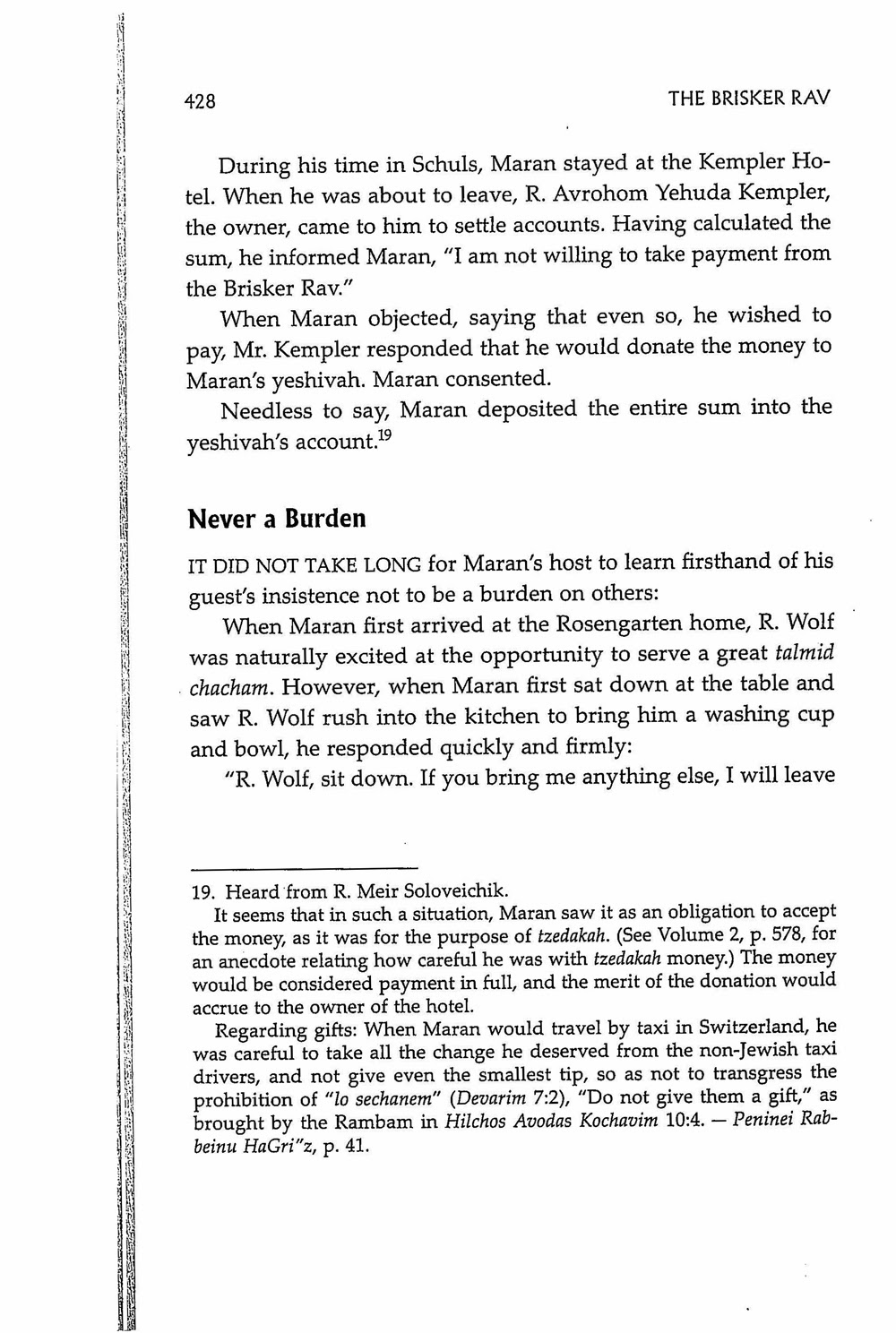
When it comes to The Brisker Rav, I have to confess that I was also certain that another passage would be removed, and it was not. I have in mind vol. 3, p. 428 n. 19 (the last paragraph).[7]
P. 140: Stern cites a comment that appears on every other page in R. Israel Salanter’s journal Tevunah:
All laws concerning monetary transactions have absolutely no practical authority. For we follow the law of the land. And this is the meaning of the great principle of “the law of the land is final.” We study, analyze, and debate monetary topics in the same way in which we study the laws of donations to the temple, tithes, sacrifices and purities, which are not practiced today. They are discussed only in terms of fulfilling our duty to study the Torah.
Upon this, Stern remarks, “While one cannot discount the pressures of governmental censorship that may have contributed to this position, still it marks an important development in rabbinic history. As Elchanan Reiner correctly notes, ‘Diverting attention from the actual ruling to the text itself, namely to the very practice of interpretation, constitutes a dramatic shift in the history of knowledge.’”
I don’t accept this at all. There is no question that the words quoted from Tevunah were directed towards non-Jewish governmental authorities, if not in Germany (where the journal was published), certainly in Russia, where the journal would find its major readership. How is this an important development, and how does it relate to Reiner’s point (made in an entirely different context) when every Jew who read these words understood that that they were not to be taken seriously, any more than the passages on the second page of many rabbinic books stating that all references to non-Jews only refer to pagans in places like China and India?
Let me make just a few more comments about the Gaon. Some people refer to him as Rabbi Elijah Kramer. When I first saw this name a number of years ago, I didn’t know who was being referred to since I had never heard of any Elijah Kramer. The first reference in print to Elijah Kramer (or Kremer) that I have been able to discover is Maurice Samuel’s 1963 book, Little Did I Know, p. 257. (If anyone is aware of an earlier reference, please let me know) The name was later made popular after appearing in the title of Yaacov Dovid Shulman’s 1994 book, The Vilna Gaon: The Story of Rabbi Eliyahu Kramer.[8]
If this post does nothing else, I hope it puts an end to this mistaken practice. The Vilna Gaon was not named Kramer! He was descended from someone named R. Moses Kramer (his great-great grandfather), but the Gaon never used this name and no one ever used it about him, so it is a mistake to call him this.[9] See also note 1 in S.’s post here.
The mistake of referring to the Gaon as Kramer appears in a 2012 book by Rabbis Berel Wein and Warren Goldstein, The Legacy: Teachings for Life from the Great Lithuanian Rabbis, p. 130. The particular chapter I refer to was written by Wein, and on the same page that he mentions Kramer he refers to the Gaon’s foremost student as “Rabbi Chaim Rabinowitz”. As far as I know, this is the first time R. Chaim of Volozhin has been given the last name Rabinowitz, and I have no idea what led Wein to write this. Perhaps there was some confusion between R. Chaim of Volozhin and R. Chaim Rabinowitz of Telz.
This book (which I do recommend) has an approbation by R. Shmuel Kamenetsky in which he writes that “everything in it is true.” I am inclined to think that R. Kamenetsky was only referring to the larger issues discussed in the book rather than attesting to the accuracy of every fact. There is an old saying
כשם שאין בר בלא תבן כך אין ספר ללא טעויות
We can update this saying by adding the word “blog post” after the word “sefer”.
Bezalel Naor has published the following letter he wrote to Elliot Wolfson.
Have you read the new book by Eliyahu Stern, The Genius: Elijah of Vilna and the Making of Modern Judaism (New Haven: Yale University Press, 2013)? In a lengthy endnote on pp. 196-198 (note 19), Stern polemicizes against your reading of the Vilna Gaon’s interpretation of “sefer ve-sefer ve-sippur” (Sefer Yetsirah 1:1). Stern refers to your essay “From Sealed Book to Open Text: Time, Memory, and Narrativity in Kabbalistic Hermeneutics,” Interpreting Judaism in a Postmodern Age, ed. Steven Kepnes (New York: New York University Press, 1996), pp. 145-178, especially footnote 14.
Not wishing to rely on memory alone, I consulted the beginning of the Bi’ur ha-GRA le-Sifra di-Tseni’uta:
Sifra–A book (sefer) is the revelation of the thought, for the thought is closed within man and is revealed only by his speech or by his writing. And so En Sof was revealed, and created the world for [the purpose of] revelation and to make Himself known, as it says in the Zohar, and so the tikkunim that are explained in the continuation [of Sifra di-Tseni’uta] also [come about] through these two things, as it says in Sefer Yetsirah (The Book of Creation), “and [He] created His world with book, book and narrative (sefer ve-sefer ve-sippur). The matter of the two books and [single] narrative is due to the fact that in speech, at one stroke his thought is revealed, whereas in a book it takes two times: once when he writes and his thought is revealed in the world, but the book is yet closed; and a second time when the book is read and then revealed. But in speech, both are included at one time.” (Elijah of Vilna, Bi’ur ha-GRA le-Sifra di-Tseni’uta, ed. Bezalel Naor [Jerusalem, 1997], 1a)Elliot, your understanding of the passage is sound. On the other hand, Stern’s translation of the first term ”sefer” (which he is forced to revocalize “sefar”) as “mathematics,” would appear to be without foundation. As for the revocalization from sefer to sefar, Stern has drawn on Yosef Avivi, whom he cites. (See Yosef Avivi, Kabbalat ha-GRA [Jerusalem: Kerem Eliyahu, 1993], pp. 32-35.) Yet even Avivi did not have the audacity to inject into the Gaon’s commentary the concept of “mathematics.” This mathematicization of Elijah’s worldview awaited Leibniz.
I am not qualified to express an opinion on the merit of Stern’s opinion vs. that of Wolfson when it comes to understanding what the Gaon says. However, when it comes to the Sefer Yetzirah text, we should not assume that Yosef Avivi and Stern are the first ones to revocalize ספר as sefar. This passage in Sefer Yetzirah appears in R. Judah Halevi, Kuzari 4:25, and Hartwig Hirschfeld, in his translation, writes “S’far Sefer, and Sippur.” Also, here is a page from the edition of the Kuzari with the commentary of R. David Cohen, the Nazir (Jerusalem, 2002), p. 227, and you can see this vocalization. (On the previous page, he, like Hirschfeld, vocalizes the word sefar in the text of the Kuzari).
R. Joseph Kafih also vocalizes the word as “sefar” in his edition of the Kuzari.Naor is mistaken when he states that understanding sefar as referring to “mathematics” is without foundation. While it is true that contrary to the implication of Stern, p. 196 n. 19, Avivi does not say anything about mathematics, there are others who do. Returning again to R. Judah Halevi, Kuzari 4:25, here is Hirschfeld’s translation:
As to sefar, it means the calculation and weight of the created bodies. The calculation which is required for the harmonious and advantageous arrangement of a body is based on a numerical figure. Expansion, measure, weight, relation of movements, and musical harmony, all these are based on the number expressed by the word sefar.
See also the page from R. David Cohen above, where he quotes R. Judah Barceloni who states: וספר – זה חשבון והוא המספרHere is another text woth noting. It is from R. Joseph Kimhi’s Sefer ha-Galui (Berlin, 1887) p. 3.
Kimhi tells us that he is going to let us into the secret of this text, which hasn’t yet been explained, and he writes: ספר חשבון ומניין. He then explains that this is one of the wisdoms that only humans are privy to. See also the anonymous commentary on Sefer Yetzirah, published by Israel Weinstock (Jerusalem, 1984), which explains ספר ספר וספור as follows:
לעיין תמיד בספרים, ולספור דרכי המספרים, ולחשוב בם תמיד
There are other sources that can be cited, but I think this suffices to show that Stern’s reading has to be taken seriously.
Let me conclude by mentioning something already well known, that the Gaon’s writings are full of original views. Stern deals with some of them, and there are many others. In TheLimits of Orthodox Theology, p. 14 n. 55, I already note that the Gaon apparently believed that of the Thirteen Principles, only the first and second were real dogmas (in the Maimonidean sense).
Needless to say, each of the views I will now mention could have a detailed post of its own. There are obviously many other unique views of the Gaon, but for now I think these few will be of interest to readers as they are not that well known.
1. The Gaon did not wear R. Tam tefillin. We are told that he didn’t want to be without tefillin for even a small amount of time. Since the halakhah is in accordance with Rashi, the time spent wearing R. Tam tefillin would be regarded as bitul mitzvat tefillin.[10] R. Elijah Rabinowitz-Teomim writes[11]:
מתחרט אני כל פעם בלבי, על שהנהגתי בתפלין של רבנו תם, בראותי דעת רבינו הגר”א זצ”ל בזה, ככתוב בס’ שערי רחמים משמו, אך אי אפשר לי שלא להניח עוד
2. According to the Gaon, non-Jews in the Land of Israel have to observe all the mitzvot. I know this will be hard for people to believe, so here is the text to see with your own eyes. It comes from the first edition of Aderet Eliyahu (Halberstadt, 1859-1860), Deut. 32:9.This is a very unusual position, and I don’t know of any precedent for it.[12] It is so unusual, in fact, that the next printing, Warsaw 1887, simply cut this section out. Here is how the page looks in the Warsaw edition.
Raphael Shuchat notes that in a manuscript version of the Aderet Eliyahu text there is an important addition, which I have underlined:[13]
ואפילו הגוים הדרים בא”י צריכים לקיים כל המצוות, לפי שכל המצוות תלויים בארץ ישראל
But even with this addition the text is still very difficult, and no one has been able to find a source for the notion that Gentiles have to observe all the mitzvot in the Land of Israel, meaning that the idea is probably original to the Gaon. Shuchat offers two suggestions neither of which really fit with the Gaon’s words. One is that the Gaon means to say that since today there is no longer a law of ger toshav, any non-Jew who wishes to live in the Land of Israel has to convert. According to Shuchat, that is what he means when he says that non-Jews in the Land of Israel have to observe all the mitzvot. His other suggestion is that while there is no halakhic obligation for non-Jews to observe the mitzvot, by not doing so they are not respecting the sanctity of the Land.
שנכרי אינו חייב מצד ההלכה במצוות בארץ, אך מצד קדושת א”י הוא פוגם אם לא יקיים את המצוות בארץ
R. Eliezer Waldenberg also takes note of the passage in Aderet Eliyahu, and seeing no way to explain it assumes that the text is a mistake – מפי שמועה לא נכונה.[14]
Yet R. Waldenberg was unaware that in Aderet Eliyahu, Deut. 1:5, the Gaon says the exact same thing, namely, that in the Land of Israel non-Jews are obligated in all the mitzvot.[15]
ולכן נענשו אפי’ נכרים מפני שלא שמרו את התורה בארץ כמ”ש (מ”ב י”ז) לא ידעו את משפט א-להי הארץ, שישראל מצווה על כל התורה בח”ל ובארץ מצווה אפי’ נכרי
This text appears in full even in the second edition of Aderet Eliyahu, which is the edition that censored the comment to Deut. 32:9. R. Elijah Dessler used the censored Aderet Eliyahu so he didn’t know the Gaon’s comment to Deut. 32:9, but he noted the comment to Deut. 1:5 and expressed his great surprise.[16]
וזה דבר פלא לאמר דע”פ דין תורה כל נכרי הדר בא”י יהי’ מחוייב בכל המצוות כל זמן שבחפצו לדור בה, ותו מה יהי’ בדבר שמירת שבת, שהרי הגוי אסור בשמירתה, ומה יהי’ באכילת קרבן פסח, וכדומה.
While I don’t know of any talmudic or midrashic sources to support the Gaon’s position that a non-Jew in the Land of Israel has to observe all mitzvot,. there are some earlier texts that place additional obligations on non-Jews than what we normally assume.
Midrash Tanhuma (ed. Buber), Metzora 13, states that non-Jews are punished with karet if they violate the laws of Niddah.[17]
Ibn Ezra, Ex. 13:7, 20:8, Lev. 17:13-14, 20:25, states that a non-Jew living in the Land of Israel (i.e., a ger toshav) is obligated to observe Shabbat. He is also not to work on Yom Kippur, to refrain from eating hametz on Passover, and to only eat kosher food. This is Ibn Ezra’s understanding of the peshat of the Torah, but the Talmud records no such laws.The most significant of the sources I can cite, and the one closest to the Gaon’s position, is found in Avodah Zarah 64b. Here the Talmud quotes אחרים as saying that a ger toshav has to observe all the mitzvot with the exception of ritually slaughtered meat. The Hazon Ish, Yoreh Deah 65:6 wonders about this position, since does it mean that a non-Jew must wear tefillin and eat in a sukkah? He assumes that the talmudic passage means that non-Jews in the Land of Israel are only obligated in the negative commandments, and this is required so that Jews not be negatively influenced by their non-Jewish neighbors. See also R. Asher Weiss, Minhat Asher, Bereishit, p. 19.
Subsequent to the Gaon, the Hatam Sofer claims, based on a comment of Tosafot,[18] that when the Torah forbids something for Jews, it is praiseworthy for non-Jews to also abstain from this. See Hatam Sofer al ha-Torah, ed. Stern, vol. 1, p. 216:
דמה שהוא מדינא אסור לנו, נכנס עכ”פ בגדר החסידות גבי ב”נ
*******
1. If, after all I have written, people are still not motivated to read Stern’s book, or they simply don’t have the time, you can watch him discuss the topic here.
Quite apart from Stern’s work on the Gaon, Shlomo Pick wrote the following in his just published article, “Al Prof. Shaul Lieberman ve-ha-Makhon ha-Gavoah[19] le-Torah she-Al Yad Universitat Bar-Ilan – Perek me-Hashkafato,” Badad 28 (Kislev, 5744), p. 10 n. 10.
2. On a recent trip to Toronto I had the pleasure meeting the indefatigable Yehuda Azoulay. Anyone who is interested in the history of great Sephardic rabbis should check out his books here.
3. In the previous post I wrote about the title of the newspaper Yated Ne’eman, and how yated is actually a feminine noun. All that I wrote in that section was tongue in cheek, as I think readers realized, but by mistake I didn’t include a footnote that was supposed to go in. In that note I pointed out that despite what the grammarians might say about the word yated, there are plenty of sources, from long before the newspaper came into existence, that use yated as a masculine noun. The following passage, which has both masculine and feminine,[20] appears in Teshuvot ha-Rashba, ed. Dimitrovsky, vol. 2, p. 529:
ובמלאת הימים האלה יהיה היתד הנאמן תקועה בלבם יתד לא תמוט
4. In the last post I referred to R. Mordechai Agasi’s Asurei ha-Melekh, a recent book dealing with the halakhot of being in prison. One of the commenters noted that this is an example of “life imitating art”, and he referred to a parody of Artscroll available here here where you can see the imaginary new English sefer The Laws of Incarceration. (I recommend also clicking on the links at the bottom of phony Artscroll website.)
Yet what we see from Asurei ha-Melekh is that this is anything but a joke. The parody has as one of the questions answered by the fake Artscroll book, “What are the requirements for conducting Bedikas Chometz in one’s cell?” In Asurei ha-Melekh, vol. 1, pp. 161-162, Agasi, discusses this very case. (All references to Asurei Melekh will be to vol. 1 unless otherwise mentioned).
Believe me when I tell you that pretty much all the possible halakhic problems a prisoner can think of are dealt with in the book. He even deals with some very far-fetched cases. For example, on p. 17 he discusses how one is to put on tallit and tefillin if his hands are in chains. His answer is that a non-Jew can put them on the prisoner, and the prisoner can still make the blessing.
I know that many people have made a joke of Asurei ha-Melekh. But this is a very serious book that serves a real purpose. It also comes with a letter of approbation from R. Shalom Lipskar. He heads the Aleph Institute, one of whose purposes is to reach out to Jews in prison. With the great increase in haredi prisoners, it is important for them to be given halakhic guidance, and the way to do this is with a sefer. (The Modern Orthodox will need an English language book.) Just because someone makes a mistake and has to go to prison doesn’t mean that he should make matters worse and give up Torah observance. There are also new halakhic problems that have to be dealt with. For example, Agasi, p. 123, discusses the case of one who is under house arrest but is permitted to go to synagogue. To enforce the house arrest, the man has to wear an electronic monitor. Is one permitted to go to synagogue on the Sabbath with the electronic monitor since as soon as he leaves his house it starts to record his movements and causes various LED lights to go on? Agasi’s answer is that the man must not leave his house on the Sabbath.
The federal government has made matters easier for observant prisoners by turning Otisville Federal Penitentiary into the place where many non-violent haredim (and other Orthodox Jews) are sent if they are convicted of a federal crime. It has a full-time Jewish chaplain and kosher kitchen.[21] The prison commissary list of food[22] helpfully notes those that are kosher (regular hashgachah) and also those that are “super-kosher” under the hashgachah of the CRC (Central Rabbinical Congress, i.e., Satmar).
Returning to Agasi’s book, while it has certain value, as I indicated, it also has great problems. Let me begin, however, by noting something positive. On p. 42 he states in no uncertain terms that one must follow the Law of the Land, and this includes taxes, traffic, and building laws. He states that violation of the Law of the Land is a Torah prohibition.
Yet I must also state that the book is biased against the American justice system, which he thinks is putting away too many haredim. He tells us that Jewish law, unlike secular law, does not sentence people to prison as a punishment (p. 11). Historically this has been true, but that is because the Jewish communities didn’t have real prisons. At most they had small jails to keep people for limited periods of time. (See R. Ephraim ha-Cohen, Sha’ar Ephraim, no. 83, who discusses if the communal jail needs a mezuzah.) If they were dealing with a real criminal who had to be stopped, they turned him over to the non-Jewish authorities or they dealt with him through physical punishments. Jewish courts in Spain would deal very harshly with those they wanted to punish. They even cut off tongues and noses as forms of punishment. Considering the alternative, one would think that Agasi would be happy that we have progressed to prisons, which seem much more humane than how medieval Jews dealt with troublemakers. Yet from Agasi’s standpoint, long prison sentences are what he regards as cruel and unusual punishment.
מאסר למשך זמן רב הינו עונש עינוי אכזרי מתמשך ביותר
He also states that prison is not a deterrent. But his real problem with prison is that the Jewish prisoner, once he is incarcerated, can’t fulfill his appropriate spiritual tasks (p. 12).
המאסר שולל ממנו את החירות הדרושה לו כדי למלא את תפקידו הרוחני בעולם הזה, וכיון שכך, הינו מעכב את טובתו
Agasi contrasts the moral bankruptcy of prison with the Jewish approach, which doesn’t sentence a thief to jail but forces him to become a slave. And when someone kills accidentally, he is not sent to jail but instead has to live in a City of Refuge.[23] Agasi tells those unfortunate enough to be sentenced to prison that they should reflect on the fact that this is not the Torah way (p. 23):
אם חלילה נגזר עלינו לשהות בו תקופה ממושכת, בגין כל סיבה שרק תהיה, יש לנו להתבונן בהבדל המשמעותי שבין תורת ישראל לבין חוקי כל עם ולשון, בבחינת “ראו מה בין בני לבן חמי.”
In order that the prisoner not feel alone in his predicament, Agasi includes a long list of stories so the prisoner can read about how others had also been improperly incarcerated. Among the figures to read about include Joseph, Samson, R. Meir of Rothenburg, R. Yom Tov Lippman Heller, R. Shneur Zalman of Lyady, R. Yehezkel Abramsky, and many others.
At the beginning of vol. 2, pp. 1-2, he notes that many of those sitting in prison are wondering what they are doing there when lots of non-Jews who did worse are free. Agasi’s response is to blame anti-Semitism. The non-Jews have it in for the haredim and that is why they are putting them in jail.
מאז ומקדם היו אומות העולם שונאים לבני יעקב. . . . נהנים ומתענגים לראות את בני ישראל שבורים ברוחם ורצוצים בגופם
His reply to the anti-Semites is that while they can imprison the Jew’s body, they can’t destroy his soul (p. 4):
עם ישראל לכל אורך הדורות תמיד ידע דבר אחד: אפשר לכלוא את גופם בתא מאסר, אפשר להצר את רגליהם מלכת, אפשר לאסור באזיקים את ידיהם, אפשר להשליכם אל צינוק חסר אוויר, אך, אי אפשר לכלוא את רוחם ונשמתם של בני מלכים הדבוקה בחי העולמים, אי אפשר להגיע אל נקודתם הפנימית המקושרת תמיד בבורא כל עולמים.
On p. 43 he states that according to Jewish law you can’t punish someone without two witnesses, even if you have clear proofs: הוכחות אפילו ברורות ביותר
Since the U.S. government is not obligated to operate according to Jewish law, I don’t know why this is relevant (unless he assumes that lacking witnesses the government only has the right to charge non-Jews). I have said it before, and let me now say it again. The Torah obligation for two witnesses was never how Jewish society operated. As has been pointed out by many, it is impossible to run a society that would require two male witnesses – not to mention the requirement of warning a perpetrator – in order to punish criminals, as such a system would not be able to convict anyone and thus would not have any power of deterrence. (Why the Torah has rules and procedures for criminals that can’t be implemented in the pre-Messianic world is a topic for a future post.) Jewish courts always did what they thought was necessary in order to secure order, and halakhah gives them this authority. To say otherwise is itself a hillul ha-shem because it means that when it comes to dealing with crime Jewish law is unworkable, while the truth is that Jewish law can deal with every possible situation.
Here is what the Rashba says on this issue (Teshuvot vol. 3, no. 393), and his words have been quoted again and again. Note expecially his strong language that insisting on Torah requirements will “destroy the world”.
ורואה אני שאם העדים נאמנים אצל הברורים רשאים הן לקנוס קנס ממון או עונש גוף, הכל כפי מה שיראה להם, וזה מקיום העולם, שאם אתם מעמידין הכל על הדינין הקצובים בתורה ושלא לענוש אלא כמו שענשה התורה בחבלות וכיוצא בזה נמצא העולם חרב, שהיינו צריכים עדים והתראה, וכמו שאמרו ז”ל לא חרבה ירושלים אלא שהעמידו דיניהם על דין תורה, וכ”ש בחוצה לארץ שאין דנין בה דיני קנסות ונמצאו קלי דעת פורצין גדרו של עולם ונמצא העולם שמם
See also R. Hayyim Ozer Grodzinski, Iggerot R. Hayyim Ozer, vol. 2 nos. 833, 837.On p. 58, Agasi writes:
הנוגע בנכרי ובכל חפץ של עבודה זרה או הנוגע בישראל מומר יש להחמיר ליטול ידיו
Something tells me that this is not exactly the type of “humra” to be adopted when one goes to prison. Heaven help the Jewish prisoner if the non-Jew or non-observant Jew figures out what’s going on. To put it another way, I wouldn’t want to be in the prison yard when the good ol’ boys hear that Yankel has a problem shaking their hands.
I also wonder how smart it is for Agasi to tell the haredi prisoner the following:
אוכל נבילות להכעיס הרי הוא אפיקורס, והאפיקורס או ישראל המחלל שבת בפרהסיא אסור להחזיר להם אבידה, כעובד כוכבים.
Agasi does add that there are times when the lost object should be returned, but still, why even create the possibility that someone might want to be mahmir? Again, I wouldn’t want to be there when the non-Jew or non-observant Jew figures out who has taken their lost property.
I also don’t know how practical the following halakhah is, since prisoners don’t get to choose who their cellmate is (p. 58).
לא יתייחד ישראל עם נכרי, מפני שחשודים על שפיכות דמים
Finally, on p. 184 he gives us the following halakhah:
אסיר שברח מבית הסוהר, מברך ברכת הגומל, שאף אם ייתפס וייאסר פעם נוספת אין זה המשך המאסר הקודם אלא מאסר חדש, ואין לומר דכיון שיש חשש שמא ייתפס עדיין לא מקרי שישתחרר לגמרי.
When I told a friend this halakhah, he assumed that I was pulling his leg, just like the story of the man who had to be unburied since his tachrichin were made of sha’atnez, which was around the same time as the sha’atnez in the baseball gloves.
[1] Among the stories I record in this post is that when one of R. Velvel Soloveitchik’s sons died shortly after birth, and the family was crying, R. Velvel insisted that they stop their tears, since there is no avelut before thirty days. This sort of response can also be found in medieval times. In thirteenth-century England, R. Moses the Pious’s son hanged himself before Shavuot. R. Moses “did not leave his room nor did he shed a tear, but studied in his library as if no evil had befallen him, asserting that his son had caused his own death.” See Elliot Horowitz, Reckless Rites (Princeton, 2006), p. 154.
[2] See Divrei Eliyahu (Israel, n.d.), parashat Va-Yera. The two passages I quote also appear in Kol Eliyahu (Petrokov, 1905)
[4] For one creative solution, see R. David Halevi (the Taz), Divrei David to Gen. 18:1, that Abraham was never actually commanded to circumcise himself!
אין מצוה זו לאברהם דרך צווי כשאר מצות, אלא נתן לאברהם הברירה אם חפץ הוא שיתקיים העולם ימול, ואם לאו שאינו חפץ לימול לא יתקיים העולם, וא”כ אין הכרח שימול עצמו, לזה ביקש עצה מג’ אוהביו מה יבחר לו
R. Judah Kahana (died 1819), Terumat ha-Kari (Jerusalem, 1997), Introduction, claims that Abraham never had any doubt that he would follow God’s command. However, he wanted his companions to attempt to convince him not to circumcise himself, as his fulfillment of the commandment in the face of such arguments would therefore be a higher level of service of God, as the Sages tell us: לפום צערא אגרא. This is a strange position, since when is one supposed to purposely test oneself in such a way? Just as strange is R. Yisrael Yaakov Fisher, Even Yisrael al ha-Torah (Jerusalem, 2007), pp. 19-20. He argues in a similar fashion as R. Kahana and claims that just as Maimonides in Shemonah Perakim, ch. 6, tells us that the highest level is one who desires to commit (certain) sins but overcomes his inclination, so too one should feel a desire not to observe positive commandments and nevertheless overcome this desire. Since Abraham had no evil inclination, and was obviously going to observe God’s command, he wished to create the equivalent of an evil inclination by having his colleagues argue against circumcision.
מעתה מבואר היטב הא דנטל אברהם אבינו עצה על המילה, דהרי אמרו חז”ל בב”ב (יז ע”א) שלשה לא שלט בהן יצה”ר אברהם יצחק ויעקב, וא”כ כשנצטוה על המילה לא היה לו יצה”ר להסיתו שלא יעשה ויהיה כוסף שלא לעשות, ואח”כ יעשה, כי הוא המעולה והמשובח כמש”כ הרמב”ם, ולכן הלך אצל ג’ אוהביו כדי שהם יסיתוהו שלא יעשה ואח”כ יעשה כי הוא המשובח והמעולה.
Try to imagine going through life thinking that the positive commandments you do (wearing tzitzit, eating matzah, taking a lulav, etc.) you really don’t want to do but only do so because you are commanded. This is not exactly a recipe for making Judaism appealing, however much it might please Yeshayahu Leibowitz.
[5] One day during the forced evacuation of Amona, R. Avraham Shapiro was unable to deliver his shiur. He told the story of R. Shneur Zalman and his son and concluded, “I too cannot teach at a time when children in Israel are crying from the cruel blows delivered by their brothers.” Yitzhak Dadon, Rosh Devarkha, p. 160. See also Daniel Sperber, On the Relationship of Mitzvot Between Man and His Neighbor and Man and His Maker (Jerusalem, 2014), pp. 57-58.
[6] The story appears in R. Ephraim Zaitchik, Ha-Meorot ha-Gedolim (Jerusalem, 1969), p. 38 (no. 108).
[7] This last paragraph brings up an issue that I have discussed quite a bit on this blog. Recently, the news was awash with the great kiddush ha-shem performed by Rabbi Noah Muroff when he returned a bag containing nearly $100,000 to its rightful owner. I then listened to his talk at the Agudah convention here.
I am curious if anyone else had my reaction. While his return of the money was definitely a kiddush ha-shem, I think that his speech has the potential to be a hillul ha-shem, nullifying the kiddush ha-shem. First of all, he lets the world know that there are those who told him that it was forbidden (!) to return this money. He then tells the audience that his justification of returning the money was in order to make a kiddush ha-shem. This approach, which received applause at the convention (but not from those on the dais!), is not what he explained in a prior interview with the Los Angeles Times that his reason was “to do what is right, and thinking about the feelings of others. It’s looking out for one’s fellow man, and not just for one’s self.” (I assume this is how he really feels, not how he expressed himself at the convention.)
Let’s leave aside the point that as best as I can determine, according to secular law one is indeed obligated to return lost property of this sort. I understand that for those who don’t accept the Meiri, the halakhah Muroff is discussing can be quite a challenge in modern times. But I wonder what is going through the heads of the Agudah leadership. Do they really want the entire world to know that their approach in this matter has nothing to do with helping one’s fellow man, but is about doing what will make Jews look good in people’s eyes? Isn’t this the sort of thing that would be best not spoken about in public?
[8] R. Nathan Kamenetsky, Making of a Godol, vol. 2, p. 1261, refers to R. Eliyahu “Kremmer”.
[9] A great nephew of the Gaon was named Elijah Kramer. See R. Avraham Benedikt, “Ha-Gaon Rabbi Yaakov Zvi Neiman,” Moriah 10 (Heshvan 5742), p. 82.
[10] See R. Asher ha-Kohen, Keter Rosh (Jerusalem, 2012), no. 13. See the discussion of the Gaon’s opinion in R. Hayyim Eleazar Shapira, Divrei Torah, vol. 7, p. 865, and in Ot Hayyim ve-Shalom 34:2.
[11] Nefesh David, p. 123, published with Seder Eliyahu (Jerusalem, 1983).
[12] For Karaites who held this position, see David Sklare, “Are the Gentiles Obligated to Observe the Torah,” in Jay M. Harris, ed., Be’erot Yitzhak (Cambridge, MA, 2005), pp. 311-346.
[13] “Eretz Yisrael be-Mishnat ha-Gra,” Ha-Ma’ayan (Tamuz 5758), p. 16.
[14] Tzitz Eliezer, vol. 16, no. 60. (In Hilkhot Medinah, vol. 3, p. 6, R. Waldenberg quotes this text of the Gaon and doesn’t raise any questions about its authenticity.)
This is the exact sort of approach that R. Waldenberg criticized R. Moshe Feinstein for adopting when confronted with a difficult Tosafot. R. Moshe argued that the text should be emended. R. Waldenberg responded forcefully (Tzitz Eliezer, vol. 14, no. 100):
והנה עם כל הכבוד, לא אדוני, לא זו הדרך, וחיים אנו עפ”ד גאוני הדורות, והמה טרחו כל אחד ואחד לפי דרכו לבאר ולהעמיד כוונת דברי התוס’ בנדה וליישבם, ואף אחד מהם לא עלה על דעתו הדרך הקלה והפשוטה ביותר לומר שיש ט”ס בדברי התוס’ ובמקום מותר צריך להיות אסור.
I have earlier commented on how on a number of occasions R. Moshe discarded sources that did not fit in with his understanding. See The Limits of Orthodox Theology, p. 101 n. 73. See also R. Yehoshua Mondshine’s discussion in Beit Aharon ve-Yisrael 21 (Tishrei-Heshvan 5766), pp. 150-151. Mondshine discusses a text of R. Jacob Emden that R. Moshe declared inauthentic, yet we have the text in question in Emden’s own handwriting.
New information on R. Moshe’s outlook can be found in the recently published Mesorat Moshe (Jerusalem, 2013). Not only was R. Moshe’s approach in this area not scientific, but it is quite untraditional, even radical. See ibid., pp. 506, 507, 508, 520, 522, 525, 590, where R. Moshe rejects the authenticity of comments of Rashbam, “Rashi” on Chronicles, Ramban, and Sforno. Regarding the Ramban, he thought that real heresy had maliciously been inserted into the commentary, a view that as far as I know has never before been suggested. In other cases where he rejected the authenticity of comments of Rashbam and Or ha-Hayyim, he only retracted his view when he saw that there was midrashic support for these comments.
After seeing all this, I think it is impossible to take seriously R. Betzalel Deblitsky’s assumption that when R. Moshe referred to a text as inauthentic, it is likely that he didn’t mean this literally but was merely adopting a respectful way of disagreeing with an earlier authority. See Deblitsky, Beit Aharon ve-Yisrael 21 (Kislev-Tevet 5766), p. 170:
והכל יודעים שברוב המקומות אין לשון זו אמורה אלא כלפי דברים הדחוים מחמת עצמם אם מסברא ואם ממשנה. ולשון כבוד הוא, כאומר שאין לתלות האשמה במחבר עצמו ובודאי תלמיד טועה כתבו. הנסיון לאמת קביעה זו של “תלמוד טועה כתבו” בבדיקה בכת”י, משול כמעט למי שילקט לשונות “כי ניים ושכיב אמרה”, ויברר ע”פ מקורות נאמנים כי אותו חכם אשר עליו נאמר לשון זה, אמר לההיא שמעתתא בשעת צילותא ולא כמתנמנם.
See also the discussion here.Finally, R. Hillel Goldberg called my attention to the Gaon’s commentary to Yoreh Deah 201:1 where he writes: וכתבו בספרי הטבע. This is further evidence that the Gaon read scientific works. Goldberg also called my attention to the Hazon Ish, Mikvaot 7:4 (first series) who refers to the Gaon’s commentary ad loc., and writes: ונראה שאין זה ממשנת הגר”א ז”ל. Yet this is incorrect as the Gaon’s commentary was printed from his manuscript without any changes being inserted. Goldberg discusses the Hazon Ish’s comment in his Hallel ha-Gadol (Denver, 2008), p. 20. See also Betzalel Landau, Ha-Gaon he-Hasid mi-Vilna (Jerusalem, 1978), p. 220, who cites a hasidic author, R. Abraham Joshua Freund, who stated that this passage was not written by the Gaon, “but some mistaken student wrote it in his name.”
[15] For earlier statements regarding Aderet Eliyahu, and the assumption that certain passages were actually authored by his son R. Avraham and others, see Dovid Kamenetsky, “Kitvei ha-Gra bi-Defus u-vi-Khetav Yad,” Yeshurun 24 (2011), pp. 940-951. R. Avraham denied the accusation that his words are included in the commentary. See Yeshurun 4 (1998), pp. 2-3. Regarding the general issue of citations of the Gaon in later works, including their reliability, see Yaakov Shmuel Spiegel, “Kuntres Amar Eliyahu,” Yeshurun 6 (1999), pp. 734-762, ibid., 7 (2000), pp. 707-734. (Here is good place to note that many writers use Spiegel’s research without acknowledgment.)
[16] Sefer ha-Zikaron le-Ba’al Mikhtav me-Eliyahu (Bnei Brak, 2004), vol. 1, p. 45. R. Dessler mentions which edition of Aderet Eliyahu he used.
[17] See R. Yaakov Hayyim Sofer, Kerem Yaakov (Jerusalem, 1989), pp. 92-93.
[18] Ta’anit 11a s.v.אסור
[19] According to some, including the Gaon, this is how the word גבוה is pronounced. See the Gaon’s Dikdukei Eliyahu (Lodz, 1939), p. 22. Others think it should be pronounced “gavowah”. See R. Ben Zion Cohen, Sefat Emet (Jerusalem, 1987), p. 59. It is a mistake to pronounce it “govoha” (as in the official name of the Lakewood yeshiva, Beth Medrash Govoha).
[20] It is corrected to all masculine in one of the manuscripts. See Dimitrovsky’s note, ad loc.
[23] R. Yissocher Frand has a similar approach to that of Agassi. See his essay here where he writes:
Torah justice differs significantly from today’s legal systems. Modern justice attempts to go beyond the actual crime, into the mind of the criminal, to determine why he committed the crime. Was he abused as a youngster? Perhaps the discrimination suffered by people of his race caused him to commit the crime? Was he fully coherent when he committed the crime? Maybe he was insane at the time… Hundreds of criminals are freed each year because the jury or judge trying their case felt that they were able to evaluate the motives of the criminal, and based on their evaluation, the criminal should not be punished for his crime.
Truthfully, however, we mortals have no way of determining most people’s motives. In the Torah justice system, the dayanim (judges) are required to rule cases based on cool, calculated examination of the evidence, with absolutely no leniency for what they might consider to be extenuating circumstances.
This is a complete distortion of how Jewish courts operated. There was a reason why it was so rare that the courts executed someone. It was precisely because they did not rule cases “based on cool, calculated examination of the evidence.” Based on what I have quoted, it appears that Frand believes that Jewish courts are supposed to execute someone even if he was not fully coherent. Some people assume that the reason the Sages set up so many roadblocks in the way of executing someone was because they wanted to prevent possible execution of an innocent man. Yet Gerald Blidstein suggests that it might be because they didn’t want to execute a guilty man. See his “Capital Punishment – The Classic Jewish Discussion,” in Menachem Kellner, ed., Contemporary Jewish Ethics (New York, 1978), p. 316.