There is No Bracha on an Eclipse

There is No Bracha on an Eclipse
By Rabbi Michael J. Broyde
Rabbi Michael Broyde is a law
professor at Emory University School of Law and the Projects Director in its
Center for the Study of Law and Religion.  His most recent Torah sefer is
entitled “A Concise Code of Jewish Law For Converts”.  This letter was written to someone after a
shiur on why there is no bracha on seeing a solar eclipse.
1.      You are correct that I said that I thought there was no bracha on an eclipse.  I had not seen Rabbi Linzer’s teshuva at the time that told that to you this, as it was not circulating on the internet at the time that I prepared for my shiur and I did not see it until Sunday, the day after the shiur.  I try to cite as much as relevant in these classes and his thoughts are clearly relevant.  He is a stellar writer on interesting topics of halacha and I read his material consistently.  I had seen that Rabbi Eliezer Melamed in Peneni Halacha Laws of Brachot 15:6 and note 5 which does permit a bracha on an eclipse.
2.      Having said that, I would not change my mind at all in light of Rabbi Linzer’s teshuva and remain opposed to reciting a bracha over an eclipse for many reasons explained below.
3.      First, as many have noted, the giants of halacha are quite divided over the question of whether the listing in the Shulchan Aruch is paradigmatic or particular.  Some make no blessings other that for matters listed in the codes and other treat them as examples.  That dispute alone inspires me to be cautious, although I could be persuaded that the paradigmatic approach is correct and one could then make a bracha on a waterfall.  I have yet to see a clear proof that such a view is correct, but it does seem more intuitive.[1]  Yet, safek brachot lehakel is present.
4.      Second, and more importantly, if you look closely in the classical achronim, you see not a single achron who actually endorses saying a bracha on an eclipse.  Not a single one.  It is true that there is a dispute about whether the list in the Mishna is all inclusive or not (as many note, see Shar HaAyin 7:6), but even those who are of the view that the Mishnah’s list is merely examples, not a single achron actually endorses making a bracha on an eclipse as opposed to a volcano or some other natural wonder, which some clearly do permit a bracha on.  The group that favors expansive brachot on natural wonders endorse stalagmite caves, waterfalls, water geysers, volcanoes and many more: but not eclipses.  If you look, for example in Shar HaAyin 7:6 (the classical work on this topic) one sees this most clearly: even those who endorse making brachot on waterfalls, or other amazing facets of creation are uncertain נסתפק)) if one make a bracha on an eclipse, and we all know that when a posek is נסתפק, that posek does not make a bracha.[2]
a.       This contrast is made clear in the context of Rabbi Shmuel Halevi Wosner — who is the most clear and direct articulator of the view that list of wondrous sightings in the Shulchan Aruch are just examples, and one makes the bracha of oseh maaseh bereshit even on other wonders.  In Shar HaAyin page 431 he states directly that one makes a blessing on many wondrous things unlisted in the codes and he explains that “Volcanos are not present in our lands and thus are unmentioned in the Shulchan Aruch” and that it is “obvious” that one makes a blessing on them.  However, on eclipses he states “solar eclipses are mentioned a few times in the Gemera, and thus on the question of whether one needs to make a bracha when one sees them, needs more thought.[3]”  He does NOT endorse making a bracha on an eclipse. In fact, I am unaware of anyone other than Rabbis Melamed and Linzer who actually endorse the view in favor of making a bracha on an eclipse, (rather than merely ponders the possibility of such a bracha).  Rabbi Wozner’s point is important: this is not a modern issue – eclipses were well known for a few millennium, and silence in the Jewish Law codes is telling.  To the best of my knowledge the dispute about the eclipses is between two views: (1) Absolutely Not and (2) Maybe.  There is no (3) Yes view in the classical rabbinic literature for eclipses.  (That is why the listing of reasons why an eclipse might be different from other wonders below is important.)

5.      Why is an eclipse different from a stalagmite cave or a volcano?  I could think of a few reasons from a halachic perspective, even to those who believe that the Mishna’s list is not inclusive.

a.       Many perceive them to be a siman raah – a bad sign, either because of superstitious reasons or because darkness in the middle of the day is practically bad – and there is no blessing on bad omens (as Rabbi Moshe Feinstein is quoted in Mesorat Moshe 2:51).
b.      Because one sees nothing in an eclipse (as it is an absence of light, rather than a presence) and we do not make brachot on absences.
c.       Because the bracha of oseh maaseh breseshit does not apply to things whose existence can be mathematically predicted, but are merely rare: eclipses are not anomalies, but a product of the universes’ cycle of life, and more under the berkat hachama rule.
d.      Because full eclipses are exceedingly rare and partial eclipses are almost impossible to “see” without modern eclipse glasses (a 75% eclipse hardly is noticed on a functional level) and are naturally invisible.
e.       For other reasons that are less obvious related to the fact that these have to be wonders from “creation” and these are not from creation.
f.       Because some thought that eclipses were punishments and thus no blessing was ordained.[4]
6.      Based on all this, one can say that eclipses could be different from all other created natural anomalies as a matter of Jewish law and are not covered by the general idea of a wonder such that a blessing should be made. To my surprise, even as the primary source of the view that one can make a bracha on wonders beyond the Mishna’s list is Rabbi Wozner and he explicitly notes that eclipses are different from volcanoes, waterfalls, geysers and many other rare natural phenomena, the secondary codifiers of the last generation have completely missed this distinction.  Instead both Shar HaAyin 7:6 and Penenia Halacha Laws of Bracha 15:5 link the dispute about volcanoes and waterfalls with eclipses and state that one who permits a bracha for volcanoes and waterfalls would do so for eclipses as well, when in fact that is incorrect.  Eclipses were known in Talmudic times and yet no bracha was noted: that bothers Rabbi Shmuel Wozner, who permit a bracha on an erupting volcano, not to permit a bracha to be recited on an eclipse, by noting that he is uncertain if a bracha is proper.[5]
7.      Additionally, let me add a thought of my own about modern times and bracha’s over wonders.  The Shulchan Aruch OC 228:3 limits even the mountains that one can make a bracha on to such mountains in which the hand of our Creator is clear and apparent. (ולא על כל הרים וגבעות מברך, אלא דווקא על הרים וגבעות המשונים וניכרת גבורת הבורא בהם.)  I think in our modern times, with modern science explaining all of these events, no mountains or valleys ever meet the criterial of make it clear (to normal people) that God is in charge of the universe.  Based on this, I would not make any extensions of this halacha beyond its minimums recorded in the Shuchan Aruch because I think that the test for determining whether we can add to this list is and make a bracha is וניכרת גבורת הבורא בהם.  Given the secular environment we live in, I think no natural astrological events meets that bill in modern times so I only – at most — make such brachot on the things that the halachic tradition directly directs me to do, like lighting or thunder or great mountains and certain rivers. I would not make such a bracha on an erupting volcano or a solar eclipse, as seeing such does not cause normal people in my society to experience God.  (There are two formulations of my claim, each slightly different.  The first is experiential, in that I think that most people in my society do not sense any awe of God at an eclipse.  Second, even if any particular person does (and I do not doubt that some do), they cannot make the bracha since most people in America do not so sense God through these events and that is the halachic test found in the Shulchan Aruch.  The sense of wonder has to be obvious to normal people and that is lacking in the world we live in.
8.      Finally, all attempts to actually endorse making a bracha on an eclipse run directly against the combined force of both (1) the minhag, which is not to make a bracha and (2) the rule of ספק ברכות להקל. These two together make it difficult for any moreh horah to argue convincingly that there is clear proof that bracha should be made.
9.      I have consciously not engaged with Rabbi Linzer’s very worthwhile point (which I more or less agree with) that “we strive to bring our religious lives and our halakhic lives in sync” exactly because (as he himself notes) this calculus is limited to cases where there is a dispute between poskim about what to do.  Here, to the best of my knowledge, there is no dispute and since there is no classical halachic authority who actually says “yes make a bracha on an eclipse” there is no grounds to examining very important meta issues used to resolve disputes (since there is no dispute).
10.  Based on all of this, I would not make a bracha on an eclipse.
11.  Having said that, I am happy to endorse other forms of religions veneration for one who feels such wonder.
a.       One can certainly say this bracha without שם ומלכות.
b.      I am also somewhat comfortable with someone making this blessing in Aramaic (see Shulchan Aruch OC 167:10, 187:1 and 219:4) although I am aware of the view of Iggrot Moshe OC 4:20:27, but find the view of the Aruch Hashulchan OC 202:3 more analytically compelling.
c.       Both the suggestions of Rabbi Chaim David Ha-Levi (Responsa Aseh Lecha Rav, 150) that one recited va-yevarech david (Chronicles. 1:29:10) and adding “who performs acts of creation” at the end and of Rabbi David Lau, current Ashkenazic Chief Rabbi of Israel, to recite Tehillim 19 and 104 are completely reasonable as well.
d.      Other innovative non-bracha based solutions are also reasonable.
12.  On the other hand, those who attended an eclipse – I myself traveled to Rabun Georgia, an epicenter for the total eclipse and sat in total darkness at for three minutes in the middle of the day and did not feel any closer to the Almighty as Creator of the World during the eclipse than I did after or before — can feel free to engage in no innovative religious observance at all without feelings that they are deficient in any way.
13.  I welcome readers to direct me to a source written by an achron which directly discusses eclipses and permits a bracha.  (Please feel free to email me.) So far, I have only seen that the group that permits a bracha for an eclipse does so based on a putative ruling of Rabbi Wozner and others to permit such a bracha, which upon closer examination is not present.  I am willing to ponder the possibility that there is an achron who permits such a bracha even as others do not – that posek argues that all wonders deserve a bracha and the listing in paragraph 5 above about why eclipses are different from other wonders is incorrect – To the best of my knowledge, that is a theoretical position that is not actually adopted.

[1] I am inclined to the more expansive view because the formulation in the Beit Yosef in Tur OC 228.
[2] This is an important point.  Rabbi Wozner has the right as a morah horah to assert that he rules that the mishna’s list is not inclusive and that volcanoes get a bracha (which is exactly what he says, as does Rabbi Nissan Karletz in the same work on page 466).  When one asks him “how can he rule that a bracha needs to be recited, others disagree, and then the matter is in doubt”, Rabbi Wozner responds by stating that he sees no doubt and thus he feels a bracha should be recited.  When Rabbi Wozner states that he has doubt about this matter, he is being clear that this is exactly a case of doubt and no blessing should be recited.
[3] Let me add that eclipses are discussed in the rishonim and codifiers as well, with no mention of a bracha.  See Darchai Moshe on Tur OC 426 and the works cited by Rabbi Linzer in footnote 2 of his teshuva (see here).
[4] It is clear from the recounting of the Chafetz Chaim that he did not say a bracha on an eclipse.  See here.
[5] This is found both Shar HaAyin and Penine Halacha as well as Rabbi Linzer’ teshuva.  Shaar Haayin 7:6 is strict on the whole matter and does not permit a bracha practically on even volcanoes an water falls, so the mistake in that work – linking volcanoes and eclipses — is merely one of conceptual classification, but Peninia Halacha rules that המברך לא הפסיד (“one who makes the blessing is doing nothing wrong” for “volcanic eruptions, geyser, waterfalls and both lunar and solar eclipses” when it is clear to this writer that the source he is sighting – he cites Rabbi Wozner! – does not adopt that view.  (On page 466 of Shar HaAyin, Rabbi Nissan Karlitz is asked “Is the blessing oseh maaseh bereshit similar in that things that are wonders and not found in the Shulchan Aruch like an erupting volcano or a spouting geyser or other similar phenomena, also requiring a bracha” and Rabbi Karlitz answer “Logic indicates that such is the case also,” but no explicit discussion of eclipses, which could be different.


There is No Bracha on an Eclipse

There is No Bracha on an Eclipse
By Rabbi Michael J. Broyde

Rabbi Michael Broyde is a law professor at Emory University School of Law and the Projects Director in its Center for the Study of Law and Religion.  His most recent Torah sefer is entitled “A Concise Code of Jewish Law For Converts”.  This letter was written to someone after a shiur in 2017 on why there is no bracha on seeing a solar eclipse.

1.     You are correct that I said that I thought there was no bracha on an eclipse.  I had not seen Rabbi Linzer’s teshuva at the time that told that to you this, as it was not circulating on the internet at the time that I prepared for my shiur and I did not see it until Sunday, the day after the shiur.  I try to cite as much as relevant in these classes and his thoughts are clearly relevant.  He is a stellar writer on interesting topics of halacha and I read his material consistently.  I had seen that Rabbi Eliezer Melamed in Peninei Halacha Laws of Brachot 15:6 and note 5 which does permit a bracha on an eclipse.
2. Having said that, I would not change my mind at all in light of Rabbi Linzer’s teshuva and remain opposed to reciting a bracha over an eclipse for many reasons explained below.
3.  First, as many have noted, the giants of halacha are quite divided over the question of whether the listing in the Shulchan Aruch is paradigmatic or particular.  Some make no blessings other that for matters listed in the codes and other treat them as examples.  That dispute alone inspires me to be cautious, although I could be persuaded that the paradigmatic approach is correct and one could then make a bracha on a waterfall.  I have yet to see a clear proof that such a view is correct, but it does seem more intuitive.[1]  Yet, safek brachot lehakel is present.
4.  Second, and more importantly, if you look closely in the classical achronim, you see not a single achron who actually endorses saying a bracha on an eclipse.  Not a single one.  It is true that there is a dispute about whether the list in the Mishna is all inclusive or not (as many note, see Shar HaAyin 7:6), but even those who are of the view that the Mishnah’s list is merely examples, not a single achron actually endorses making a bracha on an eclipse as opposed to a volcano or some other natural wonder, which some clearly do permit a bracha on.  The group that favors expansive brachot on natural wonders endorse stalagmite caves, waterfalls, water geysers, volcanoes and many more: but not eclipses.  If you look, for example in Shar HaAyin 7:6 (the classical work on this topic) one sees this most clearly: even those who endorse making brachot on waterfalls, or other amazing facets of creation are uncertain נסתפק)) if one make a bracha on an eclipse, and we all know that when a posek is נסתפק, that posek does not make a bracha.[2]
a.      This contrast is made clear in the context of Rabbi Shmuel Halevi Wosner — who is the most clear and direct articulator of the view that list of wondrous sightings in the Shulchan Aruch are just examples, and one makes the bracha of oseh maaseh bereshit even on other wonders.  In Shar HaAyin page 431 he states directly that one makes a blessing on many wondrous things unlisted in the codes and he explains that “Volcanos are not present in our lands and thus are unmentioned in the Shulchan Aruch” and that it is “obvious” that one makes a blessing on them.  However, on eclipses he states “solar eclipses are mentioned a few times in the Gemera, and thus on the question of whether one needs to make a bracha when one sees them, needs more thought.[3]”  He does NOT endorse making a bracha on an eclipse. In fact, I am unaware of anyone other than Rabbis Melamed and Linzer who actually endorse the view in favor of making a bracha on an eclipse, (rather than merely ponders the possibility of such a bracha).  Rabbi Wozner’s point is important: this is not a modern issue – eclipses were well known for a few millennium, and silence in the Jewish Law codes is telling.  To the best of my knowledge the dispute about the eclipses is between two views: (1) Absolutely Not and (2) Maybe.  There is no (3) Yes view in the classical rabbinic literature for eclipses.  (That is why the listing of reasons why an eclipse might be different from other wonders below is important.)

5.     Why is an eclipse different from a stalagmite cave or a volcano?  I could think of a few reasons from a halachic perspective, even to those who believe that the Mishna’s list is not inclusive.
a.   Many perceive them to be a siman raah – a bad sign, either because of superstitious reasons or because darkness in the middle of the day is practically bad – and there is no blessing on bad omens (as Rabbi Moshe Feinstein is quoted in Mesorat Moshe 2:51).
b.     Because one sees nothing in an eclipse (as it is an absence of light, rather than a presence) and we do not make brachot on absences.
c.      Because the bracha of oseh maaseh breseshit does not apply to things whose existence can be mathematically predicted, but are merely rare: eclipses are not anomalies, but a product of the universes’ cycle of life, and more under the berkat hachama rule.
d.     Because full eclipses are exceedingly rare and partial eclipses are almost impossible to “see” without modern eclipse glasses (a 75% eclipse hardly is noticed on a functional level) and are naturally invisible.
e.      For other reasons that are less obvious related to the fact that these have to be wonders from “creation” and these are not from creation.
f.     Because some thought that eclipses were punishments and thus no blessing was ordained.[4]
6.     Based on all this, one can say that eclipses could be different from all other created natural anomalies as a matter of Jewish law and are not covered by the general idea of a wonder such that a blessing should be made. To my surprise, even as the primary source of the view that one can make a bracha on wonders beyond the Mishna’s list is Rabbi Wozner and he explicitly notes that eclipses are different from volcanoes, waterfalls, geysers and many other rare natural phenomena, the secondary codifiers of the last generation have completely missed this distinction.  Instead both Shar HaAyin 7:6 and Penenia Halacha Laws of Bracha 15:5 link the dispute about volcanoes and waterfalls with eclipses and state that one who permits a bracha for volcanoes and waterfalls would do so for eclipses as well, when in fact that is incorrect.  Eclipses were known in Talmudic times and yet no bracha was noted: that bothers Rabbi Shmuel Wozner, who permit a bracha on an erupting volcano, not to permit a bracha to be recited on an eclipse, by noting that he is uncertain if a bracha is proper.[5]
7.     Additionally, let me add a thought of my own about modern times and bracha’s over wonders.  The Shulchan Aruch OC 228:3 limits even the mountains that one can make a bracha on to such mountains in which the hand of our Creator is clear and apparent. (ולא על כל הרים וגבעות מברך, אלא דווקא על הרים וגבעות המשונים וניכרת גבורת הבורא בהם.)  I think in our modern times, with modern science explaining all of these events, no mountains or valleys ever meet the criterial of make it clear (to normal people) that God is in charge of the universe.  Based on this, I would not make any extensions of this halacha beyond its minimums recorded in the Shuchan Aruch because I think that the test for determining whether we can add to this list is and make a bracha is וניכרת גבורת הבורא בהם.  Given the secular environment we live in, I think no natural astrological events meets that bill in modern times so I only – at most — make such brachot on the things that the halachic tradition directly directs me to do, like lighting or thunder or great mountains and certain rivers. I would not make such a bracha on an erupting volcano or a solar eclipse, as seeing such does not cause normal people in my society to experience God.  (There are two formulations of my claim, each slightly different.  The first is experiential, in that I think that most people in my society do not sense any awe of God at an eclipse.  Second, even if any particular person does (and I do not doubt that some do), they cannot make the bracha since most people in America do not so sense God through these events and that is the halachic test found in the Shulchan Aruch.  The sense of wonder has to be obvious to normal people and that is lacking in the world we live in.
8.     Finally, all attempts to actually endorse making a bracha on an eclipse run directly against the combined force of both (1) the minhag, which is not to make a bracha and (2) the rule of ספק ברכות להקל. These two together make it difficult for any moreh horah to argue convincingly that there is clear proof that bracha should be made.
9.     I have consciously not engaged with Rabbi Linzer’s very worthwhile point (which I more or less agree with) that “we strive to bring our religious lives and our halakhic lives in sync” exactly because (as he himself notes) this calculus is limited to cases where there is a dispute between poskim about what to do.  Here, to the best of my knowledge, there is no dispute and since there is no classical halachic authority who actually says “yes make a bracha on an eclipse” there is no grounds to examining very important meta issues used to resolve disputes (since there is no dispute).
10. Based on all of this, I would not make a bracha on an eclipse.
11. Having said that, I am happy to endorse other forms of religions veneration for one who feels such wonder.
a.     One can certainly say this bracha without שם ומלכות.
b.   I am also somewhat comfortable with someone making this blessing in Aramaic (see Shulchan Aruch OC 167:10, 187:1 and 219:4) although I am aware of the view of Iggrot Moshe OC 4:20:27, but find the view of the Aruch Hashulchan OC 202:3 more analytically compelling.
c.      Both the suggestions of Rabbi Chaim David Ha-Levi (Responsa Aseh Lecha Rav, 150) that one recited va-yevarech david (Chronicles. 1:29:10) and adding “who performs acts of creation” at the end and of Rabbi David Lau, current Ashkenazic Chief Rabbi of Israel, to recite Tehillim 19 and 104 are completely reasonable as well.
d.     Other innovative non-bracha based solutions are also reasonable.
12. On the other hand, those who attended an eclipse – I myself traveled to Rabun, Georgia, an epicenter for the total eclipse and sat in total darkness at for three minutes in the middle of the day and did not feel any closer to the Almighty as Creator of the World during the eclipse than I did after or before — can feel free to engage in no innovative religious observance at all without feelings that they are deficient in any way.
13.  I welcome readers to direct me to a source written by an achron which directly discusses eclipses and permits a bracha.  (Please feel free to email me.) So far, I have only seen that the group that permits a bracha for an eclipse does so based on a putative ruling of Rabbi Wozner and others to permit such a bracha, which upon closer examination is not present.  I am willing to ponder the possibility that there is an achron who permits such a bracha even as others do not – that posek argues that all wonders deserve a bracha and the listing in paragraph 5 above about why eclipses are different from other wonders is incorrect – To the best of my knowledge, that is a theoretical position that is not actually adopted.

[1] I am inclined to the more expansive view because the formulation in the Beit Yosef in Tur OC 228.
[2] This is an important point.  Rabbi Wozner has the right as a morah horah to assert that he rules that the mishna’s list is not inclusive and that volcanoes get a bracha (which is exactly what he says, as does Rabbi Nissan Karletz in the same work on page 466).  When one asks him “how can he rule that a bracha needs to be recited, others disagree, and then the matter is in doubt”, Rabbi Wozner responds by stating that he sees no doubt and thus he feels a bracha should be recited.  When Rabbi Wozner states that he has doubt about this matter, he is being clear that this is exactly a case of doubt and no blessing should be recited.
[3] Let me add that eclipses are discussed in the rishonim and codifiers as well, with no mention of a bracha.  See Darchai Moshe on Tur OC 426 and the works cited by Rabbi Linzer in footnote 2 of his teshuva (see here).
[4] It is clear from the recounting of the Chafetz Chaim that he did not say a bracha on an eclipse.  See here.
[5] This is found both Shar HaAyin and Penine Halacha as well as Rabbi Linzer’ teshuva.  Shaar Haayin 7:6 is strict on the whole matter and does not permit a bracha practically on even volcanoes an water falls, so the mistake in that work – linking volcanoes and eclipses — is merely one of conceptual classification, but Peninia Halacha rules that המברך לא הפסיד (“one who makes the blessing is doing nothing wrong” for “volcanic eruptions, geyser, waterfalls and both lunar and solar eclipses” when it is clear to this writer that the source he is sighting – he cites Rabbi Wozner! – does not adopt that view.  (On page 466 of Shar HaAyin, Rabbi Nissan Karlitz is asked “Is the blessing oseh maaseh bereshit similar in that things that are wonders and not found in the Shulchan Aruch like an erupting volcano or a spouting geyser or other similar phenomena, also requiring a bracha” and Rabbi Karlitz answer “Logic indicates that such is the case also,” but no explicit discussion of eclipses, which could be different.


Visiting Zoos in Halacha

Visiting Zoos in Halacha
By Eliezer Brodt
This article originally appeared in Ami Magazine (2012) Issue #88. This version has a few updates. I hope to return to this subject shortly. For a more expanded version of this article see my article in Yeshurun 26 (2012), pp. 853–874 (PDF available upon request).
Zoos are hotspots on Chol Hamoed. Standing together with the rest of Brooklyn or Yerushalayim, trying to give your children a glimpse of a penguin or seal or elephant, is always a pleasant way to spend a day. But what do the poskim have to say about visiting the zoo? [1]
 The Gemara in Berachos (58b) notes that if one sees a monkey or an elephant he should make the brachah M’shaneh habriyos.”This halachah is brought in the Tur and Shulchan Aruch. [2] There are a few questions to ask about this brachah. How often should the brachah be made? That is actually a machlokes Rishonim. The Ravi, known as the second Raavad, says that one makes this brachah of “M’shaneh habriyos” only once in 30 days on any specific animal, i.e., a particular elephant. However, if you see another animal, that is, a second elephant, you can make another M’shaneh Habriyos even within 30 days of the first brachah. [3] The Radvaz quotes this Ravi. [4] However, the Tur quotes a Raavad that one only makes such a brachah once in a lifetime, as the effect that seeing this animal has on a person is a onetime thing. The Tur himself argues and says that, as the Ravi said, after 30 days one can make a brachah on the same animal again. The Mechaber paskens like the Raavad, and the Rema paskens like the Tur. The Shulchan Aruch Harav says when we say that this brachah is made only once in a lifetime, that refers to each kind of animal. [5] This is the opinion in Rabbi Aaron Eichorn’s Mishnah Berurah [6] as well
as that of Rav Elyashiv,[7] among others. However, the Shulchan Shlomo [8] and Aruch Hashulchan argue and are of the opinion that one can make the brachah again on this same animal after 30 days. [9] This is also the opinion of the Chazon Ish. [10]
Is this brachah limited to the elephant and monkey, which are mentioned in the Gemara?
From many Rishonim, it would seem that there is something special about an elephant and a monkey, since that is all they list. [11] The Meiri writes that it’s because these animals are similar to humans. From the Preisha it appears that it is specifically a brachah on the monkey and elephant because they are very different from other animals. [12] Rabbi Aaron Eichorn also says this brachah is only on elephants and monkeys. [13] Rabbi Yaakov Emden writes that this brachah is specifically for the elephant and monkey, because the monkey has some features similar to man, and the elephant is very strong and smart as well as large.[14] Maharash Serlio writes that he heard from Reb Meshulam that the reason why we only make a brachah of “M’shaneh habriyos” on monkeys and elephants is that after the mabul G-d punished mankind and turned many into elephants and monkeys. He says that is the reason monkeys look similar to humans and elephants understand humans. [15] The Chazon Tov, a work devoted to explaining all the dreams listed at the end of Maseches Berachos, notes that based on this Reb Meshulam, we can understand the Gemara in Berachos which says that if someone sees a monkey or elephant in a dream it’s not a good sign. That is because they were originally humans who were turned into animals. [16]
However, Rabbi Yair Chaim Bacharach says that someone brought to his town a strange-looking cow with two heads and he allowed people to make “M’shaneh habriyos” on this creature. [17] It would appear from him that this brachah is not limited to these specific animals, but he is unclear which others one can make a brachah on.[18] Rav Shlomo Zalman Auerbach also says that one can make a “M’shaneh Habriyos” on any peculiar animal, not only on an elephant or monkey, but he doesn’t specify which.[19]
From what the Chida records in his travels (more on this shortly), it appears he held that this brachah is made only on an elephant, since he records that he saw many different animals at different times and yet he only made a “M’shaneh habriyos” on an elephant. He writes, for example, that he saw lions at least two different times but did not make a brachah on them. In the Leket Yosher, written by a student of the Rabbi Yisrael Isserlein, author of the Terumas Hadeshen, it is explained that Rav Isserlein once went on Shabbos to see two lions, because he had never seen a lion. [20] He did not make a brachah M’shaneh Habriyos,” and it would appear that he too held that one only makes such a brachah on elephants and monkeys.
Are there any problems with going to a zoo? Is it important to go to the zoo to make a brachah M’shaneh habriyos,” or even just to see animals?
Rabbi Moshe Greenwald, in Shut Arugos Habosem, writes very clearly that it is not permitted to go to the circus to view animals to make a brachah M’shaneh habriyos.” [21] Rabbi Eliezer Deutsch writes the same in his Shut Prei Hasadeh. [22] According to these Acharonim, one can ask whether it would be permitted to go to a zoo.
Rabbi Avraham Lipshitz says that one may go to a zoo to make a brachah of “M’shaneh Habriyos.” He writes that if it was not permissible, how would one ever make such a brachah? However, he says one is not obligated to go to the zoo in order to do it. [23] According to this, would it be permissible to go to the zoo to see animals that one does not make a brachah M’shaneh Habriyos” on?
One of the most fascinating figures of Jewish history in the past few hundred years was the Chida. He was born in 1724 in Jerusalem and died in 1807 in Livorno. One of the most prolific writers, he wrote on an extremely wide range of subjects, covering all areas of Jewish studies. He wrote on Chumash, Nach, Shas, halachah, derush, kabbalah, mussar, klalim, and bibliography. He authored over 60 works, but not all were printed in his lifetime and some still only exist unpublished in manuscript form. What is even more fascinating is that he did much of his writing while traveling. For a good part of his life, he traveled as a messenger, raising money for the community of Chevron. One work of the Chida that is less known is his travel diary, Maagel Tov. This work, which records his travels in Europe and elsewhere, was only published in full for the first time in 1934 by Aaron Freiman. Part of this work was printed in 1879, and another part was printed in 1910. In addition, some sections were published in journals, including a partial French translation. More recently it was translated into English. [24]
As you might expect, it is fascinating on many fronts. It provides numerous observations of many different Jewish communities of the time. In addition to being enlightening in the area of history, these documents are also very rich for those interested in the world of Jewish sefarim. To me it is clear that he never intended for this work to be printed, as it includes personal information about himself and the people he visited. In general, such works are very important because they give us a rare glimpse into the mind of the author, and this work certainly
does that. [25]
The Chida records a few times that he visited a zoo (or other place with animals) during his travels. [26] In one place (mentioned earlier) the Chida, after describing at length the exact details of an elephant, writes that he made the brachah M’shaneh habriyos.” [27] Various works on halachah quote this to point out that the Chida visited the zoo. But there are other important things to learn from his diaries. One is that it is completely permissible to go to a zoo, since he writes that he did so numerous times. [28] Two, I would say that from the fact that the Chida went to see animals numerous times during his travels, one must be obligated at least at some point in one’s lifetime to see animals to make a “M’shaneh habriyos”—not like Rabbi Avraham Lipshitz. Three, if one looks at the list of the animals that the Chida says he saw, there are many on which one does not make a brachah—and yet he went to see them. There must therefore be something significant about going to see animals besides the brachah. Rabbi Ovadia Yosef concludes, based on the Chida and Rabbi Isserlin, that it is certainly permissible to go to a zoo to see the animals. [29] Other gedolim who went to the zoo and made “M’shaneh habriyos” on these animals were the Divrei Chaim, [30] the Munkatcher Rebbe,[31] Rabbi Yaakov Shalom Sofer [32] and the Steipler.[33]
But the question remains: Why did the Chida go to see animals more than once? It was not to make a “M’shaneh habriyos,” since he records that he did so only on an elephant. Why did the Terumas Hadeshen go see a lion, on Shabbos, if he was not making a brachah?
Meir Benayhu merely says that the Chida was a curious person who wanted to investigate all sorts of phenomena. We find that he examined plants and other items during his travels. [34]
 Rabbi Kinreti writes that the Terumas Hadeshen specifically went on Shabbos because on Shabbos a talmid chacham can be mevatel Torah for oneg Shabbos. [35]
However, I will demonstrate that there is much more involved in going to the zoo. A first point: In 1841, Yosef Schoenhack began printing his work Toldot Haaretz, which deals with natural sciences. One volume is all about zoology, dealing with the different animals mentioned in Chazal. He received a haskamah [approbation] from Rabbi Yaakov Zvi Mecklenburg, author of Hakesav V’hakaballah. In this lengthy but beautiful haskamah, Rabbi Mecklenburg writes about the importance of such a work, explaining that listing all the animals helps one realize the greatness of G-d and the greatness of the creation of the World. He cites the statement in Chovos Halevavos, that when a person sees the
wisdom of the world and its workings, a person will want to emulate the Creator. Further, by studying all the animals that exist, many areas of Chazal can be properly understood, especially in Aggadah. I would suggest that if this is what Rabbi Mecklenburg says about reading about animals, how much more does it apply to actually seeing them. We know the famous rule Eino domeh shemiah leriah: Seeing is much better than just hearing.


I would like to elaborate a bit more on both aspects mentioned by Rabbi Mecklenburg about the benefits of learning about animals. Similar to the Chovos Halevavos quoted by Rabbi Mecklenburg, the Rambam writes that the way to attain love for G-d is to analyze His actions and creations to see the great wisdom in how they work.[36]
The Sefer Habris also mentions that this is the importance of studying animals. [37] Rabbi Hillel Posek actually permits one to go to a zoo for this reason. [38]
Another similar aspect of studying animals can be understood via a manuscript of Rabbeinu Yehudah Hachasid, printed for the first time a few years ago, which was based on the theme of zecher asah linifle’osov—He made a remembrance for His wonders. [39]  This work uses various mysteries of creation and aspects of animal nature to show that G-d intentionally created the world in an amazing way that is beyond human comprehension and logic to clearly show that it was He who created it. Thus, going to a zoo to observe and study animals can help a person reach a better appreciation of G-d and His creations, by seeing that there are things beyond our comprehension. [40]
As an aside, it could be that this theme of Rabbeinu Yehudah Hachassid, of zecher asah linifle’osov, could explain why the brachah of “M’shaneh Habriyos” is said specifically on the elephant. In Perek Shirah, the elephant says, “How great are Your actions, G-d! Your thoughts are deep.” Rabbi Shmuel Kimchi writes in his commentary to explain this passage that an elephant is an incredible creation, and only G-d knows why it is made in that way; His exact intentions are beyond us. [41] This idea is very similar to the idea of Rabbeinu Yehudah Hachasid in his work.
Another similar concept is alluded to in the famous quote attributed to Rav Samson Raphael Hirsch upon returning from a visit to the Swiss Alps. “Now I can answer properly when Hashem asks me in the world of truth, ‘Did you see my Alps?’”[42]
 Rav Hirsch also writes:
“I almost believe that all you homebodies will one day have to atone for having stayed indoors, and when you seek entrance to see the marvels of Heaven they will ask you, ‘Did you see the marvels of G-d on earth?’ Then, ashamed, you will mumble, ‘We missed that opportunity.’ “How different were our rabbis in this respect. How they breathed, felt, thought and lived in G-d’s marvelous nature. How they wanted to awaken our senses for all that is sublime and beautiful in Creation. How they wanted to teach us to fashion a wreath of adoration for G-d out of the morning’s rays and the evening blush, out of the daylight and the night shadows, out of the star’s glimmer and the flower’s scent, out of the roar of the sea and the rumble of the thunder, the flash of the lightning. How they wanted to demonstrate to us that every creature was a preacher of His power [emphasis added], a monitor of our duties; what a Divine revelation they made of the book of nature.”[43]
Another great person who made similar observations was Rabbi Menachem Friedman. In 1929 Rabbi Friedman who was the Chassdic Rebbe of Itzkan, printed his work Al Yoffee which was incredible work all about the Torah’s attitude to beauty. The work concludes with an autobiographical chapter all about his visits to Switzerland and Italy and how he from time to time looking and observing everything around him the he would think how amazing and wonderful Gods creations are. [44]
 The truth is that all this can possibly be tied to a Yerushalmi brought down by numerous Rishonim [45] and even brought down l’halachah
by the Magen Avraham. [46] Reb Moshe Hakohen, a nephew of the Rosh, in his work Sefer Hamaskil, writes that every year a person should make sure to buy each kind of fruit so he can make a brachah on each of them, since the Yerushalmi says that everyone will have to give an account of what he saw and did not eat. One is supposed to enjoy the creations of G-d, and if he does not, he will have to give an account of why not. [47]
I think this explains why the Chida made the effort numerous times to see animals. This could also be the reason why the Terumos Hadeshen went to see the lions. It could also explain why the Chida visited many gardens during his travels. [48]
Rabbi Mecklenburg, in the abovementioned haskamah, points out that observing animals helps us understand many things. The truth is that
this knowledge is also necessary in order to understand the many chapters in Chumash that list which animals are kosher and which are not. Rabbi Yosef Fried authored a work on hilchos shechitah and treifos that had illustrations of every part of the animal’s body. In his haskamah to this work, the Aderes wrote that such a volume is extremely beneficial for both student and teacher, in that it increases one’s understanding of the halachos. [49] The commentary of Rabbi Dovid Zvi Hoffman on Vayikra demonstrates how a proper understanding of animals helps us comprehend the Chumash. [50] It is also needed to help one understand Perek Shirah. Rabbi Hillel Posek writes a similar reason permitting one to visit a zoo, [51] as does Rabbi Nosson Gestetner. [52]
 Interestingly, Rabbi Gedaliah Nadel traveled outside Eretz Yisrael in order to visit a large collection of birds and animals, which he studied in great detail to understand which are kosher and which are not. [53]
One can perhaps go even further and say that Chazal derived a real understanding of animals from actually seeing them, as is obvious from the lists compiled by Rabbi Yehoshua Heller [54] and Rabbi Yekusiel Kemelhar [55] and others.[56] This, too, could perhaps explain the Chida’s visits, which were to enrich his understanding of the Torah.
There is another point that we can learn from the Chida: Rabbi Tzvi Hirsch Koidenover writes in his work Kav Hayashar that although one is supposed to make a “M’shaneh habriyos” when seeing certain animals, one should not stare at them but rather just look at them quickly and make the brachah. He writes that looking at “impure” (i.e., not kosher) animals can cause spiritual problems.[57] One could claim that both the Chida [58] and Rabbi Yisrael Isserlin did indeed see non-kosher animals—lions and elephants— but that they looked at them quickly just to make the brachah. But the Chida’s description of the elephant shows that he definitely did not just look at it for a second, make a brachah, and leave, but rather that he observed it for some time.
There is much to gain from going to the zoo.
Notes
 
1. For more on all this see my recent article in Yeshurun 26 (2012), pp. 853–874. See also: Rav Ovadiah Yosef, Chazon Ovadiah (Tu Beshevat), Jerusalem 2007, pp. 453–456; Rabbi Betzalel Stern, Ohalecha B’amitecha, Jerusalem 2005, pp. 173–174; Rabbi Shlomo Schneider, Shut Divrei Shlomo 4, Brooklyn 2009, Siman 532; Rabbi Yitzchak Eshkoli, Tzaar Balei Chaim, Ofakyim 2002, pp. 211-216; Rabbi Dovid Yosef, Halacha Berurah, 11, Jerusalem 2010, Siman 225; Rabbi Ari Zivotofsky, “Praising God at the Zoo”, Journal of Halacha and Contemporary Society, LXII, Fall 2011, pp. 43–53; Ten Da’at: A Journal of Jewish Education, Vol. XVI, Rabbi Moshe Bleich, “The Halakhah Corner: Visiting the Zoo,” pp. 10–22 [thanks to Rabbi Ari Zivotofsky for this source]; Rabbi Eliyahu Ariel, Sefer Shaar ha-Ayin (Modiin Illit, 2008; Hebrew), pp. 118–125, 350–356; Rabbi Shmuel Shtitzburg, Sharei Halacha, Beit Shemesh 2003, p. 471. Another other important source on this topic worth mentioning is the beautifully written chapter ‘Jews, Zoos and Teddy Bears’, in Rabbi Natan Slifkin, Man And Beast, Brooklyn 2006, pp. 13-38.
2. Aruch Chaim, siman 225. In general, any reference in this article to which I do not give a citation can be found in this siman.
3. Shut Ravi, siman 33. He only says Kushi, not elephant, but it would appear the same applies, because one makes the same brachah on both ”M’shaneh habriyos.
4. Shut Radvaz, 1:296.
5. Seder Bircat Hanenin, 13:13.
6. Bircat Habayis, Munkacz 1893, Shaar 29:12.
7. Ibid., 29.
8. Shulchan Shlomo, ad loc.
9. Aruch Hashulchan, ad loc.
10.  Rabbi Eliyahu Ariel, Sefer Shaar ha-Ayin, p. 417.
11.  See my Yeshurun article (above note 1), pp. 861–864.
12.  Ibid.
13.  Bircat Habayis, Munkacz 1893, op. cit., Shaar 29:13.
14.  Meor U’ketziah, ad loc.
15. Meleches Shlomo, Kelayim
8:6.This issue is not simple, because Chazal in Sanhedrin say that
after the Dor Haflagah, not the Dor Hamabul, was when they became
monkeys. There is also no mention of anyone becoming elephants. See Rav Yaakov
Kaminetsky in his Emes Le-Yaakov on Shulchan Aruch, ad loc., p.
107. See also the important sources collected by Rabbi Dovid Weiss, Megadim
Chadashim
, Berchos, Jerusalem 2008, p. 502–504; idem, Megadim Chadashim,
Bereishis, Jerusalem 2010, pp. 212–214. See also the Shevet Mussar,
ch. 47; Rabbi Eliyahu Ariel, Sefer Shaar ha-Ayin (Modiin Illit, 2008;
Hebrew), pp. 410–411. For more on all this see my recent article in Yeshurun
26 (2012), p. 863. Worth mentioning related to all this is the story I heard
from Rabbi Nosson Kaminetsky about his father, Rav Yaakov Kaminetsky, who was
flying business class from Israel to the States and was seated near Yerucham
Meshel, chairman of the Histadrut at the time. The two were shmoozing.
Meshel saw that Rav Yaakov’s son and granddaughter kept coming in from the
economy section to check if they could be helpful to him. He marveled that
there was such kibbud av, and compared it to his own situation where his
children and granchildren hardly visited him. Rav Yaakov answered that since
he, Meshel, believes in Darwin, that man evolved from the monkey, there is no
reason for them to respect him. They are another generation farther from the
monkey; he should be respecting them. He, Rav Yaakov, believed that Adam was
G-d’s handiwork and our children are another generation removed from that
glory. They therefore respect someone closer to Creation.
16. Chazon Tov, Jerusalem 1998, pp. 173–175.
17. Mekor Chaim, ad loc.
18. Yalkut Avraham, ad loc., writes that his father made such a brachah on a twoheaded human being that he saw in Vienna.
19.  Halichos Shlomo, Tefilah, p. 290.
20.  Leket Yosher, Jerusalem 1964, p. 66.
21.  O. C. siman 39.
22.  Volume 3, siman 173.
23. Yalkut Avraham, New York
2002, pp. 64–67.
24.  Benjamin Cymerman, The Diaries of Rabbi Ha’im Yosef David Azulai,
Jerusalem 1997. 25 This work has been explored very carefully in a few recent
works, most notably in Meir Benayahu’s masterpiece on the Chida entitled Ha-Chida,
first printed in 1959. This work was also used in the articles of various
scholars in the important work Sefer Ha-Chida, which Meir Benayahu
edited that same year. In 2006 a collection of Letters and history about the
Chida was printed by Shlomo Vankin called Igrot V’haskomot Rabbenu HaChida.
This work contains lots of useful information about the Chida and makes use of
these travels in his work. More recent work on these travels was done in an
article by Matthias B. Lehmann, “Levantinos and Other Jews: Reading H. Y. D.
Azulai’s Travel Diary,” Jewish Social Studies [n.s.] 13:3
(Spring/Summer 2007): 1-34. In 2010, a very good M.A. was written about these
travels by Oded Cohen: Ma’agel Tov of R. Hayyim Yosef David Azulai
(HIDA)—Meeting Between Tradition and Modernity
, MA, Tel-Aviv University,
2010, Hebrew. More recently, my articles in Yeshurun 26 (2012), pp.
853-874; Yeshurun 26 (2012), pp. 907–939; Hapamon 4 (2012), pp.
81–86. See also Yaacob Dweck, ‘A Jew from the east meets books from the west’, Jewish
Culture in Early Modern Europe
, Essays in honor of David B. Ruderman,
Edited by Richard Cohen and others,
Pittsburg 2014, pp. 239-249.
26. Ma’agel Tov, [will be
quoted as M.T.], Jerusalem 1934, p. 5, 68, 32, 68, 69. For fish,
see p. 82. For a peacock, see p. 92, 93. He also visited many different
gardens; see p. 5, 81-82, 91-92, 98, 105, 150–151, 154, 155–156. See also his Midbor
Kademos, beis: 22.
27. M.T. pp. 69-70.
28. M.T., p. 5, 32, 68, 69.
29. Yabiah Omer, 4, O.C. 20. See also his Chazon Ovadiah (Tu B’Shvat), pp. 453–455.
30. Tehillat Chaim, 2, Bnei Brak 1995, pp. 183–184.
31. Nimikei Aruch Chaim, 225; Rabbi Shabtzvi Liphshitz, Sefer Ha-Eshel, erech Baalei Chaim, 24.
32. Toras Chaim, 225:16.
33. Orchos Rabbeinu, 1. p. 94
34. Ha-Chida, Jerusalem 1959, p. 88, 161.
35. Leket Yosher, Jerusalem 2010, p. 142. I will hopefully return to this topic in a future article.
36. Yesodei Hatorah, 2:2.
37. Sefer Habris, 1, end of Maamar 14, Ch. 8. I heard from Rav Don Segal at a hesped for Rav Shach that Rav Shach used to study the Sefer Habris specifically for this reason, to gain a deeper appreciation for G-d and his world.
38. Shut Hillel Omer, O.C.
144.
39. This work was first printed by
Israel Ta-Shma, See his Studies in Medieval Rabbinic Literature, vol. 1,
Jerusalem 2004, pp. 181–207. A more recent critical edition was printed
by Yaakov Yisroel Stal, Amoros Tehoros Chizonis Upinemis, Jerusalem
2006.
40. This is based on the
introduction of Y. Stal to the previously mentioned edition. For more on this
work see Joseph Dan, History of Jewish Mysticism and Esotericism: The Middle
Ages
, vol. V, Jerusalem 2011 [Hebrew], pp. 393–423.
41. Perek Shirah, Jerusalem
2005, p. 39. Chazon Tov, (Jerusalem 1998, p. 65), adds that the reason
why the word pelah is used in relation to the elephant (besides being
related to its name) is because it is a true wonder. It is huge, and all its
features are large, but at the same time it can move very fast.
42. Rabbi Eliyahu Klugeman, Rabbi
Samson Raphael Hirsch
, New York 1996, p. 320.
43.
Collected Writings of Rabbi Samson Raphael Hirsch 8, 1995, p.
259.
44. Al Yoffee, p. 45. On this
fascinating person see David Assaf, Caught in the Thicket (heb.),
Jerusalem 2006, pp. 283-316; on this work see ibid, pp. 299-300.
45. For an impressive listing of Rishonim
who quote this Yerushalmi, see M.M. Honig, “On the New Edition of Sefer
Hamaskil of R. Moshe Ben R. Eliezer Hacohen,” Yerushaseinu (2006), pp.
218–220.
46. Magen Avraham, ad loc.,
14.
47. Sefer Hamaskil, Jerusalem
2004, pp. 48–49.
48. M.T., p. 5, 81–82, 91–92, 98,
105, 150–151, 154, 155–156.
49. The sefer was
unfortunately never printed but the haskamah was, in the introduction to
Rav Fried’s Shut Ohel Yosef, New York 1903.
50. See also Rabbi Avraham Mi-shayer
Aryeh, Shiltei Giborim, Jerusalem 2010, pp. 228-251.
51. Shut Lehoros Nosson, 4, Bnei
Brak 1985, Siman 68.
52. Shut Hillel Omer, O.C.
144.
53. Mili De-Hespeidah, Bnei
Brak 2005, p. 80.
54. Moaz Hadas, Jerusalem
1903, pp. 35a–36a.
55. Ha-Talmud U-maddah Ha-tevel,
Jerusalem 1984, pp. 78–79.
56. See Rabbi Dr. Isaac Herzog, Judaism
Law and Ethics
, London 1974, pp. 161– 165.
57. Kav Hayashar, Jerusalem
1993, p. 8. See also Rabbi Yitzchak Eshkoli, Tzaar
Balei Chaim, Ofakyim 2002,
pp. 217-218.


58.
The Chida saw other non-kosher animals see M.T. p. 5, 32, 68, 69.


An enigmatic Pseudo-Shklov edition of Barukh She’amar

An enigmatic Pseudo-Shklov edition of Barukh She’amar[1]

By Marvin J. Heller

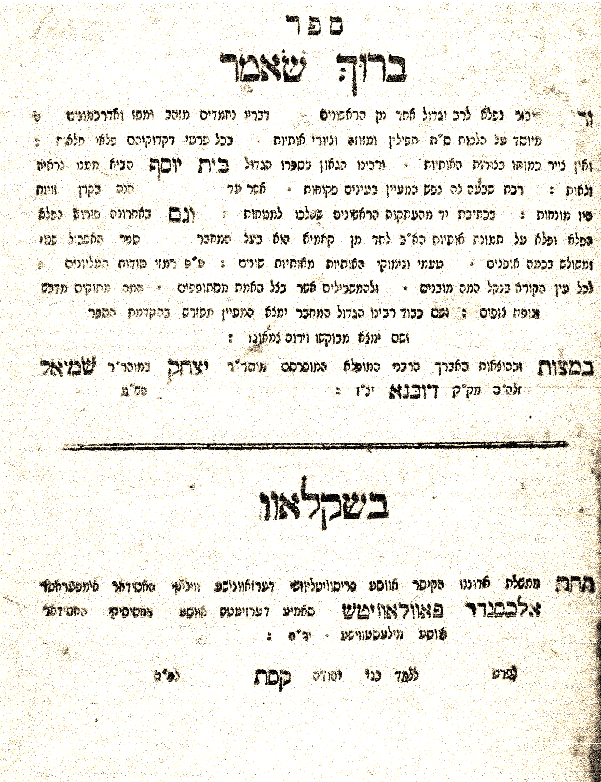
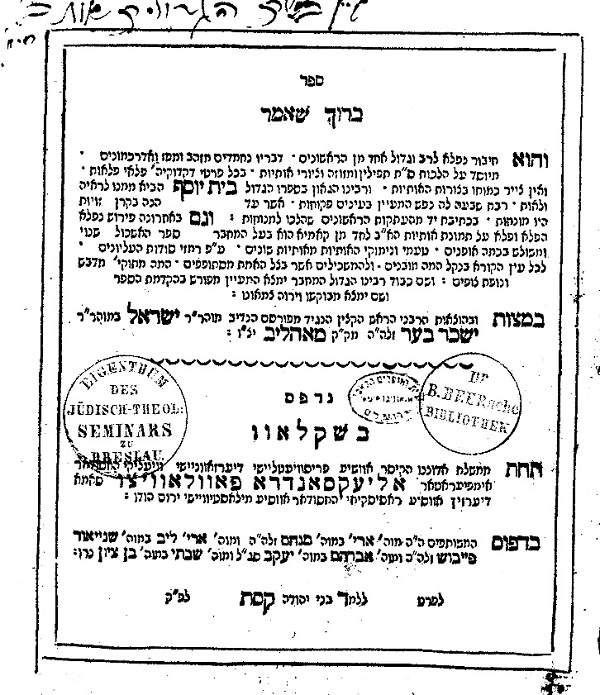
A title-page describing the work as an 1820 Shklov press publication is indicative of an enigmatic pseudo-edition of Baruch She’amar, a halakhot work pertaining to Sefer Torah, tefillin, and mezuzot by R. Simeon bar Eliʻezer (d. c. 1360). The author of Barukh She’amar, R. Simeon bar Eliʻezer (d. c. 1360), was born in Saxony, Germany and died in Eretz Israel. Orphaned at the age of eight, Simeon was adopted and raised by R. Issachar, a scribe who taught Simeon his craftsmanship, at which Shimon developed such expertise that R. Solomon ben Jehiel Luria (Maharshal, c. 1510-1574) referred to Simeon as “the head of all scribes.”[2]

There is confusion as to the actual dates and places of printing of this imprint. The title-page clearly gives Shklov as the place of printing and dates it with the chronogram “[We must] teach the children of Judah the archer’s bow קסת [קשת] ללמד בני יהודה  (580 = 1820)” (II Samuel 1:18). However, to get the date 1820 the shin ש (300) in the verse has been replaced with a sameh ס (60) for the total of 580 = 1820. Nevertheless, bibliographic sources are in agreement that the publication place of the 1820 Barukh She’amar was Minkowce (Minkovtsy), a village in Podolia near Belarus in north-eastern Poland. However, there were earlier editions of Baruch She’amar issued in Dubno in 1796 and again in Shklov in 1804.

The two presses noted in conjunction with the printing of the subject editions of Baruch She-Amar are in Shklov and Minkowce (Minkovtsy). The former location, Shklov, is in the Mogilev region of Belaurus on the Dnieper river, approximately 410 km. from Vilna. It was home to a Jewish community dating to the late seventeenth century. A charter permitting Jewish settlement in Shklov was first received in 1668. Not long after, according to a visiting diplomat in 1699, Jews were “the richest and most influential class of people in the city.” By 1776 the Jewish population of Shkolov was 1,367. Shklov was an intellectual center as well as being an important commercial center in the late seventeenth and eighteenth centuries.[3] Hebrew presses in Shklov date to the late eighteenth century and as many as 226 Hebrew titles are attributed to that location until 1835. Minkowce, in contrast, is in the Kamenets-Podolski district of the Ukraine. A smaller community, its Jewish population in 1765 was 375. A Hebrew press was active there from 1795 to 1812, publishing almost forty titles.[4]


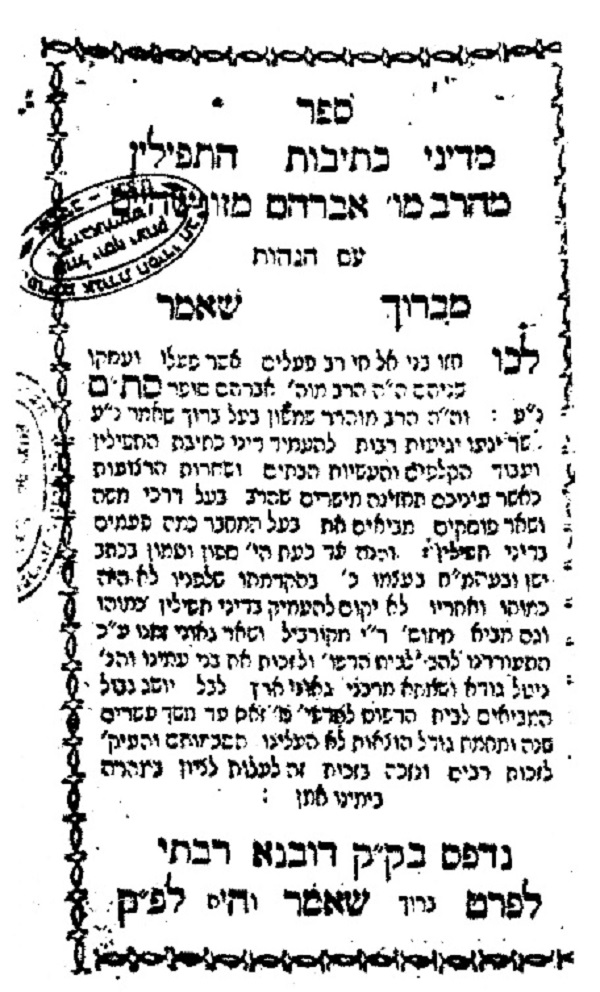
1804, Baruch She’amar, Courtesy of the National Library of Israel


1820, Baruch She’amar, Courtesy of Virtual Judaica

Entries in bibliographic works for Baruch She’amar consistently question the title-page of the 1820 edition’s place of publication when recording this work. Ch. B. Friedberg, in the Bet Eked Sefarim, records several editions of Baruch She’amar, among them [Minkowce 1795], Shklov 1804, and [Minkowce 1820]. In his Hebrew typography in Poland Friedberg records Baruch She’amar under Minkowce, 1796 and 1820 and under Shklov the 1804 edition of that work, dated קסת ללמד בני יהודה (564 = 1804). Vinograd, in the Thesaurus, lists a 1795 edition of Baruch She’amar referencing Friedberg, noting that it is questionable and an 1820 edition in which the title-page states Shklov, and in the entry for that work under the latter location has 1804 and 1820 entries, and for the 1820 edition referring the reader to Minkowce. Apart from these editions there was, as noted above, a prior 1796 Dubno imprint as well as several later editions.[5]

The text and format of the 1804 and 1820 editions are alike, both quartos (40: 32 ff.) and the title-pages of the two editions of Baruch She’amar even employ the same chronogram, modified to reflect the date of publication. Both title-pages credit R. Israel ben Issachar Ber from Ohilov for bringing the book to press, apparently the latter a repetition from the earlier printing. However, the 1804 Baruch She’amar names the printers as Aryeh ben Menahem, Aryeh Leib ben Schneer Feibush, Abraham ben Jacob, and Shabbetai ben Ziyyon as the printers. In contrast, the 1820 edition does not name the printer.

Abraham Yaari has entries for both Shklov and Minkowce in his bibliographical articles on those locations. In his article on Shklov he writes that a partial edition of Baruch She’amar had been printed previously in Dubno in 1796 and this, the 1804 edition, was the first complete printing of that work. He adds that Friedberg’s entries are in error and that the 1820 [Shklov] edition does not exist. Concerning the 1820 Minkowce edition, Yaari informs that there is an approbation from R. Judah Leib ben Zevi ha-Kohen Av Bet Din in Minkowce dated 11 Kislev 1820 (November 29, 1819) who refers to the earlier Minkowce printing and states that it is now being reprinted here, that is, in Minkowce. Yaari again takes issue with Friedberg, concluding “in truth, a complete edition was first printed in Shklov in 1804 (and based on that edition it was printed in Minkowce in 1820). A partial edition was printed in Dubno in 1796 and perhaps this is the reason for the errors.”[6]


1796, Barukh She’amar, Courtesy of the Library of Agudas Chassidei Chabad Ohel Yosef Yitzhak

While Yaari does appear to accurately summarize these editions he does not explain why the title-page of the 1820 Baruch She’amar clearly states Shklov as the place of printing rather than Minkowce. It is well known that in several instances the place of printing and the publication dates were modified to mislead the censor. However, that is not the case with other titles printed in both of our locations and the subject matter of Baruch She’amar on the halakhot pertaining to scribal arts is not one likely to attract the censor’s attention.

The printers of the 1820 edition removed the names of the printers from the 1804 title-page; it seems highly unlikely that they would have omitted correcting the publication place name. Moreover, even if in copying the title-page from the previous edition had been an oversight such an improbable error, if it  had occurred, would certainly have quickly necessitated a stop-press correction. Even if caught later it seems improbable that the publisher would have distributed the work as is. Moreover, it also seems improbable that this copy of the 1804 edition would have been subject to copyright restrictions. There is another important omission from the 1820 edition, that is, the editor, Israel ben Aryeh Leib’s apologia, at the end of the work.

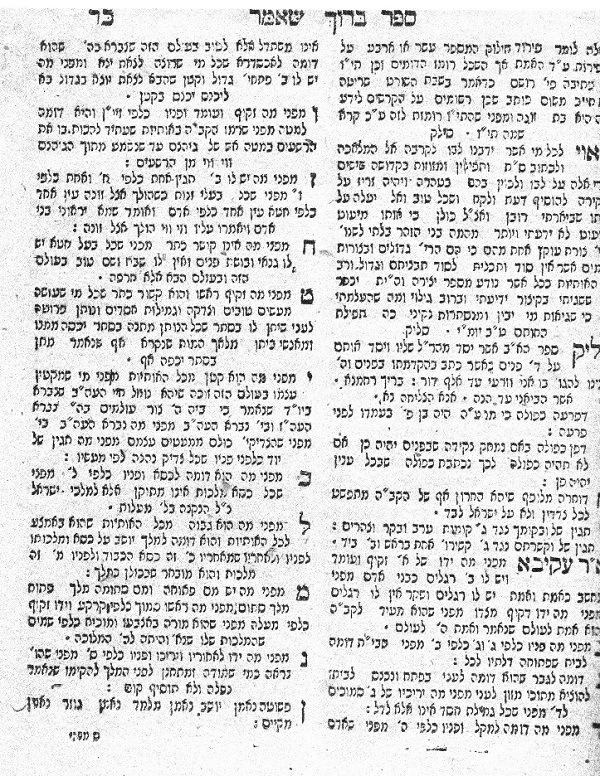
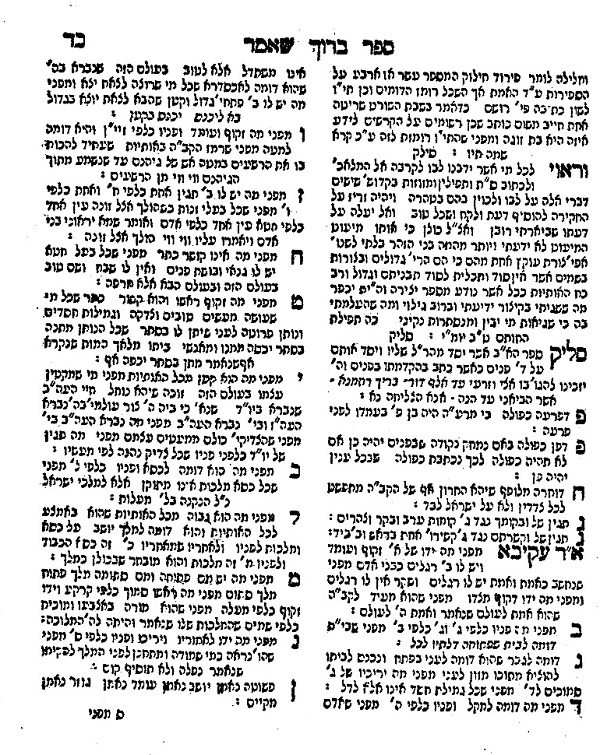
There are, however, in addition to those noted above, significant likenesses between the two works. First, excepting the front matter and apologia, the texts are set, line for line, in an identical manner. Moreover, the fonts appear to be alike. The reader should compare the two like pages below and drew his/her own conclusion. Perchance, the Minkowce printer acquired remaining copies of the 1804 edition, added the new front and back matter and reissued the work. Why did he do so?


1804, Baruch She’amar, Courtesy of the National Library of Israel


1820, Baruch She’amar , Courtesy of Virtual Judaica

Perhaps, and this is highly speculative, he felt that publishing this edition of Baruch She’amar as a pseudo-Shklov publication would give it greater marketability. If so, that should also have been true as well of other Minkowce publications. Or maybe he simply did not want to put his name on someone else’s work. Finally, we are left with the question as to why R. Judah Leib ben Zevi ha-Kohen’s approbation, which helps identify the place of publication, was printed with Baruch She’amar. Possibly including the approbation was important for the reasons that approbations were obtained, and it certainly would have been unconscionable, having gotten the Av Bet Din‘s approbation, to not print it.

We are left with a teku (an unresolved question).

[1] I would like to thank Eli Amsel of Virtual Judaica for bringing the 1820 edition of Baruch She-amar to my attention and Eli Genauer for reading the article and for his corrections.
[2] Hirsch Goldwurm, ed., The Rishonim (Brooklyn, 1982), p. 147.
[3] The Encyclopedia of Jewish life Before and During the Holocaust, editor in chief, Shmuel Spector; consulting editor, Geoffrey Wigoder; foreword by Elie Wiesel II (New York, 2001), III p. 1170; Yeshayahu Vinograd, Thesaurus of the Hebrew Book. Part I Indexes. Books and Authors, Bibles, Prayers and Talmud, Subjects and Printers, Chronology and Languages, Honorees and Institutes. Part II Places of print sorted by Hebrew names of places where printed including author, subject, place, and year printed, name of printer, number of pages and format, with annotations and bibliographical references II (Jerusalem, 193-95), pp. 689-95 [Hebrew].
[4] The Encyclopedia of Jewish II (New York, 2001.). p. 826). Vinograd II pp.457-458.
[5] Ch. B. Friedberg, Bet Eked Sefarim (Tel Aviv, 1951), bet 1431 [Hebrew]; idem. History of Hebrew Typography in Poland from its beginning in the year 1534 and its development to the present. . . . Second Edition, Enlarged, improved and revised from the sources (\(Tel Aviv, 1950), pp. 91,121, 123 [Hebrew]; Yeshayahu Vinograd, Thesaurus of the Hebrew Book. Listing of Books Printed in Hebrew Letters Since the Beginning of Printing circa 1469 through 1863 II (Jerusalem, 1993-95), pp. 457, 458, 692, 694 [Hebrew].
[6] Avraham Yaari, “Hebrew Printing in Minkovtsy,” Kiryat Sefer 19 (1942-43), pp. 274-75 [Hebrew]; idem. “Hebrew Printing in Shklov,” KS 22 (1945-46), pp. 141-42 [Hebrew].


Some Assorted Comments and a Selection from my Memoir, part 2

Some Assorted Comments and a Selection from my Memoir, part 2
by Marc B. Shapiro
1. In a recent Jewish Action (Summer 2009), p. 21, Elli Fischer writes:
Brandeis University has been enclosed by an eruv for thirty years, longer than any other campus not adjacent to an established Jewish community. Since Brandeis is a Jewish institution, the eruv is funded by the university (as opposed to the students). . . . Rabbi David Fine, who graduated from Brandeis in the mid-1980’s, recalls checking the eruv as a student. . . . The first two JLIC rabbis to serve at Brandeis, Todd Berman and Aharon Frazer, each implemented minor upgrades to the eruv.


This gives me the opportunity to correct some errors and tell part of the story of the Brandeis Orthodox community. The eruv was first established in the 1982-1983 school year, when R. Meir Sendor was the Orthodox advisor. (Sendor is currently the rabbi of Young Israel of Sharon and is unusual in that he is both an academic scholar of Kabbalah, with a PhD from Harvard,[1] and also involved in Kabbalah from the spiritual side.) Rabbi Sendor informs me that Rabbi Yehudah Kelemer was the initial halakhic advisor, and Rabbi Shimon Eider was later brought in to be the official rav ha-machshir. (R. Eider later helped in putting up the eruv in Sharon, which was the first eruv in New England.)
When I arrived in Brandeis in the fall of 1985 we did not carry on Shabbat. (Contrary to the Jewish Action article, David Fine didn’t arrive at Brandeis until two years later.) I assume that due to some structural changes on campus, the eruv was no longer functional. During that academic year, Rabbi Eider returned, did what needed to be done, and the eruv was once again kosher. At this time, R. Yaakov Lazaros, a Chabad rabbi in Framingham (with semichah from R. Moshe Feinstein), was the Orthodox advisor.
The university paid (and I assume still pays) for the eruv’s upkeep, but this has nothing to do with Brandeis supposedly being a Jewish institution. In fact, it is not a Jewish institution. Brandeis paid because it saw this as an important service to the Orthodox community. The university has expanded since the 1980’s so that is probably why changes to the eruv had to be made. I don’t like the word “upgrade” that Fischer used, because “upgrade” means to improve the quality of something, and I don’t think that Rabbi Eider’s eruv needed to be improved.
When one speaks of Orthodox life at Brandeis, a lot of credit must go to Rabbi Albert Axelrad, who was the Reform Hillel rabbi at Brandeis. He is someone who over time I came to admire greatly, even though our religious outlooks were so very different. What Weinberg jokingly said about another Reform rabbi applies equally to Axelrad: He is a “hillul ha-shem,” (hillul ha-shem in quotation marks!) because he shows that “one can be an upstanding and noble man, full of the spirit of love for Israel, its Torah, and its language,” even if one is not a halakhic Jew.[2]
In ways that people don’t realize, Axelrad greatly assisted Orthodox growth on campus, and today Brandeis has a very large Orthodox contingent.[3] It was Axelrad who made sure that there would be an Orthodox advisor on campus, paid for from the Hillel budget. Yet despite his leaning over backwards to help the Orthodox, there were always those in the Orthodox community who had negative feelings towards him, not only ideologically, but also personally. These were people who came from yeshivot and had never had any contact with a Reform rabbi, and here was one who performed intermarriages. Axelrad had also been involved in some leftist causes and has the dubious distinction of having been officially put into herem, ceremony and all, by Rabbi Marvin Antelman. He shared this honor with the entire membership of the New Jewish Agenda, whom Antelman also placed under herem. (I mentioned Antelman in a previous installment and hope to return to him as his books are deserving of their own post.)
Rabbi Lazaros was only at Brandeis for one year and he was followed by Rabbi Marc Gopin. Those who saw the video on the Rav will probably remember Gopin as he has a few appearances in it. At the time he was working on his dissertation, which focuses on Samuel David Luzzatto.[4] He has also published a nice article on Elijah Benamozegh.[5] Since then he has made an international reputation for himself in the area of conflict resolution, travelling widely and publishing a number of books.[6]
Gopin was followed by another rabbi, a RIETS graduate, who would have been very good for the community in another ten years. But at this time he was too much to the right for them. The community had always been a somewhat liberal place. I recall the outrage among many when R. Moshe Dovid Tendler came to campus and expressed his feelings about homosexuality. There was the same outrage when the new campus rabbi said similar things. (Shmuley Boteach or R. Chaim Rapoport would have been more in line with the students’ feelings.) The following should give a further sense of the liberal nature of the community: The practice on Shabbat morning when taking the Torah out of the ark was for the hazan to carry it through the women’s section. This struck everyone as a very nice thing to do, and although it is not done at the typical synagogue, college is a very different place. Another example of how college differs from the “real world” is that during Shabbat morning services women routinely give divrei Torah, yet this is not something that most “regular” shuls are willing to allow.
When Rabbi Lazaros was the Orthodox advisor he ruled that the practice of carrying the Torah on the women’s side was forbidden. From the way he explained his decision I understood that the major issue wasn’t carrying the Torah on the woman’s side per se, but rather women kissing the Torah. As he was the rav, we had to listen to him, even on the Shabbatot that he was not there. However, in an act of rebellion the community made a decision that when the Torah was taken out of the ark the hazan, who now could not walk around the women’s side, would also not walk around the men’s side. He would bring the Torah right to the bimah. When the Torah was returned to the ark the hazan walked to the front of the synagogue and sang Mizmor le-David, once again without walking around the men’s side. The following year, with the arrival of a new Orthodox advisor, the community revived the old practice of carrying the Torah on the women’s side.
When I was the Orthodox advisor in the early 1990’s the Orthodox culture on campus had changed, and the situation with carrying the Torah was exactly reversed from what it had been in the 1980’s. In the 1990’s it was the students, or rather some students, who wanted to stop carrying the Torah on the women’s side. They didn’t think that an Orthodox shul could have such a practice. My position was that the minhag had to remain the way it was. At that time there was a very dynamic Ramah-type minyan and if the Orthodox were seen as too close-minded we would lose people to the Conservative minyan. In fact, it was precisely because of the liberal nature of our minyan that many non-Orthodox were attracted to it, and a number of students adopted an observant lifestyle while at Brandeis. While some students, coming to Brandeis after a year in Israel, wanted the minyan to be just like their shul in Teaneck and the Five Towns, the truth was that the minyan, to be successful, had to be run like an out of town shul.
This was not the only time I felt that for the sake of the wider appeal of the Orthodox community I had to make decisions that got some people upset. On Friday night there was a communal meal for all the different denominations. Often a woman would say kiddush. After that everyone could, of course, make their own kiddush. But there were some people who wanted to make a big deal about the women saying kiddush, and were also saying that men are not yotze with this, no matter which woman is reciting the kiddush. At the same time that this was happening, there were also those in the non-Orthodox groups who wanted to start having women lead the communal birkat ha-mazon. Until then, out of deference to the Orthodox, only a man led it.
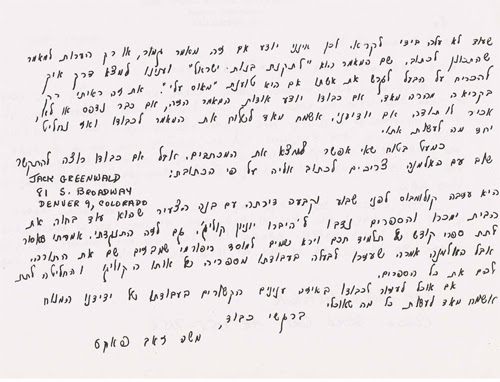
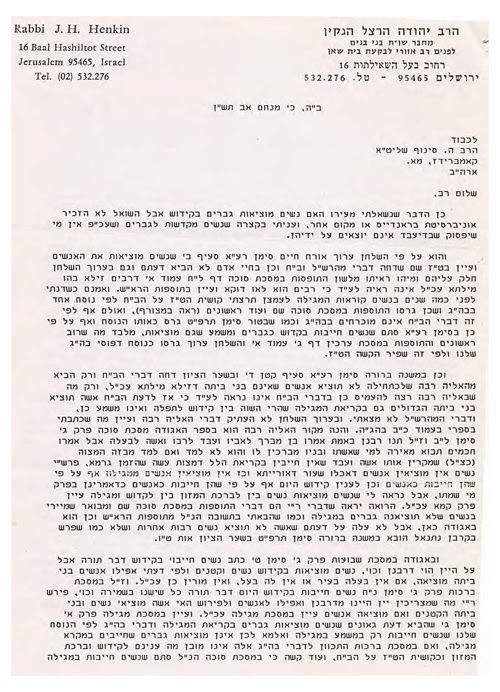
We have a talmudic principle that if you try to grab too much you will end up with nothing, so I had to make a choice. The real halakhic issue here was birkat ha-mazon, as a woman cannot be motzi a man.[7] Therefore, I told the students that it was OK for the women to make kiddush but not birkat ha-mazon, and anyone who wanted to should make his own kiddush. This compromise was accepted. A year prior to this, before I was working at Brandeis, I had been wondering about this issue and asked R. Yehudah Herzl Henkin if it was permitted for a woman to say kiddush for a man. He replied in the affirmative. Shortly after receiving his answer, the same issue became pressing at Harvard Hillel. I told the Orthodox rabbi at Harvard, Harry Sinoff, what the practice at Brandeis was and that he might want to consult with R. Henkin. This is the responsum R. Henkin wrote, published here for the first time. (See also Bnei Vanim, vol. 2, pp. 40-41.)
I myself wrote a short Hebrew “mini-responsum” dealing with women, kiddush, and birkat ha-mazon. It was taped to the wall of the campus beit midrash, but with the move to the right, I am sure that not too long after my departure the responsum came down.
I just mentioned the Brandeis beit midrash, which it itself significant. Other than Brandeis, I don’t know if there is another secular university in the world that has a beit midrash in a university building. When the beit midrash was established in the early 1990’s it was a great achievement. It was an entirely student led project, but again, Rabbi Axelrad’s involvement, behind the scenes, was crucial. He spoke at the beit midrash dedication, as did the Boston Rosh Kollel.
There were also some minor conflicts related to the beit midrash. Although it was the Orthodox students who arranged for it, it was obviously something that all students could be part of. The question came up of what type of books should be stocked there. My feeling was that since the library had all the scholarly and academic books, there was no reason for these sorts of texts to be in the beit midrash.
Another issue arose with the Boston kollel. They had recently become involved with Brandeis students as part of their outreach. One of the kollel guys, who was having a great influence on the students, wanted to start a gemara shiur on campus. This was fabulous. He wanted to give the shiur in the beit midrash, which was the natural place. However, he said that he could only do it if no women were allowed into the beit midrash during this time (even if they were not participating in the shiur). One of the women students complained to me, and I agreed that this was improper. The beit midrash was established for all students and must be open 24 hours a day for everyone. We could not have a situation where, like a pool, the beit midrash is closed to women for certain hours. It also went against the ethos of the community to declare that women are barred from attending certain classes. I told the male students who were organizing the shiur that it would have to take place somewhere else, and that is what happened.
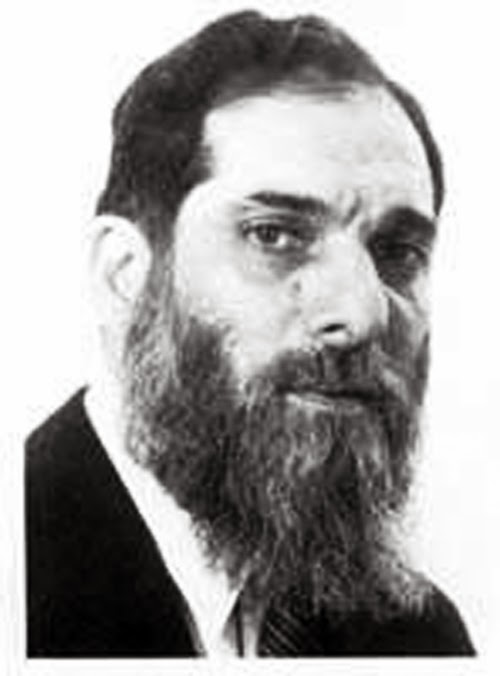
Right when we were having the discussions one of the students drove to Brookline to attend Prof. Isadore (R. Yitzhak) Twersky’s gemara shiur, and he came back reporting that there was a woman in attendance. If the Talner Rebbe welcomed women to his shiur, were the Brandeis students supposed to be more “frum”? For those who have never seen a picture of my late teacher, who was also the son-in-law of R. Joseph B. Soloveitchik, here he is:
 

There was another time when the Boston Rosh Kollel gave a decision to some of the students that I felt could drive away the less religious if it was adopted by the community as a whole. Since there were students who thought that the Rosh Kollel should be regarded as the halakhic authority for the community, I was in a difficult situation. This was especially so as I myself had asked him questions in the past, so it would not be an easy thing to reject his ruling in this case. I consulted a well-known haredi posek with whom I had discussed other matters, including an issue of possible mamzerut that came up on campus. He agreed with my position but said that he could not put his decision in writing.
I know that some people will find this objectionable, but it never bothered me. Why should I care if he put it in writing? He knew that if he did he might be attacked. Given the choice between no pesak (if it has to be in writing) or an oral pesak, obviously the latter is preferable. Although at the time I told people who gave the pesak (and anyone who wanted to could call him up to confirm it), revealing it on this blog would, I think, fall into the category of “putting it in writing.” This posek is still functioning, and if he was afraid of being attacked fifteen years ago, all the more so today. (There are reasons why I am being vague about the particulars of the pesak.)
Returning to the Brandeis beit midrash, Prof. Marvin Fox also spoke at its dedication. This was significant as it was the first time, in my memory, that the students took advantage of this great scholar and talmid hakham.[8] There was such a disconnect at Brandeis between the academic life and the religious life that regarding the latter we all overlooked the people in our midst, those who were teaching us in the classroom. I too regret not speaking to Fox in greater detail. For example, having lived in Columbus, Ohio he knew R. Leopold Greenwald very well, and yet other than hearing one or two stories about him from Fox, I never took the time to find out more. Fox also knew Chaim Bloch, the great rabbinic forger. (Greenwald and Bloch were themselves good friends.) He told me once that there was a lot he could say about Bloch, and yet I was foolish and never took advantage of this.
After Fox’s death I discovered a letter from him to Bloch in which he explains how it happened that Greenwald’s great library ended up at the Hebrew Union College. He also tells us the tragic fate of Greenwald’s huge collection of letters, letters that he received from gedolim and scholars over the course of many decades. This must have been one of the largest and most interesting collections in the world, full of priceless material which should have been given to a library so a Greenwald archive could be established. Among these papers were also to be found manuscripts from Greenwald’s own pen that had not yet been published. It was perhaps with this in mind that Fox told me very firmly, at the Brandeis beit midrash dedication, not to let the letters of Weinberg out of my hands. He was convinced that some people would want to destroy them, or at the very least make sure they were not made public.
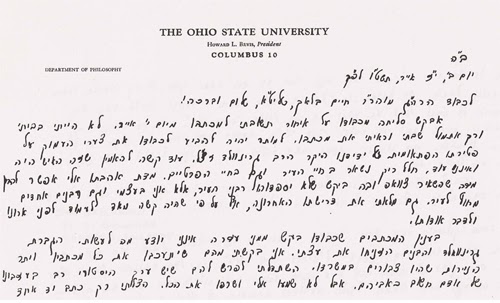
Here is Fox’s letter to Bloch, courtesy of the Leo Baeck Institute, New York[9]:

Returning to the RIETS graduate who was the Orthodox advisor following Gopin, there were a few issues that created problems. Yet the straw that broke the camel’s back was that, in accordance with R. Moshe Feinstein’s pesak, he would not give an aliyah to Rabbi Axelrad. Axelrad’s practice was to come to the Orthodox minyan once a year. Not giving him an aliyah was something that simply wouldn’t fly at Brandeis. It was not a question of Axelrad being concerned about his kavod. I am certain that he did not take personal offense. But he was very concerned about what appeared to be a growing split in the community, a community that had always gotten along so well. To publicly refuse to give the Hillel rabbi an aliyah would give the Orthodox community a sectarian flavor very much removed from both the Hillel ethos, as well from the majority of Orthodox students as well. It was not surprising, therefore, that this rabbi was let go in the middle of the year. After he was let go he tried to create a separate Orthodox community independent of Hillel. It was to be a real Austrittsgemeinde, and he told us that money would be forthcoming from New York to help us form the new community. Yet none of the students were interested.
R. Yehudah Herzl Henkin’s responsum, Bnei Vanim, vol. 2, no. 9, on whether one can give a Reform rabbi an aliyah, is dealing with the Brandeis situation (and was sent to me). Rabbi Henkin’s responsa have an unfortunate characteristic in that they don’t mention to whom he is writing, or give other identifying details. Without this blog post, future historians would have had no way of knowing which of the many American campuses he was referring to. Think of how much we learn about the history of Orthodoxy in America from R. Moshe Feinstein’s responsa. We see him answering questions to Canton, Berkeley and all sorts of other places. Knowing to where he is writing is vital for getting a sense not only of Orthodoxy of the time, but of the responsum itself, since his ruling for an out-of-the way place cannot always be applied when dealing with a center of Jewish life. More leniencies are obviously found in the former. With regard to Bnei Vanim, since R. Henkin doesn’t tell us to whom he is writing, when he is offering comments on another’s work we have no way of identifying this text if we want to get a better sense of the opposing position. (Other poskim have also published responsa that deal with Brandeis, and I will discuss them in a future post.)
I think readers might also find the following story interesting, from my tenure as Orthodox advisor at Brandeis. Every Friday night all the different groups on campus would get together for an oneg, at which there would be a speaker. Out of respect for the Orthodox a microphone was never used, which wasn’t really an issue since the onegs were not that big. However, it so happened that Hillel had an opportunity to bring in Dr. Ruth Westheimer[10] to speak on Friday night. She wasn’t going to speak about any sexual matters, but about her early years in Germany and her family that was killed.
This was at the height of Dr. Ruth’s fame, and there was going to be a huge crowd to come hear her. Hillel had decided to break with tradition and use a microphone at the event, which was to be held in a hall much larger than was usually used. I was told that Dr. Ruth actually insisted on the microphone, and the Hillel leadership didn’t feel like they could refuse. Before continuing with the story, let me go back a few years and tell how I, and my classmates, first heard of Dr. Ruth, because I think it says something about how yeshiva administrators are sometimes very foolish. I still remember how one day on the bus all the talk was about how the administration of Bruriah High School – the girl’s school of the Jewish Educational Center in Elizabeth, where I was a student – had sent out a letter to all parents telling them about a very dangerous radio show called “Sexually Speaking” that was on very late on Sunday night. The parents were told to make sure that their daughters didn’t listen to it—as if a parent can control what a teenager does with her radio in the privacy of her room. It was an era before computers, when we all listened to radio. (I am sure many readers remember the days when 770 WABC played music.)
Now anyone should realize that the perfect way to bring teenagers to do something is to tell them that they can’t do it. Although perhaps none of the Bruriah students had ever even heard of the show, upon receipt of this letter they all were determined to find out what the administration wanted to keep them away from. Not only that, but on the bus, the day after the letter was received, they told all the boys about this strange letter. None of us had ever heard of Dr. Ruth, and our school never sent out a warning letter to parents. Yet you can be sure that after hearing the news we too were curious. It happens that some students found Dr. Ruth so funny and interesting that they listened to her while they were on the phone together. The whole novelty was about an older Jewish woman, with a strong accent, speaking so openly about the things people don’t usually speak about.
Returning to the story, I was now put in a difficult situation, since the Orthodox community could not support an event that involved Sabbath violation. I told this to the Hillel administration and I told the students that I would not be going and it was not something that the Orthodox community could be part of. I remained in the dining room with those students who chose to stay, and those who wanted to hear Dr. Ruth went upstairs, where the event was taking place. Imagine my surprise when someone sits down next to me, and lo and behold, it is Dr. Ruth. She had obviously been told that there was some controversy about her speaking on the microphone, and she wanted to come speak to me. She was extremely apologetic, and said that unfortunately she needs the microphone, otherwise no one would be able to hear her. She also told me that she was sorry that this created problems for the Orthodox community. Dr. Ruth stayed with us for about ten minutes or so, and even bentched together with us (though though she hadn’t eaten anything!). She told me that she remembered singing the standard tune to the first paragraph of birkat hamazon when she was a child in Germany. I don’t know if she had sung it since.
One other event is worth recalling, and this took place when I was an undergraduate. It involved a dispute between me and my friend David Bernstein, and I would be curious to hear what readers have to say.[11] We decided to create an organization so we could invite in speakers. In order to get money from the university, we had to be officially chartered, so in our senior year we created the Brandeis chapter of Young Americans for Freedom. It had exactly two members (we had no interest in having any others join), and lasted for only one year (i.e., until we graduated). I was a little surprised when the Brandeis student senate agreed to charter us and give us money, but hey, you don’t look a gift horse in the mouth. (Had Matthew Brooks not already graduated, we probably would have let him join our little club. Brooks is now the executive director of the Republican Jewish Coalition. See here)
One of our events was sponsoring a debate between my father, Edward S. Shapiro, and Stephen S. Whitfield on what political ideology was more in line with Jewish interests. This had a very large turn-out and the problem was that Whitfield, although a Democrat, is more of a Truman or Kennedy Democrat. Every time my father cited some nonsensical statement by a Democratic figure, Whitlfield agreed that it was nonsense, so they ended up agreeing about as much as they disagreed. A debate isn’t much fun unless one of the speakers is prepared to defend what others regard as indefensible (e.g., anyone looking to defend ACORN?).
For those who don’t know, Whitfield is one of the leading experts on American Jewish culture, having written an enormous amount on the topic. My father started off as a general historian, but has also written a great deal on American Jewish history. I can’t help thinking that the reason the New York Times never reviewed his book on the Crown Heights Riots[12] – which was a National Jewish Book Award Finalist – was that they didn’t want to revisit the issue. It was, after all, the great embarrassment of the Dinkins administration, and the symbol of Democratic failure in New York City, ushering in the Giuliani era. Yet it was, precisely for these reasons, one of the most important events in recent New York City history, and one would think that the New York Times would have thought it worthwhile to review such a book. But no, they let it pass without comment.
We also brought in Dinesh D’Souza to speak. This was before he had published any of his books. In fact, I had never even heard of him when Bernstein suggested we bring him. His talk, though sparsely attended, was quite good. My dispute with Bernstein happened regarding our next speaker. I wanted to bring Lew Lehrman to speak. He was a prominent conservative who almost became governor of New York. He also had some honorary role in Young Americans for Freedom. Bernstein strongly disagreed. He argued that since Lehrman had converted to Catholicism a few years prior, he was not the sort of person we should be asking to speak. Although Bernstein was not Orthodox, that was a big issue for him and I agreed to drop the idea. But from my perspective, the fact that Lehrman had left the fold had no relevance for me in terms of having him speak. I wasn’t giving him an honor or asking him to speak on his theology. I wanted to hear him talk about economic matters and the situation in Nicaragua, and didn’t think that his personal life was of any relevance.
Although the cases are obviously not identical, there was a time when many people would have reacted the same way to inviting an intermarried speaker, and my response would have been the same. Since there is such a high intermarriage rate, one day most of us will have someone running for Congress in our district who is intermarried (some already have such representatives), just like most of us already know people, or have family members, who are intermarried. I don’t think this should have any relevance on my vote. In fact, I don’t think it should have any relevance on anything. Two generations ago, anyone who intermarried realized that he was doing something very much at odds with Jewish life and upbringing. Today, hardly anyone who grows up in the non-Orthodox world thinks that it is an issue at all, and it is only a matter of time before the Conservative movement accepts intermarriage. They have no choice, as their congregations are full of people whose children intermarry, and they can’t go on forever taking a hard line on this issue. Not only do they lose the intermarried children, they often lose the parents when the rabbi tells his long-time congregants that he is sorry but he can’t perform the wedding of their children or even announce it in the synagogue newsletter. I predict that within ten years we will see Conservative rabbis doing intermarriages.
The massive intermarriage rate has also impacted the Orthodox world. A number of years ago R. Jehiel Jacob Weinberg stated that he thought that it might be a good idea for a father whose son was going to intermarry to attend the wedding, thus not completely cutting off all ties.[13] Weinberg had known the problems of intermarriage very well, as the son of his good friend R. Shlomo Aronson, Chief Rabbi of Tel Aviv, had married a non-Jewish Russian woman. He also knew Jacob Klatzkin, the brilliant philosopher and Zionist thinker, who was the son of the even more brilliant R. Elijah Klatzkin. How many people know that Jacob Klatzkin intermarried?
According to Gotthard Deutsch, R. Esriel Hildesheimer’s son Levi intermarried.[14] It is hard to imagine that Deutsch, who was Levi’s contemporary, was mistaken with the facts, especially since he was never corrected in succeeding issues of the newspaper in which he published this information. Yet Dr. Meir Hildesheimer has told me that Levi Hildesheimer married the daughter of Abraham Brodsky of Odessa, the well known philanthropist. Levi’s son, Arnold Hildesheimer, was an active Zionist who made his living as a chemist and eventually moved to the Land of Israel. Arnold’s mother was definitely Jewish. Therefore, I don’t know if Deutsch erred or if Levi married twice.. Arnold Hildesheimer’s son was Wolfgang Hildesheimer, an important figure in pre-World War II German literature.
Unfortunately, we have a number of examples of not merely intermarriage of children of great rabbis, but even conversion. The story of the son of R. Shneur Zalman of Lyady is well known, and I don’t need to repeat it here. Let me just mention, however, that the man was clearly mentally unbalanced. Michael Bernays, a son of Hakham Isaac Bernays, is probably the most famous apostate from a rabbinic family in modern times, converting seven years after his father’s death. Another son of Hakham Bernays, Jacob, actually sat shiva when this occurred.[15] If we want to look at descendants of great rabbis who converted, then the family tree of R. Akiva Eger has plenty of non-Jews. In fact, a predecessor to R. Akiva Eger as rav of Posen, the Beit Shmuel Aharon, R. Samuel ben Moses Falkenfeld,[16] had a most significant great-grandson, yet he was not Jewish. I refer to none other than Leon von Bilinski.[17] He was Austrian minister of finance and also military governor of Bosnia when Archduke Ferdinand was assassinated.
I assume the famous Posen family got its name from the city of Posen. R. Gershon Posen, the dayan of Frankfurt’s separatist community, had a grandson who was on the verge of converting to Christianity. Nahum Glatzer describes this young man’s disillusionment with Orthodoxy, and how he tried to talk him out of conversion.[18] (The conversion never took place, and another grandson, R. Raphael Posen, tells me that the more than seventy grandchildren of R. Gershon all remained Orthodox.)
How are Orthodox Jews supposed to relate to those who intermarry, and who typically don’t know any better? Many of us have even been invited to intermarriages. R Yuval Sherlow has stated that while it is not permitted to attend an intermarriage wedding ceremony, there are times (especially when family is involved) that it would be permitted to attend the party.[19] R. Ovadiah Yosef has ruled that it is permitted to give an intermarried man an aliyah,[20] and this opinion is also shared by R. Baruch Avraham Toledano and R. Pinchas Toledano (former Sephardic Av Beit Din of London).[21] I am also told that this is the practice at the Lakewood kiruv minyanim all over the country. This is so despite the fact that the most that R. Moshe Feinstein would permit in such a case is to allow the intermarried man to open and close the Ark.[22] It is actually Aish Hatorah that has done more to “normalize” intermarriage than any other organization in the Orthodox world. Not only does Aish Hatorah do outreach to the intermarried (something we can all appreciate), but they use various intermarried Jewish celebrities in their publicity, and have even honored these people at their events. I am not saying that they are wrong in what they do. After all, the old approach to intermarriage doesn’t work today, and although I find something distasteful about using an intermarried celebrity as the poster-boy to invite people to a Torah class, I see how people can disagree. But about one thing there can be no doubt, and that is that R. Aaron Kotler would be turning over in his grave if he saw what this supposedly haredi organization has done when it comes to tacit acceptance of intermarriage.

Yet we shouldn’t assume that it is only in modern times that intermarried people have been honored by Orthodox Jews. While it would have been unimaginable in previous years to put them on a pedestal the way Aish Hatorah does, there were times that the intermarried man did such great service for the Jewish community that it was only proper to express feelings of gratitude. Adolphe Cremieux is one such example. Although being intermarried, he helped the Jewish community in many ways. One can even say that he is a model for our time, in showing that one can love the Jewish people and sacrifice for them, even after having intermarried. Here is a song written in honor of Cremieux by the noted R. Aaron Fuld of Frankfurt, author of Beit Aharon. It is taken from Judaica Jerusalem auction cataloge of Summer 1997, p. 6.
 

Worse than intermarriage is apostasy, but the same issue came up there also. The apostate Daniel Chwolson staunchly defended his former religion and people. How were the Jews to relate to him? Let me quote Louis Jacobs, The Jewish Religion (Oxford, 1995) pp. 99-100:
When Chwolson celebrated his seventieth birthday, a number of Russian rabbis, in gratitude for his efforts on behalf of the Jewish community, sent him a telegram to wish him many happy returns. Rabbi Hayyim Soloveitchik was more typical of the standard Jewish abhorrence of apostasy when he refused to participate, saying: ‘I do not send congratulatory telegrams to a meshumad.” The wry remark attributed to Chwolson himself in the following story is probably apocryphal. Chwolson is reported to have said that he became a Christian out of conviction. “Who are you kidding?” said a Jewish friend. “How can you of all people, a learned Jew, be convinced that Christianity is true and Judaism false?” To which Chwolson is supposed to have replied: “I was convinced that it is better to be a professor at the university than to be a Hebrew teacher [melamed] in a small town.”
2. I have seen ads for the soon to be published new RCA Artscroll siddur. It will be interesting to see how the battle shapes up between the Sacks siddur and the new RCA Artscroll. I can’t see how the Sacks siddur is going to make any real headway, as I don’t think many shuls are going to get rid of the Artscroll siddur they have been using for so long, and which does just about everything you need a siddur to do. While the new RCA siddur was in the production stages, R. Asher Lopatin of Chicago sent the following letter to the Siddur Committee. I think it is interesting in that it shows some of the concerns of those on the Orthodox left. Although I haven’t seen the new siddur yet, I don’t think I am going out on too much of a limb to predict that the RCA will not be adopting Lopatin’s proposal. (I thank R. Lopatin for allowing me to publish his letter.[23])


The Practice of Saying She’asani Yisrael for the Birchot HaShachar instead of the three “Shelo Asani”s
In Masechet Menachot, 43b (Bavli), Rabbi Meir says that a person, “Adam”, has to (chayav) say three blessings every day: She’asani Yisrael, Shelo Asani Isha and Shelo Asani Bur. There is a note there that it should be Rabbi Yehuda saying this instead of Rabbi Meir, and also on the next line Rav Acha Bar Ya’akov replaces “Shelo Asani Bur” with “Shelo Asani Aved”.
The G’mara questions why we need to say both Shelo Asani Aved and Shelo Asani Isha, but it gives an answer to this question. Rashi, in his second explanation of that answer, on Menachot 44a, says that we need to say both in order to come up with 100 b’rachot. The Bach (O.C 46) argues that the main reason for saying all three is to increase the number of b’rachot we say to 100. He argues that that is the main reason for saying three b’rachot in the negative (shelo asani) instead of one b’racha in the positive (she’asani Yisrael) – basically, if you would say “She’asani Yisrael” then you couldn’t say “Shelo asani aved, isha”. The Aruch HaShulchan (46, yud) paskins as well that if you say She’asani Yisrael, you cannot say the other two negative b’rachot. The Mishna B’rura (46,16) leaves it as a dispute.
Most Rishonim, notably the Rif and the Rambam (according to the G’ra), disagree with our existing girsa of the words of Rabbi Meir/Rabbi Yehuda, and they have the first b’racha in the negative as “Shelo Asani Goy”. This is the standard version in siddurim, nusach Ashkenaz and Sepharad and Edot Hamizrach, with the occasional nusach of “Shelo Asani Nochri” instead of “goy”. The Magen Avraham (O.C. 46, tet) mentions, that there were siddurim – perhaps many of them – that had the b’racha of she’asani Yehudi , but that that is a mistake of the printers, and the Mishna B’rura (46, 15) says that there are several siddurim with “She’asani Yisrael” but that one should not say that as it is also a mistake that of the printers (shibush had’fus).
The Magen Avraham (O.C. 46, yud) and the Haghot Ha’Gra (O.C. 46) interpret the Rama (46, 4) as suggesting that converts should say “She’asani Ger” and the Bach (46) interprets the Rama as suggesting that converts say “She’asani Yehudi” – instead of the negative.
Moreover, the Rosh is in the back of Masechet B’rachot, paragraph #24 (daf 39 in our versions, referring to B’rachot 60a) – upholds the Girsa that we have in Menachot. It’s in rounded brackets in the Rosh, and the Divrei Chamudot on the Rosh doesn’t like it, but it is there. Importantly, the G’ra affirms it is the girsa of the Rosh (and the Tur, which doesn’t appear in our versions) in his Biur HaGra on OH 46:4.
Therefore:
Since many of the Nosei Keilim and the Aruch HaShulchan feel compelled to ask: Why are these b’rachot in the negative (see Taz 46:4 “Rabim makshim…”)?
And since the girsa that we have in our G’marras is She’asani Yisrael, supported by the Rosh and the G’ra
And since even though the Shulchan Aruch rejects our positive girsa of the b’racha, the Rama does support it (in some version) as a legitimate b’racha in certain circumstances – for a convert
And since even those who reject “She’asani Yisrael/Yehudi/Ger” for a convert, (Sh’lah and Bach, see Taz 46, 10), do not reject it because it is not a legitimate nusach, but, rather, because it does not apply to a convert who has made himself a Jew, rather than being created by God as a Jew.
And since the negativity of the three b’rachot causes lots of misunderstandings in shul where many people come from Reform, Conservative or unaffiliated backgrounds – or even from Orthodox backgrounds without perhaps truly understanding the love that Chazal had for all human beings, male, female, Jewish or Gentile
I have asked my shul, Anshe Sholom B’nai Israel Congregation, a shul that does a lot of kiruv, to follow the girsa of the b’racha according to the G’ra and the Rosh, and say, “She’asani Yisrael” and that a woman say “She’asani Yisraelit” instead of “Shelo Asani Goy.”
Once the first b’racha is said in this way, the way it appears in the G’marra Menachot, then we have no choice, based on the rule of ‘safek b’rachot lekula’ and based on the p’sak of the Aruch HaShulchan (from the Bach) , to avoid saying the final two, negative b’rachot of “Shelo Asani Aved” and “Shelo Asani Isha”.
Clearly this helps avoid many of the questions that people ask about the negativity toward “goyim” or “women” that someone who does not understand Chazal do ask. The answers given help, but for a shul dedicated to kiruv, these b’rachot are a big turn off.
On the other hand, the b’racha of “she’asani Yisrael/Yisraelit” is a beautiful b’racha, thanking God for making me Jewish – proud to be Jewish, excited to begin the day as a Yisrael.
In addition, from a philosophical point of view, rather than beginning the day with negative b’rachot, which accentuate the G’mara of “noach lo la’adam shelo nivra” (see Bach 46, then Taz 46, 4), let us begin the day with a positive b’racha “k’mo sha’ar b’rachot shemevarchim al hatova” (Magen Avraham, 46, 9). Not negating the p’sak of “noach lo…”, but just respecting the positive aspects which G’mara Menachot the way we have it preferred.
Homiletically, “She’asani Yisrael” matches very well with B’reishit 32:27: “Vayomer, Shalcheni ki alah hashacher” – see Rashi ad loc where that is referring to Birchot HaShachar of the angels! And then two p’sukim later, what b’racha (“ki im beirachtani”) does Ya’akov get? “Lo Ya’akov ye’ameir shimcha, ki im Yisrael”! There is no better way to bringing these p’sukim to life than by saying birchot hashachar every day the way our G’marra has it: “She’asani Yisrael” – proud as Ya’akov was to receive the name, “Yisrael.”
Finally, Rav Benny Lau, an important Talmid Chacham and leader of Beit Morasha, has told me that he, too, follows this practice of saying “She’asani Yisrael” – and he tells his daughters to say “Yisraelit” – in the morning and having it replace the three negative b’rachot.
At the same time, it is important to emphasize the need to reach 100 b’rachot a day, and to push people to be careful about saying Asher Yatzar when leaving the bathroom, and b’rachot before and after eating, and being in shul as frequently as possible in order to hear chazarat haShatz to more easily reach 100 b’rachot.
I would humbly ask the Committee responsible for the new RCA Artscroll siddur to consider either putting this practice in the siddur itself, as a possible “hanhaga”, or allowing this way of saying birchot Hashachar to appear on the RCA Artscroll siddur web site, to that I can download it and print it up for my shul, and any other shuls interested in this hanhaga can do the same.
Sincerely yours and with wishes of hatzlacha rabba,
Rabbi Asher Lopatin


3. Virtually every one of our sages, together with all their brilliance, offer at least one an unusual, sometimes even incomprehensible, idea. Since I am writing this right before Sukkot, here is something to think about when you take the Arba’ah Minim. R. Jacob Ettlinger, the greatest of nineteenth-century German gedolim, writes as follows in his Bikurei Yaakov 651:13. (If you raised this safek in shiur today, the rebbe would think you were joking, but as with even the strangest suggestions, one can often find a true gadol who discusses the issue.)
נסתפקתי אם אנו יושבי אירופא יוצאין בד’ מינין שגדלו באיי אמעריקא ואויסטראליען שיושבין לצדינו ותחתינו, וכן איפכא. שידוע מה שכתבו הטבעים שרגליהם נגד רגלינו, ומה שאין נופלין נגד השמים הוא מפני ששם הבורא כח מושך בארץ. וא”כ המינים שגדלו שם אם נוטלין אצלנו הוא הפוך מדרך גדולתן, שאצלנו גדלו ראשי הלולב וההדס ההם יותר למטה מזנבם. או אי נימא, כיון שנוטל הגדל סמוך לארץ למטה זה מקרי דרך גדילתו, והכי מסתברא.
4. In the latest Hakirah (Summer 2009), p. 134 n. 189, Chaim Landerer quotes my translation of a comment by R. Solomon Judah Rapoport. I didn’t know that Landerer was going to publish my translation, and I answered his e-mail quickly and carelessly. The correct translation is not that Rapoport is “as Catholic as the Pope,” but something even stronger. Frankel says that Shir is “more Catholic than the Pope.” (Thanks to R. Ysoscher Katz who caught the error and alerted me. Also thanks to Rabbi Jonah Sievers who is always helpful in matters concerning German translation. Not being a native speaker, and obviously not familiar with all idioms of the language, every translation I have published has been carefully reviewed by expert translators.)
Speaking of errors, let me also correct something that appears in Between the Yeshiva World and Modern Orthodoxy. This correction has already been taken care of in the more recent editions of the book, but those who have the first or second printing can insert the correction into the volume. How this error came about, I have no idea. I must have been in a daze, and it was only when the book was published that I saw it. On p. 180, beginning line 3 from the top, it states “Might one then be able to say that our great divine Torah cannot endure the conjunction of Torah with so-called secular studies . . .” It should be corrected to say, “Might one then be able to say that our great divine Torah cannot compete with so called secular studies . . .”
There is a popular expression
כשם שאין תבן בלא בר כך אין ספר ללא טעויות.
The internet is so amazing as it allows all of us to correct errors that have appeared in our works, and publicize them, something that was not possible in earlier years. R. Judah Ibn Tibbon wrote to his son, R. Samuel (Iggeret ha-Musar, ed. Korah [Kiryat Sefer, 2007], p. 45):
והטעות שתצא מיד האדם הוא הנתפש עליה ונזכר בה כל ימיו.
In other words, unlike a verbal error which is forgotten, something in print is there forever. Yet today, we can minimize this problem by means of the internet. Rather than be embarrassed by errors we have made, and try to ensure that no one learns of them, we should all welcome the opportunity to point out our errors, so that our works are as perfect as we can make them. This is quite apart from the unseemliness of pointing out the errors of others, but not being prepared to call attention to our own mistakes.
Incidentally, Ibn Tibbon’s work is full of important lessons, but he says one thing that is very problematic. On p. 42 he writes:
.
.ואל תתעקש אתה להחזיק בדעתך אפילו אם תדע שהאמת אתך
What sense does this make? Doesn’t the Torah tell us לא תגורו? Didn’t the Rambam speak his mind no matter who disagreed? In our own day, isn’t R. Ovadiah Yosef fearless in expressing his opinion, no matter how much he is attacked? I posed this question to R. Meir Mazuz and he replied:
זו הערה נכונה. כנראה ר’ שמואל היה עוד רך בשנים וחשש האב שיגרום לו קנאה ושנאה כמו שקרה לר”ש בן גבירול, וגם להגר”ע יוסף שליט”א בבחרותו כשחלק על הבא”ח כידוע. אבל כשאדם כותב ספר חייב לגלות את דעתו (בעדינות ובזהירות) ולא יכוף על האמת פסכתר. ובמשך הזמן תתגלה האמת, כי היא לעולם עומדת.
5. I want to call everyone’s attention to a fascinating new book. Dirshuni, edited by Tamar Biala and Nechamah Weingarten-Mintz, is a book of modern midrashim, written by women. It has been selling very well in Israel and is an exciting genre that deserves its own discussion. Those who want to see some small excerpts can go here.
To order the book you can go here
6. In my last post I mentioned R. Meir Amsel and the memorial volume that recently appeared. I should have also mentioned that his son, R. Eli Amsel, runs the site Virtual Judaica.
7. Finally, I thank everyone who commented and e-mailed me about R. Yerucham Gorelik. There is no question that he was a fascinating man, and an entire post could be devoted to the great stories told about him. It is also true that his relationship with YU was complicated. Let me quote what Dr. Norman Lamm wrote about Gorelik, shortly after his death.
Rabbi Yerucham Gorelick appeared at times to be engaged in some kind of titanic inner struggle. He was a cauldron of activity and movement, of perpetual motion. He was a man of striking, sometimes startling contradictions. He appeared to be moving in different directions simultaneously. He was a man of changing moods, of profound dialectical tensions, although he was at all times an ish ha-emet, a man of unshakeable integrity.
For Dr. Lamm’s article, see here

Notes

[1] “The Emergence of the Provencal Kabbalah : Rabbi Isaac the Blind’s Commentary on Sefer Yezirah” (1994).
[2] Letter to Samuel Atlas, dated Oct. 16, 1959, published in “Scholars and Friends: Rabbi Jehiel Jacob Weinberg and Professor Samuel Atlas,” Torah u-Madda Journal 7 (1997), p. 113.
[3] See R. Jehiel Jacob Weinberg’s letter to R. Kook, Iggerot la-Reiyah (Jerusalem, 1990), p. 128
כבר הונח לי בהשתדלותו של רב אחד מרבני העדה הליברלית (דווקא ע”י רב ליברלי של העדה הליברלית, כאלו רוצה הקב”ה לזכות את כל ישראל במעלות שונות שיש בזה מה שאין וכו’).
[4] “The Religious Ethics of Samuel David Luzzatto” (Brandeis University, 1993).
[5] “An Orthodox Embrace of Gentiles? Interfaith Tolerance in the Thought of S. D. Luzzatto and E. Benamozegh,” Modern Judaism 18 (May 1998), pp. 173-195.
[6] See here A few days before his death, Rabbi Meir Kahane spoke at Brandeis. I think it was actually his last public talk before the night he was killed. For a video of Gopin confronting Kahane see here at 24:20, 31:50, and 43:05, and 56. Gopin starts to speak extensively at 1:02:45. The man standing next to Gopin is Dr. Aryeh Cohen, who also briefly served as Orthodox advisor at Brandeis. He now teaches at the American Jewish University. See here.
[7] See Shulhan Arukh, Orah Hayyim 199:6-7.
[8] He also had a nice sense of humor. On the first day of class he would come in and write his name on the board as “F-x.”
[9] The letter is found in the Chaim Bloch Collection, AR 7155.
[10] See here.
[11] Bernstein is now a nationally known professor of law. See here.
[12] Crown Heights: Blacks, Jews, and the 1991 Brooklyn Riot (Waltham, 2006).
[13] I have given the information on this to Rabbi Mark Dratch for his paper at the Orthodox Forum on the topic.
[14] See his article in the Jewish Chronicle, June 26, 1914.
[15] See Moshe Gresser, Dual Allegiance: Freud as a Modern Jew (Albany, 1994), p. 73. Hakham Bernays’ grandaughter, Martha (daughter of Berman Bernays) married Sigmund Freud. After they were married, Freud refused to allow her to light Shabbat candles. See ibid., p. 67.
[16] For details on the controversy surrounding Falkenfeld’s selection as rabbi, and how his opponents regarded as an “uncouth Polack” see Heinrich Graetz, History of the Jews (Philadelphia, 1898), pp. 2-3. When he was rav in Tarnopol, he also had to contend with troublemakers. See R. Solomon Judah Rapoport’s letter in Leopold Greenwald, Toldot Mishpahat Rosenthal (Budapest, 1920), p. 76. For a picture of his tombstone, see here.
I can’t explain why on the tombstone he is referred to as “Moses Samuel,” when it should be Samuel ben Moses. For his biography, see Beit Shmuel Aharon al ha-Torah (Jerusalem, 1994), introduction.
[17] See here. My information on Bilinski’s family background comes from Gotthard Deutsch’s article in the Jewish Chronicle, June 26, 1914.
[18] The Memoirs of Nahum N. Glatzer (New York, 1997), pp. 126-128. Although Glatzer left Orthodoxy, in his younger years he studied in R. Salomon Breuer’s yeshiva in Frankfurt, and also with R. Nehemiah Nobel. As such, he understood Orthodoxy very well. Glatzer, who died in 1990, was retired when I came to Brandeis in 1985. To my great regret, I never took the trouble to interview him as I did with Prof. Alexander Altmann, who retired from Brandeis in 1976. On pp. 129-130 of Glatzer’s memoir we find the following, which I am sure will interest many readers of the Seforim blog.
In 1944 Rabbi Joseph Soloveitchik (called “the Rov” by his followers and admirers) published in Talpiot a major article, “Ish ha-Halakhah” (the Halakhic Personality). The essay, written in a most beautiful Hebrew style, not only claimed for the observance of Jewish law the central place in Jewish life, but denied the—however circumscribed—validity of any other approach. The Halakhah demands a complete control of the Jew, to the exclusion of an emotional state of mind to accompany the halakhc function. There is no rightful place for, or justification of, a state of excitement or religious agitation, say, in the ceremony of blowing the shofar on New Year’s Day; what matters, and matters exclusively, is the proper execution of the ritual.
This exclusion of the emotional side of religion bothered me when I read the essay. I planned a polemic reply but was dissuaded by my colleagues. I happened to visit New York and voiced my feelings to Professor Louis Ginzberg, the great Talmudist. I expected him to agree with me and object to the rigid stand of the Rov. The cautious Ginzberg did not wish to commit himself, or to say something that could be quoted as a criticism of his Talmudic colleague. He, therefore, did not go beyond saying: “I like my whiskey straight,” which was a mild complaint against the Rov’s combination of Halakhah and philosophy. The only reference that could be interepreted as an admission of esthetics into the realm of religion was Ginzberg’s telling of the Gaon of Vilna (brother of Rabbi Abraham, Ginzberg’s forebear in the seventh generation), who near death admired the beauty of the etrog that was brought to him, since the day was one of the Sukkot festival days.
(The Rov, apparently, would have felt: Never mind the etrog’s beauty. What matters is that the citron is without blemish and the benediction is properly pronounced.).
I was disappointed that Ginzberg did not wish to take seriously the younger man’s question. In the meantime, the Rov changed his position and realized the wider dimension of faith. If you wait long enough . . . [ellipsis in original]. Yet, even with the changed position on the part of the Rov, Ginzberg, were he alive, would insist on having his whiskey straight.
Glatzer sees “The Lonely Man of Faith” as expressing a change in the Rav’s earlier “halakho-centrism.” I wonder if Prof. Lawrence Kaplan will agree.
[19] Reshut ha-Yahid (Petah Tivah, 2003), p. 186.
[20] Ma’ayan Omer (Jerusalem, 2007), vol. 1, pp. 186, 194, 205. R. Hillel Posek, Divrei Hillel, Orah Hayyim, no. 8, strongly supports giving an intermarried man an aliyah, but not as one of the first seven. To deny such an aliyah woould be to embarrass the man, and Posek explains why even sinners cannot be treated with disrespect. See also his comments in Ha-Posek, Sivan 5747, p. 1336. In Amsterdam the practice was also not to give an intermarried man one of the first seven aliyot. See R. Jacob Zvi Katz, Leket ha-Kemah he-Hadash (London, n.d.), vol. 3, p. 63.
[21] Sha’alu le-Varukh, vol. 1, no. 40.
[22] Of course, there are many other poskim who forbid giving an intermarried man an aliyah. Even as liberal a posek as R. Ben Zion Uziel was adamant that you cannot call an intermarried man up to the Torah. See Mishpetei Uziel, vol 8, no. 53.
[23] For those who don’t know, Lopatin was the first Rhodes Scholar to become an Orthodox rabbi. In fact, he might be the first Rhodes Scholar to become a rabbi in any denomination. R. Chaim Strauchler of Toronto is the second Rhodes Scholar-Orthodox rabbi.

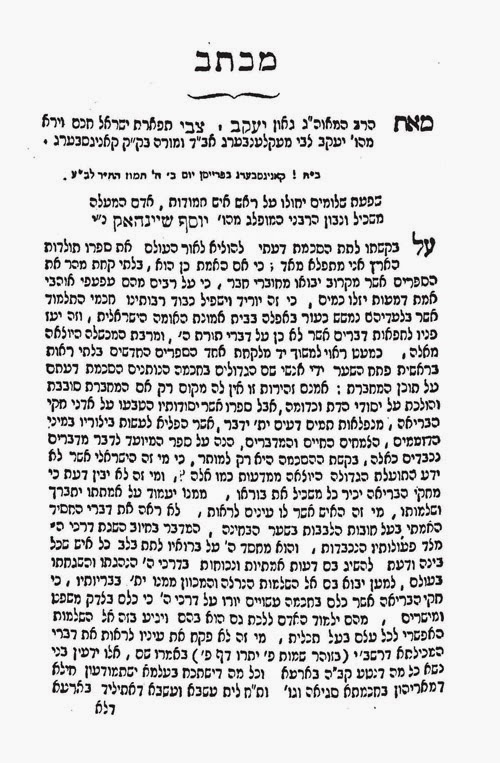
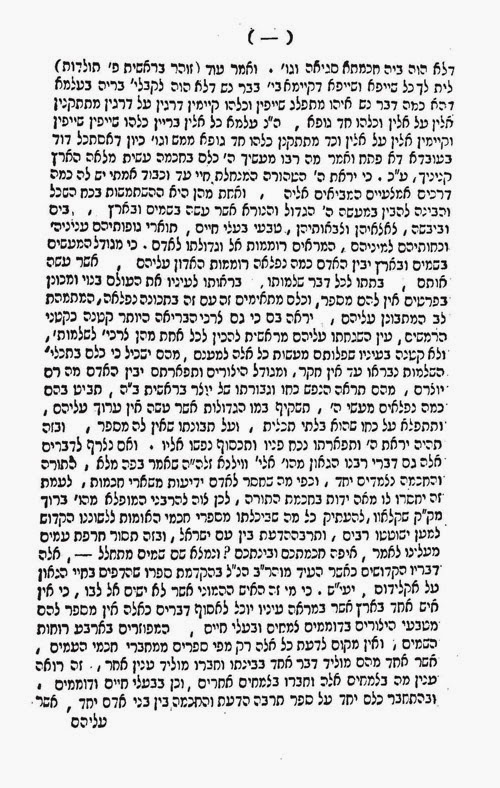
Lawrence Kaplan’s review of Eliyahu Stern, The Genius

Eliyahu Stern’s recent book on the Vilna Gaon has generated a lot of discussion. The Seforim Blog is happy to present Lawrence Kaplan’s review of the work which will be followed up by a three-part post by Marc Shapiro

Eliyahu Stern, The Genius: Elijah of Vilna and the Making of Modern Judaism. New Haven: Yale University Press 2013, pp. xiv+322.*
My father, of blessed memory, was an Orthodox Jew of Lithuanian descent, a “Litvak.” Though he was a businessman all his life, he, like many traditional Litvaks, always kept up his study of classical Jewish texts, both biblical and rabbinic. I remember how often on a Sabbath, whether during a lull in the services or at one of the Sabbath meals, he would introduce an observation on the Scriptural portion of week with “The Gaon says,” literally, “the Genius says.” What followed was always a very acute and original textual insight. Of course, we all knew, without his having to tell us, to whom he was referring. Given my father’s Lithuanian background, he could have had in mind only one Gaon, one Genius: Rabbi Elijah of Vilna (1720-1797), better known as the Vilna Gaon.
            In this regard my father was not unique. As Eliyahu Stern states at the beginning of his important and ambitious study, The Genius: Elijah of Vilna and the Making of Modern Judaism:
For two centuries Elijah has been known simply by the name “Genius,” or “Gaon.” His biographers claim that “one like him appears
every thousand years.”… By the time of his death… he had written commentaries on a wider range of Jewish literature than any writer in history…. His originality, command of sources, and clarity of thought… establish him as the equal of… religious and intellectual giants such as Aquinas and Averroes. (1)
Not surprisingly, not very long after the Gaon’s death traditionalist scholars began writing biographies extolling his piety and, even more so, his brilliance, an enterprise that continues until today.  Despite their hagiographic nature and often strongly ideological bent, these biographies are often serious attempts, granted from within a traditional perspective, to document the Gaon’s life and works and paint his personality, and, if used selectively and critically, they can be of great value to academic historians. Thus, to take a very recent example, R. Dov Eliakh’s 1300 (!) page, three volume biography from 2002, Ha-Gaon[1]  clearly has a Haredi ideological agenda, doing its best to distance the Gaon from, heaven forbid, any “enlightenment” tendencies, and further waging a fierce campaign against all the ”distortions”
that the dastardly “enlighteners” perpetrated on the Gaon and his disciples.[2] Yet this biography, ironically enough, has been condemned in certain extremist Haredi  circles for displaying its own enlightenment tendencies, perhaps alluding to its very full (and useful) documentation and its ”sin” of every now and then referencing academic articles and even worse identifying their authors![3]
            Primarily, however, traditionalist scholars undertook to preserve and disseminate the Gaon’s vast intellectual legacy by transcribing, editing, publishing, and commenting on his works.  Here one must state that while no one will deny the Gaon’s “originality [and] command of sources,” for Stern to speak of his “clarity of thought” is misleading.  While a few of his works, like his Commentary on Proverbs, are full and clear, most of his  writings, as scholars have noted and Stern himself concedes, are exceptionally concise and concentrated, often consisting entirely of learned but obscure allusions and references, the relevance of which can be  deciphered  only by exceptionally knowledgeable readers.[4] Indeed, many of his “commentaries” are, in truth, nothing of the sort, but simply glosses and annotations entered by the Gaon into the margins of the texts in his rabbinic library. Most of his works were not prepared for publication; many were dictated in oral form to his students and exist in varying recensions. At times the Gaon’s original manuscripts are missing, and the accuracy of the printed texts prepared from them is not certain.  The magnitude of this on-going effort cannot be overstated, and even today the job is far from completed.[5]
            In contrast to traditionalist scholars, academic scholars until fairly recently focused, by and large, only on selected aspects of the Gaon’s personality and legacy. They examined the famous and exceptionally fierce  campaign which he, together with the Vilna community leaders, waged against the new spiritual pietistic Hasidic movement; took note of his interest in a broad range of secular disciplines, to be sure, only as ancillaries to the study of the Torah, and asked to what extent he could be seen as a forerunner of the East European Haskalah (Jewish enlightenment); and finally posed the question as to what extent his views regarding the interplay between piety (yirah) and study of the Torah anticipated those of the mid-nineteenth century ethical-pietistic “mussar” movement. In all these instances the scholarly interest was not so much in the Gaon per se, but in his relationship to either contemporaneous or subsequent religious movements.[6]
            Over the past two decades, however, scholars have sought to extend these rather limited horizons and take stock of the broader contours of the Gaon’s intellectual legacy. Important attempts have been made to probe the Gaon’s original Kabbalistic thought; show how, despite his presumed anti-philosophical stance,  he drew upon the medieval Jewish philosophy in forming his world view; examine his hermeneutics and the connected issue of how he conceived of the relationship between the plain-sense meaning of the biblical text and its rabbinic interpretation; and finally assess his immense more strictly Talmudic legacy, looking at his many innovative and unconventional legal rulings and interpretations of rabbinic texts.[7]
            Stern’s The Genius both synthesizes and builds upon this recent scholarship, and is the first attempt to undertake an intellectual biography and cultural profile of the Gaon, placing him firmly within the concrete social and political reality of the Vilna of his day and taking into full account his dizzyingly wide ranging and varied intellectual and literary activity. Of particular interest is the colourful, warts and all, personal portrait that Stern paints of the Gaon, examining the connections between the Gaon’s eccentric, highly reclusive and ascetic lifestyle—for example, he limited his sleep to two hours a day and almost ruthlessly cut all emotional ties with his immediate family—and his genius, or to be more precise the connections drawn between these two facets of his personality by his disciples. As Edmund Morris notes[8] when speaking of the slightly later Beethoven, a genius’ admirers expect him to be unlike ordinary men and wholly devoted his calling—music for Beethoven, rabbinic learning for the Gaon. If Beethoven’s admiring patrons viewed him, to cite Morris, as an ”undisciplined freak”—and all the greater for that—the Gaon’s admiring students appeared to have viewed him as a highly disciplined, indeed, over-disciplined, one—and,
again, all the greater for that.
            Yet, as the book’s subtitle, Elijah of Vilna and the Making of Modern Judaism, indicates, Stern has an even bolder agenda. For in addition to limning the Gaon’s life, thought, and personality, Stern in his book’s Introduction and Conclusion advances a novel thesis regarding the nature of modern Judaism and the role of the Gaon in its making, seeking to unsettle the binary opposition generally drawn between tradition and modernity.
            For Stern, modernity is not “just a movement based on… liberal philosophical principles,” but “a condition characterized [among other
things] by democratization of knowledge and privatization of religion… that restructured all aspects of European thought and life in diverse and often contradictory ways,” (8) and that in the case of Judaism “gave rise to [both] the Haskalah and institutions such as the Yeshiva” (8).  It is in this light Stern maintains that we should understand the historical significance of Gaon’s great work on Jewish law, his Bi’ur
or commentary on Joseph Karo’s sixteenth century code of law, the Shulhan Arukh. Here, to sharpen Stern’s analysis, we may point to an instructive paradox. From the sixteenth to the eighteenth century, thanks to the primacy of the Shulhan Arukh, the study of the Talmud was neglected and scholars focused their attention on codes of law. The Bi’ur might seem to fit into that pattern, but in actuality it served to subvert the Shulhan Arukh’s authority. For by tracing in great and unprecedented detail the source of the Shulhan Arukh’s rulings back the Talmud and its classic commentaries and then by often challenging those rulings in light of those sources the Bi’ur spurred a return to Talmudic study.
            Stern suggestively, if perhaps a bit mechanically, links the move, sparked by the Gaon, from study of Codes to study of the Talmud to the decline of the kehilah, the Jewish community, and the rise of more privatized forms of traditional Judaism. As long as a kehilah possessed the power, granted to it by the local non-Jewish authorities, to govern itself by Jewish law, study of the codes, which served as guides to practical communal legal decision making, occupied center stage. With the kehilah’s decline, study of the Talmud for its own sake emerged as the highest form of religious worship and pushed the study of the codes to the margins.  Thus, Stern notes, the Yeshiva of Volozhin, founded in 1803 by the Gaon’s leading disciple, R. Hayyim of Volozhin, which served as the primary center of Talmud study in Eastern Europe through the nineteenth century, was a new type of Yeshiva that “functioned independently of any communal governing structure, and …recruited students and funds from across European Jewry” (138). Moreover, this detaching of Talmudic study “from practical code-oriented learning” encouraged “an ethos of innovation, originality, and brilliance” (139) where intellectual battles were won by “pedagogic persuasion and not coercion” (140).
            This perception of the Volozhin Yeshiva as exemplifying the rise of a more privatized and democratic form of religion thus connects directly with Stern’s broader thesis that the modern condition manifested itself in both “enlightened” and “traditional” forms of nineteenth century Judaism, despite their apparent opposition. This analysis is very suggestive, but open to two objections.
            First, while the Gaon certainly played an important role in the move from the study of Codes to study of the Talmud, Stern exaggerates the extent of that role.  It would appear that Stern rather uncritically relies on the understandably hyperbolic claims made by the Gaon’s students, who credited him with almost singlehandedly reviving the study of Talmud in traditional circles. In truth, however, the Gaon’s approach appears to be a part of a broader return to Talmudic study in the eighteenth century, which occurred for reasons we cannot enter into here, as exemplified by, among others, his slightly older central European rabbinic contemporary Rabbi Jacob Joshua Falk (1680-1755) and, in particular, by his Lithuanian contemporary R. Aryeh Leib Ginzburg (1695-1785), both of whom, unlike the Gaon, actually wrote full scale commentaries on the Babylonian Talmud. Indeed, as Yisrael Ta-Shma has noted, Falk’s commentary, the famed Pnei Yehoshua, with its penetrating questions but often not entirely satisfactory answers, spurred a whole spate of commentaries on the Talmud, seeking to provide their own answers to Falk’s questions.[9] And, as Ta-Shma has further noted, Ginzburg’s equally famed writings, the Turei Even, Gevurot ha-Ari, and, in particular, the Sha‘agat Aryeh, with their rejection of pilpul, independent approach, amazing control of the far-flung reaches of classic halakhic literature, and very close attention to the peshat of the Talmudic text, resemble in many ways the Gaon’s approach to the Talmud.[10]
            Indeed, Stern admits that “it is puzzling that Elijah composed a commentary on the Shulhan ‘Arukh but not on the Talmud itself” (131). His suggestion “that in the eighteenth century it was much easier to purchase a set of Karo’s code than to acquire a full set of Talmud” (131) is painfully weak, as Stern himself appears to realize. After all, if such a consideration did not deter Rabbis Falk and Ginzberg from writing their commentaries, it is hard to imagine it deterring the even more independent minded Gaon. Moreover, the Gaon wrote full scale commentaries on recondite sections of the relatively neglected Palestinian Talmud and on other obscure works of rabbinic literature despite
their relative inaccessibility.
              Perhaps the key here is the Gaon’s daring and its limits. Rabbi Falk in his commentary deferred to and simply expounded the interpretations of the Rishonim, the classical medieval Talmudic commentators. Even the more independent minded Rabbi Ginzberg, who often rejected views of the Aharonim, even those of the classical commentators on the Shulhan Arukh, never directly rejected those of the Rishonim. The Gaon, by contrast, felt free to reject the Rishonim’s views, despite their great standing.  Still, it was one thing for him to offer original and unconventional explanations of the Palestinian Talmud, where there was not an authoritative tradition of commentary, or even to reject the Rishonim’s explanations of the Babylonian Talmud and offer explanations of his own in the course of his Commentary on the Shulhan ‘Arukh, where his dissent might not be that visible. But a full scale commentary on the Babylonian Talmud would have required that the Gaon, who was unwilling to compromise “his own understanding,”[11] take issue much more openly with the explanations of the Rishonim and present his own exceptionally bold and innovative interpretations.  That might have been too bold a move even for the Gaon, given the conservatism of the Jewish community of his day. This would also explain why the Gaon, despite his son’s, R. Abraham’s urgings, never wrote his own Code of Law.  Again, it was one thing to undermine the Shulhan ‘Arukh’s rulings in course of a commentary, another to simply set the Shulhan ‘Arukh’s rulings aside and directly offer competing rulings in a new code of law.[12]
            Second, even if we grant Stern’s point that the Volozhin Yeshiva exemplifies the rise of a more privatized and democratic form of religion that manifested itself in both “enlightened” and “traditional” forms of nineteenth century Judaism, he underplays the difference
it makes whether that privatization and democratization are harnessed in the service of greater acculturation and individual autonomy, as in the case of the Haskalah, or greater insularity and ideological intolerance, as in the case of many Lithuanian Yeshivas. It is striking that while in the book’s text Stern lauds “the freedom and individuation” of Talmudic study in the Yeshivas, in a lengthy endnote he concedes that
“for all the lively debate … bouncing off the [Yeshiva] walls, these walls were soundproof, blocking out those with radically different and conflicting opinions” (264, n. 80).[13]
            More problematic, Stern’s thesis that the Gaon’s activity and image contributed  to the privatization of Judaism and the democratization of rabbinic knowledge leads him to skew his portrait  of the Gaon, exaggerating both his radicalism and modernity. Thus, for
example, the reader never gets a full sense from Stern of the depth of the Gaon’s involvement in Kabbalah nor learns, except in passing, of the sheer number of major commentaries he authored on Kabbalistic literature. Perhaps Stern deemed such a discussion too technical for the general reader,[14] but one inevitably gets the feeling that this minimizing of the Gaon’s Kabbalistic side fits into the modern picture Stern is drawing.
            A fairly mild example of Stern’s modernizing portrait of the Gaon may be found in Chapter 2, ”Elijah’s Worldview,” the book’s most technical chapter. Here Stern, building on the scholarship of Alan Brill,[15]  seeks to show how the Gaon drew upon Greek and medieval Jewish philosophic sources, Kabbalistic texts, and even, indirectly, the eighteenth century German idealistic tradition in constructing his view of God, creation, and nature. The chapter’s centrepiece is an extended comparison of the worldviews of the Gaon and Leibniz. To be sure, Stern concedes, the Gaon never read any of Leibniz’s works; indeed he most probably did not know any language other than Hebrew. Still, he notes, the Gaon was influenced by the work Tekhunot Ha-Shamayyim, written by Raphael Halevi of Hannover, a leading student of Leibniz, as well as by the writings of Rabbi Moses Hayyim Luzzatto “who read and appropriated Leibniz’s ideas on theodicy” (38).  More significant, “Elijah, Luzzatto, and Leibniz were working with an overlapping set of Kabbalistic and philosophical texts, ideas, and questions that pervaded eighteenth century European intellectual life” (38). Stern’s comparison, while suggestive and forcefully argued, is not entirely
convincing. He argues that both “Leibniz’s and Elijah’s views converge around the … idea that knowledge can be represented in mathematical terms.”[16]  This contention that the Gaon, like Leibniz, believed “that knowledge can be represented in mathematical terms” rests primarily, however, on Stern’s vocalization of a key word from the Gaon’s commentary on the Sifra de-Tzeniuta (196-198, note 19), a vocalization Stern puts forward in opposition to that of Elliot Wolfson, the leading scholar of Kabbalah in North America. However, R. Bezalel Naor, the noted rabbinic scholar of Kabbalah and editor of the Gaon’s commentary on the Sifra de-Tzeniuta, in a review of The Genius supports Wolfson’s vocalization of the text.[17] This is a highly technical matter, and I do not deem myself qualified to adjudicate this dispute, but at the very least it must be said that Stern is building a very imposing edifice on a very slender base.
            Even if we grant Stern his vocalization, nevertheless, as he himself admits, at the heart of Leibniz’s metaphysics are not so much abstract mathematical points, but monads, which are living, self-contained substances. Here Leibniz, as has often been noted, seems to be in large measure inspired, if only negatively, by Spinoza, and his theory of monads appears to be an attempt to adopt Spinozistic premises while avoiding Spinozistic conclusions. Of course, there is no evidence that the Gaon was aware of Spinoza, whose name, indeed, does not appear in Stern’s book. Thus, while it is true that “Elijah … and Leibniz were working with an overlapping set of Kabbalistic and philosophical texts, ideas, and questions that pervaded eighteenth century European intellectual life,” they were also working with non-overlapping sets of “texts, ideas, and questions.” By focusing on the overlapping issues and scanting the broader and differing contexts within which the Gaon and Leibniz worked, Stern, even granting his mathematical comparison, ends up giving a somewhat unbalanced picture of the metaphysical systems of both these thinkers.  Stern concludes his chapter with a bold, if rather speculative, suggestion that one may draw a link between the Gaon’s highly abstract theological ideas and his daring emendations of rabbinic texts, which, in Stern’s view, should be seen as part of “his broader philosophic project of restoring the rational pre-established harmony of a world confused by unnecessary human error and evil” (56-57). Perhaps.
            Chapter 3, “Elijah and the Enlightenment,” advances the book’s most startling and revisionist claim. Generally, Stern notes, the Gaon’s contemporary, Moses Mendelssohn is portrayed as the founder of modern Judaism, while the Gaon is depicted as the defender of rabbinic or traditional Judaism. Stern, however, as part of his effort to unsettle the binary opposition between tradition and modernity, argues that in certain respects the Gaon was a more radical figure than Mendelssohn. Thus, while Mendelssohn maintained that rabbinic interpretations of the legal passages in Scripture were to be identified with the plain-sense meaning of the text, the Gaon interpreted the plain-sense meaning of the text independently of rabbinic interpretations, which were seen as belonging to another level of Scripture. Stern argues that this difference reflects a greater level of self-confidence on the Gaon’s part, as “the intellectual leader of a majority Jewish culture” (71) than on Mendelssohn’s, living as he did in “Berlin, a cosmopolitan city with a tiny Jewish minority” (64), where rabbinic Judaism and particularly rabbinic law were under attack in Christian academic quarters. Stern, I believe, accords too much weight here to matters to matters of demography. Rather, contra Stern, I support the regnant view that this hermeneutical difference reflects, in large measure, the Gaon’s insularity from as opposed to Mendelssohn’s greater openness and sensitivity to their respective surrounding cultures, deriving, in turn, from the presence of a “beckoning bourgeoisie,” to use Gershon Hundert’s phrase,[18] in Berlin and the absence of one in Vilna.
            Even more problematic, Stern’s contrasting portraits of the Gaon and Mendelssohn serve to exaggerate the Gaon’s modernity, while minimizing Mendelssohn’s. Stern begins his chapter, “Elijah and the Enlightenment” with the arresting claim that while ”Elijah believed that Judaism and Jewish texts expressed universal values, Mendelsohn, Leibnitz’s best known Jewish follower … highlighted the social and political limitations of idealism” (63). Really? What of the Gaon’s view (to cite Stern himself) that ”Jew and Gentile do not share the same deity” (109)? And what of his view (something Stern omits to point out) that Jewish souls, as the Kabbalah maintains, differ essentially from non-Jewish souls?[19] Regarding Mendelsohn, Stern himself acknowledges that he believed that philosophy (and we would add Jewish belief) “[are] something universal and cannot contradict natural reason” (79). Furthermore (again something Stern neglects to tell us), Mendelssohn’s criticisms of German idealism flowed from its being in his view not universal enough, still retaining the traces, as in Leibnitz’ affirmation of eternal damnation, of its Christian theological origins. All this is apart from the Gaon’s ready use of the ban to suppress the nascent Hasidic movement, as contrasted with Mendelssohn’s call upon both Church (including Synagogue) and State to renounce any coercion in matters of religious belief.
            A final example of Stern’s skewed perspective is his depiction of the Gaon’s view about the nature and authority of the rabbinic tradition. Stern on the same page (64) first asserts that the “the Gaon called into question the canons of rabbinic authority” and then that
he “challenged the rabbinic tradition.” Both assertions lack any foundation. True, for the Gaon the rabbinic interpretations of the legal passages of biblical text are to be distinguished from their plain-sense meaning, but, as he clearly states on many occasions—and here, incidentally, he is following in Maimonides’ footsteps—their authority is based on their being divinely revealed “laws given to Moses on Mount Sinai,” and after the fact they can all be derived, via the principle of Scriptural omnisignificance, from seemingly minor and trivial superfluities or gaps in the biblical text.  Given this clearly stated view, Stern’s contention that for the Gaon “rabbinic authority is not derived from the rabbis’ connection to the biblical text itself, but rather is based on the fact that the Torah was given to human beings to interpret” (76) cannot be sustained.[20]
            Stern seeks support for his view by referring to a justifiably famous comment of the Gaon to Lev. 6:2. He writes:
The Gaon explains how the [literal sense] of the biblical text allows a [high] priest to enter the [Holy of Holies] whenever he pleases. (According to the rabbis of the Talmud the high priest could only enter once a year.) The Gaon makes a simple but critical historical distinction: during the time of Scripture, biblical law permitted Aaron to go in when he pleased; his access to the [holy of holies] was restricted only later in history when the law changed.  (81)
This is seriously confused. The distinction the Gaon draws in his comment is not between the literal sense of the biblical text and a differing rabbinic view, but between two units of the biblical text itself. Leviticus 16:1-28, the Gaon maintains basing himself on a rabbinic observation in Leviticus Rabbah 21:7,[21] refers just to Aaron, who is allowed to enter the Holy of Holies any time he wishes as long as he performs the ritual outlined in that section. Lev. 16:29-34, on the other hand, refers to all high priests subsequent to Aaron, who are allowed to enter the Holy of Holies only if they perform the requisite ritual and only once a year on Yom Kippur. This accounts for the fact that Yom Kippur is not mentioned in verses 1-28 as well as for the emphasis in verses 16:29 and 34 that this law is “for all time” and the otherwise inexplicable emphasis in 16:34 that this ritual is to be performed only “once a year.” Aside from brilliantly illuminating the biblical text, the Gaon’s analysis also allows him to deftly and convincingly resolve some long standing rabbinic conundrums, such as the rabbinic debate over the
function of the “ram for a burn offering” and the puzzling rabbinic assertion that Lev.16:23 is out of place.[22]
            That Stern misconstrues the Gaon’s observation is particularly unfortunate, since its proper explication would have offered readers a wonderful example of the Gaon’s exegetical genius. This leads to another weakness of Stern’s book. Stern repeatedly and rightly stresses the Gaon’s exegetical originality and incisiveness, but the all too few examples he brings do not, at least in my view, substantiate his claim. There is never any “aha” moment where readers of the book will exclaim ”Wow! This is brilliant; this true genius.” Stern points to the Gaon’s deletion of a passage from a classic rabbinic text on the grounds of its superfluity (55). But while it may take daring to deem a passage inauthentic because it is redundant, it does not require any particular genius to do so. There are many not overly technical examples that Stern could and should have brought where the Gaon’s textual emendations bring light and clarity to what had previously appeared to be a textual and conceptual muddle—say his brilliant transposition in Tosefta Terumot, 7:20 of ”outside” (“mi-be-hutz”) and “inside” (mi-bifnim”)[23] Similarly, there are not overly technical examples of the Gaon’s brilliantly original  interpretations of halakhic texts that Stern could and should have brought—say the Gaon’s famous and oft-cited interpretation of Mishnah Berakhot 4:1 regarding the meaning of the word “keva” in the Mishnaic statement that the evening service has no “keva”.[24]
            In a related, if somewhat different vein, Stern’s scanting the Gaon’s Kabbalistic side deprives him of the opportunity to show the reader how the Gaon often uses Kabbalah to brilliantly explain and illuminate a rabbinic Aggadah. From a critical-historical perspective, of course, such explanations cannot be accepted, since the Kabbalistic concepts the Gaon uses are, as established by historical scholarship, much later than the rabbinic material he is explaining; nevertheless, at times his comments (say his famous explanation of the debate in Bava Batra 15a and Menachot 30a regarding who wrote the last eight verses of the Torah[25]) are so ingenious and so elegantly and powerfully resolve multiple problems in the rabbinic text being explicated that even the critical reader, almost against his or her own better judgment, begins to wonder “Perhaps this is the meaning of the rabbinic text after all!”
            Finally the book is missing a bibliographical chapter, briefly describing the Gaon’s major works, their publishing history, and the problems involved in their editing. Some of this can be found scattered throughout the book, but that is no substitute for a systematic presentation. Such a chapter by detailing the multiple editions of many of the Gaon’s writing and the differences between them would have sensitized the readers to the difficulties in reconstructing his worldview.[26] It would also have driven home the amazing range of the Gaon‘s literary activity. Above all, it might have provided the reader with a deeper understanding of the nature and sheer reach of the Gaon’s literary project. Aside from his commentary on the Shulhan Arukh that, in many ways, is the odd-man out, the Gaon in his writings sought to explicate the totality of biblical and rabbinic literature. But, for him, rabbinic literature includes the liturgy, all of classical rabbinic literature, including the Mishnah, Tosefta, Halakhic and Aggadic midrashim (including Pirkei de-Rabbi Eliezer), the Babylonian and Palestinian Talmuds, and even such historical rabbinic works as Seder Olam Rabbah, all of which for him constitute the exoteric branch of rabbinic literature, as well as such classic Kabbalistic works as the Zohar, Tikkunei Zohar, Raya MehemnaMidrash ha-Ne‘elam, Sefer Yetzira, Sifra
de-Tznuiuta
, and Sefer ha-Bahir, all of which for him constitute the esoteric branch of rabbinic literature. In this respect Stern’s speaking of the Gaon’s “mastery of the entire canon of rabbinic and Kabbalistic literature” (20) is, without further explanation, somewhat misleading, for in the Gaon’s view these were two branches of rabbinic literature, and his goal was to show that, if properly explicated, both branches not only were they not contradictory, but, more, formed a unified whole, rooted in and deriving from biblical literature. This explains why the Gaon, as seen above, never hesitated to use Kabbalistic concepts to explicate aggadic texts and, perhaps even more important, why, he maintained that, if understood properly, there was no contradiction between the halakhic rulings found in the Zohar and those found in the Babylonian and Palestinian Talmuds. Again, the ambition and boldness of this project are breath taking, and, if anywhere, it is here that we find “his broader philosophic project of restoring the rational pre-established harmony of a world confused by unnecessary human error and evil.”
            In sum: Stern’s The Gaon is a pioneering work about an intellectual titan that opens up many important avenues for further research, but I remain unconvinced by its modernizing portrait of the Gaon. Above all, while I am certain that anyone who finishes reading The Gaon with, say, the Appassionata Sonata or Eroica Symphony playing in the background will understand and appreciate Beethoven’s genius, I am not at all certain that, for all Stern’s learning and insight, she will understand and appreciate in what way the Gaon was a genius.
*A considerably briefer and more popular version of this review, “Was the Gaon a Genius?” appeared in Tablet Magazine,
April 3, 2013.
[1] Dov Eliakh, Ha-Gaon, 3 Volumes. Jerusalem: Moreshet ha-Yeshivot, 2002.
[2] Eliakh, Ha-Gaon, pp. 594-639, 1293-1308.
[3]  See ”The Ban on the Book ‘Ha-Gaon,’” Tradition-Seforim Blog, March 27, 2006, and the references there.
[4] Perhaps, however, one mght distinguish between clarity of thought and clarity of presentation.
[5] See Otzar Sifrei ha-Gra (Thesaurus of the Books of the Vilna Gaon), Yeshayahu Vinograd, Jerusalem: Kerem Eliyahu, 2003. This massive work of over 400 pages, a “detailed and annotated bibliography of books by and about the Gaon and Hasid R. Elijah…of Vilna,” should give the reader some idea of the immensity of the task. For a small but important and illustrative example of what remains  to be done, see Yedidya Ha-Levy Frankel, “The Original Manuscript of the Gaon’s Commentary  to the Palestinian Talmud Zera‘im” (in Hebrew), Ha-Gra u-Veit Midrasho, eds. M. Hallamish, Y. Rivlin, and R. Schuchat (Ramat-Gan: Bar-Ilan, 2003), pp. 29-61.
[7] The most recent and finest example of this approach is Immanuel Etkes, The Gaon of Vilna: The Man and his Image, translated from the Hebrew by Jeffery Green, Berkeley: University of California, 2002. (The Hebrew original was published in 1998.)
[7] Representative studies illustrating this new approach may be found in the volume, Ha-Gra u-Veit Midrasho, above, n. 5.
[8]  Edmund Morris, Beethoven: The Universal Composer (New York: Harper Collins, 2005), pp. 130-133.
[9] See Yisrael Ta-Shma, “Some Observations on the Work ‘Pnei Yehoshua’ and its Author” (in Hebrew), Studies on the History of the Jews of Ashkenaz Presented to Eric Zimmer, eds. G. Bacon, D. Sperber, and A. Grossman (Ramat-Gan: Bar-Ilan University, 2008), pp. 277-285.
[10] See Ta-Shma, “The Vilna Gaon and the author of ‘Sha’agat Aryeh,’ the ‘Pnei Yehoshua,’ and the book ‘Tziyon le-Nefesh Chayah’: On the History of New Currents in Rabbinic Literature on the Eve of the Enlightenment” (in Hebrew), Sidra 15 (1999), pp. 181-191. Stern includes this article in his bibliography, but, surprisingly, never refers to Rabbis Falk and Ginzburg.
[11] See R. Abraham b. Elijah’s “Preface” to the Biur ha-Gra on the Shulhan ‘Arukh: Orah Hayyim, cited in Stern, p. 131,
[12] Eliakh, Ha-Gaon, pp. 702-704, cites R. Zvi Hirsch Farber’s suggestion that, to the contrary, the Gaon was convinced that if he wrote a new Shulhan Arukh it would succeed in displacing the old one.  He therefore desisted from writing one “out of his great respect” for Rabbis Karo and Isserles. This suggestion, in my view, is more of a tribute to R. Farber’s piety than to his historical judgment.
[13] In the same note Stern further states “In the early modern period Eastern European rabbinic Jews had been forced to work within the confines of a Jewish  corporate structure, their internal differences notwithstanding…. While pre-modern Eastern European Jewish life was far from ’tolerant,’ it forced extreme elements of the Jewish community to work with one another…. Though a plethora of different ideological voices could be heard within the yeshiva, the new learning institution severely curtailed the range of acceptable positions and practices tolerated by the lay-led early modern corporate structure.” This is very well said, though undercutting the rather rosy picture of the Yeshiva Stern paints in the body of his book. It must be noted, however, that Stern’s basic point here  was often made by the eminent historian of modern Judaism, Jacob Katz, contrasting the early modern corporate Jewish community not so much to the Yeshiva but to the more homogeneously Orthodox Jewish communities of the modern period.  It is unfortunate that Stern all too often uses Katz as a foil for his own revisionist views and does not sufficiently acknowledge the debt he owes to Katz’s pioneering and incisive—if, of course, debatable—theories.
[14] See “Interview with Eliyahu Stern,” Alan Brill: The Book of Doctrines and Opinions, Dec. 20, 2012.
[15] Alan Brill, “Auxiliary to Hokhmah: The Writings of the Vilna Gaon and Philosophical Terminology, Ha-Gra u-Veit Midrasho (above, note 5), pp. 9-37.
[16] In a famous passage from Halakhic Man, Rabbi Soloveitchik writes: “Not for naught did the Gaon of Vilna tell the translator of Euclid’s geometry into Hebrew [R. Barukh of Shklov] that ‘to the degree that a man is lacking in the wisdom of mathematics [hokhmat ha-matematikah], he will lack a hundred fold in the wisdom of the Torah.’ This statement is not just a pretty rhetorical conceit testifying to the Gaon’s broadmindedness, but a firmly established truth of halakhic epistemology.” See R. Joseph B. Soloveitchik, Halakhic Man, trans. Lawrence Kaplan (Philadelphia: Jewish Publication Society, 1983), p. 57.   In truth, however, R. Soloveitchik’s quote is not exact.  What the Gaon actually said was “to the degree that a man is lacking in the other branches of wisdom [shearei he-hokhmot], he will lack a hundred fold in the wisdom of the Torah,” and consequently his statement, contra R. Soloveitchik, should be seen precisely as “a pretty rhetorical conceit testifying to the Gaon’s broadmindedness.” At the same time, in light of Stern’s demonstration regarding the centrality of mathematics in
the Gaon’s conception of the universe, R. Soloveitchik’s claim regarding the Gaon’s overall world–view, if not regarding this particular statement, may not be that far off from the truth!
[17 Bezalel Naor, “Book Review: The Genius,” Orot Blog, March 4, 2013. The review actually just consists of Naor’s posting a letter he wrote to Wolfson the day before, agreeing with and defending the latter’s view on this issue.
[18] Gershon Hundert, “(Re)defining Modernity in Jewish History,” eds. Jeremy Cohen and Moshe Rosman, Rethinking European Jewish History (Oxford: Littman Library, 2009), pp. 139-140; cited in Stern, p. 69.
[19] See the Gaon’s commentary on Isaiah 8:4. “The root of the souls of the nations of the world differs from root of the souls of the Jewish people, for their [nations of the world’s] souls derive from the [demonic] other side.” See Eliakh,   The Gaon, p.1178, which reproduces two copies of the Horodna-Vilna 1820 edition of the Gaon’s Commentary on Nakh: one with the passage intact; the other where the passage is—understandably!—inked out by the censor.
[20] Stern appears to attribute to the Gaon a view approaching that of Nahmanides, though, as noted in my text, his position is much closer to that of Maimonides. But to discuss this with the fullness it deserves would take us beyond the confines of this review essay.
[21] “Whenever he wishes to enter, he can enter, but only if he performs this ritual.” For further analysis, see Leviticus Rabbah, edited by Mordecai Margulies, Vol.2 (New York: Jewish Theological Seminary, 1993), p. 484, note 2.
[22]  See Sefer Aderet Eliyahu: Kitzur Torat Kohanim (Tel-Aviv, 1954), p. 38; and Zikhron Eliyahu (Benei Brak, 1991), pp. 12-15 (part two). For a full discussion, see R. Mordecai Breuer, “Seder Avodat Yom ha-Kippurim,” Pirkei Mo‘adot, Vol.2 (Jerusalem: Horev, 1986), pp. 512-516.
[23] For some representative modern discussions of Tosefta Terumot, 7:20 and the conundrums it poses, see R. Prof. Saul Lieberman, Tosefta ki-Feshutah, Zer‘aim, Vol.1 (New York: Jewish Theological Seminary, 1992), pp.420-423; the exchange between Prof. Samuel Atlas and R. Yehiel Yaakov Weinberg in the latter’s Seridei Esh, Vol. 3 (Jerusalem, 1977), #78 (pp. 197-201); David Daube, Collaboration with Tyranny in Rabbinic Law, Oxford University Press, 1965; Elijah J. Schochet, A Responsum on Surrender: Translation and Analysis, published as an Appendix to The Bach: Rabbi Joel Sirkes, His Life, Works, and Teachings (New York, 2006), pp. 325-413; and Aharon Enker, “Tzorech: Dehiyyat Nefesh Mipnei Nefashot,” in ‘Ikkarim Be-Mishpat ha-Pelili ha-‘Ivri (Ramat Gan: Bar-Ilan University, 2007), pp. 389-448. I hope to show on another occasion that the Gaon’s brilliant emendation of the Tosefta is thoroughly convincing and justified, despite its rejection by both Professors Lieberman and Atlas.
This example also sheds light on the issue as to whether the Gaon in emending a text believed that he was restoring it to its original historical form which had been effaced as a result of the vagaries and errors of copyists, or to cite Stern, whether he believed that he was “refining the text according to what … the text ideally ought to look like” (55). From Stern’s comment it appears he believes the latter to be the case. But it is one thing to say that the Gaon believed that a superfluous passage, even if it was historically part of the original text, ought to be deleted in the name of an ideal principle of maximum conciseness—a principle dear to the Gaon’s heart, quite another to say that the Gaon believed that a passage that, in his view, made no sense was historically part of the original text.
[24] For a full discussion of the Gaon’s explanation and the reactions it aroused, see Hannan Gafni, Peshutah shel Mishnah: ‘Iyyunim be-Heker Sifrut Hazal be-‘Et ha-Hadashah (Tel Aviv: Hakibbutz Hameuchad, 2012), pp. 70-72. Another well-known and not overly technical example Stern might have brought is the Gaon’s explanation of Mishnah Bava Metsi‘a 1:1, cited and made famous by R. Israel Lipschutz in his Mishnah commentary, Tiferet Yisrael. See Gafni, p. 59, note 2, and the sources he cites there. In truth, if anywhere, it is here that the Gaon, though I tend to doubt it, “called into question the canons of rabbinic authority” and “challenged the rabbinic tradition.”
[25] See Zikhron Eliyahu (above, n. 22), pp. 20-22 (part two). But see Yaakov S. Spiegel, ‘Amudim be-Toldot  ha-Sefer ha-Ivri: Hagahot u-Magihim (Ramat-Gan: Bar-Ilan University, 1996), p. 390, n.26.  Stern, p. 223, n.100, appears to allude to this comment of the Gaon, but from his very brief, almost cryptic, remarks it is impossible to discern the point the Gaon is making.
[26 Alan Brill, “Auxiliary to Hokhmah” (above, n. 15).