Benjamin Richler: “Putting the Pieces Together: The ‘discovery’ of Gershon b. Meir Heilprin (Heilbronn)”
What follows is an original contribution by noted scholar Benjamin Richler to the Seforim blog. Any typographical errors are my fault alone. — Dan
Biographical blurb: Benjamin Richler was born in Montreal, graduated from Yeshiva University in 1960 and from the Hebrew University Graduate Library School in 1963. From 1965 to 1995, he served as the Librarian at the Institute of Microfilmed Hebrew Manuscripts at the Jewish National and University Library, on the Givat Ram Campus of the Hebrew University of Jerusalem. From 1995-2005, he was the Director (now retired) of the Institute. His books include Hebrew manuscripts, a treasured legacy (Cleveland-Jerusalem 1990); Guide to Hebrew Manuscript Collections (Jerusalem, Israel Academy of Sciences, 1994); The Hebrew Manuscripts in the Valmadonna Trust Library (London 1998); Hebrew manuscripts in the Biblioteca Palatina in Parma (Jerusalem 2001); Catalogue of the Hebrew Manuscripts in the Vatican Library, edited by Benjamin Richler (in preparation, to be published in 2007). His three dozen articles (in Hebrew and English) include: “Isaac Abravanel’s ‘lost’ commentary on Deuteronomy,” in Jewish Studies at the Turn of the Twentieth Century I (1999), 199-204; “Resources for the study of Tosafist literature at the Institute of Microfilmed Hebrew Manuscripts,” in Rashi et la culture juive (1997), 383-392; “Rabbeinu Tam’s ‘lost’ commentary on Job,” in The Frank Talmage Memorial Volume I (1993), 191-202; “The scribe Moses ben Jacob Ibn Zabara of Spain; a Moroccan saint?” in Jewish Art, 18 (1992), 141-147; “Manuscripts of Moses ben Maimon’s ‘Pirke Moshe’ in Hebrew translation,” in Koroth 9:3-4 (1986), 345-356; “Resources for the history of medicine at the Institute of Microfilmed Hebrew Manuscripts,” in Koroth 8:9-10 (1984), 407-413; “A Hebrew paraphrase of the Hippocratic Oath (from a fifth-century manuscript),” in Medical History 22:4 (1978), 438-445 (with S. Kottek).
Putting the Pieces Together:
The “discovery” of Gershon b. Meir Heilprin (Heilbronn) Benjamin Richler
The manuscripts in the collection of the great bibliophile Heiman (Hayyim) Joseph Michael (1792-1846) were purchased in 1848 by the Bodleian Library in Oxford University. One of the manuscripts [1] was described by Adolf Neubauer in his Catalogue of the Hebrew Manuscripts in the Bodleian Library (Oxford 1886), no. 1265 as:
מורה דרך commentary on the 1st part of the Moreh han’N’bokhim by Gershom. …He quotes R. Abraham Broda and מהר’ לובלין (f. 8). For the enumeration of the author’s books in his preface, see Steinschneider’s מפתח האוצר, p. 324.[2]
Steinschneider listed the following works by the author, Gershon[3]: דבר הלכה; בדי שולחן on Shulchan Arukh; חיקור דין responsa; דבר תורה on the Torah ; מאמר אסתר on Megillat Esther; דבר הגדה on the Haggadah; מליצת עיקרים on the 13 Principles of Faith and extracts and sermons.
Most of these works are not recorded in any bibliography, and the full name and identity of the author remained a mystery to Steinschneider.
Another manuscript in the Jewish National and University Library, MS Heb. oct. 711[4], contains commentaries on the Torah, Ruth and Eikhah (Lamentations), based on philosophical and scientific perspectives. The anonymous author quotes Moses Mendelssohn and Copernicus, among others. He mentions several other books he composed, including some of those listed in his preface to מורה דרך , namely מאמר אסתר and דברי הגדה as well as משאת הגרשוני on the 13 Principles of Faith – perhaps another title for מליצת עיקרים on the 13 Principles listed above – as well as commentaries or novellae on the Prophets, Moreh Nevukhim and others. One of the works he mentions is a sermon titled אבל יחיד. The author mentions an explanation he heard from Rabbi Avraham Tiktin, the dayyan of his community ושמעתי פי’ … מהגאון מה’ אברהם טיקטין אב”ד קהילתינו. Needless to say, none of these other sources are recorded in bibliographies.
We can now establish that our author, Gershon, was a pupil, of R. Avraham Tiktin, or at least a resident of the same city in which R. Tiktin officiated. R. Avraham b. Gedaliah Tiktin (1764-1820), was a Rabbi in his birthplace Schwersenz (Polish: Swarzedz) near Posen (Poznan), then in Lenshits (Leczyca) and from 1803 in Glogau and from 1816 until his death in Breslau. We can assume, then, that Gershon resided in one of these communities. Which one? The answer is supplied by a manuscript in the Hebrew Union College in Cincinnati, MS 646, a copy of אבל יחיד, the sermon mentioned in the JNUL manuscript. It contains a 24 page eulogy (“hesped”) on R. Avraham Tiktin written or composed in Schwersenz on the eve of Rosh Hodesh Shevat 5581=January 3, 1821 by גרשון היילפרין or היילפרון (Gershon Heilprin or Heilpron).
A search for other works by the author listed in the Oxford and Jerusalem manuscripts revealed a manuscript in the Jewish Theological Seminary – University of Jewish Studies (Országos Rabbiképzo Intézet – Zsidó Egyetem) in Budapest titled משאת הגרשוני. It is a curious work based on the Thirteen Principles of Moses b. Maimon and its 169 folios include a Fourteenth Principle that incorporates all the other principles and contains a critique of Kant’s theories on the soul. It also includes some explanations of passages in Moreh Nevukhim, on difficult verses in the Bible and a commentary on the piyyut “Ehad Mi Yodea” in the Passover Haggadah. One section התילדות המשפחה deals with the the practice of assigning family surnames and delves into gynecology quoting physicians from Heraclitus until contemporary experts. He describes the wonders of the microscope and relates how a physician in Danzig showed him the sperm of a rooster under a microscope (f. 14r). There are a few poems by the author with the acrostic Gershon b. Meir, that establish the name of the author. The title page reads:
חלק ראשון מספר משאת הגרשני הוא מאיר עינים לאמונת והדיעות האמיתית מוסד על שלשה עשר העיקרים מהרמב”ם ז”ל, יוסף עליו עיקר הארבע עשר הכולל כל העיקרים ונקרא … עיקר הכולל בו אמצא ויכוח עם החכם קאנט בענין השארות הנפש … והראיתי מקורה ממקום נורא נקרא מקור הפילסופיאה … והוספתי התילדות המשפחה ותפארת אדם ופירש על כמה מאמרי ספר המורה להרמב”ם ז”ל וספר המידות לאריסטו … ומאמרי חז”ל הנאמרים בדרך חידה ומשלים … גם מהדברים המוקשים ביותר בתורה ובנביאים ודע מה שתשיב לאפיקורס .
Additional information about the author is found in an inscription by his son, Pinchas Heilbronn, on the title page in which he adds the date of his father’s death, 9 Heshvan 5629=October 25, 1868 אמר פינחס בן מ”ר גרשון הילבראנן ניפטר ט חשון תרכ”ט.
We have now identified the author of these four manuscripts, Gershon b. Meir Heilprin or Heilbronn. We can assume that since he studied under R. Avraham Tiktin or audited his lessons in Schwersenz where Tiktin officiated until ca. 1800 when Gershon was in his late teens or older, that Gershon was born around 1780-1785 and lived well into his eighties, residing for most or all of his life in Schwersenz. On the basis of the cross references to his works in the various manuscripts we can date them approximately. מורה דרך is perhaps the earliest of his works to survive, though by the time he wrote it he had already composed four or five other books or essays. אבל יחיד was composed in 1821. משאת הגרשני is mentioned in the compilation in the Jerusalem manuscript which is the latest composition of Gershon’s extant. If משאת הגרשני on the 13 Principles is the same work on the Principles entitled מליצת עיקרים in the Oxford manuscript then it should be considered the earliest work by Gershon to survive.
The figure that emerges from his extant writings is one of a talmid chacham, or at least of one fairly well-versed in Bible, Talmud and the writings of the Rambam with leanings towards the haskalah. He is familiar with some of the works of Aristotle and the teachings of Kant, though we cannot know if he read Kant in German or if his knowledge is from second-hand sources. He is interested in the sciences and has at least an elementary understanding of biology, astronomy and geography. Yet he remains an enigma. Apart from these four manuscripts no other details about Gershon Heilprin have surfaced. If he was so little known, why should Heiman Michael acquire a manuscript of his? Michael obviously acquired the manuscript before his own death in 1846. Was he offered the manuscript for sale? Did he purchase it because he considered it a worthwhile addition to his collection or did Gershon send it to him hoping to receive a generous donation? Likewise, we do not know how the other manuscripts reached the libraries in Budapest, Cincinnati and Jerusalem that now preserve them. It is ironic that so many unpublished works by better known rabbis and scholars did not survive the ravages of time and the Holocaust while four manuscripts by an otherwise unknown personality remained intact and are kept in libraries on three continents.
This detective work could not have been accomplished without a union catalogue of all the Hebrew manuscripts in the world. While no such tool encompasses 100% of all existing Hebrew manuscripts, there is available on the internet a catalogue that describes over 90% of this corpus, namely the catalogue of the Institute of Microfilmed Hebrew Manuscripts in the Jewish National and University Library in Jerusalem.
For over fifty years the Institute has been collecting microfilms of Hebrew manuscripts and its present holdings of 75,000 manuscripts together with the 8,000 original manuscripts deposited in the Jewish National Library represent an estimated 90-95% of all known Hebrew codices.
In the near future, I hope to write another entry at the Seforim blog about the Institute of Microfilmed Hebrew Manuscripts in the Jewish National and University Library in Jerusalem.
Sources: [1] MS Mich 126, listed as no. 658 in the posthumous catalog of his library אוצרות חיים (Hamburg 1848). [2] The reference is to Moritz Steinschneider’s appendix on manuscripts אוצרות חיים (Hamburg 1848). [3] Neubauer called him Gershom, but Steinschneider called him Gershon. [4] There is no record in the Jewish National Library concerning prior provenance or from whom the manuscript was acquired. We can assume that it was acquired in the early 1930’s. The catalogue of Hebrew manuscripts in the Library by B.I. Joel, רשימת כתבי-היד העבריים … (Jerusalem 1934), describes octavo manuscripts numbered 1-719, but, strangely, omits no. 711, even though the manuscript was in the Library by 1934.
תיובתות דחפץ חיים תיובתות – עלומות בשולי ההדפסה הראשונה של המשנה ברורה חלק א
תיובתות דחפץ חיים תיובתות – עלומות בשולי ההדפסה הראשונה של המשנה ברורה חלק א
מנשה קפלן, רחובות
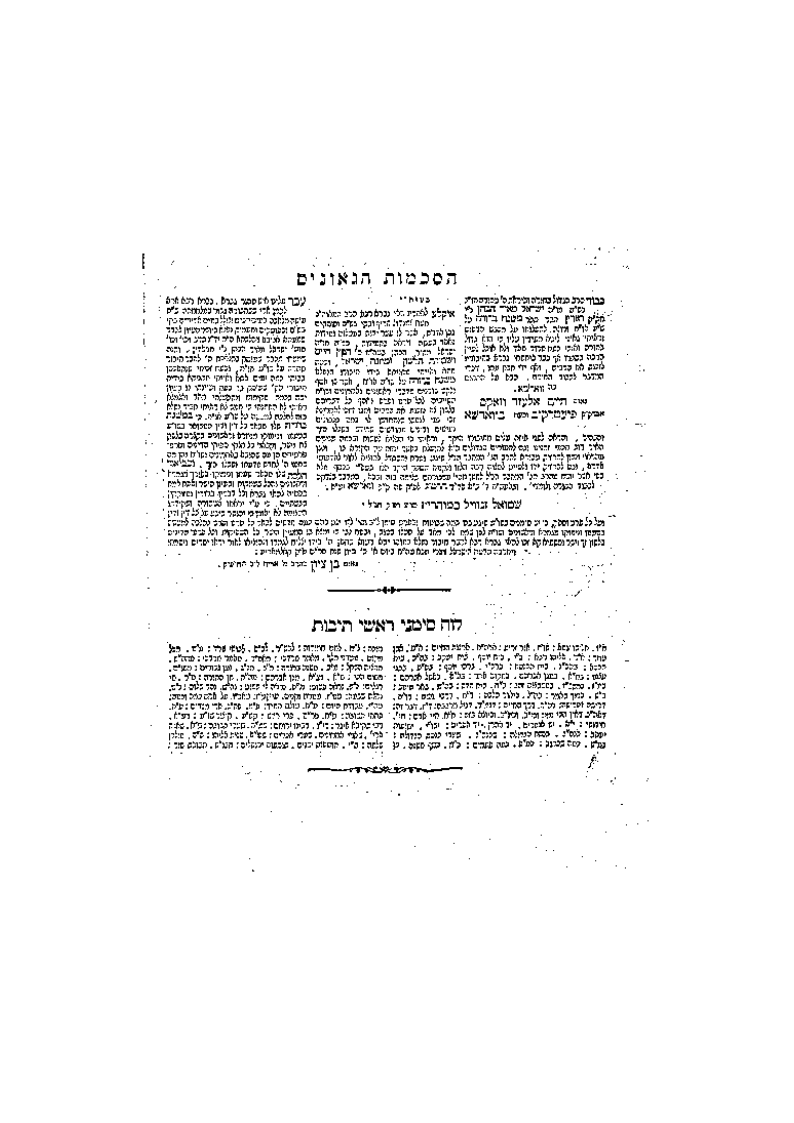
Copies of the 1884 of the Mishnah Berurah first printing aren’t identical. Working from several surviving exemplars, Menashe Caplan documents the variants: Rav Chaim Elazar Wacks’s haskama appears in some copies but not others; the last line of the introduction comes in three versions (blank, a halakhic gloss, or thanks to three specific donors); a printing warning appears sporadically; three different subscriber lists circulate in different combinations. Nothing is accidental. The Chafetz Chaim sat in the Warsaw press daily for months, and had to personally orchestrate which bundle of haskamot, acknowledgments, and subscriber lists went to which community.
Along the way Caplan raises questions the Chafetz Chaim never addressed: why isn’t financing print runs listed among forms of Torah support in Shem Olam? Why is ribbit devarim absent from Ahavat Chessed? Which edition of the Shulchan Arukh did he copy the base text from? Each puzzle gets the Talmudic refrain teyuvta de-Chafetz Chaim teyuvta — an unanswered challenge.
The piece is dedicated to Rabbi Eitam Henkin הי”ד, (see here and here) who was planning to write a doctorate about the Chafetz Chaim (see here), and would have probably addressed these questions. R’ Eitam HYD was cruelly murdered with his wife Na’ama on the third day of Chol Ha-Mo’ed Sukkos (1 October 2015).
לזכר הרב איתם הנקין הי”ד. חסרונו חי עימנו. אנקדוטות דפוס, ומסביבן, שבאופן טבעי, אותו היינו משתפים, עימו היינו מתייעצים, וממנו היינו לומדים. “ספר משנה ברורה – תהליכי כתיבתו, הדפסתו והפצתו” היה פרק מתוכנן בהצעת הדוקטורט שהרב איתם תכנן לכתוב על הח”ח ואין שום ספק, שכדרכו, היה נכנס לפרטים ולפרטי הפרטים. חבל על דאבדין. המקום ימהר עמידתו בקרוב, יחד עם כל נשמות חללי הטרור האזרחים, חללי צה”ל ומערכות הבטחון – ההרוגים על, ובשביל, עם ישראל ומלכות ישראל – המעלים את חימת המקום, במחיצת פפוס ולולינוס. הרחמן יקום נקמת דמיהם בקרוב.
את ספר משנה ברורה, והמקום המרכזי שתפש ותופש בחיי היהודים שומרי תורה ומצוות אין צריך להציג. מהדורות המשנה ברורה נסקרו היטב ע”י גב’ ברמה (ראו בהמשך) אך עדיין יש פרטים ביבליוגרפים הטעונים בירור ורישום (ולהעיר, אף מקור נוסח המחבר והרמ”א שבספר מ”ב טעון בירור, וכן כמה הערות מתודה1 ).
למען ירוץ בו הקורא נא ראו ראשי תיבות עותקי המ”ב המוזכרים במאמר2.
בתשמ”ד יצא ספרון: כתבי “החפץ חיים”: הרב ישראל מאיר הכהן מראדין: רשימה ביבליוגרפית, הרב משה גליס ואביעד הכהן, בצירוף תעודות ומסמכים לתולדות “החפץ חיים” (המשנה ברורה בעמ’ 76) – אך הוא קצר, ואין בו תיאורים או הערות.
בעבודת המ”א החשובה של גב’ מרב ברמה3: לדרכו של ה”חפץ חיים” בספר “משנה ברורה”, עבודת גמר (מ”א) – אוניברסיטת בר אילן, תשס”ח 2008 – המחברת רשמה, בנספח ו’ (עמ’ 119 ואילך) את מהדורות המשנה ברורה, באופן די מפורט, והוסיפה הערות כהנה וכהנה. הרשימה כוללת את המהדורות הרגילות (מה שקרוי הסטריאוטיפיות) שהן הקשות לרישום. המחברת לא נכנסה לפרטי ההדפסה של חלק א’ – נשוא רשימתנו.
המחברת מציינת (עמ’ 122, הערות למהדורות השונות, הערה 1) שההדפסה הראשונה נדירה ביותר, ומן הסתם, ההדפסה הראשונה אינה מצויה, נכון לאז. אך משנת 2008 נוסף מקור לא אכזב בדמות המכירות האינטרנטיות הפומביות, בעיקר באתר בידספיריט. בציון המהדורות הסטריאוטופיות נפלו שגיאות רישום, כפי שהמחברת ציינה, בצדק, שם בהערה, וגם בבידספיריט יש מוכרים ששוגים ברישום. להלן, בעזרת מפעל הביבליוגרפיה של הספריה הלאומית, יובהר מהי ההדפסה הראשונה ומה סימניה, ובעז”ה נעמוד על וואריאנטים נוספים.
עיקר עבודתה החשובה של הגב’ ברמה עוסקת במתודיקה של החפץ חיים בחיבורו המשנה ברורה, ולא בהיבטים – הצדדיים לתוכן החיבור – שאנחנו מעלים כאן. אגב אורחא, ובשולי עבודתה, בעמ’ 15, המחברת התייחסה להיעדר הסכמת ר’ ישראל סלנטר לספר חפץ חיים, והיא משערת, שההסכמה ניתנה – למרות הסתייגות הרב סלנטר ממתן הסכמות – אך בשל ריבוי שבחי הח”ח, הח”ח הוא זה שנמנע מלהדפיסה (ראה המקור לזה שם בהערה 43). המעיין בהסכמות הקיימות במ”ב יראה די שבחים. סיבה אחרת, ומרתקת, שההסכמה כלל לא ניתנה, הביא הרב אהרן סולוביציק, מהרב הוטנר (פרח מטה אהרן, ספר המדע, תשנ”ז, עמ’ 88, ועמ’ 187)4.
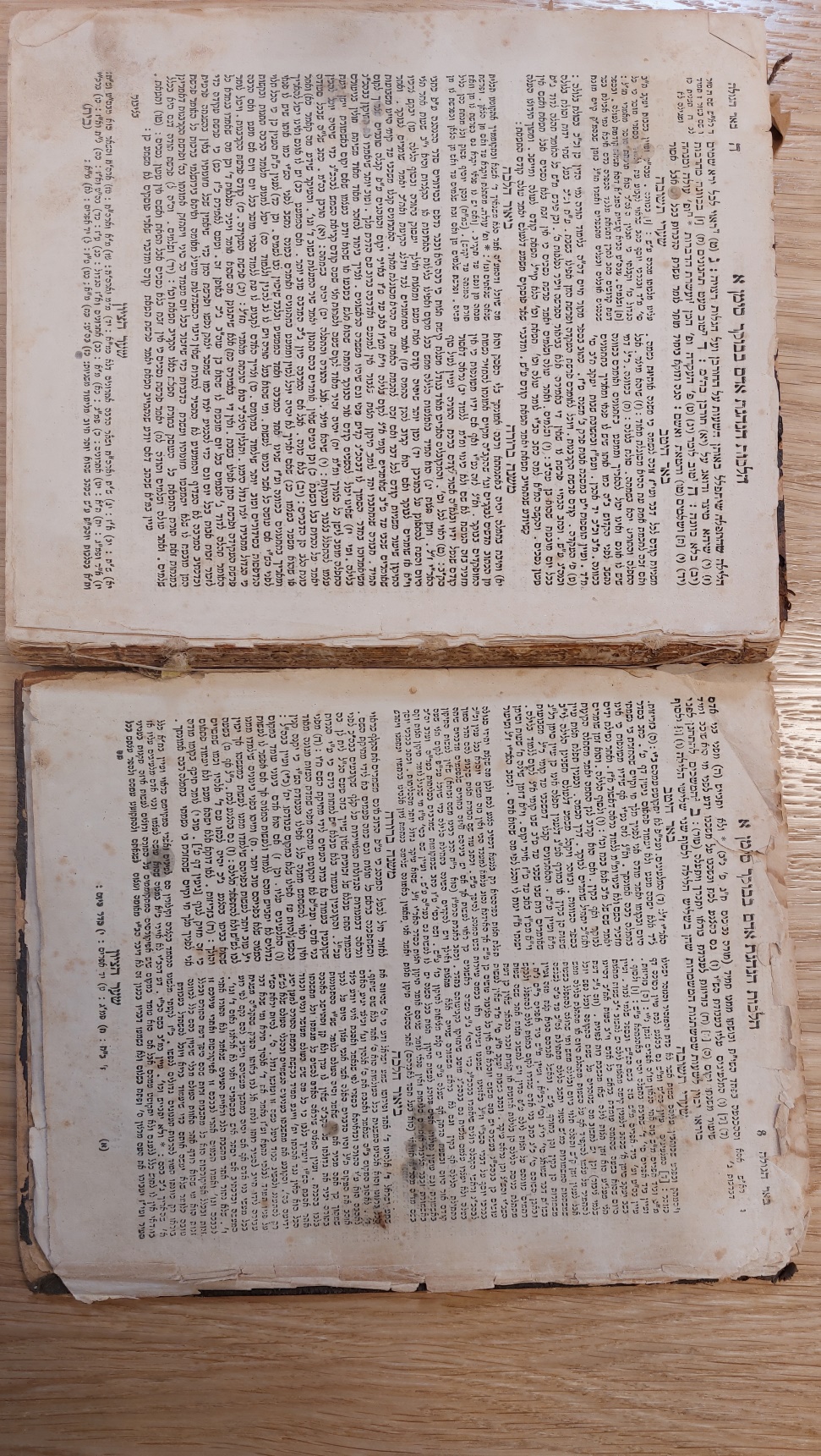
מכיוון שמן השמיים זימנו לנו עותק מההדפסה הראשונה של המשנה ברורה חלק א’ (אמנם לא עותק יפה – תן עיניך למהדורה), וחלק ב’ הראשון שיצא, הלכות שבת (ראו בהמשך), הזדמן לנו לבחון מקרוב, ומשם רשימתנו צמחה. כמעט שלא מדובר על התוכן ההלכתי של החיבור עצמו, אלא על עניינים בדפים שלפני גוף החלק ההלכתי שבספר, ולאחריו, שאף בהם, הלכה, הנהגה, ותלמוד מעורבבים.
מלבד גאונותו ומידותיו, החפץ חיים היה אינדיבידואליסט ו”קנאי” של ממש בכל הנוגע להכנת ספריו לדפוס, מכירתם והפצתם. הערותינו הביו-ביבליוגרפיות נוגעות, איפוא, בו, ובאישיותו הגדולה.
ולהערה שמקומה כאן: בתחילת הדרך כשכבר ידעתי לאן פניי מועדות, החלפתי דברים עם ביבליוגרף מוערך מאוד. הוא העירני שחלק מהשאלות שלי על הח”ח מוגזמות וכי אני מדייק בו, ומפלפל בו, בהגזמה רבתי – משל היה הלכה סתומה ברמב”ם – הרי מדובר בסך הכל בהליכי הדפסה, ובחלק מהמקרים, פכים קטנים, ושוליים, וזה “לא כ”כ מקצועי”. הביקורת במקומה, ממקומה. האומנם שאני הקטן, בע”ב פשוט – איני מסכים לה. הח”ח היה דייקן בכל דבר שכתב ועשה, כתפיים רחבות לו להכרעות פסיקה, קפדן גדול בכל הליכותיו, קפדן טקסטים, קפדן בפרטים, שישב פיזית בבית הדפוס, מדי יום, זמן ממושך, על חשבון לימודיו הקבועים. כל זיז ורז דפוס לא אניס ליה, והיה איכפת לו. איש גדול, שאופיו אופי פרטים – גם בפרטים קטנים וגם בפרטים “קטנים”, וזה חותמו. ברור לנו לגמרי שהח”ח חשב על הכל. אין כאן “פרומקייט”, ואף לא “האדרה” מלאכותית. כי זה האיש הגדול הזה, וזה אופיו. הקורא החושש שהמאמר יעסוק במופלג, שולי ומוגזם, יוכל לפרוש עכשיו.
יובל מאה וחמישים שנה להתחלת הדפסת המשנה ברורה יארע בעז”ה בעוד שנים ספורות (תשצ”ג-ד, 2033-4). היובל צפוי לעורר הד גדול בעולם היהודי, למשוך תשומת לב מכל גווני העולם היהודי, בכתב ובע”פ. כולם יכנסו לטרקלין ההשפעה העצומה של החיבור, ולשיטת עבודתו. רשימתנו אינה אלא סנונית קטנה ב”עטיפה” וב”פרוזדור” של החיבור. משגיאות ושגגות נקני.
סימני ההדפסה ראשונה
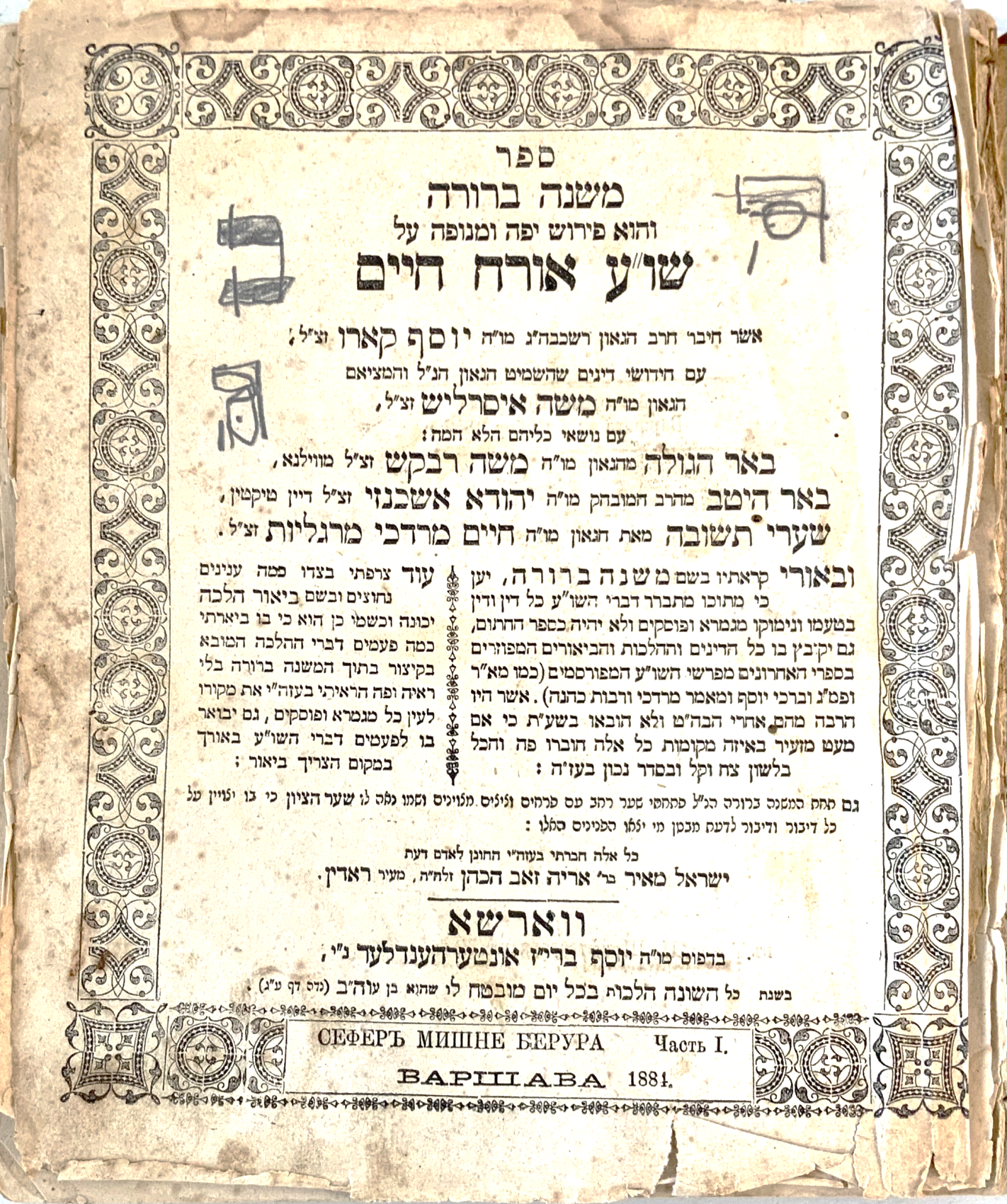
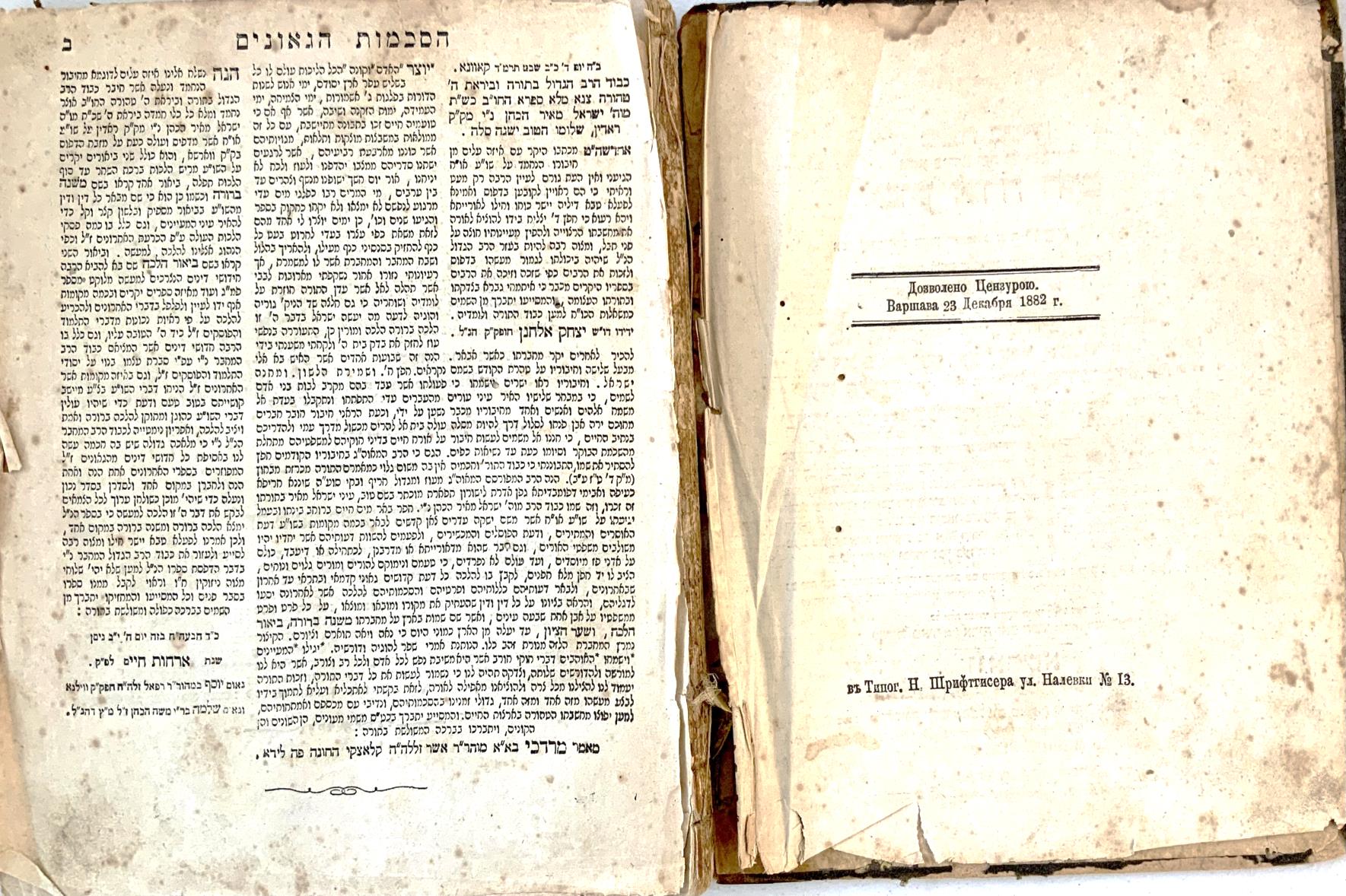
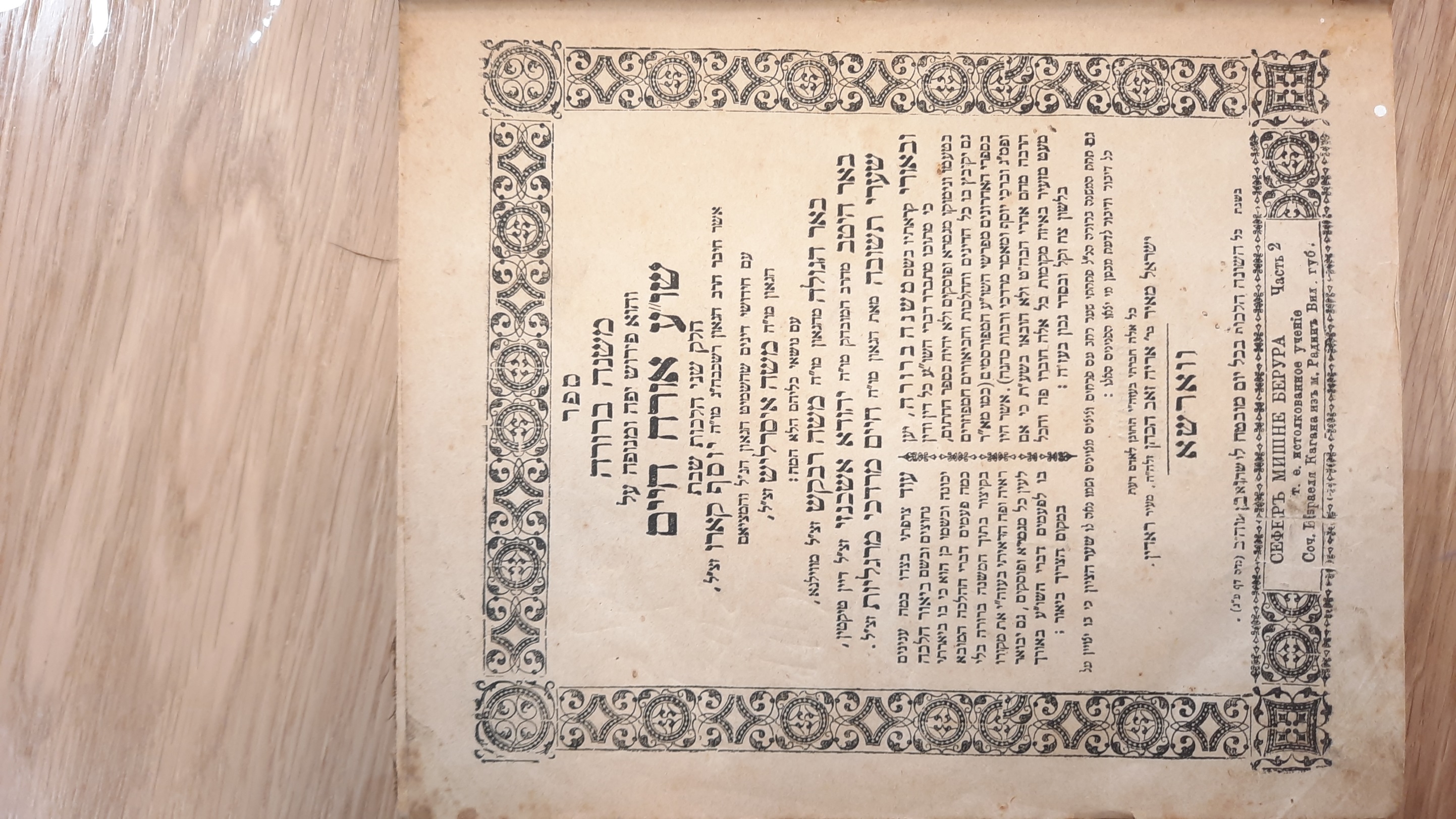
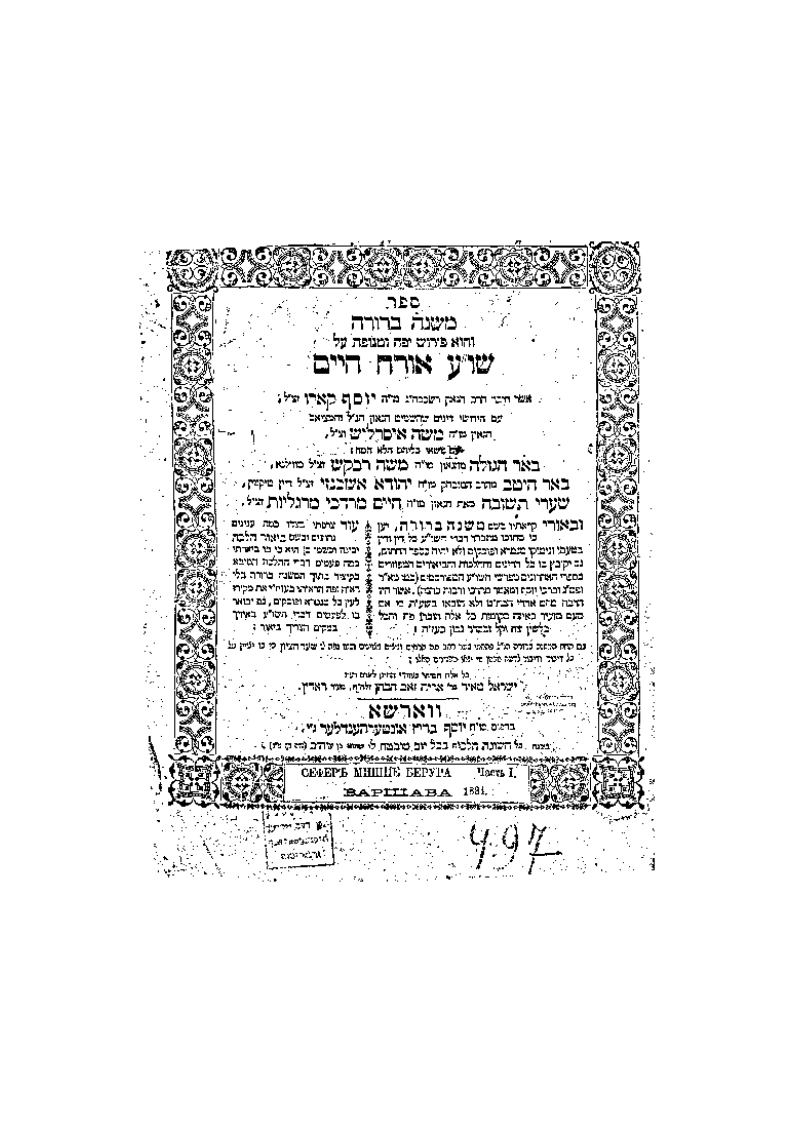
נקודת התחלה ראויה, תהיה במפעל הביבליוגרפי של הספריה הלאומית, על מנת לדעת שהיו שתי הדפסות של המשנה ברורה חלק א באותה שנה לועזית – 1884. באשר להדפסה הראשונה נרשם כך:
המדפיסים שבלועזית – במקור באותיות קיריליות.
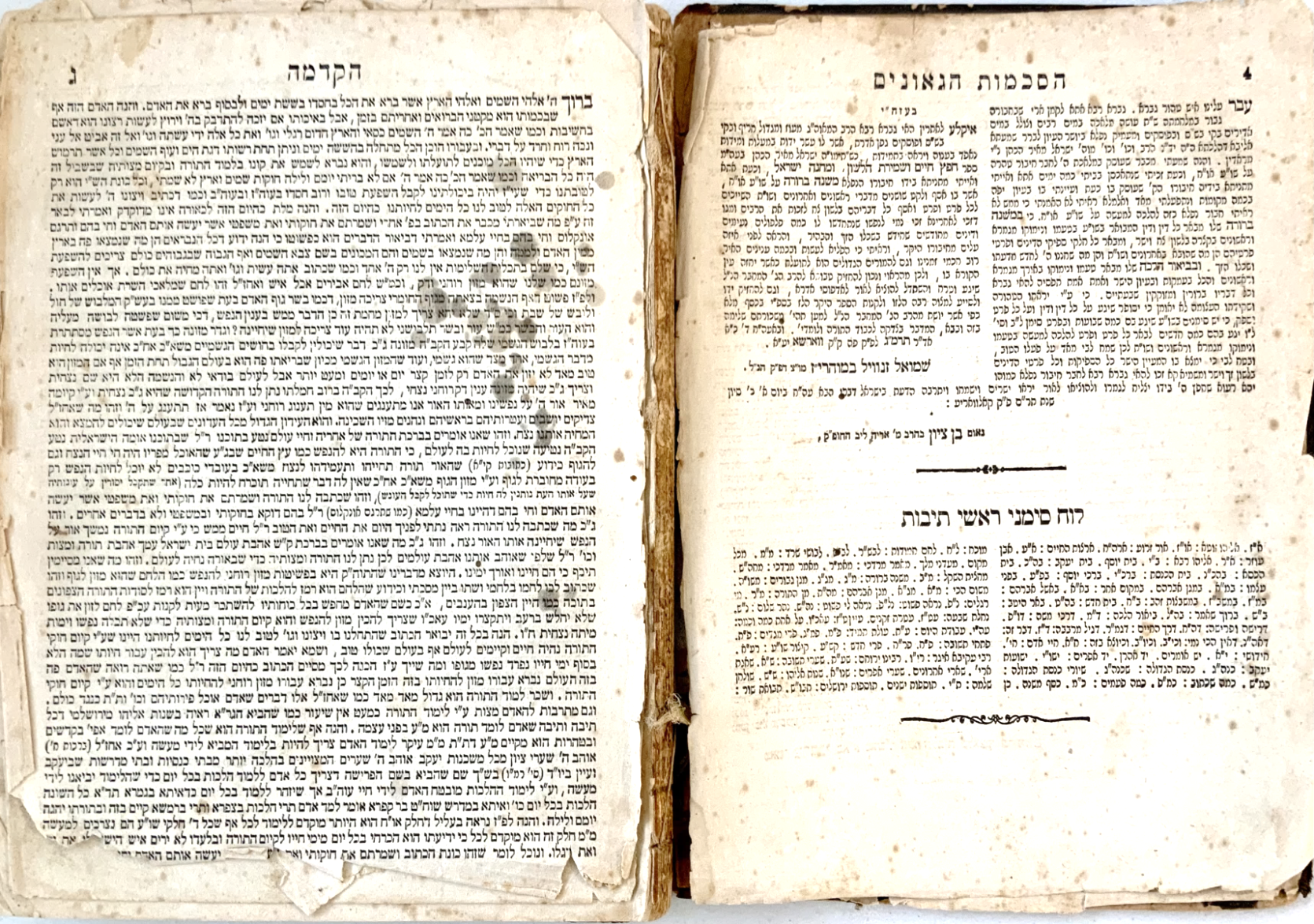
5 הסכמות5: ר’ יצחק אלחנן [ספקטור], קאוונא, כב שבט תרמ”ד, ר’ מרדכי קלאצקי לידא, רבני ווילנא: ר’ יוסף ב”ר רפאל [סאקוביץ] ור’ שלמה בר”י [ב”ר ישראל] משה הכהן, יב ניסן תרמ”ג , ר’ בן ציון ב”ר אריה ליב [שטרנפלד], קאלוואריע, כ סיון תר”ם, ו- ר’ שמואל זנוויל במוהרי”ז [יעקב זאב קלפפיש], ווארשא, כא אדר א תרמ”ג
משה מאיר ישר בספרו “החפץ חיים, חייו ופועלו”, כרך א, בני ברק תשנ”ז, עמ’ 222, כותב: ’בקיץ של שנת תרמ”ג הופיע הראשון לששת חלקי ה”משנהברורה“’. אך בנו של המחבר, ר’ אריה ליב פופקא, כותב “בשנת תרמ”ד הדפיס אבי את חיבורו משנהברורה ח”א” (מכתבי הרב חפץ חיים, וורשה תרצ”ז, עמ’ 30(
1 דף בסוף: “שמות החתומים”
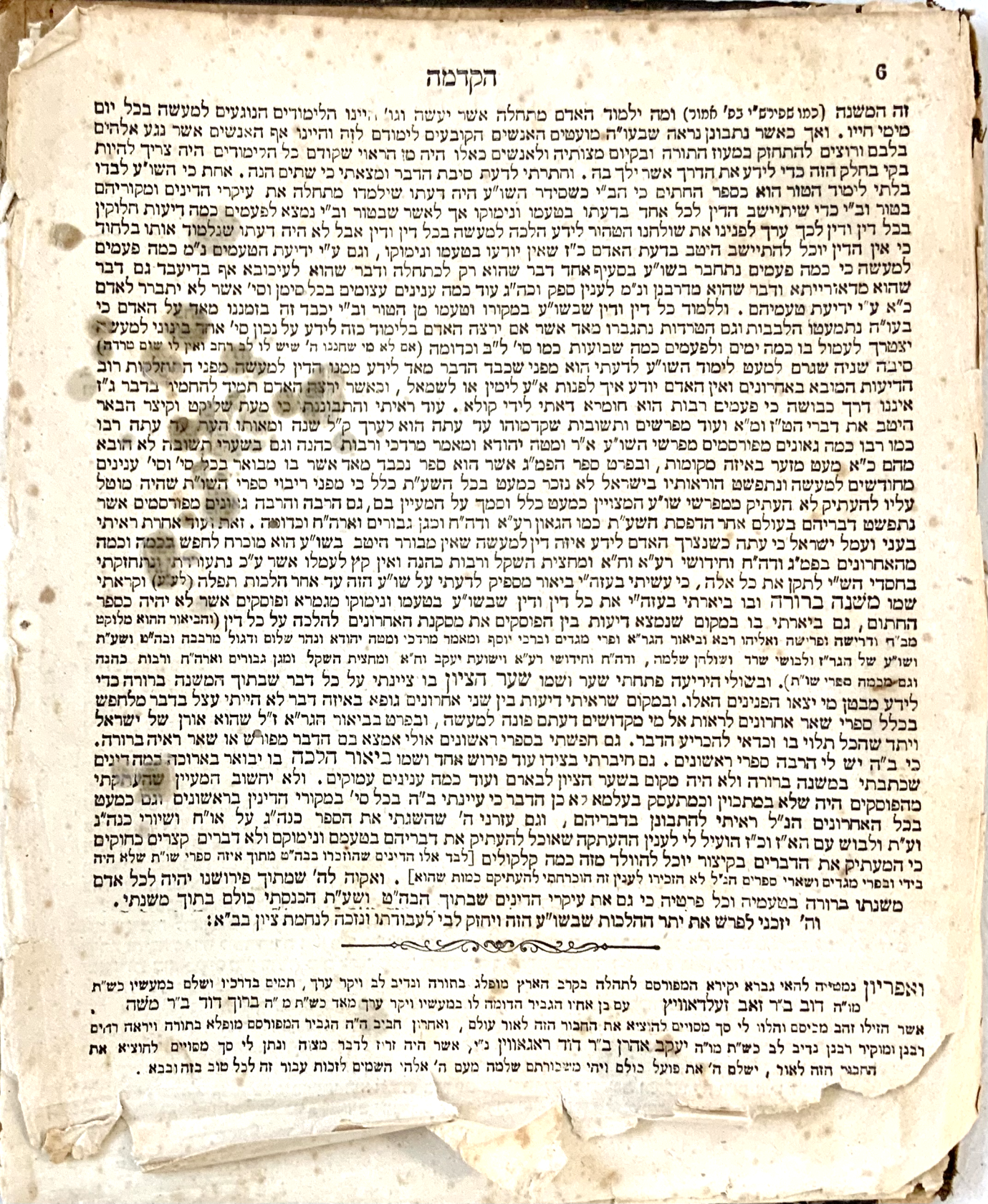
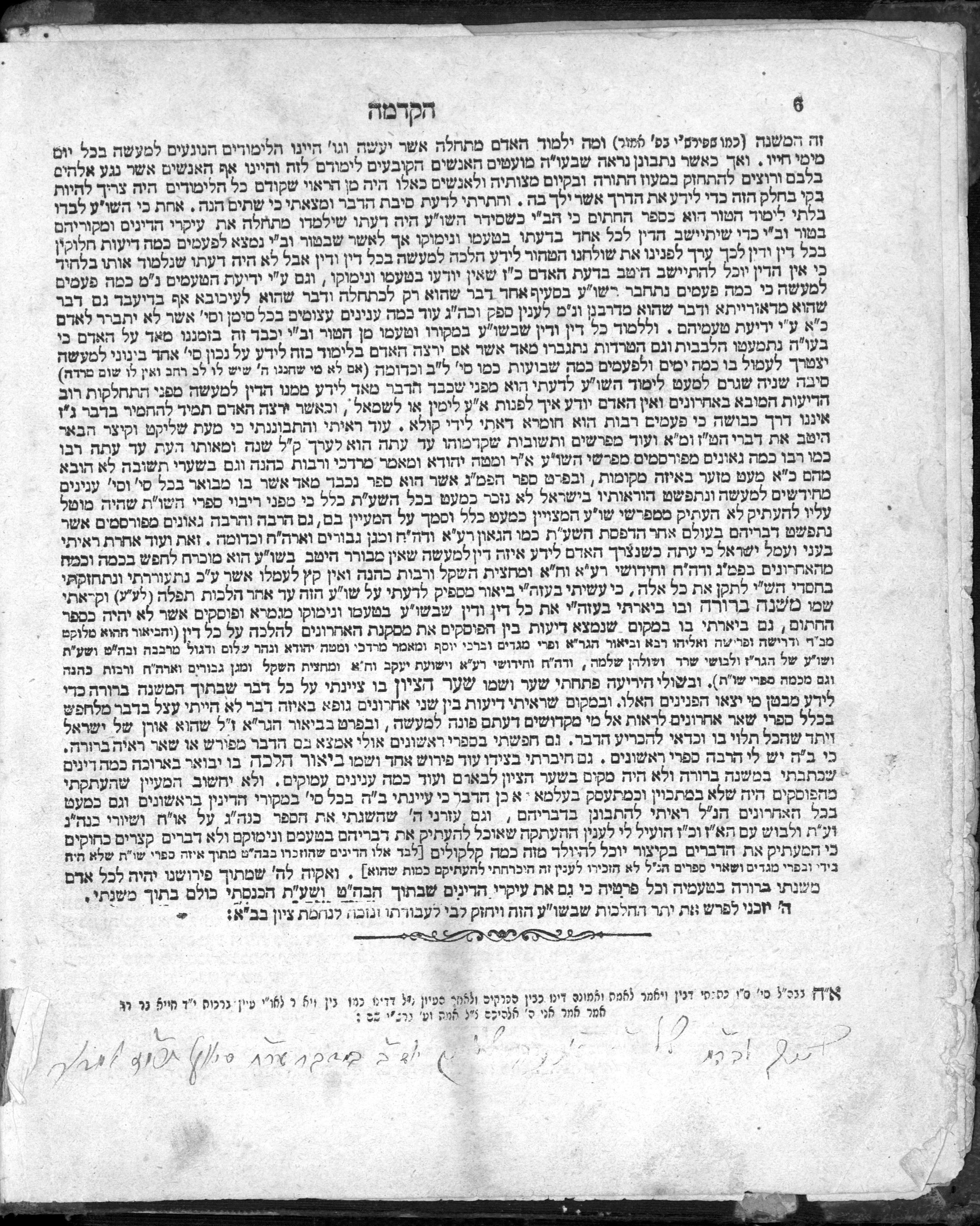
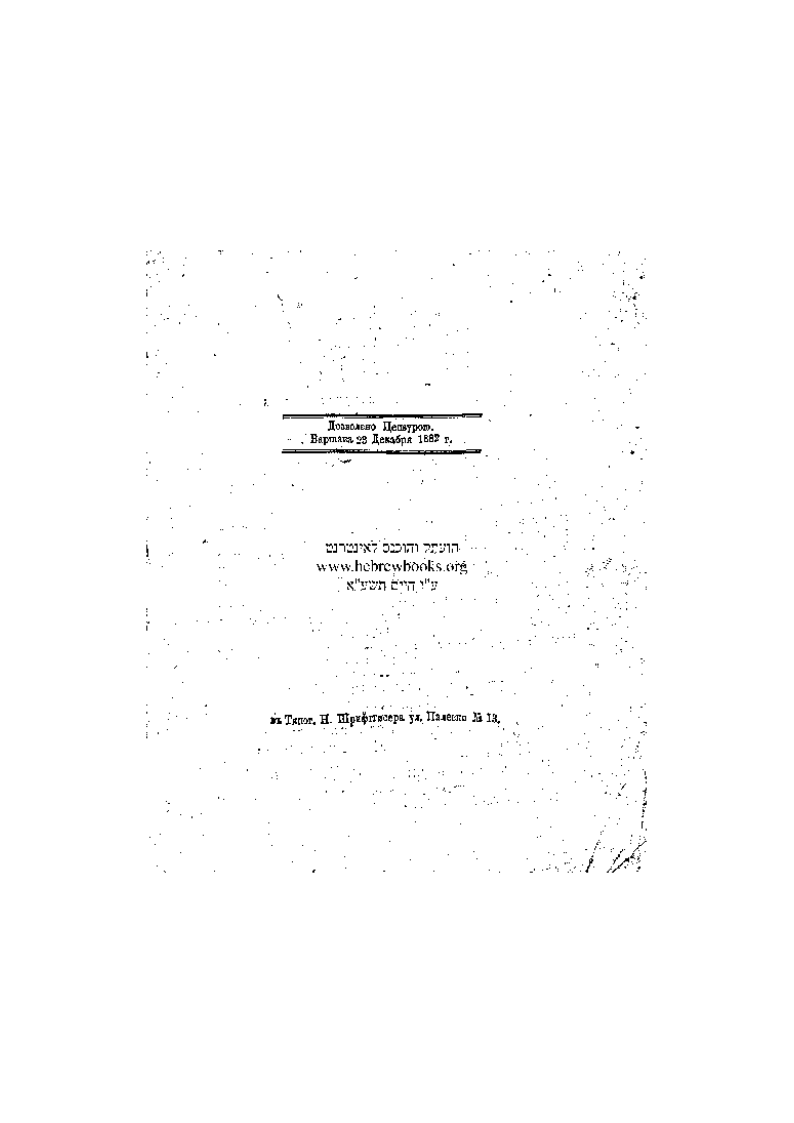
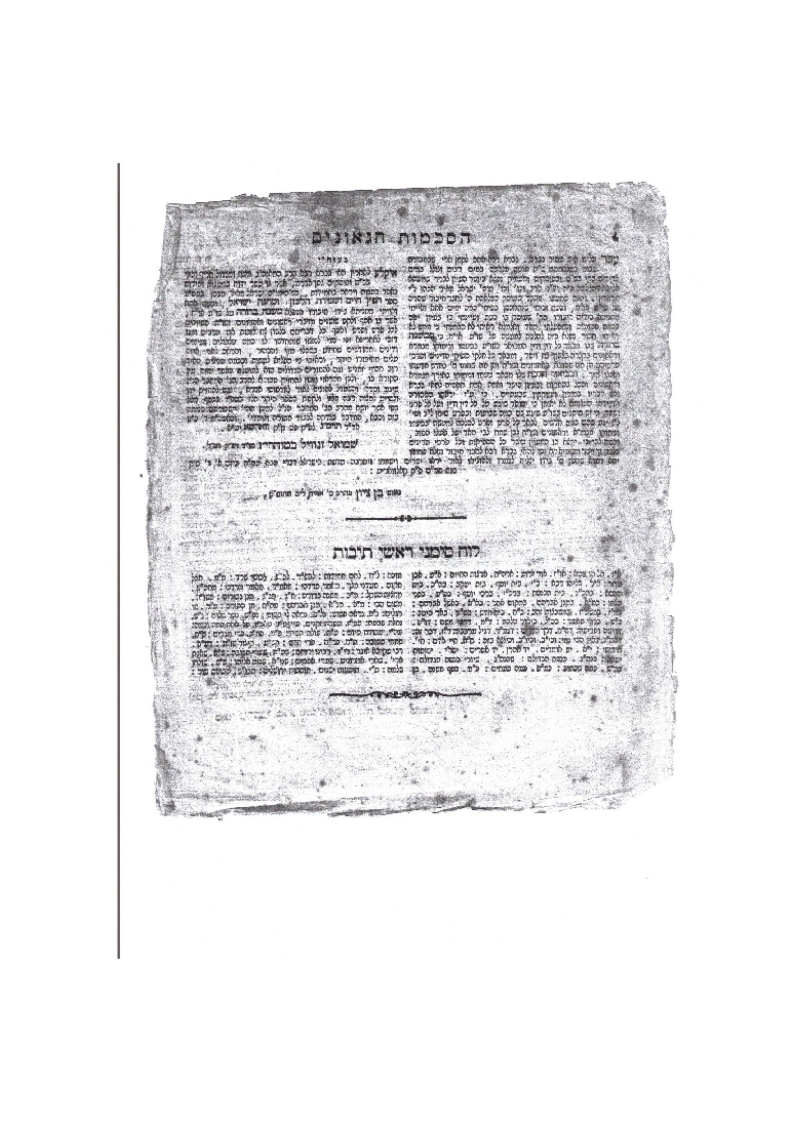
שער משנה ברורה חלק א’ מהדורה ראשונה הדפסה ראשונה– עותק מ”קהדפסה ראשונה עמודים 2-3 – אישור הצנזור 23 לדצמבר 1882הדפסה ראשונה עמודים 4-5.הדפסה ראשונה, עמ’ 6, העמוד השני של ההקדמה, בתחתית, ההודאה לתורמים – עותק מ”קהדפסה ראשונה העמוד השני של ההקדמה, בתחתית, הערה הלכתית – עותק ס”ל
ובאשר להדפסה השניה נרשם כך:
בשער: 1884. הפרט משנת תרמ”ג. מעבר לשער צנזורה מתאריך 1 למאי 1884 וכן שם הספר, שמו של המחבר ברוסית, ושוב התאריך 1884.
לעומת הוצאת 1884 המקורית, יש כאן השינויים הבאים: אין כאן שמו של המדפיס, לא בשער ולא מעבר לשער; תאריך רשיון הצנזורה שונה; בהוצאה המקורית אין שם הספר והמחבר ברוסית, ועוד. כמו כן נשמט כאן הדף האחרון עם רשימת החותמים. בשולי העמוד האחרון נוספה אזהרה מאת המחבר שלא להדפיס הספר ללא רשותו.
בעמ’ 192 יש שינויים בתוכן (ב”ביאור הלכה”): נוספה הערת-כוכב בשולי העמוד; באמצע דבור-המתחיל ’יצא’, במקום “בלבדו שלא הוציא בשפתיו”, תוקן ונדפס : “בלבו שלא השמיע לאזנו משמע”. [להעיר שבטופס ההדפסה הראשונה שתח”י כתוב “בלבו שלא הוציא בשפתיו”, לא “בלבדו” – שמא זו ט”ד של המפעל?]
עם הסכמות ר’ יצחק אלחנן ספקטור, ר’ מרדכי קלאצקי, ר’ יוסף סאקוביץ, ר’ שלמה ב”ר ישראל משה הכהן, ר’ בן-ציון שטרנפלד ור’ שמואל זנוויל קלפפיש, מההוצאה הקודמת (אף היא משנת 1884).
הסכמת הרב וואקס אינה רשומה במפעל הביבליוגרפיה בשתי ההדפסות. בעותק ה”ב ההסכמה מופיעה. בעותק ההדפסה השניה של 1884 היא מופיעה בעותק לג/2 (מכירה 3.11.24 פריט 45). עכ”פ יש לנו כמה סימנים להדפסה הראשונה: תאריך הצנזור 23 לדצמבר 1882, שם המדפיס נמצא, והפרטים האחרים. כנראה שעורכי מפעל הביבליוגרפיה ראו רק דף חותמים אחד, בעותק שלפניהם, ולא ידעו שיש עוד שניים.
צילומי עותק ה”ב ביחס להסכמת הרב וואקס הבאנו בהערה 5. אמנם הוספה או גריעה של הסכמה היא שינוי, אך לא מסוג עלומות הדפוס שנצביע עליהם. זה לעיתים תלוי-מקום, או תלוי שוק, ודבר טבעי. לעניין אחד השינוי הזה מתווסף: הצורך לסדר ולנתב את העותקים לאנשים וקהילות, באופן שההסכמה “תתאים”, או היעדרה.
מעורבותו העמוקה של הח”ח בהדפסת ספריו
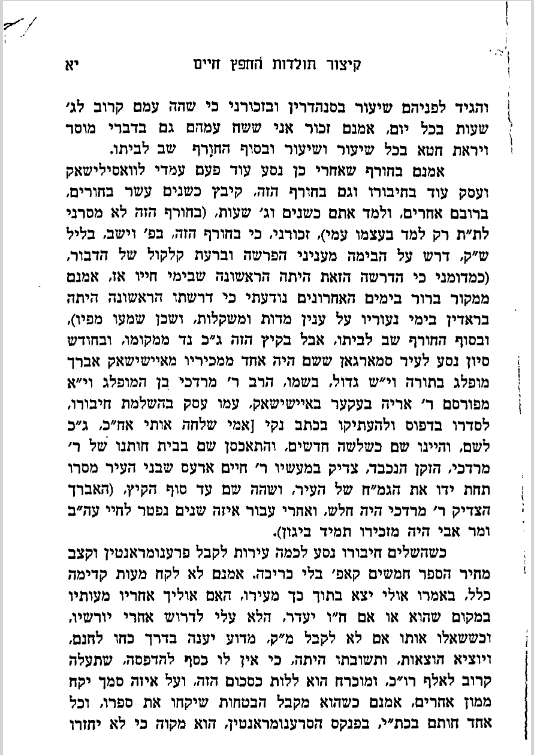
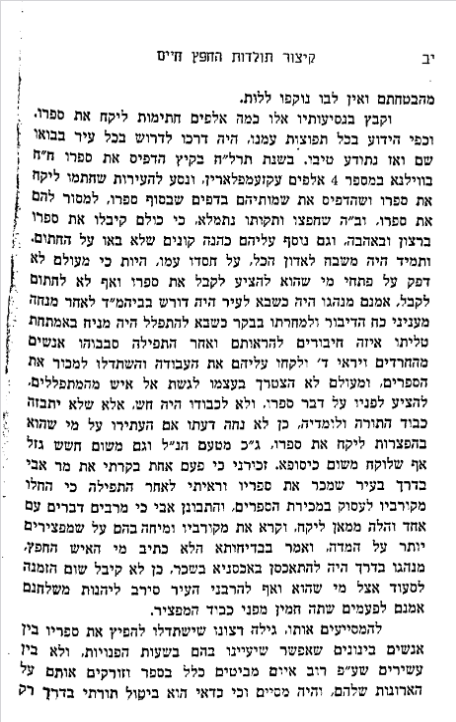
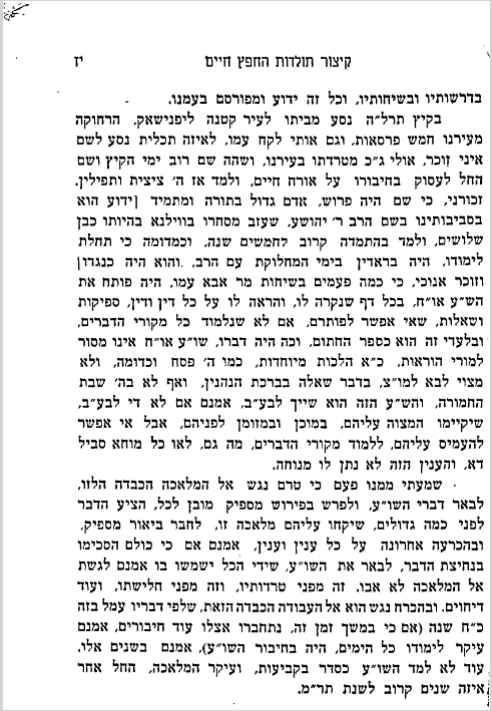
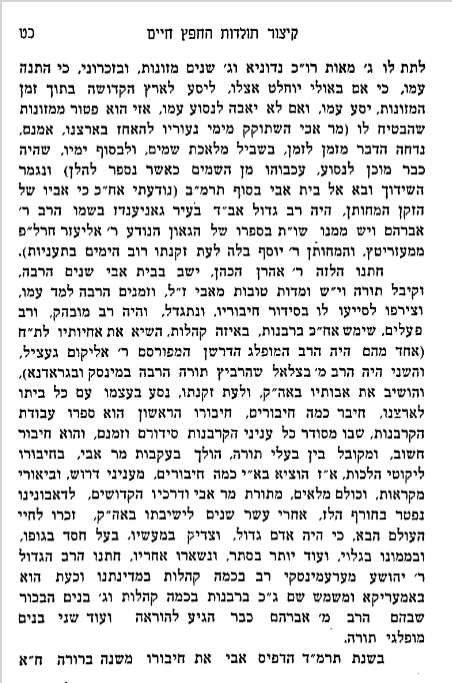
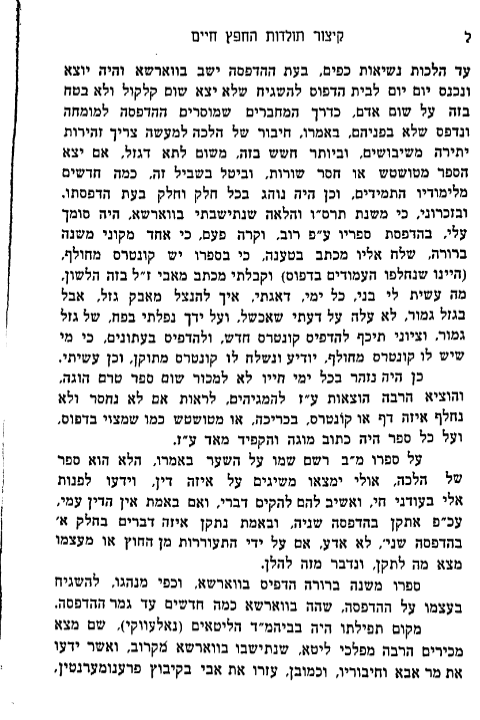
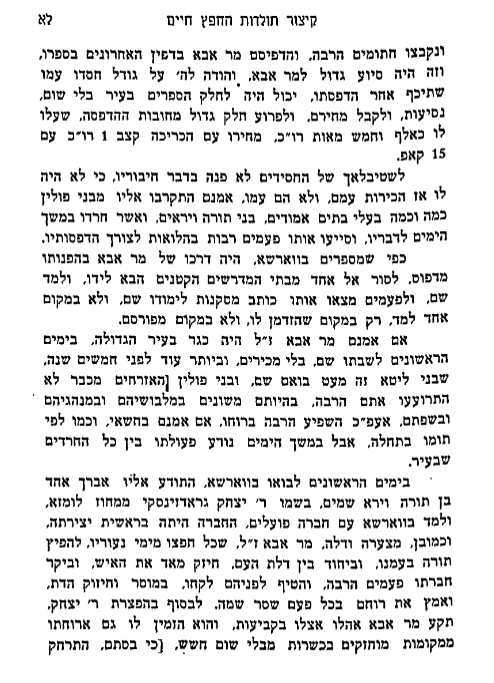
פרטים על מעורבותו של הח”ח, בהדפסת ספריו, מצויים בספר של בן הח”ח, הרב אריה ליב הכהן: תולדות וקורות חייו של החפץ חיים שיצא בשנת 1927 והדפסה חוזרת 1952. חזר ונדפס בראש ספרו האחר של הרב אריה: מכתבי הרב חפץ חיים זצ”ל, מהדורה שניה ניו יורק תשי”ג, אך המדפיס לא שמר על העימוד המקורי, צופף את הדפוס, ועימד מחדש. התיחסותנו תהיה, איפוא, למהדורה המקורית שנמצאת באתר היברובוקס.
ליקטנו כמה פרטים מתוך הספר – בסוגריים עגולות מספר העמוד, והערותינו בסוגריים מרובעות באותיות קטנות יותר. בסוף המאמר הבאנו נספח צילומי הדפים הרלבנטים.
הח”ח נסע בעצמו לגייס חותמים – פרענומערנטן – לספרו החפץ חיים (עמ’ י”א), [כנראה בשנת 1872 שכן הספר יצא בתרל”ג], הוא גייס כמה אלפי ! חותמים (י”ב), [בסוף הספר הדפיס 8 עמודים עם כ- 1,200 שמות], ובשנת תרל”ח הדפיס בווילנה 4,000 עותקים ונסע לחלק לחותמים (י”ב) [זו המהדורה השניה ולא ראינו שיש בה רשימות חותמים].
הנה הקישור למהדורת תרל”ג שבסופה נמצאים 8 עמודי הפרענומערנטן – עמ’ 161-168 לפי עמודי היברובוקס:
על המשנה ברורה הח”ח עבד 28 שנים (י”ז). בשנת תרמ”ד הדפיס חיבורו משנה ברורה חלק א’ (כט) [רישום האותיות בשער הוא תרמ”ג. יתכן שהשער הוכן עוד בתרמ”ג אך ההדפסה גלשה לתרמ”ד – עדיין 1983 – והלאה לשנת 1884 ככתוב בתחתית השער. האם יתכן שכתבו את השנה הלועזית מראש? באופן שהספר אכן יצא בקיץ תרמ”ג – 1883 – כפי שהרב ישר כתב בספרו: החפץ חיים חייו ופועלו, הוצאת נצח, תל אביב, תשי”ח – 1958, כרך ראשון, עמ’ ריד? וכמצוטט במפעל הביבליוגרפיה? איננו יודעים6].
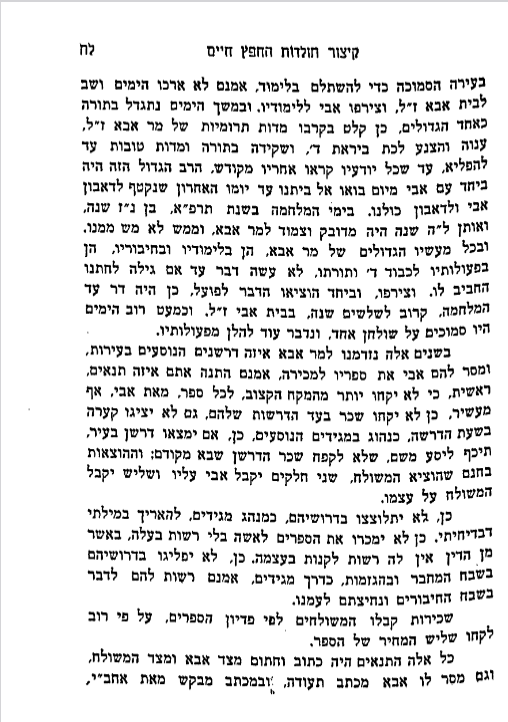
בעת ההדפסה ישב בוורשה ונכנס יום יום לבית הדפוס להשגיח שלא יצא קלקול, לא בטח בשום אדם, ביטל בשביל זה כמה חודשים מלימודיו התמידיים, וכך נהג בכל חלק וחלק בעת הדפסתו (ל).
מקום תפילתו בורשה היה בבית המדרש של הליטאים שעזרו לו בקיבוץ הפרענומערנטן (ל), ונקבצו חתימות הרבה והדפיסם בדפים האחרונים בספרו (לא) [“דפים” גרסינן ולא דף אחד. הגבירים שעזרו לח”ח באופן מיוחד אינם מוזכרים אצל הרב אריה. לכאורה, נעדר אצלו פרט משמעותי, שמא לא מקרי, כי ההודאה לתורמים הללו אינה מופיעה בכל ספרי המהדורה, ועל כך בהמשך דברינו].
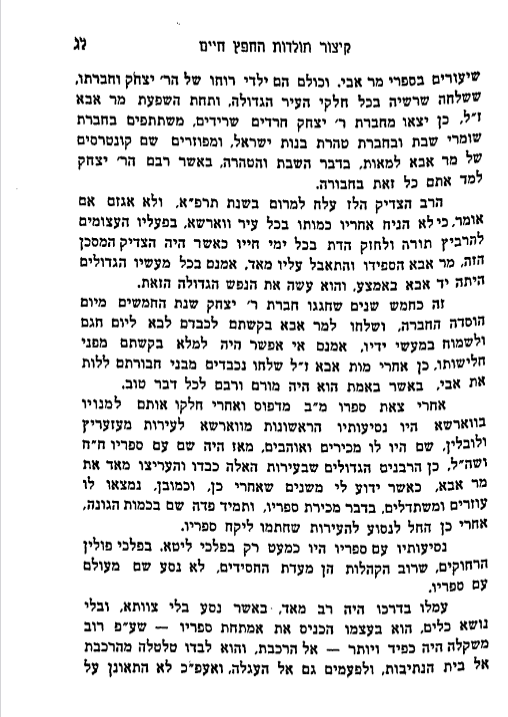
אחרי צאת ספר משנה ברורה, הח”ח חילק למנויים בוורשה, ונסיעותיו הראשונות היו למעזריץ ולובלין. נסיעותיו עם ספריו היו כמעט רק בפלכי ליטא. לפלכי פולין הרחוקים שרוב הקהילות חסידים לא נסע מעולם עם ספריו (ל”ג) [“מעולם” ! זו קביעה קטגורית די מפתיעה ומעוררת השתאות. וכי למה לא? הלוא גם חסידים רכשו ולמדו את המ”ב. מ- 1883 ועד 1933, שנת פטירת הח”ח, יחלפו חמישים שנה, וכי לא נסע עם ספריו ל”כרכי פולין הרחוקים” בכל חמישים השנים הללו? טעון בדיקה]
החלק הבא של משנה ברורה דילג להלכות שבת, מפני שראה דחיפות לעורר את הדור על השבת, ורק לאחר הדפסת הלכות שבת התפנה לחזור להלכות נ”כ וברכות הנהנין, לפיכך נדפס על השער של הלכות שבת, בהדפסה הראשונה, “חלק שני”, אם כי כבר בהדפסה הבאה, ועד היום, הוא חלק ג’ (ל”ח). כותרת “חלק שני” היא איפוא סימנה המובהק של ההדפסה הראשונה של הלכות שבת.
מהדורה ראשונה ויחידאה – תרנ”א – שהלכות שבת הוא חלק שני (מהמהדורה הבאה הלכות שבת הוא חלק שלישי)
ממה שאנחנו יכולים להתרשם, הח”ח לא בטח באיש והשגיח יום יום בבית הדפוס על מלאכת ההדפסה, ביטל מלימודו הרוטיני חודשים רבים, בכל חלק וחלק מהמשנה ברורה שהדפיס. אין ספק שהיה “קנאי” וקפדן גדול בכל הנוגע לתהליכי ההדפסה, והמכירה. לאור מעורבותו המלאה של הח”ח בהדפסה ובהגהה, פשיטא שלא ניתן לייחס מקריות בשינויים שנציג, ואין לנו שום ספק שחותמו של הח”ח, טבוע, על כל שינוי ושינוי, ועל הכל חשב.
“מוגה”
הח”ח הוציא הרבה הוצאות למגיהים ועל כל ספר היה כתוב מוגה, והקפיד על זה מאוד (אצל בנו, עמ’ ל”א)7.
בתי המכירות מציינים בהבלטה, כאשר המלה “מוגה” כתובה, בעט או עיפרון, כי כולי עלמא מאמינים שזה סימן מובהק שהספר יצא מידיו של הח”ח בכבודו ובעצמו, וכי המלה “מוגה” נכתבה על ידו. למרות שהשוואה אקראית של המילה “מוגה” נראית אולי דומה לעין רגילה, לא מקצועית, אך, ככל הנראה, על זה אין לסמוך כלל.
היות והרב אריה היה דייקן גדול והשתתף בכתיבת המשנה ברורה – ברא כרעא דאבוה – הוא מציין שאביו שכר מגיהים, וכי אביו הקפיד שעל כל ספר – “היה כתוב מוגה” גרסינן – ולא “היה כותב”. מדובר, כנראה, באלפי ספרים, ולכאורה, אם הח”ח היה כותב, אישית, על כל ספר “מוגה”, היינו מצפים שטרחה כזו, שלוקחת הרבה זמן ומאמץ, תהיה די חשובה, מרעישה ובולטת, שבנו יציין זאת.
לאחר העלאת הספיקות בשורות הללו, ראינו שגב’ ברמה, הוסיפה בעבודתה החשובה, מקור מפורש יותר (פסקה 3 בעמ’ 122), מבת הח”ח, פייגע זקס, שהמלה “מוגה” נכתבה ע”י הח”ח, או בני משפחתו או המגיהים ששכר. על פי שני ילדי הח”ח, יקום דבר.
בעותקים שבידינו (מ”ק) של הדפסה הראשונה של חלק א’, ובחלק שני המקורי – הלכות שבת תרנ”א – המלה “מוגה” איננה. אין לנו הסבר להיעדר “מוגה” בחלק שני-הלכות שבת (אם נכתב בעיפרון אולי נמחק?). ביחס להיעדר “מוגה” בחלק א’ אולי חסר עמוד חוצץ ששם היה כתוב, או שמא ההיעדר מכוון? איננו יודעים. עיון אקראי בבידספיריט יראה שלא תמיד נמצא את המלה “מוגה”. כנראה שההקפדה לא הייתה מאה אחוז, על אף עדות ילדי הח”ח.
בכל אופן, ולאור ורסיות הדפוס של ההסכמות, ההודאה המיוחדת לתורמים, ודפי החותמים שנעסוק בהמשך – האם “מוגה”, והיעדרו, הם יד המקרה? לאור דברינו צריך להניח שאין מקריות אצל הח”ח. מה הטעם? לא נדע. על כן גם זו תיובתא דח”ח תיובתא, מדוע לא נרשם “מוגה” בכל העותקים, במיוחד שהיה צוות שעסק בזה. על רקע הווריאציות השונות של עמודי הפתיחה של הספר, ודפי החותמים בסוף – “מוגה” מקבל משנה חשיבות. האם “מוגה” שימש אות: הרכב ספר זה דווקא לפלוני? או לקהילה פלונית? אין לנו אפשרות היום לראות כמות גדולה ומייצגת של ספרי ההדפסה הראשונה, ולא נוכל לבדוק ולהיווכח מה היה ה-“כלל ופרט” של הח”ח, או בלשון העידן שלנו, מה היה “תו התקן” של הח”ח.
בתי המכירות והקונים ישימו לב כאשר רואים את המלה “מוגה”. אך אדרבה, יזהר הקונה שרואה את המלה “מוגה”. ממש לא בטוח שזה כתב ידו של הח”ח, והסיכוי הסטטיסטי שכתב ידו הוא זה, הוא, נניח, אחד לעשר בערך, במקרה הטוב, בלקיחה בחשבון את בני המשפחה והמגיהים. תשע כתיבות “מוגה”, ו”מוגה” אחד כת”י הח”ח בעצמו, כמחצה על מחצה דמי?
צילומים של המשנה ברורה ח”א
הספר מצולם במספר אתרים, ונחזור על הסימונים.
עותק הספריה הלאומית סימנו ס”ל, יש לחפש לפי הרשומה:
990011055150205171 , השלישי ברשימה (דרך הקטלוג מגיעים לטופס ה”ב שלהלן ולא לטופס המצולם של הספריה הלאומית).
עותק בית המכירות Legacy Judaica עם צילומים בודדים סימנו ל”ג/1 – מכירת 13.9.20 פריט 64.
עותק נוסף ממכירה אחרת של Legacy Judaica עם צילומים בודדים ל”ג/2 – מכירת 3.11.24 פריט 45.
העותק ברשותנו סימנו מ”ק.
השינויים בשורות לאחר ההקדמה
אנחנו רוצים להצביע על שינוי מעניין. בטופס ה”ב לאחר סוף ההקדמה המשך העמוד ריק. בעותק מ”ק מופיע הודאה לתורמים. בעותק ס”ל בסוף ההקדמה מודפסות שתי שורות של הערה הלכתית בנוגע לסימן ס”ו:
“א”ה [אמר המחבר מ.ק.] בבה”ל סי’ ס”ו כתבתי דבין ויאמר לאמת ואמונה דינו כבין הפרקים, ולאחר העיון נ”ל דדינו כמו בין ויאמר לאו”י עיין ברכות י”ד חייא בר רב אמר אמר אני ה’ אלהיכם צ”ל אמת וע’ ברש”י שם”.
גירסה קמא מופיעה בביאור הלכה בסימן ס”ו, בד”ה *ואלו הן בין הפרקים וכו’, עמ’ 200, פיסקה שניה.
לפחות בעותק מ”ק נוכל להעיד שמדובר באותו קטע קמא ללא השינוי. ואכתי קשיא מדוע ההערה ההלכתית אינה מופיעה בכל ההדפסה ראשונה? תיובתא דחפץ חיים תיובתא.
ועוד שינוי. בעותק מ”ק, לאחר ההקדמה, מודפס קטע של כמה שורות הודאה, לשלושה תורמים שעזרו בהדפסה: דוב ב”ר זאב זעלדאוויץ, בן אחיו ברוך דוד זעלדאוויץ ו- יעקב אהרן ב”ר דוד ראגאווין. השניים הראשונים “הלוו לי סך מסויים”, והשלישי “נתן לי סך מסויים”. לא מצויין מהיכן הם. הקטע הזה אינו נמצא בעותקים האחרים שראינו. זה מעורר תמיהה. וכי מדוע יישמט נדבתם בעותקים אחרים? ותמיהה כפולה – הכיצד בעל ספר החפץ חיים (שקדם למשנה ברורה) – לא יוקיר להם תודה בכל מהדורת ההדפסה? גם זה תיובתא דחפץ חיים תיובתא.
ההודאה לתורמים – עותק מ”ק
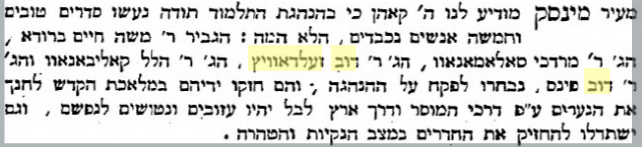
אי אזכור מקום מושבם מושך תשומת לב, במיוחד על רקע ציון ערי חותמי הפרענומערנטן. בגוגל לא מצאנו עליהם פרטים, אבל באתר המצויין עיתונות יהודית היסטורית, נמצאו, כפי הנראה, קצת פרטים על שניים מהם, ונקווה שקלענו, ואכן הם המה. הג’ [הגביר] דוב זעלדאוויץ מוזכר ב”הצפירה” 7.7.1885 כתושב מינסק, וב”המליץ” 8.7.1894 הוא עדיין תושב מינסק. ב- 1896 הוא תושב אודיסה, וב- 1900 כתורם לספריה שיסד ד”ר חזנוביץ (לימים הספריה הלאומית), והוא מהעיר יליסובטגרד (כיום קרופיבניצקי) דרום מזרח לקייב. ז”א שבזמן הקרוב להדפסת הספר, דוב זעלדאוויץ הוא תושב מינסק. המרחק בין מינסק לראדין הוא 192 ק”מ, והמרחק בין מינסק לוורשה הוא 557 ק”מ. גם אם המרחק לא כ”כ רחוק מראדין – הוא מספיק רחוק מוורשה.
הצפירה 7.7.1885
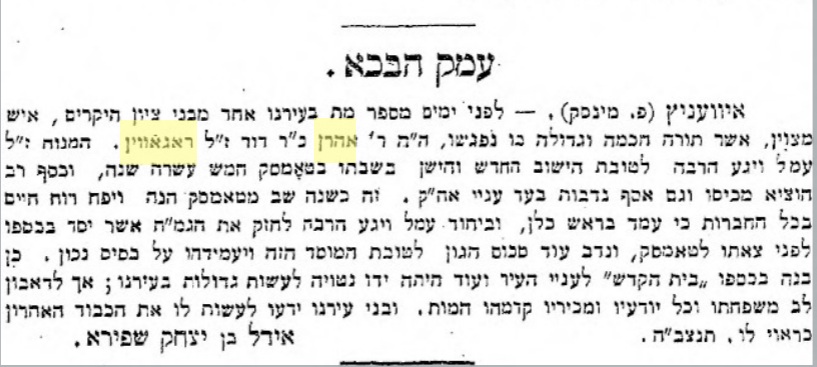
בהמליץ 9.3.1899 מופיעה ידיעה על פטירת [יעקב] אהרן ב”ר דוד ראגאווין, במינסק. “זה כשנה שב מטאמסק”, ז”א 1898. הוא היה כנראה נדבן גדול, וצויין שישב בטומסק חמש עשרה שנה. זה מביא אותנו לשנת 1883, כך שכנראה היה בעיר טומסק בזמן הדפסת חלק א’ של המשנה ברורה. העיר טומסק היא בירת מחוז טומסק, המחוז הפדרלי בסיביר, במערב סיביר. המרחק בין טומסק לראדין הוא 4,581 ק”מ, והמרחק בין טומסק לוורשה הוא 4,938 ק”מ ! רחוק ממש.
המליץ 9.3.1899
אם כנים דברינו, והאנשים הם המה, הנדבנים רחוקים מוורשה, ומקהילתה, והרבה. לפי הדברים היפים שהח”ח כתב עליהם, הם הלוו לו, והרימו תרומה משמעותית, שכנראה הייתה נחוצה מאוד לח”ח בהדפסת הספר, על כן בדין יזכירם לטובה. ולמה לא יזכירם בכל עותקי ההדפסה הראשונה? מוכרח להיות לזה סיבה, וסיבה כזו שתעמוד במבחן מחבר ספר החפץ חיים. האם יכול להיות שהח”ח לא רצה לציין את תרומתם כדי לא לבייש אחרים, או את אנשי וורשה? הנה נדבנים רחוקים מוורשה, האחד במרחק 557 ק”מ, והשני במרחק 4,938 ק”מ, הם שעזרו, ומתוך שבחם יבוא לגנות את אנשי וורשה חותמי הפרענומערנטן שלא הרימו די? מצד שני, בעותק מ”ק (ראה להלן) מצורף דף חותמי וורשה, ובתחילת העותק ההודאה לתורמים. תיובתא דחפץ חיים תיובתא.
עם סגירת הגליון, ראינו שבית המכירות Winner`s במכירה 148, פריט 174, מיום 30.3.25, מכר עותק של חלק א’ הדפסה ראשונה הכוללת את ההודאה לתורמים, ובסופה עמוד פרענומערנטן מסוג לג/2.
הוצאות הדפסת ספרי לימוד – בכלל החזקת התורה?
הח”ח כתב ספר בשם: שם עולם [חלק ראשון] 1895, וחלק שני 1897. על פי שער הספר, תעודתו, בין היתר, לעודד את החזקת התורה. בחלק ראשון, פרק ט”ו, שכותרתו היא: “בו יבואר גודל חיוב החזקת התורה וגודל שכרה”. בעמ’ 40, עמודה ראשונה, מונה הח”ח את סוגי החזקת התורה: לשלם שכר לימוד התורה של עניים, החזקת ישיבות ות”ת שלא יתמוטטו, החזקת תלמידים ורבנים הלומדים תורה, נתינת סחורה לת”ח להשתכר, ולהשיא בתו לת”ח. בחלק שני, עמ’ 14, בהערה השניה בעמוד, שנמשכת לעמוד 15, הח”ח מרחיב על תמיכת זבולון ביששכר, באופן שסוחר יקח מופלג בתורה ויתן לו כל צרכי חיותו בשלמות, והאופן השני של החזקת תורה, להחזיק ישיבות.
על פי שניים עדים יקום דבר, ועל פי שניים עדים יעדר דבר. די מפתיע, לכאורה, שמימון להדפסת ספרים אינו ברשימה. בשנת 1895, הח”ח הרי כבר אחרי הדפסת שמירת הלשון, ואחרי הדפסת שתי הדפסות מ”ב חלק א’, וגם חלק שני הלכות שבת – בודאי בשנת 1897. קשיי המימון – הרי חש היטב. על כן גם זו – תיובתא דחפץ חיים תיובתא. ודו”ק: אמנם אולי אפשר להסתפק האם סיוע במימון הדפסת ספר היא צדקה במובנו הממוני, אך כאן ההדגשה היא על החזקת התורה, ולכאורה עזרה במימון הדפסת ספר – בודאי ספר יסוד הלכתי – היא החזקת תורה במובן הכי קלסי, ללמוד ולקיים, בין בהלוואה ובין בתרומה. וגם זו – תיובתא דח”ח תיובתא. ומה זה אומר על הנדיבים? מה המצווה שהם קיימו? חסד ודיו?
מחיר הספר לחותמים מראש
הרב ישר (בספרו: החפץ חיים חחיו ופועלו, הוצאת נצח, תל אביב, תשי”ח-1958, כרך ראשון, עמ’ ריג) מצטט מכתב שהח”ח כתב לר’ חיים ליב הכהן מטיקטין, מיום ד בשלח תרמ”ג (ט’ שבט – 17.1.1883) , ובו בקש ממנו להשיג פרענומערנטן לספרו החדש המשנה ברורה. הח”ח צרף דפים לדוגמה של הספר, וכמו בספרו “חפץ חיים” שהיו לו יותר מאלף חותמים, התשלום יהיה כשיקבלו את הספר, במחיר רובל כסף, ושמותיהם יודפסו. אין אנו יודעים מה היה מחיר הספר לקונה הרגיל שלא חתם מראש – אותו מחיר? תמצאו את שמו של ר’ חיים הכהן רשום בעמוד הראשון של דף החותמים השני (טיקטין) – עותקים ס”ל, ה”ב ו- ל”ג/1, עמודה ימנית שורה 17 למטה, ראו להלן התמונה.
באשר למחיר הספר לחותמים מראש, יש אי בהירות. במכתב המצוטט המחיר רובל כסף אחד. הרב אריה, בנו, כותב בעמ’ ל”א (ראה בנספח) שהמחיר היה 1 רובל כסף ו-15 קופייקות (עם כריכה?). עכ”פ בנו מציין שם בעמ’ ל”א שהוצאות ההדפסה היו כאלף וחמש מאות רובל (לשתי הדפסות שנת 1884? לא נראה – רק להדפסה הראשונה). לפי שלושה דפי החותמים הידועים לנו, היו כאלף חותמים. אזי למחיר הפרענומערנטן יש משמעות כלכלית גדולה. לאלף חותמים, ההפרש משמעותי: אלף רובל או רק חמש מאות רובל. אפילו תאמר אלף רובל עדיין השלמת חמש מאות רובל זה סכום נכבד, וההודאה המיוחדת לשלושה מתבררת כמשמעותית ביותר. עכ”פ התיובתא – באשר להיעדר תמיכה בהדפסת ספר בגדר החזקת התורה – ממקומה, לא יצאה.
אין כאן ריבית דברים
דבר אחד ניתן להגיד בבטחה: ציון שם חותם מראש (למרות שמשלם רק עם קבלת הספר), ציון שם המלווה, וציון שם תורם – כולם אינם בכלל ריבית דברים לדעת הח”ח. על רקע ההלכות של ריבית דברים, היה מעניין לדעת מה דעת הח”ח מתי מותר לשבח בדברי ברכה החמים למי שהלווה לו, ולמי שתרם לו8. אגב אורחא, חיפשתי אצל הח”ח בספר אהבת חסד התייחסות לריבית דברים. לא מצאתי, ופניתי לצאט איי אי (בתשלום). בתחילה מסרו קטעים עם ציון לספר. בבדיקות במהדורות שונות שהם ציינו, לא נמצאו הקטעים. חזרתי לצאט, הם בדקו בדיקה חוזרת, חזרו בהם והתנצלו (ומכאן משנה זהירות בשימוש בצאט. אך אדרבה, שימוש מושכל והעמדת הצאט על התיקון מועילה לכלל המשתמשים, וחשובה, כי הצאט מתגבש, למעשה, לסטנדרד עולמי. יש להקפיד לרשום לצאט בצורה ברורה שהציטוט אינו נכון ולבקש, בנימוס, שיתקנו על אתר. הצאט מודה בטעות, מודה לתיקון, ומתקן על אתר. במקרה אחר ביקשנו מאדם אחר שיבדוק אחרי כמה ימים, וראינו שתיקנו הכל. והרי הכל במהירות “תוך כדי דיבור”). אכן אין באהבת חסד התיחסות לריבית דברים, וזה, לכאורה, המקום הטבעי להתייחס לזה. מכיוון שאין מקריות אצל הח”ח, ההשמטה, גם היא תיובתא דח”ח תיובתא.
דפי הפרענומערנטן
חותמים מראש על ספרים – פרענומערנטן – היא תופעה די מוכרת9. יש בזה עזרה כלכלית בקבלת תשלום מראש, אולי גם הנחה מהמחיר המלא לאחר ההדפסה וההפצה, ושוברו בצדו – הוקרה מודפסת. הח”ח, דווקא הקפיד שלא לקבל שום תשלום מראש אלא רק עם קבלת הספר. יש בזה הכרה שהספר ראוי, ומעלין בקודש אם משיגים גם שמות ת”ח חשובים, דבר העוזר לקונה להחליט לקנות. מלבד ההיבטים הללו, אגב אורחא, יש עיסוק גדול סביב עצם רשימות השמות למקצוע הגניאולוגיה, וזיהוי מקומם של אנשים. ספר יסודי הוא ספרו של בערל כהן: פרענומערנטן (1975), שיש בו הקבלת שמות, ערים, וספרים. הוא הקיף הרבה ספרים, ויש לקוות שיום אחד הספר יושלם בספרים שכהן לא רשם.
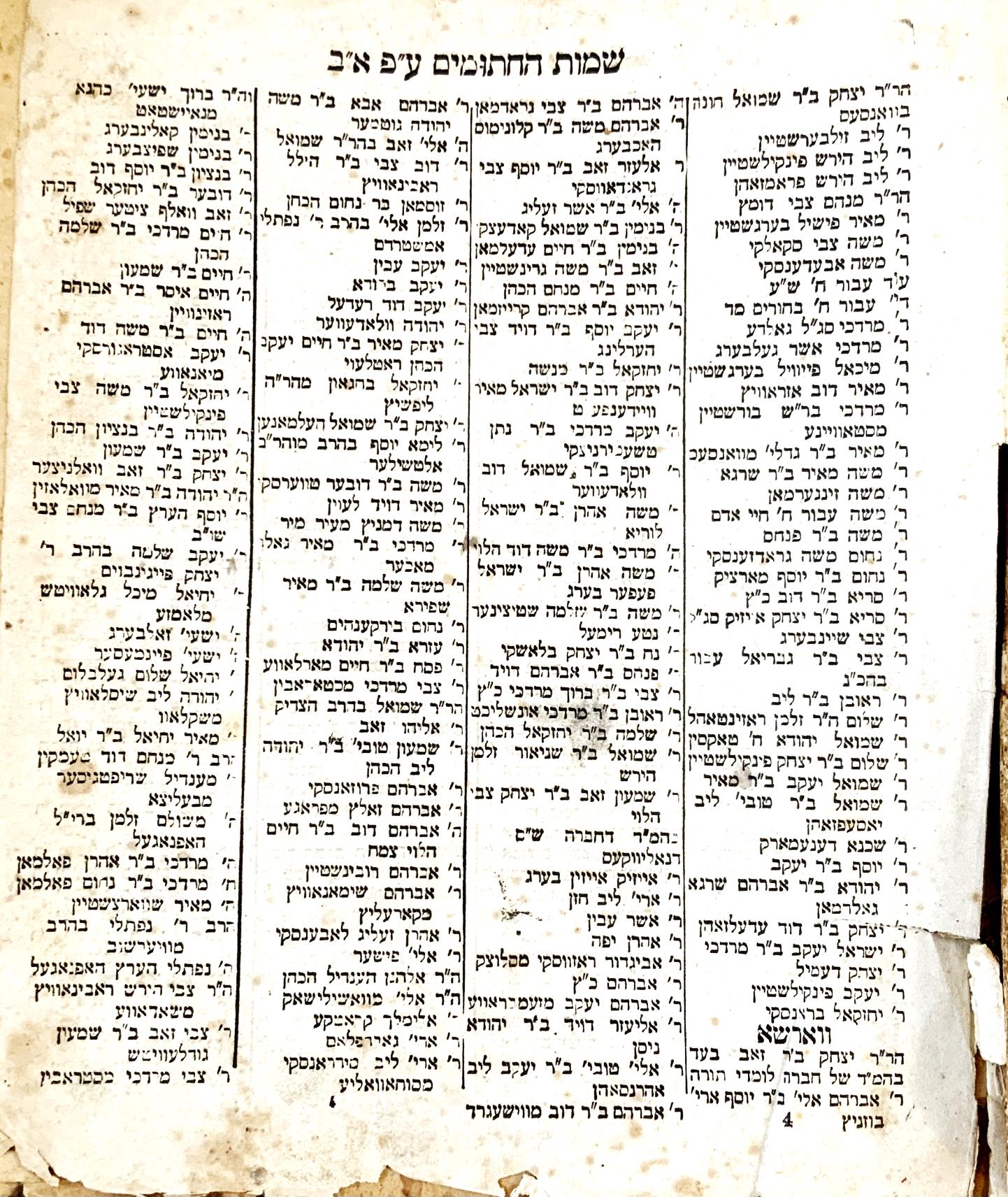
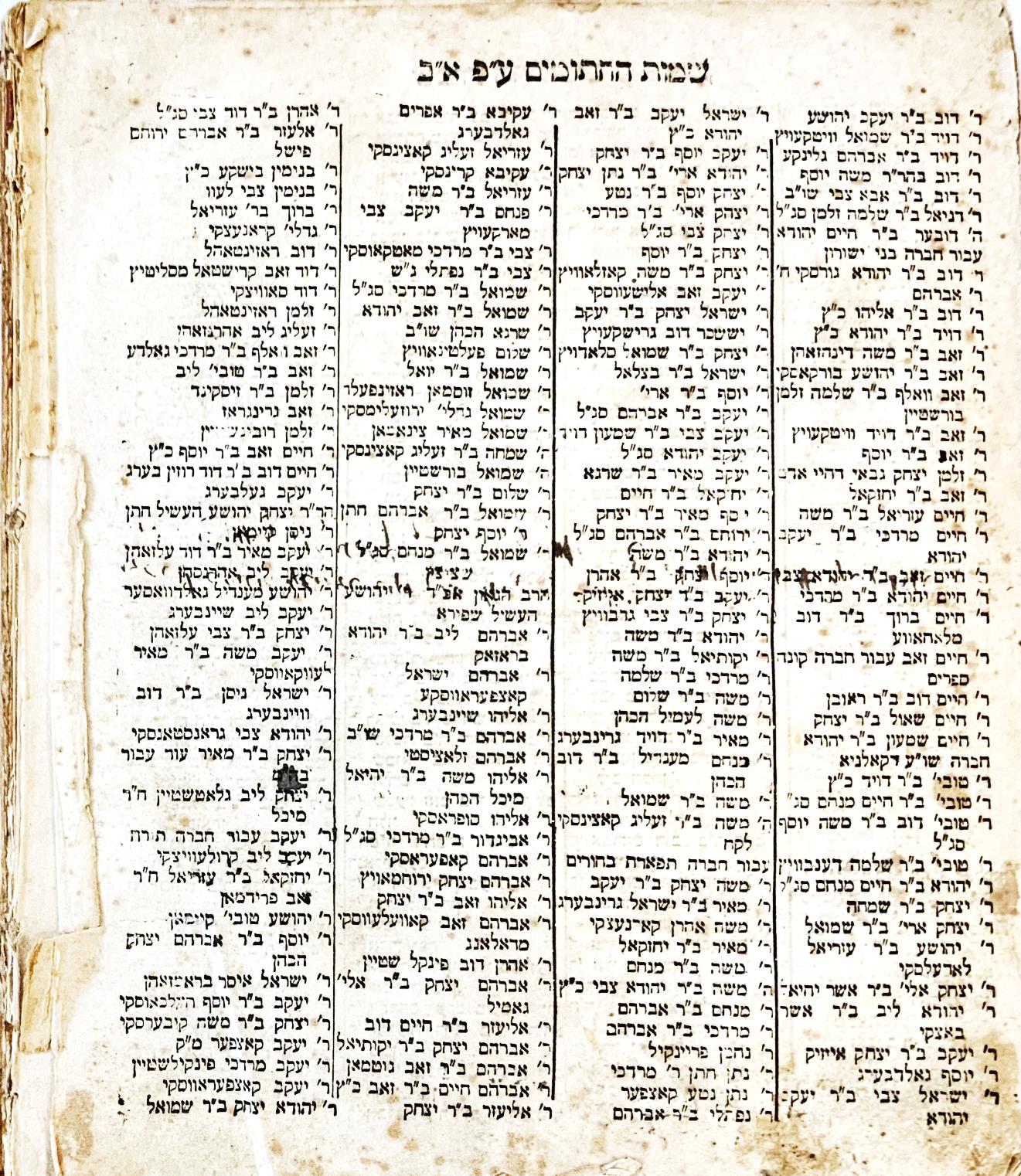
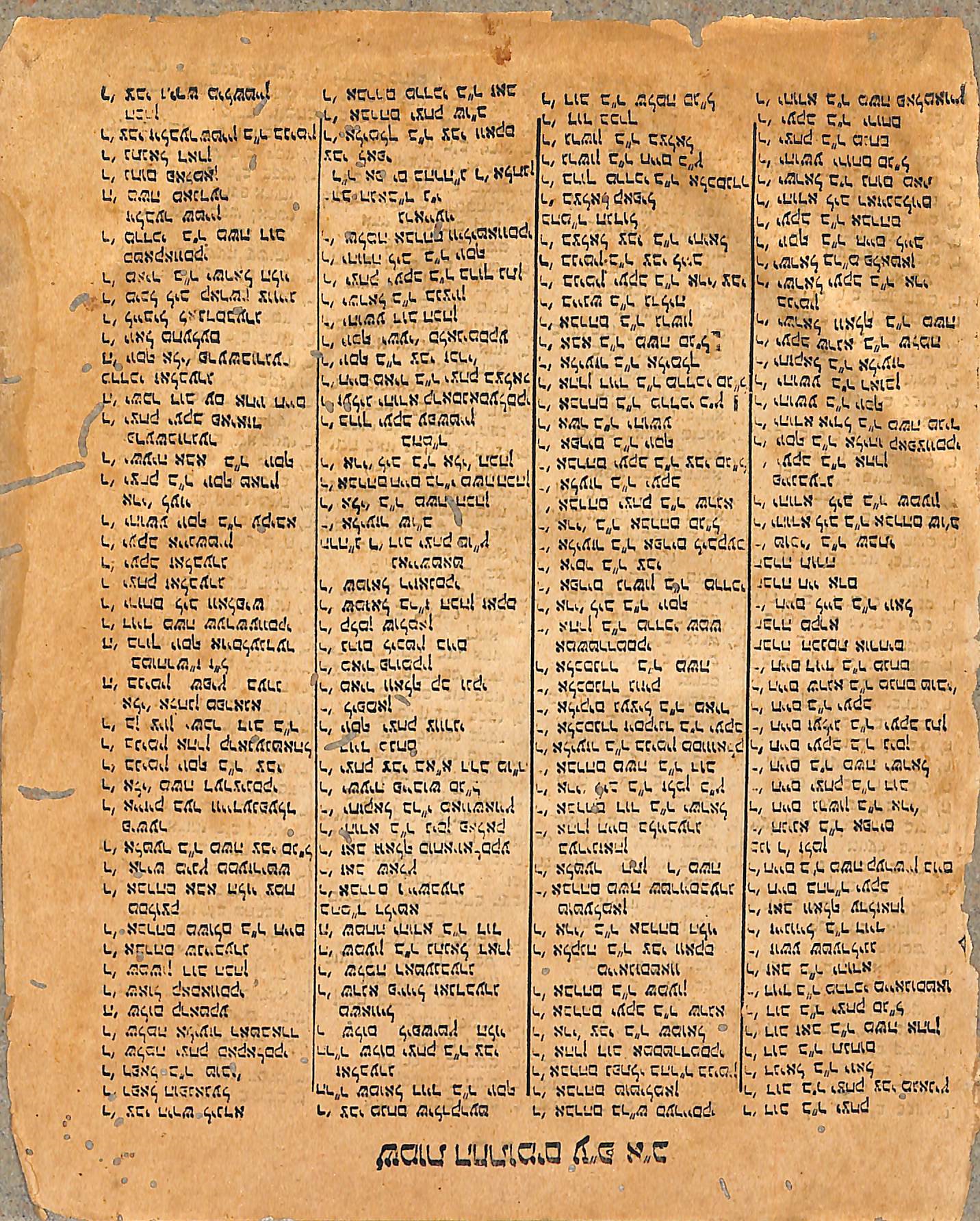
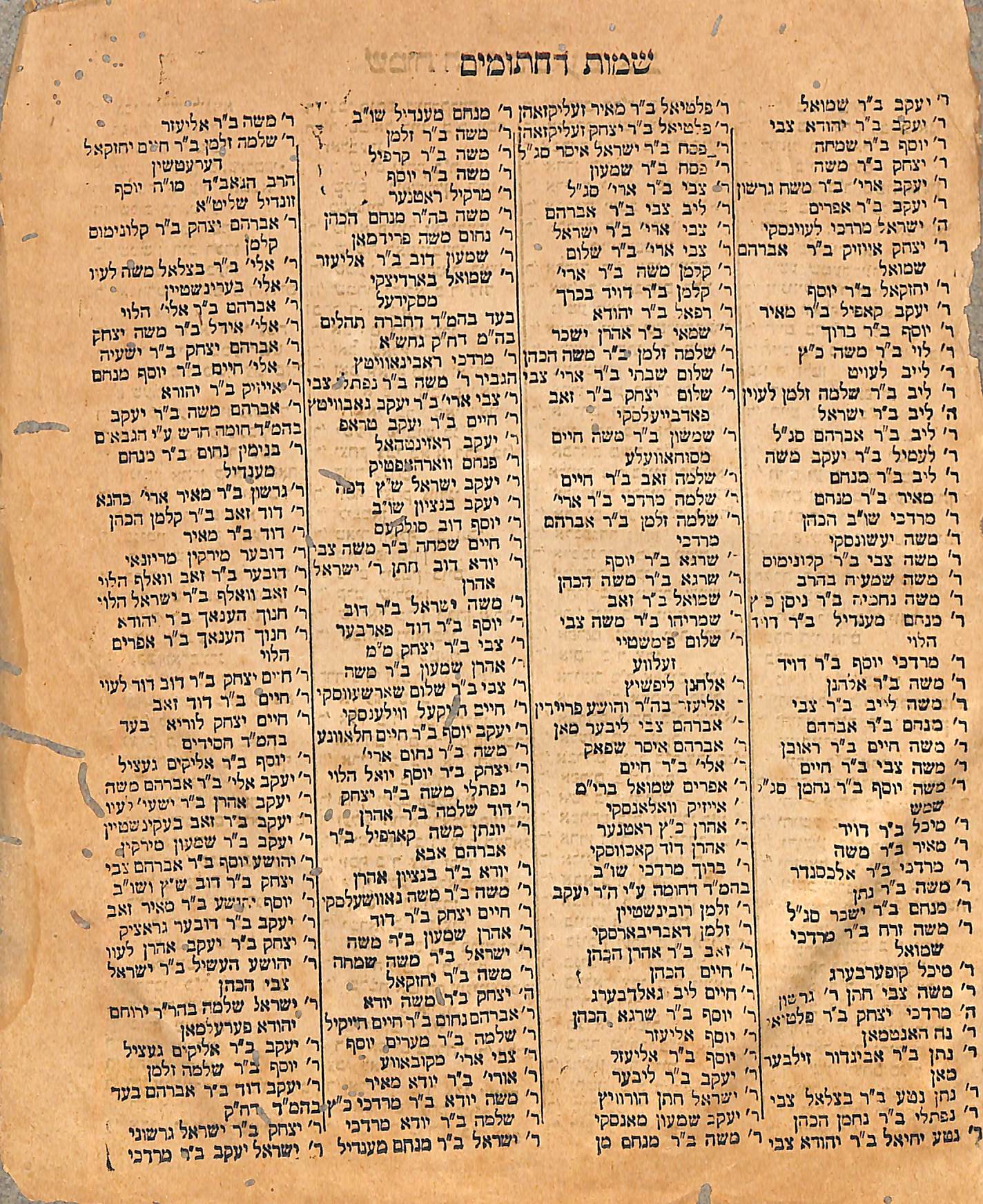
חשבנו שאנחנו יודעים על שני דפי רשימות חותמים – ארבעה עמודים של שמות. בית המכירות ל”ג/1 ציין בהגינות, בתארו את העותק שהעמיד למכירה – שבעותק הנמכר יש דף אחד משני דפים, וצילם את הדף. מדובר בדף אחד שבראשו אנשי העיר טיקטין (וכן נובוגרד, סטוויסק ו-קאלנע). דף טיקטין מופיע גם בעותק ס”ל וגם בעותק ה”ב. בשני העמודים של דף טיקטין מופיעים 325 שמות בשבעה טורים.
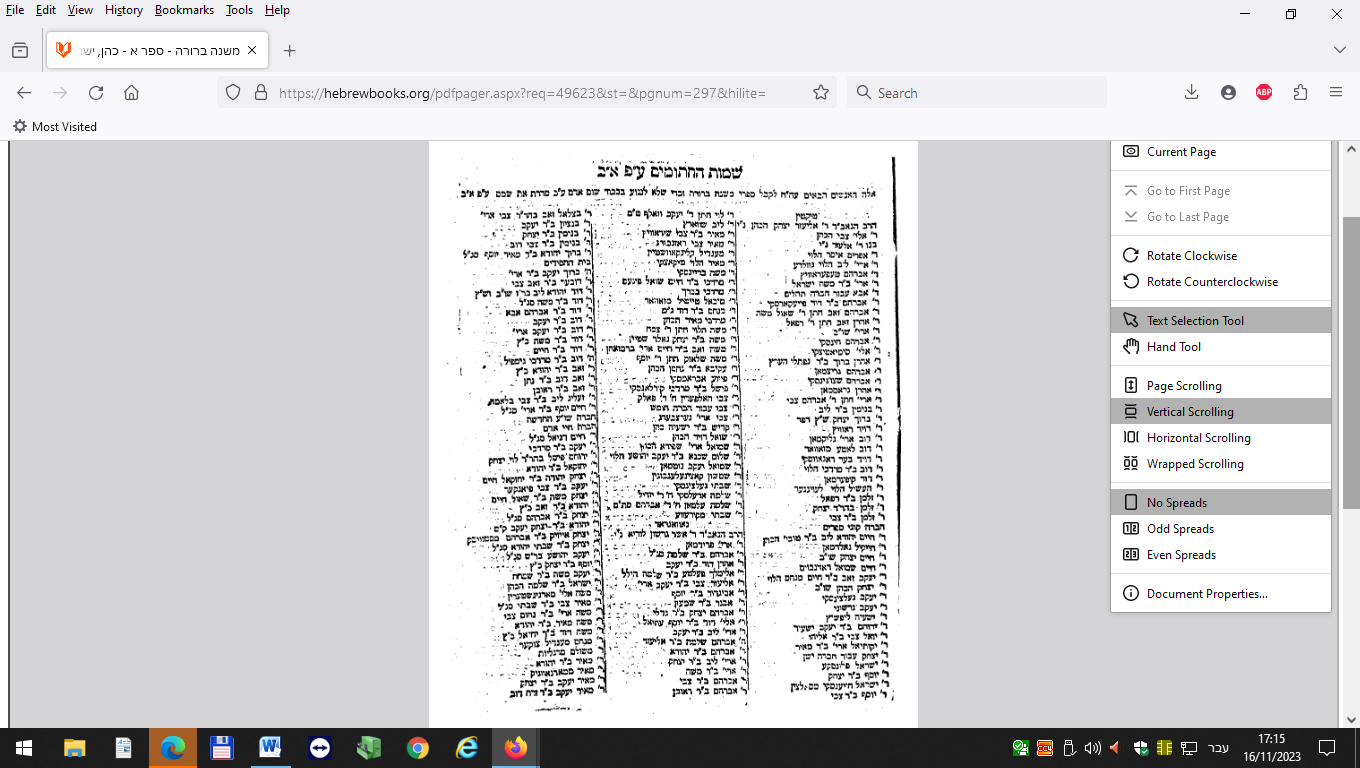
בעותק מ”ק יש רק את הדף השני. בסוף העמודה הימנית בעמוד הראשון מנויי וורשה (והעיר שציצין), 8 עמודות עם 322 שמות. 5.5 עמודות לאנשי ורשה, ועמודה וחצי לאנשי שציצין. הדפים הם בסדר אל”ף בי”ת “כדי שלא לנגוע בכבוד שום אדם” ככתוב בכותרת דף טיקטין. השם החותם בסוף עמ’ 2 בדף טיקטין הוא: ר’ דוב ב”ר מאיר מארקעוויץ, ושם החותם הבא בעמודה הראשונה בדף השני הוא: הר”ר יצחק ב”ר שמואל חונה בוואנסעס (לא איתרנו). אומנם קפיצה מאות דל”ת-דוב, לאות יו”ד-יצחק, אבל הרצף, אפשרי.
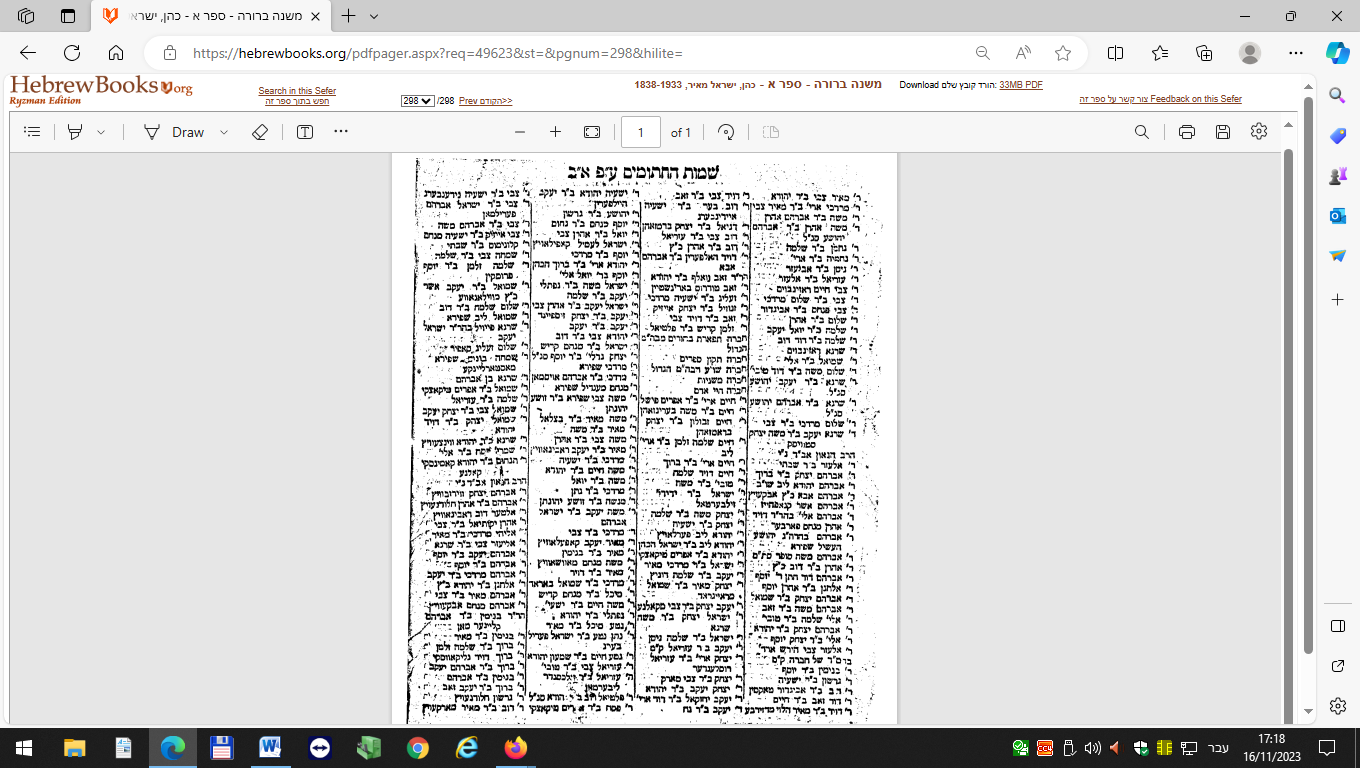
עם סגירת המאמר, מצאנו שבית המכירות ל”ג העמיד למכירה עותק מההדפסה הראשונה עם דף שמות חותמים שלישי, השונה משני הדפים שהכירונו. על רקע הערת הרב אריה ליב בן הח”ח (עמ’ ל”ג) שהבאנו לעיל, על כך שהח”ח לא נסע לקהילות החסידים הרחוקות בפולין לחלק את ספריו – היה מעניין לראות שבצילום עמוד החותמים שבאתר בידספיריט ל”ג/2 – עמודה רביעית, שורה 18 מלמטה מופיע: ר’ חיים יצחק לוריא בעד בהמ”ד חסידים. הערים המנויות בדף שלישי זה הם (העתקנו ככתבם): נאיישטאט, גרעאייעוי (גריבה), מייאגוסטאוו, זעלווע, ו-דערעטשין.
האם מותר להעלות השערה שהח”ח הפריד את דפי החותמים, במכוון? באופן שדף חותמי וורשה יהיה צמוד לעותקים שחילק בוורשה ושציצין, דף טיקטין צמוד לעותקי חותמי טיקטין והערים שנמנו, ובשאר המקומות לא צרף את דפי החותמים האחרים10? מדוע לא יצרף את כל שלושה הדפים לכל עותק? מטעמי חיסכון? לא מסתבר. אולי זה נעשה כדי שלא לבייש מי שלא היה בין החותמים? אולי טפסים שנמכרו אחרי ההדפסה לקונים שלא חתמו מראש, לא כללו שום רשימת חותמים? ולמי הלכו ספרים שכללו את התודה לנדבנים בסוף ההקדמה? מצד שני, על המשקל, תודה לחותמים מראש מראש! דבר אחד ברור לנו: היות ואין מקריות אצל הח”ח, על כן תיובתא דחפץ חיים תיובתא.
העמוד הראשון של דף החותמים – עותק מ”קהעמוד השני של דף החותמים – עותק מ”קעמוד ראשון של דף החותמים השני (טיקטין) – עותקים ס”ל, ה”ב ו- ל”ג/1עמוד שני של דף החותמים השני (טיקטין) – עותקים ס”ל, ה”ב ו- ל”ג/1עמוד ראשון של דף החותמים – באדיבותLegacy Judaica–לג/2עמוד שני של דף החותמים – באדיבותLegacy Judaica–לג/2
ביחד, בששת העמודים, מופיעים כאלף שמות. היות ואין לנו ידיעה על דפי חותמים נוספים (אולי עוד נגלה!) מעניין ומוצדק לתהות מדוע הח”ח ציין, פחות חותמים למשנה ברורה מספר חפץ חיים? האם מפני שהיו, יחסית, פחות חותמים למשנה ברורה? האם ששת העמודים משקפים את כל החותמים? הזכרנו לעיל שבספר חפץ חיים, מהדורה ראשונה, תרל”ג, הודפסו כ-1,200 שמות של חותמים. מדוע מוצאים פחות במשנה ברורה? האם היו יותר חותמים מהמודפס? ואם היו מדוע נפקד מקומם? אם נכונה השערתינו שהח”ח בחר בקפידה את דף החותמים המסויים, להפצה אישית, באזור או קהילה, ובכלל זה את התודה המיוחדת לשלושה התורמים שבסוף ההקדמה – אין מנוס, וכל השאלות מוצדקות. אם איכשהוא יישבנו בדוחק את התמיהה על השמטת קטע התודה לנדבנים – מה נאמר כאן? ועל כולנה מרחפת התיובתא הגדולה – מדוע הח”ח לא כלל בכל עותקי ההדפסה גם את ההערה ההלכתית, גם את התודה לשלושה התורמים וגם את ששת עמודי החותמים? תיובתא דחפץ חיים תיובתא. ותיובתא בתוך תיובתא: ראינו לעיל שהרב אריה ציין שהנסיעות הראשונות של הח”ח לאחר הדפסת המשנה ברורה חלק א’, היו למעזריץ ולובלין – ולפלא ששתי הערים אינן ברשימת חותמי הספר (אולי אכן עוד יתגלו דפי חותמים?).
גליונות הדפוס
כדאי להתעכב על פרט טכני של הדפוס. בתי דפוס משתמשים בגליונות דפוס בגדלים שונים כדי שקיפולם, וחיתוכם יביא לכמות דפים הדרושים, ולגודל הפיזי של ספר. איש הדפוס, היה מקפל ומסדר את הקונטרסים המודפסים זה אחר זה. כדי למנוע בלבול ושיבוש מקום הגליון כסדרו, בטעות, לעיתים הודפס בצד התחתון של העמוד הראשון בקונטרס, בצד, סימון מספר הקונטרס והדף, למען יקופל, ויונח במקומו הרץ, הנכון. לאחר מכן הספר מוכן לחיתוך, שיפריד את הדפים, ומשם לכריכה. כשהוצאות דפוס ונייר יקרים, עושים חשבון בבחירת גודל הגליון ע”מ להתאימו לגודל הדפים הרצוי, ומשתדלים שהגליונות ינוצלו באופן מלא ללא עודפים, במיוחד כשמקבלים תרומות להדפסה.
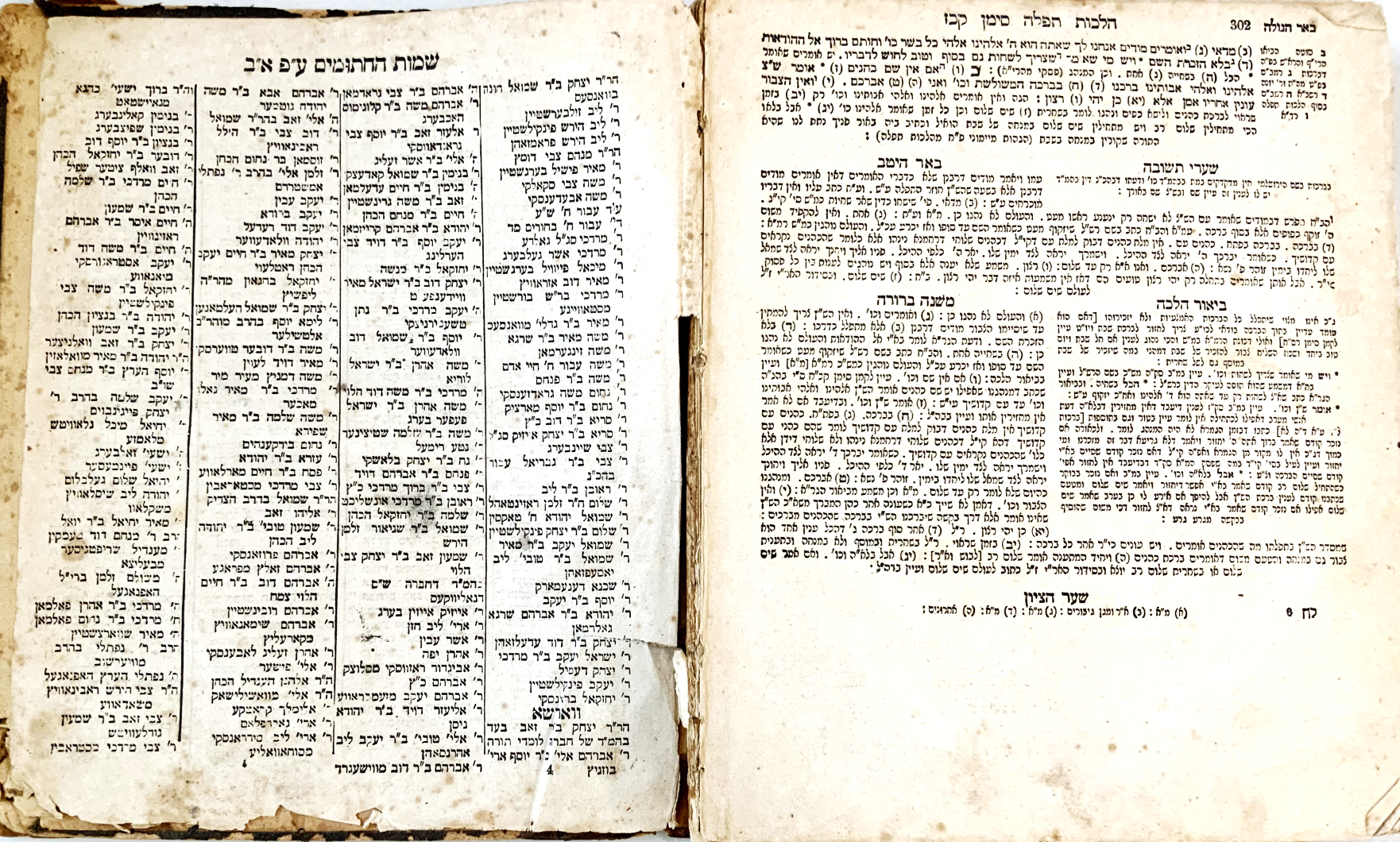
גודל הדף של המ”ב הדפסה ראשונה שבידינו הוא: 21.8 על 18 ס”מ. בתחתית העמוד בצד ימין (ראה בתמונה הבאה), בעמוד האחרון של ההלכות, מסומן “לח 6” – עמוד שישי בגליון 38. נוצר עודף לא מנוצל של דף אחד (שני עמודים). כך בשני העותקים (לג/2 לא ראיתי). יש סימונים לגליון לכל החלק ההלכתי מסימן א’ ואילך, אך לא בעמודים הפותחים או בדפי החותמים. בדיקה בדפי הספר תראה שמכל גליון יוצאים 4 דפים, יחד 8 עמודים. היוצא הוא, שלהשלמת הגליון, נשאר דף אחד ריק (2 עמודים), שהיה יכול להתאים, בהנחה שצורף רק דף חותמים אחד. אך דף אחד לא יספיק, שכן דף השער וההקדמה גם הם מחוץ לחשבון, וממילא יש שלושה דפי חותמים. את החשבון ננסה לערוך בהמשך.
העמוד האחרון של ההלכות ולידו העמוד הראשון של החותמים – עותק מ”ק ללא שורת האזהרה שלא להדפיס ללא רשות. ראה סימון גליון הדפוס בעמ’ 302 צד ימין למטה “לח 6”.
לפעמים רואים ספרים, שנייר דפי ההפרדה, בתחילה וסוף, הם אותם דפי הדפסה, ולפעמים רואים דפי הפרדה מאיכות שונה של דפי הספר, שכנראה באים מנייר זול, או משאריות נייר של בית הדפוס, ולא מגליונות הדפוס של הספר.
לאור שלוש וורסיות של תחתית העמוד האחרון של ההקדמה, ורסיית הסכמת הרב וואקס, ושלושה דפים שונים של חותמים, תכף ננסה לעשות חשבון לגליון הדפוס. היות ובכל הדפים הללו אין סימן גליון, מתחזקת מאוד הנחתנו שהח”ח ברר את כל הדפים הללו בנפרד, וסדר להם צירופים שונים, כנראה בהתאם למקומות, לאנשים ולקהילות ששלח את עותקי ההדפסה הראשונה, או שנסע לשם בעצמו. ושוב, אין מקריות אצל הח”ח. מאי טעמא? איננו יודעים – תיובתא דח”ח תיובתא.
בטרם ניכנס לחשבון, נכון לציין כי בחלק שני (הלכות שבת), שתחת ידינו, דפי הספר קצת יותר גדולים – 22.4 על 18.3 ס”מ, וכל גליון דפוס הכיל 8 דפים-16 עמודים, כאשר הגליונות מסומנים החל מהשער. הגליון האחרון היה רק 3 דפים-6 עמודים. כאן רואים שנייר, כנראה, בוזבז, אך סימון הגליון הוא, על הסדר, מתחילה ועד סוף.
שורת האזהרה שלא להדפיס ללא רשות
בטרם ניכנס לחשבון הגליונות, עלינו להתייחס לואריאציה נוספת. בחלק מעותקי ההדפסה הראשונה מופיעה אזהרה בסוף ההלכות:
“אזהרה בל יזיד איש לחזור ולהדפיס את הספר משנה ברורה בלתי רשותי או רשות ב”ב, המחבר”
אצל כמה מוכרים בבידספיריט מודגשת ההערה הנכונה, שהשורה הזו לא חזרה ונדפסה אח”כ. בעותקי ס”ל, ה”ב, ו- מ”ק היא לא נדפסה. יתכן שהשורה הושמטה בטעות ממטריצת הדפוס הראשונה, וכשהח”ח גילה, הוסיפה. על כן יימצאו טפסים ללא האזהרה, עד ששמו לב, הוסיפוה, והח”ח לא רצה לחזור ולהדפיס את הגליון האחרון של ההלכות – גליון לח – מחדש, בכל הטפסים, כדי לא להטריח ולהכביד על ההוצאות. בהנחה זו, לא מדובר בהשמטה מכוונת. או דילמא שלכתחילה דווקא סבר שלא להגביל, ולא הדפיס את האזהרה, ואח”כ חזר בו והוסיף את השורה למטריצת הדפוס. או איפכא שבמטריצת הדפוס הראשונה ההגבלה הודפסה, והח”ח חשב שנית, והחליט שלא תודפס משם ואילך, ומחק את השורה ממטריצת הדפוס. תיובתא דח”ח תיובתא.
כך או כך, שוברו בצידו. הסכמות כוללות לעיתים איסור הדפסה ללא רשות המחבר, ובדר”כ הגבלה למספר שנים. ההסכמות, לרבות הסכמת הרב וואקס, אינן כוללות הגנה כזו, וכאן, לאו מקרה הוא. מותר לנו להניח שהמסכימים שאלו את הח”ח אם הוא חפץ בהגנה כזו, והח”ח, כנראה השיב בשלילה. אם כך הוא, והרי הח”ח הדפיס את האזהרה – מדוע לא בקש גם מהמסכימים שיציינו את האזהרה? יתכן להסביר שההגנה בהסכמות בדרך כלל נקובה בזמן של כמה שנים, והגבלת הח”ח, ללא הגבלת זמן, לא הייתה נוחה למסכימים.
אפשר והח”ח חשב קדימה (על יסוד הצלחת הספר חפץ חיים?), ודעתו הייתה, שלמחבר, מותר באופן כזה להגביל את ההדפסה, ללא הגבלת זמן, שתהיה רק “בלתי רשותי או רשות ב”ב”. אך נוסח ההגבלה, מעומעם למדי, דבר, שלא היינו מצפים שיצא תחת הח”ח, המדקדק הגדול. “ברשותי” – ניחא שהתכוון לחייו הוא, אך “בני ביתי”? גם אחרי לכתו מהעולם? או במקביל לחייו? מיהם? הכוונה לכל ילדיו? או שמא כל צאצאיו החיים כאן היום, או אף לאחריהם? ניתן להניח שלא נחה דעתם של המסכימים, והם לא חשבו שזה ראוי, וחששם בידם. כשמדקדק בשיעור קומה של הח”ח משאיר הוראה מעומעמת – תיובתא דח”ח תיובתא, בדינא היא.
באופן כללי, הגבלה שלא להדפיס למספר שנים, תסתיים במועדה, כי תלמוד תורה ולימוד תורה חייבים להמשיך, וללא ספרים קשה. אולי רבנים-מסכימים לא ימהרו להטיל הגבלה שיתכן ותמנע תלמוד תורה בעתיד, כי לך תערוב מה יחשבו “בני ביתו” בעוד דור – ובכלל, כמה שני תקופת “בני ביתו”? – הן לעצם הרשות להדפיס והן לשמירת מחירו העממי (ובדומה, אף בימינו, למרות עושר הספרות במאגרים, עדיין יש ספרים שבעלי-זכויות או יורשיהם אינם מרשים להעלות לרשת). גם כך הייתה, אז, מצוקת ספרים קשה11 – מצוקה שאינה קיימת היום כלל.
סוגיית ההסכמות לספרים נדונה הרבה ואכמ”ל. אך הערתנו צריכה תלמוד של הח”ח, לרבות משמעות השמטת השורה במהדורות הבאות. לכתחילה מאי קסבר? ולבסוף מאי קסבר? ולמה חזר בו? ההגבלה הרי יצאה מהח”ח (לא בדקנו את מכתבי הח”ח המרשים להדפיס את הספרים). תהא מסקנת הדין איך שתהא, זה יכול, אולי להתאים, לתשובה שהח”ח נתן, כששאלוהו מדוע אינו ממשיך לחבר את המשנה ברורה על חו”מ (הרב ישר: החפץ חיים, כרך ראשון, הוצאת נצח, תל אביב תשי”ח -1958, עמ’ רח’ הערה 4), והוא ענה: בנוגע לחו”מ אי אפשר לסדר הלכה ברורה מיוסדת על רוב הפוסקים, יען כי כידוע, המוחזק יכול לטעון קים לי כמיעוט פוסקים, ולפיכך הדבר תלוי בהכרעת דיין, לכן לא שייך לכתוב ספר הלכות על כך. מה היה איפוא ה”קים לי” קמא של הח”ח? אפשר והסתמך על “תקנת הקדמונים”12 אם כי לא ראינו ש”בני ביתו” בכלל התקנה.
כך או כך, בין אם שורת ההגבלה הודפסה בתחילה והושמטה, או איפכא, לא הודפסה ונוספה, במכוון, ואף אם נשמטה בטעות והוספה, תיובתא דח”ח תיובתא.
גליונות הדפוס של תחילת הספר וסופו
כעת נחזור לתחתית עמוד מספר 6 בחלק א’ שיש בו שלוש ורסיות: ריק (עותק ה”ב), עם הערה הלכתית קצרה לאחת ההלכות (עותק ס”ל), ו- ההודאה לתורמים (עותק מ”ק). נזכור שגם הייתה ורסיה של תוספת הסכמה של הרב וואקס בעמוד 4, אם כי ניתן לשער שזו הייתה בכל ההדפסה השניה של חלק א’ באותה שנה, אך רק בחלק מההדפסה הראשונה, לפי שמצאונה רק בעותק ה”ב.
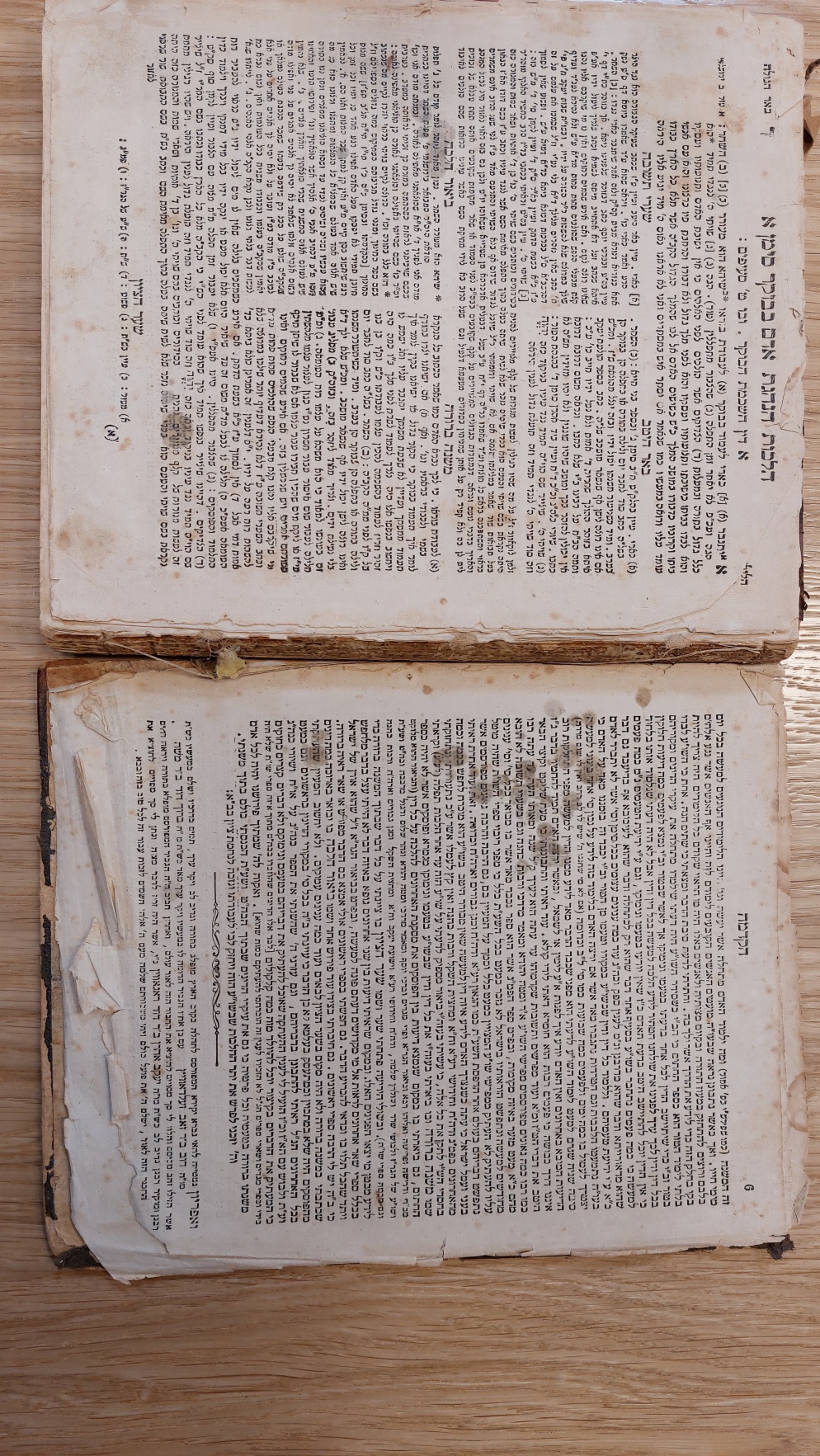
הממצאים זהים בעותקים (מלבד לג/2 שלא ראיתי). גיליון א מתחיל בדף ראשון של ההלכות, הוא דף ד’, הרביעי לספר, ובצדו השני עמ’ 8 (2 עמודים). מהדף הבא, עמ’ ה’ לספר, מתחיל גליון ב’ 4 דפים-8 עמודים, במתכונתו, עד סוף ההלכות בספר. זה ממצא מעניין. הרי יש 4 דפים מהשער ועד דף ההלכות הראשון (כולל), וזו הרי מתכונת הגליון של הספר. ולא היא. גליון א הוא של שני עמודים, והוא מתחיל לאחר שלושה הדפים ראשונים (6 עמודים) ללא ציון גליון. זה מתאים מאוד, כאמור, למי שעושה שינויים, ומתכוון לעשות צירופי דפים שונים. בנוסף, לא ברור מדוע גליון א’ הוא 2 עמודים, והספר מסתיים בעמ’ 6 לגליון לח. הרי 2 עמודים זה בדיוק מה שחסר לניצול מלא של גליונות הדפוס, של פנים הספר.
העמוד הראשון של גליון א – דף ד’ התחלת ההלכותעמ’ 8 העמוד השני של גליון א. דף ה’ מתחיל גליון ב כסדרו
בואו חשבון לגיליון:
דף ראשון – 2 עמודים: עמוד שער ועמוד אישור הצנזורה. העותקים שווים בזה = דף אחד (ושני העמודים הללו אפשר להדפיס 4 פעמים בכל גיליון דפוס).
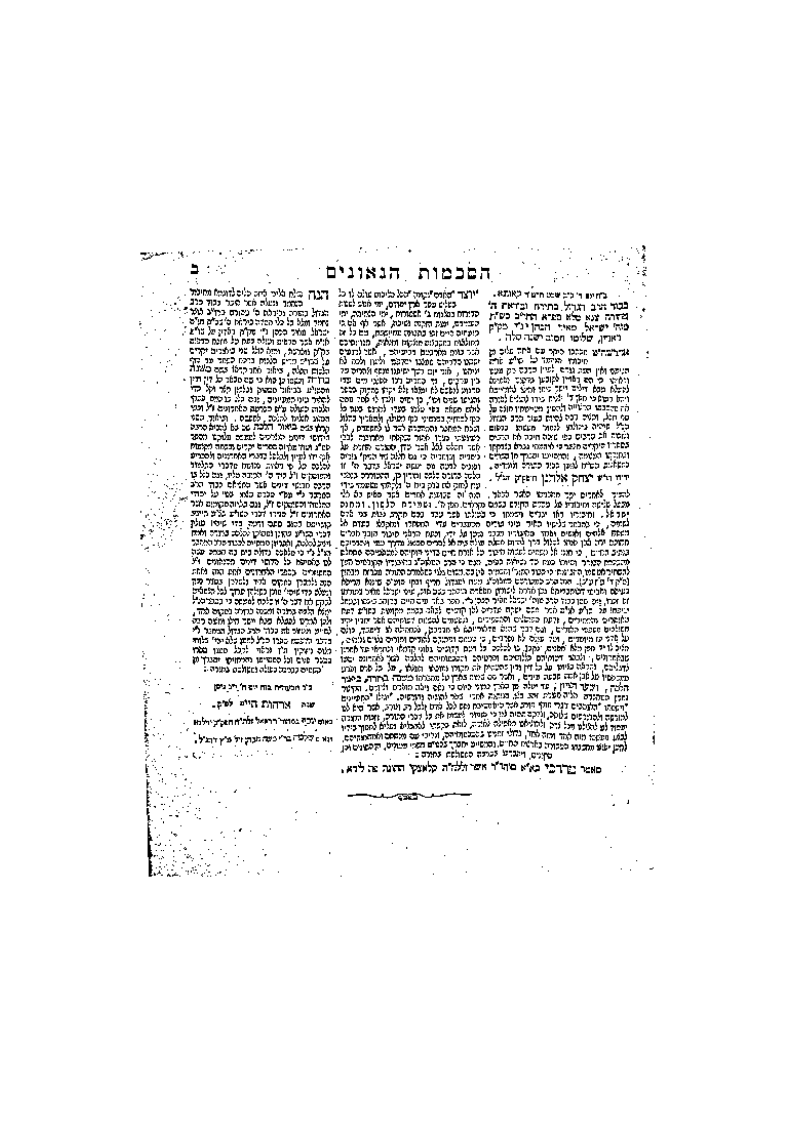
דף שני – הסכמות. היות והסכמת הרב וואקס נמצאת בהדפסה הראשונה בעותק ה”ב, לזה צריך 2 דפים שונים = 4 עמודים.
דף שלישי – העמוד הראשון של ההקדמה שווה בכולם. אך בעמוד הבא, לאחר ההקדמה יש שלוש ורסיות: ריק, הערה הלכתית, ו- הודאה לתורמים. לזה צריך 3 דפים = 6 עמודים (כדי להדפיס דף אחד עם כל ואריאציה).
עד כאן מנינו 6 דפי דפוס שהם גליון וחצי של דפוס.
לו הח”ח היה מדפיס את ההסכמות באופן אחיד, ובסוף ההקדמה היה מאחד את ההערה ההלכתית ואת ההודאה לתורמים היה לו 4 דפים, שהוא גליון אחד שלם, והיה חוסך חצי גליון דפוס. על רקע זה תמיהתנו מתחזקת, וכי מה הפריע לח”ח שלכל הקונים תודפס ההערה ההלכתית וגם ההודאה לתורמים. התיובתא, איפוא, חוזרת וניעורה.
3 דפי החותמים – 6 עמודים. לזה צריך להדפיס 3 דפים שונים.
לו הח”ח היה מפרסם את כל 6 עמודי הפרנומערנטן יכול היה לצמצם לגליון אחד. ואם היה מדפיס את העמודים הראשונים בשלמותם כאמור לעיל, היה יוצא עם שארית של דף אחד בלבד. מה היו שיקוליו בהפרדת דפי התורמים ולמה לא יזכיר את כולם לכל עותק? התיובתא חוזרת וניעורה מהכיוון הזה.
ומכיון שלא עשה כך, הפיזור יצא לו 9 דפים שהם 18 עמ’. על כן במתכונת הרגילה של גליונות הדפוס המסומנים – 4 דפים שהם 8 עמודים – 9 דפים הם 2.25 גליונות, נוצר “בזבוז” של 3 דפים. מכיוון שאיננו יודעים את כלל הרכבת הואריאציות, תמיד קיימת אפשרות של הכנת סוגי גליונות שונים, באופן שלא יהיה בזבוז. חזקה על הח”ח שחסך ולא בזבז את כספי התורמים. לפי השערתנו לעיל לא נצרכו לשתי מאטריצות דפוס בשל השמטת אזהרת הדפוס של הח”ח, אלא הוסיפו או החסירו שורה למאטריצה, אחרת היה בזבוז נוסף.
נראה לנו שניתן להסיק מכל הממצאים, שליטה וגמישות מלאה של הח”ח בתהליך הדפוס, ושליטה מלאה של הח”ח בסידור הדפים הראשונים והאחרונים של הספר, הדפים שיש בהם שינויים, וצירופיהם. את סידורם לא ניתן להניח ליד המקרה של עובדי בית הדפוס, או עובדי הכריכה. בסבירות גבוהה מאוד, נדרשה השגחה צמודה לסידור הדפים בספרים, לפי הואריאציות השונות, לאחר חיתוך הגליונות והכנסת הדפים, עובר לכריכה, וסידור כל סוג בנפרד.
כל החשבון שעשינו לדפים הוואריאנטים הוא על בסיס ההנחה שצריכת הדפים הוואריאנטים שווה. הנחה זו, כמובן אינה מבוססת, כי איננו יודעים מה הייתה הכמות המדוייקת של הצריכה, ויכול מאוד להיות שהיא הייתה לא שווה. אולי טפסים עם הסכמת הרב וואקס היו רק 20%, או טפסים עם ההודאה לנדבנים היו רק 18%, או טפסים עם דף חותמים פלוני היו רק 15%, וכן הלאה. זאת אומרת שהיה ויסות. יכול מאוד להיות שעבור 9 הדפים הווארינטים, הח”ח השתמש בכל 3 גליונות הדפוס ללא שאריות וללא בזבוז, כי הכפילו דף בגליון, שהיה צריך יותר.
כך או כך, הח”ח היה צריך לדעת ולתכנן מראש כמה טפסים יהיו בהרכב דפים כזה או אחר, ולהתאים את החשבון, מראש, על מנת לעשות שימוש יעיל בגליונות. זו אופרציה מהותית, ארגונית וטכנית גדולה, שבודאי דרשה זמן ומאמץ. זאת אומרת שהנוכחות של הח”ח בבית הדפוס הייתה לא רק להשגחה על ההגהה, אלא, גם, לתכנן, עד הפרט האחרון, את הרכב הטפסים, והכמויות. מכיוון שמלכתחילה הח”ח תכנן שיהיו הרכבי טפסים שונים, היה עליו גם להקפיד להימנע מטעויות. היה צריך לסמן את הערימות הממוינות, ולהשגיח שהם ילכו לחיתוך הדפים ואח”כ לכריכה, ויישארו מסומנים, גם אחרי הכריכה (או ללא כריכה שכן ראינו שמכר טפסים ללא כריכה). מכיוון שהיה חשוב לח”ח הרכב הדפים הוואריאנטים, הייתה צריכה להיות השגחה קפדנית על המיון והסימון של החבילות, ע”מ שלא תהיינה טעויות. אין ספק שהוא ידע היטב שזה מחייב הרבה זמן ומאמץ, שאינו דומה לשום ספר “אחיד” אחר. לא פלא שהיה יום-יום בבית הדפוס. הח”ח היה איפוא איש פנטסטי גם בארגון וסדר.
לא קשה איפוא לדמיין את הח”ח, בני ביתו ומגיהיו, עומדים טרודים ודרוכים בבית הדפוס ביום סידור הטפסים, מול ערימות של גליונות מקופלים ולא חתוכים, של כל החלק ההלכתי, ולפניהם 9 דפים שונים מופרדים וחתוכים לבודדים, בשורה על השלחן, כשהח”ח נותן הוראות: כך וכך עותקים לסדר כאשר דף אחרון של ההקדמה ריק, כך וכך עותקים עם דף חותמים מסויים בסופו, וכך וכך עותקים עם ההודאה לתורמים ודף חותמים כזה או אחר בסופו, וכך וכך עותקים עם סיום ההערה ההלכתית עם דף חותמים מסויים, הסכמת הרב וואקס, וכן הלאה כל האפשרויות השונות שהח”ח תכנן, לפי תוכנית סדורה מראש. הארגון הקפדני הזה המשיך למסעותיו למכירת הספרים, שהיו צריכות להיות מתוכננות עד הפרט האחרון, לאן נוסעים, איזה הרכבי טפסים לוקחים, וכמה. הצורך הארגוני הקפדני הזה כנראה הצריך שהח”ח יסע, אישית, לחלק את הטפסים למנויים, ולמכור את היתר לאחרים. זה מסביר למה הוא טרח לנסוע ולא שלח שליחים. יכול להיות ששלח אחרים לקהילות שהחלוקה הייתה פשוטה – של טופס מסויים, או שניים, אבל לא במקומות המורכבים. איננו יודעים אם יש עלומות הדפסה מסוג זה גם במהדורות הבאות של המ”ב חלק א’, וכן בחלקים הבאים. אם יש תיעוד מסודר של כל הנסיעות של הח”ח להפצת ספריו, בשנים הראשונות, אולי יהיה אפשר לנסות לבנות “תוכנית התאמה” של הרכבי טפסים למקומות. עכ”פ מ- 1884 ועד 1891, השנה בו הוציא את “חלק שני” הלכות שבת – במשך 7 שנים של מכירת חלק א’, לכאורה היה צריך לנדוד למכור את הספר, אישית, כדי להימנע מטעויות, על פי ההרכב ה”מתאים” שהח”ח החליט, די בכל אתר ואתר.
נדמה (דל”ת קמוצה) לעצמנו: מה נכבד המעמד הזה. שולחן ארוך, מעברו, או מאחור, כמה אנשים מסדרים את הדפים הוואריאנטים לפי הוראות הח”ח, זה לכאן וזה לכאן, מעל ומתחת לחלק ההלכתי הלא כרוך. מצרפים את הדפים, כל אחד לפי יעדו או יעודו הוא, מסדרים בערימות, מסמנים, הלאה לכריכה, ומשם בחבילות מסומנות. מחזה גדול ומרשים. מן הסתם בני ביתו ומגיהיו שאלוהו באותו מעמד: רבינו החפץ חיים על מה ולמה צרפתם כך? ועל מה ולמה צרפתם אחרת? והח”ח השיב להם אחת לאחת. ואולי לבסוף, היה גם מי ששאל, לתדהמת כל הסובבים – שמא נער קטון בבית הדפוס או בכריכיה – רבינו הגדול, ולמה לא כל העותקים יהיו מלאים ושווים? והח”ח נשקו על מצחו, נצחתני בני נצחתני. מי יתננו.
כמות ההדפסה הראשונה
בכמה עותקים הח”ח הדפיס את חלק א של המשנה ברורה? איננו יודעים. אפשר לשער שמדובר באלפים – דבר שחייב את הח”ח להתכונן ולהיערך, כלכלית, והפצתית (ובודאי כשהוא מקפיד למי הספרים יגיעו לפי הדפים הוואריאנטים!), ולאותה כמות היה עליו להיערך לחלקים הבאים של המ”ב. כנראה שלא נדפסו די עותקים בהדפסה הראשונה והיה ביקוש גדול להדפסה שניה או שהח”ח חיכה לקבל את ההכנסות מההדפסה הראשונה כדי לממן את ההדפסה השניה. הזכרנו לעיל את דברי הרב אריה בן הח”ח שספר חפץ חיים מהדורה שניה, 1878, הודפס בארבעת אלפים עותקים, בנקל, אפשר לשער שהודפסו אלפים רבים של ספרי משנה ברורה בשנת 1884, בשתי ההדפסות. הח”ח הרי כבר היה ידוע, והיה פעיל במכירת ספריו.
אין לדעת כמה עותקים מההדפסה הראשונה של חלק א’ נמצאים כיום בעולם. אף אם יימצאון חמישים, מאה, מאתיים או אפילו ארבע מאות עותקים, ונדע בכמה מהם מופיעה ההסכמה הנוספת, בכמה ההודאה לתורמים, ההערה ההלכתית או היעדרה, שורת ההגבלה, ובכמה דפי חותמים, או דף חותמים אחד – לא יהיה בזה די כדי לבסס ממצא כללי, אלא רק ממצא מדגמי. לעניינינו, אם מעט ואם הרבה, תיובתות דח”ח תיובתות, במקומן עומדות.
אגב אורחא, מעניין לציין שבערל כהן בספרו פרענומערנטן (1975), שהזכרנו, רשם את המשנה ברורה ורשה 1884 ומציין את אנשי ורשה (עמ’ 88-89, 316), ז”א שדווקא ראה את דף חותמי ורשה, אך את דף טיקטין לא ציין, ולא ראהו, כמו גם את דף החותמים ל”ג/2.
סיכום הוואריאנטים
נסכם את הוואריאנטים:
עם או בלי הסכמת הרב וואקס
בסוף ההקדמה, אחת מאלה:
ריק
ההערה ההלכתית
ההודאה לתורמים
בסוף ההלכות, עם או בלי, ההערה על קבלת רשות
אחרי ההלכות: 3 דפים (6 עמודים) של שמות חותמים
נסכם את הוואריאנטים (מלבד דפי החותמים שסוקרו במאמר) בעותקים הפתוחים לציבור (לא של בתי המכירת):
עותק ס”ל – ללא הסכמת הרב וואקס, בסוף ההקדמה ההערה ההלכתית, אין אזהרת הדפסה
עותק מ”ק – ללא הסכמת הרב וואקס, בסוף ההקדמה הודאה לתורמים, בסוף ההלכות אין אזהרת הדפסה
עותק ה”ב – הסכמת הרב וורקס קיימת, בסוף ההקדמה ריק, בסוף ההלכות אין אין אזהרת הדפסה
סוף דבר
דבר אחד אי אפשר להגיד על הח”ח והדפסת ספריו – מקריות. כל רז הדפסה לא אניס ליה. העולם התורני מתנהל על פי המשנה ברורה מזה 140 שנה באורח החיים. ער, מודע, ומנסה להיזהר בשמירת הלשון מזה 150 שנה. הח”ח כתב עוד חיבורים. את כולם הדפיס תחת השגחתו הקפדנית. כדאי וראוי הח”ח שנדקדק בדרכי הדפוס שלו, כי הוא היה איש גדול גם בזה.
תיובתות דחפץ חיים תיובתות, ואידך זיל גמור. הרב איתם, אייכה?
תודה להרב יוני וידר, הרב הראשי של יהודי אירלנד, העסוק, גם, בכתיבת דוקטורט על החפץ חיים, שהתפנה לקרוא את המאמר, האיר והעיר.
לא היה באפשרותי לעיין בסדרה מאיר עיני ישראל.
1. א. אגב אורחא למאמר, לעת עתה לא מצאנו התייחסות הח”ח מאיזה מהדורה, או מהדורות הש”ע, העתיק הח”ח את טקסט המחבר והרמ”א לספר מ”ב. אין ספק שהח”ח היה חייב להחליט על כך, ולהחזיק בידיו את מהדורת הש”ע או מהדורות הש”ע, שממנו ציווה להדפיס. מה היו כל המהדורות שהיו לפניו לבחירה? אף זו איננו יודעים. מדוע הח”ח לא ידבר על זה? האין זה טבעי ובסיסי? הרי בסוף ההקדמה (תשע שורות מהסוף) יכתוב הח”ח “כי ב”ה יש לי הרבה ספרי ראשונים” והוסיף כמה חשוב להעתיק במדוייק כל ספר שציטט. הלוא, לכאורה, ק”ו, עאכ”ו היה מצופה שיפרש מהיכן העתיק את נוסח השו”ע והרמ”א?! לא כן? תעלומה, ותיובתא דח”ח תיובתא.
ב. באשר לדפוסי השולחן ערוך, ראו בקובץ החשוב: רבי יוסף קארו, בעריכת יצחק רפאל, מוסד הרב קוק, תשכ”ט-1969, במאמרים של הרב ראובן מרגליות (עמ’ פ”ט), של נפתלי בן מנחם (עמ’ ק”א), ובמיוחד במאמר של הרב יצחק ניסים: ההגהות על שולחן ערוך (עמ’ ס”ד). נוסח המחבר והרמ”א מחייבת בחירת מקור, ק”ו ההגהות והמקורות שבסוגריים, שכולם נכנסו למהדורות לאחר פטירת המחבר והרמ”א.
ג. אציג הלכה מאתגרת מהרמ”א שנקרתה בדרכנו, המראה, עד כמה צריך עיון מתודי בנוסח הח”ח במ”ב: או”ח סימן נ”ג סעיף כ”ה עוסק בהעברת חזן ממקומו עקב התנהגות לא הולמת. המחבר כותב: “אין מסלקין חזן מאומנותו אלא אם נמצא בו פסול“. הרמ”א הרחיב גם לחזן המזמר מוסיקה או שירה מסויימים, וכך זה מנוסח במהדורה הראשונה של הרמ”א, קראקא ש”ל-1570, שיצאה בחיי הרמ”א: מרנן בשירי הגויים עובדי עבודה זרה. במהדורת קראקא 1646 כשבעים שנים אחרי פטירת הרמ”א: מרנן בשירי עכו”ם (ז”א מה שאינו ע”ז מותר). בדומה, בהגהת הרמ”א בשולחן ערוך שתילי זיתים של התימנים – מרנן בשירי אלילים (זו מהדורה סלקטיבית של הגהות הרמ”א. המחבר, הרב דוד משרקי, הביא נוסח השולחן ערוך ללא הגהות הרמ”א, ונהג להוסיף את הגהות הרמ”א רק במקום שבו הן מסכימות לשיטת השולחן ערוך ולמנהגי תימן על מנת להקל על הלומד!). בגוף השולחן ערוך שבספר משנה ברורה: מרנן בשירי עגבים. ועכשיו לאתגר: בדבור המתחיל של המשנה ברורה (ס”ק פ”ב): מרנן בשירי הנכרים. רואים כאן דבר די פנטסטי. הח”ח שינה את נוסח הגהת הרמ”א באופן שאיננו מתאים לטכסט הרמ”א למעלה. כמה פעמים במ”ב יש כזה? אם הרבה ואם מעט, מכל האמור, המתודה של הח”ח בקביעת נוסח המחבר והרמ”א – היא משימה בפני עצמה.
ד. ראה דיון אקראי: https://forum.otzar.org/viewtopic.php?t=33844, המביא, מקור, שלח”ח היה עותק המהדורה הראשונה של הש”ע שיצאה בחיי רבי יוסף קארו, שכ”ה – 1565. העורך ר’ אליעזר בראדט – ותודה לו – הפנה אותי למכתב הח”ח לר’ אליעזר פרינץ המזכיר שהיה לח”ח עותק דפוס ראשון שנדפס בחיי המחבר (פרנס לדורו, התכתבות אליעזר ליפמן פרינץ עם חכמי דורו. הוצאת כתב, תשנ”ב, עמ’ 310). ומכאן, נראה שהמהדורה הראשונה של הרמ”א קראקא ש”ל-1570 לא הייתה לפניו. היות ולח”ח היה עותק דפוס ראשון של הש”ע הנ”ל, בודאי שם לב שאין שם שום הערות למקורות בסוגריים וברוך שכיווננו לדעת הרב איתם הי”ד להלן (וכנ”ל אין הערות מקורות במהדורה הראשונה של הרמ”א).
ה. בכתבי הרב איתם הי”ד נמצאה ההערה הבאה – ברשות הרבנית חנה הנקין באמצעות העורך ר’ אליעזר בראדט – תודה לשניהם:
“המשנ”ב השתדל והשיג שולחן ערוך דפוס ראשון, והשתמש בו כמה וכמה פעמים כדי לתקן את הגירסאות: במשנ”ב סי’ תנ”א שעה”צ ס”ק ע”א הוא כותב: “וכן ראיתי בספר השולחן ערוך שהדפיס המחבר ז”ל בחייו, שזכני השם יתברך להשיגו”, ובדומה לזה בסי’ שפ”א שעה”צ ס”ק ה’, “וכן מצאתי הגירסא בשו”ע הראשון שהודפס בחיי המחבר”, ובמשנ”ב סי’ תצ”א ס”ק א’, “וכן מצאתי בשו”ע הראשון שהדפיס המחבר בחייו”, ובסי’ תמ”ז ס”ק כ’, “וכן מצאתי הגירסא בשו”ע הנדפס עם נחלת צבי ובשו”ע הראשון שהדפיס המחבר בעצמו (ובדפוסים האחרונים נשתבש הגירסא)”. ושוב הזכיר בקצרה דפו”ר זה בסי’ תקל”ה במשנ”ב ס”ק ג’, ובסי’ תקל”ג בביה”ל ד”ה ואם לקטן, ובסי’ תקל”ו במשנ”ב ס”ק ג’, ובסי’ תקנ”א ס”ק כ”ח. הכל בחלקים ד’-ו’ של משנ”ב. ובקצת מקומות בדק את הגירסה מול “דפוס ישן”, בביה”ל בסי’ תרנ”ו ד”ה אפילו, וראה גם בסי’ תכ”ז ביה”ל ד”ה כשראש – מעניין שגם דוגמאות אלה הם בחלקים ד’-ו’. ואגב את מה שהציונים ברמ”א אינם ממנו, למד המשנ”ב ממה שהם חסרים בשו”ע במהדורות הראשונות – עיין ביה”ל סי’ ת”ח ד”ה ויש לו. — במקום אחד ציין המשנ”ב כראיה את גירסת השו”ע שנדפס בספר עולת שבת, “במחבר שבעולת שבת” (סי’ שנ”ח ס”ק כ’)”.
עד כאן הערת הרב איתם הי”ד. העורך ר’ אליעזר בראדט העירני גם לאזכור כללי לדפוסים אחרים בסימן תכ”ח, שער הציון ס”ק ב’ “ויש ספרי שו”ע ישנים שכתוב בהן…”.
ו. כאמור, נחוץ יהיה לזהות את הדפוסים שהח”ח השתמש בהם להגהות הרמ”א, והדפוסים שהשתמש בהם למקורות שבסוגריים הן במחבר והן ברמ”א (עיין היטב במאמר הרב ניסים בקובץ רבי יוסף קארו שהזכרנו לעיל). לכאורה, לא פחות חשובה השאלה, האם יש משמעות לכך ביחס לפוסק מובהק כמו הח”ח, שלא היה לפניו דפוס ראשון של הגהות הרמ”א, קראקא ש”ל-1570, שנדפס בחיי הרמ”א. וגבוה מעל גבוה, מה, אם בכלל, יש להסיק, היום, הלכה למעשה, בעקבות דיון-המהדורות. האם יתכן בזה נ”מ לדינא? בין לחלוק, ובין השערה שאם המ”ב היה יודע על שינוי אולי היה פוסק אחרת? או דילמא, זה לא משנה כלום, כי המ”ב חוק חקק לנו, על כן אין שום משמעות לדיון-מהדורות. השאלה נכונה בין אם נמצא מעט מקרים של שינוי, ק”ו אם יש מקרים הרבה. קשה לקבל שהח”ח לא היה מוטרד מנוסחים, ומדפוסים, ומי שטוען כך, עליו, להבנתנו, להביא ראיות מובהקות. ושתיקתו, תיובתא דח”ח תיובתא.
ז. פן נוסף שיש להבין במתודיקה של המ”ב: מתי, ומה המשמעות, כאשר הח”ח לא התייחס לדין של פוסק מובהק, במקום מובהק. בביאור הלכה ובשער הציון יש התייחסויות לדעות אחרות בשפע. הנה הלכה שנקרתה בדרכנו. הח”ח מזכיר את שלחן ערוך הרב בעל התניא (“הגר”ז”) לעיתים קרובות, וגם בסימן תמ”ח, “דין חמץ שעבר עליו הפסח” (ובערוה”ש הוסיף לכותרת: “ודיני מכירת חמץ”), הגר”ז מוזכר. הח”ח בביאור הלכה (ד”ה דבר מועט – עמ’ 63) כתב שלאחר תשלום מקדמה במכירת חמץ, היתרה היא בזקיפת מלווה, אך הח”ח נמנע מכל התייחסות לשיטה המיוחדת של בעל התניא, שהקדיש לה פרק מיוחד וסוער בשו”ע הרב (יחד עם דין מכירת בהמה מבכרת), שיתרת התשלום במכירת חמץ אינה יכולה להיות בצורת זקיפת מלווה על החוב (דין חוב-מכר ולא זקיפת הלוואה ויש נ”מ ביניהם). בעל התניא כתב קונטרס על שיטתו, שאבד בשריפה. נכתב ספר מקיף על הנושא ע”י הרב יצחק יוסף בעלינאוו: ספר מכירת חמץ בערב קבלן, תשמ”ה – ואין להשיגו. לשיטת שו”ע הרב, מחוייבים למכור חמץ (וצריך להשאיר חמץ למכירה). ובדווקא מכירת החמץ חייבת להתבצע באמצעות ערב קבלן יהודי, שיהיה ערב לחוב הלא-יהודי שקנה את החמץ, ולנתק את הקשר בין מוכר החמץ לגוי. במהדורת משנה ברורה דרשו (תשפ”ב) חשו בזה, והעירו: “ומשמע מדברי הביה”ל [יותר נכון משתיקת הביה”ל! מ.ק.] שאין לחוש לדברי השו”ע הרב”. זו הנמקה לא מוצלחת, שהרי יכול היה ללא קושי להזכירו ולחלוק או לציין בעצמו “ואין לחוש”. זה דין מובהק של פוסק מובהק במקום מובהק. נחוץ לברר, איפוא, מה משמעות ההתעלמות, וכמה פעמים זה קורה בחיבור כולו. לטעמנו, אין מקריות אצל הח”ח, והוא היה איש גדול שירד היטב לפרטים. ואגב הלכת בעל התניא, מוזר ומפתיע לראות שטופסי הרשאה למכירת חמץ של חב”ד שראינו, לא מצאנו תנאי, שהמכירה תיערך בשיטת ערב קבלן. שאלתי מומחה גדול ומובהק של חב”ד, והוא לא חשב שהשאלה רצינית. הקשיתי עליו: הרי שטרי הרשאת מכירת חמץ מתגלגלים עד שמגיעים לאחרון שמבצע את המכירה, ומי יודע אם יתגלגל לידי למדן משנה ברורה, שאינו ער לשיטת בעל התניא וימכור בזקיפת מלווה – והרי שיטת בעל התניא היא, שאין בלתה, ומכירה בזקיפת מלווה אינה תקפה?! הלה ענה: אכן אם יארע כזה, כל החמץ הזה הוא חמץ שעבר עליו הפסח! הדרא קושיא לדוכתא. מה יותר פשוט מלציין תנאי שיהיה בערב קבלן? כמו כל תנאי אחר? לבעל בית פשוט כמוני, התשובה אינה מתיישבת.
ח. בערוך השלחן (תמ”ח ס”ק כ”ב) לאחר שכתב שהיתרה, מעבר למקדמה, זוקף עליו במלווה, הזכיר את דינו של שו”ע הרב ללא ציון שמו, ובאופן טבעי יישם: “ויש מהגדולים שאמר דמקצת מעות לא מהני ותיקן שהקונה יעמיד ערב קבלן בעד המעות וכבר בארנו שם סעיף ג’ [חו”מ סימן ק”צ] דאין שום חשש בזה וכל רבותינו הראשונים והאחרונים סוברים דמקצת כסף קונה ע”ש ומ”מ טוב גם לעשות ערב קבלן וכן אנו נוהגים”. זה דינו של שו”ע הרב, שמיושם אצל ערוה”ש ללא קושי, למרות שלדעתו אין שום חשש בזה. א”כ התחזקה הקושיה על הח”ח שהתעלם – וגם זו תיובתא דח”ח תיובתא. אמרנו שמיושם באופן טבעי, כי רבנותו של ערוך השולחן הייתה בתחילת דרכו בנוביזיבקוב – עיירה של חסידי צ’רנוביל וחב”ד, והייתה קירבה וכבוד בינו לאדמו”ר חב”ד הצמח צדק. ראה ספרו המונומנטלי של הרב איתם הנקין הי”ד: תערך לפני שלחן, תשע”ט, שעורך האתר, ר”א בראדט התקין, בעמ’ 51-58. פרשת נסיעת הרב אפשטיין ללובביץ’ לפגישה המפורסמת עם הצמח צדק, טופלה לכל פרטיה ודקדוקיה שם בנספח א’, עמ’ 321-348.
ט. העבודה המצויינת של הגב’ ברמה שנציין בהערה 3, טיפלה, ביסודיות, בשיטת הליקוט והעיבוד של הח”ח במשנה ברורה. כאן הוספנו כמה פירורים, שהרב איתם הי”ד היה בודאי מעלה ומפצח אחד לאחד. ↩
2. העותקים שהמאמר מתייחס אליהם: עותק הספריה הלאומית – ס”ל, עותק היברו בוקס – ה”ב, עותק בית המכירות Legacy Judaica – ל”ג/1, עותק נוסף של Legacy Judaica – ל”ג/2, ועותק המחבר – מ”ק. ↩
3. תודה גדולה לעורך ר’ אליעזר בראדט שהפנה אותי לעבודה. הנה הלינק לעבודה המצויינת של גב’ ברמה – וממש כדאי לקרוא ולעיין בה: ↩
4. הח”ח פסק (ח”ח חלק א’ כלל ד’ סעיף י”ב) שצריך לפייס אדם שדבר לשון הרע נגד חבירו, אפילו אם האיש שדבר נגדו אינו יודע מזה. כשגמר הח”ח לכתוב את ספר ח”ח, נסע לרבי ישראל סלנטר לבקש הסכמה. רי”ס אמר לו שלא יוכל לתת הסכמה אלא אם יקרא את כל הספר. הח”ח השאיר את הספר לכמה ימים וחזר לרי”ס. רי”ס אמר לו שעבר על כל הספר בעיון גדול והכל נכון מלבד פסק הח”ח על האיש שאינו יודע שדברו עליו לה”ר שהמדבר חייב לפייסו, ולדעת רי”ס זה אינו נכון, ואם לא יוציא את ההלכה מהספר לא יתן הסכמתו. הח”ח ענה לו שכך הוא הבין את רבינו יונה בשערי תשובה סעיף ר”ז. רי”ס טען שמוכרחים להניח שרבינו יונה מדבר על איש שדברו נגדו, היודע שדברו עליו, אך אינו יודע מה דברו, ולא מדובר על איש שאינו יודע מאומה על כך שדברו עליו, כי אז המפייס רק יצער אותו לחינם. האחד לא הצליח לשכנע את השני. הח”ח הציע, איפוא, שרי”ס יכתוב הסכמה ויסתייג מההלכה הזו. רי”ס השיב שאינו יכול לעשות זאת משום שיש הרבה אנשים שקוראים את הספר, לא מסתכלים בהסכמות, או לא יקראו את ההסכמה היטב, ואז הוא עובר על “לפני עוור”. ההסכמה, איפוא, לא ניתנה. ↩
5. בעותק ה”ב קיימת ההסכמה הנוספת של הרב חיים אלעזר וואקס (זה איות שמו בהסכמה) של ההדפסה הראשונה (צנזור 23 לדצמבר 1882 ושם המדפיס מופיע). כדי שהקורא יראה שמלבד עמוד ההסכמות יתר הדפים זהים להדפסה הראשונה, הבאנו כאן את צילומי ארבעת העמודים הראשונים, ואת עמוד ההדפסה ללא הסכמת הרב וואקס מעותק מ”ק, וסליחה על איכות הצילום. רואים בבירור שהעמוד – ובמלאכת הדפוס הדף משני צדדיו – סודר מחדש. ↩
עותק ה”ב עמוד השער – זהה להדפסה ראשונהעותק ה”ב העמוד מעבר לשער – זהה להדפסה ראשונה (צנזור 1882)עותק ה”ב עמ’ 3 – הסכמות, זהה להדפסה ראשונהעותק ה”ב עמ’ 4 – הסכמות,כולל הסכמת הרב וואקסאותו עמ’ 4 בהדפסה ראשונה ללא הסכמת הרב וואקס – מעותק מ”ק (סליחה על איכותו, צילמתי מהמקור הגם שכך הנראה העמוד בהוצאות המשוכפלות). רואים בבירור שהעמוד נסדר מחדש
ההסכמה והיעדרה היא פרשה בפני עצמה. הרב וקס היה בעל רקע חסידי מובהק, וישב בוורשה, ובאופן טבעי עולה מחשבה שההסכמה כוונה לעודד את הציבור החסידי לרכוש את הספר. נקדים במעט את המאוחר, בשולי הדיון על דפי החותמים בהמשך המאמר בפרק דפי הפרענומערנטן. מעניין לציין, שלעותק הזה, היינו אולי מצפים לראות את דף החותמים מוורשה מצורף, אך לא היא, ודווקא דף חותמי טיקטין נמצא בעותק זה. לכאורה, הציפייה אינה במקומה, שכן ההנחה היא שהחותמים מוורשה הם הליטאים הקשורים לח”ח, ואכן בנו של הח”ח העיד שמקום תפילתו בוורשה היה בבית המדרש של הליטאים שעזרו לו בקיבוץ הפרענומערנטן (ראו בהמשך בפרק: מעורבותו העמוקה של הח”ח בהדפסת ספריו). שמא, ע”מ שזה לא ייראה מוזר שהרב החסידי נותן הסכמה והחותמים הם מתנגדים, צורף דף חותמי טיקטין הרחוקה 180 ק”מ מוורשה ע”מ לעודד לקנות? לאור דברינו במאמר, קשה לשלול את האפשרות. עכ”פ אין באפשרותנו לערוך בירור, ולא בירור על השמות ולוודא את היותם כולם או רובם מתנגדים. אומנם, הרוצה קצת לחדד, יוכל לעורר ספק-ספיקא שמא תמיד צורפו שני דפי החותמים ודף אחד או שניהם נשרו, אך על החידוד להתאים לממצאים ולהערות להלן בדיון סביב גליונות הדפוס, וסביב דף החותמים השלישי. לבסוף נעיר שהסכמת הרב וואקס אינה רשומה במפעל הביבליוגרפיה. גם כאן עשה הח”ח שימוש בשתי ואריאציות – עם ובלי ההסכמה.
6. אגב אורחא, ראינו דבר קצת דומה בעוד ספר: מסכת סנהדרין דפוס וילנה המפורסם שהיה במחלוקת (עותק ת”י). בשער הראשון: תר”ד, בתחתית השער 1844, ומעבר לעמוד השער (מתחת לאישור הצנזור לב בורובסקי מיום 18 לפברואר 1835!), מודפסת הערה על דינא דמלכותא, של חיים דוד זאהן מוורשה (הוא הרב דוידזון אב”ד והרב הראשי של וורשה) מיום כ”ז תמוז תר”ה! הוא יום 1.8.1845, כשנה אחר כך! ובמסכת עבודת כוכבים שת”י (בספר מאמר על הדפסת התלמוד, עמ’ קל”ו, רשם הכותרת “עבודת כוכבים ומזלות”) לאותו דפוס וילנה, בשער: תר”ד (ובספר הנ”ל עמ’ קל”ד רשם תר”ג). בתחתית השער 1843, ומעבר לעמוד השער מודפסת אותה מודעה הנ”ל של הרב דוידזון מאותו תאריך (מתחת לאישור הצנזור פרופ’ איבן אשקביץ מיום 31 למרץ 1843). זה לשונה: ↩
“הנני מודיע לאחי בני ישראל, כי פסקי התלמוד לענין דיני ממונות, עונש בידי אדם וכדומה, אין להם בזמן הזה כח בפועל, כי לפי התלמוד בעצמו דינא דמלכותא דינא, בלי שום שינוי והתנגדות. ווארשוי יום ה’ כ”ז תמוז תר”ה לפ”ק הק’ חיים דוד זאהן חונה פה ק”ק ווארשויא” [ההגדלות במקור – מ.ק.]
מה גרם למדפיסי וילנה להוסיף את המודעה של הרב דוידזון? לא ברור על רקע איזה חשש. שמא כדי להשקיט את קוני ש”ס וילנה בוורשה שהכל כשר וישר? אולי זו הייתה דרישת הצנזורה? או שזו הייתה מעין “הסכמה נסתרת”? איננו בקיאים בכל פרטי הפרשה הסוערת. עכ”פ רנ”נ רבינוביץ: מאמר על הדפסת התלמוד, מוסד הרב קוק, תשי”ב, עמ’ קלו (והברמן לא העיר על כך), כתב:
“…בחודש אדר שנת ת”ר נשרף בית הדפוס בווילנא, ועל ידי כך ירדו המדפיסים ממצבם ולא עצרו כוח להדפיס עוד אלא רק לאט לאט. ובראשית שנת תר”ג השתתפו עמהם בהדפסה הגביר מו”ה יוסף עלישבערג וחתנו הרה”ג מו”ה מתתיהו שטראשון מווילנא, וקיבלו עליהם שישלימו הדפסת התלמוד על הוצאותיהם. אבל הצענזור מווארשא היה בעוכרם, שלא הניח להביא את הכרכים הנדפסים בכל ממלכת פולין, ושם היו להם שמונה מאות חותמים, ועל כן התנהגה המלאכה גם אצלם בכבדות עד שנשבתה ההדפסה לגמרי בשנת תר”ה, אחרי שהיה חסר להם עוד כל סדר קדשים. וקרוב לאותו הזמן מת המדפיס ר’ מנחם מן, ונשאר הדפוס בידי בנו ר’ יוסף ראובן, והוא שכר מן הממשלה את הזכות להדפיס ספרים עברים לבדו בלי שותף, ובזמן קצר התעשר מזה, והתחיל בשנת תרי”א להשלים את התלמוד אשר לא זכה אביו לגומרו”.
האם יתכן שהדפסת ההערה של הרב דוידזון הייתה מעין הסכמה נסתרת, או אות לאנשי וורשה ופולין, שהגבלת הצענזור מוורשה – “שהיה בעוכרם” – הוסרה או הסתיימה? וכי ניתן לרכוש את הכרכים שכבר נדפסו, לפני תר”ה, ללא חשש? על הבקיאים בפרשה הסוערת, המלאכה לגמור.
בחזרה לשינויי הזמנים, יש כאן קצת “אין מוקדם ומאוחר” שיכול לנבוע מחישובי המדפיס או הצנזורה, או הגבלות שיווק וכיוצ”ב. בעותקי אוסף ליובאוויטש, המצולמים בקטלוג המאוחד, הערת הרב דוידזון איננה מודפסת בשתי המסכתות, ולא ראינום בשום מסכת אחרת המצולמת שם. לעת עתה לא מצאנו מי שהעיר בזה. מעניין שהן בטופס לובביץ’ והן בטופסים שת”י, ספירת הגליונות מתחילה בדפי התלמוד, ולא מהשערים. זה מעורר את האפשרות ששערים הודפסו בנפרד וכך התאפשר לצרף דף אחר, שונה או “מעודכן” יותר, מאוחר יותר. נרחיב את הדיבור בהמשך המאמר בנוגע לתופעה דומה בהדפסת המ”ב. מרחק הזמן מאישור הצנזורה הוא ג”כ פרט מעניין, בכלל, ובמסכת סנהדרין הנזכר 9 שנים! בהדפסה הראשונה של המ”ב האישור הוא מדצמבר 1882, ז”א לפחות שנה וחצי עד להתחלת ההדפסה, ובהדפסה שניה של 1884 האישור הוא ממאי 1884, ז”א קרוב להדפסה. מדוע היה נחוץ אישור חדש? איננו יודעים.
7. גם בזה הח”ח היה יוצא דופן שהקפיד שיהיה כתוב “מוגה” – תופעה לא כל כך מוכרת אצל מחברים (למרות שלא רואים “מוגה” בכל עותקי המ”ב). מחברים השאירו את ההפצה לבית הדפוס או למו”ל, שלעיתים היה רחוק מהמחבר (למשל ר”י קארו היושב בצפת וספריו יוצאים בויניציאה). ואילו הח”ח עסק בהפצה ובמכירה בעצמו, וגם משפחתו. לפעמים נמצא מדפיס שמציין שאם ספר אינו חתום בחתימה או חותמת, הוא נגנב מבית הדפוס, אך זה לא מקרה הח”ח. ↩
8. תיתי לו להרב דוד גוטפרב מח”ס אהבת חסד עם ביאור תורת חסד, תשע”ד. העליתי בפניו את השאלה היאך השבחים שהח”ח העטיר על אלה שהלוו לו, מתיישב עם ריבית דברים, ומה דעתו על השמטת ריבית דברים בספר אהבת חסד, שלכאורה זה מקומו הטבעי. הרי התופעה של שבחים נפוצה והיינו מצפים שהח”ח יעיר. שאלת ריבית הדברים נמצאה ראויה על ידו ומאתגרת. הרב גוטפרב שיתף ת”ח ופוסקים אחרים, והם הציעו כמה כיוונים, אלא שלבעל בית פשוט כמוני, מסופקני: א. נפסק דריבית דברים היא באיסור דרבנן ומבואר ביו”ד קס ס”י דהותרה לצורך תלמוד תורה (מסופקני, כי העירונו במאמר שהוצאות דפוס אינן בגדר החזקת תורה לדעת הח”ח). ב. בספר דרכי אבי מבן המחבר שהח”ח לא היה לו רווחים מספריו ולכן כולו קודש ללמד דעת את העם ולכן הותר לו בזה ריבית דברים (זה צריך חיזוק. ראו במאמר, בדיון סביב ההערה, בסוף ההלכות של ההדפסה הראשונה, שנותן רשות לבני ביתו להדפיס, וכי ההגנה הזו, או כל הגנה אחרת, אינה מופיעה בהסכמות. הח”ח לא סייג את עניין הרווחים. אמנם ההערה לא חזרה על עצמה בהדפסות הבאות, וממ”נ לא ברור מה הייתה כוונתו כפי הדיון שעוררנו, שהרי במחשבה קמא, איך ישלוט בדורות אחריו? על כן צריך חיזוק מפורש). ג. דברי המרדכי, והרמב”ם פ”ה הי”ב דריבית דברים אחר הפירעון מותרת ויתכן שהספר הודפס אחר שח”ח פרע כבר חובו (מסופקני מאוד. הרי הח”ח נסע לחלק הספרים, ומהחותמים קבל, רק אז, את התשלום. כל המכירה התנהלה אחרי ההדפסה. כדי שההשערה תתפוס נצטרך ראייה ברורה שאכן החוב נפרע, ואיך ייפרע לפני ההדפסה? מהלוואה אחרת? מתרומה?). ד. יתכן שלא ניתן כהלוואה ממש אלא כפיקדון עד שיקבל תמורת הספר מהקונים שבזה אין איסור ריבית כלל (אינו נראה, שכן הח”ח קבל תשלום מהחותמים רק עם מסירת הספר, ופשיטא שמי שהלווה לו לא לקח ספרים תחת ההלוואה, ואם מדובר על שני המלווים שהזכירם, היה מציין זאת…). ה. המציאות היתה אז, כנראה, שהח”ח קיבל את ההלוואה כעיסקא, דהיינו שאם לא יהיו רווחים ההלוואה תהיה כתרומה ואם יהיו רווחים ישולם רק מכספי הריווח (כנ”ל אינו נראה. וכי לא חזקה על הח”ח שהיה כותב כך במפורש? הרי אם יש ספק הלכתי, וכי הח”ח לא יהיה הראשון להגיד: עשיתי על פי הכללים?). קיצורו של דבר איני רואה כיצד “הוברח” הח”ח מהבעיה, מקום בו היינו מצפים להתייחסות מפורשת. אולי מוטב להישאר ב”תיובתא”. גם היעדר התייחסות לריבית דברים, צמוד להערות על ריבית, בספר אהבת חסד, תיובתא היא. הרב גוטפרב לא מצא מקום אחר בו דבר הח”ח על ריבית דברים. היות וברור לנו שאין מקריות אצל הח”ח, התיובתות במקומן. לאחר הדברים האלה נתוודענו לקונטרס שפת תמים של הח”ח שהוא מדריך ליושר בעסקים, ואזהרות גזל. כאן גם היה, לכאורה, מקום טבעי לעסוק בריבית, אך לא מצאנו שם התייחסות לריבית. תיובתא דח”ח תיובתא. ↩
9. סביב חותמים מראש, ומסכימים, יש אנקדוטות מעניינות. העירונו על שניים, ברשימה בבלוג הספרנים – הערות על ספרים – גיליון כ”ג, שיצא ע”י הספרן, הביבליוגרף, והידען הגדול רבי אבישי אלבוים (ובהזדמנות זו נודה לו על עזרתו בכל עניין, תמיד, ותכף לבקשה, מענה). בקצרה, הראשון – בספר אבן משה, ווארשא תרי”ט – 1859, כותרתו “הסכמה”, היחידה שיצאה מהרבי מקוצק, שנעשתה ע”י שמשו, בשמו, ובחייו, שיקח ספר אחרי שיודפס (ואין לך הסכמה גדולה מזו!). עד שהספר יצא, הרבי מקוצק נפטר, וברשימת הפרנומערנטן מופיע שמו ולצידו ז”ל. השני – ספר נחלה לישראל, נא אמון (אלכסנדריה), מצרים תרכ”ב – 1862 (ובמקרה הספר הראשון שיצא בעיר זו ראה A Gazetteer of Hebrew Printing, Aron Freimann, New York 1946) – שתי הסכמות שניתנו ע”י שני כמרים (!) נוצרים לספר תורני מובהק. ביבליוגרפים ואספנים יכולים בודאי להוסיף כהנה וכהנה אנקדוטות לרוב. ↩
11. ראו, אקראית, הערה 14 במאמרו של יצחק ריבקינד: ראש ישיבה אלמוני בוולוזין ר’ יחיאל-מיכל מנשויז, עמ’ 236 בספר טורוב, בוסטון, 1938 – שכאשר המחבר למד בישיבת וולוזין סחו לו סבי-וולוזין, שמלמדים בעיירות הסמוכות היו באים מדי שבוע בשבוע לישיבה כדי להעתיק לעצמם דף או שני דפי גמרא ע”מ ללמד לתלמידיהם. ↩
12. לאחרונה ראיתי הסכמה מעניינת שיכולה, אולי, ללמד על דעת הח”ח. הספר הוא: “קיצור שלחן ערוך מהדורא חדשה וסביב לו ספר מסגרת השלחן והפירוש החדש הנקרא בשם לחם הפנים”, לובלין תרמ”ח – 1888. זו המהדורה השניה של מסגרת השלחן והמהדורה הראשונה של לחם הפנים (ראה הרב יהודה רובינשטיין: תולדות הגאון רבי שלמה גאנצפריד זצ”ל וביבליוגרפיה של ספריו, המעין, ניסן-תמוז תשל”א. בעמ’ 20 ציין שלא ראה מהדורה זו, לובלין תרמ”ח). שם במאמר, הביא את ציטוט הרב גאנצפריד בהסכמתו לספר מסגרת השלחן תר”מ – 1880 שיצא ללא טקסט הקש”ע: ↩
“אך את אשר עלה בדעתו להדפיסו אצל ספרי קצור שו”ע לא ניחא לי מכמה טעמים, אם יש את נפשו הטובה להדפיס חיבור בפני עצמו יהי ה’ עמו, יגדיל תורה ויאדיר”.
שניים מהמסכימים למהדורת לובלין 1888, הוטרדו מכך שהרב גאנצפריד (שנפטר 1886), לא הסכים, בחייו, שהמחבר ידפיס את התוספות הללו יחד עם גוף הספר. ואכן יש לשאול שתיים: א. מדוע לא רצה? ב. אם הרב גאנצפריד לא רצה בחייו אזי למה אחרי מותו הצירוף נכון? השניים – הרב אברהם רויטנברג מתלמיד הרב יוסף שאול נתנזון, והרב יהודא ליביש ליכט – העירו על כך. הרב ליכט כתב:
“אמנם כן כי עתה אשר הרב ר’ שלמה ז”ל הוא בעולם האמת ודאי ניחא ליה למלאות רצונו” (!).
הרב רויטנברג כתב:
“והאומנם כי לא אדע טעמו מדוע אז לא חפץ בזה להיותם נצמדים יחד ספר מסגרת השלחן עם הקיצור שלחן ערוך ויכול להיות יען כי יש להמחבר זכות בהדפסת חיבוריו לכן לא רצה לאבד זכותו אם יבואו פנים חדשות על ספרו.”
רושם פרשת מחלוקת הדפסת הש”ס סלאוויטא-וילנה, עודנו פועם אצלו. הרב רויטנברג, בכנות רבה יש לומר, הוטרד והתלבט מאוד באשר לעצם הלגטימיות להסכים להגבלה על הדפסת הספר מסגרת השלחן שהודפס עכשיו – 1888 – פעם שניה תוך זמן יחסית קצר, והוא די נדחק. נעתיק את דבריו:
“אמנם אודה ולא אבוש כי לפע”ד לא אדע על פי הדין למה יש להמחבר הספר הכח הזה לעצור בעד הרוצה להדפיס חיבורו עוד הפעם אחרי אשר מכר חיבוריו אשר הדפיס המחבר בפעם הראשון. ולא יבוא לידי הפסד. ועיין בחו”מ סימן רצ”ב סעיף כ’ ובסמ”ע ובש”ך שם לענין העתקת ספרים שלא מדעת בעלים דשרי מטעם לא יבוזו כו’. ובאמת יש לדון בזה אם המחבר ספרים לזכות הרבים הוא בכלל לימוד תורה לרבים ויהיה מחויב להיות בחנם משום מה אני בחנם וכו’. אמנם עיקר מה שיכול להנות הוא משום שכר בטילה בעד העת שעוסק בהדפסת החיבור. והדברים ארוכים. וגם לענין פסק דין מבואר בש”ע חו”מ סימן כ”ג דאחרי אשר יצא הפסק דין מתחת יד הדיין הרי הוא כאיש אחר [?-מ.ק.]. וכבר נודע תשובות הגאונים המפורסמים דק”ק ווילנא להדפיס ש”ס בשם טרם כלות הזמן מהסכמות על הש”ס סלאוויטא. אמנם הש”ס סלאוויטא היה נמכר. ולא באו לידי הפסד. רק רצו להדפיס ש”ס עוד הפעם עם הסכמות הראשונים. והאריכו הגאונים בתשובותיהם שהכח שיש בזה ביד הרבנים לעצור בעד המדפיסים עוד הפעם הוא רק תקנת הקדמונים להרבות תורה בישראל. ולא יהיו נמנעים המדפיסים לעשות הוצאות על הדפסת ספרים פן יסיגו גבולם. ועיין בליקוטי שו”ת חתם סופר סימן נ”ז. ולפע”ד גם הזכות שיש להמחבר הספר שלא להדפיס בלתי רשותו הוא ג”כ תקנת הקדמונים מטעם הנ”ל”.
כאן רואים גישה מאוד דומה לאזהרת החפץ חיים, אם כי הח”ח הוסיף את בני ביתו. ז”א, לכאורה, תקנת הקדמונים, אינה מוגבלת בזמן, אלא לאדם. אפשר שזה מקור אזהרת ההדפסה של הח”ח, שאולי לא הייתה מוסכמת על דעת המסכימים. לא ראינו דיון על הגבלת זמן בתשובה הנ”ל של החתם סופר, ואף לא בתשובתו, הוא, שהפנה אליו בליקוטי שו”ת סימן נ”ז: חו”מ מ”א, אם כי עסק שם גם בהגבלת הגבול הגאוגרפי. בין השורות של ההתלבטות של הרב רויטנברג, יוצא, לכאורה – דבר מתוך דבר – שכשם שפטירת הרב גאנצפריד עשתה שינוי, כך תנאי מתן הרשות הוא לחיי המחבר בלבד, ולזה אין הגבלת זמן מוגדרת – כל ימי חייו. זה יתאים לאזהרת הח”ח על קבלת רשות ממנו, אך לא בקבלת רשות מבני ביתו. אם כן בני ביתו מנין? תיובתא דח”ח תיובתא.
נספח – העמודים הרלבנטים מהספר: תולדות וקורות חייו של החפץ חיים, 1927
A Footnote on What the Chasam Sofer Did Not Say
A Footnote on What the Chasam Sofer Did Not Say
By Shnayer Leiman
The Problem. I’m the proud owner of a copy of Rabbi Shimon Finkelman’s Rav Pam: The Life and Ideals of Rabbi Avrohom Yaakov HaKohen Pam (second edition, seventh impression, June 2023, ArtScroll History Series, Mesorah Publications, Rahway, N.J.). It is a magnificently written and produced biography of Rav Pam, a close friend of my father, who like Rav Pam was a disciple of both Rav Shraga Feivel Mendlowitz and Rav Dovid Leibowitz. The biography captures Rav Pam as our family knew him. Indeed, it is the definitive model of how a biography of a גדול בישראל should be written. It informs and inspires as it tells the truth.
As we shall see, a minor error made its way into the volume, and no one can really be faulted for the error. Nonetheless, I am confident that Rav Pam being the איש אמת that he was, will surely not fault me (in עולם האמת) for making the correction.
The reader, at p. 336, is informed that at the 1991 Torah Vodaath dinner at which Rav Pam was the Guest of Honor, he thanked the one thousand guests for coming, and then said:
Often, I think to myself that I go around with a “false pass,” for people think I am that which I am not. But I take comfort in a comment of the Chasam Sofer. Rema is of the opinion that if a stranger enters a shul and claims to be a Kohen, we may rely on his word and call him to the Torah for the Kohen’s aliyah, for even if he is, in fact, not a Kohen, calling him to the Torah would not involve a biblical transgression. Asks the Chasam Sofer: Why would calling up a non-Kohen not be a transgression of “Vekidashto” (And you shall sanctify him),[1] the requirement that we accord honor to those who truly are Kohanim? He answers that this mitzvah is fulfilled when we show honor for the Kehunah (the exalted status of the family of Kohanim). Therefore, even if the person whom we honor is, in fact, not a Kohen, we are fulfilling the mitzvah of “Vekidashto” if we honor someone whom we think is a Kohen.
Therefore, even though, in fact, I am not deserving of honor, if people honor me thinking that I deserve it, then they are considered as having shown k’vod HaTorah (honor for the Torah).
This is truly an inspiring דבר תורה – worthy of the Chasam Sofer – and appropriately selected by Rav Pam, a Kohen, for the occasion. Alas, it was not said by the Chasam Sofer.
A Brief Survey of the Chasam Sofer’s Attitude Toward the Publication of His Writings.
Much has been written about the Chasam Sofer (1762-1839), and much more remains to be written. He was a remarkable גדול הדור and פוסק הדור. He lived in a world without radio, TV, telegraph, telephone, or digital communication, yet was recognized during his lifetime as גדול הדור and פוסק הדור. What makes this even more remarkable is the simple fact that he refused to publish any of his Torah insights or halakhic rulings during his lifetime. Of course, the fact that he served as Chief Rabbi of Pressburg (today: Bratislava) and simultaneously as Rosh ha-Yeshiva of the Pressburg Yeshiva – with thousands of disciples during his long reign (1806-1839) – spread his fame throughout the Jewish world. And while he refused to publish his Torah insights, he had a gifted pen and wrote thousands of Jewish legal responsa which he sent to all who asked. All of Torah Jewry knew who the Chasam Sofer was and what he could do.
It is worth examining what the Chasam Sofer had to say about publishing one’s Torah insights. In 1841, his son R. Shimon Sofer, who would later serve as Chief Rabbi of Krakow, published for the first time a personal letter of the Chasam Sofer dated 1829, where he addressed the issue.[2] It reads in part:
Regarding the rumor that you heard that I published a particular volume, and you requested that I send you a copy,[3] I never considered such a matter; it has not even entered my mind, at least until the present time. For the majority of the [Torah] world, that are greater and better than I am – or, at the very least, at the same level that I am – they have no need for me. For the minority of a minority that are less learned than I am, why should I weary myself for a minority? And if, perhaps, it were true that the majority of the [Torah] world needs me – heaven forbid – I am unaware that I would have the obligation to publish my Torah insights and distribute them to the public. So long as G-d grants me life and strength, I am prepared to study [Torah] with all who are interested in learning with me. I will neither pause nor rest – as the L-rd my G-d has commanded me “Just as I teach without charge, so you shall teach without charge”[4] – in responding, as far as my hand and mind reach, to all who ask, at no charge. It is my practice to record in writing whatever Torah insights G-d has graced me with, whether in Halakhah or Aggadah. These writings are freely available. Whoever wishes to copy them is welcome to do so. Such was the practice before the invention of the printing press. More I am not obligated to do. If, heaven forbid, one publishes in order to increase his fame, I worry about the curse of our Sages, of blessed memory: “He who seeks fame will lose his name.”[5] Indeed, such has been the fate of most authors of seforim. How much more so is it prohibited for an author to publish his seferfor financial gain! For these reasons, it never entered my mind to publish a sefer.
Only once did several of the Chasam Sofer’s Responsa and Torah insights appear in print during his lifetime. A disciple of the Chasam Sofer who had access to manuscript copies of his writings, published an edition of חידושים על מסכת שבועות מאת רבינו יוסף הלוי אבן מיגש (Prague, 1826), and appended some 14 large folios of Chasam Sofer’s Responsa and Torah insights to the volume. The Chasam Sofer was livid when he learned about this unauthorized publication of his writings, but ultimately granted his approval. Towards the end of his life, and at the constant urging of members of his family, he agreed to publish some materials, including a review of R. Zvi Hirsch Chajes’ תורת נביאים . The project fell through, perhaps due to the illness and subsequent death of the Chasam Sofer, but not before he addressed an important note to Rav Zvi Hirsch Chajes, which sheds light on his view of the publication of Torah insights in general, and on his sensitivity to the effect his writings could have on others. The letter was written in 1837, when the Chasam Sofer was 75 years old, and at the height of his fame. Rav Chajes, was 32 years old, still at the start of a brilliant career.[6]
I keep the L-rd before me always. Pressburg, the evening preceding Monday, 27 Marchechvan, 598 according to the short account.
Greetings and blessings for all that is good to my friend and dear Rabbi, the great Rabbi and Gaon, master of Torah, discerning in study and expert in mastery of texts, whose many words are beautifully expressed, the honorable teacher and rabbi Zvi Hirsch, may his light glow, Chief Rabbi and Head of the Yeshiva of Zolkiev, may G-d watch over it.
Dear Friend,
I have a request to make of you. It has never entered my mind to publish a sefer. However, several years ago, some pages of my Responsaand Torah insights were published by a certain rabbi, R. Mordechai Schlank, who set out to publish Ramban’s commentary on Kiddushin and R. Yosef Ibn Migash’s commentary on Shavuot. He had copies of some of my writings with him and published them in the back of the books mentioned. This was done initially against my will, but ultimately with my permission, for he was not with me here [in Pressburg], but was rather in Prague.
Now the following has occurred. A worthy individual from Brody, R. Mordechai Bisliches,[7] a printer who publishes the works of the Rishonim, has managed to get copies of 3 or 4 of my Responsaand copies of some of my Torah insights. He plans to append them to one of the above publications of the Rishonim. Initially, this was done against my will and protest, but my family forced me to acquiesce and remain silent. (For all my Torah insights and writings are freely available for anyone to copy them. I do not discourage anyone from doing so, for nothing I wrote was intended as a secret.) The above mentioned printer is already engaged in the process of publishing my material. These include two responsa that I addressed to you, one on whether a physician who is also a Kohen can administer to a dying or already dead patient,[8] and the other regarding my comments on your sefer, ToratNevi’im.[9] Now I said: “I can do as I please regarding my property; but I cannot do as I please regarding someone else’s property.” Perhaps you don’t want your name, and the name of your community, mentioned regarding that matter. Or, perhaps you will find some passage that, heaven forbid, is a slight to your honor. For those reasons, I implore you to review my comments and let me know what you think. In my humble opinion, there is nothing in my responsa that in any way slights you, heaven forbid. Quite the opposite, they are sources for you of glory and praise. And if, when engaged in halakhic discourse, I criticized something you said, it means nothing. Such are the ways of Torah discourse. Perhaps you will publish yet another sefer and you will be able to defend yourself against any and all criticism. But heaven forbid that I should allow my pen to record anything that would dishonor you! Should you feel that anything I wrote [about you] is improper, I will erase those words, or if necessary, I will neither mention your name or the title of the book. I hope this won’t be the case, and anxiously await your quick reply, before the volume goes to press. I sign with all the usual blessings, the one who loves your soul,
Moshe ha-Katan Sofer of Frankfurt-am-Main
We have included this brief survey of the Chasam Sofer’s attitude toward the publication of his writings, in order to bring home the message that, with one or two exceptions, the Chasam Sofer did not edit, or prepare for publication, any of his writings during his lifetime. He left a vast literature, literally thousands of manuscripts, ranging over a wide variety of topics (such as Responsa, Lectures on the Talmud, Sermons, Commentaries on the Torah, Notes on the Shulchan Arukh, Poetry, personal letters, and more), all still being published – and always in better editions – to this very day.
The Solution. What remains to be addressed is:
1. Why did Rav Pam ascribe the passage (that justifies why a stranger who claims that he is Kohen is allowed to get an aliyahto the Torah as a Kohen, even though we have no evidence other than his say-so) to the Chasam Sofer?
2. How do I know that it wasn’t said by the Chasam Sofer?
3. Who did contribute the insightful justification that ultimately was misattributed to the Chasam Sofer?
Rabbi Finkelman provides a helpful footnote, in an attempt to identify the source of the alleged Chasam Sofer comment.[10] He sends the reader to Toras Moshe on Vayikra21:8. Alas, in all of the recent editions of Toras Moshe published under the auspices of Makhon Chasam Sofer, the official collection of all of the genuine Chasam Sofer commentaries on the Torah published in the various editions of Toras Moshe(as distinct from his sermons [דרשות] or other collections of Torah commentary that never appeared under the name Toras Moshe), no such passage appears. See, e.g., the massive six-volume edition of Toras Moshe ha-Shalem veha-Mefoar (Jerusalem, 2021), vol. 3, p. 255, to Vayikra 21:8. There is a comment on Vekiddashto, but not a word about the fact that a stranger who claims that he is a Kohen is allowed to get an aliyah to the Torah as a Kohen, even though we have no evidence other than his say-so.
Almost certainly, neither Rav Pam in 1991, nor Rabbi Finkelman in later years, had access to a Makhon Chasam Sofer edition of Toras Moshe. But they certainly had access to earlier editions of Toras Moshe, which is what led them astray. It’s best to begin our examination with one of the earliest editions of Toras Moshe – and little more needs to be said.
Like almost all the writings of the Chasam Sofer, his Toras Moshe was published posthumously. It first appeared in print in a three-volume set published in Pressburg between 1879 and 1893. The editor of the three-volume set was an אדם גדול, a grandson of the Chasam Sofer, Rav Shimon Sofer (1850-1944). He was the son of Rav Avraham Shmuel Binyamin Sofer (1815-1871), the כתב סופר, who succeeded the Chasam Sofer as Chief Rabbi and Rosh ha-Yeshiva of Pressburg. Rav Shimon Sofer, a distinguished rabbinic scholar in his own right, served as Chief Rabbi of Erlau and was the founder of the Erlauer Chasidic dynasty. In 1893, he published for the first time the third and final volume of Toras Moshe, the volume with the Chasam Sofer’s comments on Vayikra-Devorim. Later editions were usually printed in 2 to 5 volume sets.
Here is what Rav Pam saw and quoted (almost certainly from one of the many later photo-mechanical reprints of the 1893 volume that appeared throughout the 20thcentury).
He may have owned a copy of a reprinted edition, and if not, he surely would have had access to a copy at the famed Torah Vodaath Library, curated for many years by the late R. Yitzchok Meir Traube and catalogued by the late R. Shlomo Biegeleisen. It is a library I remember well that (in my day) was just-off to the side of the main Bais Medrash at the South Third Street campus in Williamsburg.
No one could really fault Rav Pam for citing a passage – and with great precision – in the name of the Chasam Sofer, when that very passage appears in a sefer entitled Toras Moshe, and whose title page clearly identifies the author of its content as being none other than the Chasam Sofer! Moreover, the sefer was edited by the grandson of the Chasam Sofer, who surely wouldn’t misrepresent what his grandfather wrote!
But it is clearly a case of אליה וקוץ בה. If one examines carefully the text that Rav Pam cited (as seen in the scan above), one notices a coded abbreviation at the end of the paragraph that reads in parentheses: (מש“מ). (Other passages on the page are coded with an asterisk at the start of each paragraph; they need not concern us.) No dictionary of Hebrew abbreviations will solve the strange abbreviation מש“מ. But what will solve the problem for us is the editor’s full introduction to his edition of Toras Moshe.
It appears only, as one might expect, at the start of the volume on Bereshis. Here is the key passage, which appears at the very end of the lengthy introduction.
Translated it reads: “I also had in my hands a handwritten book, named Shir Ma’on. The author’s name is not recorded in it. But I felt comfortable taking some of its fruits and inserting them into the present text, for there is a proper time for everything, a fixed time for every desirable matter.”
Incredibly, there are many passages, marked with the code מש“מ strewn throughout the Toras Moshevolume! What the editor was really telling us is that he had access to a handwritten notebook with no personal name recorded in it. Of course no personal name was recorded in it; it was his private notebook! The Hebrew title Shir Ma’onclearly alludes to the name “R. Shimon.” And מש“מ is surely an abbreviation for מספר שיר מעון. As a gifted rabbinic scholar, and as the grandson of the author of most of the passages in Toras Moshe, he felt comfortable adding appropriate passages to the volume. But being scrupulously honest, he knew that he could not do so without informing readers of what he was doing, and clearly identifying which passages belonged to his grandfather, and which passages belonged to him.
It is all to the credit of the editors of the latest editions of Toras Moshethat they now publish two separate sections of the book, each with its own title page, and both with notes and commentary. One section is called Toras Moshe and prints only what the Chasam Sofer wrote, and the other section is called Shir Ma’onand prints only what R. Shimon Sofer wrote.
In sum, Rav Pam resonated to a beautiful דבר תורה he saw in an early edition (or reprint) of Toras Moshe, and cited it in the name of the Chasam Sofer at a Torah Vodaath dinner held in his honor. Opening to a page in Sefer Vayikra of the multi-volume set of Toras Moshe, there was no obvious reason for him to assume that it was not a Torah insight of the Chasam Sofer. In fact, it was a Torah insight of the Chasam Sofer’s grandson, R. Shimon Sofer, who served with great distinction as Rabbi and Rosh ha-Yeshiva of Erlau in Hungary for over 50 years, and authored the multi-volume שו“ת התעוררות תשובה(printed mostly in Budapest, 1923-1944), and died a martyr’s death in Auschwitz at age 94.
Notes
[1] The reference is to Vayikra 21:8. See b. Gittin 59b, where the verse is understood as a general obligation to honor all Kohanim.
[2] R. Shimon Sofer, “פתוחי חותם,” introduction to R. Moses Sofer, ספר חתם סופר חלק יורה דעה (Pressburg, 1841). It is reissued in שו“ת חתם סופר, חלק יו“ד, vol. 1 (Jerusalem, 2000), introductory pages, p. 15.
[3] The reference is to the unauthorized publication in 1826 of several of the Chasam Sofer’s responsa and Torah insights, for which see below.
[4] See b. Bechorot 29a.
[5] M. Avot 1:13. Cf. שו“ת חתם סופר, או“ח, סימן ר“ח.
[6] The letter is included R. Yisrael Stern’s anthology, לקוטי תשובות חתם סופר (London, 1965), pp. 92-93.It was first published in 1842 by the recipient of the letter himself, R. Zvi Hirsch Chajes. See presently: כל ספרי מהר“ץ חיות (Jerusalem, 1958), vol. 1, p. 206. For a comprehensive study of the relationship between the Chasam Sofer and R. Zvi Hirsch Chajes, see Mayer Herskovics, מהר“ץ חיות: תולדות רבי צבי הירש חיות ומשנתו – מהדורה מתוקנת (Jerusalem, 2007), pp. 143-189.
[7] Mordechai Leib Bisliches (1756-1851) was a bibliophile, dealer in manuscripts, and printer. He printed books that were published in Carlsruhe, Lvov, Prague, and Pressburg. At least two of his printed books carried הסכמות from the Chasam Sofer (אוצר נחמד: חדושי הרמב“ן על מסכת שבת , Pressburg, 1837; and מנחת קנאות מהרב הגדול אבא מרי ב“ר משה מחכמי לוניל , Pressburg,1837). In 1846, Bisliches and his partner S.G. Stern sold 111 manuscripts in 102 volumes to the archduchess Marie Louise of Parma, which were added to the de Rossi Collection in the Biblioteca Palatina. See the entry “Bisliches” in Encyclopaedia Judaica and cf. N.M. Gelber’s תולדות יהודי ברודי (Jerusalem, 1955), p. 204.
[8]In the standard printed editions, this responsum appears in שו“ת חתם סופר, יו“ד, סימן של“ח.
[9]In the standard printed editions, this responsum appears inשו“ת חתם סופר, או“ח, סימן ר“ח .
[10] Rav Pam: The Life and Ideals of Rabbi Avrohom Yaakov HaKohen Pam, p.336, note 9.
Yehuda Azoulay’s Maran: The Life and Scholarship of Hacham Ovadia Yosef
Yehuda Azoulay’s Maran: The Life and Scholarship of Hacham Ovadia Yosef has just appeared. The Seforim Blog is happy to present this excerpt.
Chapter 17: Back to Jerusalem
In 1958, Hacham Ovadia was invited to serve as a judge on the Jerusalem bet din, beside Rabbi Waldenberg and Rabbi Qafih.[1] His gratitude for being able to move back to Jerusalem is displayed in his third volume of Yabia Omer, published in 1960, and his joy and satisfaction at serving on this prestigious bet din with first-class scholars is evident in a number of places where he mentioned this job.
Rabbi Waldenberg,[2] author of the Tzitz Eliezer responsa, was the head of the bet din and he became Hacham Ovadia’s study partner at this time. Despite their disagreements on many issues of practical halachah,[3] the two enjoyed each other’s company very much. Rabbi Waldenberg was very pleased with the addition of Hacham Ovadia to the bet din; he referred to Yabia Omer in the warmest of terms.[4] Hacham Ovadia as well mentioned Rabbi Waldenberg endearingly throughout his works. He learned much in this forum regarding working on a bet din.[5]
In Petah Tikvah, though Rabbi Katz accorded him great respect and placed him in charge of writing the Sephardic divorces, Hacham Ovadia was frustrated that the court did not see the significance of following Rabbi Yosef Karo for the Sephardic population. Finding himself – the one Sephardic judge – always the minority in the court of three, he could not always convince the two Ashkenazic judges of the importance of his approach.[6] In Jerusalem, he usually served beside the Yemenite Rabbi Qafih, finally creating a majority of Sephardic-Eastern scholars in the courtroom. Rabbi Waldenberg understood early on that, so long as the litigants were Sephardic, the pair could not be swayed by his Ashkenazic leanings and traditions.
In 1964, the issue of ethnic name spellings came up again. This time, however, Hacham Ovadia did not have to resign in protest.
Rabbi Yehezkel Abramsky[7] had been the Av Bet Din of London until his retirement in 1951, when he moved to Bayit Vegan. His bet din in London, who followed his instructions and was still in touch with him for guidance, wrote a divorce with Ashkenazic spelling of the husband’s name “George” for a Sephardic couple; the wife lived in Jerusalem and Hacham Ovadia was on the bet din that reviewed it. The couple themselves preferred the Ashkenazic spelling, but Hacham Ovadia refused to deliver the bill of divorce to the woman, and wrote to the London bet din asking for it to be rewritten. The bet din, however, had followed Rabbi Abramsky’s guidelines in writing the names, so they called Rabbi Abramsky with the story.
Rabbi Abramsky called Rabbi Waldenberg for a meeting and the two agreed that they thought the Ashkenazic spelling correct, but Rabbi Waldenberg was familiar with the tenacity of the two Sephardim on his bet din, and since they were the majority, he explained to Rabbi Abramsky that there was no way they could get the divorce approved without changing the spelling. Eventually, Rabbi Abramsky recognized that he had no recourse but to ask the London bet din to rewrite it.
Maran concluded, “Rabbi Abramsky is indeed a brilliant man, but when it comes to Torah we do not let the honor of any man color our rulings. Our Torah is a Torah of truth.”[8]
Hacham Ovadia’s confidence in and loyalty to his own approach in halachic matters shows up throughout his work on this bet din. Just as he felt it a holy mission to teach halachah without giving precedence to the Ben Ish Hai or the Arizal, he would not change his mind for the honor of teachers, mentors, or peers once he was convinced of his position. In 1962, for example, his bet din had ruled that a husband should not have to pay child support for his stepdaughter in a certain case. The appeals court, which had the final say, overturned the ruling, and sent back the file requesting that their court determine the amount of child support. Hacham Ovadia refused to deal with the procedure, because he continued to maintain that the man should not have to pay. The other members of the court backed him up. He refused to listen to the appeals court against his better judgment, even though it consisted of Rabbi Yaakov Ades – his former teacher, Rabbi Elyashiv – the Torah giant whom Hacham Ovadia held in high esteem, and Rabbi Zolty – a friend and colleague whom he respected as well.[9]
Rabbi Yitzhak Nissim was the Sephardic chief rabbi at that time, following Rabbi Benzion Meir Hai Uziel’s passing in 1953. Sometime during those first few years, Hacham Nissim made it clear to Hacham Ovadia that “I know you will take over for me.” In 1960, as Rabbi Nissim was completing a five-year term, the Sephardic Community Council, headed by the committee’s heads, Elyashar and Sitton, nominated Hacham Ovadia as a candidate for the position.[10] Rabbi Tzvi Pesah Frank pushed him unremittingly to submit his candidacy. At the end of 1962, the rabbis of the Sephardic Council declared Hacham Ovadia the chief rabbi, but in the end, even after postponing the elections twice, Hacham Ovadia did not submit his candidacy, but lingered a few years longer in the world of writing and teaching, his labor of love.
Kol Sinai Magazine[11]
While Hacham Ovadia’s status was steadily rising among the Sephardic sector of Jerusalem through the few hundred who attended his lectures, his true greatness was only known by those who could read Yabia Omer, which was written for a somewhat more scholarly audience.
In 1962, the Sephardic Community Council asked Hacham Ovadia to write a column in its monthly magazine, Kol Sinai. The magazine published biographies and articles that related to Sephardic Jewry. Hacham Ovadia undertook the task, and stood by it monthly for seven years. This magazine, read by many in and out of Israel, is what positioned Hacham Ovadia as the authority and number one address for any Jew, in any area of halachah.
The writing style he adopted in Kol Sinai is nothing like that of Yabia Omer. His magazine articles were very focused and, though he brought support for all his rulings and noted all his sources, he did not go into detail. He generally followed Rabbi Yosef Karo, and noted this whenever the prevalent custom followed the Ben Ish Hai or others. There is no smattering of ethics or stories; these are encyclopedia-like entries by topic: laws of Shabbat, holidays, prayers, etc. He wrote them in language that the layman could understand and relegated any technical discussion or sources to footnotes.
The Hazon Ovadia series on the laws of the festivals, published forty years later, was based on these magazine articles.[12]
Friday Night Classes
Hacham Ovadia delivered a very popular class on Friday nights in Yeshivat Porat Yosef. His brother Naim was the manager of a synagogue, and one week in 1965, he asked his famous elder brother to come speak there. Although Naim knew it probably wasn’t feasible, as Hacham Ovadia had a commitment to Porat Yosef at that time, he nonetheless made his request, and was quite surprised when Hacham Ovadia agreed. That Friday night, he first gave the class in Naim’s synagogue and led the evening prayers there, and afterward left for Porat Yosef to deliver his regular lecture, somewhat later than usual.
While they waited for Hacham Ovadia, Rabbi Binyamin Jorgi informed the students that Hacham Ovadia would arrive late and he gave a mini class in the meantime. Hacham Ovadia arrived about half an hour later and delivered the class as usual.
Toward the end of the lecture, the third floor of the yeshivah suddenly collapsed. Chunks of concrete, iron beams, and planks of wood fell to the street on all sides of the building. The ground floor, however, was unaffected, and everyone within the building remained safe. Had Hacham Ovadia began the class at the usual time, hundreds of students would have been milling around the building at the time of the collapse, and there could have been fatal injuries.
Exiting the building by way of a shattered window and mattresses laid over the debris, the students accompanied Maran all the way home with song and dance. The building was closed off until it was safely renovated.
When Hacham Ovadia spoke to his brother on Sunday, he asked him, “You’ve been managing the synagogue for four years and you never asked me to speak. What made you do so this week, when you knew I wouldn’t be able to come without rearranging my regular class?”
When Naim had no material answer, Hacham Ovadia continued pensively, “And I wonder what made me agree. G-d performs miracles through those who have merit and both of us were fortunate to protect the participants at the Friday night class. This was a truly joyous event.”
Naim suggested that they share the story with a reporter, but Hacham Ovadia insisted there was no need.[13]
Rabbinical High Court
The Rabbinical High Court is the appellate court for Israel’s municipal rabbinical courts. One of the chief rabbis serves as its Av Bet Din. The bet din was established during the years of the British Mandate.
When Hacham Ovadia began his term there, the bet din met in Hechal Shelomo on King George Street. In 1967, it moved to the Old City. Today it shares the Frumin House on King George with the Jerusalem bet din and is headed by Chief Rabbi Yitzhak Yosef.
The Rabbinical High Court appointed new judges in 1965. Hacham Ovadia was already a favored candidate, and he joined at age forty-four. Hacham Salman Hugi-Aboudi,[14] Rabbi Eliezer Goldschmidt,[15] and Rabbi Shaul Yisraeli[16] were appointed on the same occasion.
Already on the bet din were Rabbi Elyashiv,[17] fifty-five at the time, and Rabbi Zolty,[18] who was the same age as Hacham Ovadia.[19]
Hacham Ovadia found a close friend in Rabbi Elyashiv, and said he was like a brother to him.[20] He enjoyed tackling the country’s most complex halachic issues together with Rabbi Elyashiv for he valued the latter’s extraordinary proficiency and clarity of understanding. This friendship between the two leading poskim of the generation continued after Hacham Ovadia became the chief rabbi and Rabbi Elyashiv resigned from his position.
He remained on this bet din, becoming its Av Bet Din with his election to chief rabbi in 1973. As with all his bet din jobs, many of those rulings were printed in Yabia Omer.[21] In 1984, he led the bet din, joined by Rabbi Waldenberg, Rabbi Yitzhak Kolitz,[22] and Rabbi Qafih who was promoted in 1970.[23]
The Sephardic Torah Student[24]
At the beginning of the twentieth century, Porat Yosef was the only major Sephardic yeshivah in Israel. Many Sephardic students went to the Ponevezh yeshivah in Bnei Brak, and when Porat Yosef’s building was destroyed by the Arab Legion during the War of Independence, prominent Jerusalem Sephardic families turned to Ashkenazic yeshivot, especially Kol Torah, run by Rabbi Shelomo Zalman Auerbach. In this way, many hundreds of Sephardic and Yemenite youth internalized the ideas and mentality, and adopted the unique language and dress of their teachers and peers in Lithuanian-style yeshivot.
Students of a yeshivah are in most cases expected to follow the practices of the school; thus Sephardic boys learned to pray with an Ashkenazic accent, at least for those paragraphs recited aloud, wear the garb of a Lithuanian Torah student, and generally conduct themselves according to the norms accepted within those halls. This was a very difficult as well as formative experience for many of these boys.
Hacham Ovadia dealt with the halachic issues that cropped up from this situation,[25] always with the goal of fortifying a distinct Sephardic identity, without alienating the boys from their yeshivot.
Sephardic students of the Ashkenazic Hevron yeshivah asked[26] whether it would be acceptable for them to shave until the first of Av, in accordance with Sephardic custom, or if they were obliged to follow the prevalent custom in the yeshivah and stop shaving from the beginning of the Three Weeks.
Hacham Ovadia answered that since Jews worldwide are aware that Sephardim follow the Shulhan Aruch, and since every group of Jews knows that varying customs are all holy, there is no concern that one will violate the prohibition of splitting the community[27] – a prohibition which does not apply in situations where each group is following its own custom. Everyone must follow his family customs, even within the same synagogue. Nevertheless, he recommended that the boys refrain from shaving, out of respect for and sensitivity to their environment.
Another question[28] deals with the Sephardic custom of wearing tzitzit tucked in, among their Ashkenazic friends who wear them out. According to Kabbalah, tzitzit are tucked inside the pants, to conform with the mandate to “walk modestly with your G-d.”[29] Hacham Ovadia encouraged Sephardic boys to follow this practice and Rabbi Ezra Attiya maintained that “a Sephardic boy who wears his tzitzit out may be guilty of disparaging previous generations.”[30]
Ultimately, however, Hacham Ovadia concluded that the obstacles to developing as a Sephardic yeshivah student in the genuine sense within the Lithuanian yeshivot were insurmountable, as the Ashkenazic yeshivot were fundamentally different from Sephardic ones as far as their underlying visions and goals. This will be discussed more fully in the coming chapters.
Hacham Ovadia, then, wished to reverse the trend of Sephardic boys studying in Ashkenazic yeshivot. He hoped that attracting them back to their own yeshivot would help preserve a unique Sephardic religious identity. Sociologically, he wished to present an alternate image of the ideal Torah lifestyle. Yet perhaps more importantly was the alternative he offered in actual study. He sought to reestablish a distinct Sephardic learning style, which in certain respects is markedly different from that of the Lithuanian Torah world.
Despite the religious intensity of Porat Yosef, the larger Sephardic community in Israel was losing its independent character of cultural codes and halachic customs. The 1940s in Jerusalem saw the Sephardic community join the underground resistance movements, which meant integrating into the Ashkenazic hegemony and cultural assimilation (often characterized by adopting an irreligious lifestyle).[31] Hand in hand with the experience of cultural assimilation, Jerusalem’s Sephardic Jews suffered from a shortage of Torah leadership of any stature. Outside Porat Yosef and its rabbis, few scholars carried the banner of Sephardic tradition, either in Torah study or halachah. Those years witnessed prolific Ashkenazic halachic literature, while Sephardic Jews published next to nothing. Seventy-five percent of rabbinical judges were Ashkenazic. The number of Sephardim who took the test for the judicial rabbinate was negligible and these usually hailed from Lithuanian-style yeshivot and had adopted an Ashkenazic tradition of study and halachic ruling.[32] Meanwhile, most litigants of these bate din were Sephardic.[33]
Sephardic Torah Judaism was in crisis.
Hacham Ovadia jumped in headlong to change all that. In 1965, he approached the heads of the Sephardic committee and established the Study Hall for Rabbis and Rabbinical Judges which would train young men to lead communities and serve as judges carrying the tradition of Sephardic Judaism. The committee provided him with a building that they owned in Talbieh, as well as scholarships. It opened in 1966 with fifteen students. The course provided three years of study, culminating in a test on sections Even Ha’ezer and Hoshen Mishpat, toward the judicial examinations administered by the rabbinate. After the Six Day War, the school moved to the Old City, to synagogue Tiferet Yerushalayim. Hacham Ovadia stood at its head and gave halachah classes three times a week. He tested the young men weekly and supervised their well-being.[34]
There was a yeshivah high school on the premises as well, run at the time by Rabbi Yehuda Amital. Hacham Ovadia maintained a loose connection with the high school, delivering lectures to the students periodically. Upon the graduation of the first class of the yeshivah, Hacham Ovadia pronounced this project “the crown of the Sephardic Committee in Jerusalem, which took the responsibility upon themselves of establishing a generation of rabbis and judges who shall restore the crown to its former glory.”[35]
Hacham Ovadia worked to shape the Sephardic yeshivah world into a vehicle that would continue restoring the crown to its former glory. Later joined by his sons, he established a few elite Sephardic educational institutions that adopted his learning style and halachic methodology. In 1973, when he was elected chief rabbi, he promptly set up a bet midrash for judges called “Hazon Ovadia,” and financed stipends for the married students. The kollel’s alumni serve as judges and rabbis both in Israel and abroad. In 1986, Hacham Ovadia established another kollel, Yehaveh Da’at, with his son, Rabbi David, at its helm. It is considered the premier Sephardic kollel the world over. Hacham Ovadia delivered regular lectures there and kept in close touch with its students. In 1993, Hacham Ovadia opened a yeshivah for higher learning, headed by his son, Rabbi Yitzhak, where hundreds of students were trained in his father’s methods. In 1996, the kollel Ma’or Yisrael opened. At its head stands Rabbi Moshe, Hacham Ovadia’s youngest son. Through these institutions, Maran molded the next generation of Sephardic Torah scholars.
Rabbi Zevin, quoted in the preface to Yabia Omer volume I, cheered the “redeemer” of Sephardic Jewry who will raise it from its humbled state. The editor of Kol Sinai[36] said the same: “This hero has given form to the period of history in which he lived – the period that restored the crown of Torah and glory to Sephardic Jewry – and is the artisan who molded a new spiritual period that shall be known, in the religious annals of our nation, as the period of Rabbi Ovadia Yosef.”
The day Rabbi Attiya disengaged the young man from his father’s shop and brought him back to the yeshivah, Hacham Ovadia was adopted by another world. His spiritual father was the rosh yeshivah, his closest relatives were the boys beside him on the bench, and the library, his playground. It was from the yeshivah that he embarked, protected by his spiritual father, to give his first classes. It was the rosh yeshivah who sat beside him on his first job on the rabbinical court, his intervention which brought him to Cairo, and to him Hacham Ovadia returned at the end of his mission there. His repeated attempts, almost unknown to the public, to establish a body of higher learning for Eastern spiritual leadership, point to the horizon on which his eyes were set: a generation of rabbis and judges proudly bearing the tradition of Sephardic Jews in the holy land of Israel.
[1] Pronounced Kapah; 1917-2000; born in Sana’a, Yemen, he immigrated to Israel in 1943, and worked as a judge on the Jerusalem bet din and then the Rabbinical High Court. He was the rabbi of the Yemenite community and is best known for his translations and commentaries of the Rambam’s works and the translations of other Sephardic literature of that time period.
[2] 1915-2006; Eliezer Yehuda Waldenberg was known as “the Tzitz Eliezer” after his encyclopedic halachic treatise which was one of the great achievements of halachic scholarship of the twentieth century. He was a leading rabbi and Av Bet Din of Jerusalem, and then a judge on the Rabbinical High Court, and was the rabbi of the Sha’are Zedek Medical Center in Jerusalem. He won the Israel Prize for rabbinical studies in 1976. He also wrote Hilchot Medinah, three volumes dealing with halachot regarding the State of Israel.
[3] See, for example, the discussion in chapter 7 regarding whether women should make a blessing when performing time-bound mitzvot such as lulav.
[4] Yabia Omer vol. IV, O.H. 31
[5] Yabia Omer vol. III, introduction; Hazon Ovadia – Eulogies, p. 474
[6] Ovadia Yosef, Biography
[7] 1886-1976; born in present-day Belarus, Rabbi Abramsky studied at premier Lithuanian yeshivot, particularly Brisk, and became a practicing rabbi by the age of seventeen. Following the Russian Revolution, he was at the forefront of opposition to the Communist government’s attempts to repress the Jewish religion and culture. As a result, the Russian government refused Abramsky permission to leave and take up the rabbinate of Petah Tikvah in Palestine in both 1926 and 1928. In 1928, he started a Hebrew magazine, but the Soviet authorities closed it after the first two issues. In 1929, he was arrested and sentenced to five years of hard labor in Siberia. Upon his release in 1931, he moved to London where he was the Av Bet Din until he retired and made aliyah. In Israel, he served as rosh yeshivah of Slabodka. He received the Israel Prize in 1956 for his twenty-four volume Hazon Yehezkel on the Tosefta.
[8] Yabia Omer vol. X, E.H. 34; also retold in Ma’adane Hamelech (Transcriptions of Maran’s Lectures) vol. II, pp. 370-371.
[9] Yabia Omer vol. IX, E.H. 27
[10] Although until then chief rabbis usually served until their passing, the rabbinical establishment was calling for shortening the term and holding elections.
[11] MiMaran ad Maran, pp. 86-87
[12] See introduction to Hazon Ovadia – High Holidays, Sukkot, Hanukah, Tu BeShevat, Purim, and Holidays, where he wrote that the material in those volumes are based on his articles in Kol Sinai forty years earlier.
[13] Sha’ah Tovah interview with Naim
[14] He served until his retirement in 1970.
[15] 1909-1992; born in Lithuania, he aided his teacher Rabbi Yitzhak Isaac Sher in founding the Slabodka yeshivah.
[16] 1909-1995; he was born in Belarus, studied under Rabbi Yehezkel Abramsky in Lithuania, and when he moved to Israel became a prominent religious Zionist rabbi and posek.
[17] He served on this court from 1956 until his resignation in 1973.
[18] Also elected in 1956
[19] Hazon Ovadia – Eulogies, p. 476
[20] Mishpacha, July 2012
[21] For example, a ruling written in 1980, when he was joined by Rabbi Zolty and Rabbi Shaul Yisraeli, is recorded in Yabia Omer vol. VII, H.M. 4.
[22] Yabia Omer vol. VII, E.H. 23; Rabbi Yitzhak Kolitz, 1922-2003, was a Lithuanian Av Bet Din of Tel Aviv, then joined the high court in the late seventies, and became rabbi of Jerusalem in 1983.
[23] Yabia Omer vol. X, E.H. 31
[24] Largely translated and adapted from MiMaran ad Maran, pp. 91-92 and 199-200
[25] E.g., see reply to students in Lakewood, in chapter 44.
[26] Yehaveh Da’at vol. IV, p. 190; see also Hazon Ovadia – Fast Days, p. 159.
[27] See Yevamot 13b based on Devarim 14:1 for the prohibition against forming separate groups among Israel (“lo titgodedu”).
[28] Yabia Omer vol. IX, O.H. 108:18 states that while tzitzit should be worn under the clothing, individuals in Ashkenazic yeshivot, or those new to Judaism, can wear them out.
[29] Yehave Da’at vol. II, p. 5
[30] Ohr LeZion vol. II, p. 27, note 2 by Rabbi Benzion Abba-Shaul
[31] See N. Horowitz, pp. 30-60.
[32] See report by A. Doron, Kol Sinai, 1965, p. 401.
[33] This is the case in many vicinities, as secular Ashkenazim bring their cases to the secular courts system, while the Ashkenazic haredi community is more likely use the rabbinical courts of the Edah Haharedit. Sephardic litigants across the religious spectrum more often bring their complaints to the State-regulated bet din system.
[34] Details found in Bama’aracha, Tishre 1968, p. 1.
[35] MiMaran ad Maran, pp. 91-92
[36] Shevat 1971, page 340
“A Woman Is Not an Elephant”
“A Woman Is Not an Elephant” – Some Jewish, Islamic and Classical Perspectives On the Conflict Between Authority and Truth
Egyptian Medical Doctor Criticizes the Phenomenon of Accepting Unscientific Islamic Beliefs, like the Notion that a Woman's Pregnancy Can Last Up to Four Years
In an article on the liberal website Elaph, Dr. Khaled Montasser, a liberal Egyptian physician, criticizes the phenomenon of endorsing traditional ideas that have been disproven by science, such as the Muslim belief that a woman can be pregnant for up to four years. He points out that this notion is believed even by some Muslim doctors, and is acknowledged in the laws of some Arab countries, including those that are not theocracies. He calls on the Muslims not to accept outdated and unscientific ideas just because they were proposed by important clerics, stressing that contesting the opinions of religious scholars is not tantamount to attacking or disparaging the religion itself.Following are excerpts from his article:
At a Medical Conference, a Professor Raised the Notion of a Hidden Pregnancy Lasting One to Four Years
"In a medical conference held at one of the faculties of general medicine, a professor asked for permission to speak, and said: 'Why doesn't this conference deal with [the phenomenon of] hidden pregnancy?' When the participants asked what he meant by 'hidden pregnancy,' he replied: 'I mean a pregnancy that lasts one, two, three or four [years].' The conferees, both the students and the professors, were puzzled and asked one another, 'Is there such a thing as a pregnancy that lasts three or four years?' The professor answered confidently, with contempt for his colleagues' ignorance: 'Of course. Imam Malik [founder of the Maliki school of Islam] stayed in his mother's womb for three years.'"The danger posed by this belief is that, [in this case], the one who held it was a professor of medicine, who is probably schooled in the doctrine of scientific thinking, and relies on medical journals as his source [of knowledge]. Faced with a medical question, such as how long a pregnancy can last, he [is expected to] rely on what he has learned and read in these [scientific] sources, rather than on what he has read in texts of Islamic jurisprudence."Unfortunately, however, this doctor was not [just] speaking for himself. He represents a phenomenon, namely the victory of tradition over reason. He represents a school of thought that is willing to sacrifice all medical learning in order to uphold the predominance of jurisprudential Islamic texts and traditional fatwas. Proof of this is [the fact] that it is not only this professor who holds such views. I will have you know that the chief proponent of female circumcision [in Egypt] is a professor of gynecology and obstetrics, who even argued against the minister of health in a court hearing [about this matter]."
The Notion of Hidden Pregnancy Has Crept into the State Laws
"Some Islamic scholars, like those of the Hanafi [school], believe that a pregnancy can last up to two years, while those of the Maliki and Shafi'i schools think it can last up to four years, and some of them [have said] even five years or more. We [can] accept these statements as a kind of folklore, but not as any kind of scientific truth… I refuse to let anyone force me to accept this nonsense under the pretext of implementing the shari'a. Islam is a religion of reason, and [cannot] be associated with these medieval notions. Moreover, my mind refuses to accept something just because the Mufti wrote it in his book or because it appears in the Al-Azhar curriculum. How can I accept this as science when not a single gynecologist or obstetrician has ever witnessed [such an event] since the advent of scientific gynecology and obstetrics?… And from a moral perspective, how can I provide a jurisprudential loophole for a woman who was probably promiscuous after the death of her husband and then presented her baby, conceived in sin, as a baby of her dead husband by relying on the [notion] of a hidden pregnancy or on a fatwa issued by some [cleric] or religious school? This is what happened on December 14, 1927 at a shari'a court in Mecca. The qadi… ruled that the baby was conceived by the woman's dead husband who had died five years previously."The important question is whether the notion of a 'hidden pregnancy' is confined to religious legal texts and is acknowledged only in [Muslim] theocracies, or has [also] found its way into the laws of non-theocratic [Muslim] states that have been terrorized [into submission] by the slogans of the pressure group called political Islam. [Is Egypt] a state that respects reason and [rational] thinking or one that sanctifies tradition and accusations of heresy?"Science is familiar with the notion of a fetus, but does not recognize the notion of a hidden pregnancy or a pregnancy lasting more than ten months, let alone two to four years. The law is expected to be guided by [science] instead of pandering to religious scholars at the expense of science. [The ideas about 'hidden pregnancy'] are religious opinions that [reflect the beliefs] of past eras, and they should be treated as such, not as a sword that hangs over the neck of the legislator."It seems inconceivable that the laws of Egypt, Syria, or the Gulf states should include clauses about hidden pregnancy that reflect beliefs from the fourth century – [but the fact is that they do]. For example, [Egyptian] Law No. 15 from 1929 states that 'a woman's appeal to acknowledge her dead husband [as the father of] her child will not be considered if [the baby] was born over a year after [the husband's] death.' Law No. 131 from 1948 includes a clause stipulating that 'the law will take into account the rights of [a child] born as the result of a hidden pregnancy,' and Law No. 67 from 1980 [states that] 'a hidden pregnancy is legitimate [grounds] for granting rights.' Article 29 of the Personal Status Code [says]: 'The guardian of a child born [as a result of] a hidden pregnancy must inform the Attorney General's [office] when the pregnancy ends.' Article 128 in the Syrian legal code and the property guardianship law in Bahrain say the same thing."
A Woman Is Not an Elephant – She Can't Be Pregnant for More than 10 Months
"The proponents of tradition and enemies of rationality always argue that the religious scholars are [simply] cognizant of [unusual] cases that are possible, though rare. But there is a big difference between rare and impossible. It is impossible that a woman, who belongs to the human race, should suddenly turn into an Asian elephant and be pregnant for over two years. Even [a pregnancy lasting] one whole year… is impossible… The womb is not a storeroom… When a fetus stays in his mother's womb over 42 weeks, he is in danger of dying in utero, and if he stays there more than 43 weeks he will surely die… A 50-week fetus will certainly start to rot in his mother's womb… The duration of pregnancy is not a random affair; it is not a matter of possibilities, of changes in human nature or of changes that occur with time. Someone who says today that Imam Malik stayed in his mother's womb for three years is making light of a serious matter – and the blame lies not with those who said this in the past, but with those who endorse this opinion today."Debating and criticizing the opinions of religious scholars does not mean criticizing or disparaging religion. We mustn't be too sensitive to discuss a scientific issue that was misunderstood by the religious scholars of the past. There is no need to wave swords when discussing such issues. The fault lies not with those who [dare to] contest the [opinions of the religious scholars], but with those who think that these opinions are synonymous with the religion itself. The despicable questions that the clerics ask, [such as] 'Are you saying that the religious scholars were liars?' or 'Who are you to [argue] with figures of their caliber?' – are an impediment to any progress in science and in thinking."We are not accusing the religious scholars of lying, but are [merely] treating their opinions as part of [the beliefs] that prevailed in their time. We do not regard [these opinions] as sacrosanct just because those who held them were authoritative figures. Scientific truths are judged by other criteria that have nothing to do with the piety or devoutness of those who propose them. Moreover, one who contests a clerical opinion having to do with science is not attacking or disparaging the religious scholars, even if he is less pious than they. But he is probably equipped with modern research tools that are more effective than those that were available to those scholars. This does not in any way detract from their importance [as religious scholars] or from the [value] of their religious opinions…"The issue of hidden pregnancy opens a gateway to debating all the scientific and medical notions that appear in the jurisprudential texts. It is inconceivable that today, in the 21st century, we should repeat the opinions of ancient religious scholars – [such as the notion] that the menstrual blood feeds the fetus during pregnancy and turns into breast milk [after birth] – and discard everything science has taught us about gynecology… It is inconceivable that we should use terms like 'the man's [white] fluid' and 'the woman's [yellow] fluid' in discussing genetics, sexology, or infertility, while discarding [terms like] semen, ova, and the enormous wealth of knowledge gained since the discovery of DNA. The same goes for all the religious notions about medicine that are treated as religious commandments instead of as outdated medical [ideas], such as the notion of bloodletting which is defended so much that you would think it’s the sixth Koranic Pillar [of Islam]."
Unusually Long (Human) Gestations: Judaism
And what does our religion say about the possibility of abnormally long pregnancies? The Halachic discussion revolves around this Sugya: תניא איזהו בן שמנה כל שלא כלו לו חדשיו רבי אומר סימנין מוכיחין עליו שערו וצפרניו שלא גמרו טעמא דלא גמרו הא גמרו אמרינן האי בר ז' הוא ואישתהויי הוא דאישתהיאלא הא דעבד רבא תוספאה עובדא באשה שהלך בעלה למדינת הים ואישתהי עד תריסר ירחי שתא ואכשריה כמאן כרבי דאמר משתהאכיון דאיכא רבן שמעון בן גמליאל דאמר משתהי כרבים עבד דתניא רשב"ג אומר כל ששהה ל' יום באדם אינו נפל[1]The Shulhan Aruch, following the preponderant opinion of the Poskim, accepts the ruling of רבה תוספאה: האשב שהיה בעלה במדינת הים ושהה שם יותר מי"ב חדש וילדה אחר י"ב חדש הולד ממזר שאין הולד שוהה במעי אמו יותר מי"ב חדש ויש מי שאומר שאינו בחזקת ממזר וכיון דפלוגתא הוא הוי ספק ממזר: הגה אבל תוך י"ב חדש אין לחוש דאמרינן דאשתהי כל כך במעי אמו ודוקא שלא ראו בה דבר מכוער אבל אם ראו בה דבר מכוער לא אמרינן דאשתהי כל כך וחיישינן ליה[2]So normative Halachah recognizes pregnancies of up to twelve months as possible, if improbable,[3] but of longer than twelve months as impossible. There are, however, minority opinions that dissent from this position in both directions:
Even Longer Pregnancies
Meiri recounts a remarkable incident in his day of a woman who gave birth after a gestation of fifteen months, and although he acknowledges that Rambam, as well as his teachers, in the name of "The Book of Healing", by "great sages" in that discipline, deny that possibility, he stubbornly insists that his empirical experience trumps that view: ואחר שכן [שמכשירין את הולד שנולד לסוף י"ב חודש] אף ביתר משנים עשר חדש ואף בימינו אירע מעשה באשה ששהתה חמש עשרה חדשים וילדה והיה עיבורה ניכר כל ימי העבור שלא היה בה שום חשד והיו כל בני המחוז תמהים עליה וסבורים שהיה חולי הקרוי ריחים וילדה בן והיו שערו וצפרניו גדולים כאלו נולד ונתגדלוגדולי המחברים כתבו שאין העובר משתהא במעי אמו יותר משנים עשר חדש ואף רבותי העידו לי כן באותו זמן בשם ספר הרפואה לגדולי החכמים שבה אלא שמעשה שהיה כך היה ונראה לי לדון בה למעשה.[4]Rav Haim Yosef David Azulai (Hida) cites a manuscript comment of Rav Yosef (Haim) Corinaldi, which cites an incident from "their histories" that the wife of one Caesar had a fourteen month gestation, and the resulting son eventually succeeded his father as Caesar: ראיתי להרב מהר"ר דוד קורינאלדי זלה"ה בעל בית דוד על המשניות שכתב דבדברי הימים שלהם כתוב דאשת קיסר שהה הולד במעיה ארבעה עשר חדש והיה קיסר אחר אביו והיה עולה על לב דרבה תוספאה דהכשיר עד תריסר ירחי מעשה שהיה כך היה והוא הדין אם שהה יותר כל שלא ראו בה דבר מכוער אבל כבר כתב הרמב"ם דאין הולד שוהה במעי אמו יותר מי"ב חדש וגם בה"ג דאמר דאינו בחזקת ממזר לא אמרה מטעם דשוהה יותר אלא משום דיש לומר בצנעא בא כמו שכתב בטור ובבית יוסף וחלילה להקל נגד מה שפסק מרן דהוי ספק ממזר עכ"ל בהגהותיו כ"י:[5]Hida then mentions Meiri, but concludes by accepting as Halachah the opinion of Maran (and Rav Corinaldi), and declaring that we "obviously pay no attention to their histories": וראה זה חדש שראיתי בפסקי הרב המאירי ז"ל ליבמות שנדפסו מחדש … והוא פלא דנקטינן שאינו משתהא יותר מי"ב חדש. ומכל מקום לענין הלכה כל שנשתהא טפי מי"ב חדש הוי ספק ממזר כמו שכתב מרן וכמו שכתב הרב מהרד"ק הנזכר ופשיטא דאין להשגיח בדברי הימים שלהם. ומה שכתב הרב המאירי ז"ל הוא מציאות רחוק מאד מאד ומה גם דשם ניכר בשינוי שערו וצפרניו גדולים. הלכך טפי מי"ב חדש הוא ספק ממזר See also Ozar Ha'Poskim[6] for various other sources on the issue of abnormally long pregnancies, including several who emphatically insist on the impossibility of a gestation of longer than twelve months, but also a couple who seem to consider it possible.
The Two Hundred and Seventy One Day Maximum
In counterpoint to the view of Meiri is the stance of some of the Tosaphists and their followers, who maintain that Le'Halachah, any baby born after a gestation of longer than two hundred and seventy one days (nine "full" months of thirty days each) is considered a mamzer. Helkas Mehokek and Beis Shemuel mention this view, although it is not clear how much weight they give it: התוספות בנדה (דף ל"ח בד"ה שפורא גרים) כתבו דלא קיימא לן כרבה תוספאה (דממנו הוציא הרב דין זה) ואין הולד משתהי יותר מרע"א ימים היינו ט' חדשים שלמים כל אחד ל' יום:[7]מיהו התוספות נדה דף ל"ח כתבו דלא קיימא לן אשתהי וכן פסק באגודה[8]See Ozar Ha'Poskim[9] for more sources on this view.[After I had completed this paper, Eliezer Brodt showed me a fascinating and remarkably erudite thirty eight page comprehensive survey, by יעקב ישראל סטל, of references in Jewish literature to unusually long pregnancies.[10] This exhaustive article cites the aforementioned sources as well as numerous others, and includes suggestions that Yissachar, son of Ya'akov, experienced a gestation of twelve months or longer, and that Binyamin, son of Ya'akov, experienced a gestation of twenty four months, or even thirty months!I have not had a chance to carefully read the entire article, but I did notice one apparent error: the author repeatedly asserts that the Talmudic passage that we have cited clearly rejects the possibility of a pregnancy lasting longer than twelve months, to the extent that he wonders why a couple of Aharonim claim merely that such pregnancies are “against nature”, and not that they are “against the Talmud and the Halachah”.[11] But as we have seen, the Talmudic passage itself merely asserts that pregnancies lasting up to twelve months are possible; it is not at all clear that longer ones are impossible, and those who insist that they are, such as Hida, are relying primarily on the authority of Rambam and Maran.Incidentally, one of these Aharonim is Rav Ya'akov Emden, whose comment appears in the midst of his “expurgation of the Zohar”:[12]אך זה שכתוב עוד שם. ומן דרחל אתעברת מבנימין. לא אתעכב תמן. זה אי אפשר. לפי חשבון ששהה יעקב אבינו ע"ה בדרך שתי שנים. עד שנולד בנימין. כמו שכתב בסדר עולם ומוסכם בתלמוד מאין חולק. והרי בכאן מאריך ספר הזוהר ימי עיבורו של בנימין חוץ לטבע. מה שלא נמצא דוגמתו.[13]]
Rejecting Incorrect Scientific Opinions of Religious Scholars: Islam
We have seen Dr. Montasser's claim that: Debating and criticizing the opinions of religious scholars does not mean criticizing or disparaging religion.R. Slifkin comments that: The parallels are interesting – including how, 800 years ago, Muslims would definitely not have been so traditionalist!Indeed. As the great Muslim thinker Abū Ḥāmid Muḥammad ibn Muḥammad al-Ghazālī writes in the Introduction to his great classic Tahafut Al Falasifah (Incoherence of the Philosophers): [T]here are those things in which the philosophers believe, and which do not come into conflict with any religious principle. And, therefore, disagreement with the philosophers with respect to those things is not a necessary condition for the faith in the prophets and the apostles (may God bless them all). An example is their theory that the lunar eclipse occurs when the light of the Moon disappears as a consequence of the interposition of the Earth between the Moon and the Sun. For the Moon derives its light from the Sun, and the Earth is a round body surrounded by Heaven on all the sides. Therefore, when the Moon falls under the shadow of the Earth, the light of the Sun is cut off from it. Another example is their theory that the solar eclipse means that the interposition of the body of the Moon between the Sun and the observer, which occurs when the Sun and and the Moon are stationed at the intersection of their nodes at the same degree. We are not interested in refuting such theories either; for the refutation will serve no purpose. He who thinks that it his religious duty to disbelieve such things is really unjust to religion and weakens its cause. For these things have been established by astronomical and mathematical evidence which leaves no room for doubt. If you tell a man who has studied such things – so that he has sifted all the data relating to them, and is, therefore, in a position to forecast when a lunar or a solar eclipse will take place; whether it will be total or partial; and how long it will last – that these things are contrary to religion, your assertion will shake his faith in religion, not in these things. Greater harm is done to religion by an immethodical helper than by an enemy whose actions, however hostile, are yet regular. For, as the proverb goes, a wise enemy is better than an ignorant friend. If someone says:The Prophet (may God bless him) has said: The Sun and the Moon are two signs among the signs of God. Their eclipse is not caused by the death or the life of a man. When you see an eclipse, you must seek refuge in the contemplation of God and in prayer." How can this tradition be reconciled with what the philosophers say?We will answer:There is nothing in this tradition to contradict the philosophers. … The atheists would have the greatest satisfaction if the supporters of religion made a positive assertion that things of this kind are contrary to religion. For it would then be easier for them to refute religion which stood or fell with its opposition to these things. (It is, therefore, necessary for the supporter of religion not to commit himself on these questions,) because the fundamental question at issue between him and the philosophers is only whether the world is eternal or began in time. If its beginning in time is proved, it is all the same whether it is a round body, or a simple thing, or an octagonal or hexagonal figure; and whether the heavens and all that is below them form – as the philosophers say – thirteen layers, or more, or less. Investigation into these facts is no more relevant to metaphysical inquiries than an investigation into the number of layers of an onion, or the number of seeds in a pomegranate, would be. What we are interested in this is that the world is the product of God's creative action, whatever the manner of that action may be.[14]Note that this ringing endorsement of at least a certain basic rationalistic insistence on the preposterousness of rejecting the ineluctable conclusions of mathematics and astronomy actually occurs in the Preface to a work whose goal is the defense of religion against what the author perceives as the deeply misguided, heretical arrogance of the philosophers. The book is, after all, titled Incoherence of the Philosophers, and virtually every single chapter title contains either the phrase "their inability to prove" or "refutation [of some belief of the philosophers]". As al-Ghazālī writes (in that same Introduction): Now, I have observed that there is a class of men who believe in their superiority to others because of their intelligence and insight. They have abandoned all the religious duties Islam imposes on its followers. They laugh at all positive commandments of religion which enjoin the performance of acts of devotion, and the abstinence from forbidden things. They defy the injunctions of the Sacred Law. Not only do they overstep the limits prescribed by it, but they have renounced the faith altogether, by having engaged in diverse speculations, wherein they followed the example of those people who "turn men aside from the path of God, and seek to render it crooked; and who do not believe in the life to come." The heresy of these people has its basis only in an uncritical acceptance – like that of the Jews and Christians – of whatever one hears from others or sees all around. … The heretics in our times have heard the awe-inspiring names of people like Socrates, Hippocrates, Plato, Aristotle, etc. They have been deceived by the exaggerations made by the followers of these philosophers – exaggerations to the effect that the ancient masters possessed extraordinary intellectual powers; that the principles they have discovered are unquestionable; that the mathematical, logical, physical and metaphysical sciences developed by them are the most profound; that their excellent intelligence justifies their bold attempts to discover the Hidden Things by deductive methods; and that with all the subtlety of their intelligence and the originality of their accomplishments they repudiated the authority of religious laws; denied the validity of the positive contents of historical religions; and believed that all such things are only sanctimonious lies and trivialities. When such stuff was dinned into their ears, and struck a responsive chord in their hearts, the heretics in our times thought that it would be an honour to join the company of great thinkers for which the renunciation of their faith would prepare them. Emulation of the example of the learned held out to them the promise of an elevated status far above the general level of common men. They refused to be content with the religion followed by their ancestors. They flattered themselves with the idea that it would do them honour not to accept even truth uncritically. They failed to see that a change from one kind of intellectual bondage to another is only a self-deception, a stupidity. What position in this world of God can be baser than that of one who thinks that it is honourable to renounce the truth which is accepted on authority, and then relapses into an acceptance of falsehood which is still a matter of blind faith, unaided by independent inquiry? Such a scandalous attitude is never taken by the unsophisticated masses of men; for they have an instinctive aversion to following the example of misguided genius. Surely, their simplicity is nearer to salvation than sterile genius can be. For total blindness is less dangerous than oblique vision.[15]
Rejecting Incorrect Scientific Opinions of Religious Scholars: Judaism
Rav Yitzhak Arama vigorously endorses al-Ghazālī's stance, applying it, mutatis mutandis, to Hazal's parallel statement about the causes of eclipses: [אמרו חז"ל] בגמרא סוכה (כ"ט.) על ד' דברים מאורות לוקים על כותבי פלסתר ועל מעידי עדות שקר ועל מגדלי בהמה דקה בארץ ישראל ועל קוצצי אילנות טובות.כי פשוטו מבואר הביטול. ורש"י כתב שם בסמוך על מאמר הדומה לו אשר אזכרנו עוד. לא שמעתי טעם הדבר. ואמר זה לפי שפשוטו שקר מבואר. שהרי הלקיות הם מחוייבים שיחולו ברגע היום ההוא או הלילה היוצא על פי חשבון תנועת גלגלי המאורות הידוע משערי החכמה ההוא. ואינן נתלים בחטאת האדם וזכיותיו. ואין מתנאי התורני לקבל שקרים מפורסמים ולהעמיד דמיונות לקיים פשט דברי הנביאים או החכמים. וזה הענין בעצמו כתבו החכם אל"גזלי בתחלת ספר הפלת הפלוסופים על מה שטענו על מאמר נמצא מפי מניח דת הישמעאלים. וזה נוסחו. השמש והירח הם שני אותות מאותות הקל יתברך שאינן לוקין רק בסבת מות אחר חיותו. וכאשר תראו אותו גורו לכם והחזיקו בתפלה וזכרון הקלעד כאן. וכבר היה זה המאמר לסבה שאמרנו לשמצה בקמיהם. אמר זה לשונו. ומי שחשב שהויכוח בבטל את זה הוא מן האמונה כבר נשתגע באמונה ונחלש ענינו. לפי שאלו הענינים כבר עמדו עליהם המופתים ההנדסיים המספריים וכו': ואמר מי שיפקפק בהם לומר שהוא כנגד התורה לא יפקפק רק בתורה. וההזק הנמשך לתורה במי שעיין בה שלא כדרכה יהיה רב מההזק הנמשך ממי שיטעון ויחלוק עליה כדרכה: והנה זה הוא כמי שיאמר שהאויב[16] המשכיל הוא טוב מהאוהב הכסיל עד כאן דבריו: ואנו צריכין לקבל האמת ממי שאמרו ולדעת שאין כוונת הדברים האלה למניחיהן כפשוטן. רק להורות בהם ענינים נכבדים על דרך הרמז יושגו למעיינים בהם בדברים יש קצת יחס להם עם נגליהם:[17]Indeed, Rav Arama is so enamored of al-Ghazālī's clarion call that he approvingly invokes it once again, in the context of the problematic passage in the Torah implying that rainbows are special signs from God, and not purely naturalistic phenomena:[18]הנה הרמב"ן ז"ל נתפרסם מגדולי המאמינים וכתב על ברית הקשת ז"ל. ואנחנו על כרחנו נאמין לדברי היונים שמלהט השמש באויר הלח יהיה הקשת בתולדת כי בכלי מים לפני השמש יראה כמראה הקשת וכאשר נסתכל עוד בלשון הכתוב נבין כך. כי יאמר את קשתי נתתי בענן ולא אמר אני נותן כאשר אמר זאת אות הברית אשר אני נותן. ומלת קשתי תורה שהיתה לו הקשת תחלה. עכ"ל.הנה הודה בהכרח על האמת המפורסם מהנסיון וגם אשר יאמתהו הנביא באומרו כמראה הקשת אשר יהיה בענן ביום הגשם (יחזקאל א') כמו שאמרנו בספקות והוא המוסר הישר אשר כתבנו בפתיחה מפי החכם בספר ההפלה שכתב על ענין הלקיות מהנזק המגיע אל התורה מהליץ בעדה שלא כדרכה ממה שיחלוק עליה כדרכה.[19]
Captain James Cook's Tahitian Expedition
Here is Rav Pinhas Eliyahu Horowitz of Vilna's vivid and picturesque account of the predictability of eclipses:ואני ראיתי אשר נעשה תחת השמים לקוי [השמש] על ידי הלבנה ב' פעמים א' בק"ק האג אשר במדינת (האלאנד) ואחד בק"ק ווילנא אשר במדינת (ליטא) עיר מולדתי,[20]I do not know which eclipses he is referring to, but he now discusses the Transit of Venus of 1769, which was accurately predicted years in advance by astronomers at “the University” in England:גם היה בימי לקוי שמש פעם אחת על ידי כוכב נוגה הנקרא (פענוס) שעבר לפני השמש כנקודה קטנה שחורה ועגולה, כי כמו הירח לא יאיר אלא כשהוא לנוכח השמש אבל כשהוא תחת השמש הוא חשוך כן מראה הנוגה חשוך כשהיא תחת השמש אף על פי שהוא יפה מאד כשהוא לנגד השמש,וזה הלקוי היה מפורסם בעולם בטרם היותה זמן רב. כי חכמי התכונה בבית מדרש החכמה הנקרא (אוניווערזיטעט) אשר (בענגלאנד) חקרו וחשבו מהלכי כוכבי לכת ומצאו שעתיד לבא עת ידוע אשר יעבור נוגה את פני חמה וכתבו זה בספר כמה שנים קודם שכך יקרה בעת ההיא ויהיה נראה במדינה זו בזו השעה, ובמדינה זו בזו השעה וכאשר כתבו כן נראה בכל מדינה ומדינה באותה שעה ממש,He proceeds to describe Captain James Cook'sfirst voyage to Tahiti in “a mighty ship” (the celebrated bark HMS Endeavour) to observe the Transit:ולכן בשנה שלפניה נסעו הרבה בני שרים וחורי ארץ ממדינת (ענגלאנד) למדינה רחוקה מאוד מעבר לים בצי אדיר מהלך שנה תמימה היא אי אחת מאיי הים הנקרא (אטעהייטע) אשר במדינת (אמעריקא) לראות שם הנהיה הדבר הזה באותה מדינה כשאר כתבו ואיש כלי מחזה בידו וכלים המגדלים את הראות אשר כל אדם חזו בו היטב, הן המה כלי ההבטה הנקראים (פערען גלעזער) אשר המציאו חכמי (דיאפטיקא), ויהי כאשר באו שמה יום אחד לפני היום המוגבל הכינו את אשר הביאו מאותן הכלים במקום ידוע למען יעמדו ויהיו נכונים ליום מחר לראות על ידם הלקוי ההוא, ובלילה ההוא גנבו אנשי הארץ ההיא הכלים ההם מן המקום ההוא גנבו וגם כחשו, וכמעט היה בחנם כל נסיעתם וטרחתם, ועל ידי השתדלות רב החזירו להם, וכאשר פתרו כן היה נראה שמה גם כן לקוי חמה מנוגה נגדו ובאותה שעה אשר כתבו לא נפל דבר מכל אשר כתבו:The instrument stolen by the locals was apparently actually a quadrant, not a telescope:Used for fixing longitude from the stars with a 19 mm diameter objective and focal length of 330 mm and radius arm of 300 mm this instrument was stolen by the locals who thought it must have great powers because it was moved around in a wooden box and guarded with a sentry.it was recovered, attempts had been made to pull it to pieces but it was put back together again some would say that it had lost its original alignment and accuracy. The counter weight hanging at the left hand side was immersed in water to dampen any vibrations that might occur during observations. A mahogany tripod was used to support the quadrant when used on location around Tahiti.[The above is taken from here; see the page for the photographs of the instrument.]R. Horowitz then claims that the ability to retrodict eclipses enables us to refute a Chinese claim that the earth is much older than the Biblical five millenniums believed by the Europeans:ואל תתמה על החפץ כי אף גם כל לקות החמה והלבנה יחשבו החכמים יודעי העתים מקודם כאשר מחשבים את המולד ואת התקופה העתידה לבא, וכמו כן נוכל לחשוב עתה כל הלקות למפרע הפונה קדים (א פאסטריארי) לדעת הלקות אשר היו מימי קדם כי על חשבון צדק יהלך {הלקות} החמה או הלבנה יחשב לו כפי שניו אשר היה מחויב להיות אז כאשר נוכל לחשוב כל המולדות והתקופות למפרע עד התחלת הבריאה וראשית היצירה.ועל ידי תחבולות חכמה זו נצחו חכמי (אירופא) לתושבי ארץ (חינא) האומרים העולם הזה כבר עברו עליו אלפים רבבות שנים באמרם כי כן נמצא כתוב על ספר דברי הימים שלהם כמה רבבות מלכים אשר מלכו בארצם זה אחר זה וכמה שנים מלך כל אחד וכמה מלחמות עשה וכל הקורות אותו וכל לקוי חמה ולבנה אשר היו בימיו.וחכמי (אירופא) נתנו עיניהם בלקות חמה ולבנה הנמצא כתוב אצלם בחשבון חשבו עליהם ובדקו אחריהם בעיון יפה על פי חשבון האמיתי דרך הקדים למפרע ומצאו כל הלקות אשר מפאת קדמה עד ראשית הבריאה המפורסם אצלנו ואצל כל גויי הארצות הכל אמת צדקו יחדו, ואשר שם ולמעלה ההולך קדמה הבריאה לא מצאו אפילו אחד בהם שבא בעתו ובזמנו הראוי לו על פי החשבון, וזה לנו האות אשר פיהם דבר שוא בכל שארי הדברים והקורות מימי קדם קדמתה גם כן, וכל הנמצא כתוב על ספר שלהם דברי כזב הם והכל שקר כי לא היה ולא נברא עדיין העולם, ונחזיק טובה לחכמי (אירופא) אשר במזימות זו חשבו ודידן נצח, כי אין מעשה וחשבון ודעת אחר בכל ספרי הבל שלהם אשר מראש מקדמי ארץ שנוכל לברר השקר נגד פניהם כמו ענין הלקות והוא בנין אב לכל שאר דבריהם כי הכל הבל, וכל ענין ומספר לפי רוב השנים קדמוניות אשר בידם ירושה אינם אלא במוחם החלושה.וזה הלקוי על ידי נוגה היה בשנת תקכ"ט לפ"ק.I do not know exactly what Chinese records he is referring to, but here's Wikipedia's discussion of historical eclipses:Historical eclipses are a valuable resource for historians, in that they allow a few historical events to be dated precisely, from which other dates and a society's calendar may be deduced. Aryabhata (476–550) concluded the Heliocentric theory in solar eclipse. A solar eclipse of June 15, 763 BCE mentioned in an Assyrian text is important for the Chronology of the Ancient Orient. Also known as the eclipse of Bur Sagale, it is the earliest solar eclipse mentioned in historical sources that has been identified successfully. Perhaps the earliest still-unproven claim is that of archaeologist Bruce Masse asserting on the basis of several ancient flood myths, which mention a total solar eclipse, he links an eclipse that occurred May 10, 2807 BCE with a possible meteor impact in the Indian Ocean. There have been other claims to date earlier eclipses, notably that of Mursili II (likely 1312 BCE), in Babylonia, and also in China, during the Fifth Year (2084 BCE) of the regime of Emperor Zhong Kang of Xia dynasty, but these are highly disputed and rely on much supposition.
A Famous, Pseudepigraphic Aphorism
al-Ghazālī
Incidentally, in that same Introduction al-Ghazālī cites this purported aphorism of Aristotle: This is Aristotle, who refuted all his predecessors – including his own teacher, whom the philosophers call the divine Plato. Having refuted Plato, Aristotle excused himself by saying: "Plato is dear to us. And truth is dear, too. Nay, truth is dearer than Plato."
Educated medieval Jews were also familiar with this aphorism; a version of it even appears in the introduction to the Sefer Ha'Meoros, where Rav Zerahiah Ha'Levi, in the course of his gathering numerous sources in justification of his temerity in disputing some positions of Rif, notes that Rav Yonah (Abu-l-walīd Marwān) Ibn Janah marshals the aphorism in defense of his boldness in dissenting from aspects of the grammar of his revered predecessor Rav Yehudah (Abu Zakariyya Yahya ibn Dawūd) Ibn Hayyuj: וזה המנהג נהגו כל חכמי העולם כמו שכתב החכם המורה אבן גנא"ח בהשיבו על המורה הגדול בעל הדקדוק רבי יהודה ז"ל הזכיר דברי הפילוסוף שהשיב על רבו ואמרריב לאמת עם אפלטון ושניהם אהובנו אך האמת אהוב יותר[21]
Rav Yosef Kimhi
Versions of the aphorism also appear at least twice in the writing of Rav Yosef Kimhi (Rikam, surnamed Maistre Petit): ואמר פילוסוף אחד בהשיבו על אפלטון ראש החכמים אמר האמת ואפלטון שניהם אהובינו והאמת יותר חביבנו[22]ענה חכם בלבבו בר, בחלקו על דברחכמה ומדע, ותט לו אוזן והוא נדיבנוכי האמת אהוב ונחמד ורצוי, ואפלטוןגדול ורב ומאד צורב, גם הוא אהובינו,משפט שניהם נבחרה לנו, אך האמת יותר חביבנו:[23]Answer the wise in a fair, honest way when they discuss a matter with knowledge and wisdom; give ear to such, and they will become thy benefactors, for truth is a thing to be loved, desired, and received with favor; and even though our friend be a Plato, great and exalted, and renowned for his learning, the right of our judgment we claim in the matter of truth, for Truth is to us a friend dearer by far than aught.[24]These citations by Rav Zerahiah and Rav Kimhi are discussed by Prof. Howard Jacobson, in a brief JQR note,[25] in which he actually implies that Rav Zerahiah's citation of Ibn Janah is more complete than the defective extant text of the latter's Kitab al-Mustalḥaḳ, in which the aphorism apparently appears.[26]The Canadian folklorist Yehudah Leib Zlotnick (Avida) has an article on this aphorism in his מדרש המליצה העברית – אמרי חכמה ואמרי אנשי, in which he collects numerous citations of versions of it by various Jewish authors, and he goes so far as to claim that: הננו רואים כי זהו מאמר מהמפורסמים ביותר אצלנו, אבל הנוסחאות שונות ומענינות[27]Here are some of the sources he mentions:
ולא עוד, אלא שאף מצד החקירה אין לנו לדון לבטל דבר שחקירת חכם מן החכמים מחייב בטולו, אם יש בידינו קבלה על קיומו. ולמה נסמוך על חקירת החכם ההוא, ואולי חקירתו כוזבת מצד מיעוט ידיעתו בעניין ההוא. ואולי אם יעמוד חכם ממנו, יגלה סתירת דבריו וקיום מה שסתר, וכמו שקרה לחכמים שקדמו לאפלטון עם אפלטון. ושקרה לאפלטון עם ארסטו תלמידו הבא אחריו, ואמר שיש ריב לאמת עמו. ואיני אומר שנסמוך על הדין הזה להכזיב כל מה שיאמר כל חכם, כי אילו אמרנו כן היה כסילות באמת. אך אני אומר: במקום שיש מצווה או אפילו קבלה, אין מדין האמת לבטל הקבלה מפני דברי החכם ההוא, מן הצד הזה שאמרתי.[28]
מודעת זאת בכל הארץ שירמיה הנביא אחר שנבא ארבעים שנה ונחרב הבית הלך לו לארץ מצרים ועמד שם שנים רבות עד יום מותו וממנו קבל אפלטון רוב חכמתו כאשר חכמי היונים מעידים. וכן תראה שרוב דרכיו דרכי נועם וכל נתיבותיו שלום עם חכמי האמת והצדק. ובפרט בדברו על עסקי הנפש יחשוב שיש לנשמה צורות רשומות שעל ידיהן היא לומדת. כי הלמוד אצלו אינו רק הזכרה מה ששכח מיום היותה על האדמה. ואחריו בא תלמידו ארסטו ולהראות שחכמתו גדולה משלו ולהגדיל תפארתו בעיני העמים וששומעו ילך בכל הארצות חלק עליו בכל תוקף ואמר. אהוב אפלטון אהוב סוקרט אבל יותר אהובה האמת. …[29]Regarding the claim that Plato learned his wisdom from Yirmiyahu, see R. Josh Waxman's excellent discussion of this legend.
כתב ראש הפילוסופים היוני אהוב סקראט אהוב אפלטון רק האמת אהוב יותר הביאו בספר נשמת חיים מ"ב פ"י ובספר מאור עינים חלק אמרי בינה פמ"ח. ובספר בא גד פ"ד ובהקדמת ספר חזוק האמונה ובהקדמת ספר האמונות ובכמה דוכתי ובכהאי גוונא כתב ריב"ש תשובה סימן ע'.[30]
הן אמת כי נפלאה אהבתי אליך וחפצתי צדקך למען תזכה בשפטך. אך האמת יותר אהובה אצלי וארשתיה לי לעולם ולא אוכל כפרה.[31]One last mention of the aphorism, by R. Horowitz, who uses it to counter what he considers excessive deference to Rambam on matters of science:ותמהני על הרבה אנשים שלדעתם כל אשר ימצאו כתוב על ספר להרמב"ם ז"ל יחשבון שהודאי כן הוא עליו אין להוסיף וממנו אין לגרוע והפכו נמנע, ולא כן אבי, אבל האמת הוא שלא בכל הענינים כיוון לאמיתו של דבר והרבה יש בדבריו אשר הפכם הוא האמת כאשר כתבו שרים רבים ונכבדים מחכמי ישראל בספריהם הקדושים, כמו ספר עין הקורא לר' שם טוב ברבי שם טוב ועבודת הקודש לרבי מאיר גבאי ובעל נוה שלם ואור ד' לר' חסדאי ובדומה לאלה ספרים הרבה בשם הגדולים אשר בארץ החיים, ואנכי איש רש ונקלה לפני כבודו כגרגר חרדל לפני עולם מלא גם אני וכל מאמינים שהוא ואין בלתו ואין דוגמתו ביהודה וישראל החכמה והמדע והתורה הכל יכול וכוללם יחד כי מי כמוהו מורה בדת ודין במצות התורה בכל זאת אם בספרו היד החזקה אשר לפניו תכרע כל ברך יש בו כמה דברים שלא פסקינן כמותו מכל שכן בשאר ענינים:וכבר כתב בעל גבעת המורה בהקדמת ספרו שהסיבה מה שנתאחרה הפילוסופיא להגיע אל שלמותה זמן רב היה בעבור גודל חכמת (אריסטו) ופרסומו הנפלא ועל ידי כן נמשכו כל חכמי דור ודור בעיונם זמן רב אחר דעותיו והנחותיו בחשבם החולק עליו כחולק על דבר שאין ספק באמיתו עכ"ל.ככה ממש הסיבה מה שנתאחרה האמת להגיע באומתנו זמן רב הוא בעבור שרבים חושבים כי החולק על דבר מדברי הרמב"ם ז"ל כחולק על דבר שאין ספק באמיתו, וכמעט היינו הך כי כל דבריו משפט העיון אשר לאריסטו כי הוא ז"ל הלך בעקבותיו בעיוניות כידוע, אמנם כל איש ישר הולך אוהב הרמב"ם ז"ל ואוהב האמת יותר כאשר אמר החכם אהוב אריסטו אהוב סאקראט והאמת אהוב יותר:[32]The thesis that an unhealthy reverence for Aristotle had greatly retarded European scientific progress for centuries is the premise of L. Sprague de Camp's classic science fiction alternative history / time travel short story Aristotle and the Gun:Speculating that small changes in past history might have profound consequences on the present day world, scientist Sherman Weaver appropriates an experimental time machine to project himself back to the era of Philip II of Macedon. There he hopes to meet Aristotle, his belief being that the influential ancient philosopher's lack of interest in such had retarded scientific progress through much of subsequent history. Equipped with modern-day marvels and pretending to be a conventional traveler from India, which he represents as their source, he attempts to demonstrate to his new acquaintance the value of experimentation in the furtherance of knowledge.The Aphorism's Actual Provenance
Although the actual aphorism does not actually appear in any of Aristotle's writings, Prof. Henry Guerlac (bio: PDF)) has suggested that "there is more than a grain of truth" in the association of the aphorism with Aristotle, and he notes that Aristotle himself is "indebted to Plato … for the idea":
Indeed the aphorism has sometimes been associated with Aristotle himself; and in this there is more than a grain of truth: while it does not appear verbatim in any of Aristotle's works, the proverb is a succinct paraphrase of a passage in the Nicomachean Ethics. Aristotle, discussing the Idea of Form of the universal Good, remarks that the inquiry "is made an uphill one by the fact that the Forms have been introduced by friends of our own. Yet it would perhaps be thought to be better, indeed to be our duty, for the sake of maintaining the truth even to destroy what touches us closely, especially as we are philosophers or lovers of wisdom; for while both are dear, piety requires us to honor truth above our friends.Aristotle is, in fact, indebted to Plato, the inventor of the Forms, for the idea expressed in that passage. In the Republic (X, 595) Plato has Socrates arguing that poetry is dangerous to the state, and remarking Although I have always from my earliest youth had an awe and love of Homer … for he is the great captain and teacher of the whole of that charming tragic company; but a man is not to be reverenced more than the truth, and therefore I will speak out. Again, in the Phaedo, Socrates says: This is the state of mind, Simmias and Cebes, in which I approach the argument. And I would ask you to be thinking of the truth and not of Socrates. But clearly we are far from having the sentiment compressed into an aphorism. …[33]See the rest of Guerlac's paper, summarized here, for the various medieval sources of the aphorism, its classical antecedents, and its appearances in the literature of the medieval period and subsequent ones.[1] יבמות פ: – קשר[2] שולחן ערוך אה"ע סימן ד' סעיף י"ד[3] The degree of improbability is the matter of some dispute: see Ozar Ha'Poskim 7:46:1.[4] בית הבחירה, יבמות דף פ' ע"ב ד"ה וגלגלו בה מעשה באשה שהלך בעלה למדית הים[5] יוסף אומץ סימן צ"ד אות ג' – קשר[6] 7:43:4[7] חלקת מחוקק שם ס"ק י[8] בית שמואל שם ס"ק י"ז[9] 7:48:5-6. See also the suggestion of Rav Meir Posner (published in Resp. Rabbi Akiva Eiger I:100, cited in Pis'he Teshuvah EH 11:11) that one can plead קים לי according to this view.[10]אמרות טהורות חיצוניות ופנימיות (ירושלים תשסו), מילואים מאמר ו[11] Notes 147 and 166.[12] This description of the Mitpahas Sefarim is from the Jewish Encyclopediaentry on Rav Emden by Max Seligsohn and Solomon Schechter.[13]Mitpahas Sefarim (Altona 1768), Part I Chapter 4 #24 – link.[14]Tahafut Al Falasifah (Incoherence of the Philosophers) (Pakistan Philosophical Congress: 1963 – Lahore), translated by Sabih Ahmad Kamali, Preface Two, pp. 6-8, available here: (PDF).[15]ibid. pp. 2-3.[16] בנדפס "שהאוהב", והיא טעות מוחלטת, כמובן, וכמבואר במקור באל"גזלי כנ"ל. ונראה שנתחלף להמהדיר "אויב" ב "אוהב"[17] עקידת יצחק, מבוא שערים בשם ד', עמודים י"ט: – כ. – קשר[18] See the exegesis of Ibn Ezra, Commentary to Genesis, 9:14 – link, and Ramban, Commentary to Genesis, ibid. – link, (a portion of which is cited by Rav Arama). It is ironic that Ramban is the one who is convinced here of the correctness of the naturalistic explanation of the Greek scholars, while Ibn Ezra, usually seen as the greater rationalist, hedges. See also R. Pinhas Eliyahu Horowitz's discussion in his Sefer Ha'Bris (see below) Section I Essay 10 Chapter 12.[19] עקידת יצחק, שער ארבעה עשר (פרשת נח), עמוד קכו: – קשר[20]ספר הברית (ירושלים תש"ן) חלק א' מאמר ד' שני המאורות פרק י"ב ד"ה ואני ראיתי. דפוס ראשון (ברין תקנ"ז): קשר. הקטע בענין הויכוח עם "חינא" לא נמצא שם, וכנראה שהוא מההוספות במהדורה השניה.[21] הקדמה לספר המאורות[22] ספר הגלוי, הקדמה עמוד 2 – קשר[23] שקל הקודש, #254 – קשר[24] Translation of Professor Hermann Golancz – link.[25] "A Note on Joseph Qimkhi's "Sefer Ha-Galuy"", The Jewish Quarterly Review, New Series, Vol. 85, No. 3/4 (Jan. – Apr., 1995), pp. 413-414 – link.[26] See fn. 2, ibid.[27] מדרש המליצה העברית – אמרי חכמה ואמרי אנשי, עמוד 18 – קשר[28] שו"ת הרשב"א חלק א' סימן ט' – קשר. הרבה מתשובה זו מועתקת פה[29] נשמת חיים מאמר שני ריש פרק י' – קשר[30] שו"ת חות יאיר ריש סימן ט' –קשר[31] תומת ישרים / אהלי תם – קשר[32]ספר הברית שם מאמר ב' חוג שמים פרק ו' ד"ה ותמהני[33] Henry Guerlac, "Amicus Plato and Other Friends", Journal of the History of Ideas, Vol. 39, No. 4 (Oct.-Dec., 1978), pp. 627-633 – link. I am indebted to Mississippi Fred Macdowell for providing me with a copy of the article.
Wine, Women and Song – Part III
Wine, Women and Song: Some Remarks On Poetry and Grammar – Part III
In the first part of this essay, we have discussed the offenses of literature against grammar; a far more incendiary issue is the question of lasciviousness. Judaism seems to have historically been somewhat ambivalent on the matter; it is an ineluctable fact that many of our most celebrated poets, particularly of the Arabic and Mediterranean cultures, have written some rather provocative verse, but it is equally true that there has also been vociferous opposition to such literature.Rambam has a staunchly puritanical attitude toward song; he argues that a lascivious song is actually worse for being composed in לשון הקודש. He does concede, however, that “גדולים וחסידים” apparently disagreed with him and granted a sort of broad moral poetic license to verse composed in Hebrew:ואני אומר כי הדבור נחלק לפי חובת תורתינו חמשה חלקים, מצווה בו, ומוזהר עליו, ומרוחק, ורצוי, ורשות …ודע כי השירים המחוברים באיזו שפה שתהיה אינם נבחנים אלא לפי עניניהם, ויש לנהוג בהם בדרך הדבור שכבר חלקנוהו. והוצרכתי לבאר את זה ואף על פי שהוא פשוט מפני שראיתי גדולים וחסידים מאומתינו אם נזדמנו במסבת משתה או חתונה או זולתה ורצה אדם לשיר בשפה הערבית ואפילו היה ענין אותו השיר בשבח האומץ או הרצינות שזה מן החלק הרצוי, או בשבח היין,[1] ממחין על כך בכל אופן של מחאה ואינם מתירים לשמעו ואם זמר המזמר איזה פיוט מן הפיוטים העברים אין ממחין בכך ואין הדבר קשה בעיניהם על אף שהדברים האמורים יש בהם מן המוזהר עליו או מן המרוחק, וזה סכלות מוחלטת, לפי שאין הדבור אסור ומותר ורצוי ומרוחק ומצוה לאמרו מחמת השפה שהוא נאמר בה אלא מחמת ענינו, שאם היה ענין אותו השיר דבר נעלה חובה לאמרו באיזה שפה שיהיה, ואם היה ענינו מגרעת חובה לחדל ממנו באיזו שפה שיהיה.אלא שיש בזה לדעתי להוסיף אם היו שני פיוטים שיש להם ענין אחד לעורר את התאותנות ולהללה ולמשוך את הנפש אליה שזו מגרעת, והוא מחלק הדבור המרוחק לפי שהוא מעורר ומזרז למדה פחותה כמו שמתבאר בדברינו בפרק הרביעי, והיה אחד הפיוטים עברי והשני ערבי או פרסי, הרי שמיעת העברי והדבור בו יותר מרוחק לדעת התורה מחמת קדושת השפה, לפי שאין ראוי להשתמש בה אלא בענינים נעלים וכל שכן אם נוסף לכך שמוש בפסוק מן התורה או משיר השירים באותו הענין שזה יוצא כבר מן החלק המרוחק אל החלק האסור והמוזהר עליו, לפי שהתורה אסרה לעשות לשון הנבואה מיני זמר במגרעת ובשפלות.[2]
Immanuel of Rome
One of our most notorious and controversial poets was Immanuel of Rome, a prominent and celebrated figure of thirteenth and fourteenth century Italy. His entry in the Jewish Encyclopedia goes so far as to claim that he was “the most interesting figure among the Jews of Italy”, but hyperbole aside, he is certainly one of the most famous poets in Jewish history:The originality that Immanuel lacked as a scholar he possessed as a poet. In his verse this is given free play, and his poems assure him a place for all time. The child of his time, in sympathy with the social and intellectual life of Italy of that period, he had acquired the then prevalent pleasing, easy, humorous, harmlessly flippant tone, and the art of treating questionable subjects wittily and elegantly. He composed both in Italian and in Hebrew. Only a few of his Italian poems have been preserved. In a truly national spirit they portray and satirize the political or religious conditions of the time. Immanuel was held in high regard by the contemporaneous Italian poets; two Italian sonnets referring to his death have been preserved, which place him as poet beside Dante. Immanuel in fact knew Dante’s works, and drew upon them; in his own Italian as well as in his Hebrew poems there are very clear traces of the “divine poet.”Of course, his poetry has always been quite controversial among his more puritanical brethren:Immanuel’s “Diwan” was printed at Brescia 1491, Constantinople 1535, Berlin 1796, and Lemberg 1870; the last chapter also separately, Prague 1613, Frankfort-on-the-Oder 1713. Some passages have also been translated into German, e.g., the introduction and ch. 28, and the latter also into Italian. Yet the book is little known or disseminated. His contemporaries even censure Immanuel as a wanton scoffer, as he is occasionally flippant even in religious matters. He fared worse with later critics. Moses Rieti excluded him from the hall of fame that he erected to Jewish sages in his “Miḳdash Me’aṭ” (c. 1420). Joseph Caro even forbade the reading of his poems (Shulḥan ‘Aruk, Oraḥ Ḥayyim, 307, 16). Immanuel Frances censures, his “wanton songs,” and warns all poets of love-songs against imitating them (“Meteḳ Sefatayim.” pp. 34, 38). This criticism is due to the strong admixture of the lascivious, frivolous, and erotic found in the poems. Never since Immanuel’s verse has the Hebrew muse appeared so bold and wanton, notwithstanding that his work contains poems filled with true piety and even with invitations to penitence and asceticism.As my brother observes, Immanuel was the Lipa Schmeltzer of medieval Italy.In spite of the opprobrium directed toward him, he remained quite popular; as we have seen, his Mahberos are among the Incunabula (as is his commentary on Mishlei), and were republished numerous times. A facsimile of the first (Brescia 5252 / 1491 [Incunabulum]) edition is available from the JNUL Digitized Book Repository (in DjVu format), facsimiles of several others (Constantinople 1535 / 5295 and Frankfort 1713 / 5473 mentioned above, as well as Berlin 1796 / 5556) are available from the indispensable HebrewBooks.org (in PDF format), and a modern, vocalized and rather more readable, albeit incomplete, hypertext edition, based on A. M. Haberman’s edition (Tel Aviv 1947) is at Ben Yehudah.
A Problematic Stanza and Its Problematic Authorship
The critical stance toward Immanuel’s verse is eloquently expressed by Rav Baruch Epstein, who cites one particular stanza as the archetype of the immoral and unholy admixture of the sacred and the profane:[קודם לכן האריך רב עפשטיין לבאר טענת הרבה חכמים נגד הפייטן רב ישראל נגארא, ואחר כך כתב:] וכזה, ועוד מר מזה, היה גורל שיריו של המשורר הנודע עמנואל הרומי (חי במאה הראשונה לאלף זה, באיטליא), אשר עם היותו חשוב ומכובד מאוד בזמנו, עד שקהלת ישראל ברומי מנתה אותו לנגיד ולפקיד עליה,[3] ונהג נשיאותו ברמה, ותחסרהו נשיאותו אך מעט מנציב מדינה … ועם היות דרכו ישרה ונמוסית, ומאס בתענוגות החיים … וגם זמן רב היה נכרע תחת מקרים ומאורעות, מלאים דאגות ותלאות וצרות רבות ורעות, עד שחייו היו לו למעמסה, ובטה אותם בלשונות ובניבים ומאמרים, תוגים, נוגים ומרים, …ובכל זאת, יען כי היתה קסתו מהולה בטבול לעג ולצון, וכמו חבירו בדעה וברעיון, ר’ ישראל מצפת [נגארא – י’], הנזכר למעלה, למד גם הוא אל דרך המשוררים האיטלקים, בני דורו ומדינתו, אשר גם הם, כהערבים והתוגרמים … השקיעו עצמם בכל רוחם והגיונם במשלי אהבים ושירי דודים, והשתדל לחקות אותם ברוח וברעיון ובניב שפתים, ורק הוסיף לתבל אותם בלשון ומליצה יפה מן המקרא או מלשונות חז”ל אשר אפשר לכוננם לענינם, למען ישאו עליהם חותם עברי ויהיו ערוכים לחך עברי ומכוונים לרוח עברי, כאשר שר לאחת מבנות ידידיו לעת כלולותיה:על צוארך ושער ראשךיש לברךיוצר אור ובורא חושךורומז על יתרון לובן הצואר ועל עומק שחרות השער, (כי שחרות השער הוא אחת מתנאי יופי האדם, וכמו שכתב בשיר השירים, שחורות כעורב):ואף על פי שהתנצל לומר, שכיון בזה “כדי לחבבה על בעלה” – אף על פי כן היתה דרכו זאת למורת רוח לגדולי דורו, ולא סבלו אותו ואת מאמריו ואת ספריו, וגם את הטוב שבהם.ויותר מזה היה לשמצה בדורות הבאים ולמשל לפה מגונה ולשפתים דוברות נבלה עד שנדון בנזיפה קשה ומרה ובדחיפה תקיפה ועכורה, וגם הועמד על עמוד הקלון ונקבע סרחונו לדורות עולם בספר כזה אשר מקומו וכבודו מלא עולם, וכל ימי השמים על הארץ לא יאסף נגהו מעם ישראל, ואין לך אדם בישראל שלא ידענו ובית ישראל שלא יאספנו, הוא הספר המחוקקי, הנודע למדי בפי כל, בשם “שולחן ערוך” ובו מבואר מפורש, חרות בעט ברזל ועופרת, דברים מרים כלענה וחזרת, על דברי זאת המחברת, של זה המחבר בעל המגערת, והוא בחלק אורח חיים הלכות שבת, בסימן ש”ז סעיף ט”ו, בדבר המצוה לכבד את יום השבת בדבורי קודש ובקריאה קדושה ובענינים קדושים, כתוב לאמר:”מליצות ומשלים של שיחות חולין ודברי חשק כגון ספרי עמנואל אסור לקרות בהם בשבת, ואף בחול אסור, משום מושב לצים“גזר דין מר וקשה! וכמה ידאב הלב ותעיק הנפש על אדם גדול ונעלה זה, שכל כך הקדיח תבשילו וקלקל מעשיו, עד שנדון בתוכחת גערה ובנזיפה מרה לדור ודור ולנצח נצחים!רחמנא לצלן![4][Emphases in the original.]Rav Epstein’s outlook is quite problematic, however, and he has apparently made a profound error here; the stanza which he sees as the archetype of the egregious in Immanuel’s poetry actually appears (with a couple of minor differences) in ליעלת החן, a classic series of love poems written by the universally revered Rihal!יפת מראה וקולך ערבבך אראה יפי מתערבמוצאי בקר וערבעל-לחיך ושער ראשך אברך יוצר אור ובורא חשך[5]We have several possibilities:
The attribution of ליעלת החן to Rihal is erroneous
Rav Epstein misattributed (and misquoted) the stanza in question
Immanuel plagiarized the stanza from Rihal
Immanuel independently conceived of the same poetic image previously imagined by Rihal
It is interesting that this is not the first time that confusion has arisen about the authorship of this stanza. It is cited in a commentary to Shir Ha’Shirim by an unknown author of the late twelfth century (a century before Immanuel), who attributes it to an anonymous poet:ושער שחור נוי הוא שנאמר שחורות כעורב (שיר השירם ה:יא), וגם לאשה הוא נוי כמו שאמר המשוררעל הדרךושער ראשךאברך יוצר אור ובורא חושך[6]This has already been noted by Heinrich (Haim) Brody in his notes to the aforementioned poem of Rihal:השיר הזה נודע לרבים והביאו חכמים ומשוררים את דבריו; … שורה [הנ”ל] הובא בפרוש שיר השירים למחבר בלתי נודע, הנדפס בספר “תהלה למשה” הוא ספר היובל להחכם רמש”ש, (חלק העברי צד 172; וראה במה”ע [ZfHB] לשנת 1896 צד 43).[7]David (Kahana) Kohn had previously published the version of this stanza cited by Rav Epstein, providing yet a third attribution – to R. Avraham Ibn Ezra:[8]Kohn does acknowledge the stanza’s appearance in Rihal’s poem, and he asserts that he, as well as others, utilized this “well known phrase”:נמצא גם כן בכ”י פאריז הנזכר[9], ורבי יהודה הלוי וכדומה השתמשו גם כן במאמר הזה שהיה נודע אז לרבים, ובמקום שאמר רבי יהודה הלוי: על לחייך ושער ראשך וכו’, אמר הרבי אברהם אבן עזרא על צוארך[10]Brody scathingly dismisses the attribution to Ibn Ezra:ודברי השורה הזאת בעצמה הביאם מלקט אחד (בכ”י פאריז) בתור פתגם בפני עצמו בתוך שאר פתגמים, אשר יחסם ר”ד כהנא כלם להרבי אברהם אבן עזרא והדפיסם כלם – והשורה שלפנינו בכלל – על שם החכם והמשורר הזה בספרו “רבי אברהם אבן עזרא” … ומי לא יתמה על רבי יהודה הלוי, שהוא מביא בשירו דברי הרבי אברהם אבן עזרא אות באות, ורק תיבת צוארך הוא כותב לחייך! ומי לא יתמה בראותו, כי הפתגם הזה, מכון בכל חרוזיו (ראשך, לברך, חשך) לחרוזים שנעץ אותם רבי יהודה הלוי בכל שלשת חלקי האזור, כאלו לא נברא כל השיר הנחמד הזה רק בשביל פתגמו של הרבי אברהם אבן עזרא, שהיה אז – בימי רבי יהודה הלוי! – נודע לרבים ומצא חן בעיני ראש המשוררים עד כי לקח אותו וישימהו בכליו! וכל כך למה? כדי שלא להודות על האמת, שאין לסמוך על מלקט (או מעתיק) כ”י פאריז ואין ממש בדברי מי שמיחס את כל הפתגמים ההם להרבי אברהם אבן עזרא!While we have earlier considered the possibility that Immanuel may indeed have written the lines that Rav Epstein attributes to him, I have not been able to locate them in his מחברות, and although I have not made an exhaustive search, I think it is safe to assume that if Brody, the great scholar of medieval poetry, who actually eventually published an (incomplete) edition of the מחברות [11] does not cite, in his lengthy and detailed note, a parallel passage in Immanuel, then Rav Epstein is simply mistaken.[Additionally, Rav Epstein had apparently seen the text of the anonymous מלקט, the work of Kohn, or some derivative of one of them, and not the original poem, as he has צוארך and יש לברך in place of לחיך and אברך. His attribution to Immanuel, though, is quite baffling.][אודה ולא אבוש that until encountering the aforementioned note of Brody while researching this essay, I had never heard of him, but I then serendipitously read Rabbi Haim Sabato’s wonderful The Dawning of the Day (Yaacob Dweck’s English translation of Sabato’s כעפעפי שחר), and I was delighted to notice that Brody makes an appearance therein, in a typically delicious Sabato anecdote:Among those listening to the dawn hymns was … that very same respected man of letters and scholar of poetry, Doctor Yehudah Tawil, who had immigrated to the land of Israel from Aleppo in his youth. He had excelled in his studies at the Hebrew University and now gloried in the title of his doctorate. During the singing of the dawn hymns Doctor Tawil sat off to one side. As much as he participated, he still kept himself aloof. It was as if he were proclaiming that he was not actually a member of the community. He was both an insider and an outsider. He cherished the dawn hymns for their poetry. For all that he wanted to uphold the traditions of his father and his father’s fathers, he was a scholar of the Hebrew poetry of Sepharad at an important university and not a simple song lover like the rest of the congregation. For they sat and sang from booklets of the dawn hymns printed in Jerusalem by the cantor Asher Mizrahi, and their primary concern was the cantor’s solo and the transitions between the different musical modes. If the cantor mangled the meter or wrecked the rhyme in order to accommodate his melodic flourishes, they simply did not notice. While they clearly did not understand the words of the dawn hymns and experienced them as emotion, he sat with the great tomes of the medieval Hebrew poets published by Haim Brody in Berlin at the turn of the twentieth century. On numerous occasions, Doctor Tawil would chuckle to himself when he heard the simple souls confounding the verses of the dawn hymns. But at times he was so overcome with passion that he would rise from his seat. Enraged, he would approach them and interrupt their singing. Using the great tomes from the university he would try to show them the correct version of the hymn and exactly where they had made their mistake. They listened to him, either out of respect or to appease him and to prevent him from starting a troublesome quarrel. Everyone remembered the great dispute between him and the Cantor Nissim Dweck, about a single letter that denoted the definite article in a poem by Ibn Ezra. The cantor stubbornly refused to pronounce that one letter. Even after Doctor Tawil adduced proof upon proof from verses in the Bible, writings of the Sages, and medieval manuscripts, Cantor Dweck refused to listen to him. The cantor told him, “This is the received tradition from our fathers, and our fathers from their fathers, for many generations. We will not change our custom simply because of what you people have learned from scholars at the university.” Doctor Tawil took to his feet and held to his opinion, raising his voice until all the singing for that Sabbath was thrown into disarray. Since that incident, everyone knew that one did not argue with him.[12][Emphasis added.]
Sensuousness in Rihal’s Poetry
Returning to Rav Epstein, according to all the above possibilities but the first, his point would seem to be utterly untenable; would anyone dare accuse Rihal of being מקדיח תבשילו ומקלקל מעשיו? Moreover, even if Rihal did not indeed write this particular verse, Rav Epstein’s thesis remains untenable, since Rihal undeniably did write odes to the charms of feminine cheek, hair, bosom and so on, such as the stunningly beautiful but amazingly sensuous יונה על אפיקי מים, in honor of a bride, containing vivid depictions of the woman’s physical attractions and the enchantment that they have wrought upon the poet, who longs to gaze at, caress, and kiss her:יונה על-אפיקי מים-תאוה היא לעינים. הן יש לכסף מוצא,וכיונתי מי ימצא,יפה רעיתי כתרצה-נאוה כירושלים. ולאנה ואנה תפנהלשכון באהלים, והנהבלבבי לשכנה מחנהגדול ורחב ידים. דדיה ללבי שסו,ויעשו בי וינסולהטיהם אשר לא יעשוכן חרטומי מצרים.הוד אבן יקרה הבן:איך תאדם ואיך תלבן!-ותמה בחזות על–אבןאחת שבעה עינים. הפכי לי לצוף ראש פתן,כי כל איש בהון יתתחתן,ואני לך לבבי אתן-מנה אחת אפים. לחי שושן ועיני קוטפים–שדי רמון וידי אוספים–אם שפתותיך רצפים–מלקוחי מלקחים. ושתי מחלפות כאורבמשערך זאבי ערב,אור לחיך בם מתערבכאור בקר בין ערבים. יעלת חן וכתם אופירבמאורה מאור יום תחפיר,ולבנה כלבנת ספירוכעצם השמים חשך אין לנגד זהרהלא-יכבה בלילה נרה,ועל-אור יום נוסף אורהויהיה לשבעתים. זה דוד ואין רעיה לצדו,באי היי עזר כנגדו-כי לא-טוב היותו לבדווטובים השנים! קרבו לך עתות דודים,ובא מועד להיות אחדים,כן יקרב מועד מועדים-למחלת המחנים.[13][I have emphasized some of the most strikingly beautiful and / or provocative verses.]Some others:צבית חן, שביתני בצביך,ופרך העבדתני בשביך,ומיום הנדד בא בין שנינודמות לא אמצאה נמשל ליפיך: ואסעד בתפוח אדמדםאשר ריחו כמר אפך ועדיך,ותבניתו כשדיך, ועינוכעין אודם אשר נראה בלחיך.[14] מה-יפית יפת העין,ושכרת ולא מיין! היפה, אנה תזלי-ולאט עלי-לבבות משלי,העל חטאתם תכלישחטאו במראה עין? נא הראי את-מראיך,מה-תחשכי את-פניךבל יחזו בך חוזיך-ממך לא תשבע עין! הן לבנת ספיר לחיךומארך עדית עדיך,איך לא יאו להביט יפיך-,הגבר שתם העין! דודי אשר יעיר להבים,לכה נתעלסה באהבים,מיין חכים כי-טובים,דודיך מיין! שתו, דודים, ושכרו רעים,בבית נדיב מטע שועים,ובשמחת בן-שעשועים,השקו הנזירים יין![15] The dilemma, though, remains: why is Rihal revered, and Immanuel condemned? Ultimately, this question, hinging on subjective judgments about taste and style, may be impossible to answer definitively, but as Justice Stewart once said in a similar context:I shall not today attempt further to define the kinds of material I understand to be embraced within that shorthand description, and perhaps I could never succeed in intelligibly doing so. But I know it when I see it[16]While I am not that well versed in Immanuel’s verse (after all, we are enjoined against reading him!), I think that although Rav Epstein is quite wrong in his conception of the unacceptable in poetry, Immanuel’s work may nevertheless have been viewed as containing quite distasteful endorsements of immorality, going beyond the relatively innocent celebration of passion and love that we find in Rihal.[17] I leave a more articulate, thorough and satisfying explanation to others better versed in the literature in question and the traditional Jewish attitudes toward poetry and immorality.Some further online material on Immanuel:
[1] Rambam apparently considers “praise of wine” to be a laudable category of speech; I am unsure why. In any event, this reference justifies the mention of wine in this essay’s title.[2]פירוש המשנה (מהדורת קאפח) אבות א:טז[3] Modern scholarship considers this claim to be unsubstantiated; see, e.g., Immanuel’s entry in the Encyclopedia Judaica.[4] רב ברוך עפשטיין, מקור ברוך, מבוא, עמודים צ”ה ע”א – צ”ו ע”ב[5]ליעלת החן, י”ד, מועתק מפה[6] From the source given by Brody, below.[7] Heinrich (Haim) Brody, Divan of Rabbi Yehudah Halevi (Mekize Nirdamim 1894-)Vol. II, notes, pp. 53-54. [One volume of this edition is listed as available at auction here.] I am greatly indebted to Wolf2191 for providing me with a copy of the relevant page of this difficult to obtain work. The image quality was less than perfect, and my transcription may, therefore, contain minor errors. I have enclosed some quasi-legible, and consequently possibly incorrectly deciphered, material in braces. See also Samuel Abraham Poznanski in his introduction to פירוש על יחזקאל ותרי עשר לרבי אליעזר מבלגנצי (Kommentar zu Ezechiel und den XII kleinen Propheten von Eliezer aus Beaugency zum ersten Male herausgegeben und mit einter Abdha) (Mekize Nirdamim, Warsaw 1913) pp. LXXXIX-XC, where (citing Brody’s note) he uses the Shir Ha’Shirim commentary’s quotation of this stanza to date it.[8] David (Kahana) Kohn, Avraham Ibn Ezra (Ahiasaf: Warsaw 1922), Vol. I p. 85, available here.[9] See ibid. p. 230 n. 54, available here.[10] Ibid. p. 231 n. 62, available here.[11] Mentioned here.[12] Haim Sabato, The Dawning of the Day: A Jerusalem Tale, The Toby Press 2006 (translated by Yaacob Dweck), pp. 27-28[13]וקול כלה, ב’, מועתק מפה[14]צבית חן שביתני, מועתק מפה[15]מה–יפית, מועתק מפה[16] Concurring opinion to Jacobellis v. Ohio (378 U.S. 184), available here.[17] A fascinating, freewheeling discussion of the oeuvre of Immanuel in particular and lasciviousness in Hebrew poetry in general is here.[18] Emory’s site is hosted by Geocities, whose current owner, Yahoo.com, has announced plans to shut it down later this year. The ArchiveTeam is trying to save as much of it as it can (hat tip: /.), and I have saved a personal copy of Emory’s site.