As The Kohen Exits The Sancta: A New Edition of Reb Zadok ha-Kohen of Lublin’s Tzidkat ha-Tzadik

:As The Kohen Exits The Sancta
A New Edition of Reb Zadok ha-Kohen of Lublin’s Tzidkat ha-Tzadik
By Josh Rosenfeld

Josh Rosenfeld is the Assistant Rabbi at Lincoln Square Synagogue and on the Judaic Studies Faculty at SAR High School.

This is his fourth contribution to the Seforim Blog.

Tzidkat ha-Tzaddik
Commentary, Notes, & Excurses Ne’imot Netzah by R. Aharon Moseson
2 Vols. 532 + 564 pp.
Arad: Makhon Ne’imot ha-Tzedek, 2015
“The Books of the ‘Kohen’, written by the very own hand of our Master, the Holy man of God, the Kohen Gadol, without peer, Reb Zadok ha-Kohen of Lublin, may his merit protect us… have taken an important place amongst the works of Jewish thought and Hasidut amongst the legions of those who seek God in every place. They serve as a magnet for all those who desire [to know] God, who find in it a veritable treasury of general instruction and guidance in the service of God – especially in the area of refining one’s character traits, and [his words] contain entire frameworks for understanding verses in Tanakh and sections of Rabbinic stories in the Talmud and Midrashic literature.”
With these words, R. Aharon Moseson introduces his impressive new edition of what is arguably the central work of the “Kohen,” Reb Zadok ha-Kohen of Lublin (1823-1900), Tzidkat ha-Tzadik.[1][1] There is much already written on Reb Zadok and various different aspects of his thought, such that it would be redundant for me to recapitulate here,[2][2] although before we discuss this particular work and it’s advantages over previous editions, it behooves us to spend a moment on the book Tzidkat ha-Tzadik itself.
If the rest of Reb Zadok’s writings can be described as a sort of “Beit Yosef for Hasidut” (language of R. Moseson in the preface, on page 11), Tzidkat ha-Tzadik can be said to be a Shulhan Arukh, a type of concentrated version of Reb Zadok’s general ideas. R. Moseson categorizes Reb Zadok’s chief concerns into the following eight general categories, into which almost every single section of Tzidkat ha-Tzadik fall: (1) Divine Foreknowledge and Free Will (2) Repentance (3) Prayer (4) ‘Guarding the Covenant’ and Rectifying the Failure to do so (5) Human Inability to Fully Overcome Desire (=Yetzer) (6) The Interplay Between Physical Desire and Anger (7) The Trials of Desire (8) Positive Hutzpah. The reader is directed to the end of the second volume, where a number of short essays deal with some of these topics more fully.
Tzidkat ha-Tzadik was first published by the son-in-law of Reb Zadok, R. Barukh Dovid ha-Kohen in Lublin, 1902. Since then, a number of different editions of the Sefer have appeared, some of them notably censored in a number of piska’ot, or sections.[3][3] Beginning with the Lublin, 1913 edition,[4][4] a Hasid by the name of R. Yisrael b. R. Yosef Yozel of Lublin added in source references that Reb Zadok omitted from the manuscript. Later, R. Abba Zvi Naiman of Ner Israel Rabbinical College in Baltimore published an index of the works of Reb Zadok, Mafte’ah Kitve Rebbe Zadok ha-Kohen mi-Lublin (2nd ed. Jerusalem, 2006), which aided locating particular topics and sources cited in Tzidkat ha-Tzadik along with many of Reb Zadok’s numerous other works. The most widely-used and available edition I know of today is the red-covered, anonymously printed Jerusalem, 1998 edition. This printing has a square (as opposed to “Rashi” script) typesetting and also contains a well done topical and source index in the back put together by one R. Chaim Hirsch.
About thirty years ago, Yeshivat Beit El began to publish editions of the Reb Zadok’s major works, with major additions of full quotations of the sources cited in the works, and limited indices and additional works cited for comparison and further study under the imprint of Yeshivat Har Bracha. According to the title page, their edition of Tzidkat ha-Tzadik was based off of the 1968 Jerusalem printing of R. Oded Kitov, which itself was based off of manuscript. The reason the printings are important to us, as we shall see, is because of the following statement in the Har Bracha Edition: “printed… with the addition of deleted sections copied from the very handwriting [of Reb Zadok] that have previously not been published” (Emphasis mine). All previous printings have omitted several passages from the text of Tzidkat ha-Tzadik save for the Har Bracha, 1987 Yad Eliyahu KiTov, and now, the Ne’imot Netzah editions. In the chart below, I have outlined the various censored passages, and their omissions across four printings.[5][5]
One of the central reasons R. Moseson cites in the preface for the decision to include the various passages that were censored in many previous editions is borne of necessity due to the misinterpretation and danger inherent in an untrained and loopy presentation of these potentially explosive passages by neophytes or worse, deliberate misrepresentation of the Kohen’s words.[7][7] It is for this reason that R. Moseson prints these passages in an edition that enjoys the approbations of venerable Haredi authorities, although only the first two previously censored sections (nos. 54, 69) enjoy the introductions and cautionary words discussed in the preface in this new volume.

All told, this new edition of Tzidkat ha-Tzadik truly pulls back the parokhet from what for many was previously a “closed book.” The explanations section, entitled Ne’imos Tzedek presents each section in a lucid, ArtScroll-esque manner, with the words of Reb Zadok bolded, and regular text filling in the various lacunae that typify this work, especially in the earlier sections. Footnotes and cross-references lead the reader to the parallel discussions in Reb Zadok’s other works. The often obscure references to Rabbinic, Zoharic, Halakhic, and Hasidic literature that underlie Reb Zadok’s writing are often presented in full, allowing the learner to fully grasp the paroxysm of religious revelation, the concentrated bursts of wisdom, founded upon a lifetime of deep Torah engagement that I believe is represented in each of Reb Zadok’s short passages in Tzidkat ha-Tzadik, as opposed to the protracted thematic presentations that are to be seen in some of Reb Zadok’s other works. Particularly helpful, especially for the latter sections of Tzidkat ha-Tzadik in which the passages become much longer, are paragraph headers containing short precis of the topic under discussion, and side notes that helpfully summarize key turns and points in the text of the elucidation. For whatever a neophyte dabbler in Reb Zadok’s works’ recommendation is worth, I enthusiastically encourage all those who desire to embrace and engage with the wisdom of the Kohen to explore this new, valuable edition of Tzidkat ha-Tzadik, and remain in tremendous appreciation of R. Moseson and Makhon Ne’imot Netzah’s scholarly efforts.

Notes:

I am deeply indebted and grateful to yedid nafshi Reb Menachem Butler and the editors of the Seforim Blog for the fantastic platform the blog serves as a virtual beis va’ad l’hakhamim and for their willingness to consider this and my previous short pieces for publication on it.
[1]

[1] While Reb Zadok’s written corpus is quite large, consisting of several original works written in his own hand, some point to the Torah she-Ba’al Peh (oral Tradition) of Peri Tzadik, a monumental 5 volume collection of Reb Zadok’s discourses on the Torah and Jewish calendar written by his students as the most comprehensive presentation of Reb Zadok’s thought. The Peri Tzadik is known as a “closed” book, due to the length and obscurity of the presentation of Reb Zadok’s discourses. Last February, a Talmid Hakham from Ashdod by the name of Y. Yakob began to release high-quality PDFs on the Otzar ha-Hokhmah forums with experimental, but extremely detailed and meticulously footnoted sections of Peri Tzadik, online here. To date, only a few sections of the discourses have received this treatment, and there is no indication from the representative of the author that there is a larger work in progress.

[2]

[2]  I am in full agreement with what yedidi Dovid Bashevkin, “Perpetual Prophecy: An Intellectual Tribute to Reb Zadok ha-Kohen of Lublin on his 110th Yahrzeit,” the Seforim blog (18 August 2010), available here, writes that “[t]he academic study of Reb Zadok is surely in debt to Prof. Yaakov Elman, who brought the thought of Reb Zadok to the English speaking academic world in a series of articles published over the past twenty-five years. His analysis of many of the central themes simultaneously charted new grounds in Hasidic scholarship and remain the standard from which subsequent scholarship on Reb Zadok is measured.” See Yaakov Elman, “R. Zadok Hakohen on the History of Halakah,” Tradition 21:4 (Fall 1985): 1-26; Yaakov Elman, “Reb Zadok Hakohen of Lublin on Prophecy in the Halakhic Process,” Jewish Law Association Studies 1 (1985): 1-16; Yaakov Elman, “The History of Gentile Wisdom According to R. Zadok ha-Kohen of Lublin,” Journal of Jewish Thought & Philosophy 3:1 (1993): 153-187; Yaakov Elman, “Progressive Derash and Retrospective Peshat: Nonhalakhic Considerations in Talmud Torah,” in Shalom Carmy, ed., Modern Scholarship in the Study of Torah: Contributions and Limitations (Northvale, NJ: Jason Aronson, 1996), 227-87; and Yaakov Elman, “The Rebirth of Omnisignificant Biblical Exegesis in the Nineteenth and Twentieth Centuries,” Jewish Studies Internet Journal 2 (2003): 199-249; and also Alan Brill, Thinking God: The Mysticism of Rabbi Zadok of Lublin (Jersey City, NJ: Ktav Publishing House, 2002). More recently, see Dovid Bashevkin, “Perpetual Prophecy: An Intellectual Tribute to Reb Zadok ha-Kohen of Lublin on his 110th Yahrzeit,” the Seforim blog (18
August 2010), available here; and Dovid Bashevkin, “A Radical Theology and a Traditional Community: On the Contemporary Application of Izbica-Lublin Hasidut in the Jewish Community,” Torah Musings (20 August 2015), available online here here. See, as well, the important work in Amira Liwer, “Oral Torah in the Writings of Reb Zadok ha-Kohen of Lublin,” (PhD dissertation, Hebrew University, 2006; Hebrew), and see, as well, her earlier work in Amira Liwer, “Paradoxical Themes in the Writings of Reb Zadok ha-Kohen of Lublin,” (MA thesis, Touro College, 1992; Hebrew), as well as in Me’At Latzadik: Anthology of Reb Zadok ha-Kohen, ed. Gershon Kitzis (Bayit Publishing, 2005), which contains essays from various Torah and Academic personalities in Israel on aspects of Reb Zadok Torah, including from R. R. Shimon Gershon Rosenberg (ShaGaR) and R. Yeshayahu Hadari.

Finally, for an attempt at a systematic presentation of Reb Zadok’s thinking on particular topics across his written corpus, see R. Hanokh Ben-Arza, Tevel be-Tzedek (2 vols.; Jerusalem: Yad Eliyahu Kitov, 1999). This attractive work culls from all of Reb Zadok’s works and weaves disparate statements into short, heavily footnoted essays in a clear presentation. There is also a beautiful approbation from R. Mordechai Eliyahu in the first volume.
[3]

[3] Contrary to the longer, essay-like format of some of Reb Zadok’s other works (exceptions include shorter expositions like Divre Halomot, which are usually printed along with one of the more expansive works), Tzidkat ha-Tzadik is written in an almost aphoristic form, consisting of paragraph-length Torah ideas, usually prefaced with an opening line that encapsulates the Teaching. There are 264 such sections in the Sefer.

[4]

[4] Photomechanical offset reproduction, B’nei Brak, 1973.

[5]

[5] In an expanded version of this short review I propose to compare and theorize the various reasons for the specific omissions. Most, but not all of the censored piska’ot and passages deal with the doctrine of determinism and sin, or matters related to p’gam ve-tikkun ha-berit. On the latter, see for example Brill, Thinking God, 181-184.

[6]

[6] R. Moseson cites, as he does in other instances “וכמה מדפיסים החזירוה ע״פ משהעתיק אחד ממקורבי רבינו מכב יד קדשו של רבינו זי״ע” and then refers the reader to Tzidkat ha-Tzadik ha-Malei (Yad Eliyahu Kitov, 1987) published by R. Avraham Eliyahu Mokotovsky (R. Eliyahu Kitov, 1912-1976, whose father was a close Hasid of Reb Zadok and), which I have been unable to locate a copy of, although it is cited by R. Moshe Wolfson in his Emunat Itekha vol. 1, p. 24 (Parshat Vayishlah) as his source for Tzidkat ha-Tzadik no. 54.
[7]

[7] Ne’imot Netzah ed., pp. 11-12. It seems that in note ב, R. Moseson perhaps casts shade on the Har Bracha edition in writing: אכן חדשים מקרוב באו והחזירו את השמטות אלו במהדורות שלהם ואכן בלי לבאר את יש מקום לסילוף גדול כאמור.


Keter Shem Tov: A Study in the Entitling of Books, Here Limited to One Title Only

Keter Shem Tov: A Study in the Entitling of Books, Here Limited to One Title Only[1]

by Marvin J. Heller

Entitling, naming books is, a fascinating subject. Why did the author call his book what he/she did? Why that name and not another? Hebrew books frequently have names resounding in meaning, but providing little insight into the contents of the book. This article explores the subject, focusing on one title only, Keter Shem Tov. That book-name is taken from a verse “the crown of a good name (Keter Shem Tov) excels them all (Avot 4:13). The article describes the varied books with that title, unrelated by author or subject, and why the author/publisher selected that title for the book.

  1. Simeon said: there are three crowns: the crown of Torah, the crown of priesthood, and the crown of royalty; but the crown of a good name (emphasis added, Keter Shem Tov) excels them all (Avot 4:13).

“As a pearl atop a crown (keter), so are his good deeds fitting” (Israel Lipschutz, Zera Yisrael, Avot 4:13).

Entitling, naming books, remains, is, a fascinating subject. Why did the author call his book what he/she did? Why that name and not another? Hebrew books since the Middle-Ages often have names resounding in meaning, but providing little insight into the contents of the book. A reader looking at the title of a book in another language, more often than not, is immediately aware of the book’s subject matter. This is not the case for many Hebrew titles, the name having been selected by the author for any one of a number of reasons, least of all the book’s subject matter, but rather the intention is/was to give the book “the crown of a good name (Keter Shem Tov).”

Book titles have been addressed in both books and articles. Menahem Mendel Slatkine wrote a two volume work, Shemot ha-Sefarim ha-Ivrim: Lefi Sugehem ha-Shonim, Tikhunatam u-Te’udatam (Neuchâtel-Tel Aviv, 1950-54) on book names; it has been the subject of encyclopedia articles in both The Jewish Encyclopedia and the Encyclopedia Judaica; and such authors as Abraham Berliner, Joshua Bloch, and Solomon Schechter have written articles on book titles, all this apart from this subject being mentioned in passing in numerous other works. I too have addressed the subject, first in “Adderet Eliyahu; A Study in the Titling of Hebrew Books,” describing about thirty books with that single title, two only related to each other, and in “What’s in a name? An example of the Titling of Hebrew Books,” describing varied books taken from a single verse “Your neck is like the tower of David built with turrets, on which hang one thousand bucklers, all of them shields of mighty men (Song of Songs 4:4).[2]

What then is the justification for yet another article on the same subject? It is, as suggested above, the allure of how authors of varied unrelated works came to entitle their books, reflective of their intellectual or emotive processes or objectives. The title selected here, Keter Shem Tov, unlike Adderet Eliyahu, is not the title of as large a number of books, but the titles here are certainly as varied as those in the previous articles. Indeed, the works so entitled are sufficiently different, again providing insight into authors’ thoughts and, perhaps, an article of interest to the reader. We will not attempt to second guess or analyze an author’s motives, all of whom intended their book to have the crown of a good name (Keter Shem Tov), but rather we will let the authors speak for themselves when describing their books

In several instances, books are so entitled as to reflect the author’s name, Shem Tov. The use of a line from Avot, to reiterate the injunctions noted previously (“Adderet”), rather than directly using the author’s name, is to avoid violating R. Judah ben Samuel he-Hasid of Regensburg’s (c.1150-1217) proscription to not do so, so as to not benefit from this world, thereby decreasing one’s portion in the world to come, or to not reduce their offspring and the good name of their progeny in this world.[3] The Roke’ah (R. Eleazar ben Judah of Worms, c. 1165–c. 1238), however states at the beginning of the introduction to his Roke’ah, that everyone should inscribe his name in his book, as we find in the Tanna de-Vei Eliyahu.[4] Indeed, the Sefer ha-Roke’ah, is so entitled because the numerical value of the family name, Roke’ah (רקח=308), equals his personal name, Eleazar (אלעזר=308). It is, therefore, permissible to allude to the author’s name, for example, a Shem Tov using the title Keter Shem Tov, a quotation from Avot. Indeed, a substantial number of the books described here refer to the author’s name.

Our selection encompasses homilies on the Torah, Kabbalah on the Tetragrammaton, halakhah and minhagim (customs), the sayings of the Ba’al Shem Tov, in praise of Sir Moses Montefiore, a letter on behalf of the Jewish community in Tiberias, and a highly unusual work on the Dead Sea scrolls. Finally, this article is a vignette, no more no less, an insight into and, in a manner of speaking, a photograph of one manner of how Hebrew books are named.

Several caveats. First, our Keter Shem Tovs are organized within subject categories, beginning with 1) discourses, both literal and kabbalistic on the Torah, followed by 2) halakhah and minhag (custom), 3) biographical and related anecdotal works, 4) miscellanea, all ordered chronologically within category, and concluding with 5) a brief summary. Secondly, our approach will be somewhat expansive, the various Keter Shem Tovs giving us entry into related aspects of Hebrew printing and Jewish history. Lastly, while the number of works entitled Keter Shem Tov is not large, that notwithstanding, our examples are an overview and not meant to be all inclusive or comprehensive but intended as an interesting insight into an aspect of Hebrew book practice.

I Discourses, Literal and Kabbalistic on the Torah

Keter Shem Tov, R. Shem Tov ben Jacob Melamed, Venice, 1596: Our first Keter Shem Tov is a commentary on the Torah by R. Shem Tov ben Jacob Melamed. It was printed in Venice (1596, 20: 136, 16 ff.) at the press of Matteo Zanetti. This Zanetti, a member of the famous Venetian printing family of that name, established his print-shop on the Calle de Dogan, publishing seven books from 1593 to 1596. Among his titles, in addition to Shem Tov Melamed’s Keter Shem Tov, are R. Nathan Nata Spira’s (Shapira) Be’urim, R. Bezalel Ashkenazi’s responsa, and R. Solomon le-Bet ha-Levi’s Divrei Shelomo.

The title page has the decorative frame employed by Zanetti on several of his books with a smaller frame in the center about the text. The title-page states that,
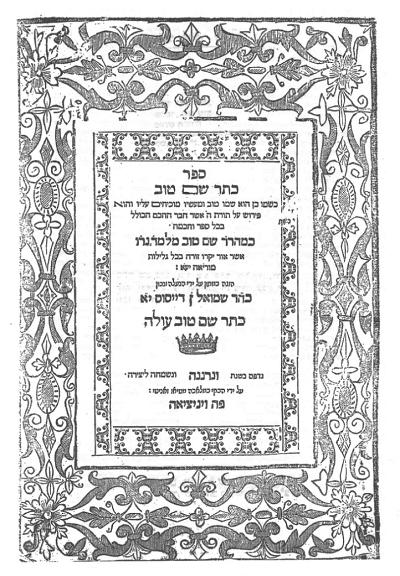
Keter Shem Tov

As is its name so is his name good and his deeds confirm it of him. It is a commentary on the Torah of HaShem written by the sage, the complete, in every book and wisdom.

Shem Tov Melamed

Whose precious light shines throughout [may

God shield him].

Edited patiently by the lofty and exalted

Samuel ibn Dysoss [may God watch over him]

Keter Shem Tov excels

Printed in the year, “that we may rejoice ונרננה (5356=1596) and be glad [all our days]” (Psalms 90:14) from the creation.


The introduction, from a student of the author, R. Samuel ben Solomon Segelmassi follows (2a), then a page of verse from the editor Samuel ibn Dysoss, the text (3a-136a), his apologia (136b), indexes (1a-16a), errata (16a), and the colophon (16b), which states that it was completed, “on the very day that Moses went up to the firmament (6 Sivan) and the Egyptians drowned in the sea (21 Nissan), in the year, “Then he saw it, and declare it ויספרה (5356=1596) (Job 28:27), from the creation.” It is unclear why there are two apparently contradictory completion dates. The text is in two columns in rabbinic type, excepting headings and initial words.

In the introduction Samuel ben Solomon writes that one who knows matters in truth and faithfully,

“shall come back with shouts of joy” (Psalms 126:6), “to perceive the words of understanding” (Proverbs 1:2) and this is the first intent of every man who presumes in his heart (Esther 7:5) to write “goodly words” (Genesis 49:21) in a book to leave after him a blessing. . . . It is a commentary on the holy Torah, “high and lofty” (Isaiah 6:1, 57:15), on each and every parshah . . .

The introduction continues that it contains derashot (discourses) according to the literal meaning, casuistic (pilpul), and very sharp. In the following paragraph we are informed that not everything that was said on every parshah was printed because of financial restraints. In the apologia ibn Dysoss adds a familiar plaint for the period, type set late erev Shabbat could not be properly corrected. Moreover, the compositors, not Jewish and not fully familiar with Hebrew and Hebrew letters, did that which was right in their eyes, and for which he should not be held responsible.

That the title clearly alludes to the author’s name, R. Shem Tov ben Jacob Melamed, is further suggested by the last line of verse at the end of the introduction, which states that “you will find that the crown of a good name (KETER SHEM TOV) excels them all. This is, as noted above, that authors’ names were frequently employed in book-titles, but, in keeping with the injunction of R. Judah he-Hasid, indirectly, here by referencing a quote from Avot.

Shem Tov Melamed was also the author of Ma’amar Mordekhai (Constantinople, 1585), a commentary on Megillat Esther, printed by Joseph Jabez. Melamed is described on the title of this work as a physician.

Keter Shem Tov, Amsterdam, R. Abraham ben Alexander (Axelrad) of Cologne, c. 1810-16: A kabbalistic Keter Shem Tov on the Tetragrammaton by R. Abraham ben Alexander (Axelrad) of Cologne (13th century). In Judaism the Tetragrammaton, the four letter divine name, is not directly expressed but instead referred to with a euphemistic name for God. The title-page describes this Keter Shem Tov as,
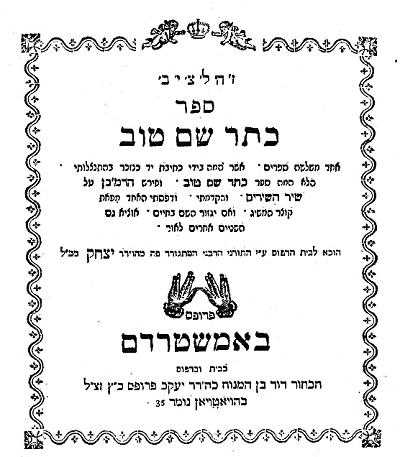
זהלציב [This is the gate of the Lord: the righteous shall enter through it] (Psalms 118:20)

Sefer

Keter Shem Tov

One of three books in my hand in manuscript, as described in my apologia. They are Keter Shem Tov and the commentary of the Ramban (R. Moses ben Nahman, Nachmanides, 1194–1270) on Shir ha-Shirim (Song of Songs). I have first printed one book only due to limited means. If the Lord will so decree I will publish the other two books. . . .


Although the title-page refers to three books two only are mentioned. The third work, noted in the editor’s apologia, is a commentary on the Merkavah of Ezekiel. Keter Shem Tov is not dated, so that various bibliographic sources date it as 1810 or 1816. The title-page is embellished by the Proops’ family press-mark, consisting of the kohen’s spread hands at the time he pronounces the priestly blessing. This edition of Keter Shem Tov (80: 5, 7 ff.) was printed in Amsterdam by David ben Jacob Proops. The Proops’ press, founded by Solomon Proops in 1704, was the longest lasting and most productive of the Hebrew printing-houses in Europe in the eighteenth century; it would continue to print Hebrew books until the mid-nineteenth century when, in 1869, the widow of David Proops sold the press to the Levissons, who printed until 1917.

Abraham, a student of R. Eleazar ben Judah of Worms (c. 1176–1238, Roke’ah), traveled through Spain between approximately 1260 and 1275, where he reportedly studied with R. Solomon ben Adret (Rashba, 1235–1310), the latter praising Abraham’s oratorical skills. Keter Shem Tov, as noted above, deals with the Tetragrammaton and also the Sefirot, addressing sacred names, using gematriot and synthesizing the mysticism of the Ashkenaz pietists (Hasidim) and Sephardic Kabbalistic methodologies.[5] Here too the reason for the title is not explicitly stated but, given the subject matter, is obvious.

This is not the first printing of Abraham ben Alexander’s Keter Shem Tov. It appeared earlier, included in a collection entitled Likkutim me-Rav Hai Gaon (Warsaw, 1798), under the title Ma’amar Peloni Almoni (ff. 26-32a). It has since been reprinted several times, often among collections of other works.

Ma’or va-Shemesh, R. Shem Tov ben Abraham ibn Gaon, Livorno, 1839: The next Keter Shem Tov, by R. Shem Tov ben Abraham ibn Gaon, is also a kabbalistic discourse on the Torah, this part of a larger multi-volume work entitled Ma’or va-Shemesh (Livorno, 1839, 80: [3], 3-11, [1], 128 ff.) printed by Eliezer Menahem Ottolenghi. The inclusion of Ma’or va-Shemesh represents a more expansive view of works entitled Keter Shem Tov as it is an independent work included in a larger collection of dissertations. The author (compiler) of Ma’or va-Shemesh, R. Judah ben Abraham Coriat (d. 1787) of Tetuán, was a scion of a distinguished Moroccan family.

  1. Shem Tov ibn Gaon (c. 1287-c. 340) was born in Soria, Spain and went up to Eretz Israel in 1312, settling in Safed where he wrote most of his books. He was a student of R. Solomon ben Adret (Rashba, 1235–1310) and R. Isaac ben Todros (13th cent.). Best known of ibn Gaon’s titles is Migdal Oz, on Maimonides’ Mishneh Torah as well as several works in manuscript. Keter Shem Tov, his first book, was reportedly written in Spain, while Rashba was still alive.[6]

The title-page of Ma’or va-Shemesh has a frame comprised of verses, all from Psalm 119:
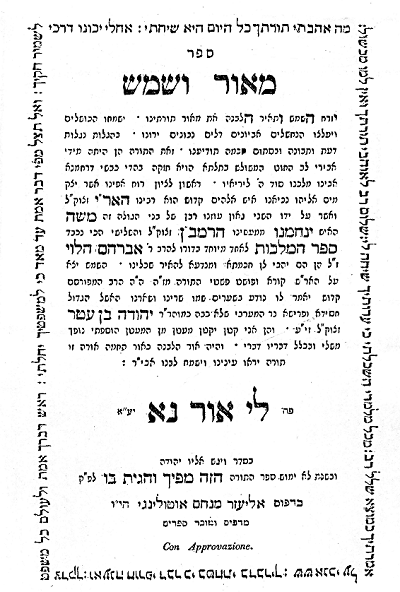
“O how I love your Torah! It is my meditation all the day” (Psalms 97);

“O that my ways were directed to keep your statutes!) (5);

“The sum of your word is truth; and every one of your righteous judgments endures for ever” (160);

“So shall I have an answer for him who insults me; for I trust in your word” (42);

“So shall I have an answer for him who insults me; for I trust in your word” (162);

“I have more understanding than all my teachers; for your testimonies are my meditation” (99); “Great peace have those who love your Torah; and nothing can make them stumble” (165).


An additional verse is employed for the date, “This Book of the Torah shall not depart from your mouth; but you shall meditate on it הזה מפיך והגית בו (599 = 1839)” (Joshua 1:8). The title too is from Psalms, “The day is yours, the night also is yours; you have prepared the light and the sun (Ma’or va-Shemesh)” (Psalms 74:16).

The text of the title-page notes several of the authors whose kabbalistic works comprise Ma’or va-Shemesh, notably the Ari ha-Kadosh (R. Isaac Luria, 1534 – July 25, 1572), R. Moses ben Nahman (Ramban), Sefer ha-Malkut, and R. Judah ben Attar, Coriat’s maternal grandfather. The verso of the title-page has a pressmark, a lion rampant holding thistle under crown and below it the phrase Gur Aryeh Yehudah. This device was used previously in Livorno by Eliezer Saadun. When employed by Ottolenghi the lion has been turned to face right, it having previously faced left.[7]



There are introductions from R. Elijah Benamozegh and Abraham ben Judah Coriat, the former comprised of five paragraphs, each beginning with the word Kol and concluding with Judah, the latter’s introduction comprised of eight paragraphs, each beginning with Ben and concluding with Av. The text is comprised of several kabbalistic works, among them Shem Tov ben Abraham ibn Gaon’s Keter Shem Tov (ff. 25-54a), here not explicitly stated but rather entitled Perush Sodot ha-Torah. Shem Tov was a kabbalist, who studied with the Rashba and R. Isaac ben Todros. He was greatly influenced by the Ramban (R. Moses ben Nachman), reflected in his Keter Shem Tov, which is a kabbalistic super-commentary on Ramban’s Torah commentary. Here too, the title comes from the author’s name, Shem Tov.

A small portion of ibn Gaon’s Keter Shem Tov was printed previously (ff. 41b-44a), in R. Jehiel ben Israel Luria Ashkenazi’s Heikhal ha-Shem (Venice, 1601), on the ten Sefirot, Likkutei Kabbalah Kadmonim.
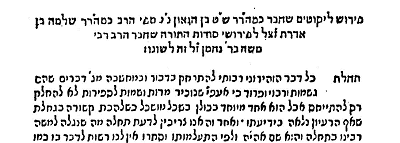


This much expanded version of Keter Shem Tov is based on an 1810 manuscript prepared by R. Elijah Lombroso.

II Halakhah and Minhag

Keter Shem Tov, R. Shem Tov ben Isaac Gaguine, Kaidan, Lithuania, 1934: An encyclopedic work on the varied customs and liturgy of eastern and western Sephardim and Ashkenazim by R. Shem Tov Gaguine (Gaguin, 1884-1953). Gaguine, scion of a famous Moroccan Rabbinical dynasty which emigrated to Palestine from Spain, was a great-grandson of R. Hayyim Gaguin the first Hakham Bashi of Eretz Israel in the Ottoman Empire and a great-great grandson of the kabbalist Sar Shalom Sharabi. Gaguine, who received semicha (ordination) from R. Hayyim Berlin, served as a dayyan in Cairo, rabbi and dayyan in Manchester, England, Rosh Yeshivah of Judith Montefiore Theological College, Ramsgate, and, from 1935, as head of Sephardi Medrash Heshaim in London.[8]
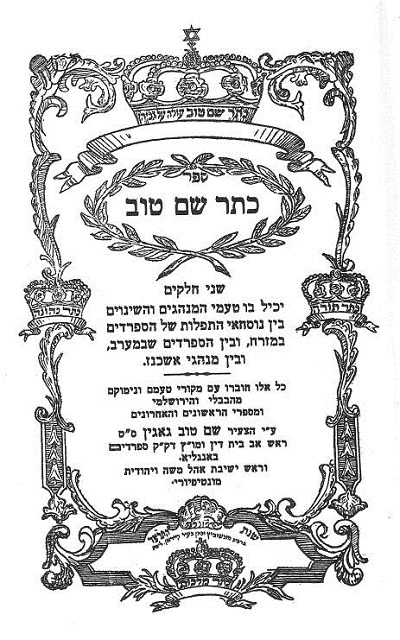


This Keter Shem Tov is comprised of seven volumes, the first two published in 1934, and the last four published posthumously by his son Dr. Maurice Gaguine. The complete work has been republished several times.

As noted above, Keter Shem Tov is a comprehensive work describing the liturgy and customs of eastern and western Sephardim and of Ashkenazim, accompanied by detailed footnotes from the Babylonian and Jerusalem Talmuds and later halakhic authorities. Although most of the entries explain more familiar customs, many are unusual. Example of the latter are:

The custom in [Eretz Israel and Syria, Turkey and Morocco] when the father, grandfather, father-in-law, one’s rabbi, or elder brother has an Aliyah, to stand on one’s feet until he returns to his place, and to go to them, kiss their hand and receive a blessing (I:213).

An unusual custom of the Sephardim in the city of Algiers is the phrase “marror zeh (this marror)” is said three times and then thrown to the ground, and afterwards picked up and returned to the ka’arah (Seder plate).[9]

Why is the marror called hasa or hazeret (lettuce or horse raddish)?

The Ashkenaz custom is to take, in place of hazeret a type of dry radish called in their language hrain, which is as sharp as mustard and does not have a bitter taste. The Sephardic custom is specifically hazeret. . . . (III: 158-59).

Keter Shem Tov, R. Avishai Taharani, Jerusalem, 2000: Another work on halakhah and customs, this most specific, described on the title-page as “a treasure of all the halakhot and personal customs concerning naming sons and daughters” by R. Avishai Taharani. The title-page continues that in it are explained the basic guidelines for giving names “by whose observance man shall live” (Leviticus 18:5, Ezekiel 20:11, 13, 21). Also addressed are the names that one should refrain from using.

In the introduction (pp. 1-23) to this two volume work, Taharani informs that he has so entitled the book, based on the injunction of the Roke’ah (above), as well as several other works. He has done so, however, with gematriot (numerical equivalencies) for “Avishai Taharani ben my lord and father Isaac אבישי טהרני בן לאדוני ואבי יצחק (977) which corresponds to Keter Shem Tov כתר שם טוב (977).” The text is wide ranging, comprehensive, and accompanied by detailed footnotes. Several examples of the more unusual entries in the text are:

If a father errs and calls his son or daughter with two names, forgetting that the additional name was given to another child, there are those who say that until thirty days he may change the name (I:118).

Some say that if one has a child from an unmarried woman, the child should be called with a name that predates [the time of the] Patriarch Abraham or with a name that is not customary, for example, Dan, so that he will be judged according to his problem. There are places that it is customary to give these names to those who are kosher and Heaven forfend one should come to question those who are kosher (I: 237-38).

Some say that one should not call [a child] with one of the names that predates the Patriarch Abraham, for example: Adam, Noah, and all who call by a name that predates the Patriarch Abraham is not in the category of one who “labors in the Torah, and does not give pleasure to his Creator” (cf. Berakhot 17a). (I:397-400).

It is permissible to shorten a name, whether for a son or a daughter, as long as that name is used only casually, and it is best to use the full name at least once a day in order that the short form dies not become customary (II:110-13).

In a lengthy footnote to the third entry concerning names that predate the Patriarch Abraham a source for the entry is given, ha-Mabit (R. Moses ben Joseph of Trani, 1500 – 1580). It is followed by a number of contrary sources by other prominent rabbis, and then a lengthy discussion. That this Keter Shem Tov has proven to be a relatively popular work is evident from the publication of two additional editions, the last in 2007.

Keter Shem Tov, Kollel Keter Shem Tov, Kiryat Bialik, 2002: Collection of discourses and responsa on Shulhan Arukh Hoshen Mishpat by rabbis from the Kollel Keter Shem Tov in Kiryat Bialik, located in the vicinity of Haifa. There is an introduction from R. Mahluf Aminadav Krispin, Chief Rabbi of Kiryat Bialik, followed by the text, comprised of nineteen articles, including one by the Rosh Yeshiva R. Solomon Shalosh. Examples of the articles are 5) “on the prohibition turning to secular courts” by R. Efied Hagibi, member of the Kollel; 6) finding a relative or one who is unfit among the judges by R. David Alharar, member of the Kollel; 9) witnesses who have fulfilled their charge” by R. Evied Elul, member of the Kollel; 11) “the obligation of rent after divorce, the portion in the residence” by R. Abraham Atlas, av bet din, Haifa; 14) “acquisition through forgiveness (relinquishment) by R. Solomon Shalaoh; and 19) “the wages of a worker and contractor who did not provide the agreed upon benefit” by R. Abraham Atlas.

The title-page numbers the volume as no. one, but it is not known whether additional volumes were published.

III Biographical and Related Anecdotal Works

Keter Shem Tov, R. Aharon ben Zevi ha-Kohen of Apta, Zolkiew, 1794/95: The most popular of our Keter Shem Tovs, based on the printed editions, is the collection of tales and stories of the remarkable and astounding deeds of the Ba’al Shem Tov (R. Israel ben Eliezer, Besht, c. 1700–1760), founder of the Hasidic movement, as well as his recorded sayings, assembled from the works of his disciples. This collection of tales and sayings was assembled by R. Aaron ben Zevi Hirsch ha-Kohen of Opatow (Apta).
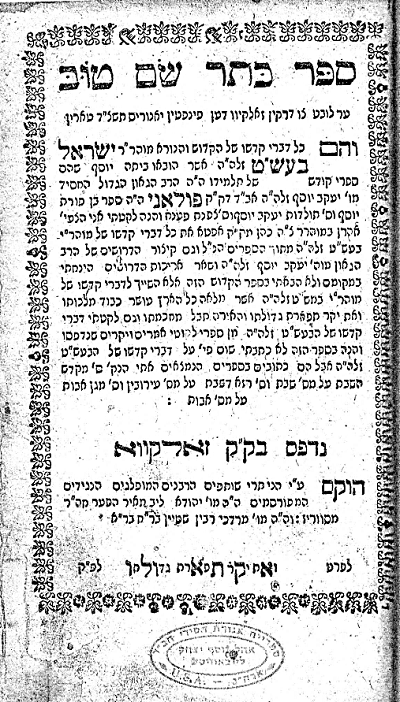


The book is in two parts, each with its own title-page but identical text, except that the first title-page is dated with a chronogram, the second title-page, printed a year later, is dated in a straightforward manner, תקנ”ה (555 = 1795). Perhaps the reason that the second title-page is so dated is that the first title-page exists in two forms, the rare first title-page, is dated “and the glory of his splendid majesty ואת יקר תפארת גדולתו (544 = 1784)” (Esther 1:4), which is incorrect, the book having been printed a decade later. The error was likely quickly caught, for the corrected and much better known title-page has the same chronogram, now reading ואת יקר תפארת גדולתו, the yod in the second word enlarged and emphasized, for a correct total of 554 (1794).[10] The variants are recorded separately in several bibliographic works.[11]

The title-page informs that that much of the contents are from the works of R. Jacob Joseph ben Zevi ha-Kohen av bet din of Polonnoye (d. c. 1782), the Ba’al Shem Tov’s leading disciple, that is, Toledot Ya’akov Yosef, Ben Porat Yosef, and Zafenat Pa’ne’ah, as well as discourses, also from other works. Among these latter sources are Likkutei Amorim and the sayings of the Ba’al Shem Tov, all collected by R. Aaron ben Zevi Hirsch ha-Kohen of Opatow (Apta).

In addition to the variations to the first title-page, the second title-page also exists in two formats, with, unlike the first title-page, some textual variations. Within the text of the book, despite Aaron ben Zevi Hirsch ha-Kohen’s comments that he has assembled the Ba’al Shem Tov’s words from the above mentioned titles, he did not, in fact, merely transcribe them in toto, nor did he distinguish which were the words of the Ba’al Shem Tov and those of Jacob Joseph.[12]

Keter Shem Tov has an approbation from R. Menachem Mendel of Liska, followed by the famed Iggeret Hakodesh, a letter from the Ba’al Shem Tov to his brother, dated Rosh Ha-Shanah, 1747, in which he relates that his soul ascended to heaven where he met with the Messiah, and then the text. This Keter Shem Tov, as noted above, has proven to be an enduring and popular work; it was printed soon after in Korezec (1797), Lemberg (1809) and several times afterwards there, in numerous other locations, and continues to be republished to the present.

Keter Shem Tov, Abraham Menahem Mendel Mohr, Lvov (Lemberg), 1847: Sir Moses Montefiore (1784–1885) was one of, if not the most prominent member of English Jewry in the nineteenth century. Cecil Roth described him as “the most notable Jew, and indeed one of the most notable Englishmen, of the 19th century by virtue of his outstanding philanthropic work extending over a period of three-quarters of a century, into his venerable old age.”13 Montefiore traveled to the Middle East during the Damascus Affair, to Russia, Morocco, and Rumania on behalf of persecuted Jewry, as well as providing leadership and support of Jewry at home and in Eretz Israel. His indefatigable efforts on behalf of world Jewry are recorded and acknowledged in books, articles, and newspapers, several works entitled Keter Shem Tov.

The first Keter Shem Tov praising Sir Moses Montefiore is by Abraham Menahem Mendel Mohr (1815–1868), a scholarly maskil, author of a number of Hebrew and Yiddish books. The title-page states that it is,
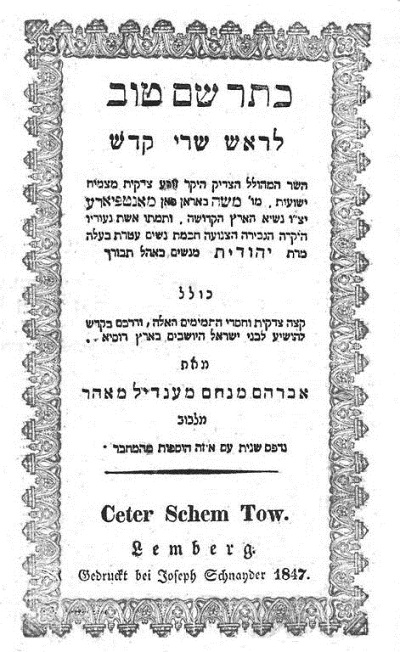
Keter Shem Tov

For the chief, holy prince

The praiseworthy, the righteous, the dear, who sows righteousness and brings forth salvation. Our teacher, Moses Baron from Montefiore [May his Rock and Redeemer protect him], prince of the holy land. And the pure wife of his youth, the honorable lady, the modest, the wisdom of women “is a crown to her husband” (Proverbs 12:4), the lady Judith “blessed shall she be above women in the tent” (Judges 5:24). . . .

The title-page continues that the text includes some of the righteousness and perfect kindness on behalf of the Jews in Russia. A small book, (80: 16 pp.: Joseph Schnander), the text begins with verse, with the header “from Moses to Moses there was none like Moses” normally referring to Maimonides but here applied to Montefiore. The verse beginning,

“Moses ben Amram brought Israel out from the burdens of Egypt

and Moses Montefiore redeemed them from death to life.

Moses ben Amram “struck the rock, so that the waters gushed out” (Psalms 78:20)

and Moses Montefiore softened the heart of stone with “words of lips” (cf. II Kings 18:20, Isaiah 36:5). . . .


The volume concludes with a letter of appreciation from Sir Moses Montefiore.

A Ladino (Judeo-Spanish) version of Mohr’s Keter Shem Tov was printed in Salonika (1850, 80: 48, 53-80 ff.) together with two other works, Tiferet Yisrael on the Rothschilds, and Ma’aseh Eretz Israel on Eretz Israel from the destruction of the Temple to the nineteenth century. Among the many other works either praising or including a section on Montefiore are Kol Kitvei Rabbi Ya’akov Saphir ha-Levi (Jerusalem, 1934), the writings of R. Jacob Saphir (1822–1886), an emissary of the Jewish community in Jerusalem and the author of Even Saphir on the Jewish communities in such varied places as Yemen, Egypt, India, and India that he visited. In Kol Kisvei is a section entitled Keter Shem Tov Kenaf Renanim Sir Moses Monrefiore, accompanied by a cameo of Montefiore.
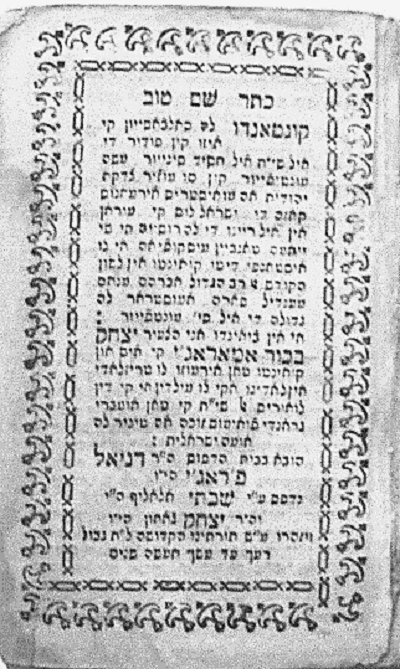


Yet another Keter Shem Tov about Montefiore was published by Hayyim Guedalla (London, 1884). The Hebrew title-page is followed by an English title-page that states,

The Crown of A Good Name

a brief account

of a few of the

Doings, Preachings, and Compositions

On

Sir Moses Montifieore’s Natal Day,

November 8th, 1883,

on which he was favored with a succession of telegraphic

Congratulations from the QUEEN OF ENGLAND and many

Eminent People of all Creeds.

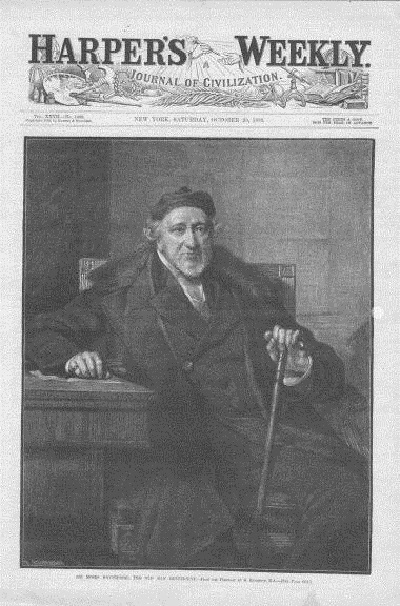
Below is the quote from Pirke Avot. The text includes congratulatory letters from the Queen, the Duke of Edinburgh, many others, and special services in both Hebrew and English. In addition, many other publications relate to Moses Montefiore, among them, albeit this not directly pertinent to the article but of interest as a further example of how widespread the high esteem in which the venerable Sir Moses Montefiore was held, is the title page of the October 20. 1883 Harper’s Weekly Journal of Civilization (New York), with a full cover portrait of Montefiore.


Keter Shem Tov (Ehrenkranz des guten Rufes), R. Josef Natonek, Budapest, 1880: German Keter Shem Tov by Josef Natonek in honor of Rabbi Dr. Moritz Landsberg (1824-80), son of R. Elias Landsberg (1800-79). Except for a Hebrew header the title page is entirely in German, as is the text (32 pp.), with only occasional Hebrew.
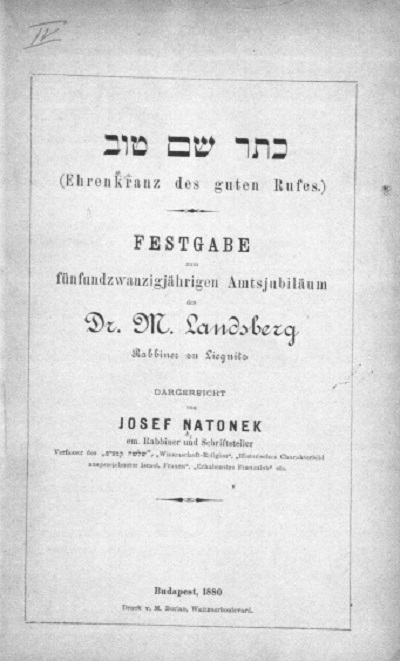


The title, Ehrenkranz des guten Rufes, is our “crown of a good name,” a Festgabe zum fünfundzwanzigjährigen Amtsjubilaeum des Dr. M. Landsberg, Rabbiner zu Liegnitz dargereicht von Rabbiner Josef Natonek em Rabbiner und Schriftsteller verfasser, that is a festive volume presented to Landsberger on the twenty-fifth jubilee of his service as rabbi in Liegnitz, by R. Josef Natonek (1813-92), a rabbi and author. Landsberg, doctor of philosophy educated in Berlin, became, in 1854, the rabbi of Legnica. Born in Rawicz, He served as rabbi for twenty-five years until his death in Liegnitz (Legnica, Silesia).[14] Landsburg was also the author of a number of studies on the history of medicine, particularly in ancient times, published for the most part in the journal Juno, published by von Henschel.[15]

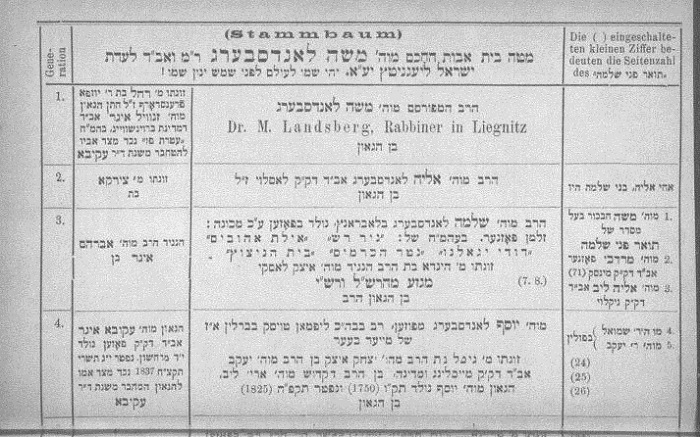
At the end of the volume is a two page Stammbaum (family tree) of the Landsberg family.


IV Miscellanea

Keter Shem Tov, R. Solomon Zalman ben Zevi Hirsch ha-Kohen, Livorno, c. 1789: Our next Keter Shem Tov is a quarto sized page printed in Livorno in c. 1789 for the Hassidic Tiberius Kollel Ashkenazim. It informs that R. Solomon Zalman ben Zevi Hirsch ha-Kohen (d. 1799) is an emissary of the Merciful One and of us (the Ashkenaz Hasidic community of Tiberias). The letter is signed by twenty-one rabbis.[16]
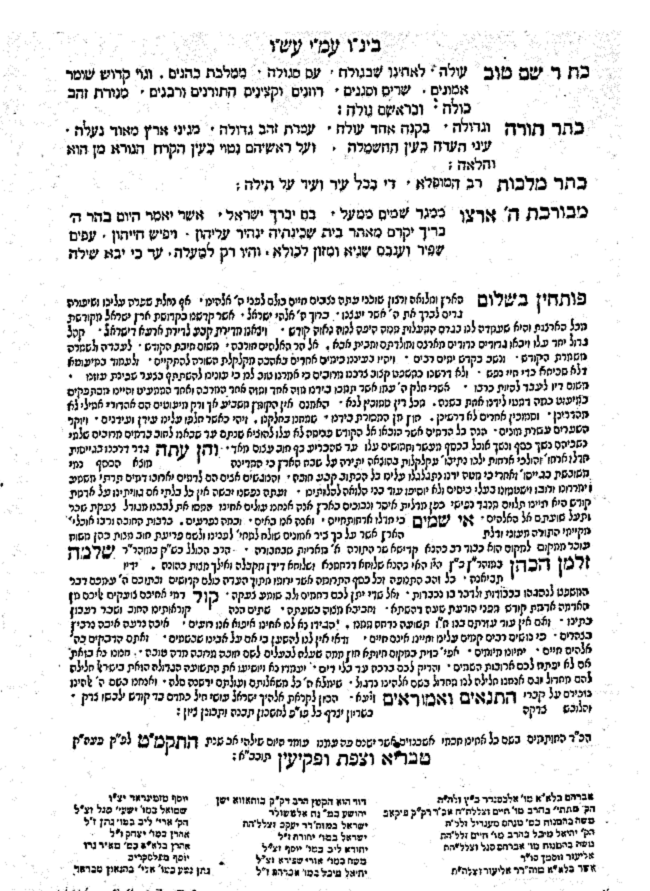


The letter begins with a reference to Keter Shem Tov followed by a list of honorifics “but the crown of a good name (Keter Shem Tov) excels them all. To our brothers in the exile, a treasured people, ‘a kingdom of priests and a holy nation’ (Exodus 19:6), keepers of the faith, princes and chieftains, princes and leaders, ‘a lampstand all of gold’ (Zechariah 4:2) Torah scholars and rabbis.”

It informs about their joy in the merit to live in Eretz Israel. Until now they had relied upon support from the country from which they had come; but now, however, due to war between Russia and the Ottoman Empire, they could no longer depend on that funding, so that they are now turning to Jews in other lands for support. Indeed, in describing the situation the letter notes the dire financial situation and that the land “‘is infested with bandits’ (Yevamot 115a, 122a) ‘the task masters hurried them’ (Exodus 5:13), they ‘lie in wait for blood’ (Micah 7:2). . . . ‘But now our soul is dried away; there is nothing at all (Numbers 11:6)’”

Solomon Zalman had traveled twice previously as an emissary to Russia (1779-81/1784-85), but this was his first trip to Western Europe. Avraham Yaari relates that Solomon Zalman’s undertaking was not without objection. The Sephardic community protested that the Hasidic community, which had previously received support from Eastern Europe, a venue now closed to them, was, by sending an emissary to Western Europe, entering into the domain of the general Tiberias community. The dispute was resolved several years later when joint representatives of both communities went to Eastern Europe.[17]

The letter begins with that part of the phrase from Avot referring to Keter Shem Tov intimating that a way one obtains the “crown of a good name (Keter Shem Tov)” is through good deeds and charity, which, as noted above, is “As a pearl atop a crown (keter), so are his good deeds fitting,” certainly appropriate for an appeal for the destitute community in Israel, the subject of the our Keter Shem Tov.

Keter Shem Tov, Shani Tzoref, Ian Young, Editors; Piscataway, NJ, 2013: A highly unusual Keter Shem Tov, this the proceedings of a conference on the Dead Sea scrolls held in memory of the late emeritus professor Alan David Crown in late 2011 at the University of Sydney, Mandelbaum House. This volume is part of a series entitled Perspectives on Hebrew Scriptures and its Contexts published by Gorgias Press, which describes itself as “an independent academic publisher of books and journals covering several areas related to religious studies, the world of ancient western Asia, classics, and Middle Eastern studies.” Among their subject matter is Ancient Near East, Arabic and Islam, Archaeology, Bible, Classics, Early Christianity, Judaism, Linguistics, Syriac, and Ugaritic.

Professor Alan David Crown (1932-2010) in whose memory this book was published, was Professor in Semitic Studies at the University of Sydney, and a renowned scholar and author. As noted on a website referring to him the title relates to the name Crown (Keter), for “He may have inherited the name Crown from his parents, but he earned the title ‘CROWN’ – the Crown of Torah, through his own merit, his sharp intellect and his deep respect for scholarship.”[18] The editors are Dr. Shani Tzoref, Ph.D., Skirball Department of Hebrew and Judaic Studies, New York University and currently a Qumran Institute Fellow, Seminar für Altes Testament, Georg-August-Universität Göttingen, and Dr. Ian Young, Associate Professor, Chair of Department at the University of Sydney, Australia, teaching Classical Hebrew and Biblical Studies.

This edition of Perspectives on Hebrew Scriptures and its Contexts 20: Keter Shem Tov (x, 400 pp.) is comprised of sixteen articles on various subjects in the field of Qumran studies (Dead Sea scrolls) from scholars in the field. The articles encompass the development and phases of Qumran scholarship; textual transmission of the Hebrew Bible, including Samaritan texts and Masada Biblical Scrolls; reception of Scripture in the Dead Sea Scrolls; community and the Dead Sea Scrolls; and eschatology and sexuality in the So-Called Sectarian Documents from Qumran; and the Temple and the Dead Sea Scrolls.

V Summary


This concludes our survey of books with the title Keter Shem Tov. As noted above, the article is vignettes of books so entitled. There is no single pattern in the use of the title, it being applied to a wide variety of books. There are discourses on the Torah, both literal and kabbalistic, works on Jewish law and customs, biographic or anecdotal, and several miscellaneous works, among them an appeal for support of Jewish communities in the Holy Land and on the Dead Sea scrolls. The title Keter Shem Tov has been chosen because it refers to an author’s name, for example, R. Shem Tov Melamed, R. Shem Tov ibn Gaon, and R. Shem Tov Gaguine; bibliographical works such as those referring to the Ba’al Shem Tov, Sir Moses Montefiore, and Rabbi Dr. Moritz Landsberg; and more diverse works, such as one being the novellae of a Kollel, the Dead Sea scrolls, and even topically related as in R. Avishai Taharani’s Keter Shem Tov, which actually deals with laws and customs applicable to names.

We began by noting that the title of Hebrew books, unlike books in other languages, may have “been selected by the author for any one of a number of reasons, least of all the book’s subject matter; rather the intention is/was to give the book ‘the crown of a good name (Keter Shem Tov)’.” Indeed, not one book in this article, with the possible exception of Taharani’s Keter Shem Tov, indicates its subject matter by the title. What each of these examples do have in common, is the intent to associate the name of the author, subject, or even organization with the Mishnah in Pirke Avot, which states,

  1. Simeon said: there are three crowns: the crown of Torah, the crown of priesthood, and the crown of royalty; but the crown of a good name (emphasis added, Keter Shem Tov) excels them all (Avot 4:13).

[1] I would like to thank Eli Genauer for reading the article and his comments and my son-in-law, R. Moshe Tepfer, for his assistance and research in the National Library of Israel, including getting the 1789 Livorno illustration from
[2] Marvin J. Heller, “Adderet Eliyahu; A Study in the Titling of Hebrew Books,” in Studies in the Making of the Early Hebrew Book (Brill, Leiden/Boston, 2008), pp. 72-91; idem. “What’s in a name? An example of the Titling of Hebrew Books,” in Further Studies in the Making of the Early Hebrew Book (Brill, Leiden/Boston, 2013) pp. 371-94.
[3] Judah he-Hasid, Sefer Hasidim (Jerusalem, 1973), ed. Re’uven Margaliot, pp. 210-11, n. 367 [Hebrew].
[4] Eleazar ben Judah, Sefer Roke’ah ha-Gadol (Jerusalem, 1967), ed. Barukh Shimon Shneurson, p. 1 [Hebrew].
[5] Gershom Scholem, Kabbalah (New York, 1974), p. 51.
[6] Shimon Vanunu, Encyclopedia Arzei ha-Levanon. Encyclopedia le-Toldot Geonei ve-Hakhmei Yahadut Sefarad ve-ha-Mizrah IV (Jerusalem, 2006), pp. 2152 [Hebrew].
[7] Avraham Yaari, Diglei ha-Madpisim ha-Ivriyyim (Jerusalem, 1943, reprint Westmead, 1971), pp. 96, 174 no. 160, [Hebrew].
[8] Shimon Vanunu, Encyclopedia Arzei ha-Levanon. Encyclopedia le-Toldot Geonei ve-Hakhmei Yahadut Sefarad ve-ha-Mizrah IV (Jerusalem, 2006), pp. 2155-56 [Hebrew].
[9] In contrast, the Mishnah Berurah (477:1:5) quotes the Shelah ha-Kodesh who states that ” have seen people of status who kiss the matzah and the marror . . . all to cherish the mitzvah.”
[10] Such errors and their corrections are known as stop-press corrections. Sheets were proof read while the press-run was under way; while it certainly was preferable to correct the sheets before the run began, reading also took place while the run was under way. When the corrector would find an error he would stop the run, remove the forme, quickly correct the error, and resume printing. Unless substantial, stop-press corrections did not necessitate disposing of the previous sheet – four pages in a folio, more so in a smaller format – but rather both the altered states and the originals are used. In such a case, there will be variant copies of the book, consisting of sheets printed from forms in both the earlier and later states, as is the case here.
[11] The copy with the misdated title-page in the Chabad-Lubavitch Library is attractively bound in a soft brown leather, the cover stamped כתר שם טוב ב”ק אדמו”ר שליט”א, that is, it was in the private library of the Lubavitcher Rebbe, R. Menachem Mendel Schneeersohn (1902–94). The reading room librarian, R. Zalman Levine, informs me that to his knowledge this is the only book so bound, and that it “was given to the rebbe with this binding.
[12] Keter Shem Tov (Brooklyn, 1972), p. v [Hebrew].
[13] Cecil Roth, “Moses Montefiore, 1784-1885,” in Essays and Portraits in Anglo-Jewish History (Philadelphia, 1962), p. 262.+
[14] As an aside, Jewish settlement in Lieignitz can be traced to the Middle Ages, interrupted by pogroms, the first in 1447 due to a dispute between Elżbieta, Duchess of Legnica with Jewish bankers, who demanded that she return a loan. Liegnitz is best remembered for a battle that took place there in 1241, when a Polish-German Army lead by Duke Henry II of Silesia engaged invading Mongol near the town. The Mongols were victorious, collecting nine sacks of ears from their fallen enemies, all of whom perished.
[15] Klatzkin, Jacob and Ismar Elbogen, editors, Enyclopaedia Judaica: Das Judentum in Geschichte und Gegenwart 10 (Berlin, 1928-34), p. 619.
[16] The signatories are R. Abraham ben Alexander Katz of Kalisk; R. Matthias ben Hayyim; R. Moses ben Menahem Mendel; R. Jehiel Michal ben Hayyim; R. Moses ben Abraham Segal; R. Eliezer Sussman; R. Asher ben Eliezer; R. David he is the Katan, rav of Bohava Yeshain; R. Joshua ben Noah Altshuler; R. Israel ben Jacob; R. Israel ben Judah; R. Judah Leib ben Joseph; R. Moses ben Uri Shapira; R. Jehiel Michal ben Abraham; R. Joseph of Zimigrad; R. Samuel ben Isaiah Segal; R. Aryeh Leib ben Nathan; R. Aaron ben Isaac; R. Aaron ben Meir; R. Joseph of Poloskov; and R. Nathan Nata ben Eli of Brod.
[17] Avraham Yaari, Sheluhei Eretz Yisrael II (Jerusalem, 1951, reprint Jerusalem, 1997), pp. 619-28 [Hebrew].
[18] http://learning.mandelbaum.usyd.edu.au/about-us/alan-crown/


The Vilna Gaon’s Talmud

Mississippi Fred McDowell, has posted re: the Vilna Gaon’s Yerushalmi edition. However, I would like to discuss which edition of the Bavli the Vilna Gaon had. This is a rather important especially in light of the numerous emendations to the text the Vilna Gaon made. As when one is amending something it is important to know what exactly they have amended.

Every morning Birkat HaShahar are recited. Among these blessings are three anomalous ones. These there, as opposed to the rest, are in the negative. Specifically, these blessing are for ones legal status, gender, and religion. It is the last one, religion is the one we will focus on.

The Talmud has these blessing, however, there is some difficulty with the text of the religion one. Some editions have this blessing in the positive, i.e. “thank you for making me a Jew,” and some have it in the negative, “thank for not making me a non-Jew.” This confusion prevailed into the medieval period, with some texts containing one iteration of the blessing and some the other. What is unclear, however, is whether this change to the positive was wrought due to censorship or is there some reason this blessing should be in the positive.

R. Yom Tov Lipmann Heller, in his Ma’adani Melekh, claims any passage which is in the positive (“thank you for making me a Jew”) is due solely to censorship. And with this, we get to the crux of our discussion here – the Vilna Gaon’s edition of the Talmud.

The Vilna Gaon, in his commentary on Shulhan Orach says that one should say this blessing in the positive form. He comes to this conclusion because “our editions of the Talmud have the blessing for ‘making me a Jew.'” In theory, the Vilna Gaon’s conclusion is dependent upon whether “our editions” are corrupted or not. That is, if “our editions” are censored then they prove nothing. This contention, that the Vilna Gaon used a corrupted edition is noted by R. Shmuel Feigenshon in the Otzar HaTefilot. Specifically, R. Feigenshon claims that had the Vilna Gaon seen the Amsterdam 1644 edition he would never made this mistake. [Additionally, based in part upon this, Y.S. Speigel notes the Vilna Gaon did not use manuscripts or earlier printed editions when he amended the text.]

It is worthwhile noting that R. Raphael Natan Rabinowich, in his Ma’amar ‘al HaDpasat haTalmud (which has just been reprinted by Mosad HaRav Kook) claims that the Vilna Gaon used the 1644 edition of the Talmud, the very one if he had used it would have avoid this error!!

In the end, we don’t know exactly which edition the Vilna Gaon used and according to Speigel, it is likely that the Vilna Gaon did not use one edition. Instead, it is likely the edition was dependent on the particular volume of the Talmud he had and for each volume it may have been a different edition.

Sources on the blessing: T.B. Menachot 43,b; Dikdukei Sofrim ad. loc.; Rosh, Berakot chapt. 9; Ma’dani Melekh id. at note 24; Tur Orakh Hayyimno. 46:4; id. Bach; Shulchan Orakh and Rama id.; see also, first edition of Rama Prague, 1588 for the proper placement of his comments available here; Biur HaGra id.; see also R. Y. Satnow, Va’yetar Yitzhak, no. 44; R. Jacob Emden, Luach Eres Toronto, p. 24 no. 64; Siddur Otzar haTeffilot, on the blessing in question; On the Vilna Gaon’s edition of the Talmud: Y.S. Speigel, Amudim b’Toldotha Sefer HaIvri: Haga’ot U’Magim, 404-405, 416 and the sources cited therein.


Some New Seforim, Books, R’ Eleazar Fleckeles, R’ Naftali Herz Weisel, Frankism and (of course) Censorship, Pt. I

Some New Seforim, Books, R’ Eleazar Fleckeles, R’ Naftali Herz Weisel, Frankism and (of course) Censorship*
By Eliezer Brodt
It’s been awhile since I posted a list of new seforim. I hope to post an updated list of a few hundred titles within the next few weeks. In this post I want to focus on a few new titles that, aside for being new, all have a connection to one topic. This is also an update to some earlier posts relating to this topic.
As a bochur about twenty years ago, I came across a small sefer called Olas Chodesh by R’ Eleazar Fleckeles during one of my daily shopping trips in seforim stores in Meah Shearim. Until then I had only been familiar with his Shu”t Teshuva m’Ahava. Besides the excellent price ($3), I also enjoy derush so I was happy with my purchase. Going through the sefer I was not let down, as it was especially interesting and even included some nice pieces from his rebbe, the Noda Bi-Yehudah. A few years later, while in Monsey, I made a short, enjoyable visit to Tuvia’s Bookstore. There I came across another small sefer by R’ Eleazar Fleckeles, Meleches haKodesh. After going through this sefer, I was once again blown away with how never ending Torah is (this is a daily occurrence!) . A bit later I was in a special library in Lakewood where I came across yet another obscure sefer by R’ Eleazar Fleckeles called Ahavat David, devoted to attacking Frankism. I immediately photocopied the sefer and went through it, marking off some interesting pieces. (Here is a link to a complete version of the work from the Reich collection, and here is a link to it on Google Books.)
In 2007 I wrote a review of the Meleches haKodesh [here] called ‘god or God: A Review of Two Works on the Names of God’. In that post I mentioned a letter found in the beginning of the Ahavat Dovid quoting a letter from R. Naftali Hertz Wesseley which says;
כי שמעתי מפי הגאון המקובל הגדול שהי’ ידוע הזוהר וכל ספרי האר”י ז”ל בעל פה הוא הרב ר’ יהונתן אייבשיטץ זצ”ל שהיה אומר לשומעי דבריו בעיני הקבלה כשראה שהם מפקפקים בהם ואמר אם לא תאמינו אין בכך כלום כי אין אלו מעיקרי אמונתנו, וכן היה אומר לאלו המביאים הקדמות מדברי קבלה לישב איזה גמרא או מדרש לא חפצתי בזאת ומה חדוש על פי קבלה תוכל ליישב מה שתרצה אמור לי הפשט הברור על ידי נגלה ואז אודך וכל זה אמת עי”ש עוד.
A bit after writing that post, I received an e-mail from Marc Shapiro asking me where I saw that letter, as the edition of Ahavat Dovid that he checked did not have it. I told him I had photocopied the whole sefer from an original. Some time after that, in February 2010, On The Main Line wrote about this censorship:
The book included a 1796 letter from Wessely, which Fleckeles offered… I will just note that I examined the pdf of Ahavas David twice, and I was unable to find the letter. I couldn’t understand why I couldn’t find it, so I asked several friends (literary men) if they knew what page it was on. Dr. Marc Shapiro replied that this edition — a Copy Corner reprint — is censored; it doesn’t include the letter! I suppose it’s theoretically possible that the censorship, ie, removal of the letter occurred long before the scanning of the book. That is to say, there’s no way at the moment to tell who removed it and when, but we can probably guess why. In any case, at the same time I asked Shapiro for clarification, Rabbi Brodt told me that his copy of Ahavas David includes the letter, and he sent it to me.
This censorship was later included and discussed by Marc Shapiro in an article[1] and then again in his work Changing the Immutable, (p.220). 
In 2007 I already noted some of the significance of this letter; i.e. it is notable that R’ Fleckeles quotes R’ Wesseley at all[2], as Wesseley was one of the early leaders of the haskalah movement, was close to Mendelssohn and was the author of the Biur on Vayikrah. R’ Fleckeles, like R’ Landau was firmly against the Biur.[3]
The significance of this letter in relationship to all this was already pointed out by Meir Hildesheimer, in a footnote in his excellent article “Moses Mendelssohn in Nineteenth Century Rabbinical Literature,” (Proceedings of the American Academy for Jewish Research (PAAJR) 55 (1988), p. 87 n. 23).
As an aside, all this is yet another example why scanned copies of seforim are not enough, as at times the scanner deletes pages on purpose (or even by accident). Examining originals are therefore important.
Both Meir Hildesheimer and On the Main Line[4] already noted that a copy of this letter was printed again in HaMelitz (#48, p. 750) in 1886.

In 1930, Dovid Zinz, in his extensive biography on R’ Yonasan Eibeschuetz, Gadlut Yonasan, lists R’ Wesseley as a talmid of R’ Yonasan (p.280), and also reprints this letter without claiming it’s a forgery (pp.245-246).
In November 2011 I wrote a two part post on the incredible work Parshegen by Rabbi Dr. Rafael Posen. In the second post, titled Using the works of Shadal and R. N. H. Wessely, I wrote:
A few years ago in the pages of the excellent journal Ha-maayan, a controversy took place (here) in relationship to how to cite various works of questionable people, in the course of the controversy it turned to quoting Mendelson and Wessely and their stories. Rabbi Posen mentioned that there was nothing wrong with Wessely which others argued. This controversy in regard to Wessely was not a new one[5], a few years back in the Kovetz Beis Aron VeYisroel there was a series of articles based on various manuscripts showing how the Gedolim at the time were very against Wessely. Towards the end of the Series of articles the author did a strange thing, he collected many citations of big name gedolim who did use Wessely’s work even after the controversy (herehere and here). Almost all of these gedolim were well aware of the controversy of Haskalah and came after the early gedolim obviously disagreeing with them. To me this was strange as he undermined his research – he showed that there was a big controversy with many big people on both sides so how in the world did he reach his conclusion that Wessely was bad according to everyone.
The controversy about Wessely did not end there as a few years later two works of Wessely were reprinted, his Sefer Hamidos (2002), and his Yeyn Halevonon (2003). In the introduction of both works there are lists of great people who used Wessely’s works. To be sure the kanoyim did not remain quiet about this, that same year (2003) in the introduction to the Tomer Devorah reprinted by the Mishor publishing house an introduction was printed about the evil works of Wessely that were reprinted. A few months ago the Kovetz Eitz Chaim (15, 2011, pp. 13-30) printed another manuscript on this controversy against Wessely including some letters of various gedolim of today against the evil Wessely.  In the recent work on R. Elyashiv Shlita, Hashakdon (2, pp. 136-137) they also mention how he was against the reprinting of the works of Wessely. The problem to me is how do they explain all the great Gedolim who did use his works? [In that post I included a list of Gedolim who used the works of Wessely, or quoted him in a positive light.[6] I then concluded with the following:]
“I would like to conclude with the following dream just as R. Shlomo Dubno was vindicated in the past few years by R’ Dovid Kamenetsky. It is my hope that Wessely will too be vindicated from all false charges against him and people will realize there is nothing wrong with his writings.”
Fast Forward to 2014

A few years ago I mentioned a sefer called Rabbenu written by R’ Eliyhua Starrit about R’ Ovadiah Yosef. This work is very valuable, as the author printed numerous conversations he had with R’ Ovadiah Yosef while learning with him and we get a rare, authentic glimpse into his study habits and private learning sessions. Among the numerous interesting pieces in this work we “hear” R’ Ovadiah’s opinion on different seforim and their authors. However, at times a juicy tidbit or name is censored out and we are left in the dark with just a tease of a conversation.

Here are two such pieces. The first refers to the reprinting of the Chemdas Yamim (hopefully I will return to that in the future). The second refers to the reprint of R. N. H. Wessely’s work by Yerid Haseforim a few years ago. As you can see, part is edited out.

We see that R’ Ovadiah Yosef was also against the reprinting of R’ Wessely’s works.

And 2016

In April this year, a complete edition of Ahavat Dovid was put up for auction by Legacy Judaica as was mentioned here, with a signature of it having been owned by R’ Binyomin Lowe, author of Sha’arei Torah.
A few months ago a few more volumes of R’ Wessely were printed, some for the first time from manuscript, by R’ Moshe Tzuriel. One volume includes three new seforim. 1) Sefer HaMidos which includes an additional one hundred and twenty five new pages from manuscript, printed for the first time. 2) Sefer Migdol HaLevonon, about one hundred and fifty new pages from manuscript, printed for the first time. This work focuses on Shemos Nirdafim (synonyms). 3) Chikur Hadin, a thirty page article on Sechar VeOnesh. The second volume is a reprint of Gan Na’ul (934 pp.) with notes and indexes. There is a whole section of this work printed here from manuscript for the first time, numbering about 250 pages!

Here are two samples of pieces from this beautiful work.


It is worth seeing this haskamah of the Noda Bi Yehuda to Gan Na’ul:

In the introduction to this new work, the editor notes (p. 6) that R’ Fleckeles quotes a letter from R’ Naftali Hertz Wesseley in his Ahavat David and mentions that it has been censored out of some versions, referring to his introduction of the Yeyin Levonon that he printed in 2003 (p. 26).

A few months ago R’ Eleazar Fleckeles’ Ahavat Dovid was reprinted by Mechon Netzach Yakov together with his Olas Chodesh Hasheni (more on this further on). 
However when reprinting the Ahavat Dovid, they censored R’ Naftali Hertz Wesseley’s letter and removed it. They write (p.251) their reasoning for doing so as follows:

בראות רבינו זצ”ל גדול המכשלה שנגרם ע”י לימוד תורת הנסתר ואיך שנמשכו כמה אנשים פשוטים עם ללימוד זה, ומתוך כך נאחזו בסבך כת הפראנקיסטן וירדו להתום, ביקש רבינו לעשות כל פעולה ותחבולה לעוררם ולמונעם מלימוד זה לשם כך יצא מן הקו, ובבחינת עת לעשות ל’ וגו’ העתיק בתחילת הספר מכתב מהמשכיל הנודע לשמצה נ”ה ויצל, מה שכתב בשנת תקנב לאחד מתובי העיר פראג, הגדת עדות מה ששמע בנעוריו מפי אחד מגדולי ישראל המפורסמים מדור הקודש, ליזהר מלימוד בספרי קבלה, ולעסוק אך ורק בנגלות התורה. במשך השנים נשמט מכתב זה מדפוסי ספר ‘אהבת דוד’ וכן ראינו לנכון שלא להעתיקו, כי לפי הנראה לא היתה אלא בתורת הוראת שעה, לעורר ההמון והמתחדשים בעם לבל יומשכו אחר כת הארורה הזאת. וראה עוד בענין זה בקובץ בית אהרן וישראל…”.

Aside from deleting the letter and claiming that R’ Eleazar Fleckeles did not really agree with its contents, they also complete misquote it.

Emes LeYakov

A few weeks ago a work called Emes LeYakov (696 pp.) from R’ Yakov Emden[7] was released by R’ Goldstein of Monroe.[8] It includes all of R’ Emden’s notes and novella on the Zohar[9] from a manuscript in Oxford (R’ Goldstein has shown a while ago that Bick’s edition (printed by Mossad HaRav Kook) of R’ Emden’s notes on the Zohar is worthless).[10] The volume begins with a 140 page introduction of the significance of these notes on the Zohar and the general history of the Zohar and various works and editions.[11]

In passing, R’ Goldstein (p. 20) writes regarding of R’ Naftali Hertz Wesseley’s letter printed by R’ Eleazar Fleckeles.

 בספר אהבת דוד… הביא מכתב מאחד ממשוררי הזמן (שלימים נודע שהוא מראשוני וראשי המשכילים, ואף רבו של רבי אלעזר ה”ה בעל נודע ביהודה זצ”ל, לחם נגדו ונגד דעותיו, והדברים ידועים ואכמ”ל), שכתב שם חי נפשי, כי שמעתי בנעורי מפי הגאון המקובל… הרב מוהר”ר יונתן… כי אין אלו מעיקירי אמונתנו ע”ש ובלי ספק מי שאינו מאמין לו, כי יצאו הדברים האלו מפי הגאון רבי יונתן בוודאי אין בכך כלום, אמנם ראינו חובה להעיר על אלו הדברים מדברי רבנו כאן כי המכחיש קבלת חכמת האמת הוא מין ואפיקורוס גמור’ ודי בזה”.

Basically he claims it’s false and what follows is that R’ Eleazar Fleckeles was mistaken to print this letter.
Shu”t Zecher Yehosef

Another recent work that has a connection to this post is the new two volumes of Shu”t Zecher Yehosef on Yoreh Deah by R’ Yosef Zechariah Stern. Many years ago Mechon Yerushalayim announced that they would be printing R’ Yosef Zechariah Stern’s works still in manuscript. In 1994, they printed the shut on Even Haezer. In 2014 they reprinted his shu”t on Orach Chaim, which had been impossible to find, while also adding in some new material. This summer they released two completely new volumes on Yoreh Deah from manuscript (380+413 pp.) (of course it’s amazing). R’ Yosef Zechariah is the subject of a future post; for now it’s worth mentioning Siman 173, his teshuvah connected to this topic.[12] It’s a slightly different version that the one that appears in the Sdei Chemed:


The editor writes in a footnote: 

ראה קובץ בית אהרן וישראל… ועי’ במבוא לספר יין לבנון מהדורת תשס”ג שהביאו הרבה גדולי עולם שדעתם כדעת רבינו, ויש לפקפק על הערעורים כנגד. אבל אינו ברור מה ידעו עליו בדור שאחר הפולמוס, ועי’ קובץ עץ חיים גליון טו…

I am not sure what that is supposed to mean? That later on we found out he is evil?

Olos Chodesh Sheini

We now return to the new edition of R’ Eleazar Fleckeles’ work. This is the third volume of R’ Eleazar Fleckeles works printed by a Boro Park-based Machon called Netzach Yaakov. When writing about the last volume they printed, I remarked: “I really hope they continue to print the rest of R’ Fleckeles’ works”. B”H, they are doing good job continuing with reissuing his works. This beautifully produced edition includes an introduction about R’ Fleckeles, sources to his words, at times quoting R’ Fleckeles references from his other works, and a detailed index of topics and seforim quoted by R’ Fleckeles at the end of the volume. 

The first part of the sefer is R’ Eleazar Fleckeles Olos Chodesh Sheini.

I would just like to quote a few passages from this beautiful work.

The first point to note about this sefer is the beautiful Haskamah that the Noda Bi-Yehudah wrote:


Elsewhere in the sefer he writes about himself: 

כך אני אומר, אני אחד מסוחרי הקטנים אין לי כל בבית כי את אשר ראיתי במראה יחזקא”ל, מראה נאוה קודש, פנים מאירות להלכה ופנים שוחקות לאגדה, מעט הון תמורת העבודה אשר יגעתי מנעורי ושמשתי מילדותי עד היום הזה, את רבינו גדול הדור רבן של ישראל [מילי דשמיא, עמ’ קעב]. 

The sefer is full of references to material from the Noda Bi-Yehudah, both oral and written.

What apparently was relevant in our day was in his day too:

כאשר בעונינו עד היום, אם המוכיח הוא בעל מעשה, אזן וחקר ותקן משלים, הכל רצין אחריו והכסילים יצאו מבוהלים, אך שהוא למשל ולשנינה, ודבריו לא היה ולא נבראו אלא למשל, ואין מחשבתו כלל לשם שמים, כי מחשבתו ניכרת מתוך המעשה, שמאריך מאד מאד, וחוד חידה, וממשל משל, במעשה הבל, ומעה תעועים, ואינו חפץ כלל להדריכם  בדרך ישרה שיבור לו האדם, להמשל משל אל בית מרי, כי אם תחלת המחשבה על סוף המעשה, לסרס הלכה למעשה, להיות חביב בעיני הבריות, שממשל משלים הוא, משלי שועלים ושעלים הלכו בו, ואמרים קדוש וברוך ומבורך בפי כל משבחים ומפארים מהמעשים אשר לא יעשו ושמו אותו לאדון על כל המעשים. ואיש האלקים אשר מעיו מוכיחין, תוכחות מוסר הכל, גדולים מעי ה’, צדק משפט ומישרים דברים אינם נמעים, וחכמתו בזויה, אפילו אם יושב ודורש כמשה מפי הגבורה [מילי דשמיא, עמ’ לו].

In another derasha he writes:

ולא כן השורים המשוררים. אין כוונתם לשיר ה’ כי אם לשיר חדש. ואינם מדקדקים אם יושר שיר הזה בארץ יהודים. או אם יהיה לצור מכשול כשירת הזונה…. כי אין יראת אלקים במקום הזה ולא אימת רבן… הנה בכל השנה החזנות חזיונות ושעיפי לילה חזון שוא ותפל. מכל שכן בראש השנה ויום הכיפור השתא הלל לא אמרינן. משום שמלך יושב על כסא הדין וספרי חיים וספרי מתים פתוחים כדאמרו ז”ל… וז”ל הרמב”ם בפירוש המשניות שלא היו קורין הלל לא בראש השנה ולא ביום כיפור. לפי שהם ימי עבודה והכנעה ופחד ומורא… ואיך נשיר את שיר הכסילים. כשמסתכל אדם יום המיתה… ואיך להעלות על הדעת שתפלות הללו יעשה רושם למעלה ויעלו חן ויהיו לרצון על מזבח ה’ [עמ’ קיג].

Of course there are numerous parallels[13] to this in other sources; to cite just one, R’ Shabesai Sofer writes in his Siddur:
ויותר מזה צריכים להזהר החזנים בתפלותיהם, הממונים להוציא רבים ידי חובותיהם  … כי על הרוב אינם מקפידים רק על קול נעים… ולא זו בלבד אלא שהם מנגים נגוני נכרים… [הקדמה פרטית סי’ כז].

In another derasha he writes:

לא בשליחי ציבור בלבד רעה זה חולה ראיתי, אלא אף בהתמניות הרבנים יושבי על מדין, מתוועדים בעלי בתים יחד יושבי קרנות, אשר לא יצאו מבית הספר מעולם, ואין להם ידיעות בית רב, ומעידין באיש פלוני שהוא איש האלקים גבר בגוברין, וכדי הוא לסתכל במראה קשת גבורים ללמד בני יהודה קשת, ולאחוז פני כסא הוראה כבוד חכמים מחוכמים, ומקבלים אותו לרב ומורה גדול בזזרוע נטויה וביד חזקה, בלי ידיעות תופשי התורה אשר להם משפט הבחירה, ולא כאשר נהגו אבותינו הקדושים ז”ל שבחורי ישראל הכריעו [עמ’ קטז].

Another derasha, dated during Aseret Yemi Teshuvah 1784, is devoted in part to attacking Mendelsohn’s Biur.[14] In addition, he quotes a piece from the Noda Bi-Yehudah related to this.
Interestingly enough the great bibliographer Ben Yaakov when writing about this work notes:

דרושים שונים נחלק למאמרים ובו דברי ריבות על העתקת התורה להרמבמ”ן [אוצר הספרים, עמ’ 432].


While an examination of all the statements of the Noda Bi-Yehudah about this need to be properly analyzed, it’s worth pointing out to a censorship on this subject. 

In the beginning of his new book, Maoz Kahana[15] writes as follows:

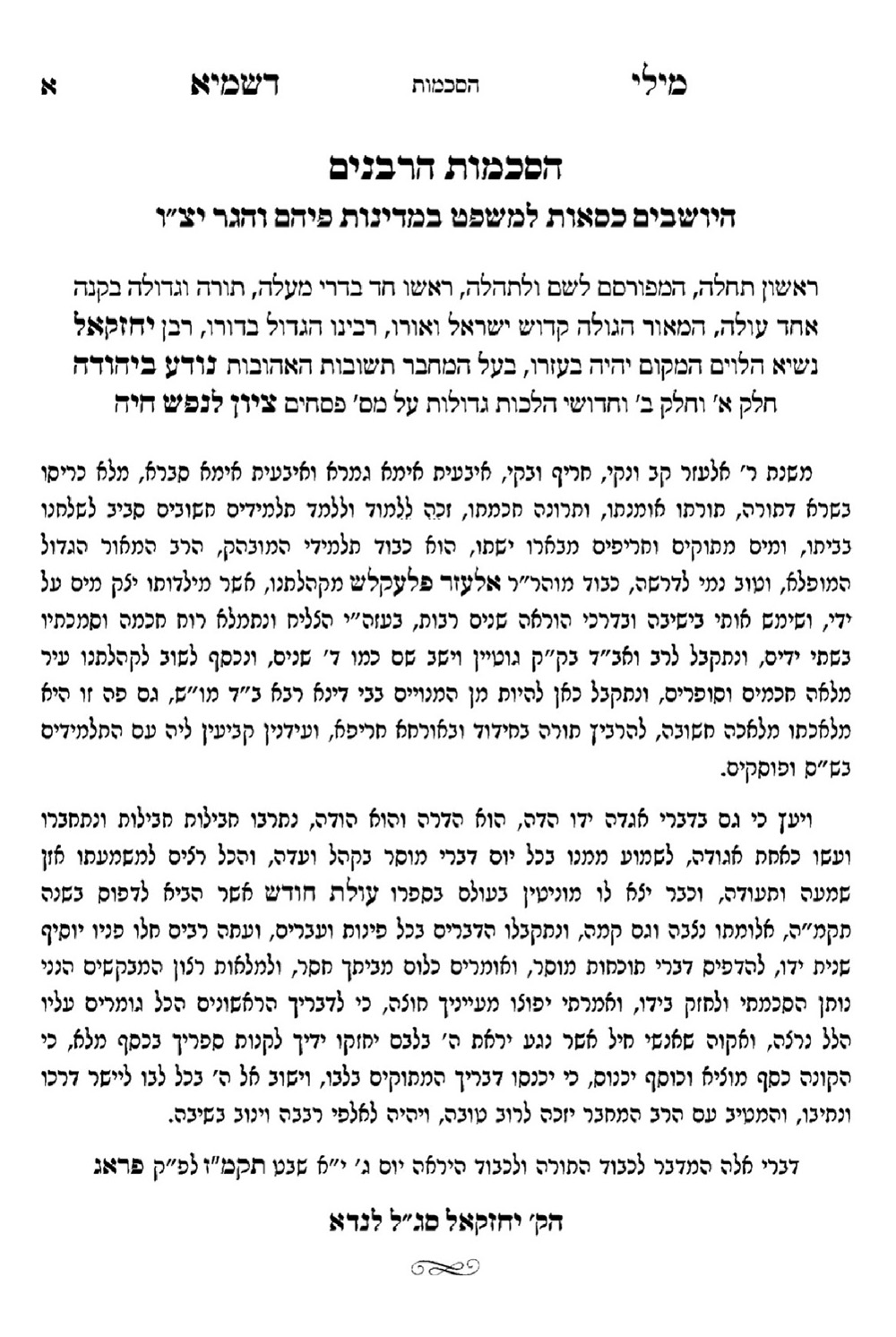
ראשון הביוגרפים של ר’ יחזקאל לנדא היה בנו יעקב. הקונטרס “דברי ידידות”, ששלח לאחיו שמואל לקראת הדפסת ספר נודע ביהודה תנינא בשנת 1810, שבע עשרה שנים אחר פטירת האב, מהווה עד היום אוסף ידיעות ומסורות ראשון ורב ערך. חלק מסוים של דברי ידידות נערך ונדפס בראש הספר הנזכר, וחלקים אחרים שלו נדחו וצונזרו, אותם אפשר להעלות מכתב היד הארוך המקורי של יעקב, מלווה בהערות העריכה של שמואל שנשמר בספריית קרלין סטולין בירושלים. [מהנודע ביהודה לחתם סופר, עמ’ 23].

Further on in his book he writes:

בשנת 1813 הדפיס ייטליס בהערה צדדית בספרו ‘מבוא הלשון ארמית’ דיון אוהד מאוד של הנודע ביהודה בתרגום המנדלנסוני ובהכרעותיו הפרשניות. את הדיון הזה לקח ייטליס ממכתב יעקבקא לנדא שהיה בידי אחיו שמואל בפראג. המכתב המדובר הוא ‘דברי ידידות’…  שכתב ר’ יעקבקא בברודי בשנת 1810, ובו תיעד ביקורו אצל אביו בפראג בשנת תקמ (1780). תארוך העדות האוהדת לשנה זו, סמוך להדפסת ‘עלים לתרופה’ של ה’ביאור’ (1778), אך לפני פרשת וויזל (1782) מאיר יפה את יחסו החיובי של הנוב”י למנדלסון ב’תקופת הביניים’ הקצרה הזו, בין 1778 לבין 1782. כתב היד המדובר נדד לבסוף אל גנזי חסידות קרלין סטולין, ומשם צולם לבית הספרים הלאומי בירושלים בשנות התשעים. אך אותה הסיבה שגרמה למשכיל יהודה ייטליס בשנת 1813 לצטט דווקא את הפסקה הזו מתוך כתב היד הארוך, גרמה למי מהעוסקים במלאכת הצילום כעבור כמאה ושמונים שנים לצנזר בעזרת דף נייר חלק את… אותה הפסקה ממש. ראה י’ ייטליס, מבוא הלשון ארמית, פראג תקע”ג, הקדמה והשווה לכתב יד קרלין-סטולין ירושלים (F49262) מספר 435… הפיסקה לא נכללה גם בדברי ידידות הנדפס… [מהנודע ביהודה לחתם סופר, עמ’ 190-191 הערה 80].

It’s worth mentioning this passage from R’ Ber Oppenheimer describing his reaction to reading the דברי ידידות about the Noda Bi-yehuda, whom he knew:


When examining the manuscript in Hebrew University the first page states:

קונטרס בן ל”ב עמודים שכתב הגאון ר’ יעקבקא סגל לנדא לאחיו הגאון ר’ שמואל סגל לנדא לפני הדפסתו ספר נודע ביהודה מהדורא תנינא והגאון מהר”ש הוציא מכאן את דברי ידידות… יש כאן כמה וכמה דברים שנשמטו בדפוס וכמובן שבכוונה מכוונת השמיטם הגר”ש ביניהם הוא ענין הביאור של רמ”ד.

This following passage is already quoted by Sandler in 1941,[16] and Moshe Samet in 1970.[17] In 1911 this letter was mentioned in the Encyclopedia Otzar Yisroel (p. 62), where the author writes:

 כי כל דברי האגרת הזאת הם מזויפים, כי סגנון הלשון ושבחו של מנדלסון יעידון כי יצא מפי משכיל ולא מפי רב בימים האלה.


It’s silly to say that it was a forgery, as the work has a haskamah from both R’ Shmuel Landau and R’ Eleazar Fleckeles and was printed in their lifetime in their city and there is not a single trace of any protest or opposition on their part.

Now this is even more interesting; R’ Fleckeles, in his work Meleches haKodesh (first printed in 1812), uses Mendelssohn’s Biur for halachic purposes.[18] He also quotes R. Shlomo Dubno in his Tikun Sofrim many times.[19] Most printings of this work are in various editions of Mendelssohn’s Biur. It’s unlikely that he was quoting it from the rare standalone version when it was printed itself without the Biur, if we already know that he used the Biur.[20]
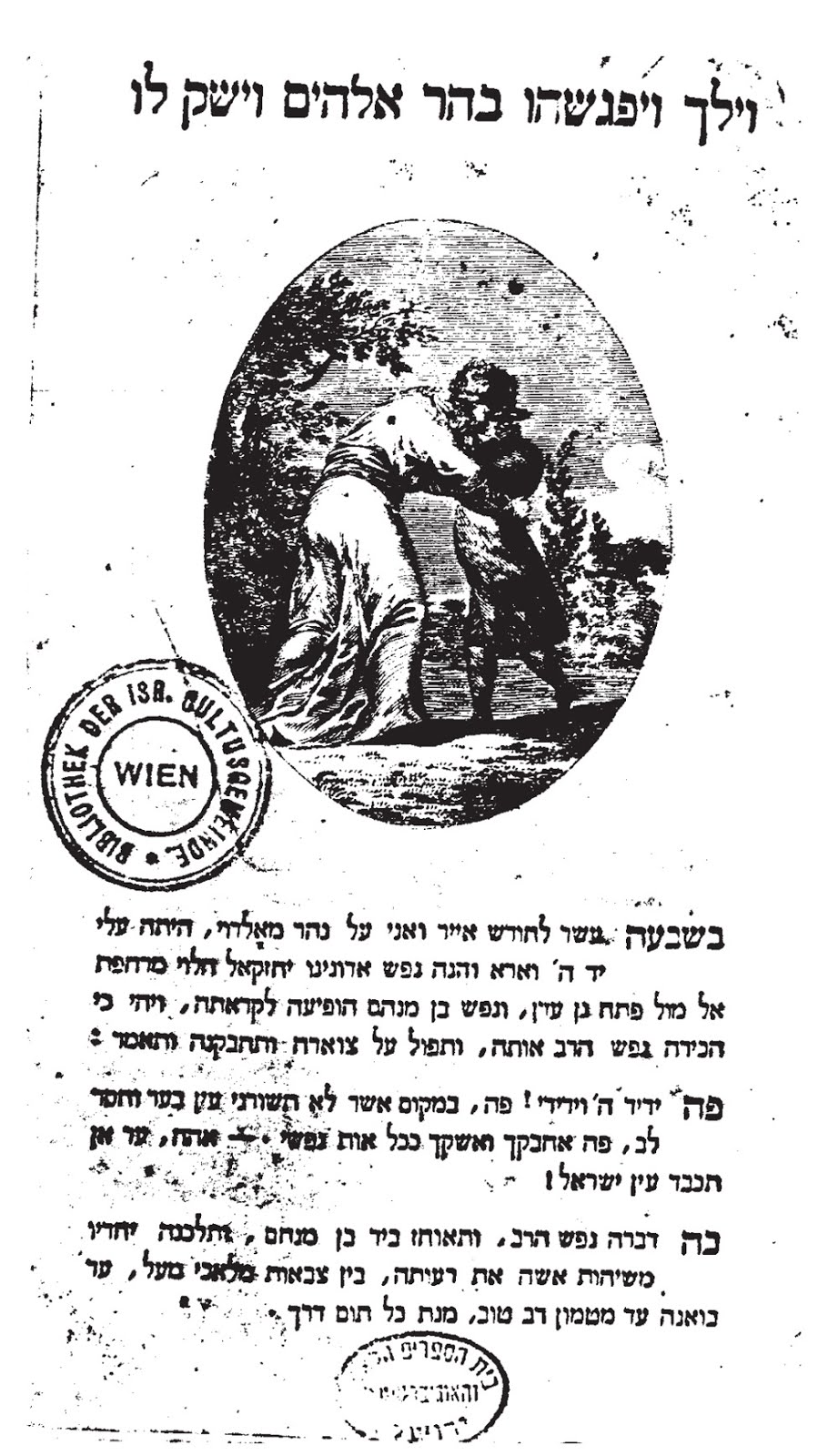
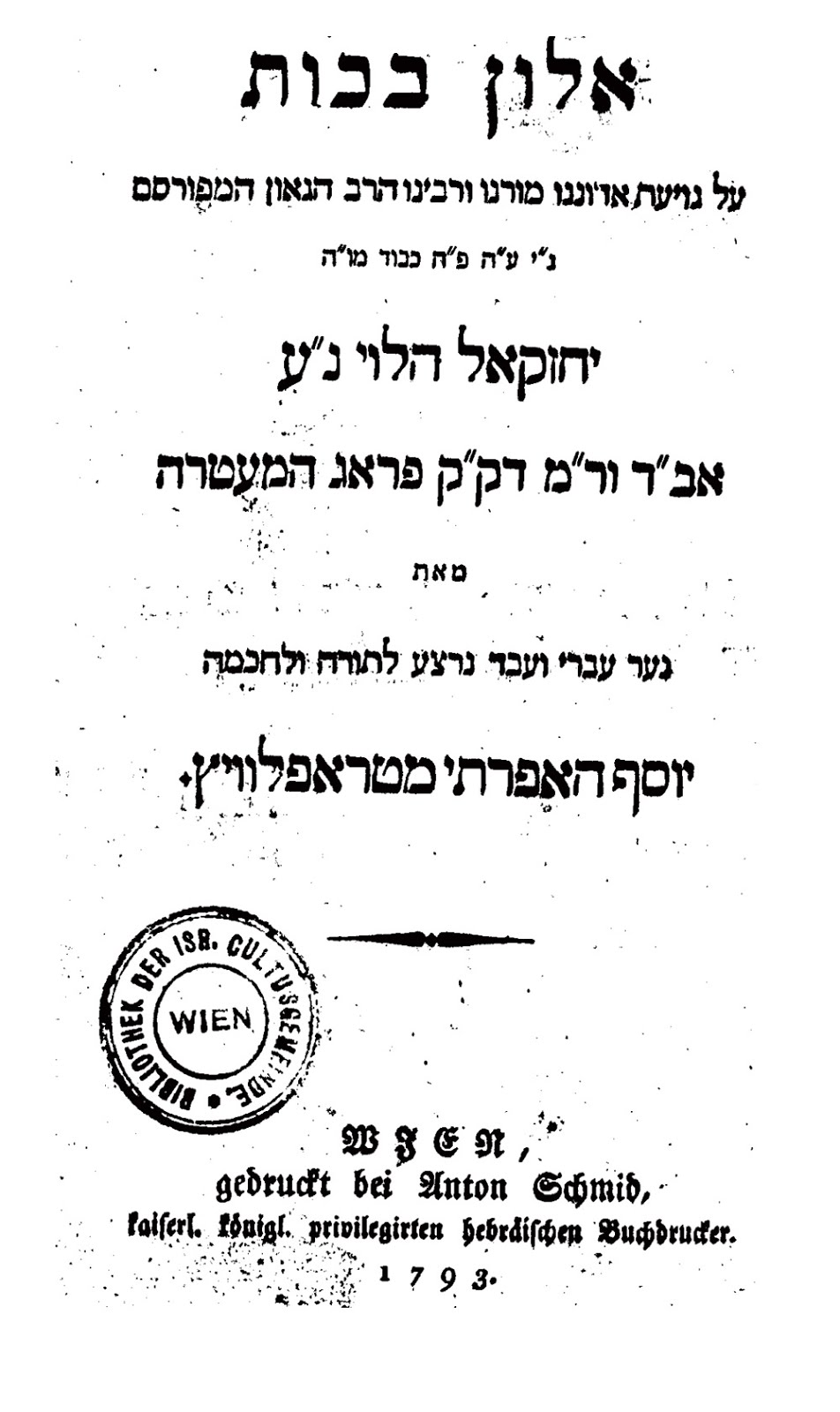
In a work that was printed in 1793, a Hesped on the Noda Bi-Yehudah, we find on the cover it has a picture of Mendelssohn and the Noda Bi-Yehudah embracing. It’s already mentioned here by On the Main Line and more recently by Maoz Kahana (ibid, pp. 192-193).


The truth is, a proper analysis of the primary sources (such as the derasha quoted above) shows that the Noda Bi-Yehudah‘s and R’ Fleckeles’ main issue with Mendelssohn’s Biur was not on the Biur portion[21]; it was on the German translation written by Mendelssohn.
Here are two rare sources[22] which are very important for understanding this subject. The first is an Haskamah signed by both Noda Bi-Yehudah and R’ Fleckeles to a Chumash printed in 1785; as one can see on the Sha’ar there is a direct influence of Mendelssohn on this work. However in the Haskamah they explain why they are giving one – it could compete with Mendelssohn’s edition, as it also translates for the convenience of the reader, but without Mendelssohn’s literary German to which they are opposed.


The second source is a haskamah written by R’ Fleckeles to a Chumash printed Prague in 1824 with a German Translation! Here too, R’ Fleckeles outlines why he is giving it a Haskamah. 

This Haskamah is printed at the end of Silber and Kahana’s above quoted article. They print the Haskamah as it appears in Bereshis, this is the one for the Shemos volume. In the National Library and Mifal Bibliography they only record the volume on Vayikra. But more importantly, they do not note R’ Fleckeles’ Haskamah. This is an uncatalogued haskamah of R’ Fleckeles which helps understand his take on Mendelsohn.[23]

Coffee

Returning to the Olas Chodesh, like other volumes of Derush, this one is rich in giving one a sense of the people and their sins. R’ Y. Greenwald already writes:

פה ושם הזכירו גם בדרשותיהם שדרשו והוכיחו את בני עדתם ולא עצרו מלהגיד את פשעם אשר ראו בהם… הרבה יש ללמוד מהדרשות שדרשו גדולי הדור ממעמד המוסרי של ישראל בימיהם בהדרשות של הגאון רבנו יונתן אייבשיטץ ב’יערות דבש’… וכן תמצא כדברים הללו בספר דורש לציון להג”ר יחזקאל לאנדא… [לפני שתי מאות שנה, עמ’ 26].

Just to list two samples both of which are related to coffee:[24]

בעינינו ראינו ובאזנינו שמענו כמה פעמים שאומרים לגוי להסיק את התנור וכיריים בשבת אפילו אם אין קור כל, כי אם כדי להחם הקאפע [מילי דשמיא, עמ’ קסד]. 

יש כמה אנשים בני בלי שם שאינם עוסקים לא באומנות בורסקי… כי אם יושבים אגודות אגודות מאור הבוקר עד צאת הכוכבים בפונדקאות של גויים, בקאפע הייזר וביר הייזר… ודוברים עתק בגאוה ובוז על מנהיגי עיר ולומדיה, על רבנן ותלמידיהון… [מילי דשמיא, עמ’ קט].

 In another passage he describes Yom Kippur at night:

הרי אפילו בשעה הראוי לכל משכיל לעמוד באימה וביראה בזיע ורחת מפני פחד ה’ ומהדר גאונו, כל אחד מתנשא לומר אני אמלוך ואני אלך בראש אני תהלה, וגברה הקנאה והשנאה הנקימה והטירה וגסות הרוח יתירה, עד שכבתה אש הראשונה שניה ממהרת לבא, כל אחד רודף אחר הכבוד, לכבדו בשיר הכבוד שיר היחוד,[25] להיות מבעלי השיר היוצאים בשיר, ואם אין הגבאי מכבד לאומר שיר היחוד, מחרחר ריב ומדון בשאט נפש וזדון, ומלקין על היחוד, כל אחד נכבד בעיניו ומעשיו גדולים משל חבירו, זה בתורה הנקראית קנין, וזה בחלום ברוב ענין, זה ברוב בנין, וזה ברוב מנין, וכמה קטטת ומריבות רבות מסתעפות עד שנהפוך השיר היחוד לשיר של פגעים, כשיר כסילים פגיעתן רעים, וכה מחלוקות שלא לשם שמים שמענו בליל כל נדרי [מילי דשמיא, עמ’ קמט].

Ahavat David

Turning to the Ahavat David; as mentioned, this work was also just reprinted. In 1799, R’ Eleazar Fleckeles gave a series of three derashos devoted to blasting Sabbateanism and Frankism. In 1800, he printed one of them. He learned much from his Rebbe, the Noda Bi-Yehudah, regarding battling them;[26] in his introduction he writes:

גאון הגאונים בעל שו”ת נודע ביהודה… גם הוא ספר לי מעשים רבים משפטים התועבים מכת ש”צ הרשעה פגיעתן רעה… [אהבת דוד, עמ’ רנז]. 

רבנו גדול העולם. נודע ביהודה, איך היה מוסר נפשו על קדושת השם יתברך לבער הרשעים אשר בחייהם מטמאין טומאת רקב… זכרו נא לימים מה עשה… רבינו… בליל הושענא רבה תקי”ט… כאשר החל השרץ הטמא… והחרים בארור חרם נוי שמתא בתקיעת שופר ובכבוי נרות את יעקב רמאה… וברוב הדרשות אשר דרש במקהלות הזכיר מכת הרשעה הארורה הזאת [אהבת דוד, עמ’ שיז].

The Noda Bi-Yehudah writes:

וצריך אני להראות כי שכלם כוזב.. ותשמע הארץ אם כת הכופרים שבתי צבי שכל דבריהם כפירות ומינות מלא דברי שטות, להפוך דברי אלקים חיים, ולהפוך עבירות למצות עפרא לפומייה… נגד אלו השוטים בעלי ש”ץ ימח שמם נגד טענותיהם המזויפות… [דאיסטים שבתאים ומקובלים בקהלת פראג דרשה מצונזרת של הרב יחזקאל לנדא, תק”ל[27], עמ’ 357].וכת הארורה והגרועה מאוד שבתי צבי [שם, עמ’ 362].

Frankism, in the Derashos Beis Peretz

One more passage related to Frankism, from the Derashot Beis Peretz, a contemporary of the Noda Bi-Yehudah, just printed[28] from manuscript states as follows:

זה רמז גדול אשר קרה לנו באחרית הימים בשנת תקי”ט לפ”ק על ידי המינים האפקורסים ש”ץ ימח זכרם, שהיו עומדין עלינו לכלותינו בפני האומות, שהי’ להם וויכוח גדול בק”ק לבוב עם כל הרבנים של מדינות פולין, יותר מן מאתים של אפקורסים ש”ץ ונעו כולם משומדים עם נשיהם ובניהם, והי’ להם וויכוח בשאלות ותשובות לפני שרים רבים ונכבדים מאומות העולם, ולפני כומרים ובישופים הרבה, והי’ להם ראש אחד ביניהם והי’ ספרדי מכשף גדול בשמות הטומאה… שרצו לבטל תורה שבעל פה, וכבר נשרף על ידם מן האומות הכומרים כל הש”ס ורמב”ם וטורים באמצע בעיר בפני כל עם ועדה, וגזרו שמד בכל הקהלות ישרפו תורה… ומפורסם בכל מידנות פולין שהי’ אז נס גדול ומפורסם, שהכומר השר הגדול שצוה לשרוף הספרים הנ”ל הי’ לו מפלה גדולה תיכף מיד אחר מעשה זאת, ומת מיתה משונה, והי’ מכין אותו ביסורין קשים מן השמים, והי’ צועק קודם מותו שהספרים הנ”ל הם שורפין אותו. ואח”כ כל רשעים הנ”ל נשתמדו, ויצאו מכלל ישראל וכתבתי זאת שיהי’ זכרון בספר כמו מחיית עמלק, למען תספר באזני בנך ובן בנך את הנס שנעשה השי”ת בעתים הללו [בית פרץ, עמ’ תו-תז].

Broadside

R’ Fleckeles writes;

גם פה עיר הגדולה לאלקים, נדפס התפ”ו קול כרוז מגדולי הדור ופרנסי העדה, ונדפס פעם שנית שנה זו ממני ומאחי הרבנים המובהקים המאורות הגדולים בית דין מורה שוה [אהבת דוד, עמ’ רפט].

Here is a facsimile of this actual broadside[29]:

In the beginning of the Drasha, R’ Fleckeles quotes from Frankist literature:

כל השומע ורואה יכול לקרות, את דברי האגרות, יצחק וישחק… בלעגי שפה… כלו מגומגום לא עברי ולא תרגום, לא ספרד ולא צרפת לא אשכנז וריפת ולא מפני יפת לשונם אשר הגו בגרונם, כאחד המונם, במלות מזויפות וטרופות כדבר אחר המבשלות והאופות… ואראה דוגמא ראשית האגרת,… וכן יתר דברי האגרת מהומה ומגערת, מאיימים ומפחידים… [אהבת דוד, עמ’ רנח].

What letter he is referring to? Paweł Maciejko writes that he is referring to the Red Letters.[30] This document was written around 1800. It was printed in Hebrew and English from manuscript by Ben Zion Wacholder, ‘Jacob Frank and the Frankists Hebrew Zoharic Letters’, Hebrew Union College Annual, Vol. 53 (1982), pp. 265-293.[31] Examining this document we see that this is the letter that R’ Fleckeles was quoting as the exact passages appear there. The reason they were called Red documents, writes Maciejko, is “because of the color of the ink that they were written and the symbolic association between the biblical kingdom of Edom and the Hebrew word adom, red”.[32] In one place in the Derasha R’ Fleckeles even writes:

 וכל מה שכותבים הוא בצבע אדום [אהבת דוד, עמ’ שה].[33]

What was the result of this Derasha? Paweł Maciejko writes: 
Shortly after the sermons were delivered, riots erupted in the city, and although Fleckeles did not mention any names, the mob apparently knew very well whom to assault. During the Funeral of a known Sabbatian, a crowd attacked the procession and the body was profaned. It seems that woman were especially targeted: there was turbulence in the female section of one of the Prague synagogues and many of the wives and daughters of known Sabbatians were insulted or attacked on the city’s streets.[34]
When discussing this group he writes:

גם אלה אשר הנשים יושבות ועוסקות אף עמהם, כי שב”י כלהו איתנהו בהו הכל ממירין אחד אנשים ואחד נשים הכל סר יחדו נאלחו בדברי שוא [אהבת דוד, עמ’ רפג]. 

יעקב איש רע מעללים… טף ונשים באים לשמוע קבלת יעקב רמאה, ועוסקים יחדיו במעשה מרכבה טמאה למען ספות הרוחה את הצמאה [שם, עמ’ שכ].[35]

Oral Derasha Versus a Printed One

In this Derasha we find several times that R’ Fleckeles was very graphic while describing the Frankists’s depravities (pp. 257,290, 323-324). I would like to suggest the following: In general, there is a known issue when learning derush seforim; are printed Derashos exact translated versions of the oral original, or were they edited for print? For the most part, I would say this was an actual version of what he said in the oral Derasha he gave. However, orally he was not as explicit, thus the reason why he rushed to print this Drasha almost immediately after he gave it was that it’s easier to write certain things and he wanted to immediately expose how awful they were.[36]
In a similar context (in relation to the word graphic), in 1936 R’ Avrohom DovBer Kahana Shapiro, author of the classic work Dvar Avrohom, gave an incredible Derasha[37] in Yiddish to thousands of woman on the subject of Taharas Hamishpacha. It was then printed in Yiddish with some notes in Hebrew and in 1940 was printed in Hebrew with more notes. A few years ago it was reprinted. In the introduction the editor writes:

כאמור החוברת הזאת היא הרשמה סטינוגרפית, המוסרת בעינם את הדברים הנפלאים כפי שיצאו מפי הנואם הגדול, רק מפני שבמקומות אחדים שבשעת הרצאתו קיצר הרב שליט”א כבר יותר מדי מפני טעמי צניעות מובנים בנוכחותן של אלפי נשים, בקשנוהו למלאות כפי האפשר בהמסר החוברת לדפוס… 

מטעמי צניעות מובנים ומחמת נוכחותו של קהל הנשים הגדול קיצר הרב שליט”א בדבריו שהיו מרומזים מדי. אמנם באשר לכתיבה, המתאפשרת להימסר בהרחבה, נענה לבקשתנו לפרט ולהרחיב…

In the beginning of the Drasha he said:

נושא הרצאתי מעלה בזכרוני את המשנה על הדברים שנקראים ולא מתרגמים נקראים במקורם ולא מתרגמים בשפה המדוברת. בעקב זה נאלץ אני באי אלו מקומות להיות מוגבל בלשוני, לקצר בדברי, לחפש ולברור מלים נאותות ביותר ולהמנע מכמה ביטוים השייכים ישר לענין בכדי לא לפגוע ברגשות ידועים… אמנם כמאור אאלץ באי אלו מקומות לקצר בתכלית ולהסתפק ברמיזה [7-8].

Related to this he writes in the introduction:

החוברת הזאת שלדה ועיקרה הוא הנאום שנשאתי לפני בית יעקב בשפה המדוברת אולם בצאתה פעמיים בדפוס נוספו כמה דברים ובעיקר הערות בפ”ע מתחת לקו עד כי נסבה ורחבה ותשלח בדים וענפים מעל לגבולות נאום עד כי מדת ספר קטן. לזאת יש ממכרי שיעצוני לשנות קצת את סדרה ופניה, פני נאום, לעבדה ולהקציעה ולתת לה פני ספר לאוהבי ומוקירי אלא אענית הבדל עיקרי יש בין ספר לנואם הספר מושגו לשימות איכותית בענין שהוא דן עליו היקף ועיבוד, והנואם הוא בחינת קטע או קטעים מענין הנידון בחינת מקופיא. ובהיות שלא עיבדתי את הדברים עיבוד גמור ובהיות שרובם אינם ממקצועי, לא הייתי חושב להרימם למעלת ספר במובן האמור, לחשבו לדבר שלם ומקיף…


Sefer HaBris

One bibliographical point related to the Drasha can be found where R’ Fleckeles writes:

מצות בטלות לעתיד לבוא[38]… ובעל הברית אשר נאמן בבריתו[39] וקים מאמרי רז”ל נעלם ממנו דברי הרשב”א [אהבת דוד, עמ’ שב]

The new edition does not reference to what he is referring to, but it’s to a passage in R’ Pinchas Hurwitz’s Sefer HaBris, a work which he quotes two more times further on[40] (also not noted in the sources). Here is the passage:


What is more interesting is that he quotes R’ Pinchas Hurowitz’s Sefer Habris three times in a drasha which was delivered in 1799, less than two years after the Sefer Habris was first printed (1797); this shows us that he went through parts of the work right away.[41] This is yet an additional source demonstrating the great popularity Sefer Habris enjoyed even right after it was printed. 

Learning Kabbalah

The cause for this evil movement, writes R’ Fleckeles, was because:

ושורש כל הקלקול הוא בעבור שאינם עוסקים בגמרא ושלחן ערוך רק במדרשי האגדות ובמאמרי זוהר, לחזק בנינים של שוא ותהו [אהבת דוד, עמ’ שו].

In this Derasha he writes out very clearly that one should not learn Kabbalah if one did not yet master other areas of Torah first.

וזה העיקר שיעשה האדם וחי לעולם אם הוא שונה הלכות כדתנא דבי אליהו והובא מגילה… כל השונה הלכות בכל יום מובטח לו שהוא בן עולם הבא, ופירש”י, משנה ברייתא… לא מצינו לא בבבלי, לא בירושלמי, ולא בתנא דבי אליהו, ולא בספרי וספרא ומכילתא, ומדרש רבות, שאליהו בא לבשר כל העוסק בסודי תורה בכל יום הוא בן עולם הבא [אהבת דוד, עמ’ רצב] 

אחי ורעי הנאמנים בבריתי, שמעו ותחי נפשכם, די לנו ולבנינו בתוך הגולה, אם אנו עוסקים לילות כימים, בתלמוד בבלי עם הרי”ף והרמב”ם ותוספות והרא”ש והטור והשלחן ערוך, עם האחרונים הוא תלמוד הקדוש, והעוסקים בו קדושים. וקבלה בידינו מאת גאונים הקדמונים הקדושים אשר בארץ המה, אם משיח ה’ אשר יתגלה כבודו ימינו בקרב, לא יהיה בקי בכל הש”ס עם כל הראשונים והאחרונים, אף שיהיה שלם בכל החכמות הרמות ונשגבות, ברור כשמש שאין זה משיח ה’, אלא מלבד כל המעלות ומדות שמנו חכמים ונביאים, צריך להיות גם כן גדול שבגדולים בגמרא ובפוסקים, וכלל גדול הזה הוא בכל דברי הנביאים והחכמים, והמשכיל יבין [אהבת דוד, עמ’ שח].

This is why the content of the letter from R’ Wesseley quoting R’ Yonasan Eibeschuetz was very important for him to quote at the outset; this is one of the main themes of the work.

Elsewhere in the drasha he writes:

ידעתי שיביאו ראיות, מספרים אשר לא נשנו בי רבי חייא ורבי אועיה, ואף הרי”ף והרמב”ם ורש”י ותוס’ ור”ן והרא”ש לא ידעו מהם, ולאו בעיזקתא דשלמה מלכא, ואף לאו מר בריה רבנא חתים עלייהו, ובפרט כאשר שמענו כן ראינו, הקלקול יותר על השבח המגיע לכתבים, הרבה עסקו בספרים האלה ומצאו מקומות לטעות, ואמרו דיין האמת על שמועות רעות, וקצצו בנטיעות, והמירו טוב ברע, ושמו חשך לאור. אבל מלימוד גמרא ופוסקים, לא יצאה מעולם שום תקלה, ולא מקום לטעות, רק דרכיה דרכי נועם… [אהבת דוד עמ’ רצד].

 A parallel to this might be what the Noda Bi-Yehudah wrote:

אם במה שמקובל בידינו אמרו כלל גדול, כל ברייתא דלא מתניי’ בי’ ר’ חייא ור’ אושעיא לא מתבינן מינה, הרי שחששו שלא נמלטו מן הטעות והשיבוש… וכן בכתבי האר”י לאו האר”י חתים וגם לא תלמידו מהרח”ו רק בחליו של הרח”ו גנבו הכתובים ממנו ונעתקו בלילה א’ כמה מאות ניירות ע”י כמה סופרים הלא קרוב הדבר שנפלו בהם שגיאות רבות ועצומות [דאיסטים שבתאים ומקובלים בקהלת פראג דרשה מצונזרת של הרב יחזקאל לנדא, תק”ל, עמ’ 355].

This topic was very important to him. In the introduction to his shu”t he writes:


About Kabbalistic Kavanos

Related to all this he writes:

ואחרי אשר דיבר בתקיעה של מצוה, אמר תסתירני מסו”ד מרעים, מאנשים המתנשאים בסוד שיח שרפי קודש, ועושין כוונות שוא בתקיעות, וקוצצים בנטיעות, כאשר הארכתי ובארתי קדש זה עשרים שנה, והוא בחיבור עולת ציבור ונכון להביא הדברים פה שניות, והוא כתפוחי זהב במשכיות, אמנם אמרי אחר שהוצאת הדפוס רבה היא, תמכתי עליך אתה ידידי ורעי הקורא, שתשא עיניך שמה, ומצאת את אהבה נפשך [אהבת דוד, עמ’ רעא].[42]

In the Derasha, he referred to what he wrote some twenty years earlier in Olas Chodesh Hashenei, at great length:

אני הגבר ראה ראיתי רבים מתיהדים בסודי סודות הנטועות בתקיעות, בכונות שונות ולשער הפנימית פונות, ונבעו מצפונות. אמנם עקרת הכוונה הנכונה התיכונה, לעשות המצוה כתיקונה על מכונה, שצריך לכוון עליה התוקע והשומע, זו היא לקיים מצות המלך הקדוש, אשר קדשנו במצותיו הקדושות, וצונו זה היום קדוש, תקעו לפני בשופר כי קדוש היום לאדונינו, ושארי כוונות הידועות בסוד התקיעות כולם כלולות בכונה זו, ומינה לא תזוע [מילי דשמיא, עמ’ פב].

Then he continues:

He repeats this again elsewhere in his writings:

אין רצונו לומר כוונות הספירות אלא הכונה נאמנה שלא כתב לשם קדושת השם, אלא כשאר דברים בעלמא והוא פשט פשוט בדעת כל הפוסקים ועם נעמים לא אבוא, ומעולם לא עלה על דעת קדושים הראשונים חכמים וסופרים, לחשוב מחשבות ספירות, כי בימיהם לא ידעו מאומה, מספירות בלי מה, ולדעתי העניה בלב ים הקבלה, קרוב אליך הדבר מאד בפיך ובלבך להטעות, ומה לי ולך אצל דברים הן כבשונו של עולם, ובהדי כבשי רחמנא למה לך מה דמפקדת על פי הגמרא והרי”ף והרמב”ם והרא”ש איבעי לך למיעבד… [מלאכת הקודש, עמ’ קלג].

He concludes this Drasha by bringing the famous Teshuvah of the Maharshal about Kabbalah and some other famous sources and finally two Teshuvos of his Rebbe, the Noda Bi-Yehudah, one of them the famous Teshuvah related to saying Leshem Yichud.  

In my previous post I wrote a bit about Leshem Yichud and I quoted a passage from Sharon Flatto who writes in her ‘The Kabbalistic Culture of Eighteenth Century Prague’: 

Notably a Haggadah was recently discovered that was owned during the late 1780s by Fleckeles…. The margins of this Haggadah contain leshem yihud formulas to be recited before the blessing on the four cups of wine penned in Fleckeles’ hand. 
In the footnote she writes they seem to have been written between 1784-1790. (pp. 225-226). While I wish I had more clearer sources about this discovery. She does not note that the Haggadah that R’ Fleckeles himself printed in Prague in 1818 nor in the manuscript updates of R’ Fleckeles to his own Haggadah does he write to say Leshem Yichud or any such Tefilah in the Haggadah.

I recently received a copy of those margins from the owner of this rare Haggadah.


From the Ari Bergmann Collection (Lawrence, NY) 

I am not sure what R’ Fleckeles held in his younger years but it appears from his later writings that he “held” strongly of this Responsa of the Noda Bi-Yehudah, as he quotes it often – in this Drasha and in his Meleches haKodesh (p. 132). 

Baruch Linda

 At the end of the work R’ Fleckeles writes: 

יעקב הסרחן ועיין ראשית למודים שער ששי מבע”ח הנושכים כו’ סדר הששי סימן כה [אהבת דוד, עמ’ שכט].

 The editors of the new edition do not elaborate which work and passage, are being quoted.

 Here is the sha’ar of the work and the relevant section being referenced.


One source about the author, Baruch Linda, is R’ Matisyahu Strashun, who writes:

וכתב על החכם ברוך לינדא תואר ירא ה’ אשר אמנם כפי הנודע בברלין עיר מגורתו עד יום מותו, חלף חוק ודת ישראל (אף כי לא המיר), שכח מועד ושבת, ובימי זקנותו לא יכול אף קרוא עברית כמעט [מבחר כתבים, עמ’ רמ].[43]

This is yet another source showing how popular this work was at the time. As an aside, this quote shows that R’ Fleckeles was into “interesting seforim,” and I will deal with this in a future post. Another such sefer which he gave a haskamah to and his name is in the Prenumeranten in the 1793 issue of the Igrot Orchos Olam.

Calculating when Moshiach is coming[44]

Worth mention is one final issue that R’ Fleckeles writes a lot against, namely attempting to calculate when Moshiach will come. In the beginning of the derasha he writes that this is one of the purposes of why he wrote it: 

לכן כתבתי דרשות האל לחק ולזכרון בקהל עדת ישורון, למען ידעו עד דור אחרון, ואל ישעו אתכם דברי הרמזים, אף שהם מחורזים בדברי הנביאים והחוזים, ואל תאמינו באומר רזי לי רזי לי ואני חכם הרזים, כי סתומים וחתומים הדברים עד עת קץ הפלאות, אז המשכילים יבינו כל היעודים וכל הנביאות, ועיין רבינו סעדיה גאון ור”י ורבינו אברהם ן’ עזרא סוף דניאל ואחרי ששוטים האלו מביאים ראיות מן הזוהר, ומחשבים קץ הפלאות בנוטריקון וגימטריאות, אף אני אביא ראיות מן הזוהר, כי תועים ומתעתעים ומוגעים, בכל חשבונות ודמיונות וחזיונות, חלומות המדומות [אהבת דוד, עמ’ רנט-רס].

Later on he writes about it at length here is the fascinating section.

R’ Elazar Fleckeles and R’ Yonasan Eibeschuetz

One final point, returning to the letter that R’ Eleazar Fleckeles printed from R’ Wessely quoting R’ Yonasan Eibeschuetz which was discussed in the beginning of this post.
I think that one point that is of some significance is not only that he is quoting a letter from R’ Wessely but that it quotes R’ Yonasan Eibeschuetz. As is well known, the relationship between R’ Yonasan Eibeschuetz and R’ Eleazar Fleckeles’ Rebbe the Noda Bi-Yehudah was “interesting”, as fully documented in Sid Leiman’s special essay When a Rabbi is Accused of Heresy; R. Ezekiel Landau’s Attitude Toward R. Jonathan Eibeschuetz in the Emden Eibeschuetz Controversy. He also refers to his various works in this volume (the Olas Chodesh Hashenei and Ahavat Dovid) with great respect.
ותמה הגאון האמיתי בספרו יערות דבש [מילי שמיא עמ’ קכט]. עיין באורים ותומים סי’ צז [שם, עמ’ קמא]; ומביאו הגאון אהבת יהונתן [שם, עמ’ נב]; וקרוב לזה מצאתי באהבת יהונתן [אהבת דוד, עמ’ רעח].
One last source on this topic is from the work Sicha bein Shnat 5560 UVein 5561 printed in Prague in 1800 written by R’ Baruch Jeiteless[45] another talmid of the Noda Bi-Yehudah which is also a work devoted to fighting Frankisim. 


*Many thanks to Shimon Steinmetz for his help with tracking down some of the Rare sources.
[1] In Milin Havivin volume 5 (available here), p.6.
[2] In Teshuva m’Ahava 1:10 he writes וביאור החכם ר”ה וויזל
[3] On R’ Wesseley see overview from Professor Chaim Shapiro (son of the Dvar Avraham), Safrut Haskalah BeMerkaz Germany (1784-1829), pp.194-246.
[4] There is a typo about the exact source in On the Main line’s post. 
[5] Much has been written on this controversy see M. Samet, Chodosh Assur Min Hatorah, pp. 67-92. But a full scale dissertation on the topic is still lacking.
[6] One other point of interest related to all this: the great Galicianer posek, R. Meshulam Roth, at the request of R. Meir Shapiro towards a new school system, penned a list of works for students to learn. Among the many interesting things he wanted talmidim to read was the Shirei Tiferes! [Printed in back of his R’ M. Roth, Mevaser Ezra on Ibn Ezra p. 176 [=Mevaser VeOmer, p. 120]. This is referring to a poetic work by Wesseley.
[7] All this is part of the recent welcomed flood (by book lovers) of his material, including his Shu”t Sheilos Yaavetz (3 volumes) including a volume of new material, (with some mysterious din torah around it), Meturgeman by R’ Eliyahu Bachur with R’ Emden’s extensive glosses (printed by Mechon Zichron Aharon) and Emunas Chachamim with his notes taken from Mitpachas Sofrim (also printed by Mechon Zichron Aharon). This is aside from various marginalia of his printed in some of the recent volumes of Yeshurun. 
[8] It also includes a new edition of ציצים ופרחים, based upon manuscript (the third edition to come out within the past year). In addition it has the R’ Emden’s marginalia to a few seforim, including: the Meor Eynayim which was printed earlier by him in a journal from Tosh (based on the copy in JTS); Rabbenu Bachaya; Paneach Raza; Marshah Al HaTorah. Worth pointing to is the lengthy discussion about R’ Moshe Kunitz (pp.126-140). To this, see what I wrote in Yeshurun 24, p. 466 and here I hope to return to this in the future.
[9] For an understanding of this work see Moaz Kahana’s forthcoming study. 
[10] Related to this it’s worth pointing to the newest sefer of R’ Meir Mazuz called, MeGedolei Yisrael (534 pp.). This work is a collection of his articles about different Rishonim and Achronim written over the years. There is supposed to be 2 more volumes to this set coming out. In his chapter devoted to R’ Yaakov Emden, he concludes (pp. 149-150) with some comments on the notes of R’ Emden printed by Mossad HaRav Kook and shows that Bick could not read the manuscript, as he already noticed many mistakes while comparing Bick’s transcription to the page of the manuscript Bick included in the beginning of his edition. 
[11] Although this introduction is very useful and brings new material etc. it is very weak on naming the sources that helped him, citing academic sources very infrequently and only by title of book not by name (a common occurrence in such works). 
[12] For recent discussion on this see Yaakov Spiegel, Amudim BeToldos HaSefer HaIvri: BiSharei Hadefus, pp. 164-199.
[13] See Leo Landman, The Cantor: An Historic Perspective.
[14] Parts of this dersaha are quoted in the excellent series of R’ Dovid Kamentsky on R’ Shlomo Dubno in Yeshurun 8 (2001) pp. 740-741; however it appears that a small typo crept in, he writes the drasha is in Olas Chodesh volume one when it’s in volume two.
[15] I hope to return, more in depth, to this special work in the near future. But for now a few words on this work, (full disclosure: the author is a good friend). There are two Gedolim in particular who are considered giants in the world of Halacha and their words carry great weight until today in all circles, the Noda Bi-Yehudah and the Chasam Sofer. This book analyzes many aspects of their rich lives (tying many controversies together and showing how both of them wrote and dealt with them). It’s well written and researched; it includes a fresh look and in-depth analysis of many famous topics and plenty of discussion about new subjects. The author shows a tremendous command of the primary Torah sources, relevant manuscripts and puts down his thoughts clearly and very chronologically. Some fascinating and unknown people are discussed throughout the book. The author did not attempt to deal with everything both of these Gedolim wrote about as that would require a few volumes. He has already completed a few more articles related to these giants. The first edition already sold out, a second edition is due out shortly.

[16] HaBiur LeTorah, p. 204.
[17] HaChadash Asur Min Hatorah,p. 75.
[18] See pp. 4, 52, 88, 91.
[19] See pp. 3,23,25,26,49,56,61,62,66,92,104,111,115,116. These sources are not noted by R’ Dovid Kamenetsky when he writes about the Tikun Sofrim of R’ Dubno in Yeshurun 10, pp. 758-761.
[20] In the actual drasha against the Biur (p. 46) he quotes a discussion about a shem Hashem in HaAzeinu. In his Meleches haKodesh (p. 111) when he talks about this pasuk, he quotes Dubno. See also what R’ Fleckless writes in תשובה מאהבה, א, סי’ א: 

“עיין בהערה לשירת הים מן השלם המפורסים מוה’ שלמה מד”ו רבתי בבאורו לבאר המתורגמן החכם השלם מוהר”ם דאסע”
 The “מתורגמן החכם השלם מוהר”ם דאסע,” is of course Mendelssohn. 

[21] As an aside in a forthcoming auction by Jerusalem of Gold, Auction 11 they are auctioning off numerous editions of the Biur.
[22] Many thanks to Shimon Steinmetz for tracking down copies of these works.
[23] This is not the only item related to R’ Fleckeles that I could not find mention of it in the National Library and Mifal Bibliography. Ben Yaakov records :
יקר החיים, ה”ר אלעזר פלעקיל דרוש הספד על מות שר וגדול ר’ חיים עדלער פאן פאפר פראג תקנ”ה 80 [אוצר הספרים, עמ’ 229].
 However, on Google books (here) one can find this small work.


[24] It’s worth reading the excellent article by Maoz Kahana who puts this in context with a much bigger picture called שבת בבית הקפה של קהילת קודש פראג, ציון, עח:א (תשע”ג) עמ’ 5-50. See also Robert Liberles’ recent book, HaCoffee VeHayihudim.
[25] For recent work on Shir HaYichud, see Chitzei Giborim 9 (2016), pp. 258-277.
[26] For more on this see Maoz Kahana, MeHaNodeh Beyehudah Le Chasam Sofer , pp. 37-60 and his article “The Allure of Forbidden knowledge: The Temptation of Sabbatean Literature for Mainstream Rabbis in the Frankist Moment, 1756-1761”, Jewish Quartely Review 102:4 (2012), pp. 589-616 [available here].
[27] Printed in Kabbalah 21 (2011), available here. See ibid, p. 365.
[28] This work was first printed in 1759 with the author receiving many haskamos, including one from the Noda Bi-Yehudah (although one has to be careful how much to read into it, see Sharon Flatto ‘The Kabbalistic Culture of Eighteenth Century Prague‘, pp. 105-106, 110, 144). In 2014 this work was reprinted with some drashos added from manuscript, one of which contains the passage quoted above. They also added extensive useful notes just focusing on tracking down his sources and included a very through index. They did not mention (or they were not aware) that Avraham Yaari printed this passage I quoted about the Frankist from the manuscript in 1958 in his Mechkarei Sefer (pp. 455-457). This work is disused in the important work of M. Piekarz, BiYemei Zemicha Hachasidus, pp. 86-88.
[29] Jahrbuch der Gesellschaft für Geschichte der Juden in der Čechoslovakischen Republik 9, 1938, after p. 374.
[30] The most recent, updated, academic work on Frankism was written in English by Paweł Maciejko called The Mixed Multitude: Jacob Frank and the Frankist Movement, 1755-1816, Pennsylvania 2011, based on his Ph.D dissertation, The Development of the Frankist Movement in Poland, the Czech Lands and Germany (1755-1816) (Ph.D.), Oxford University, 2003. The work is excellent, well-researched and written, based upon a rereading of all the previously known documents in their original languages and upon many new discoveries. This book has a few pages devoted to of R’ Eleazar Fleckeles’ Ahavat David (pp. 249-251). The book was just translated into Hebrew called Eruv Rav and published by Zalman Shazar. I am not sure why, but some of the material found in his Ph.D about Prague and Frankism (pp. 241-242) does not appear in his book.
[31] See also The Mixed Multitude: Jacob Frank and the Frankist Movement, 1755-1816, pp. 239-241.
[32] Ibid, p. 184.
[33] Moshe Viener notes this passage in Koheles Moshe (p.31) but does not write what it’s referring to. However Eliezer Rosenthal in his Bibliographishes verzeichniss eines grossen theiles, Yodeh Sefer, (p. 293), when writing about this work, does point to a journal where the letter was printed in German. 
[34] Ibid, pp. 250-251.
[35] For discussion of these passages see:  Boaz Huss, KeZohar Harakiah, pp. 275-276; Ada Rapoport-Albert, Chasidim, Shabtos Anoshyim Vnashim, pp. 356-357,359-360.
[36] See Marc Saperstein, Jewish Preaching, pp.  Zev Gries, Hasefer HaIvri Perakyim Letoldosov, pp. 122-165.
[37] I first heard about it when I was 15, when I heard a tape of a derasha by R’ Mordechai Gifter who praised it highly. At the time, I tried tracking it down but had no luck. Later, as a Bochur learning in Eretz Yisroel, I located it in the (then-named) Hebrew University and National Library. It was extremely rare and I had to get special permission to look at it. I was always able to see from reading parts then that it was indeed special and that R’ Gifter was certainly not exaggerating. A few years later I found an original copy of the rare Yiddish version (available here) for next to nothing in a used bookstore. I always dreamed of finding the Hebrew one and reprinting it. However a few years ago someone beat me to it. (See here for a fascinating post related to this). Instead I hope to return to discuss this special work in a future article. 
[38] On this passage of Mitzvos LeAsid see Saul Lieberman, Shekiyin, pp. 80-81.
[39] This is not the only pun on the Sefer HaBris’s title. R’ Moshe Koerner writes:

בעסקי… ברלין… הצדיק התמים הרב המחבר סי’ הברית לפני נגלה כי הוא חברו היו אז מימינים ומשמאלים, והגאון מהרצ”ה זצ”ל אמר בשחוק הוא המכניס והמוציא הברית (בל”א קוואטר כמ”ש בא”ח סי’ תקנא במג”א ס”ק ג ובי”ד ברמ”א סי’ רסה סעי’ יא) [אגרת רשפי קשת, עמ’ 8].

Eliezer Rosenthal in his Bibliographishes verzeichniss eines grossen theiles, Yodeh Sefer, (p.284) quotes this story but does not site his source.
[40] p. 288, 320.
[41] See also David Ruderman, A Best-Selling Hebrew Book of the Modern era: The Book of the Covenant of Pinhas Hurwitz and its Remarkable Legacy, Washington 2104, p. 153.
[42] This new edition is kind enough to bring this piece of the derasha in the footnote. One nitpick; although in the rest of the volume, when he references his other writings or the like this is very useful, here however it is silly to copy five pages that are found earlier in this volume (pp.82-86) – just refer the reader to there. There is a limit to how lazy one would have to be not to turn back and this is a waste of space.
[43] For more about this author and his work see Tal Kogman, HaMaskilim HaMadayim (2013) Magnes Press.
[44] One source on this topic can be found in the Work of R’ Ephrayim Yaboroer, BaKoshrot, printed in Cracow 1607. This fascinating work was extremely rare until a few weeks ago when Mechon Zichron Aharon reprinted it in their massive two volume set called אוצר ממעונות אריות. The passage I am referring to is in volume one, pp. 58-59. These two volumes collect much of the Zemiros, Piutyim and historical works written about Tach Vetat by early Polish and Ashkenazi Rabbonim. It’s full of many rare works and they deserve special thanks for printing these volumes. One correction; in volume one (pp.539-546) they reprinted the rare work Shirei Yehudah, (not presently found on Hebrew Books or Otzar Ha-hochmah] first printed in Amsterdam 1696. However either they used an incomplete edition or something else went wrong as its missing most of this small rare sefer. On this work, see Elisheva Carlebach, ‘Two Amens That Delayed the Redemption: Jewish Messianism and Popular Spirituality in the Post-Sabbatian Century’, Jewish Quarterly Review, New Series, Vol. 82:3/4 (1992), pp.241-261.  
[45] For the updated discussion regarding the authorship of this book, see Paweł Maciejko, The Development of the Frankist Movement in Poland, the Czech Lands and Germany (1755-1816) (Ph.D.), Oxford University, 2003, pp. 241-242. Gershom Scholem wrote on the front page of his copy that the author was R’ Yehudah Jeiteless.  


The Seven Nations of Canaan

                                     THE SEVEN NATIONS OF CANAAN[1]
By Reuven Kimelman
This study deals with the war and the
seven Canaanite nations.[2] It complements my previous post on Amalek of March 13, 2014, “The Ethics of the Case of Amalek: An
Alternative Reading of the Biblical Data and the Jewish Tradition. “The popular
conception in both cases is that the Bible demands their extermination thereby
providing a precedent for genocide.[3] The popular reading of the Canaanites filters it through the prism of
Deuteronomy. The popular reading of
Amalek filters the Torah material through the prism of Saul’s battle against
Amalek in the Book of Samuel. In actuality, the biblical data is much
more ambiguous making the most destructive comments the exception not the rule as
will be evident from a systematic analysis of the Canaanite material in the
Bible as was previously done with Amalek.  
            This
post will deal with the following seven questions with regard to the nations of
Canaan:
a). What are the different biblical
approaches to the native nations of Canaan?
b). According to the Bible, what
actually happened to them?
c). What is the evidence that the
Bible is sensitive to the moral issues involved?
d). How has the Jewish tradition
removed the category of the seven nations from its ethical agenda?
e). What is the role of the
doctrine of repentance?
f). What is the relevance of the
“Sennacherib principle”?
g). How relevant is the category
“holy war”?
            With
regard to the extermination of the seven nations of Canaan,[4] sometimes called Canaanites sometimes Amorites, the biblical record is also not
of one cloth. The clarification of their status in the Bible requires a
systematic treatment of all the data book by book. 
Genesis (12:6, 15:16) is aware that the
Canaanites were in the land when Abraham arrived and would remain for
generations.  From Genesis 38 and the end
of The Book of Ruth we learn that from the progeny of Abraham’s great grandson
Judah and the Canaanite Tamar will issue King David. Also  Simeon’s son is identified as “Saul the son
of a Cannanite women” (Genesis 46:10, Exodus 6:15) without comment.
Exodus (23)’s position on the
elimination of the Canaanites (v. 23) is a gradual dispossession by God, not by
the Israelites:[5]
27 I will send forth My terror before
you, and I will throw into panic all the people among whom you come, and I will
make all your enemies turn tail before you. 28 I will send a plague ahead of
you, and it shall drive out before you the Hivites, the Canaanites, and the
Hittites.[6] 29 I will not drive them out before you in a single year, lest the land become
desolate and the wild beasts multiply to your hurt. 30 I will drive them out
before you little by little, until you have increased and possess the land.
Leviticus (18) refers to God casting out
of the nations:
24 Do not defile yourselves in any of
those ways, for it is by such that the nations that I am casting out before you
defiled themselves. 25 Thus the land became defiled; and I called it to account
for its iniquity, and the land spewed out its inhabitants.
Here there is a coordination between God
and land.  The land spews out its
inhabitants for defiling it and God expels them.  
Numbers (33) refers to the Israelites
deporting the local inhabitants:
51 Speak to the Israelite people and say
to them:
When you cross the Jordan into the land
of Canaan, 52 you shall dispossess all the inhabitants of the land; you shall
destroy all their figured objects; you shall destroy all their molten images,
and you shall demolish all their cult places. 53 And you shall take possession
of the land and settle in it, for I have assigned the land to you to possess.
It is clear that the issue here is not
ethnic but religio-cultural. The fear is that Israel will be ensnared,
especially through intermarriage, by the local moral and cultic practices
Exodus 34 emphasizes the religious
factor:
12b Beware of making a covenant with the
inhabitants of the land against which you are advancing, lest they be a snare
in your midst. 13 Rather you must tear down their altars, smash their
pillars,and cut down their sacred posts; 14 for you must not worship any other
God, because the Lord, whose name is Impassioned, is an impassioned God. 15 You
must not make a covenant with the inhabitants of the land, for they will lust
after their gods and sacrifice to their gods and invite you, and you will eat
of their sacrifices. 16 And when you take wives from among their daughters for
your sons, their daughters will lust after their gods and will cause your sons
to lust after their gods.[7]
Leviticus 18 emphasizes the moral
factor:
26 But you must keep My laws and My
rules, and you must not do any of those abhorrent things, neither the citizen
nor the stranger who resides among you; 27 for all those abhorrent things were
done by the people who were in the land before you, and the land became
defiled. 28 So let not the land spew you out for defiling it as it spewed out
the nation that came before you. 29 All who do any of those abhorrent
things—such persons shall be cut off from their people. 30 You shall keep My
charge not to engage in any of the abhorrent practices that were carried on
before you, and you shall not defile yourselves through them: I the Lord am
your God.
Numbers 33 warns Israel against
assimilating Canaanite norms lest they share their fate of expulsion. “55 But if
you do not dispossess the inhabitants of the land, those whom you allow to
remain shall be stings in your eyes and thorns in your sides, and they shall
harass you in the land in which you live; 56 so that I will do to you what I
planned to do to them.”

            The exception is Deuteronomy 7
which demands total destruction:
1 When the Lord your God brings you to
the land that you are about to enter and possess, and He dislodges many nations
before you— the Hittites, Girgashites, Amorites, Canaanites, Perizzites,
Hivites, and Jebusites, seven nations much larger than you—2and the Lord your
God delivers them to you and you defeat them, you must doom them to
destruction: grant them no terms and give them no quarter.
Even according to Deuteronomy the fear
is not of their DNA but moral assimilation, for it goes on to say:  “Lest they lead you into doing all the
abhorrent things that they have done for their gods and you stand guilty before
the Lord your God” (20:18). For Deuteronomy (12:31; 18:9-12), the abhorrent
things include child sacrifice.
Strangely, Deuteronomy continues with a
provision against intermarriage:
3 You shall not intermarry with them: do
not give your daughters to their sons or take their daughters for your sons.
4 For they will turn your children away from Me to worship other gods, and the
Lord’s anger will blaze forth against you and He will promptly wipe you out.
5 Instead, this is what you shall do to them: you shall tear down their altars,
smash their pillars, cut down their sacred posts, and consign their images to
the fire.

Apprehension about intermarriage or coming to terms with an eradicated people
is strange unless Deuteronomy is aware that its demand to doom them will not be
(or was not) implemented. And, in fact, as we shall see the evidence from
Judges 3 is that they did intermarry.
 Alternatively, ḥerem does not entail
the elimination of the Canaanites only their isolation, that is, they are to be
quarantined. This understanding follows its Semitic cognates where it means to
separate, to set aside.[8] The goal is to exclude any intercourse with them. Thus verse 5 only refers to
the elimination of their objects of worship not their persons. This opens the
possibility that “What we have is a retention of the … traditional language
of ḥerem, but a shift in the direction of its acquiring significance as
a metaphor … for religious fidelity.”[9]
 Even stranger is the description of the
confrontation with Sihon king of the Amorites. Within the context of
Deuteronomy, one would expect an outright attack when God says to Moses: “See,
I give into your power Sihon the Amorite, king of Heshbon, and his land. Begin
the occupation: engage him in battle” (2:24). Instead, what does Moses do:
26 Then I sent messengers from the
wilderness of Kedemoth to King Sihon of Heshbon with an offer of peace, as
follows, 27 “Let me pass through your country. I will keep strictly to the
highway, turning off neither to the right nor to the left. 28 What food I eat
you will supply for money, and what water I drink you will furnish for money;
just let me pass through.”
Sihon rejects the offer and attacks
Israel. They are destroyed only in the counterattack.
If there is no evidence for the
expulsion of the Canaanites, whence the position of Deuteronomy 7:1-2?
It has been speculated that Deuteronomy took “both the expulsion law of Exodus
23:20-33, directed against the inhabitants of Canaan, and the ḥerem
(total destruction) law of Exodus 22:19 (“Whoever sacrifices to a God other
than the Lord shall be proscribed), directed against the individual Israelite,
and fused them into a new law that applies ḥerem to all idolaters,
Israelites and non-Israelites alike.”[10] In other words, the ḥerem is not against Canaanites as Canaanites, but
idolaters as idolaters. Thus Deuteronomy (13:13-19) imposes the very punishment
on Israelite idolaters. The choice of the word ḥerem also promotes a
sense of quid pro quod, for, according to Numbers 14:45, the Canaanites and the
Amalekites pummeled Israel to Hormah a word which could simply designate a
place or also serve as a toponym since ad haḥormah could be
rendered “to utter destruction.”[11] The point of the paronomasia is that the Canaanites and the Amalekites got as
they gave.
In any case, except for some sources in
Joshua (6:21 and chapters 10-11) the later biblical sources follow the earlier
biblical books from Exodus to Numbers rather than Deuteronomy. Even the Joshua
material raises some questions. According to Joshua 10:33, Joshua totally
destroyed the people of Gezer. Yet Joshua 16:10 (like Judges 1:29) states: “They
failed to dispossess the Canaanites who dwelt in Gezer; so the Canaanites
remained in the midst of Ephraim, as is still the case. But they had to perform
forced labor.” In actuality, they stayed there until the reign of Solomon only
to be killed off by Pharaoh as noted in I Kings 9:16. Apparently, once the
people were defanged by having its army destroyed, they were given quarter.[12] As a subject nation they apparently present no religious threat. In fact, save
for the peculiar case of Judges 3:5, the surrounding nations, not the
Canaanites, are blamed for Israelite apostasy.[13] In fact, according to Joshua 8:29 and 10:27, the bodies of Canaanite kings hung
by Joshua were buried by nightfall just as Deuteronomy 21:23 enjoins.
Apparently, Human dignity is inalienable even for Canaanite kings.
The triumphal picture of Joshua is
undermined by the facts on the ground. For example, Joshua 11:12 gives the
impression that Joshua wiped out all the cities in the area of Hazor and burned
them to the ground. Yet the next verse says: “However, all those towns that are
still standing on their mounds were not burned down by Israel; it was Hazor
alone that Joshua burned down.” In fact, only two other cities were burned —
Jericho and Ai.
Similarly, Joshua 11:23 claims: “Thus
Joshua conquered the whole country, just as the Lord had promised Moses,”
whereas 13:1 concedes “and very much of the land still remains to be taken
possession of.” Even where Israel spread out much of the native population was
allowed to remain in their midst, as it says later in the same chapter: “the
Israelites failed to dispossess the Geshurites and the Maacathites, and Geshur
and Maacath remain among Israel to this day” (13:13). The sparing of the
Canaanite population was common. With regard to southern Israel, Joshua 15:63
says: “But the Judites could not dispossess the Jebusites, the inhabitants of
Jerusalem; so the Judites dwell with the Jebusites in Jerusalem to this day.”
With regard to central Israel, Joshua 16:10 says: “However, they failed to
dispossess the Canaanites who dwelt in Gezer; so the Canaanites remained in the
midst of Ephraim, as is still the case. But they had to perform forced labor.”
And with regard to northern Israel, Joshua 17:12-13 says: “The Manassites could
not dispossess [the inhabitants of] these towns, and the Canaanites stubbornly
remained in this region. When the Israelites became stronger, they imposed
tribute on the Canaanites; but they did not dispossess them.”
Judges 1:27-36 follows suit. It begins:
27 Manasseh did not dispossess [the
inhabitants of] Beth-shean and its dependencies, or [of] Taanach and its
dependencies, or the inhabitants of Dor and its dependencies, or the
inhabitants of Ibleam and its dependencies, or the inhabitants of Megiddo and
its dependencies. The Canaanites persisted in dwelling in this region. 28 And
when Israel gained the upper hand, they subjected the Canaanites to forced
labor; but they did not dispossess them. 29Nor did Ephraim dispossess the
Canaanites who inhabited Gezer; so the Canaanites dwelt in their midst at
Gezer…
All these sources mention the failure to
dispossess the Canaanites, despite the Israelites’ power to do so. No mention
is made of any extermination.[14] Joshua 24:13 does mention the expulsion of two kings but without resorting to
the sword and bow, a point reiterated in Psalm 44:5. Most remarkable is the
story in Judges 4. There it is told that God punished the Israelites by handing
them over to Yabin the king of Canaan and Sisera his general. In the divinely
commanded revolt against them, God promised to deliver them into the hands of
the Israelites not to wipe them out.
Joshua concedes in his farewell address
the failure of his policy. The most he can hope is that “The Lord your God
Himself will thrust them out on your account and drive them out to make way for
you” (Joshua 23:5). In the meantime, they are exhorted to be resolute not “to
intermingle with these nations that are left among you. Do not utter the names
of their gods or swear by them” (23:7). He them mentions the apprehension of
Deuteronomy of intermarriage: “For should you turn away and attach yourselves
to the remnant of those nations — to those that are left among you–and
intermarry with the you joining them and they joining you, know for certain
that the Lord your God will not continue to drive these nations out before you;
they shall become a snare and a trap for you” (23:12-13).
In fact, Judges 3 states that they did
intermarry: “The Israelites settled among the Canaanites, Hittites, Amorites,
Perizzites, Hivites, and Jebusites; they took their daughters to wife and gave
their own daughters to their sons, and they worshiped their gods” (5-6).
Intermarriage was likely a factor in the absence of biblical or extra biblical
evidence for Israel’s expulsion of the Canaanites. 
The archaeological record confirms that
Israel primarily settled in previously unoccupied territory in the central
highlands rather than rebuilt towns on destroyed Canaanite cites. In Judges 2,
they are threatened with the consequences of not dispossessing them:
1 An angel of the Lord came up from
Gilgal to Bochim and said, “I brought you up from Egypt and I took you into the
land which I had promised on oath to your fathers. And I said, ‘I will never
break My covenant with you. 2 And you, for your part, must make no covenant with
the inhabitants of this land; you must tear down their altars.’ But you have
not obeyed Me—look what you have done! 3 Therefore, I have resolved not to drive
them out before you; they shall become your oppressors, and their gods shall be
a snare to you.”
The Israelites not only did not drive out the inhabitants, they concluded
treaties with them. Their expulsion by God was contingent upon Israel’s refusal
to conclude a treaty with them. Neither took place.
Even at the height of ancient Israelite
power under the reign of Solomon there was no move to do away with them only to
subject them to forced labor, as I Kings 9 (= 2 Chronicles 8:7-8) states:
20All the people that were left of the
Amorites, Hittites, Perizzites, Hivites, and Jebusites who were not of the
Israelite stock—21those of their descendants who remained in the land and whom
the Israelites were not able to annihilate—of these Solomon made a slave force,
as is still the case.[15]
Nonetheless, Uriah the Hittite not only
marries Bathsheba but also serves as a trusted officer in David’s army.
            Psalm
106 laments the total failure of the policy. According to it, everything that
Joshua warned against, they did and more. Following Deuteronomy 12:31, it also
provides the moral basis by documenting the abhorrent behavior of the
Canaanites to their own children:
34 They did not destroy the nations as
the Lord had commanded them, 35 but mingled with the nations and learned their
ways. 36 They worshiped their idols, which became a snare for them. 37 Their own
sons and daughters they sacrificed to demons. 38 They shed innocent blood, the
blood of their sons and daughters, whom they sacrificed to the idols of Canaan;
so the land was polluted with bloodguilt. 39 Thus they became defiled by their
acts, debauched through their deeds.[16]
Verses 34-35 attest to the non
implementation of the policy of Deuteronomy 20:17-18.
            Remarkably,
the Rabbis explain the non implementation through the conversion of the
nations: 
R. Samuel bar Nahman began his discourse
with the verse: “But if you will not drive out the inhabitants
of the Land before you, then shall those that remain of them be as thorns in
your eyes and as pricks in your sides” (Numbers 33:55). The Holy One reminded
Israel: I said to you, “You shall utterly destroy them: the
Hittite and the Amorite” (Deuteronomy 20:17). But you did not do so; for “Rahab
the harlot, and her father’s household, and all that she had, did Joshua save
alive” (Joshua 6:25). Behold, Jeremiah will spring from the children’s children
of Rahab the harlot and will thrust such words into you as will be thorns in
your eyes and pricks in your sides.[17]
Irony of ironies, the thorny and prickly
issue is no longer the continuity of pagan practices but the pointed prophetic
barbs from the progeny of converts.
The tendency to blunt the impact of the
seven-nations policy of Deuteronomy is also furthered by two other comments in
rabbinic literature. The first contends that Joshua sent three missives before
embarking on the conquest of the Land of Israel. The first said: “whoever wants
to leave — may leave;” the second: “whoever wants to make peace — make
peace;” and the third: “whoever wants to make war — make war.”[18] War was only conducted against those who opted for war.[19]

That war was not waged against those who did not opt for war may be supported
by the following verse in Joshua:
When all the kings of the Amorites on
the western side of the Jordan, and all the kings of the Canaanites near the
Sea, heard how the Lord had dried up the waters of the Jordan for the sake of
the Israelites until they crossed over, they lost heart, and no spirit was left
in them because of the Israelites (5:1).
No war no killing. Similarly, Joshua 9
mentions that all six nations of Cannaan mobilized for war against Israel as
opposed to the Gibeonites who made peace with them. Even though the peace was
made under false pretenses, Joshua in chapter 10 honored his “treaty to
guarantee their lives” (9:15) by rescuing them from the attack of the five
Amorite kings. The treaty here entails security arrangements in exchange for
submission.  Also in the beginning of
chapter 11 Joshua defeats those nations that had mobilized for war against him.
None of these accounts attribute their destruction to their religious
depravity, only to their initiation of attack on Israel.[20]
The other rabbinic comment rules that by
transplanting and mingling the populations he conquered, the Assyrian king
Sennacherib dissolved the national identity of the Canaanite nations in ancient
times.[21] Accordingly, Maimonides ruled that all trace of them has vanished.[22] Harav Abraham Kook, former chief rabbi, attained the same goal by limiting the
commandment to expel the Canaanites to the generation of Joshua. He writes:
If it were an absolute duty for every
Jewish king to conquer all the seven nations, how would David have refrained
from doing so? Therefore, in my humble opinion, the original duty rested only
on Joshua and his generation. Afterwards, it was only a commandment to realize
the inheritance of the land promised to the patriarchs.[23]
Moreover, non-Canaanites captured along
with a majority of Canaanites were to be spared just as Canaanites caught with
a majority of non-Canaanites were to be spared[24] reducing possibilities of any wholesale slaughter. In fact one commentator
contends that the destruction of a city is predicated upon the unanimous
opposition to submission to the Israelites for “we cannot impose a death
penalty on them (women and children) because of the sin of their fathers and
the guilt of their husbands.”[25] Finally, the Maimonidean ruling that all war must be preceded by an overture of
peace and that only the nations of Canaan that maintained their abhorrent ways
are to be doomed reduced the possibility of any war of total destruction.[26] His position is rooted in the repeated classical rabbinic comment to the verse
“Lest they lead you into doing all the abhorrent things that they have done for
their gods and you stand guilty before the Lord your God” (20:18) — “This
teaches that if they repent they are not killed.”[27] The assumption is that the Canaanites got special attention not only because of
their geography, but also because “they were enmeshed in idolatry more than all
the nations of the world.”[28]
Similarly, The Wisdom of Solomon notes that the
Israelites did not wipe out the Canaanites “at once, but judging them gradually
You gave them space for repentance” (12:10).
The best biblical example of judging
Canaanites by their behavior and not by their genes is the case of Rahab of
Jericho. Since she acknowledged the God of Israel as “the God of heaven and
earth” (Joshua 2:12) and threw her lot in with Israel, she and her household
were not only spared but were welcomed “into the midst of Israel” (Joshua
6:25). Rabbinic tradition extended this welcome to marrying Joshua and becoming
the progenitor of priests and prophets.[29] Moreover, based on the fact that “The young men . . . went in and brought out
Rahab . . . and her brethren . . . all her kindred also” (Joshua 6:23), it was
understood that her immediate relatives, and also their relatives totaling many
hundreds were also spared.[30] The other salutary example is the Canaanite Tamar who not only trumped Judah
morally (see Genesis 38:26), but, according to the genealogy at the end of the
Book of Ruth, became the progenitress of King David. The other progenitress was
Ruth the Moabite who is linked to Tamar in Ruth 4:12. That behavior or
life-style trumps genes explains the permissibility of marrying the captured
woman in Deuteronomy 21:10. Having left her previous ways she no longer
presents a temptation of apostasy. Rabbinic tradition following suit
specifically included a Canaanite as long as she had shed her idolatrous ways.[31]
In the same vein, rabbinic tradition
held that the descendants of the Canaanite general Sisera became Torah teachers
in Jerusalem,[32] and that Abraham’s servant Eliezer was removed from the category of Canaanite
due to his loyalty to Abraham,[33] indeed, deemed his peer in piety,[34] worthy of entering Paradise alive.[35]
In the light of the biblical doctrine of
repentance (“For it is not My desire that anyone shall die—declares the Lord
God. Repent, therefore, and live!” — Ezekiel 18:32), it is hard to contemplate
an alternative. Such a doctrine does not sit well with the possibility of
irredeemable evil. A lesson that Jonah had a hard time learning. According to
The Book of Jonah, even Nineveh, the capital of the empire that brought ruin on
the lost tribes of Israel and annihilated everything in its path (see Isaiah
37:11), could avert destruction by engaging in repentance. Finally, the
evidence that the issue was all along ethical and not ethnic lies in the fact
that Abraham was prevented from taking possession of the land in his day
“because the iniquity of the Amorites was not yet complete” (Genesis 15:16),
whereas his descendants were allowed to take possession because of the
“wickedness of these nations” (Deuteronomy 9:4-5).
The midrashic tradition followed the
biblical categorization of groups through a combination of ethics and
ethnicity. With regard to repentance, the Midrash pointed out that the Torah
was given in the third month whose Zodiac symbol is twins to make the point
that were Jacob’s twin Esau to repent and convert and study Torah God would
accept him.[36] In fact, God looks forward “to  the
nations of the world repenting so that He might bring them nigh beneath His
wings.”[37] Kindness is also a criterion for inclusion; its absence a criterion for
exclusion. The Cannanite Rahab is allowed in for her act of her kindness.[38] Even Egyptians, according to Deuteronomy 23:8b-9, are accepted after
three generations apparently for having initially extended kindness to Israel.[39] The case of the Moabite Ruth is exemplary. According to Deuteronomy 23:4-5,
Moabites are not allowed into the Congregation of the Lord because of their
lack of human decency and hospitality to Israel after the Exodus. In contrast,
Ruth is accepted because of her decency and kindness to her Jewish
mother-in-law.[40] Her example led to the wholesale exemption of women from the Deuteronomic
prohibition.[41]
She in fact is a latter day Tamar. Both Tamar and Ruth are erstwhile barren
foreign widows of Israelite men who insinuate themselves into the messianic
line through linking up with prominent progenitors of David through a
combination of feminine wiles and moral rectitude.
In the same vein, Eliezer’s criterion,
according to Genesis 24:14, for incorporating a woman into Abraham’s family was
precisely kindness and hospitality to strangers. In fact, the midrash lists ten
biblical women of Egyptian, Midianite, Cannanite, Moabite, and Kenite origin
whose kindness accounts for their acceptance as converts.[42] As noted, kindness qualifies one for inclusion as its absence qualifies one for
exclusion, as the Talmud says, “Anyone who has mercy on people, is presumed to
be of our father Abraham’s seed; and anyone who does not have mercy on people,
is presumed not to be of our father Abraham’s seed.”[43]  Maimonides follows suit by defining
charitableness as “the sign of the righteous person, the seed of Abraham our
Father. Indeed if someone is cruel and does not show mercy, there are grounds
to suspect his or her lineage.”[44] Obviously, Abrahamic lineage has also an ethical DNA marker. 

            In sum, there are basically
four strategies for removing the seven-nations ruling from the post-biblical
ethical agenda and vitiating it as a precedent for contemporary practice:

1. The recognition that the mandate for their extermination was a minority
position in the Bible, significantly limited to Deuteronomy 7:1-2, and was only
thought to be partially implemented in parts of the Book of Joshua.
2. The realization that since the threat was posed by their religion and ethics
a change in them brings about a change in their status.
3. The limitation of the jurisdiction of the ruling to the conditions of
ancient Canaan at the time of Joshua.
4. The application of the “Sennacherib principle” that holds that under the
Assyrian empire conquered peoples lost their national identity.

 These four stratagems of the biblical and
post-biblical exegetical tradition mitigate if not undermind the ruling
regarding the destruction of the Canaanites. In both cases, ethics end up
trumping genealogy. This understanding helps account for the absence of any
drive to exterminate or dispossess the seven nations even when Israel was at
the height of its power under the reigns of David and Solomon. 
                                                Postscript
According to John Yoder’s When War Is Unjust, holy wars differ from just
wars in the following five respects:
1. holy wars are validated by a
transcendent cause;
2. the cause is known by revelation;
3. the adversary has no rights;   
4. the criterion of last resort need not
apply;
5. it need not be “winnable.”[45]
This study illustrates how the antidotes
to 3-5 were woven into the ethical fabric of the biblical wars of destruction.
In most cases the resort to war even against the Canaanites was only pursuant
to overtures of peace or in counterattack, and even the chances of success
against Midian were weighed by the Urim and Tumim. It is therefore not
surprising that the expression “holy war” is absent not only from the Bible but
also from the subsequent Jewish ethical and military lexicon.[46]
[1] For a survey of
alternative ways of dealing with the history of the problem outside of Jewish
exegesis, see Ed Noort, “War in the Book of Joshua: History or Theology,”
Deuterocanonical and Cognate Literature Yearbook: Visions of Peace and Tales of
War
(Berlin: Walter de Gruyter, 2010), pp. 69-86, at 72-76. For an
assemblage of material on ḥerem, see P. D. Stern, The Biblical
Herem: A Window on Israel’s Religious Experience
, Brown Judaic Studies 211;
Atlanta: Scholars Press, 1991.
[2] For the whole
subject of  war in the Bible, see Charles
Trimm, “Recent Research on Warfare in the Old Testament,” Currents in
Biblical Research 10 (2012), pp. 171-216.
[3] On the practice
of genocide in antiquity, see Louis Feldman, “Remember Amalek!”: Vengeance,
Zealotry, and Group Destruction in the Bible according to Philo, Pseudo-Philo,
and Josephus
, (Cincinnati: Hebrew Union College Press, 2004), pp. 2-6.
[4] Sources differ
on the number. For seven, see Deuteronomy 7:1, Joshua 3:10, 24:11. For six, see
Exodus 3:8, 17; 23:23, 33:2, etc. For five, see Exodus 13:5, 1 Kings 9:20, 2
Chronicles 8:7. For three, see Exodus 23:28. The most comprehensive list is
Genesis 15:19-20 with ten.
[5] The Septuagint
and PseudoJonathan have, in Exodus 33:2, the angel expelling
them.
[6] This is
apparently behind the historical recollection of Psalm 4:2.
[7] See 23:32, 33:2.
[8] See Baruch
Levine, Numbers 1-20 (AB 4a) (New York: Doubleday, 1993), p. 446f.,with
Leviticus 27:28, and Ezekiel 44:29.
[9]  R. W. L.
Moberly, “Toward an Interpretation of the Shema,” ed. Christopher Seitz and
Kathryn Greene-McCreight, Theological Exegesis: Essays in Honor of Brevard
S. Childs
(Grand Rapids, MI: W.B. Eerdmans, 1999), pp. 124-144, at 136. For
an expansion of this metaphor thesis, see Nathan MacDonald, Deuteronomy and
the Meaning of “Monotheism
”, (Tübingen: Mohr Siebeck, 2003), pp. 108-123.
[10] Jacob Milgrom, Numbers,
The JPS Torah Commentary (Philadelphia: Jewish Publication Society,
1990), p. 429; see idem, Leviticus (AB 3) ( New York: Doubleday,
1991-2001) 3:2419. Alternatively, see Ziony Zevit, “The Search for Violence in
Israelite Culture and in the Bible,”
eds.
David Bernat and Jonathen Klawans, Religion and Violence: The Biblical
Heritage
(Sheffield Phoenix Press, 2007), pp. 16-37, at 25, and 31.
[11] Baruch Levine, Numbers
1-20
(AB 4a) (New York: Doubleday, 1993), p. 372; see Targum Jonathan,
ad loc. Similarly, the last word of Numbers 21:3 can be rendered as Hormah or
“Destruction;” see Milgrom, ibid., Numbers, pp.172, 456-48. According to
Judges1:17, Hormah was destroyed later; see Tigay, Deuteronomy, p. 348,
n. 121.
[12] See Yehezkel
Kaufmann, Sefer Yehoshua (Jerusalem: Kiryat Sefer,1959), pp. 146-47.
[13] See Yehezkel
Kaufmann, The Religion of Israel: From Its Beginnings to the Babylonian
Exile
(New York: Schocken,1960), p. 248. With regard to Judges 3:5-6, see
ibid., n. 4.
14] Judges 11:23,
Psalm 44:3, 80:8b, 2 Chronicles 20:7, Fourth Ezra 1:21, and
The Testament
of Moses 12:8 mention only dispossession.
[15] For the presence
of Canaanites in King David’s administration, see the chapter “King David’s
Scribe and High Officialdom of the United Monarchy of Israel,” in Benjamin
Mazar, The Early Biblical Period: Historical Studies, eds. Shmuel Aḥituv
and Baruch A. Levine, Jerusalem: Israel Exploration Society, 1986.
[16] The prophetic
harangue against Canaanite practices focused on their abhorrent behavior to
their children; see Isaiah 57:5; Jeremiah 
2:23; 3:24; 7:31-32; 19:5-6, 11; 32:35; Ezekiel 16:20-21; 20:25-26,
30-31; 23:36-39. According to Deuteronomy (12:31; 18:9-12) such practices
include child sacrifice. The Wisdom of Solomon
(12:5-6) extends this to slaughtering children and feasting on human flesh and
blood.
[17] Pesiqta de-Rav
Kahana

13.5, ed. Mandelbaum, 1:228f.
[18] Leviticus Rabbah 17.6; see Deuteronomy
Rabbah 5.13-14; P. T. Sheviit 6.1, 36c; and
Maimonides, “Laws of Kings and Their Wars,” 6.5. According to the midrash, the
Girgashites took up Joshua’s offer and settled in Africa. Accordingly, there is
no mention of their defeat in the conquest narratives of Joshua 6-12, albeit
they are listed in Joshua 24:11 among the seven nations handed over to Joshua.
[19] See Sifrei
Deuteronomy 200, ed. Finkelstein, p. 237, l. 10. This refers to the
thirty-one kings of Canaan whose defeat is narrated in Joshua 12
[20] See Lawson
Stone, “Ethical and Apologetic Tendencies in the Redaction of the Book of
Joshua,” CBQ 53 (1991), pp. 25-36.
[21] See M. Yadayim
4:4, T. Yadayim 2:17 (ed. Zuckermandel, p. 683), T. Qiddushin
5:4 B. T. Berakhot 28a, B. T. Yoma 54a, with Oṣar HaPosqim,
Even HaEzer 4.
[22] Mishneh Torah,
“Laws of Kings and Their Wars,” 5.4; “Laws of Prohibited Relations,” 12.25. See
idem, The Book of Commandments #187: “They
[Amalek(?) and the seven nations] were finished off and destroyed in the days
of David. Those that survived were dispersed and assimilated into the nations
so that no root of them remained.”
[23] Abraham Kook, Tov
Ro’i
(Jerusalem 5760), p. 22.
[24] See Sifrei
Deuteronomy 200, ed. Finkelstein, p. 237, with n. 10; and Joseph Babad, Minḥat
Ḥinukh
to Sefer Ha-Ḥinukh, mitzvah #527,
[25] Yaakov Zvi
Mecklenburg, HaKtav VeHaKabbalah (New
York: Om Publishing Co., 1946), p. 52a, to Deuteronomy 20:16.
[26] “Laws of Kings
and Their Wars,” 6.1,4; see Leḥem Mishnah ad loc.; and Shlomoh
Goren, Meishiv Milḥamah, 3 vols. (Jerusalem: Ha-idrah Rabbah,
1986), 3:361-366.
[27] Sifrei Deuteronomy
202, T. Sotah  8:7, B. T.
Sotah 35b with Tosafot, s.v., lerabot
[28] See Sifrei
Deuteronomy 60, ed. Finkelstein, p. 125, lines 11-12, with n. 12.
[29]See Sifrei Numbers 78, ed. Horovitz,
p. 74; Sifrei Zutta, ed. Horovitz, p. 263; Midrash Ruth
Rabbah 2.1; Pesikta DeRav Kahana 13. 5, 12,
ed. Mandelbaum, 1:228, 237; and Yalqut Shimoni, Joshua 9, Nevi’im
Rishonim
, ed. Heyman-Shiloni (Jerusalem: Mossad Harav Kook, 1999), p. 16f.,
n. 4f.,  along with Michael Fishbane, The
JPS Bible Commentary Haftarot
(Philadelphia: The Jewish Publication
Society, 2002), p. 232, n. 11; p. 482, n. 11.
[30] See Ruth
Rabbah
2:1 and parallels.
[31] Sifrei Deuteronomy
211; see B. T. Sotah 35b and Tosafot, s.v. lerabot.
[32] B. T. Gittin
57b, B. T. Sanhedrin 96b, Midrash Psalms
1.18.  Sennacherib got a similar
comeuppance (ibid.), while the Moabite king Balak became the progenitor of
Ruth; see B. T. Sotah 47a with parallels.
[33] See Genesis
Rabbah 60.7, p. 647; and Leviticus Rabbah 17.5, p. 383.
[34] Beit HaMidrash,
ed. Jellinek, 6:79.
[35] Derekh Erets Zutta
1.18, ed. Sperber, p. 20.
[36] Pesikta DeRav
Kahana 12.20, ed. Mandelbaum, 1:218.
[37] Song Rabbah
5.16.5, and Numbers Rabbah 1.10 (middle).
[38] See Joshua 2:2
with Pesikta DeRav Kahana 13.4, ed. Mandelbaum,
1:227.
[39] See Rashi ad
loc., and Philo, On the Virtues, 106-108.
[40] See Ruth
2:11-12, 3:10. R. Zeira (Ruth Rabbah 2:14) attributes the
composition of The Book of Ruth to its acts of kindness.
[41] B. T. Yevamot
77a; See M. Yevamot 9:3; Sifrei Deuteronomy 249,
ed. Finkelstein, p. 277, and parallels.
[42] See Yalqut
Shimoni, Joshua 9, Nevi’im Rishonim, ed. Heyman-Shiloni (Jerusalem:
Mossad Harav Kook, 1999), p. 17, line 15.
[43] B. T. Beṣah
32b.
[44] Mishneh Torah, “Gifts to the
Needy,” 10:1-2.
[45] John Howard
Yoder, When War Is Unjust: Being Honest in Just-war thinking
(Minneapolis: Ausburg Pub. House, 1984), p. 26f.
[46] This point is
even conceded by Reuven Firestone in the Preface to his book titled Holy
War in Judaism, New York: Oxford University Press, 2012.
The biblical “wars of God” (Numbers 21:14; I Samuel 17:47, 18:17, 25:28) are
simply battles fought by the people of God. Although Maimonides (“Laws of Kings
and Their Wars,” 4:10) does take them as wars fought for God in the sense that
they are fought to promote God’s unity or to sanctify the Name, he does not
categorize them as commanded wars; see Gerald Blidstein, “Holy War in Maimonidean
Law,” in Perspectives on Maimonides: Philosophical and
Historical Issues, ed. Joel Kraemer (The Littman Library of
Jewish Civilization, 1991), pp. 209-220, esp. 220, n. 33. Nonetheless, there is
no case in the Bible of a war for spreading the Israelite religion to
foreigners or compelling then to accept it nor is there an example of wars of
conquest being dubbed holy even when booty is dedicated to God. For the
insinuation of “holy war” into Protestant, primarily German, biblical
scholarship based on the model of the Islamic Jihad, see Ben
Ollenburger’s Introduction to Gerhard von Rad, Holy War in Ancient Israel
(Grand Rapids, MI: William B. Eerdman’s Publishing Company, 1991), pp. 1-33;
and John Wood, Perspectives on War in the Bible (Macon, GA: Mercer
University Press, 1998), p. 16 with note. 


The Jewish Reaction to the Livorno Earthquake of January 27, 1742

The Jewish Reaction to the Livorno Earthquake of January 27, 1742
by Ovadya Hoffman
On January 27, 1742 (כב’ שבט תק”ב) an earthquake shook Livorno, Italy to its core. All through the preceding months rumbling shuddered throughout the city. Pasqual R. Pedini, a recognized cleric at the time, elucidated in a letter beginning with the incipient rumblings of Jan. 16 carrying on until 27th a vivid depiction of the earthquake’s manifestation and impact (The Philosophical Transactions of the Royal Society of London, London 1809; VIII p. 568, “An Account of the Earthquakes Felt in Leghorn”). Today with minimal research anyone can gain insight into the occurrence, both in secular historiography or seismological analyses of its nature, so I won’t elaborate on it. Here my sole intention is to produce some rare and, more importantly, non-reproduced Jewish material (here is a brief chronicle of Italian seismic history referenced in Jewish sources).
Of note is the sefer Shivchei Todah (Livorno 5504)[1] from R. Malachi HaCohen, author of the famed Yad Malachi[2]. In his introduction, the author tells us that he composed the piyutim (prayers and hymns) in the wake of the miracles that occurred during the earthquake(s). The rabbis of the community instructed the people to fast and recite different prayers, at the same time offering words of inspiration in the
different synagogues to get the public to focus on self introspection. In many quarters, especially in the communal synagogues and schools, Torah study groups of different levels of study were being held. Those tefilot were established as part of an annual memorial service marking the miracles, and included in the same sefer were other tefilot that were instituted to recite in times of distress. This is essentially how the “Purim Sheni” in Livorno was born[3]. Here Eliezer Landshut gives an itemized list of the piyutim appearing in ST[4].  A more detailed report of the nature of the earthquakes was depicted by the well known R. Rafael Meldola, father of R. Avraham who headed the prominent publishing house, in his sefer Shever BaMitzarim (Livorno 5502) which was printed later that year of the earthquake. He too, as the aforementioned cleric did, begins his recount with the tremors that lead up to “the big bang”. Some have noted that aside for ST, R. Malachi authored a second sefer resembling the former’s framework entitled Kol Tefilah, although I wonder if this is accurate. For one, I haven’t been able to locate it. But what’s more puzzling is why would he have written the same tefilot and print them under two different titles? And if they contain different tefilot, why not include them in one sefer to avoid future confusion or possible opposition between kehilot in respect to the age-old “Who has the right mesorah” dilemma? Another sefer ascribed to R. Malachi is Arucha U’marpeh. In the relatively new Maaseh Rokeach from R. Massoud C. Rokach (Jer. 5772; pirkei mavo ve’toldot ha’mechaber §6) they claim that R. Malachi is “בעל הקונטרס
‘ארוכה ומרפא’ תפילות ובקשות שונות על העיר ליוורנו מקומו.”. One problem with this is that the introduction to this sefer clearly says that the pieces are taken from ST. The other issue is that on his tombstone, as is brought in the journal Ohr Olam (1;92), it gives the year of his passing as 5532 whereas the Arucha U’marpeh was only first printed in 5565, with no indication at all of this pamphlet being produced from R. Malachi’s manuscripts.
Once mentioning the Maaseh Rokeach (which was actually first printed the year of the earthquake[5]) it is also worth noting that one of his great students, R. Avraham Khalfon of Tripoli, also known by the acronym HaAvrech, copied in his sefer Maseh Zadikkim (pg. 522) large sections of the Shever BaMitzarim making it far more accessible than it was till then.
A similar sefer comprised of different tefilot for epidemics etc., not related directly to the earthquake in Livorno, was printed a year later in
Venice entitled Matzil Nefashot. It contains ‘Tefilat HaDerech of the Ramban’, ‘Tefilat Yachid from R. Elazar HaKalir’ and other tefilot and bakashot. I wonder if the inspiration for this collection came from the events that occurred over in Livorno then followed by the printing of Shever BaMetzarim, or not.
Returning to the Shivchei Todah, though most of the content is legible[6] and printed in the classic neat Italian lettering, sadly the rich and brilliant introduction, printed in Rashi lettering, is not and so it is presented here (excluding the piece where he thanks the publishers which is not all that me’inyana d’yoma):


[1]  Some give an additional printing date of
1743 but I’m not certain why. All editions that I’ve seen have the same year “ובחמלתו הוא”
printed on the cover page.
[2]  With this opportunity, I’d like to clarify a
confusion I’ve seen by some, referring to the Yad Malachi as “R. Malachi
Montepescali”. If one looks at the author’s introduction to his Yad Malachi it
is obvious that he did not go by this surname, rather, it was his forefather
who did. Furthermore, I haven’t seen anyone identify the hometown of his
ancestor(s), no less even see his name neither translated nor transliterated in
English, and so the above given town is my own estimation.
[3]  The Chida, in addressing a community who
wanted to recite Hallel with a berachah for a different miracle
(Chaim Sha’al 2;11), at the end of his responsa commends the rabbis of Livorno
for instructing their community to recite Hallel because of the
earthquake but to say it without a berachah. (Rav Y. Y. Weiss echoes
this ruling, though in a more overt strict tone, regarding the attempt some
made to recite Hallel commemorating the “miraculous” liberation from
WWII (Minchat Yitzchak 10;10). For a complete discussion in general on reciting
Hallel in such instances, see the famous responsa of R. Ovadia Yosef, zecher
zaddik le’vracha
, in Yabia Omer (vol. 6 OC §41).
[4]   Here
is an article by N. Sakalov in his HaAsif on the prolific Landshut.
[5] At the around the same
time and place, the Ohr HaChaim was being printed (Venice 5502), however
printing didn’t go as smooth as you can see from these two different cover
pages: one & two. While these as well as others
were being printed in Venice, we do find other reputable seforim that
were printed in Livorno that same year. More so, R. Malachi HaCohen aided
greatly in the production of the responsa of R. Shlomo Zemach (Rashbash) ben R.
Shimon (Rashbatz – two years later, R. Malachi wrote a haskamah upon the
printing of the Rashbatz’s Yavin Shmua) and the organizing, together with a
magnificent poetic biography, of the responsa of R. Yosef Irgas (Divrei Yosef).
[6]  Two short notes on R. Malachi’s text: On pg.
2 of the seder ha’tefilot, it seems that in the piece of ‘Elokai
Neshama’ R. Malachi followed the more uncommon rite and added “ומושל בכל הבריות” not
like most Sefardim or even Italians, which he was himself. See also Yaffeh
LaLev (kunteres acharon, OC §46:1). Some indeed had the custom to add
it, see for example R. Sadia HaLevi in Neveh Zedek (hil. Berachos 1:5),
but what’s interesting is that most Italians did not. Another noticeable
difference is the word “נהודך” in ‘Baruch She’amar’.