Two Books by R. Bezalel Naor, R. Meir Simhah of Dvinsk, Michael Lerner, and More

Two Books by R. Bezalel Naor, R. Meir Simhah of Dvinsk, Michael Lerner, and More

by Marc B. Shapiro

1. R. Bezalel Naor is well known for his enormous contributions to what we can call “Rav Kook Studies”. His outstanding translations and analysis have cemented his reputation as one of the leading interpreters of Rav Kook, as well as the most prolific writer on Rav Kook in English. I personally owe a great debt to Naor, as can seen in my forthcoming book on Rav Kook (though I suspect he will reject some of my readings).

Yet many are unaware of Naor’s numerous writings that are not focused on Rav Kook and that go back decades. (Unfortunately, they are not all available on Otzar Hachochma.) In fact, my first exposure to Naor was as a graduate student when I came across his 1984 edition and commentary on Rabad’s hasagot to Mishneh TorahSefer Ha-Madda and Sefer Ahavah. As with all of Naor’s writings, he discusses a variety of matters that arise from the text he is commenting on. (In Naor’s Ma’amar al Yishmael, he published the letter sent to him by Prof. Isadore Twersky upon receiving Naor’s edition of Rabad’s hasagot.)

In this post, I would like to focus on two books from Naor that deal with Maimonides’ Mishneh Torah. The first is Shod Melakhim,[1] published in 2018, and the second is Ya’akov mi-le-Var Moshe mi-le-Gav,[2] published in 2024. These and other books written by Naor can be purchased here.

Shod Melakhim contains studies of Naor on aspects of the Mishneh Torah, such as the mitzvah of knowing God, Maimonides and Sefer Yetzirah (including Naor’s suggestion that a halakhah in the Mishneh Torah was influenced by Sefer Yetzirah[3]), and analysis of R. Hayyim Soloveitchik’s commentary on various halakhot of the Mishneh Torah. He also brings into his discussions works by R. Abraham Abulafia, R. Isaac Arama, R. Moses Hayyim Luzzatto, Solomon Maimon (including a work still in manuscript), Rav Kook, R. Joseph B. Soloveitchik, and so many others. The book also contains a piece by the late R. Joshua Hoffman, reworked by Naor, together with a short memorial to this scholar who unfortunately was taken too soon from us.

Shod Melakhim is so rich, and its learning so profound, that it would require a very lengthy review, if not an actual book, to satisfactorily treat all the important issues Naor raises. In the interests of space, let me offer a few points that came to mind as I went through the book.

Pp. 50ff. Naor cites examples where earlier authorities mention that Maimonides derives halakhot from the Torah,[4] and he notes the dispute about whether medieval Ashkenazic sages independently came up with derashot to derive halakhot. In a recent issue of Ha-Ma’yan, R. Yisrael Reisher published an interesting article in which he discusses when and why post-talmudic sages stopped using independent derashot to derive halakhot.[5] Let me give an example of what I originally thought was a derashah by R. David Abudarham. He lived in the fourteenth century, so it would be significant if someone this late was still independently coming up with derashot. Last summer I brought a group to Spain on my Torah in Motion tour, and one of the places we visited was Seville.[6] That gave me the opportunity to speak about Abudarham as he too was from Seville.

Abudarham, Seder Tefilot ha-Ta’aniyot, says that if the fast of the Tenth of Tevet falls out on Shabbat, that we fast. Now it is true that according to our calendar this can never happen, but if we were proclaiming the new moon with witnesses it could fall out on Shabbat, and Abudarham says that we would fast, something we do not do even with Tisha be-Av. In fact, there are times, like this year, when the Tenth of Tevet falls out on Friday. (With our calendar, Tisha be-Av cannot fall out on Friday.[7]) When we fast on Friday-Tenth of Tevet, the fast is only over at darkness on Friday night. In other words, the fast continues into Shabbat.

R. Meir Mazuz explains Abudarham’s position that we fast when the Tenth of Tevet falls out on Shabbat by saying that he derived it from a derashah.[8] Here is the passage from Abudarham:

ואפילו[9] היה חל בשבת לא היו יכולים לדחותו ליום אחר, מפני שנאמר בו (יחזקאל כד, ב) בעצם היום הזה, כמו ביום הכפורים

Regarding the Tenth of Tevet, Ezekiel 24:1-2 states: “And the word of the Lord came unto me in the ninth year, in the tenth month, in the tenth day of the month, saying: ‘Son of man, write thee the name of the day, even of this selfsame day; this selfsame (בעצם) day the king of Babylon hath invested Jerusalem.” When the Torah speaks of Yom Kippur in Lev. 23:28 it also uses the expression בעצם היום הזה. R. Mazuz thinks that Abudarham made his own derashah, that just as these words are used regarding Yom Kippur and we fast on Shabbat Yom Kippur, so too the same applies to the Tenth of Tevet. However, if you look at the new, heavily annotated, 2015 Kerem Re’em edition of Abudarham, vol. 2, p. 357, you find that there were others before Abudarham who had the same position. Thus, I think it is obvious that rather than coming up with his own derashah, from which the halakhah was derived, Abudarham is simply trying to offer an ex-post facto explanation for the practice of fasting on the Tenth of Tevet that falls on Shabbat. He presumably saw this as a long-standing tradition and was offering a possible explanation for why earlier generations, including perhaps the talmudic sages, adopted this viewpoint.

P. 73 n. 95. Naor points to two views of Nahmanides in his commentary on the Torah that Naor identifies as having their origin in Ibn Ezra. In the second example, dealing with how Jacob married two sisters and Amram married his aunt, Nahmanides does not mention Ibn Ezra, and in the first example, although he cites Ibn Ezra, one could equally well argue that the citation does not mean that this is his source, but rather an opinion he cites that agrees with him. In general, I would like Naor to elaborate on how one is to know in cases like this that we are dealing with real influence from one thinker on another. (See also pp. 97ff. where he identifies clearer evidence of geonic influence on Maimonides.)

P. 125 note, p. 129 note, Naor refers to R. Meir Simhah of Dvinsk’s Torah commentary asמש”ך חכמה. Yet this is a mistake. The first word does not have a double apostrophe and is simply written asמשך, as seen on the title page of the first edition of the work. The title is derived from Job 28:18: “the price of wisdom”, and the letters of the word משך obviously allude to the name Meir Simhah. Incidentally, R. Meir Simhah is known both as the “Meshekh Hokhmah” and the “Or Sameah”. Other than R. Israel Meir ha-Kohen, who is known as the “Mishnah Berurah” and the “Hafetz Hayyim”, are there any others who are also known by two separate book titles?

Pp. 129ff. Naor probes how the king has the power to kill people even if there is no halakhic testimony or they have not been warned. He refers to Maimonides, Mishneh Torah, Hilkhot Rotzeah u-Shmirat ha-Nefesh 2:4:

When a Jewish king desires to slay any of these murderers and the like – who are not liable for execution by the court – by virtue of his regal authority, in order to perfect society, he has the license. Similarly, if the court desires to execute them as a hora’at sha’ah, because this was required at the time, they have the license to do as they see fit.

We see from this that in order to improve society the king is not bound by normal halakhic restrictions when it comes to punishing evildoers. Naor also refers to Mishneh Torah, Hilkhot Melakhim 3:10, which has the same message:

A murderer against whom the evidence is not totally conclusive, or who was not warned before he slew his victim, or even one who was observed by only one witness, and similarly, an enemy who inadvertently killed one of his foes – the king is granted license to execute them and to improve society according to the needs of the time. He may execute many on one day, hang them, and leave them hanging for many days in order to cast fear into the hearts and destroy the power of the wicked of the earth.

Finally, Naor refers to Guide of the Perplexed 3:40, where Maimonides writes: “Even if a court does not execute him [the murderer], the ruler can, since he can execute on circumstantial evidence.”[10]

Following this, Naor cites R. Meir Simhah of Dvinsk who compares the Law of the King with Noahide laws, as both of them have the same goal, namely, establishing a functioning society. As such, when it comes to judicial matters, the Law of the King is equal to that of the power given to non-Jewish courts. Since non-Jewish courts can kill a criminal based on a single witness, so too the king can do so.

Naor then expands on this and makes a fascinating suggestion, that the law of ben sorer u-moreh is an example of an emergency measure where the beit din functions by using the Noahide laws. As with Noahide law, the ben sorer u-moreh does not need to be warned about his action. Naor connects this to Yerushalmi Peah 1:1 that with non-Jews: מחשבה רעה הקב”ה מצרפה למעשה. This would explain why a ben sorer u-moreh is punished for something that will happen in the future, as punishment in the Noahide code can be decreed even for just having an intention.

Pp. 157ff. Naor deals with this passage of Maimonides in the Guide 3:45:

He [Abraham] specified due west as the direction to face in prayer, the Holy of Holies lying to the west. That is what the Sages mean by saying, “God’s Shekhinah is to the west” [Bava Batra 25a]. They explain in tractate Yoma that in prayer, we face the Holy of Holies, the direction that Father Abraham[11] set.

The problem is where in Yoma do we find that Abraham set the direction of prayer? This is an old problem and Naor offers a new solution which strikes me as far-fetched, and he himself refers to it as a חידוש נורא. He suggests that Maimonides is referring to Yoma 28b which in our text states: קיים אברהם אבינו אפילו עירובי תבשילין. Naor suggests that Maimonides’ text had עירוב תפילה (or maybe the abbreviation ע”ת) instead of עירובי תבשלין, and elaborates on how that could be understood to mean “west”. Even with all of Naor’s great learning, his solution is still not satisfying to me.

Let me now turn to Ya’akov mi-le-Var. The first part of it contains newly published comments on Maimonides’ Mishneh Torah by the 17th-18th century Jerusalem sage, R. Jacob Molho. Naor adds his own explanations and elaborations to these comments. The second part of the book is Naor’s Torah insights on a range of matters with his typical originality and breadth.

Pp. 69ff., Naor discusses R. Nissim of Gerona’s famous idea of Torah law and Law of the King. R. Nissim acknowledges that other systems of law work more efficiently in society than certain aspects of Torah law (e.g., how difficult it is to convict criminals according to Torah law). R. Nissim does not see this as a problem as the king will legislate in these areas. For R. Nissim, this is not an ad hoc approach to make the system run smoothly, but this is part of the Torah system given at Sinai, that there is both Torah law and also the Law of the King that work in tandem. Naor suggests that R. Nissim might have been influenced by Nahmanides’ famous notion of a scoundrel with the permission of the Torah, which is how he interprets the verse Kedoshim Tihyu (Lev. 19:1). Just like there is an individual who can be a scoundrel and the general laws of the Torah do not protect against him, thus we need a special law of Kedoshim Tihyu, so too when the written laws of the Torah do not suffice, according to R. Nissim we need the Law of the King.

Naor goes even further and connects R. Nissim’s idea with R. Mordechai Joseph Leiner of Izhbitz[12] and other Polish hasidic figures who have a conception not of Torah law and Law of the King, but of the law of God and the will of God, which are not always in tandem. In this section, Naor shows his great learning in hasidic literature.

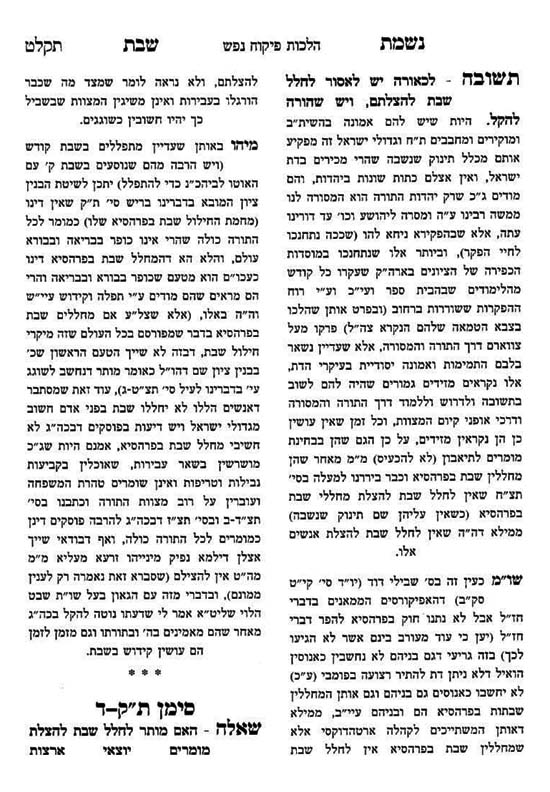
P. 141. Naor cites R. Jacob Emden in his note toNiddah22b that not everyone assumes that one needs to receive a gezerah shavah by tradition, meaning that one can create his own gezerah shavah. Naor notes that this is a שיטה יחידאה. Does the notion that one need to receive a gezerah shavah by tradition mean that it must go back to the beit din ha-gadol, as Naor quotes one source as saying? I think not, and to give one example, R. Gedaliah Nadel writes that it is enough for a gezerah shavah to have come to us by tradition, and if previous generations of great scholars, who understood the nuances of Hebrew, accepted a gezerah shavah, we can rely on them.[13] In terms of scholarly studies on the gezerah shavah, to the sources cited by Naor I would also add Michael Chernick, Midat “Gezerah Shaṿah”: Tzuroteha ba-Midrashim u-va-Talmudim (Lod, 1994) and Yitzhak Gilat, Perakim be-Hishtalshelut ha-Halakhah (Ramat Gan, 1992), pp. 365ff.

2. As I mentioned R. Meir Simhah of Dvinsk earlier in this post, let me add a few more points relevant to him.

I find it of interest that in 1925 R. Jehiel Jacob Weinberg stated that R. Meir Simhah was “truly the gadol ha-dor”.[14]

As to why the kiruv yeshiva was named Or Somayach,[15] Yonoson Rosenbloom writes:

The immediate impetus for the change in name was a powerful shmuess given in the beis midrash by Rabbi Shlomo Freifeld. Rabbi Freifeld quoted the hesped given for Rabbi Meir Simcha by the Rogachover Gaon, his contemporary Torah giant in Dvinsk. The Rogatchover said of Rav Meir Simcha that he learned with the intensity of one who felt flames raging all around and that only his learning could extinguish them.[16]

In 1919 there was a false report that R. Meir Simhah had been murdered in a pogrom. This event was covered by newspapers around the world.[17] Here is a poster that was hung up after the false information arrived in Eretz Yisrael. (The information that appears at the bottom indicating that this poster is from 1926 is incorrect. 1926 was the year of his actual death.)[18]

In response to the false report, there were a number of eulogies given. R. Yisrael Abba Citron, rav of Petah Tikvah, delivered a hesped which was later published.[19]

Are there any other examples of giving a hesped for a great rabbi who was not actually dead?

Speaking of the death of R. Meir Simhah, we are fortunate that he was not killed on another occasion. Yoel Hirsch called my attention to something that is not mentioned in all the discussions of R. Meir Simhah. As is well known, R. Meir Simhah only had one daughter, and she was mentally ill. According to R. Israel Dusowitz in Ha-Mesilah 1:5-6 (Sivan-Tamuz 5696), p. 6, R. Meir Simhah’s daughter tried to kill her father, stabbing him in the neck. Miraculously, he survived.

3. Earlier in this post I mentioned how Naor cites R. Meir Simhah’s notion that a king can execute certain people even though this would not be permitted under Torah law, since his power functions in accord with Noahide law which has a much wider range of possibility to punish than Torah law. R. Meir Simhah was referring to executing people based on lesser standards of evidence, not killing innocent people. Yet I would like to make a few comments about the latter point, as it is precisely with regard to the power of a king to kill innocent people that we see a change in how the generations have regarded certain moral issues.

Contemporary moral judgments are sometimes far removed from those of previous generations, even when dealing with great sages. For instance, R. Levi Ben Gershom recommends that if you are holding a prisoner who has been a constant enemy of the Jewish people, he should be executed.[20] R. Zvi Hirsch Chajes claims that a king has the right to kill the innocent children of someone who rebels, because of tikun olam,[21] and the Hatam Sofer, in a letter to Chajes, find this a reasonable position.[22] The purpose of this killing would be to put fear into others, who while they may be willing to risk their own lives in rebellion, would be deterred if their children were to be wiped out. This is certainly not what pretty much anyone today would regard as “Jewish values.” But I find it fascinating that in previous years, among some great Torah scholars, this was regarded as acceptable, even if only in a theoretical discussion. Naor, p. 136, provides additional sources for this matter, and I would add that R. Kook was also inclined to think that in extreme circumstances it would be permissible to execute innocent people such as children of an evil doer.[23] Let me stress again that all the discussions mentioned in this paragraph were theoretical, no different than so many other theoretical discussions found in rabbinic literature, and I wonder if they could have ever decided this way in a real-life case.

Regarding the power of the king, R. Jacob Kamenetsky has an unusual passage in his Emet le-Yaakov, 1 Kings 3:28. He says that in the story of Solomon and the two harlots, where Solomon said to cut the baby in half, if the real mother had not spoken up, they would have actually cut the baby in half, as the king has the authority to order this.[24]

ונראה לומר, דהנה מה היה קורה אם האמא האמיתית היתה מסכימה שיחתכו את הולד לשנים, בבחינת “תמות נפשי עם פלשתים”. הרי בפשטות מבינים ששלמה המלך היה חוזר בו מיד ואומר, “לא התכוונתי ברצינות שיהרגו את הילד”. אבל זה אינו, כי ביד המלך סמכות מסויימת על חיי נתיניו, כמו שיכול לשלוח אותם למלחמה אף על פי שנהרגים שם, אף כאן מאחר שציוה לחתוך, כאילו שיש כאן דין של ממון המוטל בספק חולקים, היו חותכים משום כבוד המלכות, שהרי אצל מלך אין חרטה

I don’t know why R. Kamenetsky finds the common understanding, that Solomon never really intended his words to be implemented in practice, to be mistaken. Certainly, killing an innocent child does not bring any honor to the king. Even if R. Kamenetsky is correct with regard to Solomon, speaking from our 21st-century perspective, the Jewish people, with their current moral sense, would never accept something like this, and I feel confident that a future Sanhedrin would never countenance it.

It must also be noted that Sforno, Netziv, and Meshekh Hokhmah, in their commentaries to Deut. 24:16 (“Children shall not be put to death for the fathers”), specifically reject the possibility that the king could kill the children of one who rebels, with Sforno noting how this was a typical Gentile practice that the Torah is legislating against.[25] In areas of controversy such as this, I think we should follow the guidance of R. Jehiel Jacob Weinberg who believed that if there is a dispute among halakhic authorities, the poskim must reject the view that will bring the Torah into disrepute in people’s eyes:[26]

ואגלה להדר”ג [הגרא”י אונטרמן] מה שבלבי: שמקום שיש מחלוקת הראשונים צריכים הרבנים להכריע נגד אותה הדעה, שהיא רחוקה מדעת הבריות וגורמת לזלזול וללעג נגד תוה”ק

R. Shlomo Aviner has the same approach. He notes that conceptions of morality change over time and not every decision of a posek is an eternal decision. Today, when we have different standards of morality than in previous years, if there is a dispute among the authorities, we should adopt the position that we regard as more moral.[27]

וברור שבהלכה פנים לכאן ולכאן. לכן כיוון שנתיבים אלה הם נתיבים מוסריים יותר, עלינו להכריע על פיהם. לפעמים ההלכה מוכרעת, בגלל שעת הדחק, ולפעמים ההלכה מוכרעת כי כך המנהג. אם כן, בימינו ‘המנהג’ הוא להיות מוסרי . . . יש גם מושגים מוסריים המשתנים על פי המציאות. אב הסוטר לבנו הקטן, אינו דומה לאב הסוטר לבנו בן השמונה עשרה. האם סטירת לחי לבנו היא מעשה מוסרי או לא מוסרי? תלוי בנסיבות. לא כל הכרעות הפוסקים הן הכרעות נצחיות . . . במצבנו כיום ישנם שיקולים מוסריים שמצטרפים להכרעותינו ההלכתיות

R. Yuval Sherlo acknowledges moral advancement and concludes: “Despite all the hypocrisy and cynicism there is moral progress in the area of human rights. True religious people believe that this is the will of God.”[28]

3. Michael Lerner recently passed away. I mention this because I recently found a letter from Lerner’s mother, Bea Lerner, who served as chairwoman of the New Jersey Democratic Party.[29] The letter is undated, but was obviously written in 1970 at the time that Lerner was on trial as part of the “Seattle Seven”, charged with having incited a riot. I found the letter in the Heschel archives[30] which I assume means that Mrs. Lerner had sent it to Heschel—who knew Michael Lerner from the Jewish Theological Seminary—and others as part of a request that they submit letters to the court testifying to Lerner’s non-violent nature. I had intended to send the letter to Lerner, but alas, this was not to be. I think the letter, which will be valuable to Lerner’s future biographer, is a wonderful example of parents’ unconditional love for their son, even if he chooses a path that they do not understand or agree with.

Since I just mentioned Heschel, and in honor of Rabbi Dr. Yechiel Leiter, Scranton native and new ambassador from Israel to the United States, let me also include this letter from Leiter’s grandfather, R. Moshe Leiter, to Heschel.[31]

R. Moshe Leiter authored a number of seforim, and in the letter above he is offering condolences about the passing of Heschel’s brother in London, R. Jacob Heshel. Interestingly enough, he is not entirely sure if people had informed Heschel of his brother’s passing, and we know that in the past people did withhold such news. R. Jacob Heshel was the rabbi of the Edgeware Adath Yisroel Congregation, and this is a picture of him with his family that I found here.

4. In my post here I presented some liberal views of euthanasia, views that for some reason are not part of the discourse in Orthodox circles. I forgot to include the following letter from R. Joseph Elijah Henkin which is found in the memorial volume Ner Shaul, p. 502.

See nos. 2, 3, 5, 8. While R. Henkin does not offer any firm rulings, you can see that he does not reject the liberal perspective and might even be inclined to it. No. 4 is also fascinating, for if we accept his suggestion it would mean that even if we assume that brain death is not halakhic death, it would still be permitted to remove a heart from a brain-dead person to save another’s life (as it appears reasonable to assume that a brain-dead person is a goses).

5. In my last post here I raised the question of whether Neturei Karta allies of Hamas can be counted in a minyan, whether their businesses should be boycotted, etc. Someone commented to me that however evil their actions, the Neturei Karta are still Jewish and Torah observant and thus they need to be treated as part of kelal Yisrael. This is a specious argument. Even a cursory familiarity with Jewish history shows that by means of the herem religiously observant people were removed from the community for all sorts of reasons. Because the herem was so successful, these removals only needed to be temporary as the excommunicated people inevitably felt compelled to ask the community leaders for forgiveness.

Yet I want to focus on the point that the Neturei Karta are still Jewish with the implication that since this is their birthright, it cannot be removed from them. (Despite what some people have claimed, from everything I have seen they are indeed halakhically observant and have not violated Shabbat by speaking on microphones, carrying signs where there is no eruv, etc.)

R. Moses Sofer, in his comment to Shulhan Arukh, Orah Hayyim no. 39, has a fascinating idea that has been discussed by many.

ועיין בתוספות יום טוב משנה ד’ פרק ז’ דנדה דתמה על כותים אי גירי אמת הן איך עשאום כנכרים לטהר נדות ואהלות שלהם. ונראה לפענ”ד שיש כח בכלל ישראל להוציא המורדים מכלל האומה ויחזרו לגוים גמורים אף להקל . . . והם נמנו וגמרו להוציאם מברית ישראל לגמרי

According to the Hatam Sofer, “Kelal Yisrael”, which I assume is represented by the rabbinic leaders, has the ability to remove someone from the Jewish people and turn him into a complete non-Jew. This would mean that you can lend money to him on interest, if he marries a woman it does not take effect, and even if he is already married the woman would not need a get. So we can leave it to the gedolim if they wish to go this route with the Neturei Karta.

As mentioned, the Hatam Sofer’s novel position—R. Asher Weiss[32] terms it a חידוש עצום—is discussed by many. However, while everyone tries to understand the basis of the Hatam Sofer’s view and its implications, there is one exception, namely, R. Moshe Feinstein.[33] R. Feinstein comes at the matter from a completely different perspective. Finding the Hatam Sofer’s words incomprehensible, he writes:

וברור ופשוט שא”א דבר כזה בעולם . . . וברור שאין זה מדברי החת”ס

R. Feinstein denies that the Hatam Sofer could have written what is found in his commentary. In a number of previous posts I have discussed this tendency of R. Feinstein to reject the authenticity of texts that he sees as completely mistaken. At certain times I think R. Feinstein really means what he says, that the text is not authentic. Yet on other occasions, and the example of the Hatam Sofer’s commentary would be such a case, I agree with R. Betzalel Deblitsky[34] that when R. Feinstein said that the text is not authentic, he did not mean it literally. Rather, this was his way of respectfully registering his strong disagreement. R. Deblitsky compares this to the rabbinic expressionכי ניים ושכיב אמרה, “When he was sleepy and lying down [to rest] he said this halakhah.” Everyone knows that this is just a figure of speech, and it would make no sense for one to reply that on the contrary, when the rabbi issued the ruling he had just finished his coffee and was completely sharp. In fact, R. Samuel Ibn Tibbon even uses this expression about the man he idolized most, Maimonides.[35]

6. My forthcoming book on Rav Kook is now available for purchase on Amazon (although it won’t appear for another couple of months). Once the book reaches America, I will be doing an event at Mizrahi Book Store so stay tuned for that.

* * * * * * * * *

[1] The title is taken from Isaiah 60:16.
[2] For the meaning of this kabbalistic expression, see Yosef Kalner, Milon ha-Re’iyah, vol. 2, p. 199.
[3] See also p. 21 n. 22 where Naor mentions his discussion in this regard with Prof. Abraham Joshua Heschel.
[4] In Kol Torah, Av-Elul 5728, p. 20, R. Nahum Drazin mentions what he heard from R. Moshe Soloveitchik, how R. Hayyim explained a position of Maimonides as arising directly from the verses in the Torah. As this appears to be completely unknown, here is the page.

[5] “Al Perek ‘Ein Dorshin’”, Ha-Ma’yan, Nisan 5784, pp. 93-104. Regarding derashot to establish, or at least support, minhagim, see e.g., Tur, Orah Hayyim 493, regarding women not working after sunset during the period of the Omer:

ונהגו הנשים שלא לעשות מלאכה משתשקע החמה . . . וכתיב שבע שבתות תמימות תהיינה, מלשון שבות ולשון שמיטה שבע שבתות . . . מה שנת השמיטה אסור במלאכה אף זמן ספירת העומר דהיינו לאחר שקיעת החמה אסור במלאכה

R. Eliyahu Zini, Etz Erez, vol. 2, p. 224,  is troubled by this derashah:

ויש לשאול: ממתי רבותינו הראשונים דורשים פסוקי תורה להוציא מהן הלכות, יהיו אלה אפילו מנהגים בלבד

[6] For my 2025 summer Torah in Motion tours, see here.
[7] Mishnah, Ta’anit 4:7 deals with a case where Tisha be-Av falls out on Friday.
[8] Bayit Ne’eman, 16 Tevet 5777, p. 1.
[9] The word אפילו is supposed to be recited with the accent on the final syllable. But does anyone, even Sephardim, pronounce it this way?
[10] The English is taken from the brand-new translation of the Guide by Lenn E. Goodman and Phillip I. Lieberman. This work is a wonderful achievement. It should give Goodman and Lieberman great pride to know that, from this point on, anyone who studies Maimonides will have to turn to their translation, which by the way also contains valuable notes. As a companion volume to the translation of the Guide, Goodman has also just published A Guide to the Guide to the Perplexed.
[11] The translation is from the Goodman and Lieberman edition. Pines has “Abraham our Father” which I think people will be more comfortable with, as “Father Abraham” sounds Catholic.
[12] Again, I do not know why Naor records the name of R. Leiner’s book as מ”י השילוח. The title is מי השלוח without any apostrophes.
[13] Mi-Torato shel R. Gedalyah, p. 25. Regarding gezerah shavah, see the brand new book by Moshe Sokolow, Pursuing Peshat: Takakh, Parshanut, and Talmud Torah, pp. 85-86, where he calls attention to R. Meir Simhah of Dvinsk, Meshekh Hokhmah, Num. 30:10, where he creates his own gezerah shavah. In justification of this step, R. Meir Simhah cites the Jerusalem Talmud, Pesahim 6:1: “A man may initiate his own gezerah shavah in order to sustain his study.” R. Yehudah Copperman, in his edition of the Meshekh Hokhmah, notes the originality of R. Meir Simhah in this example:

הפירוש המקובל לאמרה זו (וכך אמנם משתמע מסוגית הירושלמי) היא לפי בעל קרבן העדה: לקיים תלמודו שקיבל מרבו, דאין הפסד בדבר, שהרי בלאו הכי הדין כן, ואין גזירה שוה זו אלא לסמוך בעלמא (עכ”ל). לעומת זאת מושך רבינו את הכלל אף להלכה שלא קיבל מרבו אלא שחידש הוא בבית מדרשו! ועיין בהרחבה בפרקי מבוא פרק יד, כי זה חידוש גדול בבית מדרשו

[14] Kitvei ha-Gaon Rabbi Jehiel Jacob Weinberg, vol. 2, p. 235.
[15] Regarding the word שמח, I transliterated Sameah, but the official name of the yeshiva is Ohr Somayach. So which pronunciation is correct? It turns out that both are correct, as some grammarians claim that before the furtive patah in שמח there is an aleph sound, and others think that there is a yod sound. The same thing would be with the word ריח, which can be pronounced either as רֵיאַח or רֵייַח, or the word פענח which can be pronounced פענֵאַח or פענֵיַח. See R. Benzion Cohen, Sefat Emet, pp. 59-60; R. Adir Amrutzi, Dikdukei Abiah, p. 19.
[16] Rosenbloom, Rav Noach Weinberg: Torah Revolutionary (Jerusalem, 2020), p. 72 n. 1.
[17] See details here.
[18] The poster is taken from here.
[19] See Zev Aryeh Rabiner, Maran Rabbenu Meir Simhah Kohen (Tel Aviv, 1967), pp. 232-233. For another published eulogy, by R. Ben Zion Cuenca, see Mekabtze’el 39 (2013), pp. 739ff.
[20] Commentary to 1 Kings, ch. 22, Toelet 34.
[21] Torat ha-Nevi’im, ch. 7.
[22] She’elot u-Teshuvot Hatam Sofer, Orah Hayyim no. 108 (end).
[23] See Da’at Kohen, no. 193.
[24] Regarding the Solomon story, a real-life version of this is reported to have occurred in the early twentieth century. A woman who was nursing the baby boy of the rabbi mistakenly slept on the boy, killing him. Fearful of what would happen, she gave her own son to the rabbi’s wife, and this boy was then raised as the child of the rabbi. The matter was only discovered years later. When the woman’s husband died, the dead husband appeared a number of times in the rabbi’s son’s dreams asking why he was not saying kaddish for him. Here is R. Eliezer Deutsch’s description of the case in Va-Yelaket Yosef, vol. 10:20 (1908), no. 194.

The story is also told in R. Zvi Hirsch Friedling, Hayyim ha-Nitzhiyim, p. 54, as an illustration of the importance of kaddish.
[25] See Encyclopedia Talmudit, vol. 33, s.v. לא יומתו אבות על בנים, col. 947; R. Shimon Krasner, “Ishiyuto u-Feulotav shel Shaul ha-Melekh,” Yeshurun 11 (2002), pp. 779-780.
[26] Kitvei ha-Gaon Rabbi Jehiel Jacob Weinberg, vol. 1, p. 60.
[27] Am ve-Artzo, vol. 2, pp. 436-437.
[28] Reshut ha-Rabim, p. 102.
[29] See David Horowitz, Radical Son (New York, 1997), p. 175.
[30] Heschel Archives, Duke University, Box 8, Folder 1.
[31] Heschel Archives, Duke University, Box 17, Correspondence 1970-1971.
[32] See R. Asher Weiss’ weekly shiur, Toldot 5785, p. 11, called to my attention by Baruch from Monsey.
[33] Iggerot Moshe, vol. 9, p. 162 (Yoreh Deah 5:41)
[34] Beit Aharon ve-Yisrael 122 (Kislev-Tevet 5766), p. 170.
[35] See Carlos Frankel, Min ha-Rambam li-Shmuel Ibn Tibbon (Jerusalem, 2008), p. 300:

כי ניים ושכיב רבינו ז”ל אמר זה הדבר


Torah Under Wraps

Torah Under Wraps

by Yoav Sorek

translated by Daniel Tabak

Their publications are not allowed to get out. Their roiling Internet forums are blocked by filters. The articles they publish omit the names of professors considered verboten. A cohort of Haredi scholars [1] challenge the academy and their natural surroundings, unafraid to deal with subjects deemed taboo in the yeshiva world. Few Religious Zionists have penetrated this alternative ivory tower, but one of them—Eitam Henkin, may his blood be avenged—succeeded in breaking down barriers.

*

One needs to strengthen oneself with faith; one should not entertain philosophical questions nor even glance at the books of philosophers,” said Rabbi Nahman of Bratslav already at the end of the eighteenth century. This motto is particularly popular today, in the post-modern era of “religious strengthening,” in which religiosity is perceived as synonymous with simplicity and unsophistication. Yet that very approach also runs counter to the Jewish mind, which is by its nature anything but naive. The legacy of Jewish erudition constitutes part of the DNA not only of the academy, but of even the most Haredi sectors of the yeshiva world, and it finds expression in the spirited Jewish Studies scholarship flourishing under the radar in circles that are presumed to recoil from it.

Israelis distant from the world of Jewish Studies were offered a glimpse of it in the amusing film “Footnote,” but it portrayed only the nerve center of the field’s academic milieu, when in reality a great deal more is out there. In the reading rooms of the National Library, and in many houses in Bnei Brak and Jerusalem, many scholars sit and study the same topics as academics but without academic degree, without traveling to conferences, without aspirations toward an academic appointment. The history of medieval and modern rabbinic authorities, the stories of their compositions, the manuscripts and their provenances, variant customs, disputes both ancient and alive—all of these preoccupy a non-negligible group of yeshiva graduates, Haredi in dress and behavior, who publish articles in “non-academic” journals of Torah scholarship and produce corrected editions of sacred texts, some of which can even be considered quasi-critical editions.

They number Hasidim and Mitnaggedim, the truly God-fearing and those trapped in the Haredi lifestyle who cut corners, those lacking any academic title and others who have earned one—sharp and knowledgeable one and all, still faithful to, and actively participating in, the intra-Haredi discourse. Some of them evidence a dual non-conformism in their lives: on the one hand, they have opted to put distance between themselves and the safe space of the yeshiva, pasturing in the treacherous fields of scholarship; on the other hand, they are Haredim who hail from circles thoroughly suspicious of academia and would not dream of lending credence to its guiding assumptions. Nearly every remarkable personality in the field originates in the circles of Ashkenazi religious zealots, yet the scholarly discussion—which takes place not only on journal pages but in the lively Internet forums of Be-Hadrei Haredim and Otzar HaHochma—is not private, and sometimes a handful of others participate. Rabbi Yoel Catane of Yeshivat Sha‘alvim, editor of the journal HaMa’yan, is one of those others, as his home is in the Religious Zionist world, and his publication represents the enlightened German Zionist Orthodoxy of bygone years. The late Eitam Henkin also was one of them—a Torah scholar and brilliantly wide-ranging scholar who took prominent part in the back and forth of these torani scholars.

In National-Religious society, there are, to be sure, many others involved in Jewish Studies scholarship, but one would be hard-pressed to find the same kind of polemical verve that exists amongst Haredi scholars. According to K., a young Haredi scholar, the passion attests to the fact that the scholarly endeavor is for them an existential need:

The Haredi does his research in order to mask his own crisis of faith in a world that forbids thinking. Those who try to identify the composer of a liturgical poem or the copyist of an unknown manuscript, and those who uncover a forgotten rabbinical position held by R. Joel Sirkes, and those who wade through tomes to reconstruct a partially extant word in an Akkadian inscription, are all really fleeing forbidden thoughts. They release the tension between the silent extinguishment of faith in the Haredi world and the soul aflame with newly forged ideas by running for the hills of manuscripts and book archives.

K.’s criticism begins with the Procrustean bed of Haredi yeshiva education:

The Haredi kollel fellow is force-fed a diet of Torah study characteristic of the Lithuanian yeshivas of the previous century. Should he not be of a mind to rebel completely, the only somewhat legitimate pursuit open to him is Jewish Studies. In that way he can edit the novellae of the Rosh to tractate Nazir without raising too many eyebrows. For that reason Haredi scholars, at least initially, are more involved in editing and less with research or writing articles. And if they are open to producing scholarship, the closer the subject matter is to our time, the better: better on the modern rabbinic authorities than the medieval ones, better on the medievals than the Ge’onim, and God forbid not on the Talmud—don’t even mention the Bible. Preference is given to writing biographical pieces and endless discussions of historical chronology, such as clarifying the years of rabbi X’s rabbinic post in town Y, rather than anything deep about his method of study.

Not everyone agrees with K.’s psychological diagnosis. “Some have ventured into the academic world not out of frustration with the kollel world, but because they were introduced to scholarship in minute doses and became enchanted by it,” says R. Yosef Mordechai Dubovick, a Boyaner Hasid who recently completed his doctorate on Rabbenu Hananel. He says that this field presents something the young prodigy would find difficult to resist.

We have been taught and trained to question, explore, plumb the depths and not be satisfied with a superficial reading or understanding. When the intellectual yeshiva student is exposed to new tools and unfamiliar hermeneutical lenses and modes of understanding, his natural curiosity—nurtured so well—gobbles them up.

It’s ‘spontaneous academia,’” says Rabbi J., who would prefer to avoid equating it with academia. “It develops independently, without institutional bodies to dictate rules and regulations. It is anarchic, autodidactic, and exhilarating. It is a breathtaking demonstration of unfettered intellectual ability.”

A Scholar is Born

Rabbi Dr. Zvi Leshem, Director of the Gershom Scholem Library at the National Library of Israel, has occasionally bumped into scholars from the very heart of the Haredi world. “They are not the typical kollel fellow because the scholarly approach is not that of yeshiva students,” he says. He continues:

Look, when I began working here I met a senior rosh yeshiva from a respected hesder yeshiva, and I told him about those who come from the yeshiva world to do research here. He was at a loss. “What sort of thing do they research?” he asked me, and I responded in turn with the example of Hemdat Yamim.[2] “Why would they research Hemdat Yamim,” the Torah scholar asked me, “when they can buy it in any seforim store?” That is the mainstream approach. Those who embark on scholarship are atypical.

They may be exceptional and individualist, but one unmistakable quality binds them all together: they are autodidacts. This is evident in how they handle material in a foreign language. Some of these scholars have never studied English or German systematically yet refer to non-Hebrew sources in their articles. Each apparently bridged the gap in his own way.

Anyone interested in this phenomenon is invited to open, for example, a volume of Yerushaseinu, an annual tome published by the Institute for German Jewish Heritage (Machon Moreshet Ashkenaz). Some of the articles published therein would be perfectly suitable for any standard academic journal; among the numerous footnotes adorning the pages one finds references to scholarly literature in Hebrew and other languages. Other publications include Yeshurun, Moriah (published by Machon Yerushalayim, which for decades already has been involved in the professional editing of medieval and modern rabbinic literature), the Chabad journal Heikhal Ha-Besht, and others. Torani scholars fondly remember the journal Tzfunot, which met its demise over a decade ago, and in the meantime they publish in Torah supplements to Haredi newspapers, primarily in Kulmos of the newspaper Mishpacha. Likewise, the new scholarly journal Chitzei Gibborim – Pleitas Soferim, published in Lakewood, NJ, is at the moment taking its first steps.

Prominent names in the field include Mordechai Honig, a Hasid from Monsey who is extremely knowledgeable in medieval rabbinic literature; Yaakov Yisrael Stahl, a scholar of Franco-German Jewry forced to lower his profile in connection with academia; Moshe Dovid Chechik, a historian who until recently co-edited Yerushaseinu and currently co-edits Chitzei Gibborim; Yehudah Zeivald, a Boyaner Hasid who is quite busy with philosophy and Hasidism; Yitzchak Rosenblum, who had to move from Kiryat Sefer to Bet Shemesh on account of the library he opened, and currently teaches at the Haredi yeshiva high school Nehora; Yaakov Laufer, a scholar who focuses on linguistics and on the conceptual mode of Torah study; Betzalel Deblitsky, a prodigious zealot from Bnei Brak who runs the forum associated with Otzar HaHochma (the monumental digitization project of the Jewish library); Nachum Grunwald of Lakewood, NJ, a Chabadnik who grew up a Satmar-Pupa Hasid and serves as editor of Heikhal Ha-Besht; Aharon Gabbai, a rising star from Bnei Brak who graduated from a Lithuanian yeshiva, of course; Yechiel Goldhaber, slightly older than the rest, a historian and bibliographer whose scholarship is famous, and for whom the National Library is a second home; and Avraham Shmuel Taflinsky, who has toiled for the past few years in uncovering the sources of the aforementioned Hemdat Yamim.

Once we are mentioning the denizens of the National Library, mention must be made of the all-important tool in their scholarly work—the Internet. The global web of knowledge enables Haredi men from conservative yeshivas, whose library holdings are what you would expect, to come in contact with Jewish Studies scholarship and its historical-critical mindset. Most Haredi scholars have a home Internet connection, but not all. Zvi Leshem relates that some come to the library not to peruse ancient manuscripts or converse with the university’s scholars who use it as their place of study, but simply to work at a place that provides Internet access.

“In the digital age, Jewish Studies scholarship has successfully managed to wiggle its way, however constrainedly, into Haredi and yeshiva circles via databases such as Otzar HaHochma,” Mordechai Honig relates. “Until recently, it was the books. The birth of a Haredi scholar was generally triggered by incidental exposure to academic scholarship that invitingly charmed him. For me, it was Ephraim Urbach’s The Tosaphists, which I purchased at age fifteen.”

No one can deny the love story between digital media and the world of Haredi scholarship, with the latter exercising its acumen also in its use of technology. Along those lines, a weekly Internet journal popped up several years ago which, in the course of a couple years, became an especially favored forum for the group of torani scholars. It bore the name Datshe (ДАЧА), a Russian word that made its way into yeshivish slang, which evokes a leisurely space in which people enjoy life, a kind of rare legitimation of self-indulgence and letting loose a bit. The journal, founded and edited by Yitzchak Baruch Rosenblum, was, according to its subtitle, “where sages of Israel come to relax.” The publication insisted upon respectable discussion and high-caliber argumentation, but one also could find among the directives to its readers and writers the following note of caution, which furnishes an additional explanation to the choice of digital format: “Please preserve the low profile of this publication. One can print it for ease of reading but should not show it to just anyone. Wisdom belongs to the discreet.”[3]


Instead of Polemic, Shock

Along with Internet databases and online journals, forums also have an important place in the discourse of these scholars. After many long years in which the forum Soferim u-Sefarim on the site Be-Hadrei Haredim served as the water cooler for torani scholars, the baton was passed to the forums of Otzar HaHochma. A lengthy, fascinating thread recently began there, for example, whose purpose is to generate a list of “dissenting opinions [made by lone rabbinic scholars],” that is, halakhic positions taken by well-known decisors over the generations when their colleagues were of a different mind. The thread reveals the foundational analytic-halakhic erudition of the discussants, expert not only in bibliography and history but also in a wide range of positions expressed by medieval and modern rabbinic authorities on scores of issues.

The administrator of the Otzar HaHochma forums is, as was said above, Betzalel Deblitsky (under the username “Ish Sefer”). What had been permissible on Be-Hadrei Haredim the fearless zealot Deblitsky bans, censoring discussions and silencing voices he deems unworthy of being heard. But even those who miss the great openness that marked the forum of yore understand that the change is permanent—discussions of relevance within the scholarly community take place principally on the new forum.

Zeal, parenthetically, is a relative matter: the strict filter Netiv, which runs according to the guidance of a confidential rabbinic board, blocks the Otzar HaHochma forum on account of its content being deemed subversive and problematic. To take but one example, the forum has an intense, politically-charged discussion surrounding one of the veteran decisors of the Edah Haredit in Jerusalem—R. Yitzhak Isaac Kahana. A broadside that circulated in Jerusalem against R. Kahana’s book Orhot Tohorah and his lenient rulings on questions regarding menstruation inflamed not only the physical Haredi street but the virtual one as well, engendering scathing posts on the forum in support of each side. A symptom of one of the forum’s pathologies is partially manifest in this case: the deletion of threads by the moderator, who perceived them as deviating from the Haredi party line. Over three pages of posts inexplicably disappeared from the site, only to return the next day, redacted.

Rabbi Eitam Henkin was among those disappointed by the limits set on the forum’s discourse as compared with past fora, but he nevertheless realized that this was the place to be. Under the username “Tokh Kedei Dibbur,” Henkin took part in discussions on the forum, and at the same time carried on extensive personal e-mail correspondence with scholars who were active on it. This became the gateway through which Israeli reality penetrated the Haredi ivory tower—users discovered that the man murdered together with his wife, in front of his children, in the middle of Sukkot, was none other than “their very own” Rabbi Eitam. The forum was filled with emotional threads of eulogy and anguish, memorial initiatives and activities to be done in his merit, and the revelation of the many connections that Henkin had weaved amongst his Internet friends.

It is difficult not to resort to superlatives when speaking about Eitam Henkin. Anyone who had followed his abundant Torah publications — which were marked by eloquent prose, intellectual honesty, and the self-confidence of someone on home turf — had trouble believing the subject of conversation was so young. Even the conversation about him on the forums sketches a fascinating profile. The user known as “Meholat Ha-Mahanayim wrote:

The distinguished victim, may God avenge his blood, was wondrously knowledgeable about the entire history of our people, and specifically the history of Lithuanian Torah scholars and their writings. I merited corresponding with him a bit here, and as much as he was honest, fair, and truth-seeking, he was also intensely and diligently exacting […] None of his responses contained any triviality; his prose was shot through with words of Torah and wisdom, brimming with old wine […] One could discern his constant drive for the truth from his responses. He was never too flustered for a retort, and he always based what he said on the most solid of foundations. Even when he argued for an alternative position, he was a fair and honest opponent, unafraid to admit he was wrong when necessary.”

None other than Deblitsky (“Ish Sofer”), who is so distant from Henkin’s worldview and rarely treats anything with a velvet glove, eulogized Henkin at length. The forum’s moderator wrote:

His statements stood out in their richness, sharpness, and precision—they have no equal. The wide range of people who corresponded with him is astounding. Despite their working in various fields, his correspondents unanimously attested to the immense benefit they gained from him and to the rich sources with which he magnanimously and pleasantly inundated them. Many a time in answering some inconsequential question, he would—as soon as you could say Jack Robinson[4] whip out one of his many lists, chock-full and cornucopian, while noting that he was collecting additional material on the matter and it would have to wait until a future opportunity […]

Many have mentioned honesty and artlessness among his noble qualities. I would like to emphasize one thing that no one like me realized until they fell prey to it: his sharp and resolute style tended to invite polemic, but anyone who responded harshly as a tit-for-tat comeback found himself embarrassed and pathetic upon discovering the affable and unpretentious man behind those words.

Further on, Deblitsky touched on Henkin’s transcendence of the entire sectoral framework. According to him, Henkin noted in a personal communication “that his unique pedigree as a son and grandson of American rabbis who did not fit in with any of the specific groups of Torah-observant Jews enables him to view himself as free of the shackles of sometimes artificial classification and group affiliation. One could say that this feeling largely allowed him to cast a critical eye upon and evaluate phenomena from all sectors without bias.” Deblitsky claimed this to be evident in the independent stance Henkin took in a slew of polemics, in which his misgivings and speculations were spelled out numerous times in private messages, as he took pains to publish in the forum only those things that he could wholeheartedly stand behind.

“I, for one, find exaggeration on both sides,” wrote Henkin to Deblitsky regarding the polemic within the forum surrounding the figure of the late Rabbi Aharon Lichtenstein. “Be it the disparaging vitriol about him […] or, on the other side, those feigning innocence, as if he was just another link in the chain of Torah sages throughout the ages, some of whom have always engaged to some degree in general culture.” Henkin conceded to Deblitsky that even within the National-Religious community opposition to Rabbi Lichtenstein had existed: “It was undoubtedly quite grating for a regular yeshiva student (excluding those from Har Etzion and to “the left”) to see citations from non-Jewish culture and the like in a Torah article. In this case (of criticism within the National-Religious community—Yoav Sorek), however, opposition to that approach was disjoined from ad hominem attacks.”

“We should be very sad that ‘sectoral’ boundaries make no exceptions for Torah giants,” wrote Henkin in another e-mail to Deblitsky.

The definitive assignment of each person into specifically this community or that one is often artificial. It is absurd that the public considers many comedians, musicians, and low-brow entertainers (for purposes of this example) as “Haredi” because they attended heder and wear a hat in the synagogue, while thousands of families who give their all for Torah and are punctilious about every jot and tittle (not to mention that for them television, secular newspapers, and the like are not even up for discussion) are “not Haredi” because they wear a colored shirt and also rejoice on Yom Ha-‘Atzma’ut. Although people can only see externals, they can ascertain what they will have to account for in the Heavenly court, whether they will be asked about Torah study, honesty in business, and hoping for the redemption,[5] or whom they cast their vote for in national elections.

Henkin wrote the following when describing Rabbi Dov Lior’s Torah greatness. “I can say unhesitatingly that we are talking about a serious heavyweight in Torah erudition and jurisprudence who has the entire Talmud and Shulhan Arukh in his head—incredible!” Still, he noted that the Haredim do not respect him simply because his stance on Zionist matters “meant he was to be associated with only one camp and perforce rendered off-limits for the other camp, even if for him the only thing in his world is Torah, pure and simple. (Elements of Western culture or academia, which are accepted in large segments of his camp, he derides at every turn.)”

In these citations of Henkin one can hear the Haredi lilt. As Deblitsky and others in the forum pointed out multiple times, Henkin had the ability to converse with various people in language they were comfortable with. In private communication with another user in the forum, Henkin disclosed that when he would write on Otzar HaHochma, he would adopt the appropriate style and cautiously promote topics close to his heart.

What motive could there be for entering this lion’s den? Henkin had faith that every place has its bright spots, and he was happy to become acquainted with people he would not have otherwise met. He described himself as “attempting to pursue peace, even in a place where they pursue the likes of me.” As he wrote another time under the username “Tekhelet Domah in the somewhat-calmer forum of Be-Hadrei Haredim: “I try my utmost not to hate anyone and not to write off any community that believes itself to be doing God’s will, even those which, in accord with their own aforementioned belief, would write me off and disparage my Rebbe in an unacceptable way.”

Professor in All But Name

After Henkin’s murder, a debate arose between his acquaintances and family over the the respective value he assigned to the two antipodes of academic study and religious study. Not surprisingly, the tension between the two constantly taxes many torani scholars. In the Otzar HaHochma forum and others, it is not uncommon to find a venomous and disparaging treatment of classic academics, who are caricatured as wasting their time on the trivial or unnecessary because they do not know how to study Torah, plain and simple. In the acerbic language of one forum contributor: “they are incapable of studying a page of Talmud without Schottenstein and a dictionary.”

In this way, the methodology of the elderly professor David Halivni, for example, has been pilloried and subject to sharp ridicule, perhaps also on account of his past affiliation with the Conservative movement. Along the lines of the approach with which he is associated (which presumes that most Talmudic passages were edited by a generation of anonymous sages, termed stamma’im, during the Savoraic period), the user “Afarqasta De-‘Anya” writes that he read Halivni’s introductions to two tractates and concluded: “Halivni did not write them himself; rather, he composed specific passages in which even he did not fully understand what he was writing or what he intended. His editor and publisher added stammaitic passages, thereby integrating the scattered pieces into what appears to be a single, unified text.”

This derision may, of course, result from an inferiority complex afflicting those with no proper academic training, or from the ignorance of those whose intellectual horizons do not extend beyond the narrative in which they were raised. In any case, it is far from being the consensus of the community of torani scholars: some have integrated into academia in recent years, others recognize that the yeshiva world’s disdain toward Jewish Studies is outdated. As Dubovick notes, Jewish Studies of this past generation is not what it had been previously, when scholars had no connection to the traditional study hall, and their scholarship at times revealed their ignorance and at other times could not sort the wheat from the chaff. In this generation, the preeminent scholars in the field are also serious Torah scholars.

Yet, anyone who publishes in Haredi journals or seeks legitimacy from the Haredi street cannot write without inhibition. “They must be careful about how they write, whom they cite, and even what titles they bestow,” explains Zvi Leshem. “I recall someone here who wanted to cite Rabbi Saul Lieberman’s Tosefta Ki-Feshutah, but he could not figure out which was the worse option—writing Rabbi Lieberman or Professor Lieberman. In the end he simply omitted his name.”

Though many of them already bear the title Dr., generally the torani scholars are not in the academic race for positions and recognition, and that fact profoundly impacts their lives. “The disconnect from the academic world and all its rivalry makes it easy for a scholar to share his wisdom with his colleagues, without having to worry about material or future scholarship being stolen, as well as to partake of his colleagues’ wisdom,” says R. Yoel Catane. “At the same time, the pressure to publish quality articles in the academic world, and the need to subject one’s research to peer review, occasionally yields excellent results that cannot be achieved in torani scholarship.”

“The fact that we are not part of that competition,” explains G. to me, “grants us peace of mind, intellectual freedom, the freedom to choose our areas of research without the need for prerequisite courses that are not entirely necessary, and the freedom to develop our ideas as we see fit. I see Haredi scholars benefitting from the sort of freedom enjoyed by the first generation of scholars in the Wissenschaft des Judentums movement.”

Between Seclusion and Entrenchment

The heightened awareness of Jewish sages to the development of their tradition preceded by centuries the Wissenschaft des Judentums movement, which set the critical modern gaze upon the Jewish library. Across the generations there were Ge’onim, medievals, and moderns engaging in textual criticism, historicizing customs, unearthing deep-rooted errors, and looking askance at what the ignorant perceived as a “Judaism” that could not be questioned.

Even from the narrower, more modern perspective of relations between the academy and Haredim, the group that forms the subject of this article certainly cannot claim originality. The “Bibliography of the Hebrew Book,” a superb academic project that catalogs all titles printed in Hebrew and other Jewish languages through the ages, is currently led by Yitzchok Yudlov, an erudite Haredi with no academic schooling. Among the founders of the project Rabbi Shmuel Ashkenazy (Deutsch), raised in Batei Ungarin, stands out. Ashkenazi, one of the most famous Haredi scholars of the book, serves today as an honorary member of the Mekize Nirdamim Society, a venerable publisher identified with the Wissenschaft movement. Two Haredi scholars also stand out among the employees of the National Library: Yehoshua Mondshine, an independently-minded Habadnik known for his scholarship on Hasidism, who passed away this past Hanukkah[6] after a terrible illness; and Meir Wunder, may he live a long life, a bibliophile and historian who wrote, among other things, his monumental project Meorei Galitziya (Luminaries of Galicia). A similar undertaking for Hungarian sages was brought into being by the late Haredi scholar Yitzchak Yosef Cohen, who worked within the framework of Machon Yerushalayim, the most famous of the Haredi publishers with a scholarly inclination. Also worthy of note are Yitzchak Yeshaya Weiss and Moshe Alexander Zusha Kinstlicher, both prolific scholars in the field of rabbinic history, who edited the now-defunct Tzfunot.

What, then, distinguishes the members of this young group from all their predecessors? Perhaps it is the fact that the integration that had once seemed so organic has become more complicated as a result of two parallel processes: the seclusion of Haredi society, and the entrenchment of the academy’s formality. The world of the learned, from all walks of life, for whom knowledge and curiosity are essential, has been replaced by the reality of evaluative categories within the halls of the academy, and an inflexible, censorial “hashkafah within the Haredi camp. Few are those who seek to restore the former glory of scholarship, back when its throne did not have to be an academic chair nor its crown a black hat.

—————————

A DUAL DESTINY

The doctoral advisor of Eitam Henkin, may God avenge his blood, was convinced that his student had chosen academia over the halakhic discourse of the yeshiva. Others attest that Henkin viewed halakhic discourse, in fact, as paramount.

*

Although his world was built upon foundations quite different from those of his Haredi interlocutors, Eitam Henkin had no difficulty finding a shared language with torani scholars. An autodidact to the core, he also held fast to the truth, was intellectually curious, loved profound discussion, and was prepared to swim against the tide. And as can be expected from anyone who has an independent love for knowledge, it turns out that he also wrote for—or at least corrected and made changes to—the Hebrew Wikipedia. On his user page, under the username “Shim‘on Ha-Eitan” (which he used in other contexts, such as on the site Mida), he opted for a pithy self-description that speaks volumes: “a Jerusalemite with diasporic roots, whose world is Torah and whose occupation is writing and research.”

Henkin began his doctoral research under Prof. David Assaf of Tel-Aviv University. He dedicated it to the biography of R. Israel Meir Ha-Kohen of Radun, the Hafetz Hayyim (1839-1933), one of the mythic personalities who have exercised incredible influence on contemporary Orthodoxy. Assaf, who deeply admired Henkin, published a eulogy on his blog Oneg Shabbat that aroused immediate contention. He wrote:

Eitam was a wunderkind. I first met him in 2007. At the time he was an avrekh meshi (by his own definition), a fine young yeshiva fellow, all of twenty-three years old. He was a student at Yeshivat Nir in Kiryat Arba, with a long list of publications in Torah journals already trailing him. He contacted me via e-mail, and after a few exchanges I invited him to meet. […] We spoke at length, and I have cared about him ever since. From his articles and our many conversations I discerned right away that he had that certain je ne sais quoi. He had those qualities, the personality, and the capability—elusive, unquantifiable, and indefinable—of someone meant to be a historian, and a good historian at that.

I did not have to press especially hard to convince him that his place—his destiny—did not lie between the walls of the yeshiva, and that he should not squander his talents on the niceties of halakha. He needed to enroll in university and train himself professionally for what truly interested him, for what he truly loved: critical historical scholarship. […]

Eitam, hailing from a world of traditional yeshiva study that is poles apart from the academic world, slid into his university studies effortlessly. He rapidly internalized academic discourse, with its patterns of thinking and writing, and began to taste the distinct savors of that world.

In the continuation, Assaf heaps praise upon his young student. The sharp opposition that he posed between “the niceties of halakha” and critical scholarship, however, engendered grievances on the part of several Oneg Shabbat readers, particularly those familiar with Henkin’s other side. His brother Dr. Yagil Henkin criticized Assaf’s piece relatively delicately. “He believes Eitam saw himself primarily as a scholar, not a rabbi with plans to fill a rabbinic post,” he told Yosef Ehrenfeld in the newspaper Shevi‘i. “I have a different take on the matter […] His first and foremost desire was to be a Torah scholar, but he also wanted to be an academic scholar. In everything that interested him and everything he engaged in, he strove to do his best, to go the extra mile.”

Rabbi Dr. Michael Avraham protested Assaf’s denigration of Torah discourse, leading with the following cynical preface:

I am unable to restrain myself from making the objective academic comparison (apparently the product of systematic methodology and critical-historical scholarship) between “squandering one’s time on the niceties of halakha” and “entering the precincts (heikhalot) of the academy.” I won’t lie: a quiver of holiness washed over me upon reading those words, but I nevertheless summon my courage and dare to murmur something in the heart of the sanctuary (heikhal). May its priests, Levites, and prophets forgive me after kissing their sacred, perfumed feet.”

Offended, Assaf responded with a stinging riposte of his own, explaining that he was not deriding the yeshiva’s methods of study; rather, he was convinced that Eitam, as a young man who had needed to choose his intellectual path, was inclined more towards academic methods of study and writing. This assertion would seem to fit the activity of Eitam’s final years, but it somewhat contradicts the testimony of Deblitsky, according to which Henkin viewed his thoroughly halakhic composition about Sabbath law—a book that has yet to be published[7]—as his most important work.

Translator’s Notes:

This article was first published in Hebrew in Mekor Rishon (30 October 2015), and is translated here with permission of Mekor Rishon and the author. The translator would like to thank Shaul Seidler-Feller for his invaluable assistance. A groysn shkoyekh!

[1] A preliminary terminological distinction in order to forestall confusion:

  • A hoker is someone with the skills to conduct sustained research on a topic of interest and produce noteworthy scholarship. Such a person may have academic training and credentials, but the subjects of this article, for the most part, do not. I translate ‘hoker’ as ‘scholar.’

  • A hoker torani is such a scholar who happens to be firmly ensconced in the world of Torah, and whose research interests center around topics related to that world. Owing to the lack of suitable English adjective, I will leave the adjective in the Hebrew, yielding “torani scholar.”

  • A talmid hakham is someone with measurably significant Torah erudition, but that knowledge does not necessarily have any bearing on his ability to produce scholarship. I will retain the standard translation of ‘Torah scholar.’

[2] A compilation of customs, prayers, and kabbalistic practices printed about 300 years ago that has had tremendous influence ever since. It nevertheless generated controversy regarding its author’s identity and its content due to suspicions of Sabbateanism.

[3] Cf. Prov 11:2.

[4] The closest idiomatic equivalent of tokh kedei dibbur, Henkin’s username.

[5] cf. Shabbat 31a.

[6] Hanukkah 5775 (24 December 2014). A tribute has been published on these pages by Eli Rubin, “Toil of the Mind and Heart: A Meditation in Memory of Rabbi Yehoshua Mondshine,” the Seforim blog (13 December 2015), available here (http://seforim.blogspot.com/2015/12/toil-of-mind-and-heart-meditation-in.html).

[7] The book, Zeh Sefer Esh Tamid, has since been published by Mossad HaRav Kook in April 2016.


The Future of Israeli Haredi Society: Can The Written Word Offer Some Insight? (And Assorted Other Comments)

The Future of Israeli Haredi Society: Can The Written Word Offer Some Insight? (And Assorted Other Comments)
by Marc B. Shapiro

 1. Months ago I was asked to write about the situation in Beit Shemesh that everyone was then focused on (and which will probably heat up again in the future). At the present, I don’t have anything to add to the discussion, and if I did it would be with reference to Jewish books, as this is, after all, a site devoted to seforim. While I have in the past given my views on various issues, it was in the context of Jewish books, and this case would be no different. This point was actually sorely missing in discussions of the Beit Shemesh situation and the haredi world in general. While what happens in real life does not always correspond to what appears in the books, knowledge of the latter is a great help in understanding what is going on in the community, at least with regard to the rabbinic elite. For example, if I were going to write something about the Neturei Karta faction that cozies up to Iran and Hamas, I would deal with how these people have tried to justify their actions from talmudic sources. They have even attempted to justify the sending of congratulations to Hamas after the latter succeeded in blowing up Jews in a terrorist attack.

I have also been asked a number of times to write about the more basic issue of haredi ideology and democracy, which is on many people’s minds. They are wondering if the Israeli haredi community really believes in democracy and allowing everyone the freedom to live as they see fit. More than one has asked me straight out if a haredi majority would mean the end of a democratic Israel.[1] I can’t speak about the haredi man on the street, but examination of the writings of the haredi leadership – and in the haredi world that is what really matters – shows that time and again they have expressed opposition to democratic values as well as democracy as a governmental system.

From the haredi leadership’s perspective, while at the present time the haredi world is forced to take part in the democratic process, they assume that if haredim ever became a majority they would dismantle Israel’s democracy and institute a Torah state (i.e., a theocracy led by the haredi gedolim).[2] Since that is their goal, stated explicitly, we have to wonder what such a society would look like. To begin with, if haredim were ever the majority, funding for non-Orthodox (and perhaps even Religious Zionist/Modern Orthodox) schools would be halted. There would be massive decreases of funding for universities, with the humanities taking the biggest cuts, and money for the arts, culture, and institutions connected to Zionism would dry up. Freedom of the press would be abolished, artistic freedoms would be curbed, and organ transplants would almost entirely vanish. Public Shabbat observance and separate-sex public transportation would likely be required. There would also be restrictions on what forms of public entertainment and media are permissible and on public roles for women. Of course, women’s sporting events would no longer be televised and men would not be permitted to attend them. From the haredi perspective, these steps are all halakhic requirements, and no one who reads haredi literature can have any doubt that these sorts of things are intended when haredi writers refer to the time when it will be possible להעמיד הדת על תלה. How many non-haredim will be affected by this is questionable, because as soon as the haredi numbers come close to a majority, the non-religious and non-haredi Orthodox emigration will begin (followed no doubt by the yeridah of some haredim as well). No one who has lived in a Western style democracy will want to live in a society where cherished freedoms are taken away.

Everything I am saying now could change. It is indeed possible that the haredi leadership could do a complete turn-around and decide that it is not helpful to take the country in a direction which while more “pious” would end up destroying it at the same time. But this would take some incredible acts of courage by the haredi leadership. They would have to break with a message that has been advocated for the last thirty years or so.

Here is what R. Shakh wrote about democracy (Mikhtavim u-Ma’amarim, vol. 5, p. 124):

בל נחשוב, שהשיטה הנקראת “דמוקרטיה” היא דבר חיובי . . . האמת היא שהיא אסון לעולם. היא נותנת הרגשה מדומה של “חופש” בו בזמן שלאמיתו של דבר היא רק הפקר, ותו לא . . . הדמוקרטיה היא דבר טרף, וכל כוונתם לעקור דרכה של עם ישראל ולהרסו

On p. 127 he writes:

ואנו תפילה להרבונו של עולם, אנא פטור אותנו מקללת הדמוקרטיה החדשה שנשלחה לעולם, שהיא ממש כמו מחלת הסרטן שנשלחה לעולם. כי רק התורה הקדושה היא הדמוקרטיה האמיתית.

If the “curse” and “cancer” of democracy is so bad, what would take its place in a haredi dominated society? The answer is obvious, namely, a theocratic state with a religously sanctioned parliament along the models of Iran. Reading the history of Iran in the years prior to and immediately following the revolution provides great insight into how religious figures learned to make use of the mechanisms of power which they had never before had access to. Just like in Iran the theocracy is for the people’s “own good”, so too will be the case in a haredi theocracy. Here is R. Shakh again, offering the paternalistic explanation as to why people should be denied democratic freedoms, freedoms that are the only guarantee that different types of Orthodoxy can flourish (forgetting for a moment about the non-Orthodox[3]; p. 126):

 האדם חייב לחיות בתוך מגבלות, לצורך אושרו וטובתו. ודוקא הדמוקרטיה ההורסת את המגבלות היא המחריבה את האנושות

Do any American haredi leaders agree with these sentiments, that it is democracy that is destroying humanity? I highly doubt it. But by the same token, I don’t think there can be any doubt that the Israeli haredi political parties, if they ever achieved electoral success, would put R. Shakh’s vision into practice by dismantling Israeli society’s democratic protections. So yes, the non-haredi segment of Israel has plenty of reason to be worried about the growth of the haredi electorate, especially when they hear the haredi triumphalist assertions that the future will be theirs. If the comments one sees on Voz is Neias and elsewhere are any indication, there are also many in the haredi world who recognize that the haredi ideology is really only suited for a minority community, and that troubles begin when people attempt to impose this ideology on others, or insist that no matter how large the haredi community is, its young men should never have to go to the army or receive any vocational training.[4] It didn’t have to be this way, as there are plenty of precedents even in haredi writers for a different perspective. But those alternative views are entirely forgotten today.

If anyone still has doubts that the future growth of the haredi parties will present a serious threat to Israeli democracy, here is a passage, from R. Yissachar Meir, that appeared in an official Degel ha-Torah publication, Ve-Zarah ha-Shemesh (Bnei Brak, 1990), p. 630 (emphasis added; many other similar passages could be cited). What will take the place of democracy in the haredi state is spelled out right here:

טעות אחת טעו מנהיגיה הראשונים של המדינה, הם חוקקו חוק הנקרא “דמוקרטיה”. כל אחד יודע דמוקרטיה זו מהי, על פי השיכורים הנמצאים במדינה – שלוש מאות אלף מסוממים חיים במדינה – ועל פי זקנים מסוידים וכו’ נקבע השלטון. כמו כן בכל מיני שוחד, ודרכי כפיה, נקבע ע”י מה שנקרא “בחירות”, איך תנהג המדינה בכל הנושאים העולים על הפרק. על פי דרך התורה, גדולי התורה הם הקובעים את המנהיגות.

Meir could have used a little lesson in history, because just like the Islamic world never had a theocracy until the Iranian revolution, Jewish history also does not know of theocracies (and the closest example we had, with High Priests involved in rulership, did not bring good results).[5]

The truth of the matter is that we get no honesty from haredi spokesmen in these matters. They go on about how the non-religious have such a negative view of them. Well, what about the reverse, namely, what the haredim think of the non-religious? One of the leaders of the extremist haredim is R. Moshe Sternbuch. Here is the first page of a responsum he wrote (Teshuvot ve-Hanhagot, vol. 1, no. 816) in which he states that if a non-religious store owner makes a monetary mistake (e.g., gives you too much money) there is no obligation to point out the error.

He even quotes a 19th-20th century authority (and one who has a fairly moderate reputation) that there is no obligation to save his life! If this is what a well known haredi posek is teaching his followers, by what right can one criticize the non-religious for what they think of the extremist haredim? Let me pose this question to Avi Shafran and the rest of the apologists: How exactly should the non-religious feel about the extremist haredim when the latter are being taught that they don’t have to deal with the non-religious in an honest fashion, and that their lives are not important?

(Quite apart from his religious views, Sternbuch’s political views are perhaps even more distasteful. At the recent protest against haredim serving in the army, he said that “the Zionists expelled the Arabs from the Land of Israel.” See here).

Here is another responsum, by R. Israel David Harfenes, Nishmat Shabbat, vol. 5 no. 500:4.

I know that people wouldn’t believe me without seeing with their own eyes. The author is asked if you can violate Shabbat to save the lives of irreligious Jews who came from the former Communist countries, that is, Jews who never had the benefit of a Jewish education. His answer is absolutely not, and he questions whether it is even permitted to save their lives during the week! Incredibly, he puts the Reform and Conservative in a better position than the secular Russian Jews, seeing the former as brainwashed by a false ideology. There is thus a possible limud zekhut regarding them.

None of this makes any sense, as people can be under the influence of a secular or anti-religious ideology much like they are under the influence of a Reform or Conservative ideology. If you can apply the logic of tinok she-nishbah to one, there is no coherent reason not to apply it to the other. For good measure, Harfenes also throws in that one who doesn’t believe in the Rambam’s Thirteen Principles is among those who should be killed. Taking a line from the Inquisition, he adds that killing these people is actually good for their souls, not to mention a benefit to the community at large.

In a previous responsum, 400:1, he discusses the same question with regard to the typical secular Jew and concludes likewise that one cannot save them on Shabbat. The only heter he can find is that if the haredi doctors don’t save them, then the secular doctors will refuse to save haredi patients. But unbelievably, rather than seeing this as a natural reaction of the secular Jews upon learning how people like Harfenes don’t value their lives, and are even are prepared to let them die, Harfenes sees this as an example of anti-Orthodox hatred! You can’t make this stuff up.

שאם יתפרסם שרופאים חרדיים אינן מטפלין בשבת עם החולים החילוניים אז הרופאים החילוניים ינקמו נקם ולא ירצו גם הם לטפל להציל חולים מסוכנים מן יהודים חרדיים  (כידוע תוקף שנאת הדת הארצינו הקדושה ירחם ה’).

Some might assume that this extremist Satmar outlook [6] is not to be found in the non-hasidic yeshiva world. However, this is not the case. I can cite parallels to what we have just seen in non-hasidic authors as well. I will mention just one such text, as it happens to be among the most depressing, and extreme, of the books to appear in recent years.[7] I refer to R. Menahem Adler’s Binah ve-Daat. Here is the title page.

This book engages in the most crude incitement of hatred for the non-religious that I have ever seen in a sefer, all packaged as a typical halakhic text. Are the views expressed in this book taught in any heders or yeshivot or held by any but the most extreme in Israel? Perhaps the fact that the standard haskamot from figures such as R. Elyashiv, R. Wosner, R. Scheinberg and others are missing is a sign that they didn’t agree with the author. It would take a complete post to cover this book properly (some aspects of the book were already discussed on Hyde Park here).

I will call attention to only some of the points Adler puts forth as halakhah. When I read things like this I wonder, how big can the Orthodox tent really be? When are the various communities in Orthodoxy so much at odds with each other that we must speak of two entirely different communities, much like the Protestants are divided into various sects?

One of the main points of the book is to argue that contemporary non-Orthodox Jews are not to be regarded as tinok she-nishbah, and thus they are subject to all the disabilities of brazen Sabbath violators. This means that they do not need to be treated with any respect or dignity. Those who know the relevant halakhot know what I am referring to, but let me cite some examples that you might not have thought of and which are results of his position. These come from chapter 31 and are stated with reference to most contemporary non-religious Jews (since only very few of them qualify as a tinok she-nishbah). How should the non-religious respond when they hear that this is what a rabbi is saying about them:

אין להקדים שלום לאדם רשע . . . אסור לראות פני הרשע . . . ונראה דהוא הדין תנוק שנשבה
In other words, although he denies that contemporary non-religious are tinok she-nishbah, even if you want to argue that they are, you still can’t look at them.

אין נוהג בו איסור אונאת דברים . . . נראה דאין כלפיו איסור “לא תחמוד”
And talking about humrot, how about this one?
יש מחמירים ליטול ידים אחר שנגעו בהם

When I saw this I thought of the following wonderful story recorded in R. Asher Anshel Yehudah Miller, Olamo Shel Abba, p. 415:

פעם ביקר אצל הרבי יהודי חילוני מגולח ובכ”ז הושיט לו הצדיק [ר’ ישראל האגער] את ידו וקבל אותו בסבר פנים יפות, כדרכו בקודש. ישב שם אחד מחסידי צאנז, שהיה מוכר כמתנגד לבית-וויז’ניץ. לחש החסיד באזני הרבי ושאל “מדוע פושט הרבי ידו לפושעי-ישראל זה?” אמר לו הצדיק: “עד שאתה מתפלא עלי, תתפלא על הקב”ה, שגם הוא דרכו בכך, כמו שנאמר ‘אתה נותן יד לפושעים וימינך פשוטה לקבל שבים


On p. 408 Adler writes:
המחלל שבת בפרהסיא (גם אם מחלל לתיאבון) יוצא לענין דינים שונים מכלל “אחיך” עמיתך” “רעך” ומכיון שיצא מכלל עמיתך, אין כלפיו את המצוות הנוהגות “בין אדם לחבירו” וכן אין נוהגים כלפיו את האיסורים, כגון הכלמה ולשון הרע.

Is there anyone in the kiruv world who believes this? Would anyone ever become religious if he even had an inkling that there are rabbis who advocate this position about the future baal teshuvah’s parents?[8] Aren’t the many haredi hesed organizations that don’t distinguish between Jews’ levels of religiosity a good sign that the mainstream haredi world rejects the viewpoints of Adler and Sternbuch?

On p. 470 he says that it is forbidden to belong to an organization that has non-Orthodox members, and this even includes charitable organization. The reason given for this position is as follows:

כיון שהישיבה עמהם גורמת קירור בעבודת השי”ת, ומלבד זאת, אופן החשיבה וקבלת ההחלטות אינם לפי דעת תורה.

So we see that it is problematic for an Orthodox Jew to have any dealings with the non-Orthodox. Although the author cites R. Samson Raphael Hirsch to justify this extreme position, this is a complete distortion. Hirsch opposed membership in organizations that were led by the non-Orthodox or even had organizational ties with non-Orthodox groups. He never said that individual non-Orthodox Jews would not be welcome to join with the Orthodox for the betterment of the Jewish community.

On p. 406 Adler tells us that one cannot sell or rent an apartment in a religious neighborhood to a non-religious person. Will the author then complain when the non-religious don’t want to sell or rent to haredim (especially if they think that these haredim might hold the same views as Adler)? If it is OK for haredim not to want to live together with secular Jews because of  the “atmosphere” the latter bring, why have the haredi Knesset members cried racism when secular residents don’t want an influx of haredim for exactly the same reason? In a democracy one can’t have it both ways.[9]

Adler is part of a growing trend in haredi writings not to see the secularists as tinok she-nishbah, with all the halakhic implications this entails. While Adler acknowledges the existence of tinok she-nishbah as a category, note what he puts in brackets which pretty much empties the category of any meaning (p. 31):

ולענין הלכה, מכיון שאין בנו כח להכריע, במחלוקות אלו, וגם אין כל הענינים שוים, מתי נקרא בשם “תנוק שנשבה” ומתי לא, ובפרט קשה ההכרעה המציאותית של “שיעור ידיעת כל אחד ואחד” בזמנינו, לכן, בכל הנוגע לדיני תורה, יש להחמיר ולנהוג כלפי מחלל שבת בפרהסיא [שלא ידוע ככופר] ככל דיני “אחיך”, כגון לענין דיני גמילות חסד, לבקרו בחוליו, לתת לו צדקה, להלוות לו, להשיא לו עצה טובה. וכן יש להצילו ולהחיותו.

But when it comes to Shabbat, Adler states that it is absolutely forbidden to violate the Sabbath to save a non-religious person, even if he is a tinok she-nishbah! (p. 556).

I realize that, with only some exceptions, Adler hasn’t made up any of the material in his book, and even the most extreme rulings can be found in earlier traditional sources. So what does it say about so much of contemporary Orthodoxy, be it haredi, Habad, or Modern Orthodox, that its adherents would never dream of relating to the non-Orthodox the way Adler prescribes?[10] The reason they wouldn’t dream of relating to the non-Orthodox this way is not because they can point to other halakhic sources that disagree with the ones Adler cites (although the scholars among them can indeed point to these sources). There is something much more basic at work, namely, the moral intuition of people which even when it comes into conflict with what appears in halakhic texts does not agree to simply be pushed aside. Most Orthodox Jews of all stripes refuse to believe that what Adler is advocating is what God wants. It is impossible for them to accept that the Judaism they know and cherish, which has been taught to them by great figures, would have such a negative outlook, and all the halakhic texts in the world won’t be able to change their minds.

Since we are dealing with Adler, let me also note that he gives us advice on how to create anti-Semitism in the world and reinforce the stereotype of the “cheap Jew” (p. 415):

אין לתת לגוי מתנת חינם [כגון “טיפ” (-תוספת) הנהוג לשלם למלצר או נהג מונית]

On p. 417 he writes (emphasis added):

אין איסור לייעץ לגוי עצה שאינה הוגנת ולא זו בלבד אלא שאסור להשיא לו עצה הוגנת

As the source for the underlined halakhah he cites Sefer ha-Hinukh no. 232. To begin with, there is the methodological problem of recording something as halakhah because it is found in the Sefer ha-Hinukh when it is not found in the Shulhan Arukh or any of the classic responsa volumes. This is what I call cherry picking halakhot, and is quite common today. People write books on the most arcane topics and in order to fill the pages they cite opinions from any book ever written, and record all the opinions they find as if they are halakhah. In this case, however, the halakhah cited here does not explicitly appear in the Sefer ha-Hinukh. All the Sefer ha-Hinukh states is that there is a biblical prohibition to give bad advice to a fellow Jew. But who says that this means that it is permitted when dealing with a non-Jew? It could still be forbidden for a variety of other reasons (perhaps even rabbinic), just not from this particular verse. Even if the Sefer ha-Hinukh does mean what Adler says (and the Minhat Hinukh also assumes that this is the meaning), only in the note does Adler reveal that the Minhat Hinukh explicitly holds an opposing position. This is the general trend in the book. He puts extreme positions in the text itself, which are on some occasions based on his own understanding, while only in the notes does he reveal the authorities who disagree.

(R. Chaim Pinchas Scheinberg defends the Minhat Hinnukh‘s position in his Mishmeret Hayyim, vol. 1, pp. 125-126. But it still makes for uncomfortable reading as he writes:

כיון דבעלות דגוי אינו חשוב כל-כך אין לאו דגזל שייך גבי גוי, וכן באיסור רציחה דהאיסור הוא דנוטל נשמתו וגבי גוי דלא חשוב נשמתו כל-כך לא שייך לאו זה

It would be pretty hard to be an Or la-Goyim while at the same time following Adler’s prescriptions. In a previous post I already mentioned that there is no Modern Orthodox synagogue in the country that would hire someone who had his perspective, and this shows a real cultural divide between at least some haredim and the Modern Orthodox. (I say “some haredim” because I believe that in this matter many, and perhaps most, haredim share the Modern Orthodox perspective.)[11]

At the end of the section in which Adler records what I quoted from him about tipping waiters or cab drivers, he adds:

מפני דרכי שלום מותר

I would like someone to explain to me how it could ever not be darkhei shalom?[12] Adler is speaking to people who wear black suits and hats, the sort that everyone recognizes as Jewish. So by definition if you stiff the cab driver or the waiter it is an immediate hillul ha-shem? Therefore, what sense does it make to even quote the halakhah mentioned above? Isn’t it irresponsible to allow yeshiva students on their own to determine when their actions will cause a hillul ha-shem and when not?

Since this post has dealt with how to relate to the non-religious and non-Jews, let me now turn once again to something relevant in Artscroll. Originally I thought that the example I will now point to was an intentional falsehood, because the Hebrew Artscroll gets it right. However, based upon the note to the passage that we will see, I am now no longer sure. It is one thing to translate a censored passage in the name of good relations, but it is hard to imagine that people who know the truth would go so far as to insert a false note. As thousands of people doing daf yomi have been misled as to the meaning of the talmudic passage we will see, if the distortion is intentional this would seem to be a classic case of ziyuf ha-Torah. When authors added a note at the beginning of their books stating that all references to non-Jews referred to those pagans in China and India, everyone knew it wasn’t to be taken seriously, so there was no ziyuf ha-Torah. Yet people who reads the Artscroll translation and note assume that they are getting the Torah truth. As such, I am more inclined to think that what we will now see is a simple error, rather than a “tactical” mistake.

Avodah Zarah 26a-b reads:

העובדי כוכבים ורועי בהמה דקה לא מעלין ולא מורידין אבל המינין והמסורות והמומרים היו מורידין ולא מעלין

Artscroll translates: “Idol worshipers and shepherds of small animals, the law is that we neither raise them up from a pit nor lower them into a pit. But as for the minin, the informers and the renegades, they would lower them into pits and not raise them up.”

This is, indeed, a proper translation of what appears in the Talmud. Yet in every edition of the Talmud before the Vilna Shas of 1883 the text states אבל המינין והמסורות והמומרים מורידין ולא מעלין  . That is, the word היו, which makes the passage past tense (and thus no longer relevant), is not authentic but was added to avoid problems with the censor. The Oz ve-Hadar edition of the Talmud points out that the word היו was only recently added. Soncino and Steinsaltz also recognize this. What is particularly noteworthy is that the Hebrew Artscroll also knows this, and tells the reader that the word היו is not authentic.

In its note on the passage in both the Hebrew and English editions, Artscroll quotes the Hazon Ish, Yoreh Deah 2:16, that the type of actions referred to in the Talmud are no longer applicable. Why then didn’t Artscroll mention in the English edition that the word היו is not authentic? Furthermore, Artscroll’s citation of the Hazon Ish is mistaken, although as mentioned, I am not sure whether it is an intentional falsification. Contrary to what Artscroll states, the Hazon Ish’s comment was only made with reference to heretics. His “liberal” judgment was never stated with regard to informers.

In its note, Artscroll states: “It goes without saying that the law never applied in places where government regulations would prohibit such an act.” Once again, I am not sure whether Artscroll really believes that this is true. As a historical statement it is false. Here is a page from R. Reuven Margaliyot’s Margaliyot ha-Yam, vol 1, p. 91b (to Sanhedrin 46a), that shows how even in the not-so-distant past an informer could be killed.

2. In this post I mentioned the outrageous accusation, based on nothing at all, that the telegram from Kobe was actually sent by the Chief Rabbinate in order to be able to pressure other rabbis to accept the Chief Rabbinate’s position on the dateline issue. Dr. Dov Zakheim sent me the following valuable email:

I noted in your recent blog you point out that some chareidim are asserting there was never a telegram from Kobe. There was. My father zt”l sent it. He had been the legal counsel of the Jewish community of Vilna (as well as a musmach of Ramailes) and also Reb Chaim Ozer ztl’s personal assistant and legal advisor (see his introduction to his sefer Zvi ha-Sanhedrin). He escaped from Vilna in 1941 and managed the Mirer Yeshiva’s legal affairs (where my uncle zt”l was a talmid) when they left Vilna, on the trans-Siberian, in Kobe and then in Shanghai.

Also in the post I referred to the letter published by R. Kasher in which lots of great rabbis refer to the State of Israel as the beginning of the redemption. I noted how Zvi Weinman has shown that this is a religious Zionist forgery, as at least some of the rabbis never signed such a letter. I mentioned that we don’t know if Kasher was responsible for the forgery (as Weinman appears to think) or someone else. Sholom Licht was kind enough to call my attention to this source from where we see that the letter Kasher published already appeared in Ha-Tzofeh many years prior, so Kasher clearly had nothing to do with the forgery.

3. In the last few posts I have dealt with Artscroll a good deal, as is only proper since Artscroll is the most significant Jewish publishing phenomenon of our time. I still have a lot more to say, but let me now turn to R. Jonathan Sacks’ siddur, and give an example where Sacks gets it wrong while Artscroll gets it right.

The blessing to be recited upon lightning and Birkat ha-Hamah is עושה מעשה בראשית This goes back to Mishnah Berakhot 9:2. Although the standard version of the Mishnah omits the word מעשה, it is recorded in various medieval texts and this is how the blessing has come down to us.

What does עושה מעשה בראשית mean? The first thing we must do is figure out if there is a segol or a tzeirei under the shin in עושה. Looking at the siddurim in my house that have English translations, I found that Sacks, Birnbaum, Sim Shalom, and Artscroll, have a segol.[13] This is also what appears in the Kaufmann Mishnah. See here. However, the Metsudah siddur and the Blackman Mishnayot have a tzeirei.

What is the difference between the vocalizations? If there is a segol than the words עושה מעשה בראשית should be translated in the English present, as עושה is a verb. If there is a tzeirei then עושה  is a noun, as in the words of Hallel (from Ps.115:15): עושה שמים וארץ, which means “Maker of heaven and earth.” Let us see if the translations follow this rule. Artscroll, which has a segol, translates: “Who makes the work of Creation.” This translation is correct, although I don’t know why the C in creation is capitalized. This translation implies the continuing work of creation, as reflected in the words of the prayer: המחדש בטובו בכל יום תמיד מעשה בראשית

Birnbaum translates עושה מעשה בראשית as: “Who didst create the universe.” This is incorrect, as the passage is not in the past tense. Sacks, who also has a segol, translates: “Author of creation.” This too is incorrect, as עושה with a segol is a verb, not a noun. Sim Shalom, also with a segol, translates: “Source of Creation.” This too is incorrect.

Now for the texts that have a tzeirei: Blackman translates: “the author of the work of the creation”, which is a correct rendering. Metsudah, on the other hand, translates: “Who makes the work of Creation.” Leaving aside the capital “C”, this is a mistaken translation. While Metsudah has עושה with a tzeirei under the shin, it translates as if there was a segol.[14]

Artscroll, while being correct when it comes to this blessing, does not get a pass when it comes to the word עושה. In the Artscroll siddur, pesukei de-zimra, p. 70, we find the words עושה שמים וארץ. This comes from Psalm 146:6. There is a segol under the shin which means that it is a participle and should be translated here with the English present tense, as are all the other verbs in this Psalm. Yet Artscroll translates עושה שמים וארץ as “Maker of heaven and earth”, which is incorrect. Sacks follows many other translations by rendering the words: “who made heaven and earth”. Yet this too is not correct and doesn’t follow the model of the Psalm, which has a series of participles that are to be translated as the present tense:
עושה שמים וארץ
השומר אמת לעולם
עושה משפט לעשוקים
נותן לחם לרעבים
מתיר אסורים
פוקח עורים
זוקף כפופים
אוהב צדיקים
שומר את הגרים

What about the word בונה in the blessing בונה ירושלים? There is a tzeirei under the nun in בונה which means that it is not a verb. Artscroll correctly translates the phrase as “Builder of Jerusalem”. Birnbaum and Metsudah also get it right. However Sacks (and also De Sola Pool and Sim Shalom) are mistaken in their translation. Sacks renders בונה ירושלים as if the nun had a segol: “Who builds Jerusalem.”

Since בונה ישראל must be translated as “Builder of Jerusalem”, and all translations are in agreement that גואל ישראל means “Redeemer of Israel”, does this mean that the conclusion of all the blessings of the Amidah should follow this model? What about חונן הדעת? Artscroll translates : “Giver of wisdom”, seeing חונן as a noun. Birnbaum and Metsudah do likewise. However, Sacks assumes חונן is a verb and translates: “who graciously grants knowledge.” This rendering (which I thinnk is in error) is also found in De Sola Pool and Sim Shalom.

How about מחיה המתים? Is the word מחיה a verb? Artscroll assumes yes and translates: “Who resuscitates the dead.” Sacks agrees with this, but Metsudah, striving for consistency, translates: “Resurrector of the dead.” Metsudah is, in fact, the only siddur that as a rule translates the concluding blessings of the Amidah along this model, while the other translations alternate between verb and noun. Here are some of Metsudah’s translations:

רופא חולי עמו ישראל – Healer of the sick of His people Israel
מברך השנים – Blesser of the years
מקבץ נדחי עמו ישראל – Gatherer of the dispersed of His people Israel
שובר אויבים ומכניע זדים – Crusher of enemies and subduer of the insolent

Although Metsudah follows this rule, for every rule there are exceptions, and even Metsudah translates שומע תפלה as “Who hears prayers”. Yet perhaps this is not an exception, and even here Metsudah intended “The hearer of prayers”, but since this doesn’t sound so good in English they came up with a more felicitous wording. It is true that the underlined words of the blessings המחזיר שכינתו לציון and המברך את עמו ישראל בשלום  have to be seen as verbs, and Metsudah translates them as such. But I think that these are a different type of blessings than the ones in the middle of the Amidah.

The question to be asked is must we assume that there is a consistency of form in a prayer like the Amidah? If the answer is yes, then Metsudah is the only translation to get it right, and they must be recognized as having picked up on something that eluded all their predecessors and successors.

Finally, let me return to the blessing מחיה המתים. I asked if the word מחיה is a verb, and noted that Artscroll and Sacks indeed translated it this way. However, they are both incorrect for the simple reason that in their siddurim there is a tzeirei under the yud of מחיה. There are siddurim, such as Tehilat ha-Shem, that have a segol under the yud. In such a case,  the word should be translated as a verb. However, when there is a tzeirei it must be translated as a noun. Metsudah once again gets it right, translating “Resurrector of the dead.” [15] Right before this, we find the words מלך ממית ומחיה. Here there is a segol under the yud, meaning that it is a verb and is to be translated as “Who causes death and restores life”.

Artscroll and Sacks also err in their translation of מחיה מתים במאמרו in Magen Avot in the Friday night service. There is a tzeirei under the yud meaning that it must be translated as “Resurrector of the dead with His utterance.” Artscroll mistakenly renders: “Who resuscitates the dead with His utterance,” using the same translation from the Amidah for the words  מחיה המתים.

I can’t figure out Sacks’ method here. In the Amidah he translates מחיה מתים as: “who revives the dead”, but in Magen Avot he translates: “By his promise, He will revive the dead.” This is incorrect, as it turns the sentence into the future tense, which it is not. Furthermore, if it was to be translated as such, why not do so in the Amidah as well, as the words are identical? Indeed, Magen Avot is nothing but an abridged version of the Amidah, so by definition the translation must be the same.[16] Translating במאמרו as “By His promise”, which I assume means “in accordance with His promise,”[17] is also incorrect, as the passage refers to God’s word, or better yet, the power of God’s word, not any promise.[18]
3. I want to briefly call attention to three books that have recently appeared and which I hope to discuss in future posts. The first is Gil Perl’s The Pillar of Volozhin: Rabbi Naftali Zvi Judah Berlin and the World of 19th Century Lithuanian Torah Scholarship. The second is Eugene Korn and Alon Goshen-Gottstein, ed., Jewish Theology and World Religions. The third is Ben Zion Katz, A Journey Through Torah: A Critique of the Documentary Hypothesis. I know that there are many Seforim Blog readers who will find these books worth reading.

4. Those who want to post (or read) comments, please access the Seforim Blog site by going to http://seforim.blogspot.com/ncr  Only by doing this will you be taken to the main site (and not have a country code in the URL). We have recently learnt that readers outside the United States do not have access to the comments posted and in the U.S. We don’t know why this is, or how to fix it, but the above instruction fixes the matter.

[1] As a result of these discussions, which led to investigations of haredi literature and discussions with haredi friends, another point became ever more obvious to me. It appears – and I welcome being corrected – that once someone has been crowned a gadol in the haredi world, it is almost impossible for him to lose this status, no matter what he says (and we have seen examples of this time after time). If, for instance, a recognized gadol expresses racist or misanthropic sentiments, or declares that a known and continuing sexual abuser or wife abuser must not be turned over to the authorities, even that would not be sufficient to “defrock” him. In other words, the “immunity” given to haredi (and hardal) gedolim is much more far-reaching than anything that could be imagined in the Modern Orthodox world.
[2] A January 2012 Avi Chai poll found that 7 percent of the Israeli population defines itself as haredi, 15 percent as dati, and 32 percent as traditional. Only 3 percent defines themselves as secular anti-religious. However, approximately 20 percent of primary school students are haredi, which shows the direction the future is going.
[3] It was actually the Religious Zionists who were responsible for creating the undemocratic situation in which Israel is perhaps the only country in the world in which Jews are not free to be married by the rabbi of their choice. I would like someone to show me where, in the entire history of halakhic literature, it is stated that people who are not observant must be forced, or even encouraged, to have a halakhic marriage. The current situation means that when secular Israelis leave Israel and then get divorced, being that they are secular most will simply get a secular divorce. Thus, any future marriage will be halakhically adulterous and the children will be mamzerim. Outside of Israel this is almost never an issue since non-Orthodox people generally don’t get married by Orthodox rabbis, which means that in the event of a divorce we can assume that the first marriage was not halakhically binding. But in Israel, where everyone gets married halakhically, it opens the doors to mamzerut on a massive scale. This was actually recognized by R. Eliyahu Bakshi Doron when he was chief rabbi. He created a big controversy when he revealed that it is a practice among some rabbis that when they perform weddings for the non-religious, they make sure that the marriage is not halakhically binding, precisely in order to prevent future mamzerut. Just this week R. Yaakov Yosef publicly advocated this position. See here.

[4] R. Eliyahu Pinchasi writes as follows in his Dibrot Eliyahu, vol. 1, p. 19:
החכמה נמצאת בגוי אבל היא רחוקה מאוד מלהיות דוגמת התורה. שהרי הוגי דעות נודעים בנו לעצמם פילוסופיה מתוחכמת הממלאים ספרים עבי כרס להצדיק את ההפקרות שנקראת בלשונם דמוקרטיה חופש הבטוי, רעיונות זדוניות מחרבי העולם.
The sheer ignorance of what democracy means is beyond comprehension. Do people like Pinchasi have so little knowledge of basic history that they do not know that it is only democracy that ensures protections for Jews around the world? Does he want the world to go back to the era of dictators when Jews suffered so terribly? Presumably yes, as he feels democracy is destroying the world.. I can easily provide parallels to the language used by Pinchasi in the writings of communists and fascists, especially from Weimar Germany. I was also shocked to read what R. Elhanan Wasserman writes in his Ikveta di-Meshiha, par. 2, published on the eve of the Holocaust.
“ראו כי אני אני הוא”. הגיע כבר העת שתבינו, כי בלעדי אין מושיע. אבל העם מסרבים להבין. עוד נאחזים בשולי הדמוקרטיה הגוססת. אף היא לא תועיל, בדומה לעבודות הזרות הקודמות.
I can’t for the life of me understand how he could regard democracy as avodah zarah, and why he sees democracy as being in opposition to proper faith in God, as if we are dealing with a zero-sum game. Instead of democracy, what political system did R. Elhanan want the Jews to support?
[5] I have many other sources regarding democracy, including traditional sources very much in favor of it (especially in pre-messianic times). I hope to provide them on a future occasion. Reading the haredi attacks on democracy, I can’t help but be reminded of Pius IX’s 1864 Syllabus of Errors and the later silencing of John Courtney Murray. The Church identified certain doctrines as false, yet now recognizes that its position in these matters was mistaken. I mention these examples because I am convinced that the American haredi world also rejects the anti-democratic sentiments that I have quoted, seeing them as out of step with where their world is. 
It is worth contrasting the anti-democratic sentiments of haredi leaders with the response of the Church, which fortunately was able to examine its own long history of anti-democratic abuses and come to the conclusion (much later than it should have) that in modern times democracy is the only viable system. As Pope Benedict put it (see here), democracy “alone can guarantee equality and rights to everyone.” He continues with the following valuable words:

Indeed, there is a sort of reciprocal dependence between democracy and justice that impels everyone to work responsibly to safeguard each person’s rights, especially those of the weak and marginalized. This being said, it should not be forgotten that the search for truth is at the same time the condition for the possibility of a real and not only apparent democracy:  “As history demonstrates, a democracy without values easily turns into open or thinly disguised totalitarianism”  (Centesimus Annusn. 46).

[6] R. Asher Anshel Yehudah Miller, Olamo shel Abba (Jerusalem, 1984), p. 308, reports that the Satmar Rav, R Yoel Teitelbaum, once declared that there were 50,000 Jews in the world. When asked how he could give such a figure when there were many millions of Jews, he replied:
בעיני, יהודים הם רק יהודים שששומרים תורה ומצוות כמוני . . . [שאר היהודים] או שיחזרו בתשובה, או שצריך להוציא אותם מכלל ישראל

[7] I will deal with Torat ha-Melekh in a future post.
[8] Alan Brill, Judaism and Other Religions: Models of Understanding (New York, 2010), p. 255 n. 43, has recently noted that since many laws stated with reference to non-Jews apply equally to heretical Jews: “the main problem is the fundamental use of a double ethic as described by Max Weber in his description of an ethnic economy.”
[9] Interestingly, R. Avraham Yosef has recently spoken of the spiritual advantages of living together with the non-religious. See here.

For Israeli haredim, there is now a mindset that they can only live among other haredim, and this is why they create exclusively haredi neighborhoods and towns. Such a concept is entirely new, and not only did it not exist in Europe but didn’t even exist in Israel in the first decades of the State. Many readers probably recall the time when hasidic rebbes lived in Tel Aviv.

[10] I have to admit, however, that one sometimes does find even moderate haredim who seem to have sympathy with Adler’s approach. R. Moshe Eisemann, who used to have a great deal of influence in the moderate haredi camp, wrote as follows with reference to the Jerusalem fanatics who throw stones at passing cars (not knowing, of course, if the drivers are Jewish or Arab): “If it is true that he who hurls a stone were well-advised to be pretty sure that he is doing the right thing, I believe that the one who feels no urge to do so, must engage in even deeper soul-searching.” Tradition 26 (Winter 1992), p. 34. Maybe I was absent that day in yeshiva, but I was never taught that it is normal to have an urge to throw a stone at a fellow Jew (which of course could kill him, as we have seen with the Palestinian stone-throwers). On the contrary, I was taught that I should have an urge to show the non-religious Jew about the beauty of Shabbat, which an invitation to a Shabbat table will accomplish much better than a rock in his windshield. 
[11] What is one to make of R. Shmuel Baruch Genot, Va-Yomer Shmuel (Elad, 2008), no. 84, that it is forbidden for Jews to oppose the death penalty in places where Jews are not affected (unless done for reasons of darkhei shalom): דאסור להציל גוף נכרי. This is the sort of pesak (and I can cite many similar examples) that in the Modern Orthodox world is regarded not simply as wrong, but as deeply immoral (especially since during the Holocaust so many non-Jews adopted Genot’s position vis-à-vis the Jews!).
While at least since Jacob Katz’s Exclusiveness and Tolerance scholars are now no longer deterred from studying the medieval Jewish view of “the other”, there is still great reluctance to examine contemporary views, for fear of how this might play into the hands of anti-Semites. I am curious to hear what readers think about this. How long can we keep all of this “under the carpet,” and should we even be attempting to do that?
Ruth Langer has discussed the medieval tradition in her new book Cursing the Christians? A History of the Birkat HaMinim (Oxford, 2012), p. 12:
For Jews engaged in dialogue, it has been much easier to identify the problems within Christianity than to turn that scrutiny back on our own heritage. Jews, after all, were very much the victims, not just of the Holocaust, but also of centuries of Christian anti-Jewish venom and oppression. Consequently, traditions developed among those studying Judaism in the wissenschaftflich mode to obscure embarrassing elements of the tradition rather than to confront them. . .  Christian anti-Judaism in its many expressions led to Jewish responses and attitudes that were equally vicious; the power relationships between the two communities prevented Jews from expressing this with physical violence, but Jews still lacked respect for their neighbors. . . . In our time, Jewish publishers are restoring uncensored versions of many texts, reclaiming a difficult heritage. While from an academic perspective, this has merit, there has been all too little discussion about its impact on the Jewish community.
I would, however, dispute the use of the expression “equally vicious.” Once Langer assumes that it was Christian anti-Judaism (and I would add “anti-Semitism”) that led to the Jewish responses and attitudes, then I don’t think it is correct to portray them as “equally vicious.” The one who is responding to widespread murder of his coreligionists, and responding only through the pen, cannot be regarded as “equally vicious.” Furthermore, considering the oppression that Jews suffered in medieval times, all the anti-Gentile sentiments found in texts from this period are completely understandable.
[12] I have often heard people pronounce דרכי as darkei. This is incorrect. There is no dagesh in the kaf.
[13] The Artscroll Talmud also has a segol but the Artscroll Mishnah has a tzeirei.
[14] There are times in the Bible where the word עושה with a tzeirei is to be translated as if it has a segol, but these are exceptions. When it comes to vocalizing a text, one should certainly not insert a tzeirei if one is going to translate the word as a verb. The exceptions, where we find a tzeirei under the shin, are Ex. 15:11: עושה פלא, which appears to mean “doing wonders”, although,  as R. Mazuz pointed out to me, it could also be translated as “doer of wonders”= עושה-הפלאים. Amos 5:8: עושה כימה וכסיל, and Ps. 14:1, 3, 53:2, 4: עושה טוב, could perhaps also be read in this way. However, in Jer. 51:15: עושה ארץ בכחו, the word appears to be a verb.
[15] See R. Mazuz’s comment in R. Yosef Hayyim Mizrahi, Yosef Hayyim (Jerusalem, 1993), p. 123, Or Torah, Adar 5772, p. 568.
[16] See Abudarham ha-Shalem (Jerusalem, 1963), p. 148:
וכיצד היא ברכה זו מעין שבע, מגן אבות בדברו כנגד מגן אברהם. מחיה מתים במאמרו כנגד מחיה מתים. הא-ל הקדוש שאין כמוהו כנגד הא-ל הקדוש . . .
[17] See Daniel 12:2.
[18] See Abudarham ha-Shalem, p. 148: מחיה מתים במאמרו על שם (יחזקאל לז) כה אמר ה’ הנני פותח את קברותיכם


Tarnopol: A short-lived early 19th century Hebrew press

Tarnopol: A short-lived early 19th century Hebrew press
by Marvin J. Heller[1]

The blossoms have appeared in the land, The time of your song has arrived,
and the voice of the turtledove Is heard in our land.
The green figs form on the fig tree. The vines in blossom give off fragrance.
Arise, my darling; My fair one, come away!
“O my dove, in the cranny of the rocks. Hidden by the cliff.
Let me see your face, Let me hear your voice; For your voice is sweet And your face is comely.”
Catch us the foxes, The little foxes
That ruin the vineyards— For our vineyard is in blossom. (Song of Songs 2:12-15).

Tarnopol (Ternopol), a city with an established Jewish community, dates its founding to the mid-sixteenth century. The community had many positive aspects (blossoms have appeared in the land, The time of your song has arrived), and was home to a Hebrew printing press (The green figs form on the fig tree. The vines in blossom give off fragrance) for a brief time only in the early nineteenth century. Due, however, to the contentious relationship between conflicting segments of the community, that press, after publishing a variety of valuable works, was short lived and closed prematurely (The little foxes that ruin the vineyards).

Tarnopol is in Galicia, in the western Ukraine, approximately 227 miles (365 km.) from Kiev (Kyiv) and 73 miles (117 km,) from Lvov. Although there had been earlier residences in the area, credit for founding the city as a private town in 1540 is given to the Polish hetman, Jan Amor Tarnowski. Tarnowski permitted Jewish settlement almost immediately afterwards in what was his personal domain. The city charter permitted Jews to reside throughout the city, excluding the market place. Initially, the Jewish population was small, comprised of only a few dozen Jews, this based on the head tax paid, the revenues from it being, in 1564, 20 zlotys, rising to 23 the following year. Jews quickly became a majority of the population, with as many as 300 families resident there in the sixteenth and seventeenth centuries.[2] By 1765, the Jewish population of Tarnopol had increased to 1,246 Jews.[3]

In 1548, Tarnopol was granted the privilege of the Magdeburgian Laws, regulations concerning internal autonomy within cities and villages granted by the local ruler, developed by Otto I, Holy Roman Emperor (936–973). In 1566, Tarnopol received the Emporium Right, the duty of storing the merchandise of the merchants passing through the town, and the privilege of the residents of the town to be the first to purchase the merchandise. Tarnopol was fortified and strengthened during the Tartar invasions in 1575 and 1589. In 1621, it became the property of Chancellor Tomash Zamoiski.[4]

A fire in 1623 caused significant damage to the homes in the city, but Zamoiski allowed the Jews to rebuild their homes as well as a new synagogue, this constructed in citadel style, to replace the one destroyed in the fire. Jews could buy and sell goods, excepting some leather merchandise, this to protect the monopoly of Christian shoemakers. Jews could be butchers, but had to provide the owners of the city annually with ten milk stones.

Tarnopol suffered, as did Jewish communities throughout Eastern Europe, from the Chmielnicki massacres of 1648-49 (tah ve-tat) and again in 1653 from the Tartar invasions. Until the ravages of the former occurred, the Jewish community was prosperous. At that time, however, most Jews fled, those remaining being massacred. Jews participated in the defense of the city in the Cossack and Swedish wars. The city, now the property of Alexander Konyetspolski, was reconstructed, but suffered yet again in 1672 when the town’s castles and citadels were bombarded by the Turks. Towards the end of the century the community began to revive, Jewish merchants being dominant in the grain and cattle trades.[5] In 1690, Tarnopol became the private property of the Polish royal family, Subiesky, and subsequently was transferred to the noble Polish family, Pototski, remaining in their possession until 1841 when private ownership of cities was abolished.

An early rabbi in Tarnopol was R. Gershom Nahum R. Meir ben Isaac Tarnopoler, who stated that “Our community is the capital (i.e it was important).” The rabbis active in Tarnopol in the eighteenth century included R. Joshua Heschel Babad, followed by R. Jacob Isaac ben Isaac Landau. Joshua Heschel Babad’s (Babad is an acronym of Benei Av Bet Din, “children of the av bet din,” 1754-1838) itapprobations appear in several of the titles described in this article and served as rabbi of Budzanow and, from 1801, of Tarnopol. He opposed the growing circle of maskilim in Tarnopol and polemicized against their patron, Joseph Perl (below), and, in 1813, of the teaching system in the school founded by Perl where secular studies were taught.[6]

Tarnopol suffered from an outbreak of the Black Plague in 1770, suffering many deaths. Finally, in 1772, Tarnopol was annexed to Austria and from 1809 to1815 was in the possession of the Russians, returning to Austrian rule until it became part of the Western Ukrainian Republic. Its status changed yet again at the end of 1918 when it became part of independent Poland.

In the early eighteenth century Tarnopol was largely Hassidic. Nevertheless, among the significant figures in Tarnopol was Joseph Perl, a prominent Maskil, active in that movement and an opponent of Hassidus.

A Hebrew press was established in Tarnopol in 1812. At that time Nahman Pineles and Jacob Auerbach, accomplished printers, obtained permission from the Russian authorities to establish a Hebrew press, this with the condition that the books to be printed would be approved by the censor. They acquired typographical equipment from the printer Benjamin ben Avigdor and employed two workers, Mordecai ben Zevi Hirsch and Aryeh Leib ben David. Ch. Friedberg informs that this was not an auspicious time to establish a press due to the Napoleonic wars. Nevertheless, it was established with the support of Joseph Perl, who not only provided financial assistance, but also space in his school for the press. He did so in the belief that the books published by the press would be in support of the Haskalah.[7]

The Thesaurus of the Hebrew Book records twenty-two entries, from 1812-13 through 1817.[8] These works are varied. We will describe a portion of them, several in some detail, others in passing, giving a sense of the press’ output.

I

Yeshu’ot Meshiho – Printing is reported to have begun with Don Isaac ben Judah Abrabanel’s (1437-1508) Yeshu’ot Meshiho (the Salvation of His Anointed) in 1812-13.[9] Abrabanel, a noted statesman, biblical exegete, and philosopher, traced his lineage to King David. He was the grandson of Samuel and the son of Judah Abrabanel, the former an advisor to three Kings of Castile, the latter to the King of Portugal. Don Isaac Abrabanel received a thorough Jewish education, studying Talmud under R. Joseph Hayyun (d. 1497), as well as instruction in philosophy, classics, and even Christian theology, this last useful in his defense of Judaism. Abrabanel succeeded his father as treasurer to King Alfonso V of Portugal, during which time he was instrumental in redeeming Jewish captives brought to Portugal. Upon the death of Alfonso in 1481, João II (1481-95) became king of Portugal. In 1483, João accused Abrabanel of participating in a conspiracy. Forewarned, Abrabanel fled to Spain, where he served as an official in the court of Ferdinand and Isabella. In 1492, they offered him the opportunity to remain in Spain as a Jew, but he chose to go into exile and left with other Jews.[10]

A prolific author Abrabanel wrote extensive and highly regarded commentaries on books of the Bible, philosophical works, and a three-part trilogy of consolation on resurrection and redemption. Yeshu’ot Meshiho is the third part of the trilogy. The first parts are Ma’yenei ha-Yeshu’ah (Wells of Salvation), first printed in Ferrara (1551) on the book of Daniel, followed by Mashmi’a ha-Yeshu’ah (Announcing Salvation), first edition published in Salonika (1526); the trilogy is completed with Yeshu’ot Meshiho. The text addresses redemption, the Messiah, and the end of days.[11] This is recorded as the first edition of Yeshu’ot Meshiho in bibliographies, but is extremely rare and was not seen by this writer. It is recorded as an octavo.

Rosh Amanah – Our second work by the Abrabanel, also printed in 1813, is Rosh Amanah, on the principles of faith. First published in Constantinople (1505) this edition was printed in the year “[From Lebanon, my bride, with me!] Trip [look] down from Amana’s peak תשורי מראש אמנה (573 = 1813)” (Song of Songs 4:8), a reference to the principles of faith (Emunah). It was printed in quarto format (40: 30 ff.). Abrabanel completed Rosh Amanah “in Naples at the end of Marheshvan, in the year, ‘The voice of rejoicing רנה (255=November, 1494) and salvation’” (Psalms 118:15), that is, two years after the expulsion of the Jews from Spain. The verso of the title-page has an approbation from R. Joshua Heschel Babad, av bet din of Tarnopol, immediately below it is verses from Judah Abrabanel, the author’s son, and below that a statement that wherever the phrases akum or goi appears it refers to ancient idol worshippers, not to contemporary non-Jews who are upright people.

1813, Rosh Amanah

Next is Abrabanel’s introduction, in which he explains that his purpose in writing the book is twofold, to clarify the confusion resulting from the many lists on the principles of faith and to defend Maimonides from his critics, most importantly R. Hasdai Crescas (c. 1340–c. 1410–11, Or HaShem), and Joseph Albo (15th century, Ikkarim). Stylistically, Rosh Amanah follows the same format as Abrabanel’s other works, that is, he poses a series of questions which he then resolves.

There are twenty-four chapters. In the first twenty-two Abrabanel enumerates twenty-eight objections to Maimonides thirteen principles of faith, twenty taken from Crescas and Albo. Abrabanel subsequently resolves these objections, defending Maimonides from his critics, although he too, in chapter twenty-three, rejects Maimonides’ formulation of a dogma for Judaism. Rosh Amanah begins with a discussion of the thirteen principles, followed (ch. 2-5) with Crescas and Albo’s objections; then nine necessary propositions for the ensuing discussion (6-11); the refutation of the objections (12-21); criticism of Crescas’ and Albo’s formulation (22); Abrabanel’s contention that Judaism has no dogmas (23); and lastly, a discussion of the Mishnah in Sanhedrin (90a), “All Israel has a share in the world to come,” which might seem to posit a dogma for Judaism.[12]

Despite Abrabanel’s contention that Judaism has no dogmas he writes (ch 22) that if he were to, “choose principles to posit for the divine Torah I would lay down one only, the creation of the world. It is the root and foundation . . . and includes the creation at the beginning, the narratives about the Patriarchs, and the miracles and wonders which cannot be believed without belief in creation.”

Rosh Amanah has been published at least nine times to the present, excluding a questionable 1547 Sabbioneta edition, and translated into Latin by Guilielmum Vorstium (Liber de capite fidei, Amsterdam, 1638 and 1684), French by B. Mossé (Le princips de la foi, Avignon, 1884), and English twice, that is, the first five chapters by Isaac Mayer Wise (The Book on the Cardinal Points of Religion), serialized in The Israelite (Cincinnati, 1862), and more recently in its entirety as by M. Kellner (Principles of Faith, Rutherford, 1982).

Hamishah Homshei Torah – Among the other works published at this time were a Hamishah Homshei Torah, that is, a small rabbinic Bible (Mikra’ot Gedolot) with commentaries. Four volumes were published in 1813 and one volume, Bamidbar (Numbers) was published in 1814. The text of Hamishah Homshei Torah, on facing pages, is comprised of the biblical text in square vocalized letters on the right page, and below it in rabbinic letters, R. Aaron of Pesaro’s (d. 1563) Toledot Aharon, a concordance, brief citations to the places where each word or phrase in the Biblical text appear; the commentaries of Rashi; and Siftei Ḥakhamim (R. Shabbetai ben Joseph Bass, 1641-1718), a super-commentary on Rashi. On the facing page is Onkelos in square vocalized letters, the Ba’al ha-Turim (R. Jacob ben Asher, c. 1270-1340) and the continuation of Rashi and Siftei Ḥakhamim, all in rabbinic letters.

Likkuttei Shoshanah – Another very different work, published in 1813/14 is R. Samson Ostropoler of Polonnoye’s (Volhynia, (d. 1648) Likkuttei Shoshanah. Ostropoler, a kabbalist of repute, died on July 22, 1648, at the head of his community in the Chmielnicki massacres. At that time, Ostropoler assembled 300 members of his community into the synagogue and, dressed in shrouds and prayer-shawls, said selihot and prayers until they were slaughtered. R. Nathan Hannover, in Yeven Metsulah on the Chmielnicki massacres, informs that a magid (heavenly teacher) who frequently instructed Ostropoler in the secrets of the Kabbalah, warned him of the impending catastrophe, advising Ostropoler to call the community to repent, which he did but to no avail.[13] Likkuttei Shoshanah, a kabbalistic work, was published in a small format, 20 cm. (8 ff.).

II

Pa’ne’ah RazaR. Isaac ben Judah ha-Levi’s commentary on the Torah, Pa’ne’ah Raza, built upon literal interpretations (peshaṭ) intermingled with gematriot and notarikon (numerical and abbreviated letters of words) is also an 1813 publication. Isaac ben Judah ha-Levi (13th cent.) was one of the Tosafot of Sens, and a student of R. Hayyim (Paltiel) of Falaise. Printed previously in Prague (1607), this edition was published as an octavo (80: 142, [2] ff.).

1813, Pa’ne’ah Raza

The title-page informs that the contents include, in addition to Isaac ben Judah ha-Levi’s commentary the insights of many other rishonim (early sages) who are then noted, and that Pa’ne’ah Raza, is novellae on Hamishah Homshei Torah and Megillah in veiled ways. Among the many virtues that the title-page lists are insightful forms of elucidation, all desirable, sharp, sweet peshat (literal interpretations), queries and responses, and much more. Also included are words of the sages through gematriot, as given at Sinai with sound and flame.

The title-page is followed by R. Joshua Heschel Babad’s approbation and then Isaac ben Judah’s introduction. He begins that “I am the youth of my mother’s house and of my people, ‘a worm and a maggot’ (Avot 3”1), I know my place . . . ‘I am but dust and ashes’ (Genesis 18:27).” The title alludes to his name Pa’ne’ah פענח and Raza רזא, both have a numerical value of 208, the numerical value of his name, Isaac יצחק (208). He has included what he has heard from his teachers, among them Ran, R. [Joseph] of Orleans, R. Joseph Bekhor-Shor, and some sayings of R. Judah he-Hasid, in gematriot and peshat. He also names R. Eliezer of Worms and others, stating that he has noted the name of every contributor where possible; for he does not, heaven forbid, wish to take someone else’s adornment. Where he does not know the name, it is left unspecified.

R. Hayyim Joseph David Azulai (Hida, 1724-1806), notes the wonder (miracle) and foreknowledge in the heart of the author, that Pa’ne’ah Raza, the name given so many years before, standing for Isaac twice, represents both the author and, after many centuries, the editor.[14]

Although Pa’ne’ah Raza is noted for its gematriot and notarikon much of the text is literal explanations. An example is the following, from Exodus 40:35:

“And Moses was not able to enter [into the Tent of Meeting, because the cloud abode on it]. Rashi explains, “the cloud was removed and he entered and He spoke with him.” A difficulty, how if so did He speak with him. For all the days of their encampment the cloud was over it? Furthermore, if so, Aaron and his sons could not enter, in which case, how did they burn the incense, light the menorah, and arrange the lehem ha-Panim? It is possible to say that this was one (another) cloud and during the days of their encampment they were able to enter . . . and R. Eliezer of Worms explains that for one hour the cloud was on it and afterwards removed so that they could enter.

As noted above, Pa’ne’ah Raza was first published in Amsterdam in 1607. This is the third edition, followed, according to the Bet Eked Sefarim, by two additional editions, the last being Warsaw (1928). The National Library of Israel records more recent printings, the latest being Ann Arbor, Michigan (1974) and Jerusalem (2019) editions.[15]

Torat ha-Adam – A work, undated and lacking the place of printing attributed to Tarnopol, although that is uncertain, is R. Samuel ben Shalom’s Torat ha-Adam, an ethical work with kabbalistic content. It was published in c. 1813; measures 23 cm. and comprised of 28 ff.[16] At the top of the title-page is the statement, “Happy is the man who has not forgotten you, and the son of man who finds his strength in You.” The text of the title-page states that it was written by the holy man of God. All who will look into it with open eyes will see how a person has to serve the Lord with a complete and perfect service in order to acquire true completion, for this is why man was created in this world. It further informs that the author, R. Samuel ben Shalom, is a grandson of R. Moses of Ostrog, author of Arugat ha-Bosum on the Song of Songs. The title page is followed by R. Samuel’s introduction, where he writes that he entitled the book Torat ha-Adam because it is how a person should conduct himself all the days of his life in this world. Much of the text is taken from or influenced by the Mishnat Hasidim of R. Emanuel Hai Ricci.[17]

Imrei Binyamin R. Benjamin ben Meir ha-Levi of Brody’s Imrei Binyamin, discourses on the weekly Torah readings, was printed in the year “Of Benjamin he said: Beloved of the LORD, He rests securely beside Him ולבנימין[אמר] ידיד ה ישכן לבטח(574 = 1814)” (Deuteronomy 33:12). Imrei Binyamin was published as an octavo (80: [3], 92 ff.). Although the title-page describes Imrei Binyamin as being on all the weekly Torah readings the text is actually only from the beginning of Bereshit (Genesis) through be-Hukkotai (Leviticus). The title-page informs that these discourses were delivered on Shabbat by Benjamin when he was the maggid mesharim in Berdichev for seventeen years and afterwards in Brody. Imrei Binyamin was brought to press by R. Meir Eliezer ben Pinhas, the author’s grandson. He sadly begins the introduction, “I am the builder of the house of Benjamin, the father of my father.” Benjamin ben Meir had one son only, who predeceased him. In several instances, inserted between the columns of R. Benjamin’s commentary are annotations of Meir Eliezer. He hoped to publish other parts of this work but that, unfortunately, did not happen.[18]

III

Mishlei Shelomo – In 1814, the press published Menahem Mendel Lefin’s (Levin, 1749-1826) Mishlei Shelomo, a bi-lingual octavo format (80: [2], 91 ff.) Hebrew-Yiddish commentary on Proverbs. Lefin, born in Satonov, Podolia, was therefore known as Satonover, and was also referred to as Mikolayev, as he also resided in Mikolayev for an extensive amount of time; spending his last years in Brody and Tarnopol. Lefin received a traditional Jewish education, studying Talmud and rabbinic codes, but early in his life, reportedly by accident, came across and was influenced by Joseph Solomon Delmedigo’s (1591–1655) Elim, dealing with mathematics and physics, motivating him to study those subjects. Lefin subsequently went to Berlin for medical treatment where he was also influence by Moses Mendelssohn (1729–1786), becoming a strong advocate of the Haskalah.

Lefin was a prolific author, his titles including a Hebrew translation of Dr. Samuel-Auguste Tissot’s popular book on medicine; and encouraged by a friendship with Prince Czartoryski, Essai d’un plan de reforme, avant pour objet déclairerhis la Nation Juive en Pologne et de la rdresser par s4es moeurs (An essay upon a Plan of Reform with the Object to Enlighten the Jewish Nation in Poland and to Improve it in Accordance with its Customs); . Lefin’s Hebrew works include Iggrot ha-Hokkmah, Refuot ha-Am, Heshbon ha-Nefesh, which, among other ethical topics, also elaborates on Benjamin Franklin’s Poor Richard’s Almanac, which R. Israel Salanter (1810-83), founder of the Mussar movement, considered an excellent handbook for moral development and had reprinted; a new translation of Maimonides’ More Nevuchim, this in Mishnaic Hebrew, and Alon More, Lefin’s only original work, this an introduction to the philosophy of Maimonides, and Mishlei Shelomo, all in “a delightful prose”.[19]

The brief text of the title-page of Mishlei Shelomo states that it includes a concise new commentary in Ashkenaz (Yiddish) for the benefit of our brothers Beit Yisrael in the lands of Poland. Below that is that it was printed with the permission of the censors. There are two approbations, the first from R. Joshua Heschel Babad, the second from R. Mordecai ben Eliezer Sender Margolious, av bet din, Satonov. Below the approbations is Lefin’s introduction, in which he notes that so Torah should not be forgotten from Israel, he has included commentators and transcribed books of the Bible into different languages. He notes that in later generations with the movements of Jews and forgetfulness, older commentaries are not always understood, particularly in the lands of Ashenaz. Therefore, he has undertaken to bring out a concise commentary for our brothers in those lands, beginning with Proverbs (Mishlei).

1814, Mishlei Shelomo

The text follows, comprised, on facing pages, of the text of Proverbs in vocalized square letters, below it Lefin’s commentary in rabbinic letters, on the recto page. On the verso is Lewin’s translation in square vocalized letters and below it the continuation of the commentary. Zinberg writes that Lefin disregarded the distinction between the spoken and written language, and that Ecclesiastes and Proverbs should not be translated “in the language that the market-Jewess speaks to her customer in the street.” Zinberg describes Lefin’s purpose in the translation, putting an end to the standard style of the translations of the Bible that had been dominant for hundreds of years and according to which the children in the schools had the Biblical text taught and translated to them. He wishes to give ordinary Jews , worn out with toil, the “holy books” without embroidered covers, but in the simple, weekday garment of the colloquial language, with its homely concepts and images, including its Slavisms, as it is spoken at home and in the market place. . . .Mendel Levin-Satanow did not print his translation of Proverbs in the special “women’s type” customary for Judeo-German books, but in square Hebrew letters and with vowels. Levin’s spelling is also characteristic of his translation: he writes the words mainly according to their phonetic sound. Thus we find in his work rufikh, not ruf ikh: nemtzakh, instead of nemt es aykh . . .[20]

Mishlei Shelomo was part of Lefin’s translation of the Bible into Yiddish, of which only the volumes on Proverbs and Ecclesiastes were published. He was able to publish Mishlei Shelomo with the financial aid of Joseph Perl. As noted above, Mishlei Shelomo has approbation from two av bet din. It is rare, indeed unusual, for rabbis to give approbations to books by Maskilim, especially in this case where a sponsor was Joseph Perl, who was opposed to the orthodox establishment.

Waxman observes that Lefin’s translation into the Yiddish vernacular raised the objection, “a hue and cry” among Maskilim who regarded Yiddish as a jargon and wished to reduce its use as much as possible. Tobias Gutman, another maskil, even wrote a pamphlet against Lefin, branding him a traitor to the cause of Hebrew. Leaders of the Galician Maskilim intervened and the pamphlet was not published during Lefin or Gutman’s lifetime. All of this notwithstanding, Lefin’s books were generally popular.

IV

Luach (Calendar) – Three calendars are recorded for the Tarnopol press, that is, 1813,1814, and 1815, all credited to Joseph Perl. Each calendar is octavo in format, the 1814 calendar, our subject calendar, is (80: [9], [4], 1, 11, [1] ff).

Joseph Perl (1773–1839), already noted several times in passing, was a person of import in the Haskalah. He was born in Tarnopol to Todros. a wealthy wine merchant and for a time holder of the communal concession for the tax on meat. As a young man, Perl was attracted to Hassidism, but while a partner in his father’s business he travelled to various locations where he met Maskilim, among them, in Brody, Menahem Mendel Lefin, who inspired Perl. He was deeply involved throughout his life in education, founding a moderate Haskalah school in Tarnopol, one that continued to exist until World War II. Perl served as principal of the school, which initially gave lessons in Perl’s mansion taught in German, boys learning for eight years, girls for five. An opponent of the educational system established by Perl was Joshua Heschel Babad, av bet din of Tarnopol.

1814, Luach (Calendar)

Among his activities in Tarnopol, from 1813 to 1815, was the publication of these calendars, which cited rabbinic sources and popular science. Perl became an opponent of Hassidis, which he felt had left the path of tradition, authoring several anti-Hasidic satires, beginning with Über das Wesen der sekte Chassidim (On the Essence of the Hasidic Sect), written between 1814 and 1816. Next was a Hebrew-Yiddish parody of R. Naḥman of Bratslav, entitled “The Story of the Loss of the Prince,” which mocked Hasidism. His most important work was Megaleh temirin (The Revealer of Secrets; 1819), published under the pseudonym Ovadyah ben Petaḥyah, “harshly critical of Hasidic society, its leaders, and its customs its leaders, and its customs.” Perl wrote yet additional works in the same vein.[21] The activities of Perl and his fellow Maskilim resulted in a ban on the Maskilim by the admorim R. Jacob Orenshtein of Lvov in 1816 and by R. Zevi Hirsch Eichenstein in 1822, and R. T. Israel from Rejin, nicknaming “Joseph Perl ‘the second son of Miriam’” referring to the founder of Christianity.[22]

The cover of the calendar succinctly states that it is a calendar for the year 1814 and on the verso lists the contents, that is, the calendars and other material included within the publication. This is followed by a more detailed title-page that states that it is from the year five thousand תקע”ד ([5] 574 = 1814) from the creation of the world according to the accounting of the people of Israel, followed by its contents, which include the Roman (secular) calendar, other calendars as well as other virtues such as the eastern calendar, sunset, the days (history) of the Roman state, locations where places of justice are closed, concluding that added is a luah ha-lev (heart rest) in which all who read it will find calm for his soul, and, de rigeur, with the permission of the censor.

The verso of the title-page has a list of pertinent contractions for the year 1814 and below the order of Hoshanas (prayers said on Hoshana Rabbah, the seventh day of Sukkot). This is followed by several charts for the molad (appearance of the new moon), chronology of historical events, additional calendars, customs, and customs pertaining to the year 1814, and then luah ha-lev which encompasses such subjects as hospitality, loving thy neighbor, loving Torah and wisdom, charity, honoring one’s parents, and much more. Next is a section entitled examining nature, with subheadings, encompassing such subjects as five things are said about a mad dog (Yoma 88), and concerning products such as grapes and olives. At the end are ethical parables and eleven riddles, for example. who is it that is born a few days after his mother; what is the easiest of all things to do, concluding that the answers will be given in the next calendar.

Shevah Tefillot – Another prayer book, attributed by some to Joseph Perl. It is a small work (15 cm., [40\] pp.), designed for the use of students. The title-page informs that it is “Shevah Tefillot: for the seven days of the week, as the young boys pray daily immediately when they come to learn in the Beit ha-Sefer (yeshivah) which exists to educate the Benei Yisrael (Jewish children) of Tarnopol). Immediately below it is like text in Yiddish. The following page has the verse “He who turns a deaf ear to instruction. His prayer is an abomination” (Proverbs 28:29). The text is comprised of facing pages of prayers for each of the seven days of the week in square vocalized Hebrew letters and in Yiddish in square unvocalized Hebrew. The National Library of Israel (NLI) attributes Shevah Tefillot to the Beit Sefer ha-Hinukh Na’arei Benei Yisrael (Tarnopol), that is the school faculty. The Thesaurus attributes Shevah Tefillot to both the Beit Sefer and Joseph Perl, in contrast to the NLI description which states that the author compiler is unknow. However, given Perl’s involvement with education in Tarnopol the attribution to Perl appears reasonable.

V

Sha’arei Ziyyon – A very different type of work, in contrast to the works of Maskilim, is R. Nathan Nata ben Moses Hannover’s (d. 1683) Sha’arei Ziyyon, a collection of Lurianic kabbalistic prayers, particularly for Tikkun Hazot (midnight prayers in remembrance of the destruction of the Temple and for the restoration to the Land of Israel). Hannover’s birthplace and early background are uncertain. His residence in Zaslav, Volhynia, was apparently peaceful and untroubled, but came to an end with the Chmielnicki massacres of 1648-49 (tah ve-tat), witnessed and recorded by him in Yeven Mezulah. He is reported to have learned Kabbalah with R. Samson Ostropoler of Polonnoye (Volhynia) who died in those massacres (above). In 1683, Hannover, then dayyan in Ungarisch Brod, was murdered while at prayers by a stray bullet fired by raiding Turkish troops.[23]

Hannover was the author of several other important works, among them Yeven Mezulah, which chronicles the experiences of Polish Jewry during the Chmielnicki massacres, based on first person accounts, first edition published in Venice (1653) and Safah Berurah, a popular four language, Hebrew-German-Latin-Italian,, glossary for conversation and as a guidebook for travelers consisting of 2,000 words (Prague, 1660). Another work, Ta’amei Sukkah (Amsterdam, 1652) is a discourse on the festival of Sukkot. Based on a sermon delivered in Cracow in 1646; the work is incomplete. Lack of funds prevented Hannover from publishing the entire work; therefore, he writes, he is publishing one discourse only. No other parts were ever published.[24]

Turning to Sha’arei Ziyyon, it was published in 1815 in a small format, as a 14 cm. sextodecimo (160: 132 ff.). The title is from “The Lord loves the gates of Zion (sha’arei Ziyyon) more than all the dwellings of Jacob” (Psalms 87:2). The title-page informs that Hannover relied on the works of R. Hayyim Vital (1542–1620), the foremost student or R. Isaac Luria (ha-Ari ha-Kodesh, 1534–1572), whose teachings were based on R. Shimon bar Yohai (mid-second century C.E.). The title-page is followed by a description of the seven sha’arim (seven gates) comprising Sha’arei Ziyyon. They are Tikkun Hazot based on Etz ha-Hayyim; Tikkun ha-Nefesh, to be said after Tikkun Hazot with Yedid Nefesh; Tikkun ha-Tefillah according to Kabbalah; Tikkun Kriat ha-Torah; Tikkun Kriat Shema with the appropriate kavvanot; Tikkun shel Erev Rosh Hodesh; and Tikkun Malkhut on Rosh Ha-Shanah and Yom ha-Kippurim. Omitted are the approbations and Hannover’s introduction that appeared in the first edition (Prague, 1682).

Text is generally in a single column in square vocalized letters, occasionally accompanied by commentary in rabbinic letters. This too is in contrast to the first edition which was in a single column in rabbinic type with occasional headers, and some limited text in square letters. Sha’arei Ziyyon is primarily a compilation of existing prayers assembled into one work. Prayers currently recited on special festival days, such as Ribbono shel Olam, said prior to the removal of the Torah from the Ark and the Yehi Ratzon after the priestly blessing are taken from Sha’arei Ziyyon

1815, Sha’arei Ziyyon

Gershom Scholem, in describing the influence of Kabbalah on Jewish life, writes that one of the areas in which it had the greatest influence was prayer. Sha’arei Ziyyon is among the most influential books in this sphere, expressing Lurianic doctrines “of man’s mission on earth, his connections with the power of the upper worlds, the transmigrations of his soul, and his striving to achieve tikkun were woven into prayers that could be appreciated and understood by everyone, or that at least could arouse everyone’s imagination and emotion.”[25] Sylvie-Anne Goldberg describes as Sha’arei Ziyyon “one of the most widely read books in the Jewish world.”[26] The Bet Eked Sefarim enumerates fifty-four editions through 1917.[27] The National Library of Israel records an additional twelve editions through 2019.

Likkutei Zevi – Another liturgical work is R . Zevi Hirsch ben Hayyim Wilhermsdorfer’s Likkutei Zevi, a varied prayer book. Published in 1815 it too is a 14 cm. sextodecimo (160: 102 ff.). Zevi Hirsch was a scholar and printer in Wilhemsdorf, active there for almost three decades, beginning to print in 1712 at the age of twenty-nine. He was the was the author of annotations to a Selihot (1714), Darkei No’am (1724) and Likkutei Zevi (1738) published by him in Wilhemsdorf, as well as Likkutei Naftali (Fuerth, 1769).[28]

The title-page notes that Likkutei Zevi has been printed numerous times and has added prayers for the shelosh regalim, on teshuvah. Likkutei Zevi begins with prayers in large square vocalized letters, followed by prayers in smaller square unvocalized Hebrew and includes material in rabbinic letters. The text is comprised of selections form Psalms, to be said on different occasions and times of the year, such as Hodesh Elul (hafares Nedarim), Rosh HaShanah, and Yom Kippur, Mishnayot for tractates Yoma and Sukkah with the commentary of R. Obadiah Bertinoro, brief halakhot for Sukkah, material on Pesah, Iggerot Teshuvah and Rabbenah Yonah’s Yesod ha-Teshuuvah. Likkutei Zevi has proved to be a popular work, Friedberg records this as the twenty-sixth edition of fifty-eight entries for that work in the Bet Eked Sepharim through 1875, and notes further editions with supplementary material.[29]

VI

We began by noting that the Tarnopol press of Naḥman Pineles and Jacob Auerbach published a variety of valuable works “blossoms have appeared in the land, The time of your song has arrived, and the voice of the turtledove, is heard in our land. The green figs form on the fig tree. The vines in blossom give off fragrance,” this despite being “short lived and closed prematurely.” The examples of the titles issued by the press encompass philosophic, Hassidic (Kabbalistic), and Maskilic works, many clearly designed to be of communal value, such as prayer books, calendars, Hamishah Homshei Torah, and Mishlei Shelomo, others reflecting the diverse composition of the community. The varied works include books by Don Isaac ben Judah Abrabanel, Samson Ostropoler of Polonnoye, Nathan Hannover, and Menahem Mendel Lefin, and Joseph Perl.

Pineles and Auerbach were partners in the press until 1814. After that Friedberg informs that Pineles was the sole printer. He suggests that as Tarnopol was part of the Russian domain the press omitted the place of printing from some title-pages in order to mislead the Austrian censor, citing Yeshu’ot Meshiho, Hamishah Homshei Torah, Imrei Binyamin, Torat ha-Adam, Pa’ne’ah Raza, and others as examples. With the exception of Torat ha-Adam and Likkuttei Shoshanah (below) all of the titles seen and reproduced here give Tarnopol as the place of printing, which supports Friedberg that Pineles printed copies with variant title-pages for different markets. The only problem with Friedberg’s examples is that Friedberg stated that he did not see the title-page of Yeshu’ot Meshiho but included it as an example of work with variant title-pages.[30]


The press ceased printing in Tarnopol in 1817 due to a boycott of the press publications by the Orthodox community for supporting the Haskalah.[31] Prior to that, according to Friedberg, on July 6, (1 Sivan) 1816, after Tarnopol had returned to Austrian rule the press published Mekor Haim (1816) as well as educational works in German. The National Library of Israel lists a small a small number of later works, such as Ibacharta Bachaim (komentarz do Szulchana Arucha) by Hayyim ben Pinchas Schachter (1838) and Ma’aseh Ninveh (Prophezeiung Obadia’s, 1848), the latter also listed by the Thesaurus. The short-lived life of the Tarnopol press and the controversy over the nature of several of its works notwithstanding, in retrospect it can be said that the Tarnopol did press publish a variety of valuable works. Given the brief life of the press and its unfortunate end we might conclude “The little foxes. that ruin the vineyards— For our vineyard is in blossom.”

1813/14 Likkuttei Shoshanah

[1] Once again, I would like to express my appreciation and gratitude to Eli Genauer for reading this article and for his general editorial suggestions. All images in this article are courtesy of the National Library of Israel excepting Likkuttei Shoshanah, which is courtesy of the Library of Agudas Chassidei Chabad Ohel Yosef Yitzhak.

[2] Nathan Michael Gelber and Aharon Weiss. “Tarnopol,” Encyclopaedia Judaica, vol. 19, pp. 516-518; Joseph Jacobs, Schulim Ochser, Jewish Encyclopaedia, vol. 12 pp. 63-64

[3] Jonathon Meir, “”Ternopil,” YIVO Encyclopedia of Jews in Eastern Europe 2 (New Haven & London, 2008), 855-56.

[4] Francine Shapiro,  Project Coordinator, “Tarnopol,” Encyclopedia of Jewish Communities in Poland, Volume II (Ternopil, Ukraine), Translation of “Tarnopol” chapter from Pinkas Hakehillot Polin by translated by Shlomo Sneh with the assistance of Francine Shapiro, pp. 234-51, published by Yad Vashem, Jerusalem. https://www.jewishgen.org/yizkor/pinkas_poland/pol2_00234.html. The following description of Tarnopol is based on this Pinkas.

[5] “Tarnopol,” The Encyclopedia of Jewish life Before and During the Holocaust, editor in chief, Shmuel Spector; consulting editor, Geoffrey Wigoder; foreword by Elie Wiesel II (New York, 2001), III pp. 1291-93.

[6] Joshua Heschel Babad subsequently served briefly in Lublin (1828), but was compelled to leave the city because of his dispute with the Mitnaggedim there. He returned to Tarnopol serving there for almost forty years, until 1837. In 1830, Babad became ill and, in 1838, was replaced as rabbi, by the Maskil Shelomoh Yehudah Rapoport (Shir). Babad’s responsa, Sefer Yehoshu’a (Zolkiew, 1829), on Shulḥan Arukh, was considered a basic halakhic work. (Josef Horovitz, “Babad,” Encyclopedia Judaica, vol. III: vol. 3: pp. 14-15; Haim Gertner, “Babad Family,”; Yivo Encyclopedia, vol. I: pp. 102-03

[7] Ch. Friedberg: History of Hebrew Typography in Poland from its beginning in the year1534 and its development to the present. . . . Second Edition Enlarged, improved and revised from the sources (Tel Aviv, 1950), 148-49 [Hebrew].

[8] Yeshayahu Vinograd, Thesaurus of the Hebrew Book. Listing of Books Printed in Hebrew Letters Since the Beginning of Printing circa 1469 through 1863 II.(Jerusalem, 1993–95), 340-41 {Hebrew].

[9] Friedberg, History of Hebrew Typography, reports that the copy he saw lacked a title-page. He attributes this to the conditions described above.

[10] Benzion, Netanyahu, Don Isaac Abravanel: Statesman & Philosopher, (Philadelphia, 1972), var. cit.

[11] Ch. B. Friedberg, Bet Eked Sepharim, (Israel, n.d.), yod 1061 [Hebrew].

[12] M. Gaster, “Abravanel’s Literary Work,” in Isaac Abravanel. Six Lectures, ed. J. B. Trend and H. Loewe (Cambridge, 1937), pp. 48-49; and Menachem Marc Kellner, ed. and tr. Principles of Faith (Rosh Amanah) (Rutherford, 1982), pp. 11-50.

[13] Ada Rapoport-Albert, “Shimshon ben Pesaḥ of Ostropolye,” YIVO Encyclopedia 2: 1710.

[14] Hayyim Joseph David Azulai, Shem ha-Gedolim haShalem with additions by Menachem Mendel Krengel II (Jerusalem, 1979), p. 134 pe no. 123 [Hebrew].

[15] Ch. Friedberg, Bet Eked Sefarim, (Israel n.d.), pe 575 [Hebrew].

[16] National Library of Israel; Vinograd, Thesaurus of the Hebrew Book, II, 340: 7. In contrast to the two previous citations Friedberg, Bet Eked Sefarim tav records Torat ha-Adam as Tarnopol, 1812

[17] Courtesy of Virtual Judaica.

[18] Bidspirit, Winners lot 102 (January 18, 2021). Imrei Binyamin had an estimated auction price of $300-500, price realized $130. Another copy, Moreshet lot 032 (August 26, 2020), was placed on auction, estimate $350. Not sold. Virtual Judaica (September 19, 2017), estimate $200-500, price realized $100.

[19] Meyer Waxman, A History of Jewish Literature (Cranbury, 1960), vol. III pp. 142-44; Israel Zinberg, A History of Jewish Literature translated by Bernard Martin, VI (Cleveland, 1972-78), pp. 275-280

[20] Zinberg, vol. IX, p.216.

[21] Jonatan Meir, “Perl, Yosef,” YIVO Encyclopedia, vol. 1342-44.

[22] Francine Shapiro, Project Coordinator, “Tarnopol,” Encyclopedia of Jewish Communities in Poland, p.5.

[23] Concerning Hannover see Marvin J. Heller, “R. Nathan Nata ben Moses Hannover: The Life and Works of an Illustrious and Tragic Figure,” Seforim.blogspot.com, December 28, 2018, reprinted in Essays on the Making of the Early Hebrew Book, (Brill, Leiden/Boston, 2021) pp. 256-72.

[24] Concerning other such small books published as a prospective for larger unpublished see Marvin J. Heller, “Books not Printed, Dreams not Realized,” in Further Studies in the Making of the Early Hebrew Book (Brill, Leiden/Boston, 2013), pp. 285-303.

[25] Gershom Scholem, Kabbalah (NewYork, 1973), p. 193.

[26] Sylvie-Anne Goldberg, Crossing the Jabbok: Illness and death in Ashkenazi Judaism in Sixteenth through Ninteenth-Century Prague (Berkeley, 1996), p. 88.

[27] Friedberg, Bet Eked Sefarim, shin 2148. Given all of those editions it should be noted that the Bet Eked Sefarim does not include the Tarnopol edition, which, if it did, would be the thirty-ninth printing or Sha’arei Ziyyon.

[28] Concerning Zevi Hirsch ben Hayyim and his press in Wilhermsdorf see Marvin J. Heller, Printing the Talmud: A History of the Individual Treatises Printed from 1700 to 1750 (Brill, Leiden, 1999), pp. 118-52; Moshe N. Rosenfeld, Jewish Printing in Wilhermsdorf. A Concise Bibliography of Hebrew and Yiddish Publications, Printed in Wilhermsdorf between 1670 and 1739, Showing Aspects of Jewish Life Also seen Mittelfranken Three Centuries Ago Based on Public and Private Collections and Genizah Discoveries. With an Appendix ‘Archival Notes’ by Ralf Rossmeissl (London, 1995), var. cit.

[29] Friedberg, Bet Eked Sefarim, lamed 645.

[30] Friedberg, History of Hebrew Typography, op. cit.

[31] Gelber and Weiss, EJ, op. cit.


“Rabbi David Hoffmann, ZL” by Eliezer M. Lipschuetz – A Translation

Rabbi David Hoffmann, ZL
By Eliezer M. Lipschuetz
Introduction, Translation, and Notes by David S. Zinberg
David S. Zinberg blogs at Realia Judaica.

Introduction

Rabbi Dr. David Zvi Hoffmann was a unique figure in the history of both German Jewish Orthodoxy and academic Jewish Studies.[1] He was widely regarded by contemporaries as an unequaled master of Halakha and Wissenschaft, and as a major leader in both communities. The biographical essay below by Eliezer Meir Lipschuetz, translated from Hebrew, was attached to the Hebrew translation (by Eliezer Barishansky) of Re’ayot Makhri’ot Neged Velhoizen, Hoffmann’s critique of the Documentary Hypothesis (Jerusalem, 1928 and available on HebrewBooks.org). Hoffmann’s original version, Die Wichtigsten Instanzen gegen die Graf-Wellhausensche Hypothese, was published in Berlin in 1904 (available on archive.org). Carla Sulzbach’s English translation, an MA thesis titled David Zvi Hoffmann’s . . . main arguments against the Graf-Wellhausen hypothesis, can be downloaded here.

Lipschuetz’s brief but rich portrait is notable for its first-hand account of Hoffmann, as a scholar, teacher, writer, and as a pious Jew. While clearly enamored of his subject, Lipschuetz expresses some gentle criticism of Hoffmann. He laments the fact that Hoffmann wrote in German rather than Hebrew, and harshly criticizes the general neglect of Hebrew by both Wissenschaft and German Orthodox writers. Lipschuetz also faults Hoffman for not proposing an alternative theory to the Documentary Hypothesis to reconcile inconsistencies in the Torah, even if Hoffmann successfully – in Lipschuetz’s estimation – negated the theory by demolishing its assumptions. Following the latter critique, Lipschuetz offers a somewhat tentative defense of Hoffmann.
For a brief biography of Lipschuetz, see the entry here in David Tidhar’s Entziklopedia Le-Halutze Ha-Yishuv U-Vonav.

The translation is non-literal, but I have tried to preserve the tone and style of the original. Where Lipschuetz’s Hebrew terminology adds value to the translation, I include it in square brackets. Common dates have been added alongside, or substituted for, Hebrew dates. In the notes, I include links to online versions of works cited.
__________

The story of his life – the properly developed life of a Torah scholar – was not eventful. His birthplace, Jewish Hungary, was unique; she experienced a late spiritual awakening, and for generations lacked any great Torah scholar or spiritual leader. But from the very moment her Torah began to shine, she was granted a short-lived daybreak full of light and vitality. She influenced much of the Diaspora, in many fields of study, both within and beyond the Jewish domain. He was born in the community of Verbó (Nitra province) in Hungary,[2] on 1 Kislev 5604 (November 24, 1843). His father was a local religious arbitrator [dayan]. He received the standard cheder education, though it included personal attention and supervision. From the time of Rabbi Moses Sofer, Hungary was blessed with yeshivot whose curricula differed from those of Lithuanian yeshivot. Even as a young man, he earned a reputation as a Talmudic prodigy [ilui]. He studied at the yeshivot of Verbó and Pupa[3] and later at the yeshiva of that generation’s most prominent rabbi [gadol ha-dor], Rabbi Moses Schick, in Sankta Georgen[4] near Pressburg,[5] where he was his teacher’s absolute favorite.

Around this time, a notable event took place in Hungary: Rabbi Esriel Hildesheimer, a German Torah scholar who served as rabbi of Eisenstadt, founded a yeshiva for both Torah and secular studies during a period of extremist agitation. The two opposing camps had separated angrily, and the Jewish community was split in two. At this inopportune time, the life of this yeshiva was cut short, as was the residence of its founder in Eisenstadt, due to the shrill protests of the ultra-conservative camp. It was feared that an extremist war would be waged against Rabbi Hildesheimer or, even worse, that he would mount a counter-offensive against the Torah leadership. Purity and Torah were in danger of becoming apostasy; alas, such is the power of communal dissension. He escaped the place of expected misfortune and returned to his native Germany where he became a rabbi and innovative leader of the Orthodox community.

Rabbi Hoffmann was Rabbi Hildesheimer’s student at his yeshiva in Eisenstadt and when his teacher departed, he did as well, arriving at the Pressburg Yeshiva, the central yeshiva in Hungary. Later, he studied at the University of Vienna and from there moved to Germany where he taught at the preparatory school of the Jewish Teachers Institute at Höchberg, near Würzburg. There, he was a colleague of Rabbi Seligman Baer Bamberger, another German Orthodox rabbi, whose goal was to safeguard the light of Torah within daily life. Rabbi Bamberger was a old-school scholar; he was mild mannered in ideological controversies and viewed the Jewish community as single entity which should not easily be split.

In 1875 [sic], Rabbi Hoffmann composed a dissertation, A Biography of Mar Shmuel,[6] and received a doctorate from the University of Tübingen.[7] He then married a woman from a prominent family, who survived him, and was invited by Rabbi Samson Raphael Hirsch to teach at the high school he had founded. This was the first modern school for Orthodox students. Rabbi Hirsch fought the battle for Torah with the weapons of modern Enlightenment. He strove to consciously combine Enlightenment and Jewish ideology, but he viewed himself as a wartime general, and was inclined to separate and confine the Orthodox community. Rabbi Hoffmann served for a number of years as a teacher in Rabbi Hirsch’s school, and was close to him. After only a short time, Rabbi Hoffmann became closely connected with three of the spiritual leaders of the new Orthodox movement in Germany. At that time, Orthodox Judaism was aroused to defend itself, to establish relations with the new culture, and to create a Torah lifestyle within a foreign society. These three great leaders, though they had different personalities and goals, stood at the vanguard of the movement, to organize and dig in the troops. Rabbi Seligman Baer Bamberger continued to support earlier developments, disapproved of separatism, and strove to preserve an ideal of perfection untarnished by current fads. Rabbi Samson Raphael Hirsch understood the full extent of the battle; he felt obligated to pursue total, uncompromising Enlightenment, and a Judaism that included full intellectual awareness. He established an ideological basis for Judaism, founded on intellect, and created a rationalist system based on principles of faith. He considered his age one of creating boundaries and he preferred separatism. Rabbi Esriel Hildesheimer believed that his mission was to advance the scientific understanding of Judaism and to preserve its image in the eyes of science. He desired that Torah should never be forgotten in Israel, and although he too believed at the time in the need for separation, he maintained his sense of responsibility towards the wider community. The leadership of German Orthodoxy succeeded, then and forever, to create the type of Jew who combines within himself involvement in daily life [derekh eretz] and the fear of God, and to create a modern Orthodox lifestyle, including an Orthodox literature and science, though not on a large scale. These were transitional years, and immersion in transitional conflicts did not cause Rabbi Hoffmann mental anguish or psychological trauma; “he came and he left in peace.”[8] He was close with all three leaders at a formative period of his life; he was influenced by all three, but his approach was primarily that of his original teacher, Rabbi Esriel Hildesheimer. Together, they set themselves a goal, and worked towards it jointly throughout their entire lives.

When Rabbi Hildesheimer founded the Rabbinical Seminary in Berlin, as a center of Torah and Science in our time, he called on his student to teach Talmud. Rabbi Hoffmann taught Talmud and halakhic works [posekim] at that institution for forty-eight years. After the founder’s passing, he was appointed Rector of the Rabbinical Seminary (1899). The government and the University granted him the title of Professor (1918) and through old age he never left the Beit Midrash; he taught Talmud and posekim to the students and held a class on Talmud for lay members of the community.

Those who knew him while he was still alive know that his personality was as great as his Torah. One would have to return to the medieval period to witness such a persona among the German or French Hasidim. He was a man with no sense of his own greatness. He exuded humility and everything about him was simplicity. His words, in writing and in speech, were always to the point; he never spoke extravagantly, or used ornate speech, or showed off his knowledge. Truth was the expression of his personality. A measure of spirituality, piety, and modesty resided within his diminutive, silent frame, which was crowned by a brilliant mind. This is exactly how he appeared to me just weeks before his passing. He had attained a sort of calm, an equanimity, contentment, and clarity, which bestowed on him a peaceful beauty. He was always willing to serve even the most minor student; he was never indignant and no one could insult him. This man, who was as diligent in religious observance as one of the ancient righteous [tzadikim ha-rishonim], was shy by nature and humble before God and man. His integrity guided his relationships, without making him bitter or prickly. He had a sense of humor, was pleasant with everyone he met, and could even poke fun occasionally without ever hurting a soul. While his teacher Rabbi Hildesheimer was an activist, he was a “dweller in tents,” inclined to quiet research and study.

As much as he rarely left the “four cubits of Halakha,” he was not removed from daily life. He was well versed in the ways of the world and sensitive to life’s problems. There was no human or Jewish issue with which he was unfamiliar. Although not a political person, he participated in the movements of our people, joined in Orthodox undertakings, and had an appreciation for activism and political movements. In spirit, he was close to Mizrahi, but was an executive member of Agudath Israel, a member of the Aguda’s Council of Torah Sages, and a president of the Orthodox rabbinic association.[9] (The latter group was ideologically close to the Berlin Rabbinical Seminary and was not radically secessionist. There is another rabbinical association based in Frankfurt[10] which is completely secessionist, and yet another general union[11] for rabbis of all camps). He valued equally the undertakings of all those loyal to Torah, and did not exclude even those Jews who rejected separatism. In general, it was not his nature to stand apart, create divisions, or engage in weeding out opponents. He was a true pursuer of peace [rodef shalom]; he endeavored to abstain from conflict and was not combative in matters of Torah. He debated, but would not attack or behave triumphantly. The very essence of his being was peace [hotamo hayya ha-shalom].

His German style is clear and simple, without excessive use of flowery expressions. It is the fine language of a scientist, suitable for scientific material; there is gentleness in such simplicity. His Hebrew style is rabbinic, and it too is not weighed down by flowery expression (though occasionally it does show the influence of Haskalah writing). But his Hebrew style is plodding, apparently unable to express modern ideas. Hebrew’s major effort in recent times has been the adaptation of the language to modern concepts, the expansion of word usages, and the substitution of archaic usages with modern ones. He never acquired this level of Hebrew (though we should not think that he opposed the recent effort towards linguistic adaptation). He did not write much in Hebrew. For the most part, he wrote in Hebrew only when he composed halakhic responsa, notes, and a handful of commentaries. For the sake of being recognized by Gentile scholars, Wissenschaft Des Judentums sacrificed Hebrew on the altar of foreign language. German Orthodoxy committed a comparable sin by abandoning Hebrew in order to level the playing field between Orthodox Judaism and Liberal Judaism. It is a pity that Rabbi Hoffmann’s works were written in a foreign tongue, and were thus destined to have limited influence or value.[12] In any language, his ideas are properly organized and clearly stated, the ordering and contents are lucid and plain, and there is no strain or drag in his writing. His method is to offer a theory, accompanied by evidence, in a convincing and logical manner.

Rabbi Hoffmann had an extensive, multi-faceted grasp of European learning. He knew classical languages thoroughly, studied Semitic languages, and mastered several European languages. His knowledge spanned the entire range of Enlightenment learning and science.

He was also a great Torah scholar [gadol ba-Torah], without equal in Germany. We tend to measure a gadol by both erudition and intellect. Rabbi Hoffmann was great in both senses, in the sense of the term as used by elite Torah scholars [lamdanim]. His erudition covered all areas of Torah learning. Unlike those modern scholars who consider the Talmud a subject for antiquarian study, he studied the early and late Talmud commentaries. Talmud was not only fit for historical research; it was a living subject that had never died, whose past could only be explained by its continuity through the ages. He would clarify and simplify, and remove later embellishments. During the course of his teaching and his analysis, complexities became clear. He disliked artificial Talmudic sophistry [pilpul shel hidud],[13] but valued Talmudic analysis based on true notions [pilpul shel emet], which he practiced his entire life. He taught Torah publicly throughout his life; his teaching style was plain and clear. He would explain the topic under discussion in the simplest manner, and those who understood him realized that there was a thesis underlying this simplicity that could resolve halakhic disputes, determine the correct interpretation, and might even refute the opinion of an early or late Talmudic authority. Most scholars who teach Talmud disregard fundamental, introductory principles, relying on previously acquired knowledge; Rabbi Hoffmann did not. He would explain fundamental ideas that could be easily understood. These included synthetic words, popular expressions, halakhic issues, archeology, Talmudic methodology, the structure of Talmudic passages, and their textual context. He would explain all of these matters logically and lucidly.

His responsa[14] were published posthumously; others edited them for publication. He never intended to publicize them[15] and most were products of their time [le-tzorekh sha’a]. For decades, critical issues and complex questions from every corner of Germany were sent to him, by laymen as well as rabbis, who considered themselves his disciples and relied completely on his wisdom. Sometimes, a village rabbi would be confounded by a halakhic question and would travel that day to Berlin to consult with his teacher, or else send a telegram, or write a letter with his halakhic query. He was like the Great Sanhedrin for all German Jewry. Most questions were on contemporary matters that remain of practical interest. Essentially, these were questions on the Jew’s relationship to daily phenomena and technology: Issues related to manufacturing and commerce; social and communal matters; prayer and synagogue practices; questions on electricity and the telephone pertaining to Sabbath law; attending non-Jewish schools on the Sabbath; business arrangements with non-Jewish partners with regard to the Sabbath; laws pertaining to medication on Passover; the question of an Orthodox rabbi presiding over a Liberal congregation; the law on taking an oath bare-headed; shaving for medical reasons; Torah education for girls (he permitted it); women’s suffrage. In his responsa, he determined the halakha in a straightforward manner, by reference to the early and late authorities; he categorized their positions, and arrived at a halakhic decision. There were times when he utilized modern science or critical methods to clarify Talmudic issues. He may cite the writings of natural scientists, quote the opinion of medical experts, refer to scientific works, and then reply with his halakhic ruling. He only rarely engaged in the lengthy give-and-take of halakhic argumentation. For the most part, he simply cited his sources and outlined his halakhic ruling. He did not hesitate to reference halakhic abridgements, which most great Torah scholars normally ignore. In this transitional period, circumstances required setting patterns of daily life and social norms for Judaism within the modern world which, willy nilly, impacted the Jew. An important creation of German Orthodoxy was this model of modern life within which the Orthodox Jew could live without conflict. Rabbi Hoffmann was involved in all of these questions. He helped establish Halakha’s attitude to modern life and set parameters for permitted and prohibited behavior. Some of the questions he was asked by laymen display a real integrity that bring honor to the questioner.

The secular courts regularly consulted with him to clarify points of Jewish Law. He was often called as an expert witness in court at infamous trials, i.e., trials of anti-Semites. These events affected him deeply. When the survival of the German Empire hung in the balance,[16] I heard him say that this was divine punishment, measure for measure, for the monarchy’s lack of intervention in the trial of Fritsch,[17] who blasphemed against Heaven. As he said this, his voice shook with emotion. As a result of such trials, he composed his work on the Shulhan Arukh (first edition, 1885; second edition, 1895),[18] in which he outlined the role of posekim in our tradition – even though Rabbi Joseph Karo [ha-Mehaber] is the normative posek – and he clarified many details of the laws pertaining to Gentiles. Based on first editions of printed works, he explained the halakhic distinctions between Christians and other Gentiles. This work contains much detailed knowledge and explanations derived from his deep understanding.

The Wissenschaft establishment considered him one of its architects. Wissenschaft is primarily concerned with reconstituting the past from literary remnants, employing an historical-philological method, and embracing all aspects of Judaism. It is conservative by nature. Its originators held traditional beliefs but, over time, it became fundamentally antagonistic to Orthodox Judaism. The Orthodox were distressed over the inability of this heritage to strengthen tradition. The goal of Rabbi Hoffman and his teacher Rabbi Hildesheimer was to fortify the borders of Wissenschaft so that it could not harm tradition, and so that traditional ideology would not be harmed by Wissenschaft scholarship. They were determined to analyze the sources using the scientific method, and were confident that the Torah could not be damaged by true science. He demanded extreme caution, both from himself and from others. Whenever he discovered a conflict between scholarship and Torah he suspected that the conflict stemmed from a lack of precision, from flawed science or from superficial disregard of the sources. He was not narrowly constrained within his field; all of Jewish scholarship and all fields of Torah study were within his purview. Aside from the books he wrote, he published numerous articles. He stood constant guard, responding to every scientific discovery in his fields from the standpoint of both scientific criticism and traditional ideology. The truth of tradition was part of his consciousness. There was no boundary between his Talmudic analyses and his scientific research. He did not employ two methodologies, even if he was a master of two methodologies. He might clarify a halakha using textual variants or historical considerations, and he would employ all the tools of a Torah scholar to confirm details of critical study. For the benefit of critical scholarship, he made available a vast quantity of Talmudic and rabbinic material previously inaccessible to scholars.

In his book The First Mishna (1882, and translated into Hebrew by Dr. Samuel Greenberg),[19] he cast new light on the history of the Oral Law, and laid a foundation for the new field of Mishna criticism. Previously, most scholars believed that prior to our Holy Teacher, Rabbi Judah the Prince, there were only scattered, disorganized, and disjointed halakhot, until Rabbi Judah compiled them. It was considered groundbreaking when someone tried to show that compilations of halakhot were available in the Beit Midrash in Rabbi Akiva’s day. Had this issue come up earlier, many scholars may have hesitated to address it; but the question with its full implications had not yet arisen. Rabbi Hoffmann came forward and proved – with proofs withstanding critical evaluation – that at the time of the elders of the Shamai and Hillel schools there existed a First Mishna, fully complied and having a fixed text. Major mishnayot and basic halakhot in our Mishna derive from the First Mishna, and the very expression mishna rishona found in the sources is not only meant in contrast to a late Mishna on a particular halakha, but that this was the title of a compilation of halakhot used in the Beit Midrash during this period. He adduced proofs from mishnayot which, he showed, were from the Second Temple period; from common terminology; from the internal arrangement of the halakhot; and, primarily, from Tannaitic disputes. He believed that for the most part, these disputes were based on disagreements about the original wording and interpretation of the First Mishna, and that the relationship of the later Tannaim to the First Mishna was like that of the Amoraim to the Mishna as a whole. From the time the First Mishna was compiled, it was subject to much editing and came out in several revisions, comprising layer upon layer, until it was finalized in Rabbi Judah’s time. He then attempted to determine, by precise criticism, the makeup of the First Mishna, using internal signs as well as statements of Amoraim who were familiar with the Tannaitic world (though he did not employ enough of the latter method).
As examples he used Tractate Avot, in which he identified three revisions, and chapters in Pesahim and Yoma in which he identified multiple layers. He believed that mishnayot containing halakhic midrash were the oldest. He was of the opinion that prior to the compilation of the Mishna, the Soferim and the Tannaim studied the Oral Law in the format of halakhic midrash, accompanying Scripture. Associated with each verse they transmitted any relevant halakha, accepted interpretation, popular custom, and contemporary statute. These were attached to the biblical words and verses. The Soferim and early Tannaim proceeded from one verse to the next, interpreting each word, and associating halakhot with each and every letter. Mishnayot surviving from this early midrash are embedded in our Mishna, a clear sign that they derive from the First Mishna. Rabbi Yitzhak Isaac Halevy[20] succeeded him and followed his method (without mentioning his name[21]), though he disagreed with some of the details of Rabbi Hoffmann’s thesis. Rabbi Halevy dated the compilation of the First Mishna (which he termed the “Foundational Mishna” [yesod ha-mishna]) earlier, to the period of the late Soferim, the last members of the Great Assembly. This theory is reasonable, but must be considered speculative, while Rabbi Hoffmann’s dating is supported by evidence and can withstand serious critical appraisal. Still, one should not dismiss Rabbi Halevy’s opinion as mere reasonable speculation. One may criticize Rabbi Hoffmann for underemphasizing the notion of gradual, anonymous, literary evolution, which could account for the Mishna’s creation from an historical perspective. Rabbi Halevy also disagreed with Rabbi Hoffmann’s view – a view shared by Rabbi Zechariah Frankel – that halakhic midrash preceded the Mishna. Rabbi Halevy took the opposite position, that the apodictic Mishnayot preceded halakhic midrash, and that the latter defined and restricted the apodictic halakhot. I believe that Rabbi Halevy was unsuccessful in shaking the foundations of Rabbi Hoffmann’s thesis. I believe one must distinguish between the midrash of the Soferim – which derives Halakha from Scripture, and for each new question applies exegesis to Scripture as an halakhic source – and the midrash of the Tannaim, which attempts to support and define previously compiled halakhot.[22] In one fell swoop, Rabbi Hoffmann illuminated the entire process of the Mishna’s creation, explicated the Tannaitic period, and laid the foundation for the field of scientific criticism of the Mishna, a field whose future is bright. This discipline does not damage traditional belief. On the contrary, it pushes back the date of the Oral Law’s compilation, and thus bolsters the antiquity of tradition.

There is obvious scientific value to his book An Introduction to Halakhic Midrashim (Berlin, 1887),[23] in which he defined the evolutionary pathways of halakhic midrash. He discovered two trends or styles within halakhic midrash: One of the school of Rabbi Akiva and the other of Rabbi Ishmael. He identified the signs by which one may distinguish between these two schools: Variations in exegetical style; differences in the names of Tannaim cited; differences in linguistic expression and exegetical structure. He demonstrated that there were once two parallel sets of halakhic midrashim on four books of the Pentateuch, written according to each method. His thesis was validated when it helped discover remnants of Tannaitic midrash. He published these in edited and annotated versions:

1. “On a Mekhilta to Deuteronomy,” in Shai la-Moreh (Berlin, 1890)[24]
2. Likutei Batar Likute mi-Mekhilta le-Sefer Devarim (Berlin, 1897)[25]
3. Midrash Tannaim al Sefer Devarim (Berlin, 1908)[26]
4. Mekhilta de-Rabbi Shimon al Sefer Shemot (Frankfurt, 1905)[27]
5. Midrash ha-Gadol al Sefer Shemot, two volumes (Berlin, 1913-1921)[28]

Two of these books[29] were published by the author in complete form; their conclusions are straightforward and they are clear and well-organized. When I discussed these two books with him, he admitted that with respect to his ideas, he was preceded by Rabbi Israel Lewy of Breslau, in the latter’s books The Mishna of Abba Shaul[30] and Mekhilta De-Rabbi Shimon.[31] However, it must be noted that Rabbi Lewy – an unequaled scholar – wrote obliquely, whereas Rabbi Hoffmann constructed fully developed systems. Rabbi Hoffmann also translated and wrote a commentary on Mishna Nezikin and began work on Taharot. [32] He calmly expressed doubt about completing the commentary on Taharot in his lifetime. Although the translation was intended mainly for laypeople, the commentary includes notes and explanations of lasting value, especially on Taharot.

Scattered among his articles and responsa are studies on Talmudic philology and Jewish History. He was among the first to use the Samaritan Aramaic translation of the Bible for linguistic study of the Mishna and Talmud. He made emendations to the Talmud; interpreted obscure passages; attempted to reconcile conflicting chronologies; researched the history of the Sanhedrin; resolved difficulties in the writings of Josephus; utilized Jewish Hellenistic literature to explain Talmudic passages; analyzed etymologies of loanwords from Greek and Latin; tried his hand at comparing Hebrew and Aramaic to other Semitic languages; interpreted difficult chapters in Tractate Midot; elucidated Talmudic archeology; wrote commentaries on liturgy and piyyutim; and, he founded a scholarly journal which he edited for several years (1876-1893), the Magazin für die Wissenschaft des Judentums.[33] He achieved his self-imposed goal: To study Judaism by the scientific-critical method, and to bring respectability to scholarship that is loyal to tradition. His spoke with equanimity and conducted himself with humility. No opponent could act presumptuously toward him, and no one could cast doubt on his commitment to scientific scholarship.

In the end, he crossed over the boundary he had originally set for himself, and engaged in biblical studies. At most rabbinical seminaries in the West, there was no study of the Written Law except for some instruction on medieval commentaries. Wissenschaft scholars did not study Bible out of fear of taking a stand on fundamental principles concerning the Torah. They did not have the courage to challenge the prevailing opinions of Gentile scholars. Chumash was studied at two Berlin seminaries – at Maybaum’s Liberal seminary,[34] and also at the Orthodox seminary founded by Rabbi Hildesheimer – since both academies recognized the challenges posed by modern biblical studies, and each had its own unique approach to Torah study. Teaching Chumash at the seminary led him to study exegesis and to analyze the conclusions of biblical criticism. He then wrote his book against Wellhausen, the most prominent biblical critic, The Principle Arguments Against Wellhausen [Re’ayot Makhr’iot Neged Velhoizen],[35] published in 1904, in which he sanctified God’s name by his critique of criticism. He critically assessed the proofs employed by criticism, and highlighted the flaws in its arguments. In this way he attempted to destroy Wellhausen’s structure, removing each level, brick by brick. He especially fought the Documentary Hypothesis, refuting its assumption of multiple textual layers. He revealed its artificiality and its lack of foundation, as well as its internal inconsistencies, using proofs based on the methods and principles of the critics themselves. He refuted their proofs for the existence of separate biblical source-documents, based on the notion of distinctive terminology, by listing parallels between expressions used in the Prophets and in the Torah, thus negating the belief that the Prophets were unaware of sections of the Torah. He cited ironclad evidence regarding internal connections between the sources, showing how they were indeed parallel according to the critics’ own methodology.

After this fundamental work, he devoted himself to publishing his commentaries on Leviticus[36] and Deuteronomy.[37] Here he battled the destructive criticism on behalf of Scripture, using every available scientific and deductive weapon. At the same time, by citing a vast quantity of Talmudic and rabbinic material, he demonstrated the contribution of the Oral Law to understanding the simple meaning of Scripture. From one chapter to the next, he pursued critical theory, contradicted each of its conclusions, and made sense of the verses.

He also made an effort, in which he was preceded by several Jewish scholars (Rabbis Naftali H. Wesseley, Meir L. Malbim, J. Z. Mecklenberg), to demonstrate the unity of the Written and Oral Laws, both in the long introduction to Leviticus and within the commentary. He investigated the division and ordering of biblical paragraphs [parshiyot], and even addressed matters of philosophy and the rational justification of the commandments [ta’ame ha-mitzvot]. One might consider his commentary the “Orthodox version” of scientific exegesis. Before his time, Orthodox Judaism was resigned not to respond to criticism, choosing silence instead. He blazed a new path which, however, is not suited for the general public. It is a pity that he did not write his commentaries in Hebrew, but we can rejoice at the fact that his fundamental work against Wellhausen has now been translated.

One might fault him for responding to biblical criticism by negation only; for demonstrating the emptiness of the critics’ proofs but not offering a positive resolution to the problems they raise; for not confronting speculation with certitude; for not proposing a positive theory to resolve inconsistencies in the Torah. It is possible that he intended only to negate, and left the positive response to faith and tradition.[38]

Six years ago today, on 19 Marheshvan 5682 (November 20, 1921), he passed away at the age of 78. At the time, we all felt that he had no replacement, and that the generation had been orphaned. He was accorded much honor by his students and by all of German Orthodoxy; an honor that cultured people confer on their teachers; an honor that brings honor to those who give it.

There is no replacement for a giant, but there is comfort in his teaching.

May his soul be bound in the bond of life.

19 Marheshvan 5688 (November 14, 1927)
[1] For an introductory bibliography on Hoffmann, see the note here on a Seforim Blog post by Dr. Shnayer Leiman. The following sources can be found online on archive.org: Marx, Essays in Jewish Biography; Ginzberg, Students, Scholars and Saints.
[2] Today: Vrbové, Slovakia
[3] Today: Pápa, Hungary
[4] Today: Svätý Jur, Slovakia
[5] Today: Bratislava, Slovakia
[6] Mar Samuel, Rector der jüdischen Akademie zu Nehardea in Babylonien (Leipzig, 1873); available on Google Books.
[7] The dating of Hoffmann’s doctorate to 1875 is either a mistake or a typographical error, as the date on the published version of Mar Samuel (see previous note) is 1873. In Essays in Jewish Biography, p. 204 (see note 1), Alexander Marx dates Hoffman’s doctoral diploma to December 17, 1870.
[8] A reference to Rabbi Akiva’s return from the pardes (“orchard”) of secret mystical learning, free of physical, psychological, or religious injury; cf. Hagiga 13a. Hayyim Tchernowitz (Rav Tzair) uses the same expression with regard to Hoffmann in his biographical essay; cf. “R. David Zvi Hoffmann: Le-Partzufo Haruhani,Ha-Tekufah, v. 13 (1922), p. 479.
[9] Vereinigung Traditionell-Gezetzestreuer Rabbiner
[10] Verband Orthodoxer Rabbiner. Thanks go to Dr. Marc B. Shapiro for this identification.
[11] Allgemeiner Rabbiner Verband in Deutschland. On the history of these organizations, see Matthias Morgenstern, From Frankfurt to Jerusalem: Isaac Breuer and the History of the Secession Dispute in Modern Jewish Orthodoxy (Leiden, 2002) pp. 38ff.
[12] Lipschuetz echoes Hoffmann’s own fear about the legacy of his German writings (see his introduction to Melamed Le-Ho’il and see note 15). Nearly a century later, we can state that Hoffmann’s major German works have had and will continue to have lasting influence, as nearly all of his published monographs have appeared in Hebrew translation. His commentary on Exodus was recently published in Hebrew from a German manuscript (trans. Asher Wasserteil, Jerusalem, 2010).
[13] Hoffmann appears to have changed his attitude to this type of pipul in his later years. In his introduction to Melamed Le-Ho’il (p. 2), he states that pilpul designed to sharpen the minds of students, even if it disregards logic, is more desirable in Germany than it once was. Since Torah scholarship and appreciation for Torah scholars has waned, pilpul shel harifut may help endear Torah learning to students. Hoffmann makes this point to justify the inclusion of his own pipul-style writings in Melamed Le-Ho’il.
[14] Melamed Le-Ho’il (Frankfurt, 1926); available on HebrewBooks.org.
[15] Melamed Le-Ho’il was edited by Hoffmann’s son Moses and published posthumously in 1926. But there is evidence to suggest that Hoffmann wished to publish the manuscript in some form; see Moses Hoffmann’s testimony here in his introduction to the printed version: וידוע למקורביו כי היה בדעתו בימי זקנותו להוציאם לאור הדפוס. In his own introduction to the manuscript, the senior Hoffmann expresses the hope that his children and his students benefit from its contents. He also states clearly his desire that Melamed Le-Ho’il becomes part of his permanent legacy – ויהיה לי לזכרון לדור אחרון – compared to his German writings which, he says, may soon be forgotten.
[16] Presumably near or at the conclusion of World War I.
[17] Theodor Fritsch (1852-1933), German anti-Semitic writer and publisher. See Richard S. Levy, Antisemitism: A Historical Encyclopedia of Prejudice and Persecution, v. 1 (Santa Barbara, 2005), pp. 249ff; link here.
[18] Der Schulchan-Aruch und die Rabbinen über das Verhältniss der Juden zu Andersgläubigen (Berlin, 1885); available on Google Books.
[19] Die erste Mischna und die Controversen der Tannaim (Berlin, 1882); Hebrew translation, Ha-Mishna Ha-Rishona U-Felugta De-Tanna’ei (trans. Samuel Greenberg, Berlin, 1914); available on HebrewBooks.org.
[20] Yitzhak Isaac Halevy Rabinowitz (1847-1914), author of Dorot Ha-Rishonim (Frankfurt, 1906ff.); available on HebrewBooks.org.
[21] Tchernowitz (p. 485) makes the same accusation against Halevy.
[22] I.e., Hoffmann was correct in saying that the earliest midrash, of the Soferim, was written as an interpretive layer attached directly to Scripture, and that it preceded the compilation of the First Mishna. However, Tannaitic midrash was indeed written as a subsequent elaboration of the First Mishna.
[23] Zur Einleitung in die halachischen Midraschim
[24]Uber eine Mekhilta zu Deuteronomium,” in Jubelschrift zum Siebzigsten Geburgstag des Dr. Israel Hildesheimer (Shai la-Moreh) p. 83ff.; available on Google Books.
[25] Available on archive.org.
[26] Available on HebrewBooks.org.
[27] Available on HebrewBooks.org.
[28] Available on HebrewBooks.org, here (v. 1) and here (v. 2).
[29] Presumably nos. 3 and 4.
[30] Uber Einige Fragmente aus der Mischna des Abba Saul (Berlin, 1876).
[31] Ein Wort über die Mechilta des R. Simon(Breslau, 1889); available on Google Books.
[32] Mishnayot : Shishah Sidre Mishnah Be-Nikud Ha-Otiyot Uve-Haʻataḳah Ashkenazit (Berlin, 1893-1897).
[33] Began publication in 1874 as Magazin für Jüdische Geschichte und Literatur, edited by Abraham Berliner. From 1876, was renamed and published under the joint editorship of Berliner and Hoffmann.
[34] Siegmund Maybaum (1844-1919), lecturer at the Hochschule für die Wissenschaft des Judentums.
[35] Original version, Die Wichtigsten Instanzen Gegen die Graf-Wellhausensche Hypothese (Berlin, 1904); available on archive.org. Hebrew translation by Eliezer Barishansky (Jerusalem, 1928); available on HebrewBooks.org.
[36] Original version, Das Buch Leviticus (Berlin, 1905-1906); available on Google Books, here (v. 1) and here (v. 2). Hebrew version, Sefer Vayikra (trans. Zvi Har-Sheffer and Aharon Lieberman, Jerusalem, 1976).
[37] Original version, Das Buch Deuteronomium (Berlin, 1913-1922). Hebrew version, Sefer Devarim (trans. Zvi Har-Sheffer, Tel Aviv, 1961); available on the Daat website. Hoffmann’s commentary on Genesis, Sefer Bereshit, was published in Hebrew from a German manuscript (trans. Asher Wasserteil, Bnei Brak, 1969) and is available on Daat.
[38] Tchernowitz (pp. 489ff.) makes the same observation regarding Hoffmann’s sole focus on negating Wellhausen and offers a similar, though more vigorous, defense of Hoffmann. He says that “negating the negation” [shelilat ha-shelila] was sufficient for his purpose, since the burden of proof lies on one who questions the traditional view of the Torah. He adds that many had tried, but failed, in their attempt to prove the traditional view. Thus, the negative approach was preferable, by which Hoffmann could show that science does not contradict tradition. Moreover, Tchernowitz says, Hoffmann’s main objective was to show that the Documentary Hypothesis, though widespread, was merely a belief – and an unsupportable one at that – lacking scientific merit.


R. Yudel Rosenberg, R. Mordechai Elefant, and Sexual

R. Yudel Rosenberg, R. Mordechai Elefant, and Sexual Abuse

Marc B. Shapiro

1. Many readers of the Seforim Blog are aware of R. Yudel Rosenberg, the fascinating talmid chacham and posek who for some reason was also drawn to forgeries. Ira Robinson has recently authored a complete biography of Rosenberg, A Kabbalist in Montreal: The Life and Times of Rabbi Yudel Rosenberg. This wonderful book is certainly deserving of a complete review on the Seforim Blog, but here I would just like to comment on a criticism of me.

On p. 219 Robinson discusses the letter of R. Hayyim Hezekiah Medini that Rosenberg included in his Sha’arei Zohar Torah.

The letter of Rabbi Medini as published by Yudel Rosenberg has been challenged as a forgery by Rabbi Yaakov Hayyim Sofer, David Zvi Hillman, and Marc B. Shapiro on the grounds that some linguistic elements of the letter are foreign to Rabbi Medini’s style and may well have come from the pen of Rabbi Rosenberg.

In the note to this passage, Robinson refers to my Seforim Blog post here, where in addition to mentioning the points made by R. Sofer,[1] I write:

Let me also add that the way Medini (=Rosenberg) concludes the forged haskamah is not like any of his other letters, which are included in Iggerot Sedei Hemed (Bnei Brak, 2006). In the authentic letters, before his name Medini always adds הצב”י or הצעיר, which he does not do in the forged haskamah. In his authentic letters, he also never closes them by adding to his name רב ומו”ץ בעיר הקדש חברון. Therefore, there can be no doubt that the letter of approbation sent by Medini to Rosenberg is simply another one of the latter’s forgeries.

Robinson states (p. 219 n. 25):

On one of his points Shapiro is mistaken. He wrote in his blog: “In the authentic letters, before his name Medini always adds ha-tsa’ir, which he does not do in the forged haskamah.” In Yudel Rosenberg’s work, the Medini letter does close with yedido ha-tsair.

Here is the haskamah, and indeed Robinson is correct that הצעיר appears. I can’t explain why I wrote otherwise.[2]

Since we are discussing the forged haskamah, let me add two additional points relating to the final lines. I looked through all the letters in Iggerot Sedei Hemed and in none of them does this expression appear:

כנפשו הטהורה וכנפש ידידו

Furthermore, R. Medini always adds היו or less commonly סט after his name. Both of these are missing here.

While on the topic of forgeries, let me mention something else. In my post here I deal with the notorious forger, Chaim Bloch. One of the forgeries I mention is his creation of an alternate version of שפוך חמתך in the Passover Haggadah. In Bloch’s forgery, instead of “Pour out Your rage upon the nations that do not know You,” followed by more lines beseeching God to destroy the wicked ones, a more universalist formulation is found that begins with שפוך אהבתך. This forgery, which Bloch claims is from a 1561 Worms manuscript, reads as follows:

Pour out Your love on the nations who have known You and on the kingdoms who call upon Your name. For they show loving-kindness to the seed of Jacob, and they defend Your people Israel from those Who would devour them alive. May they live to see the sukkah of peace spread over Your chosen ones, and to participate in the joy of Your nations.

This translation is taken from R. Jonathan Sacks’ Haggadah (The Applebaum Edition), p. 120. Unfortunately, Sacks did not know about the history of Bloch and thought he was dealing with an authentic text. Sacks introduces the phony prayer as follows:

In one manuscript from Worms, 1521, there is a unique addition to the Haggada alongside “Pour out Your rage.” It is a prayer of thanks for the righteous gentiles throughout history who, rather than persecuting Jews, befriended them and protected them at times of danger.

3. Readers of the Seforim Blog might recall that on a few occasions I cited passages from the memoir of the late R. Mordechai Elefant, Rosh Yeshiva of Itri and builder of a vast Torah empire. These were the first times that passages from the memoir that he dictated appeared in print. I was then one of the few people who had a copy of the memoir, and a number of readers can attest that I did not agree to share it with them because I did not have permission from the person who gave it to me. Subsequently, Mishpacha got a copy of it and published some selected (and “touched up”) portions.[3]

In September 2019, R. Pini Dunner[4] published the memoir and you can view it here (Although this site says May 1, 2013, in reality Dunner only uploaded it in 2019.)

Dunner writes:

Rabbi Elefant’s candid memoirs are startling, not just because they reveal much that one would hardly have expected from a top-tier Rosh Yeshiva, but even more because of the very frank revelations he willingly shared regarding the background to his extraordinary life.

I distinctly recall his many sardonic observations about life and people; he was a true iconoclast who had clearly never read the memo about how senior public servants should express themselves, and particularly rabbis. At the same time, he was an extraordinary scholar, who could lecture on any Talmudic topic, without prior warning, to discerning peers and students, dazzling them with both his vast knowledge and his keen intellect.

Those who examine the Elefant memoir will come away shocked that the author was a leading rosh yeshiva. R. Aharon Rakeffet’s response after completing the memoir was that R. Elefant was “fifty percent gadol, fifty percent gangster.”[5] One thing is sure: R. Elefant was one of the most fascinating Torah scholars in recent memory, and there really was no one like him.

Anyone who reads the memoir must wonder why R. Elefant would have wanted himself to be remembered in the way the memoir describes. Certainly, no one whose only exposure to R. Elefant is through his Torah works could imagine the author’s colorful life. In fact, in R. Elefant’s posthumously published Mi-Zahav Mordechai he is described on the title page as שר התורה הגאון האמיתי.

R. Elefant was obviously an unusual person, and as with other writers of memoirs in rabbinic history (e.g., R. Leon Modena, R. Jacob Emden, R. Elijah David Rabinowitz-Teomim), he was an independent thinker who did not believe in following the herd. R. Elefant, as with all memoir writers, wanted us to learn about his experiences and views, things we would not know about if we only looked at his yeshiva persona.

I asked R. Nathan Kamenetsky about R. Elefant after I read the memoir, and I gave R. Kamenetsky a copy of it. (R. Kamenetsky worked closely with R. Elefant in Itri). But I did not know R. Elefant, so anything I suggest will be speculation.

When I finished reading the memoir, and was wondering why R. Elefant would want all this unusual information made public, I thought of two possible reasons. The first is pride, to show that one can be a talmudic scholar—and R. Elefant was an authentically great one—and at the same time be “with it”, that is, to be able to travel around the world and have relationships with all sorts of unusual people. Looking at matters this way, the memoir can perhaps be seen as subversive, in that although R. Elefant lived in one world, and had great respect for the rabbis of that world, he also happily lived in another world and wanted to show people how he did it.

The other possibility I thought of is that R. Elefant actually felt guilty about how he lived his life, and the memoir was his way of making matters right, as it were. He was a rosh yeshiva and was therefore given great respect. He was also close to a number of gedolei Yisrael. Perhaps R. Elefant felt uncomfortable in his role, where he was regarded as a שר התורה and a גאון אמיתי, since unlike the other roshei yeshiva and gedolim, his life was not one of “only Torah.” Is it possible that R. Elefant was putting it all out there to set the record straight, that is, to let people know who he really was, because in the end he felt guilty that he was placed in the same category as other roshei yeshiva? Could it be that R. Elefant, who had so many interests and couldn’t be happy spending his life entirely in the beit midrash, felt guilty being compared to the roshei yeshiva and gedolim whose entire lives were focused only on Torah study and spiritual improvement? I can’t help but think that if R. Elefant had children, and was busy raising them, he wouldn’t have had his wanderlust and need for adventure.

R. Elefant himself tells us that in addition to his “lamdan side,” he also has a “shaygetz (irreligious) side” (p. 40). I cannot imagine any other rosh yeshiva saying such a thing about himself. R. Elefant’s “shaygetz side” was not something that most would have known about had he not revealed it, and it is this side of him that people have found shocking. Obviously, R. Elefant knew they would find it shocking, yet he still wished to make it public. My sense is that he was a man of truth, and did not want to pretend. He wanted people to know what he was about, with all of his complexity.

I think it is very telling that after mentioning his “shaygetz side,” R. Elefant adds, “Thank G-d that side of me didn’t manifest itself in my students.” This line shows that, at the end of the day, R. Elefant was not very proud of this side of him, which I think lends credence to my suggestion that the memoir was his way of setting the record straight so that the world not think of him as someone he was not. (A close student of R. Elefant told me he liked this suggestion.) Also noteworthy is that right at the beginning of the memoir, R. Elefant states: “But I don’t kid myself. I know I’m not a spiritual model for my students, nor do I ever make out that I am.” 

Even if I am wrong in discerning R. Elefant’s ultimate motivation, memoirs by their nature provoke thoughts in the reader, and the two suggestions I mention are what the memoir brought to my mind.

There are those who knew R. Elefant who believe that one must distinguish between his younger days, when he was completely engrossed in Torah study, and later in life when he realized that he had a knack for raising money. It was then that he started traveling the world and hanging out with celebrities, politicians, and other colorful characters. Some will regard this as a limud zekhut for the entire bizarre and eye-opening memoir. Others will probably say that while R. Elefant raised a lot of money and built a Torah empire, the toll it took on him, as seen in how he chose to portray himself in his own memoir, shows that it was not worth it.

The copy of the memoir that Dunner placed online has become internationally famous, and you have to love the title he gave it: “An Elephant Never Forgets”. Yet Dunner’s copy is missing the first page, so let me provide it now.

In Dunner’s copy the handwriting on p. 59 can’t be read. Here are pages 58-59 from my copy so you can see the passage in its entirety.

The first thing to note is that R. Elefant’s claim that Saul Lieberman felt that he should have been made chief rabbi, and because he didn’t get this he went to JTS, is completely mistaken (as is much else in the memoir). R. Kook died in 1935 when Lieberman was 37 years old. At that young age he certainly never had any thoughts of becoming chief rabbi. The language “first chief rabbi of Israel” also doesn’t make any sense, as Lieberman left Israel for JTS when it was still Palestine.

Lieberman was actually a big supporter of his friend R. Isaac Herzog’s candidacy for the Chief Rabbinate. (Even when he was in Ireland, R. Herzog was a member of the advisory board of the Harry Fischel Institute which Lieberman headed at the time of R. Kook’s death.[6]) Chaim Herzog writes that his grandfather, R. Samuel Isaac Hillman, and Lieberman “organized a small campaign staff” to support R. Herzog’s election.[7] When R. Herzog was chosen, Lieberman was one of the signatories on the document proclaiming him Chief Rabbi. (I thank the late R. Eitam Henkin for sending me this.)[8]

R. Elefant then refers to R. Avraham Yisrael Moshe Solomon as a noted talmid chacham. Yet he was never a rav in Shanghai and he was not the father of Rabbi Baruch Shimon Solomon of Petah Tikvah. The story dealing with R. Kook, which is a famous one, is also mixed up. What was said to the Brisker Rav—and there are different versions concerning who said it—is that in R. Kook’s eyes all Jews are like family, and that is why he is so friendly with them. The version R. Elefant offers makes no sense, as R. Solomon’s comment to the Brisker Rav does not follow from what the Brisker Rav told him. In the note on the left side of the page, someone added [9]: “By R’ Kook every Yid is מבשרך אל תשעלם.

The story at the bottom of the second page is unfortunate and does not make R. Elefant look good, as we see that he did not know of the view that one can cook in a keli sheni. This was obviously what Lieberman held, and this was also the view of R. Chaim Soloveitchik and R. Joseph B. Soloveitchik. R. Hershel Schachter writes as follows in Nefesh ha-Rav, p. 170:

במשנה ברורה (סי‘ שיח סק לטהביא דעת כמה מן האחרונים להחמיר שלא לעשות תהאפילו בכלי שניורבנו אמר בזה הלשון – שהסבא שלו היה מדקדק במצוותוהיה משתמש בשקיות תה בכלי שניואף הוא היה נוהג אחריו להקל בזה גכ

The story is also unfortunate as all R. Elefant had to do was ask Lieberman why he was using the tea bag in a keli sheni, and he would have been given the answer. Although one can criticize Lieberman’s association with the Jewish Theological Seminary, it is not every day that one is in the presence of someone with indescribable knowledge of Bavli, Yerushalmi, Tosefta, and Midrash. I would have assumed that R. Elefant would have taken advantage of the time he was with Lieberman for something more constructive than rebuking him.

4. In his recent Seforim Blog post here, Edward Reichman mentions R. Judah Messer Leon and his book Nofet Tzufim which was published in 1475. He also mentions that Nofet Tzufim was the answer to one of my earlier quizzes, where I asked what was the first Hebrew book published in the lifetime of its author. See here. In his post, Reichman discusses another fascinating book, R. Abraham Portaleone’s Shiltei ha-Giborim (Mantua, 1612 [Reichman mistakenly gives the date as 1607]). This book also has the honor of being “a first,” for it was the first Hebrew book to use European punctuation, including the question mark.[10]

5. The Chaim Walder affair has once again brought the issue of sexual abuse to the limelight. It also looks like the fallout from this event, unlike earlier scandals, will have a real impact in the haredi world, as many rabbis really are taking the issue seriously. What is needed is a scholarly study of how rabbis over the years have responded to the issue of sexual abuse. I am not referring to a work designed to condemn the rabbis for not doing enough, but to an academic study that would show how responses have changed over the years, how some rabbis took the matter seriously and other did not, and how with more understanding of the effects of sexual abuse rabbinic attitudes began to change.

One example of the sort of sources that would be used in such a study is R. Elijah Rabinowitz-Teomim (Aderet), Ma’aneh Eliyahu, no. 32. The Aderet deals with a case where a girl was raped by two young Jewish men. Her family wanted to report this to the police so that the rapists would receive a fitting punishment. However, the Aderet tells us that he convinced the family not to make a public issue of the matter, so as to prevent a hillul ha-shem, and to avoid confrontation with dangerous people.

דברתי אל לבם להשקיט הדברלבל יתחלל שם ישראל בעמים מהפקרות ופריצות צעירי הנעריםלאנוס ולנאוף ולחלל שבת ולרצוחוגם יש סכנה בדבר לריב עם עזי פנים כמותםושמעו אלי

The first reason, avoidance of hillul ha-shem, certainly remains a significant factor today in the desire to keep matters of sexual abuse from being publicly aired.

Another relevant ruling, which shows how matters were handled in the past by a truly great figure, is found in R. Menachem Mendel Schneersohn (the third Lubavitcher Rebbe), Tzemah Tzedek, Yoreh Deah, no. 237. R. Schneersohn was asked the following question: A rabbi was playing with a נער on Purim and stuck his hands into the pants of the youth. The rabbi claimed that he did so because he (the rabbi) was unable to perform sexually. He thought that this was due to his small testicles, and he wanted to see if he was unusual in this regard. In other words, the rabbi was conducting a medical examination on the youth, and one can only wonder how many other boys were also subjected to this rabbi’s examinations. R. Schneersohn decided that the rabbi should not be removed from his position, as he provided a good explanation for his behavior.

What we see from these responsa (and others can be mentioned) is how much attitudes have changed in modern times. Our response would be very different than that of the Tzemach Tzedek, and I think we all would find the “justification” the abusive rabbi offered to be ludicrous, but that is only because we have been exposed to many things, including crimes perpetrated by trusted religious figures, that people in the Tzemach Tzedek’s day could never have imagined.[10]

6. As this post has discussed forgeries, I must call attention to a bombshell new book with wide-ranging implications by R. Moshe Hillel. It is titled חזון טברימון and makes a strong case that R. Yaakov Moshe Toledano created many forged documents. Often we think of forgers as shady characters, however R. Toledano was a respected rav who held a number of important positions, including Chief Rabbi of Tel Aviv. In the election for Sephardic Chief Rabbi of the State of Israel, he lost to R. Isaac Nissim. R. Toledano was also a posek who authored the responsa volume Yam ha-Gadol.

It is beyond depressing to think that such a distinguished person could have been responsible for numerous forgeries. If Hillel’s claim is found to be accurate, a good of deal of scholarship, which relies on documents published by Toledano, has to be thrown out. This is every scholar’s nightmare, that the conclusions he or she reaches are based on fraudulent information.

Hillel also argues that the location of R. Moses Hayyim Luzzatto’s grave in Tiberias, which has become a popular pilgrimage site, is an invention of R. Toledano who created a phony “tradition”. For some initial discussion of Hillel’s book, see here where you can also download the book. Those interesting in purchasing a copy should contact Eliezer Brodt.

7. This summer my Torah in Motion trips resume. You can find information about them here.

8. For those interested in my Iggerot Malkhei Rabbanan, copies are still available at Mizrahi Book Store here.

9. Some years ago, I discovered at the University of Scranton a VHS tape of a 1985 lecture from Prof. Isadore Twersky. (I had already known of this lecture, as when I arrived in Scranton one of my colleagues mentioned to me how unusual it was that Twersky sat for his presentation.) I turned the VHS into a DVD, and a few weeks ago I had the tech people at Scranton turn it into a digital file and upload it to the University of Scranton’s YouTube channel. You can see the video here. This is the only video of a Twersky lecture to be found on the internet, and I am sorry that the sound is not so good. I don’t know whose idea it was to set up an Israeli flag next to Twersky as he spoke. If you look at the beginning of the video you can see that Twersky was actually sitting right in front of a cross, so maybe someone thought that a Jewish star was also needed. I know of only one other video where you can hear Twersky speaking, and that is found here where he introduces Chaim Grade.

Quiz

1. In section 4 I mentioned some bibliographical firsts, so for a quiz question I ask the following: Which Hebrew book was the first one to use footnotes (and the footnotes even used Arabic numerals)?

2. For those who would like a different sort of quiz question: Soon it will be Pesach, so please point to a halakhah on Pesach that the Shulhan Arukh decides in accord with the Rosh, while the Rama records the practice in accord with the Rambam and the Rif.

Answers should be sent to me at shapirom2 at scranton.edu 

***********

[1] I did not refer to R. David Zvi Hillman’s letter which appears in Etz Hayyim 10 (5770), p. 379.
[2] As mentioned, Robinson’s book deserves an extensive review, but here is one bibliographical point. On pp. 134ff., Robinson discusses R. Shlomo Zalman Auerbach’s correspondence with Rosenberg concerning the halakhic status of electricity. Robinson states that R. Auerbach’s Jan. 8, 1935 letter that strongly criticizes Rosenberg’s approach is unpublished. Yet the letter actually appears in R. Auerbach’s Meorei Esh ha-Shalem (Jerusalem, 5770), pp. 368ff.
[3] Mishpacha, Dec. 18, 2013.
[4] See here. Even before Dunner published the memoir, his copy was circulating and was placed online in June 2019. See here.
[5] Listen here at minute 72.
[6] See Sefer ha-Yovel for Harry Fischel (Jerusalem, 1935), Hebrew section, pp. 11, 20, English section, p. 8.
[7] Chaim Herzog, Living History (New York, 1996), p. 28 (called to my attention by Rabbi Jacob Yellin). According to Chaim Herzog, Lieberman would become his parents’ closest friend. See Elijah J. Schochet and Solomon Spiro, Saul Lieberman: The Man and His Work (New York, 2005), p. 52.
[8] In 1935 R. Herzog was a candidate for the chief rabbinate of Tel Aviv. The other candidates were R. Joseph B. Soloveitchik and R. Moshe Avigdor Amiel. It is of interest that the Hazon Ish supported R. Herzog’s candidacy. See Dov Eliach, Be-Sod Siah (Jerusalem, 2018), pp. 258-259. One might have expected R. Meir Berlin (Bar-Ilan), the great Mizrachi leader (and Lieberman’s father-in-law), to have supported R. Herzog or R. Amiel as they were both leading figures in Mizrachi, while R. Soloveitchik had no Mizrachi connections at this time. Yet because of his familial connection to R. Soloveitchik, Berlin put his support behind him. In a Nov. 10, 1935, letter from R. Herzog to Lieberman, R. Herzog writes as follows regarding the lack of support from Berlin, whom he calls מנהיגנו הנערץ והאהוב:


אין בלבי שום תרעומות עליו כי סוף סוף הרב הנל הוא קרובו ובל תדין את חבירך וכו‘, ועוד כי בודאי עשה מה שעשה בלב שלם וטהור מתוך הכרתו הפנימית

You can see the letter here where a number of letters from the Lieberman archive have been uploaded. The source of these letters is not indicated, which means that they were not uploaded in accordance with the regulations of the Jewish Theological Seminary Library.
[9] תשעלם should be written תתעלם, and the passage comes from Isaiah 58:7. The verse actually has לא instead of אל. Yet a number of early rabbinic sources cite the verse with the word אל, so this was probably found in their texts. Indeed, critical editions of the book of Isaiah (Kittel, C.D. Ginsburg) report that many manuscripts have אל. Yet it is interesting that even though the verse appears with לא in every Tanakh printed today, rabbinic authors continue to cite the verse with אל. In fact, the Tolna Rebbe makes a big deal about how the first letters of מבשרך אל תתעלם spell אמת. See Tanḥumekha Yesha’ash’u Nafshi: Tolna (Jerusalem, 2004), pp. 235, 405, 506, 698.
[10] See Cecil Roth, The Jews in the Renaissance (Philadelphia, 1959), p. 315.
[11] R. Solomon ben Adret, She’elot u-Teshuvot ha-Rashba, vol. 1, no. 571(b), deals with a case where a woman accused her husband, who was also a rabbi, of: 1. sexually abusing their son, 2. having sexual relations with his slave, 3. being a heretic. However, in this case it is not clear that the woman was to be believed, as she made the accusations as part of her dispute with her husband. Things got so bad that she hired a non-Jew to bring her accusations before the government, knowing that if she was believed her husband would be burned. (She clearly wanted to get rid of him for good.) This case is discussed by Norman Roth, Jews, Visigoths and Muslims in Medieval Spain (Leiden, 1994), pp. 195-196.