Interview with Professor Lawrence Kaplan

Interview with Professor Lawrence Kaplan
Conducted by Baruch Pelta on December 22, 2008 at the 40th Association for Jewish Studies Conference
Transcribed Using the Services of Olivia Wiznitzer
Co-edited by Lawrence Kaplan and Baruch Pelta 


Lawrence Kaplan received his BA from Yeshiva College, his MA and PhD from Harvard University, and his rabbinical ordination from Rabbi Isaac Elchanan Theological Seminary. He has taught at McGill University since 1972, and is currently Professor of Rabbinics and Jewish Philosophy in its Department of Jewish Studies. In the spring of 2004 he held a Harry Starr Fellowship at the Center for Jewish Studies of Harvard. Baruch Pelta is a senior at Touro College South majoring in Jewish Studies. Olivia Wiznitzer is the Editor-in-Chief of “The Observer,” the Stern College for Women and Sy Syms undergraduate student newspaper. Olivia may be reached at chanawiz@gmail.com for those interested in contacting her. 


I have conducted two semi-formal interviews with Dr. Kaplan. While both interviews were conducted simply out of personal interest, I believe the latter will be of interest to Judaic Studies scholars, especially those who are interested in how Orthodoxy has developed. What follows is an edited transcript of said interview with footnotes. Although I meant to focus this conversation around his scholarly opinions about the rise of Daas Torah in Orthodoxy, we were able to discuss other topics within Dr. Kaplan’s realm of expertise as well. –BP 


Baruch Pelta: I guess my first question has to be if you changed your position since writing your famous essay on Daas Torah [1] and also, has Daas Torah evolved as a conception since then?
Lawrence Kaplan: It’s an interesting question. I pretty much stumbled upon the subject- here’s a little prehistory. When Rav Hutner’s article on the Holocaust appeared in the Jewish Observer, it upset me greatly [2]. Oftentimes, things that get you angry turn out to be productive (similar to my being upset with Rabbi Meiselman’s article on the Rav [3] which led to my writing “Revisionism and the Rav” [4]). Most of my article in Tradition was really a critique of Rav Hutner’s basic position on the Holocaust—mainly a historical critique, but also somewhat of a theological critique [5]. While Rav Hutner himself did not refer to his article as  a Daas Torah perspective on the Holocaust, the editors of the Jewish Observer did. So just at the very end of my Tradition article, I decided to raise some issues about Daas Torah in a somewhat critical vein. Despite the rather tentative and preliminary nature of my remarks on the subject, it seems they received a fair amount of attention.  Therefore, when YU was having a symposium on “Rabbinic Authority and Personal Autonomy,” the very  first Orthodox Forum, the organizors asked me to give a full-blown talk on the subject, which obviously required a good deal of work on my part. And, actually, I have a later Hebrew version of the article, where I elaborate upon some things I write in my English version, correct a few errors of mine – something I attributed to the Meiri was not really by the Meiri – and update a few comments here and there [6]. But what I want to emphasize is that, as I  explicitly state in my article, I wasn’t putting forward my own positive view of rabbinic authority. I was more criticizing the idea of Daas Torah as I think it’s popularly presented in the Haredi world. Some people might have misunderstood me to mean that I believe that all rabbis should speak only about pots and pans and should not have any say on communal matters. I never said that. And the other point which I made in my article is that I’m not sure if there’s necessarily throughout Jewish history one view of the limits and scope of rabbinic authority. Moreoever, I  acknowledged the traditional rabbinic authority accorded to the rabbi who is the rav of the kehillah – actually I may have done this more in my Hebrew article, based on a reference that Professor Marc Shapiro pointed out to me – where the rav of the kehillah, by virtue of being rav of the kehillah, is granted a good deal of extra-halakhic authority on general communal issues. But even with respect to the rav of  a kehillah, it’s not so clear – if you look at the Vaad Arba Aratzot, the laypeople oftentimes kept the rabbis on a short leash. If you look at the community in Amsterdam, it was the lay figures who put Spinoza in Cherem. Not the rabbis. Even though there were some prominent rabbis there at the time. To repeat, a lot of times, even in term of rabbis of communities – certainly in the Middle Ages and early modern times – lay leaders played quite a great role. Now the Rashba, on the other hand –but again, he was the official head of the community – obviously played a major role in the Maimonidean Controversy. But it should be pointed out that other people weren’t afraid to disagree with him, even though they admitted his preeminent stature. Other figures weren’t afraid  to take issue with him, obviously respectfully, but they weren’t afraid to take issue with him.  The idea of Daas Torah, as a charismatic notion of rabbinic authority, is something different. It doesn’t come out of nowhere, so it’s not yeish me-ayin. But, as I and others see it, it is an expanded view of traditional conceptions of rabbinic authority, precisely because of greater challenges in the modern period to rabbinic authority. And the classical sources which have been cited as support for it don’t seem to prove the larger claims made on its behalf. One such source is the notion of Emunas Chachamim.  But it must be said that the phrase is very general; what it means is not so clear. The meaning attributed to it by the exponents of  Daas Torah seems to be a late nineteenth century development, imported from the Hasidic view of the Rebbe. The source cited most often in support of the notion of Daas Torah,  and which I focused on most in my article, is Lo Sasur. As I pointed out, according to most authorities it applies only to the Beis Din Hagadol. I further pointed out that the view of Afilu omrin lekha al yemin shehu semol is that of the Sifre. The Yerushalmi is the other way, that only if they say yemin is yemin  and semol is semol do you have to listen to them. In my article, particularly the Hebrew version, I went through all the different ways how different scholars try to reconcile the two sources. The authority who seems to be the key figure for the exponents of Daas Torah is the Sefer HaChinuch — he’s the one who  applies the Sifre generally to Chachmei HaDor. But the Sefer HaChinuch’s view is more of a practical view; you have to submit to the authority of Chachmei HaDor not because they necessarily have such great understanding, but just because otherwise you’re going to have chaos and anarchy. So it’s a more practical view. So what I suggested is that the modern view of Daas Torah – again, I’m not saying it was made out of whole cloth – is arrived at by taking the idea of the Sefer HaChinuch applying Lo Sasur to all Chachmei HaDor and combining that with the view of the Ramban who talks about the Beis Din Hagadol’s great understanding and how God will protect them from error, etc [7].  Part of the problem in writing a critique of the concept of Daas Torah is that it is a moving target; people keep on defining it differently. When people are oftentimes defending it, they define it more modestly: it’s a limited notion, we’re not saying the “gedolim” are infallible, maybe there’s a plurality of views that are Daas Torah, but obviously rabbis should have some say on broader communal issues, etc. There was an exchange in The Journal of Halacha and Contemporary Society between me and Rabbi Alfred Cohen — where if I understood him correctly, he proposed this type of scaled-down notion of Daas Torah [8]. And if that is all that is meant by it, I’m not sure if I would necessarily disagree that much.  But what I find is that when it’s actually used in the rhetoric of the Haredi world, it’s used to make rather extreme claims. First of all, despite the idea of the plurality of Daas Torah, it’s pretty clear to me that originally within the Agudah circles, it was used to legitimate the Haredi world and to delegitimate the Modern Orthodox.
BP: You’re saying now or back then?
LK: Certainly there was no pluralism in Rav Shach‘s use of Daas Torah in  his harsh critique of Rav Soloveitchik [9], and I think that’s the way it’s still generally used. And the second thing is that it really is used to stifle dissent and any type of criticism. I think the example of Rabbi Slifkin is the key example. It’s really clear to me that initially many prominent American Roshei Yeshiva were upset at the way he was treated. I just reread the original ban on Rabbi Slifkin [10] and was struck by the extremity of the language, almost the violence of the language — kefirah, minus, afrah le-pumei, it’s just such a terrible book, etc.   Then the banners claimed that the rabbonim who had given the book haskamos supposedly hadn’t really read the book, but they heard it was being used for kiruv so they wrote haskamos. But, of course, they all retracted their haskamos once the terrible kefirah in the books was called to their attention. We know all that is not really true, and it is also clear that the way he was treated, without giving him any time to present his case, was extremely unfair and unjust [11] –
BP: Can I interject right there, though –the story is that a lot of askanim had a lot to do with this ban [12]. So what’s the difference between those askanim and the Spinoza case?
LK: The difference is that in the Spinoza case the lay leaders were the ones who officially in the name of the community banned Spinoza. Here supposedly the askanim were there just to advise or inform the gedolim, but ultimately the idea is that the gedolim are the ones who make the final decision based on their good judgment. Of course, the question is often raised as to what extent are these askanim really limiting the flow of information and shading it and presenting it in ways in which they will get the conclusions they want to get, and I think that’s a serious question.  But getting back to the point, it seems to me pretty clear that to begin with the American Roshei Yeshiva were not happy with the ban, certainly with its language. I think they were upset and felt they would be looked upon by the general world as some type of primitives. But the bottom line was that there was no public criticism. They all fell into line. There can’t be any type of dissent. How can you disagree with the Gedolim, with Daas Torah? There was no one who actually publicly criticized the ban – supposedly, Rav Aharon Feldman originally supported Rabbi Slifkin– that’s the word. But then he too fell into line and  came out with a public attack on him [13].
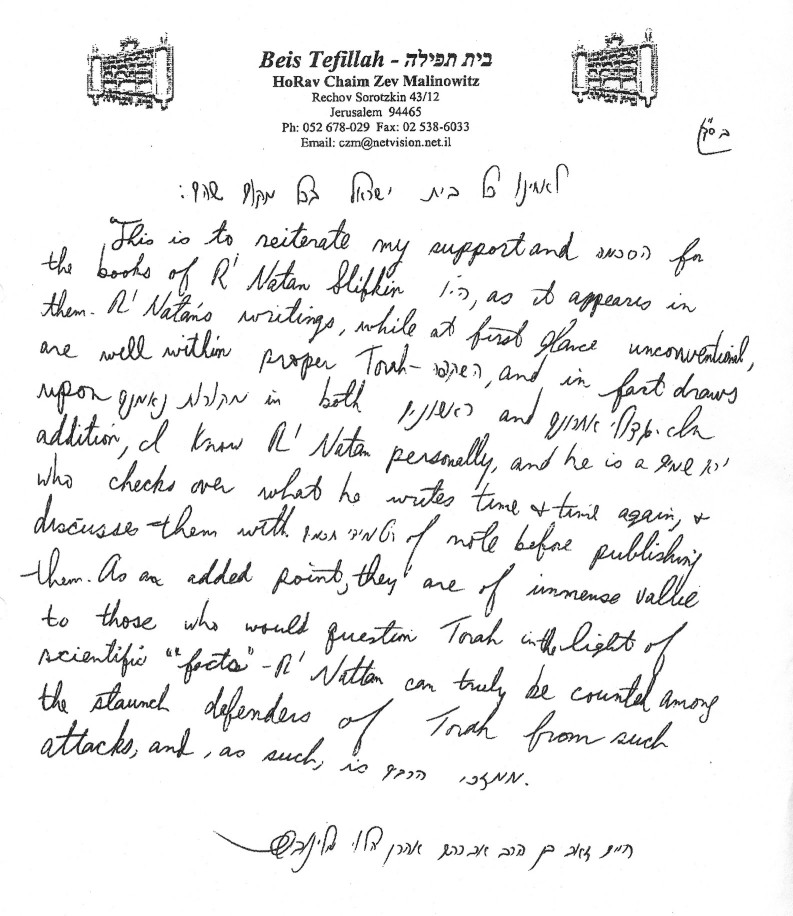
BP: Maybe Rav Kamenetsky or Rav Belsky – they seem to have dissented from everybody else; they never retracted their haskamos.
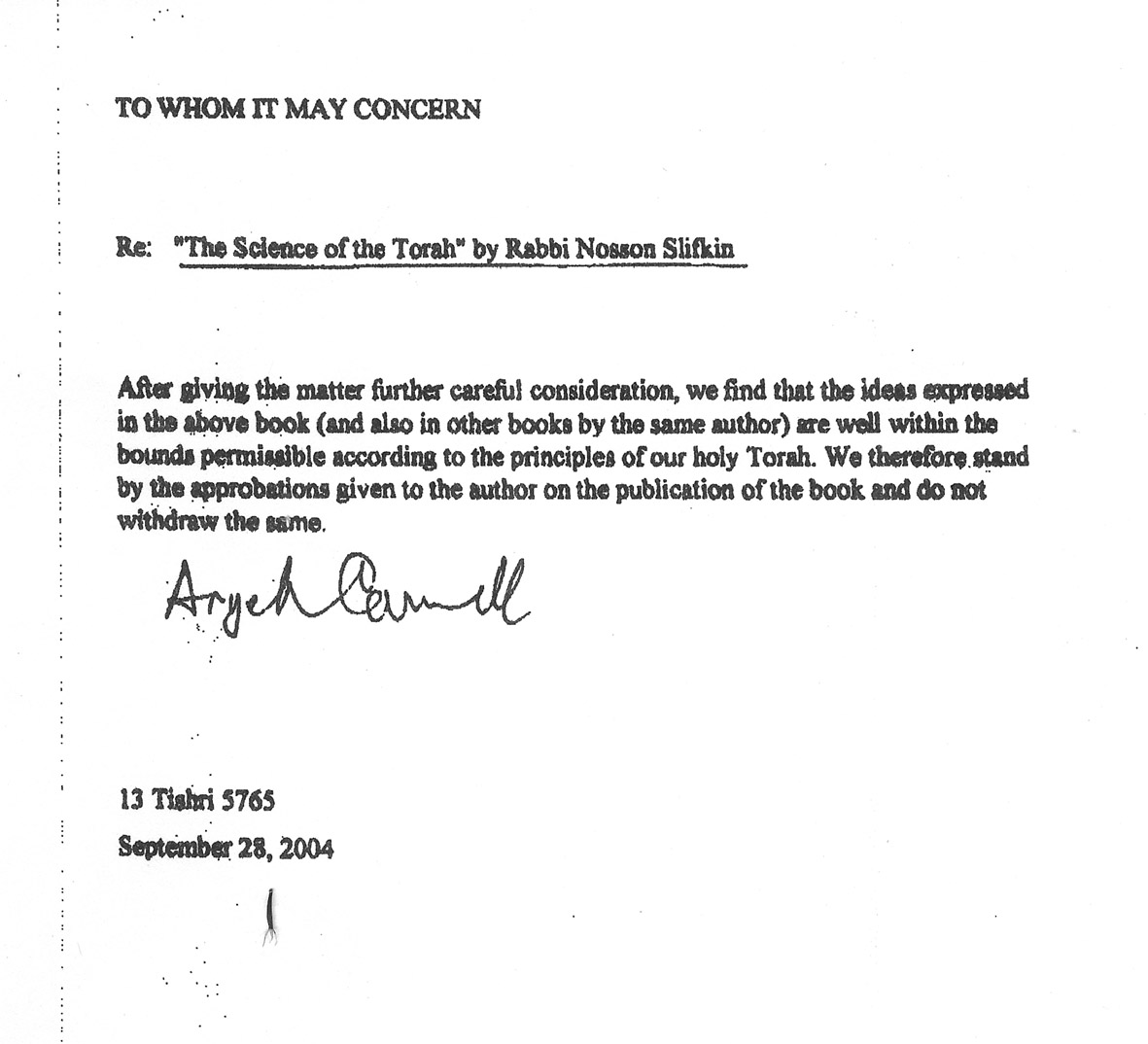
LK: They never retracted their haskamos; that’s true. Then there was Rav Aryeh Carmell who continued to support Rabbi Slifkin [14]. But no one would actually criticize the actual banning of Rabbi Slifkin’s books.
BP: I think Rav Kamenetsky said they’ll have to answer for it after the Resurrection [15]. It could be he’s an exception to the rule.
LK: Okay; perhaps he’s an exception. I wonder though if he made the statement publicly. To return to the general issue of Daas Torah and to your original question as to what extent am I rethinking things. Dr. Benny Brown wrote about Daas Torah in an article, I think, in Mechkerai Yerushalayim [16]. His general point is that scholars like Professor Jacob Katz, his students, and  others who were influenced by his approach – including myself among those others – overemphasize, maybe, the break between Orthodoxy in the modern era and pre-Modern traditional Judaism. Brown also sees stages in development in the idea of Daas Torah. His more specific point is that people who wrote about the idea of Daas Torah – Jacob Katz, Gershon Bacon, myself – ignored the idea of d’kula ba, that everything somehow is contained, hinted at, or alluded to in the Torah, as one source for the idea of Daas Torah. But from my reading of the sources Brown cites, it seems to me that d‘kula ba was traditionally used not so much in the modern communal and political Daas Torah sense –  that is, d’kula ba gives the right to great rabbinic scholars to make authoritative and final decisions on matters of policy. It was generally used in more of a non-political sense, that is, you study the Torah and you get a great insight into nature and reality and history. The one who first used dekula ba in the modern Daas Torah sense was Rav Elchanon Wasserman, I think at the Agudah convention in 1937. Here Brown criticized me, and he was right.
BP: Because you said Rav Elchonon Wasserman never mentions it.
LK: Yes, so I was wrong on that. I mean, based on the writings of Rav Elchonon I had read,  I said that Rav Elchonon only speaks about de’ot torah, but doesn’t really speak about Daas Torah in the sense of this idea of special knowledge given to great Rabbis enabling them to make a final authoritative decision on public policy. There I was simply wrong, and I overlooked this talk of Rav Elchonon at the Agudah convention. But my present view is that this political communal twist to dekula ba was actually Rav Elchonon’s own innovation, and here I would disagree with Brown.  Brown pushes it back to the Chafetz Chaim. As Brown pointed out, the Chafetz Chaim speaks about dekula ba extensively. In my article I quote a text of the Chafetz Chaim – or rather  an oral shemuah attributed to the Chafetz Chaim by Rabbi Greineman. And I say there that I’m not sure whether  the Chafetz Chaim said this or not, because it’s an oral shemuah.  I’m not saying Rabbi Greineman  was dishonest, but people remember things how they remember them; we have that all the time. That’s why we have to check the archives.
BP: Did you see Yoel Finkelman’s recent article [17]? It’s very relevant to what you’re saying. 
LK: I responded to Toby Katz’s comment on Hirhurim about it [18].  Her view was that either something is 100% objective or it’s manipulation. In my view, good scholars try to be honest and present all the relevant evidence and different ways of interpreting it.  Of course, you have your own interpretation and cannot be completely objective, but still you try to give all the evidence, whether it supports your view or calls it into question, and try to be as fair as possible to opposing views. So I think it’s a false dichotomy she was drawing there.  Anyway, getting back to what I was saying. Someone was writing a memoir and remembered a conversation he had with Roosevelt on the day that Pearl Harbor was attacked. And he remembered the meeting so clearly that he even remembered the chairs in which he and Roosevelt sat! And then he checked his diary, and he wasn’t in Washington that day! So he wasn’t there! He checked his diary or his journal of appointments, and realized he must have conflated different meetings.  So, how is this relevant to the Chafetz Chayyim’s view regarding de-kula ba? The point of the shemuah of the Chafetz Chaim that was attributed to him by Rabbi Greineman was [Dr. Kaplan opens up my copy of Rabbinic Authority and Personal Autonomy and finds page 8] — “The person whose view is the view of Torah can solve all worldly problems, both specific and general. However, there is one condition attached: the Daas Torah must be pure, without any interest or bias. However, if a person possesses Daas Torah but it is intermingled even slightly with other views of the marketplace,” then that’s not real Daas Torah. That’s a good example of Daas Torah delegitimating the more modern type of rabbis. Now Benny in his article was willing to attribute more authenticity to this statement of the Chafetz Chaim than I was. And what he found in his research were many other statements of the Chafetz Chaim in the area of d’kula ba that I didn’t know about. But it seems to me at least, and I discussed this with him, that none of the other statements of the Chafetz Chayyim that Benny cited actually made the point made by the statement attributed to him by Rabbi Greineman. All the other statements of the Chafetz Chaim were more general statements that a person who studies Torah is given insight into reality, can understand many things, etc. But the more political and delegitimating emphases of the statement attributed to him by Rabbi Greinman are not found in his other statements. The point, then, that I made to Benny was that the statements he cites from actual texts of the Chafetz Chaim himself do not really go as far as the oral shemuah. So my assumption is that Rabbi Greineman perhaps heard other statements of the Chafetz Chaim regarding d’kula ba, statements presenting the old, non-political version of de-kula ba, and he honestly misremembered them and inadvertatly conflated them with Rav Elchonon’s version of de-kula ba.  Again, I don’t think I ever said that the notion of Daas Torah was invented out of whole cloth; I do try to speak of a certain type of development. And perhaps Benny is right, and it has somewhat deeper roots than I or Gershon Bacon were willing to acknowledge. But this is a matter of degree;  I still maintain that in its current form maybe it’s drawing upon certain sources, but it’s pushing them and extending them in a more extreme direction.  You  asked me to look at ten statements and sources that Rabbi Dovid Gottlieb had cited in support of the concept of Daas Torah [19]. I have to say I was very unimpressed.
BP: But there was one that a lot of people I asked didn’t know why it wasn’t Daas Torah, where there was a pesak in the mahloket between Beit Shamai and Beit Hillel about…
LK: Oh yes, that was the gemara in Eruvin about whether noach lo l’adam she’nivra o she’lo nivra [20]. And because nimnu ve-gamru– whatever that means – that noach lo l’adam she’lo nivra mi she-nivra — does that mean  that you have to believe that? Is that an authoritative hashkafic pesak, as it were? I mean, does the Rambam ever quote that – the Rambam obviously believes all existence is good; so does he believe it would have been better for man not to be created? Actually, the Rambam says that in matters of aggadah there is no pesak. There’s also another quote where I think Rabbi Gottlieb was simply wrong. Supposedly in  Hilkhos Mamrim the Rambam attributes authority to Beis Din HaGadol in matters of hashkafah. But the Rambam doesn’t talk about that there. He speaks about three types of law: peirushim mekubalim mi’pi ha’shmuah, laws derived through interpretation– that is, through the use of the 13 Middos— and Takanot and Gezeirot. I don’t see him speaking there about issues of hashkafah. Now, there are mitzvos that deal with emunah. That’s something else.  Returning to the larger isue: There are issues of public policy, which is one thing, and then there are issues of hashkafah. I think the issue of Rabbi Slifkin is more a matter of the limits of hashkafah. I firmly believe that  there’s a great  deal of room for plural views on matters of hashkfah, and equally firmly reject the idea that only the views I accept are legitimate, while the other views  are illegitimate. Rabbi Slifkin also said that if the Haredi gedolim had said that they don’t want his books in their communities – okay, that their right, it’s their communities. But to issue general bans is a different story [21].
BP: But to return to the gemara Rabbi Gottlieb cites about whether it would have been better for man ot be created or not…how would you deal with that one?
LK: It’s a very strange thing, but I didn’t really check it carefully. My knowledge of the Rambam, which is pretty good, is that the Rambam doesn’t agree with  the supposed pesak that it would have been better for man not to have been created – maybe others do. You can do some type of computer  search through the Bar Ilan program or one of the other programs, check all of the 5000 books on file. Actually, Maimonides says it’s the other way around; Maimonides attacks, for example, Razi — in the Guide 3:12 I think it was–where Razi claims there’s more evil than good in the world. So it’s very hard to imagine how the Rambam would agree with that. In his letter on astrology to the Sages of Montpellier,  when discussing maamarei Hazal apparently disagreeing with his position, he says there are three possibilities. Either it was a daas yachid, or maybe the rabbi was saying it for his particular  audience, sort of like de’ot hechrachiyot –necessary beliefs – or maybe the rabbi didn’t mean it literally but  intended some type of metaphorical interpretation. And in this connection, what exactly does noach lo l’adam she’lo nivra mi she-nivra mean? Perhaps the Rambam would give it a metaphorical interpretation .  But it certainly seems to me that traditionally – obviously, there have been debates about these issues – but traditionally there has been a sort of general consensus that within matters of hashkafah there are certain very broad boundaries, but there’s lots of room for differences within those boundaries, and we’re not really dealing with some type of pesak. Attempts to limit or narrow those boundaries, I find troubling. Particularly, getting back to Rabbi Slifkin, when it seems that the majority of rishonim actually agree with his position. Someone had this long list- I mean, a very long list of rishonim who support his position [22]. So you want to say it was good for them, it’s not good for us, OK. You want to say that we don’t accept Rabbi Slifkin’s position, fine. But to call it kefira, minus, etc.– that’s pretty bad.
BP: I guess the question that a Haredi person would ask is okay, let’s say that’s all true. But why not have the rabbis as the ultimate authorities? In other words, let’s say we err. Like I want to be a good mitzvah-observing yid and if I err and the rabbis tell me what to do and I decide not to do it, right, so I’m erring – I’m going against the rabbis. But if I do what the rabbis say, I’m going to heaven on Rav Elyashiv’s coattails.
LK: But I think you have a certain responsibility to use your –
BP: To use your mind. But there’s a long anti-rationalist tradition within Judaism. So l’chora that’s the safe side, so why not just go with that? Because there you don’t have to think; you can do what they say to do and there’s long Jewish roots for such a tradition.
LK: Yes, but there’s the issue of whether you believe that what they say is really true. And is the anti-rationalist side so safe? This relates to some famous criticisms of Pascal’s Wager. First, Pascal is just assuming the issue is choosing between Christianity and Atheism. But what about Hinduism or Islam? But the other criticism is what happens if we get to Heaven and sure enough there is a God, but He says, “All those people who played it safe? I don’t like those types. The ones who used their own judgement, even if it led them not to believe in Me, them I like.” So how do you know that when you get to heaven, and you say to God that you latched on to Rav Elyashiv’s coattails, that God won’t reply, “Hey, c’mon, why didn’t you start thinking on your own? Obviously you should respect Rav Elyashiv’s view, of course take it seriously, study it, don’t just dismiss it out of hand. But who says I want you just to swallow it whole, particularly since there are other views out there. So why just him, and why did you assume that all the other views are illegitimate?” And of course, the truth of the matter is we know that within the Agudah’s circles there’s been a breakdown of the old unity. Rav Shach and others broke with the Agudah. It would be a worthwhile thing to read the Jewish Observer and see if they ever allude to the fundamental break when Rav Shach broke with the Agudah and founded his own party.
BP: The impression I get from the Haredi world is that even in their rhetoric there’s a certain allowance for limited pluralism. Kimmy Caplan and Nurit Stadler had an article in the AJS Perspectives on Haredim. So they emphasized in that article how this is a heterogenous community [23]. So I mean I think people say you have your Gadol, I have my Gadol and nobody can have Rav Soloveitchik because he’s treif. But I’m saying, that’s the impression I get. Is that what it is, is that how it’s always been? Or not really?
LK: It’s a complicated question. My impression is that there are two levels. When they’re explaining the idea of Daas Torah, they explain it in a more pluralistic way. But in practice, Rav Elyashiv says something and everybody falls into place.
BP: Here’s another topic: You wrote your article about Rav Hutner, then you wrote your article about Daas Torah, and you also wrote to the Novominsker Rebbe about how he misunderstood Rabbi Lamm [24]. And so I was wondering if there were any consequences to that – did anyone talk to you, did you get emails, did you get letters…?
LK: I remember ages ago when my article on Rav Hutner appeared, somebody came up to me—he is now a very noted scholar–and he told me oh how brave I was. But I don’t live in New York, I don’t live in Boro Park, I don’t live in a yeshivishe community, I don’t owe my parnassah to them. I live in Montreal and teach at McGill. I don’t think it required any particular bravery on my part. I know my article on Daas Torah has acquired a certain amount of fame –some might say notoriety– but I would say that from my standpoint, I always thought my most important article—which I wish were better known– is my article on the Shemoneh Perakim [25].
BP: That’s your real scholarship.
LK: Real scholarship, and I feel that it’s an important article, really a basic essay on the Rambam. I think I got to the heart of the Shemoneh Perakim, and various people who have studied the Shemoneh Perakim and then read my article tend to agree. I remember that I was once asked by a student what I thought  was my most important article,  and I answered the one on the Shemoneh Perakim. He said, “What about your article on Daas Torah?“ But from a scholarly point of view I think  my article on the  Shemoneh Perakim is more important. Not that there isn’t any scholarship in my Daas Torah article. Sometimes I feel bad because people assume it’s more of a critique or polemic, so they overlook the scholarly discussion. Like my discussion of Lo Sasur. As I said before, I explore in a systematic way—actually,  I probably do this more in my Hebrew article than my English one – all the different ways in which both medieval and modern rabbinic scholars and commentators have tried to deal with the issue of the apparent contradiction between the Sifre, as quoted by Rashi, and the Yerushalmi. I went through all the ways they either tried to harmonize the apparently conflicting views, as well as looked at those who say, as does Rav David Zvi Hoffman, that maybe the Sifre and the Yerushalmi  simply disagree. So I think that there are certain discussions of Lo Sasur in more strictly scholarly articles which don’t quote me, when I feel they should have quoted me. Professor Moshe Halbertal in his book on the Ramban makes a point that there are two ways of reading the Ramban on Lo Sasur, a soft reading of the Ramban and a hard reading of the Ramban [26]. When the Ramban says that Torah nitna al daatam shel Hakhmei ha-Torah, does it mean that the Sages could be wrong in their ruling, but they’re given the authority to rule, so you can’t disagree with them? Or does it mean that the meaning of the Torah is indeterminate, and the Sages determine its meaning, in which case they can’t be wrong? Already in my article, I show how Avi Sagi opts for the soft reading and Aaron Kirschenbaum for the hard reading – or is it vice-versa, I don’t remember. So Halbertal mentions these possibilities; he refers to some scholars who have discussed this; but he doesn’t refer to me, although I had already anticipated his point, because I don’t think he thought of looking at my article, since it’s considered more of a polemical work than a work of scholarship. And the truth is that it is both, and I say so in the article. I say, look, my article is not a strictly scholarly article,  but I would like to believe that it’s based on sound historical rabbinic scholarship, but obviously it has a certain ideological tendenz.  Anyway, I gather a lot of people have read it. It’s always nice when you write something and you find out people have read it and even appreciated it. Sometimes I feel I write articles and who knows who reads them. Perhaps they sunk like a stone into oblivion.This past summer I was at a conference in Frankfurt, and a young scholar said to me, “I was very influenced by your article on Maimonides and Mendelssohn [27].” So I said “Really?” He replied that he liked my idea of looking at the roots of Mendelssohn‘s thought, of showing how Mendelssohn used Maimonides, and the article  influenced his way of looking at things.  But again, even though I obviously have my own take on things, I try to be as objective and scholarly  as possible. Someone actually once wrote – which I took as a compliment – that they feel that Kaplan has no agenda, particularly in terms of his interpretation of the works  of Rav Soloveitchik. I try to see things how they are. Well, everyone thinks that’s what they are trying to do.
BP: Speaking of the Rav, maybe we could briefly discuss “Revisionism and the Rav.” So you took on the left, took on the right –
LK: More the right.
BP: Would you take issue with anybody more towards the center?
LK: The way it seems to me is that there are issues about Rav Soloveitchik which are really open to interpretation, and I might have a different interpretation of these issues than others. I wasn’t really speaking about that; I was speaking about clear cases of ideological revisionism, where I think the Rav’s position on the issues in question is pretty clear, but scholars try to deny the obvious for ideological reasons.
BP: In general, you don’t see revisionism from the center.
LK: No, I don’t see revisionism from there. People have different opinions, both legitimate. For example, I disagree with Professor Dov Schwartz. Schwartz sees a very sharp difference between the figure of halakhic man in Ish Hahalakha and the figure of ha-Ish Elokim in U-Vikashtem Misham, while I see them as much more similar [28]. That’s a matter of interpretation; that’s not a matter of revisionism. Even with regard to secular studies – there are aspects of this issue where the Rav was vague, and there’s room for disagreement. In a forthcoming essay, I take issue with Professor David Shatz’s reading of The Lonely Man of Faith. Overall, I think his article is a great article,  but I think he had a bit too much of a positive take of the Rav’s portrait of Adam 1 in The Lonely Man of Faith [29]. He said that Adam 1 in imitating God’s creativity fulfills the comand of v’halakhta b’drachav; but the Rav, when he speaks about Adam 1’s creativity, never quotes v’halakhta b’drachav. I also note that the term Hesed is only applied to Adam 2. Adam 1 attains dignity and responsibility, but only Adam 2 is motivated by a sense of Hesed. My feeling is – and I state this in my article – that David’s essay would have been stronger had he focused more on the concrete man of faith who is both Adam 1 and Adam 2. So there are legitimate issues of interpretation.  Another issue open to disagreement is how you relate The Lonely Man of Faith to Ish Hahalakha or to other essays.Yet another is the Rav’s view about evolution, and the import of his statement about it  in the beginning of The Lonely Man of Faith.  All these matters are open to interpretation. I might have my reading and have my reasons for thinking it is the most convincing reading, but I don’t think those who have other readings and disagree with me are engaging  in revisionism. There are also many similar questions about how to interpret Rav Kook. In general, only now with the publication by the Toras Horav Foundation of many of the unpublished manuscripts of the Rav are we beginning to get a clearer picture of his thought. For example, the volume  The Emergence of Ethical Man, edited by Dr. Michael Berger, sheds new light, in my view, on the Rav’s view concerning evolution. In this connection, I want to add something even if it’s off the topic. The Emergence of Ethical Man quotes Buber extensively, particularly Buber’s Moses. And not only does the Rav quote from it, but also, interestingly, the Rav’s idea that Avraham in leaving Mesopotamia behind to go to the land of Canaan was leaving the city behind for a more pastoral form of life is taken from Buber. You probably could find meforshim, maybe Abarbanel, who might say something similar, but the Rav’s way of phrasing the matter — the pastoral mode of life as opposed to the urban mode of life– reflects the influence of Buber, whom, again, he explicitly cites.  It seems he had read Moses at about the time he was writing his essay,  and obviously those views of Buber which are not Orthodox he leaves out, but other, “kosher“ views of Buber, as it were, he feels free to cite and make use of. I was thinking when I get around to it I’d like to write  a review essay of that volume. But, then again, I often tell my students I have two lists. I have a list of articles I’ve written, and another list of articles I haven’t written, but hope to get around to writing someday.  And the second list is much longer and also probably much more interesting than the first list.
BP: What are you looking at writing?
LK: Well, I have this paper I gave yesterday which I am in the middle of  writing up on the Rambam’s Hakdamah to the Peirush HaMishnah. There are also essays I’ve already written which haven’t appeared yet, but are forthcoming – one of these days! I have an article about the concept of faith in Rabbi Azriel of Gerona, where I take issue with Mordechai Pachter’s article on the subject, and offer a very different reading [30].Then I just mentioned my critique of David Shatz. It is part of a long article, which is taking forever to appear, on The Lonely Man of Faith and contemporary modern Orthodox Jewish thought. Most of the article is about Rabbi David Hartman’s readings of The Lonely Man of Faith. Another article which I wrote – but is sitting in limbo, and I have no idea when it will appear – is on Rav Hutner’s implicit theology of the Holocaust. I looked at a maamer in Pachad Yitzchak, Maamer Daled in the volume on Rosh Hashanah, where he speaks about Geon Yaakov. What does it mean when we use the phrase “Geon Yaakov“ on Rosh Hashana? My argument there is – the maamar, by the way, is a very fascinating maamar – that even though Rav Hutner in the maamar never mentions the Holocaust, I can’t imagine – and most people I discussed this with tended to agree with me—that in light of several radical and daring points he makes in the maamar, that the Holocaust wasn’t on his mind when he wrote it. So these essays should be appearing eventually. Ironically,  one article, which I  completed after all of these, but which will most probably be appearing before all of them – it should be out fairly soon – is an essay on the relationship between Rabbi Emanuel Rackman and the Rav, in which I  show that they had a close working relationship in the 1950s and that Rabbi Rackman basically – and with the Rav’s approval – assumed the role of his intellectual lieutenant. For people who only know about the Rav’s famous public attack in 1975 on Rabbi Rackman, it should prove to be an eye opener. So, stay tuned! Getting back to future projects, people tell me that I should collect my essays on the Rav and make a book of them, and do the same for my essays on the Rambam. But I still have more essays to write on the Rambam and the Rav. As I just mentioned, I am in the middle of  writing a long, and – at least I would like to believe– very important essay on the Rambam’s Hakdamah to the Peirush HaMishnah. I’ve pretty written up the first half, but I have to do the  second half and then the  footnotes. And I don’t know if you heard the paper of Dr. Mordechai Cohen this morning on Ein Mikrah Yotzei Midei Peshuto in the Rambam. I have had an ongoing discussion with him about this, we’ve been exchanging emails; I have a different take on the subject, and one of these days I would like to write about this as well.  There are a number of review essays I would like to write as well.  First a review essay on some of the recent literature on the Ramban, then another review essay on some of the recent literature on Halevi. Finally, I’d like to write a review essay on the third volume in Toras HoRav, the one on mourning, death, and suffering – Out of the Whirlwind. This review will be different from my review essay of Worship of the Heart in Hakirah, where I was quite hard on its editor, Rabbi Shalom Carmy [31]. Parenthetically, while I still believe that my criticisms of the editing were correct, and, as far as I can tell, they remain unrefuted, in retrospect it seems to me that I might have softened somewhat a harsh phrase or two, and I regret that I did not do so. Be this as it may, I thought the editors of Out of the Whirlwind did a very good job of editing. There are a few points here or there where certain things could be a little clearer; they could have given a few more references here or there, but on the whole they did a very good job, and I will be happy to say so. Contrary to what some people seem to believe, I do not take particular  pleasure in writing negative reviews. And then in the review essay, assuming I will ever get around to writing it, I will discuss the Rav’s views on aveilus and  how one should respond to evil and suffering, and, with reference to aveilus, take issue with the Rav about some matters – his reading of a comment of Rashi and his understanding of certain aspects of the Rambam on the subject. I checked my ideas out in a phone conversation with Rav Elyakim Koenigsberg, who is a Rosh Yeshiva of YU who edited  a volume of the Rav’s torah on aveilus [32]. That is a more lomdishe volume than Out of the Whirlwind. So I ran my criticisms by him, and he said okay. He’s not saying that he agrees with my criticisms, but I’m not off the wall. So if he says I’m not off the wall, you can agree, disagree, but it sounds okay to him—that’s good enough for me to go ahead. I feel safe  in putting them forward, and that no one will say “Kaplan, you’re such an am haaretz, how can you even say such things?”  Things always take longer than you expect. My daughter-in-law was recently joking that  she can see me 50 years from now still writing [Dr. Kaplan scribbles on piece of paper in mock anger], “This guy got it all wrong.”  Actually, I told people that I’m not going to write any more negative reviews, like my review of David Sorkin’s book [33]. From now on, I will review a book only if I can honestly say that it is a good book. Then, of course, I can proceed to discuss the issues the book raises, disagree with the author’s intepretation, you read the evidence this way and I read it that way, etc. Not that I don’t think it’s not important to write harsh reviews sometimes. You have to maintain standards and scare people, so people should know that you should write about things you know about and not write about things you don’t know about, do your homework, and don’t assume that you can write something sloppy and you’re not going to be called on it. Someone may sit down and rip you to pieces, so be careful! But I’ve written  my share –some may say more than my share –of such reviews, and from now on I’ll leave that necessary, but unpleasant job to other people.
[1] Lawrence Kaplan, “Daas Torah: A Modern Conception of Rabbinic Authority,” in Rabbinic Authority and Personal Autonomy, ed. Moshe Z. Sokol (Northvale: Jason Aronson, 1992), 1-60[2] Yitzchok Hutner, “Holocaust – A Study of the Term, and the Epoch It Is Meant to Describe” trans. and ed. Yaakov Feitman and Chaim Feurman, Jewish Observer, October 1977: 6-12[3] Moshe Meiselman, “The Rav, Feminism, and Public Policy: An Insider’s Overview,” Tradition 33.1 (1998): 5-30[4] Kaplan, “Revisionism and the Rav: The Struggle for the Soul of Modern Orthodoxy,” Judaism 48, no. 3 (Summer 1999): 290-311(accessed July 29, 2009).[5] Kaplan, “Rabbi Isaac Hutner’s ‘Daat Torah Perspective’ on the Holocaust: A Critical Perspective,” Tradition 18, no. 3 (Fall 1980): 235-248[6] Kaplan, “Daat Torah: A Modern View of Rabbinic Authority,” in Zev Safrai and Avi Sagi, eds., Between Authority and Autonomy in Jewish Tradition, 105-145. Tel Aviv: Hakibbutz Hameuhad, 1997 [Hebrew].[7] For the location of all of these sources and explication on how Dr. Kaplan interprets them, see “Daas Torah.”[8] See Alfred Cohen, “Daat Torah,” Journal of Halacha and Contemporary Society 45 (Spring 2003): 67-105 and the ensuing correspondence between Rabbi Cohen and Dr. Kaplan in idem. 46 (Fall 2003): 110-123.[9] Eliezer Menachem Man Shach, Michtavim U’Maamarim Mimaran Hagaon Rabbi Elazar Menachem Man Shach 4:320 [10] Michel Yehuda Lefkovitz, Yitzchak Shiner, and Yisrael Elya Veintraub, “Giluy Daat,”Zoo Torah,  (accessed July 28, 2009) [Hebrew][11] For an example of an article which promulgated the rumor that rabbis who gave their haskama to the book retracted, see the cached version of G. Safran, “Gedolei Yisrael Ban Rabbi Nosson Slifkin’s Books,” Yated Ne’eman, January 12, 2005, (accessed July 28, 2009). The Yated’s website later “updated” this article correcting this error while neither the Yated nor the website issued an official retraction of the claim. See G. Safran, “Gedolei Yisrael Ban Rabbi Nosson Slifkin’s Books,” Yated Ne’eman, January 12, 2005,  (accessed July 28, 2009). For Rabbi Slifkin’s account of how his books were banned and he was not given a chance to present his case, see Natan Slifkin, “Account of Events,” Zoo Torah,  (accessed July 28, 2009).[12] “Account”[13] See idem. on Rabbi Feldman’s original support for Rabbi Slifkin. Rabbi Feldman later wrote an essay attacking the positions espoused by Rabbi Slifkin. See Aharon Feldman, “The Slifkin Affair – Issues and Perspectives,” Zoo Torah,  (accessed July 29, 2009).[14] Rav Aryeh Carmell gave a haskamah and, when the ban came out, reiterated his support for Rabbi Slifkin. See Aryeh Carmell, Zoo Torah, (accessed July 28, 2009) and Aryeh Carmell, “Re: ‘The Science of the Torah’ by Rabbi Nosson Slifkin” Zoo Torah, (accessed July 27, 2009).[15] Daniel Eidensohn, “Age of the Universe,” Hirhurim, entry posted June 20, 2006,  (accessed July 28, 2009). There have been a few other Haredi dissenters: see Toby Katz, “My 300-Page Book on the Slifkin Affair,” Cross Currents, (accessed September 9, 2009); Rav Chaim Malinowitz’s letter of support for Rabbi Slifkin available at Zoo Torah  (accessed September 9, 2009); and Marvin Schick, “Richuk Karovim,” Cross Currents,  (accessed September 9, 2009)[16] Binyamin Brown, “The Da’at Torah Doctrine: Three Stages,” Jerusalem Studies in Jewish Thought 19 (2005): 537-600 [Hebrew] [17] Yoel Finkelman, “Nostalgia, Inspiration, Ambivalence: Eastern Europe, Immigration, and the Construction of Collective Memory in Contemporary American Haredi Historiography” Jewish History 23, no. 1 (March 2009): 57-82[18] The original comment by Mrs. Katz reads as follows:…I have news for you. EVERYONE manipulates history, everyone. Have you read any history textbook lately, and compared it to any history textbook of thirty or forty years ago? Women are much more prominent, Indians are noble and pure and one with nature, yada yada. No matter who writes the book, there is an agenda. Everybody has an agenda. Everybody. The myth of pure, dispassionate research — “just the facts, ma’am” — is just that, a myth. And academics are just as guilty of selective memory and revisionism as ArtScroll hagiographers, if not more so.      See Toby Katz, comment on “Nostalgia as History,” Hirhurim, comment posted December 17, 2008, #604322 (accessed July 27, 2009).[19] Dovid Gottlieb, “Sources for Daas Torah,” DovidGottlieb.com,  (accessed July 27, 2009)[20] Eruvin 13b[21] Rabbi Slifkin discusses this view in various articles on his website. See for example Slifkin, “In Defense of My Opponents” Zoo Torah, (accessed July 29, 2009).[22] DES, “Sources Indicating That Chazal Did Not Possess Perfect Scientific Knowledge,” Torah, Science, Et Al., entry posted April 30, 2006,  (accessed June 27, 2009)[23] Kimmy Caplan and Nurit Stadler, “Haredim and the Study of Haredim in Israel: Reflections on a Recent Conference,” AJS Perspectives, Spring 2008, 32[24] Kaplan, “Modernity vs. Eternity” Jewish Observer, April 1994: 13[25] Kaplan, “An Introduction to Maimonides’ ‘Eight Chapters,'” The Edah Journal 2, no. 2 (June-July 2002): 2-23[26] Moshe Halbertal, Al derekh ha-emet : ha-Ramban ṿi-yetsiratah shel masoret (Jerusalem: Mekhon Shalom Hartman, 2006) [Hebrew][27] Kaplan, “Maimonides and Mendelssohn on the Election of Israel, the Origins of Idolatry  and the Oral  Law” in Perspectives on Jewish Thought and Mysticism, edited by Alfred L. Ivry, Elliot R. Wolfson, and Allan Arkush (Amsterdam: Harwood, 1998), 423-445 [28] Dov Schwartz, Religion or Halakha: The Philosophy of Rabbi Joseph B. Soloveitchik, Trans. Batya Stein (Leiden: Brill, 2007)[29] David Shatz, “Practical Endeavor and the Torah u-Madda Debate,” Torah U-Madda Journal 3: 98-149. See also Kaplan, “Rabbi Soloveitchik’s Lonely Man of Faith in Contemporary Modern Orthodox Thought” (Lecture, Studies Exploring the Influence of Rabbi J. B. Soloveitchik on Culture, Education and Jewish Thought: An International Conference Commemorating the Centenary of his Birth, Van Leer Jerusalem Institute, December 31, 2003), Van Leer Jerusalem Institute,  (accessed July 29, 2009).[30] Mordechai Pachter, “The Root of Faith is the Root of Heresy,” in Roots of Faith and Devequt: Studies in the History of Kabbalistic Ideas (Los Angeles: Cherub Press, 2004), 13-51. [31] Kaplan, review of Worship of the Heart: Essays on Prayer, by Shalom Carmy. Hakirah 5 (Fall 2007): 79-114.[32] Elyakim Koenigsberg, Shiuirei ha-Rav `al Inyenei Aveilus ve-Tisha be-Av (Jerusalem: Mesorah,1999)[33] Kaplan, review of Moses Mendelssohn and the Religious Enlightenment, by David Sorkin. AJS Review 23, no. 2 (1998): 300-307.


Some Recollections of R. Jehiel Jacob Weinberg, Love Before Marriage, and More

Some Recollections of R. Jehiel Jacob Weinberg, Love Before Marriage, and More
Marc B. Shapiro
1. In my last post I mentioned R. Nosson Zvi Finkel, the Alter of Slobodka, so let me add the following. There is a transcript of a 1965 taped conversation between R. Jehiel Jacob Weinberg and R. Yaakov Herzog.[1] Herzog had come to Montreux to speak to R. Weinberg, and here is a picture from that meeting which appears in Michael Bar-Zohar, Yaacov Herzog: A Biography.

R. Weinberg, who knew R. Finkel very well, stated as follows.

הרב ויינברג: דער אלטער ז”ל (דער סלאבאדקער, זאגט מען דער אלטער), ר’ נטע הירש, ער איז דאך א צדיק.

הרצוג: אבער נישט קיין למדן.

הרב ויינברג: נישט קיין גרויסער למדן. ער האט געקענט לערנען, אבער ער איז נישט געווין קיין גרויסער למדן. אבער ער איז געווען א חכם, א גרויסער.

הרצוג: יא, דער חכם פון סלאבאדקע.

הרב ויינברג: און ער איז געווען א איידעלער מענטש זייער.

Some sections of this conversation appeared in the English Yated Ne’eman, Nov. 5, 1999. Yet as is to be expected, they appeared in a censored form as Yated Ne’eman would never record R. Weinberg’s statement that R. Nosson Zvi Finkel was not a great talmudic scholar. This judgment is not to be regarded as a put-down, as everyone in the Lithuanian yeshiva world knew that R. Nosson Zvi Finkel’s original insights were focused on Mussar, not analytical Talmud study.[2] Needless to say, the Alter always made sure that outstanding talmudic scholars were on the Slobodka faculty.
Speaking of censorship, here is another example. In the Yated Ne’eman article just mentioned, we find the following passage which is a quote from R. Weinberg.
I was intimately acquainted with R. Eizik Sher. . . . His son-in-law, R. Mordechai Shulman, visited me in Berlin and wanted to hear shiurim from me. I told him: This is not your place. Return to Slobodke.[!] Maybe you will some day become the son-in-law of R. Eizik.
This is what R. Weinberg actually said to Herzog:

ויינברג: ער איז ארויפגעקומען צו מיר אין סעמינאר. ער איז געווען אין בערלין, זיך ארומגעדרייט צוויי מאנאטן. געוואלט אריין אין סעמינאר. האב איך אים געזאגט: הערט זיך איין, ר’ מרדכי, ער איז א טיקטינר. דו וועסט נישט ווערן קיינמאל קיין דאקטאר. און אויב דו וועסט זיין א דאקטאר אפילו, וועסטו קיינמאל נישט קריגן קיין רבינער שטעלע אין דייטשלאנד. וואס טויג עס דיר? וועסט נישט מאכן קיין קאריערע. איז גיי אוועק צוריק אין סלאבאדקע. אמאל קען זיין, דו וועס זיך פארליבן אדער זי וועט זיך אין דיר פארליבן, די טאכטער פון ר’ אייזיק’ן, וועסטו ווערן ר’ אייזיק’ס א איידים.

.הרצוג: וכך הווה

 .ויינברג: און איך האב אים דערמאנט דאס. אז איך האב עס אים אמאל פאראויס געזאגט

R. Weinberg tells us that R. Mordechai Shulman, who was from Tiktin and later became Rosh Yeshiva of Slobodka in Bnei Brak, wanted to enroll in the Rabbinical Seminary of Berlin. Yated doesn’t want its readers to know this, so it “translates” the passage as saying that R. Shulman “visited” R. Weinberg and “wanted to hear shiurim” from him. R. Weinberg told him that he would never get a doctorate, and even if he did he would not get a rabbinic position in Germany, so he should return to Slobodka. R. Weinberg adds that when he returns it could be that he “will fall in love” with the daughter of R. Isaac Sher, or she will fall in love with him, and he can then become the son-in-law of R. Sher, the rosh yeshiva of Slobodka. In fact, this is exactly what happened.[3]
The Yated “translation” omits anything about R. Shulman and R. Sher’s daughter “falling in love.” This is because there is no such concept in the haredi world (and in traditional Jewish societies, in both the Ashkenazic and Sephardic worlds, such a notion was hardly found at all). Any love between husband and wife is said to come after marriage, and the biblical support for this concept, repeated in numerous texts (both haredi and pre-haredi[4]), is found in Genesis 24:67: “Isaac brought her into the tent of his mother Sarah, and he married Rebekkah. So she became his wife, and he loved her.” This verse states that Isaac loved Rebekkah, but only after he married her.[5] R. Gamaliel Rabinowitz goes so far as to state that any love that is found before marriage arises from sin, as there is no room for “feelings” before marriage.[6]
האהבה באה רק לאחר הנישואין, כל אהבה שלפני הנישואין מקורה בחטא רח”ל, ענין ה”רגשות” בכלל אין לו מקום לפני הנישואין, וזה דבר פשוט וברור שאין צריך לבארו.
R. Reuven Margaliyot mentions an interesting interpretation in support of this perspective.[7] There are two contradictory biblical verses. Proverbs 18:22 states מצא אשה מצא טוב, while Ecclesiastes 7:26 states ומוצא אני את האשה מר ממות. The contradiction can be explained as follows.
In earlier years parents would arrange marriages for their sons, and the overwhelming majority of the marriages succeeded. This is alluded to by the verse in Proverbs: מצא אשה מצא טוב. Now, however, things are different, and young men find their own brides, “and most of the time there isn’t peace between them after the marriage.” This is alluded to by the verse ומוצא אני את האשה מר ממות . In other words, if I find a wife for myself, most of the time it will turn out to be “more bitter than death.”
I think there might be another text that speaks to this concept, though I have not seen anyone who has made this point. The sixth of the sheva berakhot recited at a wedding states שמח תשמח רעים האהובים. The words רעים האהובים mean “beloved friends” or “beloved companions.” I don’t think one would use the word רעים to describe a man and woman who are “in love.” I believe that the words of the blessing mean a love that is found between two friends, rather than romantic love. 
R. Moses Gruenwald writes as follows:[8]
וענין חתונה א”א אלא בין רעים האהובים דמי שאינם אוהבים זה את זה א”א להם להתחתן.
What he says is that people who do not love each other cannot get married. I believe that he means the sort of “friendship love” I mentioned in the previous paragraph, rather than romantic love. I find his formulation particularly interesting, since R. Gruenwald was a Hungarian rav typically viewed as being on the extreme side of things. Yet here he is saying that there needs to be a sort of love between the bride and groom.
Could this really have been the norm in R. Gruenwald’s Hungarian (non-hasidic) community? Maybe some readers who come (or descend) from this type of community can offer some comments. I have also wondered what hasidim mean when they say רעים האהובים, since the people getting married hardly know each other. A friend from the hasidic world acknowledged that he doesn’t know if these words can be reconciled with the current reality. He also suggested that perhaps the words can be understood like יומת המת in Deuteronomy 17:6. In this verse the word המת does not mean one who is dead, but rather one who will soon be dead. So perhaps האהובים means “the ones who are in the process of becoming אהובים.”
I found another interesting passage that speaks about love of bride and groom. It is attributed to R. Isaac Luria by R. Hayyim Vital. As part of his explanation of a verse in Song of Songs, R. Luria writes:[9] מחמת רוב אהבת חתן לכלה. These words are explained allegorically, but their simple meaning also reflects a reality, one in which there is real love between bride and groom which could only have flowered prior to the wedding.
Returning to the traditionalist value that love only comes after marriage, this is all fine and good, but R. Weinberg specifically spoke of falling in love before marriage, and that this could lead R. Shulman to become R. Sher’s son-in-law. From the Yated “translation” the reader would assume that R. Weinberg was telling him to return to Slobodka and become a big learner, and that this might lead to him becoming R. Sher’s son-in-law.[10]
Regarding love letters, the following appears in R. Nathan Kamenetsky, Making of a Godol, p. 802, and was one of the passages that led to the book being banned:
A reliable source reported that R’ Aaron [Kotler] wrote a letter to his fiancée of which her father, R’ Isser-Zalman Meltzer, disapproved. When it was shown to the Alter, he rejoined, “I did not tell you he was a tzaddiq. I said he had other qualities, but he will yet become so frum that everyone will suffer from him.”
Many who read Making of a Godol assumed that the letter allegedly sent by R. Kotler was a love letter. In order to counter this understanding, in the second edition of Making of a Godol Kamenetsky added: “This author conjectures that the letter concerned an impressive hasbarah he had delivered.” This conjecture doesn’t seem to fit with the Alter’s reply about R. Kotler not being a “tzaddiq” and becoming “frum”. If R. Isser Zalman was upset because he thought that the young R. Kotler was a bit too impressed with himself, then the Alter would presumably have replied differently. The words that he allegedly used, “tzaddiq” and “frum”, have a certain meaning, and it thus is not surprising that the family of R. Kotler was so strongly opposed to the book and viewed this passage as insulting. (Another report has it that R. Kotler had suggested that his fiancée read a certain book and that was what upset R. Isser Zalman.)
In the second edition of Making of a Godol, the last sentence of the passage in question was altered to read, “But his frumkeit will yet become so great that everyone will suffer its brunt.” 
In my review of Making of a Godol, I wrote as follows:
Another problematic element of the book, admittedly found only on occasion, is its use of unnamed sources. This is acceptable in journalism, but not in scholarship. For example, the evidence for one of the most controversial passages in the book, concerning R. Aaron Kotler, his future wife, and his future father-in-law, R. Isser Zalman Meltzer, is “a reliable source” (p. 802). I understand why the source would not want his or her name to be given, but when repeating such a loaded story, which one knows will be controversial and its veracity challenged, the author is obligated to name the source, thus allowing the reader to judge its reliability. After all, if the source is R. Kotler’s daughter, its authenticity is more apparent than if it is another example of what X heard from Y. If the source does not wish to go on the record, it is best for the story to be omitted. (In my own biography of R. Weinberg, I was forced to leave out a number of “juicy” details, precisely for this reason.)[11]
I have previously discussed R. Samuel Archivolti’s book of melitzah letters, Ma’yan Ganim, and how it was misused by R. Baruch Epstein. See here.[12] This book is described in the Encyclopaedia Judaica as follows: “Archivolti’s most important works are . . . Ma’yan Ganim (Venice, 1553), divided into ‘passages’ containing 25 letters in metrical form designed to serve as models for students of this classic literary genre.”[13] It is worth mentioning Ma’yan Ganim now because on pp. 39ff. Archivolti includes two love letters. It appears clear to me that the focus of these letters is an unmarried couple, and first letter begins with the following heading: אגרת חושק לחשוקתה. 

Also of interest is this picture that appears at the beginning of each section of the book. As I learnt from Shimon Steinmetz, urinating putti were a common theme in the art of Archivolti’s day. You can read about it here

While Ma’yan Ganim is a book of melitzah letters, not responsa, R. Archivolti (1515-1611) was indeed a halakhic authority who served as rabbi of Padua. His pesak in the famous Rovigo mikveh controversy appears in Palgei Mayim (Venice, 1608), p. 15a.
 

R. Archivolti is referred to as מ”ד which stands for מרא דאתרא. In Renaissance Italy this title was only used for very important rabbis,[14] unlike today when all communal rabbis are given the title.
Interestingly, I found that a Hebrew manuscript from R. Archivolti’s era includes a love charm. The woman is told to write יריש ליאוש פילוש on her left hand, and this will cause the man she desires to fall in love with her.[15]
R. David Cohen, the Nazir, is an example of one who fell in love before marriage. In fact, his relationship with his future wife, Sarah, is a great love story. They were separated from each other for twelve years. He was in Europe and Eretz Yisrael and she was in Russia and later trapped behind the Iron Curtain. Throughout these long years they remained committed to each other, and the Nazir kept her picture on his desk. As reported by R. Avraham Remer, R. Zvi Yehudah Kook saw fit to mention this last point at the Nazir’s funeral.[16]
אמר עליו: “אור מופלא”, וציין אז שתי נקודות בחייו של רבי דוד: האחת, תחילת הנזירות בעת היותו באוניברסיטה, כדי לשמור על הפיאות והזקן. והשניה, שעל שולחנו הציב תמונת ארוסתו, כדי שחס-ושלום לא יתן עיניו באחרת.
R. Shear Yashuv Cohen tells us that the Nazir and Sarah also exchanged wonderful love letters during this time, letters which have not been made public:[17]
שמורים בארכיון המשפחה מכתבי-האהבה הנפלאים, ואף קטעי-יומן מלא רגש רוטט שנכתבו על ידי אבא מארי זצ”ל בימי הפירוד שנתמשכו הרבה מעבר למתוכנן ולמצופה . . . הכלה הצעירה מונה ימים ושנים, ונשארת בנאמנותה לבחיר לבה. אף הוא שומר לה אמונים ומתנזר מכל אפשרות של ברית או קשר אחר, בקפידה ובנאמנות יסודית.
When Sarah finally made it to Jerusalem, the Nazir was in the midst of a ta’anit dibur. R. Kook summoned R. Zvi Pesah Frank and R. Yeruham Fishel Bernstein so that they could sit as a beit din and void the ta’anit dibur, thus allowing him to speak to his soon-to-be bride.[18]

Regarding falling in love before marriage, R. Jehiel Jacob Weinberg, in his Oct. 12, 1960, letter to Samuel Atlas, states that R. Soloveitchik came to Berlin intending to marry R. Hayyim Heller’s daughter:
השידוך בטל. ס’ התאהב בזו שהיא עתה אשתו.
According to members of the Soloveitchik family, there is no truth to this, and R. Weinberg was simply repeating a rumor. But it is true that the Rav fell in love with his future wife in Berlin. R. Ronnie Ziegler writes as follows here:
The Rav’s most important and fateful encounter in Berlin was that with his wife, Dr. Tonya (Lewit) Soloveitchik (1904-1967). A student at the University of Jena, where she obtained a Ph.D. in education, she was introduced to Rav Soloveitchik by her brother, a fellow student at University of Berlin. Although a scion of the illustrious Soloveitchik family was expected to conclude a match with the daughter of a prominent rabbi or at least a successful businessman, Rav Soloveitchik fell in love with Tonya Lewit and married her in 1931 despite her family’s undistinguished lineage and lack of means.
R. Ziegler continues by describing the deep connection between the Rav and Tonya.
As mentioned in the previous lecture, the Rav’s relationship with his wife was one of the two most significant relationships in his life. He had unlimited esteem for her – his dedication of “The Lonely Man of Faith” reads: “To Tonya: A woman of great courage, sublime dignity, total commitment, and uncompromising truthfulness.” He respected her opinion and heeded her advice, both in practical and in intellectual matters. It was on her advice that he changed the topics of his annual Yahrzeit (memorial) lectures for his father, which attracted thousands of listeners, to matters which non-scholars could relate to (such as prayer, Torah reading, and holidays). [The halakhic portions of some of these lectures are collected in the two volumes of Shiurim Le-zekher Abba Mari z”l.] In a poignant passage in a teshuva lecture delivered after his wife’s death, he recounted how he used to consult her before speaking:
The longing for one who has died and is gone forever is worse than death. The soul is overcome and shattered with fierce longing. . . . Several days ago, I once again sat down to prepare my annual discourse on the subject of repentance. I always used to discuss it with my wife and she would help me to define and crystallize my thoughts. This year, too, I prepared the discourse while consulting her: “Could you please advise me? Should I expand this idea or cut down on that idea? Should I emphasize this point or that one?” I asked, but heard no reply. Perhaps there was a whispered response to my question, but it was swallowed up by the wind whistling through the trees and did not reach me.” (On Repentance [Jerusalem, 1980], p. 280)
Rav Soloveitchik’s wife was his best and perhaps only real friend. His natural proclivity towards loneliness, which we will encounter repeatedly in his writings, was heightened in his philosophy to an ideal, which expresses itself in an invigorating sense of one’s own uniqueness. One can be lonely even, or perhaps especially, when surrounded by friends, colleagues, and family. This is a constructive force which propels a person toward his individual destiny, while also propelling him to seek a depth-connection with God and with his fellow man. Aloneness, as opposed to loneliness, is a disjunctive emotion – it is a sense of lacking companionship, of being abandoned and forlorn. The passage above highlights the Rav’s almost unbearable sense of aloneness following his wife’s death in 1967 after a long struggle with cancer. He is reported to have said, “After my father’s death, I felt like a wall of my house had fallen down. After my wife’s death, I felt like the entire house had collapsed.”
Concerning the matter of falling in love before marriage, it is noteworthy that the great R. Hayyim Joseph David Azulai (the Hida) was in love with the woman who would later be his wife, and whom he knew for a number of years before they were married. Here is what Meir Benayahu has to say about this.[19]
את אשתו השניה, רחל בת משה הלוי מפיסה, הכיר כחמש שנים לפני שנשא אותה ונקשר עמה בקשרי אהבה. החלומות שחלם עליה לפני הנישואין מעידים על יחסו הנכבד לאשה. הוא שאף ל”נשואים רעננים” ובהנשאו לה ראה שהוא מתעטר בכבוד והדר. בנסיעותיו רכש לה מתנות ומסר לה אותם לפני הנישואין. כסף הרבה הוציא עליה למלבושיה ולהנאותיה, ומותה בשנת תקס”ד הקדיר עליו את עולמו.
Benayahu mentions the Hida’s dreams. Here is a passage that the Hida recorded from one of his dreams.[20]
תשרי תקל”ו . . . וראיתי בחלומי שהייתי בא על אשתי [שהיתה כבר נשואה עמי ולא זכרתי מי] ומוציא בתוליה ורואה דם. [קמ]תי והלכתי אצל אמ”ן [אבי מורי נ”ע] ושאלני ברמז והשבתיו ברמז . . . ונתעוררתי. ותכף הבנתי שהוא תשו’ שאלה מיום [ראש השנה?] לטובה. וב”ה שלא אירע לי שום מקרה ח”ו. הוא ית’ ירחם וייטיב אחריתי מראשיתי לאי”ט וש”ח.
Most people will probably feel uncomfortable reading this sort of passage. Yet the performance of the mitzvah the Hida discusses appears very natural to him and nothing to be ashamed of. Perhaps it is only uncomfortable to read because we have become overly puritanical regarding these matters which are also part of Torah. Nevertheless, it does remind me of other “uncomfortable” passages found in R. Jacob Emden’s autobiography.
I found another interesting passage that deals with love between a bride and groom in R. Aaron Fried’s Zekan Aharon (Munkacz, 1904), p. 52a. Here is the passage.
I am quite surprised by the example the author uses. In commenting on the rabbinic derashah connecting the words מורשה and מאורסה,[21] he uses an example that portrays a romantic relationship. He tells of a rich man, apparently newly married, who loved his wife and tried to woo her by telling her how greatly he loved her. “His love for her increased in quantity and quality beyond how other grooms love their brides.”
This type of description would be unusual enough in a rabbinic work. Yet it gets even more unusual when R. Fried continues by telling us that the rich man showered her with hugs and kisses and placed an expensive necklace around her neck as a sign of his love. R. Fried also elaborates on why, despite all these signs of affection, the woman did not reciprocate with any feelings of love. Later he explains that since the Torah is to us like one bound with erusin, that is why we show it love, decorate it with silver and gold, and even kiss it, just like a groom does with his bride! It happens to be a clever derashah, and ends with how if you want the Torah (i.e., God) to love you back, it is not enough to only support the Torah. One must also support the poor Torah scholars, the “relatives” of the Torah.
Is it just me, or is anyone else surprised by this derashah? I can’t imagine using the imagery found here as part of a derashah before a haredi audience in order to inspire them to be generous with their support of Torah scholars. With the mention of hugging and kissing the bride, I don’t even think this would go over well in front of a Modern Orthodox audience. [22]
I am doubly astounded by the fact that the derashah we have just seen was written by an outstanding student of the Hatam Sofer, one who also showed his halakhic expertise by authoring a volume of responsa titled שו”ת מהרא”ף.
I found the derashah so unusual that I was curious to see if anyone cited it. Using Otzar ha-Hokhmah I found two citations. The first is by a Hungarian rabbi, R. Efraim Balati, who authored Hamudei Efrayim (Galanta, 1935). In vol. 1, p. 35, he cites R. Fried’s comment.
Once again, I am surprised that a Hungarian rabbi would include such information in a derashah, even if, in R. Balati’s retelling, he leaves out the words ומחבב אותה בחיבוק ונישוק. Even though he doesn’t mention how the rich man showed his affection with hugs and kisses, he does include the rest of R. Fried’s words, including how we kiss the Torah just like a groom kisses his bride.
The other source I found that cites R. Fried’s passage is R. Barukh Moskovits, Tenuvot Barukh (Jerusalem, 1969), vol. 2, pp. 326-327.
If you examine the passage, you will see that he is quoting from R. Fried’s text, not R. Balati’s version. Yet R. Moskovits also alters R. Fried’s words ומחבב אותה בחיבוק ונישוק. In R. Moskovits’ text this appears as ומחבב אותה מאד. Since R. Moskovits copied R. Fried’s text basically word for word, I don’t understand why at the end of the passage he writes שמעתי. Why doesn’t he tell the reader the source of the passage? 
To be continued
2. The most recent book to appear in my series with Academic Studies Press is Maxine Jacobson, Modern Orthodoxy in American Judaism: The Era of Rabbi Leo Jung. Anyone with an interest in the history of Orthodoxy in America will want to read this book, and I am very happy that I was able to include it, together with other high quality works, in my series, “Studies in Orthodoxy.” Rather than offer my own description of the book, here is an “official” description, which appears on Amazon.
This work presents the issues of Modern Orthodox Judaism in America, from the decades of the twenties to the sixties, by looking at the activities of one of its leaders, Rabbi Dr. Leo Jung, pulpit rabbi, community leader and writer, whose career spanned over sixty years, beginning in the 1920s. Jung is a fulcrum around which many issues are explored. Rabbi Jung’s path crossed with some of the most interesting people of his time. He worked with Chaim Weizmann, the first president of Israel, with Albert Einstein to promote Yeshiva College, with Herman Wouk, American author and Pulitzer Prize winner, and with Pearl Buck, a Nobel Prize laureate and Pulitzer Prize winner.
Modern Orthodoxy went from being a threatened entity on the American scene to a well- recognized and respected force in Judaism. Orthodoxy, at first, was seen as alien to the American environment. Marshall Sklare, perhaps the most influential exponent of this notion, wrote in the 1950s that the history of Orthodoxy in America could be written in terms of a case study of institutional decay. He realized the errors of his ways in the 1970s. This is the story of the renaissance of American Modern Orthodoxy, from the disorganization of the older Orthodoxy to the new spirit of confidence that emerged after World War Two. The phenomenon of Modern Orthodoxy is examined in the context of Orthodox invigoration and change. This book has relevance for further studies in various areas. It is part of the study of religious acculturation, of the conflict between tradition and modernity and of religious reinvigoration in a secular society.
Another noteworthy recent book is Michael J. Harris, Faith Without Fear: Unresolved Issues in Modern Orthodoxy. In my blurb that appears on the back cover, I write: “A proud and sophisticated manifesto of Modern Orthodoxy, one which builds on past thinkers but does not hesitate to chart new ground as well.” Rabbi Harris deals with a number of issues such as the role and status of women, mysticism, academic biblical scholarship, and religious pluralism. He generally comes down on the more “liberal” side of what is known as Modern Orthodoxy. (An exception to this generalization is his chapter on academic biblical scholarship.) Anyone who is interested in the intellectual trends of Modern Orthodoxy will want to read Harris’s book, as it is engaged scholarship at its best.
I would also like to call attention to R. Shimon Szimonowitz’s just published Haggadah shel Pesah: Aleh Zayit.[23] I know that there are a lot of Haggadot out there, but for talmidei hakhamim this is one of the special ones. I say this because of the many learned comments, including full-length essays, that are found in the volume. Of particular interest to me is R. Szimonowitz’s lengthy article on le-shem yihud. It is crucial reading for anyone interested in the dispute over the le-shem yihud formulation, in particular the positions of R. Ezekiel Landau, R. Eleazar Fleckeles, and R. Moses Sofer. Among other noteworthy things found in this Haggadah are an article by R. Chaim Rapoport and the Yiddish version of a few beloved Passover songs.
3. On June 5, 2016, in honor of Yom Yerushalayim, I will be speaking at the Community Synagogue of Monsey, 89 West Maple Avenue. The title of my talk is “R. Shlomo Goren: The Revolutionary Chief Rabbi.” The talk will follow minhah which is at 8:15pm.

[1] Israel State Archives, Yaakov Herzog Collection, 2989-4/פ. R. Yaakov David Herzog was the son of R. Isaac Herzog. He was named after R. Yaakov David Wilovsky, the Ridbaz, from whom R. Isaac Herzog received semikhah. In addition to his public role in government and as a diplomat, Yaakov Herzog was also a rabbinic scholar. In 1945 he published a translation and commentary of Mishnah Berakhot, Peah, and Demai. This translation was actually ready for publication by the end of 1942, before Herzog was even 21 years old (he was born Dec. 11, 1921). See Michael Bar-Zohar, Yaacov Herzog: A Biography (London, 2005), p. 50.
In Iggerot Moshe, Hoshen Mishpat no. 1, R. Moshe Feinstein critiques an article of R. Isaac Herzog that appeared in Ha-Pardes. R. Moshe’s own article originally appeared in installments in Ha-Pardes, Tamuz and Av 5703. Yaakov Herzog defended what his father wrote in Ha-Pardes, Elul 5704, pp. 36-38, and Tishrei 5705, pp. 25-27. He was only 23 years old when he wrote these articles.
After the retirement of R. Israel Brodie, Herzog was offered, and accepted, the position of British Chief Rabbi. The common view is that Herzog’s health problems prevented him taking up the post, but the truth is more complicated. See Bar-Zohar, Yaacov Herzog, ch. 13.
Since I have spoken in prior posts about religious men not wearing kippot, Herzog should be added to the list. Not only did he go bareheaded when representing the State of Israel in the Diaspora (and also in his famous debate with Toynbee), but as you can see from pictures in Bar-Zohar’s book, he also did so in Israel, while at work in various important government positions. Bar Zohar writes, “Even as a very young man, when he was working at the Foreign Ministry and then in the Prime Minister’s office, Yaacov did not wear a skullcap, except when saying blessings or praying.” (Yaacov Herzog, p. 111) Because of the vast changes that have taken place in Israeli society, it is hard for us to appreciate why, in the early decades of the State of Israel, some religious men, even those who were not of German background, felt that government work required removing their kippah.
You can listen to the Herzog-Toynbee debate here.
In a previous post here I referred to Yitzhak Nebenzahl as not wearing a kippah, and I mentioned that this German practice continued into his old age. In 1974 Nebenzahl was a member of the Agranat Commission which investigated the Yom Kippur War. In pictures of him from this time you can see that he was still without a kippah. A couple of people emailed me to say that by the 1980s he had abandoned the galut custom and indeed wore a big black kippah. One of them even sent a picture of him and Nebenzahl together.
In the post referred to in the previous paragraph, I also discussed Aharon Barth, who like Nebenzahl came from Germany and did not wear a kippah while at work. Subsequent to the post I found that Zorach Warhaftig mentions that after the death of Chaim Weizman, Ha-Poel ha-Mizrachi recommended to Ben Gurion that Barth be a candidate for president of the State of Israel. Warhaftig reports that Ben Gurion rejected this since Barth was too religious and thus not an appropriate representative for the average citizen. See Warhaftig, Hamishim Shanah ve-Shanah (Jerusalem, 1998), p. 116.
[2] Shlomo Tikochinski, Lamdanut, Musar ve-Elitizm (Jerusalem, 2016) p. 111 n. 131, cites Israel Zissel Dvortz and Dov Katz who claim that R. Finkel was indeed a “gadol” in talmudic learning, but he hid this knowledge even from those who were close to him. Some will no doubt regard this judgment as motivated by “religious correctness,” especially as R. Weinberg had a particularly close relationship with R. Finkel and was privy to all sorts of private information. See, however, Nathan Kamenetsky, Making of a Godol, pp. 777ff., who cites additional sources testifying to R. Finkel’s talmudic knowledge.
[3] R. Shulman’s early shiurim were not very successful in drawing a following. Ben-Tsiyon Klibansky writes (Ke-Tzur Halamish: Tor ha-Zahav shel ha-Yeshivot ha-Lita’iyot be-Mizrah Eiropah [Jerusalem, 2104], p. 342):
בסלבודקה הורגשה אי-נחת כשמינה בה הרב יצחק אייזיק שר את חתנו מרדכי “טיקטינר” שולמן לר”מ בשנת 1935. בישיבה הוא היה תלמיד ותיק נודע, ולאחר נישואיו ב-1929 הועיד את כל זמנו להתעלות בלימודיו. אולם משהחל להרצות את שיעוריו בישיבה לא מצאו בחוריה הדעתנים לנכון להשתתף בהם, ובשיעורים הראשונים נכחו חניכים יחידים בלבד.
Here is a picture of R. Weinberg and R. Shulman in Montreux. It appears in Joseph Friedenson, Heroine of Rescue (Brooklyn, 1984), p. 230.

[4] R. Samson Raphael Hirsch, in his commentary to Gen. 24:67, writes as follows:
Like the marriage of the first Jewish son [Jacob], Jewish marriages, most Jewish marriages, are contracted, not by passion but by reason and judgment. Parents, relations and friends consider which young people are really suited to each other, bring them together, and then love grows more and more, the more they get to know each other. But most non-Jewish marriages are made by what they call “love”, and one has only to glance at the novels depicting life to notice what a gulf there usually yawns between the “love” before marriage and after, how rapid and insipid everything then seems, how different from all the glamour one had imagined etc. etc. Such “love” is blind, every step into the future brings disappointment. But of Jewish marriage it says: ויקח את רבקה ותהי לו לאשה ויאהבה. There the wedding is not the culmination but the seed, the root of love!
The Malbim is another pre-haredi figure who speaks of love coming after marriage and cites Gen. 24:67. See his commentary to Deut. 24:1 (p. 169b). Yet he differs from others who make the same general point in that he acknowledges that at the beginning (which appears to mean even before marriage) there is indeed a “spark of love,” זיק אהבה. In context, these words might only mean a healthy attraction. The Malbim continues that the essence of love between a man and woman comes only after marriage:
ונמצא שעקר האהבה היתה נגלית רק אחר הנשואין.
R. Hayyim Hirschensohn, whose outlook was as far from a haredi perspective as can be imagined, also points to Gen. 24:67 as providing the proper approach to love and marriage. He even throws in a negative comment about American mores which is not what most would expect to come from him. See Apiryon 3 (1926), p. 29:
ותהי לו לאשה ויאהביה, לא כמנהג אמריקא שהאהבה בא קודם הנשואין ומתה עם הנשואין, אבל יצחק אהב את רבקה אחרי הנשואין.
Reading all of these passages shows us how much has changed both culturally and sociologically. I don’t think there is a parent in the Modern Orthodox world who would support a child’s marriage if the son or daughter was not convinced that he/she loved the future spouse.
I asked a friend if in the haredi world people would ever say that the bride and groom loved each other (i.e., before marriage). He replied:
לא היו אומרים, אבל אצל הישיבתיים זה בסדר גמור – ואולי גם יותר טוב – שיהיה אהבה ביניהם, אבל לא היו מביעים את זה, קוראים לזה chemistry, רוצים שיהיה chemistry ביניהם לפני שסוגרים את השידוך. אצל חסידים זה לא מקובל.
Radak, in his commentary to Gen. 24:67, is not concerned with using the verse to show that love should only come after marriage, and indeed, in his day this was generally not even an option. Yet in discussing the verse he makes a very telling comment, as true today as in his times:
רוב בני אדם אוהבים נשותיהם.
Most men love their wives.” If you read Hirsch’s grand rhetoric you feel carried away with the purity and perfection of Jewish love after marriage. Radak, however, brings you down to the real world, where unfortunately the truth is that not all men really love their wives.

[5] See, however, Gen. 29:18, 20, where it says that Jacob loved Rachel, and this was before he married her. In Gen. 29:30 the verse states: ויאהב גם את רחל מלאה. Most understand this to mean that while Jacob loved Leah, he loved Rachel more. However, according to one interpretation of the Tosafists, Jacob did not love Leah at all. See Tosafot ha-Shalem al Torah, Nevi’im, u-Khetuvim, vol. 3, p. 145:
ויבא גם אל רחל ויאהב גם: ב’ פעמים גם, אין ריבוי אחר ריבוי אלא למעט, מיעט את לאה מן האהבה, שלא אהב אותה כלל, שנאמר “וירא ה’ כי שנואה לאה”.
See also Nahmanides, Commentary to Genesis 29:31: ולכן שנאה יעקב. He also offers an alternative explanation.
[6] Tiv ha-Emunah (5769 ed.), p. 142.                                         
[7] Devarim be-Itam (Tel Aviv, 1959), p. 57.
[8] Arugat ha-Bosem (Huszt, 1913), parashat Emor, p. 52a.
[9] Humash in Perush ha-Arizal (Jerusalem, 1993), Song of Songs 6:5 (p. 295).
[10] There is a story in yeshiva circles that before R. Isaac Hutner went to Berlin, he was supposed to marry R. Sher’s daughter, whose name was Chava Miriam.
R. Weinberg mentions both R. Sher and R. Shulman in his letter to Samuel Atlas, dated Jan. 17, 1950. (The letter is found in the Jewish Theological Seminary Library, Samuel Atlas collection.) The young rosh yeshiva R. Weinberg refers to is R. Chaim Kreiswirth, who was the son-in-law of the martyred R. Abraham Grodzinski. In this letter R. Weinberg frankly explains why he could not accept a position at Hebrew Theological College in Chicago.
וכן הדבר בשיקאגו. הרב המנוח שאול זילבר כתב לי קודם פרוץ המלחמה ואח”כ כמה וכמה מכתבים ובקשני שאבוא אליהם. גם ידידי הרב רגנסבורג כתב לי. ויש לי שם ידיד אוהב ומעריץ גדול, הרב ר’ אפרים עפשטיין, אחד מחבשי הקוראטוריום של בית המדרש לתורה וגם הוא הפציר בי לבוא לאמיריקה. ובכ”ז לא זכרו אותי בשעה שנפנתה משרת “ראש הישיבה” ונתנוה לאחר. אפשר שרצו באדם צעיר ואפשר שיד סלאבודקי באמצע. הראש ישיבה החדש הוא חתנו של ר’ אברהם ווארשאווער הי”ד, מי שהי’ מנהל ישיבת סלאבודקי. שמעתי שהוא דרש שיתנו לו משרה בישיבת סלאבודקי אשר בבני ברק. טען טענת ירושה. אבל ר’ אייזיק שער נ”י וחתנו ר”מ שולמן שהם כוננו את ישיבת סלאבודקי בבני ברק דחוהו ולפיכך הצטרכו למצוא לו מקום חדש . . .
עכ”פ אי אפשר לי עכשיו לחשוב ע”ד קבלת מינוי בביהמ”ד אשר בשיקאגו. הנ”ל הוא ראש הישיבה ולי אי אפשר לעמוד תחת מרותו של אדם צעיר, ואפילו יהי’ גדול שבגדולים. וצריך אתה לדעת, כי לביהמ”ד זה יש אופי של ישיבה ונוהגים בה כל מנהגי ישיבה, בכבודים ובתוארים וכו’ וכו’ וא”כ איך אפשר לי לעמוד במחיצתם והם ינהגו בי מנהג זלזול כנהוג בישיבה למי שאינו “הראש”.
ב”ה יש לי תלמידים שתופסים משרות רבנות בערים גדולות וגם בבמשלה העברית שבא”י יש לי תלמידים. ומשום כבודם בלבד אסור לי להעשות אסקופה בשביל פרנסה.
Regarding broken engagements, here is the front page of Doar ha-Yom, April 28, 1926 (called to my attention by Moshe Dembitzer).

As you can see, there is an ad wishing R. Kook mazal tov on the engagement of his daughter, Basya, to R. Hayyim Walkin, the son of R. Aaron Walkin. R. Hayyim Walkin would later break this engagement and marry the daughter of R. Yaakov Shapiro, who was the Rosh Yeshiva of Volozhin. After R. Shapiro’s death R. Walkin became Rosh Yeshiva (and was later martyred in the Holocaust). See here.           
[11] Edah Journal 3:2 (Elul 5763), p. 8, available here.
[12] Regarding R. Baruch Epstein’s supposed conversations with his aunt, Rayna Basya – conversations that I have argued here were invented by R. Epstein and thus cannot be regarded as having any historical value – see also Eliyana Adler’s fine article, “Reading Rayna Batya: The Rebellious Rebbetzin as Self Reflection,” Nashim 16 (Fall 2008), pp. 130-152. Another completely fictional account is provided by R. Hayyim Haikel Greenberg in Beit Yaakov 8 (Tevet 5720).

Greenberg has R. Hayyim Ozer Grodzinski pull out Ma’yan Ganim from his bookshelf and read from it during a discussion about the Beis Yaakov school system. Had R. Hayyim Ozer actually had this rare book in his library he would have known that it is a book of melitzah letters, not a book of responsa as stated by Greenberg. (R. Epstein was responsible for creating the false notion that Ma’yan Ganim is a book of responsa. As shown in my post referred to in the previous paragraph, R. Epstein never actually saw Ma’yan Ganim, and I can now add, neither did Greenberg.)
[13] Encyclopaedia Judaica, vol. 3, col. 397.
[14] See Robert Bonfil, Rabbis and Jewish Communities in Renaissance Italy, trans. Jonathan Chipman (London and Washington, 1993),  p. 139.
[15] See Max Grunwald, “Kleine Beiträge zur jűdischen Kulturgeschichte,” Mitteilungen zur jűdischen Volkskunde 19 (1906), p. 112. We know of love charms from ancient times as well. Sefer ha-Razim, which was written in either the tannaitic or amoraic period, records a spell that will cause a woman to fall in love with you. See Michael Satlow, Jewish Marriage in Antiquity (Princeton, 2001), p. 130. Mif’alot Elokim is a book of segulot that has been printed many times since first appearing in 1710. Here is the title page of the Lemberg 1858 edition.

In ma’arekhet aleph, s.v. אהבה, it contains a number of segulot to help women get rid of their “love sickness.” Shimon Steinmetz pointed out to me that R. Jacob Zahalon (17th century), Otzar ha-Hayyim (Venice, 1683), p. 58b, also explains איך יתרפא חולי אהבה. Yet unlike the segulot that appear in Mif’alot Elokim, Zahalon actually has some real psychological insight. His advice is to think about the flaws of the person you are infatuated with, to occupy yourself with other things (that way you won’t be focused on the object of your infatuation), and to move to a different city.
The phrase חולי האהבה is used by Maimonides in Mishneh Torah, Hilkhot Teshuvah 10:3 (חולת אהבה appears in Song of Songs 2:5). He states:
What is the love of God that is befitting? It is to love the Eternal with a great and exceeding love so strong that one’s soul shall be knit up with the love of God, and one should be continually enraptured by it, like a love-sick individual, whose mind is at no time free from his passion for a particular woman, the thought of her filling his heart at all times, when sitting down or rising up, when he is eating or drinking.
Although some have described Maimonides as akin to Spock when it comes to emotions, anyone who reads the passage just quoted will see that Maimonides understood very well what being in love is all about.
[16] Gadol Shimushah (Jerusalem, 1994), p. 47. 
[17] Mishnat ha-Nazir (Jerusalem, 2005), pp. 26-27.
[18] See Mishnat ha-Nazir, pp. 27-28.
[19] Rabbi Hayyim Yosef David Azulai (Jerusalem, 1959), vol. 1, p. 161.
[20] Ibid., p. 559. Benayahu informs us that the first passage in brackets is written above the text in the manuscript.
[21] Actually, מאורשה, see Berakhot 57a.

[22] A friend in the haredi world commented as follows: “Why is this different than the imagery used in שיר השירים? Or in the zemer written by the אריז”ל and sung at my Friday night seudah every week: יחבק לה בעלה?” To this I replied that if someone today would write an erotic poem and say that it really represented God’s love for Israel, it would nevertheless be put in herem.
[23] Regarding the words עלה זית (and עלה תאנה), Samuel David Luzzatto points out that in Biblical Hebrew the word עלה is used for singular and plural. This is similar to how the word פרי is singular and plural in biblical Hebrew. Later Hebrew created the words עלים and פירות. That is why people began to write עלי זית, something which upsets the purist Luzzatto. See his letter at the end of R. Abraham Bedersi, Hotem Tokhnit (Amsterdam, 1865).


A Half Slave, Ber Oppenheimer, the Reliability of R’ Shlomo Sofer, and Other Comments

A Half Slave, Ber Oppenheimer, the Reliability of R’ Shlomo Sofer, and Other Comments
By Brian Schwartz
When I was in my early yeshiva years studying tractate Shabbos, I came across a Rashba which I found to be most intriguing.  During its discussion of the first mishna, the gemara in Shabbos 4a makes the statement, “וכי אומרים לו לאדם חטא כדי שיזכה חבירך,” which means, “do we really say to a person, ‘sin in order that your friend should merit?’” A notion which suggests that a person should not sin in order that others can fulfill a mitzvah. Tosafos[1] has a long discussion addressing the multiple places in the Talmud which seem to contradict this concept.  One of the sources discussed, is the mishna in the fourth chapter of Gittin. The mishna states that if one owns a חצי עבד חצי בן חורין, (a half slave half free man, a phenomenon which happens when two partners own a slave and one partner frees him of his share), one must free him on the account that as a half slave he cannot fulfill the mitzvah of procreating, as a half slave cannot marry a slave or a free woman.  Tosafos also notes that freeing a slave is a transgression of the positive commandment of לעולם בהם תעבודו, as expressly stated previously in Gittin 38b.  Tosafos asks, how can a master be obligated to free his half slave so that the half slave can fulfill his mitzvah of procreating, does that not contradict the above statement in Shabbos of וכי אומרים לו לאדם חטא כדי שיזכה חבירך by violating a positive commandment? 
The Rashba[2] answers this question with the novel idea that the commandment of לעולם בהם תעבודו doesn’t apply to a half slave. Therefore, in this situation one isn’t transgressing any commandments when enabling someone else fulfill a mitzva. The problem with this approach is that there seems to be a gemara in Gittin 38a which suggests otherwise:

“ההיא אמתא דהות בפומבדיתא דהוו קא מעבדי בה אינשי איסורא אמר אביי אי לאו דאמר רב יהודה אמר שמואל דכל המשחרר עבדו עובר בעשה הוה כייפנא ליה למרה וכתיב לה גיטא דחירותא רבינא אמר כי הא מודה רב יהודה משום מילתא דאיסורא ואביי משום איסורא לא האמר רב חנינא בר רב קטינא אמר ר’ יצחק מעשה באשה אחת שחציה שפחה וחציה בת חורין וכפו את רבה ועשאה בת חורין ואמר רב נחמן בר יצחק מנהג הפקר נהגו בה .”
“There was a slave-woman in Pumpedisa, with whom men did sinful acts.  Abaye said: Were it not that Rav Yehuda has said in the name of Shmuel, that anyone who frees his slave transgresses a positive commandment, I would force her master, and he would write her a contract of freedom.  Ravina said:  In such a case Rav Yehuda would agree because of the sinful acts.  And Abaye, would not agree due to sinful acts?  Did not Rav Chanina Bar Rav Ketina say in the name of R’ Yitzchak:  There was once an incident involving a woman who was a half slave-woman and half free-woman, and they forced her master, and he made her a free woman; And Rav Nachman Bar Yitzchak said, men acted with her in a promiscuous manner.”

The gemara clearly suggests that if it wasn’t for the promiscuity of the half-slave woman, freeing her would be forbidden under the positive commandment of לעולם בהם תעבודו, clearly contradicting the Rashba.  This question bothered me very much, so I began a search through the acharonim[3] to see if anyone dealt with this problem.  While I was perusing through the yeshiva’s library, I happened upon an old torn up copy of the Chiddushei Maharam Barby by R’ Meir Barby, the Av Beis Din of Pressburg before the Chasam Sofer and R’ Meshullam Igra.  R’ Barby asks the question in the name of one of his students and attempts to give an answer[4].  At the time, I gave no specific significance to this source, other than the fact it was the earliest mention of this question that I could find.  I continued to gather sources until I found this question asked in the sefer Mei Be’er.  The Mei Be’er was authored by Ber Oppenheimer, a resident of Pressburg and a talmid chacham.  What is so interesting about this sefer is that Oppenheimer corresponds with many of the gedolim of his time.  Examples include; R’ Shmuel Landau, R’ Baruch Frankel Teomim, R’ Moshe Mintz, R’ Mordechai Banet, R’ Yaakov Orenstein, and many others[5].  All these personalities do not hold back on writing titles and honorifics to Oppenheimer that would suit any other great rabbi of their time. 
After a response to the above question from the author of the Ketzos Hachoshen[6], Oppenheimer writes that he found this question in the name of one of R’ Meir Barby’s students,  in the newly printed Chidushei Maharam Barby, and that student happened to be Oppenheimer himself.[7]  From there he proceeds with his own answer.  Here is the title page of the Mei Be’er:
While I was discussing this question with one of my rebbeim in yeshiva, I brought up the topic of the Mei Be’er and how the sefer impressed me with all the correspondence with the gedolim of the time.  To my surprise, my rebbe told me that R’ Moshe Sofer, known as the Chasam Sofer after the seforim he authored, supposedly quipped about the sefer, “מי באר לא נשתה” (a pun of the verse in Bamidbar 21:22).  This tidbit of information intrigued me to learn more about Ber Oppenheimer, and to find out if there was any truth to the hearsay of what the Chasam Sofer allegedly said. 
Ber Oppenheimer

            Ber Oppenheimer, a descendant of the famous R’ Dovid Oppenheim, was born in 1760 to his father Yitzchak in Pressburg.  Together with his brother Chaim, young Ber went to study in the Yeshiva of Fürth.  Sometime later, Oppenheimer left Fürth for Berlin so that he could fulfill his desire to learn secular knowledge.  When he completed his studies in Berlin, he returned to Pressburg where he would become one of the leaders of the community.
            In 1829, Oppenheimer published his seferMei Be’er.  Besides for the Mei Be’er, Oppenheimer published material in the Bikkurei Haitim and Kerem Chemed journals, and in 1825 he printed a prayer service in Honor of the ascension of Caroline Augusta of Bavaria to the Austrian throne[8].  Oppenheimer certainly was a maskil, though it seems he was traditional enough for all the gedolei hador he corresponded with.  The question is, what exactly did the Chasam Sofer think of him?  Did he know something the other gedolim did not, being that he lived in the same community as him?  In the Mei Be’er, there are a few teshuvos from the Chasam Sofer to Oppenheimer[9]. Devoid of of any titles and praise for Oppenheimer, the Chasam Sofer’s teshuvos to him leave off an impression of a seemingly cold relationship compared to his other correspondents; however, from this alone one can hardly gauge exactly what the Chasam Sofer really thought of Oppenheimer. 
            The start of the trail begins with the line “מי באר לא נשתה” that the Chasam Sofer allegedly said.  I found several sources which report the Chasam Sofer as the originator of the line[10], but without any context.  One source, R’ Shimon Fuerst in the preface to his Shem MiShimon,[11] does make a story out of it.  He tells of a story where once Oppenheimer came to speak to the Chasam Sofer in the latter’s house.  Sofer’s sons, R’ Shimon and R’ Avraham Shmuel Binyomin (the Ksav Sofer), noticed that their father made him wait a very long time.  They objected to their father’s treatment of Oppenheimer; protesting that it was not right to keep a talmid chacham such as Oppenheimer waiting so long.  Their father replied that every time Oppenheimer comes to speak to him in learning, it causes him bittul torah, since afterwards he must learn for a half hour in a musar sefer – since Oppenheimer’s head is full of heretical books.  Fuerst continues with another anecdote: once a talmid in his yeshiva asked a question to the Chasam Sofer, and when Sofer realized it was taken from the Mei Be’er, he then told the talmid, “מי באר לא נשתה”. 
            There are other reports of similar reactions and encounters of the Chasam Sofer with an anonymous talmid chacham from Pressburg who happened to also author a sefer.  I think we can safely assume that the intended person is Oppenheimer. 
            R’ Yitzchak Weiss of Varbó, writes to R’ Yosef Schwartz in the latter’s biographical anthology of the Chasam Sofer, Zichron L’Moshe[12], of a story he heard from his uncle, R’ Yaakov Prager.  In 1828, the Ra’vad of Pressburg, R’ Mordechai Tausk, was making a siyum hashas.  Tausk never liked making long pshetlach, so he prepared his dvar torah on just the last page of tractate Niddah.  However, the Chasam Sofer was present, and he started himself to say a large pilpul, explaining Tausk’s thesis, based on the references Tausk prepared.  Also present at the time, was a great talmid chacham who wrote a sefer, though a heretic.  In middle of his pshetle, the Chasam Sofer turbulently cried out, “ מה מועילים כל החידושים וחילוקים, העיקר הוא ליראה את השם הנככד והנורא ית״ש להיות על כל אדם מורא שמים מפחד הי״ת והדר  גאונו,” ואמר תוכחה נוראה בזה.
            
Though here Weiss chose to keep this talmid chacham anonymous, in his Alef Kasav[13] he identifies him as Oppenheimer.
            R’ Akiva Yosef Schlesinger in his Lev Ha’Ivri[14]tells of a story where the Chasam Sofer gave a eulogy. In attendance was “an important person, who was also a great talmid chacham and a great apikores.” During the eulogy, the Chasam Sofer quoted a gemara.  This talmid chacham proceeded to comment to his friends that there is no such gemara.  When someone by the name of Sender Leib happened to hear what the talmid chacham said, he quickly ran home to get a gemara.  With his gemara in hand, Sender Leib waited outside the shul for the Chasam Sofer to finish the eulogy. “When this important talmid chacham and apikores, author of the sefer…” came out, Sender Leib called out to him in public, “you said it wasn’t a gemara, here is the gemara,” and before he could even look at the gemara, Sender Leib slapped him on the face. He says that he received a public humiliation for publicly humiliating the Chasam Sofer – and he never opened up his mouth like that again.
            R’ Schlesinger was from the extreme factions of Hungarian Jewry, and was not without controversy to say the least.  Before taking this story at face value, we should certainly recall that he has been accused of fabrications in his Lev Ha’Ivri by the kehillah of Pressburg, in the polemical Ktav Yosher V’Divrei Emes[15]; written against him and his father in law R’ Hillel Lichtenstein. 
            Another anecdote can be found in R’ Shlomo Sofer’s biography of his grandfather the Chasam Sofer, Chut Hameshulash[16].  Sofer recalls his father, R’ Avraham Shmuel Binyomen Sofer (the Ksav Sofer), telling him about a wealthy talmid chacham in Pressburg, who also wrote a sefer.  This talmid chacham would frequently visit his father the Chasam Sofer. Once, the Chasam Sofer told his son, “every time that man leaves the house I immediately learn mussar, for what comes out of that man’s mouth is impure.” 
            There is no doubt that Sofer is referring to Oppenheimer.  Besides for dropping the clues about the man that he was a wealthy talmid chacham who wrote a sefer, Sofer also divulges a few more clues in his footnotes[17] with another two stories he writes about this man. 
The first story is about a student of the Chasam Sofer from Moravia.  Before travelling home to visit, the student went to the Chasam Sofer, to ask him permission to leave and for a dvar torah, so he would be able to share with the rabbi of his hometown something he heard from his rebbe.  The student also stopped by the anonymous person’s house to see if he wanted him to get regards from the rabbi, who happened to also be the person’s relative.  When the student came to the man’s house, the man asked him for a dvar torah that he heard from his rebbi the Chasam Sofer.  The student told him what he just heard.  Shlomo Sofer goes on to tell the story of how this man stole the dvar torah from the Chasam Sofer and said it over as if it was his own.[18]
            Sofer revealed in this story that this man had a relative who was a rabbi of a town in Moravia.  Oppenheimer had two relatives that served as the rabbi of Dresnitz in Moravia, Chaim his brother, and his nephew, Chaim’s son whose name was also Ber.
            Sofer recalls a second anecdote about this man that he heard from his uncle R’ Shimon Sofer.  R’ Shimon heard from his father the Chasam Sofer, that while he was still a student of R’ Nosson Adler, this man was still a bachur who was learning close to Frankfurt.  R’ Adler warned his young protégé to stay away from the bachur, as he was from the “Avi Avos Hatumah.”
            As stated before, Oppenheimer was a student of the yeshiva of Fürth in his youth.  Fürth is not too far from Frankfurt, about 70km.  All these clues, certainly point to identifying Sofer’s subject as Oppenheimer.  However, the reliability of the Chut Hameshulash has been called into question many times before, and I will return to this issue later.
            Should we assume that the Chasam Sofer’s supposed contempt for Oppenheimer was a result of the latter’s knowledge and interest in secular subjects and haskalah?  The Chasam Sofer was on cordial terms with many learned maskilim such as, Wolf Heidenheim[19], Tzvi Hirsch Chajes[20], Shlomo Yehuda Rappaport[21], and Zachariah Jolles[22].  So, what was behind this perceived animosity, and is there any truth to it? 
            The most definitive biography of Oppenheimer was written by Isaac Hirsch Weiss in his memoirs, Zichronosai.  The relevant pages were not included in the original edition, and were later printed in the compilation, Genazim (Tel-Aviv,1961).  Weiss was the son-in-law of Ber Oppenheimer, the nephew of our subject who happened to bear the same name as him.  In his memoirs, Weiss gives a detailed monograph of Oppenheimer, which includes very interesting material about his relationship with the Chasam Sofer.
            Weiss confirms the existence of the disparaging remark against Oppenheimer’s sefer, and attributes it not to the Chasam Sofer, but to people who didn’t like him; while describing it in its original form of the verse, “לא נשתה מי באר”.  However, also according to Weiss, the Chasam Sofer wasn’t exactly Oppenheimer’s best friend either. 
Weiss describes a cold relationship between the Chasam Sofer and Oppenheimer. To Oppenheimer’s face he was pleasant and cordial, but behind his back he would badmouth him.  Weiss is baffled by the Chasam Sofer’s conduct towards a talmid chacham like Oppenheimer, especially since Oppenheimer was one of the original supporters of the Chasam Sofer, and his son the Ksav Sofer after him, for the position of rabbi of Pressburg.
What was their point of contention?  Weiss heard from Oppenheimer himself that though the Chasam Sofer did not approve of his affinity towards secular subjects, the main reason the Chasam Sofer held a grudge against him was because he supported educational reforms; mainly by being involved in establishing a school in Pressburg, the Primaerschule, which taught secular subjects.  There were two attempts to establish the Primaerschule during the Chasam Sofer’s tenure in Pressburg.  The first attempt in 1811 was met with failure, however the proponents of the Primaerschule succeeded with their second attempt in 1820[23]. 
One interesting remark about Oppenheimer was made by Leopold Greenwald in correspondence with Meir Herschkowitz in Hadarom[24].  There, Greenwald writes to Herschkowitz that Oppenheimer was known as an informer.  Though Greenwald gives no basis for this accusation, what he is probably referring to is the attempt of the maskilim to shut down the Yeshiva of Pressburg.  In 1826, the Rosh Hakahal Wolf Breizach and his fellow maskilim, protested to the government authorities that the education offered by the Pressburg Yeshiva was insufficient, leaving its students uneducated and boorish.   This accusation prompted the government to ask a series of questions on the nature of the studies which took place in the yeshiva.  The Chasam Sofer gave a written reply, answering each question point by point.  The maskilim then followed up with a rebuttal to the Chasam Sofer’s answers[25].  By just reading the content of the rebuttal, one realizes how radical these maskilim really were and what the Chasam Sofer had to deal with.  The government authorities then proceeded with an ultimatum; the yeshiva was to shut down within two weeks. Ultimately, the decree was rescinded through the efforts of one of the members of the Pressburg community.    
What was Oppenheimer’s role in all of this?  Though he was involved in opening the Primaerschule, to my knowledge there is no evidence that he was also involved in the effort to close the yeshiva.  As stated before, Oppenheimer certainly was a maskil.  Nonetheless, I find it difficult to classify Oppenheimer as a radical maskil who would have had such a rabid disposition against the yeshiva as to try to close its doors, like the maskilim who almost succeeded in doing so.   One need only to point to his Mei Be’er which shows his great love for learning in the traditional sense, and the fond relationships he shared with the premier rabbis and talmudists of his time.  Another episode which reveals his true predilections, was his involvement with the selection of a replacement for R’ Moshe Mintz, the previous rabbi of Obuda, who passed away in 1831.  Two of the candidates for the position were R’ Tzvi Hirsch Chajes and R’ Aharon Moshe Taubes, author of the Karnei Re’aim[26].  
One would think that if Oppenheimer were such an ardent maskil he would support someone like Chajes, who not only was a friend of Oppenheimer[27], but was also a maskil himself.    However, in a letter to Shlomo Rosenthal, Shlomo Yehuda Rappaport writes much to his surprise and chagrin, that Oppenheimer supported Taubes[28].  Taubes was a traditionalist rabbi of the old school, and Oppenheimer’s support for his candidacy shows he was far from the radical maskilim of his day who wanted to totally remove the old guard of rabbis and replace them with new enlightened ones.
Another reason I find it hard to believe that Oppenheimer wanted to shut down the Yeshiva of Pressburg, is the fact that there is a Michtav Bracha from Oppenheimer printed in Ber Frank’s Ohr Ha’Emunah Part II, which was printed in 1845, almost 20 years later.  Ber Frank was a close confidante of the Chasam Sofer and an integral part of the Pressburg community.  Frank was the shamashsofer, and shochet, of Pressburg, and wrote sefarim on practical halacha and hashkafah in German for the masses[29].  If Oppenheimer was involved in closing the Pressburg Yeshiva, I find it very hard to believe that Frank would oblige himself with a letter from Oppenheimer in one of his sefarim
            However, the most convincing piece of evidence to me, is a teshuva from the Ksav Sofer filled with respect and praise for Oppenheimer[30].  It is unthinkable to me that the Ksav Sofer would have anything pleasant to say about someone who would have shut down the great institution which he inherited from his father[31]. 
So, what prompted Greenwald to accuse Oppenheimer of being an informer?  The main source for Greenwald in his account of the Primaerschule controversy and the attempt to close the Pressburg Yeshiva, is R’ Yechezkel Faivel Plaut’s Likutei Chever ben Chaim[32].  As stated earlier, there were two attempts to establish the Primaerschule in Pressburg; in 1811 which failed, and in 1820 which was successful, and thereafter in 1826 was the effort to close the yeshiva.  Plaut correctly dates the first attempt to 1811.  However, he mistakenly writes that the second attempt to open the Primaerschule took place in 1826, the same time as the effort to close the yeshiva. This chronological mistake, which was also repeated in Shlomo Sofer’s Chut Hameshulash[33], probably led to the conflation of the two events by Plaut and subsequently by Greenwald[34], leading Greenwald to think that the same people that were involved in establishing the Primaerschule, were also involved in the effort to close the yeshiva.  Thus, concluding that just as Oppenheimer supported the Primaerschule, he must have also supported closing the yeshiva. 
Another proof that Plaut and Sofer’s version of events is inaccurate, is apparent from their recounting of what happened to all the supporters of the Primaerschule.  Both Plaut[35] and Sofer[36] tell us that in reaction to the events of 1826, which according to them included the opening of the Primaerschule, the Chasam Sofer gave a sermon whereby he preached that sinners who lead others astray do not deserve G-d’s mercy in this world; finishing off the sermon with a prayer that all the evildoers should be destroyed[37].  The Chasam Sofer’s words made a profound impression on his audience and in heaven, as all those who were involved in the Primaerschule did not live out the year. 
We have already mentioned that Oppenheimer was a supporter of the Primaerschule, yet he certainly continued to live on, as is evident from the printing of his Mei Be’er in 1829.  In fact, Oppenheimer died in 1850 at the ripe old age of ninety, outliving the Chasam Sofer by eleven years.  Thus, we must conclude that the sermon the Chasam Sofer gave in 1826 was not a response to the Primaerschule[38], but to the attempt at shutting the doors of his yeshiva.  Indeed, Wolf Breizach died in August of 1827, within a year of the Chasam sofer’s sermon.
The reliability of R’ Shlomo Sofer

Shlomo Sofer continues the story, by telling us that one of the people that opposed the Chasam Sofer realized his mistake; as he saw how all those who antagonized the latter started dying off one by one.  In fear and remorse, this person fled to Vienna from where he sent a letter to the Chasam Sofer, begging him for forgiveness and to pray for him so he shouldn’t meet an untimely demise like the rest of his friends.  The Chasam Sofer replied, “I have you in mind when I say ולמלשינים אל תהי תקוה,” and it wasn’t long until this person died like the rest of his friends.
Isaac Hirsch Weiss[39] takes issue with this part of the story, saying that only a fool would believe that someone as righteous as the Chasam Sofer would reject so cruelly someone who was trying to do teshuva.  He goes so far as to say that even if the story were true, it would be an egregious sin to publicize it, giving him cause to lament over the character and temperament of Shlomo Sofer who wrote the biography of his grandfather.  Earlier, Weiss derides the Chut Hameshulash as being filled with silly stories that no rational person would believe. 
Isaac Hirsch Weiss was not the only one to criticize Shlomo Sofer and his works.  No one less than Simcha Lehman, daughter of the Chasam Sofer, was reported to have said that her nephew’s biography of her father is filled with exaggerations[40].  
R’ Shlomo Zalman Ehrenreich claims[41 ]that Sofer intentionally left out his grandfather R’ Avraham Yehuda Schwartz, author of the Kol Aryeh, from a list of students of the Chasam Sofer that Sofer made in his Iggerot Soferim[42].  Ehrenreich attributes this omission to a familial dispute between Sofer and descendants of the elder Schwartz.  Shlomo Sofer was rabbi of the town of Beregszász, where some of the Schwartz family also resided.  Apparently, they did not get along.[43]
Leopold Greenwald[44] not only accuses Sofer of deliberate omissions by the latter in his works, but also of intentional distortions, exaggerations, and fallacious story telling[45].  He specifically takes issue with Sofer’s portrayal of a strained relationship between R’ Azriel Hildesheimer and the Ksav Sofer, when not only was Hildesheimer chosen from a plethora of many other rabbis to eulogize the Ksav Sofer upon his death, the kehillah of Pressburg even postponed the Ksav Sofer’s burial for two days, awaiting Hildesheimer’s arrival[46]. Hardly something that would be done for someone supposedly in a strained relationship with the deceased[47].  Sofer makes no mention of any this when he describes his father’s funeral in his Chut Hameshulash
I couldn’t verify that the reason that Ksav Sofer’s burial was postponed was to wait for R’ Hildesheimer to arrive; however, it is true that Shlomo Sofer only specifically mentions his brother Yaakov Akiva as giving the first eulogy and leaves the rest of the eulogizers anonymous.  Nonetheless, in my opinion I don’t think the omission of Hildesheimer is so problematic.  R’ Azriel Hildesheimer himself described the levayah[48], and he reports that there were five eulogizers; R’ Feish Fishman, R’ Yaakov Akiva Sofer, R’ Shlomo Zalman Spitzer the brother-in-law of the Ksav Sofer, Hildesheimer himself, and R’ Yosef Guggenheimer.  If we were to accuse Shlomo Sofer of intentionally leaving out Hildesheimer, then we would have to say the same about him leaving out his uncle, Shlomo Spitzer who he held in high esteem.  Though I’m not sure what Shlomo Sofer thought of Feish Fishman, who was a controversial figure among the more radical Hungarian rabbis for his German-language sermons, perhaps one could speculate that Sofer only mentions the first person that gave a eulogy and not the rest, so as not to make any mention of Hildesheimer or Guggenheimer.  But again, this is entirely speculation. 
Still, Sofer specifically says that his brother Yaakov Akiva gave the first eulogy[49].  If we were to read Hildesheimer’s list of the eulogizers as happening in the specific order in which he reported them, it would seem that in actuality the first eulogy was given not by Yaakov Akiva Sofer, but by Feish Fishman.  This would not be hard to believe, as there were many in the community that wanted R’ Feish Fishman to succeed the Ksav Sofer as rabbi of Pressburg over R’ Simcha Bunim Sofer, who eventually did succeed his father.  Hildesheimer was known to be a very meticulous person, but at the end of the day, he doesn’t specifically point out if he meant the list of eulogizers to be in the order that they actually happened.
            An allegation of forgery against Sofer was made by Shimon Zusman[50], grandson of R’ Yaakov Koppel Reich who was chief rabbi of Budapest from 1889-1929.  In the Igros Soferim, there is a letter of rebuke from the Ksav Sofer to his student R’ Reich, warning him not to pander too much to secular elements in his new position as Rabbi of Verbó[51].  Indeed, R’ Reich was known to be an educated and openminded person.  Shimon Zusman reports that when the Igros Sofrim first came out, R’ Reich commented about this letter to his other grandson R’ Dovid Tzvi Zusman, “I never received this letter, and I don’t believe that my master and teacher wrote me this letter.”
            Another charge of forgery against Sofer was made by R’ Chaim Elazar Shapiro of Munkacs, in his Nimmukei Orach Chaim[52].  I won’t get into the details of Shapiro’s accusations, as they have already been debunked by extant manuscripts of the letters he claims must be forged.  It should also be noted, that Shapiro got into a dispute with Sofer over certain charity funds and their appropriation[53].  
            So, are R’ Shlomo Sofer and his works, Chut Hameshulash and Igros Soferim reliable[54]?  Though there certainly is no proof of forgery on Shlomo Sofer’s part, can we still rely on his historical accounts?  Specifically, for our purposes, how are we to take the disparaging remarks about Ber Oppenheimer he claimed to hear from his father the Ksav Sofer in the name of his grandfather the Chasam Sofer, despite there being a responsum from the Ksav Sofer to Oppenheimer conferring upon Oppenheimer praise and respectable titles?
            In my mind, there are three ways to explain the seemingly contradictory remarks of the Ksav Sofer.
            The first possible approach is to consider Shlomo Sofer’s accounts as reliable.  Therefore, we must assume that just as the Chasam Sofer did not like Oppenheimer, though he showed no overt animosity toward him, as confirmed by Isaac Hirsch Weiss, so too the Ksav Sofer also shared his father’s opinion of Oppenheimer, and dealt with him in the same manner; overtly cordial with hidden contempt.
            There are other examples in history of rabbinical correspondence contradicting what the letter writer really thought of his recipient.  And though this seemingly goes against the dictum of chazal, “אל תהי אחד [55]בפה ואחד בלב”, I assume these people felt that this was overridden by another statement of Chazal, “תעלא [56]בעידניה סגיד ליה”, given the specific circumstances in which they had to address the correspondent.
            Two such examples come to my mind.  One is the correspondence between R’ Moshe Chaim Luzzato, the Ramchal, and R’ Moshe Chagiz, where Luzzato writes to Chagiz with utmost respect[57].  Yet when Luzzato writes to his rebbi R’ Yeshaya Bassan, his opinion of Chagiz is revealed to be that of extreme contempt[58].  This is understandable, given that Luzzato was being persecuted by Chagiz, for what Chagiz felt was Neo-Sabbateanism. 
            However, the second example really sticks out to me, as it is of the Chasam Sofer himself.  There is a famous teshuva from the Chasam Sofer to R’ Moshe Teitelbaum, where the Chasam Sofer tries to alleviate some perceived strife between them which he heard of from the town of Potok, due to their differences; as Teitlebaum was a chassid and the Chasam Sofer a misnaged[59].  The Chasam Sofer is filled with praise and admiration for Teitelbaum, even as he acknowledges their differences, as you can see for yourself here:
            This letter is dated the 28th of Sivan 5578, or July 2, 1818.  The explanation to what prompted the Chasam Sofer to write to Teitelbaum, can be found in an earlier letter that he sent to the community of Potock, on the 12th of Elul of that year, or September 13th.  It can be found in the Shu”t Chasam Sofer Hachadashos, #54:
            Sometime after the Chasam Sofer wrote to Teitelbaum, on the 13th of Shevat 5579, or February 9th, 1819, he wrote another letter to two of his students who lived in Ujhely, the same town that Teitelbaum was rabbi.  In the letter, the Chasam Sofer reveals to his students what he really thought of Teitelbaum, and the true intentions behind his laudations.  The letter can be found in the Kovetz Tshuvos Chasam Sofer, #36:
            So perhaps we can suggest that the Ksav Sofer’s opinion of Oppenheimer differed from what he put in writing, just like his father before him.  However, I think that though the Chasam Sofer didn’t show any contempt for Oppenheimer in his letters to him, he was still cold, as pointed out before.  The Ksav Sofer on the other hand is overtly warm and respectful with Oppenheimer.  Consequently, I still find it hard to believe that the Ksav Sofer held Oppenheimer in contempt. 
            A second possible approach to this dilemma, is to again take Shlomo Sofer’s account at face value.  However, although the Ksav Sofer relayed to him the disparaging remarks of the Chasam Sofer against Oppenheimer, we must conclude that his opinion of Oppenheimer was different from that of his father’s contemptuous view.  Especially considering that the Ksav Sofer’s teshuva to Oppenheimer was written a few months after he was elected to succeed his father as rabbi of Pressburg.  As we earlier noted from Isaac Hirsch Weiss, Oppenheimer was a supporter of the succession of the Ksav Sofer.  Perhaps because of his support, the Ksav Sofer felt particularly grateful to him at the time. 
            The third viable approach would be to consider Shlomo Sofer’s remarks regarding Oppenheimer as unreliable, and his report in the name of his father fabricated.  What pushes me more to this approach than any other, is the combination of the teshuva of the Ksav Sofer to Oppenheimer and one other peculiarity which I found in the Chut Hameshulash
            In his biography of the Chasam Sofer, Shlomo Sofer copies for us the original Shtar Rabbanus that the Chasam Sofer received at the start of his tenure as rabbi of Pressburg.  Accordingly, at the end of the document, all the names of the signatories are present, or so it seems.  Comparing the version found in the Chut Hameshulash with the one in Likutei Teshuvos Chasam Sofer, reveals a glaring omission. Here is how Shlomo Sofer presents the Shtar:
Here it is in Likutei Teshuvos Chasam Sofer:
As you can see in the bottom of the middle column, Ber Oppenheimer was one of the signatories.  This also verifies Isaac Hirsch Weiss’s report I mentioned earlier, that Oppenheimer was a supporter of the Chasam Sofer taking the position of Rabbi of Pressburg.
            Here is a picture of the actual manuscript where you can still make out Oppenheimer’s signature:
             With a reputation for purposely omitting facts already preceding him, it does not surprise me that Sofer would also omit Oppenheimer’s name from the Shtar Rabbanus of his grandfather, given that it does not follow the narrative he wishes to portray, as evident from negative reports he gives of Oppenheimer.
            Whatever the truth may be, one thing is for sure; Ber Oppenheimer was a talmid chacham who was respected by most of the gedolei hador of his time, who had his differences with the Chasam Sofer.
Miscellaneous Ha’aros

I’d like to end off with a few divrei torah.  While I was busy with this post, Shavuos past, and like every year I read the relevant Mishna Berurah which I could never understand. Regarding the custom of eating dairy on Shavuos, the Mishna Berurah at the end of siman 494 gives a reason in the name of an anonymous gadol.  Since klal yisroel recieved the Torah on Shavuos, by default they also excepted all 613 commandments, for according to R’ Sa’adya Gaon[60] all 613 mitzvos are included in the ten commandments.  Along with that came the commandments of kosher food; shechitanikur, no blood, salting, and the need to have kosher utensils.  Thus, it was much easier at the time to forgo cooking and just eat dairy, as none of the above laws really apply.
This reason makes absolutely no sense to me.  Without getting too involved in the topic, I think that any person who’s learned through shas and chumash, even in just a cursory manner, knows that the whole torah and everything in it was not given all at once at Sinai; there is a chronology to the giving of taryag mitzvos.  I will just quote the Ramban in his hasagos to the Sefer Hamitzvos[61]:
“והנה, שתי פרשיות בתורה ובהן מצות רבות ולא נאמרו למשה בסיני, אלא לאהרן נאמרו ולא בסיני, פרשת שתויי יין ופרשת משמרות כהונה ולוייה ומתנות כהונה ולא חשש להוציאם מן החשבון הזה. ומצות רבות לא נאמרו בסיני אלא בשעת מעשה, כגון דין מקושש ובנות צלפחד ולא חששו לכך, וכו’.”
The Chazon Ish also has a discussion on the chronology of the mitzvos, in Orach Chaim #125.  So, needless to say, suggesting that bnei yisrael by matan torah were concerned with all the laws of kashrus, is simply anachronistic.  Those laws were only given afterwards. 
Also, when Sa’adya Gaon suggests that all the mitzvos are included in the ten commandments, that’s not in a literal sense, but taxonomical; all the mitzvos can be divided under ten categories under the rubric of the ten commandments.
I found another interesting tidbit in the Alfei Menashe part I, from R’ Menashe Ben Poras of Ilya, where he rails against a pshat which suggests that עם קשה עורף is a good character trait:
What I find most interesting is that after condemning this notion by saying it only comes from the koach hadimyoni[62], he brings himself support by quoting the Vilna Gaon who said that the koach hadimyoni is a part of the evil inclination.  However, the Vilna Gaon himself in his commentary to Mishlei 10:20, explains עם קשה עורף as a good character trait!  See here:


[1] ד”ה וכי אומרים.
[2] ד”ה הא דאמרינן וכי אומרים.
[3] Here are the sources that I found at the time:  שו”ת עטרת חכמים אה”ע סי’ ל”א, שו”ת טוב טעם ודעת מהדו”ק סי’ רכ”ו, חידושי חת”ס פה ובגיטין ל”ח ע”ב, שו”ת באר יצחק אה”ע סי’ א’ ענף ח’, שו”ת עונג יו”ט ס”ס נ”א, שיח יצחק חגיגה ב’ ע”ב, נחלת יעקב להגאון מליסא פה, שו”ת כתב סופר יו”ד סי’ קכ”ה, שו”ת בנין ציון השלם כרך ב’ סי’ קי”ט, שו”ת שואל ומשיב מהדורה תליתאה ח”ג סי’ ל”ד, שו”ת מהר”ש ענגל ח”א סי’ צ”ה, אור גדול סי’ ח’ אות ז’ ד”ה ויתישב בזה, שו”ת משיבת נפש אה”ע סי’ י”א, שו”ת ר”ש איגרת יו”ד סי’ ל”ד,שו”ת הרי בשמים מהדו”ק ח”א סי’ ל”ח, יד שאול יו”ד סי’ רס”ז ס”ק נ’, חידושי מהר”ם בנעט פה, שו”ת תירוש ויצהר סי’ ל”ב.
[4] Gittin 41b, Tosafos ד”ה כופין , here.
[5] Correspondence with Oppenheimer can also be found in Shu”t Noda Beyehuda Yoreh, De’ah Mahadura Tinyana here, #64, Shu”t Meshivas NefeshYoreh De’ah #67 here, Shu”t Yehudah Ya’aleh, Orach Chayim #147 HereShu”t Toafos Re’eim, Orach Chayim #9 here,  See also Shu”t Ein Habdolach #4 here where R’ Chaim Tzvi Manheimer gets sharp about Oppenheimer, though he still prefaces his name with Moreinu Harav.
[6] P. 8b here.
[7] P. 9b here.
[8] Hochgefühle bey der glorreichen Feyer der Krönung Ihrer Majestät, (Vienna 1825).
[9] #13, #39, and #103.
[10] See Leopold Greenwald, Otzar Nechmad, p.73 fn. 1, Arim V’Amahos B’Yisraelpart VII, p.74, Shlomo Zonnenfeld, Ha’Ish Al Hachoma, p.109, Shmuel Eliezer Stern, Sneh Bo’er B’Aish, p.66 fn.20.
[11] Vol. 2, P.18.
[12] P.96, here.
[13] P.25 #43.  Weiss also changes the year the story happened in to 1833.
[14] (Jerusalem 1924), part I, p.75b here.
[15] Printed by Efraim Deinard in Shibolim Bodidos, p.49 here.
[16] P.23a in the Munkacz edition here.  There were three editions of the Chut Hameshulash printed by Sofer, with the final edition being called Chut Hameshulash Hachadash due to the additional material not found in the previous editions.
[17] Ibid p.23b, here.
[18] Michael K. Silber, in his dissertation, Roots of the Schism in Hungarian Jewry, chapter2 p.26, writes similarly that there was tension between the Chasam Sofer and Oppenheimer, because of the latter supposedly stole from the former’s chidushim.  Though in his notes Silber references the Chut Hameshulash here, in the actual body of his text he brings proof from the language the Chasam Sofer uses in a short teshuva to Oppenheimer in the Mei Be’er #39, where he seemingly hints to this when he says, “גם אני אמרתי כן בחידושי לב”מ” .  Yet, I see no reason to believe the Chasam Sofer was suggesting anything of the sort by using this language, which is just a way of approving the other’s thoughts. See Shu”t Chasam Sofer Choshen Mishpat at the end of #118, where he uses the same language to R’ Meir Ash, here.  See also ibid. Even Haezer part I, #152 here, where R’ Akiva Eiger also says as such.
[19] See Shu”t Chasam Sofer, Orach Chayim #9, and ibid., Choshen MIshpat #79
[20] See ibid., Orach Chaim #54, 79, 140, and 208, and ibid., Yoreh De’ah, #6
[22] See Shu”t Chasam Sofer, Choshen Mishpat, #205, Kovetz Teshuvos Chasam Sofer, #44 and 64, Teshuvos Chasam Sofer Hachadashos #33
[23] For a thorough treatment of the events surrounding the Primaerschule, see Michael K. SilberRoots of the Schism in Hungarian Jewry, (Hebrew University, 1985) ch.2
[24] Hadarom, no.5-6, pp. 122-123
[25] See Leopold Greenwald, Otzar Nechmad, pp.72-77 here.
[26] See Meir Hischkowitz, Rebbi Tzvi Hirsch Chayos (Mossad Harav Kook, 2007), pp.91-92
[27] See Shu”t Moharatz #47, Here
[28] Leopold Greenwald, Toldos Mishpachas Rosenthal, pp. 38-39 here.  Rappaport accuses Taubes of joining the ranks of the chasidim, and for this he can’t fathom Oppenheimer’s support of Taubes, “אכן אשר אתפלא קצת הוא כפי ששמעתי גם החכם ר’ בער אפענהיימער מפר”ב הוא מתומכי ר’ משה טויבערש ומבלי דבר על תכונת הדוב הזה, הלא מדבר זה לבד יודע דרכו, כי מה מצא הוא באיש לחשבהו ראוי לעזרו וסעדו לעלות במעלה כזאת? ” I find Rappaport’s remarks about Oppenheimer particularly interesting, given the fact that a little over a year before in 1830,  there was a rumor that Oppenheimer advocated for Rappaport to take over the recently vacated position of chief rabbi of Moravia after R’ Mordechai Banet passed away.  See the letter from R’ Yaakov Orenstein to the Chasam Sofer in Igros Sofrim, letter #50, where he asks if there was any truth to this, here.
[29] Here is his picture:
In the Toldos V’Chidushei Rebbi Menachem Katz Prostitz (Bnei Brak, 1990), there is also a biography of Ber Frank, who was the father-in-law of Prostitz.  Here is the title page:  
Not surprisingly, this picture was not printed in this sefer, probably because it does not fit the standard Bnei Brak narrative of what a Jew is supposed to look like.  And though the biographer is meticulous enough to list all of Ber Frank’s publications, whether extant or not, and to list and print the text of all the haskamos and michtivei bracha, he conveniently leaves out two; the michtav from the reformer Leib Schwab printed in Frank’s Ohr Haemunah part Ihere, and the michtav from the maskil and poet Meir Letteris, in his Ohr Haemunah part IIhere.  Frank is also famous for producing the picture of the Chasam Sofer and disseminating it to support the marriage of his daughter to Prostitz. For the story behind the picture, see Igros Sofrim pp. 27-28 here.  
[30] Shu”t Ksav SoferOrach chaim #115, Here.
[31] Hirschkowitz makes the same point, ibid. note 157.
[32] Hakdamah of Part II
[33] Pp.128-131 in the Jerusalem edition from Machon Daas Sofer
[34] In Otzar Nechmad ibid.
[35] Ibid.
[36] Ibid.
[37] See the version of this sermon presented in Drashos Chasam Sofer Part II, pp.648-652, here, and Yosef Naftali Stern’s footnote on p.650.  In his footnote, Stern asks the obvious question; how could the Chasam Sofer pray for the destruction of evildoers when this seemingly contradicts the gemara in Brachos 10a, where the gemara concludes that one should not pray for their death, rather one should pray that they should repent?  I would also add to that this contradicts the gemara in Brachos 7a, where R’ Yehoshua ben Levi concludes that it isn’t proper to curse evil people either, see Tosafos there too.  Though Stern answers this by concluding that the gemara’s dictum does not apply to those that lead others astray and cause others to sin, I’m surprised he doesn’t mention that the Chasam Sofer explicitly comes to this conclusion himself in reference to the gemara in Brachos, in an earlier sermon from 1806, found in the Drashos Chasam Sofer Part I, pp.275-276, here.  I also found that the Alshich in parshas Korach 16:28, also comes to the same conclusion.  Accordingly, this would also explain why birchas haminim which we say in shmona esrei doesn’t also contradict this gemara, as one could say that it was meant only for those minim that were חוטא ומחטיא את הרבים.  See also the Diyukim B’nuschei Hatefilah V’habrachos from the Vilna Gaon, printed in the back of the Shulchan Aruch, where he says that one should say וכל הרשעה and not עושי רשעה, as he references the gemara in Brachos.
[38] Yosef Naphtali Stern makes the same chronological mistake as Plaut in his footnote, ibid.
[39] Ibid.
[40] Olamo Shel Abba, (Jerusalem, 1983) p.67.  Here is her picture:
[41] Zichron L’Moshe P.5, here.
[42] Pp.89-95, here.
[43] See Naphtali Ben Menachem, B’Shaarei Sefer (Mossad Harav Kook) p.115.
[44] L’toldos Hareformatzian Hadatis B’Germania U’bUngaria (1948), p.73 fn.30, here.  Earlier on p.19 fn.38, he also takes issue with Shlomo Sofer writing that the Chasam Sofer allegedly said his son the Ksav Sofer knows how to learn better than himself.  Elsewhere, Sofer writes that the Ksav Sofer said that he learns how to learn from his son R’ Simcha Bunim, author of the Shevet Sofer.  Thus, one may conclude the obvious absurdity, the Shevet Sofer was a greater talmid chacham than the Chasam Sofer!
[45] Though not intentional, I found an example of Sofer telling an untrue story in his final edition (see above, fn.16), Chu”t Hameshulash Hachadash p.8a in the footnotes, or in the modern edition printed in Jerusalem, p.27.  Sofer tells a story he heard about R’ Zelmeleh of Volozhin, one of the prime students of the Vilna Gaon:  When the Vilna Gaon and hs talmidim were gathering signatures for the excommunication against the chasidim, they went to R’ Zelmeleh to ask him to sign on the document.  Much to their surprise, R’ Zelmeleh declined.  R’ Zelmeleh then proceeded to explain his refusal with a dvar torah; we find that Avraham stopped himself from slaughtering his son Isaac, when he heard the angel tell him to do so.  How could Avraham listen to the angel who said not to slaughter Isaac, when he heard directly from G-d himself that he must slaughter him?  R’ Zelmeleh concluded, “for one to not kill someone, a command from an angel suffices, but a command to go ahead and slaughter someone must be heard from G-d himself.”  R’ Zelmeleh continued, “though our master, Rabbeinu Eliyahu, is like an angel of G-d, in order to slaughter someone, we must hear it from G-d himself.”
When I first read this story, I gave a little chuckle.  Here’s why: You can clearly see on the right-hand column the signature of R’ Zelmeleh on the kol koreh of the cherem of 1781.

The main character of this story was originally told as being R’ Refoel Hamburger, not R’ Zelmeleh of Volozhin.  Even so, in the torah journal Sharei Torah, part X, kunteres 1, #5, R’ Meir Dan Plotzky, while explaining that R’ Refoel Hamburger was no lover of chasidim, says he doubts the authenticity of this story.

[46] Interestingly, Greenwald criticizes this practice of postponing the burial to wait for eulogizers, in his Kol Bo Al Aveilus p.12, here.  Greenwald writes that it pained him to read in Der Morgan Journal Dec. 2, 1941, that after the death of a famous rabbi and gaon from Brooklyn early Friday morning, the burial was postponed until Sunday so more eulogizers and people could attend.  I assume Greenwald is talking about the levayah of R’ Moshe Soloveitchik which you can read about here.  Though, I don’t know why he would read about it almost a year later (R’ Moshe died in January).  R’ Simcha Soloveitchick died a few weeks prior to that issue of Morgan Journal, on November 16.  However, R’ Simcha died on a Sunday, not a Friday.
[47] Meir Hildesheimer makes the same point in Sefer Hazikaron L’Yechiel Yaakov Weinberg, p.18 fn.72.  He also adds that the Ksav Sofer pressured R’ Azriel Hildesheimer to become rabbi of Pressburg in a joint capacity with him.
[48] Tzefunos no.6, pp.63-66, Here.
[49] Ibid. p.338.
[50] See Shmuel Weingarten, Sinai no.74, p.92 fn.17.
[51] P.51-52, here.  Another interesting example of a rabbi giving rebuke to one of his peers, is the teshuva of R’ Yosef Shaul Nathanson to the son of R’ Shmuel Waldberg of Yaroslav, in Shu”t Shoel U’Mashiv, Mahadura Telisa’ah, part I #264, here.  Nathanson as an exception responds to the generic talmudic query of Yoel Waldberg even though it is not a pressing question of halacha.  Nathanson explains that he made this exception in order to foster a love for learning in Waldberg, so that he would leave his secular ways; simultaneously criticizing his father, R’ Shmuel, for being too involved in secular studies.  Indeed, R’ Shmuel Waldberg succeeded R’ Hirsch Chajes as Rabbi of Zolkiew, a city with very modern leanings, before his tenure at Yaroslav. Unfortunatley, Waldberg’s children became mechalelei shabbos (I don’t know if that includes the above mentioned Yoel), and in his later years Waldberg was filled with regret about his secular studies, railing against them in his sermons.  Waldberg authored many seforim on a plethora of subjects.  Here is his picture:
[52] Siman 243, here.
[53] See Yehuda Spiegel, Toldos Hayehudim B’Rusia Hakarpatis, pp.86-88.
[54] See Binyomin Shlomo Hamburger, Zichronos Umesoros Al Hachasam Sofer (Bnei Brak, 2013), pp.12-26 for a defence of Shlomo Sofer’s reliability.
[55] See Pesachim 113b.
[56] Literally, “Bow to the fox in its time.” Advice from chazal to act in a subordinate manner towards a person who is in an advantageous position.  See Megillah 16b.
[57] See Igros Ramchal, #10, “לגבר חכם בעוז נודע בשערים, לו שם בגבורים, גבור חיל במלחמתה של תורה עשיר מארי חיטיא קולע ולא יחטיא השערה, בר אורין ובר אבהן יאי ויאי כבוד מורנו ורבנו הרב משה חאגיש נר”ו “.
[58] Ibid. #12, “והשוטה הזה החאגיש, כאשר איש מדנים הוא, הודיע ביום כעסו גם בלא דעת ובלא השכל “
[59] See Drashos Chasam Sofer Part II, p.745, “אך מי שהגיע לכלל תכלית החסידות והפרישות ולא כחסידי הזמן ח”ו  ” , here.
[60] This is apparent from the Azharos of Saadya Gaon, where he explains each mitzva, and under which commandment it falls.  See Rashi to Exodus 24:12 and Perushei Rabbeinu Sa’adya GaonMishpatim fn.2.
[61] Soresh Rishon
[62] lit. imaginary faculty, imagination


Augsburg and its Printers

Augsburg and its Printers: Printer of the Tur in Ashkenaz: Fragments Censored at the Beinecke’s Augsburg Mahzor
By Chaim Meiselman

Chaim Meiselman catalogs rare books for the Joseph Meyerhoff Collection, originally at Baltimore Hebrew Institute, now at Towson University. He is a bibliophile and intermittently a book dealer. This is his first contribution to the Seforim Blog.

Last summer, I was at Yale University for a conference. Those who have spent time at Yale University will know that their libraries are separated by major subject, and therefore are situated in different buildings. While I was spending a good amount of the time at the Beinecke Rare Book & Manuscript Library for material covering manuscripts, I was able to use downtime for perusing their Rare Book Collection.
This library is a breathtaking edifice erected for books. For those who haven’t had the opportunity to visit it, I highly recommend going, even for a non-research purpose. The reason why I recommend it is because one can see a modern-day example of something which used to be more common during the previous centuries – a temple dedicated to literary craft. As is with many commercial buildings built during the last century, libraries have evolved into storage containers of some kind; this building is built exhibiting manuscripts and books in rich light. Six of the seven stories of volumes are visible from the balcony, where they exhibit items and one can tour the inside.
Here is a picture of the vantage from the inside.
Among their collection of hebrew books is a copy of the very rare imprint of the Machzor ke-seder ha-Ashkenazim, the volume of Machzor printed in Augsburg in 1536 by Haim “ha-mehokek” b. David Shahor (see here). This is a rare and revolutionary title for a number of reasons, some of which I’ll write here.
While I own a facsimile of the Shahor volume, I’ve never before held it in hand. It is about the size of a large size Mechon Yerushalayim Tur, thinner though. The pages were darkened by light exposure but the type was still fresh. More below on his imprint of Tefillos.
The first question (which is relevent to what discovery i will share here) is – who is Haim Shahor. Hayyim b. David Shahor was among the earliest printers of Hebrew books north of the Alps; born in the late 15th century, likely in Ashkenaz, he was involved earlier in Hebrew print than Bomberg and Giustiani, and earlier than Bak, Prosstitz, and Jaffe in ‘Ashkenaz’. He is documented as having printed in tiny hamlets earlier than 1535 – Heddernheim, Oels (Schliesen), yet more famously Augsburg.
Augsburg was where Shahor printed his Siddur, his Machzor, and his Turim. Comparably few copies were created; for every Augsburg volume, Moritz Steinschneider (CLHB) writes “fol. Rara” or “ed. Rara”. Libraries which contain volumes of Hebrew Incunabula often don’t contain a print of Shahor, certainly not an Augsburg volume – they are extremely scarce.
There have been claims that Shahor may have been a Christian printer disguising himself as a Jew. These are very unlikely, and probably aren’t true; in one of the Augsburg printings, a long Tefillah and colophon puts this claim in doubt.
I am pasting copies of the one scanned on Hebrewbooks.org. However, this scan is extremely low resolution, even for HB. If there is a high resolution scan done of the volume, one will be able to see the precise and sharp magnificence of this font, almost like that of Ketav Ashurit. This is an adaptation of the Ashkenazic script from manuscripts centuries older, and it carries that appearance somewhat.

As I see it, it is highly unlikely that this was a Christian family printing – Yosef b. Yakar writes to his brother in law, Ya’akov b. Baruch that he has emended the printing format of the Luach ha-Simanim (in which the Mare’h ha-Mekomot are brief and added are a longer Luach preceding each of the Seder ha-Turim). Many of the examples of the “Luach Gadol” in this Tur no longer exist, making full examples of these even more rare – but they were written in heavy “Rashi script” – and if they aren’t the first tables of contents in printed Hebrew Books, they are almost certainly are the most lengthy and encompassing.
Briefly referenced is a disagreement (regarding this format) with Avraham of Prague, who is a noted editor on the other Augsburg volumes (and selected other Shahor printings).
I will quote a passage from this here: אמנם ראה ידידי … כי לא שמעתי לקולך להדפיס בספר הזה כל אותם ההגהות הארוכים אשר חידש בהם הרב הנ”ל … וכמעט אומר שרוב ההוגותיו “מכלכלים” (מקלקלים) על התלמידים בו … וכן הסכימו עמי. Below, he details exactly what the differences were, and he immediately offers words of thanks for being able to put out this edition, the first Tur to be printed in Ashkenaz, but one which is “without defects”: על כל שבח תהלה והוראה. שהחיינו וקיימנו לזאת השעה. להשלים הטורים ארבעה. אשר אין בו מאומה רעה. It is clear that the novelty of the printed Turim is paramount in the thought of the printers, however what is mentioned and repeated is לחדד התלמידים, כדי שלא יקלקלו התלמידים, and such scripts on the idea of studying the Tur and teaching it to students. This theme isn’t one of Christian influence, especially being that there already was a debate on the proper methods of studying Halacha raging at the time – this language feeds to this writing. Although it was at this time of a smaller scale (because of the not-yet published Bet Yosef and Shulchan Arukh and the later writings on the subject of Rama, Maharal, Maharshal, and R. Yoel Sirkis), the statement completing the enormous printing process was like the one above is directly showing a Rabbinic influence, not a Christian one.
After the letter of Yosef b. Yakar, Shahor writes a “Shevach Tehilla” for finishing the volume. He repeats this theme: בחור תראה | הן תשתאה | ספר נאה | בהדורים |רבה הון מה | לך תתהמה | פן יהיו מה | הד נמכרים … ישמח יסגא | כל בם הוגה | כי ממשגה | הם נשמרים | קונים מהם | יהגו בהם | הם ובניהם | עד דוד דודים | As before, I see it that this is related to the theme of the debate of the proper methods to learn Halacha, and not to neglect the study of Gemara (as it had been in Ashkenaz at the time, according to some accounts.)
Another reason it is highly doubtful that Shahor was a crypto-christian was that his granddaughter married the printer Kalonymus Jaffe, famously as printer (including the printing of the Shas and the Turim) in Lublin. He was the first cousin to R. Mordechai Yaffe, known as the Ba’al ha-Levush; his father Mordechai printed the first copies of the Levushim. This is another hint that Shahor was from a learned Jewish background, not that of a Christian printer. As is documented, from Shahor’s family descended generations of printers in Prague, Krakow, and other centers of printing in Central Europe. See Marvin J. Heller, Studies in the Making of the Early Hebrew Book, pg. 149-151.
In the entry for the Encyclopedia of Hebrew Language and Linguistics (Brill, 2013) title “Hebrew Printing” by Brad Sabin-Hill, it is recorded that Shahor was working among presses owned by Christian humanists; this is likely, in the light of what I will record below.
Leaf 7, the opening leaf of the text of the Tur, is supposedly illustrated by Hans Holbein the Younger (1497-1543), an important late-Renaissance artist originally from Augsburg. I’m not certain where this information is from. Here is the catalog entry from the Selected Catalog of the Valmadonna Trust Selections, which sold at Kestenbaum’s on November 9th.
Back to the Mahzor. Among the differences this Mahzor has with the other editions, one that should be noticeable (as relating to the editor and printer) is the self-censorship of a Piyyut. For the Yom Kippur Piyyutim recited during Shacharit, a Piyyut is supplicated in after אדיר אדירנו. Even though in the Mahzor it is recorded after ובכן יתקדש … ועל מכונך והיכלך, it follows the heading האדיר, and opens another acrostic lines into the Piyyut מי אדיר אפסיך – perhaps this is because of the re-use of the text block for the repeating paragraphs of Rosh Hashanah and Yom Kippur davening.
This is how it appears:
For the Piyyut headed by האדיר, an acrostic begins using Jer. 10:7, מי לא ייראך מלך הגויים, כי לך יאתה: כי בכל-חכמי הגויים ובכל-מלכותם, מאין כמוך. In that Piyyut, there is a portion which was censored in virtually every text. However, the Augsburg Mahzor self-censors three blocks, which would’ve likely been offensive in the eyes of the Church. Although it is possible that he did it out of consideration not to offend the Humanists who had granted him the rights to print (if it is true that this was the case for this printing), it is entirely plausible that he wanted the text to be supplemented by a scribe and didn’t want the internal work of a censor to be involved (both at the time of print and the future viewers).
This is how they look:

Back to the copy at Yale. In the copy I was holding, I saw that it was inscribed with the missing pieces.
There was a scribe who wrote in the margins, crossed through printing mistakes, and marked pieces which would be relevant to a Shaliach Tsibbur. Examples of פזמון, קהל, בניגון, and a type of cantillation abound in the volume by his hand. At the end, he signs his name as ‘Shelomoh b. Ya’akov halevi’ .
The script appears to me to be from the time the volume was printed. It utilizes flourishes and specific criteria of script that I recognize from the hands of (and from the time of) R. Yoel Sirkis, R. David Halevi (Ta”z), and other handwriting of the era.
The themes of the Piyyutim with the inscription additions are now complete, as you can see with my writing below. The paragraphs, especially the second one, are very harsh in their ‘attack’.
First, I will paste photos of the pages:

The writing has faded, and is difficult to make out in some areas. However, I transcribed what was there.

Edited to add: Marc Shapiro pointed out that variants of these paragraphs are in the Goldschmidt Mahzor. I will paste here the my transcription of the written paragraphs in text and Goldschmidt (where he differs strongly) in bold type.

Paragraph one:
הגוים

אפס ותהו נגדך חשובים: בחוניך בדודים לעם לא נחשבים: הגוים גדילים מעשיהו תעתוע והבלים

דבקיך בדולים מסגרי מסגודי לעץ בולים: הגוים הכין פסל מבקשים חרשים: ותיקיך בשהכים והערב [ייחודיך
פורשים: הגוים זהבם לאפדת מסכה מכינים: חרדי דבריך לעבדיך ליראה מוכנים: הגוים]
[שועגים טוענים בכתף יתר כליתם: ידועיך כורעים לך בפיקוק חליותם: הגוים כסף מצפים עץ  מסגריהם]– פסלם
לקחיך בחביון עזך ישימו כסלם: בגוים מכנים קדשתך לעול הזימה: נשואיך משקצים ייחוס ע[רוה]-
וזמה אשת הזמה : הגוים סמל תמונת נאלח מאליהים: עמך מעידים אדנותך אלהי האלהים: הגוים
פגר מובס בחנות פחזות תכליתם צבאך קדוש אתה יושב תהלותם: הגוים קוראים ללא מושיע ומוע—יל
רעך נשענים בך מלמד להועיל : הגוים שקר נכסם לא אמון תמימיך אומן אמונתיך בועד(ם)
ינעמון

ובכן מי לא ייראך מלך הגוים וכו

Paragraph two:

יאתה כי בכל חכמי הגוים הגוים-אמים (זמזומים)
קדר לאדומים. ואדומים
בלעם קלעים גמומים דמומים. הגוים גומר ומגוג אשכנז ורומים. דכאם הכאם זעומים
למוחרמים הגוים הגרים כעורים טורים קטורים לודים ואראמיים. ייכחם וכחם שכחם מתחת רמים. הגוים
זרם נחת מקיצים מזים ושמים. חמסם כרסמם שימם שוממים. הגוים טבח ליתר ראומים. ייסרם
סדם הסירם מהיות אומים. הגוים כפתורים כסלוחים כפלתחים לטושים לאומים . לפתם כפתם
צערם סעורים רעועים. הגוים מבשם ואדבאל משמעים ודומים. נפצם הפילם הפיצם שיתם
הדווחים הדמים. הגוים סבא וחבילה סבתכא ורעמים. ישרם עקרם קרקרם דומים דוויים נמומים. הגוים
פלשת אמון אשור בין אשור לעילמים
צמתם המיתם תנם ייתם למהלומים
—– (לירדם)
קיר ומואב לודים וענמים רטשם נטשם דקים צנומים
שישך ומדי כמים ולב-קמים תעבם העיבם לאין תקומים
זקשם —- לדמים. חכים ששך למדי כיתים ולב רשעים. תבעם תעיבם לאין

מן המים: ובכן מי לא ייראך מלך הגוים…. וכוליה

Paragraph three:
ובכן מי לא יראך מלך הגוים כי לך יאתה
כי ככל חכמי הגוים ובכל מלכותם
מלכותם באבדך עבדי ניטנים פסילי נסכים: תוכן מלכותם תיכון מלכותך מלך מלכי המלכים
מלכותם [בבלעך] בוטחי הבל תעתועים: שמים לארך שבחך יהוי אביעים
מלכותם בצרעך בגדעך מקימי אשירים לחמנים: רומותיך יקראו בגרון המונים המונים
מלכותם בדכאך דורשי קטב תהו ובעלים: קדושה ועוז תיסד כמפי עוללים?
מלכותם בהרסך המתהללים באללילים : צדקתך באיים יגידו באיים אל אלים
מלכותם בווכיך המטהרים והמקדישים: פאר מלוכה ינחלו ככוכבי נטעי כנת קדושים
מלכותם בזעמך שטי כזב פוני אל רהבים: גלו עלוי כבוד שמך יתנו כל באהבים
מלכותם כחסדך בחשפך סוגרי מעשה חדשים: סיפור מעשיך ברינה יפצחו מארישים
מלכותם בטחטאח שועגי טועני עצבים עשוים ברקים ברקים פרקים : וינעם דינו דע יראתך יתממון יתמאלון זורקים
מלכותם בידך כורעי נסבל אשא לעייפה: משתחוים כל בשר לפניך עושה שחר עיפה
מלכותם בכעותך בכלותיך  לנער רשעים מארץ: לכן יכוממו במלכו רשמי —-
ישמחו השמים ותגל הארץ
ובכן מי לא יראך וגומר
I wrote down the notes in my facsimile copy of the Mahzor with a fountain pen using these transcriptions. This part of the Piyyut will survive.

I saw that the Artscroll Mahzor published a heavily censored element of the first paragraph in the back of the book, with the remaining Piyyutim (which avoids translating it into English, although it had been censored far too much to have posed a problem for them.) It appears truncated, because the other paragraphs of the Piyyut are consistently as long as the above quoted. For example, they write for stanza Daled : דבקיך דבוקים באלהים חיים, which poses grammatical and stylistic problems (eg. no other stanza is four words, it should’ve written דבוקיך, etc.) The stanza above reads: הגוים גדילים מעשיהו תעתוע דבקיך בדולים מסגרי לעץ בולים, which follows the ebb-and-flow, הגוים, and מי לא ייראך.
I also saw in the recently printed Mahzor h-Gra the same few stanzas as Artscroll are published, but also with confusions and clearly censored items.
Finally, this Mahzor contains an interesting addition to another Piyyut, that of היום תאמצינו. In this Mahzor, another stanza is added: היום תדרש דם עבדיך השפוך.
I conclude that among the treasures that have been found, that we find (or are waiting to be discovered) the history awaits in the elements that were in the full view of the public (Jewish and Christian alike) and the censored items, which wait to be discovered and to live new life.


Eliezer Brodt – The Origins of Hamentashen in Jewish Literature

The Origins of Hamentashen in Jewish Literature:
A Historical-Culinary Survey
By Eliezer Brodt

I. Introduction

As Jews, most of our holidays have special foods specific to them; and behind each culinary custom, lays enveiled the reasoning behind them. Shavuot brings with it a vast array of customary dairy delicacies – in some parts of the world, cheesecake is practically obligatory – not to mention different customs in regard to how and when to eat them. Rosh Hashanah in renowned for the different fruits and vegetables eaten as physical embodiments symbolizing our tefillot; Chanukah has fried foods (no trans-fats please); whether latkes sizzling in the frying pan, or the elusive Israeli sufganiyot (jelly doughnuts) seen for a month before but not to be found a minute after Chanukah’s departure, and on the fifteenth of Shevat a veritable plethora of fruits are sampled in an almost ‘Pesach Seder’-like ceremony. Of course, on Purim we eat hamentashen.

Hamentashen. Those calorie-inflated, Atkins-defying, doughy tri-cornered confections filled with almost anything bake-able. The Mishpacha reports that this year in Israel alone, an astounding 24.5 million hamentashen will be sold, weighing 1225 tons, and yielding an approximate 33 million NIS in sales.[1] The question that many will be asking themselves is “where did this minhag to eat hamentashen come from?”

Recently I started researching this topic; thus far (and I hope to find more) my results are as follows.

II. Origins

The earliest source I have located so far is in a liturgical parody from the seventeenth century, where it includes a reference to eating hamentashen.[2] In an 1846 cook book called The Jewish Manual by Lady Judith Cohen Montefiore we find a recipe for “Haman fritters.”[3]

R. Barukh ha-Levi Epstein, in his Mekor Barukh, relates the following interesting anecdote which highlights the importance his grandfather placed on eating hamentashen:

One year in the beginning of the month of Adar he [my grandfather] noticed that the bakeries were not selling hamentashen. When he inquired as to why this was so, he discovered that there was a shortage of flour. He promptly went ahead and gave the biggest bakers in the city a large sum of money to enable them to buy flour to bake hamantsashen.[4]

In a Nineteenth Century Lithuanian memoir again the import of hamentashen is apparent. The author recalls that “my sister spent the day preparing the baked delicacies of Purim. Most important were the hamentashen.”[5] A. S. Sachs in his memories on shtetl life notes that his “grandma would add a Haman-tash for the kiddies” in the meshloach manot.[6] Professor Simha Assaf, in an article describing Purim, also writes that people made special foods called hamentashen.[7] Shmarya Levin recollects in his autobiography with great detail the hamentashen:

The much-loved little cakes, stuffed with nuts and poppy seed, which are called ‘Haman’s ears’ – sometimes ‘Haman’s pockets’ – had been prepared for us in vast numbers. Their shape alone was a joy. They were neither round, like rolls, nor long, like the loaf; with their triangular shape they were like nothing else that we ate during the year. The stuffing was made of poppy-seeds fried in honey, but there was not enough of it, so we used to eat the cake cagily, in such wise that with every mouthful we got at least a nibble of honeyed poppy seed.[8]

We also find hamentashen being eaten in Amsterdam[9] and Jews from Bucharia, as well, make אזני המן, similar to hamentashen. [10] לאה אזני המן מנין is a comedy listed in Avraham Yari’s bibliographical listing of comedies.[11]

As we can see, the custom of eating hamentashen is widespread and common from at least the 17th century. In fact, R. Shmuel Ashkenazi pointed to some sources which may demonstrate that hamentashen were eaten even earlier. Ben Yehuda in his dictionary claims that as early as the time of the Abarbanel (1437-1508), hamentashen were consumed. The Abarbanel, discussing the food which fell from heaven, the Mon, describes these cakes as:[12]

וצפיחית הוא מאכל הקמח מבושל בשמן כצורת צפחת המים הנאכל בדבש והוא כמו הרקיקים העושים מן הבצק כדמות אזנים מבושלות בשמן ויטבלו אותם בדבש ויקראוהו אזנים

This sounds like our hamentashen although there is no reference to eating them on Purim. But R Ashkenazi pointed out to me that if this is the source, you might then be able to suggest that hamentashen was already eaten much earlier, as this piece of the Abarbanel is word for word taken from R Yosef ibn Kaspi who lived several hundred years earlier (Kaspi was born in 1298 and died in 1340)! Ben-Yehudah, in his dictionary also cites to a manuscript excerpt of a Purim comedy penned by R Yehudah Aryeh de Modena, where he writes יום שבו שלחן ערוך ומזומן בני ישראל הכו את המן יום שבו עשרת בניו תלו ואת תנוך אזניו אכלו and in the comments to this manuscript, it connects these foods to hamentashen.[13]

III. Ta’am ha-Hamentashen

Irrespective when the custom of eating hamentashen began, the question we need to now explore is why hamentashen, what connection do hamentashen have with Purim? Hayyim Schauss explains that in actuality the origins of the hamentashen are not Jewish, rather, we originally appropriated them from another culture. He explains that:

“the hamentashen are also of German origin. Originally they were called mohn-tashen, mohn meaning poppy seed and tashen meaning pockets and also signified dough that is filled with other food stuffs. The people therefore related the cake to the book of Esther and changed the mahn to Haman [due to its similarity]. In time the interpretation arose that the three cornered cakes are eaten because Haman wore a three cornered hat when he became prime minister to Ahasuerus. The three corners were also interpreted as a symbolic sign of the three patriarchs whose merit aided the Jews against Haman.”[14]

Another reason offered for eating hamentashen also deals with the meaning (more correctly a pun) of the word – hamentashen, because Haman wanted to kill us out and Hashem weakened him, preventing him from doing evil to us. Thus, the treat is called המן תש (Hamen became weakened). Eating these pastries is representative of our faith that the same result will befall all our antagonists.[15]

The next reason offered by Menucha u-Kedusha has to do with the pastry itself, more specifically, how the filling is hidden. Until the events which occurred on Purim, the Jews were accustomed to open miracles like those in their battle with Sisra, whereas the Purim miracle appeared to be through natural events – only Mordechai knew that this was a miracle. To remember this, we eat pastries that the main part – the filling – is hidden in the dough, similar to the miracle which was hidden in nature. The filling chosen was specifically zeronim (seeds – poppy seed – mahn) to remind us of Daniel having eaten only seeds (and not non-kosher food) while in captivity at Nevuchadnezar’s court. Furthermore, according to this source the triangular shape also has meaning. The Talmud (Megillah 19b) records a three way argument from where to start reading the megillah. As the halakhah is to follow all three opinions and start from the beginning, we cut the pastries in triangular shape to symbolize our accordance to all three opinions. Another reason mentioned in Menucha u-Kedusha for the filling is based on the writings of R. Moshe Alsheikh, who states the Jews did not really think they were going to get completely wiped out until Mordechai finally convinced them so. The possibility arises that Mordechai was afraid to keep on sending out letters, so pastries were baked and the letters hidden therein. These pastry-letters saved the Jews; in turn we eat filled pastries. This reason is a bit interesting for itself, but what is even more interesting is that he never calls the pastries hamentashen.[16] A possibility might be kreplach, meat filled pockets boiled in soup, but the theory is unlikely as kreplach are not something special eaten exclusively for Purim – we eat it other times such as Erev Yom Kippur and Hoshana Rabah.

R. Yaakov Kamenetsky offers yet another reason for eating hamentashen on Purim. As we eat the hamentashen and eating is a form of destroying the item being eaten. Therefore, in eating hamentashen, we are fulfilling the commandment (figuratively) of destroying Amalek we are eating Hamen.[17]

Yom Tov Lewinsky and Professor Dov New both suggest that the reason for eating the hamentashen is because the custom in the Middle Ages was to cut off the ears of someone who was supposed to be hung,[18] to remember that we eat pastries from which a part had been cut off. Another point mentioned both by these authors is an opinion that the filling in the pastries [this is specific to poppy seeds] is in remembrance to the 10,000 silver coins that Haman offered to contribute to Achashverosh’s coffers.[19]

Aside from the general merrymaking on Purim, there is also a long tradition of written fun. Specifically, since the famous Massekhet Purim of R. Kalonymus ben Kalonymus (1286-1328), there have been many versions of these type of comedies written throughout the ages. One such was R. Avraham Mor, Kol Bo LePurim (Lemberg, 1855), which is a complete sefer all about Purim written to be humorous. Included therein is a question regarding changing the way hamentashen should be made from a triangle to make them square shape! He answered that it would be terrible to make hamentashen square. If the hamentashen are square they would have four corners which in turn would obligate the attachment of tzitzet like any clothes of four corners.[20]

One last interesting point in regard to hamentashen can be found within Prof. Elliott Horowitz’s recent book-length discussion related to Purim[21] where he notes that as recent as 2002, a Saudi ‘scholar’ Umayna Ahamad al Jalahma claimed that Muslim blood can be used for the three cornered hamentashen.[22] Horowitz also notes that in middle of the Damascus affair in 1840, a work from 1803 was discovered which claimed that Christian blood was used in the ingredients for Purim pastries.[23] Again in 1846, Horowitz writes that “on the holiday of Purim it was claimed the Jews would annually perform a homicide in hateful memory of Haman, and if they managed to kill a Christian the Rabbi would bake the latter’s blood in triangular pastries which he would send as mishloach manot to his Christian friend.”[24] In 1938 the Jews were once again accused of murdering an adult Christian and drying his blood to be mixed into the triangular cakes eaten on Purim.[25]

Thanks to Rabbis Y. Tessler, A. Loketch and Yosaif M. Dubovick, and the two anonymous readers, for their help in locating some of the sources.

Sources:
[1] Mishpacha (27 Shevat 5767), 30.
[2] שתו אכלו אזני המן – Israel Davidson, Parody in Jewish Literature (New York, 1907), pg. 193; Davidson also suggests eating twenty-seven dishes on Purim (see p. 22).
[3] Lady Judith Cohen Montefiore, The Jewish Manual (London, 1846)
[4] R. Barukh ha-Levi Epstein, Mekor Barukh (vol 1, pg. 974)
[5] Pauline Wengeroff, Rememberings: The World of a Russian-Jewish Woman in the Nineteenth Century, ed. Bernard Dov Cooperman, trans. Henny Wenkart (University Press of Maryland, 2000), pg. 29.
[6] A. S. Sachs, Worlds That Passed (Jewish Publication Society of America, 1928), pg 229.
[7] Simha Assaf, Sefer Hamoadim, p. 29.
[8] Forward from Exile: The Autobiography of Shmarya Levin, ed. and trans. Maurice Samuel (Jewish Publication Society of America, 1967)
[9] Minhagei Amsterdam pg 149 # 12
[10] Yalkut ha-Minhagim, pg. 210
[11] Hamachazeh Ha-Ivri, p. 76 n.654.
[12] This source is also quoted in the Otzar ha-Lashon ha-Ivrit, however the editors simply describe it as a phrase from the Middle Ages (vol 1 pg 59).
[13] Parashat Beshalach, end of chap. 16; Though I was unable to pin-point the comedy, it might be the one called La Reina Esther; see Mark R. Cohen, The Autobiography of a Seventeenth-Century Venetian Rabbi: Leon Modena’s Life of Judah (Princeton University Press, 1988), p. 235.
[14] Hayyim Schauss, The Jewish Festivals (Random House, 1938; Hebrew, 1933), pg. 270. The source for the first reason can be found in Judah David Eisenstein, Otzar Dinim u-Minhagim (New York, 1917), p. 336, and for the last reason in Yitzhak Lifshitz, Sefer Ma’atamim (Warsaw, 1889), p. 86.
[15] Avraham Eliezer Hershkowitz, Otzar Kol Minhaghei Yeshrun (St. Louis, 1918), p. 131.
[16] R. Yisrael Isserl of Ponevezh writes in his Sefer Menucha u-Kedusha (Vilna, 1864), pg 271-272.
[17] Yaakov Michoel Jacobs, Bemechitzas Rabbeinu: Hagaon Rav Yaakov Kamenetzky, zt”l (Feldheim, 2005), p. 142.
[18] Yom Tov Lewinsky, Sefer Hamoadim (153-154); Dov New, Machanaim # 43; See also the forthcoming post at the Seforim blog about Hanging Haman.
[19] Ibid.
[20] R. Avraham Mor, Kol Bo LePurim (Lemberg, 1855), pg. 6.
[21] Elliott Horowitz, Reckless Rites: Purim and the Legacy of Jewish Violence (Princeton University Press, 2006)
[22] Ibid, pg. 9.
[23] Ibid, pg. 218.
[24] Ibid, pg. 219.
[25] Ibid, pg. 228.


The Origins of Hamentashen in Jewish Literature (Revisited)

The Origins of Hamentashen in Jewish Literature: A Historical-Culinary Survey Revisited*
By Eliezer Brodt

I. Introduction

As Jews, most of our holidays have special foods specific to them; and behind each culinary custom, lays enveiled the reasoning behind them. Shavuot brings with it a vast array of customary dairy delicacies – in some parts of the world, cheesecake is practically obligatory – not to mention different customs in regard to how and when to eat them. Rosh Hashanah in renowned for the different fruits and vegetables eaten as physical embodiments symbolizing our tefillot; Chanukah has fried foods (no trans-fats please); whether latkes sizzling in the frying pan, or the elusive Israeli sufganiyot (jelly doughnuts) seen for a month before but not to be found a minute after Chanukah’s departure, and on the fifteenth of Shevat a veritable plethora of fruits are sampled in an almost ‘Pesach Seder’-like ceremony. Of course, on Purim we eat hamentashen.

Hamentashen. Those calorie-inflated, Atkins-defying, doughy tri-cornered confections filled with almost anything bake-able. The Mishpacha reports that this year in Israel alone, an astounding 24.5 million hamentashen will be sold, weighing 1225 tons, and yielding an approximate 33 million NIS in sales.[1] The question that many will be asking themselves is “where did this minhag to eat hamentashen come from?”

Recently I started researching this topic; thus far (and I hope to find more) my results are as follows.

II. Origins

The earliest source I have located so far can be found in the first Jewish comedy called Ztachus Bedechusa Dekidushin. This play was written in Hebrew by Yehudah Sommo (1527- 1592) from Italy. He was a friend of R. Azariah Men Hadomim and is even quoted in the Meor Eynamim (at the end of chapter eighteen). This comedy was written for Purim as he writes in the introduction:

הוא ספר חדש מדבר צחות אשר בדה מלבו פ’ בימי בחרותו לצחק בו בימי הפורים ובשעת חדוה

In one of the scenes the following conversation take place:

יאיר: אם בדברים כאלה אכפרה פניו, כבר יש לי קושיא אחת אשר ייעפו כל תוספי התורה להתירה, כי הנה כתוב במגלת פורים “ויתלו את המן” ובפרשת בלק נכתב בפירוש “ויאכלו בני ישראל את המן”. ואיך יאכלו היהודים הנשמרים מכל רע את נבלת התלוי ההוא ואל הכלב לא ישליכו אותה?

יקטן: גם זה ראיתי אני וכבר תרץ הקושיא הזאת רב בלעם בן בבי בשם אביו: כי מה שאמרה התורה “ויאכלו את המן” היא אזהרה וציווי לנו שנאכל בימי הפורים האלה מאזני המן – הן המה הרקייקם הנעשים בסולת בלולה בשמן, וזהו שאמר אחרי כן “וטעמו כצפיחית בדבש”.

יאיר: יפה פירוש בן ביבי זכור לטוב!

Professor Schirman who printed this play from manuscript notes that רב בלעם בן בבי is the name of one of the characters in the Massekhet Purim of R. Kalonymus ben Kalonymus. [2] In connection with Yehudah Sommo’s play, it is possible to understand an engmatic statement in the Tishbi. Specifically, R. Elijah Bocher writes:

ערך “מנלן”- מנלן להמן מן התורה שנאמר ויאכלך את המן, גם זו מלה מורכבת מן ב’ מלות אן ולן
R. Yeshaya Pick in his notes on the Tishbi asks, the Gemarah in Chulin which asks this same question has a different source for Haman min Hatorah where does the Tishbi get this Chazal from? He suggests that maybe he had different chazal which we do not have. However in the new edition of Tishbi they printed notes of R. Mazauz who suggests that it is highly probable that there was no such Chazal rather the Tishbi was referring to the famous lezunuot about eating hamntashen. This suggestion is all the more probable after seeing the words of Yehudah Sommo in his play written a little after the Tishbi.[3]

The next source I have located is in the poetry of the brothers Yakov and Emanuel Pranosish (1618- 1703) in one piece [4] they write:

אמנם נזרק העט ונקצר ענינים,

כי יום פורים זה בא, נכין לו מעדנים,

נכין מרקחות ממתקים מכל מינים,

נגדיל אזני המן מאזני השפנים,

Ben-Yehudah, in his dictionary also cites to a manuscript excerpt of a Purim comedy penned by R. Yehudah Aryeh de Modena, where he is supposed to mention this food Hamantashen.[5]
Mention can also be found in some liturgical parodies [6] from the seventeenth-century, where it includes references to eating hamentashen:

שתו אכלו אזני המן

Thus, from the above, it seems that the original word was aznei Haman the name Hamantashen only came later.

In an 1846 cook book called The Jewish Manual by Lady Judith Cohen Montefiore we find a recipe for “Haman fritters.”[7] R. Barukh ha-Levi Epstein, in his Mekor Barukh, relates the following interesting anecdote which highlights the importance his grandfather placed on eating hamentashen:

One year in the beginning of the month of Adar he [my grandfather] noticed that the bakeries were not selling hamentashen. When he inquired as to why this was so, he discovered that there was a shortage of flour. He promptly went ahead and gave the biggest bakers in the city a large sum of money to enable them to buy flour to bake hamantsashen.[8]

In a nineteenth-century Lithuanian memoir again the import of hamentashen is apparent. The author recalls that “my sister spent the day preparing the baked delicacies of Purim. Most important were the hamentashen.”[9] R. Michael Braver in his excellent memoir of Galicia written in the mid 1800’s also describes the sending of Hamantashen on Purim. [10] A. S. Sachs in his memories on shtetl life notes that his “grandma would add a Haman-tash for the kiddies” in the meshloach manot.[11] Chaim Hamburger also mentions the baking of Hamantashen on purim in his memoirs. [12]. Professor Simha Assaf, in an article describing Purim, also writes that people made special foods called hamentashen.[13] Shmarya Levin recollects in his autobiography with great detail the hamentashen:

The much-loved little cakes, stuffed with nuts and poppy seed, which are called ‘Haman’s ears’ – sometimes ‘Haman’s pockets’ – had been prepared for us in vast numbers. Their shape alone was a joy. They were neither round, like rolls, nor long, like the loaf; with their triangular shape they were like nothing else that we ate during the year. The stuffing was made of poppy-seeds fried in honey, but there was not enough of it, so we used to eat the cake cagily, in such wise that with every mouthful we got at least a nibble of honeyed poppy seed.[14]

Similarly, David Zagier in his memoirs of Botchki writes about his childhood there: We commemorated Purim . . . Lesser Miracles came in the wake of the Purim miracle . . . the invention of Hamentashen, the best cakes one could dream of, all poppy seed and honey (p. 69).[15] We also find hamentashen being eaten in Amsterdam[16] and Jews from Bucharia, as well, make אזני המן, similar to hamentashen. [17] לאה אזני המן מנין is a comedy listed in Avraham Yari’s bibliographical listing of comedies.[18]

III. Other possible early origins for Hamentashen

As we can see, the custom of eating hamentashen is widespread and common from at least the 16th century. In fact, R. Shmuel Ashkenazi pointed to some sources which may demonstrate that hamentashen were eaten even earlier. Ben Yehuda in his dictionary claims that as early as the time of the Abarbanel (1437-1508), hamentashen were consumed. The Abarbanel, discussing the food which fell from heaven, the mon, describes these cakes as:[19]

וצפיחית הוא מאכל הקמח מבושל בשמן כצורת צפחת המים הנאכל בדבש והוא כמו הרקיקים העושים מן הבצק כדמות אזנים מבושלות בשמן ויטבלו אותם בדבש ויקראוהו אזנים

This sounds like our hamentashen although there is no reference to eating them on Purim. But R. Ashkenazi pointed out to me that if this is the source, you might then be able to suggest that hamentashen was already eaten much earlier, as this piece of the Abarbanel is word for word taken from R Yosef ibn Kaspi who lived several hundred years earlier (Kaspi was born in 1298 and died in 1340)!

Another possible early source for our Hamentashen could perhaps be found thru the words of Emanuel Haromi. In Machbres Emanuel [20] he writes:

מה אומר המן? לכל זמן

וזרש? לא תקלל חרש!

And then again:

ואם אמר: ארור המן וזרש! ישיבון: אל תקלל, דוד, לחרש!

Dov Yardan when he was preparing his excellent critical edition of Machbres Emanuel composed a list of statements of Emanuel that Yardan was unable to locate sources for. One of these was this line regarding Haman’s deafness. Yaran suggests that this maybe this has to do with why we eat aznei Haman! And maybe that is also tied to the banging and using of gragers when we say Haman name. [21] Interestingly Dov Sadan also writes in his youth he used to hear that Haman was deaf.

So to conclude it seems from all this that the original word was aznei Haman the name Hamantashen only came later and earliest origins are from Italy. [22]

IV. Ta’am ha-Hamentashen

Irrespective when the custom of eating hamentashen began, the question we need to now explore is why hamentashen, what connection do hamentashen have with Purim?

Hayyim Schauss explains that in actuality the origins of the hamentashen are not Jewish, rather, we originally appropriated them from another culture. He explains that “the hamentashen are also of German origin. Originally they were called mohn-tashen, mohn meaning poppy seed and tashen meaning pockets and also signified dough that is filled with other food stuffs. The people therefore related the cake to the book of Esther and changed the mahn to Haman [due to its similarity]. In time the interpretation arose that the three cornered cakes are eaten because Haman wore a three cornered hat when he became prime minister to Ahasuerus. The three corners were also interpreted as a symbolic sign of the three patriarchs whose merit aided the Jews against Haman.”[23]

Another reason offered for eating hamentashen also deals with the meaning (more correctly a pun) of the word – hamentashen, because Haman wanted to kill us out and Hashem weakened him, preventing him from doing evil to us. Thus, the treat is called המן תש (Hamen became weakened). Eating these pastries is representative of our faith that the same result will befall all our antagonists.[24]

The next reason offered by Menucha u-Kedusha has to do with the pastry itself, more specifically, how the filling is hidden. Until the events which occurred on Purim, the Jews were accustomed to open miracles like those in their battle with Sisra, whereas the Purim miracle appeared to be through natural events – only Mordechai knew that this was a miracle. To remember this, we eat pastries that the main part – the filling – is hidden in the dough, similar to the miracle which was hidden in nature. The filling chosen was specifically zeronim (seeds – poppy seed – mahn) to remind us of Daniel having eaten only seeds (and not non-kosher food) while in captivity at Nevuchadnezar’s court. Furthermore, according to this source the triangular shape also has meaning. The Talmud (Megillah 19b) records a three way argument from where to start reading the megillah. As the halakhah is to follow all three opinions and start from the beginning, we cut the pastries in triangular shape to symbolize our accordance to all three opinions. Another reason mentioned in Menucha u-Kedusha for the filling is based on the writings of R. Moshe Alsheikh, who states the Jews did not really think they were going to get completely wiped out until Mordechai finally convinced them so. The possibility arises that Mordechai was afraid to keep on sending out letters, so pastries were baked and the letters hidden therein. These pastry-letters saved the Jews; in turn we eat filled pastries. This reason is a bit interesting for itself, but what is even more interesting is that he never calls the pastries hamentashen.[25] A possibility might be kreplach, meat filled pockets boiled in soup, but the theory is unlikely as kreplach are not something special eaten exclusively for Purim – we eat it other times such as Erev Yom Kippur and Hoshana Rabah.

R. Yaakov Kamenetsky offers yet another reason for eating hamentashen on Purim. As we eat the hamentashen and eating is a form of destroying the item being eaten. Therefore, in eating hamentashen, we are fulfilling the commandment (figuratively) of destroying Amalek we are eating Hamen.[26]

Yom Tov Lewinsky and Professor Dov New both suggest that the reason for eating the hamentashen is because the custom in the Middle Ages was to cut off the ears of someone who was supposed to be hung,[27] to remember that we eat pastries from which a part had been cut off. Another point mentioned both by these authors is an opinion that the filling in the pastries [this is specific to poppy seeds] is in remembrance to the 10,000 silver coins that Haman offered to contribute to Achashverosh’s coffers.[28]

Aside from the general merrymaking on Purim, there is also a long tradition of written fun. Specifically, since the famous Massekhet Purim of R. Kalonymus ben Kalonymus (1286-1328), there have been many versions of these type of comedies written throughout the ages. One such was R. Avraham Mor, Kol Bo LePurim (Lemberg, 1855), which is a complete sefer all about Purim written to be humorous. Included therein is a question regarding changing the way hamentashen should be made from a triangle to make them square shape! He answered that it would be terrible to make hamentashen square. If the hamentashen are square they would have four corners which in turn would obligate the attachment of tzitzet like any clothes of four corners.[29]

One last interesting point in regard to hamentashen can be found within Prof. Elliott Horowitz’s recent book-length discussion related to Purim[30] where he notes that as recent as 2002, a Saudi ‘scholar’ Umayna Ahamad al Jalahma claimed that Muslim blood can be used for the three cornered hamentashen.[31] Horowitz also notes that in middle of the Damascus affair in 1840, a work from 1803 was discovered which claimed that Christian blood was used in the ingredients for Purim pastries.[32] Again in 1846, Horowitz writes that “on the holiday of Purim it was claimed the Jews would annually perform a homicide in hateful memory of Haman, and if they managed to kill a Christian the Rabbi would bake the latter’s blood in triangular pastries which he would send as mishloach manot to his Christian friend.”[33] In 1938 the Jews were once again accused of murdering an adult Christian and drying his blood to be mixed into the triangular cakes eaten on Purim.[34]

Thanks to Rabbis Y. Tessler, A. Loketch and Yosaif M. Dubovick, and the two anonymous readers, for their help in locating some of the sources.

* This article has been heavily updated from last year’s version with many important additions and corrections.

Notes
[1] Mishpacha (27 Shevat 5767), 30.
[2] This play was printed for the first time from manuscript by C. Shirman in a critical edition in 1946 and than reissued by him with additions in 1965. This piece with the quote of aznei Haman can be found in the second edition on page 67. This particular passage was also reprinted by Shirman in his Letoldos Hashira vHadrama Haivrit, 2, pg 52-53. Shirman includes a nice introduction and background on Yehudah Sommo printed in both these places.

This play is the first known play performed for Purim. From this time period and onwards we have a very rich literature of plays and musicals. They were performed especially on Purim but on other occasions such as Simchas Torah and weddings (Shirman, Ibid, pp. 63-67; 80 -85). To be sure these plays were also met with opposition most notable by R. Samuel Abhuv [See, Shu”t Davar Shmuel, siman daled and Shirman, ibid pg 47, 56]. This is the one and the same that was against Meschtas Purim and cross dressing. However, it could be there was not so much out rage against it as the Rabonim felt it was a lost battle or the lesser of two evils to go to ones of Gentiles. Of the many play writers some were very famous gedolim most notable the author of Ikrei Dinim, R. Moshe Zechuto and the Ramchal. This whole topic has been dealt with very much in depth by C. Shirman in his Letoldos Hashira VHadrama Haivrit, 2, pgs 44-94. On the Ramchal see: Shirman, ibid, pg 84-85 and 161-175.

This era in Italy was followed by a long period of Yiddish plays many of which were collected by C. Shmirk. Until today in many circles especially yeshivas plays are performed on Purim. In Europe some of the plays were performed by the bochrim to raise money for themselves. In many memoirs we have accounts of how much the masses enjoyed these plays. Just to list a few of the very many sources on this topic. See the accounts in Pauline Wengeroff, Rememberings: The World of a Russian-Jewish Woman in the Nineteenth Century pp. 31- 32; A. S. Sachs, Worlds That Passed, pp. 232-234 ; Zechronot Av Ubeno, p. 356.

On purim plays in general much has been written see: Israel Abrahams, Jewish life in the Middle Ages, pgs 260- 272; H. Pollack, Jewish Folkways in Germanic Lands (1648-1806), pp. 184- 190 and 332-335; Sperber, Minhagei Yisroel,6, p. 201 who writes this was from outside influences; M. Breuer, Ohele Torah, pp. 418-419; E. Horowitz, Reckless Rites, pp. 84-87;
[3] New edition of Tishbi p. 162.
[4] Printed in Kol Shirei Yakov Pronsish p. 363. On these brothers see the Introduction printed in this edition. See also: C. Shirman, Letoldos Hashira vHadrama Haivrit, 2, pp. 57, 138.
[5] Though I was unable to pin-point the comedy, it might be the one called La Reina Esther; see Mark R. Cohen, The Autobiography of a Seventeenth-Century Venetian Rabbi: Leon Modena’s Life of Judah (Princeton University Press, 1988), p. 235. This play was written in Italian and is extremely rare. Recently Marina Arbib wrote an excellent article called ‘The Queen Esther Triangle: Leon Modena, Ansaldo Ceba and Sara Copio Sullam’, printed in the book Aryeh Yeshag pp. 103-135. See also C. Schirman, Letoldos Hashira vHadrama Haivrit, 2, p. 55.
[6] Israel Davidson, Parody in Jewish Literature (New York, 1907), p. 193.
[7] Lady Judith Cohen Montefiore, The Jewish Manual (London, 1846)
[8] R. Barukh ha-Levi Epstein, Mekor Barukh (vol 1, p. 974)
[9] Pauline Wengeroff, Rememberings: The World of a Russian-Jewish Woman in the Nineteenth Century, ed. Bernard Dov Cooperman, trans. Henny Wenkart (University Press of Maryland, 2000), p. 29.
[10] Zechronot Av Ubeno, p. 24.
[11] A. S. Sachs, Worlds That Passed (Jewish Publication Society of America, 1928), p. 229.
[12] Shlosha Olmos, 3, p. 22.
[13] Simha Assaf, Sefer Hamoadim, p. 29.
[14] Forward from Exile: The Autobiography of Shmarya Levin, ed. and trans. Maurice Samuel (Jewish Publication Society of America, 1967).
[15] Botchki, p. 69.
[16] Minhagei Amsterdam p. 149 # 12
[17] Yalkut ha-Minhagim, pg. 210
[18] Hamachazeh Ha-Ivri, p. 76 n.654.
[19] Parashat Beshalach, end of chap. 16; [This source is also quoted in the Otzar ha-Lashon ha-Ivrit, however the editors simply describe it as a “phrase from the Middle Ages” (vol 1 p. 59).] When I first wrote this suggestion from R. Askenazi, R. M. Honig pointed out to me that it is more likely that they were referring to Sufganyuos as it is evident from the words of Rav Mamion the father of the Rambam where he says:

אין להקל בשום מנהג ואפילו מנהג קל. ויתחייב כל נכון לו עשית משתה ושמחה ומאכל לפרסם הנס שעשה השם יתברך עמנו באותם הימים. ופשט המנהג לעשות סופגנין, בערבי אלספינג, והם הצפחיות בדבש ובתרגום האיסקריטין הוא מנהג הקדמונים משום שהם קלויים בשמן לזכר ברכתו (כלומר לנס שבפך שמן)

(See my earlier post on this). This could be further supported with the words of Emanuel Haromi in Machbres Emanuel where he writes (p. 168):

בכסליו… ואחרת תבשל הרקיקים, וצפחית ומעשה החבתים.
This could be another early source for Sufganyuos. However in light of these words of Yehudah Sommo where he says:

לנו שנאכל בימי הפורים האלה מאזני המן – הן המה הרקייקם הנעשים בסולת בלולה בשמן, וזהו שאמר אחרי כן “וטעמו כצפיחית בדבש”.
So it could very well be that the Abarbanel and Kaspi were referring to Hamantashen.
[20] Machbres Emanuel pp. 109, 169. According to this that the possible source for eating aznei Haman comes from Emanuel Haromi! It is not clear if he had a source from Chazal for this statement that Haman was deaf as much of what he says is based on Chazal. However there is a good chance that this was just a joke of his. This would not be the first time that a joke of his became accepted in our regular literature. R. Askenazi pointed out to me one such example in the Tur Al Hatoroah, Bresheis (pg 7) where he writes as follows:

ויאמר האדם האשה אשר נתתה עמדי הוא נתנה לי מן העץ ואכל. לפי הפשט שהכתני בעץ עד כי שמעתי לדבריה.
The source for this is really Emmanuel Haromi (pg 400) where he writes:

ויגש העשרי ויאמר: אמר נא, פלא יועץ מה רצה הכתוב באמרו היא נתנה לי מן העץ והיה לו לומר מפרי העץ, לפי הנראה ועתה אמר נא, בחסדך מה פרוש בו אתה רואה? ואען ואמר: חייך, ידידות נפשי! פרוש הפסוק הוא: היא נתנה לי מן העץ על ראשי ודכאה לארץ חיתי עד שאכלתי על כרחי, שלא בטובתי.

R. Askenazi noted that this pirish which was meant as a joke was accepted by many besides for the Tur amongst them the Moshav Zekanim R. Yakov Meveinia.
[21] Yedah Haam, 3, p. 70.
[22] See the excellent article of Dov Saden printed in his work Shay Olomos (pp. 25-38) on the development of this word hamantashen, based on an incredible wide range of sources. This piece helped me find some of the rather unknown sources. See also Yehudah Avidah in his work on Yiddish Foods ‘Yideishe macholim’ pp. 46-49. See also Dov New, Machanaim (# 43) and the recent issue of the Kulmos (#60) p. 17.
[23] Hayyim Schauss, The Jewish Festivals (Random House, 1938; Hebrew, 1933), p. 270. The source for the first reason can be found in Judah David Eisenstein, Otzar Dinim u-Minhagim (New York, 1917), p. 336, and for the last reason in Yitzhak Lifshitz, Sefer Ma’atamim (Warsaw, 1889), p. 86.
[24] Avraham Eliezer Hershkowitz, Otzar Kol Minhaghei Yeshrun (St. Louis, 1918), p. 131. See also R. Cohen in his book Puirm VChodesh Adar, pp. 116-117 and R. Kamile, Shar Reveun, p. 206.
[25] R. Yisrael Isserl of Ponevezh Sefer Menucha u-Kedusha (Vilna, 1864), pp. 271-72.
[26] Yaakov Michoel Jacobs, Bemechitzas Rabbeinu: Hagaon Rav Yaakov Kamenetzky, zt”l (Feldheim, 2005), p. 142.
[27] Yom Tov Lewinsky, Sefer Hamoadim (pp. 153-154); Dov New, Machanaim # 43. New quotes a piece from Yashar which I have been unable to locate on this topic if any one knows its location please be so kind as to let me know. This source is also quoted by Ben Yehuda in his dictionary under the entry aznei.
[28] Ibid.
[29] R. Avraham Mor, Kol Bo LePurim (Lemberg, 1855), pg. 6. See Israel Davidson, ibid. pg 234-235, #191.
[30] Elliott Horowitz, Reckless Rites: Purim and the Legacy of Jewish Violence (Princeton University Press, 2006)
[31] Ibid, p. 9.
[32] Ibid, p. 218.
[33] Ibid, p. 219.
[34] Ibid, p. 228.