Mysteries of the Magical Fifth Passover Cup (II): The Great Disappearing Act

Mysteries of the Magical Fifth Passover Cup (II): The Great Disappearing Act

By Leor Jacobi

Years ago, as a Yeshiva Bochur, a Rabbi explained to me that, according to the GRA, the Cup of Elijah at the Passover Seder is really the Fifth Cup mentioned in the Talmud which there is a doubt about  Thus, it is Elijah’s cup because when he returns to herald the redemption, every Talmudic tequ will be solved. I found that the elusive Fifth Cup is not actually mentioned in the Talmud as we have it, but by most of the Rishonim, who all had a textual variant.

Later, as a Junger Mann, I found R. Menachen Mendel Kasher’s pamphlet on the Fifth Cup, also published in his Haggadot (generally abridged). Despite some intrinsic flaws, it is a masterful and ingenious integration of traditional and modern methods.

A few years ago, groundbreaking publications by my teacher, David Henshke, and my colleague, Eliezer Brodt, inspired me to build upon their foundation, concentrating on points which remain obscure or unsolved.

As there are quite a few of these, I divided up the study into seven chronological and thematic parts which I hope will evolve into book chapters eventually but also stand alone as they are. The first part of the envisioned series, on the magical genesis of the fifth cup, was accepted by a prominent journal that graciously agreed to have an early draft distributed here. Part four, on 19th century scholarship post-Levinsohn was recently submitted to another leading academic journal.

With the current social upheavals due to the Coronavirus pandemic in mind, thanks to the generosity of the editors of the Seforim Blog, we can forego delays and release a draft of part two in time for Passover. Hopefully, the virus will disappear faster than the fifth cup did! Please favor me with your feedback towards advancing the project and I will do my best to acknowledge any and all contributions.

In a previous study on the genesis of the Fifth Cup, a primary textual variant of the Babylonian Talmud (Pesachim 118a) was identified as the source, an original teaching from the Talmudic Sages. Following the compilation of the Talmud, Babylonian Geonim not only received this textual variant, but actually drank the fifth cup themselves, with the apparent exception of Rav Hai Gaon, who also had the fifth cup Talmudic variant, but interpreted it as an optional practice, one which he did not follow. If the fifth cup was ordained in Babylon due to zugot, concern for even pairs arousing evil spirits, as explained in the prior study, perhaps Rav Hai inherited the original Palestinian custom of only four cups (zugot was only an issue in Babylon), as the Sages of Erez Israel did not believe in zugot. Alternatively, perhaps Rav Hai rejected the fifth cup as far as his own practice but not to the point of speaking out against it.

The fifth cup was widely observed among the Babylonian Geonim, and subsequently mentioned by Alfasi, Maimonides, and by Tur (14th century), the latter at length, with an entire siman (OḤ 481) devoted to it. 


However, if we fast-forward to the 16th century, we find that, despite an extensive discussion in R. Joseph Karo’s monumental Bet Yosef the fifth cup disappeared completely in his Shulḥan Arukh. Following the order of Tur, R. Karo gave names to all of the simanim. Here, he adopted a side issue of the siman and made it the focus and new title: “Not to drink after the fourth cup”. 


Furthermore, none of the principal commentators on the Shulḥan Arukh (“nose kelim”, 16th-17th centuries) even noted its disappearance. Explaining the magical disappearing act of the fifth cup during the Middle Ages will be the focus of this study.

The disappearance has bothered modern scholars of rabbinic literature, who struggled to explain it, most notably R. Menahem Kasher. Several factors have been suggested to explain the elimination of the fifth cup. They include: 1) Deletion of the Talmudic text mentioning the fifth cup due to homoteleuton (skipping text from one similar word to another)[1], 2) Endorsement of this variant by Rashi and Rashbam, 3) Application of this variant by subsequent Ashkenazi scribes,[2] 4) Circulation of an abbreviated version of Rav Hai Gaon’s responsum (in Tur) which suggests that Rav Hai Gaon also received the “Rashbam’s” version of the Talmud which does not mention the fifth cup,[3] 5) A statement at the beginning of Tur that the fifth cup should not be drunk, probably explaining Rashbam’s opinion, but ambiguously stated, 6) the development of a stringency in Medieval Ashkenaz to refrain from all drinking after the fourth cup, with some including even water in the prohibition (see below) and 7) The publication of the Venice edition of the Talmud, in 1520-23 following Rashbam’s textual variant, with no mention of the fifth cup, all subsequent editions following in kind, almost certainly the edition consulted by R. Joseph Karo.

Despite this multitude of factors, they don’t adequately explain R. Joseph Karo’s editorial decision to completely delete such a well-entrenched custom as the fifth cup, mentioned by all three of his pillars, Alfasi, Maimonides, and Rosh.[4] I propose that an additional factor, barely recognized previously and never noted in this context, was the one that settled the matter conclusively in the mind of Maran.

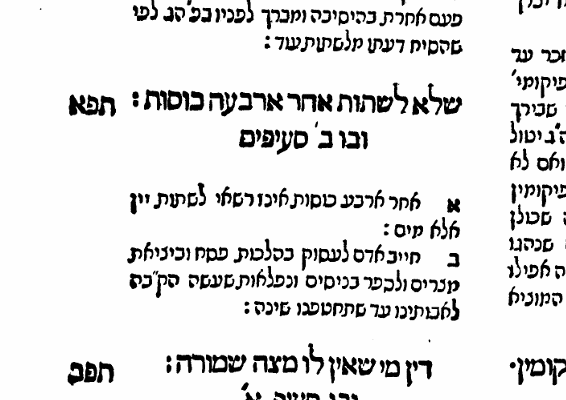
Rabbenu Yonah Girondi (13th century) maintained that one should refrain from drinking extra wine so as to be able to study the laws of Passover and the story of the Exodous all night, as the Sages did in Bne Braq. Maharil cites Rosh (Asheri) as adding that the fifth cup was permitted due to the verse v’heveiti. However, our standard printed text of Rosh states that the fourth cup is permitted due to the verse v’laqaḥti

(אבל בכוס רביעי התירו שיש לו סמך מן הפסוק כנגד ולקחתי אתכם. (סימן לג…

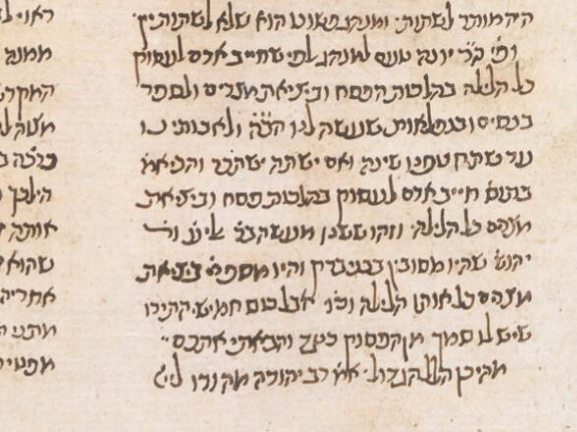
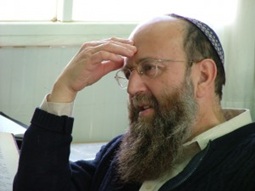
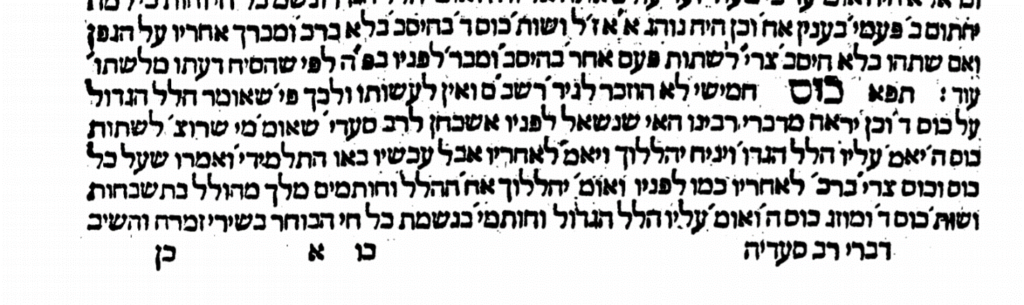
Rabbi Alter Hilewitz (1906-1994, author of halakhic works and editor of Encyclopedia Talmuditobjected that the printed text makes no sense and must have become corrupted.[5] There is no reason to permit the fourth cup after it has already been mandated in the Mishnah. The special dispensation must have been for the fifth cup and Maharil cited the genuine text version of Rosh.[6] R. Hilewitz’s hunch was correct, as we find in an early manuscript of Rosh (Asheri) written in Spain in 1325 during the lifetime of Rosh (from middle of 3rd line from bottom):[7] 


Rabbi Hilewitz

The corruption was a by-product of proliferation of the Rashbam’s text of the Talmud eliminating the fifth cup entirely. It probably represents an unintended stringency in interpretation of the prohibition on drinking excessively. Another correction we find in the manuscript is the attribution of the opinion. The manuscript attributes it to Rabbenu Yonah, corresponding to the attribution in Tur. However, the printed edition misattributes it to ר”מ, R. Meir of Rothenburg, master of Rosh.

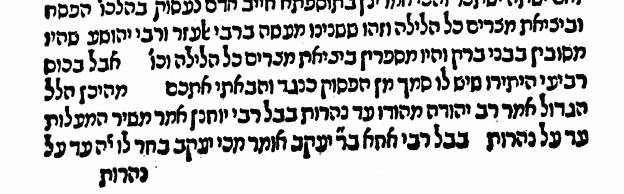
The text of Rosh which R. Joseph Karo relied upon was almost certainly that of the famous aforementioned Venice edition of the Talmud.[8] It reads:

.אבל בכוס רביעי התירו שיש לו סמך מן הפסוק כנגד והבאתי אתכם…


The text does not make sense. It is conflated. Either the fourth cup was permitted by the verse v’laqaḥti (as in the modern printed editions), or the fifth cup was permitted by the verse v’heveiti (as in the manuscript). The fourth cup could not have been permitted by the verse v’heveiti. The development was apparently a two-stage process and the Venice Edition represents the “missing link”, an intermediate stage in which the fifth cup was changed to the fourth cup but the verse remained intact. At this point, R. Joseph Karo or the later publishers could have corrected the text back to “the fifth cup”, restoring the original version in the manuscript. However, the tide was already turning towards the fourth cup Talmudic textual variant in Bet Yosef, with his decision to read Rashbam’s Talmudic textual variant into Rav Hai Gaon’s responsum.[9] R. Joseph Karo decided to keep “the fourth cup” and to ignore the word v’heveiti, or to mentally “correct” it to v’laqaḥti, exactly how the later printers chose to emend the text of Asheri.

One can speculate as to why Kasher, Benedict and subsequent Rabbinic scholars did not discover this source. R. Hilewitz’s observation was published in a 1945 newspaper article in Palestine. At the time, war was raging and R. Kasher was in America. Manuscript variants of the text of the Talmud have been studied and published on for years[10] and the last generation has brought us two editions of Tur prepared using manuscripts.[11] Even Tosafot Rosh is published from manuscripts in critical editions.[12] However, for some reason, manuscripts of Rosh are relatively uncharted territory, despite the centrality and rabbinic authority of the work. Perhaps (similar to Rashi’s Talmudic commentary, up until the groundbreaking work of my teacher, Aaron Ahrend) it is this very centrality that led its manuscripts to be ignored, as it was printed so early on, in the Venice Talmud, and so many times. 

Most significantly, the text is hidden from view. Tur clips off this section of the discussion and Bet Yosef does not cite it. However, once we return to the textual version that laid open before R. Joseph Karo on his desk, which he certainly meditated on, we can understand how he interpreted the abbreviated text of Tur and why he decided to delete the fifth cup.


Addendum: The Power of Piyyut

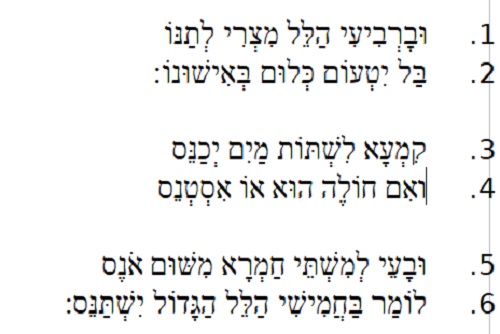
Shmuel of Evreux adopted a stringency not to drink even water after the four cups.[13] His source was the piyyut composed by R. Yosef Tuv Elem for a qerova recited on Shabbat ha-Gadol.[14] The last two stanzas at the end of the piyyut are the most famous today, for they are recited almost universally at the end of the Haggadah: “Hasal siddur Pesah”. The stanza preceding it is one mentions the fifth cup. There are two textual variants of this line interpretations of the piyyut. Three manuscripts read as follows:[15]


According to this text, line 3 states that it is permitted to drink water absolutely, in accordance with normative halakhah. Line 4 adds conditions for drinking wine, being sick or finicky, as described in line 5 with the recitation of Hallel ha-Gadol in line 6.

Medieval piyyut commentaries also follow this text, for example, the commentary by Samuel b. Salomo of Falaise:[16]

…קמעא, מעט, לשתות מים יכנס, לאחר סעודתו אם ירצה לשתות, ואם חולה הוא או אסטניס ובעי למשתי חמרא ואינו יכול לשתות מים, לומ’ בה’ על שם ‘ה הלל הגדול, ישתנס, יאזור

However, the textual variant followed by the Tosafot (Pesahim 117b) omits the vav at the beginning of line 4. Now the conditions of line 4 apply to line 3 as conditions for drinking water. Apparently from this piyyut, R. Shmuel of Évreux derived the stringency against drinking water after the Seder.[17] Tosafot for chapter Arvei Pesahim were based upon the Tosafot of R. Yechiel of Paris or a student of his, such as Rabbenu Peretz (Shalem Yahalom). R. Yechiel was in contact with R. Shmuel. R. Yechiel would attempt to refute R. Shmuel’s novel stringencies. Sometimes the refutation was accepted, such as cited by R. Peretz in his gloss to Smak 93, and sometimes not, as found in Orhot Hayyim, Hilkhot Tum’ah, vol 2, p. 602, and apparently in our case regarding the stringency of not drinking water. In this case, the development of a stringent shitta forbidding even the drinking of water likely shifted the goalposts of halakhic discussion away from the option of the Fifth Cup of wine. 

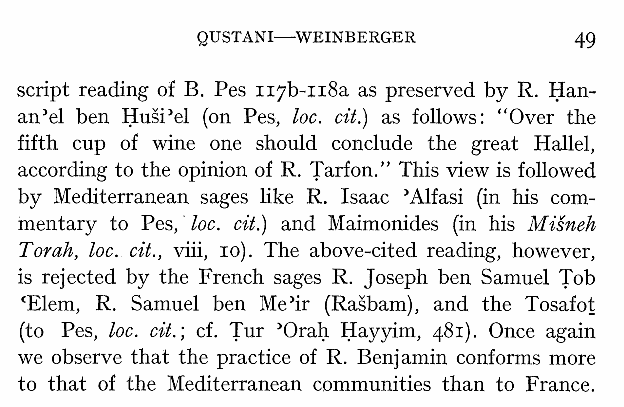
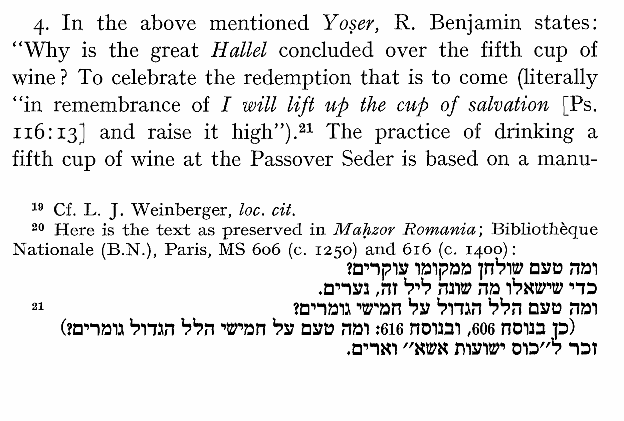
Finally, on the topic of piyyut, Leon J. Weinberger described a poem from R. Binyamin which mentions the fifth cup as a basic custom, an integral part of the Passover Seder. The piyyut was later published in its entirety by Ezra Fleischer.[18] According to Weinberger, it provides a messianic interpretation of the fifth cup, an aspect of the fifth cup that will become more evident during later periods to be discussed in chapters of this study yet to come. 


Editor Note: please see Eliezer Brodt’s earlier post on this subject: https://seforimblog.com/2013/03/the-cup-for-visitor-what-lies-behind/

[1] Henshke; also see here for another possibility and analysis of Talmudic manuscripts here.
[2] Kasher noted Rabbenu Tam’s fierce opposition in general to applying proposed emendations into the text of the Talmud itself, blaming Rashbam (his older brother) in particular. See Spiegel, Soloveitchik, briefly reviewed in my Jewish Hawking in Medieval France.
[3] Rav Kasher advanced this claim convincingly to explain the deletion by R. Joseph Karo. R. Avraham Benedict also advanced this claim, without crediting Kasher. As far as rendering a legal decision, Benedict took a diametrically opposite position. According to Kasher, now that we possess the full version of Rav Hai Gaon’s responsum, we see that R. Joseph Karo was led astray by an ambiguous text. Benedict considers R. Karo’s decision binding and the presence of the abbreviated version is ample justification.
[4] Noted especially by Kasher, also by Henshke.
[5] ‘Kos shel Eliahu’, Bamishor 245-6 (25.3.1945), p. 5.
[6] This version is also found in Abudraham (Seder ha-Haggadah u’Perisha, ed. S. Kroizer, Jerusalem 1963, p. 234), citing Rabbenu Yonah. Abudraham’s source was probably Asheri, but he did not generally cite secondary sources, as he himself stated in his introduction (p. 6.). See: L. Jacobi, “Talmudic Honey”, Fragments of the Novellae of R. David ben Saul of Narbonne”, Giluy Milta B’alma, 2/17/2016.

[7] British Library Add. 27293 f. 131v.
[8] Bomberg: Venice 1520-1523, p. 138b.
[9] Kasher, Benedict.
[10] Diqduqe Sofrim, Lieberman Instritute, Friedberg.
[11] Shirat Devorah; Ma’or.
[12] Mossad Ha-Rav Kook, Ofeq Institute.
[13] Cited by Mordechai, Hagahot Maimoniot (Ed. Constantinople, 6:11, “gedole Evreax”), Agur. Tosafot Pesachim 117b.
[14] See a letter from Pinchas Eliyahu Lawee in Kobetz Beit Aharon 15:5 (89, 1998), pp. 135–136.
[15] With only minor variants irrelevant for our purposes. Gabriel Wasserman shared with me his pilot edition of variants and Abraham Levine provided me with expert guidance in this study.
[16] Parma – Biblioteca Palatina Cod. Parm 3000 (de Rossi 378), f. 30a-35b. I was aided in locating piyyut commentaries by Elisabeth Hollender’s monumental Clavis.
[17] Another later piyyut follows this strict opinion, recently published by R. Jacob Israel Stal. See his note at page 33.
[18] Kobez al Yad 21 (1985), p, 31.


Abraham Rosenberg, R. Chaim Heller, R. Shlomo Zalman Auerbach on Conversion, Abortion, Mercy Killings, and new pictures and videos of R. Jehiel Jacob Weinberg

Abraham Rosenberg, R. Chaim Heller, R. Shlomo Zalman Auerbach on Conversion, Abortion, Mercy Killings, and new pictures and videos of R. Jehiel Jacob Weinberg

Marc B. Shapiro

1. In my post here I discussed the enigmatic plagiarizer Abraham Rosenberg. As we saw, in 1923 and 1924 Rosenberg published articles on the Jerusalem Talmud in the Orthodox journal Jeschurun, and he later published Al Devar Tikunei Nushaot bi-Yerushalmi. In this last work, Rosenberg refers to R. Chaim Heller as his friend. I and so many others assumed that “Rosenberg” was a pseudonym, but Moshe Dembitzer, the expert on everything related to R. Heller, has pointed out to me that this appears not to be the case. Here is a letter Dembitzer found in the JDC archives from R. Heller to Cyrus Adler. As you can see, R. Heller mentions A. Rosenberg—the letter that is unclear must be an “A”—and one of his essays on the Jerusalem Talmud. He also mentions that Rosenberg “is considered only one of the ordinary students.”

Dembitzer also found another connection between R. Heller and Rosenberg. Here is a note from R. Charles B. Chavel’s edition of Hizkuni’s commentary on the Torah, p. 525.

Here is Rosenberg’s Al Devar Tikunei Nushaot bi-Yerushalmi, p. 102, where he cites the same explanation that Chavel cited in the name of R. Heller (but Rosenberg takes credit for it himself).

Regarding the plagiarisms of Rosenberg, I must also thank Gershon Klapper who alerted me to other examples. He wrote to me:

Rosenberg’s first article (לחקר תלמוד הירושלמי) opens אין מן הצורך לשנות את הידוע כי תלמוד הבבלי שנחתם לא זזה ידם של חכמי ישראל ממנו, very similar to how R. Heller’s ע”ד מסורת הש”ס בירושלמי begins, אין מן הצורך לשנות את הידוע כי תלמוד הירושלמי הוא עדין כשדה שאין עובד בו. But the next part of his introduction to that article is taken, slightly rearranged, from Steinschneider’s ספרות ישראל vol. 2, p. 103 (it reappears at the beginning of ע”ד תקוני נוסחאות בירושלמי, which includes most of this article’s content), as is the line beginning פעולתם של הגאונים. He does paraphrase some other language from R. Heller in the introduction, but again it isn’t word-for-word.

His second article (פסוקי המקרא שבתלמוד) opens

כי חכמי התלמוד היו בקיאים בכל ספרי התנ”ך עד להפליא, – דבר זה ידוע לכל מי שלמד גמרא, ואפילו למי שהצליף בה סקירה שטחית. כמעט מכל דף ודף שבתלמוד נראה, כי פסוקי התנ”ך, ואפילו המקראות “האובדים והנדחים” שברשימות השמות בעזרא ובדברי הימים היו שגורים על פי התנאים והאמוראים בתכלית הדיוק. בעלי התוספות (ב”ב ד’ קי”ג בד”ה תרוייהו) לא חששו להחליט, שהאמוראים פעמים שלא היו בקיאים בפסוקים. אבל כבר הודו שם בעלי התוס’ עצמם שאין החלטה זו מוכרחת וכמו שכתב הרשב”ם שם. וגם הראיה שהביאו מדברי ר’ חייא בר אבא, שאינו יודע אם נאמר בי’ הדברות טוב או לא (ב”ק נה.) אינה מוכרחת שהרי ברור הדבר, כי דברי רחב”א, אינם אלא דברי בדיחותא, כדי לדחות את השואל.

Almost every word of this comes from an article of the same title by Yisrael Chaim Tawiow which appeared in HaShiloach 29 (July-Dec. 1913). The rest of the second article is taken from Baer Ratner, סדר עולם רבא pp. 103ff. and Samuel Rosenfeld, משפחת סופרים pp. 98, 100, 105, etc.

Klapper also called my attention to Rosenberg’s plagiarism of part of a paragraph in R. Heller’s article that appears in Le-David Zvi (David Zvi Hoffmann Jubilee Volume, Hebrew section). Compare p. 56 there with Rosenberg, Al Devar Tikunei Nushaot bi-Yerushalmi, p. 11. As Klapper notes, it is quite ironic that Rosenberg leaves out the following sentence from R. Heller that occurs in the middle of the passage he plagiarizes:

ויש שיועיל לנו הציון לברוח מן העבירה ולעשות מצוה לאמר דבר בשם אומרו

While on the topic of R. Chaim Heller, first let me share this wonderful picture from R. Ahron Soloveichik’s wedding in which one can see the Rav, R. Heller and R. Yaakov Kamenetsky. As far as I know, this picture has never appeared online. I thank Yoel Hirsch for providing me with the picture.

From R. Kamenetsky’s recently published Emet le-Yaakov al Nakh, vol. 1, p. 185 n. 2, we learn that in 1937 R. Kamenetsky visited Boston to discuss with R. Soloveitchik opening a yeshiva together.

In 1924 R. Heller published his study of the Samaritan version of the Torah, Ha-Nusah ha-Shomroni shel ha-Torah (Berlin, 1924). In 1972 Makor, which published so many valuable reprints of old seforim, decided to also reprint R. Heller’s Ha-Nusah ha-Shomroni. The problem was that R. Heller had an heir, and she was the only one with the legal right to reprint his books. This led to the following letters sent by Miriam Heller’s attorney (the letters are found in the Israel State Archives, 14924/3, available here [before the recent cyber attack on the archives], pp. 35ff.). From these letters, we learn that there were other unauthorized reprints of R. Heller’s works.

One final point about R. Heller is the following: In 1912 he was appointed rav of the city of Lomza. Here is a report on his appointment from the newspaper Ha-Mitzpeh, March 29, 1912.

The writer is simply amazed that a Polish city, full of Hasidim, would hire as its rav a “Rabbi Dr.” Of course, R. Heller was a very unique “Rabbi Dr.”

2. Because I discussed conversion in the last post, I would like to call attention to R. Yoel Amital’s discovery of how R. Shlomo Zalman Auerbach’s view on the matter has been presented.[1] The issue R. Amital focuses on is whether a conversion for someone who does not observe mitzvot takes effect. I am referring to one who tells the beit din at the time of conversion that he accepts the mitzvot, but we see later that this was not the case.

In his letter in R. Zvi Cohen’s Tevilat Kelim (1975), R. Auerbach is clear that ex post facto such a conversion is still valid.

The crucial words are:

בכגון דא נלענ”ד שכל המסייעים לגירות כזו, אף שבדיעבד הם גרים גמורים, אפי”ה המגיירים אותם עוברים בלאו של לפני עור וגו’

According to R. Auerbach, because be-diavad such converts are Jewish, to convert them is a violation of lifnei iver. As R. Auerbach explains, before conversion, these people could work on Shabbat and eat non-kosher, but now that they are Jewish they are forbidden to do so. By converting people who will be committing these and other sins, the beit din has violated the prohibition of lifnei iver.

As R. Amital shows, in subsequent printings of R. Cohen’s book, R. Auerbach’s letter is printed with a significant addition (here underlined):

בכגון דא נלענ”ד שכל המסייעים לגירות כזו, אף שהם טועים לחשוב שבדיעבד הם גרים גמורים, אפי”ה המגיירים אותם עוברים בלאו של לפני עור וגו’

And

בכגון דא נלענ”ד שכל המסייעים לגירות כזו, אף אם הם טועים לחשוב שבדיעבד הם גרים גמורים, אפי”ה המגיירים אותם עוברים בלאו של לפני עור וגו’

When this letter was printed in R. Auerbach’s Minhat Shlomo, vol. 1, no. 35:3, the wording was altered further:

בכגון דא נלענ”ד שכל המסייעים לגירות כזו, אף דהם טועים לחשוב שהם גרים גמורים, אפי”ה גם לשטתם המגיירים אותם עוברים בלאו של לפני עור וגו’

In Ha-Ma’yan 56 (Nisan 5776), p. 89, in response to R. Amital’s article, R. Aharon Goldberg, a grandson of R. Shlomo Zalman, published a picture of R. Auerbach’s original letter. The wording is identical to what appears in the first edition of R. Cohen’s book. So how to explain the later additions? R. Goldberg states that it is possible that the later changes were made with the consent of R. Auerbach. Although there is no evidence of this, I find it unlikely that R. Cohen would have altered R. Auerbach’s letter while R. Auerbach was still alive. A general rule of censorship and alteration of texts is that it is done after the author is no longer alive.

Leaving aside the updated version of the letter, there is still a problem that R. Amital confronts. According to R. Auerbach’s original letter, those who convert but do not become religious, their conversion is still valid. However, R. Auerbach also signed a public letter together with the Steipler, R. Shakh, and R. Elyashiv, which states that such a conversion has no validity. So which is it?

R. Mordechai Halpern has shown that R. Auerbach sometimes presented a “public” halakhah that was stricter than his true opinion, but which for some reason he did not wish to publicize.[2] R. Amital suggests that in this case we have a similar example where R. Auerbach publicly advocated a “strict” position regarding conversion that was not in line with his true opinion. (I put “strict” in quotes because while this position is strict in not regarding a conversion as valid, it is also “lenient” in that it tells someone who converted and did not intend to become religious that she can leave her husband without a get, does not need to fast on Yom Kippur, etc.)

R. Amital also claims, implausibly in my opinion, that the public letter R. Auerbach signed does not really stand in contradiction to the letter he sent to R. Cohen. How so? The public letter speaks of people who convert without accepting to observe mitzvot, while R. Auerbach in his letter to R. Cohen is referring to people who in front of the beit din do accept to observe mitzvot, but in their inner heart do not really have such an intention.

Contrary to R. Amital, this is clearly not what the public letter means. It is referring to people who converted in a beit din, but never intended to follow halakhah. It is simply impossible to read this public letter as referring to, in the words of R. Amital: גרים שלא קיבלו עליהם כלל בבית דין לקיים תורה ומצוות. There is no beit din in the world that does not require converts to accept Torah observance. The issue the letter was addressing is converts who, despite their verbal acceptance of mitzvot, do not follow through in practice. According to the letter, such a conversion is not valid. This is so obvious that one wonders how R. Amital could have ever offered his suggestion to explain the contradiction.

R. Halpern himself notes that he knows that R. Auerbach never backed away from his earlier position, as seen in his letter to R. Cohen, that someone who was converted by a proper beit din, but did not intend to observe mitzvot, ex post facto the conversion is still valid. Yet he states that R. Auerbach later concluded that this liberal approach should not be publicized.[3]

Even with the initial two “corrected” versions of R. Auerbach’s letter, R. Auerbach mentions that rabbis who convert people who have no intention of observing Torah violate the prohibition of putting a stumbling block before the blind. R. Auerbach states that until now the person converting violated Shabbat and ate non-kosher food and these were not sins. But now, after the conversion, he is violating the Torah. R. Auerbach concludes his letter as follows:

נמצא שכל המגיירים והמסייעים לכך הו”ל כגדול המחטיאו, ועוברים בלאו של ולפני עור לא תתן מכשול

The implication of this is that ex post facto the conversion is indeed valid, as otherwise there would be no sin committed by the convert and there would be no issue of putting a stumbling block before the blind. In the words of R. Yisrael Rozen:[4]

למדנו מדבריו שהגירות חלה, דאי לאו הכי אין כאן מכשול, שהרי נשאר בגיותו

In fact, we find many poskim who say that we should not convert people who do not intend on observing mitzvot, because then they will be punished for their sins. This shows that these poskim regard a conversion without intent to observe mitzvot as valid ex post facto. In a previous post here I cited a number of examples of this, and here is one more.

R. Raphael Shapiro, Torat Refael, vol. 3, no. 42, has a short responsum about whether to convert a woman who will not be observant. It was sent to R. Mordechai Klatchko of Volozhin, who would later come to the U.S. and serve as a rav in Boston.[5] R. Klatchko was clearly a fine talmid hakham, as can be seen from the two volumes of his Tekhelet Mordekhai. R. Klatchko wrote to R. Shapiro arguing that the woman should be converted even if she was not going to be observant so that her intended husband (or perhaps current husband) could fulfill the mitzvah of procreation (which he could not do if his children would not be halakhically Jewish). R. Shapiro disagrees and states that it is forbidden to convert her, as she will certainly not observe the niddah laws, and this will cause them both to violate a Torah prohibition.

What is important for our purposes is that both R. Klatchko and R. Shapiro assume that one who converts without intending to observe Jewish law is regarded as a valid convert. As long as the person goes through a halakhically proper conversion ceremony, that is what activates the conversion. It is hard for people today to understand how R. Shapiro never even raises the possibility that a conversion is invalid if the person converting intends to routinely violate fundamental Jewish laws by living an irreligious lifestyle. But as can be seen in so many different examples, a widespread view in prior generations—I don’t know if it was the majority view or not—was that as long as the conversion is carried out properly, what happens later, and what is in the convert’s heart at the time of the conversion ceremony, have no legal significance.[6]

Here is one further example of this approach, Be-Mar’eh ha-Bazak, vol. 4, no. 96.[7]

As you can see, the approach of Kollel Eretz Hemdah is that there is no possibility of voiding a conversion carried out by a proper beit din, even if the people converting had no intention of observing mitzvot. At the beginning of the volume, it states that the responsa were reviewed by R. Zalman Nehemiah Goldberg, R. Nachum Rabinovitch, and R. Yisrael Rozen, all significant figures in their own right.

Finally, it is also worth noting that no less a figure than R. Isaac Jacob Weiss refused to void a conversion even though the woman who converted never observed mitzvot. See Minhat Yitzhak, vol. 1, nos. 121-123.

I have a good deal more to say about conversion, but in the interest of space, let me just call attention to a couple of interesting things I recently saw. The first is that R. Moses Sofer states that non-Jews are rewarded in this world if they convert to Judaism.[8] I do not know of anyone else who says that there is a divinely ordained reward for one who converts.

The second interesting discussion about conversion I recently saw is R. Aviad Sar Shalom Basilea, Emunat Hakhamim, ch. 24 (pp. 264-265 in the Jerusalem, 2016 edition). Adopting the type of anachronistic explanation that some commentators have been fond of, R. Basilea assumes that Mahlon converted Ruth and married her with huppah and kiddushin. But this creates a problem, because if Ruth was Jewish, why did Naomi push her away? R. Basilea offers a possible answer: Naomi held like the Rif and the Rambam that since Ruth’s immersion in the mikveh was not before three men, it was invalid even be-diavad. However, Mahlon held like the other poskim that be-diavad, tevilah by oneself if valid.

והנה נעמי היתה סוברת כרי”ף והרמב”ם שאפילו בדיעבד אינה גיורת ולכן השתדלה להרחיקה, ומחלון היה סבור כאותם הפוסקים הסוברים כי גיורת גמורה היתה ולכן נשאה

Does anyone, even from the most traditional communities, still offer explanations along these lines? Here is what R. Shimon Shkop wrote in a different context, and you can see that he was not a fan of this type of explanation.[9]

ודבר זה מביא לידי גיחוך, כעין הפלפולים אם פרעה היה סובר שעבודא דאורייתא

Some time ago I was looking at Abba Appelbaum’s book Rabbi Azariah Figo (Drohobycz, 1907), and he offers the following examples of anachronistic explanations (p. 54):[10]

R. Gershon Ashkenazi (1618-1693), one of the greatest halakhists of his day, also wrote a work of homiletics, Tiferet ha-Gershuni. In his derashah for parashat Mas’ei (p. 236 in the 2009 edition) he portrays the daughters of Zelophehad as arguing from halakhic logic.

In his derashah for parashat Va-Yera (p. 48), in discussing the descendants of Ishmael, R. Ashkenazi suggests that they held that the law of ketubah is rabbinic.

אם כן בני ישמעאל היו סבורים כתובה מדרבנן

Appelbaum also calls attention to R. Meir Schiff’s elaboration at the end of his commentary to Bava Kamma (found in the Vilna Shas). He portrays the incident of Esau selling his firstborn status from a halakhic angle. As such, Jacob’s thoughts were no different than those of a later halakhic scholar:

ונסתפק יעקב באומרו כיום מחמת שני דברים, שגריעותא דבכורה מחמת דבר שלא בא לעולם ומחמת אונאה . . . ויעקב נתיירא או למד הפשט כרש”י ולזה אמר ויאמר השבע לי כמ”ש בח”מ סי ר”ט ס”ד בהגה”ה

Another example, not mentioned by Applebaum, is R. Samuel Edels (Maharsha) in his aggadic commentary to Sanhedrin 57b. R. Edels wonders why Pharoah commanded the Hebrew midwives to kill the newborn Hebrew children, as it would have made much more sense to have Egyptian midwives do this. He explains that the children were to be killed before birth and for non-Jews this would be regarded as murder, which Pharoah wanted to avoid.[11] He thus turned to Hebrew midwives as for them it is not murder to kill an unborn child.

Quite apart from the far-fetched nature of the explanation, as well as its assumption that even before the giving of the Torah the Israelites were bound by Jewish law, not Noahide law, I don’t think any reader of the biblical story would find it reasonable that Pharoah was concerned about anyone violating the commandment against murder. However, the passage is also of interest in seeing how Maharsha regarded the prohibition against abortion.[12] He even portrays Pharoah as thinking that there is no prohibition for Jews to abort a fetus, including right before birth.

דודאי פרעה לא שאל מהם להרוג הזכרים בידים דבן נח מוזהר על שפיכות דמים ולכך לא אמר כן למילדות המצריות שהוזהרו על שפיכות דמים אפילו בעוברים אבל למילדות העבריות אמר שהותר לכם להרוג עובר במעי אמו וראיתם על האבנים קודם שיצא לאויר העולם אם בן הוא וגו’ וכיון שאי אפשר בהם לפטור משפיכות דמים רק בתחילת יציאת הולד קודם שיצא ראשו או רובו הוצרך לתת להם סימנין כמו שכתוב בפרק קמא דסוטה [יא ע”ב]

There has been a good deal of discussion as to how to understand the Maharsha’s words שהותר לכם. Some assume that he meant that Pharoah was in error in thinking that there is no prohibition for Jews to abort a fetus.[13] It is also possible to explain that the prohibition against abortion for Jews is only rabbinic,[14] so at that period of time there was no prohibition. R. Yaakov Farbstein states flatly:[15]

ומבואר במהרש”א דאין איסור לישראל בהריגת העוברים

This notion, that the Maharsha is saying that there is no prohibition for Jews to abort a fetus, is not in line with the overwhelming majority view beginning with the rishonim. However, in one Tosafot, Niddah 44a-b, s.v. ihu, it does state that abortion is permitted for Jews, and it does not mention that there needs to be a good reason for this or provide a timeline after which abortion is not allowed.

וא”ת אם תמצי לומר דמותר להורגו בבטן . . . וי”ל דמכל מקום משום פקוח נפש מחללין עליו את השבת אף ע”ג דמותר להרגו

Pretty much every halakhist who deals with abortion struggles with this Tosafot, as they have found it very hard to accept that any rishon could permit abortion without restrictions. One approach offered is that Tosafot is saying that there is no Torah prohibition, but there would still be a rabbinic prohibition.[16]

R. Moshe Feinstein, in his classic responsum on abortion, claims that there is a mistake in Tosafot, and instead of the two appearances of דמותר it should instead say דפטור ההורגו in both places.[17] This is in line with the phenomenon I have discussed on a few occasions, where R. Moshe is prepared to deny the authenticity of problematic texts. R. Eliezer Waldenberg offered a strong rejoinder to R. Moshe.[18]

והנה עם כל הכבוד, לא אדוני, לא זו הדרך, וחיים אנו עפ”ד גאוני הדורות, והמה טרחו כל אחד ואחד לפי דרכו לבאר ולהעמיד כוונת דברי התוס’ בנדה וליישבם, ואף אחד מהם לא עלה על דעתו הדרך הקלה והפשוטה ביותר לומר שיש ט”ס בדברי התוס’ ובמקום מותר צריך להיות אסור [צ”ל פטור]

While no other authorities agree with R. Moshe that the Tosafot contains a mistaken text, many regard the language of Tosafot as not exact.[19]

Returning to R. Shlomo Zalman Auerbach, I know of another example where he did not want a view of his to be widely shared. R. Amit Kula discusses R. Avigdor Nebenzahl’s argument that according to a variety of sources one who is suffering greatly is allowed to commit suicide. He further adds that it would be permitted to kill another in this circumstance (active euthanasia), for if you are allowed to kill yourself for a good purpose, you can do it to another as well. R. Nebenzahl adds that some of what he says comes from R. Shlomo Zalman Auerbach. He also quotes R. Auerbach that one can take medicine to reduce pain even if it will shorten one’s life.[20]

This information, which appeared in the first edition of R. Nebenzahl’s Be-Yitzhak Yikare, is not found in subsequent editions. R. Kula tells us that in these editions R. Nebenzahl inserted a note that the section was removed at the instruction of an unnamed scholar, and R. Mordechai Halpern quotes R. Nebenzahl that this scholar was none other than R. Auerbach.[21]

I find this of interest because if there is one thing that everyone knows, it is that Judaism does not allow active euthanasia (mercy killing). As is usually the case, matters are more complicated as has recently been shown by R. Yitzchak Roness in an article in Ha-Ma’yan.[22] He notes that R. Moshe Sternbuch does not believe that there is any prohibition for non-Jews to engage in mercy killing, since it is carried out for a good purpose. R. Yitzhak Zilberstein also inclines towards this position, and R. Moshe Feinstein suggests this as well, writing:[23]

אפשר שבן נח אינו אסור ברציחה שהוא לטובת הנרצח ושאני בזה האיסור לישראל מהאיסור לבן נח

R. Moshe and others specifically have in mind a non-Jew engaging in mercy killing of a Jew. The proof brought is the famous story of the death of R. Hanina ben Teradyon (Avodah Zarah 18a) where R. Hanina permits the executioner to raise the flame and remove the wool from his heart, thus actively hastening his death. R. Shaul Yisraeli goes the furthest, and for someone suffering greatly, and near death, he thinks that active euthanasia is permitted even if performed by a Jew.

R. Roness then notes that there is a dispute if one suffering great pain is allowed to commit suicide. For the side that permits this, R. Zilberstein adds that if it is permitted for the suffering individual, it will also be permitted for another to assist (active euthanasia). R. Roness also cites R. Hershel Schachter who states that active euthanasia, with the agreement of the patient, is not to be regarded as murder. He even suggests that for one suffering greatly, active euthanasia should be permitted:[24]

ההורג את חברו ברשותו יש לומר דאין בו לאו דרציחה אלא רק לאו דאך את דמכם, דלא גרע הורג חברו ברשותו מההורג את עצמו . . . ולמנוע א”ע מלסבול ייסורים דינו כפקו”נ, וכמשמעות התוס’ הנ”ל. ואם באמת כ”ה גדר היתר זה, א”כ אף בחולה הסובל יסורים קשים ומתחנן לאחרים ליטול את נפשו, אם נאמר כנ”ל, דבכה”ג אין לומר דבטלה דעתו וכו’, ג”כ הי’ צ”ל מותר מטעם פקו”נ ועיין בזה

And finally, here is what R. Chaim Kanievsky responded when asked if a Jewish patient near death could allow a non-Jew to end his life. R. Chaim does not say this is murder. On the contrary, he is inclined to permit it.[25]

אם שוהה אדם בבית חולים דעכו”ם ויש לו יסורים רבים במחלתו האנושה, ורוצה הרופא לחסוך לו היסורים ולקרב מותו ושואל ממנו רשות, האם מותר לו להסכים לזאת. והשיב רבנו שליט”א “יתכן שיש ללמוד זה ממעשה דרחב”ת” . . . והיאך הסכים רחב”ת שהעכו”ם יקרב מותו, והשיב רבנו: “איפה שהחולה מרגיש שזה טובתו יתכן שמותר כמו שמותר להתפלל עליו שימות.”

My question is, how come the “liberal” views I have mentioned are not better known?

7. In my last post here I included the first-ever color pictures of R. Jehiel Jacob Weinberg. These went around the world very quickly, and as is the nature of the internet, where the pictures came from was soon forgotten. In fact, within 24 hours someone who does not read the Seforim Blog sent them to me as a great new discovery. When I told him that I am the one who published the pictures he was at first incredulous, stating that he just got them from his cousin.

Here are two more pictures of R. Weinberg that he sent to his family. They are from before World War II when he was still in Germany. In the picture where he is lying the ground, I do not know who the couple next to R. Weinberg is.[26]


And for an extra treat, here are the only known videos of R. Weinberg, and one of them is in color. I thank Noam Cohn for putting this together, at my request, from his family’s collection. The first part has R. Weinberg with R. Arthur Ephraim Weil, the rav of Basel, and R. Leo Adler who succeeded Weil as rav of Basel in 1956. The second video, in which you can see R. Weinberg in color together with R. Samuel Brom, the rav of Lucerne, is from winter 1958-1959 at the Silberhorn kosher hotel in Grindelwald. The hotel had just inaugurated its new mikveh, and it was important to the family who owned the hotel that R. Weinberg give his approval to the mikveh.[27] At 1:12 and 3:20 you can also see the famed educator and student of R. Weinberg, Dr. Gabriel H. Cohn. Here is a picture from the event and you can see R. Brom and Dr. Cohn standing next to R. Weinberg.

Regarding R. Adler, before coming to Basel he studied ten years at the Mir Yeshiva, including in Shanghai. After the war he was in New York where he taught Torah at Yeshiva University.[28]

8. In my last post here I had the following quiz questions.

Please identify the following and email me your answers:

1. There are two se’ifim in the Shulhan Arukh that only contain two words.

2. There is one siman in the Shulhan Arukh whose number is the gematria of the subject of the siman.

The answer to no. 1 is Yoreh Deah 65:6: נוהג בכוי, and Even ha-Ezer 126:42: מותרת בויו

The answer to no. 2 is Orah Hayyim no. 586. This is the laws of shofar, and the gematria of shofar is 586. This was noted by R. Jacob Emden and I mentioned this in my article “‘Truth’ and Authorial Intent in the Study of Torah,” available here.

A number of people provided the correct answers for no. 1 and no. 2, but no one got both of my intended answers. However, Moshe Schwartz got no. 2 right with a different answer than I was thinking of (meaning he answered both questions correctly). He noted that Yoreh Deah 107 speaks about cooking eggs, and the gematria of ביצה is 107.[29] Also, shortly before this post was completed, Sol Reich provided another example: Yoreh Deah 334 is about הלכות נידוי וחרם and the gematria of נידוי וחרם is 334.

9. Information about my summer tours with Torah in Motion to Central Europe and Spain is available here.

* * * * * * *

[1] “Ha-Im Giyuram shel Gerim she-Einam Shomrim Mizvot Hal Be-Diavad? Berur Da’at ha-Gaon Rabbi Shlomo Zalman Auerbach ZTL,” Ha-Ma’yan 56 (Tishrei 5776), pp. 43-46.
[2] Halpern, Refuah, Metziut ve-Halakhah (Jerusalem, 2011), pp. 35ff.
[3] Amital, “Ha-Im Giyuram,” p. 45.
[4] Ve-Ohev Ger (Alon Shvut, 2010), p. 161 n. 1.
[5] See R. Hayyim Fischel Epstein, Teshuvah Shelemah, vol. 2, Even ha-Ezer, nos. 29-30, and R. Elijah Klatzkin, Hibbat ha-Kodesh, no. 11, where they respond to R. Klatchko’s question about a get written in Roxbury (a neighborhood in Boston), but the get only mentioned “Boston”. This is mentioned by Hayyim Karlinsky, Rabbi Hayyim Fischel Epstein (New York, 1963), pp. 26-27.

This R. Klatchko should not be confused with an earlier R. Mordechai Klatchko of Lida who also wrote a book titled Tekhelet Mordekhai. It is noteworthy that R. Klatchko of Lida wrote a lengthy haskamah for the Mishnah Berurah. Regarding R. Klatchko of Lida, see here.[6] For another example, see R. Dov Cohen, Va-Yelkhu Sheneihem Yahdav (Jerusalem, 2009), pp. 333-334. Here R. Cohen describes how, at the direction of R. Isser Yehudah Unterman, he converted a woman intent on marrying a completely irreligious Jew. This is the sort of conversion that today would not be allowed in Israel or in any of the batei din recognized by the Israeli Chief Rabbinate. See also R. Avraham Shapiro, Kuntres Aharon in his edition of R. Isaac Jacob Rabinowitz, Zekher Yitzhak (Jerusalem, 1990), p. 396, who suggests that according to Maimonides, when it comes to conversion and acceptance of mitzvot,  כיון שקבל בפה אין דבריו שבלב דברים.

For a convert who is not observant, there is one halakhic consequence, at least according to many authorities: When they divorce the get should not say ben (or batAvraham avinu, but ploni ha-ger. See R. Shimon Yakobi, Bitul Giyur Ekev Hoser Kenut be-Kabbalat ha-Mitzvot (Jerusalem, 2009), pp. 103ff. (This is an official publication of the Israel rabbinical courts.) See also ibid., p. 105, for the shocking statistic that from 1996-2008, 97% of converts who divorced in the State of Israel were irreligious. There is no reason to doubt that the number of non-divorced converts who are irreligious is similar. If only 3% of converts in Israel are religious, then, as Yakobi rightly notes, it raises serious concerns about the conversion process.
[7] A similar responsum dealing with the same case appears in Be-Mar’eh ha-Bazak, vol 3, no. 89.
[8] Derashot Hatam Sofer, vol. 2, p. 301c. s.v. yeshalem.
[9] Hiddushei Rabbi Shimon ha-Kohen (Jerusalem, 2011), vol. 4, p. 324 (Kuntres Likutim, no. 5).
[10] I can’t say whether there is any plagiarism in this book, but another publication of Appelbaum was plagiarized from Abraham Berliner. See Nehemiah Leibowitz, “Al Devar ha-Takanah be-Venetzia,” Ha-Tzofeh le-Hokhmat Yisrael 13 (1929), p. 90.

Regarding anachronistic explanations, I think most would also include in this category R. Moses Sofer’s statement that Joseph wished to pray with a minyan rather than pray vatikin by himself. See Hatam Sofer al ha-Torah, vol. 1, p. 227.
[11] The same approach is independently suggested by R. Judah Rosanes, Parashat Derakhim, Derush 17, and R. Pinhas Horowitz, Panim Yafot, Ex. 1:15.

R. Ishmael holds that abortion is treated as murder for non-Jews (Sanhedrin57b) and Maimonides rules this way (Mishneh Torah, Hilkhot Melakhim9:4). This halakhah has often been cited as proof that the crime of abortion is stricter for non-Jews than Jews, and that public policy should be in line with this. Yet in Sanhedrin 57b the Tanna Kamma disagrees with R. Ishmael and does not regard abortion as murder. In fact, according to the Tanna Kamma, abortion would seem to be permissible for non-Jews. R. Jeremy Wieder has raised the question, which I would like someone to offer a serious reply to, that while Maimonides and other authorities accept R. Ishmael as the binding decision, who says that non-Jews have to accept this? Why can’t non-Jews “poskin” like the Tanna Kamma? See here at minute 35:30.

R. Shneur Zalman Fradkin,Torat Hesed, Even ha-Ezer, no. 42:5 (in the note), suggests that Tosafot,Niddah 44a, that I discuss in the text, adopts the Tanna Kamma’s position, not the view of R. Ishmael. See Tzitz Eliezer, vol. 14, p. 184. The implications of this with regard to non-Jews are obviously significant.

See also R. Jacob Emden, Em la-Binah (Jerusalem, 2020), p. 197:

בילדכן את העבריות: לא גזר על שפיכות דמים אלא על העוברים

R. Emden seems to be saying that abortion is not regarded as murder for non-Jews. Perhaps relevant to this, it is worth noting that R. Meir Mazuz states that one should encourage a non-Jewish woman pregnant by a Jewish man to have an abortion. SeeMakor Ne’eman, vol. 3, no. 1509. See also R. Hanan Aflalo,Asher Hanan, vol. 8, no. 74. R. Joseph Babad, Minhat Hinnukh, 296:7, states that abortion is not murder for non-Jews, and therefore there is no law of rodef when it comes to a non-Jew seeking to kill a fetus. (Since later in this post I mention suicide, it is worth noting that R. Babad also states that non-Jews are not prohibited from committing suicide. See Minhat Hinnukh 34:8.)

Regarding abortion for Jews, R. Hershel Schachter has an interesting shiur here. His approach is, I think, the most lenient among contemporary poskim, as he states that for the health of the mother abortion is permitted up until the end of pregnancy, which is long after the time that the fetus is viable.

R. Schachter’s approach might be identical with the very lenient perspective of R. Abraham Isaac Bloch. See R. Mordechai Gifter,Milei de-Iggerot, vol. 7, p. 341:

בגדר האיסור דהריגת עוברין בישראל, שמעתי מאדמו”ר הגאב”ד ור”מ דטלז ז”ל הי”ד, שהוא מגדר בל תשחית, אשר לפי”ז כל שהוא לצורך רפואה או פגם משפחה, אין בזה גדר האיסור דהשחתה

[12] I would have thought that the Maharsha’s words could have halakhic significance, but R. Nahman Yehiel Michel Steinmetz states otherwise, noting אין לומדים הלכה מדברי הגדה. See Meshiv Nevonim, vol. 6, p. 250. See also R. Weinberg’s comments regarding the Maharsha in Seridei Esh, vol. 3, no. 126.
[13] See e.g., Siftei Maharsha: Shemot, pp. 16-17.
[14] For opinions that the prohibition against abortion is only rabbinic, see R. Yishai Yitzhak Shraga, Torat ha-Ubar (Jerusalem, 2017), pp. 72ff.
[15] Ohalei Yaakov: Shemot, p. 1.
[16] See R. Eliezer Waldenberg, Tzitz Eliezer, vol. 9, p. 231, vol. 14, p. 184.
[17] Iggerot Moshe, Hoshen Mishpat 2, p. 295. There are a couple of strange things in this responsum, which first appeared in the R. Yehezkel Abramsky Memorial Volume. For example, see p. 298 how R. Moshe describes R. Joseph Hayyim’s responsum in Rav Pealim. (The word שהחכם in the bottom line right column should be שהתחכם, as it appears in the R. Abramsky Memorial Volume.) Yet as R. Waldenberg points out, Tzitz Eliezer, vol. 14, p. 186, R. Moshe’s summary of Rav Pealim is inaccurate and he also does not show much regard for R. Joseph Hayyim, leading R. Waldenberg to write: והוא פלאי, ושרי ליה מריה בזה. See Tzitz Eliezer, vol. 14, p. 186. (R. Moshe actually ends his own responsum by saying ושרי ליה מריה בזה about R. Waldenberg.)

R. David M. Feldman wrote to R. Waldenberg that R. Moshe did not write the responsum on abortion, and that could explain what he saw as various problems in this responsum. SeeTzitz Eliezer, vol. 20, p. 140.

I find this approach completely untenable, although in conversation with me R. Feldman insisted on it. Some might suggest that others were involved in writing the responsum, and that explains the passage dealing with Rav Pealim. I find this impossible to accept, and would prefer to assume that at least with regard to the inaccurate Rav Pealim description, that R. Moshe did not have the text in front of him and was citing from memory from what had earlier been shown to him. As such, it is easy to imagine how he could have forgotten the details, as we have all had similar experiences. For more on this responsum, see my post here.
[18] Tzitz Eliezer, vol. 14, p. 183.
[19] See R. Zvi Ryzman, Ratz ke-Tzvi, vol. 2, p. 295.
[20] Tehumin 37 (2017), p. 124.
[21] Refuah, Metziut, ve-Halakhah, p. 28.
[22] “Ha-Im Muteret ‘Hamatat Hesed’ al Yedei Amirah le-Goy,” Ha-Ma’yan 62 (Tamuz 5782), pp. 54-64.
[23] Iggerot Moshe, Hoshen Mishpat 2, p. 313.
[24] Ginat Egoz, p. 74.
[25] R. Yosef Aryeh Lorintz, Mishnat Pikuah Nefesh, p. 26.
[26] The pictures in this post are now kept at Ganzach Kiddush Hashem in Bnei Brak.
[27] All the big rabbis stayed and ate at the Silberhorn hotel, and yet until 1975 it had no hashgachah. People knew the family that owned it to be absolutely reliable in matters of kashrut, and like the other kosher hotels in Switzerland, the kashrut was trusted without any hashgachah. In 1974 the Swiss rabbinate informed the various kosher hotels that they would need to acquire a hashgachah, thus ending the era of religious owners’ kashrut being trusted without any outside supervision. (Thanks to Dr. Joshua Sternbuch who passed on this information from the family who owned the Silberhorn hotel.)

Regarding R. Weil of Basel, R. Weinberg thought very highly of him. In one letter to R. Joseph Apfel (the date is unclear), R. Weinberg writes:
 
הרב ד”ר ווייל הוא אדם מצוין מאד בהשכלתו ובמדותי’. הוא מתלמידי בית מדרשנו מזמנו של הגרע”ה והגרד”ה ז”ל
In R. Weinberg’s letter to R. Apfel, March 16, 1952, he writes:
 
הרב דשם ד”ר ווייל (מתלמידי בית מדרשנו) הוא אדם תרבותי ובעל מדות

[28] Letter from Adler to Weinberg, Aug. 31, 1954.
[29] Already in elementary school I heard this word, as the name of the talmudic tractate, pronounced “beah”. I never understood why, and the rebbe probably wouldn’t have explained it if I asked. R. Solomon Luria states that we avoid the word beitzah as it also has a crude meaning (testicle), and therefore we use another word in its place. Yet it is reported that both the Vilna Gaon and the Hatam Sofer, as well as many others, did not accept this idea and used the word “beitzah”. See Otzrot ha-Sofer 18 (5768), pp. 82-83; R. Aharon Maged, Beit Aharon, vol. 11, pp. 254ff., R. Mordechai Tziyon, She’elot ha-Shoel, vol. 2, pp 350ff. (for many modern authorities).

Regarding the pious practice of eating eggs at seudah shelishit, see Kaf ha-Hayyim 289:12.


Keser vs. Kesher: What’s In A Name?

Keser vs. Kesher: What’s In A Name?[1]
 
I – The Puzzle
Kesher Israel (KI) Congregation has enhanced Jewish life in Pennsylvania’s capital of Harrisburg for almost 115 years. During that time, KI has been blessed with outstanding rabbinic leadership: The famed Rabbi Eliezer Silver[2] first headed the congregation from 1911-1925. He was followed by Rabbi Chaim Ben Zion Notelovitz who served KI from 1925-1932. Rabbi David L. Silver (a son of Rabbi Eliezer Silver) led the congregation from 1932-1983. Rabbi Dr. Chaim E. Schertz served KI as its rabbi from 1983-2008.
Soon after arriving in Harrisburg in 2007, I found myself intrigued by the synagogue’s name. Since the congregation is called Kesher Israel, I just assumed its Hebrew name was קשר ישראל (pronounced ‘Kesher Israel’, meaning Bond of Israel). However, I soon learned that upon being founded in 1902, the synagogue was in fact named כתר ישראל (pronounced ‘Keser Israel’ in classic Ashkenazis – which KI’s founders surely spoke – meaning Crown of Israel). I soon noticed that below the words ‘Kesher Israel Synagogue’ on the cornerstone of KI’s current building (pictured above), appears the Hebrew name כתר ישראל.
This seemingly minor detail puzzled me greatly. Why did a congregation whose proper Hebrew name was כתר ישראל choose to call itself Kesher Israel? Had anyone ever taken note of – or attempted to correct – this inconsistency? During the summer of 2015, I found time to research the matter, and I now have a theory to propose.
II – An Enigmatic Account
In 1997, KI honored its beloved Rabbi Emeritus – Rabbi David L. Silver (1907 – 2001)[3] – with a community-wide weekend celebration on the occasion of his 90th birthday. As part of that celebration, the congregation published “Silver Linings” – a 90 page book of Rabbi D. Silver’s memoirs. Those memoirs were excerpted from some 35 hours of taped interviews conducted from April, 1996 – April, 1997. On pages 43 – 44 of that book we find the following account:
When the shul was founded, it was called Keser . . . which means a crown. Some fellow who was a Hebrew teacher . . . spelled it as C-a-s-s-e-u-r. He should have put it down as K-e-s-e-r. Some people – Lithuanian Jews, I want you to know, because I am of that breed – pronounced and spelled it “sh”. Kesher means “the bond” . . .
My father came here in 1907. He was a good Hebraist and he didn’t like the name. He said, in the Bible when there is the term “kesher” it’s “kesher bodim”[4]. A bond of bodim means rebels, period[5]. My father said that’s no name for a shul and changed it from Kesher Israel to Keser Israel, a crown of Israel. I don’t know whether it happened on the first day he came here but that’s what it became.
Rabbi D. Silver’s eye-opening account of the history of KI’s name is quite enigmatic. In attempting to understand this explanation, the following questions must be answered:
1)      If the congregation’s original name was in fact ‘Keser Israel’ (כתר ישראל), why would Lithuanian Jews have pronounced it ‘Kesher Israel’?
2)      If the congregation’s original name actually was ‘Keser Israel’, what exactly did Rabbi Eliezer Silver change?
3)      As the synagogue is called ‘Kesher Israel’ to this very day, what did Rabbi D. Silver mean when he reported that his father had successfully changed its name from ‘Kesher Israel’ to ‘Keser Israel’?
III – Sabesdiker Losn
In the Book of Judges, we learn of a terrible civil war that flared up between the tribes of Ephraim and Manasseh. As the beaten forces of Ephraim attempted to retreat across the Jordan River we read (Judges 12:5-6):
5 – And the Gileadites seized the crossings of the Jordan that belonged to Ephraim; and it was that when any of the survivors of Ephraim said, “Let me go over,” and the men of Gilead said to him, “Are you an Ephraimite?” and he said, “No.”
6 – And they said to him, “Say now ‘Shibboleth,’ ” and he said “Sibboleth,” and he was not able to pronounce it properly, and they grabbed him and slew him at the crossings of the Jordan; and there fell at that time of Ephriam, forty-two thousand.
At that point in Jewish history, the tribe of Ephraim was unable to correctly pronounce the hushing sound of the Hebrew letter “Shin” in the word “Shibboleth”. They instead pronounced the word with the hissing sound of the Hebrew letter “Sin”, and the word came out as “Sibboleth”.[6] With their identities compromised, many Ephraimites lost their lives.
In the course of my research, I learned that the inability of many Lithuanian Jews to properly distinguish between the hushing and hissing sounds of the Hebrew letters “Shin” and “Sin” was once common knowledge. Like the Ephraimites before them, many Lithuanian[7] Jews also pronounced the word ‘Shibboleth’ as ‘Sibboleth’.[8] As a result of their enunciation, other Yiddish speakers jokingly referred to the Lithuanian dialect of Yiddish as ‘Sabesdiker Losn’. In an often quoted article on Sabesdiker Losn, Prof. Uriel Weinreich writes:
One of the most intriguing instances of non-congruence involves a peculiar sound feature of the northeastern dialect of Yiddish: the confusion of the hushing series of phonemes (š, ž, č) with the hissing phonemes (s, z, c), which are distinguished in all other dialects . . . This dialect has come to be known as sábesdiker losn ‘solemn speech’ (literally ‘Sabbath language’), a phrase which in general Yiddish is šábesdiker lošn, with two š’s and an s. This mispronunciation of it immediately identifies those who are afflicted with the trait; to them the term litvak is commonly applied.[9]
Later in that same article Weinreich writes:[10]
The Ephraimites . . . paid with their lives for their inability to distinguish hissing and hushing phonemes in a crucial password. No litvak has ever been slain for his sábesdiker losn, but he has been the butt of innumerable jokes. The derision with which the feature was regarded by other Yiddish speakers sent it reeling back under the impact of “general Yiddish” dialects from  the south . . . In addition to dialectical pressure from the south, there were other influences tending to introduce the opposition, as it were, from within. There was for example, the growing need to learn foreign languages in which hissing and hushing phonemes are distinguished, and the promotion of Standard Yiddish by the schools, the theater, and political and educational organizations.[11]
As we have seen, many Lithuanian Jews were unable to distinguish between hushing and hissing sounds. While this led many to pronounce ‘Shibboleth’ as ‘Sibboleth’ (hence the term Sabesdiker Losn), this was not always the case. There is much evidence that in some locales, the inability of Lithuanian Jews to distinguish between the hushing and hissing sounds resulted in the exact opposite: they pronounced the word ‘Sibboleth’ as ‘Shibboleth’.[12]
In his article dealing with Sabesdiker Losn, Prof. Rakhmiel Peltz[13] quotes sources showing that many Lithuanian Jews mispronounced their words in the following manner:

. . . šuke ‘Sukkoth tabernacle’, šimkhe ‘joy, festivity’, šeykhl ‘reason, sense’, šider ‘prayer book’ . . .  [14]

A fascinating episode involving none other than Rabbi Eliezer Silver himself relates to this point, and can be found in the book “A Fire In His Soul”. A good part of that volume documents the activities of the Vaad Hatzala – the emergency rescue committee which worked so hard to save Jewish lives during the dark years of the Holocaust.[15] Soon after the fighting ended, the committee sent Rabbi E. Silver to the war-ravaged European continent to aid Jewish refugees and survivors. The following colorful incident is recorded:[16]
Rabbi Eliezer Silver, acting as a Vaad representative and president of the Agudas Harabonim, spent three months visiting Holland, Belgium, France, Czechoslovakia, Germany and Poland. Wearing a surplus American Army uniform purchased for this mission, he moved about freely, distributing funds to build mikvaos, yeshivas and kosher kitchens. He also located children who had been in hiding throughout the war.
This bearded rabbi in uniform did experience some awkward moments. When an allied soldier saluted him, Rabbi Silver did not respond in kind, causing the soldier to doubt his credentials. When Occupation officials asked to see his military identification – after all, he was a man in uniform – Rabbi Silver stared defiantly and proclaimed, “I don’t need papers. I am the Chief Rabbi of the United States and Canada!” (It came out “United Shtates” in Rabbi Silver’s characteristic accent.) Understandably, the American authorities did not believe him and were not inclined to let him go.
Chagrined, Rabbi Silver pointed to the telephone and barked, “Call Shenator Taft. Tell him Shilver’s here!” The officials looked at each other. They didn’t know that the small man, seething with almost comical anger, enjoyed a personal and political friendship with the powerful Ohio Senator Robert Taft.[17]
Rabbi Silver’s “characteristic accent” described above is a rare glimpse into how his Lithuanian upbringing and pronunciations affected his ability to articulate his words. Rabbi Eliezer Silver was born in the hamlet of Abel – in the Kovno province of Lithuania in 1881.[18] His pronunciation of “Shtates”, “Shenator”, and “Shilver” was most likely the result of his growing up in an environment where no distinction was made between hissing and hushing sounds in the Yiddish spoken all around him. In his case (and probably in the case of many others in his locale), words that should have been pronounced with a ‘hiss’, were instead pronounced with a ‘hush’.[19]
With this better understanding of how many Lithuanian Jews pronounced their words, I believe we can now solve the mystery of KI’s name.
IV – Solving the Puzzle: A Theory
Making use of KI’s historical records, I propose the following theory:
KI was founded in 1902. The congregation was officially named כתר ישראל in Hebrew, and was given the English name of ‘Casseur Israel’ – instead of the more straight-forward ‘Keser Israel’. This can be clearly seen from a document – dated January 1, 1903 – presented to Mr. Max Cohen (a founding member) which stated that he had purchased a pew in his new Harrisburg synagogue. This certificate was signed on behalf of “The Trustees of the Congregation – Casseur Israel, Harrisburg, Pennsylvania”. The document was also embossed with the new congregation’s official seal. In English, the stamp reads “Congregation Casseur Israel – Harrisburg, Pa.” In Hebrew it reads, “חברה כתר ישראל – האריסבורג פא”  [20]

Although KI was chartered as ‘Casseur Israel’ in October of 1902, the Lithuanian founders and members of this new synagogue pronounced its name as ‘Kesher Israel’. This was a result of the manner in which their version of Sabesdiker Losn Yiddish affected their enunciation of the hissing and hushing sounds.[21] As a result of the way in which the congregation’s members pronounced their own synagogue’s name, local newspaper articles began referring to the synagogue as ‘Kesher Israel’ – as early as 1903 (just months after the congregation was founded).[22]
Though Rabbi Eliezer Silver arrived in Harrisburg in 1907, he was not officially hired by KI to serve as their spiritual leader until February 11, 1911.[23] In 1908, shortly after Rabbi E. Silver arrived in Harrisburg – but still three years before he would become KI’s first rabbi – the six-year-old congregation hired a local Yiddish printer to write up its constitution.[24] The following detail on the constitution’s cover page[25] is striking: Although the synagogue’s official seal used in 1903 listed the new congregation’s Hebrew name as חברה כתר ישראל (Keser Israel Congregation), KI’s 1908 constitution records the Hebrew name of the synagogue as חברה קשר ישראל (Kesher Israel Congregation).[26] This was a result of either:
A)   The printer – unfamiliar with the congregation’s official Hebrew name of  כתר ישראל – published a document in which he spelled the congregation’s Hebrew name true to the way its own members all pronounced it – קשר ישראל – Kesher Israel.
B)   The version of Lithuanian Yiddish spoken by so many of the congregation’s founders and members caused them to refer to the synagogue as ‘Kesher Israel’ from the day it was founded. Perhaps by 1908 a movement arose within KI to have its Hebrew name officially changed from כתר ישראל (Keser Israel) to קשר ישראל (Kesher Israel). This proposed switch would enable the young congregation to have complete consistency between; 1) the synagogue’s Hebrew and English names, 2) what all of KI’s founders and members already called it, and 3) the name used by all the newspapers when referring to the congregation.

When KI hired Rabbi Eliezer Silver as its rabbi in 1911, he accepted the pulpit of a synagogue whose Hebrew name had begun as כתר ישראל (Keser Israel), but for one reason or another, was now given the Hebrew name of קשר ישראל (Kesher Israel) in its official constitution. Rabbi E. Silver could live with the fact that everyone pronounced the congregation’s name as ‘Kesher Israel’ (and from what we have seen above, he most probably pronounced it that way as well) – and did not even mind if they spelled it that way in English. However, seeing the synagogue’s name spelled in Hebrew as קשר ישראל was too much for Rabbi E. Silver to bear. Having mastered Biblical and rabbinic literature, he clearly knew the negative connotations of the word קשר . He associated that word with conspiracies and rebellions – concepts which he strongly believed had no place in a Jewish house of prayer that was to be loyal to G-d and Jewish tradition. As such, Rabbi E. Silver insisted that KI’s official Hebrew name should revert back to כתר ישראל (Keser Israel). He insisted on this Hebrew name for the synagogue despite the fact that (he and) his fellow Lithuanian Jews pronounced the congregation’s name as ‘Kesher Israel’ – and would continue spelling it that way in English as well.[27]
Rabbi E. Silver’s efforts to ensure that KI would retain its original Hebrew name of כתר ישראל (Keser Israel) can be seen in two early projects of his.
A)      Upon his arrival in Harrisburg, Rabbi E. Silver instituted a Hevra Shas – wherein he studied the Talmud together with members of Harrisburg’s Jewish community each morning and evening.[28] Rabbi Silver’s Hevra Shas moved into KI’s facility after he became its rabbi in February of 1911.[29] A large hand painted sign proudly displaying the names of the dedicated members (and supporters) of that Talmud study group was created – and still hangs in one of KI’s offices. At the top of that sign, the following Hebrew words appear: בית הכנסת כתר ישראל חברה ש”ס – האריסבורג, פא.  (Keser Israel Synagogue Hevra Shas – Harrisburg, PA.).[30] The wording of KI’s name on that sign reflects Rabbi E. Silver’s goal of reclaiming כתר ישראל as the congregation’s official Hebrew name.

B)      In 1917, KI commissioned an artisan to create a special ‘Pinkus HaZahav’ or Golden Book. This incredibly large and heavy leather-bound volume (hand-written in beautiful Hebrew calligraphy) contains a brief history of the congregation.[31] The bulk of the volume consists of a ledger listing the names of those who had made significant pledges towards the new building KI would soon move into. [32] On the book’s front cover, the congregation’s name is written in Hebrew as חברה כתר ישראל. Like the Hevra Shas sign, the wording of KI’s name on its special Golden Book reflects Rabbi E. Silver’s goal of reclaiming כתר ישראל (Keser Israel) as the congregation’s official Hebrew name.[33]

In addition to explaining Rabbi David L. Silver’s above-cited enigmatic account, I believe the puzzle of how a synagogue, with the Hebrew name of כתר ישראל (Keser Israel), ended up with the English name of ‘Kesher Israel’ has now been solved.
VI – Conclusion
Upon reflection I realize that the only time the membership of KI hears the congregation referred to as כתר ישראל (Keser Israel) is after the solemn Yizkor memorial prayers, which are recited during the holidays. At the conclusion of Yizkor, special collective Kel Maleh memorial prayers are recited on behalf of the deceased members and relatives of the congregation.[34]  Since my arrival in 2007, I listened closely as KI’s Cantor Seymour Rockoff would clearly enunciate the words קהילת כתר ישראל (Keser Israel Congregation) during that prayer – pronouncing the synagogue’s Hebrew name exactly as Rabbi Eliezer Silver would have wanted.
Following Cantor Rockoff’s sudden passing in the summer of 2015,[35] I recited those collective Kel Maleh prayers at KI this past Shemini Atzeret (5776). As I clearly pronounced the words קהילת כתר ישראל, I thought about all the history behind KI’s name. I also envisioned Rabbi Eliezer Silver grinning as he tipped his signature black silk top hat in my direction.
___________
רַבִּי שִׁמְעוֹן אוֹמֵר, שְׁלשָׁה כְתָרִים הֵם, כֶּתֶר תּוֹרָה וְכֶתֶר כְּהֻנָּה וְכֶתֶר מַלְכוּת, וְכֶתֶר שֵׁם טוֹב עוֹלֶה עַל גַּבֵּיהֶן.
Rabbi Shimon would say: There are three crowns – the crown of Torah, the crown of priesthood, and the crown of royalty – but the crown of a good name is the most valuable of them all.
(Pirkei Avot 4:13)

                 
Rabbi Eliezer Silver in his younger and older years.

[1] This article is dedicated to the memory of Cantor Seymour Rockoff – Harav Eliyahu Shalom ben Harav Chaim Shmuel, z”l. With his melodious voice and meticulous attention to the details of prayer, Cantor Rockoff greatly enhanced Kesher Israel Congregation’s services from 1986 – 2015.
[2] (1882-1968). For an excellent biography of Rabbi E. Silver, see Rakeffet-Rothkoff, Aaron. The Silver Era: Rabbi Eliezer Silver and His Generation. Jerusalem: Feldheim Publishers, 1981. This out-of-print book was republished by the Orthodox Union and Yeshiva University Presses in 2014.
[3] Yeshiva University placed an obituary for Rabbi D. Silver – one of its oldest rabbinic alumni – in The New York Times on July 11, 2001. It can be viewed online here.
[4] I am confident that the word Rabbi D. Silver used in the interview from which this account was excerpted was “Bogdim” and not “Bodim”. The term “Kesher Bogdim” means a band of traitors, and can be found in Maimonides’ Mishneh Torah Hilkhot Sanhedrin 2:14, Shulhan Arukh Hoshen Mishpat 3:4, and according to the Vilna Gaon (note 22 there) the expression is based on the term “Kesher Reshaim” – a band of evil-doers – used by the Talmud in BT Sanhedrin 26a.
[5] For examples where the word ‘Kesher’ is used in describing conspiracies in the Bible see: I Samuel 15:12, I Kings 16:20, II Kings 11:14, II Kings 12:21, II Kings 14:19, II Kings 15:15, II Kings 15:30, and II Kings 17:4.
[6] In his commentary to Judges 12:6, Rabbi Dovid Kimhi (1160 – 1235) notes that in his day, many in France were also unable to properly pronounce the hushing sound of the letter “Shin”.
[7] The region which Jews historically referred to as “Lithuania” or “Lita” included the territory of present-day BelarusLatvia, and Lithuania – and even parts of EstoniaPolandRussia, and Ukraine.
[8] See Turei Zahav note 30 to Shulhan Arukh Orah Haim 128:33
[9] Weinreich, Uriel. (1952). Sábesdiker Losn in Yiddish: A Problem of Linguistic Affinity. Word, 8, page 58. I thank Vilnius-based Professor Dovid Katz for making me aware of this important article.
[10] Ibid, page 70.
[11] While researching this topic, I took note of the fact that while Sabesdiker Losn was such a new concept to me, many Yeshiva graduates in their sixties whom I interacted with instantly recognized this phenomenon. Several shared with me fond memories of their older Lithuanian-born and educated teachers who would refer to ‘Rasi’ instead of ‘Rashi’. (For one such light-hearted published account see page 40 in Rakeffet-Rothkoff, Aaron. From Washington Avenue to Washington Street. Jerusalem: Gefen Publishing House / OU Press, 2011.) Why then was the concept of Sabesdiker Losn so new to me? I soon realized that in addition to Prof. Weinreich’s explanations (above) regarding the disappearance of Sabesdiker Losn, there was another factor which he never could have foreseen: the utter decimation of Lithuanian Jewry during the Holocaust. As a child who only began his Jewish day school education in the late 1970’s, I simply never had the chance to interact with authentic Lithuanian-born and educated teachers like many Yeshiva graduates a generation or two older than me had.  
[12] As such, this version of Lithuanian Yiddish might be described as “Shabeshdiker Loshn”. I thank Dr. Edward Portnoy of Rutgers University’s Department of Jewish Studies and YIVO’s Academic Advisor, as well as Isaac Bleaman – a doctoral student in the Department of Linguistics at New York University – for clarifying this important point for me.
[13] Peltz, Rakhmiel. (2008). The Sibilants of Northeastern Yiddish: A Study in Linguistic Variation. In Kiefer, Ulrike and Neumann, Robert and Herzog, Marvin and Sunshine, Andrew and Putschke, Wolfgang (eds.), EYDES (Evidence of Yiddish Documented in European Societies), 241-274. Berlin, New York: Walter de Gruyter – Max Niemeyer Verlag. Page 255.
[14] Peltz also notes (page 255) that some Lithuanian Jews even confused the hissing and hushing sounds within the same term / phrase. For example, some might refer to a house of study / prayer as the bešmedres instead of besmedraš. One rabbi I communicated with told me he remembered hearing a highly-regarded Lithuanian-born and educated rabbi refer to his NY study hall as the bešmedres.
[15] For more information on Rabbi E. Silver’s work with the Vaad Hatzala, see Rakeffet-Rothkoff (ibid.) pages 186-250.
[16] Bunim, Amos. A Fire in His Soul: Irving M. Bunim, 1901-1980, the Man and His Impact on American Orthodox Jewry. Jerusalem: Feldheim Publishers, 1989. Pages 166-7.
[17] The story concludes with Senator Taft eventually being reached in Washington, DC. After vouching for Rabbi Silver, the rabbi was released and allowed to continue his mission on behalf of the Vaad Hatzala.
[18] Rakeffet-Rothkoff (ibid.) page 43.
[19] In addition, Rabbi Hershel Schachter of Yeshiva University’s Rabbi Isaac Elchanan Theological Seminary related to me that he remembers hearing Rabbi Eliezer Silver pronounce Cincinnati – the city where he served as rabbi for close to 40 years – as “Shinshinati”.
[20] Pictures of this document and its accompanying stamp can be seen in KI’s 75th Anniversary Yearbook (1977) pages 5 – 6.
[21] i.e. they pronounced the word ‘Sibboleth’ as ‘Shibboleth’. In suggesting an explanation for KI’s name, someone already alluded to this point on the Shul’s Wikepedia page (here) with the following sentence: “One explanation is that the “s” and “sh” sounds were conflated in the Lithuanian Yiddish pronunciation of the time.” This was attributed to the following sentence on YIVO’s website (here):” . . . much traditional Lithuanian Yiddish collapses the hushing and hissing consonants (“confusion of sh and s sounds”), a feature most Litvaks have tried to overcome in recent generations.” See footnote 12.
[22] See for example, (1903, April 2). Jewish Synagogue Gets a Cemetery. Harrisburg Daily Independent, page 1, and (1903, April 9). Passover Services. HarrisburgTelegraph, page 3.
[23] See KI’s 75th Anniversary Yearbook (1977), page 4, and Rakeffet-Rothkoff (ibid.) page 53 which record that from 1907 – 1911, Rabbi E. Silver served the entire Orthodox Jewish community of Harrisburg – and was not employed by any one congregation exclusively.
[24] Interestingly, like Rabbi E. Silver, it seems that KI’s Lithuanian founders were also from the Kovno region. One finds the directive to follow the customs of Kovno at least twice in KI’s constitution (see KI constitution pages 8 and 22).
[25] A picture of this constitution’s cover page appears on page 5 of KI’s 75th Anniversary Yearbook. I thank Rabbi Ahron Silver (Rabbi David L. Silver’s son) of Jerusalem, Israel for e-mailing me photos he took of this important historical document. I also thank KI’s Dr. Sandy Silverstein and Dr. Mark Cohen for helping me obtain an original copy of this constitution.
[26] The congregation is referred to as קשר ישראל several times within the constitution as well – but never as  כתר ישראל.
[27] It seems that while Rabbi Eliezer Silver was quite concerned with the congregation’s Hebrew name, he did not concern himself in ensuring the congregation’s English name would be firmly registered as ‘Keser Israel’. I would suggest that the spelling of the synagogue’s English name was of little or no concern to Rabbi E. Silver. After all, it was the Hebrew word קשר which conjured up all sorts of negative connotations in his mind – not the English transliteration of that word.
[28] Rakeffet-Rothkoff (ibid.) page 54, and KI’s 75th Anniversary Yearbook (1977), page 4.
[29] Kesher Israel’s 1949 Dedication Book page 11. Interestingly, this book was published the same year it dedicated its new building. Just like the congregation’s new cornerstone, the Dedication Book records the Hebrew name of KI as  כתר ישראל, and its English name as ‘Kesher Israel Synagogue’.
[30] Just beneath the words:בית הכנסת כתר ישראל חברה ש”ס – האריסבורג, פא.  (Keser Israel Synagogue Hevra Shas – Harrisburg, PA.) on that sign, appear the words:  נתיסדה ע”י הרב מהר”א זילבער שליט”א, זאת חנוכה  התרס”ח (Established by the rabbi our teacher Rabbi Eliezer Silver, may he live for many good and long days, the 8th day of Hanukah, 5668). That date corresponds to December 8, 1907. While the Hevra Shas may have begun studying the Talmud together in Harrisburg on that date, KI would not have created this sign – which claimed the Hevra Shas as its own – until some time after February of 1911 when Rabbi E. Silver officially became KI’s rabbi.
[31] For a nice write-up on this special book, see here.
[32] Though the book contains several hundred pages, only the first 16 were ever used.
[33] On the book’s back cover, KI’s name is written in English as ‘Keser Israel Congregation’. That is the only example I could find where KI’s English name was ever officially recorded that way.
[34] While only those who have lost a parent remain in the sanctuary during the actual recitation of Yizkor, the entire congregation gathers again in KI’s sanctuary for the collective Kel Maleh prayers once Yizkor has been completed.
[35] For more on Cantor Rockoff, see here.


Screen for the Spirit, Garment for the Soul

Screen for the Spirit, Garment for the Soul
by Josh Rosenfeld
Josh Rosenfeld is the Assistant Rabbi at
Lincoln Square Synagogue and on the Judaic Studies Faculty at SAR High School.
This is his third contribution to the Seforim blog. His first essay, on “The
Nazir in New York,” is available here, and his second essay, “The Princess and I: Academic Kabbalists/Kabbalist
Academics,“ is available here.
ב״ה
אור לנר
ג׳, חנוכה ה׳תשע״ו
            Recent years have
witnessed a remarkable trend in the widespread study of Hasidic texts within
Orthodox communities that themselves do not self-identify as traditionally
Hasidic. Whether in much-discussed Modern Orthodox neo-Hasidic circles or
amongst the National-Religious in Israel, Hasidic texts canonical and obscure
merit serious teaching, engagement, and even reverence in these communities.
One of the earliest expressions of this trend was the introduction of such
texts into the curricula of Hesder Yeshivot, and arguably the man most
responsible for this was R. Shimon Gershon Rosenberg (Shagar; 1949-2007).
R. Shagar began his career in the Hesder Yeshivot first as a student
at Yeshivat Kerem b’Yavneh, eventually returning from the Yom Kippur war to
become a popular RaM at Yeshivat
Hakotel, even filling in as interim Rosh ha-Yeshiva when R. Yeshayahu Hadari
took a sabbatical. R. Shagar, known as a Talmudic prodigy, branched out to both
found and direct other institutions on the cutting edge of the National
Religious educational framework, such as Beit Midrash Ma’aleh and Beit Morasha,
and finally, Yeshivat Siach Yitzchak in Efrat, with his longtime friend and
study partner, R. Yair Dreyfuss (1949- ). After a difficult period of
suffering, R. Shagar passed away from Pancreatic cancer on June 11, 2007, a
month after the announcement of a committee to begin preparing his voluminous
writings for publication.
R. Shagar wrote and taught on a level characterized as “extremely
deep”, and despite the resurgence of interest and posthumous publications of
his writings, a close student of his once told me “it was not always such a
great honor to be counted amongst his students.” There was some opposition to
some of his ideas, especially those relating to education and Talmud
pedagogy.[1] R. Shagar’s writings exhibit a sustained engagement with, in my
opinion, three central themes: postmodernism and its challenge to traditional
religion, spirituality and faith in the Modern Orthodox and National Religious,
and the development of a viable language, a discourse
– based upon traditional texts – to think and talk about the aforementioned
themes. R. Shagar’s writings are as quick to quote R. Schnuer Zalman of Liadi
as Slavoj Zizek, the Slovenian cultural critic and philosopher.
For English speakers, much of R. Shagar’s oeuvre remains a closed
book,[2] despite the rapid pace with which new material of his – developed from
the reportedly hundreds of files he left behind – is being published, and the
resurgence in his popularity in Israel. Despite that, a few articles and
introductions to his thought have appeared in English.[3]
What follows is an attempt at translation of an excerpt from one of
the most recent of R. Shagar’s works, To
Illuminate the Openings
(להאיר את הפתחים).[4]
The book is primarily a collection of R. Shagar’s discourses on the holiday of
Hanukkah, part of the “For This Time” (לזמן הזה)
series of R. Shagars derashot on the
cycle of Jewish holidays and festivals.[5]
This particular essay, “Screen for the Spirit, Garment for the Soul”
is an expansion and presentation of R. Schneur Zalman of Liadi’s[6]
phenomenological discourse on the candles of Hanukkah. R. Shagar uses the
language of philosophy, Maimonides, and Lacanian psychoanalysis to explain the
two religious paths that R. Schneur Zalman sees as represented in the candles,
wicks, and flames of Hanukkah. In doing so, a rich tapestry of religious
thought is woven, with R. Shagar characteristically bringing such diverse
thinkers as the founder of Chabad Hasidism and Professor Yeshayahu Leibowitz in
conversation with each other.[7]
“Screen for the Spirit, Garment for the Soul”
{A Translation and Annotation of R. Shimon Gershon Rosenberg, “To
Illuminate the Openings” (Machon Kitve ha-Rav Shagar: Efrat, 2014),
53-61}[8][9]
כִּי אַתָּה תָּאִיר
נֵרִי יְהוָה אֱלֹהַי יַגִּיהַּ חָשְׁכִּי (תהילים י״ח, כט).
כִּי נֵר מִצְוָה
וְתוֹרָה אוֹר (משלי ו׳, כג).
נֵר יְהוָה נִשְׁמַת
אָדָם (שם כ׳, כז).
The Soul and the Commandment
There is a well-known custom of many Hasidic
rabbis on Hanukah to sit by the candles after lighting and to meditate upon
them, sometimes for hours. This meditation washes over the spirit and allows
the psyche to open up to a whole host of imaginings, gleanings, thoughts, and
emotions – that afterward blossom into the ‘words of the living God’, to use
the Habad formulation. Therefore, it is instructive for us to look at the
physical entity, the elements of the candle and its light as crucial elements
in the development of these words of exegesis – the meditation upon the
candlelight. For example, in one stage of the discourse of R. Schneur Zalman of
Liadi[10] (1745-1812; henceforth, Admor ha-Zaken) that we shall discuss, Admor
ha-Zaken distinguishes between two different types of light emanating from the
candle: and the fact of the matter is
that the candle consists of both the oil and the wick – two types of light: a
darkened light directly on the wick, and the clarified white light
.[11]
This differentiation acts as a springboard for a discourse upon two pathways in
religious life. To a certain extent, it is possible to posit that the discourse
is the product of the Admor ha-Zaken’s meditation upon the different colors of
light in the candle’s flame, and without that, there would be no discourse to
speak of.
The motif of the candle and the imaginings it
conjures are a frequent theme in scripture and in rabbinic writing – The Mitzvah Candle; Candle of the Soul; The
Candle of God
– in its wake arise many Hasidic discourses seeking to
explain the relationship between ‘The Soul’ [נר נשמה]
and ‘The Commandment’ [נר מצוה], and between ‘The
Commandment’ and God [נר ה׳]. In our study of
the discourse of the Admor ha-Zaken, we will most importantly encounter the
tension between the godly and the commanded – the infinitude of the divine as
opposed to the borders, limits, and finitude of the system of commandments [תרי״ג מצוות]. However, prior to doing so, we will
focus our attention for a moment on the tension between the soul and the
commandment – the internal spiritual life of the believer relative to the
externalized performance of the commandment.
The emergence of Hasidism brought to the fore
the following challenge – does the fact of an increased individual emphasis
upon internal spiritual life mean that they will of necessity distance
themselves from the practical framework of Halakha? In a different formulation,
does the focus of Hasidism upon the ‘soul-candle’ mean that the light of the
‘commandment-candle’ will be dimmed? The tension between the two is clear: one’s
obligation to do specific things affixed to specific times stands in opposition
to one’s attunement with and attention to their own inner voice. Our own eyes
see, and not just in connection with Jewish religious life, but that when one
prefers their own personal truth, they do not behave according to the dictates
and accepted norms of society at large. For example, one who desires to be
‘more authentic’ may be less polite, as the rules of etiquette are seen as
external social constructions that dull one’s inner life. Similarly, for this
type of individual, when it comes to Halakha, it will be approached and
understood as a system that holds him back from his own truth, and not only
that, but it sometimes will be perceived as a lie: from a Halakhic point of view,
he must pray at specifically ordained times, but in his heart of hearts he
knows that right now his prayers will not be fully sincere – but rather just
‘going through the motions’. Must this individual now answer the external call
to prayer, or should they rather hold fast to their inner calling, thereby
relaxing the connection to the outer Halakhic reality?[12]
In truth, this question has yet another
dimension, within which we may be able to sharpen our understanding – the chasm
between objective and subjective experience. Should an individual seek out ‘The
Truth’ through their own subjective experience, or should they rather find it
in the absolutist objective realm of reality? Once a person apprehends ‘The
Truth’ as a construction of their own subjective internal experience, the
concept of truth loses its totality and becomes relativized. Truth instead
becomes dependent upon one’s specific perspective, their emotions, feelings,
and personal experiences. In this sense, Halakha is identified with the absolute
and fixed sphere of reality – within which God commanded us, and this type of
relativism is untenable in relation to it. (א)
It is possible to argue that the ideal state
is when the internal, personal truth is identified with the objective, external
truth.[13] The meaning of this situation is that on one hand, the individual’s
internal life is strong, on fire, and yet his sense of obligation to this
internality is unassailable. This leads to a perspective where the inner life
is understood as objective reality, absolute. A person in this type of
situation loses their sense of relativity and their inner directives obtain the
strength of an outside command, possessing no less force of obligation or
truth.
The problem with the situation within which we live is that our inner lives lack
strength and force; Our inner lives are prone to ups and downs, steps forward
and back. Because of the dullness of our internal lives, they are susceptible
to all kinds of outside influences, and thus there is a subsequent lack of
authenticity. This is the reason the Shulhan
Arukh
– not internal spirituality – is the basis for our religious
obligations, it is the absolute cornerstone of our lives.
To be sure, divine truth is revealed on a
number of different levels and planes in our lives, and it is forbidden for an
individual to think that this truth is obtainable only in one dimension – not
in the internal or external life alone. An encompassing, total reality takes
both lives into account and unifies them – both the internal and external;
however, in an incomplete, non-ideal reality, to every dimension and
perspective there are benefits and detriments, and we ignore either at our own
peril. To this end, our rabbis taught us that we must serve God through both
‘fear’ [יראה] and ‘love’ [אהבה]:
and so Hazal said, serve out of fear,
serve out of love
.'[14]
Admor ha-Zaken
Until now, we have seen the apposition between
the mitzvah candle and the neshama candle, to wit – the conflict
between the formal Halakhic system and the unmediated spirituality sought by
Hasidism. This is a spirituality that has as a central prerequisite the
authenticity of action, an authenticity that stands in opposition to the fact
that the believer stands commanded to perform certain actions at appointed,
limited times. In his discourse for Hanukkah, Admor ha-Zaken deals with yet
another tension addressed by Hasidism, especially in the system of Habad
Hasidism: What is the connection of physical actions – the performance of the
commandments – with the metaphysical, spiritual ‘payoff’ they are supposed to
engender, such as an attainment of closeness with God?
Furthermore, the commandments, as they are
sensed and experienced through action, are part of the world of tangibility [יש] – the finite and created human reality.
Therefore, what connection can these have with faith in the divine infinity? As
it appears, the progression of the Admor ha-Zaken is a dialectical approach:
one on hand, he presents the commandments in a strictly utilitarian manner without
any truly inherent value, but on the other, it is this very groundedness of the
commandments in our reality that accords to them their roots in the pure divine
will:
It is written: ‘A Mitzvah is a candle and
the Torah is Light,’ that the Mitzvot are called ‘candle.’ And it is also
written: ‘the candle of God is the soul of Man’, that the soul is called
‘candle’. And in the Zohar it is explained that the Mitzvot are called
‘garments’… and in order to be fully clothed, the soul must fulfill all 613 Mitzvot…
and to explain the matter of the soul’s garments…
[that]
there are boundless illuminations… for there are countless understandings of
the light and the glow, which is an emanation of the infinite light of
[God] Blessed
be He…
The delights that derive from the
infinite light, which is the source of all delights, are without end. Just as
we perceive with our senses even… physical delights are also without measure,
for there are infinite ways to experience pleasure… Because of this, the soul –
which is in the aspect of the finite – is unable to fully apprehend the
revelation of this glow, which is the very being of the divine, except through
a garment – a filter – and through that garment and filter
[the soul] is able to receive the light and the glow.[15]
The soul requires ‘garments’, for without
these garments and filters, there is no comprehension. I will try to explain
what I mean here: for example, when we speak of ‘eternal memory’ [זכרון נצח], are we talking about remembering the
content of that person’s life, as if we are recording into a computer a
reporter’s notes that are now being entered into the system? Of course that is
not what we are referring to. All these moments of a person’s life are
‘garments’, a medium for the real
that occurred in them. This real is
not something specific, not a definable factor, but rather is the thing that
grants meaning to the content of those experiences, even though it itself is
undefinable.[16] Thus, ‘eternal life’ is life that retains with it the meaning
of these experiences – something which can never be quantified or simply
entered into a computer.[17]
This undefinable thing that grants meaning,
the ‘lifeforce’ to everything else, is what Admor ha-Zaken calls the ‘glow of
the infinite light’ [זיו מאור אינסוף].
It is not simply ‘meaning’, but rather the ‘meaning of all meaning’. In the
discourse before us, as well as in other discourses of his, Admor ha-Zaken
draws a line, a parallel, between this glow and the actual substance of delight
and pleasure that in our world always appears via a medium, some physical
object. Pleasure will never materialize in this world in its pure state – like delight in the earthly realm that
always devolves from something outside it, like when we take pleasure in some
delicious food or in the study of some wisdom
.[18] If so, the commandments
are garments through which our world obtains its substance and standing – its
meaning. In the language of Admor ha-Zaken, the commandments act as a conduit
for the infinite light to penetrate into our world. That is to say, the
commandments as an entire system of life form a space within which a person may
experience the eros of true meaning. (ב)
Through them, an individual may feel alive, that is sensations of satisfaction,
excitement, longing, the joy of commandment, and intimacy – all these we may
incorporate metonymically into the word ‘light’ or ‘holiness’, that which Admor
ha-Zaken would call ‘delight’ or ‘pleasure’.
In order for this light to be apprehended, it
must be garbed in the outer trappings of the commandments. This is to say, that
the commandments themselves are not the essence of the light and de-light, that
they are not the meaningful point of existence, but rather only a garment, that
receives its light only by dint of the fact that the subjective experience of
holiness and pleasure are felt through it. As Admor ha-Zaken explains in the
discourse we are studying: behold, the
Mitzvah act… is not the way of the divine infinite light to be infused in them
[Mitzvot] unless it is through… the Godly soul itself that performs the Mitzvah,
and draws forth through them a revelation of the divine infinite light. As it
is written
[about Mitzvot]: ‘that the individual shall perform them’ –
that it is the individual that makes them into Mitzvot, in drawing forth
through them the infinite light
.[19]
The Source of The Commandments
To be sure, it is possible to say that any way
of life or cultural system is but a garment for the infinite light, for it is
this system which bears the weight of the meaning of life and the essence of
reality [for its adherents]. An individual experiences life through cultural
constructs and the social systems – especially the most critical ones such as
love, longing, lower/higher fears, loyalty, etc. – all these things grant to
life meaning and purpose, something we wouldn’t trade for anything. Therefore,
in Hasidism, recognition of this truth is related to the fact that the world
was created through ‘ten utterances’ [עשרה מאמרות] – that is to say, even without a specifically
religious language, such as the ‘ten
statements’ [עשרת הדיברות] through which the divine light is
revealed. For Admor ha-Zaken’s part, there remains a difference between these
systems and the system of the commandments: while it is true that the
commandments are a ‘human system’, ideally/from their very inception they are
rooted in the infinite reality from which they devolved. At this point, Admor
ha-Zaken ceases to see the commandments as merely a garment or tool alone, but
rather that they themselves represent constitute a direct encounter with the
presence of the divine in our reality. This is to say that the commandments are
a system meant to signify and symbolize the infinite itself.[20] They don’t
simply give expression to it, but direct us to it as well. How do the
commandments symbolize? As a system, they point to the divine will itself, for
as a closed system, they lack resolution, purpose. One might even say that it
is not that we have here a symbol signifying something that we are meant to
understand, but rather that the signified is incomprehensibility itself, the ‘void within the void’ [חור שבחור]. In order to understand these things, we
must pay attention to the differentiation Admor ha-Zaken makes between ‘the
infinite light’ [אור אינסוף] and the ‘essential
will of the infinite light’ [עצם רצון אא״ס]
:
It is impossible for the essential will
of the infinite light to be revealed to any created being, unless that divine
will is embodied in some physical act, the performance of the Mitzvah… and the
root of the Mitzvot is very lofty, rooted in the uppermost realms of the
supernal crown, ‘Keter’… until it devolves into our realm through physical
actions and things, Tzitzit and Sukkah, and it is specifically in these things
that the divine will is revealed, ‘the final in deed is first in thought’
[סוף מעשה במחשבה תחילה]… In action heaven was [created] first… but
in thought physicality came first… for the light is revealed from the aspect
of divinity that encompasses all realms… Thus the performance of Mitzvot,
whose root lies in this encompassing aspect of divinity – the supernal ‘Keter’
– cannot be expressed below in the aspect of ‘inner light’
[אור פנימי],
[in finite and internal experience], but rather must find their expression in
exterior, physical actions, as it is well known that that which in its essence
is more lofty and elevated falls to the deeper depths.
Therefore, through the performance of
Mitzvot, there is created a covering, an encompassing screen, so that through
the Mitzvot the [soul] may be able to delight in the delight of the infinite
light…
[21]
Admor ha-Zaken locates in the commandments a
type of dual identity based on the system he constructs: as a garment [לבוש], they are only a vessel through which the
infinite divine light finds expression – the delight of the soul, holiness, all
that is perceived as the essence of this world. The commandments themselves are
not the inner aspect of life but rather a medium for this interiority. On the
other hand, Admor ha-Zaken identifies them with the ‘encompassing’ lights [מקיפים]; a reality that cannot be truly
apprehended or experienced within ours. This is to say that the root of the
commandments are as vessels, conduits of a reality beyond ours – ‘the essential
will of the infinite light’. Manifest in this is a classic HaBaD teaching,
which Admor ha-Zaken formulates thusly: that
which in its essence is more lofty and elevated falls to the deeper depths
.
We locate the root of the commandments, which in reality are purely utilitarian
and without their own essential, inherent meaning, in the very essence and core
of the divine.
The claim of Admor ha-Zaken is that the source
of the commandments is to be found in the the divine will itself. The meaning
of the commandments is not resolved through adhering to some system of rules,
some ethical or moral ideal, or some historical-progressive idea through which
they were conceived.[22] In the most simple sense, God ‘wanted’
commandments, and through this there developed a system with meaning and sense,
which we might call ‘wisdom’ [חכמה],
but that system does not fully define the will of the creator, nor is it necessary in the absolute sense. In the
aforementioned discourse, Admor ha-Zaken holds that the actual ‘end’ action
precedes the thought that somehow explains and gives it meaning, because in
truth it is the action, the physical performance of the commandment is affixed
to the divine will that warrants it to be done this particular way and no
differently – for no humanly discernable reason. This is the way of the divine
will, to ‘desire’ without dependence upon any externally motivating factor. One
might say that as they [the commandments] are affixed in the divine will, the
commandments as such signify a degree
of arbitrariness and happenstance.[23] The commandments serve as a reminder of
the ultimate unknowability of the divine will that tautologically ‘desires
because it desires’. This is also the reason why the commandments primarily
take the form of actions and not intentions. As actions, the commandments
manifest themselves as closed, sealed objects, their meanings not easily teased
out nor defined by the meanings attached to them – ultimately, there is just
the [darkness and] light and the delight that we are able to attain through it.
______
Notes:
[1] For example, see “Shnayim
Ohazin
: A Conversation Between R. Aharon Lichtenstein and R. Shagar”, Shma’atin Journal vol. 136 (Nissan
1998); also appearing in Meimad, Vol.
17, August 1999; see further the synopsis and translation by Rachel Schloss for
the Lookstein teacher’s resource archive here; See also questions posed to R. Uri Sherki,
a popular National Religious lecturer and teacher on the topic of R. Shagar and
postmodernism, here.
[2] Two of R. Shagar’s monographs have been released in English: Chance and Providence (פור היא הגורל), trans. Naftali Moses (Efrat: Yeshivat
Siach Yitzchak, 2005), 108 pp. and The
Human and the Infinite: Discourses on the Meaning of Penitence
(על כפות המנעול), trans. Naftali Moses (Jerusalem: Toby
Press, 2010), 88 pp.
[3] To my knowledge, the most extensive study of R. Shagar in English
to date has been conducted by Miriam Feldmann Kaye of the Van Leer Institute
and Hebrew University in Jerusalem. Dr. Kaye holds a PhD from the University of
Haifa, and her doctoral dissertation deals extensively with the encounter of
Judaism and postmodernism in the thought of R. Shagar and Tamar Ross. It is
forthcoming as Jewish Theology in a
Postmodern Age
published by The Littman Library of Jewish Civilization
[2017]. Kaye’s draft study, “Hasidic Philosophy in the Age of Postmodernism and
Relativism: The Case of Rav Shagar” was discussed at the March 2015 Orthodox
Forum, “The Contemporary Uses and Forms of Hasidut” chaired by R. Shmuel Hain
and R. Shlomo Zuckier. Hopefully Kaye’s fascinating paper will see light in the
upcoming volume of in the Orthodox Forum series.
Ilan Fuchs deals, inter alia,
with R. Shagar’s perspective on Torah learning for women and Orthodox feminism
in Women’s Torah Study: Orthodox
Education and Modernity
(Routledge press: New York, 2014), 209-220
See Alan Jotkowitz, “And Now the Child Will Ask: The Post-Modern
Theology of Rav Shagar,” Tradition 45:2
(2012); R. Yair Dreyfuss, “Torah Study in Contemporary Times: Conservatism or
Revolution?”, Tradition 45:2 (2012);
Admiel Kosman, “A Letter in Search of a Destination” [review of The Remainder of Faith] in Ha’aretz, 2/27/15, available here;
R. Zvi Leshem, “Book Review: B’Torato
Yehageh: Limud Gemara Kibakashat Elokim
,” available here;
Alan Brill has dedicated several fascinating posts to R. Shagar, his thought,
and its larger ramifications for Israeli society on his blog, ‘The Book of Doctrines
and Opinions’. A good starting point is his discussion of a curious film about
R. Shagar produced by the Ma’aleh film school, available here.
[4] l’Ha’ir et ha-Petahim
(Efrat: Makhon Kitve ha-Rav Shagar, 2014) 242 pp.
[5] Other volumes that have already been released include In the Shadow of Faith (בצל האמונה) on Sukkot, A Time for Freedom (זמן של חירות)
on Passover, and On That Day (ביום ההוא) on Israeli national holidays.
[6] In general, see Roman A. Foxbrunner, Habad:
The Hasidism of R. Shneur Zalman of Lyady
(Jason Aronson, 1993); Immanuel Etkes, Rabbi Shneur Zalman of Liady: The Origins of
Chabad Hasidism
(Brandeis University Press, 2015); Naftali Loewenthal, Communicating the Infinite: The Emergence of the Habad
School
, (Chicago: Chicago University Press, 1990).
[7] R. Shagar is accused of a certain naivete with regard to the
possibility and rigor of this type of thinking, see Kosman, idem. and see also
the editor’s introduction to R. Shagar, Luhot
ve-Shivrei Luhot
(Yediot Ahronot, 2013); 407 pp. for a discussion of the
autodidactic nature of R. Shagar’s engagement with general philosophy,
specifically postmodern thought.
[8] לכב׳ ראש השנה לחסידות יום שיחרור אדמוה״ז
זיע״א י״ט כסלו ה׳תשע״ו.
[9] Thanks is due to R. Eli Rubin for his insight and comments.
[10] R. Hershel Schachter once quipped that perhaps the name “Schneur”
was a portmanteau of שני אור (= two lights), in
the naming after two different people with the name “Meir” – quite appropriate
for one who was able to draw such deep meaning from even the two lights within
the candle’s flame.
[11] Torah Ohr, Miketz 33a.
[12] A prime example of this would be the controversy surrounding the
practice of postponing prayer times. During the formative years of Hasidism,
many Hasidic leaders (such as the the Seer of Lublin, The Holy Jew, and The
Kotzker Rebbe) held that in order to focus the heart properly for prayer it is
permissible to delay the time for prayer, despite violating the clear Halakhic
guidelines governing it in the Shulhan
Arukh
.
[13] Thus we reduce conflict between the soul-life and the
practical-life. See further torah no.
33 in Lectures on Likkutei Moharan
vol. 1, 295-310; torah no. 6, ad
loc., 68.
[14] Commentary of R. Ovadia Bartenura on the Mishnah, Avot 1:3. I
will point out, however, that it is basically impossible to impose upon someone
a completely external commandment, and so in this way even the ability to
follow an external command is a matter of personal prerogative, and therefore
related to the realm of personal freedom. This is to say that the internality
of a person itself transitions between many different phases – sometimes
appearing as the freedom to be unfree/limited and inauthentic.
[15] Torah Ohr, ad loc. 32d.
[16] We must differentiate between ‘sense’ and ‘meaning’ [english in
the original; JR]. As we shall soon see, ‘the glow of the infinite’ [that is to
say, the ‘spiritual background radiation’, the reflection of the infinite
source of light illuminating our moon-world; JR] is what gives ‘sense’ to
‘meaning’ [without it, the slip into nihilism begins; JR]. As long as ‘sense’
is completely attached to the level of content – words, actions, situations –
‘meaning’ becomes the internal, animating force behind these, granting these
things spiritual ‘weight’.
[17] There is a touch of autobiography here. R. Shagar worked
extensively on notes and files from his oeuvre, hundreds of which were saved on
his computer, from which the Institute for the Publication of the Works of R.
Shagar compiles, edits, and publishes his voluminous writings posthumously.
[18] R. Schneur Zalman of Liady, Likkutei
Torah
, addenda to Parshat Vayikra,
52a.
[19] Torah Ohr, ad loc. 33c.
[20] This may be likened to the Lacanian idea of the real. [see Jacques Lacan, Symbol and Language: The Language of the
Self
(Baltimore: The Johns Hopkins University Press, 1956); Dylan Evans, An Introductory Dictionary of Lacanian Psychoanalysis (London: Routledge,
1996), entry: “real”. JR]
[21] Torah Ohr, ad loc. pp.
32d-33a.
[22] The position of the Admor ha-Zaken here parallels in a certain
sense the positions of Yeshayahu Leibowitz with regards to the commandments.
See further R. Shagar, “Faith and Language According to the Admor ha-Zaken of
Habad,” Nehalekh b’Regesh, pp.
175-178.
[23] See R. Shagar, Pur hu ha-Goral;
32-37 (בענ׳ את יעקב אהבתי ואת עשו שנאתי).


Jacob ben Elhanan Heilbronn – A Multi-faceted Erudite Scholar

Jacob ben Elhanan Heilbronn – A Multi-faceted Erudite Scholar

By Marvin J. Heller[1]

Jewish history and literature is replete with individuals of stature, men of repute, leaders in their generation, whose memory has not fared well over time. Their reputations and accomplishments notwithstanding, they are not well remembered today, excepting in rabbinic or academic circles. This is, of course, not only a Jewish phenomenon, but our concern is with one individual in particular, prominent in his time in the Jewish community, justifiably so, but, outside of the aforementioned circles is, for the most, forgotten today. Among those who were prominent in their time but are not well known by the general public is R. Jacob ben Elhanan Heilbronn.

Heilbronn (or Halpron), a late sixteenth and early seventeenth century rabbi, was a highly regarded Talmudic scholar, evident from the esteem in which he was held by his correspondents and in the approbations to his work, as well as being a mathematician. Heilbronn was the author, compiler, and translator of several varied books on different subjects, indicative of his erudition. In this article we will briefly recount Heilbronn’s life and career and then, in somewhat greater detail, describe his literary works. Mordecai Samuel Ghirondi and Hananel Neppi, suggest that Heilbronn was a student of R. Samuel Judah Katzenellenbogen (1521-97) the son of R. Meir Katzenellenbogen (Maharam of Padua, 1473–1565).[2] Born in Italy to an Ashkenaz family, Heilbronn studied in Prague, afterwards traveling through cities in Germany and Italy, earning his livelihood from teaching. Heilbronn was also a tutor, among his students were the children of R. Nehemiah Luzzatto in Venice, for whom Heilbronn included a eulogy in his Nahalat Ya’akov (below).[3]

Jacob Heilbronn’s brother was R. Joseph ben Elhanan Heilbronn, who eventually settled in and became a resident of Posen. Also a person of repute, today Joseph Heilbronn is considered a German Jewish scholar. However, not only is he also poorly recalled, when Joseph Heilbronn is remembered, it is often as Jacob Heilbronn’s brother. Joseph Heilbronn was the author of Em ha-Yeled (Prague, 1597) a popular elementary Hebrew grammar, among the earliest of children’s grammar books, reprinted several times. The title-page of Em ha-Yeled informs that it is concerned with the grammar of words, for a child of seven, to familiarize him with word structure, the letters comprising word structure, tenses, future and past, singular and plural, male and female. The purpose is so that he will be able to speak the holy tongue (Hebrew) clearly and to write grammatically. Joseph Heilbronn’s other works are Me’irat Einayim (Cracow or Prague, c. 1600), an index of the taryag mitzvot according to Maimonides; and Kol ha-Kore (Cracow c. 1602), brief rules of grammar for schools based on the work of R. Elijah Levita (Bahur, 1469-1549).[4]

Jacob ben Elhanan Heilbronn, after teaching Torah in several communities, eventually settled in Padua where he was engaged as rabbi. Padua, a city of some distinction, counted among its residence such distinguished sages as R. Samuel Archivolti (Arugat ha-Bosem, c. 1515–1611), R. Simhah Luzzatto (1583–1663), and was home to a medical school which admitted Jewish students and therefore attracted Jews throughout Europe.[5]

I

Turning to Heilbronn’s literary activity. His works are in Yiddish (Judeo-German), Hebrew, and even in Italian, reflecting the composition and needs of contemporary Jewry. The Yiddish texts, three are noted here, were all printed at the press of Giovani di Gara. That press, active from 1564 to 1611, printed more than 270 books, primarily in Hebrew letters, and only infrequently in non-Jewish languages. Of that number, almost a third are seventeenth century imprints. Di Gara published a wide variety of books, encompassing liturgical works, Bibles, responsa, haggadot, and important first titles by authors. Given the positive reputation of the di Gara press it is not surprising that Heilbronn chose to print several of his titles with the di Gara press.

Heilbronn’s Yiddish titles are set in Vaybertaytsh, a semi-cursive type generally but not exclusively reserved for Yiddish books, so named because these works were most often read by the less educated and women.[6] These books were clearly meant for an Ashkenazi audience, for books in Vaybertaytsh were certainly not directed or intelligible to a market outside that community, but also evidence that that market was sufficiently large enough to justify the publication of works for a particular element of rather than for the entire Jewish community.

Orech Yamim – We begin our review of Heilbronn’s literary activity with his translations into Yiddish of several short but substantial works. The first of these titles is Orech Yamim, an ethical work by R. Samuel ben Jacob Benveniste, one of the sages of medieval Spain. The words Orech Yamim appear in several biblical verses, but based on Benveniste’s references, the appropriate verse appears to be “With long life (orech yamim) I will satisfy him, and show him My salvation” (Psalms 91:16).

Orech Yamim is an ethical manual for parents and children emphasizing the education of children, as well as addressing the subjects of haughtiness and humility.[7] There is a dedication by Heilbronn to Rosa, wife of the official קצין R. Nehemiah Luzzatto of Venice.[8]

First printed in Constantinople (c. 1580), Orech Yamim has proven to be a relatively popular work; it has been reprinted several times in various locations and translated into different languages, most often Yiddish, beginning with this Venice edition in 1599. Approximately a year after this edition appeared a Hebrew edition was published, also in Venice.[9] The 1599 Yiddish edition was printed as an octavo (80: 16 ff.) at the Venetian press of Giovanni di Gara. This is in contrast to the c. 1600 Hebrew edition, also printed in Venice, but at the press of Daniel Zanetti as a sixteenmo (160: 7ff.).[10] There was, three centuries later, even an Arabic edition (Baghdad, 1929).

1599, Orech Yamim

1602, Dinnim ve-Seder

Courtesy of the National Library of Israel[11]

Keter Malkhut – In 1600, the di Gara press published Keter Malkhut, Heilbronn’s Yiddish translation of R. Solomon ben Judah Ibn Gabirol’s (Arabic Abu Ayyub Sulayman ibn Yahya ibn Gabirul; Latin Avicebron, c. 1021-1057) Keter Malkhut. issued in octavo format (80: 24 ff.) Keter Malkhut has been described as,

rhymed prose dealing in high style with the essence of God, the work of the creation, with a description of the “spheres,” and a confession of the low condition of man, prone to sin. . . ;.

Keter Malkhut opens with praise for the Creator and an account of His attributes: His unity, existence, eternity, and life and His greatness, power, and divinity. God is also described as “Light,” according to the neoplatonic image of the deity, “Thou art the supreme light and the eyes of the pure soul shall see thee” (tr. Lewis, 31). Nevertheless, Gabirol stresses that God and his attributes are not distinguishable: we refer to attributes only because of the limited means of human expression.[12]

There is a dedication to Kilah, the wife of the official קצין R. Mendel Ottolenghi, presumably a member of the renowned Italian family of that name.[13]

Dinnim ve-Seder (Seder Meliḥah) – In 1602, Heilbronn published Dinnim ve-Seder (Seder Meliḥah), an important work on the principles of salting meat. This edition, in Yiddish, is based on R. Moses Isserles’ (Rema, c.1525/30–1572) Torat Hattat, which in turn follows the Sha’arei Dura of R. Isaac ben Meir Dueren (late 13th century) with additions according to the customs of Polish and German Jewry. The Rema, among the foremost halakhic authorities and the leading decisor for Ashkenazim, is best known for his Haggahot or ha-Mappah, glosses on the Shulhan Arukh. Dueren, a German halakhic authority, resident in Dueren in Germany, was an authority on the laws of issur ve-hetter (dietary laws)..

The Rema’s purpose in writing Torat Hattat was that due to the popularity of Sha’arei Dura, a work of considerable brevity, people wish to learn it while [standing] on one foot. Torat ha-Hattat is not, however, merely a clarification of Sha’arei Dura, although arranged according to and following the former work, but its purpose, as Rema writes, is not only to add contemporary customs, to which Rema placed great weight, but to teach practical halakhah. Furthermore, many of the laws, particularly in the area of issur ve-hetter, as explained by R. Joseph Caro (1488 –1575) in his Shulhan Arukh, which had become widespread, are not applicable in these lands, that is Poland and other Ashkenazi communities.

Torat Hattat was first printed in Cracow in 1569, and reprinted in 1577 and 1590. This, the first Yiddish edition, was published by the di Gara press in octavo format (80: 8 ff.). It has a dedication to Moskita, daughter of R. Hezkiah Perinto. There is also a memorial address on the death of R. Avigdor Cividal (Zuidal, d. 18 Heshvan, [5]362 = November 18, 1601), rabbi in Venice.[14]

These three titles, translations of distinguished works into Yiddish by Heilbronn, are varied. Orech Yamim and Dinnim ve-Seder, while quite different in subject matter, the former an ethical manual emphasizing the education of children, as well as addressing the subjects of haughtiness and humility, the latter dealing with the principles of salting meat, are eminently practical works, addressing that part of the community that was less learned but had a serious need for the books’contents. In contrast, Keter Malkhut, while unquestionably a work of great value does not appear to fit the practical pattern of the two other works. Heilbronn’s motivation is publishing Keter Malkhut is unclear.

Even less clear is Heilbronn’s purpose in dedicating each of these works to apparently unrelated women, even if married and women of great virtue. That would appear, unless with good reason or of close relatives, to be inconsistent with Jewish values. One needs assume that Heilbronn, a respected rabbi, translator of an ethical work, had good reason for doing so, even if for reasons that are unclear, but were appropriate.

II

Kizzur Abrabanel – We turn now to Heilbronn’s Hebrew works.[15] The first of Heilbronn’s three Hebrew titles is Kizzur Abrabanel, an abridgement of Don Isaac ben Judah Abrabanel’s (1437–1508) commentaries on Pirkei Avot and the Pesah Haggadah. A noted statesman, biblical exegete, and philosopher, Abrabanel’s works encompass commentaries on the Torah, most books of the Bible, and philosophical works. Abrabanel served as an advisor and financier to kings in Portugal and Spain, electing to go into exile at the time of the expulsion of the Jews from Spain in 1492. Among his books are these commentaries on Pirkei Avot, entitled Nahalat Avot, and on the Pesah Hagadah, entitled Zevah Pesah.

Kizzur Abrabanel is an abridgement of Nahalat Avot and Zevah Pesah; it was published in 1604-05 in Lublin at the press of Zevi ben Abraham Kalonymous Jaffe as a quarto (40: 79, [1] ff.). Both titles, apart from the abridgement, were printed in Constantinople in 1505 and reprinted several times in the sixteenth century; Nahalat Avot was reprinted in Venice (1545, 1567) and Zevah Pesah was reprinted in Venice (1545), Cremona (1557), Riva di Trento (1561) and Bistrowitz (1592). Both works have proven popular, were republished several times, particularly Zevah Pesah.

Abrabanel’s style in those works, as in his other commentaries, is lengthy, deep and thorough, but eminently readable. Nevertheless, it is the length of his commentaries that made an abridgement attractive.

The title page describes Kizzur Abrabanel as having been written by Heilbronn, known by all as Hertzkes, who diligently sat in the tent of Torah where sat the sages full of mitzvot like a pomegranate and saw that lengthiness hindered others from doing so. Heilbronn, therefore, for the public good, abridged these works so that they could be quickly read. The title page is dated Wednesday, 25 Sivan 364 (June 2, 1604). The colophon dates completion of work to Friday, Rosh Hodesh Adar “and Jacob had scarcely gone out from the presence of Isaac ויהי אך יצא יצא יעקב מאת פני יצחק (365 = 30 Shevat = February 18, 1605) his father” (Genesis 27:30). On the verso of the title page is an approbation signed by eight geonim in Jaroslav. Next is Heilbronn’s introduction

the commentary of the great Rav, wonder of the generation [Don Yitzhak] Abrabanel on Avot and the Pesah Haggadah, a truly wonderful commentary, accepted by everyone, joining all the Mishnayot and ma’amarim together into one tent which was not done by other commentators, before and after. It was the desire of all to continually delve into and delight in it daily and “find rest for their souls” (cf. Jeremiah 6:16). . . .

1604, Kizzur Abrabanel

Courtesy of the National Library of Israel

Heilbronn continues that due to the lengthiness of Abrabanel’s commentary, perhaps excessively, people are unable to read and complete it, and therefore but “one from a city, and two from a family” (Jeremiah 3:14) even begin it and it lays in the corner of the house “all grown over with thorns, and nettles had covered it over” (Proverbs 24:31). He has therefore prepared this abridgement and taken the queries with which the Abrabanel customarily begins each section and placed them at the end of the work.

The text of Kizzur Abrabanel follows, in two columns, the text of each work in a square unvocalized font, followed by Abrabanel’s commentary in rabbinic letters. Kizzur Abrabanel is comprised of the commentary to Pirkei Avot, from 46b the commentary on the Pesah Haggadah, and at the end the queries with which the Abarbanel began topics in Avot (69a-75b) and the Haggadah (76a-79b).[16]

Despite being an attractive and functional volume, Kizzur Abrabanel has not, unfortunately, been reprinted, this being the only edition of Kizzur Abrabanel.

Nahalat Ya’akov – Our second Hebrew title is Nahalat Ya’akov, responsa and halakhic novellae. Nahalat Ya’akov was published in Padua in 1622 at the press of Gaspare Crivellari in quarto format (40: 51 ff.).

The title page of Nahalat Ya’akov has a six-part frame comprised of floral patterns. The text states that Nahalat Ya’akov is responsa on halakhic matters (dinim) concerning monetary issues, dietary laws (issur ve-heter), and commentary on various subjects in Tosafot and Rashi. These were collected and assembled from “elderly rabbis רבנן קשישי (Berakhot 30a, 46b) who were in his days,” and to whom he submitted queries and received responses, טו”ב (17) in number and enumerated by name on the following page. The title page has the Hebrew date שפ”ג ([5]383) and the Arabic numeral date 1622, indicating that it was printed in the final months of 1622, when the new Jewish year has begun and the secular year had not yet concluded.

1622, Nahalat Ya’akov

Courtesy of the Fales Library and Special Collections, New York University

The verso of the title page is blank. Folio 2a has the names of the rabbis, all distinguished, with whom Heilbronn corresponded, and whose responses make up a substantial portion of Nahalat Ya’akov. Among them are R. Abraham Menahem Kohen Rapa Porto (Rapaport, Minhah Belulah), Judah Katzenellenbogen, Avigdor Cividal, Mordecai Jaffe (Levush), and Isaiah Horowitz (Shelah ha-Kodesh), the last, along with R. Kalonymus ben Samuel ha-Kohen, providing approbations. There is an introduction in a single column in rabbinic type from Heilbronn, who writes that “‘Nahalat Ya’akov (the heritage of Jacob, Isaiah 58:14) your father,’ this is my portion from all my labors and exertions.” There is a dedication to his benefactor R. Simḥah Luzzatto.

Heilbronn entitles it Nahalat Ya’akov for two reasons: it is all that he has accomplished to be an inheritance to the children of Jacob; and secondly, all will see that in it are “words of delight; [and words of truth] written in proper form.” (Ecclesiastes 12:10). The text is set in two columns in square type. The volume concludes with an index. This is the only edition of Nahalat Ya’akov.

Shoshannat Ya’akov – Our final Hebrew title, Shoshannat Ya’akov, Heilbronn’s introduction to arithmetic with mathematic puzzles. It was published together with R. Eliezer ha-Gadol’s (R. Eliezer ben Isaac of Worms, 11th cent.) Orhot Hayyim. The combined work, with the title-page heading Orhot Hayyim, was published in Venice at the press of Giovanni Caleoni in 1623 as a sixteenmo (160: 12 ff.). Orhot Hayyim is a popular ethical will often erroneously credited to R. Eliezer ben Hyrcanus (1st-2nd cent.), but also appearing with R. Asher ben Jehiel (Rosh, c. 1250-1327as the author.

Shoshannat Ya’akov, our title of interest, is, as, noted above, an introduction to arithmetic with mathematic puzzles. The title-page emphasizes Orhot Hayyim, stating,

is the testament of R. Eliezer ha-Gadol, which he commanded his son Hyrcanus at the time of his passing. It was brought to press by R. Jacob Heilbronn for the public good. He has added at the end an addition of his own from his “wisdom and knowledge” (Ecclesiastes 1:16, 2:26) in arithmetic to be able to understand his fellow’s calculations and to write with allusions in the manner of esotery and appetizers of wisdom. This addition is entitled Shoshannat Ya’akov to instruct to teach the youth of the children of Israel knowledge and stratagem in concealed secrets. . . .

Shoshannat Ya’akov, includes, in addition to its arithmetic content, riddles and epigrams. Both works are set in a single column in rabbinic type, with Shoshannat Ya’akov beginning on 8a. It does not have a separate title page but rather a one-line header giving the title. At the end of the volume is verse by R. David ben Shemariah Morpurgo. An example of the contents in Shoshannat Ya’akov is the last entry (11a),

To speak in allusions so that those standing by the speaker will not understand except for his companion who knows the matter as do you but none other.

First, I will instruct you in the alef bet and afterwards how to arrange words with the five fingers of the right hand beginning with the thumb. . . .

1623, Orhot Hayyim / Shoshannat Ya’akov,

Courtesy of the Library of Agudas Chassidei Chabad Ohel Yosef Yitzhak

Moritz Steinschneider, likely referring to this work, writes informs that “arithmetical puzzles were framed in Germany by JACOB BEN ELIAKIM (613 [sic]) for primary instruction and an exercise of subtlety.”[17]

Orhot Hayyim has been frequently reprinted. This is, however, the only edition of Shoshannat Ya’akov.

III

Mitzvot Nashim – We conclude with Heilbronn’s most popular (successful) work, based on the number of times it was reprinted, that is, Mitzvot Nashim, or, in Italian,

Precetti da esser
imparati
dalle donne hebree

The above meaning precepts to be learned by Hebrew women, and continuing that it was composed by Rabbi Bini amin D’harodono (R. Benjamin Aaron ben Abraham Slonik, Solnik, c. 1550 – c. 1619) and that it was translated by Rabbi Giacob Halpron (Jacob Heilbron) into Hebrew for women with a fear of God. Precetti da Esser Imparati is a translation into Italian of R. Benjamin Slonik of Grodno’s (c. 1550 – c. 1619) Yiddish Seder Mitzvot Nashim (a lovely booklet for women). Precetti da Esser Imparati was published in Venice in 1616 at the press of Giacomo Sarzina as a 20 cm. book ( [10], 3-101, [11] pp.).

The title-page is followed by a dedication to Alla Molta Magnifica et Nobilissima Signora Osservandissima, La Signora Bona Consorte Delmolto Magnifico, & Nobelissimo Signor Lazero d’Italia Hebreo in Mantova (below, left). Again, a dedication to a woman, with the comment noted earlier.[18] It should be noted, however, that there is no impropriety suggested, as the dedications are not only done publicly but in books with approbations from highly regarded rabbis.

1616, Mitzvot Nashim – Precetti da esser imparati dalle donne hebree

Courtesy of the National Library of Israel

Mitzvot Nashim is on the three mitzvot specific to women, the laws of niddah, hallah, and lighting of Sabbath candles, which, if not observed, “are the three transgressions for which woman die in childbirth” (Shabbat 31b). The text, in Italian with occasional Hebrew, is comprised or one hundred thirty-seven chapters followed by a listing (below, right) of the mitzvot; 76 for niddah, 77-87 for hallah, and 88-101 for lighting Sabbath candles.

In his detailed work on Seder Mitzvot ha-Nashim, Edward Fram suggests Slonik’s efforts were educational rather than legislative in insuring proper observance of commandments. He had to consider that the book was for both readers and listeners, for both the pious and rebellious. Israel Zinberg, in his brief description of this title, describes it as being “in a tender, gentle tone ‘the little book for women’ teaches the Jewish wife and mother how she ought to conduct herself in her family life and religious-social life.” Most chapters are brief but several are quite lengthy and, in addition to the halakhic detail, include ethical, motivational and homiletic supporting material which certainly enhanced the books popularity.[19]

Slonik’s Mitzvot Nashim been a popular and much reprinted work. Four editions, beginning with a Cracow 1577 edition, are known for the sixteenth century, three printed in Slonik’s lifetime, and six are recorded for the seventeenth century, beginning with a Yiddish edition, Ein Schon Frauen Buchlein (Basle, 1602). Heilbronn’s Italian translation (Venice, 1616) has also proven to be popular and has been republished.[20]

IV

We began by noting that Jewish history and literature is replete with individuals of stature, whose accomplishments notwithstanding, are not well remembered today. Among those who were prominent in their time but are not well known by the general public today is R. Jacob ben Elhanan Heilbronn. A review of his life and accomplishments, particularly the books he authored and printed, suggests that he indeed was a person of accomplishment, deserving more than a passing glance. A peripatetic individual, Heilbronn appears in several locations in Europe before finally accepting a position as rabbi and settling in Padua.

It is his books that are of greatest interest and set him aside from many of his contemporaries. While his works, in most cases, are not original, they are of merit, being tri-lingual, in Yiddish, Hebrew, and Italian. They are generally adaptations of the successful and important works of others. In translating and abridging those works, Heilbronn has made them available to a much larger public, one that likely might not otherwise have had access to them. His books encompass ethical and halakhic subjects, even a mathematic work, in Yiddish, abridgements in Hebrew, and finally in Italian, making it clear that Heilbronn, in his selection of these works was erudite, and in his preparing them for a larger readership shows his concern for that public.

Admittedly, these books, abridgments and translations into Vaybertaytsh, are not such as to capture the imagination of intellectuals and academics, yet they demonstrate a concern and interest in the needs of the wider community that was, is often overlooked. Heilbronn did not do so. Indeed, Heilbronn, a rabbi in the fullest sense of the word, was, of a surety, a person of accomplishment and erudition, one concerned with the needs of his public.

[1] I would, once again, like to express my appreciation to Eli Genauer for reading the article and his comments.

[2] Mordecai Samuel Ghirondi and Hananel Neppi, Toledot Gedolei Yisrael u-Ge’onei Italyah ve-Hagahot al Sefer Zekher Tzadikim li-Berakhah (Trieste, 1853, reprint Brooklyn, 1993), p. 173 [Hebrew].

[3] Jacob Hirsch Haberman, “Heilbronn, Jacob ben Elhanan,” Encyclopaedia Judaica vol. 8, (2007) p. 766.

[4] Jacob Elbaum, Openness and Insularity. Late Sixteenth Century Jewish Literature in Poland and Ashkenaz (Jerusalem, 1990), pp. pp. 48, 264 [Hebrew]. Concerning Joseph Heilbronn’s Em ha-Yeled see Marvin J. Heller, The Sixteenth Century Hebrew Book: An Abridged Thesaurus II (Brill, Leiden, 2004), pp. 872-73.

[5] Concerning Hebrew printing in Padua see Marvin J. Heller, “‘There were in Padua almost as many Hebrew printers as Hebrew books.’ The Sixteenth Century Hebrew Press in Padua,” Gutenberg-Jahrbuch (Mainz, 2003), pp. 86-92, reprinted in Studies in the Making of the Early Hebrew Book (Brill, Leiden/Boston, 2008) pp. 121-30.

[6] Concerning the early use of Vaybertaytsh see Herbert C. Zafren, “Variety in the Typography of Yiddish: 1535-1635,” Hebrew Union College Annual LIII (Cincinnati, 1982), pp. 137-63; idem, “Early Yiddish Typography,” Jewish Book Annual 44 (New York, 1986-87), pp. 106-119. In the former article, Zafren informs that the first book in which Yiddish was a segment was major was Mirkevet ha-Mishneh (Sefer shel R. Anshel), a concordance and glossary of the Bible (Cracow, 1534/35). In the latter article he suggests that the origin of Vaybertaytsh, which he refers to as Yiddish type, was the Ashkenaz rabbinic fonts, supplanted by the more widespread Sephardic rabbinic type which prevailed in Italy (p. 112).

[7] Shimon Vanunu, Encyclopedia Arzei ha-Levanon. Encyclopedia le-Toldot Geonei ve-Ḥakhmei Yahadut Sefarad ve-ha-Mizraḥ IV (Jerusalem, 2006), p. 2175 [Hebrew]

[8] A. M. Habermann, Giovanni di Gara: Printer, Venice 1564-1610. ed. Y. Yudlov (Jerusalem, 1982), p. 92 no. 186 [Hebrew].

[9] Yeshayahu Vinograd, Thesaurus of the Hebrew Book. Listing of Books Printed in Hebrew Letters Since the Beginning of Printing circa 1469 through 1863 II.(Jerusalem, 1993–95), p. 261: nos. 870, 890 [Hebrew].

[10] Sixteenmo (sextodecimo) refers to the size of book page resulting from folding each printed sheet into sixteen leaves (thirty-two pages).

[11] The images of Orech Yamim and Dinnim ve-Seder were reproduced from the library site from microfilm, accounting for their darker appearance.

[12] Angel Sáenz-Badillos and Shlomo Pines, “Gabirol, Solomon ben Judah, Ibn,” Encyclopaedia Judaica, vol. 7 pp. 321-327.

[13] A. M. Habermann, Giovanni di Gara, p. 97, no. 196.

[14] A. M. Habermann, Giovanni di Gara, p.105, no .213.

[15] The description of the Hebrew books in this section are extracted, with modifications, from Marvin J. Heller, The Seventeenth Century Hebrew Book: An Abridged Thesaurus (Leiden/Boston, 2011), var. cit..

[16] Isaac Yudlov, Ginzei Yisrael, The Israel Mehlman Collection in the Jewish National and University Library (Jerusalem, 1984), p. 39 no. 125 [Hebrew with English Appendix]; idem, The Haggadah Thesaurus. Bibliography of Passover Haggadot From the Beginning of Printing until 1960 (Jerusalem, 1997), p. 6 no. 42 [Hebrew].

[17] Moritz Steinschneider, Jewish Literature: from the eighteenth century with an introduction on Talmud and Midrasch: A historical Essay (Hildesheim, 1967), p. 261.

[18] In all fairness, while these dedications do seem to stand out, particularly given seventeenth century and Jewish sensibilities, I must note that I too have dedicated books to women. My first book is dedicated to my wife, Shoshana; my second book is dedicated to my parents and to my in-laws, mention being made by name of both my mother and of my mother-in-law.

[19] Edward Fram, My Dear Daughter. Rabbi Benjamin Slonik and the Education of Jewish Women in Sixteenth-Century Poland (Cincinnati, 2007), pp. xvi-xvii, var. cit.; Israel Zinberg, A History of Jewish Literature VII (New York, 1975), translated by Bernard Martin, pp. 142.

[20] The  popularity of this work can be seen by recent auction history. Two editions of Mitzvot Nashim, Precetti da Esser Imparati, the 1616 Venice and the 1625 Padua, editions were sold at auction by Kedem Auction House on May 23, 2017 for $3300. An auction for the Italian 1616 edition by Kestenbaum & co on November 17, 2017, Auction 74 lot 204 estimated. price: $600 – $900 and realized $1,300. Three additional auctions, for the 1717 edition beginning with Virtual Judaica, February 25, 2014, Lot 38646, price realized 200.00; by Winner’s Auctions on November 29, 2017, Lot 357, estimate $200-300, price realized $180; and again by Kedem Auction House, Auction 013, on May 2, 2018, price realized $150.00.


Will the Real Shas Kattan Please Stand Up

Will the Real Shas Kattan Please Stand Up[1]
Shmuel Lubin

Shmuel Lubin is a doctoral candidate in biology and creator of “The Rishonim” podcast.

There is an old tradition commonly referenced in the yeshiva community that Masekhet Ketubot is the “Shas Kattan” of Talmud Bavli, that is, it contains ideas that connect to just about every other area of Shas (short for “Shisha Sidrei,” all six orders of the Mishnah). The source and importance of this idea is the subject of a nice article by R. Tovia Preschel, found here.[2]

Personally, I have long thought that this doesn’t really seem to be the case. While it is true that Ketubot includes lots of discussions of civil law (which connects it to many topics covered in tractates Bava Metzia, Bava Batra, and Shevu’ot), and one does encounter the laws of Shabbat and Yom Tov in the first 10 pages, it doesn’t contain much from Zera’im, Kodshim or Taharot (or Mo’ed really, after the beginning). It seems to me that if one truly considers “Shas,” that is, all six orders of the Mishnah, there are much better candidates for the title of “Shas Kattan,” such as Pesachim, which contains a good deal of material from Kodshim and Taharot.

Some time ago I realized that this question can be answered empirically, depending on how it is defined. Can one computationally determine which tractate is the real “Shas Kattan”; that is, which tractate of the Talmud Bavli is the best representative for the rest of Shas (all six orders)?

A map demonstrating the connections between each tractate of Shas. “Kol ha-Torah kulah ‘inyan ehad” (Tosefta Sanhedrin 7:6)

Approach 1: Unique Tractate Scoring

One simple approach is to count unique citations. For every tractate in Talmud Bavli, we can simply tally up how many unique tractates (whether it is a citation to the Mishnah, Bavli/Yerushalmi, or Tosefta) are cited within that tractate of Talmud, with the highest possible score of 62. Before you scroll down, here’s a challenge: there is only a single tractate of Talmud Bavli that contains at least one reference to every single tractate in Shas. Can you guess which one it is?

The obvious limitation to this approach is that as long as any tractate is cited at all, there is no difference between a single citation and one hundred citations to that same tractate, which is perhaps unfair (After all, should the “Shas Kattan” determination really hinge upon whether the tractate includes a single citation each to Parah, Yadayim, and Uktzin, instead of a hundred citations to Bava Metzia?). On the other hand, we could count up the total number of citations to other tractates, but this approach also suffers from the opposite problem (namely, that the presence of many citations to a single tractate does not demonstrate a representation for all of Shas).

A slightly more complicated way of scoring citations beyond simple counting methods would be to use a points system, whereby additional citations to the same tractate improves the score incrementally but by decreasing amounts. For example, if the first page of a tractate quotes from Shabbat, Eruvin, and Pesachim, that’s three points, and then the second page quotes Shabbat and Gittin, then it will get one more point for Gittin but only another fraction of a point for the additional Shabbat reference, since Shabbat was already cited on the previous page. My thinking is that scoring in such a matter should decrease geometrically: for the second time that tractate is referenced, add 0.5 points, then for the third time, allot 0.25, etc. (So, for example, if a tractate quotes Berakhot once and Shabbat thrice, it will have a score of 1 + (1 + 0.5 + 0.25) = 2.75). In the end, however, none of these alternative counting methods turned out to change the ranking very much.

Below, I used Sefaria’s list of its library connections to collect the number of times any tractate of Shas was quoted by each tractate of Talmud Bavli. Below is a table of how many unique other tractates are cited by each tractate of the Talmud Bavli. In this case, a ‘citation’ counts whether it is a reference to the Mishnah, Tosefta, Talmud Yerushalmi, or Talmud Bavli to any one of the 63 tractates in Shas. With both the highest “geometric decrease score,” the most citations overall, and the only tractate to cite all 62 tractates of Shas, the clear winner is…. Chullin! In all likelihood, this is simply due to the fact that Chullin is one of the largest tractates of Talmud Bavli.[3]

Tractate Unique Tractates Referenced Geometric-Decrease-Score Total References to Elsewhere in Shas
Chullin 62 116.90 1373
Menachot 58 104.11 1335
Eruvin 58 104.12 1104
Berakhot 56 101.77 881
Gittin 55 99.06 1124
Avodah Zarah 55 93.15 720
Bekhorot 55 95.36 711
Bava Metzia 54 96.76 1184
Pesachim 53 98.13 1192
Niddah 52 91.60 494
Chagigah 51 87.71 322
Shabbat 51 93.73 1351
Bava Kamma 51 91.51 1133
Bava Batra 51 93.48 1225
Kiddushin 50 90.78 1174
Ketubot 48 86.27 1086
Beitzah 47 79.65 537
Sukkah 47 84.70 956
Sotah 45 76.47 468
Megillah 45 77.96 382
Arakhin 45 76.91 408
Sanhedrin 44 83.25 1088
Makkot 44 75.13 400
Nazir 44 78.29 350
Keritot 44 71.54 356
Nedarim 43 75.32 372
Temurah 41 70.45 407
Shevuot 41 72.19 591
Rosh Hashanah 40 68.45 312
Moed Katan 37 63.70 204
Horayot 37 56.53 171
Yoma 36 71.15 712
Yevamot 36 69.95 999
Zevachim 36 70.46 991
Meilah 35 54.75 207
Taanit 33 57.52 235
Tamid 20 26.12 61


As an aside, we can use this database to ask of Masekhet Ketubot (or any tractate): does it have the most references to Nashim and Nezikin, compared to any other tractate? If not Shas Kattan, is it at least “Bas Kattan” (for ב סדרים)? The answer to that question is also no; all three “Bava”s beat Ketubot if you sum up citations to both Nashim and Nezikin. Here are some of the heavy-hitters in terms of “Bas Kattan”:


Tractate Citations to Nashim Citations to Nezikin
Ketubot 689 385
Gittin 627 311
Kiddushin 502 284
Bava Kamma 279 854
Bava Metzia 334 775
Bava Batra 401 706


Approach 2: Balance Between “Six Orders” References

There is another possible way of interpreting “shas kattan”-ness, which would refer to how well ‘balanced’ all of the citations are relative to each other in terms of being a fairer representation of the six orders of the Mishnah. A perfectly ‘balanced’ tractate will have 1/6 of its references to tractates in Seder Zera’im, 1/6 of its citations would be to Mo’ed, and so on.[4] If we categorize each citation according to the six orders of the Mishnah, which tractate is closest to this idealized representation of Shas? 

Here too I used the cross-references (“link”) count from Sefaria’s github, and categorized the results based on Seder, which are color-coded differently in the bar graph below (click here for a colorblind friendly version). Although there are ways to put numbers on this dataset to calculate a “balance score,” from the figure below it seems like, once again, Chullin is in the running for the tractate of Talmud Bavli with the most evenly balanced set of references![5] In this case, we cannot simply blame it on the fact that Chullin is one of the longest tractates, since this is normalized to how many citations appear in total. (Numbers in parentheses reflect the fraction of citations to that Seder, if the number fits in the bar).

This dataset might indicate something interesting about Ketubot, which is that once you discount the self-references (that is, citations to other places in Masekhet Ketubot, or to its own Tosefta and Talmud Yerushalmi), Ketubot has more citations to Seder Nezikin than to Nashim. However, Ketubot is not at all unique in having more citations to tractates that are “out of order [seder]” than to its own. Berakhot, Avodah Zarah, Horayot, Arakhin, Keritot and Niddah all have more citations to Mo’ed than to their own order, Pesachim and Yoma both have more citations to Kodshim, and so on. On the other hand, it is worth noting that both Nedarim and Nazir, which might not seem like natural fits for Seder Nashim,[6] do both have more citations to Nashim than any other Seder.  

Approach 3: Diversity of Topics

Another legitimate approach would be to understand the term “shas kattan” as a non-literal reference to “all the topics in the Torah,” and ask the question: which tractate of Talmud Bavli covers the most unique topics? In the past, this question would have been much more difficult to answer simply because there were no tools which identified “topics” as they appear in the Talmud in the same way that people have been identifying talmudic cross-references since R. Nissim Gaon in the 11th century.

But today, we have Sefaria! Included in the Sefaria database and API docs is a way to identify which topics come up in any source which the Sefaria team (and users) culled from few sources to make something rather impressive. Of course, the reality is that the topic ontology is still kind of messy. For one thing, some topics are much broader than others, to the point where smaller topics might even be included in larger ones. (For example “Moses/Moshe” is a topic, but so is “Moshe’s Anger,” and most of the sources belonging to the latter also belong to the former). Additionally, because of how the topics list was built, there is an over-representation of topics belonging to Aggadah and the halakhot that appear in the Shulhan Arukh, as opposed to halakhot dealing with sacrifices and ritual impurity. With all its faults, the topics count still seems like it could be interesting, so I also used Sefaria’s API to count up all the unique topics that show up throughout each tractate of Talmud Bavli.

And the winner of the most unique Sefaria-topics referenced is… Shabbat! This is not so surprising, considering that Shabbat is the largest tractate by word count (Chullin, which won the last two rounds, is third-longest), and its central topic is one that takes up nearly 10% of the Shulhan Arukh, which is responsible for many of these “topic” identifications in Sefaria’s database. Likewise, the second-to-longest tractate by word count (Sanhedrin) takes second place in Sefaria’s topics count. 


Tractate Topics Count Unique Tractates Referenced
Shabbat 1133 51
Sanhedrin 1038 44
Berakhot 954 56
Pesachim 864 53
Bava Batra 781 51
Sotah 708 45
Bava Metzia 680 54
Ketubot 678 48
Eruvin 662 59
Yevamot 634 36
Kiddushin 630 50
Chullin 623 63
Gittin 616 55
Bava Kamma 611 51
Yoma 592 36
Avodah Zarah 577 55
Nedarim 541 43
Megillah 537 45
Taanit 488 33
Menachot 462 59
Chagigah 394 51
Rosh Hashanah 393 40
Niddah 384 52
Sukkah 351 47
Zevachim 313 36
Bekhorot 310 56
Moed Katan 293 37
Arakhin 289 45
Makkot 272 44
Nazir 251 44
Shevuot 242 41
Beitzah 217 47
Keritot 193 44
Horayot 183 37
Temurah 177 41
Meilah 104 35
Tamid 101 20

As mentioned, this Sefaria-based topic count comes with many caveats as to how much it truly represents the number of topics discussed. Therefore, one more attempt in this vein is worth trying, in order to salvage the idea that Ketubot is “Shas Kattan.” After all, what people truly intend when using this term is probably not that Ketubot has quantitatively the most citations to elsewhere in Shas, or even that it has the most topics as would be defined by aggadic encyclopedias such as Aspaklaria or topics found in Tanakh. What they mean, surely, is that Ketubot is the most central location for the most topics frequently encountered in “real” Gemara learning, the study of halakha and its conceptual foundations.[7] Instead of using Sefaria’s topics, then, I tried to use the citations in the popular book Kovets Yesodot ve-Hakirot by R. Ahikam Keshet, which the author has conveniently made available online through a few websites. The version I used, from the “Wikishiva” website hosted on yeshiva.org.il, had 419 unique entries.[8]

Unfortunately, no edition of Kovets Yesodot ve-Hakirot has a clear way to identify the citation to a particular tractate, and so as a shorthand I simply counted up the number of entries containing the name of a tractate (e.g., ‘ברכות’, ‘שבת’, etc.). This is certainly not perfect,[9] but I believe it serves our purposes well enough. Using this tally, we come to the rather surprising conclusion that the tractate cited by the most entries in Kovets Yesodot ve-Hakirot is, once again, Shabbat! In this case, Ketubot at least does well for itself, ranking in fourth place after Shabbat, Kiddushin, and Bava Batra. 


Tractate Kovetz Topics Sefaria Topics
Shabbat 201 1133
Kiddushin 177 630
Bava Batra 167 781
Ketubot 163 678
Bava Metzia 152 680
Bava Kamma 119 611
Gittin 117 616
Pesachim 114 864
Yevamot 102 634
Nedarim 92 541
Sanhedrin 91 1038
Chullin 85 623
Berakhot 84 954
Sukkah 67 351
Eruvin 58 662
Avodah Zarah 58 577
Shevuot 49 242
Makkot 48 272
Yoma 48 592
Beitzah 47 217
Nazir 43 251
Bekhorot 40 310
Temurah 39 177
Megillah 34 537
Chagigah 33 394
Sotah 33 708
Niddah 32 384
Zevachim 29 313
Rosh Hashanah 29 393
Meilah 28 104
Taanit 25 488
Menachot 23 462
Keritot 19 193
Arakhin 17 289
Moed Katan 16 293
Horayot 9 183


As a final note, I’d like to mention an article I saw a few years ago by Daniel Boyarin about Rabbi Haim Zalman Dimitrovsky. Boyarin records how Rabbi Dimitrovsky helped prepare him for his doctoral exam in talmud: 

…he also wanted me to learn several whole mesechtas or sections of the Talmud. Kesubos was one of the mesechtas that he insisted I learn, because as the proverb goes: “Kesubos holds the shlisslokh,” the keys to the entire Talmud. It is sometimes called “Shas Katan” (“the little Talmud”) because it includes virtually all of the halakhic themes that the Talmud explores. He used to say, “In order to be a Talmid hakham, you have to know three massekhtas really well”—Kesubos was one of them, along with Baba Metzia, but now, after nearly 60 years, I can’t remember the third. He said, “If you know those three massekhtas”—and when he said know, he meant know, which included Rashi, the tosafot, all the rishonim, and selected aharonim—“then you will be a talmid hakham.” I never learned the third massekhet.[10]

When I originally read this, I was intrigued by the thought that there was a mysterious ‘third tractate’ that held the keys to becoming a talmid hakham, alongside Ketubot and Bava Metzia. After thinking about it for a little while, I speculated that the third tractate Boyarin couldn’t recall was Shabbat. Considering Rabbi Dimitrovsky’s own publications of Rashba’s commentary to tractates of Mo’ed, he was certainly not one to underestimate the importance of learning a large tractate from that seder, even if many yeshiva curricula today emphasize Nashim and Nezikin over the rest. Whether or not my guess is correct, it seems as though Shabbat and Hullin, in addition to being among the largest tractates, also have good claims to holding the keys to the rest of Shas.

[1] This article was expanded from a post on the website MiYodea, the Judaism StackExchange: https://judaism.stackexchange.com/q/141647/5083
[2] According to the website, the original article was printed in Ha-Tzofeh 21, Tishrei 5729 (1970).
[3] In theory, this can be corrected for by normalization, but because tractates of Talmud Bavli vary so widely in word count, simply using a tractate’s length as a denominator will provide a skewed picture; I believe that the approach taken in the next section is a better method of normalizing to ‘total citation count’.
[4] In reality, each Seder is a different size, and so an “ideal balance” would cite each Seder proportional to its size. I believe that this is not worth correcting for, because we would also need to correct for the fact that some tractates have two Talmuds, while some tractates only have a Talmud Bavli and others only a Talmud Yerushalmi or neither, and so a true correction would have to account for all the possible citation material of each tractate.
[5] Actually, to be precise, Chullin may come in second place to Bekhorot in terms of most balanced tractate. To calculate a “balance score”, I used a chi-square test to determine the extent to which the citation counts to each Seder deviates from an ideal ⅙ of the total citations. According to this calculation, Chullin is narrowly beaten by Bekhorot. However, because the six orders of the Mishnah are not equally large in ways that are not so easily accounted for (see previous footnote), this balance test (of expecting ⅙ of citations to refer to each Seder) is imprecise.
[6] See the discussion in Talmud Bavli Sotah 2a and Rambam’s observation in his Introduction to the Mishnah that the Torah’s presentation of vows is in the context of marriage.
[7] This statement is reflective of an attitude that is not necessarily shared by this author, but this is not the place to discuss the question of what constitutes the “true” or “primary” learning of Shas.
[8] Although there are many more unique titles, nearly a third of these are merely redirect pages to other entries.
[9] Importantly, it is possible that an entry might reference the concept of “Shabbat” without citing Tractate Shabbat. I mostly assume that citations to either the concept or the tractate of the same name will overlap, with one major exception: my guess is that the word תמיד likely appears in more contexts as a concept and not as a citation to a particular tractate. Since the tractate of Tamid is obviously not in the running for “Shas Kattan,” however, I believe it is safe to ignore.
[10] Walking and Learning on Shabbos with Prof. Haim Zalman Dimitrovsky – Tablet Magazine