A Picture and its One Thousand Words: The Old Jewish Cemetery of Vilna Revisited*
A Picture and its One Thousand Words: The Old Jewish Cemetery of Vilna Revisited*
by Shnayer Leiman
A. The Photograph.
Recently, I had occasion to publish the above photograph – a treasure that offers a glimpse of what the old Jewish cemetery of Vilna looked like in the inter-war period.[1] Indeed, it captures the oldest portion of the rabbinic section of the old Jewish cemetery. The purpose of this essay is to identify the persons buried here and – where possible – to reconstruct and print the epitaphs on their tombstones. Seven partially legible inscriptions can be seen by the naked eye, as one moves from left to right across the photograph. An empty frame that once held a tombstone can be seen in the center of the photograph, as well. With the aid of a magnifying glass, as well as literary evidence, we shall attempt to identify all those buried here and to restore the full texts of their epitaphs. In effect, we shall engage in a virtual tour of a Jewish cemetery that – sadly — exists today almost entirely underground.
Briefly, the old Jewish cemetery was the first Jewish cemetery established in Vilna. According to Vilna Jewish tradition, it was founded in 1487. Modern scholars, based on extant documentary evidence, date the founding of the cemetery to 1593, but admit than an earlier date for its founding cannot be ruled out.[2] The cemetery, still standing today (but denuded of its tombstones), lies just north of the center of the city of Vilna, across the Neris (formerly: the Vilia) River, in the section of Vilna called Shnipishkes (Yiddish: Shnipishok). It is across the river from, and just opposite , one of Vilna’s most significant landmarks, Castle Hill with its Gediminas Tower. The cemetery was known as the Piramont[3] cemetery, also (in Yiddish) as der alter feld or der alter beys eylam [so in Lithuanian Yiddish; in Ashkenazic Yiddish: beys oylom]. It was in use from the year it was founded until 1831, when it was officially closed by the municipal authorities. Although burials no longer were possible in the old Jewish cemetery, it became a pilgrimage site, and thousands of Jews visited annually the graves of the many righteous heroes and rabbis buried there, especially the graves of the Ger Tzedek (Avraham b. Avraham, also known as Graf Potocki, d. 1749), the Gaon of Vilna (R. Eliyahu b. Shlomo, d. 1797), and the Hayye Adam (R. Avraham Danzig, d. 1820). Such visits still took place even after World War II.[4]
The cemetery, more or less rectangular in shape, was spread over a narrow portion of a sloped hill, the bottom of the hill almost bordering on the Neris River.[5] The photograph captures some of the oldest mausoleums and graves at exactly that spot, i.e. at the bottom of the hill almost bordering on the Neris River. The tombstone inscriptions face north, toward the top of the hill. As one moves from left to right across the photograph, one is in effect moving uphill toward the entrance of the cemetery, a gate built into the northern portion of the cemetery fence.[6] We shall move from left to right, and begin with the first tombstone inscription.
1.R. Menahem Manes Chajes (1560-1636).
R. Menahem Manes was among the earliest Chief Rabbis of Vilna. Indeed, his grave was the oldest extant grave in the Jewish cemetery, when Jewish historians first began to record its epitaphs in the nineteenth century.[7] R. Menahem Manes’ father, R. Yitzchok Chajes (d. 1615), was a prolific author who served as Chief Rabbi of Prague. Like his father, R. Menahem Manes published several works in his lifetime, including a dirge entitled סליחה על שני קדושים (Lublin, 1596)[8]; a treatise in rhyme encompassing all the laws of ערב שבת, entitled קבלת שבת (Lublin, 1621)[9]; and left still other works in manuscript form (e.g., a commentary on פרשת בלק, entitled דרך תמימים, now in the Bodleian Library at Oxford University).[10] His epitaph reads:[11]
2. R. Shaul Katzenellenbogen (ca. 1770-1825).
Son of the Chief Rabbi of Brisk, R. Yosef Katzenellenbogen,[12] R. Shaul frequented Vilna as a youth in order to converse with the Gaon of Vilna. After meeting with the young Shaul, the Gaon purportedly said: “ראה זה רך בשנים וטעם זקנים מלא”.[13] Ultimately, R. Shaul settled in Vilna where he served with distinction as a מורה צדק. Influenced by the Gaon’s methodology and piety, it is no coincidence that he was asked to write letters of approbation for the first printed editions of works by the Gaon[14] and by (and about) his favorite disciples, R. Shlomo Zalman[15] (d. 1788) and his brother R. Hayyim of Volozhin[16] (d. 1821). R. Shaul’s glosses on the Talmud are included in the definitive edition of the BabylonianTalmud (ed. Romm Publishing Co.: Vilna, 1880-1886). He left an indelible impression on all who knew him; and especially on his students, among them R. David Luria[17] (d. 1855) and R. Samuel Strashun[18] (d. 1872) – two of the leading rabbinic scholars of 19th century Lithuania. He was honored at his death by being buried next to some of Vilna’s greatest rabbis, despite the fact that he was one of the last rabbis buried in the old Jewish cemetery. In 1826, a kloyz was established in Vilna in his memory. Called “Reb Shaulke’s [probably pronounced: Shoelke’s or Sheyelke’s] kloyz,” it remained in continuous use until, and even during, the Holocaust.[19]
The inscription that can be seen on the photograph reads:
This is simply an informational sign (almost certainly of early 20th century origin) that indicates to the visitor that R. Shaul was buried in this mausoleum. In fact, he was buried between R. Menahem Manes Chajes (d. 1636) and R. Moshe Rivkes (d. 1672), author of באר הגולה, and ancestor of the Vilna Gaon. His tombstone inscription, not visible in the photograph, reads:[20]
3. R. Moshe, Dayyan of Vilna (ca. 1670-1740).
Little is known about R. Moshe, other than – as indicated on his epitaph – he served with distinction as a dayyan in Vilna.[21] Some of his Torah teachings are preserved in his son R. David’s, מצודת דוד (Altona, 1736).[22] R. Moshe was popularly known as “R. Moshe Charaz,” חר”ז being an abbreviation for חתן ר’ זאלקינד “son-in-law of R. Zalkind.” R. Zalkind should probably be identified with R. Shlomo Zalkind b. Barukh, who lived in the second half of the 17th century, and was a respected lay leader of Vilna’s Jewish community.[23] R. Moshe’s epitaph stands outside a second mausoleum, with its own entrance, separate from the first mausoleum (where R. Menahem Manes Chajes, R. Shaul Katzenellenbogen, and R. Moshe Rivkes were buried). The epitaph reads:[24]
4. R. Hillel b. Yonah (d. 1706).
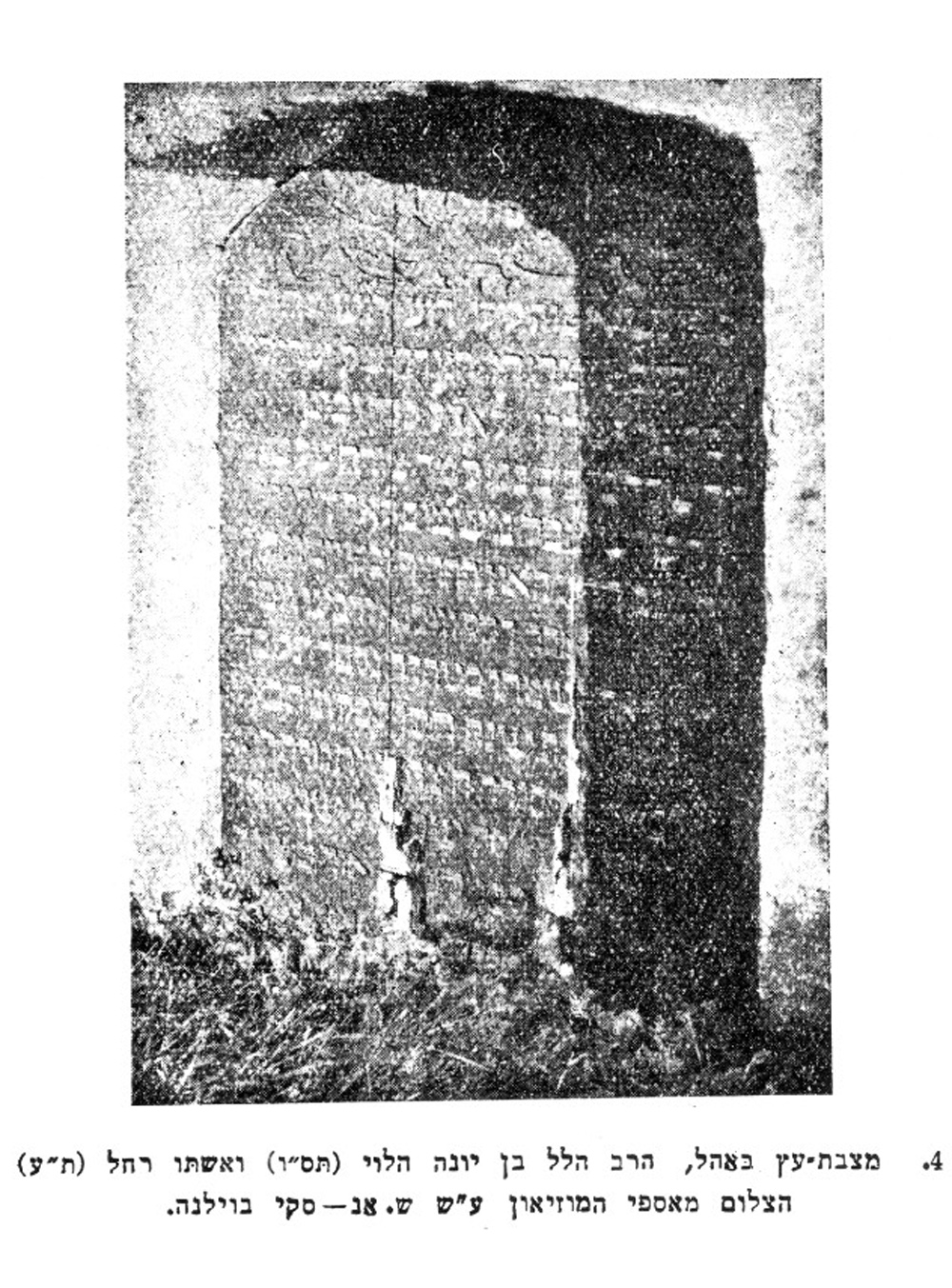
The empty frame in the third mausoleumfrom the left held a wooden tombstone that existed into the 20th century.[25] Before it was removed for repair, it was photographed in situ, and the photograph was preserved at the Ansky Museum in Vilna. The photograph was published just prior to the onset of World War II.[26] The epitaph on the tombstone commemorates the life and death of R. Hillel b. Yonah, Chief Rabbi of Vilna, and his wife Rachel (d. 1710). They were the only occupants of the third mausoleum. R. Hillel served as Chief Rabbi of Chelm prior to his appointment as Chief Rabbi of Vilna in 1688. Some of his Torah teachings are preserved in R. David b. R. Moshe’s מצודת דוד (Altona, 1736).[27] The joint epitaph reads:[28]
5. R. Moshe Darshan (d. 1726).
R. Moshe Darshan was born in Vilna in 1641. His father, R. Hillel b. Naftali Hertz, was the celebrated author of בית הלל (on Shulhan Arukh Yoeh De’ah and Even ha-Ezer), who served on the rabbinic court of R. Moshe b. Yitzchok Yehuda Lima of Vilna (author of חלקת מחוקק on Shulhan Arukh Even ha-Ezer) from 1651-1666, and later served as Chief Rabbi of Altona-Hamburg, and then Zolkiev.[29] R. Moshe was appointed ראש בית דין and דרשן of Vilna and served in that capacity until his death. His epitaph reads:[30]
6. R. Yaakov Kahana (d. 1826).[31]
R. Yaakov b. R. Avraham Kahana, a disciple of the Vilna Gaon, was the son-in-law of R. Yissakhar Ber (d. 1807), a brother of the Vilna Gaon. Supported regally by his father-in-law, R. Yaakov suddenly found himself without support upon the death of his father-in-law. The Vilna kehilla immediately appointed him trustee of its various charities, in order to provide him with a dignified income, while enabling him to continue his pursuit of Torah study. R. Yaakov authored a classic commentary on B. Eruvin, גאון יעקב (Lemberg, 1863 and later editions).[32] His epitaph reads:[33]
7. R. Eliyahu Hasid (d. 1710).
R. Eliyahu was the son of R. Moshe b. David Kramer, who served as Chief Rabbi of Vilna from 1673 to 1687.[34] R. Eliyahu served as an administrator of Vilna’s צדקה גדולה and also as a dayyan. He was a great-grandfather of the Vilna Gaon, and the Gaon was named after him.[35] The epitaph reads:[36]
8. R. Yosef b. Elyah (d. 1718).
A communal leader (ראש, אלוף, מנהיג) in Vilna about whom little else is known.[37] That he was buried in proximity to R. Eliyahu Hasid (d. 1710), and that at a later date R. Moshe Darshan (d. 1726) was buried in proximity to him, is sufficient proof of his prominence, perhaps in wisdom and certainly in wealth. His epitaph reads:[38]
————————-
B. A Visit to the Old Jewish Cemetery in 1940.
Known affectionately as “Reb Dovid,” Rabbi Meshulam Dovid Soloveitchik is currently Rosh Yeshiva of the Brisk Yeshiva in the Givat Moshe (also called: Gush Shemonim) section of Jerusalem. A descendant of R. Hayyim of Volozhin (d. 1821), and a scion of the Soloveitchik dynasty – his grandfather was R. Hayyim Soloveitchik (d. 1918), Rosh Yeshiva of Volozhin and Chief Rabbi of Brisk; and his father was R. Yitzchok Zev Soloveitchik (d. 1959), last Chief Rabbi of Brisk, and founder of the Brisk dynasty in Jerusalem) – he is a leader of the Haredi community in Israel.
A still active nonagenarian, he was born circa 1923. Upon the outbreak of World War II, he fled from Brisk and made his way to Vilna, which – largely due to the Molotov-Ribbentrop Pact of August 23, 1939, and Stalin’s subsequent decision to hand Vilna over to Lithuania – became the newly recognized capital of Independent Lithuania. Reb Dovid, a teenager at the time, resided in Vilna from October 22, 1939 through January 19, 1941, when together with his father (and other members of the family), he embarked on the arduous and dangerous journey that would bring him to the land of Israel, where the family ultimately settled.[39]
Some 15 volumes of Reb Dovid’s teachings have appeared in print, many under the title: שיעורי רבנו משולם דוד הלוי. These are transcriptions of his lectures as recorded by his students, with focus primarily on Torah and Talmud commentary. One of the volumes, however, includes a riveting account – in R. Dovid’s own words – of how he managed to survive the Holocaust. The memoir includes a brief description of a visit he made to the old Jewish cemetery in Vilna in 1940.[40] The passage reads:[41]
“When in Vilna, I went several times to visit the cemetery where the Vilna Gaon was buried, but it was closed. The gate was kept locked because burials no longer took place in the old Jewish cemetery, which was inside the city limits. Burials now took place in another cemetery [Zaretcha] which was outside the city limits.[42] Moreover, the caretaker who had the keys [to the old Jewish cemetery] lived far from the cemetery. Once, however, I came to the cemetery and found the gate open and went in to visit the Vilna Gaon’s grave. On my way to the grave, I passed an ancient tombstone with the words משיח ה’ inscribed on its epitaph.[43] I could not understand what this signified and who was buried there.[44] From there I reached the Vilna Gaon’s grave, and nearby, the grave of R. Avraham the Ger Tzedek. (At some later date, I chanced upon a pamphlet which contained a eulogy by R. Shaul Katzenellenbogen,[45] of blessed memory, over the author of Ha-Pardes.[46] In this pamphlet about the author of Ha- Pardes, it is stated that when he died a search was made in the old Jewish cemetery for a place where he could be buried. One empty plot was found, to the right of which was buried [R. Moshe Rivkes] the author of Be’er Ha-Golah, and to the left of which was buried R. Manes משיח ה’. Since no one had been buried in the empty plot next to these rabbis for some 85 years,[47] a rabbinic court was convened to decide whether the plot could be used now for the author of Ha-Pardes. The decision was that he should be buried between the two rabbis. They explained that it was a special privilege for the author of Ha-Pardes to be buried next to these righteous persons, and went on to describe the righteousness and piety of R. Manes משיח ה’. It seems likely that this was the tombstone I saw with the words משיח ה’ on its epitaph.”
This delightful account offers important testimony regarding what a living witness observed during a visit to the old Jewish cemetery in Vilna in 1940. On his way to the Vilna Gaon’s grave, R. Dovid saw a tombstone with the words משיח ה’ inscribed on its epitaph. The reference, of course, is to the grave of R. Menahem Manes Chajes (see above, epitaph 1). It is indeed nearby to the Gaon’s mausoleum, and one could easily stop to see it on the way to the Gaon’s grave. The alert reader will surely wonder why in the photograph taken in the inter-war period, which includes the epitaph of R. Menahem Manes Chajes, one cannot make out the words משיח ה’, whereas R. Dovid testifies that in 1940 it was precisely those words that caught his attention. The answer, I believe, is provided by another photograph of R. Menachem Manes Chajes’ epitaph taken in the summer of 1936.[48]
It too, at first glance, seems to have the words משיח ה’ erased. But if one examines the photograph closely, one can make out the words משיח ה’. The white paint that once covered these etched letters has been chipped off. The inter-war photograph, a “group” photograph taken from a distance, could not capture the etched letters that now appeared as black on black. The naked eye of a human being, however, could pick up the etched stone letters that read משיח ה’. So too, a close up photograph of the Chajes epitaph alone, taken in 1936.
R. Dovid adds that, subsequently, he chanced upon a pamphlet that helped him identify the epitaph he had seen. The pamphlet contained a eulogy by R. Shaul Katzenellenbogen over the author of Ha-Pardes, who apparently died in Vilna. Initially, an appropriate burial place could not be found for him in the old Jewish cemetery. But after much search, an empty plot was found between R. Manes משיח ה’ and [R. Moshe Rivkes,] the author of Be’er Ha-Golah. Since no one had been buried in proximity to these rabbis for some 85 years, a rabbinical court had to convene in order to decide the issue. The ruling was in favor of the burial, and special mention was made of the piety of R. Manes משיח ה’, which clearly identified the epitaph that R. Dovid had seen.
Sadly, I have not succeeded in locating such a pamphlet. If indeed R. Dovid saw such a pamphlet, he cannot be faulted for summarizing its content. It certainly enabled him to identify the epitaph as belonging to the tombstone of R. Menahem Manes Chajes. But problems abound. R. Shaul Katzenellenbogen (see above, epitaph 2) died in 1825. He wrote no pamphlets and published no eulogies. The author of Ha-Pardes was R. Aryeh Leib Epstein, chief Rabbi of Koenigsberg (today: Kaliningrad).[49] He died in 1775 and was buried in Koenigsberg.[50] Thus, R. Shaul Katzenellenbogen, five years old at the time, could not have published a eulogy over him. In fact, it was R. Shaul Katzenellenbogen (as described above in epitaph 2) – and not the author of Ha-Pardes – who was buried between R. Menahem Manes Chajes and R. Moshe Rivkes.
One suspects that the pamphlet R. Dovid chanced upon was R. Zvi Hirsch Katzenellenbogen’s גבעת שאול (Vilna and Grodno, 1825).
The author, a devoted disciple of R. Shaul,[51] published a eulogy upon the death of his teacher. He writes:[52]
“On the day of his [R. Shaul Katzenellenbogen’s] burial, an oracle was heard – a voice without pause[53] – that an empty plot had been found between R. Moshe Rivkes, author of Be’er Ha-Golah and the Gaon R. Manes Chajes (who was depicted on his tombstone as משיח ה’, already so in the early generations, in the year [5]386 [= 1626],[54] even aside from the seven virtues listed by the Sages that characterize all great individuals[55]). In that section of the cemetery, the gravediggers did not dare to dig a grave during the last 85 years, for they feared for their lives. For that section of the cemetery was filled with holy and pious Jews.[56] But due to an agreement of the Moreh Zedek’s of our community, they began digging and found an empty plot waiting for this righteous Rabbi’s remains since the week of Creation.
Here – and apparently in no other pamphlet – we have all the basic elements in R. Dovid’s account, with one glaring exception. Nothing is mentioned about the author of Ha-Pardes, R. Aryeh Leib Epstein. As indicated above, the author of Ha-Pardes in any event had nothing to do with a burial in Vilna. He lived at the wrong time (when empty plots were still available throughout the old Jewish cemetery) and died and was buried in the wrong place (in Koenigsberg). It is possible that we have in R. Dovid’s account a conflation of two unrelated pamphlets, each named גבעת שאול. Aside from R. Zvi Hirsch Katzenellenbogen’s גבעת שאול (cited above), a pamphlet with the exact same title, and also offering a eulogy, was authored by R. Shemariah Yosef Karelitz (d. 1917).[57]
The pamphlet, גבעת שאול (Warsaw, 1892), was a eulogy over Karelitz’ father-in-law, whose name also happened to be R. Shaul Katzenellenbogen (1828-1892), and who had served with distinction as rabbi of Kossovo and then Kobrin (both today in Belarus). This second R. Shaul Katzenellenbogen was a descendant of R. Aryeh Leib Epstein, author of Ha-Pardes. Indeed, on the first title page of Karelitz’ גבעת שאול, R. Shaul Katzenellenbogen is described in bold letters as a member of the Epstein family. On the second title page, he is described in bold letters as a descendant of “R. Aryeh Leib Epstein, author of Ha-Pardes.”
[
In sum, R. Dovid’s account provides impeccable testimony that the epitaph on the tombstone of R. Menahem Manes Chajes – the oldest tombstone preserved in the old Jewish cemetery – could still be visited and read in 1940.[58] What he claims to have read in a pamphlet at some later date remains problematic and requires further investigation or, as the later commentators would have put it, צריך עיון.
* In memory of Khaykl Lunski (ca. 1881-1943), fabled librarian of the Strashun Library, who was the embodiment of the very soul of Jewish Vilna. His last essay – a study of the faded tombstone inscriptions in Vilna’s old Jewish cemetery – was written in the Vilna Jewish ghetto created by the Nazis. It perished together with him during the Holocaust. See Shmerke Kaczerginski, חורבן ווילנע (New York, 1947), p. 198 (henceforth: Kaczerginski). Cf. Hirsz Abramowicz, Profiles of a Lost World (Detroit, 1999), p. 264.Kaczerginski’s description of Lunski’s last years in the Vilna ghetto are worth citing here:
Khaykl Lunski (ca. 1881-1943)
NOTES:
[1] Sid Z. Leiman, “Lithuanian Government Announces Construction of a $25,000,000 Convention Center in the Center of Vilna’s Oldest Jewish Cemetery,” The Seforim Blog, September 13, 2015, available online here, reprinted here. A similar photograph (from a slightly different angle) appears in Leyzer Ran, Jerusalem of Lithuania (New York, 1974), vol. 1, p. 100 (henceforth: Ran). Alas, its lack of clarity renders it mostly useless.
[2] See Israel Klausner, קורות בית-העלמין הישן בוילנה (Vilna, 1935; reissued: Jerusalem, 1972), pp. 3-5 (henceforth: Klausner). Cf. Elmantas Meilus, “The History of the Old Jewish Cemetery at Šnipiškes in the Period of the Grand Duchy of Lithuania,” Lithuanian Historical Studies 12 (2007), pp. 64-67 (henceforth: Meilus).
[3]It was originally called “Pioromont,” because the old Jewish cemetery was adjacent to a street and neighborhood named after Stanislav Pior, an 18th century starosta who owned land in the area (Meilus, p. 88).
[4] See, e.g., the testimony of Chaim Basok, who together with Rabbi Kalman Farber visited the Vilna Gaon’s grave in the old Jewish cemetery at Piramont after Vilna was liberated by the Russian army in 1944. See Kalman Farber, אולקניקי ראדין וילנא (Jerusalem, 2007), p. 413. I have personally interviewed several former residents of Vilna who visited the Gaon’s grave in the old Jewish cemetery at Piramont between 1945 and 1948.
[5]A detailed map of the cemetery, as it appeared in 1935, is appended to Klausner.
[6]For an artist’s depiction of the gate at the northern entrance to the cemetery, see Sholom Zelmanovitch, דער גר-צדק ווילנער גראף פאטאצקי (Kovno, 1934), opposite p. 44. Notice Castle Hill at the upper right hand corner of the sketch; the inscription above the gate, והקיצו לקץ הימין; and the inscriptions on the sides of the gate, בית עולם ווילנא and zydu kapines. Here is the sketch:
[7] See, e.g., Shmuel Yosef Fuenn, קריה נאמנה (Vilna, 1860), p. 63 (henceforth: Fuenn 1860). Cf. the second and revised edition of קריה נאמנה (Vilna, 1915), p. 67 (henceforth: Fuenn 1915).
[8] Yeshayahu Vinograd, אוצר ספר העברי (Jerusalem, 1994), vol. 2, p. 359, entry 65.
[9] See Moshe Dovid Chechik, “ מהר”ר מנחם מאניש חיות וספר קבלת שבת,” ישורון 17(2006), pp. 668-691.
[10]Adolf Neubauer, Catalogue of the Hebrew Manuscripts in the Bodleian Library and in the College Libraries of Oxford (Oxford, 1886), column 59, entry 293.
[11]We have attempted to transcribe the Hebrew texts exactly as they appear in the photograph. We add in brackets the reconstruction of letters and words that in all likelihood once appeared in the original texts, but were no longer visible when the photograph was taken. For other photographs of the epitaph, see Klausner, p. 36; Zalman Szyk, יאר ווילנע 1000 (Vilna, 1939), pp. 408 and 416 (henceforth: Szyk); Ran, vol. 1, p. 101 ; and Reuben Selevan, A Trip to Remember: New York to Europe 1936 (New York, 2009), p. 113. The reconstructions are based mostly on the earlier transcriptions of the epitaphs in Fuenn and Klausner.
Over the years, some of the epitaphs were redone, and the reconstructed texts are often faulty. Enlarged and/or dotted letters (signaling acrostics, names, or dates) were sometimes made small and the dots were omitted. Small letters were sometimes enlarged. Letters and words were added or dropped when a partially erased word could no longer be read. Thus, for example, the first three words of R. Menahem Manes Chajes’ epitaph (in the photograph) read: פה נטמן בו, an impossible construction in Hebrew. It is obvious that one or more words are missing from the opening line of the epitaph. It is also evident the first lines form an acrostic spelling out his name: מנחם מאנש. When the epitaphs were redone, the original line divisions were not always retained. For the letters in bold relating to the year of his death (קדרו ושמים), see below, note 54. Based upon the earlier transcriptions in Fuenn (Fuenn 1860, p. 63; Fuenn 1915, p. 67) and Klausner (pp. 36-39), and a measure of common sense, the original epitaph probably read:
[12]R. Shaul was also the brother of his father’s successor in the rabbinate of Brisk, R. Aryeh Leib (d. 1837). See Aryeh Leib Feinstein,
עיר תהלה (Warsaw, 1886), p. 30.
[13]Abraham Dov Baer ha-Kohen Lebensohn, אבל כבד (Vilna, 1825), section “תולדות הנאון,” p. 2.
[14] See ספרא דצניעותא (Vilna and Grodno,1820), page following title page.
[15] See R. Yehezkel Feivel, תולדות אדם (Dyhernfurth, 1809), vol. 2, page following title page.
[16] See R. Hayyim of Volozhin, נפש החיים (Vilna and Grodno, 1824), page following title page.
[17] Samuel Luria, “תולדות הרד”ל,” in R. David Luria, קדמות ספר הזהר (New York, 1951), pp. 12-14.
[18] See Hillel Noah Maggid Steinschneider, עיר ווילנא (Vilna, 1900), vol. 1, p. 163.
[19] See Aliza Cohen-Mushlin, Sergey Kravtsov, Vladimir Levin, Giedrė Mickūnaitė, and Jurgita Šiaučiūnaitė-Verbickienė, Synagogues in Lithuania (Vilnius, 2012), vol. 2, p. 316, item 55. Cf. Ran, vol. 1, p. 112. (The alleged photograph of R. Shaulke’s kloyz in Ran is misidentified; cf. Synagogues in Lithuania, vol. 2, p. 348, n. 248.) The address of the kloyz was Szawelska (later: Žmudskij) [Yiddish: Shavli] 5 (today: Šiauliu 2). The original building no longer stands. During the Holocaust, the kloyz continued to serve as a prayer house and it housed a Yeshiva named in memory of R. Hayyim Ozer Grodzenski (d. 1940). See Kaczerginski, p. 209; cf. Zelig Kalmanovitch, יומן בגיטו וילנה (Tel-Aviv, 1977), pp. 83 and 100 (English edition: Zelig Kalmanovitch “A Diary of the Nazi Ghetto in Vilna,” Yivo Annual of Jewish Social Science 8[1953], pp. 30 and 47).
[20]Fuenn 1860, pp. 236-238; Fuenn 1915, pp. 237-239; Klausner, p. 75.
[21]See Fuenn 1860, p. 100; Fuenn 1915, p. 107; and cf. Klausner, pp. 43-44.
[22]See, e.g. מצודת דוד, pp. 3a, 7a, and 31a.
[23] Fuenn 1860, p. 107, paragraph 50, number 11; Fuenn 1915, p. 113, paragraph 51, number 11.
[24] The text of the epitaph was not recorded either by Fuenn or Klausner. However, it is easily restored by combining the general information they provide with the legible portions of the text in the photograph.
[25]There is good reason to believe that wooden tombstones once proliferated in the old Jewish cemetery, but they did not survive the ravages of time and circumstance. See, e.g., Klausner, p. 38 (who indicates that as late as 1810 the fee exacted by the חברא קדישא for stone tombstones was twice the amount exacted for wooden tombstones) and Szyk, p. 406 (who states that the majority of tombstones in the old Jewish cemetery were made of wood but did not survive). Only two wooden tombstones (in the old Jewish cemetery) survived into the twentieth century; those of R. Hillel b. Yonah and R. Yehoshua Heschel b. Saul, who served as Chief Rabbi of Vilna from circa 1725 until his death in 1749. For photographs of R. Yehoshua Heschel’s wooden tombstone, see Klausner, p. 52; Szyk, p. 416; and Ran, vol. 1, p. 101.
[26] Klausner, p. 42. Cf. Szyk, p. 416 and Ran, vol. 1, p. 100 (mostly illegible).
[27] See, e.g., מצודת דוד, p. 27a.
[28]Fuenn 1860, pp. 97-98; Fuenn 1915, pp. 104-105.
[29] See Eduard Duckesz, אוה למושב (Krakau, 1903), pp. 4-7.
[30] Fuenn 1860, pp. 99-100; Fuenn 1915, pp. 106-107; Klausner, p. 43.
[31]Moving from left to right on the photograph, R. Yaakov Kahana’s tombstone (tombstone 6) appears to the right of R. Moshe Darshan’s tombstone (tombstone 5). But as one walks uphill from the bottom to the top of the cemetery, one passes the three mausoleums, then the twin gravestones of R. Yaakov Kahana and R. Eliyahu Hasid (tombstone 7), and only then the grave of R. Moshe Darshan.
[32]For biographical information about R. Yaakov Kahana, see Fuenn 1860, p. 239; Fuenn 1915, pp. 239-240; and the third edition of Kahana’s גאון יעקב, entitled גאון יעקב השלם (Jerusalem, 1997), introductory pages. See also Yaakov Polskin, “ספר צוף דבש,” ישורון 4(1998), p. 270, notes 7-9.
[33]Here too, the photograph presents an empty frame. Only the opening lines (i.e. the marker identifying the grave) can still be read. The original epitaph is recorded in Fuenn 1860, p 240; Fuenn 1915, pp. 240-241. Klausner (p. 53) mentions Kahana’s grave but does not record the epitaph.
[34] For biographical information about R. Moshe Kramer, see Fuenn 1860, pp. 95-96; Fuenn 1915, pp. 102-103, and the references cited in the next note.
[35] See R. Avraham b. R. Eliyahu (the Gaon’s son), סערת אליהו (Vilna, 1889), p. 18. Cf. R. Yehoshua Heschel Levin, עליות אליהו (Vilna, 1885), p. 39, note 5.
[36]The opening lines (i.e. the marker identifying the grave) are painted on the upper portion of the tombstone. The epitaph is encased below the tombstone’s upper portion. For the epitaph, see Fuenn 1860, p. 99; Fuenn 1915, pp. 105-106; and Szyk, p. 408.
[37]See Fuenn 1860, p. 107; Fuenn 1915, p. 113.
[38] Here too the opening lines represent the marker identifying the grave, almost certainly added at a later date. For the epitaph, see Klausner, p. 43.
[39]See שיעורי רבנו משולם דוד הלוי: דרוש ואגדה (Jerusalem, 2014), pp. 390-396. For the date when R. Dovid left Vilna (January 19, 1941), we have followed Shimon Yosef Meller, הרב מבריסק (Jerusalem, 2003), vol. 1, p. 513.
[40]No precise date is provided by R. Dovid for his visit to the old Jewish cemetery. But since he arrived in Vilna on October 22, 1939, and his first attempts to visit the cemetery were thwarted, we assume the visit took place in 1940, the only full year he spent in Vilna. It is possible, however, that the visit took place late in 1939 or early in 1941.
[41]שיעורי רבנו משולם דוד הלוי: דרוש ואגדה (Jerusalem, 2014), pp. 393-394. The translation provided here is paraphrastic. The original Hebrew text reads:
[42]In 1940, Jewish burials were still taking place in Zaretcha, the successor cemetery to the old Jewish cemetery, which was closed in 1831. Zaretcha (today: Užupis), just outside the Old Town, and across the Vilenka River, was part of the Vilna municipality in 1940.
[43]In the latter part of the 19th century and the first half of the 20th century, the northern gate was no longer used. One entered the old Jewish cemeteryfrom a side entrance on Derewnicka Street. The path from the entrance would lead one to the section where R. Menahem Manes Chajes was buried (on the right) and to the mausoleum where the Vilna Gaon was buried (on the left).
[44]The biblical title משיח ה’ (see, e.g., I Sam. 24:7 and Lam. 4:20), rendered “the Lord’s anointed one,” was usually reserved for kings and would-be messiahs (by their followers), not rabbis. R. Dovid could not identify the occupant of the grave, perhaps because the line with the name מהור”ר מנחם מאנש simply didn’t resonate to a 17 year old yeshiva student. One could claim that the line with R. Menahem Manes’ name was no longer legible in 1940 (as it was not legible in the inter-war photograph that forms the basis of this essay), but this seems highly unlikely in the light of the Selevan photograph taken in 1936. See below, note 48. The Selevan photograph is a close-up photo, and R. Dovid was standing directly in front of the same tombstone. He had no trouble reading poorly painted words.
[45]See discussion below.
[46]See discussion below.
[47] R. Menahem Manes Chajes died in 1636; R. Moshe Rivkes died in 1672. Eighty five years after these dates would be between 1721 and 1757. Since, as we shall see, the author of Ha-Pardes died in 1775, “85 years” cannot be referring to the time that elapsed between their deaths and his. “100 years” and more would have been a more accurate estimate. See below, note 56, for a likely explanation of the “85 years.”
[48]Reuben Selevan, A Trip to Remember: New York to Europe 1936 (New York, 2009), p. 113. I am deeply grateful to the author for granting me permission to scan and post the photograph (taken by his father in 1936) of R. Menahem Manes Chajes’ epitaph.
[49] For a biography of R. Aryeh Leib Epstein, see R. Ephraim Mordechai Epstein, גבורות ארי (Vilna, 1870). Ha-Pardes, only partially published, was an encyclopedic work encompassing many different genres of rabbinic literature. It includes talmudic commentary, listing and exposition of the 613 commandments, responsa literature, halakhic codes, kabbalistic teaching, sermons, eulogies, and more. The first fascicle with the title ספר הפרדס was published in Koenigsberg, 1759. It is a available today in several editions, including: ספרי בעל הפרדס (Bnei Brak, 1978), 2 vols.; and ספרי הפרדס (Jerusalem, 1983), 4 vols. See also מעשה רב חדש (Bnei Brak, 1980), pp. 29-80.
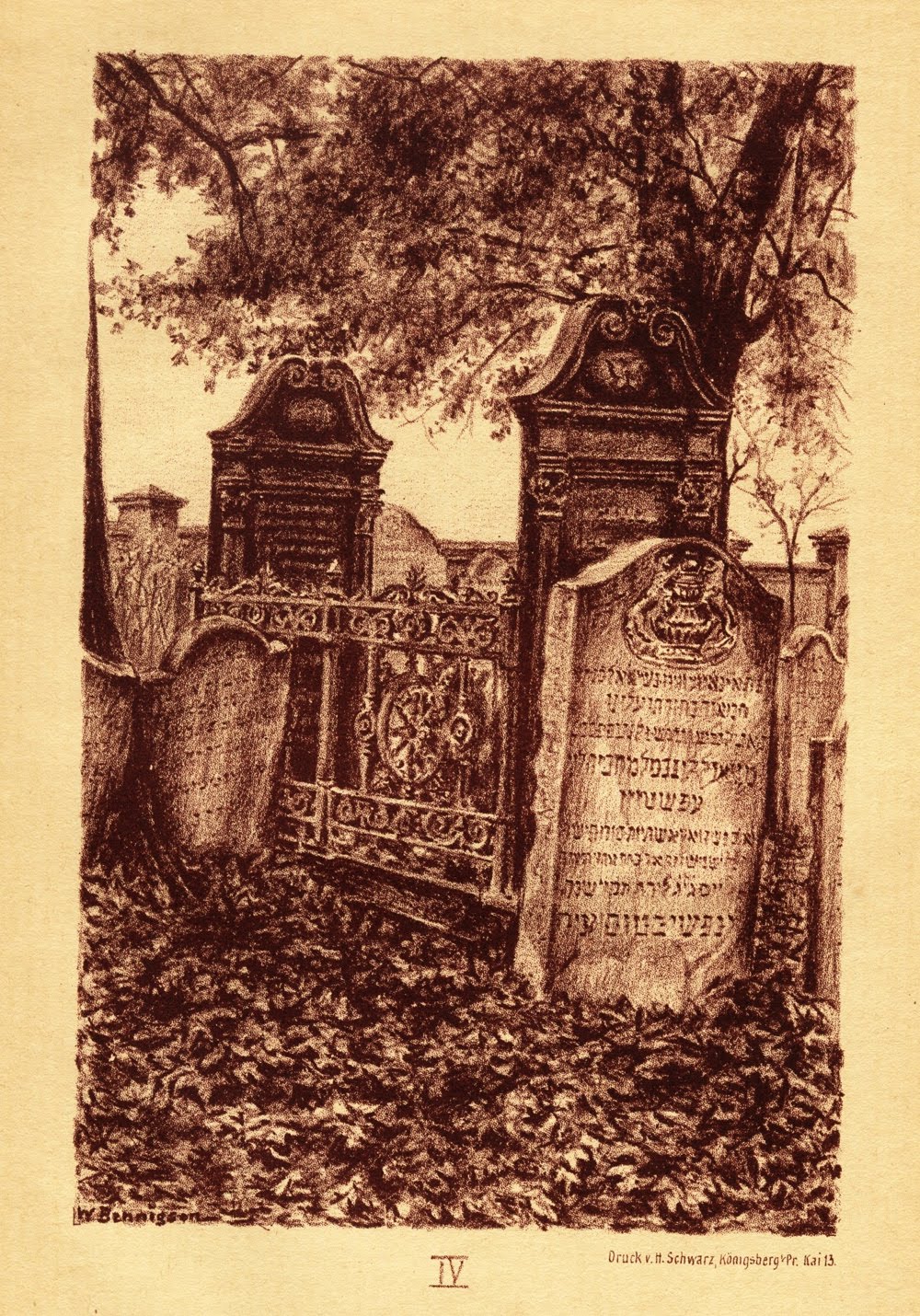
[50] His grave is no longer standing. A sketch of his grave, as it looked in 1904, appears in Festschrift zum 200jahrigen Bestehen des israelitischen Vereins für Krankenpflege und Beerdigung Chewra Kaddischa (Koenigsberg, 1904), sketch IV. The full Hebrew epitaph is printed opposite p. XX.
[51]See the entry on him in Encyclopaedia Judaica (Jerusalem, 1973), vol. 10, column 830.
[52]גבעת שאול, p. 23a. The translation here is paraphrastic. The Hebrew text reads:
[53] See Deut. 5:19 and Rashi’s comment ad loc.
[54]The year of R. Menahem Manes Chajes’ death was recorded on his epitaph with the words: קדרו ושמים. Several of these letters had protruding dots above them; the numerical value of the dotted letters yields the year of his death. At a very early period, some of the dots could no longer be read. Fuenn (1860, p. 63; 1915, p. 67) writes that he was able to make out dots above the letters ר, ו , and מ. But those letters alone could not possibly refer to his date of death. This passage indicates that in 1825, at least, the dotted letters also includedק and final ם, totaling [5]386 = 1626. On other grounds, we know that Chajes died in [5]396 = 1636, so it appears likely that the dotted letters also once included the י of ושמים. If not for Fuenn’s testimony, we would claim that the second word by itself, ושמים ( = [5]396) yields the year of Chajes’s death. Cf. Moshe Dovid Chechik (above, note 9), p. 675.
[55]See M. Avot 5:7.
[56] Given that this passage was written in 1825, “85 years” here refers to the period between 1740 and 1825. As the passage itself makes clear, the reference is to the many rabbinic greats who were buried in this section of the cemetery by 1740 – and not later. See above, epitaphs 1,3,4,5,7, and 8, all of which are samples that support the claim that after 1740 no rabbinic greats were buried in this section of the cemetery. Epitaphs 2 and 6 are in harmony with this claim. Epitaph 2 is the epitaph of R. Shaul Katzenellenbogen, the case at hand. Epitaph 6 (R. Yaakov Kahana) is dated 1826, a year after the case at hand and the publication of the passage in R. Zvi Hirsch Katzenellenbogen’s גבעת שאול.
[57] The father of R. Avraham Yeshaya Karelitz (d. 1953), author of חזון איש.
[58] I am deeply grateful to Professor Dovid Katz of Vilnius, mentor and colleague, whose astute comments have enhanced the final version of this essay.
The Illusory Portrait of R. Yom Tov Lipmann Heller: Deceptive Art and Jewish Images in Vienna
The Illusory Portrait of R. Yom Tov Lipmann Heller: Deceptive Art and Jewish Images in Vienna
By: Dan Rabinowitz
For if I am deceived, I am. for he who is not, cannot be deceived; and if I am deceived, by this same token I am.
Wolfgang Kemp after St Augustine of Hippo (Epigraph to Rembrandt Hoogstraten: Colour and Illusion)
On October 8, 2024, Vienna’s Museum of Fine Arts, the Kunsthistorisches Museum, opened the exhibit “Rembrandt – Hoogstraten Colour and Illusion.” The museum’s permanent collection features remarkable works by Rembrandt, including a self-portrait and a now-confirmed portrait of his son, Titus van Rijn. This exhibit showcased many more items from its collection and loans from other museums. The term “illusion” in the exhibition’s title primarily refers to Samuel van Hoogstraten, a student of Rembrandt, and his exceptional use of the trompe-l’oeil technique. Trompe-l’oeil, from French, “fools the eye,” is an art that typically uses architectural elements, light, and perspective to trick the viewer into seeing a three-dimensional image, even when rendered on a single plane. Hoogstraten was one of the most skilled practitioners of this technique. It remains among the canonical approaches to art. Most recently, the Metropolitan Museum of Art recently held an exhibition, “Cubism and the Trompe-l’oeil Tradition,” featuring works by Picasso and his contemporaries.
In the lead-up to the Vienna museum’s exhibit, the city’s Morris columns were adorned with posters, and large billboards were scattered throughout the city announcing the exhibit. There were three variations of these advertisements: one featuring a Rembrandt self-portrait and two “illusory” portraits, Rembrandt’s “Girl in the Window” and Hoogstraten’s “Old Man at a Window.” In Rembrandt’s painting, the girl gazes directly at the viewer, gripping the exterior window frame, with her fingers extending beyond it. Combined with Rembrandt’s unparalleled usage of light and color, the image is unsettlingly realistic, even when reproduced in books.
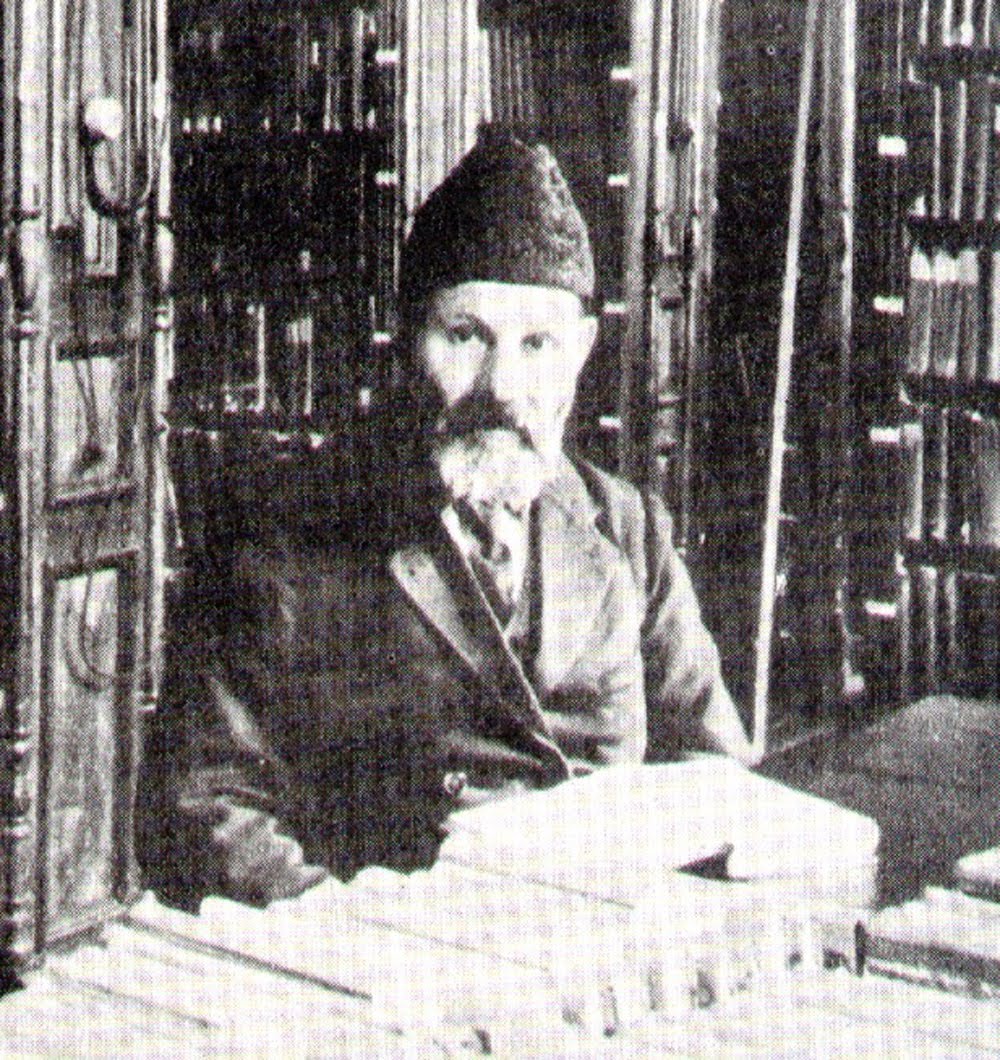
Hoogstraten’s painting, “Old Man at a Window,” depicts an old, wizened, bearded man, crowned with a round fur hat, seemingly poking his head out of the window like a gargoyle protruding from the building. While the exhibit’s advertisements are silent about the man’s identity, many Orthodox Jews might recognize him as R. Yom Tov Lipman Heller, the author of, among other works, the Tosefos Yom Tov commentary on the Mishna. Heller is associated with Vienna, having served as its Chief Rabbi in the early 17th century; however, art historians and Jewish scholars have conclusively shown the impossibility of this being an authentic representation of Heller. Nonetheless, much like the trompe l’oeil technique, the Old Man at a Window continues to deceive, and many still believe it is Heller.
Figure 1 Samuel Von Hoogstraten, Old Man at a Window, Kunsthistorisches Museum, Vienna
Rabbi Heller’s Chronicle of Imprisonment & Redemption
Rabbi Yom Tov Lipman Heller was born in 1578 in Wallerstein, a small village in Southern Germany, home to around twenty Jewish families (Davis 21). As a teenager, he married into a prominent family in Prague. His perspicacity and deep knowledge were quickly recognized, and at 19, he was appointed to serve on the Prague Beis Din, overseeing the largest Jewish community in Christian Europe (Davis 25-33). A year later, he published his first book, a somewhat unusual choice for a traditional rabbinic scholar, a commentary on the philosophical work Behinas Olam. He subsequently authored dozens of books across varied genres, completing his magnum opus, Tosefos Yom Tov in Heshvan 1616 (Davis 225-231). His identity quickly became bound up with this work, and even on the epitaph of his daughters’ headstone from 1639, he is referred to by the book and not his given name (Muneles 321). (The book’s original title is Tosefes Yom Tov, and later Tosefos Yom Tov. While some posit that this change was first documented in 1653, it already appears on the epitaph. (cf. Haberman 125n1)). He also “left ample records of himself… books, letters, archival documents, responsa, poems, prayers, sermons, commentaries, and even a memoir” (Davis 1). Nevertheless, there are no surviving portraits or other images.
Rabbi Heller spent time in Vienna on two occasions. The first, in 1625, he was induced to leave Prague for Vienna’s chief rabbi position. Despite his short tenure of only two years, he scored a significant victory for the Viennese Jewish community. Until then, it was dispersed throughout the city, and Heller secured the right for the community to reside in a single area and strengthen its ties. That cohesion was shattered in 1670 when Emperor Leopold I expelled them (one of the many expulsions Viennese Jews suffered), and the area was renamed after its extirpator, Leopoldstadt. Prague, however, drew him back, and in 1627, he took on the role of chief rabbi there.
Just two years later, some of the city’s Jewish community bristled at his involvement in tax collection, accusing him of determining tax rates unfairly. In June 1629, they denounced him to the government, which resulted in his arrest and summons to Vienna. He recounts the events in his autobiographical work, Megilas Eivah—an allusion to the first letters of the first four words of Megilas Eicha, written between 1644 and 1648. Initially placed under house arrest, he was imprisoned on the 17th of Tammuz and confined in a common jail with prisoners awaiting execution. He was denied visitors and remained isolated, “no one could speak with him, even via the window.” Two days later, following appeals from the Jewish community, he was transferred to a special prison and granted visitation rights. After forty days, the community agreed to pay a substantial fine, and he was released, almost immediately departing for Prague, never to return to Vienna. By 1643, he arrived in Krakow, where he served as chief Rabbi until his death in 1654.
Megilas Eivah circulated in various manuscripts but was published only in 1836 (Davis 228 n31). While its authenticity is beyond doubt, the additional section that first appeared in the Hebrew 1880 edition is considered a forgery. Allegedly written by Heller’s son Samuel, it “has a quality reminiscent of Dumas and The Three Musketeers: [Heller] saves a young woman from a bull, and her husband, the French ambassador, intercedes on behalf of Rabbi Yom-Tov.” In 1905, “Moritz Steinschneider identified the source as based on a short story written by Ludwig Philippson (1811‒89), a rabbi and journalist, and the author of a series of Jewish historical novelettes and stories for young readers” (Davis 146 n36).
Samuel van Hoogstraten, Master of Illusion
Samuel van Hoogstraten was born in Dordrecht, one of the oldest cities in the Netherlands, on August 2, 1627. He was the eldest child of the artist Dirk van Hoogstraten and Maeiken de Coninck. Samuel started his art studies with his father, continuing until his father passed away in 1640. Around 1642, Samuel moved to Amsterdam and began studying under Rembrandt. He rapidly proved himself to be a standout student, leading classes, reviewing his classmates’ work, and so effectively absorbing his teachers’ lessons, that some of his works were mistakenly attributed to Rembrandt (Brusati 16-31). As part of the preparation for the current exhibit, “Young Woman at an Open Half-Door” (1645) has been reassigned to Hoogstraten (Illes; Van Sloten 125).
In 1651, Samuel traveled to Vienna, the epicenter of power and prestige within the Hapsburg Empire, seeking to enhance his reputation and standing among elite society. He succeeded almost immediately. Samuel’s student, Arnold Houbraken, recounted how, on August 6, 1651, Samuel presented three of his paintings to the emperor. The first two were well received, but “the third piece,” in the trompe l’oeil style, was a still life that captivated the Emperor, who appeared to be completely taken by it. He looked at it for a long time and, finding himself still deceived, said, ‘This is the first painter who has deceived me.’ And he went on to say that he would not get the picture back as a punishment for that deception, for the Emperor wished to keep it forever.” (Houbraken 2:157-58). However, Samuel did not leave empty-handed. The Emperor awarded him an imperial medallion and a gold chain, which he took immense pride in; this would become a standard element in his subsequent self-portraits and among the items he viewed as symbolic of successful artists (Hoogstraten 371-72; Brusati 54).
Hoogstraten broadly characterized art as a form of deception. In his magnum opus on the theory of painting and color, Inleyding tot de hooge schoole der schilderkonst: anders de zichtbaere werelt (Introduction to the Academy of Painting; or, The Visible World), he describes what he considers the “perfect painting.” It “is like a mirror of nature; it makes things that are not there appear to exist and deceives in a permissible, pleasurable, and praiseworthy way” (Hoogstraten 79). One way to achieve this effect is by combining architectural elements such as open doors or windows and adding “some figures” to the composition, “by which many have been artfully deceived” (Hoogstraten 304). He takes pride in having accomplished this with his paintings completed in Vienna. One is “Old Man at a Window,” painted in 1653. (Brusati 65).
The Religious Conversion and Reversion of the Old Man at a Window
The earliest catalogs describing the painting Old Man at a Window do not mention the man’s religious affiliation. It was not until the 19th century that two scholars suggested a Jewish connection, and even then, there was no mention of Heller. Nonetheless, this association never gained traction, and the painting continued to be described without any reference to Jews. We must wait until the 1950s for Heller’s connection to emerge. However, that link lacked any supporting evidence, leaving us in the dark about what prompted the change from an Old Man to Heller. Even that association was quickly dismissed due to the significant gap between when Heller was imprisoned and when Hoogstraten painted Old Man at a Window.
The 1653 painting is one of the first works by Hoogstraten that Emperor Charles II acquired for his castle in Prague, possibly commissioned specifically for him. The painting is described in detail in an early catalog:
No. 4. By Samuel van Hoogstraten. A lifelike, grey-bearded old man looks out of a window. His fur hat, the furrows on his face from his age, and his grey beard are so well painted that one believes one can see nature itself in each one. Hoogstraten, who did not only paint as a mere colorist, showed his deep insight into the subject and reflected light in the chiaroscuro and the deep and penetrating shadows. Just look at the head . . ., and you will find that in it, the master’s hand, which . . . expresses itself quite magnificently. The lead on the round window pane, the wooden frame, that is the glass frame, is also very well painted, but the window’s stone frame makes you believe entirely that it is the work of a mason, almost as if you can see the mason’s hand on it. The straw stalk lying on the window stone, the feather, and the bottle standing there are no less well-painted and serve to prove the excellence of the whole. This picture is painted on canvas, 3 feet 6 inches high, 2 feet and 9 inches wide. The head is life-size. The artist has engraved his monogram and the year 1653 on the window stone of this painting” (Rigler 163-164).
During the 17th century, two inventories were created for the collection. In both, the painting is described as “a man sticking his head out of the window through the shutter,” without any reference to the man’s religious affiliation or any connection to Rabbi Heller (Köpl clvnn330; Brusati 361n76). Hoogstraten’s Old Man at a Window was relocated to Vienna after the Habsburgs acquired the Belvedere Palace in the 1730s. The Palace is perhaps best known today for Gustav Klimt’s “The Kiss” and other notable Viennese Expressionists. In one of the earliest catalogs of the Belvedere by Christian van Mechel from 1783, the subject is referred to simply as a “grey-bearded man with a round fur hat on his head, looking out curiously from a window” (Mechel 84n4). That is how the description remained, unadorned with any religious identity until the 19th century.
In the 19th century, two descriptions of the Old Man at a Window added his religion: he was a Jew. In 1839, German art historian Georg Rathgeber, in his study of Netherlandish art, asserts that “this picture’s title is “Böhmischen Juden,” “Bohemian Jew.’” Rathgeber disputes the identification not for its lack of historicity but because “the character of the facial features does not seem to correspond very well to” his antisemitic views on Jewish physiognomy (Rathgeber 147). Similarly, in 1861, French art critic Charles Blanc, in his encyclopedic work Histoire des Peintres de Toutes les Écoles, asserts that the Belvedere catalog now refers to the painting as “Un vieux juif (dit le Catalogue)” or “an old Jew (as it appears in the Catalog)” (Blanc 4). This portrait impressed Blanc and is among the few he reproduced in his discussion of Hoogstraten (Blanc 1). However, Blanc is notorious for identifying Jews in Rembrandt’s and his school’s works without any supporting evidence (Knotter and Schwartz 7-9). Contrary to the “catalog’s identification,” Blanc, like Rathgeber, asserts that the face “is not Israelite” (Blanc 2). Neither Blanc nor Rathgeber mentions Rabbi Heller.
Figure 2 Charles Blanc, Histoire des Peintres de Toutes les Écoles
Blanc’s and Rathgeber’s Jewish association did not take hold. For example, G.H. Veth, in his 1889 article discussing artists from Dordrecht, including Hoogstraten, cites Blanc and notes his reproduction of Old Man. However, Veth describes it without mentioning any Jewish connections (Veth 145). Similarly, a 1903 tour guidebook of Vienna confirms that at the Belvedere, the painting’s title remains unchanged as “Old Man at a Window” (Baedeker 73; cf. Gerson, 282).
Despite the absence of objective evidence and the dismissal of Blanc’s and Rathgeber’s 19th-century Semitic connection, one scholar in the 1950s cryptically associated Rabbi Heller with Hoogstraten’s painting. Margarethe Poch-Kalous, the head of the Academy of Fine Arts in Vienna (Akademie der bildenden Künste in Wien), in her 1959 survey of Dutch art in Vienna, refers to the figure as “ein bärtiger alter Mann (Rabbi Heller),” “a bearded old man (Rabbi Heller)” (Poch-Kalous 198). The basis for her identification is opaque. Poch-Kalous’ two citations offer no support; neither mentions Heller nor suggests that the figure is even Jewish, nor does she reference Blanc or Rathgeber (Poch-Kalous 198 citing Engerth 207n928 and Köpl clvnn330).
Oddly, unlike other personalities, artists, and subjects discussed in her article, which consistently include personal names and birth and death dates, Poch-Kalous provides nothing beyond “Rabbi Heller.” This is especially puzzling for an article in the Jahrbuch der Kunsthistorische Sammlungen, whose readership is unlikely to be sufficiently familiar with the history of 17th-century Bohemian rabbis to provide the missing details.
Whatever the basis for Poch-Kalous’s connection between Hoogstraten’s painting and Heller, it was swiftly dismissed. In 1972, Klaus Demus, the art historian and curator at the Kunsthistorisches Museum, demonstrated that it was impossible for Heller to be the model. He explains that Heller was imprisoned in 1629, and by 1644, he was serving as a rabbi in Krakow, where he remained until his death in 1654. Hoogstraten, who was only two years old when Heller was imprisoned in Vienna, painted Old Man at a Window in 1653, long after Heller had left Vienna (Demus 47-48). Today, the Kunsthistorisches Museum’s website alludes to Poch-Kalous’ attribution and rejection: “According to a tradition that is now presumed to be mistaken, the man is Rabbi Yom Tov Lipmann Heller.” Hoogstraten’s “deception” and “illusion” did not extend to rendering persons he never saw.
Illustrious Jews and Illusionary Jewish Sources
Jewish sources similarly are not more persuasive in linking Heller to Hoogstraten’s painting. Generally, rabbinic portraits prior to the 19th century lack authenticity (Cohen), and Heller is no exception. Most of the few early verifiable images exist as frontispieces in books rather than as paintings, and none depict Eastern European rabbis. Heller’s image first appears in Jewish sources in the early twentieth century. It depicts an old man, yet he is completely different from Hoogstraten’s version. The first instance of Heller masquerading as the Old Man at a Window is over a decade after Demus debunks that theory!
Figure 3 Bader, Drasig Doyres, 175
The first Jewish source of an alleged portrait of Rabbi Heller appears in a Yiddish collection of stories and hagiographies of rabbis in Gerson Bader’s Drasig Doyres Yiden in Poylen, published in 1927 (Bader 175). Bader’s depiction of Rabbi Heller does not resemble the individual shown in Hoogstraten. Bader claims that his source is an “old drawing,” yet he does not provide any further details, such as where or when it was published.
Bader’s book features other alleged rabbinic images from “old drawings” that are demonstratably false. For example, Bader’s portrait of R. Aaron Shmuel Kaidanover, author of the Birkas ha-Zevach on Kodshim, is of the Karaite and forger Avraham Firkovich (1787-1875) (Bader 185). It is undoubtedly Firkovich, as it appears in his Avnei Zikaron, published in 1872, during his lifetime. Similarly, Bader misattributes Joseph Delmedigo’s (1591-1655) portrait from the frontispiece of his Sefer Elim (Amsterdam, 1629), and the photo of R. Shmuel Salant by Zadok Bassan, assigning them to alternative rabbinic figures (Bader 204, 321). Nonetheless, Bader’s depiction of Heller was often reproduced, to the extent that in a 2000 biography of Heller, it is referred to as “iyur amimi nafuts shel ha-Tosefos Yom Tov,” “the widespread folk image of the Tosefos Yom Tov” (Herskovics 32).
Figure 4 Bader, Drasig Doyres Yiden in Poylen, 175.
Figure 5 Firkovich, Avnei Zikhron, From the Gross Family Collection, The Center for Jewish Art
It was only in 1984 that a Jewish source connected the Hoogstraten painting to Rabbi Heller. The cover of the book The Feast and the Fast: The Dramatic Personal Story of Yom Tov Lipman Heller, a translation of Megilas Eivah, depicts Rabbi Heller in prison and is modeled on the figure in the Hoogstraten painting. To eliminate any doubt about the source of the cover art, the back of the book features reproductions of title pages from Heller’s works and his gravestone, along with a photo “of the drawing in the Kunsthistorisches Museum in Vienna, Austria, entitled ‘Man at the Window’ (1653) by Samuel Van Hoogstraten (1627-1678)” (Lipschitz and Rosenstein). A similar image was used for the cover illustration of another translation of Megilas Eivah published in 1991 (Heller). The English section of the 2000 biography of Heller reproduces the cover of The Feast and the Fast, describing it as “featuring a picture of the Tosefot Yom Tov” (Herskovics 101). However, it does not attempt to reconcile this image with the clearly different “widespread folk image” presented in the Hebrew section of the biography. Although not mentioned in any of these sources, they were presumably misled by the bars on the window. However, those are not prison bars; rather, as was common in that era, the windows were supported by these architectural elements (Hermans 249).
Figure 6 Cover, Feast and the Fast, 1984
By 1999, however, Jewish sources also recognized the impossibility of associating Heller with the painting. R Ya’akov Yeruchum Wreschner republished Megilas Eivah based on four editions and two manuscripts and includes a comprehensive introduction regarding Heller. In two footnotes within the introduction, Wreschner briefly addresses Heller’s connection, or lack thereof, to Old Man at a Window. Like Demas, Wreschner contends that the nearly twenty-five-year gap between Heller’s departure from Vienna and Hoogstraten’s painting of Old Man renders it impossible for Heller to have been the model. Wreschner asks rhetorically, how could Hoogstraten “paint Rabbenu [Heller] when he never set eyes on him?” (Wreschner Megilas 48n3). Wreschner also contacted the Kunsthistorisches Museum and received a response confirming that “not only is it not the Rabbi, but it is not even a Jew” (Wreschner Megilas 17n4). As a result, Wreschner refused to reproduce that portrait in his book. Similarly, despite being titled Portrait of a Seventeenth-Century Rabbi, the most recent academic biography of Heller by Joseph Davis includes neither the Hoogstraten portrait nor any other image of Heller (Davis).
In 2024, Wreschner published a significantly revised and retitled edition of his book. Despite discrediting Heller’s connection to the painting over twenty years ago, various Jewish books, newspapers, and other ephemera continue to publish Old Man at a Window and link it to Heller (e.g., Alfasi 137; Stern 184-86; Berman). Wreschner was, therefore, compelled to revisit the painting, presenting additional arguments and greater detail regarding his discussions with the Kunsthistorisches Museum.
Wreschner, in 1999, first spoke telephonically with the Director of the Kunsthistorisches Museum, Dr. Karl Schütz, who confirmed that the painting was not connected to Heller. Schütz followed up with a letter detailing the sources for his rejection. Schütz stated that, with one exception, from the earliest catalogs to contemporary analyses of the painting, it was never associated with any specific individual, Jewish or otherwise. This is consistent with Hoogstraten’s intent, showcasing the trompe l’oeil technique rather than portraiture. The only time it appears – in Demus’s “detailed catalog of Dutch painters from 1972”—is solely to repudiate Poch-Kalous’s chronologically impossible and otherwise undocumented connection to Heller. Schütz also discredited the claim that following the Anschluss, the painting was categorized as Jewish art and consigned to the museum’s basement. On the contrary, a coterminous catalog lists the painting among those on display.
Despite Wreschner’s certitude about Schütz’s rejection, for unclear reasons, Wreschner attributes an otherwise unrecorded episode to Schütz. This alleged event appears to offer some support for linking Heller to the painting, but it is completely absent from the letter. According to Wreschner, the letter references an event in 1972 when an unidentified Jew approached the museum and claimed there was “a tradition that it was Tosefos Yom Tov” (Wreschner 2024, 24-26). The museum expressed skepticism about that tradition but did not completely dismiss it. In Wreschner’s retelling, it suggested the possibility that “a Jew conjured up Heller’s image and Hoogstraten copied it.” The actual text of the letter directly contradicts Wreschner’s account. Schütz references 1972 not as the date of an important meeting that supports the “legend” but as the first substantial discussion – by Demus – and his definitive rebuttal without mentioning a meeting with the Jew.
Beyond Schütz’s letter, Wreschner adds internal reasons why the painting cannot depict Heller in jail. The window is large enough for the man to stick his head out and features high-quality glass, an uncommon design for a prison. Furthermore, the expensive fur hat worn by the Man at a Window is an unlikely accessory in a prison housing hardened criminals sentenced to death and an incongruous headpiece for the July heat when Heller was imprisoned. Wreschner could have included another element in the painting that contrasts with a prison – the wall behind the Old Man has patterned wallpaper.
Following his earlier edition, Wreschner learned of an earlier source linking Heller to the painting, which is summarily dismissed. R. Shimon Fuerst, who lived in Vienna before 1940, in his book, Shem mi-Shimon, published in 1967, recalls visiting the museum where he saw firsthand “the painting made during the imprisonment” (Fuerst 426). Wreschner is unmoved by Fuerst’s identification. First, Fuerst was not an expert on Heller. Fuerst writes that Heller left Vienna to assume the Chief Rabbi position in Krakow, which is false. After his release, Heller returned to Prague, only leaving for Krakow fifteen years later. Aside from this obvious mistake, Fuerst’s opinion is irrelevant. Wreschner does not dispute Fuerst’s rabbinic bona fides, yet he is not an art historian. When faced with questions of rabbinic law, we defer to rabbis, but, according to Wreschner, “when it comes to questions of attribution of art, we look to experts in that field” (Wreschner 2024, 26). Regardless of the reliability of Fuerst’s claim, the mystery of Poche-Kalous’ source remains unsolved as her work predates Fuerst’s by four years.
Going Once, Twice, Three Times – Sold!
The identification of Heller with the Old Man at a Window is not the first, nor likely the last portrait erroneously attributed to a well-known Jew. One such example is the “traditional” portrait of the founder of the Hassidic movement, R Yisrael Ba’al Shem Tov. This portrait depicts a Ba’al Shem, a Wonderworker, but not Yisrael; rather, it is of Ya’akov Falk of London (Oron). He was an alchemist and an eccentric, and according to R Ya’akov Emden, a crypto-Sabbatian. However, evidence does not always prevail. Books and numerous sukkah decorations continue to utilize this portrait.
There is even another Hoogstraten portrait that falls into this category. A 1670 Hoogstraten portrait now in the Jewish Museum in New York was previously associated with Baruch (Bento, Benedictus) Spinoza. This is just one of many alleged portraits of Spinoza. Yet, most, if not all, lack independent verification or directly contradict the existing evidence (Ekkart). Indeed, “It is the same with the portraits as with so many other aspects of Spinoza’s life: little can be said with any certainty” (qtd. in Ekkart 25). This portrait was first linked to Spinoza in 1929, partly based on “a slip of paper on the back bearing the scholar’s name” (Ekkart 5). It is unclear who made that determination or even when the paper was inserted into the back of the painting. Consequently, the Jewish Museum now describes the painting as “Portrait of a Man (previously thought to be Baruch Spinoza).”
Similarly, despite art historians and Jewish sources resoundingly rejecting Heller’s connection to the Old Man at a Window, it seems unlikely that the idea of Hoogstraten depicting Heller will be dislodged in the collective Jewish consciousness. The attribution is so deeply ingrained that someone spent a staggering $120,000 before fees on a late 19th-century reproduction of Hoogstraten’s painting.
Figure 7 Lot 318, Kestenbaum Auctions, March 12, 2014
In 2014, the American Judaica auction house Kestenbaum & Company listed an 1887 painting described as “Yom Tov Lipman Heller, Portrait: Imprisoned in Vienna,” with a $12,000-$18,000 estimate. The portrait also served as the front cover image of the catalog. It is described as “the celebrated portrait of the Tosefos Yom Tov” and claims that Hoogstraten “painted Rabbi Heller in 1653 and entitled it ‘Old Man in the Window.’” The catalog warns that “it is not known if van Hoogstraten ever met or saw [Heller]; however, it is likely that he was aware of the Rembrandt (School) painting of 1643 entitled ‘Portrait of an Old Jew’ (today in the National Gallery of Denmark) – where a similar, bearded Jewish man, with head cocked, looks emotively at the viewer.” Scholars acknowledge that elements of Man at a Window and other Hoogstraten paintings evoke “the face studies of costumed figures routinely produced in Rembrandt’s studio,” but this does not transform the man into a Jew, let alone Rabbi Heller. The Jewish identification of the painting in the National Gallery of Denmark is also of questionable relevance. Some aspects of that painting, most notably the chain around the man’s neck, make it highly unlikely that it depicts a Jew (Alexander-Knotter 80-81). The catalog’s only citation for attributing the subject to Heller is the 1984 book, The Fast and the Feast, mentioned earlier. It does not reference Demus’ or Wreschner’s discussions that challenge that attribution.
The significance assigned to the artistic rendition of the original is also debatable. The 1887 reproduction bears the signature of the artist “Paul Krüger.” However, Krüger was not a recognized artist; instead, it was a commercial reproduction company in Vienna that commonly attached its labels to the works. Its full name is “Paul Krüger Atelier für Porträtmalerei in Wien” (Paul Krüger Studio for Portrait Painting in Vienna). The studio functioned in the late 19th century and reproduced numerous paintings from the Kunsthistorisches Museum. Today, for those wanting to display a similar commercial reproduction of the painting on their wall, it is available through many websites that specialize in creating highly accurate copies of famous artworks. One such site offers a hand-painted version, almost the exact size of the original, with a similar frame, for about $1,400.
If the buyer had waited a year, they could have acquired an earlier reproduction by a recognized and significant artist. On May 18, 2015, Ferdinand Waldmüller’s (1793-1865) painting “Old Man at the Window,” modeled after Hoogstraten and executed in 1819, was auctioned with an estimate of €22,400 to €28,000. Unlike Krüger’s shop, which served as a commercial entity, Waldmüller is regarded as one of “the most important Austrian painters of the Biedermeier period.” Nevertheless, the lot remained unsold.
The Krüger copy may not be the best reproduction, but the auction catalog description proved worthwhile for reproduction. Rabbi Moshe Bamberger is the author of a series of books on “Great Jewish” items published by Artscroll. One book focuses on letters, another on important Jewish books, and another titled Great Jewish Treasures, is “A Collection of Precious Judaica, Associated with Torah Leaders.” This work contains a chapter dedicated to “Artwork” that discusses some well-known examples of rabbinic images. He ably covers several of these topics and discusses the traditional portrayal of Yisrael Ba’al Shem Tov, accurately aligning it with London’s Ba’al Shem, Jacob Falk.
Bamberger also includes a section focused on the “famous depiction of Rabbi Yom Tov Lipmann Heller (1579-1654) peering through the window of his prison cell” and reproduces a version of the Hoogstraten painting. Bamberger tries to reconcile the inconsistency between the dates of imprisonment and the time when Hoogstraten painted Old Man. Bamberger’s source is the auction catalog, yet he seems to disagree with one item: which of Rembrandt’s “Jews” Hoogstraten supposedly used as a model for Heller. Rather than the 1643 “Portrait of an Old Jew” attributed to Rembrandt’s school and currently housed in the National Gallery of Denmark; according to Bamberger, the model was the subject of a painting by Rembrandt, also titled “Portrait of an Old Jew,” now held in the Hermitage Museum in Leningrad. Bamberger does not provide a rationale for selecting the Hermitage painting over the one in the National Gallery. Nevertheless, the Hermitage painting is equally unlikely to depict a Jew and is now referred to generically as “Man in an Armchair.” (Schwartz 371-373). Ironically, Bamberger’s use of the Hermitage painting only reinforces the unlikelihood that Heller served as a model for Hoogstraten. The Hermitage Rembrandt originates from 1654, one year after “Old Man in a Window.” Hoogstraten certainly did not use a nonexistent painting to model his artistic expression.
Whether we will ever fully explicate to our satisfaction the enigmatic history of Hoogstraten’s 1653 painting Old Man at a Window, Hoogstraten’s masterful execution of the Trompe l’oeil technique makes the painting worth seeking out on its own. The exhibition closed in Vienna on January 12, 2025, but relocated to Rembrandt House in Amsterdam, “The Illusionist. Samuel van Hoogstraten,” from February 1 to May 4, 2025. The Amsterdam exhibition is entirely dedicated to Hoogstraten. To accompany the Vienna exhibit, the Kunsthistorisches Museum published a collection of articles titled Rembrandt Hoogstraten: Colour and Illusion, edited by Dr. Sabine Pénot, the Curator of Netherlandish and Dutch Paintings at the museum. This book is of excellent quality, beautifully reproducing many of the exhibit’s paintings and etchings. One article is a detailed study of Hoogstraten’s process and technique in Old Man at a Window (Hermens). While it employs various infrared and other technologies to uncover what lies beneath the surface, no rabbi is lurking behind the layers of paint.
* I want to thank Dr. Shnayer Leiman for bringing to my attention Gershom Bader as the earliest source of Heller’s representation within Jewish sources. I also wish to thank Professor Marc Michael Epstein, Professor Marc Shapiro, Dr. Lara Lempertienė, and Menachem Butler for their thorough review of the draft and invaluable feedback, Dr. Sabine Pénot for scouring the Kunsthistorisches Museum’s collection for information regarding Heller’s link to the painting, and Shaul Seidler-Feller for his expertise in translating Yiddish. Additionally, I am grateful to Rabbi Yaakov Yeruchum Wreschner for sharing his correspondence with the Kunsthistorisches Museum, and, as always, Eliezer Brodt, whose enviable encyclopedic knowledge, which he freely shares, ensured I did not overlook crucial materials.
Sources:
Alexander-Knotter, Mirjam, et al. The ‘Jewish’ Rembrandt, The Myth Unraveled. Waanders Publishers/Jewish Historical Museum, [2006].
Bader, Gershom. Drasyig Doyres Yiden in Poylen. Oriom Press, 1927.
Bamberger, Moshe. Great Jewish Treasures. Artscroll, 2015.
Blanc, Charles. Histoire des Peintres de Toutes les Écoles, vol. 2, “Samuel van Hoogstraten”. Paris, 1861.
Brusati, Celeste. Artifice and Illusion: The Art and Writing of Samuel Van Hoogstraten. University of Chicago Press, 1995.
Cohen, Richard I. Jewish Icons: Art and Society in Modern Europe. California UP, 1998.
Davis, Joseph M. Yom-Tov Lipmann Heller: Portrait of a Seventeenth-Century Rabbi. Littman Library of Civilization, 2004.
Demus, Klaus. Friderike. Katalog der Gemäldegalerie: Holländische Meister des 15., 16., und 17. Jahrhunderts. Kunsthistorisches Museum, 1972.
Ekkart, Rudi. Spinoza in Beeld: Het onbekende gezicht/Spinoza in Portrait: The Unknown Face. Amsterdam Vereniging het Spinozahuis, 1999.
Engerth, Eduard van. Gemälde Beschreibendes Verzeirchness, vol. 2. 1884.
Gerson, Horst. Ausbreitung und Nachwirkung der holländischen Malerei des 17. Jahrhunderts. De erven F. Bohn n. v, 1942.
Haberman, A.M. “Piyutav ve-shirav shel R. Yom Tov Lipman Heller.” Le-Kovod Yom Tov, edited by Judah Leib Maimon. Mosad HaRav Kook, 1956, pp. 125-145.
Heller, Yom Tov Lipmann. A Chronicle of Hardship and Hope. Translated by Avraham Yaakov Finkel, C.I.S. Publishers, 1991.
Hermens, Erma, et al. “Samuel van Hoogstraten’s Illusionistic Paintings for Emperor Ferdinand III – Two Case Studies.” Rembrandt Hoogstraten: Colour and Illusion, edited by Sabine Pénot. Hannibal, 2025, pp. 232-51.
Herskovics, Mayer. Two Guardians of the Faith: The History and Distinguished Lineage of Rabbi Yom Tov Lipman Heller and Rabbi Areyeh Leib Heller. Graphit Press, 2000.
Hoogstraten, Samuel Van. Introduction to the Academy of Painting; or, The Visible World. Edited by Celeste Brusati and Translation by Jaap Jacobs. Getty Research Institute, 2021.
Illes, Angelina. “List of Works.” Rembrandt Hoogstraten: Colour and Illusion, edited by Sabine Pénot. Hannibal, 2025, 258.
Knotter, Mirjam, and Gary Schwartz, editors. Rembrandt Seen Through Jewish Eyes: The Artist’s Meaning to Jews from His Time to Ours. Amsterdam UP, 2024.
Lipschitz Chaim Uri, and Neil Rosenstein, The Feast and the Fast: The Dramatic Personal Story of Yom Tov Lipman Heller. Moriah, 1984.
Mechel, Christian van. Verzeichniß der Gemälde der Kaiserlich Königlichen Bilder-Gallerie in Wien, Vienna, 1783.
Oron, Michal. Rabbi, Mystic, or Imposter. Translated by Edward Levin. Littman Library of Jewish Civilization, 2020.
Poch-Kalous, Margarethe. “Das Legat Wolfgang van Wurzbach-Tannenberg an die Gemäldegalerie der Akademie der bildenden Künste in Wien,” in Jahrbuch der kunsthistorischen Sammlungen in Wien vol. 55, 1959.
Rathgerber, Georg. Annalen der Niederländischen Malerei und Kupferstecherkunst: Van Rubens Abreise nach Italien bis auf Rembrandt’s Tod. Gotha, 1839.
Rigler, Hieronumus. “Beschreibung und Beurtheilung verschiedener Gemälde der S.S. Bildergalerie in Belvedere van Hieronymus Rigler aus dessen 1783 herausgegebenen, ausser Wien wenig bekannten und bereits geendigten mächentlichen Anzeigen van Künstlern und Kunstsachen,”in Miscellaneen artistischen Innhalts, 21, 1784, pp. 158-177.
Van Sloten, Leonore and David de Witt. “Challenged by Rembrandt,” in Samuel van Hoogstraten, The Illusionist. Edited by Nathalie Maciesza and Epco Runia. WBOOKS, 2025.
Wreschner, J. Megilat Eivah le-Ba’al Ha-TY”T. [], Jerusalem, 1999.
Wreschner, J. Ha-Tosefos Yom Tov u-Megilaso. [], Beni Brak, 2024.
Appendix:
Hoogstraten’s painting was copied and reinterpreted multiple times, with variations in style and even gender. (See Brusati 361, which discusses two copies in royal collections.)
A few more examples:
A more compact version with a whiter and shaped bear is attributed to a Dutch painter of Hoogstraten’s school and possibly one of the versions mentioned by Brusati.
Described as 18th Century Flemish School, without identification of a specific artist, sold for CHF 800.
Two versions: a man that is a crude likeness of Old Man in a Window and a woman wearing a linen cap sold for $2,000.
An alternative version of a woman was painted by Josef Hauzinger, (1726-1787), currently at the Pushkin Museum in Moscow. A later version of this rendering appeared at auction in 2022.
If someone were to ask you of an instance where a rabbi was declared the messiah by his followers, the first example that would probably come to mind is the last Lubavitcher Rebbe, R’ Menachem Mendel Schneersohn, who to this very day many of his chasidim regard as the Messiah, despite his death. Many people would struggle to point to any other similar times in history, besides for the Shabbethai Tzvi affair and his various successors[1], where someone was thought of as the Jewish Messiah. However, throughout the past few hundred years, there have been a handful of rabbis who have been explicitly or implicitly declared the messiah, suggested it, or have been accused of suggesting it.
Messiahship was a chasidic and mystical phenomenon, with chasidic rebbes; R’ Yisrael Ba’al Shem Tov[2], R’ David of Tulna[3], R’ Yisrael of Ruzhin[4], R’ Nachman of Breslov[5], R’ Yitzchak Isaac Safrin of Komarna[6], R’ David Moshe of Chortkov[7], and mystics; R’ Chaim Vital[8], R’ Chaim ibn Attar[9], R’ Moshe Chaim Luzzato[10], Shukar Kuchayil I[11], and Shukar Kuchayil II[12], and more recently Yisrael Dov Odesser[13], all being labeled one way or another as the Messiah[14]. Despite the characterization of these individuals as the Messiah, most lived on without any scandal associated with the eschatological attribution. There is one instance however, which unfortunately did cause a great uproar. I refer to you the case of R’ Menachem Mendel Hagar, the scion of the Vizhnitz chasidic dynasty, and the Transylvanian town of Borşa.
Borşa was a mountain village located in Northern Transylvania, in the Maramureș region of Romania. In 1830 it had a Jewish population of 250, rising to 1,432 in 1890. Most of the people in Borşa were chasidim of the Kosov-Vizhnitz dynasty. In 1855, R’ Yaakov Tzvi Waldman, a chasid himself, though an adherent of R’ Chaim Halberstam of Sanz, was chosen as rabbi of Borşa. Considered a great talmid chacham by his peers[15], Rabbi Waldman was defrocked by his own kehillah because of his harsh words towards the Vizhnitz Chasidim of his town. The story behind this is relayed by R’ Avraham Yehuda Schwartz, author of the Sh”ut Kol Aryeh, in two letters he sent; one to the townspeople of Borşa, and one to R’ Menachem Mendel Hagar, the Rebbe of Vizhnitz. In the letters, he mourns over the great bizuy talmid chacham that transpired because of the people of the town removing Waldman from his position as rabbi, replacing him with a boor, and threatening anyone who still considered him rabbi with excommunication.
What caused all this to transpire? In the year 1870, the Chasidim of Borşa decided that since the gematria of “Menachem” (the Vizhnitzer rebbe’s name) is equivalent to that of “Tzemach” (a term used by the prophets to refer to the messiah, see Zachariah 6:12, and Midrash Eicha Rabbah 1:57), Menachem Mendel Hagar, the Rebbe of Vizhnitz must be the messiah. Reacting to this, Waldman said, “כי אמונה כזאת ועבודת האנשים המאמינים בה זרה.”
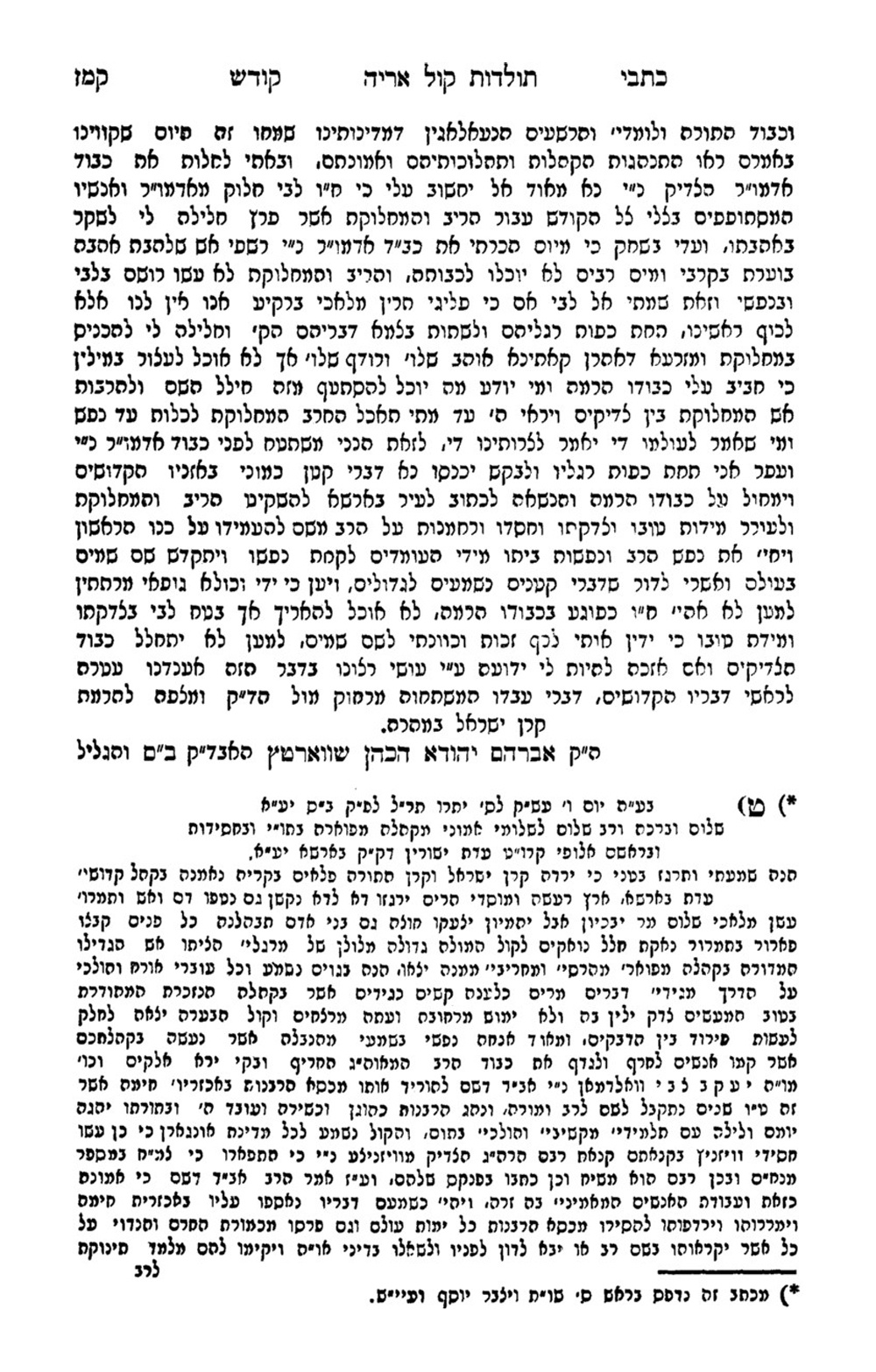
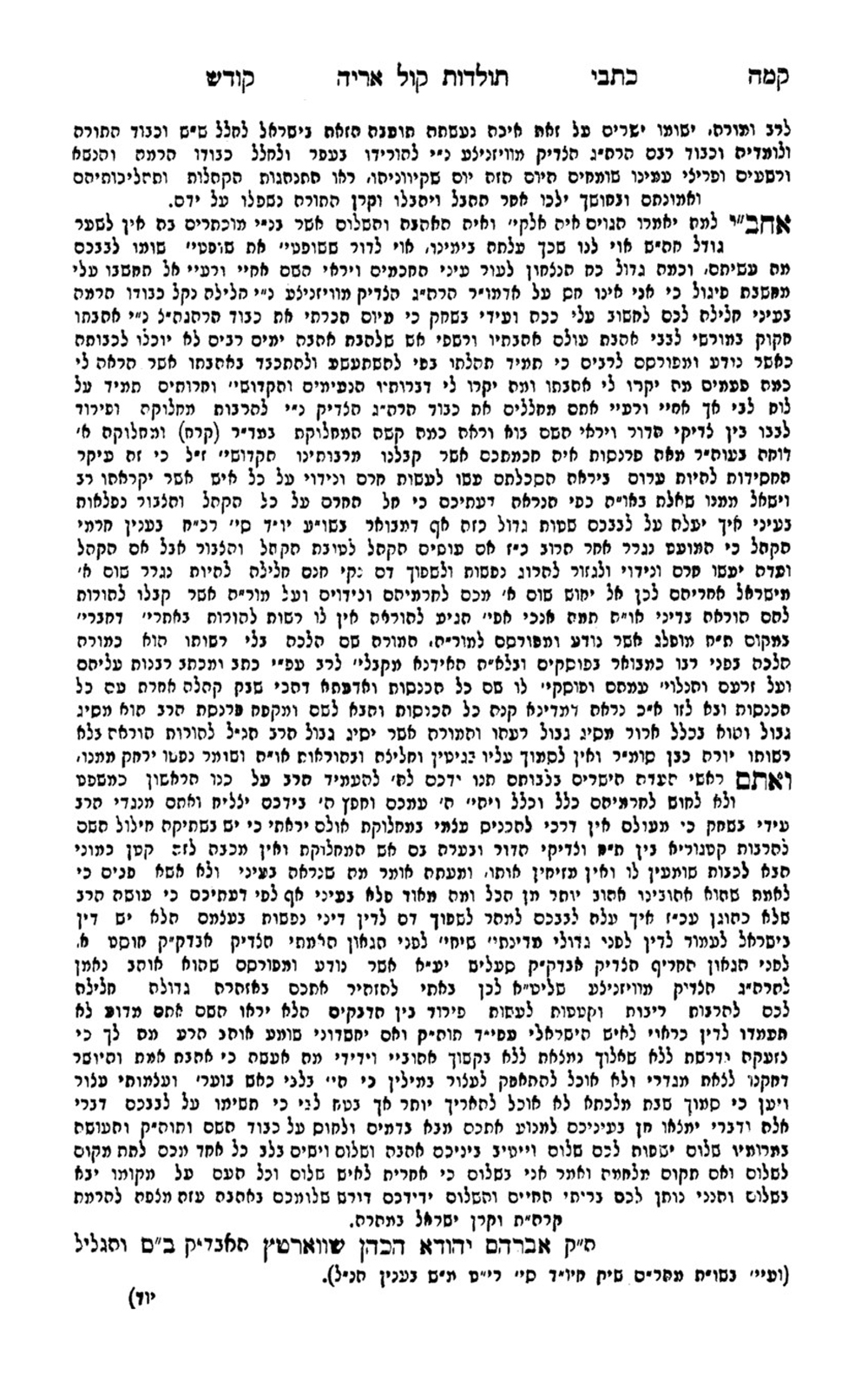
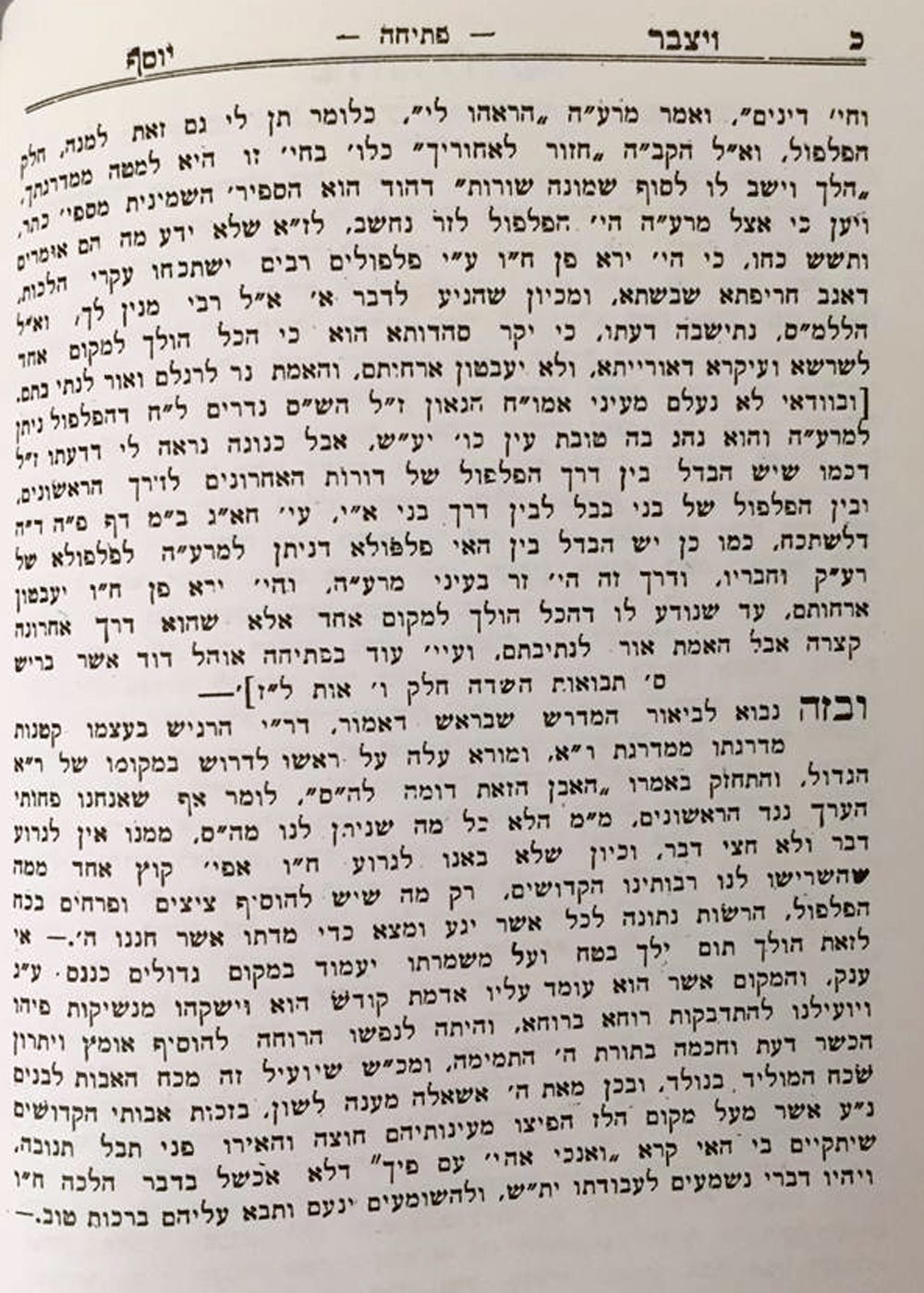
Here are the two letters printed in the Toldos Kol Aryeh, and if you look at the footnote to the letter to Borşa on p.147, you’ll notice that it says that it was first printed in the beginning of Shu”t Vayitzbor Yosef:
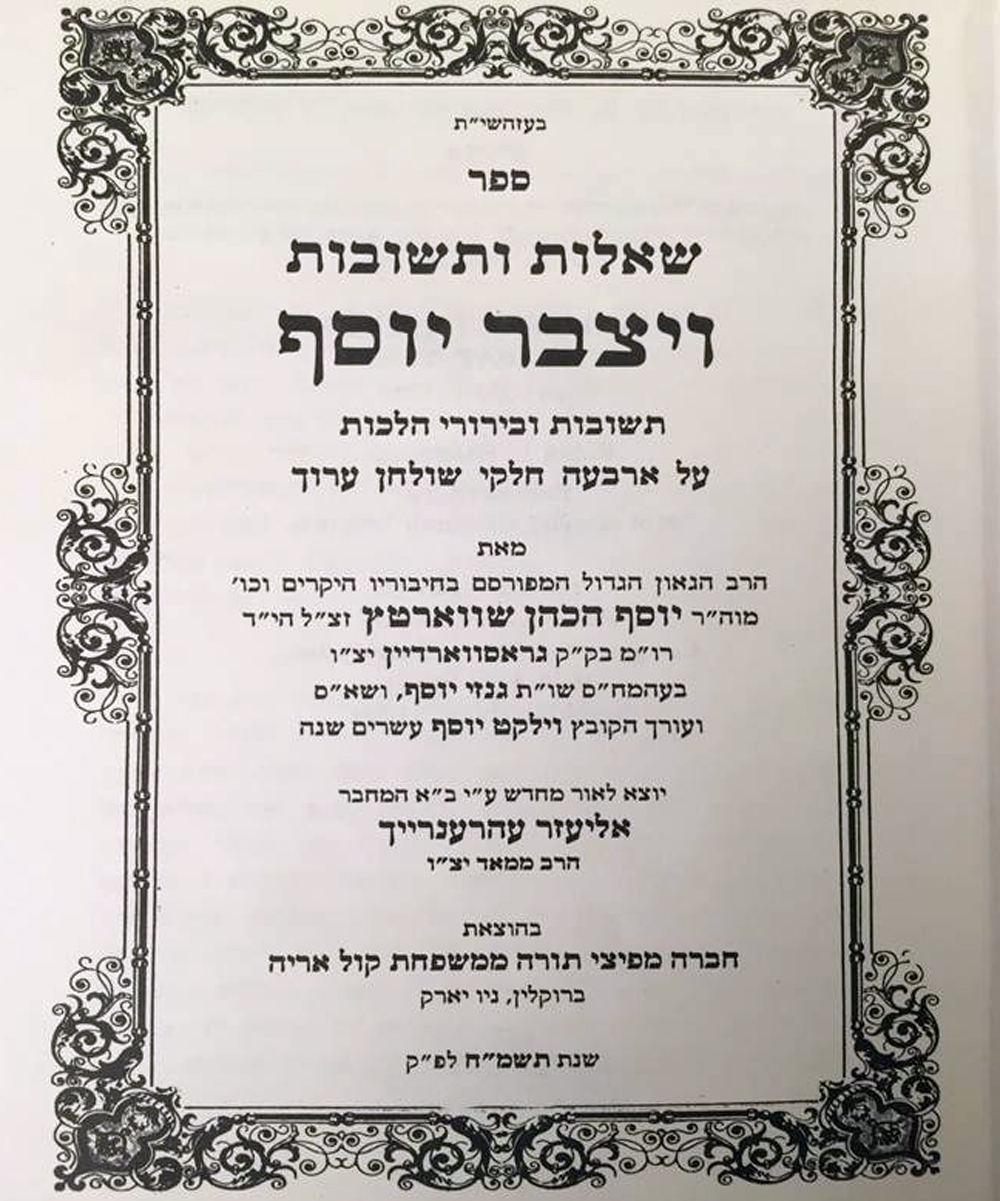
The Vayitzbor Yosef was written by R’ Yosef Schwartz[16], the grandson of R’ Avraham Yehuda Schwartz. The copy I initially had, was the second edition printed by R’ Yosef’s nephew in Brooklyn in 1987[17]. Here is the title page:
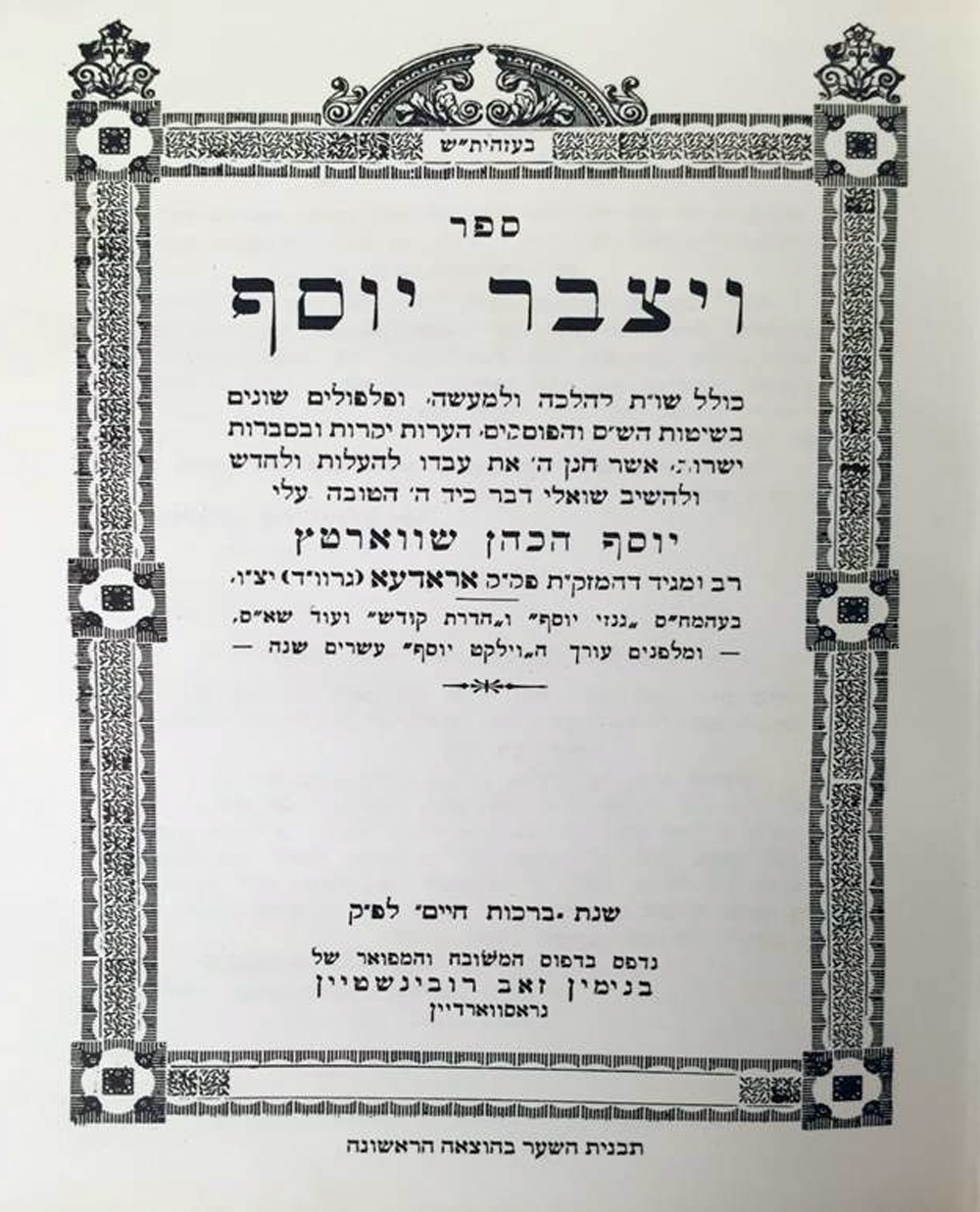
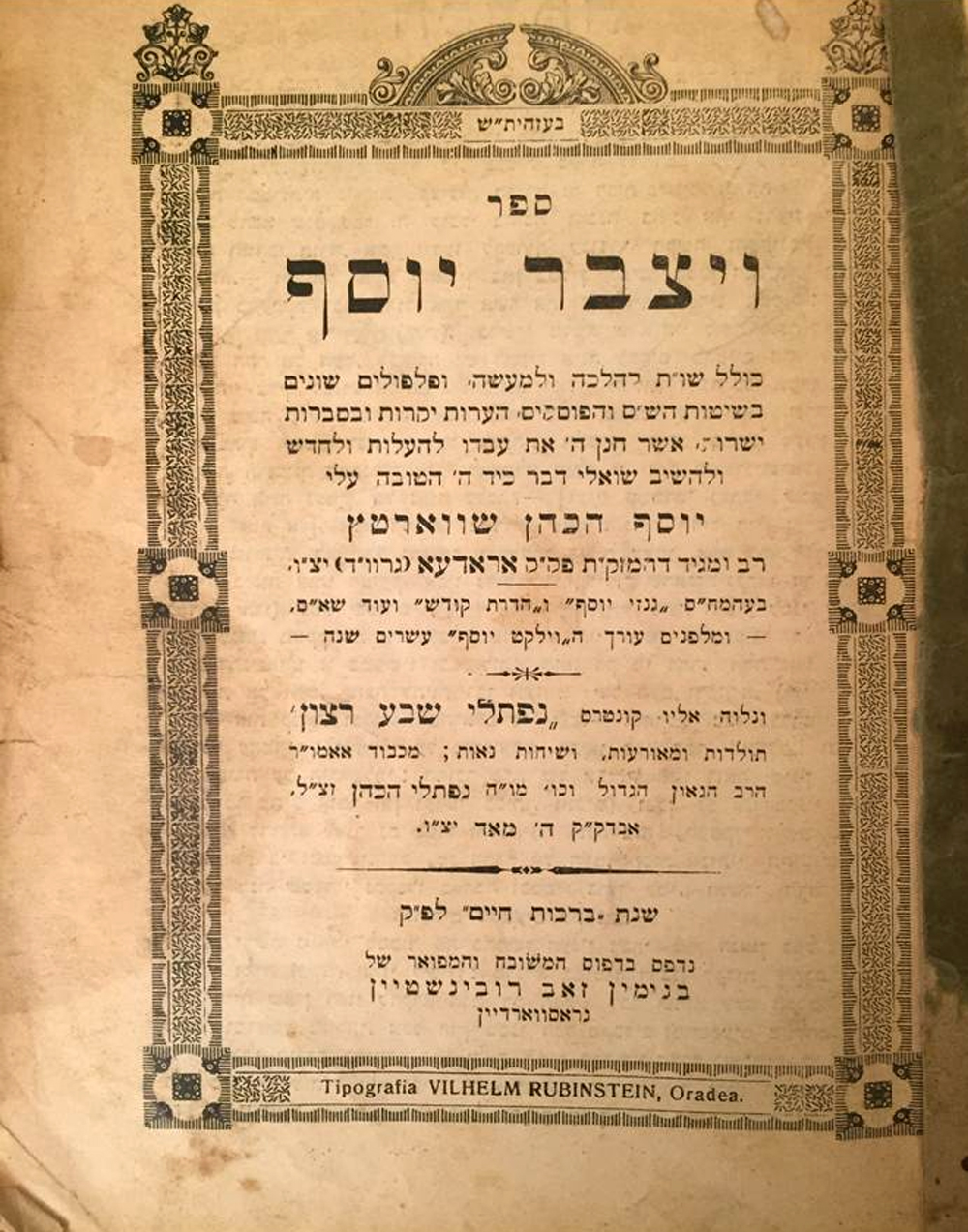
However, a thorough search for the letter through the entire work came up with nothing. It seems to have vanished. After an exhaustive hunt, I was finally able to procure a first edition of the Vayitzbor Yosef, and upon examination, I was able to realize the full extent of how doctored the second edition is. In the second edition, there are approbations added from R’ Yosef Schwartz’s other work Ginzei Yosef, and the index is in the back of the sefer, unlike the first edition where they were printed in the front, right after the hakdamah and before the pesicha. These changes are quite innocuous. However, in the second edition, a picture of the original title page is presented with a glaring omission.
Here is how it is presented:
And here is it in actuality:
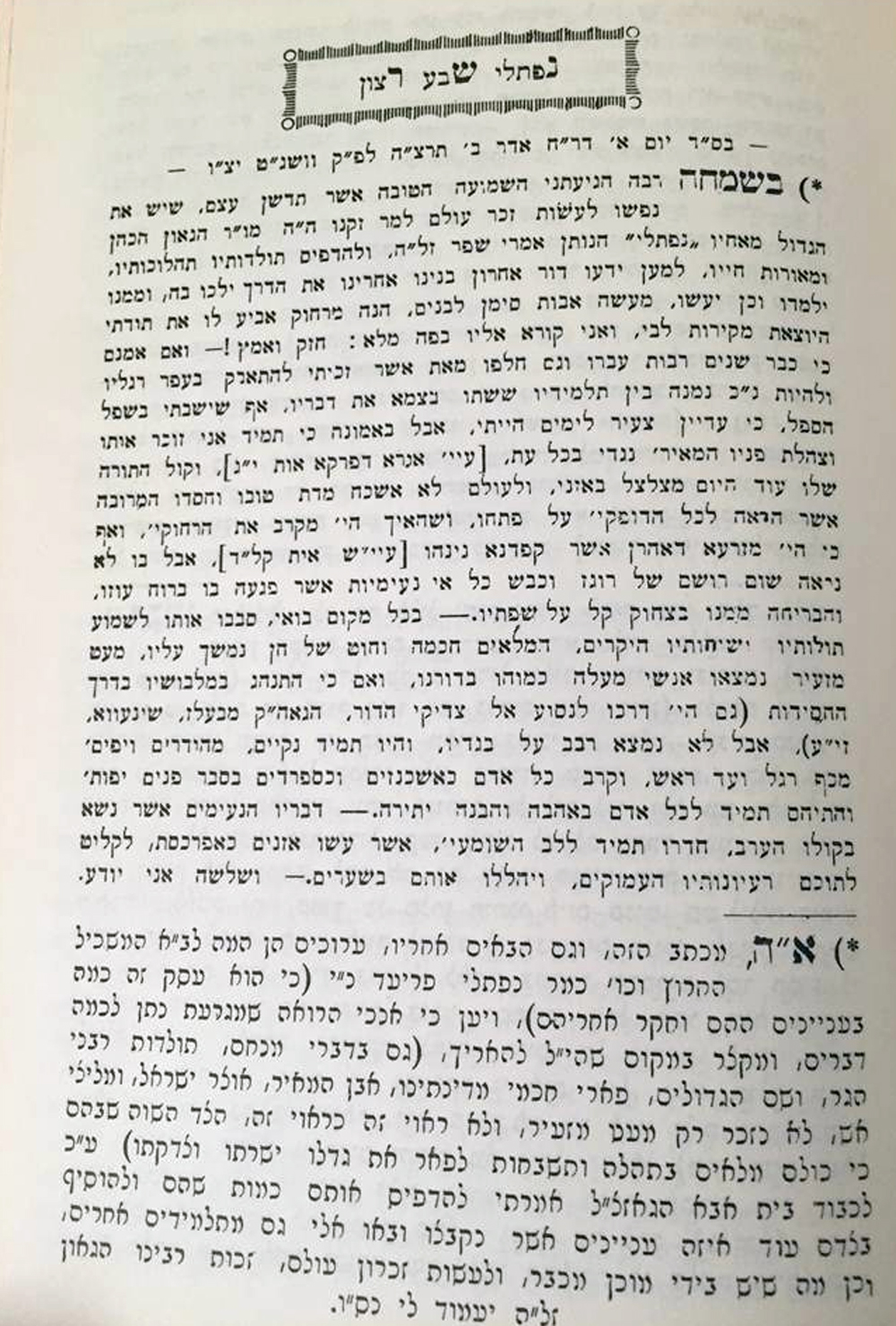
Notice anything different? That’s right, on the original title page, there is mention of a separate part of the sefer, “Naftali Savah Ratzon” which is supposed to be a collection of things that the author heard from his father R’ Naftali Schwartz. If you guessed that the second edition is devoid of this section in its entirety, you would also be correct. Here is a picture of the beginning of that missing section, which also happens to be printed in the back of the New York edition of Toldos Kol Aryeh:
Having gone through the Naftali Savah Ratzon, I couldn’t find any objectionable material that would have motivated the publishers from removing it. So what was their motivation? Remember the missing letter from R’ Avraham Yehuda Schwartz, the Kol Aryeh? Well, in the first edition, there is another small section right after the pesicha, called “Hashmatah V’hosafa L’kunteres Naftali Savah Ratzon.”
Here is how the second edition appears:
And here is how it’s supposed to look like:
This section is four pages long, and in it can be found the censored letter from R’ Schwartz to the people of Borşa. It would seem that this sensitive letter was behind the publisher’s motivation to totally remove any mention of the Naftali Savah Ratzon, since it was officially part of it as a hashmatah. So not only was an important document lifted from the sefer, a whole section became a casualty along with it. Why the publishers couldn’t just take the letter out and keep the rest of the Naftali Savah Ratzon, I’m not sure. I guess they wanted as “clean” of a job as possible.
I must point out how Leopold Greenwald, Yaakov Tzvi Abraham, Dr. Yehuda Speigel, and Gedaliah Stein explain the rationale of the people of Borşa’s belief that Menachem Mendel Hagar was the Messiah, and how their explanation is mistaken. Greenwald[18], Abraham[19], Speigal[20], and Stein both suggest how the belief was formulated as a reaction to Hagar’s sefer, Tzemach Tzadik. In his work Zichron Borsa[21], Stein explains that since Hagar gave no explanation to the title of his sefer, which was perplexing since it did not have Hagar’s name within its title as do other sefarim, such as “Kedushas Levi” by R’ Levi Yitzchak of Berditchev, or “Ahavas Yonasan” by R’ Yonasan Eibeshutz, his chasidim saw in it an esoteric meaning. As the gematria of “Tzemach,” which is used to refer the Messiah in Zachariah 6:12, is equivalent to “Menachem,” and likewise the gematria of “Tzaddik,” which is also used in Zachariah 9:9 to refer to the Messiah, is equivalent to “Mendel,” this must mean that their rebbe, R’ Menachem Mendel Hagar is indeed the Messiah!
This explanation is simply untrue. In no way, could the work Tzemach Tzadik have had any influence on what happened in Borşa in 1870, when it was only published for the first time in 1885. As for the reason why it was called Tzemach Tzadik, Hagar’s son Baruch, explains in the preface to the work that he simply named it because the gematria is equivalent to Menachem Mendel. It is also untenable to argue that a manuscript, or knowledge of one with the title Tzemach Tzadik, was floating around at the time of the dispute, because R’ Baruch Hagar writes in the preface that the material for the work was only written a few years before his father’s passing in 1885. Consequentially, we must take the letters of the Kol Aryeh for their simple meaning, that the people themselves came up with the gematria of tzemach and its link to the Messiah and the Vizhnitz Rebbe.
Many leading rabbis of the time came to R’ Waldman’s defense, including; R’ Moshe Schick[22], R’ Chaim Sofer of Munkatch[23], R’ Chaim Halberstam of Sanz[24], R’ Yosef Shaul Nathansohn[25], and the previously mentioned R’ Avraham Yehuda Schwartz. It seems that the only rabbi that came to the defense of the Vizhnitz Chasidim, was R’ Yehuda Modern[26]. What happened next isn’t very clear, but it seems that a tribunal was held by Schwartz to settle things[27], and Waldman was reinstituted as rabbi of Borşa. Waldman died in Vienna in 1883.
As a side note, take a look at the last page of the letter of R’ Schwartz, printed in the first edition of the Vayitzbor Yosef, on the very bottom:
That is a stamp referring to the responsum of R’ Moshe Schick to Borşa! I don’t know if this appears in every first edition copy, or if some private owner went to the trouble to specially stamp this, but it would be interesting to find out!
[1] Mordechai Mochiach of Eisenstaedt, Baruchia Russo, Jacob Querido, Abraham Cordozo, Yehuda Leib Prossnitz, and Jacob Frank
[2] See Ba’al Shem Tov Al Hatorah (Jerusalem 1998) in the Hakdamah #23 in the name of Nachum from Chernobyl, though this is seemingly a contradiction to the Iggeres Hakodesh of the Ba’al Shem Tov where he writes that he spoke with the Messiah.
[3] See Aharon Wertheim, Halachos V’halichos B’Chasidus (Mossad Harav Kook, 2002), pp. 20-21 fn. 52
[4] See David Assaf, The Regal Way (Stanford University Press, 2002), pp. 257-261
[5] See Yehuda Leibes, Studies in Jewish Myth and Jewish Messianism (State University of New York Press, 1993) p. 115
[6] See the hakdamah to Chumash Heichal Bracha (Lemberg 1864), “וגם דודי מורי החסיד השלם הצדיק אא”ק מוהר”ר משה הוא קרא אותי בפעם הראשון בשם מורה מורנו בפ’ בהר וקרא לפני או דודו יגאלנו ואמר עשיתי אותך גואל ואמר זה באנפין נהרין.”. See Heichal Bracha on Leviticus 25:49 where he says that the verse is referring to Mashiach ben Yosef. See also Megilas Starim (Jerusalem 1944) where he says he was born in the year משיח בן יוסף, here.
[7] See Nochum Brandwein, Imrei Tov (1891) p.29a where he writes, “כמו ששמעתי מפי מרן הק’ והטהור איש צדיק תמים שמו נאה לו מוהר”ר דוד משה שליט”א. וזאת ידוע כי “משה” עולה :”אלקים אחרים”, כי בכוחו נמתק אלקים אחרים , “משה דוד” עולה: “שטן”,כי בכוחו להמתיק את השטן מישראל, ואז נמשך גאולה לישראל, כי: “משיח” עם הכולל עולה: “משה דוד”, ואז יקויים “ועינינו תראינה מלכותך” ע”י דוד משיח צדקך . here.
[8] See Chaim Vital, Sefer Hachizyonos (Jerusalem, 2001) pp. 8, 17-18
[9] See Ohr Hachaim, Deuteronomy 15:7 at the end, here.
[10] See Isaiah Tishby, Messianic Mysticism (Littman Library, 2014) pp. 196-199
[11] See Yaakov Sapir, Iggeres Teiman Hasheni (Mainz, 1873) here and Amram ibn Yachya Kerach, Sa’aras Teiman (Jerusalem. 1954) pp.36-39 here.
[14] Though R’ Shalom Shachna of Lublin allegedly wrote on his gemara about the debate in Sanhedrin 98b over the name of the Messiah, “אני אומר שכנא שמו שנאמר לשכנו תדרשו”, referring to Deuteronomy 12:5, See Reuven Margolyos, Margolyos Hayam, Sanhedrin 98b #14, it was probably from a disciple in jest. See Asher Ziv, Rabbeinu Shalom Shachna Milublin,Hadarom No.57, p.119.
[15] His two volume halachic work, Shu”t Tzvi V’Chamid, was printed from a manuscript in 2008.
[16] Here is a picture of R’ Schwartz with his wife:
[17] Unfortunately, hebrewbooks.org doesn’t yet have the sefer online. You can still look at the first forty pages for free on Otzar Ha-Hochma online with this link, here, even if you don’t have a subscription.
[18] Matzevat Kodesh (New York 1951) p.24 fn.57 here, L’toldos Hareformatzian Hadatis B’Germania U’bungaria p.20 fn.40 here.
[19] L’koros Hayahadus B’trasylvania (New York) p.84
[22] Shu”t Maharam Schick, Yoreh Deah #219, here. The published teshuva is written to an anonymous kehillah, though it is attributed to the town of Borşa.
[23] Toldos Sofrim (London, 1962) pp.37-38, here. From Sofer’s letter we see how this was also part of the greater dispute between the Sanz and Sadigura chasidim, on this see David Assaf, Heitzitz V’Nifga Ch.19.
[24] Measef Ha’be-er year 7 p.42, here. I was very pleased when I first saw this letter. In it, Halberstamm argues that even an evil person that learns torah, his torah isn’t נמאסת, how more so then to a righteous person. He brings a proof from the famous gemara in Chagiga 15b where a fire came down from heaven in front of Yehuda Hanasi to defend Elisha ben Avuya from disparagement. I always made the same argument to fanatics who would say disparaging remarks about R’ Joseph B. Soloveitchik.
[25] Shu”t Shoel U’Meishiv Sheviah #16, also in Kerem Shlomo Tamuz 5743
Review: Elliott Horowitz, Reckless Rites: Purim and the Legacy of Jewish Violence
In 2017, the erudite and eclectic scholar Elliott Horowitz unexpectedly passed away. His oeuvre is exceptionally diverse, having authored more than seventy-five articles and reviews and five books, with topics ranging from studies on Italian art, Jews and coffee, the significance of the beard among Jews, comparing and contrasting Jewish and non-Jewish biblical exegesis, and Jewish violence (see his Academia page for most of them). Seven additional articles appeared on this site, in a similar vein as his others, covering Bugs Bunny, nude imagery in the Haggadah, Isaiah Berlin, Saul Lieberman, among others. He regularly used the “Molkho Institute for Absurdly Abstruse Research” to identify his affiliation in his email signature. Jewish violence was a long fascination of Horowitz. Beginning in 1994, with an article in the Hebrew journal Zion, he revisited the issue in no less than six articles that culminated in his 2006 book, Reckless Rites: Purim and the Legacy of Jewish Violence (Princeton University Press, Princeton, New Jersey). Horowitz documents how the conclusion of the Purim story, culminating in the Jews massacring 75,800 people over two days, was used as a justification for Jewish violence against non-Jews throughout history. Horowitz revisited this topic on this website, “Modern Amalekites from Adolf to Avigdor.” In a later article, he also identified the Biblical story of Dinah as another source for this type of violence.
While arguably, the violence at the end is only a minor part of the story, for some, that aspect has clouded everything about the Book of Esther and Purim. First, Horowitz looks at how non-Jews viewed the Book. Some had a very negative view due to the Jewish revenge. They considered that motif un-biblical (read non-Christian). Horowitz goes through each character and how first non-Jews interpreted their actions. For instance, Mordechai was treated rather harshly by many of these commentators, as was Esther, due to her passivity. What is especially fascinating is how these non-Jewish understandings sometimes crept into Jewish thought. Thus, Horowitz documents Jews parroting these rather un-Jewish, as it were, interpretations.
Horowitz then tackles the overarching theme of Amalek and how this has been understood throughout history. Some hold there is no obligation to destroy Amalek today, while others are willing to label any perceived enemy of Jews as deserving of the harsh consequences of Amalek. Some of these examples are rather disturbing.
After dealing with the Book of Esther specifically, Horowitz focuses on the Jewish practice of Purim. Specifically, he deals with Jewish violence or violent acts on Purim directed at non-Jews. He provides a discussion of the stereotype of the “mild” (read the wimp) Jew, including its origins and whether it is borne out by history. He then discusses numerous diverse examples spanning from the 5th century until today of Jewish violence. Some are not physical violence. Instead, it is host desecration or general enmity of non-Jewish symbols, while other, most recently Barukh Goldstein, is physical violence in its worst form.
Horowitz is compelling in the scope of this idea and how prevalent this is. It is especially telling when tracing and seeing how systematically Jews have decided to sweep these under the rug these examples; it demonstrates that censorship is not limited to any one group, and even amongst supposedly dispassionate scholars; they too can fall prey to their own biases.
To play down some of these incidents, we have Jewish historians who decided to avoid discussion of such matters or, at times, downplay their significance. However, in light of the many examples here, it is challenging to ignore such examples. Indeed, Shaul Magid noted in his review that Horowitz’s book “seems to elicit a kind of cognitive dissonance among peers, as if to say ‘this simply cannot be true’ even given the detailed evidence and argumentation to the contrary. This is often because of the audacity of the thesis and the way it challenges how we understand the present.” Hillel Halkin’s review of Commentary magazine is one example that fails to adequately address Horowitz’s thesis and his substantial evidence. Halkin claims that the book is a distortion of history and places too much emphasis on too few examples. In the next issue, Horowitz responded to Halkin’s criticism, noting Halkin’s misreading of some texts and inability to present any contrary evidence. In his inimical style, Horowitz invokes the Godfather to prove his point.
Halkin remained obsessed with Horowitz’s book and, a year later, returned to it and attempted to compare it and Michael Stanislawki’s book (A Murder in Lemberg), to Ariel Toaff’s Pasque di Sangue that seemingly argued Jews regularly killed non-Jewish children.”, which is riddled with methodological errors and has been entirely discredited (here). This time, not only Horowitz took issue with Halkin. Three scholars, Allan Nadler (who previously wrote a very positive review of Reckless Rites and presciently noted that Horowitz is a “scrupulously honest voice, dealing in exemplary fashion with an important subject that has been ignored by scholars precisely because of its extreme delicacy. In his execution of narrating the repercussions of Haman’s execution, Horowitz has enriched us with a model of historical scholarship. Anything but reckless, “Reckless Rites” is a rare gem of academic work that will make a real difference”), Elisheva Carlebach, and Naomi Gratz, derided Halkin’s attempt to tar Stanislawki and Horowitz. Perhaps it is best to view Halkin’s criticism through the prism of his long history of minimizing Israeli responsibility for violence, Horowitz being but one example. Indeed, Halkin himself seemingly accepted Yigal Amir’s murder of Yitzhak Rabin. Halkin claims that Amir’s error was not in the assassination itself; instead, “What made Yitzhak Rabin’s assassination exceptionally atrocious was not it’s being a murder, but it’s being a cataclysmic political blunder.” Hillel Halkin, “Israel & the Assassination: A Reckoning,” Commentary Magazine,January 1996. Halkin, however, was willing to criticize one person affected by Rabin’s murder, his son. Halkin, under the pseudonym Philologos, pokes fun at Rabin’s son’s pronunciation of the Kaddish he said on behalf of his father. See “On Language,” “Yuval Rabin’s Kaddish,” Forward, November 17, 1995. Perhaps if Amir had butchered a blessing rather than Rabin, Halkin would have found occasion to criticize.
Commentary, however, wasn’t done with Horowitz. In 2010, Commentary published Abby Wisse Schachter’s essay, “The Problem with Purim,” which is generally about feminist views of Purim characters. As an aside, she claims that Horowitz’s book contains “the questionable claim” and the “bizarre thesis” that “Purim has long been the occasion for outbreaks of Jewish animosity and even violence toward Christians.” She asserts that Horowitz’s thesis is based solely on the example of Baruch Goldstein. This is incorrect. As Horowitz demonstrates in his letter to the editor, it is evident that she could not have spent more than ten minutes with the book to arrive at her conclusion. Horowitz shows that Schechter’s article contains other mistakes beyond her discussion of his book.
In the end, there is little doubt that he wrote a well-researched and thorough book that inevitably engenders discussion, whether or not readers agree with Horowitz, is less the point. (See, for example, Eliezer Brodt’s post, “The Origins of Hamenstashen in Jewish Literature (Revisited),” on this site. Brodt references Horowitz’s discussion regarding a Saudi scholar who alleges Jews use blood to make hamenstashen.) Instead, as with all groundbreaking scholarship, a Talmudic approach, one that values discussion over conclusion is the best one can hope for.
Le-Tacen Olam (לתכן עולם): Establishing the Correct Text in Aleinu
Le-Tacen Olam (עולם לתכן): Establishing the Correct Text in Aleinu[1]
By Mitchell First (mfirstatty@aol.com)
The Jewish obligation of עולם תקון(=improving the world) is widely referred to and it is traditionally assumed that the Aleinu prayer is one of the texts upon which this obligation is based.
This article will show that a very strong case can be made that the original version of Aleinu read עולם לתכן (=to establish the world under God’s sovereignty), and not עולם לתקן (=to perfect/improve the world under God’s sovereignty[2]). If so, the concept of עולם תקון has no connection to the Aleinu prayer.[3]
—–
It is reasonable to assume that Aleinu was already included in the Amidah of Rosh ha-Shanah (=RH) by the time of Rav (early 3rd century C.E.).[4] But no text of Aleinu is included in the Talmud, nor is a text of Aleinu included in any of the classical midrashim.[5] Therefore, we must look to later sources for texts of Aleinu.
When we do, we find that the reading לתכן is found in the text of the RH Amidah in the SiddurRav Saadiah Gaon (d. 942),[6] and in the text of the RH Amidah in the Mishneh Torah of the Rambam (d. 1204).[7] Moreover, it is found in numerous prayer texts from the Cairo Genizah that include this line of Aleinu.[8] For example, it is found in: 1) a fragment of the RH Amidah first published by Jacob Mann in 1925;[9] 2) a fragment of the RH Amidah first published by Richard Gottheil and William H. Worrell in 1927;[10] 3) a fragment of the RH Amidah first published by Mordecai Margaliot in 1973;[11] and 4) a fragment of Aleinu first published by Mann in 1925.[12] It is found in many other Aleinu prayer texts from the Cairo Genizah as well.[13] (In the fragment of Aleinu first published by Mann in 1925, Aleinu is included in the Pesukei de-Zimra section of the Palestinian shaḥarit ritual.[14])
Furthermore, the reading לתכן survives in Yemenite siddurim to this day. It was also the reading in the original tradition of the Jews of Persia.[15]
Admittedly, the reading in Europe since the time of the Rishonim has been לתקן. See, for example, the following texts of Aleinu:
– Maḥzor Vitry of R. Simḥah of Vitry (daily shaḥarit and RH);[16]
– Siddur Ḥasidei Ashkenaz (daily shaḥarit and RH);[17]
–Peirush ha-Tefillot ve-ha-Berakhot of R. Judah b. Yakar (RH);[18]
–Peirushei Siddur ha-Tefillah of R. Eleazar b. Judah of Worms (RH);[19] and
–SeferArugat ha-Bosem of R. Abraham b. Azriel (RH).[20]
The three main manuscripts of Seder Rav Amram Gaon also read לתקן.[21] But these manuscripts are not from the time of R. Amram (d. 875); they are European manuscripts from the time of the later Rishonim.[22]
Earlier than Maḥzor Vitry, we have circumstantial evidence for the reading לתקן in comments on Aleinu that were probably composed by R. Eliezer b. Nathan of Mainz (c. 1090-1170). Here, in Hamburg MS 153,[23] the following explanatory comment about Aleinu is expressed (without a text of the line itself): [24] …בשמך יקראו וכולם מלכותך מתקנים העולם כל ויהיו
Another manuscript also largely composed of the comments of R. Eliezer b. Nathan has essentially this same reading, in two places.[25] Another manuscript, which is probably the Siddur of R. Eliezer b. Nathan, has a similar reading: [26] …בשמך יקראו וכולם .במלכותך מתקנים העולם כל ויהיו
Admittedly, it cannot be proven that לתכן was the original reading. But this seems very likely, as לתכן is by far the better reading in the context. This can be seen by looking at all the other scenarios that are longed for in this section:
הארץ מן גילולים להעביר עוזך בתפארת מהרה לראות י-שד במלכות עולם לתקן /לתכן יכרתון כרות והאלילים ארץ רשעי כל אליך להפנותבשמך יקראו בשר בני וכל יכירו וידעו כל יושבי תבל כי לך תכרע כל ברך תשבע כל לשון ולכבוד שמך יקר יתנו יכרעו ויפולו אלקינו ה׳ לפניך ותמלוך עליהם מהרה לעולם ועד עול מלכותך את ויקבלו כולם בכבוד תמלוך עד ולעולמי היא שלך כי המלכות
Beginning with the second line, להעביר, every clause expresses a hope for either the removal of other gods or the universal acceptance of our God. With regard to the first line, properly understood and its mystical and elevated language decoded,[27] it is almost certainly a request for the speedily rebuilding of the Temple.[28] Taken together, this whole section is a prayer for the rebuilding of the Temple and the establishment of God’s kingdom on earth. This fits the reading לתכן perfectly.[29]
It is appropriate that this section of Aleinu is fundmentally a prayer for the establishment of God’s kingdom on earth. Most likely, this section was composed as an introduction to the malkhuyyot section of the RH Amidah.[30]
Moreover, we can easily understand how an original reading of עולם לתכן might have evolved into עולם לתקן, a term related to the familiar term העולם תקון. The term העולם תקון (always with the definite article) is widespread in early rabbinic literature.[31] It is found thirteen times in the Mishnah, and seventeen times in the Babylonian Talmud.[32] The alternative scenario, that the original reading was עולם לתקן and that this evolved in some texts into the unusual reading עולם לתכן, is much less likely.[33]
Finally, the ב of י-שד במלכות seems to fit better in י-שד במלכות עולם לתכן (=to establish the world under God’s sovereignty) than in either of the two ways of understanding י-שד במלכות עולם לתקן.[34] Also, the use of the word עולם instead of העולם and the lack of an את before the object עולם perhaps fit the reading לתכן better. I leave a detailed analysis of these aspects to grammarians.
Conclusion
There is no question that social justice is an important value in Judaism.[35] Moreover, classical rabbinical literature includes many references to the concept of העולם תקון, both in the context of divorce legislation and in other contexts. The purpose of this article was only to show that is almost certainly a mistake to read such a concept into the Aleinu prayer, a prayer most likely composed as an introduction to the malkhuyyot section of the Amidah, and focused primarily on the goal of establishing God’s kingdom on earth. Even if we do not change the text of our siddurim, we should certainly have this alternate and almost certainly original reading in mind as we recite this prayer.[36]
[1] This essay is a revision of Mitchell First, “Aleinu: Obligation to Fix the World or the Text,” Ḥakirah 11 (Spring 2011), pp. 187-197, available here.
I would like to thank Yehiel Levy for showing me his Yemenite siddur which read לתכן and inspired this research. I would like to thank R. Moshe Yasgur for sharing his thoughts and for always being willing to listen to mine. I would also like to acknowledge the assistance of Dr. Ezra Chwat of the Institute of Microfilmed Hebrew Manuscripts at the Jewish National and Hebrew University Library, and the assistance of Binyamin Goldstein. Finally, I would like to dedicate this article to my beloved wife Sharon, whose name has the gematria of תקון and who needs no improvement.
[2] The above is how this phrase is usually translated. But The Complete ArtScroll Siddur, p. 161, translates: “to perfect the universe through the Almighty’s sovereignty.” Others adopt this translation as well. See e.g., J. David Bleich, “Tikkun Olam: Jewish Obligations to Non-Jewish Society,” in Tikkun Olam: Social Responsibility in Jewish Thought and Law, eds. David Shatz, Chaim I. Waxman, and Nathan J. Diament, Northvale, N.J.: Jason Aronson, 1997, p. 61.
[3] One scholar who intuited that the original reading may have been לתכן is Meir Bar-Ilan. See his “Mekorah shel Tefillat ‘Aleinu le-Shabeaḥ,’ ” Daat 43 (1999), p. 20, n. 72.
The articles by Gerald Blidstein and J. David Bleich in Tikkun Olam: Social Responsibility in Jewish Thought and Law assume that the reading is לתקן (see pp. 26, 61 and 98). But the article in this volume by Marc Stern mentions the alternate reading of לתכן, citing R. Saadiah (see p. 165, n. 24).
In 2005, Gilbert S. Rosenthal wrote a detailed article about the concept of tikkun olam throughout the ages and merely assumed that the reading in Aleinu is לתקן. See his “Tikkun ha-Olam: The Metamorphosis of a Concept,” Journal of Religion 85:2 (2005), pp. 214-40.
[4] The Jerusalem Talmud, at Avodah Zarah 1:2, includes the following passage: א”ר יוסי בי רבי בון מאן סבר בראש השנה נברא העולם? רב, דתני בתקיעתא דבי רב זה היום תחילת מעשיך זכרון ליום ראשון וכו’. A very similar passage is found at J. Talmud Rosh ha-Shanah 1:3 (where the reading is בתקיעתא דרב).
The sentence from the liturgy referred to (…זה היום) is from the introductory section to the ten verses of zikhronot. A reasonable inference from these Talmudic passages is that Rav composed (at least) the introductory sections to zikhronot, malkhuyyot and shofarot. Aleinu
is part of the introductory section to malkhuyyot. Since the sentence from the introduction to zikhronot quoted corresponds to the present
introduction to zikhronot, it is reasonable to assume that their introduction to malkhuyyot corresponded to the present introduction to malkhuyyot, i.e., that it included Aleinu. Admittedly, Rav could have made use of older material in the introductory sections he composed. The fact that Aleinu has been found (in a modified version) in heikhalot literature is some evidence for Aleinu’s existence in this early period, even though the prayer is not specifically mentioned in any Mishnaic or Talmudic source. (Regarding the dating of heikhalot literature, see below.) On the version of Aleinu in heikhalot literature, see Michael D. Swartz, “ ‘Alay Le-Shabbeaḥ: A Liturgical Prayer in Ma‘aseh Merkabah,” Jewish Quarterly Review 77 (1986-1987), pp. 179-190. See also the article by Bar-Ilan cited above. For parallels in later sources to the two passages from the Jerusalem Talmud, see Swartz, p. 186, n. 20. See also Rosh ha-Shanah 27a.
A statement that Aleinu was composed by Joshua appears in a collection of Geonic responsa known as Shaarei Teshuvah (responsum #44). But the statement was probably a later addition by the thirteenth century kabbalist Moses de Leon. See Elliot R. Wolfson, “Hai Gaon’s Letter and Commentary on ‘Aleynu: Further Evidence of Moses De León’s Pseudepigraphic Activity,” Jewish Quarterly Review 81 (1990-91),
pp. 379-380. Statements that Aleinu was composed by Joshua are found in various Ashkenazic Rishonim. This idea seems to have originated with R. Judah he-Hasid (d. 1217). For the references, see Wolfson, pp. 380-381.
There is much evidence that Aleinu could not have been composed by Joshua. For example: 1) Aleinu cites verses from the prophet Isaiah (this will be discussed below); 2) ha-kadosh barukh hu was not an appellation for God in Biblical times; and 3) terms are found in Aleinu that are characteristic of heikhalot literature. Also, for almost the entire Biblical period, the word olam is only a time-related word. It is not until Dan. 12:7 and perhaps Eccles. 3:11 that olam means “world” in the Bible. (Olam definitely means “world” at Ben Sira 3:18.) See Kirsten A. Fudeman and Mayer I. Gruber, “ ‘Eternal King/King of the World’ From the Bronze Age to Modern Times: A Study in Lexical Semantics,” Revue des études juives 166 (2007), pp. 209-242. See also Daat Mikra, comm. to Psalms 89:3 and Eccles. 3:11, and R. Abraham Ibn Ezra, comm. to Ex. 21:6 and Eccles. 3:11. (Based on the language of the book, it is
very clear that Ecclesiastes is a late Biblical book See EJ 2:349.)
Regarding the roots תקן and תכן, the root תקן does not appear in Tanakh until the book of Ecclesiastes, and the root תכן probably did not mean “establish” in the period of the Tanakh (see below).
[5] As noted, Aleinu has been found (in a modified form) in heikhalot literature. There are five manuscripts that include the relevant passage. But four of these only include Aleinu in an abbreviated form and are not long enough to include the phrase עולם לתקן/לתכן. See Peter Schäfer, Synopse zur Hekhalot-Literatur, Tübingen: J.C.B. Mohr, 1981, sec. 551, pp. 206-207. The only manuscript that includes the phrase reads לתקן. But this manuscript, N8128, dates from around 1500. See Ra‘anan S. Boustan, “The Study of Heikhalot Literature: Between Mystical Experience and Textual Artifact,” Currents in Biblical Research 6.1 (2007), p. 137.
Regarding the dating of heikhalot literature, Bar-Ilan (Mekorah, p. 22, n. 85) estimates this literature as dating from the third through fifth centuries. See also more recently his “Shalshelet ha-Kabbalah be-Sifrut ha-Heikhalot,” Daat 56 (2005), pp. 5-37. Moshe Idel, in the second edition of the Encyclopaedia Judaica (11:592) summarizes the subject as follows: Even though it is quite possible that some of the texts were
not edited until this period [=the geonic era], there is no doubt that large sections originated in talmudic times, and that the central ideas, as well as many details, go back as far as the first and second centuries.
[6] Siddur Rav Saadiah Gaon, eds. Israel Davidson, Simḥah Assaf, and Yissakhar Joel, Jerusalem: Rubin Mass, 1941, p. 221. Admittedly, the manuscript which forms the basis for this edition was not composed by R. Saadiah himself. It is estimated to date to the twelfth or thirteenth century.
Neither R. Saadiah nor Rambam recited Aleinu in the daily service.
[7] See the Seder Tefillot Kol ha-Shanah section at the end of Sefer Ahavah. I have looked at the Or ve-Yeshuah edition, the Frankel
edition, the Mechon Mamre edition (www.mechon-mamre.org), and the editions published by R. Yitzḥak Sheilat and by R. Yosef Kafaḥ. All
print לתכן. (The Frankel edition does note that a small number of manuscripts read לתקן.)
In the standard printed Mishneh Torah, in the al kein nekaveh section of the RH Amidah (Sefer Ahavah, p. 154), only the first ten words were included (up to עוזך), followed by a וכו׳.
[8] Most of the texts from the Cairo Genizah date from the tenth through the thirteenth centuries. See Robert Brody, The Geonim of Babylonia and the Shaping of Medieval Jewish Culture, New Haven: Yale Univ. Press, 1998, p. 32. All of the texts from the Cairo Genizah that I refer to can be seen at genizah.org.
[9] See his “Genizah Fragments of the Palestinian Order of Service,” Hebrew Union College Annual 2 (1925), p. 329. The fragment
is known as Cambridge Add. 3160, no. 10. When Mann published the fragment, he erroneously printed לתקן.
[10] See their Fragments from the Cairo Genizah in the Freer Collection, New York: The MacMillan Company, 1927, plate XLIII (opposite p. 194). The fragment is labeled F42 at genizah.org.
[11] See his Hilkhot Ereẓ Yisrael min ha-Genizah, Jerusalem: Mossad Harav Kook, 1973, p. 148. The fragment is known as Cambridge T-S 8H23.1.
[12] See above, pp. 324-325. See also, more recently, Ezra Fleischer, Tefillah u-Minhegey Tefillah Ereẓ-Yisre’eliyyim bi-Tekufat ha-Genizah, Jerusalem: Magnes Press, 1988, p. 238. The fragment is known as Cambridge Add. 3160, no. 5. Neither Mann nor Fleischer printed the full text of Aleinu in this fragment.
[13] See the following fragments: Cambridge Or. 1080 2.46; Cambridge T-S Misc. 10.27, 34.5, and 34.23; Cambridge T-S NS 150.235, 154.19, 155.23, 157.6, 157.37, 157.176, 158.69, 195.55, and 273.38; Cambridge T-S AS 101.64; and New York ENA 1878.8. I was able to find only one fragment that read לתקן: Cambridge T-S NS 122.33. (An interesting fragment is T-S NS 153.64, 8R. Here, only the top line of the letter remains and it is hard to determine if it is the top of a כ or the top of a ק.)
I have been able to examine most of the Aleinu prayer text fragments from the Cairo Genizah. I would like to thank Prof. Uri Ehrlich of Ben Gurion University of the Negev for referring me to them. (Not all of these Aleinu prayer text fragments were long enough to include the relevant passage.)
[14] Since the second word of the Aleinu prayer is לשבח, it was probably seen as fitting to include this prayer in the Pesukei de-Zimra section. A main theme of both Barukh she-Amar and Yishtabaḥ, as well as of the entire Pesukei de-Zimra, is שבח. See also Ber. 32a: le-olam yesader adam shivḥo shel HKBH ve-aḥar kakh yitpallel.
A Palestinian practice of reciting Aleinu in Pesukei de-Zimra may also explain a statement found in several Rishonim (e.g.,Sefer ha-Maḥkim, Kol Bo, and Orḥot Ḥayyim) in the name of Pirkei de-Rabbi Eliezer (a work composed in eighth century Palestine): מעומד לאומרו צריך לכך לשבח בעלינו יש גדול שבח. The statement is obviously not giving an instruction regarding the RH Amidah recited by individuals. Nor does the language of the statement (לאומרו) fit as an instruction to individuals listening to the repetition of the RH Amidah. The recital of Aleinu in a context outside of the Amidah seems to be referred to. (The statement is not found in the surviving texts of Pirkei de-Rabbi Eliezer.)
[15] See Shelomoh Tal, Nusaḥha-Tefillah shel Yehudei Paras, Jerusalem: Makhon Ben Ẓvi, 1981, p. 154 (RH). The Persian-Jewish prayer ritual followed that of R. Saadiah in many respects. At the end of the eighteenth century the Persian Jews were influenced to adopt a Sefardic prayer ritual and their own ritual was forgotten.
[16] Ed. Aryeh Goldschmidt, Jerusalem: Makhon Oẓar ha-Poskim, 2004, pp. 131 (daily shaḥarit) and 717 (RH). The earliest surviving manuscript of Maḥzor Vitry dates to the first half of the 12th century.
[17] Ed. Moshe Hirschler, Jerusalem, 1972, p. 125 (daily shaḥarit), and p. 214 (RH). (This work was published by Hirschler together with another work, Siddur Rabbenu Shelomoh; both are integrated into the same volume.) Siddur Ḥasidei Ashkenaz was compiled by the students of R. Judah he-Hasid (d. 1217) and presumably reflects his text of Aleinu. Hirschler’s edition of this siddur is based on several manuscripts.
[18] Ed. Samuel Yerushalmi, Jerusalem: Meorei Yisrael, 1979, sec. 2, pp. 91-92. R. Judah flourished in Spain and died in the early thirteenth century. Aside from the text of Aleinu in the manuscript published by Yerushalmi including the reading לתקן, it is also clear from the various explanatory comments by R. Judah that he was working with a text that read לתקן.
[19]Ed. Moshe Hirschler, Jerusalem: Makhon Harav Hirschler, 1992, p. 659. R. Eleazar died circa 1230. The text of Aleinu is found in his commentary to the Aleinu of RH. In his commentary on the daily shaḥarit, only the first two words of Aleinu and the last two (timlokh be-kavod) are recorded. In his Sefer ha-Rokeaḥ, his references to Aleinu in both the RH Amidah and the daily shaḥarit are similarly very brief.
[20] Ed. Ephraim E. Urbach, Jerusalem: Mekiẓei Nirdamim, 1963, vol. 3, pp. 469-470. SeferArugat ha-Bosem was composed in 1234, in Bohemia. Aside from the text of Aleinu published here including the word לתקן, it is clear from R. Abraham’s explanatory comment (p. 469, lines 8-9) that he was working with a text that read לתקן.
Other early European texts of Aleinu include the three texts of Aleinu in manuscript Oxford, Corpus Christi College 133 (late twelfth century; daily, RH and one other) and the text of Aleinu in manuscript Cambridge Add. 667.1 (early thirteenth century, daily). The former has לתקן in the first two; the third Aleinu does not include the second paragraph. I have not been able to check the reading in Cambridge Add. 667.1.
[21] See Seder Rav Amram Gaon, ed. Daniel Goldschmidt, Jerusalem: Mossad Harav Kook, 1971, p. 142.
[22]Ibid., introduction, pp. 11-13. A few fragments of the Seder Rav Amram Gaon have been found in the Genizah, but these are very short and do not include our passage.
[23] This manuscript is generally considered to be largely composed of the comments of R. Eliezer b. Nathan. See, e.g., Urbach, Sefer Arugat ha-Bosem, vol. 4, p. 24 and the facsimile edition of this manuscript published by Abraham Naftali Ẓvi Rot, Jerusalem: 1980, pp. 21-30. The manuscript itself is estimated to have been copied in the fourteenth century (Rot, p. 21).
[25] See Alter Yehudah Hirschler, “Peirush Siddur ha-Tefillah ve-ha-Maḥzor Meyuḥas le-Rabbi Eliezer ben Natan mi-Magenza (ha-Ravan),” Genuzot vol. 3, Jerusalem:1991, pp. 1-128. In this siddur commentary (pp. 78 and 114), בשמך יקראו וכלם מלכותך ‘מתקני העולם כל ויהיו is found in the commentary to daily Aleinu in shaḥarit, and בשמך יקראו וכלם מלכותך מתקנין העולם כל ויהיו is found in the commentary to RH Aleinu (One should not deduce from this manuscript that R. Eliezer b. Nathan recited Aleinu daily in shaḥarit.)
[26] See Siddur Rabbenu Shelomoh, p. 212 (commentary on RH Aleinu). Hirschler published this work as the siddur of Shelomoh b. R. Shimson of Worms (1030-1096), but it is probably that of R. Eliezer b. Nathan. See, e.g., Avraham Grossman, Ḥakhmei Ashkenaz ha-Rishonim, Jerusalem: Magnes Press, 2001, pp. 346-348.
[27] Gershom Scholem recognized long ago that Aleinu includes several terms that are not only post-Biblical, but are characteristic of heikhalot literature. See his JewishGnosticism, Merkabah Mysticism and Talmudic Tradition, New York: Jewish Theological Seminary, 1965 (2d. ed.), pp. 27-28. He points to the terms yoẓer bereshit, moshav yekaro, and shekhinat uzo. Meir Bar-Ilan (Mekorah, p. 8) also points to the term adon ha-kol. All of this suggests that Aleinu was composed by someone with some connection to heikhalot literature, or composed at a time after terms originating in heikhalot literature came to be in normative rabbinic use. This explains how Aleinu easily came to be borrowed into heikhalot literature. Due to the common terms, the authors of this literature probably saw Aleinu as a text “related to their own hymnology.” Scholem, p. 28.
In heikhalot literature, Aleinu is found in the singular form לשבח עלי, as a prayer of gratitude purportedly recited by R. Akiva on return from a safe journey to heaven. See the article by Swartz referred to above. (R. Akiva and R. Ishmael serve as central pillars and chief mouthpieces in this pseudepigraphic literature. See EJ 11:591, 2d. ed.).
Meir Bar-Ilan, Mekorah, pp. 12-24, argues that Aleinu originated in heikhalot literature in the singular, and was then changed to the plural and borrowed into the RH service. I disagree, as do many others. (Bar-Ilan does not claim that Aleinu originated as this prayer of gratitude purportedly recited by R. Akiva. This would be very unlikely. There are too many themes in Aleinu that are out of context and extraneous under the assumption that Aleinu originated as this prayer of gratitude.)
[28] The idiom is based on verses such as Psalms 78:60-61 (צר ויתן לשבי עזו ותפארתו ביד) and 96:6 (במקדשו ותפארת עז), and Isaiah 60:7 (אפאר תפארתי ובית) and 64:10 (ותפארתנו קדשנו בית). This interpretation is probably implicit in the commentary of R. Judah b. Yakar. On לראות מהרה בתפארת עוזך, he writes: פני לראות ונזכה ,אתה עוזמו תפארת כי (שם על =) ע״ש .אפאר תפארתך ובית דכתי׳ המקדש בית בתפארת ולראות שכינה See the Peirush ha-Tefillot ve-ha-Berakhot of R. Judah b. Yakar, part II, p. 91. R. Judah’s statements are adopted by R. David Abudarham in his commentary to the Aleinu of RH. See also R. Shemtob Gaugine, Keter Shem Tov, Kėdainiai, 1934, p. 104. Unfortunately, this interpretation of the phrase תפארת עוזך has generally been overlooked. Numerous are scholars who have written that the prayer includes no request for the Temple’s rebuilding.
Scholem (p. 28, n. 18) notes the following passage found in other heikhalot texts: .עזו בתפארת ומבורך הדרו במושב שמו ברוך The parallel to הדרו מושב strongly suggests that עזו תפארת represents the physical Temple in this passage. For heikhalot texts with this passage, see Mordecai Margaliot, Sefer ha-Razim, Jerusalem, 1966, pp. 107-09, and Martin Samuel Cohen, The Shi‘ur Qomah: Texts and Recensions, Tübingen: J.C.B. Mohr, 1985, pp. 173 and 175.
[29] The use of the root תכן to mean “establish” does require some explanation. In Tanakh, the root תכן means to “weigh,”
“examine,” “measure,” or “place in order.” (At Psalms 75:4, עמודיה תכנתי, the root is commonly translated as “establish,” but even here it probably means something like “properly apportion” or “place in order.” See, e.g., the commentary of S. R. Hirsch.) תכן with the meaning “establish” is not found in the Mishnah or Tosefta. But תכן may mean “establish” in the Dead Sea text 4Q511: שנה למועדי תכן (DJD VII, p. 221), and perhaps in other Dead Sea texts as well.
In paytanic literature, an early use of the root תכן to mean “establish” is found in the piyyut Emet Emunatkha (תכנת עולמך ימים בששת כי). This piyyut is preserved in the Siddur R. Saadiah Gaon (p. 110) and in several Genizah fragments. It has a tetrastichic structure (as does Aleinu), and is generally viewed as a pre-classical piyyut, i.e., a piyyut from the late Tannaitic/early Amoraic period. See, e.g., Ezra Fleischer, Ha-Yotzrot be-Hithavutam ve-Hitpaḥutam, Jerusalem: Magnes, 1984, p. 55, n. 47. The Academy of the Hebrew Language, in its Historical Dictionary Project database (Ma’agarim), estimates the date of composition of this piyyut as the late second century C.E.
In the Musaf Amidah for shabbat, תקנת, not תכנת, may be the original reading. See, e.g., Siddur R. Saadiah Gaon, p. 112 and the Genizah fragment quoted by Fleischer, Tefillah u-Minhegey Tefillah, p. 52. (For more sources on this spelling issue, see Maḥzor Vitry, ed. Goldschmidt, p. 199, n. 1.)
Probably, the use of the root תכן to mean “establish” arose based on the usage of the root at Psalms 75:4, or perhaps from the words תכן and תכון (both from the root כון) found numerous times in the Tanakh (Jer. 30:20; Ps. 89:22, 93:1, 96:10, and 141:2; Prv. 12:19 and 20:18; I Kings 2:12; I Ch. 16:30; and II Ch. 8:16, 29:35, 35:10 and 35:16).
[30] Aside from the fact that the theme of the section fits as an introduction to verses of malkhuyyot, the section ends with four words from the root מלך: ותמלוך עליהם מהרה לעולם ועד עול מלכותך את ויקבלו כולם .בכבוד תמלוך עד ולעולמי היא שלך כי המלכות
I have little doubt that the first section of Aleinu (which includes the words melekh malkhei ha-melakhim and malkeinu) was also composed at the same time. This is contrary to the view of many scholars who point to the two separate themes in the two sections as evidence of different authors. Aleinu is a short prayer, and in the earliest texts of Aleinu there is no division into sections. Therefore, our
presumption should be one of unitary authorship. Close analysis of the verses cited shows that both sections quote or paraphrase from the same chapter of Isaiah (45:20: u-mitpallelim el el lo yoshia and 45:23: ki li tikhra kol berekh tishava kol lashon; there are quotes and paraphrases of other verses from chapter 45, and from 44:24 and 46:9 as well.) This strongly suggests that both sections were composed at the same time. (I have not seen anyone else make this point.) Terms characteristic of heikhalot literature are found in both sections as well.
While it cannot be proven that Rav (early third century) was the author of Aleinu, it has been observed that “in some of Rav’s homilies a tendency to a certain mystical thinking is discernible.” See EJ 13:1578 and the citations there, as well as the following statement of Rav at Ber. 55a: .יודע היה בצלאל לצרף אותיות שנבראו בהן שמים וארץ Also, several Talmudic passages record Rav’s authorship or contribution to the texts of other prayers. Most of these passages are collected at Ismar Elbogen, Jewish Liturgy: A Comprehensive History, tr. Raymond P. Scheindlin, New York: Jewish Publication Society and Jewish Theological Seminary, 1993, pp. 207-208. Most relevant is Ber.12b where the הקדוש המלך and המשפט המלך changes for the Ten Days of Repentance are recorded in the name of Rav.
Most recently, Ruth Langer is another who believes that the evidence points to authorship of both paragraphs of Aleinu around the period of Rav. She writes: In literary style, it is consistent with the earliest forms of rabbinic-era liturgical poetry from the land of Israel… See Langer, “The Censorship of Aleinu in Ashkenaz and Its Aftermath,” in Debra Reed Blank, ed., The Experience of Jewish Liturgy: Studies Dedicated to Menahem Schmelzer, Leiden and Boston: Brill, 2011, pp. 148-149. As Langer points out, although Rav gained prominence in Babylonia, he had also been a student of R. Judah ha-Nasi in Israel.
[31] העולם תקון was the correct classical term, even though it has now been replaced in popular parlance by עולם תקון. Rosenthal, p. 214, n. 1.
[32] Rosenthal, p. 214, n. 1. It is also found eight times in the Jerusalem Talmud and four times in the Tosefta. Most of the time, the term is used in the context of the laws of divorce, but it is found in other contexts as well (e.g., Hillel’s enactment of prozbol at M. Gittin 4:3). Rosenthal suggests that the concept originated in the context of the laws of divorce, and was later expanded into the other contexts. See Rosenthal, pp. 217-219.
[33] Admittedly, the root תקן can often be translated as “established.” But in many of these cases the context is that of establishing a legal ordinance or procedure, and a better translation would be “instituted.” On the other hand, the musafAmidah for festivals includes the phrase בתקונו ושמחנו (the subject being the beit ha-mikdash) and this seems to be an example of the root תקן meaning “establish” in a non-legal context. Another such example is the phrase…ממנו לו והתקין found in one of the sheva berakhot (Ketubbot 8a).
Nevertheless, I strongly believe that לתכן was the original reading in Aleinu. It is easily understandable how an original reading of עולם לתכן might have evolved into עולם לתקן; the reverse scenario is much less likely. Moreover, R. Saadiah’s text in the musaf Amidah for shabbat read שבת תקנת. Yet he recorded לתכן in Aleinu.
[34] As mentioned earlier, in the reading עולם לתקן, there are two ways to translate במלכות: “under the sovereignty” or “through the sovereignty.” If the translation is “under,” establishing a world under the sovereignty of God is a simpler reading than perfecting a world under the sovereignty of God. If one wants to advocate for the translation “through,” it requires investigation whether the prefix ב could have been used to mean “through” in the Tannaitic and Amoraic periods.
[35] See, e.g., Shatz, Waxman, and Diament, eds., Tikkun Olam: Social Responsibility in Jewish Thought and Law, and Jacob J. Schacter, “Tikkun Olam: Defining the Jewish Obligation,” in Rav Chesed: Essays in Honor of Rabbi Dr. Haskel Lookstein, ed. Rafael Medoff, Jersey City: Ktav, 2009, vol. 2, pp. 183-204. For some citations to Biblical verses on justice, see Rosenthal, p. 215, n. 2.
[36] R. Chaim Brovender suggested to me that after Aleinu shifted to becoming primarily a daily prayer, reciting a statement about perfecting/improving the world would have been seen as appropriate. By the twelfth century, Aleinu was being recited as a daily prayer in shaḥarit in parts of France (see above, n. 16) and probably in parts of Germany and England as well. (For Germany, see above, n. 17, and for England, see Ms. Oxford, Corpus Christi College 133.)
The recital of Aleinu in the evening prayer in Europe is a slightly later development. For some early references to this practice, see Sefer ha-Minhagot of R. Moshe b. R. Shmuel of Marseilles (early thirteenth cent.), published in Kobeẓ Al Yad 14 (1998), pp. 81-176, at p. 103, and Kol Bo, sec. 11, citing R. Meir of Rothenberg (thirteenth cent.). The recital of Aleinu in the afternoon prayer is a later development.
Regarding the recital of Aleinu as a daily prayer in Palestine, see above, n. 14.
The Rogochover and More
The Rogochover and More
Marc B. Shapiro
In a recent Jewish Review of Books (Summer 2017), I published a translation of an interview R. Joseph Rozin, the Rogochover, gave to the New York Yiddish paper, Der morgen zhurnal. You can see the original interview here. The fact that the Rogochover agreed to the interview is itself significant. As is to be expected, the content of the interview is also of great interest.
In the preface to the interview, I mentioned that the Rogochover famously studied Torah on Tisha be-Av and when he was an avel, both of which are in violation of accepted halakhah. When he was once asked why, while sitting shiva, he learnt Torah, he is reported to have replied:[1]
ודאי, עבירה היא זו, וכשאקבל עונש על שאר עונותי יענישוני אף על עון זה, אבל אני אקבל באהבה וברצון את העונש על חטא זה, וכדאית היא התורה להלקות עליה
R. Yissachar Tamar cites an eye-witness who reported that the Rogochover said basically the same thing in explaining why he learnt on Tisha be-Av, and noted how wonderful it will be to be punished for studying Torah.[2]
ומה נעים לקבל צליפות על עסק התורה
The Hazon Ish was told that the Rogochover learnt Torah when he was in mourning and that he made another antinomian-like comment in justification of his behavior, namely, that he wants to be in the gehinom of those who learn Torah. The Hazon Ish replied that “this gehinom is the same gehinom for the other sins.”[3]
The various comments quoted in the name of the Rogochover show his great need for studying Torah, a need that simply did not allow him to put aside his Torah study, even when halakhah required it. Yet the antinomian implication of the Rogochover’s comments was too much to be ignored. R. Gavriel Zinner’s reaction after quoting the Rogochover is how many felt.[4]
ולא זכיתי להבין, הלא מי לנו גדול מחכמי הגמ’ שנפשם ג”כ חשקה בתורה ואפ”ה גזרו שבת”ב ובזמן אבל אסורים בלימוד התורה, ועוד שאחז”ל הלומד ע”מ שלא לעשות נוח לו שלא נברא.
It is thus to be expected that some authors deny that the Rogochover could have really said any of what I have quoted. And if he did say it, they feel that it must have been merely a joke or a comment not meant to be taken seriously, or that he did not want people to know the real reason he studied Torah while in avelut (namely, the Yerushalmi which will soon be mentioned).[5] R. Abraham Weinfeld goes so far as to say, with reference to one of the comments I have quoted that “It is forbidden to hear these words, and Heaven forbid to suspect that Rabban shel Yisrael [the Rogochover] would say this.”[6]
Those who refuse to accept that the Rogochover meant what he said are forced to find a halakhic justification for his behavior, and indeed, when it comes to an avel studying Torah (and this would also apply to Tisha be-Av, the halakhot of which are not as stringent as those of personal mourning), there is a passage in the Yerushalmi, Moed Katan 3:5, that permits Torah study for one who has a great need.[7] (This heter is not recorded in the Shulhan Arukh, but this would not have concerned the Rogochover.[8]) Yet it is important to remember that as far as we know the Rogochover never cited this passage in the Yerushalmi as justification for his studying Torah when he was sitting shiva.[9]
Now for something disappointing and even a bit shocking: Here are the two pages from R. Shlomo Yosef Zevin, Ishim ve-Shitot (Jerusalem, 2007), pp. 75-76, where you can see one of the“controversial” quotations (which as R. Zevin notes is taken from an article in Ha-Hed).
R. Menahem Kasher quoted the entire two pages from Ishim ve-Shitot in his Mefaneah Tzefunot (Jerusalem, 1976), pp. 1-2 in the note.
Look at the end of the first paragraph of the note on p. 2. The “problematic” quotation of the Rogochover, saying that he will happily be punished for his sin in studying Torah, as the Torah is worth it, has been deleted. Instead, the Rogochover is portrayed as explaining his behavior as due to the passage in the Yerushalmi. While all the other authors who discuss this matter and want to “defend” the Rogochover claim that his real reason for studying Torah was based on the Yerushalmi, in R. Kasher’s work this defense is not needed as now we have the Rogochover himself giving this explanation!
Yet the Rogochover never said this. R. Zevin’s text has been altered and a spurious comment put in the mouth of the Rogochover, By looking carefully at the text you can see that originally R. Zevin was quoted correctly. Notice how there is a space between the first and second paragraphs and how the false addition is a different size than the rest of the words. What appears to have happened is that the original continuation of the paragraph was whited out and the fraudulent words were substituted in its place. Yet this was done after everything was typeset so the evidence of the altering remains.
Look also at the third paragraph where it says
ההד, שם
However, this makes no sense as R. Zevin’s reference to Ha-Hed has been deleted. I do not see how anyone other than R. Kasher could have been responsible for this particular “editing.”
As mentioned, many were troubled by the Rogochover’s antinomian-like comment.[10] Yet he is not the only one to speak like this. R. Joseph Hayyim (the Ben Ish Hai) in his Benayahu refers to an unnamed gaon who also learnt Torah when he was in avelut. When asked about this he did not refer to the Yerushalmi but answered in an antinomian fashion just like the Rogochover: “I know that I am violating the words of the Sages, and I know that on the day of judgment I will certainly be punished for this, but he [!] is prepared and willing to suffer and receive this punishment whatever it will be, because he is not able to withstand the pain of avoiding the study of Torah which is as difficult for him as death.”[11] Benayahu appeared in 1905. I do not think it is possible that at such an early date R. Joseph Hayyim could have heard a story about the Rogochover, so he must have had another great rabbi in mind.
The Lubavitcher Rebbe told a similar story.[12] When he was a youth, he had a teacher from Lithuania who lived in his home. He once found this teacher learning on Tisha be-Av. Young Menachem Mendel asked the teacher how is it that he was learning Torah on that day. The teacher replied: “When I come to the World to Come, I will be punished for one reason or another. I will be happy if I know that the reason I am being punished is because I learnt on Tisha be-Av.”[13]
The following subversive story with R. Israel of Ruzhin is also of interest, as it too shows a violation of accepted halakhah regarding Torah study on Tisha be-Av. It appears in R. Mordechai Hayyim of Slonim, Ma’amar Mordechai, vol. 2, p. 206.
הרה”ק מרוזין שהה פעם בימי בין המצרים במעינות המרפא, וביום צום תשעה באב אחר חצות היום, אמר לאחד מבני לוויתו שילמוד מסכתא משניות, ויעשה סיום בליל מוצאי התענית, ויסמכו על זה הקהל אשר שם ויאכלו בשר ואמר בלשו”ק: רבי שמואל קאמינקער אמר, שסיום מסכתא משניות חשוב כמו סיום מסכת גמרא, ועל רבי שמואל קאמינקער יכולין לסמוך כמו על אחד מגדולי הפוסקים. ועל האיסור ללמוד בתשעה באב אחר חצות, דאס נעם איך אויף מיר, און לאזן אידן עסן פלייש . . .
Returning to the interview with the Rogochover, he cites Maimonides who says that the word “Germany” is derived from the Hebrew word gerem, meaning “bone.”
Mishnah Negaim 2:1, in a passage that tells us how things used to be, says that Jews are neither black nor white, but in the middle (meaning, a Middle Eastern look). At the beginning of the Mishnah it speaks of a white spot that appears on a white man and on a black man. The word the Mishnah uses for “white man” is גרמני (German), and for “black man” it uses כושי. Germania was the Roman term for the area we call Germany, so it makes sense that the Mishnah, in describing a white man, would use that term.[14]
Apparently, Maimonides did not know the word גרמני. Thus, in his commentary to Negaim 2:1 he offers the explanation mentioned by the Rogochover, that גרמני is related to the word for bone. (In the interview, the Rogochover says that Maimonides refers to the Hebrew word גרם, but I wonder if this was a mistake on the interviewer’s part, as the word used by Maimonides is the Aramaic גרמא). Here is R. Kafih’s translation:
גרמני שם הלבן ביותר מיוחס אל העצם אשר שמו גרמא
Leaving aside the matter of the correct historical etymology, I wonder if Maimonides saw a problem with his explanation, namely, that for “black man” the Mishnah uses an ethnic identification, so one would expect it to also use such an identification in describing a white man. Furthermore, why would the Mishnah use an Aramaic word instead of the Hebrew עצם?
R. Elijah Benamozegh wonders how Maimonides did not realize what גרמני is referring to:[15]
והפלא על חכמת הרמב”ם שכתב כן ועשה עין של מעלה כאלו אינה רואה שדברי חז”ל מעידים ומגידים שגרמני שם אומה, לא זולת, ומה ענין לגרמא עצם בל’ ארמי?
R. Meir Mazuz asks, “How could Maimonides not have thought of this?” namely, that גרמני means German.[16] He explains that Maimonides was an Arabic speaker, and the way he knew Germany was by the term “Alemannia.” As such, when he saw the word גרמני in the Mishnah, since he did not know the term “Germany” he was forced to come up with a different explanation tying גרמני to “white.”[17]
What R. Mazuz did not know is that this explanation is not original to Maimonides and must reflect an earlier tradition.[18] I say this because R. Hillel ben Elyakim of Greece, who lived in the twelfth century (that is, contemporaneously with Maimonides) independently mentions this explanation. In his commentary to Torat Kohanim, ed. S. Kolodetzky, vol. 1, p. 190, he writes:
ומנלן גרמני הוי לבן כדגרסי’ בכל מקום גרמני מוכר כושי וכאן כושי מוכר גרמני דהיינו לבן דעצם מתרגמינן גרמא ועצם הוי לבן.
R. Hillel cites Bereshit Rabbah 86:3 which states: “Everywhere a white man (גרמני) sells a black man (כושי), while here a black man is selling a white man.” He also says דעצם מתרגמינן גרמא. If you look at Onkelos and Targum Ps. Jonathan to Genesis 2:23 this is exactly what you find.
When I found what R. Hillel wrote, I was quite excited, as I thought I had discovered something that no one else had taken notice of. Yet I later found that Jacob Nahum Epstein had already called attention to this in his notes to the commentary attributed to R. Hai Gaon to Seder Toharot (Berlin, 1921), p. 94 n. 32. He assumes that R. Hillel predates Maimonides:
ר”ה מארץ יון בפי’ ספרא דף קי”ג ב’ ור”מ אחריו הוציאוהו מן “גרמא”, עצם!
Returning to the Rogochover, everyone knows that the he put Maimonides above all other authorities. However, R. Zevin, Ishim ve-Shitot (Jerusalem, 2007), p. 125, calls attention to an example where in a practical halakhic matter the Rogochover rejected Maimonides’ view. See She’elot u-Teshuvot Tzafnat Paneah, vol. 1, no. 34:[19]
ואף דרבותינו הראשונים ז”ל וגם רבנו הגדול הרמב”ם לא ס”ל כן עפר אני תחת רגליו אך העיקר כמ”ש לדינא
The Rogochover’s sharp tongue is well known. For an example of how the Rogochover could even speak disrespectfully about the Tosafists, see Rav Tzair, Pirkei Hayyim (New York, 1954), p. 163.[20] Rav Tzair recalls how as a yeshiva student he went to meet the Rogochover where, we can only say, he was “blown away.” He writes:
אחר כך פנה אלי ואמר לי: ואתה בחור למה באת? יש לך קושיא, אמור! מלמלתי בבהלה את הקושיא שהיתה, כפי שאני זוכר, בתוספות של מסכת בבא מציעא, בדיני הפקר ומציאה. על זה השיב לי בבהלה כדרכו. הא, בתוספות? התוספות לא ידעו מה הם סחים; (“תוספות האט געפלוידערט”). נבהלתי, כמובן, לשמוע את הדיבורים הללו, ומלים נעתקו מפי. אמר לי, מה אתה נבהל? אני אראה לך כמה וכמה תוספות שלא הבינו את הגמרא, והתחיל להביא תלי תלים של דברי תוספות מכל הש”ס, והכל בעל פה, על פי הדף ודיבור המתחיל, ועירבב דבר אחד בשני ובבלי בירושלמי, עד שראה שראשי היה עלי כגלגל וחדלתי להבין את המשך הענינים.
Rav Tzair, ibid., p. 164, also mentions the Rogochover’s negative comment about R. Isaac Elhanan Spektor:
הנה הזקן יושב לו בקובנה וכותב ומדפיס וכותב ומדפיס עד אין סוף! מי מבקש זאת ממנו? כלום ספרים חסרים בעולם? הנה זקנך, ששמעתי עליו שהוא בעל-הוראה, יושב ופוסק שאלות. זה הכל מה שצריך. כל הרבנים הכותבים ספרים אינם יודעים בין ימינם לשמאלם.
Zvi Hirsch Masliansky, Maslianky’s Zikhroynes (New York, 1924), p. 107, who has a very negative view of the Rogochover, also records how he denigrated R. Isaac Elhanan as well as R. Samuel Mohilever and the Hibbat Zion movement. He further mentions that the Rogochover disparaged his own rebbe, R. Joseph Baer Soloveitchik:
צוזאמען מיט זיין גוואלדיגען זכרון, האט זיך ענטוויקעלט אין איהם זיין ווילדער עזות און חוצפה צו מבטל זיין אלע גאונים צוזאמען מיט זיין גרויסען רבי’ רבי יוסף בער.
See also R. Nathan Kamenetsky, Making of a Godol, pp. 743, 747, for other times that the Rogochover insulted R. Joseph Baer Soloveitchik. (On p. 744 Kamenetsky writes that the Rogochover received semikhah from R. Soloveitchik.)
Masliansky’s Hebrew autobiography is not an exact translation of the original Yiddish. (The English version is a translation from the Hebrew.) The Hebrew edition does not contain the passage just quoted. It also does not contain Masliansky’s concluding negative comment, p. 108:
ער האָט זיך צושריען און צוהיצט, און האָט צומישט און צופלאָנטערט פערשיעדענע ענינים, און ער האָט מיר אויסגעוויזען ווי א פאציענט פון א משוגעים הויז. איך האב אים נאָר ניט גענעטפערט; איך בין ארויס א פערטרויערטער און געדעקט: “אָט דאָס זיינען דיינע גאונים, מיין פאָלק ישראל!”
Kamenetsky, Making of a Godol, p. 747 n. b, mentions the Hebrew edition’s deletion of these “revolting lines of the original text.” We have a number of descriptions of the Rogochover from people who met him, and while all portray him as unusual, none have the negative spin of Masliansky. Perhaps it was the Rogochover’s anti-Zionism that turned Masliansky against him.
R. Moshe Maimon called my attention to She’elot u-Teshuvot Tzafnat Paneah ha-Hadashot (Modi’in Ilit, 2012), vol. 2, p. 391 (unpaginated), where we see that in newly published material the Rogochover referred to the Vilna Gaon as “Rabbenu ha-Gra.” This is significant because in the interview I published the Rogochover was hardly complimentary to the Vilna Gaon.[21]
She’elot u-Teshuvot Tzafnat Paneah ha-Hadashot is quite an interesting publication and includes the Rogochover’s notes to some poems of R. Judah Halevi. It is not that the Rogochover had any great interest in Halevi’s poetry. However, the Rogochover was one of those people whose mind was such that he had something to say about everything he read.
I encourage anyone interested in the Rogochover to watch this wonderful video by Louis Jacobs. The Rogochover was one of Jacobs’ heroes, and somewhere he mentions that the Rogochover was one of the people he would have loved to have met.
Regarding Bialik’s visit with the Rogochover that I mentioned in the Jewish Review of Books article, Maimon called my attention to this article by Noah Zevuluni [22]. For more on the meeting of Bialik and the Rogochover, see Doar ha-Yom, Jan. 10, 1932, p. 2, and Davar, April 17, 1935, p. 16 (where it mistakenly states that Bialik said that you could make ten Einsteins out of one Rogochover. He actually said that you could make two Einsteins out of one Rogochover.). The last two sources were brought to my attention by R. Shimon Szimonowitz.
Yossi Newfeld called my attention to the following two works focused on the Rogochover: Regarding the Rogochover and the Lubavitcher Rebbe, there is an MA dissertation by Yisrael Ori Meitlis, “‘Ha-Lamdanut ha-Filosofit’ shel Rabbi Yosef Rozin bi-Derashotav shel Rabbi Menahem Mendel Schneersohn (ha-Rebbe mi-Lubavitch),” (Bar-Ilan University, 2013). There is also the volume Ha-Tzafnat Paneah be-Mishnat ha-Rebbe (Brooklyn, 2003). In a previous post I called attention to R. Dovber Schwartz’s wonderful book The Rogatchover Gaon.
It is often said that the Rebbe received semichah from the Rogochover, yet there is no documentary evidence of this. The origin of this notion might be the Rebbe’s mother, who stated as such. See the comprehensive and beautifully produced new book on the Rebbe by R. Boruch Oberlander and R. Elkanah Shmotkin, Early Years.
In my article I mentioned the Rogochover’s unique perspective on the halakhic status of civil marriage. Those interested in this topic should consult R. Menahem Mendel Tenenbaum, Nisuim Ezrahiyim be-Mishnato shel Ha-Rogochovi z”l (n.p., 1988). This book contains an analysis of six responsa of the Rogochover on the topic.
One final point I would like to make about the Rogochover relates to his view of secular studies. He was one of those who responded to R. Shimon Schwab’s query about the halakhic validity of the German Torah im Derekh Eretz approach.[23] You can find his letter in Ha-Ma’yan[24] 16 (Nisan 5736), pp. 1ff. Among the significant points he makes is that, following Maimonides, a father must teach his son “wisdom.” He derives this from Maimonides’ ruling in Mishneh Torah, Hilkhot Rotzeah 5:5:
הבן שהרג את אביו בשגגה גולה וכן האב שהרג את בנו בשגגה גולה על ידו. במה דברים אמורים בשהרגו שלא בשעת לימוד או שהיה מלמדו אומנות אחרת שאינו צריך לה. אבל אם ייסר את בנו כדי ללמדו תורה או חכמה או אומנות ומת פטור.
He adds, however, that instruction in “secular” subjects is not something that the community should be involved in, with the exception of medicine, astronomy, and the skills which allow one to take proper measurements, since all these matters have halakhic relevance. In other words, according to the Rogochover, while Jewish schools should teach these subjects, no other secular subjects (“wisdom”) should be taught by the schools, but the father should arrange private instruction for his son.
רואים דהרמב”ם ס”ל דגם חכמה מותר וצריך אב ללמוד לבנו אבל ציבור ודאי אסורים בשאר חכמות חוץ מן רפואה ותקפות [!] דשיך [!] לעבובר [צ”ל לעבור] וגמטרא [!] השייך למדידה דזה ג”כ בגדר דין.
He then refers to the Mekhilta, parashat Bo (ch. 18), which cites R. Judah ha-Nasi as saying that a father must teach his son ישוב המדינה. The Rogochover does not explain what yishuv ha-medinah means, just as he earlier does not explain what is meant by “wisdom,” but these terms obviously include the secular studies that are necessary to function properly in society.
The publication of this letter of the Rogochover was regarded as quite significant. Yet as far as I know, no one has pointed out that the main point of the letter had already appeared in print. In 1937 R. Judah Ari Wohlgemuth published Yesodot Hinukh ha-Dat le-Dor. On p. 250 he included the following comment of the Rogochover, found in the margin of Rogochover’s copy of the Mishneh Torah, Hilkhot Rotzeah 5:5.
נראה לי דר”ל שאר חכמות גם כן חייב האב ללמדו
Excursus 1
For another example of Maimonides offering a speculative etymology for a word he did not know, see his commentary to Yadayim 4:6 regarding the word המירם. In his commentary to Sanhedrin 10:1, Maimonides explains the term אפיקורוס as coming from an Aramaic word. This is surprising as Maimonides knew of the Greek philosopher Epicurus and refers to him in Guide I:73, II:13, 32,III:17. (Even if Maimonides had not heard of Epicurus when he wrote his commentary on the Mishnah, we know that he revised this work throughout his life and yet he never altered his explanation of אפיקורוס.) See Arukh Shalem, ed. Kohut (Vienna, 1878), s. v. אפיקורוס. See also R. Yitzhak Sheilat, Hakdamot ha-Rambam (Jerusalem, 1992) p. 185, who believes that Maimonides knew the real origin of the word but was only following the Talmud’s “midrashic” derivation of the term from the Aramaic word אפקירותא (see Sanhedrin 100a). See also R. Hayyim Yehoshua Kasowski, Otzar Leshon ha-Mishnah, s.v. אפיקורוס:
וע”פ דמיון השם הזה אל הפעל פקר בארמית השתמשו בו לכנוי נרדף למין וצדוקי ובייתוסי
R. Simeon ben Zemah Duran, Magen Avot (Livorno, 1785), 1:2 (p. 4b), and the section of this work on Avot 2:14, also called Magen Avot (Leipzig, 1855), and R. Joseph Albo, Sefer ha-Ikarim I:10, point to Epicurus as the origin of the term אפיקורוס.
In his commentary to Kelim 30:2 and Parah 1:3, Maimonides explains two Greek words with Hebrew etymologies. I see no reason to accept R. Kafih’s opinion, expressed in his notes ad loc., that in these cases Maimonides knew that the words were Greek and was simply offering a “remez.” In fact, in his commentary to Kelim 30:2 he writes explicitly:
והוא לדעתי מלה מורכבת
If he was simply offering a “remez” he would not have written, “In my opinion,” followed by the etymology. At other times, however, it is possible that Maimonides knew that the words were Greek and he did not intend to offer a scientific etymology. This is the approach of Dror Fixler, who applies it even to the case from Kelim 30:2 just mentioned.[25]
R. Kafih is, of course, correct that the talmudic sages would at times offer a Hebrew etymology for a word that they knew was not Hebrew.The example he offers is Megillah 6a: “Why is it called Tiberias? Because it is situated in the very center of the land of Israel.” The Sages obviously knew that the city was named after a Roman emperor, and the Hebrew etymology can only be regarded as a form of midrash. Apart from modern scholarly sources that discuss the phenomenon of “judaizing” non-Hebrew words, see R. Jacob Emden, Lehem Nikudim, Avot 2:14:
וכן הוא מנהג החכמים ז”ל לגזור ממלות יוניות שמות ופעלים עברייים וארמיים.
R. Emden’s comment was precipitated by the word אפיקורוס which appears in Avot 2:14. R. Emden also mentions the word סנהדרין. See also R. Samuel Moses Rubenstein, Torat ha-Kabbalah (Warsaw, 1912), pp. 29ff. Some of R. Rubenstein’s examples are themselves speculative. For instance, he claims that the wordsבן דינאי in Kelim 5:10 are a “judaization” of the word “Bedouin.”
R. Rubenstein notes a number of examples of post-talmudic authorities not realizing the real origin of a word and offering a Hebrew etymology. One of these appears in R. Ovadiah Bertinoro’s commentary to Sotah 9:11, where R. Bertinoro writes as follows regarding the Greek word “Sanhedrin.”
ונקראים סנהדרין ששונאים הדרת פנים בדין
(ש and ס are interchangeable.) Yet I wonder, is R. Rubenstein correct that R. Bertinoro is offering an actual Hebrew etymology for the word “Sanhedrin”? The passage just quoted might be no more than a “midrashic” etymology, which R. Bertinoro would acknowledge is not the real origin of the word. Jacob Reifman refers to R. Bertinoro’s etymology as a דרש רחוק מאד. See Reifman, Sanhedrin (Berditchev, 1888), p. 3. He then adds:
ולא אדע עתה מאין לקח, ואולי הוא אך יליד הר”ע עצמו
Reifman was unaware that this etymology is also recorded by R. Jacob Moelin, so it could not have been original to R. Bertinoro. See Sefer Maharil, ed. Spitzer (Jerusalem, 1989), p. 611.
Even if we conclude that the etymology mentioned by R. Moelin and R. Bertinoro was simply “midrashic,” there is no reason to assume that they knew that the word סנהדרין was Greek, knowledge of which was not common among Jews of their time and place. See R. Avigdor Tzarfati, Perushim u-Fesakim le-Rabbenu Avigdor ha-Tzarfati (Jerusalem, 1996), p. 233, who does not know the word’s Greek origin and writes:
ואני שמעתי סנהדרין לשון סני דרין פי’ שהיו שונאין דורונות
In this case, it does seem that R. Avigdor is offering what he thinks is the actual etymology of the word. R. Yom Tov Lippman Heller, Tosafot Yom Tov, beginning of Sanhedrin, writes that סנהדרין is an Aramaic word, so he too did not know its Greek origin.
Returning to R. Bertinoro, in his commentary to Avot 2:14 he offers an unscientific etymology of the word אפיקורוס, but he must have known who Epicurus was, so I assume that this is a “midrashic” etymology.
לאפיקורוס: לשון הפקר שמבזה את התורה ומחשיבה כאילו היא הפקר. אי נמי משים עצמו כהפקר ואינו חס על נפשו לחוש שמא תבוא עליו רעה על שמבזה את התורה או לומדיה.
To turn to a different question, are there any examples in the Talmud where an etymology is not simply “midrashic” but intended to be taken seriously, and yet we know that it is mistaken? The Mishnah in Ketubot 15b mentions a “hinuma.” On 17b the Talmud asks what a hinuma is, and quotes R. Johanan who says: “A veil under which the bride [sometimes] slumbers (דמנמנה).” As Rashi explains, R. Johanan is making a connection between the word הינומאand מנמנה which itself is related to the word תנומה (slumber).[26]
ופעמים שמנמנמת בתוכו מתוך שאין עיניה מגולין ולכך נקרא הינומא על שם תנומה
The Arukh, s.v. הנמא, cites R. Hananel who states that hinuma is a Greek word. It is possible to understand R. Hananel as meaning that R. Johanan’s explanation was no more than a “midrashic” etymology. (This is on the assumption that he understood the passage as Rashi did.) However, this passage in R. Hananel also assumed a life of its own, as some saw it as providing support for the assumption that the Sages were not always correct in their etymologies. This matter has recently been discussed by Hanan Gafni in his fine book, “Peshutah shel Mishnah,” pp. 184ff., so there is no need for me to repeat what he has written.
Excursus 2
R. Raphael Mordechai Barishansky was shocked to read what the Rogochover said about the Vilna Gaon, as I think we all are. He responded strongly in an article in Der morgen zhurnal which was later reprinted in his Osef Mikhtavim Mehutavim (New York, 1952), pp. 167-169. Even though his words are strong, R. Barishansky shows great respect for the Rogochover.
This is not the case with R. Abraham Aaron Yudelevitz whose attack on the Rogochover is quite sharp. It needs to be said, however, that this came after the Rogochover referred to R. Yudelevitz – who was himself an outstanding scholar – in a very negative way. In printing the Rogochover’s letter, R. Yudelevitz tells us that he cut out some of Rogochover’s harshest words, but we still get the picture. The Rogochover was responding to R. Yudelevitz’s novel view that halitzah can be done with an agent, and the Rogochover referred to R. Yudelevitz as a בן סורר ומורה. See R. Yudelevitz, Av be-Hokhmah (New York, 1927), p. 82. [27]
Here is some of what R. Yudelevitz said in response, ibid., pp. 83,85-86. The language is very sharp (and also refers to how the Rogochover rejected something the Vilna Gaon wrote):
פער פיו בזלזולים כהאשה בת בוזי היושבת בשוק ומוכרת עיגולים בשער האשפתות ואולתו כפרתו כי אין קץ לשטותו ולגאותו.
אבל הוא אינו חושש לזה, לא להרמב”ם ולא להשו”ע, כי הוא חושב כי עד שבא הוא לעולם לא היתה לישראל תורה כלל כי לא הבינו תורה מאומה וממנו התחילה התורה ובו תסיים וראוי היה לו לומר דכל מי שאינו אומר כמותו יתכן כי הוא עוד גאון אבל אינו עוד גאון עצום ויחיד בדור כמוהו, אבל גאות אדם תשפילנו כתיב לכן הוא בגאותו שחקים משפיל את עצמו כי אמר רק דברים פשוטים הגונים לבור ולא גאונות והאיש שאינו אומר כמוהו הוא פחות מתלמיד בור ולא שייך בו גדר זקן ממרא ורק הוא שאומר דברי בורות יכול להיות זקן ממרא ח”ו ובאמת כי כל התורה שלנו מונחת במוחו בכח זכרונו הנפלא אבל כח הבנתו קטנה מהכיל זה (כי כח הזכרון וכח הבנה באדם הם שני כחות נגדיים זה לזה כידוע), ולכן הוא מבולבל ומשוגע ומקיים מ”ע והיית משוגע בכל פרטיה ודקדוקיה כראוי לצדיק ובגודל חסידותיה הוא מבטל גם דברי הגר”א מווילנא זצ”ל והוא יושב בעינים על הדרך כי תורתו מלאה עינים, עיין עיין, אבל אינה ברה מאירת עינים רק סמיות עינים.
Regarding the Vilna Gaon, I know of only one other figure in the twentieth century who expressed a somewhat critical view of him and that is R. Nahum Ben-Horim. Here is his picture.
I found the picture on this website, which is an ongoing translation of the important eight volume Leksikon fun der nayer yidisherliteratur, which contains over 7000 names. The translator is Professor Joshua Fogel who, you might be surprised to learn, is not a Yiddishist. He is a professor of Chinese and Japanese history at York University in Toronto. In addition to his numerous publications in Chinese and Japanese Studies (almost fifty books written, translated, or edited), he has also published four volumes on the Talmud. See here. I think readers will find the introduction to his book on Tractate Avodah Zarah particularly interesting. See here. Fogel is just one of the many people whose lives have been enriched by the ArtScroll translation of the Talmud.
Ben-Horim, the author of Hakhmei ha-Talmud (Jerusalem, 1922) on R. Yohanan ben Zakai (among other books), was a very minor figure, but it is interesting nonetheless to see what he had to say. The following is a letter that I found here in the Chaim Bloch papers at the Leo Baeck Institute, AR7155-7156, p. 950.
As you can see, he writes as follows about the Vilna Gaon.
והוא בעצמו היה רחוק מאורחא דמהימנותא והראיה כי רדף צדיקים תמימים באף והחרים אותם. הגר”א היה בעל שכל חריף וגאון בידיעות אולם הוא לא היה מעיילי בלא בר לפני ולפנים וטעה והטעה רבים.
When he writes that the Gaon was not מעיילי בלא בר לפני ולפנים, this is a disparaging remark which comes from Sanhedrin 97b and means that the Gaon was not among those “who enter [the heavenly court] without restriction.”
It is also shocking to see Ben-Horim write:
מי שיודע ללמוד מעט או הרבה אסור לו להיות טפש ובעל גאוה וכאלה היו רבים בין הראשונים.
Returning to R. Yudelevitz, here is a picture of him that I previously posted.
He is on the right and R. Gavriel Zev Margulies is on the left. The picture is from 1925 and was taken outside the White House. R. Yudelevitz and R. Margulies were part of a delegation that met with President Calvin Coolidge. For a detailed discussion of R. Yudelevitz and the halitzah controversy, see R. Yoel Hirsch’s Yiddish article here. For another informative article by Hirsch on R. Yudelevitz, see here.
Everyone assumes that the idea of halitzah with an agent originated with R. Yudelevitz. However, R. Isaac Raphael Ashkenazi, the rav of Ancona, refers to this notion in a responsum from 1884.[28] He mentions that the rabbi of Modena (whose name is not mentioned) suggested doing halitzah with an agent. R. Ashkenazi strongly rejects this suggestion:
כי דבר זה מתנגד לפשט הכתובים ולשורש המצוה כאשר יבין בנקל כל מבין
Regarding halitzah, you can see an actual ceremony here and here, with R. Aryeh Ralbag presiding.
* * * * * *
1. It has been a while since I had a quiz, so here goes. In the current post I mentioned the prohibition of Torah study on Tisha be-Av. This is an example where the halakhah of Tisha be-Av is stricter than that of Yom Kippur. Many authorities rule that there is also something else that is forbidden on Tisha be-Av but permitted on Yom Kippur. Answers should be sent to me.
2. In my last post I raised the question as to why Middot and Kinnim are the only Mishnaic tractates included in Daf Yomi. Menachem Kagan, himself a Daf Yomi magid shiur, wrote to me that only these tractates of the Mishnah are included in the Vilna Shas as if they are talmudic tractates, by which I mean that they continue the page numbers of other talmudic tractates. We do not know why these mishnaic tractates were included in the Vilna Shas in this fashion, but this is certainly the reason why they were included in Daf Yomi. As to why only Shekalim from the Jerusalem Talmud is included in Daf Yomi, Kagan correctly notes that by including Shekalim the entire order of Moed is complete.
3. Betzalel Shandelman sent me the title page of a vocalized edition of the Mishnah Berurah. As you can see, R. Moses Rivkes’ name is vocalized as Ravkash. Shandelman also sent me the title page of the Oz ve-Hadar edition of the Mishnah Berurah and it does the same thing. I have never seen this vocalization before and it is incorrect. His name was Rivkes, which is from the word Rivkah, supposedly the name of his mother. Similarly, R. Joel Sirkes was called this, as his mother’s name was Sarah. R. Moses Isserles was called this as his father’s name was Israel. The pattern is clear: Rivkes, Sirkes, Isserles.[29] In each case the final letter is a sin, not a shin.
4. Readers have sometimes asked for a list of places where I will be speaking. It happens that there are a number of places in the next couple of months.
December 1-2, 2017, Shaarey Zedek, Valley Village, CA.
December 15-16, 2017, Ohel Leah, Hong Kong
December 29-30, 2017, Shaare Shalom and Kingsway Jewish Center, Brooklyn. On Saturday night, Dec. 30, 7:30pm at Kingsway Jewish Center I will be speaking on “Are We Really One? Orthodox Separatism from Germany until Today.”
January 5-6, 2018, Young Israel of Holliswood, Queens
January 19-20, 2018, Skylake Synagogue, North Miami Beach.
I will also be at Majestic Retreats’ wonderful Passover program in Fort Lauderdale.
[1] R. Shlomo Yosef Zevin, Ishim ve-Shitot (Jerusalem, 2007), pp. 75-76. R. Zevin, p. 75, also mentions that the Rogochover learnt Torah on Tisha be-Av.
[4] Nit’ei Gavriel, Avelut, p. 551 (ch. 106). In his discussion, R. Zinner calls attention to the fascinating information in R. Hayyim Karlinsky, Ha-Rishon le-Shoshelet Brisk (Jerusalem, 1984), p. 321, that when R. Joseph Baer Soloveitchik (the Beit ha-Levi) was sitting shiva for his father, he wanted people to tell him Torah insights from his father. When asked if this is not forbidden as Torah study during avelut, R. Soloveitchik replied:
חידושי תורה של הנפטר לא זו בלבד שמותר לבנו האבל לשמוע, אלא אדרבה! מצוה לו לשמעו. שכן מלבד שיש בהם משום זכות לנשמתו של הנפטר . . . הרי הם מגדילים ומרבים את צערו ויגונו של האבל בהעריכו יותר את אבידתו הגדולה בפטירת אביו.
[5] See e.g., R. Avraham Yekutiel Ohev Tziyon, Ya’alat Hen, vol. 1, p. 290; R. Hayyim Kanievsky. Derekh Sihah (Bnei Brak, 2004), 487.
[6] R. Abraham Weinfeld, Lev Avraham, no. 98.
[7] See R. Chaim Rapoport, “Sipurim Temuhim . . .,” Hearot u-Veurim 33:2 (2013), pp. 55-67, for an excellent discussion of the matter.
[8] R. Joseph Karo cites the passage from the Yerushalmi in Beit Yosef, Yoreh Deah 384, but adds that this view was not accepted. Shibolei ha-Leket, ed. Buber (Vilna, 1887), Hilkhot Semahot no. 26 (p. 177), appears to be the only rishon to accept the Yerushalmi’s position. See R. Ovadiah Yosef, Yabia Omer, vol. 2, Yoreh Deah no. 26:3.
[9] R. Hayyim Kanievsky. Derekh Sihah, p. 487, thinks that the Yerushalmi’s position is why the Rogochover studied Torah while sitting shiva, but he did not want to tell people that this was his reason, presumably, because this would seem haughty. There are examples of other great scholars who studied Torah while sitting shiva, and they indeed explained their behavior by citing the Yerushalmi. See e.g., R. David Falk, Be-Torato Yehegeh (Jerusalem, 2012), p. 76. Yet this still remains problematic for some. See e.g., R. Moshe Shulzinger, Peninei Rabenu Yehezkel (Zikhron Meir, 1992), vol. 1, p. 48, who cites an unnamed “gaon” who did not approve of using the heter of the Yerushalmi and commented:
איך אפשר שהדין הנפסק שאבל אסור בת”ת נאמר רק ליושבי קרנות, ולא לת”ח המבינים ומרגישים בתורה כי היא חייהם ולהוטים אחרי’, אתמהה.
It is reported that while sitting shiva, R. Hayyim Soloveitchik studied in depth those Torah subjects that are only permitted to be studied in a perfunctory way. SeeKamenetsky, Making of a Godol, p. 932. Kamenetsky also quotes R. Joseph B. Soloveitchik that according to R. Hayyim study that is not in depth is not even regarded as Torah study
[10] Speaking of antinomianism, see Yehudah le-Kodsho (Tel Aviv, 2001), vol. 3, pp. 117-118, where the hasidic rebbe R. Shlomo Eger of Lublin writes to the Rogochover arguing that as long as some prayer is said in the morning in the זמן תפילה, one can recite the morning Amidah after this time: יכולין להתפלל אימת שירצה. Unfortunately, we do not have the Rogochover’s response to R. Eger, in which he certainly would have blasted this unprecedented suggestion.
[11] Benayahu, Berakhot 24b (p. 8a(.
[12] See Rapoport, “Sipurim Temuhim,” (above, n. 16), pp. 63-64. See ibid., note 50, for the numerous places in the Rebbe’s works where the story is found.
[13] For an interesting hasidic passage that includes Tisha be-Av but focuses on fasting rather than learning Torah, and includes a shocking comment about the Anshei Keneset ha-Gedolah, see R. Abraham Yelin, Derekh Tzadikim (Petrokov, 1912), pp. 13b-14b (emphasis added):
ושמעתי מחסיד ישיש א’ שנסע להרה”ק ר’ יחזקאל מקאזמיר ז”ל שהוא היה מקיל גדול בתעניות, ואמר שאנשי כנסה”ג שתקנו התעניות מתביישין על שלא הסתכלו בדורות אלו, וסיפר כמה ענינים מקולותיו שהיה קשה לי לכתוב, ובשם רבינו הקדוש ז”ל מפאריסאב שמעתי שאמר בזה”ל מוזהר ועומד אני מהה”ק ר’ נתן דוד ז”ל משידלאווצע לדרוש ברבים ששום אשה שראויה עדיין לילד לא תתענה כ”א ביום הקדוש, ולכן עכ”פ אדרוש זאת לידידיי.
I will deal with fasting in my next post.
[14] See the Vilna Gaon’s commentary and Tiferet Yisrael, ad loc. See also the Vilna Gaon’s commentary to I Chron. 1:4.
[15] Em la-Mikra, Gen. 10:2.
[16] Bayit Ne’eman 41 (17 Kislev 5777), p. 2. R. Mazuz cites R. Benamozegh. See also R. Mazuz, Mi-Gedolei Yisrael, vol. 3, p. 55.
[17] See Excursus 1.
[18] Kohut, Arukh ha-Shalem, s.v. גרמן, also did not know this, as he writes:
הרמב”ם גוזרו מלשון גרם עצם, וקשה להלמו!
[19] There are two “volume 1” of the Tzafnat Paneah. The one I refer to is the volume published by Mrs. Rachel Citron, the Rogochover’s daughter.
[20] See Yair Borochov, Ha-Rogochovi (n.p., n.d.), p. 179, for a report that the Rogochover suggested that the head pains he suffered from were punishment for perhaps having treated rishonim and aharonim without the proper respect. There is something very strange in this book on p. 176, which is cited מפי השמועה (see sources on p. 419). Borochov states that the Rogochover’s opinion was that Muslims are worshipers of avodah zarah, as they worship the moon! This is so absurd that it is difficult to believe that the Rogochover could have said it. Borochov then states:
והגאון המשיך: הרמב”ם לא פסק שהם עובדי עבודה זרה, כיוון שהוא התגורר בארצות האיסלם ופסק כזה היה בגדר סכנה ופיקוח נפש.
It is simply impossible to believe that the Rogochover could have said something so outlandish.
[21] See Excursus 2.
[22] Regarding the Rogochover’s harsh comments about other great Torah scholars, and how he referred to these scholars, Zevuluni writes:
התבטאויותיו החריפות כלפי רבים מגדולי התורה בדורו ואף בדורות הקודמים, לא גרמו בדרך כלל למרירות ולנטירת איבה . . . הוא היה נוהג לקרוא לגדולי הדור ואף בדורות הקודמים בשמותיהם הפרטיים
Zevuluni records the following story that he heard from the Rogochover. The Rogochover was once a dayan in a large monetary dispute. After a compromise was reached, the litigants put a significant amount of money on the table as payment to the dayanim. The other two dayanim refused to take the money and the Rogochover therefore took it all. He explained that the Talmud, Hagigah 4a, states: “Who is [deemed] an imbecile (shoteh)? One that destroys all that is given to him.” The Rogochover said that one would have expected the Talmud to say, “One that destroys all that he has” rather than “all that is given to him.” From here, the Rogochover stated, there is a proof that if someone gives you something and you refuse to accept it, that you are an imbecile. The Rogochover added, “I do not want to to included in this category.”
Kamenetsky, Making of a Godol, also records comments of the Rogochover about other Torah scholars. See e.g., p. 743 n. i, that in 1934 the Rogochover said that there is no one in Eretz Yisrael who knows how to learn.
Interestingly, on p. 739, Kamenetsky quotes his father that R. Hayyim Soloveitchik and R. David Friedman of Karlin were greater scholars than the Rogochover.
[23] I discuss this matter in Between the Yeshiva World and Modern Orthodoxy, pp. 152-153, and in “Torah im Derekh Eretz in the Shadow of Hitler,” Torah u-Madda Journal 14 (2006-2007), pp. 85-86.
[24] In Modern Hebrew the word מעין is pronounced ma’ayan, as if there is a patah under the ayin. In reality, there is a sheva under the ayin. See Yehoshua Blau, “Al ha-Mivneh ha-Murkav shel ha-Ivrit ha-Hadashah le-Umat ha-Ivrit she-ba-Mikra,”Leshonenu 54 (2000), pp. 105-106.
[25] See Fixler, “Perush ha-Rambam le-Milim ha-Yevaniyot she-ba-Mishnah,” Asif 2: Tanakh u-Mahashavah (2015), pp. 384-393.
[26] Rashi’s explanation is not without problems. See R. Weinberg, Seridei Esh, vol. 3, p. 87.
[27] R. Elijah David Rabinowitz-Teomim also was very critical of the Rogochover, yet any such comments have been censored in his published writings. However, one passage was published from manuscript in Shmuel Koll, Ehad be-Doro (Tel Aviv, 1970), vol. 1, p. 202:
והרב ר’ יוסף ראזין נ”י הנקרא הראגאצובער מדינאבורג, אמר שדברי הח”ס הם דברי שטות – ונבהלתי לשמוע קלות הדעת ממי שהוא רב יושב כסאות למשפט הוראה לדבר דברים כאלה על אור עולם הח”ס ז”ל, אשר בצדקתו ורוחב לבבו כפתחו של אולם הוא כאחד הראשונים ומי כמוהו מורה בכל חדרי תורה, ובעוה”ר רבו הקופצים בראש שלא למדו כל צרכן, ולא שימשו כל עיקר שמוש ת”ח, אשר לחד מ”ד עדיין הוא ע”ה כבברכות מ”ז ב’, חבל על דאית לי’ דרתא ותרעה לדרתי’ ל”ע, ואף למאן דל”ל גם דרתא
[28] Va–Ya’an Yitzhak, Even ha-Ezer, no. 15.
[29] When I say “the pattern” I mean the pronunciation of the first syllable, as Isserles was actually probably pronounced “Israls.” The final “s” is a possessive so Moses Israls (Isserles) = “Moses of Israel”, Joel Sirkes = “Joel of Sirka (Sarah), and Moses Rivkes = “Moses of Rivkah.” See R. Hayyim Yitzhak Cohen’s letter in Or Yisrael 45 (Tishrei 5767), p. 252. Other surnames that come from a female progenitor are, as Shimon Steinmetz reminded me, Chajes, Edels, and Pesseles. I assume that Perles is also to be included in this list. I do not know about the name Fleckeles, but there is a place in Germany called Fleckl, so that might be the origin.


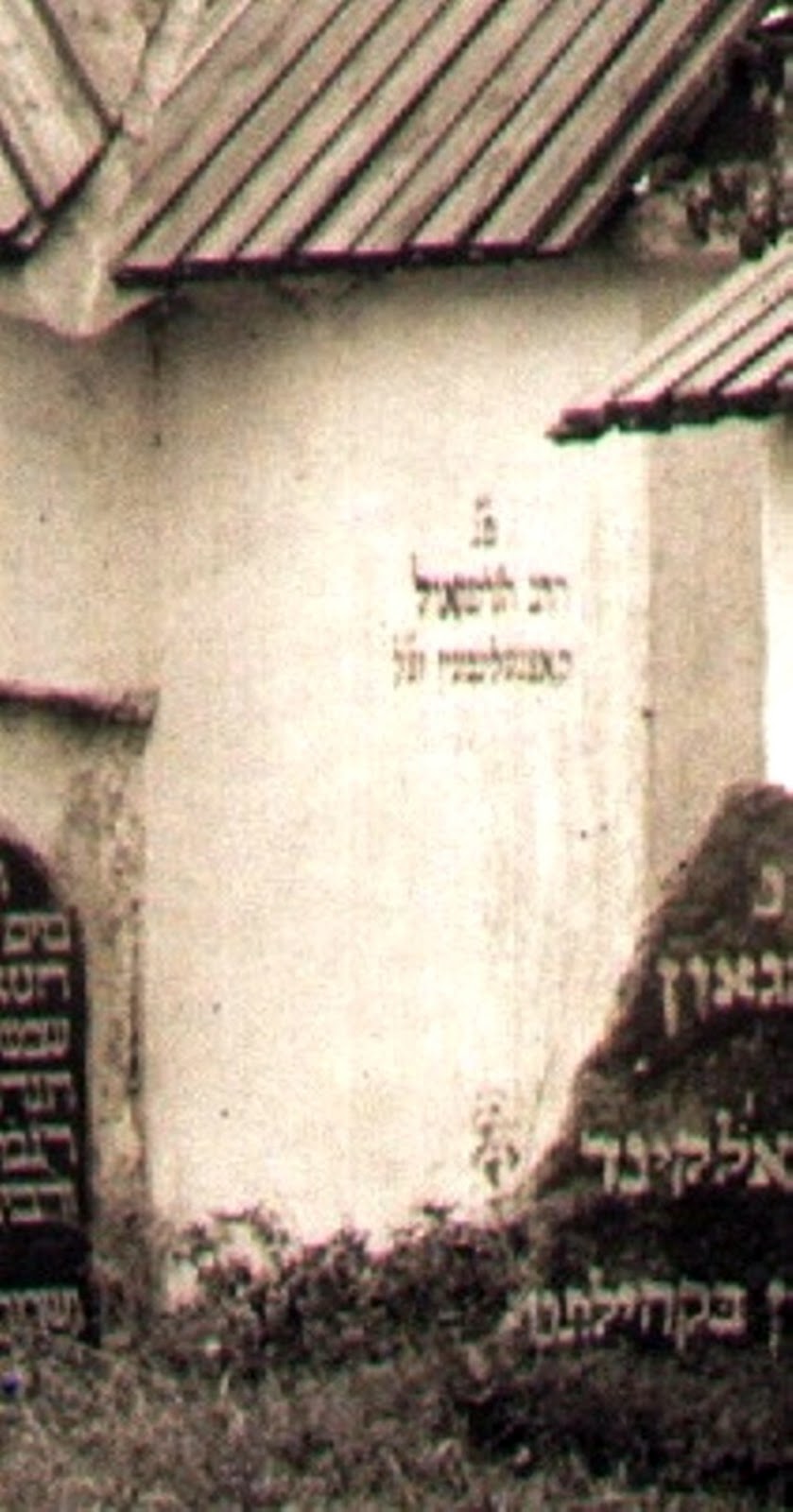


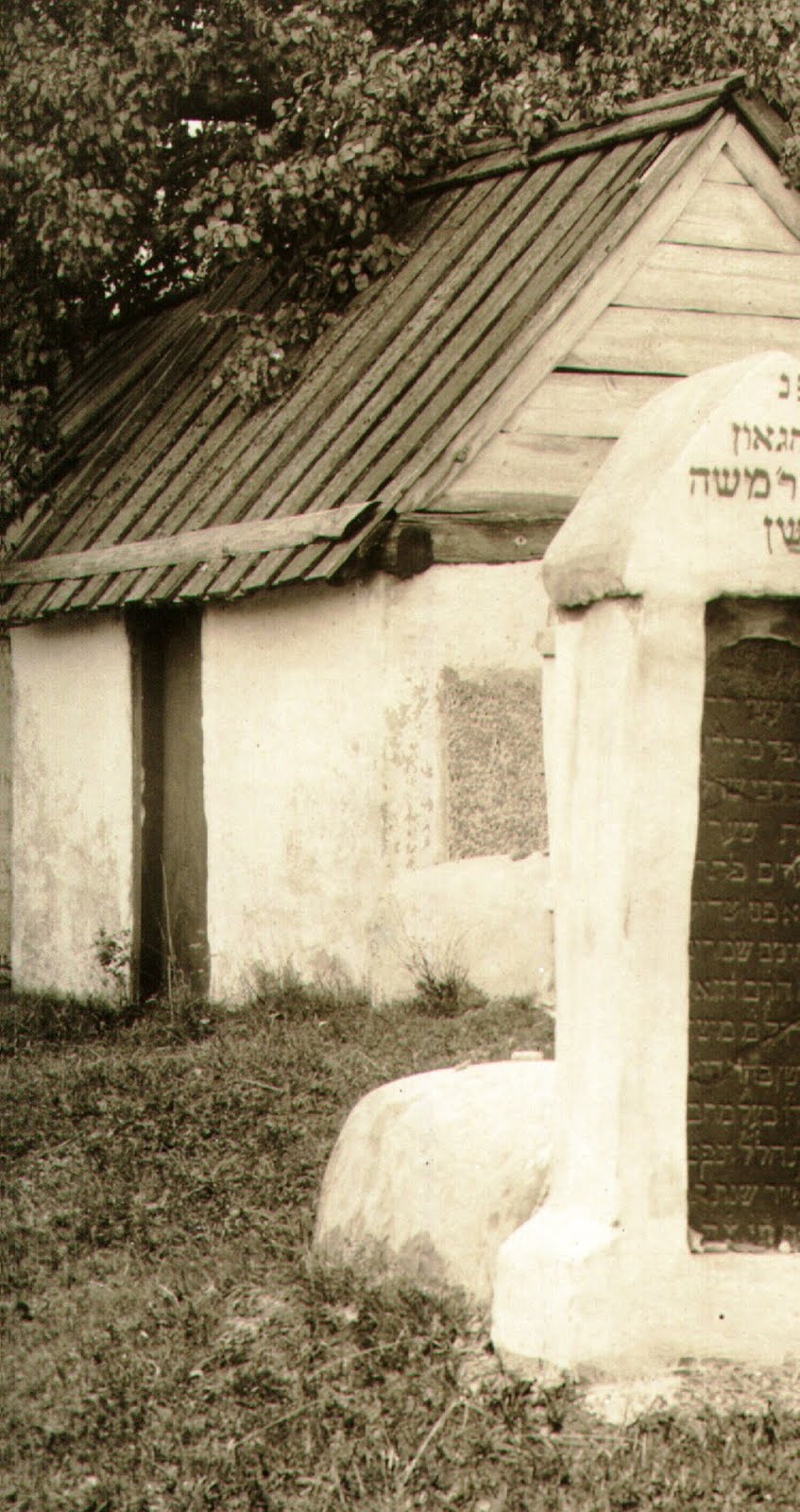


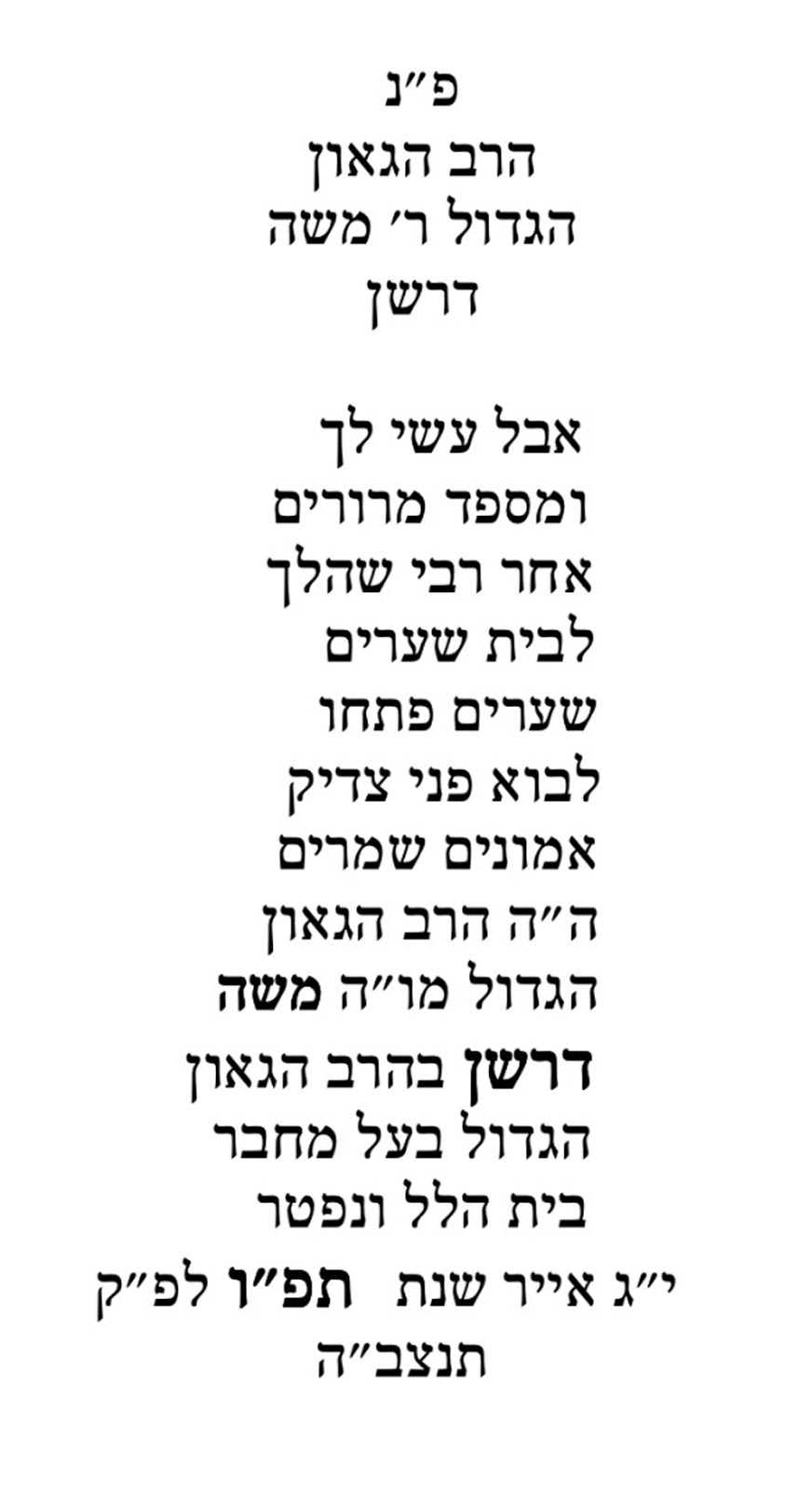
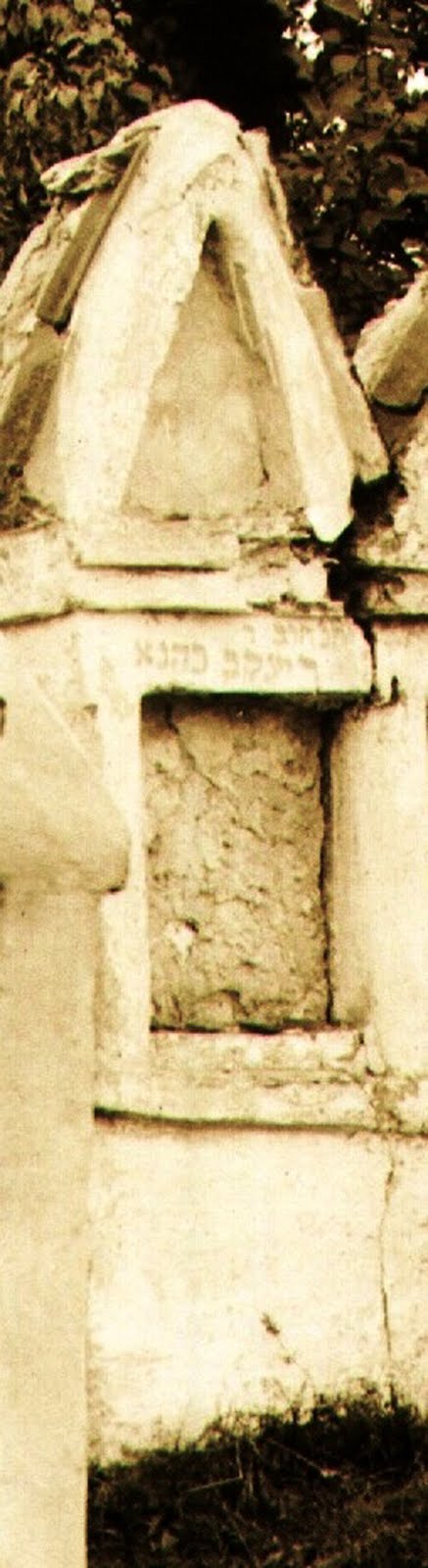


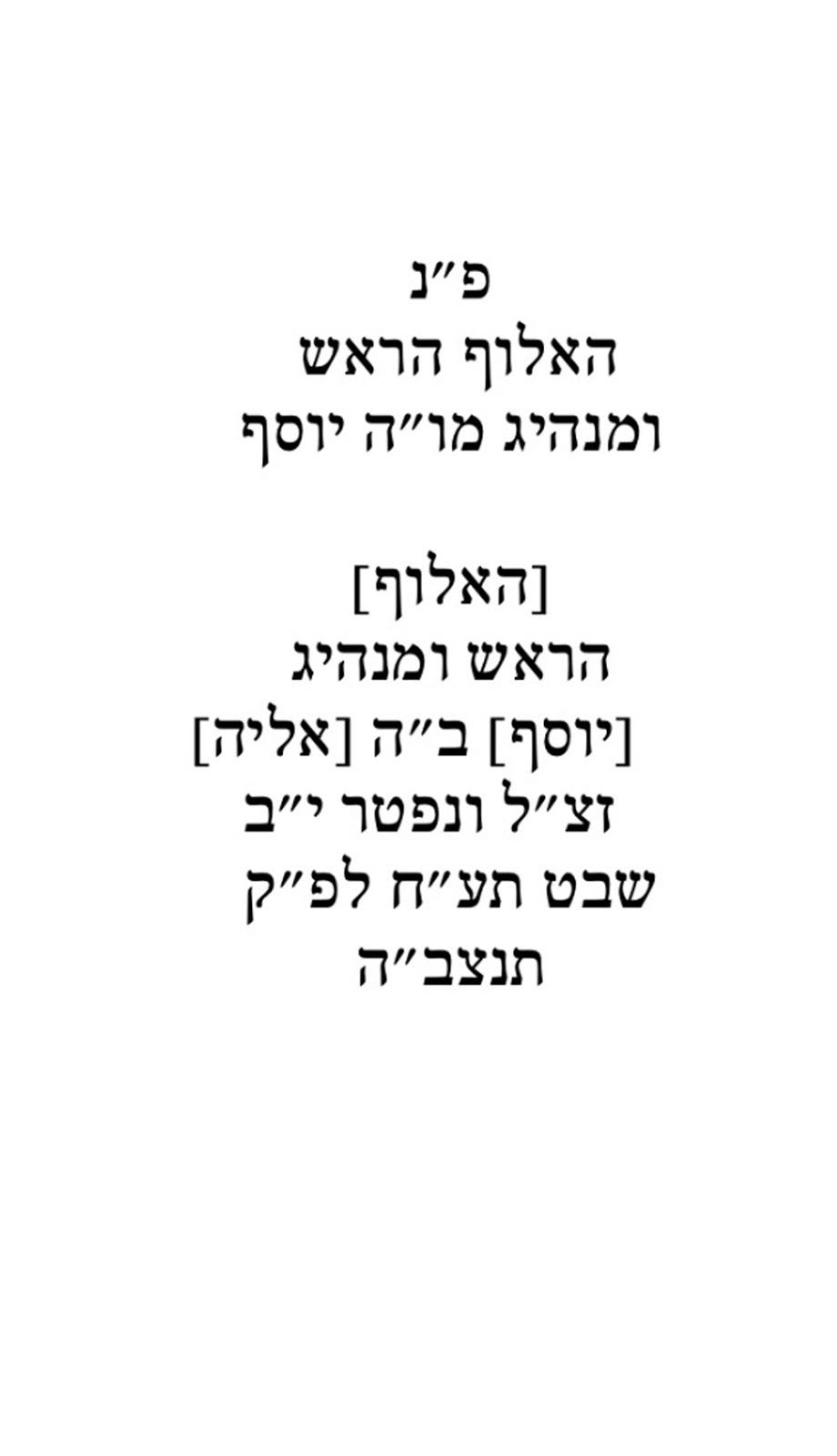


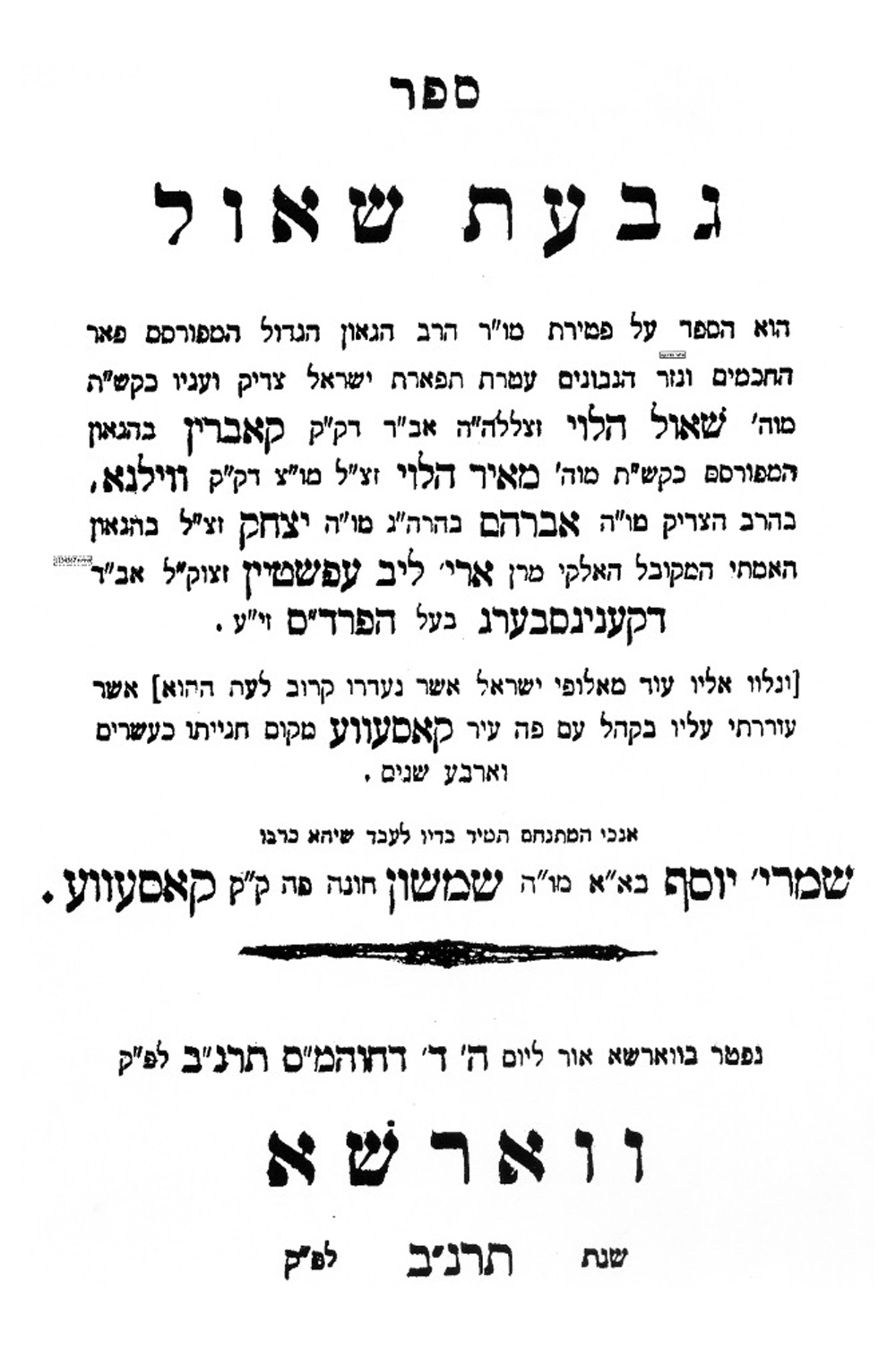 [
[