Is there a rotten apple in the Tu-BeShevat Fruit Basket?

Is there a rotten apple in the Tu-BeShevat Fruit Basket?

By Dan Rabinowitz and Eliezer Brodt

[This post is heavily updated from an earlier Seforim Blog post – here]

Some claim that the origins of the custom to celebrate Tu-beShevat as a holiday that includes eating fruits and other rituals, is Sabbatean. In the main, this assertion is based upon identifying  the work Hemdat Yamim as the source for Tu-beShevat as a holiday and eating fruit and other rituals.  Thus, an article in Ha’aretz trumpets, “The New Year for the Trees, Isn’t it for Sabbatai Zvi.” And the National Library of Israel’s blog includes a post “The Holiday of Tu-beShevat is an Auspicious Time to Pray for the Only (?!) Jewish False Messiah.”  They even include this photoshopped image.

However, a closer look at the history reveals, that although some of the customs on Tu-beShevat can be traced to Hemdat Yamim the actual celebration dates much earlier. Contrary to the popular song, Tu-beShevat hegihu hag ha-ilannot, the 15th of Shevat was not a “chag” of the trees.  Instead, the earliest discussions regarding Tu-beShevat do not mention any holiday associated with the day.  The first Mishna in Rosh Hashana, identifies the 15th of Shevat as the new year for trees.  This designation merely defines how to calculate annualized tithes and is otherwise silent as to the significance of the date.  One can’t tithe fruits from one year using a different year’s fruits. Thus the 15th of Shevat is the cut-off point. [For other contemporaneous examples see Safrai, Mishnat Erets Yisrael, Mesekhet Rosh HaShana (Jerusalem:  Mehlelet Lifshitz, 2011), 305-06]. It was not until R. Gershom’s time that there were any of the traditional holiday markers, but only that fasting is prohibited.

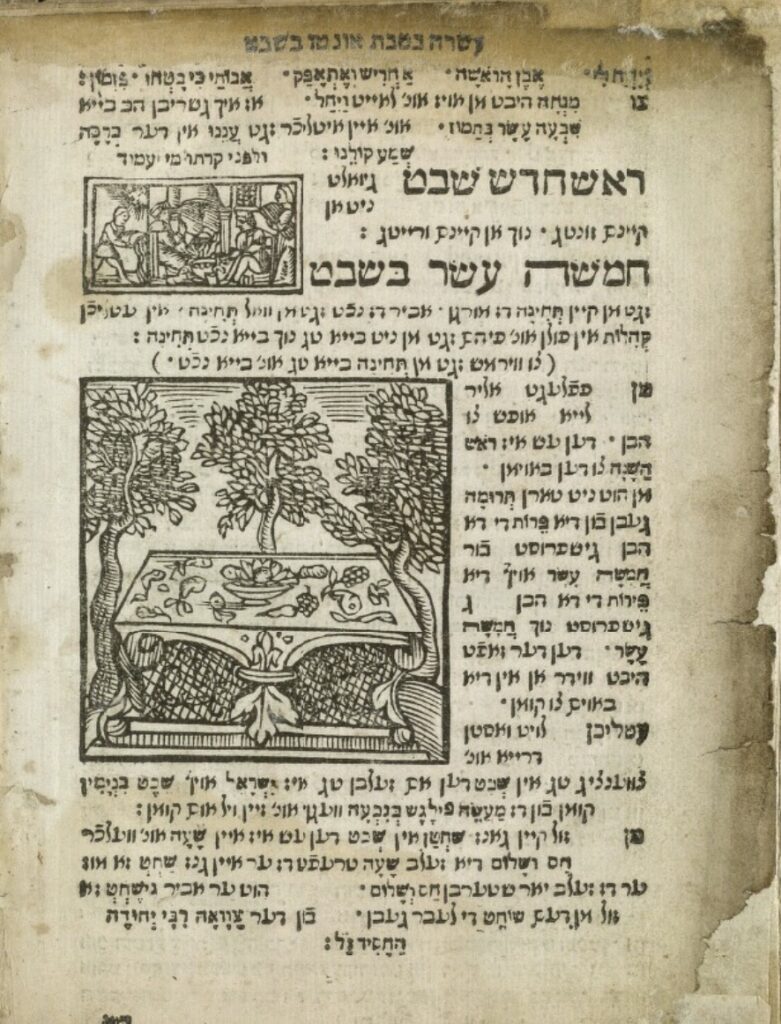
The first mention of the custom to eat fruit and other holiday rituals appears in 16th century Machzor, published between 1548 and 1550. 

That Machzor follows the Ashkenazi rite and includes a discussion of customs according to that rite and the commentary of R. Benyamin ha-Levi Ashkenazi, Ma’aglei Tzedek. He was the rabbi of the Ashkenazi community in Saloniki (of contemporary interest is that he records the death of four of his sons during a plague).   This source, however, was not well-known, and, historically, a different, later, source is identified.  For example, Avraham Ya’ari in his otherwise comprehensive article claims that R. Issachar ibn Susan (c. 1510-1580) is the first mention.  Susan, in his Ibur Shanim, published in 1578, provides that “the Ashkenazim have the custom [on Tu-beShevat] to eat many fruits in honor of the day,” confirming the custom recorded in the Machzor.  1578 was the first authorized printing of R. Susan’s work but not the first time this custom is associated with him.  In 1564, Shlomo Rie published Susan’s Tikkun Yissachar.  (Ibur Shanim 48b and Tikkun Yissachar 62a).  Susan, in Ibur Shanim, accuses Rie of publishing an unauthorized edition, one that contains errors and unacknowledged additions by Rie. Ibur Shanim includes a corrected and otherwise only slightly modified version of Tikkun Yissachar.  [See Susan’s introduction; see also Yaakov Shmuel Spiegal, Amudim be-Tolodot Sefer ha-Ivri: Hadar Mechaber (Jerusalem, 2018), 321-22.]

Mention of this custom also appeared in a Judeo-German Minhagim book first published in 1590. “The custom is to eat many fruits as it is the New Year of the trees.”

Venice, 1593 edition


In the community of Worms, there was a rather interesting variation of the custom. As R. Jousep Schammes (1604-1678) in his custom-book states:

On Purim and the 15 of Av and Shevat these were vacation days for the Rabbis, . . . [on the 15th of Shevat] one says tehina even during the morning prayer. It is a vacation day for the students and the teachers, especially the younger students, it is a day of feasting and joy for or the teachers and their students. The custom is for the teachers to distribute whiskey to the students and make merry with them.”  Minhagei [de-Kehilah Kedosha] Vermisai le-Rebi Joszpa Shamesh (Jerusalem:  Machon Yerushalim, 1988), 249-50, no. 211.

The first mention of Tu-beShevat in a Sefardic source appears in R. Hayyim Benveniste’s (1603-1673) Kenneset ha-Gedolah, first published in Livorno in 1658, where he quotes Susan from the Tikkun Yissachar.  Although Benveniste would later be associated with the Sabbatian movement, his inclusion of this custom in 1658, long pre-dates the movement. Benveniste’s source does not include a seder, nor does it testify to any adoption amongst Sefardim.

Kabbalah first enters the picture in 1728 with a somewhat obscure source. In 1728, Eliyahu Malhlenov published, Birkat Eliyahu, his commentary on the Talmud.  Amongst his papers,, he had a few pages of materials from R. Moshe Hagiz and appended those to Birkat Eliyahu. These materials include responsa and discussions regarding customs.  Hagiz records a custom from his grandfather, R. Moshe Galante.  R. Galante was also Hagiz’s teacher as his father died when Hagiz was a boy.  According to Hagiz, his grandfather had “the custom that on the 15th of Shevat he would eat many fruits that required many blessings and prayed to God that he should decree for us and them a good year. He ate the following 15 fruits, and on each one would recite … a chapter of Mishna…”  Hagiz then provides the order to eat the fruits.

Hagiz might technically be the first to describe a specific ceremony associated with eating fruits, but the source that popularized Tu-beShevat amongst Sefardim, and that incorporated a seder is Hemdat Yamim. Hemdat Yamim, first published in 1732 anonymously has the entire seder for Tu-beShevat. This includes passages from the Bible as well as specific foods. This in turn was popularized to a greater degree when it was included in the book Pri Etz Hadar first published in 1753 and republished an additional 29 times by 1959, and now digitized on Sefaria.

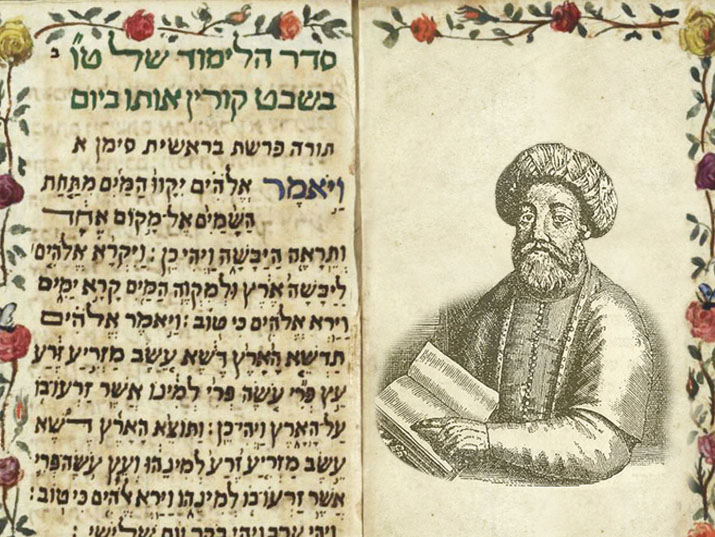
National Library of Israel

The author of Hemdat Yamim concedes that this is not a custom that originated with the Ari or his students.  Nonetheless, the author provides his own kabbalistic ideas and wrote his own kabbalistic prayers for the occasion, and a specific order to the ceremony.  According to many scholars, Hemdat Yamim is not reflective of the kabbalah of the Ari but that of Sabbatai Tzvi and his disciples.  Indeed, Boaz Huss has identified specific prayers in the Hemdat Yamim Tu-beShevat liturgy that allude to Sabbatai Tzvi. Whether or not this assertion is correct, because we can trace this custom, that of eating fruits, to over 100 years prior to the Sabbatian movement as already a pre-existing custom, it is likely unrelated to Sabbatian theology or custom.

Plagiarism

Avraham Ya’ari, the noted bibliographer, wrote a comprehensive article tracing the history of Tu-beShevat.  That article appeared in Machanim and is available at Daat.  This article, at times entire paragraphs, are reprinted verbatim, without any attribution, in a recent book ostensibly authored by Tuvia Freund, Moadim le-Simchah.  Published in six volumes between 1998-2010, this work is replete with such examples of plagiarism.  Here, however, Freund did something arguably even more egregious.  In the pages of materials he steals, Freund cites Yaari and his article by name.  Not for the fact that all the above material comes from there but a small tangential item, the number of times a book was printed.  Indeed, Freund is so unwilling to give Yaari any credit in a paragraph lifted word for word from Yaari, the work Hemdet Yamim is discussed.  Freund provides in a footnote, “see the long discussion regarding this work in Sefer Talmumot Sefer page 134 and on.”  Freund doesn’t reveal the author of Talmumot Sefer, who is none other than Yaari.  Freund doubly removed Yaari from the picture.


Magen Avraham

The Magen Avraham cites the Tikkun Yissachar as the earliest source for the custom to eat fruits on the 15th of Shevat.  This, despite the fact that he had accessed, and indeed quotes on many occasions, the Machzor with the Maageli Tzedek commentary. See, e.g.,

נה:יז, פח:ג, קלא:י, תכז:א, תלא:ה, תלז:יז, תכז:א, תנ:יב, תנג:יא, תקפא:ד, תקפא:ז, תקפא:ח, תקפב:ח, תקפג:ב תקפד:ג, תקפט:ד, תרכד:ז, תרכט:ה, תרנא:יט, תרנא:כא, תרנח:יב, תרסא:, תרע:ב [2X], תרעב:ה, תרעג:ז, תרפא:א, תרפח:יא, תרצ:יט, תרצא:ח

While he had access to the Machzor, he did not have access to the Tikkun Yissachar.  The Magen Avraham quotes the Tikkun Yissachar on a few occasions, but always via a secondary source. See Brodt Halachic Commentaries to the Shulchan Aruch on Orach Chayim from Ashkenaz and Poland in the Seventeenth Century (PHD Bar Ilan 2015), pp. 68-69. The Mekor Chaim in O.C. 686:1 is the first to point to the Machzor for this minhag.

The halachot in the Machzor were collected by  Yitzhak Hershkowitz ed., Maglei Tzedek (Jerusalem, 2000), pp. 156-157.  Regarding R. Benyamin see Y.S. Emmanuel, Matsavos Saloniki, vol. 1 (Jerusalem, 1973), 36, 68-69; Meir Benayahu, “Rebi Shmuel Yaffa Ashkenazi,” in Tarbiz, 42 (1973), 423-24 and note 37; M.S. Molcho, Matsevot Bet ha-Olamin she Yehudi Saloniki (Tel Aviv, 1975), 59-60; Yitzhak Rivkin, “Dikdukei Soferim,” in Kiryat Sefer 4 (1927), 278 no. 32; Daniel Goldschmidt, Mehkerei Tefillah u-Piyyut, 252-65, Meir Benayahu, Defus ha-Ivri be-Kremonah (Jerusalem, 1971), 141-78. About Knesset Hagedolah and being a Sabbatean see Brodt, Halachic Commentaries to the Shulchan Aruch on Orach Chayim from Ashkenaz and Poland in the Seventeenth Century, pp. 56; Brodt, Yeshurun 35 ( 2016 )p. 775; See also the recent work, R. Shmuel Ashkenazi, Igrot Shmuel (2021)-, 1, pp. 4-5. 

R. Shmuel Ashkenazi

As the Seforim Blog just published Iggrot Shmuel from R. Shmuel Ashkenazi (see here and here) we reprint two letters from his collection, one discussing the origins of the holiday of the 15th of Shevat and the other Hemdat Yamim.


Notes:

Additional sources discussing the 15th of Shevat, see  Meir Rafeld, Netivi Meir, (2013), 185-189; R Mandelbaum, Tehilah Ledovid (Jerusalem, 1993);  Guttman, Otzar TuBeshvat.

Tikkun Yissachar was republished in 1988 with an excellent introduction from R. Betzalel Landau.  Most recently, in 2019, it was reprinted and re-typeset, with additional notes. This edition also includes R Landau’s introduction and another introduction of material about the work. See also Elisheva Carlebach, Palaces of Time: Jewish Calendar and Culture in Early Modern Europe (London: Belknap, 2011),  51-58; יוסף הקר, ‘יששכר אבן סוסאן עליית כוהנים לתורה בשמחת חתנים’, בתוך: ‘מנחה למנחם’, קובץ מאמרים לכבוד ר’ מנחם כהן, בעריכת חנה עמית, אביעד כהן וחיים באר, ירושלים תשס”ח, עמ’ 79-97

Regarding Hagiz, see Elisheva Carlebach, The Pursuit of Heresy (New York: Columbia University Press, 1990).

After the Birkat Eliyahu was published it was attacked by some rabbis.  See Meir Benayahu, “Sefarim she-Hiburum R. Moshe Hagiz she-Hotsyim le-Or,” in Ali Sefer 4 (1977), 143, 150-52; see also Shlomo Yaakovovitch, “Sefer Shehitot u-Bedikot le-R’ Yaakov Weil,” in Tsefunot 4 (1989), 112; Carlebach, Pursuit of Heresy, 247-49. Regarding R. Eliyahu see Y. Halpern, Pinkas Vaad Arba Arotsot (Jerusalem, 1990) 362; Tzvi Horowitz, Le-Tolodot ha-Kehilot be-Polin (Jerusalem, 1989), 1.

The literature on Hemdat Yamim is substantial and we hope to return to the work in an upcoming post.  For the most recent discussion see Y. Goldhaber, “Le-Birur Zehuto shel Mehaber Hemdat Yamim,” in  Sefer Zikhoron le-Professor Meir Benayahu, vol. 2 (Jerusalem: Karmel, 2019), 873-908.

Huss’s article appears as Boaz Huss, “Ha-Ets ha-Nehmad ben Yishi Hayi al ha-Adama: al Mekoro ha-Sabbatai shel Seder 15 Shevat,” in Sefer Zikhoron le-Professor Meir Benayahu, vol. 2 (Jerusalem: Karmel, 2019), 909-20.


Easing the Donkey’s Burden: Nitkatnu Hadorot or Nitgadlu?

 Easing the Donkey’s Burden: Nitkatnu Hadorot or Nitgadlu?
By Rabbi Simcha Feuerman
“If the earlier generations were like angels, we are like humans. But if they were like humans, then we are like donkeys.”
(Talmud Shabbat 112b)
One of the basic and fundamental tenets of our tradition is respect and deference for the previous generations.  Although there are notable exceptions, generally, rabbinic authorities do not override or disagree with the rulings of authorities from a previous class, such as Amoraim disagreeing with Tanaim, Gaonim with Amoraim, Rishonim with Acharonim and so on.  While this may be due largely to conceding that their knowledge of, and access to Torah Sheb’al Peh is more accurate[1], there is also an aspect of deference and respect for those who are considered to be of higher moral and spiritual character. [2]
This principle has a subtle but pervasive impact on the chinuch we give our children; it is not uncommon for rebbes and rabbanim to speak of “Nitkatnu Hadoros – The generations have become diminished” as a reason to explain how we are unable to fulfill a particular spiritual, moral or halachic ideal.  For example, while it is virtually unheard of to fast for more than 25 hours today, there were minhagim to fast for two days consecutively – on the 9th of Av and the 10th of Av[3], as well as those who were able to make vows of abstention for penitence.[4]  Apparently, we consider ourselves too morally and physically weak to live up to this standard.  Likewise, based on the accounts of many individuals from the previous generations, it was not uncommon for persons to spend the entire Yom Kippur night standing and reciting Psalms, and THEN praying the full day.  This seems beyond reach for most of us today.  When contemplating this, most people wearily sigh, “Oy, the doiros get more shvach (weak).”  These are but two examples of many instances where the deterioration of subsequent generations is an accepted fact of life in our tradition and our culture.
Is this principle absolutely true in all areas?  Is each successive generation truly less spiritual and less moral than the previous ones?  Are we riding a one-way train down to the depths of oblivion waiting to be rescued by the arrival of Messiah?  This resonates with the midrashic tradition about our ancestors in Egypt, who would have descended past all forty-nine levels of impurity had they not been rescued.[5] While such a belief seems to be well-supported by everything we have studied so far, there is a basic illogic to this position.  What is the spiritual purpose in the divine plan for sustaining us, if indeed each generation is less worthy?  Why not just throw in the metaphysical towel and bring Mashiach now, while we are still partially ahead of the game?
The answer must be, as was undoubtedly true in regard to our ancestors who were slaves in Egypt, that despite our continuous moral deterioration, our experiences must be preparing us and priming us for an ultimate experience of higher spirituality and achievement.  Presumably, the experience as slaves in Egypt somehow was a necessary preparation for acceptance and fulfillment of the Torah.  Indeed, many commandments in the Torah, ranging from Shabbat to the laws of usury, are supplemented with a reminder that we are obligated to follow them “Because I am your G-d who took you out of Egypt.”[6]  Furthermore, in regard to the capacity of empathy and caring for the plight of the downtrodden, the Torah reminds us “And you know the soul of the stranger because you were strangers in the land of Egypt.”[7]  If the experience of slavery in Egypt helped elevate and prime our ancestors for the accepting of the Torah, it may likewise be a fair assumption that while each generation may be undergoing spiritual and moral deterioration, there also is some new quality that is being
developed.  Perhaps this quality is not fully expressed and lays dormant until the time of redemption, or perhaps its quality is available and accessible to all of us right now.
In this essay, I will suggest one specific area where each generation improves its ability and depth to comprehend and fulfill the Torah, as well as the practical implications for the chinuch of our children.  According to fascinating research and statistics regarding I.Q. scores, the ability to perform abstract reasoning increases significantly with every generation.  This has a distinct impact on the ability to understand the more esoteric parts of the Torah, such as the reasons for the mitzvot, ways of understanding reward and punishment, as well as the mystical aspects of religious activities.  The Talmud tells us that “Three things expand a person’s consciousness: A pleasant home, a pleasant wife and beautiful utensils”[8], and it is quite possible that the relative wealth and security of modern life allows for each generation to improve its capacity to understand abstractions, because our surroundings are more pleasant and engender sensitivity and perception. As we shall see, the Sages of the Talmud did not believe the average not-so-learned Jew to be capable of grasping and comprehending many of the deeper aspects of the Torah.  There are numerous examples of this, and we shall study a few of them found in the Talmud and Medieval authorities.
The Truth about the Scrolls
The Talmud tells us that one of the early rabbinic decrees was a form of impurity applying to holy scrolls.  While it seems rather strange to declare holy scrolls to be impure, the rabbis had good reason to do so.  According to the Talmud, the common folk developed an ill-advised habit of storing food consecrated as Terumah in the same areas where they stored the holy scrolls.  The people reasoned, “The Terumah is holy and the scrolls are holy so why not store them together?”  The problem with this practice is that the rodents would come to eat the Terumah and inevitably also chew on the scrolls.  Therefore, the rabbis brilliantly declared that the scrolls are always impure, greatly discouraging people from storing them near the Terumah, which was required to be ritually pure.[9]
This clever bit of social engineering begs one basic question:  If the people were compliant and agreeable to following rabbinic rules and injunctions, why did the rabbis have to complicate matters by decreeing that the scrolls were impure, and of all things, have the audacity to suggest that holy scrolls are impure?  Would it not have been simpler to merely forbid storing holy scrolls alongside Terumah?  This suggests that actually the rabbis could not easily or completely secure compliance via this route and therefore could not directly forbid the co-placement of Terumah and scrolls.  Instead, they needed to tap into an apparent cultural taboo and respect for the laws of Terumah purity as a way to mobilize the people to comply and refrain from storing scrolls next to the Terumah.  In other words, to simply tell people that rodents will chew on the scrolls and therefore it is forbidden to store Terumah next to them would not have been as effective as creating a new form of impurity.  By creating a rabbinic decree of impurity, the rabbis were able to tap into a deeply ingrained respect for the laws of purity and fear of violating them.  This was apparently the most effective deterrent.
Another possible instance where the Sages used the taboo of impurity to shape behavior is in regard to the rabbinic mitzvah of washing hands before eating bread.  The stated reason for this law seems highly convoluted and begs for a deeper explanation.  The reason supplied is that since, when the Temple is rebuilt and the Cohanim will eat Terumah they will need to wash their hands before eating, the rabbis wanted to accustom everyone to wash.[10]  This reason is a quite a stretch, because the original ruling itself that required the Cohanim to wash was only based on another rabbinic declaration that hands are automatically considered ritually unclean.  So, in effect you have a rabbinic injunction to safeguard a rabbinic injunction, in effect a double safeguard, which is usually not the modus operandi of the sages.[11]  Furthermore, let us study the original reason for declaring unwashed hands as impure in regard to Terumah bread.  The Talmud tells us it is because one’s hands absentmindedly touch many objects.[12]  The rabbis therefore enacted a strange form of impurity declaring only the hands and no other part of the body impure, and then allowing a special ritual of water poured from a vessel to act as a mikvah for the purpose of removing the impurity.  This is in itself quite remarkable, because indeed had a person’s hand absentmindedly touched an impure
object such as dead rodent as the stated reason fears, the entire person’s body would be rendered impure and he would need to immerse himself in the mikvah.  Washing his hands from a vessel would accomplish nothing.  So, what problem if anything, did the rabbis
solve?
In fact, Rashi (Ad loc.) finds this explanation so implausible that he suggests another explanation, admittedly overriding what his rabbis taught. Rashi proposes that the requirement to wash before eating Terumah was enacted in order to ensure that the person eats clean hands out of respect for the holy food.  If so, it is not implausible that the rabbis ultimately extended this requirement to all bread in order to encourage sanitary eating habits.[13]   In any case, it is clear that according to Rashi, the rabbis once again used the taboo of impurity to shape social behavior, at least to show deference for Terumah by eating with clean hands, and possibly to eat with general cleanliness.
This deeply ingrained fear and respect for the laws of ritual impurity and regard for the sanctity of Terumah bread cannot be underestimated.  So much so, that according to some interpretations of the Mishna Nedarim, even a thug and a murderer will still be “pious” and careful to make sure he does not defile Terumah.  The Mishna states that if one is accosted by bandits, he may make a false oath declaring his produce as Terumah, so bandits and/or self-appointed tax collectors will leave him alone.  Incredibly, this implies that a bandit, who has no qualms robbing and murdering, will not want to transgress the boundary of defiling Terumah. This brings new meaning to the concept of honor among thieves![14]
These were not the only instances where the rabbis tapped into the taboo against impurity as a way to shape society. The Sages were quite concerned about Jewish children being exposed to inappropriate sexual contact during playtime with their gentile neighbors. They therefore decreed that gentile children be considered to have the impurity of a zav (a certain disease that was considered to cause a high degree of impurity, see Leviticus ch. 15) so that the Jewish children would not play with the gentile children. This decree was enacted to protect them from being subjected to improper contact.[15] One would think it would have been more effective to just educate and warn parents about the dangers of inappropriate sexual contact and/or abuse, as we attempt to do nowadays. Apparently, the rabbis who enacted this decree felt the standards of tznius would be violated if they stated their concerns directly, and/or their warnings would go unheeded because the average parent considered such acts unthinkable. They therefore resorted to the fear of impurity as a way to influence parental behavior and protect the children, taking care of safety concerns without violating tznius or overwhelming people with information beyond their ability to emotionally process.”
We see from the above examples that the rabbis had no qualms about withholding information and influencing people via their taboos, so long as it was for a worthy cause.  Apparently, at least in regard to the examples of the scrolls and molestation prevention, the rabbis did not have enough faith in the average person’s ability to grasp or handle the entire truth.  One wonders if this is an approach that would work well nowadays.  It does not seem likely.  As members of a democratic and open society, people expect and demand transparency from their leaders.  While these may or may not be Torah values, they are expectations that are accepted as our rights.  Furthermore, as we shall see later in this essay, the research shows that in modern times the average person is indeed more capable of understanding and grasping nuances than in previous generations.  [16]
As If They Are Children
In his introduction to Perek Chelek, Maimonides tells us that the pleasures of the soul are as inconceivable to us as color is to person who
is blind from birth.  The ultimate reason for doing mitzvot should not be about reward or punishment, rather one’s focus should be on wanting to become attached to G-d by performing his will.  In the World to Come, the soul will experience great ecstasy to whatever degree it can attain attachment to G-d, and the greatest possible punishment is that of karet, which is the soul’s disconnection from G-d.[17]  Maimonides tells us, despite the value and importance of this lofty concept, the Torah exhorts people in terms of reward and punishment as a concession to the limits of human understanding and motivation.  Few people would be motivated by the abstract notion of connection or disconnection to G-d.  Instead, for most people, the expectation of concrete reward and punishment is necessary to propel people in the direction of spiritual growth.  In time, as the person ascends to greater heights, he may be become capable of fulfilling the commandments completely lishmah, as is prescribed by Antignos Ish Socho in Pirke Avot.[18]   Maimonides explains that this is no different than a parent or teacher who motivates a young child to study by offering him sweets, and then as he gets older, offers even more significant prizes.  Only when the child is a full adult will he realize the value of what he is studying, and will he no longer require material rewards and prizes.
But, again one must wonder, is it true that people today would be insufficiently motivated by a vision of spiritual ecstasy and attachment to G-d?  The thousands of Jews and non-Jews who flock to gurus, ashrams, so-called “Kabbalah” Centers and other similar places seem to indicate this is not quite true.  In fact, perhaps to the modern man, the idea of heavenly reward and punishment may seem juvenile and much less of a motivator than the notion of performing good and moral deeds for their own sake.  Furthermore, although in the intimacy of my counseling practice as a psychotherapist, I indeed have encountered a fair share of clients who express nihilistic sentiments and profess atheism or agnosticism, I also have been deeply moved by persons of high moral character who profess a firm conviction that there is no G-d, nor any afterlife whatsoever.  I have seen such persons withstand remarkable moral tests.  Are they deluding themselves and actually, deep down, fear a final accounting in the Afterlife, or are they truly capable of being moral for its own sake?[19]   Has modern Man expanded his capacity for spirituality, and if so, in what way?
Midrash and Aggadot
Midrash have been explained and interpreted throughout the ages in accordance with various Jewish exegetical and philosophical approaches.  Medieval commentaries throughout the ages have instructed us to understand midrashic stories as allegorical in nature, hinting at lofty concepts such as mystical and kabbalistic teachings which the rabbis were reluctant to state explicitly.[20]   
In his introduction to his commentary on the Mishna, Maimonides states that the aggadot were taught to a general audience, which included children and those who were not scholars.  He therefore explains:
“One cannot teach the general public except by means of parable and riddle so as to include…the youth, in order that when their intellect reach a more complete level, they will understand the meaning of the parables.”
The proper and meaningful study of midrash is in general a vastly unexplored area of learning for most Jews, even those who spend many hours a day studying Torah in depth.  Unfortunately, aggadot are often relegated to the status of Jewish tales told to entertain children without enough thought being given to their deep meanings.
Are children today truly incapable of understanding the deeper meanings of these midrashim?  Personally, I recall studying a midrash with a nine year-old boy which stated that the Torah was primordially written with “Black fire on top of white fire.”[21]  When I asked him what he thought it meant, he told me “The black is the Yetzer Hara, and the white is the Yetzer Hatov.  The Torah needs both in order to be complete.”
Admittedly, this was a particularly precocious young man who had a track record of ingenious insights.  Nevertheless, it is worth considering that children today are quite capable of seeing deeper meanings in aggadot when challenged to do so.  All we need to do is keep an open mind and ask them what they think.  Here is one example of how this can be done with a famous midrash taught to all children.
The Sun and the Moon
“In the beginning of the creation of the world, G-d made the Sun and the Moon to be the same size and equally bright.  After they were created, the Moon approached G-d and said to him, “It does not make sense that two rulers should wear the same crown.”  G-d answered, “Okay, then you be the one who is shrunken to a smaller size and the Sun shall rule!”   The Moon then replied, “Because I said one smart thing you punish me so severely?”  G-d answered the Moon, “I’ll tell you what.  Go, and you shall rule over day and night.”  The Moon then replied, “What purpose is there in my ruling over the day, when there is plenty of light and no one needs my light?”  G-d replied, “Go, and through you the Jewish people will measure the days and the years, and thereby establish the dates of the holy days.  After some additional give and take, G-d saw that the Moon still was not satisfied, and in response he made following
request of the Jewish people: “On every Rosh Chodesh bring a sacrifice on my behalf in order that I obtain forgiveness for having reduced the light of the Moon.””[22]
If encouraged to do so, even young students will have no problem finding the obvious lessons in the story, such as how the Moon’s greed and grandiosity did not pay in the end.  But what about the other ideas in the story?  What can the students make of this give and take between the Moon and G-d?  Not only does the Moon gain concessions, in the end, G-d even asks the Jewish people to seek forgiveness on his behalf!
The Maharsha (Ad loc.) interprets this dialogue to be about the Jewish people.  In order for them to achieve their spiritual goals they must undergo great suffering in this world.  Ultimately, they will reap the reward in the world to come.  Nevertheless, the fact that the Jewish people must suffer so much in exile is, so to speak, painful to G-d, and he therefore tries to console the Jewish people.  First, by giving them the Jewish Festivals, but ultimately by reminding them that just as the Moon waxes and wanes through its cycles, so too the Jewish people will have moments in history when they are powerful and others when they are weak.
Given some chance to discuss this, children can easily be led to see these deeper meanings.  It also gives the teacher an opportunity to discuss the ways in which the Torah presents G-d with human emotions.  Though G-d is not subject to emotional whims, he chooses to reveal himself in such a manner so humans can relate to him.[23]  Within that light, from this story we see a willingness by G-d to enter into a dialogue with the sinner, to make accommodations, adjustments, and surprisingly, even to regret the harshness of the punishment he enacted.  From this story, any chutzpadik and misbehaving child could surely draw comfort.
Surely, with the right kind of instruction, this kind of analysis and understanding is well within the range of even many first graders.  We have a great opportunity to combine intellectual analysis with an emotional component to inspire internalization and practice of Torah values.  Yet previous generations seem to have preferred keeping this treasure trove of information in the form of a child’s tale.  It seems to me that our generation of children have an increased capacity for deeper reasoning and understanding and should be encouraged to look at these stories in a more symbolic light.   My experience talking to children today shows me that they are capable of great depth, analysis and interpretation.  Let us see why this might be true, and what has changed in recent history.
The I.Q.’s Keep Rising
One striking area where each successive generation is superior to the next is in regard to I.Q. Test scores.
“In 1981, New Zealand-based psychologist James Flynn…Comparing raw I.Q. scores over nearly a century… saw that they kept going up: every few years, the new batch of I.Q. test takers seemed to be smarter than the old batch. Twelve-year-olds in the 1980s performed better than twelve-year-olds in the 1970s, who performed better than twelve-year-olds in the 1960s, and so on. This trend wasn’t limited to a certain region or culture, and the differences were not trivial. On average, I.Q. test takers improved over their predecessors by three points every ten years – a staggering difference of eighteen points over two generations.
The differences were so extreme, they were hard to wrap one’s head around. Using a late-twentieth-century average score of 100, the comparative score for the year 1900 was calculated to be about 60 – leading to the truly absurd conclusion, acknowledged Flynn, ‘that a majority of our ancestors were mentally retarded.’ The so-called Flynn effect raised eyebrows throughout the world of cognitive research. Obviously, the human race had not evolved into a markedly smarter species in less than one hundred years. Something else was going on.
For Flynn, the pivotal clue came in his discovery that the increases were not uniform across all areas but were concentrated in certain subtests. Contemporary kids did not do any better than their ancestors when it came to general knowledge or mathematics. But in the area of abstract reasoning, reported Flynn, there were ‘huge and embarrassing’ improvements. The further back in time he looked, the less test takers seemed comfortable with hypotheticals and intuitive problem solving. Why? Because a century ago, in a less complicated world, there was very little familiarity with what we now consider basic abstract concepts. ‘[The intelligence of] our ancestors in 1900 was anchored in everyday reality,’ explains Flynn. ‘We differ from them in that we can use abstractions and logic and the hypothetical … Since 1950, we have become more ingenious in going beyond previously learned rules to solve problems on the spot.’
Examples of abstract notions that simply didn’t exist in the minds of our nineteenth-century ancestors include…the concepts of control groups (1875) and random samples (1877). A century ago, the scientific method itself was foreign to most Americans. The general public had simply not yet been conditioned to think abstractly.
The catalyst for the dramatic I.Q. improvements, in other words, was not some mysterious genetic mutation or magical nutritional supplement but what Flynn described as ‘the [cultural] transition from pre-scientific to post- scientific operational thinking.’ Over the course of the twentieth century, basic principles of science slowly filtered into public consciousness, transforming the world we live in. That transition, says Flynn, ‘represents nothing less than a liberation of the human mind.’
The scientific world-view, with its vocabulary, taxonomies, and detachment of logic and the hypothetical from concrete referents, has begun to permeate the minds of post-industrial people. This has paved the way for mass education on the university level and the emergence of an intellectual cadre without whom our present civilization would be inconceivable.
Perhaps the most striking of Flynn’s observations is this: 98 percent of IQ test takers today score better than the average test taker in 1900. The implications of this realization are extraordinary. It means that in just one century, improvements in our social discourse and our schools have dramatically raised the measurable intelligence of almost everyone.”[24] 
Chinuch Implications
According to these findings, our generation has the highest capacity for abstract reasoning and analysis than ever before.  Young children today who spend a great deal of time on computers, are even more used to hypothetical thought, layers of representation of symbolism, nuances and multiple perspectives than almost every computer game employs.  In fact, the actual use of a computer itself engenders recognition of symbolic content because the entire graphical interface is representation of acts rather than actual physical acts.  Opening “windows”, switching from one program to another, multi-tasking, becoming exposed to world events as they unfold in real time via newsfeeds, and playing role playing games can all lead to expanded consciousness and awareness. True, these same technologies can also lead children to be highly distractibility and crave constant stimulation, but let us focus on this generation’s gifts and strengths instead of bemoaning their shortcomings.
This is not the first time in Jewish history where a successor generation was superior in one aspect over a previous generation.  The Talmud records a remark of Rav Papa to Abaye, who ponders why miracles happened to the earlier generations and not nowadays.  Rav Papa states that it cannot be due to lack of Torah knowledge, as he declares their knowledge to be superior.[25]
I am not an educator by profession, so the definitive implications of these findings for the chinuch of our children require more extensive thought and discussion.  However, some areas that we might consider are :
  1. Increased focus on symbolic meaning, philosophy and the deeper aspects of the Torah.  Our children are indeed capable of understanding the Torah on a very deep level and we should not make the mistake of selling them short.  It is possible to engage them in actively interpreting and delving into a study of reasons for the mitzvot.  Maimonides encourages people to do, regardless of whether the mitzvah is a chok (law without an obvious reason) or a mishpat (law based on apparent logic.)  Maimonides states, “Though all the laws of the Torah are decrees [and not subject to debate]…it is fitting to contemplate them and, to whatever extent possible, try to find reasons for them.”[26]  One should pause to ask why Maimonides considers it important to find reasons for the laws of the Torah if they must be followed regardless of whether they seem logical or not?  Presumably the answer is that when one makes an effort to understand the laws, it helps guide a person to think in consonance with the morals and ethics of the Torah, thereby increasing the development of character.  With proper guidance and encouragement, our children can excel in this area.
  1. Likewise, in regard to the study of aggadot, we could help the children reach for the deep lessons and interpretations of these allegories, to strengthen their belief and respect for the insights found in our tradition.
  1. Every now and then, someone bemoans the fact that in prior generations, the yeshivot covered far more ground and mastered hundreds of blatt, instead of merely focusing on a few blatt per year, studied in great depth.  While this criticism is valid and important, perhaps we also should embrace this situation in recognition that the yeshivot might be indulging in a great deal of analysis for one simple reason – the students are good at it.  As a generation, more individuals are capable of this deeper learning than ever before.  Thus, the desire to do so is understandable, and may need to be given more recognition.  True, the knowledge of basics needs to be encouraged as well, but this can be tempered with a special appreciation that more and more young people have a thirst to study and analyze in greater depth and the drive should not be excessively stunted.  As the Talmud says, “A person should always study in the direction that his heart desires.”[27]
  1. It is well and good to teach our children humility and historical perspective but care might be taken not to overdo and engender an attitude of pessimism and defeatism.  They certainly should understand the brilliance, dedication and awesome spiritual and moral character possessed by sages of previous generations.  Nevertheless, no one wants to be on a losing team, so if we want children to stay loyal to Jewish tradition and practices, they ought to feel like winners.  We can also convey a message of confidence and belief in their ability as Jews and spiritual beings to make new and important contributions, as opposed to being mere paving bricks, biding time on the road to the Messiah.  Showing them their unique strengths and intellectual abilities is one way to do that.
Concluding Thoughts
As they mature in life, our children will be exposed to science and philosophy in various degrees.  Some may learn complex ideas as a result of the professions they choose such as medicine, psychology, sociology or other science-based courses of study, or may just read about these ideas on their own due to the readily available and popular works.  Today, your average person can go to a book store and purchase titles such as Stephen Hawking’s Brief History of Time, which makes physics and astronomy understandable to the common man.  Do we want to run the risk of our children having a grade-school understanding of the Torah, and then as they grow up and learn about the world, find secular ideas to be more sophisticated and exciting?  While indeed, in some respects, our generation is at a spiritual and moral low point, embarrassingly insignificant compared to the giants of years past, we do not have to wallow in self-pity.  Rather, we have an opportunity to modify our curriculum and include deeper and more profound aspects of the Torah, allowing our children to become stimulated as they capitalize on their ever increasing capacity to comprehend what previous generation considered secret, esoteric and beyond the reach of but a few.
Rabbi Simcha Feuerman, LCSW-R is psychotherapist in private practice specializing in high conflict couples and families.  He serves as Director of Operations for OHEL Children’s Home and Family Services, and as President of Nefesh International.  Simchafeuerman@gmail.com


[1] Menachem Kellner in Maimonides on the Decline of
the Generations
(Albany: SUNY Press, 1996) suggests that according to
Maimonides the previous generations of rabbis have superiority on the basis of
their access to a less distorted masorah,
but not due to an inherent supernatural superiority.
[2] See Eruvin 53a which suggests that the deterioration
in Torah knowledge of successive generations as due to many factors including
lack of spiritual breadth and lack of studiousness.
[3] Ba’er Heytev, Shulchan Aruch, O.H. 558:3
[4] Shulchan Aruch, O.H. 563:4
[5] Zohar Chadash, on Parashas Yitro, by the first verse of the Aseret
Hadibrot, 20:1.
[6] Leviticus 25:35-38
[7] See Exodus 23:9 and Leviticus 19:33
[8] Berachot 57b, see also Maimonides, Shemoneh Perakim,
ch. 5, where he elaborates on this concept.
[9] Shabbat 14a
[10] Chulin 106a
[11] Beitzah 3a, see Mesoras Hashas ad loc. for further
references
[12] Shabbat 14a
[13] See Mishna Berurah 158:1 which offers both reasons,
that of habituation in ritual purity for Terumah,
and also physical cleanliness as an aspect or representation of spiritual
purity.
[14] Nedarim 3:4, see Bartenura ad loc.
[15] Shabbat 17b
[16] See R. Eliezer Lippmann’ Neusatz’ Mei Menuhot,
published in 1884.  Here is a quote from
Dr. Marc Shapiro’s discussion on the Seforim Blog (here)
“On p. 16a, after citing Maimonides’ words that the majority err in
understanding aggadot literally, Neusatz comments that this was the situation
in earlier times, which were less religiously sophisticated than later
generations. The proof that the earlier generations were religiously naïve is
that belief in divine corporeality was widespread then. According to Neusatz,
people who were so mistaken about God that they imagined him as a corporeal
being would obviously not be able to understand Aggadah in a non-literal
fashion. He contrasts that with the generation he lived in, which was able to
properly understand Aggadah.
אמנם בדורנו זה נזדככו יותר הרעיונות ונלטשו הלבבות והמושגים האלהיים
הנשגבים האלה מצטיירים בלבות המאמינים בטוהר יותר ורוב זוהר, ונתמעטו אנשי הכת
הזאת, ותה”ל רובם יודעים שחז”ל כתבו אגדותיהם ע”ד משל ומליצה וחדות
וכפי הצורך אשר היה להם לפי ענין הדורות אשר היה לפניהם, פנימיותם הם ענינים
אמתיים נשגבים עומדים ברומו של עולם.”
[17] Also see Maimonides, Mishne Torah, Hilchot Teshuvha
chapters. 8 and 10 where he elaborates on this theme
[18]  Avot 1:3
[19] It is important to point out that though this is
superficially similar to Maimonides’ position, and certainly relatively
admirable, being moral for its own sake with no belief in the ultimate goal of
connection to G-d is problematic.
According to Maimonides, doing a mitzvah
lishmah – for its own sake, does not
mean without connection to G-d.  It just
means without a need or desire for reward as a motivator.  In fact, in Hilchot Melachim (8:11),
Maimonides definitively states that a Gentile who fulfills the seven Noachide
Laws out of logic and morality alone without doing them with the intent to
fulfill the Creator’s mitzvot, will
not merit reward in the World to Come among the righteous gentiles.  This is even more striking because there is
no apparent source for this ruling, which suggests that Maimonides considered
this principle obvious and self-evident, perhaps stemming from his
philosophical beliefs about the nature of the soul and how immortality is
attained through a process of elevating the intellect and character, which
would be impossible without correct beliefs.
It would seem, according to Maimonides, that morality without acceptance
of the yoke of Heaven is simply not considered moral.
[20] See for example Rabbi Moses Chaim Luzzato’s
introduction to Aggadah, found in the beginning of most editions of the Ein
Yaakov, and Maimonides’ commentary on Mishna Sanhedrin, introduction to chapter
10, “the third group”, p. 137, Kapach Edition, and Ibn Ezra’s
introduction to his commentary on Chumash.
[21] Midrash Tanchuma Bereishis 1
[22] Chulin 60b
[23] See Maimonides, Mishne Torah, Yesodei Hatorah
1:9.
[24]
Shenk, David,
The Genius in All of Us, Doubleday Copyright 2010, pp. 35-37.
[25] Berachot 20a
[26] Mishne Torah, Hilchot Temurah 4:13
[27] Avoda Zara 19a


A Review of Parashas Hamelech – Al Mitzvas Hakhel, by Rabbi Moshe Parnes

A Review of Parashas Hamelech – Al Mitzvas Hakhel, by Rabbi Moshe Parnes

Reviewed by: Rabbi Moshe Maimon, Jackson, NJ

Sefer Parashas Hamelech on the mitzvah of Hakhel offers a unique and illuminating contribution on one of the lesser-studied mitzvos of the Torah. It fits the modern genre of encyclopedias on arcane subjects, while also combining elements of older and more established trends in Torah publications, weaving it all together in deft scholarly fashion. It is both an exhaustive accumulation of sources primary and secondary on its topic as well as a lively sefer iyun, providing fresh and penetrating perspectives on everything it touches.

The little explored, but very timely mitzvah of Hakhel which in the Temple era entailed a mass gathering at the Beis Hamikdash in the post-sabbatical year, where the assemblage would hear the Jewish King perform a special Torah reading, has been largely uncharted by the major halachic compendiums. A noteworthy exception is the Rambam who included it in his Hilchos Chagigah; the section of Mishneh Torah pertaining to the tri-annual Temple pilgrimage. The obvious reason for its exclusion from the codes is that this mitzvah was not of practical relevance for the Jewish Diaspora, and thus became a topic for theoretical discussion by experts only.

Interest in this mitzvah, however, was generated in scholarly circles with the return to the Land of Israel by large segments of World Jewry. Late in the 19th century, the illustrious R. Eliyahu David Rabinowitz-Teumim (“the Aderes”) published (anonymously) what to this point has been considered the most exhaustive treatment of the topic, his Zecher Lemikdash. (A major focus of the Aderes has been the possibility of reestablishing this mitzvah in modern times, even if only as a testimonial—an idea elaborated upon by R. Shmuel Kalman Mirsky in his article in Talpiyot vol. 6 pp. 92-118).

Additionally, besides for being virgin halachic ground, this topic also leads into fascinating discussions on more classical halachic topics such as laws the pertaining to daily prayer, the reverential treatment of Torah scrolls, and the specific requirements for the weekly Torah reading. Naturally, an incisive treatment of the unique Hakhel service in the Beis Hamikdash is of necessity accompanied by deep dives into the broader context of other mitzvos that were specifically pertinent in the Temple era, as well as close examinations of various elements of the Temple services and the qualifications necessary for Jewish royalty along with other such related topics.

With every passing shmittah cycle, interest in Hakhel seems to swell and this year is no different. Our author, Reb Moshe Parnes, a self-described businessman living in Boro Park but clearly a gifted scholar who devotes a good portion of his day to intense Torah study, timed the launch of Parashas Hamelech perfectly. His magnum opus was primed and perfected just in time for the culmination of the current shmittah cycle.

The volume begins with a thorough introduction devoted to the “aggadic” aspects of Hakhel and presents various different perspectives on the unique mitzvah, all culled from a wide variety of classical sources, such as the following:

  • A mass Torah-study session.

  • A demonstration geared for enhancing fear of Heaven among the masses.

  • An outgrowth of the mitzvah to make pilgrimage to the Beis Hamikdash during the shalosh regalim (a perspective enhanced by the Rambam’s placement of this mitzvah in Mishneh Torah as mentioned previously).

  • A reenactment of kabbalas haTorah.

The main body of the sefer is divided into three parts: The primary text is written in the style of a Shulchan Aruch with short, anonymous pronouncements given in the form of chapters (simanim) and paragraphs (se’ifim), which cover all the halachos of Hakhel divided into three main categories:

A] The section on the general aspects of the mitzvah covers the exact time and place for the mitzvah; the technical aspects of how the platform is constructed and the Torah scroll that is to be used for the reading.

This section ends with a spirited discussion of the sources regarding the fulfillment of this mitzvah in contemporary times. It concludes that since the mitzvah is dependent on mitzvas r’iyah (the Temple pilgrimage) which cannot be practically fulfilled without the Beis Hamikdash, the mitzvah of Hakhel cannot either be fulfilled at this time. To counter the suggestion of the Aderes that we at least make a remembrance for this mitzvah, the author points out that a zecher is not enacted when the mitzvah itself was never performed outside of the Beis Hamikdash. (The Aderes himself, following the Yaavetz, adopted the view that the custom of reading Sefer Devarim on Hashanah Rabbah evolved out of a zecher for Hakhel. If this were true, the author’s point would be considerably weakened, but it should be noted that this idea is purely speculative and does not account for the fact that the custom is practiced every year, whereas Hakhel was only relevant once in seven years).

B] The second section is devoted to the unique Torah reading that constitutes the actual mitzvah of Hakhel, and encompasses all aspects of this reading. At the end of this section, the author shows how many sources understood that this Torah reading was intended to lead into a practical mussar shmooze by the king, who would even exhort the people to be more pious in their religious observance. One prominent Italian sage, R. Shmuel Yehuda Katzenellenbogen (d. Padua, 1597), illustrates this point with a sampling of a schmooze targeting the ills of his own time—married women who did not cover their hair, or who wore wigs!

C] Section three covers all the rules regarding who is obligated by this mitzvah and who is exempt. No scenario is left unexplored, from children to converts to people with physical disabilities and much more. It is here that we can find detailed discussions pertaining to all aspects of life, even one as seemingly mundane as whether someone with impaired vision necessitating eyeglasses is considered “blind” and thereby exempted from Hakhel.

The main text is rather comprehensive and treats pretty much every aspect of the halachos of Hakhel, but it is in the two subtexts where we are treated to full blown halachic expositions of a great array of topics. The section titles “biurim” deals primarily with the material treated in the main text, providing the sources for the cited opinions with a good deal of breadth and thorough analysis—sure to delight those with a lomdishe bent.

The “iyunim” section, on the other hand, branches off the “biurim” section and includes in its scope interesting dives into topics which may be tangential to the main discussion but are compelling on their own. A sampling: What are the halachic prerequisites for determining who is a shoteh (insane)? Did the Israelite kings of the ten tribes have the halachic status of Jewish kings? What are the parameters of the mourner status conferred on one who has been placed in niddui (excommunication)? What is the reason for reading the Aseres Hadibros with the taam elyon? These and many more discussions are listed in the detailed topical index included at the end of the sefer.

The source material used for this work is exceptionally rich. When we read in the introduction the passionate dedication to the author’s late father, who possessed a tremendous library and knew how to utilize it well in his scholarly pursuits, we get the sense that the son is likewise in possession of these blessings. The fifteen-page bibliography at the end of the volume provides the authors’ names and dates of publication for the roughly 500 titles cited in the text.

A section at the end of the sefer includes a lively back and forth between the author and other scholars pertaining to their comments on his work, in which Rabbi Parnes credits his colleagues generously for their insights.

Recent years have seen a flurry of new sefarim which seem, more and more, to deal exclusively with highly specialized topics. This may just be an expression of the development of new directions in Torah scholarship in the contemporary “Torah world.” As celebrated masters of kol hatorah kulah become ever more scarce, their places are taken by localized experts who specialize in specific areas of Torah.

Perhaps, however, this trend is merely symptomatic of the nature of supply and demand in the sefarim market; a sort of Torah capitalism if you will. Consumers, sensing that previous generations have already sowed all that are worthwhile in the field of rabbinic scholarship, trend towards the encyclopedic, targeting sefarim that will reap all the fruits of the generations of labor and serve as a repository of all the information generated by scholars–both ancient and recent–on a given topic. Contemporary authors are simply aiming to meet that demand.

Whether indicative of new trends in Torah study or simply of changing patterns in the marketplace, sefarim focusing exclusively on issues that previously took up a few simanim (or, in some cases, no simanim) in Shulchan Aruch have become commonplace of late. Typically, these works excel more in their bekiyus than in their iyun. While these sefarim can be very effective for research purposes, one who still wishes to revel in that old time iyun is often better served looking for a title authored by one of the greats of the past.

Yet, as evidenced by the sterling example of Parashas Hamelech, the sources that have supplied countless generations with grist for the iyun mills are still capable of inspiring further significant halachic developments when utilized properly by capable baalei iyun. Rabbi Parnes should thus be commended for his wonderful and singular offering to the world of Torah scholarship that combines both of the aforementioned trends.

May the merit of the additional Torah study spurred on by this engaging work contribute to the tipping of the Heavenly scales and hasten us to that long-awaited moment where we can once again practice this monumental mitzvah.


Bein hashemashot: A Reevaluation of the Texts Part III

Bein hashemashot: A Reevaluation of the Texts Part III
by: Dr. William Gewirtz

This is the third of four posts, from a draft of a forthcoming monograph by Dr. William Gewirtz that addresses the period of bein hashemashot, the most fundamental area of dispute in the area of zemanim. What is proposed is an astronomically accurate hybrid position between the diametrically opposed conceptual views of the geonim and Rabbeinu Tam. That position justifies, to varying degrees, the practice of countless generations of European Jewry that started Shabbat well after sunset on Friday evening. Though often ignored in modern times, practical equivalents of this hybrid position have had major adherents throughout the generations. Our goal is to demonstrate that such a position is not just plausible, but in fact the preferred reading of the gemara in Shabbat, the primary text concerning bein hashemashot.
The attached PDF (click here to download) contains the 9 main sections of the monograph. Sections 5, 7 and 8, focused on reading the text of the gemara in Shabbat consistent with observation, detail the core thesis. This post is a commentary on each of the nine sections; unlike the PDF, it takes much wider latitude for conjecture. The next and last post summarizes some major areas of suggested innovation, contrasting the approach taken with an illustrative example of contemporary psak (the various rulings on zemanim of R. Feinstein), before making some closing observations.
Commentary on the 9 sections:

  1. How many mil does one walk during the period from sunrise to sunset? What is the time required to walk a mil? – 18, 22.5, 24 minutes, etc.

Except for Rambam and R. Ovadiah Bartenura, few maintain 24 minutes. Both of the other major opinions have significant support. Some geonim and rishonim likely maintained an 18 minute interval. However, many if not almost all later rishonim, particular those following Ramban, adhere to 22.5 minutes. Interestingly, by the time of the Shulchan Aruch most authorities are united around 18 minutes, with a small number of achronim strongly supporting 22.5 minutes.

When I started studying this topic, I was convinced by the overwhelming arguments presented by Prof. Levi based on both the text of the gemara and the opinion of many rishonim, that 22.5 minutes should be strongly preferred. However, 18 minutes also appears well supported. Geography (the distance from Modiin to Jerusalem, for example) seems to support more mil walked per day (even 40 being difficult.) As well, the assumed similarity of the fractions 1/10th and 1/6th used by the gemara in Pesachim would place the twilight period of either the time to walk 4 or 5 mil outside of the daytime period of the time to walk 40 or 30 mil; 5 mil external from 30 mil (1/6th) should imply that 4 mil is external from 40 mil (1/10th.) Arguments in favor of 18 minutes from anyone maintaining 72 minutes, almost all of R. Yosef’s examples, while not conclusive are highly likely. An assumed added vav in the text of the gemara in Pesachim (Our text of the gemara reads “teidah…“u”mealot hashachar” in the second such phrase addressing the interval between dawn and sunrise. The vav does not appear in certain older texts.) when referring to the twilight periods might have been intended to clarify or to lend further support to 18 minutes.

Since it is clear that many if not almost all rishonim supported 22.5 minutes, the change to 18 minutes is puzzling. As we demonstrated, a basic mathematical/logical error allowed many to misread the opinion of all chachmai sforad as not necessarily supporting 22.5 minutes. That error and the limited availability of many of their writings are certainly major contributors for the dominance of 18 minutes as the time to walk a mil. However, I suspect that this might also be an example of the impact on halakhic reasoning from the increasing availability of clocks beginning in the 15th century. Clocks made 90 minutes as the time that three stars appear untenable in central and southern Europe; as a result, perhaps, opinion shifted to a somewhat more reasonable 72 minutes and the associated time to walk a mil of 18 minutes. Prior to the widespread use of clocks, it is likely that observation of the skies, as opposed to either 72 or 90 minutes, was used to determine the end of Shabbat.

  1. How long is the period from sunset to tzait (kol) hakochavim (or equivalently alot hashachar to sunrise) in the Middle East around the time of the equinox? – 72 minutes, 90 minutes, 96 minutes, 120 minutes, etc.

96 minutes, four intervals of 24 minutes, referenced in a number of tshuvot, is unsupportable since whoever would maintain a time to walk a mil of 24 minutes must also consider the period from alot hashachar to sunrise as the time to walk 5 and not 4 mil. 120 minutes, while theoretically possible, is rarely encountered in halakha and is inconsistent with the point at which total darkness occurs in the Middle East, approximately 80 minutes after sunset. While both 72 and 90 minutes intervals are good approximations to 80 minutes, I maintain a slight preference for 72 minutes for four reasons: (How adherents of Rabbeinu Tam’s approach reconciled the difference in the length of the interval between dawn and sunrise versus sunset and three stars is unclear. The former would suggest 90 minutes in Europe, the opinion of many later rishonim who lived there. On the other hand, the latter would support 72 minutes. I suspect that given the subjective nature of determining what constitutes the first light and the additional stringencies of three small, adjacent stars, the difference may have become less evident. With the advent of clocks, 72 minutes was perhaps easier to assume if one number had to be chosen for both. This in turn may have made observation yet less authoritative.)

  1. The amount of light present at 72 minutes is so minimal that it was likely disregarded in halakha.
  2. R. Saadyah Gaon and Rambam, who both lived in the Middle East, support 72 minutes.
  3. The simple meaning of 1/10th of the (720 minute) day is 72 minutes; assuming 1/10th to mean 90/900 requires a unique variant of the notion of milebar adding two intervals of 90 minutes to 720.
  4. Around the winter solstice in Jerusalem, using an adjusted (or even fixed) 90 minutes in calculating according to the Magen Avraham, results in plag haminkha after sunset. In the winter, when the daytime period is approximately 10 hours and the sun is 20 degrees below the horizon about 96 minutes after sunset, plag haminkha (1.25*66 ~ 83 minutes) occurs approximately 13 minutes after sunset.

3. How is the period from alot hashachar to sunrise or its equivalent from sunset to tzait (kol) hakochavim to be adjusted at different locations and during different seasons (if at all)?

Prior to the widespread use of clocks, latitude and season (and perhaps even altitude) based adjustments were made naturally. The invention of clocks and the subsequent growth of time based expressions of halakha reduced the dependence on observation as have been documented by Prof. Stern.( Time and Process in Ancient Judaism. )

Many calendars exhibit inconsistent behavior, defining misheyakir, for example, based on physical observation, while maintaining an unadjusted period for alot hashachar, a position that creates anomalies at most European latitudes.

In practical terms, the end of a day of the week, when defined either by a measure of darkness or the more common appearance of three stars naturally embed both latitude and seasonal adjustments. However, except for a few isolated exceptions, those who wait 72 minutes after sunset for the end of Shabbat never made upward adjustments. (To my knowledge, no major figure except R. Soloveitchik (and perhaps some family members) applied and practiced precise latitude and seasonal adjustments to lengthen the end of Shabbat when following the opinion of Rabbeinu Tam.) By waiting 72 minutes, they would naturally wait longer than those watching for darkness or the appearance of stars at least until the point that one is approximately 50 degrees latitude or greater from the equator, regardless of the time of year. At latitudes below 50 degrees, even a depression angle of 8.5 degrees, that exceeds the observance of (almost) all communities, would equate to less than 72 minutes. As a result, 72 minutes after sunset remained invariant. Given the location of the vast majority of Jewish communities between 55 degrees north latitude and the equator, those who observed 72 minutes had limited physical motivation to make either latitude or seasonal adjustments; three stars, most often even small ones, are visible by that time. (To the contrary, not just were intervals not adjusted upwards, those who maintained the position of Rabbeinu Tam, either waited exactly 72 minutes or less, not more. As noted previously and first mentioned explicitly by R. Avraham Pimential in the 17th century sefer Minkhat Kohen and practiced in many communities, those following the opinion of Rabbeinu Tam actually reduced 72 minutes (often to around 50 minutes) based on the observation of three stars. I have never read an explanation of how this was reconciled with the calculation for the time of alot hashachar for those following the Rabbeinu Tam. A more traditional view of the Rabbeinu Tam’s position was to wait until 72 minutes after sunset.) (Even for St. Petersburg and certain communities in Scandinavia, given significant variance in how to interpret three small stars, smaller depression angles (but still greater than that which would equate to three medium stars) would allow 72 minutes to remain viable. See Benish chapter 46 on European observance in a number of (very) northern European communities that used the equivalent of a depression angle of approximately 7.5 degrees for the end of Shabbat. In Vilna for example, using a depression angle of 8.5 degrees, the end of Shabbat occurs approximately 95 minutes after sunset in the summer, 40 minutes later than in the spring.)

On the other hand, unlike the end of Shabbat (or any day of the week,) the beginning of the daytime period, alot hashachar, should not have been left invariant, as was often the case. In Prague in June, for example, using a depression angle of 8.5 degrees, the end of Shabbat occurs about 70 minutes after sunset, while alot hashachar, specified by a depression angle of 16 degrees, occurs over three hours before sunrise. However, as it was often axiomatically assumed based on Rabbeinu Tam’s interpretation of the sugya in Pesachim, that the interval between alot hashachar and sunrise must exactly equal the interval between sunset and tzait hakochavim, either both or neither could be adjusted. Particularly in the age of clocks, adjusting one and not the other would visibly violate that assumption. Thus, I suspect that the opinion of Rabbeinu Tam may have contributed to a tradition of not adjusting the time of alot hashachar, in order to maintain similarity with the invariance of the evening zman of a fixed 72 minutes after sunset for tzait hakochavim. The amount of illumination that defines the point of alot hashachar was simply assumed to be greater. (The times for misheyakir may be reflective. The rulings of Middle Eastern poskim tend to equate to depression angles of 11.5 degrees and higher, while European poskim tend to a range between 10 and 11 degrees, as is clear from Benish vol. 1, pages 211 – 215. It is highly likely that a relatively short duration (6 minutes) between alot hashachar and misheyakir that is mentioned by some commentators in OC 58:1 is not the result of an early point of misheyakir but a later point of alot hashachar. As a result, combining such a psak with an accurate (adjusted) time for alot hashachar cannot be justified.)

In summary, three potential impacts of increased reliance on clocks have been suggested in this and preceding sections of the epilogue:

  1. Reduced reliance on observation and natural skepticism about of its accuracy, particularly relative to a clock, eventually led to decreased practical knowledge of the meaning of specific physical entities further increasing reliance on clocks. (Arguably alot hashachar, misheyakir, and a medium versus small star have all been impacted .)

  1. The clear preference for 72 over 90 minutes as the point at which three (small) stars appear, and the related preference for 18 versus 22.5 minutes as the time to walk a mil.

  1. The invariance of the interval from alot hashachar to sunrise resulting from its assumed equivalence to the interval from sunset to tzait hakochavim according to the prevalent opinion of Rabbeinu Tam, created observational challenges. The duration of the interval from sunset to tzait hakochavim rarely exhibits any need for variation by either season or latitudes; the point of alot hashachar clearly does. The use of identical (fixed) intervals for both, weakened reliance on observation and trust in one’s ability to judge levels of darkness.
  1. How are we to define the hours of the day – sunrise to sunset or alot hashachar to darkness?

The identification of the opinion of the Magen Avraham only as far back as R. Israel Isserlein as opposed to Ramban (See R. Schechter’s explanation that R. Soloveitchik was completely unconcerned about the opinion of the Magen Avraham because of an implication from Rambam that was a supporting source for the Gaon. It is puzzling that R. Soloveitchik would dismiss an opinion of all chachmai seforad. ) and his school who clearly counted the hours of the day from alot hashachar to darkness remains puzzling. (I assume that this was primarily the result of limited availability of the seforim of chachmai sforad.) Given that the position of the Magen Avraham was held by all chachmai sforad and was the accepted custom of Jerusalem, in spite of the influence of the students of the Gaon, coupled with a lack of any unambiguous reference to the position of the Levushim amongst rishonim, provides additional support to that alternative. The argument of R. Yaffe and the Gaon that time is defined by the angles of the sun, is compelling, but not entirely convincing.

As noted in the past section, current practice, that sets times for the Magen Avraham’s zman based on a fixed 72/90 minutes for both alot hashachar and tzait (kol) hakochavim, is a divergence from zemanim based on observation that was practiced prior to the advent of clocks. For those who wish to maintain the times of the Magen Avraham, their precise approximation / calculation would seem warranted. As hypothesized, the opinion of Rabbeinu Tam and the observance of a fixed 72 (90) minutes at the end of Shabbat might have contributed to a tradition of not adjusting 72 minutes (or 90) minutes in this context as well.

  1. Of the three criteria given by the gemara in Shabbat – time, the appearance of stars, darkness (darkening / appearance of the sky / horizon), which if any are the definition of night and which are just approximations or an indication? How can opinions expressed using these three terms be compared?

I maintain a clear bias towards levels of darkness and light defining both the end and the beginning of bein hashemashot, as well as almost all other zemanim. What is not yet fully recognized is that relying on depression angles for defining the level of darkness is akin to relying on clocks to tell time.( I have seen calendars that while using depression angles choose to write three small or medium stars, presumably to make people more comfortable, avoiding marketing challenges and the need to explain.) More importantly, depression angles naturally incorporate adjustments based on season and latitude, something that clocks more than likely obscured. Clocks and even time is just an artifact; depression angles are a mechanism for accurately specifying the halakhic notion of darkness.

While both the appearances of stars and multiple levels of darkness vary naturally with seasons and latitude, clocks likely had impact with their introduction. As time became an easier and preferred method for specifying observance, it is likely that the meaning of darkness levels and the appearance of stars became less observed, relevant or understood.

Motivated by the desire to understand the observations and findings of R. Tukitzinsky more directly, I have carefully observed the appearance of stars and the darkening of the horizon at various latitudes and seasons of the year. As best as I can observe, the point at which the apex of the sky appears as dark as the eastern horizon slightly precedes the appearance of three or more stars. However, it is not yet as dark as the eastern half of the sky will become as one waits longer; the (eastern half of the) sky darkens further until sometime after a point in the evening comparable to the point in the morning of misheyakir. Even at that point, there is still some remaining illumination from the sun visible on the western horizon. Though this level of darkness is in all likelihood what is described in the gemara and has been the psak of generations of poskim for the end of Shabbat, it may well leave one feeling uncertain about the time at which Shabbat ends. Unlike alot hashachar where there is minimal (or no light) light, the end of Shabbat occurs when there is significantly more illumination. Without depression angles that point of chashecha is difficult to specify with precision even relative to three (small, adjacent) stars, perhaps influencing many to view stars as defining.

Assuming that the appearance of three stars and alot hashachar are equidistant from sunrise and sunset also makes it nearly impossible to regard darkness as defining; one would expect it to be equally dark at those two points. Instead, we end Shabbat when there is more illumination than at alot hashachar. This adds yet another reason why some doubted their observation of the degree of darkness, and preferred instead to think both of:

  • stars as defining, and
  • clocks as more reliable and precise than observation.
  1. How is the duration of bein hashemashot to be adjusted at different locations and during different seasons (if at all)? Might this depend on whether bein hashemashot is
    1. an interval of uncertainty that is its own unique halakhic category – either
    1. a combination of both day and night, or perhaps
    2. a category of its own, or
    1. an interval with a definitive transition point that we are uncertain how to pinpoint – either
  1. practically, or perhaps
  2. because of some element of halakhic uncertainty, or
    1. an example of the Rabbis establishing a fence?

In this and the following two sections, the approach of the geonim is assumed and options for the length, end, and beginning of bein hashemashot are discussed within their framework. It is easiest to begin with the length of bein hashemashot. This turns out to be a critical method to estimate the beginning of bein hashemashot given the assumption that the end of the bein hashemashot period is not in question. The interval of bein hashemashot can be specified using either of the following constructs:

  • the interval between two precisely defined physical events / depression angles, and / or
  • an interval of time prior to the end of the day.

Despite the potential dependence of these two constructs on the theoretical alternatives for defining bein hashemashot, I have argued that the issues are independent. The discussion that follows concentrates only on these two alternative constructs; others are either just variations or combinations.

One issue briefly outlined is the difference between safek chashecha and bein hashemashot. I assume that the period of safek chashecha is shorter than bein hashemashot and represents a period of real doubt about whether chashecha and the beginning of Shabbat at a biblical level has occurred. (The remainder of this section could be rewritten independent of this assumed relationship between bein hashemashot and safek chashecha if one were to feel that this assumption is not justified .) Bein hashemashot represents a longer interval, where Shabbat is mandated, but only at a rabbinical level.

The following discussion is not meant to identify a normative position, rather one that presents a preferred, or at least plausible, reading of the gemara and also (partially) justifies the practice of Jewish communities in Europe that started Shabbat well after sunset. Seeking to justify practice even at a rabbinical level requires a relatively short period of bein hashemashot. Using either sunset or even a minimal depression angle would mean that most communities who followed Rabbeinu Tam started Shabbat during bein hashemashot or worse.

Assume, as an illustrative example, that a community ends Shabbat 50 minutes after sunset with the appearance of three small stars. Assume further that while three small stars equate to a depression angle of approximately 8 degrees, three medium stars, the gemara’s end to both bein hashemashot and Shabbat, equates to a depression angle of approximately 6 degrees, and occurs 35 minutes after sunset. Bein hashemashot begins approximately 15 minutes before that, at 20 minutes after sunset. To justify practice, two elements must be considered:

  • At the biblical level, the point of chashecha, slightly prior to three medium stars, and
  • at a rabbinical level, the interval from the beginning of bein hashemashot until chashecha.

As detailed at the beginning of section 8, three alternative opinions, each to be adjusted by latitude and season advance the beginning of bein hashemashot by 4 to 15 minutes from sunset. At a minimum one would naturally maintain that a level of darkness computed for each of those alternatives must be achieved (to create an element of doubt that is required) to begin bein hashemashot. Additionally, one can maintain that the time to walk 3/4 mil is an absolute upper bound, invariant with respect to latitude and season. Thus, bein hashemashot cannot begin prior to the time to walk ¾ mil before the point of nightfall. If one would want to be as lenient as possible, one would take the later of these two potential times – counting back from chashecha the time to walk ¾ of a mil, while maintaining as well the requirement to reach a particular level of darkness. Thus, bein hashemashot begins at the earliest when a particular level of darkness is reached, (for example, a depression angle of three degrees) but at no time can the interval of bein hashemashot be longer than the time to walk ¾ mil. Using the minimum level of darkness is required slightly north of the latitude of the Middle East and further south approaching the equator. In those locations during certain periods of the year, subtracting the time to walk ¾ of a mil from chashecha might yield time X. However, the time at which a specific level of darkness, which must also occur prior to the start of bein hashemashot, is Y minutes later at time X+Y. For example, assuming that the time to walk ¾ mil is a maximum reached only in the summer, then the bein hashemashot period may begin only within ten minutes of chashekha in the spring and fall when the requisite level of darkness is achieved.

Moving from the Middle East to European latitudes, the focus of this discussion, reaching a particular level of darkness level always occurs at an earlier point than subtracting the time to walk ¾ mil from the point of chashecha. Thus, one obtains the latest (and most lenient) starting point for bein hashemashot by subtracting the time to walk ¾ mil from the point of chashecha, assuming that interval represents an invariant maximum for the period of bein hashemashot. Support for an invariant interval of bein hashemashot came from both R. Lorberbaum and R. Sofer, and in the case of R. Lorberbaum that was coupled with an 18 minute time to walk a mil yielding a period of bein hashemashot of 13.5 minutes. Problematically, in both of those cases the beginning of bein hashemashot was derived subtracting from an end of Shabbat that was determined by the appearance of three small stars. Although their practice was not as stringent as our current practice that equates to a level of darkness associated with a depression angle of 8.5 degrees, it was still one or more degrees greater than the level of darkness associated with a depression angle equating to three medium stars. It appears impossible to justify an overly lenient approach that subtracts from the time that three small stars appear of as opposed to an approach that subtracts from the earlier appearance of three medium stars.

To determine what was the practiced beginning of bein hashemashot requires a detailed historical analysis beyond that begun by Benish. It should be obvious that an early practiced chashecha and a long period of bein hashemashot is likely to avoid both biblical and rabbinic violation on erev Shabbat, while a later practiced chashecha and a short interval of bein hashemashot would create the highest likelihood of even a biblical violation on erev Shabbat. To the extent that the theoretical opinion of the Rabbeinu Tam was used, chillul Shabbat definitely occurred. However, more commonly the opinion of Rabbeinu Tam was equated to three stars with various stringencies, and bein hashemashot began some interval before that. That would make it much more likely that violations that occurred were only at a rabbinic level. Given a large body of evidence including:

  • R. Pimentiel’s redefinition of Rabbeinu Tam to the earlier point of three small stars,
  • the proposed times of bein hashemashot of both R. Lorberbaum and R. Adler,
  • the question concerning the brit of a baby born about 25 minutes after sunset, posed to R. Moshe Sofer,
  • the advice from R. Shneur Zalman of Liadi in his Siddur, and
  • the natural stringencies that one would expect prior to the existence of clocks.

I doubt any communities (as opposed to individuals) ever started Shabbat as late as the theory of Rabbeinu Tam would have permitted.

While I have scant evidence, one can only assume that any three stars appearing would likely be taken as indicating that the Shabbat had begun. This, together with the halakhic literature only partially referenced above, would all seem to point to a beginning to bein hashemashot, absent tosefet Shabbat, at worse between 30 and 40 minutes after sunset, a point that likely avoided chillul Shabbat at least at the biblical level, particularly in northern European communities. Unfortunately, it is also probable that some individuals started Shabbat even later; the letter of R. Shneur Zalman of Liadi on the beginning of Shabbat, included in all of the Lubavitch movement’s Siddurim, is particularly telling. (R. Shneur Zalman of Liadi suggested that maximal protest be restricted to those who go past approximately a seasonally adjusted 30 minutes, if they refuse to listen initially.)

  1. When does the period of bein hashemashot end? How are the criteria specifying the end of the bein hashemashot period interpreted by various authorities?

Of course we assume latitude and season adjustments. We need to specify two points in time – the degree of darkness associated with the approximate appearance of three medium stars (the time given in the gemara) and the degree of darkness associated with three small, adjacent stars (what is now practiced). The former occurs at a depression angle of approximately 6 degrees, and the latter at about 8 degrees. Clearly, practice has many variants around those two points. Currently, a depression angle of 8.5 degrees suggested by R. Tukitzinsky and supported by R. Belsky’s interpretation of R. Feinstein is widely used.

I suspect some will find excessive the intensity with which the opinion of Rabbeinu Tam was found inconsistent with the combination of observation and the gemara’s description of the end of Shabbat. Many might perhaps prefer giving greater credence to difficult and forced efforts at reconciliation. However, current practice, including that of R. Y. Karelitz, which largely disregards Rabbeinu Tam’s opinion on the end of Shabbat, even for absolute biblical restrictions, encourage the conclusions reached. I do not know of another comparable instance where the uncontested opinion of the Shulchan Aruch was so completely overturned.

  1. How does the beginning of bein hashemashot relate to what we call sunset? What alternatives might be considered for the beginning of bein hashemashot?

This most controversial topic, moving the beginning of bein hashemashot forward from sunset even according to Rabbah, a variant of the generally assumed opinion of the geonim, successively solves the following issues:

    1. at 4 – 5 minutes, the minimal time reported as the custom of Jerusalem (See Minhagei Eretz Yisrael by R. Yaakov Gliss, pages 102 and 282.) as well as the opinion of R. Shneur Zalman of Liadi, the point when the sun disappears from the highest elevations around Jerusalem, Shmuel is consistent at least in a limited sense with R. Yosef but completely inconsistent with Rabbah.

    1. at 6 minutes, the opinion of R. Chaim Volozhiner and the appearance of a single star in the spring to an expert observer, Shmuel is more easily consistent with R. Yosef but only consistent in a limited sense with Rabbah.

    1. at 7 – 15 minutes depending on a variety of factors, Shmuel becomes entirely consistent with Rabi Yehudah and the time to walk ¾ mil can be considered a practical upper bound. (See Zemanim Kehilkhatam by R. Boorstyn, chapter 2, section 3 where he summarizes different 19th and 20th century poskim in Middle East who supported times beyond 4 – 5 minutes and up to approximately 10 minutes after sunset. The rationale he and some of these poskim used is different from that addressed in this monograph, with heavy reliance on the notion of sea-level in addition to visibility from higher elevations. 15 minutes is the opinion of Rambam according to R. Kapach.)

As stated in the preamble to this monograph, sunset is the established time to start the Shabbat. Where there is a need for greater precision in various circumstances, a posek might consider a construct similar to that provided by R. Nosson Adler. Perhaps a posek can choose to adjust by season and latitude what equates to some point between 4 – 6 and 9 – 12 minutes after sunset in the Middle East around the spring and fall equinox, applying whatever resulting time is the greater chumrah in a d’oraysa and the greater kula in a d’rabbanan. (For a host of reasons, if forced to a single number, I would guess (11 or) 12 minutes. The numbers chosen are purely illustrative.) In cases of (extreme) need, one might also consider limiting the length of the bein hashemashot period to at most 13.5 minutes prior to the appearance of three medium stars, a depression angle of approximately 6 degrees. This area has significant halakhic ramification. (Even if one were to insist on bein hashemashot beginning precisely at sunset, the above zemanim might at least be considered as alternatives for defining the start of safek chashecha.)

Rabbeinu Tam’s late start to Shabbat is yet more troublesome if prior to its formulation, the start of Shabbat was precisely at or even before sunset. I find it highly implausible to imagine Rabbeinu Tam proposing, even as a purely conceptual position, a notion so fundamentally at variance with practice! Even if the practice was to start Shabbat at or before sunset, it would make more sense that the period was only considered a non-mandated interval of tosefet Shabbat. Emergencies that occurred would have clarified the nature of practice. This would lend support to my conclusion: sunset was viewed at most as a non-obligatory start to (tosefet) Shabbat. As Jews migrated to Northern Europe, Shabbat started to separate further from sunset; most likely the start of Shabbat remained at least 15 minutes prior to the appearance of three medium stars. It is for that practice that Rabbeinu Tam provided a conceptual framework. Increased reliance on clocks centuries later, may well have resulted in a (slightly) later start to Shabbat for two reasons. First, the opinion of Rabbeinu Tam could be formulated more precisely. Second, a clock reduced the period of uncertainty that observation of nature naturally introduced.

  1. At what time (or within what interval) does one day end and the next day begin with respect to various halakhot? How do the two meanings of day – day as in “day of the week” and day as in “during the daytime” relate? Must the end of the daytime period coincide with the end of a day of the week?

It would be surprising if the different meanings of the term day in both Hebrew and English had no halakhic consequence. On the other hand, one might view this whole category as a modern innovation due to Brisker conceptualization and in opposition to the Gaon finding no halakhic significance to tzait kol hakochavim.


Barukh Dayan Ha-Emet. Rabbi Prof. Mordechai (ben Shamshon) Breuer (1921-2007)

Barukh Dayan Ha-Emet. Rabbi Prof. Mordechai (ben Shamshon) Breuer (also here), scion of the prominent German rabbinical family and world expert on Tanakh and on the Aleppo Codex, has passed away in Yerushalayim. (He was a cousin to the noted Jewish Historian, who shares his same name.)

An appreciation to Rabbi Breuer and his work appeared in the Orthodox Forum volume, Modern Scholarship in the Study of Torah: Contributions and Limitations (Jason Aronson, 1996), a project of Yeshiva University. He received the Israel Prize for Torah Studies in 1999.

Hamakom yenacheim etchem betoch shaar avelei tziyon v’yerushalayim.


Picturing Pandemic Prayer

Picturing Pandemic Prayer

Edward Reichman

(with invaluable assistance and inspiration from Menachem Butler and Sharon Liberman Mintz)

Among the precious items recently offered by Sotheby’s at its auction of important Judaica (December 17, 2020) was a richly illustrated miniature book of prayers written and illustrated by Nathan ben Samson of Meseritch, 1728 (here). Nestled among the spectacular illustrations and prayers reflecting all aspects of life we find the page below:[1]

This largely forgotten prayer recited upon seeing one recently recovered from illness derives from the Talmud. Rav Yehuda said in the name of Rav that four must offer thanks to God with a special blessing. One of them is a person who was ill and recovered. The passage then continues to record the proper blessing, which we today know as hagomel. The Talmud then recounts the following story which seems to deviate from the required practice:[2]

רַב יְהוּדָה חֲלַשׁ וְאִתְפַח. עָל לְגַבֵיהּ רַב חָנָא בַגְדָתָאָה וְרַבָנַן. אָמְרִי לֵיהּ: “בְרִיךְ רַחֲמָנָא דְיַהֲבָךְ נִיהֲלַן וְלָא יַהֲבָךְ לְעַפְרָא“. אֲמַר לְהוּ: פְטַרְתּוּן יָתִי מִלְאוֹדוֹיֵי.

The Gemara relates: Rav Yehuda fell sick and recovered, Rav Hana of Baghdad and the Sages entered to visit him. They said to him: Blessed is God Who gave you to us and did not give you to the dust. He said to them: You have exempted me from offering thanks, as your statement fulfilled my obligation to recite a blessing.

While there are seeming difficulties, the Talmud resolves them and considers this alternative expression of thanks, offered not by the patient himself, acceptable under certain halakhic guidelines. Today we routinely utilize the primary formula mentioned in the Talmud for giving thanks after the recovery from illness- birkat hagomel, recited by the patient, though this template could certainly suffice.

I do not think I am being presumptuous in saying that prayer, in some shape or form, in varying degrees, has been on all of our minds, hearts and lips these past few months. Here I do not discuss personalized improvisational prayer, but rather halakhically required or indicated tefillah. From a halakhic perspective, the types of prayers employed throughout this period have been varied and unique.

The Phases[3] of Pandemic prayer

There have been a number of phases of prayer during this pandemic period, each involving a different aspect or focus of prayer.

Phase 1- Techinah (supplication)

The first phase of prayer we encountered during this pandemic was the composition of special prayers to serve as protection and prevention from Covid 19.[4] We previously discussed one aspect of these prayers, the pitum haketoret.[5] There have been countless prayers of this kind written for plagues and pandemics throughout history. A search on the National Library website for the terms magefah and tefillah will sufficiently confirm this. During pre-modern times, when communities endured plague after plague, these prayers were regretfully all too familiar to the European Jew. The liturgy would have been kept under the Aron Kodesh as opposed to the back storage. Current rabbinic authorities thus had ample precedent upon which to draw to compose these prayers. Though we were previously “immune,” both literally and figuratively to this experience, and were unfamiliar with these prayers, we have now all been “exposed” to them.

Phase 2- Hoda’ah (thanksgiving) After Illness

The next prayer discussion to follow, as patients with God’s help began to recuperate from the disease, was an halakhic analysis of the requirements for reciting birkat hagomel. Issues included both when it should be recited, for example if one suffered only a mild case or conversely still had lingering symptoms,[6] to how it should be recited- whether a minyan is absolutely required and, if so, would a zoom minyan suffice.[7] Nathan ben Samson’s illustration might help with at least one of these questions. In order to recite the blessing, the disease should have been severe enough for one to have been bedridden, and one’s recovery advanced enough that he should begin getting out of bed.

Perhaps the rabbis could have considered resurrecting the alternate blessing from our illustration, d’yahavakh lan, during the pandemic. However, it would not have provided any halakhic advantage, as it too requires a minyan. If anything, it would potentially be even more challenging as this brachah is recited by others who observe the patient’s recovery. Perhaps zoom would not be sufficient for this assessment.

Phase 3- Hoda’ah for Preventing Illness

We now b’ezrat Hashem, find ourselves in phase 3 of pandemic prayer. With the development of a successful vaccine we are seeing a new phase of our prayerful preoccupations. Social media is currently abuzz with discussions about whether one should recite a blessing upon receiving the vaccine, and if so, which one.

I have not seen discussions in the halakhic literature on the recitation of a specific tefillah or brachah for previous vaccinations in medical history, neither for smallpox, nor polio, nor measles, nor any others. While admittedly my search has not been exhaustive, assuming there was indeed no previous vaccination prayer discussion, to what would we attribute the sudden change in halakhic perspective? I submit that the answer is rapidity and simultaneity. The rapidity with which Covid 19 spread across the world, leading to the prolonged closure or restriction of religious Jewish practice throughout the entire globe simultaneously is truly unprecedented. While we have experienced pandemics in the past, there has never been a simultaneous, global, real time, communal sense of tragedy on this scale before. Social media contributed exponentially to this experience. The production of multiple effective vaccinations in a mere few months to potentially rescue us from this abyss is likewise unprecedented.

The very aspects that have made this pandemic unprecedented have led to an unprecedented response to the vaccine. The elation at the vaccine’s dissemination is palpable, and the spiritual desire to find tangible verbal expression of gratitude is unrestrained. Rabbinic authorities are responding to this reality.

Furthermore, many rabbinic authorities are strongly supporting if not requiring vaccination.[8] Thus, as opposed to hagomel, or d’yahavakh lan, almost all of us could potentially have an opportunity to recite this brachah. The question then is which blessing.[9]

Talmudic Prayer Prior to Medical Treatment

There is one rabbinic formula mentioned in the Talmud that is to be recited upon undergoing the medical procedure of bloodletting:[10]

.”דְאָמַר רַב אַחָא: הַנִכְנָס לְהַקִיז דָם, אוֹמֵר: “יְהִי רָצוֹן מִלְפָנֶיךָ האֱלֹהַי שֶיְהֵא עֵסֶק זֶה לִי לִרְפוּאָה, וּתְרַפְאֵנִי. כִי אֵל רוֹפֵא נֶאֱמָן אָתָה וּרְפוּאָתְךָ אֱמֶת, לְפִי שֶאֵין דַרְכָן שֶל בְנֵי אָדָם לְרַפּאוֹת אֶלָא שֶנָהֲגוּ

As Rav Aḥa said: One who enters to let blood says:
May it be Your will, O Lord my God, that this enterprise be for healing and that You should heal me. As You are a faithful God of healing and Your healing is truth. Because it is not the way of people to heal, but they have become accustomed.

This passage has been codified in Shulchan Arukh,[11] and though stated in the context of bloodletting, has been traditionally recited throughout history when undergoing any medical treatment or taking any medications.[12]

This blessing with accompanying illustration appears in another eighteenth century illustrated compendium similar to Nathan ben Samson’s:[13]

The modern reader may be forgiven for believing this scene to possibly depict a vaccination, especially given our current preoccupation with the procedure. You would be sorely mistaken. While it is true that the date of the manuscript, 1724, antedates Jenner by some seventy years, a form of smallpox inoculation was being administered long before. However, the Talmudic source of this blessing is associated with bloodletting, in addition to the fact that the clinician is making his incision in the basilic vein, the common location for bloodletting, not inoculation.[14]

This blessing, not unlike d’yahavakh lan pictured above, has, until now, fallen into disuse and atrophy. It has been resuscitated today by contemporary rabbinic authorities for recitation with vaccination for Covid 19. Rav Asher Weiss, Shlit”a recited this upon receiving his first dose of vaccine.[15]

Shehecheyanu

Another brachah considered for vaccination is shehecheyanu. It certainly seems like a logical choice based on its wording alone: “Blessed are You, our God, Sovereign of all, who has kept us alive, sustained us, and brought us to this occasion.” However, it is far more halakhically complex. Rabbi Dr. Daniel Sperber recited this formula and briefly wrote discussing the different options and the logic behind his decision.[16] Rav Asher Weiss devotes his weekly essay on the parashah of Vayigash, 5781 to this blessing, its parameters, and whether it should be recited upon receiving a vaccination for Covid 19.[17] Rav Weiss concludes that it should not be recited in this case.

Hatov Vihametiv [18]

Rav Yosef Rimon, Shlit”a addresses the propriety of reciting another blessing, related to shehechiyanu, hatov vihametiv, as this blessing requires tangible benefit.[19] Allowing that the vaccine’s benefit is indeed tangible in nature, a remaining question is whether it is entirely beneficial, or perhaps not, as there could be adverse reactions. Should one then preferably, he suggests, recite the blessing upon hearing of the vaccine’s effectiveness rather than upon personally receiving the injection. Rav Rimon concludes that one may recite the blessing depending on one’s subjective perception of the value of the vaccine. Rav Hershel Schachter, Shlit”a recited this brachah upon receiving his vaccine.[20]

Treatment Specific Prayer

A lesser known, event specific, prayer was composed by Rabbi Shmuel Eliyahu, Chief Rabbi of Tzfat:

מודִים אֲנַחְנוּ לָךְ האֱלהֵינוּ וֵאלהֵי אֲבותֵינוּ אֱלהֵי כָל בָשָר. בּוֹרֵא רְפוּאוֹת. שאַתָה חונֵן לְאָדָם דַעַת וּמְלַמֵד לֶאֱנושׁ בִינָה לִמְצֹא וּלְהַמְצִיא חִסּוּן לַמַגֵפָה. יְהִי רָצוֹן מִלְפָנֶיךָ שֶהַחִסּוּן הַזֶה יִמְנַע אֶת הִתְפַשְטוּת הַמַגֵפָה וְיַצִיל חַיִים שֶל אַלְפֵי רְבָבוֹת בָעוֹלָם כֻלּוֹ. אָנָא השְלַח רְפוּאָה שְלֵמָה לְכָל חולֵי עַמֶךָ. הִצִילָנוּ מִכָל תּוֹפְעוֹת הַלְוַאי, רְפָאֵנוּ הוְנֵרָפֵא הושִיעֵנוּ וְנִוָשֵעָה כִי תְהִלָתֵנוּ אָתָה. וְהַעֲלֶה אֲרוּכָה וּמַרְפֵא לְכָל תַחֲלוּאֵינוּ. וּלְכָל מַכְאובֵינוּ וּלְכָל מַכּותֵינוּ. כִי אֵל רופֵא רַחְמָן וְנֶאֱמָן אָתָה. יִהְיוּ לְרָצון אִמְרֵי פִי וְהֶגְיון לִבִי לְפָנֶיךָ. הצוּרִי וְגאֲלִי

This prayer thanks God specifically for granting man the wisdom to discover and create a vaccine for this pandemic and beseeches that it should be effective in saving countless lives across the entire world. When I received my vaccination,[21] as a so-called frontline worker, I personally recited the formula of the Shulchan Arukh above, in addition to this tefillah, which personally deeply resonated with me.

Whether one uses the classic formulation of Rav Asher Weiss, the hatov vihametiv of Rav Schachter, or the shehechiyanu of Rabbi Dr. Sperber is not so much the issue.[22] What is far more important is that the tefillah conversation has shifted from the tefillah of techinah (supplication) to the tefillah of hoda’ah (thanksgiving). While hagomel is also a form of hoda’ah, one must have contracted disease to recite it. This form of hoda’ah is a “healthier” form of thanksgiving and represents an appreciation of the introduction of a cure (or more accurately prevention) of the disease that will potentially end the pandemic for us all. It is an appreciation of the advances in medicine which through Hashem’s guidance have enabled scientists to create a novel and exceptionally effective treatment in a remarkably short time, as Rabbi Eliyahu so beautifully encapsulates in his prayer.

Phase 4- Communal Retrospective Hoda’ah

The fourth and final phase of prayer, which we have yet to experience, is communal gratitude for surviving the plague. This form of prayer can only be expressed once the pandemic has abated. Throughout the centuries, communities that survived bouts of plague offered services of communal prayer and thanksgiving for their survival. I offer one such example.

In the nineteenth century there were multiple cholera pandemics. Jewish communities were profoundly affected by these events. The famous cases of Rabbi Yisroel Salanter (supposedly) making kiddush from the bimah on Yom Kippur and of Rabbi Akiva Eiger recommending social distancing in synagogue to minimize contagion were both associated with cholera pandemics.[23] In 1835, the city of Ferrara experienced a severe cholera outbreak.[24] In gratitude to Hashem for the community’s salvation from this particular event a special community prayer service was instituted.[25] The order of prayers was to be recited in every synagogue in the city of Ferrara in the month of Adar after the Shacharit (morning) service. It included selections from Tehillim as well as specific prayers written for the occasion:

Let us conclude by taking a closer look at our first illustration:

This picture I believe accurately reflects our present state of affairs in the midst of the Covid 19 pandemic. We are collectively as a people beginning to get out of bed on the road to recovery. To be sure, we are not there just yet, but we have transitioned gradually from the prone position to sitting off the side of the bed, with our feet dangling. We are still socially distancing, and as in the picture, there is no one in the room with us. Yet, it appears the door is open. The vaccine has been released and we as a people will soon be walking together unmasked outside and standing together shoulder to shoulder in shul, iy”H. We will then transition to the next and final phase of pandemic tefillah, when this pandemic is behind us- the collective community hoda’ah. I look forward to this final phase of reciting the prayer for the salvation of the world from the Covid 19 pandemic together with you, in person (sorry, no Zoom allowed).

Notes:

[1] Seder Birkat ha-Mazon u-Birkat ha-Nehenin (Grace After Meals and Occasional Blessings), written and illustrated by Nathan ben Samson of Meseritch, 1728 (private collection)

[2] Berachot 54b. translation from Sefaria.org.

[3] I use the term “phase” intentionally to be reminiscent of the phases of the vaccine trials, for which there are also four phases, though the connection is admittedly loose.

[4] See Rabbi Dr. Avraham Steinberg’s compendium on the laws relating to Coronavirus, available here.

[5] Edward Reichman, “Incensed by Coronavirus: Prayer and Ketoret in Times of Epidemic,” Lehrhaus (March 15, 2020), available here.

[6] Steinberg, op. cit.

[7] Rabbi Hershel Schachter, Piskei Corona, available here.

[8] Rabbi Dr. Aaron Glatt, “What Do Poskim Say About The Covid-19 Vaccine?” JewishPress.com (December 24, 2020) (here); HaGaon HaRav Yitzchak Zilberstein: “The Vaccine Has The Authority Of Beis Din” theyeshivaworld.com (December 24, 2020), available here. For a video of Rav Schachter and Rabbi Willig receiving the vaccine see here.

[9] An in-depth halakhic analysis is beyond the scope of this essay.

[10] Berachot 60a. text from Sefaria.org

[11] O. C. 230:4.

[12] Mishnah Berurah 230:6

[13] Seder Birkat ha-Mazon u-Birkat ha-Nehenin (Grace After Meals and Occasional Blessings), written and illustrated by Aaron Herlingen of Geitsch, 1724. The Library of the Jewish Theological Seminary, MS8232. I thank Sharon Liberman Mintz for this illustration.

[14] It is curious that there is no bowl to receive the blood, which one would typically find in illustrations of bloodletting. I also looked at the instruments on the table thinking they might be associated with bloodletting specifically, though could not find definitive evidence.

[15] For a more expansive treatment of vaccination in general by Rav Weiss, see here.

[16] For a video of his reciting the blessing while being vaccinated, see here. For his halakhic analysis, see here. I thank Menachem Butler for these references.

[17] Rav Asher Weiss weekly parashah series, year 23, issue 11.

[18] On the history of this blessing, see Adolf Büchler, “The History of the Blessing HaTov veHaMetiv and the Situation in Judaea after the War,” in Avigdor (Victor) Aptowitzer and A.Z. Schwarz, eds., Zvi Peretz Chajes Memorial Volume (Vienna: Alexander Kohut Foundation, 1933), 137-167 (Hebrew)

[19] I thank Rabbi Warren Cinamon for this reference.

[20] A video is available online here.

[21] Of the Pfizer variety.

[22] On the proviso of course that they are following the guidelines of their posek.

[23] Edward Reichman, “From Cholera to Coronavirus: Recurrent Pandemics with Recurrent Rabbinic Responses,” Tradition Online (April 2, 2020), available here.

[24] Myrna Gene Martin, “Outsiders on the Inside: Italian Jewish Ghettos and Cholera in the 1830s,” European History Quarterly 49:1 (2019), 28-49.

[25] Courtesy of the National Library of Israel, item number 990001066250205171