Dr. Leiman’s Post – Two Cases of Non-Jews with Rabbinic Ordination

What follows is an article by Dr. Shnayer Leiman, who I trust is well-known to the readers of this blog. But for the benefit of those who are unfamiliar, Shnayer Leiman is a noted talmid hakham, a professor of Bible and Jewish History and a renowned bibliophile. He has been kind enough to provide the first of (hopefully) many short articles on bibliographical topics of interest. As I am the one who posted this, any typographical errors are my fault alone.

–Dan Rabinowitz
Two Cases of Non-Jews with Rabbinic Ordination:
One Real and One Imaginary
Shnayer Leiman

1. Oluf Gerhard Tychsen (1734-1815) was a distinguished Christian Hebraist.[1] A confirmed Lutheran, he devoted his life to Oriental studies, where aside from seminal contributions to Hebrew, Arabic, and Syriac studies, he also made a significant contribution to the decipherment of cuneiform. In 1752, while a student at the Christian Academy in Altona, he also attended the lectures of R. Jonathan Eibeschuetz. From 1755 on, he perused Oriental studies at the University of Jena and then at the University of Halle. In 1759-1760, he served as a missionary to the Jews — with little success — travelling through much of Denmark and Germany. He was thrown out of Altona when he attempted to deliver a conversionary sermon in its main Synagogue. Toward the end of 1760 he was appointed Professor of Oriental Languages at the newly established University of Bützov in Mecklenburg. He later served as Chief Librarian and Museum Director at Rostock. He was a prolific author who published some 40 volumes of scholarly studies during his academic career.

While little honor came his way from the Jewish community in Altona, a rabbi in Kirchheim in Hesse would award Tychsen with rabbinic ordination! Before we present the text of the rabbinic ordination, a word needs to be said about the rabbi and about rabbinic ordination. The rabbi’s name was R. Moshe b. R. Zvi Hirsch Lifshuetz and he served as Dayyan of the Jewish community of Kirchheim in Hesse. Alas, nothing else seems to be known about him.[2] In eighteenth century Germany, two types of rabbinic ordination were prevalent.[3] The higher level of rabbinic ordination bestowed the title of “Morenu” on the recipient. It was usually awarded to a rabbinic candidate who devoted full time to his Torah studies even after marriage, and was intent on serving professionally as a rabbi and rosh yeshivah. The lower level of rabbinic ordination bestowed the title “Haver” on the recipient. It was usually awarded to an accomplished talmudic student when he was about to marry and begin his professional career outside the rabbinate. The rabbinic ordination awarded to Tychsen resembles the lower level of rabbinic ordination. As the text itself makes clear, it was an honorary rabbinic ordination. The text reads as follows:[4]

ויעבור טיכזן מארץ מרחק נדוד מביתו וילך מחיל אל חיל ומישיבה לישיבה למד ויצק מים על ידי גאוני עמו רבים עוסק במלאכת שמים בפלפול ובסברה ה”ה הבחור נחמד המופלא כמ’ אלוף גירהרט טיכזן מהאלזטיין וגם פה עבר עלי הבחור הלז כאשר ראיתיהו שמחתי ואע”ג שאינו בעו”ה נמול רק היה כשותה מים מבארות עמוקות חכמת חז”ל וכמצות ה’ ואהבת לרעך כמוך שמתי על לב לעטרהו ולכבדהו ולסמכהו בסמיכת חכמים שזו תורה וזו שכרה מן השמים להיות קרוא בשם

החבר ר’ טיכזן

לכל דבר שבקדושה ונוצר תאנה יאכל פריו פרי קודש הילולים’ להיות בידו לתפארת ולכבוד התורה ולומדים ולמען שלא תהא האמת נעדרת חקקתי רשמתי וכתבתי דברי בעופרת לכבוד ולתפארת להיות חקוק על לבו ובידו לאות ולמשמרת.

כ”ד המדבר על כבוד התלמידים היום א’ כ”ו למב”י תקי”ט לפ”ק לסדר אלה הדברים אשר דבר.

משה ב”הרב מהור”ר מצבי הירש ליפשיץ יצ”ו מצפה בקרתא קדישא קורך-היים במדינת העסן יע”א

Tychsen traveled a great distance from his home, going from strength to strength, studying at one yeshivah then another, serving the great Gaonim of his people, engaged in the work of the Lord, in pilpul and logical discourse. He is the delightful young lad, the excellent Oluf Gerhard Tychsen of Holstein. He passed through my community as well. When I saw him I rejoiced. Despite the fact that due to our sins he is uncircumcised, he drank from the waters of the deep wells the wisdom of our Sages of blessed memory. And as required by G-d’s commandment: Love your neighbor as yourself, I resolved to crown him and honor him and bestow upon him rabbinic ordination, for such is the Torah and such is its reward from heaven that he be called by the title

The “Haver” R. Tychsen

for all sacred purposes. He who tends the fig tree will enjoy its fruit, an offering of praise, all to his glory and honor, and for the honor of the Torah and those who study it. So that the truth not be withheld, I have recorded this in ink, for honor and glory, to be engraved on the tablet of his heart, and to hold in his hand as a permanent sign.

These are the words of the one who speaks in honor of the students, today, the first day of the week, 26 days in the counting of the Omer, in the year 519 not counting thousands, the parashah of “These are the words that [Moses] spoke,”[5]

Moses the son of Rabbi Zvi Hirsch Lifshuetz, may his Rock and Redeemer watch over him, the rabbinic judge[6] in the holy community of Kirchheim”[7] in Hesse, may He protect it.

2. Elias Hutter (circa 1553-1609), a pious Christian, studied Oriental languages at the University of Jena and was appointed Professor of Hebrew at the University of Leipzig.[8] His fame rests not so much on his scholarly research as it does on his career as an editor and publisher. He published a series of polyglot editions of the Bible, as well as editions of the Hebrew Bible alone. He is perhaps most famous for his Hamburg, 1587 edition of the Hebrew Bible.[9] Usually bound in one thick folio volume, it is distinguished by the large font he used for the Hebrew letters. Moreover, he printed the root letters of every Hebrew word in the Bible in thick, heavily inked font. In contrast, he printed the non-root letters (such as “vav” copula “and”; or “vav” consecutive, which changes the tense of the verb) in a hollowed-out outline form. Thus, he introduced a major educational tool where a simple glance at the printed biblical text enabled the reader to recognize the root letters of any Hebrew word.

One of the many great Gaonim who lived in the eighteenth century was R. Joseph Teomim (1727-1792) Chief Rabbi of Frankfort on the Oder.[10] His classic commentary on Shulhan Arukh, Orah Hayyim and Yoreh De’ah, the פרי מגדים, is frequently reprinted. In the first edition of the פרי מגדים on Orah Hayyim (Frankfort on the Oder, 1787), R. Joseph Teomim prefaced his commentary with six “letters.” The “letters” were actually an encyclopedic introduction to Jewish law, thought, and practice. Some of the “letters” address such matters as the ideal curriculum for a young Jewish student, and even present lists of which books need to be read and mastered. The “letters” were not always included in the later editions of the פרי מגדים. When Makhon Yerushalayim — a distinguished publishing house for rabbinic literature — undertook to reissue the Shulhan Arukh in a massive, comprehensive, and majestic new edition, it made sure to include the six “letters.”[11] Moreover, as the editors put it: “We have re-edited the letters in clear print, with proper paragraphing and punctuation. We also added notes and references in order to render it easier for the reader to wade his way through these sometimes complex materials.”[12]

In the sixth “letter” (on p. 339 of the Makhon Yerushalayim edition), R. Joseph Teomim notes that the first book that needs to be studied by a Jewish child is the Hebrew Bible in its entirety. He then lists a series of biblical commentaries and tools that are essential for the proper study of תנ”ך. He adds:

גם תנ”ך עם אותיות חלולים, השורש בדיו, והשימושים והחסרים לבינים, טובים מאוד לנער בבחורתו ללמוד מהם

“A young student will gain much by studying from the Tanakh with the hollowed-out letters, i.e., with the root letters inked-in and with the prefixes and suffixes and the vowel letters hollowed-out.”

Since most readers would have no idea which edition of the Hebrew Bible was intended by R. Joseph Teomim, or where to look for it, the editors of Makhon Yerushalayim wisely and correctly indicate in a footnote that the reference is to the Hutter Bible. Alas, they also bestowed a posthumous rabbinic ordination on Elias Hutter, calling him:

הר”ר ע. הוטר

“The Rabbi, Rabbeinu [or: Reb] E. Hutter”

This, of course, is the imaginary case of bestowal of rabbinic ordination on a non-Jew.[13]

Footnotes:

1] See, e.g., Biographisch-Bibliographisches Kirchenlexicon, Hamm, 1997, vol. 12, columns 761-766.

2] It is tempting to identify him with R. Moshe b. R. Zvi Hirsch Lifschuetz of Mannheim (Germany) and Modena (Italy), a supporter of R. Jonathan Eibeschuetz. See לוחת עדות, Altona, 1755, pp. 20b-21b. But R. Jacob Emden assures us that the latter Rabbi Lifschuetz was no longer among the living in 1759. See his ויקם עדות ביעקב, Altona, 1755-1756, p. 85a.

3] In general, see M. Breuer, “הסמיכה האשכנזית” in ציון 33) 1968), pp. 15-46.

4] The text is drawn from L. Donath, Geschichte der Juden in Mecklenburg, Leipzig, 1874, pp. 326-327.

5] The date is problematic. In 1759, the 26th day of the Omer (= 11 Iyyar) fell on a Tuesday (May 8), not on a Sunday. Also, the parashah was פרשת אמור, not פרשת דברים. The latter objection is easily met. The author of the rabbinic ordination was simply introducing his signature with an appropriate biblical flourish: These are the words that Moses [the son of Rabbi Zvi Hirsch Lifschuetz] spoke. Regarding the former objection, one suspects that the typesetter of the Donath volume misread a “ג” for an א.

6] Almost certainly the printed Hebrew text needs to be emended and read: מ”צ פה = מורה צדק פה, and we have translated accordingly.

7] Kirchheim here is perhaps to be identified with the town of Kirchhain in Hesse. On the history of the Jewish community in Kirchhain, see K. Schubert, Juden in Kirchhain, Wiesbaden, 1987.

8] See, e.g., Biographisch-Bibliographisches Kirchenlexicon, Hamm, 1990, vol. 2, columns 1226-1227.

9] See H.C. Zafren, “Elias Hutter’s Hebrew Bibles” in The Joshua Bloch Memorial Volume, New York, 1960, pp. 29-39.

10] See the entry in Encyclopaedia Judaica, Jerusalem, 1971, vol. 15, columns 1011-1012.

11] Shulhan Arukh Ha-Shalem: Orah Hayyim, Jerusalem, 1994, vol. 1, pp. 319-343.

12] Op. cit., p. 320.

13] Turning non-Jews into rabbis (without prior conversion) is not unprecedented in Jewish literature. Apparently, J. D. Eisenstein, in his אוצר ישראל, included a non-Jew on a list of talmudic rabbis who worked for a living. See R. Abraham Isaac Ha-Kohen Kook’s critique of Eisenstein in אגרות הראיה, Jerusalem, 1962, vol. 1, pp. 161-162.

Appendix:
Title Page of 1587 Hutter Bible


R. Shlomo Yosef Zevin and the Army, and Joe DiMaggio

R. Shlomo Yosef Zevin and the Army, and Joe DiMaggio
by Marc B. Shapiro

1. There is a lot of talk these days about haredim serving in the army. Understandably, the famous essay of R. Shlomo Yosef Zevin has been cited. In this essay, R. Zevin rejects the notion that yeshiva students shouldn’t have to serve.[1] The essay used to be found at http://www.hebrewbooks.org/32904 but it was removed, together with other “problematic” books. (You can see evidence of it having been on hebrewbooks by this archive.org snapshot of the page.)
Here is the essay in its entirety.[2]


You can find an English translation here.
In my series of classes on R. Zevin at Torah in Motion, I discussed this essay and stated that while the sentiments expressed in it are wonderful, I am aware of no evidence that R. Zevin actually wrote it. People say he wrote it but that is not evidence. I also stated that it is not even accurate to say that everyone assumes he wrote it, since his family denies his authorship. That, at least, was the impression I was under.
David Eisen participated in the classes (which were from 4-5am Israel time!), and after hearing what I said decided to pursue the issue further. I am grateful for his research. Here is the first email he sent to me on the topic.

I surfed the web a bit and came across the following website created by Hanan Zevin, R. Zevin’s great-grandson dedicated to R. Zevin and that includes many of his writings: http://ezevin.com/. As the site made no reference to the article from 1948, I contacted Hanan via the e-mail address on the site (see attached).
I just received a phone call from Hanan’s father, [R.?] Yaakov Zevin, who told me that Hanan had forwarded my e-mail to him to respond to me. I subsequently saw that Yaakov also has a website with his own hiddushim on parashat hashavua and the holidays (http://jzevin.com – the cell phone on the website is the same number that called me; interestingly, Yom HaAtzmaut and Yom Yerushalayim are included in the list of holidays and the divrei Torah are quite cynical). He called to tell me that he did not wish to respond in writing as this indeed is a very sensitive matter to the extended family, yet he felt a need to not simply ignore my e-mail. In short, he would not outright confirm that his grandfather indeed wrote the article and repeatedly told me that “if ‘ahad harabbanim’ decided not to disclose his name, he must have had very good reason to do so, yet the authorship of the article is apparent to anyone who is sensitive to the ‘signon’ of the writing in the article.” In other words, he led me to believe that R. Zevin indeed wrote the article but wished to state that “whoever” wrote it had very good reason to have written it anonymously.
I proceeded to ask him if indeed his grandfather ever addressed the question of the article’s authorship, yet he evaded that question. I also told him that the catalog of the Israel National Library attributes his grandfather as the author (see here) and he simply said that indeed this is what is widely accepted but the family does not confirm this. I told him that I heard that his brother, R. Nahum, denies that his grandfather wrote the article, yet he wished to say that he simply does not confirm that their grandfather wrote the piece. I mentioned the Hapardes article that R. Zevin wrote in 1973 (attached is the journal) where he sharply attacked the Mafdal party for supporting the draft of yeshiva students as if to ask if this contradicted the 1948 article, and he simply responded by saying that his grandfather’s views were relevant for each context in which they were made. Personally, I do not see a contradiction either as the war of 1948 was indeed an existential battle for Israel’s survival and its extremely limited and untrained military as opposed to the radically improved situation that existed 25 years later, post-67.
I suggested that Eisen call R. Nahum Zevin, the grandson of R. Shlomo Yosef, and here is the lengthy email he sent me. It is an important document and deserves to be placed in the public sphere.
I just had a lengthy call with R. Nahum Zevin; though we never spoke with one another before, I was very pleased with his accessibility and willingness to speak to a complete stranger on the phone (he answered the phone himself), and above all, I was most impressed by his honesty and candor, which he seems to have inherited from his grandfather.
He wished to clarify that neither he nor anyone else in his family denies that his grandfather wrote the 1948 pamphlet לשאלת הגיוס של בני הישיבות; I did not mention your name, but simply told him that it recently became known to me that the family denies the attribution to him and that this flies in the face of what I grew up upon as a product of Religious Zionist yeshivot and my great admiration for R. Zevin’s writings. He simply said that the family had absolutely no indication that he wrote the pamphlet and proceeded to present the following facts:
1. Of all the grandchildren, he was the closest with R. Zevin, and he went through all of his grandfather’s writings and had a major role in publishing R. Zevin’s posthumous works. He says that he meticulously went through his grandfather’s study and never found a copy or any draft of this pamphlet among the many manuscripts he found in the house.
2. The attribution of this pamphlet to his grandfather was made only years after his grandfather’s petira in 1978. The first time he had heard about this attribution was during the early 1980s from R. Menahem Hacohen when he was still an MK in the Labor party. As such, no one in the family had the opportunity to discuss it with his grandfather. He said that if anyone would have known about his grandfather’s authorship of the article it would have been his father, R. Shlomo Zevin’s only son, yet he told him that he also first heard about this attribution only after his father passed away.
3. He referred to the article entitled אל תגעו במשיחי that was published in 1973 on the heels of the Mafdal’s decision to support drafting yeshiva students. I told him that I am very familiar with that article published in the Iyar 5733 (47:8) edition of Hapardes[3] he told me that he just happened to have a copy of that article on his desk as we spoke yet was unaware of its publication in Hapardes as it was first published on the 12 Adar 5733 edition of Hatzofe and that he (R. Nahum) was the one who personally delivered the text of the article to the editorial staff of Hatzofe. He said that this article created a veritable earthquake in the Dati Leumi camp, and R. Zevin was greatly attacked on the pages of Hatzofe and other related media over the proceeding weeks and months, yet despite the voluminous criticism no one mentioned the pamphlet as if to show that R. Zevin had radically changed his views. I responded that I, too, had the very same question yet nonetheless did not see these two articles as contradicting one another given the existential threat facing the nascent State of Israel as sharply opposed to the hubris-filled post-6 Day War era and preceding the sobering aftermath of the Yom Kippur War that took place half a year later. He agreed with the distinction, yet [to my mind, correctly] noted that had it been known that R. Zevin wrote the 1948 pamphlet it is impossible to think that this connection would not have been made by the numerous pundits.
Apropos the article that originally appeared in Hatzofe and R. Menahem Hacohen’s assertion that his grandfather wrote the pamphlet, R. Nahum told me that there was a good deal of criticism against his grandfather’s article against drafting yeshiva students in the Dati Leumi magazine Panim el Panim. R. Nahum said that he contacted R. Menahem Hacohen after he attributed the pamphlet to his grandfather and reiterated the point that none of the critiques in Panim el Panim mentioned the apparent about-face from 1948, and noted that the editors of Panim el Panim were none other than his brothers, R. Shmuel Avidor Hacohen and R. Pinhas Peli. That said, I probably misunderstood the reference R. Nahum made to Panim el Panim as according to Wikipedia, the magazine was discontinued in 1970, three years before the publication of R. Zevin’s article against drafting yeshiva students.[4]
4. Beyond all of the above points, R. Nahum said that what makes the attribution puzzling is the fact that his grandfather was never reserved about his beliefs, and that it makes no sense to him that he would have published that pamphlet anonymously. After all, his highly positive views on the State of Israel and annual celebrations of Yom HaAtzmaut were well known. He told me that he was so closely linked with the Mizrahi party that he remembers up to the 60’s that R. Zevin would affix his signature along with R. Meshulam Roth and R. Zvi Yehuda Kook on endorsements prior to elections to vote for the Mafdal party (and its Mizrahi and Hapoel Hamizrahi precursors). He also mentioned the parenthetical phrase of “ואשרנו שזכינו לכך” in Moadim B’Halakha with respect to the establishment of the State of Israel and the suggestion that one is no longer required to perform qeriah on Arei Yehuda, and that when it was removed from the English translation (and perhaps a subsequent Hebrew edition).[5] This was used to claim that he no longer held these positive feelings towards the Medina, but R. Nahum utterly rejected this assertion as wholly false and that he never changed his views in this regard.
5. That said, and similar to what his brother Yaakov told me, he said that one cannot avoid comparing the writing style of the pamphlet with R. Zevin’s unique and eclectic writing style; moreover, he said the substance and analysis of the Torah reasoning in the pamphlet is indeed very similar to his grandfather’s Torah writings and very good Torah indeed. R. Nahum clearly has no agenda and was completely honest in saying that this could very well have been written by his grandfather though there is no proof to this effect, and he acknowledged that לא ראינו אינו ראיה so the fact that the family has not found the existence of any manuscripts showing that he wrote the kuntres certainly does not constitute cogent evidence that he did not write it. 
I must agree that if indeed no attribution to R. Zevin was made until after he passed away, then this is a major hurdle to address, and while I appreciate his cautious approach in refusing to conclude one way or the other, it seemed to me a bit naive on R. Nahum’s part to think that it was implausible for him to have written this piece anonymously; I remind you of what his brother, Yaakov Zevin, told me that there is no doubt as to the similar writing styles and that if the author felt a need to write it under the pen name of “אחד הרבנים” he must have had very good reason to do so (shiddukhim, etc.?).
As R. Nahum claims that he first heard the attribution from R. Menahem Hacohen who is alive and well, I guess the next step in delving deeper into this investigation would be to contact R. Hacohen himself. What do you think? If I had the time, which I certainly do not, then I would think that it would make sense to find the first time the pamphlet became attributed to R. Zevin in Israeli newspapers and other writings and track down the paper trail.
Some time later I received the following email from Eisen, which only thickened the plot.
I just came back from the Bat Mitzva party of Naama Rosenbaum, Prof. Zvi Yehuda’s granddaughter, whose daughter, Talli, is a very good friend in my Bet Shemesh neighborhood (unfortunately her father was unable to make the trip to Israel from Florida due to an extended illness). The paternal grandfather of the bat mitzvah girl is Irving Rosenbaum Z”L, the founder of Davka Software and who was very friendly with R. Menahem Hacohen, who attended the party this evening. I seized the opportunity to ask him about the attribution of the 1948 essay to R. Zevin. I actually began the conversation by asking him if he is familiar with you, and his eyes lit up and he said, “Yes, he e-mailed me twice in the past few years… though I forget what it was he contacted me about.” When I then mentioned that R. Nahum Zevin claims that R. Hacohen is the one who attributed the essay to his father only after R. Shlomo Zevin passed away, he then confirmed that it was precisely on this issue that you had approached him.
He quickly got to the heart of the matter and said that he had held in his hands an original copy of the essay and said that there was no question that R. Zevin was the author, though he said that he has misplaced the copy and had no proof to substantiate his assertion. He did say that R. Nahum is incorrect in saying that the attribution to his grandfather was made only after his grandfather passed away and that he had already seen the letter in the early 70’s when he was working alongside R. Goren; and that he believes that R. Zevin himself was asked to confirm that he indeed wrote the letter. In R. Hacohen’s words, R. Zevin neither denied nor confirmed that he wrote the letter inasmuch as R. Nahum essentially says the same thing, yet R. Hacohen added that R. Nahum at the time had (as he still has today) an agenda to disassociate himself from the position taken in the 1948 essay as he is well ensconced in the haredi rabbinate. That said, I told him that R. Nahum’s “proof” by omission that in all the criticism levied against his grandfather’s “Al Tig’u BiM’shihai” by religious Zionists, the fact, as he claims, that no one had noted the seemingly about-face that he had made from the essay he supposedly penned 25 years earlier, was pretty compelling to me. He responded by reiterating that R. Nahum’s allegiances render him unable to confirm what R. Hacohen maintains is the simple truth and that he unfortunately does not have any documented proof regarding R. Zevin’s authorship. He also rebuffed the claim that R. Nahum knows everything that his grandfather had written and preferred Yaakov Zevin’s nebulous formulation that the person who wrote that essay must have had good reason to have done so anonymously. With that, we parted.
So, it seems to me that in order to forge ahead on this issue, it remains vital to read the reactions to the Panim el Panim article along with those generated from R. Hacohen’s assertion made when he was a Labor MK.
Here is Eisen’s fourth email to me, which I believe also raises questions about the attribution of the essay to R. Zevin. At the very least, it discounts the notion that this attribution was widely known, which raises the problem as to when and why people started attributing the essay to R. Zevin.
I have additional information that I have been meaning to write to you after spending a number of hours at the National Library going through the 1972-1973 issues of Panim el Panim and the lengthy articles that appeared in the secular (Yediot, Maariv, Haaretz and Davar) and religious newspapers (Hatzofe, Yated and Hamodia) during the 30 month period following his [R. Zevin’s] passing between February to March 1978. In short, I found NO reference to this article in any of the many articles in which his position against drafting the haredi yeshiva students was discussed following his fiery speech delivered before the members of the Chief Rabbinate Council on the heels of the Mafdal’s support of legislation to draft yeshiva students. . . . I then spoke with one of the chief librarians at the National Library asking what is the basis for its attribution of this article to R. Zevin and when was it made. He made an inquiry and said that the attribution indeed was made many years ago (he believe it goes back to the 60’s though he had no documentation to substantiate this).
In his fifth email, Eisen wrote as follows:
            On the R. Zevin authorship controversy, I had some meaningful conversations on Friday with Prof. [David] Henschke, who put me in touch with his hevruta at Yeshivat Hakotel, R. Yossi Leichter, who is a senior librarian at the National Library, who in turn put me in touch with R. Yitzhak Yudlow, the now retired head of מפעל הביבליוגרפיה הלאומית that was likely the body that attributed the article back in the 60’s to R. Zevin, and he put me in touch with R. Nahum Neria who said he is quite certain that his father [R. Moshe Zvi Neria] told him that R. Zevin indeed was the author and that he would look through his papers and asked that I follow up with him this week. R. Neria also suggested that I contact R. Shear Yashuv Cohen, which I intend to do tomorrow. In short, none of them had any solid information. David Henschke looked into the matter out of curiosity many years ago and concluded that the attribution made by the National Library was made years before R. Zevin passed away and reliable. . . . It seems that that the first time the article was reprinted with the R. Zevin attribution was back in 1980 in a thin booklet of articles compiled by Dr. Yehezkel Cohen, the founder of נאמני תורה ועבודה. Unfortunately, he passed away this past Sukkot, and as someone who devoted a great deal of research on the topic of military exemptions for yeshiva students and actively worked to stem this tide, he is someone who would have been a vital source. I may call his wife for any leads, especially since he was attacked by R. Mordechai Neugorschel in his polemic haredi work entitled “למה הם שונים” for making this attribution when he claims that there was no way that R. Zevin could have written the article given his impassioned speech delivered in 1973 and the fact that no one noted the change in his position from 1948 as noted by R. Nahum Zevin. When Tradition translated the article into English in 1985, they credited נאמני תורה ועבודה as being the original source for attributing the article to R. Zevin in 1980, see here. Truth be told, when Yehezkel Cohen reprinted the 1948 article, he made a point to also include a photocopy of the National Library’s catalog entry as if to show that he was preceded by the National Library in making this attribution.
Here is Eisen’s final email to me on the topic.:

           I just got off the phone with Eliyahu Zevin, 60, the youngest brother of Yaakov and R. Nachum (their father, Aharon, had 3 sons and he passed away in 2006; R. Zevin also had 1 daughter, Shoshana, but I have not been able to track down her family), who is an attorney in Tel Aviv. I believe he is religous-Zionist. He told me that he is certain that his grandfather was not the author of the 1948 article, again, based on his clearly-stated position in 1973, though, he then greed with me that 1948 was an entirely separate matter relating to an existential threat upon the state and the thrust of the article relates only to sugyot of pikuah nefesh and whether or not talmidei hakhamim require protection, without addressing the separate question of whether or not full time yeshiva students should receive an exemption of a military draft. He had no idea what was the source of the attribution to his grandfather and simply said that the similar “signon” of the writing is likely what caused this attribution to be made. I did not discuss with him the fact that I spoke with his other 2 brothers and specifically did not tell him that his oldest brother, Yaakov, led me to believe that his grandfather indeed wrote the article yet had “good reasons” to publish it anonymously.

Regarding the essay and its attribution to R. Zevin, R. Chaim Rapoport has commented to me that since the essay has two references to Shulhan Arukh ha-Rav, this too would seem to point to R. Zevin’s authorship. There is little doubt that in this sort of essay only a Habad author would refer to Shulhan Arukh ha-Rav.

In his research, Eisen discovered this interesting interview with R. Zevin and his son and grandsons that appeared in Maariv, July 31, 1970. 


I thought that I found proof for R. Zevin’s authorship in the Torah journal Yagdil Torah, the last Torah journal  published in the Soviet Union. The first issue of this journal appeared in 1927 edited by R. Yehezkel Abramsky. The second and last issue appeared in 1928 edited by R. Zevin. In the table of contents there are some contributions by אחד הרבנים. Could this be proof that R. Zevin used this pseudonym already in the 1920s? It turns out, however, that אחד הרבנים in this issue of Yagdil Torah is actually R. Abramsky, and this information has been inserted in the reprint of the journal that is found on Otzar ha-Hokhmah.


Surprisingly, however, the person who inserted this information apparently did not know what to make of the pseudonym ב”מ-ו עזפמט. It doesn’t take much imagination to see that in atbash this equals ש”י-ף זעוין. See Aharon Sorasky, Melekh be-Yafyo ((Jerusalem, 2004), pp. 188-189. See also ibid., p. 241 n. 12, for another time when R. Abramsky signed an article אחד הרבנים.


Finally, here is something very nice put together by Yisrael Kashkin. Most of the great rabbis included were what we can call card-carrying Religious Zionists, and the remaining few were positively inclined to the movement. Not surprisingly, R. Zevin’s picture is found here. Kashkin informs me that anyone interested can order framed 8.5 x 14″ and laminated 8.5 x 14″ copies. The former are meant for a wall and the latter for a Succah. He can prepare and ship the frames for $25 and the laminated for $10. You can contact him at yisrael@email.com. I recommend that every Modern Orthodox school order an enlarged copy in order to hang it in the hallway.
2. Many people wanted to hear more from R. Mordechai Elefant, late Rosh Yeshiva of the ITRI yeshiva, but first, here is his picture.

And now, R. Elefant speaks:
I called Sholom Spitz in Queens the other day. I gave him the phone number of Joe DiMaggio’s secretary, Nick Nicolozzi, and I asked him to wish Joe DiMaggio well from me. Five minutes later he called me back to say that they announced on the radio that he died.
Joe and I were very good friends. I met him through a man from Miami named Kovins, a wealthy man, big in the construction business. He met DiMaggio through Nicolozzi, who had worked in a Sheraton hotel he owned in New Jersey. To make a long story short, I became a partner in the Sheraton. It was a 520-room hotel. Joe, Kovins, and I each had a third. I didn’t buy it. I had made a deal and got it as an agent’s fee. There were halachic problems involved concerning the operation of the hotel on Shabbos, so I wanted to unload it, and I talked Joe into it.
Joe DiMaggio had a suite on the fifth floor of that hotel called ”The Joe DiMaggio Suite.” Rav Zelig Epstein, one of the great Talmudists of our day, came to see me when I happened to be staying on the fifth floor of that hotel. We’re walking along the corridor when out steps Joe. So I introduced Rav Zelig Epstein to Joe DiMaggio. He knew who DiMaggio was. He’s a very intelligent man.
Two years ago when I was sick in bed I got a letter from Joe. There was a picture of him in the paper with a big yarmulke. He sent the accompanying article. Mel Allen died, so he went to the memorial service in the synagogue. Joe writes me, “I did it for you, Rabbi.” He wore the yarmulke just for me.
Joe was from the old days. He was born in America, but had a European sensibility. He never went to school but he had style and he was smart. He wasn’t good looking, but he had great charm. He gave me an autographed copy of his autobiography. He hated the Kennedys. He claimed they killed Marilyn Monroe. It wasn’t a normal husband and wife relationship between them. He was like Marilyn’s patriarch.
They didn’t make big money in baseball in his day, but he would do a lot of advertisements. Joe loved a dime because it wasn’t a nickel. He’s from a place called Hackensack [not true – MS] and he came up the hard way.
I saw the respect people would give. It was like they give Rav Shach (one of the most esteemed rabbis in Israel). I said to him, “You’re nothing but a little wop. I’m the chief rabbi of Bethlehem. They don’t give me the kind of respect you get. And they pay you fifteen or twenty thousand dollars just to come to a party.” It was said in a spirit of good humor. Joe wasn’t offended. He said,  “One day I’ll explain it to you.”
Once I was at the hotel in New Jersey, and he said to me, “Rabbi, I have to go to the Super Bowl. Come along.” I didn’t know what Super Bowl meant at the time. Naturally, I paid for his ticket. He loved that. He took me into a fancy hotel on Wilshire Boulevard, into a big ballroom. All the chairmen of the big companies were there. Carl Icahn was there. They had come in for the Super Bowl. Joe was paid to just be there. He walks in, and they all stand up for him, just like for Rav Shach. I can’t imagine what went through their minds when they saw me together with Joe. He said to me, “You see, I’m not just a little wop.”
One Sunday morning he comes into my hotel room – it’s right across from his – and says, “Rabbi, turn on the TV at 2:00 today.” I asked him what’s going to be on. He says, “You’ll see.” He went to Washington on the shuttle. He was invited to meet Gorbachev by President Reagan. Reagan had been a baseball announcer and he was a great fan of DiMaggio’s. Reagan asked him to sign a ball for Gorbachev. Joe tells him, “No problem, Mr. President, but let’s make that three baseballs, one for each of us, and all three of us will sign them.” This is all on TV.
He comes back at night and shows me the ball. I said, “Joe, give it to me.” He said, “Are you crazy, You know what that’s worth?” He did give me ten balls with his autograph. I gave them to children of friends. They would go wild over them.
When Joe was on that trip to Washington, he was on the White House lawn. Everybody gathered around Joe and left Reagan standing alone. I saw it on television. But Joe was so smart. He stepped back and stood next to Reagan. He didn’t want to show that he’s above Reagan. He was humble.
I would sit with him in the lobby of a hotel and people would stand in line to get his autograph. He was really an aristocrat. He was a pleasure to be with.

3. In case anyone is interested, for some reason Amazon is now selling my book Between the Yeshiva World and Modern Orthodoxy for the low price of $16.63. This is a 33% discount.. 
           
Notes
       
[1] I don’t want to go into the matter in too much detail in this post, but I think there has been a lot of confusion in recent months regarding the issue. While the current controversy is often portrayed as the haredim insisting that yeshiva students not be required to serve in the army, my sense is that this is a distortion. It appears to me that the mainstream haredi position in Israel is that no haredi should have to serve, even if he is not in yeshiva and even if his service would be in a haredi unit. In this mindset (which appears to be slowly changing), the rest of the population’s primary purpose is to monetarily support and protect (and if necessary die for) haredi society, while haredi society has no reciprocal obligations and for those in yeshivot not even any financial obligation to support their own children, as this obligation falls upon the population at large which provides the money for welfare payments. (The existence of haredi hesed organizations that also assist non-haredim does not affect my assumption, as I am speaking here about obligations.)

R. Samson Raphael Hirsch wrote (Collected Writings, vol. 7, p. 270): “Judaism believes that a truly viable state cannot be founded solely on collective power or individual need; it must be based on a sense of duty shared by all and on a universal respect for human rights.” (emphasis added) As for the obligation of fathers to support their children, the Shulhan Arukh, Even ha-Ezer 71:1 writes:
חייב אדם לזון בניו ובנותיו עד שיהיו בני שש אפילו יש להם נכסים שנפלו להם מבית אבי אמם ומשם ואילך זנן בתקנת חכמים עד שיגדלו
Seeing the terrible mess Israeli haredi society has created for itself, in which the leadership purposely keep the masses poor and unskilled in the name of ideological conformity (of course, the Knesset members pushing this agenda make a very nice salary, and see this unbelievably sad story about the forced shut-down of a part-time kollel for those who were also working), I thought of R. Samson Raphael Hirsch’s words in a letter he wrote in 1849 while he was rabbi in Nikolsburg (see Ha-Rav Shimshon Raphael Hirsch: Mishnato ve-Shitato [Jerusalem, 1962], p. 337). What he says is neither complicated nor profound, but its value is that it reminds people of what happens when you ignore and even reject the clear teaching of our Sages, who always assumed that not everyone is suited for only Torah study:
ואם שבר בת ציון תעלה על לבך, וראית כי אחת היא מחלתינו ובאחת תעלה ארוכתינו, היא עזיבתנו תורת חכז”ל הצוחת ועומדת מימי קדם: יפה תלמוד תורה עם דרך ארץ ואם אין תורה אין דרך ארץ, ואם אין דרך ארץ אין תורה, ומאז מאסנו לשמוע דברי חכז”ל האלה באמת דרך ארץ שלנו חסר יראת ה’, ואנשי התורה יכשלו רגליהם במעגלי דרך הארץ. והנה רק יגיעת שניהם משכחת עון ויבור רוח הטומאה מבינינו, ופרידתם השכיחה שניהם הדרך ארץ והתורה מבני דורנו
See also my post here where I quoted R. Aharon Leib Steinman’s advocacy, and idealization, of haredi poverty (which by definition means that the welfare state [which in some ways is even worse than the nanny state] will have to provide financial support, which in turn means higher taxes for what is nothing less than enforced charity on behalf of able-bodied people).
In the future, I think people will look back and realize what terrible mistakes the haredi leadership made. Just a few years ago it was obvious that changes were needed and rather than take the bull by the horns and institute these changes and thereby control the direction, the leadership did nothing, meaning that when changes came it was the non-haredim who were in charge. Haredi Judaism, like its pre-haredi predecessors, is completely reactive, never proactive and thinking ahead. It was this trait that led Isaac Breuer to become so disillusioned with Agudat Israel, as he describes in his autobiography. It was also this lack of proactivity that in the early nineteenth century let Reform grow in Germany and in later years allowed secularism to grow in Eastern Europe. Just think about how many young women left traditional Judaism before Beis Yaakov was established, and then consider how many could have been saved if instead of creating Beis Yaakov as a reaction to the widespread defections, it had actually been created thirty years prior by people thinking ahead and acting proactively (traits that while found among German rabbis and R. Israel Salanter, are very hard to find in a traditional conservative society).
My own opinion is that the haredi community has no one to blame but itself for the situation it is in. Much of the ill-will could have been avoided by taking appropriate steps years ago. For example, the haredi community in Israel is the recipient of an enormous amount of what in the U.S. we call “entitlements” (a crazy term if there ever was one). Yet they have never shown any appreciation for this. They are protected by the Israeli army, and yet they refuse to express any thanks for this or say a prayer for the soldiers. Think how public opinion would have been different if the haredim in Israel had acted like American haredim. Just think how people in Israel would view the haredi community if, when the rockets started falling in certain places, instead of yeshivot leaving, young men came to these cities precisely in order to learn Torah. Imagine how people would have reacted if great yeshivot devoted days of Torah study specifically in the merit of the soldiers, or if yeshiva students en masse attended funerals of soldiers, or visited wounded soldiers in the hospital, or paid shiva calls to grieving families to let them know how much they value the sacrifice of those in uniform. Just think how much better the haredi situation would be at present if in past years the haredi community as a whole had simply shown that it cared about what was going on in the rest of the country. One would have thought that this approach would have been followed if only from a purely utilitarian perspective, but again, as Isaac Breuer pointed out, being proactive in meeting challenges has never been a strong point of this community.
A number of years ago I asked someone in Merkaz ha-Rav how his yeshiva differed from the haredi yeshivot, since in both yeshivot one could find people learning instead of going to the army. He replied that there is a great difference since in Merkaz those learning are doing so for the sake of the nation, while in the haredi yeshivot those learning are doing so for themselves. I can’t say how true this statement is, but I mention it to show the sentiment that existed even twenty years ago.

Since I mention Merkaz, let me also note two little known facts that would be unimaginable today. For a long time there was a special shiur given by R. Zvi Yehudah Kook in his home for students and graduates of the Chevron yeshiva. Also, for one winter “zeman” R. Shlomo Zalman Auerbach gave a shiur for students of the highest class at Kol Torah together with students of Merkaz (and it was the Merkaz students who took the initiative in organizing the shiur). See R. Yitzhak Sheilat, “Mi-Seridei Dor ha-Nefilim” in Itamar Warhaftig, ed., Afikei Yehudah (Jerusalem, 2005), p. 18.

Two more points about haredim and the army: (1) There have been some incidents of violence directed against haredi soldiers from extremist haredim. This is not unexpected and one can expect more of this in the future, and it also has historical precdent. See e.g., Degel Mahaneh Ephraim (Elitzur Memorial Volume; Bnei Brak [2012]), p. 304, regarding how a group of Ponovezh students beat up one of their co-students who joined the Irgun. This led to the beaten student entirely abandoning religious life. (2) I might have missed it, but in all the haredi attacks on efforts to draft haredim, I haven’t seen anyone cite Nedarim 32a which states that Abraham was punished and his descendants doomed to Egyptian slavery “because he pressed scholars into his service, as it is written, He armed his dedicated servants born in his own house (Gen. 14:14).”

Regarding the haredi stress on Torah study above all else (and certainly army service) a reader called my attention to R. Hayyim Kanievsky, Derekh Sihah, vol. 2, p. 300, who explains why at a circumcision we speak of raising a boy  to “Torah, huppah, and ma’asim tovim.” Shouldn’t “ma’asim tovim” come before “huppah“? R. Kanievsky explains that before marriage the young man should only be focused on Torah, nothingelse. Ma’asim tovim, i.e., hesed, can come after marriage, but should not interfere with a young man’s intensive Torah study..  

[2] In the original publication, the author was identified as אחד הרבנים. Saul Chajes, Otzar Beduyei ha-Shem (Vienna, 1933), p. 20, identifies this pseudonym as belonging to R. Isser Zalman Meltzer, and refers to its use in Yagdil Torah, the journal published by R. Meltzer and R. Moses Benjamin Tomashoff. Chajes does not offer any source for this identification. If correct, it would be tempting to see R. Meltzer as the author of the essay we are discussing. He was part of the circle of R. Kook, and later R. Herzog, and his positive attitude towards Zionism is well known.
With regard to R. Herzog, there is a good deal that could be cited about their close relationship. R. Meltzer’s admiration of R. Herzog entered the halakhic realm as well. See e.g., his 1939 responsum in R. Hananyah Gavriel, Minhat ha-Hag, vol. 1, Even ha-Ezer no. 8, where R. Meltzer makes his ruling dependant on the concurrence of R. Zvi Pesah Frank and ידידי הגאון הגדול מוה’ יצחק אייזיק הלוי הרצוג שליט”א הרב הראשי לאה”ק
Nevertheless, any identification of R. Meltzer as the author of the essay attributed to R. Zevin would be incorrect for the simple reason that Chajes was mistaken in stating that אחד הרבנים was R. Meltzer. In Yagdil Torah 9 (1917), p. 136, R. Tomashoff reveals that אחד הרבנים was R. Isaac Jacob Rabinowitz of Ponovezh.
Let me make a few more comments on R. Meltzer: According to an unpublished collection of Brisker stories in my possession, R. Hayyim Ozer Grodzinski opposed R. Meltzer’s selection to the Agudah Moetzet Gedolei ha-Torah since אינו תוקף בדעת, פעם אומר כך ופעם כך
Moshe Tzinovitz, “Gadlut ve-Amkut,” in Pinkas Kletzk (Tel Aviv, 1959), p. 46, claims that R. Meltzer was a member of Nes Tziyonah, the secret Hovevei Tziyon society in the Volozhin yeshiva. Tzinovitz was an expert on the Lithuanian yeshivot and presumably his information is accurate. However, I can find no reference to R. Meltzer in Yisrael Klausner, Toldot ha-Agudah Nes Tziyonah be-Volozhin (Jerusalem, 1954) or in Yedael Meltzer, Be-Derekh Etz ha-Hayyim (n.p., 2006)..
R. Meltzer’s outlook when it came to Zionism was obviously much different than that of his son-in-law, R. Aaron Kotler. In his memoir, Slutzk, Johannesburg, Jerusalem (Pittsburgh, n.d.), Moshe Chigier writes (pp. 41, 42):

I began to think about Palestine. My imagination played strongly and emphatically upon my mind, so that at last I decided to try. I went to Rabbi Meltzer and told him that I would like to go to Palestine with him. At first he hardly realized what I was driving at, but when I unfolded my plan that I would like to go to Rabbi Kook’s Yeshiva, he immediately agreed, possibly because he himself was zionistically inclined and he liked the plan. I immediately wrote  a letter to Rabi Kook to which Rabbi Meltzer added a few words of praise about me. . . . 

When it became known that I intended to go to Palestine, Rabbi Kottler [!] became furious. He called me and strongly scolded me for my venture. When he saw that I was adamant, he reminded me of my first act of disobedience and rebellion. He simply told me that I had no place in his Yeshiva anymore. This was a hard blow to me. Where could I go? How could I find food to eat? But the Almighty had not forsaken me. When Rabbi Meltzer heard of this situation, he offered me to come to stay in his house until I could go to Eretz Israel. . . . Now that I was provided with board and lodgings, I could manage without the allowance which Rabbi Kottler had withheld from me, and I could continue planning on how to get to Israel.  

(I thank David Eisen for providing me with a copy of the memoir.)
[3] Here is the article.


The letter of R. Moshe Feinstein on the first page is directed against R. Emanuel Rackman. He was also the subject of the following attack which appeared in the Nisan 5733 issue of Ha-Pardes.


[4] This is incorrect. Contrary to what it says in the Hebrew Wikipedia. Panim el Panim was still published in 1973 (it stopped sometime that year) See the JNUL catalog (MS)

[5] I am unaware of any removal of this phrase from a Hebrew edition. I will deal with the Artscroll censorship of R. Zevin in my next post (MS).


R. Hershel Schachter, Gedolim, Rachel Morpurgo, and More

R. Hershel Schachter, Gedolim, Rachel Morpurgo, and More
By Marc B. Shapiro
1. In listening to a recent shiur[1] on Daas Torah by R. Hershel Schachter, I found a number of noteworthy comments. In this shiur, which has been heard thousands of times, R. Schachter states, “If you have an outlook, if you have what I would consider a crooked, a krum outlook on Yom ha-Atzmaut, then your outlook on eruvin is also crooked. I can’t rely on anything that you say.” I find this difficult to accept, since can’t someone be regarded as a great posek, one that can be relied on, even if one disagrees with important ideological positions he holds? In Eastern Europe, the people all relied on their local rav to decide halakhic questions for them. It didn’t matter to them whether the rav supported Agudah or Mizrachi. He was the halakhic authority of the town.I agree, however, that there are limits. What sense does it make to rely on a Satmar posek for a ruling if one wouldn’t accept anything he said in non-halakhic matters? (It is known that when men want a ruling that they don’t have to give their wives a get, they go to a posek in Monsey whom they wouldn’t ask any other questions of.) I think it is important for R. Schachter to explain what his definition of a “crooked” outlook on Yom ha-Atzmaut is? Does he mean someone who says tahanun on that day, or only someone who thinks it is a day akin to avodah zarah?[2]

Among other interesting comments in R. Schachter’s shiur is that he states that a posek can give you a binding pesak concerning whom you must marry.[3] This too I find difficult, since where does a posek get the authority to tell someone whom he must marry? An individual can certainly consult with a posek for his advice in this matter, but since this consultation is done voluntarily by the potential groom, how do we go from there to a situation of pesak which binds the person asking the question?
[Subsequent to writing these words I saw R. Schachter and asked him about this matter. He reaffirmed his position, stating that whom one marries is a halakhic matter and therefore a posek can indeed tell you whom you must marry. He added that this is almost always theoretical since in order to make such a ruling the posek would need to know both the bride and groom for many years so as to be sure that what he is saying is correct. But he also insisted that if the posek does have the requisite knowledge he can indeed give a binding pesak about whom one must marry.]
In discussing the matter of Israel giving back land for peace, as far as I understand (and this is also the understanding of everyone I have seen who has written on the topic), R. Joseph B. Soloveitchik held that this is not a halakhic matter and therefore there is no place for rabbinic involvement. The political and military leaders should make a decision based on their knowledge of what is in the best interest of the country. However, R. Schachter has a different perspective. He states that according to R. Soloveitchik, first the politicians and military leaders should be consulted, and following this the rabbis need to make a halakhic judgment about what is permissible.[4] Yet the following are R. Soloveitchik’s words from 1967, as transcribed by Arnold Lustiger here:
I give praise and thanks to the RBSO for liberating the Kotel Hamaarovi and for liberating and for removing all Eretz Yisrael from the Arabs, so that it now belongs to us. But I don’t need to rule whether we should give the West Bank back to the Arabs or not to give the West Bank to the Arabs: we rabbis should not be involved in decisions regarding the safety and security of the population. . . . We have to negotiate with common sense as the security of the yishuv requires. What specifically these security requirements are, I don’€t know, I don’t understand these things. These decisions require a military perspective which one must research assiduously. The borders that must be established should be based upon which will provide more security. It is not a topic appropriate for which rabbis should release statements or for rabbinical conferences.
Also of interest in this shiur is that R. Schachter rejects the legitimacy of Daas Torah proclamations by roshei yeshiva who do not deal with practical halakhic questions.[5] In his halakhic-centric approach, there is no room for such proclamations by figures who are talmudically learned but are not poskim. This means that R. Aharon Leib Steinman, for instance, who is not a posek, is not to be regarded as one who transmits Daas Torah. As R. Schachter says, one who does not decide practical halakhic questions dealing with Shabbat, kashrut, and taharat ha-mishpahah is not able to rule on matters that are not explicit in earlier texts, and are often categorized as being in the realm of Daas Torah. He specifically states that the Steipler and R. Shakh, who were not known as poskim, were not the ones people should have been turning to for Daas Torah.[6]
It is hard to imagine a stronger repudiation of the haredi notion of Daas Torah, for while R. Elyashiv was of course a great posek, there has never been an expectation among haredim that the transmitters of Daas Torah must be involved in pesak. Daas Torah depends on the Torah scholar being immersed in Torah and righteousness, but this does not mean that he has to be involved with halakhah le-ma’aseh questions. R. Schachter’s point is obviously in contradiction to the hasidic approach in which the rebbe is the leader, and the job qualifications of a rebbe have nothing to do with deciding halakhic questions.[7]
It is true, however, that R. Schachter’s description of who should be the religious leaders of the Torah community is what historically was the case before the rise of hasidut in the 18th century, the creation of the great yeshivot in the 19th century, and the rise of haredism in the 20th century. But even in previous centuries matters were not absolute. For example, what about R. Moses Hayyim Luzzatto? He was not a posek, yet would anyone today deny that he could speak with Torah authority on matters that fall into the category of Daas Torah? What about R. Nosson Zvi Finkel and many of the other mussar greats, or R. Zvi Yehudah Kook? Using R. Schachter’s halakhic-centric yardstick, they too would have to be excluded from what is today referred to as Daas Torah.
All this of course relates to the subject of gedolim, a topic that has recently seen a lot of discussion at the new website Lehrhaus. Professor Chaim Saiman’s essay, “The Market for Gedolim: A Tale of Supply and Demand,” was followed up by a number of insightful responses from people who represent the Centrist and Liberal Orthodox community, and by Rabbi Ethan Tucker who can be termed a leader of the halakhically committed egalitarian community.[8]
I have made the point a number of times that the twentieth century saw the creation of a new model in the haredi world. It is not just gedolim who are important, but the gadol ha-dor (technically: gedol ha-dor), that is, the gadol who stands above other gedolim. Although you had such figures in earlier times, such as the Hatam Sofer and R. Yitzhak Elhanan Spektor, in the twentieth century the notion of “the gadol ha-dor” has become institutionalized and is a basic feature of haredi society. Gedolim are not enough, but there also needs to be a supreme gadol. Thus, on the passing of the gadol ha-dor, the new gadol ha-dor emerges, (or he can actually be proclaimed, such as what happened when, after R. Elyashiv’s passing, R. Chaim Kanievsky declared that R. Steinman was the new leader). This is now an expectation of laypeople in the haredi world,[9] and obviously satisfies a psychological need, so inexorably one gadol ha-dor will be followed by another.[10]
This can lead to disputes as we see now in the haredi world between the majority who follow R. Steinman and the more extreme elements who have lined up behind R. Shmuel Auerbach. A noteworthy point, which is hardly mentioned in the “mainstream” haredi press, is that the opponents of R. Steinman have been very harsh in their evaluation of him, and a steady stream of publications has appeared designed to show that his views are not in line with the haredi Daas Torah going back to the Chazon Ish and continuing through R. Elyashiv’s leadership. These publications have also attempted to show that he does not have the level of Torah scholarship required to lead the haredi world. Yet R. Chaim Kanievsky, who throughout the controversy has been the most vocal in attacking R. Auerbach and his followers, has, as far as I know, never been subject to written criticism. All of the many attacks on R. Steinman simply omit mention of R. Kanievsky even though R. Kanievsky stands together with R. Steinman. One who claims that R. Steinman’s views are not in line with “correct” haredi thinking must assume that R. Kanievsky has also departed from the “proper” haredi path, which is a difficult position for most haredim to adopt. At the end of the day, R. Kanievsky is the most highly regarded Torah scholar in the haredi world, and if he has subordinated himself to R. Steinman, that will be enough for almost all haredim even if they do have questions about some of R. Steinman’s liberal positions.[11]
There is a lot more to say about this, but I would like to make just one more point about the term gadol ha-dor which is now so important and means the most prominent Torah leader of the generation. I think it is the equivalent of the term manhig ha-dor and is parallel to the other term that has popped up in recent decades, posek ha-dor. Regarding posek ha-dor, since the passing of R. Elyashiv, and then R. Wosner, I haven’t seen the term used for anyone in the Ashkenazic haredi world, and there is no one towering halakhic figure (although one is bound to emerge). In the Sephardic world, after the passing of R. Ovadiah Yosef, both R. Yitzhak Yosef and R. Meir Mazuz have emerged as posek ha-dor as well as gadol ha-dor. When it comes to gadol ha-dor in the Ashkenazic haredi world, both R. Steinman and R. Auerbach are regarded as such, and my sense is that many also regard R. Kanievsky as the gadol ha-dor even though he himself claims that R. Steinman holds this position.
Contrary to what some think, the term gadol ha-dor is not a recent term. Tosafot,[12] and many other rishonim, use it in the sense of a great Torah scholar, but as far as I know, there is no implication in the rishonim that the term means the preeminent Torah leader, as it is used today when people say that X is the gadol ha-dor. (I perhaps should write “scholar-leader”, since one cannot be the gadol ha-dor without being both a scholar and a leader.) When the rishonim use the term it means that X is a gadol ha-dor, i.e., a great sage. Even today, when “the gadol ha-dor” means the preeminent Torah leader, it need not mean that this individual is also the greatest Torah scholar, although sometimes times it does (e.g., when R. Elyashiv or R. Ovadiah Yosef were described as such, I think people assumed that they were the greatest Torah scholars.)
At another time I can discuss different uses of the term gadol ha-dor among rishonim. For now, I want to call attention to a passage in Pesahim 49b: “Let a man always sell all he has and marry the daughter of a scholar. If he does not find the daughter of a scholar, let him marry the daughter of [one of] the gedolei ha-dor.” It is obvious that in this passage the term gedolei ha-dor does not mean great Torah scholars. Rashi explains it to mean: אנשי מעשה וצדיקים. Even in the 16th century R. Moses Isserles uses the term gadol ha-dor to mean communal leader, and puts gadol ha-dor together with am ha’aretz.[13]
ואין איסור לקרות ע”ה נכבד עשיר וגדול הדור לפני ת”ח כי אין זה בזיון לת”ח רק כבוד לתורה שמתכבדת באנשים גדולים.
Yet elsewhere, Shulhan Arukh, Yoreh Deah 244:10 (based on Terumat ha-Deshen: Teshuvot, no. 138), R. Isserles does use gadol ha-dor to mean an outstanding Torah sage.Returning to the articles at Lehrhaus, I would like to call attention to a couple of passages that relate to gedolim in rabbinic literature (there are obviously many more). R. Hayyim Palache states that there is a tradition that every gadol be-Torah has opponents who persecute him.[14] Historically, I think this is the case, as I cannot recall a gadol who did not have enemies who tried to tear him down.

Most people assume that dayanim will know halakhah well, and that the elite and small group of dayanim on Israel’s Beit Din ha-Gadol will certainly be experts in all areas of halakhah. I recently picked up R. Yitzhak Yosef’s new volume of responsa, She’elot u-Teshuvot ha-Rishon le-Tziyon, and he wants to disabuse readers of the understandable notion that dayanim are experts in the breadth of halakhah.[15] He goes so far as to say that there are dayanim on the Beit Din ha-Gadol, men he knows personally, who while knowledgeable in Even ha-Ezer and Hoshen Mishpat, when it comes to Orah Hayyim and Yoreh Deah:
אינם בקיאים כלל וכלל, יודעים קצת מספרי קיצורים, כמו בן איש חי וכף החיים וכדומה. אך אינם בקיאים בב”י ומפרשי השלחן ערוך והשותי”ם.
Being that the Beit Din ha-Gadol is a very small group of dayanim, I am sure people have been trying to figure out who R. Yosef is including in this negative judgment.
Finally, in terms of a definition of a gadol, R. Hayyim Eleazar Shapira actually offers us one:[16]
מפורסם בהרבה מדינות ובחיבוריו יורו המורים ולקולו יחתו וכיוצא.
By saying that a gadol is known in many lands, and his works are widely used, it is clear that we are dealing with a definition for the modern era where there is easy international communication. In pre-modern times there was no expectation that a gadol in say Morocco would be known outside this land. But I think that for the modern era R. Shapira’s definition is an excellent one as it captures the fact that the term “gadol” represents a sociological category. I would also add that the status of “gadol” is significant in that it is a lifetime appointment, as it were. It is almost impossible for one to be removed from “gadol” status once he has been elevated to this level. I think we can be very proud that in the long history of gedolim there are no examples – at least I am not aware of any – where gedolim lost their status because of immoral behavior. (We can be less proud of the language some gedolim have used in denigrating their opponents.[17])
2. In recent posts I discussed the idea of love before marriage in traditional Jewish communities. It is worth noting in this regard Rachel Morpurgo’s book of poetry, Ugav Rahel (Cracow, 1890). Here is the title page.

Rachel Morpurgo was a cousin of Samuel David Luzzatto, and a fascinating and learned figure in her own right. In the introduction to the book, p. 6, R. Isaac Castiglione tells us that Rachel’s parents wanted her to marry a certain man, but she refused as she was in love with Jacob Morpurgo. If she could not marry him, she preferred to remain single. (In the end, they did marry.)
Her cousin Luzzatto sent her a poem, trying to change her mind, and she replied also in a poem, expertly using many of the same words that Luzzatto had used. In her poem she says that if she can’t marry the man she wants, she will never marry, not even if given the possibility to marry the Messiah. Here are both of their poems, from Ugav Rahel, pp. 50-51, and Rachel’s poem in honor of her marriage, p. 52.
 
Here is another interesting poem from p. 71. We see that Morpurgo wanted to join Moses Montefiore on his journey to the Land of Israel.

On p. 73 she has a poem of joy after an evil Catholic priest died and was buried on Purim.

She was also able to write riddle poems, which was a popular genre among the Hebraists. Here is one from pp. 76-77

3. In the archive of R. Isaac Herzog there are a number of letters from R. Herzog relevant to the issue of science and Torah.[18] He was writing to scientists and historians asking them how certain it is that the world is billions of years old and that humanity has been in existence for more than 6000 years. One of the people he wrote to was Professor George F. Carter. Carter was a believing Catholic, and in his letters to R. Herzog you see that he could not understand why there should be any conflict between Torah and science. It astounded him that R. Herzog seemed to feel that the scientific and historical information in the Torah must be accepted as factual, when from his Catholic perspective the point of the Bible is not to provide facts of this nature. In his letter of November 23, 1953, R. Herzog wrote to Carter.
[L]et me recapitulate my problem. Not that we have as a dogma a certain chronology but the chronology automatically results from the plain text of the Book of Genesis, as you undoubtedly know yourself, that troubled the minds of some great rabbis nearly a century ago with the rise of the science of Geology. Most ignore the data of science altogether. Some, however, replied that the world was created enormous [missing word] of time ago, but that at certain points mankind was recurrently blotted out and the present world is a certain phase in that recurrent process of creation and destruction. Hence they explained the fossils which bear evidence of such high antiquity etc. They based their explanation upon an old saying in a pre-mediaeval Rabbinic collection: “The Holy One Best be His Name kept on building up worlds and destroying them.” Note that the meaning of “destroying” in that connection is not total annihilation as you will easily understand. Now the problem as it presents itself to me is whether the short period of less than six thousand years or (counting from the deluge when according to Genesis only a few persons survived) some 5000 years is sufficient to account for the numbers of mankind, for its distribution all over the globe, for the advance and progress of mankind, which in the natural course require considerable time, say the art of recording or writing etc., etc. If you assume divine interposition, the progress could be achieved in much less time. Think of the time according to science it took wood to be turned into coal, and of the time it takes for that process at the kitchen fire-side! Yet the question remains: Is it possible to speak of such constant divine interposition within say the first 2000 years of the past 6 or 5 thousand years since the beginning of the Biblical chronology to promote civilisation, the distribution of mankind and to multiply mankind to such an extent? I may add that our great teacher Maimonides from whom your Catholic great thinker Thomas Aquinas drew so much, was in his time confronted with Aristotle’s eternity of the universe which contradicted Jewish belief. He started out with the premise that if Aristotle’s point was absolutely proved, he would explain bara in Genesis not in the sense of created but in another sense, and would thus reconcile the divine Towah [!] with scientific truth, but he found that Aristotle had not proved his point and he therefore left bara in its plain sense.[19] I say something similar. If men of science prompted by absolute truth definitely and unanimously decide that the above chronology is not only unlikely but is actually impossible and therefore absurd, I would reinterpret the Biblical text in a different sense, but before doing that, I must be perfectly certain. Remember that the divine truth of every word in the Pentateuch is a dogma of orthodox Judaism, is believed to be the word of G-d through Moses. Yet orthodox Judaism is not a slave to the literal sense. It teaches that G-d is beyond all human thought and imagination and therefore it regards the anthropomorphisms as mere figures of speech: it also lays down that the Torah speaks in the language of humans. But there is of course a difference between understanding the Eyes of G-d as meaning divine Providence and interpreting the chronology of six thousand years as standing for aeons!
In this letter, and in other letters in his archive, the issue R. Herzog is most troubled with is not the creation of the world and the evidence that this took place billions of years ago. Rather, his concern is with the length of time of humanity on earth, for if there is indisputable evidence of humanity for tens of thousands or hundreds of thousands of years, then what is one to do with the chronology that “results from the plain text of the book of Genesis,” by which he means the record of generations beginning with Adam? As far as R. Herzog is concerned, this matter is not so much a religious question but a historical question, and that explains why he inquired from experts in this matter.[20] For if we are dealing with a fact, undisputed and recognized by all experts, that humanity has existed for longer than the biblical account would have it, then following Maimonides R. Herzog believes that is no choice but to read the Torah’s account in a non-literal fashion.
Readers can correct me if I am wrong, but I think that in the Modern Orthodox world the matter that R. Herzog was so exercised about has been settled. In other words, I don’t see any evidence that people in these communities are concerned that in Modern Orthodox schools, in classes on ancient history, students are taught things such as that around 10,000 BCE farming communities existed in the Middle East and North Africa. I know from personal experience that textbooks used in Modern Orthodox schools offer precisely this sort of information that assumes that human civilization predates the traditional Jewish reckoning. From what I have seen, this is presented to the students without, however, taking the step that R. Herzog mentioned, namely, explaining what then becomes of the biblical chronology when it is no longer viewed as historical.[21]
4. Following up on this post, here is a picture of a group of Slobodka students.[22]

R. Hutner is sitting in the middle.

Here is another picture of R. Hutner.

Standing next to him is R. Harold Leiman who was principal of general studies at Yeshivat Chaim Berlin’s high school from 1936-1948. Prof. Shnayer Leiman informs me that this picture of his father has to be from 1940 or earlier..
5. In my post here, in discussing the newly published Ha-Mashbir, volume 2, I wrote that one of the articles is by R. Pinhas Zebihi who discusses the practice in Gibraltar that men in mourning do not wear a tallit on Shabbat. I added that this is only the case for the first month of mourning. Mr. Mesod Belilo of Gibraltar has informed me to me that the Gibraltar minhag is that those in mourning do not wear a tallit at all during sheloshim, whether it be Shabbat or during the week. (They do put one on if given an aliyah.) It is Shabbat that makes this minhag halakhically problematic as not wearing a tallit would appear to be an example of “public mourning,” and that is what R. Zebihi deals with. In fact, his conclusion is that the practice should be abolished, but I can’t imagine that the Jews of Gibraltar, even if they knew of R. Zebihi’s position, would give up a minhag that is hundreds of years old and was not abolished by any of the community rabbis. (R. Zebihi’s article is actually a responsum addressed to the rabbi of the small Gibraltar minyan in London.)
One of the editors of Ha-Mashbir is R. Yissachar Dov Hoffman who recently published another book, Avodat Ovadiah, volume 1. It focuses on practices of R. Ovadiah Yosef and deals with the first part of Shulhan Arukh, Orah Hayyim (tzitzit, prayer, blessings, etc.). R. Hoffman’s learned notes include citations from a wide range of contemporary rabbinic works.
6. Here is a quote from the late Robert Liberles that I find quite interesting, and I think readers will as well.
Historians, imbued with curiosity and a fascination with the dark side, can easily be drawn toward the negative, the hostile, the antinomian side of human behavior. In addition, deviant behavior has much to teach about a society under study. There is also the endless fallacy of being drawn by sources deep into the abyss of misrepresentation. Records in the public archives relate strife and despair more often than happiness and love. Rabbinic responsa pertaining to family life also tend to deal with discord. Abuses in Jewish family life can be abundantly documented, and they should be. These sources have been ignored too often, partly because they were not known, partly because they were at times consciously overlooked. Research based on prescriptive sources has depicted a portrait that is quite distant from the harsher reality that emerges from primary descriptive sources.[23]
7. In my post here I mention that in medieval rabbinic literature the words צעירים and דורשים mean Franciscans and Dominicans. David S. Zinberg called my attention to R. Joseph Ibn Caspi, Mishneh Kesef, vol. 2, p. 257. In commenting on how Moses was not celibate and even took a second wife, he writes:
כי אינו צעיר ודורש, או אגוסטי וכרמלי
“For he was not a Franciscan or a Dominican or an Augustinian or a Carmelite.”
Zinberg also called my attention to Mishneh Kesef, vol. 1, p. 106, where he writes about כת הצעירים מארצנו זאת
I also found that R. Israel Moses Hazan, Nahalah le-Yisrael, p. 84, refers to the Dominicans as כת הדרשנים
8. I know readers will be happy to learn of a significant event in the world of Torah and academic Jewish scholarship: A previously unknown responsum by Maimonides has just been published in Divre Hefetz 7 (Tishrei 5777). You can see it here.
9. The newest book in my series, Studies in Orthodox Judaism, has appeared. It is Darren Kleinberg, Hybrid Judaism: Irving Greenberg, Encounter, and the Changing Nature of American Jewish Identity. Anyone interested in a discount copy of the book should be in touch with me.A few other books recently appeared that I would like to bring to readers’ attention. R. Moshe Zuriel published the following works by Naftali Hertz Wessely: Gan NaulSefer ha-MidotMigdal ha-Levanon, and Hikur Din. The first two books have been published before, but Zuriel has included unpublished material. Migdal ha-Levanon appears in print for the first time. All scholars who deal with Wessely will have to examine these works.

Another recent publication is R. David ben Judah he-Hasid, Sefer ha-Gevul, edited by Bentsion Cohen. This is a kabbalistic work published from manuscript. The author, R. David, is none other than the grandson of Nahmanides. Here is how the book is described on the cover: “This book is one of the first attempts by a contemporary of the Zohar discovery to give a lucid and graphical interpretation to the mysterious complex issues of divinity as discussed in the Idra Rabbah of the Zohar. His approach is one of the earliest to present an interpretation of the Sephirot in the image of a person.” The book also includes the numerous illustrations that appear in the manuscript.

10. Readers sometimes ask me about upcoming lectures, so I would like to inform people that on the Shabbat of Dec. 16-17, 2016 (including Saturday night) I will be speaking at Ner Yisrael in London. On Sunday night, Dec. 18, I will be speaking at the Hampstead Synagogue at 8:15pm. The topic is “Some Strange Jewish Christmas Eve Practices.” On Wednesday, Dec. 21, I will be speaking at the London School of Jewish Studies at 8pm on the topic of “Touching God: What Are the Limits of Orthodox Theology?” On Thursday, Dec. 22, I will be speaking at Shomrei Hadath at 8pm on the topic of “Sense and Censorship: Is Historical Truth an Orthodox Value?” On the Shabbat of Dec. 24-25 (including Saturday night) I will be speaking at Kehillat Ohev Shalom.

On the Shabbat of Jan. 6-7, 2017, I will be in Flatbush. During services on Friday night at Bnei Yitzhak, I will give a short talk on R. Elijah Benamozegh. After an early tefillah at the Sephardic Institute, I will be speaking at 8:45am on “The Philosophy of Rav Kook: Is It Still Relevant?” On Shabbat afternoon at 3pm I will be speaking at Beth Torah on “Judaism and Islam: Some Historical and Halakhic Perspectives.” On Saturday night at 8pm I will be speaking at the Sephardic Institute on “Did the Sages Always Tell the Truth (and Should We)?”


[1] “Da’as Torah – What are Its Parameters in non-Halachic Issues”, available here at 26:40.
[2] Usually it is Hungarian extremist rabbis who use terms like avodah zarah with reference to Yom ha-Atzmaut, but I found that R. Yehezkel Levenstein also uses this language. See Or Yehezkel, vol. 3, p. 118:
וברצוני לעורר כי הנה היום היה [!] יום העצמאות, ומה הוא מהותו של יום העצמאות. יום של עבודה זרה, יום שבו מראים הכל כוחי עוצם ידי.
I agree with a friend who wrote to me regarding this passage:
​יש הבדל בין השימוש בשם ‘עבודה זרה’ בהקשר של “כוחי ועוצם ידי”, זה שווה למי שאומר שהרדיפה אחר הכסף הוא עבודה זרה “אלהי כסף ואלהי זהב לא תעשה לכם”, ובין השימוש שסטמר משתמש בו שעובדים “העגל הציוני”.​
[3] At 1:14:30. The Lubavitcher Rebbe had a different perspective. See Joseph Telushkin, Rebbe: The Life and Teachings of Menachem M. Schneerson, the Most Influential Rabbi in Modern History (New York, 2014), p. 189, who quotes what the Rebbe told R. Leibel Groner: “When it comes to a marriage, not I can help you, not your father can help you, not your mother can help you, not your seichel [your intellectual faculties] can help you. The only thing that can help you is your heart. If you feel for her, go ahead. If you don’t do not.”
[4] At 1:11:00. Because R. Schachter is citing from memory, his misremembered one point. At minute 59 he describes a case dealt with by R. Chaim Berlin that took place under communist rule. Yet R. Berlin died in 1912, before the Soviet Revolution. The responsum referred to by R. Schachter can be found in Nishmat HayyimEven ha-Ezer, no. 3, and is from 1911. As R. Schachter notes, it contains the following fascinating words, addressed to someone who was considering whether a certain woman was an appropriate marriage partner:
ויוכל לקיים בה מצות פו”ר להוליד לו בן ובת ויצא ידי חובתו. ובזה”ז דלא אכשור דרי אין להדר להיות לו בנים מרובים, שמי יודע אם ילכו בדרך התורה והמצוה, אך לקיים מצות פו”ר חובה עלינו למלאות חובתינו.
I don’t know of any other rabbinic figure who urged people not to have many children because of a fear that they would not remain religious. The standard rabbinic approach in such matters was to declare בהדי כבשי דרחמנא למה לך. This expression comes from Berakhot 10a where it deals with the exact matter discussed by R. Berlin.
In those days was Hezekiah sick unto death. And Isaiah the prophet, son of Amoz, came to him and said unto him, Thus saith the Lord, Set thy house in order, for thou shalt die and not live etc. (Is. 38:1) What is the meaning of ‘thou shalt die and not live’? Thou shalt die in this world and not live in the world to come. He said to him: Why so bad? He replied: Because you did not try to have children. He said: The reason was because I saw by the holy spirit that the children issuing from me would not be virtuous. He said to him: What have you to do with the secrets of the All-Merciful? You should have done what you were commanded, and let the Holy One, blessed be He, do that which pleases Him
According to R. Berlin, Hezekiah was mistaken in that he chose not have any children. R. Berlin states that one must indeed fulfill the minimal obligation of peru u-revu, but there is no need to have more children than this when there is a strong possibility that the children will not remain on the religious path.
[5] Ibid at 1:01:00.
[6] Hearing this reminded me of R. Avraham Shapiro’s point that certain “Daas Torah” personalities have published Torah works, and in these works they state that what they write is not halakhah le-ma’aseh. “It is as if they are saying that they don’t have the ‘Din Torah,” but they do have the Daas Torah.” See Aharon Eizental, “Ha-Kohen ha-Gadol me-Ehav,” Tzohar 32 (2008), p. 16. A number of times R. Shapiro commented that there is no precedent for the current phenomenon in which Torah scholars who won’t give halakhic rulings on commonplace Shabbat questions feel that they can issue rulings on life and death matters affecting the entire nation. As with R. Schachter, he saw this as a distortion of true Daas Torah.
[7] See R. Israel Berger, Eser Orot (Petrokov, 1907), pp. 13-14, who explains the hasidic perspective that one can be the gadol ha-dor without being an expert in Talmud and halakhah.
[8] None of the responses referred to the following important passage in Aviad Hakohen, “Zot Torat ha-Adam,” in Reuven Ziegler and Reuven Gafni, eds. Le-Ovdekha be-Emet (Jerusalem, 2011), p. 367. It shows that R. Yehuda Amital thought that there is a more important thing to hope for than that one’s sons or students become gedolim, namely, that they should be good Jews.
כמה פעמים סיפר לנו על בר המצווה של בנו היחיד, ר’ יואל, שאליה הגיעו הרבה אורחים שנמנו עם משפחת האצולה הלמדנית של הרבנית מרים, משפחתו של הסבא ר’ איסר זלמן מלצר. בזה אחר זה קמו האורחים, וכמנהג גוברין יהודאין בירכו את חתן בר המצווה שיהיה גדול בתורה, חריף ובקי, סיני ועוקר הרים, רב לאלפים, יודע ש”ס ופוסקים, עמוד החזק ופטיש הימיני. לאחר שסיימו, ניעור רבנו ממקומו ואמר בצורה אופיינית: “אני מודה לכם על דבריכם הטובים, אבל איני מסכים עמם. אבא שלי לא היה גדול בתורה. גם סבא שלי לא היה גדול בתורה. לא אכפת לי שבני יהיה חייט או סנדלר. העיקר שיהיה יהודי טוב.”
[9] Brisk is an exception. A friend writes:
בבית בריסק אומרים מפורש, מאן לימא שיש גדול הדור?
[10] I am referring to the non-hasidic segment of the haredi world. In the hasidic world the followers of a rebbe generally viewed him as the gadol ha-dor, and he was thought to be chosen for this role from Heaven. See Mendel Piekarz, Ha-Hanhagah ha-Hasidit (Jerusalem, 1999), pp. 22ff.; David Assaf, Ne’ehaz ba-Sevakh (Jerusalem, 2006), p. 240. The Steipler actually said that R. Shakh was chosen by Heaven to be the manhig ha-dor. See Avraham Yeshayahu Kanievsky, Toldot Yaakov (Bnei Brak, 1995), p. 263. The Hatam Sofer said that in every generation God establishes one person as the premier posek. Because of his central halakhic position, the Hatam Sofer understandably understood that he was this person. See Maoz Kahana, “Ha-Hatam Sofer: Ha-Posek be-Einei Atzmo,” Zion 76 (2007), pp. 545-546.
[11] In a future post I will discuss R. Steinman in more detail. After examining his writings and public statements, I have to say that I understand well why there is opposition to R. Steinman, and I think that without the support of R. Kanievsky he never would have been regarded as the gadol ha-dor. It appears to me that R. Steinman has indeed attempted  to move haredi society in a different direction, and as such has diverged from some of the previous haredi Daas Torah. Furthermore, there is evidence of his “out of the box” thinking for many decades. As far as I know, there is not even one scholarly article about R. Steinman, which is surprising, to say the least, since he is the single most important haredi rabbinic leader.
[12] Berakhot 31b s.v. מורה. Cf. Rashbam, Pesahim 100a, s.v. ברבי which I also don’t think means the preeminent Torah leader or scholar. See also Or Zarua, Hilkhot Rosh ha-Shanah, no. 276, for the story of R. Amnon of Mainz who is referred to as gadol ha-dor. But again, I don’t think the meaning is that he was the greatest scholar of the generation. He certainly was not the greatest leader of his generation (and indeed, he was not even a real person).
[13] Shulhan Arukh, Orah Hayyim 282:3.
[14] Nefesh Kol Haima’arekhet ת, no. 80. R. Palache also cites R. Nahman of Bratzlav, Sefer ha-Midot, s.v. צדיק no. 136:
אין לך צדיק שאין עליו מחלוקת ומחקרים.
[15] Vol. 2, p. 159. See also ibid., p. 249.
[16] Minhat Eleazar, vol. 3, no. 64 (p. 54a).
[17] There is a long list of negative things rabbis have said about their opponents, and I have cited some in prior posts. Perhaps the worst I have found was stated by R. Sason Elijah Halevi Samoha, the former hakham bashi of Baghdad. He accused R. Elisha Dangoor, his successor as hakham bashi, of murdering his own brother. See Yaron Harel, Intrigue and Revolution: Chief Rabbis in Aleppo, Baghdad, and Damascus 1744-1914, trans. Y. Chipman (Oxford, 2015), p. 98.
[18] The letters I refer to come from the Israel State Archives, R. Isaac Herzog file 4243/6-פ.
[19] For my understanding of Maimonides, which diverges from that of R. Herzog, see here.
[20] In the file that contains the letter to Carter is also found a November 2, 1954 letter to Arnold Toynbee in which R. Herzog writes:
I have been struck by the point that you narrate the history of 5000 years of civilisation. Does that mean that in your view recorded history is not older?
I have been trying recently to explain the Hebrew Bible chronology according to which the creation of man took place only about 5700 years ago. This of course is rejected by anthropologists but may it not mean that man, truly civilised man, man properly called, is only of that age? Or do you begin the history of civilisation with the rise of agriculture?
Another letter in the file is from R. Herzog to Abraham Cressy Morrison, author of the book Man Does Not Stand Alone. R. Herzog’s letter is from December 19, 1951, and here is the section relevant to our discussion:
While not necessarily subscribing to all of its statements, I wish to compliment you on your very interesting and inspiring little book, “Man Does Not Stand Alone.” It is calculated to help many spiritually.
However, permit me the following observations. Whilst you accept the belief in G-D and in providence in as far as the generalities of nature are concerned, you recognise the dates fixed by science as axiomatic. Let me call your attention to the consideration that the ages of the rocks and the like, are computed in the absence of the premise of the Rock of the Ages. Once you grant the agency of a super nature power and intelligence, it does not follow at all that because with the laws and forces working now in nature after the creational work has ended, this or that kind of operation must take so much time, it has been so during the creational process and hence it is not at all certain that G-D tool [!] milliards of years to perform his work as Creator.
The difficulty is great, I admit, when it comes to historic Biblical chronology. Literally taken, the Biblical chronology allows only 5712 years for the period since the creation of Man and the present day. Yet I have the impression that even Wells allotted only a space of about 12,000 years for civilisation. This of course is a different matter. If we take agriculture as marking the emergence from the savage state, some 6000 years would, I feel, be sufficient. We may have to reinterpret the narrative portions of the Pentateuch, but not necessarily to allegorise them.
The same file also contains most of the Herzog-Immanuel Velikovsky correspondence published and analyzed by Raphael Shuchat in The Torah u-Madda Journal 15 (2008-2009), pp. 143-171.
[21] In the Israel State Archives, R. Isaac Herzog file 4253/6-פ there are other letters from R. Herzog focusing on the matter we have been discussing, namely, the short time given to humanity on earth if one reads the Torah literally. On 10 Av 5712, he wrote as follows to Dr. Yitzhak Etzion: 

אפשר לפרש את תוה”ק בצורה אליגורית ושהשמות שבפרשיות הראשונות שבספר בראשית, הן של גזעים ואומות רבים, לא של יחידים, ושהשנים הן לא שנים רגילות אלא תקופות, אבל זהו כבר ענין אחר, ודורש קביעת כללים עד היכן ומהיכן
On 22 Adar 5712 he wrote to Dr. Samuel Belkin.
זה מזמן שאני הוגה רעיון גדול בלבי והוא להוציא ספר גדול בכמות ובאיכות, מעין מורה נבוכים חדש שיכיל תשובותיה של היהדות הנאמנה לכל מתקיפיה, מצד המדע המודרני, האנטרופולוגיה, הגיאולוגיה, הזואולוגיה וכו’, הפילוסופיה, בקורת המקרא, והדתות האחרות, וכן מצד בעלי הכתות שבקרבנו של העבר ושל היום, הצדוקים הקראים והריפורמים
אני קבעתי לי ליסוד את דברי רבינו הגדול הרמב”ם ז”ל, שאם אריסטו היה מוכיח בהחלט את קדמות החומר היה הוא מפרש את פרשיות בראשית בהתאם לה, וד”ל, אך צריך שהחולקים על קבלתנו יוכיחו תחלה את השערותיהם, וכן צריך לקבוע כללים פרשנייים, עד היכן ואימתי מותר להוציא הדברים מפשוטם. זהו מקצוע בתורה שעובד אך מעט מאד
On 11 Shevat 5713, R. Herzog wrote to Professor Ben Zion Dinur, who was then serving as Minster of Education.
ימצא נא בזה סיכום של פעולות שבתכניתי לשם יצירת תנועה רוחנית להגנה על מורשת סיני
בדעתי להתחיל מיד בעריכת ספר גדול על יסוד היסודות של היהדות הנאמנה המאמינה, “תורה מן השמים”. בספר ההוא תופענה הגנות כתובות מאנשי מדע ואנשי אמונה כאחד, מיד כל אחד מנקודת השקפת מקצועו: אנתרופוליגיה, גיאולוגיה, תכונה, זואולוגיה וכו’ וכו’ . . .  כללים הם בידינו מאז מעולם: “דברה תורה בלשון בני אדם”, “שבעים פנים לתורה”, “התורה נדרשת בפרדס” וכו’ וכו’, ומאידך גיסא יש לנו כלל גדול “אין מקרא יוצא מידי פשוטו”. הספר הזה יקבע גבולות על הפרשיות שבתורה שאינן ענין של הלכה למעשה, עד כמה ובאילו תנאים יש להוציא הדברים מפשטותם. לפנינו יהיו למורה דרך דברי המורה הידועים, שאם אריסטו היה מוכיח בהחלט את קדמות החומרeternity of matter  היה הוא ז”ל מוצא דרך לפרש את פרשיות בראשית בהתאם לה.


בהכרח שהיהדות הנאמנה המאמינה תמצא לה פרקליט בתקופה המודרנית הזאת, אך מפני התקדמות המדע בצעדי ענק אי אפשר לעבודה כזאת להעשות באיש אחד. אפילו הרמב”ם, אילו היה חי בדורנו, לא היה יכול להאבק יחידי בכל הזרמים המרובים ההם
In his 29 Shevat 5714 letter to Dr. Aharon Barth, R. Herzog speculates about a possible solution to the problem we have been discussing, and also a solution for other matters in which the Torah’s description does not correspond to what is accepted by modern scientists and historians. He suggests that the Torah’s description need not be factually correct, as it was in line with the conceptions of the generation of the giving of the Torah. 

תאמר, שהיא דברה לא רק בלשון בני אדם, כי גם בלשון המסורת של העברים שבאותו הדור שקיבל את התורה, אעפ”י שבעצם הדברים לא מדויקים. נוסיף ללכת ונאמר כדברי רבינו הקדוש הרמב”ן ז”ל שהתורה כולה שמותיו של הקדוש ברוך הוא, ויש בה בכל אות ובכל תג סודות וסודי סודות, למעלה למעלה מהשכל הרגיל, רזי רזין שרק יחידי סגולה זוכים בהם, ואין חיצוניותה בפנימיותה כלל, והצורה החיצונה נתחברה בהתאמה לדרגת המסורת העברית של הימים ההים – הרבה צריך עוד לדון עד שנקבל תיאוריה כזאת

As can be seen from the last sentence, he was not ready to adopt this approach.

See also the letter from R. Herzog that I published in my “Ha-Im Yesh Hiyuv le-Ha’amin she-ha-Zohar Nikhtav al Yedei Rabbi Shimon Ben Yohai,” Milin Havivin 5 (2010-2011), p. 19.

In his reply to R. Herzog, Dr. Etzion makes the following interesting point which stands in opposition to the approach of some in the Kiruv world (and, truth be told, it is also in opposition to Maimonides’ approach)..


 כבודם של כל חכמי ישראל שהשתדלו להוכיח את האמונה ע”י השכל במקומם מונח, אבל האמונה בה’ ובתורה היא אחת ממצוות התורה ולו היה אפשרות להוכיח את האמונה הזאת, היינו לו אפשר היה להכריח את שכל האדם להאמין, הרי אין מקום למצוה, כמו שאין מקום למצוה ולשכר ועונש אם אין בחירה חפשית בחופש הרצון

[22] The picture can be found here where four of the five young men are identified. It was brought to my attention by Elchanan Burton.
[23] Robert Liberles, “On the Threshold of Modernity: 1618-1780,” in Marion Kaplan, ed., Jewish Daily Life in Germany, 1618-1945 (Oxford, 2005), p. 24.


Hitzei Giborim, Tzitzit, and R. Meir Mazuz

Hitzei Giborim, Tzitzit, and R. Meir Mazuz
Marc B. Shapiro
1. In 1969 the journal Moriah appeared, published by Makhon Yerushalayim. From its beginning, this journal published manuscript material from geonim, rishonim, and aharonim, together with Torah articles by contemporary scholars. This created a model that was later followed by a number of other journals. It also became a model for how to publish memorial volumes, as these generally also contain a section of material published from manuscript. Together with the interest in manuscripts, there has developed what can only be described as an Orthodox academic approach, and one can often find articles of this sort that meet a very high scholarly standard. A well-known representative of this genre is Yeshurun, a volume that appears twice a year and includes material from manuscript as well as halakhic and scholarly articles. What is most impressive about Yeshurun is not only its massive size, but the fact that the editors can fill it with so much quality material.
A competitor to Yeshurun has recently appeared on the scene and its title is Hitzei Giborim. Its model is exactly what I have described, with a section devoted to publishing material from manuscript, followed by Torah essays and Orthodox academic articles, many of which are really fantastic. The editor of Hitzei Giborim is R. Yaakov Yitzhak Miller, whose own articles show impressive erudition. Volume 9 recently appeared, but since I haven’t yet had a chance to examine it, let me speak about volume 8 which appeared last year. Volume 8 contains 1030 pages which I think makes it the largest volume of its kind. I wonder if the point of having so many pages was precisely in order to exceed even the largest Yeshurun.
Among the articles that I think will be of particular interest to Seforim Blog readers are R. Eliyahu Nahum Waldman’s ninety page study of Maimonides’ responsa to the sages of Lunel, designed to show that R. Kafih was mistaken in thinking that these are forgeries. I only wonder if such an effort was required on R. Waldman’s part, since it is hard to believe that anyone who examines the matter without preconceptions can agree with R. Kafih.[1]
R. Yehoshua Assaf deals with Rashbam’s commentary to the beginning of Genesis, the portion that ArtScroll censored and which I dealt with in prior posts here and here.[2] In this article Assaf cites R. Hillel Novetsky’s important comments here. Novetsky discovered another manuscript that not only contains the words of Rashbam in his commentary to Gen. 1:31, words that ArtScroll censored, but also the continuation of the passage that was missing until now. In fact, ArtScroll should be happy with this discovery as we now see that Rashbam affirmed that even if “day” started in the morning for the first six days of creation, the Shabbat of creation indeed began at sunset on Friday.[3] Unfortunately, I think that even if ten other Torah scholars would write articles along the lines of R. Novetsky’s and R. Assaf’s it won’t have any effect on ArtScroll.
R. Avraham Yissachar Konig’s article on the international dateline and the dispute between the Hazon Ish and other rabbis is full of interesting points and discoveries (including new material from manuscript) that significantly advances our understanding of this episode. Unfortunately, the language Konig uses about certain rabbis, in particular R. Yehiel Michel Tukatzinsky, is completely improper. Just because Konig’s point is to defend the Hazon Ish does not give him the right to belittle people who were greater than he. Interestingly, this article by Konig was removed from the volume when it was placed on Otzar ha-Hokhmah.Here is the table of contents that is also missing the article.

Here is the uncensored table of contents.
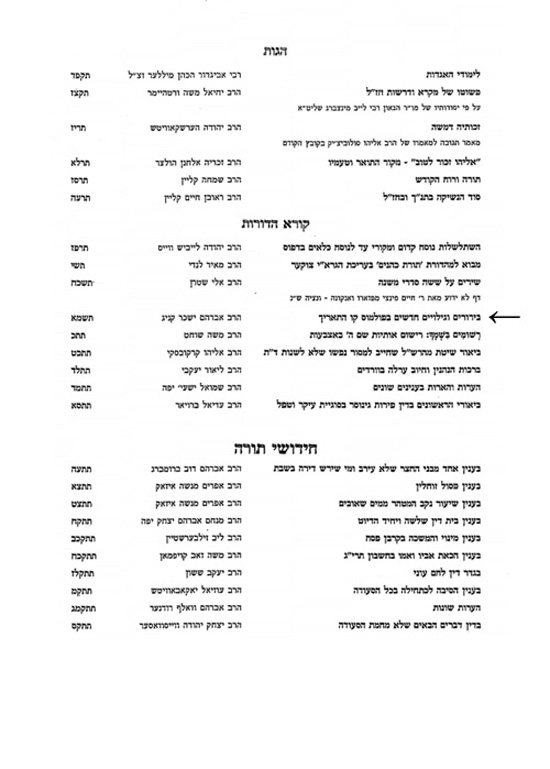
Otzar ha-Hokhmah has become the library for so many of us, and it is thus completely unacceptable for books to be altered no matter what the reason. The editor of Hitzei Giborim insisted that the book be shown in its entirety or taken down, and it no longer appears on Otzar ha-Hokhmah.
In Changing the Immutable, pp. 191 n. 16, 224 n. 46, I noted other examples of censorship on Otzar ha-Hokhmah. I found an additional instance in the Otzar ha-Hokhmah version of The Rabbi Leo Jung Jubilee Volume (New York, 1962). Two articles are deleted, and here is how the table of contents appears on Otzar ha-Hokhmah.
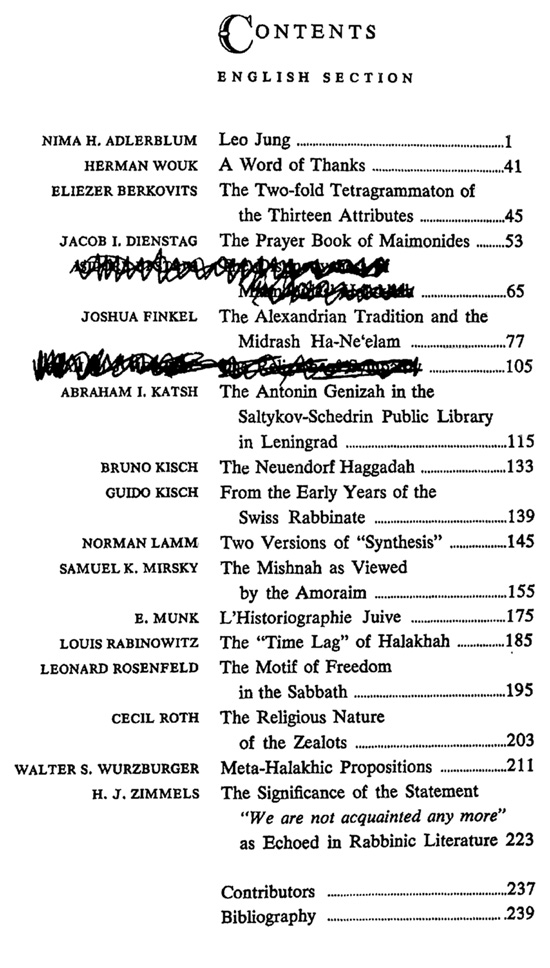
Here is the uncensored table of contents.
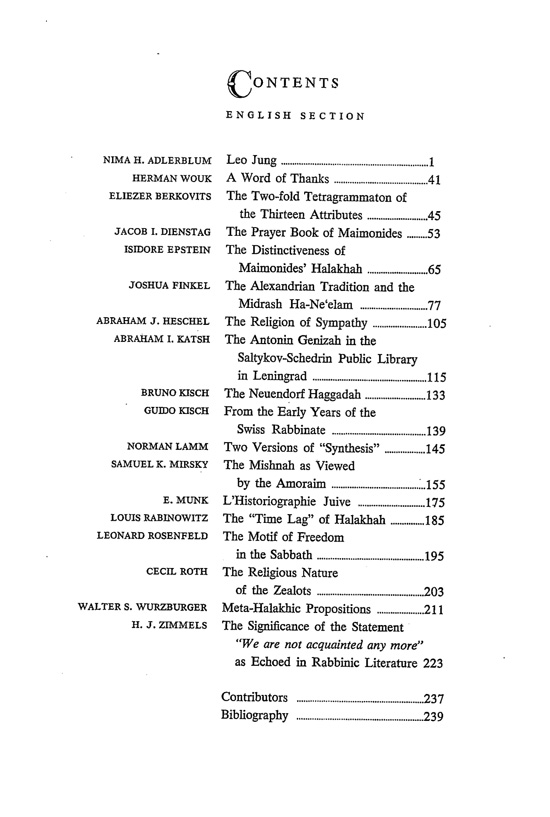
I understand why Otzar ha-Hokhmah would want to delete an article by Heschel, but what possible reason could there be to delete R. Isidore Epstein’s article? I can only assume that the person responsible for this mistakenly thought that Epstein was not Orthodox.
Here is a page from Otzar ha-Hokhmah’s version of Peninei Rabbenu ha-Avi Ezri, p. 266.
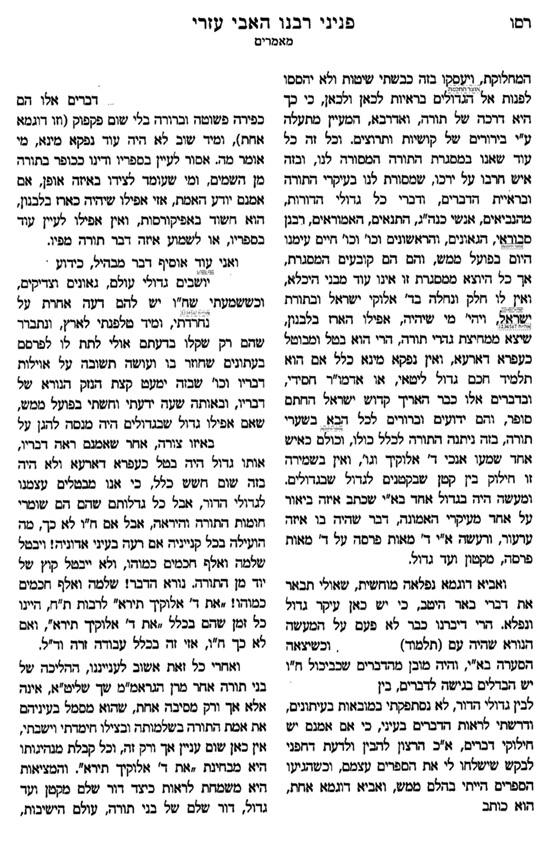
Here is how the uncensored page looks.
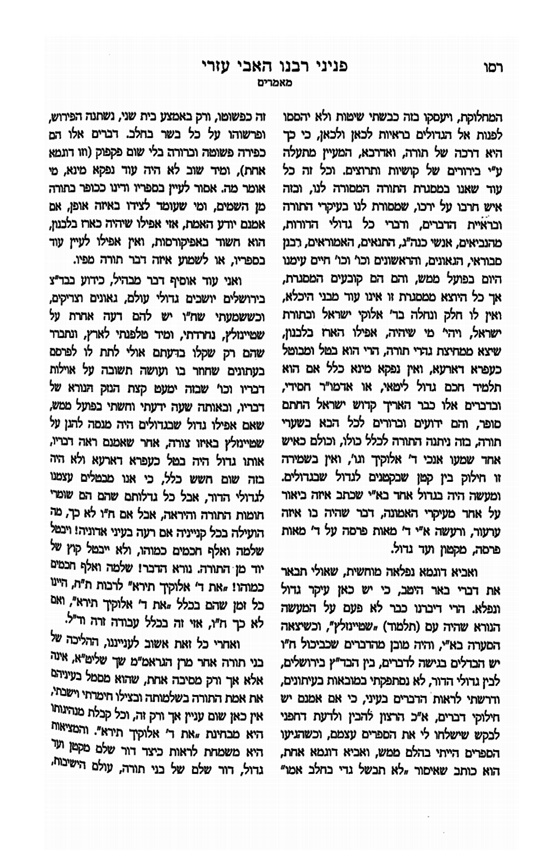
 

Returning to Konig’s article, on p. 770 he prints from manuscript a letter from a Sephardic rabbi to R. Ben Zion Uziel, but the name of the rabbi has been deleted. Konig tells us that he removed the rabbi’s name in order to protect his honor, because his letter shows that had no understanding of the dateline issue. It is indeed true that the rabbi did not understand the matter but that is no reason to delete his name. If we are going to start deleting names of rabbis every time we are convinced that they made a basic error, there would be no end to it. In this case the editor should have insisted that the letter appear in full. After all, everyone makes mistakes and there is no problem is seeing that even a learned rabbi did not understand this complicated issue.
Among the articles in Hitzei Giborim focusing on contemporary issues, R. Eliyahu Levine deals with dina de-malchuta dina. On p. 1012 he notes that the government requires homeowners to keep their property looking nice, and this includes cutting the lawn. R. Levine asks if this is also included in dina de-malchuta dina. He concludes that it is not, and writes the following.
וגם נראה שיסוד חוקים אלו הם מעוגנים בתרבות הגויים, שהעיקר אצלם הוא היופי החיצוני, וכל עמלם ויגיעם הוא ליפות את המראה החיצוני של רכושם, ולכן הם מעונינים שחצירו הפרטית של כל אחד מהם תשלים את מראה המקום כנאה ומטופח, וא”כ דבר זה כלול בדברי הרשב”א והש”ך שחוקים שביסודם הם כשל תוה”ק, אין נוהג בהם דדמ”ד, משום שבשעה שיגיעתו של הגוי היא לצחצח את רכושו, יגיעתו של הישראלי היא להקפיד על דברים אחרים, והמאמץ לעצמו את חוקי וגינוני המלכות, ודאי שמקפיד להיות מתאים להופעת הגוי, ממילא ההרגל בכך מזניח את ההקפדה והטיפוח של הישרליות שבישראל.
גם הרבה מחוקי הבניה והדיור כנראה מקורם בתרבות אמריקאית זו, ומשפחות יהודיות גדולות שעיקר תשוקתם אינה בדוקא בריבוי נכסים, החוקים הנ”ל אינם תואמים להשקפת עולמם, וזוהי עוד סיבה שבמסגרת חוקי הגויים לא נוהג דדמ”ד.
For those who don’t read Hebrew, he claims that zoning laws, and the whole idea of having a beautiful environment, originate in non-Jewish cultural norms, and therefore Jews are not obligated to follow these laws. I guess this means that in a “Jewish” environment, people won’t need to cut their lawns, their property can fall apart etc., since Jews look at what is on the inside and are not concerned with outer appearances. It is no secret that in some segments of the haredi world people assume that zoning laws (and sometimes even fire codes) are not Jewish concepts and thus don’t need to be followed, but to see this sort of approach in print will probably be a surprise for many.[4]
On p. 1121 we find something quite uncommon, an apology that in the previous volume an article appeared that is plagiarized from two other writers. I can’t think of another Torah publication that has ever had such a notice, and it shows both the honesty and the courage of the editor.
Beginning on p. 362, R. Yaakov Yitzhak Miller publishes from manuscript Torah letters concerning shaving one’s beard when the Czarist authority required this. The question that obviously needed to be considered was if this decree was to be regarded as a she’at ha-shemad in which case Jews would be required to martyr themselves rather than obey. Not surprisingly, the rabbis whose letters are published by R. Miller did not go this far. These rabbis are R. Judah Bacharach, R. Jacob Zvi Mecklenburg, and R. Hayyim Wassertzug (also known as R. Hayyim Filipover, from one of the Lithuanian towns he was rabbi in). These letters come from an unpublished volume by R. Wassertzug which hopefully will soon appear in print as it has the potential to be a very significant publication.
Although R. Wassertzug is today unknown, this was not the case in the 19th century, and R. Miller provides a nice introduction which shows some of R. Wassertzug’s originality. In addition to a reputation for being very pious as well as a great scholar, he was also known as a lenient posek who did not feel bound by certain practices which while generally accepted, did not, in his opinion, have a firm halakhic basis. Not surprisingly, this led to conflict with some other rabbis.
Here are two responsa from R. Wassertzug that appeared in Ha-Melitz, 14 Sivan 5629, pp. 225-226. The first permits one to drink non-Jewish milk (especially travelers), and the second permits a married woman to show some of her hair.

Not mentioned by R. Miller is that one of the opponents of R. Wassertzug was R. Isaac Haver. It is reported that he and some other rabbis went to R. Leibel Shapiro, the rav of Kovno, to complain about R. Wassertzug and to gain his support in order to have R. Wassertzug removed from his rabbinic position. Yet they were rebuffed as R. Leibel told them how great R. Wassertzug was and sent them away.[5]
In 2015 R. Mordechai Gifter’s Milei de-Iggerot appeared. This is quite a significant work and anyone interested in the history of American Orthodoxy will want to consult it. On p. 213 he deals with R. Eliezer Berkovits’ liberal halakhic approach. R. Gifter comments that unfortunately R. Berkovits did not follow the path of his teacher, R Jehiel Jacob Weinberg, who was much more conservative in how he approached halakhah.

The person R. Gifter was writing to had asked why R. Gifter was so critical of R. Berkovits’ approach when R. Wassertzug also had a liberal approach. In R. Gifter’s reply he reveals a hitherto unknown piece of information that he received from an elderly Lithuanian rabbi, namely, that one of the responsa of R. Akiva Eger in which there is no addressee given was actually sent to R. Wassertzug. R. Gifter also states that when R. Berkovits reaches R. Wassertzug’s level of piety, then he will be able to forgive him for much of what he has written.
ומה שיביא לי ראי’ מהגאון ר’ חיים פיליפובר זצ”ל, ידע נא ידידי שכשיגיע דר. ברקוביץ לדרגת חסידותו ופרישותו של אותו גאון וצדיק אוכל למחול לו על הרבה מדבריו, אבל באיש של דורנו לא אוכל לתלות דבריו בחסידותו של גאון מדור קדום.
והאמת שמיחס גאוני הדור להגר”ח פיליפובר ז”ל יש לנו ללמוד איך להתיחס לכל דרישה לחלוק על הלכות קבועות אפי’ כשיצאו מפי גאון וצדיק. ועיין תשובת מרן הגרעק”א ז”ל סי’ נ”ה – שקבלתי מפי רב גדול וישיש בליטא שהתשובה מכוונת להגר”ח פיליפובר ז”ל.
Here is the responsum of R. Akiva Eger, vol. 1, no. 55, referred to by R. Gifter.
As you can see, while the addressee is referred to as המופלא, his name and town are not given. R. Eger criticizes R. Wassertzug for his liberal approach in which he disagreed with rishonim and in the case discussed diverged from the Shulhan Arukh. In his conclusion, R. Eger refers to himself as one who is rebuking from hidden love.
While on the topic of criticism of R. Berkovits, here are some other relevant documents that I found in the archive of Chief Rabbi Isaac Nissim at Yad ha-Rav Nissim in Jerusalem. The first is a New York Times article from June 23, 1969. (I have no doubt that the second quote attributed to R. Berkovits in the article – where he mentions reconsidering the “traditional laws” – was taken out of context.)
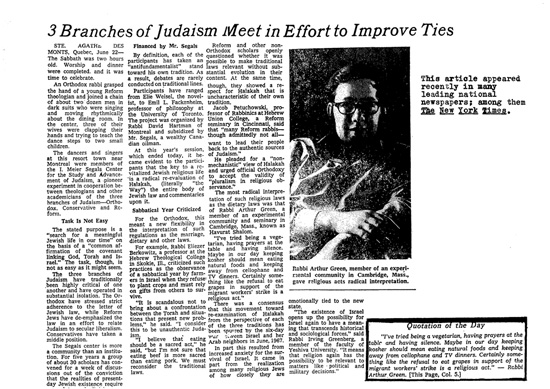
In response to this story the following two documents were sent out to various Orthodox figures. Since the Hebrew document is not always easy to read, I have provided a transcript and also added paragraph breaks.
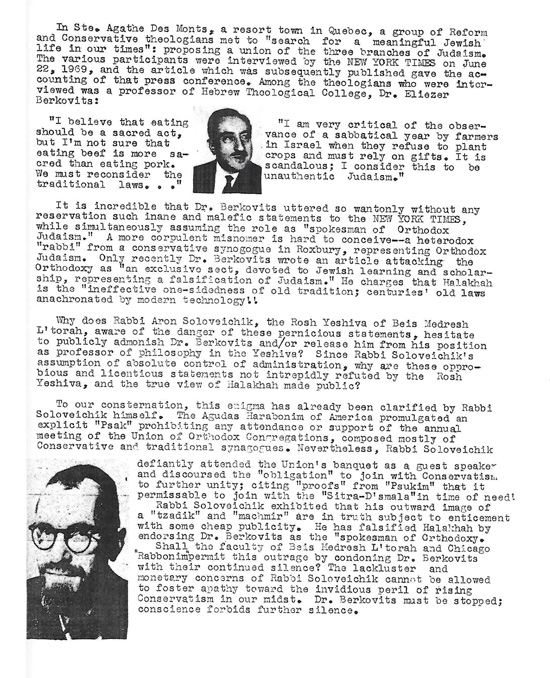
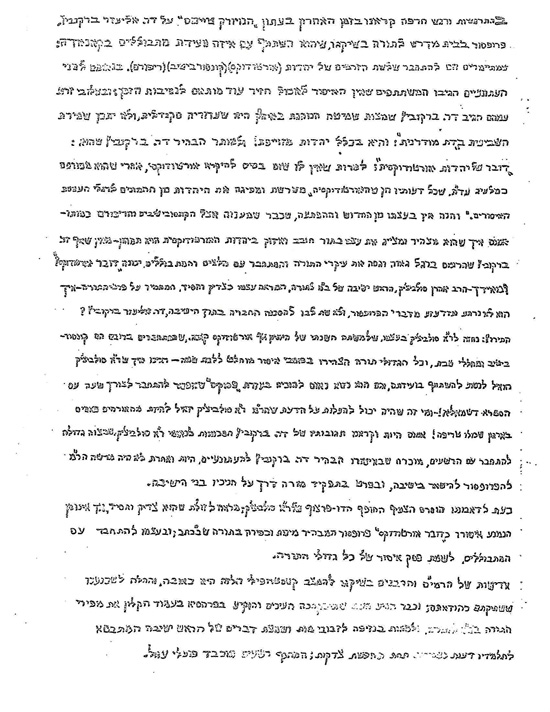
בהתרגשות ורגש חרפה קראנו בזמן האחרון בעתון “הניורק טיימס” על דר. אליעזר ברקוביץ, פרופסור בבית מדרש לתורה בשיקגו, שהוא השתתף עם איזה וועידת מתבוללים בקאנאדה: שמתיימרים הם להתחבר שלשת הזרמים של יהדות (אורטודוקס) (קונסורביטיב) (ריפורם). בנאום לפני העתונעיים [!] הגיבו המשתתפים שאין האיסור לאכול חזיר עוד מותאם לנסיבות הזמן: ובשלובי זרע עמהם הגיב דר. ברקוביץ שמצות שמיטה הנוהגת באה”ק היא שערוריה סקנדלית, ולא יתכן שמירת השביעית ב”דת מודרנית”: והיא בכלל יהדות מזוייפת: ולמותר הבהיר דר. ברקוביץ שהוא: “דובר של יהדות אורטודוקסית”, למרות שאין לו שום בסיס להיקרא אורטודוקסי, אחרי שהוא מפורסם כמלעיג עד”ת, שכל דעותיו הן שהאורטודוקסיה “משרשת ומפיגה את היהדות מן ההמונים לרגלי העצמת האיסורים.” והנה אין בעצתו מן החדוש וההפתעה, שכבר שמענוה אצל הקונסוב[ר]טיבים והריפורם כמותו – אמנם איך שהוא מצהיר ומצייר את עצמו בתור חובב ואדוק ביהדות האורטודוקסית הוא תמהון – מאין שאף דר. ברקוביץ שהרומס ברגל גאוה וגסה את עיקרי התורה והמתחבר עם הלצים והמתבוללים יכונה “דובר אורטודוקס”?
ומאידך – הרב אהרן סולביצ’יק, הראש ישיבה של ב”מ לתורה, המראה עצמו כצדיק וחסיד, המחמיר על פרטי התורה – איך הוא לא נרתע ונזדעזע מדברי הפרופסור, ולא שת לבו להסכנה החבויה בתוך הישיבה, דר. אליעזקר ברקוביץ? התירוץ: נחזה לר”א סולביצ’יק בעצמו, שלמשתה השנתי של היוניון אף אורטודוקס קאנג., שהמתחברים ברובם הם קונסורביטיב ומחללי שבת, וכל הגדולי תורה הצהירו בפומבי איסור מוחלט ללכת שמה – ראינו איך שר”א סולביצ’יק הואיל לנסוע להשתתף בועידתם, והם [ושם?] הוא נשא נאום להוכיח בעזרת “פסוקים” שאפשר להתחבר לצורך שעה עם הסטרא דשמאלא! – ומי זה שהיה יכול להעלות על הדעת שהר”מ ר”א סולביצ’יק יואיל להיות מהאורחים נואמים בארגון שכולו טריפה! אמנם היות וקראנו תגובותיו של דר. ברקוביץ הסכמות לנאומי ר”א סולביצ’יק, שמצוה גדולה להתחבר עם הרשעים, מוכרח שבאישורו הבהיר דר. בורקוביץ להעתונעיים, היות ואחרת לא היה מרשה הר”ם להפרופסור להישאר בישיבה, ובפרט בתפקיד מורה דרך על חניכיו בני הישיבה.
כעת לדאבוננו הוסרה [!] הצעיף החופף הדו-פרצוף שלר”א סולביצ’יק, מראה לזולת שהוא צדיק וחסיד, אך אינו מן הנמנע אישורו כ”דובר אורטודוקס” פרופסור המבהיר מינות וכפירה בתורה שבכתב, ובעצמו להתחבר עם המתבוללים, לעומת פסק איסור של כל גדולי התורה.
אדישות של הרמי”ם והרבנים בשיקגו להמצב קטסטרופילי הלזה היא כאובה, והחלה לשכנענו ששתיקתם כהודאתם, וכבר הגיע העת שתיפקחנה העינים והוקיע [!] בפרהסיא בעמוד הקלון את מפירי התורה בב”מ לתורה ולמחות בנזיפה לזבובי מות ושפעת דברים של הראש ישיבה המתבטא לתלמידיו דעות [כפרניות?] תחת החפשת צדקות: המחנף רשעים ומכבד פעלי עוול.
In addition to what it is said about R. Berkovits, R. Ahron Soloveichik is also attacked in these documents for not firing R. Berkovits (he actually didn’t have the authority to do so), and for attending an OU convention, an organization that in the 1960s had many mixed seating congregations which are referred to as “Conservative” synagogues. There is nothing about the latter episode in the book about R. Soloveichik, Ha-Rav Aharon Yeled Sha’ashuim (Jerusalem, 2011), published by his son, R. Yosef Soloveichik. In fact, R. Berkovits is only mentioned on two pages in the book. On p. 244, it is pointed out that R. Soloveichik opposed R. Berkovits’ approach, which is described as advocating “that halacha should be allowed to develop freely to accommodate people’s needs.” On p. 243 we see that R. Berkovits joined with other faculty members in opposition to R. Soloveichik being given any administrative power at Hebrew Theological College.[6]
Let me make one final point about all the journals and memorial volumes, Yeshurun, Hitzei Giborim, and the rest. Numerous selections from commentaries on talmudic tractates have appeared in these publications. The problem is that when it comes to talmudic commentaries, all these publications are basically useless. For example, let’s say Moriah published a portion of an anonymous medieval commentary on a few pages of Tractate Nedarim twenty years ago. Only someone who was “in the sugya” would have been able to appreciate what the commentary was saying when it first appeared. Therefore, 99 percent of the readers twenty years ago skipped over it, and they continue to skip over all of the continuously published selections of commentaries that scholars spend so long deciphering and adding learned notes to. Since almost no one reads these published commentaries, I sometimes wonder if it is a waste of the scholars’ time to work on them. If I finally decide to learn Nedarim this year, is there any chance that I will remember that a few pages of a medieval commentary appeared in Moriah over two decades ago.
Fortunately, there is a solution, and that is to follow the approach of Otzar ha-Geonim. The project I have in mind would take a good deal of effort, but it would be very valuable. What we need is for an individual, or group of people, to go through all the various journals, memorial volumes, etc., and pull out all of the commentaries on the different tractates in order create a compendium. It can be called Otzar Mefarshim or something like that, and it would be divided into tractates, just like Otzar ha-Geonim. With such a work, when someone, for example, is studying Nedarim, he will easily find the 3 page section of the anonymous medieval commentary published years ago in Moriah. This is the only way to rescue so many scattered texts from oblivion.
3. In Changing the Immutable and in earlier posts I have discussed how in previous years in some communities wearing a kippah was not standard as it is today. (I think the only exception is the Syrian community.) R. Ovadiah Yosef even says that unlike in previous years, wearing a kippah today is more than just “midat hasidut,” as it has become a sign of a religious Jew, while going bareheaded is a sign of an irreligious Jews.[7]
I was asked if the same point can be made about tzitzit and it indeed can. It is now pretty standard in the Orthodox world for men to wear tzitzit. We even start little boys wearing them in school at age 3. Yet the practice of wearing tzitzit, i.e., a tallit katan,[8] was unknown in talmudic days and is not mentioned by the geonim or Maimonides.[9] It appears to have begun with the Hasidei Ashkenaz,[10] and eventually became a regular practice in the Ashkenazic world.[11] Yet even in the twentieth century throughout the Sephardic world tzitzit were not generally worn. In these places they regarded tzitzit as a holy item, not something to be given to a child who can easily soil his garment. Even among adults, tzitzit were reserved for the especially pious. (I hope to expand on this in the future, where I will provide sources documenting what I have just mentioned.) In the past half century much has changed, and just as the kippah is now a sign of a religious Jew, so too is tzitzit. As R. Meir Mazuz puts it in a recent issue of Bayit Ne’eman, his new weekly “parashah sheet”[12]:
היום זה סימן היכר בין אדם שומר תורה ומצוות לבין מי שלא כזה, ואפילו שמן הדין אפשר להיפטר מטלית קטן . . . מ”מ מצוה מן המובחר שאדם ילבש טלית עם ארבע כנפות כדי לקיים את המצוה.
Interestingly, R. Joel Sirkes writes that while a father is obligated to provide his minor son with tefillin so that he can learn how to use them, he is not obligated to provide his son with tzitzit, “since even he [the father] is not obligated to buy a four cornered garment.”[13] This view is in opposition to the Tur who writes that a father does have to provide his minor son with tzitzit if the latter is of the age to wear it.[14]
Since I just mentioned R. Sirkes, let me share another interesting view of his. Avodah Zarah 70a quotes Rava as saying: רובא גנבי ישראל נינהו. In context, what this almost certainly means is that the majority of the thieves in Pumbeditha were Jewish.[15] Yet R. Sirkes shockingly understands it to mean that most Jews are thieves! It would be shocking enough if he understood it to mean that most thieves are Jewish (and not just most thieves in Pumbeditha), but explaining the passage to mean that most Jews are thieves sounds like something one would find in the writings of an anti-Semite, not in a work authored by one of the outstanding halakhists. It is true that one can find other negative judgments of the Jewish people in rabbinic literature. For example, the Maharal speaks of Israel’s inclination to sin as something unique to them and not found among non-Jews. He writes:[16]
כי ישראל מסוגלים היו לחטא מה שלא תמצא בכל האומות.
Yet this is part of a theoretical discussion, and although Israel has this negative characteristic, the flip side is that Israel is at a much higher spiritual level than the non-Jews. R. Sirkes’ opinion, on the other hand, is about the real world, here and now, and is said in a halakhic context. See Bayit Hadash, Yoreh Deah 2:6 (kuntres aharon):
ולפי עניות דעתי נראה דבכל שאר עבירות יש להחמיר . . . מה שאין כן בגונב דבר מאכל . . . דאפילו במוחזק בכך הרבה פעמים אין לו דין משומד ותדע שהרי אמרו רוב גנבים ישראל ואם כן לא יהיה סתם ישראל כשר לשחיטה אלא בידוע שאינו גנב וזה לא שמענו לעולם.
When we come across strange passages like this, it is often the case that someone will say that the author never wrote it. Rather, it was inserted by an erring student or someone seeking to undermine traditional Judaism. In this case, we get the next best thing, as R. Shabbetai Cohen, ShakhYoreh Deah 2:18, writes that R. Sirkes retracted what he wrote and asked for it to be deleted.
ומה שכתב הב”ח בזה בקונטרס אחרון [ד”ה מומר] כבר צוה הוא ז”ל בעצמו למחקו.
Nevertheless, I wonder if this is actually the case. Is it possible that R. Shabbetai wrote this not because R. Sirkes actually said what he attributes to him, but because R. Shabbetai wanted the embarrassing passage of R Sirkes removed from the public eye? The best way to do this would be to say that R. Sirkes regretted writing it, and this hopefully would lead to it being deleted by future printers.Those who have read Changing the Immutable, especially the last chapter, know that there is plenty of precedent for what I am suggesting. The reason that I think this might be the case is that nowhere else do we have evidence of R. Sirkes saying that what he wrote here should be deleted. Furthermore, in a later work, Sefer Ha-Arokh, Yoreh Deah 2, R. Shabbetai does not mention anything about R. Sirkes giving instructions to delete what he wrote. Rather, R. Shabbetai simply criticizes R. Sirkes for what he regards as his error. If R. Sirkes really said what R. Shabbetai attributes to him in his commentary to the Shulhan Arukh, why doesn’t he mention it in Sefer Ha-Arokh? What sense is there in criticizing R. Sirkes if R. Sirkes himself regretted what he wrote? In Sefer Ha-Arokh R. Shabbetai writes very sharply, accusing R. Sirkes of an error that even an amateur wouldn’t be caught making:

אבל בב”ח (סעיף ו בקונטרס אחרון) כתב דברים בלא טעם ומחלק בין עבירה לעבירה עיין שם ומה שכתב ותדע שאמרו רוב גנבים ישראל וכו’ כאן טעות נזדקר לפניו אפילו בר דבי רב לא יטעו בזה דמה שכתב רוב גנבים ישראל הוא דלא אמרינן דמותר אלא כשיש גנבים בעיר ורוב מהגנבים הם ישראל אבל שיהיה רוב ישראל גנבים חלילה לא תהא כזאת בישראל ועתה ישראל אשר בך אתפאר תקיצנה בבית זה שלא כדעת דברו.
R. Shneur Zalman Hirschowitz also calls attention to what he regards as R. Sirkes’ error. R. Hirschowitz is best known as a student of R. Israel Salanter, and it was he who published R. Salanter’s Even Yisrael, which became a basic text of the Mussar movement.[17] Here is the title page.
R. Hirschowitz’s talmudic notes were included in the Romm Talmud and are now included in the new Talmud editions. His comment about R. Sirkes is found in his note to Hullin 12a:
מצוה לפרסם להסיר חרפה מעל ישראל דהנה אויבי עמינו אומרים כי חז”ל בעצמם העידו עלינו כי רוב גנבי ישראל ומה לה לעיסה שהנחתום מעיד עליה, ובאמת העולם טעה כי חז”ל אמרו זה על כל ישראל אשר בכל כדור הארץ ובכל זמן כי רוב הגנבים ישראל הם, וחלילה לומר זאת וטעות גדולה היא. וכבר טעה בזה אדם גדול הוא ניהו אדונינו רוח אפינו בעל הב”ח זצוק”ל בקונטרס אחרון ליו”ד סי’ א. ולא עוד אלא שנתחלף להב”ח ז”ל במחכ”ת גאון קדשו ועצמותיו הקדושים בין רוב גנבי ישראל ורוב ישראל גנבי . . . וכל הרואה יחרד וישתומם על זה שמשים לכל ישראל בחזקת גנבים . . . אבל לא יאונה לצדיק כל און, כי הב”ח בעצמו צוה בחייו למוחקו כמ”ש הש”ך ביו”ד סי’ ב.
4. Earlier in this post I mentioned R. Meir Mazuz’s parashah sheet, Bayit Ne’eman. You can see recent issues here and you can sign up to receive it here. Each issue is a transcript of his Saturday night shiur, broadcast live all over Israel. Fortunately, the transcript is complete, by which I mean that the people putting it out have not censored it in any way, thus preserving R. Mazuz’s spoken style and his numerous off-hand comments. It is pretty unique which is why I recommend that readers check it out. The people who publish the shiur even claim that it is the most popular shiur in the world, a claim that is supported by a recent media report here that R. Mazuz’s Saturday night shiur has almost twice as many listeners (around 30,000) as R. Yitzhak Yosef’s competing Saturday night shiur.
Readers should be prepared for a good dose of what can only be termed “Sephardic supremacy.” It is with regard to this that I have to correct a point that R. Mazuz has often made, but which is really misleading. R. Mazuz has compared the kelal yisrael sense found in the Sephardic world with the extremism in the Ashkenazic haredi world, an extremism that leads to never-ending disputes and delegitimization of others. It is true that a basic feature of Ashkenazic haredi society is the tendency to delegitimize those who don’t carry the “party line.” This of course does not mean that all haredi individuals have this tendency; however, it is found in haredi society as a whole. In the last decade or so we have seen how, when there are not many opponents outside the haredi world to focus on, the society turns on itself and creates internal battles.
As mentioned, R. Mazuz has contrasted this with the Sephardic approach which has always welcomed people of different outlooks and levels of religiosity, always looking to bring close and not separate one Jew from the other. In contrast to the Ashkenazic world which has used the herem again and again, R. Mazuz states that other than the battle against Spinoza, the Sephardim have never gone for this approach. For R. Mazuz, the upshot of all this is that Sephardic society is a much better reflection of what Judaism and Jewish life are supposed to be.
Before the great split between R. Mazuz and the Shas party, R. Mazuz commented that ש”ס is supposed to stand for שחורה and סרוגה, meaning that the party should include both black kippot and knitted kippot, since the wearers of both were faithful Jews. As many readers know, the head of the Shas Council of Torah Sages, R. Shalom Cohen, instead saw fit to refer to the religious Zionists as Amalek (among other choice comments). This in turn led R. Mazuz to increase his attacks against the leadership of the Shas party which he saw as abandoning the Sephardic tradition and adopting the worst aspects of Ashkenazic haredi culture. Those who follow the Israeli religious scene know that at present there is a battle taking place for leadership of the Sephardic religious world between the two most important Sephardic rabbis. One is R. Yitzhak Yosef, who sees himself as the rightful inheritor of his father’s position and protector of his legacy.[18] The other is R. Mazuz. Among R. Mazuz’s supporters is former chief rabbi R. Shlomo Amar. R. Amar is himself quite popular, but since the passing of R. Ovadiah has subordinated himself to R. Mazuz. Seeing R. Mazuz’s great popularity today, I am proud to recall that the very first English article to deal with him appeared in 2007 on the Seforim Blog here. This post was the first introduction of most readers to R. Mazuz, and since that time I have quoted from his voluminous writings in almost every one of my subsequent posts.
There is a good deal more to discuss regarding the dispute over leadership of the Sephardic world, the strategy of the Yachad party and why it didn’t succeed, and the growing attacks on R. Mazuz from small-minded people who object to his independent mind. (He has even been attacked for quoting poems by Yehudah Alharizi and Hayyim Nachman Bialik in a shiur.) But for now, let me just make a couple of points:
A. Contrary to what R. Mazuz has said, it is not true that the only time Sephardic sages have used the herem is against Spinoza. The scholars of Aleppo, who could be quite extreme, banned the Torah commentary of R. Elijah Benamozegh, a figure whose works are quoted by R. Mazuz.
B. R. Mazuz’s description, while correct in its major points, is offered without any context and therefore leads to a distortion of the historical record. Nothing R. Mazuz describes makes sense without remembering that unlike in the Sephardic world, the Ashkenazic sages were confronted with the Reform movement and later with the East European Haskalah. It is in the context of these battles that the Ashkenazic rabbinic leadership felt forced to resort to bans and other types of exclusionary behavior and language, and this led to the creation of an extremism that is with us until today. Lacking Reform and Haskalah, the Sephardic world could develop in an entirely different fashion, but had the Sephardic world confronted such anti-traditional movements, it is likely that its rabbinic leadership would have reacted exactly as the Ashkenazic rabbis did. In other words, we are dealing with apples and oranges, and it doesn’t make sense to point to characteristics of the Ashkenazic world and contrast them negatively with the Sephardic world without explaining why it is that the Ashkenazic world developed its extremist tendencies.I must, however, point out that R. Mazuz assumes that there is something in the Sephardic spiritual makeup that itself prevents the development of anti-traditional forces. You see this from various comments that he throws out. For example, in a recent shiur, published in Bayit Ne’eman, no. 32 (6 Tishrei 5777), p. 1, in speaking about R. Abraham Ibn Ezra’s piyut Lekha Eli Teshukati, he states: “If only the Ashkenazim had this piyut; I would guarantee them that if they would have recited this piyut, they would not have had maskilim, Reformers, or assimilationists.”

This particular shiur has a number of other interesting points. For example, on p. 2 he discusses the verbal attacks upon haredi soldiers. (So far there have only been verbal attacks, but no one will be surprised when an actual physical attack occurs.) As far as I know, almost none of the Ashkenazic haredi leaders have spoken publicly about this unfortunate development (and if they have, it has not been covered in the Ashkenazic haredi press). The Ashkenazic haredi leadership in both Israel and America has a policy of not criticizing bad behavior on “its side” (unless they are dealing with really bad behavior such as allying with Iran). This is a pattern that has been going on for almost a hundred years. I say this since the leaders of Agudat Israel in Palestine never criticized or took any real action against the extremists who were defaming R. Kook. In fact, when the authentic history of Agudat Israel is written, the question of the culpability of the World Agudat Israel in this entire affair will have to be dealt with, for despite all of its private outrage with what was taking place under the auspices of its branch in Eretz Yisrael, the extremists and their enablers were never distanced from the organization. It seems that it is always much easier to criticize those to your left than to your right.

Thus, had a typical anti-Israel group staged an event in which kids were taught to throw eggs at a car said to be carrying the prime minister of Israel, you can be sure that Agudat Israel would have been at the forefront of attacking this event. So how come when this exact thing happens in the Satmar community there is only silence from the Agudah?

Agudat Israel readily attacks the BDS groups and others who try to delegitimize the State of Israel. Yet how come Satmar can have a rally attacking the State of Israel in a way that gives cover to BDS and all the rest who want to destroy Israel, and we don’t hear a word from the Agudah? If you listen to the propaganda of Satmar, it also gives cover to the anti-Semites, as it uses anti-Semitic imagery in speaking about the all-powerful Zionists who control the media and who through their devious means are able to pull the wool over the world’s eyes.[19] If such imagery is rightfully condemned as anti-Semitic when “outsiders” use it, how is it that Satmar gets a pass when it uses anti-Semitic imagery?

Returning to R. Mazuz’s comments about the haredi soldiers, he says simply: “These soldiers who come to pray are not sinners but are tzadikim! How can we call them sinners? They defend Israel with their bodies!”

3. I am happy to see that a number of new books and articles refer to posts that have appeared on the Seforim Blog. The most recent example of this is that I have know of is Chaim Dalfin’s just-published book, Rav and Rebbe, which deals with the relationship between R. Joseph B. Soloveitchik and the Lubavitcher Rebbe.4. God willing, I will once again be leading Torah in Motion trips to Europe in Summer 2017. You can see the details here.


[1] I say this even though R. Yitzhak Barda, Kinyan Torah (Ashkelon, 2014), vol. 3, p. 87, states that R. Kafih is correct. R. Barda’s volume is itself of interest, as he argues that when it comes to Jewish law, Maimonides’ opinion is absolutely binding, even if the Shulhan Arukh disagrees.
[2] Based on conversations and emails, I think that my posts on ArtScroll’s censorship of Rashbam have had a wider impact than any other posts. In fact, not long ago someone in my town who knew that I wrote a book on censorship shared with me that she had heard that ArtScroll censored Rashbam. This person does not read the Seforim Blog, and indeed had never heard of it. She thus had no idea that her knowledge of ArtScroll censoring Rashbam had its ultimate origin in my posts, which I think shows the great reach of this blog.
[3] This idea was earlier suggested by Aharon Marcus. See the note in his edition of She’elot u-Teshuvot min ha-Shamayim (Tel Aviv, 1979), p. 34. R. Yoel Bin Nun was unaware of R. Novetsky’s discovery and because of this offers a mistaken interpretation of Rashbam. See his recently published Zakhor ve-Shamor (Alon Shvut, 2015), pp. 229ff. (called to my attention by Zachary Grodzinski).
In my post here on Artscroll’s censorship of Rashbam, I cite a number of authorities who claim that before the giving of the Torah night came after day. Subsequently, I found that the Malbim says the same thing and cites an interesting proof for this position. See his commentary to Exodus, chapter 12 note 50:
גם הלילה שאחריו שייך ליום ארבעה עשר, כי קודם מ”ת היה הלילה הולך אחר היום, כמ”ש בארבעה עשר יום לחדש בערב תאכלו מצות.
See also R. Meir Mazuz, Bayit Ne’eman, no. 17 (19 Sivan 5776), p. 3 n. 17; R. Moshe Zuriel, Otzrot Rabbi Shmuel ben Meir (Bnei Brak, 2016), pp. 35ff.
[4] In Israel, the mainstream haredi rabbinic opinion is that one can build illegally and ignore the various zoning laws which are not thought to reflect haredi values. (The mainstream hardali rabbinic opinion is that one can build illegally in Judea and Samaria.) One exception to this generalization is R. Asher Weiss who insists that “the world is not lawless” and even haredim must follow zoning laws. See the discussion of his view, and the opposing views of R. Israel Grossman and R. Shmuel Wosner, in Ron S. Kleinman, “The Halakhic Validity of Israel’s Judicial System among Israeli Ultra-Orthodox Halakhic Decisors,” Review of Rabbinic Judaism 18 (2015), p. 227-259. On pp. 250-251, Kleinman reports on a meeting that R. Weiss had with a group of Israeli lawyers. R. Weiss’s important remarks were later published and Kleinman summarizes as follows:
Rabbi Weiss maintains in the meeting that “it is a great challenge, a great and holy undertaking” for Orthodox Jews to engage in all professions, including the practice of law, despite the fact that practicing as a lawyer raises halakhic questions. In his words, “we need lawyers who are punctilious in their observance of the commandments . . . [as well as] judges who are punctilious in their observance of the commandments and who attempt as far as possible to render judgments according to . . . Jewish law.” These judges are important for ensuring that Israel’s judicial system “is not totally alienated from the spirit of the Torah.” He states that “a[n] [Orthodox] judge [in a civil court of law] provides a vital service to the nation” because there are many matter in which the rabbinical courts are not equipped to rule. Furthermore in his opinion, the prohibition against resorting to Gentile courts applies only to litigants and not to judges or lawyers.
As Kleinman notes, one of the points R. Weiss relied on for this last statement (which I have underlined) is  the fact that the Hazon Ish was friends with Yitzhak Kister who was a judge. (Kister would later be appointed to the Israeli Supreme Court, and is the only such justice who identified with the haredi community.) Yet as far as I know, the sentence that I have underlined is unprecedented among rabbinic decisors, even among the Religious Zionist poskim.
A Hebrew version of Kleinman’s article appears in Tehumin 36 (2016), pp. 346-358. The articles are not identical so anyone interested in the topic is advised to consult both the English and Hebrew versions.
[5] David Matityahu Lippmann, Le-Toledot ha-Yehudim be-Kovna u-Slobodka (Keidan, 1930), pp. 226-227. A different version of the story, with the same conclusion, is told by Hayyim Karlinsky, “Ha-Gaon Rabbi Aryeh Leib Shapiro,” Moriah 76 (Sivan 5744), pp. 95-96. The earliest version of the story, and perhaps the original source, is found in Asher Margulies, “Sheloshah Matmonot Hitmin Yosef,” Ha-Melitz, 25 Tevet 5687, col. 76 (called to my attention by R. Yaakov Yitzhak Miller).
[6] While it could not have been easy for R. Yosef Soloveichik to revisit the painful history he discusses, the documents he reproduces are important for the history of American Orthodoxy. The book I have referred to is not the same thing as the 2016 book on R. Ahron Soloveichk, Yeled Sha’ashuim
[7] Yehaveh Da’at, vol. 4, no. 1 (pp. 7-8). Regarding removing the kippah (but still leaving one’s head covered) before entering the bathroom, the following appears in R. Simhah Rabinowitz, Piskei Teshuvot, Orah Hayyim 21 n. 58.
וכן מובא בשם מוהר”א מבעלזא זי”ע שהיה פושט מעליו המלבוש עליון והכובע והגארטל לפני הכנסו לביהכ”ס, ואא”ז זצ”ל היה מקפיד גם על הכיפה והיה מניח במקומו איזה מטלית על ראשו.
Has anyone else heard of such a practice?
[8] Why isn’t this called טלית קטנה? R. Meir Mazuz explains that in the period of the rishonim, when the expression טלית קטן first began, they were not concerned with the grammatical point that a word ending with ת is feminine. See Bayit Ne’eman 29 (14 Elul 5776), p. 4.
[9] See R. Yitzhak Ratsaby, Olat Yitzhak, vol. 2, no. 11 (p. 28).
[10] See R. Yehiel Goldhaber, Minhagei ha-Kehilot, vol. 1, pp. 93ff.
[11] Here is one source that shows that in 12th century Ashkenaz tzitzit were not generally worn: R. Eliezer ben Nathan of Mainz, Sefer Ra’avan, ed. Deblitzky, vol. 1, no. 40:
שאלני חתני רבי אורי. מצוה חמורה כמו ציצית שהיא שקולה כנגד כל המצות, מאי שנא דמקילין בה רוב ישראל שאין מתעטפין בכל יום. והשבתי לו לפי שאין ציצית חובת גברא. מי כת’ לבוש ציצית, ציצית חובת טלית הוא דכת’ ועשו להם ציצית על כנפי בגדיהם, אם יש לך טלית של ד’ כנפים עשה לו ציצית ואם אין לך טלית אינו חייב בציצית. דומיא דמזוזה ומעקה דאם יש לו בית חייב במזוזה ומעקה ואם אין לו בית אינו חייב.
[12] Bayit Ne’eman 18 (26 Sivan 5776), p. 1.
[13] Bah, Orah Hayyim 17.
[14] Orah Hayyim 17:    קטן היודע להתעטף אביו צריך ליקח לו ציצית לחנכו
[15] See Tosafot, Bava Batra 55b s.v. Rabbi Eliezer, and the discussion in R. Zev Wolf Zicherman, Otzar Pelaot ha-Torah, vol. 3, pp. 759ff. (R. Zicherman refers to the Shakh and R. Hirschowitz that I mention.) See also Beitzah 15a: רוב ליסטים ישראל נינהו. The note in the Soncino Talmud to this passage reads: “The Rabbis were broad-minded enough to realize that in a town containing an overwhelming Jewish population the majority of thieves would be Jewish.”
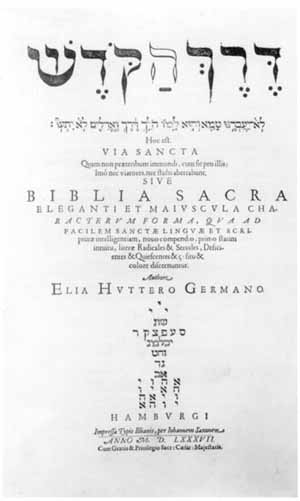
[16] Netzah Yisrael, ed. Hartman (Jerusalem, 1997), vol. 1, ch. 2, p. 20. For R. Jehiel Jacob Weinberg’s negative comments about the Jewish people, see my Between the Yeshiva World and Modern Orthodoxy, p. 183.
[17] Regarding Hirschowitz, see Hayyim Dov Genachovski, Shneur Zalman Hirschowitz (Jerusalem, 1951).
[18] In this video R. Yosef explains why he has spoken out against R. Mazuz and his followers. I have no doubt that there are also political factors involved. The various “religious” attacks on R. Mazuz, especially during the last Israeli election, remind me of the following memorable passage in Solomon Schechter, Studies in Judaism (Philadelphia, 1896), p. 3: “[U]nfortunately religious struggles are usually conducted on the most irreligious principles.”

[19] This anti-Semitic imagery is already present in R. Joel Teitelbaum, Al ha-Geulah ve-al ha-Temurah, chapters 46, 79.


Bibliography, Why It’s Important

In Professor Daniel Sperber’s latest book, Netivot Pesikah (Jerusalem, Reuven Mass, 2008), one of the areas he discusses the importance of having an awareness of is bibliography. As Eliezer Brodt noted in his review at the Seforim blog, Sperber provides examples where people have gone wrong due to their lack of bibliographical knowledge. Of course, long before Sperber, the importance of Jewish bibliography was already noted by R. Shabbatai Bass, most well-known for his super-commentary on Rashi, Siftei Hakahmim, but also the author of the earliest Jewish bibliography, Siftei Yeshanim.[1] In the introduction to Siftei Yeshanim, Bass discusses generally why bibliography is important. Then, in Ben-Jacob’s bibliography of Hebrew books, Otzar haSeforim, R. Shlomo haKohen of Vilna in his approbation lists numerous examples where people erred due to lack of bibliographical knowledge.

A particularly illustrative example was the republication of the work on the laws of Shabbat, Madanei Asher. A kollel had a group of people working on to study the book and then republish it. Although they studied the book in depth they failed to look up the bibliographical information on the book. Had they done so, they would have discovered that the book is plagiarised from another book, Shulhan Shitim by R. Shlomo Chelm, the author of the Merkevet HaMishnah. Instead, they invested considerable time and effort in ensuring that the wider public has access to a plagiarized work.[2]

Another such example of an egregious error due to lack of bibliographical information can be found in the Machon Yerushalayim edition of the Shulhan Arukh. Included in this edition is the commentary of R. Menachem Mendel Auerbach, Ateret Zekeinim. In Orah Hayyim, no. 54, R. Auerbach discusses whether the word “Hai” – het, yud – should be punctuated with a patach or a tzeri.[3].R. Auerbach states “one should have a tzeri under the letter het . . . and this in accord with what R. Shabbatai writes in his siddur, however, the Maharal of Prague says to use a patach.” Now, when R. Auerbach references R. Shabbatai and his siddur, the Machon Yerushalayim edition includes an explanatory note “Siddur haArizal in the Barukh She’amar prayer.” Thus, according to Machon Yerushalayim, R. Auerbach is quoting the Siddur haArizal compiled by R. Shabbatai Rashkover. That, in and of itself, is a bit odd as this Siddur is more interested – as the title implies – in the Ari and his kabbalistic ideas, rather than on grammar. Therefore, to use it in a discussion of grammar, which the quote in question is dealing with, is a bit odd! Setting that aside, there is a more fundamental mistake here, as the Siddur compiled by R. Rashkover was only published for the first time in Koretz in 1795. R. Auerbach lived from 1620-1689. Thus, he was dead for over 100 years prior to the publication of the Siddur of R. Rashkover. Moreover, the Ateres Zekeinim was first published in 1702 in Amsterdam, also long before the Siddur in question was ever published. The Rashkover’s Siddur was only first written in 1755 and not published until 1797.[4] What is particularly striking about this example is that if one actually examines Rashkover’s siddur, he doesn’t even have a tzeri in the word in question!

Instead, the siddur in question from “R. Shabbatai” is that of R. Shabbatai Sofer, the well-known grammarian. As this R. Shabbatai is a grammarian, and his siddur was written specifically to correct and highlight the proper grammatical readings, – see the lengthy introduction to this siddur, where R. Shabbatai bemoans the carelessness of people towards proper grammar – it makes perfect sense to quote this siddur from this “R. Shabbatai.” This is not the only place R. Auerbach quotes R. Shabbatai, one quote in particular is important as it dispels who the “R. Shabbatai” Auerbach is referring to. In Orah Hayyim, no. 122, Auerbach gives R. Shabbatai’s full name in another discussion about proper grammar. Auerbach refers to “I also saw this in the Siddur of R. Shabbatai of Przemysl.” R. Shabbati of Przemysl is otherwise known as R. Shabbatai Sofer (1565-1635)[5] and that is who is referred to earlier as well.

In conclusion, it is worthwhile noting that the text in question – the correct pronunciation of the word het yud – how R. Sofer actually pronounced that is unclear. There are two versions, but for the details of that one should see the edition of R. Sofer’s Siddur (Baltimore, 1994), vol. 2, p. 56.

Notes:
[1] First printed in Amsterdam in 1680 and in an expanded edition in 1806.

[2] This was pointed on by Y. Tosher in Moriah 7:83-84 (1978): 79. This claim of plagiarism was examined by Yonah Burstein, “Shulhan ‘Arukh by R. Shlomo Chelm (Review),” Ali Sefer 16 (1990):177-179.

[3] See the work Yashresh Ya’akov where he has a very comprehensive discussion about the this word and its punctuation.

[4] See Pinchas Giller, “Between Poland and Jerusalem: Kabbalistic Prayer in Early Modernity,” in Modern Judaism 24:3 (2004): 230, and see Geller’s general discussion regarding the importance of Rashkover’s edition for the development of Lurianic kabbalah on the siddur.

[5] On R. Sofer see Stefan C. Reif, Shabbethai Sofer and His Prayer-Book (Cambridge & New York: Cambridge University Press, 1979).


The Rising Lion: From Balaam to Leibowitz and Back Again

The Rising Lion: From Balaam to Leibowitz and Back Again

Warren Zev Harvey

Warren Zev Harvey is Professor Emeritus in the Department of Jewish Thought at the Hebrew University of Jerusalem. He is the author of numerous studies on medieval and modern Jewish philosophy and the recipient of the EMET Prize in the Humanities (2009).

The great prophet of the gentiles, Balaam son of Beor, blessed the people of Israel with a blessing for military success: “Behold, a people shall rise up as a lion [labiʾ], and exalt himself as a regal lion [ari],[1] and shall not lie down until he eat of the prey and drink the blood of the slain” (Numbers 23:24).[2] Israel shall leap up like a lion and not rest until it has fully conquered its enemies. The prophet’s blessing is raw, forceful, and not politically correct. It is just because of verses like this that Friedrich Nietzsche so admired the Hebrew Bible. Indeed, what is the lion rising up and exalting himself if not the terrible blonde Bestie? Such is the morality and style of ancient Hebrew Scripture.

But “the language of the Torah is one thing, and that of the Sages something else” (BT ʿAbodah Zarah 58b). The Sages took Balaam son of Beor’s militaristic prophecy and turned it into a prophecy concerning a spiritual “rising up.” They changed “prey” and “blood” to “Torah” and “mitzvot.” In Midrash Tanḥuma (Mantua, Balak [14], 88b; Buber, Balak 23, 73a; cf. Numbers Rabbah 20:20), we read: “Behold, a people shall rise up as a lion – there is no nation in the world like them. Although they had been asleep to the Torah and the mitzvot, they awoke from their slumber like lions, eagerly recited the Shemaʿ, and proclaimed the kingship of the Holy One, blessed be He.”[4] The midrash speaks of a metaphorical slumber (cf. Maimonides, Laws of Repentance 3:4),[5] that is, a period during which Jews neglected the Torah and the mitzvot, such as the Babylonian exile, but in the end they awakened from their slumber and arose like lions to proclaim the unity of God and to crown Him as King.

In his Commentary on Numbers 23:24, Rashi quotes this text from Midrash Tanḥuma, but with significant changes. First, he does not interpret the Israelites’ sleep as metaphorical, but as literal. Second, he understands the lion to refer not to the Israelite “nation,” but to the individual Jew. Third, he conceives the character of the lion in light the Mishnah: “Be bold as a leopard, light as an eagle, swift as a gazelle, and mighty [gibbor] as a lion to do the will of your Father in heaven” (Abot 5:20).[6] Rashi writes: “‘Behold, a people shall rise up as a lion — when they awake [ʿomdin] from their sleep in the morning, they rise up mightily [mitgabberin] like a lion or regal lion [ke-ari] and eagerly perform the mitzvot: donning the tallit, reciting the Shemaʿ, and laying tefillin.”[7] In Rashi’s artfully revised midrash, the subject is not a historical event in which the people of Israel have sinned but now repent and return to monotheism, but rather it is the daily routine of the individual Jew who arises mightily each morning as a lion to perform the mitzvot. Rashi adroitly shifts the focus from nation to individual, from national morality to personal morality. Inspired by the Mishnah, he employs the verb mitgabberin (“they rise up mightily / valorously / heroically”). The Jew awakens every day at dawn and as a mighty lion he eagerly performs the mitzvot. In the words of Maharal, commenting on Rashi: “The mitzvot are acts of valor” (Gur Aryeh, ad loc.).[8]

When Rabbi Jacob ben Asher sought an opening for the “Laws of Conduct in the Morning” (Hilkhot Hanhagot ha-Adam ba-Boqer) at the beginning of his Arbaʿah Turim, he selected the Mishnah: “Be bold as a leopard, light as an eagle, swift as a gazelle, and mighty [gibbor] as a lion to do the will of your Father in heaven” (Oraḥ Ḥayyim, 1). But when Rabbi Joseph Karo sought an opening for his analogous “Laws of Conduct in the Morning” (Hilkhot Hanagat ha-Adam ba-Boqer) at the beginning of his Shulḥan ʿArukh, he recalled Rashi’s Commentary on Numbers 23:24, and wrote: “One should be mighty as a lion to arise [yitgabber ke-ari laʿamod] in the morning for the service of one’s Creator, and one should awaken the dawn! [cf. Psalms 57:9]” (Oraḥ ayyim, 1).[9] The first three Hebrew words here reflect three words in Rashi’s Commentary: mitgabberin, ke-ari, and ʿomdin. Rabbi Joseph Karo thus transformed Rashi’s descriptive account of one’s morning conduct into an explicit command: One should be mighty as a lion to arise in the morning for the service of one’s Creator!

This stirring opening of the Shulḥan ʿArukh made a profound impression on the Israeli philosopher Yeshayahu Leibowitz. He quoted it frequently in his writings and lectures. In one passage he writes: “The slogan of theocentric religion is ʿabodah, the service of God, and its purpose is formulated in the first paragraph of the Shulḥan ʿArukh: One should be mighty as a lion to arise in the morning for the service of one’s Creator! In contrast to a religion conceived in terms of what it endows a person, there stands a religion conceived in terms of what it demands of a person. No opposition is deeper than this!” (Yahadut, Am Yehudi, u-Medinat Yisrael, Tel-Aviv 1975, p. 338).[10] The purpose of the demanding religion of Torah and mitzvot, Leibowitz emphasizes, is articulated in the imperative: Yitgabber! Be mighty, be valorous, be heroic! He further clarifies: “Life according to Torah and mitzvot is a life of heroism [geburah] in which a human being conquers his natural inclinations and needs and subjugates them to the service of his Creator” (ibid., p. 61).[11] The heroism of Rashi, Maharal, Rabbi Joseph Karo, and Leibowitz is that of performing the mitzvot.

At present the State of Israel has embarked on a difficult war against the Islamic Republic of Iran, and has named its campaign “Operation Rising Lion” (ʿAm ke-Labiʾ). During the long years of Exile, our Rabbis, like the homilists of Midrash Tanḥuma, Rashi, and Rabbi Joseph Karo, creatively developed a spiritual exegesis of the prophecy of Balaam son of Beor. They had a different morality and a different style. Now, with the independence of the sovereign State of Israel, we have – for better or for worse — returned to the original interpretation of the great prophet of the gentiles.

Notes:

* A Hebrew version of this article appeared in Yashar Magazine, 20 June 2025.

[1] It is difficult to translate labiʾ and ari. Hebrew has at least a half-dozen words for “lion” (ari, aryeh, kefir, labiʾ, layish, and shaal), while English has only one. Labiʾ may have influenced the Greek léōn, the Latin, leo, the English lion, and the Yiddish leyb. I have translated labiʾ as “lion” and ari as “regal lion” (cf. Rashi on Genesis 49:9).
[2] הֶן עָם כְּלָבִיא יָקוּם וְכַאֲרִי יִתְנַשָּׂא, לֹא יִשְׁכַּב עַד יֹאכַל טֶרֶף וְדַם חֲלָלִים יִשְׁתֶּה.
[3] לשון תורה לעצמה, לשון חכמים לעצמן.
[4] הֶן עָם כְּלָבִיא יָקוּם. אין לך אומה בעולם כיוצא בהם. הרי הם ישנים מן התורה ומן המצות, ועומדין משנתן כאריות, וחוטפין קריאת שמע וממליכין לקב”ה. I thank Rabbi Dr. Yaakov Jaffe, who has noted the very many places where the Rabbis turn military descriptions into spiritual ones; e.g., BT Berakhot 4a and 18b, Shabbat 63a, Pesaim 68a, Sanhedrin 7b, and 93b, and 111b, and agigah 14a.
[5] עורו ישנים משנתכם ונרדמים הקיצו מתרדמתכם וחפשו במעשיכם וחזרו בתשובה וזכרו בוראכם

(“Awake, you who sleep…from your slumber, search your deeds, return in repentance, and remember your Creator”). Cf. Immanuel Kant, Prolegomena to Any Future Metaphysics, ed. L.W. Beck, New York 1950, p. 8: “David Hume…interrupted my dogmatic slumber and gave my investigations in the field of speculative philosophy a new direction.”
[6] הווי עז כנמר, וקל כנשר, ורץ כצבי, וגיבור כארי, לעשות רצון אביך שבשמים.
[7] הֶן עָם כְּלָבִיא יָקוּם. כשהן עומדין משנתם שחרית, הן מתגברין כלביא וכארי לחטוף את המצוות, ללבוש טלית, לקרוא את שמע, ולהניח תפילין.
[8] ומפני שהמצוות הן גבורה, לפי שמי שעושה מצוה פועל פעולה אלוהית נפלאה (“The mitzvot are acts of valor, for whoever performs a mitzvah performs a wondrous divine act”).
[9] יתגבר כארי לעמוד בבוקר לעבודת בוראו, שיהא הוא מעורר השחר!
[10] סיסמתה של הדת התיאוצנטרית היא ‘עבודה‘, עבודת השם, ותכליתה מנוסחת בסעיף הראשון של שולחן-ערוך: יתגבר כארי לעמוד בבוקר לעבודת בוראו‘. מול הדת הנתפסת מבחינת מה שהיא מעניקה לאדם, מוצגת הדת הנתפסת מבחינת מה שהיא תובעת מן האדם. ואין לך ניגוד עמוק מזה.
[11] החיים במסגרת של תורה ומצוות הם חיי גבורה, שבהם האדם מתגבר על נטיותיו הטבעיות ועל צרכיו הטבעיים ומשעבד אותם לעבודת בוראו.