Further Comments by Marc Shapiro

Further Comments
By Marc B. Shapiro
I had thought that this would be my last post of the current batch, but it turned out to be too long. So I have divided it into two parts. Here is part no. 1.
The volumes Shomrei Mishmeret ha-Kodesh, by R. Natan Raphael Auerbach, have just appeared. Here is the cover.

This book is devoted to the Auerbach family, which was one of the great rabbinic families in Germany. They were the “A” in what was known as the ABC rabbinic families (the others being Bamberger and Carlebach). Over 150 pages are devoted to R. Zvi Benjamin Auerbach, who was the most prominent of the Auerbach rabbis. He was also the publisher of Sefer ha-Eshkol, to which he added his commentary Nahal Eshkol. In a number of posts I dealt with Auerbach’s edition of Sefer Ha-Eshkol, and discussed how both academic scholars and traditional talmidei hakhamim have concluded that the work is a forgery.1 Readers who are interested in the details can examine the earlier posts. In this newly published volume, which was called to my attention by Eliezer Brodt, the author speaks briefly about the Sefer ha-Eshkol controversy and responds to those who, in his words, continue to defame a gadol be-Yisrael (p. 382):
הממשיכים לבזות גדול בישראל ולהכפישו באופן אישי

In the note the author refers to Moshe Samet, who earlier had dealt with Sefer ha-Eshkol, and also to one of my posts on the Seforim Blog. While Seforim Blog posts have been cited in English scholarly writings, as far as I know this is the first time that there has been citation in a Hebrew volume.

I understand why members of the Auerbach family might feel obliged to defend him. (Yet one of my college suitemates was a descendant of Auerbach, and it didn’t seem to trouble him when I told him about the controversy.) Why a respected rabbi would forge a book is not something I want to get into now. In the earlier post I assumed that he was schizophrenic, as when it comes to Sefer ha-Eshkol I can’t think of any ideological reason for his actions. (Samet, He-Hadash Assur min ha-Torah [Jerusalem, 2005], p. 152 n. 235, identifies as one of Auerbach’s motivations: מגמה אורתודוקסית).

As for the argument that since he was a leading rabbi we must therefore assume that he couldn’t have done such a thing, this is disproven by all  the recent examples of well-known rabbis who were involved in a variety of types of improper behavior. Before they were exposed, no one could ever have imagined what we learnt, and everyone would have been 100 percent sure that these rabbis could not possibly have been involved in such activities. This simply shows that that just because someone is a well-known rabbi we don’t have to automatically conclude that he is innocent no matter what the evidence says.

In many of the recent cases, at least the ones dealing with sexual abuse, the rabbis no doubt suffered from some sort of mental illness, as I can’t imagine that men who did so much to influence people positively and help them were complete frauds. I think that Auerbach must also have had some psychological issues, and this is actually the best limud zekhut. For once we assume this, it means that we don’t have to view the rest of his illustrious career and achievements as fraudulent. In short, he had a problem and it manifested itself in his forgeries. Yet I admit that I can’t prove my supposition, and at the end of the day we will probably never be able to explain definitively why Auerbach would forge the text any more than we can explain how another great figure, Erasmus, forged a patristic work and attributed it to Saint Cyprian.2 Anthony Grafton, who has written an entire book on the subject, sums up the matter as follows: “The desire to forge, in other words, can infect almost anyone: the learned as well as the ignorant, the honest person as well as the rogue.”3

Unfortunately, Shomrei Mishmeret ha-Kodesh does not seriously deal with any of the evidence that has led to the conclusion that we are dealing with a forgery. (For reasons I can’t get into now, I find it completely implausible that someone in medieval times forged the work and Auerbach was duped. But let me make one point: Auerbach claimed to be working from a very old manuscript, and yet this “manuscript” contains material from the 17th and 18th centuries.). Since the author mentions Sefer ha-Eshkol vol. 4, which was published in 1986 together with the Nahal Eshkol, I once again renew my call for this manuscript to be made public and for some explanation to be given as to where it comes from, since Auerbach’s many defenders were unaware of it. The fact that a portion of Auerbach’s manuscript (i.e. his copy of the supposed medieval manuscript) mysteriously surfaced so many decades after Auerbach’s death, and that we are told nothing about it or even shown a picture of it, certainly raises red flags. As I noted in one of my previous posts, the Nahal Eshkol published here has a reference to a book that only appeared after Auerbach died. This means that quite apart from Sefer ha-Eshkol, we also have to raise questions about whether the Nahal Eshkol published here is itself authentic. It could be that it is indeed genuine, and the reference to the later book is an interpolation, but that is why we have to see the manuscript. After all, if the manuscript is written in one hand, and it includes the reference to the later book, then there is no doubt that it too is a forgery. So let the evidence about Sefer ha-Eshkol vol. 4, together with the manuscript, be placed on the Seforim Blog for all to see. Perhaps then we can begin to understand the mystery of this volume.

As long as the topic has been brought up, let me call attention to Shulamit Elitzur’s new book, Lamah Tzamnu (Jerusalem, 2007). On p. 115 n. 2, she gives an example where the Sefer ha-Eshkol forgery was perpetrated by using a quotation from the Shibolei ha-Leket, and cites a comment in this regard from the noted scholar Simhah Emanuel. On p. 235 n. 3,8 she mentions another example of forgery in the Auerbach Sefer Ha-Eshkol. For further instance, see Israel Moshe Ta-Shma’s posthumously published Keneset Mehkarim, vol. 4 (Jerusalem, 2010), p. 183 n. 28.4 In an article in Atarah le-Hayyim (Jerusalem, 2000), p. 292, Neil Danzig also points to a non-authentic interpolation in Auerbach’s Sefer ha-Eshkol. Yet I am surprised to see that he follows Ta-Shma in thinking that R. Moses De Leon might have had something to do with this.

In terms of traditional Torah scholars, I came across a comment by R. Avigdor Nebenzahl in R. Yaakov Epstein’s recently published Hevel Nahalato, vol. 7, p. 157. (Epstein is the grandson of Prof. Jacob Nahum Epstein.5) Nebenzahl comes from a German Orthodox background, so one might expect him to come to the defense of Auerbach, as did a number of prominent German Orthodox figures. Yet that is not what we find. Epstein had cited a passage from Auerbach’s Sefer ha- Eshkol to which Nebenzahl added that it is well known that some question the authenticity of this edition and claim that it is a forgery. In case you are looking for any non-scholarly motivations for this comment, I should mention that Nebenzahl’s sister was Plia Albeck (died 2005), the daughter-in-law of Hanokh Albeck and a significant person in her own right. (She paved the way for most of the Jewish settlements in the West Bank.) Hanokh Albeck, together with his father, Shalom Albeck, published the authentic Sefer ha-Eshkol, and were both very involved in exposing Auerbach’s forgery. In other words, Nebenzahl’s comment shows that families stick together. (Just out of curiosity, does anyone know if there have been any marriages between the two important families, the Auerbachs and the Albecks?)

In a previous post, I mentioned R. Yehiel Avraham Zilber’s belief that the Auerbach Sefer ha-Eshkol is forged. To the sources I referred to, we can add Birur Halakhah, Orah Hayyim 75. Also, R. Yisrael Tuporovitz, who has written many volumes of Talmudic commentaries, is not shy about offering his opinion. Here is what he writes in Derekh Yisrael: Hullin (Bnei Brak, 1999), p. 8:

וכבר נודע שספר האשכול הנדפס עם ביאור נחל אשכול הוא מזוייף ואין לסמוך עליו כלל

He repeats this judgment on pages 38, 53 and 345.

In one of the earlier posts I mentioned that R. Yitzhak Ratsaby denies the authenticity of Auerbach’s edition. I also quoted from his letter to me. At the time,  I was unaware that portions of this letter also appear in his haskamah to R. Moshe Parzis’ Taharat Kelim (Bnei Brak, 2002). Another new source in this regard from Ratsaby is his Shulhan Arukh ha-Mekutzar (Bnei Brak, 2000), Yoreh Deah 138:3 (p. 287), where he accuses Auerbach of taking something from the Peri Hadash and placing it in Sefer ha-Eshkol

Ratsaby discussed the Sefer ha-Eshkol in his haskamah to Parzis’ book because the latter had called attention to the defense of Auerbach in Tzidkat ha-Tzaddik. Here is the title page of the latter work.

Among the defenders of Auerbach was R. Jacob Schorr of Kuty, Galicia. Schorr was a genius and is best known for his edition of the Sefer ha-Itim.6 He also wrote the responsa volume Divrei Yaakov (Kolomea, 1881), and a second volume, culled from various sources, both published and manuscript, appeared in 2006.  Here is his picture, taken from Aharon Sorasky’s Marbitzei Torah me-Olam ha-Hasidut, vol. 3, p. 11.

It is an unfortunate oversight that this incredible scholar does not have an entry in the Encyclopaedia Judaica. A list of all of his works can be found in the introduction to his Mavo al ha-Tosefta (Petrokov, 1930). This introduction also contains R. Zvi Ezekiel Michaelson’s biography of Schorr. As with everything written by this amazing bibliophile,7 one learns a great deal, not only about the subject he focuses on, but about all sorts of other things.8 Michaelson was killed in the Holocaust and numerous unpublished manuscripts of his were lost. His grandson was Prof. Moshe Shulvass, and a responsum is addressed to him in Michaelson’s Tirosh ve-Yitzhar, no. 158.

Schorr’s son was Dr. Alexander Schorr, who translated many classic Greek and Latin texts into Hebrew.9 Alexander Schorr’s grandson is the well-known Israeli film director, Renen Schorr.10

Since Prof. Leiman has just written about the Maharal, it is worth noting that Schorr tells an incredibly far-fetched story, which he actually believed, about the Maharal and Emperor Rudolph. According to the tale, Rudolph’s biological father was a Jewish man. What happened was that Rudolph’s mother, the queen, could not have children with the Emperor. She therefore asked a Jewish man to impregnate her or else she would unleash persecution on the Jews in the kingdom. Upon hearing this, the beit din gave the man permission to accede to her wishes. I don’t want to repeat any more of this nonsensical story, but those who are interested can find it in R. Abraham Michaelson’s Shemen ha-Tov (Petrokov, 1905), pp. 60a-b. (R. Abraham was R. Zvi Ezekiel’s son.)

Returning to Schorr, one of the most astounding examples of self-confidence—others will no doubt call it arrogance or foolishness—ever stated by a rabbi (in print, at least) was penned by him. In his Meir Einei Hakhamim, reprinted in Kitvei ve-Hiddushei ha-Gaon Rabbi Yaakov Schorr (Bnei Brak, 1991), p. 177, we find the following:

ואני מעיד עלי שמים וארץ כי לא היה ולא יקום עוד אחרי שום חכם אשר יהי’ בקי בטוב [!] בפלפול תנאים ואמוראים כמותי

This text is often quoted by R. Yaakov Hayyim Sofer in his various works.11 This is not the only time Schorr expressed himself this way. On page 129 he writes
ודע דהופיע רוח הקודש בבית מדרשי

(This expression can also be found in other books, and originates in Rabad’s hassagah to Hilkhot Lulav 8:5. But to see this type of language in a sefer written by a someone very young [see below], even a genius like Schorr, is a bit jarring.) Sofer, Shem Betzalel, p. 28, also points to Meir Einei Hakhamim, p. 209, where Schorr writes about one of his ideas:

וזה נכון יותר מפירוש רש”י

(On this page, Schorr alludes to R Zvi Hirsch Chajes, referring to him as אחד מחכמי הזמן. Sofer claims that Schorr’s general practice is to not mention Chajes by name. Sofer wants the reader to think that he doesn’t know why Schorr acts this way. Yet the reason is obvious, and Sofer himself certainly knows that some talmudists were not fans of Chajes.)

Perhaps we can attribute Schorr’s over-the-top comments to his own immaturity. After all, as Sofer, Shem Betzalel, p. 29, points out, Schorr began writing the book  I am quoting from at age thirteen, and completed it by the time he was sixteen. A genius he certainly was, yet I think we should assume that his excessive comments were the product of youthful exuberance. Sofer sees Schorr’s youthfulness as also responsible for the very harsh way he criticizes the writings of various gedolim, which is something that is more understandable, and forgivable, in a teenager than in a mature scholar. I think all writers are embarrassed of things their penned in their youth, and that is to be expected.12 An example I often mention in this regard (when not referring to myself) is Hirsch’s harsh criticism of Maimonides. This appeared in Hirsch’s first book, the Nineteen Letters, published when he was 28 years old. Never again in Hirsch’s many writings does he ever express himself this way. My assumption is that he regretted what he wrote, and in his mature years he would not have used such strong language. Similarly, I wonder if in his mature years R. Soloveitchik would have commented to R. Weinberg—as he did in his twenties—that his grandfather had a greater understanding than even the Vilna Gaon. (I have printed Weinberg’s letter where this appears in a few different places, most recently on the Seforim Blog and in the Hebrew section to my Studies in Maimonides.)

In terms of young achievers in the Lithuanian Torah world, I wonder how many have ever heard of R. Meir Shafit. He lived in the nineteenth century and wrote a commentary on the Jerusalem Talmud, when not many were studying it. Here is the title page of one of the volumes, where it tells us that he became rav of a community at the age of fifteen. 

The Hazon Ish once remarked that the young Rabbi Shafit would mischievously throw pillows at his gabbaim!13

Returning to Schorr and Sefer ha-Eshkol, Ratsaby is not impressed by Schorr’s defense. He notes that in R. Yaakov Hayyim Sofer’s Torat Yaakov, Sofer states that the ideas of Schorr “צריכים בדיקה.”

I found the comment in Torat Yaakov (2002 edition) p. 880. Here Sofer claims that despite his brilliance, Schorr often puts forth unsustainable suppositions, and he calls attention to R. Reuven Margaliot, Ha-Mikra ve-ha-Mesorah, ch. 12. Here Margaliot cites a suggestion by Schorr that the text of Kiddushin 30a should be emended because the vav of גחון is not the middle letter of the Torah. Schorr further states that the editor of Masekhet Sofrim was misled by the error in the Talmud. The implication of Schorr’s comment is that all of our sifrei Torah are mistaken, for they mark this letter as special. Margaliot responds:
ותמה אני על תלמיד חכם מובהק כמוהו איך הרשה לעצמו לחשוב על מסדר מסכת סופרים שהוא טועה ומטעה וגם בודה מלבו מנהגים בכתיבת ס”ת. ב”הגהות” כאלו יכולים לעשות כל מה שרוצים, וכאשר כתב הגר”א [אליהו] פוסק בפסקי אליהו שם: רעדה אחזתני לעשות טעות כזה בגמרא ולחשוב על כל הס”ת שגיונות בדקדוקים דו’ דגחון ודרש דרש.

With regard to Ratsaby, I should also note that his dispute with R. Ovadiah Yosef continues unabated. In his recent Ner Yom Tov (Bnei Brak, 2008), pp. 20-21, he goes so far as to accuse R. Ovadiah of plagiarism.
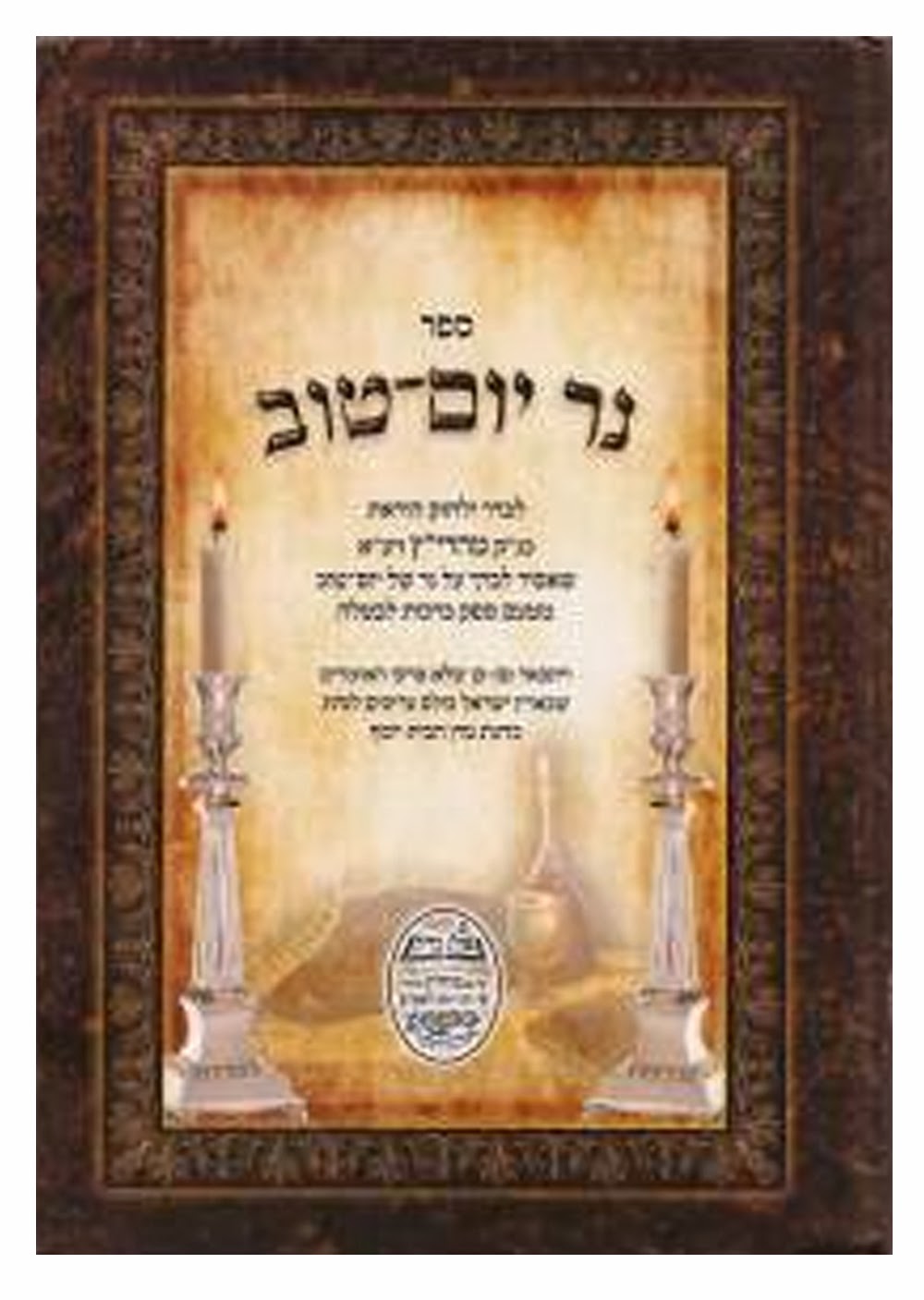
He also states, with regard to R. Ovadiah (p. 100):

 שכבוד התורה אצלו, הוא רק למי שמסכים לדבריו

Ratsaby’s book was written to defend the Yemenite practice of not making a blessing on Yom Tov candles against the criticism of R. Ovadiah. He also deals with R. Ovadiah’s larger point that the Yemenites must embrace the Shulhan Arukh’s rulings now that they are in the Land of Israel. The entire Yemenite rabbinate agrees with Ratsaby’s position, but upon seeing how he attacked R. Ovadiah, the condemnation of him from other Yemenite rabbis was swift. All I can say in defense of Ratsaby is that R. Ovadiah has been criticizing him in a less than respectful way for some time now. But in a sense, Ratsaby got what was coming to him, because for many years he has been writing very disrespectfully about R. Kafih.

In this new book, p. 98, Ratsaby goes so far as to repeat the legend that when Kafih was appointed a dayan in Jerusalem he swore to R. Ovadiah that he accepted the Zohar, and Ratsaby claims that Kafih swore falsely. Kafih, however, denied that he ever took such an oath.14 For a long time Ratsaby has been proclaiming that it forbidden to use Kafih’s books, as he is a member of the kat, i.e., the Dardaim who don’t accept the Zohar or Kabbalah in general. Yet R. Ovadiah has declared that the Dardaim are not to be regarded as heretics.15 This is in contrast to R. Chaim Kanievsky who holds that the Dardaim are heretics who cannot be counted in a minyan.16  R. David Teherani states that since the Dardaim reject the Zohar, their wine is yein nesekh.17 According to Aaron Abadi, R. Shlomo Zalman Auerbach also ruled that rejection of the Zohar and Kabbalah is heresy.18

I can understand those who assert that one must believe that the Zohar was written by Rashbi or at the very least that it was written be-ruah ha-kodesh, and if you deny this it is heresy. Yet what is one to make of the following statement, which greatly enlarges the realm of heresy (R. Menasheh Klein, Mishneh Halakhot, vol. 7, no. 160):
ואם הוא אינו מאמין שהמ”ב [משנה ברורה] נכתב ברוה”ק אזי הוא בכלל אפיקורוס וכופר בתורת ה’ . . . יש בזמן הזה שאין מאמינים שגם בדורינו אנו ישנם חכמי הזמן שיש להם רוה”ק . . . ומי שלא מאמין בזה הרי הוא אפיקורוס וכופר בלי ספק.

Based on this definition, I think the entire Lithuanian rabbinate until World War II would be regarded as heretics. Would such a statement even have been imaginable before twenty years ago? It is, of course, no secret that the Lithuanian rabbinate has been transformed along hasidic lines. This change is undeniable and I can point to many examples of this. Here is one (which was sent to me by R. Yitzhak Hershkowitz).

Would any Jew in Lithuania ever fall for such a thing as magic (or holy) wine? Anyone who tried to peddle this stuff would have been thrown out of the beit midrash. I was actually told an anti-hasidic joke with regard to this picture. I ask all Hasidim not to be offended as neither I nor the management endorse the joke. Yet it deserves to be recorded for posterity, for as we all know, jokes are simply jokes, but the history of jokes (even bad ones), well that is scholarship. The joke goes as follows: “It is incredbible. We now see great Lithuanian Torah scholars doing things that until now only hasidic rebbes did. But even more incredible would be to see the reverse, that is, to see hasidic rebbes write seforim on Shas and poskim.”

With regard to the Zohar, I must mention an amazing point called to my attention by David Zilberberg, from which we see that R. Joseph B. Soloveitchik did not believe that R. Simeon bar Yohai wrote the Zohar, or at least that he didn’t write all of it. I always assumed as much, but as far as I know there was never any proof, until now. In The Lord is Righteous in All His Ways, pp. 206-207, the Rav discusses the Western Wall and says that there is no mention of it in Chazal and very little mention in rishonim. The Wall is mentioned in Shir ha-Shirim Rabbah 2:2219, where it states that the Kotel will never be destroyed, but the Rav says about this Midrash:

I will tell you frankly that I am always suspicious about this midrash, because the classical sources, the Bavli and the Yerushalmi, do not mention the Kotel ha-Ma’aravi. The midrash cited earlier is, perhaps, a later insert. Apparently, Rabbi El’azar ha-Kalir knew the midrash. To my mind, this kinah of Rabbi Elazar ha-Kalir is one of the earliest documents to mention the Kotel ha-Ma’aravi.

Earlier in this book the Rav tells us when Kalir lived:

I do not know why historians have to explore when Kalir lived when he himself states that nine hundred years have passed and the Messiah has not yet arrived. It means that Kalir lived in the tenth century.

Yet as Zilberberg correctly points out, the Western Wall is seen as quite significant in the Zohar (II, 5b), and is referred to as Rosh Amanah.20 The Rav knew the Zohar very well, and therefore, when he tells us that Chazal do not mention the Western Wall, and it is only during the time of the rishonim that we begin to see references to it, he is also telling us that the Zohar (or at least this section of the Zohar) was written in the days of the rishonim.

Returning to Auerbach, let me add in conclusion that he is not the only great rabbi and Torah scholar who was involved in forgery. An earlier case is R. Benjamin Ze’ev of Arta (sixteenth century), author of the well known responsa volume Teshuvot Binyamin Zeev. Here is the title page from the first edition (Venice, 1539):

In the midst of a dispute he was involved in, he forged the signature of the Venetian rabbi, R. Baruch Bendit Axelrad, placing it on a document that supported himself. He also forged an entire letter in R. Baruch Bendit’s name. When all this was discovered, it helped lead to R. Benjamin’s downfall.21

Quite apart from the forgery, R. Solomon Luria, Yam Shel Shlomo, Bava Kamma, ch. 8 no. 72, also accuses R. Benjamin Zev of plagiarism. Here are some his words: 
כל דבריו גנובים וארוכים בפלפול שאינו לצורך וכנגד פנים מראה אחור . . . ושרי לי מרי אם הוא צדיק למה הביא הקב”ה תקלה על ידו הלא הוא היה הכותב ונתן לדפוס הספר מידו ומפיו.
One big question that needs to be considered is how far removed is forgery from false attribution? When it comes to false attribution there is a long rabbinic tradition supporting it, and in the book I am currently working on I deal with this in great detail. If you can falsely attribute a position to a sage, perhaps you can forge a document in his name as well (assuming it is not done for personal gain). Could that be what was driving Auerbach?
*        *        *

A few people have sent me a question about my Monday night Torah in Motion classes, so I assume that there are others who have the question as well. Here is the answer: If you cannot be with us at 9PM and you are signed up, the classes are sent to you so that you can watch or listen at your convenience. This is much cheaper than downloading the classes individually.

Notes

1 From my post here you can find all the links.
2 See Anthony Grafton, Forgers and Critics: Creativity and Duplicity in Western Scholarship (Princeton, 1990), pp. 44-45.
3 Ibid., p. 48.
4 As has been noted by many, Auerbach’s edition of Sefer Ha-Eshkol has misled countless talmidei hakhamim. There is another way in which Auerbach misled a scholar, but in this case it was accidental. In the introduction to his edition, p. xv note 9, Auerbach reports in the name of a supposedly reliable person that the Yerushalmi Kodashim was to be found in the Vatican library. This false report led R. Mordechai Farhand to travel there from Hungary in search of this treasure, and he describes his journey. See Farhand, Beer Mordechai (Galanta, 1927), pp. 154ff. Farhand was a gullible fellow. See ibid. p. 152, where even though it had been a number of years since Friedlaender’s Yerushalmi forgery had been established, he didn’t want to take sides. The legend that there was a copy of the Yerushalmi Kodashim in the Vatican had been disproven already in the nineteenth century. See R. Baruch Oberlander in Or Yisrael (Tamuz 5761),  p. 220.
5 In his review of my edition of Kitvei ha-Rav Weinberg, vol. 2, R. Neriah Guttel, Ha-Maayan (Nisan 5764), pp. 82-83, writes that it was improper for me to publish Weinberg’ judgment of Epstein (p. 430). Although they were friends, and Weinberg thought that Epstein was a great scholar, he also pointed out that that Epstein wasn’t a lamdan. What Weinberg meant is that Epstein wasn’t a traditional talmid hakham but an academic Talmudic researcher. As such, while his publications had great value, in Weinberg’s eyes they didn’t get to the heart of what Talmudic scholarship should be about. In Weinberg’s words:
סוכ”ס אפשטיין אינו למדן, ואיננו אלא פילולוג בעל חוש חד. בלא לומדות אי אפשר לחקור לא את המשנה ולא התלמוד.
Statements like these are vital for evaluating Weinberg’s approach to academic scholarship, and I never would dream of censoring such things.
6 In his Shaar Yaakov (Petrokov, 1922), no. 16, there is a responsum to “Abraham Joshua Heschel.” Shmuel Glick, Kuntres ha-Teshuvot he-Hadash, vol. 3, s.v. Shaar Yaakov, assumes that this is the famous A. J. Heschel, but I don’t think we can conclude this based only on the name, which was shared by a number of others.
7 Eleh Ezkerah (New York, 1957), vol. 2, p. 196 (repeated in the Encylopaedia Judaica entry on Michaelson), states that in Michaelson’s Degan Shamayim (Petrokov, 1901), there are responsa written when he was twelve and thirteen years old. This is a mistake. The earliest responsa dates from when he was seventeen years old. See pp. 10a, 11a.
8 On p. 23 he prints a letter that Schorr wrote to Michaelson’s son, who wanted to translate the Sefer ha-Hinukh into Yiddish. Schorr was strongly opposed to this. He explained as follows, using words that won’t make the women very happy:
רבינו הרמב”ם והחינוך אחריו שהודיעו ברבים טעמי מצות וכו’ יכשלו בזה קלי הדעת לבטל המצוה כפי סכלות דעתם אשר לפי הטעם אין לחוש עוד בזמנינו וכיוצא שבטל בהם טעם זה וכו’ איך ניתן לגלות טעמי מצות גם בפני נשים ועמי הארץ אשר יקראו בו, חלילה לרו”מ לעבור על לפני עור.
9 See here
10 See here
11 Sofer often refers to a similar type of comment by R. Shlomo Kluger, Ha-Elef Lekha Shlomo, Orah Hayyim 367:
אם הייתי זוכר כל מה שכתבתי מעולם לא הי’ שום הערה בעולם שלא הרגשתי בזה.
(I cited both Schorr and Kluger in a footnote in my article on the Hatam Sofer in Beerot Yitzhak: Studies in Memory of Isadore Twersky. Although other writers also cite this comment of Kluger, as with much else, I believe that I first saw the reference in one of Sofer’s writings.) Kluger wrote so many thousands of responsa, that it is not uncommon for him to contradict himself and forget what he wrote previously. See R. Yehudah Leib Maimon, ed., Sefer ha-Gra (Jerusalem, 1954), p. 99 in the note. R. Solomon Schreiber, Hut ha-Meshulash (Tel Aviv, 1963), p. 19, claims that R. Nathan Adler’s reason for not recording his Torah teachings was due to a belief that the permission to put the Oral Law into writing only applies if one is not able to remember this information. Since, according to Schreiber, R. Nathan claimed that he never forgot any Torah knowledge, he was not permitted to take advantage of this heter.
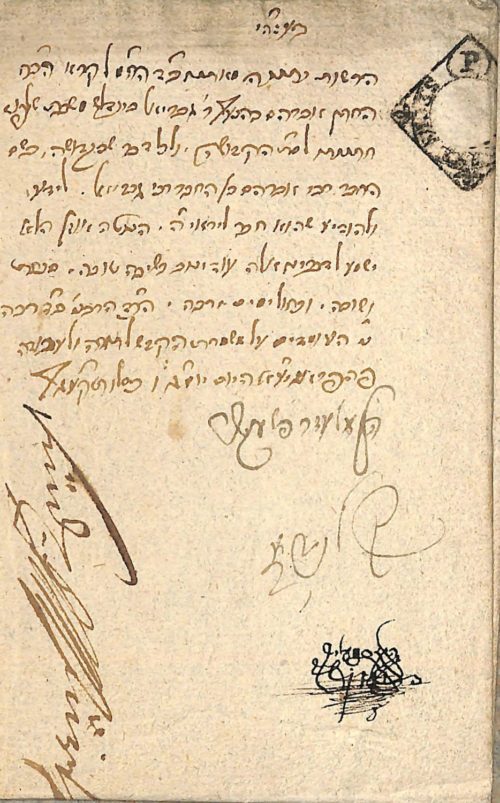
12 Regarding Schorr being a childhood genius, this letter from him to R. Shlomo Kluger appeared in Moriah, Av 5767. 

As you can see, the letter was written in 1860 (although I can’t make out what the handwriting says after תר”ך). We are informed, correctly, that Schorr was born in 1853, which would mean that he was seven years old when he wrote the letter. This, I believe, would make him the greatest child genius in Jewish history, as I don’t think the Vilna Gaon could even write like this at age seven. Furthermore, if you read the letter you see that two years prior to this Schorr had also written to Kluger. Are there any other examples of a five-year-old writing Torah letters to one of the gedolei ha-dor? Furthermore, from the letter we see that the seven-year-old Schorr was also the rav of the town of Mariompol! (The Mariompol in Galicia, not Lithuania.) I would have thought that this merited some mention by the person publishing this letter. After all, Schorr would be the only seven-year-old communal rav in history, and this letter would be the only evidence that he ever served as rav in this town. But the man who published this document and the editor of the journal are entirely oblivious to what must be one of the most fascinating letters in all of Jewish history. Yet all this assumes that the letter was actually written by Schorr. Once again we must thank R. Yaakov Hayyim Sofer for setting the record straight. In his recently published Shuvi ha-Shulamit (Jerusalem, 2009), vol. 7, p. 101, he calls attention to the error and points out, citing Wunder, Meorei Galicia, that the rav of Mariampol was another man entirely, who was also named Jacob Schorr.
13 A. Horowitz, Orhot Rabbenu (Bnei Brak, 1991), vol. 1, p. 364.
14 See Avivit Levi, Holekh Tamim (Jerusalem, 2003), p. 133 n. 161.
15 See R. Yosef Pinhasi, Yefeh Toar, p. 116.
16 See his response in Mordechai Alemkayas, Va-Yikhtov Mordechai (Jerusalem, 2009), p. 340.
17 Yayin le-Nesekh (Betar Ilit, 1996), p. 70.
18 See here.  According to Abadi, R. Shlomo Zalman’s decision was made with regard to a well-known scholar who is very involved with Artscroll.
19 The Rav doesn’t note that there is a mention of the Wall in Shemot Rabbah 2:2 as well, but his judgment would no doubt be the same. Contrary to the Rav, since these midrashim are found in so many parallel sources, I don’t think there is any question that they indeed originate with Chazal.
20 See Pinchas Giller, Reading the Zohar (Oxford, 2001), pp. 12-13.
21 The event is described in Meir Benayahu, Mavo le-Sefer Binyamin Zeev (Jerusalem, 1989),  pp. 120ff. Once the dispute got going, all sorts things were said. R. Benjamin was even accused of purchasing his semikhah. See ibid., p.140. The source for this is R. Elijah ha-Levi,  Zekan Aharon (Constantinople, 1534), no. 184.


Legacy Auction, agunot, censorship, and other notable items

Legacy Judaica will be holding its latest auction on April 4th. The auction includes a few lots regarding agunot and comprehensive attempts to annul marriages.  In the early 20th century, especially in the aftermath of WWI, some tried to find global solutions to the massive agunah problem.  To those books offering solutions were those which disputed the validity of those solutions.  There is a lot of ten historic books on the controversies and a lot of letters from American rabbis.  One of the most substantial responses is, Ein Tenai be-nesunin , whose title leaves no doubt as to its position.  The book includes an important letter from R. Chaim Ozer and other rabbis.  According to some, the book was a response to one of the more eclectic figures invovled in the controversy, R. Yosef Shapotsnik.  His book, Lekor le-Asirim Dror, also leaves no doubt as to his position.  Although that book does not appear at this auction, Shapotshnik was involved in many other controversies and one of his books on the issue with an eruv in London.  (lot 48).   One of R. Nathan Shapira’s polemics, one against drinking yayin neskeh, and the other on Lurianic observances of certain mitzvos constitutes (lot 76).

A  lesser-known example of censorship are the two “first” editions of R. Yehuda Greenwald’s Shut Zikhron Yehuda, both published in 1923.  The first contains a lengthy letter questioning how R. Yosef Hayyim Sonenfeld could associate himself with the Agudah.  In the second edition that is replaced with a letter regarding eating on the eve of Yom Kippur.  Unfortunately in the second version although they changed the letter they weren’t as thorough as they should have been left the original title in the index. (lot 50).

The version of the Shulkhan Arukh with the commentary Gur Areyeh that contains the portraits of rabbis is lot 47.  Regarding the use of the portraits and whether they were offensive see our recent post.

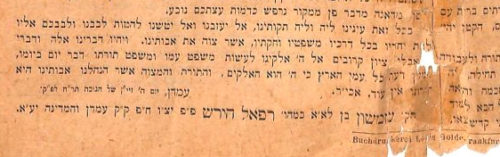
Lot 49 is a large double-sided broadside polemic against the Reform rabbinical conferences signed by R. Samson Raphael Hirsch when he was still the rav and av beis din of Emden. Here is an excerpt:


Lot 13 is Sefer Zichronos of R’ Abohav although quoted by many it was very rare and almost no one saw it inside but rather came to it through secondary sources including the Magan Avhrhom who quotes it often,and was printed by Ahahvat Sholom twice.

Another point of interest related to this work is this work was printed anonymously The Chida deals with this at length in his Shem hagedolim if this is a proper practice. See also most recently Yakav Speigel in Amudim Betoldost Sefer haivri ( BEsharei Hadefus) Chapter Two and see our post here. We also dealt with R Abuhav here.

Lot 12 is the first edition of of ha-Kesav Ve-ha-Kaballah by R. Jacob Zvi Mecklenburg (Leipzig, 1839).

Earlier on the blog (here) we have pointed to pieces only found in the first edition of this work and this particular volume is from the main synagogue in Koningsberg where R. Mecklensberg was the rabbi.

Lot 24 is the Nesivot Mishpat. an interesting tidbit about of this work has been noted in this post

Lot 28 is the Shut Meshiv Davar of the Netziv.  The entry notes that there are two editions of the first edition. The one for sale is more complete.  Some of the differences have been noted in The series on the seforim blog “The Netziv, Reading Newspapers on Shabbos in General & Censorship” (here, here and here). Part four in the series will hopefully be published shortly dealing with some more differences between the various editions.

Lot 94 is R’ Moshe Koerner and his Toras Moshe. There are two editions of this work, each with a different introduction. This was pointed out by Dr. Sprecher in his introduction to R’ Koerner’s Birchas Moshe which he reprinted. He also printed copies of both introductions. This is not noted in the Mifal bibliography entry on this work. Also, worth pointing to about R’ Koerner is recent excellent article from, Uriel Gellman, “Between Worlds: The Miserable Life of an Itinerant Preacher on the Eve of Modernity”, Jewish Quarterly Review, vol. 109 no. 1, 2019, pp. 54-83.

Lot 82 Sefer Safra Detzniusah DeYakov  about this rare book R’ Ephrayim Zalman Margolis who had a excellent collection writes picturesquely about this work:

.והספר היה אצלי ונשרף בעוה”ר בשריפה שהיה פ”ק שנת תק”ן לפ”ק ומאז לא בא לידי

See ( מעלות היוחסין עמ’ סד) for this reference.

Lots 111-112 manuscripts of the Maaseh Rav sound very interesting one hopes that who ever prints them makes them available to the public to study. For now see R Dovid Kamenetsky article here

Lot 102 Zemirot mateh Yehudah. See what the Pre Megadim writes about this work:

בספר נטריקן, יורשלים תשכד, דף טז ע”ב: “ועיין בספר מטה יהודה על זמירות ואדם גדול היה“. וראה שם הקדמה דף ו ע”א.

Lot 103

The Dibuk highlighted in auction entry is dealt with at great length in   Sara Zfatman’s  excellent book Jewish Exorcism in Early Modern Ashkenaz (heb.).

Lot 162 provides evidence of which edition of the haggadah the Netziv might have used at the seder, R’ Eliezer Ashkenazi ‘s Maasei Hashem.  The Netziv quotes this work in his commentary on the Sifri (1:243) and in his work on Chumash Bershis (44:34). This was his personal copy:

Lot 204 is a copy of Teudas Chaver (Prague 1813) signed by the Prague beis din, including R. Elazar Fleckeles, and R. Shmuel Landau, the Noda be-Yehuda’s son.

Lot 205 R Chaim Ozer and R Kook, relating to their relationship. See R. Dovid Kamenetsky’s article here


Interesting Legacy Judaica Auction lots

Legacy Judaica
is holding an auction on June 13, 2017, and we wanted to highlight a few items
of interest (for our previous post regarding the auction house and previous
auctions see here.  There are, of course, some old and rare books
from the 16th and early 17th centuries (lots 1-7), and over
forty manuscripts and a number of letters from rabbinical luminaries, R. Yosef
Dov Solovetchik (Beis ha’Levi) (lot 198), R. Yitzhak Ze’ev Solovetchik (Brisker
Rav) (lot 199), R. Hayim Ozer (lot 172), R. Kook (lot 183), R. Henkin, R.
Yechiel Michel Epstein (Arukh ha-Shulkhan) (lot 168), and the Netziv (lots
161-62), (there is also an amulet (lot 163) from his son, R. Chaim Berlin, that
apparently was written at the Netziv’s direction).
Two
particularly important manuscripts relate to the late 18th century
controversy regarding the nascent Chassidic movement.  One, lot 84, is a copy of the 1796 letter
condemning Chassidim that is signed by the Gaon, among others (this is a transcript
of the letter and does not contain the Gaon’s actual signature).  The second, lot 85, is contains two virulent
letters against Chassidim, both of which have been shown to be forgeries.  The first is written in the name of R. Akiva
Eiger, and the second is attributed to R. Yoel of Amtzislav.  Wilensky analyzed both and concluded that
they are forged.  The document also
includes the (real) transcript of the proclamations of the Bet Din of Shklov
against the Chassidim. Unrelated to the forgery, the various condemnations against
the early Chassidim were the subject of a recent controversy when many of them were
reprinted in a three volume history of the Vilna Gaon, Ha’Gaon.  The book was burnt (with hametz) and subject
to bans, one by the Bedatz Bet Din (see our earlier posts herehere, and  here).
Other items
include, R. Aaron Shmuel Koidonover, Birkat ha’Zev’ah, Amsterdam, 1669
(lot 12).  That book contains a number of
bibliographical items of note. The title page indicates that the book was
printed by two different publishers, the first abandoned because of poor
workmanship. But the identity of the sloppy printer is not provided.  This led to complaints by one of the (then) two
Amsterdam publishers, Uri Phoebus.  He
alleged that many were wrongly assuming him to be the offending publisher.  To address Phoebus, in some number of copies
a page was added that identified the culprit as Joseph Athias, the other
Amsterdam publisher.  There was little
love lost between Athias and Phoebus, and ten years later they famously clashed
over competing luxury editions of Yiddish translations of the Bible.
The title page
of the book itself is elaborately illustrated, and depicts at the top, King
David surrounded by two cherubs, and on the sides of the page, four biblical
scenes with corresponding verses relating to various events in David’s
life.  A similar title page, although
significantly more controversial appears in the Amsterdam 1706, book, Hemdat
Tzvi
.  In that instance, however, the
illustrations were used to broadcast the author, Tzvi Hirsch Chotsh’s affinity
for Shabbatai Tzvi (see Bezalel Naor, Post-Sabbatian Sabbatianism,
80-82).
A book related
to Shabbatai Tzvi appears in lot 16, R. Shmuel Aboab’s D’var Sh’mu’el,
Venice 1702.  This copy contains the
section, Zikharon L’veni Yisra’el, that provides two documents regarding
the Shabbatai Tzvi episode.  Many copies
of this edition lack this section. 
The book, Zeh
Sefer Shevach v’Zimra
, (lot 124) relates to the Napoleonic wars. This book,
printed in 1796, relates that when Fasano, Italy (it is located in the heel of
the boot), was under siege by Napoleon, the Jews were charged as spies on his
behalf.  The Jews holed up in the
synagogue and a mob formed outside.  When
all seemed lost, a French cannon went off and the mob was scared off, saving the
Jews.  This book contains the story and a
poem written in commemoration of the event that was to be said yearly.  Napoleon was a mixed bag for the Jews.  Many welcomed him and saw him as an opportunity
to improve the lives of the Jews (some even considered him a messianic
figure).  R. Shneur-Zalmen of Lyadi, the
founder of the Habad movement, was famously against Napoleon, and explained
that “if Bonaparte wins, the wealth of the Jews will be increased and their
status raised, but they will be distanced in their hearts from their father in
heaven.”  On the other hand – and R.
Shneur-Zalman was writing in the Russian Empire – “if Tsar Alexander wins,
poverty will increase among the Jews, their status will be lower, but they will
be bound and tied in their hearts to their father in heaven.”  
For further
information and for online bidding see http://legacyjudaica.bidspirit.com


Baruch Oberlander — A Note on the New Edition of the Or Zarua

Rabbi Baruch Oberlander is the rabbi in Budapest, Hungary, since 1989, and is the editor of Tel Talpiot. He has published many articles in the journal Ohr Yisroel and is the world’s leading expert on the forged Yerushalmi Kodashim.

This is his first contribution to the Seforim blog.

משהו אודות עריכת הספר “אור זרוע” מהדורה החדשה

מאת

הרב ברוך אבערלאנדער
אב”ד בבודאפשט, הונגריה

התעלמות ממהדורה קודמת של פירוש רבינו שמואל מפלייזא על פיוט שבת הגדול

בימים אלו רכשתי לעצמי כרך מפואר של ספר “אור זרוע השלם” לרבינו יצחק ב”ר משה מוינא, שיצא-לאור על-ידי “מכון תורני ישיבת אור עציון” בשיתוף עם “מכון ירושלים”. לידי הגיע הכרך השני שיצא לאור בשנת תשס”ו. הכרך הזה כולל בתוכו כל הלכות המועדים (כולל דיני שמחות-אבלות) ודיני זרעים, שכוללים הלכות כלאים, ערלה, חדש ושביעית.

מתוך כל הספר הגדול הזה שמתקרב ל-900 עמודים אתייחס רק לסימן רנו שהוא כעשירית הספר (עמודים נו-קנד), מפני המיוחד שבו: סימן זה הרי הוא כספר בתוך ספר. המחבר רבינו יצחק העתיק לכאן את כל פירושו של אחד מגדולי בעלי התוספות בדורו, רבינו שמואל מפלייזא [צרפת] (חי בסוף האלף החמישי ובתחילת האלף הששי), לפיוט “א-ל א-להי הרוחות” של רבינו יוסף טוב עלם (מראשוני חכמי צרפת, בן דורו של רגמ”ה), שנהגו רוב בני אשכנז לאומרו ביוצרות לשבת הגדול. פיוט זה מפרט את כל הלכות הפסח. הר”ש מפלייזא משתמש בפיוט כבסיס לדיונים מפורטים בהלכות פסח ובהלכות הקשורות להן, ומפרש אותו על פי פסקיהם ומנהגיהם של גאוני צרפת.

הספר יצא-לאור כפי שנאמר ב’שער’ “במהדורה חדשה ומתוקנת על פי כתבי-יד עם שינויי נוסחאות, מקורות וביאורים”, וב’מבוא’ מפורט שדברי הר”ש מפלייזא הגיעו אלינו בחמש כתבי-יד שונים (2 כת”י ‘אור זרוע’ – אמסטרדם ופרנקפורט, ועוד 3 כת”י – וטיקן, מוסקבה ופרמא).

לאחרי עיון קל ב’מבוא’ וב’ביאורים’ לספר הבחנתי מיד שיש כאן התעלמות מוחלטת ממהדורה קודמת של פירוש הר”ש מפלייזא. הגאון הרב גבריאל ציננער, שנודע בעיקר בסידרת ספריו ‘נטעי גבריאל’ הלכות ומנהגים על המועדים, הוציא לאור בשנת תשמ”ה את הספר “אוצר פסקי הראשונים”[1], שרובו הנו פירושו של הר”ש מפלייזא על-פי כת”י וטיקן ופארמא (הוא אמנם ידע כבר על כת”י מוסקבה, אבל לא הצליח להשיגו, כפי שמספר ע”ז ב’מבוא’), עם הרבה ביאורים וחידושים. ספרו זה של הרב ציננער ידוע בעולם התורה [2] וגם בחוגי האקדמיה,[3] והפלא שמהדירי ה’אור זרוע’ לא התייחסו אליו בכלל.

נוסחאות ומקורות ‘בקיאותיים’ לעומת נוסחאות מכתב-יד ומקורות ידועים מראש

עבודת המהדירים של ה’אור זרוע’ שלפנינו מתחלקת לשנים: החלק הראשון הנו ההדרת הטקסט על-פי הכת”י בצירוף אפאראט של שינויי נוסחאות, והחלק השני הנו ביאורים. המהדירים התייחסו בכובד ראש לשני חלקי עבודתם גם יחד, ואכן בספר המודפס תופס בממוצע הטקסט והנוסחאות חציו העליון של העמוד, וחציו התחתון של העמוד מוקדש לביאורים. מבחינת הנוסחאות לא יכלו המהדירים להיעזר כל כך במהדורת הרב ציננער, שהרי בעוד שהוא עבד עם כת”י וטיקן (בתוספת כמה דברים שהעתיק מכת”י פארמא), עבדו הם, כאמור, עם חמשה כתבי-יד, וברוב הפעמים נראה שהם דייקו יותר[4] בהעתקת הכתבי-יד.[5] אבל במסגרת הביאורים יכלו להיעזר בבקיאותו הגאונית של הרב ציננער, אך בשל ההתעלמות מעבודתו החשובה יצאו הם – ואנחנו הקוראים אחריהם! – מופסדים, וחבל על דאבדין.

הרב ציננער (לקמן אציין אל ספרו בקיצור: אפס”ר) בהערותיו מבאר, מציין ומפלפל באריכות גדולה כיד ה’ הטובה עליו על כל פרט ופרט שבדברי הר”ש מפלייזא, ובנוסף הצליח למצוא עשרות מקומות שבהם נעתקו דברי הר”ש מפלייזא בספרי הראשונים[6] והאחרונים, מהמרדכי והמהרי”ל, ועד ל’משנה ברורה’, ודברי הר”ש מפלייזא מתפרשים ומתבארים כשמלה. ואכן בעוד שבנוסחאות של כתבי-יד הרי אין זה נחלתו הטבעית של תלמיד חכם רבני מסוגו של הרב ציננער, הרי בכך מתייחדת עבודתו של הרב ציננער שהוא הצליח בבקיאותו הטבעית לחשוף נוסחאות וביאורים במקורות חריגים אצל ראשונים ואחרונים, בהם הובאו דברי הר”ש, והם מקורות שאינם ידועים למהדיר שקדן מקצועי שרק מחפש מקורות והשוואות במקומות גלויים וידועים מראש.

דוגמאות על מקורות ‘בקיאותיים’ שיש במהדורה הקדומה

ואציין בזה כמה דוגמאות ממה דאתי לידי תוך כדי דפדוף בספר:
* ב’אור זרוע’ עמ’ פח כותב הר”ש: “ואני שמעתי ממורי רבינו מנחם בשם בן רבינו יב”א שהיה אומר…”, ובהערה 605 הועתקו גירסאות שונות מכתבי-היד. – אפס”ר (עמ’ עו הערה כה) מפנה למרדכי פסחים סי’ תקנב, ששם הובאו הדברים בגירסא שונה: “כתב הרב רבי שמואל מפלמיז”א בשם רבו הקדוש רבינו שלמה מדרו”ש שקיבל מרבו ר”י ברבי אברהם…”.

* בעמ’ פח בסופו כותב הר”ש: “וכן נמצא בתשובת רבינו שלמה”, ובהערה ריח העירו המהדירים שב’מחזור ויטרי’ שלפנינו זה לא מפורש. – אפס”ר (עמ’ עז הערה לט) מפנה בין השאר לחידושי תלמיד הרשב”א לפסחים לא, א ששם נעתקו באריכות דברי רש”י.

* בעמ’ קב כותב הר”ש: “ותשובת גאוני לותיר ראיתי, שכל האוכל מצה מלוחה כאילו אכל חמץ בפסח”, ומעירים המהדירים בהערה שה: “לא מצאנו תשובה זו במקום אחר”. ואילו היו מעיינים באפס”ר (עמ’ צב) היו מרוויחים שני דברים. 1) שם נדפס ע”פ כת”י וטיקן: “ובתשובת…”, וזה מקל על הקריאה כאן. 2) בהערה סח ציין בין השאר גם למרדכי פסחים סי’ תקצד, שגם שם מובא תשובת גאוני לותיר זה, והוסיף לציין ל’מעשה הגאונים’ סי’ כד ועוד.

* בעמ’ קג כותב הר”ש: “והמצות צריכות שיהיו אפויות יפה, ואם לאו ישרפו מיד. והשיעור, כדי שפורסה ואין חוטין נמשכין ממנה”. ובהערה שז מעירים בדברי רבינו אלו. ואילו היו מעיינים באפס”ר היו מרוויחים גם כאן. 1) בהמשך הדברים נדפס כאן: “תדע דאמר וכן לענין לחמי תודה”, ושם נדפס ע”פ כת”י וטיקן: “ותדע דאמרינן…”. 2) בהערה עד מציין שדברי רבינו אלו מובאים במרדכי סי’ תר (כצ”ל), ומובא גם ב ב’ביאור הלכה’ של ה’משנה ברורה’ סי’ תסא ס”ג שהאריך לבארו.

בסבך העריכות של פירוש הר”ש מפלייזא וחלקו של בעל ‘אור זרוע’ בפתרון הסבך

כאמור, מציינים המהדירים ב’מבוא’ שבעריכת דברי הר”ש השתמשו הם ב-5 כתבי-יד שונים, אבל אין מציינים באופן ברור איזה נוסחאות נכנסו לפנים ואיזה מהם ירדו רק למדור הנוסחאות. אין המהדירים מגלים באיזה שיטה השתמשו: אקלקטית או דיפלומטית. אמנם הם כותבים בעמ’ 12: “מבדיקת כה”י ברור שכה”י מ [מוסקבה], ר [פארמא] הם מהדורה אחרת קדומה יותר ושלימה יותר של פירוש הר”ש, בעוד שכ”י ט [וטיקן] הוא מהדורת ביניים… פירוש הפיוט המובא באו”ז הוא קצור של הפרוש המקורי”.[7]

הדברים לא כ”כ ברורים, שהרי באם הם מרמזים כאן שהר”ש מפלייזא הוציא מתחת-ידו שתי מהדורות של הפירוש, הרי אז היו צריכים להדפיס את שתי המהדורות, או רק את המהדורה האחרונה, ואין לכל זה אף רמז בכל הספר. ועל כן אני נוטה להבין שהם התכוונו רק לומר שכה”י מ-ר שמר על הפירוש “הקדום והמקורי” כפי שיצא מתחת ידי המחבר, ואילו כה”י ט “הוא מהדורת ביניים” ששמר הרבה חלקים כפי שכתבם המחבר, אבל כבר נרגשים בו עריכה – מעשי ידי המעתיק, ואילו ב’אור זרוע’ נמצא “קצור של הפרוש המקורי”, שנשתנה הרבה מכפי שהמחבר כתבם.[8] ועל-פי האמור מסתבר שנוסח פנים הספר מיוסד על גירסת כת”י מ-ר.[9]

לאור האמור נבדוק קטע בעייתי אחד בעמ’ ק. שם כותב הר”ש: “…והיינו לאכול בשבת שלש סעודות, כמו שאבאר בע”ה [= בעזרת השם]…”, והנה בהערה 843 הם מציינים שברוב הכת”י (א-פ-מ-ר) הגירסא “בערב שבת” במקום “בע”ה” שנדפס בפנים. הרי שבמקום זה נדפס הפנים על-פי כת”י וטיקן (וכפי שתוקן במהדורת תרכ”ב), למרות שיחידאה היא! כנראה שהפעם לא רצו להסתמך על כתה”י מ-ר שנחשבים בעיניהם כהכי אמינים, שהרי “כמו שאבאר בערב שבת” אין לו שום מובן. אבל גם “כמו שאבאר בעזרת השם” לא פתר לנו את הבעיה, שהרי בהמשך הפירוש אין הר”ש דן בדיני שבת וסעודה שלישית, וא”כ למה הוא כוון כשכתב “כמו שאבאר”?

הברקה גאונית בענין זה נמצא באפס”ר בעמ’ לב. לדבריו “יתכן שזוהי הוספת האור זרוע עצמו שהוסיף בשעת ההעתקה, וכוונתו באמת למה שמבאר בהלכות ‘ערב שבת’ סימן נ”ה. ויש מקום לפי זה להשערה שמה שנדפס באו”ז כמה פעמים בשם ‘אבא מארי נ”ע’ שזה לא נמצא בשאר ההעתקות,[10] ויתכן שזהו באמת הוספת האו”ז ואינו מרבינו שמואל מפלייזא”. השערה זו עדיין צריכה עיון, שהרי עפ”ז נצטרך לומר שתיקוניו של ה’אור זרוע’ נכנסו גם לכתבי היד שאין להם קשר לספר ‘אור זרוע’, אבל יש לנו כאן קצה חוט שאולי יפתור לנו את הבעיה. ובאם יתברר שהדברים מסתברים, אולי נוכל לשער גם שהוא היה זה שקיצר את פירוש הר”ש כשהעתיקו לספרו (ואז אפשר אולי לשער שהשמיט בעיקר את הדברים שלא הסכים אתם).

בקשר לקביעת הנוסחאות אני רוצה לעורר על עוד נקודה. לפני התחלת הפירוש (בעמ’ נו) ישנם חרוזים, בהם מבקש המחבר מאלוקים שיצליח בעבודתו “לבאר נכוחות”. משום מה לא ראיתי הערה במדור הנוסחאות שבכת”י וטיקן חסרים החרוזים, כפי שיראה כל מעיין בצילום הכת”י שמופיע אחרי ה’מבוא’ עמ’ 22, אמנם זה מופיע בכת”י מוסקבה שצילומו מופיע שם עמ’ 20. החרוזים פותחים ככה: “אלקי הרוחות, המגיד שיחות…”, בהערה 1 ישנו הערה: “אלקי: א-פ א-להי”, כנראה כוונת ההערה לגלות לנו שבכת”י א-פ במקום “אלקי” נאמר שם “א-להי”. אבל באם ככה יש כאן כמה דברים מוזרים מאד: 1) האם באמת סופר כת”י א-פ שם מקף בין האותיות א ו-ל? אינו עולה על הדעת! 2) האם באמת בשאר כתה”י נאמר “אלקי” עם ק’ במקום ה’? גם זה אינו עולה על הדעת, כי הרי החומרא שלא לכתוב שם ה’ כצורתו אינו אלא מהחומרות של הדורות האחרונים.[11] 3) הפירוש מתחיל: “אלקי הרוחות. קרא כתיב…”, ובמדור הנוסחאות לא צויין כלום ע”ז, האם זה מלמד שבכל הכתבי-יד נאמר כאן “אלקי” עם קוף, אין זה עולה על הדעת בפעם השלישית! וההוכחה לכל זה הם צילומי שני הכתבי-יד הנ”ל שבתחילת הספר שרואים שבכת”י וטיקן ובכת”י מוסקבה נאמר: “אלהי”.[12]

עוד דוגמאות על חובבנות והעדר מקצועיות

ההרגשה שהספר לא נערך בצורה מקצועית ומדויקת, אלא יש בערכיה מן הרשלנות והחובבנות, מתקבלת מעוד דברים קטנים שצדו עיני.[13] ולדוגמא, ידועים הנאמר בתוספות לעבודה זרה (עד, ב ד”ה דרש): “וכן פירשתי בסדר ביעור חמץ בקרובץ שבת הגדול שיסד רבינו יוסף ט”ע”, הרי שדברים אלו נעתקו מפי כתבו של הר”ש מפלייזא, שהוא מחברו של הפירוש לקרובץ של שבת הגדול. ועל יסוד זה נקבע גם ש”התוספות שלנו לעבודה זרה אינן אליבא דאמת אלא עיבוד של תוספותיו של ר’ שמואל עצמו למסכת זו.”[14] אפס”ר (עמ’ פ הערה סז) מעתיק דברי התוספות בלשונם, ומראה שאכן הדברים נמצאים בפירוש שלפנינו. מהדירי ה’אור זרוע’ לא העריכו דברים אלו, ועל כן הם ציינו בצורה לקונית (עמ’ צב הערה רמא): “דעתו זו של רבינו הר”ש מפלייזא… המבוארת להלן הובאה בתוס’ (ע”ז עד, ב ד”ה דרש)”. והרי זה לא “הובאה”, אלא שהר”ש בעצמו הזכירו גם שם.

ואעיר בזה על עוד דבר הצריך תיקון, כיון שלא ירדו לסוף דברי הר”ש. בעמ’ ק בפיוט נאמר: “רקיקי מצות עושין זכר לעיגון”, ומפרש הר”ש: “זכר לעיגון. שאכלו לחם עוני”, ומעירים בהערה רצ: “רבינו פירש תיבת ‘עיגון’ מלשון עוני. ולולי דבריו היה אולי מקום לפרש שהכוונה לעוגות כמו שנאמר: ‘ויאפו את הבצק… עוגות מצות’ (שמות יב, לט)”. וקצת תמוה לי שבביאור לדברי אחד מגדולי בעלי התוספות מרגישים הם צורך לפרש באופן אחר “לולי דבריו” – בדבר שאינו מוסיף להבנת הסוגיא וכד’. ובנוגע לגוף הדברים לא הבנתי, מה הקשר בין המלה “עיגון” לעוני? ומעניין שלפני זה בעמ’ צט הערה רפ כותבים המהדירים: “ורבינו מפרשו שאופים רקיקים ‘זכר לעיגון’ לשון צער”.

והנה ב”מחזור חלק שני כמנהג ק”ק אשכנזים”, עם פירושו של הרב משה בון סג”ל, נדפס בהומבורג (לאחרי שנת תקס”ד, שנת ההסכמה),[15] בפירושו לפיוט (רנג, ב) הוא מפרש: “לעגון. לשון הלהן תעגנה”, וחיפוש בתקליטור יגלה שהמלה “תעגנה” מופיע פעמיים בתנ”ך. ברות (א, יג) נאמר: “הלהן תעגנה לבלתי היות לאיש”, ומפרש רש”י שם: “תעגנה. לשון אסור כלא כמו עג עוגה ועמד בתוכה”; וביחזקאל (ד, יב) נאמר: “ועוגת שעורים תאכלנה, והיא בגללי צאת האדם תעגנה לעיניהם”, ומפרש רש”י שם: “בגללי צאת האדם תעגנה. תאפינה בגחליהם שמייבשן ושורפן”, ומשמע שכאן מפרש “תעגנה” מלשון “עוגות”.[16] ועפ”ז אפשר לבאר דברי הר”ש מפלייזא כאן בשני אופנים. לפי פרש”י ביחזקאל מתפרש “זכר לעיגון” שהמצות הם זכר לעוגות לחם עוני (וכפי פירוש “לולי דבריו” שהציעו המהדירים!), ולפי פרש”י ברות זה מתפרש מלשון כלא, שהמצות הם זכר ללחם עוני שאכלו כשהיו אסורים במצרים.[17].

אני חושש שהדוגמאות שהבאתי לעיל לא עצמן יצא אלא על הכלל כולו יצא, למרות גודל עבודתם שמהדירי ה’אור זרוע’ השקיעו בעריכת הנוסח ובביאור הספר – השאירו עדיין בקעה פרוצה, ועבודתו של הרב ציננער באפס”ר היה יכול לשמש כחומר משובח שאתו היו יכולים לסתום הרבה פרצות,[18] ולכן עד שלא תופיע מהדורה מושלמת אני מציע להשתמש בשתי המהדורות גם יחד.

לסיום אעיר גם על החידוש שהכניסו לספר, שכל ציטוט מתנ”ך או תלמוד המובא בדברי ה’אור זרוע’ או בדברי הר”ש מודפס באותיות מובלטות, ודבר זה לא מצינו לו חבר, ואני חושש שלהרבה קוראים זה יפריע – כמו שזה הפריע לי.

ומכיון שניתן רשות להעיר, הרי כאן המקום להעיר על מבול הביאורים שהכניסו המהדירים לתוך ספר, שזוהי הסיבה שספר ‘אור זרוע’ שעד היום היה מודפס בשני כרכים דקים בלבד, הרי מעתה סידרה של ספרים עם אלפי עמודים. וחבל שאין המהדירים יודעים את סוד הצמצום כפשוטו וכמשמעו, שאין דבריהם אמורים להיות אלא הערות קצרות מוכרחות המחזיקות את המרובה בשולי הגליון, דוגמת הערותיו של גדול מהדירי כתבי-יד של רבותינו הראשונים בדור הקודם, הר”א סופר. וכדאי לצטט בקשר לזה ההגדרה הקולעת של הגרש”י זוין[19]: “…הרי כאן מעין ‘טלית קטן גדול’… תפס הביאור את מקומו של העיקר, ונדחקו רגליו של האחרון”…

הערות
1. עזרתי לו אז בכמה דברים שהיו קשורים לספר, והוא הזכירני לטובה בסוף ה’הקדמה’.
2. ראה לדוגמא הרב גדלי’ אבערלאנדער: ‘מנהג אבותינו בידינו’ חלק ב, ניו יארק תשס”ו, עמ’ שלו הערה 32; שם עמ’ תיד הערה 11; הרב יצחק שילת: “על הראשונים”, מעלה אדומים תשנ”ח, עמ’ עט מס’ קעח. ועוד. וזכורני שלפני כ-5 שנים יצא לאור במונסי (על-ידי אחד מקהל עדת ישרון) ביאור לפיוט ‘אלהי הרוחות’ – מיוסד על ביאורו של הר”ש מפלייזא כפי שזה מופיע באפס”ר של הרב ציננער, ואינו תח”י כעת.
3. ראה לדוגמא פרופ’ י”מ תא-שמע: “מנהג אשכנז הקדמון”, ירושלים תשנ”ט, עמ’ 250 הערה 2; שם עמ’ 265 הערה 6 (וראה שם ובעמ’ 277 הערה 9 הערות חשובות בביאור דברי הר”ש מפלייזא); פרופ’ א’ גרוסמן: “חכמי צרפת הראשונים”, ירושלים תשנ”ה, עמ’ 55 הערה 38.
4. ולדוגמא באספ”ר עמ’ פג נדפס: “והר’ יעקב בר’ שמשון הגיה וסכין”, וזה טעות המעתיק, והנכון כמו שהדפיסו ב’אור זרוע’ (עמ’ צד): “ופכין”, ובהערה 738 ציינו שבכת”י וטיקן הגירסא: “ובדין”. אמנם בסוף עמ’ צ נדפס: “כי לא באת תקלה על ידם”, ובהערה 670 צויין שבכת”י וטיקן הגירסא: “ידין”, ולדעתי הנכון בזה כבאפס”ר עמ’ פ: “על ידיו”, כי לפעמים (אמנם נדיר) ישנו בכת”י וטיקן וא”ו אריכתא, וגם כאן מסתבר כן.
5. יש לציין שבאפס”ר (עמ’ פ הערה סג) נעתק קטע ארוך “הוספה” על-פי כת”י וטיקן. נמשך בזה אחרי פרופ’ א”א אורבך: “בעלי התוספות”, ירושלים תש”מ, ח”א עמ’ 464 הערה 18, שקבע שב”בכ”י הוואטיקאנה 266 נמצאת כאן הוספה” ומעתיקו בארוכה. אבל בדיקת כתב-היד מגלה שטעה בזה, כי אין זה הוספה אלא לדברי הסמ”ג, שדבריו הועתקו בכת”י אחרי פירושו של הר”ש מפלייזא. וטוב עשו מהדירי ה’אור זרוע’ שלא התייחסו לזה (בעמ’ צא).
6. וכעת יש להוסיף גם את “סדר פסח לתלמיד הריצב”א”, שנתפרסם בקובץ ‘עץ חיים’ (באבוב), ניסן תשס”ז (ג), עמ’ יח-לז. וראה שם עמ’ טו.
7. וראה עוד מאמרו של הרב שלום קליין: “מים שלנו – דעת הר”ש מפלייזא והשלכותיה”, ‘מוריה’, ניסן-אייר תשס”ד, עמ’ ד (צויין גם במבוא כאן הערה 7).
8. אין הם מעלים לדיון האם ניתן לומר שרבינו יצחק, מחבר ה’אור זרוע’, הוא זה שקיצר וערך את הפירוש כשהעתיקו לספרו (וראה עוד לקמן).
9. בעיה קיימת גם בקשר לנוסח הפיוט שהדפיסו בספר, גם כאן לא צויין באופן ברור מקור הנוסח. אבל ב’מבוא’ עמ’ 12 נאמר: “יש לציין כי בכה”י מ, ר מובא גם נוסח הפיוט עצמו ואנו ציינו את שנויי הנוסח מהנוסח המקובל המובא בסידורים”, ניסוח מעורפל, וכנראה הכוונה שנוסח הפיוט נדפס עפ”י נוסחת כת”י מ-ר, ובמדור הנוסחאות צוינו שינויים על-פי נוסחאות הסידורים (בלי לפרט איזה סידורים). ואינו ברור האם באמת אין שום כת”י אחר שבו מופיע הפיוט? ובכל אופן כבר בהתחלת הפיוט (בעמ’ נו הערה 4) צויין בהערה 4 גירסה שונה לפיוט ע”פ כת”י מ-ר, הרי שהפנים נדפס כאן כנראה ע”פ “הנוסח המקובל המובא בסידורים”? (כנראה כדי שיתאים למובא בהערה 13).
10. הכוונה שלא נמצא בכת”י וטיקן, ראה אפס”ר עמ’ מז והערה מט (‘אור זרוע’ עמ’ ס הערה 90) ועמ’ מט הערה ע (והנמצא באו”ז עמ’ סב הערה 129 כנראה טעות, וצ”ל: ט חסר).
11. וראה דבר מעניין ב”לקט מתשובות מו”ר הרב יוסף בן דוד קאפח זצ”ל”, בתוך: “ספר זכרון להרב קאפח”, רמת גן תשס”א, עמ’ 33-34: “שאלה: כבוד תורתו אמר לי, שמותר להגיד אלוקים בה”א ואין צורך להגיד בקו”ף… תשובה: …מה שעניתי נכון כי חז”ל לא החמירו אלא ביוד הא וכו’… אבל להזכירם בתוך שטף דברים יהיו אשר יהיו מותר, ואף מצוה לאמרן כמו שהן, כי הסירוס הזה בקו”ף לדעתי ולמשמע אזני, גנאי הדבר ומכוער מאוד, גם כלפי הדיוט, כ”ש כלפי שמים. ואני בטוח שלא שאלת להזכירו לבטלה. אלא שאזניך כבר מלאים מן הכינוי המשובש אלקים צבקות, ולכך אינך כבר חש את הזרות ואת הכיעור שבדבר…”, וראה שם בהערות 17-18 מה שכתבו הפוסקים בענין זה.
12. טעויות הללו נמצאים גם באפס”ר.
13. דומה לזה הנאמר בעמ’ נו הערה א: “הועלתה אפשרות כי רבינו הר”ש היה רבו של המהר”ם מרוטנבורג. ור’ בהרחבה במבוא”, וזה מה שנאמר ב’מבוא’ (תחילת עמ’ 12): “הר”ש היה רבו של המהר”ם מרוטנבורג”, אין כאן שום הרחבה ואף לא צויין מקור לקביעה. אמנם הדברים מבוארים ב”בעלי התוספות” שם ח”א עמ’ 461 הערה 3; ח”ב עמ’ 528. אחד המקורות לזה הוא הנאמר בפירוש מהר”ם לנגעים (פ”א מ”א): “ומורי הרב ר’ שמואל זצ”ל מקשטטיירי [Chateau Thierry] פירש לנו בשבועות”. ויש לציין לדבר מוזר בספר “בעלי התוספות” בענין זה. במהדורה קודמת זיהה אורבך את רבי שמואל מקשטטיירי עם רבי שמואל מאיברא, עקבות לזה נשארו גם במהדורת תש”מ, ב’מפתח השמות’ שבסוף ח”ב עמ’ 787 נאמר: “ר’ שמואל מקשטל טיירי ראה ר’ שמואל ב”ר שניאור מאיברא”, ושוב כשהתברר לו שזה אינו אלא הר”ש מפלייזא תיקנו בעמ’ 461 שצוין לעיל, ושכח לתקן את ‘מפתח השמות’. ועוד יותר חמור, שבעמ’ 528 ברשימת רבותיו של הר”מ מרוטנבורג הוסיף את הר”ש מפלייזא, אבל לא הוריד את הר”ש מאיברא, וכך הוא כותב: “הוא רואה את רבותיו בר’ עזרא ממונקונטור, ר’ יחיאל מפאריז, ר’ שמואל מפלייז, ור’ שמואל מאיברא, בימי ישיבתו בקשטלטיירי”… [אחת ההוכחות שר”ש ב”ר שניאור מאיברא אינו הר”ש מקשטלטיירי הוא, שהרי המובא בסמ”ג (עשין קסב) בשם “הרב רבי שמואל ברבי שלמה”, מובא בספר ‘עץ חיים’ לר’ יעקב חזן מלונדרש (ח”א עמ’ כג) בשם “רב שמואל מקאטייא טיירי”, ואכמ”ל.]
14. “בעלי התוספות”, שם ח”א עמ’ 465. וראה שם ח”ב עמ’ 654.
15. קיבלתי צילומו מהרב גבריאל ציננער.
16. ולהעיר מרש”י לבבא קמא (פ, א ד”ה העגונה) שמפרש: “העגונה. מאוחרת כמו ‘הלהן תעגנה’ תאחרנה מלהנשא”, וברשב”ם לבבא בתרא (עג, א ד”ה וכן הוא) מפרש: “דעיגון דמתניתין לשון עכוב הוא כדכתיב הלהן תעגנה כמו תעשנה תתעכבו מלהנשא לבעל…”. ובפירוש “עיון תפלה” שבסידור “אוצר התפילות” (ח”ב עמ’ 244) פירש: “זכר לעגון. שהיינו מקושרים במצרים בעבותות העבדות”.
17. והאריכו המפרשים בקטע “הא לחמא עניא” שבהגדה של פסח, האם המצה הוא זכר לחירות או זכר לעבדות ואכמ”ל.
18. יש להוסיף הערה: בעמ’ קז כותב הר”ש: “והעומר נקרא לחם דכתיב [שמות טז, כב] לקטו לחם משנה, וילפינן לחם הדיוט מלחם גבוה דכתיב [במדבר טו, יט] והיה באכלכם מלחם הארץ”, ולא צויין לזה כל מקור. ובאפס”ר (עמ’ צז הערה לד) מעיר: “לא מצאתי מקורו וצ”ע”. ולכאורה הרי לנו מקור מפורש בעירובין (פג, ב): וכמה עיסותיכם? כדי עיסת המדבר. וכמה עיסת המדבר? דכתיב והעומר עשרית האפה הוא. וראה ב’תורה שלמה’ עה”פ (כרך יד עמ’ רמב הערה רח) מה שהביא מספר הפרדס לרש”י ועוד.
19. בספרו “סופרים וספרים – פסקים, פירושים, חידושים”, תל אביב תשי”ט, עמ’ 24.


Foie Gras “Fake News”: A Fictitious Rashi and a Strangely Translated Ethical Will

Foie Gras “Fake News”: A Fictitious Rashi and a Strangely Translated Ethical Will
by Ari Z. Zivotofsky
Controversial topics can sometimes lead to contrived sources, i.e. fake news. That is certainly true with the effort by vegetarians to find traditional sources to support their position. In the past I have shown how a booklet claiming Judaism supports vegetarianism was full of misquotes (here here ) and how a “quote” of the Rema was fabricated ( here ). Here I will expose two fake quotes that have been used by vegetarians in the battle against foie gras.
Foie gras (pronounced “fwä-grä, meaning “fat liver” in French) is the fattened liver of a waterfowl that grew to 5-10 times its usual size due to gavage. Foie gras, a delicacy today rightly associated with the French who are indeed by far the largest producers and consumers of it, was for much of history an Ashkenazi Jewish expertise. This luxury item has been the subject of a great deal of controversy in recent years. Until its production was banned in 2003 by the Supreme Court, Israel was one of the leading producers in the world. Within the last year, kosher foie gras has begun to be produced in the US for the first time in history.
The issue driving the current debate is animal welfare, or in the Jewish world, tza’ar ba’alei chaim. For hundreds of years, in traditional Jewish sources “stuffed goose” was indeed controversial, but not because of animal welfare. The debate revolved around potential treifot due to possible damage to the esophagus caused during the feeding process. it was a widespread debate involving the greatest of authorities. The Rema (YD 33:9) notes that in his town they would stuff geese to make schmaltz and they would check the veshet of each bird. Rav Yoel Sirkis (Bach, YD 33) was in favor of banning force feeding because of this potential serious problem. The Aruch Hashulchan (YD 33:37) says they did not do force feeding in his town. The Chochmas Adam (16:10) preferred to ban the gavage process because of the concern for treifot of the veshet, but agreed that if done, it could potentially be kosher. In modern times the Tzitz Eliezer (11:49, 11:55, 12:52) and Rav Ovadia Yosef (Yabia Omer 9:YD:3) came out against foie gras, while Rav Yosef Shalom Elyashiv was reported as approving the foie gras that was being produced in 2005. The most famous posek to permit stuffed geese was the Chasam Sofer (2:YD:25; Chullin 43b).

Despite the centuries long debate, force feeding geese was extremely common among Ashkenazic Jews. Many of the greatest poskim lived in regions where they would have been personally exposed to the process and yet none of them ever suggested that it was cruel and bordered on tza’ar baalei chaim. The issue was not even raised for discussion until the late 20th century. The only place tzaar ba’alei chaim is mentioned in the context of fattened geese is in the opposite direction – the rabbis were aware that geese used to being fed in this manner would not eat any other way and thus, out of concern for tza’ar ba’alei hayyim, permitted, with certain stipulations, gavage for these geese on Shabbat (Mishna Berurah 324:27). This is as opposed to other chickens and geese, for which this is not permitted.

Despite efforts by some to demonstrate that force feeding geese is cruel and was recognized as such by Jews in previous generations, it’s a common misunderstanding based on a mistranslation that seems to defy explanation, and one of these situations where people keep repeating an error because they didn’t examine the primary source. In contemporary Jewish anti-foie gras literature, two “quotes” are regularly bantered about, even by scholars. One is a “quote” from Rashi and the other from a 14th century ethical will.

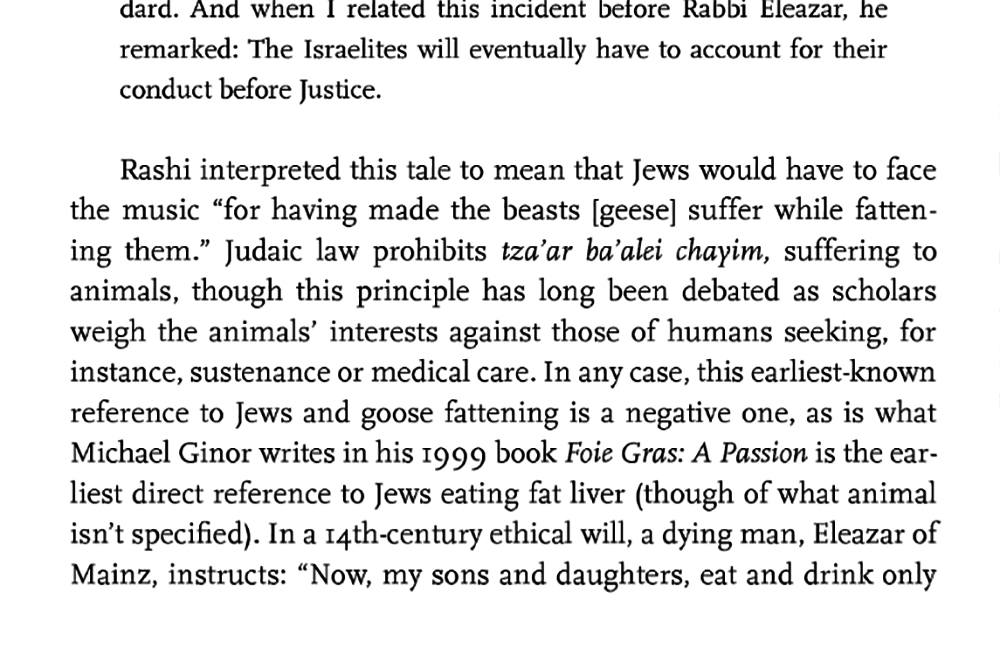
Both quotes can be found in the book “The Foie Gras Wars: How a 5,000-Year-Old Delicacy Inspired the World’s Fiercest Food Fight” (2011) by Chicago Tribune reporter Mark Caro. On p. 26 he writes:

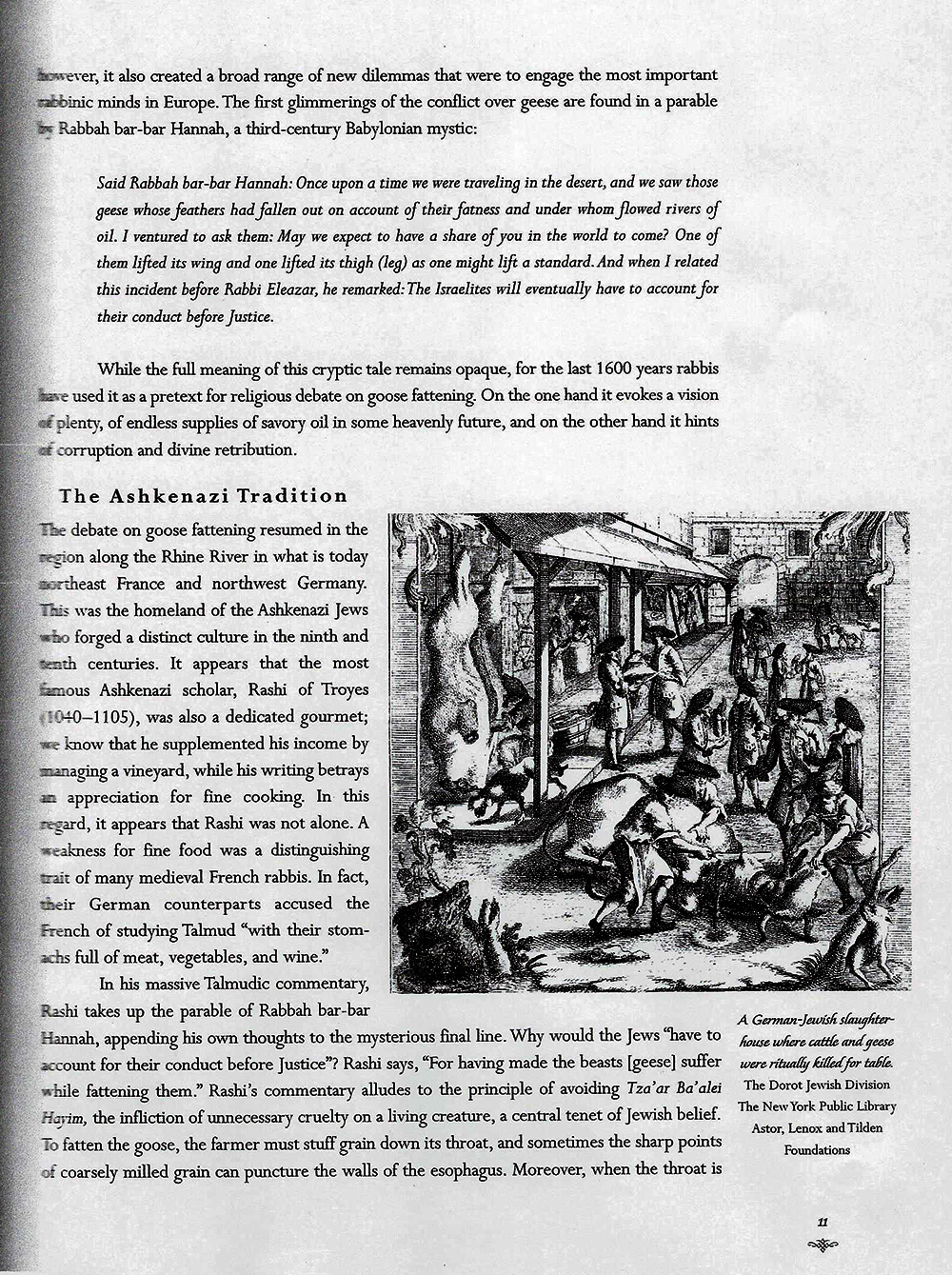
“Rashi interpreted the tale to mean that Jews would have to face the music ‘for having made the beasts[geese] suffer while fattening them’.”

And on p. 26-27 he writes:
“In a 14th-century ethical will, a dying man, Eleazar of Mainz, instructs: “‘Now, my sons and daughters, eat and drink only what is necessary, as our good parents did, refraining from heavy meals, and holding the gross liver in detestation’.”
The comment of Rashi sounds like it may indeed be a condemnation of fattening geese. It turns out that Rashi never wrote any such thing. First, the source for this “quote” is Bava Basra 73b and as is well known, on 29a of Bava Basra of our printed texts, there is a note in bold letters in the Rashi column that says: “until here is the commentary of Rashi zt”l, from here on in is the commentary of Rabbeinu Shmuel ben Rav Meir”, ie Rashbam. The first error is therefore that the comment was not written by Rashi but by his grandson. 

Nonetheless, even if Rashbam had written that, it would be of significance. But he didn’t.

The comment was made on the 10th of the fantastic, esoteric tales of Rabbah bar bar Chanah. The story is:
תלמוד בבלי מסכת בבא בתרא דף עג עמוד ב
ואמר רבה בר בר חנה: זימנא חדא הוה קא אזלינן במדברא, וחזינן הנהו אווזי דשמטי גדפייהו משמנייהו וקא נגדי נחלי דמשחא מתותייהו, אמינא להו: אית לן בגוייכו חלקא לעלמא דאתי? חדא דלי גדפא, וחדא דלי אטמא. כי אתאי לקמיה דרבי אלעזר, אמר לי: עתידין ישראל ליתן עליהן את הדין.

Rabbah b. Bar Hana also related: We were once travelling in the desert and saw geese whose feathers fell out on account of their [excessive] fatness, and streams of oil [fat] flowed under them. I said to them: ‘Shall we have a share of your [flesh] in the world to come?’ One lifted up its wing, the other lifted up its leg. When I came before R. Elazar he said to me: Israel will be held accountable because of them.

Commenting on the last line, Rashbam commented:
רשב”ם מסכת בבא בתרא דף עג עמוד ב
ליתן עליהם את הדין – שבחטאתם מתעכב משיח ויש להם צער בעלי חיים לאותן אווזים מחמת שומנן.
According to the Rashbam, the Jews are responsible for the suffering of the geese in that the geese had to live extra-long with unnatural fat because the Jews sinned and thereby delayed the coming of the Messiah and the slaughtering of these geese. The Rashbam was discussing a fanciful story involving the suffering of mythical geese whose feathers fall out and whose fat drips off of them, i.e. who were clearly suffering and are different from a typical goose. Such geese he suggests may suffer due to their excessive fat. He makes no mention of the fattening process and says nothing about any suffering during that process or about the suffering of geese that his Jewish neighbors were raising.
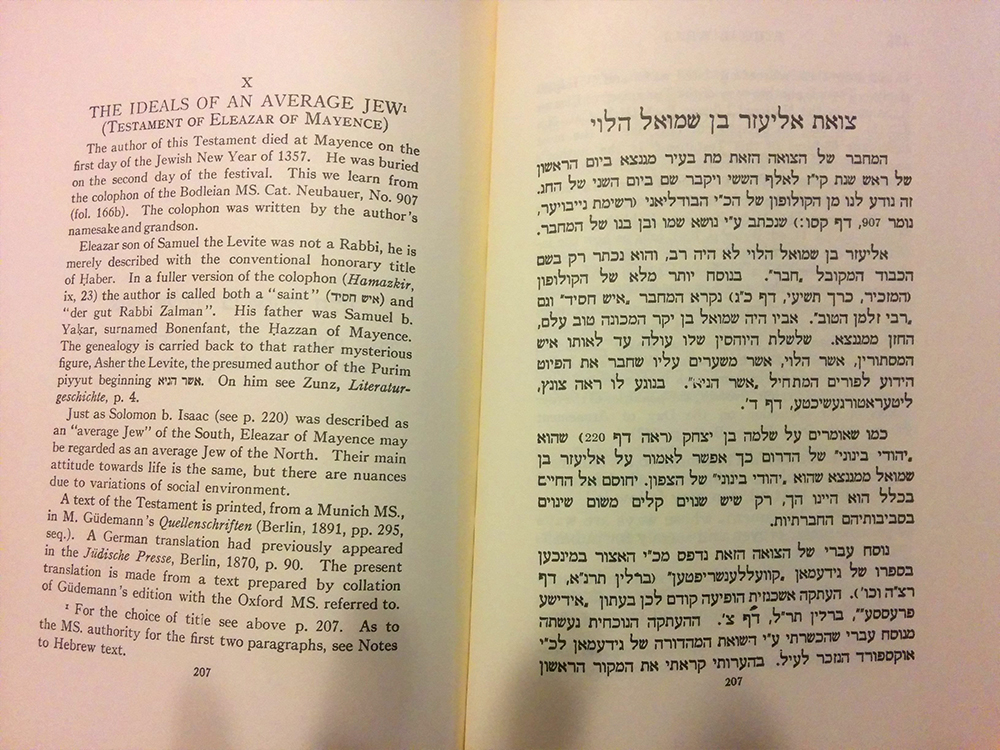
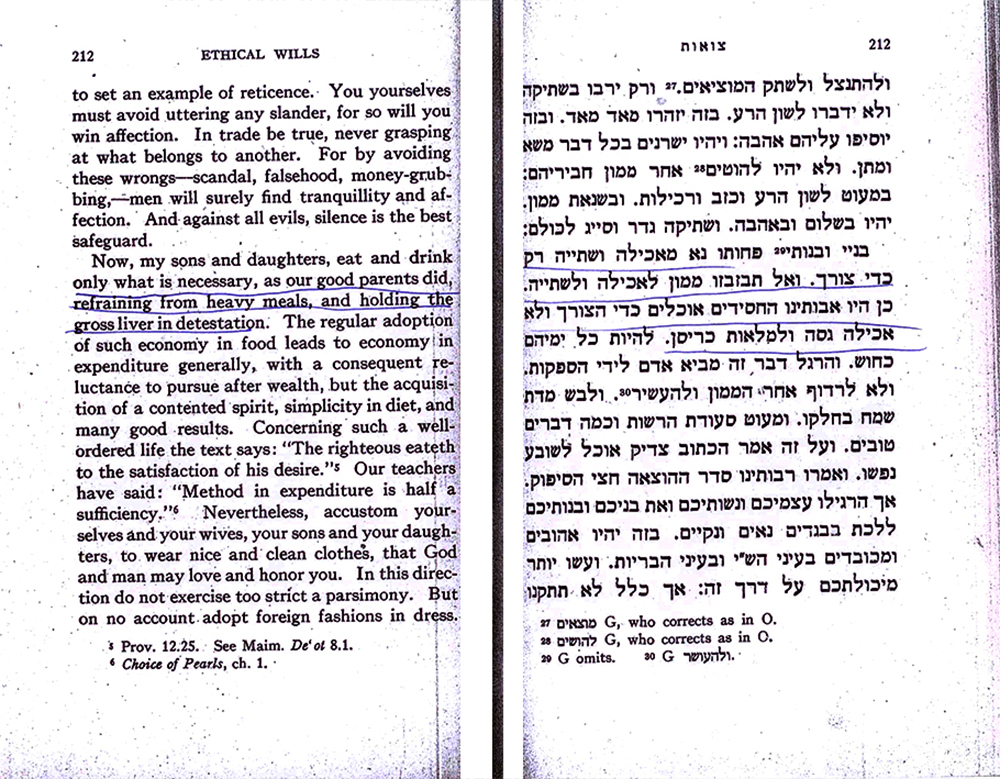
And how about the ethical will? Hebrew Ethical Wills (JPS Library of Jewish Classics) (English and Hebrew Edition) [1976], Israel Abrahams (Editor), Judah Goldin (Foreword) is a facsimile edition of the 1926 original. Beginning on p. 207 is “The Ideals of an Average Jew (Testament of Eleazar of Mayence)” and on p. 212 it indeed says: “Now, my sons and daughter, eat and drink only what is necessary, as our good parents did, refraining from heavy meals, and holding the gross liver in detestation.” 

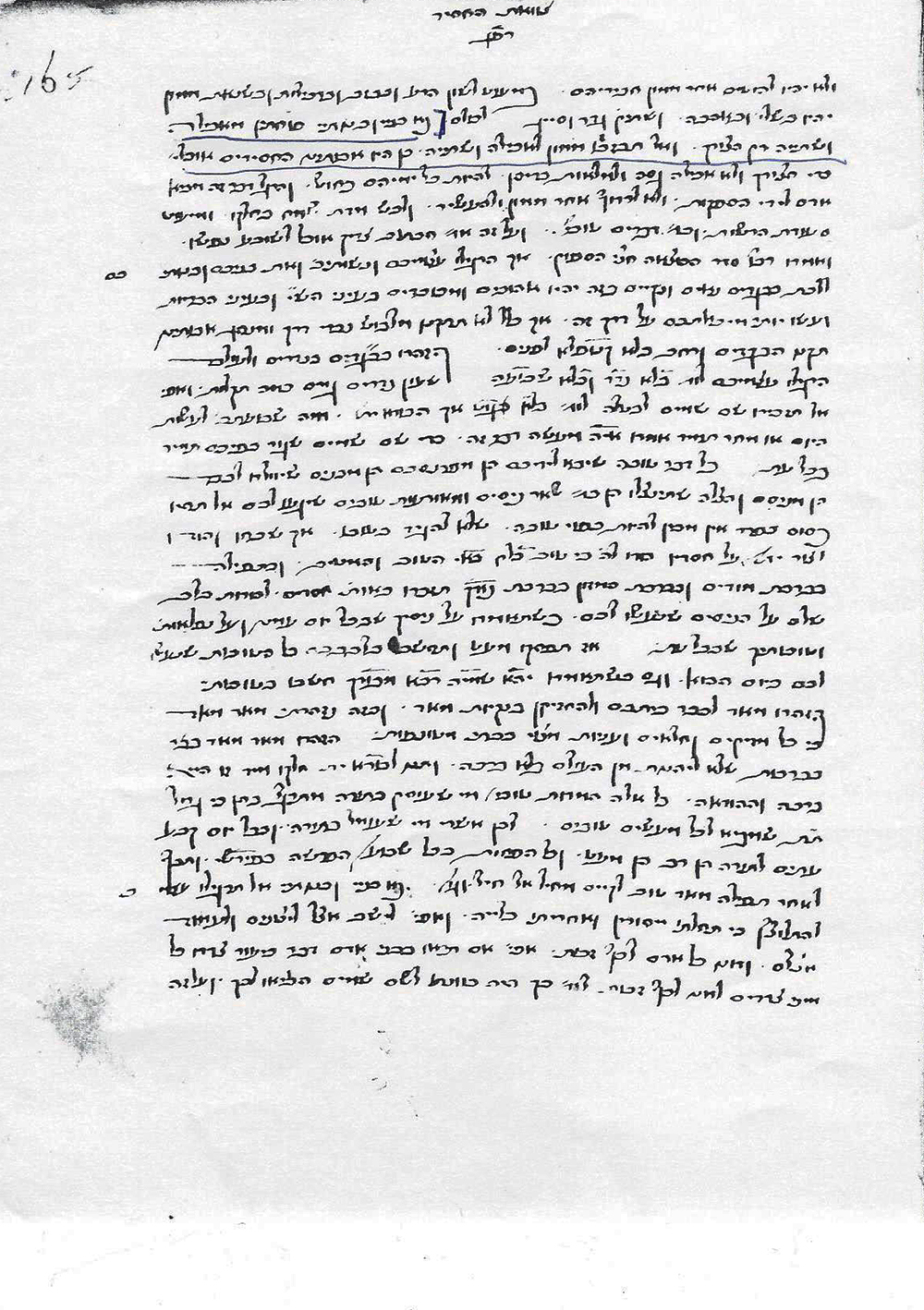
From this it is not at all clear why liver should be so disliked, and it is certainly not obvious that he is talking about foie gras. It could be that he simply abhors liver (perhaps because, as Chazal note, it is full of blood). In an effort to better understand, I looked on the other side of the page, at the Hebrew text. And what a shock! It seems that when Israel Abrahams (Reader in University of Cambridge and a Senior Tutor at Jews’ College) translated this text he used some poetic license, likely never suspecting it would be then adopted by the anti-foie gras activists. Here is what the Hebrew found in Abrahams says:
בניי ובנותי פחותו נא מאכילה ושתייה רק כדי צורך. ואל תבזבזו ממון לאכילה ולשתייה. כן היו אבותינו החסידים אוכלים כדי הצורך ולא אכילה גסה ולמלאות כריסן. להיות כל ימיהם כחוש.
No mention whatsoever of liver! It appears that it is not an actual translation. It seems strange that Abrahams fabricated the liver in the English. He says the translation was made on the basis of two Hebrew texts. Maybe he translated straight off of them and the Hebrew in his edition is not accurate. The first is a text that is based in a Munich MS and appears on Moritz Güdemann’s Quellenschriften (Berlin, 1891, reprinted by Philo Press in 1968).

There on p. 296 one finds an almost identical text:
בניי פחותו נא מאכילה ושתייה רק כדי צורך ואל תבזבזו ממון לאכילה ולשתייה. כן היו אבותינו החסידים אוכלים כדי הצורך ולא אכילה גסה ולמלאות כריסן להיות כל ימיהם כחוש
The other manuscript is Bodleian MS cat Neubauer No. 907, fols. 164a-166a (not 166b as Abrahams erroneously wrote) and the relevant section is at the top of 165a (I thank Ezra Chwat for his assistance in obtaining this ms.). As can be seen the text is identical to that found in the Abrahams’ book. 
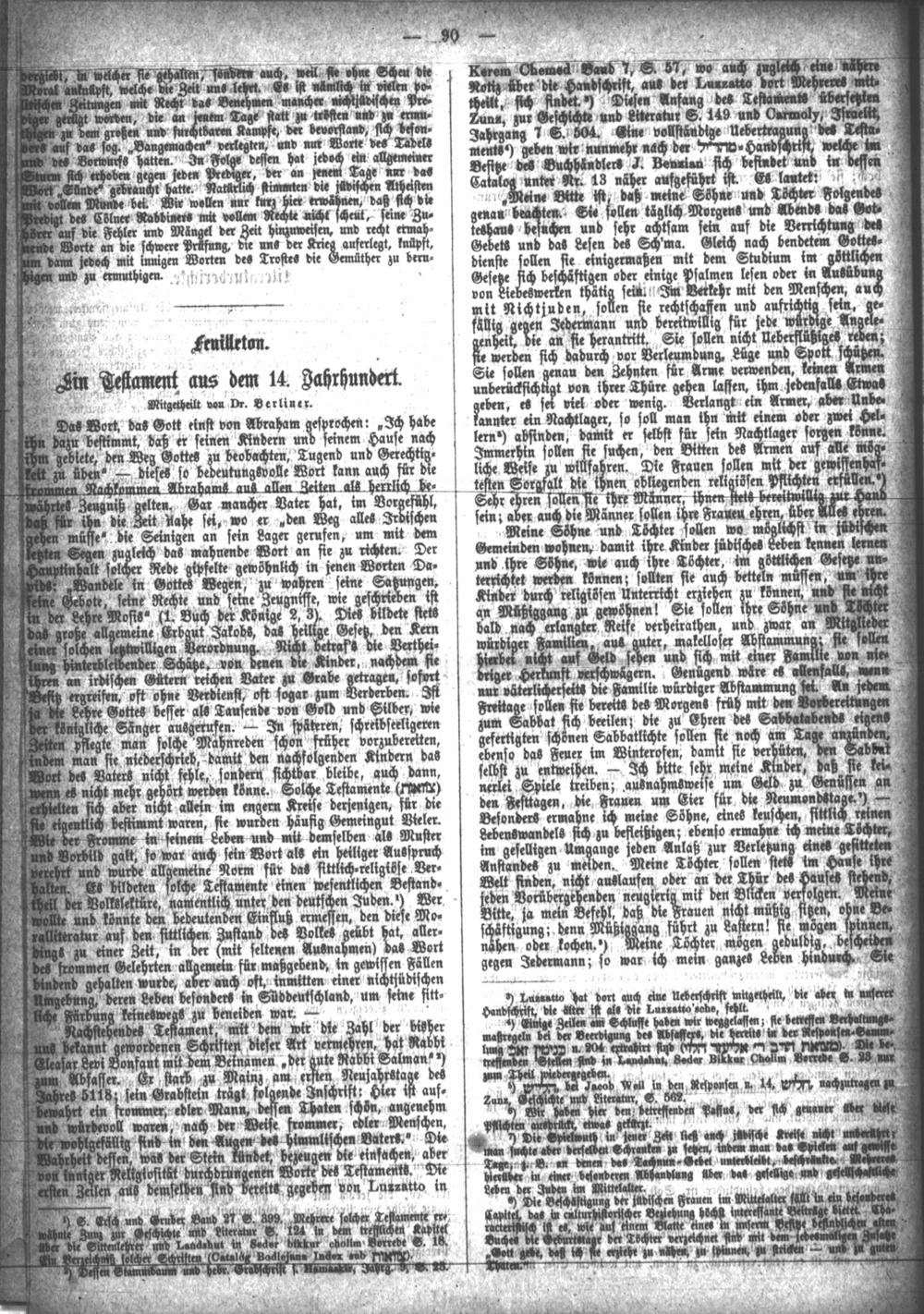
There seemed to be a final possibility. In his introduction, Abrahams notes that a previous translation, into German, had appeared in the journal Jüdische Presse, Berlin 1870, p. 90.

The journal is available here (I thank Sharon Liberman Mintz for finding that link for me). In issue 11 (Sept 9, 1870) a translation appears on the 6th and 7th page of the issue, pages 90-91 of the volume, as can be seen in the figure below.
However, it is only a translation of the first half of the will, ending just before the relevant section. It says that it was to be continued, but unfortunately that was the first year of the journal and the next issue (12) is missing (as are several others such as 3, 7, 9, 10) from the digitized microfilm at that website and I have been unable to locate it in any Israeli library. the translation until that point seems to be accurate and it is hard to ascribe the insertion of the liver to the German translator (I thank Rabbi Dr. Seth Mandel and Prof Michael Segal for assistance with the German).
It thus seems clear the liver was inserted into the English transition for some inexplicable reason, but certainly does not appear in this 14th century ethical will.
Once an author is convinced of the authenticity of the sources they often embellish. In the academic work, Food and Morality: Proceedings of the Oxford Symposium on Food and Cookery (2007) edited by Susan R. Friedland, there is a chapter called the foie gras fracas: sumptuary Law as Animal welfare? By Cathy K. Kaufman, a scholar-chef and Adjunct Chef-Instructor, Institute of Culinary Education, in New York City.
On p. 126 she writes: 

“The best written evidence for the medieval production of foie gras – and its ambiguous moral status – is found among the writings of the Ashkenazi Jews who spread throughout Europe. Rabbi (sic) Rashi ……”

But in fact we have shown that among the Jewish writings there is ZERO evidence regarding any ambiguous moral status!
Even the well-known American cookbook author Joan Nathan couldn’t avoid this pitfall. 
Recently, in her King Solomon’s Table: A Culinary Exploration of Jewish Cooking from Around the World (2017) on p. XXI she wrote: 

“Rashi was a thinker who knew both religion and agriculture. He condemned, for example, the force-feeding of geese to produce foie gras ….”.

In 2013, an article in Moment magazine (here) stated: 

“More complex, however, were the ethical questions. In the 11th century, the French scholar Rashi warned Jews against the force-feeding practice, “for having made these beasts (geese) suffer while fattening them.” This went against Jewish law prohibiting tza’ar ba’alei chayim, suffering to animals, although some rabbis claimed that since none of the geese’s limbs were harmed and the geese did not feel discomfort in their throats, foie gras was not treyf, or forbidden. Other rabbinic scholars suggested that it is only permissible to inflict pain on an animal when the benefit of doing so is significant; since there are no real nutritional benefits to foie gras, the process of force-feeding was questionable.”

One can only wonder who these “some rabbis” and “other rabbinic scholars” were who argued with this non-existent Rashi!
The book that is the source for many of these other articles is the beautiful coffee-table book Foie Gras: A Passion (1999) by Michael Ginor and Mitchell Davis. Ginor, an American who spent two years in the IDF and while in Israel discovered foie gras, co-founded, co-owns, and is President of NY based Hudson Valley Foie Gras and New York State Foie Gras, the most comprehensive foie gras producer in the world. His book is an absolutely comprehensive book on everything one could possibly want to know about foie gras. And there on p. 11 he quotes the non-existent Rashi and on p. 12 the English version of the strangely translated ethical will. I have no idea where he found those two quotes that have today become so common in the vegetarian literature. 
The fact that all one has to do is look in the Hebrew originals to see that these quotes are fake news, explains why they are found in English sources and I have not yet found them in any of the Hebrew works on animal rights.


Lag B’Omer through the eyes of a Litvak in 1925

Lag B’Omer through the eyes of a Litvak in 1925[*]
By Shimon Szimonowitz


Dov Mayani (1903-1952)

A Static and Evolving Chag

Lag B’Omer has infiltrated Jewish culture as a bona fide holiday. While the day is celebrated throughout the Jewish world, it tends to take on added significance in Eretz Yisrael. This age-old disparity has seen a little easement, probably as a result of enhanced communication between the Promised Land and the rest of the world, but the difference is still obvious.

R. Chaim Elazar Shapira of Munkács[1] (1868-1937) states, as a point of fact, “It has been the custom for hundreds of years in the holy land, especially in Meron, to make se’udos accompanied by dancing and music on Lag B’Omer. He goes on to state that conversely, in Chutz L’Aretz, although Chasidim do make Se’udos, “to also have music and dancing as in Meron would be very bizarre[2] since it is not practiced in our lands.”[3] There is no question that a lot has changed since the publication of that Teshuva in 1922.[4]

The purpose of this article is to travel back in time and view Lag B’Omer through the eyes of a Lithuanian Yeshivah student studying in the Chevron Yeshivah in 1925. By comparing his attitude to the festivities to the ones prevalent currently, we can bear witness to the evolution that Lag B’Omer has undergone outside of Eretz Yisrael in the last hundred years. At the same time, it will underscore how little it has changed in Eretz Yisrael.

On his first Lag B’Omer in Eretz Yisrael,[5] in May of 1925, Dov Mayani (1903-1952)[6] penned a letter[7] to his close friend Ari Wohlgemuth[8] who was in Europe at the time.[9] In exquisite prose,[10] Mayani vividly describes the Lag B’Omer celebration in Eretz Yisrael. One can sense surprise and even a measure of bewilderment which Mayani in turn thought he would provoke in his friend back home as well.

Dr. Joseph Wohlgemuth – Ari’s father

On one hand, we see from this letter that very little has changed in almost a century regarding how Lag B’Omer is celebrated in Eretz Yisrael. On the other hand, we see how much has changed in the rest of the world. Today we are accustomed to the festivities in Meron and we see similar events taking place all over, even outside of Eretz Yisrael. What was entirely novel to a Lithuanian Yeshiva student and his German counterpart in 1925 has now become the norm in many circles.

The letter includes many other interesting and valuable tidbits of information regarding the Chevron Yeshiva,[11] but for the purpose of this article we will focus only on the portion concerning Lag B’Omer.

Presented below is a translation of said excerpt of the letter.


The letter

B’Ezras HaShem, Chevron Ir HaKodesh Tibaneh V’Sikonen, Tuesday- Behar Bechukosai

Chavivi!

[Following several handwritten pages concerning various important matters, Mayani continues…] Now I will write to you about our life [in Chevron] … Let me now go over to lighter matters.[12] Today is Lag B’Omer. Today is the day that the entire Yeshiva was desperately[13] waiting for, since they are now able to remove the mask[14] of hair which was covering their faces. You should know that here [in Eretz Yisrael] there are more stringent customs. Starting from Pesach, no man may raise a hand to touch his beard.[15] [The beard] grows and increases until it matures; the hair sprouts and there is no respite from it.[16]  Picture for yourself, that even mine [=my beard] got big and wide, and I already have an idea what I will look like in the future.

Dov Mayani with his friend Yitzchak Hutner in 1928

Rabbi Dov Mayani in his later years

And now on to the topic of the fires… You should know that here there is a custom of lighting a bonfire on Lag B’Omer. And what do they do? They light a bonfire and all the people of the moshav gather next to it and they sing and dance. The source of the custom seems to be in Kabala but it used to have a different character.[17]

Lag B’Omer is the Hilula [lit. a celebration] of Rabbi Shimon Bar Yochai, the anniversary of his death. It is brought in the Zohar that his disciples would come to his grave and light candles in his memory and they would spend the day as a quasi-holiday.[18] The Mekubalim in the days of the holy Ari z”l [R. Yitzchak Luria (1534-1572)] renewed the custom and through the influence of Chasidim and their entire sect[19] it was adopted by the entire nation. It is self-understood what kind of form it has already taken on by now…

On the day [of Lag B’Omer] they gather from the entire land [Eretz Yisrael], mostly from the Chasidim, Sefardim, and the Bucharim, at the grave of Rabbi Shimon Bar Yochai in Meron, near Tzefas, and they make a big fire and they light candles and oil; all that they can get their hands on.[20] They throw all kinds of clothes into the fire, expensive items, and notes with requests on them.[21] This custom, although opposed by many of the Gedolim, still remained strong, and the masses believe in it and in its powers[22] It used to be a Yom Tov of Chasidim and Anshei Ma’aseh, but now it has the character described above, and it is certainly not appropriate to be excited about it.

From all corners of the Land, they come with their sick children, and with the young ones which are to get a haircut for the first time[23] and the hair is then thrown into the fire etc. They break out in dances and circles.[24] In short, these festivities are celebrated with magnificence and splendor.[25]

Lighting of smaller fires is also done throughout the land. In Chevron the townspeople made a fire last night and they invited the entire Yeshiva. The Hanhala [management] of the Yeshiva itself with the Rav [Rabbi Moshe Mordechai Epstein (1866-1933)] at its helm didn’t respond to the invitation at all, and declared that it totally doesn’t recognize it [= the festivities]. But many of the Yeshiva students came to see, and I[26] too was among the onlookers.

They went climbed up on to the roof after Ma’ariv and lit a large bonfire at the center and sang a Chasidic song. The students of the Yeshiva joined in spontaneously and many of them danced around the fire. It was an amazing sight, albeit a bit wild and lacking Jewish flavor. In didn’t find favor in my eyes at all, but it was interesting to watch.

Mainly it was a Chag for their children[27] who went around with fireworks[28] in their hands and with beaming and shining faces.

Analysis

[1] “…here there are more stringent customs…”

Mayani comments that in Eretz Yisroel there are more stringent customs regarding shaving during Sefirah. In HaHar Hatov (p. 49) it is suggested in a footnote that it can be deduced from this comment that in Berlin [whence Wohlgemuth hailed] they were lax regarding the customs of the Sefirah days.

I believe this to be in error. It seems that Mayani was referring to the difference in custom between Lithuania and Eretz Yisroel. In Lithuania, religious Jews refrained from shaving only from Rosh Chodesh Iyar until Lag B’Omer [18 days] and then again from Lag B’Omer until the Sh’loshes Yemei Hagbala [13 days], thus never allowing the beard to grow too long. See Aruch HaShulchan (493:6) where he confirms this to be the custom in Lithuania”.[29] In Eretz Yisrael, the Yeshiva students felt compelled to conform to the local custom which was to observe Sefirah from Pesach until Lag B’Omer. Since they couldn’t shave from Erev Pesach, it forced them to grow their beard for twice as long as they had been accustomed to in Europe.

Regarding laxity with Sefirah, R. Eliezer Brodt pointed me in the direction of a letter dated May 10, 1938, in which Ernst Guggenheim, a French Yeshiva student who traveled to study in the Yeshiva in Mir, reports “everyone has a dirty beard, but in other yeshivot, like the one in Brisk, for example, the whole Yeshiva, with the Rosh Yeshiva in the lead, shaves during this period” (Letters from Mir: A Torah World in the Shadow of the Shoah pp. 127-128). Guggenheim writes again about his beard on May 29th (ibid p. 137) “I wear a quite gorgeous beard at this moment, six-week-old and cleaned on Lag B’Omer. It’s not simply a piece around the chin, but a collar à la Hirshler before he trimmed it. Moreover, soon I will make it disappear even though it is already popular at the Yeshiva.” See Nefesh HaRav p. 191.

[2] “Lag B’Omer is the Hilula of Rabbi Shimon Bar Yochai, the anniversary of his death”

Lag B’Omer is not mentioned anywhere in the Mishnah or Talmud. An early reference to it can be found in the name of R. Zerachya HaLevi of Gerona (c. 1125-1186). Accordingly, R. Zerachya was in possession of an old Sephardic manuscript of the Talmud which alludes to the fact that Rabbi Akiva’s disciples ceased to die on that date.[30] R. Menachem HaMeiri (1249 – 1306) is probably one of the earliest sources to explicitly mention the day of Lag B’Omer. [31] Despite that fact that these Provencal sages[32] do mention this day as the end of the mourning period, they do not mention it as a reason to celebrate it in any shape or form.

There is also very little in the classical Poskim regarding the origins of Lag B’Omer. R. Moshe Isserls (1520-1572), based on Maharil, simply states that one must ‘celebrate a bit’[33] on Lag B’Omer.[34] The Vilna Gaon (1720-1797) indicates that the reason for celebration is the fact that the disciples of Rabbi Akiva ceased to die on that day.[35] This would also appear to be the reason given by the Maharil. The problem is, as pointed out by R. Aryeh Leibish Balchubar (1801-1881), that the reason they stopped dying is because there were none left. Why would this be a reason to celebrate?[36]

R. Avraham Gombiner (c. 1635-1682) relates in the name of R. Chaim Vital (1542-1620), that someone once said Nachem [a prayer with an expression of mourning] on Lag B’Omer and was punished.[37] It would seem that this event was unrelated to Rabbi Shimon Bar Yochai or his place of burial. R. Aaron Alfandari (c. 1700–1774) questions this omission and points out that the reason why the man was punished is only because he said Nachem on the Hilula of Rabbi Shimon bar Yochai and not because it was Lag B’Omer… if it was because of Lag B’Omer”.[38] R. Menachem Mendel Auerbach (1620-1689) prefaces the abovementioned story by saying that it is the custom in Eretz Yisrael to visit the graves of Rabbi Shimon and his son Rabbi Elazar on Lag B’Omer. He identifies the anonymous man mentioned by R. Gombiner as a Rabbi Avrohom HaLevi, and adds that R. Yitzchak Luria delivered a message from Rabbi Shimon bar Yochai to R. Avrohom HaLevi, that the latter is going to be severely punished for saying Nachem on the day of “my happiness”.[39]

Regarding R. Alfandari’s argument that Lag B’Omer was not the reason for R. Avrohom Halevi’s punishment, but rather due to the Hilula of Rabbi Shimon bar Yochai, R. Chaim Yosef Dovid Azulai (Chida, 1724-1806) suggests that Lag B’Omer and Hilula of Rabbi Shimon are one and the same. In other words, the source of celebration on Lag B’Omer was the fact that it was the Hilula of Rabbi Shimon. Still, R. Alfandari viewed these as mutually exclusive. In any event R. Azulai also concedes that the opposition to saying Nachem was confined to the place of Rabbi Shimon’s burial. Interestingly enough, R. Azulai ends his remarks by praising R. Gombiner’s ambiguous wording since it leads to what he sees as a positive conclusion, that one should celebrate on Lag B’Omer regardless of whether he is at the gravesite of Rabbi Shimon or not. He merely points out that the intensity of the celebration is greater near the gravesite.

Although we now know that Lag B’Omer is the Hilula of Rabbi Shimon, we are still left in the dark regarding the exact reason for celebration. The most popular explanation is the one which Mayani mentions here, that it was the anniversary of Rabbi Shimon’s death. R. Azulai mentions this possibility, but elsewhere in his writings he questions it. R. Dovid Avitan in his notes on the Birkei Yosef, argues that R. Azulai’s conclusion was that it was not the anniversary of Rabbi Shimon bar Yochai’s death. This is corroborated by a more reliable manuscript of R. Shmuel Vital’s (1598 – 1677) writings. Instead R. Azulai suggests that perhaps Lag B’Omer was the day that Rabbi Shimon began studying Torah at the feet of Rabbi Akiva.

Lag B’Omer has confounded many halachic authorities throughout the generations.[40] For a more comprehensive treatment of this subject, the reader is referred to R. Eliezer Brodt’s Seforim Blog article: http://seforim.blogspot.co.il/2011/05/printing-mistake-and-mysterious-origins. and for a great lecture on the subject, Professor Shnayer Leiman’s the strange history of Lag B’Omer is strongly recommended.

[3] “…at the grave of Rabbi Shimon Bar Yochai in Meron, near Tzefas…”

It is safe to say that nowadays the name Meron garners instant recognition among most religious Jews. Yet in 1925 this was apparently not the case. Mayani felt compelled to identify Meron as being situated “near Tzefas.” The Chasam Sofer, in his teshuva about the Lag B’Omer festivities, writes that “they gather from all over in the holy city of Tzefas to celebrate the Hilula of Rabbi Shimon bar Yochai”.[41] Throughout the entire Teshuva he fails to mention Meron by name. While it is true that in those days they would gather from all over the Land and converge in Tzefas and then go on to Meron, as recorded by Rabbi Menachem Mendel of Kaminetz (1800-1873) in his Koros Ha’itim, it is still noteworthy that the Chasam Sofer does not mention the name of the town. When discussing the custom of gathering in Meron on Lag B’Omer, R. Aryeh Leibish Balchubar also feels a need to add that this takes place in the village Meron “which is near Tzefas”.[42]

[4]They throw all kinds of clothes into the fire, expensive items… opposed by many of the Gedolim…”

The custom of throwing expensive clothes into the fire in honor of Rabbi Shimon is well documented. One of the earliest descriptions available is found in a letter written by a student of R. Chaim Ben-Attar (1696-1743) in which he writes that R. Chaim went to Meron the day after Purim of 1742 and “lit many clothes” in honor of the Tanna.[43] R. Menachem Mendel of Kaminetz (1800-1873) is an early eyewitness who describes how this was practiced on Lag B’Omer itself. He relates that they would sell the honor of igniting the fire for a large sum of money and the one who bought it would take a large scarf in good wearing condition, light it, and throw it into a bowl of oil. Additional historical accounts of burning clothes are compiled in the introduction to the 2011 edition of R. Shmuel Heller’s Kevod Malachim.

This custom merited the ire of R. Yosef Shaul Nathanson (1808–1875). In a Teshuva concerning an event that took place in 1842, R. Nathanson writes that he has a lot to say about the custom of burning clothing in honor of Rabbi Shimon on Lag B’Omer. He maintains that “they are transgressing the prohibition against wasting[44]  and are engaging in superstitious practices[45] which are forbidden”. He adds that this custom was obviously not practiced in the days of the Ari z”l and he is certain that R. Yosef Karo would not have allowed it. R. Nathanson ends off by saying that he guarantees that if they were to take all that money [wasted on the burning of clothes] and use it to support the poor of Eretz Yisrael, Rabbi Shimon bar Yochai would derive much more pleasure from it.[46] These very sentiments are also expressed by the Sephardic Rishon L’Tzion, R. Rafael Yosef Chazan (c.1741 – 1820).[47]

In 1874 the Chief Rabbi of Tzefas, R. Shmuel Heller (1803-1884), authored a pamphlet named Kevod Malachim, in which he vehemently defended this practice and thereby encouraged its continuation despite of the abovementioned opposition. For a more comprehensive treatment of this fascinating subject, the reader is referred to Prof. Daniel Sperber’s Minhagei Yisroel vol. 8 pp. 72-83.

It is also possible that Mayani was referring to the Teshuva of R. Moshe Sofer (1762–1839) in which he takes issue in general with the festivities in Meron. According to R. Moshe Sofer, turning a day on which no miracle occurred into a Chag, constitutes a transgression of the commandment against adding to the Torah.[48]  Allusion to the lighting of the fires is treated with similar disapproval.[49]


Kever of Rabbi Shmuel Heller

[5] “It used to be a Yom Tov of Chasidim and Anshei Ma’aseh…”

Mayani obviously did some research on Lag B’Omer. In a letter dated April 25, more than a week before Lag B’Omer, he writes:

Here in the Land, Lag B’Omer, the anniversary of the death of Rabbi Shimon bar Yochai and many of his disciples, is a great Chag for the people of the Yishuv. Originally it was [intended] only for the Talmidim and people of a high caliber, but now ‘that there are scarcely any men of high caliber and there is an influx of big-mouths and strongmen’, it has lost it pure character. I heard from people in Jerusalem that very few of the very pious[50] visit the village of Meron on that day.[51]

This sentiment that Lag B’Omer used to be celebrated in a more spiritual manner in earlier times is found in some other sources as well. Among others, R. Nathanson (שואל ומשיב מהדורה חמישאה סימן לט) argues that in all probability back in the days of the Ari z”l, they would only learn by the graveside of Rabbi Shimon and recite prayers so that he should awaken the mercy of Heaven.

[6] “…sang a Chasidic song…”

From his letter one gets the sense that Mayani was a bit prejudiced against chasidim as was typical of a Lithuanian Misnaged. This happens to be far from the truth. On his farewell trip leaving Europe he stayed by a Chasid who was an Agudah leader and in addition to discussing with him Torah topics, Dov Mayani learned many Modzhitzer Nigunim during his stay. According to his daughter this encounter made a deep impression on Mayani’s musical style.[52] She also says that in general her father had an affinity toward Chasidus.[53]

Nevertheless, Mayani can be critical at times of what he called a “Chasid Shoteh”. In a letter describing his fellow passengers on the boat trip to Eretz Yisrael, Mayani describes a Belzer Chasid whose entire Judaism was encompassed in his sidelocks, his beard, his long gabardine, despised Lithuanians, and minimized interaction with any other kind of people (תמצא לו החברה חסיד בלזאי שוטה, אשר כל יהדותו בפאותיו וזקנו וקפוטתו תלויות, ושונא הליטווקים תכלית שנאה וממעט מכל שיח ושיג עם אנשים אחרים.). On the other hand, in that same letter, he describes a Chasid of Chabad in glowing terms, as someone he considers to be a Lamdan and an important man… (גם חסיד ליטאי, מחסידי חב”ד איש למדן וחשוב בעירתו אשר ירד מגדולתו ועשרו לרגל המלחמה ובעוד כוחו עמו עולה לארץ ללמד בה ולהאחז בה).

Later in his life he came even closer to Chasidus. His daughter Rivka states that despite his Lithuanian upbringing and education, her father possessed a Chasidic soul.[54] He especially appreciated the emphasis placed on music. In his later years, he became close to some Chasidic leaders such as R. Yisrael Alter (1895-1977) and R. Simcha Bunim Alter (1898-1992). He was even asked by the latter to deliver sermons in the Gerrer Yeshiva in Tel Aviv in 1941. He also forged a close relationship with R. Chaim Meir Hager of Viznitz (1887-1972) and Reb Arele Roth of Jerusalem (1894-1947), and even prayed with a Gartel given to him by R. Hager.[55]

[*] I would like to express my appreciation to Professor Shlomo Tikochinsky (See note below) and my friend Eliezer Brodt for providing me with important sources for this article. A tremendous debt of gratitude is owed to my mother for spending her precious time editing this article. I also need to mention my friends R. Eli Reisman and Binyamin Steinfeld for reviewing this document and offering insightful edits that have been incorporated in the final version. Many thanks also go to R. Shaul Goldman for reviewing it and contributing to its style and final form.
[1]  חלק ג סימן ס
[2] “כזרות יחשב”
[3]
“כיון שזהו אינו נוהג פה במדינתנו”
[4] Here the present Munkatcher Rebbe can be seen lighting a Lag B’omer fire and dancing in front of it. This is a clear deviation from the teshuva of his Grandfather, the Minchas Elazar. While one can be sure that he found good reason to institute the change, for our purposes this observation helps document the evolution of the Chag.

The same change has recently been observed in Satmar. The present Satmar Rebbe of Monroe is on record for having once spoken out against bonfires on Lag B’omer in Chutz La’aretz, saying that they are against the custom, yet he later reversed himself and instituted perhaps the biggest bonfire festivity outside of Eretz Yisroel. See here for more details and for a link to his original speech against bonfires. See also חידושי תורה מהר”א ט”ב תשס”א אמור/ל”ג בעומר p. 194 where the Rebbe writes:

וזה הענין מה שנוהגין גם בחוץ לארץ להדליק נרות ומאורות בלילה הזה…

[5] He arrived in Eretz Yisrael on the tenth day of Shevat 5685 (February 4th 1925).
[6] He was born Dov Karikstansky. In Yeshiva, he was nicknamed ‘Berel Grodner’ after his hometown Grodno. Shortly after arriving in Eretz Yisrael he Hebraized his surname to Mayani. See אעברה נא p. 71 for the story behind the name change.[7] The letter was transcribed in its original Hebrew and published by his daughter Rivka Monowitz in the digital supplement to her אעברה נא, called ההר הטוב. The letter begins on p. 46 of ההר הטוב. Pictures of the original letter were supplied to me by Professor Shlomo Tikochinsky who transcribed the letters published in ההר הטוב. Almost the entire portion of the letter presented here also appears in the original Hebrew in Tikochinsky’s latest and most fascinating book, למדנות מוסר ואליטיזם p. 243. Prof. Tikochinsky was also kind enough to supply me with the pictures of Dov Mayani.
[7] Ari studied together with Dov at the Slobodka Yeshiva in Europe. Later they studied together at the Berlin seminary where they both became attached to the legendary Rabbi Avraham Eliyahu Kaplan. Ari was from Berlin, where his father Dr. Joseph Wohlgemuth served as a professor of Talmud and Jewish philosophy at the Rabbinical Seminary. The younger Wohlgemuth was constantly struggling to reconcile his “Yekkeshe” upbringing with his Eastern European Lithuanian Mussar education. In this matter Dov and Ari were soulmates who worked together to synthesize these two different worlds. (See אעברה נא p. 127)
[8] Ari studied together with Dov at the Slobodka Yeshiva in Europe. Later they studied together at the Berlin seminary where they both became attached to the legendary Rabbi Avraham Eliyahu Kaplan. Ari was from Berlin, where his father Dr. Joseph Wohlgemuth served as a professor of Talmud and Jewish philosophy at the Rabbinical Seminary. The younger Wohlgemuth was constantly struggling to reconcile his “Yekkeshe” upbringing with his Eastern European Lithuanian Mussar education. In this matter Dov and Ari were soulmates who worked together to synthesize these two different worlds. (See אעברה נא p. 127)
[9]
We can assume that Ari was in his native Germany at the time. One can also glean this information from the last few lines of this letter. Dov writes to Ari that he and another student at the Yeshiva were debating whether Graetz’ book ‘Geschichte der Juden’ [History of the Jews] begins with the Exodus or only after Joshua conquered Eretz Yisroel. Dov says that he remembers reading a half a year ago in a Russian translation of the book about the Exodus, but his friend insists that the book only begins after they entered Eretz Yisroel. He asks Ari to take a look at the book and let him know who is right. It would seem that since Ari was in Berlin he was in the position to easily look up the answer.

For the benefit of the curious reader, it is worth noting that there was merit to both sides of the argument. Graetz begins with the crossing of the Jordan, but then goes back to describe the Exodus. See here.
[10] The letter was written in beautiful Hebrew. It is quite amazing that a Yeshiva student in 1925 mastered Modern Hebrew. See אעברה נא p. 34 for a discussion regarding how Mayani mastered the relatively new language.
[11] There are many interesting parts to the letter, but it is worth mentioning in particular Mayani’s description of Rav Isser Zalman Meltzer’s (1870 – 1953) visit to the yeshivah. Rav Isser Zalman was a brother-in-law of the Slobodka Rav and Rosh Yeshiva, Rav Moshe Mordechai Epstein. Mayani writes that Rav Isser Zalman came to spend the weekend in the city of Chevron to which his brother-in-law had just relocated from Slobodka. He describes an exciting shiur which Rav Isser Zalman delivered on Sunday. He adds that Rav Isser Zalman is a more outstanding Magid Shiur [ר”מ יותר מצויין] than his brother-in-law Rav Moshe Mordechai. He also praises Rav Isser Zalman’s personality by noting that he is a very gentle sweet person with a young spirit which draws his students. Mayani also shares that Rav Isser Zalman had a Yahrtzeit and davened all the Tefillos for the Amud. One cannot help but smile while reading that the musical Mayani admits that he “begrudgingly” (בדיעבד שבעתי מזה רב רצון) immensely enjoyed Rav Isser Zalman’s davening.
[12]
Earlier in the letter Mayani tells Wohlgemuth about how he spent the “יום הזכרון” dedicated in memory of their joint Rebbe, the legendary Rav Avraham Eliyahu Kaplan. In spite of the fact that the Alter of Slobodka had an unspoken agreement with Rav Avraham Eliyahu that the latter was not to attract Slobodka students to the Berlin Seminary, Mayani was attracted to R. Kaplan when he visited Slobodka and subsequently joined R. Kaplan in Berlin. This went against the Alter’s view that the Seminary was only for German-born students who grew up with a “Torah im Derech Eretz” upbringing. See אעברה נא p. 45.
 [13] “בכיליון עיניים”
[14] “מעטה”
[15] “לנגוע בזקנו”
[16]

Utilizing a clever play on the words of the prophet Yechezkel (16:7), Mayani writes:

“ויגדלו וירבו ויבואו בעדי עדים, השער צמח ואין נגדו עזרה”

[17] “ואף צביון לגמרי אחר היה לו”
[18] “ומא דפגרא”
[19] כת was a derogatory term used by Misnagdim when referring to Chasidim.
[20] “ל אשר ידם מגעת”
[21] “ופתקאות בקשה”
[22] “סגולות”
[23] This custom has many sources and is beyond the scope of this article.
[24] “מחול”
[25] “פאר והדר”
[26] “אני הקטן”
[27] In many sources, Lag B’Omer is described as a day focused on children. Among others see Minhagim of Worms (מנהגי וורמיישא ח”א אות צה וח”ב עמוד קע”ה) were it is described as a relaxed day in which the teachers provide their students with goodies.
[28] In the source, it says אבוקות קטנות – “Feuerwerke”. In HaHar Hatov it is mistakenly transcribed as “Feueraserke”.
[29] וכן המנהג שלנו.
[30] See Sefer HaManhig הלכות אירוסין ונישואין סימן קו.
[31] בית הבחירה יבמות סב, ב וע”ע תשב”ץ חלק א סימן קעח.
[32] R. Zerachya, Me’iri, Sefer Hamanhig were all from the Province. See also Kaftor V’Ferach (פרק ז עוד בענין טבריה) where another Provincial sage mentions Lag B’omer as the end of the mourning period.
[33] מרבים קצת שמחה ואין אומרים תחנון.
[34] רמ”א סימן תצג סעיף ב.
[35] ביאור הגר”א שם ד”ה ומרבים.
[36] שו”ת שם אריה סימן יד.
[37] מגן אברהם שם סעיף ב.
[38]  יד אהרן שם.
[39] עטרת זקנים שם.
[40]
R. Yosef Shaul Nathanson (שואל ומשיב מהדורה חמישאה סימן לט) questions why one would celebrate the anniversary of a Tanna’s death. He points out that on the anniversary of Moshe Rabbeinu’s death on the seventh of Adar it is customary to fast, so why would we celebrate on the anniversary of Rabbi Shimon’s death:

תמהתי דהרי אדרבא במות צדיק וחכם יש להתענות ואנו מתענין על מיתת צדיקים ואיך נעשה יום טוב במות רבינו הגדול רשב”י ז”ל ובמות מבחר היצורים משה רבינו ע”ה אנו עושין ז’ אדר בכל שנה ואם הזוהר קרא הלולא דרשב”י היינו לו שבודאי שמחה לו שהלך למנוחה אבל אותנו עזב לאנחה.

R. Aryeh Leibish Balchubar (שו”ת שם אריה סימן יד) penned a responsum in which he criticized the “newfangled” custom of turning a Yahrtzeit into a day of celebration. He insinuates that the Chasidim are responsible for what he sees as a deviation, and he chastised them for doing so:

בימים ההם ובזמן הזה החלו בני עמנו במקצת מחוזות, כמו וואלין פאדליא אוקריינא ועוד, לשלוח ידם במנהגים שנהגו בהם אבותינו ואבות אבותינו מעולם.. ועתה באתי לדבר על מה שכתב הרמ”א ביורה דעה ס”ס ת”ב בשם הרבה פוסקים קדמונים שמצוה להתענות יום שמת בו אביו או אמו… ומשנים קדמוניות נהגו כן כל מדינתנו והוא מנהג וותיקין שנתיסד מקדמונים ואין אדם רשאי לבטלו אם לא ע”פ אונס.

R. Balchubar writes that the Chasidim bring proof from the celebrations on Lag B’Omer that a Yartzeit is a cause for celebration. As can be expected he rejects their claim, by saying that it is not the reason why we celebrate Lag B’Omer:

ואומרים כי חלילה להתענות ביום מיתת הצדיק רק מצוה להרבות בשמחה וראייתם ממה שמרבים בשמחה בל”ג בעומר על קרב הצדיק בוצינא קדישא רשב”י כידוע שמתאספים שמה מכל הארצות ומדליקים שם הדלקות ומאורות רבות וששים ושמחים במקום מנוחתו בכפר מירון הסמוך לצפת. ואומרים בתר רשב”י אנן גררינן וממנו אנו לומדים לעשות כן להצדיקים האלה הקדושים אשר בארץ. ומה שנהגו עד כה להתענות ולהתאבל ביום זה, הוא נתקן רק לפני אנשי ההמון ואנשים פשוטים אשר צריכים להתאבל במיתתם, לא הצדיקים והחסידים המפורסמים אז הוא יום שמחתם כידוע מהמעשה בכתבים ובמגן אברהם וכו’ ומזה נתפשט המנהג הרע הזה כמעט בכל האנשים כי כל אחד יאמר אבי היה צדיק וחסיד וכו’ וכדי לבטל פטפוט דבריהם ושיחה בטלה שלהם נגד תורה שלמה שלנו…

After rejecting the possibility that a Yahrtzeit is a reason for celebrating, R. Balchubar continues with a lengthy discussion regarding the cause for celebration on Lag B’omer.
[41] שו”ת חתם סופר יורה דעה סימן רגל
[42] שו”ת שם אריה סימן יד
[43] אגרות ותשובות רבינו חיים בן עטר אגרת ז’
[44] בל תשחית
[45] דרכי אמורי
[46] שואל ומשיב מהדורה חמישאה סימן לט
[47] חקרי לב מהדורה בתרא יורה דעה סימן יא
[48] בל תוסיף
[49] שו”ת חתם סופר יורה דעה סימן רגל
[50] היראים
[51] ההר הטוב עמ’ 43-44.
[52] אעברה נא עמ’ 58
[53] שם עמ’ 63
[54] היה בעל נשמה חסידית
[55] אעברה נא עמ’ 262-263