Upcoming Auction Review

Upcoming Auction Review:
By Dan Rabinowitz and Eliezer
Brodt
In
recent years a number of auction houses specializing in Hebrew books,
manuscripts and ephemera have opened.  In
some instances, these have displaced and surpassed more well-established houses
and certainly provide more opportunities for the collector. A new house, Legacy Auctions, is holding its first
auction on April 13. One can view their complete catalog here
[There is also a link to a PDF if one scrolls down here.] As we have done in the past, we
wanted to highlight some of the available items.
Lot
23 is R. Samuel David Luzzato’s, (Shadal), the Italian biblical scholar and
relative of R Moses Hayyim Luzzato (Ramchal), translation and commentary to
the Torah, published in 1871-76 (lot 23). While Shadal modeled his edition
based upon Mendelshon’s Pentateuch, unlike Mendelsshon’s version that translates the
Torah in German using Hebrew characters, Shadal’s contains an Italian
translation, in Latin characters.  In
both Mendelsshon and Shadal’s works the accompanying commentary is in
Hebrew.  Ironically, Shadal, in the
introduction takes a much more aggressive stance regarding the ability to
reinterpret biblical texts contrary to established conventions while
Mendelsshon’s introduction defends traditional positions, most notably the
positon that the Zohar dates to the 2nd century and was authored by
R. Shimon bar Yochai.  Mendelsshon’s
version was banned which never occurred with Shadal’s version. Worth mentioning
is that Shadal’s work was just reprinted with much new material from
manuscripts [for a sample email Eliezerbrodt@gmail.com]
Ha-Torah ve-Hochmah
by R. Zechariah Isaiah Jolles
(lot 28) [See here]
is interesting for a number of reasons – it includes a portrait of the author –
and some are discussed in the lot’s descriptions, but others include his work Megilah Nikrat. In an attempt to answer
the “question” why the generic word “megilah” refers to Esther even though there
are other megilot, he posits that the entire story of Esther can be told
using the acrostic of Mem, gimil, lamed,
heh
, and then proceeds to do so. Especially noteworthy is his mentioning of
a custom he attributes to the Gra, a repetition of a “suspect” word in Tanach, le-hasmeid (vev) le-harog in Megilat
Esther.  There are numerous words that we
are unsure of their pronunciation yet, we never repeat them.  Indeed, the custom he records, and its
expanded form of repeating zekher/zekher, is a very late custom
as this book wasn’t published in 1913, and thus evidences the modernish basis of the custom.  
Lot
43-44 are two books regarding the Cleves Get controversy, both of which
belonged to R. Ruderman the late Rosh Yeshiva of Ner Israel. A number of
books in this auction come from his collection, which evidence a very eclectic
scope.  This is somewhat ironic in
light of the alleged tale that at Ner Israel, even the Abrarbanel’s commentary was kept under
lock and key. (Many also bear the stamp of R. Ruderman’s son-in-law, R. Yaakov
Weinberg.)
Returning
to the Get of Cleves controversy.  The
bet din of Cleves accepted a get from
a husband whose sanity was questioned.  A
get requires awareness and insanity
void the get. Another bet din,
Frankfort, however, questioned the validity of that annulment. Because
questioning the ruling of another bet din runs afoul of the accepted ruling of
Rabbenu Tam, this immediately escalated into a major battle with each side
publishing books justifying their respective positions.  The Cleves’ Rabbi, Israel Lipchitz, published
Or Yisrael, defending his position
and his work was subject to censorship – mainly to excise the rulings of others
who agreed with him.  In this particular
copy other passages critical of some rabbis have been crossed out.   And, while the Cleves controversy occurred
in the late 18th century, this issue is far from settled.  Regularly, (indeed, as recently as the past
six months) courts, and sometimes just individuals, attack the divorce ruling
of their sister courts.  Although,
depending upon the circumstances, the original courts, rather than defending
themselves as the Frankfort court did, do not defend or even recant their
original rulings.
Another
work that touches on censorship, although there is nothing controversial in the
book, is R. Hutner’s Torat Ha-Nazir
(lot 49).  This is first edition of the
book, Kovno, 1932, in paperback, and includes the approbation of R. Kook, among
others.  And, like other books containing
his approbation, in reprints of Torat
ha-Nazir
the approbation does not appear. 
Unlike other examples, however, in this instance it was not only R.
Kook’s approbation depending upon which reprint of Torat ha-Nazir, either all the approbations are missing or all the
ones on the page that R. Kook’s appears. For other examples of censorship of R.
Kook, see here.
The
first edition of the Vilna Goan’s commentary on Shulchan Orach Yoreh De’ah (lot 92) is among the many sifrei ha-Gra offered.  The first edition of the Shulchan Orach is
unique not only being the first time his commentary was published but also because
of the format.  Unlike, the Ba’al
haTanya, who successfully began the  publishing of his commentary during his lifetime, the
Gra’s commentary was left to his sons to publish.  By this time, however, the format of the Shulchan Orach had been standardized
with the main body in the middle of the page and, depending upon the volume,
two commentaries on surrounding it with a handful of others filling the
page.  Adding the Gra’s commentary posed
a problem, where on the page should it be? If the regular layout was retained,
the Gra’s commentary would be relegated to the bottom of the page, something
that was unconscionable to some.  Thus,
in this volume, Yoreh Deah, (the
Gra’s commentary to Shulchan Orach
wasn’t published at once, the final volumes on Hoshen Mishpat were not published until 1866), removes the standard
commentaries of the Shach and Taz, and only the Gra’s comments and
that of his ancestor, the Be’ar ha-Goleh
appear.  Apparently the removal of the
standard commentaries led to a minor insurrection and in the middle of the
volume on Even ha-Ezer they were
restored. Consequently, up to siman
25, the format of just the Gra appears and beyond that the regular commentaries
were restored.  Apparently R. Hayim
Volhzhin had to approve of moving the Gra’s comments to “below the fold,” for
this to occur. 
In
the history of the Hebrew book, one of the greatest authors (in terms of his
literary output alone) and bibliographers is R. Hayim Yosef David Azulai,
Hida.  Lot 136, is his commentary on Horayos and some responsum, Sha’ar Yosef.  But this copy was a presentation copy and
contains a dedication from Hida, in his hand, to “the great scholar and friend
R. Shmayah Seryannu.”
One
of the unique representations of Aaron the High Priest appears on the
frontispiece of Ma’aseh Rokeach,
Venice, 1742 (lot 147).  Aaron is
carrying a slaughter knife.  Beyond the
frontispiece, the work itself is important as it contains Rambam’s comments
from manuscript that were recorded by his son, Abraham.
Another unique item
is Ahavat Dovid (lot
18) from R. Eleazar Fleckeles (see here)
which is series of derashot he gave against Shabbatai Tzvi and Jacob
Frank. In general, throughout R. Fleckeles
writings, there are interesting statements about Kabbalah and the Zohar
especially, in this work he prints a letter from R. Naftali Hertz Wessley which
says: 

כי שמעתי מפי הגאון המקובל הגדול שהי’ ידוע הזוהר וכל ספרי
האר”י ז”ל בעל פה הוא הרב ר’ יהונתן אייבשיטץ זצ”ל שהיה
אומר לשומעי דבריו בעיני הקבלה כשראה שהם מפקפקים בהם ואמר אם לא תאמינו אין בכך
כלום כי אין אלו מעיקרי אמונתנו, וכן היה אומר לאלו המביאים הקדמות מדברי קבלה
לישב איזה גמרא או מדרש לא חפצתי בזאת ומה חדוש על פי קבלה תוכל ליישב מה שתרצה
אמור לי הפשט הברור על ידי נגלה ואז אודך וכל זה אמת… 

This letter is
censored out of some of the editions of this work See Marc Shapiro, Changing
the Immutable
, p. 220.
Also worth
mentioning is his description of R. Yeshaya Pick in this work:
 
Some other first editions worth
mentioning are, Minchas Chinuch published anonymously in 1869 (lot 35), and
Nefesh HaChaim, Vilna 1824 (lot 86).
There
are many other noteworthy lots, including one incunabula (lot 17), and many
letters and other ephemera related to important pre-Holocaust Yeshivot,
including the Mir and Telshe and letters from R. Hayyim Heller, R. Kook,
Seridei Eish, R. Mordechai Banet. 
Hopefully this is just the first of many auctions for Legacy.


In Praise of Ephemera: A Picture Postcard from Vilna Reveals its Secrets More than One Hundred Years after its Original Publication

In Praise of Ephemera:
A Picture Postcard from Vilna Reveals its Secrets
More than One Hundred Years after its Original Publication*

by Shnayer Leiman

I belong to a small group of inveterate collectors of Jewish ephemera. We collect artifacts that many others consider of little or no significance, such as postage stamps; coins and medallions; old posters, broadsides, and newspaper clippings; outdated New Years cards; wine-stained Passover Haggadot; Jewish ornaments, objects (e.g., Chanukkah dreidels) and artwork of a previous generation; photographs and postcards; and the like. The items we collect – all of Jewish interest – take up much space in our homes; they can also be costly at times. Often, we end up paying much more for an item than it is really worth, especially if it completes a set. Collectors of ephemera suffer from a disease that has no known remedy. The only respite we have from the disease is when we write scholarly essays about what we have collected, for – as I know from experience – it is not possible to write scholarly essays and actively collect ephemera at the same time.

The Picture Postcard.

Several years ago, I acquired the following postcard. It measures 5½ inches by 3½ inches, a standard size for its time. It is a mint copy, meaning that no message was penned on its back and it was never mailed. Thus, I cannot date the postcard by a recorded date or postmark on its reverse side (but see below). We present the obverse and the reverse of the postcard for the benefit of the reader:

Obverse. The obverse presents a black and white photograph, also standard for its time. It features a tombstone with a Hebrew inscription; a mausoleum behind the tombstone, with a brief Hebrew inscription; and what appears to be a cemetery attendant, with his hand atop the tombstone. Most important, it contains a German heading under the photograph, which reads in translation: “From the Eastern Front of the Theater of War, Wilna, An Old Jewish Tombstone [with Inscription].”

Reverse. The reverse prints the name of the publishing company that produced the postcard: “The Brothers Hochland in Koenigsberg, Prussia.”

Historical Context.

In terms of historical context, the information provided by the postcard (a German heading; Vilna is defined as the eastern front of the theater of war; the postcard was produced in Koenigsberg) can lead to only one conclusion, namely that the postcard was produced on behalf of the German troops that had occupied, and dominated, Vilna during World War I. German troops occupied Vilna on September 18, 1915 and remained in Vilna until the collapse of the Kaiser’s army on the western front, which forced the withdrawal of all German troops in foreign countries at the very end of 1918. Thus, our photograph was taken, and the postcard was produced, during the period just described. Its Sitz im Leben was the need for soldiers to send brief messages back home in an approved format. The ancient sites of the occupied city made for an attractive postcard. (This may have been especially true for Jewish soldiers serving in the German army.)

Due to a wonderful coincidence, a distinguished scholar of Yiddish and a dear colleague, Professor Dovid Katz, recently published a copy of the very same postcard we publish here.[1] Unlike my copy, his copy includes on the reverse side a dated message penned by the German soldier who mailed it, as well as a dated postmark. The message was written on December 3, 1917 and postmarked the next day, on December 4. Thus, we can narrow the timeline somewhat, and suggest that the postcard was almost certainly produced circa 1916 or 1917.

The Old Jewish Cemetery.

The old Jewish cemetery was the first Jewish cemetery established in Vilna. According to Vilna Jewish tradition, it was founded in 1487. Modern scholars, based on extant documentary evidence, date the founding of the cemetery to 1593, but admit that an earlier date cannot be ruled out. The cemetery, still standing today (but denuded of its tombstones), lies just north of the center of the city of Vilna, across the Neris River, in the section of Vilna called Shnipishkes (Yiddish: Shnipishok). It is across the river from, and just opposite, one of Vilna’s most significant landmarks, Castle Hill with its Gediminas Tower. The cemetery was in use from the year it was founded until 1831, when it was officially closed by the municipal authorities. Although burials no longer were possible in the old Jewish cemetery, it became a pilgrimage site, and thousands of Jews visited annually the graves of the righteous heroes and rabbis buried there, especially the graves of the Ger Zedek (Avraham ben Avraham, also known as Graf Potocki, d. 1749), the Gaon of Vilna (R. Eliyahu ben R. Shlomo, d. 1797), and the Hayye Adam (R. Avraham Danzig, d. 1820). Such visits still took place even after World War II.

The cemetery, more or less rectangular in shape, was spread over a narrow portion of a sloped hill, the bottom of the hill almost bordering on the Neris River. The postcard captures the oldest mausoleum and rabbinic grave in the old Jewish cemetery, exactly at the spot where the bottom of the hill almost borders on the Neris River. It was an especially scenic, and historically significant, site in the old Jewish cemetery, and it is no accident that the photographer chose this site for the postcard.

The Tombstone and its Hebrew Inscription.

The tombstone is that of R. Menahem Manes Chajes (1560-1636). He was among the earliest Chief Rabbis of Vilna. Indeed, his grave was the oldest extant dated grave in the Jewish cemetery, when Jewish historians first began to record its epitaphs in the nineteenth century. R. Menahem Manes’ father, R. Yitzchok Chajes (d. 1615), was a prolific author who served as Chief Rabbi of Prague. Like his father, R. Menahem Manes published several rabbinic works in his lifetime, and some of R. Menahem Manes’ unpublished writings are still extant in the Bodleian Library at Oxford University. His epitaph reads:[2]

The Mausoleum and its Hebrew Inscription.

In the old Jewish cemetery, many of the more famous rabbis were buried in mausoleums. All rabbis buried in mausoleums were buried underground. The mausoleum itself served as an honorific place of prayer that a visitor could enter and then pray at the grave of the rabbi of his choice. All tombstones were placed outside the mausoleum, and were affixed to its outside wall, directly opposite the body of the deceased rabbi named on the tombstone (but buried inside the mausoleum). Often, the names of famous rabbis were painted on the outside wall of the mausoleum (much like street signs) identifying who was buried in it. The mausoleums sometimes contained the graves of several famous rabbis. R. Menahem Manes Chajes was buried in the mausoleum that can be seen behind his tombstone. A famous rabbi buried in the same mausoleum was R. Moshe Rivkes (d. 1672), author of באר הגולה on the Shulhan Arukh.[3] The inscription on its wall, and above the tombstone of R. Menahem Manes, reads:

פה מצבת הגאון הגדול ר‘ מאנש חיות

Here is the tombstone of the great Gaon, R. Manes Chajes

The Cemetery Attendant.

What has remained a mystery for more than one hundred years is the identity of the cemetery attendant. We shall attempt to identify him, and to restore him to his proper place in Jewish history.

The reader will wonder how I know that the person in the photograph was a cemetery attendant. Perhaps he was a tourist who just happened to be there on the day the Hochland Brothers Publishing Company arranged for a photograph to be taken for its postcard collection?

Initially, it was simply a hunch, largely due to ephemera, that is, other photos of visitors to the old Jewish cemetery in the interwar period. I have a collection of such photos, and either they feature the tourist (who handed his camera to the tour guide or to the cemetery attendant, and asked that his picture be taken in front of the Vilna Gaon’s tombstone or at the Ger Zedek’s mausoleum), or they feature a cemetery attendant who stands in those places, while the tourist, who knows how to use the camera, takes the photo. The tourists can always be recognized by their garb, which matches nothing worn by anyone else in Vilna. The cemetery attendants, functionaries of a division of the Jewish Kehilla (called Zedakah Gedolah at the time), all wear the same dress, a “Chofetz Chaim” type cap and a long coat, both inevitably dark grey or black. While I am not aware of another old Jewish cemetery photograph featuring the specific cemetery attendant seen in our postcard, his dress is precisely that of all the other cemetery attendants whose photos have been preserved.

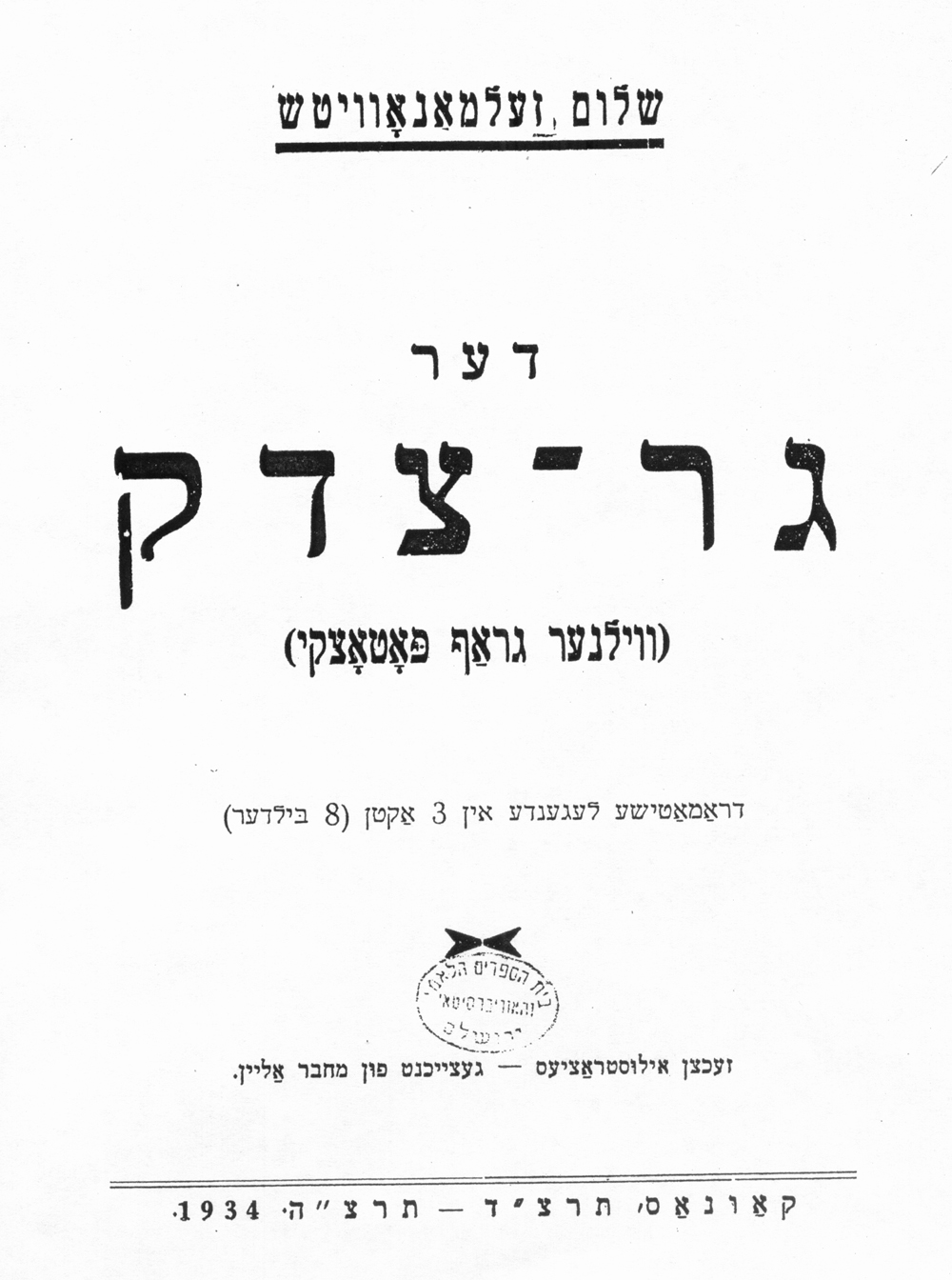
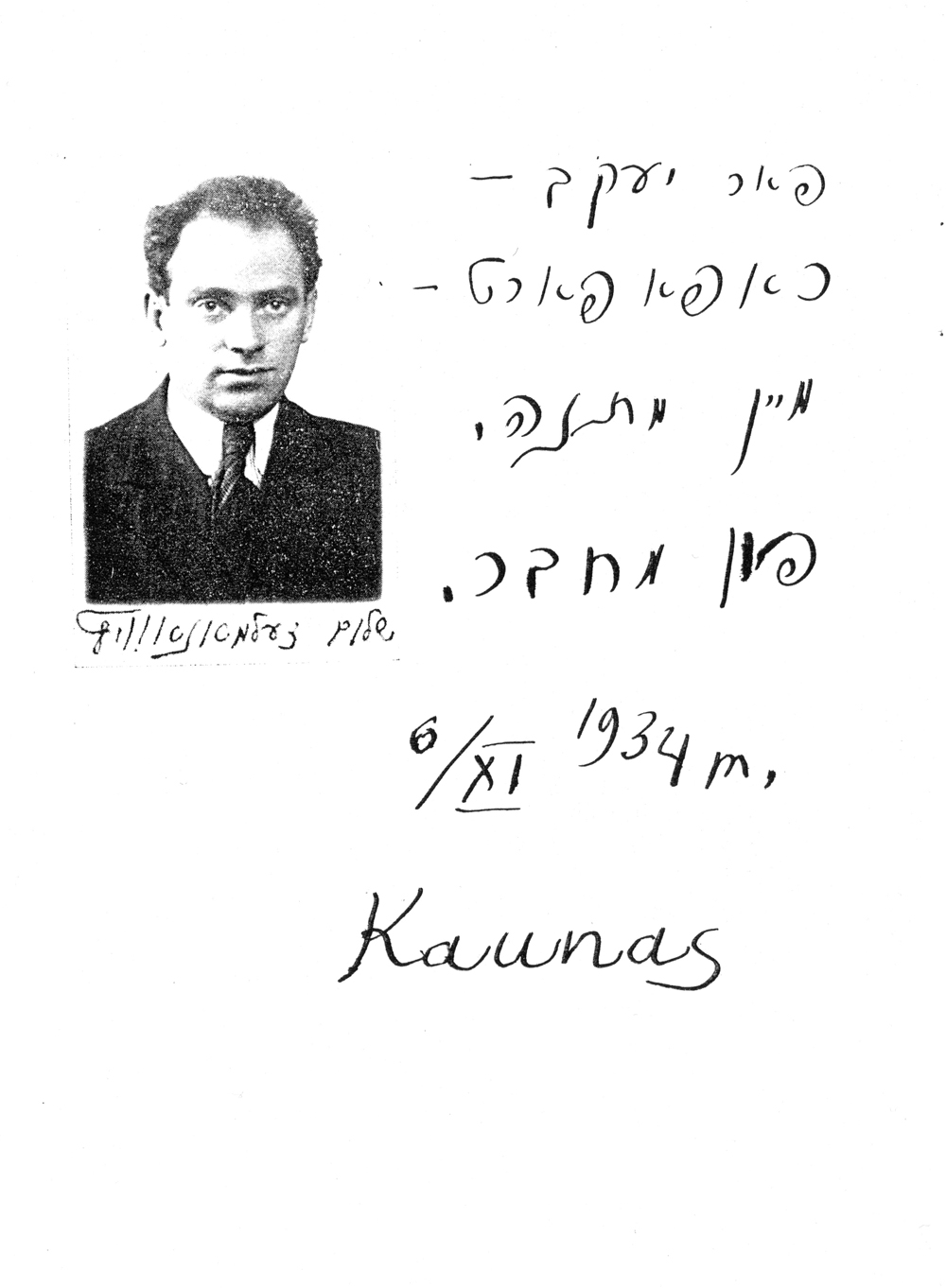
But there is no need for guesswork here. Sholom Zelmanovich, a talented artist and Yiddish playwright, published his דער גרצדקווילנער גראף פאטאצקי  in 1934.[4]

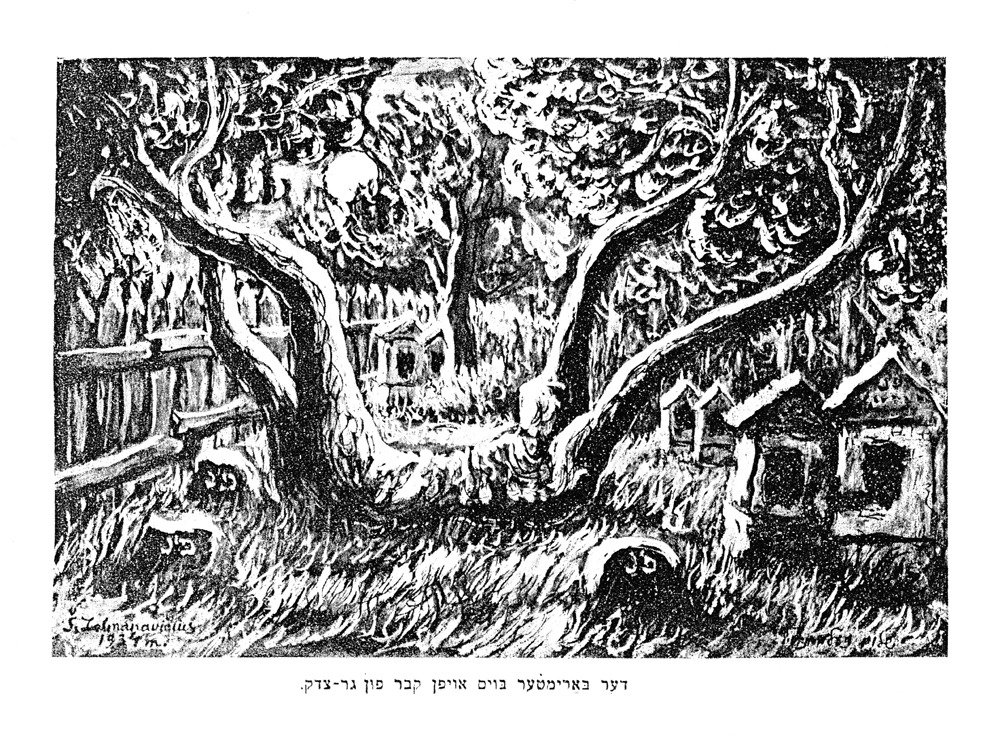
This three-act play commemorates the life and death of the legendary Ger Zedek of Vilna in a new and mystical mode.[5] The volume includes sixteen original drawings by Zelmanovich. Several of the drawings preserve details of Vilna’s old Jewish cemetery with seemingly incredible accuracy. Thus, for example, Zelmanovich depicts the northern entrance gate to the old Jewish cemetery, as well as the nearby Jewish caretaker’s house on the cemetery grounds, even though few photographs are extant that even begin to capture the details of those sites. His depiction of the Ger Zedek’s grave (and the human-like tree that hovered over it) is perfectly located in the south-eastern corner of the old Jewish cemetery, and is surrounded by the wooden fence that existed in that corner prior to 1926. Only someone who spent quality time in Vilna’s old Jewish cemetery could have known exactly where to place the entrance gate, the caretaker’s house, and the Ger Zedek’s grave.

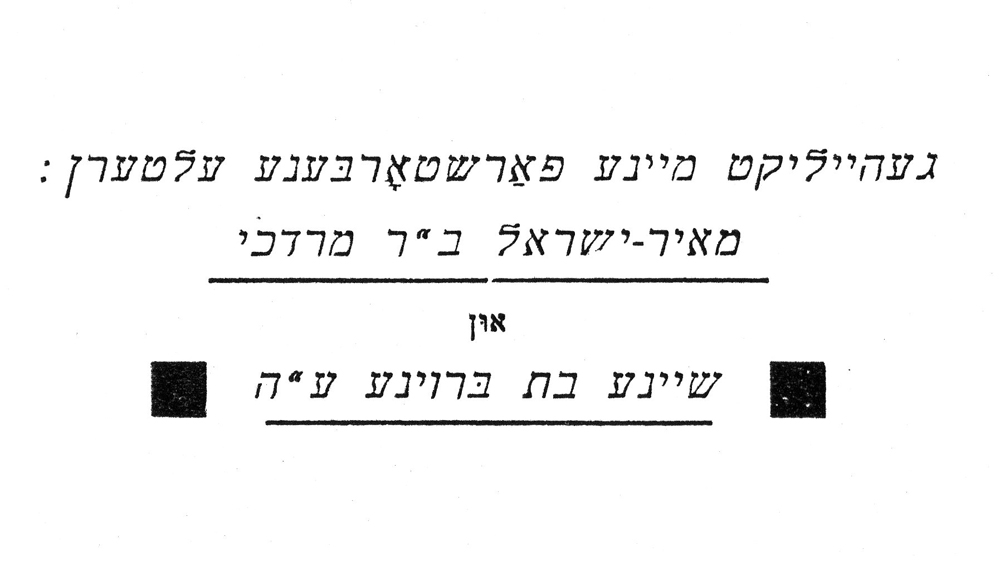
One other matter needs to be noticed. Zelmanovich dedicated the volume in memory of his deceased parents, Meir Yisrael son of Mordechai and Sheyne daughter of Broyne.[6]

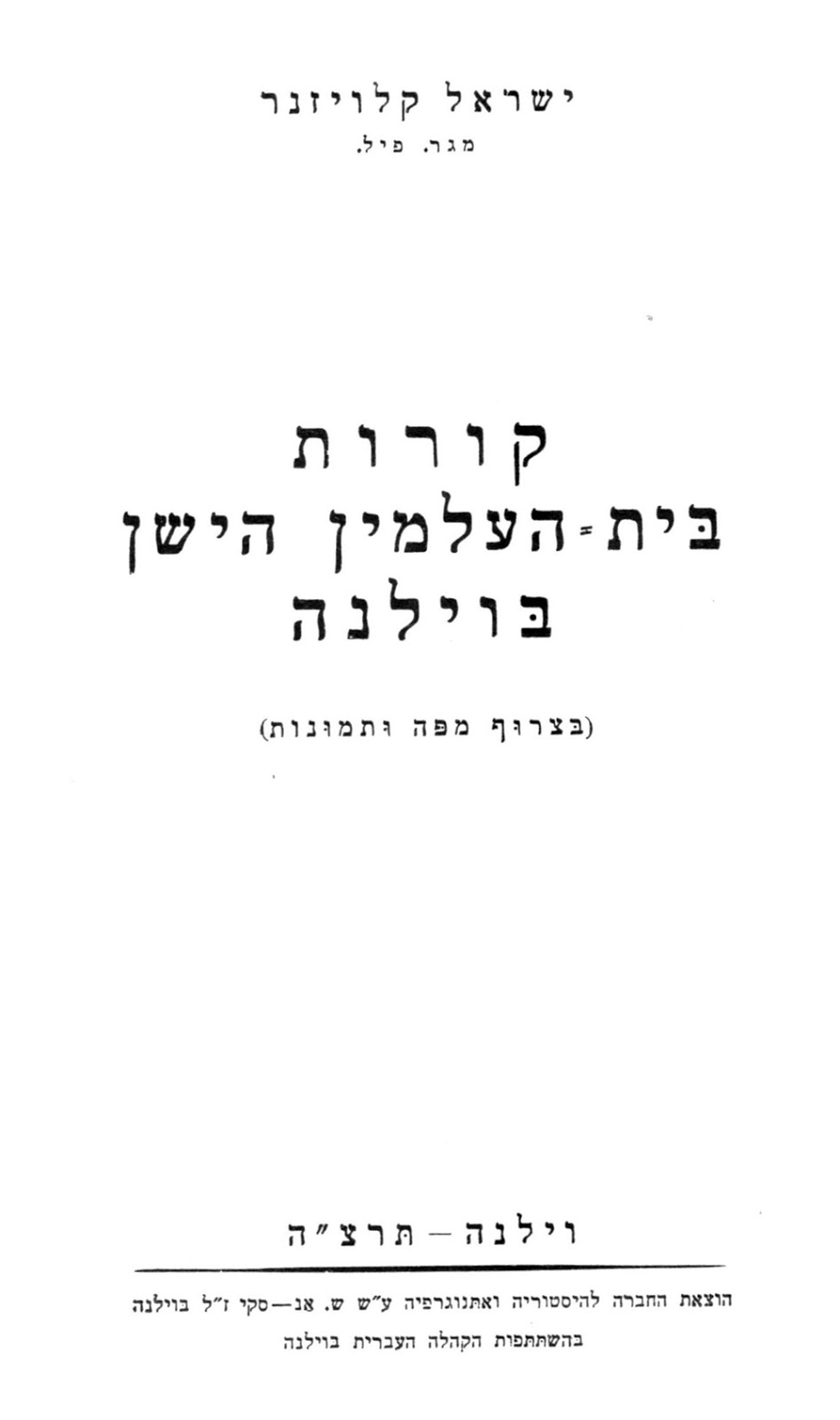
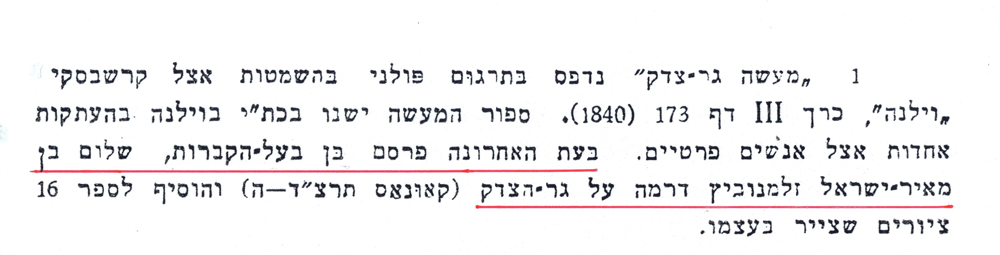
In the summer of 1935, the municipal authorities of Vilna, then under Polish rule, announced their plan to demolish Vilna’s old Jewish cemetery and replace it with a soccer stadium. Vilna – and worldwide – Jewry did not stand idly by. Instead, they engaged in an extensive, and ultimately successful, battle against the municipal authorities. As part of its efforts to win over the municipal authorities, the Vilna Jewish community charged a young Jewish scholar, Israel Klausner,[7] with writing a history of the old Jewish cemetery. It would offer clear documentation and prove beyond doubt that various Polish kings and municipal authorities throughout the centuries had authorized the Jewish community to construct the cemetery and maintain it. The cemetery was legally the property of Vilna’s Jewish community. Klausner’s monograph, entitled קורות בית-העלמין הישן בוילנה (Vilna, 1935), includes a discussion of the Ger Zedek’s grave. In a footnote,[8] Klausner mentions in passing Sholom Zelmanovich’s “recently published drama on the Ger Zedek,” and adds that Zelmanovich was the son of the caretaker of the old Jewish cemetery (Hebrew: בן בעלהקברות ), Meir Yisrael Zelmanovich! The plot thickens.

The full force of the Hebrew term בעלהקברות is not really captured by the English term “caretaker.” There were a variety of cemetery attendants who worked in the old Jewish cemetery in various capacities (such as guiding visitors and leading them to the graves they wished to visit, reciting prayers at the graves, ground-keeping, repairing broken tombstones and re-inking their inscriptions, and guard duty). But one cemetery attendant was in charge of all the other attendants, and as we shall see, he and his family lived in the house on the cemetery grounds. He was called: בעלהקברות, perhaps best rendered as: “Cemetery Keeper” or “Managing Director” of the old Jewish cemetery. We have established that Meir Zelmanovich served in that capacity. But who was he when did he live?

Meir Zelmanovich.

Sadly, almost nothing is known about the life of Meir Zelmanovich. He published no books and wrote no essays. As best I can tell, only one newspaper report mentions his name during his lifetime.[9] The report itself is significant. It records a complaint made by Meir Zelmanovich in 1919 that the Polish legionnaires had desecrated the old Jewish cemetery. But it would be Zelmanovich’s tragic death in 1920 that would perpetuate his memory. Here, we need to provide some historical context. Israel Cohen begins his discussion of the impact of World War I on Vilna, as follows:[10]

Within the small space of eight years, from 1914 to 1922, the Jews of Vilna tasted of the blessings of nine different governments, and suffered from a combination of other evils even more noxious. They became a prey to economic depression, military requisitions, unemployment, famine and disease; thousands of them were subjected to forced labor, imprisonment, plunder and brutal attacks; and physical and material deterioration inevitably engendered a certain degree of social demoralization. All the variegated differences of principle, of religious outlook and sociological doctrine, were now forgotten in the inferno created by the common foe. The long protracted fight for civil and political rights had to yield to the more primitive and desperate struggle for mere existence.

Almost certainly, the greatest concentration of Jewish suffering in this period came in April of 1919, when the Polish legionnaires unleashed a pogrom against Vilna’s Jews. Israel Cohen describes the horrors that followed:[11]

The [Polish] legionnaires[12] defiled and desecrated the [old Jewish] cemetery, smashed the tombstones, and opened the graves (including some of Vilna’s earliest rabbis) in the belief that they would find in them arms and money. Disappointed in their search, the Poles transferred their attentions from the dead to the living and ran amuck in the Jewish quarter. For three days they seized Jews in the streets, dragged them out of their homes, bludgeoned them savagely, and looted their houses and shops. About 80 Jews were shot, mostly in the suburb of Lipuvka, where some were ordered to dig their own graves; others were buried alive, and others were drowned, with their hands tied, in the Vilia [now: Neris] River… All sorts of outrages were committed in those days by the Poles in celebration of their victory. They tied a Jew to a horse and dragged him through the streets for three miles. They took a sadistic delight in cutting off the beards and earlocks of pious Jews. They even arrested, assaulted and humiliated Rabbi Rubinstein and Dr. Shabad. Altogether, thousands of Jews in Vilna, as well as in Lida and Bialystock were imprisoned in various concentration camps where they were ill fed and beaten, and where they suffered from hunger and typhoid. Moreover the total loss due to destruction and pillaging of Jewish people in the pogrom, in Vilna alone, was estimated at about 20 million roubles (about $10,000,000).

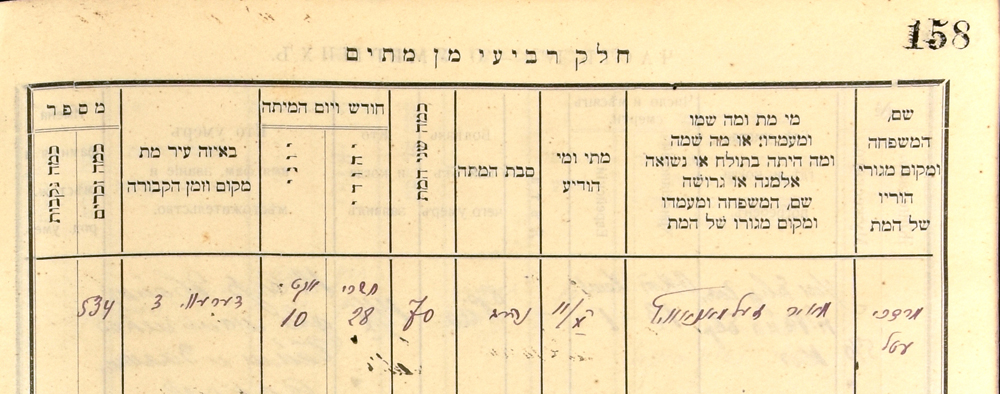
Polish rule of Vilna came to an end when the Russians recaptured Vilna on July 14, 1920. Russian rule lasted for six weeks, after which the Russians retreated and left Vilna in the control of the Lithuanians. Lithuanian rule lasted until October 8, 1920, when the Poles once again recaptured Vilna. One can only imagine the fear that gripped the Jewish community in Vilna, when they heard the sounds of the approaching Polish legionnaires. In fact, hundreds (some claim: thousands) of Vilna’s Jews fled on October 8 to Kovno, then part of Independent Lithuania.[13] Indeed, there was what to fear, for the Polish legionnaires were free again to wreak havoc with Jewish lives. And although the severity of the pogrom of 1919 did not repeat itself, the indiscriminate murder, rape, and looting of Jews that took place in Vilna between October 8-10, 1920 was, at least in the eyes of the victims, yet another pogrom.[14] Briefly, eye-witness Yiddish accounts[15] record that at least 6 Jewish men and women were murdered, numerous women were raped, and some 80 Jews were mugged and robbed. No one was brought to justice for committing these crimes! On October 10, 1920 Meir Zelmanovich, Cemetery Keeper of the old Jewish cemetery in Vilna was murdered by the Polish legionnaires. He was 70 years old when he died. The official Jewish record of his death lists his home address as “Derewnicka 3.” This is the address of the house on the grounds of the old Jewish cemetery. It is no wonder that Sholom Zelmanovitch could depict so vividly the northern entrance gate to the cemetery, its nearby caretaker’s house, and the human-like tree hovering over the Ger Zedek’s grave. His childhood playground was the old Jewish cemetery in Vilna.

On the picture postcard from 1916-1917, one sees an elderly Jew. One possibility is that it depicts none other than Meir Zelmanovitch, the Cemetery Keeper of the old Jewish cemetery until his death in 1920 at age 70. I suspected that this was the case, but could not prove it until recently — when a small miracle occurred.

Miracles Sometimes Do Occur.

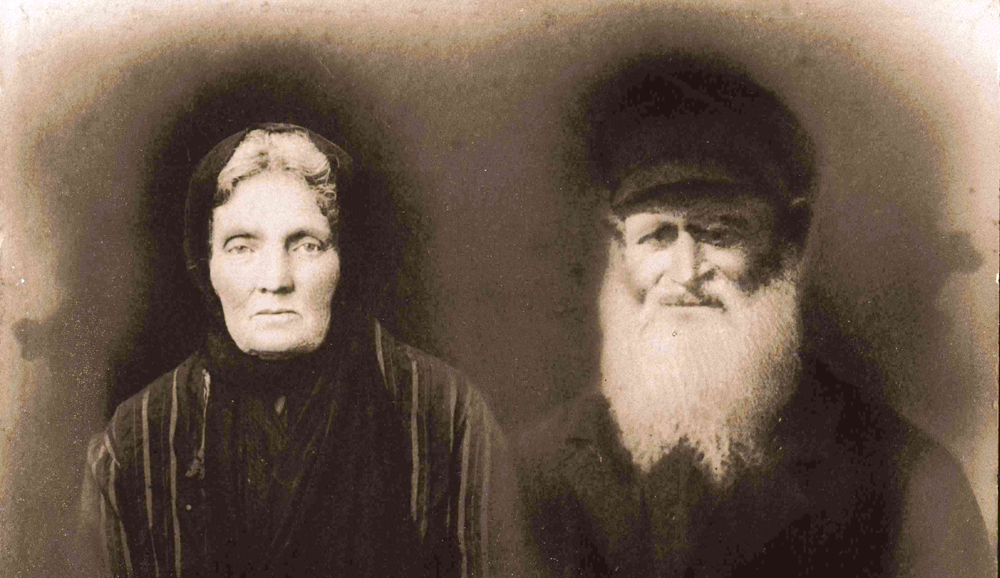
In March of this year, out of the clear blue sky, I was contacted by Laurie Cowan, who introduced herself as a great-granddaughter of Meir Zelmanovich! She basically was interested in any information I could provide about her great-grandfather that she didn’t already know. I was delighted to make her acquaintance, but wondered what led her to me. It turns out that both of us were seeking information about the same person – Meir Zelmanovich – from the Lithuanian State Historical Archives in Vilnius. An alert researcher at the Archives noticed this, and made the “shidduch” between us. I shared with Laurie whatever I knew about her great-grandfather. In turn, I asked her to send me copies of whatever documents she had relating to her great-grandfather. She sent me a scan of the following photograph of her great-grandmother and great-grandfather, Sheyne[16] and Meir Zelmanovich:

Never has it been so easy to identify an unidentified picture on a one-hundred year old picture postcard! One suspects that the picture postcard company representative, and a photographer, met with the Cemetery Keeper Meir Zelmanovich at the old Jewish cemetery in Shnipishok. He led them to the mausoleum of R. Menahem Manes Chajes, and was asked to pose at the tombstone just outside it. He graciously accepted the invitation. This may well have been the last photo taken of Zelmanovich, and it preserves, together with the photo provided by Laurie Cowan, the likeness of a martyr who fell during the October 1920 mini-pogrom in Vilna.[17]

At least six Jews were murdered between October 8-10 in 1920 in Vilna. They died for one reason only, namely, because they were Jews. Such Jews are regarded as martyrs and their names, at the very least, deserve to be recorded and remembered. Until now, none of the names of the Vilna martyrs of 1920 have been published in any public Jewish record, whether in a contemporary Jewish newspaper, or a Jewish historical essay or book, or an online posting. Having examined the extant records in the Lithuanian State Historical Archives, I have been able to retrieve the 6 names of the Jewish victims who were murdered in Vilna in October of 1920. In each case, the Jewish Kehillah records of Vilna in 1920 state clearly in Hebrew that the cause of death was either נהרג or נהרגה (i.e., murdered). The names are:

1. Shmuel ben Mendel Katz, age 56, died October 9.

2. Etel Natin, age 36, died October 9.

3. Basya Natin, age 32, died October 9.

4. Rokhl Blume Shuster, age 45, died October 9.

5. Meir Zelmanovich, age 70, died October 10.

6. Shlomo Abramovich, age 17, died October 12.[18]

May the memory of these martyrs be forever for a blessing! [19]

NOTES:

עם הספר, the People of the Book the world over, mourn the death of R. Shmuel Ashkenazi in Jerusalem, at the age of 98. He was שר הספר, the consummate master of the Hebrew book. Bibliographer, bibliophile, and book collector, his encyclopedic knowledge of all of Hebrew and Yiddish literature remains unparalleled in our time. His most recent contributions appeared in three massive volumes, replete with some 1,794 pages of immaculate scholarship. He never wasted a word; he wrote with precision and parsimony. Among his many accomplishments, he edited the Kasher Passover Haggadah, one of the most significant scholarly editions of the Passover Haggadah ever published. He was largely responsible for the single most accurate bibliography of Hebrew books ever produced, מפעל הביבליוגרפיה העבריתThe Bibliography of the Hebrew Book 1473-1960. Aside from his scholarly distinction, R. Shmuel Ashkenazi wrote in an elegant Hebrew with its own special charm. Not only did he advance discussion, but he did so in an aesthetically pleasing manner. For those of us who knew him personally, he evinced the same charm in his personal relationships that he did in his writings. He set a standard of excellence that we can only strive to emulate, but never really replicate. יהא זכרו ברוך!

This essay is dedicated to his memory, a token of appreciation for all he has taught me.

[1] Dovid Katz, “World War I Postcard of the Grave of Rabbi Menachem Manes Chayes (1560-1636) in the Old Vilna Jewish Cemetery,” Defending History (11 March 2020), available here) A copy of our postcard can also be seen online at ‘YIVO 1000 Towns’, record ID 10743 (http://yivo1000towns.cjh.org).
[2] For a fuller discussion of R. Menahem Manes Chajes and his epitaph, see S. Leiman, “A Picture and its One Thousand Words: The Old Jewish Cemetery of Vilna Revisited,” The Seforim Blog, January 14, 2016, especially notes 7-11, online here.
[3] Aside from his pivotal commentary on R. Joseph Karo’s Shulhan Arukh, R. Moshe Rivkes was a great-great grandfather of the Vilna Gaon.
[4] Precious little is known about Sholom Zelmanovich (1898-1941). See the brief biographical entry in לעקסיקאן פון דער נייער יידישער ליטעראטור (Martin Press: New York, 1960), vol. 3, column 670, which mistakenly lists him as being born in a town near Kovno, circa 1903. He was born in Vilna in 1898 (JewishGen) and died during one of the first Nazi aktions in the Kovno Ghetto.
[5] In general, see Joseph H. Prouser, Noble Soul: The Life and Legend of the Vilna Ger Tzedek Count Walenty Potocki (Gorgias Press: Piscataway, 2005). Prouser’s excellent monograph is a study of the many literary reworkings of the legends surrounding the Vilna Ger Zedek, with primary focus on 20th century Jewish literary contributions. Strangely, he offers no discussion of Zelmanovich’s contribution.
[6] On the feminine Yiddish name “Broyne,” see Alexander Beider, Dictionary of Ashkenazic Given Names (Avotaynu: Bergenfield, 2001), pp. 484-486.
[7] Klausner (1905-1981) settled in Palestine in 1936 and continued to be a prolific author of studies and books on the history of Vilna’s Jewish community. Aside from several important monographs, like his history of the old Jewish cemetery, he wrote a two-volume history of Jewish Vilna entitled 1939-1881 וילנה ירושלים דליטאדורות האחרונים (Ghetto Fighters’ House: Tel-Aviv, 1983), to which a third volume treating 1495-1881 was added posthumously, based largely on studies previously published by Klausner.
[8] קורות ביתהעלמין הישן בוילנהp. 45, note 1.
[9] See Vytautas Jogela, “The Old Jewish Cemetery in the Nineteenth and Twentieth Centuries,” Lituanus, vol. 61, no. 4 (2015), pp. 81-82.
[10] Israel Cohen, Vilna (Jewish Publication Society: Philadelphia, 1943), pp. 358-359.
[11] Ibid., pp. 378-379.
[12] Cohen regularly spells the word: “legionaries.” For the sake of consistency, I have spelled the word “legionnaires” throughout this essay.
[13] See, e.g., Boaz Wolfson, “מיטלליטע” in פנקס פאר דער געשיכטע פון ווילנע אין די יארן פון מלחמה און אקופאציע (B. Zionson: Vilna, 1922), column 387.
[14] There are probably as many definitions of “pogrom” as there are scholars and politicians. Since it is unclear whether the crimes committed on October 8-10, 1920 were planned and implemented by either a government or a political action committee, and since the duration of the attacks was short and rather swiftly brought under control, historians are reluctant to refer to the events that occurred on October 8-10, 1920 as a pogrom. On the other hand, to label those events a mere “disturbance” does not begin to capture the malevolent intent of the perpetrators directed specifically against Jews, and does not address the intensity of Jewish suffering at the time. For some of the different views regarding the definition of “pogrom,” and how the term has been manipulated by political interests, see Szymon Rudnicki’s forthcoming essay “The Vilna Pogrom of 19-21 April 1919,” to appear in Polin 33 (2020). Professor Rudnicki kindly allowed me to see a pre-publication copy of his lucid and informative essay.
[15] Wolfson, loc. cit. Cf. Jacob Wygodski, אין שטורם (B. Kletzkin: Vilna, 1926), pp. 217-221.
[16] Sheyne Zelmanovich died in Vilna on October 26, 1921, at age 68 (JewishGen). She lived in her home on the old Jewish cemetery grounds until her death. In a personal communication, Laurie Cowan informed me that the Zelmanoviches had 10 children who survived to adulthood. The 6th child, Beirach (popularly called: Berik; and later, Ben), was her grandfather, an older brother of Sholom mentioned above.
[17] The only other extant likeness of Meir Zelmanovich (known to me, and recovered on July 15, 2020) is an undated passport photo (circa 1916) preserved in the Lithuanian State Historical Archives. During the German occupation, all residents of Vilna were required to have – and to carry at all times – a German passport (we would call it: an Identity Card). Meir Zelmanovich’s German passport photo confirms the identity and authenticity of the photos of Zelmanovich published in this essay. All three photos are of one, and the same, person.
[18] One suspects that Abramovich may have been shot or beaten on October 9 and 10, like the others, but did not die from his wounds until the 12th.
[19] This essay could not have been written without the help of Regina Kopilevich, researcher (and tour guide) extraordinaire, who located whatever documents I sought at the Lithuanian State Historical Archives (Lietuvos Valstybes Istorijos Archyvas) in Vilnius. I am indebted to the librarians at the Archives for allowing her and me to examine these and other documents during my visits to Vilnius. Next to Google, JewishGen is a modern Jewish historian’s best friend, and we are grateful to all who contribute to making JewishGen the great historical resource that it is. Matt Jelen’s careful reading of an earlier draft has significantly improved the final version. I alone am responsible for whatever errors appear in this essay.


A selection from Strictly Kosher Reading by Yoel Finkelman

The Seforim Blog is happy to present this selection from Yoel Finkelman’s recent book, Strictly Kosher Reading: Popular Literature and the Condition of Contemporary Orthodoxy.

Coalescence
The first function of Haredi popular literature involves the “coalescence” of the Jewish and the non-Jewish. In defining coalescence, Sylvia Barack Fishman distinguishes it from two other common ways of describing relationships between Judaism and general culture. First, “compartmentalization” involves a situation in which the Jewish tradition holds sway in its own spheres, such as the synagogue or Shabbat table, while non-Jewish culture dominates in other areas of life, such as the workplace or the theater. Despite its conceptual clarity, Fishman claims that “compartmentalization” does not accurately describe actual American Jewish practice, since contemporary American Jews are too Americanized and America is too welcoming of Judaism for such neat divisions to have much explanatory power. Second, “adaptation” involves a situation in which the Jewish and the non-Jewish exist side by side. Tension between the two remains, and the individual or community “privileges one or the other as the situation seems to demand.”[1] Adaptation, she explains, “implies a continuing awareness of difference” between Jewish and general values and an attempt to negotiate these differences.
Yet, claims Fishman, many American Jews have lost an awareness of differences between Jewish and American values.
During the process of coalescence… the ‘texts’ of two cultures, American and Jewish, are accessed simultaneously…. These values seem to coalesce or merge, and the resulting merged message or texts are perceived not as being American and Jewish values side by side, but as being a unified text, which is identified as authoritative Judaism…. Many American Jews – including some who are very knowledgeable and actively involved in Jewish life – no longer separate or are even conscious of the separation between the origins of these two texts.[2]
Haredi popular literature, like much of Haredi popular culture, seamlessly merges aspects of the Jewish tradition with contemporary American cultural norms and styles. In coalescence, normative Judaism becomes a hybrid or syncretic combination of the Jewish and the American, the traditional and the modern, the past and the present. For example, Haredi music takes its lyrics from traditional Jewish texts, but its musical style imitates contemporary pop music.[3] Haredi self-help books, as we shall discuss, present contemporary values of individualism, personal happiness, self-expression, and (according to some critics) self-absorption as Jewish values, supposedly in the self-improvement tradition of musar.[4] Haredi novels borrow literary genres and formulas from the general best-sellers and fill them with Haredi characters and values. [5]
Given Haredi commitment to isolationism and rejection of non-Haredi culture, Haredi coalescence seems surprising. Still, Haredi Jews are genuinely acculturated, and the same cultural forces that make a genre or idea popular among the general public make it popular among Haredi Jews as well. Community members may prefer a Haredi version of a literary genre, such that it will more precisely match their values and style. In addition, imitating the most contemporary styles helps make the tradition seem sophisticated and up-to-date. This allows Haredi Judaism to respond to modernity and its perceived anti-Orthodox biases on modernity’s own terms.[6]
Take the example of Yaakov Levinson’s book, The Jewish Guide to Natural Nutrition. According to Levinson, there are “Jewish roots to natural nutrition.” Holistic health and natural foods are presented as traditional Jewish values. Levinson works to “combine a system for healthy living and eating with a strong connection to our important Jewish heritage.” He rhetorically grounds his work in traditional Judaism, explaining that “Rambam’s [Maimonides’] medical writings contain the Jewish roots of today’s system of natural nutrition. Our modern approach is basically an extension of his main principles and teachings.” [7]
Yet, the author says little about Maimonides’ specific nutritional advice or his medieval biology, and Levinson quotes from Maimonides’ medical writings only very rarely. Instead, Levinson focuses on contemporary scientific concepts such as cholesterol, vitamins, and the USDA food pyramid. Maimonides does not serve as an authority on the workings of the body. Rather, he is an authoritative precedent for the borrowing of contemporary medical advice. Levinson is, to a great degree, aware of and articulate about the fact that the medical and nutritional advice he suggests does not come from Torah, but from modern science. He dances a cautious dance between the new and the old, the modern and the traditional. Maimonides’ “medical writings were based on Jewish Talmudic sources as well as on secular, non-Jewish teachings.”[8] In other words, Levinson argues that it is authentically and traditionally Jewish for today’s Haredi Jews to self-consciously adapt contemporary scientific theories, just as Maimonides did in his day. Maimonides is important to Levinson not as a source of information about eating and health, but as a figure whose very name and reputation can help make the book seem authentically Jewish and grounded in the tradition, even if the book’s content is not actually derived from his writings.
The dust jacket of The Jewish Guide to Natural Nutrition clearly articulates coalescence. The author’s biography on the dust jacket celebrates his extensive Torah studies as well as his accomplishments in the field of medicine. Photographs visually reinforce this. The front cover shows a professional studio photograph of a bearded man – presumably the author – carrying a large, attractive basket of fresh green apples and dressed in a clean white lab coat. The apples signify the value of natural and healthy eating, while the lab coat symbolizes the scientific validity and authority of the book’s nutritional suggestions. The back cover includes a parallel photo of the same man dressed in Hasidic garb carrying a stack of Maimonides’ halakhic writings. Science and Jewish religion, including both its mystical-Hasidic and its rationalistic-legal-Maimonidean strands, are not only compatible with one another, but mutually enforcing. The authority of science is backed, symbolically and visually, by Torah, and Torah leads to an appreciation of contemporary nutritional science. Not accidentally, the book opens with three almost identical approbations: two by well-known yeshiva deans and one by a professor at a Jerusalem medical school. The approbation from the medical doctor praises coalescence, in that the book “melds an expert’s view of nutrition and disease with its special implication and application to religious Jewish tradition.”[9]
Levinson’s coalescence goes further. He not only provides standard American nutritional advice for Haredi readers, but also claims that following that advice is fundamentally a spiritual experience and religious obligation. Here Levinson goes beyond his Maimonidean precedent. For Maimonides, maintaining one’s health is a means to an end, a requirement so that illness or weakness would not distract the
individual from the higher values of study and religious self-development. “It is impossible to understand or know anything of the knowledge of the Creator when one is ill. Therefore a person must distance himself from things which damage the body and a person should become accustomed to things which make one healthy.” For Levinson, in contrast, health is not merely a means toward a higher end; rather, there is an inherent “spirituality in eating.”[10] Combining kabbalistic language and basic biology of the digestive system, Levinson explains that healthy eating exemplifies a central religious goal of separating the “good” from the “evil” in creation. The “nutrients” are good and therefore associated with the holy “sparks” of the Kabbalah, while the “waste” is the evil, associated with the evil kabbalistic “husks.” “The separation of nutrients from waste in the act of eating has its spiritual counterpart in the extraction of the sparks of holiness which are contained in food. And is not the physical and spiritual separation of good from evil the very meaning of human existence?”[11]
Levinson also hints that the foods people eat and how they eat them are not value free, but exemplify their cultural identity. “Foods are much more than just a collection of nutrients; they are a wealth of influences and connotations…. The various religions use foods to connote their special approach to life.” Levinson’s health advice exemplifies this point, perhaps more clearly than he intended. While he intends to underscore the inherent spirituality, according to Judaism, in eating, he also implies that eating like an American means having absorbed American mores and sensibilities. He advocates a “healthier, lighter style of eating,” which became a virtual American infatuation in the nutrition discourse of late twentieth and early twenty-first centuries (even as Americans grew fatter).[12] Levinson’s concern with calorie counting, weight-loss, and balanced consumption of nutrients reflects the biological knowledge and cultural aesthetics of contemporary America, a community of plenty with an almost infinite variety of foods to choose from, with a deep concern with the long-term health impact of overeating, and an aesthetic that celebrates thinness. For almost all of human history, the central culinary dilemma facing humans involved procuring enough food to fend off starvation or at least chronic hunger. In contrast, Levinson and his American Haredi readership share with other middle-class Americans a challenge of negotiating an almost unlimited quantity and variety of food.[13] The late twentieth-century American infatuation with light, healthy eating, which Levinson exemplifies, supports values that Haredim and the general population share and which are reflected in their culinary culture and popular literature. Levinson’s book suggests that religious people, even those profoundly committed to a given canon, read and interpret their scripture and tradition not only in their own terms, but “in order to make sense of their lived experiences.”[14]
That Haredi Jews share a culinary culture with their neighbors, and that they follow the best medical and health advice available, are relatively unproblematic notions from a Haredi perspective. After all, the Jewish tradition for the most part supports the idea that Jews should seek quality medical treatment,[15] and Maimonides indeed advocated learning from the best available science. However, other examples of coalescence raise significant ideological and religious challenges.
For example, Haredi popular literature, like its devout Christian counterparts, adopts the modern notion of the “companionate marriage.” Here the coalescence appears in a matter of profound ideological and religious significance, since, as Helen Hardcare explains about Protestant Fundamentalists, the family is a “primary unit for ritual observance as well as an influential site of religious education and the transmission of religious knowledge from one generation to the next.”[16] Or, as one Haredi author puts it, “The Jewish family [is] a vital force in insuring our people’s continued existence.”[17] Popular Haredi works identify the Torah’s “timeless formula for marriage,” and contrast that with the “non-Jewish system” that is “floundering in its own confusion” and therefore “has nothing to offer the Jew.”[18] Yet, a brief historical comparison reveals how acculturated Haredi families have become, and how the Haredi popular literature coalesces by presenting the modern, monogamous, suburban nuclear family as part and parcel of the tradition.
Both the contemporary Haredi family and the pre-modern Ashkanazic one share a commitment to strict monogamy, as opposed to the polygamy of ancient Judaism and at least some of historical Sephardic culture. Yet, in pre-modern Ashkenaz, parents contracted marriages for their children, often with the help of professional matchmakers. When choosing a partner for their child, parents paid less attention to emotional or romantic compatibility and more to finding a spouse who could offer the greatest socio-economic advantage. Often, marriages were arranged, if not always consummated, when the children were in their mid-teens. This marriage was more of an economic agreement than a romantic one, certainly at the outset. The couple might continue to live with the bride’s family for some time, until they became financially and socially independent. In this constellation, “personal compatibility not to speak of romantic attachment [between the couple] were not taken into account at all.” [19] On occasion, feelings of love and mutual attraction would push a young couple to choose one another as marriage partners, but rabbis and community members saw this as a rebellion against communal values rather than a fulfillment of them.[20]
Today, Haredi couples, usually in their early 20s, care deeply about emotional compatibility and therefore search for marriage partners through dating. This period of courtship allows the young couple to determine if they are emotionally compatible and romantically suited. Under these circumstances, when courtship and emotional compatibility have become central to Haredi images of marriage, Haredi authors write dating guidebooks for such young people, providing “guidelines for dating and courtship,” so that the dating couple can most effectively determine if they share the same values, if they have the same expectations from married life, and if their “personalities” will enable “the couple to get along with each other.”[21]
Furthermore, for medieval Ashkenazic Jews the home was a center of economic life, because merchandise and services were produced in the home for the use of its residents as well as for trade with others. Women, though also mothers, played central roles in the medieval Jewish marketplace, at a time and place when parenthood was not considered a full-time endeavor and where raising children was perceived as requiring less moment-to-moment vigilance than it does today.
For contemporary Haredi rhetoric, in contrast, the “Jewish home” rather than being a locus of economic production, serves as a “haven in a heartless world,” a domestic shelter from the dangers of the marketplace and the outside culture.[22] It is a modern, middle-class, child-centered, nuclear family. In these families, rearing offspring, who require full-time attention and continuous nurturing, requires parents primarily and educators secondarily to be sensitive, vigilant, and loving toward children more or less on a constant basis. Women are, therefore, encouraged by Haredi literature to dedicate themselves first and foremost to being mothers and wives, and to go to work only if the family’s financial situation requires it.[23]
As numerous historians of both the Jewish and non-Jewish family have noted, these modern family patterns, in broad terms, developed with the rise of the middle class, under conditions of urbanization and industrialization.[24] In their popular literature, acculturated contemporary Haredim describe, analyze, and celebrate this modern family. In particular, Haredi popular literature celebrates one particular aspect of this modern family: what historians and sociologists have come to refer to as the “companionate marriage.” In this modern family, marriage ought to lead to self-fulfillment, happiness, and the satisfaction of the psychological need for friendship and emotional closeness.
The ideal of companionate marriage came to dominate discussions of marriage in twentieth-century America…. It elevated anticipation of achieving emotional, sexual, and interpersonal fulfillment in marriage. The goal of marriage was no longer financial security or a nice home but emotional and sexual fulfillment and compatibility. Though marriages were not expected to be conflict and tension free, it was hoped that disagreements could be overcome if husbands and wives talked about their feelings, recognized the existence of conflicts, and worked out their problems through close “communication.”[25]
The norm of the companionate marriage has penetrated Haredi circles, and Haredi books which guide couples to achieving that kind of relationship serve as prime examples of coalescence. For medieval Ashkenazic Jews, there was “an absence of any philosophy promising happiness in marriage.”[26] Today’s Haredi books on marriage view happiness and self-fulfillment as the central goals of married life. These works focus particularly on communication skills between couples, in order to assure that the couple will remain emotionally responsive to one another. “A healthy relationship is built on clear and honest communication. Listening, understanding and conversing all contribute to the empathy so vital to a marriage.”[27] Furthermore, “Marriage… creates the possibility of the closest emotional relationship that can exist between living beings, the love between husband and wife.” “Happiness in marriage” can be achieved by “building trust,… maintaining affection,… [and] creating intimacy.” Ultimately, “Marriage is a primary catalyst for the development of each partner’s individual potential to the utmost.”[28]
The adoption of the model of the companionate marriage relates closely to another very popular genre of Haredi popular literature, namely the parenting guide. Here, too, coalescence prevails, with these parenting guides presenting images of child rearing as part and parcel of the Jewish tradition. And here too the coalescence appears in discussions of central religious values: how to raise children to become Torah-observant and God-fearing Jews. Hence, one might expect a greater reliance on traditional sources and a more suspicious stance toward contemporary norms. Still, Haredi parenting guides, even those that claim to reject so-called “modern” approaches to parenting, adopt the strategy of coalescence and share much of their style and content with their non-Haredi counterparts.
Lawrence Kelemen’s parenting guide, To Kindle a Soul, for example, claims in the subtitle to contain “ancient wisdom.” “At the foot of a mountain in the Sinai desert, the Creator of the universe directly revealed His profound wisdom to approximately three million people…. Those present received… a comprehensive guide for raising great human beings.” The book attempts to describe “this ancient, Torah approach to education” which is “more comprehensive and effective… than any of the schools of child psychology I studied at university.” Kelemen describes the “significant” differences between these supposedly “ancient traditions” and the practices of contemporary parents.[29]
Yet Kelemen’s parenting approach fits neatly within late twentieth-century American parenting discourse, and it differs significantly from that of pre-modern Jewish sources. Kelemen combines an American religious-right critique of supposedly decadent American family life with a child-centered parenting approach advocated by endless American mass-market parenting guides in the 1990s. Criticism of American materialism and permissiveness; advocacy of limiting the mother’s time at work; polemics against spanking; emphasis on good nutrition, proper sleep time, and bedtime routine; concerns about the adverse impact of television viewing; claims to provide a “system” for raising moral children; and advocacy of “quality-time” for empathy and close communication between parents and children, all characterized American experts’ suggestions to worried middle-class parents at the end of the twentieth century. Even Kelemen’s claim that his approach derives from the Bible follows the pattern of American religious parenting guides. Indeed, the book’s unstated assumptions – that parenting is a full-time endeavor, and that parents should actively monitor their children’s moment-by-moment lives – typify experts’ advice and popular assumptions in America during the so-called “century of the child.” [30]
Not only does Kelemen’s approach match that of contemporary parenting experts, but it differs from traditional Jewish sources on the topic. While a complete history of Jewish approaches to children and family has yet to be written, it is enough in this context to note that traditional Jewish literature speaks of childhood and parenting in spotty and unsystematic ways, scattered in works focused on other topics.[31] This reflects a historical past in which families were considerably less child-centered than they are today, and parents learned how to parent more by imitation, instinct, face-to-face conversation, and osmosis than from the written word of experts. Pre-modern Jews did not write parenting manuals since they assumed that knowing how to parent was an intuitive or natural thing.[32]
Take the example of Kelemen’s approach to corporal punishment and spanking. This is a particularly important example because traditional sources do say quite a bit on the topic, and what do they say clashes rather dramatically with the approach of contemporary Haredi parenting literature. Kelemen polemicizes against corporal punishment of children, and even harsh verbal reprimands. Instead – reflecting both contemporary notions of individual autonomy and the voluntary nature of modern religious commitments, which make it difficult to coerce people into religious conformity – he insists that parents should calmly explain to their children what is proper and improper. Parents should then serve as living role models of the proper, hoping thereby to help children come to their own appreciation of and identification with the parents’ values. While Kelemen advocates setting clear and consistent boundaries on children’s behavior, he claims that enforcing those boundaries with violence and verbal harshness undermines the child’s respect for the parents and prevents children from being receptive to higher values. “Yelling and hitting usually flips [sic] children out of the learning mode… which is characterized by a relaxed and happy state that facilitates accepting the educator’s values… and into the obedience mode… which is characterized by a nervous, distrusting or rebellious state.” Spanking is part of an “authoritarian” approach typical of “dictatorships,” which leads to uninspired obedience in which youth do not come to identify with the values of the parents. Ultimately, “harshness” leads to “rebellion.” Kelemen also argues for the importance of parental affection. “Affection is more than just attention. Attention just requires being responsive to a child’s needs. Affection is the next step. It is warm and it is the most powerful medium we possess for communicating love.” Kelemen teaches that, “If we want to produce people with integrity, internally driven by a specific value system, we must utilize gentle means.”[33]
This advice stands in stark contrast to traditional Jewish sources on child rearing, which explain that spanking does not promote rebellion but prevents it. In a typical passage, the ancient Jewish text, Midrash Rabbah, quoting the book of Proverbs, relates that, “‘He who spares his rod hates his child.’ This teaches that preventing physical punishment (mardut) leads [the child] to bad culture.”[34] R. David Altschuler, the seventeenth century Galician author of the Biblical commentary Metzudat David, goes further in commenting on the same verse: “Do not refrain from making [your son] suffer even if you see that this is not effective, because there is hope that much reproof will be effective.”[35] Sources, particularly from early-modern Ashkenazi culture but from other contexts as well, openly polemicize against fatherly affection. For example, R. Alexander Ziskind of Grodno, the eighteenth century mystic, explained that, “Even though I had many sons, I never kissed even one of them, and never held them in my arms, and never spoke with them of frivolous things, God forbid.”[36] The seventeenth century rabbi, Yeshayahu Horowitz (the Shlah), states: “If the father rebukes his son early in his life with the staff… and uses fear while he is young… then he [the son] will be accustomed to fear his father always.… If in childhood the father displays great affection… then later when he matures he will not listen.… Mothers are… not to spare the rod but to strike their sons even if they scream.… Women who are compassionate with their children… murder them.”[37]
In the next chapter we will examine the complex ways in which Kelemen defends the idea that his approach derives from the ancient tradition. Here it is enough to note the way in which his book reflects the strategy of coalescence: identifying contemporary American values as being authentically Jewish. To Kindle a Soul, like other contemporary Haredi books on parenting, shares more with contemporary American mass-market parenting guides than it does with pre-modern Jewish sources on parenting. However, a close examination of other aspects of these works on families reveals that coalescence is not the whole story. Haredi works may borrow the companionate marriage and child-centered parenting from contemporary culture, but they borrow selectively. This leads to a second function of Haredi popular literature in mediating the tension between isolation and acculturation: filtering.
[1] Ibid.
[2] Ibid.
[3] Haym Soloveitchik, “Rupture and Reconstruction,” 75.
For internal Haredi discussion regarding this issue, see Mordechai Schiller,
“Chasidus in Song – Not for the Record,” The Jewish Observer
10:8 (March, 1975), 21; Breindy Leizerson, “Set the Record Straight,”
The Jewish Observer 20:4 (May, 1987), 40-41; Dovid Sears, “Who Took
the ‘Jewish’ Out of Jewish Music?,” The Jewish Observer 29:10
(January, 1997), 12-16; Yosef C. Golding, “How to Get the Entire Jewish Music
World Angry at Me… Or a Parent’s Guide to What Your Children Listen To,” The
Jewish Observer
40:4 (May, 2007), 36-37.
[4] Stolow, Orthodox by Design, 132-142; Andrew R.
Heinze, “The Americanization of ‘Mussar’: Abraham Twerski’s Twelve Steps,” Judaism
48:4 (1999), 450-469. On the self-absorption of this therapeutic self-help
literature, see Wendy Kaminer, I’m Dysfunctional, You’re Dysfunctional: The
Recovery Movement and Other Self-Help Fashions
(New York: Vintage Books,
1993).
[5] See below and Yoel Finkelman, “Medium and Message in
Contemporary Haredi Adventure Fiction,” The Torah U-Madda Journal 13 (2005), 50-87.
[6] The academic literature has focused on this trend
primarily regarding the development of Orthodox historiography. See below,
Chapter Four, n. 4.
[7] Yaakov Levinson, The Jewish Guide to Natural
Nutrition
(Jerusalem and New York: Feldheim, 1995), 4-5. Much of the
following analysis could be duplicated for the issue of The Jewish Observer
entitled “A Healthy and Productive Life as a Torah Jew,” 40:8 (November, 2007)
and for David J. Zulberg, The Life-Transforming Diet: Based on the Health
and Psychological Principles of Maimonides and Other Classical Sources

(Jerusalem and New York: Feldheim, 2007).
[8] Levinson, Natural Nutrition, 5. Zulberg, The
Life-Transforming Diet
, quotes more extensively from selected passages from
Maimonides’ medical writings, those in line with contemporary sensibilities.
[9] Unpaginated approbation of Prof. Leon Epstein.
[10] Maimonides, Mishneh Torah, Hilkhot De’ot,
4:1; Levinson, Natural Nutrition, 128.
[11] Levinson, Natural Nutrition, 136.
[12] Ibid., 4. Maimonides did advocate eating until not
fully satiated, though Levinson’s language, as noted, derives from modern, not
Maimonidean categories. See Maimonides, Mishneh Torah, Hilkhot De’ot,
4:2.
[13] Harvey Levenstein, Paradoxes of Plenty: A Social
History of Eating in Modern America
(New York and Oxford: Oxford University
Press, 1993), Chap. 16. For further reflections on the contemporary Orthodox
diet, see Brill, “Judaism in Culture,” 3 and Stolow, “Aesthetics/Ascetics:
Visual Piety and Pleasure in a Stricly Kosher Cookbook,” Postscripts 2:1
(2006), 5-28 (some of which also appears in his Orthodox by Design).
Levinson does not put as much emphasis as American general culture on the
aesthetic aspects of weight loss, perhaps because he does not perceive looking
attractive as a religious goal. In this, Zulberg’s The Life-Transforming
Diet
comes closer to the general American concern with body-image and
aesthetics.
[14] Molly Worthen, “Housewives of God,” The New York
Times Magazine
, November 12, 2010, available here  viewed November, 2010.
[15] See, for example, Shulhan ‘Arukh, Yoreh
De’ah
, 336:1. The ambivalence about seeking doctors, on the theory that divine
providence governs illness and heath, was generally of theoretical import only,
and usually did not have practical implications. See the commentary of the Taz,
ibid.
[16] Helen Hardcare, “The Impact of Fundamentalism on
Women, the Family, and Interpersonal Relations,” in Fundamentalisms and
Society
, Eds. Martin E. Marty and R. Scott Appleby (Chicago and London:
University of Chicago Press, 1993), 129. On similar Christian conflation of
modern notions of marriage with traditional ones, see James Davison Hunter, Evangelicalism:
The Coming Generation
(Chicago and London: University of Chicago Press,
1987), 76-93.
[17] Avraham Pam and Tzvi Baruch Hollander, “The Jewish
Family – In Its Glory and in Crisis,” The Jewish Observer 29:4 (May,
1996), 6.
[18] Yirmiyohu Abramov and Tehilla Abramov, Two Halves of
a Whole: Torah Guidelines for Marriage
(Southfield, MI: Targum/Feldheim,
1994), 158.
[19] Jacob Katz, Tradition and Crisis: Jewish Society
at the End of the Middle Ages
(New York: Schocken, 1971), 141-142.
Unfortunately, a systematic history of the Jewish family has yet to be written.
But see, Elisheva Baumgarten, Mothers and Children: Jewish Family Life in
Medieval Europe
(Princeton: Princeton University Press, 2004); ChaeRan
Freeze, Jewish Marriage and Divorce in Imperial Russia (Hanover, NH:
Brandies University Press, 2004); David Kraemer, Ed., The Jewish Family:
Metaphor and Memory
(New York and Oxford: Oxford University Press, 1989);
Avraham Grossman, Pious and Rebellious: Jewish Women in Medieval Europe,
Trans. Jonathan Chipman (Waltham, MA: Brandeis University Press, 2004), Chaps.
2-4.
[20] David Biale, Eros and the Jews (New York:
Basic Books, 1992), Chap. 3.
[21] Meir Winkler, Bayis Ne’eman b’Yisrael: Practical
Steps to Success in Marriage
(Jerusalem and New York: Feldheim, 1988), 53,
57.
[22] The expression comes from Christopher Lasch, Haven
in a Heartless World: The Family Besieged
(New York: Basic Books, 1977).
[23] Ironically, in the early modern period, the Haskalah,
rather than the tradition, called for marriages based on love and compatibility
rather than socio-economic advantage, and called to protect women from the
marketplace by carving out for them a domestic role in which they could spend
more of their time and energy on child-rearing. The central Jewish polemic
against marriage as a financial arrangement and against women’s role in the
workplace came from Haredi popular literature’s rhetorical enemies, the maskilim.
See Biale, Eros and the Jews, 159-161.
[24] Lawrence Stone, The Family, Sex, and Marriage in
England 1500-1800
(New York: Harper and Row, 1977); Steven Mintz and Susan
Kellogg, Domestic Revolutions: A Social History of American Family Life
(New York: Free Press, 1988).
[25] Mintz and Kellogg, Domestic Revoluations, 115,
describing the particular model of companionate marriage advocated by early
twentieth century progressives in America. Also see 186. Haredim, like these
progressives, advocate “divorce by mutual consent… on the grounds of incompatibility,”
at least as an unfortunate consequence of the failure of the companionate
marriage (ibid.). Yet, Haredim are less likely than these progressive to
support free use of contraception and open sex-education. Haredim also remain
attached to Victorian sensibilities that distinguish between the
feminine/domestic/secure sphere and the masculine/public/dangerous sphere, a
distinction against which progressives polemicized.
[26] Katz, Tradition and Crisis, 141-142.
[27] Abramov and Abramov, Two Halves, 65.
[28] Aharon Feldman, The River, the Kettle and the
Bird: A Torah Guide to Successful Marriage
(Israel: CSB Publications,
1987), 11; Radcliff, Aizer K’negdo: The Jewish Woman’s Guide to Happiness in
Marriage
(Southfield, MI: Targum/Feldheim, 1988), 11. Abramov and Abramov, Two
Halves
, 19. Also see Malka Kaganoff, Dear Kallah: A Practical Guide for
the New Bride
(Jerusalem and New York: Feldheim, 1993); Winkler, Bayis
Ne’eman
.
[29] Lawrence Kelemen, To Kindle a Soul: Ancient Wisdom
for Modern Parents and Teachers
(Southfield, MI: Targum Press and Leviathan
Press, 2001), 19-21. Some of Kelemen’s formulations, as well as one of the
book’s central metaphors – that parenting consists of “building” and “planting”
– come from the parenting guide of the twentieth-century Israeli Haredi rabbi,
Shlomo Wolbe, which Kelemen had been involved in translating into English.
Wolbe’s ideas themselves are influenced by modern psychological and cultural
categories, though the influence of modern psychology on contemporary
musaristis like Wolbe has yet to be studied, to the best of my knowledge. See
R. Shlomo Wolbe, Zeri’ah U’Vinyan BeHinnukh (Jerusalem: Feldheim, 1995),
23-24, and his Planting and Building: Raising a Jewish Child, Trans.
Leib [Lawrence] Kelmen (Jerusalem and New York: Feldheim, 2000).
[30] See Peter N. Stearns, Anxious Parents: A History
of Modern Childrearing in America
(New York and London: New York University
Press, 2003), and Ann Hulbert, Raising America: Experts, Parents, and a
Century of Advice About Children
(New York: Vintage Books, 2003), Chap. 11.
[31] On the difficulties in determining ancient Jewish
attitudes toward child rearing, see David Kraemer, “Images of Childhood and
Adolescence in Talmudic Literature,” in his Ed., The Jewish Family,
65-68.
[32] Baumgarten, Mothers and Children, 155.
[33] Kelemen, To Kindle a Soul, 129-152. Quotes
from 109, 130, 132-133.
[34] Shemot Rabbah, 1 s.v. Ve’eleh Shemot,
quoting Proverbs 13:24
[35] Also see B.T. Makkot, 8a, Bava Batra 21a;
Midrash Tehillim, Buber, 6; Midrash Tenaim, Devarim 25:3;
Rashi on Mishlei 13:24 and on 19:18; Rambam, Mishneh Torah, Hilkhot
Talmud Torah
, 2:2; Shulhan ‘Arukh, Yoreh De’ah, 240:20 and
Rama, 245:10; Sefer Hasidim, 302, cited in Baumgarten, Mothers and
Children
, 162; R. Yeshayahu Horowitz, Shenei Luhot HaBerit
(Jerusalem: n.p., 1975), Letter Daled, paragraph 23-32; The Gaon of Vilna, Even
Shelemah
(n.p.: n.d., n.d.), 6:4. When Shulhan ‘Arukh, Yoreh
De’ah
, 240:20 insists that one not beat his older children (according to
Rama, 22-24 years old), this is not due to any opposition to corporal
punishment per se, but, following his source (BT Mo’ed Qatan 17a),
because the son might retaliate and violate the more serious prohibition of
injuring one’s parent.
[36] R. Alexander Ziskind of Horodno in his ethical will,
quoted in Simhah Asaf, Meqorot LeToldot HaHinnukh BeYisrael (New York
and Jerusalem: Jewish Theological Seminary, 2002), Vol. 1, 688. Also see
Yitzchak ben Eliakim, author of Sefer Lev Tov (published in Prague in
1620), who insists that parents “not reveal their love [of their children] in
their presence because then the children would not fear them and would not obey
them.” Cited in Gerson David Hundert, “Jewish Children and Childhood
in Early Modern East Central Europe,” in Kraemer, Ed. The Jewish Family,
82. Also see the related sources quoted in Hundert, 83, and Ephraim Kanarfogel,
“Attitudes Toward Childhood in Medieval Jewish Society,” in Approaches
to Judaism in Medieval Times
, Ed. David R. Blumenthal (Chico, CA: Scholars
Press, 1985), Vol. 2, 1-34.
[37] Horowitz, Shnei Luhot HaBerit, Letter Daled,
para. 23-25.


The Book of Disputes between East and West

The Book of Disputes between East
and West
 
or 
A Treasury of Alternate Customs from the Land of Israel and from Babylon 
Translated and Annotated by Leor Jacobi 
Based primarily on the Margulies Edition
with additions from the Appendices of the Miller and Lewin Editions

Menahem Av, 5772
Jerusalem
After the translation of the text itself, various
additional items are added, some of them never before published. Also included
is a translated summary of major sections of Margaliot’s introduction, along
with comments and updates.
Round brackets reflect text found in only certain
Hebrew manuscripts as indicated by Margulies in his
Hebrew edition
.
Square brackets contain English insertions of this
translator.
1.                   
People of the East sit while reading the Sh’ma. The
residents of the Land of Israel stand.
2.                   
People of the East do not mourn for a baby [who has died]
unless he has reached 30 days [of life]. The residents of the Land of Israel
[mourn] even if he is only a day old. (He is like a fully-grown groom
[=man]) 
3.                   
People of the East will allow a nursing mother to marry within
twenty-four months of the death of her baby. Residents of the Land of Israel
require her to wait twenty-four months, lest she come to kill her son.
4.                   
People of the East redeem the
firstborn with twenty-eight (and a half) royal pieces of silver. Residents of
the Land of Israel use five shekels, which are equivalent to seven (and a
third) royal pieces of silver.
5.     
 People of the East exempt a mourner [from observing laws and
customs of mourning, if the relation expired just] before a festival, even a
moment [before]. Residents of the Land of Israel only exempt a mourner from the
decree of seven days [of mourning] if at least three days have elapsed before
the festival.
6.                   
People of the East forbid a bride
from [having relations with] her husband for the full seven [days] for she is
considered to be a menstruating as a result of the relations. The residents of
the Land of Israel (say) that since his removing of her hymen is painful [it is
an external wound and] she is permitted immediately.
7.                   
The marriage contract of the
People of the East consists of twenty-five pieces of silver (and their dowry).
The residents of the Land of Israel (say) that anyone who [obligates himself]
to less than two hundred for a maiden or one hundred for a widow, is effecting
a promiscuous relationship.
8.                   
People of the East permit [the
use of] an oven (during Passover), based on the source: “[We may] roll the
Passover [lamb] in the oven at sundown.” (Mishnah Shabbat 1:11) Residents of
the Land of Israel (say): “Disregard the Passover [lamb] since it is a
sacrifice, and we [even] desecrate the Sabbath on account of it.”
9.                   
People of the East do not wash [=
ritual immersion] after experiencing a seminal emission or after relations
(since they reason that “we are in an impure land”). Residents of the Land of
Israel (do wash after a seminal emission or relations, and) even on the Day of
Atonement (for they maintain that those who have seen emissions should wash in
secret on the Sabbath and on the Day of Atonement) as a matter of course,
[which they learn] from the example of Rabbi Yosi bar Halafta, who was seen
immersing himself on the Day of Atonement.
10.               
People of the East permit gentile
butter [alternatively: cheese], (saying) that it cannot become impure.
Residents of the Land of Israel forbid it on account of (three things: because
of) milk which was expressed by a gentile (without a Jew observing him, because
of gentile cooking) and because of impure fat (which it might be mixed
with).
11.               
People of the East say that a
menstruating woman may perform all types of household duties except for three
things: mixing drinks, making the bed, and washing his face, hands, and legs.
According to the residents of the land of Israel, she may not touch anything
moist or household utensils. Only reluctantly was she permitted to even nurse
her child.
12.               
People of the East do not say
recite eulogies [alternatively: the prayer “tsidduk ha-din”] in
the presence of the dead (during the in-between days of the festival).
Residents of the Land of Israel do recite these before him.
13.               
People of the East do not rip up
a divorce contract. Residents of the Land of Israel rip it up. [Acc. to Lewin,
this may have originally referred to whether a mourner rips his garment during
the intermediate days of a festival.]
14.               
People of the East have mourners
come to the synagogue each day. Residents of the Land of Israel do not allow
him to enter, with the sole exception of the Sabbath.
15.               
People of the East do not clean
their posteriors with water. Residents of the Land of Israel do cleanse
themselves [with water], (based on the source:) A generation which considers
itself pure … [but has not cleaned itself from its excrement.] (Proverbs
30:12)
16.               
People of the East [permit one
to] weigh meat on intermediate days of the festival. Residents of the Land of
Israel forbid hanging it on a scale, even just to keep it away from rodents,
(based on the source: “One may not operate a scale at all.” – Mishna Beitza 6,
3) 
17.               
People of the East circumcise
[babies] over water and then dab [the water] onto their faces, (from here: “and
I will wash you with water, [rinse your blood off of you, and anoint you with
oil]” – Ezekiel 16:9)  Residents of the
Land of Israel circumcise over dust, from here: “Also, due to the blood of your
covenant have I sent your prisoners free from a pit with no water in it.”
(Zechariah 9:11)
18.               
People of the East (only) check
the lungs. Residents of the Land of Israel (check) eighteen types of disqualifications.
19.               
People of the East only recite a
blessing [= grace
after meals] over [a cup of] diluted wine.
Residents of the Land of Israel (will recite a blessing) when it is fully
potent.
20.               
When thurmusin [beans] and
tree-fruit are served to People of the East simultaneously, they recite the
blessing for fruit of the tree and set aside the beans. Residents of the Land
of Israel recite a blessing on the thurmusin, since everything is
included in “[the fruits of] the earth.” 
21.               
On the Sabbath, people of the
East break bread on two loaves, for they expound: “a double portion of bread”
(Exodous 16:21) [which fell on the Eve of the Sabbath]. Residents of the Land
of Israel break bread exclusively on a single loaf, so that the [lesser] honor
of the Eve of the Sabbath will not intrude upon [the honor of] the Sabbath. 
22.               
People of the East spread their
hands [= recite the priestly blessing] during fasts and on the on the ninth of
Av as part of the evening benedictions. Residents of the Land of Israel only
spread their hands during the morning services, with the sole exception of the
Day of Atonement. 
23.               
People of the East will not
slaughter a newly-born animal until the eighth day. Residents of the Land of
Israel will slaughter even a newborn, for [they maintain that] the prohibition
of the eighth day applies only to sacrifices.
24.               
People of the East do mention the
word mazon [=nourishment] in the blessings of grace after dining.
Residents of the Land of Israel consider mazon to be [the] central
[component of the blessings] (for everything else is peripheral to mazon]. 
25.               
A ring does not sanctify marriage
according to people of the East. Residents of the Land of Israel consider it
[sufficient to] fully sanctify a marriage. 
26.               
People of the East individually
redeem the second tithe and the planting of the fourth year. Residents of the
Land of Israel only redeem them in [the presence of] three [men]. 
27.               
The divorce contracts of people
of the East contain two ten-letter words [‘dytyhwyyyn’ and ‘ditibyyyn’]. Those of the residents of the Land of Israel contain
three ten-letter words [the third is not known].
28.               
People of the East bless the
[bride and] groom with seven blessing. Residents of the Land of Israel recite
three [blessings, which have been forgotten].
29.               
According to people of the East,
the prayer leader recites the priestly blessing (before the congregation) [in
the absence of Kohanim]. Residents of the Land of Israel do not (allow the
prayer leader to recite the priestly blessing, for they expound [from the
verse]: “So they shall put my name” (Numbers 6:27) that it is strictly
forbidden for anyone to “put” the holy name), unless they are Kohanim. 
30.               
People of the East forbid bread
baked by a gentile, but will consume gentile bread if a Jew threw a piece of
wood into the fire. Residents of the Land of Israel forbid it (even with the
wood, for the wood neither forbids nor permits. When are they lenient? In cases
when there is nothing [else] to eat, and already a day or two have passed
without consuming anything. It was thus permitted to revive his soul so that
his soul should be maintained, but only from a [gentile] baker who has never
brought meat into his bakery, even though it considered a [separate] cooked
dish.) 
31.               
People of the East carry coins
from place to place on the Sabbath. Residents of the Land of Israel (say) that
it is forbidden to even touch them. Why? Because all types of work are done
with them.
32.               
People of the East recite: “meqadesh
ha-shabbat,”
[who sanctifies the Sabbath]. Residents of the Land of Israel
recite: “meqadesh Yisrael v’yom ha-shabbat” [who sanctifies Israel and
the Sabbath day].
33.               
Among people of the East, a
disciple does not greet his master with: “shalom”. Among residents of
the Land of Israel a disciple greets his master [by saying]: “shalom
unto you, rabbi.” 
34.               
According to People of the East,
if a yevama [=a woman automatically betrothed to the brother of her
deceased husband] should marry [another man] without halitza [=a legal
procedure which frees her from this betrothal] and her yavam [=the
brother] should return from overseas, he performs the halitza (to her)
and she remains with her (second) husband. Residents of the Land of Israel
remove [=forbid] her from both of them. 
35.               
People of the East exempt a yevama
from halitza [only] once the baby is thirty days old. According to
residents of the Land of Israel, even if only the head and most of the body
emerged alive, and even for only a moment (before the father died), she is
fully exempt from halitza and from yivum [and may remarry
freely], (for they expound: “If he has left seed, she is exempt.”) 
36.               
People of the East turn their
faces (towards the congregation) and their backs towards the aron
[=closet containing the Torah scroll]. Residents of the Land of Israel [are
positioned with] their faces towards the aron.
37.               
According to people of the East,
one [scribe] writes the divorce contract and another signs along with the
writer. Among residents of the Land of Israel, one writes and two [others]
sign.
38.               
People of the East marry the
[bride and] groom on Thursday. Residents of the Land of Israel [marry] on
Wednesday, (according to the law: “a maiden marries on Wednesday.” – Mishnah
Ketubot 1:1)
39.               
People of the East perform labors
on the intermediate days of the festivals. Residents of the Land of Israel do
not do them at all. Rather, they eat and drink and exert their [energies in
learning] Torah, (for the sages have taught that: “it is forbidden to perform
labors on the intermediate days of the festivals.”) 
40.               
People of the East begin [the
initial act of] intercourse with genital insertion in the natural manner.
Residents of the Land of Israel use a finger [to break the hymen and enable
conception through the first act of intercourse. Alternatively, to verify
virginity.] 
41.               
People of the East observe two
festival days. Residents of the Land of Israel observe one, (as per the
commandment of the Torah.) 
42.               
People of the East forbid the
Kohanim from blessing the congregation if they have long, unkempt hair.
[Alternatively: with their heads uncovered]. Among residents of the Land of
Israel Kohanim do () [in fact bless the congregation with long, unkempt hair.] 
43.               
People of the East whisper the
eighteen benedictions while praying. Residents of the Land of Israel [pray] out
loud, in order that people should become familiar with them. 
44.               
People of the East count the Omer
only at night. Residents of the Land of Israel count during the day and at
night. 
45.               
People of the East circumcise
with a razor. Residents of the Land of Israel use a knife. 
46.               
(People of the East mix a remedy
for circumcision from donkey dung and cumin. The residents of the Land of
Israel do not do this.) 
47.               
According to people of the East,
the prayer leader and the congregation read the weekly [Torah] portion [of the
annual cycle] together. Among residents of the Land of Israel, the congregation
reads the weekly portion and the prayer leader [reads] the weekly [triennial]
orders.
48.               
People of the East celebrate Simhat
Torah
[the festival of the completion of the Pentateuch] every year.
Residents of the Land of Israel celebrate it once every three-and-a-half years.
49.               
People of the East bless the
Torah while it is being [re-]inserted [into the Aron]. Residents of the
Land of Israel bless both while it is being inserted and while being removed,
(according to scripture and law, as per the verse: “and upon its opening the
entire nation stood.” – Nehemia 8:5)
50.               
(According to people of the East,
a Kohen may not bless the congregation until he has married. Residents of the
Land of Israel [allow him to] bless even before he has married a woman.)
51.               
People of the East do not carry a
palm branch [when the first day of the festival of Tabernacles falls] on the
Sabbath. Rather they take a myrtle branch. Residents of the Land of Israel
(carry both the palm and the myrtle on the first day of the festival which
falls on the Sabbath, according to the verse:) “And you should take for
yourselves” (Leviticus 23:40) [which is expounded to include:] “on the
Sabbath.” (Bavli Sukkah 43a) 
52.               
(Residents of the Land of Israel
permit the consumption of daytra fats. Residents of Babylon forbid it.) 
53.               
People of the East permit [the
consumption of] broad beans which a gentile has boiled, and also locusts.
Residents of the Land of Israel forbid it, (since they mix their boiled meat
with their boiled fruits [= produce].)
54.               
People of the East do not blow
sirens before the onset of the Sabbath. Residents of the Land of Israel sound
three sirens. 
55.               
According to people of the East,
Kohanim lift their hands [to bless the people] three times on the Day of
Atonement. Residents of the Land of Israel [bless] four times on that day: shaharit,
musaf, minha, and neila.
 
56.               
(*). Residents of Babylon permit
[the consumption of] milk [from a cow] which a gentile has milked, [even]
without a Jew having watched him, provided that there are no unclean animals in
his flock. Residents of the Land of Israel forbid its’ consumption. (This item
is found in only one manuscript. Thus, Margulies doubts whether it is included
in the original collection; however, he maintains that it is historically authentic
and thus included it in the commentary section.)
Margulies’ running commentary has not been translated.
[Translator’s note on additional items:
There are four different types of items and it is
important to distinguish between them.
A. Items which appear in multiple versions of the Geonic
list collections, the main body of the present work.
B. Items which appear to have been added to certain
manuscript versions of the list after its “publication,” during the Geonic
period or shortly thereafter. This includes items 46, 50, and 56, and possibly
others. Since they may actually be remnants of the original list and do appear
in the manuscripts, Margulies and Lewin did include them in attempting to
produce a critical version of this text itself. [Elkin’s 1998 Tarbiz article
hints that the original work may have been smaller than Margulies supposed and
hence more of the text translated above would fall into this category.]
C. Items which are culled from external Geonic literature
and provide direct testimonial evidence for the historical validity of these
distinctions. They could conceivably have been included in the original list,
but for one reason or another were not. This describes Lewin’s additions, and
the first section of Miller’s additions.
D. Items which were deduced from prior Talmudic
literature. Kaftor w’Ferah seems to have pioneered this field, picked up
and extended by Miller and others. It should be noted that these items should
all be evaluated separately, as they do not necessarily constitute testimonial
evidence and rather, in some cases, may be merely theoretical.]
Additional items collected by R. Yoel HaKohen Miller
(1878)
From
Masekhet Sofrim:
56.               
People of the East recite kaddish and borkhu
with ten men. People of the Land of Israel [recite] with seven (10:7)
57.               
 People of the East
respond “Steadfast are you” after the reading of the prophets while sitting.
Residents of the Land of Israel [respond] while standing. (13:10)
58.               
 People of the East
fast before Purim. People of the Land of Israel [fast] after Purim, based on
Nikanor. (17:4, from Tosefta)
59.               
People of the East recite Kedusha each day. People of
the Land of Israel only recite it on the Sabbath and Festival days. (Tosafot
Sanhedrin 37b ad. Loc. Mknp, citing Geonim
Compiled
by Miller from Kaftor w’Ferah of Rabbi Ashtori HaParḥi (Isaac HaKohen ben
Moses, 1280-1366), deduced from talmudic sources:
60.               
People of the East do not ordain judges. People of the Land of
Israel do ordain. (Sanhedrin Chapter 1)
61.               
People of the East conclude [the threefold benediction]: “for
the land and the fruit.” People of the Land of Israel [conclude]: “for the land
and its fruit” (Berakhot, 6th chapter)
62.               
People of the East first plow and then sow seeds. People of
the Land of Israel first sow and then plow. (Sabbath, 7th chapter)
63.               
People of the East do not chase after idol worship [in order
to destroy it]. People of the Land of Israel do chase after it. (Sifre Devarim
Re’eh 61)
64.               
People of the East do not collect fines. People of the Land of
Israel do collect in court. (end of Ketuvot ch. 3…)
65.               
People of the East permit a brown citron [for use among the
four species]. People of the Land of Israel forbid it. (Sukkah, ch. 3)
66.               
People of the East grind with a small mortar on a
festival day. People of the Land of Israel forbid it (Beitza, ch. 1)
67.               
People of the East [formally] begin the meal [and apply its laws]
once the belt has been released. People of the Land of Israel [begin] once the
hands have been washed. (Shabbat, ch. 1)
68.               
People of the East maintain that one who purchases a slave from a
gentile, who does not wish to become circumcised [immediately], may postpone
and continue deliberations up to twelve months. People of the Land of Israel do
not allow any delay lest sanctified food become defiled through contact with
him. (Yevamot 48b)
69.               
People of the East do not transfer bones of the dead from little
caves to small holes in caves [where presumably whole cadavers could not fit,]
in order to bury other dead. People of the Land of Israel do transfer [bones].
(Rav Hai Gaon, as cited by Ramban, in Torat
ha-adam
)
70.               
People of the East first marry and then learn Torah. People of the
Land of Israel learn Torah first and then marry. (Kiddushin 29b)
71.               
People of the East recite nineteen blessings. People of the Land
of Israel recite eighteen blessings. (Rabbenu Yeshaya ha-Zaqen,
RID
, in
his commentary to Ta’anit, cited here)
72.               
People of the East do not mention “dew” during the summer. People
of the Land of Israel do mention it. (PT Ta’anit ch. 1, Berakhot ch. 5)
73.               
People of the East are not concerned with “pairs.” People of the
Land of Israel are concerned. (Pesahim 110) [in all manuscript and printed
versions of the Talmud known to me it appears in reverse and was apparently
copied by mistake here.]
    I would now
like to present some very special additions of Rabbi Benjamin Wolf Singer
(1855-1930). R. Daniel Sperber published a
volume of his hiddushim/novella
. See his biography of the author
here and here. Much more about him later. I hope to devote a future
post to Rabbi Singer and his brother.
      These notes
have never before been published, and were found in the form of his handwritten
notes in the back of his personal copy of Miller’s edition of the work, now
housed in the Bar Ilan University central library. The notes follow the extra
hiluqim of Kaftor v’Ferah, ShIR, and Miller which we have just translated
above. Apparently, they inspired Rabbi Singer to continue their work on the
very same page! His notes look like this:
(Click for large, high-resolution images)
 

What follows is the best I
could do for a transcription. All of the main points are clear, but not all of
the references. Even this I couldn’t have done without a lot of assistance from
my friend R. Yehezkel Druk, who is responsible in no small part for the many
corrections and additions in Moreshet L’Hanhil’s volumes of the new Friedman
Shulhan Arukh.

Hopefully, some of the
readers viewing at home can decipher some more of this. If you can, please
comment! A translation and more follows.
תוספות חלופי מנהגים
של ר’ בנימין זאב זינגער
א. מחלמ”נ [=מחלפי
מנהגים?] דבבבל לא קפדו אטבילת קרי עיין ברכות כ”ב. ובא”י קפדו. ע’ ירושלמי
שם פ”ג ה”ב, תמן נהגין כו’ ע”ש.
ב. בבבל שובתין מתוך
מריעין, שבת לד: מנהג אבותיהן בידיהן. ע”ש.
ג. בבבל קרו הלל בר”ח
ובא”י לא. תענית כח: מנהג אבותיהן בידיהן. ע”ש.
ד. בבבל קרו פרסא עי’
(חולין) פסחים צג: וצ. ולהיפך בא”י קרו רק ד’ מילין. עי’ ירושלמי ברכות פ”א
ה”א ושם נסמן [וירושלמי שבת סוף פרק קמא עד ד’ מיל ועיין יומא כ:] ואותה ?הכחיי?
עצמה דרבי יהודה דאיתא בפסחים פרסא היא בירושלמי במילין. והא דבחולין קכב: עד ד’ מיל
דאמר בשם רבי ינאי ורשל”ק [ריש לקיש] בני ארץ ישראל. ועי’ ברכות טו ע”א [אבל
לאחוריה אפילו מיל אינו חוזר [ומינה] מיל הוא דאינו חוזר הא פחות ממיל חוזר] סוטה
מו: [וכמה א”ר ששת עד פרסה ולא אמרן אלא רבו שאינו מובהק אבל רבו מובהק שלשה
פרסאות] סנה’ ה: [ותניא תלמיד אל יורה הלכה במקום רבו אלא אם כן היה רחוק ממנו שלש
פרסאות כנגד מחנה ישראל] סוכה מד: [אמר אייבו משום רבי אלעזר בר צדוק אל יהלך אדם
בערבי שבתות יותר משלש פרסאות] ושם נראה דראב”ץ [=רבי אלעזר בר צדוק] בבלי
היה מדאמר בלשון פרסי ועי’ תו'[ספתא] ב”ק פ”ח מ”ט [אין פורסין
נשבין ליונין אלא אם כן היה רחוק מן היישוב שלשים ריס]  ל’ ריס (והיינו ד’ פרסי) ועי’ נדה כד: תניא אבא שאול אומר ואי תימא
רבי יוחנן כו’ ורצתי אחריו ג’ פרסאות
ה. לדעת בני א”י
ד’ מפתחות ביד הקב”ו ולדעת הבבלי ג’ עיין ריש תענית ומאיר עיני חכמים דף מב: וכיוצא
בזה ברכו’ ג’ ע”ב רבי אומר ד’ משמרות רבי נתן ג’ ונראה שבא”י קיימו מספר
ד’ ובבל ג’
ו. ירושלמי פ”ק
דראש השנה תמן חשן [תמן חשין לצומא רבה תרין יומין]  ? יומא רבה ב’ יומי’ ועי’ סה”ד [סוף הלכה ד’] שאבוה… בשמת ע”י
זה [פני משה מסכת ראש השנה פרק א: “תמן חשין לצומא רבא תרין יומין. בבבל היו
אנשים שחששו לעשות מספק ב’ ימים יה”כ ולהתענות ואמר להן רב חסדא למה לכם
להכניס עצמיכם למספק הזה שתוכלו להסתכן מחמת כך הלא חזקה היא שאין הב”ד
מתעצלין בו מלשלוח שלוחים להודיע לכל הגולה אם עיברו אלול ואם אין שלוחין באין
תסמכו על הרוב שאין אלול מעובר. ומייתי להאי עובדא דאבוה דר’ שמואל בר רב יצחק
והוא רב יצחק גופיה שחשש ע”ע וצם תרין יומין ואפסק כרוכה ודמיך. כשהפסיק מן
התענית ורצה לכרוך ולאכול נתחלש ונפטר. ועל שהכניס עצמו לסכנה מספק לא הזכירו שמו
להדיא ואמרו אבוה דר’ שמואל בר רב יצחק”.]
ז. ירושלמי ברכות פ”ב
ה”א כך אינון (בבלאי) נהגין גביהון זעירא לא שאל בשלמיה דרבה
ח. עי’ ירושלמי סוכה
פ”ד ה”א ושביעית פ”א ה”ז ועיין שם פ”ד ה”א או’ רבי
יוחנן לרבי חייה בר בא בבלייא תרין מילין סלקון בידיכון מפשיטותא דתעניתא וערובתא
דיומא שביעייא. ורבנן דקיסרין אמרין אף הדא מקזתה ועי’ בבלי סוכה מד. ??
ט. יוסף בבבלי יוסי
בירושלמי עי’ ?יבמות? קג ע”א
7. ברכות פ”ח ה”א
ירו’ אמר אר”י ב”ר נהיגין תמן במקום שאין יין ש”צ עובר לפני התיבה
ואומר ברכה אחת מעין שבע וחותם במקדש ישראל ואת יום השבת. ועי’ ?רא”ש? ?? י”ב
שלא מצאנו כן בבבלי
8. עיין ברכות נ. בבבל
נהגי כרבי ישמעאל ברכו א”ה המבורך – וירושלמי פ”ז דברכות ה”ד [נדצ”ל:
ה”ג] נראה דבא”י כר”ע

9. ירושלמי ברכות פ”ז
ה”ד [נדצ”ל: ה”ג] נראה דבא”י כשקראו כהן במקום לוי לא בירך
שנית ובבבל מברך. עיין שם. תוס’ גיטין נט: [ד”ה כי קאמרינן באותו כהן, והשווה
תוספת לוין סו’ י”ג וי”ד]
10. פסחים
נו: בענין ברוך שכמל”ו [שם כבוד מלכותו לעולם ועד] דבא”י אומרין אותו
בקול רם מפני המינין ובנהרדעא בחשאי שאין שם מינין מב.. לר.. גבי ר’ אבהו ב’. [אולי
הכוונה לצטט ויכוח של מין עם ר’ אבהו.]
Here is a loose translation without the references:
  1. In Babylon they were lax regarding the requirement
    for one who experienced seminal emissions [Ba’al Qeri] to immerse
    himself in a mikva. In the Land of Israel they were stringent.
  2. In Babylonia they commence the Sabbath in the midst
    of the blowing of the shofar teru’ah — They retain their fathers’
    practice. (Sabbath 35b)
  3. In Babylon, they read the hallel on the day of
    the New Moon. In the land of Israel they did not (Ta’anit 28b, “They
    retain their fathers’ practice”).
  4. In Babylon [a large unit of length] is referred to as
    a “parsa.” On the other hand, in the land of Israel, it is referred
    to as “four mil.” [miles]
  5. According to the understanding of the sages of the
    Land of Israel there are four keys in the hands of the holy one, blessed
    be he. According to the understanding of the sages of Babylon, there are
    three.
  6. In Babylon there were sages who fasted two Days of
    Atonement due to uncertainty as to on which day the new month begins.
  7. The Babylonians do not greet [rabbinic authorities],
    so Z’eira [respected their custom and] did not greet Rabbah when he
    visited.
  8. Rabbi Yohanan said to Rav Hiyya bar Bo: “The
    Babylonians have brought two [customs] up with them: full prostration on
    the fast days and the taking of the willow on the seventh day [of Sukkot].
    The Rabbis of Caesarea added bloodletting [to the list] as well.
  9. In the Babylonian Talmud we find: “Yosef.” In
    the Jerusalem Talmud: “Yosi.”
  10. (7) “There, in Babylon, when there is no wine, the
    prayer leader descends to the bima and recites the one blessing in
    place of seven and concludes with meqadesh Israel v’et yom hashabbat.”
    However, in the Babylonian Talmud we do not find this.
  11. (8) In Babylon the custom followed Rabbi Ishmael in
    reciting “borkhu et hashem hamevorakh.” It appears that in the Land
    of Israel they followed Rabbi Akiva [instead].
  12. (9) Is seems that in the Land of Israel, when a Kohen
    was called to the Torah reading in the absence of a Levite, he would not
    recite a second blessing. In Babylon he recites the benediction.
  13. (10) In the Land of Israel they recite “Barukh
    shem kavod malkhuto l’olam va’ed”
    out loud because of the heretics. In
    Nehardea they whisper it since there are no heretics there.
As you can see, the numbering switches from Hebrew to
Latin after tet. This is probably because the tet resembles a
six, so he followed it up with seven. Remember, these were just personal notes,
not intended for publication, obviously. Rabbi Singer’s mind was on more
important things, as the erudition of his notes speaks for itself. Anyway, who was Rabbi Singer? We’ll return to that at the end of
this post. Here in the middle of the work there is a citation apparently to a
Yalkut in Parshat VaYeshev, but I can’t make heads or tails of it.

Appendix to
Lewin’s edition. The articles originally appeared in Sinai 10 and 11.

Like
Zinger, Lewin also noted the additional Hiluqim in Miller’s volume and
decided to add more. Instead of adding exclusively from Talmudic sources, Lewin
leaned more on Geonic sources, of which he was the great master.  Some of these additions are quotations, and
some Lewin formulated himself.
1.                   
After completion [of the section from the public reading], the
reader blesses: “Blessed are you … ruler of the world, rock of ages, righteous
of all generations, the steadfast deity …” Then the congregation promptly
rise and say: “Steadfast are you, he, the Lord, our G-d, and steadfast is your
word. Steadfast, living, and lasting is your name and it’s utterance. Always
will you rule over us forever and ever.” This is one of the disputes between
the sons of the East and the sons of the West, for the sons of the East respond
while sitting whereas the sons of the West [respond] while standing.
2.                   
In Zoan, Egypt, which is called Fustat [today part of old
Cairo], there are two synagogues: one for the people of the Land of Israel, the
al-Shamiyin congregation [=the “Yerushalmi”, this name is
still used today to refer to a Jewish Yemenite branch] (It is named after
Elijah, of blessed memory [?, see below]). The other is the congregation of the
people of Babylon, the al-Iraqiyn congregation. They do not observe the
same customs. (Selections from Yosef Sambari, Seder HaHakhamim, Neubauer
I, p. 118. On page 137 it states that the congregational synagogue then still
in use was built before the destruction of the second temple in Jerusalem.)
One, (the people of the Land of Israel) stands during kedusha, while the
other, (that of the residents of Babylon) sit during kedusha. (Rabbi Avraham
ben HaGra, Maspiq l’ovdei hashem. In
the 1989 edition published by Nissim Dana, page 180,
the opinions appear in
reverse order)
3.                   
It is written in the responsa of the Geonim that the residents
of the Land of Israel recite kedusha only on the Sabbath, since it is written
[in Isaiah 6:2] that the Hayot have six wings. Each wing sings praises
corresponding to the days of the week. When the Sabbath arrives, the Hayot say
to the holy one, blessed be he: “We do not have another wing!” He replies to
them: “I have another wing which sings praises to me, as in (Isaiah 24:16):
“From the end [literally: wing] of the world we have heard song.” (Tosafot
Sanhedrin 37b, ad. loc. Mikanap, Miller 59)
4.                   
We do not recite kadish or borkhu with
any less than ten [men]. Our sages in the west recite it [in the presence] of
[even] seven [men]. They explain themselves according to the verse: “bifroa
p’raot …
” (Judges 5:2) according to the number of words [in the verse = seven.
See also verse 5:9.] Some recite it with even six [men] since [the word] borkhu
is the sixth [word in the verse]. (Some base this opinion on Psalms 68:27,
which contains six words – Avudraham)
5.                   
R.
Joseph said: How fine was the statement which was brought by R. Samuel b. Judah
when he reported that in the West [Israel] they say [in the evening], “Speak
unto the children of Israel and thou shalt say unto them, I am the Lord your
God, True.” (Berakhot 14b, Soncino translation). Still now, several cities [alternatively:
regions] in the Land of Israel observe this custon in the evening. They reason
that shema and v’haya im shamoa, [the first two paragraphs], are
observed both day and night, whereas va’yomer is only observed during
the day [as per Mishna Berakhot 2:2]. (Hilkhot Gedolot 1, Hilkhot Berakhot 2,
p. 37, second Hildesheimer edition)
6.                   
The
sages of the Land of Israel behave as follows: they recite the evening prayers
and later they read the Shema in its proper time. They are not concerned
about connecting [the blessing ending with] geula to the evening
prayers. (Sha’arei Teshuva 76, See Otzar HaGeonim for a list of numerous
rishonim and collections who cite this responsum.)
7.                   
Conserving
a festival which begins after the Sabbath, it is still maintained in the Land
of Israel that a fourth blessing is recited separately… but as for us, Rab
and Samuel instituted for us a precious pearl in Babylon: “Just judgements and
true Torah.” (attributed to Rav Hai Gaon, Otzar HaGeonim Berakhot, Perushim p.
46)
8.                   
On
the final day of the festival miṣwot
u’ḥuqim
and bekhor are read (Megilah 31a, acc. to mss.
Munich and rishonim). Rav Hai Gaon explains this passage as a mnemonic sign: 1.
There are those who read “for this miwa” (Deut. 30:11) and this is
still read in the Land of Israel. 2. There are those who read from “im be’ḥuqotai
until “qomemiut.” (Lev. 26:3-13) 3. There are those who read: “kol
ha’bekhor
” (Deut 15:19). We read “kol ha’bekhor.” (various
sources, Otzar HaGeonim Megillah, p. 62, no. 230)
9.                   
Upon
the conclusion of the Day of Atonement, residents of the Land of Israel blow qashraq
[=tashrat, a serious of various tones]. Residents of Babylon only
sound one plain blow in remembrance of the jubilee. [From here until the end,
Lewin composed most of the statements himself based on the sources he
provides.]
10.               
The
three fast days – Ta’anit Esther – are not observed consecutively, but
rather, separately: Monday, Thursday, and Monday. Our sages in the Land of
Israel were accustomed to fast after the days of Purim, on account of Nicanor
and his company. Also, we delay [unpleasant] payment and do not predicate it.
(Masekhet Sofrim 17)
11.               
Residents
of the Land of Israel would not actually fully prostrate themselves on fast
days. Residents of Babylon would actually fully prostrate themselves.
12.               
Residents
of the Land of Israel did not read Hallel at all on the day of the New
Moon. Residents of Babylon read it while skipping sections [an abbreviated
version].
13.               
Among
residents of the Land of Israel, the first reader from the Torah recites the
beginning blessing, and the last reader recites the final blessing. According
to the residents of Babylonian, each and every reader blesses before and after
the reading, since [members of the congregation may be] coming and going
[during the readings and thus miss one or the other].
14.               
In
the absence of a Levite, residents of the Land of Israel would call a second
Kohen to read from the Torah in his place. Residents of Babylon would call up
the very same Kohen again who just read the first portion.
15.               
Residents
of the Land of Israel permitted writing [Torah] scrolls on the skins of pure
animals even if they were not slaughtered according to specifications of
dietary laws. Residents of Babylon forbade this since they were not
slaughtered.
Translated summary of selected sections of Margaliot’s
introduction
Margulies’ Table of Contents
[The entire Table of Contents of Margulies has been
translated. However, only a summary of chapter 2 and the text of the original
work itself have been translated here.]
Chapter 1
Relations between Babylon and the Land of Israel from the
close of the Talmudic period until the close of the Geonic period
1.                   
The end of the Talmudic Period
2.                   
The Geonic period
3.                   
Attitudes towards divergent
customs until the Geonic period
4.                   
Attitudes of Babylonian Geonim to
the customs of the Land of Israel
Chapter 2
The Book of Disputes between East and West, the nature of
the work and its use by Rabbinic and Karaite Jews.
1.                   
The name of the work
2.                   
The author, his period, and
locale
3.                   
Purpose of the work
4.                   
Characteristics and scope of the
book
5.                   
Language and sources
6.                   
Legal sources and historical
development of the disputes
7.                   
Use of the book by Geonim
8.                   
Use of the book by Rabbinic legal
authorities
9.                   
Use of the book by Karaites
10.               
Scholars who have studied the
work
Chapter 3
Textual sources of
the Book of Disputes, Printed Editions and Manuscripts
1.                   
Text versions, families and
formation
2.                   
The first group
3.                   
The second group
4.                   
The third group
5.                   
This edition’s presentation and
stemmatic diagram of source       relationships
6.                   
The varying order of the disputes
in all of the versions
7.                   
The text
Presentation of the actual text with variant apparatus
Sources, History, and Development of the Disputes
[Systematic Commentary]
Chapter 1 is a general introduction to the context of the
work and is not translated at this time
Chapter 2 Summarized in translation
1.                   
The name of the work
The work appears in numerous manuscript versions and
cited by various Rishonim. Virtually every single one has a different title for
the work – all variations on the same descriptive theme. [Both the variation in
titles and the descriptive nature suggest that the work may have been not only
anonymous, but also untitled. It was simply a list drawn up by a sage, copied
and possibly added to.]
The majority of sources contain a variation of the root ḥlq
in the title, including the
first printed edition
(1616, starts at middle of page)
included at the end of Bava Kamma in Yam shel Shelomo, by the
great Ashkenazi sage Rabbi
Solomon Luria, better known as
Maharshal (1510-1573).

I don’t know who decided to include the work in
Maharshal’s edition, it led some to believe that the Maharshal himself
collected it, a point justly disputed by Rav Avraham ben HaGra [see below].
Margulies is perplexed as to why Miller chose a title
based on the root ḥlp, which only appears in a few secondary sources like
Ravya, Rosh, and Tur.
[Lewin also followed Miller on this point. It seems that
the selection of this root was designed to minimize the controversial nature of
the work. As Lewin stresses in his introduction, this is a work of divergent
customs, not disputes regarding actual Torah law. The reader can evaluate both
titles, which have themselves both been translated here as “alternates”. In
this writer’s opinion, both of the roots may be “alternate” variations of one
original word (probably from the root ḥlq) as the letters peh
and qof are graphically similar. A supporting example of variation
between these very same words is found in The Epistle of Rav Sherira Gaon in
the “French” manuscript branch. See Lewin’s
edition, page 22,
left column, note 19.  There you will find a manuscript with
precisely such an alternate reading.
Also of note is that certain Islamic literature which
records divergent legal opinions is referred to as kḥilaf. See
here
, beginning of intro. On the other hand, an 11th
century Karaite work is entitled Ḥilluq ha-qara’im we-ha-rabbanim]
2. The author, his period, and locale
The author is anonymous, and we have no clue as to his
identity.
The first serious recorded attempt to date the work is by
Rabbi
Abraham ben Elijah of Vilna
, the son of the famous GRA, in
his work Rav
P’alim, p. 126
. He was uncertain as to whether
the work was authored by amoraim or in a later period. [His chief concern here
is disproving the erroneous theory that the Maharshal himself collected
the work from various rabbinic sources.] Miller was able to hone in closer,
from the savoraim at the close of the Talmudic period to the beginning
of the Geonic period. Margulies provides considerable evidence that the work
was composed around the year 700. That is, after the Arab conquest and before Rav Yehudai Gaon.

According to Miller, our author was a native of the Land of Israel and familiar
with Babylonian customs through travel to Babylon. Western Aramaic and Western Hebrew forms abound. In fact, the very
composition in Hebrew suggests composition in the land of Israel, the language
of the “Minor”
Talmudic tractates
produced there during the Geonic
period, as well as Hebrew translations of Eastern Aramaic Babylonian Geonic works themselves. Margulies points out
that since Miller’s publication, new evidence has emerged from the Cairo geniza
which shows that after the Arab conquest, Babylonian Jews migrated to the Land
of Israel and formed their own separate congregations in Tiberias, Ramla, and Mivtzar Dan (Panias-Banias), with the most likely speculative location for our
author being Tiberias, which was a native Torah center that may have already
boasted a Babylonian community during the Talmudic period.
3. Purpose of the work
According to Miller, the work was designed to oppose the
Babylonian side in the dispute between the two great Torah centers. He points
out that many more explanations are offered in support of the
“Yerushalmi” side than the Babylonian. Later, Miller appears to
backtrack and seems to conclude that the work is simply meant to impartially
catalog the various discrepancies.

Margulies accepts the claims regarding the basic “Yerushalmi”
orientation, but understands the purpose more subtly. Rather than taking a
confrontational stance, the work merely seeks to explain and rationalize the
local customs and decisions to the new Babylonian immigrants who were not aware
or respectful of the locals. No attempt is made per se to reject the validity
of the Babylonian customs themselves and at times the author troubles himself
to explain them only.
          4. Characteristics and scope of
the book


The items in the work are haphazardly arranged with only occasional grouping according to topic. It is nowhere near complete
in cataloging all of the items of dispute. According to Miller, the complete
version of the work has not yet been transmitted to us. [This understanding may
underly many efforts to expand on this list, discussed in the Appendix.]
Margulies disagrees, on the basis of the numerous manuscript examples at his
disposal. According to him, the author never meant to compile an exhaustive
list.
          5. Language and sources
It has already been pointed out that the work was
composed in “Yerushalmi” Hebrew. A list of words and phrases is
provided by Margulies along with parallel examples from Talmudic and Geonic
“Yerushalmi” literature. He supposes that many more parallels would
be found in halakhic works from the period and region which are no longer
extant.
[This section is of
considerable philological interest especially regarding Geonic material in
Hebrew which may be of uncertain provenance.]
          6. Legal sources and historical
development of the disputes

          Most of the items can be
documented partially in other Talmudic and Geonic literature. As would be
expected, there is a high level of correspondence between the
“Yerushalmi” side and the Jerusalem Talmud; also, between the
Babylonian side and the Babylonian Talmud.
Most of the items appear to predate the collection and stem from the Talmudic period, many probably earlier, from the  Tannaitic period.
In some cases, a Tannaitic dispute may have been
transmitted unresolved to both regions and eventually decided differently in
each locale in a purely internal manner. Conversely, sometimes entirely
external factors may drive the discrepancies in later periods as well.
Of special interest is following the disputes from the
Geonic period until the end of the period of the Rishomin signified by the publication of the Shulhan Arukh. In
general, the Babylonian side prevailed as their hegemony increased, but in a
number of cases, the position native to the Land of Israel in fact dominated,
especially when it did not contradict any explicit statements in the Babylonian
Talmud. This tradition was especially strong in Tsarfat and Ashkenaz (France
and Germany) as opposed to Sepharad (Spain), which historically remained tied
to the Babylonian Geonim. The influence of the Land of Israel side is
especially noticed in the house of study of the great Rashi and his students (items 2, 3, 6, 7, 10, 13, 14, 18, 19, 25, and more).
The period following the publication of the Shulhan Arukh is not discussed systematically in Margulies’ commentary
since to a large extent geographic boundaries were erased by the free transfer
of books from one region to another and a great amount of cross-fertilization
occurred. Nevertheless, it is noted that a number of disputes remain with us to
this very day between Ashkenazi and Sepharadi communities.
          7. Use of the book by Geonim
In Babylonian Geonic responsa literature, a number of
disputes are addressed, but apparently not through direct exposure to the work.
It is more likely that the inquirers from the Land of Israel or North Africa
might have been motivated in their queries by exposure to concepts from the
work.
However, the later European collections of Geonic material did see fit to
gather material from this work into their nets. The collection known as Sha’are Tsedeq includes no fewer than eleven items culled from the
disputes.
In a few cases, items from the collection are attributed
to Babylonain Geonim themselves, but it is difficult to rely on any of these
attributions and most were clearly added by the later compiler.
          8. Use of the book
by Rabbinic legal authorities

Many of the great authorities were most probably unaware of the work as they
never cite it or it’s contents. Others who do cite it generally cite only
sections known to them through second or third-hand rabbinic sources.

Geographic location was clearly a major factor. In France and Provence use was
much more pronounced than in Spain. The work seems to have reached different
locations at different times. By the 14th century the work seems to
have been lost for the most part, as only citations from by previous
authorities are ever quoted.
One reason for the neglect of this work may have been
it’s brevity. [For example, the usual explanation for the grouping of the
twelve prophets in one scroll, and today in one volume, is so that the small
books would not become lost.] However, a more compelling reason appears to be
the negative impression that the work made on certain authorities, most
notably, Nahmanides, Ramban (Avodah Zara 35b). It was (correctly) perceived
that the work contains material which contradicts the Babylonian Talmud,
already considered supremely authoritative. Methods of study which stressed a
proper historical understanding of all legal points of view would become common
in rabbinic circles well before the modern period, but at the time they were
not yet developed. If an opinion could not be utilized for determining the
halakha, it was not deemed worthy of further inquiry. Nahmanides is the only
early Spanish sage who even mentions the work, so it is not at all surprising
that he considers it outside the pale of legal precedent.

Possibly, the Spanish Sages resisted the work as a result of the utility that
Karaites received from it and quoted from it. They may have suspected the work
of being a Karaite forgery.

In contrast, early Provencal authorities made ample use of the work. They
include: Rabbi Abraham ben Isaac of Narbonne (Eshkol), Rabbi Isaac ben
Abba Mari of Marseilles (Ittur), and Rabbi Abraham ben Nathan of Lunel (Manhig).
The textual versions cited by the Provencal sages are similar to those
found in the Geonic Responsa collections which appear to be most original.

Ashkenazi sages also utilized the work widely, but the stylized textual
citations indicate that they were generally quoting secondary and tertiary
rabbinic sources rather than the work directly. The sages include: Rabbi
Eliezer bar Nathan of Mainz (Ra’avan, Even Ha-Ezer), Ravya, Tosafot, Rabbi
Eliezer of Metz (Yereim), Sha’arei Dura, Machzor Vitry.

From the fourteenth century on mention and discussion of the work seems to
virtually disappear. A most notable exception is Rabbi Ashtori HaParḥi (Isaac
HaKohen ben Moses, 1280-1366) in his Kaftor w-Ferah, who traveled from
France to the Land of Israel, on which his work focuses. He cites the work
according to versions not attested to otherwise among French sages.
[Furthermore, he took an interest in expanding upon the principle of the work
as seen in the additions which Miller culled from it. See below after the main
body of the translation.]

Students of the Maharam of Rottenberg, such as Hagahot Maimoniot, Mordechai,
and Rabbenu Asher ben Yehiel (Rosh) mention the work haphazardly.
Other sages who cite the work include Rikanati, Tashbatz, Agur, Or Zarua, and
Shiltei Giborim. None of the early or later sages undertook an
elucidation of the entire work – they left this important work for us to do!
9. Use of the book by Karaites
Karaites took a much keener interest in the disputes than
Rabbanites. This is not at all surprising. The 
Rabbanites claimed to possess an
authoritative Talmudic tradition handed down from the earlier sages. Every
known dispute amongst the Talmudic sages themselves was utilized in order to
argue against these claims. From Beit Hillel and Beit Shammai to disputes
amongst the Babylonian Geonim themselves, the Karaites seized upon the disputes
between East and West eagerly.

The first Karaite sage to quote the work is Jacob Qirqisani (10th century). Since he cites the work in
an overtly apologetic manner (read: missionary), he was wont to exaggerate and
even forge sections of the work. Thus, it goes without saying that his work
cannot be utilized uncritically. Nevertheless, despite this cautionary note,
his early explanations can at times be very useful in understanding the nature
of the disputes themselves.
He explains his interest in the disputes very clearly.
According to him, the disputes between East and West were more extensive than
the disputes between the 
Rabbanites and the Karaites, but nevertheless, claims
of heresy were never leveled and a spirit of tolerance reigned between the
communities. So too, the Karaites should be accepted by the 
Rabbanites . This
stance led him to exaggerate at times the extent of the disputes which were
considered normative. Thus, even though the majority of the disputes concern
extra-legal customs, he would attempt to thrust them into the body of the legal
arena as exemplars of radical opinions. If at times he may have honestly
misunderstood the disputes, in some of them it appears that he was making a
cynical attempt misrepresent them and create confusion to advance his
rhetorical purposes.

One example which stands out is a dispute which Qirqisani appears to have
invented out of whole cloth, an out and our forgery not attested to in any
other versions of the work:
“People of Babylon do not permit one to betrothe a woman
with [the fruit of] the seventh year. People of the Land of Israel permit this.
Therefore, the betrothals of that year in the Land of Israel are not considered
by the Babylonians to effect marriage, and their children are not valid.”

[According to Mordekhai Akiva Friedman (Madaei HaYahadut 31), a maculation of taba’at
to shevi’it resulting from graphic similarity between the letters tet
and shin led item 25 to be misconstrued by Qirqisani in this manner. If
Lewin did not mention this possibility, at the very least, he noticed the
similarities and listed them together in his collection.]
From Qiqisani’s time on, Karaites have continued to
utilize the work in their own disputations with Rabbanites. As we saw earlier,
this may have led to the work’s falling out of favor among Rabbanites in
regions where Karaites were active.
          10. Scholars who have studied
the work

1.                   
Rabbi Abraham
ben Elijah of Vilna
, the son of the  GRA, in Rav
Pe’alim
2.     Dr. P. P. Frankl in Monatscrifft,
1871 (Heft 8), p. 352-363 (available through compactmemory)
3.                   
R. Yoel HaCohen
Miller, 1878
4.                   
A.
H. Weiss
, Dor
Dor v’Dorshav,
Additions to vol. 3, p.
285-
, 1883
5.                   
Rabbi Gershon Hanoch
Leiner, the Admor of Radzin
,
in his commentary to Orchot Hayyim, mentions that he has composed commentaries
on 50 disputes from the work. This has not been published and according to
Margulies may no longer be extant.
6.                   
R.
Yehudah Meshil HaKohen, Kneset
Hokhmei Israel 1, 60

and 91, 1893
7.                   
R.
Ezra Altshuler, Tosefta, 1899. According to Lewin and
Margulies, he plagiarized Miller (3 above) without mentioning him at all, even
copying his printing errors. Someone should do a study on this work and figure
out if the accusations are justified. Both Eliezer Brodt and I suspect that R.
Ezra did, in fact, add plenty of his own material and didn’t see anything wrong
with copying transcriptions from a previous edition. This version of the Hiluqim
has
been republished

with additional notes from the Aderes.
8.                   
R.
Hayyim Stahon, Eretz Hayyim, 1908
9.                   
R.
Ya’akov Shor, Ner
Ma’aravi  in HaMe’asef, 1910
[for a complete listing of
all issues containing this serial column, see Simha Emanuel’s index, entry 98]. These were
reprinted in כתבי וחדושי הגאון רבי יעקב שור זצ”ל.
10.               
R.
Dr. Benjamin Menashe Lewin, Otzar HaGeonim, [Otzar Hiluf Minhagim, 1942. Lewin’s edition was prepared
more or less simultaneously as Margulies’ edition. Forthcoming from R. Yosaif
Mordechai Dubovick

is a study on the various versions of Lewin’s publication.]
11.               
Dr.
Dov Revel, Horev
1,1
.
12.               
[After
over a Jubilee of reliance on the two critical editions of Marulies and Lewin,
without further critical study, Ze’ev Elkin re-opened the field with his
1997 Tarbiz article focusing on the earliest
manuscripts of the work, which are all of Karaite origin. He questioned several
of Margulies conjectures. Elkin later became a member of the Knesset.
13.               
R.
Dr. Uzi Fuchs, Netuim
2003
. An
examination of the Rothschild manuscript and its role in the development of the
various textual variants.]
Hillel Neuman in Ha-Ma’asim 2011 discusses several items from
this related work in passing. This is a new revised version of his 1987
master’s thesis

(Hebrew University).
Chapter 3          Textual
sources of the Book of Disputes, Printed Editions and Manuscripts
[This technical section has not been translated, except
for the last section, the text itself, found at the beginning of this article.
According to Elkin’s 1997 article the textual analysis may be in need of an
update and revision.]
Now that we are finished duscussing the Hiluqim, we can
return to the question about who Rabbi Benjamin Zev Singer was. Rabbi Singer
published Hamadrich, a Talmudic anthology, in collaboration with his brother, Rabbi Abraham Singer
of Varpalota in 1882 and Das Buch der Jubiläen (Die Leptogenesis) in 1898
as “Wilhelm Singer.” Also, Neue Lehrmethode
für den hebräischen Lese- und Sprachunerricht in der ersten Klas
in 1867, with an additional Hebrew subtitle, אור חדש. This is a slim German Sefer Mesores
for learning the Hebrew alphabet, davvening, handwriting, and selected phrases
in Judeo-German.Singer is identified as a hauptschullehrer, a
schoolteacher.
R. Daniel Sperber published a volume of Rabbi Singer’s
novella/hiddushim on Tractate Shabbat in 1986 and included a biography of him:
That biography is incorporated in a list
of his many unpublished Hebrew works
still in
manuscript which are housed in boxes at Bar Ilan. Apparently University of
Toronto houses manuscripts of his writing in German (maybe Hungarian, too, but
he wrote both of his books in German. I noticed that at least one of the items
Singer listed above (four mil) is apparently given fuller treatment in these
manuscripts. Given the sheer quantity of his output, I suspect that many more
items in the list are as well.
On the title page of the book, Singer lists a couple of
learned review articles in German of the Miller volume.  See it here:

One review appears in Graetz’s Monatsschrift,
1879, pp. 87-91 (Heinrich Graetz took over as editor after Zecharias Frankel);
the other is in Brüll’s Jahrbuecher,
vol. 4, pp. 169-173. (Both are available at www.compactmemory.de.)  A couple of
other articles are listed here as well, after the fact. At the top, the
aforementioned 1871 Monatsschrift article of Dr. P. P. Frankl (listed by
Marguleis), p. 357. At the bottom, an additional Brüll Jahrbuecher article
from the first volume of the series, p. 44, where Talmudic customs of the Galil
and Judah are discussed.

It is quite
interesting to see that the Rabbi Singer brothers, the authors of HaMadrich,
featuring haskamot of R. Yitzchak Elchanan Spector, the Netziv, and (over a
hundred!) gedolim, had an openness to modern scholarship which accommodated
Graetz and even Brüll, a reform rabbi who for a time headed the congregation in
Frankfurt opposite R. Shimshon Raphael Hirsch. This openness is also manifest
in the very existence of R. Singer’s volume on the book of Jubilees, Seforim
Hitzoni’im
.
Another point worth
mentioning is that HaMadrich is essentially a collection of chapters to
be learned by beginning and intermediate students all in one volume with an
eclectic running commentary. That work was briefly touched on in
this forum
previously, but it would be more
interesting to explore in greater detail exactly how eclectic it was once we
have a clearer picture of the depth of lomdus and of academic scholarship
displayed by the authors of this first “Artscroll.”
This “openness” of the Singer brothers did not appeal to
everyone. R.
Yehoshua Monsdhein’s article on HaMadrich
details the controversy surrounding the work. It is difficult
to piece together exactly to what extent the opposition was to any change
whatsoever in the education process, and to what extent it was towards
entrusting the enlightened Singer brothers to this task.
If it can be compared
were these haskamot procured (many of them probably after the controversy
already developed!) any more successful than the ones in Rabinowitz’s Dikdukei
Sofrim?
How many lomdim actually learned with HaMadrich? It was only
reprinted once and then again twenty years ago.
Back to the Hiluqim notes, It seems to me
that except for the first Monatsschrift 
review, the additional three references were added in pencil by
another hand, perhaps R. Singer’s brother R. Abraham, who worked closely with
him on HaMadrich.  But probably
not the other way around. I consulted with R.
Yechiel Goldhaber
– he thinks that these notes are
in the same style as the published hiddushim on Shabbat, and that seems quite
reasonable.
Thanks to Lucia
Raspe
for deciphering these journal references, and to Sara
Zfatman
for the assist.
Translator’s
note: Thanks to Avi Kessner for suggesting and sponsoring this project, also
for proofreading and valuable comments. I am indebted to Sander Kolatch and the
Kolatch Foundation for general assistance during the year. Eliezer Brodt
provided several useful references, without which this post would have been
much poorer. The Guetta, Jacobi, and Peled families who continue with their
unfailing support, especially my wife Dana, who makes it all possible. This translation
is dedicated to my father, Nathan ben Tzipporah, in the hope that he should
enjoy a complete and speedy recovery.
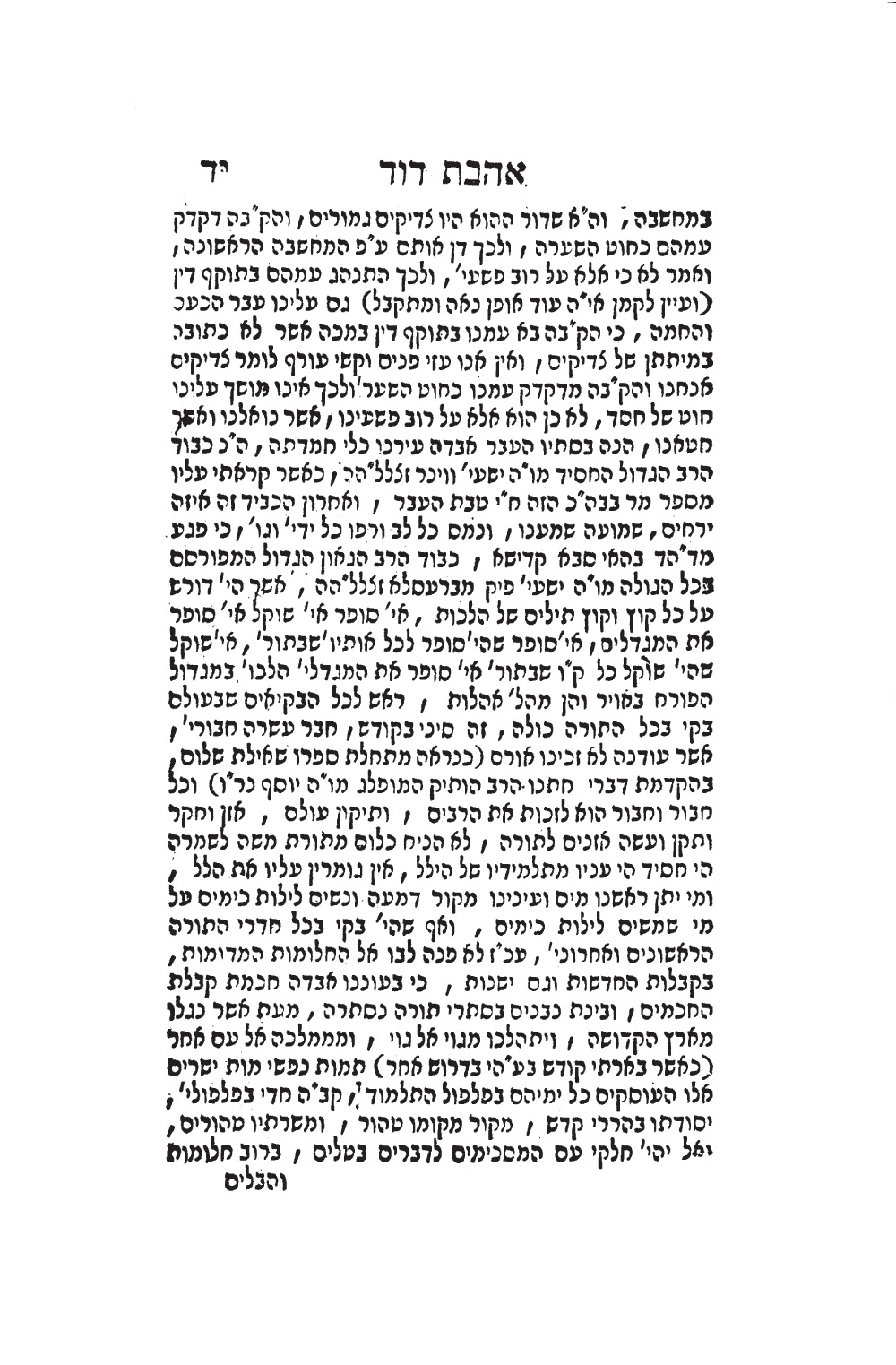
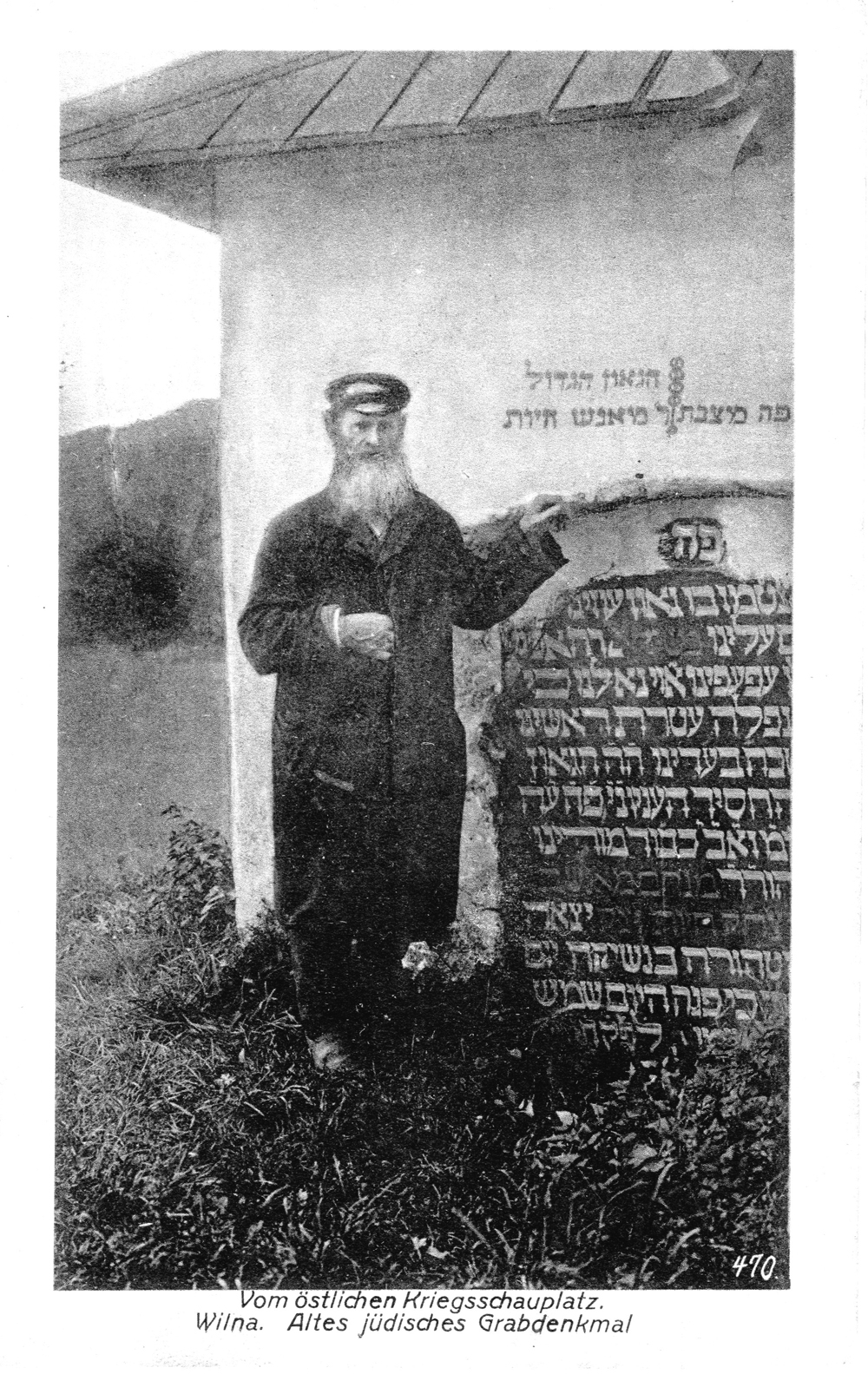
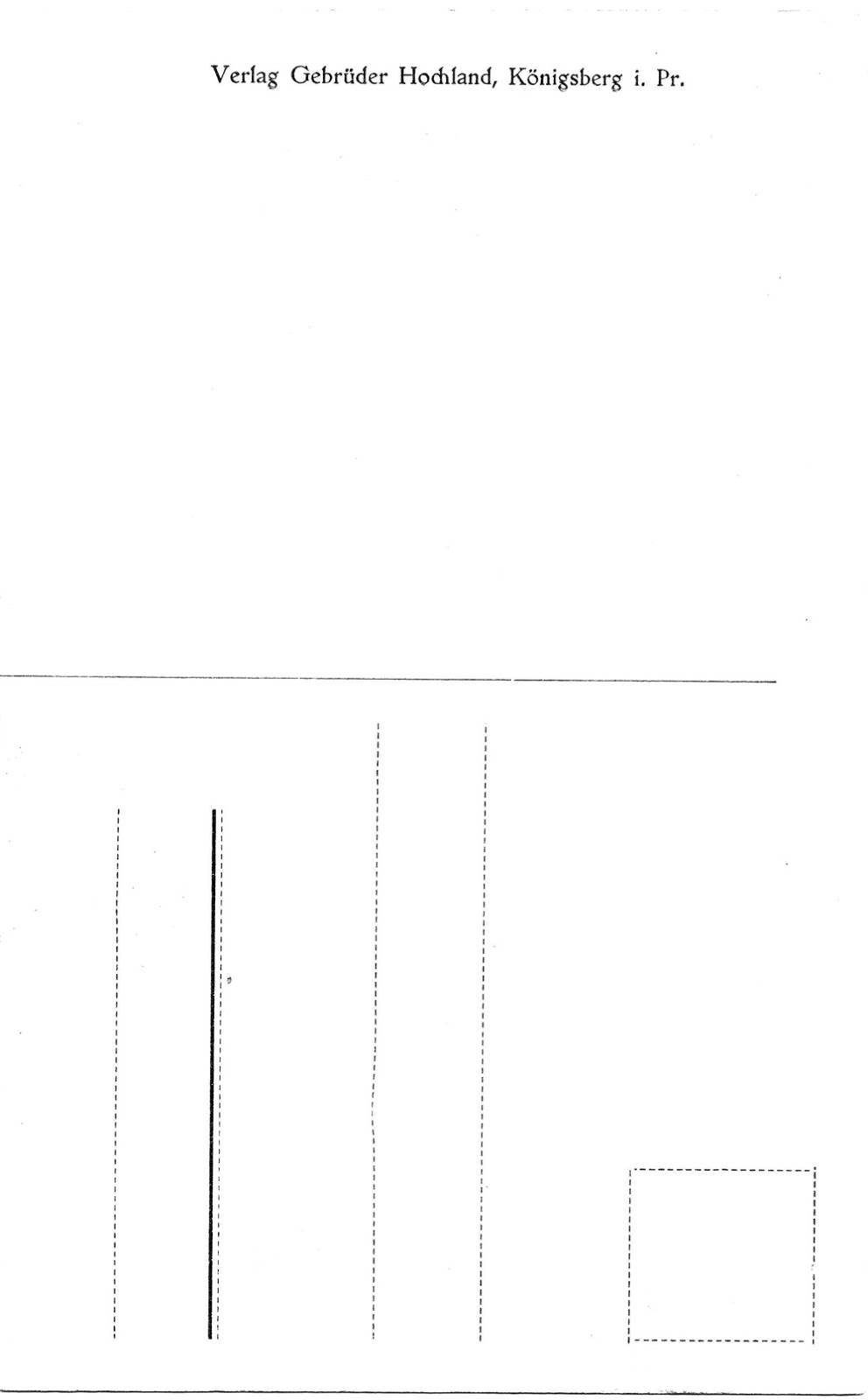
The Chanukah Omission

The Chanukah Omission

by Eliezer Brodt

    Every Yom Tov has its famous questions that show up repeatedly in writings and shiurim. Chanukah, too, has its share of well-known questions. In this article, I would like to deal with one famous question that has some not-very-famous answers. A few years ago I dealt with this topic on the Seforim Blog (here). More recently in Ami Magazine (# 50) I returned to some of the topics related to this. This post contains new information as well as corrections that were not included in those earlier articles. The question is, why there is no special masechta in the Mishna devoted to Chanukah, as opposed to the other Yamim Tovim which have their own masechta?[1] Over the years, many answers have been given, some based on chassidus, others based on machshava, and still others in a kabbalistic vein.[2] In this article, I will discuss a few different answers. While, answering this question I will touch on some other issues: what exactly is Megillas Taanis, when was it written, and what role did Rabbenu Hakadosh have in the writing of the Mishna.

A first source and the seven masechtos

At the outset, I would like to point out that the first source I have found thus far that deals with this question is Rabbi Yosef Karo in his work Maggid Mesharim.[3]It is interesting to note, that the most famous question related to Chanukah was also asked by Rabbi Yosef Karo, and is commonly referred to by the name of his sefer, as the “Bais Yosef’s Kasha.[4] That question, is: Why is Chanukah eight days? Since there was enough oil for one night, what exactly was the miracle of the first night? One of the answers given to the question is based on a famous Rambam that gives an important insight about what Rabbenu Hakodesh included in the Mishna. According to the Rambam, the halachos of tefillin, tzitzis, and mezuzos, as well as the nusach of tefillah and several other areas of halacha are not included in the Mishna at all because these halachos are well-known to the masses; there was no need to include them.[5]

אבל דיני הציצית והתפלין והמזוזות וסדר עשייתן והברכות הראויות להן וכן הדינים השייכים לכך והשאלות שנתעוררו בהן אין ממטרת חבורנו לדבר בכך לפי שאנחנו מפרשים והרי המשנה לא קבעה למצות אלו דברים מיוחדים הכוללים את כל משפטיהם כדי שנפרשם, וטעם הדבר לדעתי פרסומן בזמן חבור המשנה, ושהם היו דברים מפורסמים רגילים אצל ההמונים והיחידים לא נעלם ענינם מאף אחד, ולפיכך לא היה מקום לדעתו לדבר בהם, כשם שלא קבע סדר התפלה כלומר נוסחה וסדר מנוי שליח צבור מחמת פרסומו של דבר, לפי שלא חסר סדור אלא חבר ספר דינים (פירוש המשנה, מנחות פרק ד משנה א.

(There are some achronim who posit that this rationale applies to Chanukah, as well. That is, Chanukah was also well-known, and that’s why it was not necessary to include it in the Mishna.[6] Rabbi Yaakov Schorr has a problem with the statement by the Rambam that the laws and details of tefillin and mezuzah were well known—these mitzvos are very complicated and contain many details. Indeed, they are arguably much more complex than Kriyas Shema, which does have its own mesechta. To illustrate this point, the Chofetz Chaim’s son writes that his father spent months working on just two simanim of Hilchos Tefillin for his work, the Mishna Berura.[7] So too, there are many halachos related to Chanukah, and it is hard to believe that everyone knew all the halachos. However, the Maharatz Chayes, who bases his answer to the question on this same concept of the Rambam, adds an important point which would answer Rabbi Schorr’s problem. He says that the masses all knew about lighting the menorah. All the rest of the halachos of Chanukah which are discussed in the Gemara are from after the period of the Mishna, he says, and that is why Rebbe did not include them in the Mishna.[8] Rabbi Schorr resolves his own problem by suggesting that there was a Maseches Soferim devoted to the laws of tefillin, but it was lost. He claims that it forms the basis of the Maseches Soferim which we have today.[9] With this introduction, we can perhaps understand the following answers to our question, which are based on the assumption that there was a Maseches Chanukah which was lost. The Rishonim refer to “seven minor masechtos“; however, the earlier Achronim did not have these masechtos. Today, we do have “seven masechtos “, although, as we shall see, not everyone agrees that these are the same seven masechtos that the Rishonim had. During the period that these masechtos were unknown, there was some speculation as to what they contained. Rav Avraham Ben HaGra quotes his father, the Gra, in regard to what the exact titles of the seven masechtos were, and he told him that amongst the titles was Maseches Chanukah.[10]

אמנם שמעתי מאדוני אבי הגאון נר”ו שהשבע מסכות קטנות המה חוץ מאשר נמצא לנו והן מסכת תפלין ומסכת חנוכה ומסי’ מזוזה. (רב ופעלים הקדמה דף ח ע”א) As far as we know today, we have all the seven masechtos and none of them are about Chanukah.[11]

But it is possible that there was such a masechta which was lost. Rav David Luria (Radal) assumes as much and uses this assumption to understand the Teshuvos Hagaonim and says that it evidences additional masechtos that are no longer extant.[12]

ובא אלינו איש חכם וחסיד זקן ודרש בישיבה כתיב ופן תשא עיניך השמימה וראית את השמש זה נדר ואת הירח זו שבועה… וסדר משנה תוספת על סדרי שלנו ראינו בידו שהיה מביא ולא זכינו להעתיק שסבתו גדולה ונחפז ללכת ואתם אחינו הזהרו בענין זה וטוב לכם (שערי תשובה, סימן קמג).

The Vilna Gaon’s great-nephew reports that the Gra said there was even a masechta titled Maseches Emuna, which also appears to have been lost.[13]

ואמר לי איך ששמע מדו”ז הגאון מו”ה אלי’ ז”ל שהיו כמה וכמה מסכות על המדות כמו מסכתא ענוה ומסכתא בטחון וכדומה רק שנאבדה ממנו.

The one we already had

A different answer given by many [14] is that the reason why Rebbe did not have a whole masechta about Chanukah was because there was one already: Megillas Taanis! In fact, in one of the editions of Megillas Taanis (the original edition with the Pirush ha-Eshel), it says on the frontispiece: “Megillas Taanis, which is Masseches Chanukah.” The Perush ha-Eshel on Megilas Taanis wants to suggest that the Gra did not mean that there was a masechta titled Chanukah. Instead, the Gra meant Megillas Taanis. Indeed, in earlier printings of the Shas, Megillas Taanis was included with the Masechtos Ketanos.[15] Whether or not the Gra himself meant Megillas Taanis, many do say that Megillas Taanis is really Maseches Chanukah, since the most important and lengthy chapter is about Chanukah. Therefore the answer to why Rebbi did not include a masechta about Chanukah was simply because there was one already— Megillas Taanis. This answer is backed up with a statement found in the Behag, which says “that elders of Beis Shamai and Hillel wrote Megillas Taanis.”[16] זקני בית שמאי ובית הלל,… והם כתבו מגילת תעניות… To better understand this, an explanation about the nature of Megillas Taanis is needed. Megillas Taanis is our earliest written halachic text, dating from much before our Mishnayos. Some say it was so well-known that even children knew it by heart.[17] In the standard Megillas Taanis, there are two parts: one written in Aramaic, which is a list of various days which one should not fast or say hespedim on. This part is only two hundred and seventy words long. The other part was written in Hebrew and includes a lengthier description of each particular day. The longest entry in the latter part is about Chanukah. It contains reasons for the Yom Tov and some of the halachos. With this in mind, it’s not so strange to say that there is no need for a special masechta about Chanukah. Since in the earliest written text we have there is a lengthy entry about Chanukah, why would Rabbenu Hakodesh have to repeat it? The problem with this answer is that while Megillas Taanis dates from before our Mishnayos, it contains significant additions from a later time. The Maharatz Chayes and Radal say that the Aramaic part was written very early, at the point when it was not permissible to write down Torah Sheba’al Peh. At a later point, when it was permitted, the Hebrew parts were added. Maharatz Chayes says that it was after the era of Rabbenu Hakodesh. Earlier than him, Rav Yaakov Emden wrote (in his introduction to his notes on Megillas Taanis) that it was completed at the end of the era of the Tannaim. The bulk of the discussion regarding Chanukah that appears in Megillas Taanis is in the Hebrew part. It doesn’t make sense that Rebbi did not include Chanukah in the Mishna because of sections of Megillas Taanis that had yet to be written.[18] The Gedolim who first suggested that Megillas Taanis is the reason that Rabbenu Hakodesh did not include Chanukah in Mishnayos did not realize that it was written at two different time periods. However, Rabbi Dovid Horowitz in an article in Hapeles turns the historical difficulty on its head when he argues, based on Tosafos, that the person who wrote the Hebrew parts of Megillas Taanis was Rabbenu Hakodesh.[19] The problem with Rabbi Horowitz’s point is that it seems most likely that the Hebrew portion was written later than Rabbenu Hakodesh, and most do not agree with Tosafos on this point. [20] Therefore, this answer does not explain the omission of Chanukah from the Mishna according to most authorities.[21] Another answer in the same vein was suggested by Rabbi S.Z. Schick. Rav Schick conjectures that there was a Sefer Hashmonaim written by Shammai and Hillel which recorded the nissim of Chanukah, and therefore, there was no separate Mishna.[22] This seems to be based on the quote from the Behag we brought earlier. Others say this might be a reference to Sefer Makabbim or Megillas Antiyochus. Although it is likely that these two works are from early times, it is not clear how early.[23] As an aside, there is a book bearing the title Maseches Chanukah, but it was written as a parody, similar to Maseches Purim of Rav Kalonymus[24].

Rebellion, Romans, and the Power of Tradition

Another explanation for the Chanukah omission is from the Edos Beyehosef, who quotes a Yerushalmi[25] which relates the following: A child was born to the King Trajanus on Tisha B’av, and the child died on Chanukah. The Jews were not sure whether or not to light neros Chanukah, but in the end, they did. The king’s wife told him to come back from a war that he was in middle of fighting in order to fight the Jews who were rebelling against him!

בימי טרוגיינוס הרשע נולד לו בן בתשעה באב והיו מתענין מתה בתו בחנוכה והדליקו נירות שלחה אשתו ואמרה לו עד שאת מכבש את הברבריים בוא וכבוש את היהודים שמרדו בך חשב מיתי לעשרה יומין ואתא לחמשה אתא ואשכחון עסיקין באורייתא בפסוקא ישא עליך גוי מרחוק מקצה הארץ וגומ’ אמר לון מה מה הויתון עסיקין אמרון ליה הכין וכן אמר לון ההוא גברא הוא דחשב מיתי לעשרה יומין ואתא לחמשה והקיפן ליגיונות והרגן אמר לנשיהן נשמעות אתם לליגיונותי ואין אני הורג אתכם אמרון ליה מה דעבדת בארעייא עביד בעילייא ועירב דמן בדמן והלך הדם בים עד קיפרוס באותה השעה נגדעה קרן ישראל ועוד אינה עתידה לחזור למקומה עד שיבוא בן דוד (תלמוד ירושלמי,סוכה, פרק ה)

The Edos Beyehosef writes that Rabbenu Hakadosh chose not to include Chanukah in the Mishna. If a simple lighting of neiros caused such a reaction from our enemies, all the more so if this would be included in our crucial text—the Mishna.[26]

וכתיבת דיני נר חנוכה יש בה פירסום יותר מהדלקה מפני שהדלקה היא בבתי ישראל בזמן מועט חי’ ימים בשנה חצי שעה בכלל לילה ואפ’ זה סמיה בידן להדליק בפנים אם יש חשש סכנה אבל דבר בכתב קיים כל הימים ומתפשט בעולם על ידי כל אדם המעתיקם כל מה שרוצה… ומפני זה השמיט רבי כתיבת דיני חנוכה…

Rabbi Yehoshua Preil in Eglei Tal relates that the Roman emperor, Antoninus, was a good friend of Rebbi, and he allowed the Jews to start keeping Shabbos and other Mitzvos. However, since he had just become king, allowing the Jews to celebrate Chanukah was dangerous for his kingdom. Therefore, Rebbi did not speak about this Yom Tov openly. [27]

כי הנה אנדריונוס קיסר אחרי הכניעו את המורדים בביתר שפך כאש חמתו על כל ישראל וישבת חגם, חרשם ושבתם כי גזר על שבת ויום טוב מלה ונדה וכיוצא בו, אולם בימי המלך הבא אחריו אנטוניוס פיוס ידידו של רבי רוח לישראל כמעט, אך כנראה לא השיב את גזרת ההולך לפניו בדבר חנוכה, כי באמת יקשה גם על מלך חסיד כמוהו להניח חג לאומי כזה לעם אשר זה מעט הערה למות נפשו ואך בעמל רב נגרע קרנו זה שנות מספר, ועל כן לא היה יכול רבינו הקדוש נשיא ישראל לדבר בזה בפומי…

Rabbi Reuven Margolios answers, along these lines, that the Romans at the time were interested in the Torah She-be’al Peh, specifically concerned that there was nothing in Torah She-be’al Peh that was against the non-Jews. Thus, in order that the Romans shouldn’t have the wrong idea about the Jews’ loyalty to the government, Rebbi did not want to include Chanukah in the Mishna.[28]

ובכן כאשר תלמי המלך בזמנו צוה להעתיק לו התורה שבכתב לידע מה כתיב בה כן התענייה הנציבות לידע תוכן התורה שבעל פה … דרישה כזאת היא אשר יכלה להמריץ את נשיא ישראל להתעודד ולערוך בספר גלוי לכל העמים תורת היהודים וקבלתם יסודי התורה שבעל פה להתודע ולהגלות שאין בה הטחת דברים נגד כל אומה ולשון ולא כל תעודה מדינית. ואחר אשר חשב רבי שספרו יבוקר מאנשי מדע העומדים מחוץ ליהודת שיחרצו עליו משפטם לפני כס הממשלה המרכזית ברומא. נבין למה השמיט ממשנתו דברים חשובים עקרים בתורת ישראל … כן לא שנה ענין חנוכה והלכותיה במשנה, בעוד אשר להלכות פורים קבע מסכת מיוחדת, שזהו לאשר כל כאלו היו למרות רוח הרומיים שחשבום כענינים פוליטיים חגיגת הנצחון הלאומי ותוקת חפשיותו.

Rabbi Dov Berish Ashkenazi writes that since the Chanukah miracle was to show us the authenticity of the transmission of Torah from Moshe Rabbeinu, the story of Chanukah was not written down— it is just based on mesorah[29]. Along these lines, Rabbi Alexander Moshe Lapidos answers that the reason Chanukah isn’t written down is to show the power of Torah She-be’al Peh.[30]

לא נכתבה מגילת חנוכה, לפי שנתקנה להורות תוקף תורה שבעל פה, ותולדתיה כיוצא שלא נכתבה… חנוכה המורה על תורה שבעל פה ע”כ לא ניתנה להכתב…

(תורת הגאון רבי אלכסנדר משה, עמ’ רנו)

Rav Shlomo Zalman Auerbach says something similar. He answers that the main bris between us and Hashem is the Torah She-be’al Peh. The Greeks wanted to take this away from us, yet Hashem made miracles so that it remained with us. That is why this mitzvah is so special to us and that is why it is not written down openly.[31]

יש להבין אם מצוה זו כ”כ חביבה היא לנו, כמו שכתב הרמב”ם שמצוה חביבה היא עד מאד, למה באמת לא ניתנה ליכתב, אולם עיקר כריתת ברית שכרת הקב”ה עם ישראל הוא רק בעבור תורה שבעל פה כמו שכתב בגיטין ס’ ע”ב ומשום כך הואיל ומלכות יון הרשעה רצתה שלא יהי’ לנו ח”ו חלק באלקי ישראל, לכן נתחבבה מצוה זו ביותר שנשארה כולה תורה שבעל פה אשר רק על ידי תורה שבעל פה איכא כריתת ברית בינינו ובין ה’ ולכן אפילו במשניות לא נזכר כלל דיני חנוכה וכל ענין חנוכה כי אם במקומות אחדים בדרך רמז בעלמא.

Another answer given by Rav Alexander Moshe Lapidos is that when Torah She-be’al Peh was allowed to be written, not everything was allowed to be written. Only later on, the Gemara was allowed to be written. Rabbenu Hakadosh only wrote down things that had sources in the Torah, or gezeros (decrees) to make sure one kept things in the Torah. Chanukah does not fall into those categories. Only later on, in the times of the Gemara, was it allowed to be recorded.[32]

דבקושי התירו לכתוב תורה שבעל פה והיו פסקי פסקי. מתחלה סתימת המשנה בימי רבנו הקדוש. ואחר זה בימי רבינא ורב אשי חתימת התלמוד, והשאר היו נוהגין במגלת סתרים עד שלאחר זה הותר לגמרי לפרסם בכתב כל מה שתלמיד ותיק מחדש. ורבנו הקדוש לא הרשה רק מה שהוא לפירוש לתורה שבעל פה ומה שיש לו סמך בכתוב, או מה שהוא לסייג, כמו הלל וברכות, ערובין, נטילת ידים, נר שבת ומגלה (מחיית עמלק). אבל חנוכה שאיננו לא פירוש ואין לו סמך בכתוב, ולא לסייג, לא היה נהוג רק במגלת סתרים בבריתות דר”ח ור”א… רק נרמזה במשנה ב”ק סוף פ”ו ואחריה הורשה לפרסם בכתב בתלמוד.

Rav Shmuel Auerbach writes: ובזה יבואר החביבות המיוחדת שבנס חנוכה, והטעם שאינו מפורש במשנה. בהשתלשלות, כל שלב יסודו מהמצב הקודם, והמשנה שהיא השלב הראשון של תורה שבעל פה, יש לה שייכות לתורה שבכתב, כי היא ראשית החלק הגלוי של תושבע”פ. וחנוכה כל מהותה היא גילוי תושבע”פ בלי מפורש בתורה שבכתב´היינו מציאות שחסר גילו שכינה ונבואה, בזמן של חושך וחורבן, ולזה לא שייך בנס החנוכה כתיבה. ודוקא המציאות שנס חנוכה לא נכתבה במשנה היא הסימן לחביבות מיוחדת, והיינו שחלקי התורה הפחות כתובים הם עילאיים. ומצב של של נס שכולו בתורה שבעל פה, ולא בתורה שבכתב, הרי כל כולו בין הקב”ה לעמו ישראל, ולא מופיע בחלקי התורה שנקראים גם על ידי הגוים בשבעים לשון (אהל רחל, חנוכה, עמ’ ל-לא).

Another answer given by Rav Shmuel Auerbach is: ונתבאר בזה גם הטעם שרבי לא פירוש דיני חנוכה במשנה. אמרו חז”ל עה”פ אילת השחר, שאסתר סוף הנסים, ופירושו, סוף הנסים הכתובים בכתבי הקודש. והמשנה אע”פ שהיא תחילת תורה שבעל פה, מכל מקום דיני המשנה הם דינים שיש להם שורשים בתורה שבכתב, וכל ענינו של חנוכה אינו שייך לתורה שבכתב, אלא הוא כל כולו תושבע”פ, שהתקוף של גילוי האור של תושבע”פ היא דוקא במצב של חושך והסתר פנים, שכבר נפסקה הנבואה, וזכו לכך דווקא מתוך ובגלל החושך, שהוצרכו לעמל ומסירות נפש כדי לגלות את אור התורה (אהל רחל, חנוכה, עמ’ קיח).

The Chasam Sofer’s answer

One of the most famous answers given to this question is by the Chasam Sofer, who is quoted by his grandson Rabbi Shlomo Sofer in the Chut Hameshulash as having said many times that the reason why the miracle of Chanukah is not in the Mishna is because Rabbeinu Hakadosh was a descendant of David Hamelech and the miracle of Chanukah was through the Chashmonaim who illegitimately took away the kingdom from the descendants of David. Since this was not to his liking, he omitted it from the Mishna, which was written with Ruach Hakodesh.[33]

מרגלא בפומי’ כי נס חנוכה לא נזכר כלל במשנה ואמר טעמו כי רבנו הקדוש מסדר המשנה הי’ מזרע דוד המלך ונס חנוכה נעשה על ידי חשמונאים שתפסו המלוכה ולא היה מזרע דוד וזה הרע לרבנו הקדוש ובכתבו המשנה על פי רוח הקודש נשמט הנס מחיבורו (חוט המשולש, דף נ ע”א).

This statement generated much controversy, and many went so far as to deny that the Chasam Sofer said such a thing.[34] The bulk of the issues relating to this answer of the Chasam Sofer were dealt with by Rav Moshe Zvi Neriah in an excellent article on the topic.[35] The most obvious objection to the Chasam Sofer is that the issue is not that Chanukah is never mentioned in the Mishna—in fact, it is a few times. The question is why there isn’t a complete mesechta devoted to it. Another problem raised by Rabbi Neriah is that, as we have seen above, the Behag writes that the elders of Shammai and Hillel, an ancestor of Rebbi, did record the story of Chanukah. Due to these and other issues, some have tried to explain the words of the Chasam Sofer differently.[36] This is not the first statement in the Chut Hameshulash that has been questioned. A daughter of the Chasam Sofer is reported to have said that the work is full of exaggerations.[37] דע לך כי מה שכתוב הרב ר’ שלמה סופר, רבה של בערעגסאס בספרו חוט המשולש על אבא שלי זה מלא הגוזמות. However Rabbi Binyamin Shmuel Hamburger of Bnei Brak, an expert on the Chasam Sofer, writes that today we are able to defend all the statements of R. Shlomo Sofer from other sources, and that it is, indeed a reliable work.[38] This explanation of the Chasam Sofer seems to be based in part on the Ramban, who writes that although the Chashmonaim were great people and without them Klal Yisroel would have been destroyed, in the end they were doomed because they were not supposed to become kings, not being descendants of Yehudah.

זה היה עונש החשמונאים שמלכו בבית שני, כי היו חסידי עליון, ואלמלא הם נשתכחו התורה והמצות מישראל, ואף על פי כן נענשו עונש גדול, כי ארבעת בני חשמונאי הזקן החסידים המולכים זה אחר זה עם כל גבורתם והצלחתם נפלו ביד אויביהם בחרב. והגיע העונש בסוף למה שאמרו רז”ל (ב”ב ג ב) כל מאן דאמר מבית חשמונאי קאתינא עבדא הוא, שנכרתו כלם בעון הזה. ואף על פי שהיה בזרע שמעון עונש מן הצדוקים, אבל כל זרע מתתיה חשמונאי הצדיק לא עברו אלא בעבור זה שמלכו ולא היו מזרע יהודה ומבית דוד, והסירו השבט והמחוקק לגמרי, והיה עונשם מדה כנגד מדה, שהמשיל הקדוש ברוך הוא עליהם את עבדיהם והם הכריתום: ואפשר גם כן שהיה עליהם חטא במלכותם מפני שהיו כהנים ונצטוו (במדבר יח ז) תשמרו את כהונתכם לכל דבר המזבח ולמבית לפרכת ועבדתם עבודת מתנה אתן את כהונתכם, ולא היה להם למלוך רק לעבוד את עבודת ה’ (בראשית מט,י).

It should be noted that not everyone agrees with the Ramban. [i][39] R. Kosman shows[40] that there was some playing around with this piece of the Chasam Sofer. In the first edition it says:

מרגלא בפומי’ כי נס חנוכה לא נזכר כלל במשנה ואמר טעמו כי רבנו הקדוש מסדר המשנה הי’ מזרע דוד המלך ונס חנוכה נעשה על ידי חשמונאים שתפסו המלוכה ולא היה מזרע דוד וזה הרע לרבנו הקדוש ועל כן נשמט הנס מחיבורו

But in the second edition a piece was added to say:

מרגלא בפומי’ כי נס חנוכה לא נזכר כלל במשנה ואמר טעמו כי רבנו הקדוש מסדר המשנה הי’ מזרע דוד המלך ונס חנוכה נעשה על ידי חשמונאים שתפסו המלוכה ולא היה מזרע דוד וזה הרע לרבנו הקדוש ובכתבו המשנה על פי רוח הקודש נשמט הנס מחיבורו

Interestingly enough, the Chasam Sofer in his chiddushim on Gittin explains the Chanukah omission based on the Rambam we mentioned earlier that says that since Chanukah was well-known Rebbe did not include it in the Mishna.[41] Whether or not the Chasam Sofer did say the explanation quoted in the Chut Hameshulash, we have testimony from a reliable source that another gadol said it. The Chasdei Avos cites this explanation from the Chidushei Harim and he ties it to the Ramban mentioned above.[42]

דבשביל שהי’ לבם של בית הנשיא מרה על החשמונאים, שנטלו מהם המלוכה, והוא נגד התורה דלא יסור משבט יהודה, כמו שכתב ברמב”ן ויחי, לכן לא הזכיר רבנו הקדוש דיני חנוכה במשנה.

Rabbi Aryeh Leib Feinstein also offers this explanation on his own and uses it to explain many of the differences between the versions of the miracle of Chanukah found in the Gemara and Megillas Taanis, and to explain who authored the different parts (Aramaic and Hebrew) of Megillas Taanis.[43] Rabbi Avraham Lipshitz says that, based on the answer of the Chasam Sofer, it is possible to answer another famous difficulty raised by many, which is why we don’t mention Chanukah in the beracha of Al Hamichya. Rabb Liphsitz says that in Al Hamichya we mention Zion, which is Ir Dovid. Since the Chashmonaim took away the kingdom at that time from the descendants of Dovid, we do not mention Chanukah in connection to Zion.[44] Another answer suggested by Rav Chanoch Ehrentreu is that the Mishna is composed mostly of various parts from much before Rabbenu Hakodesh, from the time of the Anshei Knesses Hagedolah and onwards, which is before the story of Chanukah took place. When Rebbe began to compose the Mishna there was no place for the halachos of Chanukah, so he did not put them in.[45]With this he answers another problem – we find that the early Tannaim dealt with Chanukah as we see in a beraisa in Shabbos from Ziknei Beis Shammai and Hillel so why isn’t there a Massechtah devoted to Chanukah.

שגוף המשנה על חלקיה העיקריים הוא מעשה אנשי כנסת הגדולה… לאחר ימי אנשי כנסת הגדולה השלימו תנאים במקום שהיה טעון השלמה והוסיפו בשעה שנזקקו להוסיף, וחלקו על פירושה של משנה ראשונה וגם מסרו מחלוקות אלה לדורות. אך המשנה עצמה עתיקה מהלכות חנוכה. לכן ברור שתנאים שנו הלכות בענין חנוכה ונר חנוכה, אך כיון שכבר לא נמצא להם מקום בגוף המשנה נאספו אלה בברייתות

This answer is based on the assumption that there were parts of the Mishna that existed earlier than Rebbe, and that he was just the editor. This topic of when the Mishna was exactly written has been dealt with from the time of the Geonim and onwards and is beyond the scope of this article.[46] However, I would like to make one point that also relates to this and the Chasam Sofer’s answer discussed above. What was Rabbenu Hakodesh’s role in writing the Mishna? Was he an editor that just collected previous material, or did he add anything of his own? Rav Ishtori Haparchi writes in his Kaftor Vaferach that Rebbe never brings something that he does not agree with in the Mishna.

ורבנו הקודש לא יבא לעולם כנגד המשנה שהוא סדרה וחברה

(כפתור ופרח, פרק חמישי)

The Sefer Hakrisus disagrees. He says that Rebbe was mostly an editor. He gathered existing Mishnayos and, together with other Chachomim, chose what to include.[47] מצינו בלשון משנה על רבי הא דידיה הא דרביה… נראה אף על פי שרבי סדר המשניות היו סדורות קודם לכן אלא שסתם הילכתא, וגם על פי עשרים בני תלמידי חכמים זה היה אומר בכה וזה היה אומר בכה והוא בחר את אשר ישר בעיניו אבל המשנה והמסכתא לא זזה ממקומה וסדרה הוא כבראשונה… It would seem that the Chasom Sofer’s answer could only work according to the Kaftor Vaferach and Rabbi Ehrentreu’s answer is only possible according to the Sefer Hakrisus. According to the Sefer Hakrisus, even had Rabbeinu Hakadosh not wanted to include the story of Chanukah for some reason, it was not only his say that was important. This explanation of the Chasam Sofer was the accepted explanation for many years among Jewish historians as to why the Mishna omits the story of Chanukah. For example Zechariah Frankel wrote in his Darchei Ha-Mishnah[48]:

והנה גם מצות חנוכה באה לבד בדרך העברה … ולהדלקת נר חנוכה לא מצינו במשנה אפילו רמז (ועיין ב”ק פ”ו מ”ו). ואפשר שבזמן הבית לא חלקו כ”כ כבוד למצות זאת, כי גם מלכי בית חשמונאי אשר על ידי אבותיהם נעשתה התשועה לישראל, הכבידו עולם על העם ולא נחה דעת החכמים במלוכתם, ומצאו להם די בהזכרתם בתפילה חסדי השם עם עמו, ובמשך הימים כאשר נשכחו הצרות הראשונות תחת המלכים אלה נהגו בנר חנוכה, וגם אז נראה שלא לחובה כ”א למצוה, ונתנו המצוה ביד כל איש ואיש כפי דעתו…

(דרכי המשנה, עמ’ 321).

A while back, Gedaliah Alon wrote a classic article proving that this theory was not true at all. Subsequently, Shmuel Safrai backed this up. They both showed that there is positive mention of the Chashmonaim in many places in halachic literature. Therefore, this explanation does not suffice to explain the omission of Chanukah from the Mishna.[49]

Hidden halachos

The following answers relate to the concept found in the Gemarah numerous times, known as, chisura mechsara, something is missing, when trying to understand a specific statement in the Mishna. The Gemarah says that something is missing and really the Mishna should say this… The question asked by many is how did this happen. Many years ago I heard from one of my High school Rabbyim, Rabbi Lobenstein who heard from his Rebbi, Rav Hutner that this was done on purpose. The whole Heter to write down Torah She Bal Peh was a Horot Sho as Rabbenu Hakodesh saw that it was going to be forgotten. However he did not want all of it to be come accessible to all he wanted to retain a strong part of it to be dependent on Torah She Bal Peh on a mesorah from the past. Therefore he made that certain parts could only be understood based on a transmission from a previous generation. One of the ways he did that was to leave out certain sentences from the Mishna. I later found that Rav Hutner says this concept to explain why there is no special Mishna devoted to the Halchos of Chanukah:

ומקבלת היא נקודה זו תוספת בהירות מתוך עיון בכללי סדור המשנה ובמה שהורונו רבותינו בביאורם. בתוך כללי סידור המשנה נמצא כאלה שאינם נראה כלל כמעשי סידור, כגון אין סדר למשנה, חסורי מיחסרא… וכדומה. והורונו רבותינו בזה כי גם לאחר שהותרה כתיבתה של תורה שבעל פה, ומשום עת לעשות הוכרחו לכתבה או לסדרה לכתיבה, מכל מקום השאירום בשיעור ידוע כדברים שבעל פה גם לאחר שנכתבו, בכדי שגם הכתב יהא נזקק לסיוע של הפה, וסוף סוף לא תעמוד הכתיבה במקומה של הקבלה מפה לאוזן. ודברים הללו הם יסוד גדול בסדר עריכתם של דברי תורה שבעל פה על הכתב… מאורע מועד החנוכה יהא מופקע מתורת כתב, שכן כל עצמו של חידוש מועד החנוכה אינו אלא בנקודה זו של מסירות נפש על עבודת יחוד ישראל בעמים… ופוק חזי דגם במשנה לא נשנו דיני נר חנוכה, ולא נזכר נר חנוכה כי אם אגב גררא דענינים אחרים, והיינו כמו שהורונ רבותינו דגם לאחר שנכתבה המשנה עדיין השאירו בה מקום לצורת תורה שבעל פה על ידי החיסורי מיחסרא וכדומה, ובנר חנוכה בא הוא הענין הזה לידי השמטה גמורה, מפני שאורו של נר חנוכה הוא הוא האור שניתגלה על ידי מסירת נפש על אורות מניעת כתיבתם של דברים שבעל פה. בכדי שעל ידי זה תסתלק יון מלהחשיך עיניהם של ישראל על ידי תרגום דברים שבעל פה, כדרך שהחשיכה עיניהם של ישראל בתרגומם של דברים שבכתב

(פחד יצחק, עמ’ כח-כט).

A little different explanation of the concept of chisura mechsara without tying into Chanukah can be found in the incredible work from the Chavos Yair called Mar Keshisha where he writes as follows:

ובזה מצאנו טעם חכמי משנה שדברו דבריהם בקיצור נמרץ ובדרך זר ורחוק מתכלית הבנתו והמבוקש, וטעם שניהם להרגיל התלמידים בהתבוננות וחידוד, שיבינו דברים ששמעו אף כשהם עמוקים ועלומים, ומתוך כך יוסיפו מדעתם, ויבינו עוד דבר מתוך דבר… ובזה יישבנו גם כן מה שלפעמים דקדקנו בלשון התנא בסידור דבריו ובחיסור ויתור אות אחת… ולפעמים אמרינן חסורא מחסרא במשנה… והכל הוא להלהיב הלבבות ולחדדם ע”י שיעמיקו וידקדקו בלשון התנא, ולפעמים ליישב הדין והמבוקש… (מר קשישא, עמ’ כח-כט; שם, עמ’ נו).

The Rashash says:

ונראה דלפי שהיתר כתיבת המשנה לא היה רק משום עת לעשות וגו’ לכן לא באו בה רק עקרי הדינים בלבד בלי ביאור הטעמים, וכן לא בארה במחלקות הנמצאים בה טענות כל אחד מהצדדים ופעמים לא בארה גם עיקר הדין בשלמותו… וכן חסורי מחסרא והכי קתני, כי לא באה רק שעל ידה יזכרו לגרוס הענינים בשלימותם כפי הקבלה בעל פה, ולזאת תמצא ג”כ רבות שלשון המשנה איננו סובל את הענין כפי ישוב הגמ’ בה רק בדרך רחוק ודחוק, הכי רבינו לא היה יכול לדבר צחות ולבחור לשון ערומים.. שפעמים לא ביאר את הענין בדרך רמז… ויתכן לומר דלכן קראו לאיזו מהם מגילת סתרים

(נתיבות עולם,דף קי”א, ע”א).

Another answer to the mystery of the Chanukah omission is from Rabbi Gedaliah Nadel as I will explain this too has to do with the concept of chisura mechsara. There is a famous concept of various Rishonim and Achronim. Many times, the Gemara uses the phrase chisura mechsara, something is missing, when trying to understand a Mishna. Some Rishonim say that there is nothing actually missing in the Mishna. What appears to be missing is really there, but the naked eye cannot see it. That is what the Gemara means when it says something is missing and then adds the missing text. Just to list some sources for this concept: Rabbenu Bechayh writes:

ורבינו הקדוש שחבר המשנה ולמד אותם ברבים וכתבוה הכל בימיו, כונתו היתה כדי שלא תשכח תורה מישראל שראה הרשעה מתפשטת בעולם וישראל מתפזרין בגלות, על כן הותר לו לעשות כן משום שנאמר:

(תהלים קיט, קכו)

“עת לעשות לה’ הפרו תורתך”, וכתב וחבר המשנה שהיא תורה שבעל פה, ועל כן קראה “משנה” לפי שהיא שניה לתורה שבכתב ורובה לשון הקדש צח כתורה שבכתב… ואחרי כן נתמעטה החכמה וקצרו הלבבות ועמדו רבינא ורב אשי וחברו התלמוד שהוא פירוש המשנה, כי לרוב חכמת רבינו הקדוש וחכמת בני דורו היה פירוש התורה אצלם מבורר ופשוט מתוך המשנה, ואצל דורות רבינא ורב אשי היה עמוק וסתום מאד, ומזה אמרו בתלמוד על המשנה:

(ברכות יג ב)

חסורי מחסרא והכי קתני, שאין הכוונה להיות המשנה חסרה כלל חלילה, אבל הכוונה שהיא חסרה אצלנו מפני חסרון שכלנו מפני שאין אנו מגיעים לעומק חכמת דור של חכמי המשנה…

(רבנו בחיי, כי תשא, לד:כז).

Reb Avrhom Ben HaGra writes:

ומ”ש לפעמים חסורי מחסרא והכי קתני, שמעתי מא”א הגאון החסיד המפורסם נר”ו שאין במשנת רבי שום חסרון בלישנא ומה שהוסיפו הוא מובן בזך הלשון של רבינו הקדוש ז”ל, אפס כדי להסביר לעיני המון הרואים בהשקפה ראשונה לפיהם צריך להסביר יותר, והמעיין בדבריו יראה שהוא כלול בדבריו ביתרון אות אחת, ואחוה לך אחד לדוגמא… (רב פעלים, עמ’ 107).

Reb Yisroel Shklover also writes about the Gra: והיה יודע כל חסורי מחסרא שבתלמוד בשיטותיו דלא חסרה כלל בסדר שסידר רבינו הקודש המתני’

(פאת השלחן, הקדמה).

Rabbi Gedaliah Nadel says that most of Hilchos Chanukah can be found in the Mishna. The Mishna in Bava Kamma (62b) says that if a camel was walking in the public domain with flax, and the flax caught fire from a fire that was in a shop and did damage, the owner of the camel has to pay the damages. However, if the storekeeper’s fire was out in the public domain, then the storekeeper has to pay damages. Reb Yehudah says that if the fire was from neiros of Chanukah, then the storekeeper is not obligated to pay. From here, says Rabbi Nadel, we can learn the basic halachos of Chanukah: the neiros have to be lit outside, over ten tefachim and when people are passing by. The halachos of Hallel and Krias Hatorah are found in other places in the Mishna. The rest of the halachos are side issues.[50]

ולפי זה יש ליישב דענין נס חנוכה ומצות נרות וואדי היה מפורסם לחיוב ולא היה צריך להקדמה כלל, ואף דמ”מ היה צורך להכניס יסוד הדינים במשנה מ”מ לזה סגי לפרש הדברים בדרך רמז במשנה דב”ק. דאם נדקדק בדברי המשנה שם נמצא כל עיקר דין נר חנוכה דילפינן מינה דאיכא חיוב להניח הנר בחוץ ובתוך עשרה טפחים ושיהא בזמן שעוברים בשוק, ורק אנינים צדדים כמו מהדרין וכו’ לא חשש להזכיר. ודין דמדליקין מנר לנר וכו’ איכא למילף מדיני בזוי מצוה. ויתר הלכות חנוכה הוזכר אגב אורחא כל אחד במקומו, וכגון חיוב הלל גבי קרבן עצים (תענית פ”ד מ”ה). וחיוב קריאת התורה גבי דיני קרה”ת (מגילה פ”ג מ”ד ומ”ו), ודין אמירת על הנסים לא נזכר כמו שאר נוסחי תפלות שלא הוזכרו מפני שהיו ידועים ומוסרים

(ליקוט מתוך שעורי ר’ גדלי’, עמ’ מ).

I would like to suggest [51] that this answer is similar to the famous concept of various Rishonim and Achronim [52] mentioned above, nothing actually missing in the Mishna. What appears to be missing is really there, but the naked eye cannot see it. Similarly here, Chanukah is in the Mishna, but it’s not clear to the regular person. As Rav Nadel shows, the basic laws of Chanukah are hidden in the Mishna in Bava Kamma. The Chanukas Habayis, first printed in 1641, is a special work devoted to the halachos of Chanukah. This work explains how all of the halachos of Chanukah are found in a piece of Masseches Soferim—in Haneiros Hallalu.[53] Masseches Soferim, although it was composed at a late date, is really based on an earlier work from the time of Chazal. In other words, it contains halachos which date back to early times.[54] I would like to suggest that perhaps this piece was much earlier—from the times before Rabbenu Hakodesh composed the Mishna. And because it had hidden in it all of the laws of Chanukah, this could be another reason why Chanukah was not included in the Mishna, as there existed a halacha that had in it hidden all of the laws of Chanukah—Haneiros Hallalu.

A famous controversy

This whole issue of the Chanukah omission was a small part of a famous debate. In 1891, Chaim Selig Slonimski wrote a short article in Hazefirah (issue #278) questioning why there is no mention in Sefer Hashmonaim and Josephus of the miracle of the oil lasting eight days. Furthermore, he questioned why the Rambam omits the miracle of the oil when detailing the miracles of Chanukah. He contended that the answer is that a miracle did not actually occur, but the Kohanim created that impression to raise the spirits of the people. As can be expected, this article generated many responses in the various papers and journals of the time and even a few sefarim were written devoted to this topic. A little later, while defending his original article, Slonimski wrote that we do not find the halachos of Chanukah mentioned in the Mishna, only in the Gemara. Rabbi Ginsberg, in his work Emunas Chachimim, pointed out that the halachos are mentioned in Baba Kama.[55] Rabbi Lipshitz in his work Derech Emunah, written to deal with this whole issue, defended this omission based on Chanukah’s mention in Megillas Taanis, as mentioned above. Rabbi Y. Sapir also wrote such a defense.[56]

Appendix one: Megilat Taanis and Chanukah

Earlier I quoted some that some say that the reason why Rebbe did not have a whole masechta about Chanukah was because there was one already: Megillas Taanis! I would like to elaborate on what I wrote earlier and clarify a bit more on the work Megillas Taanis, especially its relationship to Chanukah. Megillas Taanis is our earliest written halachic text, dating from much before our Mishnayos. In the standard Megillas Taanis, there are two parts: one written in Aramaic, which is a list of various days which one should not fast or say hespedim on. This part is only four hundred and seventy words long. The other part was written in Hebrew and includes a lengthier description of each particular day. The longest entry in the latter part is about Chanukah. It contains reasons for the Yom Tov and some of the halachos. A few Achronim already used the MT for Chanukah to show that the famous Bais Yosef’s Kasha of why is Chanukah eight days has been asked by the author of the MT. [58] It would appear that the Bais Yosef did not have a copy of the MT.[59] Be that as it may when one compares the passages about Chanukah in the MT to the Bavli one will find some similarities and many differences. The question is which work influenced which, did the MT influence the bavli or vice versa. The Netziv writes: ת”ר נר חנוכה מצוה כו’ עיקרן של ברייתות אלו המה במגילת תעניות פ”ט, והוסיף שם ואם מתייראין מן הלצים מנחיה על פתח בית (מרומי שדה, שבת דף כא ע”ב). The Chida writes that the Bavli was aware of the MT: מאי חנוכה… דלא על עצם חנוכה שואל, דהרי המשנה סמכה על מגילת תעניות (חדרי בטן, עמ’ צז). There is an interesting little-known correspondence on this topic between the Aderes and R. Yaakov Kahana (Shut Toldos Yakov, Siman 29) about the topic of a Mesechet Chanukah and Megillat Tannis. Rav Kahana was bothered why the Bavli left out most of the MT from its discussion in regard to Chanukah.

וצ”ע מ”ה השמיטו הבעל הש”ס דידן האי בבא ממג”ת הלא דבר הוא… וקצ”ע על בעל הש”ס ירושלמי שלא הביאו האי עובדא דחנוכה המוזכר במג”ת פ”ט המובא בשבת כ”א ב’ וגם פלוגתת ב”ש וב”ה בנרות לא מוזכר שם.

The Aderes responded to R. Kahana: ומה שתמה על הש”ס למה לא הביאו האי בבא דמגילת תענית גם אנכי הערתי בזה ומצאתי תמי’ זו בהגהת הרצ”ה חיות ז”ל ובימי עולמו כתבתי מזה בס”ד ולא אדע אנה. ואשר התפלא מדוע לא נמצא הא דחנוכה בירושלמי באמת גם במשנה לא נמצא אולם בסוף פ”ו דב”ק שם נמצא וגם מעט בירושלמי בשלהי תרומות. ואנכי מתפלא מאד דגם מצות כתיבת ספר תורה לא נמצא במשנה…

R. Kahana wrote a lengthy response. He explained that it does not bother him that the Mishana does not mention this story of Chanukah from MT as the Bavli does not mention any of the incidences in MT. He is more bothered by the omission of the Yerushalmi of this story as found in the MT, as the Yerushlmi does mention other incidences of MT.[59] As to writing a sefer Torah not being mentioned in the Mishna R. Kahana gives a lengthy list of all the Mitzvos that are not discussed in the Mishna (and the list is long). Rabbi Lifshitz writes:

העתקתי כל דברי המגלת תענית כי יש ללמוד ממנו הרבה, האחד כי כל הברייתות המובאות בגמרא אינם ברייתות מאוחרות ודברי אגדה.. רק כולם המה לקוחים מהמג”ת הקדומה הרבה… דרך אמונה, עמ’ 17). Rav Zevin writes: הברייתא של מאי חנוכה שמקורה במגלת תענית והובאה בבלי… (המועדים בהלכה, עמ’ קפז).

We see from all these Achronim that it was obvious to them that the Bavli was written well after the MT. The question is when, was the MT written. Rav Yaakov Emden writes (in his introduction to his notes on Megillas Taanis) that it was completed at the end of the era of the Tannaim. The Chida writes it was written before the Mishna.[60] Earlier I mentioned that while Megillas Taanis dates from before our Mishnayos, it contains significant additions from a later time. Maharatz Chayes and Radal say that the Aramaic part was written very early, at the point when it was not permissible to write down Torah Sheba’al Peh. At a later point, when it was permitted, the Hebrew parts were added. Maharatz Chayes says that it was after the era of Rabbenu Hakodesh. But was it written before the Bavli or after? The Maharatz Chayes concludes that the Bavli did not have the same version of Chanukah as the MT as MT that part of MT was written later. The Maharatz Chayes observes that whenever the Bavli quotes the MT and it uses the words De-khesiv it is referring to the early part written in Aramaic when it says De-tanyah it is referring to the later part.[61] To answer this a bit of background is needed; MT as we have it was first printed in Mantua in 1514. Over the years various editions were printed some with Perushim on them. In 1895 Adolf Neubauer printed a version based on the manuscripts. In 1932 Hans Lichtenstein printed a better version based on the manuscripts.[62] S. Z. Leiman has already noted[63] that this work is to be used with great discretion. As late as 1990, Yakov Zussman noted in his classic article on Halacha and the Dea Sea Scrolls that a proper critical edition was still needed.[64] A little later a student of his, Vered Noam, began working on such a project and in 2003 a beautiful edition of this work was released by the Ben Tzvi publishing house.[65] Over the years Noam has written many articles about her finds unfortunately not all of these important articles are included in this final work printed in 2003.[66] Amongst the points discovered by Noam was that the scholion[67] part (as it was coined by Graetz) exists in two different manuscripts (besides for other fragments) and that each one of these versions are very different and include different things. At a later point these two independent works were combined into a hybrid version which is the basis of our printed text today. The hybrid version included both of the earlier versions and even added things not found in either version of the scholion. In her work, Noam deals with trying to identify when all this was done.[68] One of the key questions in her work is did the scholion have the Bavli or vica versa. She demonstrates that it is not a simple issue and each piece of MT has to be dealt with accordingly to compare the versions and the like. As far as Chanukah is concerned she concludes that most of the parts from the MT are from other sources but parts are from the Bavli but these parts from the bavli that are found in the scholion versions are from a later time. [69] Shamma Friedman argues on Noam’s conclusions in regard to Chanukah; he has many indications to show that as far as Chanukah is concerned the scholion was influenced by the Bavli.[70] One of indications for Friedman was that in one of the two additions of the scholion it says כדאיתא בבמה מדליקין! To clarify this point, in one version of the scholion it says: מצות נר חנוכה נר אחד לכל בית והמהדרין נר אחד לכל נפש והמהדרין מן המהדרין וכו’ כדאיתא בבמה מדליקין. However this passage does not appear at all in the other manuscript of the scholion but it does appear in the Hybrid version with changes. In the Hybrid version it says as follows:

מצות חנוכה נר איש וביתו והמהדרין נר לכל נפש ונפש והמהדרין מן המהדרין בית שמאי אומרים יום ראשון מדליק שמנה מכאן ואילך פוחת והולך ובית הלל אומרים יום ראשון מדליק אחד מכאן ואילך מוסיף והולך. שני זקנים היו בצידן אחד עשה כדברי בית שמאי ואחד כדברי בית הלל זה נותן טעם לדבריו וזה נותן טעם לדבריו זה אומר כפרי החג וזה אומר מעלין בקדש ואין מורידין. מצות הדלקתה משתשקע החמה ועד שתכלה רגל מן השוק ומצוה להניחה על פתח ביתו מבחוץ ואם היה דר בעליה מניחה בחלון הסמוך לרשות הרבים. ואם מתירא מן הגויים מניחה על פתח ביתו מבפנים ובשעת הסכנה מניחה על שלחנו ודיו.

As an aside over here we can see the differences between each version of the manuscripts of the scholion versions one has it in one line one does not have the passage at all and one has a very lengthy version of the passage. Now these words כדאיתא במה מדליקין are not the only factor for Friedman to reach his conclusions in regard to the sources of this passage of the scholion version of MT. He has many other points but just to list one more of them. Friedman has a whole discussion about the origins of the word “Mehadrin.” Louis Ginzburg noted that:

הברייתא שם, מצות חנוכה… והמהדרין וכו’ נראה שהיא בבלית שאין לשון מהדרין לשון חכמי המשנה שבארץ ישראל

(פירושים וחידושים, א, ברכות, עמ’ 279).

Friedman has an article with various proofs to show that this is true.[71] If this is so the fact that MT uses the word Mehadrin would be another indicator that at least in this case the MT was influenced by the Bavli. According to all this it would be impossible to answer that the reason why Rabbenu Hakodesh did not write a Mascetah about Chanukah was because he was relying on MT. As discussed here this part of the MT was written long after the Mishna and possibly even after the Bavli! I would like to conclude this section with some words about the Oz Ve-hador edition of Megilat Taanis. In 2007, the Oz Vehador publishing house released a new edition of Megilat Taanis. A few years back I wrote on the Seforim Blog about some of their censorships in regard to this work. Today I would like to turn to some other issues with this particular edition. In the introduction of this work they explain that one of the benefits of this work is that they used manuscripts and on the side of each page they indicate various differences based on the manuscripts. They write that they only include the differences that are important. They then include a nice long list of all the pieces of manuscripts and Genizah fragments that they used for this work. Ten such items were consulted and used they even give abbreviations for each one of the items in the list. The problem is as follows all this is plagiarized straight from Vered Noam’s edition of the MT printed in 2003. They copied her list and order, word for word, without bothering to even try to cover up their tracks. The reason this is obvious is that Noam made up abbreviations for each of the works, as is common in all critical editions to make it easier when quoting them. Now for whatever reason she decided to choose these abbreviations, for each one of the works Oz Ve-Hador happened to pick the exact same abbreviation. For example, for one genizah fragment she labeled, Gimel Peh and for another one she labeled it Gimel Aleph. Oz Ve-Hador did the same. Now what is interesting is Noam uses all these pieces in her work, as a quick look at her apparatus will show. Oz Ve-Hador only substantially quotes two manuscripts throughout their whole work, the Oxford MS and the Parma MS. They never use any Genizah fragments so why do they even mention them with abbreviations in their introduction? If that is the case, why did they bother to even copy this whole list from her, if they did not even bother to look at any other of the manuscripts or quote them? Why in the world are the abbreviations needed in the first place? The only reason why she has abbreviations is to make the usage of her scientific apparatus user friendly, something which Oz Ve-Hador does not even attempt to do. This would indicate that the person who copied the list did not even have a clue to what it was that he was copying. One other point is that almost all the changes seem to be a minor correction or spelling mistake. When one compares this to the apparatus in Noam’s addition this is absurd. What in the world was their basis for making corrections in the work, only correcting these few things when there are many, many things to correct or at least point out to the reader? Now a careful examination of the MT from Oz Ve-Hador will leave one wondering what exactly they did as far as using manuscripts are concerned. In the Chanukah piece of MT which there are many differences and pieces in each version they were able to come up with three differences! For example the important words כדאיתא בבמה מדלקין or that this whole long piece about Mehadrin etc. does not appear in one version of MT at all, and as explained earlier both of these issues are important. This would indicate to me even more, the person or persons involved in this part of their edition had no real clue to what he was doing, he chose some differences from the manuscripts and that was it. I would even go so far as to say that they did not bother to look at any of the actual manuscripts but rather just used Noam’s work and took a few differences from the two key manuscripts and put them in their work. However I do not have the patience to prove that so it will just remain a strong hunch for now. In short we have yet again another work of Oz Ve-Hador which shows how good and accurate they are in dealing with manuscripts.[72] Another small point of interest to me was that the Oz Ve-Hador edition was careful to never call the Hebrew part of MT the “scholion,” as that was a word coined by Maskilim. One last small point of interest to me in about the Oz Ve-Hador was that they seem to have no problem with the Maharatz Chayes as they quote his piece on the MT word for word with proper attribution. It would seem they argue (as do I) with Rebbetzin Bruriah David who concluded that the Maharatz Chayes was a Maskil.

[1] Chanukah is mentioned a few times in Mishnayos but the issue here is why there isn’t a whole mesechta devoted to it. See Machanayim 34:81-86 [See Tiferes Yeruchem pp. 60, 414]. As an aside, in the Zohar there is also no mention of Chanukah. See Tiferes Zvi (3:397,465) and Rabbi Yaakov Chaim Sofer in Beis Aharon ve-Yisroel (18:2, p. 110) and his Menuchos Shelomo (11: 43). [2] For chassidus sources: see Bnei Yissaschar , Ohev Yisroel and Moadim le-Simcha p. 38. For machshava sources see: R. Teichtal, Mishnat Sachir, Moadim, pp. 411-417; Sifsei Chaim (2:131); Pachad Yitzchak (pp. 29-32); Alei Tamar (Megilah p. 87); Rav Munk, Shut Pas Sadecha, (introduction, p. 7). As to kabbalah, the Yad Neman writes (p. 2b) that when he met Rabbi Dovid Pardo, author of the classic work on Tosefta, Chasdei Dovid, he told him a reason based on kabbalah. As to why the Sugyah of Chanukah in the Bavli is in Messechtas Shabbas, see Rabbi Shmuel Auerbach, Ohel Rochel, p.82, 113; N. Amenach, Sidra 14 (1998), pp. 59-76. For general sources on this topic see Rav Moshe Tzvi Neriyah, Shana Be-shanah 1988, pp. 159-68. It was then included in his Tznif Melucha pp. 177- 182 and then later translated into English in the journal Jewish Thought, Spring 5753, 2:2, pp.23-35. Rabbi Yona Metzger brings most of this piece in his Mayim Halacha (siman 111). (Thanks to my friend Yisroel Tzvi Ickovitz for bringing this and the Shana Be-shanah piece to my attention.) Rav Freund in Moadim Lisimcha relied heavily on this article of Rabbi Neriyah as he drops a few hints in middle of his piece on this topic such as on (p. 34 n.74), but of course without mentioning Rav Moshe Neriyah name as he was a Zionist. The Hebrew Kulmos of Mishpacha magazine, issue 19 (2005), p. 22-23 has a small article on this topic from R. Rosenthal which was then included and updated in his Kemotzo Shalal Rav. He definitely did not use Rav Neriyah article as he has a very small amount of sources on the topic. This year in the latest Hebrew Kulmos, issue 107 (2012), R. Kosman revisited this topic. His article is a rewritten version of Rav Neriyah article on the topic. He also buries the source of Rav Neriyah in one of the last footnotes of his article and does not really add anything to the story as Rav Neriyah presents it. I will mention one nice new point which he adds to this topic. There are also three very important, excellent articles related to this topic from M. Benovitz, See: Tarbitz, 74 (2005), pp. 5-20; Zion, 68 (2003), pp. 5-40; Torah Lishma, 2007, pp. 39-78. I have not included much of the important information found in these articles related to this topic. See also Y. Yerushalmi, Zakor, pp. 24-26. [3] This piece is not found in the regular editions of the Maggid Mesharim but only in one manuscript printed in Tzefunot, 6 (1990), p. 86. He writes: ומסכת מגילה גם כן נאמרה בסיני, כי הראה הקב”ה למשל דור ודור… וענין חנוכה אף על פי שהראהו הקב”ה בסיני, לא ניתן ליסדה בכלל המשנה, לפי שהיה אחר שנחתם חזון. I would like to thank Professor Shnayer Z. Leiman for bringing this important source to my attention. On this work in general see my Likutei Eliezer, pp. 90-118. [4] Although it has been pointed out that many rishonim and even the Megillas Taanis deals with this issue, it’s still called the Bais Yosef’s kasha. [5] Rambam, Perush Hamishna, Menochos 4. See also Melchemes Hashem, (Margolis ed.) p. 82. Regarding the Rambam’s comments in general, see Rabbi Reuven Margolis in Yesod Hamishna Vearichasa (pp. 22-23) who raises some issues with it. He shows that there are many sources that Jews were negligent in Tefilin so how can the Rambam say that there was no need to record the Halachos as they were well known. See my Bein Kesseh Lassur, p. 230. For additional sources on this Rambam see. Y. Brill. Movo Ha-Mishna, pp. 110-112, 156; Z. Frankel, Darchei Ha-mishna, p. 321. [6] The earliest source who gives this answer is Rav Chaim Abraham Miridna, Yad Neman, Solonika, 1804, p. 2b. Subsequently, many others give this answer on their own, such as the Maharatz Chayes (Toras Haneviyim p. 105), Rav Yaakov Reifmann (Knesses Hagedolah (3:90)), Pirish ha-Eshel on Megillas Taanis (p. 58b), Beis Naftoli son (#28), Yad Yitchach (#295) Rav Hershovitz in Minhagei Yeshurun (p. 48) Dorot Harishonim (4:46a) [see also Rav Eliyahu Schlesinger in Moriah (25:123) and in his Ner Ish Ubeso pp. 338-339]. [7] Michtivei Chofetz Chaim, p. 27. [8] Kol Kisvei Maharatz Chayes, vol. 1, pp.105-106. [9] Rav Y. Shor, Mishnas Ya’akov Jerusalem 1990, pp. 33-34. [10] Rav U’Pealyim, Intro, 8a. He also brings this down in his introduction to his edition of Midrash Agadah Bereishis. See also Yeshurun 4:228. On this work see here and Yeshurun, 24:447; Yeshurun, 25: 679-680. [11] See Heiger in his introduction to Masechtos Ketanos p. 6; M. Lerner in The Literature of the Sages, volume I, pp. 400-403; and Rav Brody, The Geonim of Babylonia and the Shaping of Medieval Jewish Culture, 1998, p. 109. [12] Sharei Teshuvah, siman 143; Radal notes to Midrash Rabbah Emor (22:1). See Rav Nachman Greenspan, Pilpulah Shel Torah p. 60 and his Maleches Machsheves p. 6. See also the Radal’s comments in Kadmus Hazohar at the end of section two; Rav Dovid Hoffman, Mishna ha-Rishona, pp.12-14;Yesod Hamishna ve-Arechsa p. 29 (and nt. 15) and 17. [13] See his introduction to his work on Avos, Bais Avos. [14] The earliest source who says this is Rav Yosef Hayyim ben Siman, Edos Beyosef, Livorno, 1800 (2:15). The Chida quotes this explanation in the collection of derashos entitled Devarim Achadim (derush 32). See also his Chedrei Beten, p. 97. Rabbi Lipshitz in Derech Emunah p. 24 also provides this explanation. See also Aishel Avraham in his introduction to his work on Megillas Taanis. [15] Pirush ha-Eshel p. 58, see also his introduction to MT. The piece on pg 58 is not found in the new Oz Vehadar edition as the Pirish Haeshel was printed only partially see this post. See what I wrote in Yeshurun, 25:456. [16] Behag, 3:335. On this statement see V. Noam, Migilat Tannis, pp. 383-385. [17] Rabbi M. Grossburg, Megilat Tannis, p. 26. [18] Mahritz Chayes, vol. 1, pp. 153-54; Radal, Kadmus Hazohar, p. 269. [19] Haples 1:182. On the authorship of the MT and Tosfoes, see: Chesehk Shlomo, RH. 19a; Shut Reishis Bikurim, p. 94; Sharei Toras Bavel, p. 60. [20] For more on all this see the Appendix. Rav Neriyha (above, note two), tries to answer how this answer can work out with the assumption that it was written at two different times but what he says is incorrect. [21] This is a brief explanation of the topic of Migilat Tannis. Here is a list of some of the sources on the time period of the Megillas Taanis and the two versions (and the nature of the work in general): see Y. Tabori, Moadei Yisroel Betekufos Hamishna Vehatalmud, pp. 307-22; Yesod Hamishna ve-Arechsa, p. 12 & n.26, p. 20 ; Rav N. D. Rabanowitz, Beno Shnos Dor Vedor, pp. 28-46; See also the nice introduction to the Oz Vehadar edition of Megillas Taanis; M. Bar Ilan, Sinai 98 (1986) pp. 114-37. See also the important points in Yechusei Tanaim ve-Amorim (Maimon edition) pp. 398-399. [22] Torah Shleimah 3:156a. See also his Shut Rashban, Siman 258 .On the statement of the Be-hag see V. Noam, Megilat Taanis, pp. 383-385. [23] On these works See Radal in his introduction to Pirkei De Reb Eliezer; Iyunim B’divrei Chazal Ubileshonam, p. 116; Binu Shnos Dor Vedor, pp. 121-150; N. Fried in Minhaghei Yisroel, vol. 5, pp. 102-20; Areshet vol.4 p. 166; Y. Tabori, Moadei Yisroel Betekufos Hamishna Vehatalmud, p. 390; Moadim le-Simcha p. 253-265, and Hasmonai U-Banav p. 2, On this Megilah in general see R. M. Strashun, Mivchar Kesavim p. 144; R. M. Leiter, Mamlechet Kohanim pp. 40-159. [24]The manuscript was printed in Areshet, 3:182-191. See also I. Davidson in Parody in Jewish Literature pg 39. One of the things we see from this parody is the widespread custom of playing cards on Chanukah. Another similar parody which also has in it a Masechta Chanukah was printed in New York in 1909 and was called Talmud Yankee. [25] Edos Beyosef (2:15) based on Yerushalmi, Succah 5:1. See Y. Tabori, Moadei Yisroel be-Tekufat ha-Mishna ve-HaTalmud, p. 373 [26] Rabbi Y. Buczvah in Shut Beis Halachmei (#4) does not like this answer as than other yom tovim also should not be included. Regarding this Yerushalmi, see: Yesod Hamishna ve-Arechsa p.22 nt.5; Ali Tamar, Sukkah p. 152; Tzit Eliezer, 19:26. [27] Eglei Tal pp.17-18. [28] Yesod Hamishna ve-Arechsa pp. 21-22. See also Rav Freidman in Machanayim 16:12 and Rav M. Cohen in Machanayim 37:43. [29] Nodeh Besharyim, 110b. [30] Toras Hagon Rebbi Alexander Moshe, p. 256. [31] Halechot Shlomo (p. 306 n.42). See also Shalmei Moed p. 254. [32]This answer is brought by R. Yakov Reiffmann in Knesses Hagedolah (3:90) where he brings that R. Alexander Moshe Lapidos wrote this answer to him. This is historically interesting as it shows that there was a connection between the two even though he was a known maskil (for more on R. Yakov Reiffmann ties with Litvish Gedoilm see here ). As an aside this piece of R. Alexander Moshe Lapidos is omitted from the otherwise excellent, recently printed, collection of all of R. Alexander Moshe Lapidos Torah in Torat Hagoan Reb Alexander Moshe. A similar idea to this is found in Tifres Zvi (3:465). [33] Chut Hameshulsesh, p. 50a. Others bring this answer without saying a source see Shut Beis Naftoli (# 28); Machanyim issue # 17:11. [34] See Mishmar Halevi (Chagigah #46-47); Or Torah (1991) p. 156); Zikhronos u-Mesoros Al ha-Chasam Sofer pp. 13-14; Otzros ha-Sofer (10:96); Hasmonai u-Banov pp. 111-112. [35] Shana Be-shanah 1988 (pp. 159-68, See above note 2. It seems that Rav Neriah was not aware that it was in the Chut ha-Meshulash as he cites only to the Ta’emi ha-Minhagaim (p. 365). [36] Shut MaHaryitz (#78). [37] Me-pehem, p. 171. [38] Rav B. Hamburger in his introduction to his Zikhronos u-Mesoros Al ha-Chasam Sofer, pp. 13-14. [39] Bereshis 49:10. For some sources see Yad Neman (p. 2b); Tzitz Eliezer (19:26), Rav Yaakov Kamenetsky, Emes le-Yaakov pp. 239-40, 271-73 and Chasmonai U-Banav pp.106-113. [40] Kulmos, above note two, p. 13. [41] Chasam Sofer, Chidushim on Gittin,78a. Some want (some of the sources at the end of note two above such as R. Neriyah and R. Kosman) to use this as proof that the Chasam Sofer could not have have said what the Chut ha-Meshulash brings in his name. I think this is a weak issue as the Chasam Sofer could have given different answers at different times. [42] Chasdei Avos (#17). In general on this passage from the Chasdei Avos see Benu Shneos Dor Vedor pg 52-71. [43] Kuntres Aleph Hamagen, pp. 69-72. [44] Yalkut Avrhom, p. 203. For more sources on this topic see Rabbi Reven Margolis, Hagadah Shel Pessach, Ber Miriam, 2002, p. 109; Rabbi Ovadia Yosef, Shut Yabbia Omer, 3:36. [45] Iyunim B’divrei Chazal Ubileshonam, p. 117. [46] This explanation and this whole issue in general gets involved with the famous discussion of what was Rebbe’s role in the writing of the Mishna. Just to list a few basic sources on the topic see: Rav Dovid Hoffman, Mishnah ha-Rishonah; Y.N. Epstein, Movo le-Nussach ha-Mishnah, 2: 692-706; C. Elback, Movo le-Mishna, pp. 99-116; Rav Margolis, Yesod Hamishna ve-Arechsa pp.59-64. Y. Sussman, Mechkarei Talmud, 3, pp. 209-384. See also the excellent doctorate of C. Gafni, The Emergence of Critical Scholarship on Rabbinic Literature in the Nineteenth-Century:Social and Ideological Contexts, pp. 41-111. See also this nice new book on this topic. A. Yoreb, Ha-Shelsheles Mish Lesefer. [47] Sefer Hakriesus, Part 5, Section 2:58. I just mention this issue here briefly for more on this see the important comments of Rabbi Yeruchem Fischel Perlow to the Kaftor Vaferach, pp. 141b- 114b. [48] On Using FrankeI’s work see my Likutei Eliezer, p. 35. I hope to return to the issue of using Frankel’s work shortly but for now see the interesting letter of the Sredei Eish who writes: כבר כתבתי לו כי אני מחוסר ספרים לגמרי… וכן ספרים במקצוע חכמת ישראל, כמו… דרכי המשנה… (יד יוסף, עמ’ תסב-תסג). [49] G. Alon, Mechkarim Betoldos Yisroel, 1:15-25; S. Safrai, Machanyim issue # 37 p. 51-58; M. Cohen, Machanyim issue #37 p. 43; Ben Zion Luria, in his introduction to his edition of Megillas Taanis p.20-32. See also Y. Tabori, Moedei Yisroel Betekufos Hamishna Vehatalmud, pp.372-373; Y. Gafni,Yemei Beis Chashmonyim, pp. 261-276. [50] Likut Me-toch Shiurei Reb Gedaliah, 2003, p. 40. On this work see Y. Shilat, Betoraso Shel Rav Gedaliah, p. 9. [51] Rabbi Nadel connects his answer to the Rambam mentioned in the beginning. The connection to the topic of chisura mechsara is mine. [52] Z. Frankel, Darchei Ha-mishna, p.295; Y.N. Epstein, Movo le-Nussach ha-Mishnah,1, pp. 595-598. [53] Chanukhas Habayis, p.21. [54] See Radal, Kadmus Hazohar, beginning of section three; Rav Dovid Zvi Rothstein, Sefer Torah Menukod, in Kovetz Ohel Sarah Leah, 1999, pp.773 and onwards; Higger, introduction to Masechtos Ketanos; M. Lerner in The Literature of the Sages, volume one pp. 396-403; Rav Brody, The Geonim of Babylonia and the Shaping of Medieval Jewish Culture, 1998, p. 112. [55] pp. 4a-4b. [56] Nes Pach Shel Shemen, p. 30.This controversy generated much discussion. See the article in Sinai, 100:202-09. Amongst those who responded about this was Rav Alexander Moshe Lapidos printed in Torat Hagoan Reb Alexander Moshe p. 456-58. A very sharp response against Slonimski was written by Rav Yaakov Reiffmann, printed from manuscript by M. Hershkowitz in Or Hamizrach (18:93-101). Hershkowitz wrote a bibliography on the topic which, unfortunately the editors Or Hamizrach did not include and, to the best of my knowledge, was never printed. I am currently working on an article collecting all the material on this controversy. A response (from manuscript) on the topic from the Aderes was printed where he wrote to his friend R. Reiffmann after seeing Reifmann’s response here הנני למלא רצונו להגיד לו דעתי על מאמרו הערות בעניני חנוכה, כי כל דבריו כנים ונאמנו בדבר הזה הייתי בר מזלי’, וחלילה לעלות על הדעת כי הרמב”ם לא האמין כלל בגוף נס השמן, וראיותיו צודקות ונאמנות, והחושב על הכהנים מחשבת פיגול במומו פוסל, כפי שידענו מן התורה נביאים וכתובים היו הכהנים העומדים בראש כל ישראל ומהם יצאה תורה לכל העם כולו והם הם שהיו המורים והשופטיםובכל זאת עליהם היו ממונים סנהדרין גדולה ששפטה אותם, ושטות ואולת גדולה לחשוב מה שכתב פלוני על אודות החשמונאים, והיא רק שיחה קלה להשיב לקלי דעת המאמינים לכל דבר ולא לתורתינו ועבדי’ חכמי התלמוד הנאמנים לד’ ולתורתו, אין ספק שמידי מעתיקי הרמב”ם בא אשמת החסרון בדבריו, ואין לדון מאומה מדברי ידידי מעכ”ת שי’ שהר”מ ז”ל האמין בלבבו הטהורה פשוטו כמשמעו, ככל המון בית ישראל, כפשטות ד’ הגמ’, וחלילה לנו להשליך דברי אלקים חיים מבעלי התלמוד אשר מימיהם אנו שותים אחרי גיוינו ולנוע אחרי ספרים חיצונים אשר לא בא זכרם בתלמוד הקדוש ומוקדש קודש הקדשים, ואין המאמר שוה להפסיד העת בבקורתו ילך לו בעל המאמר בשיטתו ואנחנו בשם אלקינו ועבדיו נזכיר אנחנו ובנינו אותו נעבוד כל ימינו לטוב לנו סלה” [57] See for example; Eliyhu Rabah, 670:9; Chida, Devarim Achadim (derush 32); Yemei Dovid, p. 142, 148; Zera Yakov, Shabbas, p.13a; Mahratz Chayis. Shabbas 21b; Shut Minchas Baruch, siman 109; Rav Tavyumi, Tal Oros, 1, p. 93-94. See also R. Illoy, Melchemet Elokyim, p. 203, 215. Rav Kook, Mitzvos Rayehu, (siman 670) [58] As far as a Bar Ilan search shows. See also the article in Ha-mayan 34 (1994), pp. 21-42, about the library of the Beis Yosef. [59] For more on the Yerushalmi’s omission see L. Ginsburg (Ginzei Schechter 2:476) who writes: וראוי להעיר שבתלמוד ארץ ישראל כמעט לא נזכרו דיני חנוכה כלל לא בדברי התנאים ולא בדברי האמוראים ורק בבבל שעובדי האש גזרו על מצוה זו וככל מצוה שמסרו ישראל נפשם עליה נתחזקה מאד בידיהם… See also G. Alon, Mechkarim Betoldos Yisroel, 1:15-2; M. Benovitz, Torah Lishma, 2007, pp. 39-78. [60] Shem Hagedolim, entry for MT. [61] Mahratz Chajes, vol. 1, pp. 153-54; Radal, Kadmus Hazohar, p. 269. The question is who said all this first Krochmal in his Moreh Nevuchei Hazeman (p. 254) brings this idea and adds the Maharatz Chayes proof from the way the Gemara quotes MT and on this last part he attributes it to the Maharatz Chayes. This indicates according to S. Friedman in Zion, 71 (2006), p. 33, in a Yakov Zussman like footnote, that Krochmal was the first to say this actual idea. On the close relationship between them see M. Hershkowitz, Rabbi Zvi Hirsch Chayes, pp. 233-275. However see, A. Rosenthal, Mechkarei Talmud, 2. p. 484. See also R. Elyaqim Milzahagi, Sefer Raviah, pp. 10b-11a, who said this idea himself around the same time. [62] H. Lichtenstein, ‘Die Fastenrolle – Eine Untersuchung zur jüdisch-hellenistischen Geschichte’, HUCA, VIII-IX (1931-2), pp. 317-351 [63] S.Z. Leiman, Scroll of Fasts: The Ninth of Tebeth, Jewish Quarterly Review 74:2 (October 1983), p. 174. [64] Tarbitz, 59 (1990), p. 43, Note 139. [65] For reviews on this work see here. M. Bar Ilan, Moed, 16 (2006), pp. 114-130. [66] See V. Noam in The Literature of the Sages volume two, pp. 339-62. It is worth noting that in 2008 another important page of a manuscript of MT was discovered from the 1300’s See Y. Rosenthal, Tarbiz, 77 (2008), pp. 357-410; V. Noam, Ibid, pp. 411-424. [67] On the name scholion, see S. Friedman, Zion 71 (2006), pp. 31-33. [68] The Scholion to the Megilat Ta‘anit: Towards an Understanding of Its Stemma, Tarbiz 62 (1992-93): 55-99 (in Hebrew); “Two Testimonies to the Route of Transmission of Megillat Ta‘anit and the Source of the Hybrid Version of the Scholion”, Tarbiz 65 (1995-96): 389-416 (in Hebrew). [69] The Miracle of the Cruse of Oil: A Source for Clarifying the Attitude of the Sages to the Hasmoneans? Zion 67 (2001-2): 381-400 (in Hebrew); The Miracle of the Cruse of Oil”, HUCA 73 (2003): 191-226. See also her MT, pp. 266-276. [70] Zion 71 (2006), pp. 5-40. [71] Leshonenu, 67 (2005), pp. 153-160. See also the articles of M. Benovitz cited above in note two. See the latest Hebrew Kulmos, issue 107 (2012), p. 36 for a small article on this topic which was obviously not aware of Friedman’s article on the topic. For more on this word see; Sefer Ha-Tishbi, Erech Hadar; ibid, Raglei Mevaser; Rav Teichtal, Shut Mishna Sachir, Siman 198 [= Mishna Sachir, Moadyim 1, p. 513]; M.B. Lerner, in Torah Lishma, 2007, p. 184. [72] For another recent example of such work by Oz Ve-Hador see the latest Yeshurun 25 (2011), pp. 724-735 in regard to the supposed work of the Malbim on Koheles which was printed from manuscript. [For an updated version of this piece one can e-mail me at Eliezerbrodt@gmail.com]


The Enigma of Abraham Rosenberg, R. Yitzchak Scheiner, Mordecai Kaplan, and Prof. Marvin Fox

The Enigma of Abraham Rosenberg, R. Yitzchak Scheiner, Mordecai Kaplan, and Prof. Marvin Fox


Marc B. Shapiro

Abraham Rosenberg made his first appearance during the dispute over Solomon Friedlaender’s forged Yerushalmi Kodashim. He portrayed himself as a student of Friedlaender. Here is the title page of his booklet Aneh Khesil in which he defends Friedlaender from the attacks of his critics.


Rosenberg also wrote some other things in defense of Friedlaender, including an article in the Frankfurt Orthodox paper Der Israelit and letters to various figures who were involved in the dispute over the Yerushalmi Kodashim.

Who was Rosenberg? Discussion of this will be found in R. Baruch Oberlander’s forthcoming book on the forged Yerushalmi Kodashim, a work which is sure to be a tour de force of scholarship. (The Hungarian version of the book has already appeared.) Based on what R. Oberlander documents, I don’t think there can be any doubt that Rosenberg was not a real person but was a creation of Friedlaender. Even the city that Rosenberg claimed to be rabbi of does not exist. In the meantime, for those who want to learn about this fascinating story, I recommend this video from R. Oberlander.

The story becomes even stranger, as beginning some fifteen years after Rosenberg’s first appearance in the Yerushalmi Kodashim controversy, a few articles written by an otherwise unknown “A. Rosenberg” appeared in 1923 and 1924. Friedlaender died in January 1924, so in theory it is possible to argue that he is the author of these articles that appeared in the Hebrew section of the German Orthodox journal Jeschurun.[1] Yet it is much more likely that the articles were written by someone else who took the pseudonym. Two of the articles in Jeschurun focus on the Jerusalem Talmud. The other article deals with how biblical verses are cited with variations in the Babylonian and Jerusalem Talmuds, and Rosenberg argues against the notion that these quotations are evidence of biblical readings at variance with what is found in the so-called Masoretic text. In addition to these articles, Oberlander also refers to A. Rosenberg’s Al Devar Tikunei Nushaot bi-Yerushalmi, which was published in Lodz, 1928 (so at least it says on the book’s title page). This is four years after Friedlaender’s death, so he could not have been the author.


If you look at Rosenberg’s book, you can’t help but be impressed that the author knows the Jerusalem Talmud and rishonim, and he is also on top of modern scholarship. At first glance, it seems that were very few people in the world at that time who were able to write such a work, which has led to speculation about who the author could be. Oberlander, in his forthcoming book, writes as follows:

מהרב פרופ’ ש”ז הבלין שמעתי את ההשערה ש”א. רוזנברג” מירושלים אינו אלא פרופ’ שאול ליברמן (1898-1983), שידוע כמי שאהב מעשה קונדס כאלו (ראה גם י”ש שפיגל: ’עמודים בתולדות הספר העברי – בשערי הדפוס ‘עמ’ 46 הערה 151, 48 הערה 161). אמנם פרופ’ מלך (מרק) שפירא במכתבו אלי דוחה השערה זו, שהרי עד שנת 1928, כשהתחיל ללמוד באוניברסיטה העברית בירושלים, לא היה לו לליברמן שום ידע מדעי ולא השתמש בשיטות מדעיות בלימודים שלו. ראה Elijah J. Schochet and Solomon Spiro, Saul Lieberman – The Man and His Work, New York, 2005, p. 7-8

Oberlander cites Prof. Shlomo Zalman Havlin who speculates that A. Rosenberg is none other than Saul Lieberman. Indeed, a cursory examination of Rosenberg’s book shows great similarity with Lieberman’s works on the Yerushalmi and Tosefta. Yet when R. Oberlander asked me about this, I told him that Lieberman could not have written Al Devar Tikunei Nushaot bi-Yerushalmi. On p. 106 we see that the book, which shows great awareness of modern scholarship, was completed erev Yom Kippur 1926. Rosenberg’s articles in Jeschurun from a few years before also show an awareness of modern scholarship. Yet until Lieberman began studying at the Hebrew University in 1928, he had not been introduced to academic scholarship on the Talmud,[2] and he certainly was not writing anything about this in the early 1920s.

If Lieberman is the author of Al Devar Tikunei Nushaot bi-Yerushalmi we must assume that there are three A. Rosenbergs. 1. Friedlaender, 2. the author of the Jeschurun articles, 3. Lieberman. Even if Lieberman has nothing to do with the book, it is still possible that the author of Al Devar Tikunei Nushaot bi-Yerushalmi took the name “A. Rosenberg” in imitation of the earlier author in Jeschurun, but they are not the same person.

I asked Havlin what led him to conclude that Lieberman is the author. He replied by noting that we cannot learn anything from the name “A. Rosenberg”, and he added that even the year and place of publication (Lodz) are not certain. In other words, it is possible that the book actually appeared after 1928 and was published in Palestine.

Havlin noted a few other considerations that led him to his conclusion: The book appeared at the same general time as Lieberman’s Al ha-Yerushalmi (Jerusalem, 1929), the improbability of attributing such a work to anyone else during this period, Lieberman’s relationship with J.N. Epstein (see below), and that Lieberman had a mischievous streak that could have led him to publish the book anonymously. Havlin also noted that he heard the following from Prof. Yaakov Sussman. Sussman asked Lieberman about Al Devar Tikunei Nushaot bi-Yerushalmi, and Lieberman responded: “Sheigetz, how did you come to this book?” By refusing to discuss the book with Sussman, or even to comment about who authored it, it is obvious that Lieberman was hiding something. Furthermore, I would add, isn’t it strange that Lieberman never refers to this book in any of his writings on the Yerushalmi? Here is a book with the exact sort of research that Lieberman was doing and yet he doesn’t mention it. דבר זה אומר דרשני.

Havlin also noted the following: On p. 19 n. 31 the author refers to a book of his in manuscript with the title המדע התלמודי וצרכיו. This is actually the title of a 1925 lecture delivered by J.N. Epstein upon assuming his position at the Hebrew University. The lecture was later published in Yediot ha-Makhon le-Madaei ha-Yahadut 2 (1925), pp. 5-22. Clearly the author was having some fun here, and we know that Lieberman had an interesting relationship with Epstein. Another personal comment is found on p. 91 where the author refers to R. Chaim Heller as “my friend”.

Returning to the quote above from R. Oberlander, he cites Yaakov Spiegel who gives two examples of Lieberman being a bit unconventional in some of his writings. In his book Amudim be-Toldot ha-Sefer ha-Ivri: Be-Sha’arei ha-Defus,[3] Spiegel notes that in the preface to the 1970 publication of the first volume of R. David Pardo’s Hasdei David on Taharot, which was edited by Lieberman (as were the next two volumes on Taharot), Lieberman signs his name in the preface as .ש.ל. Spiegel adds:

יש אומרים שחתם את שמו בראשי תיבות ולא בשמו המלא, מפני שרצה שהספר יכנס לבית המדרש, והמבין יבין

Yet this is incorrect, as Lieberman always ended the prefaces to his books with his initials. We see this beginning with his first book, Al ha-Yerushalmi, published in Jerusalem, 1929, long before he ever thought of joining the JTS faculty.


So his use of initials has nothing to do with covering up who he was, and on the very first page of the preface to Hasdei David he refers to what he wrote in Tosefta ki-Feshutah. However, it is noteworthy that Lieberman’s name does not appear on the title page of the book as you can see here.

This, perhaps, was due to a desire to have the book accepted in yeshivot. It is one thing to have references to Tosefta ki-Feshutah inside the book, and something else entirely to have Lieberman’s name on the title page, which might have prevented yeshivot from purchasing Hasdei David.

Spiegel also notes that Louis Finkelstein is referred to in the preface to Hasdei David as ר’ אליעזר אריה נר”ו בהרב ר’ שמעון הלוי ז”ל, without his last name. Spiegel sees this as a way of hiding Finkelstein’s identity, just as Lieberman did with the others mentioned in the preface. One of the people Lieberman refers to is הרב ר’ יהושע נר”ו בהרב ר’ יהודה ליב who discovered the manuscript of R. Pardo. (This is R. Yehoshua Hutner.) Lieberman also mentions two other people, one who transcribed the manuscript and another who proofread the book. It is possible that one or more of these individuals did not want to be mentioned by name as helping Lieberman, and this explains why Lieberman abridged all the names, including Finkelstein’s. But I repeat, Lieberman’s name in the preface is not in code, as .ש.ל is how he always signed the end of the prefaces of his books.

Spiegel[4] also notes that in Sinai 85 (1979), p. 199, the following short piece is signed בלי שם.

It is known, Spiegel tells us, that this was written by Lieberman. He also mentions that there is a hint to Lieberman’s authorship in that all the letters in בלי שם are found in Saul Lieberman’s name. This is indeed significant, as it shows us that for whatever reason, Lieberman was not averse to writing anonymously. In fact, in 1932 Lieberman used the pseudonym .ל.ל when he published a note in Tarbiz.[5] In 1936 he again published a note with this pseudonym.[6]

When I first examined Al Devar Tikunei Nushaot bi-Yerushalmi, I too thought that Lieberman must have written it, for the reasons already mentioned. What stood out most to me, as I have mentioned already, is that Lieberman in his many writings, including those that focus on the Jerusalem Talmud, never referred to the book even though it does the same thing what he was doing in Ha-Yerushalmi ki-Feshuto. I assumed that had anyone other than Lieberman written the book he certainly would have mentioned it, at least in the introduction to Ha-Yerushalmi ki-Feshuto, even if only to express his disagreement about certain matters. Obviously, Lieberman had a reason for not referring to this book, and I assumed it was because he did not want to associate his later scholarship with it.

Yet when I looked carefully at Al Devar Tikunei Nushaot bi-Yerushalmi and compared it to other writings of Lieberman on the very same sugyot, I was not able to find any parallels. This is so even though the book is written in the same style as Lieberman’s writings. Just when you would have expected some repetition from Al Devar Tikunei Nushaot bi-Yerushalmi in Yerushalmi ki-Feshuto and Tosefta ki-Feshutah, you find nothing.

I also noticed that there is a good deal of fraudulence in Al Devar Tikunei Nushaot bi-Yerushalmi, and it is impossible to imagine that Lieberman, in his alter ego “Rosenberg,” would have been a part of this. For example, on p. 5 in the note he cites Solomon Buber from Ha-Levanon, Sep. 18, 1872, as stating that there is a Yerushalmi Kodashim in the Vatican. Yet if you look at Buber’s article you find that he says the exact opposite, that there is no such manuscript there. Buber further states that he doesn’t believe that there ever was a Yerushalmi Kodashim. What is the point of “Rosenberg” providing such misinformation other than to play games with the readers? On p. 30 n. 37, “Rosenberg” actually states that he thinks that portions of the Yerushalmi Kodashim published by Friedlaender are authentic. This makes no sense, as there was no manuscript to which Friedlaender could have added his own material.[7] All academic scholars in the 1920s knew this, so what kind of fraudulence is “Rosenberg” peddling here? Interestingly, on pages 3 and 8 “Rosenberg” also refers to the earlier work by the other Rosenberg (i.e., Friedlaender), the booklet Aneh Khesil. This must be seen as an inside joke, especially since the page number given is 36 but the booklet doesn’t have this many pages.

Only after I had gone through Al Devar Tikunei Nushaot bi-Yerushalmi did I learn that the entire book is a series of plagiarisms from earlier authors, as has been noted by Elyashiv Cherlow[8] and an anonymous commenter here. Cherlow also points out that “Rosenberg” quotes a Geniza text that he invented from thin air. I too found an example of the author’s plagiarism that is not noted by Cherlow or the anonymous commenter: The lengthy passage, with numerous sources, found on pp. 71-72 n. 57, is lifted word for word from Avigdor Aptowitzer’s article in Ha-Tzofeh le-Hokhmat Yisrael 1 (1911), pp. 87-88.

There are some other strange things in Al Devar Tikunei Nushaot bi-Yerushalmi. For example, what is one to make of the dedication to the Jewish communal leader Louis Marshall?

Since this post has dealt with Lieberman, even if only to reject the notion that he is the author of Al Devar Tikunei Nushaot bi-Yerushalmi, let me add a couple of more points about him. From 1918-1962 there was an Orthodox publication called the Jewish Forum.[9] In the January 1961 issue there appeared an article by “Dayyan al-Yahud” sharply criticizing Conservative Judaism. In this article the author also took aim at Lieberman, referring to him as a “careerist”. He writes:

We ask, in all sincerity, where is the steadfastness of principle and consistent loyalty to Torah-Tradition on the part of the same Professor? This “guiding spirit” of the new kethubah, who only a few years ago, when the Agudath Harabbanim of the United States and Canada had declared Dr. Mordecai M. Kaplan under “herem” (anathema), himself recognized the “herem” as binding upon all Traditional Jews and refused to be in Kaplan’s company, as evidenced, in our presence, by his demonstrably stepping out of the Seminary elevator at the very entrance to the main building of the Seminary, no sooner than Dr. Kaplan had stepped in.

Such incongruous and compromising practices on the part of the Seminary’s present “scion” of Halakhah must of necessity lead to lack of reverence for time-honored traditions by its student body and graduates. No wonder that the latter, with few exceptions, are now groping in darkness and exhibit vacillation and uncertainty in their respective ministries.

Quite apart from the criticism of Lieberman, the passage is significant because the author testifies to having personally seen that Lieberman had previously observed the herem against Kaplan and refused to be in his presence.[10]

Who is Dayyan al Yahud? If you google the name, you will find that he also wrote articles critical of Kaplan and Heschel, yet none of the American authors who refer to Dayyan al Yahud identify who he is. He also wrote a number of articles under this pseudonym in Or ha-Mizrah. Yet his identity was never really a secret and is none other than the noted scholar Israel Elfenbein (1891-1964). The author of many works, Elfenbein is most known for his scholarly edition of Teshuvot Rashi (New York, 1943), which incidentally also includes notes from Louis Ginzberg. Elfenbein became a significant figure in American Orthodoxy, serving as editor of Or ha-Mizrah and education director of Religious Zionists of America. He was also honored with a Jubilee Volume (Jerusalem, 1963), which in addition to articles from various academic scholars, also has contributions from R. Eliezer Silver, R. Yehudah Gershuni, R. Nissan Telushkin, R. Leo Jung, and R. Menahem M. Kasher. Elfenbein also engaged in polemics against Conservative leaders. Yet one would not have expected his prominence in Orthodoxy, as in his early years Elfenbein received semikhah from the Jewish Theological Seminary and served as rabbi of the Conservative congregation Adath Israel in Nashville from 1915-1916.[11] 

In truth, Elfenbein’s identification with Orthodoxy was a return to his youth, as before he came to America he had studied in Pressburg and had received semikhah from R. Shalom Mordechai Schwadron. That at least is the story told by his relative, Y. N. Adler,[[12] but being that Elfenbein came to America when he was fifteen years old, is it really possible that he received semikhah at such a young age?[13] Upon arriving in New York in 1906 he entered Yeshivas Rabbeinu Yitzchok Elchonon (where his classmate was Bernard Revel, who himself had received semikhah at age 16).[14] With such a background in traditional Torah learning, how did Elfenbein end up at JTS?

Adler tells a fascinating story, different versions of which we know from other sources as well, although as far as I can tell, only the Rabinowitz article (see note 15) mention Elfenbein’s name. During Elfenbein’s time at RIETS—from other sources we know that the year was 1908—he and some friends wanted to study at a university (Yeshiva College did not yet exist). They therefore took the regents exam which allowed them to apply to institutes of higher learning. According to Adler, among the students who were part of this group, and who later became quite distinguished, were Rabbi Baruch Shapiro, who later served as rav in Seattle, Rabbi Louis Epstein, Rabbi Yehiel Kaplan, Dr. Israel Efros, Rabbi Solomon Goldman of Chicago, and Dr. Abraham Neuman.

This action, Adler tells us, greatly upset the rabbinic leadership of RIETS. In response to this, Elfenbein and his friends stopped learning at RIETS and set up a beit midrash, which they called Beit ha-Midrash ha-Elyon, in the Adass Bnei Yisrael synagogue of R. Solomon Elhanan Jaffe. (Other sources record the name as “Yeshivah le-Rabbanim”.) This beit midrash did not last long, and most of the students, including Elfenbein, transferred to JTS.[15]

Returning to Lieberman, there is another interesting comment in R. Dov Cohen’s Va-Yelkhu Shneiheim Yahdav, p. 168. He mentions how in Jerusalem Lieberman was treated with great respect at the Chevron Yeshiva, even after he had gone to the university. As for his going to JTS, Cohen recalls a biting hasidic comment about mitnagdim, that for Torah study a Litvak would even enter a church!

האיש היוה דוגמא למה שהיו החסידים טוענים על המתנגדים, כי התורה בליטא התקדשה עד כדי כך שעבורה היה מוכן הליטאי להכנס לכנסיה. . . [הנקודות במקור] אחר שהתגורר כמה שנים בירושלים, נמלך בדעתו כי מוטב שילמד באין מפריע. מאחר שהציעו לו משרה חשובה בסמינר קונסרבטיבי באמריקה, נסע שם וקיבלה. הוא לא שיתף עמם פעולה בסיוע לדרכיהם הנלוזות, חלילה. גם שם היה יושב בחדרו ועוסק בגמרא וכן בחיבור ספריו על התוספתא. זכורני שבכינוס של אגודת הרבנים באמריקה, בו השתתפתי, התייחסו אליו כאל “אחד משלנו” שיכול לעזור ולסייע, אף שהוא “אצלם”. גם הרב אברמסקי, התקיף והלוחם, קיבלו בכבוד גדול. שמעתי גם כן, שהוא החזיק מכספו כמה וכמה בני תורה בירושלים.

Regarding Lieberman, I have one final point to make. In Saul Lieberman and the Orthodox, p. 7, I mentioned a November 1930 letter from Lieberman to Louis Ginzberg in which Lieberman writes that he began working on a great project on the Jerusalem Talmud, but had to stop because one cannot work on Berakhot without knowing all of the Yerushalmi. Only when he finished the entire Jerusalem Talmud did he pick up the project again. I added that the project Lieberman refers to must be Ha-Yerushalmi ki-Feshuto, which appeared in 1935.

Here is the relevant section of Lieberman’s letter:

 התחלתי ג”כ בעבודה גדולה על שדה הירושלמי אבל הוכרחתי לעזוב אותה מפני שאי איפשר [!] לעבוד ב”ברכות” כל זמן שאינם יודעים [!] את כל הירושלמי עד “נדה” ורק בקיץ זה אחרי גמר הירושלמי שבתי עוד הפעם לברכות

The problem with my assumption that Lieberman’s project was Ha-Yerushalmi ki-Feshuto is that this book includes his commentary on ShabbatEruvin, and Pesahim, and in his letter he speaks of returning to Berakhot. Yet I didn’t know of anything else that could fit the description of a great project on the Yerushalmi during this time period. 

Dan Rabinowitz has, I think, provided the answer. He called my attention to Tovia Preschel’s article in Ma’amrei Tuviah, vol. 2, pp. 155-156. Preschel recounts that not long after Lieberman settled in Jerusalem in 1928, he was asked by R. Michel Rabinowitz to assist him in translating the Yerushalmi into Hebrew. Lieberman replied that he had never studied the Yerushalmi and he can’t translate a work that he doesn’t know. He asked for time to immerse himself in it, and for the next year and a half he completed the Yerushalmi a few times. In the end, the Hebrew translation did not appear, but I have to agree with Dan that it is this project that Lieberman is referring to in his letter to Ginzberg, not Ha-Yerushalmi ki-Feshuto.

2. Since I mentioned RIETS earlier in this post, let me add the following. In 2022 the ArtScroll biography of R. Yitzchok Scheiner appeared, authored by Nachman Seltzer.[16] This book tells how R. Scheiner was living in Pittsburgh and was intending to attend a local university. However, a fundraiser for RIETS (i.e., Yeshiva College) was in Pittsburgh and convinced R. Scheiner’s parents to send him there. Seltzer, p. 30, includes all of one paragraph dealing with R. Scheiner’s time at Yeshiva College. I quote it here, followed by the two subsequent paragraphs.

The winter that Yitzchok Scheiner enrolled at Yeshivas Rabbeinu Yitzchok Elchonon was cold, dark, and dreary. Though he had been raised in Pittsburgh and was no stranger to the grayness and never-ending winter months, the young man came down with the kind of cold that turned into something more serious and that he couldn’t seem to shake.

The illness that plagued him for so many months would turn out to be a blessing in disguise, because it forced him to find a place to convalesce.

In those early years, Jewish camps suitable for yeshivah bachurim were few and far between, which is why, come summertime, Yitzchok Scheiner found himself on a bus headed up to the mountains, to the one and only Camp Mesivta, founded by the legendary R. Shraga Feivel Mendlowitz. It was a summer that would change his life.

Seltzer continues by describing how at camp R. Scheiner was influenced to enroll in Torah Vodaath at the end of the summer. Interestingly, the book never refers to Yeshiva College, only Yeshivas Rabbeinu Yitzchok Elchonon, but R. Scheiner was enrolled in the college, in addition to studying in the yeshiva.

According to Seltzer, R. Scheiner was only at Yeshiva College for less than one academic year, for he tells us that he enrolled in the winter. As far as I know, this is incorrect, and he was at Yeshiva College the entire academic year 1939-1940. In fact, he was on the chess team and was even chosen as the captain.

This page from the Yeshiva College yearbook, Masmid 1940, can be seen here.

What complicates matters is that R. Scheiner himself said that he was at Yeshiva College for two years (and this was after a semester at the University of Pittsburgh, a point which is not mentioned by Seltzer).[17] According to the records of the University of Pittsburgh, Office of the University Registrar, Isadore Leon Scheiner attended the University of Pittsburgh for a semester in 1938-1939, during which time he took seven classes (I presume that the semester ended in January.) Even if R. Scheiner entered Yeshiva College for the spring 1939 semester, his time there would have been three semesters, not two years, so presumably when he said “two years” he was not being exact. By fall 1940 R. Scheiner – who was on track to graduate in 1942 – had left Yeshiva College. We know this because the Sep. 18, 1940 issue of the Yeshiva College Commentator mentions that he is no longer there.[18]

In discussing his time at Yeshiva College, R. Scheiner states: “When I got there, I discovered that the other students did not take Torah learning as seriously as I wanted to or as seriously as some of the rabbeim wanted them to, so I left.”[19]

Interestingly, in an interview that appeared on Matzav.com here, R. Scheiner does not mention that he attended Yeshiva College, or perhaps this was censored by Matzav.com:

Where did the Rosh Yeshiva learn in his youth?

HaRav Scheiner: I learned in the United States, in Yeshivas Torah Vodaas, from Rav Reuven Grozovsky zt’l, Rav Boruch Ber’s son-in-law and from Rav Shlomo Heiman zt’l. There was a group of students who would go to Lakewood to hear Rav Aharon Kotler’s shiurim and I sometimes joined them. Some of them stayed on afterwards to learn there permanently, among them HaRav Elya Svei. The Rosh Yeshiva, Rav Reuven Grozovsky, made my shidduch.

R. Scheiner would later teach at the Etz Chaim Yeshiva in Montreux, Switzerland, where he developed a close relationship with R. Jehiel Jacob Weinberg who lived in the town. For R. Scheiner, it was a great privilege to be in such close proximity to one of the gedolei Yisrael, and they spent much time together “talking in learning.” When R. Scheiner moved to Jerusalem, they continued their relationship by mail, with many Torah letters going from one to the other.

Here is a never-before publicized picture of R. Weinberg, together with R. Scheiner. The man in the middle who is speaking is R. Meir Just of Amsterdam. I thank Israel Bollag for sending it to me. (In a future post I will include more unknown pictures of R. Weinberg, including some in color.)

Unfortunately, the only mention of R. Weinberg in Seltzer’s book is in the following paragraph (p. 81).

There were other great Torah scholars teaching at the yeshivah in Montreux alongside Rav Yitzchok. One of them was R’ Betzalal Rakow, who would later be appointed rav of Gatesehad, England. R’ Yechiel Yaakov Weinberg, also known as the Seridei Eish, also spent time in the yeshivah.

R. Weinberg never officially taught at the yeshiva, although he would sometimes give the opening shiur of the semester. I assume this is what Seltzer means by “spent time in the yeshivah.” The real problem with the paragraph is that it makes it seem as if these three figures were colleagues, and at the same level. The truth is that both R. Scheiner and R. Rakow regarded R. Weinberg as a rebbe of sorts, which is understandable, especially as he was decades older than them.

3. In my last post here, I linked to a lecture from Professor Isadore Twersky that I found at the University of Scranton. Dr. Marc Herman called my attention to another video here in which Prof. Twersky appears. Unlike the video I posted, in this video you can hear Prof. Twersky very clearly. I was at Harvard when this presentation took place, yet I had no idea that Twersky was ever on this panel.[20] I think people will find it interesting that the moderator is none other than Alvin Bragg, the current Manhattan District Attorney. Prof. Harvey Mansfield also appears and is provocative as always (this time saying that grade inflation came about because of Affirmative Action).

4. Earlier in the post I mentioned Mordecai Kaplan, so here is a good place to add another point about him. Kaplan’s father, R. Israel, was close to R. Isaac Jacob Reines. (Mordecai Kaplan was actually born in Svencionys, where R. Reines had served as rav.) This explains why Kaplan, who had already been ordained by the Jewish Theological Seminary, turned to R. Reines when he wished to acquire a semikhah from a well-known rabbi. Everyone who writes on this matter refers to Kaplan traveling to Europe on his honeymoon after his June 2, 1908 wedding, at which time he also received semikhah from R. Reines who was then serving as rav in Lida.[21] People have generally assumed that he traveled to Lida to receive the semikhah.

In 1994 Jacob J. Schacter published a picture of R. Reines’ semikhah, dated 28 Elul, 5668 (Sep. 24, 1908). From this document we see that Kaplan actually met R. Reines in Frankfurt, and that is where they “spoke” in learning, following which R. Reines gave him semikhah. Schacter writes: “While traveling through Frankfurt he met his father’s old friend, Rabbi Yizhak Reines, spent some time with him, and received rabbinic ordination from him.”[22] This is based on Kaplan’s own recollection where he writes: “I had the opportunity to meet the late Rav Yitzhak Reines in Frankfort-on-the-Main and to obtain the requisite Hatarat Hora’ah from him.”[23]

Did Kaplan just happen to be passing through Frankfurt while on his honeymoon? The answer is no, and I’m happy to share something that is completely unknown: Kaplan was actually in attendance, together with R. Reines, at the 1908 Frankfurt Mizrachi conference. Here is the report of the conference in the Sep. 4, 1908 issue of the Cracow newspaper Ha-Mitzpeh. Kaplan is mentioned in the first paragraph.

5. In Hakirah 32 (2022), I published a number of letters from R. Joseph B. Soloveitchik. One of them was sent to Professor Marvin Fox who had asked the Rav about the synagogue he attended, Agudas Achim of Columbus, Ohio. The synagogue had recently built a new building and instituted mixed seating.[25] Fox also turned to R. Mordechai Gifter. Here is R. Gifter’s letter to Fox.

Here is a draft of a Hebrew letter from Fox to the Rav.

It is not known if Fox ever sent the Hebrew letter, or if he sent an English one. I would presume the latter, as the Rav’s reply, that appears in Hakirah, is in English. 

Fox’s archive also contains the following English letter. In the Rav’s June 1955 letter in Hakirah, he is responding to Fox’s 1955 question about praying in a synagogue without a mechitzah (i.e., Agudas Achim). The letter below is from a later period and asks about praying in the synagogue’s beit midrash, in which no women are present. (As Fox’s son Avi informed me, Fox was at Harvard during much of 1956; this letter to the Rav is from when he returned to Columbus after his time in Boston.)  Fox’s archive does not contain a reply to this letter.

Here is the letter that Fox sent to Rabbi Samuel Rubenstein, the rabbi of Agudas Achim.


Fox’s reference in the Hebrew letter concerning the synagogue of R. Leopold Greenwald—of Kol Bo al Avelut fame—as not having a regular mehitzah is of interest. R. Greenwald was a strong opponent of anything smacking of reform. He himself spoke strongly against mixed seating in the synagogue and would never enter a synagogue with such an arrangement. Yet his own synagogue, Beth Jacob, against his wishes also decided to remove the mehitzah. Since it still kept separate seating, R. Greenwald felt that he could remain as rabbi even though he was not happy with the situation.[25]

While Beth Jacob remained in the Orthodox fold, and would later reinstall a regular mehitzah, in 2004 Agudas Achim decided to affiliate with the Conservative movement.

All the letters published above are found in the Marvin Fox Papers, Box 11 and Box 29, Brandeis University, and appear here courtesy of the Robert D. Farber University Archives and Special Collections Department, Brandeis University.

Since in this post I mention both R. Bernard Revel and R. Mordechai Gifter, let me add one more point regarding them. In 2011 Milei de-Igrot, vol. 2, appeared. This contains the letters between R. Gifter and his rebbe at RIETS, R. Moshe Aharon Poleyeff.

In addition to all the Torah the volume contains, it also offers us insights regarding both of these rabbis’ personalities and the history of Orthodoxy in the U.S. and Lithuania. Here is p. 168.


In addition to describing the incredible effect that Telz had upon him, R. Gifter also levels strong criticism against the אדמון running Yeshiva College who is destroying young people by exposing them to heresy. This refers to R. Revel who had a red beard. In fact, R. Aharon Rakeffet informed me that the opponents of R. Revel used to refer to him in a disgusting way as the “reiter hunt”.

6. In my last post I had the following quiz questions:

1. Which Hebrew book was the first one to use footnotes (and the footnotes even used Arabic numerals)?

2. Point to a halakhah on Pesach that the Shulhan Arukh decides in accord with the Rosh, while the Rama records the practice in accord with the Rif and the Rambam.

The answer to no. 1 is R. Noah Hayyim Zvi Hirsch Berlin, Ma’yan ha-Hokhmah (Rodelheim, 1804).[26] No one answered this question.


The answer to no. 2, which a few people answered correctly, is found in Shulhan Arukh, Orah Hayyim 474. Here R. Joseph Karo rules like R. Asher ben Jehiel, cited in Arba’ah Turim, Orah Hayyim 474, that there is no blessing on the second and fourth cups of wine at the Passover seder. R. Moses Isserles rules like the Rif, Pesahim 24a in the Alfasi pages, and the Rambam, Mishneh Torah, Hilkhot Hametz u-Matzah 8:5, 10, that one recites the blessing on all four cups.

*********

[1] “Pesukei Mikra she-be-Talmud,” Jeschurun 4 (1923), pp. 43-47, available here,“Le-Heker ha-Talmud ha-Yerushalmi,” ibid., pp. 109-112, available here, ibid., 5 (1924), pp. 18-20, available here.

[2] See Elijah J. Schochet and Solomon Spiro, Saul Lieberman: The Man and His Work (New York, 2005), p. 8.

[3] (Jerusalem, 2014), p. 46 n. 151.

[4] Amudim be-Toldot ha-Sefer ha-Ivri: Be-Sha’arei ha-Defus, p. 48, n. 161.

[5] “Od ‘le-Tikunei Girsaot be-Sifrei,’” Tarbiz 3 (1932), p. 466.

[6] See B. M. Lewin, ed., Alumah (1936), p. 156. This source and the prior one are listed in Tovia Preschel’s bibliography of Lieberman’s writings here. While this is a very complete bibliography, it omits one source that is completely unknown, and which fans of Lieberman will certainly want to examine. Here is a short article by Lieberman that appeared in Otzar ha-Hayyim 10 (1934), pp. 83-84.


[7] In the article in Jeschurun, “Le-Heker ha-Talmud ha-Yerushalmi,” p. 110, “A. Rosenberg”  states that the Jerusalem Talmud to Kodashim is lost, and he does not mention Friedlaender. Regarding the Yerushalmi Kodashim, I recently found that R. Mordechai Vorhand, Be’er Mordechai, p. 152, states that he is not going to take a stand regarding its authenticity. This is quite strange as Be’er Mordechai appeared in 1927 and the forgery had already been established for a number of years. Even stranger is that R. Menahem Mendel Kirschbaum, Menahem Meshiv, vol. 2, p. 8, also cites the Yerushalmi Kodashim. His responsum is from 1933 and Menahem Meshiv, vol. 2, was published in 1938. How could anyone at this late date still cite the Yerushalmi Kodashim? Interestingly enough, R. Kirschbaum disputes “the commentator’s” (i.e., Friedlander’s) understanding of the passage he is dealing with. Of course, “the commentator” is none other than the author (forger) of this passage, who presumably knows what he himself intended. This point is made by R. Shlomo Yosef Zevin, Soferim u-Sefarim, vol. 1, p. 307. In Menahem Meshiv, vol. 1, p. 163 (published in 1936), R. Kirschbaum shows that he is aware of the forgery, so he must have assumed that despite the forgery, some of the Yerushalmi Kodashim published by Friedlander is authentic. This explains how in Menahem Meshiv, vol. 1, pp. 70, 234, he cites Yerushalmi Bekhorot as authentic. R. Yeruham Fishel Perla states that portions of the Yerushalmi Kodashim are indeed authentic, while Friedlander forged the rest. See his edition of R. Eshtori ha-Parhi, Kaftor va-Ferah, p. 145b.

[8] “Toldot ha-Nusah shel ha-Talmud ha-Yerushalmi: Iyunim be-Kit’ei ha-Genizah,” Tarbiz 87 (2020), p. 610 n. 70.

[9] See Ira Robinson and Maxine Jacobson, “When Orthodoxy was not as Chic as it is Today”: The Jewish Forum and American Modern Orthodoxy,” Modern Judaism 31 (Oct. 2011), pp. 285-313.

[10] Regarding Lieberman and the herem against Kaplan, see my Saul Lieberman and the Orthodox, pp. 19-20. See my post here for the text of the herem against Kaplan. Here is a tidbit that is not generally known: As late as 1945, when Kaplan’s theological views were public knowledge, he was still a member of the Rabbinical Assembly’s Committee on Jewish Law. See David Golinkin, ed., Proceedings of the Committee on Jewish Law and Standards of the Conservative Movement 1927-1970 (Jerusalem, 1997), vol. 1, p. 155.


[11] See herehere, and here.

[12] See Adler’s article in the Elfenbein Jubilee Volume, pp. 9-14. Adler twice says that Elfenbein studied nine years at RIETS, but this is an obvious mistake, and is contradicted by the dates in Adler’s own article.

[13] For an earlier post in which I deal with young rabbis, see here. R. Ovadya Hoffman called my attention to another young rabbi (I also mention Hoffman in the post just linked as he noted an additional young rabbi): It is reported R. Yitzhak Isaac Katz (1753-1787) was thirteen years old at his marriage and was also appointed rabbi of Koretz at this time. His Wikipedia entry is here. The information about him becoming rav at age thirteen in found here in the biographical introduction to his Zikhron Kehunah (Lvov, 1863). I don’t know of any other examples of a thirteen-year-old who served as the official rav of a community. In the Encyclopaedia Judaica entry on R. Meshullam Roth (called “Rath” in the EJ), written by R. Mordechai Hacohen, it states that he was ordained at the age of 12 by R. Isaac Shmelkes and R. Jacob Teomim. This detail is not found in any of the sources listed in the bibliography so it is hard to know where R. Hacohen came to this information. One of the descendants of R. Roth told me that he never heard that R. Meshullam received semikhah at age 12.

[14] Aaron Rakeffet-Rothkoff, Bernard Revel: Builder of American Jewish Orthodoxy (Jerusalem/New York, 1981), p. 30.

[15] For more on student restlessness at RIETS and the 1908 student strike, see Gilbert Klaperman, The Story of Yeshiva University (London, 1969), chs. 5-7 (on pp. 115ff. he discusses the Elfenbein group); Hayyim Reuven Rabinowitz, “60 Shanah li-Shevitot bi-Yeshivat R. Yitzhak Elhanan,” Ha-Doar, June 14, 1968, pp. 552-554. See also Eli Genauer’s Seforim Blog post here which includes R. Baruch Shapiro’s recollections of the 1908 student strike.

[16] Nachman Seltzer, Rav Yitzchok Scheiner: The Life and Leadership of the Kamenitzer Rosh Yeshivah (Brooklyn, 2022).

[17] See the Pittsburgh Post-Gazette, May 1, 1998, p. A-14; Samuel Heilman, Defenders of the Faith (Berkeley and Los Angeles, 1992), p. 262. Chapter 17 in Heilman’s book is an interview with R. Scheiner, and as Heilman informed me, R. Scheiner told him that was at Yeshiva College for two years. He must have also provided this information to the Pittsburgh Post-Gazette. See also here.

[18] This page from the Commentator was posted by Dovi Safier here.

[19] Heilman, Defenders of the Faith, p. 262. I have corrected Heilman’s spelling of “rabbaim” to “rabbeim”.

[20] Regarding Twersky, I found it interesting that in a recent article Levi Cooper refers to him as a “noted academic and hasidic master.” See Cooper, “Jewish Law in the Beit Midrash of Hasidism,” Dine Israel 34 (2020), p. 63.

[21] See e.g., Mel Scult, Judaism Faces the Twentieth Century: A Biography of Mordecai Kaplan (Detroit, 1993), pp. 26, 96.

[22] Jacob J. Schacter, “Mordecai M. Kaplan’s Orthodox Ordination,” American Jewish Archives 56 (1994), p. 6.

[23] Ibid., p. 7. Schacter , ibid., also writes that R. Reines did not rigorously examine Kaplan, and therefore the semikhah should not be “considered an indication of any advanced talmudic scholarship on Kaplan’s part.” This reminded me of something interesting regarding the name “Mordechai”. According to Tosafot, Menahot 46b, s.v. amar, the name Mordechai was a second name given to those who showed great intellect and knowledge: בקיאים בעלי שכל ומדע. See also Tosafot, Bava Kamma 82b, s.v. ve-al:

דכל אותן שהיו בקיאים ברמזים ובלשונות היו נקראים על שם מרדכי לפי שהוא היה ראש וחכם להכיר

In Italy, people with the Hebrew name Mordechai were often named Angelo in Italian. This is likely because of the rabbinic identification of the biblical Mordechai with the prophet Malachi (and Malachi is akin to מלאך, i.e., “angel”). See Megillah 15a; Moshe David Cassuto, Ha-Yehudim be-Firentzi bi-Tekufat ha-Renesans, trans. Menahem Hartom (Jerusalem, 1967). p. 183.


[24] According to Marc Lee Raphael, Jews and Judaism in a Midwestern Community: Columbus Ohio, 1840-1975 (Columbus, 1979), p. 348, the synagogue also had mixed seating even before the new building, but as we see from Fox’s letter this was not the case.

[25] See Raphael, Jews and Judaism in a Midwestern Community, p. 348; Adam S. Ferziger, Beyond Sectarianism: The Realignment of American Orthodox Judaism (Detroit, 2015), p. 26; Rivka Schiller’s article on Greenwald here.

[26] This is noted by R. Binyamin Shlomo Hamburger, Ha-Yeshivah ha-Ramah be-Fiorda (Bnei Brak, 2010), vol. 2, p. 115. How is the first word of the sefer, מעין, to be pronounced? It has become common in modern Hebrew to pronounce it as “ma’ayan”. Yet this is not how it appears in the Bible. There the word has a shewa under the ayin, מַעְיׇן, so the word is to be pronounced ma’yan. The change in pronunciation of this word is noted by Joshua Blau, “Al ha-Mivneh ha-Murkav shel ha-Ivrit ha-Hadashah le-Umat ha-Ivrit she-ba-Mikra,” Leshonenu 54 (1990), p. 106. The plural of מעין is מַעְיָנוֺת, as seen in Is. 41:18, Prov. 8:24, II Chron. 32:4 (Ps. 104:10 has מַעְיָנִים). Therefore, it is unfortunate that the popular Bergen County, N.J. girls’ school has as its name “Ma’ayanot,” instead of the correct word, “Ma’yanot”. Yet in conversation, it appears that pretty much everyone seems to pronounce it correctly as Ma’yanot.