Printing of the Arukh HaShulhan: The Missing Line About Rabbi Epstein’s Daughter

In the prior post, R. Brodt discussed the new work of R. Yechiel Michal Epstein. R. Epstein is most famous for his Arukh HaShulhan a comprehensive halakhic work. Although the work itself is very well-known there is one point about the work that is not as well known.

Today, the Arukh HaShulhan is sold as a set, a set which covers most of Shulhan Arukh. However, when it was orignally published, R. Epstein did not put out all the volumes at once, rather it was published piecemeal. The first volume, on Hoshen Mishpat, was published in 1884. The volume on Orach Hayyim wasn’t completed until 1909 after R. Epstein had died (he died in 1908). Even after a portion of Shulhan Arukh was completed, in most cases, the Arukh HaShulhan continued to be published in small volumes comprising a few simamin and not more. [It was first published in a “full set” in 1950.]

After R. Epstein died, his children took over publication. Although, today, for the most part, the Arukh HaShulhan is merely a photo-mechanical reproduction of the earlier editions, one line is typically missing – which child was the publisher. That is, the title page of the orginally posthumously published editions contain the following legend (reproduced below – you can click for a larger version):

Printed by the well-known Rabbanit Mrs.
Brina Walbrinska
the daughter and legal successor [inheritor] of the Goan, the author of all the volumes of the above mentioned Arukh HaShulhan

So the person who ended up publishing the bulk of the Arukh HaShulhan was R. Epstein’s daughter. While this is not all that remarkable, there were many notable women publishers (most well-known, the Widow Romm), it is interesting that it was not R. Epstein’s famous son, R. Barukh, but instead, this task fell to his daughter. This line no longer appears in today’s copies of the Arukh HaShulhan.

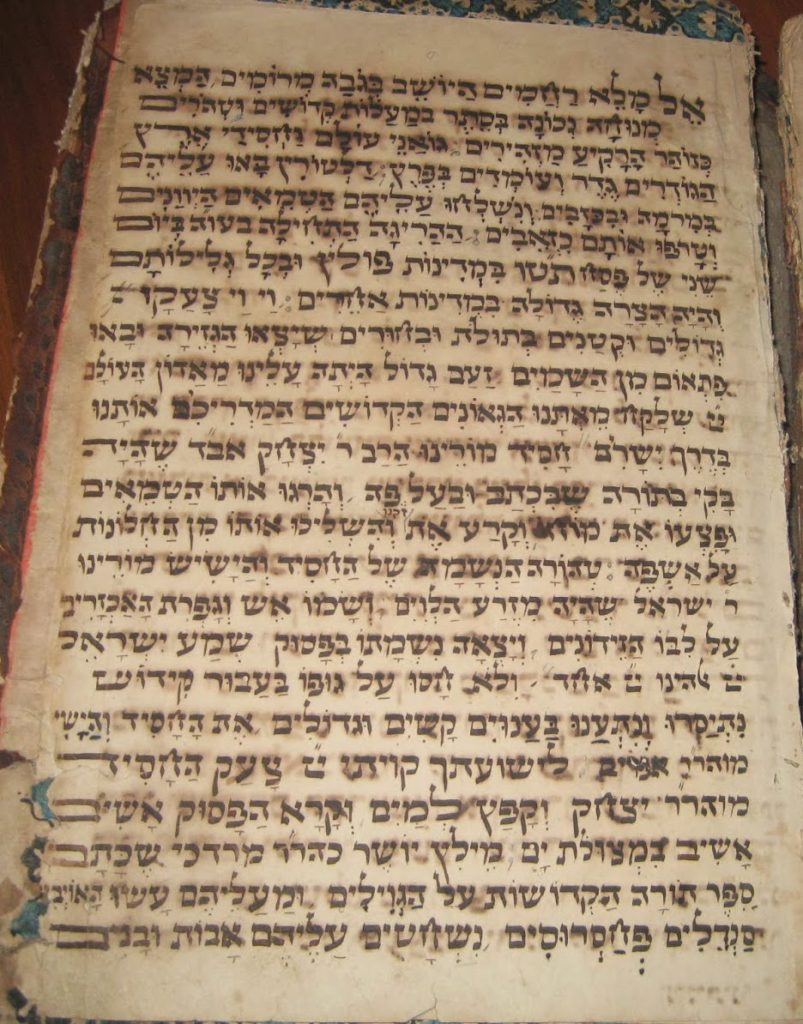
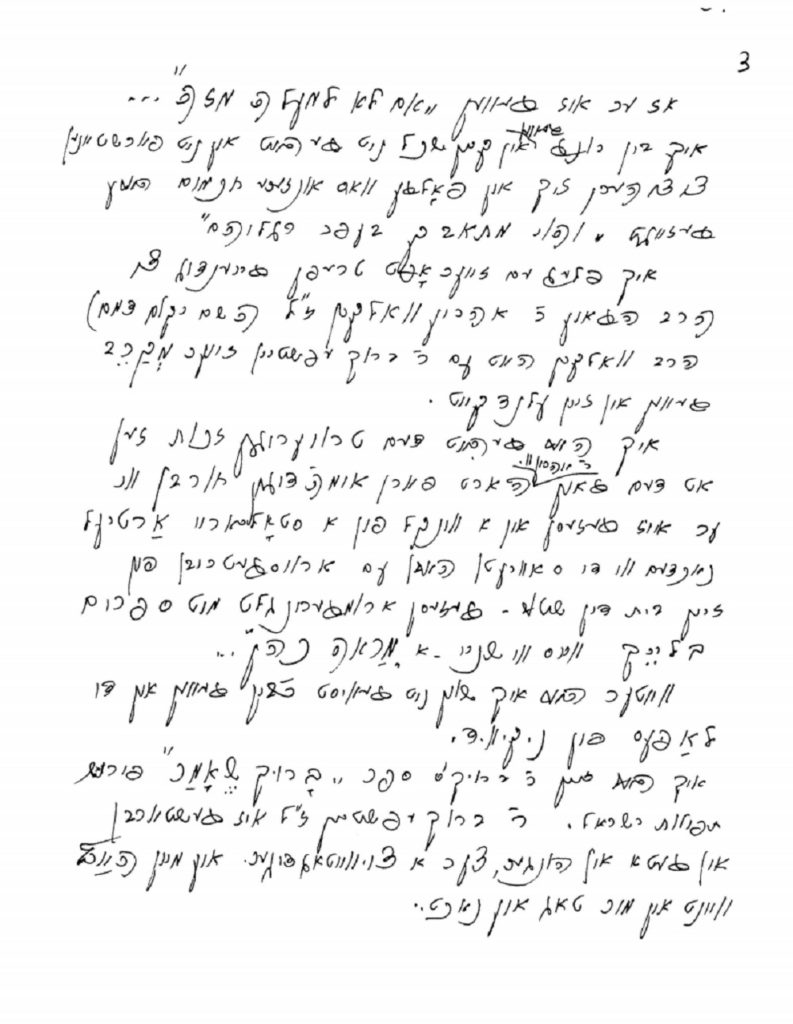
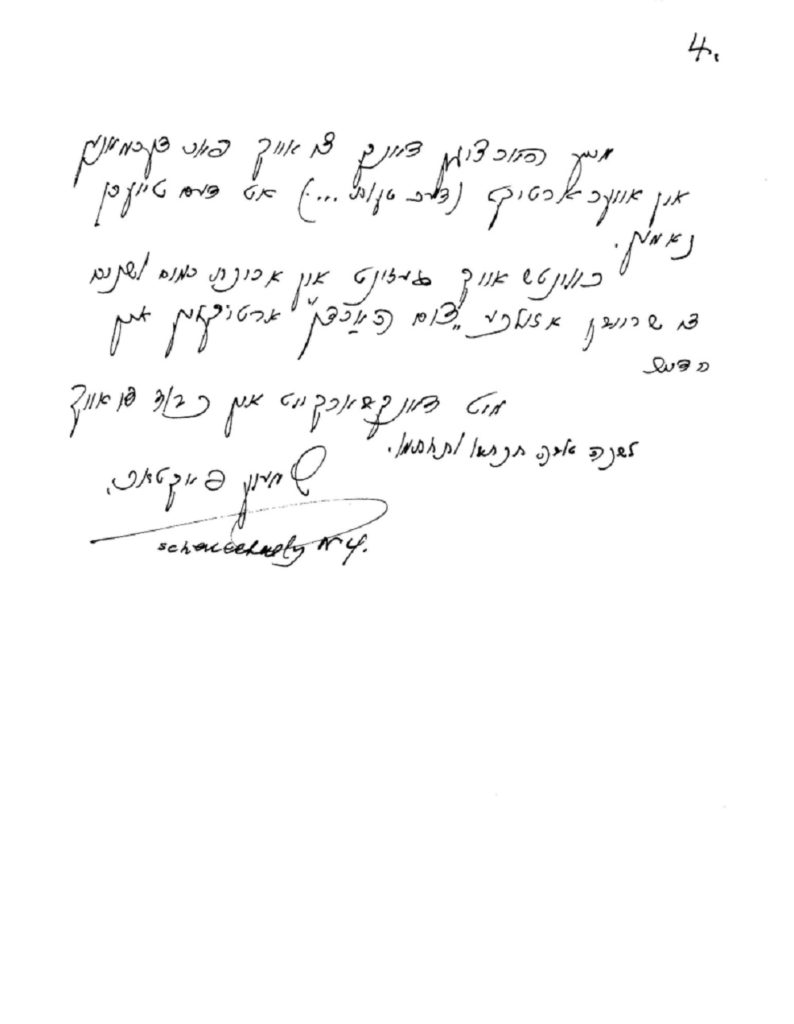
Additionally, some of the volumes contain important genological information (reproduced below – you can click for a larger image) on the Epstein family. For instance, as you can see below, Brina discussses the fact that (a) she is strapped for money and looking for someone to help defray the printing costs; and (b) that her son Dovid, died young in “New York, the Bronx, in America.” Further, she discusses her husband. Additionally, she notes that she has “published 15 volumes [of the Arukh HaShulhan] and four more volumes remain in manuscript.” Finally, she notes that there is a second volume of R. Epstein’s work, Or L’Yisharim which also remained in manuscript.


Critique of the Oz VeHadar Edition of the Arukh HaShulhan

In some of the recent posts we have discussed various new publications of Rabbi Yehiel Mihel Epstein, author of Arukh HaShulhan.

Recently, Makhon Oz VeHadar reprinted the Arukh HaShulhan, and that reprint has been the subject of some harsh criticisms. The critique points to two major problems. First, this edition includes the Piskei Mishnah Berurah which, in the reviewer’s mind, unconscionable. His reasoning is as the Arukh HaShulhan is a “piskei” work in its own right, there is no need to include the work of someone else as it undermines the force of the Arukh HaShulhan’s pesak.

Second, the review highights the biography which is included in the introduction. The reviewer demonstrates that much of this biography comes from two sources, R. Meir Bar-Ilan’s MiVolohzhin l’Yerushalim and R. Maimon’s Sa’are haMeah, neither of which are ever mentioned. R. Lior posits the reason for this exclusion is both of these works are “Zionist” works and thus can not even be cited by some.

Of course, this would not be the first time Oz VeHadar is guilty of such viewpoint censorship. As pointed out previously, another recent Oz VeHadar edition has similar flaws.

You can read the entire article here.


Self-Censorship in the Arukh ha-Shulhan, ArtScroll’s Latest Betrayal, and Other Assorted Comments

Self-Censorship in the Arukh ha-Shulhan, ArtScroll’s Latest Betrayal, and Other Assorted Comments
Marc B. Shapiro

1. R. Mordechai Rabinovitch has recently published the second volume of his commentary on the Arukh ha-Shulhan, dealing with the laws of Hanukkah. I strongly encourage anyone who prepares for the holiday by studying the halakhot in the Arukh ha-Shulhan to use R. Rabinovitch’s valuable work.
Interestingly, R. Rabinovitch vocalizes the work as Arokh ha-Shulhan. This is based on the fact that these words, with this vocalization, appear in Isaiah 21:5. Yet this is incorrect. As R. Eitam Henkin has pointed out, when the work was published by R. Epstein himself, the title in Russian also appeared on the binding. R. Epstein knew Russian very well, and the Russian reads “Arukh”. Henkin also notes that in the edition published in Vilna by his daughter, the title appeared in Latin letters. Once again we see that it was pronounced “Arukh”.[1] This latter point might have been known to some long-time readers of the Seforim Blog, as this page with the Latin letters was reproduced in this post from 2007. Here it is again.

The Arukh ha-Shulhan was the subject of a dispute between R. Shaul Yisraeli, a member of the Supreme Rabbinic Court (Beit Din ha-Gadol) and Menachem Elon, of the Israeli Supreme Court. The context was that France had requested that Israel extradite a criminal. Elon argued that this was permitted according to Jewish law. In support of this he cited Arukh ha-Shulhan 388:7, which states that there is no law of mesirah when dealing with a civilized government and legal system, such as in Czarist Russia[!] and England. Here is the text.

When challenged by R. Shaul Yisraeli that the text in the Arukh ha-Shulhan was written with an eye to the anti-Semitic government, Elon defended his position that the text is R. Epstein’s authentic opinion.[2] I don’t wish to get into this dispute at present,[3] and readers interested in the topic can consult R. Michael Broyde’s article “Informing on Others for Violating American Law: A Jewish Law View”, available here
R. Rabinovitch’s new commentary is also relevant to this debate, since he identifies examples of what he regards as self-censorship in the Arukh ha-Shulhan, and these are in areas not as potentially problematic as the halakhot dealing with mesirah. In his discussion of the Hanukkah story, Arukh ha-Shulhan 670:3, R. Epstein writes: שכשנכנסו אנשי אנטיוכס להיכל. Yet in the Talmud it states שכשנכנסו יוונים להיכל. R. Rabinovitch suggests that this is an example of self-censorship.[4] At first I thought that this was somewhat far fetched. I didn’t think that there was any reason to fear that government officials would be offended by a simple historical description that mentions the ancient Greeks. However, S. wrote to me as follows.

Yevanim was a particularly loaded term in Russia (for historical purposes this includes regions outside of Russia proper, like Ukraine), because Jews called the non-Jews Yevanim. They did so because many Ukrainians were of the Ukrainian Greek Catholic Church (the Russian Orthodox Church is an Eastern Orthodox Church and in that way ‘related’ to Greece as well). It is for this reason that Hanover called his account of the Khmelnitzky massacres Yeven Metzula, and refers to the Cossacks as yevanim – but we can see it from other sources, too. For example, see attached for a horrifying account of a massacre on the second day of Pesach 1655. You can see he calls the Cossacks yevanim (from here).

Supposedly it was also a play on the name Ivan, but I’m not sure if that’s just folk etymology. But more importantly, we can see that some works took it seriously and changed yevanim to something else, to avoid offending the censor. See here where changing yevanim to “yehirim” in Maoz Tzur was a somewhat common change.

And see here where it documents in the 1840s that Jews called the Russians yevanim  – and doubtless you can show it from many Yiddish sources, too. See here where I discuss how the Slavuta Talmud actually changes a gemara; “Rabbi said, why speak Syriac in Eretz Yisrael? Speak Hebrew or Greek!” to “Speak Hebrew or Akum!” 

So in my view the Arukh Ha-Shulchan definitely deliberately wrote Antiochos.

We can argue about whether this or that particular halakhah in the Arukh ha-Shulhan is an example of self-censorship, but there can be no doubt about the basic fact that R. Epstein did indeed censor himself for fear of the Czar. All one needs to do is see his fawning essay “Kevod Melekh”, at the beginning of Arukh ha-Shulhan, Hoshen Mishpat, to get a sense of the environment he had to operate in. In this essay he tells the reader how much the Jews love the Czar, and that is why they pray for him and his family every Shabbat and Yom Tov.
R. Eliyahu Zini,[5] whose books I hope to discuss in a future post, points to a clear example of the Arukh ha-Shulhan’s self-censorship in Orah Hayyim 329:9. There he writes:
לסטים שצרו על בתי ישראל אם באו על עסקי ממון . . . אבל אם באו על עסקי נפשות להרוג ולאבד או אפילו באו סתם והיינו שאין ידוע לנו על מה באו הוה ג”כ כבבירור על עסקי נפשות דסתם לסטים הם הורגי נפשות יוצאים עליהם בכלי זיין ומחללין עליהם את השבת ובזמן הקדמון בזמן שבהמ”ק היה קיים ובאו לעיר העומדת על הגבול. . . .
This halakhah is derived from Eruvin 45a, but in this text there is no mention of bandits – לסטים. Rather, the Talmud is speaking of non-Jews – נכרים (an alternate reading cited by Dikdukei Soferim is גוים). Secondly, there is nothing in the Talmud about the last halakhah I quoted only applying in the era when the Temple stood. These changes made by R. Epstein were due of fear of creating problems with the government. I think this is as clear as it can be, which makes it very surprising that R. Ovadiah Yosef took the Arukh ha-Shulhan at face value that the latter halakhah only applied in the days of the Temple. R. Ovadiah then points out that the Shulhan Arukh disagrees, seeing the halakhah as also applying in contemporary times.[6]

R. Zini cannot contain himself at this (mis)understanding of R. Ovadiah, and as he often does, he rejects R. Ovadiah’s point very strongly.[7]
ומי פתי הוא זה שלא יבין שבעל ערוך השלחן “צינזר את עצמו” מפחד הצאר, כפי שעשה בעשרות מקומות בספרו זה . . . ופלא נשגבה ממני איך הגר”ע יוסף שליט”א לא הבחין בכך?!
As mentioned already, the Talmud, Eruvin 45a, uses the word נכרים. This means non-Jews, and only non-Jews. Imagine my surprise, therefore, when I saw that the Soncino translation has the following: “If foreigners besieged Israelite towns.” Since there is no way that the translator, who was a learned man, could have made such a mistake, I can only assume that this translation was also designed to avoid any non-Jewish ill will.
Since the author of the Arukh ha-Shulhan, R. Jehiel Michel Epstein, was the brother-in-law of R. Naftali Zvi Judah Berlin, now is a good place to note the problem with one of the titles of R. Berlin’s works. His commentary to R. Ahai Gaon’s She’iltot is העמק שאלה. How should these words be pronounced? Some scholars write Ha-Amek She’alah, basing themselves on Isaiah 7:11. However, Gil S. Perl argues that the correct pronunciation is Ha-Amek She’elah. As he puts it, if the pronunciation in Isaiah was intended, “the title would mean ‘sink to the depths,’ the ‘depths’ (from the word she’ol) being a reference to the netherworld or Hell—a rather strange title for a work of halakhic commentary.” Perl therefore suggest that the Netziv “intended his title as a play on those words from Isaiah pronounced Ha’amek She’alah, meaning ‘delve into the question” or perhaps ‘delve into the She’ilta.’”[8]
Speaking of proper pronunciation of titles, ArtScroll might play a positive role in this. Since today so many people studying Talmud are using ArtScroll, they will see that the tractates are pronounced “Arachin”, not “Eruchin”, and “Horayos”, not “Horiyos”. So I hope that these yeshivish pronunciations will soon be a thing of the past, at least among English speakers, and if so this will be thanks to ArtScroll. Furthermore, since their edition of the Midrash Rabbah has started to appear people in yeshiva circles will begin to use it, and slowly the pronunciation “Medrish” may go by the wayside (at least we can hope so). Now if we could only rid people of the pronunciation “ikrim” instead of “ikarim”.
Having said all this, it is also the case that general convention can sometimes trump proper grammatical pronunciation. For example, take the words נודע ביהודה which appear Psalms 76:2. These words are pronounced Noda Bihudah, yet when referring to the book by this title the convention is to write Noda bi-Yehudah, even though this is not the correct pronunciation.
For those who want to see a bit of “Sephardic supremacy” when it comes to pronunciation, see this video where R. Ovadiah really lets the Ashkenazim have it.

Returning to the Arukh ha-Shulhan, its significance has declined in the last two generations. While figures such as R. Joseph Elijah Henkin, R. Moses Feinstein, and R. Yaakov Kamenetsky regarded the Arukh ha-Shulhan as more authoritative than the Mishnah Berurah,[9] not many poskim still have this perspective. Whereas the Arukh ha-Shulhan used to stand on its own, in our day we have seen the publication of an edition of the Arukh ha-Shulhan accompanied by the pesakim of the Mishnah Berurah, the point of which is to let the reader know that while one can study the Arukh ha-Shulhan as a theoretical work, when it comes to practical halakhah one must follow the Mishnah Berurah.[10]
The truth is that one can use the Arukh ha-Shulhan as a work of practical halakhah just like one can use the Mishnah Berurah. This reminds me of an experience I had many years ago when I believe I was still in high school. I was at a shiur where the rabbi was learning Mishnah Berurah. After reading one halakhah in the Mishnah Berurah he pointed out that “we don’t hold like this”. A member of the audience asked how one who learns the Mishnah Berurah by himself is supposed to know when that is the case, that is, when “we don’t hold” like it. The rabbi replied that this is why it is important to have a rav, so that you will know when we follow the Mishnah Berurah and when we don’t.
Even though I was quite young I thought that this was a mistaken reply, and the many years subsequent have not changed my mind. It is of course important to have a rav, but not for the reason the rabbi said. There is absolutely nothing wrong with someone learning the Mishnah Berurah (or Arukh ha-Shulhan) and following everything in it. One doesn’t need, and it would be an impossible task, to ask his rabbi about each and every halakhah if this is what “we follow”. One who lives in an Orthodox community will learn that sometimes the community practice is more lenient than what appears in these works, and sometimes it is more strict. It is in those circumstances that I think that one should consult one’s rav, and ask him if despite common practice it makes sense to be lenient in accord with either of these texts, or if one should be strict as recommended by either the Mishnah Berurah or Arukh ha-Shulhan even though the common practice is not like this. But as a general rule, and I have never had a teacher who thought otherwise, one can rely on either of these classic halakhic texts.
2. Many people were distressed to see the sources from great pre-modern poskim that spoke about all sorts of physical mutilation, including R. Asher ben Jehiel agreeing that an adulteress’ nose could be cut off. I have mentioned in the past, but it bears repeating here, that the various punishments seen were also found in the contemporary non-Jewish society.[11] I know this may be troubling to some readers, to see that leading rabbis had an approach to punishment that today people regard as barbaric. Yet there really is no alternative, as to a certain extent, every generation reflects the general values of society at large. Halakhah and Jewish thought are often likewise affected in this way. I have provided numerous examples of this throughout the years, so there is no need to go through it again.[12]
3. In a question “ripped from the headlines”, I was asked if I know of any past examples of someone secretly observing women in the mikveh. I don’t of any such cases, although in the anti-hasidic text Shever Posh’im[13] it quotes a hasidic author as follows:
ואני אומר דראוי לעמוד בשעת טבילה. ויאמין לי שפעם אחת עמדתי בעת שטבלה אשה אחת וראיתי באותו מקום ודי עלי כאוות ולא כלום. ולאחר שהלכתי משם שרי עלי קדושה גדולה.
I have never heard of such a mikveh, where men would bathe on one side and women immerse on the other. In fact, I wouldn’t pay this text any mind, since I find it hard to believe that anyone who examines the citations from the work, which are supposedly notes on the Tur, will not conclude that it is a forgery designed to make the Hasidim look bad.[14] There are so many outrageous things said in the text that nothing else makes sense. Did any hasid, even the most extreme, ever say that one who prays properly need not fast on Yom Kippur ?[15]
כתב הטור: יוה”כ אסור באכילה ושתי’. וכתב המין: ומי שיוכל לכוין בתפלה כתיקונה מותר בכל, ואין אכילה רק שיהא עם רוחניות ולא עם גשמיות כידוע ליודעי חן.
It is difficult even to record the following shocking text,[16] but we are not in the business of censorship here, and as mentioned, I have no doubt that this is a forgery.
כתב הטור: דבעל קרי מותר האידנא בתפילה . . . וה”ה אף להוציא זרע מחמת גודל החימום הק”ש והתפילה כי זהו העיקר לכבוד השי”ת, כידוע לחכמים השלימים.
Speaking of authentic texts, however, R. Joseph Hayyim does deal with a case of voyeurism and prescribes a teshuvah for this. I don’t want to get any more explicit, so for those who read Hebrew here is the text from Od Yosef Hai: Halakhot, parashat Shofetim, no. 51[17].

I am aware of only two times that a woman (other than one’s wife) can be seen without her clothes. One is the sotah, when her top is removed.[18] R. Judah states that if her breasts are attractive, they are not exposed,[19] but his opinion is not accepted. The other time is that the kohen must examine both men and women for tzara’at, and in both cases they are to be naked.[20]
As for the current controversy about whether dayanim need to see a female convert immerse, no one has yet referred to the following responsum from Kitvei R. Weinberg, vol. 1, no. 10. When I published this book I decided to have this short responsum translated from German, although I wasn’t sure if it was worth the trouble since all R. Weinberg was doing was repeating the halakhah as it appears in the Shulhan Arukh. Recent attempts to alter the traditional method of womens’ conversion, by arguing that the dayanim should not see the actual tevilah, show that even a simple responsum like this one can have value. I am very happy that it was translated and included in the sefer, so that it can now be part of the public conversation. 

Regarding the sources that have been cited in support of changing the traditional practice, no one has yet referred to a responsum by R. Isaac Herzog in which in the specific case he discusses (and I don’t think it can be used le-khathilah for other cases) he allows that only women see the tevilah.[21]
Also worth noting, even though in my opinion it has no halakhic significance, is Masekhet Gerim 1:4 which states:
האיש מטביל את האיש והאשה מטבלת את האשה
R. Hayyim Kanievsky points out, in his commentary ad loc., that this implies that men did not see any part of the immersion (unlike the current practice).
משמע שהאנשים לא יראוה כשהיא טובלת . . . משמע שאין רואין טבילתה רק הנשים.
R. Aryeh Leib Grossnass, Lev Aryeh, vol. 2, no. 11, argues that the beit din does not actually have to see the immersion in order for the conversion to be valid. It is this responsum that R. Moses Feinstein is responding to in Iggerot Moshe, Yoreh Deah vol. 2, no. 127.

S. also called my attention to this document from 1844 signed by Isaac Leeser and currently on auction at Sotheby’s (link). It records how the conversion of a girl was only witnessed by two women, not by the beit din.

4. Simcha Goldstein was kind enough to send me these pictures from a Passover Haggadah sent out to donors by Yeshiva Torah Vodaath. It hardly needs to be said that such pictures (check out how the women are dressed), not to mention the Zionist theme as a whole, would never appear today in anything sent out by this yeshiva. 

Regarding Yeshiva Torah Vodaath, in the book Mi-Pihem shel Rabbotenu (Bnei Brak, 2008), p. 49, there in an interview with R. Don Ungarischer who states that when R. Reuven Grozovsky came to the United States during World War II, Torah Vodaath was the only yeshiva in America. This is incorrect and I am not just referring to the existence of Yeshivat R. Yitzchak Elhanan or Beit ha-Midrash le-Torah in Chicago, as Yeshivat R. Chaim Berlin also existed during this period. 
5. The second volume of Haym Soloveitchik’s collected essays has just been published. This is a very important work, especially since nine of the essays have never before appeared in print. Among these newly published essays are those that put forth a new thesis about the origins of Ashkenazic religious culture. There is so much learning in this book, and it is written in such an engaging style, that anyone with an appreciation for the history of halakhah will be spellbound.
The essay “The ‘Third Yeshivah of Bavel’”, where Soloveitchik elaborates on his new thesis, is a particular favorite of mine. It could be that in the end the scholarly community will reject his position. Yet just to read how he develops his argument, and attempts to create an entirely new paradigm, is a treat. Here is one lengthy paragraph from the essay that I found quite significant (p. 161).
Shift back now to the mid-tenth century and the original characteristics of Ashkenaz. I have noted that the new settlers saw no difference between the aggadic sections of the Talmud and the halakhic ones and exegeted both in equal detail. We take this, too, for granted because we find a commentary on both sections on every printed page of the Talmud that we have seen since early youth. Think, however, what this entails lexically. The halakhic portions of the Talmud are strongly formulaic, as is any unpunctuated text. If one knows some thirty to forty idiomatic phrases in Jewish Babylonian Aramaic, most halakhic passages will pose few linguistic problems. (Understanding their legal content is a different matter.) However, the aggadic narratives entail a wide-ranging and detailed knowledge of the Aramaic language—all the terms of different household utensils, farm equipment, agricultural practices, domestic animals, flora and fauna, to mention just a few areas of life that are reflected in the narratives of the aggadeta. We are talking about a vocabulary of some 10,000-12000 words, if not more. (Actually, much more, as one should count meanings rather than words or roots [shorashim]. Most words have multiple meanings, and commanding a language means precisely controlling the numerous meanings of its words, as well as its idioms.) Unless these settlers had a vast dictionary, alongside which the Sefer he-Arukh would seem a Berlitz phrase book, and unless this enormous dictionary and even the memory of it got lost in the Mainz academy within one generation, we must conclude that these immigrant founders of Ashkenazic culture were Aramaic speakers. Precisely because Aramaic was their native tongue, they could readily undertake what the scholars of Kairouan, Fez, and Lucena (all native Arabic speakers) could only attempt with trepidation, namely, to exegete the entire Talmud, leaving no phrase, halakhic or aggadic, unexplained.
6. The most recent issue of Milin Havivin has appeared. My article “Torah im Derekh Eretz as a Means of Last Resort” can be seen here.
I also published a letter from R. Jehiel Jacob Weinberg and part of another letter he wrote.

These are important letters as they show R. Weinberg’s strong belief that in the modern world rabbis need to have a secular education in order to be effective. Those who read Hebrew will see very clearly where R. Weinberg stood on this issue, and that for all his love and respect for the haredi roshei yeshiva, intellectually and spiritually he was not part of their world.
7 Finally, we come to what I have termed ArtScroll’s latest betrayal. These are harsh words, but I believe them to be entirely justified. It is one thing to censor R. Zevin, or to cut out passages from other recent works. But to do this with rishonim is a completely different matter. After my book appears, I will discuss a number of examples of censorship that for one reason or another I did not include in the book, as well as examples that I only became aware of after the book was in press. However, this is such an important example that I did not want to wait. Its importance is such that I have no doubt that according to halakhah, anyone who demands a refund from ArtScroll is entitled to his money back, as what I will show you is nothing less than a betrayal not only of the reader, who paid good money to get what he thought was a complete mikraot gedolot chumash, but also of one of the greatest rishonim, R. Samuel ben Meir (Rashbam).

Soon after Rosh ha-Shanah 2014, ArtScroll released the first volume of its mikraot gedolot chumash. It is a beautifully typeset edition, completely punctuated. The response was so positive that within a month the volume was reprinted, and it would not be a surprise if the ArtScroll mikraot gedolot became the new standard.
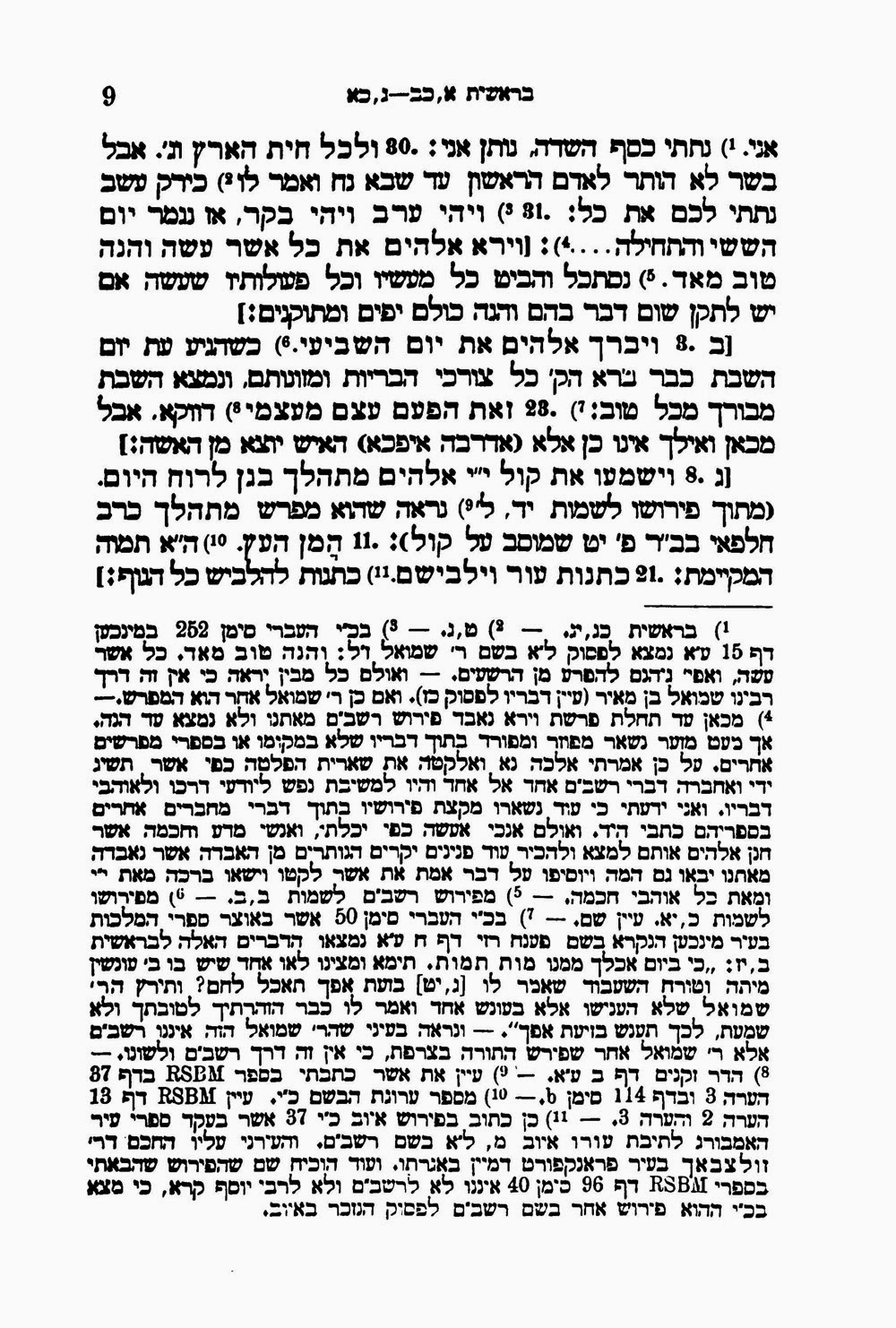
One of the new elements of this edition is that Rashbam to Genesis chapter 1 is included, which is not the case with the old mikraot gedolot chumashim. (It is found in the Mossad ha-Rav Kook Torat Hayyim mikraot gedolot). As you can see on this page, the Rashbam’s commentary is taken from the Rosin edition (which is where the commentary to Gen. ch. 1 first appeared).

In his commentary to chapter 1 Rashbam advances the notion that according to the peshat of the Torah, the day does not start in the evening, but in the morning. This is only one of many examples where Rashbam’s commentary explains biblical verses in accordance with the peshat, and in opposition to the rabbinic understanding. He even states that according to the peshat the commandment of tefillin in Exodus 13:9 is not to be understood literally.[22] Of course, Rashbam put on tefillin, but in this case he was only explaining what he thought the peshat was. Similarly, he began Shabbat in the evening, not in the morning, but this did not stop him from offering a peshat that differed from the halakhah.
For some reason, ArtScroll finds this difficult to take, and therefore decided to delete all of Rashbam’s “problematic” comments regarding the beginning and end of the day. I repeat, since I know this will be hard for people to believe: ArtScroll omitted portions of Rashbam’s commentary from its mikraot gedolot.

Here is Rashbam’s commentary on Gen. 1:4 and 1:5 in the Rosin edition.

Now look at ArtScroll’s version of Rashbam’s commentary to Gen. 1:4 and 1:5. Entire sections of his commentary to each of the verses have been omitted!

Here is Rashbam’s commentary to Gen. 1:8 in the Rosin edition.

Here is how the commentary to Gen. 1:8 appears in ArtScroll.

Again you can see that a section of the commentary has been deleted.
Here is Rashbam’s commentary to Gen. 1:31 in the Rosin edition.

ArtScroll completely omits this short comment.
It is not only in Genesis chapter 1 that Rashbam’s that has been tampered with. I only skimmed a few other places and I found the following problem with Gen. 49:16. The first words in ArtScroll’s version of Rashbam commentary are המפרש על שמשון.

Yet look at the Rosin edition where the first word is המפרשו.

Small emendations such as this are obviously not acceptable, but they are in an entirely different category than the censorship in Genesis chapter 1.
I also found problems with ArtScroll’s punctuation of Rashbam. For example, in his commentary to Gen. 37:2, which is one of his most famous passages, Rashbam states that he heard from his grandfather (Rashi) that if he had time he would write new commentaries לפי הפשטות המתחדשים בכל יום. The word הפשטות is to be vocalized as ha-peshatot, i.e., the plural of peshat. ArtScroll has the mistaken vocalization ha-pashtut. Later in this verse Rashbam writes (in the Rosin version) לפי דרך ארץ קורא אחיו. ArtScroll has קרא, changing the verb from participle to perfect. I have not gone through even one chapter of the book, comparing Rosin’s edition to ArtScroll (not to mention other commentaries). If I were to do so, I am sure many more such examples would be revealed.
This post does not need any long conclusion, as the evidence speaks for itself. I would only add that when modern publishers feel that they can start deleting commentaries of rishonim, then we have reached a new low. Will students of Torah, those who treasure the words of Rashbam, tolerate this betrayal? I think (hope) not, which is why it is imperative that in the next printing ArtScroll reinsert the words of Rashbam.

[1] “Sifrei Arukh ha-Shulhan – Seder Ketivatam ve-Hadpasatam,” Hitzei Giborim 7 (2014), p. 518.
[2] See Elon, “Dinei Hasgarah be-Mishpat Ivri,” Tehumin 8 (1987), pp. 263-286, id. “Bisus ha-Ma’arekhet ha-Mishpatit al Dinei ha-Torah,” ibid., pp. 304-309; R. Yisraeli, “Hasgarat Avaryan le-Shiput Zar,” ibid., pp. 386-297. (also found in Yisraeli, Havot Binyamin, no. 23). R. Eliezer Waldenberg agreed with Elon. See Tzitz Eliezer, vol. 19, no. 52 (end).
[3] Among those who agree with R. Yisraeli is R. Menasheh Klein, Mishneh Halakhot, vol. 17, no. 108. (Look who this responsum is addressed to.)

Since I just mentioned R. Klein, let me present another responsum of his, from 1987, which unlike the others he sent me was not included in Mishneh Halakhot. It is published here for the first time.

The reason he did not include it in his responsa was undoubtedly because the “letter” he disputes is by none other than R. Kook, and R. Klein did not want to be associated with R. Kook even if he disputes with him. That explains why he won’t even mention his name here. In fact, when R. Klein cites a book published by Mossad ha-Rav Kook, he simply writes הוצאת קוק. See Mishneh Halakhot, vol. 10, p. 382. See also vol. 8, p. 78 where he writes הוצאת רמב”ן קוק.
Here is the letter from R. Kook to which R. Klein is responding (Iggerot ha-Re’iyah, vol. 1, pp. 99-100).

[4] See also p. 20 n. 13, where R. Rabinovitch points to another example where he thinks that R. Epstein’s formulation was influenced by fear of the government.
[5] Eretz Hemdatenu (Haifa, n.d.), p. 139.
[6] Masa Ovadiah (Jerusalem, 2007), p. 341.
[7] Eretz Hemdatenu, p. 139.
[8] The Pillar of Volozhin (Boston, 2012),  pp. 17-18, n. 37. This too is perhaps not the best transliteration, as in most texts the ayin in העמק has a sheva. In a minority of texts it has a hataf patah.
[9] Regarding R. Henkin, see my post here.

After that post appeared a member of R. Moshe Feinstein’s family wrote to me as follows:

I spent a great deal of time learning with and talking to Reb Moshe, both on the East Side and in the mountains.  He unambiguously told me exactly what you quote from Rav Henkin.  He explained that the Aruch Hashulchan was a Rav, while the Mishna Berura was a Rosh Yeshiva, and the psak of a Rav is better authority.  Therefore, when he was unwilling to make his own determination, he would follow the AH over the MB.  I mentioned this story to Rabbi Dovid Zucker, Rosh Kollel of Kollel Zichron Shneur in Chicago, and he told me that he heard precisely the same thing from his Rebbi, Rav Yaakov Kaminetzki.

R. Yehudah Herzl Henkin wrote to me as follows:

I notice in Seforimblog from Jan. 26 ’08 that you quote R’ Ratzabi, concerning the superiority of MB [Mishnah Berurah] over AH [Arukh ha-Shulhan], as stating  that the CI [Chazon Ish] wrote that MB is ‘like the Sanhedrin.’ He is undoubtedly referring to Igrot CI pt. 2 no. 41 which is widely misquoted in this regard. The CI says only that a ruling of the Bet Yosef and MA and MB all together– and that no one disagrees with– is like a ruling of the Sanhedrin, ayen sham. (The CI could hardly have thought that MB alone is like the Sanhedrin, as he disagrees with him in practice dozens of times.) By coincidence, I wrote this in Hatzofeh on Feb. 8 ’08. Incidentally,  R’ Menashe Klein, in comments in BB [Bnei Banim] vol.1 p. 225, attributed the popularity of MB almost to a bat kol. I expressed my surprise. Later when he reprinted his comments in Mishne Halachot he omitted the term.

[10] See R. Eitam Henkin’s (unsigned) review of this edition in Alonei Mamre 120 (2007), pp. 119-124. The Hafetz Hayyim was aware of the fact that the popularity of the Mishnah Berurah led to a decline in study of the Magen Avraham. See Meir Einei Yisrael (Bnei Brak, 2004), vol. 5, p. 403.
[11] One reader called my attention to Tory Vandeventer Pearman, Women and Disability in Medieval Literature (New York, 2010), p. 80, who discusses how cutting off the nose of an adulterous woman was a common punishment and parallel to male castration. R. Menachem Sheinkopf reminded me of Hut ha-Meshulash (Munkacs, 1984), p. 38a, which records how the Hatam Sofer in his youth witnessed the sentencing to death of an informer. This text was deleted from the next edition of Hut ha-Meshulash. See Meir Hildesheimer, “The Attitude of the Hatam Sofer toward Moses Mendelssohn,” PAAJR 60 (1994), p. 155 n. 50. It is also reported that as a youth, the Hatam Sofer personally killed an anti-Semite. See Siah Sarfei Kodesh (Bnei Brak, 1989), vol. 4, p. 154. (I don’t think that this report has any substance).
[12] One example I have often given to illustrate this was that today every rabbi will be happy to speak about how Judaism opposes slavery, and that the slavery mentioned in the Torah was far removed from the slavery in pre-Civil War days. Yet two hundred years ago, plenty of rabbis would have found nothing objectionable with Southern slavery. (When I write “every rabbi” in the first sentence of this note, it is an exaggeration. See my post here. See also R. Avigdor Miller, Q&A, vol. 2, p. 12, that it was a mistake for Lincoln to free the slaves, as they could have used another 50 or 100 years of slavery in order to “civilize” them.)
[13] Published in Mordechai Wilensky, ed., Hasidim u-Mitnagdim (Jerusalem, 1970), vol.. 2 p. 117. This strange passage is mentioned by David Biale, Eros and the Jews (Berkeley, 1997), p. 125.
[14] Wilensky leaned in this direction, see ibid., p. 112.
[15] Ibid., p. 120.
[16] Ibid., p. 119.
[17] (Jerusalem, 1910), p. 51b (second pagination)
[18] Mishnah, Sotah  1:5.
[19] Ibid. Although the Mishnah states אם היה לבה נאה this is obviously a euphemism for breasts. As is to be expected, R. Jacob Emden, Lehem Shamayim, ad loc., has something to say on this passage. How does the kohen know that she has attractive breasts, to know whether or not they can be revealed? Emden states that he heard as much from her husband. But this answer does not satisfy him, for סתם אשה כל יופי שלה שם הוא. As support for this notion, he cites Berakhot 10b שאחזה בהוד יפיה, which Rashi explains to mean “breasts” If he was more of a fan of the Zohar perhaps he would have cited Zohar, Bereshit 45a: ושפירו דאתתא באינון שדים . Zohar, Shemot 80b, states
ר’ אבא פתח (שיר השירים, ח,ח) אחות לנו קטנה ושדים אין לה מה נעשה לאחותנו ביום שידובר בה. אחות לנו קטנה דא כנסת ישראל דאקרי אחות לקב”ה. ושדים אין לה היינו דתנינן בשעתא דקריבו ישראל לטורא דסיני לא הוה בהון זכוון ועובדין טבין לאגנא עלייהו דכתיב ושדים אין לה דהא אינון תקונא ושפירו דאתתא ולית שפירו דאתתא אלא אינון
See also R. Yitzhak Ratsaby, Olat Yitzhak, vol. 2, p. 390. The second quote from the Zohar shows the importance of understanding the literal meaning of Song of Songs in order to appreciate the allegory.
[20] See Mishneh Torah, Tum’at Tzara’at 9:12.
[21] Pesakim u-Khetavim, Yoreh Deah no. 99 (p. 327). On this page R. Herzog also states we should require all ba’alei teshuvah, especially public Sabbath violators, to immerse themselves in the mikveh. This is the upshot of the Vilna Gaon’s comment to Shulhan ArukhYoreh Deah 268:30.
[22] Commentary to Ex. 13:9.


Yom Tov Sheni and the Customs With Regard to Travelers

Yom Tov Sheni and the Customs With Regard to Travelers
By J. Jean Ajdler
J. Jean Ajdler of Brussels, Belgium, is a civil and structural engineer. He has published articles about medieval Jewish astronomy, the history of the Jewish calendar, and Talmudic metrology, and is the author of Hilkhot Kiddush ha-Hodesh al-pi ha-Rambam (Jerusalem: Sifriati, 1996).
This is his first contribution to the Seforim blog.
Abstract: In ancient times the customs of the communities were extremely variable the one from the other. Each community had its own customs and it was very jealous of them. Therefore very precise rules ensured the equilibrium between them at the level of the travelers between these communities. The introduction of the printing with the publication of the Shulhan Arukh in the sixteenth century constituted the globalization of the Jewish society and contributed to the standardization of the Jewish rules and customs and the progressive disappearing of the local minhagim. However one great difference between Israel and the Diaspora survived; Israel keeps only one festival day while the Diaspora keeps two festival days. It is today the greatest difference of custom still extant and the dramatic increase of travel has given more acuteness to the problem. The aim of this article is the examination of the rules of priority of the customs in general, and that of the second festival day in particular, at the level of the travelers. We first examine the general problem of the minhagim: we examine the Talmudic sources and their understanding and the consecutive rulings. We acknowledge a great confusion in the understanding of the reference texts and a great diversity in the rulings.
Afterwards we examine the problem of the second festival days with regard to the travelers. In the case of the travelers from Israel to the Diaspora the divergences remain restricted. The Israelis traveling abroad do not keep two festival days but they may not distinguish themselves from the local Jews. The problems still today under discussion are whether the Israelis traveling abroad are allowed to perform work secretly, how they should behave outside a Jewish settlement, how long and under which conditions they can take advantage of their quality of Israelis. As for the travelers from the Diaspora to Israel, It seems even likely that the problem was not grappled with in the Talmud. There is a great confusion among the rulers: the overwhelming majority ruled that the travelers behave completely like in the Diaspora, some ruled that the travelers behave completely like Israelis and some ruled that they should adopt the severity of the two first opinions. We show that the first opinion has also weak points and is not better justified than the two others so that the problem remains theoretically open.
I. Introduction.
Yom Tov sheni shel Galluyyot was definitively instituted in about 325 when the Palestinian rabbis, probably under the leadership of Rabbi Yosi, began to send to Egypt and Babylonia, in advance, the data of the coming year. But at the same time, they invited them to go on keeping two festival days, in order to be able to react in the case of a disruption of the communication of the calendar data. There is much discussion in the rabbinic literature about the status of the second festival day. According to one opinion, the second festival day has the status of a minhag i.e. a custom. It is even an important minhag;[1] the violator of the second festival day is punished by beating or excommunication by contrast with the violator of a plain minhag.
The institution of the second festival day is characterized by the recitation of the Hallel and of all the benedictions, including the Sheheheyanu, exactly as on the first festival day, although one does generally not recite a benediction on a minhag.[2]
According to a second opinion the observance of the second festival day is the result of a takana obliging us to go on keeping the second festival day as if we were still doubting, as it was the case when the Babylonians did not yet know the fixing of the month.
However the application and extension clauses of the second festival day seem to work like a minhag.
If we paraphrase R’ Solomon Meiri, we can say that yom tov sheni shel galluyyot is a
מנהג דרך תקנה, it is a minhag which was introduced through a formal takana, in other words it is a minhag which was upgraded to the status of a takana. The takana is thus to go on keeping the former minhag.
The difficulty of giving a precise juridical status to the second festival day is probably the origin of the great confusion existing in the application of the rules of the second festival day by the travelers between Israel and the Diaspora and vice versa.
This confusion is still increased by the divergences between the rulers about the laws of the observance of the minhag by the travelers. If it were a pure takana to keep a second festival day outside of Israel, then the observance of this second day would depend only on the geographical localization of the person. As mentioned above the rules of yom tov sheni work also like a minhag and its obligations, as for a minhag, seem more to be “personal obligations” or חובת גברא which follow the travelers in their travels through the customs.
A third element could interfere with the issue. The takana instituting the second festival day was sent to Babylonia and was accompanied by a justificatory message. Indeed we find in the next quotation from B. Beitsah 4b:
והשתא דידעינן בקביע דירחא מאי טעמא עבדינן תרי יומי, דשלחו מתם, הזהרו במנהג אבותיכם בידכם, זמנין דגזרו המלכות גזירה ואתי לאקלקולי.
And now, when we know the fixing of the moon, why are we observing two festival days? Because they sent from Palestine the following order: be careful to maintain the practice of your late parents. It could once happen that the authority enacts [unfair] laws [again the Jews] and you could be wrong [if you observe only one day].
It is thus possible that this message was intended for people living abroad exclusively while people traveling from Babylonia to Israel were perhaps excluded from the beginning on. Indeed there was no danger of disruption of the communications and the information about the calendar for people traveling in Israel. It is thus not certain at all that the takana instituting the second festival day was intended for those people traveling to Israel and staying temporarily during the festival.[3]
Finally it must be noted that the rabbinic thought was much influences by the position of Maimonides’ ruling that the obligation of keeping two festival days does not depend on the distance from Jerusalem nor from the position of the place in Israel or abroad but it depends only on the exact situation which prevailed at the examined place at the time of the messengers, whether the messengers came along at this place or not. According to Maimonides and some other authorities, in most modern settlements in Israel one should keep two festival days. Therefore, according to these authorities, the obligation of keeping two festival days is not restricted to the Diaspora.
We know also from R’ Estori ha-Farhi (Kaftor va-Ferah chap. 51) that during the fourteenth century the rule was according to Maimonides and therefore they kept two festival days in Ramla but in the neighboring Lod they kept only one festival day.
In B. Pesahim 51b the travel of Rav Safra from Israel to Babylonia was detailed directly after the study of the problem of the traveler between two places having different minhagim. Visibly the Talmud considers that there is a profound analogy between keeping the second festival when traveling from Israel to Babylonia and traveling from a town where they do work on the morning of the 14th of Nissan to a place where they don’t. By contrast we don’t find in the Talmud any evidence about the converse situation of a traveler coming from abroad to Israel. However the overwhelming majority of the rulers considered that the problem of the keeping of the second festival day by the travelers between Israel and the Diaspora and vice versa must be deduced from the rules applicable to the travelers between two towns with different positions about the minhag of working on the morning of the 14th of Nissan. Therefore, in a first stage we will examine thoroughly how the traveler must behave with regard of the minhag during his travels.
II. The Minhag and the Travelers.
A. Talmudic references.
The problem of the minhag and the travelers is raised in many quotations in the Talmud.
1. Mishna Pesahim IV: 1.
Where it is the custom to do work on the eve of Passover until midday [like in the Province of Judah], one may do [work]; where it is the custom not to do [work, like in the Province of Galil], one may not do [work]. He who goes from a place where they work to a place where they do not work, or from a place where they do not work to a place where they do work, we lay upon him the restrictions of the place from where he departed and the restrictions of the place where he has gone; and a man must not act differently [from local custom] on account of the quarrels [which would ensue]
2. B. Pesahim 51a.
When Rabbah bar Bar Hannah came [from Palestine to Babylonia] he ate of the stomach fat. Now Rav Awira the Elder and Rabbah son of Rav Huna visited him; as soon as he saw them he covered it [the fat] from them. When they narrated it to Abaye he said to them “he has treated you as Cutheans.” But does not Rabbah bar Bar Hannah agree with what we learned: “we lay upon him the restrictions of the place from where he departed and the restrictions of the place where he has gone”?
Said Abaye: That is only [when he goes] from [one town] in Babylonia to [another] in Babylonia, or from [a town] in Palestine to [another in] Palestine, or from [a town in Babylonia to [another in] Palestine; but not [when he goes] from a place in Palestine to [another] in Babylonia, [for] since we submit to them [and accept their jurisdiction] we do as they. Rav Ashi said: you may even say [that this holds good when a man goes] from Palestine to Babylonia; this is however where it is not his intention to return, but Rabbah bar Bar Hannah had the intention of returning.
3. B. Pesahim 51b.
Rav Safra said to Rabbi Abba: for instance I, who know the fixing of the month, in inhabitated places I do not work [when I happen to be in Babylonia] because it is a change [which would lead to] strife. How is it in the wilderness? – Said he to him: thus did Rabbi Ammi say: in inhabited regions [of Babylonia] it is forbidden; in the desert it is permitted.[4]
4. B. Hulin 18b.
When Rabbi Zeira went up [to Palestine] he ate there an animal [which was slaughtered in that part of the throat] which was regarded as a deflection by Rav and Samuel.
But does not Rabbi Zeira accept the rule: [when a person arrives in a town] he must adopt the restrictions of the place which he has left and also the restrictions of the place he has entered? – This rule applies only when one travels from town to town in Babylonia or from town to town in the land of Israel, or from the land of Israel to Babylonia; but when one travels from Babylonia to the land of Israel, inasmuch as we are subject to their authority, we must adopt their customs. Rav Ashi said: you may even hold that the rule applies when one travels from Babylonia to the land of Israel, but only when this person intends to return. Rabbi Zera, however, had no intention to return to Babylonia.
5. B. Hulin 110a.
Rami bar Tamri, also known as Rami bar Dikuli, of Pumbeditha, once happened to be in Sura on the eve of the Day of Atonement. When the townspeople took all the udders [of the animals] and threw them away, he immediately went and collected them and ate them. He was then brought before Rav Hisda who said to him: why did you do it? He replied, “I come from the place of Rav Judah who permits it to be eaten.” Said Rav Hisda to him,” But do you not accept the rule: [when a person arrives in a town] he must adopt the restrictions of the town he has left and also the restrictions of the town he has entered.” He replied, “I ate them outside the [city’s] boundary.”
B. The Exegesis of the Mishna.
At the first glance the meaning of the Mishna is evident. There is however a great confusion in the understanding of this Mishna. The great difficulty results from the existence in the Mishna of divergent impositions: laying upon the traveler the restrictions of the place from where he departed and the restrictions of the place where he has gone.
The problem is to decide whether these two impositions must be considered separately, in different situations, whether the one or the other, but not both together or if they must be considered together because they play simultaneously. In this last contingency, we must find genuine situations where both impositions can work together.
1. The understanding of Maimonides (Rambam Hilkhot Yom Tov VIII: 20),[5] R’ Nissim Gerondi (Ran) (Rif Pesahim 17a: .רבה בר בר חנה), R’ Ovadiah of Bertinoro (commentary on Mishna Pesahim IV: 1) and R’ Isaac bar Sheshet Perfet (Ribash no. 44).
The Mishna speaks about a traveler who does not intend to settle and who will go back to his place of origin. We lay upon the traveler the restrictions of his place of origin when he goes from a place where they do not work to a place where they work. Conversely we lay upon the traveler the restrictions of the place where he has gone when he goes from a place where they do work to a place where they don’t. By contrast if the traveler intends to settle at the new place he adopts the customs of the new place whether these customs are more restrictive or less restrictive. As for the consideration about the necessity that a man must not act differently than the local customs, Abaye considers that this consideration is related to the first case, when the traveler goes from a place where they do work to a place where they do not in order to avoid disputes. By contrast when the traveler goes from a place where they do not work to a place where they do, he really singularizes himself by not working. Rava said that this consideration can also apply to the second case, when the traveler walks from a place where they do not work to a place where they work. Indeed when a tourist walks and does not work and even if the countrymen walk and do not work it is not a singularity.[6] According to this explanation the two contradictory impositions do not work together, they work separately in different situations.
2. The understanding of Tossafot (B. Pesahim 51a רבה בר בר חנה and B. Hulin 18b הני מילי.), Tur (Orah Hayim 468:4) and R’ Jonathan ha-Kohen of Lunel (Rashba I:337).
The Mishna must be considered as taught in different cases:[7]
n When the traveler does not intend to settle and will go back home, we lay upon him the restrictions of the place from where he departed.
n When the traveler intends to settle at the new place, we lay upon him the restrictions of the place where he has gone.
3. The Provencal understanding (Meiri [Beit ha-Bekhira on B. Hulin 18b and on B. Pesahim 51a and b], Kolbo [end of the laws of Hamets and Matsah] and Orhot Hayim) or the introduction of an intermediate case.
n When the traveler intends to settle at the new place, we lay upon him the restrictions of the place where he has gone.
n When the traveler intends to go back home immediately,[8] he behaves according to the customs of the place from where he departed. But he is not allowed to behave according to the less restrictive customs of the place from where he departed before people who are not scholars.
n When the traveler intends to go back home later,[9] then he must behave according to the restrictions of both places; the place from where he departed and the place where he is now staying temporarily.
Meiri writes that this is his opinion and this was also the ruling of his teachers. He found afterwards that Rabad referred to this explanation. He writes also that there are other explanations and even reasoning that the right mind cannot endure.
Thus the Mishna, which speaks of both the restrictions of the place from where the traveler departed and the place where the travelers stays provisory, corresponds to the case of a traveler who intends to go back home after a certain delay (according to Meiri: thirty days). This explanation allows solving the apparent contradiction between Rav Ashi in the quotations 2 and 4. In quotation 2, Rav Ashi understands that the Mishna refers to a case when the traveler does not intend to return home. In quotation 4, Rav Ashi understands that the Mishna refers to a case when the traveler does intend to return home. In fact in both cases the traveler intends to go back home later, after a delay (of more than thirty days). In quotation 2 this situation is considered as if he does not intend to go back home with regard of going back home immediately. In quotation 4, the same situation, going back home after thirty days, is considered as intending to go back home with regard of settling in the new place.
4. There are other explanations of the Mishna but these explanations consider particular situations like going from a place in Babylonia to a place in Palestine or vice versa. These solutions seem farfetched because the Mishna seems to be general and not restricted to very special cases.[10]
C. The ruling of Maimonides (Hilkhot Yom Tov VIII: 20).
The ruling of Maimonides has been at the origin of many discussions about its true meaning.
He who goes from a place where they work to a place where they do not work should not work in a Jewish settlement because of the fear of quarrels but he is allowed to work in the desert. He who goes from a place where they do not work to a place where they do work should not work. We lay upon him the restrictions of the place from where he departed and the restrictions of the place where he has gone. However he should not appear in front of them as if he is idle because of the interdiction to work. A man must never act differently [from local custom] on account of the quarrels [which would ensue].
And similarly he who intends to come back to his place of departure, behaves according to the customs of his place, whether they are more or less severe than the local customs, yet at the condition that he does not do it in front of the local people on account of the quarrels.
This passage is constituted by two different parts. The first part is the transcription of the Mishna Pesahim IV:1[11] slightly adapted by the introduction of the concepts of settlement and desert which correspond to the influence of the passage about the query of Rav Safra in B. Pesahim. The second part seems similar but it presents differences. The two parts are connected by a coordination conjunction וכן מי that we translated by “and similarly.” The challenge is to explain these two passages and their coordination in the respect of all the Talmudic quotations.
This coordination conjunction means at the first glance “and similarly he who…” But its meaning was fiercely disputed. The use of a computer program shows that Maimonides used this conjunctionוכן מי 62 times in the Hibbur. It is used to connect two passages when the second corresponds to a case leading to a similar, but not necessarily identical, conclusion as in the first passage. He used also וכן כל מי three times but the first passage begins one time also by כל. Anyhow the two expressions seem to have the same signification. When there is no similitude but a real opposition between the two cases Maimonides uses the conjunction אבל מי (36 times in the Hibbur). Therefore the plain explanation of this quotation is to consider that both passages are parallel and deal with the case of the traveler who intends coming back home and not settling in the new place.
1. The Plain Understanding:
In the first passage we deal with working on the morning of the 14th of Nissan. Apparently working is a special activity that cannot be performed discretely and therefore it is absolutely forbidden. The second passage deals with other customs in general which can be hidden and performed discretely. The difficulty is that Maimonides must choose between the two contradictory statements of Rav Ashi; he accepts the statement of Rav Ashi in B. Hulin 18b that the Mishna refers to a traveler who wants to go back to the place from where he came and, although he rules like Rabba bar Bar Hanna he must reject the statement of Rav Ashi in B. Pesahim 51a; this remains also a difficulty. (Maimonides rules like Rabba bar Bar Hanna but rejecting the answer of Rav Ashi, he has no answer to the objection of the Talmud.) The great commentator R’ Nissim on Rif (Rif 17b entry רבה), and R’ Isaac bar Sheshet (Teshuvot, no. 44) understood the Talmudic passages according to this understanding, giving precedence to the statement of Rav Ashi in Hulin 18b. Among later authorities Magen Avraham, Ba’er Heitev, Be’er ha-Gola and Mishna Berura adopted the same understanding of this quotation of Maimonides, recopied in Shulhan Arukh, Orah Hayim 468:4.
2. The Second Understanding:
A second understanding, at the first glance surprising, is to consider that the first passage and, necessarily, the Mishna deals with someone who will settle in the new place and not come back. By contrast the second passage deals with a traveler who will come back to the place from where he came. The consequences of this understanding are surprising and moreover not accepted by the halakha. Indeed, according to the first passage people settling in a new place must behold the customs of their place of origin all their life.[12] A consequence of this ruling would be that people coming from the Diaspora and settling in Israel would be obliged to go on keeping two festival days all their life. Conversely people coming from Israel with the intention to settle abroad would be allowed to perform work on the second festival day before reaching a Jewish settlement.[13]
This understanding was first championed by the Maggid Mishneh who considered that the first passage correspond to the case when the traveler wants to settle without the intention to come back. He must give the precedence to the statement of Rav Ashi in Pesahim 51a and reject the statement of Rav Ashi in Hulin 18b. This position was followed by Gra, Hok Yakov, Shakh (on Yoreh Deah 214) and Peri Hadash in their commentaries of Maimonides’ quotation in Shulhan Arukh Orah Hayim 468:4.
D. The ruling of Meiri, Orhot Hayim and Kolbo.
Their ruling is consistent with the Provencal understanding explained above, introducing a third intermediate case. It is important because it was influential. R’ David ibn Abi Zimra ruled according to this opinion in a responsum (Radvaz IV: 73 also called no. 1145) about the travelers from Palestine to Egypt.[14] It was for him the only manner to solve the contradiction between the two statements of Rav Ashi in B. Hulin 18b and B. Pesahim 51a.
In this responsum Radvaz distinguished three cases:
n Going back immediately.
n Going back later.
n Settling definitively.
R’ Joseh Karo copied this ruling of Orhot Hayim in Beit Yoseph (Tur Orah Hayim 496) and abridged it Shulhan Arukh, Orah Hayim 496:3.
E. The Ruling of Tur.
His ruling is consistent with the ruling of Maimonides according to its plain understanding (opinion 1).
F. The Ruling of R’ Yoseph Karo in Shulhan Arukh.
Shulhan Arukh raised the issue at four different places.[15] Of special interest is the ruling of Orah Hayim 468:4, where he recopied the text of Maimonides (Hilkhot Yom Tov VIII:20, mentioned above), which seems to contradict the other rulings and more specifically Orah Hayim 496:3. It is accepted that the ruling of O.H. 468:4 is an abridged version of the original text of Orhot Hayim. We are dealing in this chapter with working on the morning of the 14th of Nisan and therefore the abridgment of the text of Orhot Hayim makes sense because it is forbidden to perform work whether the travelers comes back immediately or later. Therefore the text mentions only two cases, settling in the new place or going back to the first place without making the difference between going back immediately or later. But finally he never mentioned clearly in Shulhan Arukh the existence of three cases so that the doubt subsists about his definitive ruling; does he rule like Orhot Hayim, which he copied in Beit Yoseph O.H. 496 or does he rule like Tur and Maimonides (opinion 1)? Similarly the commentators differed about the meaning of the ruling of Orah Hayim 468:4 where he copied Maimonides.[16]
Anyhow the position of R’ Karo in Shulhan Arukh is problematic because he quoted two contradictory passages of two different authors.[17]
III. The Second Festival Day and the Traveler Going from Palestine to the Babylonia:
The quotation in B. Pesahim 51a about Rav Safra is generally considered as referring to his travel from Palestine to Babylonia. This is indeed the only plausible manner to understand how Rav Safra knew the fixing of the month before undertaking his travel.[18] Furthermore he asked his query to Rabbi Abba, a Palestinian Amora; this could only be before his undertaking of a travel to Babylonia.
There is a great unanimity between the rulers that in the direction Palestine-Diaspora, the obligation of keeping the second festival day is a personal obligation. Therefore Palestinians traveling to the Diaspora are not subjected to the obligation of the second festival day. However they are forbidden to perform work[19] on the second festival day when they are in a Jewish settlement. Outside of the techum around the town of this Jewish settlement they are allowed to perform work.[20]
Nowadays the dramatic increase of the travels is the cause of new responsa about the behavior of Israelis abroad. Because of the modern social conditions, with Israelis on mission abroad for one or even many years can prevail themselves of their status of Israelis, the tendency is to lengthen the delay allowing to prevail of the status of Israelis and even to be lenient about the interdiction of performing work discretely. However the rulers do not put at all the emphasis on the absolute necessity for Israelis abroad to behave officially as if they kept two festival days, as it is strictly required by the halakha. In weak communities, where a part of the attendance of the festival office is composed by Israelis (teachers and member of the Israeli mission), their absence at the offices on the second festival day is a very detrimental singularity. The danger is not anymore a possibility of dispute; it is the whole institution of Yom Tov Sheni which they endanger.
IV. The Second Day Festival and the Traveler Going from Babylonia to Palestine:
It is generally considered that this case was not considered in the Talmud and therefore we have not a model case which could allow solving the problem from the first source. However two important Rishonim have understood that the passage about the travel of Rav Safra in B. Pesahim 51a refers to a travel from Babylonia to Palestine.[21]
A. Foreigners Traveling to Israel Behave as in the Diaspora and keep two festival days.
The overwhelming majority of the rabbis compared the problem of the second festival day by the visitors of the Diaspora traveling in Israel to that of the observance of divergent minhagim between two different places. In responsa Yabi’a Omer VI: 40, we find an exhaustive enumeration of the main rulers championing this opinion. This approach considers that the foreigners keep two festival days abroad while Israelis keep one festival day in Israel. The case of the foreigners on a visit to Israel is solved according to the rules of the precedence of the minhagim. In other words, it seems that this particular problem had not been solved by the order sent from Israel to the Diaspora to go on keeping two festival days. In fact this comparison is strange because the status of the second festival day is certainly higher than a minhag like working on the morning of the 14th of Nissan, it seems more comparable to working on the same day after noon. Furthermore, if the behavior of the foreigners on a visit in Israel is regulated by the rule of the precedence of the minhagim, of rabbinic order, we can object that the positive obligation of tefilin of Torah order should have the precedence on this rule of rabbinic order.[22]
Therefore the responsum written on this issue by R’ Moses Feinstein shows originality and distinguishes itself from the others. He accepts the principle that during the period of the observation calendar, a foreigner visiting in Palestine had no doubt any more in the whole Diaspora about the true festival day and kept only one festival day. Now he says, after the institution of the second festival day, we have no more any doubt about the true festival day and we must however keep the second festival day although we know that it is a weekday. This obligation is personal and not territorial, there is no difference whether the foreigner is abroad or on a visit in Israel. As today we know all the fixing of the month, there is no more difference between Israel and abroad as it was the case before the institution of the second festival day.
In other words, according to this responsum, the obligation for the foreigner visiting in Israel, to keep two festival days derives directly from the order sent to the Diaspora, to go on keeping the customs of their elders and observing two festival days. Therefore the obligation is of the same nature than that of the foreigners living abroad and this explains why there are exempted from tefilin on this second festival day. The consequence of this special situation, as noted by R’ Moses Feinstein in his responsum, is that the condition of the foreigner visiting in Israel appears to be more sever today than at the epoch of the observation calendar.
However:
n Where does he know from that the obligation of keeping two festival days is personal and has not a territorial aspect?
n It seems that this responsum is based on the generally accepted explanation that the fear of forgetting the Thora and the rules of the calendar, which was the justification of the institution of the second festival day, exists not only abroad but also in Israel and therefore the order sent to the Diaspora is still valid in Israel. The only difference is that this order was not addressed to the Israelis. Now, as soon as we explain that in reality the fear was about the disruption between Israel and the Diaspora, it no more evident that the order was applicable upon the foreigners visiting in Israel.
n The fact that the conditions of the foreigner on visit in Israel would be more severe today than at the time of the messengers is problematic. Indeed Maimonides had met a similar situation about the late Eruv and he was objected by all the commentators, beginning with R’ Abraham ben David.[23] The argument was that the situation could never be more severe after the Takana than before. This principle was accepted by all the rulers and the Shulkhan Arukh did not follow Maimonides. Therefore the argumentation of R’ Moses Feinstein remains problematic.[24]
B. Foreigners traveling to Israel behave as Israelis and keep one festival day.
It is important to examine the commentaries of R’ Hananel and Ravan. Indeed these two authorities are generally considered as belonging to the supporters of the first opinion. Or analysis will show that they are supporters of the second opinion.
1. R’ Hananel.
R’ Hananel explains the passage as follows:
“In my situation, when I know the fixing of the month and the people of my place keep two festival days, when I want to come up from Babylonia, where we observe two festival days, to Palestine, where they observe only one festival day, in a settlement [in Palestine] I don’t observe the second festival day,[25] but in the desert [of Palestine where I am alone without other Jews, and I know for sure that the second festival day is a weekday] how should I behave?[26] Am I submitted to the strictness of the place from where I came? Rabbi Abba answered him: this was the ruling of Rabbi Ami. Among a Jewish settlement [in Palestine] it is forbidden [to observe the second festival day] but in the desert of Palestine it is allowed.[27]
Critical examination of this interpretation.
n Just before the passage about the query of Rav Safra occurs in the Mishna the passage: “the one who goes from a place where they do (“osin”) to a place where they do not perform (“ein osin”) work. The verb “osin” means to perform work and does not mean to observe the second festival day.
However the following references support the interpretation of R’ Hananel:
Kiddushin 31a: “avidna yoma tava le-rabanan.”
Kiddushin 39b: “de-avdin lei yom tov.”[28]
n Second, Rav Safra, in a settlement in Palestine does not observe the second festival day, why? Even if one is not allowed to distinguish oneself because of the fear of dispute, why should one not be allowed to respect discretely the second festival day according to the opinion of Rava? Rava has indeed said that the fact of walking idly (as opposed to walking with a purpose) is not to be considered as a singularity because there are always people in the streets and the market walking idly.
However R’ Hananel does not seem to have the reading “because of the fear of dispute” as in our Talmudic text. It is also likely that the reason why Rav Safra keeps only one festival day in a settlement in Palestine is because the messengers come along at this place and the people know the fixing of the month. He keeps only one festival day because otherwise it would appear as “mossif.” In the desert of Palestine, where the messengers don’t come along, keeping two festival days does not seem as “mossif.”
n Third the interpretation given for “be-yishuv assur, be-midbar mutar” is difficult.
In the desert, one is not allowed to observe the second festival day. One is either obliged or forbidden to observe a second day, but certainly one is not merely allowed.
However “mutar” could be the formal opposite of “assur”; but it would not mean
that he is allowed but he is obliged to keep two festival days in the desert.
Another possible explanation of the passage of Rav Safra could be the following:
Rav Safra says that he is not performing any work on the second festival day in a [Jewish] settlement [in Babylonia,[29] although he knows the fixing of the month]. He doubted however, when he is in the desert [of Palestine, i.e. when he has already reached Palestine but did not yet reach a settlement] whether he is forbidden to perform any work because of the severity of the place from where he came, or if he is allowed to perform work in the desert [of Palestine because he knows the fixing of the month]. Rabbi Abba answered: this was the ruling of Rabbi Ami, in a settlement in Babylonia it is forbidden to perform work; in the desert of Israel it is allowed.
We could then conclude that in a settlement in Palestine, where the messengers came along and all the population knew the fixing of the month, Rav Safra was, a fortiori, allowed to perform work on the second festival day and was not submitted to the severity of the place whence he came from.
This second interpretation is also acceptable; it solves the difficulties of the first interpretation but it introduces new difficulties:
n Why must Rav Safra mention that in a settlement in Babylonia he is not allowed to perform work on the second festival day?
In fact Rav Safra knows the fixing of the month and he could have imagined performing work discretely.
n Why is Rav Safra allowed to perform work in the desert of Israel and is he not submitted to the severity of the place from where he came as he is a traveler and intends to go back home?
Apparently in the desert of Israel, by contrast with Babylonia, the fact that he knows the fixing of the month is sufficient to allow him working on the second festival day.
The difference between these two interpretations is the status of Rav Safra in the desert of Israel: according to the first interpretation he keeps two festival days in the desert, according to the second interpretation he keeps only one festival day in the desert.
We will however see that the text of Ravan, although very similar to that of R’ Hananel, must necessarily be understood according to this second interpretation of the commentary of R’ Hananel.
2. R’ Abraham bar Nathan (Ravan).
Ravan often follows the commentary of R’ Hananel; this is also the case here. However, we note some minor, at the first glance, differences. They have a decisive influence of the interpretation.
Ravan writes: “I, who know the fixing of the moon and the people of my place hold two festival days, when I travel to Palestine, where they hold only one day, in a [Jewish] settlement in [Babylonia][30] I do not perform work [on the second festival day] because of the strictness of the place where I am.[31] In the desert of Palestine, am I allowed to perform any work during the second festival day, which I know is a weekday because of the severity of the place from where I came or not? Rabbi Abba answered: this was the ruling of Rabbi Ami. In a [Jewish] settlement [in Babylonia] it is forbidden to perform any work, in the desert [of Palestine] it is allowed. As Rav Safra[32] asked him about the desert in Palestine, we can conclude that in all the places of his land [Babylonia] it is forbidden [to perform work on the second festival day].”[33]
Thus in the desert of Israel and a fortiori in any settlement in Israel, Rav Safra was allowed to perform work on the second day of the festival.
In the case of a normal person who did not know the fixing of the month it is likely that in the desert of Israel he would not be allowed to work on the second festival day but in a settlement in Israel he was certainly allowed.
3. Conclusion.
The conclusion is clear: R’ Hananel and Ravan agree that Rav Safra was allowed to perform work on the second festival day when he was staying in a settlement in Palestine[34] during one of his travels from Babylonia to Palestine.[35] However in the desert of Israel the situation is less clear: according to Ravan he was allowed[36] but as for R’ Hananel the answer depends on the interpretation adopted.[37]
However all the other authorities[38] wanted to conclude that R’ Hananel and Ravan impose the keeping of two festival days by the travelers in Israel.
4. The responsum of Hakham Tsevi.[39]
You asked me about people of the Diaspora traveling to Israel; how should they behave during the festivals, like Israelis or like foreigners?
According to my humble view they must observe the festivals like Israeli people and this [matter] must not be considered as a severity of the place from where they came.
Not only this is the case for prayers, benedictions and Torah reading which are in fact no severities of the place from where he came; indeed if someone wants to adopt a more severe conduct and pray the prayer of the festival when it is not the time of this festival, he commits a transgression. But even on the level of the performance of work on the second festival day during their stay in Israel they are allowed. Indeed if all the inhabitants of the traveler’s place would settle in Israel they would certainly be forbidden to keep two festival days in the same way as someone who sleeps eight day in the sukkah is beaten. The same rule is valid for Pesah and Shavuot: if someone keeps an additional day he transgresses the interdiction of “bal tossif”. The rule that they gave “we lay upon him the severity of the place from where he came” is only valid in the case when the people living in the place of the severity are allowed to observe their more severe behavior even if they settle in the place of the leniency. But if they are forbidden to observe their more severe behavior in the place of the leniency, we do not impose this rule. Even the original statement [which represents the basis of the modern institution of Yom Tov Sheni] that they sent from Israel: be careful to maintain the practice of your late parents. It could happen that the authorities enact [unfair] laws [against the Jews] and you could be wrong [if you observe only one day] is only valid abroad. The possibility to be wrong because of the disruption of the communication of the calendar] exists only in their country outside of Israel but when the traveler is in Israel he cannot be wrong!
Now in Israel it is forbidden to add a festival day and Israeli people cannot add one day with regard of what is written in the Torah, they are forbidden to adopt a more severe attitude [than prescribed]. Therefore people traveling to Israel are forbidden to keep two festival days during their stay, even a provisory stay because the obligation to keep one festival day is dictated by the place where they are [Israel] and the rule about the severity of the place from where they came does not play in this case. And I wrote what seemed to me [correct]. Tsevi Askenazi s”t.[40]
5. Critical Analysis of this Responsum.
The responsum is based on the following arguments:
n Generally we compare this problem with the rule of the minhagim. But praying the prayer of the festival cannot be considered as a severity with regard of the prayer of a weekday.
n Forbidding the performance of work during the second festival day is certainly a severity but the rule of the severity of the minhagim does not play in our case. Indeed if a foreigner settles in Israel he will be forbidden to observe to festival days because of the order of “bal tossif”. In such a situation we cannot oblige a traveler to keep two festival days.[41] Thus in such a situation when the settler is forbidden to keep the second festival day, we cannot oblige the traveler to keep the second festival day and forbid him performing any work.
n The takana instituting the second festival day was introduced out of fear that the Jews of the foreign counties would lose the contact with Israel and would not keep the right festival day. Such a fear does not exist when these foreigners are on visit in Israel. The takana was not intended for them.
The responsum would perhaps have been more persuasive if it had been articulated as follows:
n From the motivation of the takana instituting the second festival day it appears that it was not addressed to the foreigners during their provisory stay in Israel because at this particular moment they could have no doubt about the Jewish calendar.[42]
n We must still examine the problem at the light of the rules of the priority of the minhagim. But the rule of the priority of the minhagim does not play in our case. Indeed if a foreigner settles in Israel he will be forbidden to observe to festival days because of the order of “bal tossif”. In such a situation we cannot oblige the traveler to keep two festival days.
n Even if one does not accept this reasoning we must still observe that as for the positive obligations of the second festival day (prayer, benedictions and Thorah reading) we cannot consider them as more severe customs.
n I would even add the following point. Yom Tov Sheni includes three points: first the positive obligations of the festival second the interdiction of performing work and third the suppression of the obligation of wearing tefilin.[43] But as soon as we are outside of the takana there is an obligation of tefilin and the rule of the priority of the minhagim must at least abide by this obligation.
6. The refutation of this Responsum by R’ Jacob Emden.
It is generally accepted that R’ Jacob Emden, the son of Hakham Tsevi refuted his father’s argumentation in responsa She’elat Yabets I, no. 168. The supporters of the first opinion have generally used the argument of the refutation of Hakham Tsevi by his son in order to eliminate the second opinion.[44] Let us examine this refutation and its main arguments.
n R’ Jacob Emden follows the theory of Rambam Hilkhot Kiddush ha-Hodesh III according which we keep today one festival day only in the places where we know that the messengers arrived and the people kept one festival day at the time of the calendar of observation. Therefore one must keep two festival days in all the new places. Therefore he argues, there is no interdiction, in principle, to keep two festival days in Israel.
n R’ Jacob Emden seems to understand Rambam, Hilkhot Yom Tov VIII: 20 according to the understanding of Maggid Mishneh that the traveler, even when he settles in a new place, must go on keeping the customs of his former place. Therefore he thinks that the Jews settling in Israel must go on keeping discreetly two festival days.
n R’ Jacob Emden ascertains that when there are two communities in a town with different customs or ruling there is no danger of dispute and of separation.[45] Therefore, he says, as soon as the number of foreigners, settling in Israel, is sufficient to have an independent quorum, they are allowed to celebrate publicly the second festival day. They should go on and keep the two festival days publicly.
n The message and order instituting the second festival day because of the fear of unfair laws against the Jews and the fear that they forget the Torah was not sent only to the Diaspora but it concerned also the inhabitants of Israel. Today there is no difference between Israel and the Diaspora; they know all the fixing of the month. The reason of the institution of the second festival day applies to all the Jews without distinction. If he did not fear [to introduce new habits] he would say that all the inhabitants of Israel must keep two festival days.
It appears that the responsum is based on very problematic early beginnings; first that one keeps two festival days in Israel in places which did not exist during the time of the Mishna and the Talmud (third century) and had not a Jewish population, second that one beholds always, after settling in a new place, the customs of the former place. These two principles are not accepted by the halakha. Further he ascertains that communities can go on and keep two festival days and former customs officially after settling in Israel.
This responsum accounts for the exalted and exaggerated positions adopted sometimes by R’ Jacob Emden. In any case it cannot be considered as a serious refutation of his father responsum. On the contrary this responsum is a model of logic, rigor, concision and originality.
7. Other authorities supporting the second opinion.
Only a little number of authorities supported the opinion of Hakham Tsevi. However, as we established above, Hakham Tsevi was probably preceded by R’ Hananel and Ravan who championed the opinion that foreigners visiting in Israel, keep only one day. Among these other authorities we can distinguish R’ Saul Nathansohn who adopted a similar position, at least in theory (Sho’el u Meshiv, 3rd edition no. 28). R’ Shneur Zalman of Liady in Shulhan Arukh ha-Rav ruled also that foreigners, on a visit to Israel, keep only one festival day.[46] He notes however that there are opponents.[47]
We must further notice that the problem of the foreigners visiting Israel was apparently not raised nor in the Talmud nor in the Rishonim. This could be considered as an indication that their status does not pose a problem and is identical with that of the Israelis. A similar consideration could be expressed about R’ Joseph Karo who did not raise the issue in Shulkhan Arukh. However he had raised the issue and followed the opinion 1 in his responsa Avkat Rokhel 26 and one should admit that he changed his mind.[48] When going from the Diaspora to Israel, the obligation of Yom Tov Sheni would be a territorial obligation and not a personal obligation.[49]
C. Foreigners traveling in Israel do not keep two festival days, they wear tefilin on the second day but they do not perform work on this day.[50]
This position was adopted by R’ Shmuel Salant, longtime chief rabbi of Jerusalem during the second part of the nineteenth-century. R’ Yehiel Mihel Tikochinsky, his pupil wrote in his book Ir ha-Kodesh ve ha Miqdash that R’ Salant was inclined to rule according to the ruling of Hakham Tsevi. R’ Salant considered as certain that during the period of the empirical calendar by vision and messengers, when they kept the second festival day out of doubt, foreigners on visit in Palestine had no doubt and kept only one festival day. Therefore, he argued, today the rule cannot be more severe than at that epoch. As he dared not ruling as Hakham Tsevi because his teacher R’ Israel of Shklov had ruled according to the opinion 1 (Pe’at ha-Shulkhan, Hilkhot Erets Israel, chap 2, $ 15), he adopted an intermediate position considering the most severe aspects of both opinions. Therefore he advised not to keep the second festival day and to wear tefilin but to refrain on the second festival day from any work, normally forbidden on the second festival day.
The contemporary posek R’ Nahum Eliezer Rabinovitch of Maale Adumim has a similar position and he considers that one must behave according to the ruling of R’ Shmuel Salant. R. Rabinovitch finds in the text of Maimonides an allusion to the status of the foreigner visiting in Israel and the Israeli visiting abroad. The Israelis keep two festival days even when they travel abroad and the foreigners keep only one festival day when they are in Israel (Yad Peshutah, Hilkhot Talmud Torah VI: 14, 11, p. 477-478).
In Yabia Omer VI: 40, R. Ovadiah Yosef mentions that R’ Abraham Isaac Kook ruled that one should adopt the severe points of the responsum of Hakham Tsevi, thus to behave like the severe aspects of both opinions.
It is interesting to note that the problem is still with us and new responsa are still written on this issue. Even the champions of the majority opinion are sensitive to the new situations. In many instances, a specific element like the ownership of a house in Israel or the regular celebration of the three festivals in Israel or even the rental of an apartment in Israel on annual basis are generally considered by the champions of the opinion 1, as a sufficient element allowing keeping the festivals as the Israelis.
V. General conclusion.
The aim of the present article was analyzing the complex problem of the priority of the minhagim and explaining the evolution from the Talmudic references until the halakha in Shulkhan Arukh. Today the general problem has lost its acuteness and has more a historical interest. The difficulty of the problem results from the difficulty to understand clearly the Talmudic sources and their apparent contradictions. We have seen that these difficulties were at the origin of a great number of interpretations.
We examined also the problem of Yom Tov Sheni shel Galuyyot with respect to the travelers between Israel and the Diaspora and vice-versa. It appears that the case of the travelers from Israel to the Diaspora is examined in the Talmud; the traveler in his quality of Israeli is dispensed from keeping the second festival day and therefore his conduct during this day is determined by the rules of the priority of the minhagim, in the respect of the susceptibility of the local population. The converse situation, the case of the traveler from the Diaspora to Israel was not considered in the Talmud (this is at least the general understanding, but there are opposed opinions) and Shulhan Arukh did not raise the issue. Therefore there is much uncertainty in the treatment of the problem. The general opinion was to treat the problem on the same way as the symmetrical problem and to assimilate it to a problem of priority of minhagim. Others considered that we are out of the scope of application of this rule and there was never a problem at all so that the issue depends only on the localization of the traveler. A foreigner keeps two festival days abroad but only one day in Israel. The absence of true evidence leads to the rare situation that the three possible attitudes have their champions. We show that the majority opinion has also its weak points and the minority opinion is theoretically much stronger that one could imagine.
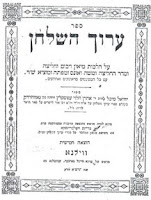
[1] This expression is from R’ Zerahia ha-Levi on the Rif on B. Pesahim, p. 17a.
[2] See “Yom Tov Sheni Shel Galuyyot: The True Signification of the Second Day Festival,” the Seforim blog (forthcoming).
[3] Even today the overwhelming majority of the Rabbis believe that the reason invoked for the institution of the second festival day was the fear of unfair laws against the Jews causing to forget the Torah and the Jewish calendar. Such a fear exists everywhere, Israel included. Therefore the foreigners visiting in Israel are still subject to this danger and therefore they are submitted to the obligation of the second festival day. The Israelis should also fear the same danger but the takana instituting Yom Tov Sheni was not addressed to them.
[4] The translation is here according to the generally accepted understanding that Rav Safra was traveling from Palestine to Babylonia. Although he knew the fixing of the month, he did not perform work on the second festival day when he was in a Jewish settlement in Babylonia because of the fear of dispute. This reason did not exist in the wilderness and therefore Rabbi Ammi allowed him working on the second festival day because he knew the fixing of the month.
[5] In fact there are two different understandings of the meaning of Maimonides. We have adopted here what seems the genuine understanding. This problem will be examined later.
[6] See Novellae of R’ Samuel Strashun (Rashash) ad locum.
[7] .לצדדין
[8] Meiri writes: before thirty days.
[9] Meiri writes: after a delay of more than thirty days.
[10] Such special situations to which the Mishna must be reduced in order to satisfy both impositions, can be found in responsum I: 337 of Rabbi Solomon ben Adret (Rashbah) and in the novellae of R’ Hezekiah da Silva on Shulhan Arukh, Orah Hayim 468:4.
[11] See quotation 1 above.
[12] We will see later that R’ Jacob Emden in responsa Yabets, no. 168, championed such an opinion and understood Maimonides according to this second opinion.
[13] This is the opinion of R’ Zerahia ha-Levi, see ha-Maor ha-Katan on the Rif on Pesahim. Rabad ad locum opposed vehemently this opinion.
[14] As for the definition of going back immediately he gives the examples of people coming to Egypt to buy merchandise or people going to Israel to visit tombs. As for going back later he proposes the examples of people coming to Egypt for an enterprise or trade or people going to Israel for learning.
[15] Shulhan Arukh: Orah Hayim 468:4 (about working on the morning of Nisan 14th), 496:3 (about Yom Tov Sheni and the travelers from Israel to the Diaspora), 574:1-2 (about fasting for travelers between two places having different fast days) and Yoreh Deah 214:2 (about the rules of the communities and the travelers).
[16] See above the two interpretations of the ruling of Maimonides Hilkhot Yom Tov VIII: 20.
[17] Even if we consider that R’ Yoseph Karo changed his mind and considered only two cases in O.H. 468:4 and if we consider that O.H. 496:3 must be understood according to the first and plain understanding, there remains even though a contradiction. Indeed in 496:3 (according to the text of Orhot Hayim) he writes that the traveler is allowed to work on the second festival day as long as he is outside a Jewish settlement, even if he intends to settle there. In O.H. 468:4 (according to the text of Maimonides) he writes that the traveler is allowed to perform work in the desert (outside the settlement) if he intends to come back and apparently not if he intends to settle.
[18] For a plausible explanation of his knowledge of the fixing of the month, see J. Jean Ajdler, “Rav Safra and the Second Festival Day: Lessons About the Evolution of the Jewish Calendar,” Tradition 38:4 (Winter 2004): 3-28.
[19] Even discretely. According to Tosafot it is impossible to perform work discretely.
[20] According to R’ Zerahia ha-Levi, even someone who wants to settle outside of Israel is allowed to perform work outside the tchum of the Jewish settlement as long as he did not reach the Jewish settlement. Ritva agrees with this ruling. R’ Nissim rules that the one who wants to settle is already forbidden to perform work in the desert of Israel. Rabad seems to rule that as soon as the Palestinian leaves the boundaries and enters the Diaspora, he is forbidden of performing any work on the second festival day.
[21] R’ Abraham Bornstein of Sochaczew asked himself (responsa Avnei Nezer Vol 1, no. 354; 43) why the great rulers did not rule the story of Rav Safra. In fact Maimonides certainly refers to this story in Hilkhot Yom Tov VIII: 20 when he writes .לא יעשה בישוב אבל עושה הוא במדבר From the same responsum n° 354; 50, it appears that he understood the ruling of Maimonides like Maggid Mishneh, i.e. the first part referring to the case that the traveler does not intend to come back.
[22] One could make the same objection for Yom Tov Sheni in the Diaspora. But here the answer is that the Rabbis have the power, when they make enactments, to suppress an order of the Torah, see response of R’ Solomon ben Aderet I:61. By contrast, for the foreigners visiting in Israel, if their obligation of keeping Yom Tov Sheni does not derive from the original takana but from a general rabbinic rule of priority of minhagim, then the positive order of the torah should have the precedence.
[23] Hilkhot Yom Tov VI: 14.
[24] I have already heard the following argumentation. Even at the time of the observation calendar, the foreigners on pilgrimage in Israel were keeping the second festival day according to the rule of the priority of the minhagim. Therefore, today, we must still behave according to their custom. In fact this argumentation seems rather a Yeshiva argumentation but it is not likely that this was really the conduct of the pilgrims. Now even if this were the case, it is certain that the pilgrims wore the tefilin on the second festival day during their stay in Palestine because it is a positive law of the Torah with precedence on a minhag. Therefore it is likely that either the pilgrims wore the tefilin and did not keep the second festival day because of its contradictory character or they abstained from performing work on this day. Anyhow this argumentation could sustain the opinions 2 or 3 but certainly not the opinion 1, according which the foreigners traveling in Israel keep two festival days.
[25] R’ Hananel does not mention in his text “because of the fear of dispute” as in our Talmudic text. It is not certain whether he had the same reading as us. Nevertheless from Nahmanides’ Milhamot Hashem on the Rif on B. Pesahim 17a, we see that this was indeed the Spanish reading.
[26] Whether I should not keep two festival days because I know the fixing of the month or I should because I am still submitted to the place whence I came from.
[27] This exegesis is in accordance with the ruling of R’ Tsevi Ashkenazi in response Hakham Tsevi no. 167. R’ Meir Don Plotski from Ostrow understood R’ Hananel on the same way. See Even Shelema on Ravan, who does not accept this interpretation.
[28] Furthermore R’ Hananel writes in the beginning of his commentary “and people of my place hold (“osin”) two festival days.”
[29] We cannot explain that he means a settlement in Palestine. Indeed, in a Jewish settlement in Palestine the messengers come along and the population knows the fixing of the month. If, despite these circumstances, Rav Safra does not perform work in this settlement, why would he be allowed to perform work in the desert of Palestine where there are not messengers coming along. Or conversely if Rav Safra is allowed to perform work in the desert of Israel, a fortiori he must be allowed to perform work in a settlement of Israel.
[30] R’ Moses Sofer in his Novellae on Pesahim and R’ Ehrenreich in Even Shelemah on Ravan understood that it speaks about a settlement in Israel. R’ Ovadia Yoseph in Yehaveh Da’at VI: 40 recopied their arguments. According to their explanations, Rav Safra was forbidden to perform work in a settlement in Israel, likely because of the strictness of the place from where he came. But why was he allowed to perform work in the desert of Israel? Rabbi Moses Sofer writes that in the settlement working is forbidden on the second festival day because of מנהג אבותינו בידינו . But in the desert there is no status, there is no tradition of the elders and the obligation of Yom Tov Sheni depends on the geographical localization but it is not a personal obligation. I could not, unfortunately, understand him. If Rav Safra is allowed to work in the desert where there is no tradition and no status, no messengers coming along, a fortiori that he is allowed to work in a settlement in Israel where there is a tradition, were the messengers come along, were the population knows the fixing of the month and where there is thus a status of holding only one day. Conversely, if Rav Safra, in a settlement in Israel, is still submitted to the strictness of the place from where he came, a fortiori in the desert, where the messengers do not come along, he should be forbidden to work on the second festival day.
[31] Those Rabbis who understand that we speak here about a settlement in Israel must correct the text and instead of שם they must correct into משם. By contrast the text of Ravan fits perfectly our interpretation.
[32] The reading of Ravan is Rav Hisda but we maintained Rav Safra in order not to complicate things.
[33] The reasoning of Ravan works only with our interpretation. Rav Safra does not perform work in a settlement in Babylonia but he asked whether he was allowed to perform work in the desert of Israel. Ravan concludes that it was clear for him that it was forbidden to perform work in the desert of Babylonia. But if we consider that Rav Safra began with the statement that he does not perform work in a settlement in Israel and he asked afterwards whether he was allowed to perform work in the desert of Israel, how can Ravan conclude that it was clear for him that he was forbidden to perform work in the desert of Babylonia?
This reasoning has no basis. Why was it more evident that it is forbidden in the desert of Babylonia than in the desert of Israel?
[34] R’ Shneur Zalman of Liady in his Shulhan Arukh, Orah Hayim 496:11 ruled that a foreigner traveling in Israel observes one festival days but he added that there are authorities which oppose this ruling. Apparently he refers his ruling to Ravan; this is also the opinion of R’ Tsevi Pesah Frank in Mikra’e Kodesh, Pesah 2, p. 195 note 1. However all the other authorities wanted to conclude that R’ Hananel and Ravan impose the keeping of two festival days by the travelers in Israel.
[35] It is interesting to note that all the later commentaries did not follow this approach of a travel from Babylonia to Palestine but they considered a travel from Palestine to Babylonia. I had attributed this change to the difficulties of the exegesis of the commentaries following the first approach. But finally at the end of the study of the commentaries of R’ Hananel and Ravan, it seems that these commentaries are genuine and well argumentative. The change of approach could be justified by the fact that Rav Safra consulted Rabbi Abba, an eminent Palestinian Amora (born and educated in Babylonia). This could be only before a travel from Palestine to Babylonia.
[36] But it is likely that it was the case because he knew the fixing of the month.
[37] According to the first interpretation he was forbidden and according to the second interpretation he was allowed.
[38] R’ Moses Sofer in his Novellae on Pesahim, Commentary Even Shelemah on Sefer Ravan ad locum, R’ Ovadia Yoseph in Yabi’a Omer VI: 40.
[39] Responsum no. 167.
[40] Hakham Tsevi and later his son R’ Jacob Emden signed by Tsevi Ashkenazi s”t and Yabets S’t.Hakham Tsevi had learned under R’ Elijah Covo in Salonika, he assumed the Sephardi tittle hakham and adopted even Sephardi customs and the name Ashkenazi. S”t may be the common abbreviation of ספרדי טהור used by his teacher orסופו טוב or still סימן טוב.
[41] Imagine that in the middle of the second festival day he decides to settle in Israel. He would suddenly in the middle of Yom Tov Sheni, pass from the regime of “obliged to keep two festival days” to the regime of “forbidden to keep two festival days.”
[42] Hakham Tsevi understood thus correctly that the fear of the Palestinians leaders was that the disruption of the communication between Palestine and the Diaspora would endanger the calendar of the Diaspora. It is the first time that we meet an explanation of the reason of the institution of the second festival day different than that of Rashi in B. Beitsa 4b.This approach is very original. The incorrect understanding of the exact fear of the Palestinian Rabbis who sent the order of the second festival day to the Diaspora is at the origin of a great confusion, at such a point that R’ Jacob Emden thought that people settling in Israel should go on and keep two festival days in Israel.
[43] Those who consider that Yom Tov Sheni is a minhag and not a takana, cannot explain why we are exempted from the Tefilin. Only a takana, and certainly not a minhag, and the power of the sages to give to their enactments the same power as a Torah order, can explain that the order of keeping the two festival days includes the exemption and even the interdiction of wearing the tefilin. See response of R’ Solomon ben Aderet I: 61.
[44] This is indeed what we read in responsa Yabi’a Omer VI: 40.
[45] According to the principle: לא תתגודדו. This principle is generally accepted.
[46] In note 18 of the Shulkhan Arukh ha-Rav it refers to Ravan. However according to the commentary Even Shelema on Ravan (B. Pesahim 51b) the author, R’ Schneur Zalman refers to Hakham Tsevi. But in Miqra’e Kodesh, Pesah vol.2 p. 195 note 1, R’ Tsevi Pesah Frank refers to Ravan. In the new edition (New York 2007) of the Shulhan Arukh ha-Rav with new references, R’ Levine refers to R’ Hananel, Ravan and Hakham Tsevi. I thank R’ Samuel Pinson of Brussels who showed me this last edition.
[47] In note 19 of the Shulkhan Arukh ha-Rav it refers to Ravan. Of course it is impossible to have the same reference in both note 18 and note 19.
[48] A similar argumentation was proposed to explain the apparent contradiction about the time of the beginning of Bein ha-Shemashot between O.H. 261 and Yoreh Deah 266.
[49] In contradiction with the situation of the traveler going from Israel to the Diaspora where the obligation is a personal obligation and not a territorial obligation.
[50] We speak of those specific works that are normally forbidden on the second day.


Book announcement: Ta’aroch Lifonai Shulchan by Rabbi Eitam Henkin, H”YD

Book announcement: Ta’aroch Lifonai Shulchan by Rabbi Eitam Henkin H”YD

By Eliezer Brodt

הרב איתם שמעון הנקין הי”ד, “תערך לפני שלחן: חייו, זמנו, ומפעלו של הרי”ם עפשטיין בעל ערוך השלחן,” הוצאת קורן 413 עמודים

It’s with great pleasure that I announce the second printing of the book Ta’aroch Lifonai Shulchan by R’ Eitam Henkin H”YD, published by Maggid Press. I had the unique privilege to edit this work, together with R’ Eitam’s special,learned parents. The first printing of this book was issued on January 2 earlier this year and sold out shortly after its released.


This book is an intellectual biography of R’ Yechiel Michel Epstein, author of the classic work Aruch HaShulchan. In 2006 R’ Eitam began publishing essays about the Aruch HaShulchan in various journals. Over time they became more and more renowned, for their comprehensiveness, clarity, high quality, and at times for new discoveries. They were read by a wide-ranging audience. In general, R’ Eitam’s numerous writings demonstrate an excellent command in both the halachic aspects and the historical aspects of the topics he set out to write about. Alongside his many historical essays are his many Torah articles and full-fledged halachic works. [Most of which are available here]. He was a unique combination of a first-rate talmid chacham and historian who was also blessed with  gifted writing and research skills. [See earlier on the Seforim Blog for hespedim on him here, here and here].

At one point he was invited to print all his articles related to the Aruch HaShulchan as a book for Touro College Press. R’ Eitam began collecting his unpublished material, updating what he already printed, for this work until the tragic day in 2015, the third day of Chol Hamoed Succos, when R ’Eitam was murdered together with his wife Na’ama.

After his murder his family accessed his computer and found this work on the Aruch HaShulchan amongst many other files of material. Various chapters were in different stages and many were even ready for print. After carefully reading through all the files about the Aruch HaShulchan and figuring out what which version was the most updated. The material which was found to be already printworthy were than then collected and organized into this book. Some other printed articles of his related to the Aruch HaShulchan were added to the book, such as his article about the rebbe of the Aruch HaShulchan.

Among R’ Eitam’s many qualities were his excellent writing skills; he was capable of making bibliographic essays  that of the kind that are generally boring to the regular reader interesting to such audiences. The material in this book was completely written by R’ Eitam, however the order of some sections was shifted around to flow better as a whole. Additionally, as various sections were written for different publications and at different times as were the various citations in the footnotes were adjusted/synchronized with the rest of the work. That said, one chapter was not entirely finished by R’ Eitam (Part 2, Chapter 4); and his parents completed it based on his notes, and another small chapter (Part 1, Chapter 8) was completed by his brother.

We are currently working on printing a several more volumes of his material. The next project which is very near completion is an English translation of twenty-five of his essays [for some articles in English see earlier on the Seforim Blog (here) and in Hakirah (here and here)]. Another project which we are working on is a two-volume Hebrew work consisting of his material related to Eretz Yisrael, shemittah and Rav Kook. Dedication opportunities are still available for these works. Dedications are tax refundable. Email me at eliezerbrodt@gmail.com for more information.

The book should be available for purchase at local seforim stores or via Maggid Press. If one is interested in the introduction of the book and some sample pages, email me at eliezerbrodt@gmail.com.Here are the Table of Contents from Ta’aroch Lefonai Shulchan:


A nay bintl briv: Personal Reminiscences of Rabbis Baruch ha-Levi Epstein and Aaron Walkin from the Yiddish Republic of Letters

A nay bintl briv:

Personal Reminiscences of Rabbis Baruch ha-Levi Epstein and Aaron Walkin

from the Yiddish Republic of Letters

Shaul Seidler-Feller

Editor’s note: The present post is part two of a two-part essay. Part one can be found here.

Second Letter

Approximately eight and a half years after his column on the Hafets Hayyim appeared, Rabbi Aaron B. Shurin penned another essay, entitled “The Mistake of the Austrian Emperor” and about the meaning behind the observance of the Three Weeks, which was published 18 Tammuz 5756 (July 5, 1996), a day after they had begun.[1] In the first line, he quoted Rabbi Baruch ha-Levi Epstein (1860–1941/1942) as citing a story about Austrian Emperor Franz Joseph I’s (1830–1916) negative response to a group of Hungarian nationalists who wished to establish a day of mourning for the loss of their independence in 1848, using the Jews’ observance of Tish‘ah be-Av as a model.[2] This prompted Simon Paktor to write in:


SCHENECTADY 9.5.96.

זייער געערטער און חשובער
.הרב ר״ אהרון בן ציון שוּרין נ״י


עס איז מיר זייער פארדראסיג וואס כ׳האב ניט בעוויזן
צו שרייבן מאמענטאל, און זיך הארציג בעדאנקען פאר
.אייער ארטיקל ״פאָרווערטס״ דעם 5-טן יולי ה.י

ווי געוויינליך ווען די אידישע צייטונג קומט
אן צו מיר, איז עס ביי מיר ווי א גוטער פריינד
וואלט געקומען פון דער אלטער אומפארגעסליכער
..פארשניטענער היים… און מיר ריידן א[וי]ף יידיש

איך האב ממש א ציטער געטאן ווען כ׳האב
אין אייער ארטיקל וועלכן איך לייען שטענדיג מיט דעם
גרעסטן אינטערעס דערזען אין דער ערשטער שוּרה דעם
טייערן נאמען ״הרב ר׳ ברוך עפשטיין (מחבר פון
פירוש ״תורה תמימה״ אויף חומש) דערציילט אין
[3](זיין זכרונות ספר ״מקור ברוּך״ א.א.וו

איך האב געהאט די זכיה צו קענען
אט דעם ״אִיש פֶלֶא״ כבין געווען א פריינד
פון א פינסק-קארלין משפחה וועלכע האט זיך
געיחוס׳ט מיט קרובישאפט. דער פאטער פון דער
פאמיליע האט בעת א שבת׳דיגן וויזיט צוגעטראגן צו מיר
דעם ספר ״מקור ברוך״ און בעוויזן אז ר׳ ברוך

2

ווייזט אן אז אין שׁימל פון ברויט ליגט
דער פאטער אלתר סלוּצקי .PENECiLiN רְפוּאָה ווי
איז געווען א לאַווניק אין שטאט ראַט און די טאכטער האט
געארבעט אין דער יידישער אפטיילונג. אזוי ווי פינסק
האט געהאט א פנקס פון 800 יאר האט זיך זי געהאט די
א מעגליכקייט אויסגעפינען און אנטקעגן קומען ר׳ ברוך עפשטיינס
ביטעס אין די ארכיווע אויסצוזוכן. ער פלעגט זיך שטענדיג
בעדאנקען צו איר דורך שיקן א ״באָמבאניערקע״
דא הייסט עס א באַקס שאקאלאד)… איך)
.מיט טרערן אין די אייגן און מוז א וויילע איבערייסן

.ער האט מיר אויסגעלערנט אן אריטמעטיג פארמוּלע
איך דערמאן זיך ווען כ׳האב שבת נאכן דאוונען אין פינסקער
גרייסער שוּל אראבגעגאנגען צום ברעג פון אונזער
און בעמערקט ר׳ ברוך עפשטיין ז”ל PiNA שיינער טייך
זיצט אויף א באַנק כ׳בין צוגעגאנגען צו עם און געזאגט

״גוט שבת ר׳ ברוּך גום ברוך יהיה״

ער האט געענטפערט ״גם אתם״ און צובייגענדיג צו מיר
געפרעגט ״אפשר האט איר די פאָלקס צייטונג״
(א בונדיסטישע צייטונג וואס איז ארויס אין ווארשע)
(ווען איך האב עס דערציילט א היגן רָב (ניט קיין ראביי
האט ער צו מיר געזאגט יעצט זע איך

3

…אז ער איז געווען ״אם לא למעלה מזה״
איך בין יונג געווען און קיין שכל ניט געהאט און ניט פארשטאנען
צו צוהערן זיך און פאָלגן וואס אונזערע חכמים האבן
געזאגט ״והוי מתאבק בעפר רגליהם״

איך פלעג עם זייער אָפט טרעפן גייענדיג צו
(הרב הגאון ר׳ אהרון וואלקין ז״ל השם יקום דמם
הרב וואלקין האט עם ר׳ ברוך עפשטיין זייער מְקַרֵב
.געווען אין זיין עלנדקייט

איך האב געהאט דעם טרויעריגן זכות זען
אט דעם גאון ר׳ אהרון וו. הארט פארן אימה׳דיגן חורבן ווי
ער איז געזעסן אין א ווינקל פון א סטאָליאריי אַרטיעל
נאכדעם ווי די סאוויעטן האבן עם ארויסגעטריבן פון
זיין בית דין שטוב. געזעסן ארומגערינגלט מיט ספרים
…בליֵיך ווייס ווי שניי. א ״מַראה כהן״

ווייטער האב איך שוין ניט געווּסט כ׳בין געווען אין די
.לאַפּעס פון נ.ק.וו.ד

איך האב זיין ר׳ ברוּך׳ס ספר ״בָרוּך שֶאָמַר״ פירוּש
תפילות ישראל. ר׳ ברוך עפשטיין ז״ל איז געשטארבן
אין געטא אין הונגער, צער א צוּווייטאגדיגער. און מיין האַרץ
..וויינט אין מיר טאג און נאכט

4

מיין הארציגן דאנק צו אייך פאר דערמאנען
אין אייער ארטיקל (דער טעות….) אט דעם טייערן
.נאמען

כווינטש אייך געזונט און אריכת ימים ושנים
צו שרייבן אזעלכע ״צום האַרצן״ ארטיקלען אין
יידיש

מיט דאנקבארקייט און כבוד צו אייך
.לשנה טובה תכתבו ותחתמו
.שמעון פאקטאר
Schenectady NY.

Schenectady 9.5.96

To the highly esteemed and eminent Rabbi Aaron Benzion Shurin, may his light shine,

I am greatly displeased that I did not manage to write immediately to offer my sincere thanks for your column in this year’s July 5th issue of the Forverts.

As is usual when the Yiddish newspaper is delivered, I felt then as if a good friend had arrived from the unforgettable, obliterated old country… and we were having a conversation in Yiddish…

I literally shuddered when I noticed in the first line of your column – which I always read with the greatest interest – the dear name “Rabbi Baruch Epstein (author of the Torah temimah commentary on the Pentateuch) relates in his memoir Mekor barukh,” etc.

I had the good fortune to know that “amazing man.” I was friendly with a family in Pinsk-Karlin that took pride in its kinship with him. The head of the family, during a visit of mine one Sabbath, brought me the book Mekor barukh and showed me that R. Baruch

2

points out that medicine akin to penicillin can be found in moldy bread.[4] The father, Alter Slutzky, was an alderman on the city council, and his daughter worked in its Jewish division.[5] Since Pinsk had a communal register going back 800 years,[6] she had the opportunity to learn of and accommodate R. Baruch Epstein’s requests to search in the archive. He would always thank her by sending a bombonierka (here, we would call it a box of chocolates)…[7] I write this with tears in my eyes and must pause for a moment.

He taught me an arithmetic formula. I remember how one Sabbath, after services in the Great Synagogue of Pinsk,[8] I descended to the banks of our beautiful Pina River and caught sight of R. Baruch Epstein, of blessed memory, sitting on a bench.[9] I approached him and said, “Good Sabbath, R. Baruch – may you, too, be blessed [barukh].”[10] He responded, “The same to you”[11] and, leaning over to me, asked, “Maybe you have a copy of the Folkstsaytung?” (a Bundist newspaper published in Warsaw). When I recounted this story to a local rov (not some non-Orthodox rabbi),[12] he said to me, “Now I see

3

that he was ‘if not even higher than that’[13]…”[14] I was young and foolish and did not realize that I should really listen to and follow that which our Sages taught: “And sit in the dust of their feet.”[15]

I would very often meet him on his way to the ga’on Rabbi Aaron Walkin, of blessed memory (may God avenge their blood). R. Walkin drew quite close to R. Baruch Epstein in his loneliness.

I had the tragic fortune to see that ga’on, R. Aaron W., right before the horrific Holocaust, sitting in a corner of a carpentry workers’ cooperative after the Soviets had banished him from his rabbinic courtroom. He sat surrounded by books, his complexion pale white as snow, like leprosy shown to a priest…[16]

I knew nothing more of him; I was caught in the clutches of the NKVD.

I have R. Baruch’s book Barukh she-amar, a commentary on the Jewish prayers.[17] R. Baruch Epstein, of blessed memory, died in the ghetto a distressed man, starving and suffering. And my heart cries within me day and night…

4

My sincere thanks to you for mentioning in your column (“The Mistake…”) that precious name.

I wish you health and many long days and years so that you might continue writing such “heartwarming” columns in Yiddish.

With gratitude and esteem,
May you be inscribed and sealed for a good year,
Simon Paktor
Schenectady, NY

Although the author of our letter offers precious few details about himself in the body of the document, we know from other sources that he was born to Moishe and Gittel Paktor on January 18, 1913 in Pinsk (then part of Russia, now in Belarus).[18] At the time, Pinsk was one of the most Jewish (percentage-wise) of the major cities in Eastern Europe, with a Jewish population in 1914 of 28,063 out of 38,686 total residents (approximately 72.5%).[19] Presumably because Paktor was young and politically active, the NKVD (Soviet secret police) arrested him toward the beginning of World War II, when Pinsk was occupied by the Red Army, and sent him eastward to a Siberian labor camp, thereby inadvertently saving his life.[20] When he was released, he traveled to Munich where he met and married his first wife, Helen (1925–2019), and the two of them, together with their young son David Leon (b. 1949), immigrated to the United States in 1952.[21] Sometime thereafter the couple divorced, and in 1973 Simon moved to Schenectady to serve as the Ritual Director at Congregation Agudat Achim, a Conservative synagogue (located at 2117 Union Street).[22] There, in 1976, he married Anne Smuckler (1914–2014), whose own husband had passed away three years prior,[23] and continued serving the shul faithfully until his retirement in 1993.[24]

Paktor’s letter, like Dickman’s before it, transports us back in time, providing rare firsthand testimony that sheds light on several aspects of interwar Eastern European rabbinic culture. It deals primarily with the figure of R. Epstein, a brilliant Talmudist and polymath who decided not to enter the rabbinate but instead to support his family as a banker, all the while composing important Torah works in a non-professional capacity.[25] Perhaps the most eclectic of these is Sefer mekor barukh (Vilna, 1928), a multivolume compilation of his novellae and studies in various fields of Jewish scholarship, as well as personal reminiscences about members of his family. Paktor’s letter briefly discusses this book but also, en passant, and intriguingly, references Epstein’s research in the Pinsk Jewish communal archive; could he have been working there on his never-published bilingual (Hebrew and Yiddish) treatise on the history of Pinsk, written in the aftermath of World War I?[26]

Also interesting is Epstein’s request for a copy of the daily Folkstsaytung, not only on account of the paper’s strictly secular orientation – indeed, it, like the Forverts, was published on Shabbat and yom tov[27] – but also because halakhah, according to a number of interpretations, generally disapproves of reading printed matter like newspapers on Shabbat[28] (some would say during the week as well[29]). In apparently seeing nothing wrong with this practice, Epstein was following the example of his maternal uncle and eventual brother-in-law, Rabbi Naphtali Zevi Judah Berlin (Netsiv; 1816–1893), last rosh yeshivah of the famous yeshivah in Volozhin (present-day Vałožyn, Belarus), who, by Epstein’s own account, would regularly peruse a newspaper on Shabbat day.[30]

In addition, the letter opens a window onto the relationship between Epstein and Rabbi Aaron Walkin (alternatively spelled Wolkin; 1865–1941/1942).[31] By the period in question, Epstein had suffered a number of tragedies and personal setbacks: his wife Sophia (Sheyne), the daughter of Eleazar Moses ha-Levi Horowitz (Reb Leyzer Pinsker; 1817–1890), former chief rabbi of Pinsk, had passed away due to influenza in 1899 before the age of 40; the Mutual Credit Society, the large private bank at which Epstein had worked as an officer, closed at the beginning of World War I; and three of his four children were no longer in Pinsk.[32] Though his daughter Fania (Feygl) remained in the city,[33] Epstein was lonely and lived in a hotel.[34] Into this void stepped Walkin, who arrived in Pinsk circa 1923,[35] becoming its chief rabbi in 1933[36] and there growing close to Epstein. The two men had much in common: both had studied at the feet of Netsiv in Volozhin, married around the age of 18, endured great misfortune, visited America but decided to return to Europe, and sympathized (at least somewhat) with the Zionist movement.[37] As Paktor testifies, Epstein, who lived (as of 1930) at 89 Dominikańska (present-day Gor’kogo [renamed by the Soviets]) Street,[38] would often visit Walkin at his home at 71 Dominikańska, a claim confirmed by the latter’s son, Rabbi Samuel David (1900–1979),[39] who refers to Epstein on at least one occasion as yedidi ne’eman beitenu (my friend, a confidante of our household).[40]

Finally, the letter touches directly on the last years of Walkin’s and Epstein’s lives. Shortly after Soviet forces entered Pinsk on September 17, 1939, they banned Hebrew language instruction, abolished the traditional Sabbath and Jewish holidays, and converted the Great Synagogue into a theater.[41] We know from Paktor’s letter and other sources that Walkin, who had been imprisoned by the Russians previously,[42] largely escaped persecution at the hands of the Soviets and even managed to continue performing his rabbinic functions, including scholarly writing, in secret.[43] Epstein, by contrast, was evicted from the hotel in which he had been living and was forced to wander, further weakening him in his old age.[44]

With the Nazi advance into Pinsk on July 4, 1941, an already dire situation was made even more terrifying: Jews were wantonly robbed and beaten, forced to wear Stars of David, ordered to provision the German occupiers, forbidden to leave the city, and detained for labor or ransom. About a month later, on August 5–7, the first Aktion took place, in which the Nazis murdered approximately eight thousand Jewish men outside the city. The following May 1, a ghetto meant to concentrate the approximately twenty thousand remaining Jews was established in the poorest and most crowded part of town; this was later almost completely liquidated in the second Aktion of October 29–November 1, 1942.[45]

What became of Walkin and Epstein during this frightful time? Theories about each man’s demise abound. R. Samuel David refers to his father on several occasions with the acronym reserved for martyrs, H[ashem] y[ikkom] d[amo], following his name.[46] Indeed, at least two Pinsk natives have written that R. Aaron perished together with his flock (presumably in one of the two major Aktionen).[47] Others have hazarded guesses dating his passing to around Passover 1941 or to the summer of 1942.[48] Similarly, as surveyed recently in part by Shemaryah Gershuni, hypotheses regarding Epstein’s date of death range from 1940 to 1942 and, regarding the circumstances of his death, from natural to painful to violent.[49]

In his letter, Paktor himself could not say what had happened to Walkin, while with respect to Epstein, he claimed that he had died in the Pinsk ghetto (he, too, adds Hashem yikkom damam after mentioning them).[50] However, so far as I have been able to ascertain, and as already pointed out by Gershuni, the only eyewitness testimony to have come down to us – that of a nurse named Mila/Michla Ratnowska (b. 1916) who, together with her mother Zlata (1890–1962) and four others, survived the Nazi occupation of Pinsk in hiding – records that both men died (at home) due to illness in the winter of 1941–1942.[51] This timing is corroborated, if only implicitly, by the absence of Walkin and Epstein from the list of over eighteen thousand Jews living in the Pinsk ghetto, drawn up by the Germans “sometime in 1942.”[52] Until additional evidence surfaces, it would seem prudent to accept this as the most reliable version of the events leading up to the passing of these great men, about whom we can say (with a bit of poetic license) that they were “beloved and cherished in their lifetimes, and they never parted, even in death” (II Sam. 1:23).

Conclusion

Like the giants about whom they wrote, Shurin, Dickman, and Paktor have all passed on (in 2012, 2011,[53] and 2003, respectively). How fortunate we are, though, that their memories are preserved for us in this nay (new) bintl briv! Through these simple documents – penned in an age (not too long ago) when people still took the time to correspond thoughtfully with journalists after reading and reflecting on their essays – we are able to reconstruct, if only partially, the lives and deeds of some of the most prominent leaders of Eastern European Jewry in a prewar world now lost.


* I would like to thank Yehuda Geberer for respectfully commenting that he felt I had made a mistake in the first part of this essay, in which I had identified the Chaim Lieberman who assisted Shurin in landing a job at the Forverts as “the famed historian and bibliophile” who lived 1892–1991 (and who often spelled his name Haim Liberman in English). While Geberer is almost certainly correct that Shurin was actually helped by the man of the same name (1890–1963) who, according to his entry in the Leksikon fun forverts shrayber zint 1897, 42-43, worked as a teacher of Yiddish literature and Forverts Yiddish literary critic, I was influenced (apparently unduly so) in my (mis)identification by Yisroel Besser who, in his Mishpacha article (p. 30), writes as follows: “He went to meet the person he considers the greatest Orthodox writer of the century, Chaim Lieberman. Lieberman was a bibliophile, researcher, and historian, who suggested that young Shurin leave him some writings to peruse.”

I also wish to thank Yehudah Zirkind for kindly bringing to my attention another Yiddish-language memoir about the Hafets Hayyim, in which the author, a Radin native, tells a number of interesting stories about the great sage and also notes that he passed away “before reaching his ninety-fourth birthday”; see Abrashka-Kives Rogovski, “Der khofets-khayim in radin,” Oksforder yidish 3 (1995): 193-200, at col. 200.

[1] Aaron B. Shurin, “Der toes fun estraykhishn keyzer,” Forverts (July 5, 1996): 9, 20.
[2] See Baruch ha-Levi Epstein, Sefer mekor barukh, pt. 2 (Vilna: Romm, 1928), 515a-b, citing what he heard from Isaac Hirsch Weiss of Vienna (1815–1905). Epstein refers to the ruler as Franz Joseph II, but in point of fact the relevant Austrian emperor at the time was Franz Joseph I (whose official grand title, interestingly, included the style “King of Jerusalem”).
[3] The quotation of the original Yiddish here is not exact but is certainly close enough.
[4] I have so far been unable to locate the passage referred to.
[5] Jacob-Alter Slutzky was a prominent Orthodox lay leader of the Jewish community of Pinsk who was s/elected to serve on the city council at several points during the interwar period when Pinsk was under Polish rule; see Azriel Shohet, The Jews of Pinsk, 1881 to 1941, ed. Mark Jay Mirsky and Moshe Rosman, trans. Faigie Tropper and Moshe Rosman (Stanford: Stanford University Press, 2012), 469-470, 552-556, 559, 580-581. For the original Hebrew, see Wolf Zeev Rabinowitsch (ed.), Pinsk: sefer edut ve-zikkaron li-kehillat pinsk-karlin, vol. 1, pt. 2 (Tel Aviv; Haifa: Irgun Yotse’ei Pinsk-Karlin bi-Medinat Yisra’el, 1977; also available through the New York Public Library Yizkor Book online portal [accessed August 19, 2019]), using the index. See also Slutzky’s mini-bio in Nachman Tamir (Mirski) (ed.), Pinsk: sefer edut ve-zikkaron li-kehillat pinsk-karlin, vol. 2 (Tel Aviv: Irgun Yotse’ei Pinsk-Karlin bi-Medinat Yisra’el, 1966; also available through the New York Public Library Yizkor Book online portal [accessed August 19, 2019]), 538, where it is noted that Slutzky, like Epstein, was a member of Netsiv’s family (see below) and that he had two daughters, Zhenya and Eve. Based on a daf-ed filed by the former’s sister-in-law, Sonia Goberman (accessed August 19, 2019), it appears that Zhenya was the one who worked in the Jewish division. For Epstein’s endorsement of Slutzky during a campaign season, see “Eyn goldene keyt fun maysim toyvim,” Unzer pinsker lebn 3,42 (102) (October 16, 1936): 5.
[6] An old Pinsker tradition has it that the Jewish community was founded some time in the tenth century; see Benzion Hoffman (ed.), Toyznt yor pinsk (New York: Pinsker Branch 210, Workmen’s Circle, 1941), ix-x (notice the book’s title), and Tamir, Pinsk, 249, 252. Some have averred that an exact date for the start of the community cannot be established at present, given the number of times the Great Synagogue, and any historical documents it may have housed, burned down (on which, see n. 8 below); see, e.g., Saul Mendel ha-Levi Rabinowitsch, “Al pinsk-karlin ve-yosheveihen,” in Judah ha-Levi Levick and Dovberush Yeruchamsohn (eds.), Talpiyyot (me’assef-sifruti) (Berdychiv: Joseph Hayyim Zablinsky, 1895), 7-17, at p. 7. In any event, the current mainstream position holds that it began around 1506, the year in which a privilege issued by Fyodor Ivanovich Yaroslavich, Prince of Pinsk, granted local Jews land for a synagogue and cemetery in perpetuity; see Mordechai Nadav, The Jews of Pinsk, 1506 to 1880, ed. Mark Jay Mirsky and Moshe Rosman, trans. Moshe Rosman and Faigie Tropper (Stanford: Stanford University Press, 2008), 13-14.
[7] For a similar story, see Hillel Seidman, “Ha-rav r. barukh epstein – pinsk,” in Isaac Lewin (ed.), Elleh ezkerah: osef toledot kedoshei [5]700-[5]705, vol. 1 (New York: Research Institute of Religious Jewry, Inc., 1956), 142-149, at p. 145; reprinted with some variations in Seidman’s Ishim she-hikkarti: demuyyot me-avar karov be-mizrah eiropah (Jerusalem: Mossad Harav Kook, 1970), 108-116, at p. 111. Relatedly, see the Rosh Hashanah greetings sent to Epstein by the typesetters and printers of the Pinsker vort 2,40 (86) (September 30, 1932): 1, and of ibid. 3,38 (138) (September 20, 1933): 1.
[8] For some of the turbulent history of the Great Synagogue of Pinsk, which fell victim to fires on multiple occasions, see Nadav, The Jews of Pinsk, 1506 to 1880, 463-465; Shohet, The Jews of Pinsk, 1881 to 1941, 217-220, 300-301, 463, 648, 656; and Tamir, Pinsk, 249-252. For photographs of the synagogue, see here and here (accessed August 19, 2019). For a map of Pinsk from 1864 illustrating the location of the Great Synagogue, see Hoffman, Toyznt yor pinsk, 88-89 (in Yiddish), and Nadav, The Jews of Pinsk, 1506 to 1880, 498-499 (in English). For later maps of Jewish Pinsk, see Hoffman, Toyznt yor pinsk, 232-233, and Tamir, Pinskfoldout preceding p. 97.
[9] Epstein generally prayed not in the Great Synagogue but in the Pinsker Kloyz, a beit midrash with a firmly mitnaggedic orientation. Ze’ev Rabinowitsch reports that, “in years past, it was said that the walls of the Pinsker Kloyz do not give out in deference to R. Baruch Epstein…” (“Akhsanye shel toyre,” in Tamir, Pinsk, 264). See also Rabinowitsch, Pinsk, 412.
[10] See Gen. 27:33.
[11] In Yiddish, one appropriate response to a greeting like gut shabes! is gam atem!, using the plural atem even when only one person is being addressed. See Sol Steinmetz, Dictionary of Jewish Usage: A Guide to the Use of Jewish Terms (Lanham, MD: Rowman & Littlefield Publishers, Inc., 2005), 53.
[12] American Yiddish will often distinguish between Orthodox and non-Orthodox (particularly Reform) rabbis by referring to the former as rov/rabonim (singular/plural) and the latter as rabay/rabays (singular/plural). As essentially transliterations from the English, these terms for non-Orthodox rabbis are usually intended somewhat derogatorily in the mouths of frum Yiddish speakers.
[13] Oyb nisht nokh hekher or, as the phrase appears here in Hebrew, Im lo le-ma‘lah mi-zeh, is the title of a short story by the famous Yiddish and Hebrew classicist I.L. Peretz (1852–1915) about a Litvak who refuses to believe that the Nemirover Rebbe (a fictional character probably based on Rabbi Nathan Sternharz of Niemirów [1780–1845]) ascends on High during the annual period of selihot, as his Hasidim claim he does, instead of coming to the synagogue. Determined to find out where the Rebbe disappears to, he hides under the Rebbe’s bed one night and is amazed to discover that the Rebbe wakes early in the morning, dresses as a Polish peasant, and goes out to the forest to chop firewood for poor bedridden Jewish widows. He thereupon decides to join the Rebbe’s Hasidim, and from then on whenever anyone claims that the Rebbe flies up to Heaven to petition on behalf of his flock before Rosh Hashanah, this Litvak-turned-Hasid responds, “If not even higher than that.”

The story was first published in Yiddish in 1900 as “Oyb nisht nokh hekher! A khsidishe ertseylung,” Der yud 2,1 (January 11, 1900): 12-13. The following year, it appeared, in the author’s own Hebrew adaptation, as “Im lo le-ma‘lah mi-zeh,” Ha-dor 1,17 (1901): 207-211; for the Hebrew text, see here (accessed August 19, 2019). For editions using modern Yiddish orthography, see here and here (accessed August 19, 2019). For side-by-side Yiddish with English translation, see “Oyb nisht nokh hekher/And Maybe Even Higher,” in Itche Goldberg and Eli Katz (eds.), Selected Stories: Bilingual Edition, trans. Eli Katz (New York: Zhitlowsky Foundation for Jewish Culture, 1991), 270-281. For extensive discussions of the story’s subversive messages, historical sources, and inspirations, see Menashe Unger, “Mekoyrim fun peretses folkstimlekhe geshikhtn,” Yidishe kultur 7,3-4 (March–April 1945): 54-59, at pp. 56-57; Samuel Niger, Y.l. perets: zayn lebn, zayn firndike perzenlekhkeyt, zayne hebreishe un yidishe shriftn, zayn virkung (Buenos Aires: Confederacion pro Cultura Judia, 1952), 286-289; and Nicham Ross, Margalit temunah ba-hol: y.l. perets u-ma‘asiyyot hasidim (Jerusalem: Magnes Press, 2013), 17-83 (ch. 2).

In our context, the phrase is deployed by Paktor’s rabbinic interlocutor to express his realization that Epstein was even greater than he had originally thought.
[14] Paktor apparently also shared this story about Epstein and the Folkstsaytung with Mark Jay Mirsky; see the latter’s introduction to Shohet, The Jews of Pinsk, 1881 to 1941, xxix-xxx.
[15] mAvot 1:4.
[16] The Hebrew phrase deployed here is mar’eh kohen, a reference to the requirement that those afflicted with biblical tsara‘at must consult with a priest before the healing/atonement process can move forward (see Lev. 13). The expression, as used by Paktor, does double-duty by playing on the title of the well-known piyyut recited on Yom Kippur, which refers to the priest’s (radiant) appearance, not that of the biblical skin disease.
[17] Barukh she-amar was the last book Epstein printed before he passed away. It originally appeared in Pinsk in 1939 (publisher: Drukarnia Wolowełskiego), but, according to Aaron Z. Tarshish, Rabbi barukh ha-levi epstein[,] ba‘al “torah temimah” (Jerusalem: Mossad Harav Kook, 1967), 189, even though the work achieved great popularity within the city, it did not spread beyond. Epstein sent a single copy to the famous Strashun Library in Vilna, which then passed it on to YIVO, and the latter institution transferred it to its headquarters in New York (see the online catalog record for this copy here [accessed August 19, 2019]). This, then, was apparently the only exemplar of the book to survive the war, and when it was discovered at YIVO some time thereafter, it was used to print the photo-offset reproduction published in Tel Aviv in three parts: vol. 1 on the haggadah (1965), vol. 2 on Pirkei avot (1965), and vol. 3 on the siddur itself (1968). (For a slightly different account of Barukh she-amar’s original publication and rediscovery after the war, see Seidman, “Ha-rav r. barukh epstein,” 148. Based on a helpful personal communication from Lyudmila Sholokhova, Director of the YIVO Library, it would appear that Tarshish’s version of the story is the more accurate one.)

I assume that Paktor owned a copy of the Tel Aviv reprint, not the original Pinsk edition.
[18] See the obituary for Rev. Simon Paktor published in the Albany Times Union (March 2–3, 2003), available here (accessed August 19, 2019).

Franz J. Beranek, in his Das Pinsker Jiddisch und seine Stellung im gesamtjiddischen Sprachraum (Berlin: Walter de Gruyter & Co., 1958), discusses certain distinctive features of the dialect of Yiddish spoken in Pinsk. Upon examination of our letter, we find some of the markers of this litvish (Northeastern Yiddish) dialect reflected in such forms as eygn (eyes; see p. 33, §38, 1), greyser (large; see p. 25, §26), arobgegangen (descended; see p. 53, §48, 2a), em (him; see p. 21, §18, 1), etc. (I suspect that his use of the forms idishe [Jewish/Yiddish], reydn [to speak], and fardrosig/hartsig/shtendig/etc. [displeased/sincerely/always/etc.], instead of the expected yidisheredn, and fardrosik/harstik/shtendik/etc., is the result of Paktor following common journalistic orthographic conventions and is not reflective of his actual pronunciation of those words.) (For a recent look at Beranek’s relationship with some of his Yiddish scholarly contemporaries, see Kalman Weiser, “‘One of Hitler’s Professors’: Max Weinreich and Solomon Birnbaum confront Franz Beranek,” Jewish Quarterly Review 108,1 [2018]: 106-124.)
[19] See Mordechai Nadav, “Pinsk,” in Shmuel Spector (ed.), Pinkas ha-kehillot: polin, vol. 5 (Jerusalem: Yad Vashem, 1990), 276-299, at p. 276 (available in English translation here [accessed August 19, 2019]). See also Dov Levin, Tekufah be-sograyim, 1939–1941: temurot be-hayyei ha-yehudim, ba-ezorim she-suppehu li-berit-ha-mo‘atsot bi-tehillat milhemet ha-olam ha-sheniyyah (Jerusalem: Hebrew University of Jerusalem; Tel Aviv: Hakibbutz Hameuchad, 1980), 26, for a chart comparing the populations of cities in eastern Poland in 1931.
[20] See the aforementioned obituary for Paktor published in the Albany Times Union. On NKVD activity in Pinsk during the Soviet occupation, see Pesah Pakacz, “Shilton ha-soviyyetim be-pinsk,” in Tamir, Pinsk, 315-320, at pp. 317-320, and Shohet, The Jews of Pinsk, 1881 to 1941, 639-650. On NKVD activity among occupied Polish Jewry in general, see Yosef Litvak, Pelitim yehudim mi-polin bi-berit ha-mo‘atsot[,] 1939–1946 (Jerusalem: Hebrew University of Jerusalem; Tel Aviv: Ghetto Fighters’ House; Hakibbutz Hameuchad, 1988), 118-156. As noted by Eliyana R. Adler, the similar situation of Baltic Jews exiled to the east by the Soviets demonstrates that had they not suffered that fate, they most likely would have fallen victim to the Nazis when the latter invaded the Soviet Union on June 22, 1941; see her “Exile and Survival: Lithuanian Jewish Deportees in the Soviet Union,” in Michal Ben Ya’akov, Gershon Greenberg, and Sigalit Rosmarin (eds.), Ha-kayits ha-nora ha-hu…: 70 shanah le-hashmadat ha-kehillot ha-yehudiyyot be-arei ha-sadeh be-lita: historiyyah, hagut, re’aliyyah (Jerusalem: Efrata College Publications, 2013), xxvii-xlix, at pp. xlv-xlvi.
[21] See the Holocaust remembrance seminar announcement published in the Clifton Journal (October 30, 2015), p. 36 (available here [accessed August 19, 2019]; make sure to click “View Details”). The Air Passenger Manifest recording the Paktors’ arrival in New York, available to subscribers through the MyHeritage database (accessed June 20, 2019), is dated May 19, 1952; curiously, it lists Simon’s wife’s name as Sabina.
[22] According to Michael C. Duke, “Historian Is CBY Scholar In Residence, Oct. 8–10,” Jewish Herald-Voice (October 7, 2010) (accessed August 19, 2019), Paktor was trained as a rabbi. While I could find no direct corroborating evidence for this claim elsewhere, it is true that he is sometimes referred to in writing with the title “Reverend.” His work at the shul, for which he came to be well loved and respected, included serving as cantor and Torah reader, running the daily minyanim, preparing youth for their bar and bat mitzvahs, and even teaching Yiddish classes; Stephen M. Berk, Year of Crisis, Year of Hope: Russian Jewry and the Pogroms of 1881–1882 (Westport, CN; London: Greenwood Press, 1985), xv, credits Paktor with introducing him to the world of Yiddish scholarship. See also the aforementioned obituary in the Albany Times Union and the above article by Duke. I thank Robert Kasman, Stephen M. Berk, and Mendel Siegel for the information they provided me on Paktor’s life and service to the shul in personal communications.
[23] See the obituary for Anne Paktor published here (accessed August 19, 2019).
[24] Henry Skoburn, The Agudat Achim Chronicle: Commemorating 120 Years[,] 1892–2012 (Schenectady: Congregation Agudat Achim, 2012), 10, 12.
[25] The only book-length biography of Epstein is Tarshish’s (above, n. 17), though, as noted by Eitam Henkin, “Perakim be-toledot ba‘al arukh ha-shulhan: mishpahto ve-tse’etsa’av,” Yeshurun 27 (2012): 879-895, at p. 879, this work is in need of a thorough update that takes a scholarly-critical approach and considers the abundant literature on Epstein and his oeuvre that has appeared over the past fifty-plus years. For a shorter essay on Epstein’s life, see Seidman’s “Ha-rav r. barukh epstein” (above, n. 7). And for a famous photograph of Epstein in his younger years, see Hoffman, Toyznt yor pinsk, 335; reproduced (seemingly with modifications) as the frontispiece of Tarshish’s biography and in Zvi Kaplan, “Hiddushim ba-halakhah shel gedolei pinsk ve-karlin,” in Rabinowitsch, Pinsk, 367-406, at p. 393. (I find it hard to believe that the person in the portrait accompanying the Epstein mini-biography printed in Tamir, Pinsk, 489-491, is actually him but would be happy to be corrected.)
[26] See Baruch ha-Levi Epstein, Sefer mekor barukh, introduction (Vilna: Romm, 1928), 2 n. 1.
[27] The Folkstsaytung (People’s Paper) was the official organ of the General Jewish Workers Union in Poland, also known as the Bund. As such, it espoused a secularist, socialist Weltanschauung and polemicized against Communists, Zionists, and Orthodox Jews, among others. In addition to covering politics and workers’ issues, the paper devoted space to science and technology, sports, culture, and (Jewish and non-Jewish) literature. At its height in 1935, the Folkstsaytung had an approximate circulation of eighteen thousand. See Jacob Shalom Hertz, “‘Folkstsaytung’ 1918–1939,” in David Flinker, Mordechai Tsanin, Shalom Rosenfeld et al. (eds.), Di yidishe prese vos iz geven (Tel Aviv: Veltfarband fun di Yidishe Zhurnalistn, 1975), 151-169, and Boris Kotlerman, “Folks-tsaytung,” trans. I. Michael Aronson, in the digitized YIVO Encyclopedia of Jews in Eastern Europe (accessed August 19, 2019).

According to Seidman, “Ha-rav r. barukh epstein,” 144-145:

[Epstein] had an expansive [intellectual] horizon. He was interested in and familiar with all that was happening in the world. He read Russian and German newspapers. He also visited Vienna and Berlin in the ’20s, meeting with scholars and intellectuals there, and maintained an epistolary correspondence with the towering Jewish figures of the generation. When they visited Pinsk, he would host them. In 1914, Rabbi Hayyim Soloveichik visited Pinsk and stayed with Rabbi Baruch Epstein for Shabbat.

In addition to regularly reading the paper, Epstein also contributed to a number of (rabbinic and general Jewish) periodicals, including HavatseletYagdil torahHa-levanonHa-maggidHa-melits, and Ha-pardes; see Baruch ha-Levi Epstein, Sefer mekor barukh, pt. 3 (Vilna: Romm, 1928), 701b, and Shemaryah Gershuni, “Rabbi barukh epstein – ba‘al ha-torah temimah: beirur nesibbot petirato,” Yeshurun 29 (2013): 885-892, at pp. 886 n. 13, 889 n. 25. He even wrote a weekly column on the parashah for the Pinsker shtime; see Seidman, “Ha-rav r. barukh epstein,” 145, 148-149. While I have not examined issues of the Pinsker shtime, I know that Epstein’s parashah columns in a different local paper, Pinsker vort, were entitled Fun gebentshtn kval (=Mi-makor barukh); see the announcement in the February 20, 1931 edition, p. 1.
[28] For a summary of some of the halakhic literature on the topic and a defense (in most cases) of the widespread contemporary disregard of this prohibition, see Eitam Henkin, “Keri’at divrei defus be-shabbat be-yameineu le-or din shetarei hedyotot,” Melilot 3 (2010): 49-63 (the pagination in the printed version is slightly different from that of what I presume to be the prepublication copy available on Henkin’s website).
[29] Indeed, the Hafets Hayyim was particularly vociferous in his opposition to the practice of many of his contemporaries to regularly read newspapers, not only because of their often-improper content (heresy, scoffing, leshon ha-ra, licentiousness, etc.), but also due to the drain on one’s time involved in their consumption. See, e.g., Israel Meir ha-Kohen, Kunteres zekhor le-miryam (Piotrków: Hanokh Henekh Fallman, 1925), 8b; Aryeh Leib Poupko, Mikhtevei ha-rav hafets hayyim z[ekher] ts[addik] l[i-berakhah]: korot hayyav, derakhav, nimmukav ve-sihotav, 1st ed. (Warsaw: B. Liebeskind, 1937), 96-98 (second pagination; no. 42); ibid., 42-43 (third pagination; par. 82); idem, Mikhtevei ha-rav hafets hayyim z[ekher] ts[addik] l[i-berakhah], ed. S. Artsi, 2 vols. (Bnei Brak: n.p., 1986), 2:157-158. Relatedly, see also idem, Mikhtevei, 1st ed., 27-29 (second pagination; no. 9). It is clear, however, that the Hafets Hayyim was, at times, exposed to periodical literature; for a letter he sent to the Haredi paper Kol ya‘akov, responding to an earlier issue thereof, see idem, Mikhtevei, ed. S. Artsi, 1:297-298 (no. 122).
[30] See Baruch ha-Levi Epstein, Sefer mekor barukh, pt. 4 (Vilna: Romm, 1928), 895b, 897b-898a. Epstein’s report about his uncle’s behavior in this connection has aroused a good deal of controversy, as discussed by, e.g., Eliezer Brodt, “The Netziv, Reading Newspapers on Shabbos & Censorship,” Seforim Blogpt. 1 (March 5, 2014) and pt. 2 (April 29, 2015). Like Brodt, Marc B. Shapiro, “Clarifications of Previous Posts,” Seforim Blog (January 16, 2008) (accessed August 19, 2019), believes that one can rely upon this account. On the general question of the historical accuracy of Sefer mekor barukh, see, e.g., Eitam Henkin, “R. yehi’el mikhl epstein ve-ha-‘tsemah tsedek’ ba-adashat ha-sefer ‘mekor barukh’,” Alonei mamre 123 (Winter 2011): 189-215, and Moshe Maimon, “Od be-inyan ba‘al ha-torah temimah u-sefarav,” Kovets ets hayyim 12,1 (2018): 409-420 (among many others).
[31] Probably the two most authoritative biographies of Walkin to date are that appended to the beginning of the second volume of the New York, 1951 photo-offset edition of his responsa, Sefer she’elot u-teshuvot zekan aharon, composed by his son, Rabbi Samuel David (on whom, see below), and entitled “Toledot maran ha-ga’on ha-mehabber z[ekher] ts[addik] v[e-]k[adosh] l[i-berakhah]”; and Hillel Seidman, “Ha-rav r. aharon walkin – pinsk,” in Lewin, Elleh ezkerah, 64-71; reprinted with some variations in Seidman’s Ishim she-hikkarti, 20-28. Eliezer Katzman used these two sources in compiling much of his own profile of Walkin – “Ne‘imut ha-torah: ha-g[a’on] r[av] aharon walkin z[ekher] ts[addik] v[e-]k[adosh] l[i-berakhah,] a[v] b[eit] d[in] pinsk[,] ba‘al beit aharon, zekan aharon v[e-]ku[llei],” Yeshurun 11 (2002): 891-904; 12 (2003): 727-739 – but added some material not found in either. (It seems that unacknowledged verbatim use was made of Seidman’s and/or Katzman’s work in the Walkin biography printed in Daniel Bitton’s editions of Sefer beit aharon on Bava kamma [Jerusalem: Mekhon ha-Ma’or, 2003] and of Sefer hoshen aharon [Jerusalem: Mekhon ha-Ma’or, 2005].) For additional appreciations of Walkin’s Torah, see Kaplan, “Hiddushim ba-halakhah,” 399-406, an earlier version of which had appeared as “Ba‘al ha-‘battim’,” Ha-tsofeh 10159 (June 24, 1966): 5, 7; and of his religious persona, see the excerpt from Rabbi Joseph B. Soloveitchik’s letter to R. Samuel David, dated 8 Shevat [5]712 (February 4, 1952) and printed at the foot of the introduction to Aaron Walkin, Sefer beit aharon al massekhet gittin, 2nd ed. (New York: S. Walkin, 1955).

For photographs of Walkin, see Anon., “Shlukhim fun agudes yisroel shoyn do,” Yidishes tageblat (December 11, 1913): 8; Anon., “Visiting Rabbis Explain International Jewish Union,” The Pittsburg [sic] Press (January 27, 1914): 3; Anon., “Noted European Rabbis Greeted by Orthodox Jews of Greater Boston,” The Boston Post (February 7, 1914): 16; Kaplan, “Hiddushim ba-halakhah,” 399; Moshe Rosman, “Pinsk,” in the digitized YIVO Encyclopedia of Jews in Eastern Europe (accessed August 19, 2019); Marc B. Shapiro, “A Tale of Two Lost Archives,” Seforim Blog (August 12, 2008) (accessed August 19, 2019); the Jewish Pinsk memorial page here (accessed August 19, 2019) (Walkin is leading the Agudah procession); and David Zaretsky, “Rabbah ha-aharon shel pinsk: le-hofa‘ato me-hadash shel ha-sefer sh[e’elot] u-t[eshuvot] ‘zekan aharon’,” in Zikhram li-berakhah: ge’onei ha-dorot ve-ishei segullah (Israel: n.p., 2015?), 33-39.
[32] See Jacob Goldman’s obituary for Sophia Epstein, entitled “Allon bakhut,” in Ha-tsefirah 26,60 (March 24, 1899): 293. See also the report issued by Aaron Tänzer, “Von Brest-Litowsk nach Pinsk,” Allgemeine Zeitung des Judentums 80,1 (January 7, 1916): 6-10, at p. 9, in which he mentions Epstein’s widowhood and the bank closure. Of Epstein’s four children – Cecilia (Tsile), Meir, Eleazar Moses, and Fania – Tänzer makes specific reference only to the last, suggesting that the other three were no longer in Pinsk by that point. Indeed, we know that Cecilia’s husband Nathan (Nahum) Bakstansky (Bakst) arrived at Ellis Island in 1907 (see his Geni record here [accessed August 19, 2019]); that they and their children Aaron and Jacob were registered voters as of 1924 (see Anon., “List of Registered Voters for the Year 1924: Borough of Brooklyn—Sixteenth Assembly District,” The City Record [October 16, 1924]: 2); and that Cecilia is registered as the copyright holder for the New York, 1928 edition of her father’s Torah temimah (see Anon., Catalogue of Copyright Entries: Part 1, Group 1 […] for the Year 1929 [Washington: United States Government Printing Office, 1930], 1825-1826). In addition, according to family records made available to Henkin, Eleazar Moses had moved to Leningrad (present-day St. Petersburg, Russia) (see the corrections appended to the online version of his aforementioned article, “Perakim be-toledot”). And if Seidman is correct that one of Epstein’s sons wound up working as a physician in New York (see the Ishim she-hikkarti version of his article, p. 110), that may mean Meir, like Cecilia, made it to America as well. (I find the idea that Meir and Fania died in their youth, as reported on Henkin’s website, difficult to believe, considering that Tänzer makes no mention of this in 1916, based on a visit to Pinsk in November 1915; see also next note. But until additional information becomes available, this will be virtually impossible to definitively reject [or accept].) In this connection, see also Maimon, “Od be-inyan,” 418-419, for an interesting interpretation of a passage in Sefer mekor barukh, pt. 4.
[33] Fania was instrumental in founding a Jewish girls’ gymnasium in Pinsk in the fall of 1915, reportedly with her father’s approval. See Tänzer, “Von Brest-Litowsk,” 9, and Shohet, The Jews of Pinsk, 1881 to 1941, 34, 183, 350-351, 596-597; see also Tamir, Pinsk, 510-512. She apparently passed away during World War II, given that she (like her father) is listed among the martyrs of Pinsk in Tamir, Pinsk, 627. (It is unclear to me whether or not the Meir cited there was R. Baruch’s son.)
[34] As of Tänzer’s visit, it seems that Fania attended to the needs of her father’s house (“Von Brest-Litowsk,” 9). Tarshish notes, however, that at a certain point he began living in a local hotel, whose proprietors took care of him honorably and with dedication (Rabbi, 127; though cf. below, n. 38). Seidman adds that he ate his meals at a restaurant in the city while living in the hotel (“Ha-rav r. barukh epstein,” 144). Three hotels, all under Jewish ownership, are named in the “List of Subscribers of the Telephone Network of the Postal and Telegraph Directorate in Wilno in 1939” (select p. 52 from the drop-down menu) (accessed August 19, 2019). I have not been able to ascertain at which of these three Epstein lived.
[35] See Kaplan, “Hiddushim ba-halakhah,” 399; see also Ben-Mem, “Ha-ga’on r. aharon walkin z[ekher] ts[addik] l[i-berakhah],” in Tamir, Pinsk, 499-500, who notes that Walkin eulogized Rabbi Jacob Mazeh of Moscow (1859–1924) within the first year of his arrival in the city. Cf. the introduction to Aaron Walkin, Sefer beit aharon al massekhet bava kamma (Vilna: Shraga Feivel Garber, 1923), which the author signed (seemingly in 1923) while living in the Jewish community of Amtshislav (present-day Mscisłaŭ, Belarus). Cf. also Anon., “Horav r. arn wolkin vegn zayn raykher lebns-fargangenheyt,” Unzer grodner ekspres 2,79 (April 2, 1929): 1, the second part of an interview with Walkin, which claims that he emigrated from Russia in 1922; as well as Aaron B. Shurin, “Tsvey shayles utshuves sforim fun letstn pinsker rov,” Forverts (October 14, 1977): 3, 6, at p. 3, who writes that Walkin came to Pinsk in 1924. (On his way from Russia to Poland, he had an extended stopover in Danzig; see M. Lyubart, “Vegn yidishn lebn in danzig,” Pinsker vort 2,11 [57] [March 11, 1932]: 5.)
[36] See Anon., “Horav walkin oysgeveylt als rov fun pinsker kehile,” Pinsker vort 3,32 (132) (August 11, 1933): 6, and Shohet, The Jews of Pinsk, 1881 to 1941, 571. Cf. Ben-Mem, “Ha-ga’on r. aharon walkin,” 500, who gives the date as [5]688 (1927–1928). (His election to the rabbinate of neighboring Karlin had taken place over a year earlier; see Anon., “Horav walkin als karliner rov,” Pinsker vort 2,6 [52] [February 5, 1932]: 6.)

Relatedly, see Dov Rabin (ed.), Grodnah-Grodne (Jerusalem: Encyclopaedia of the Jewish Diaspora, 1973; also available through the New York Public Library Yizkor Book online portal [accessed August 19, 2019]), col. 352, on the brief period in 1929 when the Jews of Grodno – then part of Poland but now in Belarus – considered appointing Walkin as the chief rabbi of their community (an episode that deserves fuller historiographic exploration); see also Anon., “Kehile-rat geg[n] horav wolkin,” Unzer grodner ekspres 2,88 (April 12, 1929): 15.
[37] For Epstein, see Tarshish, Rabbi, 70-80 (relationship with Netsiv), 84-89 (marriage at approx. 18), 120-126 (visit to America), 134-135, 148-149 (Zionist sympathies) (all based primarily on passages in Sefer mekor barukh); Shohet, The Jews of Pinsk, 1881 to 1941, 536 (Zionist sympathies); and Gershuni, “Rabbi barukh epstein,” 890-892 (visit to America). For Walkin, see his undated introduction to Sefer beit aharon al massekhet bava kamma (visit to America); the postscript to his undated introduction to the commentary Saviv li-yere’av, vol. 1 (Pinsk: Drukarnia Wolowełskiego, 1935), and the wishes of nehamah printed in Dos naye pinsker vort 7,51 (356) (December 3, 1937): 6 (personal misfortune); his son’s “Toledot maran ha-ga’on ha-mehabber” (relationship with Netsiv, marriage at approx. 18, visit to America); and Ben-Mem, “Ha-ga’on r. aharon walkin,” 500, and Rabin, Grodnah-Grodne, col. 352 (Zionist sympathies). Relatedly, Walkin’s son Hayyim married the daughter of Rabbi Abraham Isaac ha-Kohen Kook (1865–1935); see the mazl tov wishes on the occasion of their engagement printed in Do’ar ha-yom 8,182 (April 28, 1926): 1, and in Ha-arets 9,2041 (May 2, 1926): 4.

For a lecture delivered in Yiddish during Walkin’s visit to the United States, undertaken December 1913–February 1914 in order to help establish Agudath Israel in America, see Aaron Walkin, Di printsipen un tsveke fun agudes yisroel: fortrog gehalten fir amerikaner idn (New York: Office of Agudath Israel, n.d.). (During his trip, Walkin visited the Rabbi Isaac Elchanan Theological Seminary at 156 Henry Street; for his comparison of the yeshivah with that of Volozhin [!], see Anon., “Agudes yisroel shlukhim in yeshives rabeynu yitskhok elkhonen,” Der morgen zhurnal [December 24, 1913]: 4. Cf. Anon., “Horav wolkin begaystert fun idishe anshtalten in amerika,” Der morgen zhurnal [January 13, 1914]: 4.)

Tragically, Epstein and Walkin shared another fate: each printed a sefer in 1939 in Pinsk, only one copy of which survived the war and was later used for photo-offset reprinting. On Epstein’s Barukh she-amar, see above, n. 17, and on Walkin’s Sefer beit aharon al massekhet gittin, see his son’s introduction to the 1955 edition.
[38] See the address given for Epstein on the title page of his Sefer tosefet berakhah ha-kolel he‘arot ve-he’arot le-sefer “megillat sefer” al hamesh megillot ha-kodem (Krakow: [Michael Horowicz], 1930) (the same address appears on the title pages of the five parts of Sefer gishmei berakhah that appeared at the same press in the same year). It is unclear to me at what point he moved into the hotel referred to by Tarshish (see above, n. 34), though it seems, based on the aforementioned “List of Subscribers,” that as of 1939 a fellow named Dawid Giler was living at Epstein’s former address on Dominikańska Street.
[39] For several biographical sketches of R. Samuel David, the only child of R. Aaron to survive the war, see Samuel David Walkin, Sefer ramat shemu’el al ha-torah: sefer be-reshit (Jerusalem: Walkin Family, 1982), 11-27; the unpaginated introductions to idem, Sefer shevivei or: likkutim, ed. Samuel David Walkin [the grandson], 2nd ed. (Jerusalem: n.p., 2011); and idem, Sparks of Light: Jewels of Wisdom from the Chofetz Chaim ZT”L (New York: Kol Publishers, 2012), 83-86. For descriptions of R. Samuel David’s efforts on behalf of his fellow Pinskers, see Rabinowitsch, Pinsk, 547, and Tamir, Pinsk, 598-599. Unsurprisingly, given the interconnectedness of Lithuanian rabbinic dynasties, R. Samuel David became close with both the Hafets Hayyim and R. Soloveitchik; for photographs of him with the former, see the plates at the end of Sparks of Light, and with the latter, see Marc B. Shapiro, “Assorted Matters,” Seforim Blog (February 17, 2016) (accessed August 19, 2019).
[40] See Samuel David Walkin, Sefer kitvei abba mari: hiddushim u-be’urim al tanakh u-midrashav, ed. Moishe Joel Walkin (Kew Gardens: Yeshiva Beth Aron, 1989), 345; see also pp. 73, 132, 160, 266, 497, 512. For other instances of R. Samuel David quoting Epstein, often preceded by honorifics, see idem, Sefer ramat shemu’el al ha-torah, 108-109, and idem, Sefer kitvei abba mari: hiddushim u-be’urim al massekhtot ha-shas, u-mo‘adei ha-shanah[,] ve-nosaf aleihem derashot ve-he‘arot be-inyanei de-yoma, ed. Moishe Joel Walkin (Kew Gardens: Yeshiva Beth Aron, 1982), 33, 176, 193, 277, 314. For a reproduction of a letter written by Epstein (on his own letterhead) to R. Samuel David on the occasion of the latter’s appointment to the rabbinate of Lukatsh (present-day Lokachi, Ukraine) in 1935, see Tamir, Pinsk, 490. On the relationship between Epstein and R. Aaron, see also Seidman, “Ha-rav r. barukh epstein,” 144, 149. (Seidman, “Ha-rav r. aharon walkin,” 69, notes that Walkin opened his home and heart “to anyone suffering or in pain.” See also Zaretsky, “Rabbah ha-aharon shel pinsk,” 36. For a similar description of R. Samuel David, see Aaron B. Shurin, “Horav hagoen r. shmul wolkin, vitse prezident fun agudes horabonim, iz nifter gevorn,” Forverts [August 29, 1979]: 1, 8, at p. 1.) Another home Epstein visited was that of Yankev Epstein in Minsk; see Devora Gliksman, A Tale of Two Worlds (Brooklyn: Mesorah Publications, ltd, 2009), 113-114.
[41] Shohet, The Jews of Pinsk, 1881 to 1941, 642, 648; see also Tamir, Pinsk, 319-320.
[42] Walkin himself refers to this, en passant, in the introduction to Sefer beit aharon al massekhet bava kamma, saying that he was jailed bi-shevil alilah, hattat ha-kahal hu (on account of libel; it is the sin of the community). R. Samuel David, in “Toledot maran ha-ga’on ha-mehabber,” explains that his father was one of those fighting to defend Jewish tradition against the edicts of the Bolsheviks and was therefore imprisoned for about half a year. Seidman, “Ha-rav r. aharon walkin,” 67, adds (perhaps by logical deduction) that the Yevsektsiya (Jewish section of the Communist Party) was responsible for informing on him to the authorities.
[43] For examples of Walkin’s wartime rabbinic activities, see Shohet, The Jews of Pinsk, 1881 to 1941, 649; Tamir, Pinsk, 320; and Seidman, “Ha-rav r. aharon walkin,” 69, 71. For his commitment especially to Torah study and creativity in this period, see the excerpt from the last letter R. Samuel David received from him printed in “Toledot maran ha-ga’on ha-mehabber,” as well as the excerpt from a letter by Rabbi Zalman Sorotzkin (1881–1966) reproduced in the introduction to Aaron Walkin, Sefer beit aharon al massekhet kiddushin, ed. Aaron ben Moishe Joel Walkin (Queens: Aaron Walkin, n.d.).
[44] See Tarshish, Rabbi, 127; see also p. 128 on Epstein’s avoidance of the Soviet authorities, even when it meant skipping meals. Zvi Gitelman, “Afterword: Pinsk in Wartime and from 1945 to the Present,” in Shohet, The Jews of Pinsk, 1881 to 1941, 652-659, at p. 653, notes that local leaders organized a committee to aid impoverished clergy, including Epstein, during this period.
[45] For harrowingly detailed accounts of the fate of Pinsk Jewry during the Nazi onslaught, see Nahum Boneh (Mular), “Ha-sho’ah ve-ha-meri,” in Tamir, Pinsk, 325-388 (a Yiddish translation by Leib Morgenthau appears on pp. 389-458 and an English translation by Ellen Stepak appears online here [accessed August 19, 2019]); Nadav, “Pinsk,” 294-298; Tikva Fatal-Knaani, “The Jews of Pinsk, 1939–1943, Through the Prism of New Documentation,” trans. Naftali Greenwood, Yad Vashem Studies 29 (2001): 149-182; Gitelman, “Afterword,” 652-654; and Katharina von Kellenbach, Nahum Boneh, and Ellen Stepak, “Pinsk,” in Martin Dean with Mel Hecker (eds.), The United States Holocaust Memorial Museum Encyclopedia of Camps and Ghettos, 1933–1945, vol. II, pt. B (Bloomington and Indianapolis: Indiana University Press, 2012), 1442-1444. For a map of the Pinsk ghetto, see Tamir, Pinsk, 334 (in Hebrew), and here (in English) (accessed August 19, 2019). For photographs of the memorials set up on the sites of mass murder, see here (accessed August 19, 2019).
[46] See, e.g., R. Samuel David’s introductions to Sefer she’elot u-teshuvot zekan aharon, vol. 2 (the one entitled “Hakdamat ben ha-mehabber maran ha-ga’on z[ekher] ts[addik] l[i-berakhah]”) and to Sefer beit aharon al massekhet gittin; see also the entries on R. Aaron maintained by Yad Vashem (1234) (accessed August 19, 2019). (I am aware that Hy”d is sometimes used even when a person was not literally killed by an enemy but rather died as a[n in]direct result of enemy persecution.) Strangely, Tamir, Pinsk, 636, does not list any members of the Walkin family among the martyrs of Pinsk.
[47] See Tamir, Pinsk, 500, and Zaretsky, “Rabbah ha-aharon shel pinsk,” 33, 37. For a relatively recent study of rabbinic leadership during the Holocaust, see Havi Dreifuss (Ben-Sasson), “‘Ka-tson asher ein lo ro‘eh’? rabbanim u-ma‘amadam ba-sho’ah,” in Asaf Yedidya, Nathan Cohen, and Esther Farbstein (eds.), Zikkaron ba-sefer: korot ha-sho’ah ba-mevoʼot la-sifrut ha-rabbanit (Jerusalem: Rubin Mass, 2008), 143-167.
[48] See Aaron B. Shurin, “Ha-rav aharon walkin: rabbah ha-aharon shel pinsk,” in Keshet gibborim: demuyyot ba-ofek ha-yehudi shel dor aharon, vol. 3 (Jerusalem: Mossad Harav Kook, 2004), 92-97, at p. 92 (ca. Passover 1941), and Seidman, “Ha-rav r. aharon walkin,” 71 (summer 1942).
[49] See Gershuni, “Rabbi barukh epstein,” 887-890. It seems that Tarshish’s version of the events (Rabbi, 128), according to which Epstein died in a Jewish hospital shortly after the Germans’ invasion in July 1941, has gained some traction. See, e.g., N.T. Erline’s epilogue in Baruch ha-Levi Epstein, My Uncle The Netziv, trans. Moshe Dombey, ed. N.T. Erline (Brooklyn: Mesorah Publications, 1988), 223; Prof. Meir Bar-Ilan’s family tree (accessed August 19, 2019); and Pnina Meislish, “Epstein, barukh, ben yehi’el mikhl,” Rabbanim she-nispu ba-sho’ah (accessed August 19, 2019). By contrast, Gitelman, “Afterword,” 728 n. 7, claims that “Epstein died a natural death in Pinsk in 1940,” while Ber Schwartz, Sefer artsot ha-hayyim (Brooklyn: B. Schwartz, 1992), 23, writes that Epstein was killed by the Nazis in 1942. Here again, Samuel David Walkin, Sefer ramat shemu’el al ha-torah, 108, refers to Epstein with the acronym Hy”d, suggesting martyrdom; see also the entries on Epstein maintained by Yad Vashem (123) (accessed August 19, 2019).
[50] Paktor could not have directly witnessed Epstein passing away in the ghetto, as by the time of its establishment he had long been exiled to Siberia by the Soviets. Interestingly, Aaron B. Shurin, in an article published about six years after Paktor sent this letter, also writes that Epstein died in the ghetto (“Ha-rav barukh epstein: mehabber ‘torah temimah’,” in Keshet gibborim, vol. 3, pp. 38-44, at p. 44). He adds (without citing a source) that Epstein was buried in the Karlin Jewish cemetery next to the grave of Rabbi David Friedman of Karlin (1828–1915). Unfortunately, the Karlin cemetery is no longer extant, making it difficult to verify this claim; see here (accessed November 24, 2019).
[51] Ratnowska’s account (committed to writing twenty years after the Holocaust) is cited by Boneh, “Ha-sho’ah ve-ha-meri,” 333. (Pnina Meislish, it should be noted, accepts this timing with respect to Walkin’s passing only; see “Walkin, aharon, ben yosef tsevi,” Rabbanim she-nispu ba-sho’ah [accessed August 19, 2019].) Cf. Rabinowitsch, Pinsk, 399 n. 3, where he quotes slightly conflicting testimony from Ratnowska, according to which Epstein passed away “suddenly” a few weeks before the establishment of the Pinsk ghetto (which sounds more like springtime than winter). In addition, according to her, Epstein was buried in the cemetery in Pinsk, not in the Karlin cemetery as posited by Shurin (see previous note). For Ratnowska’s description of life in hiding during the war, see Boneh, “Ha-sho’ah ve-ha-meri,” 357.

Interestingly, Irina Yelenskaya places both rabbis’ deaths more specifically in January 1942 in her article on Pinsk for the Shtetl Routes project (accessed November 4, 2019), though I do not know on which of her sources she bases this date.
[52] See the description of the Pinsk Ghetto Database available here (accessed August 19, 2019). By contrast, Rachel Walkin (1876–1942?), R. Aaron’s wife, is listed in the Database as living at 35 Polnocna (in German: Nord) Street (the present-day approximate equivalent is Leningradskaya Street). Also listed are Mila Ratnowska and Eve Slutzky (who is presumably to be identified with the daughter of alderman Jacob-Alter bearing the same name).
[53] See the May 2, 2011 funeral announcement published in the Chicago Tribune and currently available here (accessed August 19, 2019).