Stet in the Beit Yosef: Fish and Milk, from Typographical Error to Typological Exemplar

Stet in the Beit Yosef: Fish and Milk, from Typographical Error to Typological Exemplar
Aton M. Holzer

Rabbi Dr. Holzer is Director of the Mohs Surgery Clinic in the Department of Dermatology, Tel Aviv Sourasky Medical Center, and is an assistant editor of the recent RCA Siddur Avodat HaLev. ORCID ID: 0000-0001-9852-3958/ 28 Binyamin, Beit Shemesh, Israel 9952200/ Aton.holzer@gmail.com

A passage in the magnum opus of R. Joseph Karo (Maran, or the Mehaber, 1488-1575), the Beit Yosef (YD 87:5) tends to be reckoned among the more consequential scribal errors in Jewish legal texts.

[ה] ”דגים וחגבים מותר לאכלן בחלב“. ריש פרק כל הבשר (קג:) ”(כל הבשר) אסור לבשל בחלב, חוץ מבשר דגים וחגבים“. וכתב הר”ן דכיון דלבשלן שרי משמע דלאכלן בחלב נמי שרי, דאיסור בשר בחלב בלשון בישול אפקיה רחמנא, וכן כתב הרמב”ם והרשב”א דלאכלן בחלב נמי שרי. ומכל מקום אין לאכול דגים בחלב מפני הסכנה, כמו שנתבאר בספר אורח חיים סימן קע”ג.

“Fish and locusts, it is permitted to eat them in milk.” In the beginning of the chapter kol basar (bHullin 103b) [it is written]: “(all flesh) it is prohibited to cook in milk, except for the flesh of fish and locusts.” And R. Nissim wrote that since cooking them is permitted, it implies that to eat them in milk is also permitted, for the prohibition of meat in milk was set out by the Torah in the semantics of cooking, and likewise did Maimonides and R. Shlomo ibn Adret write, that to eat them in milk is also permitted. And in any event, one should not eat fish in milk because of the danger, similar to what was elucidated in Orah Hayyim 173.

In his 2014 “A Guide to the Complex,”[1] Shlomo Brody highlights this passage – which invokes a heretofore ostensibly unknown ‘danger’ regarding consumption of fish in milk, and which makes reference to a chapter that deals with measures that must be taken with regard to the ‘dangerous mixture’ of fish and meat[2] – as a banner example of the ‘impact of inaccurate texts on Jewish law.’ He adds that ‘Ancient manuscripts regularly suffered from poor penmanship, slipping of the eyes, and misunderstandings by unlearned or confused copyists.’ The first to make this sort of observation regarding this passage was none other than R. Karo’s younger contemporary and interlocutory commentator R. Moses Isserles (Rama, 1530-1572), who puts it humorously (Darkei Moshe, Tur YD 87:4):

.ולא ראיתי מימי נזהרין בזה וגם בא”ח סימן קע”ג אינו אלא שלא לאכלו בבשר משום סכנה אבל בחלב שרי ועי”ל סימן קי”ו ולכן נראה שנתערב להרב בשר בחלב

And in all my days I have never seen [anyone] take care with regard to this, and also in Orah Hayyim 173 there is not but not to eat [fish cooked] in meat because of danger, but in milk it is permitted, and see earlier in chapter 116, and therefore it appears that the Rabbi has confused (mixed) meat and milk.

As neat as this solution appears, there remain some problems. For one thing, in context, the Beit Yosef discusses the consumption of various forms of flesh – fish and locust – in milk, not meat; replacing the word ‘milk’ for ‘meat’ would render the ultimate sentence a nonsequitur with regard to the full passage.

For another, the idea of danger attendant to mixtures of fish and dairy is not entirely unprecedented. R. Bahye b. Asher (1255-1340), who hailed from R. Karo’s native Christian Spain two centuries earlier (but from Zaragoza, quite a ways from Toledo), seems to make reference to such a practice in his commentary to Exodus 23:19:

.וכן דעת הרופאים בתערובת דג וגבינה שנתבשלו כאחד שמוליד תכונה רעה וחולי הצרעת

And so is the view of the physicians regarding the mixture of fish and cheese that were cooked together, that they beget a bad character and the illness of tsara’at (biblical ‘leprosy’).

To be sure, this is a lone statement, found in a decidedly non-Halakhic work, at a distance of two centuries and one continent from R. Karo’s work, which was completed in Ottoman Safed.

A third is that it is difficult to ascribe scribal error to the Mehaber’s project, if only because Beit Yosef was not transmitted in manuscript, and does not exist in manuscript – at least not beyond the author’s autograph. The four volumes of Tur with Beit Yosef were printed in different Italian publishing houses over the course of the 1550’s, in the author’s own lifetime, and he lived to see several printings of the Beit Yosef and Shulhan Arukh, the precis of the conclusions of halakhic discussions in the Beit Yosef. In fact, printing, and particularly choosing to do so in Renaissance Italy – where there was a Christian censor but superior presses to what was available in Ottoman Turkey, but more importantly, where (Jewish exile) cultures met and wide dissemination was guaranteed[3] – was central to R. Karo’s stated mission, a messianic objective of a piece with his participation in reconstituting the Sanhedrin to administer corporal punishment.[4] Taking a page from the messianic project of Sultan Suleiman, Kanuni or “the lawgiver,”[5] his project would complete Maimonides’ project[6] to unify the Jewish people under a uniform system of law in anticipation of redemption. And indeed, in his own lifetime, Beit Yosef and Shulhan Arukh enjoyed wide dissemination and readership, if not universal acceptance.[7] 


Figure 1: 87:5 in its first printing (Venice, 1551)

Given this, if “milk” is an error, it is much more likely typographical than scribal, and not the best example of the phenomenon R. Brody describes. But more importantly: given that the printed versions were available to the author, and were widely read and used, in his presence, for more than twenty years, the possibility that a typographical error of such consequence would go unnoticed by the author or his immediate milieu is at least somewhat diminished. The author himself issued a work called Bedek ha-Bayit with corrigenda and addenda, and there is a gloss on siman 86, but not 87.

Muhammad ‘Abd al-Ra’ūf al-Munāwī (1545-1621), a renowned scholar in Ottoman Cairo whose hadith commentary is still popular in Sunni Islam, also composed a compendium of fundamental, practical scholarly-spiritual knowledge related to a number of everyday issues[8] – a sort of Islamic Orah Hayyim, as it were – known as Tadhkirat ūlī al-albāb bi-maʻrifat al-ādāb. This work is significant as a snapshot of the cultural climate in Early Ottoman Cairo, and has traces of persistent Mamluk attitudes, reconfigured in light of Ottoman sensibilities and cutting-edge intellectual trends in his time in Cairo, which, under the Mamluks, had long been a hub of science and the occult (which, at the time, were also deemed ‘sciences’) in the Islamicate world.[9]

In his compendium,[10] there is a fascinating discussion of food mixtures, launching off a discussion of Galenic medicine and the inadvisability of combining food that relate to different humors/elements (moisture/water, dryness/air, coldness/earth and hotness/fire). In pertinent part:

يعسر علينا اثبات كثير من ذلك بالقياس فمن ذالك انه لا يجمع بين سمك و لبن فإنه يولد أمراضا مزمنة كالجدام والبرص والفالج

It is difficult for us to prove much of this by (syllogistic) reason. For example, that combining fish and milk causes chronic diseases such as leprosy, vitiligo, and paralysis.


Figure 2: Tadhkirat ūlī al-albāb bi-maʻrifat al-ādāb,folio 14a (Yale, Landberg MSS 163)

Paulina Lewicka, a Polish scholar who studied foodways in Mamluk and Ottoman Cairo,[11] highlights this passage and notes that it represents a novelty on the Egyptian scene.

In fact, there seems to be no evidence that avoidance of mixing fish and milk products had been observed in Egypt of the Mamluk period, or in the medieval Middle East in general. This combination, which is considered unhealthy today, appeared in a number of old Arabic-Islamic recipes where fish and yoghurt were put together. Al-Munāwī’s remarks may have reflected, then, a new trend in medico-culinary thinking.[12]

Lewicka also notes in al-Munāwī’s treatment of Galenic medicine an interesting development: even though Galen’s theory of humors had formed the basis of Islamicate medicine for centuries, in the Muslim-Sufi environment of early Ottoman Cairo there was discomfort with use of pagan theories and concepts. Instead, al-Munāwī traces the theory of humors to Kitāb al-Tawrāt, the Torah,[13]  where, according to him, Adam was created with dry soil, wet water, heat (nefesh/nafs) and cold (ru’ah/rūḥ).

R. Yosef Karo, living in the same territorial-ideological expanse as al-Munāwī – with frequent interchange between Safed and Cairo by figures no less than R. David abi ibn Zimra, R. Bezalel Ashkenazi, and R. Isaac Luria – had ample access to the developments in Cairene medicine that inspired the Tadhkirat passage.

His relationship with classical philosophy – the ostensible basis for Galenic (as opposed to prophetic) Cairene medicine – is complicated. In his mystical diary Maggid Meisharim (80a-b), he cites his angelic guide who allows that, pace the view of other Kabbalists of his day, Maimonides was not condemned to reincarnate as a worm because of his philosophical views – but only because he was saved from this fate by his Torah and good deeds, and thus was allowed to reincarnate in a usual way before ascending to join the souls of the righteous. However, there is evidence that he himself was more accepting and even dabbled in philosophy – but assigned it a decidedly secondary or tertiary position to the study of Talmud and Halakhah, either behind or on par with Kabbalah, which also took a backseat to Halakhic sources in terms of study and Halakhic decision/pesak.[14]

The case of milk and fish may serve as something of an acid test for medical science. R. Karo includes it in his Beit Yosef, but as an ayn le-ekhol – it should not be eaten – rather than ‘it is forbidden.’ Clearly R. Karo prohibits it, as perhaps a contemporary posek (if not for the Igrot Moshe) might prohibit smoking, but does not share al-Munāwī’s view that humoral medicine is a de’orayta. And while cutting edge Galenic knowledge merits mention in Beit Yosef, the Mehaber omits it from the Shulhan Arukh (87:3), the repository of pesak, regarding which, just as for Kabbalah,[15] the Talmudic sources – which explicitly permit such a mixture (kutah, e.g. Pesahim 76b) – trump all.

Thanks to Prof. Tzvi Langermann and Prof. Daniel Lasker for their erudite comments and corrections. Thanks to Prof. Markham Geller, R. Judah Kerbel, and R. Noam Horowitz for insights and source materials, and R. Jonathan Duker and R. Dr. Ari Zivotofsky for being a sounding board for these ideas.

[1] Shlomo Brody, A guide to the complex: contemporary halakhic debates (Maggid, 2014), 297-299.
[2] The origin of the prohibition of consuming meat with fish is Pesahim 76b, where fish cooked with meat is said to pose a risk for ‘odor’ and “something else,” davar aher. Commentators uniformly understand the referent of the latter to be tzara’at, biblical leprosy, and thus the Talmudic statement is medical in nature. Fred Rosner notes that this danger is absent from Hippocratic or Galenic medicine – se his “Eating Fish and Meat Together: Is there a Danger?.” Tradition: A Journal of Orthodox Jewish Thought 35.2 (2001): 36-44. On the other hand, medical teachings in the Talmud often preserve ancient Babylonian medicine, a more empiricist approach than the Hellenistic humor theory that replaced it. Even so, Markham Geller, a specialist in Babylonian medicine, suggests that the Talmudic passage is not health-related at all but aesthetic, and the ‘davar aher’ is more properly understood as pig in its original context – to wit, perhaps, that fish-infused meat is forbidden because of its odor and its possible close resemblance to pork (personal communication). In any event, by R. Karo’s time, the medical understanding of fish-meat mixture prohibition was universal and in that regard it was a fitting analog to fish-milk mixtures.
[3] Mor Altshuler, The Life of Rabbi Yoseph Karo (Tel Aviv University Press, 2016), 323.
[4] Amnon Raz-Krakotzkin, “From Safed to Venice: the” Shulhan ‘Arukh” and the censor.” In Chanita Goodblatt and Howard Kreisel, eds., Tradition, Heterodoxy and Religious Culture: Judaism and Christianity in the Early Modern Period (Ben Gurion University, 2006), 91-115; Roni Weinstein, “Jewish Modern Law and Legalism in a Global Age: the Case of Rabbi Joseph Karo.” Modern Intellectual History 17:2 (2020), 561-578.‏
[5] See Weinstein, ibid.
[6] Israel Jacob Yuval, “Moses redivivus — Maimonides as a ‘Helper to the King’ Messiah” [Hebrew], Zion 72 (2007) 161-188.
[7] Yaron Ben-Naeh, Hagai Pely and Moshe Idel, Rabbi Joseph Karo: History, Halakhah, Kabbalah (The Zalman Shazar Center, 2021), 234.
[8] Paulina B. Lewicka, “Challenges of Daily Life in Early-Ottoman Cairo: a Learned Sufi’s Perspective. Preliminary Remarks on al-Munawı’s Memorandum on Decent Behavior,” in Stephan Conermann and Gül Şen, eds., The Mamluk-Ottoman Transition (V&R Academic, 2017): 59-85.
[9] Matthew Melvin-Koushki, “Taḥqīq vs. Taqlīd in the renaissances of western early modernity.” Philological Encounters 3.1-2 (2018): 193-249.‏
[10] Folio 14a in the Yale MS; it also exists in at least two other manuscripts in Cairo where the passage is identical (folios 22b and 16a, respectively).
[11] Paulina Lewicka, Food and foodways of medieval Cairenes: Aspects of life in an Islamic metropolis of the eastern Mediterranean. (Brill, 2011).
[12] Lewicka, “Challenges of Daily Life,” 71-72.
[13] Or, more usually, collections of unusual hadiths that Islamic scholars mistook for the Torah. I am indebted to Prof. Langermann for this insight.
[14] See Ben-Naeh et al., Rabbi Joseph Karo, 136-140.
[15] Jacob Katz, “Post-Zoharic Relations between Halakhah and Kabbalah,” in Bernard Dov Cooperman, ed., Jewish Thought in the Sixteenth Century (Harvard University Center for Jewish Studies, 1980), 283-307.‏


Quiz Answers; Response to Criticism; Rav Schwab Writes to the Rogochover

Quiz Answers; Response to Criticism; Rav Schwab Writes to the Rogochover

Marc B. Shapiro

1. Let me begin with the riddles from my last post here.

A. Where do we find that Shammai not only disagrees with Beit Shammai, but also agrees with Beit Hillel?

B. In the days of the tannaim a certain item was unquestionably muktzeh. However, in the post-talmudic period, some hold that this item is no longer muktzeh. What item am I referring to? Provide the actual source in the Talmud and later authorities to justify your answer.

The answer for number 1 that I intended is found in Orlah 2:4-5. Mike Wiessenberg, David, Shimi, and Sam got this right.

Yet Moshe Schwartz offered a different answer which I think is also correct. He wrote:

From the baraisa brought down in Beitzah 20a, it could be suggested that only Beis Shammai held that one can’t bring an olah on Yom Tov, but from the fact that Bava Ben Buta said the halacha is in accordance with Hillel, it can be inferred that he is testifying to Shammai’s opinion as well. Especially since the Gemara in Shabbos 15a doesn’t ask from the machlokes of olah on Yom Yov when it says that there was only three times that Hillel and Shammai argued.  So, all this suggests to me that here Shammai was in agreement with Beis Hillel and Hillel himself that you can bring an olah on Yom Tov. See also Tosafos in Chagigah 7b.

For number 2, no one gave the answer I intended: In the days of the tannaim a get was muktzeh. That was because you could not do anything with it on Shabbat. You could not even use it to learn the halakhot of writing a get since Torah learning was to be entirely oral. Yet after the Oral Law was written, R Moshe Isserles states, Even ha-Ezer 136:7, that according to some it is now permitted to handle a get on Shabbat as it is not muktzeh. In other words, since you can learn various halakhot by examining the get, one is now permitted to do so on Shabbat. That this is what R. Isserles means is made clear by his comment in Darkhei Moshe, ibid.:

בזמן הזה שנתנה תורה שבע”פ לכתוב לכ”ע מותר לטלטל גט שהרי אדם יכול ללמוד ממנו כמה הלכות גטין

It is interesting to note that while in Darkhei Moshe R. Isserles says that everyone agrees with this opinion, in the Shulhan Arukh he writes “some say”.

The Beit Yosef, Even ha-Ezer 136, also says that everyone agrees that today it is permitted to carry a get, but in the Bedek ha-Bayit he questions this permission.

As mentioned, during the era when the Oral Law was not written all agree that a get was muktzeh (and the same law would apply to a ketubah) since all learning had to be oral. What I don’t understand, and maybe some of our learned readers can enlighten me, is what are we to make of what the Talmud refers to as megilat setarim. These were private notebooks that the Sages had during the period when the Oral Law could not be written down for the public. In order not to forget what they were taught, the Sages wrote things down. Rashi, Shabbat 6b and Bava Metzia 92a, tells us that these notebooks had to be hidden. However, Maimonides, in his introduction to the Mishneh Torah, also notes that the Sages recorded both what they were taught and their own independent Torah insights. Yet, unlike Rashi, he does not mention that they hid their notebooks. Furthermore, unlike Rashi, Maimonides does not view the permission to write down Torah thoughts as intended solely to prevent forgetting. For him, Torah she-be-al Peh signifies that Torah is transmitted orally rather than through written means. Nevertheless, it was never forbidden to write down the Oral Torah for personal use; it was kept hidden only to prevent its use for public teaching.[1]

According to Rashi, in the era of Torah she-be-al Peh one was not allowed to study the Oral Law from a written text. Writing it down was permitted only as an emergency measure, to prevent forgetting, but under normal circumstances it was forbidden. On this view, it makes sense that a get would be considered muktzeh. However, according to Maimonides, it was never forbidden to write down the Oral Law for private use. Since, in his opinion, one could study the Oral Law privately from written texts, why should a get be muktzeh? How is it different from a private notebook used for study? If anyone has an answer to this, I would be interested to hear it.

R. Meir Mazuz offers another interesting example of how halakhah has evolved in response to changing realities. Shulhan Arukh, Orah Hayyim 320:6, states: “One is permitted to squeeze lemons [on Shabbat].” R. Mazuz explains that this ruling is not mentioned by the Geonim or by Maimonides because, in their time, lemons were only primarily for medicinal purposes rather than as a food. Consequently, squeezing them for drinking would have been considered forbidden on Shabbat. This is in line with the halakhah recorded in Shulhan Arukh, Orah Hayyim 328:37: “Anything that is not eaten or drunk by healthy people is forbidden to be eaten or drunk for medicinal purposes [on Shabbat].”

2. In my article “The Brisker Method Reconsidered” and also in my book Studies in Maimonides and His Interpreters, I refer to how R. Hayyim Soloveitchik ignored Maimonides’ own explanation to the sages of Lunel of Mishneh Torah, Hilkhot Nizkei Mamon 4:4.[2] Maimonides informed them that their text of the Mishneh Torah was incorrect and supplied the proper reading. However, R. Hayyim, in his commentary, disregarded Maimonides’ correction, illustrating how the Mishneh Torah had taken on a life of its own such that there was no perceived need to follow even Maimonides’ own assertion that the text was mistaken.[3]

In a recent article, Rabbi Elisha Friedman takes issue with my point:[4]

To correct the record it is worth pointing out one error in Shapiro’s overall excellent discussion of this subject. One of his central proofs for his approach, which he repeats in his Studies in Maimonides and His Interpreters (University of Scranton Press, 2008), 55, refers to R. Hayyim’s explanation in Hilkhot Nizkei Mamon 4:4. The problem is that Rambam, in a letter, revised the text of this halakha, as R. Yosef Karo in his commentary Kesef Mishneh, ad loc., cites. R. Hayyim completely omits any mention of this revision in his discussion, which leads Shapiro into a reflection of how to view halakhic works which are based on faulty texts. This point is made even more emphatically in the book he is reviewing, Norman Solomon, The Analytic Movement: Hayyim Soloveitchik and His Circle (Scholars Press, 1993), 219. While the overall point—that R. Hayyim is impervious to such textual matters—is undoubtedly correct and can be proven from other explanations in his work,[5] Solomon and Shapiro’s example is in fact not one of them. The piece is unrelated to the words Rambam changed in his letter; it works according to all versions. R. Hayyim proves that Rambam must be referring to an animal which pays damages from its own value and then wonders why this halakha appears in the context of the watchman’s larger responsibility for damages. Quoting Rambam’s responsum might have been proper scholarly etiquette for the sake of accuracy, but it would not have changed the overall trajectory.

Let us examine this case. Maimonides writes as follows in Hilkhot Nizkei Mamon 4:4:

When a person entrusts his animal to an unpaid watchman, a paid watchman, a renter or a borrower, these individuals assume the owner’s responsibilities. If the animal causes damages, the watchman is held liable. When does the above apply? When they did not guard the animal at all. If, however, they guarded the animal in an excellent manner, as they should, and it got loose and caused damage, the watchmen are not liable, and the owners are liable.

The problem with this halakhah is that if the watchman guarded the animal properly, and it still got out, why should the owner be liable? Maimonides was asked about this by the Sages of Lunel and he told them that they should correct their texts to read: “If, however, they guarded the animal in an excellent manner, as they should, and it got loose and caused damage, the watchmen are not liable. If the watchmen guarded the animal in an inferior manner, they are not liable if they are unpaid. Instead, the owners are liable, even if the animal kills a person. The watchman is liable if he is paid, a renter, or a borrower.”

What I said—and what Friedman criticizes—is that R. Hayyim offered an analysis of the mistaken text. Looking again at R. Hayyim, I see no reason to retract what I wrote, and I don’t understand how Friedman can criticize me. The issue isn’t whether one of R. Hayyim’s hiddushim works with both the mistaken text and the corrected text. The issue is, as I said, that R. Hayyim analyzes and explains the mistaken text. He does not pay attention to Maimonides’ correction, which he knew as it is mentioned in the Kesef Mishneh. Thus, right at the beginning of R. Hayyim’s commentary to Nizkei Mamon 4:4 he writes:

וא”כ הא קשה רישא שכתב הרמב”ם שבשמירה מעולה הבעלים חייבין, ואמאי חייבין כיון דעיקר הנגיחה הויא נגיחה של פטור

Yet in the corrected text of the Mishneh Torah, it never states that the owners are liable. R. Hayyim continues discussing the uncorrected text, leading the Hazon Ish in his comment on this passage to write: וכבר כתב הכ”מ בשם הר”מ בעצמו שהוא ט”ס

In R. Hayyim’s commentary to Nizkei Mamon 4:11, which I additionally mention in Studies in Maimonides and His Interpreters, his analysis also ignores the corrected text. He cites the uncorrected text and states:

הרי דדעת הרמב”ם דרק בזמן שהשומרין פטורין הוא דהבעלים חייבין

He also writes:

ולפ”ז הרי לכאורה יש למידק מדנקט הכא הרמב”ם הך דינא דהבעלים חייבין

Yet as we have seen, in his responsum to the sages of Lunel, Maimonides says that the underlined words are a mistake, meaning that R. Hayyim’s presentation of Maimonides’ view is not in accord with his corrected text.

In response to what we have just seen from R. Hayyim, the Hazon Ish writes:

צ”ע למה לא נקבל מש”כ הכ”מ בשם רבו בתשובתו לחכמי לוניל

In other words, the Hazon Ish calls attention to the fact that R. Hayyim, in his explanation, operates on the assumption that the printed text is correct, while ignoring Maimonides’ responsum in which he states that the text is mistaken.

In Studies in Maimonides and His Interpreters, p. 55 n. 232, I refer to R. Eliyahu Soloveitchik’s note to an article by Prof. Shlomo Zalman Havlin.[6] Let me cite his words, stated with regard to Nizkei Mamon 4:4, as I think they explain well the phenomenon we are discussing and are in line with my approach.

אמנם עיון בספר חידושי רבנו חיים הלוי מראה (וזוהי גם רוח הדברים בבית מדרשו) שכשהוא נפגש עם שינויי גירסה מסוימים בגמרא או ברמב”ם, אין הוא דן בשאלה “מה יצא מתחת קולמוסו של מר בר רב אשי או של רבנו משה בן מימון”, הוא גם לא דן בשאלה הכללית יותר “מהו הנוסח הנכון”. רבי חיים מתייחס לשינויי גירסה אצל הקדמונים כאל כל מחלוקת אחרת בפשט הסוגיה, שלומדים את שתי הדעות בשווה ואלו ואלו דברי אלקים חיים. מבחינה פרשנית אפשר לומר שרבי חיים קידש את אשר היה לפניו והרחיק את עצמו מכל דיון בשאלות עובדתיות היסטוריות, ובמקומו עסק בחקר התבונה הטהורה של תורתינו הקדושה . . . ומאחר שאין ענייננו “בירור הנוסח” אלא לומדים אנו את הנוסחאות השונות, לכן גם כשהרמב”ם בתשובה מגיה את דברי עצמו, ומנמק את הנוסח הנפוץ בטעות מעתיקים, העובדה שלפני המגיד משנה היה נוסח מסויים ברמב”ם (הנוסח הנפוץ) דיה היא כדי לקבוע שהנוסח הזה תורה הוא, ויש להתייגע על פירושו.

The very point I made, and which Friedman criticizes, is also made by R. Yehoshua Inbal.[7] He writes:

והרי הגר”ח קיצוני בדבר עוד הרבה יותר מהחזו”א, וכנודע גם במקום שהרמב”ם עצמו הסביר את דבריו, והובאו הדברים בנו”כ, וגם במקום שהרמב”ם שלפנינו ט”ס לפי עדות הרמב”ם עצמו המובאת בנו”כ, התעלם מכך הגר”ח.

In his note to this passage, he refers to Nizkei Mamon 4:4 and Maimonides’ correction of the text, and then states:

אבל הגר”ח לא קיבל גילוי זה ומיישב הג’ הישנה ובסו”ד כותב שזה גם ד’ הרמב”ם

I realize that Friedman can criticize Inbal just as he criticized me, but I feel comfortable knowing that I am in such good company.[8]

Turning to a related issue, the Hazon Ish is often cited as one who was opposed to the Brisker approach. However, the most famous opponent was R. Jacob David Wilovsky, the Ridbaz. I have discussed his opposition to what he called “chemistry” (which includes the Brisker method) in earlier posts here, and here. In my earlier writing about the Ridbaz, I was unaware of another example of his criticism of the analytic approach. This appears in his Nimukei Ridbaz, Parashat Terumah, p. 24a:

שבעו”ה נתפרצה במדינות ליטא וביחוד בזאמוט ע”י איזה רבנים לימוד בדרך הכאמי או הגיון והוא לא רוח התורה אך רוח זרה באה מבחוץ והכניסו בעו”ה להתורה שבע”פ ונתפשטה לימוד הזה אצל בחורים בעו”ה עד שהתורה לבשה צורה אחרת בעו”ה והמבינים מועטים והוא רחום יכפר עון

Regarding the Hazon Ish’s critique of R. Hayyim’s hiddushim, R. Elyakim Schlesinger reports that this was not intended for public consumption, meaning that it never should have been published.[9]

R. Hayyim Dov Ber Gulevsky, the grandson of R. Simcha Zelig Reguer, also claimed that the critique of the Hazon Ish was published against the wishes of the Hazon Ish’s family.[10]

והנה בשלהי קיץ שנת תשל”ה, שמוע שמעתי שיצאו אנשים בלתי הגונים, ולא שמעו לקול הורים ומורים, ולמשפחת הגאון החסיד צדיק יסוד עולם בעל החזון איש. והוציאו במרמה נגד רצונם את ההשגות שהחסיד הנ”ל רשם על ספר חדושי רבינו חיים הלוי. והדפיסו את זה יחד עם הספר חדושי רבינו חיים הלוי

R. Hayyim Kanievsky also reported that his father, the Steipler, was unhappy that the Hazon Ish’s critique had been printed, though not because he feared it would be seen as disrespectful. Rather, his concern was that among the Hazon Ish’s comments were some weak proofs. Readers might mistakenly assume that these weak arguments formed the basis of the Hazon Ish’s position, when in fact they were merely supplementary points that did not affect his fundamental argument.[11]

3. In Renewing the Old, Sanctifying the New, I discuss R. Kook’s view about the substitution of vegetarian sacrifices in place of animals. I also refer to what the Nazir—who unlike R. Kook was a vegetarian—says about this. Unfortunately, I overlooked an important passage from the Nazir that appears in Elchanan Shilo, Yahadut Kiyumit (Tel Aviv, 2017), p. 199. This text, written after the Six Day war, was published by Shilo from manuscript:

כל רוחי מתקומם לזביחת זבחים ולהזאת דמם. הן אנו מנוזרים מבשר בהמות ועופות, אני בערך ששים שנה, ובני ביתנו כל ימי חייהם. וכיצד תהי עבודת הקודש והמקדש בזביחת בעלי חיים והזאת דמם
אמנם זה רוח טהור, כמו רוח הקודש, המתקומם נגד זה. אבל זאת היא חוקת התורה, חוקה חקקתי, גזרת התורה, ואין לנו רשות להרהר אחריה
אמנם כבר קדמו חכמינו ז”ל ואמרו בגלוי, עתידים כל הקורבנות שיתבטלו, חוץ מתודה. וכן בשערי אורה. ואולי מתקרב ובא העתיד לבא. ומשום זה מן השמים המניעות והמכשולים, לעכב שלא תתחדש עבודת המקדש בזבחים, כמו קרבן פסח. אמנם יכולה להתחדש העבודה במקדש, בהקרבת המנחות

The Nazir wonders if the future time when there will be no animal sacrifices is almost upon us. This would explain why we are precluded from rebuilding the Temple at present, so as to prevent us from having to offer animal sacrifices. In other words, the Temple will only be rebuilt after we have forsaken animal sacrifices and have moved into the era when only vegetarian sacrifices will be acceptable to God.

4. In a nice post on the Seforim Blog here, R. Shmuel Lesher dealt with aspects of R. Shimon Schwab’s approach to R. Samson Raphael Hirsch. I would like to add a few points.

Lesher deals with the famous letter from R. Schwab to the East European gedolim asking about the validity of the Hirschian approach. Lesher writes: “There seems to be some discrepancies among those who record the story. Marc B. Shapiro dates the letter to 1933, whereas Jacob J. Schacter says it was 1934. Most surprising is R. Dr. Norman Lamm’s assertion that the question was posed from America.”

The letter was sent in 1933. I know this because R. Joseph Rozin’s reply has been published in Leo Levi’s Sha’arei Talmud Torah, p. 348. It is dated 25 Adar, 5693 which corresponds to March 23, 1933. In fact, a copy of R. Schwab’s original letter, which identifies him as assistant rabbi in Darmstadt— the senior rabbi was R. Yonah Merzbach—survives in the R. Joseph Rozin archives at Yeshiva University. It is dated Erev Shabbat, Parashat Ki Tisa, 5693. This corresponds to March 17, 1933. Based on the replies that R. Schwab received, I believe that the identical letter was sent to all the rabbis R. Schwab turned to in 1933.

Leo Levi at one time mistakenly assumed that R. Schwab wrote the letters when he was a yeshiva student in Lithuania.[12] Lesher correctly writes: “Contrary to what Dr. Levi writes that R. Schwab was still a student in a Lithuanian yeshiva when he posed the question, R. Schwab had already left the Mir Yeshiva by 1931.”

But then, Lesher also writes:

Nevertheless, there is reason to believe that Dr. Levi’s record of the story should be the most accurate. In addition to publishing the four responses to R. Schwab, Dr. Levi writes in his Torah Study: A Survey of Classic Sources on Timely Issues (New York: Feldheim, 2002), 363n13, available here, that R. Schwab himself shared R. Yosef Rozen’s response with him personally. It is unlikely that Dr. Levi would not have gotten the context of the letters accurately from R. Schwab. Perhaps one can suggest in Dr. Levi’s defense, that R. Schwab may have posed the question at least twice. Once when he was a yeshiva student in Lithuania and then again in writing later when opening a yeshiva in Bavaria.

Yet this is needless speculation, as there is no question that in the text referred to in note 12 Levi was mistaken about the context of the letters. (As we shall soon see, Levi would get something wrong much more significant than this). In fact, in a later article, Levi correctly writes that R. Schwab sent the letter to the gedolim when he was a young rabbi in Germany, but he was wrong is stating that R. Schwab wrote it when it was rabbi in Ichenhausen.[13] As mentioned, he actually sent it before this, when he was assistant rabbi in Darmstadt.

In Ha-Pardes, December 1939, R. Schwab published what he later said was the letter he sent to the gedolim.[14] Yet this is not correct. The article in Ha-Pardes only includes his halakhic discussion about secular studies, which was the main part of the letter.[15] Missing from Ha-Pardes is the introduction to the letter, which is itself a fascinating historical document that illustrates R. Schwab’s disillusionment with the German Orthodox Torah im Derekh Eretz approach. It is published here for the first time, and in the transcription I have added paragraphs for ease of reading:[16]

מו”צ דק”ק דארמשטאדט והגליל

Rabbin. Ass. S. Schwab

Darmstadt

בעה”י דארמשטאדט עש”ק פ’ כי תשא תרצ”ג לפ”ק
החיים הברכה והשלו’ יחולו על מרום פסגת ראש הר קדש ה”ה עטרת תפארת גאון יעקב מחמד עינינו נשיא ישראל שר התורה קדוש וטהור יאמר להוכקשת”ר רשכבה”ג אדמו”ר מרן הגאון האדיר מו”ר הג”ר יוסף ראזין שליט”א ראב”ד דק”ק דווינסק יע”א

אחרי קידה והשתחוי’ מול הדרת קדשו ופ”ש כנכון!

בזה אגיש נגד פני כקשת”ר שליט”א שאלה חשובה למעשה בבקשה שטוחה שכשת”ר ימחל נא בטובו להשיבני דבר ולהודיעני שמעתתא אליבא דהלכתא בענין דלקמן וכוונתי ללבן ולברר האמת לאמיתו בשאלה זו ואציעה שאלתי ובקשתי בזה רק לידע הלכתא בקושטא ותורה היא וללמוד אני צריך ומעומק מקור חכמת תורתו ידלה נא כשת”ר לי מים חיים ויורני דרך הישר ואורח מישור אלך בה בס”ד

הנה בודאי ידוע להוכקשת”ר שיטת רוב יהודי אשכנז החרידים [!] על דבר ד’ ומקורם הטהור הוא הגרש”ר הירש זצ”ל בענין התחברות חכמת התורה עם חכמות אומות העולם וסברתם היא שכך פירוש המשנה באבות: “יפה תלמוד תורה עם דרך ארץ”, כלומר ללמוד חכמת התורה ביחד עם חכמות חצוניות ויסדו מכאן שיטתם שכל מה שרוח האדם פועל טוב בעולם – ר”ל כל מה שקוראין בלשון אשכנז קולטור ה”ה התרבות האנושית וכל מה שסופריהם וחכמיהם של האומות מפרסמים ומודיעים ומלמדים בעולם – שכל זה נובע ממקור חכמתו של הקבה”ו החונן לאדם דעת ולכן ראוי להגות בכל החכמות ולהתעסק עמן ובכלל להיות “געבילדעט” ככל הגוים אשר סביבותינו ואומרים שגם בדורות הראשונים היתה השיטה הזאת מקובלת בקרב עם ישראל כמו במדינות ספרד שגם שם היו לאנשים היותר חשובים שבכלל ישראל עסק עם כל חלקי החכמה והיתה להם יד בפילוסופיא, ברפואה, בתבונה, ובהנדסה ובשאר המדעות ומציאות זו משמשה לאחבנ”י כאן במדינותינו לראי’ חזקה לתמוך שיטתם. (ובפרט שחושבים הם שע”י התגשמותה של השיטה הזאת תהא להם אפשרות להראות לאפקורסים שיכול אדם להיות בעל תורה ויראה וגם בעל תרבות ומדע. ואין אחת מפרעת חברתה אלא אדרבא יחדיו תהיינה תואמות בשלמות.)

כך שיטתו של הגרש”ר הירש זצ”ל והבאים אחריו המשיכו מזה להתיר לעצמם כל מיני עניני החיצוניות, ועל פי שיטתם הזאת מותר בעיניהם ללמוד כל מיני ספרים חצונים בין ספרי טבע ופילוסופיא בין ספרי אפיקורסים ומינים וכופרים וגם ספרי משוררים שונים ואף ספרי “ראָמאַנעֶן” שבהן נכרכו דברי חכמה ומדע עם דברי חשק וספורי אהבת נשים – ושבר אל שבר יחדיו ידובקו – וגם מותר לגמרי בעיניהם לבקר באוניברסיטאות ששם מתעסקים בקביעות בכל מיני חכמה ומדע ואף הרבה פעמים בתוכן עניני מינות ממש, וגם הבקור בבתי טיאטראות כהיתר גמור נחשב להם שאומרים שבל ישגיחו בדברי עגבים שבהן אך ורק ימצאו ענין בחכמת אומנות – הבימה ובחכמת מעשה הציורים והתוארים שישנם שם – ולא אדבר עוד לא על אדות ענין לימודי החול שילמדו את בניהם עפ”י חוקי הממשלה וגזירת המלכות ואפשר שג”כ יש קצת היתר משום אומנות שכמעט א”א למצא פרוטה מספקה במדינות אלו מבלי איזה ידיעות באותן החכמות וגם בזה לא אדע בעניי עד עתה יסוד חזק של היתר ודאין. אולם לא על זאת עיקר שאלתי שכעת לפ[עמים] אפשר נדונים כמוכרחים עפ”י דינא דמלכותא ללמוד קצת חכמות כלליות בבתי ספר עממיים של כל אתר ואתר אך בראש וראשון אדאג איך למצא היתר לאותם שלומדים בלי הכרח רק מחפץ לבם חכמות אחרות מלבד תלמוד תורה בפרט בבתי הגימנסיות וכדומה

וגם אבקש לידע בבירור פירוש המשנה “יפה ת”ת עם ד”א” אם אפשר בעולם לפרשה על אופן שפרשו תלמידי הג’ רש”ר הירש זצ”ל להתאם תורה וחכמות אחרות יחד, כי כמדומה שהיתה בזמנם אז הוראת שעה אך אין להביא ראי’ מש”ס ופוסקים ליסד הוראת שעה שאין הלכה כמותה בשאר העתים ולפי כל הנ”ל לא היתה מעולם לבי שלמה עם בעלי השטה הנזכרת

R. Schwab lays out the case as follows: Most German Orthodox follow the path of R. Samson Raphael Hirsch regarding joining Torah with worldly wisdom, and they think that this is the meaning of the passage in Avot, “Yafeh Torah im Derekh Eretz”. They believe that culture and literature arise from the wisdom that God grants to humanity, and therefore one should engage in these pursuits in order to become cultured, just like non-Jews. They also maintain that this reflects how Jews lived in medieval Spain, where they were involved in philosophy, medicine, astronomy, and other sciences. Furthermore, they argue that this approach best demonstrates to heretics that one can be a pious and learned Jew while also being cultured and educated. In this way, the different aspects of one’s personality coexist harmoniously rather than creating tension.

R. Schwab states forthrightly that this was the approach of Hirsch, and that those who followed him continued in this path, permitting for themselves all sorts of “external things.” Thus, they studied all kinds of books in science and philosophy, including works written by heretics, as well as poetry and novels in which insights of wisdom and science were interwoven with erotic themes. In their view, it is entirely permissible to attend universities, even though one may encounter heretical ideas. They likewise regard going to the theatre as permissible, advising that any erotic elements simply be ignored.

R. Schwab explains that his question does not concern young people who study secular subjects, since this may be considered obligatory due to government requirements. Moreover, such study may be permitted because it is virtually impossible to earn a livelihood without some secular education. His concern, rather, is with those who engage in secular studies not out of necessity, but out of a desire to immerse themselves in Western culture. He also wants to know if the Mishnah’s expression, “Yafeh Talmud Torah im Derekh Eretz,” can really be understood in accord with the approach of Hirsch’s students, that one should join Torah together with secular studies. He assumes that Hirsch’s approach was a hora’at sha’ah but you cannot apply a hora’at sha’ah to other times. R. Schwab confesses that because of the considerations he lays out, he was never comfortable with the German Orthodox approach to Torah im Derekh Eretz. (In his 1966 work, These and Those, R. Schwab recognized that his earlier understanding, that Torah im Derekh Eretz was intended by Hirsch as a hora’at sha’ah, was a mistake.)

This is the introduction to his letter which is followed by the halakhic section of the letter, and it is this section which was published in Ha-Pardes.

Interestingly, a year after R. Schwab sent his letter to the gedolim of Europe, he sent a shorter but similar letter to R. Kook, together with the halakhic section that had been sent to the other gedolim and would later appear in Ha-Pardes. This letter to R. Kook was first published by Levi.[17] It is striking that R. Schwab, who is identified with the Hirschian separatist ideology, nevertheless included R. Kook among the gedolim he consulted. He also addressed R. Kook with exalted titles:

הגאון הנפלא בצדקתו ובחכמת תורתו מרן הגרא”י הכהן קוק

There is no record of Rav Kook replying to R. Schwab.

One point that Levi does not note is that in the halakhic section sent to R. Kook, R. Schwab added a paragraph that is not found in the original article sent to the gedolim, in which he again expresses his view that Hirsch’s approach was a hora’at sha’ah.

האף למ”ד כי שיטת הגרש”ר הירש זצוק”ל שיש חיוב בלימוד כל חכמות האומות בכדי להתאים התרבות האנושית עם חכמת התורה, בתכלית להיות “געבילדעט” ככל הגוים אשר סביבותנו, כי שיטה זאת שאינה מורה היתר בתנאים המובאים הנ”ל רק מלמד גם חיוב – זו היתה רק ואך הוראת שעה בזמנו ועתו, ויש לחקור אם ההוראה חלה ג”כ בזמננו אנו. עיין געזאמעלטע שריפטען צד 449, 456 חוברת ב’ ועוד מקומות [ועי’ בעל חתם סופר בספרו “תורת משה” פרשת שמות ופרשת בשלח]

Let us now return to Levi, who is cited in Lesher’s post. Although Levi considered himself an advocate of Hirschian Torah im Derekh Eretz, his understanding represents a very restricted version of Hirsch’s ideas. Indeed, his conception of the content of Torah im Derekh Eretz appears to be largely identical to that of R. Schwab. If you examine Levi’s Sha’arei Talmud Torah or his article “Torah im Derekh Erets in Our Time”,[18] the advocacy of secular studies is in order that one is able to make a living—Torah im Parnasah—as through work we join with God in perfecting the world. Levi also regards knowledge of science as an integral part of Derekh Eretz, and he further maintains that art and music, when used in the service of God, are also included within Derekh Eretz.

Yet the humanities, the bedrock of Western Civilization, are completely absent from Levi’s understanding of Torah im Derekh Eretz. Despite the fact that he writes that according to Hirsch, “the Torah affirms all that is true in modern culture,”[19] his presentation of Hirsch’s views completely ignores what modern culture means. He even claims that “it may be argued that it [Hirsch’s Torah im Derekh Eretz educational system] was a hora-at sha’ah, a temporary measure.”[20] Since the notion of Torah im Derekh Eretz as a temporary measure stands in fundamental opposition to Hirsch’s own understanding, Levi’s acknowledgment that this might indeed reflect Hirsch’s view highlights the problematic nature of his approach. I say this even though, after mentioning the point about hora’at sha’ah, Levi adds: “though even if we grant this [that the Torah im Derekh Eretz educational system was a hora’at sha’ah], there may be good reason to maintain that its time has not yet passed.”[21] His footnote to this last sentence is itself enlightening as to how Levi understood Torah im Derekh Eretz.

Today science and technology play an increasingly pervasive role, as we rely more and more on technological devices for our daily needs. Hence all that our sages have said about the importance of scientific knowledge applies today with even greater force.

It would therefore seem that R. Hirsch’s hora-at sha’ah, issued 150 years ago, is no less applicable now. However, any decision on this issue must be made by those rabbinic leaders who are shouldering the responsibility for the community’s spiritual welfare.

Here we see that the Torah im Derekh Eretz educational system is unequivocally regarded as a hora’at sha’ah, unlike in the earlier text, where he presents this as a debatable point.[22] He portrays Torah im Derekh Eretz as focused on science and technology. Finally, Hirsch’s imprimatur is not reason enough for it to be regarded as a valid approach, but contemporary rabbinic leaders must decide on the matter.

In a later article, Levi also notes how Hirsch not only advocated the study of science but also history. He then states:[23]

He encourages the study of nature, of the nature of man (through psychology and anthropology), and of history—but not the study of the humanities, which deal with the meaning of the world, man’s place in the world, aspirations and values, goals and ideas. Even when, on one occasion, dictates of good manners compelled him to eulogize a gentile poet, he praised that poet for having absorbed many lofty Jewish teachings, and for having enriched the gentile world by clothing those teachings in an inspiring form. Nowhere, however, in an address of fourteen pages, did he imply that we, as Jews, should—or need to—absorb ideas from a Gentile.

Levi is referring to Hirsch’s famous speech on Schiller, delivered on the hundredth anniversary of his birth. He is saying that Hirsch felt forced to deliver his speech in order that his school not be seen as departing from what was proper. Elsewhere, he makes the outlandish assertion that Hirsch only “permitted” reading German literature in order to learn the language, but not in order to know the content! [23b]

Contrary to Levi, the issue for Hirsch was not whether Jews need to absorb ideas from non-Jews, but if there is value in non-Jewish wisdom. The notion that Hirsch did not encourage the study of humanities is completely false. He, and his followers, believed strongly that great works of literature can often teach lessons fully compatible with authentic Torah teachings, and these writings are therefore to be included in “Derekh Eretz”. In his Schiller speech he explicitly states that “our forefathers in their wisdom have taught us to look among the ‘wise men of all nations’ for the ‘spirit of wisdom imparted by God to mortals.’”[24] Will anyone be surprised to learn that the study of German literature was included in the curriculum of Hirsch’s school. This was to remain a distinctive feature of Hirschian philosophy. I discuss this at greater length in my article “Rabbi Samson Raphael Hirsch and Friedrich von Schiller,” available here.

Naomi Schwab Schendowich has recently written that Hirsch’s intention in instituting Torah im Derekh Eretz in his school “was that the pupils should have intensive Torah studies as well as a wide secular education in preparation for earning a livelihood.”[25] Yet listen to what Hirsch himself says, completely rejecting the notion that Torah im Derekh Eretz is exclusively about earning a livelihood.

A good secular education can give our young people substantial new insights, added dimensions that will enrich their religious training. . . . Any supporter of education and culture should deplore the fact that when these secular studies are evaluated in terms of their usefulness to the young, too much stress is often placed on so-called practical utility and necessity. Under such circumstances the young are in danger of losing the pure joy of acquiring knowledge for its own sake, so that they will no longer take pleasure in the moral and spiritual benefits to be obtained from study.[26]

* * * * * * * *

[1] See R. Bezalel Zolty, Mishnat Yaavetz, Orah Hayyim, p. 95.

[2] For a recent academic article that deals with R. Hayyim, see Sergey Dolgopolski, “Constructed and Denied: ‘The Talmud’ from the Brisker Rav to the Mishneh Torah” in  James A. Diamond and Aaron W. Hughes, eds., Encountering the Medieval in Modern Jewish Thought (Leiden, 2012), pp. 177-200. Despite the title referring to the Brisker Rav, the article is about R. Hayyim. This reminded me of something interesting. I know someone who delivered a Daf Yomi shiur to a Hasidic audience. Unsure how they would react if he quoted Joseph B. Soloveitchik by name, he instead referred to him as the Brisker Rav.

[3] Here are two other points of note regarding R. Hayyim’s commentary.

1. At the end of the introduction the sons include a four-line remembrance of their mother.
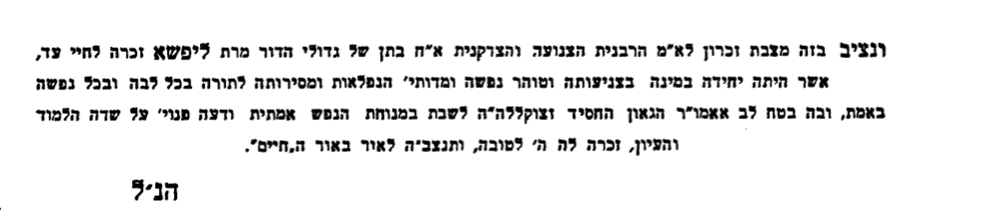
2. It is reported that when R. Hayyim’s commentary was published in 1936, R. Baruch Ber Leibowitz had a ceremony whereby the book was brought into the beit midrash together with music, just as if it were a new Sefer Torah. Students even danced with the book from R. Baruch Ber’s house until the yeshiva. See R. Dov Eliakh, Be-Sod Siah, p. 212.

[4] “Rambam of Brisk: R. Hayyim Soloveitchik’s Relationship with Mishneh Torah,” Tradition 5 (Summer, 2024), p. 2 n. 2.

[5] Friedman, however, points to one example where R. Hayyim suggests that the text of the Mishneh Torah is in error. See Hiddushei R. Hayyim HaleviEdut 21:9. R. Hayyim supports his suggestion by claiming that his preferred reading appears in an old manuscript. However, this raises the question of where he obtained this information, since the Frankel edition of the Mishneh Torah reports that no manuscripts preserve an alternate reading. See Hiddushei R. Hayyim HaleviEdut 21:9 and Friedman, “Kelalei Ha-Gaon Rabbi Hayyim mi-Brisk be-Veur ha-Rambam,” Alumot 1 (2026), pp. 390-391.

[6] “Ha-Yahas li-She’elat Nusah be-Sifrei Hazal,” in Yoel Catane and Eliyahu Soloveitchik, eds., Beit ha-Va’ad (Jerusalem, 2003), pp. 27-28, n. 28.

[7] “Yesodot ve-Ekronot Parshanut ha-Talmud,” Ha-Otzar 6 (Av 5777), p. 266.

[8] See also R. Raphael Amihai Hadad in the recently published Ha-Mashbir, vol. 12 (2026), p. 126:

ושמעתי בשם הגרב”ש דויטש זצ”ל שאף שהגר”ח בחידושו הידוע על “שומר שמסר לשומר” (הלכות נזקי ממון פ”ד ה”ד), בונה מערכת שלמה ליישב ולהסביר דברי הרמב”ם בעוד שהרמב”ם עצמו בתשובתו לחכמי לוניל (הובא במעשה רוקח שם) תולה את זה בטעות סופר, “דומה, כי גם אילו היה הגר”ח יודע את תשובת הרמב”ם, לה היה חוזר בו”

This volume of Ha-Mashbir, edited by the indefatigable Rabbis Yissachar Dov Hoffman and Ovadya Hoffman, is as usual a fascinating publication. It includes a previously unpublished commentary by R. Ovadiah Yosef on Tehillim. It also includes letters I received from R. Meir Mazuz in the years after the publication of Iggerot Malkhei Rabbanan. You can see the letters here.

[9] Ha-Dor ve-ha-Tekufah, p. 48. Truth be told, I am hesitant to quote anything from this book. I say this because the following passage (p. 32), citing R. Isaac Zev Soloveitchik in explaining why R. Kook came to London, is so historically uninformed that it raises questions about the reliability of the entire book. There is no way that R. Isaac Zev could have said what he is quoted as saying.

פעם שאל אותי אם יודע אני איך הגיע רב קוק ללונדון, וסיפר לי כי הוא הורחק מישיבת וואלוז’ין לפי שהי’ קייליקער, ועסק בלימודי השכלה, ואח”כ התחתן וחפש רבנות, כשמוע הגר”ח ז”ל שהוא מחפש רבנות, חרה לו ז”ל מאוד, אמרו לו הלא כבר עשה תשובה, אמר להם וכי ממנים בעל תשובה להיות רב, וכתב הגר”ח לכל העירות שבליטא שלא יקבלוהו לרב, ולכן הוכרח לברוח ללונדון

The statement that we would not appoint a baal teshuvah as rav of a community, which was widely accepted throughout the generations, refers to the classic baal teshuvah, namely, someone who “went off the derekh” and then repented. It does not refer to a “tinok she-nishbah,” i.e., someone born into a non-religious family—either a Converso family or a modern non-Orthodox family—who later in life became religious. The same can be said about a hazzan, concerning which Ta’anit 16b states that he must not have had a bad reputation in his youth. See R. Moshe Sternbuch, Teshuvot ve-Hanhagot, vol. 1, no. 99; R. Netanel Meoded, Mizrah Shemesh, vol. 4, no. 1. See also R. Sternbuch, Teshuvot ve-Hanhagot, vol. 2, no. 462, who sees value in having a baal teshuvah as a darshan. R. Avraham Shapiro has a different perspective; see his Rosh Devarkha (Jerusalem, 2010), p. 565:

כאשר ראה הסבא מסלובודקה זצ”ל שכל הישיבה שלו הלכה לשמוע את הרצאתו של החוזר בתשובה – הרב בירנבוים זצ”ל – הוא אמר: אני הייתי רגיל שבעל תשובה יושב בפינה ובוכה, והיום, יושב על במה ונותן הרצאות

I would only make two points about this passage. The first is that Nathan Birnbaum was a classic baal teshuvah in that he abandoned Orthodoxy before later returning, so his situation is not comparable to current baalei teshuvah who grew up irreligious. Second, Birnbaum was not a rabbi, a mistake that can be attributed to the editor of the book, as R. Shapiro would never have referred to him with the rabbinic title. In R. Shapiro’s Siah Ish, attached to his Hag ha-Sukkot (Jerusalem, 2012), p. 96, R. Shapiro’s comment about Birnbaum also appears. Yet here he refers to “Dr. Nathan Birnbaum,” which is what R. Shapiro would have said.

[10] Gulevsky, Lahat ha-Herev ha-Mithapehet, pp. 5-6.

[11] Kanievsky, Orhot Rabbenu (new ed.), vol. 4, p. 169.

[12] See Levi, “Rabbi Samson Raphael Hirsch – Myth and Fact,” Tradition 31 (Spring 1997), p. 11, called to my attention by Lesher.

[13] Ha-Ma’yan 48 (Nisan 5768), p. 37.

[14] See Jacob J. Schacter, “Torah u-Madda Revisited: The Editor’s Introduction,” Torah u-Madda Journal 1 (1989), p. 15, n. 1.

[15] There are also a few minor differences between the original letter and what appears in Ha-Pardes. The following sentence is only found in Ha-Pardes.

ואם אסור מן הדין בודאי גם כן משום פרנסה אסור ובפרט אם יכול האדם למצא אומנות אחרת נקיה וקלה אף גם שאינו מרויח כך כך

[16] The letter is found in the R. Joseph Rozin Collection, Yeshiva University Archives, MS. no. 1142. I thank Yeshiva University for permission to publish the letter. You can see the original letter here.

[17] Ha-Ma’yan 48 (Nisan 5768), pp. 38-39.

[18] Tradition 28 (Fall 1993), pp. 46-81.

[19] “Torah im Derekh Eretz in Our Time,” p. 68.

[20] Ibid.

[21] Ibid.

[22] When Levi reprinted R. Schwab’s article on Torah im Derekh Eretz in Ha-Ma’yan 48 (Nisan 5768), pp. 38-39, he is clear that Hirsch did not regard Torah im Derekh Eretz as a hora’at sha’ah. See ibid., p. 37.

[23] “Rabbi Samson Raphael Hirsch – Myth and Fact,” pp. 7-8.

[23b] Ha-Ma’yan 48 (Nisan 5768), p. 38 n. 12.

[24] Hirsch, Collected Writings, vol. 9, p. 146.

[25] Schendowich, Hermann Schwab: Historian of German Jewry, His Life and Shorter Works (Jerusalem, 2022), p. 79 n. 24.

[26] Hirsch, Collected Writings, vol. 7, p. 88.


R. Nathan Nata ben Reuben David Tebele Spira and his Works: Among them Ma’amar Yayin ha-Meshummar, on the Prohibition against Drinking Stam Yeinam (gentile wine), and Contemporary Books on that Subject

R. Nathan Nata ben Reuben David Tebele Spira and his Works:
Among them Ma’amar Yayin ha-Meshummar, on the Prohibition against Drinking Stam Yeinam (gentile wine), and Contemporary Books on that Subject[1]

By Marvin J. Heller

Wine gladdens the hearts of men,
to make the face shine from oil,
and bread that sustains man’s life (Psalms 104:15).

The life and works of the seventeenth century rabbinic figure, R. Nathan Nata ben Reuben David Tebele Spira (Shapira), his books, among them Ma’amar Yayin ha-Meshummar, on the prohibition of stam (setam) yeinam (gentile wine), and other contemporary works by rabbis on that controversy are the subject of this multi-part article. Concerning the dispute over stam yeinam it should be noted, emphasized, that this article is not a halakhic study nor does it, in any way, intend to provide decisions in Jewish law. It is an overview, from the perspective of Hebrew bibliography, Jewish literature, and history, of an issue that does involve those subjects, but, again, from a literary and historical perspective, and that only.

I

R. Nathan Nata ben Reuben David Tebele Spira (d. 1666) was born in Cracow, where his father served as a dayyan. His grandfather, R. Nathan Nata ben Solomon Spira (Shapira, c. 1585-1633) after whom he is named, was the renowned kabbalist and author of Megalleh Amukkot (Cracow, 1637), two hundred fifty-two explanations of Moses’ prayer, at the beginning of parashat Va-Ethannan, to cross the Jordan and see Eretz Israel (Deuteronomy 3:23 ff.). Our Nathan Nata Spira served as rabbi in several cities in Poland, subsequently going up to Eretz Israel when already elderly. He became, in Jerusalem, the rabbi of the Ashkenaz community.

The Chmielnicki massacres of 1648-49 (tah-ve-tat) in Europe and the ensuing devastation resulted in a severe reduction in the financial aid provided by the Jews of Eastern Europe to the Jewish community of Jerusalem.[2] This necessitated Spira traveling to Europe as a communal representative to seek increased support for the needy Jews of Jerusalem.[3] His journey, begun in 1655, took him to Italy, Holland, and Germany. Among the communities Spira visited was Amsterdam, where his influence caused Menasseh Ben Israel to bring the plight of Polish Jewry to the attention of Oliver Cromwell. Although Spira returned to Jerusalem, the needs of his community necessitated his returning to Europe, where he passed away in Reggio, Italy in 1666. Parenthetically, two of his son-in-laws subsequently served in that city’s rabbinate.[4]

It was in Italy that Spira published his books, all at the Vendramin press.[5] That press, established by Giovanni Vendramin in 1630, broke the monopoly enjoyed until then by Alvise Bragadin. For the first ten years the press operated under the name of its founder, but after his death it became known by the names Commissaria Vendramina and Stamparia Vendramina. The press eventually joined with that of Bragadin, and the combined presses continued to operate well into the eighteenth century.[6] Spira had formed a close relationship with R. Moses Zacuto (c. 1620–1697), among the foremost contemporary exponents of Lurianic kabbalah in Italy, who encouraged and was instrumental in assisting Spira in both his agency and in printing his books. Spira also edited the writings of such kabbalists as R. Chaim Vital (1542-1620), the foremost disciple of R. Isaac Luria (ha-Ari ha-Kadosh, 1534-72), R. Moses Cordevero (Ramak, 1522-70), and R. Abraham Azulai, 1570-1643).

II

The first of Spira’s titles is Tuv ha-Aretz (Venice, 1655), a relatively small kabbalistic work (80: [4] 76 ff.), on the holiness of the land of Israel. The title page of Tuv ha-Aretz has an architectural frame and is dated “the holy הקדושה (415 = 1655) land” It describes the contents which include praise of Eretz Israel, segulot (formulaic remedies), Tikkun Hazot (midnight prayers recited in memory of the destruction of the Temple), tikkun for the night of Shavu’ot, and tikkun for Hoshana Rabbah. These tikkunim are according to the rite of the kabbalists in Eretz Israel. There is also a kinah (dirge) on the exile of the Shekhinah (Devine presence).

Zacuto, who encouraged Spira to print this work, wrote a versified preface, the initial letters of lines forming an acrostic of his name. This is followed by introductions from the author and from Zacuto, who was the editor, and who also added prefatory remarks to some of the tikkunim. Spira, in his introduction, writes that Tuv ha-Aretz is based on the writings of R. Isaac Luria (ha-Ari), R. Hayyim Vital (including the tikkun from his Etz Hayyim, with glosses from the author), R. Moses Cordovero (Remak), and R. Abraham Azulai, concerning the holiness of the land, the need to sustain its inhabitants, and rebuking those whose criticism results in reduced support. He concludes that those who hearken, “shall eat the good of the land (tuv ha-Aretz)” (Isaiah 1:19).


1655, Tuv ha-Aretz
Courtesy of the Library of Agudas Chassidei Chabad Ohel Yosef Yitzhak

Tuv ha-Aretz is recorded in Shabbetai Bass’ (1641-1718) Siftei Yeshenim (Amsterdam, 1680), the first bibliography of Hebrew books by a Jewish author. His description of Tuv ha-Aretz states that it is “in praise of Eretz Israel and explains its ten levels of holiness. It also includes tikkun hatzot and tikkun for the night of Shavu’ot according to Kabbalah.”[7]

Tuv ha-Aretz has been republished several times. The first reported reprint is Constantinople (1706).[8]

In 1660, two additional works by Spira, Mazzat Shemurim and Ma’amar Yayin ha-Meshummar. were published. Mazzat Shemurim was published by Antonio Rezzin, Vendramin in quarto format (40: 8, [4], 9-12, 21-84 ff.). Its name notwithstanding, Mazzat Shemurim מצת שמורים, despite the allusion to Pesah (Passover) and mazzah in its’ title, the word mazzat מצת does not, as its name implies, have anything to do with the festival, but rather is a kabbalistic work on the laws of mezuzah מ, zizit צ, and tefillin ת, the initial letters spelling Mazzat מצת.


1660, Mazzat Shemurim
Courtesy of the National Library of Israel

The text of the title page, which has an outer frame of florets and an inner border; comprised of verses on all four sides, primarily related to the subject matter, the bottom verse including the publication date, “You shall be blessed above all other peoples ברוך תהיה מכל העמים” ([5]420 = 1660)” (Deuteronomy 7:14). The text of the title-page states that it is:

Mazzah, “a commandment of men learned by rote” (Isaiah 29:13), kept with all honor, according to the arcanum of mezuzah, zizit, and tefillin. Also, the morning benedictions according to the order of service, most precious to all “men of stature” (Isaiah 45:14) and to “all delightful craftsmanship” (Isaiah 2:16). . . .

Be-mizvat ha-Sar ha-Gadol Morisini

in the year, “And this is the Torah of the sacrifice of peace offerings השלמים ([5]420 = 1660)” (Leviticus 7:11) from the creation.

There is a brief introduction, and below it prefatory remarks, of which each line begins with an acrostic from Vintorin ben David. The text follows, in two columns in rabbinic type, excepting headers and initial words, which are in square letters. It begins with Sha’ar ha-Berakhot, set in a decorative frame, the initial words being minhagei ha-Ari. Hilkhot Tefillin has illustrations as to the proper order of placing tefillin according to Spira. Mazzat Shemurim is also recorded by Bass, who writes “on the deep meanings of of mezuzah, zizit, and tefillin and the order of their writing, letter by letter, and all their rules, according to Kabbalah.[9]

Mazzat Shemurim was reprinted in Amsterdam (1776) and Zolkiew (1865).[10]

III

Our next Spira title is Ma’amar Yayin ha-Meshummar, on the prohibition against drinking Stam Yeinam (gentile wine). Before discussing Ma’amar Yayin ha-Meshummar an introduction to the issue of prohibitedwine and the dispute that occurred concerning that wine is necessary. Stam Yanim is defined by OU Kosher as:

Stam yainum refers to wine which might have been poured for an idolatrous service, but we did not see it happen. In the days of the Mishnah, there was a pagan ritual to pour off some wine from every bottle in honor of an idol. Because of the uncertainty, the rabbis decreed that wine that was produced by a nachri [non-Jew], or even kosher wine which was left unattended with a nachri, is forbidden for drinking and benefit because it may have been poured for idolatry. After the rabbinic decree was enacted we treat stam yainum as if we saw it being poured (Tur Y.D. 123).

Even if the nachri who touched the wine was a monotheist, and he would therefore certainly not serve an idol, the rabbis still forbade the wine, for another reason—because sharing wine can lead to intermarriage. However, in this case, it is only forbidden to drink the wine, but one may benefit from this wine in other ways (e.g., it may be bought and sold). (See Shulchan Aruch Y.D. 123:26 and Shach 123:51.)[11]

The Talmud and Shulhan Arukh address stam yeinam as follows:

R. Asi says in the name of R. Yoḥanan who says in the name of R. Yehuda ben Beseira: There are three kinds of prohibited wines: yein nesekh (libation wine) from which it is prohibited to derive any benefit from the wine and which imparts severe ritual impurity when it has the volume of an olive-bulk.

stam yeinam, the ordinary wine of a gentile which is prohibited for benefit which imparts the ritual impurity of liquids when it has the volume of one-quarter of a log.

With regard to the wine of one who deposits his wine with a gentile, one is prohibited from drinking it, but one is permitted to derive benefit from it.

And thirdly, if one deposits his wine with an idolater, for safekeeping it is prohibited from drinking, but permitted for benefit. (Avodah Zarah 30b-31a)

stam yeinam of gentiles, idol worshippers, is prohibited from benefit and similarly, our wine which is touched by them is prohibited. Hagah (Notations of Rema) Because of the decree of wine poured out as a libation for idols. In contemporary times we do not find that wine is poured out for a libation. There are those who say that wine touched by a gentile is not prohibited from benefit and therefore it is permissible to take gentile wine to fulfil an obligation (repayment of a debt) as it is saving (from a loss). That is also the case for other instances in which there would be a loss, for example, if one transgresses and purchases or sells. However, initially it is prohibited to acquire or to sell in order to profit (Shulhan Orah Y. D. 123:1)

Given the above, an unlikely dispute arose roiling Jewish communities in the late sixteenth and early seventeenth centuries. It involved rabbinic participants from Eretz Israel through Italy to Poland, and concerned stam yeinam, wine prohibited for consumption from Talmudic times. Among those who were lenient on the prohibition of stam yeinam was R. Samuel Judah Katzenellenbogen (1521-97). The son of R. Meïr of Padua (Maharam of Padua, 1482-1565), Samuel Katzenellenbogen served as rabbi in Venice and was highly regarded. His responsa are included in the responsa of several rabbis. According to Avraham Yaari, it was well known that Katzenellenbogen was lenient on the prohibition, as it concerned drinking with non-Jews which could lead to intermarriage. However, to acquire wine and drink it where weddings are not a concern, what does it matter?[12]

Also, as noted above, no less an authority than R. Moses Isserles (Rema, c. 1530-1572) the halakhic decisor for Ashkenazim, was apparently lenient on the prohibition of stam yeinam. He expressed a somewhat lenient view in his responsa, (no. 124) (Cracow, 1640), permitting Jews to do business with non-Jewish wine, vital to them to make a living. Rema noted that there was not a concern that it had been used for idolatrous purposes. Nevertheless, “what he has proposed is not in accord with settled halakhah and should not be relied upon.”

In that responsa, Rema permitted non-Jewish wine to be consumed by someone who was ill, not dangerously so, “and even those who while in perfect health drink such wine—as many did in the sixteenth century in France and as is now commonly done in nearly all countries—are not to be considered as neglecting any ritual requirement, and consequently are not to be suspected in regard to other commandments or are not to be considered as neglecting any ritual requirement, and consequently are not to be suspected in regard to other commandments or invalidated as witnesses.”[13]

Marc B. Shapiro informs that this was “quite shocking to later halakhists” who feared that this would weaken to consumption of such wine. Shapiro writes that as a result “it was too dangerous for publication. It was then censored out of the Amsterdam 1711 edition of Isserles’ responsa . . .” Shapiro relates that in contrast, R. Judah Loew of Prague (Maharal, 1525-1609) writes that in Moravia the masses and even rabbis did drink such wine. Maharal adopted a different and more severe approach, instituting “a special prayer (mi sheberakh) for those who abstained from such wine.” Lastly, Shapiro reports that more recently, R Sheftel Weiss of Nagysimonyi, Hungary (1866-1944) held that given a choice of eating pork or drinking non-Jewish wine, the former would be preferable.[14]

IV

We turn now to Ma’amar Yayin ha-Meshummar, Spiras’s work on the prohibition against drinking gentile wine (stam yeinam) as well as addressing the issue of shaving one’s beard. It too was published by the Vendramin press, this in quarto format (40: [8], 38 ff.). Spira’s approach is kabbalistic, as is that of many of the other contributors to Ma’amar Yayin ha-Meshummar.


1660, Ma’amar Yayin ha-Meshummar, Venice
Courtesy of the Library of Agudas Chassidei Chabad Ohel Yosef Yitzhak

The title page has an attractive frame comprised of an outer border of florets belonging to the Vendramin press, although that printer’s name does not appear in the book. The inner frame is comprised of four lines of biblical verses between them on all four sides – all associated with wine, all from song of Songs:

“He brought me to the banquet room (lit. house of wine) and his banner of love was over me (Song of Songs 1:4)
“Oh, give me of the kisses of your mouth, for your love is more delightful than wine” (1:2)
“How much more delightful your love than wine, Your ointments more fragrant than any spice!” (Song of Songs 4:10).
“The king has brought me to his chambers . . . Savoring it more than wine” (Song of Songs 1:4).

The text of the title-pages states that it is a comprehensive work on the grave prohibition of drinking stam yeinam (gentile wine) or destroying “the corner of their beard” (Leviticus 21:5), and that it was printed be-seder ve-zot Hukat ha-Torah in the year “the holy הקדושה (420 = 1660) land.”

R. Spira’s lengthy introduction follows, in which he recounts how “Fear of God” (Genesis 20:11, Nehemiah 5:15) has caused him to leave his place and go out as an emissary, traveling through many places, where they have changed their ways and drink in a manner not in accordance with halakhah, a situation he bemoans in strong language. He includes the “reproofs of instruction” (Proverbs 6:23) of other rabbis, some deceased נוחי עדן, who over a period of time have inveighed against these serious iniquities, some previously printed, others not, and included here.

The text is set in two columns in rabbinic type, excepting headers, introductory text, and initial words. Eminent rabbis whose works on these subjects are printed here for the first time from Salonika are R. Samuel de Medina (Maharashdam, 1506–1589), R. Jacob Taitazak, R. Solomon le-Bet ha-Levi (1532-1600), R. Solomon ha-Kohen, R. David ben Nahmias, R. Moses Garshon, R. David ibn Sasson, R. Hiyya de Boton; from Constantinople are R. Meir ben Shango, R. Hananiah ben Yakar, R. Shem Tov Atiah, R. Hayyim Bassan, R. Eliezer Nahmias, R. Samuel Jaffe, and R. Isaac Ashkenazi. A comparable number of rabbis whose writings were published previously are also included in Ma’amar Yayin ha-Meshummar.

Two brief examples of Spira’s approach, exemplified by his multi-faceted concern with wine, is the attribution (f. 5a) of the sin of Adam ha-Rishon and Eve (Genesis 3:6), where Spira writes that “the sin was that Eve squeezed grapes and gave it to him [Adam].” He continues attributing Leah taking the crown of Rachel with wine, relating that the numerical value of grapes ענבים (172) is equal to effect עקב (172), concluding that “The effect of humility is fear of the LORD” (Psalms 22:4), and that wine in grapes is the judgement resulting from this.

Further on (6b), he continues with the attribution of the prohibition on wine touched by a non-Jew to Adam and Eve, writing that Eve ate from the tree of knowledge for she added to the original command “thou shalt not touch it’ (Genesis 3:3) causing [the demonic angel) Samael to come and touch the tree and make it yayin nesekh (libation wine). Therefore, the sages enacted that the touch of a gentile makes it nesekh and prohibit benefit from it.

Contemporary Italian Jewry was considered lax in their observance of these mitzvot, stam yeinam, a rabbinic decree based on the Talmud, noted in detail above, the latter, a biblical decree, also codified in the Shulhan Arukh. Ma’amar Yayin ha-Meshummar has been reprinted several times.[15]

In addition to the above works, Spira also wrote Torat Natan, published posthumously (Lemberg, 1884). Torat Natan is an elucidation of passages in the Zohar, and Me’orot Natan, a large work in three parts on kavvanot in prayer and the order of festivals with glosses by Zacuto, R. Samuel David Ottelenghi, and others, still in manuscript.[16]

V

The prohibition of stam yeinam has been addressed in numerous rabbinic works in addition to Spira’s Ma’amar Yayin ha-Meshummar. It was not only Spira and those rabbis included in Ma’amar Yayin ha-Meshummar who expressed concern and disapproval over the slackness in observance of these mitzvot. Most of the sixteenth and seventeenth century volumes concerned with the subject of gentile wine did so as part of a considerably larger subject matter, including it as one of numerous topics in responsa. Ten works from that period addressing the proscription have been identified.[17] The majority are not primarily concerned with stam yeinam.

Several examples of those works, one primarily concerned with our subject, others noting stam yeinam as just one of numerous issues, are described below in a relatively concise manner. The subject of gentile wine, as noted above, is included in works comprised of a very wide and varied subject matter, as evident from the following works. The sole book described here that directly address the issue of stam yeinam is our first work, that is, Dimyon Aryeh.

Dimyon AryehR. Judah Leib ben David Pisk (Pisek) of Nikolsburg’s (d. c. 1644) Dimyon Aryeh (1616, Prague) is a collection of responsa on the issue of leniency on setam yeinam (gentile wine). A small work, it was printed at the press of Moses ben Joseph Bezalel Katz in quarto format (40: [18] ff.).

Pisk’s censure of stam yeinam, the drinking of gentile wine, is such that he compares it to a Torah prohibition on yein nesekh (libation), even criticizing early prominent sages for not being sufficiently emphatic on the prohibition.


1616,
Dimyon Aryeh, Judah Leib ben David Pisk, Prague
Courtesy of the Valmadonna Trust Library

At the end of the book is an approbation from R. Moses ben David Levi and then the editor’s introduction, who writes that this book, small in size but of great value, came to hand. When he saw Pisk’s great erudition and sharpness in Talmud and poskim, he entitled it

Dimyon Aryeh, from the verse, “He is like a lion (dimyon aryeh) that is greedy [for its prey]” (Psalms 17:12), for as his name so he too is like a lion in the Torah, for his heart is as the heart of a lion. His intent is not to instruct in practical halakhah but rather his intent, which is pure, is to compare one case to another מילתא למילתא, one side to another, until at the end “selecting the food from the waste” (cf. Shabbat 74a) bringing to light the correct way, as the one who sees can see. . . .

Below the introduction is verse in praise of the author, in two columns, the initial letters in both columns forming an acrostic of Joseph Prague. The verso of that page lists the contents, consisting of eleven responsa, all erudite, none immediately evident that they are on the book’s subject matter. The responsa are from leading contemporary rabbis, among them R. Ephraim Luntshits, R. Isaiah Horowitz, and R. Yom Tov Lipmann Heller. Dimyon Aryeh concludes with three brief responsa on the subject from R. Mordecai Lipshitz, R. Phineas Horowitz, and R. Lippman Segal.

For example: 5) on the obligation to spend money in order to not transgress a negative or positive precept from the Torah and what that entails: 7) explaining for which transgressions one should die rather than violate [a commandment] and on which transgressions one should violate and not transgress. This last responsum deals with the sotah (errant wife), and, with great erudition, quoting several Talmudic tractates, it is connected to the prohibition on stam yeinam. Below the approbation of R. Moses ben David Levi ([17b]) is a crowned, two-tailed lion, passant, the symbol of Bohemia.[18]

Dimyon Aryeh has been reprinted once only (Monsey, NY, 2006).

Gevurot ha-Shem
– An example of the former is the Maharal’s Gevurot ha-Shem (1581-82, Cracow); Maharal was among the preeminent rabbinic sages of the late sixteenth and early seventeenth centuries; his position on stam yeinam was noted above. Gevurot ha-Shem is on the Exodus, the Haggadah, Divine providence, exile and redemption, and consists of seventy-two chapters, fifty-one to sixty-five a commentary on the Haggadah. The volume concludes, with kizzur hilkhot Pesah and hilkhot yein nesekh ve-issuro, that is, the prohibition on gentile wine. At the beginning of that section Maharal refers to the prohibition due to socializing, noting that by drinking four cups of wine from yayin nesekh at the Passover seder sin one is adding to sin and is performing a mitzvah through a transgression. They are “The people who provoke My anger, continually, to My very face” (Isaiah 65:3).

Sefer ha-Zikhronot – Another example is R. Samuel ben Abraham Aboab’s (1610–94) Sefer ha-Zikhronot (1631-51, Prague). Born in Hamburg, Aboab was sent by his father at the age of thirteen to study with R. David Franco, whose daughter he married after the latter’s death. He initially served as rabbi in Verona, but in 1650 became rabbi in Venice, where he headed a yeshivah and rabbinic court. Aboab, who was known for his erudition, piety, and humility, fasted frequently.


c. 1631-51, Sefer ha-Zikhronot
Courtesy of Virtual Judaica

Despite his reputation for halakhic stringencies, Aboab was widely turned to, receiving numerous inquiries on matters of Jewish law. Published as an anonymous work, the title page not giving the author’s name, date or place of publication, it is attributed to Aboab and placed by bibliographic sources between 1631-51 in Prague.

Sefer ha-Zikhronot is a halakhic work explicating enactments, customs, and laws on contemporary issues. Sefer ha-Zikhronot is divided into ten zikhronot which are further sub-divided into chapters. The zikhronot are ethical principles arranged according to positive and negative precepts, dealing with those commandments, the observance of which individuals are lax in or fail to observe properly. The third of the zikhronot, comprised of three chapters, is on the prohibition of stam yeinam.

She’elot u’Teshuvot – Again, stam yeinam is addressed but is not the subject of R. Moses ben Joseph di Trani’s (Mabit, 1500-1580) She’elot u’Teshuvot (1629, (Venice). This collection of responsa consists of eight hundred and six entries. There is an index; Examples of the headings include laws of festivals (10 entries), laws pertaining to women (7) with such subheadings as betrothal (19), divorce (21), yibbum (levirate marriage) and halizah (4) ketubbot (21), dowries (7), stipulations in the ketubbot (3), support (3), and rebellious wives (3). The heading issur ve-heter has ten subheadings, among them food that is not kosher and prohibited wine, usury, Sefer Torah and parapet (ma’akeh), excommunication, vows and nazirite oaths, dedicated things, sabbatical year, prozbul, and mourning.

Masat Binyamin – The subject of stam yeinam is also addressed in R. Benjamin Aaron ben Abraham Slonik’s Masat Binyamin (1632-33, Cracow). The author was rabbi in Silesia and Podhajce. Masat Binyamin, authoritative responsa and brief halakhic novellae was published by Slonik’s grandson, R. Israel Isaac ben Hayyim Menahem Man. The title is from “Benjamin’s portion” (masat Binyamin, Genesis 43:34).

The title page is followed by Israel Isaac’s introduction, comprised of six paragraphs, each beginning Benjamin. He remarks that he has so carefully edited the work that errata are unnecessary. Next is a summary index by subject of the 112 responsa, on such subjects as gittin and halizah (12 responsa); ketubbah and dowry (7); kiddushin (5); agunah (10); business issues (8); mourning (11); other (2); zizit, prayer, and synagogue (6); Sefer Torah and its reading (6); Shabbat and eruvin (3); hamez (5); shofar, lulav, Purim, and fast days (6); forbidden foods (19); yein nesekh and usury (4); hallah, firstling of animals, and charity (3); and niddah and ritual immersion (2).


1632-33, Masat Binyamin, Benjamin Aaron ben Abraham Slonik, Cracow
Courtesy of Virtual Judaica

One responsa suggests a close relationship between Jews and their Christian neighbors. May a Jew loan clothing and jewelry to a non-Jew to wear to church on their holidays (86)? Slonik permits it as the clothes are worn for pleasure and prestige, not for religious purposes. On the sanctity of a printed Bible as opposed to a codex Bible, he rules that they have equal sanctity (99). May the margin of a Bible, trimmed when the printer binds the volume, be discarded (100)? Slonik writes that since all books are so bound it is as if the original intent was to do so and no sanctity adheres to the trimmings.

In an extensive responsa (29) Slonik deals with yein nesekh (gentile wine) where a Jew, Moses, entrusted sealed barrels of new wine to be delivered by non-Jewish waggoners under the supervision of Jews traveling on the wagon. The latter left the wagon, leaving the wine unsupervised. Moses found the wagon with the seals unbroken. Slonik writes that normally two seals are required as the seller will not see his wine again, not the case here. He permits the wine where great loss will occur with the caveat that if the wine bubbles through the tar sealing the barrel, as often happens with new wine, it is forbidden.

Davar she-bi-Kedushah – A popular kabbalistic work to arouse repentance is R. Abraham Reuben ben Hoeshke Katz (d. 1673) Davar she-bi-Kedushah. Katz is best known as the author of Yalkut Re’uveni and Oneg Shabbat. Davar she-bi-Kedushah was printed in Sulzbach (1684), at the press of Moses ben Uri Shraga Bloch. A small work, Davar she-bi-Kedushah was printed in octavo format (40: 12 ff.).


1684, Davar she-bi-Kedushah
Courtesy of the Library of Agudas Chassidei Chabad Ohel Yosef Yitzhak

There is an introduction by Abraham Reuben, in which he informs that the work is entitled Davar she-bi-Kedushah because there are ten ma’amorot for each het (sin), which is a davar shel kedushah; the initial and final letters of the title spell derasha; and for “those who seek (dorshei) the Lord shall not lack any good thing” (Psalms 34:11). It concludes with a list of twenty-two categories of sins in alphabetic order expressed as the viddui (confession of sins) on Yom Kippur, that is, the al het (for the sins that we have sinned before you). These are sins people customarily transgress and should be confessed daily.

Each sin begins with a heading of the sin, repeated as the viddui, for example, א eating and drinking, “for the sin that we have sinned before you through eating and drinking,” and then ten paragraphs from a wide selection of kabbalistic, Midrashic, and aggadic sources on that entry, the subject matter including: ב birkat ha-mazon; ג pride; ד vows and oaths: ה thoughts; י wine and yein nesekh; כ honor of sages; לevil talk and slander; מ tithes and charity; נ netilat yadayim (hand washing); צ zizit, tefillin, and mezuzot; and ת Torat Moshe. Examples from wine (3, 7) are:

3. Also these erred with wine for in that they drank wine they “fashioned a calf” (Exodus 32:4) and said “These are your gods” (Exodus 32:4, 8) and these also erred with wine. (Tanhuma)

7. The wine that Isaac gave to Jacob to drink Michael brought from Gan Eden and one does not find such wine as this for blessing except by Abraham and Melchizedek. (Midrash)

VI

R. Nathan Nata ben Reuben David Tebele Spira was, in his time, a rabbi of repute, but like many other prominent individuals is not well remembered today. His works, albeit highly regarded, are not well recalled today. While that is the case for many early rabbis of import, in Spira’s case that might be attributed to the specialized and esoteric nature of his works, as well as their kabbalistic content. Moreover, what might be considered his most important work, Ma’amar Yayin ha-Meshummar, on the prohibition against drinking Stam Yeinam (gentile wine), is on a subject that is not as prominent, or sensitive today.

The subject of stam yeinam (gentile wine) was, as noted above, a topic of some discussion in Spira’s time. There were rabbis who permitted the consumption of gentile wine that was not designated for ritual use (libations), while others were adamant that there were no leniencies where stam yeinam was concerned. Spira was clearly on the stricter side of that dispute, as expressed in Yayin ha-Meshummar. That the dispute over the admissibility of such wine was widespread and of concern is clearly demonstrated by the number of works that address the issue.

Today, stam yeinam is no longer an issue, being clearly forbidden in strictly religious circles, and no longer a matter of concern among more liberal Jews. R. Nathan Nata Spira clearly expressed the strict negative opinion on the subject.

Again, his other works, which are not controversial, are most certainly of value. R. Nathan Nata ben Reuben David Tebele Spira was, in his time, a prominent rabbi who wrote significant kabbalistic works. In addition to Ma’amar Yayin ha-Meshummar, Tuv ha-Aretz on the holiness of the land of Israel and Mazzat Shemurim on the laws of mezuzah and tefillin are valuable works that deserve to be better remembered today.

[1] I would like to express my appreciation to Eli Genauer for his several comments and emendations.
[2] The most well-known chronicle of the tribulations of tah-ve-tat is R. Nathan Nata ben Moses Hannover’s Yeven Metsulah. Concerning that work and Hannover’s other titles see Marvin J. Heller, “R. Nathan Nata ben Moses Hannover: The Life and Works of an Illustrious and Tragic Figure,” Seforim.blogspot.com, December 28, 2018, reprinted in Essays on the Making of the Early Hebrew Book (Brill, Leiden/Boston, 2021), pp. 256-72.
[3] Aryeh Leib Frumkin (Toldot Hakhme Yerushalayim II (Jerusalem, 1927-30, reprint Jerusalem, 2002), p. 40 [Hebrew]) quotes Divrei Yimei Shemu’el informing that of seven hundred widows and indigent who dwelled in Jerusalem four hundred died of famine.
[4] Hersh Goldwurm, ed. The Early Acharonim (Brooklyn, 1989), pp. 173-74; Frumkin, pp. 38-40; Mordechai Margalioth, ed., Encyclopedia of Great Men in Israel IV (Tel Aviv, 1986), cols. 1184-85 [Hebrew]; Avraham Yaari, Sheluhei Eretz Yisrael (Jerusalem, 1951, reprint Jerusalem, 1997), I p. 153 [Hebrew].
[5] The narrative of the following books is from Marvin J. Heller, The Seventeenth Century Hebrew Book: An Abridged Thesaurus, ( Leiden/Boston, 2011), var. cit.
[6] David Amram, The Makers of Hebrew Books in Italy (Philadelphia, 1909, reprint London, 1963), p. 372; Joshua Bloch, “Venetian Printers of Hebrew Books,” in Hebrew Printing and Bibliography (New York, 1976), p. 86).
[7] Shabbetai Bass, Siftei Yeshenim, (Amsterdam, 1680), p.26, tet 2. Concerning Shabbetai Bass see Marvin J. ller, “Bass, Shabbetai ben Joseph Meshorer,” The YIVO Encyclopedia of Jews in Eastern Europe, Gershon David Hundert, ed. I (New Haven & London, 2008), pp. 129-30.
[8] Yeshayahu Vinograd, Thesaurus of the Hebrew Book. Part II Places of print sorted by Hebrew names of places where printed including author, subject, place, and year printed, name of printer, number of pages and format, with annotations and bibliographical references (Jerusalem, 1993), pp. 611 no.366.
[9] Bass, p, 48, mem 293.
[10] Menahem Mendel Slatkine, Shemot ha-Sefarim ha-Ivri’im: Lefi Sugeihem ha-Shonim, Tikhunatam u-Te’udatam (Neuchâtel-Tel Aviv, 1950-54), p. 143 [Hebrew].
[11] https://oukosher.org/halacha-yomis/yayin-nesech-stam-yainum-difference/
[12] Avraham Yaari, “An unknown document pertaining to the dispute in Rovigo,” in Studies in Hebrew Booklore (Jerusalem, 1958), p. 424 [Hebrew].
[13]
 Wilhelm Bacher  Jacob Zallel Lauterbach, “Nesek,” Jewish Encyclopedia, IX (1901-06), pp. 227.
[14] Marc B. Shapiro, Changing the Immutable: How Orthodox Judaism Rewrites Its History (Oxford: Portland, Oregon, 2015), pp.81-2, 95-98. For a more detailed discussion of the controversy over setam yeinam see Gershon Kohen, “On the History of the Controversy over Stam Yayin in Italy and its Sources,” Sinai 77 (Jerusalem, 1975), pp. 64-88.
[15] Ch. B. Friedberg, Bet Eked Sepharim, (Israel, n.d), yod 542 records three additional editions after the above printing, Levon 1867, and Munkatch 1887 and 1902 records [Hebrew].
[16] Mordecai Samuel Ghirondi and Hananel Neppi, Toledot Gedolei Yisrael u-Ge’onei Italyah ve-Hagahot al Sefer Zekher Tzadikim li-Berakhah (Trieste, 1853, reprint Brooklyn, 1993), p. 276 [Hebrew].
[17] Among the works noted for this period and the list is not necessarily comprehensive, are, in chronolofical order, R. Judah ben Bezalel Loew (Maharal), Gevurot ha-Shem (1581-82, Cracow); R. Mordecai ben Gershom ha-Kohen, She’ilot u-Teshuvot ha-Geonim (1590, Prague); R. Solomon ben Abraham ibn Adret (Rashba), Avodat ha-Kodesh (1601-02, Venice); R. Judah ben Moses Saltero of Fano: Mikveh Yisrael // Palgei Mayim Moses ben Jehiel ha-Kohen Porto-Rafa (Rapaport) Judah ben Moses Saltero of Fano: (1607-08, Venice); R. Judah Leib ben David Pisk, Dimyon Aryeh (1616, Prague); R. Moses ben Joseph di Trani (Mabit), She’elot u’Teshuvot (1629, Venice); R. Samuel ben Abraham Aboab, Sefer ha-Zikhronot (1631-51, Prague); R. Benjamin Aaron ben Abraham Slonik, Masat Binyamin (1632-33, Cracow); R. Abraham Reuben ben Hoeshke Katz Davar she-bi-Kedushah (1684, Sulzbach); and R. Yom Tov ben Moses Zahalon, She’elot u’Teshuvot Yom Tov Zahalon (1694, Venice). Concerning these titles see Marvin J. Heller Marvin J. Heller, The Sixteenth Century Hebrew Book: An Abridged Thesaurus (Leiden, 2004; and ibid. The Sixteenth Century Hebrew Book: An Abridged Thesaurus. Brill, Leiden, 2004, The Seventeenth Century Hebrew Book. op. cit. var. cit.
[18] Concerning the widespread use of the lion image as a pressmark with Hebrew books see Marvin J. Heller “The Lion Motif on Early Hebrew Title-Pages and Pressmarks” Printing History, NS 22 (Syracuse, 2017), pp. 53-71, reprinted in Essays on the Making of the Early Hebrew Book. Brill, Leiden/Boston, 2021, pp. 30-61.


Kitniyot and Stimulants: Coffee and Marijuana on Passover

Kitniyot and Stimulants: Coffee and Marijuana on Passover
One of the more interesting customs for Pesach in that of refraining from kitniyot. There is much discussion regarding the origins of this mysterious custom.  That is, the exact time this custom began, as well as it initial rationale is cloaked in mystery. That is not to say that numerous reasons haven’t been offered, only that we probably will never know for certain why this was enacted.  Moreover, what exactly is encompassed in this custom is similarly cloaked in mystery.  We have food items running the gamut.  Aside from the standard fare of rice, we have those prohibiting such seemingly odd foods as garlic and carrots.  Thus, it should come as no surprise that many have included foods that there is no legitimate reason for doing so. Indeed, as we shall see, in some instances the foods in question are prohibited although it is clear that the persons prohibiting them have no idea what exactly the foods are.  This hearkens to the idea espoused by Dr. Daniel Sperber, discussed in this article, and expanded upon in this book, that if one understanding of history, bibliography and other relevant areas is lacking this may lead one to make grievous errors in halakhic matters. In this post we will deal with two foods, both of which were prohibited under the rubric of kitniyot, and, apparently, those who made these decisions were unaware of the actual characteristics of the foods in question.  The two items we shall deal with are coffee and cannabis (hemp, hemp seed, and marijuana). [Our discussion below is with the recognition that one must always comply with all relevant federal and state laws and we limit our discussion to what position Jewish law takes regarding this topic.]
Coffee
Coffee was introduced to Western Europe in the 17th century. [See David Liss’s excellent fictionalized account of the burgeoning coffee trade in Jewish Amsterdam, The Coffee Trader. (Avner Gold has an Artscroll book, A Scandal in Amsterdam, that uses much of the same material, one wonders if it was “influenced” by Liss’s book.)]  With its introduction, some rabbis began dealing with its halakhic status, which blessing is required and, as relevant here, whether it is permissible on Passover.  R. Ya’akov Reischer (1670-1733), in his Shevut Ya’akov (vol. 2 no. 5), deals with both these questions.  Regarding the first, he holds a shehakol is the correct blessing.  Regarding the issue of Passover, he permits coffee.  He is skeptical that coffee would be considered kitniyot because “he has been told” that coffee is grown on trees, and whatever one may think about the scope of kitniyot, it does not encompass tree fruits.  But, R. Reischer hedges a bit and notes that even if coffee would be deemed kitniyot, as coffee is roasted, or, as he refers to it “burnt prior to Passover” this renders coffee unfit for even a dog and permissible on Passover.
R. Yosef b. David of Breslau, in Hok Yosef (no. 457, first published in 1730), however, disagrees.  He first questions the argument regarding roasting or burning the beans and notes that the roasting process is an integral part of coffee process.  More fundamentally, he argues that indeed coffee is kitniyot. He notes that his father-in-law, R. Abraham Broda, similarly held that coffee is kitniyot and prohibited.
R. Hayyim Yosef David Azulai (HIDA), disputes this holding in very strong terms.  HIDA explains (Shu”t Tov Eyin, no. 8) that these rabbis “should be forgiven [for holding coffee is prohibited as kitniyot] because coffee is the fruit of a tree.”  Regarding this classification HIDA is not speaking from second hand accounts like R. Reischer, rather HIDA notes that “a few years ago I saw a coffee tree in Amsterdam in the botanical gardens, as well as in Pisa and thus there is no reason to be strict regarding coffee.”  HIDA in his travelogue describes in detail his visit to the Amsterdam botanical gardens, Hortus Medicus. On the 18th of Iyar, 1778, in the afternoon,  HIDA went to the gardens. He says “that these gardens are truly indescribable they are so beautiful, all the plants and grasses are in rows, and everything is so clean, it is a testament to human intelligence.  Every plant is labeled. There are plants from America, Portugal and Turkey all in rows according their nationalities.  The wall have holes where fires can be lit to control the temperature of the gardens and ensure that the plants can survive even in the cold climate of Amsterdam.  Among the plants I saw was the coffee plant.”  (Ma’agel Tov ha-Shalem p. 150-51 ) While HIDA is unwilling to accede that these rabbis were completely unaware that coffee is tree fruit, it begs the question what those who prohibit coffee were thinking in considering coffee kitniyot.
It is not only those who prohibit coffee who seem to be unaware of exactly what they are discussing.  More recently, R. Yitzhak Isa’ak Weiss (1875-1944), one of the Spinka Rebbis, discusses “two” types of coffee, one grown on trees and the other grown “in gardens.”  He ultimately holds that both types of coffee are permitted, but the issue is that coffee always grows on tress.  There are two major types of coffee, arabica and robusta, both of which grow on trees.  Perhaps what R. Weiss is discussing is another type of coffee – one that was commonly substituted for coffee – but is not in fact coffee.  The common substitute, which has its own history and own halakhic issues, is chicory. [See. R. Y. Goldhaver’s excellent articles regarding chicory and its treatment under Jewish law in Yeshurun 19:792-834, 20:839-864] Chicory is indeed a bush and not a tree and perhaps is what R. Weiss is discussing.
Today, for most (with Passover, one can almost always find a group that prohibits something) coffee is not deemed kitniyot and is Kosher for Passover.  Indeed, one of the more common haggadot is the one produced by the Maxwell House Coffee company. (For more on the Maxwell House haggadah see our  post, “On The Maxwell House Haggadah.”)  One scholar has commented on this phenomenon: “As always, entrepreneurs, Jewish and otherwise, capitalized on wives’ and mothers’ desires to have just the right foods on the table for Passover, that longest standing of traditions.  Maxwell House coffee, reportedly, caused a stir at many seder meals when it introduced a new ‘tradition’ of drinking coffee rather than tea at the end of the sumptuous holiday banquet. A decade or so later, the company would print its own Haggadah to insure a ‘unique relationship between a product and a people.” (Jeffrey S. Gurock, Orthodox Jews in America (Bloomington: Indiana University Press, 2009), p. 151.) Maxwell House even advertised in Yiddish in HaPardes: [Thanks to M. Butler for these two sources.]


Marijuana
In 2007, the Green Party in Israel made headlines in coming out that Ashkenzim should not smoke marijuana on Passover.  There were articles from the Jerusalem Post on the topic as well as other publications.  Most are notable only in that how poor they are in substance.  Indeed, another recent example can be found here.  Although from reading these articles one may get the sense that rabbis haven’t discussed the marijuana, indeed there is at least one responsa on cannabis, the plant from which marijuana is derived, and its status on Passover.
R. Yitzhak Ya’akov Weiss (1902-1989), in Shu”t Minhat Yitzhak (vol. 3 no. 138(b)), discusses cannabis on Passover.  Specifically, he is dealing with two foods, cannabis and cotton-seed oil, but we will focus on cannabis. Prior to engaging in this discussion we should note that the cannabis plant produces three things: (1) hemp which is fibrous and can be used to make clothing, and was commonly used to make strong rope; (2) hemp seed, which is used in food and in some homeopathic remedies; and (3) as a narcotic referred to as marijuana. [See also Y. Felix, Marot ha-Mishna, Jerusalem: 1977, p. 131; and Z. Amar, “Hashish and the Hashishim in Eretz Yisrael and Syria During the Medieval Period,” in Ariel 120 (1997), pp. 277-282 (he discusses, among other topics the band of assassins that are associated with the narcotic).]  R. Weiss first notes that cannabis shouldn’t be questionable at all for Passover as Rambam, in the laws of prohibited mixing of seeds, labels cannabis as a vegetable and not kitniyot.  However, R. Weiss points out that there is an internal problem with the Rambam, one that many of commentaries on Rambam have dealt with, but not to R. Weiss’s satisfaction. It should be noted that one commentary, Radbaz (1479-1589 or 1463-1573), in his discussion of this issue makes it apparent that he is aware of cannabis’s narcotic use.  He explains that “in Egypt they eat [smoke?] cannabis and become high and those who do report that it makes them very happy . . . in other places they use cannabis to make clothing like linen.” Returning to the conflict in Rambam, R. Weiss’s solution is that there is no conflict and instead Rambam is referring to two distinct plants both of which are called cannabis.  He arrives at this conclusion by noting that cannabis is defined differently.  Some define cannabis as a fiber and others refer to it as a food item.  Thus, he concludes that there must be two different plants which share the same name.  This conclusions is of course wrong.  There are not two distinct plants but a single plant that has a variety of uses.  [Additionally, it should be noted that R. Weiss “proves” his point by referencing a Mishna that contains nikkudot.  He doesn’t identify which edition he is referring to – Kehati or some other, but using such a source is highly questionable. The Kaufmann Mishna, one of the oldest examples of a nikkud mishna doesn’t contain both mentions of cannabis in the Mishna and therefore it is impossible to determine if the nikkud follows that advocated by R. Weiss.]
R. Weiss, based upon his non-existent two plant types, concludes that hemp would be included in the prohibition of kitniyot. In so doing, R. Weiss provides yet another example of someone incorrectly categorizing a food based on lack of knowledge of the plant itself. In all events, this responsum of R. Weiss, even though it is incorrect, is not referred to in any of the above cited articles.  Indeed, the Star-K reaches the opposite conclusion and lists hemp and hemp seed as permitted on Passover (so long as one ensures there are no errant grains mixed in). Thus, it appears that marijuana would equally be deemed non-kitniyot.
Even if one accepts that marijuana is kitniyot, there is another reason that smoking it on Passover would be permitted.  This is so as R. Ya’akov Emden, (Mor u-Kitziya no. 511) discusses using tobacco on Passover where there is a fear that the tobacco may have been soaked in beer.  R. Emden explains that using such tobacco poses no problem on Passover for many reasons.  In fact, he is so sure that such tobacco is permitted he “would have announced that Jew can affirmatively soak his tobacco in beer prior to Passover, but for the fact that am haratzim would view this as wrong.” [In part this sweeping permission is due to the fact that tobacco is inedible and thus immediately after the beer is mixed in it is no longer edible.]  R. Emden concludes that he “remembers that his father [R. Tzvi Ashkenzi, Hakham Tzvi] used to laugh at those who displayed piety (mit-hassdim) and purchased Kosher for Passover tobacco.”  R. Emden’s rationale applies with equal force to marijuana.  In particular, R. Emden explains that smoking is merely deriving benefit and not considered ingesting the item in question.  This is so even if one derives benefit through one’s mouth.  R. Emden goes further to allow one to use snuff where one is partially ingesting the tobacco.  Thus, according to R. Emden, smoking something that contains hametz (beer) is not a problem, surely something that is kitniyot would pose no problem. Therefore, presuming one is smoking marijuana, this would be allowed on Passover even according to those who consider it kitniyot.
What is particularly surprising is that if one is resorting to Jewish law to determine the status of marijuana, this question is not limited to Passover.  Indeed, irrespective of marijuana’s status vis-à-vis Passover, various Rabbis have opined that using marijuana is always prohibited. For example, R. Moshe Feinstein (Shu”t Iggerot Moshe, Y”D vol. 3, no. 35) was asked about “the Yeshiva bochorim that have begun to smoke hashish (marijuana)” and if this is permissible.  R. Feinstein replies unequivocally that according to Jewish law the practice is prohibited. Similarly, R. Shlomo Zalman Auerbach prohibits the use of marijuana.  (Nishmat Avraham, O”H no. 155, no. 4)  He also deals with the issue of if one is under the influence what is their halakhic status. (Shulchan Shelmo, Refuah, vol. 2, p. 223).
Additional Sources Regarding Kitniyot Generally:
Israel Ta-Shma, “Prohibition of Kitniyot on Pesach,” Early Franco-German Ritual and Custom (Jerusalem: Hebrew University Magnes Press, 1992), p.271-282 (Hebrew)
R. Shlomo Yosef Zevin, Ha-Mo’adim be-Halakha, pp. 305-312
Simcha Emanuel, Deroshot ha-Rokeach le-Pesach, Mossad Bialik, pp. 51-53 (reviewed here)
Shut Beis Mordecai (Fogelman) #23
R.Yakov Chaim Sofer, Menuchas Sholom 7, 93-99, Menuchas Sholom, 8, p. 219-230
Minhag Avotenu be-Yadnu, 2, Chapter 20
There is also a chapter on kitniyot in Mo’adim le-Simcha although there are some inaccuracies contained therein.  Additionally, some of those inaccuaries are the same that appear in the early article in Minhag Yisrael Torah vol. 2 no. 457, thus providing yet another example of plagiarism on the Mo’adim le-Simcha‘s part.  


Deciphering the Talmud: The First English Edition of the Talmud Revisited. Michael Levi Rodkinson: His Translation of the Talmud, and the Ensuing Controversy

In honor of the publication of Marvin J. Heller’s new
book,
Further Studies in the Making
of the Early Hebrew Book (Leiden, 2013), the Seforim Blog is happy to
present this abridgment of chapter 13.
                                                                                                                   
Deciphering the Talmud: The
First English Edition of the Talmud Revisited.
      Michael Levi Rodkinson: His Translation of
the Talmud, and the Ensuing Controversy     
Marvin J. Heller
The Talmud, the quintessential Jewish book, is a
challenging work.  A source of Bible
interpretation, halakhah, ethical values, and ontology, often described as a
sea, it is a comprehensive work that encompasses all aspects of human endeavor.
 Rabbinic Judaism is inconceivable
without the Talmud.  Jewish students
traditionally followed an educational path beginning in early childhood that
culminated in Talmud study, an activity that continued for the remainder of the
adult male’s life.
That path was never easy.  The Talmud is a complex and demanding work, its complexity
compounded by the fact that it is, to a large extent, written in Aramaic, the
language of the Jews in the Babylonian exile, spoken in the Middle East for a
millennium, and used in the redaction of the Talmud.  Jews living outside of the Middle East, and even there after
Aramaic ceased to be a spoken language, found approaching the Talmud a daunting
task.  Talmud study was, for many,
excepting scholars steeped in Talmudic literature, a difficult undertaking,
made all the more so by its language and structure.  After the Enlightenment, when large numbers of Jews received less
intensive Jewish educations, these impediments to Talmud study became more prevalent.
Elucidation of the text was accomplished through
commentaries, most notably that of R. Solomon ben Isaac (Rashi,
1040-1105).  Within his commentary there
are numerous instances in which Rashi explains a term in medieval French, his
vernacular.  In the modern period,
another solution to the language problem presented itself for those who
required more than the explanation of difficult terms, that is, the translation
of the text of the Talmud into the vernacular.
There have
been several such translations of Mishnayot and parts of or entire tractates
beginning in the sixteenth century.  It was not, however, until 1891 that a complete Talmudic tractate
was translated into English. In that year, the Rev. A. W. Streane, “Fellow and
Divinity and Hebrew Lecturer, of Corpus Christi College, Cambridge, and
Formerly Tyrwhitt’s Hebrew Scholar,” published an English edition of tractate Hagigah.  A
scholarly work, the translation, in 124 pages, is accompanied by marginal
references to biblical passages and, at the bottom of the page, notes. The
volume concludes with a glossary, indexes of biblical quotations, persons and
places, Hebrew words, and a general index.
All that was available in English from the Talmud in
the last decade of the nineteenth century were fragmentary portions of
tractates, Mishnaic treatises, and Streane’s translation of Hagigah.  At that time an effort was begun to
translate a substantial portion of the Talmud into English. The subject of this
paper is that pioneer effort to produce an English edition of the Talmud.  This paper addresses the background of that
translation, the manner in which it was undertaken, and its reception.  It is also concerned with the translator’s
motivation and his qualifications for undertaking such an ambitious
project.  The paper does not, however, critique
the translation, that having been done, and done well, as we shall see, in
contemporary appraisals of  the first
English Talmud.
The effort to provide English speakers with a Talmud
was undertaken by Michael Levi Rodkinson (1845-1904), whose background and
outlook made him an unlikely aspirant for such a project.  Rodkinson, a radical proponent of haskalah,
proposed to translate the entire Talmud, not only to making it accessible to
English speakers, but also to transform that “chaotic” work, through careful
editing, into “a readable, intelligible work.”
Rodkinson is a fascinating figure, albeit a thorough
scoundrel.  He was born to a
distinguished Hasidic family; his father was Sender (Alexander) Frumkin (1799-1876)
of Shklov, his mother, Radka Hayyah Horowitz (1802-47).  Radka died when Rodkinson was an infant, and
he later changed his surname from Frumkin to Rodkinson, that is, Radka’s
son.  Some time after, perhaps in his
early twenties, Rodkinson became a maskil, with the result that his
literary oeuvre encompasses both Hasidic and maskilic works.  Rodkinson’s personal life was disreputable,
his peccadilloes including bigamy and other affairs with women.  Subsequently, Rodkinson worked in St.
Petersburg as a stock broker and speculator, and sold forged documents, such as
military exemptions and travel papers.  For these latter offenses Rodkinson was sentenced to a year in prison,
three years loss of honor, and fined 1,800 rubles.  To avoid these penalties, Rodkinson fled to Königsberg, Prussia.
In Königsberg Rodkinson edited a journal, the Hebrew
weekly, ha-Kol (1876-c.1880), described as representing the “radical and
militant tendency of the Haskalah.”  He
was also the author of a number of monographs on various Jewish subjects,
purporting to explain Jewish religious and ritual practice, although certainly
not from a traditional perspective.  The
antagonism engendered by these monographs was  intensified by his personality, arousing such hostility, that,
together with his ongoing legal entanglements, Rodkinson, in 1889, found it
advisable to emigrate to the United States.
That Rodkinson should have left the Hasidic fold, become
a maskil, and adhered to a radical ideology is not that unusual. The
late nineteenth century was witness to the assimilation or casting off of
tradition by large numbers of Jews. 
However, that someone of Rodkinson’s outlook should undertake to translate
the Talmud into English is certainly unusual and perhaps  even unique.  There is, than, a contradiction between his enlightenment
attitudes and personality, and his attempts, through his abridgement and
translation, to spread Talmudic studies. 
Individual maskilim might, as an intellectual endeavor, continue
to study Talmud, but none devoted any effort or energy to bringing the Talmud
to a public that had largely distanced itself from that repository of Jewish
knowledge. 
Nevertheless, Rodkinson’s goal of translating the
Talmud had been, as we are informed in the introduction to Rosh Hashana (sample
volume), his dream for twelve years.  He
had expressed a “desire to revise and correct the Talmud” as early as 1882 in le-Boker
Mishpat
, and subsequently in Iggorot Petuhot and Iggorot
ha-Talmud
(Pressburg, 1885); and Ha-Kol (nos. 298, 299, and 300).  In Iggorot Petuhot (repeated in the
Hebrew introduction to Rosh Hashana) Rodkinson describes the incredible
multiplicity of rabbinic works since the redaction of the Talmud.  He notes the numerous responsa, which, their
great number notwithstanding, have not resolved anything.  The Talmudic page is confused and unclear,
due to its many commentaries and cross-references.  Rodkinson states that previous exegetes, such as the Vilna Gaon,
R. Akiva Egger, R. Pick, and others, rather than clarifying the page,
proliferated works that were printed with the Talmud, adding to the confusion.
It is Rodkinson’s intent to remove the shame of the Talmud from Israel and
restore the Talmud to its original state. 
Thought of this project gives him no rest.  He thinks of it day and night. 
He writes, towards the end of Iggorot Petuhot that he will “offer
and dedicate the remainder of his days on the altar of this work, it will be
the delight of his nights and with it he will complete the hours of the
day.  . . . it will give purpose to his
life.”
Perhaps Rodkinson’s motivation can be found in the
criticism leveled by his opponents, that intellectually, Rodkinson’s weltanschauung
was bifurcated, that is, he suffered from a conflict between his Hasidic past
and radical present.  Joseph Kohen-Zedek
(1827-1903), author of Sefat Emet, a work harshly critical of Rodkinson,
accused him of being “androgynous,” two-faced, “one time he shows his face as a
Hasid, the next as a heretic, and should therefore be called Sama’el instead of
Michael, for he is a destructive angel.”[1]  More recently, Joseph Dan, writing about
Rodkinson’s Hasidic stories, notes that “Michael Ha-Levi-Frumkin Rodkinson is unique
in that he was neither a real Hasid nor a real Maskil, . . .”[2]  Abridging, editing, translating, and, most
importantly, modernizing the Talmud may have been, for Rodkinson, a means of
reconciling these diverse worlds.  The
rationale for the abridged translation, “a work that cannot prove financially
profitable, and that will probably be productive of much adverse criticism in
certain quarters,” is set forth in the English preamble, “A Few Words to the
English Reader,” to Rosh Hashana
Since the time of Moses Mendelssohn the Jew has made
vast strides forward.  There is to-day
no branch of Human activity in which his influence is not felt.  Interesting himself in the affairs of the
world, he has been enabled to bring a degree of intelligence and industry to
bear upon modern life, that has challenged the admiration of the modern
world.  But with the Talmud, it is not
so.  That vast encyclopedia of Jewish
lore remains as it was.  No improvement
has been possible; no progress has been made with it.  Reprint after reprint has appeared, but it has always been called
the Talmud Babli, as chaotic as when its canon was originally appointed.  Commentary upon commentary has appeared yet
the text of the Talmud has not received that heroic treatment that will alone
enable us to say that the Talmud has been improved.[3]
Despite the “venomous vituperation” of the attacks
upon it, a more intimate knowledge of that work would demonstrate that the
Talmud “is a work of the greatest sympathies, the most liberal impulses, and
the widest humanitarianism.”  Many of
the phrases for which the Talmud is attacked were not part of that work, but
rather “are the latter additions of enemies and ignoramuses.”  How did its present situation come about?
When it is remembered that until it was first printed,
that before the canon of the Talmud was fixed in the sixth century, it had been
growing for more than six hundred years (the Talmud was in manuscript for eight
centuries), that during the whole of that time it was beset by ignorant, unrelenting
and bitter foes, that marginal notes were easily added and in after years
easily embodied in the text by unintelligent printers, such a theory as here
advanced is not at all improbable.[4]
Rodkinson rises to the defense of the Talmud, a work
that he feels will be remembered when the Shulkhan Arukh is forgotten,
concluding that the best defense is to allow it to “plead its own cause in a
modern language.”  Others have attempted
to translate it, for example, Pinner and Rawicz, but their attempts were
neither correct not readable, precisely because they were only translations.
If it were translated from the original text one would
not see the forest for the trees. . . . As it stands in the original it is,
therefore, a tangled mass defying reproductions in a modern tongue.  It has consequently occurred to us that in
order to enable the Talmud to open its mouth, the text must be carefully
edited.  A modern book, constructed on a
supposed scientific plan, we cannot make of it, for that would not be the Talmud;
but a readable, intelligible work it can be made.  We have, therefore, carefully punctuated the Hebrew text with
modern punctuation marks, and have re-edited it by omitting all such irrelevant
matter as interrupted the clear and orderly arrangement of the various
arguments.  In this way disappears those
unnecessary debates within debates, which only serve to confuse and never to
enlighten on the question debated. . . .[5]
In the Hebrew introduction Rodkinson writes that the
task of restoring the original, or core Talmud should properly be done by a
gathering of great sages.  However,
there are none today who wish to undertake such a great and burdensome
task.  If he would seek their
assistance, it would take years to arrive at some unity of purpose, and if this
was accomplished, it would take yet more years before anything was done, for
they are occupied with other matters. 
Furthermore, the rabbinic figures appropriate for this undertaking are a
minority of a minority, for “this work is not a matter of wisdom but of
action.”[6]
 Therefore, the project only
requires men who know the language and style of the Talmud, a sharp eye and
ear, who can distinguish between its various parts and contents.  Such men need not have learned in a bet
medrash
(rabbinic house of study) or have earned the titles of professor or
doctor, nor know Latin or Greek.
Actual publication of “The New Talmud” began in
stages.  In 1895, Tract Rosh Hashana (New
Year) of the New Babylonian Talmud, Edited, Formulated and Punctuated for the
First Time by Michael L. Rodkinson and Translated by Rabbi J. Leonard Levy

. . .” appeared, issued in Philadelphia by Charles Sessler, Publisher.  The initial volume, with Hebrew and English
text, has the names of subscribers, Opinions, and a Few Words to the English
Reader from Rodkinson, all repeated in subsequent parts.
That same year, a sample volume, entitled Tract Rosh
Hashana
, was published. Despite the fact that the title-page describes it as
tract Rosh Hashana, the volume actually consists of sample pages of Rosh
Hashana
(Hebrew), together with sample pages of other tractates, in both
English and Hebrew..
The title-page of the sample volume (1895) notes that
it is being “edited, formulated and punctuated for the first time by Michael L.
Rodkinson, author of Numerous Theological Works, Formerly Editor of the Hebrew
‘CALL.’” The title-page is followed by subscription information, which may be
submitted to any one of eight individuals. 
Next are opinions from prominent personalities and Jewish periodicals,
not all of which can be printed due to space limitations.  In only two of these opinions do the writers
state that they have read the advance sheets. 
They are Drs. Szold and Mielziner. The former writes that the
Rev. M. L. Rodkinson has “laid before me a number of Hebrew proof sheets of the
treatise ‘Berachoth’ and the whole of the treatise ‘Sabbath’ in manuscript,”
requesting the work to be read critically, and, if it found favor, to “testify
to its merit.”  He continues that he has
“very carefully read sixteen chapters of the M.S. of treatise Sabbath and it
affords me the greatest pleasure . . . [that it] is of extraordinary merit and
value. . . .”  Dr. Mielziner writes that
he has “perused some advance sheets . . . and finds his [Rodkinson] work to be
very recommendable.”[7]  The remaining endorsements are for the
“planned edition,” among them the letters of Prof. Lazarus, of Berlin, and Rev.
Friedman, of Vienna, dated July, 1885, written in response to Rodkinson’s Ha-Kol
articles.
The most prominent supporter of the projected translation
was Dr. Isaac Mayer Wise (1819-1900), President of Hebrew Union College (HUC),
and, from 1889 to his death, president of the Central Conference of American
Rabbis.  He writes, in a letter dated
January 14, 1895, to an unnamed potential sponsor, “We have the duty to afford
him the opportunity to publish one volume. . . . If this volume is what he
promises, he will be the man to accomplish the task.”[8]  The “Opinions” are followed by “A Word to
the Public,” which informs us that
We have also after 40 years of study and research,
supported by frequent consultations with other like-students, corrected many
errors, discarded much legendary matter, which we have found, are entirely
foreign to the Talmud and its spirit, but have been introduced and “Talmudized”
so to speak, through innumerable reprints, unintentional and intentional errors
. . . and reduced the Babylonian Talmud from more than 5000 to about 1200
pages.  . . .
The entire cost of publication for the Hebrew and
English editions will amount to $7500.00 A sum of gigantic proportions
considering our humble means.  Yet we
are not the least appalled thereby. . . .[9]
The sample volume concludes with four specimen pages
in English of Sabbath, Chapter I; two pages, in Hebrew, of tractate Kiddushin,
with Rashi; four pages of sample sheets of “New Year” in English, tractate Rosh
Hashana
in Hebrew, with Rashi; a long turgid Hebrew introduction; the
Hebrew opinions; and a second, brief, Hebrew introduction.
The first volumes of “The New Edition of the
Babylonian Talmud” were published in 1896, the last in 1903, followed, that
year, by a supplementary volume on the history of the Talmud.
Rodkinson described his approach to translating the
text of the Talmud in the Hebrew introduction to Rosh Hashana, and
afterwards, in response to criticism, in an article in Ner Ma’aravi, and
yet again, translated and in abbreviated form, in The History.  He claims that “in reality we omit nothing
of importance of the whole text, in the shape given out by its compilers, and
only that which we were certain to have been added by the dislikers of the
Talmud for the purpose of degrading it do we omit.”  Omissions fall into seven categories.  Repetitions in both halakhah and aggadah are omitted, whether occurring
in several tractates or in only one. 
For example, “The discussions in the Gemara are repeated sometimes from
one to fifteen times, some of them without any change at all, and some with
change of little or no importance.  In
our edition we give the discussion only once, in its proper place.”  Long involved discussions, repeated
elsewhere, are deleted, with only the conclusion being presented and, “Questions
which remain undecided and many of them are not at all practical but only
imaginary, and very peculiar too, we omit.”  In some instances Mishnayot are combined.  Concerning aggadic material he repeats his
assertion that “any one with common sense, and without partiality, can be found
who would deny that such things were inserted by the Talmud haters only for the
purpose of ridiculing the Talmud.  It is
self evident that in our edition such and numerous similar legends do not find
place.”
The groundwork for the translation, as described in
the Hebrew introduction to Rosh Hashana, had been done many years
earlier.  Rodkinson, therefore,
concludes that he is able to do “one page of gemara with all of the
commentaries necessary for the work,” without the pilpul, for he has
already read all of it in its entirety, as well as the Jerusalem Talmud, the
Tosefta, and Mishnayot in the winter of 1883-84.  Some pages will not even require a full hour, but a half hour
will be sufficient.  He feels that he is
capable of learning and understanding five pages of gemara daily that will [then]
be ready for the press, with the result that, by working five hours a day, the
entire project will only take about 550 days.[10]
As noted above, Rosh Hashana was translated by
Rabbi J. Leonard Levy (1865-1917), rabbi of the Reform Congregation Keneseth
Israel, Philadelphia.  He had officiated
previously in congregations in England and California, and would later be rabbi
of Congregation Rodeph Shalom, Pittsburgh, Pa. 
Levy was the founder of the Philadelphia Sterilized Milk, Ice and Coal
Society, and the author of several books, among them a ten-volume Sunday
Lectures
The title-page of the initial
printing of Rosh Hashana (1895) credits Rodkinson with only having “edited,
formulated, and punctuated” the tractate and Levy for having “translated for
the first time from the above text.” There are photographs of Levy and
Rodkinson, and a four-page preface by the former.  Levy writes in defense of the Talmud, conservatively and
movingly, without repeating the claims made by Rodkinson.  He informs us that he has done the translation
free of charge, for he agrees with the editor that the best defense for the
Talmud is to allow it to speak for itself. He continues that “From my boyhood,
when I sat at the feet of some of the most learned Talmudists in Europe, I
learned to love this wonderful work, this testimony to the mental and spiritual
activities of my ancestors.”[11]
That Levy was the translator of Rosh Hashana
was well known at the time.  For
example, the entry for Levy in capsule bibliographies of officiating Rabbis and
Cantors in the United States in the American Jewish Year Book for 5664,
1903-1904, includes among his accomplishments, “Translation of Tractate Rosh
Hashana of the Babylonian Talmud.”[12]
 Indeed, Rodkinson thanks Levy in
the Hebrew introduction to Rosh Hashana, acknowledging that the
translator, Levy, not only worked without compensation, but also took the time
to go over each and every word with him before it went to press.  Nevertheless, Rodkinson writes, there is
absolutely nothing in the translation that he has not verified to the original.[13]
Levy also translated a portion of the first chapter of
Berakhot, printed in the Atlantic Coast Jewish Annual.[14]
The title-page states “Tract Berakhoth (‘Benedictions’) of the Unabbreviated
Edition of the Babylonian Talmud Translated into English for the first time by
Rabbi J. Leonard Levy . . . Translator of Tract ‘Rosh Hashana’ of the Talmud
Babylonian, etc. etc.  To appear in
Quarterly Parts. . . .”  Levy’s work
here, apparently, was not meant to be an abridgement, or a restoration of the “original
Talmud.”  The English text, from the
beginning of the tractate to the middle of 6a in standard editions, includes
Hebrew phrases and accompanying footnotes.
The title-pages to the “New Edition of the Talmud”
state that they were translated into English by Michael L. Rodkinson.  No other translator or collaborator is
mentioned, nor is anyone else credited with such a role in the History of
the Talmud
.  We have already seen
that in the sample volume, Rodkinson’s role is defined as editing, formulating
and punctuating.  The Prospectus informs
us that “The Rev. Dr. Grossman of Detroit will undertake ‘Yumah,’ and the Rev.
Dr. Stoltz, of Chicago, ‘Moed Katan,’” and that other tractates will be revised
by “competent authorities of English diction,” and the translation of Rosh Hashana
was done by Rabbi Levy.  However, by the
time that the New Talmud was being sold to the public the only name mentioned,
and as translator at that, is Rodkinson. 
While some commentators mention that other hands are visible in the
work, none of the rabbinic figures associated with the translation seem to have
objected to Rodkinson’s omission of their names.  Perhaps this may be attributed, as we shall see, to the responses
to the New Talmud and, most likely, a wish by the more prominent translators,
to distance themselves from it.
How did Rodkinson justify this?  In the introduction to Rosh Hashana
he remarks that books are not called by the names of multiple authors, but
rather by one writer, for example, the redactors of the Talmud, Ravina and Rav
Ashi.[15]  How then, and by whom was the translation
done?  Morris Vinchevsky, who wrote for ha-Kol
for two years, from 1877 through 1878, and was, during that time, a frequent
guest in the Rodkinson home, describes Rodkinson as being driven to translate
the Talmud into English, even though
he did not know a hundred English expressions.  How did he do the translation? Through
‘exploitation’ of indigent young men, with the help of his son (partially), and
the assistance of others.  The principle
was the translation.  Whether the
translations were good or bad – let the forest judge, as Shakespear says (As
You Like It
).  Rodkinson was never
pedantic.  Whether earlier or later, for
better or worse, between impure or pure, never mattered.  Not because he was undisciplined and
anarchic, but because he was preoccupied all his days and involved with matters
that were not within his power.  For
that reason he was not careful about the cleanliness of his teeth, and perhaps
if he had, in his later years, false teeth, he would have carried them in his
pocket, as did the late Imber, owner of ha-Tikva, in his time.[16]
An example of Rodkinson’s difficulty with English can
be seen from the title-page of the sample volume issued in 1895, which refers
to him as, “Formerly Editor of the Hebrew ‘CALL,’” that is, ha-Kol.  The translation of ha-Kol, correctly
rendered on his German title-pages as Der Stimme, is “The Voice”, not
“CALL.”  The family has confirmed that
Rodkinson was not fluent in English. 
Who then, did translate the Talmud into English for Rodkinson? According
to Vinchevsky, the work was done by the “‘exploitation’ of indigent young men”
whom Deinard reports were paid eight dollars a week for their work.[17]  A fuller description is given by Judah D.
Eisenstein (1854-1956), who writes that, not understanding the English
language, Rodkinson employed Jewish high school students.  He translated the Talmud into Yiddish for
them, and they than translated it into English.  After they had worked for him for a short time, Rodkinson,
claiming their translation was unsatisfactory, dismissed them without
payment.  He then hired more young men,
repeating the process.[18]
A  considerable
part of the work appears to have been done by family members.  Mention is made, in the Prospectus, of
Rodkinson’s son Norbert.  Credit is also
due, based on the family’s oral tradition, to Rosamund, Rodkinson’s daughter
from his first marriage, who was his secretary and researcher.  Yet another family member who assisted him
was his nephew Abraham Frumkin. 
Rodkinson also made use of dictionaries, enabling him to also work on
the translation.  Nahum Sokolow
describes the process in a kinder fashion. 
“He didn’t know English – but his son did.  This would have deterred someone else, but not him.  This elderly man began to learn English, and
translated together with his son.  When
there were errors in the first volumes, they worked further to correct those
errors.  A man such as this is a living
melodrama.”[19]
There is a disquieting note to all of this.  It is clear from the above that many of
Rodkinson’s contemporaries knew that his English was insufficient for the
undertaking.  Nevertheless, Isaac Mayer
Wise, referring to Rodkinson’s proposed translation, wrote “he will be the man
to accomplish the task,” unless he meant in the role of editor, still a
daunting venture for someone not proficient in English.  Afterwards, Rodkinson was credited with
translating a difficult, complex work, written in Hebrew and Aramaic, into a
language that, if not foreign to him, was one in which he lacked literary
competence.  Some reviewers did comment
on the work of translating.  Kaufmann
Kohler, for example, wrote in his review, “there are different hands easily
discerned in the book,” and refers to Rodkinson as the editor.  Nevertheless, most reviewers accepted him as
the translator, and he is remembered for that achievement today.
Rosh Hashana
and Shekalim were quickly followed by Shabbat, in two parts.  Printed with Shabbat is a letter,
dated March 24, 1896, from the revisor, Dr. Wise, to the New Amsterdam Book
Company, and three introductory pieces by Rodkinson.  Wise writes:
I beg leave to testify herewith that I have carefully
read and revised the English translation of this volume of the “Tract Sabbath,”
Rodkinson’s reconstruction of the original text of the Talmud.  The translation is correct, almost literal,
where the English idiom permitted it.[20]
The first of Rodkinson’s pieces, the Editor’s Preface,
is the “A few Words to the English Reader” printed with Rosh Hashana,
slightly modified, with new concluding paragraphs.  Rodkinson writes that he is open to criticism that is objective
and will “gladly avail ourselves of suggestions given to us, but we shall
continue to disregard all personal criticism directed not against our work but
against its author.  This may serve as a
reply to a so-called review which appeared in one of our Western
weeklies.”  He concludes with heartfelt
thanks to Dr. Wise for “several evenings spent in revising this volume and for
many courtesies extended to us in general.” 
This is followed by a “Brief General Introduction to the Babylonian
Talmud,” where Rodkinson restates his opinion as to what has brought the Talmud
to its present condition:
Rabana Jose, president of the last Saburaic College in
Pumbeditha, who foresaw that his college was destined to be the last, owing to
the growing persecution of the Jews from the days of “Firuz.” He also feared
that the Amoraic manuscripts would be lost in the coming dark days or
materially altered, so he summoned all his contemporary associates and hastily
closed up the Talmud, prohibiting any further additions.  This enforced haste caused not only an
improper arrangement and many numerous repetitions and additions, but also led
to the “talmudizing” of articles directly traceable to bitter and relentless
enemies of the Talmud. . . . many theories were surreptitiously added by
its enemies, with the purpose of making it detestable to its adherents. . . .
This closing up of the Talmud did not, however, prevent the importation of
foreign matter into it, and many such have crept in through the agency of the
“Rabanan Saburai” and the Gaonim of every later generation.[21]
The third introduction, to tract Sabbath, includes
such remarks as “It has been proven that the seventh day kept holy by the Jews
was also in ancient times the general day of rest among other nations. . . .”[22]
The text of the remaining tractates are entirely in
English.  Much of the text is, as
Rodkinson had promised, revised, although expurgated might be a more accurate
description; particularly involved discussions or material disapproved of by
Rodkinson being omitted.  For example,
in the beginning of Yoma (2a), nineteen of the first thirty-one lines of
gemarah dealing with the parah adumah (red heifer) are omitted.
The first half of the verso (2b) has a discussion of a gezeirah shavah
(a hermeneutic principle based on like terms) concerning the application of the
term tziva (command) to Yom Kippur, also omitted.  There are no references to the standard
foliation, established with the editio princeps printed by Daniel
Bomberg (1519/20-23), nor, except for biblical references imbedded in the text,
are the indices accompanying the Talmud, prepared by R. Joshua ben Simon Baruch Boaz for the Giustiniani Talmud (1546-51)
either present or utilized. 
There are occasional accompanying brief footnotes.  Rodkinson informs the reader in “A Word to
the Public,” at the beginning of Ta’anit, that Rashi’s commentary has,
wherever practical, been “embodied in the text,” denoted by parentheses.  Where this was not practical, due to the
vagueness of the phraseology, it has been made an integral part of the
text.  When Rash’s commentary is “insufficient
or rather vague” he makes use of another commentary.
The New Talmud does not include all of the treatises
in the Babylonian Talmud.  All the
tractates in Orders Nashim and Kodashim are omitted, as well as
tractates Berakhot and Niddah, the only treatises in Orders Zera’im
and Tohorot, respectively.  The
absence of Berakhot, a popular tractate dealing with prayers and
blessings, is surprising, for sample pages, as noted above, were sent out prior
to the publication of this Talmud.  In
fact, Rodkinson had planned to print Berakhot initially, but, as he
relates in the Hebrew introduction, difficulties with the printer prevented him
from completing that tractate.  The New
Talmud was completed with a supplementary volume, The History of the Talmud
from the time of its formation. . . .
Made up of two volumes in one, it is
much more than a history of the Talmud. 
As we shall see, Rodkinson used this book as a vehicle to discuss the
publication of his Talmud, his opponents, and the deleterious consequences of
their opposition.
The translation received favorable mention in Reform,
secular and even Christian journals. 
These reviews are general in nature, acknowledging the difficulties of
the task undertaken, and the concomitant benefit of opening what was previously
a closed work to a wider public.
Excerpts from these reviews are reprinted in The
History
.  Among them are extracts
from The American Israelite, founded by I. M. Wise, which describes the
translation as a “work which is a credit to American Judaism; a book which
should be in every home . . . a work whose character will rank it with the
first dozen of most important books,” and again, after the appearance of volume
VIII, in 1899, “the English is correct, clear, and idiomatic as any celebrated
English scholar in London or Oxford could make it. We heartily admire also the
energy, the working force of this master mind, the like of which is rare, and
always was. . . .” The Home Library review, printed in its entirety,
concludes, “The reader of Dr. Rodkinson’s own writings easily recognizes in his
mastery of English style, and his high mental and ethical qualifications, ample
assurance of his ability to make his Reconstructed Talmud an adequate text-book
of the learning and the liberal spirit of modern Reformed Judaism.  To Christian scholars, teachers, and
students of liberal spirit, his work must be most welcome.”[23]
In the New York Times – Saturday Review of Books
(June 19, 1897) the unnamed reviewer expresses considerable skepticism
concerning the contemporary worth of the Talmud, but concedes it an antiquarian
value comparable to the Egyptian Book of the Dead.  Nevertheless, “looking at Mr. Michael L.
Rodkinson’s work as literature, it is a production which has required a vast
amount of knowledge and infinite patience. 
The knowledge of the Hebrew has been profound, and the intricacies of
the text are all made clear and plain. . . . An amazing mass of material in
these two volumes will delight the ethnologist, the archaeologist, and the
folklorist, for certainly before the publication of this work, access to the
Talmud has been well-nigh impossible to those who were not of Semitic origin.”  The reviewer finds the strongest endorsement
of the work in the testimony of the Rev. Isaac Wise.
Additional reviews, also positive, were published with
the completion of volume VIII on Seder Moed in 1899.  The New York Times reviewer now writes (November 25, 1899)
that “The importance of Mr. Rodkinson’s work need not be questioned.  The Talmud as he has translated it will take
its place in all theological and well appointed libraries indifferent as to
creed.”  A third review (July 7, 1900),
at the time of the appearance of the volume IX, begins “Mr. Rodkinson must be
admired for the courage, perseverance and untiring industry with which he has
undertaken and continues to present the English speaking public the successive
volumes of the Talmud.”  The review
concludes, however, with a cautionary note suggesting Rodkinson “procure for
the coming volumes a more careful revision of the translation, because,
according to the ‘pains (or care) so much more the reward of appreciation.’”
The American Israelite (August 17, 1899) enthusiastically endorses the work
by “the great Talmudist, Rodkinson” taking “special pride” in his “gigantic
work” and urging support for “this great enterprise.”  To the question as to how Rodkinson came to this “exceptional
clearness” it responds “Mr Rodkinson never frequented any Yeshibah in
Poland or elsewhere; so he never learned that Pilpulistic, scholastic
wrangling and spouting . . . he is entirely free from this corruption, and this
is an important recommendation for his English translation.”  The Independent reviewed the
translation at least five times.  The
second review (April 7, 1898) notes the opposition to Rodkinson’s translation, and
concludes, “If it is not satisfactory let a syndicate of rabbis do better.”  The Evangelist (November 18, 1897),
echoing Rodkinson, remarks that the Talmud was previously “almost inaccessible
to even Hebrew students” due to the fact that its text is “to the last degree
corrupt, marginal notes and glosses having crept in to an unprecedented degree,
owing to the fact that it was kept in manuscript for generations after the
invention of printing.”  Previous
attempts to edit the text were hopeless, a complete revision of the text being
required.  “Rabbi Rodkinson has at last
effected this textual revision . . . a very valuable contribution to
scholarship.”
Several of the later volumes include a reproduction of
the Grand Prize Diploma from the Republique Francaise, Ministere du Commerce
de l’Industrie des Postes et des Telegraphes Exposition Universelle de 1900

for, according to the accompanying description, “the first translation (into a
modern language) of the Babylonian Talmud. 
The name of the translator leads those in Group III, Class 13, of the
American Collection Exhibit.  Presented
by the International Jury of Awards, August 18, 1900.”  Here it is.
Praise in Reform, Christian and secular journals,
awards and faint praise from foreign dignitaries notwithstanding, there was
significant criticism of the New Edition of the Babylonian Talmud.  Skepticism at an English translation of the
Talmud was expressed by no less astute an observer of the Jewish scene than
Abraham Cahan:
I hear they are translating the Talmud into modern
languages.  It cannot be done.  They may render the old Chaldaic or Hebrew
into English, but the spirit which hovers between the lines, which goes out of
the folios spreading over the whole synagogue, and from the synagogues over the
out-of-the-way town, over the dining table of every hovel, over the soul of
every man, woman, or child; that musty, thrilling something which should be
called Talmudism can no more be translated into English or German or French
than the world of Julius Caesar can be shipped . . . to the Brooklyn Bridge.[24]
Less nostalgic, more critical, and certainly more
analytical than the positive reviews, were the negative responses to the “New
Edition of the Babylonian Talmud.” 
These reviews were written by individuals with Talmudic training, as
well as scholarly credentials, for whom the Talmud was not a closed book.  They were, therefore, capable of properly
evaluating Rodkinson’s achievement. 
Among the numerous negative articles are three by individuals whose
endorsements for the projected translation had been printed in the prospectus:
B. Felsenthal, M. Jastrow, and Kaufmann Kohler. All took special exception to
Rodkinson’s claim of having restored the original Talmud, apart from their
criticism of the translation.  Indeed, there
is considerable irony in the fact that these reviews were written by Reform
rabbis who had earlier expressed support for the concept of the New Talmud.
Marcus Jastrow (1829-1903), rabbi of Rodeph Shalom
Congregation from 1866 to 1892, when he became rabbi emeritus, is primarily
remembered today for his monumental A Dictionary of the Targumim, the
Talmud, Babli and Yerushalmi, and the Midrashic Literature
(London and New
York, 1886-1903).  He was also editor of
the Department of Talmud of the Jewish Encyclopedia.  Jastrow reviewed Rosh Hashana, edited
by Rodkinson and translated by Levy, in The Jewish Exponent (June 14,
1895), contrasting their respective endeavors:
Let it be said in the premises that, while the edition
of the original text has not a single redeeming feature which the reviewer
would have been but too glad to welcome, especially as he is one of those that,
misled by the editor’s specious representations, recommended his work, however
guardedly this may have been done: there is a great deal to commend in the
translator’s work, which must be welcomed by every friend of Talmudic
literature as a first and, as a whole, successful attempt to lend a modern
(English) garb to that peculiar mode of thought and logical deduction which the
Talmud represents.
Jastrow continues, that instead of the expected
abridgement useful for beginning students, it “claims to be a critical
edition,” eliminating passages added with the “malicious intention of
discrediting that luckless book.”  Not
only are these premises absurd, but “the editor’s interminable and abstruse
prefaces serve to illustrate his utter incompetency to attack a problem of
purgation. . . .” For example, “What can one expect from one who . . .
believes, in all earnestness, that a Christian hand has succeeded in smuggling
the second Psalm (Lamah Rag’shu) into our canon. . . .”  The reviewer notes that there are fourteen
abbreviations in the first twenty-one lines. 
Passages are rendered unintelligible by the lack of a natural sequence.  Jastrow concludes his discussion of
Rodkinson’s contribution: “We gladly leave this dark production of medieval
scholasticism with the gloss of modern scholarship . . . to enter the sunlit
fields of modern English in the translator’s preface and translation.”  Jastrow congratulates Levy for his efforts,
but notes there are mistakes, which reflect the haste with which the work was
done, and inconsistencies in the translation of technical terms.  Jastrow concludes with the wish that the
translator will “give us the benefit of a translation from an entire,
unabridged and unmutilated text
.”
Kaufman Kohler (1843-1926) was a leader of the radical
branch of Reform Judaism and served, from 1903 to 1921, as president of Hebrew
Union College.  His review of Shabbat,
of the “New Talmud Translation by Rodkinson and Wise,” appeared in The
American Hebrew
(July 17, 1896). 
Kohler, whose endorsement stated that he “indorsed the opinions
expressed by” the others, became, after seeing a printed tractate, a severe
critic of the translation.  He writes
that, to his regret, he “must entirely disagree with the venerable President of
the Cincinnati College,” that is, Dr. Wise. 
After comparing the translated text to standard editions he finds it to
be “utterly defective and unreliable.” 
He remarks that “in almost every uncommon word a degree of ignorance is
displayed which is simply appalling. 
The Palestinian town B’nei B’rak, known to every child that learns the
Pesach Haggada, is translated . . . ‘the children of Barak’. . . R. Isaac the
[black]smith as Isaac of Naphia . . . in the note we are informed by the
reviser that Nap’hia is the city whence R. Isaac came.”  Kohler notes that the translator in not
conversant with either traditional or modern dictionaries of Talmudic
terminology.  Rather, he “transcribes
and translates every foreign word in the crudest possible manner.  And yet he pretends to know.”  For example, a form of locust is translated
as Vineyard bird and described in a note 
as unknown to the commentators.  It
is, however, recorded in the dictionaries and “was no bird but a kind of
locust.  Such proofs of ignorance are
given in many a note.”[25]
Kohler takes issue not only with the translation of
terms but also with the fact that, “There are sins against the very spirit of
Talmudic lore which cannot be forgiven.” 
Indeed, “the vandalism perpetrated against the text is
unparalleled.  He mutilates and murders
the finest passages without the least cause. 
He garbles and spoils the best of sentences. . . . The very first page
of the Gemara is so mutilated, bone and marrow of the passages quoted so cut
and spoiled, that a comprehension of the whole is made impossible.”  Kohler concludes:
What he understands by scholarship is brought to light
in his introduction, about which it is not too much to say that, from beginning
to end, it abounds with false and foolish statements.  In one word, the work is a disgrace to Jewish scholarship in
America, and it is a sin to encourage, or support it.
J. D. Eisenstein, (1855-1956), author and editor of
the Hebrew encyclopedia, Ozar Yisrael (1907-13), and editor of such
anthologies as Ozar Midrashim (1915), Ozar Derushim and Ozar
Dinim u-Minhagim
(1918), had written articles for ha-Sanegor, a
Rodkinson publication.  He wrote reviews
of both Rosh Hashana and Shabbat, first published in Ner
Ma’aravi
.[26]  The first review begins with an appreciation
of the Talmud, recognizing that it is a complex and difficult work.  Efforts were made, therefore, as early as
the time of R. Ahai Gaon, to assist students of the Talmud.  The monumental works of Rambam (Maimonides)
and the Rif (Rav Alfas) were designed to address the complexities of the
Talmud, by selecting halakhic material only.  One result of their efforts was an increase, rather than a diminishment,
of Talmud study.  He is not, therefore,
inherently opposed to an abridgement of the Talmud.  Nevertheless, Eisenstein writes, he is ashamed to include this “dwarf”
with those giants, for it is tantamount to comparing a gnat to the Leviathan,
or a dark candle to the sun.  Where
those giants labored for years, this abridger thinks to learn the entire Torah
while standing on one foot, in a time that is neither day nor night.
Eisenstein enumerates eight categories of errors, each
supported by examples, in his review of Rosh Hashana,.  The first, dealing with errors in the
meaning of the Talmud, begins with “the abridgers” statement that he has not
added even a single letter but only removed unnecessary material.  This is reminiscent of the English Bible in
the museum in London, where the copyists transcribed the Ten Commandments,
omitting one word, “not” before 
“adultery,” adding nothing.[27]
 His final category of errors
deals with the abridgement of Rashi.  Eisenstein
finds misrepresentations in the Hebrew abridgement of that exegete, and in
references to Rashi in the English by the translator, Levy.  He concludes this review by stating that his
purpose was not to “shoot arrows of hate, and envy, nor to diminish the
reputation of the author,” but only to review the book, not the writer, and
therefore invites him to respond with reasons, for “it is Torah and we must
learn.”[28]
            In his review of Shabbat
Eisenstein suggests that the Jewish Publication Society undertake a proper
translation of the Talmud, for which we will bless the author [Rodkinson] for
being the inspiration for such a work. 
Noting that Rodkinson has said, correctly, that he would not respond to
personal attacks, Eisenstein writes that with this review he will refrain as
much as possible from mentioning the author; instead he will take that new
invention, the x-ray machine, to reveal the mistakes and errors in Shabbat,
which, perchance the author will agree to acknowledge and correct.  Eisenstein, instead of referring to
Rodkinson, now limits his references to the author.  He reviews the three introductions to Shabbat, and then
enumerates eighteen categories of errors in the abridged translation, supported
by 125 examples.  Rodkinson is accused
of perverting and misrepresenting the intent of the Talmud, mistranslating,
omitting references necessary to the passage under discussion, and for
referring to material that he has omitted.
The Rev. Dr. Bernard Felsenthal (1822-1908), author of
several books in German and English, among them works to be used in Hebrew
studies, was, at the time the New Talmud was published, Rabbi Emeritus of Zion
Congregation, Chicago, where he had officiated from 1863 to 1887.  Felsenthal wrote three pieces in the Reform
Advocate
, the last a review taking four installments to complete, as well
as an open letter to Rodkinson, printed in the American Israelite and
the Chicago Israelite.  He also
wrote a critical letter to the editor in Ner Ma’aravi, in which he
states that he concurs with Eisenstein’s review.[29]
Felsenthal’s letter of endorsement, dated February 14,
1895, was particularly warm, recognizing the need for an abridgement of the
Talmud for students, and even rabbis, who do not have the time to master the “intricacies
of the dialectics” of the Talmud.  He
too, therefore, recommends the “intended publication.”  Three months later (May 11, 1895), however,
Felsenthal writes that his earlier approval of Mr. R.’s literary project was
not in “in the hope that he would lay before us ‘the Original Babylonian
Talmud,’ or the supposed ‘Talmud Yashan,’” but only in so far as it is,
or will be, “an abridgement of the Talmud, a ‘Talmud katzer.’” He
discusses the difficulty inherent in establishing a corrected text, and the
proper manner of approaching such a task. 
Felsenthal concludes, “I would respectfully suggest that Mr. Rodkinson
may descend from his high horse and that he may modestly restrict himself to
the work of editing merely a Talmud katzer for the use of younger
students and autodidacts.”  One week
later, in “An Additional Word Concerning Rodkinson’s New Talmud Edition,” he
observes that it is “not more than right and proper” to note that another copy
of Rosh Hashana has reached him, in which, on both the Hebrew and
English title-pages, the “words have been eliminated by which the editor had
claimed his work to be a restoration of the original Talmud, as it was,
in his opinion, in its pristine form.” 
That being the case, if Mr. Rodkinson restricts himself to an
abridgement or anthology, Felsenthal writes, much of what he said in the
previous issue “falls to the ground and becomes gegenstandlos.”
Subsequently (September 14 – October 5, 1895),
Felsenthal takes Rodkinson to task for his comments, in response to criticism,
that his purpose is “to purge the Talmud from the many falsifications . . . it
received by the hands of its enemies and thereby to restore the real
Talmud, the original Talmud in its pristine form. . . .”  Felsenthal’s introductory remarks, as harsh
as those of Kohler and Eisenstein, dismiss the abridged translation “as an
absolute failure,” neither useful as a school text-book nor for scholarly
purposes, “manufactured, as the author himself naively informs us, in a
mechanical way by the use of lead pencils and a pair of scissors.  Certain pieces, first marked by a red or
blue pencil, are cut out, and the remaining pieces are then glued together as
well as it may be.  In an average, our
manufacturer thus finishes, as he tells us, five pages in one day.”  The result is “a mutilated Talmud,
aye, it is a falsified Talmud.” 
The omission of intricate pilpul, a main characteristic of the
Talmud, which the Talmud itself repeatedly speaks of, is a falsification of
that work.
Felsenthal takes Rodkinson to task for “throwing
aside” passages which demonstrate intolerance or hostility towards gentiles as
foreign to the spirit of the Talmud, claiming the insertions were
surreptitiously smuggled into the text by enemies of the Talmud.  Felsenthal comments, “How, in heavens name,
did now ‘the enemies of the Talmud’ manage to double and treble the bulk of the
Talmud by inserting clandestinely and unbeknown to the rabbis and students such
enormous additions?” In one example at the beginning of the third installment,
a passage Rodkinson claims “never existed in Talmudical Judaism,” but rather is
a falsification, is found to exist in parallel passages elsewhere, including
the same tractate and in the Jerusalem Talmud. 
In the final installment of his review he suggests that Mr. M. L.
Rodkinson take as his next project the revision of the Hebrew Bible, purging it
from the many interpolations and falsifications Christian enemies “smuggled
stealthily into the Sacred Scriptures of the Jews during some dark night while
the Jews were off their guard!”
Felsenthal notes that passages declared by R. “To be
too difficult to be translated are ill selected.”  For example, “the word tzaphun (treasure), and the word is
taken there in the sense of tzaphon (North).  This agadic method of applying Biblical words and of connecting
with them new ideas, is to be met with on almost every page of Talmudical
literature.”  In relationship to another
example cited by Rodkinson, Felsenthal comments, “It is extremely easy, and a
tyro in Talmudic studies might master it.” 
He notes Rodkinson’s infelicitous transliterations, and writes:
And this man, so unlettered and so uncultured; this
man so without any mental discipline and without any methodical training; this
man to whom even the elementary rules of Nikud [vocalization] are an
unknown country; this man who has not the remotest idea what the words ‘canon
of correct criticism’ mean; this man who even to some extent is a stranger in
his particular field of learning, in talmudical literature and what is
pertaining thereto; – this man undertakes to issue a critical edition of the
Talmud!
Not only did individuals providing endorsements
withdraw their support.  At least one of
Rodkinson’s collaborators, R. Levy, the translater of  Rosh Hashana, also, apparently, dissociated himself from
the project.  Richard Gottheil,
reviewing Levy’s translation of Berakhot, writes in the Jewish
Messenger
(May 22, 1896), “I suppose that the word ‘unabbreviated’ is a
disclaimer of any further connection with Mr. Rodkinson’s pseudo-critical work,
with which Mr. Levy’s name was at one time connected.”  Gottheil then praises Levy’s translation,
which he describes “as readable as such a translation can possibly be, even at
the certain expense of minor inaccuracies.”
The tepid reception of the New Edition of the
Babylonian Talmud was recognized in the press. 
For example, the Independent (September 28, 1899), which
expresses ongoing support for Rodkinson and his translation, observes that “We
regret that this enterprise – tho it might be criticized – is not better
patronized. The work should go into a multitude of libraries of Biblical
students.” Chagrin at the negative reviews of the “New Talmud” are voiced in an
editorial in the American Israelite (September 19, 1901), which restates
their initial support for the project. 
The editor writes:
The complaint voiced through the Jewish press that
Rodkinson’s translation of the Talmud is not receiving the support which its
merits deserve is very much in the nature of self accusation.  The truth is that the great undertaking has
never been able to overcome the onslaught originally made upon it.  Recognizing its great value, the late editor
of this paper [Isaac M. Wise] gave to the work . . . his earnest encouragement
and support, which, instead of being seconded by the Jewish press and rabbinate
was met by a torrent of abuse and misrepresentation.  . . . As soon as unbiased reviewers were made aware of its merits
they changed their unfavorable attitudes, but it was too late to overcome the
prejudice created by the first impression. 
. . . the non-Jewish press depended largely upon Jewish sources for
their information in regard to this work, and therefore reflected the
unfavorable opinion expressed by supposed Jewish authorities.[30]
Rodkinson expressed his disappointment in the second
revised printing of tractates Shabbat and Rosh Hashana in
1901.  The title-pages of these
tractates, unlike those of the other tractates in the second (1916-18) edition,
state, “Second edition, re-edited, revised and enlarged.”  Shabbat has a “Preface to the second
edition” dated June, 1901, which reflects Rodkinson’s disappointment at the
reception to his translation.  He
writes:
The translator of the Talmud, who has now reached the
thirteenth volume of his task, covering twenty one tracts of this great work, certainly
cannot point with any great pride to the fact that this is the second edition
of his translation which first appeared in 1896, for he believes that the
opening and bringing to light of a book so long withheld from the gaze of the
curious, and even the learned, should have attracted more attention and
deserved greater consideration than it has received.  However, he is glad to see that thousands of readers have at last
taken advantage of the opportunity of looking into the ‘sealed book,’ and to
such an extent that second editions have become necessary, both of this volume
and of the tract Rosh Hashana of the fourth volume, which he has enlarged upon,
adding many historical facts and legends, so that they now appear as
practically new works.
This is certainly an encouragement to him to continue
his work, with the hope that it will gain the proper recognition and proper
attention which he thinks this great work of the sixth century should receive
at the hands of all scholars and even laymen.
The modifications between the 1896 edition of Shabbat
and the second edition are insignificant. 
In the prefatory material, the photographs of Rodkinson and Wise have
been omitted, and a dedication to Edwin R. A. Seligman, Professor of Political
Science at Columbia University, dated June 15, 1901, followed by the preface to
the second edition, has been added. 
There are unsubstantial modifications to the editor’s preface.  Part one of Shabbat, that is,
chapters one through ten, is five pages longer.  Part two of Shabbat, chapters eleven through twenty-four,
has not been revised and is identical to the first edition.  An example of these modifications is the
first Mishnah, which concluded “or puts something into it, which is drawn to
the inside by the master, – they are both not guilty,” now reads “or puts
something into it which is drawn to the inside by the master, they are both
free.” The following gemara has been modified to include a cross reference,
thus: “We were taught elsewhere:” to “We were taught (Shebuoth, IV.2):”.
As noted above, the Talmud was completed with a
supplementary volume, The History of the Talmud from the time of its
formation . . .
, comprised of two volumes in one.  This book, we are told in the preface, is to some extent based on
the work of Dr. A. Mielziner; as it “contains essentially all that concerns the
Talmud itself, we resolved to take it as a text for our historical
introduction, adding and abating as we deemed necessary.”  The first volume is a history of the Talmud,
from its inception through the Rholing-Block (sic) affair.[31]  It is followed by an appendix, which
includes material on varied subjects, many not pertinent to the books subject
matter, and a second appendix on the Karaites, Reformed Jews and resurrection.
Publication of the History provided an
opportunity to revisit the translation, which, all the previous, detailed
criticism notwithstanding, continued to find approval, at least in non-Jewish
circles.  The Nation (December
24, 1903) noted the “storm which greeted the first volumes, but which now,
happily, is blowing over. . . . Its causes were evidently in great part
personal and racial.  Dr. Rodkinson’s
work, on the other hand, has now passed to a public beyond all such limitations
and jealousies.”  Rodkinson is described
as “a most learned Talmudist of the ancient type,” whose ability to overcome
his early rabbinic education to be able to translate the Talmud into an “English
most able and nervous at that, is only another proof of the possibilities
inherent in the Jewish race and of the transforming and assimilating power of
our civilization.”  Rodkinson’s original
intent of restoring the original text of the Talmud, is compared to the task “of
editing the Arabic text of ‘The 1,001 Nights,’ a similarly gigantic oral and
floating compilation.”  The reviewer
concludes that “the translation should be heartily welcomed, and the iron
industry of the translator – brazen-bowelled as was ever Greek grammarian –
must be admired and commended.  He is
doing a piece of work of which he may well be proud. . . .”  The reviewer is equally pleased with the History.   The Catholic World (November, 1904)
describes the translation as a “memorable event indeed for both scholarship and
religion.”  It is less pleased with Dr.
Rodkinson’s introductory volume, The History of the Talmud, which is “hardly
so instructive as we should have expected.”
Criticism, or disapproval, was not restricted to
reviews, nor was it always direct. 
Solomon Schecter (1847-1915), 
lecturer in rabbinic theology at Cambridge University and, from 1902,
head of the Jewish Theological Seminary, rejected, as reported in the History,
a request from Rodkinson to attend lectures at that insitution.  Schecter puts Rodkinson off, writing, “I
have not at the moment any copy of the hours of the lectures either, nor do I
really think it would be profitable for you to attend an occasional lecture, as
you suggest. . . .”[32]
Criticism was also expressed by simply ignoring the
New Talmud.  Subsequent translations
into English either ignore or are critical of Rodkinson.  Samuel Malter, who translated Ta’anit
(Philadelphia, 1928), refers in passing to the New Talmud, by writing, “and an
uncritical fragmentary English translation (L. Rodkinson), none of which was
of  any aid to me.[33]
 Dr. J. H. Hertz, Chief Rabbi of
England, writes, in the introduction to the Soncino press translation of the
Talmud, “A reliable English translation of the whole Babylonian Talmud has long
been looked forward to by scholars.” In an address praising the Soncino Talmud,
he remarks that “Super-American hurry in the publication must be avoided,” and
in another address, “The Talmud as a Book,” he notes the Goldschmidt German and
Soncino English translations, but makes no mention of the Rodkinson effort.[34]
Michael Levi Rodkinson died of pneumonia on January 6,
1904.  He was buried in the public, that
is, non-denominational, section of Temple Israel Cemetery (then part of Mount
Hope Cemetery), Hastings On Hudson, New York, next to his second wife, Amalia.  His tombstone states that he is the
translator of the Babylonian Talmud. 
Rodkinson left, according to the publication list at the end of the History
of the Talmud
, a number of manuscripts, among them The Fiftieth Jubilee
(a voluminous book of his autobiography). 
His death was briefly noted in an obituary in the New York Times
(January 8, 1904), which stated: “Rodkinson – Dr. Michael L. Rodkinson, editor
and translator of Babylonian Talmud, died Jan. 6, 1904.  Funeral will take place from his residence
Jan. 8, 1904 at 12 0′ clock noon.”  Brief
obituaries also appeared in The American Jewish Year Book (1904) and the
London Jewish Literary Annual.[35]
By the time of Rodkinson’s death even his supporters
had abandoned him.  In the Year Book
of the Central Conference of American Rabbis
, Gotthard Deutsch (1859-1921),
Reform rabbi and professor of Jewish history at Hebrew Union College,
considered by many of his contemporaries, due to his meticulous attention to
detail, to be the foremost Jewish historian in the United States, writes, “Hesitatingly
I mention the name of Michael Levi Rodkinson, who died in New York, January 6,
1904.  While the result of his literary
activity is subject to severe criticism, we have to recognize both his
indefatigable energy and the shortcomings of our own public which considers the
demand of Jewish science rather a pretext for asking charity than a duty which
they owe themselves.”[36]
 The American Israelite, which
had often strongly defended Rodkinson’s translation, concluded its brief
obituary (January 14, 1904) with the remark that “He was rather an odd
character and had a hard struggle all his life to get means of subsistence
while doing his literary work.” A more informative obituary is in The
American Hebrew
(January 16, 1904), which includes biographical
information, and then concludes, “We understand that the widow and the children
were left unprovided for, except for the proceeds from the sale of the Talmud
and the History of the Talmud.”
In 1926, Koheleth America, Deinard’s catalogue
of Hebrew books printed in America appeared. 
He succinctly describes Rosh Hashana and Shekalim,
observing that the approbations are from reformed rabbis “who concur with the
abridging of the Talmud – after they have all entirely forsaken the Torah of
Moses.”  He then remarks that the
success of Rodkinson’s condensation can be seen in I. D. Eisenstein’s review in
his Ma’amre Bikoret, where it is noted that the Reform rabbis who
initially supported the project subsequently publicly regretted giving that
support.[37]
After all of the criticism, the minor renewed interest
notwithstanding, Rodkinson remained generally neglected.  Where recalled, it was more often
negatively, and, concerning his translation, in a disparaging manner.  Rodkinson is not mentioned in Jewish
Publishing in America
, nor in The Jews in America: A History.[38]  In the latter case, Albert Mordell,
reviewing the book for the Publication of the American Jewish Historical
Society,
wrote, “Another woeful lack is that of mention of translations
from Hebrew classics in whole or part, even though some of these translations
were, like M. L. Rodkinson’s Talmud, not of a high order.”[39]   He is also neglected in Meyer Waxman’s A
History of Jewish Literature
, where mention is made of several translations
in various languages.[40]
 Where the New Talmud is remembered it
is negatively, as in Yehuda Slutsky’s comment, “In his later years he devoted
himself to translating the Talmud.  The
value of this translation, printed in two editions, lies only in the fact that
it is a pioneering effort.”[41]  A biographer of Wise writes that “In 1898 he
gave his name to Michael Rodkinson’s quack translation of the Talmud. . . .”[42]   More
diplomatically, Jacob Rader Marcus, writes, that Rodkinson’s translations “were
anything but felicitous and did little to enhance the understanding of the
Talmud by non-Hebraists.”  Most
recently, R. Adam Mintz concludes that “Rodkinson’s work was rejected because
of its poor quality, and not because of an objection on principle to this type
of abridged translation.”[43]
Rodkinson took great pride in his translation of the
Talmud.  Indeed, his tombstone has an
inscription stating that he was the translator of the Babylonian Talmud, certainly
an attribution of questionable accuracy. 
It is ironic that Rodkinson, who did have other earlier accomplishments,
is credited with and remembered for, and negatively at that, a work for which
he was responsible and did oversee, but was, in truth, performed, either in its
entirety or in part, by others.
There is an epilogue to the New
Talmud story. After all of the above it would seem evident that the New Talmud
has been forgotten, only remembered by students of Jewish literary history.
However, that is not entirely the case, for the New Talmud has been revived,
particularly in non-Jewish circles, on the Internet.  The Internet Sacred Text Archive has posted the entire text
of  the “The Babylonian Talmud
Translated by M.L. Rodkinson [1918].”[44]  Their website is cited by a number of other
Internet sites, including at least one for Jewish studies.  The New Talmud is available on CD from both
the Sacred Text Archive, as one of 500 religious texts ($49.95), and from B
& R Samizdat Express, in the latter instance together with several other
Jewish texts ($29.95).  A number of used
and rare book sites offer individual volumes and entire sets of the New Talmud
at a wide range of prices.
Internet Sacred Text Archive and Samizdat Express
simply reproduce the text and are neutral in outlook. Unfortunately, other Internet
sites, more often than not anti-Semitic, reference and quote from the New Talmud.  This is also the case with a number of
anti-Semitic books.  Most surprisingly,
to conclude on a relatively positive note, the New Talmud reappears on the
reading list for college courses, for example, a lecture on “The Tractate Avot
and Rabbinic Judaism,” in Reed College. 
It seems that Michael Levi Rodkinson’s New Talmud has in fact not been
forgotten.  Whatever its shortcomings, it
has found an audience and is alive today in new and unanticipated formats.

[1] Joseph Kohen-Zedek, Sefat Emet (London, 1879),
pp. 1-2. 
[2] Joseph Dan, “A Bow to Frumkinian Hasidism,” Modern
Judaism
XI (1991), p. 184
[3]  Rosh
Hashana
, pp. xiii-xiv.
[4]  Rosh
Hashana
, p. xv.
[5]  Rosh
Hashana
, p. xvii.
[6]  Rosh
Hashana
(Hebrew Introduction), p. vi.
[7] The opinions (pp. [iii]-vi) in English are from M.
Lazarus, M. Jastrow, M. Mielziner, Isaac M. Wise, B. Szold, K. Kohler, B.
Felsenthal, and M. Friedman. They are reprinted in Hebrew, with additional
opinions from B. Landau, S. Morais, and S. Sonneschein.
[8]  Sample
Volume, p. iv.
[9]  Sample
Volume, pp. vii-viii.
[10]  Rosh
Hashana
(Hebrew Introduction), p. xiv.
[11]  Tract Rosh
Hashana (New Year) of the New Edition of the Babylonian Talmud

(Philadelphia, 1895), p. xx.
[12] “Bibliographical Sketches of Rabbis and Cantors.  Officiating in the United States,” American
Jewish Year Book
(Philadelphia, 1903), p. 75.
[13]  Sample
Volume
, Hebrew introduction, p. xix.
[14] Atlantic Coast Jewish Annual (Philadelphia,
February, 1896), pp. 85-110.
[15]  Sample
Volume
, Hebrew introduction, p. xiii.
[16] M. Vinchevsky, HaToren 10 (Dec. 1923), p. 59.
[17] Deinard, Zichronot Bat Ami, p. 37. (G.
Kressel, Leksikon of Modern Hebrew Literature 2 (Merhavia, 1967), p.
838), also notes that the translation was performed by others.
[18] Judah D. Eisenstein, Ozar Zikhronotai (New
York, 1929), p. 109.
[19] Oved (Nahum Sokolow), ha-Tzefira (January 22,
1904), no. 20 Friday supplement, p. 97.
[20] Wise’s letter is not reprinted in the second edition
of the New Talmud.
[21]  Shabbat,
pp. xviii-xix.
[22]  Shabbat
p. xxiv.
[23]  History
II, supplements entitled “Endorsements” (pp. 9-11) and “Some Press Comments”
(pp. 12-18).
[24] Abraham Cahan, “Talmudism at the Brooklyn Bridge,” New
York Commercial Advertiser
, reprinted in Grandma Never Lived in America.
The New Journalism of Abraham Cahan
, Moses Rischin, ed. (Bloomington,
1985), pp. 54-55. Abraham Cahan (1860-1951) was a journalist, editor and
author. He helped found, and was editor from 1902 to his death, of the Jewish
Daily Forward
. He also wrote for a number of English language newspapers,
chronicling the Jewish immigrant experience in America and was the author of The
Rise of David Levinsky
(New York, 1917), considered an American classic.
[25]  It was noted
above that, “not understanding the English language, Rodkinson employed Jewish
high school students.  He translated the
Talmud into Yiddish for them, and they then translated it into English.”  It is not inconceivable that in some
instances the infelicitous mistranslations, such as “the children of Barak,” were
not Rodkinson’s errors but rather the errors of the high school students, who,
although fluent in Yiddish and English, were likely public school students with
only a rudimentary Jewish education and no Talmudic training.  I would like to thank Mr. Joseph I. Lauer
for bringing this possibility to my attention.
[26] J. D. Eisenstein, Ner Ma’aravi, reprinted as Ma’amre
Bikoret
(New York, 1897) and in Ozar Zikhronotai, pp. 285-301.
[27] Eisenstein, Ma’amre Bikoret, p. 20.   
[28] Eisenstein, p. 28. Rodkinson responded in Ner
Ma’aravi
(reprinted in the History), as noted above.
[29] American Israelite (May 30, 1895); Chicago
Israelite
(June 1, 1895); and Ner Ma’aravi I:6 (New York, 1895), pp.
33-34.
[30] The following anecdote, reported to me by a prominent
southern rabbi, succinctly recapitulates the findings in the negative reviews,
from the perspective of an observant user of the “Rodkinson Talmud.”  This rabbi’s father, a Talmudic scholar,
emigrated to the United States from Warsaw in 1927.  In the early 1930s he was offered a position teaching an evening
Talmud class, with the stipulation that it be in English.  The elderly scholar, solely in order to
polish his English, acquired a Rodkinson Talmud.  His son recalls that “As a small child growing up I remember that
one day I found the Rodkinson in the waste can.”  His father explained that Rodkinson was both “a major kofer
(disbeliever) and such “a major am haaretz (ignoramus) that he did not
want to have his stuff around the house.”
[31] Joseph S. Bloch (1850-1923), editor of the Oesterreichische
Wochenscrift
and member of the Austrian Parliament, distinguished himself
in his defense of Judaism against the charges of the anti-Semite August Rohling
(1839-1931), author of Der Talmudjude (1871) and blood libels.  Bloch was yet another opponent of Rodkinson,
including an entire chapter, entitled “M. L. Rodkinson, the Third in the
League,” pp. 139-51, in his My Reminiscences.
[32] History, I pp. 136-37.
[33] Samuel Malter, The Treatise Ta’anit of the
Babylonian Talmud, Critically Edited on the basis of Manuscripts and Old
Editions and Provided With a Translation and Notes
(Philadelphia, 1928), p.
xlvi.
[34] J. H. Hertz, The Babylonian Talmud, Seder Nezikin
(London, 1935), editor I. Epstein, p. xxvii; idem, Sermons Addresses
and Studies by the Chief Rabbi
(London, 1938), II p. 97, and III p. 258.
[35] The American Jewish Year Book (Philadelphia,
1904), pp. 341 and 373; and Jewish Literary Annual (London, 1904), pp.
132 and 146.
[36] G. Deutsch, “Report of the Committee on
Contemporaneous History” in Year Book of the Central Conference of American
Rabbis
XIV (Baltimore, 1904), p. 142.
[37] Ephraim Deinard, Koheleth America, Catalogue of
Hebrew books printed in America from 1735-1925
II (St. Louis, 1926), p. 138
[Hebrew].
[38] Charles A. Madison, Jewish Publishing in America.
The Impact of Jewish Writing on American Culture
(New York, 1976); Rufus
Learsi, The Jews in America: A History (Cleveland and New York), 1954.
[39] Publication of the American Jewish Historical
Society
XLIV (Philadelphia, 1955), p. 125.
[40] Meyer Waxman, A History of Jewish Literature
(1941; reprint Cranbury, 1960), IV pp. 710-11.
[41] Encyclopedia Judaica, XIV (Jerusalem, 1972),
col. 218.
[42]  Sefton D.
Temkin, Isaac Mayer Wise, Shaping American Judaism (Oxford, 1992), p.
303;  Jacob Rader Marcus, United
States Jewry 1776-1985
, IV (Detroit, 1993), p. 358.  
[43] Mintz, p. 125.


“New” R. Reuven Margoliyot Book

Mossad HaRav Kook has published Peninem u-Margoliyot which is a collection of articles by R. Reuven Margoliyot. These articles originally appeared in the journal Sinai and are now republished in a single volume. It seems that the impetus to collect and publish these was not so that people could have access to them (although perhaps this played a small role). Instead, Mossad HaRav Kook was forced, as it was, to publish these.
In the last few years, in honor of someone’s child’s wedding, someone published some of R. Margoliyot’s articles and books, including the articles which appeared in Sinai. Now, this seems to have upset Mossad HaRav Kook as they note in the introduction where they explain these articles are not that well known “with the exception of one publisher in America, who stole, without first obtaining permission, and Jews will not have a stumbling block in their homes.” While it may be the case that many are unaware of the journal Sinai or where to find R. Margoliyot’s writings it seems that Mossad HaRav Kook who had these for years, some for 30 years, they would have been content to let them langiush had it not been for this violation of copyright.

In fact, Mossad HaRav Kook has only published those articles which appeared in Sinai, they did not, as the American publisher did, republish other works (long out of copyright) of R. Margoliyot. The American publications include Toledot Ohr Hayyim haKadosh and Toledot Maharsha. The latter was originally published in Lemberg in 1932 it contains a portrait of the Maharsah (R. Shmuel Edels) as well as a discussion by R. Margoliyot of other Rabbis who had their portraits done (the picture of him in the chair is from the 1814 Vienna edition of the Maharsha and the frontal picture is from R. Margulies’s book).

The articles in these books include among others: Ha-Rambam v’HaZohar, Defusi haShulhan Arukh, Defusi haShulahan Ohrah haRishonim, Zionunei HaPesukim b’Talmud u-Midrashim, and Toledot Rebbi Yehuda HaNassi.

I purchased both the American and the Mossad HaRav Kook versions at Beigeleisen Books.