The Customs Associated with Joy on Chanukah and Their More Obscure Sources

The Customs Associated with Joy on Chanukah and Their More Obscure Sources
by: Eliezer Brodt

In previous posts we have discussed some of the customs relating to Chanukah, in this post I wanted to address those customs connected to Simcha (joy) and do so by highlighting some rather unknown sources. Amongst the topics I will discuss are eating a seudah, dairy products, sefuganiot, playing cards and dreidel.

1. Seudah

R. Eliezer Ashkenazi (1512-85) writes in the introduction to his classic work on Megliat Esther, Yosef Lekakh (first printed in Cremona, 1576), the reason that only on Purim do we celebrate with a seudah and not on Chanukah is because

שעם היות שהמלחמה חשמונאי נצחה, ועל ידו היתה הרוחה אף גם זאת בהיותה על ידי מיתת כמה מישראל לא נס יגון ואנחה. מה שאין כן בזמן מרדכי ואסתר ובימיהם היתה נח מאויבהם והרוג בשונאיהם ואין שטן ואין פגע במחניהם ואיש לא עמד בפניהם

What R. Eliezer Ashkenazi is saying is that since on Chanukah we suffered many causalities so we do not celebrate with a seudah as opposed to Purim where there were no casualties.

The R. Mordechi Yaffa (1530-1612) in his Levush gives a different reason why there is no seudah on Chanukah:

ומפני שלא נמסרו ישראל באותו זמן ביד מושל אחד שהיה מושל עליהם להריגה כמו שהיה בימי המן אלא שבא האויבים עליהם למלחמה ואל בקשו אלא הכנעה ולהיות ידם תקופה על ישראל ולהבערים על דתם כידוע ממעשה אנטיוכס שלא גזר עליהם להרוג ולהשמיד רק צרות ושמדות כדי להמיר דתם

Meaning that since on Purim there was no option to convert as opposed to Chanukah so therefore Chanukah was not as bad as Purim and we do not celebrate with a seudah. [Much has been written on this Levush but we will have to deal with this on a different occasion.]

Many Rishonom hold there is no obligation to eat a seudah and that is what the Mechaber in Shulchan Orach writes ריבו הסעודות שמרבים בהם הם סעודת הרשות שלא קבעום למשתה ושמחה

The Rambam (Hilcos Chanukah Perek Gimel Halacha gimel), however, writes:

ומפני זה התקינו חכמים שבאותו הדור שיהיו שמונת הימים האלו שתחלתן מליל חמשה ועשרים בכסלו ימי שמחה והלל

At first glance it does not appear that the Rambam is saying one has to eat a seudah rather its just days of “simcha and joy.” However, R. Zev Boskowitz (1740-1809) in his work Seder Hamishana (recently printed from manuscript in 1989) writes the Rambam in fact means a seudah is required and furthermore such a seudah would considered a seudas mitzvah.

While until now, we have been parsing the words of the Rambam to locate an authority that holds there is an obligation to have a seuda, other Rishonim write straight out that there is an obligation to eat a seudah on Chanukah amongst them, Rashaba (vol 1, Siman 699) Tosofos (Tanis 18b), Marshal and Chanukas Habayis (p. 71). Additionally, R. Yeshuah Ibn Shu’eib, a talmid of the Rashaba, in Ibn Shu’eib’s Derashot al HaTorah (first printed in Istanbul, 1523 – end of parsha Meketz) also writes ותקנו ז”ל… ולעשותן כמועדים שהם ימי שמחה this could imply a seudah.[1]

Some have used the Megilas Antioches [2] to adduce a seudah obligation on Chanukah. The Megilas Antioches (first printed in Mantau 1557 and typically dated sometime between the 2nd and 5th centuries of the Common Era, for more see the sources in note 2) describes Chanukah as ימי משתה ושמחה thus, according to some, the “משתה” would obligate a meal. But, this line in Megilas Antioches is only found in the Hebrew translations, whereas in the older Aramaic versions it only says שמחה and is lacking the key word משתה

2. Instruments and Jokes.

As far as other aspects of Simcha on Chanukah in the Sefer Hamaskil (end of the 13th century) from the nephew of the Rosh, writes that although during the rest of the year it is prohibited to tell jokes (pg 12) or play musical instruments (pg. 22) on Chanukah it is permitted. This implies that Chanukah is days of joy, a joy on some level more than rest of the year.

3. Maseh Yehudis and eating Dairy products.

Rabenu Bechayu (lived at the end of the 13th century) writes in his work Kad haKemach (first printed in Istanbul, 1515) that וכן דרשו ז”ל בנס חנוכה שהיה על ידי משתה. It is unclear, however, what the source in Chazal for this statement is. R. Chaim Bright in his pirish on the Kad haKemach called Tzipchas Hasheman (first published in the Lvov, 1880 edition of the Kad haKemach) brings that the source for Rabenu Bachayu is the sefer Maseh Yehudis (Book of Judith) [3] as part of what she did was tied to food. Specifically, Yehudis gave the enemy General Holofernes food and then proceeded to cut off his head.(p. 92) All this could be another possible source to make a seudah on Chanukah. The truth is the story of Yehudis is the source for another Halacha related to Chanukah and food. The Ramah writes some eat milchig (dairy) products as the miracle (of Yehudis) came about thru dairy products. Much has been gathered on this topic just to add one more source, R. Avrohom Saba (1440-1508) in his work on Megilas Esther, Eshkol Hakofer, (p. 40) writes
כמו שאמרו בירושלמי על בתו של ר’ יוחנן שהי’ בימי היונים וגזרו על כל בתולה שתבעל להגמון תחלה… ויהי כאשר נתפסה בתו של ר’ יוחנן להבעל להגמון אמרה לו שקודם שישכב עמה היא רוצית שיאכלו וישתו ביחד והאכילתו תבשיל של גבינה… ונרדם והוציאה סכין… ונעשה נס לישראל… ולכן תקנו לאכול תבשיל גבינה בחנוכה זכר לאותו נס.
The Chanukas haBayis also writes to eat Milchigs (p. 136). Chaim Chemerinsky [early 1900’s] also writes that in his home they specifically ate dairy products during their seudah on Chanukah (Eiyuriti Motele p. 181). [4]

However, it is not so clear if one can use the sefer Maseh Yehudis as a source because many write the event in question did not even happen during Chanukah. The Meor Eynaim (end of ch 51), R. Yehudah Aryeh Modena (Shulchan Orach, p. 83), R. Yakov Emden (Meor Uketziah beginning of Hal. Chanukah) and the Orach Hashulchan (siman 670, 8) all write the event was not on Chanukah.

4. Seufgoniot

Another food eaten by Jews on Chanukah is Seufgoniot (doughnuts). In Eretz Yisroel they start selling them a month before Chanukah and incredible amounts of these sefgoniot are sold each year. This custom also has very early sources just to mention two of them. R. Mamion the father of the Rambam writes[5]

אין להקל בשום מנהג ואפילו מנהג קל. ויתחייב כל נכון לו עשית משתה ושמחה ומאכל לפרסם הנס שעשה השם יתברך עמנו באותם הימים. ופשט המנהג לעשות סופגנין, בערבי אלספינג, והם הצפחיות בדבש ובתרגום האיסקריטין הוא מנהג הקדמונים משום שהם קלויים בשמן לזכר ברכתו – כלומר לנס שבפך שמן

[Additionally, from this source, it appears from this that R. Mamion holds one should make a seudah on Chanukah.] Another early source who writes that people used to eat these סופגנין on Chanukah is R. Kalnomus Ben Kolumnus (1286 – died after 1328) in his Even Habochen (p. 30) [more on him in a future post].

5. Latkes

Based on the words of R, Mamion it’s easy to understand how the minhag of eating latkes came about as they are fried in oil as R. Maimon’s highlights that the sufganiyot are “fried in oil.”

Pauline Wengeroff records in her excellent memoir, Rememberings: “On the fifth night my mother invited all our friends and relatives…. The Invitation read, ‘You are invited for latkes.'” It’s very likely that this is the food described by R. D. Sassoon in his travels that people in Baghdad ate on Chanukah (Maseh Bavel p. 183).

6. Getting drunk and Cross-dressing

Besides for eating elaborate seudos and special foods we find other methods of entertainment that Jews did on Chanukah. R. Kalnomus Ben Kolumnus writes in his Even Habochen (p. 30) that people used to get drunk. The Sefer Hamaskil (end of the 13th century) [6] indicates that although he strongly disapproves of the customs, there was a custom to cross-dress on Chanukah. He writes:

טובה תנחל ושלוה תירש אם תשמור מלאו דלא ילבש גבר שמלת אשה כגון בחורים הנותנים צעיך בראשיהם ולובשים בגדי נשים בחנוכה… ואל תהיה כאחד מהם בדבר הרע הזה ואפילו אם תעשהו לשם מצוה יצא השכר בהפסד

Meaning do not this terrible sin of cross dressing on Chanukah. [7]

7. Card Playing

Another pastime observed on Chanukah was card playing. [8] Professor M. Breuer brings early sources for card playing on Chanukah (Ohelei Torah p. 355). R. Yehudah Aryeh Modena writes about himself in his autobiography how “during Chanukah of the year 5355 (1594) Satan fooled me into playing games of chance causing me no small amount of damage.” (The Autobiography of a Seventeenth Century Venetian Rabbi, p. 97). R. Yakov Emden writes against this custom in his Meor Uketziah which he says people used to do on Chanukah [introduction to hilchos Chanukah and end of siman 670].

Eliezer Friedman [1870’s] describes in his memoirs (Zikhronos, Tel Aviv, 1926) how his grandfather, an old litvack taught him one Chanukah exactly how to play cards (p. 61).

Both Chaim Chemerinsky (Eiyruti Motele pp. 43, 178) and Pauline Wengeroff (op. cit., pp. 65-6) elaborately describe the card games that used to take place in their homes on Chanukah. R.M. Braver describes in his autobiography [mid 1800’s] how in Galicia the yeshiva boys used to waste their whole Chanukah playing cards (Zecronot Av U’beno p. 67). His son, R. A. Braver in his autobiography also describes the card games that used to take place in Galicia on Chanukah (pp. 244-45). Elsewhere in his book he describes when the month of Kislev began how the boys started getting their cards ready for card playing on Chanukah (p. 352).

8. Dreidel

Another game played by Jews until today is Dreidel although it’s unclear from where it came from but some sources of playing this game are: M. Zlotkin printed an autobiography from a Litvish Rav (available here) who supposedly lived in the time of the Vilna Goan who writes how how in an effort to try to connect to the children on Chanukah he used to give them Dreidels (pp. 244- 245). In 1824 an extremely cynical parody work was printed called Sefer Kundes [in a future post I hope to write an elaborate post on this work] it describes things found in the pocket of a kundes – a trickster one of the items is a dreidel [In 1997, M. Zalkin thru the Dinur Center printed a critical edition of this very rare work, see p. 48].

R. Y. Weiss brings that the Chasam Sofer used to play dreidel on the first night (Eleph Kesav p. 145) Pauline Wengeroff writes that another popular game on Chanukah was dreidel (op. cit., p. 66). R. A. Braver in his autobiography writes before Chanukah they used to prepare their dreidels (p. 231) Later on he describes exactly how the game was played (p. 244).

R. Y. Falk in his Choshvei Machshovos (printed in 1970), an excellent unknown work on minhaghim writes a few reasons for playing dreidel on Chanukah at the end he writes

מה שמשחקין בחנוכה בדרעדרל כי אי’ בספרים שהאותיות נגה”ש שכותבים עליו הוא ר”ת נס גדול הי’ שם וי”ל משום שראו חכמים שבאותו דור שהנס של חנוכה התחיל להתמעט בעיני העולם על כל קבעו מסמרות והנהיגו לעשות דרעדרל ולכתוב עליו נגה”ש שהוא ר”ת… להזכיר ולעורר בני ישראל שלא יוקטן בעיניהם הנס של חנוכה שהי’ באמת נס גדול

(p. 160)

Some recent sources on these topics [just to whet ones appetite]:

[1] On eating a Seudah on Chanukah See; R. S. Shick, Seder Haminhagim p. 32b; Eleph Kesav, 1, p. 37 ; M. Rafeld in Minhaghei Yisroel, vol. 5, pp. 85-101; R. Nosson D. Rabinowitz, Benue Shnos Dor Vdor pp. 47-48; Moadim Lisimcha pp. 230-252; Pardes Eliezer pp. 463- 556; Chazon Ovadiah pp. 15-18.

[2] On this point see: R. Nosson D. Rabinowitz, Benue Shnos Dor Vdor pp.140-142 :M. Rafeld in Minhaghei Yisroel, vol. 5, pp. 85-86; Moadim Lisimcha pp 258- 259; R. M. Leiter, Mamlechet Kohanim pp. 56,117-19.

On this Megilah in general see R. M. Strashun, Mivchar Kesavim p. 144; N. Fried in Minhaghei Yisroel, vol. 5, pp. 102-20; Areshet vol.4 p. 166; R. Nosson D. Rabinowitz, Benue Shnos Dor Vdor pp. 121- 151; R. M. Leiter, Mamlechet Kohanim pp. 40-159.

[3] On Maseh Yehudis in general see R. Nosson D. Rabinowitz, Benue Shnos Dor Vdor pp. 80-105 (especially p. 109); Moadim Lisimcha pp. 276-312; Chasmunu Ubobov pp. 114-129; R. M. Leiter, Mamlechet Kohanim pp. 359-442.

[4] For more on eating Milchigs see Moadim Lisimcha, pp. 286-292; Pardes Eliezer, pp. 557-581.

[5] On this statement of R. Mamion see S. Abramson, Rav Nissim Goan p. 328.

[6] On the Sefer Hamaskil see the excellent article by R. M. M. Honig, Yerushcanu, 1, pp. 196-240.

[7] On cross dressing and yom tovim see the excellent forthcoming article of Y. Speigel.

[8] On card playing in general see; I. Davidson, Parody in Jewish Literature, pp.148-151;Y. Rivkind, Yiddishe Gelt; A. Shochet, Em Chelufei Tekufos (pp. 40-41) ; L. Landman J.Q.R.Vol. 57, No.4.(Apr.,1967) pp. 298-318 and J.Q.R.Vol. 58, No.1.(Jul.,1967) pp.34-62.


Crafting the Commandments

Albert D. Friedberg’s Crafting the Commandments has just appeared. The Seforim Blog is happy to present the following excerpt from the book’s conclusion.
Scholars have ascribed far too much importance to Maimonides’ enumeration of the commandments and far too little to the motivations that lay behind his appropriation of R. Simlai’s aggadah as the basis for the enumeration and to the significance that Maimonides attached to this aggadah. The proximate reason for creating an enumeration was his need to have a reasoned and methodical outline of all Torah legislation in front of him, a reminder of topics to guide his preparation of the upcoming code of law, a massive and unique undertaking. Thus we find him saying in the introduction to the ShM [Sefer ha-Mitzvot]:
All this [I would do] in order to guard against omitting any topic [emphasis added] from discussion, for only by including them in the enumeration of the commandments [heading the various treatises] would I insure against such omission.
This sense is reinforced by some of the Rules, especially Rules 7 and 10-14, which are essentially taxonomic rules rather than definitions of what constitutes a mitsvah. I posited that the logically unnecessary identification of this outline with R. Simlai’s count of 613 commandments owed its existence to Maimonides’ desire to incorporate the two fundamental beliefs of the Jewish faith, God’s existence and His oneness, into the legal realm, and thus transform their intellection into obligations, a dramatic departure from the preceding geonic paradigm. I inferred this conclusion from a dispassionate and unapologetic assessment of the mitsvah count. Maimonides stretched the meaning of mitsvat ‘aseh well beyond its common rabbinic usage, relying uncharacteristically on an aggadah of questionable legal worth, a homiletic creation with didactic aims and no pretensions of being precise, and resorted to a contrived and hardly compelling logic to arrive at the numerical target, likely fully aware of the variant results that could be legitimately obtained.
The enumeration, qua a reasoned list of commandments, has diverted the attention of the countless students of his works ever since the ShM left his hands. But I posit that it was not R. Simlai’s dictum that 613 commandments were given to Moses at Sinai that was significant, but rather R. Hamnuna’s accompanying exegesis. Maimonides used R. Hamnuna’s midrashic exegesis that the verses I am the Lord thy God and Thou shalt have no other God before Me specifically formed part of the count of 613 commandments to prove that to intellect the existence of God and His oneness constituted a positive, performative obligation. The credibility of R. Hamnuna’s exegesis was even more firmly established when Maimonides inferred from its language what he believed was a theological truth: the nature of the commandments to believe in the existence of God and to believe in His oneness was categorically distinct from the nature and motivation underlying the rest of the commandments. He explained this distinction by averring that the former were philosophically demonstrable truths, capable of being apprehended without the medium of revelation, while the latter were only conventions, necessitating the mediation of a lawgiver and prophet.
The two articles of faith occupy the most prominent position in the MT, appearing in the opening lines of the Sefer ha-Madda’. In a letter to his disciple, Joseph b. Judah, Maimonides wrote that he undertook to compile a code of law in his zeal for the glory of God, “in seeing a nation bereft of a truly comprehensive book (diwan) of law, and bereft of clear and correct [theological] notions.”  Only the inclusion of these two beliefs in the canon of law could have satisfied the requirements of “a truly comprehensive book (diwan)” containing “correct theological notions.”  In sum, the unequivocal and unique statement found in R. Simlai’s aggadah, that the beliefs in God’s existence and His oneness constituted positive obligations, led Maimonides to appropriate the aggadah, adopt its numerical value of 613, and conflate it with the outline that he was preparing—all despite the constraints that it imposed.
In the second half of the book, I turned my attention to the sub-section of positive commandments and drew some conclusions from the way they are described and defined in the Halakhot. While my readings hinged on what Maimonides actually wrote, I recognized that, being human, Maimonides was bound to make the occasional mistake. That said, the exceptional (but more than occasional) omission of the formulaic phrase “X is a mitsvat ‘aseh” at the start of a topical discussion held my special attention because of the implausibility of it being forgotten: the phrase is rich, bold, highly informative, and consistent with Maimonides’ sustained interest for making categorical distinctions. Additionally, and just as importantly, my readings focused on how Maimonides expressed himself. The rhetoric, the literary presentation of his ideas, and the logic of composition mattered as much to me as the slight inferences one could arrive at by noting the absence or presence of a particular term, elements which have constituted the more traditional way of studying his works.
I began the book’s second section by noting that in the Halakhot, Maimonides moves away from the contrived artificiality adopted in the ShM of using the term mitsvat ‘aseh to designate all types of legal themes: here he applies the term to a very specific case, that of an absolute and unconditional obligation. Combing scriptural and rabbinic sources, Maimonides searches for clear indications of unconditional commands and imperatives to perform well-defined acts. These he designates boldly and prominently at the commencement of each topical
discussion, with a formulaic phrase that states that the directive at hand is a mitsvat ‘aseh. Where Maimonides withholds the mitsvat ‘aseh designation, I theorized that he must have done so because the scriptural and/or rabbinic evidence was insufficient to make such a determination. I tested for this evidentiary insufficiency, and when confirmed, I theorized further that under the influence of reigning Islamic legal theory (which was also heavily if not wholly influenced by rabbinic thinking), Maimonides opts for a softer definition. As a result, certain scriptural directives are categorized as recommendations rather than orders, wise pieces of advice rather than commands. Supporting these with scriptural proof texts, he labels them with the solo term mitsvah, a label that he also uses to designate rabbinical directives. The scriptural mitsvot include such prominent directives as to love and fear God, to imitate Him, to appoint a king, to heed the call of a prophet, to rebuke the sinner, to honor the wise, to testify in court, and a few others.
I conjectured further that Maimonides deliberately withheld the scriptural designation from certain commandments that had been labeled as scriptural in the ShM when the plain reading of the scriptural text did not appear to provide sufficient evidence for them, even when rabbinic interpretation suggested otherwise. To this end, he chose an artful but somewhat concealed literary device to designate them as such, the participle of correct practice. This is the case with such prominent practices as the recitation of the Shema, the binding of the tefillin, the writing and placing of the mezuzah and the study of Torah.
In the heavily politicized atmosphere of Cairo, where Rabbanites were both assiduously courted and continuously attacked by sectarian groups (largely Karaites) over the role of the oral law in interpreting Scripture, Maimonides chose to keep his radical opinions hidden yet recoverable. When applied to the legal sections of the Torah, Maimonides’ peshateh di-qera hermeneutics would likely raise hackles among his own co-religionists and, worse yet, give comfort to the deniers of the oral law. His carefully planted literary cues could lead the reader who is familiar with rabbinic terminology and unburdened by popular and superficial conclusions to discover the Master’s true opinion or at the very least sense his ambivalence.
Maimonides was informed by a hermeneutics of peshateh di-qera that was firmly and demonstrably anchored in the Andalusian tradition. His insistence on presumed philological validity, however, left him uneasily placed, uncomfortably close to sectarian investigation and interpretation. Ironically, this led him at times to mount a struggling defense of his own traditional Rabbanite views, well aware that the plain sense of Scripture did not lend convincing support for such a stance.
Consciously or unconsciously, Maimonides navigated his legal system between the Rabbanites and the Karaites, upholding the former’s respect for authoritative tradition and the latter’s insistence on relying only on philologically informed readings. Maimonides’ extraordinarily novel application of peshateh di-qera to the halakhic corpus threatened the very foundations of a Rabbanism, one that was intimately intertwined with the Talmud and its authority. Nahmanides understood this too well when he criticized Rule 2:
[F]or this book of the master, its content is delightful, full of love [based on Song of Songs 5:16] except for this principle, which uproots great mountains of the Talmud and throws down fortified walls of the Gemara. For the students of the Gemara, this notion is evil and bitter. Let it be forgotten and not said.
Of course, Maimonides would not have conceded this point: he would have maintained that his paradigm flowed quite naturally from the pages of the Talmud. Did not the Talmud’s quest for peshateh di-qera support the distinction between divine and man-made law? Did not the rabbis of the Talmud acknowledge that explicitly stipulated scriptural laws enjoyed an epistemic advantage over and a distinction from man-made laws? To Maimonides the answer to these two questions was a resounding yes.


Thanks to his remarkable codification, Maimonides left an indelible mark on Jewish law. Unfortunately, an important part of his jurisprudence, the exquisitely fine distinctions he made between divine and human law and between command and advice, was never fully appreciated, perhaps because of its radical import—or perhaps because Maimonides, for his own good reasons, hid many of these contributions behind formulaic omissions, terminological nuances, and subtle literary devices. It is this rich and layered nuancing that in some modest way I have tried to recover.


Hadaran: Who is going down to the pit of destruction?

Hadaran: Who is going down to the pit of destruction?
by Leor Jacobi
A siyum of a masechet of gemorah is truly a joyous occasion, usually the culmination of many weeks of rigorous group study; challenging, edifying, and uplifting. The centerpiece of the siyum is undoubtedly the customary recitation of the unique kaddish and special additional prayers framing the accomplishment as an integral link in the chain of dissemination of Torah – from the tannaim and amoraim whose divine words we ponder, to the great rishonim and ahronim who guide us in revealing their talmudic treasures and infusing them into the modern world.
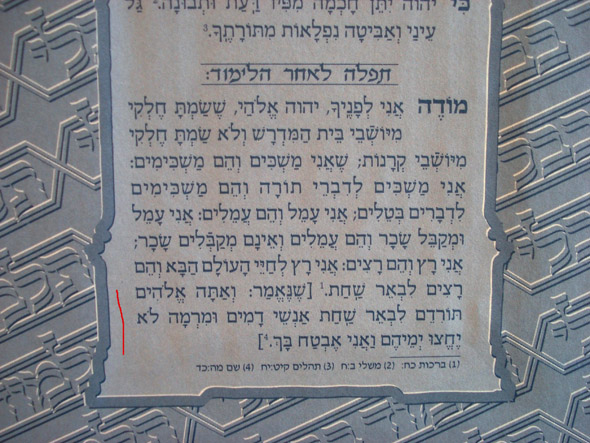
Fortunate is our lot! Our gratitude is expressed in the prayer of Rabbi Nehunia Ben HaKana[1]:
מודים אנחנו לפניך ה’ אלהי ששמת חלקינו מיושבי בית המדרש ולא שמת חלקינו מיושבי קרנות שאנו משכימים והם משכימים אנו משכימים לדברי תורה והם משכימים לדברים בטלים אנו עמלים והם עמלים אנו עמלים ומקבלים שכר והם עמלים ואינם מקבלים שכר אנו רצים והם רצים אנו רצים לחיי העולם הבא והם רצים לבאר שחת שנאמר וְאַתָּה אֱלֹהִים תּוֹרִדֵם לִבְאֵר שַׁחַת אַנְשֵׁי דָמִים וּמִרְמָה לֹא יֶחֱצוּ יְמֵיהֶם וַאֲנִי אֶבְטַח בָּךְ
Our exalted state can only be fully appreciated when contrasted with that of those not fortunate enough to join us in the beis hamidrash. The Yoshvei Kranos, identified by Rashi as idle shopkeepers who waste their time in frivolous conversation, are deprived of the rich rewards of Torah study, both in this world and in the next. They are to be pitied and even disdained for their boorish lack of concern for lofty matters.
The prayer proceeds a step further, however, in the concluding verse from Tehillim 55:24, cursing the ignorant with early death, destruction, and perhaps even damnation! And you, HaShem, lower them into the pit of destruction, murderous swindlers, may they not live out even half their expected lifespan. Are they really so wicked? At our joyous simcha, shouldn’t we rather be resolving to help inspire and mekarev these poor folk?
Did the creator of this prayer, Rabbi Nehunia Ben HaKana, or anyone from Hazal recite this verse? (If so, there would certainly be a a good reason for it.) A survey of the sources reveals a resounding: no. Not only does it not appear in Gemara Brachos 28b, but it does not appear in any of the known manuscripts, Rambam[2], or any of the many poskim rishonim that quote the prayer. Early versions of the Hadaran prayer do not include the verse either! See the attached photo of the early Venice and Soncino editions of the Talmud.[3] Nowhere. Gornisht.


In his Sefer Divrei Torah (Mahadura 5)the Munkasczer rebbe, an avid bibliophile, indicates that the verse should be omitted.

The verse only appears in one known halachic source: Halachot of Rif (Rabbi Yitzhak Alfasi). See below (1st edition, Constantinople 1509):

Why would Rif add this verse? He is usually involved with editing away verses from the Gemorrah, not adding them! Does it reflect an ancient custom of his? Why didn’t any of the great Rishonim who studied Rif cite this verse?[4] Ra’ah in his commentary on Rif quotes the entire prayer without mentioning the verse! None of the many known manuscript versions of Rif mention the verse![5] Its earliest known appearance in this prayer is in the first printed edition of Rif (published almost exactly 500 years ago, רס”ט, in Constantinople). Why did the publishers include the verse?
The answer may lie in a marginal gloss of one lone manuscript version of Rif[6].


In the left hand side of the manuscript, one can see that a later scribe added a citation to a verse. Only a few letters are visible in the microfilm: שנ’ כי לא ת
This is clearly referring to a different verse! Without a doubt, it is the same verse cited at the end of the version of the prayer found in the Talmud Yerushalmi:
כִּי לֹא תַעֲזֹב נַפְשִׁי לִשְׁאוֹל לֹא תִתֵּן חֲסִידְךָ לִרְאוֹת שָׁחַת[7]
“For you will not abandon my soul to the grave, you will not allow your pious one to see (his) destruction.”
This verse is most fitting and proper here as a conclusion of the prayer. It lacks all of the problematic vitriol of the commonly found verse. This scribal addition undoubtedly represents an ancient custom[8], which the printers of Constantinople may have been unfamiliar with.[9] The verse they substituted, however, was certainly most familiar to them in a different context:
משנה מסכת אבות פרק ה
אבל תלמידיו של בלעם הרשע יורשין גיהנם ויורדין לבאר שחת שנאמר (תהלים נ”ה) ואתה אלהים תורידם לבאר שחת אנשי דמים ומרמה לא יחצו ימיהם ואני אבטח בך:
The students of Bilaam are certainly deserving of such a curse, for they are involved in sorcery, treachery, and other wickedness – if only they would be idle as the shopkeepers, that would be a tremendous improvement!
The custom of reciting Pirkei Avos on Shabbos afternoon dates back to time immemorial, and as a result of the regular study, many have mastered its teachings literally by heart. It doesn’t seem at all far-fetched to assume that the printing of this verse in Rif was a simple oversight. Eventually the verse entered into the hadaran prayer as we know it.
The prayer of Nehunia Ben HaKana is also found in many printed prayer-books in its original form, to be recited upon leaving the Beis HaMidrash. It is usually located just after shaharith.[10] Many of these contain the verse, such as the prayerbook printed by Rav Ya’akov Emden on his private press[11]. But many do not contain the verse.[12]
Rambam ruled that upon entering and exiting it is obligatory to recite the prayer of Nehunia Ben HaKana[13]. The Shulhan Aruch also follows his psak. In order to further facilitate the fulfilment of this duty, printers have recently begun printing the prayer in the inside front covers of their gemorrahs and mishnayos, including the verse. The editors of Artscroll are the most democratically accommodating – they include the verse in parenthesis. You can decide whether to say say it or not.

It’s well worth noting that a precedent to this custom of the printers is found in the Pesicha to the famous Tosafos Yom Tov commentary on the mishna by Rav Yom Tov Lipman Heller. He writes that since the recitation of these prayers is obligatory, and since many are unfamiliar with them, as they do not appear in the siddur (of his time), that he is printing them, according to the nusach of the RIF. And his nusach follows the printed version of RIF. He does not explain why he chose the RIF’s version over that of the Talmud, but it seems clear that he did not have access to manuscripts of RIF, and, unfortunately, relied on corrupted printed versions. It’s also unclear as to whether his concerns for proper nusach were with the concluding prayer at all, or with the prayer recited upon entering the House of Study, whose wording is much more varied between different manuscripts and printed versions. It could be that this “endorsement” of the Tosafos Yom Tov to the printed version of RIF contributed to the eventual inclusion of the verse in later printings of the Hadaran prayer at the end of tractates and later, in prayer-books.
Hopefully, our good friends, the “yoshvei kranos” will be taking part in a daf yomi shiur and joining us at the next siyum, reciting the Hadaran along with us, and meriting Olam HaBa!
Appendix
Theaters and circuses, the Talmud Yerushalmi (and Rav Kook)
(By a happy coincidence, David Segal recently posted at the Seforim Blog on this very topic!)

We are not the first ones to find the prayer in the hadaran to be overly contentious. No less an illuminary than Rav Avraham Yitzchak Kook, OBM, the first chief Rabbi of Israel, was deeply disturbed by this prayer’s tone. Yoshvei Kranos are today’s ba’alei batim. They keep mitzvos and give tsdakah. The takanah to read the torah on Monday and Thursday is for them, so they should not go too long without hearing words of torah. It goes completely against the grain of Hazal to curse them! In fact, even without the verse, why should they be punished at all?
Rav Kook proposed a truly fantastic solution. A corruption occurred in the text: the yoshvei קרנות of the Talnud Bavli are really yoshvei קרו”ת, roshei teivos for קרקסיות andתרטיות , those who patron theaters and circuses, which in fact, is the exact nusach of the version of the prayer found in the baraisa of the Talmud Yerushalmi!
What exactly goes on in these theaters and circuses? The gemarah in Avodah Zara 18b states that they are essentially a moshav leitzim, foolish and irreverent. Another opinion cited there is that these were much more nefarious centers of Avodah Zara and Shfichus Damim, gladiator sports, public executions and like. Historically, both of these opinions seem correct – theaters and circuses where occasionally more pernicious activities took place. All in all, they don’t seem to be much too different than the modern versions of popular “entertainment”[14].
The curse of Rav Nehunia’s prayer is directed against these insidious people who waste away their free time in such sordid foreign entertainments, as opposed to the Torah-true who spend their free time immersed in learning in the beis hamidrash or in prayer in the beis kneses, even if during the work-day they are but simple “idle” shopkeepers. In this context, even the dubious additional verse is somewhat appropriate[15].
Rav Kook went so far as to call for “correcting” the nusach of the prayer and adopting the version of the Talmud Yerushalmi! That proposition certainly has merit, but is it really the true intention of the Talmud Bavli itself?[16] Perhaps this is not the only suggestion of his that, in retrospect, seems a bit far-fetched.[17] However, it seems that his insight into the tradition of the Talmud Yerushalmi and its stark opposition to “theaters and circuses” teaches a lesson which is especially pertinent today, and can deepen our appreciation of the importance of this truly enigmatic prayer.

Here are Rav Kook’s words (you may click this image to read a larger copy):

The original version of the prayer appears to be found in the Talmud Yerushalmi, produced under the glare of Greco-Roman culture with its ubiquitous theaters and circuses. In Sasanian Babylon, these cultural expressions were unheard of, hence they were restated as the more familiar yoshvei kranos. In contrast, our modern secular culture of entertainment is, for the most part, a western one, and hence the version of the Talmud Yerushalmi takes on crucial added significance today.

Many thanks to Moshe Bloi, Ezra Chwat and Shamma Friedman. All errors are, of course, mine.

Note: This article is based on one which originally ran in Kolmos of Mishpacha magazine and they take no responsibility for the content here. You can read the original article here.

UPDATE 8/18/2011: A song has recently been composed as a result of this article and discussions surrounding it’s Hebrew and English versions. The song lyrics consist of only the two verses and highlights the contrast between them musically.

Here the composer explains the composition in Hebrew and provides a link to the previous Hebrew discussion which inspired it:

[1] Brachos 28b. The Hadaran prayer has been adapted to the inclusive plural form, מודים אנו, rather than the original singular מודה אני
[2] See attached photo of the Tefillah in Commentary on the Mishna, that Rambam himself copied by his own hand!


[3] Note that the order in the prayer is switched around, probably in order to end on an upbeat, good note.
[4] In the back of the new Oz V’Hadar gemarras, the Magid Ta’alumos is cited, who explains that the verse is included in order to end the prayer on a positive note (!), v’ani evtah boch, insead of be’er shachas. The same explanation is offered by the Dinover rebbe, the the author of the classic Bnei Yesoschar, in his Maggid Ta’alumah (פרעמישלא תרל”ו) in his commentary v’Heye Bracha, referring to the inclusion of the verse by the Tosafot Yom Tov in the introduction to his monumental commentary on the Mishna. He makes no reference to the Rif. Perhaps he thought that the verse was added to the Rif according to the Tosafos Yom Tov? It’s worth noting that both the Maggid Ta’alumos and the Maggid Ta’alumah have the same observation on the inclusion of this verse, independently!
[5] Thanks to Dr. Ezra Chwat, of the Israel National Library Manuscript Department, who is preparing a new critical edition of Rif (scheduled to be used in the upcoming edition of Shas Lublin), for allowing me to utilize his forthcoming work. Further, he guided me to four additional “less reliable” manuscripts which are not utilized centrally in preparing his new edition. None of them contain the verse either.
[6] Oxford Huntington 135:
[7] תהלים פרק טז, י
[8] A fascinating new Teshuva by Rav Yitzhak Ratsaby of Benei Brak has been published (Ma’ayan Nissan 5770) on the exact question addressed in this article, the inclusion of the concluding verse in the prayer of Rav Nehunia ben Hakana (link). There, Rav Ratsaby cites Yemenite prayer-books and Teshuvot which demonstrate that the custom of reciting the verse from the Talmud Yerushalmi (like the scribe of the RIF manuscript) continued among certain Yemenite kehillot until almost the present day. Unfortunately, Rav Ratsaby did not check manuscript versions of RIF, and thus understands that the talmud of the RIF himself contained the problematic verse, leading him to propose far-fetched justifications for the custom. Here is my response (Ma’ayan Tammuz 5770).
[9] Although it seems quite doubtful that the printers had this exact manuscript in front of them, it seems likely that they had a similar manuscript. Dr. Ezra Chwat doubts that the Oxford Huntington manuscript was used by the printers as there are many discrepancies between it and the printed version of Rif. It serves as the primary manuscript for Dr. Chwat’s new edition of RIF. According to Dr. Chwat, the manuscripts can be used to resolve many seeming contradictions between RIF and RAMBAM!
[10] So that one may go מחיל אל חיל, from the beis hakneses to the beis hamidrash.
[11] Rav Yitzhak Ratsaby, in his recent tshuva (see note above) argues that the custom in Rav Emden’s siddur was only to recite part of the verse, but it seems more likely that this was simply a printer’s abbreviation. The reliability of the wordings found in this siddur are quite questionable, based on Rav Ya’akov Emden’s own testimony in the introduction that many texts were simply copied from other prayer-books.
[12] Among current prayer-books: the accurate Tefillas Yosef and Ezor Eliahu do not include the verse. Siddur Vilna, on the other hand, does contain the verse.
[13] Commentary on the Mishna. See Levush and Aroch HaShulhan (Orach Haim 110) for explanations as to why many do not recite the prayers.
[14] Internet anyone?
[15] This fact was noted independently in the recent Responsa of Rav Yitzhak Ratsaby, Ma’ayan Nisan 5770
[16] The Aderes in Tefilas Dovid, p.12, states that yoshvei kranos are also engaged in nefarious activities, as seen in the Talmud Yerushalmi. He claims that yoshvei kranos here doesn’t follow its normal meaning, going against Rashi. Rav Kook was the Aderes’ son-in-law so its not surprising that they both have the same approach in understanding the Bavli according the the Yerushalmi. Rav Kook probably favored Rashi’s interpretation of yoshvei kranos, and hence, was forced to actually alter the text of the Bavli.
[17] Rav Kasher, in Torah Shleima, Vol 15 page 140, dismisses Rav Kook’s theory entirely, claiming that the version of the Talmud Bavli is the original one! His proof is the fact that a parallel to the bavli appears in Pirkei Avot d’Rebi Nathan A. However, that collection is widely recognized to post-date the Bavli itself, which it widely quotes from.


The Hafetz Hayyim’s Statement on Teaching Torah to Girls in Likutei Halakhot: Literary and Historical Context

The Ḥafetz Ḥayyim’s Statement on Teaching Torah to Girls in Likutei Halakhot: Literary and Historical Context

Rachel Manekin and Charles (Bezalel) Manekin

Rachel Manekin is Associate Professor of Jewish Studies at the University of Maryland.

Charles (Bezalel) Manekin is Professor of Philosophy at the University of Maryland.

The authors live in Jerusalem, Israel.

Dedicated to the memory of our mothers, Matel Becher ע”ה and Dorothy Manekin ע”ה

R. Israel Meir ha-Kohen Kagan’s statement in his Likutei Halakhot that it is “now” a “great mitzvah” to teach Torah to girls, has attracted a great amount of attention in recent years.[1] Benjamin Brown, dating the statement to 1911, suggests that it was instrumental in the founding of the first Bait Yaakov school in 1917 by Sarah Schenirer in Kraków.[2] Haym Soloveitchik, dating the text to 1918, views it as R. Kagan’s (late) perception of the erosion of the mimetic society in the wake of World War I.[3]

We show below that the statement was published some time in תרפ”ב (last third of 1921, first two thirds of 1922), after R. Kagan, known after his book as the Ḥafetz Ḥayyim, returned to Radin (Raduń), then Poland, on 25 Sivan [=July 1], 1921. The Ḥafetz Ḥayyim had spent the previous six years in Russia at a time of revolution, civil war, and the beginnings of communist policy toward Jewish religious institutions.[4] The timing of the statement on Torah education for women is significant. Several months before his arrival in Radin, a gymnasium (high school) for Orthodox girls had been established in Telz, with the direct involvement of the rosh yeshiva, R. Yosef Leib Bloch, his son, and his son-in-law.[5] Girls were taught there ḥumash and nevi’im. A primary school for girls was also established there. This was the latest in a series of Orthodox initiatives for the formal Torah education of women in Lithuania. In Kovno, a Jewish realgymnasium for Orthodox boys and girls had been established already in 1915 through the efforts of the Neo-Orthodox R. Dr. Leopold Rosenak, a brother-in-law of Emanuel Carlebach, and Joseph Carlebach, Emanuel’s brother. These initiatives were introduced as responses to the requirement of mandatory primary education, first by the German military occupying Lithuanian and later by the government of independent Lithuania. Also, in Kovno, at the initiative of Ze‘irei Yisrael, which was composed of representatives of Agudat Yisrael and the Mizrahi, the Yavne Central School System was founded in 1920; in its first year, forty schools were founded; some included girls.[6] In Kraków, then in Habsburg Galicia, Sarah Schenirer founded her afternoon supplementary school in 1917 with the blessing of the Belzer rebbe; several other schools followed in 1921 and 1922. In Warsaw, formerly in Congress Poland, R. Emmanuel Carlebach founded the Chavatzelet Orthodox women’s gymnasium in the same year, with the blessing of the Gerer rebbe. Chavatzelet taught girls ḥumash and nevi’im in the Hirschian spirit of Torah ‘im derech ’ereẓ.[7] In the 1930s the school was attended also by Hasidic girls, including the Gerer rebbe’s granddaughter.[8]

Moreover, in late January, 1922, the year in which the Ḥafetz Ḥayyim’s statement was published, the assembly of the Agudat ha-Rabbanim of Poland issued a series of calls upon its members that included the following:

11. To educate the daughters in the spirit of yiddishkeit and to learn with them from their early childhood some words of Torah and musar, and commensurate with their age to continue to learn with them their obligations in such a manner that when they reach the age of marriage, they will easily accept the obligations pertaining to the purity of the daughters of Israel. And the members are obliged to establish in their towns for this purpose a special school for the young women.[9]

As we shall see below, the resolution that called upon all communal rabbis in Poland to establish schools for women followed an impassioned speech on the challenges facing Torah education in Poland by the Galician rabbi, R. Meir (Maharam) Shapira, then the Rav of Galina, and shortly to become one of Agudat Yisrael’s representatives to the Polish Sejm and the Rosh Yeshiva of Yeshivat Ḥakhmei Lublin.

In light of the above, the Ḥafetz Ḥayyim’s statement on teaching Torah to Jewish daughters should be read as a hekhsher of formal Jewish education for women after and while schools for Orthodox girls were established in Poland and especially in Lithuania. All the aforementioned schools had strong connections with Agudat Yisrael operatives in their various locales. As is well known, the Ḥafetz Ḥayyim was a major rabbinical authority for the Agudah; several months after his return to Poland (which now incorporated parts of Lithuania), he and R. Ḥayyim Ozer Grodzinsky of Vilna, called for the strengthening of the Lithuanian Agudah.[10] He was most likely informed about these schools, certainly the women’s gymnasium in Telz, upon his return to Radin, if not earlier.

In any event, the 1924 decision to have Keren ha-Torah, the education fund of Agudat Yisrael, support a network of Jewish schools for girls was sanctioned by the Ḥafetz Ḥayyim’s aforementioned statement, according to Dr. Leo Deutschländer, the head of Keren ha-Torah, and subsequently one of the administrators of the Bait Yaakov seminary in Krakow.[11]

It is important to emphasize that the educational policies of all Orthodox schools in Poland-Lithuania were subject to rabbinical authority, and that no pedagogical steps were taken without consultation with, and approval, by rabbinical leaders.[12]

Part One. The Literary Context of the Ḥafetz Ḥayyim’s Statement on Women’s Education

The Ḥafetz Ḥayyim’s comment does not appear as a formal response to a halakhic question of the permissibility of teaching Torah to women. Rather it appears as a footnote to the halakha that women should not be taught written Torah ab initio cited in his Likutei Halakhot on Sotah. Likutei Halakhot is a condensation of the halakhic sections of the Gemarah in the manner of R. Isaac Alfasi’s Halakhot Gedolot. Initially a project to provide students with a halakhic digest to sugyot having to do with kodeshim, the study of which the Ḥafetz Ḥayyim considered to be unduly neglected and of capital importance,[13] the project was ultimately expanded to provide a halakhic digest of all sugyot on which there was no Rif or Rosh (R. Asher b. Yehiel). Unlike the Rif, the Ḥafetz Ḥayyim’s’s aim was not to decide the halakha, but rather to provide student with an abridged description of the development of the halakha through the Rambam.[14] The Ḥafetz Ḥayyim believed that by reading halakhic condensations of the Rif with Rashi, and Likutei Halakhot with Rashi, the students would be able to master the fundamental halakhot of the Talmud – something that he felt could not be easily accomplished by reading the Mishneh Torah with its commentaries.[15] In later years he recommended such a program of study for those who lacked the time for in-depth study of the Gemarah.[16]

Before we analyze the footnote, we need to justify dating Likutei Halakhot on Sotah to תרפ”ב. Unfortunately, determining the publication history of Likutei Halakhot is complicated. The work was published serially, beginning with Zevaḥim, in 1899/1900,[17] in the form of kuntresim, which could be bound and published as seen fit by the Ḥafetz Ḥayyim; the published volumes did not carry a separate title page from the individual kuntresim comprising them. The title pages of the kuntresim often do not mention all the titles of the individual tractates contained therein, and, like many Torah publications, their dates of publication on the title page have to be derived from gematriyot of rabbinic statements in which certain letters are in bold typeface. Sometimes tractates that were published earlier were republished with the same title page. The individual tractates themselves have their own pagination. An edition of the entire work was published by the Ḥafetz Ḥayyim’s son-in-law, R. Menaḥem Mendel Yosef Zaks, in Brooklyn in 1960, and in Jerusalem 10 years later. The edition contains, dispersed throughout the work, some of the original title pages, but not always with their original dates. The order of the tractates in the R. Zaks edition is also not always according to the order of publication; sugyot from the same tracate that appeared in different kuntresim are placed together.

As noted above, two dates for Likutei Halakhot on Sota appear in the secondary literature, 1911 and 1918. We have found no textual basis for either date. The 1911 date appears in M. Gellis’s bibliography of the Ḥafetz Ḥayyim’s writings without explanation.[18] We do not know what is the source for the 1918 date.[19]

The volume of Likutei Halakhot including Sotah that we inspected in the National Library of Israel binds three kuntresim together. The first consists of Bekhorot and Keritot, printed by H. H. Fohlman, the second consists of Arakhin, Nazir, and Sotah, with only Arakhin mentioned on the title page, without a date; the third consists of Niddah, printed by M. Cederbaum, undated. Of these tractates, only Sotah and Niddah appear for the first time. (Niddah also appears published with its own title page by Cederbaum in תרפ”ג.) The date on the cover page, תרפ”ב was added in pencil, perhaps by a library cataloger or book seller, after calculating the gematriya; the volume, belonged formerly to the Boston Hebrew College library.
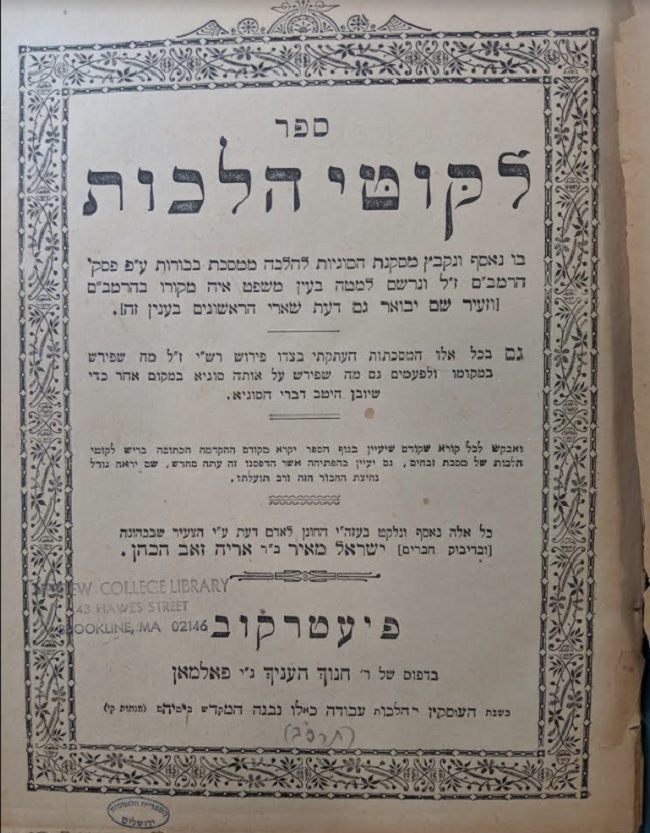


The תרפ”ב date is derived from the gematria of the emphasized letters: The saying (העוסקין בהלכות עבודה כאלו נבנה המקדש בימיהם (מנחות קי totals 682 ( 25 + 49 + 107 + 56 + 87+ 63 + 295), i.e., תרפ”ב.

As noted, the separate cover page for Arakhin (including Sotah and Nazir) is undated:
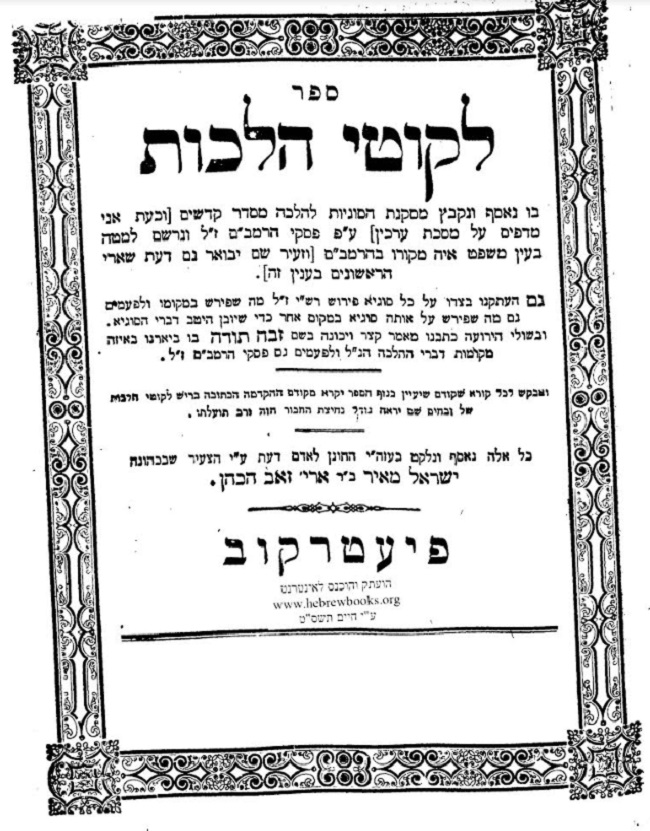


The Ḥafetz Ḥayyim, who was in charge of the printing and distribution of his books, advises on the title page of Likutei Halakhot on Bekhorot not only to read the Introductions, but also to look at the Preface (הפתיחה) “which we have now newly printed” (אשר הדפסנו זה עתה מחדש). The phrase “which we have now newly printed” is ambiguous; it can mean that the Preface is being reprinted or printed for the first time. Although the natural reading today would be the former, we found the Preface printed only in Likutei Halakhot on Sanhedrin, which we date to late תרפ”ב. And on the title page of Niddah, published by Cederbaum in תרפ”ג, we find a reference to the Preface אשר נקוה שנדפיסה בקרוב (“which we hope to print soon.”) This sort of discrepancy should not worry us, especially since Likutei Halakhot on Sanhedrin was printed by Fohlman and on Niddah by Cederbaum.

The Preface, published for the first time in תרפ”ב enables us to provide a clear terminus a quo for the publication of Likutei Halakhot on Sotah. In the middle of the first paragraph, the Ḥafetz Ḥayyim lists the tractates already completed (parentheses in the text below appear originally in the kuntresim as square brackets; the square brackets here are our own):

Barukh Ha-Shem, we have collected, according to our meager opinion, the words of the Rambam that he codified from the sugyot on thirteen tractates that pertain to matters of kodeshim, namely, Zevaḥim, Menaḥot, Tamid, Pesaḥim (from Tamid ha-Nishḥat to ‘Arvei Pesaḥim), Hagigah, Yoma, Tamid, Temurah, Keritot, Bekhorot [the three final chapters), ‘Arakhim, Me‘ilah, and Nazir (the later also has many things that are relevant to kodeshim), and likewise the first two chapters of Shavuot […] and now, only a few tractates are missing from the Shas, may God grant that over time some Jews will be found to complete the entire Shas […].[20]

And in the second paragraph he writes:

I wrote all this [i.e., the Preface until the present point] more than ten years ago. We have experienced many wanderings because of the war. Barukh Ha-Shem, who has kept us alive and did not allow our feet to falter. And now that I have come from the diaspora to my home, Ha-Shem, yitborakh, has helped me in his abundant kindness and goodness for the merit of Israel to complete Likutei Halakhot on the other tractates of the Shas that do not have the commentaries of the Rif and the Rosh. (And these are: Rosh Hashanah, Makkot, Horayot, Sotah, and Niddah […]).[21]

The second paragraph of the Preface attests to a time gap in both the composition of the Preface and in the publication of the tractates. The first paragraph of the Preface was written more than ten years earlier, i.e., no later than late 1910 or 1911. At that time the Ḥafetz Ḥayyim had completed, but not published, all the tractates mentioned in the first part of the Preface. Again, he did not publish the Preface itself until late 1921 or 1922. So although there is no date on Likutei Halakhot of Sotah itself, we can infer that it was published in תרפ”ב. As for the date of actual composition, we have no evidence in the Preface or anywhere else to suggest that it was written much earlier. Given that Niddah appears separately in תרפ”ג, the kuntres containing Sotah may have appeared late in תרפ”ב, after the aforementioned assembly of the Agudat Rabbanim in Warsaw. The Ḥafetz Ḥayyim would go on to complete other tractates and finish the work in 1925.

In short, the publication of Likutei Halakhot on Sotah is to be dated to late 1921 or the first two-thirds of 1922 (תרפ”ב) and not to 1911 or 1918,[22] according to the date of the aforementioned volume, and no earlier than Summer 1921, the date of the Ḥafetz Ḥayyim’s return to Radin, according to the Preface.

Part II. The Historical Context of the Footnotes on Jewish Education in Likutei Halakhot on Sotah

The Ḥafetz Ḥayyim was 83 years old when he declared it to be a great mitzvah to educate women in various Torah matters. To understand both the context and content of the statement, we first present the text and the two relevant footnotes. The main text of Likutei Halakhot on Sotah 11a (p, 21) may be translated as follows:

Rabbi Eliezer says, “Whoever teaches his daughter Torah teachers her tiflut.” You thought [actual] tiflut? Rather [it is] as if he teaches her tiflut. R. Abbahu says, “What is R. Eliezer’s reason? It is written, ‘I, wisdom, dwell with cunning,’** When wisdom enters a person, cunning enters with it.” And how do the Rabbis understand “I, wisdom”? The verse is needed for [the interpretation] of R. Yossi b. Rabbi Haninah, for R. Yossi b. R”H says, “The words of Torah stand permanently only for the person who makes himself naked for them, as it is written, ‘I, wisdom, dwell with nakedness.” In any event, the reasoning of R. Eliezer is not thereby rejected, and the halakha is according to his statement. [Later] rabbis said that “Torah” here refers davka to the Oral Torah. But even though the Written Torah should not be taught to one’s daughter ab initio,*** [teaching her Written Law] is not as if one teachers her tiflut. And women are obligated to learn from the Oral Torah the laws that pertain to them.[23]

(The asterisks refer to footnotes on this passage. Footnotes are rare in Likutei Halakhot, and rarer still are footnotes that refer to contemporary issues.)

Let us begin with the note preceded by three asterisks, on the prohibition of teaching the written Torah to women ab initio (based on M.T. Hilkhot Talmud Torah 2:13):

It seems that all this [the admonition not to teach written Torah ab initio to women] applies to previous times, when everyone dwelled in the place of his fathers, and the paternal tradition was very strong for each person to behave in the way that his fathers had tread, as the verse says, “Ask your father and he will tell you”. [Then] we could say that [a woman] should not learn Torah but should rely for her conduct on her upright fathers. But now, on account of our many sins, the paternal tradition has weakened considerably, and it is common that one does not dwell in one’s fathers’ location at all, and, particularly for those [women] who have accustomed themselves to learn to write and speak the languages of the nations, it is certainly a great mitzvah to teach them ḥumash, and also nevi’im and ketuvim, and the musar lessons of Ḥazal, such as tractate Avot, and Menorat ha-Ma’or, and the like, in order that our holy faith be confirmed for them. For otherwise, they are liable to stray completely from the way of the Lord, and to transgress all the foundations of the religion, God forbid.[24]

The Ḥafetz Ḥayyim holds that the admonition not to teach women written Torah ab initio pertained to the past, when a woman could rely for her conduct on the example of her fathers. But today, we find a weakening of paternal tradition and the dislocation of the Orthodox from their paternal homes, which requires educating women, especially those women who are accustomed to learn the language of the gentiles; without Torah education, such women are likely to stray from the true path and to become heretics. What historical reality does this reflect?

As is well known, the use of legal literature as a source of history, even literature that purports to refer to historical events, is not unproblematic. On the one hand the geographical dislocation of Polish Jews because of the war indeed meant that many parents and children were no longer in the town and villages that had anchored their faith and practices for generation.[25] On the other hand, it would be wrong to infer from the Ḥafetz Ḥayyim’s remarks that in his view, pre-war Poland reflected a golden age of Jewish observance. Throughout much of his life he had railed against the weakening of observance among the Orthodox, and many of his published works tried to strengthen observance through teaching both the halakha and its centrality in the life of the Jew – and the penalties for its non-observance.

For example, the Ḥafetz Ḥayyim was well aware that for decades there had been a weakening of traditional observance among women from some Orthodox homes. His son, R. Aryeh Leib Kagan, relates that when he came of marriageable age in the early 1880s, his father would not consider a match for him with a young woman from an Orthodox family who had attended a gymnasium (high school), or even an elementary school; such women and their families, even though they were Orthodox, were suspect in his eyes. In one case, the Ḥafetz Ḥayyim ultimately forbade his son to accept an offer of the substantial financial assistance by a wealthy prospective father-in-law; it turned out that the prospective bride’s sister had been sent by her father to learn at a gymnasium in Grodno, where she had fallen in love with a gentile officer whom she had met (“presumably at the theater”), converted, and died in childbirth at the age of 15.[26]

In his 1905 handbook on family purity laws, Taharat Yisrael, the Ḥafetz Ḥayyim attributes the decline of some women observing the mitzvah of mikveh to the shame they feel, not because of any foolish modesty (which is the case with some other women), but because they have been educated to look down at the laws of Torah. These women feel shame because

they have been raised in their free-thinking ways from their youth, when they attended schools, and became “wiser in their own eyes” than their predecessors, to the extent that they feel shame in observing the laws of the Torah according to the law of Moses and Israel, and particularly in a matter they consider to be beyond the boundaries of modesty.[27]

The Ḥafetz Ḥayyim responds to such women’s contempt of the Torah by providing well-worn arguments for its superiority and perfection. His defense is part of the larger project of the book, written both in Hebrew and Yiddish, to educate men and women in the importance of observing family purity laws. Urging Jews to observe Torah and mitzvot, and educating them for that purpose, is the leitmotiv that runs throughout the Ḥafetz Ḥayyim’s writings. Even his Likutei Halakhot on Kodeshim, though ultimately intended as an educational tool for learning Torah, was written as practical halakhic guide for the messianic age that Ḥafetz Ḥayyim thought imminent.[28]

This emphasis on deepening Torah observance in all sectors of the Orthodox community led him to publish a kuntres directed to women, Geder Olam, in 1889, on the importance of covering their hair. The kuntres was published in Hebrew and in Yiddish, and it includes at the end a basic halakhic guide to the laws of Niddah.[29] The halakhic guide was reprinted by the Ḥafetz Ḥayyim in two other works: his book addressed to Jews migrating to places like America and South Africa, Nidhei Yisrael (1895), and his aforementioned book on family purity laws, Taharat Yisrael (1905); The Yiddish translation appears in all three works, which indicates that these sections were intended also for women to read.[30] Indeed, the Ḥafetz Ḥayyim urges women who are literate to teach the book to women who are not, and to learn the Maayan Tahor of R. Moshe Teitelbaum of Ujhely (the Yismah Moshe) (reprinted many times in the Korban Minḥah siddur for women). The Ḥafetz Ḥayyim writes, “We have written only the legal principles that are most common, that all women are obligated to learn abundantly, and to become expert in them, so they not stumble because of them.”[31] This is a clear call for women to learn halakha, albeit in a rudimentary fashion, from books written for them.

From the above we see how important it was for the Ḥafetz Ḥayyim to write educational materials for women on family purity and female modesty. This in itself was a novelty; we are not aware of such materials being written in Lithuania at the time by Orthodox talmidei ḥakhamim of the Ḥafetz Ḥayyim’s stature. Contrast, for example, the words of the Ḥafetz Ḥayyim’s contemporary, Rabbi Yehiel Mikhel Epstein, in Arukh ha-Shulḥan, Yoreh Deah 246:19:

Ours has never been the custom to teach [women] from a book, and we never heard of that custom. Rather every woman teaches the relevant laws to her daughter and daughter-in-law. Recently, laws pertaining to women have been published in the vernacular for women who can read from them. Our women are fervent (zerizot); in every doubtful matter they ask [a rabbi] and don’t decide for themselves in the smallest matter.[32]

To what recently-published laws pertaining to women was R. Epstein referring? Arukh ha-Shulḥan, Yoreh Deah was composed in the years, 1887-1894;[33] the early editions of Geder Olam were 1889, 1893, and 1894. In the latter, the Ḥafetz Ḥayyim admonishes women who need to ask a halakhic question not to ask another women, but only a moreh hora’ah, “and for G-d’s sake, a woman should not dare to decide the law!”[34] It is very likely that R. Epstein was referring to this when he wrote, “Our women are eager; in every doubtful matter they ask [a rabbi] and don’t decide for themselves in the smallest matter.” Here we have two conflicting views on the education of women in practical halakha: R. Epstein sees no need to compose halakhic guidelines in Yiddish for women, since the women with whom he is familiar have learnt the material from their mothers or mothers-in-law and know when to ask questions. The Ḥafetz Ḥayyim, observing women who are lax about observance, writes a halakhic/hashkafic manual in Hebrew and Yiddish that urges them (and their husbands) to study these guidelines diligently and to teach them to other women.

The importance of educating women in their religious duties, especially in the realm of family purity, remained with the Ḥafetz Ḥayyim for the rest of his life. As is well-known, he traveled to Vilna when he was old and frail to deliver a lecture in Yiddish at the central Synagogue on the importance of observing the mitzvah of mikveh in front of an audience of hundreds of women, with men listening in from the women’s gallery.[35]

To be sure, publishing educational materials on family purity for women is not the same as advocating Torah education for girls, but then, again, the situation in 1905 for Polish and Lithuanian Orthodox Jewry was not the same as in 1922. Orthodox Jewry in the Second Polish Republic was under severe stress. Dislocation and pressures – economic, ideological, and governmental — had accelerated the defection of Jews from the tradition; the dire situation provided an opportunity for conservatives to respond positively to new Orthodox initiatives to stem the tide. In particular, Orthodox Jewish education was at a crisis point, even more so for boys than for girls, which explains in part why much more attention was paid by Orthodox politicians and rabbis to the challenges facing the ḥadarim, than to the education of women, since, as we noted above, the compulsory education of law of 1919, which was in the early stages of implementation, required all Polish boys and girls to attend government certified schools. Agudat Yisrael negotiated repeatedly with the Polish authorities to have the ḥadarim certified, which meant that they needed to include subjects mandated by the Polish ministry of education; otherwise, even more ḥadarim would close. The negotiations with the government concerned how many hours of secular subjects would be taught, and what were those subjects to contain.[36] Formal Torah education for girls was already well underway, partly as a response to mandatory education, the general trend in female education, and the prevalence of alternatives to the ḥeder that attracted Orthodox parents, partly as a response to the weakening of observance among the Orthodox.

When the Ḥafetz Ḥayyim returned to Radin in 1921, he was faced not only with the fait accompli of formal Jewish education for women in Telz, Kovno, and elsewhere, but with the threat to both boys and girls posed by the implementation of universal compulsory education by the State. Unlike in Russia and Lithuania, compulsory education for Jewish girls had been the norm in Galicia, the part of Poland that had belonged to the Austrian Empire until the end of the First World War. Galician Jewish Orthodox girls, bereft of formal Jewish education, had attended Polish private and public schools for decades with disastrous consequences; the same now happened elsewhere in Poland. When, in his footnote, the Ḥafetz Ḥayyim refers to “those [women] who have accustomed themselves to learn to write and speak the languages of the nations” he was, whether aware of it or not, referring to all Jewish girls in the Second Polish Republic, since, as Polish citizens even the strictest Hasidim were required to send their daughters to government certified schools. And unlike the case of their brothers, no Orthodox politicians negotiated with the government to exempt girls from these schools. School attendance for Hasidic girls was a well-entrenched tradition, even among the daughters of the zealots.

It is not surprising that the rabbi who raised the issue of women’s education at the assembly of the Polish Agudat ha-Rabbanim in 1922, Maharam Shapira, hailed from Galicia, where the situation had been bleak for decades. In his survey of the state of Orthodox Jewish education, he first turns to the challenges facing the ḥeder from the mandatory education law, on the one hand, and the attacks from the [Jewish] leftists (smoliyim) on the other. If the Polish government wished to spread general education among the people, it should take into consideration the most necessary requirements of the [Jewish] nation, which is the ḥeder. And if the Orthodox try to accommodate the government’s demands, it can only be in such a way that will not destroy the ḥeder. Most importantly, Orthodox boys need to be exempt from the obligation to attend general schools. And since the ḥadarim will now have to limit somewhat their hours for Jewish subjects, it is important that they be subject to universal standards, and that the instruction be overseen by experts and pedagogues. The Maharam Shapira then turned to the question of the education of girls:

We speak a great deal about the education of girls, which is a very painful subject for us. Our situation has become so bad because we have only taken a little interest in the subject for many years. At the same time as we devoted much of our thought, and always concerned ourselves, whether a lot or a little, with the education of boys, we continued to apply to the girls, “Kol kevudah bat melekh pnimah” as in earlier times, when a Jewish daughter did not come into contact and connections with the marketplace and the public sphere, and with the currents of the time that mostly oppose Yahadut. Then we did not need to give her an antidote and a powerful and effective counterforce against them. (“Whoever teaches his daughter Torah is as if he teaches her tiflut. (Sotah 20a).” Only men had in particular to learn Torah, for they needed the antidote – the countercurrent that repels foreign currents. But the daughter and the Jewish woman sat at home, where only that environment acted educationally upon them, and developed them and made them into true Jewish women and fit Jewish daughters.) We thus did not pay attention that the girls, unarmed and lacking any concept pertaining to Torah and Yahadut, have been taken outside from us into cultures and currents. They have become so educated and raised in the lap of foreign culture and anti-Jewish ways that every “common wind” and light attempt to ensnare their spirits, to penetrate into their souls, to poison and uproot them from their place, have wielded their evil ways upon them.

And we are faced with another grave question, which is strongly related with the education of the daughters, and this is the purity of the daughters of Israel….[37]

The Maharam Shapira diagnoses the illness but does not prescribe the remedy, anyway, not in the written version of his address. But as we saw above, the Assembly subsequently called for the establishment of Jewish schools for girls (supplementary to the general schools which they would attend). Connecting the crisis in the observance of the family purity laws with girl’s lack of education meant that rabbis like the Maraham Shapira understood that female observance of Jewish law could not be taken for granted. The Maharam Shapira also called for the production of Jewish youth literature, including textbooks, for the youth that would be free of all defect, and that would educate them in the spirit of faith and religion. This call was also ratified by the Assembly.

The question of the creation of textbooks that would be appropriate for use in ḥadarim seems to be alluded to in the earlier note in Likkutei Halakhot on Sotah on R. Abbahu’s explanation to R. Eliezer’s prohibition that “once wisdom enters into an individual, cunning enters with it.” The Ḥafetz Ḥayyim writes:

According to this, one should be even more careful not to teach boys and girls flippant writings and romances, which consume their heart and soul. One who reads them regularly is in the category of one who reads external books, who was treated with great severity by our sages, as is in the beginning of Helek (Sanhedrin 90). It makes no difference wheteher they are published in the Holy Tongue or the vernacular. See S. A. Orah Ḥayyim.307:16, and in the Mishnah Berurah ad loc.[38]

While attention in recent years has been focused on the footnote on Torah education for women, the Ḥafetz Ḥayyim’s previous footnote on the education of boys and girls appears to have been entirely neglected. Why would a halakhic authority like the Ḥafetz Ḥayyim be concerned with teaching Orthodox Jewish boys and girls “flippant writings and romances”, i.e., literature written by Poles or by Jewish maskilim? Yet his concern makes sense in the context of the new Polish government’s requirement that general studies be included within the curriculum of the ḥadarim, and also in the context of Orthodox parents sending their children to non-Orthodox Jewish schools, like the Tarbut and Yiddishist schools. Even though the Ḥafetz Ḥayyim acquiesced to the limited introduction of secular subjects in the ḥadarim, we see from this note and the passage below that he insisted that only appropriate books be read by children. That was also the line taken by Agudat Yisrael in its attempts to control the growing popular youth literature, both in lending libraries youth, and in curricular materials for the ḥadarim and the Bais Yaakov schools under its auspices.[39]

In short, underlying both footnotes referring to contemporary matters in the Likutei Halakhot on Sotah are not the challenges of “modernity” in general, but rather the specific challenges facing the Polish Orthodox leadership in the interwar period brought about by the weakening of traditional authority, geographical dislocation, the introduction of universal primary education in the Second Polish Republic, and the attraction of Bundism, Zionism, and Socialism to the youth. Although the weakening of traditional authority, and the phenomena of Orthodox women attending Polish schools predated by decades World War I, the situation after the war threatened the very future of Torah Judaism in the eyes of the Orthodox establishment.

Part III. Other Statements of the Ḥafetz Ḥayyim on Torah Education for Women

In the waning years of his life, the Ḥafetz Ḥayyim returned several times to the question of Torah education for girls. Thus we read in his 1930 “Admonition to Kelal Yisrael”:

There is another principle that every talmid hakham in every town needs to enact, namely, to see to it that there is a kosher ḥeder in which our little sons (and also our little daughters) will be provided a kosher education in the way of the Torah, and not in schools that are full of heresy and sectarianism, which are completely bereft of teaching our holy Torah….

[One should accustom his son to learn the the aggadot of the Talmud…]. But even more one should distance his son from schools in which heresy and sectarianism is taught, where instead of the holy ḥumash, they make up books in which are found only stories of the ḥumash that they have copied without any sense of our Holy Torah – and that’s Torah in its entirety for them And all the laws and mitzvot like in Vayikra and Devarim they denigrate and do not copy. A father must be exceedingly careful not to allow his son to go to such schools where he destroys them with his own hands (and likewise he should be careful to educate his daughters in the way of Torah).[40]

And in a public appeal for the strengthening of religion that that he published in Sivan, 1931:

First of all, we must become fortified with all our strength in the education of boys and girls, to establish for them ḥadarim and kosher schools according to the law of our Holy Torah, not to deviate to the right or the left, or to forego anything of our Holy Torah, and not to allow them to attend such schools as are full of heresy and sectarianism, God save us….”[41]

We have found no mention of the importance of educating girls in the Ḥafetz Ḥayyim’s numerous writings devoted to education before World War I: educating women to observe and appreciate family purity, yes, but not teaching Torah to girls. This changed after the Ḥafetz Ḥayyim’s return to Radin in 1921. Already in 1922 there is abundant reason to believe that the Ḥafetz Ḥayyim’s foonote in Likutei Halakhot on Sota referred to formal Jewish education for girls, which was already well underway. As we noted above, his position was used to justify the establishment of schools for girls by the Agudah’s Keren ha-Torah in 1925. From the 1930s he made his position explicit: teaching Torah to Jewish daughters includes establishing “kosher schools” for them.

So it is hardly surprising that in 1933, when attempts to open a Bait Yaakov school in Fristik (Frysztak), Poland, were met with opposition by the local rabbi, R. Menachem Mendel Halberstam, the Ḥafetz Ḥayyim signed a public approbation of Beit Yaakov in order to convince Jewish parents from the town to send their daughters to the school:

B”H 23 Shevat, Tarzag [= Feb. 19, 1933]

To the worthy lovers and esteemers of Torah, the Godfearing people of Fristik, may the Rock guard them,

When I heard that Godfearing people had devoted themselves to establish in the towns a Beit Yaakov school, in which is taught Torah, the fear of Heaven, morals, and manners, which is Torah for the girls of our Jewish brethren, I addressed their fine action [saying] “May the Lord strengthen them and establish the work of their hands!” For [that action] is a greatly needed matter in these day, when the current of heresy, God save us, reigns in all its force, and all sorts of freethinkers lie in wait to ensnare the souls of our Jewish brethren. Whoever’s heart has been touched with the fear of God is obligated to send his daughter to learn in this school. And there is no room for concern in this day and age for all the apprehensions and doubts arising from the prohibition of teaching one’s daughter Torah. This is not the place to elaborate.

For our generation is not as the earlier ones, for in previous generations each Jewish house had a paternal and maternal tradition to walk in the way of Torah and religion, to read Zeenah u’Reenah every Shabbat. But this is not the case, due to our many sins, in our generation. Therefore we must strive to increase schools such as these and to save everything that we possibly are capable of saving.[42]

The appeal seems to have worked because there was still a Beit Yaakov in Fristik in 1935, according to the list of schools provided by Deutschländer.

* * *

We conclude with a final comment: Some have inferred from the Ḥafetz Ḥayyim’s footnote in Likutei Halakhot and the appeal on behalf of Bais Yaakov schools that in his eyes formal education for girls should be considered “bediavad”, i.e., that in an ideal Jewish world, girls would not need to be taught Torah outside the home. If that is true, then the bediavad status of women’s education is somewhat akin to the bediavad status of the compilation of the Mishnah: in a world without the persecution and dispersion of the Jewish people, Rabbi Judah ha-Nasi would not have had to compile the Mishnah and thereby transgress the prohibition of committing Oral Torah to writing.[43] But the Torah, which is eternal, is adapted by the Torah sages in each generation to the world in which God-fearing Jews live. Formal Torah education for girls became for the Ḥafetz Ḥayyim “in this day and age” a “mitzvah gedolah,” in other words, lekhatkhilah, and his statements on the subject reflect that.

On the other hand, to say that it is a mitzvah gedolah to teach Torah and yirat shamayim to women is not to say that the Ḥafetz Ḥayyim wished to extend the commandment of Talmud Torah to include women.[44] That conflates the commandment of Talmud Torah, which applies only to Jewish men, with the obligation of teaching yiddishkeit to Jewish women through teaching them, inter alia, selections from Tanakh. While the Ḥafetz Ḥayyim emphasizes the former repeatedly and at great length in his writings and public activity, he barely mentions the latter. One need only compare his brief mention of teaching girls “ḥumash, nevi’im, ketuvim” in his footnote in Likutei Halakhot with his frequent statements about the necessity of teaching ḥeder boys ḥumash with Rashi “without skipping anything.” Even after his return to Radin, his public activities on behalf of women’s observance focused mainly on family purity, modesty, shabbat, and kashrut – not girls’ education.

Still, it is no wonder that the conservative Ḥafetz Ḥayyim, who had written numerous tracts to strengthen the observance and piety of Jewish baalei ha-batim and their families, embraced in later years the formal Jewish education of girls. Decades earlier he had called upon literate women to teach their illiterate sisters family purity laws from a book. He was not concerned with expanding the study of Torah among women, as much as expanding its observance and taking its message to their hearts. The Torah these girls were to be taught was a combination of Torah, the fear of heaven, morals, and manners. His goals were similar to that of Bais Yaakov movement, which was not to teach Torah to the daughters of Israel as an intellectual activity, or to make them life-long learners of Torah, but to form their character as religiously observant Orthodox Jewish women.[45]

Notes:

[1] Likute Halakhot on Sotah, 11ab (pp. 21-2). Unless otherwise stated, we have consulted the 1969-1970 edition of R. Menahem Mendel Yosef Zaks (Jerusalem, 1969-1970). This appears to be a reprint of the edition published in Brooklyn 10 years earlier.
[2] “This leniency enabled the opening of the first school of Beit Yaakov.” See Benjamin Brown, “The Baal ha-Bayit: R. Yisrael Meir ha-Cohen, the Ḥafetz Ḥayyim,” in Benjamin Brown and Nissim Leon, ed., Ha-Gedolim’: Ishim she-‘izvu et pene ha-Yahudut ha-haredit be-Yisrael. ed. (Jerusalem: Magnes, 2017), 106-151, esp. 133 (Hebrew)
[3] See Haym Soloveitchik, “Rupture and Reconstruction: The Transformation of Contemporary Orthodoxy,” Tradition, vol. 28, no. 4 (Summer 1994): 106-107 note 6.
[4] M. Yashar, Dos leben un shafn fun Ḥofets Ḥayyim (New York, 137), II, 377, 381.
[5] This is inferred from the celebration in Purim of 1931 of the school’s tenth anniversary.
[6] Yizhak Rafael Ha-Levi Etzion (Holzberg), “The Yavneh Educational System in Lithuania,” in Yahadut Lita (Tel-Aviv, 1972), II, 160-163
[7] According to one graduate of the school, “Chavatzelet’s general studies program was of a high caliber. It was headed by a non-religious woman and the teachers were either gentiles or secular Jews, since it was very difficult for a religious Jew to obtain the degree needed to teach secular studies. The religious studies, however, was not so successful […] The religious studies principal was the only religious faculty member – a Yekke (a German Jew). Under his influence Chavatzelet was conducted in the German manner of Torah im Derech Eretz. He taught us Chumash, Navi, history, and basic Hebrew grammar […] At any rate, the Torah portion of our education took only an hour of the day. The other six hours were devoted to secular studies.” Gutta Sternbuch and David Kranzler, Gutta: Memories of a Vanished World (Jerusalem and New York: Feldheim, 2005), 19-20.
[8] Ibid., pp. 17, 21.
[9] יא) לחנך את הבנות ברוח היהדות וללמוד עמהן מראשית ילדותן מעט מעט דת ומוסר, וכפי רבות שנותיהן כן יוסיפו ללמוד עמהן היובים שעליהן באופן כשיגיעו לפרק נישואין יקבלו בנקל החיובים השייכם לטהרת בנות ישראל, והחברים מחויבים להשתדל שיתיסד בעירם בית ספר מיוחד לזה בעד הנערות. Peratei-kol me-ha-ve‘idah ha-rishonah shel agudat ha-rabbanim be-Folin (Warsaw, January 23-25), published at the end of Kovetz Derushim, Ḥelek Rishon, Kera Sheni, ed. M. Warszawiak and Y. M. Sagaloṿits (Piotrkow, 1924), f. 9b.
[10] Mikhtavim u-maamarim mi-Maran Rabenu ba‘al ha-Ḥafetz Ḥayyim, Ḥelek Bet, ed. Z. H. Zaks (Kol Kitvei ha-Ḥafetz Ḥayyim [Jerusalem, 1990], IV, pp. 83-34)
[11] Leo Deutschländer, ed., Beth Jakob: 1928, 1929 (Frankfurt a. M.: Hermon, 1929), p. 7. Deutschländer cites the footnote and refers to it as a pesak din in Keren ha-Torah’s report on the state of Jewish education delivered at the Second World Assembly (ha-Knesiyal ha-Gedola) of Agudat Yisrael (Vienna, Elul,1929), 44-45. (The full report is available at https://hebrewbooks.org/36599.)
[12] In The Rebellion of the Daughters: Jewish Women Runaways in Habsburg Galicia (Princeton UP, forthcoming), p. 204, Rachel Manekin discusses a 1923 letter from Sarah Schenirer, in which she reveals that she consulted with the Belzer rebbe over whether the girls in her school could stage her play, Judith. Although the rebbe forbade staging it as “uqqat ha-goy,” she expressed the hope that it could be performed as a declamation. From this one may infer that the Belzer rebbe was the school’s rabbinic authority until it came under the auspices of the Keren Ha-Torah of Agudat Yisrael in 1924-1925.
[13] See, for example, the letters in Mikhtavim u-ma’amarim, Ḥelek Bet, 24-39 (Kol Kitvei ha-Ḥafetz Ḥayyim, IV, 24-39), and the kuntres, Torah Or at the end of Kol Kitvei ha-Ḥafetz Ḥayyim, II.
[14] See Likutei Halakhot, Second Introduction, f. 6a-b.
[15] Ibid., f. 7a
[16] Likutei Amarim, ch. 7, pp. 10-12, esp. p. 11 (Kol Kitvei ha-Ḥafetz Ḥayyim III).
[17] The Bar Ilan University Library web catalogue lists a copy of Likutei Halakhot on Zevaḥim with prenumerants, bound with the gemarrah of Zevaḥim, that dates from 1891/2. See R. Aryeh Leib ha-Kohen’s account of the delays in publishing Likutei Halakhot in his biography of his father, Mikhtevei ha-Rav ha-Ḥafetz Ḥayyim, ed. Aryeh Leib ha-Kohen, p. 51, in Kol Kitvei ha-Ḥafetz Ḥayyim, III. R. Aryeh Leib saw his father’s decision to write on Kodeshim, in part, as a reaction to the wave of migration to Eretz Yisrael from Eastern Europe following the expulsion of Jews from Moscow in 1890-1891, and the sense of messianic expectation; see ibid., pp. 38-39.
[18] M. Gellis, Kitvei ha-Ḥafetz Ḥayyim…reshimah bibliografit (Jerusalem, 1984), p. 56. Brown (see n. 2 above) relies on Gellis.
[19] The date also appears in Shoshana P. Zolty, And All Your Children Shall Be Learned: Women and the Study of Torah in Jewish Law and History (Northvale, N.J: J. Aronson, 1993), p. 67, n. 34 (The place of publication is given as “St. Petersburg” rather than Piotrków.) An edition of Likutei Halakhot, Part Two, of R. Natan Sternhartz, was published in Warsaw in 1918-1919; perhaps this explains the confusion
[20] ובה על י״ג מסכתות ששייכים לעניני קדשים והם זבחים ומנחות ותמיד ופסחיס (מפרק תמיד הנשחט עד ערבי פסחים) וחגיגה ויומא ותמיד ותמורה וכריתות ובכורות (שלשה פרקים אחרונים), וערכים ומעילה ונזיר (שגם היא יש בה הדבה ענינים ששייכים לקדשים) וכן שני פרקים הראשונים ממסכת שבועות על כל אלו לקטנו בעניות דעתנו מדברי הרמב״ם מה שהעתיק מהסוגיות לדינא […].וכעת אין חסר מן השס רק איזה מסכתות יתן ד׳ שבמשך הזמן ימצאו בישראל משליטים לכל הש״ס […]
[21] והנה כל זה כתבתי יותר מעשרה שנים ועבר עלינו נדודים הרבה מפני המלחמות וב״ה ששם נפשינו בחיים ולא נתן למוט רגלינו. וכעת שבאתי מן הגולה בשלום לביתי עזרני הש״י ברוב חסדו וטובו בזכות כלל ישראל להשלים הליקוטי הלכות גם על יתר מסכתות של הש״ס שאין עליהם רי״ף ורא״ש (ואלו הן ראש השנה וסנהדרין ומכות והוריות וסוטה ונדה […]) ]. The Ḥafetz Ḥayyim mentions that there are other tractates on which there are no Rif and Rosh, and he suggests that others may come to complete his work. In fact, he himself completed the work and revised the Preface in 1926; the revised Preface was published posthumously as chapter seven (“A Worthy Article on the Study of the Holy Torah”) in Likutei Amarim, pp. 10-12 (In Kol Kitvei ha-Ḥafetz Ḥayyim, III.)
[22] Although Deutschländer writes in his 1929 historical account of Bait Yaakov schools that their legal sanction had been provided “decades ago” (vor Jahrzenten) by the Ḥafetz Ḥayyim in Likutei Halakhot on Sota, he may have been unaware of the publication history of Likutei Halakhot. In any event, he does not repeat the claim in his more detailed Hebrew report, published in the same year. For references see n. 8 above.
[23] ראליעזר אומר כל המלמד את בתו תורה מלמדה תפלות. תיפלות סד אלא כאילו מלמדה תפלותאר אבהו מאי טעמא דרבי אליעזר דכתיב אני חכמה שכנתי ערמה מכיון שנכנסה חכמה באדם נכנסה עמו**) ערמומית. ורבנן האי אני חכמה מאי עבדי ליה מיבעי ליה לכדריוסי ברבי חנינא דאמר רבי יוסי ברח אין דת מתקיימין אלא במי שמעמיד עצמו ערום עליהן שנאמר אני חכמה שכנתי ערמה וממ לדינא אין נדחה מפני זה סברת ראליעזר ונקטינן כן להלכה. וכתבו רבוותא דהיינו דווקא תורה שבעפ אבל תורה שבכתב אף שאין ללמדה ***) לכתחילה ממ המלמדה אינו כמלמדה תפלות וגם מתורה שבעפ הדינים השייכים לאשה מחוייבת ללמוד.
[24] **ונראה דכל זה דווקא בזמנים שלפנינו, שכל אחד היה דר במקום אבותיו, וקבלת האבות היה חזק מאוד אצל כל אחד ואחד, להתנהג בדרך שדרכו אבותיו, וכמאמר הכתוב שאל אביך ויגדך‘; בזה היינו יכולים לומר שלא תלמוד תורה, ותסמוך בהנהגה על אבותיה הישרים. אבל כעת בעוונותינו הרבים, שקבלת האבות נתרופף מאוד מאוד, וגם מצוי שאינו דר במקום אבותיו כלל, ובפרט אותן שמרגילין עצמן ללמוד כתב ולשון העמים, בוודאי מצווה רבה ללמדם חומש וגם נביאים וכתובים ומוסרי חזל, כגון מסכת אבות וספר מנורת המאור וכדומה, כדי שיתאמת אצלם עניין אמונתנו הקדושה; דאי לאו הכי עלול שיסורו לגמרי מדרך ד‘, ויעברו על כל יסודי הדת חו
[25] According to Leo Deutschländer’s report of Keren ha-Torah at the Second Kenesiya Gedolah in Vienna in 1929, between 40 and 50 thousand children had been taken from their parents during the war and its aftermath, and these children had grown up without Torah, ethics, education, and faith. See Ha-Kenesiyah ha-Gedolah ha-Sheniyah shel Agudat Yisrael, ed. Shabbetai Sheinfeld (Vienna, 1929), p. 29. The situation among Polish Orthodox youth led Agudat Yisrael to establish, for the first time in Poland, organizations for the purpose of strengthening the faith and commitment of the younger generation. See Gershon C. Bacon, The Politics of Tradition: Agudat Israel in Poland, 1916-1939 (Jerusalem: Magnes, 1996), 181-141.
[26] Mikhtevei ha-Rav ha-Ḥafetz Ḥayyim, pp. 20-22, in Kol Kitvei ha-Ḥafetz Ḥayyim, III.
[27] Taharat Yisrael, ch. 8, pp. 10-11, esp. 10, in Kol Kitvei ha-Ḥafetz Ḥayyim, III.
[28] See Mikhtevei ha-Rav ha-Ḥafetz Ḥayyim, pp. 53-54, in Kol Kitvei ha-Ḥafetz Ḥayyim, III.
[29] This guide is attributed in the early editions of Geder Olam to a יצחק ברז, who says that they are based on the tract, Dinei Niddah, by Shlomo Zalman Lifschutz, the authors of the Ḥemdat Shelomo on the Shulhan Arukh. יצחק ברז is likely the Ḥafetz Ḥayyim’s close associate in Warsaw, R. Isaac b. Zeev (“Itche”) Grodzienski. According to R. Aryeh Leib Kagan, R. Grodzienski translated Geder Olam into Yiddish in a second printing, in 1890, which explains why the name Isaac is on the title page. However, the first 1889 edition also has both Yiddish and Hebrew and more to the point, subsequent editions remove all mention of Isaac. Since the the Yiddish appears in two other books by the Ḥafetz Ḥayyim printed under his own name, one assumes that the Yiddish translation, too, was the work of the Ḥafetz Ḥayyim, perhaps in partnership with R. Grozdienski
[30] The reference to the Dinei Niddah of the Ḥemdat Shelomo is omitted in these works. The Yiddish is absent from R. Zaks’ edition, which also omits the chapter on family purity in Geder Olam. It was not unusual for the Ḥafetz Ḥayyim to reuse parts of his kuntresim.
[31] Geder Olam (Warsaw 1889), f. 19 ,p. 37.
[32] Arukh ha-Shulhan (Jerusalem, 1969), VI, f.18, p. 35.
[33] Eitam Henkin, “The Books of the Arukh ha-Shulhan – The Order of Their Composition and Their Publication,” Ḥitzei Giborim –Pleitat Soferim, vol. 7 (2014): 515-536, esp. 516 (Hebrew), available online here (https://tinyurl.com/y8t7a7ncThis).
[34] Ed. 1895, 15a, p. 29
[35] For the Yiddish address, with Hebrew translation, see Kol Kitvei ha-Hafetz Ḥayyim III, 171-174.
[36] For an account of these negotiations, and the “quiet revolution” in Orthodox education, see Bacon, The Politics of Tradition, pp. 147-177.
[37]מדברים אנו הרבה עד חנוך הבנות, שהוא אצלנו שאלה מכאבת מאד. מצב הענין הזה רע אצלנו כל כך משום שאך מעט מזעיר התענינו בו שנים הרבה, בה בשעה שעל אודות חנוך הבנים הרבינו לחשוב מחשבות ולהתעניין בו תמיד ברב או במעט, השארנו הבנות על חשבון כל כבודה בת מלך פנימה“, כבשנים קדמוניות, בשעה שבת ישראל לא באה כל כך ביחס וקשור עם השוק ורשותהרבים, עם זרמי העת המתנגדים לרוב להיהדות ולא היינו צריכים גכ לתת לה איזו תבלין וכחמנגד חזק נגדם. (‘כל המלמד את בתו תורה כאילו למדה תפלותתורה היו צריכים ללמוד ביחוד רק הגברים, שהיו נחוצים להם תבלין, זרםמנגד ודוחה לזרמים הזרים, אולם הבת והאשה הישראלית ישבו להן בביתן, במקום שרק הסביבה פעלה עליהן פעולה חנוכית ופתחה ועשתה אותן לבנות ישראל כשרות ויהודיות אמתיות). לא שמנו אפוא את לבנו לזה, כי גם הבנות מוצאות לחוץ, ברשות הרביות וזרמים זרים המזורה לרגליהן, בהיותן אימזוינות, בלי היות להן כל מושג בתורה ובהיהדות, נתחנכו ונתגדלו בחיק תרבות זרה, ודרכים אייהודיים, וכל רוח מצויוכל נסיון קל לצודד נפשותיהן ולחדור לתוך נשמותיהן ולהרעיל ולעקרן ממקומן – פעלו עליהן את פעולתם הרעהץ עומדות לפנינו עוד שאלה חמורהת הקשורה בקשר אמיץ עם חנוך הבנות והיא טהרת בנות ישראל.
[38] **) הערה ולפז כש שיש ליזהר מללמד להנערים והנערות כתבי לצון ובדברי חשק שזהו ממש מכלה לבן ונפשן והמרגיל עצמו בזה הוא בכלל הקורא בספרים החצונים שהחמירו החכמים מאוד בזה כדאיתא בריש פרק חלק (סנהדרין דף צ) ואין נמ אם הם נדפסות בלשהק או בלשון לעז ועיין בשוע אוח בסימן שז סטז ובמב שם.
[39] The Maharam Shapira, in the aforementioned address to the Polish Agudat ha-Rabbanim, also remarks on creating appropriate literature for Jewish youth.
[40] עוד ישנו עיקר גדול שעל כל התח שבכל עיר לתקן והוא לראות שיהבעירו חדר כשר שבו יתחנ כובנינו הקטנים (וגם הבנות הקטהות שלנו) בחינוך כשר בדרך התורה ולר בבתי ספר כאלו המלאים כפירה ומינות שאין בהם שום זכר ללמוד תורהקאבל ביותר צריך להרחיק את בנו מבתי ספר כאלו שלומדים שם כפירה מינות, שבמקום החומש הקדוש המציאו ספרים כאילו שבהם נמצאו רק סיפורי החומש שהעתיקו אותם בלי שום טעם וריח של תורהק, וזה להם כל הצורה כולה. וכל דיני התורה והמצוה כמו ספר ויקרא וספר דברים בזו להם ולא העתיקם כללומאד מאד יזהר האב, מלהניח את בניו ללכת לבתי ספר כאלה שהוא מאבד בידים את בניו (והה גם בנותיו יזהר לחנכן בדרך התורה) Mikhtavim u-ma’amarim, Ḥelek Bet, pp. 56-57 (Kol Kitvei ha-Ḥafetz Ḥayyim, IV). For the Ḥafetz Ḥayyim’s attack on the “methods” pedagogy of the non-Orthodox Hebrew schools, see Ḥomat ha-Dat, pp. 20, 52-55 (Kol Kitvei ha-Ḥafetz Ḥayyim, II), and his 1927 appeal against teaching the Bible in this fashion in Mikhtevei ha-Rav ha-Ḥafetz Ḥayyim, pp. 24-26 (Kol Kitvei ha-Ḥafetz Ḥayyim, III)
[41]ראשית הדבר,עלינו להתחזק בכל כחנו בענין חנוך הבנים והבנות,ליסד עבורם חדרים ובתי ספר כשרים כדין תורהק, שלא להטות ימין ושמאל ושלא לוותר על שום דבר מתורהק ולא להניחם ללמוד בבתי ספר כאלו, מלאים כפירה ומינות, רל…. “Appeal for the Strengthening of Religion,” in Mikhtevei ha-Rav ha-Ḥafetz Ḥayyim, p. 99 (Kol Kitvei ha-Ḥafetz Ḥayyim, III).
[42] בה, יום כג לחודש שבט תרצג אל כבוד האלופים הנכבדים חובבי ומוקירי תורה החרדים לדבר האשר בעיר פריסטיק ני. כאשר שמעתי שהתנדבו אנשים יראים וחרדים לדבר דליסד בערים ביס בית יעקבללמוד בו תורה וירש מידות ודרך ארץ זו תורה לילדות אחינו בני ישראל. אמרתי לפעלם הטוב יישר דחילם ומעשה ידיהם יכונן כי ענין גדול ונחוץ הוא בימינו אלה. אשר זרם הכפירה רל שורר בכל תקפו והחפשים מכל המינים אורבים וצודים לנפשות אחבי וכל מי שנגעה יראת דבלבבו המצוה ליתן את בתו ללמוד בביס זה וכל החששות והפקפוקים מאיסור ללמד את בתו תורה אין שום מיחוש לזה בימינו אלה. ואין כאן המקום לבאר באריכות. כי לא כדורות הראשונים דורותינו אשר בדורות הקודמים היה לכל בית ישראל מסורת אבות ואמהות לילך בדרך התורה והדת ולקרות בספר צאינה וראינהבכל שבת קודש מה שאין כן בעוונותינו הרבים בדורותינו אלה. ועל כן בכל עוז רוחנו ונפשנו עלינו להשתדל להרבות בתי ספר כאלו ולהציל כל מה שבידינו ואפשרותנו להציל. הכותב למען כבוד התורה והדת ישראל מאיר הכהן, in Mikhtavim u-ma’amarim, Ḥelek Bet, pp. 24-39 (Kol Kitvei ha-Ḥafetz Ḥayyim, IV).
[43] See Mishneh Torah, Introduction. Although Rambam does not say explicitly that the compilation of the Mishnah was a violation of the prohibition of writing Oral Torah down, he suggests that the compilation was a novelty required by the travails of the time. For a look at this question see Michael Wygoda, “‘You Are Not Permitted to Write Down Oral Statements,’ On the Development of a Forgotten Halakha,” Dimuy 26 (1996): 48-63 (Hebrew).
[44] Cf. Benjamin Brown, “The Value of Torah Learning in the Ḥafetz Ḥayyim’s Writings and His Ruling on Women’s Torah Learning,” Diné Yisrael, vol. 24 (2007): 79-118, esp. 116-11
[45] For this see Manekin, The Rebellion of the Daughters, 182-235.
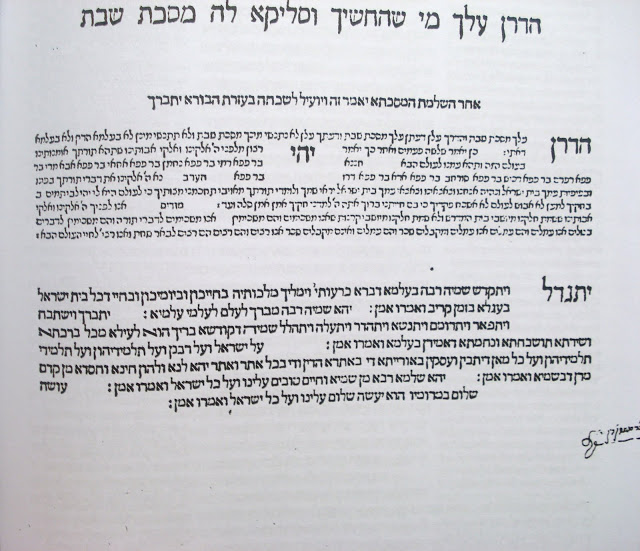
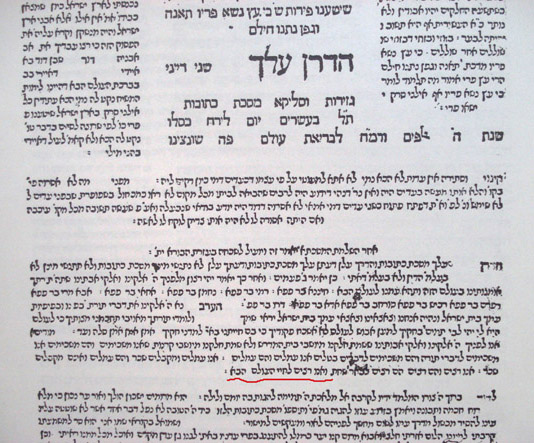


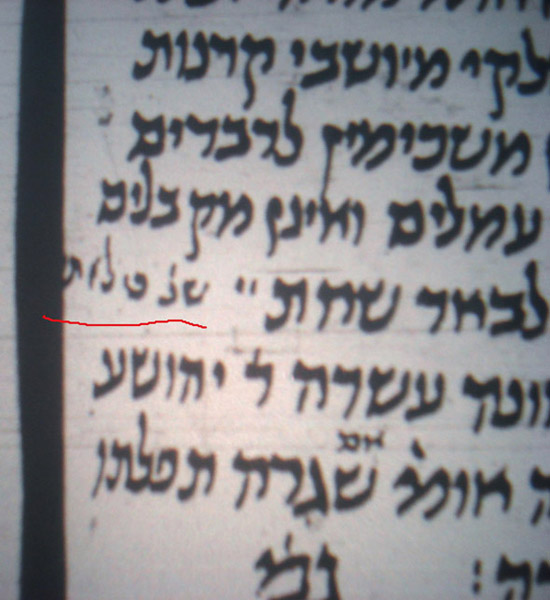
Ancient Jewish Poetry & the Amazing World of Piyut: Interview with Professor Shulamit Elizur

ANCIENT JEWISH POETRY & THE AMAZING WORLD OF PIYUT: Professor Shulamit Elizur explores the Cairo Genizah and other obscure places for hidden gems


BY BATSHEVA SASSOON


Just as the mountains surround Jerusalem, so G-d surrounds his people, from now to all eternity —Tehillim 125:2

This piece originally appeared in14 TISHREI 5778 // OCTOBER 4, 2017 // AMI MAGAZINE #337
Thanks to Ami for permission to publish this here.This version is updated with a few corrections and additions


Inside the Old City of Jerusalem one cannot see the mountains that surround it, only its many confining walls. Yet even for someone who has a phobia of confined places, as I do, this part of the Holy City is liberating. Many years ago, the great Jewish poet Rabbi Yehudah Halevi wrote longingly about Jerusalem, “I wish I could fly to you on the wings of an eagle, and mingle my tears with your dust.” Today, one can readily fly to Jerusalem, but to have a chance to explore its poetic and emotional underpinnings is a rare treat.


Professor Shulamit Elizur, whom I am visiting this morning in her book lined apartment, is not only one of the foremost experts in the world on piyut but she is also a talmidah chachamah and scholar, whose fear of sin precedes her wisdom.


“I was around 16 years old when I realized that if you want to learn something, it isn’t wise to try to absorb too much at one time,” she shares with me without a hint of pretension. “I decided to study the Mishneh Torah of the Rambam, so I learned one perek a day until I got to the end. I did the same thing with Nach, learning two perakim a day, and I’ve gone through the entire Shishah Sidrei Mishnah numerous times. The same applies to piyutim: If you divide them up and study them over time, you will eventually succeed in understanding all of them.”


She then asks me not to mention some of her other scholarly undertakings so that she doesn’t come across as if she were bragging. And she’s not; she is simply a brilliant scholar who loves to learn every spare minute, and the world has been tremendously enriched by that. As the head of the Fleischer Institute for the Study of Hebrew Poetry, a member of the Academy of the Hebrew Language and a member of the editorial board of the Mekitze Nirdamim publishing house, she has her hands full. But she still finds time to write books and study, as well as to talk to me this morning about her ongoing research. Indeed, her energy is laudable as she keeps on getting up to fetch one book after the other to prove a point.


GENIZAH


Anyone who is familiar with contemporary Israeli culture knows that there has been a revival of the singing of piyut. Jewish liturgical poems that were composed to be recited during tefillah are now being performed by Israel’s top singers in clubs and at concerts. But Shulamit Elizur insists that what she does has nothing to do with this trend.


“The modern performers are mainly interested in the piyutim that have tunes, and those that are printed in our siddurim. But I’m involved in doing research into the piyutim that were lost and haven’t been said in many years. My field is kitvei yad, primarily those that were found in the Cairo Genizah.”


I ask her if after all these years it’s still possible to find new things.


“We have an organization that takes all the fragments and deciphers them. For example, I found a fragment of a page and then much later I found another piece of the same page. It turns out that the page is part of a sefer written by Rabbeinu Saadyah Gaon against the Kara’im. We don’t have the entire book, but the two pieces I was able to put together are from a previously unknown part of that sefer, which was very exciting for me.”


“So it’s all about putting pieces together,” I state.


“Yes, although we do sometimes find complete pages as well. For example, I discovered a piyut for Tefillat Geshem on Shemini Atzeret that isn’t found in our siddurim and predates the great paytan Rabbi Elazar Hakalir, who lived in Eretz Yisrael close to the Muslim conquest. It is very unique and I published it in one of my articles.


“When we go through the Genizah, we examine each piece individually to try to understand what it is. We have a catalogue with over 160,000 entries. That doesn’t mean that there are that many piyutim, because if we find the same piyut five times it gets five separate entries. But there are tens of thousands of them, most of which are unknown, and we are constantly finding more. The next step is to upload them onto a website to make them accessible to the public, but right now we don’t have the funds to complete the project.


“We still have a few years of research left, because even though we’ve gone through every fragment found in the Genizah that was known to be a piyut, there are still many more that weren’t known to be parts of piyutim. In Cambridge, the Genizah was organized according to category: There are contracts, letters, parts of Tanach, Talmud and piyutim. My teacher, Ezra Fleischer, began the work of examining all the other categories for fragments that were previously unrecognized as piyutim, and the work is not yet finished. For example, when a contract was no longer needed, the other side of it could then be used to write piyutim, but it was still categorized as a contract. So we still need to find all of those fragments of lost piyutim and piece them together.”


“How many fragments are in the Genizah?”


“Tens of thousands, and sometimes there can be as many as 50 piyutim on a single one. This is a very large undertaking. Ezra Fleischer worked on it for 40 years, and before he passed away he asked me to continue his work.”


“So you’re his successor.”


“For this project, but I don’t claim to come close to his stature. He was unbelievably knowledgeable in piyut, nusach hatefillah, secular poetry and languages; he spoke more than ten.”


“Was he born in Eretz Yisrael?”


“No. That’s another story, which is really deserving of its own article. He was born and raised in Romania. His father was Yehuda Leib Fleischer, who did research on Rav Avraham ibn Ezra, which is why he named his son Avraham Ezra.


“As a bachur, Ezra was an activist for immigration to Eretz Yisrael, so he was arrested and put in jail under extremely dangerous conditions. He was kept in solitary confinement for a number of years, so during that time he composed a number of Hebrew songs and poems in his head. When he was finally freed, he wrote three books of songs and poems from memory.


“He also wrote a book against the Communists, which he was able to put into the hands of the Israeli ambassador, who sent it to Israel and had it printed under a pen name. It received such wide acclaim that he received the Israel Prize for it anonymously while he was still in Romania. But he couldn’t reveal to anyone that he was the author, because he knew that the Romanians would kill him if word got out.


“A year later he was allowed to go to Israel, where he became friends with my parents. I was five years old when I first met him. He told me that he had studied law in Romania because that was the only exam that wasn’t held on Shabbat. He actually hated law, but he had to study something in university so he chose that. Still, even after he graduated he couldn’t get a job in a prestigious law office, which would have necessitated working on Saturdays, so he became the official secretary of the kehillah under Rav Rosen. He really had unbelievable mesirat nefesh to keep Shabbat.”
ACADEMIA


“How did you become interested in the study of piyut?”


“When I went to university I wanted to study the Hebrew language. But because I was required to add another subject I decided to add Hebrew literature, which my mother taught. Then Professor Fleischer invited me to join his project and I loved it. I took several courses with him and became more and more interested. I finished my bachelor’s degree after only two years and had to decide what to do next.


“In the meantime I had gotten married, and I wanted to make sure that whichever professor I learned under would help me advance in my studies. I also had a choice between studying for a master’s and a more difficult program that would allow you to start working towards your doctorate after a year of study. By then I was expecting, and I realized that the harder program would actually be easier for me because it allowed for much more study to be done at home. The problem was that the language department didn’t want to work with me within the parameters of this program. Since I loved the piyutim, I decided to try to do my doctorate with Ezra Fleischer and he agreed. After the initial year of post-graduate study it took me another three and a half years to receive my doctorate. So the whole thing from undergraduate to PhD took six and a half years, which was also when I gave birth to my third child.”


“Did you find that you had a harder time as a woman in a man’s field?”


“There were never any problems because of that.”


“Are you the highest-ranking professor of piyut in Hebrew University?”


“Yes. There are professors emeritus, but I’m the only one left who is still teaching. Aaron Mirsky, who was related to me, and Ezra Fleischer have both passed away. Then there’s Yosef Yahalom, but he is now retired.”


“Aaron Mirsky internalized the language of the paytanim, but people don’t write like that anymore.”


“That’s true, and sometimes it wasn’t easy to understand him. I remember that my mother once won a prize and Aaron Mirsky was one of the judges who gave a speech. He used the word ‘shigush,’ and throughout the entire evening my aunt kept asking what it meant. I told her that it was an Aramaic word from the piyutim. Incidentally, having a knowledge of targum is also very helpful when trying to understand the piyutim. I make sure to learn shnayim mikra v’echad targum every week. My father taught me Targum Onkelos when I was a young girl, and I taught it to my children as well.”


“Are most of your doctoral students at the university secular?”


“No. Most of them are religious.”


“Do your secular students look at all of this as simply another subject, or does it bring them closer to Yiddishkeit?”


“I really don’t know. Sometimes it does bring them closer. I’ve had students who told me that they weren’t familiar with any Tanach, so I told them to study two perakim a day to catch up. But only one person actually took my advice. I remember that it really bothered me at the time that she was the only one, because she wasn’t Jewish, but in the end she became a giyoret kahalachah and is a shomeret mitzvot.”


“Do you face any difficulties as a woman in this field in the world at large?”


“It’s a bit more complicated. I never go anywhere I’m not wanted.


TORAH KNOWLEDGE


“You must really have a lot of Torah knowledge for all of this,” I tell her.


“I need to learn all the time, so I do.”


“There certainly aren’t many women in the world who know as much Torah as you do,” I insist.


“Baruch Hashem, there are many women who are very knowledgeable today, although they might not be familiar with piyutim. At the last Siyum HaShas, the organizers realized that a lot of people were bringing their wives along, so they decided to have a separate women’s program and asked me to speak. I talked about a mesorah that emerges from the piyutim that Hillel and Shammai were actually brothers, and I explained what it really means. The paytan says that just as the Torah was originally given to two brothers, Moshe and Aharon, so too was it later given to Hillel and Shammai, who were also brothers. Then I showed them how Hillel is a continuation of Aharon and Shammai is a continuation of Moshe, and I brought many mekorot showing how each one had his own direction and how the two of them coming together b’achvah is the epitome of the entire Torah.”


“Where did you find all of those sources? In midrashim?”


“Some of them are from the Midrash, but there are a lot in chasidut as well.”


“In order to understand piyutim a person would have to study them for many hours, but we usually say them too quickly to really understand them.”


“That’s true. That’s why they should be learned properly before Yom Tov. But you don’t have to learn everything in a single year. You can do it gradually. I apply the same principle to the kinot of Tishah B’Av; each year, two should be studied properly. While we’re on the subject, I’d like to share something very interesting. The first kinah we say in the morning is alphabetical in order, but it only starts from the letter samech. What happened to the previous letters? Well, if you look in the machzorim of Nusach Italia you’ll find that they recite a krovetz for each brachah of Shmoneh Esrei. The paragraphs are arranged alphabetically from alef through nun, but they end at Bonei Yerushalayim. That’s because the original place to say kinot was in the middle of the brachah of Bonei Yerushalayim during Shmoneh Esrei! They didn’t say as many kinot as we do, though; they’d recite a few piyutim of kinot and then a few piyutim of nechamot. Similarly, the original minhag in Ashkenaz for Selichot on a taanit was to say it during the brachah of Slach Lanu.


“Studying piyutim reveals minhagim that have been forgotten. For example, on Rosh Hashanah they would blow the shofar in the Beit HaVaad (where the Sanhedrin of Eretz Yisrael sat) even when it occurred on Shabbat. But how was it actually done? There’s a piyut, published by Ezra Fleischer in Tarbiz 54 (reprinted in a volume of his collected writings, Statutory Jewish Prayers) that describes how they would bring the shofar before Shabbat and tie it securely to an amud so that it couldn’t move at all. When it came time to blow the shofar, the baal tekiah would blow the shofar with his mouth without touching it so there would be no issue of carrying.”


“There are many other minhagim as well. In the foreword to every sefer I write, after I describe the literary points, I go into the tochen and the many lost midrashim and so on. I also write about lost minhagim, but what minhagim could I write about for Rosh Hashanah? However, as everyone knows, the way we often find things we’re looking for is through hesech hadaat. You just have to be aware that there’s a problem, because otherwise you might see it without understanding what you’re seeing.


“There’s a question that has bothered researchers for many years. In Masechet Megillah (30b) there is a machloket as to whether to read the parshat hashavua on the arba parshiyot and take out two sifrei Torah—as we do—or to take out only one sefer Torah and read just the special kriah for that week. The question is, according to the second opinion, how could they call up seven people to the Torah on Parshat Shekalim, for example? This question has been examined and much has been written about it.


“The researchers found kitvei yad that say that they simply read longer parshiyot for the arba parshiyot. For example, it says that according to that opinion they would read from Zachor until ba’eir heiteiv in the next parshah [Devarim 27:8]. It says that for Hachodesh they would also read more and Parah is long enough. However, it doesn’t say what they would do for Shekalim.


“A couple of years ago I found a piyut for Parshat Shekalim that I wanted to work on for something else. As I was working on the peirush, I began to wonder why it talks so much about the ketoret if it’s supposed to be about shekalim. Then I realized that it goes from the kiyor to the shemen hamishchah and the ketoret and concludes with ‘V’shamru Bnei Yisrael et haShabbat.’ So I suddenly realized that it must have been the kriah for Parshat Shekalim according to the second opinion—until V’shamru. This piyut was able to help me find a minhag without even searching for it.


“Similarly, the piyutim can give us a picture of what the nusach hatefillah was like. I wrote a paper saying that the nusach of Shmoneh Esrei used to have pesukim before the end of every brachah, just as there are pesukim before the end of birchot kriyat Shema. I proved this from the piyutim, although I was strongly criticized. Then I showed it to one of my former students who told me he’d heard something similar from a researcher who had found a Christian prayer in Greek from the fourth century that was based entirely on Shmoneh Esrei and also had pesukim at the end of each brachah. Another researcher subsequently found a papyrus from that era that also showed one of the brachot with pesukim. There are researchers who still disagree, but I feel that there are now three proofs for this idea.


“I also wrote a sefer called Piyutei Pinchas Hakohen. Pinchas Hakohen was a rosh yeshivah and paytan in Eretz Yisrael during the eighth century. There are many minhagim that can be found in his piyutim as well. He has many beautiful piyutim for Rosh Chodesh, one nicer than the next. However, he also has piyutei kiddush yerachim that are very difficult. In that group, there is a kiddush for each month. But when would kiddush be said on Rosh Chodesh?


“In Masechet Sofrim [19:7] it says that the zekeinim and the talmidim would make a seudah on the night of lamed and after Birkat Hamazon they would pour a cup of wine, say the brachah of Hagafen, and then they would say a brachah that concluded with Baruch atah Hashem, mekadeish Yisrael v’roshei chodashim. So he composed a special nusach of kiddush to be said each month with that brachah. In Masechet Sofrim it says that this wasn’t a regular kiddush but a special praise of Hashem, which had to include something about the tuvei ha’ir, the shevatim, the months of the year and the mazalot.


“You can see in his piyutim that each month contained something about its mazal, the corresponding sheivet, its stone in the Choshen and so on. He goes through it in alphabetical order, and in each month when he reaches the letter tzaddik he discusses the tzom, the fast that occurred in that month. They had a list of fasts that were observed in commemoration of whatever took place in that month. I did some research and eventually found the list in a kinah for Tishah B’Av written by Rabbi Elazar Hakalir. Then I started looking through kitvei yad and found a lot of them describing these fasts. I ultimately wrote a whole book on these fasts, because there are a number of different versions, including one that’s quoted in Shulchan Aruch [Orach Chayim 580:2]. I even gave a full seminar on this topic. One of my students told me she expected it to be boring, but in the end it was the most interesting one she’d ever taken!


“Not everyone observed those fasts; only the talmidei chachamim fasted. Eventually it turned into a list of yahrtzeits of tzaddikim that grew longer and longer, because once they weren’t fasting anyway it didn’t really matter how long the list was. But the original list was quite short. This was something I only found out about thanks to the piyutim of Pinchas Hakohen. I’ve also learned a lot of other interesting things, including some gezeirot the Jews suffered from in those days. The first part of the sefer on the fasts is just texts with philological explanations. The second part is a discussion of all the fasts.


“Are they all yahrtzeits?”


“Most of them are, but some of them commemorate other events that took place. For example, the fast of 8 Teves is observed to commemorate the writing of the Torah in Greek, which is mentioned in Shulchan Aruch.


“Incidentally, I wrote a sefer for the bar mitzvah of each of my sons—although not for my grandsons, because that would be too much for me, ka”h! One son’s bar mitzvah was on Parshat Hachodesh so I wrote about the piyutim of the arba parshiyot. Another one was in Parshiyot Acharei Mot-Kedoshim, so I wrote about a paytan who wrote a lot for Acharei Mot and Yom Kippur.”


ANCIENT HISTORY


“How far do the piyutim go back?” I inquire.


“We have some that go back to the fifth century and maybe a bit earlier, but probably not much earlier than that. The sixth century has quite a lot of piyutim, and by the tenth century we find an explosion, to the extent that every small community had its own piyutim. They were very important to each kehillah. Think about what happens now during chazarat hashatz. People don’t listen with the proper kavanah, and it’s only natural because the chazan is simply repeating what everyone just finished saying. But if the tzibbur expected to hear a new piyut, it would cause everyone to concentrate much better. In those days they didn’t simply repeat the piyutim of the previous year; every year they came up with something new. Just for Shachris of Shavuot we have six piyutim that were written by Rabbi Elazar Hakalir to be said before Kedushah. One of those reached Ashkenaz, but the Genizah has more.”


“Many cultures have been built on the oral transmission of tradition through song. Is that something that existed in our history as well?”


“The paytanim originally knew their songs b’al peh, because as the Gemara says [Shabbos 115b], ‘Kotvei brachot k’sorfei Torah,’ those who write the brachot of Shmoneh Esrei are considered to have burned the Torah [because they are not allowed to be saved if there is a fire on Shabbos]. And the piyutim were actually said within chazarat hashatz instead of the nusach of the middle of the brachot and then they concluded with the matbei’a of the brachah.


“We know this because some piyutim are meshorsharim, linked together by beginning each one with the last word of the previous piyut, which means that nothing was said between the ending of the brachah and the beginning of the next piyut. Additionally, we see that the piyutim mentioned tal and geshem, depending on the time of the year, because that was the only way to mention them. They also said all of the piyutim by heart, which is why they are usually arranged alphabetically to make them easier to remember.


“As we know, it was forbidden to have written siddurim in those days. They only started writing them down much later. If they were written down, it was usually done in secret. But of course, if they hadn’t been written down at all we would never know about them, so they were at least sometimes written down, but the typical person didn’t have one. We have a letter from a chazan to a friend asking him to send him piyutim before the chagim, and to do so quickly, so he would have enough time to learn them by heart.”


“Why did they have to be recited from memory?”


“It’s a matter of kavod not to read words that are meant to be coming from the heart from a piece of a paper. To use a modern example, until the last 20 years or so it was accepted that the President of the United States doesn’t give a speech by reading from a paper. The same applies to a chazan.


“I have a student who is blind. He just sits and listens to my courses, and he’s one of my top students. He knows a lot of midrashim b’al peh. I’ll read a piyut, and he’ll interrupt every couple of words and point out which midrash it’s referring to. He’s used to knowing everything b’al peh, and the same was true for everyone when these piyutim were written. This only changed in the middle of the Geonic period.


“In those days everyone was trained to remember everything. Today, with computers, it’s only getting worse. Everyone relies on the computer and on Bar Ilan’s Responsa Project. The worst part is that without remembering, we don’t even know what to search for. That’s why it’s still so important to commit things to memory. Children used to know the entire Tanach b’al peh before they even began to learn mishnayos, and then they learned that by heart as well.”


CHAZANIM


“What do you think was the point of the piyutim?”


“To sing beautiful praises of Hashem, although they were also educational.”


“Did they have special melodies?”


“Not exactly songs with actual notes, but they had tunes in the same way that when we daven or learn Gemara there are certain tunes to the words; we don’t just say them. For example, my grandfather would work in the orchards all day long, come home, open a Gemara and chant the words in his special tune. He would also pay his workers to take a break to learn Torah, so anyone who loved to learn wanted to work for him! We don’t really know the melody to which piyutim were chanted, but there was definitely a tune.”


“Did any women write piyutim?”


“No, because the paytan had to be the shliach tzibbur, which obviously precludes women.”


“Rabbi Elazar Hakalir was a shliach tzibbur?”


“Yes, he and the great early paytan Yanai even sometimes signed their works with the word ‘chazan.’ They wrote their piyutim for themselves. When they stood at the amud, the tzibor had no idea what they would say before they heard it.”


“The piyutim of Rabbi Elazar Hakalir are very similar to those of the German Rishonim.”


“That’s because the Germans copied his style. A number of his piyutim made their way from Eretz Yisrael to Italy and from there to Germany, where they imitated him.”


“It takes a real talmid chacham to be able to understand the depth hinted at in his piyutim.”


“That’s true. I am working right now on his piyutim, so I can show you some. There’s a book I published together with Dr. Michael Rand. I wrote the peirush and he examined the kitvei yad. The book consists only of piyutim written by Rabbi Elazar Hakalir for Rosh Hashanah. It was very difficult, because it requires careful examination of all of the midrashim to be able to understand what he’s saying. Interestingly, there are very few piyutim said today that don’t have additional parts that are no longer recited.”


“In other words, they were abbreviated?”


“Yes, in later generations. For example, Ta’ir V’taria, which is said during Shachris of Rosh Hashanah, is just the refrain of a lengthy piyut that is no longer said. Another example is Melech zechor achuz keren. You can see what a great poet the author was, as in those four words he was able to mention malchiyut, zichronot and shofarot, as well as the remembrance of Akeidat Yitzchak. After that we say Melech Elyon, which we can see was censored because each line originally had a corresponding line about the melech evyon—the poor king of flesh and blood—of which we now only say two lines at the end. However, if we look at the kitvei yad we find that there was an additional piyut before Melech Elyon, which apparently was never brought to Germany and isn’t said by any community in the world to our knowledge.”


“I would imagine that if we were to say all of Rabbi Elazar Hakalir’s piyutim for Rosh Hashanah it would probably take us an entire week.”


“Or it could take us an entire year to choose which piyutim we wanted to say in a particular year! He didn’t say everything he’d ever written each year; he apparently alternated.”


LOST MIDRASHIM


“There’s another amazing thing I find when doing research. I am constantly coming across midrashim that were lost to the ages. Sometimes I’ll only find the source years later. For example, there’s a piyut that says that the moon disappears on Rosh Hashanah so that we should not be reproved in judgment. What does that mean? I looked and looked but could not find any such midrash. Eventually I found that Machzor Vitry and others write that Hashem established Rosh Hashanah on Rosh Chodesh so that when the Satan will try to prosecute the Jews by saying they sinned, Hashem will tell him to bring witnesses. The Satan then says, ‘Who should I bring? I can’t bring the sun and the moon, because the moon is in hiding and the sun can’t testify on its own.’ When the Satan comes back on Yom Kippur, Hashem tells him that it’s too late because Bnei Yisrael already did teshuvah. Here we see a source for it in 11th-century Germany, but Rabbi Elazar Hakalir lived in the seventh century. Another paytan, Yannai, who lived in the sixth century, also mentions this idea in a piyut. So without these piyutim we would have thought it was a chiddush of rabbanei Tzarfas, but now we know that it probably originated in a lost midrash.


“Another interesting example: Everyone knows that Haman was referred to as ‘the Agagi’ because Shaul allowed Agag to live one extra night, which allowed Haman’s ancestor to be born. However, the earliest makor we find in writing in the 16th century; this fact was discovered by Rav Shmuel Ashkenazi of Yerushalayim. But I found a ktav yad of a piyut about Purim that describes this very story and explains how Haman’s ancestor was born, which gives us a source from 1,000 years earlier! And there are many similar examples of lost midrashim being kept alive through unknown piyutim.”


“Is it possible that the later chachamim wrote things based on these lost piyutim?”


“That’s very unlikely, because these kitvei yad were never disseminated. But what these piyutim prove is that there was a mesorah that people knew about and may have even been set down in midrashim that were subsequently lost, and the later chachamim who did write about them were familiar with the original mesorah.”


“Do you give shiurim on the meanings of the piyutim?”


“Only in the university, although tonight there will be an event in preparation for Rosh Hashanah where I will be speaking about Unetaneh Tokef.”


“Let’s talk about Unetaneh Tokef for a moment.”


“Everyone knows the story of Rabbeinu Amnon and his mesirat nefesh that led to his writing this piyut. Everyone also knows that he lived in the city of Mainz, Germany, which means that he had to have lived towards the end of the tenth century, because we don’t find any piyutim from that region before that time.”


“He is also a personality about whom we know almost nothing.”


“Exactly. We don’t know anything about him except this story. However, we found Unetaneh Tokef in the Genizah near a collection of piyutim by Yannai. We even began to think that maybe Unetaneh Tokef was written by Yannai, which I still think is true, but at the very least it seems to have come from the era of Yannai. Other researchers argued and said that because of its length and the lack of rhymes and verses it was really from Ashkenaz. Then we found incontrovertible proof that it did not originate in Ashkenaz: a very long piyut from Rabbi Elazar Hakalir to be said right before Kedushah of Musaf that takes the words of Unetaneh Tokef and enlarges upon each line. This clearly shows that while he was not the composer of Unetaneh Tokef, he was familiar with it and it was significant enough in his lifetime that he felt it worthy of being adapted and enlarged upon.”


ELIZUR’S WRITINGS


“I see that you enjoy the piyutim of Rabbi Elazar Hakalir very much, but it would seem that most people appreciate Rabbi Yehudah Halevi more because his style is easier to understand.”


“We’ve found new things from Rabbi Yehudah Halevi as well. Incidentally, not everything he wrote is so easy to understand. Everyone knows Tziyon Halo Tishali, which is easy to understand, particularly in contrast with Rabbi Elazar Hakalir. But many of his piyutim also require study.


“I wrote an article a number of years ago about the piyutim that were written to be said before Kedushah. With all those references to hidden midrashim, they could not have been intended for just anyone sitting in a beit knesset. As I tell my students, ‘You’re all sitting in front of me right now, but when it comes to the test, some of you will get 100% while others might only get 70%.’ The paytanim understood this as well, so in the beginning of those piyutim you’ll find the references hinted at very obliquely. Then, as the piyut continues, those remazim will be fleshed out a bit more, and by the time you get to the end there are concepts that can be understood by anyone. In this way, more and more people can feel a connection.”


“Are all of your books on piyut?”


“Yes.”


“But your sefer on the parshah, Shirah Shel Parashah, is something that is accessible to everyone, not just scholars.”


“Absolutely. I wrote another book like that on secular poetry from Spain.”


“How long did it take you to write the sefer on the arba parshiyot for your son’s bar mitzvah?”


“A couple of months. I work very quickly.”


“Which sefer do you consider your biggest accomplishment— your magnum opus?”


“The one I’m in the middle of writing right now. It’s a sefer on the history of the kedushta, which are the piyutim composed to be recited right before Kedushah. There are many chiddushim in that sefer and also things about Rabbi Elazar Hakalir that I discovered.”


“From examining his kisvei yad?”


“We don’t have any kitvei yad from him personally. He passed away in the middle of the seventh century, and the earliest kitvei yad we have are from the ninth century. However, I was able to figure these things out from the style and verses of his piyutim. It’s very complicated; I’ve been working on this for decades.


“Which ones are nicer? The ones he wrote when he was younger, or the ones he wrote when he was older?”


“Although the two styles are very different, they are both very nice, and I wouldn’t say that one is nicer than the other. In between there was a time when his style was very complicated, and I don’t really appreciate it, but I like to say that he was engaged in developing his later style. His later style is much easier to understand and is very lyrical. He wrote piyutim for chatanim and for the seven weeks of nechamah after Tishah B’Av. I wrote a sefer on those. I’m currently working on Rabbi Elazar Hakalir’s piyutim for Yom Kippur, and I daven that Hashem should give me the koach to finish it.”


BACKGROUND


“Was your father a learned person?”


“Yes. He was a talmid chacham who had studied in Yeshivas Chevron as a bachur, but after that he learned entirely on his own.”


“What was his name?”


“Meir Chovav. My grandfather, father and uncle were all very interested in piyut and zemirot. They had special tunes for all of the zemirot of Motza’ei Shabbat. I don’t know many people who sing all of the zemirot in the siddur, but my grandfather did. When I got married I asked my mother to teach me all of her father’s tunes so I’d be able to pass them onto the next generation, and now all of my children know them as well.”


“I’ve heard of your father. He wrote many sefarim.”


“Right, and he was also an editor. He taught me piyutim as soon as I started to read. He davened in Yeshivat Eitz Chaim and I used to sit next to him as a young girl. They would say the piyutim for the Arba Parshiyot after davening rather than during chazarat hashatz. As they said them, my father would show me the words and explain them to me. My mother was also a teacher of literature and she wrote her master’s thesis on the Selichot of Rabbi Shimon ben Rabbi Yitzchak. So I grew up in a home where piyutim were of the utmost importance. My father had a theory in chinuch that the world needs to hear: When you tell children that if they learn you’ll give them candies, you’re teaching them that the goal is the candies, and that Torah is something that needs to be paid for and isn’t good on its own. My father’s approach was the exact opposite. If you do something correctly, I will stay and learn Torah with you. If you are dressed and ready to go to school early, you can come to my room and I will learn with you. This taught us that Torah itself was the reward. I did the same thing with my children and I’ve seen amazing results.


“Last week we went on vacation up north. When we arrived at the hotel, there was a beit knesset there. Whoever hadn’t davened Minchah yet went and davened, and then they needed a minyan for Maariv, so they waited for a minyan. Our family has seven men over bar mitzvah between our children and grandchildren, so they only had to wait for three more people. In the meantime, I walked in to see what was happening and found my son-in-law learning with a group of children and teaching them the story of tanur shel Achna’i [Bava Metzia 59a]. One of my sons was sitting and learning Gemara with his ten-year-old son. Two grandchildren—cousins—were learning Gemara; everyone was learning. They all know that whenever there’s free time it’s for the purpose of learning. I felt so fortunate. This was exactly my father’s shitah in chinuch. Whenever I see things like this it makes me really happy. Seeing the grandchildren laughing and playing during the vacation was very nice, but seeing them learning like that was so much better.”


“I’m sure the fact that they have a mother like you also helps.”


“And it’s not just my sons; my daughter is also very learned. She is now finishing her doctorate on how to teach family purity in today’s day and age.”


“How many children do you have?”


“I have four, baruch Hashem; one daughter and three sons. My daughter and her 17-year-old daughter daven in the beit knesset three times a day, sitting bitzniut in the ezrat nashim.”


“How long have you been living here in the Old City?”


“Forty-one years.”


“This is a very nice house. Are all the homes here similar?” “Each one is different. No two are the same.”


“Are there any problems with the Arabs in the neighborhood?”


“Almost none.”


“Do people who live here go to the Kotel every day?”


“Some do. There were years when I went every day, but I want to be able to daven properly with a minyan and that’s very difficult to do from the ezrat nashim of the Kotel, so I go to the Churva. I’ve been davening there every day since they renovated it. There are many women in the neighborhood who daven with a minyan every day and even three times a day. Between the Kotel and the Churva, it’s very easy. My husband goes to the Kotel because on the men’s side it’s much easier to daven.”


“What does your husband do?”


“He works at the Academy for the Hebrew Language. They are working on a historical dictionary of the Hebrew language. They have a collection of every word used by Chazal, all of the midrashim, all of the piyutim, megillot genuzot and more. They want to upload as many texts as possible into the computer and then analyze where and how many times every single word can be found. What’s unique is that they don’t just put up every word on the website; they dissect them. So, for example, as I’m working and come across a certain word, I can search for it and see every context in which it is used. They check each text according to the most accurate kitvei yad and give an explanation for every word. This is my husband’s biggest project. They also publish sefarim of the kitvei yad from time to time. For example, they printed the Talmud Yerushalmi from the only full ktav yad in existence. If there are mistakes in the ktav yad they point them out. Right now my husband is working on an index that explains each mistake; he’s constantly working on the Yerushalmi.”


“Was your husband also born in Yerushalayim?”


“Yes. His mother was a Holocaust survivor and his father was a survivor of the Chevron massacre; he was learning in Yeshivat Chevron at the time. My husband was their only son.”


“And now, to sum things up…”

“What can I really say in summary? I thank Hashem for ‘placing my portion among those who sit in the beit midrash,’ and for giving me the ability to teach and explain piyutim. I daven that Hashem should give me the koach to continue with my work.”


Bein hashemashot: A Reevaluation of the Texts


Bein Hashemashot: A Reevaluation of the Texts
by: Dr. William Gewirtz
This is the first of a sequence of posts, from a draft of a forthcoming monograph by Dr. William Gewirtz that addresses the period of bein hashemashot.  Each post very briefly summarizes about 20 pages of the monograph containing 4 – 6 critical pages.  Those wishing the entire section can download the associated PDF file. 
The monograph addresses the period of bein hashemashot, the most fundamental area of dispute in the area of zemanim.  What is proposed is an astronomically accurate hybrid position between the diametrically opposed conceptual views of the geonim and Rabbeinu Tam.  That position justifies, to varying degrees, the practice of countless generations of European Jewry that started Shabbat well after sunset on Friday evening.  Though often ignored in modern times, practical equivalents of this hybrid position have had major adherents throughout the generations.  Furthermore, our goal is to demonstrate that such a position is not just plausible, but in fact the preferred reading of the primary text of the gemara in Shabbat concerning bein hashemashot.

Of course, this monograph is not meant to change normative practice; however, in unique circumstances poskim may find it useful.

Comments and questions of any type are particularly welcome and will be addressed quickly.

This first section includes a prologue that provides brief historical background and an introduction that presents the topic in its current context.  The latter is posted below; the entire section is available here as a PDF.


On the Orthodox Union web site, accessing zemanim provides a variety of halakhic information including two alternative times for the end of Shabbat at locations around the world.  In the New York area, the first alternative, approximately 45 minutes after what is commonly referred to as sunset, is presented as the opinion of the geonimShabbat ends the time it takes to walk ¾ of a mil after the beginning of bein hashemashot.  The second alternative, 72 minutes, is presented as the opinion of Rabbeinu Tam – Shabbat ends the time it takes to walk four mil after sunset.  Of course, this is immediately problematic.  If the time to walk four mil is 72 minutes, then the time to walk one mil is 18 minutes and the time to walk ¾ of a mil equals 13.5 minutes, not 45.  Part (but certainly not all) of this discrepancy can be attributed to the fact that the opinion of the geonim is adjusted based on (location) latitude and further adjusted based on season of the year.  Those two adjustments alone applied to 13.5 minutes do not yield a range of approximately 40 to 50 minutes in the New York area.  Other factors including:
                 1.      the extension of the end of Shabbat from medium to small stars,
2.      the impact of doubt as applied to a prohibition as serious as the observance of Shabbat,
3.      the impact of tosefet Shabbat,
4.      the length of the time to walk a mil,
5.      the definition of sunset and the beginning of bein hashemashot
may all play a role, as well.  The opinion of Rabbeinu Tam, however, is fixed at a constant 72 minutes, at any latitude and during all seasons of the year.

Halakhic principles, logical consistency and theory notwithstanding, the vast majority of current practice follows one of these two opinions.  Unquestionably, common practice adjusts the length of bein hashemashot based on latitude (and even on occasion season) when following the opinion of the geonim, while leaving the length of bein hashemashot constant when following the opinion of Rabbeinu Tam.  Moreover, this is not surprising.   R. Elijah of Vilna, the (Vilna) Gaon, and R. Shneur Zalman of Liadi, the first Lubavitcher Rebbe,[1] both explicitly require these adjustments in applying the approach of the geonim.  They were two of the most prominent authorities that battled to reinstate the practice of the geonim against what had become the practice of an overwhelming majority of European Jewry who had adopted the opinion of Rabbeinu Tam.  That majority included many if not most subsequent rishonim, both R. Yosef Caro and Rama, and most early commentators on the Shulchan Aruch.  For those who followed the opinion of Rabbeinu Tam, there is no conclusive evidence[2] in either halakhic literature or practice, that Rabbeinu Tam or anyone until after the time of the Shulchan Aruch ever adjusted the start or the end of bein hashemashot based on latitude or season.[3]  Like the time to walk 4 mil, it was assumed invariant.

Comporting with practice and consistent with the opinion of the major authorities whose opinion those practices appear to follow, would not normally warrant further analysis.  However, as I will quickly illustrate, almost every aspect of zemanim involves a challenging mosaic of major and minor halakhic issues that have to be resolved and then applied consistent with observable astronomical facts.
Consider two other contemporary opinions on this topic, Rabbi M. Feinstein,[4] and Rabbi M. Willig.[5]    R. Feinstein cites two alternatives to be followed in the New York metropolitan area: 72 minutes and approximately 50 minutes.  Clearly, the OU web site’s recommended practice is rather consistent.  R. Feinstein’s logic however, is radically different.  First, R. Feinstein argues that latitude is commonly accepted as a determinant in the length of bein hashemashot and is thus to be applied to the opinion of Rabbeinu Tam as well.  Second, R. Feinstein observes that while he waited 72 minutes in Lithuania, in accordance with Rabbeinu Tam, the sky is equivalently dark and starry in New York after only 50 minutes.  Therefore, R. Feinstein adjusts Rabbeinu Tam’s opinion based on latitude and concludes that there is an adequate halakhic basis for those living in the New York area and following Rabbeinu Tam to wait only 50 minutes.[6]  This opinion is similar to one given in applying Rabbeinu Tam’s opinion by Rabbi Pimential, in Minkhat Kohen.[7]  R.  Pimential suggested that the Jews living in the low altitude[8] of the Netherlands need only wait 48 minutes after sunset (in the spring) to end Shabbat according to Rabbeinu Tam.  In reality however, the length of time from sunset to darkness (however defined) increases as one moves further away from the equator traversing the latitudes of  the Middle East (~30 degrees), the Northeast United States (~40 degrees), the Netherlands (~50 degrees) and Lithuania (~55 degrees).   Assuming the application of adjustments based on latitude, the end of Shabbat is later after sunset in the New York area or the Netherlands than in Israel.  Problematically, R. Feinstein’s end to Shabbat is earlier in the in the New York area (similar to the Netherlands in the opinion of R. Pimential) than in either Lithuania or the Middle East.  Despite the widespread acceptance and application of this opinion of R. Feinstein in many popular and scholarly[9] contexts, analysis is often muted or absent entirely.
While the OU website aligns with R. Feinstein’s psak[10]  and common practice, it differs entirely as to rationale.[11]  When one waits approximately 50 minutes, the OU assumes one is following the geonim, while R. Feinstein assumes that one is still following Rabbeinu Tam.  Unlike R. Feinstein’s ruling, the OU web site does not adjust Rabbeinu Tam’s opinion for latitude or season.  Of course, one could argue that Rabbeinu Tam’s approach applies to France and not the Middle East.  This would imply that the sugyot that Rabbeinu Tam is analyzing defined zemanim for Europe and not the Middle East – hardly a plausible position.  Both historical practice and Rabbeinu Tam’s likely position made no explicit latitude adjustments; one can only conjecture that Rabbeinu Tam assumed his zemanim applied uniformly to both the Middle East and France.   In that regard, the OU website is consistent with both Rabbeinu Tam’s viewpoint and how it has been practiced.[12]

In his sefer Am Mordechai, R. Willig, like R. Feinstein, takes as a certainty that latitude must be a determinant in applying the approach of Rabbeinu Tam as well.  But R. Willig follows that to its logical conclusion:
v        The 72 minute practice in Lithuania was not, as R. Feinstein (and probably the vast majority of Orthodox Jewry) assumed, the correct practice of Rabbeinu Tam, but rather just the practice of the geonim applied at a location/latitude above 50 degrees from the equator.
In R. Willig’s approach, the logic of Rabbeinu Tam’s opinion, regardless of the practice actually followed by Rabbeinu Tam or those who adhered to his position, must be coupled with the laws of astronomy as currently understood.  Thus, the time to walk four mil that Rabbeinu Tam rules as the end of Shabbat, only applies around the spring and fall equinox and only at the latitude of Israel and Babylonia (approximately 30 degrees north latitude.)  Rabbeinu Tam’s locale in France, New York and Lithuania would require a significantly later end to Shabbat.  In fact, R. Willig provides both a slightly shorter (for those following the geonim) and significantly longer (for those following Rabbeinu Tam) end-time to Shabbat consistent with the opinion and (private) practice of his mentor Rabbi Joseph Soloveitchik.[13]  While their logic and application of basic astronomy to zemanim is impeccable, it hardly comports with practice.  Interestingly, both R. Soloveitchik’s personal stringency and R. Feinstein’s ruling for the entire community follow Rabbeinu Tam.  In addition, both agree that adjustments for latitude must be made.  However, their conclusions are radically different.  R. Feinstein ends up with a psak that comports with tradition, albeit, employing logic that is, at least to this author, puzzling.  R. Soloveitchik, on the other hand, followed (and refined) a family (Brisker) practice that is almost unprecedented within tradition, coupling a precise understanding of astronomy with a halakhic formulation rooted in Rabbeinu Tam’s approach.  As a result, R. Soloveitchik ended up waiting considerably longer for the end of Shabbat than either Rabbeinu Tam or the vast majority of his prior adherents.[14] 
 

[1] In his Siddur, R. Shneur Zalman of Liadi abandons the position he took in Shulchan Aruch Harav that supports Rabbeinu Tam
[2] Minkhat Kohen provides a comprehensive review and when suggesting latitude, season and altitude based adjustments mentions no such earlier source supporting this approach to the opinion of Rabbeinu Tam.
[3] This disparity in approach, adjusting one measure and not another, has the effect of reducing the period of dispute around the end of Shabbat in the northern European counties.  Thus, opinions on ending the Shabbat, while radically divergent in theory, varied less significantly in practice.
[4] Igrot Moshe – OC 4:62.
[5] Am Mordechai, Berachot chapter 2.
[6] 72 minutes is preferred by R. Feinstein, but only as a recommended stringency.
[7] Ma’amar Sheni  – chapters  4 and 5, a 17th century work that was the first comprehensive sefer on zemanim.
[8] R. Pimential significantly overestimated the effect of elevation.  R. Pimential was perplexed by the expected impact of latitude and explicitly questions why the twilight period in the Netherlands is not longer than 72 minutes given that the Netherlands is further from the equator than the Middle East.
[9] Both R. Willig  Am Mordechai, Berachot chapter 2, in the last section and R. Dovid Heber in Shaarei Zemanim, page 90, raise this fundamental issue with R. Feinstein’s position.
[10] There are some differences as the zemanim provided on the OU website adjust for seasonality as well.  R. Belsky argues that R. Feinstein would have agreed to those changes.  See his approbation on the www.myzemanim.com website.
[11] As we will see on other issues, practice can on occasion be explained to comport with entirely different theoretical positions.
[12] While normally no precise latitude based adjustments were made to Rabbeinu Tam’s position, approaches like that of R. Pimential, which use the appearance of stars, regardless of the duration of  time since sunset, to define the end of Shabbat, effectively do incorporate both season  and latitude based adjustments.
[13] R. Soloveitchik, as we will be explained later, considered the time to walk 4 mil to be 90 minutes (the Brisker achtel, an eighth of a day, in Yiddish) as opposed to the 72 minutes used by most poskim and then adjusted 90 minutes by latitude and season.  This combination caused R. Soloveitchik to maintain Shabbat at a Biblical level until almost 2 and ½ hours after sunset in Boston around the summer equinox.
[14] In a Yarzeit shiur, (Shiurim Lezecher Avi Mori, volume 1, yom v’lailah) R. Soloveitchik outlined a compelling, albeit highly non-traditional, approach that reworked Rabbeinu Tam to a position, consistent with astronomical observation.  However, even this approach to Rabbeinu Tam must deal with the textual issues in reading the gemara in Shabbat that are discussed in section 7, a topic that R. Soloveitchik did not address.