Disputatious Divorces: Public Controversies over Gitten and Couple Relations
Disputatious Divorces: Public Controversies over Gitten and Couple Relations
by Marvin J. Heller[1]
God said “It is not good that man be alone: I will make him a helper, a counterpart to him.
Therefore, a man shall leave his father and mother and clings to his wife, so that they become one flesh. (Genesis 2:18, 24)
As a rose among the thorns, so is my beloved among the young women.
As an apple tree among the forest trees, so is my beloved among the young men (Song of Songs 2:2,3).
A man takes a woman [into his household as his wife] and becomes her husband. She fails to please him because he finds something obnoxious about her, and he writes her a bill of divorcement (Sefer Keritut, get), hands it to her, and sends her away from his house (Deuteronomy 24:1).
The Bible makes clear that the normal relationship is for men and women to marry and have a warm conjugal relationship, stating this near the opening of Genesis, the first human relationship being formed on the sixth day of creation, the day the both man and women were created. This relationship is emphasized by King Solomon in the Song of Songs (Shir ha-Shirim) who, as noted above, describes the affection each member of a couple has, should have, for each other. Alas, unfortunately, this is not always the case. When that unfortunate occurrence occurs, the Torah mandates a procedure for terminating the relationship, hopefully with a minimum of animosity and acrimony.
In contrast to the above, several contentious divorces in the Jewish community, in the sixteenth through eighteenth centuries, had a very public countenance, this in contrast to the concept that divorce is a private affair. In all of these instances the disputations and the opinions of the prominent rabbis involved were recorded in numerous books of responsa. This article looks at several of those divorces and related publications, one in which none of the participants were Jewish. In that instance, however, halacha was a matter of interest. Background of the disputes are discussed in this article and several of the leading related publications are described. Five contentious divorces are addressed in this article in chronological order, excepting the English royal divorce addressed at the conclusion of the article.
I
1566 – Tamari-Venturozzo affair – We begin with the controversial divorce known as the Tamari-Venturozzo Affair, after its participants, Samuel (Shmuel ha-katan) ben Moses Ventura of Perugia, known as Venturozzo and Tamar, the daughter of Joseph ben Moses ha-Kohen Tamari, “the leading physician in Venice.” Shlomo Simonsohn, begins his description of the “divorce scandal” writing that in contrast to other communal disputes the Tamari-Venturozzo affair, an issue of Jewish law, “roused the Jewish public throughout Italy” and social conflict in the communities.[2]
In 1560, Samuel Venturozzo, was promised, (engaged to) Tamar (Tamari). Three months after the betrothal a dispute between Venturozzo and Tamari, the latter close to the Venetian government, occurred, the former reputedly for violating his marriage vows, customarily made at in Italy at the time of betrothal. As a result, Venturozzo left Venice,claiming that he fled the city because Tamari had reported him to the authorities. Venturozzo moved about in Italy, pursued by Tamari, who demanded a get (bill of divorce) for his daughter, as erusin (betrothal) involving the exchange of marital vows, that is, apart from and prior to nissu’in (marriage), had taken place, necessitating a get.
After four years, Tamari brought the case to the Maharam of Padua (R. Meir ben Isaac Katzenellenbogen, 1482-1565), among the leading rabbis in Italy. He ruled, on February 27, 1564 (4 Adar, 5324), that within a month Venturozzo must either consummate the marriage or divorce Tamar. After considerable difficult negotiations, Venturozzo returned to Venice and formally divorced Tamar, giving her a get. This did not, however, conclude the matter. Venturozzo subsequently reputed the divorce, claiming that he had been compelled to grant the get; Tamari charged that Venturozzo was mercenary. Furthermore, Tamari claimed that Venturozzo’s charges, after the fact, did not negate the get. Rabbinic and secular authorities were marshaled by both sides, in Venice on behalf of Tamari, the rabbinate in Mantua, and Cosimo I, Duke of Florence, on behalf of Venturozzo, who would later be librarian for the Duke’s Hebrew books. Even the Church, represented by Cardinals and the Inquisition, became involved. The dispute occupied the attention of Italian Jewry for seven years.[3]
According to Robert Bonfil the Tamari-Venturozzo controversy was one of several within the Italian-Jewish community. Each dispute involved numerous rabbis, none with sufficient authority to render a final decision. He writes that “the personal authority of the individuals involved was severely weakened by some harsh facts which came to light in the wake of these conflicts.” Furthermore, social tension between ethnic groups was aggravated. “Even in the case of the Tamari-Venturozzo divorce, the Mantua community was divided into two camps: the scholars of the Ashkenazic yeshivot on the one hand, and R. Moses Provenzali and the Italian community on the other.[4]
This dispute over the get divided the Ashkenazic and Sephardic communities of Italy, and, prior to its resolution, involved a wide spectrum of rabbinic authorities, in such locations as Venice, Florence, Ferrara, and Mantua, as well as Italian officialdom and even beyond Italy, in such diverse locations asSalonika, Constantinople and Eretz Israel. Polemic tracts and collections of responsa were issued for and by both sides.
Several works of responsa address this dispute, of those noted here, one was printed in Venice, R. Baruch Uziel ben Baruch Hazketto’s Hatzaah al Odot ha-Get, and two were published in Mantua, R. Samuel ben Moses Venturozzo’s Elleh ha-Devorim and R. Moses ben Abraham Provencal’s Be’ur Zeh Yaza Rishonah.[5]
1566, Hatzaah al Odot ha-Get Courtesy of the National Library of Israel
Hatzaah al Odot ha-Get (Proposal on the matter of the get given by Samuel known as Venturozzo) is a collection of responsa from a number of rabbis in support of Tamari. It was published at the press of Giorgio di Cavalli (Venice, 1565) in a small format (21 cm. 77 ff.). Cavalli, a scion of an ancient Veronese family made Venetian patricians, was an active printer of Hebrew books from 1565 to 1567, issuing more than twenty Hebrew titles. His pressmark was an elephant bearing a turret.
Hatzaah al Odot ha-Get was published by the Tamari family and the rabbis of Venice who supported the family. The book was published at intervalsand subsequently assembled as a complete work. R. Baruch Uziel ben Baruch Hazketto (d. 1571, Hazketto is a Hebraized form of his name: ḥazak, forte, פורטי, “strong”).[6] The title-page of Hatzaah al Odot ha-Get states that it’s subject matter is the get given by the young Samuel known as Venturozzo. It is dated 8 Tishrei השכ”ו ([5]326 = Monday, September 3, 1565) and “contains all the details, in general and in particular, from beginning to the end. . . . and in it can be found all the facts of the divorce.” The text begins with an account of the affair from the Tamari perspective. It is followed by correspondence and rulings supporting the Tamari family from rabbis who express their opposition to R. Moshe Provencal (Provencali), who led the rabbis of Mantua, and his supporters, the leading adherents of the Venturozzo position.[7]
Elleh ha- Devorim represents the Venturozzo family’s position. It was published in quarto format (40: pp. 46 ff.) with the assistance of R. Moses ben Abraham Provencal. Although the title-page states it was printed in Mantua the publisher is not known. In addition, a second, this the primary work representing the Tamari family position, was Provencal’s Be’ur Zeh Yaza Rishonah.
R. Moses ben Abraham Provencal (1503–1575), born in and rabbi of Mantua was a prominent Talmudist and among the preeminent contemporary Italian rabbis. Among the many works for which he is known, in addition to his responsa, are an approbation for the printing of the Zohar (Mantua, 1558–60), and other varied works.[8] A leading supporter of Venturozzo, Provencal (1503-1575), invalidated the get, contending it was given under duress. His position was opposed by many rabbis in Italy, as well as rabbis throughout Italy and Turkey. Provencal wrote to the Venetian rabbinate informing them that Tamar could not remarry until the matter was resolved. The Venetian rabbinate sought and gained the support of the rabbis (six) in the Ashkenaz yeshiva in Mantua, who “banned” Provencal, an activity supported by several prominent rabbis in Italy and abroad. Provencal was actually put under house arrest by the authorities in Mantua for his position.[9] Much of the Italian rabbinate supported Provencal.
1566, Elleh ha- Devorim Courtesy of the National Library of Israel
1566, Be’ur Zeh Yaza Rishonah Courtesy of the National Library of Israel
Provencal’s Be’ur Zeh Yaza Rishonah is a small work. It was printed in Mantua in octavo format (80: [22] pp.), the press, as noted above, unknown. The title-page describes Be’ur Zeh Yaza Rishonah as including all the laws concerning women on divorce and betrothal when discord occurs between a man and his wife and the monetary issues when they bring their case to judgment. In addition to the works described here Simonsohn notes several other related responsa, some still in manuscript.
When the matter became so heated there were riots, suppressed by the civil authorities, in Milan. Soon after, however, the public lost interest in the affair and it was quickly forgotten. At the end of the century Provencal’s grandchildren were unable to sell copies of his pamphlet still in their possession.
(TSB Editor note: For more about this controversy see Eliezer Brodt’s recent presentation available here.)
II
Divorce of Vienna, 1611 – Our second contentious divorce, a cause celebre known as the Divorce of Vienna (Get Mi-Vi’en) concerns a young man from Poland, sixteen years of age, who married a young woman from Vienna. He became severely ill. The couple did not have any children. Persuaded by his wife’s family, the husband agreed to divorce his wife, to give her a get, so that she would not have to undergo halitzah after his passing.[10] At the time of the divorce, the husband’s position was based on his being informed that if he recovered the marital relation would be resumed. He was provided with written and oral assurances that if he recovered, he could remarry his wife. The young man did recover, but his wife declined to resume the prior relationship and return to her [ex]husband. The issue came before R. Meir ben Gedaliah of Lublin (Maharam of Lublin, 1558–1616) who determined that because of the husband’s understanding of the situation and recovery the original divorce was invalidated.
Another rabbi of repute to whom the question of this divorce was also addressed was R. Mordecai Jaffe (Levush, 1530-1612). It was his position that the verse in Deuteronomy (24:1–2) that only if his wife does not please him, as in the header verse “he writes her a bill of divorcement, hands it to her, and sends her away from his house . . . And she shall go out of his house and became a wife to another man …” It was the Levush’s contention that a woman can remarry only if she did not find favor in her husband’s eyes. If, however, the divorce was due to other reasons, a “divorce of love” is Jaffe’s term, it “is not effective as an instrument empowering marriage to another.”
In contrast to the above, in a synod of the Polish and Russian rabbinate, R. Shmuel Eliezer Edels (Maharsha, 1555-1631) determined that, given the prior understanding, the divorce was valid. Similarly, R. Joshua Falk (1555-1614), author of Beit Yisrael commentary on the Arba’ah Turim as well as Sefer Meiros Enayim on the Shulkhan Arukh argued that the get was valid, as no explicit condition had been written in the get. Finally, the wife’s family did not permit the remarriage.[11]
(TSB Editor note: For more about this controversy see Eliezer Brodt’s recent presentation available here.)
III
Urbino 1727 – Our nextcontentious divorce, this quite different from our other separations, took place in Urbino, at one time capital of the province of Pesaro e Urbino, duchy of Urbino, but subsequently later a portion of the States of the Church. Jews may have been resident in Urbino as early as the thirteenth century, albeit in small numbers. The details of the divorce and the participants in the ensuing divorce are detailed in R. Isaac ben Samuel Lampronti’s (1679-1756) multi-volume encyclopedia entitled Pahad Yitzhak, most parts printed posthumously.
Lampronti, a physician, rabbinic scholar, and head of the yeshiva in Mantua, a Sephardic sage in Italy, began to assemble the contents of Pahad Yitzhak when a student in Mantua. It is an encyclopedic and comprehensive work on Jewish subjects, arranged alphabetically. Lampronti worked on Pahad Yitzhak his entire life, but only beginning to publish it when elderly. A thirteen-volume work, the first volume (Venice, 1750) of Pahad Yitzhak was printed at the Bragadin press. It is the only part of Pahad Yitzhak to be published in Lampronti’s lifetime; it is on the letters א and ב. The remainder of the work was published posthumously.[12] Publication of Pahad Yitzhak was completed in Berlin (1885-87), the final volumes published by the Meḳiẓe Nirdamim Society.[13]
1750, Pahad Yitzhak Courtesy of Jewish National Library
1866, Pahad Yitzhak Courtesy of HebrewBooks.org
The case of the Urbino divorce is addressed in Pahad Yitzhak, volume 7 (Lyck, 1866), under the heading safek (doubt). Ninety pages reproduce the various works, responsa, and related correspondence concerning this dispute. The detailed Pahad Yitzhak entry on the disputed Urbino divorce is summarized by Cecil Roth in an article on the dispute. The remainder of this article entry is a concise recapitulation of that summary.[14]
In this occurrence Consolo Moscato, a very attractive orphan girl, was resident in Urbino. She was sought after by many of the local young men, but she chose to wed her cousin Solomon Vita Castello. The match was arranged, but did not take place immediately, Consolo’s father having passed away and her mother, signora Diana, remarried. The couple lived under the same roof, in the home of an aunt. Due to difficult economic conditions the year stipulated for the wedding passed and it was three years before anything was done. At the end of June, 1727 Castello purchased attractive attire for the bride from a merchant for no less than twelve zecchins.
Soon after, however, the groom became ill and his mind was affected. Castello threw himself down a well; quickly saved he was bound hand and foot to prevent another attempt. His madness was followed by periods of lucidity “or what was convenient to consider lucidity.” Castello had relapses, at which time he called upon the Saints for assistance. When his kinsfolk stopped this speech, he responded with blasphemies. When this became known priests were sent by the church authorities to save his soul. There was concern that the church would seize Consolo to accompany Castello. She therefore fled, in terror, to her mother’s home and took steps to annul her engagement.
Subsequently, Consolo became betrothed to Moses Samuel Guglielmi on Friday, October 17, 1727, freeing her from Castello, with whom she had not undergone a formal ceremony. Soon after, however, Castello regained his health and found, to his dismay, that his bride had been estranged. Consolo was now prepared to cancel her new relationship and return to Castello. However, a local rabbi, R. Judah Vita Guglielmi, a relative of Moses Guglielmi, ruled that Consolo’s renewed relationship to Castello was illegal. Consolo and Castello secretly married. It was alleged that Guglielmi had even employed a non-Jewish sorceress to break the couples’ bond. R. Judah Vita Guglielmi, seeing his authority flouted appealed to other rabbis, as did the other side. Leading rabbinic authorities in Italy became involved. After serious contentiousness on both sides, it was agreed unanimously, in the decision of R. Solomon David del Vecchio, that Consolo must be divorced by both of her suitors, neither of whom could be considered her husband. Castello subsequently demanded repayment for his expenses refusing to grant her freedom, with the result that he was excommunicated. He finally consented, the excommunication was withdrawn, bringing the Urbino dispute to a conclusion.
IV
Cleves, 1766-67 – In 1766-67, a dispute arose over a get in Cleves (Kleve), a city in the historic duchy of Westphalia in western Germany, less than 5 miles (8 km) south of the Dutch border. Jews are mentioned in Cleves as early as 1142 and were granted a charter of privilege in 1361. They received patents allowing them freedom of movement (Geleitbriefe) in 1647–51 and 1713–20. Nevertheless, Jewish residence there was small, numbering only four families in 1661, 19 in 1739, and 22 families in 1787.[15] The small number of Jews notwithstanding, there too a dispute over a divorce, the get of Cleves, was contentious and became a wide spread dispute involving leading rabbinic authorities.
Here too the dispute concerns a husband who had intermittent mental illness. In this case the subject was the marriage Isaac (Itzik) ben Eliezer Neiberg of Mannheim to Leah bas Jacob Guenzhausen of Bonn, on Elul 8, 5526 (August 14, 1766). On the Sabbath after the wedding, Isaac (Itzik), took the dowry of 94 gold crowns and disappeared. He was subsequently found, after a widespread search, two days later, in a gentile home in Farenheim and returned home. Not long afterwards, Isaac told his wife’s family that he could no longer remain in Germany because he was in serious danger and that he had to immigrate to England. Isaac stated that he was prepared give Leah a get so that she would not be an agunah (technically still married and unable to rewed). Leah agreed and Cleves was chosen as the place where the get would be given. Afterwards, Leah returned to Manheim and Isaac preceded to England. Although he gave his wife a get the validity of the divorce was questionable; it is necessary that one giving a get be of sound mind. As a result, the validity of the get became an issue of contention between rabbinic authorities in Western Europe.[16]
The divorce was given, on 22 Elul, 5526 (August 27, 1766), under the direction of R. Israel ben Eliezer Lipschuetz, the av bet din (head of the rabbinic court) of Cleves. When Isaac’s father learned of the divorce, he suspected that the whole affair had been arranged by Leah’s relatives in order to extract the money for the dowry from Isaac. Isaac’s father then turned to R. Tevele Hess of Mannheim, who determined that the get was not valid, Isaac not having been of sound mind when he gave it to Leah. Hess sought support for his position, turning to the bet din (rabbinical court) of Frankfurt, headed by R. Abraham ben Zevi Hirsch of Lissau. Abraham ben Zevi Hirsch supported Hess’s ruling but that was not the case with other prominent rabbis such as R. Naphtali Hirsch Katzenellenbogen of Pfalz, R. Eliezer Katzenellenbogen of Hagenau, and R. Joseph Steinhardt of Fuerth. While Abraham ben Zevi Hirsch agreed and even demanded that Lipschuetz invalidate the get, agreeing that Leah was still a married woman, the others did not support him, saying the divorce was valid and Leah might remarry. Furthermore, many other prominent rabbis also validated the get.[17] The Frankfurt rabbinate, here influenced by the Frankfurt am Main dayyan (judge) R. Nathan ben Solomon Maas opposed the validity of the get, publicly burning the supportive responsa of the other rabbis, condemning their support of Lipschuetz and his position. Finally, the couple remarried, and in respect of R. Abraham of Frankfurt, did so without any of the traditional blessings at the ceremony. Instead, Isaac said “with this ring you are still married to me.”
The above events are recorded in two works, both validating the get. R. Aaron Simon ben Jacob Abraham of Copenhagen’s Or ha-Yashar are favorable responsa published in the year “as a sign for rebellious ones לאות לבני מרי (529 = 1769)” (Numbers 17:25) in Amsterdam by Gerard Johan Yanson at the press of Israel Mondavo. Aaron Simon was the secretary of the Jewish community of Cologne. He was also the author of Bekhi Neharot, on the flood in Bonn in 1784 (Amsterdam, 1784). He expresses his agreement with and support of Lipschuetz in Or ha-Yashar.[18] The title-page of that work informs that it was completed in the month that the Torah was given to Israel (Sivan) and is dated “as a sign for rebellious ones לאות לבני מרי (529 = 1769)” (Numbers 17:25). Or ha-Yashar is a 19 cm. ([7], 111, [1], ff.) work.Aaron Simon ben Jacob had followed the events and had himself played a part in the granting of the get. Or ha-Yashar records the complete episode of the Cleves divorce.[19]
1769 Or ha-Yashar
Courtesy of Hebrewbooks.org
1770, Or Yisrael Courtesy of Hebrewbooks.org
The following year Lipschuetz published Or Yisrael in defense of his position. It is dated with the popular phrase “[Rock of Israel], arise to the aid of Israel קומה בעזרת ישראל (530 = 1770)” in defense of his position. Or Yisrael was published in Cleve at the press of the widow Sitzman as a 20 cm. (120 ff.) work. It is the only Hebrew book to have been printed in Cleve. Or Yisrael is comprised of thirty-seven responsa, primarily concerned with the Cleve divorce. Responsa 34-36, which are very critical of the Frankfurt rabbis, were omitted in their entirety, the numeric order of the printed responsa being 33, 37, while responsum 33 was printed with modifications.[20]
A negative result of this controversy was similar to that of the Tamari-Venturozzo controversy, as noted above. Here too, Mordecai Breuer suggests that in the polemic over the Cleves get “rabbis and rabbinical courts from various communities likewise fought against each other with fierce antagonism. . . . and the Cleves divorce, undoubtably had a detrimental effect on the standing of the rabbinate.”[21]
Or ha-Yashar was reprinted once, in Lvov (1902). This is the only edition of Or Yisrael.[22]
(TSB Editor note: For more about this controversy see Eliezer Brodt’s recent presentation available here.)
V
Henry VIII – We conclude with what is the most unusual of our contentious public divorces, that of Henry VIII (June 28, 1491 – January 28, 1547) king of England. Henry reigned from April 22, 1509 until his death in 1547. He is an important and influential figure in English history. Henry took England out of the Roman Catholic Church, had Parliament declare him, in 1534, supreme head of the newly founded Church of England, beginning the English Reformation. He did this because the pope would not annul his marriage to Catherine of Aragon, who had not provided him with a male heir.[23]
Henry’s first marriage – he married six times, this apart from mistresses – was to the Infanta Catherine of Aragon (1485-1536) in 1509.[24] Catherine was the daughter of King Ferdinand and Queen Isabella of Spain and the widow of Arthur, his elder brother. Arthur and Catherine did not have children; the related question of levirate marriage, the question of its application to them, will be addressed below. Henry was eighteen at the time and Catherine five years older when they wed. The marriage was a political union, as were many royal marriages at the time. Henry and Catherine did have a child, Mary, born in February 1516. Of the many pregnancies and several births that Henry would have from his many wives, Mary was the only child to survive.[25]
Henry VIII
Hans Holbein the Younger
Catherine was reportedly devoted to her “young, athletic, charming husband.” She was a committed wife and very much wanted to give her husband a male heir. Their first child was a daughter, stillborn in 1510. She was followed by a son, named Henry, born in January 1511, but he lived only 52 days. In October, 1513, Catherine miscarried; in February 1515, she had a stillborn son. “In February 1516, there was happiness as Princess Mary was born. There was joy in the sign that Catherine could bear a vital child which kept alive the hope of a son.” There was, however, sadness with this birth, Catherine having been informed two weeks earlier that her father had passed. One more child was born to the royal couple, in 1518, a stillborn daughter, the last of their children.
After eighteen years of marriage and seven pregnancies, Henry despaired of having a male son with Catherine of Aragon. Winston Churchill writes that by 1525 she was forty years old. Five years earlier, Catherine had been privately mocked by Francis I, king of France, “saying she was already ‘old and deformed.’ A typical Spanish princess, she had matured and aged rapidly; it was clear that she would bear Henry no male heir.”[26]
Henry did have an illegitimate son, daughter of a maid in the court, named Henry, who was made duke of Richmond, but was not an option as successor. Henry VIII became enamored with Anne Boleyn (ca. 1504-1536), a lady in waiting to Catherine, whom he secretly wed in Whitehall Palace. He then attempted to discredit his marriage to Catherine.[27] Henry’s marriage to Anne was also not successful. Anne Boleyn was not a submissive woman. In April 1566, three years later, Anne was accused of high treason, adultery, incest with her brother George, and plotting to kill the king, and tried before a jury. On 15 May, four days later, she was convicted and beheaded. These charges, investigated by historians, are rejected as false.[28]
Henry submitted a request to Pope Clement VII that his marriage to Catherine be dissolved. The pope, however, did not agree to Henry’s request. Cecil Roth writes that the pope would have been prepared to “grant the favor” and annul the marriage but for fear of Catherine’s nephew, Emperor Charles V, who was opposed due to the slight he felt this put upon his house.[29] Henry’s marriage to Catherine was, from a religious, Biblical perspective, questionable, marrying a sibling’s wife, even if he was deceased, being prohibited. The exception to this is where the deceased brother did not have offspring, in which case the commandment of levirate marriage becomes operative.
A complex issue, biblical interpretation and Hebrew tradition assumed importance. Jewish interpretation of scriptures was not readily accessible, as the Jews had been expelled from England by Edward I on 18 July 1290. It was to Italy, therefore, with its notable Jewish community, particularly to the Venice community, that the protagonists turned.[30] Henry sent Richard Croke, an eminent classical scholar and royal tutor, to Venice to seek adjudications on the subject.
Responses both in favor and opposed to Henry’s request are found among the rabbinic authorities in Venice. Among the people that Henry consulted was Mark Raphael, a convert to Christianity who reputedly had previously held a high rabbinic position in Venice.31 The subject of Henry’s query was of the legality, according to Jewish law, of his levirate marriage to Catharine.[32]Raphael, who arrived in London on Jan. 28, 1531, held that while Henry’s marriage to Catherine was legal, the king might nevertheless take a second wife conjointly with the first wife. This decision was not acceptable, so Raphael suggested that, as Catherine’s marriage to Arthur had born no children, and Henry had married Catherine without the intention of continuing his brother’s line, that marriage was not legitimate but rather invalid. This position was presented to Parliament, Raphael subsequently being rewarded, being given special import rights in 1532.[33]
Members of the Venetian rabbinate in general were not positive, not supportive of Henry’s position. Among those approached by Henry’s representatives was R. Jacob Raphael Jehiel Hayyim Peglione of Modena. He, however, determined in a responsum that the marriage could not be dissolved. In addition to rabbinic opposition several prominent Venetian physicians opposed Henry’s position, among them Elijah Menahem Halfon, a Talmudist, physician, and kabbalist and Jacob ben Samuel Mantino, physician and translator of philosophical works.[34]
Henry VIII’s offspring did include one son, born to Jane Seymour, a sickly boy, who ruled as Edward VI (1547 – 1553). Edward was succeeded on the throne by Henry’s daughter, Mary, from Catherine of Aragon ( 1553 – 1558), a devout Catholic, remembered today as Bloody Mary, for her attempt to restore Catholicism as the state religion with utmost severity. Henry’s last offspring to rule was the daughter of Anne Boleyn, who ruled as Elizabeth I (1558-1603, reigned from 1558). Elizabeth, was, in contrast to what one might expect from Henry’s relationships with his wives and with Anne Boleyn in particular, that being a short marriage concluding with Anne’s beheading, a popular, successful, and among England’s most preeminent and perchance most significant monarch.
Conclusion – We have addressed five public and contentious divorces. What they have in common is that they were all public and controversial, the opposite of what all parties generally attempt to avoid when marriages fail. As noted at the beginning of this article, what should be a positive and affirmative relationship, should, when it fails, be a private and hopefully not overly contentious dissolution of an unsuccessful bond. The cases described here, over three centuries, were public and unpleasant affairs. They attracted attention not because of the distinction of the subject individuals in the divorces but rather because of the rabbinic participants who were called upon to resolve the issues. The exception to all of this is the divorce of Henry VIII, not Jewish, but whose advisers called upon rabbinic authorities for support.
Again, the above notwithstanding, marriage is meant to be a joyful and positive relationship, as we find in the verses from King Solomon:
As a rose among the thorns, so is my beloved among the young women.
As an apple tree among the forest trees, so is my beloved among the young men.
[1] Once again, I would like to thank and express my appreciation to Eli Genauer for his review and helpful comments on the article.
[2] Shlomo Simonsohn, History of the Jews in the Duchy of Mantua (Jerusalem, 1977), pp. 501-04.
[3] Simonsohn, History of the Jews in the Duchy of Mantua.
[4] Robert Bonfil, Rabbis and Jewish Communities in Renaissance Italy (London, Washington, 1993), pp. 107-08. Among the other disputes noted by Bonfil are the Finzi-Norzi controversy, the dispute over the mikveh of Rovigo, and a dispute over the use of gentile wine. Concerning other disputes over gentile wine see Marvin J. Heller, “R. Nathan Nata ben Reuben David Tebele Spira and his Works: Among them Ma’amar Yayin ha-Meshummar, on the prohibition against drinking Stam Yeinam (gentile wine), and Contemporary Books on that Subject” Seforim blog, June 26, 2023, reprinted in Further Essays on the Making of the Early Hebrew Book . . .
[5] All three titles were sold by Kedem Auction House, November 23, 2021, Auction 83 part 1. Elleh ha-Devorim, lot 12: Estimate: $6,000 – $10,000 Sold for: $5,000; Be’ur Zeh Yaza Rishonah, lot 13: Estimate: $6,000 – $10,000 Sold for: $5,750; Hatzaahh al Odot HaGet, this the copy of R. Akiva Eger, Estimate: $15,000 – $20,000 Sold for: $21,250, all three sale prices include the buyer’s premium.
[6] Umberto (Moses David) Cassuto, “Forti, Baruch Uziel ben Baruch,” vol. 7 Encyclopedia Judaica, p. 133.
[7] For a detailed listing of the supporting rabbis and the contents Shmuel Glick, Kuntress Ha-teshuvot He-Hadash: A Bibliographic Thesaurus of Responsa Literature Published from ca. 1470-2000 I (Jerusalem, Ramat-Gan, 20006), p. 277 no.1120. [8] Mordechai Margalioth, ed., Encyclopedia of Great Men in Israel IV (Tel Aviv, 1986), cols. 1143-44 [Hebrew]; Shimon Vanunu, Encyclopedia L’Chachmei Italia (Jerusalem, 2018), pp. 345-46 [Hebrew].
[9] Simonsohn, p. 502.
[10] Halizah is the biblically mandated ceremony performed by the brother of a man who dies childless and who dies not want to marry his sister-in-law (yibum). Concerning halizah see my Jewish Learning https://www.myjewishlearning.com/article/halitzah-the-ceremonial-release-from-levirate-marriage/.
[11] J. David Bleich, Contemporary Halakhic Problems, vol. 1 (New York, 2018), available at https://www.sefaria.org/Contemporary_Halakhic_Problems%2C_Vol_I%2C_Part_I%2C_CHAPTER_V_Medical_Questions.1?lang=bi&with=all&lang2=en chapter VII Part I, Chapter VII Marriage, Divorce and Personal Status. Also see https://bethdin.org/the-proper-timing-of-a-get/.
[12] Shimon Vanunu, Encyclopedia Arzei ha-Levanon. Encyclopedia le-Toldot Geonei ve-Ḥakhmei Yahadut Sefarad ve-ha-Mizraḥ III (Jerusalem, 2006), pp. 1305-07 [Hebrew]; ibid. Encyclopedia L’Chachmei Italia, pp. 282-84 [Hebrew].
[13] The Meḳiẓe Nirdamim Society (lit. “rousers of those who slumber”), founded in 1862, was the first society to publish medieval and later Hebrew literature (Israel Moses Ta-Shma, “Meḳiẓe Nirdamim,” vol. 13, Encyclopedia Judaica, p. 797).
[14] Cecil Roth, “Romance at Urbino” in Personalities and Events in Jewish History (Philadelphia, 1961), pp. 275-282.
[15] Chasia Turtel, “Cleves,” vol. 4 Encyclopedia Judaica (Jerusalem, 2007), p. 759.
[16] Shlomo Tal, “Cleves Get”vol. 4 Encyclopedia Judaica, p. 760. The following account is primarily based on that entry.
[17] Among this latter group were R. Saul ben Aryeh Leib Loewenstamm of Amsterdam, R. Jacob Emden, R. Ezekiel Landau of Prague, R. Isaac Horowitz of Hamburg, R. David of Dessau, R. Aryeh of Metz, R. Elhanan of Danzig, R. Solomon ben Moses of Chelm, and a minyan (ten) scholars of the klaus (bet-midrash) of Brody.
[18] Heinrich Haim Brody, “Aaron Simeon ben Jacob Abraham of Copenhagen,” vol. 1 Encyclopedia Judaica, p. 221.
[19] A detailed discussion based on these works in English may be found in Aaron Rathkoff, “The Divorce in Cleves, 1766” Gesher 4:1 (New York, 1969) pp. 147-69.
[20] The highly controversial omitted and modified responsa were from R. Isaac ha-Levi Horowitz, R. Aryeh Leib of Hanover, and a proclamation from the author (Glick, Kuntress Ha-teshuvot), p. 46 no. 171). Or ha-Yashar was sold at auction by Kedem Auction House on April 2, 2014, lot 334. The asking price was $400. Sale price was $500. This was the copy of R. Samson Raphael Hirsch (Kedem-Auctions.com).
[21] Mordecai Breuer and Michael Graetz, German-Jewish History in Modern Times ed. Michael A. Meyer, asst. ed. Michael Brenner, translator William Templer vol. 1 (New York, 1996), p. 259. The Hamburg amulet controversy refers to the dispute between R. Jacob Emden and R. Jonathon Eybeschutz over in which the former accused the later of having written an amulet with hidden allusions to Shabbetai Tzevi.
[22] Ch. Friedberg, Bet Eked Sefarim, (Israel n.d.), alef 1155, 1160 [Hebrew].
[23] https://www.britannica.com/biography/Henry-VIII-king-of-England.
[24] Henry’s other wives wereAnne Boleyn, Jane Seymour, Anne of Cleves, Catherine Howard and Catherine Parr. [25] https://www.history.com/news/henry-viii-wives ; https://www.encyclopedia.com/people/history/british-and-irish-history-biographies/catherine-aragon. Until her death Catherine insisted that her marriage to Arthur was never consummated.
[26] Winston Churchill, A History of the English-Speaking Peoples, vol. 2, p. 46. Although Churchill discusses Henry VIII’s divorce in some detail, he makes no mention of the involvement of rabbinic authorities, either an oversight by him or perhaps an over emphasis of their importance by Jewish sources.
[27] https://www.encyclopedia.com/ var. cit. [28] Catherine Howard was also charged with adultery and executed on February 13, 1542 (https://www.britannica.com/question/Why-did-Henry-VIII-kill-his-wives).
[29] Cecil Roth, The Jews in the Renaissance (1959, reprint New York, 1965), pp. 158-61.
[30] Cecil Roth, The History of the Jews in Venice (Philadelphia, 1930), p. 79; ibid.The Jews in the Renaissance.
[31] Raphael is credited with the invention of an improved invisible ink, as well as a number of theological treatises in Hebrew, “still not discovered,” at the instigation of Francesco Giorgio, a kabbalist of the Franciscan Order. It was Giorgio who converted Raphael to Christianity and translated the manuscripts for the king. (https://www.encyclopedia.com/religion/encyclopedias-almanacs-transcripts-and-maps/raphael-mark).
[32] Levirate marriage, based on the verse (Deuteronomy 25:5-6) “When brothers dwell together and one of them dies, and he has no child the wife of the deceased shall not marry outside to a strange man; her brother-in-law shall come to her and take her to himself as a wife, and perform levirate marriage.” The purpose being that offspring shall bear the name of the deceased brother, thereby perpetuating his name, or memory. In the absence of that marriage a ceremony entitled halitzah is to be performed.
[33] Isidore Singer, Joseph Jacobs“Mark Raphael,”Jewish Encyclopedia, X (New York, 1901-06), p. 319.
[34] Kaufmann Kohler, Isaac Broydé, “Halfon, Elijah Menahem,” Jewish Encyclopedia, VI, p. 170, relate that Halfon was not only recognized as a Talmudic scholar, but that a responsum of his (no. 56) is included in R. Moses Isserles’ responsa; Gotthard Deutsch, Isaac Broydé, “Mantino, Jacob ben Samuel” Jewish Encyclopedia, VIII, pp. 297-98.70.
Marc Shapiro: What Do Adon Olam and ס”ט Mean?
What Do Adon Olam and ס”ט Mean ? [1]
by
By Marc B. Shapiro ס”ט
1. People often refer to me as a Modern Orthodox intellectual. There are actually quite a number of us out there. If you hear someone using words like “ontological,” “existential,” “mimetic,” and now, “tergiversation”[2] you can assume he in in our club. Also, another telltale sign is that when we give divrei Torah you will hear us refer to Philo, the Apocrypha, Pseudepigrapha (if we are confident that we can pronounce the word properly[3]), Shadal, or Cassutto.[4] Of course, we are careful to only say Midrash, and never Medrish, as the latter pronunciation is a sure sign of a Philistine.
It is no secret that Modern Orthodox intellectuals like to look down on Artscroll, and to let others know about this. So we must find places where Artscroll makes mistakes. It is not enough to point to the vastly different historical conceptions between us and Artscroll; we need to find places where Artscroll simply got it wrong (for one such example see here). This will show that even if they are conquering the world, they shouldn’t think that they are so brilliant. I am not speaking about the Artscroll Talmud (which we use when no one is looking) or the Artscroll “History” series, which is not popular with the Modern Orthodox.[5] I am referring to the Artscroll siddur and chumash which have taken over the Orthodox world. (The Modern Orthodox intellectuals must have been so busy these last twenty years producing articles read by each other that it never occurred to them to produce their own siddur and chumash.)[6]
But finding these errors is easier said than done. I am not referring to run-of the-mill errors, but the sort that will impress people at your Shabbat table. That way you can show them that you are a Modern Orthodox intellectual, and not afraid to stand up to Artscroll, this generation’s anti-Messiah. Artscroll is the Goliath, and if it can be felled, then Feldheim, Targum and certainly the minor leaguers at Aish Ha-Torah will be that much easier to take down. If the obscurantists are not yet shaking in their feet, once they see our ever-forthcoming translation of the Arukh ha-Shulhan, which will bring back the 1950’s and the “mimetic tradition”, this will put them in their place.
As I state, it is not so easy to find the perfect mistake. One could point out that in the Artscroll siddur, p. 320, it refers to a “responsa” of Maimonides, when the word they should have used is “responsum.” But this clearly won’t do the trick. After all, no one assumes that Artscroll is an expert in English; it is because Artscroll is expert in Jewish things that it has become so popular. For a while I thought that I could impress those ever-impressionable Shabbat guests by pointing out that contrary to what the Artscroll siddur, p. 870, states, R. Eleazar Kalir was not a tanna. But again, this is not something that most people care about. Besides, someone always ended up pointing out that no less than Tosafot claims that he was a tanna, and my protestations about what Shir proved were always met with blank stares, for what does a Prague song have to do with anything?
And what about when I showed people that in the chumashim printed until 1999, Lord Jakobovits, who died in that year, is referred to as Emeritus Chief Rabbi of the British Empire (see one of the first pages of the chumash where it lists the important people involved with Artscroll). On the title page of Hertz’s chumash he is referred to as “Late Chief Rabbi of the British Empire,” and the Jakobovits reference might be trying to parallel this. All my protestations that Jakobovits was never Chief Rabbi of an Empire (which had ceased to exist before he came into office) but of a Commonwealth have never found anyone showing much interest. (The technical title is Chief Rabbi of the United Hebrew Congregations of the Commonwealth. The title is more grandiose than the office. At most, there are 300,000 Jews in the United Kingdom (as, at present, no one in Australia, Canada, Zambia, etc. looks to the British Chief Rabbi for religious guidance). Subtract the unaffiliated, Reform and Masorti from this, and then subtract the Haredim and the Sephardim and this will give you the number of Jews represented by the Chief Rabbi.)
There was actually a very big error I used to point out, and this was found in the Artscroll Shabbat Zemiros (it has since been corrected). At the beginning of the Shalosh Seudos section Artscroll wrote:
The three meals of the Sabbath symbolize the three Patriarchs, the three divisions of Scripture: Torah, Prophets and Hagiographa, and the three feasts through which Esther brought about Haman’s downfall. Many matters of awesome spiritual significance are dependent on the Third Meal as the Zohar discusses frequently (Aruch HaShulchan 291).
This is a very strange passage, since what does Esther have to do with the Three Sabbath meals? Furthermore, since when did Esther organize three feasts? Everyone who attends synagogue on Purim knows that there were only two feasts. This is what the Arukh ha-Shulhan states:
ויהא זהיר מאד לקיים סעודה שלישית ואמרו חז”ל דכל המקיים סעודה ג’ ניצל משלש פורעניות . . . ואם אפשר שאינן ממש מן התורה מ”מ ודאי מתקנת משה רבינו הם שכן קיבל מסיני והם מרמזים נגד ג’ אבות, נגד תורה נביאים וכתובים, ובשעה שניתן להם המן ניתן להם על ג’ סעודות
What happened was that whoever wrote the commentary to the Zemiros understood the word המן (the manna) to mean Haman, and that he was given into the Jews’ hands because of three feasts![7]
Artscroll did what everyone should do when an error is brought to their attention, namely, correct it in a future edition.. (In another post I plan on noting a couple of corrections to my own writings.) In fact, this is a good lesson to all of us, because if Artscroll, whose writers are big talmidei hakhamim, could make such a simple mistake, then all of us should realize that we too can make simple errors.
The important thing is that they corrected the error. If only the same could be said about Mossad ha-Rav Kook. There has already been discussion on this blog about some problems with the Chavel edition of Ramban. In fact, although both the Commentary on the Torah and Kitvei Ramban have been reprinted about twenty times, many obvious errors have still not been corrected. I was planning on giving one example, but I wasn’t sure which one to use. About five minutes before writing this I received a call from the owner of www.publishyoursefer.com, which will soon be reprinting Kitvei R. Weinberg. He informed me that there are many students at the Ner Israel yeshiva who follow the Seforim Blog, pleasant news indeed. In their honor, since unlike myself, they spend most of their day involved in the intricacies of the Talmud and its commentators, my example will be from the introduction of Ramban to his Dina de-Garmei, a work which only a real talmid hakham would try to tackle. The text is found in Kitvei Ramban, vol. 1, p. 417. Ramban writes
אבל יש אשר קולמוס הראשונים סתמן
ועתה נעלם טעמן מעיני תלמידי הזמן
וחכמי הצרפתים אספו רובן אל עמן
הם המורים, הם המלמדים, הם המגלים לנו נטמן
Chavel explains the third line to mean
חכמי הצרפתים אספו רובן של הטעמים הללו לתוך ספריהם להיות לעינים של תלמידי הזמן
Yet this is incorrect. What the Ramban means is that most of the French sages have left this world and gone on to their eternal reward.
Getting back to Artscroll, I was pleased when I found the perfect example of an Arscroll error, and this in a prayer that we all know well, Adon Olam. What do these words mean? To answer this, most people will open their Arscroll siddur.[8] Artscroll translates, “Master of the Universe”. This, or similar translations (e.g., Lord of the Universe, Master of the World) seem to be standard. Yet for a while I was convinced that the proper translation was “Eternal Lord.” After looking at the song as a whole, and seeing how it speaks of God’s eternity, it appeared clear to me that this is what the first two words mean.
I was happy to find that both Birnbaum and De Sola Pool (both of which are now almost impossible to find in any synagogue) understood the first two words this way as well. So happy was I with my idea that I made sure to tell lots of people about it, all of whom were very impressed, since here was a bona fide correction to Artscroll. I was in London a couple of months ago and was davening with the new siddur published by Rabbi Jonathan Sacks. Lo and behold, I found that he too translated the words as did Artscroll. After davening the rabbi of the shul asked me if I liked the new siddur and I told him yes. I also used the opportunity to point out that even this wonderful siddur mistakenly translates the first words of Adon Olam. It seemed that he too was impressed. I certainly thought that for the rest of my life I would be able to pull this out of my back pocket whenever I needed to show that even Artscroll, the veritable Urim ve-Tumim, can make a mistake.
But alas, all good things come to an end. The very next morning after speaking to the London rabbi, I went to a hashkamah minyan and the siddur I chose to use was Ha-Siddur ha-Meduyak. This siddur is produced by the Kise Rahamim Yeshiva in Bnei Brak. This is a Tunisian yeshiva under the leadership of R. Meir Mazuz, who is known by the acronym נאמן ס”ט. In addition to the siddur, they have also produced a variety of other books with the title “Meduyak.” This is because every line has been carefully examined by R. Mazuz, who does not hesitate to make corrections, even if the version he is correcting has been in use for many hundreds of years.[10] This has been very controversial and R. Dovid Yitzchaki, in various articles, has harshly polemicized against R. Mazuz. As we have come to expect, Yated Ne’eman quoted the condemnation issued by maranan verabonon gedolei Yisroel, in which these books were described as terrible breaches in Judaism. The implication to be drawn from the attack is that R. Mazuz and his students are dangerous reformers.[11]
R. Mazuz did not rest, and the 2005 edition of the siddur (which I purchased from mysefer.com) contains letters of support for R. Mazuz from R. Ovadiah Yosef, R. Shlomo Amar, R. Shmuel Wosner, and R. Shimon Alouf of the Brooklyn Syrian community. There is also a letter from “Ha-Gaon he-Hasid” R. Dov Kook, the son-in-law of R. Yitzhak Zilberstein, who is himself the son-in-law of R. Eliashiv. This is significant since R. Elyashiv was at the forefront of the condemnation. As the Yated article states:
Woe to a generation in which every man does as he sees fit. And the matter should be publicized to prevent others from being drawn in by their ways,” write maranan verabonon gedolei Yisroel headed by Maran HaRav Yosef Sholom Eliashiv shlita, in a letter opposing the publication of “precise” (“meduyak”) editions of Chumoshim and Tehillim as well as new siddurim and machzorim that contain grave breaches and changes from the accepted tradition handed down to us.
Yet R. Dov Kook writes to R. Mazuz about how much he benefited from using the Siddur Ha-Meduyak!
R. Mazuz is a very interesting personality. To begin with, he had a close connection to Habad for many decades, having taught in a Habad school in Tunis in the 1960’s. Yet when he saw the Messianic fever and other problems in Habad, he publicly condemned what was going on and wrote a long letter detailing his objections.[12] In addition, he was very vocal in support of the Gaza settlers.[13] He is also the only one of our gedolim who is an expert in arcane areas such as grammar,[14] Masorah, and medieval Hebrew poetry.
In fact, since he is an expert in this latter field, I knew that I could ask him a question about which most other gedolim would probably have no clue what I was talking about. One doesn’t need to have read Steve Greenberg’s book, or have listened to some of the gay advocates speaking around the time of the recent Jerusalem parade, to know that man-boy love is a theme in a number of medieval Hebrew poems.[15] I raised this issue with R. Mazuz, and was pretty sure that he would answer the way he did:
חס וחלילה להאמין שחכמי ספרד כתבו שירים מענין משכב זכור. וראה בסוף ס’ תחכמוני שהביא עשרה שירים לקלל ולארר נבל אחד שכתב “לו שר בנו עמרם פני דודי” וכו’. צבי חן הוא כינוי לעלם יפה ואין בו כל דופי. חוקרי זמננו מהרהורי לבם ותעתועי רוחם כותבים מה שכותבים
(The reference to the Tahkemoni can be found in the Warsaw, 1899 edition, ed. Kaminka, pp. 430ff.)
R. Mazuz is also the final halakhic authority for the Tunisian community. With the death of R. Shalom Messas, chief rabbi of Jerusalem, I think that after R. Ovadiah, R. Mordechai Eliyahu and R. Shlomo Amar, R. Mazuz is the most important of the Sephardic rabbis in Israel. He is also very close to R. Ovadiah, who has had a long attachment to Kise Rahamim. The yeshiva is unique in that it focuses on the old Tunisian approach to the study of Talmud (the Tunisian iyyun), and from very young the students are taught to master the art of Hebrew writing [16] and to acquire wide-ranging knowledge of Tanach. We are clearly dealing with an unusual man and an unusal yeshiva. Returning again to the Chavel edition of the Ramban, I should mention that R. Mazuz is pretty harsh in his evaluation of it, and he lists a number of errors.[17]
When I first starting looking into the Thirteen Principles, I wondered how, in the Eighth Principle, Maimonides could insist on complete Mosaic authorship, and assert that denial of this equals heresy. After all, there is a view mentioned in the Talmud, and quoted by Rashi on chumash, that the last eight verses were written by Joshua. And yet, people were saying that since kelal Yisrael accepted the Ikkarim, this view must now be regarded as kefirah. I asked R. Mazuz about this and he replied:
ולענין שמנה פסוקים אחרונים ודאי האומר שכתבן יהושע אינו נחשב אפיקורוס ח”ו
I was also curious to know what he would say about study of the Ralbag’s Milhamot ha-Shem, which differs with Maimonides’ principles when it comes to creation ex nihilo and God’s knowledge of particulars.[18] He wrote to me as follows:
ודברי רלב”ג במלחמות ה’ ידועים. וזו היתה צרת הפילוסופיא היונית שלכדה ברשתה רבים וכן שלמים (כמו שלכד יצה”ר דע”ז בזמנו את מנשה בן חזקיה וחבירו ואפ”ה למדים מהם הלכה למעשה ע’ סנהדרין דף קב ע”ב). בס’ מלחמות ה’ אסור ללמוד רק מי שמילא כריסו ש”ס ופוסקים וצריך לעיין בו משהו לפי שעה. וכבר כינוהו הרב אברבנאל והיעב”ץ “מלחמותיו עם ה'” (ח”ו). אבל בפירושו על התנ”ך מותר ללמוד ויש בהם דברים נפלאים וחכמה עמוקה, אם כי לפעמים נטה מדרך היושר. וה’ הטוב יכפר בעדו
Throughout R. Mazuz’s writings, one finds interesting comments about the great medieval Jewish philosophers. Let me offer one such example.
In Guide 2:32 Maimonides speaks about the nature of prophecy and the prophet. One of the qualifications for a prophet is that he be intellectually advanced. Maimonides writes:
But with regard to one of the ignorant among the common people, this is not possible according to us – I mean, that He should turn one of them into a prophet – except as it is possible that He should turn an ass or a frog into a prophet.
Both Efodi and Shem Tov understand the last words as an allusion to Balaam’s ass and the fish that swallowed Jonah (and to whom God spoke), and understand both stories to have happened in dreams. Maimonides is, of course, explicit about the Balaam episode, and Efodi and Shem Tov see no difference between this and the Jonah story. Interestingly, Efodi says this elsewhere as well, but as Lawrence Kaplan has pointed out it was censored from the 19th century edition of the Guide that remains the standard edition (full details will be found in my forthcoming book). But the reason why that passage was censored was not because of the Jonah reference. After all, no less a figure than the Vilna Gaon saw the Jonah story as an allegory. The problem with the censored passage, and the reason it had to be taken out, was because there Efodi writes that according to the Rambam the Akedah also only happened in a dream.
According to R. Mazuz, Efodi and Shem Tov misunderstood Maimonides here, and if he was alluding to what they claim, he would have written fish, not frog. The key to understanding Maimonides are his words earlier in the chapter:
It is not possible that an ignoramus should turn into a prophet; nor can a man not be a prophet on a certain evening and be a prophet on the following morning, as though he had made some find.
In R. Mazuz’s opinion, this is a clear allusion to Muhammad, who according to Muslims was an illiterate man to whom Gabriel appeared and commanded “Read” (or “Proclaim”), and he was thus turned into a prophet. R. Mazuz concludes, “It is this sort of ‘prophet’ that Maimonides refers to as an ass or frog.”[19]
What does any of this have to do with Adon Olam? When I was using the siddur I began to study R. Mazuz’s notes (pp. 660ff.) to R. Yehudah ha-Levi’s piyyut Mi Kamokha, which Sephardim recite on Shabbat Zakhor. (For those who are Haim Sabato fans, this piyyut makes an appearance in ch. 10 of his recent book, Ke-Afapei Shahar) The first stanza of the alphabetical piyyut begins with the word אדון. On this word, R. Mazuz explains why the first letter has a kametz under it, and he contrasts that with אדון עולם אשר מלך, in which the aleph has a hataf patah since it is a construct, and means אדון של עולם.
When I saw this I was quite surprised, and upset, because here was R. Mazuz, whose knowledge of the ins and outs of the Hebrew language is perhaps unmatched except by a few specialists who spend their lives on this (while R. Mazuz’s forays into Hayyuj, Ibn Janach, and Radak’s Shorashim are as rakahot ve-tabahot to the study of Talmud and halakhah). Yet here he was explaining Adon Olam as Master of the World. I wrote to him asking why he assumed this is what it meant, especially as the piyyut as a whole seems to be speaking of Eternal Lord, the one who was here before the world and who will be here when the world ceases.
Although Adon Olam is a post-biblical prayer, as a side point I also noted that as far as I knew, the word עולם in Tanakh never means “world” (for which תבל is used) but always means ancient, eternal, eternity, or something along those lines. In fact, I was actually certain of this, and I had first heard this point twenty years ago when I was spent my junior year at the Oxford Centre for Hebrew Studies. I was fortunate to be able to study Biblical Hebrew, one-on-one, for an entire year with Professor Jeremy Hughes, author of Secrets of the Times: Myth and History in Biblical Chronology. Hughes was a strange combination of hippie and Bible scholar, and I learnt a great deal from him. I still remember my surprise at being told, when I used the word חזר in one of my exercises, that this is not a biblical Hebrew word, and I must use שב. He also pointed out the error in Weingreen’s Practical Grammar for Classical Hebrew, p. 110, which gives “world” as one of the translations of עולם. I wasn’t sure that he was correct, but a glance at the BDB confirmed his point.
A few weeks ago I received a letter from R. Mazuz, and well, let’s just say that I won’t be trying to impress people any more by pointing out that Artscroll has mistranslated Adon Olam. To begin with, R. Mazuz insists that Adon Olam is identical with Ribbono shel Olam. As for my point about “olam” never meaning “world” in the Bible, he writes:
זו דעת החוקרים האחרונים שעולם בתנ”ך פירושו נצח, אבל חז”ל לא הבינו כן
As proof for this he refers to Berakhot 54a
כל חותמי ברכות שבמקדש היו אומרים: עד העולם. משקלקלו הצדוקין ואמרו אין עולם אלא אחד התקינו שיהו אומרים מן העולם ועד העולם
At the conclusion of the benedictions said in the Temple they used at first to say simply, “forever.” When the Sadducees perverted their ways and asserted that there was only one world, it was ordained that the response should be “from world to world” [i.e., two worlds].
He also called attention to a passage in Sanhedrin 58b where the verse in Ps. 89:3, עולם חסד יבנה, is understood not as “forever is mercy built,” but as “the world shall be built up by grace.”
As I said, I am forced to conclude that in this case Artscroll gets a pass. What then is a Modern Orthodox intellectual to do? Anyone want to hear about Kalir?
Since everything with me seems to come back to the Thirteen Principles let me make one more point about Adon Olam. This time, I refer to the appearance of these words in Yigdal, and here there is no question that the words mean “Master of the Universe”. The passage reads
הנו אדון עולם לכל נוצר יורה גדולתו ומלכותו
Artscroll translates: “Behold! He is Master of the universe to every creature, He demonstrates His greatness and His sovereignty.” The translation is correct, but the problem is that this has nothing to do with the Fifth Principle. The Principle says that one cannot worship any other being but God (or use these beings as intermediaries to reach God). Because of this Birnbaum has the following in his siddur:
הנו אדון עולם וכל נוצר יורה גדולתו ומלכותו
By changing one letter, the stanza now agrees with the Principle. The problem here is that Birmbaum’s emendation, while it makes sense, is not actually a “version”. That is, there is no manuscript that reads as such. It is a speculative emendation. Abraham Berliner,[20] on the other hand, cites an actual variant text:
הנו אדון עולם וכל יוצר יודה גדולתו ומלכותו
The word יוצר is presumably a mistake for נוצר, although יודה makes sense. In fact, the Siddur ha-Meduyak offers וכל נוצר יודה as an alternate version for those who prefer that Yigdal actually correspond to the Principles.
2. Since I mentioned the Gaon נאמן ס”ט now is as good a time as ever to explain what the acronym ס”ט means. I am sure that even after what I write people will continue to err, but at least the yehidei segulah who make up the Seforim blog readership will know the truth, and will be ready offer a correction next time they hear someone refer to a ספרדי טהור.
Contrary to widespread belief ס”ט does not mean ספרדי טהור!! To be sure, you can find people today, even Sephardim, who will assert that this is what it means. But historically, it never meant this, and today, among the talmidei hakhamim who use it, this is not what it means.
How, you might be thinking, do I know this? The easiest answer is that the Hakham Zvi and R. Yaakov Emden both use the abbreviation, and neither of them were Sephardi. What it does show, however, is that the Hakham Zvi, who studied in Sephardic yeshivot and served as hakham to the Sephardic community in Sarajevo, adopted an abbreviation common in the Sephardic world. Those who study Sephardic works know that this is hardly the only example of an abbreviation which is not found in Ashkenazic works.
Furthermore, we have to ask what could the very expression ספרדי טהור mean? Presumably, it would refer to those who are not descended from Marranos. Yet we find that the abbreviation was used in an era before there was religious persecution in Spain. For example, R. David Abudarham, in the introduction to his work, attaches ס”ט to his name. Also, in Teshuvot R. Yehudah ben ha-Rosh, no. 75, two people sign with the abbreviation. What possible sense could ספרדי טהור have in early fourteenth century Spain, before the religious persecutions, not to mention in a place where everyone was Sephardic and there was no need to differentiate oneself from the uncultured Ashkenazim?
So what does ס”ט mean? Some have suggested that it stands for סין טין which is the Aramaic for רפש וטיט (Isaiah 57:20) and means mire and dirt. This would be like many other rabbinic expressions that show the author’s humility. H. J. Zimmels has correctly noted that “this explanation is not convincing as one would expect SvT = Sin ve-Tin (mire and dirt).[21] I would also add that while authors often use similar expressions – e.g., עפר ואפר – when referring to themselves, who ever heard of referring a great rabbi in such a way? It would be the height of disrespect, and yet we do find people writing to sages and attaching ס”ט to their names, showing that they didn’t have this explanation in mind.
Zimmels notes that Zunz already pointed out that the abbreviation stands for סופו טוב, which means, “may his end be good.”[22] It is also possible that the Aramaic סיפיה טב was intended.[23] This is parallel to the Ashkenazic שליט”א, the difference being that, unlike with ס”ט, no one adds שליט”א to his own name. R. Mazuz sums up the matter as follows (Or Torah [Tamuz 5733], no. 110):
ומכלל האמור תבין, שמה שכותבים כמה מאחינו האשכנזים (כגון בספר שם הגדולים וואלדען) על רבנים ספרדים ס”ט לאחר פטירתם, ויש אפילו הכותבים רב פלוני ס”ט זצ”ל, הכל טעות, ויסודו בפירוש המשובש הנ”ל ספרדי טהור, כאילו ישנה התנשאות הגזע לספרדים על אחיהם האשכנזים. ולפי הבאור הנכון “סיפי טב”, נמצא הכותב ס”ט זצ”ל ככותב שליט”א זצ”ל בנשימה אחת. ופשוט שגם “אשכנזי טהור” יכול לחתום ס”ט בלי שום פקפוק, כמו שחתמו הגאונים חכם צבי והיעב”ץ הנ”ל. ותשקוט הארש
(The last words are a play on the expression ותשקוט הארץ that appears a number of times in Tanakh. Its meaning here is that all speech or utterance will cease, i.e., there is no need for any more discussion or argument about the issue.[24])
If there are still any who have doubts, let me also quote the words of the great R. Shalom Messas, late Chief Rabbi of Jerusalem and unquestioned leader of the Moroccan community until his death a few years ago. In 2007 the fourth volume of his Shemesh u-Magen appeared. On p. 193 he writes:
הדבר פשוט וגם ברור אצלינו שהכוונה היא סיפיה טב, ר”ל שאחריתו יהיה טוב, ומעולם לא נתכוונו על ספרדי טהור כלל . . . ורק פירוש זה יצא מהמקנטרים שרוצים לעשות פירוד בין הספרדים לאשכנזים, ובאמת כל ישראל קדושים וטהורים הם בני אברהם יצחק ויעקב, אין ביניהם כמלא נימא
Now if only Yated Ne’eman and the haredi school systems in Israel would take these last words to heart![25]
Appendix 1
In my post responding to Rabbi Leff I elaborated on the fact that according to the Rambam the mezuzah does not provide any physical protection. Most Jews throughout history have disagreed with Maimonides, and a good example of this can be seen in the song my children learned in nursery school. The lyrics are as follows, and in the song each line is repeated twice.
I have a mezuzah
On my door
Now I will tell you
What it’s for
To protect us
Day and night
Kiss it when you enter
It’s on your right
This summer my three year-old came home from camp with the same song, but with different lyrics.
I have a mezuzah
On my door
Now I will tell you
What it’s for
To kiss it
That’s our aim
For on it is written
Hashem’s name
While the original manuscript of the song appears to be lost, I have no doubt that the first version is the original. The words in the second version are clumsy, and don’t fit the song very well. I therefore assume that the second version contains theologically-based textual emendations of the sort Geiger describes in his Urschrift. A critical edition of Jewish children’s songs remains a scholarly desideratum.
Appendix 2
When I asked R. Mazuz about his abbreviation ,נאמ”ן ס”ט he told me that in the book Rosh Mashbir by R. Berdugo one can find a number of examples of rabbis using such abbreviations. I haven’t yet looked through the book, but I did glance at the introduction by R. Yosef Messas. Messas was Chief Rabbi of Haifa, pride of the Moroccan rabbinate, and a great defender of R. Kook, yet unfortunately fate has destined him to be only remembered as the posek who permitted marrried women to go with uncovered hair and who permitted the use of electric hanukkah menoras. He ends his introduction to Rosh Mashbir with following words
עבד אל דוק וחוג אשש יוסף משאש ס”ט
This is a very unusual expression. I recalled that I had seen his cousin R. Shalom Messas also use it. In fact, I did a search on the various databases and other than these two, no one else signs his name this way, so it obviously was a family tradition..But what does it mean? In the search I turned up a comment by Shalom Albeck, in his edition of the Eshkol (the authentic Eshkol), p. 11 n. 9, who notes a piyyut by R. Yitzhak Ibn Ghiyat that begins
ברוך אשר אשש דוק וחוג בעשרה מאמרות
This piyyut was recited on Yom Kippur morning in North Africa, and we now know that the author was actually R. Joseph Ibn Avitur. But the question still remains, what do these words mean? Fortunately, R. Simeon ben Zemah Duran (the Tashbetz) wrote a commentary on this piyyut, and it has been published in a wonderful edition by Raphael Kohen (Jerusalem, 2002). Citing the relevant biblical texts upon which the words are based, Tashbetz explains the line as follow: “Blessed be he who established heaven and earth with ten utterances.”[26]
Thus, the Messas expression means “Servant of God, who established heaven and earth.”
Incidentally, Kohen, the editor of the Tashbetz’s commentary, is also the editor of R. Solomon ben Samuel’s Pithei Olam (Jerusalem, 2004). Kohen adds his own lengthy essay to this volume and it is of bibliographical interest in that it is probably the most vicious and insane attack of other scholars in the last hundred years (much worse than anything R. Shemariah Menasheh Adler wrote). When Kohen hates you, he says so openly. Thanks to him, we can even add two new acronyms to the Hebrew language. He adds the following after the names of all the distinguished scholars he despises (and it’s the final two acronyms that appear to be original to him).
שר”י ישו”ז תו”ע אל”ב
This means:
שם רשעים ירקב ימח שמו וזכרו תימקנה ותשחקנה עצמותיו אסור לעסוק בקבורתו
Notes:
[1] I had intended my next post to be part 2 of my discussion of Auerbach’s Eshkol. However, I still need a couple of books to complete it, so instead I decided to post this.
[3] A number of years ago I attended a session at the American Academy of Religion annual conference. I am not ashamed to admit that I didn’t understand what they were talking about. I understood the words, but the sentences didn’t make any sense to me. It was a different language. Yet there was a woman sitting near me who kept making comments and referring to gnosis, but the problem was that she kept pronouncing the “g”. I didn’t hold that against her. You can certainly know what you are talking about and mispronounce a word, since if you have never heard it spoken, how are you supposed to know? And there are certainly many examples of people who pronounce a word perfectly, but don’t know what it means. I struggled with myself as to whether I should put a note in front of her, pointing out that the “g” is silent.. I decided not to, figuring that since she didn’t know she was mispronouncing it, she was not embarrassed, and over time she would learn. This is different than the case of the speaker some years ago who kept referring, in his talk on Hasidism, to the Zaddik, pronouncing the “z” as a “z”, not a “tz”.
[4] I was at an event where one such intellectual even referred to the Tao!
[5] The one quality history book – and it is a really fine piece of work – published by Artscroll is Eliyahu Klugman’s biography of Hirsch. But unfortunately, even he couldn’t be totally honest. Thus, we find the following on page 66: “Reb Shraga Feivel Mendlowitz, the first great Torah educator in America . . .” Is it possible that Klugman has never heard of Rabbi Bernard Revel and Yeshivas R. Yitzchak Elchanan? Regarding Mendlowitz, and the great respect he gets from the haredim, I have always assumed that they are unaware of his great love for the teachings of R. Kook. Listen to Menachem Mendlowitz, “The Complexity of Greatness: My Grandfather, Rav Shrage Feivel Mendlowitz” at Torah In Motion here.
R. Shraga also planned to open, together with R. Hutner, the American Hebrew Theological University. This is discussed in Helmreich’s World of the Yeshiva. This institution would have been just like Lander College. For a relevant source which, as far as I know, has gone unnoticed, see Otzrot Yerushalayim (5741), no. 601. Here we find that Mendlowitz wanted the Mir Yeshiva in New York to institute secular studies. (The author of this report, R. Moshe Yehudah Blau, was the world’s greatest editor of rishonim from manuscript, long before this became fashionable.)
[6] It is easy to see why the Artscroll siddur replaced the Birnbaum. It is simply better, i.e., much more complete (although I wonder who gave them the crazy idea to put the English in italics). But I am not sure what makes the Artscroll chumash “better” than Hertz. It is different, to be sure, but I think that a typical Modern Orthodox congregation would still be well-served by Hertz, if not exclusively, certainly in addition to Artscroll. I don’t understand why all the Hertz chumashim were carted away, never to be seen again. The RCA chose to make the Artscroll siddur its siddur (adding in the prayers for the government, the State of Israel, and the IDF). The fact that the first RCA siddur, edited by De Sola Pool and published in 1960, never achieved lasting popularity, and Artscroll was willing to put aside its anti-Zionist ideology when presented with the possibility of selling hundreds of thousands of siddurim, no doubt influenced the RCA to go with a tried and true product. (I understand Arscroll leaving out the prayer for Israel, but how did the haredi community come to the view that the prayer for the government is not “frum”.and thus is neither recited nor included in the siddur?). The RCA’s reluctance to actually produce a new siddur on their own was probably influenced by the controversy that ensued when their first siddur was released. This siddur was banned by Agudas ha-Rabbanim. One of the reasons was that the Song of Songs appeared with a literal translation, and this no doubt helps explain Artscroll’s method of translation of this text. For details on the ban, see see Ha-Pardes, Feb. 1961.
Let me also note that in his 1987 introduction to the RCA Artscroll siddur, RCA president Rabbi Milton Polin wrote about the original De Sola Pool RCA Siddur, that it “has been reprinted many times since its original publication and continues in use in most large Orthodox congregations.” I don’t believe the last part of this sentence is correct. In fact, even if there were some large congregations that used the original RCA siddur as the “official” shul siddur, Birnbaum certainly outnumbered De Sola Pool 10-1 in this respect.
[7] See R. Menashe Klein, Shanu Hakhamim bi-Leshon ha-Mishnah (Brooklyn, 1994), p. 108.
[8] No one has yet written about the great influence of Artscroll in influencing prayer in the English-speaking world. Let me offer an example that everyone can observe during the coming holidays. When I was growing up, during Hallel everyone sung Hodu, Yomar Na, etc. together with the chazan. That was the minhag although I don’t know if it was a minhag of long standing. The Shulhan Arukh, Orah Hayyim 422:3 says that with regard to how these verses are recited – and he assumes that they will be done responsively – כל מקום כפי מנהגו. The fact that the Mishneh Berurah points out that they are supposed to be recited responsively was ignored, much like on Rosh Hashanah there are piyyutim which the machzor says should be recited responsively but are sung together, or like Yigdal or Anim Zemirot which are sometimes recited together rather than responsively. Yet today this practice of singing Hodu, etc. together with the chazan has almost completely disappeared from the American scene, and if you do try to sing along, you will often be the only one doing so and will probably get dirty looks. In the last twenty years, what has happened is that the chazan recites the verse, and the congregation is quiet and responds Hodu and then reads the next verse. Sometimes the congregation sings the Hodu response and sometimes not, but they never sing the other verses. How did the practice change? It was a direct result of the Artscroll siddur which tells people that only the chazan recites the verse and the congregation responds.
Minhagim have a funny way of starting. In my shul, for some reason, the chazan does not recite Mussaf from the middle bimah, but from the front of the shul. I am told that this is a Hungarian practice. No one I have asked seems to know how this started, and the synagogue is less than 10 years old. Currently, I am watching a minhag develop before my eyes. A couple of years ago I noticed that people were reading the Haftorah from the side of the bimah. If I’m not mistaken this is a hasidic practice. In any event, when this first started it was only one or two people who did so, Now, virtually everyone who comes up does so, no doubt thinking that this is the halakhah and they don’t want to do something incorrect. In another year, it might even be possible to declare that the minhag of the shul is to read from the side. There are many more examples of this I can give. Let me conclude with a story of one shul that refused to be run over by Artscroll. The year was 2001 and on Shabbat morning I was davening at the Rydniker Shtiebl on the Upper West Side which was across the street from my apartment. The late Rabbi Orenstein, who had studied in Kamenitz before the war, was the rav. It was one of those Shabboses where there is some confusion as to which Haftorah is read. Rabbi Orenstein told the reader what he should do, and someone called out that Artscroll says that we should read a different haftorah. Dr. David Diamond stood up, banged his hand on the bimah, and very sternly declared: “In this shul we have a rav, and we follow what he tells us to do. Artscroll is not the rav and Artscroll does not tell us which Haftorah to read!” With that he sat down, and never again did anyone dare ask a “kasha” on the Rav from Artscroll.
[9] R. Mazuz told me that the acronym stands for נאם מאיר נסים. He also informed me that he was following in the path of Moroccan sages who signed with acronyms, such as
המרבי”ץ (מרדכי בן יוסף [בירדוגו]), יעב”ץ (יעקב בן צור), משבי”ר – משה בירדוגו
[10] Unfortunately, the newest editions of the siddur do not include his lengthy essay in which he justifies his emendations.
[14] He has a number of notes in the new edition of R. Elijah Bahur’s Tishbi. Dan Rabinowitz wrote about this edition here. After seeing what R. Mazuz wrote about the proper way to pronounce the Kaddish (see Or Torah (5750), pp. 747, 875), I abandoned my practice of Yitgadel and returned to the the time-honored Yitgadal. See Dan Rabinowitz’ review of the evidence, here.
[15] Unless I missed something, I didn’t see any of the gay advocates mention that R. Hayyim Vital recorded the accusation of a dybbuk that when drunk, R. Israel Najara would engage in homosexual behavior. This passage was censored in a recent publication, as noted by Dan Rabinowitz. See here.
[16] Recently, one of the students, R. Ovadiah Hen, published the book Ha-Ketav ve-ha-Mikhtav which attempts to bring this to the Torah world. One interesting thing he notes is that one should not write עיין ברמב”ם. Instead, one should write
עיין להרמב”ם
[17] See his introduction to R. Hayyim Amsellem, Minhat Hayyim, (Sharsheret, 1986), vol. 2. Chavel’s error cited above was first noted by R. Mazuz here.
[18] Regarding Ralbag, this comment is addressed to the few guys I was speaking to in Teaneck a few weeks ago (whose names I can’t recall and who are probably reading this). I mentioned that in my next posting I would give another example of Ralbag differing with the Thirteen Principles that I only recently found. I was referring to prophets equalling Moses during the Messianic era. However, I misspoke. Ralbag’s oppositon to Maimonides, in that he thinks the Messiah will be a superior prophet to Moses, is mentioned in my book. What I meant to say was not Ralbag, but Radak. In his commentary to Joel 3:1, in speaking of the great spirit of prophecy that will come upon people in Messianic days, Radak writes of the possibility that among these people (including women!) there may be some who will equal Moses.
והבנים והבנות יתנבאו בנערותם כמו שמואל הנביא והנבואה תהיה להם במראה החלום כמו שאמר חלומות חזיונות, וכן היתה נבואת רוב הנביאים, כמו שאמר אם יהיה נביאכם ה’ במראה אליו אתודע בחלום אדבר בו, וכן יהיו בהם מעלות זה למעלה מזה כמו שהיו בנביאים שעברו עד שאולי יהיה בהם כמשה רבינו ע”ה
[19] Kovetz Ma’amarim (Bnei Brak, 2003), p. 270. This example is not noted by Yehuda Shamir, “Allusions to Muhammad in Maimonides’ Theory of Prophecy in His Guide of the Perplexed,” JQR 64 (1975), pp. 212-224.
[20] Ketavim Nivharim (Jerusalem, 1969), vol. 1, p. 20.
[21] Ashkenazim and Sephardim (London, 1976), additional note to p. 286.
[22] Ibid., p. 287.
[23] For those who want more information on this topic, R. Shlomo Yitzchaki has written the most detailed study to date. See “Be-Inyan Roshei Tevot S”T,” Or ha-Ma’arav (Adar-Nisan, 5750), pp. 39-56.
[24] In a few weeks, in shaharit of Yom Kippur, we will recite the piyyut אדר יקר, the first line of which reads: אחוה בארש מלולי
[25] Lest people think that when it comes to Sephardi-Ashkenazi relations it is only the latter who have behaved in an improper manner, let me quote some interesting historical tidbits from Zimmels, Ashkenazim and Sephardim, p. 62:
In the year 1766 the Sephardi congrgation in London passed a law forbidding a Sephardi to marry an Ashkenazith and stipulated that the wife or widow could not obtain any relief from the ‘Zedakah’ (charity). Moreover, in the year 1772 a Sephardi asked the permission of the ‘Maamad’ to marry a “Tudesca’ but was refused, and in the Sephardi Synagogues in Amsterdam and London the Ashkenazim were prevented by wooden barriers from proceeding beyond the place permitted to them.
However, I have not yet found any sources in which Sephardim claim that Ashkenazim smell (Yated’s latest outrage, this time said about the Yemenites). It appears to me that the greatest social achievement of the religious Zionist movement in Israel has been the complete breakdown of the Ashkenazi-Sephardic divide.
[26] See also R. Abraham Ibn Ezra, Diwan, ed. Egers (Berlin 1886), p. 109: דוק וחוג התרועעו ממזרח ומים
German Orthodoxy, Hakirah, and More
German Orthodoxy, Hakirah, and More
Marc B. Shapiro
1. I recently published a translation of Hirsch’s famous lecture on Schiller. You can see it here.
At first I thought that this lecture remained untranslated into English for so long because of ideological concerns. (I still think that this is the reason it was never translated into Hebrew.) Yet before the article appeared, I was informed that the reason it did not appear in the English translation of the Collected Writings of Hirsch was not due to ideological censorship, but censorship of a different sort (see the article, note 2). I will let readers decide if this was a smart choice or not. I plan on publishing another translation from Hirsch which has also never appeared in English or Hebrew, and which many people will regard as not “religiously correct” for the twenty-first century.
With regard to the Schiller lecture, I thank Elan Rieser who called my attention to the following: Hirsch quoted Schiller as saying about a plant, “What it [the plant] unwittingly is, be thou of thine own free will.” It so happens that this very thought also appears in the Nineteen Letters, Elias translation, p. 56: “The law to which all forces submit instinctively and involuntarily—to this law you, too, are to subordinate yourself, but consciously and of your own free will.” This shows that even in his earliest work, Hirsch was influenced by Schiller.
While on the topic of non-Jewish writers influencing German rabbis, here is another example which might lead some to wonder if we have crossed the line from influence into plagiarism. (I do not think so, as I will explain.) Rabbi Marcus Lehmann (1831-1890) was a well-known German Orthodox rabbi. He served as rabbi of Mainz and was founder and editor of the Orthodox newspaper Der Israelit. Apart from his scholarly endeavors, he published a series of children’s books, and is best known for that. These were very important as they gave young Orthodox Jews a literature that reflected traditional Jewish values and did not have the Christian themes and references common in secular literature. Yet despite their value for the German Orthodox, R. Israel Salanter was upset when one of Lehmann’s stories (Süss Oppenheimer) was translated into Hebrew and published in the Orthodox paper Ha-Levanon. Although R. Israel recognized that Lehmann’s intentions were pure and that his writings could be of great service to the German Orthodox, it was improper for the East European youth to read Lehmann’s story because there were elements of romantic love in it. This is reported by R. Isaac Jacob Reines, Shnei ha-Meorot, Ma’amar Zikaron ba-Sefer, part 1, p. 46. Here is the relevant passage:
והנה ברור הדבר בעיני כי הרה”צ רמ”ל כיון בהספור הזה לש”ש, ויכול היות כי יפעל מה בספורו זה על האשכנזים בכ”ז לא נאה לפני רב ממדינתינו להעתיק ספור כזה שסוף סוף יש בו מענייני אהבה.
This passage is followed by another, which was made famous by R. Jehiel Jacob Weinberg in Seridei Esh, vol. 2 no. 8. This is Weinberg’s well-known responsum on co-ed groups. He describes how R. Israel Salanter visited R. Esriel Hildesheimer and saw him giving a shiur in Tanakh and Shulhan Arukh before young women. R. Israel commented that if a rabbi from Lithuania would institute such a practice in his community they would throw him out of his position, and rightfully so. Yet he only hoped that he would be worthy enough to share a place in the World to Come with Hildesheimer: הלואי שיהי’ חלקי בג”ע עם הגה”צ ר”ע הילדסהיימר.
Weinberg doesn’t say where he learnt of this story, but it comes from Reines, who heard it directly from R. Israel Salanter. Yet Weinberg’s recollection was not exact. Before World War II, Weinberg had access to Shnei ha-Meorot, and he refers to it in his essay on Reines (Seridei Esh, vol. 4, p. 355, originally published before the War). After the War he no longer had access to this book, and thus was not able to check R. Israel Salanter’s exact words. Although, based on Weinberg, people often repeat Salanter’s comment that he hopes for a share of the World to Come together with Hildesheimer, he never actually said this. Here are his words, as recorded by the only witness, Reines, and I hope that from now on the great R. Israel Salanter will be quoted accurately. (The passage in the parenthesis is a comment from Reines himself.)
הלכתי לבקר גם את ביה”ס אשר לבנות, ששמעתי שגם שם מגיד הרה”ג הנ”ל [הילדסהיימר] איזה שעור, ומצאתי שבחדר גדול ורחב ידים עומד באמצע שולחן גדול וסביב השולחן יושבות נערות גדולות, והרה”ג הנ”ל בראש השלחן מגיד לפניהם שעור בשו”ע (הוא אמר לי אז גם באיזה הלכה שאמר להם אבל שכחתי) והוסיף לומר בזה”ל “ברור הדבר בעיני כי כוונת הרב היא לש”ש, וגם נעלה הדבר בעיני מכל ספק, כי כל התלמידות האלה השומעות לקח מפיו תהיינה לנשים כשירות, תמלאנה כל המצות שהנשים חייבות בהן, תחנכנה ילדיהן על דרכי התורה והאמונה, באופן שיש לומר בוודאות גמורה ומוחלטת כי הרה”ג הנ”ל עושה בזה דבר גדול באין ערוך, בכ”ז ינסה נא רב במדינתינו לעשות ב”ס כזה, הלא יקראו אחריו מלא ומן גיוו יגרשוהו; ואין ספק כי יהי’ מוכרח לנער את חצני’ מן הרבנות כי לא תהלמו עוד”, כל הדברים האלה דבר הרה”ג הצדיק הנ”ל בהתרגשות מיוחדה והתלהבות יתירה
Returning to Lehmann, one of his short stories is titled Ithamar. Eliezer Abrahamson called my attention to the fact that chapter 17 tells the same story as is found in Lew Wallace’s classic American novel, Ben-Hur, Book 3, chs. 2-3. I prefer to call this “borrowing”, rather than plagiarism, since Ben-Hur was a worldwide sensation and Lehmann was not trying to hide his borrowing. At that time, any adult reading Lehmann’s book would know what he was basing the chapter on, and that he was providing a Jewish version of certain episodes. In fact, the name of the main character of Lehmann’s book, Ithamar (not a very common name), is also the name of the father of the main character of Ben-Hur (Judah ben Ithamar ben Hur). By naming his character Ithamar, Lehmann was signaling his debt to Wallace.[1]
Regarding Lehmann’s stories, in the 1990s they also appeared in a censored haredi version. Ha-Modia actually published an article attacking this “reworking”. Here it is, followed by the response. (You can right-click to open larger images, or download it as a pdf here.)
I found these on my computer and don’t remember anymore how I got them (and unfortunately, there is no date visible on the articles). Click them to enlarge.
2. Not too long ago Hakirah 13 (2012) appeared, and as with the previous issues, it is a great collection of articles. The other Orthodox journals have to ask themselves why Hakirah has been so successful in overshadowing them. I think the answer is obvious. Hakirah is not afraid to take risks in what they publish. They don’t mind rocking the boat a bit, and dealing with controversial matters. I want to respond to two articles in the issue. The first is R. Elazar Muskin’s piece in which he discusses a 1954 Yom ha-Atzmaut event in Cleveland, which featured R. Elijah Meir Bloch, the Rosh Yeshiva of the Telz yeshiva. From the article one sees that Bloch had a positive attitude towards the State of Israel. Before reading further, I suggest people look over Muskin’s article again, so you can best appreciate that which will follow. You can find the article here.
Muskin notes that Bloch’s letter justifying his appearance at the Yom ha-Atzmaut event was published in R. Joseph Epstein’s 1969 book Mitzvot ha-Shalom. Although there have been many books that express a positive, or tolerant, view towards Zionism, anti-Zionist extremists chose to focus on this volume. Muskin quotes Gerald Parkoff who wrote as follows in a letter published in the Torah u-Madda Journal 9 (2000), p. 279:
When the first edition of the Mizvot ha-Shalom was published, the unsold inventory, which represented most of the extant copies, was kept in Rabbi Epstein’s garage. As it turned out, the sefer came to the attention of some misguided people[2] who were particularly upset with Rabbi Epstein’s association of Rabbi Eliyahu Meir Bloch with Yom ha-Azmaut. They proceeded to burn the first edition of Mizvot ha-Shalom in Rabbi Epstein’s garage. Subsequently, the perpetrators of this dastardly act were found and brought to a SatmarBet Din. Financial restitution was then made to Rabbi Epstein.
As Parkoff notes, when the next edition of the work was published, Epstein took out Bloch’s letter, so as not to have another confrontation with the extremists. Yet something doesn’t make sense. Why would Satmar (or Satmar-like) extremists care about a letter from Bloch in Epstein’s book? What does this have to do with them? The extremists certainly had no interest in defending the honor of an Agudist whose ideology is rejected by them just as they reject the Mizrachi position. So why would they care about Epstein’s book at all?
If you compare the first edition of Mitzvot ha-Shalom to the second edition, the answer is, I think, obvious, and it has nothing to do with the Bloch letter. Pages 605-624 from the first edition are omitted in the second edition. The first few pages of this is Bloch’s letter, but beginning on p. 612 there is a section titled “Al ha-Geulah ve-al ha-Teshuvah.” This section is a rejection of R. Joel Teitelbaum’s views (in which, by the way, Epstein refers to the writings of R. Zvi Hirsch Kalischer, R. Yissachar Shlomo Teichtal, and R. Menachem M. Kasher). The very title of the section is an allusion to the Satmar Rav’s book, Al ha-Geulah ve-al ha-Temurah. While Epstein’s views are expressed respectfully, it is easy to see why the extremists would have gone after him, as a means of upholding the honor of their Rebbe. They presumably also saw the following passage, p. 611, as directed against the Satmar Rav, and even if it wasn’t directed against him personally, it is certainly directed against his followers.
אמנם השטן מרקד בין תלמידי חכמים על תלמי הפירוד והפילוג בישראל להטיל קטטיגוריא ביניהם, עד כדי השמצת שמות אהלי תורה ויראה, ועד כדי הורדת כבוד גדולים ארצה בכתבי פלסתר והוצאת דיבה, ללא חשש הלבנת פנים, וחטא מבזה תלמיד חכם, ונמצאים נכשלים בחטאים יותר חמורים מאלה שבאו לצעוק עליהם.
On p. 615 he writes as follows (even referring to the Satmar Rav’s views as “has ve-shalom”):
עיני גדולי וצדיקי הדור רואים נסים ונפלאות (ראה לעיל מבוא, מ”מ 32) – קול דודי דופק – אם אתחלתא דגאולה, אם רק פקידה, אם רק רמז רמיזה “מן החרכים” מאבינו שבשמים לריצוי, לפיוס – בהדי כבשי דרחמנא למה לן – איתערותא דלעילא הקוראת לאיתערותא דלתתא – וכי כל זה אך אור מתעה הוא חו”ש? (ראה “על הגאולה ועל התמורה עמ’ כ’ . . . )
I found a relevant “open letter” in the R. Leo Jung archives, File 2/1, at Yeshiva University. I thank the Yeshiva University Archives for permission to reproduce the letter here.
From this letter we see again that the issue had nothing to do with Bloch. Yet since there were other people attacking the Satmar Rav’s views during this time, I still think we need an explanation as to why these crazies decided to focus on Epstein. From the “open letter” it would appear that this was just another way to attack R. Moshe Feinstein, who wrote a haskamah for Epstein. In the “open letter” it states that if R. Moshe does not retract his haskamah then those behind the letter will take action. This action no doubt includes the burning of Epstein’s sefer.[3]
Here is how these wicked people expressed themselves, sounding just like mobsters:
משה’לע תדע שזה היא האזהרה האחרונה שאם לא תתחרט ברבים על ההסכמה שכתבת להספר הנ”ל לא נבוא עוד בכתב רק בידים נעשה מעשים נבהלים שתסמר שערות ראשך שתבוש להראות פרצופך הטמא.
Regarding R. Elijah Meir Bloch, he was a real Agudist, even serving on the U.S. Moetzet Gedolei ha-Torah. Yet his positive view of the establishment of the State of Israel is not unexpected. I say this because his father, R. Joseph Leib Bloch, Rosh Yeshiva of Telz and also rav of the city – the combination of rosh yeshiva and city rav was not so common [4] – appeared to be inclined to a type of Religious Zionism. Here is his letter to R. Zvi Yehudah Kook, published in the latter’s Li-Netivot Yisrael (Beit El, 2001), vol. 1.
I realize that R. Joseph Leib Bloch is usually portrayed as a strong anti-Zionist. This needs further investigation, but it could be that his opposition was only against secular Zionism and what he regarded as the Mizrachi’s compromises with the secular Zionists. From his letter, we see that he had a much different view of R. Kook’s Degel Yerushalayim.[5]
The letter above that of R. Joseph Leib Bloch is from R. Avraham Shapiro, the Kovno Rav, who unlike many other Lithuanian gedolim was a real opponent of Agudat Israel. (Another noteworthy opponent was R. Moses Soloveitchik.) Here is R. Shapiro’s picture.
R. Shapiro also was a supporter of Religious Zionism and a great admirer of R. Kook. Unfortunately, we don’t yet have a biography of his life. Those who want to know a little more about his attitude towards Zionism can see his 1919 letter to R. Kook in Iggerot la-Re’iyah, no. 94. Here he writes as follows:
החלטנו שבהמעשים הפוליטיים להשגת חפצנו באה”ק, כלומר העבודה לפני אסיפת השלו’, נלך ביחד עם הציונים שלא בהתפוררות כבאי כח מפלגה ומפלגה, כי אם כבאי כח כל העם העברים בסתם. למטרה זו נבחרה קומיסיה פוליטית לבוא בדברים עם הציונים, וכבר נעשה הצעדים הדרושים לזה. מקוה אני שתמצא הדרך להתאחדות הפעולות.
We see very clearly from this letter that the Kovno Rav supported working with the non-Orthodox Zionists in order to achieve the Zionist objective, which became a real possibility after the defeat of the Ottoman Empire in World War 1.
In a 1921 letter to R. Zvi Yehudah Kook, Iggerot la-Re’iyah, p. 557, the Kovno Rav refers to the Agudah paper Ha-Derekh in a mocking tone: כפי שראיתי מ”הדרך” לא-דרך. In this letter he tells R. Zvi Yehudah that it is important for the Orthodox in Palestine to be involved in the political process that was set up by the British Mandatory authorities. Yet instead of doing that, he claims that the Orthodox have turned a large portion of the women against them, alluding towards the Eretz Yisrael rabbis’ ruling forbidding women’s suffrage, a ruling which R. Avraham Yitzhak Kook was at the forefront of. Look at these words and remember that the one writing them was one of the greatest poskim of his time, the great rav of Kovno, not some minor Mizrachi figure:
האומנם חושבים הם את השתתפות הנשים לאיסור גמור המפורש בתורה שאין אומרים בו מוטב יהיו שוגגים כו’? לדעתי הסכילו עשה.
This opposition to women voting in Israeli elections has disappeared from the haredi world, for obvious political reasons. Yet examination of haredi writings leads to the conclusion that female suffrage is only a hora’at sha’ah, and that if the haredim ever became a majority the right to vote would be removed from women. But I think that this is more theory than reality, as I can’t imagine that even a haredi society would take this step as the backlash from women would be quite significant. As for the followers of R. Kook, do they also think that female suffrage is hora’at sha’ah and hope for a day when the vote will be taken away from women, for all the reasons R. Kook offered? Based on a recent statement by R. Aviner, it appears that for some of them the answer to this question is yes.
The Kovno Rav ends his letter to R. Zvi Yehudah with these strong words against Agudat Israel:
כנראה אסע אי”ה בקרוב בשביל צרכי צבור ללונדון. כמובן לא בשביל אגודת-ישראל. כנראה אחר כ’ את האספה בפ”ב. מה דעתו עליה? אנכי בכוונה לא נטלתי חלק בה, לפי שכל מעשיהם עד עכשיו אינם רצוים בעיני ואינם בדרך האמת. הדו”ח של רוזנהיים לא הי’ אמת. הקומיסא הפוליטית איננה יודעת מאום מאשר עשו ולכה”פ אנכי איני מסכים על כל דרכיהם שהזיקו רק להאורטודקכסיא ולא לאחרים. אני אומר זאת לכל מפורש מבלי התחבא בהשקפתי.
I mention the Kovno Rav’s opposition to Agudat Yisrael not only for its historical significance, but also because it brings us back to a time when Agudat Israel actually did something other than put on a big Daf Yomi celebration every seven years.[6] There was a time when Agudat Israel tried to accomplish great things, so there was reason to oppose it by those who thought that it was moving in the wrong direction. Today, however, what is Agudat Israel? There was a time when it was a movement, and today it is a lobbying organization, pure and simple, and without much influence at that. I guess that’s what happens when you don’t even have a website or a journal. You sink into oblivion, only to be remembered in another seven years at the next Siyum ha-Shas.
In a 1931 letter to R. Kook, Iggerot la-Re’iyah, no. 273, the Kovno Rav asks R. Kook if he agrees with him that a world congress of rabbis should be convened – אספת רבנים עולמית . I mention this only because in later years it became almost an article of faith in the haredi world that such rabbinic gatherings were absolutely forbidden. The fear was that the gatherings would make decisions at odds with the haredi Daas Torah. The only way to make sure that their followers would not attend these gatherings, where they might actually hear different viewpoints, was for the haredi leaders to ban these gatherings.[7] This is as good an example of any of how the haredi leadership uses its rabbinic “muscle” for political goals. If someone were to ask on what basis can one state that it is forbidden for rabbis with different viewpoints to gather to discuss issues, the answer is obviously not going to be that the Talmud or Shulhan Arukh says it is forbidden. It is forbidden because the gedolim say it is forbidden, i.e., Daas Torah.
R. Jehiel Jacob Weinberg writes as follows about the Kovno Rav (Kitvei ha-Rav Weinberg, vol. 2, p. 234):
ועלי להעיר כי הגאון דקאוונא שליט”א הוא אחד מגדולי הדור בזמננו, אחד המוחות היותר טובים שבתוכנו. ואעפ”י שאנשים ידועים משתדלים להשפילו ולהמעיט את ערכו, מ”מ אי אפשר להחשיך את אור תורתו וחכמתו.
What does Weinberg mean when he speaks of those who oppose the Kovno Rav and try to minimize his importance? Who are these people and what led them to this judgment of the great Kovno Rav? Let me thicken the plot. The late R. Tovia Lasdun wrote to me as follows: “Kovner Rav was a great person, but his views did not always meet the views of the Orthodoxy [!]”[8] By “Orthodoxy” he meant Lithuanian yeshiva world Orthodoxy. From what we have seen already, namely, his anti-Agudah stand and the other points I noted, one can begin to understand why there would be opposition to the Kovno Rav from yeshiva circles.
R. Jeffrey Woolf recorded the following story about the Kovno Rav. He heard it from an eyewitness and it is very illuminating.[9]
The pre-war Jewish community of Kovno (Kaunas, today) Lithuania was divided into different components, divided by the Neris River. On the one side was the general community, which was made up of every type of contemporary Jewish religious and cultural population. Indeed, the community was a bit notorious for a lackadaisical form of religiosity. On the other side of the Williampol bridge, was the famous Slabodka Yeshiva, a flagship of the Mussar Movement. As might be expected, relations between the two sectors were often tense. There was a saying attributed to the Alter of Slabodka, R. Nosson Zvi Finkel זצ”ל, that the bridge from Kovno to Slabodko only went one way.
Coping with the myriad of challenges, modernization and secularization in Kovno was its illustrious rabbi, R. Avraham Dov-Bear Kahana-Shapira זצוק”ל, author of the classic collection of responsa and Talmudic essays דבר אברהם, and known more popularly as the ‘Kovner Rov.’ One central concern of his was the alienation of young Kovner Jews from the synagogue. Thus, when the administration of the Choral Synagogue came to him with an intriguing approach to the problem, he jumped at it.
The idea was to have the synagogue’s cantor, the internationally renowned tenor Misha Alexandrovich, offer public concerts that would feature classical חזנות alongside renditions of serene Italian bel canto compositions. The hope was that this type of cultural evening would draw modernizing young Jewish men and women to the synagogue, where they would socialize and (perhaps) find mates.
The first concert was a smashing success and more were planned. Everyone was thrilled, except for the heads of the Slabodka Yeshiva. They turned angrily to the Kovner Rov and demanded that he intervene to stop the concerts. They were indecent, the Rashe Yeshiva objected. The led to fraternization between men and women, and in the synagogue. Worse still, they might corrupt yeshiva students.
The Kovner Rav listened quietly, and then firmly rejected the Yeshiva’s objection. “You are responsible only for your yeshiva,” he asserted. “I am responsible for the spiritual welfare of all of the Jews of Kovno.” The concerts, he declared, would continue.
Returning to R. Elijah Meir Bloch, there is another relevant source and that is found in Chaim Bloch’s Dovev Siftei Yeshenim. (There was no familial relationship between the two Blochs.) As we have discussed numerous times, one can’t believe anything that Bloch wrote, and all of the letters of gedolim he published must be assumed to be forgeries. However, this only applies to the letters he published of deceased individuals, but the letters he published of living figures are indeed authentic. In vol. 1 (1959), p. 392, he published a letter he received in December 1944 from Jacob Rosenheim, the president of World Agudat Israel, then living in New York. Chaim Bloch had written to him asking on what basis the Agudah was now supporting the establishment of a Jewish state. Rosenheim replied that this policy was based on the decision of the “gedolei ha-Torah.” He also mentioned that this support was dependent on two important points. (1) The State had to be run according to Torah, and (2) that the new State would be accepted peacefully by the Arabs. He states that if the Arabs and the world governments agree to the establishment of the State, then there is no prohibition of שלא ימרדו באומות. He also adds that there is no prohibition to establish a state without a Temple, i.e., a State before the coming of the Messiah.
Chaim Bloch strongly rejects Rosenheim’s words, and declares that based upon what Rosenheim writes, there is now no difference between the Agudah and the Mizrachi. This was exactly the claim of the Edah Haredit in Jerusalem, and eventually it and the Agudah would go their separate ways.
The end of Rosenheim’s letter is of interest to us, because after stating that he personally doesn’t believe that in the current (end of 1944) circumstances there is any chance of a Torah state, he adds that R. Eliezer Silver and R. Elijah Meir Bloch do think such a Torah state is possible. I don’t know what this says about the political acumen of Silver[10] and R. Elijah Meir Bloch, but it shows that R. Bloch had a very optimistic view of the religious development of the future State.
Rosenheim concludes his letter by stating that, unlike Silver and R. Elijah Meir Bloch, “we” (by which he must mean the rest of the Agudah leadership) regard the creation of a State as a real catastrophe. Rosenheim and the others assumed (correctly) that the non-religious would be the majority and that this would create a very difficult circumstance for Orthodox Jews. Their preference was that the land remain under British control, with religious freedom given to all. Rosenheim’s comments today appear surprising, but we must remember that from the perspective of most Agudists, nothing was worse than having a secular “Hebrew State”. Many of them assumed that Zionist control of the Land of Israel would lead to anti-religious measures (which turned out to be correct in some instances). Others might even have believed that the Zionists were to be suspected of wanting to kill the Orthodox![11]
Regarding R. Elijah Meir Bloch, let me call attention to one more interesting source. In the volume Yahadut Lita, vol. 2, pp. 234-235, Bloch contributed an article on Agudat Israel, in which, as mentioned, he was very involved. In this article he says the following, which fits in very well with what we learn from Muskin’s essay (I have added the emphasis).
“אגודת ישראל” בליטא, כמו מרכז “יבנה”, התענינו גם בהפצת הדיבור העברית והשתמשו בטקסיהם בדגל הכחול-לבן, שכן סיסמתה של ה”אגודה” בליטא היתה ללחום רק נגד הדברים שהם בניגוד להשקפתה, אבל לא נגד דברים נכונים כשלעצמם, אף שאחרים דוגלים בהם בדרך מנוגדת להשקפת העולם החרדית. סיסמתנו היתה שכל דבר טוב שייך לנו, אף שאחרים הרימוהו על נס, ונקבל את האמת ממי שאמרו. אדרבה, בזה יכולנו לרכוש את דעת-הקהל לצדנו בהיות מאבקנו רק נגד הדברים שהם בניגוד למסורת.
As Bloch says, the approach of the Lithuanian Agudah was not to oppose something just because it was supported by the non-Orthodox. Just because the non-Orthodox spoke in Hebrew in their schools and used the blue and white flag didn’t mean that the Orthodox had to avoid these things. (I have to admit that for Agudah members to use the blue and white flag strikes me as very strange, as from its beginning this was a Zionist flag, not a flag for the Jewish people as a whole.)
In his article, Bloch describes how in the 1930s two hundred Agudah halutzim went on aliyah, after hakhsharah at Tzeirei Agudah kibbutzim in Lithuania. Sounding very Zionistic, he notes that among them were those who took part in defense of the yishuv against Arab attacks: ופעלו במסירות למען בנין הארץ.[12]
* * * *
In a previous post I asked two quiz questions. No one was able to answer no. 1, which means that the prize will remain for the winner of a future quiz. These were the questions.
1. Tell me the only place in the Shulhan Arukh where R. Joseph Karo mentions a kabbalistic concept? I am referring to an actual concept e.g., Adam Kadmon, Ein Sof, etc.
2. If more than one person answers the above question correctly, the one who answers the following (not related to seforim) will win: Which is the only United States embassy that has a kosher kitchen?
Nachum Lamm and Ari Zivotofsky both got the answer right for no. 2. The embassy is in Prague and the ambassador is Norman L. Eisen. I had the pleasure of davening with him every morning on my trip to Prague last summer. You can read about him here.
Now let’s turn to the question no. 1. The first thing to note is that there are many halakhot in the Shulhan Arukh. If R. Joseph Karo was a mystic, as in the title of Werblowsky’s book on him,[13] one would expect to see evidence of this in the Shulhan Arukh, and also in the Beit Yosef. Yet we don’t have this, and references to the Zohar and even basing halakhot on the Zohar have nothing to do with whether one should be thought of as a mystic. By the 16th century the Zohar was a canonical text, so referring to it says nothing about whether one is a mystic, neither then nor today.
However, we know that R. Joseph Karo was a mystic because of his book Magid Meisharim, which recounts his visions of a heavenly figure, who taught him over many decades.[14] Interestingly, R. Leopold Greenwald denied that Karo wrote this book. He attributes it to an anonymous לץ.[15] This reminds me of something I noted in an earlier post. See here where I mention how Abraham Samuel Judah Gestetner denies that R. Jacob Emden wrote Megilat Sefer, his autobiography. Gestetner claims that it could only have been written by a degenerate maskil! (There is no doubt whatsoever that Emden wrote the work.)
Despite the fact that the Shulhan Arukh does not generally mention kabbalistic ideas, there is one place, and only one place, where he indeed does so. It is in Orah Hayyim 24:5, where he states that the two tzitzit in front have ten knots, which is an allusion to the ten Sefirot:
כשמסתכל בציצית מסתכל בשני ציציות שלפניו שיש בהם עשרה קשרים רמז להויות
* * *
I am happy to report that this summer, God willing, I will once again be leading Jewish history-focused tours to Central Europe and Italy. (A trip to Spain is being planned, but will not be ready by the summer.) For information about the trip to Central Europe, please see here.
Complete information about the Italy trip will will soon be available on the Torah in Motion website.
To be continued
[1] With regard to Ben-Hur, there are at least eight different Hebrew translations, and they all censor Christian themes in the novel. See Nitsa Ben-Ari, “The Double Conversion of Ben-Hur: A Case of Manipulative Translation,” Target 12 (2002), pp. 263-302.
[2] Why such lashon nekiyah? I can think of many more appropriate ways to refer to such criminals.
[3] In the introduction to Iggerot Moshe, vol. 8, p. 27 (written by the sons and son-in-law), it states that some Satmar hasidim would come to R. Moshe for advice and to receive blessings. But on p. 26 it also records as follows:
בגלל עמדת האגודה לגבי ארץ ישראל וההתנגדות החריפה של חסידות סטאמר לעמדה זו, הוחלט אצלם לתקוף את רבנו ופסקיו (כך ספרו לרבנו אנשי נטורי קרתא בירושלים כאשר היה שם בשנת תשכ”ד). כמטרה להתקפה זו נבחרו תשובותיו בעניין הזרעה מלאכותית ושיעור מחיצה של עזרת נשים. מחלוקת זו שלא היתה לאמיתה של תורה גרמה לרבנו עגמת נפש מרובה. התקפות אלה לא היו רק באמצעות מאמרים ותשובות, אלא גם בהתקפות אישיות חירופים וגידופים, מעשי אלימות, איומי פצצות, הטרדות טלפוניות ושריפת ספריו.
[4] His father-in-law, R. Eliezer Gordon, also held both positions, as did his son, R. Avraham Yitzhak Bloch (who was martyred in the Holocaust). Although in the U.S. the Telz yeshiva adopted a very anti-secular studies perspective, this was not the case in Europe. R. Joseph Leib Bloch was very involved with the Yavneh day school system in Lithuania, which incorporated secular studies (and also Tanakh), and in the context of Eastern Europe can be regarded as a form of Modern Orthodox education. It is also significant that in Yavneh schools Hebrew was the language of instruction for all subjects. The preparatory school (mekhinah) of the Telz yeshiva also contained secular studies (which the government insisted on if students wanted to be exempted from the draft).
The graduates of Yavneh attended universities, in particular the University of Kovno, and they had an Orthodox student group named Moriah. By the 1930s, Lithuania had begun to produce an academically trained Orthodox population. Had the Holocaust not intervened, much of Lithuanian Orthodoxy would have come to resemble German Orthodoxy. This is important to realize since people often assume that Bnei Brak and Lakewood are the only authentic continuation of Lithuania, when nothing could be further from the truth. What R. Ruderman attempted to establish in Baltimore was, speaking historically, the true successor of the pre-War Lithuanian Orthodox society’s dominant ethos. (I am speaking of Orthodox society as a whole, not the very small yeshiva population.)
In speaking of R. Joseph Leib Bloch, Dr. Yitzhak Raphael ha-Halevi Etzion, the head of the Yavneh Teacher’s Institute in Telz, writes as follows:
בדברי על הגימנסיה העברית לבנות “יבנה” בטאלז ובהזכרי על החינוך בעיר בכלל אינני יכול שלא להזכיר את דמותו המופלאה והדגולה של הרב ר’ יוסף ליב בלוך זצ”ל, רבה של טאלז וראש ישיבתה. אחד הרבנים הגדולים והקנאים ביותר של ליטא – היה הראשון שהבין את הנחיצות של חינוך עברי דתי-מודרני לבנות ולבנים.
See “Ha-Zerem ha-Hinukhi ‘Yavneh’ be-Lita,” Yahadut Lita, vol. 2, pp. 160-165.
R. Shlomo Carlebach wrote as follows, after describing the creation of the Kovno Gymnasium, a Torah im Derekh Eretz school established by R. Joseph Zvi Carlebach (Ish Yehudi: The Life and the Legacy of a Torah Great, Rav Joseph Tzvi Carlebach (Brooklyn, 2008), pp. 74, 76):
The Kovno Gymnasium left a deep impression upon the Lithuanian Torah leaders, who could not help but notice the enthusiastic response to the Torah im Derech Eretz educational approach on the part of students and parents. They realized that this approach caused no compromise in Yirat Shamayim. The enormous upheaval in the political and social structure of Jewish society throughout the land, in the aftermath of war, threatened the stability and loyalty of Jewish youth. Under those circumstances, these Torah leaders felt an urgent need to introduce a similar educational program, on a broad scale, by reorganizing existing schools and establishing new ones, where subjects in Derech Eretz would be taught alongside Limuday Kodesh.
At the behest of the Telzer Rav, Rav Joseph Leib Bloch, a world-renowned gaon and Rosh Yeshivah of the equally renowned Telzer Yeshivah, Dr. [Leo] Deutschlaender, director and guiding spirit of the Keren Hatorah Central Office in Vienna, was summoned to Kovno to organize, in consultation with the Rav [Joseph Zvi Carlebach] such an educational system, to be called Yavneh. . . . At its conclusion, he published a summary of the “Yavneh educational project” in the “Israelit”. He reported that separate teachers’ seminaries for men and women had been established in Kovno, in addition to “gymnasium-style high schools in Telz, Kovno, and Ponevesh, and approximately 100 elementary schools spread throughout the land.”
It is interesting that when the late, unlamented, Jewish Observer published a review of this book by R. Yosef Gavriel Bechhofer, the editor felt constrained to insert the following “clarification,” knowing that its readers would be shocked to learn that Lithuanian Torah Jewry was not an enlarged version of Lakewood.
The best part of this “clarification” is the final sentence. I wonder, why does such a careful scholar and talmid hakham as Rabbi Carlebach need to have his book vetted by “gedolei Torah and roshei yeshivos”, who for all their talmudic learning are not known as experts in historical matters? Since the Agudah gedolei Torah and roshei yeshivot are prepared to cover up historical truths (as seen in their signing on to the ban of Making of a Godol), why in this case did they agree to allow the masses to learn what really was going on in Lithuania? Is it because they too feel the need to change the direction of American haredi Orthodoxy to a more secular studies friendly perspective, and this could help set the stage for this?
Returning to Telz, the question remains why Telz in Cleveland adopted such an extremely negative outlook regarding secular studies? Maybe a reader can offer some insight. R. Rakeffet has reported that R. Samuel Volk of YU, who was himself an old Telzer, commented that Telz in Cleveland distorted what Telz in Europe was about.
An interesting story about the Cleveland Telz was told to me by Rabbi M.C., a Cleveland native (and YU musmach). He was at the Telz high school and upon graduating decided to go to YU. R. Mordechai Gifter summoned M.C.’s mother and told her that if her son goes to YU, within a few months he will no longer be religious. She then angrily demanded that R. Gifter return to her all the years of tuition she had paid. She said: “If you tell me that after all the years my son has studied here, it will only take a few months at YU before he becomes non-religious, then the education you offer must be pretty lousy, and I want my money back!”
R. Dov Lior recalls that R. Zvi Yehudah Kook had a similar reaction when at a meeting of roshei reshiva with Minister of Defense Shimon Peres a haredi rosh yeshiva claimed that putting yeshiva students in the army could lead to them becoming non-religious (Hilah Wolberstein, Mashmia Yeshuah [Merkaz Shapira, 2010], p. 296):
הרכין הרב צבי יהודה את ראשו כולו בוש ונכלם. הרי צבא ישראל, צבאנו הוא, ולא צבא הפריץ הנוכרי, ולכן חובה עלינו להשתתף בו. זאת ועוד, האם המטען שהבחורים קיבלו בישיבות אינו חזק דיו שיש לחשוש כל כך לקלקולם?
[5] See his Shiurei Da’at (Tel Aviv, 1956), vol. 3, p. 65 (in his shiur “Dor Haflagah”), where we see that he was also opposed to messianic Zionism, so it appears that he didn’t really understand R. Kook’s ideology.
הגאולה אי אפשר להביא על ידי תחבולות בני אדם ואי אפשר לדעת אותן, נעלה ונעלם הוא ענין הגאולה, ולכן תבא בהיסח הדעת, כי לא ידעו בני אדם אל נכון איזה מצב הוא הראוי לגאולה.
[6] In all the discussions recently about the success of Daf Yomi, I didn’t see anyone note that one of the reasons this success is so surprising is that the whole notion of Daf Yomi goes against what for many years was the outlook of the rabbinic elite. The Shakh, Yoreh Deah 246:5, quoting the Derishah, states that laypeople should not only study Talmud but also halakhah, which he thinks should be their major focus as practical halakhah is שורש ועיקר לתורתינו. It is not hard to understand the point that since a layperson’s time is limited, he will get more out of his learning by focusing on practical material. If, for example, one has an hour a day to learn, what makes more sense: to go through hilkhot Shabbat or to study Talmud? While people today prefer Talmud, the Shakh prefers halakhah, and I don’t know of any rabbinic figures in years past who disagreed with the Shakh. This Shakh is also mentioned in the introduction to the Mishnah Berurah. While it is obvious that one who has time to learn both Talmud and practical halakhah is in the ideal circumstance, how did we get to the situation where those whose time is limited are now encouraged to focus on Talmud? The credit (or blame, depending on your outlook) for this development can, I think, be laid at Artscroll’s door, for Artscroll made learning Talmud exciting for the masses, in a way that halakhah is not, and maybe can never be.
Daf Yomi is so revolutionary precisely due to its democratic ethos, that everyone is welcome to study that which used to be the preserve of only the elites. Much like American universities opened up higher learning to the masses, and created a situation where for the first time in history texts such as Plato and Aristotle were now taught (or spoon-fed) to all, so too, for he first time in history, Daf Yomi allowed Talmud to become a product of mass consumption.
[7] See e.g.. R. Eleazar Shakh, Mikhtavim u-Ma’amarim, vols. 1-2, no. 111.
[8] Rabbi Rakeffet has reported the following story that he was told by R. Bernard Revel’s widow, Sarah. When the Kovno Rav was in New York he was at some gathering with Revel. Revel told him that he had to excuse himself as he had yahrzeit and had to go recite kaddish at a minyan, The Kovno Rav replied: “You also believe in that?” The implication was that the notion of saying kaddish on a yahrzeit was folk religion, not something that Torah scholars take seriously. Mrs. Revel was shocked when she heard the comment, but Rakeffet is probably correct that this was an example of Lithuanian rabbinic humor.
[10] I heard from a Holocaust survivor that in 1946 Silver came to Kielce. Dressed in a military uniform, he gave a speech telling the people to remain in Poland in order to rebuild Jewish life there. The man who told me this thought that Silver’s speech was directed against the Mizrachi. (Silver was in Poland on July 4, 1946, the date of the infamous Kielce pogrom, yet I don’t know if his visit to Kielce was before or after the pogrom.) Silver was not a chaplain, but rather an emissary of Agudat ha-Rabbanim and Vaad Hatzalah. “The American government agreed to Silver’s wearing an Army uniform so its insignias would add to his protection in areas where anti-Semitism was still rife.”Aaron Rakeffet-Rothkoff, The Silver Era (Jerusalem/New York, 2000), p. 228.
[11] It has been reported that R. Moshe Sternbuch claims that he was told by R. Velvel Soloveitchik that his father, R. Hayyim, once expressed fear of not being left alone with a religious Zionist. He was worried that the latter would kill him, since the Zionists are suspected of shefihut damim. See Mishkenot ha-Ro’im, vol.1, p. 271, quoting Om Ani Homah, Sivan 5732. (I don’t know if Sternbuch is being quoted accurately, but I can’t imagine that R. Hayyim would ever have said this about a religious Zionist. A number of his own students and relatives were religious Zionists!). The exact same fear was, according to Moshe Blau, expressed by R. Joseph Rozin, the Rogochover:
הלא הם [הציונים] חשודים על הכל, הם חשודים גם על שפיכות דמים
See Yair Borochov, Ha-Rogochovi p. 70. (After the killing of Jacob de Haan, this viewpoint was given some basis.) See ibid., where Blau also quotes the Rogochover as saying that the reason he stopped publicizing his anti-Zionist views was because he was asked to do so by his daughter, who was married to R. Yisrael Abba Citron, the rav of Petah Tikvah. Citron was a Mizrachi supporter and it was creating problems for him that his father-in-law was attacking the Zionist movement. Regarding Citron, see the fascinating book-length biography of him that appears at the beginning of his volume of hiddushim, published in 2010.
[12] As Eliezer Brodt noted in his last post, Bloch’s son, R. Yosef Zalman Bloch, Be-Emunah Shelemah (Monsey, 2012), pp. 115-116, quotes a strongly anti-Zionist and anti-Mizrachi letter of the elder Bloch, attempting to leave the impression that when it came to this issue his father had a completely negative attitude. However, as we have seen, the truth is more complicated. In general, Y.Z. Bloch’s book is quite a strange mix of wide learning combined with unbelievable nonsense, a point alluded to much more gently by Brodt. On the very page that he quotes his father’s view of Zionism, he tells us that one who does not believe that God’s individual providence encompasses everything in the world, even the animals, insects, falling leaves, etc. הרי הוא כופר בעיקר, ואין לו חלק לעוה”ב. He says that the sages in earlier times who didn’t have this perspective were tzadikim and they are at present in Olam ha-Ba, but today, after the matter has been “decided” by the Masorah, holding such a position is heretical. Leaving aside the question as to why he feels he is a prophet and can in bombastic fashion declare who has lost his share in the World to Come (something he is fond of doing in this book), does he not realize how many great Torah scholars from even recent generations he has (inadvertently?) condemned as heretics?
This is all so obvious to me that I don’t see any need to cite “authorities.” But for those who want this, let me offer the following. A few years ago, an author writing in Mishpahah asserted that one who believes that animals are not subject to individual providence, it is like he is “eating fowl with milk” (which is a lot less severe than Bloch’s judgment that such a person is a heretic with no share in the World to Come). R. Meir Mazuz, Or Torah, Tamuz 5769, pp. 867-868, responded to this strange assertion by citing many authorities who indeed held this position, and he mentions nothing about it being “rejected by the Masorah.” He concludes:
אבל אטו מי שסובר כדעת הרמב”ם והרמב”ן והרד”ק ורבינו בחיי וספר החינוך ומהרש”א והרמ”ק ומהר”י אירגאס והגר”א נקרא אוכל בשר עוף בחלב?
A large section of Bloch’s book is designed to show that the only acceptable Torah belief is that the sun, planets, and stars revolve around the earth. As for Copernicus, he refers to him as קופירניקוס הרשע שר”י (p. 351 n. 36).
Among his nuggets of wisdom is that astronomy is the most heretical, and anti-Jewish, of all the sciences. P. 387 n. 1:
וצריכה למודעי, דספרי חכמת התכונה גרעי טובא יותר מכל שאר ספרי חכמתם, שמלאים אפיקורסות ושנאת הקב”ה ר”ל, שנאת דת יהודית, ושנאת האמת, שטויות ושגעונות, עד שיש להתפלא מה טעם יהיו “חכמיהם” וספריהם האלו כל כך מטופשים ומלאי ארס הכפירה יותר מכל שאר ספרי חכמיהם.
Since, as he states, these scientists are not only heretics but also stupid fools, one can only wonder how they were able to figure out how to put a man on the moon.
On p. 331 he refers to the view of R. Jacob Kamenetsky (without mentioning him by name) that the first four chapters of Hilkhot Yesodei ha-Torah are not to be regarded as Torah but as פילוסופיא בעלמא. See Emet le-Yaakov (New York, 1998), pp. 15-16. Bloch sees this as absolute heresy, and he quotes R. Yehudah Segal of Manchester as saying that even if the Hatam Sofer or the Noda bi-Yehudah said this, we would not accept what they said, and would be forced to reinterpret their words. Bloch quotes this approvingly, and this illustrates the problem. He is so locked into his dogmatic assumptions that his mind is closed and doesn’t want to be confused with the facts.. If most people were shown an explicit text of the Hatam Sofer or Noda bi-Yehudah that diverges from their dogmatic assumption, they would conclude that their assumption of what is “acceptable” needs to be revised. But Bloch refuses to even acknowledge the possibility that people greater than him might have a different perspective on what constitute the fundamentals of faith.
Bloch advocates this approach even when it comes to the rishonim (p. 117):
ואפילו מה שכתבו עמודי העולם הראשונים ז”ל, אם אינו מתאים עם האמונה הפשוטה הברורה שבה”אני מאמין”, וכפי שנמסרה לנו ה”אני מאמין” מאבותינו ואמותינו הצדיקים והצדקניות, הַניחו אותה בקרן זוית.
On p. 336 Bloch goes further than merely rejecting the Copernican outlook that earth revolves around the sun. He also denies that the earth rotates on its axis. According to him, it is a Torah truth that the earth stands still: שהארץ עומדת על עמדה ואינה זזה כלל.
The absolute craziest thing he says, in a book filled with absurdities, is that the sun, moon, and all the stars [!] revolve around the earth every twenty-four hours!:
שהשמש והירח וכל הכוכבי-לכת וכל הכוכבים וכל צבא השמים סובבים יחד את כדור הארץ בכל עשרים וארבע שעות.
I guess it is a neat trick that stars so many light years away (i.e., trillions of miles away) are able to circle earth each day. (Our galaxy alone has hundreds of billions of stars.) But seriously, is one supposed to laugh or cry when reading this? How should one relate to a rabbi who so dishonors the Torah by claiming that this is Torah truth, and a required belief of any religious Jew?
On p. 289 Bloch writes:
והא דמצינו לפעמים שאחד מרבותינו הראשונים או אחד מגדולי האחרונים ז”ל אשר מימיהם אנו שותים, אמרו על איזה אגדתא שזה גוזמא, תדע לנכון דלא משום שח”ו לא הרכינו ראשם לכל הנאמר בגמרא, וחשבו שמה שרחוק מהמציאות שלעינינו בהכרח יתפרש רק כגוזמא, אלא דכך היתה קבלתם דזה המאמר המובא בתלמוד לא נאמרה מעיקרא כפשוטה אלא כגוזמא.
Everything in this sentence is incorrect, and is contradicted by numerous explicit statements in rishonim and aharonim.
[13] Joseph Karo: Lawyer and Mystic (Oxford, 1962)
[14] Regarding why R. Joseph Karo doesn’t mention the maggid in his halakhic writings, see Eliezer Brodt, Likutei Eliezer (Jerusalem, 2010), pp. 106ff. As usual, Brodt shows incredible erudition.
[15]Kol Bo al Avelut (Brooklyn, 1951), vol. 2, p. 31, in the note. Greenwald elaborates on this position in Ha-Rav R. Yosef Karo (New York, 1953), ch. 8.
The Netziv, Reading Newspapers on Shabbos & Censorship (Part Two)
The Netziv, Reading Newspapers on Shabbos & Censorship (Part Two)*.
By Eliezer Brodt
Updates and clarifications
This post is devoted to discuss some of the various comments I have received from many different people regarding part one (here). I will also add in some of the material which I had forgotten to quote for part one [some of which I was reminded of by readers] along with additional material that I have recently uncovered. I apologize for the delay in posting this. From the outset, I would like to thank all those people who sent in comments regarding the post. I hope to publish the next two parts to this article in the near future.
My email address is eliezerbrodt@gmail.com; feel free to send comments.
Firstly, on the general topic of censorship and especially related to this post, I forgot to mention Professor S. Stampfer’s remarks to me when I discussed with him the general idea of this post: “Those who impose censorship presumably assume that they are wiser than the author whose text they wish to suppress“. [See also his work Lithuanian Yeshivas of the Nineteenth Century, p. 11].[1]
In the beginning of the first part of this post [and in note two], I wrote that that this is a work in progress. In the future, I hope to write an in-depth article exploring other Heterim for reading newspapers on Shabbos. I forgot to mention Rabbi Eitam Henkin’s article on the subject available here. Rabbi Henkin deals with the Netziv Heter in note 24. [Thanks to J. for reminding me about this source].
Rabbi Henkin shows 1 the similarity of between the Pesak by R’ Moshe Feinstein to that of the Netziv’s.
ושוב שאלתיו איך לנהוג בטילטול איגרת שלום.
תשובה: כיוון דמותר לקראות איגרת שלום בשבת, מותר לטלטלו. דהטעם שאסרו איגרת שלום בטילטול, הוא משום שמא ימחוק (רמב”ם שבת פכ”ג הי”ט, ועי’ או”ח סי’ ש”ז ט”ז ס”ק י”א), וכיוון דאנו נחשבים לגבי האי דינא כחשובים, אין לחשוש שמא ימחוק, כמו דלא חיישינן בחשובים לשמא יטה (סימן ער”ה סעיף ד’). דבאיסור קריאת איגרת נאמרו שני טעמים, אחד משום שמא ימחוק, והשני משום ודבר דבר. ואיסור ודבר דבר הוא רק באופן שקורא בפה, אבל עיון וקריאה שלא בפה מותר. ואיסור קריאה בדרך עיון בעלמא הוא רק משום שמא ימחוק, ועל טעם זה יש בו היתר דאנו נחשבים כחשובים [שו”ת אגרות משה, או”ח, ה, סי’ כב אות ד].
This Teshuvah was purportedly written to Rabbi Y.P. Bodner. However, a check in Rabbi Bodner’s work, The Halachos of Muktza, pp. 7-8, where he publishes the Teshuvot that he received from R’ Moshe Feinstein, nothing of the sort appears regarding this issue. On the other hand, it bears note that in the introduction to this Teshuvah in Igrot Moshe (#21), the editors write that R’ Moshe Feinstein had later added to them comments and corrections. [Thanks to Moshe Kaufman for this source].
In note five I deal with relying on R’ Baruch Halevei Epstein’s Mekor Baruch. I predicted (to myself) that CFP would comment about this [as he has in the past]. Others, as well, have complained to me about relying on this work. I am not going to get into the whole subject at this time; it has been dealt with in the past by many and will probably be dealt with in the future by many more. I plan to write my own thoughts on the topic in the future, B”N. For now, I will quote something related to this [and to some of the other sources I used in this post] from Professor Stampfer’s introduction to his work Lithuanian Yeshivas of the Nineteenth Century, (p. 11) related to all this:
The sources I have used in this book… and memoirs are worthy of note. The last category is the most important, and like every other source it has both advantages and disadvantages. Memoirs sometimes provide a more detailed picture than official documents, but most were written many years after the events described and more than likely in consequence to suffer from only partial recall; they also reflect their authors attitudes at the time of writing rather than at the time of the events they describe. In most cases I have assumed that, although what was written may only be part of the truth, the authors would not have deliberately lied. Moreover, almost all my conclusions are based on several sources, so that if one source proves unreliable it does not usually affect my general conclusions.
In the case of the Netziv reading newspapers, I have provided enough ancillary evidence. As for his having permitted reading them on Shabbas and himself having done so, I believe I have provided enough sources for that as well.
CFP commented:
“I don’t know why you assume that the MB’s fabrications – to the extent that they were such – were “common knowledge”. How would the Netziv’s activities, in the privacy of his house on Shabbos, be “common knowledge”? As an insider, RBE had free reign to claim whatever he wanted. The same applies also to R’ Kook. He may not have known what his rebbe did Shabbos morning in his house. But even if he did, there’s no reason to assume that R’ Kook read the entire MB before giving a haskama on it. When assessing the validity of historical evidence, it can be useful to imagine that we’re assessing this same evidence today. Do insiders make claims about great rabbis’ practices that are of dubious veracity? Do people give haskamos on things that they’ve not read in full? It was probably no different then.”
The reason why I assume it was common knowledge is this: Volozhin itself was a small town. Almost whatever the Netziv did was noted by the hundreds of Bochurim who learnt there; other than learning there was almost nothing else to talk about. In present-day Yeshivas, one of the hot topics which Yeshivah Bochurim enjoy discussing is what their Rebbe said or did; I believe this was no different in those days. The simplest way for everyone knew that the Netziv received newspapers was that they noticed his incoming mail. As for their knowledge of what went on in his house, many bochurim ate in his house on Shabbas and Yom Tov, as is clear from the various memoir literature. Thus, I do not think that R’ Epstein had free reign to claim whatever he wanted about the goings on inside the Netziv’s home.
I agree that I cannot prove that R Kook read the whole work in its entirety; I assume it is reasonable that he read all the parts about his Rebbe. Anyone familiar with how much the Netziv meant to him should be able to understand why I believe this. Conversely, I fully agree that people give haskomos to works they do not read, however that specific point has no direct bearing on my conclusions.
One of the memoir sources I quoted a few times in part one was from the various articles written by Micha Yosef Berdyczewski. Micha came from a chassidic home, learned in Volozhin for a short time, and ended up becoming a famous non-religious writer and thinker.[2] Thus, it begs the question how one could rely on such a source.
Berdyczewski wrote a lengthy article about Volozhin in Volume three of HaAssif (1886), pp. 231-242. This article was recently reprinted in his collected writings volume one (pp. 65-75) However, they did not reprint the five page appendix to the article. See the end of this post for the complete article.
The article is well written and appears to be a very accurate portrayal of Volozhin.[3] Many who wrote on Volozhin used it.
Reading the appendix we find that the Netziv helped Berdyczewski, providing him with some information for this article. Berdyczewski quotes two pieces from the Netziv (p. 239, 240).
I contacted the world-renowned expert on Berdyczewski, Professor Holtzman, to inquire if this letter is still around. He was kind enough to send me a scan of the letter and another letter of the Netziv to Berdyczewski. To the best of my knowledge, these letters have never been printed.[4] Follows are the aforementioned letters, with Professor Holtzman’s kind permission, followed by my transcription.
Letter 1
Letter 2
מכתב א
ב”ה ה’ לסדר ויברך אתכם. תרמ”ו. וולאזין.
כאור בוקר יזרח כבוד הר”ר האברך המופלג ושנון שלם ומשכיל על דבר יקר רוח כ”ש מ’ מיכה יוסף ני”ו.
מכתבו הגיע וציו[י]תי להעתיק המצבות. והנם רצוף בזה. והנני להודיעו. כי היינו עוסקים בבנין חומת הישיבה ה”ק. וגם מאריכים אותו כמה אמות. ואנו מקוים ב”ה, כי בחורף הבעל”ט נשוב ללמוד בו.
ע”ד השאלה שהכשיר שו”ב אחד שני ורדות.[5] ונפלא ממני הוראה זו בשתים. חלילה לילך נגד פסק הרמ”א, אשר כבר קבלנו כל מנהגיו שהנהיג. ואפי’ אם הי’ מקום להתיר, אין זה אלא בדעת הרב המו”ץ בקהלה, ולא השוחט. אכן אם להעביר את השו”ב מחמת זה או לא, אין לנו להגיד בזה מרחוק. ואין כל המדינות שוות בהתנהגות השו”ב עם הרבנים.
וה’ ישמרנו מלכד. הנני ידידו העמוס בעבודה
נפתלי צבי הודא ברלין.
מכתב ב
ב”ה א’ בין כסא לעשור תרמ”ז
ישא ברכת המועד כבוד ידידי החכם המופלג ושלם משכיל על דבר כ”ש מ’ יוסף בארדיטשווסקיא ני”ו
מכתבו הגלוי הגיעני [ו]הנה ספרי מטיב שיר[6] למכירה אין לי כעת כי נשרפו ביום זעם ר”ל. ואלו הי’ לי הייתי שולחו למעל[ת]ו חנם כי מחירו מצער.
ע”ד מבוקשו לספחו לעשרה הנבררים[7] כבר נבררו. ואין עוד מקום. אך אם ירצה מע”כ נ”י להיות שקד בתורה, יכול לבא ולא יחסר לחמו כדרכה של תורה בעת הזאת.
הנני העמוס בעבודה רבה
ידידו נפתלי צביהודא ברלין
In 1888 Berdyczewski printed a journal called Beis Hamedrash which included an article from Rabbi Chaim Berlin [!] where Reb Chaim corrects and adds some important information to Berdyczewski famous article about the History of Yeshivat Volozhin. In this article, which it is obvious Reb Chaim Berlin read, Berdyczewski mentions the Netziv’s reading newspapers and a listing of the many newspapers the Bochurim of Volozhin read in his time.
Rabbi Chaim Berlin’s article was recently reprinted in the Nishmat Hayyim, Mamorim u’Mechtavim, (pp. 329-331) but the name of the person this letter was addressed to, Micha Yosef Berdyczewski, was edited out. [It appears that the commenters on this forum were not aware of this]. See the end of the post for the original article of Rabbi Chaim Berlin.
Professor Holtzman sent me the original letter of Rabbi Chaim Berlin to Berdyczewski and an additional letter of Rabbi Chaim Berlin to him. These letters were not printed before to the best of my knowledge.
Letter 1
Letter 2
מכתב א
בעזהי”ת. ג’, ך”א אלול, התרמ”ו. ביאלא.
כבוד הרב וכו’ ה’ ה’ רבא דעמי’ מדברנא דאומתי’
מ’ מיכה יוסף בארדיטשעווסקי הי”ו
ביום ה’ שבוע שעבר, פ’ כי תבא, שבתי ממעינות הישועה דרוזגעניק. אשר הלכתי שמה, עפ”י עצת הרופאים, להחליף כח [מ]צאתי מכתב מעלתו ערוך אלי, עוד בחדש תמוז העבר. אשר לדעתי [כ]בר עבר זמן שאלתו, כי בלי ספק כבר נדפס גם מאמרו הראשון [בה]אסיף. וגם המילואים, בעלי הצפירה. – ובר מן דן, אין אוכל [ל]מלאות בקשתו, טרם היות לנגד עיני, מאמרו הראשון. לזאת חדלתי [מ]חפצו זה.
אך. על ד”ת. אשר שאל בטעם פסק הרמ”א בשם מהרי”ו ז”ל. להטריף גם בחסר וורדא, גם בשתי וורדות. והדברים סותרים זא”ז. ומה גם לפי מנהגינו להכשיר יתרת מקמה?. ובלי ספק. כבר שלטו עיניו בכל [ה]אמור בזה, בט”ז ס”ק ד’. ובש”ך ס”ק י”ז. ולא הונח לו. וע’ עוד בפלתי [ס”ק] ב’. אבל האמת הוא, כמו שביאר רבינו הגר”א ז”ל, בביאורו ס”ק ה’ וס”ק ו’. [?] דבס”ק ה’ כתב. דמש”ה נהגו להטריף בחסר וורדא. כיון שדרכו להיות בכל הבהמות. והיינו. דבבאור הסוגיא קיי”ל כרש”י. דעובדא הוי בוורדא אחת. וא”כ מדינא דש”ס חסר וורדא כשר. כדפירש”י ז”ל. אלא דזה הי’ בזמן הש”ס, דלא הי’ שכיח וורדא אפי’ אחת. אבל לדידן דנשתנו הטבעים. ונמצא וורדא בכל הבהמות שלנו, ממילא, אם חסרה הוורדא, הויא שינוי והוי בכלל חסר. וטרפה. וכ”כ הר”ן בשם הרב אלברגלוני, דעכשיו שיש [לכל] הבהמות שלנו, עינוניתא דוורדא, אי משכחת דלית לה טרפה. וע’ בב”ח שביאר דבריו, דאזיל בשיטת רש”י ז”ל. וכמו שכתבתי.-. ואח”כ בס”ק ו’ ביאר רבינו הגר”א ז”ל, דמשום הכי נהגו להטריף בנמצאו שתי וורדות. משום כל יתר כנטול דמי, והו”ל חסרה הוורדא.-. זהו אמתות הדברים. וכן מצא[תי] גם בלבושי שרד ס”ק נ”ד. שבאות ו’. הקשה כקושיית מעלתו. ובאות ז’ יישב כדעת רבינו הגדול הגר”א ז”ל. ע”ש באריכות.-. ויש עוד לדבר בזה אך לעצר אני צריך. וכבר נתיישבה קושיית מעלתו, בדברים האלה. והי’ זה שלום לו, ולשנה טובה ומתוקה, יכתב ויחתם עם כל הכתוב לחי[ים] טובים בספר. כאשר עם לבבו. וכברכת המוקירו, מבלי הכירו, ומכבדו כערכו, ידידו”ש וטובו לעד. חיים ברלין בהג”מ נצי”ב הי”ו מוולאזין אב”ד דמאסקווא וכעת בביאלא.
מכתב ב
בעזהי”ת. ב’ דחנוכה, שנת “דע את אלהי אביך ועבדהו” לפ”ק
פה ביאלא.
כבוד הרב החכם, משכיל ושלם. חוקר קדמוניות. וחובר חברים.
מ’ מיכה יוסף באדיטשעווסקי הי”ו [??]
הגיעני מכתבו. ולמלאות בקשתו והפצרתו ממני, זה פעמים. במכתב גלוי [וב]מכתב חתום, שמתי עיני על מאמרו, “תולדות ישיבת עץ החיים” בהאסיף [שנ]ת תרמ”ז. ומצאתיו מלא טעויות ושגיאות. והנני סופר ומונה אותם, בפרט, [ב]גליון מיוחד, הרצוף הֵנה – כבקשתו.-.
ואשר הקשה לשאול ממני עוד. לשום עין על ספרו, “תורת העולם והאדם, לפי דרכי התלמוד, והבדילם מן היונים, כולל שטה כוללת מהשקפות התלמוד על עולם ההויה, ועל האנושות. על תורת האדם בפרט חובתו לעצמו ולאחר [ע]רוכים עפ”י דרכי ההגיון וחקירה העיונית”, כל זה לשון כבודו במכתבו [ש]דרש ממני לתת לו הסכמה על ספרו זה. בתתו לפני מפרק אחד ממנו. ואנכי מה אשיב לו. – האמת אגיד לכבודו. כי מעולם לא ראיתיו, ולא שמתי שמו וזכרו. ואינני יודעו ומכירו. אך את זה אני רואה שהגיע להוראה [ו]הוא גם מורה ואב”ד בישראל. ואחרי אשר כבר פנוי הוא להתעסק בענינים [א]לה. בלי ספק. כבר כל מקצועות שבתורה, הנחוצים להוראה, והם ש”ס בבלי וירושלמי, ותוספתא, וספרי רבותינו הראשונים, הרי”ף והרמב”ם [וה]רא”ש, וכל נושאי כליהם. וספרי ארבע טורים, וארבע שו”ע עם כל נושאי כליהם האחרונים הגאונים ז”ל. אשר כל אלה, נחוצים המה לרב ומורה, ובפרט בזה”ז. שא”א להורות. מבלי שיהא הרב בקי גם בספר פרי מגדים, בית אפרים, תבואות שור, לבושי שרד, סדרי טהרה, וכדו[מה.] ובלי ספק. כבר כל הספרים האלה, ערוכים ושמורים על דל שפתיו וד[מי] לי’ כמאן דמנחי בקופסי’. ואשר ע”כ הוא פנוי לבלות זמנו על ענינים אלה – [אבל] אנכי העני, אודה ולא אבוש, כי עדין לא הגעתי לידי מדה זו להיות כל התורה כלה, ערוכה על דל שפתי, ועוד זמני יקר לי, למיהדר תלמודא, ולא לעסוק בענינים אלה, ובאתרא דעייל ירקא, ליעול בשרא וכוורי.-. ואשר ע”כ רחוק אני מִתֵת הסכמה, על ענינים אלה. אשר עוד לא ירדתי לכוונתם ולתכליתם. ולא ידעתי מה המה. ובספרי רבותינו הגאונים הראשונים והאחרונים ז”ל. לא מצאתי דוגמתם. והמקום יפתח לבי בתורתו, דבר ה’ זו הלכה. וישים בלבי אהבתו ויראתו, לעשות [רצונו] ולעבדו בלבב שלם. כאשר עם לבבי.-.
מתולדות הגאון ר’ משה חפץ ז”ל. לא ידעתי מאומה. אם כי ספרו מלאכת מחשבת נמצא בידי. אך בלי ספק. נמצא הוא גם ביד כבודו. ויוכל לשאוב ממנו, את הדרוש לתולדות ימיו. ויותר מזה לא ידעתי.-.
יהי ה’ עמו, ויענה את שלומו, ככל חפצו, וחפץ ידידו, המכבדו כערכו, ומוקירו, מבלי הכירו, דו”ש וטובו לעד. חיים ברלין
A short time later Berdyczewski published several more articles related to Volozhin, one of which was a five chapter piece about the Yeshivah, titled Olam Ha-Atzeilus, printed in Hakerem in 1888. While this article does contain valuable information, it’s written in a different style than his earlier article. It was reprinted in the excellent collection Yeshivot Lita (pp. 132-151) and in the small Booklet Pirkei Volozhin (1984).
Another series of articles about Volozhin, written at the same time, was called Tzror Mechtavim Me-Eis Bar Be Rav and caused a great commotion. The series was printed in Ha-Melitz, starting from January 1888 and onwards. The series was written under a pen name, and only in the last issue did Berdyczewski sign his name.
In a memoir from someone who learnt in Volozhin at the time Berdyczewski’s articles were printed we find:
בעת ההיא הופיע בהמליץ פיליטון שנתן לדפוס ע”י בערדיצעוסקי… במאמר ההוא ציר הסופר בציורים נאמנים את חייהם של בני הישיבה את ענים ומרודם ואת לחציהם ובשבט עברתו הכה על ימין ועל שמאל את מנהלי הישיבה את חקיהם ומשפטיהם וכמעביר צאנו תחת שבטו כן העביר תחת שבט הבקורת את כל המנהגים מן ראש הישיבה עד השמש. המאמר ההוא עשה רושם גדול על מנהלי הישיבה וביחוד על ראשי הישיבה. בני הישיבה התיחסו אל המאמר ההוא בכובד ראש והעריצו את הסופר… [יהושע ליב ראדוס, זכרונות, עמ’ 68].
Radus continues in his autobiography that they had suspected someone specific in the Yeshiva for having authored these articles and that although Berdyczewski was involved in their writing, he was not the author. Radus writes that while this person was thrown out of Volozhin, he eventually became a renowned Rav. Unfortunately he does not name the person.
Regarding the Mekor Baruch, I wrote: “His work received a glowing haskamah from Rav Kook”.
In volume four of Mekor Baruch, at the end of the volume (pp. 14-15) R’ Epstein prints a letter from Rav Kook about the sefer but he does not print the whole letter. Rav Kook writes:
אבל יחד עם סדרי הזכרונות… וחותם האמת הטבוע עליהן…
For recent discussion about this letter see Eitam Henkin and Shmaria Gershuni, Alonei Mamreih 122 (2009) (p.186).
Another comment regarding Mekor Baruch’s report was sent to me from Moshe Maimon:
R. Mazuz in his Mekor Ne’eman references the Mekor Baruch’s report twice. On p. 95 he relies on it to be Matir reading newspapers on shabbos and on p. 254 in a letter to Moshe Chavusha he quotes it to defend himself for citing R. Ovadia’s practice of listening to the radio every day.
More on the Netziv and reading newspapers:
In 1881, Rabbi Baruch Epstein wrote an article in Hamelitz about Volozhin defending it from various attacks in the newspapers. He describes Volozhin and the Netziv in depth:
מה אומר ומה אדבר על תכונת נפש נעלה של האיש הדגול מרבבה הגאון הנאור ר’ נצי”ב הי”ו… רוב מכ”ע לב”י ואחד בשפת רוססיא נמצאים בביתו, והוא אחד מן הזריזים הקודמים לקנות ספר חדש היוצא בעברית, יהיה מאיזה רוח ושיטה שהוא…”. [המליץ, יז, יום ב אדר תרמ”א (1881), גליון 3, עמ’ 54].
I am doubtful he would write something like this in a public forum, during the Netziv’s lifetime, if it was not true.
More on the Netziv and reading newspapers
In ShutMeishiv Davar we find a few more times that the Netziv refers to articles he read in newspapers.
ראיתי בכבוד הלבנון (משיב דבר, ב, סי’ קח)
ע”ד מאמר הגירושין בצרפת, הגיע לפה עלה הצפירה נו’ 44 וראיתי מאמר ותרגז בטני… (משיב דבר,ג, סי’ מט).
This last Teshuvah was actually printed in the Ha-Tzefirah before it was printed in the Meishiv Davar. Here is the original article:
But elsewhere in Meishiv Davar we find the Netziv writes:
ראיתי שהמופלג ומדקדק הר’ אברהם לאנדמאן שי’ דקדק אחרי מש”כ בהעמק דבר… [משיב דבר, ב, סי’ קט].
In Igrot HaNetziv Me-Volozhin (p. 60) this teshuvah was printed with a few more words:
ראיתי בהמליץ נו’ 120 אשר המפולג ומדקדק הר’ אברהם לאנדמאן שי’ דקדק אחרי מש”כ בהעמק דבר…
Even more interesting is this letter was originally printed in the Hameilits. Here is the original:
Rabbi Chanoch Taubes writes about R’ Epstein’s claims of the Netziv Reading newspapers:
‘המגיד’ בטאונם של חוגי ההשכלה. בהעדר חלופה מתאימה היה נכנס גם לבתים כשרים. אם נכונה היא עדותו של ר’ ברוך עפשטיין בזכרונותיו עמ’ 1974 הרי שהמגיד היה דרכו להתקבל בביתו של הנצי”ב מוולוז’ין זצ”ל בכל ערב שבת לפנות ערב, ובלילה לא קרא אותו [הנצי”ב], מפני שליל שבת היה קדוש לו לחזור בעל פה על המשניות ממסכתות שבת… כותב הטורים כשלעצמו, חושד שמפאת נטיותיו המשכיליות של ר’ ברוך עפשטיין ביקש להכשיר את השרץ בעובדות שאינן מדויקות… חיזק להשערה זו תמצא בעמוד שאחריו ביחסו הלעגניי והעוקצני לשבועון המתחרה הלבנון. גם את חיצי הלעג ירה על בסיס עובדות לא מדויקות, בלשון המעטה. הלבנון עיתון כשר היה אשר ביוזמתו של רבי ישראל סלנטר, מחולל תנועת המוסר, קיבל על עצמו רבי מאיר להמן זצ”ל אב”ד מיינץ את מלאכת עריכתו… [סופה וסערה, א, בני ברק תשע”ה, עמ’ 77-78 [=סופה וסערה, א, בני ברק תשס”ח, עמ’ 63-64].
However, it is apparent that based upon further evidence, Rabbi Taubies claim has no basis.
In part one of this article I cited a remarkable story from R’ Eliyahu Milikovsky about a Response that the Netziv wrote to an article in the HaMaggid. One might say that R’ Milikovsky’s memory failed him and he recalled the wrong newspaper. However here is the newspaper article written by the Netziv in the HaMaggid, referred to in this story. [Quoted in Igrot HaNetziv Me-Volozhin, pp. 54-56]
The Netziv was responding to this article.
That aside, as we have shown in part one of this article, the Netziv quotes HaMaggid in his seforim. These quotes and their subsequent censorings were discussed there as well.
Here are some additional articles by the Netziv published in HaMaggid
This is reprinted in Igrot HaNetziv Me-Volozhin, (pp.198-199)
There are more pieces of the Netziv in HaMaggid which will be discussed in a later post.
It bears mention that many other Gedolim also read and wrote in HaMaggid; see for example this piece of the Dikdukei Sofrim (one of many).
R’ Chaim Berlin (more on this shortly) also read the HaMaggid.
New evidence about the Netziv reading newspapers on Shabbas (and Censorship):
At the end of the January 7, 1869 issue of the Ha-Levonon newspaper there appeared an announcement regarding a new sefer that was to be printed soon for the first time from manuscript, namely The Ritva’s work on Nidah and his Sefer Ha-Zechron. Sefer Ha-Zechron is a defense of the Rambam from the Ramban’s various critiques in his Pirish Al Hatorah. After the announcement, Zalman Stern wrote a comment dealing with the subject of the Rambam’s reasoning for Korbonos.[8]
Less than a month later, in the February 11th issue of the Ha-Levonon newspaper, the Netziv wrote a lengthy response to Stern’s comment. The article is a beautiful essay by the Netziv, related to the reasoning for Korbonos.[9]
The Netziv begins his article with the following sentences:
הגיעני מווילנא על ש”ק שני עלי לבנון משנת ששית. וקראתי לשבת עונג מפרשת העלים ומדברי מע”כ שי’ המפקידים חן ודעת שכל טוב. ובהגיעי לנו 2 בבשורת סי’ הזכרון להריטב”א ז”ל נרגשתי במה שהעיר חכם א’ מעצמו וגם בשם האברבנאל ז”ל השגה…
Here we have, in black and white, the Netziv writing about himself that he read the newspaper on Shabbas![10]
In 1993, this article was reprinted in the previously mentioned new edition of the Meishiv Davar (5:90). While they do cite that the source of this article is from the Ha-Levonon (but not an exact location) the first three lines I just quoted are missing and the piece begins with the words נרגשתי במה שהעיר חכם א’
Rabbi Chaim Berlin and Reading Newspapersin general:
In a letter[11] to Avraham Eliyhau Harkavy he writes:
האמנם כי מתענג אנכי לעתים, למצוא את דברי חכמת, המאירים כספירים, על דלתי מכה”ע השונים, וגם בספרים מיוחדים, יקרים מפנינים, אבל משנה שמחה הי’ לי הפעם, בשלח ידידי את הספר, לי לשמי, וארא, כי כמוני כמוהו, עודנו זוכרים איש את רעהו, וכי נאמנו דברי המלך החכם, כי כמים הפנים, כן הלבב, ואהבה טהרה ונאמנה לעולם עומדת [שנות דור ודור, א, עמ’ קצט (=נשמת חיים, מאמרים ומכתבים, עמ’ שלט)].
Elsewhere he writes:
הן ראיתי את הרב מי’ שאול הכהן קאצענעלינזאהן, עומד על המצפה, בצופה נומר 30… [אוצר רבי חיים ברלין, נשמת חיים, א, סי’ רח].
הנני להודיע לכבודו את הרשום אצלי… אשר זה מקרוב גמגמו מהבנת לשונו גדולים חקרי לב העומדים על המצפה בצופה להמגיד שנה זו… [נשמת חיים, סי’ קצט].
Although Rabbi Chaim Berlin read newspapers he writes:
את העלה ממכתב העתי ההולאנדי הגיעני, ואם כי עלי להודות לו כי חובב הוא את דברי לפרסמם ברבים בשמי, בכל זה האמת אגיד לו, כי אין דעתי נוחה כל כך מהדפסת דברי תורה במכתב עתי, מטעם המבואר בפ”ק דרה”ש יח ב’ שבטלו חכמים להזכיר שם שמים בשטרות שלמחר נמצא שטר מוטל באשפה. ומי לא ידע, שמכתבי העתים מסוגלים לזה, שלוקחים אותם בחניות לכרוך בהם כל מיני סחורות וכדומה ולמחר מוטלים באשפה ח”ו על כן לא ירד בני בזה [אור המזרח, לה:א (תשמ”ו), עמ’ 44-45 (=ר’ אליעזר ליפמן פרינץ, פרנס לדורו, ירושלים תשנ”ב, עמ’ 326-327 ; נשמת חיים, מאמרים ומכתבים, עמ’ קסט)][12].
The Netziv writes about printing newspaper articles in Torah:
טרם אענה אני אומר, שאין הדבר נוח לי לפלפל בד”ת בעלי עתים, וכבר אמרו חז”ל חמוקי ירכיך נמשלו ד”ת לירך מה ירך בסתר אף ד”ת בסתר, ורק בראותי דבר מפליא שהיה אפשר להרבות ממזרים בישראל ח”ו, ראיתי חובה להודעי במקום רבים כי אין זה הוראה אלא טעות… (אגרות הנצי”ב ממלאזין, עמ’ נז).
Newspaper articles by Rabbi Chaim Berlin:
Although it appears from the above quoted letter that Rabbi Cham Berlin was against writing newspaper articles, we do find that he did write some. For example:
In the June 24, 1868 issue of Ha-Levonon we find an article of Rabbi Chaim Berlin.[13]
A few months later in the August 26, 1868 issue Ha-Levonon we find another article of Rabbi Chaim Berlin.[14]
It could be that he wrote those two articles as they were important issues but in general he did not write articles of Random Torah.
However, in 1863, the Newspaper Ha-Levonon‘s first year, in the ninth issue we find a nice long article from Rabbi Chaim Berlin related to Sefirat Ha’omer. Rabbi Berlin comes to the conclusion if one forgot to count Sefirah one night so although the next night he cannot count the days with a Beracha he may count number of the weeks with a Beracha!
In the 1993 edition of the Shut Meishiv Davar, after reprinting this piece by Rabbi Chaim Berlin, they print a letter that the Netziv wrote to him on the subject.
בבואי ראיתי ביד חתן גיסי… שי’ עלה לבנון… מכתבך בראש הלבנון עולה על שלחן מלכי רבנן… הוספתי גיל לראות כי מצא בני מחמדי שליט”א להפיץ תורה בישראל, אף כי להגיד בראש הלבנון הוראה למעשה, יוסיף ה’ לאמץ חילך ולבבך בני להגדיל תורה בלי לב ולב עקוב את המאושרה, ואז תעש חיל וגבורה.
אמנם בני שמתי עין העיון בדבריך האוהבים… אחר כל זה תשכיל כי שגגתם בהוראה… ולא יפול לבבך על זה בני יקירי. וכבר אמרו ז”ל והמכשלה הזאת תחת ידך כו’ כידוע… והנני מוסיף בזה דבר… אם אתה נכשל בהוראה אזי הוא תחת ידיך להתבגר על התשוקה לקיימה ולהחזיקה ולעשות סניגורין, אלא אתה מודה על האמת דברים שאמרתי טעות הן בידי או אז ודאי ראוי להוראה בישראל. [משיב דבר, ה, סי’ טז].
Rabbi Rafael Shapiro, brother in law of R’ Chaim,[15] also argues on this Pesak and begins his Teshuvah as follows:
הן הגיעני זה כשתי שבועות עלי הלבנון נו’ ט’ שם ראיתי את חידושיו… ולדעתי לא כן ידמה…
R’ Chaim’s great-uncle, Rabbi Meir Berlin, also has a Teshuvah on the subject. He takes issue with R’ Chaim’s Pesak, begining his teshuva stating:
הובא לפני עלה א’ מלבנון… [אוצר רבי חיים ברלין, שו”ת נשמת חיים, א, עמ’ שיב-שיד].
In his memoirs about Volozhin, a student writes:
בנו הרב הגא’ ר’ חיים ברלין שנתמנה אחר זמן לרב במסקבה היה כותב במ”ע מאמרים על דרך השכלה והיה סופר מצוין בכתב ולשון ארמית שכתב בה מאמרים על טהרת לשונה… [משה יאפעט, רשומות וזכרונת, קובנה תרפ”ד, עמ’ 10]
Rabbi Chaim Berlin and Reading Newspaperson Shabbas:
Printed in Igrot HaNetziv Me-Volozhin is a letter by Rabbi Chaim Berlin, dated Sunday 1892.[16] In the letter he writes as follows:
בשבת אתמול בסעודת ש”ק [=שבת קודש] בחברת מרעים כבדים, אהובים וידידים, רבנים מצוינים, וגבירים אדירים, עלה לפנינו עלה מכה”ע [=מכתב עת] המליץ, מיום ג’ העבר, נו’ 139, ושם נאמר…
Here is an image of the Newspaper that they were reading:
Additions to note six about the Journal ‘Ittur Sofrim’: I should have mentioned that the Netziv was not happy about it at first, as he thought it would take away too much time from Rav Kook’s learning.[17]
Worth pointing to is Berdyczewski’s quote from the Netziv when he was asked about starting a Torah Journal for the Bochurim to print some of their ideas
דכירנא כד הוינא בהישיבה, התעוררו הרבה תורנים משכילים ליסד מכתב עתי תורני, אשר בו יבואו חידושים כתובים ברוח הגיון, כללים הנמצאים בש”ס, מאמרים העוסקים בחכמת ישראל וספרותו, וכשאר באו להנצי”ב לבקש כי ישתדל בעדם רשיון הממשלה על זה אז גער בהם פן… התעדו קוראים נכבדים מה הוא הפן הזה? לא דבר אשר יכול להורס חלילה את מוסדי הישיבה מהשקידה הגשמית, על ידי עסקם בכתיבה… [הכרם תרמ”ח (=כתבי מיכה יוסף ברדיצ’בסקי, א, עמ’ 97]
As one can see from the Netziv’s Haskamah to ItturSofrim here:
Rabbi Aaron Felder writes that he once asked Rav Moshe Feinstein about Rav Kook, to which Rav Moshe responded:
שבצעירותו היה הרב קוק אורך של ירחון תורני, והיו טוענים מכיריו שאין ראוי לאדם גדול שכמותו להיות אורך ירחון ומבחינת שאינו לפי כבודו [רשומי אהרן, א, עמ’ כח].
Moshe Reines wrote in an article in the journal Beis Hamedrash printed in 1888:
גם חסרון ספ”ע מקדש לתורה ולהגיון לחקירה ולבקרת הוא חסרון מורגש בספרותנו, אולם החסרון הזה ימנה כנראה בקרוב, כי הנה הרה”ג ר’ אברהם יצחק הכהן קוק רב בעיר זימעל… אומר לה”ל מכ”ע חדשים כזה בשם עיטור סופרים, המקדש לתורה ולתועדה, וכבר נתנה החברת הראשונה בדפוס נחכה נא ונראה היצליח ד’ את דרכו אם לא [בית המדרש 1888, עמ’ 86].
See also R. Shmuel Alexandrov, Michtavei Meckar Ubikurut, 1, Vilna 1907, p. 7; R’ Mordechai Gimpel Yoffe’s letter to Rav Kook in Igrot LiRaayah, p. 17; R’ Kluger’s letter Ibid, pp. 26-27; Y. Mirsky, Rav Kook, Mystic in a time of Revolution, pp. 20-21.
Addition to noteseven: The new version of ‘Ittur Sofrim’ does not say where their copy of Rav Zev Turbavitz’s letter about the Heter of the Netziv is from.
Rabbi Baruch Oberlander sent me a reference to Rav Zev Turbavitz’s Shut Tifres Ziv (1896), pp. 51-55 where he has a lengthy Teshuvah about reading newspapers on Shabbas in the beginning he writes:
אמנם כעת יצא לאור ספר אחד ראיתי בו מכתב מאחד מגדולי הזמן שהביא….
In this Teshuvah he does not write the Netziv’s name nor the journal’s name nor does he write as sharply as he does in the letters I quoted from him to the Aderet and Rav Kook. But he does take strong issue with the Netziv’s Heter, going through the Sugyah at great length.
Addition to note eight: Both editions of Rabbi Chaim Berlin’s Teshuvot fail to mention the source of this Teshuvah; it’s printed in the back of the Shut Bikurei Shlomo (1:321). See also Shut Nishmat Chaim, p. 343, where he mentions he printed the Teshuvot found in Shut Bikurei Shlomo but he does not say where he did so.
Addition to note nine: The reference Shut Bikurei Shlomo siman, 3-4 includes a Letter of Rabbi Yehosef Zechariah Stern on this topic. In the new edition of the Shut Zecher Yehosef printed by Mechon Yerushalyim (2014), they reprinted this Teshuvah with many additions (2, pp. 437-440) from the notes of R’ Stern which he wrote on the side of his copy of Shut Bikurei Shlomo.
Who censored the 1894 edition of the Meishiv Davar?
In the Shar of the Sefer of both editions it says it was printed:
בהוצאת אשת הגאון זצלה”ה ובניה
I am not sure how much the sons Meir and Yakov had to do with the printing. Meir was fourteen years old at the time and Yakov was about seventeen[18].
R’ Chaim Berlin wrote to Rabbi Eliezer Lipman Prins:
מכ”י מר אבא הגאון החסיד זצלה”ה נדפס אחר פטירתו, שו”ת משיב דבר ע”י אלמנתו, הדרה בוורשא, ואך ממנה יכול רום מעלתו להשיגו, על פי האדרססא שארשום בשולי מכתבי, ובידי לא נמצא כי אם ספר אחד למעני [אור המזרח, לה:א (תשמ”ו), עמ’ 44-45 (=ר’ אליעזר ליפמן פרינץ, פרנס לדורו, ירושלים תשנ”ב, עמ’ 324; נשמת חיים, מאמרים, עמ’ עח)].
I would say the Netziv’s wife had much more to do with the printing than her sons, however I do not think that Batyah Mirel Berlin[19] was the type to censor such a thing. According to her granddaughter’s description of her:
בשעות הפנאי המעטות שלה עיינה סבתא בעיתונים ובספרי הקודש בחומש ובנביאים, בהם הייתה בקיאה למדי [טובה ברלין פפיש, ספר וולוז’ין, עמ’ 481 (= צלילים שלא נשכחו, עמ’ 55)].
Furthermore her father the author of the Aruch Hashulchan writes:
נ”ל דכתבי העיתים אינם בכלל זה ומותר בחול לקרותן שהרי הם מודיעים מה שנעשה עתה וזה נצרך להרבה בני אדם לדעת הן במה שנוגע לעסק והן במה שנוגע לשארי עניינים אבל עניינים שכבר עברו מן העולם מה לנו לדעת אותם וכן כל דברי הבלים שיש בהם שחוק וקלות ראש וק”ו דברי עגבים עון גדול הוא ובעוה”ר נתפשטו עתה בדפוסים ואין ביכולת למחות בידם (ערוך השלחן, סי’ שז ס”ק ט).
Here is an advertisement published shortly after the Netziv died, asking for financial assistance for completing the printing of the Meishiv Davar.
Appendix One:
Appendix Two:
*Special thanks goes to my good friend Yisroel Israel for all his time and help in preparing this article. I would also like to thank my friend Rabbi Yosaif M. Dubovick for editing this article.
[1] See Hama’yan 202 (2012) pp. 41-46, regarding the question if there exists a Heter to censor another’s works.
[2] On Berdyczewski see: Rabbi Yechiel Yaakov Weinberg, Kisvei Hagaon Rabbi Yechiel Yaakov Weinberg, 2, pp. 270-282; Marc Shapiro, Between the Yeshiva World and Modern Orthodoxy, p.74; Avner Holtzman, Micha Yosef Berdyczewski 2011; Avner Holtzman, El Hakerah Sheblev (1995).
[3] See S. Stampfer’s Lithuanian Yeshivas of the Nineteenth Century, (p. 159) who cites Bialik that everything Berdyczewski wrote in HaAsif about Haskalah was false. However this is a major issue with relying solely upon autobiographical information; each person is referring to the time he was in the Yeshivah.
[4] A facsimile of one of the Netziv’s letter to him was reprinted in volume one of the collection of Berdyczewski writings, Kesavim 1,(1996) p.64.
[5] כאן משפט מחוק: “דיש כ[ת]ב ניתן להמו”ץ בעיר”
[6] Berdyczewski wrote a very positive review of this work. See his collected writings volume one pp. 196-197.
[7] כנראה לכולל ברודסקי. לתקנות הכולל ראה: ר”מ רבינוביץ, ‘תעודות לתולדות הישיבה בוולוזי’ן’, קבץ על יד (תשי”א), עמ’ רלא; ת’ פראנק, תולדות בית ה’ בוואלאזין, ירושלים תשס”א, עמ’ 118 ואילך. על פי התקנות, בכל תקופה נבחרו עשרה אנשים לכולל. שם, עמ’ 121, פורסמה רשימת הנבררים משנת תרמ”ז ואילך, ושם מבואר שכבר היה עשרה אנשים בהכולל [הערת ידידי ר’ שלמה הופמן].
[8] I hope to return to this topic in the future. For now, see: Rabbi Kalman Kahana, Cheker Viyun, 2, pp. 66-78
[9] See also the Netziv’s work on Shir Hashirim (1:8).
[10] After patting myself on the back for this discovery, I found this source, in the name of Dr. Leiman, buried in a footnote in Jacob J. Schacter’s classic article “Haskalah, Secular Studies and the Close of the Yeshiva in Volozhin in 1892“, Torah u-Madda Journal 2 (1990), on page 126, footnote 105. However they do not note the censorship from the 1993 edition of Meishiv Davar, as this article was printed in 1990.
[11] I will return to this letter in part four B”n.
[12] The Chazon Ish wrote a similar thing to Rav Zevin:
הרב זוין שליט”א… לא אמנע מלהעיר כי הערות של בקרת של הרב הנ”ל שיחי’ מקומן הנכבד בחוברת מיחדה מזמן לזמן אבל אין מקומן יפה להן במקום שהוא נותנן והתורה בבחינת שבויה, מלבר שסופן ליעשות תכריך לחמאה.
This letter was first printed without Rav Zevin’s name in Kovetz Igrot Chazon Ish (1:183) and more recently with his name on it in Hashakdan (1:117), including a facsimile of the original letter.
[13] Shut Nishmat Hayyim (2002), pp. 231-233; Otzar Rabbi Chaim Berlin, Shut Nishmat Hayyim, 3, pp. 375-377.
[14] Shut Nishmat Hayyim (2002), pp. 149-151; Otzar Rabbi Chaim Berlin, Shut Nishmat Hayyim, 2, pp. 135-136. See also the 1993 edition of the Meishiv Davar where this Teshuvah is printed. All three of these places include an additional teshuvah on the topic of the Netziv which begins with the words:
הגיעני עלה מהלבנון באו בו דבריך…
[15] Torat Refael, 3:37; Otzar Rabbi Chaim Berlin, Shut Nishmat Hayyim,1, p. 312. The 2002 edition of Shut Nishmat Hayyim (pp. 99-103) only prints Rabbi Chaim Berlin’s piece on the subject and not the Netziv’s letter to him, despite their norm to print the related letters by the Netziv about the subject being discussed.
See R’ Yosef Zecariah Stern, Shut Zecher Yehosef, (#194):
וכבר שמעתי בשם הרצה”ל ברלין מוואלאזין שחקר לענין ספירת העומר אם לא ספר יומי דמ”מ כשמגיע כלות השבוע מברך כיון דהוה תרי מצות למימני יומי ושבועי… ומ”מ לא מסתבר לי…”.
Although RYZ”S possessed a phenomenal memory, apparently he confused the Netziv with his son R’ Chaim.
[16]Igrot HaNetziv Me-Volozhin, pp. 148-150; Sefer Nishmat Hayyim, Mamorim u’Mechtavim, p. 119. See Shaul Stampfer, Lithuanian Yeshivas of the Nineteenth Century, p. 231.
[17] Mirsky [Rav Kook, Mystic in a time of Revolution, p. 20] mistakenly attributes this fear to R’ Yitzchak Elchanan.
[18] For the dating of Yakov Berlin’s birth, see the Netziv’s letter to R’ Shmuel Salant in Igrot HaNetziv Me-Volozhin,p. 207. For more information about R’ Yakov Berlin, see his daughter Tova Papish’s autobiography Tselilim Shel Nishkehu, pp. 58-62. [Thanks to Mr. Y. Israel for pointing me to this book].
[19] See also what her son Rabbi Meir Bar Ilan writes in Me-Volozhin LeYerushalim, 1, 118-122.
Beyond the Masthead of the Beys Yaakov Journal, 1923-1980 – Part 2: ‘Abomination’ or Scandal? Mistranslation, Journalism, and the Halivni Controversy
Beyond the Masthead of the Beys Yaakov Journal, 1923-1980 – Part 2:
‘Abomination’ or Scandal? Mistranslation, Journalism, and the Halivni Controversy
By Dan Rabinowitz and Menachem Butler
In Part 1 of this study, it was argued[1] that the Beys Yaakov Journal cannot be understood simply as an ideological mouthpiece of Agudath Israel, nor as an instrument of Orthodox withdrawal. Across decades, its editors repeatedly confronted intellectual challenges in public, publishing voices and materials that lay beyond the formal boundaries of Agudah authority and resisting the impulse toward protective silence. That does not mean it adopted liberal positions; rather, its conclusions fit squarely within the traditions of Ultra-Orthodox theology. The journal’s Orthodox commitments were genuine, but they were not understood to require insulation from controversy or the suppression of methodological dispute. In this second installment of “Beyond the Masthead of the Beys Yaakov Journal, 1923-1980,” the controversy surrounding Rabbi Professor David Weiss Halivni serves as an especially revealing test case for these dynamics.
Rabbi Professor David Weiss Halivni passed away on June 28, 2022. On July 17, the New York Times published a lengthy obituary under the headline and subheadline:
“David Weiss Halivni, Controversial Talmudic Scholar, Dies at 94. He was considered too radical by many Orthodox rabbis and too regressive by many Conservative Jewish leaders. But his work was widely praised.”[2]
NY Times July 17, 2022 Obituary
The framing is revealing. Halivni is positioned between two opposing camps, too radical for one and too regressive for the other. This symmetrical construction reduces a complex methodological dispute to a narrative of ideological extremity and obscures the substantive nature of Orthodox objections. The obituary further characterized Halivni’s scholarship as grounded in the “controversial idea” that the Talmud is “riddled with inconsistencies and incongruities” resulting from the vulnerabilities of largely oral transmission, “subject to the flaws resulting from fallible memories.” It reproduced Agudath Israel’s denunciation of his work as an “abomination,” accusing him of daring “to enter the domain of the holy” and to suggest that the transmitters of the Talmud altered the text unknowingly. At the same time, Halivni was quoted defending his position: “divine origin does not preclude critical study, since critical study seeks to purge the text of human error.”
Beyond this polemical exchange, the obituary devoted substantial attention to Halivni’s innovative approach to Talmudic study, illustrating it through an extended discussion of a sugya in Mo’ed Katan. What was “pioneering” about Halivni’s work, the obituary explained, was his effort to “burrow[…] deeply into the history of how the Talmud … came to be compiled,” and to argue that its transmission, “for generations, largely oral,” was inevitably “subject to the flaws resulting from fallible memories.” Halivni therefore sought to “restore the pristine state of the Talmud,” in one student’s formulation, by identifying “incorrect editorial surmises” and exposing moments in which later transmitters resorted to “forced readings” in order to reconcile contradictions. As the obituary emphasized, Halivni’s method aimed to “iron out the inconsistencies and gaps and restore logical coherence” by tracing a concept’s provenance and, where necessary, reconstructing earlier textual strata. This methodological claim entailed a far-reaching reassessment of traditional assumptions about the formation and internal coherence of the Talmud.[3]
David Weiss Halivni (1927-2022) was born in Poljana Kobilecka in interwar Czechoslovakia and received rabbinic ordination in Sighet at the age of fifteen. Deported to Auschwitz in 1944, he survived the camps as the sole remaining member of his family.[4] After immigrating to the United States in 1947, he combined advanced yeshiva learning with formal academic study, ultimately joining the faculty of the Jewish Theological Seminary and later Columbia University.[5] In his later years he made aliyah and taught at Bar-Ilan University. Beginning in 1969, he published the first volume of his monumental Mekorot u-Mesorot,[6] which developed a sustained program of source-critical Talmudic interpretation,[7] aimed at distinguishing between tannaitic dicta and later amoraic and editorial strata.[8] It was this methodological ambition, more than questions of biography or institutional affiliation, that made Halivni a focal point of Orthodox critique.
Such sustained engagement with technical Talmudic scholarship is unusual for The New York Times. Yet this was not the paper’s first encounter with Halivni’s work. On the eve of Rosh Hashanah in 1977, The New York Times Magazine published a lengthy profile of Halivni by Israel Shenker under the title “A Life in the Talmud.”[9] There, Shenker described Halivni as “a respected public enemy at the pinnacle of modern scholarship” and reported that “The ultra-Orthodox Israeli political party Agudath Israel called it an ‘abomination,’” citing an editorial in Beys Yaakov Journal. The juxtaposition of scholarly daring and religious denunciation supplied the dramatic architecture that the 2022 obituary would later reprise.
The New York Times narrative, however, is fundamentally flawed. It misidentifies the institutional character and editorial posture of the Beys Yaakov Journal, misconstrues the nature of its engagement with contested scholarship, and rests on a tendentious, if not deliberate, mistranslation of a pivotal passage. More importantly, it mislocates the center of Orthodox resistance to Halivni’s work. The critique in that article in Beys Yaakov Journal, and the journalistic distortions surrounding it, should not be mistaken for the principal arena of Orthodox opposition. The more consequential controversy unfolded within the American Modern Orthodox world, particularly at Yeshiva University and among its associated intellectual networks, circles far more familiar to the Times readership and far more central to the internal struggles of American Judaism during the period under review. As we will demonstrate in a subsequent installment of this series, it was there, rather than in Israeli party politics, that the most sustained and institutionally significant resistance to Halivni took shape.
Israel Shenker: A Scholar “Trapped in a Newsman’s Body”
To grasp the significance of Israel Shenker’s mischaracterization of the Beys Yaakov Journal, one must first understand Shenker himself. He was no ignorant sensationalist, no journalist stumbling blindly into a world he did not understand. On the contrary, he was widely (and aptly) described as “a scholar trapped in a newsman’s body.”[10] Fluent in Hebrew and Yiddish and possessed of formidable erudition, Shenker moved comfortably among texts, languages, and learned worlds that lay beyond the reach of most reporters.
That independence was visible early. While enrolled at the University of Pennsylvania, Shenker reportedly completed his degree without attending classes, preferring to work alone in the library and appearing only for examinations. As his niece later recalled, he “did not attend classes because he did not need to,” a habit that remained a defining feature of his intellectual life: self-directed, book-centered, and impatient with institutional mediation.[11]
Across several decades at The New York Times, Shenker profiled an extraordinary range of cultural and intellectual figures. Yet the range was not random. He gravitated toward individuals who combined mastery with eccentricity, authority with paradox: Groucho Marx,[12] whose comic persona masked a sharp literary intelligence; Jorge Luis Borges,[13] blind yet hyper-lucid; Noam Chomsky,[14] the dissident linguist who destabilized both politics and grammar; Vladimir Nabokov,[15] the aristocratic stylist and relentless classifier; Pablo Picasso,[16] whose genius lay in permanent disruption. Alongside them appeared scientists and system-builders such as Isaac Asimov, polymaths of prodigious output and explanatory ambition.[17]
Shenker brought the same sensibility to Jewish intellectual life. He wrote about scholars such as Uriel Simon,[18] Salo Wittmayer Baron,[19] and Solomon Zeitlin,[20] figures whose authority derived not from popular appeal but from textual mastery and historical depth. He became one of the Times’ principal correspondents on Jewish culture, though with telling selectivity: the Jewish Theological Seminary consistently dominated his institutional coverage,[21] while nearly every other yeshiva or rabbinical seminary in New York went largely unremarked[22]; the Second Avenue Deli became his emblem of Jewish urban life,[23] while nearly every other Jewish restaurant remained invisible.[24] Shenker’s choices reveal a consistent pattern: he favored sites and figures that condensed Jewish meaning into legible symbols.[25]
Much of his Jewish writing was light in tone but not trivial. He reported on a snobbish kosher hotel in England[26]; obscure and declining Jewish communities[27]; the phenomenon of “miraculous” pareve cheesecake[28]; the Twerski rabbinic dynasty[29] and other Hasidic groups[30]; itinerant soferim repairing pesul Torah scrolls[31]; Hebrew book publishing[32]; dreydl manufacturers[33]; the economics of yarmulkes and skullcaps[34]; the professional culture of kosher certification and supervision[35]; and prayer groups on El Al flights so numerous they gathered at the rear of the plane and disrupted its altitude.[36] These were not throwaway curiosities. They were chosen because they dramatized ingenuity, adaptation, and excess.
Other pieces were more substantial. Shenker produced one of the most comprehensive journalistic profiles of Isaac Bashevis Singer,[37] wrote with open admiration about Harry Austryn Wolfson, the legendary Harvard scholar of Jewish philosophy,[38] and reported sympathetically on the Lubavitcher Rebbe’s public call for kindness on the occasion of his seventieth birthday.[39] He covered Holocaust conferences, theological debates, Jewish cultural institutions, and scholarly gatherings with genuine seriousness.[40] Many of these essays were later revised and collected in his 1985 volume Coat of Many Colors, a book that stands as the fullest expression of his intellectual commitments.[41]
Shenker’s first sustained engagement with talmudic scholarship came in 1971, with a profile of Rabbi Adin Steinsaltz,[42] then deeply immersed in producing a new edition of the Talmud.[43] The article was largely respectful, yet it included a pointed dismissal attributed to Rabbi Louis Finkelstein, chancellor of the Jewish Theological Seminary, belittling Steinsaltz’s achievement.[44] The move is revealing. Even where admiration was warranted, Shenker could not resist inserting institutional tension, foregrounding controversy where extended methodological explanation might have sufficed.
That instinct became even more pronounced in Shenker’s 1975 feature, “Responsa: The Law as Seen by Rabbis for 1,000 Years,” based on interviews with Rabbi Moshe and Rabbi Solomon B. Freehof.[45] The pairing itself was astute, recognizing responsa as a transdenominational genre spanning Orthodox and Reform authority. Yet the article in The New York Times was framed by a prominent callout box – “A Responsum Sampler” – that juxtaposed grave contemporary questions, such as homosexuality and women wearing pants, with deliberately quirky cases,[46] including ritual slaughter under hypnosis[47] and a woman who swallowed a fly.[48] Responsa appeared less as a discipline of burdened responsibility than as a theater of ingenuity and oddity. The irony is that Rabbi Feinstein explicitly rejected such a portrayal. “You can’t wake up in the morning and decide you’re an expert on answers,” he insisted, stressing that authority emerges only through long recognition of sound judgment. More pointedly, he framed pesak as religious accountability: “A rabbi who replies to people’s questions works harder than a doctor dealing with a case of life and death. The doctor is responsible only to his patient, but the rabbi is responsible to God.” This ethic of burdened responsibility, articulated in the interview itself, stands in tension with the broader journalistic framing. Rabbi Feinstein articulated the same conception programmatically in the introduction to the first volume of Iggerot Moshe,[49] where he repeatedly describes his rulings not as demonstrations of mastery but as obligations imposed by circumstance. His responsa, he writes, emerge from “darkness,” composed only because he felt compelled to give instruction; the decisor must rule according to “what his eyes see and what appears true to him,” even amid doubt and fear of error. Authority, in this account, lies not in brilliance or certainty but in the willingness to assume responsibility for guidance. This was an ethic that closely parallels his insistence in the Times interview that “the rabbi is responsible to God,” not to ingenuity or acclaim. [50]
Shenker was plainly fascinated by the genre; he devoted nearly thirty pages to responsa literature in Coat of Many Colors. Whether the emphasis on eccentricity reflected his own priorities or editorial intervention is difficult to determine. Shenker’s own reflections offer some guidance. In a 1986 profile, he described himself as writing “as a reporter more than anything else,” insisting that he was “not interested in arguing any ideas of [his] own.”[51] Baruch Halpern’s account is especially suggestive. A leading scholar of the Hebrew Bible and ancient Israel, he explains that when Shenker worked for Time in postwar Europe, managing its Paris bureau, Shenker deliberately forwent by-lines out of a “corporatist sense of mission,” valuing collective authorship over individual credit.[52] Only later, at The New York Times, did Shenker embrace what Halpern memorably termed “that sacred by-line,” situating his career within a broader shift toward intellectual individuation.[53]
Shenker openly admired religious intellect even while identifying as a nonbeliever. He spoke candidly of his fascination with rabbinic literature – not for its piety, but for what he called “the determination to find excuses for impossible things.” Talmud and responsa were, in his words, “endlessly fascinating.” This posture, respectful yet detached, drawn to paradox rather than normativity, helps explain both his genuine engagement with Jewish learning and his recurrent tendency to foreground eccentricity or scandal at the expense of internal meaning.[54]
That stance was reflected not only in Shenker’s writing but also in the manner in which he chose to live. In his later years he withdrew from institutional journalism altogether and settled in rural Scotland, where his wife Mary, born into the Sagman family of Glasgow, had familial roots. There he described himself as a solitary reader moving from library to library, drawn to places that functioned as what he called “intellectual hospices.”[55] Writing in 1985 about a residential library in Wales founded by William Gladstone, Shenker offered an implicit self-portrait: a scholar without a pulpit, a journalist without a platform, committed less to intervention than to observation, and to books rather than communities. From that deliberately marginal and proudly nonconfessional vantage point, Judaism appeared not as a living system governed by internal norms, but as a repository of endlessly fascinating textual ingenuity. This orientation is also visible in Shenker’s books. Beyond Coat of Many Colors, Shenker published a series of substantial monographs that further attest to the breadth and seriousness of his intellectual interests, including studies of lexicography and the history of language,[56] literary travel[57] and eighteenth-century intellectual culture,[58] and contemporary Jewish and Israeli public life.[59]
Seen against this background, Shenker’s treatment of David Weiss Halivni cannot plausibly be dismissed as a product of ignorance or linguistic incapacity. He possessed the philological competence to read the Hebrew of the Beys Yaakov Journal accurately and the cultural literacy to recognize the specifically Orthodox stakes of Halivni’s project. The resulting mischaracterization was therefore interpretive rather than inadvertent: a reframing of a bounded intramural methodological dispute in the idiom of public scandal. In this instance, Shenker’s erudition did not guard against distortion but conferred authority upon it.
To see why this reframing proved so consequential requires closer attention to the article itself and to the broader Orthodox debate over the academic study of the Talmud in which it intervened. Only within that broader context does the inadequacy of the binary framework later imposed upon Halivni come into focus. In a subsequent installment of this series, we will examine specific episodes in his life, consider his distinctive approach to Talmudic study, and then turn to the controversy it provoked. His trajectory across worlds often presumed to be mutually exclusive, including the traditional yeshiva culture of Eastern Europe, the postwar Orthodox institutions of America, and the emerging academic study of rabbinic literature, forms an essential backdrop to that debate.
The 1969 Beys Yaakov Journal Article: Engaging the Challenge
In early 1969, the Beys Yaakov Journal published “A Cry of Alarm Concerning the New School of ‘Talmud Critics’!”[60] by “Harav Yitzhak M. Shmueli” (almost certainly a pseudonym).[61] The article appeared in issue no. 116, shortly after the publication of the first volume of Halivni’s Mekorot u-Mesorot (1969).[62] It was not a reflexive polemic or an immediate rebuttal, but a considered response to a scholarly methodology that had already begun to exert influence within academic and semi-academic Jewish discourse.[63] Shmueli’s article reflects the Journal’s longstanding editorial posture: the intellectual challenges of modernity, particularly those circulating in print and academic venues, cannot be met with silence or denial. Rather than ignoring them, the Beys Yaakov Journal insisted on direct and public engagement.[64]
The article offers a sweeping critique of the Jewish Theological Seminary (JTS) and its Talmudic scholarship, with Halivni serving as the central exemplar. After briefly dismissing academic biblical criticism as a spent and methodologically compromised enterprise, Shmueli turns to what he presents as a more urgent danger: the emergence of academic Talmudic criticism within the Jewish Theological Seminary. He notes that Mekorot u-Mesorot bears the subtitle Biʾurim Talmudiyim and explicitly links this nomenclature to the Biʾur associated with Moses Mendelssohn, whom he identifies, in conventional Orthodox polemic, as a progenitor of German Reform Judaism.[65] The terminological parallel is presented as symptomatic rather than incidental.
Shmueli’s extended polemic against biblical criticism should be read less as his operative argument than as a genealogical warning. By tracing “Ḥokhmat Yisrael” back to German biblical criticism and Wissenschaft des Judentums, he establishes a historical cautionary tale rather than mounting a detailed refutation.[66] Once the discussion turns to Talmud, however, the tone shifts markedly: denunciatory generalizations give way to named books, cited introductions, concrete methodological claims, and extended quotation of traditional authorities. The rhetorical genealogy sets the stage; the argument itself unfolds as a focused dispute over the limits of legitimate Talmudic method.
Beyond an Internal Scholarly Debate
Shmueli’s concern, however, was not confined to an intramural scholarly dispute that might otherwise have remained limited to a narrow academic readership. The urgency, he argued, arose from Halivni’s entry into the broader intellectual public. In 1963, Halivni authored the Encyclopaedia Britannica entry “Source Criticism,” appended to the encyclopedia’s discussion of the “Talmud.” There he did not merely note philological problems in passing, but presented “source criticism” as a discrete scholarly method whose central task was to distinguish between the original statements of rabbinic authorities and the forms those statements assumed through oral transmission. A paragraph from that Britannica entry was later reprinted on the inside cover of Mekorot u-Mesorot: Seder Nashim (1969) under the heading, “From the author’s statement in the Encyclopaedia Britannica.” It reads:
“Source criticism seeks to differentiate between the original statements as they were enunciated by their authors and the forms they took as a consequence of being orally transmitted; that is, between the sources and their later traditions. It is not to be confused with the kind of analysis – frequently carried out by the rabbis or the Talmud – which merely traces the historical sources of a given passage without judging whether or not the passage faithfully reflects these sources. Source criticism claims that the transmission of the Talmud was not, and perhaps could not have been, verbatim, and that the text became altered in transmission, with the result that many statements in the Talmud have not come down in their original form. Instead, what survives is the form assumed in the last phase of transmissional development. While such a study is pertinent to most ancient texts, it is particularly relevant to the Talmud, which primarily consists of quotations and their interpretations.”[67]
On Halivni’s account, talmudic transmission “was not, and perhaps could not have been, verbatim,” with the result that many passages survive only in the form assumed in the final phase of transmissional development. The Talmud, he argued in that encyclopedia entry, is therefore particularly susceptible to such analysis, since it largely consists of quotations and interpretive strata. By articulating this claim in the idiom of general textual criticism and situating it within a major English-language reference work addressed to a broad, non-confessional readership, Halivni effectively relocated questions of talmudic authority from the internal norms of the beit midrash to the evaluative jurisdiction of modern academic scholarship. What might otherwise have remained an internal scholarly controversy was thus recast as a public representation of the Talmud within a wider intellectual culture.
It is precisely this public and methodological self-positioning that made the volume contentious. By placing the critical premise at the threshold of the book, Halivni indicated that the issue at stake was not merely philological refinement but the conceptual framework within which the Talmud itself would be understood. The decision to reproduce this paragraph prominently on the inside cover of Mekorot u-Mesorot was therefore more than bibliographic notice. It framed the book from the outset as an intervention in the academic discourse of textual criticism and positioned its central thesis as a methodological claim rather than an incidental observation. Before encountering Halivni’s detailed readings, the reader is confronted with a declaration about the nature of talmudic transmission and the legitimacy of critical reconstruction. In this sense, the reprinted Britannica passage functions as a programmatic preface, signaling that the project’s claims about the Talmud’s layered development are not ancillary but foundational.
This concern about public legitimation was not new. Long before the appearance of Halivni’s Mekorot u-Mesorot, Orthodox critics had already accused JTS, particularly under Finkelstein, of attempting to translate rabbinic tradition into a civic idiom aimed at American elites, a trajectory that would later culminate in highly visible episodes such as the Seminary’s 1957 convocation attended by Chief Justice Earl Warren.[68] This dynamic can already be seen by the early 1930s, such critiques had evolved from responses to discrete initiatives into a sustained indictment of Finkelstein’s leadership. In a widely circulated Yiddish pamphlet responding to the accumulated controversy surrounding the Seminary,[69] Dr. Aaron Rosmarin retrospectively gathered earlier charges, first voiced in The Jewish Forum,[70] Der Tog,[71] and The Jewish Spectator ,[72] into a comprehensive critique of what he presented as a coherent institutional strategy: the deliberate public repositioning of JTS through interfaith initiatives and universalist ethical rhetoric, designed to render Judaism intelligible and respectable to Christian and civic authorities while eroding the internal boundaries of rabbinic tradition.[73] Read in this longer perspective, the anxieties later articulated by Shmueli in the late 1960s appear not as episodic reactions to a single event, but as the continuation of an established polemical grammar through which the Seminary had long been contested within Haredi and Orthodox circles.
Yet the controversy did not unfold solely in the register of political denunciation or institutional suspicion. It also took the form of an internal methodological dispute over the norms of Talmudic scholarship.
Substantive Scholarship, Not Political Condemnation
Shmueli did not confine his critique to rhetorical denunciation. The article prominently featured, in a separate callout box at the top center of the page, the complete four-paragraph letter of the Ḥazon Ish addressing the use of manuscripts and textual emendation in Talmudic interpretation.[74] Given the Ḥazon Ish’s stature as one of the most authoritative scholars of his generation, his methodological positions were widely regarded as normative and were adopted, explicitly or implicitly, by many traditional Orthodox rabbis and scholars. Crucially, the Ḥazon Ish does not reject manuscript evidence as such; rather, he rejects its elevation into a corrective authority over the received text as transmitted and interpreted through the classical rabbinic canon. By foregrounding the Ḥazon Ish’s objections instead of invoking partisan rhetoric or institutional polemic, Shmueli cast the controversy as a serious methodological dispute internal to the discipline of Talmud study.
The letter reads in full:
“To interpret a sugya and to emend the Gemara on the basis of the ‘Munich’ manuscript – does this mean that all the sages of the generation, from the time of the Rishonim until now, all failed to apprehend the truth, because a single scribe erred and added material to the Gemara of his own accord, thereby causing all the sages to stumble?
I am not of them nor of their multitude. The manuscripts that were in the hands of the early authorities of blessed memory – they gave their lives for them, and the providence of the Blessed One, that the Torah not be forgotten from Israel, hovered over them. And when they began to print the Gemara, the sages of the generation gave their lives for its refinement and correction. And even if, at times, one may benefit from manuscripts to cleanse corruptions that arise over the course of time, with regard to a matter that issued from the hands of all our masters without any hesitation – Heaven forbid to disturb it.
Consider this yourself. When there are three manuscripts before us and two agree, we follow the two and set aside the one. And who can say to us that the ‘Munich’ manuscript is not from that one that was nullified by the majority in its own time? And who can say that it was not known to those lacking precision? In any case, it is null and void, like a broken potsherd, in the face of the received version.
And because a scribe erred and omitted a few words, as scribes are wont to err – shall we build towers? Perhaps indeed it is so, that the scribe omitted them and it is not from the sages, but when we rely on the tradition, the Torah of Rashi and Tosafot and all the sages – certainly this is the Torah. And I have almost never seen any benefit in arriving at the truth through variant readings uncovered from the genizot. Rather, they are all a benefit for distorting judgment and perverting the truth. It would have been fitting to consign them to burial, for the loss outweighs the gain.”
By reproducing this letter in full, Shmueli makes clear that his opposition to Halivni’s methodology rests on principled epistemological and methodological grounds rather than on ideological reflex. The Ḥazon Ish’s critique does not deny the existence of manuscript variation or the occasional value of textual witnesses; rather, it rejects the privileging of isolated manuscripts over the cumulative authority of the received tradition as transmitted and interpreted through generations of rabbinic scholarship.[75]
Crucially, Shmueli explicitly acknowledges that multiplicity, difficulty, and textual variation are intrinsic features of Torah she-baʿal peʿh. He concedes that variant readings and unresolved tensions have always belonged to the tradition, and he invokes major figures such as the Ḥatam Sofer and R. Israel Salanter to underscore that truth in Torah does not reside in surface simplicity. This concession sharply distinguishes his position from any naïve textual absolutism. What he rejects is not complexity itself, but the elevation of conjectural reconstruction into a corrective authority over the received text and its interpretive canon. In this way, Shmueli situates his argument squarely within a substantive Talmudic debate. He contends that even academically rigorous methods, supported by extensive philological evidence, remain subject to serious internal critique from within the Orthodox scholarly tradition itself. The article therefore represents intellectual engagement rather than political denunciation or fundamentalist rejection.
A full reading of Shmueli’s article makes clear that his deepest concern is not the existence of critical hypotheses as such, but their translation into public authority. Again and again, the danger he identifies lies in institutional legitimation: a book published by a major Israeli press, authored by a faculty member of the Jewish Theological Seminary, and disseminated to a broad readership through venues such as the Encyclopaedia Britannica. For Shmueli, the methodological question becomes urgent precisely at the point where speculative reconstruction threatens to become normative representation. The issue, in other words, is not academic experimentation behind closed doors, but the public pedagogy of Judaism to Jews and non-Jews alike.
Acknowledging Lieberman’s Authenticity
One of the most revealing features of Shmueli’s polemic is his careful distinction between Halivni and Saul Lieberman. Despite the breadth and intensity of his critique of the JTS approach, he is markedly restrained in his treatment of Lieberman. This restraint is deliberate. Lieberman’s Orthodox credentials were exceptionally strong and widely recognized across multiple sectors of the Orthodox world.[76] Upon his arrival in Palestine in 1928, he was appointed director of Machon Harry Fischel, a flagship Orthodox research institute devoted to advanced talmudic and halakhic scholarship, an appointment facilitated by leading rabbinic figures, including R. Isser Zalman Meltzer and R. Avraham Yitzhak Hacohen Kook.[77] At the same time, Lieberman pursued rigorous academic training at the Hebrew University under Prof. Jacob Nahum Epstein, the foremost architect of modern academic Talmud. Far from disqualifying him, this dual formation reflects the still-open willingness of segments of the Orthodox rabbinic elite in the interwar period to recognize exceptional Torah mastery even when pursued through unconventional scholarly frameworks.[78]
This standing remained intact even as Lieberman later contemplated accepting a position at the Jewish Theological Seminary. Before doing so, he consulted major Orthodox authorities, among them R. Isser Zalman Meltzer and R. Yaakov Moshe Charlap. Their responses ranged from principled refusal to issue a ruling to cautious, conditional acquiescence, but none denied Lieberman’s stature as a preeminent talmid ḥakham.[79] As Marc B. Shapiro has shown, Lieberman’s move to JTS did not erase his reputation within elite Orthodox circles; rather, it exposed unresolved tensions within Orthodoxy itself concerning the boundaries between institutional affiliation, scholarly method, and personal halakhic authority.[80] Lieberman thus occupied a liminal position: fully embedded in the Lithuanian rabbinic elite, deeply shaped by its intellectual ethos, yet operating at the outer limits of what Orthodoxy could comfortably accommodate.
It is precisely this status that explains Shmueli’s careful tone. To indict Lieberman directly would have required confronting not a marginal figure but a scholar whose legitimacy had been affirmed – explicitly or tacitly – by many of Orthodoxy’s leading authorities. Shmueli’s restraint therefore reflects less an endorsement of Lieberman’s methodology than an acknowledgment of the exceptional difficulty of dislodging a figure whose authority derived not from institutional politics alone, but from recognized and formidable Torah greatness. Shmueli’s own rhetoric reflects this distinction with care. He refers to Lieberman explicitly as a “renowned scholar, erudite in Torah she-baʿal peh,” even as he directs his most sustained and forceful criticism toward Halivni and the methodological program embodied in Mekorot u-Mesorot. This differentiation is significant. It underscores the Beys Yaakov Journal’s capacity for discriminating judgment rather than indiscriminate rejection of academic scholarship.
This, despite the fact that Lieberman’s earliest major work, Al ha-Yerushalmi, had already exemplified a disciplined form of textual criticism, drawing on manuscripts, parallel traditions, and internal philological analysis to clarify and correct the text of the Jerusalem Talmud. This could easily have provided fodder for Shmueli, yet he remained silent regarding Lieberman’s method. Recently published letters show that even the Ḥazon Ish engaged Lieberman seriously on these questions. Their correspondence reveals a principled disagreement over method, particularly regarding emendations grounded in manuscript evidence, while also demonstrating that such philological argumentation could be treated as a legitimate subject of rabbinic dispute rather than dismissed outright as heresy. Of course, since this correspondence had not yet been published, it cannot explain Shmueli’s silence on Lieberman’s approach.[81]
Copy of Al ha-Yerushalmi Gifted to R. I.Z. Meltzer from Lieberman
This nuance is essential for understanding the Beys Yaakov article’s invocation of the Ḥazon Ish. Lieberman is not cast as a theological threat or ideological provocateur, but as a formidable talmid ḥakham whose methods, though troubling to some, remained bounded within an elite scholarly discourse. Halivni, by contrast, is portrayed as extending those methods in a more expansive and publicly consequential direction, one that, in Shmueli’s view, exceeded the implicit safeguards that had contained earlier forms of academic intervention. The result is a portrait of Orthodox engagement with academic Talmud that is internally differentiated, historically self-aware, and intellectually serious, far removed from caricatures of reflexive or indiscriminate rejection.
That differentiation, however, depended upon the boundaries of scholarly containment. It held only so long as the debate remained internal to a learned community. Nowhere does Shmueli’s anxiety emerge more sharply than in his discussion of Halivni’s contribution to the Encyclopaedia Britannica.[82] Written in English for a general readership unfamiliar with the internal conventions of Talmudic study, Halivni’s article marks, in Shmueli’s view, the point at which an intramural scholarly debate enters the public register. At that point, silence becomes irresponsible. What is at stake is no longer a disputed method within a learned guild, but the public representation of the Talmud itself: its authority, coherence, and standing before a wider audience.
Yet the subsequent reception of the controversy would hinge less on Shmueli’s carefully drawn distinctions than on the interpretation of a single line in the Beys Yaakov article itself.
The Mistranslation That Changed Everything
After developing its substantive critique, the Beys Yaakov article closes with a pointed rhetorical question:
!?האפשר לשתוק נוכח שערוריה נוראה מעין זו
The phrase is best rendered: “Is it possible to remain silent in the face of such a terrible scandal?”
Here we arrive at Shenker’s most consequential error. Shenker isolated the noun שערוריה (sha’aruriyah) and translated it as “abomination.” This was not a neutral lexical choice, but a serious mistranslation with far-reaching interpretive consequences.
In classical and rabbinic Hebrew, as well as in modern Hebrew, שערוריה denotes a scandal or public outrage, an event or claim that provokes alarm, indignation, and moral disquiet. Rooted in the semantic field of סער and סערה, it evokes turbulence and upheaval, suggesting commotion and protest rather than ritual pollution or theological deviance.[83] The term therefore belongs to the register of public scandal and polemical critique, not to the technical vocabulary of halakhic or theological condemnation. It conveys gravity, even urgency, but it does not imply that the object in question lies beyond the bounds of religious legitimacy. By contrast, Biblical and rabbinic Hebrew possess precise and well-established terms for “abomination,” most prominently תועבה (toʿevah) and the ש־ק־ץ family (שקץ, sheqets; שיקץ, shiqets). These terms function as technical markers of religious repugnance and exclusion.[84] תועבה denotes what is abhorrent before God, a term reserved for practices that are religiously intolerable, most prominently idolatry and acts explicitly proscribed as violations of the divine order. שקץ, by contrast, marks what is ritually defiling and categorically repugnant, designating objects or acts that are not merely objectionable but intrinsically contaminating within the cultic and halakhic system. In such usage, these terms do not merely register protest or indignation. They function as categorical markers of religious illegitimacy, designating acts or objects as intrinsically defiling and wholly intolerable within the normative order of divine law.
An Orthodox polemicist seeking to convey that level of categorical condemnation would almost certainly have employed one of these terms. Shmueli does not. His diction is emphatic but restrained, signaling moral alarm and scholarly urgency rather than theological excommunication. Translating שערוריה as “abomination” imputes to the article a category of judgment absent from the Hebrew. The difference is not rhetorical but semantic: the mistranslation shifts the text from protest to proscription, from scandal to heresy. One is reminded of the rabbinic topos of qotzo shel yod, the barely perceptible stroke of the yod (understood by Rashi as its right leg and by Rabbeinu Tam as its curved crown) whose alteration can overturn an entire halakhic construction.[85] Shenker’s substitution performed precisely such a transformation. There is no plausible pathway by which the language of “abomination” could have entered the public narrative surrounding Halivni other than through this mistranslation. In doing so, it recast an argument urging engagement with a grave scholarly challenge as a declaration of religious intolerance and obscured the article’s actual posture, which was not to brand Halivni’s work as heretical but to insist that a development of profound intellectual and communal consequence cannot responsibly be met with silence.
The consequences of this lexical substitution extended far beyond Shenker’s 1977 profile. Once “abomination” entered the New York Times archive as the purported Orthodox verdict on Halivni, it became available for repetition as journalistic fact. Thus, when the Times published its 2022 obituary of Halivni, it reproduced Shenker’s framing and relied on the same source. The obituary’s headline, casting Halivni as a “controversial” scholar rejected by “many Orthodox rabbis,” thus rested in part on a mistranslation that had already transformed a bounded Hebrew critique of scholarly method into a sweeping theological denunciation. In this way, a single erroneous word became the pivot of a durable public narrative.
The Effect of Sensationalism
Israel Shenker’s mistranslation did not merely distort a phrase; it altered the character of the intellectual activity in which the Beys Yaakov Journal was engaged. The original article undertook a demanding and careful task: it presented a sophisticated academic methodology to an Orthodox readership, explained why that methodology posed serious difficulties within the traditional epistemology of Talmudic study, marshaled substantive scholarly objections, above all the position of the Ḥazon Ish, acknowledged internal differentiation within Orthodoxy, and articulated strong disagreement grounded in textual and methodological analysis. By rendering the article’s culminating language as invoking an “abomination,” Shenker recast sustained scholarly critique as fundamentalist denunciation, collapsing methodological dispute into theological outrage and substituting caricature for argument.
This inversion is especially consequential in light of the documented record of the Beys Yaakov Journal of reflective engagement with modernity, both in its prewar Polish incarnation[86] and in its postwar Israeli continuation.[87] Beys Yaakov was not a polemical broadsheet but an educational and intellectual forum that repeatedly confronted modern scholarship rather than retreating from it. Shenker’s portrayal effaced that history and compounded the distortion by mischaracterizing the journal as “an official publication” of Agudath Israel. It was not. Published by the “Central Beys Yaakov of Israel” and later by the “Bais Yaakov Women’s College,” the journal functioned as an educational organ aligned with Agudah but not as a party instrument. The distinction is substantive. Educational journals cultivate explanation and debate; party organs enforce discipline.
The encounter with Rabbi Professor David Weiss Halivni was therefore neither a reflexive ban nor an eruption of obscurantism, but a serious internal reckoning with a scholarly development understood to carry public and pedagogical consequences. The episode demonstrates how readily Orthodox intellectual life in the mid-twentieth century has been recast through external narratives that confuse methodological dispute with theological denunciation. To understand the controversy properly requires moving beyond journalistic distortion to the jurisprudential problem Halivni’s scholarship forced into view. The debate was not about temperament or piety, but about first principles: whether historical reconstruction can be insulated from normativity; whether halakhic authority rests on procedural continuity or on claims of historical transparency; and whether Orthodox institutions possess mechanisms capable of absorbing critical candor without destabilizing the structures of authority they seek to preserve. It is to that institutional and conceptual terrain that we now turn.
[to be continued…]
Appendix 1: Yitzhak M. Shmueli, “A Cry of Alarm Concerning the New School of ‘Talmud Critics’!” Beys Yaakov, vol. 10, no. 4 [#116] (1969): 4-5 (Hebrew), available here:
Yitzhak M. Shmueli,
“A Cry of Alarm Concerning the New School of “Talmud Critics”!
“Ḥokhmat Yisrael” – that enterprise which was founded and ardently desired at the initiative of the various exponents of “Reform,” in all its forms – there is no falsehood and distortion more dreadful than it. This “root that bears gall and wormwood” – its earliest growth began in Germany, and there it affixed to itself the flattering yet deceptive name: “Wissenschaft des Judentums” (“the Science of Judaism,” in a literal translation from German). Within the bosom of this poisoned “science” arose all the movements of assimilation and derision away from Judaism. Generations of upright Jews fell into this trap. Many – far, far too many – this very “Ḥokhmat Yisrael” led all the way to the gates of apostasy, Heaven forfend.
All the venomous “wisdom” of the founders and disseminators of this “science” concerning “Judaism” in fact drew its sustenance from the sources of malice inherent in German, gentile “Biblical Criticism.” There were German scholars who regarded themselves as immense experts in the knowledge of the “East” (“Orientalistics,” in the foreign tongue), and, being afflicted with hatred of Israel, jealousy and the impulse of enmity toward the Book of Books burned within them. From this was born their aspiration “to criticize the Bible” in the most bizarre forms. And the matter is well known to the discerning. Several of the Christian researchers in Germany, foremost among them the orientalist Wellhausen – notorious for his attacks and his arrogant “discoveries” against the integrity and originality of the Bible – in fact founded the modern school of “Biblical Criticism.” And to our shame, even a few scholars from among our brethren, the Children of Israel, adhered to this path, taking hold of the seeds of self-directed malice, and lent their hand and their strength to the expansion and dissemination of this poisonous “science,” whose very point of departure was permeated with hatred of Israel.
This is neither the place nor the proper hour to display publicly all the falsehoods and malicious distortions that have accumulated around this discipline of “Biblical Criticism,” which, from the moment Jews too began to engage in it, cloaked itself in the new guise of “Ḥokhmat Yisrael.”
The historical truth is that this entire “science” known as “Biblical Criticism” has long since been exposed as false – and of all the mountains of nonsense and all the towers of lies that were heaped up and constructed by the celebrated “Biblical critics,” there remains no longer one stone upon another, one brick upon another, most evidently so. Indeed, it is precisely the scientific discoveries of the most recent period – and first and foremost the discovery of the “hidden scrolls” – that have decisively demolished the foundations of this deceptive “science.”
From time to time, modern Israeli archaeologists burst forth in cries of astonishment: Behold and see, to what degree everything found in the Holy Scriptures is precise!
And the historical truth is being clarified from every perspective. For these “Biblical critics,” not a few of whom are in fact complete ignoramuses regarding the Torah of Israel as a Torah of life and as the Torah of eternity, are accustomed to “correcting” the books of the Bible in accordance with whatever arises from their most confused and wildly unrestrained imagination. And suddenly, from ancient caves, hidden scrolls are found dating from nearly two thousand years ago, and everything written within those original and authentic scrolls – which renowned scholars examine and scrutinize – contradicts and refutes those sophistic vapidities and heaps of nonsense that were crowned with the title “Biblical science.”
And beyond this, the archaeologists engaged in excavations at historical sites in the Land also have something to say. And they demonstrate – as, for example, the Israeli archaeologist Dr. Moshe Kochavi recently demonstrated, who organized and directed the excavations in the Negev and in the Judean Mountains:
“The geographical record in Scripture has been proven by the discoveries in our excavations to be an exceptionally precise and reliable measure! In the Book of Joshua, chapter 15, there is found a detailed delineation of the boundaries of the tribe of the sons of Judah, their cities and their settlements, and all the discoveries made by our archaeological unit, which encompassed approximately twenty-five sites from the period of the kings of Judah, definitively confirmed that the entire division into districts – in the wilderness, in the hill-country, in the lowland, and in the Negev – is completely accurate; it accords with the standards demanded by every rigorous modern geographer!”
Ḥazal already said: “Yehudah ve-‘od la-qera” – that is, is there any further need whatsoever to confirm what is written in the Torah? In this generation, therefore, the whole-hearted faithful of Israel – loyal to the Torah and continuers of the heritage of Judaism – can, for their part, dispense with all those “authoritative confirmations” as well as the “scientific corroborations” of those “rigorous modern geographers.” But those great “sages” of Biblical Criticism – what answer can they possibly offer in the face of all the archaeological discoveries?
II.
And behold, there has emerged the newest fashion of “Talmud Criticism,” as a link integrated into the chain of distortions of “Ḥokhmat Yisrael” – which contains no “wisdom,” and whose association with “Israel” is exceedingly dubious.
It is a sacred obligation to raise a mighty voice of protest against the new “school” of the pretentious “Talmud critics,” who are liable to mislead pure souls among the Children of Israel. It is a double obligation to sound the alarm and to warn, since the dangerous initiative to harm – Heaven forbid – the foundational sources of the Oral Torah has now issued forth from a group of scholars concentrated around the “Schechter Seminary” in New York, whose official name is the “Jewish Theological Seminary,” and which is known as the “spiritual center” of the Conservative (“traditionalist”) movement in America.
As the first swallow heralding the emergence of the new method, there has now appeared, published by “Dvir” in Tel Aviv, a book entitled Sources and Traditions – Explanations in the Talmud. Its author, David Halivni, presents himself as an “expert in Talmudic research” who grew up within the walls of the “Schechter Seminary” in New York, in the company of Professor Louis Finkelstein, head of the Seminary, and Professor Saul Lieberman, the Seminary’s chief scholarly authority.
A public alarm must be sounded regarding the dangerous and destructive tendency of these “Talmudic explanations,” for of itself there surfaces the characteristic comparison with that famous “commentary” on the Torah by Moses Mendelssohn, the founding father of Reform in Germany! And if one extends this historical comparison further, the author of this “Talmudic research” likewise employs an innocent formulation and continually lifts his eyes heavenward…
“‘Blessed is the Omnipresent’ – thus opens the book’s ‘Preface’ – ‘who has merited me to see in print my explanations… May it be His will that just as He has merited me to see in print my explanations on the Order of Nashim, so may He merit me to see in print my explanations on the other orders and other books.’”
As it appears, the destructive hand is raised openly, and the plan is rather broad: to attack all the orders of the Shas and the other sources of Ḥazal, by means of that rusted and poison-saturated weapon called “Sources and Traditions”…
In the author’s scientific idiom this is called “textual truth,” since he strives to demonstrate that the Talmud is supposedly filled and replete with “inaccuracies,” “changes in sources,” “deviations from the simple interpretation,” and the like – claims and arguments that were habitual upon the tongues of all the “Biblical critics.”
From the words of the “Introduction” it is plainly evident that the author knows the truth, and merely intends to rebel against it! He himself writes that variations in textual versions, together with the difficulties bound up with them, have long since become part of the traditions… and indeed, one who has grown accustomed to this – precisely in this he perceives the distinctiveness of the Torah, and that its very diversity is its superior virtue…
The author even knows how to cite the words and opinions of the great Torah authorities, the giants of spirit of the later generations, such as the Ḥatam Sofer or Rabbi Israel Salanter, who explained that the essence of the distinctiveness of the Oral Torah lies precisely in this: that not everything appears revealed and simple at first glance…
This was the considered view of the author of the Ḥatam Sofer (in his novellae to tractate Ketubbot):
“The forced explanations (the resolutions offered to account for the difficulties arising in the comparison of the words of Ḥazal) – most of them are true… however, the rationalizations and inventions – most of them are false, and they are what cover over the face of truth.”
And Rabbi Israel Salanter, founder of the Mussar movement, stated this explicitly (in the introduction to his work Tevunah):
“What is truth? Truth does not live by simplicity alone, for simplicity is but one branch among the ways of proof; and for the most part the cherished difficulties stand ready to wage war against simplicity and to dislodge it…”
And despite all this, the arrogant audacity of a young scholar such as he has not been satisfied – a man who presents himself as a survivor of the Holocaust and as a remnant of the Auschwitz camp – to the point that he dared to approach the holy and to voice such a venomous and destructive notion, as though “the tannaim who transmitted the baraitot and dicta” altered much and did not even sense the alterations… whereas this “new star” from the Talmudic factory of the “Schechter Seminary” knows how to decipher “the truth in its truest sense” and to “correct” very many passages in the Talmud, by inserting “corruptions” and “errors” into the accepted and sanctified text!
Is it possible to remain silent in the face of such a terrible scandal?
III.
The source of a great danger has been exposed – one that is public-spiritual in character, and not merely literary-scholarly. We have no dispute with the author of this “collection of explanations,” who, notwithstanding everything, is himself compelled to concede that this is in essence not a new invention of his own, and that there have already been such researchers within the domain of “Ḥokhmat Yisrael” who attempted to “explicate” the sugyot of the Shas by a textual “critical method”…
The gravity of the danger is inherent in this fact: that it is an “official product” of the “Schechter Seminary,” and consequently it will be recognized and accepted as a “scientific discovery,” and perhaps even as a “scientific challenge” on the part of the Conservative movement in America.
Several years ago, the heads of the “Schechter Seminary” in America made numerous efforts to confer upon themselves a name and standing as a “Talmudic” research institution. Above all, they relied upon the personality of Professor Saul Lieberman, a renowned scholar and master of knowledge in the disciplines of the Oral Torah. It was not difficult to grasp that the spiritual leadership of the Conservative movement could not remain indifferent to the mighty historical phenomenon that became apparent in America with the establishment and flourishing of several advanced yeshivot for Torah study and rabbinic instruction. The “rabbis” of the Conservatives were truly alarmed by the rise of the power and influence of Haredi Judaism (Orthodox Judaism) in America, and they sought to demonstrate that among them too a “spiritual revival” was taking place, and that they too intended to return and to revivify the connection with the heritage of Judaism.
In accordance with the manner of the Conservatives and of all varieties of Reform, who are oriented primarily outward and whose chief concern is to find favor in the eyes of the gentiles, so they then arranged (some years ago) a grand celebration “in honor of the Talmud,” to which the Chief Justice of the Supreme Federal Court in Washington, Earl Warren, was invited. And the great surprise of the celebration was that the Chief Justice of the highest judges in America delivered an enthusiastic address concerning “the ethics of the Talmud,” and set forth several of the principles of Talmudic ethics as a model and exemplar of justice and uprightness!
The speech of the Chief Justice was not an isolated occurrence in America, where in recent times interest in the sources of Judaism has grown. Thanks to authoritative English translations, Christian scholars obtained some access to the treasures of the Talmud. One scholar, an expert in international law, a gentile from birth, published in the pages of an important scholarly journal a special study on the “spirit of true democracy” which he discovered in the Talmud.
And it is an interesting matter that the scholar paid attention there to that foundational principle in halakhic clarification in the Talmud: that “these and those are the words of the Living God.” The expert in international law translated this into his own terms, as an expression of democracy and freedom of expression – that one does not silence the “minority opinion” and does not disregard the rational arguments of the “opposing side,” but rather grants (as is done in the Talmud!) full right even to the minority opinion to explain its outlook. Even after the ruling has been decided on the basis of the majority view – which precisely accords with formal democracy – the “Talmudic sage” continues to voice and present his opinion upon the pages of the Talmud!
In various forms and through various channels, some of the perspectives of the Talmud began to penetrate American society. The growth in the number of yeshiva students in America – many of whom are regarded as authoritative experts in the domains of modern science – transmitted many of the moral principles of the Oral Torah into the broader world.
Until there arose a young “Talmudic researcher,” among the trainees of the “Schechter Seminary,” and proclaimed from every possible platform that fidelity to the text of the Talmud is doubtful, and that one must begin “Talmudic criticism”…
This matter did not suffice with the preparation of the anthology of “Sources and Traditions,” whose entire purpose is to obscure the sources and to undermine the traditions, but he even offered his “merchandise” (apparently upon the recommendation of the heads of the “Schechter Seminary”) to the editorial board of the world-renowned Encyclopaedia Britannica.
From his pen emerged the article “Source Criticism,” appended to the entry “Talmud” in volume 21 of the Encyclopaedia Britannica. What is the entire tendency of this article – particularly when it appears in English and is directed to the general public and to scholars for whom both the sources of the Talmud and the spirit of the Talmud are foreign – what can it lead to? Destructive views such as these: “that one should not lose one’s reason because of the analyses of the sages of the Talmud, who were not precise in the historical sources.” Both absolute ignorance is embedded in them, and an evil spirit of slander and self-degradation drips from them!
IV.
This figure did not emerge merely to testify concerning himself; rather, he also serves to testify concerning the entire “Schechter Seminary.” And the matter exceeds the limited framework of “literary activity” in the domain of “Talmud Criticism.” The “Schechter Seminary” embodies the “fortress of spirit” of the Conservative movement in America – and not only in America.
In recent years, the “Conservative” leaders have revealed an aspiration for “conquest,” and they seek precisely to transform themselves into a “global spiritual movement.” Concurrently, part of their leadership issues “public declarations,” as though their entire purpose is “to preserve and to draw from the sources of Judaism.”
It is indeed true that the great Torah authorities in America, foremost among them the Gaon Rabbi Aharon Kotler, of blessed memory, related from the outset with great suspicion to all “signs of rapprochement” on the part of the Conservatives, since, according to da‘at Torah, even their “tendencies” bear a pronounced character of Reform. The great Torah authorities in America therefore warned that rabbinic organizations in the United States should not blur the “dividing line” between the Jewish communities and the Conservative associations. A fierce spiritual campaign was waged on this matter in the public consciousness of American Jewry. And now one sees plainly what may be expected even from the learned “masters of sources” within the Schechter Seminary.
Appendix 2: Menashe Unger, “A Survivor of Auschwitz Creates a New Method in Talmudic Interpretation,” Der Tog (10 March 1969): 5-8 (Yiddish)
Menashe Unger,
“A Survivor of Auschwitz Creates a New Method in Talmudic Interpretation”
Der Tog (10 March 1969): 5-8 (Yiddish)
Dr. David Halivni Weiss, a survivor of the Nazi extermination camp at Auschwitz, has developed a new method in the study of the Talmud, a method that has aroused wide and serious interest.
In an earlier article we described how the fifteen-year-old Eliyahu David Weiss Halivni was sent to the death camp at Auschwitz already possessing rabbinic ordination; how, under conditions of mortal danger, he studied Gemara together with fellow Jews in Auschwitz and in other death camps; and how, after liberation, he arrived in America. At the age of eighteen he began studying at the Rabbi Chaim Berlin Yeshiva, where he again received rabbinic ordination, this time from Rabbi Moshe Binyamin Tomashov. He later pursued studies at New York University and at the Jewish Theological Seminary, under the guidance of the eminent scholar Rabbi Professor Saul Lieberman. He ultimately became professor of Talmud at the Jewish Theological Seminary and at Columbia University.
His book has now appeared: Mekorot u-Mesorot: Biʾurim ba-Talmud (Sources and Traditions: Explanations in the Talmud), on the Order Nashim, published by Dvir in Tel Aviv. The volume comprises 728 pages, with an introduction of nineteen pages. The book has made a powerful impression in the world of Talmudic scholarship.
What constitutes the new method of Rabbi David Halivni Weiss?
Rabbi Halivni Weiss first emphasizes that more than four hundred Tannaim and more than three thousand Amoraim lived under widely differing historical and social conditions over a period of approximately six hundred years. It is therefore understandable that at times an Amora did not fully comprehend a teaching of a Tanna transmitted to him. There were Tannaim who possessed extraordinary memories and transmitted the teachings of earlier authorities in the academies. Yet even when their memory was exceptional, they were not always able to convey the precise wording exactly as the original Tanna had formulated it. As a result, discrepancies arose, and the Amoraim were compelled to discuss these matters in the academies in order to reconcile the transmitted teachings.
The Amoraim even leveled accusations against such Tannaim, declaring: “The Tannaim are destroyers of the world” (Sotah 22a), because they failed to transmit the halakhah of the Mishnah exactly as the earliest Tanna had stated it. Accordingly, one must strive to return to the original formulation of the halakhah, or to the original statement of the earliest Tanna.
How is this accomplished? By making systematic use of variant manuscripts of the Talmud, Midrash Halakhah, the Tosefta, and the interpretations of many early authorities that have been discovered in recent times in various libraries. We know that Rabbi Judah the Prince, the redactor of the Mishnah, himself sometimes transmitted a halakhah according to his own conceptual framework, and not exactly as the Tanna had originally stated it, in order to render it more intelligible.
To clarify this approach, we will offer one example, drawn from the first Mishnah in Tractate Berakhot. The Mishnah opens: “From when does one recite the Shema in the evening?” It states that from the time the priests enter to eat their terumah one may recite the Shema until the end of the first watch, according to Rabbi Eliezer. The Sages say until midnight, and Rabban Gamliel says “until the rise of dawn.” However, in Avot de-Rabbi Natan it is stated that Rabban Gamliel says “until the rooster crows.”
This raises a difficulty: why did Rabbi, the redactor of the Mishnah, transmit Rabban Gamliel’s opinion as “until the rise of dawn,” whereas Avot de-Rabbi Natan reports it as “until the rooster crows”? One might assume that these refer to the same point in time, that the crowing of the rooster coincides with the appearance of the morning star. Yet from the Tosefta in Tractate Taʿanit (1:6) we see that these two temporal markers are not identical.
The discussion there concerns a fast that begins in the morning, as distinct from fasts such as the Ninth of Av, which begin in the evening. A dispute is recorded between Rabbi and Rabbi Eliezer ben Rabbi Shimon. Rabbi maintains that one may eat “until the rise of dawn,” meaning until the appearance of the morning star, which is still considered night, whereas Rabbi Eliezer ben Rabbi Shimon rules “until the rooster crows.” From this it is evident that the two times are not the same.
Rabbi Halivni Weiss therefore concludes that Rabban Gamliel originally stated only that one may recite the Shema “throughout the entire night,” without specifying any precise endpoint. The later Tannaim then debated how long the measure of “the entire night” extended. Since Rabbi held that night ends with the rise of dawn, and since Avot de-Rabbi Natan indicates that he indeed held this position, Rabbi incorporated into the Mishnah the formulation that Rabban Gamliel says “until the rise of dawn.” In Avot de-Rabbi Natan, however, both views were preserved: Rabbi’s position, “until the rise of dawn,” and that of Rabbi Eliezer ben Rabbi Shimon, “until the rooster crows,” because the redactor of Avot de-Rabbi Natan apparently accepted the latter view and therefore recorded both.
A similar phenomenon appears in the text of the Passover Haggadah, where it states: “They would recount the exodus from Egypt all that night,” without specifying an endpoint. By contrast, the Tosefta at the end of Tractate Pesahim states: “They recount the exodus from Egypt until the rooster crows.”
Rabbi David Halivni Weiss has thus developed a method that may be described, in a certain sense, as Talmudic textual criticism, but in a positive and constructive manner. Already the Netziv writes in his Haʿamek Sheʾelah (Sheʾiltah 136, section 1) that “it is the way of the Talmud to reinterpret the Mishnah so as not to uproot the halakhic ruling.” That is, the Sages did not wish the accepted halakhah to stand in contradiction to an explicit Mishnah, and where necessary they even corrected the wording of the Mishnah so that it would conform to the accepted halakhah.
Rabbi Halivni Weiss presents a striking illustration from Tractate Taʿanit (26b). The Mishnah there states that on three occasions during the year the priests raise their hands in blessing four times a day, and it enumerates Shaharit, Musaf, Minhah, and the closing of the Temple gates. These occasions are fast days, Maʿamadot, and Yom Kippur. The Gemara asks: is there a Musaf prayer on a fast day? It answers: “Something is missing, and this is how it should read: On three occasions during the year the priests raise their hands whenever they pray.” We thus see that the Gemara itself emended the Mishnah.
Why did the Amoraim do this? Rabbi Halivni Weiss explains that Musaf was recited only on a communal fast. In Babylonia there was never a communal fast, as the Gemara itself notes, because only the Nasi could proclaim such a fast, and Babylonia lacked a Nasi, unlike the Land of Israel. In the Land of Israel, communal fasts did exist, but after the abolition of the Nasiate in the year 425 they ceased there as well. In the Mishnaic period, however, Rabbi correctly included Musaf among the prayers recited on such days.
Later Amoraim, who lived in Babylonia and knew no communal fasts even in the Land of Israel, were perplexed by the Mishnah’s implication that Musaf was recited on a fast day. In order to harmonize the Mishnah with the accepted halakhah, they therefore emended its wording and inserted the phrase “whenever they pray.”
Rabbi David Halivni Weiss places primary emphasis on the textual foundations of the Mishnah and the Gemara. He demonstrates, on the basis of early sources, that there existed variant versions of the Mishnah, such as the Mishnah of Rabbi Meir and the Mishnah of Rabbi Akiva, which differed in wording.
As an example, he points to the opening Mishnah in Tractate Kiddushin: “A woman is acquired in three ways: by money, by document, and by intercourse.” The Gemara in Kiddushin (9a) asks: “By document, how?” and answers that if a man writes, “You are betrothed to me,” the woman is betrothed. Rabbi Halivni Weiss asks how the formulation “your daughter” enters the discussion, when the Mishnah speaks of a woman. He explains that this baraita originally referred not to Kiddushin but to Ketubbot, chapter four, where the Mishnah states that a father has rights over his daughter’s betrothal by money or by document. The redactor of the Gemara in Kiddushin apparently possessed such a version and connected the baraita to the Mishnah in Kiddushin because it was the closest relevant context.
This, then, is the path of study of Professor David Halivni Weiss. He proceeds through all the tractates of the Order Nashim, Yevamot, Ketubbot, Nedarim, Nazir, Sotah, Gittin, and Kiddushin, offering on every folio his elucidations and explanations, thereby clarifying many passages that have long remained obscure. At times a single incisive observation resolves a complex Talmudic difficulty and causes an entire accumulation of questions, which scholars had struggled to answer, to fall away.
Rabbi David Halivni Weiss is an outstanding disciple of the eminent Rabbi Professor Saul Lieberman, who takes great pride in his student. Professor Rabbi David Halivni Weiss is the youngest professor of Talmud at the Jewish Theological Seminary. He is engaged in a monumental scholarly undertaking that will be appreciated by all the leading Torah scholars of the generation. Having published his major work on the Order Nashim, he is already preparing a commentary on the Order Moʿed, with the aim of completing a comprehensive work on the entire Talmud.
Rabbi David Halivni Weiss emerged from the valley of death as a fragile child, a living remnant who endured the years of torment in the death camps while preserving his Jewish identity. He has remained a deeply observant Jew, meticulous in every detail of halakhic observance. Through his new method he has conferred a great benefit upon the world of Torah scholarship with his work Mekorot u-Mesorot, which will surely be highly esteemed by all students of Torah throughout the world.
Appendix 3: The 1957 Warren Convocation and the Circulation of Talmudic Self-Incrimination Discourse
Shmueli notes in his article in the Beys Yaakov Journal the wider efforts of JTS to translate talmudic discourse into a public idiom of modern legal and ethical relevance, and specifically a visit by Chief Justice Earl Warren.[88] During the 1950s, under the leadership of JTS Chancellor Louis Finkelstein, the Seminary promoted what it termed an “ethics of the Talmud,” presented as a normative program rather than antiquarian scholarship. Finkelstein described this enterprise as a kind of “fifth Shulḥan Arukh,” positioning the Talmud as a source of authoritative guidance for contemporary life.
The scope and aims of this project are documented in a substantial exchange between Finkelstein and Saul Lieberman in the mid-1950s.[89] In a detailed letter dated July 22, 1955, Finkelstein outlined his ambition to develop what he explicitly termed a “fifth Shulḥan Arukh,” by which he meant a systematic exposition of rabbinic ethics derived from the talmudic corpus. The letter makes clear that the two had discussed the matter repeatedly and that Finkelstein regarded Lieberman as indispensable to its realization. He credited Lieberman not only for scholarly guidance but for shaping his understanding of the ethical dimensions of rabbinic literature, remarking that he sought to render “Professor Lieberman as an institution” into a durable intellectual framework. Lieberman’s reply articulates a distinctive conception of legal-ethical obligation. Jewish law, he argued, establishes only the minimal standards necessary for social existence; genuine ethical responsibility begins beyond that threshold. Ethical expectations vary according to intellectual and moral stature. Conduct that might be considered blameless in an ordinary individual could be ethically culpable in a scholar. Rabbinic literature, he maintained, preserves numerous episodes illustrating such graduated responsibility, and only a sustained analytical study of the entire corpus could yield a systematic code of rabbinic ethics. He wrote:
“I might have stated to you my position on Jewish law and legal ethics. I believe that they are only the minimum without which no society can exist. The real legal ethics begin beyond this minimum. Each individual is legally bound by an ethical system conditioned to his individual character, temperament and general stature. A certain behavior on the part of an ordinary man may rightly be considered blameless under the circumstances, but the same behavior on the part of a learned man should be considered ethically criminal. In between the ignorant small man and the learned great man there are numerous gradations of ethical principles which correspondingly should guide the individual according to his status. Rabbinic literature abounds in episodes which highly illuminate the particular ethical principles with which we are concerned. The general idea is that none is exempt from the moral duty to aspire for perfection, thus raising the standards of the ethical principles required by the law for the particular individual.”[90]
This initiative took institutional form in September 1957 with the inauguration of the Lehman Institute of Ethics,[91] marked by a scholarly convocation on “Law as a Moral Force,”[92] attended by Chief Justice Earl Warren and described by one speaker as graced by the presence of “the most beloved citizen of our land.”[93]
Contemporary coverage makes clear that the convocation was designed not only as an internal scholarly gathering but as a publicized civic event. Reporting on the occasion, The New York Times noted that Warren had “enrolled” at the Seminary for a three-day convocation held over the weekend of September 13-14, 1957, devoted to Jewish law and its relevance to contemporary legal problems, and described both his participation in scholarly discussions and his attendance at Sabbath eve services. Finkelstein was quoted as framing the event as a gesture of civic-cultural deference: the Seminary, he declared, sought to honor Warren by sharing with him “our most treasured possession – the Talmud and its teaching.”[94] The report further translated rabbinic jurisprudence into American legal idiom, describing the Mishnah’s interpretive authority as “analogous to a Supreme Court decision,” and noting that Saul Lieberman’s Friday night lecture addressed procedural doctrines, especially self-incrimination and double jeopardy, that resonated directly with American constitutional discourse.[95] A contemporaneous Jewish Telegraphic Agency report similarly quoted Warren as remarking that several American constitutional safeguards, including those against self-incrimination and double jeopardy, appeared to derive from talmudic law. While noting that protection against self-incrimination was “perhaps not as sacred now as in ancient times,” Warren nonetheless affirmed its continuing place within American jurisprudence.[96] The episode illustrates the dynamic that Shmueli sought to resist: talmudic law presented as a moral-jurisprudential resource whose public legitimacy is ratified through elite American recognition.
According to Louis Finkelstein’s later recollection, Warren was so struck by Lieberman’s lecture that, despite an understanding that he would not speak publicly, he insisted on addressing the assembled audience. Warren reportedly expressed astonishment that such teachings were “almost a secret,” asking how it was that “nobody knows about it.” Public attention followed quickly. Finkelstein recalled that former President Harry S. Truman, then visiting New York, read the New York Times account of the event and declared, “If it is good enough for him, it is good enough for me,” before arriving at the Seminary together with Judge Samuel Rosenman, himself not merely a jurist but a leading Democratic insider and former presidential adviser closely associated with Roosevelt and Truman. Shmueli’s polemic thus draws upon a real and widely publicized episode in which the Talmud was presented to prominent representatives of the American political and legal establishment as a jurisprudential and ethical resource.[97]
Although the text of Lieberman’s lecture, “Law as a Moral Force in Rabbinic Literature,”[98] has not been preserved (and no recording was made, as it was delivered on the Sabbath eve), the intellectual aims of the convocation inaugurating the Herbert H. Lehman Institute of Ethics are articulated with unusual clarity in the published preface to Professor Shalom Spiegel’s address, Amos versus Amaziah.[99]
The conclave was explicitly convened to explore the moral dimensions of law as articulated in ancient Hebrew sources and to assess their relevance to contemporary legal and civic problems. Chief Justice Earl Warren and former President Harry S. Truman were among the featured participants, and Warren was quoted as remarking on the “sense of humility” that follows from recognizing that “most of the good things that we find in our law and in our own institutions come from the wisdom of men of other ages.” Spiegel’s address, identified in the prefatory material as one of the principal lectures of the weekend, framed prophetic confrontation and biblical justice through the idiom of constitutional adjudication and judicial review; Truman reportedly described it as “one of the best [lectures] I have ever heard in my life.”[100] In this respect, Spiegel’s published address offers a reliable index of the conceptual register within which Lieberman’s now-lost lecture was heard.
The episode circulated widely beyond the English-language press. Coverage in the Yiddish press highlighted the unusual image of the Chief Justice of the United States Supreme Court sitting in the Seminary, wearing a yarmulke and studying Talmud together with Finkelstein and Lieberman.[101] It was largely through this reportage that the episode entered the retrospective memory of circles associated with Yeshiva University. Decades later, Rabbi Hershel Schachter recalled in writing that R. Joseph B. Soloveitchik reacted sharply to Yiddish newspaper accounts of Lieberman’s talmudic exposition, particularly the suggestion that repentance could nullify liability to punishment in an earthly court, a claim difficult to reconcile with Makkot 13b. He reportedly dismissed such reports as devarim betelim (‘idle talk’) and invoked the Ra’avad’s critique of Maimonides.[102]
Samuel J. Levine has recently suggested that Chief Justice Warren’s later invocation of Jewish law in Miranda v. Arizona (1966) may be traced to his widely reported 1957 visit to the Jewish Theological Seminary. According to Levine, the JTS encounter helped prepare the conceptual ground for Miranda, as contemporary accounts of the visit already portrayed Jewish law as an antecedent to Anglo-American constitutional protections, particularly in the area of self-incrimination.[103] That framework, however, was already in circulation at least a year earlier and cannot be attributed solely to the 1957 Seminary visit.
Newly available correspondence complicates any linear account of influence running from Warren’s 1957 visit to the Seminary to Miranda (1966). In early 1956, Rabbi Norman Lamm, then a pulpit rabbi in Springfield, Massachusetts, published in Judaism a substantial essay written at the height of public controversy over the Fifth Amendment, explicitly framing ein adam mesim atzmo rasha (“no man can render himself legally wicked”) as the halakhic analogue of the constitutional privilege against self-incrimination.[104] Far from offering a casual comparison, Lamm argued that halakhah went beyond the Fifth Amendment by rendering all criminal confessions inadmissible, even if voluntarily offered.[105] This was the argument Warren would later cite in his majority opinion.
On March 19, 1956, more than a year before Warren’s appearance at the Seminary, Justice William O. Douglas wrote to Lamm that he had read the essay and found it “uncommonly suggestive,” praising its “penetrating analysis.”[106] The letter demonstrates that Lamm’s comparative formulation had already circulated within the Court at the moment of its publication, independently of the later public staging of the JTS symposium. Although the precise circumstances under which Warren first encountered the essay remain unknown, Douglas’s correspondence establishes that the argument had entered the Court’s intellectual orbit well before the 1957 visit.[107]
Contemporary Jewish press coverage of Miranda indicates that Warren’s footnote was promptly read in genealogical terms. An editorial in the Wisconsin Jewish Chronicle, titled “Grandpappy of the Fifth Amendment,” presented the decision as evidence that “the ancient Talmudic law” lay at the root of modern constitutional protections. Citing Lamm’s formulation of ein adam mesim atzmo rasha, it described the Talmud as the “great, great, great grandpappy” of the Fifth Amendment and treated the Court’s ruling as a contemporary reaffirmation of an ancient legal principle.[108] Similarly, the St. Louis Jewish Light interpreted Warren’s reference to “ancient times” as an acknowledgment of Lamm’s 1956 formulation, stressing that halakhah not only anticipated but surpassed the Fifth Amendment in stringency.[109] In both instances, a comparative footnote was taken as evidence of a historical lineage linking Jewish jurisprudence to American constitutional doctrine.
The JTS episode should therefore be understood not as the origin of Warren’s engagement with Jewish law, but as a conspicuous public moment that consolidated and legitimated a line of juridical reflection already underway.
This pattern of influence and circulation is also visible, albeit indirectly, in the later secondary literature produced within the Seminary’s own intellectual milieu. Aaron Kirschenbaum, whose Self-Incrimination in Jewish Law emerged from the JTS faculty orbit,[110] neither mentions Warren’s widely publicized 1957 visit to the Seminary nor notes Warren’s later reliance on Norman Lamm’s 1956 essay in his majority opinion in Miranda v. Arizona. He does, however, call attention to Warren’s use of other secondary legal scholarship.[111] The omission is striking, since Enker and Elsen themselves cite Lamm’s essay on the halakhic analogue to the Fifth Amendment,[112] thereby situating Lamm’s argument squarely within the very body of legal literature on which Warren drew.
Indeed, Kirschenbaum explicitly situates his own engagement with self-incrimination in the political and legal climate of the early 1950s. Reflecting on his years at JTS, he recalls how he and his fellow students felt an almost compulsive need to render Moses, Hazal, and Maimonides “relevant,” reading classical sources through the selective lens of modern rights discourse. Under the pressures of the McCarthy era, he writes, congressional investigations and compelled testimony rendered the constitutional privilege of silence a matter of urgent moral significance. The formula “I refuse to answer… because my response would constitute self-incrimination” became, for him, not merely a legalism but a moral idiom. It was precisely this Fifth Amendment protection, he explains, that “captivated” him and first drew him into the surrounding legal literature.[113]
Whatever the precise channels through which Jewish legal analogies entered American constitutional discourse, the Lehman Institute convocation represented a highly visible attempt to stage talmudic law as a public moral resource within elite American civic culture, and it was precisely this institutional posture that drew Orthodox critique. Yet the controversy surrounding the Lehman Institute and the 1957 Warren convocation was not without precedent. From the mid-1930s onward, Louis Finkelstein’s efforts to reposition the Jewish Theological Seminary as a locus of public moral and cultural authority had already provoked sustained criticism from Orthodox and right-wing observers, who viewed such initiatives as compromising rabbinic integrity in pursuit of external validation. Programs aimed at engaging Christian intellectuals or framing Judaism in universal ethical terms were repeatedly denounced in the Orthodox and Yiddish press as apologetic accommodation, and at times as missionary entanglement. Figures such as Aaron Rosmarin cast these projects as oriented less toward the cultivation of internal rabbinic tradition than toward securing legitimacy before non-Jewish audiences and American cultural elites.
Notes
Throughout this article, individuals are occasionally referred to by surname alone, in keeping with established scholarly convention. This practice is adopted solely for stylistic consistency and carries no implication of disrespect. ↑
Joseph Berger, “Rabbi David Weiss Halivni, Scholar Devoted to the Talmud, Dies at 94,” The New York Times (18 July 2022): A17. ↑
See David Weiss Halivni, The Book and The Sword: A Life of Learning In The Shadow of Destruction (New York: Farrar Straus and Giroux, 1996); and Netiʻot Ledavid: Jubilee Volume for David Weiss Halivni, eds. Yaakov Elman, Ephraim Bezalel Halivni, and Zvi Arie Steinfeld (Jerusalem: Orhot Press, 2004). ↑
For the fullest methodological exposition of his theory of Talmudic redaction, see David Weiss Halivni, The Formation of the Babylonian Talmud, trans. Jeffrey L. Rubenstein (Oxford: Oxford University Press, 2013). See also H.A. Alexander, “David Halivni and Shamma Friedman: Conflicting Trends in Talmud Criticism,” Conservative Judaism, vol. 39, no. 3 (Spring 1987): 45-57; Ari Bergmann, Halevy, Halivni and the Oral Formation of the Babylonian Talmud (PhD diss., Columbia University, 2014) and Ari Bergmann, The Formation of the Talmud: Scholarship and Politics in Yitzhak Isaac Halevy’s Dorot Harishonim (Berlin: de Gruyter, 2021); and earlier in Irwin H. Haut, The Talmud as Law or Literature: An Analysis of David W. Halivni’s ‘Mekorot Umasorot’ (New York, Bet Sha’ar Press, 1982). A fuller treatment of Halivni’s method and its reception will be presented in subsequent essays in this series. ↑
For the subsequent editions in this series, see David Weiss Halivni, Mekorot u-Masorot: Seder Nashim (Tel-Aviv: Devir, 1969; Hebrew); David Weiss Halivni, Mekorot u-Masorot: Seder Moed, from Yoma to Hagiga (Jerusalem: Jewish Theological Seminary, 1975; Hebrew); David Weiss Halivni, Mekorot u-Masorot: Shabbat (Jerusalem: Jewish Theological Seminary, 1982; Hebrew); David Weiss Halivni, Mekorot u-Masorot: Eruvin-Pesahim (Jerusalem: Jewish Theological Seminary, 1982; Hebrew); David Weiss Halivni, Mekorot u-Masorot: Seder Nashim, second edition (Toronto: Otsereinu, 1992; Hebrew); David Weiss Halivni, Mekorot u-Masorot: Bava Kamma (Toronto: Otsereinu, 1993; Hebrew); David Weiss Halivni, Mekorot u-Masorot: Bava Metzia (Jerusalem: Magnes, 2002; Hebrew); David Weiss Halivni, Introduction to ‘Mekorot u-Masorot’, first edition (Jerusalem: Magnes Press, 2009; Hebrew); David Weiss Halivni, Introduction to ‘Mekorot u-Masorot’, second edition (Jerusalem: Magnes Press, 2012; Hebrew); David Weiss Halivni, Mekorot u-Masorot: Sanhedrin, Shavu’ot, Makot, Avodah Zarah, Horayot (Jerusalem: Magnes, 2012; Hebrew); David Weiss Halivni, Mekorot u-Masorot: Zevahim-Menahot (Jerusalem: Magnes Press, 2023; Hebrew); and see David Weiss Halivni, The Formation of the Babylonian Talmud, ed. and trans. Jeffrey L. Rubenstein (Oxford: Oxford University Press, 2013). ↑
A comprehensive bibliographical listing of Halivni’s writings, including digitized scans, is available on the Academia.edu page (here) curated by Menachem Butler in collaboration with Professor Halivni’s family. ↑
Israel Shenker, “A Life in the Talmud,” The New York Times Magazine (11 September 1977): 44-45, 74-82, available here. ↑
Margalit Fox, “Israel Shenker, 82, a Reporter With the Instincts of a Scholar,” The New York Times (17 June 2007): 23. ↑
Israel Shenker, “Groucho, at 81, Discusses Favorite Topic- Women,” The New York Times (4 May 1972): 50; Israel Shenker, “Groucho Marx Uses Room Service to Press Suit,” The New York Times (5 June 1975): 40. ↑
Israel Shenker, “Borges, a Blind Writer With Insight,” The New York Times (6 April 1971): 48. ↑
Israel Shenker, “Former Chomsky Disciples Hurl Harsh Words at the Master,” The New York Times (10 September 1972): 70. ↑
Israel Shenker, “The Old Magician at Home,” The New York Times Book Review (9 January 1972): 2. ↑
Israel Shenker, “Picasso, 90 Today, Assayed By Critic, Curator, 3 Artists,” The New York Times (25 October 1971): 42. ↑
Israel Shenker, “Asimov, ‘on Fire to Explain,’ Writes 100th Book – About Himself,” The New York Times (18 October 1969): 35; Israel Shenker, “I.B. Singer As Traveler,” The New York Times (13 March 1983): 66-70. ↑
Israel Shenker, “A Religious Zionist Urges Compromise on Occupied Lands,” The New York Times (15 June 1978): 12. For contemporaneous coverage of the Oz V’Shalom movement – founded in response to Gush Emunim – see “Orthodox Group in Israel Forming Peace Movement to Oppose Gush Emunim,” The Jewish Week (11 June 1978): 24. ↑
Israel Shenker, “Professor, 80, Looks to Volume 18 of Jewish History,” The New York Times (26 May 1975): 31. ↑
Israel Shenker, “Solomon Zeitlin, Long a Professor of History and Rabbinics, Dies,” The New York Times (30 December 1976): 26. ↑
Israel Shenker, “Shabuoth Group Sifts Gossamer Threads of Torah, Particularly the Ten Commandments,” The New York Times (24 May 1969): 25; Israel Shenker, “Rabbi Gives Views on Birth Control: Cites Jewish Law and Bible on Marital Ethics,” The New York Times (30 November 1969): 50; Israel Shenker, “Rabbi Finkelstein to Retire; Joy of Study Undiminished,” The New York Times (28 September 1971): 41; Israel Shenker, “Two Are Named as Heads of the Jewish Theological Seminary,” The New York Times (28 October 1971): 43; Israel Shenker, “Rabbi to Give Nixon a Kingly Blessing,” The New York Times (19 January 1973): 16; Israel Shenker, “Adele Ginzberg, at 90, Says, ‘So What?’,” The New York Times (16 May 1976): 50; Israel Shenker, “Japanese Christian Is Awarded A Doctorate by Jewish Seminary,” The New York Times (31 May 1977): 33. ↑
See also Shenker’s profile of Rabbi Benjamin Kamenetzky, son of the renowned Torah scholar Rabbi Yaakov Kamenetsky, who fielded religious inquiries through a public telephone ‘Hot Line to the Rabbi’, in Israel Shenker, “On Wednesday, the Rabbis Answered the Phones,” The New York Times (19 May 1978): B1. ↑
See also Israel Shenker, “Deli Waiters Turn Polite for the 4th,” The New York Times (5 July 1969): 38; Israel Shenker, “Delicatessen Puts Clock Back 20 Years,” The New York Times (12 March 1974): 41; Israel Shenker, “For Customers Over 65, The Food Is Half-Price,” The New York Times (25 September 1974): 46; and Israel Shenker, “In Delis, 2d Ave. Is a Palace,” The New York Times (22 April 1977): C19. ↑
There were, of course, rare exceptions. See, for example, Israel Shenker, “Knishes and Latkes, Yes! But Chicken Wellington?” The New York Times (10 March 1971): 45; Israel Shenker, “Taste for Business Builds Brooklyn Knish Empire,” The New York Times (9 May 1971): 80; and Israel Shenker, “They Sing in Praise of Matzoh Brei,” The New York Times (19 November 1973): 44. ↑
Including, for example, Israel Shenker, “Ideological Labels Changing Along With the Label-Makers,” The New York Times (12 November 1970): 45,48; Israel Shenker, “Man and Machine Match Minds at M.I.T.: 5th Conference on Artificial Intelligence Seeks Ways to Smarter Computers,” The New York Times (27 August 1977): 8; Israel Shenker, “Lowell’s Sacco-Vanzetti Papers Are Opened After 50 Years,” The New York Times (10 December 1977): 12; Israel Shenker, “Freiheit Editor’s 75th Birthday Party Is in a Class by Itself: ‘Preserving the Language’,” The New York Times (12 February 1978), 48; Israel Shenker, “Webster, Noah (1758-1843): A Clearly Defined Reputation,” The New York Times (14 April 1978): B1, B5. ↑
Israel Shenker, “Behind the Scenes at the Savoy,” The New York Times (23 June 1985): 19, 36. ↑
Israel Shenker, “Lonely Sea Gate’s Streets Still Belong to Its People,” The New York Times (2 January 1972): A6; Israel Shenker, “Despair Fills Lower East Side Synagogues,” The New York Times (19 March 1974): 4; Israel Shenker, “What’s Nu? Bagel-and-Bus Tours of Jewish New York,” The New York Times (5 May 1976): 89. ↑
Israel Shenker, “The Miraculous Cheeseless Cheesecake: The Cheesecake Without Cheese,” The New York Times (5 July 1978): C1, C7. ↑
Israel Shenker, “The Twerski Tradition: 10 Generations of Rabbis in the Family,” The New York Times (23 July 1978): 38. See also Edward Reichman and Menachem Butler, “The Medical Training and Yet Another (Previously Unknown) Legacy of Rabbi Dr. Abraham J. Twerski, zt”l,” The Seforim Blog (2 February 2021), available here. ↑
Israel Shenker, “Hasidic Group Marks Its 100th Year,” The New York Times (2 June 1971): 46; Israel Shenker, “Hasidic Feat: Simple as Aleph, Beth, Gimel,” The New York Times (3 November 1977): A18. ↑
Israel Shenker, “Brooklyn Brothers Use Scribes’ Ancient Art in Torah Repairs,” The New York Times (27 July 1977): B1. ↑
Israel Shenker, “It’s Onward and Uptown For Hebrew Publishing,” The New York Times (1 August 1976): 40. ↑
Israel Shenker, “Dreydl Makers in City Preparing for What’s a Dreydl? You Shouldn’t Ask,” The New York Times (28 September 1970): 45; and Israel Shenker, “C.C.N.Y’s President Loses Dreydl Crown in Spin-Off,” The New York Times (7 December 1972): 106. ↑
Israel Shenker, “Brides and Bar Mitzvahs Bring a Rush on Yarmulkes,” The New York Times (20 June 1977): 31 ↑
Israel Shenker, “The Day the Waldorf Went Kosher,” The New York Times (23 Dec 1977); 20; and Israel Shenker, “With Them, It’s Always Strictly Kosher,” The New York Times (15 April 1979): 32-33, 36-38, 40, 42. ↑
Israel Shenker, “On El Al, They’d Rather Walk: It’s Up and Down the Aisles, Even at Meal Times,” The New York Times (15 November 1968): 93. ↑
Israel Shenker, “Isaac Singer’s Perspective on God and Man,” The New York Times (23 October 1968): 49, 94; Israel Shenker, “A Bit of Reality by I.B. Singer and Son,” The New York Times (17 April 1970): 44; and Israel Shenker, “The Man Who Talked Back to God: Isaac Bashevis Singer, 1904-91,” The New York Times Book Review (11 August 1991): 11. ↑
Israel Shenker, “Harvard’s Resident Sage Marks 85th Birthday Today,” The New York Times (2 November 1972): 45, 86, available here. He later wrote Wolfson’s obituary in Israel Shenker, “Harry Wolfson, 86, Philosopher of Religion at Harvard, is Dead,” TheNew York Times (21 September 1974): 32, available here. For another contemporaneous tribute, see Mark Jay Mirsky, “Our Greatest Sage: Elegy for Harry Wolfson,” The Village Voice (13 January 1975): 39-41, available here. ↑
Israel Shenker, “Lubavitch Rabbi Marks His 70th Year With Call for ‘Kindness’,” The New York Times (27 March 1972): 39. ↑
Israel Shenker, “Israeli Historian Denies Jews Yielded to the Nazis ‘Like Sheep’,” The New York Times (6 May 1970): 2; Israel Shenker, “How Yiddish Survives At 2 New York Schools,” The New York Times (16 January 1974): 68; Israel Shenker, “An Awesome Reliving of Auschwitz Unfolds at St. John’s,” The New York Times (4 June 1974): 39; Israel Shenker, “The Holocaust: Did God Want It?” The New York Times (6 June 1974): 38; Israel Shenker, “The Holocaust Was ‘Radical Counter-Testimony’ to Religion,” The New York Times (9 June 1974): E5; Israel Shenker, “Scholars at Holocaust Conference Here Seek Answers to the Unanswerable,” The New York Times (4 March 1975): 13; Israel Shenker, “Jewish Cultural Arts: The Big Debate,” The New York Times (13 January 1976): 42; Israel Shenker, “Diverse Views Given on U.S. Jewish Experience,” The New York Times (22 March 1976): 55; and Israel Shenker, “Conference Ponders Who’s a Jew and Why,” The New York Times (26 May 1976): 18; ↑
Israel Shenker, Coat of Many Colors: Pages from Jewish Life (Garden City, NY: Doubleday, 1985). ↑
Israel Shenker, “Israeli Scholar Preparing New Edition of Talmud,” The New York Times (19 September 1971): 78. ↑
And on the controversy two decades later on Rabbi Adin Steinsaltz’ edition of the Talmud, see Haim Shapiro, “Talmudist Continues Down Path of Peace,” The Jewish Week (25 August 1989): 2, 31; Leon Wieseltier, “Unlocking the Rabbis’ Secrets: Review of ‘The Talmud’, by Adin Steinsaltz,” The New York Times Book Review (17 December 1989): 3, 31; Haim Shapiro, “Moving Up The Charts: Rabbi Adin Steinsaltz’s English Translation of the Talmud is Becoming A Surprisingly Hot Seller Abroad,” The Jerusalem Post Magazine (9 March 1990): 7-8; Jonathan Sacks, “Steinsaltz the Polymath,” The London Jewish Chronicle (2 March 1990): 27; Jacob Neusner, “Letter – Steinsaltz’s Say-So,” The Forward (7 December 1990): 6; Jacob Neusner, “Along with the Sizzle, Plenty of Beef: Review of ‘The Talmud: The Steinsaltz Edition, vol. 1: Tractate Bava Metzia. Part 1’, by Adin Steinsaltz,” in Jacob Neusner, ed., Approaches to Ancient Judaism: New Series, vol. 2 (Atlanta: Scholars Press, 1990), 57-65; Emanuel Rackman, “Carved in Stone: Some Powerful Rabbis Won’t Accept New Talmud Interpretations,” The Jewish Week (22 February 1991): 31; and Chaim Rapoport, “On Publishing the Talmud in Translation and With New Commentaries,” Ohr Yisroel, vol. 13, no. 2 (December 2007): 53-88 (Hebrew). ↑
Israel Shenker, “Israeli Scholar Preparing New Edition of Talmud,” TheNew York Times (19 September 1971): 78. Professor Louis Finkelstein held a very different view on another aid to Talmudic study, a concordance of the Talmud. In that instance, he praised the work describing it as “important as the Dead Sea Scrolls,” because “except for the rare scholar” it was nearly impossible to identify parallel, and potentially related, Talmudic terms. Perhaps JTS sponsorship of the concordance may account for the different treatments of the two works. See Harry Gilroy, “Index to Talmud is Reported Half Finished,” TheNew York Times (1 April 1968): 42. As well, JTS was involved in the publication of the El Am Talmud. See Moses Eskolosky, “New Key to Talmud’s Treasure Trove,” The United Synagogue Review, vol. 18, no. 1 (July 1965): 14-17; and Elie Wiesel, “A Proposal on How to Learn Talmud with Children,” Forverts (22 September 1967): 2, 5 (Yiddish). ↑
Israel Shenker, “Responsa: The Law as Seen by Rabbis for 1,000 Years,” The New York Times (5 May 1975): 33, 61. ↑
Israel Shenker, “Hats Are Off to Kremlinologists, an Endangered Species in Era of Détente,” The New York Times (20 September 1974): 41, 77. ↑
Israel Shenker, “When a Patient’s Dreams Put Him to Sleep, He May Defy Analysis,” The New York Times (17 December 1976): 29. ↑
Israel Shenker, Coat of Many Colors: Pages from Jewish Life (Garden City, NY: Doubleday, 1985), 74. ↑
Moshe Feinstein, “Introduction,” in Iggerot Moshe, vol. 1 (New York: New York: Noble Book Press Corp., 1959), 3-4 (Hebrew).↑
See also Tovia Preschel, “Profile of Rav Moshe Feinstein,” The Jewish Press (27 July 1962): 3; Emanuel Rackman, “Halachic Progress: Rabbi Moshe Feinstein’s Igrot Moshe on Even ha-Ezer,” Judaism: A Quarterly Journal, vol. 13, no. 3 (Summer 1964): 365-373; Aaron Kirschenbaum, “Rabbi Moshe Feinstein’s Responsa: A Major Halachic Event,” Judaism: A Quarterly Journal, vol. 15, no. 3 (Summer 1966): 364-373, available here; “Orthodox Jewish Leader Points To A Remedy For Today’s Many Problems,” The American Examiner (16 April 1970): 1-2; Marvin Schick, “Rabbi Moshe Feinstein: A Genius in Learning, Service and Loving Kindness,” The Long Island Jewish World (17 April 1986): 6-7; Harel Gordin, “Torah Sage of America: Rabbi Moses Feinstein,” in Benjamin Brown and Nissim Leon, eds., The Gedolim: Leaders Who Shaped the Israeli Haredi Jewry (Jerusalem: Magnes Press, 2017), 430-455 (Hebrew); and Aviad Hacohen, “Everything Is according to the American Custom: A New Custom for a New Country,” in Joseph Isaac Lifshitz, Naomi Feuchtwanger-Sarig, Simha Goldin, Jean Baumgarten, and Hasia Diner, eds., Minhagim: Custom and Practice in Jewish Life (Berlin: de Gruyter, 2019), 235-324, available here. ↑
Ira Wolfman, “Israel Shenker, A Jewish Writer, Sweet and Sour,” The Long Island Jewish World (24 July 1986): 16. ↑
Baruch Halpern, From Gods to God: The Dynamics of Iron Age Cosmologies (Tübingen: Mohr Siebeck, 2009), 7. ↑
Margalit Fox, “Israel Shenker, 82, a Reporter With the Instincts of a Scholar,” The New York Times (17 June 2007): 23. ↑
Ira Wolfman, “Israel Shenker, A Jewish Writer, Sweet and Sour,” The Long Island Jewish World (24 July 1986): 16. ↑
Israel Shenker, “In Wales, A Bookworm’s Holiday,” The New York Times (2 June 1985): 32. ↑
Israel Shenker, Words and Their Masters (Garden City, NY: Doubleday, 1974); Israel Shenker, Harmless Drudges: Wizards of Language: Ancient, Medieval, and Modern (Bronxville: Barnhardt, 1979). ↑
Israel Shenker, Following Tocqueville through Joyce’s Dublin (New York: Random House, 1972). ↑
Israel Shenker, In the Footsteps of Johnson and Boswell (Boston: Houghton Mifflin, 1984). ↑
Israel Shenker and Mary Shenker, As Good as Golda: The Warmth and Wisdom of Israel’s Prime Minister (New York: Random House, 1970). ↑
Yitzhak M. Shmueli, “A Cry of Alarm Concerning the New School of ‘Talmud Critics’!” Beys Yaakov, vol. 10, no. 4 [#116] (1969): 4-5 (Hebrew), available here, with translation in Appendix 1 below. ↑
See Shmuel Ashkenazi, Iggeret Shmuel, vol. 1 (Jerusalem, 2021), 404 (Hebrew), who subjects another article by “Rabbi Yitzhak M. Shmueli” to sustained critique, describing it as a conspiratorial construction lacking evidentiary support. Through close examination of manuscripts, historical context, and philological detail, Ashkenazi argues that Shmueli’s claim of deliberate textual manipulation for anti-Hasidic purposes is unsupported and rests on conjecture rather than demonstrable proof; see ibid., 401–404. The episode is instructive insofar as it illustrates a broader feature of Shmueli’s polemical style. Apart from this case, Shmueli published only a small number of additional essays on the same figure, most of which are similarly rhetorical and accusatory in tone rather than analytically substantiated; see Beys Yaakov, nos. 113–114 (September 1968): 28-30, 36 (Hebrew); and Beys Yaakov, nos. 160–161 (May 1973): 4-6 (Hebrew). ↑
Yitzhak M. Shmueli’s article against Halivni in Beys Yaakov constitutes an explicit counter-intervention to the laudatory presentation of David Weiss Halivni’s work published days earlier in Menashe Unger, “A Survivor of Auschwitz Creates a New Method in Talmudic Interpretation,” Der Tog (10 March 1969): 5-8 (Yiddish), translated below in Appendix 2. Unger’s review introduced Mekorot u-Mesorot to a broad Yiddish-reading public, highlighting Halivni’s Holocaust biography, his punctilious Orthodox observance, and, above all, his standing as a distinguished disciple of Professor Saul Lieberman. Framed in these terms, the article suggested that Halivni’s method warranted acceptance within Orthodox circles, treating Lieberman’s imprimatur and Halivni’s personal piety as sufficient markers of legitimacy. It is precisely this public strategy of legitimation, rather than the mere circulation of a scholarly monograph, that the Beys Yaakov article appears designed to contest. ↑
See, for example, the Dan Rabinowitz, “Between Authority and Inquiry: Beyond the Masthead of the Beys Yaakov Journal, 1923-1980 – Part 1,” The Seforim Blog (22 December 2025), available here. ↑
On this motif, see Zev Eleff and Menachem Butler, “Moses Mendelssohn and the Orthodox Mind,” The Lehrhaus (9 January 2017), available here; see, now, Yoav Schaefer, “Haskalah in Berlin: Moses Mendelssohn, Immanuel Kant, and the Foundations of Reform Judaism,” in Stanley M. Davids and Leah Hochman, eds., Re-forming Judaism: Moments of Disruption in Jewish Thought (New York: CCAR Press, 2023), 147-164. ↑
For a more differentiated historical account of Wissenschaft des Judentums and its complex relationship to modern biblical criticism, see Edward Breuer and Hanan Gafni, “Jewish Biblical Scholarship between Tradition and Innovation,” in Magne Sæbø, ed., Hebrew Bible-Old Testament, The History of Its Interpretation, vol. 3: From Modernism to Post-Modernism (The Nineteenth and Twentieth Centuries) (Göttingen: Vandenhoeck & Ruprecht, 2013), 262-303.These studies present a more differentiated genealogy than the schematic lineage invoked by Shmueli. ↑
David Weiss Halivni, “Talmud: Source Criticism,” Encyclopedia Britannica, vol. 21 (1963): 645, available here. ↑
For documentation of the 1957 Lehman Institute convocation inaugurating the Lehman Institute of Ethics, including Chief Justice Warren’s participation, contemporaneous press coverage, later recollections, and the subsequent circulation of talmudic self-incrimination discourse within Supreme Court circles, see Appendix 3 (“The 1957 Warren Convocation and the Circulation of Talmudic Self-Incrimination Discourse”). ↑
Aaron Rosmarin, An Answer (To the Polemic surrounding the Jewish Theological Seminary) (New York: 1943; Yiddish). ↑
Aaron Rosmarin, “Whither the Jewish Theological Seminary?” The Jewish Forum, vol. 17, no. 8 (September 1934): 239-246; Aaron Rosmarin, “Whither the Jewish Theological Seminary?” The Jewish Forum, vol. 17, no. 10 (November 1934): 315-319; Aaron Rosmarin, “Whither the Jewish Theological Seminary?” The Jewish Forum, vol. 18, no. 1 (January 1935): 6-8. ↑
Aaron Rosmarin, “‘Hold-up’ on Sukkot,” Der Tog (28 September 1934): 9 (Yiddish). ↑
Aaron Rosmarin, “American Jewry Awake,” The Jewish Spectator, vol. 4, no. 1 (November 1938): 18-21; Aaron Rosmarin, “Editorial: Missionaries in a Rabbinical Seminary,” The Jewish Spectator, vol. 7, no. 2 (December 1941): 4-5; Aaron Rosmarin, “Is The Jewish Theological Seminary of America Becoming A Den of Missionaries?” The Jewish Spectator, vol. 7, no. 3 (January 1942): 13-16; Aaron Rosmarin, “Editorial: ‘Honors’ for Dr. Finkelstein,” The Jewish Spectator, vol. 13, no. 2 (December 1947): 5; Louis Feinberg and Aaron Rosmarin, “Post-Scripts to the Finkelstein Controversy,” The Jewish Spectator, vol. 13, no. 4 (February 1948): 29-30. ↑
Dr. Aaron Rosmarin’s polemical posture is further complicated by the later fact that he refused to grant his wife a gett, a biographical episode that bears directly on the themes of halakhic coercion and moral accountability that animate his broader critique of rabbinic authority. See Marc B. Shapiro, “Saul Lieberman and his Ketubah, Driving on Shabbat, an Unusual Marriage Practice, Girls born on Friday, and More,” The Seforim Blog (28 January 2026), available here, and the forthcoming essay by Aviad Hacohen and Menachem Butler, “Trude Weiss-Rosmarin as a Philosopher of Halakhic Accountability: The Agunah Crisis and the Lieberman Clause in Postwar America,” which situates Weiss-Rosmarin’s polemic against rabbinic institutional impotence within the longer history of Orthodox–Conservative conflict over authority, jurisdiction, and moral responsibility in Jewish divorce law. Although Rosmarin’s anti-JTS campaign spanned more than a decade and generated a substantial polemical corpus across Yiddish and English venues, it has not yet been reconstructed systematically as an object of intellectual or institutional history; a full study of his sustained polemic against the Seminary remains a scholarly desideratum. ↑
For extended discussion of the Ḥazon Ish’s approach to manuscripts and textual emendation, see Moshe Bleich, “The Role of Manuscripts in Halakhic Decision-Making: Hazon Ish, His Precursors and Contemporaries,” Tradition: A Journal of Orthodox Jewish Thought, vol. 27, no. 2 (Winter 1993): 22-55; Benjamin Brown, “The Method of Study of the Ḥazon Ish in Contrast to the Approach of Critical Scholarship,” in The Ḥazon Ish: Halakhist, Believer and Leader of the Haredi Revolution (Jerusalem: Magnes Press, 2011), 384-397 (Hebrew); and Hannah Kehat, “Fortifying the Status of Torah in the Thought of the Ḥazon Ish,” in Aviad Hacohen, Yitzchak Avi Roness, and Menachem Butler, eds., Milḥemet Mitzvah, vol. 2: Religious Leadership and Halakhic Responsibility in the Military Service Debate (Cambridge, MA: The Institute for Jewish Research and Publications, 2025), 157-241. ↑
The Ḥazon Ish’s position will be analyzed in greater detail in our forthcoming article at The Seforim Blog. ↑
See David Golinkin, “Was Professor Saul Lieberman ‘Orthodox’ or ‘Conservative’?” The Seforim Blog (2 December 2014), available here; and Tuvia Preschel, “R. Saul Lieberman and His Scholarly Work,” in Ma’amarei Tuvia: Reshimot u-Ma’amarim, vol. 2 (Jerusalem: Mossad HaRav Kook, 2017), 155-56. Preschel’s study remains, to date, the most reliable biographical treatment of Lieberman, albeit partial. By contrast, Elijah J. Schochet and Solomon J. Spiro, Saul Lieberman: The Man and His Work (New York: Jewish Theological Seminary of America, 2005), authored by two of Lieberman’s students, fails to do justice to either the man or his scholarship. Despite its publication by an academic press, the volume is largely hagiographic in character, relying heavily on unverified anecdotes and making little effort to reconcile these with the historical record. The authors’ uncritical devotion to Lieberman results in significant apologetic distortion, aimed at rehabilitating his standing among his students and within segments of the Orthodox world. For a more balanced and methodologically rigorous analysis of Lieberman’s complex relationship with Orthodox Judaism, see Marc B. Shapiro, Saul Lieberman and the Orthodox (Scranton: University of Scranton Press, 2007).A comprehensive critical biography of Lieberman and a full assessment of his scholarly legacy remain a desideratum. For now, see the Festschriften for Saul Lieberman in ha-Doar, vol. 43, no. 23 (5 April 1963; Hebrew); Researches in Talmudic Literature in Honor of the Eightieth Birthday of Saul Lieberman (Jerusalem: Israel Academy of Sciences and Humanities, 1983), (Hebrew); Saul Lieberman Memorial Volume (Jerusalem: Israel Academy of Sciences, 1983; Hebrew); Saul Lieberman Memorial Volume, ed. Shamma Friedman (New York and Jerusalem: The Jewish Theological Seminary of America, 2005; Hebrew); Saul Lieberman (1898-1983): Talmudic Scholar, ed. Meir Lubetski (Lewiston: The Edwin Mellen Press, 2002), and see also Elijah J. Schochet and Solomon Spiro, Saul Lieberman: The Man and His Work (New York: The Jewish Theological Seminary of America, 2005), and Marc B. Shapiro, Saul Lieberman and the Orthodox (Scranton: University of Scranton Press, 2007).Professor Aviad Hacohen is at work on a biography of Professor Saul Lieberman; for now, see Aviad Hacohen, “Two Scholars Who Were in Our City: Correspondence between Saul Lieberman and Jacob David Abramsky,” ha-Tsofeh Literary Supplement (21 April 1984): 5 (Hebrew), available here; Aviad Hacohen, “Schlemiel, Schlimazel, and Nebbich: Letters from Saul Lieberman to Gershom and Fania Scholem,” Haaretz Literary Supplement (25 April 2000): H1 (Hebrew) , available here; Aviad Hacohen, “The Tannah from New York: A Selection of Professor Saul Lieberman’s Letters,” Jewish Studies, no. 42 (2003): 289-301 (Hebrew), available here; Aviad Hacohen, “Six Days and Seven Gates: Between Israeli President Izhak Navon and Professor Rabbi Saul Lieberman,” Oneg Shabbat (9 June 2023), available here; Aviad Hacohen, “Lieberman Kifshuto: Personal Letters Revealing the Sensitive and Playful Side of a Talmudic Genius, On the 40th Yahrzeit of Professor Saul Lieberman,” Makor Rishon, Sabbath Supplement, no. 1338: Parashat Tzav (31 March 2023): 8-11 (Hebrew), available here; Aviad Hacohen, “The Generation Did Not Appropriately and Duly Appreciate Mr. Schocken [Eulogy by Rabbi Prof. Saul Lieberman for Shlomo Zalman Schocken, March 1960],” Haaretz Literary Supplement (28 April 2024): 1 (Hebrew), available here; Aviad Hacohen, “The Story of the Rabbi Who Rejected the Maxim: ‘Torah Scholars Increase Peace in the World’,” Haaretz Literary Supplement (25 May 2023): 8 (Hebrew), available here; and Aviad Hacohen, “‘A Lithuanian Mind in Its Lithuanian Essence, From Volozhin to Jerusalem’: R. Shaul Lieberman’s Intellectual Kinship with the Legacy of Lithuanian Torah & Its Bearers,” in Martin S. Cohen, ed., Essays in Jewish Studies in Honor of Rabbi Prof. David Golinkin (Jerusalem: Schechter, 2025), 101-139 (Hebrew), available here. ↑
See Ari (Yitzchak) Chwat, “‘Hokhmat Yisrael in Its Holiness’: Rav Kook’s Vision for True Critical-Scientific Study,” Talelei Orot, vol. 13 (2007): 943-976 (Hebrew); and Ari (Yitzchak) Chwat, “Rabbi Kook’s Connections with Prof. Rabbi Saul Lieberman as a Model for His Attitude Towards Critical Torah Research,” Tzohar, vol. 35 (2009): 59-66 (Hebrew), among other sources. ↑
Aviad Hacohen, “‘A Lithuanian Mind in Its Lithuanian Essence, From Volozhin to Jerusalem’: Rabbi Shaul Lieberman’s Intellectual Kinship with the Legacy of Lithuanian Torah and Its Bearers,” in Martin S. Cohen, ed., Shir Ha-Ma’alot L’David: Essays in Jewish Studies in Honor of Rabbi Prof. David Golinkin (Jerusalem: Machon Schechter, 2025), 101-139, available here. ↑
Saul Lieberman, “Letter to S.A. HaLevi and the editors of ha-Pardes,” in Jehiel Jacob Weinberg, Kitvei ha-Gaon Rabbi Yehiel Ya’akov Weinberg, vol. 2, ed. Marc B. Shapiro (Scranton: University of Scranton Press, 2003), 449-450 (Hebrew). ↑
Marc B. Shapiro, Saul Lieberman and the Orthodox (Scranton: University of Scranton Press, 2006), esp. chs. 2-4. ↑
See Shmuel Glick and Menachem Katz, “‘A Threefold Cord’: On Saul Lieberman and His Relationship with the Hazon Ish and Jacob Nahum Epstein,” in Shmuel Glick, Evelyn M. Cohen, Angelo M. Piattelli, et al., eds., Meḥevah le-Menaḥem: Studies in Honor of Menahem Hayyim Schmelzer (Jerusalem: Schocken, 2019), 269-289 (Hebrew). ↑
David Weiss Halivni, “Talmud: Source Criticism,” Encyclopedia Britannica, vol. 21 (1963): 645, available here. ↑
See Ludwig Koehler and Walter Baumgartner, The Hebrew and Aramaic Lexicon of the Old Testament (Leiden: Brill, 1994), s.v. סער, סערה; cf. modern Hebrew dictionaries, s.v. שערוריה, which define the term as scandal, public outrage, or moral tumult. ↑
Koehler and Baumgartner, Hebrew and Aramaic Lexicon, s.v. תועבה (denoting what is religiously abhorrent, especially in contexts of idolatry or forbidden practice); s.v. שקץ (a detestable or ritually impure object, frequently in cultic contexts). ↑
See b. Menahot 29a, Rashi and Tosafot ad loc., s.v. Qotzo shel yod. For the modern afterlife of this rabbinic proverb, see Ben-Ami Feingold, “Kotzo Shel Yod: The Anatomy of a Satire,” Jerusalem Studies in Hebrew Literature, vol. 2 (1983): 73-103 (Hebrew); and Michael Stanislawski, For Whom Do I Toil? Judah Leib Gordon and the Crisis of Russian Jewry (New York: Oxford University Press, 1988), 125-128. ↑
See Yossef Fund, A Banner for Youngsters: The Agudat Israel Children’s Press (Jerusalem: Carmel, 2021), 67-71 (Hebrew). ↑
See Yossef Fund, Separation or Participation? Agudat Israel Confronting Zionism and the State of Israel (Jerusalem: Magnes, 2009; Hebrew); and Yossef Fund, Assemble Youngsters of Yehuda!: The Youth Movements of Agudat Israel (Jerusalem: Carmel, 2023; Hebrew). ↑
For a foundational analysis of the internal intellectual dialectic at JTS, between an elite philological-textual tradition and a more publicly engaged mode of scholarship oriented toward translating rabbinic learning into contemporary civic and ethical discourse, and for an account that explicitly situates Finkelstein’s mid-century initiatives within that institutional tension, see Jonathan D. Sarna, “Two Traditions of Seminary Scholarship,” in Jack Wertheimer, ed., Tradition Renewed: A History of the Jewish Theological Seminary, vol. 2: Beyond the Academy (New York: Jewish Theological Seminary of America, 1997), 54-80. ↑
See Elijah J. Schochet and Solomon Spiro, Saul Lieberman: The Man and His Work (New York: The Jewish Theological Seminary of America, 2005), 197-199. ↑
Harvey E. Goldberg, “Becoming History: Perspectives on the Seminary Faculty at Mid‑Century,” in Jack Wertheimer, ed., Tradition Renewed: A History of the Jewish Theological Seminary, vol. 1: The Making of an Institution of Jewish Higher Learning (New York: The Jewish Theological Seminary of America, 1997), 355-437, esp. 371. ↑
Louis Finkelstein, “Earl Warren’s Inquiry into Talmudic Law,” in Earl Warren: The Chief Justiceship (Berkeley: The Regents of the University of California, 1977), 1-24, esp. 4-5, recalling Warren’s weekend at JTS and describing Saul Lieberman’s lecture on the talmudic prohibition of self-incrimination and its relevance to Anglo-American constitutional protections. ↑
For the address delivered by the event’s principal patron, emphasizing the civic and moral framing of the convocation, see Simon H. Rifkind, “The Law as a Moral Force,” The Reconstructionist, vol. 23, no. 13 (1 November 1957): 8-12; reprinted in full, including the complete opening remarks, in Simon H. Rifkind, One Man’s Word: Selected Works of Simon H. Rifkind, vol. 1, eds. Adam Bellow and William Keens (New York: Keens Co., 1986), 367-374. Rifkind opened: “The annual convocations of this institution of higher learning are always grand occasions. To this convocation, however, I should like to attribute special virtues. First, because it is graced by the presence of the Chief Justice of the United States, who is also the most beloved citizen of our land. Second, because of its theme, since it is dedicated to the concept of the ‘law as a moral force.’ I feel obliged to recite the traditional prayer of gratitude. She-heḥeyanu ve-kiyyemanu ve-higgiʿanu la-zeman ha-zeh.” ↑
Richard Amper, “Warren Studies Talmudic Law Here,” The New York Times (14 September 1957): 1, 10, reporting that Chief Justice Earl Warren “enrolled” at the Jewish Theological Seminary for a three-day program on Jewish law and its contemporary relevance, including lectures by Louis Finkelstein and Saul Lieberman and Warren’s attendance at Sabbath services. ↑
Ibid.; and see Harvey E. Goldberg, “Becoming History: Perspectives on the Seminary Faculty at Mid‑Century,” in Jack Wertheimer, ed., Tradition Renewed: A History of the Jewish Theological Seminary, vol. 1: The Making of an Institution of Jewish Higher Learning (New York: The Jewish Theological Seminary of America, 1997), 355-437, esp. 371-372. ↑
For contextual discussion of the Warren-JTS episode as part of a broader mid-century encounter between American legal culture and Jewish studies, see Shira Billet, “Harry S. Truman’s Bible and Earl Warren’s Talmud: A Forgotten Story in the Encounter between American Law and Jewish Studies,” Dine Israel, vol. 38 (2024): 11*-36*, available here. ↑
The title of this lecture was noted in “To Discuss Moral Force,” New Jersey Jewish News (13 September 1957): 2, available here. ↑
Shalom Spiegel, Amos versus Amaziah: Address Delivered at the Jewish Theological Seminary of America Weekend Convocation on “Law as a Moral Force,” September 14, 1957 (New York: Jewish Theological Seminary of America, 1957). ↑
See also Harry S. Truman’s letter to Louis Finkelstein, Sept. 17, 1957, as found in the Library of the Jewish Theological Seminary of America, in which Truman wrote that he had long known Amos 7 “word for word” and added: “I wish you would tell that able and distinguished rabbi [Shalom Spiegel] that I have never had a more pleasant experience than listening to his lecture.” This letter is quoted in Shira Billet, “Harry S. Truman’s Bible and Earl Warren’s Talmud: A Forgotten Story in the Encounter between American Law and Jewish Studies,” Dine Israel, vol. 38 (2024): 11*-36*, esp. 12*n9, available here. ↑
“Earl Warren, Chief Justice of the Supreme Court, Studies Gemara at the Jewish Theological Seminary,” Der Tog (15 September 1957): 1-2 (Yiddish). ↑
See Hershel Schachter, MiPninei HaRav (Jerusalem: Flatbush Beth Hamedrosh, 2001), 223 (Hebrew), and then further in Hershel Schachter, “In a Court of Law, a Person Cannot Render Himself an Evildoer,” in Eretz ha-Tzvi (New York: The Michael Scharf Publication Trust of Yeshiva University Press, 1992), 237-240 (Hebrew). In an essay at The Seforim Blog, Yaacov Sasson notes that Lieberman’s reported explanation is difficult to square with Makkot 13b, which states explicitly that repentance does not absolve one from liability to capital punishment administered by an earthly court. He suggests a possible distinction between repentance prior to gmar din and repentance after sentencing, but stresses that such a harmonization is strained, departs from the plain sense of the sugya, and sits uneasily with the dominant trajectory of later halakhic interpretation. See Yaacov Sasson, “Gems from Rav Herzog’s Archive (Part 1 of 2): Giyus, Professor Lieberman and More,” The Seforim Blog (23 May 2018), available here. ↑
Newton M. Roemer, “Chief Justice Warren Studies Talmud,” New Jersey State Bar Journal, vol. 1, no. 1 (Fall 1957): 15. ↑
Norman Lamm, “The Fifth Amendment and Its Equivalent in the Halakha,” Judaism: A Quarterly Journal, vol. 5, no. 1 (Winter 1956): 53-59. ↑
Rabbi Norman Lamm’s engagement with Fifth Amendment discourse predates his 1956 essay and can already be traced in his public sermonic rhetoric during the height of McCarthy-era investigations. In 1954, the Springfield Union reported on a Sabbath sermon delivered by Lamm on the occasion of Albert Einstein’s seventy-fifth birthday, in which he praised Einstein’s resistance to Senator Joseph McCarthy and explicitly invoked the Fifth Amendment as a constitutional idiom of principled restraint under political pressure. The report describes Lamm’s interpretation of Einstein’s guarded response to congressional inquiry (“probably he was wrong”) as a lesson in the moral and civic meaning of the privilege against self-incrimination. See “Einstein’s Courage in Challenge to ‘Demagogue’ McCarthy Hailed,” Springfield Union (13 March 1954): 23. ↑
William O. Douglas to Norman Lamm, “Letter from Justice Douglas about Article on the Fifth Amendment and Halacha,” (19 March 1956), The Lamm Legacy, available here. ↑
Alan M. Dershowitz, Chutzpah (Boston: Little, Brown, 1991), 365 n.4, points that both Miranda v. Arizona, 86 S. Ct. 1602, 1619 n.27 (1966), and Garrity v. New Jersey, 87 S. Ct. 616, 627 n.5 (1967), cited Rabbi Norman Lamm’s article. In each instance the reference appears in a comparative-law footnote and serves an illustrative rather than doctrinal function. The citations demonstrate that Lamm’s argument was known to members of the Court and regarded as jurisprudentially suggestive, but they do not, standing alone, establish that halakhic doctrine exerted a determinative influence on the Court’s constitutional analysis. ↑
“Editorial: Grandpappy of the Fifth Amendment,” Wisconsin Jewish Chronicle (5 August 1966): 6. ↑
“Editorial: Jewish Law Revisited,” St. Louis Jewish Light (3 August 1966): 4. ↑
Aaron Kirschenbaum, Self-Incrimination in Jewish Law (New York: The Burning Bush Press, 1970). ↑
Specifically, to Arnold N. Enker and Sheldon H. Elsen, “Counsel for the Suspect: Massiah v. United States and Escobedo v. Illinois,” Minnesota Law Review, vol. 49, no. 1 (November 1964): 47-91. ↑
Ibid., 67n66, they cite Norman Lamm, “The Fifth Amendment and Its Equivalent in the Halakha,” Judaism: A Quarterly Journal, vol. 5, no. 1 (Winter 1956): 53-59. See the retrospective in Samuel J. Levine, “Rabbi Lamm, the Fifth Amendment, and Comparative Jewish Law,” Tradition: A Journal of Orthodox Jewish Thought, vol. 53, no. 3 (Summer 2021): 146-154. ↑
Yet his autobiographical account of those same years, when he was at JTS, makes no reference to Earl Warren’s 1957 visit, an omission that bears directly on the interpretive frame through which his work might otherwise plausibly be read. Aaron Kirschenbaum, Self-Incrimination in Jewish Law (New York: The Burning Bush Press, 1970), which emerged from the Seminary’s intellectual orbit, could easily be situated within the narrative of Warren’s celebrated encounter with rabbinic jurisprudence. Kirschenbaum himself, however, locates the origins of his interest elsewhere: in the political and legal pressures of the McCarthy era and in the contemporaneous moral salience of the Fifth Amendment privilege against self-incrimination. See Aaron Kirschenbaum, Autobiography (Tel Aviv: Olam Hadash, 2014), esp. 92 (Hebrew). ↑
A Printing Mistake and the Mysterious Origins of Rashbi’s Yahrzeit*
A Printing Mistake and the Mysterious Origins of Rashbi’s Yahrzeit*
by Eliezer Brodt
In this post I would like to deal with tracing the early sources for the great celebrations that take place worldwide on Lag Ba-Omer, specifically at the Kever of Rashbi (R. Shimon b. Yochai) in Meron.[1] A few years back on the Seforim Blog I dealt with some of these issues (link). More recently in Ami Magazine (# 22) I returned to some of the topics. This post contains new information and corrections that I have found which were not included in those earlier articles.
The period of Sefirat ha-Omer is traditionally considered a time of great mourning. The most well-known reason given for the mourning – offered by the Geonim and Rishonim – is due to the death of twenty-four thousand students of R. Akiva who, according to the Gemara in Yevamot 62b, died during this time of the year for not having accorded respect to each other. Because this is deemed a mourning period, we refrain from shaving, taking haircuts, dancing, listening to music, and making weddings.[2]Sefer Ha- Tadir[3] writes:
ומנהג בין פסח לעצרת לומר מסכת אבות בכל שבת ושבת קודם המנחה משום מעשה תלמידי ר”ע… י”ב אלפים זוגות תלמידים היו לו לר”ע… שלא נהגו כבוד זה לזה… (ספר התדיר, עמ’ רכב).
However, the prohibitions associated with sefirah are suspended on Lag Ba-Omer, and many early sources offer reasons for additional levels of simchaon Lag Ba-Omer, which includes omitting tachnun on that day. Additionally, there is a custom to celebrate Lag Ba-Omer at the kever of Rashbi in Meron, amidst great celebration, complete with music, dancing, and bonfires. The remainder of this post at the Seforim Blog will offer some reasons for this practice.
R. Yehoshuah Ibn Shu’eib, a student of the Rashba and a great Mekubal, was unsure of the reason for the custom in his day of taking a break from mourning on Lag Ba-Omer, until he heard some say that it is because the students of R. Akiva stopped dying on that day.[4] He writes:
ולכן נהגו לגדל שפם עד עצרת, ואין כונסין נשים בזה הפרק, ואף על פי שיש טעם אחר במדרש על אותן שנים עשר אלף זוגות תלמידי דר’ עקיבא שמתו מן הפסח עד העצרת. ומה שנהגו רוב העם להגדיל שפם עד ל”ג לעומר לא מצינו בו ענין, ובתוספות פי’ כי מה שאמר ל”ג אינו כמו שנוהגין, אלא ל”ג יום כשתסיר שבעת ימי הפסח ושבעה שבתות ושני ימי ראש חדש שהן ששה עשר יום שאין אבלות נוהג בהם, נשארו מן הארבעים ותשעה ימים ל”ג, וזהו מאמרם ל”ג יום לעומר. שמעתי שיש במדרש עד פרס העצרת והוא חמשה עשר יום העצרת באמרם פרס הפסח פרס החג שהם חמשה עשר יום בניסן ובתשרי, וכשתסיר חמשה עשר יום מארבעים ותשעה יום נשארו שלשים וארבעה, והנה הם שלשים ושלשה שלימים ומגלחין ביום שלשים וארבעה בבקר כי מקצת היום ככולו. (דרשה לפסח יום ראשון)
Some other Rishonim, including the Manhig and Meiri, also give this reason, while others say that the students only stopped dying on the thirty-fourth day of the Omer, the day after Lag Ba-Omer. Thus, according to them, there would be no reason for festive celebrations on Lag Ba-Omer.[5] See, for example, the Tashbetz who writes:
וכן אירע לר’ עקיבא שהעמיד ארבעה ועשרים אלף תלמידים וכולם מתו מן הפסח ועד פרס העצרת אחר עבור ל”ג לעומר, כי פרס הוא חצי חדש שהם חמשה עשר ימים, כמו שנזכר בפרק מעשר בהמה בבכורות [נח א]. וכן בתוספתא [שקלים פ”ב מ”א] אמרו, איזהו פרס, אין פחות מט”ו. וט”ו ימים קודם עצרת, הוא יום ל”ד לעומר. ולזה נהגו להתאבל באותם ימים שהם מהפסח עד ל”ג לעומר ולא נהגו איסור ביום ל”ד לפי שמקצת היום ככולו. וכולם מתו מפני שהיתה עינם צרה זה לזה (מגן אבות, אבות, א:א).
If one looks in the Tur, the Shulhan Arukh as well as the various early commentaries, one will not find any other reason as to why there should be simcha on Lag Ba-Omer, other than that the students of R. Akiva stopped dying on Lag Ba-Omer. Be that as it may, this particular reason offers no insight into the connection between Meron, and more specifically Rashbi, and Lag Ba-Omer.
The most well known explanation to the connection between Rashbi and Lag Ba-Omer is that Rashbi died on that day, and he was one of the students of R. Akiva. Assuming for a moment that this is factually correct, it is quite strange that we celebrate Rashbi’s death. We don’t celebrate the yarzheit of Avraham Avinu, Moshe Rabbeinu, David HaMelech, or any other great people with bonfires. Rather, halakha states the opposite – to fast on a yahrzeit, especially on those days that great people died. This problem is addressed by the Sho’el u-Meshiv (5:39) and because of this question and others, he was very skeptical of the celebration that takes place at Meron. R. Aryeh Balhuver, in his Shem Aryeh (no. 13), points out that because of the celebration that takes place at Meron for Rashbi, people began to be lenient about fasting on the yarzheit of their parents.
Another problem is that neither Chazal nor any of the Rishonim mention Rashbi dying on Lag Ba-Omer; and as a general rule we do not make any form of a Yom Tov on a day that is not mentioned in Chazal. This issue was addressed by the Chatam Sofer in his teshuvot (Y.D. 233) and because of this, he too was very skeptical of the way Lag Ba-Omer is celebrated.
So what is the source that Rashbi died on Lag Ba-Omer? R. Yehosef Schwartz writes in his Tevuot Ha-Aretz (p.224) that he searched all over for the reason for the great simcha at Meron on Lag Ba-Omer, and concluded that it must be because Rashbi died on Lag Ba-Omer. R. Jonathan Eybeschutz, the Ba’al ha-Tanyah, Reb Zadok ha-Kohen, and the Arukha ha-Shulhan also say that Rashbi died on Lag Ba-Omer.
The Shem Aryeh (no. 14) writes that when we celebrate the yahrzeit of Rashbi, we are celebrating that he died a natural death, at the proper time and place, and not at the hands of the Romans, who did not bury the people they killed. The Gemara in Shabbat 33b–34a relates that the Romans wanted to kill Rashbi, and he ran away and hid in a cave for many years until the Romans stopped hunting him.
What appears to be an earlier source for some who say that Rashbi died on Lag Ba-Omer is R. Hayyim Vital, quoting in the name of the Arizal, found in the Peri Etz Chaim. Indeed, R. Hayyim Vital states that Rashbi died on Lag Ba-Omer, and he was one of the students of R. Akiva who died during Sefirah. In truth, it is a mistake to give R. Vital credit for this. The source of this mistake was based on a simple printing mistake in two edition of the Peri Etz Chaim. One was printed in Koretz 1785 (p. 108a).
In the first printed edition of the Peri Etz Chaim, which was printed in 1782 (p. 101a), it does not say that at all. Instead of saying “she-meit” (that he died) it has a very similar, but entirely different word, samach (was joyous). The letter chet was apparently confused for a tav in the later version, causing the whole mistake![6] (Interestingly, the Aderes in his work Zecher Davar has a whole collection of cases where a problem arose due only to a קוצו שלו יוד.)
In the Shaar ha-Kavanot from R. Vital first printed in 1752, where the same piece appears, it also reads samach (p. 127) like the first edition of Peri Etz Chaim. In a later edition of of Peri Etz Chaimprinted in 1819 it also reads samach. These would seem to confirm that the error is indeed she-met rather than samach.
The late Meir Benayahu z”l and, more recently, R. Yaakov Hillel, confirmed, based on many early manuscripts that this reading that does not have Rashbi dying on Lag be-Omer, is the correct reading from the writings of R. Chaim Vital. Recently, R. Yaakov Hillel printed the Sefer Shaar Ha-Tefilah from a manuscript of R. Hayyim Vital’s actual handwriting, and in that location (p. 312), as well, the passage states that it was the day of Simchat Rashbi, not the day he died.[7]
Interestingly, the Chida in his work Birkhei Yosef, printed in 1774, writes that Rashbi died on Lag Ba-Omer. But in a later work of his, Ma’aret Ayin, printed in 1805, he writes that the Prei Etz Chaim is full of mistakes and this statement regarding Lag Ba-Omer and Rashbi’s death day is one of them. So the Chida’s conclusion is that it is not a reference to Rashbi’s day of death at all. This conclusion is accepted by later authorities, including Takfo Shel Nes (p. 59a), Shu”t Rav u-Po’alim (1:11), and Tziyun LeNefesh Chayah (no. 65).[8]
The Lubavitcher Rebbe[9] wrote in a letter to R. Zevin that there is a printing mistake in the Peri Etz Chaim.
הרה”ג הוו”ח אי”א נו”מ וכו’ מהורשי”ז שי’ שלום וברכה! במקרה ראיתי, בספרית כ”ק מו”ח אדמו”ר שליט”א, את ספרו “המועדים בהלכה” מהד”ת, ומצאתי שם בפרק ל”ג בעומר העתקת לשון הפרע”ח (דפוס דובראוונע ודפוס לאשצוב) שער ספה”ע פ”ז בהערה, וז”ל: והטעם שמת רשב”י ביום ל”ג בעומר כי הוא מתלמידי רע”ק שמתו בספה”ע. והנה ידוע, אשר קטע זה מוקשה הוא הן בנגלה, כי רשב”י הוא מהחמשה תלמידים שסמך רע”ק אח”כ, הן מצד הנסתר ע”פ המבואר, בפע”ח שם ובסידור האריז”ל, מדריגת הכ”ד אלף תלמידים שמתו ומדריגת ה’ תלמידים הנ”ל. וכבר עמד ע”ז בשו”ת דברי נחמי’ חאו”ח סל”ד סק”ז. וסיים: ואולי יש ט”ס בפע”ח שם במ”ש כי הוא כו’ כנ”ל וצ”ע בדפוס קארעץ ששמעתי ששם נשמט זה. ואמת כן הוא, אשר בפע”ח דפוס קארעץ לא נמצא קטע הנ”ל. וכן בסידורי האריז”ל ובשני פע”ח כת”י, שישנם באוסף הכת”י אשר לכ”ק מו”ח אדמו”ר שליט”א, חסר כל ענין זה. כן לא מצאתי לביאור הנ”ל בכל דרושי דא”ח שראיתי לע”ע. וז”ל ספר הכוונות (ענין ספה”ע דרוש יב) בטעמי מנהגי ל”ג בעומר: כי הרשב”י ע”ה הוא מחמשה תלמידיו הגדולים של רע”ק ולכן זמן שמחתו ביום ל”ג בעומר. ועד”ז הוא במשנת חסידים.
– ובעהמ”ס ד”נ כנראה לא ראה את סה”כ, מדאינו מביאו – ומכמה טעמים מהנכון, לפענ”ד, לתקן את הנ”ל בספרו, או עכ”פ להעיר על הספקות שבדבר, בהזדמנות הראשונה. ..
The question then is, what is the earliest printed source that Rashbi died on Lag Ba-Omer. Avraham Yaari and Meir Benayahu demonstrate that the earliest source to mention Lag Ba-Omer as the yarzheit of Rashbi is none other than the Chemdat Yamim. R. Yaakov Hillel also confirms this in his Aid ha-Gal ha-Zeh (p. 13).
The Chemdat Yamim was first printed in the 1730s and has been the source of controversy and debate until today. Some go out of their way to attack it, claiming it has strong ties to Shabbetai Tzvi. Others strongly defend it, saying it is a very special work. Whatever the case is, Chemdat Yamim has been established by many as the source of many different customs that we observe today. It is not necessarily the earliest source, but in the first few years after it first appeared, Chemdat Yamim was printed many times, becoming a bestseller as it were. Because of this, many customs contained therein became widespread. One notable example is the celebration of Tu Be-shevat. After the Chemdat Yamim was printed, many works about the customs of Tu Be-shevat were printed based on it. What is very interesting is that Chasidim, who are principally against the Chemdat Yamim, are very into this concept that Lag Ba-Omer is the yarzheit of Rashbi.[10]
If one looks at all early mentions of Lag Ba-Omerand the Arizal one will not see any mention of it being the yarzheit of Rashbi. Here are some examples:
The Magen Avraham, first printed in 1692, writes when talking about days when we do not say Tachanun writes:
מעשה באחד שנהג כל ימיו לומר נחם בבונה ירושלים ואמרו בל”ג בעומר ונענש על זה מפני שהוא י”ט [כונת האר”י] (מגן אברהם סי’ קלא ס”ק יז)
When talking about Lag Ba-Ome , the Magen Avraham writes:
ומרבים בו קצת שמחה – וכתו’ בכוונות שגדול אחד היה רגיל לומר נחם בכל יום ואמרו גם בל”ג ונענש (מגן אברהם סי’ תצג ג)
We see that he makes no mention of it being the yarzheit of Rashbi when he referencing to the Arizal and Lag Ba-Omer. It is generally accepted that the Magen Avraham is responsible for bringing the writings of the Arizal into the world of halakhic discourse. The question, however, is regarding the Magen Avraham’s source for this specific Arizal. In general R. Yosef Avivi shows that the Magen Avraham when quoting from the Arizal was using the work Shulhan Arukh Shel Arizal.[11] There are many works similar to this work, one was called Nagid U-metzaveh; another was called Lechem Min Hashamayim. In both of these works, the whole story with the Arizal and Nachem appears with the version that this was the day of Simchat Rashbi, and not the day he died.
Now in this work, the story as quoted above appears and no mention of it being the yahrzeit of Rashbi, but rather that it was the day of Simchat Rashbi. However we cannot say, for certain, that his source was the Shulhan Arukh Shel Arizal because he specifically quotes the Sefer Hakavanot as his source. Now the problem with this is, which Sefer Hakavanot was the Magen Avraham referring to? The only edition printed before the Magen Avraham was from R. Moshe Terniki printed in Venice in 1620. In that edition of Sefer Hakavanot, there is nothing about Lag Ba-Omer. In a personal communication, R. Yosef Avivi suggested to me that it was the Sefer Hakavanot that was written in Cracow in 1650 and the Magen Avraham had it in manuscript. This edition of Sefer Hakavanot was later printed under the name Peri Etz Chaim in 1785.[12]
Another example of an early source who quotes the Arizal about Lag Ba-Omer but makes no mention of it being his yahrzeit can be found in the Ateret Zekenim from R. Menachem Auerbach, first printed on the side of the Shulhan Arukh in 1702 (it was written much earlier). He also cites the story of the Arizal:
מנהג ארץ ישראל שנוהגין לילך על קברי רשב”י ז”ל ור”א בנו ביום ל”ג בעומר והעיד ר”א הלוי שהוא היה נוהג תמיד לומר נחם בברכת תשכון וכשסיים התפלה א”ל ר”י לוריא ז”ל משם רשב”י הקבור שם שאמר לו אמור לאיש הזה למה הוא אומר נחם ביום שמחתי ולכן הוא יהיה נחם בקרוב וכן היה שמת לו בנו הגדול (סי’ תצג).
Here too we see a version of the story that has nothing about it being the yahrzeit of Rashbi.
Another example of an early source that quotes the Arizal about Lag Ba-Omer, but makes no mention of it being his yahrzeit can be found in the Sefer Shirei ha-Levim. This work was first printed in 1677; it includes anything having to do with the topic of Shir Shel Yom including the Arizal’s custom that he found in different sources.[13] When talking about Lag Ba-Omer he writes:
ל”ג בעמור שייך מזמור לז על שם שנאמר בו צופה רשע לצדיק וגו’ וזה שייך על רשב”י וחבריו שנשארו מתלמידי ר”ע כמבואר בגמרא ולא שלט בהם המלאך המות ביום ההוא וכן מיום ההוא והלאה כי קצת דיעות. וכתב בספר כוונת האר”י הנדפס שהלך האריז”ל עם אשתו ובניו לגלח על קבר רשב”י ועשה משתה ושמחה ג’ ימים לג לד לה ולמדו ספר הזוהר על קברו לכבודו של רשב”י וחביריו שנשתיירו והעמידו תורה באותו שעה, וע”ש מעשה נפלא על אחד שנענש על שאמר נחם בתפילת יח בעת שמחתו אבל ספר כוונת של הקדוש ר’ חיים וויטל…
I am not sure which printed edition of Sefer Hakavanot he was referring to that contains this passage. However we see here also no mention of it being yahrzeit of Rashbi.
The Mishnat Chassidim, first printed in 1727, collected lots of material from the Arizal. When talking about Lag Ba-Omer, also makes no mention of it being the yarzheit of Rashbi.[14] He just writes:
ועל ידי ר’ שמעון בן יוחאי שהיה אף הוא תלמידו נתקיים העולם לפיכך אין להתאבל ביום זה כלל על החרבן שלא יענש אל מצוה לשמח שמחת ר’ שמעון בן יוחאי ואם דר בארץ ישראל ילך לשמוח על קברו.
Next is the historical work Divrei Yosef from R. Yosef Sambary, completed in 1672 but only printed a few years ago, (although parts were printed by Adolf Neubauer in 1887). When he records the story with the Arizal about someone saying Nachem at the kever of Rashbi, he does not even mention it was on Lag Ba-Omer; he, too, records the story stressing that it was a day of Simcha not the yahrzeit of Rashbi (p. 188).
It is also worth pointing out that the Shelah ha-Kadosh, an earlier work that was influenced by the Arizal, when talking about Lag Ba-Omer, also makes no mention of it being the yahrzeit of Rashbi.
The Divrei Nechemiah, written by the grandson of the Ba’al ha-Tanyah, writes (no. 34) that there is a printing mistake in the Peri Etz Chaim when he says that it was the yahrzeit of Rashbi. However he concludes:
אך המפורסמות אין צריך ראיה שכבר נתפרסם בכל העולם מכמה דורות ע’ הלולא דרשב”י בל”ג בעומר ומסתמא יש מקור לזה בזוהר או בכתבי האר”י ז”ל.
In short it is quite amazing that the whole source for Lag ba-Omer being the day of Rashbi’s death is based on a printing mistake found in only one version of the story with the Arizal, while all other versions I have found of the story does not say anything about it being the yahrzeit of Rashbi!
Returning to the origins of going to Meron on Lag Ba-Omer, Avraham Yaari, has a very detailed article where he collects many early sources[15] for going to Meron in general[16] from famous travelers such as R. Binyomin Me-Tudela in the 1170s, R. Pesachyah Me-Regensburg, but these early sources make no mention of going to Rashbi’s Kever, only to the kevarim of Hillel and Shammai[17] who are also buried in Meron.[18] The first source that Avraham Yaari found that mentions going to Rashbi’s kever is from the twelfth-century in the travels of R. Yaakov HaKohen. After that, he found it in other sources.[19] None of these sources mention to these kevarim at a specific time. In the beginning of the fourteenth century, however, a student of the Ramban mentions going to the kevarim of Hillel and Shammai in Meron on a specific date in the month of Iyar, on Pesach Shnei. We have other early sources that mention going to those kevarim on Pesach Sheini. In the famous letter of R. Ovadiah me-Bertinoro (1488) and the travels of R. Moshe Basola (1521-1523), we also find mention of going to Meron to visit the kevarim of Hillel and Shammai on Pesach Sheini. From many of these sources, we see that the reason they went was to daven for water, and that at times, water would miraculously appear from the caves. However, it is important to stress that while we have many accounts of going to Meron even during the month of Iyar none mention going to the kever of Rashbi during that time of year.
Avraham Yaari and Meir Benayahu cite many sources that clearly demonstrate that the Mekubelei Tzefat would go to Meron to the kever of Rashbi a few times during the year to learn Zohar. However, the first source we have for someone going to Rashbi’s kever specifically on Lag Ba-Omer, is the Talmdim of the Arizal, who say that the Arizal once went to the kever of Rashbi on Lag Ba-Omer while still living in Egypt. When recording this testimony, R. Hayyim Vital writers that he is not sure if this occurred before the Arizal was well versed in Kabbalah. But he stresses that he was doing something done by others before him. We do not know to whom R. Hayyim Vital referred. Meir Benayahu concluded that the custom of going to Meron on Lag Ba-Omer was begun by the Mekubelei Tzefat.
Although Yaari concedes that Mekubelei Tzefat were very into going to the kever of Rashbi, that is not how the minhag to go specifically on Lag Ba-Omer developed. Yaari shows that the custom of going to Meron was taken from an earlier custom of going to Shmuel Hanavi’s Kever on his yahrzeit, which was on the twenty-eighth day of Iyar.[20] The Tur brings down from the Behag that one should fast on this day. We have many early sources of prayers that were recited on this day at Shmuel Hanavi’s Kever.[21] In the travels of Meshulem Me-Volterrah from 1481, the travels of R. Ovadiah me-Bertinoro (1488) and the travels of R. Moshe Basola (1521-1523) we also find mention of going to Shmuel Hanavi’s Kever on his yarzheit. In these sources, we also see that they used to light many big flames. Avraham Yaari believes this to be the source of the minhag to go to Kever of Rashbi.
In sum, the above indicates that there are early sources for people going to Meron during the month of Iyar, on Pesach Sheni, to the kevarim of Hillel and Shammai. The Mekubelei Tzefat went to Rashbi’s kever throughout the year and Meir Benayahu feels that the minhag of going Lag Ba-Omer originated from them too. While Yaari feels that the custom of going to Meron on Lag Ba-Omer was taken from an earlier custom to go to Shmuel Hanavi’s Kever on his yahrzeit, it is also clear that the Arizal did, in fact, go to the kever of Rashbi on Lag Ba-Omer at least once.
However it appears to this writer that it is more likely that the custom of going to Meron to the Kever of R. Shimon Bar Yochai on Lag Ba-Omer grew out of the earlier minhag of going to Meron in the month of Iyar, to the kevarim of Hillel and Shammai on Pesach Sheini which is only a few days before Lag Ba-Omer, and not from the Minhag of going to Shmuel Hanavi’s Kever on his yahrzeit, which was on the twenty eighth day of Iyar, which is not even in Meron. Possibly support to this can be found in the travels of R. Moshe of Basola who writes that after going to kevarim of Hillel and Shammai on Pesach Sheini,the crowd would go to the cave where Rashbi and his son hid for thirteen years and they would spend a few days and nights celebrating in Meron.[22]
In the work Arugat Ha-Bosem, written in 1234, I found a very interesting version to the earlier quoted, famous Gemara of why the sefirah period is considered a time of mourning. He writes:
מה טעם מנהג בישראל אין עושין מלאכה בין פסח לעצרת, משתקשע החמה עד למחרת שחרית, ואמרו לנו שני טעמים אחד על פטירת תלמיד הילל ושמאי, דאמ’ שמוני’ אלף תלמיד’ היו להילל הזקן ושמאי מגבת ועד אנטיפרס, וכולן מתו מפסח עד עצרת על שאלה ונוהגים כבוד זה לזה… [ערוגת הבשם, א, עמ’ 75].
This version would be possible additionally support, that originally in Iyar Jews went to the kevarim of Hillel and Shammai on Pesach Sheini. However I was unable to find any other manuscript that records such a reading of this Gemara.[23]
R. Shemaryhu Adler has a very interesting insight into the deaths of the talmdim of R. Akiva during sefira and when they start dyeing. In this piece he also says as a fact that Rashbi died on Lag B’Omer.
נראה טעם הגון ונכון לעצומו של יום לג בעומר דהוא בכלל יום טוב. ובהקדם להבין עוד מה דלכאורה תמוה דלמה לכולהו הני שיטות ליכא התחלה לאבילות כי אם מזמן התחלת ספירת העומר והיינו מיום ב’ דפסח דאיזה שייכות יש לאבילות ךדלמידי ר”ע לזמן התחלת ספירת העומר כיון דיבמות ס”ב ע”ב אמר כולם מתו מפסח ועד עצרת וסתמא תנא מפסח מנ”ל דזהו מיום ב’ דפסח ולא מיום א’.
נראה ע”פ דאמר במנחות סח ע”ב יתיב ר”ט וקא קשיא ליה מה בין קודם לעומר לקודם שתי הלחם אמר לפניו יהודה בר נחמיה לא אם אמרת קודם לעומר כשן לא הותר מכללו אצל הדיוט כו’ שתק ר”ט צהבו פניו של רבי יהודה בר נחמיה אמר לו ר”ע יהודה הבצו פניך שהשבת את זקן תמהני אם תאריך ימים אר”י ב”ר אלעי אותו הפרק פרס הפסח היה עשעליתי לעצרת שאלתי אחריו יהודה בן נחמיה היכן הוא ואמרו לי נפטר והלך לו עכ”ל הגמרא יעו”ש
ומזה נראה דהי’ קודם פסח ט”ו יום ונשאו ונתנו בענינא דעומר וע”י דצהבו פניו של יהודה בן נחמיה במה דהשיב את ר”ט ועי”ז קפד ר”ע מסברא לומר דבעת שהגיע זמן הקרבת העומר דהוא זמן התחלת ספירת העומר ביום ב’ של פסח מצאה הקפידה מקום דתיחול כיון דעיקר דהשיב לר”ט היה בענינא דעומר וכיון דקפידת ר”ע היה על מה דתלמידו יהודה בן נחמיה התכבד בתשובתו לר”ט ולא נהג בו כבוד כראוי ומצאה הקפידה מקום לנוח בזמן הקרבת העומר דזהו היתה סיבה להא דהשיב הזקן ר”ט שפיר התפשטה קפידת ר”ע ג”כ על כל תלמידיו שלא נהגו כבוד זה לזה והלכך שפיר התחילה פטירתן מאותו זמן דעיקר הקפידה חלה והיינו מיום ב’ דפסח שהוא זמן הקרבת העומר והלכך שפיר שייכא אבילות דתלמידי ר”ע לזמן התחלת ספירת העומר וכנ”ל
ועיין כי רשב”י היה מתלמידי ר”ע והיה קפדן גדול וכדאמר במעילה יז ע”ב… וא”כ הו”א כיון דר”ש ג”ג נפטר ביום ל”ג בעומר נהי דכבר היה זה זמן טובא אחר שמתו תלמידי ר”ע כיון דאמר ביבמות ס”ב והיה… מ”מ כיון דקפידת ר”ע על מניעת נהיגת כבוד חלה בזמן בעומר שוב פטירת ר”ש דהיתה בזמן ימי העומר והיינו ל”ג בעומר ג”כ מקפידת ר”ע רבו על דהיה קפדן ובודאי לא נהג כבוד, והלכך לשלילת מחשבה כזו עושים קצת שמחה להראות דפטירת רשב”י אינו בגדר קפדנותו של ר”ע רבו ומטעמא דנהי דרשב”י היה קפדן מ”מ לא היתה לבד התכבדות בקלונו של חברו ח”ו דז”א דרשב”י הי צדיק גמור ועיקר קפדנותו לא היתה כ”א לכבוד השי”ת וקנאותו וזהו עיקר הלולא דרשב”י (שו”ת מראה כהן, סי’ כט אות ג).
R. Eliezer Dunner, in his work Zichron Yosef Tzvi, offers a very novel reason for the celebration on Lag Ba-Omer. He says that we know that R. Akiva was a strong supporter of Bar Kochba. He suggests that R. Akiva students were soldiers in his army to fight the Romans and they died in this time period of Sefirah. During this time, on Lag Ba-Omer, the Jews were winning, that is why they turned this day into a great day of celebration.
ידענו כי ר’ עקיבא היה הולך ונוסע ומלמד בכל תפוצת הארץ ובכל מקום היה לו תלמידים הרבה מאוד ועין שחושב לבר כוזבא כמשיח קרא כל תלמידיו להלחם בצד בר כוזבא ותחת רגליו נגד חיל האויבים… ואף על פי שבתחילה חלשו היהודים את אויביהם לפי חרב אחר כך גברו הרומיים ולכדו מישראל עיר ועיר ובאותה זמן היתה מלחמה בכל יום יום ובכל מלחמה נפלו ומתו הרבה אנשים מחיל בר כוזבא ובהן כמה תלמידי ר’ עקיבא וכששקעה החמה בכל יום ויום פסקה המלחמה ואז נקברו כל המתים. ואפשר שבתוך כל המלחמות הללו שהיו יום יום ושבהם גברו האויביהם על ישראל היה יום אחד והוא ל”ג בעומר שגבר בו ישראל אותו יום שבו היה להם ישעות ה’ בעת צרתם יום גבורה ותשועה אותו יום קבעו ליום שמחה לדור דורים וכמו כן שמעתי גם מפי הרב דק”ק פוזנא מוהר”ר זאב פיילכענפעלד ז”ל (זכרון יוסף צבי, סי’ תצ”ג).
However, this original explanation, while giving us new insight into the mourning period during sefirah does not help us understand the connection to Rashbi. Avraham Korman in his Pinu’ach Aggadot (pp. 190-210) cites others (not R. Dunner) that tie the death of the talmidim of R. Akiva to the rebellion of Bar Kochba and he goes further to explain the connection between this and Rashbi and other minhagim of Sefirah.
There is a custom in many chasidic courts to use bow and arrows on Lag Ba-Omer. Many explanations are offered, but Korman says that perhaps the bows and arrows serve as a reminder of the war that the students of Rebbe Akiva fought against the Romans. As an aside, although most sources for bow and arrows on Lag Ba-Omer are found in chasidic seforim, I have found a possible source that in Vilna in the early 1800’s they also used bow and arrows on Lag Ba-Omer.[24]
R. Mordechai Ha-Kohen suggests based on this connection between the students of R. Akiva and the battle of Bar Kochba, that we can understand another issue. The Tur brings an old minhag that woman would refrain from doing work at night from after sunset the whole sefirah. He says the reason was the woman too participated in the battles against Bar Kochba they acted as nurses and helped the fallen soldiers and buried the dead every day after sunset when the fighting stopped. Therefore he says a custom developed that woman today do not do work after sunset.[25]
The earliest source who ties the mourning period during sefirah period for the deaths of the students of R’ Akiva and the battle of Bar Kochba that I found was in the magnum opus of the famous Galician maskil, Nachman Krochmal, who write in his Moreh Nevuchei Ha-zman:
אכן נראה כי גברה עתה המחשבה והעצה למרוד גם בין קצת החכמים וביחוד בין התלמידים והבחורים, ויש זכר לדבר גם בתלמוד ובמדרשות, ד”מ השנים עשר אלף תלמידים שהיו לר’ עקיבא מגבת ועד אטניפרוס וכולם מתו מפסח ועד עצרת (כלומר שעזבוהו כולם בזמן קצר לעת המרידה ולבסוף ספו תמו במלחמה) [מורה נבוכי הזמן, שער י, עמ’ קט].
Support to this theory can possibly be found in the Iggeret R. Sherirah Gaon according to Gedaliahu Alon. R. Sherirah Gaon writes:
והעמיד ר’ עקיבא תלמידים הרבה והוה שמדא על התלמידים של ר’ עקיבא והות סמכא דישראל על התלמידים שנייים של ר’ עקיבא דאמור רבנן שנים עשר אלף תלמידים היו לו לר’ עקיבא מגבת ועד אנטיפטרס וכלם מתו מפסח ועד עצרת (אגרת ר’ שרירא גאון, ב”מ לוין, עמ’ 13).
Alon suggests that the words and “there was a Shemad” implies they were killed by the government.[26] However, it is not so simple that this is all historically true as there are many different discussions to what extent was R. Akiva was actively involved in the rebellion. It is well known that the Rambam writes:
וביתר שמה והיו בה אלפים ורבבות מישראל והיה להם מלך גדול ודימו כל ישראל וגדולי החכמים שהוא המלך המשיח, ונפל ביד גוים ונהרגו כולם והיתה צרה גדולה כמו חורבן המקדש (הל’ תעניות ה:ג).
Elsewhere he writes even more clearly:
אל יעלה על דעתך שהמלך המשיח צריך לעשות אותות ומופתים ומחדש דברים בעולם או מחיה מתים וכיוצא בדברים אלו, אין הדבר כך, שהרי רבי עקיבא חכם גדול מחכמי משנה היה, והוא היה נושא כליו של בן כוזיבא המלך, והוא היה אומר עליו שהוא המלך המשיח, ודימה הוא וכל חכמי דורו שהוא המלך המשיח, עד שנהרג בעונות, כיון שנהרג נודע להם שאינו… (הל’ מלכים יא:ג).
The Meiri writes:
וכן בדבור הזה עמד בן עוזיבא ועשה עצמו משיח, וטעו רבים אחריו, ואף ר’ עקיבא היה נושא כליו (סדר קבלה, מה’ אופק, עמ’ 77).
R. Hamberger in his Meshichei Sheker u-Mitnageidheim (pp. 676-681) has a long list of people who agree with the Rambam.
Zecharia Frankel in Darkei HaMishna (p. 128) concludes that he did not really have much to do with the rebellion[27]. Y. Derenberg concludes that R. Akiva and his students were very involved with Bar Kochba.[28] R. Issac Halevi in his Dorot Ha-Rishonim (5, pp. 602- 628) downplays R. Akiva’s role completely saying he did not really endorse Bar Kokhba for that long. From the Rambam and Meiri quoted above it seems they disagree. Aharon Heyman concludes that R. Akiva and his students were actively involved with Bar Kochba (Toledot Tanaaim ve-Amoraim 3, pp. 1002-1004).
To conclude with a well-known cute story related to R. Akiva and Bar Kochba: R. Zevin brings from R. Chaim Soloveitchik:
פעם אחת נסע רבי חיים ברכבת… היה שם איש אחד מן המסיתים, שהירבה דברים להוכיח שאותו האיש הוא המשיח… בתוך הויכוח נענה אחד ואמר להמסית וכי מי יודע יותר בטיבו של אותו האיש התנאים, שהיו בדורו והכירו אותו ואת מעשיו או אתה שאתה רחוק ממנו כאלפיים שנה? והרי התנאים של אותו דור דנוהו ותלוהו. השיב המסית אותם התנאים הרי אנו רואים, שטועים היו שכן טעה רבי עקיבא וחשב את בר כוכבא למשיח. נסתתמו טענותיו של היהודי ורבי חיים כשראה שיד המסית על העליונה, נענה ואמר וכי זו מנין לך שרבי עקיבא טעה בבר כוכבא? נתלהב המסית הרי הרגו את בר כוכבא! אם כן משיב רבי חיים בנחת הרי אתה מודה שמשיח שנהרג אינו משיח. (אישים ושיטות, עמ’ ס).
* Thanks to R. Yosef Avivi for his help with some of the issues related to the writings of the Arizal.
[1] Much has been written about all the customs of Lag Ba-Omer. The best collections of material on the topic appear in Avraham Yaari, Tarbiz 22 (1951); Meir Benayhu, Sefunot 6 pp. 11-40, summarized in Sefer Vilnai 2:326-330] and R. Betzalel Landau, Maseh Meron (1966). See also David Tamar, Eshkolet Tamar, pp. 116-120]. See also R. Shelomo Joseph Zevin, Moadim Bahalcha pp. 359-64; Shmuel Ashkenazi, Avnei Chain pp. 103-11. For more recent collections of sources see: R. Yaakov Hillel, Aid ha-Gal ha-Zeh, pp. 3-29; Moshe Blau, Yeshurun 15 (2008), pp. 854-872; Tuviah Freund, Moadim le-Simcha; Pardes Eliezer s.v Lag ba-Omer;Yitzhak Tessler, Pinnenei ha-Chag.
As I have noted in my previous post at the Seforim blog on the topic of Lag ba-Omer, Freund and Blau have each plagiarized greatly from the works of Landau, Yaari, and Benayahu.
[2] For a detailed discussion, see R. Gedaliah Oberlander, Minhag Avoteinu be-Yadeinu (Merkaz Halakhah, 2005), pp. 528-547.
[3] On this work see R. R.N. Rabinowitz, Ohel Avraham (1898) pp. 14-15; Y.Yudolov, Yeshurun 24 (2011), pp. 893-919.
[5];Peri Chadash, 493:2. See also Beis Yosef and Aruch Ha-shulchan.
[6] For more on this edition, see R. Yosef Avivi, Binyan Ariel, pp. 68-71 and his Kabbalat Ha-Ari, 2, pp. 705-06.
[7] One can see pictures of the manuscripts in the article from Moshe Blau cited in footnote one.
[8] It would appear to me that Reb Yosef Engel also did not think that Rashbi died on Lag B’omer as in his work Otzros Yosef he has many pages on Lag b’omer and talmidei R. akiva etc and he makes no mention that it was the day he died.
[9] Thanks to an anonymous commenter for pointing to this letter.
[10] For a partial list of sources regarding the Chemdat Yamim controversy, see my Likutei Eliezer, p. 2. It’s worth mentioning that a new three volume edition of the Chemdat Yamim has just been printed in Benei Brak. The edition isvery nice and was based upon the first edition. However, the 250 page introduction is extremely amusing.
[11] See R. Yosef Avivi, Kabbalat Ha-Ari, 2, pp. 752-753.
[12] See R. Yosef Avivi, Kabbalat Ha-Ari, 2, pp. 593-598, 670-672, 705-06. See also Zeev Gries, Safrot Ha-hanhaghot, pp. 81-84, 87-90; Yaakov S. Speigel, Pitchei Tefilah u-Moed, pp. 308-309.
Edit 6.22.11: However after reading this post R. Bentzion Meisles (In a personal communication) showed me that this whole piece with the Arizal going to Meron does indeed appear in the Sefer Hakavonos of R. Terniki, (In the 2006 edition it appears on pp. 5-6) and it too says שמחתי.
[14] See R. Yosef Avivi, Kabbalat Ha-Ari, 2, pp. 757-759.
[15] The actual sources can be seen in his works Masaot Eretz Yisrael and Iggerot Eretz Yisrael.
[16] Much has been written about davening at kevarim in general see Yehezkal Lichtenstein, Me-Tumah Le-Kedusha, pp. 218-242, 293-386.
[17] M. Zulay published very early Piyutim that seem to show that Hillel and Shammai were brothers! See his Eretz Yisrael u-Piyuteh, pp. 539-545.
[18] On going to the kevarim of Hillel and Shammai see M. Weiss, Kivrei Avos, 129-132; Elchanan Reiner “Pilgrims and Pilgrimage to Eretz Yisrael (1099-1517),” (PhD dissertation, Hebrew University of Jerusalem, 1988), 295-320.
[19] General sources for going to the Kever of Rashbi can be found in M.Weiss, Kivrei Avos pp. 179-81; Z. Vilnai, Mazavos be-Eretz ha-Kodesh pp. 117-150.
[20] On this being his date of death see the Tur (O.C. 580); S. Elitzur, Lamu Tzamnu, pp. 177-180.
[21] M. Zulay, Eretz Yisrael U-piyuteh, pp. 401-412. For more regarding Shmuel ha-Navi and visiting his grave, see M. Weiss, Kivrei Avot, pp. 113-16; Lamu Tzamnu pp. 177-80; Reiner op. cit. pp. 306-20; Y. Lichtenstein, Me-Tumah Le-Kedusha, pp. 298-230.
[22] The Itinerary of R. Moses Basola (David ed.) p.91.
[24]Kundes p. 49. For more on this 1824 parody see here. For more sources on using bow and arrows on Lag Ba-Omer: see the sources listed by Landau, ibid pp. 124-26; Moadim le-Simcha pp. 155-59; Pardes Eliezer pp. 229-49; ha-Koton ve-Halachosov chapter 24 p. 59 n. 22; Zikhronot Av u-Beno p. 231; A.S. Sachs, Worlds that Passed (Philadelphia, 1928), p. 112.
[26]Toldos Hayehudim Beretz Yisroel, 2, pp. 43-44.
[27] See also J. Brull in his Mavo Le-Mishna, 2. pp. 121-122. For more sources on all this see: G. Alon, Toldos Hayehudim Beretz Yisroel, 2, pp. 16-47; S. Safrai, R. Akiva Ben Yosef, pp. 26-33; M. Cohen, Ishim Utekufot, pp. 92-112; R. Y. Tamar, Alei Tamar, Tannis, pp. 390-392;C. Kulitz, Rosh Lechachochim; Ibid, Ben Ha-aliyah; collection of articles in Mared Bar Kochba, Ed. A. Oppenheimer; R. Hamberger, Meshichei Sheker U-misnagdim, pp. 138-155, 665-681.

























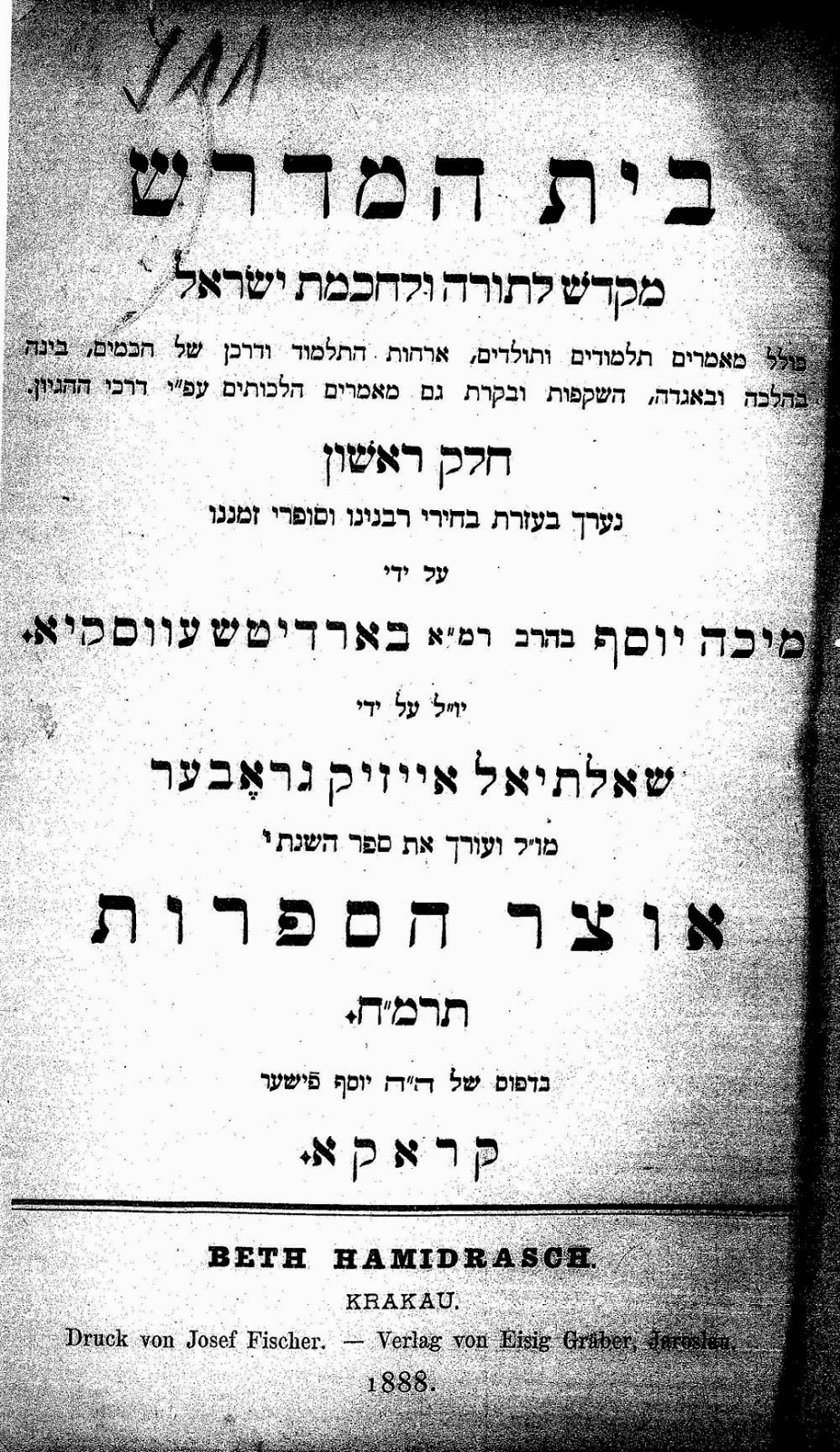


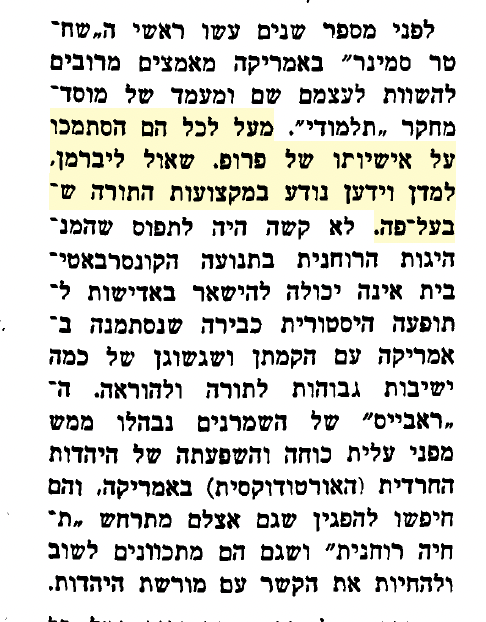 This, despite the fact that Lieberman’s earliest major work, Al ha-Yerushalmi, had already exemplified a disciplined form of textual criticism, drawing on manuscripts, parallel traditions, and internal philological analysis to clarify and correct the text of the Jerusalem Talmud. This could easily have provided fodder for Shmueli, yet he remained silent regarding Lieberman’s method. Recently published letters show that even the Ḥazon Ish engaged Lieberman seriously on these questions. Their correspondence reveals a principled disagreement over method, particularly regarding emendations grounded in manuscript evidence, while also demonstrating that such philological argumentation could be treated as a legitimate subject of rabbinic dispute rather than dismissed outright as heresy. Of course, since this correspondence had not yet been published, it cannot explain Shmueli’s silence on Lieberman’s approach.