The Rogochover and More: Excursus on Fasting

The Rogochover and More: Excursus on Fasting
Marc B. Shapiro
Relevant to what appeared in the last post (see note 13), I wish to mention some leniencies regarding fast days that contradict mainstream halakhah. I have also included other interesting material regarding the fast days.
1. R. Israel Jacob Fischer, dayan on the beit din of the Edah Haredit, stated that in our day all pregnant women up until the ninth month must eat on Yom Kippur פחות מכשיעור. See his haskamah to R. Baruch Pinchas Goldberg, Penei Barukh (Jerusalem, 1985), where he writes:
כיום הזה שנחלשו הדורות, ועשרות רבות של נשים מפילות ע”י התענית, צריכין כל הנשים המעוברות עד החודש התשיעי לאכול ביוהכ”פ פחות מכשיעור.
For a criticism of this great leniency, which contradicts Shulhan Arukh, Orah Hayyim 617:1, see R. Eliezer Waldenberg, Tzitz Eliezer, vol. 17, no. 20. Elsewhere, R. Fischer states that pregnant women are forbidden to fast on Tisha be-Av.
מעוברת אסורה להתענות בת”ב, ואין כאן דין שיעורים, כי במקום סכנה לא גזרו חז”ל
See Even Yisrael, vol. 9, no. 62. This too is at odds with Shulhan Arukh, Orah Hayyim 554:5, which rules that pregnant women are obligated to fast on Tisha be-Av.
In an article on the OU website[1] R. Y. Dov Krakowski writes:
There are those who are Noheg that pregnant women do not even begin to fast on Tisha B’Av (there is very little if any Halachik backing to this hanhaga, but many of the chosheve senior Poskim have such a Mesorah. I have personally heard this from many family members who heard this from my great uncle the Veiner [!] Rov Zetzal and from my wife’s grandfather Harav Lipa Rabinowitz who says it in the name of his grandfather the Sundlander Rov Zatzal).
R. Yosef David Weissberg also reports that many halakhic authorities rule that in contemporary times pregnant women are not obligated to fast on Tisha be-Av.[2]
2. R. Akiva Joseph Schlesinger writes that he has a tradition from the Hatam Sofer that pregnant and nursing women should only fast on Yom Kippur, and even women who are not pregnant should only fast on Tisha be-Av and the other fast days if they are very healthy.[3] He also quotes an oral tradition from the Hatam Sofer which seems to be saying that if he had the authority, he would have abolished the fast days other than Yom Kippur and Tisha be-Av. (See note 4 for another source where the Hatam Sofer says this explicitly.)
ובפרט אחרי כי בא חולשא לעולם, שמענו מהחת”ס זיע”א שאמר אי לאו דמיסתפינא כלפי ד’ תעניות חוץ מיוהכ”פ ות”ב מטעם חשש סכנה לכמה בני אדם, ובפרט לנשים ה’ ירחם, ולא להניח לבנותיו להתענות חוץ מהנ”ל.
His last words are not entirely clear. I think they mean that he would have preferred not to allow his daughters to fast except on Yom Kippur and Tisha be-Av, but not that he did so in practice. He does not say ולא הניח לבנותיו but ולא להניח לבנותיו.
The editor adds a note explaining the passage just quoted, but he misunderstands what R. Schlesinger means when he writes .מטעם חשש סכנה לכמה בני אדם He also mistakenly understands the passage to mean that the Hatam Sofer forbade all women to fast, other than on Yom Kippur and Tisha be-Av.
כאן כתב רבינו פסק החת”ס לענין שאר תעניות, דהיה אוסר להתענות לכל הנשים ואפילו למי שאינם מעוברות ומניקות, ולאנשים היה מתיר לכמה בני אדם אי לא דמסתפינא, אבל לנשים החליט להיתר.
R. Schlesinger also states that the rabbis did not allow women to fast except for Yom Kippur and Tisha be-Av.
בענין התעניות, בחולשתינו, רבותינו לא הניחו לנשים להתענות חוץ מט”ב ויוהכ”פ.
R. Schlesinger himself suggests that the women not fasting should give some money to charity and fast a few hours or even abstain from food the evening before the fast actually begins.
Returning to the Hatam Sofer’s comment that if he had the authority, he would abolish the fast days other than Yom Kippur and Tisha be-Av, the exact same thing was said by R. Abraham Joshua Heschel of Apta. He added that on Yom Kippur, who needs to eat (since we should be so involved in our prayers), and on Tisha be-Av, who is able to eat (as we should be so focused on mourning what we have lost)?[5]
אם הייתי בכוחי הייתי מבטל כל התעניתים חוץ מיום המר והמנהר (הוא ט’ באב), שאז מי יוכל לאכול. וחוץ מיום הקדוש והנורא (הוא יום כפור), דאז מי צריך לאכול.
R. Abraham also reported that he was told by his teacher, R. Elimelech of Lizhensk, that if he could find two others to join with him, he would abolish “the fasts” (presumably, everything except for Yom Kippur and Tisha be-Av).[6]
3. R. Ovadiah Yosef, Yabia Omer, vol. 10, Orah Hayyim no. 39, discusses the laws of a nursing woman and the various fasts. On p. 503, in the hosafot u-miluim, he adds:
מש”כ להקל במינקת שאפילו הפסיקה להניק אם היא בתוך כ”ד חודש ללידה פטורה מלהתענות ג’ צומות ותענית אסתר. יש להסתייע ממ”ש הגאון בעל דרכי תשובה בשו”ת צבי תפארת סוף סי’ מח: וז”ל: ודע כי שמעתי מפה קדוש של מורי הגאון הקדוש אדמו”ר רבי יחזקאל משינאווא זצללה”ה, שאמר, כי הוא מקובל מגאוני וצדיקי הדור הקודמים זצ”ל, שכל אשה שעומדת עדיין בימים שיכולה ללדת, ובימי הצומות היא חלושת המזג, אפילו היא בריאה ושלימה, נכון יותר שלא תתענה, ורק לאחר שיפסוק זמנה מללדת עוד, אם תהיה בבריאות תשלים אותם התעניות, לחיים ברכה ושלום. ע”כ
This is a fascinating passage as R. Ovadiah is quoting R. Zvi Hirsch Shapira in the name of R. Ezekiel Halberstam of Shinova, who himself is passing on a tradition from earlier geonim and tzadikim, that women of childbearing age, even if they are not pregnant, do not have to fast if they feel weak. This ruling is in contradiction to Shulhan Arukh, Orah Hayyim 550:1, which states that women are also obligated to fast on the 10th of Tevet, 17th of Tamuz and Tzom Gedaliah, and does not give any exemption if they feel weak (as pretty much everyone feels a little weak when fasting). As we have already seen, R. Akiva Joseph Schlesinger states that “our rabbis” did not allow any women, not just those of childbearing age, to fast on these days.
R. Meir Mazuz, Sansan le-Yair (2012 ed), p. 354, notes this passage of R. Zvi Hirsch Shapira and reacts very strongly:
והוא נגד חז”ל חכמי התלמוד וכל הפוסקים שלא התירו רק למעוברת ומניקה. ומזה למדו רוב המורות והתלמידות בבית יעקב בימינו שלא לצום כל ד’ תעניות, ואוכלות בריש גלי בשעת ההפסקה כאילו לא היו ד’ תעניות בעולם ולא תיקנו אותם הנביאים.
Is R. Mazuz correct that most teachers and students at Bais Yaakov schools do not fast on the 10th of Tevet, 17th of Tamuz, Tzom Gedaliah, and Ta’anit Esther? I know that in the yeshiva world many do not fast, but my question is, is this really the majority, and are there any differences between Bais Yaakov schools in the U.S. and Israel? (Even though R. Mazuz refers to ד’ תעניות established by the prophets, I am assuming he means the 10th of Tevet, 17th of Tamuz, Tzom Gedaliah, and Ta’anit Esther, as religious women of all stripes fast on Tisha be-Av.)
See also here where R. Yitzhak Yosef states that he heard that in some seminaries they tell the young women that they do not have to fast except for Yom Kippur and Tisha be-Av.
When I told a friend about what this post is focused on, he mentioned that he knows that many women do not fast other than on Yom Kippur and Tisha be-Av, but that he never heard of a “mainstream” posek who had this position. From R. Mazuz’s harsh comment it seems that he too assumes that there is no real halakhic basis for the practice of not fasting. My response to my friend, which I now share with readers, is that you can’t get any more mainstream than the great R. Shlomo Zalman Auerbach, and this was indeed his position. In Halikhot Shlomo: Moadei ha-Shanah, Nisan-Av, p. 401 n. 16, the following appears:
ולענין נשים הי’ דרכו של רבנו להשיב לשואלים שהמנהג במקומותינו היה שהנשים אינן מתענות כלל, ואף הנערות, מלבד תשעה באב ויוהכ”פ. אבל לאנשים אין להקל כלל בד’ תעניות ותענית אסתר יותר מהבמואר בפוסקים.
It is hard to criticize women for not fasting on the 10th of Tevet, 17th of Tamuz, Tzom Gedaliah, and Ta’anit Esther when R. Shlomo Zalman Auerbach saw no problem with this practice.
As with R. Mazuz, R. Eliezer Shlomo Schik, here, uses the expression “4 fast days” and it refers to the 10th of Tevet, 17th of Tamuz, Tzom Gedaliah and Ta’anit Esther. He notes that the practice in Breslov is that no women fast on these days. I have been told that among other hasidic groups there is variation. Some women fast on these days, others never fast, and some do not fast if they are married and of childbearing age. (In discussing unusual leniencies, there is no need to mention standard kulot that deal with pregnant and nursing women.)
R. Yohanan Wosner, a dayan in the Skverer community, writes that while some permit married women of childbearing age to forego the fasts (other than Tisha be-Av and Yom Kippur), there are those who permit even unmarried women to do so.[7]
In R. Simhah Rabinowitz’s Piskei Teshuvot, Orah Hayyim 550:1, he states that a few great figures (gedolei ha-dorot) were lenient and permitted all women of childbearing age to forego the fasts (other than Tisha be-Av and Yom Kippur). I must note, however, that none of the figures he refers to were halakhic authorities. The first source he cites was mentioned by me in the last post, note 13.[8] In it we see that the hasidic master R. Nathan David of Szydłowiec said that no women of childbearing age should fast, except for on Yom Kippur. The fact that he said that even on Tisha be-Av such women should not fast is, I think, quite radical. The passage also records a subversive comment from R. Ezekiel of Kozmir about how the Anshei Keneset ha-Gedolah, who instituted the fast days, are embarrassed now because they did not anticipate the much weaker recent generations. R. Ezekiel  The point of such a comment was presumably to “give cover” for those who find it difficult to fast and thus choose not to.
ושמעתי מחסיד ישיש א’ שנסע להרה”ק ר’ יחזקאל מקאזמיר ז”ל שהוא היה מקיל גדול בתעניות, ואמר שאנשי כנסה”ג שתקנו התעניות מתביישין על שלא הסתכלו בדורות אלו, וסיפר כמה ענינים מקולותיו שהיה קשה לי לכתוב, ובשם רבינו הקדוש ז”ל מפאריסאב שמעתי שאמר בזה”ל מוזהר ועומד אני מהה”ק ר’ נתן דוד ז”ל משידלאווצע לדרוש ברבים ששום אשה שראויה עדיין לילד לא תתענה כ”א ביום הקדוש, ולכן עכ”פ אדרוש זאת לידידיי.
The second source R. Rabinowitz cites is a report that R. Menahem Mendel of Kotzk said that with women one must be lenient when it comes to the fast days, as they need strength to give birth.[9]
שמעתי מהה”ג מהו”ר מאיר בארנשטיין ז”ל ששמע מפ”ק כ”ק מרן הקדוש זצוקלל”ה מקאצק דבאשה יש להקל בתעניות משום שצריכה כח להוליד בנים.
This is a very sensible statement which incidentally all poskim would agree with. But contrary to what R. Rabinowitz states, it says nothing about exempting women of childbearing age from any fast days. It only says that when dealing with such women the posek should be lenient.
The final source R. Rabinowitz quotes is from R. Ezekiel Halberstam of Shinova which was mentioned already.
4. R. Sadqa Hussein (1699-1772) was the leading rabbi in Baghdad in his day. He ruled that no pregnant women should fast on Tisha be-Av, as it was so hot in Baghdad that fasting created a situation of sakanat nefashot.[10]
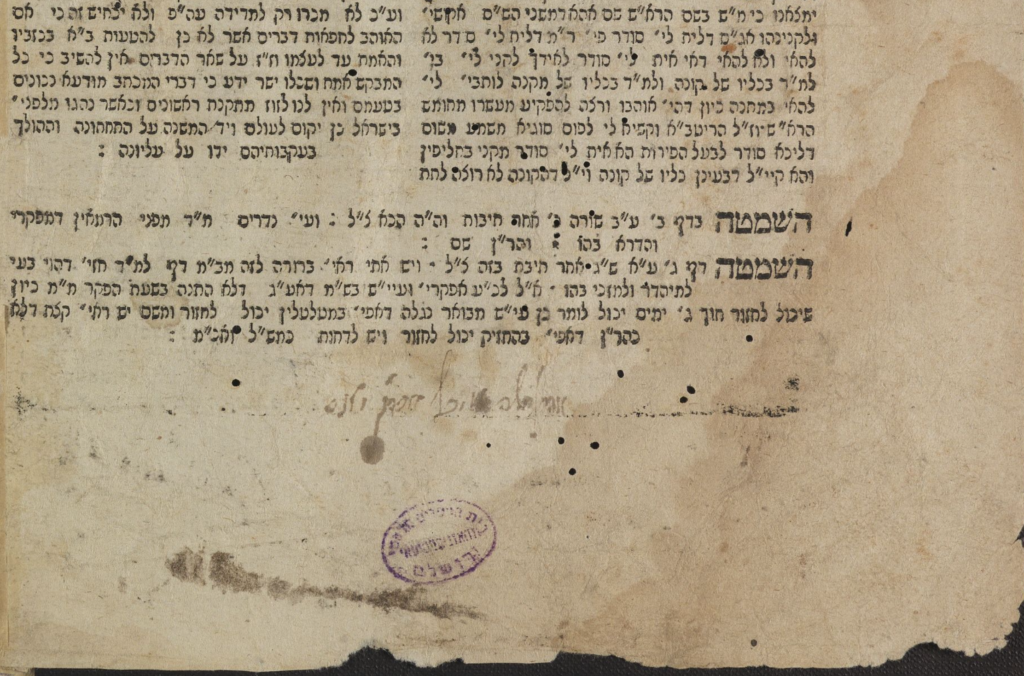
5. Here is a fascinating section of a 1953 letter from Joseph Weiss to Gershom Scholem.[11] It provides evidence that there was a time that members of the Ruzhiner “royal family” did not complete the fast of Tisha be-Av.[12] Do any readers know anything about this?
 
It could be that this practice relates to the tradition that R. Israel of Ruzhin died at the premature age of 54 as a result of fasting on Yom Kippur. Ahron Marcus writes:[13]
הוא נפטר מצמאון הלב שנגרם לו, כעדות הרופא המפורסם מלבוב, ד”ר יעקב רפפורט, ביום הכפורים האחרון תרי”א, כאשר התגבר על הבולמוס של צמא והשלים את תעניתו, מבלי לגמוע טיפת מים במשך היממה. הרבנים הנוכחים, אשר מורי הרבי שלמה רבינוביץ זצ”ל גינה את מבוכתם, לא העיזו להתיר לו את השתיה, על אף הדין המפורש בשולחן ערוך במקרה כזה. הוא הסתפק בכך, שטבל את קצות אצבעותיו בקערת מים ונשם את ריח המים, ובזה הגביר את ענוייו. המסכנים לא הבינו, כי גופו של אותו צדיק, על אף כפיפותו המוחלטת לכוחות הנפש, היה נתון לחוקי טבע רגילים. הוא לא שב לאיתנו, ונסתלק בג’ מרחשון.
In discussing this story, R. Shlomo Yosef Zevin writes:[14]
ומכל הרבנים הגדולים שהיו שם לא עלתה אף על דעת אחד מהם, שאם הצדיק אמר כן, בודאי הוא מרגיש כי בנפשו הוא, ויש פקוח נפש בדבר. שתקו הרבנים ומכיון שלא התירו לו, סבל הצדיק, וקפצה עליו מחלת הלב, שקורין “הערץ-וועסער זוכט”, ומאנה להרפא. מחלתו נמשכה עד יום ג’ מרחשון, ונשמתו הטהורה עלתה אז לגנזי מרומים.
This is obviously an extreme example of being “frum” at someone else’s expense, in this case at the expense of literally his life.
Regarding R. Israel of Ruzhin, it is also recorded that he said that if someone feels a little bit weak he should not fast.[15]
וכשם שמצוה לשמור ישראל מעבירה כן מצוה ליזהר לכל איש אם יש לו מעט רפיון כח שלא יתענה.
It is not clear if this advice refers to all fasts, including Yom Kippur and Tisha be-Av.
Since the above-mentioned permission to eat on Tisha be-Av – and no doubt this also applied to the other fast days aside from Yom Kippur – was reserved for members of the Ruzhin “royal family,” it reminded me of a passage in R. Moses Sofer, Hatam Sofer al ha-Torah, vol. 2, p. 165a (haftarah for parashat Pekudei). The Hatam Sofer states that in theory, if one is able to focus all of his intentions on the glory of God, without getting any physical benefit, then it would permissible to eat on Yom Kippur. But he adds that this is something that only gedolei Yisrael can accomplish.
דודאי לאכול ביה”כ לשם מצוה אם אדם יכול לכוון כל מחשבתו לכבוד ה’ בלי שום כונה אחרת להנאת הגוף אזי היא צורך גבוה כמו קרבנות נשיאים ועוד טוב ממנו ויפה דנו ק”ו אך מי יכול לעמוד בזה כ”א גדולי ישראל שהרי משום כך ס”ל לאבא שאול [יבמות לט ע”ב] מצות חליצה קודם למצות יבום לרוב העולם שאינם יכולי’ לעמוד על מחשבתם שלא לכוון להנאת הגוף.
6. R. Joseph Mordechai Yedid Halevi, Yemei Yosef (Jerusalem, 1913), vol. 1, Orah Hayyim, no. 9, states that scholars and melamedim, if their fasting will affect their learning or teaching, are not obligated in any of the fasts other than Yom Kippur and Tisha be-Av. He says that his ruling is halakhah ve-lo le-ma’aseh.
7. The practice in Stockholm used to be that the community ended the fast of the 17th of Tamuz nine and a half hours after hatzot, which is before it is dark. This practice was defended by R. Benjamin Zvi Auerbach in his Nahal Eshkol, Hilkhot Tisha be-Av, p. 16 n. 1. I have heard from R. Chaim Greisman, the Chabad rabbi in Stockholm, that today they end the fast of 17th of Tamuz when it is dark. According to the times provided on www.chabad.org, in 2018 this will be at 11:38pm, with the fast beginning that morning at 12:51am (alot ha-shachar).[16] R. Michael Melchior, the chief rabbi of Norway, informs me that they also end the fast at darkness. This means that in 2018 in Oslo the fast of the 17th of Tamuz will end at 12:19am, with the fast beginning at 1:20am.[17]
R. Aaron Worms, Meorei Or, vol. 4 (Be’er Sheva), p. 14b, writes as follows about the northern European countries:
וכבר שמענו שהקילו רבנים קדמונים במדינו’ ההם לסיים תעניתם בצום הרביעי וצום החמישי בעוד היום גדול בשעת חשיכה לרוב גלות ישראל ואף שתענית שלא שקעה עליו חמה לאו תענית שאני התם שמעקרא לא קבלו יותר מרוב ישראל.
Notice how he also refers to ending Tisha be-Av (tzom ha-hamishi) when it is still daylight. The justification he offers is the same as was later given by R. Auerbach, but R. Auerbach’s justification was only stated with regard to the 17th of Tamuz, not Tisha be-Av.
8. R. Ernst Gugenheim, Letters from Mir (New York, 2014), p. 106, wrote as follows in 1938:
Tomorrow [the day before Purim] will be a day of fasting. Here [in the Mir Yeshiva], they are rather meikil with respect to this viewpoint, and many bachurim, too weak, do not fast completely. It is true that every day for them is a day of half-fasting, such that they are quite weakened.[18]
9. R. Mordechai Eliyahu ruled that a pregnant or nursing woman can break her fast on Tisha be-Av if she is having difficulty fasting, and she does not need to ask a halakhic question. Rather, she is to determine herself if it is too difficult for her.[19] In 2007, because it was very hot on Tisha be-Av, R. Eliyahu ruled that no pregnant women needed to fast.[20]
10. R. Shmuel Salant was very liberal when it came to the fasts other than Yom Kippur and Tisha be-Av. If someone merely said that he was thirsty and wished to drink, R. Salant would immediately tell him to do so. If someone told R. Salant that fasting was difficult for him, R. Salant would permit him not to fast, and he did not ask for any particulars from the questioner. This was based on a teaching he had from R. Isaac of Volozhin, “that one safek sefeka related to pikuah nefesh pushes aside many fasts.”[21] Once, on a fast day between minhah and maariv, he heard someone say that he was thirsty and was waiting for maariv so that he could drink. R. Salant immediately got the man a cup of water and told him to drink it.[22]
A similar approach is recorded with regard to R. Meir Shapiro[23].
והיה אומר כי בדורות החלשים כבימינו כל מה שאוכלים הוי ככדי חייו, וצום הוי כסכנה לאנשים רבים, ולכן התיר להרבה לאכול בימי צום.
11. R. Haim Ovadia, a contemporary liberal Orthodox rabbi, argues that the minor fasts (which include all fasts other than Yom Kippur and Tisha be-Av) are optional in today’s day and age. See his discussion here. He concludes his analysis as follows:
In the current state of the Jewish people in Israel and abroad, the Talmudic rule demands that fasting on the minor fast days should be optional, and according to Ha’Meiri, fasting would even be forbidden, maybe because it shows lack of gratitude to God. For that reason, one who chooses not to fast on these days cannot be considered one who breaches the law, and can definitely rely on the ruling of Rashba. Hopefully, in the coming years, more and more individuals will choose to acknowledge the fact that we leave [!] in better times and develop a more positive worldview, and as a result maybe persuade the rabbinic leadership to reassess the situation and leave us with only two fast days, Tisha Be’Av and Yom Kippur, thus making those two much more meaningful.
12. R. Herschel Schachter, Nefesh ha-Rav, pp. 261-262, writes:
כשהורי רבנו התחתנו, שלח הגר”ח להודיע להכלה מרת פעשא שא”צ להתענות ביום חתונתה, כי כך היה דן כל אדם בזה”ז כחולה שאב”ס, שא”צ להתענות בשאר תעניות [ואפי בט’ באב, כדעת המחבר (תקנ”ד ס”ו) והאבני נזר (חאו”ח סי’ תכ”ט), ודלא כדעת הט”ז (שמה סק”ד), (כן שמעתי)] חוץ מביוה”כ. . . . נהג רבנו להתענות בכל התעניות, ואפילו ביאה”צ.
R. Schachter cites R. Chaim Soloveitchik as saying that today everyone is regarded as suffering from a non-life-threatening illness and thus there is no obligation to fast other than on Yom Kippur. He adds that R. Joseph B. Soloveitchik did not follow this view but fasted on all the fast days, including when he had yahrzeit.
This is a radical view, as I do not know anyone else who stated that other than Yom Kippur, there is no longer an obligation to fast, even on Tisha be-Av. I must note, however, that there is no real source for this report in the name of R. Chaim. I spoke to R. Schachter about this and he told me that there is also a story that R. Chaim left a will stating that people should not fast on Tisha be-Av. Again, there is no source for this report, and like many such stories it is hard to know if there is any truth to it. Had R. Chaim felt strongly about this matter he could have announced his supposed view to his community, but he never did so.
There is something else that should be mentioned in this regard. The late Professor Aaron Schreiber told me that he heard from R. Simcha Sheps, who studied in Brisk, that one day on the 17th Tamuz he visited the Brisker Rav, R. Isaac Zev Soloveitchik, in Jerusalem. He entered the Brisker Rav’s home and found him at the table eating! It is hard to know how much faith we can put in such a report as with the passage of time people’s memories can change. Someone I know was told by R. Ahron Soloveichik that the Brisker Rav ate on Tishah be-Av, but this was for a medical reason, not because of any halakhic rationale regarding the current binding nature of the fasts.
13. The Ben Ish Hai, parashat Shoftim (first year), no. 17, rules that a groom – the same would apply to a bride – within the week of his wedding does not fast on Tzom Gedaliah, 10th of Tevet, Ta’anit Esther, and 17th of Tamuz. [24] He adds this was the practice in Baghdad.[25] (The exemption from fasting on Ta’anit Esther is mentioned by many others.[26])
R. Ovadiah Yosef is more stringent in this matter. He states that only if the 17th of Tamuz is pushed off to Sunday (and this would apply to the other fasts as well), then the bride and groom do not need to fast.[27]
R. Elijah Mani, another Baghdadi, records an additional liberal opinion (which he himself does not accept) in line with what the Ben Ish Hai wrote.[28]
נשאלתי אם החתן חייב להתענות [בעשרה בטבת]. ואני שמעתי ממורי הי”ו [הרב עבדאללה סומך] ששמע מהרב הגדול משה חיים זלה”ה, שאומר לחתן כרצונו אם תרצה להתענות ואם תרצה שלא להתענות.
14. R. Shmuel Wosner, Shevet ha-Levi, vol. 8, no. 261, states that someone who flies from Israel to the United States on a fast day such as the 17th of Tamuz does not need to wait until it is dark in the United States in order to break his fast. Rather, he can break the fast at the time that it is over in Israel. Since R. Wosner writes ביום תענית וכמו בי”ז בתמוז  I assume that he excludes Tisha be-Av from this lenient ruling.[29]
15. In my post here I discussed the original halakhic approach of R. Yitzhak Barda. When it comes to the fast days he also has an original perspective in that he holds that on Tzom Gedaliah, 10th of Tevet, Ta’anit Esther, and 17th of Tamuz, one can break the fast at sunset rather than waiting until darkness, which is the standard practice. See here. This is a more lenient position than his earlier approach found in his Yitzhak Yeranen, vol. 3, no. 20 and vol. 5, no. 41, where he only permits one to break the fast of the 10th of Tevet at sunset when the fast is on Friday.
16. In Teshuvot ha-Geonim: Shaarei Teshuvah, no. 325, the following appears:
זקן חלש שהיה מתענה ובתוך התענית שעבר עליו רובו של יום בתענית וכבר בא לידי חלישות בענין שחושש לסכנה מאכילין אותו אפילו ביום כיפור ולא שבקי ליה דימות וגמרינן מההיא עוברה דהריחה כו’ כ”ש אם הוא זה זקן נכבד שאם ימות ויסתכן על תענית זה יהיה הפסד לרבים.
This geonic responsum has been cited numerous times and no one saw anything problematic with it. However, in 1995 R. Yehiel Avraham Silber published his Birur Halakhah: Telita’ah, and he has a different perspective.[30] He states that “there is no doubt” that this responsum is a forgery. His reason is that nowhere in halakhic discussions of pikuah nefesh is consideration ever given to whether a person is “honorable”. Yet in the geonic responsum it speaks of a זקן נכבד as a factor to be considered in permitting someone to break his Yom Kippur fast, as his life is not just an individual matter but is of importance to the community as a whole.
R. Silber writes:
תשובות הגאונים שערי תשובה נדפס לראשונה בשאלוניקי בשנת תקס”ב – תקופת הנסיון של עקירת התורה על ידי זיופים; סמוך לזה בשנת תקנ”ג יצא לאור לראשונה הספר שכולו זיוף בשמים ראש.
I think all readers can see that his argument has no basis whatsoever. Furthermore, the appearance of Besamim Rosh, a rabbinic forgery published by a maskil in Berlin in 1793, has absolutely nothing to do with a volume of responsa published in 1802 Salonika, a place far removed from any Haskalah influence. R. Silber’s claim is so unreasonable that I would never even refer to it in an academic article, and only mention it here as another curiosity from the world of seforim.
17. Here is a fascinating text that was called to my attention by R. Chaim Rapoport. It appears in R. Samuel Elijah Taub’s Imrei Esh (Jerusalem, 1996), p. 186, and has been subsequently included in other works.
 
R. Taub, the Modzitzer Rebbe (1905-1984), states that his forefather, R. Ezekiel of Kozmir (1772-1856), was lenient with all the fast days other than Yom Kippur and Tisha be-Av.[31] He then says that R. Ezekiel was very opposed to Tzom Gedaliah, and used to say that in Heaven Gedaliah is embarrassed that they established a fast day in his memory. Earlier in this post I cited a passage from R. Abraham Yelin that mentions how R. Ezekiel said that Anshei Keneset ha-Gedolah are now embarrassed for having instituted the fast days (see the source in n. 8). R. Yelin also writes that “it is difficult for him to record” some of R. Ezekiel’s leniencies regarding the fast days.[32]
R. Ezekiel’s opposition to Tzom Gedaliah was such that in his beit midrash it was declared that whoever wishes to fast on this day should leave Kozmir. We can thus assume that none of R. Ezekiel’s followers fasted on Tzom Gedaliah. Does anyone know if this antinomian view about Tzom Gedaliah continued among his descendants, which include the rebbes of Modzitz?
18. There is a joke in the “frum” world which goes as follows: There are three reasons not to fast on Tzom Gedaliah.
            1. It is a nidcheh (as he was killed on Rosh ha-Shanah).[33]
            2. Even if he was not killed he would not have been alive today.
            3. He would not have fasted for me if I was killed.
While this is only a joke, R. Ephraim Bilitzer records that it was widely reported that certain hasidic rebbes said that Gedaliah was troubled in heaven by the fact that thousands of Jews fasted on his account.[34] Therefore, followers of these hasidic rebbes did not fast on Tzom Gedaliah. R. Bilitzer finds it hard to believe such stories, but after what we have seen with R. Ezekiel of Kozmir, it is obvious that, at least with regard to R. Ezekiel, this was indeed the case.
Would R. Ezekiel, or any other hasidic rebbe who told his followers not to fast on Tzom Gedaliah, be impressed by R. Bilitzer’s very non-hasidic objection?
הלא דין הוא בש”ע להתענות ומה זה שנהגו שלא להתענות נגד הש”ע
After all, the Shulhan Arukh also gives the times for prayer, and a number of hasidic rebbes ignored these as well.[35]
In general, it should not surprise us to find hasidic rebbes with lenient approaches to fast days. R. Bilitzer himself informs us that R. Yissachar Dov Rokeah, the Belzer Rebbe, told his followers who were with him for the High Holy Days that anyone who felt the least bit weak on Tzom Gedaliah should immediately eat. This is a very lenient approach, and if followed by the Jewish world at large it would mean, I think, that not many teenagers would fast on this day. While fasting gets easier as one gets older, my experience has been that most teenagers find it at least a little bit difficult to fast.
The following story, about R. Solomon of Radomsk, even shows great leniency with regard to Tisha be-Av. I am sure readers will wonder why R. Solomon thought it was necessary for people to drink when the fast was just about over. If he wanted people to break the fast, why not have them drink earlier in the day?[36]
היה נוהג להקל בתעניות. פעם אחת, בערב תשעה באב ארעה שרפה בבית בנו, והיו הכל טרודים בכבוי השרפה. לפני גמר התענית, בשעת בין השמשות, הלך אל הבאר, הסמוכה לבית המדרש, וצוה לכל אחד לשתות מים.

Here is another interesting passage, from R. Abraham Yelin, Derekh Tzadikim, p. 13b, no. 44:

It states that R. Mordechai of Nes’chiz used to pray minhah when it was already dark. However, on the 17th of Tamuz he finished maariv when it was still light. It is true that this text does not mention actually eating when it was still light, but isn’t that the implication of the passage? What else could it be coming to tell us, without having to be too explicit? I can’t imagine that it means that they finished maariv early so that people could go home and be ready to eat as soon as the fast was over.
It was not only hasidic rabbis who had such a liberal perspective (and I have already referred to R. Chaim Soloveitchik). Here is a story that was told by a hasidic rabbi to the grandson of R. Baruch Bendit Gliksman.[37] (R. Baruch Bendit was a misnaged.[38]):
פעם ישבתי ביום תענית בליטומירסק ולמדתי יחד עם בן גיסי, האדמו”ר רבי חנוך העניך מאלקסנדר וחתן גיסי, רבה של לודז הג”ר יחזקאל נומברג. נכנס אלינו זקנך הג”ר בנדיט מלאסק ומיני מזונות בידו, דורש מאתנו כי נטעום מעט ונפסיק את התענית, אמר: “מובטחני כי תהיו פעם מורי הלכה בישראל, לכן עז רצוני כי תלמדו להקל בתעניתים”.
Returning to Tzom Gedaliah, I found an interesting passage in R. Yitzhak Meir Morgenstern’s She’erit Yaakov on Tractate Megillah.[39] He writes:
וראיתי דיש אנשים שנהגו להקל בצום גדליה כשנוסעים בדרך, ותמהתי עליהם איה מקורם.
R. Morgenstern is not referring to Modern Orthodox people. He is referring to those in his own hasidic circle, and he tells us that among them there are some who do not fast on Tzom Gedaliah when they are traveling. He wonders what the source for this practice is and is not able to find a good justification. For the purposes of this post, however, the very fact that he acknowledges the existence of a laxity when it comes to Tzom Gedaliah is significant.
R. Raphael Aaron Ben Shimon (1848-1928), the chief rabbi of Cairo, also speak of laxity regarding the fast days other than Tisha be-Av and Yom Kippur.[40] However, unlike R. Morgenstern, he was referring to a traditional Sephardic community rather than a haredi population.
בעון פשתה המספחת להקל בתעניות הצבור חוץ מט’ באב ויוה”כ
I think R. Ben Shimon’s description is also applicable to many in the Modern Orthodox world, at least in the United States. That is, while they are careful to fast on Yom Kippur and Tisha be-Av, this is not the case regarding the other fast days. But unlike what we have seen with R. Morgenstern, no one would think to ask if there is any halakhic support for this. Even those who eat on the fast days know that their behavior is not in line with halakhah.[41]


[1] I mention the source since I was surprised that the OU would post an article written in “yeshivish” rather than converting it to standard English.
[2] Otzar ha-Berit (Jerusalem, 2002), vol. 1, 5:2.
[3] She’elot u-Teshuvot Rabbi Akiva Yosef, vol. 1, no. 174.
[4] See Minhagei Rabotenu ve-Halikhoteihem (Jerusalem, 2009), p. 317, citing the book Elef Ketav, no. 671:
החת”ס זלה”ה אמר, אם היה בכוחו היה מבטל כל התעניתים זולת ת”ב ויוה”כ.
Megillah 5b states that R. Judah ha-Nasi wished to abolish the fast of Tisha be-Av but the Sages disagreed. Another version recorded ibid., is that he only wanted to abolish Tisha be-Av if it was postponed to Sunday, but the Sages disagreed.
[5] Yalkut Ohev Yisrael (Jerusalem, 1998), p. 124.
[6] R. Israel of Ruzhin, Irin Kadishin, parashat Va-Yikra (p. 19a). When the text mentions abolishing “the fasts”, I don’t think it is merely referring to individual fasts that pious people undertake, as the term “abolish” would not seem to fit in that context.
[7] Hayyei ha-Levi, vol. 6, Orah Hayyim no. 95. It is interesting that some treat unmarried women with more leniency than men, because when it comes to the fast of the 20th of Sivan, commemorating the Chmielnicki massacres, Shaarei Teshuvah, Orah Hayyim 580:1, writes:
שמעתי בימי חרפי שנכתב בפנקס הארצות שהגזרה היא לבן י”ח בזכר ולבת ט”ו בנקבה.
For some reason, when it came to the fast of the 20th of Sivan the rabbis wanted 15-year-old girls to fast, but boys were only supposed to do so from the age of 18.
[8] R. Abraham Yelin, Derekh Tzadikim (Petrokov, 1912), pp. 13b-14b.
[9] R. Abraham Pitrokovski, Piskei Teshuvah (Jerusalem, 2001), no. 88 (Hilkhot Ta’aniyot, p. 88).
[10] See R. Hussein, Tzedakah u-Mishpat (Jerusalem, 1978), p. 10.
[11] Gershom Scholem ve-Yosef Weiss: Halifat Mikhtavim 1948-1964 (Jerusalem, 2012), p. 102.
[12] Rabbi and Mrs. Samuel Sperber, mentioned in the letter, are the parents of Professor Daniel Sperber.
[13] Ha-Hasidut, trans. M. Shenfeld (Tel Aviv, 1954), p. 223. See also R. Yissachar Tamar, Alei Tamar, Yoma, p. 396, who records in the name of the Rebbe of Husiatyn a different version of what R. Israel did with the water placed before him.
לרה”ק מריזין היתה לו דלקת גדולה בפיו וביחוד על השפתיים מתוך הצימאון הגדול, והעמידו לפניו קערה עם מים קרים כדי ששפתיו יתקררו מעט ע”י האדים היוצאים ממים קרים.
[14] Sipurei Hasidim (Tel Aviv, 1957), vol. 2, p. 85.
[15] Irin Kadishin, parashat Va-Yikra (pp. 19a-b).
[16] This time for alot ha-shahar is accompanied by the following note: “On this date at this location the sun does not set far enough below the horizon to use the standard calculation. The Chabad custom is to use Chatzot for this time.”
[17] These times were given to me by R. Melchior. Chabad’s site has the fast in Oslo ending at 12:18am (one minute earlier than R. Melchior) and beginning at 1:20am (the same time as R. Melchior). There are significant differences between these times and the times that appear on the popular myzmanim.com. On the latter site it says that this year in Oslo the fast begins at 2:48 am, which is significantly later than the official community practice and the Chabad practice. Myzmanim.com states that the fast ends according to R. Tukatzinsky at 12:34am, which, we are told, is the emergence of ג’ כוכבים בינונים. This is a later time than that of R. Melchior and Chabad. For Oslo, myzmanim.com does not give a time for the end of the fast according to R. Moshe Feinstein.
There are also divergences when it comes to Stockholm. As noted, the Chabad site has the fast of the 17th of Tamuz this year beginning at 12:51am and ending at 11:38pm. Myzmanim.com has the fast beginning at 2:25am and ending at 11:45pm according to R. Tukatzinsky and at 12:09am according to R. Moshe Feinstein.
Readers can correct me if I am wrong, but I do not think that people who will be in Oslo or Stockholm on the 17th of Tamuz (or any other day for that matter) are halakhically permitted to rely on what appears on myzmanim.com in opposition to the local community’s practice.
[18] Among other passages that readers will find interesting is p. 160:
I have already gedavent [prayed] and listened to the weekly Inyan of Reb Chatzkel – Yechezkel [Levenstein]. He has already spoken very often against the datsche = vacations, wanting only the weak or sick bachurim really to go rest, but I observe he has not had much success in this respect and that there will be exactly the same number leaving. On the other hand, the yeshiva had gotten into the habit of rowing on the lake – but a single Inyan sufficed to bring an end to this custom from one day to the next – which constituted in a way a chillul Hashem, because in doing it the bachurim put themselves in the same category as the town people. Yet, is it not correct that, since the Torah is different from everything that exists, a ben Torah is distinguished by his behavior from his entire entourage? In Yiddish, it’s much better. I am sure that on my arrival in Mir, I would not have been able to understand that it was base to ride a bicycle or to go rowing. It is obvious that these restrictions are only valid here in this place, but you can also see how much the städtische [city dwellers] feel respect or anger to the yeshiva-leit.
On p. 96 he writes: “Our milk is purely Jewish milk, but the butter comes from goyim and is subject to no shemira of any sort.”
[19] R. Moshe Harari, Mikraei Kodesh: Hilkhot Ta’aniyot, p. 220 n. 6.
[20] R. Harari, Mikraei Kodesh: Hilkhot Ta’aniyot, p. 221 n. 7.
[21] Aderet Shmuel (Jerusalem, 2014), p. 145.
[22] Ibid., p. 146.
[23] R. Natan Lubert, She’erit Natan (Ashdod, 2013), p. 147.
[24] R. Solomon Laniado of Baghdad found the Ben Ish Hai’s position so astounding that he claimed that there is a printing error, and the text should be corrected to say that the groom needs to fast on all days except for Ta’anit Esther. See his letter in R. Yitzhak Nissim, Yein ha-Tov, vol. 2, Even ha-Ezer no. 2. (The title of R. Nissim’s book is often pronounced Yayin ha-Tov, but that is incorrect. See Song of Songs 7:10.)
[25] The Ben Ish Hai’s testimony about the practice in Baghdad is problematic, as his contemporary, R. Elisha Dangor, writes that the practice in Baghdad is that the groom does fast in the week of his wedding, with the exception of Ta’anit Esther. See Gedulot Elisha (Jerusalem, 1976), Orah Hayyim 549:5. R. Ovadiah Yosef, Halikhot Olam, vol. 2, p. 211, cites the Ben Ish Hai’s student, R. Joshua Sharbani, who says that the because the Ben Ish Hai was so busy and involved in Torah study, he is not such a reliable source for the practices of Baghdad.
שהרב בן איש חי לא היה בקי כל כך במנהגי בגדאד לרוב טרדתו ושקידתו בתורה
This is quite a surprising this to say, as the Ben Ish Hai lived in Baghdad so how could he not be aware of things? Yet R. Ovadiah Yosef finds support for R. Sharbani’s comment in a responsum of R. Hayyim Joseph David Azulai, Hayim Sha’al, vol. 2, no. 35:2. R. Azulai cites a few examples where R. Joseph Karo testifies as to what the accepted practice was, and yet we have evidence that contradicts what R. Karo states. R. Azulai explains the reason for R. Karo’s mistake:
ויתכן שלרוב קדושתו וטרדת לימודו לא דקדק וסבר שהמנהג כך ואינו כן
[26] See R. Ovadiah Yosef, Yehaveh Da’at, vol.2, no. 78.
[27] Yehaveh Da’at, vol. 3, no. 37. In Yalkut Yosef: Kitzur Shulhan Arukh 265:13 (מילה במועדי השנה), it states that a groom can only eat on the pushed-off fast day after hatzot.
[28] Ma’aseh Eliyahu (Jerusalem, 2017), no. 119.
[29] In an earlier responsum, Shevet ha-Levi, vol. 7, no. 76, he does not say to break the fast when it is over in Israel. Rather, he says that one can break the fast when one feels weak.
[30] See Birur Halakhah: Telita’ahOrah Hayyim 618.
[31] It is interesting that he quotes R. Ezekiel as saying something very similar to what I cited earlier in this post from R. Abraham Joshua Heschel of Apta:
בשחור מי יכול לאכול – והכוונה היתה לתשעה באב שהוא יום חורבן ואבילות, ומי יכול אז לאכול. ובלבן מי צריך לאכול – היינו ביוהכ”פ ומי צריך לאכול, הרי בני אדם כמלאכים.
[32] Yelin, Derekh ha-Tzadikim, pp. 13b-14a.
[33] This is how the joke was told to me. While many indeed assume that Gedaliah was killed on Rosh ha-Shanah, Maimonides believes that he was killed on the third of Tishrei. See Mishneh Torah, Hilkhot Ta’aniyot 5:2.
On the assumption that he was killed on Rosh ha-Shanah (which is the dominant opinion), and the fast day was pushed off from its actual date, does this mean that every year Tzom Gedaliah has the status of a pushed-off fast day, with the various leniencies that go with it? Most say no, but there are some who say yes. R. Yair Rosenfeld has recently discussed the matter in Ha-Ma’yan 56 (Tishrei 5777), and he concludes (p. 18):
לאור זאת, יולדת במקום שמנהג הנשים לצום בד’ צומות יכולה להמנע מהצום, וכן אבי הבן, ובצורך גדול אף הסנדק והמוהל, מתענים ולא משלימים. כן יש להוסיף שאף חתתן בשבעת ימי המשתה יכול להקל בצום זה כדינו בצום נדחה.
[34] Yad Efraim (Tel Aviv, 1970), no. 29 (p. 206, third numbering). This book is found on Otzar ha-Hokhmah together with many other books from R. Bilitzer. It is worth noting that most of his books on Otzar ha-Hokhmah, including six volumes of responsa, are still in manuscript. It appears that there is no money to prepare these works for publication, and they were therefore put on Otzar ha-Hokhmah in manuscript form. Fortunately, his handwriting is easy to read.
[35] The other objection of R. Bilitzer is that Tzom Gedaliah is not on account of the death of Gedaliah per se, but due to what befell the Jewish people in the Land of Israel as a consequence of his death. Even if this is correct, R. Bilitzer’s anger with the reported hasidic flaunting of Tzom Gedaliah apparently caused him to exaggerate somewhat. In his defense of fasting on Tzom Gedaliah, R. Bilitzer states that what happened to the Jews after Gedaliah’s death “was like the destruction of the Temple.”
Furthermore, it seems that the fast has more to do with Gedaliah the individual than R. Bilitzer is willing to acknowledge. I say this because some authorities have pointed to leniencies with regard to Tzom Gedaliah precisely because it is a pushed-off fast (i.e., it does not take place on the day of the event it commemorates). This shows the centrality of Gedaliah the individual and the importance of the day of his assassination to the fast. If the entire focus was on what befell the Jewish people after his death, the actual date of his death, and the resulting issue of a pushed-off fast, would not have any real significance.
I cannot locate the source at present, but Gerson Cohen, chancellor of the Jewish Theological Seminary, had no liking for Tzom Gedaliah. He wondered why a fast was declared in memory of a man he called “a Quisling.” Yet if Gedaliah is to be regarded as a Quisling, does that make Jeremiah, who told the Jewish people to accept Babylonian rule, a “Tokyo Rose”?
[36] Moshe Tzvi, “Ha-Tiferet Shlomo” me-Radomsk (Bnei Brak, 1989), p. 182.
[37] Yehuda Leib Levin, Beit Kotzk (Jerusalem, 1959), vol. 2, p. 159.
[38] See Pinhas Gliksman, Ir Lask ve-Hakhameha (Lodz, 1926), p. 43.
[39] There are actually two such volumes. I am referring to the first one that appeared (it has no date), p. 32.
[40] Nehar Mitzrayim (Jerusalem, 2007), Hilkhot Tefillin, no. 4 (p. 14).
[41] The one exception to this generalization would be the congregants and followers of R. Haim Ovadia. As we have seen in this post, R. Ovadia claims that the fast days other than Yom Kippur and Tisha be-Av are not obligatory. Thus, his congregants and followers would not regard eating on these fast days as deviant. As far as I can tell, no other liberal Orthodox rabbis have adopted R. Ovadia’s position.


The Rav as a Mechadesh Halacha: One Small Example From Shabbat Rosh Chodesh

The Rav as a Mechadesh Halacha: One Small Example From Shabbat Rosh Chodesh
Michael J. Broyde
In the Koren Rav siddur, in the minhagim of the Rav, in the section dealing with the halachic rules of Rabbi Joseph B. Soloveitchik, זצ”ל it is written:
The Rav posited that if one forgot to recite Ya’aleh VeYavo on Rosh Hodesh during Shaharit, one should not repeat the Amida, but should rather rely upon the reference to the holiday that will be made in the Musaf prayer. The Gemara in Shabbat (24a) states that one who forgot to recite Ya’aleh VeYavo must indeed repeat the Amida and include Ya’aleh VeYavo in that second recital; but the Gemara in Berakhot (30b) qualifies this ruling, teaching that it is not necessary if one intends to recite Musaf subsequently, since the required reference to the special status of the day will take place during Musaf. Even though Rashi there (s.v. betzibbur) cites those who maintain that this dispensation applies only to the Leader in order to avoid any unnecessary delay to the start of the Repetition of the Amida, the Rav felt that we should follow the opinion of the Magan Avraham (Orah Hayyim 126:3) that even an individual should not repeat the Amida of Shaharit and should rely on his subsequent recitation of Musaf.
The rationale behind this view is as follows: When one forgets to recite Ya’aleh VeYavo, the need to repeat the Amida is only in order to be able to make reference to the special day within the context of the prayer. The obligation to recite the Amida per se, however, has in fact already been fulfilled. This second Amida therefore has the status of a tefillat nedava – a voluntary prayer, as it is recited not to fulfill any obligation to pray, but rather only to provide the needed context for the reference to the special day made through Ya’aleh VeYavo. Since it has become the practice to refrain from offering this form of voluntary prayer nowadays, Rav Hayyim Soloveitchik ruled that it is preferable not to repeat the Amida, but to rely upon the recitation of Musaf, if it will be done at the proper time. In light of this understanding, the Rav suggested that when Rosh Hodesh falls out on Shabbat, it would actually be prohibited to repeat the Amida if one forgot to recite Ya’aleh VeYavo, since it is prohibited to offer a tefillat nedava on Shabbat. [Eretz HaTzvi, pp. 43-44.] (Emphasis added)
And one is not surprised to find that this exact recitation is found in R. Tzvi (Hershel) Schachter, Eretz HaTzvi (Yeshiva University Press: New York, 1991).
While at first glance this note is not surprising – it appears that the Rav and his grandfather are adopting the ruling of the Magen Avraham over his peers — upon further examination it is clear that this is an exceptionally innovative ruling, in fact.  Furthermore, the expansion of this ruling by the Rav himself (“the Rav suggested that when Rosh Hodesh falls out on Shabbat, it would actually be prohibited to repeat the Amida if one forgot to recite Ya’aleh VeYavo”) is unprecedented, but logically compelling. A review of the sources is needed.
The Talmudic Sources, the Rishonim and the Codes.
 
The Gemera in Shabbat 24a recounts rather directly:
דתני רבי אושעיא: ימים שיש בהן קרבן מוסף, כגון ראש חודש וחולו של מועד – ערבית ושחרית ומנחה מתפלל שמונה עשרה, ואומר מעין המאורע בעבודה, ואם לא אמר – מחזירין אותו
R. Oshaia taught: On those days when there is a mussaf, such as Rosh Chodesh and Chol Hamoed at the Evening, Morning and Afternoon services, the shemona esrai is recited, and the nature of the day is inserted in the avoda blessing [ya’aleh veyavo] and if one does not insert it, one repeats the Shemona Esrai.
And the gemera in Brachot 30b recounts rather directly what appears to be a slightly different rule.
והתניא: טעה ולא הזכיר של ראש חודש בשחרית[1] – אין מחזירין אותו מפני שיכול לאומרה במוספין, במוספין – אין מחזירין אותו מפני שיכול לאומרה במנחה! – אמר ליה: לאו איתמר עלה, אמר רבי יוחנן, – בצבור שנו.
If one forgot and did not recite yaaleh veyavo in the morning [tefillah], he is not made to repeat [the prayer], because he can say it in mussaf if he forgot it in musaf, he is not made to repeat, because he can say it in mincha? — He said to him: Did you not leave out the rule of Rabbi Yochanan: This applies only to prayer said in a congregation?
Rashi (aware of the possible contradiction between these two sources) seeks a simple resolution with his two sided comments. Rashi in Brachot 30 b states:
בצבור שנו – דאין מחזירין, משום דשמע ליה משליח ציבור, ואיכא מקצת הזכרה, אבל ביחיד צריך לחזור, ובהלכות גדולות מפרש לה בשליח ציבור משום טירחא דצבורא, אבל יחיד הדר.
In a Congregation: One does not repeat davening, since one can hear it from the chazzan, and that is some partial recitation, but an individual must repeat; The Bahag explains that the chazzan is different since otherwise the community will be delayed, but other than the chazzan, one must repeat.
And one of these two resolutions of the contradiction (or both) is – as far as I can see – accepted by every single rishon who comments on
the gemera.  Rambam (Tefillah 10:10-12) states directly:
טעה ולא הזכיר יעלה ויבא אם נזכר קודם שישלים תפלתו חוזר לעבודה ומזכיר, ואם נזכר אחר שהשלים תפלתו חוזר לראש,* * * *. במה דברים אמורים בחולו של מועד או בשחרית ובמנחה של ראשי חדשים, אבל ערבית של ראש חדש אם לא הזכיר אינו חוזר.כל מקום שהיחיד חוזר ומתפלל ש”ץ חוזר ומתפלל אם טעה כמותו בעת שמתפלל בקול רם, חוץ משחרית של ראש חדש שאם שכח ש”ץ ולא הזכיר יעלה ויבא עד שהשלים תפלתו אין מחזירין אותו מפני טורח ציבור, שהרי תפלת המוספין לפניו שהוא מזכיר בה ראש חדש.
Rambam Tefillah 10:10-12
 
If one errs and forgets to mention Ya’aleh veyavo — if one remembers before one has finished one’s amidah, one should return to retzey, and recite it. If one remembers after one has concluded one’s amidah, one must repeat the amidah from the beginning.  * * *When does this rule apply? On Chol Hamo’ed or in the morning or Mincha amidah of Rosh Chodesh. However, in the evening service of Rosh Chodesh, if one failed to mention it one need not repeat one’s prayers. In every case in which an individual is required to repeat his prayers, the chazzan is also required to repeat his prayers if he made that mistake while praying out loud, with the exception of the morning service of Rosh Chodesh, where if the chazzan failed to mention Ya’aleh v’yavo before completing the amidah, he is not required to repeat the amidah because of the delay this would cause the congregation, since the Musaf service is still to be recited and Rosh Chodesh will be mentioned there.
And the same rule is codified in the Shulchan Aruch, with the addition that one can also adopt the approach of the Bahag as quoted by Rashi and instead of praying again, one can hear the prayers from the chazzan.  Shulchan Aruch OC 124:10 codifies the rule in Shabbat 24a and Shulchan Aruch OC 126:3 codifies the exception in Brachot 30b.
שולחן ערוך אורח חיים הלכות תפלה סימן קכד סעיף י מי ששכח ולא אמר יעלה ויבא בר”ח או בחולו של מועד או בכל דבר שצריך לחזור בשבילו, יכוין דעתו וישמע מש”צ כל י”ח ברכות מראש ועד סוף כאדם שמתפלל לעצמו; ולא יפסיק ולא ישיח
Shulchan Aruch OC 124:10
One for forgets and does not recite yaaleh veyavo on Rosh Chodesh or chol Hamoed or any other cases where one must repeat the amidah due to the omission, he can focus himself during the repetition and hear the words from the chazzan of all Eighteen blessings, from beginning to end, like a person who is himself praying without interruption or digression.
שולחן ערוך אורח חיים הלכות תפלה סימן קכו סעיף ג כל מקום שהיחיד חוזר ומתפלל, ש”צ חוזר ומתפלל, אם טעה כמותו כשמתפלל בקול רם, חוץ משחרית של ר”ח, שאם שכח ש”צ ולא הזכיר יעלה ויבא עד שהשלים תפלתו, אין מחזירין אותו, מפני טורח הצבור, שהרי תפלת המוספין לפניו שהוא מזכיר בה ר”ח.
Shulchan Aruch OC 126:3
In every case in which an individual is required to repeat his prayers, the chazzan is required to repeat his prayers if he made that same mistake while praying out loud, with the exception of the morning service of Rosh Chodesh, where if the chazzan failed to mention Ya’aleh v’yavo before completing the amidah, he is not required to repeat the amidah because of the delay this would cause the congregation, since the Musaf service is still to be recited and Rosh Chodesh will be mentioned there.
So far, the halacha is clear and simple.  One must repeat the amidah if one forgets yaaleh veyavo (either by actually repeating it or through listening to it recited by another) except for the rare situation of the Shacharit chazzan who forgets during his repetition.
The Alternative of the Rama MePano: A Different Rule
Rama MePano 25:5 understands the basic flow of the sources in a different way and adds something quite new to the codification of the halacha.  He states:
יחיד ששכח ולא הזכיר קדושת היום בתפלת שחרית ואחר שהתפלל מוסף חזר והתפלל שחרית, ודאי אינו צריך לחזור ולהתפלל מוסף, שאפי’ בקרבנות גופייהו אם הקדים את שאינו תדיר מה שעשה עשוי. ואי לאו דמסתפינא אמינא דלא אמרו בגמרא להחזיר את היחיד שטעה אף על פי שיש לפניו תפלת המוספין אלא קודם שהתפלל מוסף כיון שבידו לתקן יתקן לגמרי, הא אם התפלל מוסף הרי הזכיר קדושת היום ואין צורך לחזור ולהתפלל שחרית, דלא גרע דיעבד ליחיד ממאי דשרינן לכתחלה לרבים, ודברים של טעם הם להלכה מהתם, הגע עצמך שש”צ יהא נזקק להוציא עשרה שאינן בקיאין ידי חובתן ושכח ולא הזכיר שחרית מעין ר”ח ועם תפלת מוסף פוטר עצמו וחבריו לכתחלה ולא אחד בהם חוזר ומתפלל שחרית, לא יהא יחיד הבקי בדיעבד אלא כעשרה שאינן בקיאין ולכתחלה.
An individual, who forgets and does not recite the mention of the day in the Shacharit amidah and then he recites musaf, returns to recite Shacharit.  Certain he does not have to return to recite musaf again, since even with the Bet Hamikdash sacrifices themselves, if one did them out of order, and sacrificed the infrequent first, that which was done, was done.  If I were not uncertain, I would say that that the gemera does not direct an individual who errors to repeat the amidah, only before he has recited musaf, since he can fix this matter, he should do so completely.  But, if he already recited musaf, he has already recited the proper sanctification of the day and he does not have to recite Shacharit again, since the after the fact rule for a single prayer is no worse than that which we permit ideally for the many.  This seems logical and normative as a matter of halacha: Consider for yourself that the chazzan who is connected to the obligation to fulfill the obligation for ten who cannot pray when they are not experts, and yet when he forgets to recite yaalah veyavo in Shacharit, he can fulfill his and others obligations in musaf perfectly. And not of them have to go back and recite Shacharit again.  A single person who can pray for himself after the fact, is no worse than ten who are not experts ideally.
The Rama mePano understand the sources in a new and novel way: really according to the formulation in Brachot 30b (which the halacha follows) one can rule that if one already prayed the proper mussaf before one realized that one forgot to recite ya’aleh vehavo in Shacharit, one need not pray again, since one can be no worse that the chazzan mentioned in the gemera above. And this view is adopted by the Magen Avraham (OC 126:3) as well, who states:
כל מקום – כ’ מ”ע סי’ כ”ה אי לאו דמסתפינא הייתי אומר יחיד שלא הזכיר ר”ח בשחרית והתפלל מוסף אין צריך שוב להתפלל שחרית דלא גרע דיעבד ליחיד מלכתחלה לרבים ודברים של טעם הם להלכה ע”כ, ול”נ דנכון למעשה שלא יתפלל דלא יהא אלא ספק [כ”ה סימן תכ”ב]:
3            Any place.  It is written in the Rama Mepano 25 that if he were not so uncertain he would say that a person who forgets to recite yaaleh veyavo in Shacharit and then recites musaf he does not have to again go back and recite shacharit another time, since the after the fact rule for a single person is not worse that the ideal rule for the many.  This approach has much merit as normative halacha.  In my view, it is proper lemaseh that one should not recite shacharit again, since the matter is in doubt.
Magen Avraham seems to agree with the tentative rule of the Rama mePano and thus decides that if one already recited musaf, then one does
not have to say shacharit again.  Magen Avraham, however, does not claim that one can decide not to recite Shacharit again and intend it rely on this subsequent recitation of musaf.
An Explanation of the Rav’s View
As quoted above, this was not the Rav’s view.  Rather (as the Koren siddur notes) “the Rav posited that if one forgot to recite Ya’aleh VeYavo on Rosh Hodesh during Shaharit, one should not repeat the Amida, but should rather rely upon the reference to the holiday that will be made in the Musaf prayer.” Notice the incredible chiddish the Rav puts forward.  He expands the Rama mePano and Magen Avraham to include the case where one is eventually going to recite musaf, but has not yet done so, and he adds to this that on Shabbat one must adopt this rule, since a teffilat nedava is prohibited.  This chiddish – which to the best of my knowledge is completely unfound in any Rishon at all — is I think built on a totally different approach to the two Talmudic sources from any Rishon and even quite distinct from the Magen Avraham and Rama mePano, although related and derived from it.
Consider how to explain the three basic views adopted:
All Rishonim: Either Brachot 30b is addressing the unique situation of the chazzan or is because one can hear it correctly from the chazzan, but it never applies in the case of a person who is davening alone without a minyan present.  Shabbat 24a is the rule – one who leaves out Ya’aleh VeYavo has to repeat the amida.  No distinction is made between weekday and Shabbat.
 
Rama MePano and Magen Avraham: Shabbat 24a is the rule, but Brachot 30b is the exceptional rule for the chazzan in order to not delay the community.  One who is not the chazzan cannot rely on Brachot 30b.  If one has already prayed mussaf, then one has no choice but to follow the Brachot 30b rules, since he has already after the fact fulfilled his obligation.  Again, no distinction is made between the weekday and Shabbat.
Rabbi Yosef Dov Halevi Soloveitchik: Brachot 30b and Shabbat 24a are in tension since one directs one to repeat amida and one directs one not to.  The halacha follows the rule of Brachot 30b in that one who skips Ya’aleh VeYavo in Shacharit never really has to repeat the amida, except as a voluntary prayer, and when voluntary prayer is prohibited (such as on Shabbat), such a repetition is prohibited too.  This is based on the insight of the Rama MePenao, but is quite an expansion of it.
Allow me to suggest, as a proof to Rabbi Soloveitchik’s understands of the basic Talmudic sources, that one can focus on three basic aspects of the two sugyot to support this chiddish.  First is the fact that that the gemera in Shabbat can reasonably be limited to weekdays (chol) cases where 18 blessings is said, which is why it used the language of shemonah esrai – and on such days, a tefillat nedavah is possible.[2]  Second, the Brachot sugya can reasonably be limited to Shabbat, since it discusses forgetting that it is Rosh Chodesh but yet reciting musaf: when can one forget that it is Rosh Chodesh and yet still recite musaf?  Almost never during the weekdays (since if one did not remember it was Rosh Chodesh, one would not say musaf as a factual matter) but only on Shabbat, when no tefillat nedavah is possible, and yet musaf is recited, even if it is not Rosh Chodesh![3]  Parsing the two sources in their context allows one to see that Shabbat 24a directive is the suggestion for a tefillat nedava and the Brachot 30b rule is actually the rule – no repetition is permitted when no tefillat nedavah is possible.[4]
Finally, it is not difficult to divide the Brachot sugya into two thoughts along a line similar to the Rama MePano (but not identical). The first is the general rule that no repetition for ya’aleh veyavo is needed when one says a subsequent amidah (musaf), and the second view is that of Rav Yochanan that in a tzibbur is different, since one does not actually have to wait until the next amidah to fulfill one’s obligation, but one can fulfill it by listening to the chazzan repeat this davening (as per the main view of Rashi).  Of course, this view concedes, according to Rabbi Soloveitchik, that when one cannot hear it from the chazzan, one still does not repeat the amidah, except when a teffilat nedavah is acceptable (which nowadays is never).  In fact, the Rav must have ruled that whether or not the halacha adopts Rav Yochanan’s view, the rest of the Brachot sugya is correct.  This also makes the Brachot sugya (the “on topic” gemera) normative (lehacha), and the Shabbat sugya (the “off topic” gemera) not normative (shelo lehalacha) – a more compelling read of the sugyot.
It is worth noting that if this explanation of the Rav’s view is correct, another chiddish seems also to be correct.  On Shabbat Rosh Chodesh, when one is davening by oneself without a minyan, and one forgets that it is Rosh Chodesh for both Shacharit and Musaf, and remembers after mincha, one does not repeat musaf again, since one can follow the formulation of Brachot 30b thatבמוספין – אין מחזירין אותו מפני שיכול לאומרה במנחה! and a tefillat nedava is not possible.  The same is true if one forgets it is Rosh Chodesh on Shabbat mincha, but had previously remembered at shacharit and mussaf.


[1] I have deleted the words “בערבית – אין מחזירין אותו מפני שיכול לאומרה בשחרית” since nearly all the rishonim do not have them in their gemera and this makes more sense given the flow of the sugya.
[2] The Gemera in Shabbat 24a states מתפלל שמונה עשרה, ואומר מעין המאורע בעבודה.
[3] Of course, one could also read the Gemera in Brachot as speaking about a case during the weekday when one forgot ya’aleh veyavo in shacharit but recited musaf – but then the sugyot are in flat out conflict.  The approach, which also notes that the term shemona esrai (the weekday amidah) is in Shabbat 24a and not is Brachot 30b, eliminates the ccore onflict between the two sugyot.
[4] This approach has the additional advantage of making the Brachot Talmudic source superior to the Shabbat one, which is more reasonable and in line with the general rule, in that the Brachot source is directly on the topic of ya’aleh veyavo and the Shabbat source is off topic and incidental, following the general Talmudic rule that when Talmudic sources conflict, we prefer to follow the one that is central and not the one that is incidental.


The Ethics of the Case of Amalek: An Alternative Reading of the Biblical Data and the Jewish Tradition

 The Ethics of the Case of Amalek: An Alternative Reading of the Biblical Data and the Jewish Tradition
by Reuven Kimelman
This study of Amalek deals with seven questions.
1. Is the battle against Amalek primarily ethnic or ethical?
2. What is the difference in reading the biblical data starting with Exodus and Deuteronomy or starting with I Samuel 15?
3. What is the evidence that the Bible already seeks ethical justification for punishing Amalek?
4. How does post-biblical literature in general and rabbinic literature in particular further the transformation of Amalek into an ethical category?
5. How is the “Sennacherib principle” applied to Amalek?
6. How is Amalek de-demonized?
7. How can Haman be an Amalekite when according to 1 Chronicles 4:43 the remnant of Amalek had been wiped out?
                                                1. Introduction
This study deals with the wars against Amalek. The popular conception is that the Bible demands their extermination thereby providing a precedent for genocide.[1] This reading of Amalek filters the Torah material through the prism of Saul’s battle against Amalek in the Book of Samuel. The total biblical data is much more ambiguous making the most destructive comments the exception not the rule as will be evident from a systematic analysis of all the Amalek material in the Bible.
                                                2. AMALEK
The first biblical reference to Amalek appears in Exodus 17:
7The place was named Massah and Meribah, because the Israelites quarreled and because they tried the Lord, saying, “Is the Lord present among us or not?” 8Amalek came and fought with Israel at Rephidim. 9Moses said to Joshua, “Pick some men for us, and go out and do battle with
Amalek. Tomorrow I will station myself on the top of the hill, with the rod of God in my hand.” Joshua did as Moses told him and fought with Amalek, while Moses, Aaron, and Hur went up to the top of the hill. 11Then, whenever Moses held up his hand, Israel prevailed; but whenever he let down his hand, Amalek prevailed. 12But Moses’ hands grew heavy; so they took a stone and put it under him and he sat on it, while Aaron and Hur, one on each side, supported his hands; thus his hands were faithful until the sun set. 13And Joshua overwhelmed the people of Amalek with the sword. Then the Lord said to Moses, “Inscribe this in a document as a reminder, and recite in the ears of Joshua:[2] ‘I will utterly blot out the memory of Amalek from under heaven.’ ” 15And Moses built an altar and named it Adonai-nissi. He said, “It means, ‘Hand upon the thro[ne] of the Lo[rd]!’ The Lord will be at war with Amalek throughout the ages.”
This text raises many questions: (1) why could Moses not keep his hands up fully aware that as long as they were raised Israel prevailed, (2) why are the hands of Moses called “faithful,” (3) why was it inscribed in a document and told specifically to Joshua that God — not he — is to blot out Amalek, (4) why is it God — not Israel — who will be at war with Amalek, and if God is waging the war (5) why does God not finish them off as was done with the Egyptians at the Sea rather than extending it throughout the ages. Finally, (6) why do the terms for God and throne appear in the Hebrew orthographically truncated? The inability to account for these matters in literal terms has generated the view that the battle between Amalek and God serves as a metaphor for the conflict between human evil and divine authority where human evil truncates, as if were, the divine presence and authority.[3] The metaphorical reading would account for locating the war with Amalek in Exodus after a crisis of faith — “Is the Lord present among us or not?” (17:7)[4]  and why the hands of Moses are described as faithful, namely, faith generating. It also accounts for its location in Deuteronomy after a warning against dishonest business practices that ends with “For everyone who does those things, everyone who deals dishonestly, is abhorrent to the Lord your God” (25:16).[5]
The appearance of Amalek is thus correlated with the absence of faith and morality. Its presence signifies their absence. The position is epitomized in the rabbinic statement: “As long as the seed of Amalek is in the world neither God’s name nor His throne is whole. Were the seed of Amalek to perish from the world the Name would be whole and the throne would be whole.”[6] In fact, an alternative version explicitly states “the wicked” instead of Amalek.[7] Thus the war against Amalek is not against a specific ethnicity, but the human ethical condition. Such a battle ultimately can only be waged by God not Joshua. Therefore Joshua is pointedly told that what he started with the historical Amalek is not his job to finish since that can only be done by God. In sum, the more Amalek comes to embody moral evil, the more it moves from ethnicity to ethics.
It is generally assumed that the metamorphosis of Amalek from the ethnic to the ethical is a product of post-biblical exegesis, absent in the Bible itself. Alternatively, the aforementioned terminological peculiarities reflect a process of metaphorization already evident in the Bible. The possibility that the Exodus text was already understood metaphorically in the Bible may be gathered from the other references to the actual nation of Amalek which lack awareness of the Exodus text. Thus in the next reference to Amalek, in Numbers 13:29 and 14:25, they are designated by their location only. Numbers 14:43-45 warns Israel:
42Do not go up, lest you be routed by your enemies, for the Lord is not in your midst. 43 For the Amalekites and the Canaanites will be there to face you, and you will fall by the sword, inasmuch as you have turned from following the Lord· and the Lord will not be with you.” 44Yet defiantly they marched toward the crest of the hill country, though neither the Ark of the Covenant nor Moses stirred from the camp. 45And the Amalekites and the Canaanites who dwelt in that hill country came down and pummeled them to/at Hormah.
There is no allusion to the Exodus episode unless it is in the metaphorical explanation that Israel meets defeat because they turn away from God. In any case, there is no command to do away with Amalek nor any special comment about them. In Numbers 24:20, it is predicted that Amalek will be gone or perish forever without any mention that Israel will destroy them.[8] It correlates well with the last biblical mention of Amalek in 1 Chronicles 4:43 where it is recorded that the last remnant of Amalek was done away with as part of its conflict with the tribe of Simeon, but not because of any mandated war against them.
The next reference to Amalek is in Deuteronomy 25. It adds three elements. It seeks to provide a basis for retributive justice by charging Amalek with an unprovoked ambush of the defenseless, seeking to “cut down all the stragglers in your rear.” It is precisely their immorality
that triggered the demand for retribution.[9] It also delays the battle until all the borders have been secured thereby removing it from any defense or security agenda. This process is extended by later authorities who further postponed the struggle with Amalek till the kingship was instituted and the Temple built,[10] while others delayed it to the messianic age.[11] And lastly, it shifts the responsibility for such retribution from God to Israel. It goes like this:
17Bear in mind what Amalek did to you on your journey, after you left Egypt—18how, he surprised you on the march, when you were famished and weary, and undeterred by fear of God, cut down all the stragglers in your rear. 19Therefore, when the Lord your God grants you safety from all your enemies around you, in the land that the Lord your God is giving you as a hereditary portion, you shall blot out the memory of Amalek from under heaven. Do not forget!
This description, especially the expression “undeterred by fear of God,” provoked various classical commentators to level against Amalek a slew of charges such as insolence, immorality in warfare, undermining divine authority,[12] and provoking other nations to attack Israel.[13] Thus it was claimed that they were “justly suffering the punishment which they wrongly strove to deal to others.”[14] Others, however, claimed that the expression “not fearing God” applied to Israel just as do the preceding expressions “famished and weary.”[15] Faulting Israel for “not fearing God” correlates with faulting Israel for the lack of faith, in Exodus 17:7, which precipitated the onslaught of Amalek in 17:8.[16]
 Amalek next appears in The Book of Judges.[17] He is described as a launcher of raids into the Israelite heartland without any special comment. In fact, he is sometimes associated there with Midian, who becomes the object of Israel’s wrath (ibid., 6:15), not Amalek. The absence of any special enmity for Amalek is telling.
The next reference to Amalek in 1 Samuel 15 is fateful. It places the responsibility to blot out the memory of Amalek on the king and identifies “the memory” with all the people and livestock. This position was harmonized with Deuteronomy’s position that it is the people’s responsibility by maintaining that the demand devolves upon the people only when led by a king in an act of war.[18]  It states:
1Samuel said to Saul, “I am the one the Lord sent to anoint you king over His people Israel. Therefore, heed the voice of the Lord’s words. 2‘Thus said the Lord of Hosts: I am exacting the penalty for what Amalek did to Israel, for the assault he made upon them on the road, on their way up from Egypt.’ 3“Now, go attack Amalek, and proscribe all that belongs to him. Spare no one, but kill alike men and women, infants and sucklings, oxen and sheep, camels and asses.”
There are two ways of parsing this section. Either both verse two and three are God’s, or only verse two while three is Samuel’s inference. According to the second parsing, we have here Samuel’s interpretation and application. He places the responsibility to blot out the memory of Amalek on the king, he interprets “blotting out” as physical extermination, and identifies “the memory” with all the people and livestock. Samuel thereby extends the innovation of Deuteronomy seven of including Canaanites in the proscription of Israelite idolators to the Amalekites.[19] This move was perceived as so harsh that the talmudic rabbi, R. Mani, had King Saul himself protest the order objecting that even if the adult males were guilty the children and livestock were not.[20] Since there is no similar objection with regard to the Amalek material in the Torah, the Torah material was not understood as including children and livestock. Saul’s objection in the Talmud must hence be against Samuel’s interpretation that the proscription of Amalek includes the destruction of those who did not partake in Amalek’s dastardly deeds. After all, Exodus faults Amalek for mounting the attack at all, whereas Deuteronomy focuses on their crude cowardice of attacking the stragglers. Both accusations are limited to those who fought.
 Just as Samuel expanded the biblical data, Maimonides later on circumscribed Samuel’s
position and harmonized it with Deuteronomy by limiting the attack on Amalek to the people when led by a king in an act of war.[21] He thus ruled that the appointment of a king precedes the war against Amalek. Since he also ruled there that the destruction of Amalek precedes the building of the Temple,[22] he ends up severely restricting its application to the period between the appointment of the king and the building of the Temple. In biblical chronology, that limits it to the reign of Saul and David. Even that, is not as limiting as the Bible itself since there is no mention of Amalek with regard to David’s failed attempt, or Solomon’s successful attempt, to build the Temple nor do either seek to do away with Amalek. Presumably, Amalek was already irrelevant or that Samuel’s understanding of Amalek was never accepted. This, as shall see, makes most sense of the biblical data.
Besides limiting the morally outrageous ruling on Amalek to a specific time, it was limited by a process of moral justification. This process begins already in Deuteronomy by spelling out their felonious behaviour and continues in the Book of  Samuel. Samuel thus justifies his slaying of the king of Amalek, Agag, not by referring to crimes of long ago but to recent ones, saying: “As your sword has bereaved women, so shall your mother be bereaved among women” (I Samuel 15:33).[23] By understanding the king as representative of the people, a four hundred year vendetta becomes a quid pro quod judicial execution. Only those who have wielded the sword will die by the sword. [24] Lurking behind this understanding is obviously the verse “A man shall be put to death [only] for his own sin” (Deuteronomy 24:16). A verse which was already used in the Bible (2 Kings 14:6 = 2 Chronicles 25:4) to prevent cross-generational vendettas. A similar understanding of the battle against Amalek as justified retribution appears in the reference to Amalek immediately preceding our story in 1 Samuel 14:48: “He (King Saul) was triumphant, defeating the Amalekites and saving Israel from those who have plundered it.” If the Hebrew of “and” is taken, as it sometimes is, as “namely,”[25] then Saul’s defeat of the Amalek is in response to Amalek’s plundering of Israel.
This reading that Amalek should only get as they gave is justified by David’s tit-for-tat response to Amalek’s plundering. 1 Samuel 30 states what Amalek did to Israel:
1By the time David and his men arrived in Ziklag, on the third day, the Amalekites had made a raid into the Negev and against Ziklag; they had stormed Ziklag and burned it down. 2They had taken the women in it captive, low-born and high-born alike; they did not kill any, but carried them off and went their way.
Again Amalek attacked the weak left behind. What did David do? Not knowing what to do he inquired of the Lord:
7David said to the priest Abiathar son of Ahimelech, “Bring the ephod up to me.” 8When Abiathar brought up the ephod to David, inquired of the Lord, “Shall I pursue those raiders? Will I overtake them?” And He answered him, “Pursue, for you shall overtake and you shall rescue.”
Evidently, there was no recourse to any standing order to kill Amalek. Indeed, nothing is made of the fact that they are Amalekites. They are simply called raiders. David’s counterattack sought only to recoup his own. Amalekites who fled are left alone and the livestock is taken as spoil:
17David attacked them from before dawn until the evening of the next day; none of them escaped, except four hundred young men who mounted camels and got away. 18David rescued everything the Amalekites had taken; David also rescued his two wives. 19Nothing of theirs was missing—young or old, sons or daughters, spoil or anything else that had been carried off —David recovered everything. 20David took all the flocks and herds, which [the troops] drove ahead of the other livestock; and they declared, “This is David’s spoil.”
Note that there is no condemnation of David, à la Saul, for not slaying Amalek or for taking the spoil. Similarly, 1 Chronicles 18:11 records that David dedicated to God the spoils of Amalek[26] just as he did to those of Edom, Moab, Ammon, and the Philistines. Again Amalek is treated as other enemies without a distinctive comment or special treatment just as is the case in Psalm 83:7-9 which lists Amalek among the many enemies of Israel. One tradition, cited by Rashi and Radak to 2 Chronicles 20:1, has the Amalekites trying to pass as Ammonites to wage war against Israel in the time of Jehoshaphat, whereas another, based on Numbers 21:1, has them trying to pass as Canaanites to exploit Israel’s vulnerability upon the death of Aaron.[27]
The final case which shows that the treatment of Amalek was not different from other enemies is David’s encounter with the Amalekite who slew King Saul in 2 Samuel 1:
4“What happened?” asked David. “Tell me!” And he told him how the troops had fled the battlefield, and that, moreover, many of the troops had fallen and died; also that Saul and his son Jonathan were dead. 5“How do you know,” David asked the young man who brought him the news, “that Saul and his son Jonathan are dead?” 6The young man who brought him the news answered, “I happened to be at Mount Gilboa, and I saw Saul leaning on his spear, and the chariots and horsemen closing in on him. 7He looked around and saw me, and he called to me. When I responded, ‘At your service,’ 8he asked me, ‘Who are you?’ And I told him that I was an Amalekite. 9Then he said to me, ‘Stand over me, and finish me off for I am in agony and am barely alive.’ 10So I stood over him and finished him off, for I knew that he would never rise from where he was lying. Then I took the crown from his head and the armlet from his arm, and I have brought them here to my lord.” … 13David said to the young man who had brought him the news, “Where are you from?” He replied, “I am the son of a resident alien, an Amalekite.” 14“How did you dare,” David said to him, “to lift your hand and kill the Lord’s anointed?” 15Thereupon David called one of the attendants and said to him, “Come over and strike him!” He struck him down and he died. 16And David said to him, “Your blood be on your own head! Your own mouth testified against you when you said, ‘I put the Lord’s anointed to death.’ ”
The Amalekite who informed David that he had slain Saul at his request expected a reward not retribution. The fact that he tells David that he informed Saul that he is an Amalekite indicates his obliviousness of any Israelite crusade to do away with Amalek. Indeed, as we have seen, David treated Amalek no different than any other enemy.
Samuel’s demand for the wholesale killing of Amalek thus stands as the exception not the norm. It does not even coincide with the other biblical data. After all, if Saul had slain all the Amalekites why did they remain so numerous in David’s time? In Numbers, Judges, and elsewhere in 1 Samuel (14:48, 27:8) Amalek gets the same quid pro quod treatment as other ancient enemies. This is even their lot at the hands of Saul in 1 Samuel 14:48.
The normalization of Amalek reaches its peak in the en passant record of their destruction in 1 Chronicles 4:41-43:
41 Those recorded by name came in the days of King Hezekiah of Judah and attacked their encampments and the Meunim who were found there, and wiped them out to this day, and settled in their place because there was pasture there for their flocks. 42 And some of them, five hundred of the Simeonites, went to mount Seir with Pelatiah, Neariah, Rephaiah, and Uzziel, sons of Ishi, at their head. 43 Having destroyed the last surviving Amalekites, they live there to
this day.
The destruction of the remnant of Amalek is told as part of a local conflict with the tribe of Simeon during the reign Hezekiah in the late eighth century BCE. Neither king, prophet, or God is involved. No biblical precedent is noted. It simply is not a big deal. Any subsequent reference or allusion to Amalek is perforce metaphorical. The major biblical example of the metaphoraization of Amalek is Haman, the would-be exterminator of the Jews in the Book of Esther. The association of Amalek with Haman through the term ‘Agagite’ is a consequential development in the move from the ethnic to the ethical. Since, as 1 Chronicles 4:43 notes, the last Amalekites were done away centuries earlier, the association of Amalek with Haman is part of the move of identifying Amalek with their historical wannabees.  Apparently, aware of the historical problem, the Greek versions of Esther 3:1 call Haman, or his father Hammedatha, a Bougaean or Macedonian not the Agagite. The Talmud itself understood Hammedatha, in Esther 3:1, 10, as an expression of moral opprobrium.[28]
The Haman case is complex and requires extended analysis. It is common to see the conflict between Mordecai and Haman as an episode in the ongoing bout between Israel and Amalek by linking Mordecai with King Saul and Haman with Amalek. Both links are problematic. The identification of Mordecai with Saul is based on identifying Saul with “the son of Jair, the son of Shimi, the son of Kish, a man of Benjamin” (Esther 2:5). The assumption is that Kish is the Benjaminite Kish, the father of Saul (1 Samuel 9:1),[29] yet no mention is made of the most illustrious and pertinent ancestor — King Saul. Moreover, Jair is not a Benjamite name, but rather a son of Manasseh according to Numbers 32:41, or a priest of David according to 2 Samuel 20:26. Finally, Shimi is identified only as a member of the clan of Saul (2 Samuel 16:5), not as a descendant of Saul. Frustrated by these discrepancies, the Talmud takes Jair, Shimi, and Kish to be metaphorical epithets of Mordecai himself.[30]
With regard to designating Haman the Agagite (Esther 3:1, 10; 5:8; 8:1, 3, 5; 9:10, 24), note that Haman is not designated an Amalekite as other Amalekites are but only as an Agagite.[31] Moreover, the antagonism of Haman for Mordecai is attributed to Mordecai’s provocative
behavior (Esther 3:2-5), a stance he maintains even after the decree (Esther 5:9), and not to Haman’s genealogy. There is no evidence that Haman on his own had it in for the Jews.  Similarly, the Greek Addition A to Esther (v. 17) attributes Haman’s ire against Mordecai and his people to Mordecai having exposed the plot against the king of the two eunuchs who, according to Josippon 4, were relatives of Haman. He only becomes subsequently the nefarious model of classical Judeophobia; ticked off by one Jew he seeks to eliminate all Jews.
Note that Haman is not executed because of his genealogy, but because of his murderous machinations. He is specifically hanged on the gallows he prepared for Mordecai as an expression of poetic justice and not for any long standing vendetta. As Samuel justifies Agag’s execution by his iniquitous acts so does the Book of Esther justify Haman’s by his. Neither is punished for the sins of their fathers. Similarly, the Book of Esther no more concludes with a mandate to remember Amalek than does the story of Saul and Agag. In both cases by doing away with the enemy, in Haman’s case also his sons, there remains no remnant in the story itself and the case is closed. Even Haman’s sons are slain not because of their father but because, as 9:5-10 notes, they numbered among the foes of the Jews. Had this been part of a historical vendetta, a tit-for-tat allusion to the impalement of Saul’s sons by the vindictive Gibeonites in 2 Samuel 21:9 would have been in order. Clearly, the moral structure of the book is predicated on a measure for measure system not on any historical retribution or squaring of accounts.
Instructively, if not ironically, Haman’s plan “to destroy, massacre, and exterminate all the Jews, young and old, children and women” (Esther 3:13) smacks of Samuel’s order to Saul: “kill alike men and women, infants and sucklings” (1 Samuel 15:3). In pointing out the moral absurdity of Haman’s designs there is an oblique critique of Samuel’s. Josephus indeed states that Haman’s hatred of the Jews derives from this incident,[32] as if to say that the Jews are now getting as they gave. A vendetta against Amalek has become a vendetta against the Jews. The Midrash, however, sees this as a preemptive comeuppance arguing that “God gave Amalek a taste of his own future work.”[33] The Midrash is extending Samuel’s moral justification for slaying Agag. Just as Samuel justified killing Agag because he killed others, so the Midrash justifies the order for wiping out Amalek because Haman ordered the wiping out of the Jews. Not able to anchor Amalek’s extraordinary punishment in any prior behavior, the Midrash perforce extends its moral compass to include Amalek’s future behavior. In any case, the issue remains moral.
This moral self-criticism extends to comments made about Amalek’s mother Timna. Accordingly to the Talmud, her efforts to convert were rejected by all three Patriarchs. Wanting to join this people at all cost, she marries Isaac’s grandson, through Esau, Eliphaz. The fruit of
this relationship is Amalek who goes on to aggrieve Israel for their having ticked off his mother Timna.[34] The insight is that Israel’s lack of receptivity to converts can trigger a resentment that leads to retributive vindictiveness.
The allusion to the Saul-Amalek incident explains another relevant peculiarity of the Book of Esther. Thrice, it states that “they did not lay hands on the spoils” (9:10, 15, 16) of those persons slain in trying to kill the Jews even though the royal edict (8:11) explicitly permitted it. Since the original decree specifically mentioned (3:13) the right of spoils for the slain Jews why did the Jews not act in kind? Unless it was to avoid transgressing the prohibition against taking the spoils of Amalek mentioned in 1 Samuel 15:3. But the murderous Persians are not of Amalek stock,[35]  unlike the sons of Haman where the same scruple was adhered to (see Esther 9:10). If they are not of Amalek why were they treated as if they were? if not because they were Amalek in character. Despite no chance for spoils, now that government support had been rescinded, they pressed on to kill the Jews. Wanting to kill Jews for its own sake, they are dubbed thrice-fold not just the enemies of the Jews, but also their haters (Esther 9:1, 5, 16).[36]
Acting like Amalek, they are treated as Amalek, no longer an ethnic designation but an ethical metaphor.[37]
Maimonides also makes no special provision for Amalek when he argues that all wars must be preceded by overtures of peace indicating that were Amalek to sue for peace they would not be subject to destruction.[38] The ruling that all must be offered terms of peace flows from the following Midrash:
God commanded Moses to make war on Sihon, as it is said, ‘Engage him in battle’ (Deuteronomy 2:24), but he did not do so.  Instead he sent messengers . . . to Sihon . . . with an offer of peace (Deuteronomy 2:26). God said to him: ‘I commanded you to make war with him, but instead you began with peace; by your life, I shall confirm your decision.  Every war upon which Israel enters shall begin with an offer of peace, as it is written, “When
you approach a city to attack it, you shall offer it terms of peace”
(Deuteronomy 20:10).[39]
Since Joshua is said to have extended such an offer to the Canaanites,[40] and Numbers 27:21 points out Joshua’s need for inquiring of the priestly Urim and Tumim to assess the chances of victory, it is evident that also divinely-commanded wars are predicated on overtures of peace as well as on assessments of the outcome.[41] Moreover, the cross-generational struggle against Amalek, according to Maimonides, is limited to Amalek maintaining the practices of their biblical ancestors of rejecting the Noachide laws which stipulate the norms of human decency and civil society.[42] Were Amalek to accept them they would achieve the status of other Noachites. Again morality trumps biology.
The concern with the humanity of the enemy is also a factor. Referring to Deuteronomy 21:10ff. Josephus says the legislator of the Jews commands “showing consideration even to declared enemies.  He . . . forbids even the spoiling of fallen combatants; he has taken measures to prevent outrage to prisoners of war, especially women.”[43] Apparently reflecting a similar sensibility, R. Joshua claimed that his biblical namesake took pains to prevent the disfigurement of fallen Amalekites,[44] whereas David brought glory to Israel by giving burial to his enemies.[45] It is this consideration for the humanity of the enemy that forms the basis of
Philo’s explanation for the biblical requirement in Numbers 31:19 of expiation for those who fought against Midian. He writes:
For though the slaughter of enemies is lawful, yet one who kills a man, even if he does so justly and in self-defense and under compulsion, has something to answer for, in view of the primal common kinship of mankind.  And therefore, purification was needed for the slayers, to absolve them from what was held to have been a pollution.[46]
The position that the negation of Amalek is ethical not ethnic is also reflected in the following talmudic anecdote about Amalek’s ancestor Esau[47] who was later identified with Rome:
Antoninus (the Roman Emperor) asked Rabbi (Judah the Prince): Will I enter the world to come?” “Yes,” said Rabbi. “But,” said Antoninus, “is it not written, ‘And there will be no remnant to the house of Esau’ ” (Obadiah 18). (Rabbi replied) “The verse refers only to those who act as Esau acted.” We have learned elsewhere likewise: “And there will be no remnant of the house of Esau,” might have been taken to apply to all (of the house of Esau), therefore Scriptures says specifically — “of the house of Esau,” to limit it only to those who act as Esau acted.[48]
Once the criterion becomes behavior and not birth, the Talmud can claim that even the descendants of Haman the Amalekite became students of Torah.[49] Following suit, Maimonides ruled: “We accept converts from all nations of the world.”[50] Radak even entertains the possibility that the Amalekite who refers to himself as a ger in 2 Samuel 1:13 meant a convert to Judaism. For him and Maimonides, the wiping out of Amalek can be accomplished by the wiping out of Amalekite qualities. This is why Maimonides states with regard to Amalek: “It is also a positive commandment to remember always his evil deeds.”[51] He adopts the position of Sifrei Deuteronomy[52] that “remember” is fulfilled with the mouth, and “do not forget” is fulfilled through the heart. No act of violence is mandated against Amalek. So why, according to him, was Amalek punished so harshly to begin with? To deter future Amalek wannabees.[53]
As Amalek became more and more a metaphor for human evil, the eradication of Amalek from the national-historic plane was shifted to the metaphysical and psycho-spiritual.[54] The interioralization of Amalek imposes the duty of eradication on all. This shift parallels the aforementioned rabbinic reading of the Amalek episode in Exodus if not that of the Bible itself.
In the post-biblical period the shift from ethnicity to ethics is total. In both the Saul-Amalek and Haman episodes, Scripture indicates that no one remained. Their ethnicity was also rendered operationally defunct by applying the same “Sennacherib principle” to them that was applied to the long gone Canaanites.[55] This principle was based on the fact that Sennacherib, the king of Assyria, erased the national identity of those he conquered which included all of the nations of ancient Canaan and surrounding nations,[56] as he says: “I have erased the borders of the peoples; I have plundered their treasures, and exiled their vast populations” (Isaiah 10:13). Independent of the “Sennacherib principle,” others limited the moral relevance of the command against Amalek by restricting the waging of a war of total destruction against Amalek to King Saul.[57] Such limitations best reflects the total biblical data. Applying the “Sennacherib principle” and limiting the commandment to a specific period in the past or postponing it to the messianic age effectively removes the case of Amalek from the post-biblical ethical agenda.
In sum, there are four ways of rendering Amalek operationally defunct:
1. The recognition that the mandate for their extermination was a minority position based on Na”kh (1 Samuel 15), not confirmed in the rest of the Bible indeed implicitly denied.
2. The realization that the process of transmuting Amalek into a metaphor for human evil is rooted in the Torah (Exodus 17).
3. The limitation of the conflict to King Saul and/or postponing the battle to the messianic era
4. The application of the same “Sennacherib principle” to Amalek that was applied to the long gone Canaanites.
 These four overlapping stratagems of the biblical and post-biblical exegetical tradition mitigate the ruling regarding the destruction of the Amalekites. This trumping of genealogy by ethics helps account for the absence of any drive to exterminate or dispossess Amalek even when Israel was at the height of its power under the reigns of David and Solomon.
[1]On the practice of
genocide in antiquity, see Louis Feldman, “Remember Amalek!”: Vengeance,
Zealotry, and Group Destruction in the Bible according to Philo, Pseudo-Philo,
and Josephus
, (Cincinnati: Hebrew Union College Press, 2004), pp. 2-6.
[2]Taking kee as
introducing direct speech; see The Hebrew and Aramaic Lexicon of the Old
Testament
, eds. L. Koehler, W. Baumgartner, et al., (3 vols.,
Leiden: Brill, 1994-1996), 2:471a; and Amos Ḥעakham, Sefer Shmot,
(2 vols., Jerusalem: Mosad Harav Kook, 1991), 1:329a.
[3]See Pesikta deRav
Kahana 3; and Pesikta Rabbati 12.
[4] Which is how the
Midrash takes it; see Midrash Tanḥעuma, BeShalaḥע
25, p. 92; and Pesikta deRav Kahana 3.8, ed.
Mandelbaum, 1:47 with parallels in n. 5. Otherwise it should probably be
located several chapters later after the Sinaitic narrative.
[5]So Pesikta de
Rav-Kahana
3.4, ed. Mandelbaum, 1:42-43:
R. Banai, citing R. Huna, began his discourse
[on remembering Amalek] with the verse “A false balance is an abomination to
the Lord …” (Proverbs 11:1). And R. Banai, citing R. Huna, proceeded: When you
see a generation whose measures and balances are false, you may be certain that
a wicked kingdom will come to wage war against such a generation. And the
proof? The verse “A false balance is an abomination to the Lord” … which is
immediately followed by a verse that says, “The immoral kingdom will come and
bring humiliation [to Israel]” (Prov. 11:2).
See Rashi and Abarbanel
to Deuteronomy 25:17 with Tosafot to B. T. Kiddushin
33b, s. v. ve-eima.
[6]Pesikta DeRav Kahana
3.16, ed. Mandelbaum, 1:53 with parallels in n. 8.
[7]See Menaḥem Kasher,
Torah Shelemah
(Jerusalem: Beth Torah Shelemah, 1949-1991), 14:272f.
[8]This may be what allowed
Josephus (Antiquities 3:60) to say that Moses predicted that the
Amalekites would perish with utter annihilation.
[9]As spelled out in the
end of the first stanza of the kerovah of Parshat Zakhor; see the Yotzer
for Parshat Zakhor in The Complete ARTScroll Siddur for
Weekday/ Sabbath/ Festival, Nusach Ashkenaz
(Brooklyn: Mesorah
Publications, 1990), p. 880f.
[10]Sifrei Deuteronomy 67, T.
Sanhedrin 4.5, B. T. Sanhedrin 20b.
[11]The eschatological
reading may already be in the Dead Sea Scroll 4Q252, 4.1-3; see Louis
Feldman, “Remember Amalek!”: Vengeance, Zealotry, and Group
Destruction in the Bible according to Philo, Pseudo-Philo, and Josephus

(Cincinnati: Hebrew Union College Press, 2004), p. 52f. It is clearly already
tannaitic. Rabbi Joshua reads Exodus 17:6 to mean “When God will sit on His
throne and His kingship is established — at that time will the Lord war on
Amalek.” And according to Rabbi Eliezer: “When will their names be blotted out?
When idolatry is uprooted along with its devotees,when the Lord is alone in the
world and His kingdom lasts forever– then the Lord will go out and war on
those people” (Mekhilta deRabbi Ishmael, ed.
Horowitz-Rabin, p. 186). See the version and discussion in Menahem Kahana, The
Two Mekhiltot on the Amalek Portion
[Hebrew] (Jerusalem: Magnes Press,
1999), p. 239f. The Aramaic translation, Targum Jonathan, takes
the word “end” in Numbers 24:20, which refers to Amalek, as an allusion to the
Messianic era. For medievals who also postponed the conflict to the messianic
period, see Moses b. Jacob of Coucy, Sefer Mitsvot Gadol (SeMaG),
negative commandment #226; and R. David b. Zimra (RaDBaZ) with Maimonidean
Glosses to Hilkhot Melakhim 5:5.This probably includes Maimonides
since he made the battle with Amalek contingent upon a king, see his “Laws of
Kings and Their Wars,” 1:2.
[12]See Nachmanides,
Abarbanel, and Sforno ad loc., and Exodus 17:16 along with Josephus, Antiquities
4.304.
[13]See Josephus, Antiquities
3.41; Mekhilta de-Rabbi Ishmael, Amalek 1 (ed. Horovitz-Rabin), p. 176; Mekilta
de-Rabbi Shimon bar Yohai
81 (ed. Epstein-Melamed) 119; and the end of the
second stanza of the kerovah of Parshat Zakhor in The Complete
ARTScroll Siddur for Weekday/ Sabbath/ Festival, Nusach Ashkenaz
(Brooklyn:
Mesorah Publications, 1990), p. 882f.
[14]Philo, The Life
of Moses, 1:218 (LCL 6:391).
[15]Mekhilta, Amalek 1, ed.
Horowitz-Rabin, p. 116, l. 9 (see p. 116, lines 3 and 18). See Ralbag
(Gersonides) as cited by Abarbanel ad loc.
[16]See Midrash Tannaim,
ad loc., ed. Hoffmann, p. 170; and Hizkuni ad loc.
[17]Judges 3:13; 6:3-5, 33;
7:12; 12:15. The
word עמלק
appears also in 5:14, but, based on the Septuagint, probably should be emended
to עמק.
[18]Based on B. T.
Sanhedrin 20b, Maimonides explicitly
states that the commandment devolves only on the collectivity not the
individual; see his Book of Commandments,
end of positive commandments #248. In his “Laws of Kings and Their Wars,” 1:2,
based on 1 Samuel 15:1-3, Maimonides rules that the appointment of a king
precedes the war against Amalek. He also rules there that the destruction of
Amalek precedes the building of the Temple; see Sifrei Deuteronomy  67, ed. Finkelstein, p. 132, with n. 4.
Nonetheless, there is no mention of Amalek with regard to David’s failed
attempt, or Solomon’s successful attempt, to build it. Presumably, Amalek had
already disappeared or was irrelevant.
[19]See Michael Fishbane, The JPS Bible Commentary Haftarot
(Philadelphia: The Jewish Publication Society, 2002), p. 344f.
[20]B. T. Yoma
22b; and Yalqut Shimoni 2:121 (Genesis–Former
Prophets
[10 vols., ed. Heyman-Shiloni, Jerusalem: Mosad Harav Kook,
1973-1999], Former Prophets, p. 242 with parallels).
[21]Based on B. T.
Sanhedrin 20b, Maimonides explicitly
states that the commandment devolves only on the collectivity not the
individual; see his Book of Commandments,
end of positive commandments #248.
[22]“Laws of Kings and Their
Wars,” 1:2; see Sifrei Deuteronomy  67, ed. Finkelstein, p. 132, with n. 4.
[23]This sentiment leads, in
the nineteenth century, Avraham Sachatchover (Bornstein) to reject the idea
that the seed of Amalek is punished for the sins of their fathers, for it is
written (Deuteronomy 24:16): “Fathers shall not be put to death for children,
neither shall children be put to death for fathers.” Thus the punishment
of Amalek is contingent upon their maintaining the ways of their fathers (Avnei Nezer, part 1: Orahע Ḥayyim [New York: Hevrat Nezer, 1954]
2.508).
[24]As Maimonides states:
“Amalek who hastened to use the sword should be exterminated by the sword” (Guide for the Perplexed 3:41. ed. Pines, p. 566); see
Eugene Korn, “Moralization in Jewish Law: Genocide, Divine Commands and
Rabbinic Reasoning,” The Edah Journal
5:2 (Sivan 5766/2006), pp. 2-11, especially p. 9.
[25]See The Hebrew and Aramaic
Lexicon of the Old Testament,
eds. L. Koehler, W. Baumgartner, et al., (3 vols., Leiden: Brill, 1994-1996)
1:258a
[26]Just as Saul, in 1
Samuel 15:15b, claimed was his intention.
[27]See Numbers Rabbah 19.20, Yalkut Shimoni 1:764 with Menahem Kasher, Torah Shleimah 41:196,
nn. 4-5.
[28] צורר בן צורר, see  P. T.
Yevamot  2:5 with Penei Moshe ad loc.; and Agadat Esther 3.1, ed.
Buber, p. 26, along with Louis Ginzberg, Legends
of the Jews
, 7 vols. (Philadelphia: The Jewish Publication Society, 1968)
6:461, n. 88, and 462f., n. 93.
[29]See Midrash Psalms 7.13-15,
and B. T. Moed Qatan 16b
[30]B. T. Megillah
12b; see Menachem Kasher, Torah Sheleimah, Megillat Ester (Jerusalem 1994), p. 60, n. 45.
[31]Accordingly, Targum Rishon adds “Agag son of Amalek” and Targum Sheinei traces the
genealogy all the way back to Esau echoing Genesis 36:12.
[32]Josephus, Antiquities 11.212
[33]Pesikta Rabbati 13.7, ed.
Friedmann, p. 55b; ed. Ulmer, 13.15, p. 205. For the demonization of Amalek,
see the Yotzer for Parshat Zakhor, Birkat Avot, found in The Complete ARTScroll Siddur for Weekday/ Sabbath/ Festival, Nusach
Ashkenaz
(Brooklyn: Mesorah Publications, 1990), pp. 880-883.
[34]See B. T. Sanhedrin 99b, Midrash HaGadol, Genesis, ed. Margulies, p. 609
[35]Pace Targum Rishon 9:6, 12; Rabbenu Baḥעyעa to
Exodus 17:19 and Ralbag to 1 Samuel 15:6
[36]The combination of
“enemies and haters” recurs in the blessing after the Shema of the evening
service referring to Israel’s opponents in general not just the Egyptians.
[37]This is similar to the
classical Soloveitchikean position which identifies Amalek with those groups
whose policy with regard to the Jewish people is “Let us wipe them out as a
nation” (Psalm 83:5). See the discussion of Norman Lamm, “Amalek and the Seven
Nations: A Case of Law vs. Morality,” in War
and Peace in the Jewish
Tradition, ed. Lawrence Schiffman and
Joel Wolowelsky (New York: Yeshiva University Press, 2007), p. 215.
[38]“Laws of Kings and Their
Wars,” 6.1, 4. This became the normative position; see Aviezer Ravitsky,
“Prohibited Wars in Jewish Tradition,” ed. Terry Nardin, The Ethics of War
and Peace (Princeton: Princeton University Press, 1998), pp. 115-127.
[39]Deuteronomy Rabbah 5.13 and Midrash
Tanhעuma, Sעav 5.
[40]“Who came and told the
Cannanites the Israelite were coming to their land?
R. Ishmael b. R. Nahman said, ‘Joshua
sent them three orders: “He who wants to leave may leave; to make peace may
make peace, to make war against us may make war.” ’ The Girgashites left …
The Gibeonites made peace… Thirty-one kings made war and fell” (Leviticus
Rabbah 17.6, ed. Margulies, p. 386 and parallels).
[41]The position that all
wars must be preceded by an overture of peace gained widespread acceptance; see
Maimonides, “Laws of Kings and Their Wars” 6:1, 5; Nahmanides and Rabbenu
Baḥaya to Deuteronomy 20:10; SeMaG
positive mitzvah #118; Sefer Ha-Hעinukh mitzvah #527 along with Minḥat
Hעinukh
, ad loc.; and possibly
Sa’adyah Gaon, see Yeruḥעam Perla, Sefer
Ha-Mitsvot Le-Rabbenu Sa’adyah
(3 vols., Jerusalem, 1973) 3:251-252. Cf. Tosafot, B. T. Gittin 46a, s.v. keivan.
[42]See Maimonides, “Laws of
Kings and Their Wars” 6.4, with Joseph Caro, Kesef Mishnah, ad  loc.; and Avraham Bornstein, Avnei Nezer, to Oraḥע Ḥעayyim
508.
[43]Josephus, Contra Apion II. 212-13.
[44]Mekhilta, Amalek 1, ed.
Horovitz-Rabin, p. 181; ed. Lauterbach, 2:147; and Naftali Zvi Yehudah Berlin, Ha‘ameq Davar to Deuteronomy 17:3.
[45]See Rashi and Radak to 2
Samuel 8:13. In general, no one is to be left unburied. Deut. 21:23 allows for
no exceptions; see B. T. Sanhedrin 46b with Saul Lieberman, “Some
Aspects of After life in Early Rabbinic Literature, in Harry Austryn Wolfson Jubileee Volume (Jerusalem: American Academy
of Jewish Research, 1965), pp. 495-532, 516.
[46]Philo, Moses 1.314.
[47]See Genesis 36:12, 16; I
Chronicles 1:36.
[48]B. T. Avodah
Zarah 10b. A later midrash even
applies “Your priests O Lord,” (Psalm 132:9, or 2 Chronicles 6:41) to Antoninus
the son of Severus; see Bet HaMidrasch,
ed. Jellinek (Jerusalem: Wahrmann, 1967) 3:28; and Yalqut Shimoni 2:429. He
is also included among the ten rulers who became proselytes; see Louis
Ginzberg, Legends of the Jews, 7
vols. (Philadelphia: The Jewish Publication Society, 1968), 6:412, n. 66.
[49]B. T. Sanhedrin 96b, B. T. Gittin 57b. For a range of modern traditional opinion on the
issue, see Yoel Weiss, “Be-Inyan Mi-Benei Banav Shel Haman Lamdu Torah Be-Benei
Beraq, Ve-Ha’im Meqablim Gerim Me-Zera Amaleq,” Kovets Ginat Veradim 1.1 (5768 [20008]), pp. 193-196.
[50]“Laws of Prohibited
Relations,” 12:17.
[51]“Laws of Kings and Their
Wars” 5.5. Not dealing with messianic reality, the subsequent codes, Arba‘ah Turim and the Shulkhan Arukh, make no mention of Amalek’s elimination only the possible
(!) requirement of reading it from the Torah; see Joseph Karo, Shulkhan Arukh, Orakh Hayyim 685:7.
[52]296; see Finkelstein
edition, p. 314, l. 8, with n. 8.
[53]Guide for the Perplexed
3:41 (ed. Pines, p. 566).
[54]See Zohar 3:281b. The approach gained currency in medieval philosophy, in
medieval and Renaissance biblical exegesis, in Kabbalah, in Hasidic literature,
and in other modern traditional commentaries; see Eliot Horowitz, Reckless Rites: Purim and the Legacy of
Jewish Violence
(Princeton: Princeton University Press, 2006), pp. 134-35;
Alan Cooper, “Amalek in Sixteenth Century Jewish Commentary: On the
Internalization of the Enemy,” in The
Bible in the Light of Its Interpreters: Sarah Kamin Memorial Volume
, ed.
Sara Japhet (Jerusalem: Magnes Press, 1994), pp. 491-93; Avi Sagi, “The
Punishment of Amalek in Jewish Tradition: Coping with the Moral Problem,” The Harvard
Theological Review, 87 (1994), pp. 323-346, esp. 331-36; and Yaakov Meidan, Al Derekh
HaAvot (Alon Shvut: Tevunot, 2001), pp. 332-35.
[55]See Elimelech (Elliot)
Horowitz, “From the Generation of Moses to the Generation of the Messiah: Jews
against Amalek and his Descendants,” [Hebrew] Zion 64 (1999), pp.
425-454; and Sagi, “The Punishment of Amalek in Jewish Tradition: Coping with
the Moral Problem,” op. cit. pp. 331-336, who cites Yosef Babad, Minḥat Ḥinukh, 2. 213 (commandment
604); and Avraham Karelitz, Ḥazon Ish Al
Ha-Rambam
(Bnei Brak, 1959), p. 842.
[56]See M. Yadayim 4:4, T. Yadayim 2:17 (ed. Zuckermandel, p.
683), T. Qiddushin 5:4 B. T. Berakhot
28a, B. T. Yoma 54a, with Osעar HaPosqim, Even HaEzer 4.
[57]See Minhעat Hעinukh to Sefer HaHעinukh,
end of mitzvah #604; and Avraham
Karelitz, Ḥעעazon Ish Al
HaRambam (Bnei Brak, 1959), p. 842.


Book Review: Yosie Levine, Hakham Tsevi Ashkenazi and the Battlegrounds of the Early Modern Rabbinate

BOOK REVIEW

Yosie Levine. Hakham Tsevi Ashkenazi and the Battlegrounds of the Early Modern Rabbinate. London: Littman Library, 2024. xiv, 266.

Reviewed by Bezalel Naor

Yosie Levine has tackled the enigmatic figure of Hakham Tsevi Ashkenazi (1658-1718), a man whose title alone beggars the imagination. At first blush, the terms “Hakham” and “Ashkenazi” present an oxymoron. The term “Hakham” is generally reserved for Sephardic sages. (An outlier would be Hakham Isaac Bernays of Hamburg [1792-1849], but that is a discussion for another paper.) Hakham Tsevi went so far as to add to his signature the letters samekh teth, in typical Sephardic fashion. (Levine grapples with the significance of the suffix on pages 206-207.)[1]

Reared in Budin (today Budapest),[2] then under Ottoman rule, our protagonist lived at various times in the Balkans (Adrianople, Belgrade, Constantinople, Salonika and Sarajevo), Central Europe (Altona, Hamburg, Wandsbek) and Western Europe (Amsterdam and London). This straddling of Ashkenazic and Sephardic communities produced a hybrid: Hakham Tsevi Ashkenazi.

In the final chapter of the book, entitled “Afterlife: The Response of Modern-Day Posekim to Hakham Tsevi’s Early Modern Responsa,” the author demonstrates how certain positions of Hakham Tsevi which seemed outlandish and even revolutionary at the time, have come home to roost in the twenty-first century.

First, there is the Hakham’s responsum discussing whether an artificial man, a golem, can be counted in a minyan or prayer quorum of ten.[3] The Talmud (Sanhedrin 65b) recounted how Rava created a man by employing Sefer Yetsirah. The Hakham’s own ancestor, Elijah Ba‘al Shem of Chelm, created such a humanoid. (The Hakham’s son, Rabbi Jacob Emden, would later address this very issue in his responsa.)[4] In our own age of robotics and Artificial Intelligence, one anticipates a robust halakhic literature on the subject of the golem. (The golem of the Gemara was bereft of the power of speech, so in that respect, present-day robots are certainly superior.) An area of Halakhah that immediately comes to mind is Nezikin, torts or damages.

An outspoken responsum of the Hakham directed Diaspora Jews visiting the Land of Israel to observe but a single day of Yom Tov in conformity with local custom.[5] A the time it was written, Hakham Tsevi’s decision flew in the face of the accepted practice, whereby Diaspora Jews observed two days of the festival during their sojourn in the Land, in conformity to their place of origin. Writing from Safed in the sixteenth century, Rabbi Joseph Karo attested that pilgrims to the Land would assemble their own minyan, in which they recited the prayers for the second day of Yom Tov in exile, a practice sanctioned by the gedolim of old.[6]

Hakham Tsevi’s own son, Rabbi Jacob Emden, respectfully disagreed with his father’s opinion. In a lengthy responsum, he militated for the two-day observance.[7]

According to Levine, the 1903 decision of Rabbi Elijah David Rabinowitz-Te’omim (Aderet) in Jerusalem, invoking and inveighing with Hakham Tsevi’s responsum, was a first.[8] In Levine’s words: “This ruling represented a radical break with established norms and constituted a watershed in the reception history of Hakham Tsevi’s responsum” (page 197).[9]

Earlier, Levine writes that Rabbi Shneur Zalman of Liady (1745-1812) was “sympathetic to Hakham Tsevi’s ruling in principle” (p. 195). The footnote refers us to Rabbi Shneur Zalman’s Shulhan ‘Arukh 496:11. This reference requires some unpacking. While Rabbi Shneur Zalman’s ruling just happened to coincide with that of Hakham Tsevi, it was certainly not the basis of his ruling. Rather, he based his decision on a rishon, the medieval authority Rabbi Eliezer ben Nathan (Ra’avan) of Mayence. Ra’avan, in turn, followed in the footsteps of Rabbenu Hananel ben Hushiel of Kairouan.[10]

(An aside: Rabbi Abraham David Lavut of Nikolayev [1814-1890], a disciple of Rabbi Menahem Mendel Schneersohn of Lubavitch [Tsemah Tsedek], brought to the discussion a mystical element, whereby the “illumination” [he’arah] of the Festival takes a day longer to reach the Diaspora.[11] The late Rabbi Baruch Na’eh, of blessed memory, impressed upon this writer in no uncertain terms that the Alter Rebbe’s pesak was derived from Rabbenu Hananel—which is to say Ra’avan—and not from these mystical considerations.)[12]

Aderet’s contemporary, Rabbi Hayyim Soloveichik of Brisk, also maintained that visitors to Erets Yisrael should observe but a single day of Yom Tov, but unlike Aderet, he did not see the need to invoke the authority of Hakham Tsevi. Neither did he seek support in the work of the rishon, Rabbi Eliezer ben Nathan (as did Rabbi Shneur Zalman). As it is often quipped, “Reb Hayyim was a rishon!”[13]

In more recent times, Rabbi Tsevi Pesah Frank was open to the thinking of the Hakham Tsevi (though he countered that the law might devolve upon the individual, “a-karkafta de-gavra”).[14] On the other hand, Rabbi Shelomo Zalman Auerbach rejected the ruling of the Hakham Tsevi.[15]

This issue remains a heated debate to this day. Some Diaspora Jews keep two days in Erets Yisrael, while others observe but one day.

*

Perhaps the most infamous, and certainly the most traumatic of Hakham Tsevi’s controversies, was his confrontation with crypto-Sabbatian Nehemiah Hiyya Hayyon in Amsterdam in 1713. Hayyon, a man of dubious character, arrived in town from the East (he claimed to be from Safed), intent on publishing his literary oeuvre. Hakham Tsevi served at that time as Rabbi of the Ashkenazic community of Amsterdam. Upon perusal of Hayyon’s book ‘Oz le-Elohim, printed in Berlin earlier that year, Hakham Tsevi discovered that the work contained arch-heresy. (For a long time, it was thought that this was the theology of Shabbetai Tsevi. Today, the scholarly consensus is that ‘Oz le-Elohim is in fact an offshoot of the theology of Abraham Miguel Cardozo [1627-1706].)[16]

Hakham Tsevi proceeded to issue a broadside banning the book. (Levine provides a facsimile on page 168.) One would imagine that the preeminent sage would have easily prevailed over the rascal. Actually, the outcome was the exact opposite. Hayyon remained in Amsterdam and Hakham Tsevi was routed, beating a retreat to London. (Elisheva Carlebach treated this sorry chapter in Jewish history in her biography of Hakham Tsevi’s ally in the affair, Rabbi Moses Hagiz, The Pursuit of Heresy.) It turned out that the Sephardic Hakham of Amsterdam, Solomon Ayllon, was himself a crypto-Sabbatian. Presented with the political clout of the powerful Spanish-Portuguese Mahamad (or Ma‘amad), and ultimately, the Dutch authorities, Hakham Tsevi was forced to flee.

One finds it of interest that Hakham Tsevi’s broadside skirts the issue of the mistaken belief in the pseudo-Messiah Shabbetai Tsevi. (You might call that “the elephant in the room.”) Instead, it focuses on how scandalous is this strange notion that Levine felicitously refers to as Hayyon’s “belief in a First Cause that was decoupled from the revealed God of Israel” (page 167).

Since Levine has discussed the afterlife of Hakham Tsevi’s literary legacy, I should like to take this opportunity to explore the afterlife of Hayyon’s—or more precisely, Cardozo’s theology.

Today one puzzles over vestiges of the opposition of the Sibah Rishonah (First Cause) and Elohei Yisrael (God of Israel) that survive in the reputable works of Rabbi Baruch of Kosov (Yesod ha-Emunah)[17] and Rabbi Israel Hapstein, the Maggid of Kozienice (‘Avodat Yisrael).[18] Should we suspect these authors of being closet Sabbatians?

We need to disentangle theology from sociology. Espousal of this kind of theology does not necessarily connect one to the Sabbatian movement.

It is plausible (though unlikely) that even the way Cardozo himself came to his theology was coincidental to his attraction to the Sabbatian movement. Prima facie, what one observes in Cardozan theology is the convergence of two worlds: that of the philosopher and that of the kabbalist. The Marrano physician, educated at Salamanca in general philosophy, encountered, upon reentry to the Jewish fold, an opposed worldview of a particularistic Judaic nature. The valorization of Elohei Yisrael over the Sibah Rishonah is a celebration of Cardozo’s conversion (or re-conversion) to Judaism. The “decoupling,” or to use the Hebrew term, the pirud that so scandalized Hakham Tsevi, is an outgrowth of the maelstrom, and perhaps unresolved tension, within Cardozo’s soul.

Hakham Tsevi was outraged by the proposition of a First Cause without will (ratson) and intention (kavanah). Similarly irksome was the notion that on the ultimate level of divinity, chosenness disappears. The first proposition is articulated by Rav Kook.[19] The second, by Rabbi Dov Baer Shneuri of Lubavitch (Mitteler Rebbe).[20] Would Hakham Tsevi consider these writings beyond the pale? Perhaps not.

As long as unity (yihud)—for lack of a better term, monotheism—is maintained, one remains within the mainstream of Jewish belief. It was precisely the “decoupling” of these two elements—the universalist and the particularist—that provoked the defender of the faith. The Hakham recognized shtei reshuyot (dualism)[21] when he saw it. No amount of sophistry could camouflage an incipient idolatry.

Again, we need to distinguish between Cardozo’s Messianism and his theology. And even then, there is required a refinement before that theology can mainstream. (Just as Rav Kook entertained the thought that by a process of purification or tseruf, Spinoza’s pantheism might one day be rehabilitated. No longer would Spinoza be referred to as Maledictus but Benedictus.)[22]

Notes

  1. Hakham Tsevi’s son, Jacob Emden, continued the practice, signing responsa “Ya‘abets Samekh Teth.” Ya‘abets is the initials of Ya‘akov ben Tsevi.
  2. Also referred to in German as Ofen.
  3. She’elot u-Teshuvot Hakham Tsevi, no. 93.
  4. She’elat Ya‘abets II, no. 82.
  5. She’elot u-Teshuvot Hakham Tsevi, no. 167. He reasoned that should one observe an additional day in Erets Yisrael, one would thereby be in violation of Bal Tosif (Thou shalt not add). See Rosh Hashanah 28b, regarding one who sleeps in the sukkah on Shemini ‘Atseret.
  6. See Rabbi Joseph Karo, She’elot u-Teshuvot Avkat Rokhel, no. 26
  7. She’elat Ya‘abets, Part One, no. 168.
  8. See Rabbi Elijah David Rabinowitz-Te’omim, Kuntress Shevah ha-Arets, in Be-Shemen Ra‘anan, vol. 2, ed. Ben Zion Shapira (Jerusalem, 1991), p. 209, par. 35. The reference to Hakham Tsevi’s responsum should read no. 167 (not no. 147).
  9. Rabbi Elijah David Rabinowitz-Te’omim (known by the acronym Aderet) served as the assistant to Rabbi Samuel Salant, Rabbi of Jerusalem. Aderet was the father-in-law of Rav Kook, who would go on to become Ashkenazic Chief Rabbi of Erets Israel. Evidently, Rav Kook—unlike Aderet—did not accept the ruling of Hakham Tsevi. See Rabbi Avraham Yitzhak Hakohen Kook, Orah Mishpat, no. 125.
  10. See the commentaries of Ra’avan and Rabbenu Hananel to Pesahim 51b-52a. Rabbenu Hananel’s reading differs from our own. In our version, Rav Safra travels from Erets Yisrael to Bavel. In Rabbenu Hananel’s version, Rav Safra travels from Bavel to Erets Yisrael. The conclusion is that in places of habitation (yishuv), one must conform to local custom (and observe a single day of Yom Tov); in the desert (midbar), one maintains one’s original custom of two-day observance. See the letter of Rabbi Meir Don Plotzki published in Rabbi Shelomo Zalman Ehrenreich’s edition of Ra’avan. Unfortunately, Rabbi Ehrenreich terribly misunderstood the reference to Ra’avan in Rabbi Shneur Zalman of Liady’s Shulhan ‘Arukh. This misreading persisted in Rabbi Yitzhak Flakser’s Sha‘arei Yitzhak.
    See Rabbi Eliezer ben Nathan of Mayence, Even ha-‘Ezer/Sefer Ra’avan, ed. Shelomo Zalman Ehrenreich (Simleul, 1926), Pesahim, 162b (text of Ra’avan), 161d-162c (supercommentary of Even Shelemah); Rabbi Yitzhak Flakser, Sha‘arei Yitzhak, vol. 1 (Jerusalem, 1999), Hilkhot Yom Tov Sheni, chap. 3.
    In a stroke of originality, Rabbi Moshe Sternbuch suggested that this variant of Rabbenu Hananel might have been the source of Maimonides’ startling ruling (Hilkhot Kiddush ha-Hodesh 5:12) that in the desert of Erets Yisrael one observes two days of Yom Tov. See Rabbi Moshe Sternbuch, Mo‘adim u-Zemanim, Part III (Pesahim) (Jerusalem, n.d.), chap. 121 (62a).
    First published in Prague in 1610, Ra’avan was available to Rabbi Shneur Zalman of Liady. Rabbenu Hananel’s commentary to Pesahim, on the other hand, did not become available until 1868, when it was published in Paris (from a Munich manuscript) by Rabbi Yosef Halevi Stern.
  11. Rabbi A.D. Lavut, Sha‘ar ha-Kollel (Brooklyn, 2005), 1:2 (1b-2a).
  12. Rabbi Baruch Na’eh in private conversation with the writer (BN) before Pesah of 1987. He was the son of the famed Habad halakhist Rabbi Abraham Hayyim Na’eh, author of Ketsot ha-Shulhan (on Shulhan ‘Arukh Harav). Rabbi Barukh Na’eh authored two volumes of Gemara Shelemah Pesahim.
    Inter alia, see the reaction of Rabbi Meir Mazuz when presented with the Sha‘ar ha-Kollel. Recorded in She’elot u-Teshuvot Ish Matsli’ah, vol. 1, 2nd edition (B’nei Berak, 1989), Orah Hayyim, no. 40 (116b). Rabbi Matsli’ah Mazuz’s posture as a posek–similar to that of the Hakham Tsevi (Part One, no. 36)—was that the Kabbalistic perspective must never result in a bouleversement of the Halakhah. See Levine, pp. 84-86. Also, Rabbi Jacob Emden’s lengthy responsum in She’elat Ya‘abets, Part One, no. 47.
  13. See Rabbi Tsevi Yosef Reichman, Reshimot Shi‘urim, Sukkah (New York, 1990), p. 227; Rabbi Tsevi Schachter, Nefesh Harav (Jerusalem, 1994), p. 84; Levine, Hakham Tsevi, p. 198.
    Another Lithuanian posek who inclined to the one-day observance was Rabbi David Friedman of Karlin. See She’elat David (Piotrkow, 1913), Kuntress ha-Minhagim, 11b, footnote. One should not be surprised that he did not mention Hakham Tsevi. Reb Dovid Karliner was famous for his eschewal of Aharonim (later-day authorities)!
  14. Har Tsevi, Orah Hayyim, vol. 2 (Jerusalem, 1973), no. 78 (126b).
  15. See the letter of Rabbi S.Z. Auerbach to Rabbi Yitzhak Flakser in Sha‘arei Yitzhak, vol. 1 (Jerusalem, 1999), Hilkhot Yom Tov Sheni, chapter 17.
  16. See Yehudah Liebes, On Sabbateanism and Its Kabbalah (Hebrew) (Jerusalem, 1995), pp. 35-36.
    For a cornucopia of Cardozo’s literary output, see David J. Halperin, Abraham Miguel Cardozo: Selected Writings (Mahwah, New Jersey, 2001).
    Rabbi Yahya Kafah of San‘a, Yemen, mistook ‘Oz le-Elohim for a work of mainstream Kabbalah. Rav Kook set him straight that this is in fact a heretical work. See Rabbi Yahya Kafah, Milhamot Hashem (Jerusalem, 1931); RAYH Kook, Ma’amrei ha-Rayah, vol. 2 (Jerusalem, 1984), p. 520; idem, Haskamot ha-Rayah (Jerusalem, 1988), no. 41, p. 46; idem, letter and pesak din in front matter of anonymous Emunat Hashem (Jerusalem, 1937).
  17. See Rabbi Baruch of Kosov, ‘Ammud ha-‘Avodah (Chernowitz, 1863), Kuntresim le-Hokhmat ha-Emet, 128d. In the newer edition, Yesod ha-Emunah, ed. Ya‘akov Aharon Ilowich (Monsey, NY, 2007), Kuntresim le-Hokhmat ha-Emet, par. 206 (p. 488). And see Esther Liebes, Ahavah vi-yetsirah be-haguto shel R. Baruch mi-Kosov (Ph.D. dissertation, Hebrew University, 1997), pp. 279-280.
  18. In the Pe’er mi-Kedoshim edition of ‘Avodat Yisrael (B’nei Berak, 2013), 290b. The context is a kavanah for Rosh Hashanah.
    See the lengthy discussion in Bezalel Naor, Navigating Worlds: Collected Essays (New York, 2021), pp. 529-530.
  19. Siddur ‘Olat Re’iyah, vol. 1, p. 23, s.v. Le-shem yihud; p. 111, s.v. Atah hu ‘ad she-lo nivra ha-‘olam.
  20. Rabbi Dov Baer of Lubavitch, Imrei Binah (Brooklyn, 2018), Sha‘ar Keri’at Shema‘, par. 94 (120c); quoted in Bezalel Naor, The Project of Hasidism (New York, 2025), p. 108.
  21. Mutatis mutandis, we find in the Mishnaic era the heretic Elisha ben Abuyah (Aher) constructing a duality of the Unmoved One (“no sitting or standing”) and Metatron, the advocate of Israel (“sitting and writing the merits of Israel”). See Hagigah 15a; and the reading of Maimonides, Commentary to the Mishnah, Introduction to Perek Helek (Sanhedrin chap. 10), the third fundamental (Kafah edition, p. 141).
  22. Rav Avraham Yitzhak Hakohen Kook, Pinkas Rishon le-Yaffo, par. 117, in Kevatsim mi-Ketav Yad Kodsho, ed. Boaz Ofen (Jerusalem, 2006), p. 146.
    It seems such a purification of Cardozan theology was uppermost in the mind of Rabbi Pinhas Elijah Hurwitz of Vilna. See his Sefer ha-Berit (Brünn, 1797), Part One, ma’amar 20, chap. 15 (109a-111a). After presenting the opposition of the First Cause and the God of Israel (the hallmark of Cardozo’s theology), Hurwitz quotes the Italian kabbalist Rabbi Joseph Ergas (author of Shomer Emunim) in his polemic work, Tokhahat Megullah & Ha-Tsad Nahash (London, 1715) against Hayyon and Abraham Cardozo. The upshot is the integration of the two aspects of the divinity within an acceptable orthodox framework. Concerning Ergas’ anti-Sabbatian polemic, see Bezalel Naor, Post-Sabbatian Sabbatianism (Spring Valley, NY, 1999), pp. 145-149.Hurwitz has misquoted Tokhahat Megullah f.12. For “Hu mitparesh bi-fe‘ulotav ve-ne‘elam be-‘atsmuto,” read: Hu mitparsem bi-fe‘ulotav ve-ne‘elam be-‘atsmuto.


Who can discern his errors? Misdates, Errors, Deceptions, and other Variations in and about Hebrew Books, Intentional and Otherwise: Revisited

Who can discern his errors?
Misdates, Errors, Deceptions, and other Variations in and about Hebrew Books, Intentional and
Otherwise: Revisited[1]
by Marvin J. Heller

Marvin J. Heller is the award winning author of books and articles on early Hebrew printing and bibliography. Among
his books are the Printing the Talmud series, The Sixteenth and Seventeenth Century Hebrew Book(s): An Abridged Thesaurus, and collections of articles.

R. Eleazar once entered a privy, and a Persian [Roman] came and thrust him away. R. Eleazar got up and went out, and a serpent came and tore out the other’s gut. R. Eleazar applied to him the verse, “Therefore will I give a man (אָדָם adam) for thee (Isaiah 43:4).” Read not adam [a man] but אֱדֹם edom [an Edomite = a Roman] corrected by the censor to “but a Persian.” (Berakhot 62b)
 “R. Eleazar said: Any man who has no wife is no proper man; for it is said, Male and female created He them and called their
name Adam” corrected by the censor to “any Jew who is unmarried” (Yevamot 63a).[2]
Sensitivity to the contents of Jewish texts by non-Jews, and apostates in their employ, was a feature of Jewish life at various periods, one particularly notable and noxious time being in the sixteenth century when, during the counter-Reformation, the Church undertook to censor and correct those Hebrew books that were not placed on the index and banned in their entirety. In the first example, the understanding based on the reading of adam אָדָם as edom אֱדֹם (Rome) is completely lost by the substitution of Persian for Edom. In the second example “Any man who has no wife is no proper man” was deeply offensive to a Church that required an unmarried and celibate clergy. In both instances the text was altered to adhere to the Church’s sensibilities despite the fact that not only was the original intent lost but that, particularly in the first case, it ceased to be meaningful.
            Books, and even more so Hebrew books, often underwent modifications, textual changes, due to the vicissitudes and complexities of the Jewish condition, frequently involuntary. The subject of “Misdates, Errors, Deceptions, and other Variations in and about Hebrew Books, Intentional and Otherwise,” addresses textual changes, as well as other errors, intentional and unintentional, that may be found in Hebrew books. Addressed previously in Hakirah, this is a companion article, providing additional examples of book errors, variations, and discrepancies. As noted previously, errors “come in many shapes and forms. Some are significant, others are of little consequence; most are unintentional, others are purposeful. When found, errors may be corrected, left unchanged, or found in both corrected and uncorrected forms. . . . Other errors are not to be found in the book per se but rather in our understanding of the book. This article is concerned with errors in and about Hebrew books only. It is not intended to be and certainly is not comprehensive, but rather explores the variety of errors, some of consequence, most less so, providing several interesting examples for the reader’s edification and perhaps enjoyment.”[3]
Among the errors discussed in this article are 1) those dealing with the expurgation of the Talmud; 2) expurgation of other Hebrew works; 3) internal censorship, that is, of Hebrew books by Jews; 4) accusations of plagiarism and forgery; 5) misidentification of the place of printing; 6) confusion due to mispronunciations.
I
            Returning to the beginning of the article, the Talmud, initially banned in 1553 and placed on the Index librorum prohibitorum in 1559, was subsequently permitted by the Council of Trent in 1564, but only under restrictive and onerous conditions. Reprinted in greatly censored form, the introductory quote refers to modifications in the Basle Talmud (1578-81). A condition of the Basle Talmud was that the name “Talmud” be prohibited. Heinrich Graetz explains the Pope’s and Council’s considerations in forbidding the name.
the Council only approved the list of forbidden books previously made out in the
papal office, the opinion of the pope and those who surrounded him served as
a  guide in the treatment of Jewish writings. The decision of this point was left to the pope, who afterwards issued
a bull to the effect that the Talmud was indeed accursed – like Reuchlin’s ‘Augenspiegel
and Kabbalistic writings’ – but that it would be allowed to appear if the name
Talmud were omitted, and if before its publication the passages inimical to
Christianity were excised, that is to say, if it were submitted to censorship
(March 24th, 1564). Strange, indeed, that the pope should have allowed the
thing, and forbidden its name! He was afraid of public opinion, which would
have considered the contradiction too great between one pope, who had sought
out and burnt the Talmud, and the next, who was allowing it to go untouched. At
all events there was now a prospect that this written memorial, so
indispensable to all Jews, would once more be permitted to see the light,
although in a maimed condition.[4]
            Among the most egregious examples of censorship of the Talmud is Bava Kamma 38a. That amud (page) of the Talmud, dealing with financial relations between Jews and non-Jews, was expurgated, almost in its entirety. Prior to the much censored Basle Talmud (1578-1581) the text was completely printed, for example, in the 1519/20-23 Venice edition of the Talmud published by Daniel Bomberg. After the censored Basle Talmud was published, initially, rather than contract the text, large blank spaces were left, clearly indicating that text had been expurgated.
            Abraham Karp notes that in some editions of the Talmud “many expurgated passages are restored, and where deletions are retained, blank spaces are left to indicate the omission to the reader and, no doubt, to permit him to fill in by pen what they dared not to print.”[5] An example of the blank spaces can be seen from the Frankfurt an der Oder Talmud 1697-99, printed by Michael Gottschalk. Such omissions are to be found in almost all seventeenth and early eighteenth editions of the Talmud, a notable exception being the Benveniste edition (Amsterdam, 1644-47).[[6]  Rabbinovitch too notes that blank spaces were left for expurgated text, those omissions being consistent with the Basle Talmud. He adds, however, that this policy was followed until the 1835 Vilna Talmud. At that time government officials prohibited the practice so that the omissions would not be so obvious.[7]  In fact, text was consolidated much earlier, as evidenced, by the illustrations of Bava Kama 38a from the 1734‑39 Frankfurt an der Oder Talmud. This expurgated material is restored in current editions of the Talmud.

Frankfurt an der Oder – 1697-99

Frankfurt an der Oder – 1734-39

Another example of interest, one that has not fared as well, the text not yet restored in most editions of the Talmud, is to be found in Shabbat 104b and Sanhedrin 67a. The reference there is to Ben Satda, beginning, in the latter tractate “and so they did to Ben Satda
in Lod, and hung him on erev Pesah. Ben Satda? He was the son (ben) of Padera . . .”[8] Popper notes that Gershom Soncino, when publishing “a few of the Talmudic tracts at Soncino during the last decade of the fifteenth century, he took care not to restore any of the objectionable words in the MSS. from which he printed.”[9] Here too the text is complete in the Bomberg Talmud. Two subsequent exceptions in later editions of Sanhedrin where the Ben Satda entries do appear are in the Talmud printed by Immanuel Benveniste and in the edition of Sanhedrin printed in Sulzbach in or about 1696.

Sanhedrin 67a, Benveniste Talmud
However, in two complete editions of the Talmud (1755-63, 1766-70) printed in Sulzbach, the Ben Satda entries are omitted, as is the case of most modern editions of the Talmud.[10]
II
            The Talmud isn’t the only work to have been censored. Amnon Raz-Krakotzkin provides several examples of text in books
that were modified due to the censor’s ministrations. Among them is R. Abraham ben Jacob Saba’s (d. c. 1508) Zeror ha-Mor, a commentary on the Pentateuch based on kabbalistic and midrashic sources.[11] On the passage “They would slaughter to demons without power, gods whom they knew not, newcomers recently arrived, whom your ancestors did not dread” (Deuteronomy 32:17), referring to “Christians in general and priests in particular as ‘demons’ (shadim): ‘For as the nations of the world, all their abominations and vanities come from the power of demons, hence, the monks would shave the hair of their heads  and leave some at the top of the head as a stain.’” This passage continues, referring to bishops and popes, concluding that their entire heads are shaved like a marble with only a bit of hair about their ears, so that they have the appearance of demons, hairless, and like demons, provide no blessings, are like a fruitless tree, and “thus, it is fitting that they bear no sons of daughters.” Raz-Krakotzkin informs that this passage appeared in the first two editions of Zeror ha-Mor printed by Bomberg, and the Giustiniani edition (1545) but was already expurgated by the Cavalli edition (1566), a blank space in place of the text. That space subsequently disappeared and, although a Cracow edition based on the Bomberg Zeror ha-Mor restored the text it remains missing from most later editions.[12] Raz-Krakotzkin continues, citing additional examples.
            Early halakhic works were also subject to the ministrations of the censor.[13] Among them are such works as R. Samson ben Zadok’s (thirteenth century) Sefer Tashbez (Cremona, 1556). Samson was a student of R. Meir of Rothenburg (Maharam, c. 1220-1293). When the latter was imprisoned in the tower of Ensisheim, Samson visited him regularly, serving as his attendant and carefully recording in Tashbez Maharam’s teachings, customs, and daily rituals, as well as what he heard and observed, from the time Meir rose in the morning until he retired at night, on weekdays, Sabbaths, and festivals. Although a relatively small work (80: [6], 55 leaves), it consists of 590 entries beginning with Sabbath night (1-17), Sabbath day (18-98), followed by festivals, Sefer Torah, priestly benedictions, prayer, slumber, talis and tefillin, benedictions, issur ve-heter (dietary laws), redemption of the first born, hallah, vows, marriage and divorce, monetary laws, and piety. Expurgation by the censor of Tashbez was done sloppily, for terms such as meshumad and goy, normally excised, remain, but with a disclaimer near the end that they refer to idol worshipers only.[14]
III
Not all errors are due to the ministrations of the censor. Jews, too, at times, have taken their turns at modifying the text of books.
            A recent and perhaps quite surprising example of internal censorship is to be found in R. Solomon Ganzfried’s (1804–1886) Kizzur Shulḥan Arukh. First printed in 1864, that work an abridgement of the Shulhan Arukh for the average person, went through fourteen editions in the author’s lifetime, and numerous editions since then, as well as translations into many languages and has been the subject of glosses.[15] Marc B. Shapiro informs that in the Lublin (1904) edition of the Kizzur Shulḥan Arukh and several other editions the entry (201:4) that “apostates, informers, and heretics –for all these the rules of an onan and of mourners should not be observed. Their brothers and other next of kin should dress in white, eat, drink, and rejoice that enemies of the Almighty have perished,” the words “apostates, informers, and heretics” have been removed. In the Vilna edition (1915) the entire paragraph is removed and the sections renumbered from seven to six. In the Mossad Harav Kook vocalized edition a new halakhah was substituted, but that has since been corrected to reflect the original text. The reason, according to Shapiro, is that with the expansion of Jewish education to include girls, it was felt that schoolchildren, with assimilated relatives, would see this as referring to family members.[16] Several recent editions of the Kizzur Shulḥan Arukh that were examined, in both Hebrew and English, have the original text.
            R. Abraham Isaac Kook (1865–1935), chief rabbi of Jerusalem and first Ashkenazic chief rabbi in Israel (then Palestine),
was a profound, influential, and mystical thinker. Highly regarded by his contemporaries, his strongly Zionist views also resulted in some opposition, but even most of his contemporaries who disagreed with him held him in high regard. Shapiro notes that with time, Kook’s reputation changed. Despite the fact that such pre-eminent rabbis as R. Solomon Zalman Auerbach (1910-95) and R. Joseph Shalom Elyashiv (1910-2012) were unwavering in their high regard of Kook, strong anti-Kook sentiment developed later in religious anti-Zionist circles. Shapiro notes that “Kook has been the victim of more censorship and simple omission of fact for the sake of haredi ideology than any other figure. When books are reprinted by haredi and anti-Zionist publishers Kook’s approbations (hascomas) are routinely omitted.” One of several examples of this modified opinion Shapiro cites is a lengthy eulogy delivered by R. Isaac Kossowsky (1877-1951) praising Kook. When the eulogy was reprinted in She’elot Yitzhak, a collection of Kossowsky’s writings, the name of the subject of the eulogy, Rav Kook, was omitted. In the reprint of She’elot Yitzhak the eulogy is deleted in its entirety.[17]
            Shapiro’s observation about Rav Kook’s approbations is confirmed in several books. R. Eliezer Mansour Settehon’s (Sutton, 1860-1937) Notzar Adam: Hosafah Notzar Adam (Tiberius, 1930), discourses on spiritual development, has approbations from R. Abraham Abukzer, R. Moses Kliers, and R. Jacob Hai Zerihan, and R. Abraham Isaac ha-Kohen Kook. In a description of Notzar Adam in in Aleppo, City of Scholars (Brooklyn, 2005), Kook’s name, Kook’s name is omitted from a list of the book’s approbations.[18]

In a variation of this, two internet sites that reproduce the full text of Hebrew books both include Rav Isaac
Hutner’s (1906-80) Torat ha-Nazir (Kovno, 1932). This, the first edition, has three approbations; a full page hascoma from R. Hayyim Ozer Grodzinski (1863–1940), and the following page two approbations, side by side, from R. Abraham Duber Kahana (1870–1943) and Rav Kook. The first internet site, with more than 53,000 books for free download, follows R. Grodzinski’s approbation with a blank page and then the text. The second, a subscription site with more than 76,000 scanned books, goes directly from R. Grodzinski’s hascoma to the text, dispensing with the blank page, also not reproducing the second page of approbations. It is not clear whether the copies scanned were faulty, the scanning incomplete, or the omission intentional. Nevertheless, to conclude this section on a positive note, surprisingly, given the omission of Rav Kook’s approbation in both scans of Torat ha-Nazir, both sites list and provide an extensive number of Rav Kook’s works.

IV
Accusations of plagiarism accompany the publication of two works by and/or attributed to R. Nathan Nata ben Samson Spira (Shapira, d. 1577). Spira, born to a distinguished family that was, according to the Ba’al Shem Tov, one of the three pure families throughout the generations in Israel (the others being Margulies and Horowitz), served as rabbi in Grodno (Horodno) until 1572, when he accepted a position in Posnan. His grandson was R. Nathan Nata ben Solomon Spira (Megalleh Amukkot, c. 1585-1633). Among Nathan Nata Spira’s works is Imrei Shefer (20: [1], 260 ff.), a super-commentary on Rashi and R. Elijah Mizrahi (c. 1450–1526). The book was brought to press by Spira’s son R. Isaac Spira (d. 1623), Rosh Yeshiva in Kovno and afterwards in Cracow. Work on Imrei Shefer began in Cracow in 1591 but before printing was finished Isaac Spira accepted a position in Lublin where publication was completed at the press of Kalonymus ben Mordecai Jaffe (1597).[19]
The title-pages states that Spira, “gives goodly words (Imrei Shefer)’ (Genesis 49:21) and he gives, ‘seed to the sower, and bread לזורע ולחם (357=1597) to the eater’ (Isaiah 55:10) of Torah.” In the introduction, Isaac informs that the work is entitled Imrei Shefer from the verse, “he gives goodly words” (and the word “he gives הנתן” in the Torah is without a vav), implying the name of the author [Nathan נתן] and Shefer שפר is language of Spira שפירא the family name of the author. Isaac then addresses the existence of an unauthorized and fraudulent edition ascribed to his father, printed in Venice (Be’urim, 1593),
found and brought out by men who lack the yoke of the kingdom of heaven. A work discovered, who knows the identity of the author, perhaps a boy wrote it and wanted to credit it to an authoritative source אילן גדול), [my father my lord]. God forbid that his holy mouth should bring forth words that have no substance, vain, worthless, and empty, a forgery, “[And, behold], it was all grown over with thorns, and nettles had covered it over” (Proverbs 24:31).
Isaac Spira took his complaint to the Va’ad Arba’ah Artzot (Council of the Four Lands), requesting they prohibit the distribution of the Be’urim in Poland. The response of the Va’ad is printed at the end of the introduction,
It has been declared, by consent of the rabbis, and the [communal] leaders of these lands,
that these books shall neither be sold nor introduced into [any Jewish] home in
any of these lands. Those who have [already] purchased them shall receive their
money back and not keep [such] an evil thing in their home.
What was and who wrote the Be’urim, the reputedly plagiarized copy of R. Nathan Nata ben Samson Spira’s Imrei Shefer? The title-page of the Be’urim (40: 180 ff.), printed in Venice in 1593 “for Bragadin Giustiniani by the partners Matteo Zanetti and Komin Parezino at the press of Matteo Zanetti,” states that it was written by ha-Rav, the renowned, the gaon, R. Nathan from Grodno in the year, “For you shall go out with joy בשמחה (353=1593), and be led forth with peace” (Isaiah 55:12). Be’urim does not have an introduction nor a colophon that provides any additional information.
Isaac Spira’s accusation that the Be’urim is a forgery, not to be ascribed to his father, but rather was written by an unknown young man who then attributed it to Spira, is confirmed by R. Issachar Baer Eylenburg (1550-1623), who writes in his responsa, Be’er Sheva (Venice, 1614) and also in his commentary on Rashi, Zeidah La-Derekh (Prague, 1623) that it is obvious that the Be’urim were not the work of the holy Spira, but rather of an erring student “who hung (attributed it) to himself, hanging it on a large tree” (cf. Pesahim 112a).[20]
Among the distinguished sages of medieval Sepharad is Rabbenu Bahya ben Asher ben Hlava (c. 1255-1340). Best known for his popular, multi-faceted, and much reprinted Torah commentary, written in 1291 and first published in Naples (1491),  Rabbenu Bahya was also the author of Kad ha-Kemaḥ (Constantinople, 1515) and Shulḥan shel Arba (Mantua, 1514). The former, Kad ha-Kemaḥ, is comprised of sixty discourses on varied subjects, among them festivals, prayer, faith, and charity, all infused with ethical content. Among the numerous editions of Kad ha-Kemaḥ is a scholarly edition entitled Kitvei Rabbenu Baḥya (Jerusalem, 1970) edited and with annotations by R. Hayyim Dov Chavel (1906–1982).
Among the essays in Kad ha-Kemaḥ is one entitled Kippurim, on Yom Kippur. Part of that discourse includes a commentary on the book of Jonah, read on Yom Kippur. Chavel, in the introduction to his annotations on Rabbenu Bahya’s commentary on Jonah, suggests that Rabbenu Bahya took his commentary from R. Abraham ben Ḥayya’s (d. c. 1136) Hegyon ha-Nefesh, first published by E. Freimann (Leipzig,
1860). Abraham ben Ḥayya, a resident of Barcelona, was a philosopher, mathematician, and astronomer, reflected in his several works, including translations from the Arabic. Hegyon ha-Nefesh “deals with creation, repentance, good and evil, and the saintly life. The emphasis is ethical, the approach is generally homiletical – based on the exposition of biblical passages – and it may have been designed for reading during the Ten Days of Penitence.”[21] Kitvei Rabbenu Baḥya and Hegyon ha-Nefesh are sufficiently alike to support Chavel’s contention that
Rabbenu utilized the Sefer Hegyon ha-Nefesh (or Sefer ha-Mussar) of the earlier sage R. Abraham ben Ḥayya ha-Nasi, known as ṣāḥib-al-shurṭa . . . In it is found this commentary on the book of Jonah. This was already noted by the author of Zaphat ha-Shemen – the usage by Rabbenu of this book is comparable to his use of other works: according to his needs. The reason that he does not mention it in his commentary is, perhaps, because the books of R. Abraham ha-Nasi were well known, and the leading sages, such as the Rambam, Ramban and other leading rabbis utilized it, comparable to “Joshua was sitting and delivering his discourse without mentioning names, and all knew that it was the Torah of Moses” (Yevamot 96b).[22].
We leave accusations of plagiarism and turn to forgery, a well-known case involving a person of repute, Saul Hirsch (Hirschel)
Berlin’s (1740-94) Besamim Rosh.[23] Berlin was a person of great promise; the son of R. Hirschel Levin (Ẓevi Hirsch, 1721–1800), chief rabbi of Berlin, ordained at the age of twenty and in 1768 av bet din in Frankfurt an der Oder. At some point Berlin became disillusioned with what he believed to be antiquated rabbinical authority. He gave up his official rabbinic position in Frankfurt, removing to Berlin. There Berlin was an associate of Moses Mendelssohn (1729–1786), providing, in 1778, an approbation for Mendelssohn’s Be’ur (Berlin, 1783) and was a supporter of the enlightenment figure Naphtali Herz Wessely (1725–1805), writing an anonymous pamphlet in defense of  Wessely’s
Divrei Shalom ve-Emet (Berlin, 1782) entitled Ketav Yosher (1794).[24]
An earlier forgery of Berlin, described by Dan Rabinowitz, this under the pseudonym of Ovadiah bar Barukh Ish Polanya, was Berlin’s Mitzpeh Yokteil (1789), a vicious attack on R. Raphael Kohen, rabbi of the three communities, Altona-Hamburg-Wansbeck, who had opposed Mendelssohn’s Be’ur, and on Kohen’s Torat Yekuteil (Amsterdam, 1772) on Yoreh Deah. The Communities’ beit din placed Ovadiah, the presumed author, under a ban. The ban’s proponents approached R. Tzevi Hirsch, the chief rabbi of Berlin and Saul Berlin’s father, seeking his signature on the ban.[25] It appears that Tzvi Hirsch initially concurred with the ban, but, as he was close to deciding in favor of signing the ban, someone whispered in his ear the verse “woe is me, my master, it is borrowed שאול” (II Kings 6:5), – which he understood to be a play on שאול (borrowed), referring to his son, Saul, the true author of Mitzpeh Yokteil.[26]
 

Turning to Besamim Rosh Saul Berlin’s infamous forgery, it claims to be the responsa of R. Asher ben Jehiel (Rosh, c. 1250–1327), among the most preeminent of medieval sages of European Jewry. The title-page describes it as the responsa Besamim Rosh, 392 responsa from books from the Rosh and other rishonim (early rabbinic sages) compiled by R. Isaac di Molina and with annotations Kasa de-Harshana by the young Saul ben R. Ẓevi Hirsch, av bet din, here (Berlin).[27] It is dated “and will keep you in all places where you goושמרתיך בכל אשר תלך   553 = 1793)” (Genesis 28:15), note Asher אשר in the date. In Besamim Rosh Berlin, having become an adherent of the haskalah, presents ideas inconsistent with and at variance with traditional halakhic positions. Among the novel responsa are removing the prohibition on suicide due to the difficult conditions of Jewish life; permitting shaving on Hol ha-Mo’ed; requiring a shohet to test the sharpness of his knife on his tongue; saying a blessing over non-kosher food; disregarding commandments that are upsetting; not taking Megillat Esther seriously; and that Jews beliefs can change. An example of the responsa, albeit a brief one and without Berlin’s Kasa de-Harshana, is the much quoted responsum concerning “legumes, rice, and millet which some Ashkenazic rabbis prohibit and is the practice in some communities. . .” (105b: no. 138): The responsum states:

This is very strange, for the Talmud permits it and no bet din is known to have made such an enactment. It is not for us to inquire why such an enactment was made and why it was followed by some. Possibly because of the exiles and the confused גירושים והבלבוחים, weighed down in poverty . . . and also due to the small community of Karaites in their midst who were also exiled. . . . unable to distinguish between bread and bread and all leavening from which it is possible to make flour and bread. But, God forbid, that we freely prohibit that which is permitted, and all the more because of the poor and needy, who lack sufficient meat and bread all the days of the festival. . . . “who eat [but] a litra of vegetables for at a meal” (Sanhedrin 94b). Also “a leap year is not intercalated in the year following a Sabbatical year for this reason.” All the more (kal ve-homer) to prohibit most types of food to the poor and needy on festivals and the overly strict (mahmerin) will have to answer on the day of judgement.
            How has Besamim Rosh been received? Soon after its publication R. Wolf Landsberg, in Ze’ev Yitrof (Frankfurt an der Oder, 1793), stated that Besamim Rosh was a forgery, and R. Mordecai Benet (1753-1829) wrote to Berlin’s father, that Besamim Rosh was “from head to foot only wounds and grievous abscesses from sinful, vile men.”[28] R. Hayyim Joseph David Azulai (Hida, 1724–1806) in his Shem ha-Gedolim, one of several works in which he mentions Besamim Rosh, states “I have heard ‘a voice of a great rushing’ (Ezekiel 3:12) that there are in this book strange things. . . . Therefore the reader should not rely on it.”[29] The Hatam Sofer (R. Moses Sofer, 1762–1839), based on the responsum on suicide, also concluded that Besamim Rosh was a forgery.[30] Among the varied modern authorities who quote Besamim Rosh, albeit critically, are R. Solomon Joseph Zevin (1885–1978) and R. Ovadia Yosef (1920-13) the latter writing an approbation for the 1984 edition of Besamim Rosh.[31]
How influential was Besamim Rosh? Fishman writes that “Besamim Rosh is of itself cast as a work of rabbinic literature, a Trojan horse of sorts, capable of injecting reformist viewpoints directly into the camp of halakhic discourse. Indeed, the sheer frequency with which Besamim Rosh has been cited in subsequent halakhic writings [documented by Samet] raises the question of whether the work may not have been effective in introducing unconventional perspectives into rabbinic thought.”[32] Similarly, Shmuel Feiner notes that “Some scholars
regard Besamim Rosh as the beginning of the reform of Judaism.”[33] Finally, knowledge that Besamim Rosh was a forgery was so widespread, that it is even so described in a book dealers catalogue, that of Jakob Ginzburg, in Listing of Rare and Valuable Books (Minsk, 1914), stating “565 Besamin Rosh attributed to the Rosh, poor condition Berlin, 1792, 50 1.”
V
Of less consequence is a common error, if it may be so described, that is, the misleading identification of the place of printing on the title-pages of late seventeenth through the early nineteenth century books. Amsterdam, from the early seventeenth century, was the foremost center of Hebrew printing in Europe. Its reputation was such that printers in other lands, often with the only the most tenuous, if any, connections with Amsterdam, attempted to associate their imprints with that city. In a wide variety of locations the actual place of printing is minimized; what is enlarged is that the letters are באותיות אמשטרדם Amsterdam letters. Mozes Heiman Gans describes this practice,
Amsterdam may have had an embarrassing lack of rabbinical training facilities, but thanks to the Hebrew printing works it nevertheless had a great name in the world of Jewish scholarship. Moreover, the haskamot (certificate of fitness) was also sought by Jewish printers abroad, and so highly-prized were books ‘printed in Amsterdam’ or ‘be-Amsterdam’ that cunning rivals invented the phrase ‘printed ke-Amsterdam’, i.e. in the manner of Amsterdam, hoping to deceive the readers by relying on the similarity of the Hebrew k and b.[34]
            An early example of this practice is in Dessau, where the court Jew, Moses Benjamin Wulff, established a Hebrew press in Anhalt-Dessau.[35] Approval for the press was given on December 14, 1695 by Princess Henriette Catherine of Orange, Prince Leopold I’s mother, acting as regent in her son’s frequent absences in the service of the Prussian army. The first books were published in 1696, among them R. Jacob ben Joseph Reischer’s (Jacob Backofen, c. 1670–1733) Hok Ya’akov and Solet le-Minhah ve-Shemen le-Minhah, and the following year R. Shabbetai ben Meir ha-Kohen’s (Shakh, 1621–1662) Gevurat Anashim, each with a title-page, with a pillared frame topped by an obelisk and the statement,
Printed here [in the holy congregation of] Dessau with AMSTERDAM letters
Under the rule of her ladyship, the praiseworthy and pious Duchess, of distinguished birth HENRIETTE CATHERINE [May her majesty be exalted]
Another notable instance are the title-pages of R. Judah Leib ben Enoch Zundel’s (1645–1705) Hinnukh Beit Yehudah (Frankfurt am Main, 1708), a collection of one hundred forty-five responsa, among them several by the author. Zundel (1645–1705), who succeeded his father as rabbi of the district of Swabia in 1675, subsequently relocated to Pfersee, where he remained until his death. Judah Leib was also the author of Reshit Bikkurim (Frankfurt, 1708), homilies by Judah Leib and his father. The sermons in that work are on festivals and Sabbaths based upon R. Joseph Albo and includes excerpts from a commentary on the Bible which Judah Leib had intended publishing.[36]

 The publisher of these books was Johann Koelner, the distinguished Frankfurt am Main printer (1708-27), credited with publishing half of the Hebrew books printed in Frankfurt up to the middle of the nineteenth century as well as a fine edition of the Babylonian Talmud.[37] Koelner began printing with Hinnukh Beit Yehudah; it is unusual in that there are two title-pages for the book, one noting that it was printed in Frankfurt am Main, the other stating that Hinnukh Beit Yehudah was printed, in an enlarged font with, Amsterdam, in a smaller font, letters, and the place of printing, Frankfurt am Main, also set in a smaller font.[38]

Another way of emphasizing Amsterdam fonts rather than the city in which a book was printed is evident from R. Jacob Uri Shraga Feival’s ben Menahem Nachum’s Bet Ya’akov Esh (Frankfurt an der Oder, 1765) on Job. Here, somewhat unusually, even the reference to the source of the fonts is highlighted, saying with Amsterdam letters. The place of printing is given below in abbreviation in a slightly smaller font as printed here פ”פ דאדר (Frankfurt an der Oder).
In addition to several locations in Germany, such as Hamburg and Jessnitz, we also find this practice in such varied locations as in Zolkiew, for example, R. Aaron Moses ben Zevi Hirsch of Lvov (Lemberg) Ohel Moshe (1765) on grammar; in Lvov, on the title-page of R. Jacob ben Baruch of Tyczyn’s (c. 1640-1725) Birkat Yosef (1784) on Shulhan Arukh Hoshen Mishpat; and with a mahzor that states, in large red letters, that it was printed in Slavuta and, in a small font in German only, that is, it was printed (gedrukt) in Lemberg. We also find this done, somewhat far afield, in Livorno; the title-page of Seder Nezikin of the Jerusalem Talmud (1770), printed with a frame that is like but not exact of the Amsterdam edition of Seder Nashim (1754), by Carlo Giorgi, stating “printed here, Livorno, with Amsterdam letters.
            And then there are inadvertent errors, such as misreading a colophon. Popular books, frequently reprinted, go through numerous editions. At times it is difficult to identify early editions and, as might be expected, books are occasionally misidentified, attributed to the wrong press, misdated, and there are instances when editions are recorded that never existed. All of these errors can be found in R. Leon Modena’s (Judah Aryeh, 1571-1648) Sur me-Ra.[39]
Sur me-Ra, a popular and much reprinted tract opposing the snares and consequences of gambling, was written by Modena when, according to his autobiography, he was only twelve or thirteen years old. Paradoxically, Modena would later become a compulsive gambler, even gambling away his daughters’ dowries. Translated into Latin, German, Yiddish, French, and English, Sur me-Ra is not a straightforward denunciation of gambling but rather a dialogue between two friends, one opposed to games of chance, the other a proponent of such games, both positions well argued, accounting for its popularity. It was first published in Venice in the year בשמחה (with joy, [5]355 = 1594/95) by the Venetian press of Giovanni di Gara as an anonymous tract on the evils of gambling, Modena initially choosing to be anonymous. Sur me-Ra was republished, not long afterwards, twice, according to several bibliographic sources, in 1615. One edition, attributed to a Venice press, appears to be dubious, it not being recorded in any library collection and the sources that list it do so without descriptive details.[40]
The two 1615 Prague editions are recorded in a library listing, one published at the press of Moses ben Bezalel Katz, octavo in format, here consisting of ten unfoliated leaves. The second Prague edition, a bi-lingual Hebrew-Latin edition, is not so much dubious as mislabeled, having been printed several decades later and elsewhere. The Katz edition has an introduction from R. Jacob ben Mattias Treves which concludes “And it came to pass, because the midwives feared God, that he made them houses” (Exodus 1:21) at a goodly בשע”ה (375 = 1615) time, “a time to cast להשלי”ך (75 = 1615) away stones” (cf. Ecclesiastes 3:5).
A bi-lingual Hebrew-Latin edition of Sur me-Ra was purportedly printed in Wittenburg in 1665 by Johannis Haken. This edition is physically small, octavo in format, measuring 18 cm.; otherwise it is an expanded edition of Sur me-Ra, being comprised of [134] pp. and ending on quire Q3 followed by several index pages. There is a Latin title-page with a Hebrew heading, giving the place of printing, printer’s name, and date, followed by considerable preliminary matter in Latin. There is a second Hebrew-Latin title page, lacking all of these particulars about the edition and with a somewhat dissimilar briefer Latin text.
This Wittenburg edition of Sur me-Ra has been incorrectly recorded in at least one major library as a second 1615 Prague Hebrew-Latin edition of that work. The reason for the error appears to be twofold. First, the library copy lacks the first descriptive title-page and the second title page, as noted, lacks identifying information. Moreover, the introduction to the Prague edition is included, with its reference to Prague at the beginning and, at the end, two highlighted dates, although the first “at a goodly בשע”ה (375 = 1615) time” is not highlighted here and a close reading indicates that the second date was set improperly, that is, the Prague edition which concludes with the date “a time to cast להשלי”ך (375 = 1615)” here, reading להשלי”ך, the final khaf being emphasized as if to be included in the enumeration of the letters, which likely misled a reader looking at it too casually, as it results in a figure (395) too large for the Prague edition and too small for the Wittenburg edition.[41]
Another edition of Sur me-Ra was printed in Leiden by Johannes Gorgius Nisselius. An orientalist, Nisselius, poor and unable to obtain a post as a teacher, became a printer. The title-page is misdated תנ”ו (456 = 1696) instead of 1656, attributed by L. Fuks and R. G. Fuks‑Mansfeld to Nisselius’ unfamiliarity with Hebrew chronology, and causing Moritz Steinschneider to describe it as an “edition negligenitissime curate (a very slipshod edition).[42]
Three reported bi-lingual editions of Sur me-Ra, Hebrew with Latin translation, quarto format, are recorded in bibliographic sources. The dates given are 1698, 1702, and 1767. These editions are listed, without further details, in Julius Fürst’s Bibliotheca Judaica, Benjacob’s Otzar ha-Sefarim, and Vinograd’s Thesaurus of the Hebrew Book, each likely repeating the entries in the previous earlier work.[43] That three editions of Sur me-Ra were printed in Oxford within this time frame seems highly unlikely, given that from the first Hebrew book reported for Oxford, Maimonides’ commentary on Mishnayot, with Latin, printed in 1655, concluding with a Bible in 1790, only sixteen titles with Hebrew text are reported. One printing of Sur me-Ra seems reasonable, two less so, three unlikely.
VI
            Mispronunciations and misunderstandings are the source of numerous errors, a problem that persists from biblical times, as in the following passage from Judges (12:36)
And the Gileadites took the passages of Jordan before the Ephraimites; and it was so that when those Ephraimites who had escaped said, Let me cross over; that the men of Gilead said to him, Are you an Ephraimite? If he said, No; Then said they to him, Say now Shibboleth; and he said Sibboleth; for he could not pronounce it right. Then they took him, and slew him at the passages of Jordan; and there fell at that time of the Ephraimites forty two thousand.
R. David Cohen observes that not all typesetting errors can be attributed to the compositor selecting the wrong letters. In Kuntres ha-Akov le-Mishor: le-Taken ta’uyot ha-Defus shel ha-Shas Hotsa’at Vilna he observes that there are mistakes that can only be attributed to hearing. Many printers realized that it was possible to save hours of labor by having type set by a pair of workers, one reading to the setter, who either did not hear correctly or misunderstood due to different dialects. Cohen provides several examples from the 1880-86 Vilna Talmud, for example, פסח in place of פתח, and comments that much ink has been has been spent resolving apparent difficulties that are in reality nothing more than printers’ errors. Among the numerous examples are:[44]
Rosh HaShanah 14a: Rashi בקוביא (dice-playing) – a piece of עצם (bone) . . . other reading עצים (wood).
Megillah 14a: Many prophets arose for Israel מי-הוה, (it should say מיהוי) [double the number of [the Israelites]
who came out of Egypt].
Zevahim 48a: Rashi Midrasha – (Leviticus 4) . . . Should say 6.
           
Similarly, R. Menahem Mendel Brachfeld (Brakhfeld, 1917-84), in his two volume work, Yosef Halel, based on the Reggio di Calabria (1475) and other early editions, provides a lengthy listing of emendations to current texts of Rashi. He informs that numerous errors in more recent editions of Rashi are due to errors in transmission, frequently compounded by editors, printers, and the unkind modifications of censors. Indeed, R. Solomon Alkabetz, the grandfather of the eponymous author of Lekhah Dodi, in his edition of Rashi’s Torah commentary (Guadalajara, 1476), admittedly corrected it according to his own reasoning. Furthermore, explanations of Rashi are often based on these faulty editions.[45] At the beginning of each volume are the detailed emendations and at the end a brief summary of the changes, for example:
Leviticus 10: 16) The goat of the sin-offering, the goat of the additional service of the month and the three goats of sin-offering sacrificed on that day, the he-goat, the goat of Nahshon, and the goat of [Rosh Hodesh], etc. According to this version it is not clear what Rashi is suggesting by the he-goat. In the first edition (Reggio di Calabria) and the Alkabetz edition, the text is three goats of sin-offering sacrificed on that day, take a he-goat and the goat of Nahshon, etc. and with this Rashi alludes to the verse at the beginning of the parasha that speaks about the obligatory offerings of the day, writing take “a he-goat.”[46]
Leviticus 26: 21) Sevenfold according to your sins, seven other punishments, etc. Seven שבע is in the feminine,
and others ואחרים is male. In the first edition and in the Alkabetz edition the text is seven other punishments, as the number of your sins חטאתיכם.[47]
Our text
16) the he-goat, the goat of Nahshon,  and
the goat of [Rosh Hodesh].
21) Sevenfold according to your sins, seven other punishments,
Text first edition
16) take a he-goat and the goat (RH) of Nahshon, the goat of Rosh Hodesh.
21) seven other punishments as the number of your sins.[48]

            Another, quite different, inadvertent, error is of interest. In the late seventeenth- early eighteenth century a small number of printers of Hebrew books employed monograms, formed from the Latin initials of the Hebrew printer’s name, as their devices. Several were mirror-image monograms, which can be read directly and in reverse (mirror) image, resulting in more attractive and certainly more complex pressmarks than the simple interlacing of letters; perhaps graphic palindromes.[49] They are, however, often difficult to interpret; the undiscerning reader is often unaware that the mark is a signet rather than an ornamental device.


Gottschalk device correct usage – Frankfort am Main

 Gottschalk device inverted – Zolkiew


The first usage of a monogram in a Hebrew book is that of the Frankfurt-am-Oder printer, Michael Gottschalk, noted above. Over several decades his mirror-image monogram appears in  all of his Talmud editions, in three forms, all consisting of Gottschalk’s initials interwoven in straight and mirror images (MG), that is, it can be read in straight and reverse images. The last of his mirror-image monograms, employed on the title-pages of the Berlin and Frankfurt an der Oder Talmud editions (1715‑22, 1734‑39) is an elongated form of his initials. Gottschalk’s place in Frankfurt was taken by Professor F. Grillo, who, in association with the Berlin printer Aaron ben Moses Rofe of Lissa, completed the third Talmud. The printer’s device on the title pages of this edition is the elongated Gottschalk Mirror-monogram.  It is correctly placed on most tractates but inverted on tractate Niddah.  The error was quickly corrected, for on the title page of Seder Tohorot, printed immediately after and bound with Niddah, the monogram is right side up. We also find the elongated Gottschalk monogram, inverted, employed in Zolkiew on the title-page of  the responsa of R. Saul ben Moses of Lonzo’s Givat Shaul (1774) by David ben Menahem, who, in this instance, likely did not realize that it was comprised of Gottschalk’s initials.[50]
            At the beginning of the article it was stated that “this article is concerned with errors in and about Hebrew books only.” While the following example might tend to belie that statement, that is so only if the reader does not accept that the Bible is a Hebrew book, even if in translation. With that caveat, we bring an interesting and, from the printer’s perspective, an especially unfortunate error. For centuries the King James Bible was the authoritative English translation of the Bible by and for English speaking non-Jews. First published in 1611 by Robert Barker, it was reissued in 1631 by Barker, together with Martin Lucas, then the royal printers in London. This edition of the King James Bible is now best known as the Wicked Bible, but is also referred to as the Adulterous Bible or Sinners’ Bible. The error is in the Ten Commandments, in which the prohibition against adultery (Exodus 20:14; Heb. Bible 20:13) reads “Thou shalt commit adultery,” the “not” having been omitted, thus accounting for this edition of the King James Bible being referred to as the wicked Bible.
King Charles I was made acquainted with the error and the printers were called before the Star Chamber, where, upon the facts being proved, the printers were fined £3,000 about 34,000 pounds today). Subsequently, Barker and Lucas lost their printer’s licenses. The Archbishop of Canterbury, angered by the mistakes in this edition of the Bible, stated:
I knew the tyme
when great care was had about printing, the Bibles especially, good compositors
and the best correctors were gotten being grave and learned men, the paper and
the letter rare, and faire every way of the beste, but now the paper is nought,
the composers boyes, and the correctors unlearned.[51]
Printed in a press run of 1,000 copies, the wicked Bible was subsequently ordered destroyed; a handful of copies only are extant today.[52]
This article began with censorship, primarily of the Talmud and other Hebrew books, followed by internal censorship of Hebrew books, plagiarism and forgery, errors intentional (misleading) and unintentional, of varying levels of consequence. As noted in the previous article, “what they have in common is the consequence of inadvertently or deliberately misleading the reader. This is a subject that fascinates and certainly deserves further study. Nevertheless, even this overview should caution the reader that not everything in print, no matter how innocuous or well received, is necessarily so, for,”
Who can discern his errors? Clean me from hidden faults. Keep back Your servant also from presumptuous sins; let
them not have dominion over me; then shall I be blameless, and innocent of great transgression (Psalms 19:13-14).[53]


[1] I would like to express my appreciation to Eli
Genauer for reading the article and for his many corrections, my son-in-law, R.
Moshe Tepfer at the National Library of Israel, Israel Mizrahi of Mizrahi Book
Store, and R. Yitzhak Wilhelm and R. Zalman Levine, reading room librarians,
Chabad-Lubavitch Library for providing me with facsimiles of the rare books
described in this article.
[2] William
Popper, The Censorship of Hebrew Books (New York, 1899, reprint New
York, 1968), pp. 59, 60.
[3] “Who can
discern his errors? Misdates, Errors, and Deceptions, in and about Hebrew
Books, Intentional and Otherwise” Hakirah: The Flatbush Journal of Jewish
Law and Thought
12 (2011), pp. 269-91, reprinted in Further Studies in the Making of
the Early Hebrew Book
(Brill, Leiden/Boston, 2013), pp. 395-420.
[4] Heinrich
Graetz, History of the Jews IV (Philadelphia, 1956), p. 589.
[5] Abraham J. Karp, From
the Ends of the Earth. Judaic Treasures of the Library of Congress
(Washington,
1991), p. 47.
[6] Despite having a more accurate text than later seventeenth
and eighteenth editions, the Benveniste Talmud is, with exceptions, not always
highly regarded due to its small size. An
interesting early example of this relates to the handsome Lublin Talmud
(1617-39), from the perspective of the seventeenth century. In correspondence
between a representative of Duke Augustus the Young of Braunschweig [1635-66], founder
of the Ducal Library in Wolfenbuettel and R. Jacob ben Abraham Fidanque, author
of a super-commentary on the Abarbanel’s commentary on Nevi’im Rishonim and a dealer,
Fidanque writes “My lord’s letter arrived today, Wednesday, Erev Rosh Hodesh
Tevet, concerning the Lublin edition of the Talmud. I have one to sell, and it
is very fine in its beauty and its paper, in sixteen volumes and new. If my
lord wishes to give me 40R, that is, forty R. I will send it to him immediately
upon receipt of his response. I will sell it for less, but if my lord wants to
purchase an Amsterdam edition I will sell it for 14R. . . .” (K.
Wilkelm, “The Duke and the Talmud” Kiryat Sefer, XII (1936), p. 494
[Hebrew).
[7] Rabbinovicz, p.
100.
[8] Ben Satda, a
surname of Jesus of Nasereth, is, according to Marcus Jastrow, A Dictionary
of the Targumim, the Talmud Babli and Yerushalmi, and the Midrashic Literature

(Brooklyn, N.Y., n. d.), p. 972, probably of Greek origin. The section on Ben
Satda (Sanhedrin 67a) begins “and so they did to Ben Satda in Lod, and
hung him on erev Pesah. Ben Satda? He was the son (ben) of Padera . . .,
Padera being a name given to both the mother and father of Jesus.” As noted
above, neither this or comparable entries appear in many current editions of
the Talmud.
[9] Popper, p. 21.
[10] A somewhat inconsistent exception is
the Soncino translation of the Talmud. In the edition of Sanhedrin
published by the Traditional press (New York, n. d.) the Ben Satda entry is
omitted from both the Hebrew and English text. However, in the Judaic
and Soncino Classic Library (Judaica Press, Brooklyn, NY) edition, translator
David Kantrowitz, the Ben Satda entry is
available in Hebrew but not in English. However, in the Rebecca Bennet
Publications (1959) Soncino edition of Shabbat and the Judaic and
Soncino Classic Library edition of that tractate the Ben Satda text appears in both the Hebrew and in the English
translation, as well as in the Art Scroll Schottenstein edition of Shabbat.
That entry, however, is incomplete, and the Hebrew portion of the Judaic
and Soncino Classic Library edition notes that the censor has removed part of
the text.
[11] Abraham
Saba rewrote Zeror ha-Mor in Portugal from memory, having lost his writings
after the expulsionof the Jews from Spain.. Saba was imprisoned in Portugal for
refusing to accept baptism. Eventually released, he resettled in Morocco. Less
well known is what occurred afterwards. R. Hayyim Joseph David Azulai (Hida,
1724–1806) informs that Saba, after residing in Fez for ten years, traveled to
Verona, Italy. En route, a storm arose. The captain, in despair, requested Saba
pray for the ship’s safety. He agreed, but on the condition that, if he were to
die at sea, the captain should not bury him at sea, but rather take him to a
Jewish community for proper burial. The captain agreed, Abraham Saba’s prayed
and the storm abated. Two days later, on the eve of Yom Kippur, Saba died. The
captain took his body to Verona, where the Jewish community buried him with
great honor. (Hayyim Joseph David Azulai, Shem ha-gedolim ha-shalem with additions by Menachem Mendel Krengel
I (Jerusalem, 1979), pp. 13-14 [Hebrew].
[12] Amnon
Raz-Krakotzkin, The Censor, the Editor, and the Text: the Catholic
Church and the Shaping of the Jewish Canon in the Sixteenth Century
,
translated by Jackie Feldman (Philadelphia: University of Pennsylvania
Press, 2007), pp. 142. My edition of Zeror ha-Mor,
published by Heichel ha-Sefer (Benei Brak,1990) includes this passage.
[13] Among other censored halakhic works are R. Menahem ben Aaron ibn
Zerah’s (c. 1310-1385) Zeidah la-Derekh (Ferrara, 1554). The entry in Zeidah
la-Derekh
on malshinim (slanderers, informers), comprising almost an
entire leaf, was removed and the enumeration of the prayers comprising the Amidah
was correspondingly adjusted when the second edition (Sabbioneta, 1567) was
printed. The expurgated material has not been restored in subsequent editions. Another
contemporary halakhic work that was also censored is R. Isaac ben Joseph
of Corbeil (d. 1280) of the Ba’alei Tosafot’s Amudei Golah (Cremona,
1556), in which objectionable terms, and occasionally entire paragraphs, were
either substituted or suppressed. Concerning Zeidah la-Derekh and Amudei
Golah
see my “Concise and Succinct: Sixteenth Century Editions of Medieval
Halakhic Compendiums,” Hakirah: The Flatbush Journal of Jewish Law and
Thought
15 (2013), pp. 122-24 and 114-16 respectively.
[14] Isaiah
Sonne, “Expurgation of Hebrew Books,” in Hebrew Printng and Bibliography, Editor
Charles Berlin (New York, 1976), p. 231.
[15] Jacob S. Levinger, “Ganzfried, Solomon ben Joseph,” Encyclopaedia
Judaica
. Ed. Michael Berenbaum and Fred Skolnik, 7 (Detroit, 2007),
379-380.
[16] Marc B.
Shapiro, Changing the Immutable: How Orthodox Judaism Rewrites its History
(Oxford, Portland, 2015), p. 85-89.
[17] Shapiro, pp. 142 ff.
[18] David Sutton, Aleppo, City of Scholars
(Brooklyn, 2005), p. 334 no. 539.
[19] 1575, Birkat
ha-Mazon
, Lublin – Birkat ha-Mazon, facsimile reproduction
(Brooklyn, 2000), with introductions by Dovberush Weber and Eliezer Katzman,
pp. 6-23, 1-10 [Hebrew].
[20] Katzman, facsimile, p. 3; Meijer Marcus Roest, Catalogue
der Hebraica und Judaica Rosenthalishen
Bibliotek. Bearbetet von M. Roest,
with Anhang by Leeser Rosenthal (Amsterdam, 1875, reprint Amsterdam,
1966), II p. 42 n. 243  [Hebrew].
[21] Geoffrey Wigoder, “Abraham Bar Ḥiyya,” EJ 1, pp. 292-294.
[22] Hayyim Dov Chavel, “Kitvei Rabbenu Baḥya (Jerusalem, 1970), pp. 213-14 [Hebrew]. These remarks
are preceded by Chavel in the introduction to Kitvei Rabbenu Baḥya (p.
13), where he writes similarly that “the entire commentary on Jonah (in the
essay on Kippurim) is from this author (R. Abraham
ben Ḥayya). It is not clear to me why he concealed his name. Perhaps the reason
is that his books were very well known. . . .”
[23] Besamim
Rosh
was briefly referred to in “Who can discern his errors? . . .” in
footnote (25). It is addressed here in greater detail. Besamim Rosh has
been the subject of considerable interest. A sample biography includes the
following: Raymond Apple, “Saul Berlin (1740-1794) – Heretical Rabbi,”
Proceedings of the Australian Jewish Forum held at Mandelbaum House, University
of Sydney, 8-9 February 2004, Mandelbaum Studies in Judaica 12,
published by Mandelbaum House,
here; Samuel
Joseph Fuenn, Kiryah Ne’emanah (Vilna, 1860). pp. 295-98 [Hebrew];
Reuben Margaliot, “R. Saul Levin Forger of the book ‘Besamim Rosh’,” Areshet,
ed. Isaac Raphael, (1944) pp. 411-418 [Hebrew]; Moses Pelli, The age of
Haskalah, (Lanhan, 2010) pp. 171-89; idem., “Intimations of Religious
Reform in the German Hebrew Haskalah Literature” Jewish Social Studies 32:1
“(Jan. 1970), pp. 3-13); “No Besamim in this Rosh,” On the Main Line May
12, 2007, here; Dan
Rabinowitz, “Besamim Rosh,” The Seforim Blog, October 21, 2005, here;
Moshe Samet, “The Beginnings of Orthodoxy,” Modern Judaism, 8: 3
(1988), pp. 249-269;
[24] Abraham
David, “Berlin, Saul ben Ẓevi Hirsch Levin,” EJ 3, 459-460.
[25] The ban called for Mitzpeh Yokteil to be
burned  and destroyed with “great shame,”
and, in Berlin, it was so burned in the old synagogue courtyard (Israel
Zinberg, A History of Jewish Literature VIII (New York, 1975),
translated by Bernard Martin, p. 195.
[26] Dan
Rabinowitz, “Benefits
of the Internet: Besamim Rosh and its History
,” The Seforim Blog,
April 26, 2010, here.
[27] Talya
Fishman suggests that Berlin selected di Molina because little was known about
him and “it is probably of significance that this halakhist was ridiculed by
the Shulhan arukh’s (sic) author as one who failed to understand
the teachings of his predecessors and who said things of his own opinion, as if
‘prophetically, with no basis in Gemara or poskim [i.e. decisors]’.
Halakhically erudite readers of Besamim Rosh who learned that it was discovered
and compiled by R. Isaac di Molina might not have suspected the volume’s
dubious provenance, but they might well have been negatively prejudiced in
their assessment of its reliability as a legal source.” (Talya Fishman,
“Forging Jewish Memory, Besamim Rosh: and the Invention of
Pre-Emancipation Jewish Culture” in Jewish History and Jewish Memory: Essays
in Honor of Yosef Hayyim Yerushalmi
, ed. Elishiva
Carlebach
, John
M. Efron
, David
N. Myers
, pp. 78). Zinberg (p. 197) suggests that this
di Molina is a fabricated person, noting that the gematria
(numerical value) of di Molina equals di Satanow,
(137), a maskilic collaborator of Berlin.
[28] Zinberg, p. 197.
[29] Azulai, Shem
ha-Gedolim
II, p. 34 no. 127.
[30] Dan Rabinowitz, “Benefits
of the Internet.”
[31] Fishman, p. 75.
[32] Fishman, p. 81.
[33] Shmuel Feiner, The
Jewish Enlightenment
, tr. Chaya Naor (Philadelphia, 2011), p. 336.
[34] Mozes
Heiman Gans, Memorbook. History of Dutch Jewry from the Renaissance to 1940
with 1100 illustrations and text
(Baarn, Netherlands, 1977), p. 140.
[35] Concerning
Moses Benjamin Wulff see Marvin J. Heller, “Moses Benjamin Wulff – Court Jew in
Anhalt-Dessau,” European Judaism 33:2 (London, 2000), pp. 61-71,
reprinted in Studies in
the Making of the Early Hebrew Book
(hereafter Studies, Brill, Leiden/Boston,
2008), pp. 206-17.
[36]  Yehoshua Horowitz, “Judah Leib ben Enoch Zundel,” EJ 11.

[37] Richard Gottheil,
A. Freimann, Joseph Jacobs, M. Seligsohn,
“Frankfort-on-the-Main,” JE.

[38] The left
image is courtesy of Israel Mizrahi, Mizrahi Book Store.
[39] For a more detailed discussion of Leon (Judah Aryeh) Modena and Sur
me-Ra
see my “Sur me-Ra: Leone (Judah Aryeh) Modena’s Popular and
Much Reprinted Treatise Against Gambling” (Gutenberg-Jahrbuch, Mainz,
2015), pp. 105-22).
[40] Isaac Benjacob,
Otzar
ha-Sefarim: Sefer Arukh li-Tekhunat Sifre Yiśraʼel Nidpasim ṿe-Khitve Yad
(Vilna, 1880), p. 419, samekh 314 [Hebrew];
Ch. B. Friedberg, Bet Eked Sefarim, (Israel, n.d.), samekh
331 [Hebrew]; Yeshayahu Vinograd, Thesaurus of the Hebrew Book. Listing of
Books Printed in Hebrew Letters Since the Beginning of Printing circa 1469
through 1863
II (Jerusalem, 1993-95), p. 266 no. 1084 [Hebrew].
[41] The library in question was contacted and has since
modified their catalogue.
[42] L. Fuks
and R. G. Fuks‑Mansfeld, Hebrew Typography in the Northern Netherlands 1585
– 1815
(Leiden, 1984-87), I pp. 47-48 no. 53; Moritz Steinschneider, Catalogus Liborium Hebraeorum in Bibliotheca
Bodleiana
(CB, Berlin, 1852-60), no. 5745 col. 1351:24.
[43] Isaac Benjacob,
Otzar ha-Sefarim, p. 419, samekh
317 [Hebrew]; Julius Fürst, Bibliotheca Judaica: Bibliographisches Handbuch
der Gesammten Jüdischen Literatur . .
.II (1849-63, reprint Hildesheim,
1960), p. 384; Vinograd, Thesaurus of the Hebrew Book. II pp. 14-15 nos.
6, 8, 15.
[44] David
Cohen, Kuntres ha-Akov le-Mishor: le-Taken ta’uyot ha-Defus shel
ha-Shas Hotsa’at Vilna
(Brooklyn, 1983), pp. 4, 18, 22, 40.
[45] Menahem Mendel Brachfeld, Yosef Halel I (Brooklyn,
1987), pp. 8-9.
[46] Brachfeld, II p. 36. An accompanying footnote notes
that this is also the order in the Rome, Soncino, and Zamora editions, as well
as in many manuscripts on parchment.
[47] Brachfeld, II p. 102. The accompanying footnotes
states that this is also the text in the Rome and Zamora editions.
[48] Brachfeld, II, pp. 13, 33.
[49] A
palindrome is a word, line, verse, number, sentence, etc., reading the same backward as forward, for example, Madam, I’m Adam; able was I ere I saw Elba; and mom.
[50] Concerning
the usage mirror-image monograms see Marvin
J. Heller, “Mirror-image Monograms as Printers’ Devices on the Title
Pages of Hebrew Books Printed in the Seventeenth and Eighteenth Centuries,” Printing
History
40 (Rochester, N. Y., 2000), pp. 2-11, reprinted in Studies, pp. 33-43. The
title-page of Givat Shaul, as does other of works printed in various
locations, as noted above, states that it was printed, in Zolkiew, in small
letters, with fonts, again small letters, and then Amsterdam, in a very large
font.
[51] Louis Edward Ingelbart, Press
Freedoms: a Descriptive Calendar of Concepts, Interpretations, Events, and
Courts Actions, from 4000 B.C. to the Present
, (Greenwood Publishing,
1987), p. 40.
[52] A copy was
recently offered for sale for $99,500. here.
Among other errors in early editions of the Bible are the “Cannibal Bible,”
printed at Amsterdam in 1682, with the sentence “If the latter husband ate her
[for hate her], her former husband may not take her again” (Deuteronomy
24:3); a 1702 edition has the Psalmist complaining that “printers [princes]
have persecuted me without a cause” (Psalm 119:161); and  an edition published in Charles I’s reign,
reads “The fool hath said in his heart there is a God” (Psalm 14:1) here.
[53] Having pointed out the errors of others, I thought, in
all fairness, to note some errors in my own work, both those of consequence and
those less so. Those errors, however, in both categories, being too numerous,
might, given the length of this article, prove excessive and tedious for the
reader. They need, therefore, to be saved for a later day, for a possible
future article.


Kitniyot and Mechirat Chametz: Paradoxical Approaches to the Chametz Prohibition

Contemporary Rabbis don’t bother to interrogate the sources of law and custom; instead, their purpose is to traffic in chumrot and create new prohibitions. They are unable to appreciate their hypocrisy … on the one hand, they roar like a lion against those who are open to change and the reformists, that one cannot alter an iota from what the kadmonim imposed, while on the other hand, casually discard the kadmonim whenever the achronim create new chumrot and they fight with all their might…to impose these new prohibitions.”

R. Yitzhak Shmuel Reggio, Yalkut YaShaR, Gorizia 1854.

Kitniyot and Mechirat Chametz: Paradoxical Approaches to the Chametz Prohibition

By Dan Rabinowitz

Some Pesach rituals trace their history for millennia. Others are of more recent vintage and continue to evolve significantly without any indication of stopping. Two in that category define the contours of chametz prohibition, one expanding and the other contracting its perimeters. Each’s creation was itself a radical departure from the status quo. In both instances, rabbis readily overcame established legal precedent. But their methodologies differ substantially and, at times, are contradictory. Yet, the intersection between the two, mechirat chametz and kitniyot, remains unexplored, and their conflicts unresolved.[1]

Mechirat Chametz

The present-day practice of “mechirat chametz” consists of the pre-Pesach transference of the title to the Jew’s chametz to a non-Jew, and upon the conclusion of Pesach, the chametz reverts to the Jew at no cost. The Torah prohibits any relationship between a Jew and their chametz on Pesach. Aside from the usual restrictions against eating or otherwise enjoying a prohibited item, here, the Torah proscribes even possession. One must destroy their chametz. The Mishna (Pesachim, 21a) and Talmud (Pesachim 13a) recognize that one can avoid liability if they sell their chametz to a non-Jew. But those transactions were permanent and irreversible, and the chametz never returned to the Jew. The first instance of a reversible transaction appears in the Tosefta (Pesachim 2:6).

ישראל ונכרי שהיו באין בספינה וחמץ ביד ישראל הז מוכרו לנכרי ונותנו במתנה וחוזר ולוקח ממנו לאחר הפסח ובלבד שיתנו לו במתנה גמורה

A Jew and a non-Jew are boarding a ship on the eve of Pesach, and the Jew has chametz, he can gift it or sell it to the non-Jew and get it back afterward so long as it was an absolute gift.

The Jew is boarding a ship on Erev Pesach,[2] on a journey that will extend beyond the holiday. There is enough non-chametz for Pesach, but if he destroys his chametz now, he likely will not survive the remainder of the journey. Can one violate Pesach and keep the chametz?  If the chametz is necessary to survive Pesach, he can keep it and even eat it on the holiday. But does a future pikuah nefesh issue justify violating the law now? According to the Tosefta, a reversible transaction will avoid liability for the chametz, so long as it is “matanah gemurah,” an unconditional gift, and not matanah ‘al meant le-hachzer.   One can justify relying on pure legal formalism and comply with all the technical requirements of a transaction, even if the practical effect of this transaction is a nullity.  

Another version of the Tosefta seems to envision an even more restrictive view of the transaction.  In this version, in addition to the requirement that the transaction is a “matanah gemurah,” there is one more caveat, “u-belvad she-lo yarim,” “so long as it is not a trick.” [3]

According to Rav Amram Gaon (810-875) and Rishonim, “no trickery” codifies the implicit limitation of the Tosefta, that this solution is exceptional (expressed nautically) and can never become the norm. This approach remained the practice for hundreds of years, and there was no yearly mechirat chametz. The Rambam and the Rosh repeat the case described in the Tosefta, occurring on a ship, not in any other context. [4]

R. Yisrael Isserlein (1390-1460), in his collection Terumat HaDeshen, is the first recorded instance of a Jew seeking to avoid financial loss affirmatively engaging in the Tosefta’s solution. He discusses a case where someone owns a significant amount of chametz and would incur a loss if he destroys it. But there is a non-Jewish acquaintance that is willing to accept the chametz gift with the understanding that he will return it after Pesach. Isserlein permits this approach so long as it is a gift without explicit conditions. Isserlein does not limit the frequency of resorting to this approach.[5]    

The immediate impact, and rate of adoption, of his decision, remains unclear. Indeed, some question the historicity of Isserlein’s responsa. They claim that the issues described are theoretical and are not in response to actual queries or events.

In the 16th century, R. Yosef Karo (1488-1575) discusses the legal issue of the retrievable sale in his commentary on the Tur, Bet Yosef, and records Isserlein’s ruling in Shulchan Orach but does not indicate whether it was commonplace.  In his commentary on Shulchan Orach, R. Moshe Isserless (1530-1572) (Rema) is silent on this issue entirely and does not mention a yearly custom to sell chametz.  The first to widely apply this technique and significantly lower the requirements was R. Yoel Sirkes (1561-1640).  

With the introduction of propination laws in the 16th century and the rise of the arendtor, there was consolidation in the alcohol industry, shifting control from localized production by peasants to the ruling class. Many of those licenses were managed or leased to Jews. By the late 16th century, Jews in Poland and Lithuania were firmly entrenched in the alcohol industry.  For many non-Jews, arendtor and Jew were synonymous. According to one account, Jews held a monopoly on the entire alcohol trade in Cracow. This created an issue for Pesach.  While Isserlein and Karo, and many others accept that one can sell their chametz, they all explicitly require, like any standard transaction, that the non-Jew remove the chametz he bought. Karo, in Shulchan Orach, codifies the requirement that the chametz is “me-chutz le-bayit,” outside of the Jews’ control. The Jew’s house was chametz-free.  But it was impractical to remove the distillers’ chametz from their property because of the substantial amounts and the fear that with alcohol, the non-Jew might not return it. [6] 

Faced with these issues, Sirkes created a new approach to the sale. Mechirat chametz is not just chametz, he also counseled to sell the ground underneath the chametz. It effectively created non-Jewish property within the Jew’s home. The chametz was “me-chutz le-bayit,” but remained in situ.

Sirkes’ ingenious solution created another issue. When the sale was just for chametz (a transportable good), a monetary transaction, even a nominal one, sufficed. But a written contract is required to sell land to a non-Jew.  Rather than change the process for the sale of chametz and mandate a written contract, Sirkes relaxed the contractual requirement.  He reasoned that requiring a contract for mechirat chametz potentially created another economic issue. He explained that a written agreement might otherwise induce the non-Jew to think the Jew fully sold the chametz and might keep it! This would trigger significant losses, and Sirkes was willing to forego the contract entirely.  He justifies both the sale and the diminution of its legal requirements because of potential economic harm.[7]  

Sirkes’ solution generally relaxed the legal requirements, but he did add two new aspects to mechirat chametz.  First, one must explicitly acknowledge the deficiency of the sale and announce that “I am selling you the room where the chametz is for money and even though I didn’t write a contract.”  He explains that this formulation works according to Tur and R. Karo in Bet Yosef (Choshen Mishpat 194), even for a land sale. Left unmentioned is that Sirkes rejects that position in that same section.

Second, the Jew must give the non-Jew a key to the house. Without that, no external action signifies the chametz is not the Jews, and the sale is clearly a sham.  By the early twentieth century, R. Yisrael Meir Kagan, in his Mishna Berurah, further eroded the key requirement and nullified the need for it entirely for all intents and purposes.  Rather than a physical transfer of the key, the Mishna Berurah allows one merely to identify the key’s location. Like the chametz, the keys can remain in the Jew’s possession, on their regular hook, and in the Jew’s control. There is no independent source for this leniency.  Instead, according to R. Kagan, it is “pashut.” [8] 

The key requirement was not the only aspect of Sirkes’ formula that fell by the wayside. Almost immediately after Sirkes created his workaround, it was being degraded.  Both R. Avraham Gombiner (1635-82), in his Magen Avraham, and R. David HaLevi Segal, in his Turei Zahav, hold that even giving a key is unnecessary. Simply setting aside a place for the chametz is enough.  (Although it seems that the key’s association with mechirat chametz was so pervasive that people began to sell the key rather than the chametz.) [9]

Sirkes’ idea that one can include non-chametz items in the fictional sale was adopted in a different context, again because of the effect of the alcohol trade. At the time, most distilling occurred with rye. The process produced a significant amount of spent rye, while otherwise useless, could be turned into cattle feed. Jewish cattle farmers recognized that they needed to sell their animal feed, and they did so. But, without that feed, the animal’s health and well-being were affected, and it took them time to recover after Pesach. Thus, it became customary to sell not only the chametz but also the cow. Now the non-Jews could come and feed the now non-Jewish cattle their regular diet. While this was initially frowned upon by some, many ultimately accepted it. [10]

The Dispute in Jassy Regarding Modifications to the Process

Despite all of these changes, until the 19th century, one aspect of the sale remained consistent; the individual conducted it, and there was no public communal sale of everyone’s chametz. Yet, leaving it to the individual proved problematic. According to some, there were widespread issues of sales not conforming with the (then) acceptable formulations, inattention to the transaction details, and a general failure to consummate the sale. To accommodate those realities, another shift in the process occurred. The most conspicuous example of introducing the new approach occurred in Romania in the 1840s. R. Yosef Landau and R. Aaron Moshe Taub, two of the leading rabbis in the same city, Jassy, disagreed about the propriety of instituting this new method. Collectively, they published six titles and five books supporting their respective opinions. 

Additionally, Landau asked one of the most well-known legal authorities in the region, R. Shlomo Kluger (1785-1869), to adjudicate the dispute. He wrote a lengthy teshuva siding with Landau’s approach. Yet, this remained unsettled in his mind, and some years later, he retracted his position and agreed with Tauber.

R. Yosef Landau (1791-1853) came from a rabbinic family and, in his youth, studied with R. Levi Yitzhak of Bardichiv. He married young, and when his first wife died at 18, he remarried. His father-in-law was wealthy and generously supported Landau, enabling him to study full-time. At 22, he accepted the position as Liytin’s rabbi. In 1834, at the suggestion of the Ruzhiner Rebbe, Landau took the position of chief rabbi of Jassy.

Jassy (Iași) is today located within northeastern Romania, near the border with Moldovia. In 1565, it became the capital of the former principality of Moldovia and today is the second-largest city in Romania. Jassy had long been the spiritual center for Jews throughout Romania/Moldovia. By the early 19th century, it became a hub for Chasidim. In 1808, R. Yehoshua Heschel Shor, the Apter Rebbe, settled in Jassy.

The early to mid-19th century was arguably the high point of Jewish life in Jassy. At the opening of the century, there were less than 2,000 Jews. By 1838, there were almost 30,000 Jews, accounting for over 40% of the total population. Concurrent with the influx of Jews into Jassy was a general improvement of its finances, especially after the Russian Turkish peace of Adrianople in 1829. Jews played a sizeable role in the city’s overall commerce. They held monopiles to several industries, cattle, cheese, cereals, and dominated in others, such as banking, and owned most commercial buildings in the center of town.

While progress had been good for Jassy, it came with challenges. The combination of the sprawling populace and robust commercial market created complexities that required a revision to the process. After Landau arrived in Jassy, he instituted a new form of mechirat chametz. He established a system where individuals would no longer transact directly with a non-Jew. A handful of select people would buy everyone else’s chametz, and those designated ones would execute the final sale to the non-Jew. Appointing a few knowledgeable people ensured consistency and greater compliance.

Sometime before 1842, Landau published the rationale for this decision. There are no extant copies of that book, Seyag le-Torah, and consequently, the publication date has confused some bibliographers. Friedberg, and after him, Vinograd, date Seyag le-Torah to 1846, which would place it at the tail end of the controversy, its final book, published after three years of silence. But Shmuel Ashkenazi demonstrated that Seyag le-Torah is the first book published regarding the communal mechirat chametz controversy in Jassy and was printed around 1842. The rest of our discussion follows Ashkenazi’s reconstruction of the dispute. [11]

By 1842 Landau could no longer lead the community alone. He requested for the Jewish community to hire a second rabbi. With Landau’s blessing, R. Aaron Moshe Tauber (1787-1852), originally from Lviv, was engaged. Tauber also came from a storied rabbinic family and was the grandson of R. Yoel Sirkes. He also married into a wealthy family in Przemysl, Poland, and studied there for a few years after marriage. He began a relationship with R. Yaakov Meshulum Orenstein (author of the Yeshuot Ya’akov), then rabbi in Jaroslaw, about ten miles from Przemysl. Tauber eventually left Przemysl and returned to Lviv. By this time, Orenstein was the chief rabbi of Lviv, and he and Tauber reconnected. Tauber also began regularly studying with R. Shlomo Kluger, then rabbi in Kulykiv, on the outskirts of Lviv. In 1817, Kluger would leave Kukykiv for Brody, but Tauber remained until 1820. When he was 32, he took a position in the hamlet of Snyatyn, Ukraine, over 150 miles south of Lviv. In 1831, he made an unsuccessful bid for the chief rabbi of Óbuda (one of the three towns that merged in 1873 to form Budapest). In 1842, after 24 years in Snyatyn, Tauber moved further south to Jassy as the new co-rabbi.

Soon after arriving, he learned of Landau’s mechirat chametz process and disapproved. In a public address, Tauber criticized the practice but declined to take any more concrete action against it because he deemed it an entrenched and accepted custom. Nonetheless, he counseled those “who have the fear and trembling of God in their heart” to execute a private sale. According to Tauber, Landau started a whisper campaign that all private sales of chametz are ineffective. Nonetheless, Tauber “remained silent” and held himself back from a direct conflict with Landau.

By Pesach of 1843, all the gloves were off. Tauber claimed that he identified additional issues with the new procedure that convinced him he must act; otherwise, all Jassy’s Jews risked liability. On the eve of Pesach 1843, he published Modo’ah Rabba (An Important Announcement), identifying issues with Landau’s approach to a communal mechirat chametz. Landau had his response ready and published Mishmeret Seyag le-Torah defending his position in Seyag le-Torah within a month. A second title, Bitul Modo’ah (A Nullification of the Announcement), specifically addressed the issues Tauber raised in Modo’ah Rabba appeared at the end of the book. While Landau was formulating and printing his response, Tauber was working to explain his position further.

A short time later, Tauber published Hagu Segim (Remove the Detritus, based upon Misheli 25:4), offering additional evidence against the new practice. But, he wrote this before seeing Landau’s Mishmeret Seyag le-Torah and did not discuss its arguments. To address that, soon after, Tauber published another pamphlet, Hareset Mishmeret (Destroying the Guardian), that attempted to rebut Landau’s rejoinder of Tauber’s rejoinder of Landau’s original defense.

Meshmeret Seyag Le-Torah, Jassy, 1842

A few copies of Landau’s Mishmeret le-Seyag with Bitul Mo’dah and Tauber’s Hareset Mishmeret survive. There are no extant copies of the other books. Mishmeret le-Seyag/Bittul Mo’dah and Hareset Mishmeret are now available online. But both digital versions are flawed. The National Library of Israel’s copy of Hareset Mishmeret is damaged, and some text is lost. But Tauber autographed the final page of that copy.

Final leaf from National Library of Israel copy with Tauber’s signature

The issue with the copy of Mishmeret le-Seyag le-Torah on Hebrewbooks.org is more significant. There is no title page, and the text begins on the first page. Typically, the verso of the title-page is blank or contains copyright information. This copy was originally reproduced by Copy Corner.  In the pre-internet era, the Goldberg brothers photocopied rare and out of print books and bound them in a rudimentary hardcover and distributed them through Beigeleisen Books in Boro Park. Through their efforts thousands of seforim were accessible to the wider public at very reasonable prices.  For those without access to libraries with significant seforim collections, Copy Corner’s catalog stepped in to address that gap. When Copy Corner photocopied the books they added their publication information to the verso of the title page. Normally not an issue, here it results in a blank page with just the Copy Corner legend substituted for the second page of the text of Mishmeret le-Seyag le-Torah.

Hareset Mishmeret was the last public missive, but the two sides remained at loggerheads privately. Communal leaders unsuccessfully pressed for a resolution but eventually, the two reconciled. Love instigated the cessation of hostilities.

In 1846, R. Landau’s son, Mattityahu, married Tauber’s daughter. But the marriage almost didn’t happen. Not because of the controversy over mechirat chametz. Instead, the bride’s and groom’s mothers shared the same name, Hindi. Some view such a match as taboo. But the Ruzhiner Rebbe, R. Yisrael Friedman, endorsed the match. He reasoned that there is no prohibition here because neither mother uses her given name. They both go by “Rebbetzin.” [12]

Sometime before the intermarriage of the two families, Landau requested R. Shlomo Kluger’s assistance to resolve the dispute and determine which approach to adopt. Kluger’s reply begins that he is personally unacquainted with R. Landau but that Tauber is a childhood friend. Despite that friendship, Kluger sides with Landau.

Tauber only recently arrived in Jassy, the largest city in Moldovia, and was unwise to the realities of a big city. Kluger attributes Tauber’s objections to his naivety. Tauber spent the last twenty-two as the rabbi of the small town of Sniatyn, where there were around 2,000 Jews compared to Jassy’s 30,000. The traditional practice of private transactions might work in a town the size of Sniatyn, where Tauber was able to supervise the process. Jassy was a different animal. Landau was responding to those realities when he restructured mechirat chametz. Kluger was the rabbi of Brody, a substantial city of an estimated 15,000 Jews, and saw first-hand the challenges of a large and more cosmopolitan community. Like Landau, Kluger adopted the revised mechirat chametz. Indeed, he had already done so six years earlier! Over the next seven printed double-column pages, Kluger justifies his and Landau’s mechirat chametz ritual, concludes that Landau’s approach is correct, and describes it as “takanah Gedolah,” a worthy edict. Kluger, however, notes that he finds the whole episode distasteful and that he doesn’t have time to engage in these sorts of controversies and communicates his mystification that such a vicious dispute could arise over a “davar katan” like this.

Despite Kluger’s comprehensive defense of the communal mechirat chametz ceremony, he ultimately regretted that position. Kluger included an addendum when this responsum went to press in 1851. After seeing the effects of the new approach, he explained that he was reversing his stance. With the consolidation of mechirat chametz into a communal sale, an industry arose. Profiteers saw an opportunity and began competing for people to sell them their chametz. With money as their only motive, they were incredibly sloppy with the sales. With the single points of failure, there was often no legally recognized transfer, leaving countless people owning chametz on Pesach. Kluger disavowed his lengthy defense. He ascribed it to alternative motives, preserving Landau’s honor. Kluger concluded with the recommendation that every individual execute their own contract with the non-Jew, i.e., Tauber’s position.[13]

During that same period, R. Moshe Sofer, in a very lengthy responsum, supports preserving the less than 100-year-old practice of selling chametz and rebuffing the many reasons it seemingly conflicts with established Jewish law. Despite his leading the rallying cry of “hadash assur min ha-Torah,” Sofer, who rejects new approaches because of their novelty, unqualifiedly approved of mechirat chametz.

R. Ephraim Zalman Margolis wrote to Sofer and raised issues with the current process as it was nothing more than “ha-aramah” and that certainly selling one’s animal is prohibited. Sofer began by noting that there are instances where ha-aramah is permitted. Hazal crafted those exceptions because they recognized that “אין כל המקומות והזמנים שוים.” Ultimately, he concluded that despite the sham nature of the modern procedure, it is a fully-realized transaction that discharges ownership for purposes of chametz and even permits the Jew to sell their cattle with the chametz. [14]

Sometime after the widespread adoption of communal mechirat chametz, there was another revision to the practice. Now, the individual no longer sells his chametz to the rabbi and the individual never directly executes a sale. Instead, the individual approaches the rabbi not to sell him the chametz but appoint him an agent to sell it on their behalf.[15]

The most recent shift in mechirat chametz is that it is no longer de facto but de jure.  According to some, R. Shlomo Yosef Eliashiv among them, today, mechirat chametz is obligatory even if one destroyed their chametz. [16]  

(Bardak, recently satirized the contemporary practice, with all its details, in an episode that imagined a very sophisticated purchaser that presses their rights, legal and political.)

Kitniyot

The historical approach to mechirat chametz and the willingness to adapt biblical law to the realities of modern society stands in sharp contrast to another chametz-related issue, kitniyot. There is no doubt that the biblical prohibition against chametz did not include kitniyot. The Mishna and Talmud agree that it is permissible. At best, it is an Ashkenazi custom and/or edict whose earliest record is the 13th century and was never universally adopted by all Jews. Consequently, many rabbis explicitly rejected the prohibition as either a “minhag ta’ot” or even a “minhag shetut.” Yet, according to some, kitniyot is such a powerful legal concept that even in instances of severe famine, kitniyot remains prohibited. Kitniyot is even more pervasive now than ever before, with new items added yearly to the list. [17]

There have been attempts to repeal kitniyot custom since the 18th century, without significant success. In the case of the nascent Reform Judaism movement, like many other laws and customs, it overturned kitniyot without any specific halakhic justification. But the other attempts came with substantial legal analysis that supported removing the prohibition. Many raised economic arguments to justify reversing kitniyot. In the case of mechirat chametz, the initial beneficiaries of the sale were well-to-do Jews who held large amounts of chametz. The kitniyot restrictions mainly affected the poor who could not afford expensive matza and for whom kitniyot’s low cost would provide a more economically feasible alternative to satisfy their daily caloric needs.

R. Tzvi Ashkenazi, Chakham Tzvi (1656-1718), one of the leading rabbis in Western Europe, first articulated this argument. Chakham Tzvi concluded that the economic harm justifies removing the restriction. Nonetheless, he declined to act alone, and without others joining his approach, the rule remained in effect even in the communities he served. Likewise, his son, R. Yaakov Emden (1697-1776), agreed with removing the restriction against kitniyot but required consensus among rabbis to make any practical change. [18]

Eventually, beginning at the turn of the 19th century, a handful of communities in Western Europe acted upon the approach of Hakham Tzvi (in addition to marshaling other arguments) and abolished the prohibition against kitniyot.[19] The first to do so was a community under French control, the Consistory of Kingdom of Westphalia, created by Napoleon in 1807, today located in the north-western corner of Germany. The argument for the repeal was initially only on behalf of garrisoned soldiers in the area. They did not have access to large amounts of matzo, and permitting kitniyot would alleviate their hunger. Ultimately, the kitniyot repeal applied to all Jews in the area. Perhaps the most well-known rabbi involved, R. Menahem Mendel Steinhardt, authored a lengthy defense of the dispensation and many other changes and sent it to his close friend R. Wolf Heidenheim (1757-1832). Although Steinhardt specifically told Heidenheim to keep the letter private, Heidenheim believed that the analysis was too compelling to hold back from the public. Heidenheim went ahead and published it without consent at his own expense. He also appended some of his notes to the book. The book, Divrei Iggeret, published in 1812, contains one of the most cogent published arguments for the abolition of kitniyot. Nonetheless, Steinhardt’s defense was rejected by many.

Despite those rejections, in addition to Heidenheim, others continued to support him, if not his kitniyot position. His former havruta, R. Betzalel of Ronsburg (1760-1820), who provided a haskamah to Steinhardt’s responsa work, Divrei Menahem, still held him in high esteem long after Divrei Iggeret. He also secured two subsequent rabbinic positions in other Jewish communities. Others, however, cast him as a villain.

One recent book characterizes Steinhardt and others as “the wicked maskilim may their names be blotted out” and ascribes their motivations as solely driven “to disparage the kadmonim.” Rather than concern for the poor, according to the book, the true purpose of reversing the prohibition against kitniyot is to permit chametz on Pesach eventually. [20]

Heidenheim’s support troubled some because he is an accepted orthodox figure. One approach is to attribute Heideheim’s willingness to publish Divrei Iggeret as a favor to Steindhardt’s uncle, R. Yosef Steinhardt, with whom Heidenheim studied in his teens.[21] This explanation seems implausible. First, this approach ignores Heidenheim’s unreserved praise of the force of Menahem’s arguments. Heidenheim justified his decision to unilaterally publish Menahem’s letter so that “every honest, sensitive, and intelligent person will see that [Menahem’s] purpose is to teach Beni Yehuda avodat Hashem, to fear and love Him in the ways of truth and peace . . . and to respond to the detractors and support the poor and provide them as much food as possible.” Second, when Divrei Iggeret was published, Yosef Steinhardt had been dead thirty-six years, and when he passed, his nephew, Menachem, was only seven years old. Indeed, another author, Benyamin Shlomo Hamburger, highlights this lack of connection between uncle and nephew to diminish any family prestige that might inure to Menachem.

Likewise, Hamburger turns Menachem’s adoption of his uncle’s surname (and not the more traditional approach of using his birthplace, Hainesport, as the surname) into a liability. Hamburger sees this as a blatant example of carpetbagging, trading on his uncle’s reputation. Similarly, Hamburger delegitimates Menachem’s responsa work, Divrei Menachem, and describes it as entirely self-interested, simply “an attempt to get any rabbinic position.”

Although Steinhardt’s approach to kitniyot did not significantly alter the orthodox practice, he substantially changed Jewish liturgical practices despite attempts to marginalize him. Steinhardt’s Divrei Iggeret comprises ten letters, one of which is devoted to kitniyot. The other nine argued for changes to other Jewish practices. The seventh letter addresses the custom to recite the mourner’s Kaddish.

Until the 19th century, the accepted Ashkenazi custom was to have each mourner recite the Kaddish individually. Steinhardt argued for adopting the Sefardic tradition of all the mourners reciting Kaddish in unison. While some rejected that position as a change to the status quo, including R. Moshe Sofer, Steinhardt’s modification of the practice is today widely accepted. His opinion was first cited approvingly in the commentary to Shulchan Orach, Piskei Teshuva, with the instruction to review Divrei Iggeret for its compelling arguments. Many of those arguments mirror those Steinhardt relied upon for his repeal of kitniyot. Among those that kitniyot lacks Talmudic sources, the current restriction did more harm than good, the Sefardim already do it, and R. Emden theoretically permits its annulment.

Steinhardt first categorizes the entire kaddish ritual as a custom that “has absolutely no root or foundation.” He challenges any attempt to find early sources that support incorporating Kaddish into the standard prayers. Neither the Bavli nor Yerushalmi nor the “Rishonim” incorporate the practice. Steinhardt dismisses midrashic sources, presumably the Zohar Hadash (Achrei Mot, 112), as irrelevant to determining practice. Second, the current custom of assigning only one mourner to right to lead Kaddish is detrimental because it leads to fighting for priority and a general lack of decorum. Third, the modification is the standard practice amongst Sefardim. Fourth, in theory, R. Yaakov Emden’s willingness to overturn the Ashkenazi custom in favor of the Sefardic one. Fourth, he cites R. Moshe Hagiz’s that implies reciting kaddish unison is permitted. He concludes that despite canceling the historical practice, his position is also ancient.[23]

Steinhardt’s change was embraced by conventional rabbis, explicitly citing the Divrei Iggeret and incorporating the change into their codifications. For example, Kitzur Shulchan Orach, Ta’amei Minhagim, Kol Bo’ al Avelut, and the more recent Peni Barukh associate the change with Divrei Iggeret. R. Gavriel Zinner, in his work on the laws of mourning, Neta Gavriel, didn’t just cite the Divrei Iggeret; he reproduces the entire letter from “ha-Gaon Rebbi Mendel Steinhardt.”[24]

Hamburger is again troubled by the seeming approval of Menahem’s modification of Kaddish and asks, “how is it possible that Divrei Iggeret received such a positive reception that he became the source of this [new] law?” The answer: Steinhardt hoodwinked the Eastern European rabbis. They thought that the change occurred with the consent of all the German rabbis and was unaware that Menahem acted alone and his true purpose was radical reform. Left unexplained is why many of the same Eastern European rabbis were aware of his actual intentions when it came to kitniyot.[25]

Likewise, many of those same personalities that vigorously defended the retention and extension of the leniency of mechirat chametz refused to budge on the custom of kitniyot. Despite the lack of supporting evidence, R. Moshe Sofer held that repealing the kitniyot restriction is impossible because it is a universally accepted formal edict. Nonetheless, among his arguments in defense of mechirat chametz was that “any restriction that the Talmud does not explicitly mention we cannot decree that is prohibited.” [26]

R. Tzvi Hirsh Chajes defends the practice of mechirat chametz. He accepted that the justification for mechirat chametz is economic. Nonetheless, he rejects the elimination of kitniyot as a too substantial reformation of Jewish practice to allow, even though it too caused significant financial hardship. According to him, because the Reform movement abolished kitniyot, any other attempt is tainted and assumed to be driven by the same anti-Orthodox sentiments and must be rejected to maintain the status quo. Even though the first major successful attempt to remove kitniyot was not a Reform congregation but an Orthodox one, headed by notable Orthodox rabbis, who based their decision on the law. [27]

The practice of mechirat chametz significantly altered the landscape of Pesach compliance. Each stage of its evolution required creative solutions to contemporary issues as they arose. Rather than invoking the general rule that chametz demands a strict reading of the law, leniencies were repeatedly devised and were near-universally adopted. Indeed, R. Isserlein, in his responsum permitting mechirat chametz, rejects that principle’s applicability to mechirat chametz. With limited exception, until the 17th century, Jews complied with the straightforward reading of the Biblical restriction, “chametz shall not be found in your houses.” The changing economics of the 17th century forced the rabbis to confront a new reality where it was no longer financially possible to physically remove one’s chametz. One rabbi’s solution was universally adopted, altering the mechirat “chametz” to include a second sale, that of the land. In less than a century, his formulation proved insufficient to deal with the continuing changing reality. Other Rabbis instituted additional modifications to the process. Now there is no direct sale of chametz, and the mechirat chametz ritual consists of appointing an agent. Each of these changes required reliance on leniencies, and in nearly every instance, the modifications themselves created ancillary issues. Ultimately, rabbis overcame all the objections, and the mechirat chametz ceremony remains in full effect.[28]

Paradoxically, kitniyot, despite the many reasons marshaled against retaining the practice, each of these is ruled insufficient to justify repealing kitniyot. Instead, the principle of “the severity of the prohibition of chametz (leavened food) mandates rejecting leniencies” was applied to kitniyot (non-leavening foods) to justify its endless expansion and ignored for mechirat “chametz.” As of now, mechirat chametz does not apply to kitniyot, and the two practices remain isolated from one another, just as they have in their development and legal approach. Both, however, remain examples of the dynamic nature of Jewish practice even within Orthodoxy.

NOTES

[1] This article is not intended to provide a comprehensive survey of all the literature regarding mechirat chametz and kitniyot. The focus of the article is the historical modifications to the practices. For a general discussion regarding the history and application of mechirat chametz, see Shmuel Eliezer Stern, Mechirat Hametz ke-Hilkhato (Bene Brak: 1989); R. Shlomo Yosef Zevin, Ha-Mo’adim be-Halakha, vol. 2 (Jerusalem: Talmud HaYisraeli HaShalem, 1980), 294-304; Tuvia Friend, Mo’adim le-Simha, vol. 4 (Jerusalem: Otzar haPoskim, 2004), 151-223.

For a comprehensive discussion regarding kitniyot, see the recently published book by Yosef Ben Lulu, Kitniyot be-Pesach: Gilgulo ve-Hetatputhoto ha-Halakhtit ve-Historiyt shel Minhag Zeh be-Adat Yisrael ’ad Yamenu (Be’er Sheva: Dani Sefarim, 2021); see also our discussion, “Kitniyot and Stimulants: Coffee and Marijuana on Passover,” Seforim blog, March 9, 2010.
[2] The scenario of boarding on the eve of Pesach is problematic. The Tosefta prohibits boarding a ship within three days of Shabbat. Tosefta Shabbat 13:13. He is already in breach of one prohibition confirms that this is an extraordinary case.
[3] This is an alternative text and not a later interpolation. See Leiberman, Tosefta ke-Peshuto, Seder Mo’ad, vol. 4 (New York: JTS, 2002), 495-96. But R. Yosef Karo mistook this just to be the commentary of the BaHaG and not part of the text because otherwise, it would prohibit the then-current form of mechirat chametz. Karo dismissed “shelo yarim” as an independent requirement and treated it as simply a reiteration of the prohibition against an explicitly conditional gift. See R. Shlomo Yosef Zevin, Ha-Mo’adim be-Halakha, vol. 2 (Jerusalem: Talmud HaYisraeli HaShalem, 1980), 295.
[4] See Lieberman, id. at 496, collecting sources.
[5] See R. Israel Isserlein, Shmuel Avitan ed., Terumat ha-Deshen (Jerusalem: 1991), no. 120, 93. Of note is that Isserlein does explicitly cite the Tosefta as his source. Indeed, his “rayah” “prooftext” is a passage from Talmud Bavli (Gitten 20b). He argues that the Talmudic source generally recognizes a transaction even when the parties’ intent is for the recipient to return it. It is possible that he held the Tosfeta alone is insufficient justification for the broad applicability of a reversible gift. Instead, he needed to prove the general efficacy of this type of transaction.
[6] Gershon Hundert, Jews in Poland-Lithuania in the Eighteenth Century (Berkley: University of California Press, 2004), 14-15, 36-37; see generally, YIVO Encyclopedia, Tavernkeepers; Glenn Dynner, Yankel’s Tavern: Jews, Liquor, & Life in the Kingdom of Poland (Cambridge: Oxford University Press, 2013). Jews’ association with the liquor trade persists today in Poland. Since the 1980s, Kosher and “Jewish style” vodka has become popular with Poles. These vodkas are considered premium brands, allegedly so pure as to stave off any ill effects the next morning. See Andrew Ingall, “Making a Tsimes, Distilling a Performance: Vodka and Jewish Culture in Poland Today,” Gastronomica, 3 (1), (2003), 22-27.
[7] Sirkes assumes that a written contract is unnecessary. The contemporary practice of executing a written agreement occurred later. See Mechirat Chametz ke-Helkhato, 68-9.
[8] For a survey of sources requiring giving the key, see Mechirat Chametz ke-Hilkhato, 13n18. Mishna Berurah, 448:12 & Sha’arei Tzyion, id. He asserts that this position is alluded to in the Hemed Moshe. But the Hemed Moshe (448:6) discusses an instance where the non-Jew decides to return the keys to the Jew unilaterally. In that instance, the Jew does not violate the law. But this scenario still contemplates the Jew physically transferring the key to the non-Jew. There is no indication that the Jew can forego the entire transaction by simply referencing the existence of a key.

R. Yechiel Epstein (Arukh ha-Shulchan 448) also rules that the mere identification of the key’s location is sufficient to avoid liability. He also holds that he need not go alone if the non-Jew uses the key to access the room, not for chametz but to get something else. The Jew is permitted to accompany him to ensure the integrity of the goods.
[9] See Mechirat Chametz Ke-Hilkahto, 13.
[10] For an exhaustive collection of sources, see R. Yitzhak Eliezer Jacob’s 2003 book, Tevu’at be-Ko’ah Shor, devoted to the topic; see also Mehirat Hametz ke-Hilkhato, 30-31.
[11] See Yisrael Landau’s son, Mattityahu Landau, wrote a biography of his father. Toldot Yosef, (Bardichiv, 1908), 13-16; Shmuel Ashkenazi, “Ha-Mahloket bein Rabanei Yus be-Shenat 1843,” Ali Sefer, 4 (June 1977), 174-77. Iasi, Yivo Encyclopedia; Iasi, Pinkas Kehilot Romania.

For biographical information for Tauber, see Hayyim Nasson Dembitzer, Kelilat Yofei (Cracow, 1888), 151n1.
[12] Landau, Toldot Yosef, 15.
[13] Shlomo Kluger, Shu” T meha-Gaon Mofes ha-Dor R. Shlomo Kluger, in David Shlomo Eibsheuctz, Na’ot Desha (Lemberg: 1851) 3a-6b (at the back of the book). Avraham Binyamin Kluger, Shlomo Kluger’s son, published the book.

A few years later, another Pesach controversy, machine-made matza, also involved R. Shlomo Kluger. He was against using the new technology for Pesach. See Meir Hildesheimer and Yehoshua Lieberman, “The Controversy Surrounding Machine-made Matzot: Halakhic, Social, and Economic Repercussions,” Hebrew Union College Annual 75 (2004), 193-26.
[14] Shu’T Hatam Sofer, OH, 62.
[15] Like the other solutions, using an agent created its issues. But none were significant enough to undermine the efficacy or acceptance of the practice. See Mechirat Chametz ke-Hilkhato, 5-6, 110-19.
[16] See Mechirat Chametz ke-Hilkhato, 7. The legitimacy of the sale is of such force that even if someone completely ignores it and continues to eat and use their chametz, the sale is still effective for anything that remains. See R. Moshe Feinstein, Iggerot Moshe, Orach Hayim 1 (New York: 1959), 203 (no. 149).
[17] Ben Lulu, Kitniyot, 31-93.
[18] Yaakov Emden, Mor u-Ketiah, 453.
[19] Another early attempt to rescind kitniyot was the inclusion of a responsum in Besamim Rosh that alleges kitniyot source is from the Karaites. There is no basis for this assertion. On the contrary, the extant evidence demonstrates that Karaites affirmatively rejected any prohibition against kitniyot. See Ben Lulu, Kitniyot,173-75. See here for our previous discussions regarding the Besamim Rosh.
[20] Moadim LeSimcha 241-42
[21] See R. Nosson David Rabinowich, “Be-Mabat le-Ahor: Kamma he-Orot be-Inyan “Heter” Achilat Kitniyot be-Pesach,” Kovetz Etz Chaim 15(2011), pp. 345–348.
[22] Binyamin Shlomo Hamberger, Ha-Yeshiva ha-Ramah be-Feyorda: Ir Torah be-Dorom Germaniyah ve-Geon’eha (Bene Brak: Machon Moreshet Ashkenaz, 2010), 398-422.
[23] See Divrei Iggeret, no. 7, 10b-11a; Tzvi Hirsch Eisenstadt, Piskei Teshuva, Yoreh De’ah, 376:6.
[24] Gavriel Zinner, Neta Gavriel: Helkhot Avelut (Jerusalem: Congregation Nitei Gavriel, 2001), 344n2.
[25] Hamburger, Ha-Yeshiva, 412-417.
[26] For a discussion of R. Moshe Sofer’s position regarding kitniyot and his involvement in the controversy, see Ben Lulu, Kitniyot, 185-88.
[27] See Darkei ha-Hora’ah, chap. 2, Kol Kitvei MaHaRiTz, vol. 1, 223-225; Minhat Kenot, Kol Kitvei MaHaRiTz Hiyut, vol. 2, 975-1031.
[28] Some refrain from selling certain forms of chametz out of an abundance of caution, but the custom of the vast majority of Jews is to sell all types of chametz. See Mehirat Chametz, 5-6.