Do you recall Hrubieszow? Hrubieszow, Home to an Active Early Nineteenth Century Hebrew Press

Do you recall Hrubieszow?

Hrubieszow, Home to an Active Early Nineteenth Century Hebrew Press[1]

Marvin J. Heller

A barely remembered Hebrew press, one credited with as many as forty books, although that number is uncertain, was active in Hrubieszow (Hrubyesho), Lublin district, in southeastern, Poland from 1816 to1821 and then intermittently until 1827. The variance in the number of titles printed may be attributed to the manner in which books are recorded, some titles being a composite of three works. In some instances, the town or the printers’ names are omitted from the title-page due to censorship or book tariff payment. The books published by the press are relatively small varied books, designed to meet the community’s needs and interests. The first works printed include several Yiddish titles. Most of the books are small format, ranging from duodecimo (120) through quarto (40) formats. The article describes a small portion of the Hrubieszow imprints to give a sense of the press’s publications, their variety, indicative of the community and how, through their books, the press served it. The selected works are generally of a scholarly and specialized nature, primarily Hasidic works on the weekly parasha (Torah reading), ethical, and halachic tomes, although varied within each category. These works reflect both the composition and interests of the community.

A barely remembered Hebrew press, one that is credited by the Thesaurus of the Hebrew Book with as many as forty books in the early nineteenth century, was active in Hrubieszow (Hrubyesho), Lublin district, in southeastern, Poland.[2] Jewish presence in Hrubieszow dates to the first half of the fifteenth century, Jews being recorded there as tax farmers and merchants, doing business in such diverse areas as Walachia, Turkey, the Crimea, and Kiev.

In the 10th century, the Hrubieszow district had been part of the Polish state. In 981, however, it was seized by the Kievan Rus’, subsequently changing hands several times, even falling to the Mongol Empire in the mid-13th century. Even earlier, the founding of Hrubieszow dates to the early Middle Ages when there was a defensive ‘gord’ (a medieval Slavonic fortified settlement) on the Huczwa river island. Hrubieszow is mentioned as early as 1254, as a hunting settlement amid forests. In 1366, Hrubieszow, then known as Rubieszów, was recaptured by King Casimir III the Great, again becoming part of the Kingdom of Poland (see banner of early Polish monarchy, right). In about 1400, the town received a charter from Polish king, Władysław II Jagiełło. Hrubieszow (Rubieszów) was destroyed several times by Crimean Tatars, who raided the area in the 15th, 16th and 17th centuries, and by rebellious Cossacks.

In 1772, After the First Partition of Poland, Hrubieszow was annexed by Austria. In 1800, Stanisław Staszic founded the Hrubieszow Agricultural Society, the first cooperative organization in Europe, which existed until 1945. In 1802, the name Rubieszów was changed to Hrubieszow, the name by which it is known today. Seven years later, in 1809, after the Austro-Polish War, Hrubieszow became part of the short-lived Polish Duchy of Warsaw, subsequently becoming, in 1815, by the Congress of Vienna ,part of the Russian-controlled Congress Poland, within the Lublin Governorate.[3]

As noted above, Jews were active in Hrubieszow from the first half of the fifteenth century. At some point in that century, Jews in Hrubieszow received several privileges for wine trade and management of the town tax chamber. By 1551, thirteen Jewish residents occupied four houses, that number rising to 40 Jews living in 5 houses by 1560. That number continued to increase, so that from the 18th century until the beginning of the 20th century Jews comprised a considerable majority of Hrubieszow’s population, controlling trade, industry, and craft. In 1578, King Stephen Bahory granted the Jews in Hrubieszów extensive rights. Less than a century afterwards, during tah-ve-tat (the Chmielnicki massacres of 1648-49), the Jewish community was almost entirely destroyed. Soon afterwards, however, the Jewish community was reestablished – a yeshivah was opened, headed by R. Isaac ben Judah Charif. Hrubieszow would subsequently be home to a number of prominent rabbis and became influential in the Arba’ah Artzot (Council of the Four Lands).[4] In the 18th century the Hasidic movement became active in Hrubieszow, the city becoming a center of Berdichev Hasidism. Among its leaders was R. Joseph ben Mordecai Katzenelboigen (R. Mordechai of Neszhchiz), who relocated there in the 1790s.[5]

We now turn to our subject, Hebrew printing in Hrubieszow. As noted above, the Hrubieszow press is credited by the Thesaurus with as many as forty titles, although that number may be uncertain; in contrast, Avraham Yaari records only thirty-four titles for Hrubieszow.[6] Those works are relatively small varied books, designed to meet the community’s needs and interests, published from 1816 to1821 and then intermittently until 1827. This article will describe a small portion of those works, to give a sense of the press’s publications, their variety, indicative of the community and how, through their books, the press served it. To address a greater number would be tedious for both the reader and the writer.

Dr. N. M. Gelber and Avraham Yaari inform that attempts to establish a Hebrew press in Hrubieszow were made from 1792 through 1804, in the Austrian period, but that the matter was delayed, the privilege to do so not granted. In late 1816, a Hebrew press was established in Hrubieszow, now part of Congress Poland. The founder of the press was R. Menahem Mendel Finkelstein (Finkel Stein). He had partners, namely R. Moses Tzikor and R. Saul Moss Goldstein of Łaszczów. Finkelstein provided the financing, the latter two the necessary skills, being experienced printers, having been partners in the Hebrew press in Łaszczów. Management of the press changed in the following years. Goldstein left the press in 1819, returning to Łaszczów, Finkelstein left the press in 1821, leaving Tzikor in charge. Tzikor then took Solomon ben David as a partner. Eight master printers were employed by the press as compositors and press operators, namely Daniel Ze’ev ben Segal, Baruch Abraham ben David, both from Hrubieszow, Isaac ben David from Łaszczów, Hayyim ben Eliezer from Zhovkva, Israel ben Raphael, Menachem Mendel ben Baruch, Pesach Joseph from Łęczno, and Eliezer Segal, perchance from Hrubieszow.[7]

Printing began shortly after the privilege was granted, the first works being published, including several Yiddish titles. Vinograd records ten titles for 1816-17, beginning with Shir ha-Shirim (1816), Orhot Zaddikim, Gedolus David u-Malchus Shaul, Haggadah shel Pesah, Sefer Hasidim, Lekah Tov, a siddur Tefillas Nehora, Noam Elimelekh, Shivhei ha-Ba’al Shem Tov, and Tanna de-vei-Eliyahu. These are all small format books, ranging from duodecimo (120) through quarto (40) formats. These works are indicative of the variety of the Hrubieszow imprints and the community the press served. For example, R. Judah ben Samuel he-Hasid’s (c. 1150-1217) Sefer Hasidim, an ethical, mystical, and halakhic work; Tanna de-be-Eliyahu is an aggadic midrash attributed to Elijah the prophet as dictated to the third century amora Anan bar Rav: Noam Elimelekh by R. Elimelech of Lizhensk; Shivhei ha-Ba’al Shem Tov, collection of Hasidic tales about the founder of Hasidim, and in contrast to the prior works, Joseph ha-Efrati’s Gedolus David u-Malchus Shaul, a maskilic (enlightened) drama.[8]

Noam Elimelekh – We begin with R. Elimelech ben Eliezer Lippman (Lippa) of Lizhensk’s (1717-87) Noam Elimelekh, a classic and primary Hasidic work, representative of the press’s output and the communities’ interests. R. Elimelech was a student of R. Samuel Smelke Horowitz (Rebbe Reb Shmelke, 1726-78), and afterwards a disciple of R. Dov Baer the Maggid of Mezhirech (1704–72), as well as meeting by the latter R. Levi Yitzhak of Berdichev (c. 1740-1809). After the Maggid’s passing, Elimelech became the acknowledged head of the Hasidic movement and is considered the theoretician and creator of “practical zaddikism.”[9]
Noam Elimelekh was published as a 23 cm. work ([1], 94 ff.) The title-page begins with honorifics of Elimelech of Lizhensk and informs that in order that there should not be blank paper at the beginning of the book and for benefit of the public, they have published the testament of the author (see below), and at the end of the volume is R. Joseph Gikatilla’s Tamei Ha-Mitzvot. Not noted but also at the end of the volume are Likkutei Shoshana and Iggeret ha-Kodesh. The title page is dated with the chronogram “[for he said] the God of my father’s [house] was my help כי אמר אלקי אבי בעזרי (577 = 1817)” (cf. Exodus 18:4). Elimelech’s testament, entitled conduct (הנהגות) of a man is on the verso of the title-page and consists of twenty-one admonitions for a person.
The title-page states that Noam Elimelekh was published at the press of Menahem Mendel Finkelstein. According to Ch. B. Friedberg the references to the publisher on the title-page varies between books. He notes that initially references to the printer stated Menahem Mendel Finkel Stein and associates. Afterwards, however, he does mention the names of his partners.[10]
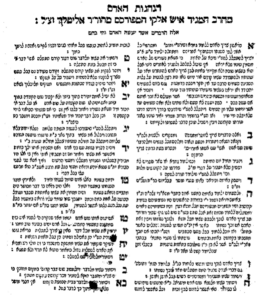
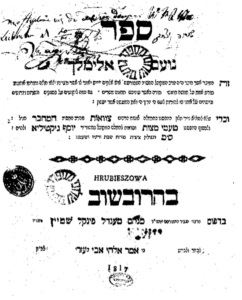
1817, Noam Elimelekh

The text, a hasidic Torah commentary on the weekly Torah portion, follows. It emphasizes the role of the zaddik in worship and divine service. At the end of the concluding section of the book are two decorative tail-pieces. These tail-pieces, particularly the one on the left, appear on title-pages of several Hrubieszow books.
Noam Elimelekh is a classic Hasidic work. First printed by his son after his death in Lvov 1788, Noam Elimelekh has proven to be an immensely popular work. This, the Hrubieszow printing, is the sixth edition. It is reported that more than 50 editions of Noam Elimelekh have been printed.[11]

Sefer Hasidim – R. Judah ben Samuel he-Hasid’s (c. 1150–1217) Sefer Hasidim, a different but computable work is, as noted above, an ethical, mystical, and halakhic work. Judah was a disciple of his father, R. Samuel (ben Kalonymous) he-Hasid (c. 1120-75) an eminent kabbalist and ascetic; portions of Sefer Hasidim are attributed to Samuel he-Hasid. They are among the most renowned members and leaders of the Hasidei Ashkenaz, the influential Jewish pietist movement in medieval Germany.

It is reported that when Judah’s mother was pregnant with him, she was walking along a path by a bet medrash (Torah study hall) when a wagon came bearing down upon her, with no place to turn, neither to the right nor to the left. Just as she was about to be crushed by the horses’ hoofs, the walls of the bet medrash opened saving her and her son. It is also told that Samuel he-Hasid witnessed the heavens opening; asked what kind of son he wanted, he replied, one of exemplary piety. Judah reputedly hosted the prophet Elijah, was able to revive the dead, and performed miracles, particularly saving Jews from oppressors. He practiced an ascetic form of mysticism, fasting two days for Yom Kippur, throughout the week, eating at night only, and often fasted on Shabbat, claiming that the change would cause him pain, detracting from his pleasure in Shabbat. It was said by a contemporary that if Judah had lived in the times of the prophets he would have been a prophet.
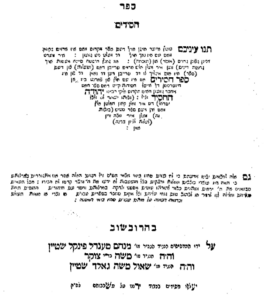
1817, Sefer Hasidim

The title-page of Sefer Hasidim, published is octavo format (80: [64] pp.) is in Yiddish, excepting the names of the printers and the publication date. All of the printers are cited here in bold letters, that is, Menahem Mendel Finkel Stein, Moses Tzikor and Saul Moss Gold Stein. The date in the chronogram, “Let the faithful exult in glory;
let them sing joyously upon their beds יעלזו בכבוד ירננו על משכבותם )577 = 1817).” (Psalms 149:5)

Sefer Hasidim is foremost an ethical manual, practical rather than theoretical, encompassing all aspects of life, including the minutiae of personal, family, and business matters. Numerous examples are cited, containing, considerable information about contemporary Jewish life. Advice is detailed and pragmatic, with the goal of achieving strict adherence to an ethical and pious life. These instructions, often based on kabbalistic teachings, have been influential because of the author’s great piety. Sefer Hasidim is also a mystical work, explaining biblical and talmudic passages.[12]

Gedolus David u-Malchus Shaul – A very different work is Joseph Ha-Efrati of Tropplowitz’s (c. 1770–1804) Gedolus David u-Malchus Shaul, a drama in Yiddish. Among the smallest Hrubieszow imprints, it was printed in duodecimo format (120) 29 ff.
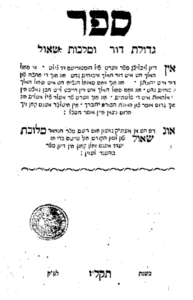
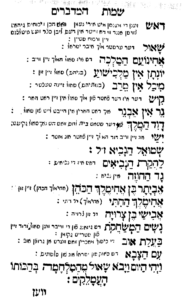
1817, Gedolus David u-Malchus Shaul

The author, born in Tropplowitz, Silesia, was a Hebrew poet, dramatist, and tutor. While working in the last capacity he wrote the first acts of the drama Melukhat Sha’ul from Melukhat Sha’ul completed in Prague in 1793. Gedolus David u-Malchus Shaul is a Yiddish translation, retitled. This version, that is the Yiddish translation, has been described as “part of the traditional Purimshpil (“Purim play”) in many Lithuanian and Polish towns . . . the first modern Hebrew drama of the Haskalah period, is noteworthy for its new egalitarian and humanistic ideas.” In writing Melukhat Sha’ul Ha-Efrati was reputedly influenced by Shakespeare, Goethe, Schiller, and von Haller, as well as M. H. Luzzatto. The primary characters, Saul. David, Jonathan, and Michal reputedly signify abstract ideas rather than lifelike characters, representing “the pathos of a suffering hero, ridden with envy and guilt, torn by fears and loneliness, and not merely a proud and jealous king.”[13]

The title-page is misdated, the date, given in a straightforward manner, is תקלז (= 1777). Depending on when the misdating was caught, it may have been corrected with a stop-press correction, that is, when an error was found the press would be stopped, the error would be quickly corrected and printing resumed. As one copy only of Gedolus David u-Malchus Shaul was seen it not known if that was done or if this is the sole uncorrected title-page for that work.[14] Friedberg writes that he has seen several of the press’s books that are misdated[15] For other examples, see below.

The text is in Yiddish excepting paragraph headers and, similarly, except here vocalized, the names of the participants in the drama on the verso of the title-page. This is the third edition of Gedolus David, the first having been printed in Lvov in 1801; It is a popular work, as many as fourteen editions are recorded for Gedolus David in the Bet Eked Sefarim and only twelve editions for Melukhat Sha’ul.[16]

The following year, 1818, saw the publication of five titles, primarily Hasidic works, among them such classics titles as R. Menahem Nahum Twersky of Chernobyl’s Me’or Einayim, homilies on the weekly Torah portions; R. Samuel ben Nathan Ha-Levi Loew Kolin’s Maḥaẓit ha-Shekel on the Shulḥan Arukh Oraḥ Ḥayyim and Yoreh De’ah; R. Jacob ben Solomon Habib’s Ein Ya’akov, collection of aggadah in the Talmud; R. Levi Yitzhak of Berdichev’s Hasidic classic Kedushat Levi discourses on the weekly Torah readings, and, in Vinograd’s listing, a second Hrubieszow edition of Noam Elimelekh.

Kedushat Levi – R. Levi Yitzhak of Berdichev’s Kedushat Levi, a classic Hasidic work of weekly discourses. was published in quarto format (40: [1], 78, 27, 15 ff.) in the year “Isaac pleaded [with the Lord] ויעתר יצחק (571= 1818)” (Genesis 25:21). R. Levi Yitzhak of Berdichev, who defended Hasidus against its opponents, settled in Berdichev, in 1785, residing there for the rest of his life. When he passed away, it seemed, to R. Nahman of Bratslav that “the light of the world had been extinguished.” Levi Yitzhak was held in the highest regard and affection by Jews. An example of his sensitivity, even to transgressors, is the following incident,

When he happened to meet “a young man eating in public on the fast of Tisha B’Av (the anniversary of the day on which both the first and second Temples were destroyed) the rabbi asked him mildly, “Have you forgotten that today is the Ninth of Av? Or are you perhaps unaware that it is forbidden to eat on the Ninth of Av?” “I have not forgotten what day it is and I am well aware of the prohibition,” answered the young man. “Possibly, my son, you are not in good health and have been advised by your doctor to eat?” the rabbi of Berdichev inquired further. No, I am in excellent health,” was the reply. “See, O Lord,” exclaimed the sage with joy, “how admirable Your children are! Even when they transgress Your Commandments, they do not stoop to falsehood.” [17]

Levi Yitzhak’s first published work, also entitled Kedushat Levi, is discourses on Hanukkah and Purim, printed in Slavuta in 1798. It was subsequently included in later editions of Kedushat Levi on the weekly Torah readings.
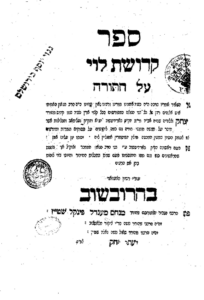
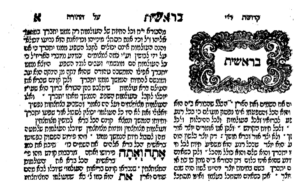
1818, Kedushat Levi

The title-page of this edition of Kedushat Levi begins with honorifics for R. Levi and then informs that it also includes additional material on various subjects. On the verso of the title pages is an approbation from four rabbis from Berdichev; R. David Shalit, R. Aaron Isaac ha-Kohen, R. Nathan Aryeh Davir, and R. Mordecai באאימו son of my lord, my father, teacher, and rabbi David Shalit. Below the approbation is the standard disclaimer that the people among whom the Jews reside today are not like those in the time of the Talmud, immoral idol worshippers, but today show respect for Torah and do justice and righteousness in their lands, The text follows, primarily on the weekly parsha, but also addressing other biblical books, festivals, and concluding with a final section addressing various subjects, including Pirke Avot. Kedushat Levi.

First published in Berdichev in 1811, this, the Hrubieszow edition, is the third printing of Kedushat Levi. A popular work, it has frequently been republished.

Sefer ha-Yashar – Among the books published in 1819 is R. Zerahiah ha-Yevani’s (13th or 14th century) popular ethical work Sefer ha-Yashar (Book of Righteousness). The title-page attributes the work to R. Jacob ben Meir Tam (Rabbenu Tam, c. 1100-1171), a not infrequent error, as well as it being attributed to R. Jonah Gerondi (13th century). The former did author a Sefer ha-Yashar (Vienna, 1811), but that is another work, consisting of responsa and novellae, while the style of the latter, who wrote ethical works, differs from this book. A number of manuscripts, however, name Zerahi ha-Yevani’s as the author. While many now accept him as the author, that attribution is not definite. Little is known about Zerahiah, except that he was a resident of the Byzantine Empire and that he is credited with Sefer ha-Yashar.

Sefer ha-Yashar was published in octavo format (80: [2], 40 ff.). The title-page begins that it is “the path of life and moral reproof, to go on a straight path. It is dated “it is [very] indeed upright וישר הוא מאוד (579 = 1819)” (cf. Deutronomy 32:4; Psalms 21:29). The printers names are given on the title-page as Menahem Mendel F. Sh. and Moses Tzikor,
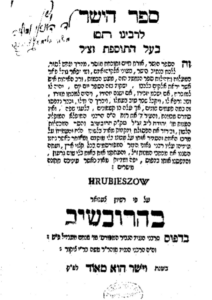
1819, Sefer ha-Yashar

There is an introduction, in which Zerahiah brings proof for the Torah and its precepts from both reason and from the prophets, and bemoans the pursuit of pleasure, wealth, and honor in his time, rather than religion and morality. Sefer ha-Yashar, with the purpose of directing one’s soul towards the correct worship of God, piety, and ethical content, is written in an easy style so that it will influence others to right conduct. Sefer ha-Yashar is comprised of material from earlier ethical works, although they are not mentioned in the text by name nor directly quoted. It is evident, from the book, that he was familiar with Jewish philosophic works. The most significant of the prior works, acknowledged in the introduction, is Bahya ibn Paquda’s Hovot ha-Levavot, studied by Zerahiah, but too long and complex for the average reader. It provides, in summary, the essence of several chapters. Another important influence, evident in the text, is Maimonides.

The text, divided into eighteen chapters which address, beginning with the creation of the world, worship, repentance, knowledge of God, the will of God, the world to come, complete repentance, the significance of the righteous, accountability of a person, remembrance of the day of death, and the distinction between the righteous and the wicked. Zerahiah’s primary subjects are the need to imitate God, conditions of proper prayer, both theoretical and practical; correct conduct and obstacles to be overcome to achieve it; and repentance.[18]

A popular work Sefer ha-Yashar was first printed in Constantinople (1540); this is the twenty-second edition, of slightly more than fifty recorded by the Bet Eked.Sefarim.[19]
Levushe Serad – Another different work, also published in 1819, is R. David Solomon Eybeschuetz’s (Eibenschutz) halachic Levushe Serad on the Shulhan Arukh Yoreh Deah, particularly on the laws pertaining to shechita (ritual slaughter). Printed as a folio (20: [2], 2-102 ff,) in the year “attired as thin beast לבושי השרד בהמה דקה (561 = 1801).” This date is certainly incorrect, a bet ב at the head of the word בהמה (beast) which make the verse meaningful but gives a date in error, as opposed to a kafכ which would read כהמה and would give the correct value of (579 = 1819) but be meaningless. I would suggest, and this is entirely speculative, that the printer wanted the meaning of beast even if that threw the date off. Support for this conjecture can be found in the correct date, immediately below the Hebrew date, in Arabic numerals, that is, 1819. This is the only title-page seen among the Hrubieszow imprints with an Arabic numeral date.

The author, R. David Solomon ben Yerachmiel Eybeschuetz, was born in Russia and studied under R. Moses Ẓevi Heller. He served as rabbi in several locations, among them Buzhanow, Soroki (Volhynia), and Jassy, (Rumania). Eybeschuetz made aliyah, that is, he went up to Eretz Israel, residing in Safed, where he died in 1812. Eybeschuetz was also a kabbalist as well as a Talmudist. His other works include responsa, Ne’ot Deshe (part one, Lvov, 1861), part two and manuscripts, including a commentary on the Torah and discourses.[20]

The title-page describes Levushe Serad as being comprised of three parts, the first explaining the laws pertaining to laws of falling and broken bones in cattle and fowl; the second, laws applying to lungs; and the third, applying to Yoreh De’ah. The printers are given here as Menahem Mendel Finkel Stein. and Moses Tzikor.

The verso of the title-page has an approbation from R. David Shalit. The text is comprised of the commentary in two columns. The text of this volume on Yoreh Deah varies from the previous volume on Orah Haim. Chaim Tchernowitz describes this volume as following R. Alexander Sender Shor’s (d. 1737) influential Simla Hadasha, also on shechita; Levushe Serad being described as the most important commentary on that work [21] It does not include the text of Yoreh De’ah, on which Levushe Serad comments and elucidates.
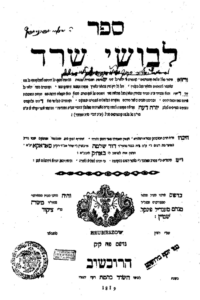
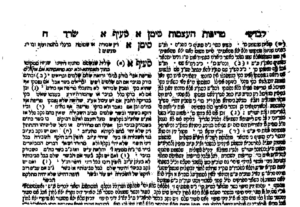
1819, Levushe Serad

Levushe Serad on Orah Haim was first published in Mohilev (1805). This volume, on Yoreh Deah is the third edition, it too having been printed previously in Mohilev (1812).[22]

Havvat Da’at – Among the books printed in 1820 was another work on Shulhan Arukh Yoreh Deah, but considerably different from Levushe Serad, that is, R. Jacob ben Jacob Moses Lorbeerbaum of Lissa’s (c. 1760–1832) Havvat Da’at. It was published as a folio (20: [1], 37 [should say 36], [34] ff.) in the year “Day to day makes utterance, night to night speaks out יום ליום יביע אומר ולילה ללילה יחוה דעת (470 = 1805) 19:3), This chronogram is also misdated, as is noted by the NLI catalogue, which records it as a circa 1820 imprint; which also states that the printer, who is not identified on the title-page, is unknown.
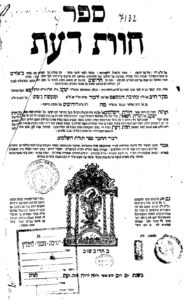
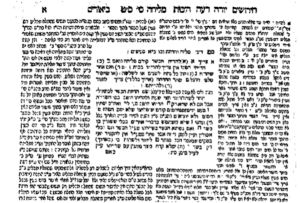
1820, Havvat Da’at

Jacob Lorbeerbaum of Lissa was a distinguished rabbi, who served in several communities, writing, in addition to Havvat Da’at other valued works. [23] However, his early days were difficult and troubled. His father, rabbi of Zborow, passed away prior to Lorbeerbaum’s birth; he was raised by R. Joseph Te’omim (Pri Megadim, 1727–1792), a relative. He initially combined learning and business, being a partner in a brewery but, when that failed, Lorbeerbaum became rabbi in Monasterzyska, founding a yeshivah there. He subsequently became rabbi of Kałusz writing many of his earliest works there, including Havvat Da’at which, reflecting his great humility, was originally published anonymously. When his authorship was subsequently identified ,Havvat Da’at became the name by which he is known.[24]

In 1809, Lorbeerbaum became rabbi of Lissa. Lorbeerbaum was an opponent of the Haskalah movement, their influence resulting in his leaving Lissa in 1822 and returning to Kalisz. Disputes there forced him, in 1830, to again relocate again finally settling in Stryj, serving there as rabbi until his death.

The title-page of Havvat Da’at states that it is on Shulhan Arukh Yoreh Deah, which is a tree of knowledge “desirable as a source of wisdom” (Genesis 3:6), for the pure and the impure. It continues that it is comprised of two parts, Biurim, explanations in depth based on prior commentaries and Hiddushim, novellae, interpretative explanations of statutes and critical analysis. On both sides of the pressmark is the standard disclaimer that the contemporary peoples among whom the Jews dwell today are not immoral idol worshippers as in the past.

The commentary, as described on the title-page, is in two parts, about the text of the Shulhan Arukh. Chaim Tchernowitz describes the subject matter of Havvat Da’at as being on such subjects as salting of meat, meat and milk, mixtures, interest, niddah, and other halakhot dealing with prohibitions such as Stam Yeinam (gentile wine), and treifus. He concludes that according to Havvat Da’at even with laws dealing with permitted and prohibited foods there is room for critical and analytical critique.[25]

Given the title-page variations of this edition, described above, it is not surprising that Avraham Yaari questions, concisely, whether Havvat Da’at is a Hrubieszow imprint. He suggests that it was published elsewhere, writing “one more book that is listed as having been published in Hrubieszow was actually published in Polonne. This is Chavat Da’at by Ya’akov of Lissa.”[26] While we have noted a number of variations in Havvat Da’at, such as the dating error in the chronogram, albeit not that unusual for Hrubieszow publications, the absence of the printers’ names, and a pressmark that is not common to Hrubieszow title-pages, there is also the fact, in contrast to these varoiances, that the place of printing is clearly given on the title-page as Hrubieszow. Furthermore, other bibliographic sources, such as Friedberg’s Bet Eked Sefarim and Vinograd’s Thesaurus record Havvat Da’at as a Hrubieszow imprint. An examination of a sample of Polonne and Sudylkow (also suggested) title-pages did not show any like images. The question of whether Havvat Da’at was a Hrubieszow imprint or was published elsewhere is a teku (u nresolved).

Another Hrubieszow imprint by Jacob Lorbeerbaum of Lissa is a folio edition of Beit Ya’akov, novellae and commentary on Shulchan Aruch, Even Ha–Ezer and tractate Ketubot. The printers are given as Moses Tzikor, of Laszczow, and Solomon, ben David Lev, of Laszczow, Menahem Mendel Finkel Stein having already left the press.

This is the fourth printing of Havvat Da’at. The first edition was published in Lvov (1799).

Avodat ha-Kodesh – Among the books printed in Hrubieszow in 1820 is Avodat ha-Kodesh by R. Ḥayyim Joseph David ben Isaac Zerachia Azulai (Hida, 1724-1807), a prominent kabbalist, rabbinic scholar, bibliophile, and prolific author. More than eighty works are attributed to him, sixty in print, on a wide variety of subjects on Torah, halachah, aggadah, and kabbalah.[27] Avodat ha-Kodesh, an 18 cm. octavo(80: 40 ff.) is comprised of three related works, Vinograd records each independently, that is, Avodat ha-Kodesh, Moreh be-Etzba, and Ziporin Shamir as separate entires. All three titles, kabbalistic explanations of customs, are in octavo format (80) and relatively small works. Shimon Vanunu, describes Avodat ha-Kodesh as a compilation of several of Hida’s prior works.[28]

Hida was born in Jerusalem to a prominent Sephardic family, descendant from exiles from Spain, and his great-grandfather was the kabbalist R. Abraham Azulai (c. 1570–1643, Hesed le-Avraham), originally from Fez, Morrocco and on his maternal side from R. Joseph Bialer, a German scholar. He was educated by leading rabbinic figures, among them R. Isaac ha-Kohen Rapoport, R. Shalom Sharabi, and R. Haim ibn Attar (Ohr ha-Haim). He served as rabbi in several communities and beginning in 1755, served as an emissary from Eretz Israel to Jewish communities in Europe.
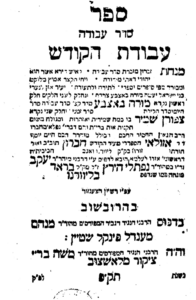
1820, Avodat ha-Kodesh

The title-page has the heading Avodat ha-Kodesh in large bold type and below notes the other two works, and then that the book was brought to press by R. Jacob ben Naphtali Hertz of Brod and that it had been printed previously in Livorno. The title-page is dated in a straightforward manner as (תק”פ = 1820). The verso of the title-page has the disclaimer that the non-Jews among

whom the Jews noted above that contemporary nations are unlike the earlier nations who were immoral idol worshippers, but today show respect for Torah and do justice and righteousness in their lands. It is followed by the tailpiece noted above that appears on the title-pages of several books. Examples of the text are:

147: all who say shirat ha-yam (Exodus 14:30 – 15:19) with joy as if he himself had been delivered from the sea, Pharoh, and his army, when they drowned in the sea, and says Shira with great feeling is forgiven his iniquities.

148: all who weep and mourn for a person who was kosher is forgiven his iniquiites.

149: all who pray erev Shabbat and say [the prayer] ויכלו “the heavens and earth were completed” (Genesis 2:1), two angles say to him turn your eyes and your sins will be atoned for.

The pressmark appears at the end of the book as a tail-piece.

Tomer Devorah – Another work published in 1820 is R. Moses ben Jacob Cordovero’s (Ramak, 1522-1570) popular and much reprinted Tomer Devorah. A small kabbalistic, ethical, and inspirational treatise, it was published as a 19 cm. octavo (14 ff).

Moses ben Jacob Cordovero was the first to describe the dialectical process through which the Sefirot pass in their development and to interpret the various stages of their emanation as manifestations of the Divine mind.[29] Based on his name, Cordovero appears to have been descended from Jewish exiles from the city of Cordova. It has been suggested, but this is uncertain, that he was born in Safed. Cordovero was a student of R. Joseph Caro (1488-1575) in nigleh (revealed, literal Torah) and, after heeding a heavenly voice that urged him to study Kabbalah, of his brother-in-law, R. Solomon Alkabez (Lekhah Dodi) in nistar (esoteric Torah, Kabbalah). Cordovero became a leader of the ascetic mystical community of Safed, preparing for it a list of rules of conduct, primarily instructions and commands. He served as a dayyan in Safed and founded a yeshivah there in about 1550, which he headed until his death in 1570.

Among Cordovero’s students were R. Elijah de Vidas (Reshit Hokhmah), R. Abraham Galante (ha-Kadosh), R. Samuel Gallico (Asis Rimmonim, an abridgement of Pardes Rimmonim), R. Hayyim Vital, and R. Isaac Luria (ha-Ari). Although Luria was Cordovero’s student for a short while only, and his system of Kabbalah would supplant that of Cordovero, Luria refers to Cordovero as his master and teacher, testifying that Cordovero was completely free of sin, that both the sages of the Mishnah and Elijah the Prophet appeared to him, and that at Cordovero’s funeral a pillar of fire preceded his coffin. Others, such as R. Menahem Azariah da Fano, although in Italy, considered themselves disciples of Cordovero. A prolific writer, he is responsible for several of the classics of Kabbalah.[30]

Tomer Devorah is entitled from “And she sat under the palm tree of Deborah (Tomer Devorah) between Ramah and Beth‑El in Mount Ephraim” (Judges 4:5). The title-page urges man to follow a straight path, to end his isolation and reflect on his ways, to cleave to the order of the sephirot. The printers are given as Menahem Mendel Finkel Stein and Moses Tzikor of Łaszczów, their names preceded by honorifics. The title-page is dated with the chronogram in the year “This is the Teaching that Moses placed before the children of Israel זאת התורה אשר שם משה לפני בני ישראל (580 = 1820)” (Deuteronomy 4:44).
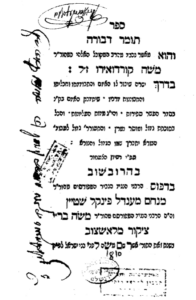
1820, Tomer Devorah

The text is comprised of ten chapters describing Divine qualities and how man should strive to emulate them. They are, 1) the Supernal Crown (Keter) and the thirteen attributes of higher mercy which belong to it; 2) the qualities of the crown, such as humility and kindness, eradicating pride from the heart; 3) wisdom (Hokhmah), love and care for all creatures; 4) understanding (Binah) and repentance; 5) on mercy (Hesed), the methods of performing mercy and assisting the Sefirot to function harmoniously; 6) power (Gevurah), utilizing the evil inclination to serve God; 7) beauty (Tiferet), the study of Torah and behavior appropriate to a scholar; 8) Endurance, Majesty and Foundation (Netzach, Hod and Yesod), support of Torah students and purity of life; 9) Sovereignty (Malkut), sacrifices for Torah and performing marital duties with holiness; 10) Man’s conduct so that he is never separated from the world of the Sefirot. An example of the text, from Keter, is:

Keter – Some major activities that are the main governance: Further for a person to resemble his Creator from the secret of the trait of the Crown (Keter), he must [do] some major activities – which are the main governance. The first: The trait of humility – which includes everything – because it is dependent on the Crown. As behold, It is a trait over all of the Traits, but it does not raise itself and become proud above [the others]. Indeed, It goes down and always looks downwards. And that is from two reasons: The one is that It is embarrassed to look at Its Cause, rather Its Emanator always looks down upon It to benefit It; and It looks down to the lower ones. So [too,] must a person be embarrassed from staring upwards, to be proud. Rather, he must always stare downwards, to diminish himself all that he can.[31]

The title page is followed by a brief introduction from R. Moses Basola, with the pressmark. He found the manuscript of Tomer Devorah in the library of R. Menahem Azriah, who gave it to Basola, in order to bring it to press to merit Israel.

Tomer Devorah is replete with allusions from Talmudic and kabbalistic sources, systemizing and vividly presenting abstruse concepts. It has been frequently republished and translated into other languages, among them English. Tomer Devorah was first published in Venice (1588); this the Hrubieszow edition, is the fourteenth. The Bet Eked Sefarim records thirty-two editions, several with annotations, and not recording translations.[32]

Ayyelet Ahavim – A rhetorical and poetic treatise on the Akedah (sacrifice of Isaac) by R. Solomon de Oliveyra (1633-1708). Ayyelet Ahavim was printed as a 19 cm. octavo (80: [4], 20, [1] ff.). It is dated in a straightforward manner as תקפ”א,ה ([5]581 = 1821).

R. Solomon de Oliveyra is accounted among the Sephardic sages of Amsterdam.[33] Oliveyra’s place of birth, whether Lisbon or Amsterdam, is uncertain. Albert Van Der Heide suggests that as Oliveyra’s parents were fugitive co1nversos, as documented in Amsterdam in 1628, he must have been born in the latter location. Also, based on the marriage certificate issued by the city of Amsterdam, Oliveyra married Rached Dias in 1660, when twenty-seven years old, again attesting to Amsterdam as his place of birth.[34] Oliveyra served as rabbi (hakham) and teacher in the Talmud Torah Etz Haim of the Keter Torah association of the Amsterdam Portuguese community, of which he later became president. He was a member of the rabbinical council, over which he presided after the death of R. Jacob Sasportas (c. 1610-98). In addition to these rabbinic positions, Oliveyra worked as a corrector in the printing-house of Uri Phoebus.[35] Oliveyra was the author of a number of varied multi-lingual works on grammar, lexicography, other philological subjects, poetry, and riddles. Van Der Heide has described Oliveyra as “the preeminent and omnipresent Hebrew poet of Jewish Amsterdam.” Oliveyra became, for a time, an adherent of Shabbetai Zevi, composing liturgical verse in his behalf as well as writing approbations

The primary publisher of Oliveyra’s books was David de Castro Tartas (c. 1625–c. 1700), active from 1662 to 1698 in Amsterdam. Their relationship began in 1665, when our subject work, Ayyelet Ahavim ws published. The title-page begins that it is Igeret: words of truth, “to understand a proverb, and a figure” (Proverbs 1:6). It is entitled Ayyelet Ahavim for it was “a precious vessel” (Hosea 13:15, Nahum 2:10, II Chronicles 32:27), “To receive the instruction of wisdom” (Proverbs 1:3), “He established it and searched it out” (Job 28:27), by the rav, the Sephardic sage SOLOMON ben DAVID Oliveyra, in the month of Ziv in the year תי”ז (1657, printed in Amsterdam in the year תכ”ה (1665). It adds that it has now been brought to press by R. Abraham Moses ben Solomon ha-Levi of Lublin: with the permission of the censor in Hrubieszow at the press of Moses ben Tzikor of Łaszczów.
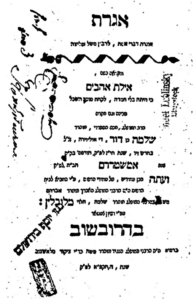
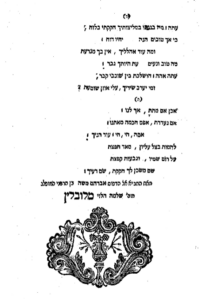
1821, Ayyelet Ahavim

Oliveyra’s introduction follows (2a-b) in which he states that he does not wish to delve into deep explanations nor to go up to the heights of discourse, but rather his heart wishes to speak of the greatness of that “righteous man, who quarried the fetters of love, of that which he formed יצורו for the love of the One Who formed him יוצרו.” Oliveyra’s intent is to investigate this holy and wondrous deed. Among the several reasons that he entitled this work Ayyelet Ahavim is that it is on the love of Abraham and his soul for God “As the hart longs for water streams” (cf. Psalms 42:2). The wide-ranging text is comprised of numerous aggadot, and including riddles and parables. In one section the alternating paragraphs of verse are between father and son. The prose text is accompanied by infrequent marginal references.

First printed in Amsterdam (1665) this is the third and last published edition Of Ayyelet Ahavim.[36]

Summation – Ten books have been described. The selected books give an insight to the type of works published by the Hrubieszow press. They are generally of a scholarly and specialized nature, primarily Hasidic works on the weekly parasha (Torah reading), ethical, and halachic tomes, although varied within each category. These works reflect both the composition and interests of the community. One book, Gedolus David u-Malchus Shaul, stands out, being of a contrary nature, that is, it has maskilic overtones. The provenance of one other work, Havvat Da’at, has been questioned. Also published were two editions of Shir ha-Shirim (1816, 1827), the former not seen, the latter (1820) with the commentaries of R. Eliezer ben Judah (Rokeah) and R. Moes ben Nachman (Ramban).

A lacuna in the press’s publications is the absence of Mishnaic and Talmudic volumes, attesting to the press’s emphases on small books, perchance the nature of its’ operations, a small publisher catering to and meeting a small market’s needs. It did, however, print an Ein Ya’acov, on the aggadot in the Talmud, this with the commentary Kotnot Or. The emphasis on small works does not in any way detract from the value of the press’s publications. Indeed, the books were well printed and attractive. Yaari, however, while approving of their appearance is not so positive as to the titles printed, writing “The books printed in Hrubieszow were elegant in appearance, but not of significant content. Most had been printed previously by other presses. These books were in great demand, such as popular Yiddish books.”

As noted above, the Thesaurus credits the Hrubieszow press with as many as forty titles, although that number appears uncertain, or perhaps exaggerated; Avraham Ya’ari recorded thirty-four titles only. Perchance, the difference in number can be attributed to the manner in which books are recorded. Avodat ha-Kodesh, for example, is a composite of three works, each listed independently in the Thesaurus but one entry only in Yaari’s listing. Summerly, there are three entries in the Thesaurus for Siddur Tefillat Nehora, a two-part prayer book designed so that it can be used for both Ashkenaz ads Sephardic rites. There is one listing only by Yaari, but more detailed. The entries in the Thesaurus for Tefillat Nehora are several years apart (1817, 1821, [1824]). To complicate matters, Yaari has several entries for Kotnot Or but the Thesaurus has one entry only for the Ein Ya’acov. The exact number of publications must remain then a teku (unresolved).

We have noted misdates and censors’ remarks. Yaari comments on this writing:

The names of the town or the printers are omitted from the title pages of several of the books printed in Hrubieszow. This is probably due to censorship, or book tariff payment. Sometimes the printers mentioned their names in some copies but not in others; sometimes they even inserted the name of a different town or stated a different year, to deceive the censor or the tariff–collector

No books omitting Hrubieszow were seen or noted.[37] Why then, printing with the censors’ approval they would omit their names is unclear. Indeed, the books described above, all, with the exceptions of Havvat Da’at all have the printers’ names. In conclusion, as already noted, the Hrubieszow press published small varied books covering a variety of subjects. The books served communal needs, were works of value, and attractively printed. A press only active for a brief period, it served the Hrubieszow community well. It deserves, should be remembered, in addition entries in bibliographic and historical records.
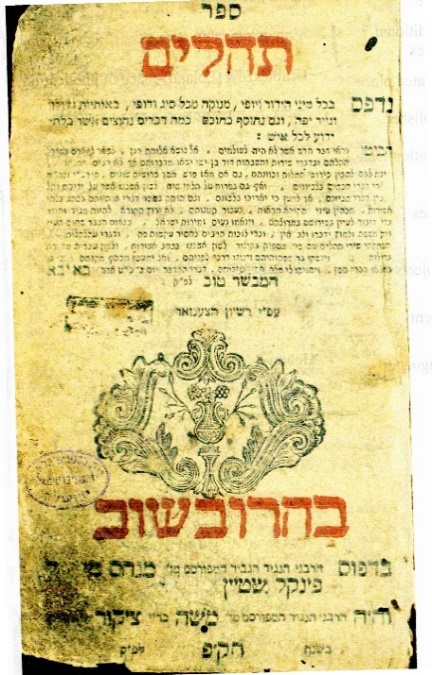
  1. I would like to express my appreciation to Eli Genauer for reading the article and his corrective comments, and Eli Amsel for his additional insights. All the title and text page images are courtesy of the National Library of Israel. The Polish monarchy banner is a public domain image.
  2. Vinograd, Yeshayahu. Thesaurus of the Hebrew Book. place, and year printed, name of printer, number of pages and format, with annotations and bibliographical references II (Jerusalem, 1993-95), p. 167 [Hebrew].
  3. https://en.wikipedia.org/wiki/Hrubiesz%C3%B3w
  4. The Encyclopedia of Jewish life Before and During the Holocaust, editor in chief, Shmuel Spector; consulting editor, Geoffrey Wigoder; foreword by Elie Wiesel I (New York, 2001), pp. 532-34; Polin: Virtual Shtetl https://sztetl.org.pl/en/towns/h/266-hrubieszow/99-history/137366-history-of-community; Dr. N. M. Gelber, Notes on the History of the Jews of Hrubieszow, tr. Yael Chaver, https://www.jewishgen.org/yizkor/Hrubieszow/hru021.html.
  5. Hurvitz Tzvi Ha–Levi Ish Hurvitz, “The Town of Hrubieszow and its Rabbis,” translated by Yael Chaver, Columns 51-52. https://www.jewishgen.org/yizkor/Hrubieszow/hru051.html
  6. Avraham Yaari, “The Hebrew Printing Press in Hrubieszow,” Kiryat Sefer, (Jerusalem, 1943–4), pp. 219–228 [Hebrew], tr. by Yael Chaver https://www.jewishgen.org/yizkor/Hrubieszow/hru051.html#Page57
  7. Dr. N. M. Gelber, Notes on the History of the Jews of Hrubieszow, tr. Yael Chaver, https://www.jewishgen.org/yizkor/Hrubieszow/hru021.html..
  8. Ch. B. Friedberg, History of Hebrew Typography in Poland from the bginning of the year 1534, and its development up to our days . . . Second Edition, Enlarged, improved and revised from the sources (Tel Aviv, 1950), pp.150-52 [Hebrew].
  9. Mordechai, Margalioth, ed., Encyclopedia of Great Men in Israel I (Tel Aviv, 1986), cols. 179-80 [Hebrew].Tzvi M. Rabinowicz, The Encyclopedia of Hasidism (Northvale, 1996), pp.111-12.
  10. Ch. B. Friedberg, History of Hebrew Typography in Poland, op. cit.
  11. Arnold Green, “Elimelekh of Lizhensk, “The Yivo Encyclopedia of Jews in Eastern Europe, Gershon David Hundert, ed. I (New Haven & London, 2008), p. 467; Rabinowicz, op. cit.
  12. Marvin J. Heller, The Sixteenth Century Hebrew Book: An Abridged Thesaurus II (Leiden, 2004) p. 697: Simcha Kogut, “The Language of Sefer Hasidim, Its Linguistic Background and Methods of Research,” in Studies in Medieval Jewish History and Literature, ed. Isadore Twersky, II (Cambridge, 1984), pp. 95-108; Reuben Margaliot, ed., Sefer Hasidim (Jerusalem, 1973), pp. 3-9 [Hebrew].
  13. https://www.encyclopedia.com/religion/encyclopedias-almanacs-transcripts-and-maps/ha-efrati-tropplowitz-joseph
  14. To replace a sheet with a single error would necessitate replacing several pages, the number depending on the book format. The normal practice, therefore, was to retain the original defective sheet and use both it and the corrected sheet in copies of the book. Due to cost factors, both of paper and labor, the sheet with the error would be replaced only if the error was substantial or substantive. It is therefore possible for books to consist of non-uniform copies, having several sheets with variant readings. For examples of such errors see Marvin J. Heller, “Who can discern his errors? Misdates, Errors, and Deceptions, in and about Hebrew Books, Intentional and Otherwise” Hakirah: The Flatbush Journal of Jewish Law and Thought 12 (2011), pp. 269-91, reprinted in Further Studies in the Making of the Early Hebrew Book, (Brill, Leiden/Boston, 2013), pp. 395-420.
  15. Friedberg, History of Hebrew Typography in Poland, p, 151 n. 1.
  16. Ch. Friedberg, Bet Eked Sefarim, (Israel n.d.), gimmel 128, mem 1922 [Hebrew].
  17. Rabinowicz, p. 61.
  18. Margalioth, Great Men, II col. 465-66; Meyer Waxman, A History of Jewish Literature (1933, reprint Cranbury, 1960), II pp. 276-79.
  19. Friedberg, Bet Eked.Sefarim, yod 1152.
  20. Louis Ginzberhg, N. T. London, “Eibenschutz, David Solomon,” Jewish Encyclopedia V (1New York, 901-06), pp. 75-78.
  21. Itzhak Alfassi “Schor, Alexander Sender ben Ephraim Zalman” v. 18 Encyclopedia Judaica (Jerusalem, 2007), p. 161; Chaim Tchernowitz, Toledoth ha-Poskim, III (New York, 1946), pp. 206-08 [Hebrew].
  22. Friedberg, Bet Eked.Sefarim, lamed 108.
  23. Lorbeerbaum’s other published works are Ma’aseh Nissim (Zolkiew, 1801), on the Passover Haggadah; Mekor Ḥayyim (ibid., 1807), novellae and expositions of the laws of Passover in the Shulḥan Arukh together with the glosses of R. David ben Samuel ha-Levi and Abraham Abele Gombiner on Oraḥ Ḥyyim and novellae to tractate Keritot; Netivot ha-Mishpat (ibid., 1809–16), on Ḥoshen Mishpat; Torat Gittin (Frankfurt on the Oder, 1813), the laws of divorce and novellae on tractate Gittin; Kehillat Ya’akov (1831), on Even ha-Ezer and sections of Oraḥ Ḥayyim; Derekh ha-Ḥayyim, an anthology of liturgical laws, first published with the prayer book (1828) and then separately (1860 or 1870); Naḥalat Ya’akov (1849), expositions of the Pentateuch; Emet le-Ya’akov (1865), expositions of talmudic aggadot; Imrei Yosher, commentaries on the five megillot, each published independently; his ethical will (1875); and Millei de-Aggadeta (1904), sermons and responsa (EJ, op. cit.). In a private correspondence Eli Amsel noted other such works, writing “Another Hrubieszow imprint by Jacob Lorbeerbaum of Lissa is a folio edition of Beit Ya’akov, novellae and commentary on Shulchan Aruch, Even Ha–Ezer and tractate Ketubot.”
  24. Haim Gertner, “Lorbeerbaum, Ya‘akov ben Ya‘akov Mosheh of Lissa, Yivo Encyclopedia, I pp. 1087-88; Ephraim Kupfer, “Lorbeerbaum, Jacob ben Jacob Moses of Lissa” Encyclopedia Judaica XIII pp. 191-92.
  25. Tchernowitz, Toledoth ha-Poskim, III, p. 258.
  26. The Polonne (Polonnoye) press was active from 1789 to approximately 1830, publishing as many as130 titles. Among them three editions of Havvat Da’at. An accompanying note in the Polonnoye entry references it as a Sudylkow imprint (Vinograd, p. 502). Two [1834] editions of Havvat Da’at are listed for that location.
  27. Yaakov Amsalem and Yisrael A. Groweiss, “The Hida’s Riddle,” Mishpaha, March 22, 2022.
  28. Shimon Vanunu, Encyclopedia Arzei ha-Levanon. Encyclopedia le-Toldot Geonei ve-Hakhmei Yahadut Sefarad ve-ha-Mizrah II 649-(Jerusalem, 2006), pp. 649-69 [Hebrew]. The works noted by Vanunu are Moreh be-Etzba, Ziporin Shamir, Kesher Gadol, Kaf Ahas, Yosef be_Seder, Sensen le-Ir, and Shomir Yisrael.
  29. Heller, The Sixteenth Century Hebrew Book, var. cit. ; Gershom S. Scholem, Major Trends in Jewish Mysticism (New York, 1960). Pp. 252-53.
  30. Concerning other works by Moses Cordovero see Marvin J. Heller, “His Hand did not Leave Hers Until he was Grown: Two Little Known Works from Moses Cordovero (Ramak)” Los Muestros no. 44 (Brussels, 2001), pp. 44-46, reprinted in Studies in the Making of the Early Hebrew Book (Leiden/Boston, 2008), pp. 278-83.
  31. https://www.sefaria.org/Tomer_Devorah.2.2?lang=bi&with=SidebarSearch&lang2=en.
  32. Friedberg, Bet Eked Sefarim, tav 484.
  33. Concerning see Marvin J, Heller, ” Solomon de Oliveyra:
    A Seventeenth Century Sephardic Sage,” Sephardic Horizons (v. 13: 1-2 Winter-Spring 2023), https://www.sephardichorizons.org/.
  34. Albert Van Der Heide, “Poetry in the Margin: The Literary Career of Haham Selomoh d’Oliveyra (1633-1708),” Studia Rosenthaliana 40 (2007-08), pp. 14.
  35. L. Fuks and R. G. Fuks-Mansfeld, Hebrew Typography in the Northern Netherlands 1585-1815 2 (Leiden, 1987), p. 247; Margalioth, col. 1264 [Hebrew].
  36. Friedberg, Bet Eked.Sefarim, alef 1626.
  37. While I did not see any such works, Eli Amsel also wrote “I have several in my collection, only TWO without the city mentioned in title, Bet Ya’akov, cityless; Pri Etz Chaim, with koretz as the city in very small font!!!”


Another “Translation” by Artscroll, the Rogochover and the Radichkover

Another “Translation” by Artscroll, the Rogochover and the Radichkover
Marc B. Shapiro
1. As I discuss in Changing the Immutable, sometimes a choice of translation serves as a means of censorship. In other words, one does not need to delete a text. Simply mistranslating it will accomplish one’s goal. Jay Shapiro called my attention to an example of this in the recent ArtScroll translation of Sefer ha-Hinukh, no. 467.  
In discussing the prohibition to gash one’s body as idol-worshippers so, Sefer ha-Hinukh states:

אבל שנשחית גופנו ונקלקל עצמנו כשוטים, לא טוב לנו ולא דרך חכמים ואנשי בינה היא, רק מעשה המון הנשים הפחותות וחסרי הדעת שלא הבינו דבר במעשה הא-ל ונפלאותיו.

The Feldheim edition of Sefer ha-Hinnukh, with Charles Wengrov’s translation, reads as follows:

But that we should be be destructive to our body and injure ourselves like witless fools—this is not good for us, and is not the way of the wise and the people of understanding. It is solely the activity of the mass of low, inferior women lacking in sense, who have understood nothing of God’s handiwork and his wonders.

This is a correct translation. However, Artscroll “translates” the words המון הנשים הפחותות וחסרי הדעת as “masses of small-minded and unintelligent people.” This is clearly a politically correct translation designed to avoid dealing with Sefer ha-Hinukh’s negative comment about the female masses. I will only add that Sefer ha-Hinukh’s statement is indeed troubling. Why did he need to throw in “the women”? His point would have been the exact same leaving this out, as we can see from ArtScroll’s “translation.” Knowing what we know about the “small-minded unintelligent” men in medieval times, it is hard to see why he had to pick on women in this comment, as the masses of ignorant men would have also been a good target for his put-down.

2. In my post here I wrote:

One final point I would like to make about the Rogochover relates to his view of secular studies. . . . Among the significant points he makes is that, following Maimonides, a father must teach his son “wisdom.” He derives this from Maimonides’ ruling in Mishneh Torah, Hilkhot Rotzeah 5:5:

הבן שהרג את אביו בשגגה, גולה. וכן האב שהרג את בנו בשגגה, גולה על ידו, במה דברים אמורים. כשהרגו שלא בשעת לימוד, או שהיה מלמדו אומנות אחרת שאינו צריך לה. אבל אם ייסר את בנו כדי ללמדו תורה או חכמה או אומנות ומת פטור

He adds, however, that instruction in “secular” subjects is not something that the community should be involved in, with the exception of medicine, astronomy, and the skills which allow one to take proper measurements, since all these matters have halakhic relevance. In other words, according to the Rogochover, while Jewish schools should teach these subjects, no other secular subjects (“wisdom”) should be taught by the schools, but the father should arrange private instruction for his son.

 רואים דהרמב”ם ס”ל דגם חכמה מותר וצריך אב ללמוד [!] לבנו אבל ציבור ודאי אסורים בשאר חכמות חוץ מן רפואה ותקפות [!] דשיך [!] לעבובר [צ”ל לעבור] וגמטרא [!] השייך למדידה דזה ג”כ בגדר דין

He then refers to the Mekhilta, parashat Bo (ch. 18), which cites R. Judah ha-Nasi as saying that a father must teach his son ישוב המדינה. The Rogochover does not explain what yishuv ha-medinah means, just as he earlier does not explain what is meant by “wisdom,” but these terms obviously include the secular studies that are necessary to function properly in society.

Dr. Dianna Roberts-Zauderer takes issue with my assumption that “wisdom” (חכמה), the word used by Maimonides, includes what I have termed “secular studies”. (The Touger translation also has “secular knowledge”). She correctly points out that when the medievals used the word חכמה it means philosophy. She adds: “Does it not make sense that Maimonides would advocate the learning of philosophy? Or that the Rogochover would forbid the learning of philosophy in yeshivot, but only permit it at home with a teacher hired by the father?”
Although the term חכמה often means philosophy, I do not think we must assume that this is its meaning in Hilkhot Rotzeah 5:5. Based on parallel passages in Maimonides’ writings where the same halakhah is mentioned, R. Nachum Eliezer Rabinovitch claims that the word חכמה in this case actually means good character traits.[1] He sums up his discussion as follows:
כוונת רבינו אחת היא בכל המקומות, דהיינו לימוד מדות הנקרא חכמה
Quite apart from this, in my discussion I was dealing with how the Rogochover understood the passage in Maimonides. We have to remember the context of the Rogochover’s letter. He was asked about the study of secular subjects, as was the practice among the German Orthodox. He was not asked about the study of philosophy per se. Furthermore, in the passage cited from manuscript by R. Judah Aryeh Wohlgemuth,[2] which I referred to in the previous post, the Rogochover specifically understands Maimonides’ term חכמה in Hilkhot Rotzeah 5:5 as meaning שאר החכמות, which he identifies with what R. Judah ha-Nasi calls ישוב המדינה. 
Regarding the Rogochover, there are a few things people mentioned to me after seeing my post which I think are worthwhile to record. Dr. Rivka Blau, the daughter of R. Pinchas Teitz, told me that her uncle, R. Elchanan Teitz, would on occasion cut the Rogochover’s hair.
In the post I mentioned how the Rogochover acknowledged that his learning Torah while sitting shiva was a sin, but he did so anyway as the Torah was worth it. R. Yissachar Dov Hoffman called my attention to the following comment about this by R. Ovadiah Yosef, Meor Yisrael, Berakhot 24b:
לפע”ד לא יאומן כי יסופר שת”ח יעבור על הלכה פסוקה בטענה כזו. והעיקר דס”ל כמ”ש הירושלמי פ”ג דמ”ק שאם היה להוט אחר ד”ת מותר לעסוק בתורה בימי אבלו, דהו”ל כדין אסטניס שלא גזרו בו איסור רחיצה מפני צערו.
In the post I mentioned that the Shibolei ha-Leket appears to be the only rishon who adopts the position of the Yerushalmi referred to by R. Ovadiah. R. Yissachar Dov Hoffman called my attention to R. Yehudah Azulai, Simhat Yehudah, vol. 1, Yoreh Deah no. 40, which is a comprehensive responsum on the topic of a mourner studying Torah. R. Azulai notes that a few recently published texts of rishonim record the position of the Yerushalmi. He also mentions that according to some rishonim the prohibition is only to study on the first day of mourning. In studying R. Azulai’s responsum, I found another source that could be used to defend the Rogochover’s learning Torah during shiva. R. Meir ben Shimon ha-Meili writes:[3]
ונראה לומר דלדברי כל פוסקים העיון מבלי הקריאה מותר, שאינו אלא הרהור בעלמא, ולא חמיר אבלות משבת דאמרינן דבור אסור הרהור מותר, וכל שכן הרהור בדברי תורה לאבל שהוא מותר . . . והלכך מותר לו לאבל לעיין בספר, ובלבד שלא יקרא בו בפיו.
R. Meir ben Shimon adds that despite what he wrote, the common practice is for a mourner not to read any Torah books. Yet as we can see, he believes that this is halakhically permitted as long as one does not read out loud.
R. Chaim Rapoport called my attention to the following passage in a new book about the late rav of Kefar Habad, Ha-Rav Mordechai Shmuel Ashkenazi (Kefar Habad, 2017), p. 546:
יצוין בהקשר זה למעשה משעשע, ששח הרב אשכנזי בשם הרה”ח ר’ אליהו חיים אלטהויז הי”ד, אודות אסיפה שכינס הרבי הריי”ץ עם הגיעו לריגה שבלטביה. הרוגצ’ובר נכח באותה ישיבה, ומשנמשכו הנאומים, התקשה הגאון לשבת במנוחה, והוא הסיר את כובעו והשליכו על הבקבוקים שניצבו על השולחן, תוך שערם כוסות שורה על שורה בפירמידה, וכן שפך מים מכוס אחת לשנייה וכדומה.
הרב ד”ר מאיר הילדסיימר [!] ע”ה מברלין, שהיה יקה מובהק, תהה לפשר התופעה והתקשה להכילה. הרבי הריי”ץ חש בפליאתו וציין באוזניו, כי הרוגצ’ובר הינו “שר התורה, וכל רז לא אניס ליה”. השיב הרב הילדסהיימר: “הכול טוב ויפה, אולם נורמאלי זה לא”.
I am surprised that such a passage, using the words “not normal” about behavior of the Rogochover, was published, especially in a Habad work. As is well known, there is a special closeness in Habad to the Rogochover, as he himself was from a Habad family (although it was not Lubavitch but from the Kopust branch of Habad).[4]
Ha-Rav Mordechai Shmuel Ashkenazi also has a number of other stories about the Rogochover. The following appears on p. 211: Once R. Jacob David Wilovsky of Slutzk visited R. Meir Simhah of Dvinsk and told him that he wanted to also visit the Rogochover. R. Meir Simhah attempted to dissuade him, saying that the Rogochover would put him down like he puts everyone down. Yet R. Wilovsky visited him and the Rogochover did not put him down. He said to the Rogochover, “I heard that you put down everyone, but I see that you treat me with respect.” The Rogochover replied, “I put down gedolim, not ketanim.”
In my post on the Rogochover, I showed this page from R. Menahem Kasher’s Mefaneah Tzefunot (Jerusalem, 1976), p. 2.

I wrote:
Look at the end of the first paragraph of the note on p. 2. The “problematic” quotation of the Rogochover, saying that he will happily be punished for his sin in studying Torah, as the Torah is worth it, has been deleted. Instead, the Rogochover is portrayed as explaining his behavior as due to the passage in the Yerushalmi. While all the other authors who discuss this matter and want to “defend” the Rogochover claim that his real reason for studying Torah was based on the Yerushalmi, in R. Kasher’s work this defense is not needed as now we have the Rogochover himself giving this explanation!
Yet the Rogochover never said this. R. Zevin’s text has been altered and a spurious comment put in the mouth of the Rogochover. By looking carefully at the text you can see that originally R. Zevin was quoted correctly. Notice how there is a space between the first and second paragraphs and how the false addition is a different size than the rest of the words. What appears to have happened is that the original continuation of the paragraph was whited out and the fraudulent words were substituted in its place. Yet this was done after everything was typeset so the evidence of the altering remains.
I had forgotten that the 1976 edition of Mefaneah Tzefunot, which is the one found on Otzar ha-Hokhmah and hebrewbooks.org, was the second publication of the book. I thank David Scharf for reminding me of this and for sending me copies of the following pages. Here are the Hebrew and English title pages of the first edition.

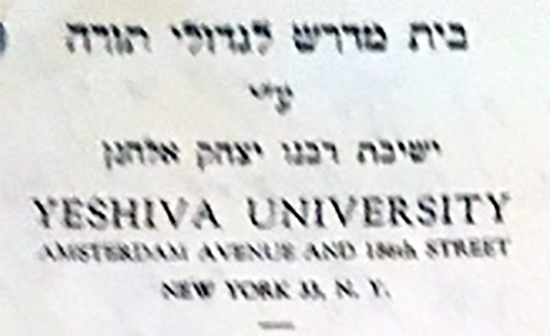
Notice how the two title pages have different publication dates. At that time, Yeshiva University was helping to fund R. Kasher’s work on the Rogochover.[5]
Here is page 2 of the preface.

As you can see, in the original publication the text from R. Zevin appears in its entirety. It is only in the second edition that R. Kasher altered what R. Zevin wrote.
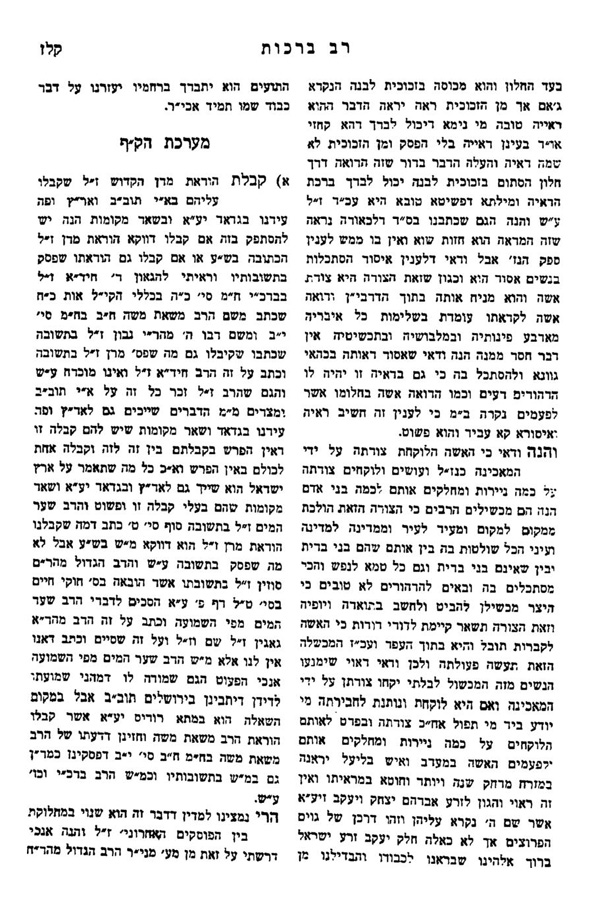
There is a good deal more to say about the Rogochover, so let me add another point. In 1892 R. Dov Baer Judah Leib Ginzberg published his Emunat Hakhamim. Included in it, on pages 23b-24b, is a report of how the Rogochover understood the time of death. I believe that what he states can be used to support the argument that brain death is equal to halakhic death. Here are the pages.

The matter of antinomianism, and in particular the Rogochover violating halakhah in the name of a higher purpose, is of interest to many people. In a future post I will cite an example concerning which I think everyone (or most everyone) will agree that even though the halakhah is clear, nevertheless, even the most pious will not hesitate to violate the halakhah in this particular case, again, because of a larger concern.
For now, I want to call attention to another who, like the Rogochover, was very unusual. R. Shlomo Aviner writes as follows:[6]

בישיבת “מרכז הרב” היה גאון אחד בשם הרדיצ’קובר, שהיה מתנהג בצורה משונה. הוא היה נכנס לשירותים עם ספר הרמב”ם. אמרו לו: אסור! ותשובותו: “הרי גם הרמב”ם עצמו היה נכנס לשרותים!”כשנפטר, היו האנשים נבוכים בהספד שלו, שהרי היה תלמיד חכם, אך התנהג בצורה מוזרה מאד. הרב נתן רענן, חתנו של מרן הרב, הספיד אותו ואמר, שגדולתו היתה אהבת התורה, ומרוב אהבת התורה עשה דברים שלא יעשו. הוא חטא חטאים שנבעו מאהבת התורה.

R. Aviner speaks about a gaon known as the Radichkover who was quite strange. He would go into the restroom holding a copy of the Mishneh Torah. When he was told that this is forbidden, he replied that Maimonides himself went to the restroom! In other words, if Maimonides could go into the restroom then certainly his book can be brought into it. The Radichkover actually tells this story himself about bringing R. Reuven Katz’s book, Degel Reuven, into the restroom.[7]
When he died, people did not know how to eulogize him, because on the one hand he was a great talmid hakham, but on the other hand he acted in a very strange manner. R. Aviner tells us that R. Natan Ra’anan, the son-in-law of R. Kook, delivered the eulogy and said that his greatness was his love of Torah, and due to this great love he did things that were improper. “He sinned yet these sins arose from his love of Torah.”
It is obviously not very common that a eulogy mentions improper things done by the deceased. It is also understandable why, due to his unconventionality, the Radichkover reminds people of the Rogochover. For those who have never heard of him, his name was R. Yaakov Robinson (1889-1966), and before coming to Eretz Yisrael he studied with R. Baruch Ber Leibowitz. You can read more about him here and here. Two responsa in R. Moshe Feinstein’s Iggerot Moshe were sent to the Radichkover. Both of these responsa are from 1933, when R. Moshe was still in Russia.[8]
If you look at the Wikishiva page on the Radichkover here, it says that he died in 1977. So how do I know that this is incorrect and that he died in 1966? Because he died at the same time as R. Jehiel Jacob Weinberg. Here is a page from Beit Yaakov, Shevat 5726, p. 31, and you can see the announcement of both of their funerals.

It is typical of an Agudah publication like Beit Yaakov that it would falsely state that R. Weinberg was connected for many years with Agudat Israel. This is as false as the newspaper’s statement that he served as rosh yeshiva in Montreux.
A number of sharp comments of the Radichkover became well known in the Jerusalem yeshiva world and are mentioned in the two sites I linked to above. See also here for more of his sayings. Here is one I liked, which was written by the Radichkover in one of his works (mentioned here).[9]
הבוקר אחרי התפילה ניגש אלי יהודי ושאל אותי למה אני יושב ב”ויברך דוד”. חשבתי לעצמי, זה שאני יושב בלי אשה, זה לא מפריע לו, זה שאני יושב בלי פרנסה, זה לא מפריע לו, מה כן מפריע לו, שאני יושב בויברך דוד . . .
Here is another great story dealing with the Hazon Ish (mentioned here)
ר’ יענקל היה נתון תדיר בתחושת רדיפה. מעולם לא אכל אוכל שלא הכין בעצמו ועוד שאר דברים ע”ז הדרך. פעם נזעק לביתו של החזון אי”ש בטענה כי אחדים מבני הישיבה ניסו להרעילו. מה עליו לעשות. שאלו החזון אי”ש: “מה שמו בכוס קודם – את התה או את הסם”. הרהר ר’ יענקל קלות וענה: “קודם את התה ואח”כ את הסם”. נענה החזו”א: “אנחנו הרי פוסקים שתתאה גבר”. ונח דעתיה.
In the recently published conversations of the late R. Meir Soloveitchik, Da-Haziteih le-Rabbi Meir, vol. 1, p. 159, the Hazon Ish’s wife is quoted as saying as follows about the Radichkover: 

מה”שברי לוחות”, אפשר לראות ולשער מה היו הלוחות השלמות, כאשר היה בריא

While the Radichkover never published any full-length books, he published a number of short pieces. Here is the first page of his Masa Dumah.

Here is the first page of his Olam Gadol Oleh ve-Olam Katan Shokea.

A short glance at either of these works should suffice to show that we are not dealing with a “normal” talmid hakham. In Olam Gadol, p. 10, he reports that the Rogochover said about him that he was the greatest Torah scholar alive! Here is page 15 of Olam Gadol. It hardly needs to be said that what he includes here about the locked rest rooms is not the typical material found in seforim.

In Masa Dumah, p. 8, he makes the following sharp comment about R. Joseph Kahaneman. “They asked me in the Ponovezh yeshiva, what I have to say about the Ponovezher Rav. I said to them that he is greater than the Maharal of Prague. The Maharal created one golem and he created three hundred golems. The Ponovezh Yeshiva is a factory for am ha’aratzut.”
Excursus
The people who saw the Radichkover sitting during Vayvarekh David were bothered since everyone knows that this is recited standing. The ArtScroll siddur states: “One must stand from ויברך דויד until after the phrase אתה הוא ה’ הא-להים, however there is a generally accepted custom to remain standing until after ברכו.” I don’t like this formulation. On what basis can ArtScroll state that “one must stand”? The word “must” means that we are dealing with a halakhah, i.e., an obligation. But that is not the case at all. Standing in Vayvarekh David is only a minhag, like much else we do in the prayers.[10] As such, I think it would have been proper for ArtScroll to write, “The generally accepted practice is to stand from ויברך דויד” etc.
R. Moses Isserles, Shulhan ArukhOrah Hayyim 51:7, refers to standing in Vayvarekh David, and his language is as follows:[11]
ונהגו לעמוד כשאומרים ברוך שאמר ויברך דוד וישתבח

On this passage, the Vilna Gaon writes: לחומרא בעלמא, “it is only a stringency”. R. Jehiel Michel Epstein, Arukh ha-Shulhan, Orah Hayyim 51:8, also writes that there is no halakhah to stand for Vayvarekh David.
ומצד הדין אין שום קפידא לבד בשמ”ע ומחויבים לעמוד וקדושה וקדיש וברכו.
R. Epstein returns to this matter in Arukh ha-Shulhan, Yoreh Deah 214:23. This passage is not well known as this volume of Arukh ha-Shulhan was only printed in 1991 and is not included in the standard sets of Arukh ha-Shulhan that people buy. R. Epstein writes:
מדינא דגמ’ מותר לישב בכל התפלה לבד שמונה עשרה דצריך בעמידה ושיש הרבה נוהגים ע”פ מה שנדפס בסידורים לעמוד כמו בויברך דוד וישתבח ושירת הים וכיוצא בהם גם זה אינו מנהג לקרא למי שאינו עושה כן משנה ממנהג וראיה שהרי יש מן הגדולים שחולקים בזה.
According to R. Epstein, one does not even violate a minhag by sitting for Vayvarekh David and the rest of the prayers through Yishtabah.
So we see that when it comes to standing, Vayvvarekh David has the same status as Yishtabah, i.e., standing for both is minhag. Yet ArtScroll mistakenly separates the two, regarding the standing for Vayvarekh David as halakhah and the standing for Yishtabah (and everything in between) as “a generally accepted custom.” It is worth noting that the Mishnah Berurah, Orah Hayyim 51:19, only mentions the custom of standing in Vayvarekh David, not the current practice of standing until after Yishtabah. I must note, however, that the Kaf ha-Hayyim, Orah Hayyim 51:43, quotes R. Isaac Luria that one has to stand, צריך לעמוד, during Vayevarekh David. This is similar to ArtScroll’s formulation, but I find it hard to believe that ArtScroll’s instructions are based on kabbalistic ideas.
R. Jacob Moelin (the Maharil) did not stand for Vayvarekh David. See Sefer Maharil, Makhon Yerushalayim ed., Hilkhot Tefilah, no. 1, p. 435, and R. Yair Hayyim Bacharach, Mekor Hayyim 51:7. See also R. Jacob Sasportas, Ohel Yaakov, no. 74, for a report that in Hamburg they did not stand for Vayvarekh David.
R. Samuel Garmizon (seventeenth century), Mishpetei Tzedek, no. 70, was asked about someone who was accustomed to stand in Vayvarekh David (and also in Barukh She-Amar) but now wishes to sit. Is he allowed to? R. Garmizon states that if he mistakenly thought that it was an obligation to stand and has now learned that it is only a pious practice (minhag hasidim), then he is permitted to sit and it is not regarded as if he took on a stringency as an obligation. The Yemenite practice is also not to stand for Vayvarekh David. See R. Yihye Salih, Piskei Maharitz, ed. Ratsaby, vol. 1, p. 118.
While readers might find this all interesting, they might also be wondering what it has to do with the Radichkover, since hasn’t Ashkenazic practice in the last few generations been universally to stand? Actually, this has not been the case. R. Israel Zev Gustman stated that in the Lithuanian yeshivot the practice was to sit for Vayvarekh David, and also for Yishtabah. They only stood for Barukh She-Amar and the kaddish after Yishtabah. See Halikhot Yisrael, ed. Taplin (Lakewood, 2004), p. 117.
R. Shlomo Zalman Auerbach said that the general practice is to sit for Vayvarekh David. See R. Nahum Stepansky, Ve-Alehu Lo Yibol, vol. 1, p. 61:
יש הרבה דברים שכתוב שנהגו לעמוד בהם, ואנחנו רואים שנוהגים שלא לעמוד בהם. ב”ויברך דוד” כותב הרמ”א שנהגו לעמוד – ולא עומדים.
I find this astounding. I have been to Ashkenazic synagogues all over the word and I have never seen people sit for Vayvarekh David. Yet R. Shlomo Zalman says that this is what people do. This passage comes from a discussion of how R. Shlomo Zalman dealt with a young yeshiva student who pressed him that people in the synagogue should stand when someone gets an aliyah and recites Barkhu. R. Shlomo Zalman replied that the minhag is to sit, adding, “You don’t see what people do?!” In other words, the fact that people sit when someone gets an aliyah shows us that this is the minhag and it should not be changed, despite what might appear in various halakhic texts.
Regarding standing during prayers, I have noticed something else. When I was young many of the old timers would sit for the various kaddishes. Today, in the Ashkenazic world, it seems that everyone stands for every kaddish, and this is in line with what R. Moses Isserles writes in Shulhan Arukh, Orah Hayyim 56:1. Also, it seems that for the communal mi-sheberakh for sick people everyone also stands, and in some shuls they announce that everyone should stand. Why is this done? I cannot think of any reason to stand for this mi-sheberakh unless it is a way to get people to stop talking. 

Michael Feldstein recently commented to me that in the last ten years or so he has seen something that did not exist in earlier years, namely, people standing for Parashat Zakhor. I, too, noticed this in my shul, but it has only been going on for a year or two. This year, no one announced that people should stand. Some just stood up on their own and pretty much the entire shul then joined in. Unless the rabbis start announcing that people can sit down, in a few years it will probably become obligatory to stand for Parashat Zakhor, much like it now seems to be obligatory to repeat the entire verse, whereas when I was young the only words to be repeated were תמחה את זכר עמלך. (I always paid attention to this as Ki Tetze is my bar mitzva parashah.) Today, if the Torah reader tries to repeat only these words, they will tell him to go back and repeat the entire verse. What we see from all of this is that customs are constantly being created, and they often arise from the “ritual instinct” of the people, without any rabbinic guidance.

Two final points: 1. In the word ויברך the yud is a sheva nah (silent shewa). 2. The accent is on the second to last (penultimate) syllable, the ב, not on the final syllable, the ר. This word also appears in Friday night kiddush, and it is very common to hear people, including rabbis, make the mistake of treating the yud as a sheva na (vocal shewa) and also putting the accent on the last syllable. Many people also make a mistake at the beginning of kiddush by pronouncing the word ויכלו with the accent on the second to last syllable, the כ, when it should be on the last syllable, the ל. Another common pronunciation mistake is found in the Shabbat morning kiddush. וינח has the accent on the second to last syllable, the י, not on the final syllable, the נ.

Regarding the instructions in the ArtScroll siddur, another example of confusion is found in the commentary on Av Ha-Rahamim, pp. 454-455. ArtScroll writes:
As a general rule, the memorial prayer [Av ha-Rahamim] is omitted on occasions when Tachanun would not be said on weekdays, but there are any numbers of varying customs in this matter and each congregation should follow its own practice. During Sefirah, however, all agree that אב הרחמים is recited even on Sabbaths when it would ordinarily be omitted, because many bloody massacres took place during that period at the time of the Crusades. Here, too, there are varying customs, and each congregation should follow its own.
In the second-to-last sentence, ArtScroll says that “all agree”, but in the very next sentence it states that “there are varying customs.” If there are varying customs, then obviously not “all agree”. Incidentally, R. Zvi Yehudah Kook said Av ha-Rahamim every Shabbat, i.e., even when the accepted minhag is to omit it, since he felt that after the Holocaust this was the appropriate thing to do. See Va-Ani be-Golat Sibir (Jerusalem, 1992), p. 298.
Finally, since I have been speaking about different customs in prayer, I should mention something that I forgot to include in my post here, dealing with China. I believe that, outside of Israel, there is only one Ashkenazic synagogue in the world that has birkat kohanim every day.[12] This is Ohel Leah in Hong Kong. (R. Mordechai Grunberg, who has traveled all over the world as an OU mashgiach and currently works in China, told me that as far as he knows this statement is correct. I had the pleasure to spend Shabbat with him and three mashgichim from the Star-K at the wonderful Chabad House in Shanghai in June 2018.)  
I have no doubt that the reason for the Ohel Leah minhag is because its nineteenth-century community was Sephardic. At some time in the twentieth century (no one was able to tell me when) the liturgy became Ashkenazic, but the daily birkat kohanim was kept. Interestingly, although the liturgy is Ashkenazic, it is nusah sefard. I assume the reason for this is that when they decided to adopt the Ashkenazic liturgy they wanted it to still have a Sephardic flavor, and that is why they chose nusah sefard.
* * * * * * *
2. Simcha Goldstein called my attention to how earlier this year the 5 Towns Jewish Times “touched up” a picture of Ivanka Trump.

3. Here is a painting of the Rav, R. Joseph B. Soloveitchik. It was commissioned by his wife when he was fifty years old. The Rav later gave this painting to Rabbi Julius Berman, and it is currently hanging in his home. I thank Rabbi Berman who graciously allowed me to publish a picture of the painting.

4. Tzvi H. Adams contributed three fascinating and thought-provoking posts to the Seforim Blog dealing with the impact of Karaism on rabbinic literature. He has now published a comprehensive article on this matter in Oqimta, available here. Its title is “The Development of a Waiting Period Between Meat and Dairy: 9th-14th Centuries.” There is a good deal to say about this article, but let me just make a couple of comments. On p. 4 he writes:

Even many minhagim extant today were arguably initiated as a response to the Karaite movement. For example, many historians agree that the recital of the 3rd chapter from Mishnat Shabbat, “Bamme Madlikin,” on Friday evenings following the prayer service was introduced during the time of the geonim with the intent of reinforcing the rabbinic stance on having fire prepared before Shabbat, in opposition to the Karaite view that no fire may be present in one’s home on Shabbat.[13] Similar arguments have been made for the origins of the custom of reading Pirkei Avot, the introduction of which traces rabbinic teachings to Sinai, on Shabbat afternoons. Recent scholarship has demonstrated that the creation of Ta’anit Esther in geonic times was likely a reaction to Karaite practices. 
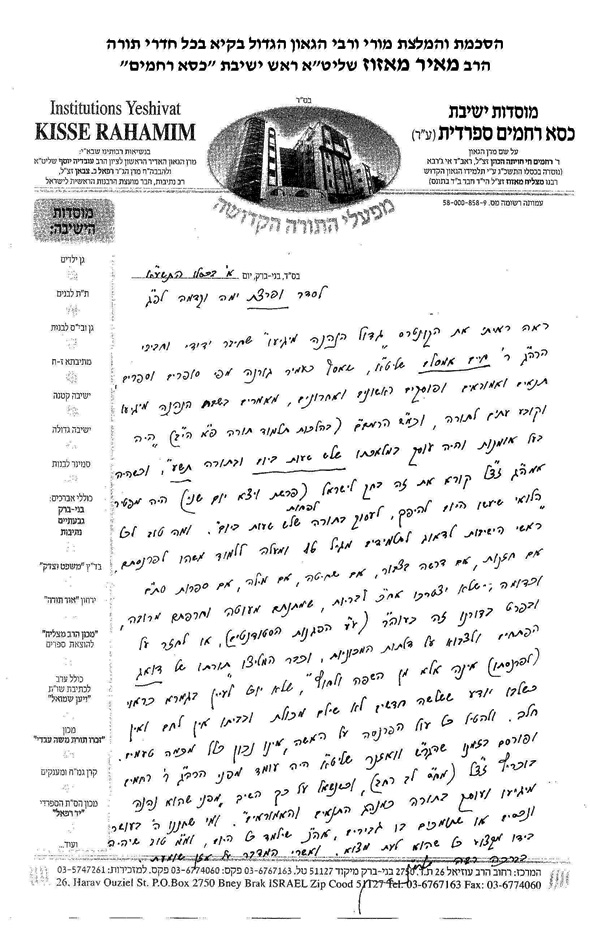
Later in the article, p. 57 n. 141, Adams mentions what might be the most prominent example of a response to Karaite practices, namely, reciting a blessing on the Shabbat candle. This blessing does not appear in the Talmud.[14] It is a geonic innovation, and according to R. Kafih it was instituted in opposition to the Karaite view that no fire should be burning in one’s home on the Sabbath.[15] He argues that by adding a blessing to the candle lighting, the geonim created an anti-Karaite ritual. While the Karaites would sit in the dark every Friday night, not only would the Jews have light, but they would recite a blessing before lighting the candle,[16] thus showing their rejection of the Karaite position.[17] R. Meir Mazuz makes the exact same point,[18] as does R. Abraham Eliezer Hirschowitz,[19] Isaac Hirsch Weiss,[20] Jacob Z. Lauterbach,[21] and Naphtali Wieder.[22]
In fact, some have argued that not only the blessing but the candle lighting itself was instituted in response to heretics who did not use fire on the Sabbath. As Lauterbach states, “It was as a protest against the Samaritans and the Sadducees.”[23] R. Kafih sees R. Joseph Karo as sharing this opinion. He writes as follows, quoting Maggid Meisharim (and assuming that what the Maggid says represents R. Karo’s view).[24]
וכתב מרן בספרו מגיד מישרים ר”פ ויקהל ואמר ביום השבת, למימר דדוקא ביום השבת גופיה הוא דאסור לאדלקא, אבל מבעוד יום לאדלקה ליה ויהא מדליק ומבעיר ביומא דשבתא שרי. ולאפוקי מקראים דלית להו בוצינא דדליק ביומא דשבתא ע”ש. נראה שגם מרן ראה בחובת הדלקת נר בשבת גם פעולה נגד דעות הכופרים בתורה שבע”פ שעליהם נאמר ורשעים בחשך ידמו.
Regarding the Shabbat candle, it is also worth noting that R. Judah Leib Landsberg actually stated that the practice of candle lighting was adopted from the Persians. Since the Jews were so attached to what was a pagan practice, Ezra and Nehemiah directed this practice towards a holy purpose, much like the origin of sacrifices was explained by Maimonides.[25]
ואפילו היה דומה למנהגי הפרסיים, לא היה ביד עזרא ונחמיה הכח והרצון לעקור המנהג הנשתרש באומה משנים קדמוניות, ולכבה האש זר “החברים” מבית ישראל. ובכל זאת למען תת לו איזה חינוך קדושה קדשוהו ותקנוהו להדליק האש של חול לנר קודש לקדושת השבת, כסברת הרמב”ם ז”ל בענין קרבנות כנודע.
He later acknowledged that this was not a serious explanation and claimed that the practice of candle lighting went back to Moses.[26]
One final comment about Karaites: Rashi, Sukkah 35b, s.v. הרי יש, has a strange formulation. In discussing the prohibition to redeem terumah so that an Israelite could eat it, Rashi writes:

הרי יש בה היתר אכילה לכהן, וישראל נמי נפיק בה, או לקחה מכהן הואיל ויכול להאכילה לבן בתו כהן, אבל פדיון אין לה להיות ניתרת לאכילת ישראל, והאומר כן רשע הוא


How is it that Rashi refers to one who makes a mistake in this matter as a רשע? Many people have attempted to explain this passage. R. Isaac Zev Soloveitchik noted that there must have been a sect that believed that it was permitted to redeem terumah, and that is why Rashi responded so sharply.[27] Regarding this suggestion of R. Soloveitchik we can say, חכם עדיף מנביא.

R. Tuvya Preschel’s Ma’amrei Tuvyah, volume 3, recently appeared. On p. 67 it reprints an article that appeared in Sinai in 1966. Preschel points out that the notion that terumah can be redeemed is stated by none other than Anan ben David in his Sefer ha-Mitzvot. It appears that Rashi knew of this Karaite opinion and this explains his harsh reaction. This was a great insight by Preschel, Unfortunately, while this insight has been cited by many in the last fifty years, Preschel is almost never given credit.
5. Many countries in Europe have Stolpersteins. These are brass plates, created by the artist Gunter Demnig, commemorating martyrs of the Holocaust. They are put in the pavement in front of buildings where the martyrs lived. A few years ago Demnig also started doing this for survivors of the Holocaust. I arranged to have one made for R. Jehiel Jacob Weinberg.
After almost two years of waiting, I am happy to report that on June 18, 2018, a Stolperstein was placed at Wilmersdorfer Strasse 106, in Berlin. There was a little ceremony when the Stolperstein was inserted. Here is a picture of Demnig installing it as well as some other pictures that I think people will find moving.

[1] Yad Peshutah, Hilkhot Rotzeah 5:5.
[2] Yesodot Hinukh ha-Dat le-Dor (Riga, 1937), p. 250.
[3] Sefer ha-Meorot, Moed Katan, ed. Blau (New York, 1964), pp. 73-74 (to Moed Katan 20a).
[4] For a great story about the Rogochover told by R. Menahem Mendel Schneerson, see Likutei Sihot, vol. 16, pp.  374-375.
[5] Yeshiva University’s Gottesman Library also has a large archive of over 2500 letters and postcards sent to the Rogochover. This material was sent to the United States before World War II by the Rogochover’s daughter. I published a lengthy letter from this collection in my article on the dispute over the Frankfurt rabbinate. See Milin Havivin 3 (2007), pp 26-33.
The Zaphnath Paneah Institute at YU no longer exists. When I look at old material from YU, I often come across things that are now only a memory. Here is something I think people might find interesting.

(Unfortunately, the picture I took is not so clear.) The Beit Midrash li-Gedolei Torah was the name of a kollel at YU in the 1940s and 1950s headed by R. Avigdor Cyperstein. I thank his daughter, Mrs. Naomi Gordon, for allowing me to go through his papers where I found the stationery with the name of the kollel. R. Gedaliah Dov Schwartz was actually a member of this kollel. See Ha-Pardes, Tevet 5751, p. 58 and Kislev 5752, p. 1. Today YU has a number of kollels, see here, but none with this name. Does anyone know when this kollel stopped functioning?

[6] Mi-Shibud li-Geulah mi-Pesah ad Shavuot (n.p., 1996), p. 87.
[7] See his Masa Dumah, p. 4.
[8] Iggerot Moshe, Yoreh Deah, vol. 1, nos. 4, 74. The first responsum mistakenly has the place of authorship as London, when it should say Luban. The city name appears correctly in the second responsum, which was written on the same day as the first. See here.
[9] See the Excursus where I discuss standing for Vayvarekh David.
[10] Saying Vayvarekh David is itself only a minhag. See Tur, Orah Hayyim 51:7:
ובתקון הגאונים כתוב יש נוהגים לומר ויברך דוד את ה’

[11] In Darkhei Moshe, Orah Hayyim 51 he writes:

המנהג עכשיו לעמוד מויברך דוד עד תפראתך
From his words we see that people only stood for the first half of Vayvarekh David.
[12] There is a lot of confusion as to how to pronounce the word ברכה in both the singular and plural construct: ברכת and ברכות. The first is pronounced birkat, as there is a dagesh in the כ. The second is pronounced birkhot, as there is no dagesh in the כ, and is parallel to the word הלכות – hilkhot. Interestingly, ברכתי (“my blessing”) does not have a dagesh in the כ even though ברכת does. I don’t think that there is any grammatical rule that can adequately explain all this. We know how the words related to ברכה are pronounced because they are attested to numerous times in Tanakh.

The word הלכות does not appear in Tanakh, and the Yemenite tradition is actually to pronounce it as hilkot, with a dagesh in the כ. See here. When not quoting from Tanakh, the Yemenite tradition is also to pronounce ברכת as birkhat, as in birkhat ha-mazon. See here.
[13] It is not only historians who say this. See R. Yitzhak Yeshaya Weiss, Birkat Elisha (Bnei Brak, 2016), vol. 3, p. 37, and see also R. Shimon Szimonowitz, Meor Eifatekha, p. 4, who cites R. Jacob Schorr and R. Serayah Deblitsky.
[14] A number of Ashkenazic rishonim quote a passage from the Jerusalem Talmud that speaks of a blessing on the Sabbath light, yet this is not found in any extant text and scholars agree that it is not an authentic Yerushalmi text. See the comprehensive discussion in R. Ratzon Arusi, “Birkat Hadlakat Ner shel Yom Tov,” Sinai 85 (1979), pp. 63ff. See also Jacob Z. Lauterbach, Rabbinic Essays (Cincinatti, 1951), p. 459 n. 98 and Sefer Ra’avyah, ed. Aptowitzer, vol. 1, p. 263 n. 10.
[15] See Teshuvot ha-Rav Kafih le-Talmido Tamir Ratzon, ed. Itamar Cohen (Kiryat Ono, 2016), pp. 162-163, and R. Kafih’s commentary to Mishneh Torah, Hilkhot Shabbat 5:1, n. 1.
[16] I use the word “candle”, rather than the plural, “candles”, as the practice of lighting two candles only originated later, in medieval Ashkenaz. See R. Gedaliah Oberlander, Minhag Avoteinu Be-Yadenu: Shabbat Kodesh (Monsey, 2010), pp. 11ff. I was surprised to learn that R. Meir Soloveitchik’s daughters each lit a Shabbat candle and recited the blessing from the time they were three years old. See Da-Haziteih le-Rabbi Meir, vol. 1, p. 323.
[17] In later years we find that some Karaites adopted the practice of lighting candles on Friday night. Se Dov Lipetz, “Ha-Karaim be-Lita,” in Yahadut Lita (Tel Aviv, 1959), vol. 1, p. 142
[18] Bayit Ne’eman 38 (25 Heshvan 5777), p. 3, Bayit Ne’eman 118 (10 Tamuz 5778), p. 2 n. 9. In She’elot u-Teshuvot Bayit Ne’eman, p. 190, he does not present this approach as absolute fact, but states that it is “nearly certain”.

וקרוב לודאי שברכת נר שבת נתקנה בימי הגאונים להוציא מדעת הקראים

[19] Otzar Kol Minhagei Yeshurun (St. Louis, 1917), p. 232.
[20] Dor Dor ve-Doreshav (Vilna, 1904), vol. 4, p. 97. Weiss points to other examples of practices that he suggests were a response to Karaites, such as counting the omer at night, betrothing a woman with a ring, and reciting רבי ישמעאל אומר in the morning prayers. R. Judah Leib Maimon claims that the practice of a Saturday night melaveh malka was instituted by the geonim in opposition to the Karaites, who saw the Sabbath as a difficult and depressing day, in contrast to traditional Jews who find it difficult to part with the Sabbath. See Sefer ha-Gra, ed. Maimon (Jerusalem, 1954), vol. 1, p. 80.
[21] Rabbinic Essays, p. 460. He writes that the blessing was “probably intended as a more emphatic protest against the Karaites.”
[22] “Berakhah Bilti Yeduah al Keriat Perek ‘Bameh Madlikin,’” Sinai 82 (1978), p. 217.
[23] Rabbinic Essays, p. 459. See also Yehudah Muriel, Iyunim ba-Mikra (Tel Aviv, 1960), vol. 2, p. 131.
[24] Commentary to Mishneh Torah, Hilkhot Shabbat 5:1, n. 1.
[25] Hikrei Lev (Satmar, 1908), vol. 4, p. 84.
[26] Ibid, pp. 84, 86ff.
[27] Shimon Yosef Meler, Uvdot ve-Hanhagot mi-Beit Brisk (Jerusalem, 2000), vol. 4, p. 310.


The sukkah on Shemini Atzeret controversy

The sukkah on Shemini Atzeret controversy
by William Gewirtz

Introduction: Arguments about eating in the sukkah on Shemini Atzeret outside of Israel have a long and somewhat baffling history.[1] While not the only example of practice in opposition to the Shulchan Aruch, it appears to be among the most argued. The gemara, Rambam, the Tur and the Shulchan Aruch, written in many locales, all seem to be as unambiguous as possible in requiring one to eat in the sukkah. The Gaon, incensed by the spreading Chassidic custom to eat outside the sukkah, perhaps lemigdar miltah, went so far as to mandate sleeping in the sukkah on the night of shemini atzeret, in opposition to the Maharil, the Magen Avraham and normative custom. Despite consensus among all major decisors to require eating in the sukkah, an undercurrent of opposition has existed from at least the times of the early rishonim. Support for that opposition has been based on a number of apparently legitimate points. However, despite some early and consistent opposition, despite the logic and halakhic rationale of those who did not sit in the sukkah, and despite the problematic nature of the gemara (as explained below), I hope to explain the basis for the concluding and declarative statement in the gemara: “we sit but do not make a berakha.” In fact, the assumption, explicitly found[2] as far back as the times of the rishonim, that the declarative ruling was interpolated at a later point, is fundamental to explain both sides of the controversy. Some, as early as the times of the rishonim, argue that we can discount such geonic interpolations in deference to the original text which, as will be demonstrated, concludes not to sit in the sukkah. My goal is to explain why the interpolation is to be followed despite its ostensible opposition to the remainder of the text. The major thesis proposed is that one has to differentiate between a period of doubt as existed in both the yerushalmi and bavli when rosh chodesh was declared based on the observation of witnesses and a later period when rosh chodesh was determined using a fixed calendar. The geonic interpolation into the text of the gemara occurred at that later point; its rationale and inconsistency with the texts of the gemara needs to be addressed from that perspective. If I am correct, then in the period when rosh chodesh was declared based on the observation of witnesses, as in the times of Rav Yochanon and Rav,[3] sitting in the sukkah was not always required. However, when the fixed calendar was in use, the rabbis (eventually) decreed that sitting in the sukkah on Shemini Atzeret was obligatory. It may well have been more akin to a gezairah required at their time versus a continuation of historic practice. The remainder of the paper focuses on:

  • An analysis of the primary texts of the gemarot that demonstrates opposition to sitting in the sukkah on Shemini Atzeret.
  • A conjecture that the level of doubt in the times of the gemara was minor.
  • Possible objections to sitting in the sukkah on Shimini Atzeret when not required and why they were perhaps considered overriding particularly given the level of doubt. Additionally, there are critical factors that differentiate Shemini Atzeret from other cases of yom tov sheni.
  • The interpolation by the geonim, and their insistence on sitting in the sukkah despite earlier halakhic rulings.
  • The objection to the gemara’s conclusion by some early authorities and their different practices.
  • Reasons that would exempt you from sukkah in general, would certainly exempt you on Shemini Atzeret; mitztayer and kabbalat penai rabbo are analyzed as bases for not sitting in the sukkah.
  • A summary and a modest proposal.

Section 1 – An analysis of the primary text of the gemarot demonstrates opposition to sitting in the sukkah on Shemini Atzeret. The sugya in the bavli masechet sukkah beginning on 46b contains three parts:[4] A. The disagreement of Rav Yochanon and Rav. R. Judah the son of R. Samuel b. Shilath citing Rav ruled: The eighth day which may be the seventh is regarded as the seventh in respect of the sukkah and as the eighth in respect of the benediction. R. Yochanon, however, ruled: It is regarded as the eighth in respect of both. B. Two approaches to interpreting the disagreement. FIRST APPROACH: That one must dwell [in the sukkah on the eighth day] is agreed by all, they only differ on the question of the benediction. According to him who regards the day as the seventh in respect of the sukkah, we also recite the benediction [of the sukkah], while according to him who holds that it is regarded as the eighth in respect of both, we do not recite the benediction [of the sukkah]. R. Joseph observed: Hold fast to the ruling of R. Yochanan, since R. Huna b. Bizna and all the notables of his age once entered a sukkah on the eighth day which may have been the seventh, and while they sat therein, they did not recite the benediction. But is it not possible that they were of the same opinion as he who laid down that once a man has recited the benediction on the first day, he has no more need to recite it? — There was a tradition that they had just come from the fields. SECOND APPROACH: (the ikka de’amri) There are some who say that the ruling that one must not recite the benediction [of the sukkah] is agreed upon by both, and that they only differ on the question whether one must sit [inthe sukkah]. According to him who ruled that it is regarded as the seventh day in respect of the sukkah, we must indeed sit in it thereon, while according to him who ruled that it is regarded as the eighth day in respect of both, we may not even sit in it thereon. R. Joseph observed: Hold fast to the ruling of R.Yochanan. For who is the authority of the statement? R. Judah the son of R. Samuel b. Shilath [of course], and he himself sat on the eighth day which might be the seventh outside the sukkah. C. A declarative ruling that “we sit but do not make a berakha.” And the law is that we must indeed sit in the sukkah but may not recite the benediction. A. The disagreement of Rav Yochanon and Rav: Rav states that Shemini Atzeret is treated as the seventh for “this” and the eighth for “that.” Rav Yochanon states it is the considered as the eighth for “this” and “that.” The two approaches differ as to what “this” and “that” refer.[5] B. Two approaches to interpreting the disagreement: The first alternative assumes that all agree that sitting in the sukkah is obligatory; the argument concerns whether to make a berakha. In this approach Rav is asserting that one makes a berakhaleishev ba’sukkah.” The phrase “the seventh for this” refers to this obligation for a berakha on sitting in the sukkah. “The eighth for that” refers to the fact that the other prayers of Shemini Atzeretkiddush and tefillah – mention only the eighth day and make no mention of Sukkot. Rav Yochanon asserts we make no reference to Sukkot, making no berakha when sitting in the sukkah on the eighth. It is the eight for “this” refers to sitting in the sukkah without a berakha; “the eighth for that” is interpreted identically to Rav. According to both opinions, “this” refers to whether or not a berakha is made when sitting in the sukkah on Shemini Atzeret. According to both opinions, “that” refers to the mention of only Shemini Atzeret in the prayers of the eighth day. This reading is rather forced in that there does not appear to be any disagreement about what holiday ought to be referred to in the various prayers and blessings of the eighth day. While the word “this” is informative, the word “that” is not. Stating both Sukkot and Shemini Atzeret in one prayer/blessing would be contradictory; declaring a day to be both Sukkot and Shemini Atzeret was never even raised as a possibility and for good reason. The first approach then quotes practice that supports the view of Rav Yochanon, suggesting that we are to follow the opinion of Rav Yochanon. The second approach assumes not making a berakha on sitting in the sukkah is undisputed; the argument is about even sitting in the sukkah. Thus the second part of the phrase – the eighth for “that” states that common view of both Rav and Rav Yochanon omitting a berakha on sitting in the sukkah. “This” refers to the obligation to sit in the sukkah. Rav maintains for “this” it is considered the seventh and hence one is obligated to sit in the sukkah. Rav Yochanon maintains it is the eighth for “this” as well with no obligation to sit in the sukkah. Note that in this approach of the ikaa de’amri, both parts of the sentence are informative. The second approach then also quotes practice that supports the view of Rav Yochanon, suggesting that we follow the opinion of Rav Yochanon Were the sugya to end at this point, the conclusion would be clear for two reasons. Each reason itself is two-fold, resulting from both a general principle as well as a detail present in this specific case.

  • First, generally, where there are two alternative approaches, the second, the ikaa de’amri, is assumed normative.[6] As well in this specific case, as indicated, the phrase of both Rav and Rav Yochanon is more informative in the formulation of the ikka de’amri.
  • Second, when there is a dispute between Rav and Rav Yochanon, we generally follow Rav Yochanon.[7]As well, in this specific case the text in both alternatives immediately includes an example of practice that follows the opinion of Rav Yochanon.

Taken together, we would assume to follow the second alternative and the opinion of Rav Yochanon – and not sit in the sukkah on Shemini Atzeret. According to many readings, this conclusion is made even more strongly by the yerushalmi.[8] While the bavli addresses the obligation to sit in the sukkah, the yerushalmi notes that one may not sit in the sukkah while making kiddush but one may enter the sukkah afterwards if he so desires. While some rishonim quote this yerushalmi as opposing the psak of the bavli,[9] others claim[10] that the yerushalmi is addressing a region of Israel where there was no doubt about what day the courts declared rosh chodesh. Rabbi Schacter, in support of the former opinion, observed that the yerushalmi uses the expression “leilai yom tov achron;” the plural, “leilai” is only relevant if there is a yom tov sheni on the ninth. Given this interpretation, the yerushalmi is making a rather strong point of equating the nights of the eighth and ninth, dismissing any possibility of an obligation to eat in the sukkah on the eighth.[11] C. A declarative ruling that “we sit but do not make a berakha:” Despite the reading of the gemara as outlined, the bavli concludes that “we sit but do not make a berakha.” This opinion is that of both Rav in the second alternative and Rav Yochanon in the first alternative. This ruling corresponds to two of four opinions quoted; the two alternative opinions – not sitting at all or sitting and making a berakha – are only supported by one amora and only according to one alternative. Despite that, this ruling is contradicted by the normal principles of psak where we would follow Rav Yochanon’s opinion in the second alternative, as well as the yerushalmi. The language of the gemarashemini safek shevii,” and in particular the various amoraim cited, place the gemara not in the period of calculation based on a fixed calendar, but still during a period where rosh chodesh was declared based on observation. During that period, yom tov sheni was observed because of real doubt and also, at some point, as a precaution even during those years where doubt did not exist. Given the establishment of a fixed calendar in 359 CE by Hillel II, it is not entirely clear in exactly what era yom tov sheni was firmly established and, more importantly, when it was extended to include sitting in the sukkah on Shemini Atzeret. It is entirely plausible, that this declarative ruling obligating sitting in the sukkah on Shemini Atzeret followed the period debated in the gemara by multiple centuries. This resolves the apparent contradiction in the text. Why this was not stated explicitly in the gemara is only problematic if one does not assume it was obvious. Section 2 – A conjecture that the level of doubt in the times of the gemara was minor. Returning now to the period of real doubt over which day was declared rosh chodesh, the question of why was sitting in the sukkah not considered mandatory? We will deal with a number of reasons that would argue against sitting in the sukkah in the next section. However, there are two factors that would reduce the level of doubt in the times of declaration based on observation.

  • First, atmospheric conditions in the Middle East around the beginning of Tishrai are normally excellent and the ability for a new moon crescent to be observed is very high.[12]
  • Second, the beit din had flexibility to reduce any doubt around Rosh HaShana. When necessary, the beit din could delay declarations of rosh chodesh Elul to guarantee that a moon’s crescent would always be present to be observed on the evening following the 29th of Elul.[13]

These two factors lowered the level of doubt considerably. In addition,

  • the late date in the month when Shemini Atzeret occurs and
  • the effort to determine Yom Kippur

would likely reduce the level of doubt even further. After fasting only on the 10th day of Tishrai as Yom Kippur, it is entirely possible that in spite of observing yom tov sheni on the first days of sukkot, the level of doubt was minimal and insufficient to overcome the objections covered in the next section.[14] Section 3 – Possible objections to sitting in the sukkah on Shemini Atzeret when not required and why they were overriding particularly given the level of doubt. Additionally, one can differentiate Shemini Atzeret from the more usual case of yom tov sheni on multiple grounds. There are two potential issues with sitting in the sukkah on Shemini Atzeret, tarti de’sasreh, acting in a contradictory manner[15] and violating the prohibition to add to a mitzvah, by adding an additional day of sukkah observance, particularly on Shemini Atzeret where sitting in a sukkah is not part of the observance.[16] In the case of sitting in the sukkah, a potentially neutral act, neither is violated if some aspect of performance is compromised; however, the degree of compromise required may be in dispute. Regardless of which of the two reasons[17] is invoked, in a case of limited doubt, one or the other or both may have been sufficient to make sitting in the sukkah on Shemini Atzeret either not obligatory or perhaps not even permitted without some restrictions. Both the yerushalmi and various opinions in the main text of the bavli, support this conclusion. At some point after a fixed calendar was established in the fourth century, a second day of yom tov was formalized (or maintained.)[18] As Rav Soloveitchik explained, an additional level of kedushat yom tov was applied to either an ordinary day (the day after a yom tov, isru chag) or the first day of chol hamoed because of sefaikah de’yoma. This additional level of kedusha, automatically invoked obligations for kiddush, tefillah, sippur yetziat mitzraim, etc. as well as prohibitions from work. Of course, such an approach could not be applied to Shemini Atzeret; it was already a holiday and one could not add to its kedusha, only change it. This was not done; note that we do not mention Sukkot nor do we observe the mitzvah of lulav. We simply sit in the sukkah without a berakha, something that is both different from a halakhic perspective from other observances of yom tov sheni that derive from the changed status of the day, and in Rav Soloveitchik’s opinion, less than satisfactory conceptually. He said, perhaps half-seriously, that despite his unwavering adherence to normative halakha, the position of the chassidim makes more sense. In any case, sitting in the sukkah is a unique observance with textual, historical and conceptual challenges. Section 4 – The interpolation by the geonim[19], and their insistence on sitting in the sukkah despite earlier halakhic rulings. I do not know the precise history of yom tov sheni. However, both reciting berakhot during yom tov sheni against normal halakhic practice,[20] as well as the assumed halakhic interpolation by the geonim requiring sitting in the sukkah on Shemini Atzeret may both have similar origin – the need to reinforce the observance of yom tov sheni. As Dr. Haym Soloveitchik points out,[21] the case of sukkah on Shemini Atzeret proves the wisdom of insisting on a berakha; the one mitzvah of yom tov sheni for which we do not recite a berakha, resulted in widespread non-observance. It seems more than likely that this interpolation was recognized as “outside the norm” if the practice during the period of doubt did not include sitting in the sukkah on Shemini Atzeret. Like berakhot, it may have been viewed as necessary particularly following a single day observance of Yom Kippur to strengthen the observance of yom tov sheni. One can only assume that the ruling’s discontinuity from the remainder of the text of the gemara was recognized and did not need elucidation; when first written, a then contemporary reader would recognize the change in practice. Section 5 – The objection to the gemara’s conclusion by some early authorities and their different practices. Given universal acceptance of the observance of yom tov sheni in the times of the rishonim, one would not have expected any deviation from the gemara’s definitive conclusion. Rabbi Schacter and Dr. Soloveitchik highlight a number of sources that illustrate the lack of universal acceptance of the gemara’s conclusion by Rashi’s rebbe and members of his family,[22] a distinguished member of the Maharil’s community,[23] and by a member of the Kolonymous family.[24] Citing the core sugya in the bavli and the yerushalmi, while certainly relevant does not in and of itself justify deviating from a clear conclusion even if it is of geonic origin. What is universally conjectured is that the cold climate of Northern Europe motivated a change. For the geonim omitting a berakha constituted enough of a heker to obviate either objection – either a tarti de’sasreh or violating a prohibition to add to a mitzvah by adding an additional day of sukkah observance. In a temperate climate, eating outside without a berakha renders sitting in the sukkah a more balanced act – clearly not a complete fulfillment of the obligation to sit in the sukkah, but, nonetheless, still honoring the institution of yom tov sheni shel galyot. However, in the cold climate of Northern Europe, even absent a berakha, either objection would, as it did in the times of real safek, make sitting in the sukkah (at least during kiddush) problematic. Note as well that the custom of returning to the sukkah during the day is consistent with this logic. During the day:

  • the temperature is milder,
  • there is no tarti de’sasreh from the recitation of kiddush, and
  • having been absent from the sukkah at night, as Rav Soloveitchik pointed out, creates a discontinuity of performance that renders sitting in the sukkah the following day a non-violation of adding to the mitzvah.

What is perhaps most surprising is that even after the period of the Tur and Shulchan Aruch, Rav Yosef Yuzpa, the dayan in Frankfurt am Mein around the end of the 16th and beginning of the 17th century, when Rav Isaiah Horowitz, the Shelah HaKadosh, was Rav, in his sefer Yosef Ometz was still able to state that a family, descendant of Troyes, who does not sit in the sukkah, “has on what to rely.”[25] Section 6 – Reasons that would exempt you from sukkah in general, would certainly exempt you on shemini atzeret; mitztayer and kabbalat penai rabbo are analyzed as bases for not sitting in the sukkah. Mitztayer would exempt one from sitting in the sukkah not just on Shemini Atzeret but also on Sukkot proper. However, mitztayer is likely not binary. At one extreme, by living unnaturally in the sukkah one may not even fulfill one’s obligation, regardless of intent, as would be the case in extreme cold or very rainy weather. If, however, it is somewhat uncomfortable given the elements, sitting in the sukkah may no longer be obligatory, while it would still remain a fulfillment of one’s obligation. It seems logical as well to differentiate further the notion of mitztayer as it might apply to Sukkot versus Shemini Atzeret. Perhaps a yet lesser degree of mitztayer, not sufficient to allow eating outside the sukkah on Sukkot, might nonetheless, be more than sufficient to override and invalidate the level of heker made by not reciting a berakha. I have not seen any discussion of this notion by poskim, despite its apparent logic.[26] By analogy, one might not be legally drunk, but nonetheless it would be wise not to drive a car. Similarly, one might argue for eating outside the sukkah on Shemini Atzeret in conditions that do not meet the halakhic definition of mitztayer on Sukkot proper. Thus, cold temperatures that might not justify eating outside the sukkah on Sukkot could nonetheless justify, and indeed perhaps mandate, not eating in the sukkah on Shemini Atzeret. Rav Soloveitchik, in an attempt to justify Chassidic practice, noted the importance of the night of Shemini Atzeret, following the “guten kvitel” that Kabbalists associated with the day of Hoshana Rabbah. Like the exemption accorded to the celebration of sheva berachot even on Sukkot, when the sukkah does not comfortably provide adequate room, one can argue that the large celebrations by Chassidim where they are mekabeil penai rabbom, would similarly provide an exemption. I would add that here as well, a lesser degree of need might again be seen as voiding any heker provided by just omitting a berakha. Of course, while this explains why a tisch was held outside the sukkah, it does not in any way justify a general practice of avoiding the sukkah that has become widespread in many Chassidic circles.[27] Section 7 – A summary and a modest proposal. The discussion in the gemara covered a period of history where there was real doubt about the declaration of rosh chodesh, although in the case of Shemini Atzeret, that doubt was minimal. In the face of minimal doubt, the reasons not to sit in the sukkah prevailed. The geonim, perhaps in order to strengthen the notion of yom tov sheini, instituted the practice that “we sit but do not make a berakha.” It is not my intent to give halakhic advice; some might suggest that perhaps we ought to not even ask a local rabbi as much as follow family practice. In any case, for those who eat in the sukkah, I would consider situations of partial mitztayer that might arise, where eating in the sukkah may not be appropriate. On the other hand, given widespread laxity, one might argue that the stringencies of the geonim and the Gaon might again be particularly relevant. Of course, most fundamentally for those whose ancestors ate outside the sukkah in Warsaw, conditions are rather different in Miami,[28] or even in Baltimore or Boston.

[1] Shiurim by Rav Joseph B. Soloveitchik ztl on the Bergen Torah Beis Medrash website, as well as by Rabbi Dr. Jacob Schacter on 10/02/2007 and by Rabbi Yosef Adler on 9/29/2009, both on the YU Torah website, provide important background. I benefited greatly from their analysis; elements of their perspective are reflected. Many of the sources referenced were assembled by Rabbi Schacter (including important sources cited by Dr. Haym Soloveitchik, whose seminal review essay is quoted extensively by Rabbi Schacter) in his comprehensive shiur on this subject. Most of the materials referenced below that are not available in standard editions of the gemara can be downloaded in the extensive maarei mekomot provided by Rabbi Schacter available on YU Torah in conjunction with his shiur.
[2] One might argue this was also known during the geonic period but assumed to be common knowledge.
[3] Certainly Rav Yochanon and Rav, the major disputants in the bavli as well as the text of the yerushalmi preceded the established use of a fixed calendar. We assume that the entire sugyah, quoting only Rav Yochanon and Rav and their students, was framed in the period prior to the determination of a fixed the calendar; the conclusions of the sugyah may have reflected practice that was followed for an even longer period.
[4] Translation below is from the Soncino Talmud.
[5] Analysis of the text of the gemara below, benefitted extensively from “Law and Custom in Hasidism” a translation by Shmuel Himelstein of Rabbi Dr. Aaron Wertheim’s original book, Ktav Publishing House, Hoboken, NJ. 1992, pages 279 – 286.
[6] See for example, Hasogot haRaavad, Taanit 11. Both the Rosh and Ran on Avodah Zarah 7a indicate that some geonim and rishonim always follow the second opinion. Others differentiate based on Torah, Rabbinic, monetary or religious law. For example, tosofot, s.v. Beshel Torah, in Avodah Zarah 7a, quotes Rashi in a case of an ikka de’amri as deciding according to the lenient view in cases of Rabbinic law. According to that view, given that sitting in the sukkah on Shemini Atzeret in times of Rav and Rav Yochanon may be a real safek with respect to Torah law, one might follow the stricter view, the first opinion. In the times of fixed calendar, however, presumably sitting in the sukkah on Shemini Atzeret is only Rabbinic, and we might also follow the second, more lenient view.
[7] Rif Baba Metziah, Chapter 4, 29a, in the dafei haRif.
[8] Sukkah Perek 4, halakha 5, 17b.
[9] Sefer HaPardes.
[10] Minhagim of Rabbeinu Yitzkhak MiDura.
[11] An uncontested view of the yerushalmi, versus contested views in the bavli, adds additional credence to a preference for the opinion of Rav Yochanon according to the second alternative – not to sit in the sukkah on Shemini Atzeret.
[12] Note that the gemara in Beitzah 4b-5a records a singular event where witnesses were delayed in coming on the 30th of Elul to declare that day as the 1st of Tishrai. In early times they [the Sanhedrin] admitted the testimony about new moon throughout the [whole] day. Once, however, the witnesses were late in arriving and the Levites erred in the chant. Given how rare it is for the moon to be obscured by clouds throughout the night in the environs of Jerusalem, normally, one could expect witnesses to arrive earlier in the day. The Hebrew of the text of the gemara – “pa’am achat” appears to denote a rare event.
[13] Perhaps in our fixed calendar Elul always has 29 days in commemoration of prior practice.
[14] Ritva, in complete opposition to this approach, assumed that prior to a fixed calendar, one would likely be dealing with standard case of doubt with respect to a biblical commandment and sitting in the sukkah would clearly be mandatory.
[15] The Ran, in his commentary on the Rif, adds the element of zilzul of Shemini Atzeret by acting in a manner that would equate a holy day to a day of chol hamoed. Zilzul adds an additional dimension; the activity is not just conflicting, a tarti de’sasre, but demeaning of Shemini Atzeret as well. Perhaps, unlike other cases of a tarti de’sasre, absent an element of zilzul, a day might legitimately have a dual character. Furthermore, my nephew, Joshua Blumenkopf, noted that tarti d’sasri is not an independent principle; it merely means that you cannot use two contradictory kulot at the same time, something not present in this case.
[16] Were it not Shemini Atzeret it would be no different than eating matzah on the eighth day of Pesach because of sefaikah de’yoma.
[17] A reason to justify sitting outside the sukkah on Shemini Atzeret, cited by Rabbi Werthheim, based on the Midrash Tanchuma, parshat Pinkhas, that one has to pray sincerely for rain, would appear to be more a rationalization than a halakhic factor.
[18] The history and details of this complex and controversial topic are not addressed. One could assume that detailed halakhot varied across the various possible periods of history including: the original period of uncertainty when rosh chodesh was declared based on observation, a later period where rabbinic rulings mandated yom tov sheni even prior to the period of the fixed calendar, the initial period of a fixed calendar and various later periods in the fixed calendar. Aligning various sugyot to those periods could shed additional light on this topic. For example, consider the gemara in Beitzah 4b. Is the gemara referring to a period when the fixed calendar was already established or is referring to an earlier period where knowledge of sod haibur was used to reduce doubt? The latter seems to be more consistent with language that refers to knowledge of as opposed to use of the sod haibur.
[19] The interpolation is often ascribed to Rav Yehudai Gaon.
[20] Not reciting berakhot on a minhag.
[21] Haym Soloveitchik, “Olam Ke-Minhago Noheg: Review Essay,” AJS Review 23:2 (1998): 223-234.
[22] Sefer HaPardes.
[23] Maharil – Minhagim, Hilkhot lulav – 6.
[24] Yekhusai Tannaim ve Amoraim, (ed. Y. L. Maimon), pages 329-330, cited by Dr. Soloveitchik, makes (a less complete version of) the textual arguments outlined in Section 1.
[25] Yosef Ometz – 1058.
[26] The Aruch HaShulchan attempts to justify various customs for only partially observance of sitting in the sukkah as creating a yet greater heker given cold temperatures.
[27] In addition to attribution of the trend to sit outside the sukkah on Shemini Atzeret to the Chassidic celebrations of the evening following Hoshana Rabbah, see as well Rabbi Dr. Aaron Wertheim’s “Law and Custom in Hasidism,” pages 279 – 286 for attribution to other kabbalistic sources.
[28] Miami is closer to the equator than cities in the Middle East.


Haftaros of Vayetze and Vayishlach – A Mistake Rectified

Haftaros of Vayetze and Vayishlach – A Mistake Rectified[1]

By Eli Duker

There had been one practice throughout the Jewish world concerning the Haftara of Vayishlach until the print revolution. The book of Ovadia is the Haftara listed in every Haftara list, including the one in the Rambam’s Seder HaTefillos in the Mishneh Torah, MS Ginsburg Moscow of the Machzor Vitry,[2] Etz Chaim (written in London on the eve of the Edict of Expulsion),[3] Abudarham,[4] and the list of Rabbi Shmuel Hanagid, cited in the Sefer HaEshkol.[5] It is also the Haftara in the “Emes” piyyut written by Rabbi Shmuel Hashelishi[6] and the “Zulas” piyyut written by Rabbi Yehuda B’Rabi Binyamin.[7] This is also the Haftara listed in all chumashim in manuscript[8] and in all Cairo Geniza fragments9 that I have seen.

This was also the practice of those who followed the triennial cycle in Eretz Yisrael,[10] the Haftara for the sidra of Vayishlach Yaakov was from the book of Ovadia. The reason for the Haftara is clearly due to it being a prophecy about Edom, and Edom is discussed in depth in the parasha.

The universal practice in all communities was to read from the book of Hoshea for the Haftara of Vayetze, but not everyone read the same verses. In all Geniza fragments[11] the Haftara begins at 11:7, “Ve’ami seluim.” In the fragments with a clear end to the Haftara I have found 3 that end at 12:14,[12] which is similar to what appears in the list of in the Rambam’s Seder HaTefillos, making it a classic Haftara of exactly twenty-one pesukim. One source has it end at 13:4,[13] which is the “Zulas” piyyut written by Rabbi Yehuda B’Rabi Binyamin for this parasha,[14] as well as in the Sefer HaShulchan, written by a student of the Rashba. The reason for the Haftara is due to the verse “Vayivrach Yaakov ,” which is clearly related to the events of the parsha, as well as, possibly, the mention of “Bes El” in 12:5

There were two different Ashkenazi practices in the pre-printing era. One was to begin at 12:13, “Vayivrach Yaakov ,” and to read until the end of the book. This is the Haftara found in MS Ginsburg Moscow of the Machzor Vitry,[15] Etz Chaim,[16] and in 12 of the 16 Ashkenazi chumashim in manuscripts I checked. Outside of Ashkenaz this was the practice among the Romaniots. It is also found in the “Zulas” piyyut of Rabbi Shmuel Hashlishi,[17] who lived in Eretz Yisrael in the 10-11 centuries and belonged to a community that read the Torah according to the annual cycle (although the Haftara ends there at 13:4, making it a Haftara of just seven verses!). It was also the Haftara for the sedra of “Vayetze Yaakov” in the triennial cycle of Eretz Yisrael.[18]

The secondary practice in Ashkenaz, which I found in three chumashim in manuscript, was to read starting from 11:7. One manuscript has the Haftara ending at 12:14,[19] and the other two end at 13:5.[20] The latter is the practice of the Ashkenazi community of Amsterdam.[21]

The first printed chumash with Ashkenazi Haftaros was the Soncino, printed in Brescia in 1492. It had the Haftara beginning at 12:13, following most other Ashkenazi sources. The 1517 Bomberg chumash, printed in Venice, has printed Haftaros according to both the Ashkenazi and Sephardi practices, and has the Haftara for Vayetze beginning at 11:7. After 13:5, the word “כאן” in written, followed by something that was erased (in the microfilmed copy of the Israel National Library) followed by “ההפטרה לספרדים,” that this is where the Haftara ends according to the Sefardi practice, which is quite normative. But before 12:13, at the front of the page, the words “הפטרת וישלח לאשכנזים” appear. The Haftara of Vayishlach in that chumash is from Ovadia, without any instructions, indicating a discrepancy between the two practices. It is clear that a mistake was made here, as Hoshea 12:13 is an Ashkenazi Haftara for Vayetze, not Vayishlach.

The 1517 chumash did not sell well among Jews, likely because its editor, Felix Pratensis, was a Jewish convert to Christianity.[22] In 1524 Daniel Bomberg published another chumash, this time with Yaakov ben Chayim ibn Adoniya as his editor, and this edition was much more popular among Jews. It is essential an entirely different book, as this editor did not rely on the first edition, yet, the Haftaros were, by and large, copied from the first edition, with only minor changes. Concerning our topic, the Haftara for Vayetze is 11:7, without any indication that there are other practices. Right before 12:13 it is written “כאן מתחילין הפטרת וישלח האשכנזים” with no indication where Sephardim finish the Haftara. Here too, Ovadia is listed as the Haftara for Vayishlach, without any instructions indicating that there is a discrepancy between communities.

The popularity of the chumash (already called “Mikraos Gedolos”) created a situation where a new reality was created. The Ichenhausen chumash, published in 1544, merely copied the Haftaros and their instructions from the second Bomberg chumash.

By contrast, another Venetian publisher, Marco Antonio Giustiani, also in 1544, went even further, and wrote in his chumash concerning the Haftara from Ovadia as “הפטרת וישלח כמנהג בני ספרד”. The instructions in this chumash created three changes:

  • It shortened the Sephardi Haftara for Vayetze and ended it at 12:12, a verse that that discusses the Israelites performing pagan sacrifices and the ramifications of this, an extremely inappropriate way to complete a Haftara.
  • It ignored the widespread Ashkenazi practice to begin the Haftara of Vayetze from 12:13. Instead, it has them all starting at 11:7 (as well as completing the Haftara at 12:12, which was unheard of).
  • It created a new Ashknenazi Haftara for Vayishlach, from Hoshea, which has nothing to do with the parsha at all, and did away with the reading from Ovadia, which had been a universal practice until that time.

Not all chumashim “ruled” in such a manner. In the Lublin chumash of 1517, the original Ashkenazi Haftaros of Hoshea 12:13 for Vayetze and Ovadia for Vayishlach were listed. Likewise, the Levush, published in 1590, listed these Haftaros as well.

Soon after, we begin to see many chumashim following the new practice. For example: Manitoba – 1589, Frankfurt am Main – 1662, Venice – 1684, as well Haftara books published in Frankfurt Oder in 1685 and in 1708. Yet, I found chumashim from this period with the original Ashkenazi Haftaros, but they were both printed in Prague, which is known to have kept the original practice, as will be discussed below.

The first to point out the error of the new chumashim was Rabbi Avraham Gombiner, in his commentary, Magen Avraham, on Orach Chayim of Shulchan Aruch in siman 428:[23]

מה שכתב בחומשי’ ויברח יעקב לפ’ וישלח ט”ס הוא ושייכ’ לפ’ ויצא (לבוש)

Magen Avraham was first published in 1692, after the author’s passing. He does not explicitly mention what the Haftara for Vayishlach is, but as he cites the Levush, it is clear that he meant it is from Ovadia, as with the exception of the new practice of reading Hoshea 12:13 for Vayishlach, which the Magen Avraham clearly rejects, Ovadia was the only known Haftara for Vayishlach. Nevertheless, chumashim printed after the publication of the Magen Avraham continued to list Hoshea 12:13 as the Ashkenazi Haftara for Vayishlach.[24] Even the chumash published by R’ Shabs ai Bass, author of the Sifsei Chachamim and publisher of Magen Avraham, had this as well.

In 1718 the book “Noheg Katzon Yosef” by Rabbi Yosef Yozefa Segal was published, a work on the practices of German communities in general and Frankfurt am Main in particular. He wrote the following concerning parashas Vayetze:[25]

כתב בלבוש החור ס’ תרס”ט שהפטרה של סדר זו הוא ויברח יעקב, והפטרת וישלח הוא ועמי תלואים, עיין שם. והנה באמת במקומות שמחלקים שתי פרשיות אלו מהושע לאמרם לשתי הפטרות משתי שבתות אלו היה הדין עם הלבוש להקדים המאוחר ולאחר המוקדם. דכד נעיין ביה שפיר נראה שכתיב ויברח יעקב “ובאשה שמר” שהוא מלשון ואביו שמר את הדבר, כלומר המתין עד שתנא ראויה לביאה, או ששמר את הצאן בעד האשה, שהוא מעין פרשת ויצא. ובעמי תלואים כתיב וישר אל המלאך ויוכל , שהוא על שם הכתוב כי שרית עם אלקים ועם אנשים ותוכל הכתוב בוישלח. א”כ למה לנו ליתן את של זה בזה ושל זה בזה? ואפשר שיצא משבשתא זו מפני ששתי הפטרות אלו הם סמוכים בקרא, ועמי תלואים מוקדם במקרא, לפיכך שמו המוקדם במקרא לפרשת ויצא המוקדמת, והמאוחר לפרשת וישלח המאוחרת. והמנהג בק”ק פ”פ שמפטירין בויצא מן ועמי תלואים עד סוף הנביא, דהיינו שתי הפטרות אלו ביחד, שמספר מה אירע ליעקב. ועיין מה שכתבתי בפרשת וישלח

It is written in the Levush Hachur siman 769 that the Haftara for this seder is “Vayivrach Yaakov ,” and the Haftara for Vayishlach is “Ve’ami seluim.” In reality, places that divide the Haftara from Hoshea in order to read it as two Haftaros over two Sabbaths should follow this Levush and read the latter part first and the earlier later, as when one looks examines the matter one see it says in “Vayivrach Yaakov ” (the words) “he guarded his wife,”[26] which is similar to, “and his father kept the matter in mind,”[27] meaning [Yaakov] waited until she was fit for marriage, or it means he guarded the sheep in order to marry the woman, which is similar to parshas Vayetze. And in “Ve’ami seluim” it is written “he strove with an angel and prevailed,” which is based on the verse “for you have striven with beings divine and human and prevailed,” which is written in Vayishlach. Therefore, why should we read them in the opposite order? It is possible that this mistake occurred because these Haftaros are adjacent to each other, and “Ve’ami seluim” appears first. Therefore, they put the first Haftara for Vayetze, which is the earlier parsha, and the latter one for the later Vayishlach. But the practice in Frankfurt is to read “Ve’ami seluim” until the end of the book, meaning to read both Haftaros together.

This piece is rather difficult to comprehend.

  • First, the Levush says nothing of the sort. The author proceeds to try to explain the mistake that developed due to the Levush, who did not write what is ascribed to him.
  • He recommends reversing the orders of the Hoshea Haftaras, rather than recommending that Ovadia be read, which he cites later as the practice in Frankfurt.[28]
  • He claims that the Frankfurt practice is to read from 11:7 until the end of Hoshea for Vayetze. All other sources claim that the practice there was to read from 12:13 for Vayetze and to read Ovadia for Vayishlach, and there is no other source for this “double Haftara” anywhere.

The Rav of Frankfurt, Rabbi Yaakov, author of the Shav Yaakov, wrote an approbation for the book “Noheg Katzon Yosef,” but after he found many errors he asked Rabbi Yehuda Miller, the author’s father-in-law, to fix the errors.[29] Some later printings of the book included these corrections in a booklet called “Tzon Nachalos,” where he wrote that the author was indeed mistaken with regard to the practice in Frankfurt.[30]

In 1729, eleven years after the publication of Noheg Katzon Yosef, Rabbi Yitzchak Aizik Mis wrote a commentary on the Haftaros known as Be’er Yitzchak, which was published in Offenbach, a town quite close to Frankfurt. He listed there various halachos and practices connected to Haftaros. He wrote there:[31]

בכל החומשים נפל טעות שציינו להפטורת ויצא ועמי תלואים ולפ’ וישלח ויברח יעקב וצריך להיות לפ’ ויצא ויברח יעקב לפי שבו כתיב ובאשה שמר שהוא מעניינא דפרשה ששמר את הצאן בעד האשה ולפ’ ושילח ועמי תלאים לפי שבו כתיב וישר אל מלאך ויוכל וגו’ שהוא מעניינא דפ’ כי שרית עם א-הים ועם אנשים ותוכל ובק”ק פרנקפורט דמיין אומרים לפ’ ויצא ועמי תלואים וגם ויברח יעקב ולפ’ וישלח חזון עובדיה

All of the chumashim have a mistake, as they cite the Haftara of Veyetze as “Ve’ami seluim” and that of Vayishlach as “Vayivrach Yaakov ,” while the Haftara for Vayetze should be “ Vayivrach Yaakov ,” as is written there “he guarded a wife” which is the matter of the parsha where (Yaakov) guarded the sheep for the wife’s sake, and that of Vayishlach should be “Ve’ami seluim,” as it is written there he strove with an angel and prevailed, which is the matter of “for you have striven with beings divine and human and prevailed.” In Frankfurt am Main they say “Ve’ami seluim” and “Vayivrach Yaakov ” for Vayetze, and “Chazon Ovadia” for Vayishlach.

It is clear that he did not just copy this out of the Noheg Katzon Yosef, as he views what is printed in chumashim as a mistake, while the Noheg Katzon Yosef mistakenly attributed it to the Levush. But it seems likely that his (erroneous) statement concerning the Frankfurtian practice does come from there.[32]

The famous printing press in Amsterdam, Proops, published a chumash in 1712 with similar Haftaros for these parshiyos to the Venice chumashim, but in another chumash, the 1734 edition, in the Haftara for Vayetze before 12:14 it is written כאן מתחילין האשכנזים פרשת ויצא while for Vayishlach, Ovadia is listed as the Haftara for Sephardim, with no mention of the Ashkenazi practice at all. It is likely that the publisher, who published a Shulchan Aruch with Magen Avraham,[33] was aware of the comment there concerning the mistake in the chumashim about the Haftara of Vayetze, but someone along the line did not realize the ramifications of this and just left Ovadia as the Haftara for Sephardim alone.

The 1754 Proops chumash cited the Venteian Haftaros, possibly as the best method to correct the error of the earlier chumash omitting an Ashekenzi Haftara for Vayishlach. But in the chumash they published in 1762, the following appears before the Haftara for Vayetze, Hoshea 11:7:

והמנהג הנכון לאשכנזים להפטרת ויצא ויברח יעקב וכן כתוב באחרונים

Before Hoshea 12:14 the following appears:

כאן מתחילים האשכנזים הפטרת וישלח, והמנהג הנכון לאשכנזי’ זהו הפטר’ ויצא ועמי תלואים שייך להפטר’ וישלח

It seems that the so-called “achraronim” mentioned here are the Be’er Yitzchak and the Noheg Katzon Yosef.

These Haftaros appear in later Proops chumashim in 1767 and 1797, as well as in another Amsterdam chumash, published in 1817 by a doctor named Yochanan Levi.

Other chumashim of the period continue to cite the Haftaros as they were listed in the Venice chumashim.[34]

Rabbi Shlomo Ashkenazi Rappaport of Chelm, in his Shulchan Atzei Shitim, wrote that the Haftara for Vayetze is Hoshea 12:14, and the Haftara for Vayishlach is from Ovadia, and in his Zer Zahav commentary he wrote:[35]

ויברח יעקב – ודלא כמו שנרשם בחומשים בטעות ויברח יעקב לפרשת וישלח דשייך לפ’ ויצא (ס’ תכ”ח)

This is clearly based on Magen Avraham.[36] It seems that his opinion concerning the Hafatros was not accepted in his day.[37]

Eighteenth-century Amsterdam was major center of Hebrew printing, and Proops was quite famous in terms of print quality, and in particular for using new methods for marketing their books.[38] Books from there were shipped to Danzig, from where they made their way into Eastern Europe. [39] Proops’ books were very popular there, which enabled them to raise the necessary funds to print a new edition of the Talmud Bavli[40] Rabbi Avraham Danziger, having grown up in the city, would have likely been exposed to the many sefarim published by Proops, and it is likely that he had their chumashim. The first edition of his Chayei Adam was published anonymously in 1810, and the matter of these Haftaros is not raised there, but in the second edition, published in the author’s lifetime in 1819, is it written:

מה שכ’ בחמשים הפטרת וישלח ויברח יעקב הוא טעות אלא בויצא מפטירין מן ויברח עד ויכשלו בם ובוישלח מפטירין מן ועמי תלואים וגם מקצת ויברח יעקב עד ומושיע אין בלתי (תכ”ח):

What was the source for this statement of the Chayei Adam? It does not seem likely that it is Noheg Katson Yosef, as that book had been published only once, a century earlier.[41] It is also not likely to be the Be’er Yitzchok, which was published in faraway Offenbach. It seems reasonable that he was exposed both to the Proops chumashim (or others with those Haftaros), as well as other chumashim with the Venetian Haftaros, which he saw as mistaken, and when he referred to “what is written in the chumashim,” he did not mean all of them.

The publishers of this of this edition, Menachem Mann and Zimmel, published a chumash for Ashkenazim in 1820 with Hoshea 14:12 as the Haftara for Vayetze and 11:7 for Vayishlach, likely following what was the ruling of the Chayei Adam at the time.

The next edition of the Chayei Adam was published in 1825, several years after the author’s death. As it had the same publisher, it seems unlikely that any changes were made by anyone but him. It is written there:

מה שכ’ בחומשים הפטרת וישלח ויברח יעקב הוא טעות אלא בויצא מפטירין מן ויברח עד סוף הושע (ואח”כ פסוקים מיואל ואכלתם אכול וכו’ וידעתם וכו’ ג”כ מטעם לסיים בטוב( ובוישלח מפטירין מן ועמי תלואים וגם מקצת ויברח יעקב עד ומושיע אין בלתי ועפ”י הגר”א נוהגין להפטיר בפ’ וישלח וישלח חזון עובדי’ (תכ”ח)

We see two changes here.

  • That two verses from Yoel should be added in to the Haftara for Vayetze (which he already pointed out in the previous edition is Hoshea 12:14) which otherwise ends with the mention of sinners stumbling.[42] Evidently, earlier authorities did not think it necessary to avoid such an ending. This is cited by the Mishna Berura,[43] but is not written in any chumashim published before the Holocaust.
  • He mentions that the Vilna Gaon ruled that we read Ovadia as the Haftara for Vayishlach, and those who follow him do so. The author of the Chayei Adam was related to the Vilna Gaon by marriage, and prayed with him in the Vilna Gaon’s Kloyz.

These additions were printed in later editions of the book.[44]

During the same year, 1819, Rabbi Efraim Margolies published the Sha’arei Efraim,45 which sounded similar to what was written in the Chayei Adam published in that same year:[46]

מה שנרשם במקצת חומשים הפטורת ויברח יעקב לפ’ וישלח הוא ט”ס, כי הוא שייך לפ’ ויצא, והפטורת וישלח בהושע ועמי תלואים למשובתי

It is unlikely that he saw the edition of the Chayei Adam that had been published just a few months beforehand. The fact that he writes that reading Hoshea 12:14 as the Haftara for Vayishlach is a mistake that appears in some chumashim indicates that he saw other chumashim with the Haftaros in what he considered the correct order, and is likely agreeing with them.

In the first edition of Shulchan Hakriah and Misgeres Hachulchan by R’ Dov Reifman, published in 1864, the opinion of the Sha’arei Efraim is cited,[47]  but in the second edition[48] it is not.

Later, the above-mentioned publisher of the Chayei Adam, Menachem Mann, changed his name to Romm and began publishing many books in Vilna, including the famous Shas Bavli. The chumashim published there had Hoshea 14:12 as the Haftara for Vayetze, and soon other publishing houses followed suit. Romm themselves continued to follow this approach,[49] even though luchos for Vilna printed in 1826[50] and 1839[51] had Ovadia as the Haftara for Vayishlach. It seems likely that in Vilna itself the publication of the Vilna Gaon’s practice in the Chayei Adam had an immediate effect.[52] Romm published the Toras Elokim chumash in 1874,[53] continuing to list Hoshea 11:7 as the Ashkenazi Haftara for Vayishlach, yet the following note was inserted before the Haftara:

הפטרה זו וגם הפטרת ויברח יעקב היא הפטרת ויצא לספרדים מפני שהם בנביא אחד אבל האשכנזים מפטירין בויצא רק ויברח יעקב ובוישלח חזון עובדיה כמבואר ברמב”ם ובלבוש

It is not clear what it means that both Haftaros are read by Sephardim for Vayetze, and it is rather strange that Hoshea 11:7 is listed for the Ashkenazi Haftara for Vayishlach with instructions that Ashkenazim actually read from Ovadia. Before the Haftara from Ovadia the following appears:

הגם שנמצא בחומשים כתוב שהיא הפטרה רק לספרדים אך מבואר ברמב”ם ובלבוש שהיא הפטרת וישלח בין לספרדים בין לאשכנזים

These instructions appeared in the Mikraos Gedolos chumash they published in 1880, and others used these rather strange instructions as well.[54]

The Mikraos Gedolos chumash published by Kadishson in Piotrkow had the Haftara from Hoshea 11:7 without any instructions, but wrote the following before the Haftara from Ovadia:

“כ”ה דעת הלבוש וראה עוד לזה ג”כ בסי’ תרפ”ד… הפטרת שבת א’ של חנוכה …

The Levush here explains that the reason why Zecharia is the Haftara on the first Sabbath of Chanuka while the fashioning of the menoras in Melachim in read on Chanuka only in the event that there is a second Sabbath is that that a Haftara discussing the future redemption is preferred, and the editor here felt the same applies to preferring Ovadia over Hoshea for parashas Vayishlach. The same instructions appear in the Romm Mikraos Gedolos printed in 1904.

Another Romm Chumash from 1898 had Ovadia as the Haftara for Sephardim only and Hoshea 11:7 for Ashkenazim. This chumash was reprinted in 1938, but that chumash was just a copy of one that was printed in Zhitomer in 1867, which is to this day viewed as the standard “shul chumash.”

The Chayei Adam as printed in 1825 edition onward is cited by the Mishna Berura.[55] It seems that by then many communities were reading Ovadia for Vayishlach.

The practice of returning to the original Ashkenazi Haftara was not limited to Vilna and its environs. Shortly after the publication of Sha’arei Efraim, we find many communities in what became the Austro-Hungarian empire (where Rabbi Efraim was from) who read Ovadia for Vayishlach. This includes Vienna,[56] Tarnow,[57] Pressburg[58] Erlau,[59] and Eperjes.[60] But the practice in Gálszécs[61] was to read Hoshea 11:7 for Vayishlach. This was the practice in Warsaw in Russian Poland as well, according to the luach from there in 1889. By contrast, in Przeworsk[62] they still maintained the Haftaros, based on the Venice chumashim, Hoshea 11:7 for Vayetze and 12:13 for Vayishlach.

Cities that retained the original Ashkenazi practice throughout

It is impossible to know the effect of printed chumashim in various eras on every local practice, but it is clear that there were communities that simply ignored them and continued the old practice from before the era of printing. We have already seen that that was the case in Frankfurt. This was the practice in Worms as well, as seen in “Minhagei K”K Vermeiza” by Rabbi Yosefa Shamash, circa 1648.[63]

Concerning Mainz, in “Minhagei K”K BeSeder HaTefilla Unuschoseha” in the Sefas Emes siddur printed in 1862,[64] Hoshea 12:14 is the Haftara for Vayetze. Although this is a late source, it seems to reflect a very early practice and only Haftaros that are not universal in Ashkenaz[65] are written there, which is why it does not mention the Haftara for Vayishlach, which by then was standard in Ashkenaz.

Concerning Prague (Bohemia), as mentioned earlier, chumashim there retained the original Haftaros of Hosea 13:12 for Vayetze and Ovadia for Vayishlach after they ceased to be printed as the Haftaros elsewhere. One chumash printed there 1697 does not, but it states explicitly that the Hafatros are as they are printed in Amsterdam. In Mendelsohn’s Biur, printed in 1836, the following is written:

‘מנהג פראג ויברח יעקב – והיא הפטרת וישלח כמנהג האשכנזים, ויש מתחילים אותה בהושע י”א פסוק ז

The verses between Hoshea 11:7-12:13 are printed in small letters, indicating they are generally not meant to be read by the intended audience. In a chumash printed in 1893, Ovadia and Hoshea 11:7 appear as Haftaros for Vayishlach, with these instructions before the former:

כמנהג האשכנזים רק בפראג ובמדינת בעהמען מפטירין חזון עובדיה

Before the Haftara from Ovadia the following appears:

כמנהג הספרדים פראג ומדינת בעהמען

In a chumash printed in Budapest in 1898 it is mentioned as a practice of Prague; not as one of all of Bohemia.

Just like there are different sources whether the original Haftaros were maintained in Prague alone or in all of Bohemia, there is a similar matter with regard to Frankfurt. In the chumash printed in Roedelheim in 1818 the Haftara for Vayetze is Hoshea 11:7. The note there states:

בק”ק פפד”מ ורוב אשכנז מפטירין בפ’ ויצא ויברח יעקב ואינם אומרים כלל ועמי תלואים

And for Vayishlach, where the Ashkenazi Haftara is listed as Hoshea 12:14, it is written:

כאן מתחילין האשכנזים הפטרת וישלח אבל בק”ק פפד”ם ורוב אשכנז מפטירין בפ’ וישלח חזון עובדיה דלקמן

The same appears in the 1854 chumash published there, as well as all subsequent printings, including the edition this chumash published in Basel in 1964.[66] The same notes appear in a chumash printed in Konigsberg[67] in 1851 and Vienna in 1864. A chumash printed in Furth in 1901 had Hoshea 11:7 as the Ashkenazi Haftara for Vayishlach, but mentioned that the practice in Frankfurt was to read from Ovadia.

Here there is evidence that the retaining of the original Haftaros spread beyond Frankfurt, as it was the practice in the old communities of Mainz and Worms.

Another community that appeared to have retained the old practice throughout is Posen, from which there is a Pinkas[68] with unique practices and carefully retained customs.

The original practice returned, as it was mentioned in sources and chumashim in the 19th century. It was in the luchos in the Austrio-Hungarian empire mentioned before and it was the practice in Chernowitz as of 1868. Later it was mentioned in the all of the luchos in Eretz Yisrael69] and in that of Ezras Torah in the United States, causing (or reflecting) that the old/new Haftaros became the standard practice for Ashkenazim.

The reacceptance of the two original Haftaros was and is not universal. The Beis Medrash Hayashan in Berlin read Hoshea 11:7 for Vayishlach until its bitter end,[70] while the practice of Kehal Adas Yisrael there was to read Ovadia.[71] The United Synagogue communities in the United Kingdom[72] (and some synagogues in some other Commonwealth countries) still read Hoshea, as it is listed as the Ashkenazi Haftara in the Hertz Chumash.[73] The Chabad[74] practice is similar to the Sephardi practice, and Amsterdam Ashkenazim read Hoshea 11:7 for Vayetze.

Adding verses from Yoel

The Chayei Adam cited this idea, which is then cited by the Mishna Berura. Two other options are mentioned in order to finish with a positive matter. One is to finish the Haftara earlier, at 14:7, and another is to add from Micha 7:18-20.[75]

Luach Eretz Yisrael of Rav Yechiel Michel Tucazinsky cites the practice of adding the two verses from Yoel. Lately, this practice has been cited by the Ezras Torah Luach in the United States.[76] Nonetheless, out of all of the chumashim that list the Haftara from Hoshea 12:13 for either Vayetze or Vayishlach, none mentioned this practice until the Koren Chumash of 1963, which cited that there are those who add the verses, and so is written in subsequent editions until today. By contrast, there are other Israeli chumashim that do not cite this practice.

The first edition of the popular English Stone Chumash, published by ArtScroll in 1993, did not cite this practice, but from the second edition onward the verses from Yoel are there, along with instructions in English that there are those who add them.

Summary

In the pre-printing era most Ashkenazi communities read Hoshea 12:14 for Vayetze and everyone read Ovadia for Vayishlach. This changed due to a mistake in the Venice chumash of 1517, after which most chumashim listed Hoshea 12:14 as the Ashkenazi Haftara for Vayishlach and Hoshea 11:7 for Vayetze. Magen Avraham noted this error, but mentioned only the correct Haftara for Vayetze, leading Noheg Katzon Yosef, Amsterdam chumashim, and after them the Chayei Adam and Sha’arei Efraim, to claim that Hoshea 11:7 is the Ashkenazi Haftara for Vayishlach. As time passed, and possibly due to the influence of the Vilna Gaon, the practice reverted to what it originally had been, to read Ovadia for the Haftara of Vayishlach.

[1] The topic of this article is the development of the Ashkenazic practices regarding these Haftaros. Any mention of other practices is just an aside. I would like to thank R’ Avraham Grossman for editing the original Hebrew and my brother R’ Yehoshua Duker for editing the English translation. I would also like to thank Dr. Gabriel Wasserman, R’ Dr. Eliezer Brodt, R’ Elli Fischer, R’ Mordechai Weintraub, my uncle Dr. Joel Fishman, and the staff of the National Library of Israel for their assistance and input.
[2] Goldshmidt Ed. Vo. 2. Krios Vahaftaros, p. 589
[3] Hilchos Krias Hatorah Ch. 4. P. 53.
[4] Keren Re’em edition, Vol. 3 29:23 (p. 29).
[5] Albeck edition, Hilchos Krias Hatorah p. 181.
[6] The Yotserot of R. Samuel the Third, Vo. 1 227-229
[7] Piyutei R Yehuda BiRabbi Binyamin (Elitzur ed.) pp. 113-114.
[8] See Fried, “Haftarot Alternativiot Befiyuttei Yanai Ush’ar Paytanim Kedumim” Sinai 2. He states one of my main claims there; i.e., that the change of the Haftara began at the onset of the printing era, but he does not mention specifics.
[9] Cambridge T-S A-S10241, B14.22, B14.88, B14.95, B15.5, B16.21, B20.2 B20.4 20.14 Cambridge Lewis-Gibson MISC 25.53.16.
[10] See list by Y. Ofer https://faculty.biu.ac.il/~ofery/papers/haftarot3.pdf
[11] T-S AS19.241, B20.2, 4,14, B14.62c, 125, B15.5
[12]  T-S B15.2, B20.2, 4.
[13] T-S B16.21
[14] Pp. 107-108
[15]  ibid.
[16] ibid.
[17] pp.214-215
[18] See Ofer
[19] Ms. Par. 2168.
[20] Ms. Lon Bl Add. 9408, Kennecott 3 (the last 3 verses are not vowelized),
[21] Hahogas Beis Haknesses DK”K Amsterdam, Proops ed. p. 519 , and Machon Yerushalayim ed. p. 221. It is not clear whether or not the Ashkenazim, who established their community there in 1632, adopted the practice of the Sephardim who had arrived in the city a half century earlier, or whether they had another Ashkenazi source. Concerning Ashkenazi Amsterdam practices in general, see the introduction to the Machon Yerushalayim edition pp 41-42.
[22] Concerning Pratensis and the publication of the chumash in general, see, Penkower, J.  “Mahadurat HaTanach Harishona Bomberg Laor V’Reishit Beit Defuso,” Kiryat Sefer, 1983 pp. 586-604.
[23] Meginei Eretz edition, Dyhernfurth (today Brzeg Dolny), Shabtai Meshorer pub.
[24]  This is the case in the chumashim published by Levy, H. in 1735, Atias J. in 1700, and Antonis A. in 1719, all in Amsterdam, as well as the di Foc. Florence, 1755.
[25] 179:2 pp. 239-240 Machon Shlomo Auman ed.,
[26] שמר in the original.
[27] שמר in the original.
[28]  p. 240
[29] Concerning the errors in the book see the introduction to this edition pp. 17-19, as well as Shorshei Minhag Ashknenaz, Hamburger R.B. vol. 2, pp. 250-251.
[30] Printed in same edition of Noheg Katzon Yosef, p. 441. Besides the chumashim (discussed later on) that discuss the Frankfurt practices, similar to what is cited in the Tzon Nachalos, this practice is also mentioned in Frankfurt by Divrei Kehillos, Geiger, R SZ, p. 369, but this source is later, as it is from 1864.
[31] Halacha 16.
[32] The book has Hoshea 12:13 as its Haftara for Vayetze. He lists Hoshea 11:7 as the Haftara for Vayishlach, followed by Ovadia under the headline “יש מפטרין הפטרה זו”. In a Haftara book with Mendelssohn’s bi’ur published by Shmidt A., in Vienna in 1818, all of the halachos mentioned in the Be’er Yitzhak were quoted, with the exception of the one with regard to Vayetze-Vayishlach. It is possible that the publisher was aware of the error here and did not want to insert it. Moreover, in the luach published by Shmidt for Vienna in 1805, he listed Hoshea 12:13 as the Haftara for Vayetze and Ovadia for the Haftara of Vayishlach, and it could be that he did not want to give the impression that the dominant practice is different from what he wrote there. The guidelines from Be’er Yitzchok, with the omission of this one, were also printed in chumashim published in Feurth by Tzendarf, D. in 1801, and another in Livorno by Prizek, A. in 1809.
[33] Published in 1720.
[34] Salzbach (1802, 1820), Livorno, 1795. Paris 1809.
[35] Siman 6:6:1.
[36] Magen Avraham was added as the source in the Krauss edition of 2013.
[37] See introduction to Krauss edit. p. 6.
[38] See “Hebrew Printing” by Fuks, L. Translated from Dutch in “European Judaism” 5:2 (summer 1971).
[39] See “Hebrew Book Trade in Amsterdam” Fuks-Mansfeld R. G. in Le Magasin de l’univers: the Dutch Republic as the centre of the European book trade: papers presented at the international colloquium, held at Wassenaar, 5-7 July 1990 / edited by C. Berkvens-Stevelinck [et al.].
[40] See Fuchs ibid.
[41] See Auman edition. Intro. p. 16.
[42] This matter is discussed at length in Zera Yaakov, Zaleznik, R.S.Z. S. 138
[43] 28:22
[44] Menachem Mann and Ziml ed. Vilna, 1829, and 1839. Huffer ed. Zhovkva 1837, Wachs Jósefów, 1839. Menachem Mann and Ziml ed. Vilna, 1839. Shklover ed. Warsaw, 1840.
[45] Published in Dubno.
[46] 9:18.
[47] S. 25 at the end
[48] Berlin, 1882.
[49] This is the case in the Mendelssohn Biur they published between 1848-1853, Tikkun Soferim in 1860, and again in 1864.
[50] Publisher unknown.
[51] Published by Menachem and Simcha Zisl, sons of R’ Boruch.
[52] Later luchos from Vilna listed Ovadia as the Haftara for Vayishlach. I was unable to read what it said for Vayetze on the 1880 copy I saw. No Haftara was listed in the 1890 edition, as only Haftaros that had alternative practices were mentioned, and Hoshea 12:13 for Vayetze had become quite widespread among Ashkenazim by them, leaving no need to mention it.
[53] There was an earlier version in 1872 but I have not been able to locate it.
[54] This includes chumashim published in Vilna by Rosenkrantz in 1893 and Metz in 1913, and a chumash published in New York by the Jewish Morning Journal (דער מארגען זשורנאל) in 1914.
[55] Ibid.
[56]  Luach in 1879
[57]  Found in luchos printed there annually through 1887-1890, as well as in 1894 in Vienna by Sturm, D. Luchos are the source for the other practices listed here as well.
[58] Now Bratislava from 1870, 1892, 1893, and 1894. Printed in Vienna by Elinger, M.
[59] Eger in Hungarian  1889.  Printed in Vienna by Engalder.
[60] Today Presov  1887. Printed in Vienna by Ster, D.
[61] Pronounced “Gossach”, the ancestral home of my wife’s family. Today it is called Sečovce. 1888. Printed in Vienna.
[62]  1888. This appears to be the last time there is a record of the Haftaros being read that resulted from the misprinting in the Venice chumashim.
[63]  Machon Yerushayaim ed. Vol II. p. 195.
[64] p. 12
[65] Ashkenaz here refers to western Germany.
[66]  These instructions are found in Haphtoroth / translated & explained by Mendel Hirsch, rendered into English by Isaac Levy. London, 1966. I believe this is the last time they were given.
[67] Now Kaliningrad
[68] See Pinkas Beis Hakneses DK”K Posna, Mirsky S.K. in Brocho l’Menachem: essays contributed in honor of Menachem H. Eichenstein, rabbi of the Vaad Hoeir, United Orthodox Jewish community, St. Louis, Missouri  published by the Vaad Hoeir, United Orthodox Jewish community, 1956. What is written there, that the Haftara for Vayetze is “VVayivrach Yaakov” from S. 11 is clearly a mistake in the numbering.
[69] 1947 onward.
[70] Minhagei Beis Medrash Hayashan DK”k Berlin, 1937.
[71] Minhagei Beis Hakanesses D’Khal Adas Yisrael, Berlin 1938.
[72] Heard orally from Henry Ehreich of London, as well as on the website of the Muswill Hill Synagogue. https://u.pcloud.link/publink/show?code=kZzoTE7ZiRKq7OeCnFVtgCP2qaUuqJtpwP27

A chumash was published by Valentine in the U.K. in 1868 with an English translation that had Ovadia as the main Haftara for Vayishlach, qualifying that some communities read Hoshea 11:7.
[73] First Edition, published in 1929 in both London and New York.
[74] p. XIII, Sefer Haftaros Lifi Minhag Chabad, Kehot, New York.
[75] In “Luach Halalachos Vihamingim LChu”L Lishnas 5779 (Weingarten edition) these practices were cited from Luach Vilna. In R. Tucazinsky’s luach he recommends that those communities that read the Haftara from a scroll that has the entire text of “Trei Asar” refrain from reading from Micha, as it is a violation of the principle not to skip to somewhere when it takes more to time to roll the scroll then for a translator to complete translating the previous verse.
[76] Nothing about this appears in the luach for 1995 and this does appears in 2000 onward.  I was unable to obtain the luchos in the interim. In 2005 it is written “כתוב בחיי אדם” and nothing else, most likely a printer’s error.


The Agunah Problem, Part 1; Incarceration and Free Speech

The Agunah Problem, Part 1; Incarceration and Free Speech
Marc B. Shapiro

1. There has been a lot of discussion recently about the International Beit Din and its rulings allowing certain marriages to be voided, thus freeing women from being agunot. As is to be expected, this beit din has been subject to strong attacks, even of a personal nature, despite the fact that the members of the beit din are recognized talmidei hakhamim. These dayanim are intent on keeping everything above board and have published the reasoning behind their rulings, thus giving opponents the opportunity to engage in halakhic argumentation.
From what I have read, the International Beit Din has three approaches to freeing agunot. One is annul the marriage based on mekah taut, i.e., there was some problem with the husband that would have prevented the wife from marrying him had she known of it. This is a perfectly valid mechanism that has been used by many poskim, such as R. Zvi Pesah Frank, R. Moshe Feinstein, and R. Avraham Shapiro. Although one can, of course, criticize the application of mekah taut to a particular case, the mechanism itself is part of standard halakhic operating procedure and the International Beit Din is well within its rights to use mekah taut when possible. 

The second approach is to find a problem in the marriage ceremony itself, meaning that the marriage never took place. For example, one can show that there were no proper witnesses to the marriage. Here again, one can disagree with particular rulings, but not with the basic approach.

The third approach is that of get zikui, which in the current context means that the beit din issues a divorce to the woman on behalf of the man, even if the man has not approved of this and even if is against his will.[1] While there has been a good deal of discussion of this approach, I can’t find on the International Beit Din’s website that any marriage has actually been dissolved by using this mechanism. Unlike the other two approaches, there is little precedent for use of a get zikui, which means that its chances of being generally accepted are nil.
The use of a get zikui is actually suggested by R. Jehiel Jacob Weinberg, Seridei Esh, vol. 3, no. 25. In fact, R. Weinberg’s responsum is the most detailed discussion of get zikui but surprisingly it is not included on the International Beit Din’s website. It must be noted, however, that R. Weinberg is only prepared to suggest a get zikui if the husband would want the get to be given. However, in the contemporary agunah situation the problem is that the husbands do not want to give the wives a get, and concerning these cases R. Weinberg writes: נפל היסוד של כתיבת גט מטעם זכי’
Is there another possible approach? How about a heter meah rabbanim for a married woman if she can’t get a get? I know you are thinking that this is crazy, but look at the following page, which comes from the medieval work Etz Hayyim by R. Jacob Hazan.[2] 
As you can see from the very end of the page, it states that the rabbis required a man to give a get if he contracted a marriage באיסור, which in this case means he was already committed to marry someone else. Then it says that if this man disappeared the woman can be freed with a heter meah rabbanim (actually, it says ish, not rabbanim, but I don’t want to get into that now). This is a very radical position, that a woman can be freed by a heter meah rabbanim, and it is attested to nowhere else. Not surprisingly, R. Israel Brodie, the editor of Etz Hayyim,[3] calls attention to this unusual halakhic position. R. Shlomo Yosef Zevin also refers to this novel idea.[4]
But are Rabbis Brodie and Zevin correct? Israel Moshe Ta-Shma and Shlomo Zalman Havlin say no, and see this as a serious mistake. According to them, the last case discussed in Etz Hayyim has nothing to do with the man who married באיסור but refers back to a case mentioned earlier on the page of a man who was only committed to marry a woman. If this man then disappears, מתירין הבחורה במאה איש. In other words, the woman is released from any obligation to marry the missing man, but this has nothing to do with a woman already married. I will let the readers decide for themselves who is correct.[5]
As for the problem of women not being able to get a divorce because the man refuses, there are some important points that must be made which I don’t think everyone is aware of. Today, many people assume that a woman who wants out of a marriage, for whatever reason, has that right. After all, a woman is not a prisoner and a husband should not force her to be married to him if she doesn’t want to. However, this viewpoint is very much a modern approach.[6] If you look at the standard halakhic sources you will find that there is no obligation for a man to give his wife a divorce just because she wants it. Ever since R. Gershom, the same situation is also found in reverse, namely, a husband is not allowed to divorce his wife against her will just because he no longer wishes to be married to her. This approach to ending marriage is very much in line with how secular society use to operate before the introduction of no fault divorce.
Significantly, Maimonides does require the husband to give his wife a divorce if she says she no longer wishes to live with him.[7] R. Kafih elaborates on the wisdom of Maimonides’ position, and here are some of his important words[8]:
ברוך ה’ א-להי ישראל אשר הזריח לנו את המאור הגדול הזה אשר במבטו החודר פלש למעמקי הדורות וצפה גם את דורנו הפרוץ לבשתינו ולמגנת לבבנו, אוי לעינים שכך רואות ואוי לאזנים שכך שומעות, ואלו ראו שאר חכמי הדורות את דורנו היו חותמים על פסקו של רבנו בשתי ידים. כי המציאות הוכיחה צדקת רבנו, שכל התובעת ג”פ בימינו וטוענת מאיס עלאי, לא רק עיניה נתנה באחר אלא היא כבר בחיק האחר או האחרים וחביטא קמייהו כמברכתא, ולפיכך מצוה לכוף את הבעל המתעקש בכל כפיה אפשרית כדי להפריד בין הדבקים ויפה שעה אחת קודם.
However, it is the view in opposition to Maimonides that became the standard position, and it is this view that is recorded in the Shulhan Arukh[9] and followed by batei din. According to this approach, even if a woman says she can no longer live with her husband, he is not obligated to give her a get. What this can lead to is most vividly illustrated by the movie Gett, available here to watch for free for Amazon Prime members.
I have been told that the Beth Din of America operates on the principle that if one of the parties wants a divorce, for whatever reason, and there is no chance for reconciliation, then the Beit Din will instruct the other spouse to comply. But this is not how many other batei din operate. We have to be honest and acknowledge that the problem many women face is not because the dayanim are cruel or anti-women, but that it is Jewish law itself, or rather an interpretation of Jewish law, that is preventing them from receiving their divorces. 

I feel it is necessary to stress this since we can now better appreciate why certain rabbis have attempted to find solutions within Jewish law to the contemporary agunah problem. Many on the right don’t see why this is necessary and why batei din cannot just follow Jewish law as it has operated until now instead of looking for “solutions”. These people might not realize the difficult situation this puts women in, a situation that might have been tolerable years ago but for more and more Orthodox Jews that is no longer the case. On the other hand, many on the left think that it is a simple matter to solve the agunah problem, and that it is just cruel and insensitive rabbis preventing this. This too is a distortion as the rabbis’ hands are often tied by halakhah, and this remains the case no matter how much of a “rabbinic will” they have.

Let me illustrate what I am talking about. As an example of how sentiments have changed over the centuries, here is a passage from R. Hayyim Benveniste that I have cited in two previous posts. In Keneset ha-Gedolah, Even ha-Ezer 154, Hagahot Beit Yosef no. 59, in discussing when we can force a husband to give a divorce, R. Benveniste writes:
ובעל משפט צדק ח”א סי’ נ”ט כתב דאפי’ רודף אחריה בסכין להכותה אין כופין אותו לגרש ואפי’ לו’ לו שחייב להוציא
Can anyone imagine a posek, from even the most right-wing community, advocating such a viewpoint today? The logic behind this position, as can be seen by examining the original responsum in Mishpat Tzedek, is that even if the man is running after her with the knife, we don’t assume that he will actually kill her. He must be doing it just to scare her, and that is not enough of a reason to force him to divorce her, or even to tell him that he is obligated to do so. And if we are wrong, and he really does kill her? I guess the reply would be that this isn’t anything we could have anticipated even if we saw the knife in his hand. This example shows how some poskim from prior generations made it extremely difficult for women to receive a divorce.
Let me give a few examples from more recent years. In 1967 the Supreme Rabbinic Court, consisting of Rabbis Yitzhak Nissim, Betzalel Zolty, and Yosef Shalom Elyashiv, concluded as follows.[10]
כשם שאין כופין בעל לגרש את אשתו בגלל טענת מאיס עלי, כך אין מחייבין את הבעל לגרש עקב טענה זו
This approach, which repeats itself again and again, completely undermines the assumption so many have that a man is obligated to give his wife a get when she no longer wishes to be married to him.
Look again at the conclusion of Rabbis Nissim, Zolty and Elyashiv. It couldn’t be any clearer that this woman is not an agunah. Their conclusion also contradicts the definition of agunah provided by JOFA (see here p. 22).

AGUNAH (pl: AGUNOT) A married woman who may not remarry because the death of her husband has not been verified or because (for whatever reason) she is unable to obtain a get from her husband.

It is simply not true that a woman unable to obtain a get from her husband “for whatever reason” is an agunah. I wish it were different, and I wish Maimonides’ ruling carried the day. But that is not the case, which means that an agunah has to be defined as one whose husband refuses to issue a get after ordered to do so by a beit din.
R. Zvi Hirsch Grodzinski, perhaps the leading talmudist and halakhist in the United States in the early years of the twentieth century, discusses a case where a woman committed adultery (or only claimed to have done so; the matter is not clear, but for this post I am assuming she actually did commit adultery). She then wished to get divorced from her husband.[11] She must have had some connection to Judaism as she requested that her husband give her a get. I think most people would assume that in such a case, where the woman will no longer be living with her husband, that it is essential that the husband give her a get so that she is no longer committing adultery. With the get she can repent and move on with her life. Hopefully, she will be able to find another husband and live as pious Jew.
Yet just because most of us might intuitively feel this way, this does not mean all halakhists have to agree. R. Grodzinski concludes that the husband cannot be forced to give the get. To use today’s popular language, this meant that he was allowed to keep her as an agunah for the rest of her life. Of course, R. Grodzinski would deny that the woman was an agunah. Despite the woman’s adultery, I think most people will still be troubled reading the following words from R. Grodzinski, from which we see that he saw no problem in condemning her to live the rest of her life without receiving a get.
כ”ש בנ”ד שנאסרה עליו ע”י זנות דאין כופין אותו לגרשה בגט, כיון שהיא נתנה אצבע בין שיניה, וגרמה לעצמה במעשיה הרעים והוא לא עשה און, ולמה נכוף אותו ליתן לה גט, לא תבעל לו ותוצרר אלמנות חיות כל ימיה, הלא אינה מצווה על פו”ר, וכי בשביל שהיא הולכת אחרי שרירות לבה וזנתה תחתיו נכוף אותו לגרשה
I don’t think you need to be a member of JOFA or Open Orthodox to be upset by what R. Grodzinski writes, as it probably closed off any chance of repentance on the part of the woman. He also views the withholding of the get as a suitable form of punishment for the woman. Not being obligated in the commandment to procreate, she can be kept a “living widow”.[12]
For another noteworthy example, here is the conclusion of a 1953 Jerusalem Beit Din decision, by the dayanim R. Jacob Ades, R. Bezalel Zolty, and R. Yosef Shalom Elyashiv:[13]
החשש כי האשה תצא לתרבות רעה אם הבעל לא יתן לה גט, אינו משמש יסוד לחייב את הבעל לתת לה גט
This decision from the Jerusalem Beit Din has another passage that is very troubling to me. I find it hard to believe that any Modern Orthodox beit din could conclude in this fashion, and it is precisely attitudes such as this that convinced women that the rabbinic courts in Israel were stacked against them.[14]
הא דברועה זונות יש לחייבו לתת לה גט, היינו היכא שהאשה היתה רוצה לחיות אתו, אלמלא שהבעל הוא רועה זונות, במקרה זה יש מקום לחייבו לגרשה כשהיא דורשת גט, משום שרועה זונות יאבד הון וסופו לא יהיה בידו לפרנסה, וגם משום שעצם היותו רועה זונות נוגע לה שהוא גורע מעונתה, וגם יש חשש של סכנה לחיות אתו, אבל במקרה שהאשה מורדת בבעלה ולא רוצה לחיות אתו בגלל איזו סבה שהיא, ואחרי זה נהיה הבעל רועה זונות אף שיש עבירה בידו, מכל מקום אין לחייבו משום זה לתת לה גט, כיון שהיא מורדת בו הרי הוא פטור ממזונותיה ושוב אין החשש שרועה זונות יאבד הון ולא יהיה בידו לפרנסה, וגם אין הטעם שברועה זונות הדבר נוגע לה שהוא גורע מעונתה וגם יש חשש סכנה לחיות אתו, דהלא היא מורדת בו ולא רוצה בכלל לחיות אתו.
What is a woman supposed to do in a case like this? After learning that her husband frequented prostitutes she had even more reason not to want to return to him, and yet the beit din held that in such a case the husband did not have to give her a get since her initial reason for wanting to be divorced was something else. Again we see that a man can, if he chooses, prevent his wife from being free.
Also of interest are the three reasons the court suggests why a woman would not be happy if her husband was going to prostitutes: 1. He will be spending their money, 2. He will be using them as his sexual outlet and will not want to sleep with his wife, 3. He could pass on a disease to her.
While it is true that a wife’s anger will include reasons 1 and 3, these are not the main reasons she will be upset. For example, the husband could be as rich as a former New York governor and have used protection, yet the wife will still be devastated for the simple reason that his actions were a terrible breach of trust. More than anything else, modern marriages are based on trust. As for reason 2, it is hard to imagine that there is any modern woman who, if she discovered that her husband was going to prostitutes, would want to be divorced because of this reason.
Where did the dayanim get these three reasons, as surprisingly, they don’t tell us? I found reason 1 cited in the Beit Yosef, Even ha-Ezer 154 (towards the end, s.v. מצאתי כתוב בשם ספר אגודה). It originates in R. Alexander Susslein Ha-Kohen’s Sefer Agudah: Yevamot, no. 77.[15] Reasons 2 and 3 are found in the Arukh ha-Shulhan, Even ha-Ezer 154:16.[16]
These reasons undoubtedly reflect a different understanding of marriage, one which does not see the modern romantic notion of trust as the centerpiece of a marriage. Since people’s psychology has changed over the centuries, I don’t think that the reasons offered by medieval authorities operating in a completely different environment can determine what modern women will regard as “deal-breakers” when it comes to marriage. If a modern woman has different expectations of what marriage is than what people had years ago, I would think that this must be taken into account by a beit din in determining what situations require ordering the husband to give a get.
In fact, Sefer Agudah cites another reason why the court compels a husband visiting prostitutes to divorce his wife.
פעם אחת בא מעשה לידי לאה טוענת על ראובן שהיה רועה זונות והוא כופר. ופסקתי שאם תביא עדים שהוא כן יוציא ויתן כתובה. איבעית אימא קרא, איבעית אימא גמרא, איבעית אימא סברא . . . ואיבעית אימא סברא דגרע מכל הנהו דפרק המדיר.
In the final words just quoted (and underlined), Sefer Agudah is referring to this Mishnah in Ketubot 77a:

ואלו שכופין אותו להוציא מוכה שחין ובעל פוליפוס והמקמץ והמצרף נחושת והבורסי בין שהיו עד שלא נישאו ובין משנישאו נולדו ועל כולן אמר רבי מאיר אע”פ שהתנה עמה יכולה היא שתאמר סבורה הייתי שאני יכולה לקבל ועכשיו איני יכולה לקבל. 

The following are compelled to divorce [their wives]: A man who is afflicted with boils, or has a polypus, or gathers [objectionable matter] or is a coppersmith or a tanner, whether they were [in such conditions or positions] before they married or whether they arose after they had married and concerning all these R. Meir said: Although the man made a condition with her [that she acquiesces in his defects] she may nevertheless plead, “I thought I could endure him, but now I cannot endure him.”

This final reason given by Sefer Agudah is based on sevara and not on a rabbinic text.[17] I don’t know why it was not cited by the dayanim, but it supports the point I made that the beit din need not be bound by examples given in the Talmud or other rabbinic sources. Rather, it can evaluate the current psychology of women and how they regard marriage.

For another example of how different current understandings are from what they used to be, look at this responsum of R. Zvi Hirsch Ashkenazi, Hakham Zvi, no. 133.
It deals with a man who committed adultery with a married woman, and his wife therefore wishes to divorce him. In such a case, contemporary Orthodox Jews of all persuasions would agree with the general view in society, that if the wife can forgive her husband and remain married, then it is no one else’s business what goes on in their lives. However, contemporary Orthodox Jews would also agree that if the betrayal is so devastating that the wife will never be able to trust her husband again, and she wants a divorce, then the husband should be required to give the divorce. To paraphrase what the Sefer Agudah said, this is certainly on the level of the things for which the Mishnah in Ketubot requires a husband to grant his wife if she requests if.
Yet the Hakham Zvi refuses to require the man to issue the divorce. One of the things he says is that even the Sefer Agudah would agree that in order to force a divorce the husband has to have been given prior warning not to visit prostitutes. In the case the Hakham Zvi was asked about, he says that there is another reason not to require the get, and that is that the man claims that he wishes to repent. So here we have a case where a man commits adultery, his wife cannot accept this and requests a divorce, and the man refuses and says he will repent. Today people would say that this woman is an agunah, as she is trapped in a marriage she doesn’t want to be in with a husband who cheated on her. Yet the Hakham Zvi rules in favor of the man that no divorce is required.
One can find numerous examples where poskim rule similarly. Here, for instance, is a decision of the Tel Aviv Beit Din.[18]
I think people will be shocked to learn that a woman who wants to divorce her husband because he went to a prostitute is being told by the beit din that she must stay with him if he promises not to do it again. But this only illustrates that the so-called agunah problem is inherent to the halakhic system, which according to the dominant interpretation does not recognize that a woman should be able to exit a marriage if she feels she can no longer live with her husband. There are literally hundreds of examples in the responsa literature and beit din proceedings where a woman is told that even though she wants to be divorced, there is no obligation on her husband to give her a get. Isn’t this where poskim must put their efforts to see if changes can be made? What a woman will tolerate today is not necessarily the same thing as what the Sages and earlier poskim assumed, and this is a point that was already made by halakhic authorities in prior generations.[19]
To further illustrate my point, R. Joseph Karo states that even if a husband is beating his wife he can’t be forced to divorce her.[20] She will obviously live apart from him, but R. Karo does not accept the view of some earlier authorities that the husband can be forced to issue her a divorce. This means that the woman is what we would today call an agunah, but the problem we are facing is not just about an evil man but arises from the halakhah itself. As we have just seen, according to R. Karo it is the halakhah that prevents us from forcing a husband to divorce his wife, even if he beats her.
In this case, R. Moses Isserles strongly rejects R. Karo’s opinion and states that we can force a man beating his wife to divorce her.[21] The passage I have underlined is of particular significance regarding the point I made previously.[22]
ואיני רואה בזב דבריו כלל דכדאי הם הגאונים לסמוך עליהם כל שכן שהרמב”ן ומהר”מ הסכימו בתשובותיהן בענין הכאת אשתו והביאו ראיות ברורות לדבריהם גם הסברא מסכמת עמהן ומה שלא הוזכרו בדברי הפוסקים אפשר לומר שהיה פשוט בעיניהם וקל וחומר הוא מהאומר איני זן וכו’
In deciding which opinion to follow, that of R. Karo or R. Isserles, I think that a point made by R. Jehiel Jacob Weinberg is relevant. He states that if there is a dispute among earlier halakhic authorities, we should reject the view that will bring the Torah into disrepute in people’s eyes.[23]
ואגלה להדר”ג [הגרא”י אונטרמן] מה שבלבי: שמקום שיש מחלוקת הראשונים צריכים הרבנים להכריע נגד אותה הדעה, שהיא רחוקה מדעת הבריות וגורמת לזלזול וללעג נגד תוה”ק

Can anyone deny that in the dispute between R. Karo and R. Isserles, the sort of consideration R. Weinberg was referring to would force dayanim, even Sephardic dayanim, to decide in accord with R. Isserles? In today’s day and age, it would be simply incomprehensible to people that a man who regularly beats his wife cannot be forced to give her a get.
There is another noteworthy decision given by the Supreme Rabbinic Court, again consisting of Rabbis Yitzhak Nissim, Bezalel Zolty, and Yosef Shalom Elyashiv.[24] The case was that a married man left his first wife and married another wife. The problem was that he never divorced the first wife, making him a bigamist. Furthermore, he refused to give his first wife a get. The woman therefore turned to the Beit Din asking them to force him to do so. The conclusion of the Beit Din was that while in this case, as opposed to the ones we saw earlier, the man was indeed obligated to divorce his wife, nevertheless the Beit Din could not force him to do so. Since the Beit Din ruled that he was obligated to give the get, his not doing so would make the woman an agunah in the eyes of the court. But since the Beit Din felt that it was unable to force the man to issue the get, who knows how long (maybe her entire life) the woman was forced to remain an agunah. Unfortunately for the woman, R. Shaul Yisraeli, also a member of the Supreme Rabbinic Court, was not one of the dayanim in this case, since he wrote to R. Elyashiv arguing that the court should indeed force the husband to give the get.[25]
Since I mentioned R. Weinberg earlier in this post, take a look at this responsum from Seridei Esh, vol. 3, no. 29.
R. Weinberg was asked about a man who was sent to jail for sexual abuse of young girls. Understandably, his wife wanted a divorce. The rabbi didn’t know what to do and therefore wrote to R. Weinberg. He mentions that he never had to deal with a case of sexual abuse and doesn’t know how to relate to it from a Jewish law perspective. He also assumes that there was no actual sexual relations but only fondling.
R. Weinberg, relying on the Hakham Zvi, states that the husband cannot be forced to divorce his wife, since he was never warned and there was no testimony in a beit din. He also says that one cannot rely on testimony given in a secular court, and makes the valid point that during that time, the Nazi era, there was a great deal of anti-Semitism and pleasure in making the Jews look bad.
None of this could have been of much comfort to the woman. We have no idea about her relationship with her husband. She might have already suspected him of being a pervert, or when he was arrested it might have clarified certain things that she wondered about. She might have confronted him after the arrest and seeing his reaction to her questions she knew he was guilty. Whatever the case, she no longer wished to remain married to someone she believed to be a sexual abuser. R. Weinberg was as open-minded a posek as one could imagine, yet even he was of the opinion that the husband could not be compelled to divorce his wife.
Today, if someone accused of sexual abuse refused to issue his wife a get, rabbis in the United States would call for protests in front of his house. Yet R. Weinberg does not see this as warranted. I think one of the most difficult things for people to grasp in his responsum, and in that of the Hakham Zvi, is the need for the husband to be warned. We are not talking about sentencing him in a beit din, where warning is a technical requirement, but whether or not the woman wants to live with him any more. In the two cases we have just seen, the issues of concern to the wives are one man’s visits to a prostitute and the other’s sexual abuse of children. Neither wife cared if her husband was “warned” in beit din since the offense is the same to her either before or after the “warning”.
Nevertheless, the notion that the husband has to be warned is found elsewhere as well. For example, regarding a husband who beats his wife, R. Moses Isserles, Shulhan Arukh, Even ha-Ezer 154:3, states that according to some such a man can be forced to give his wife a get. The Vilna Gaon explains, in words that lead to a liberal understanding of when a man can be forced to divorce his wife:
יש אומרים שכופין כו’: שאפילו על שאר דברים שאין לה צער כל כך כגון המדיר שלא תלך לבית אביה או לבית האבל כו’ [כתובות עא ע”ב] או שלא תשאל נפה וכברה כו’ [שם, עב ע”א], כל שכן במצערה בגופה. תשובת הרמב”ן סימן ק”ב.
Yet after stating that some say that a man who beats his wife can be forced to divorce her (an opinion he himself held, as we saw earlier in the quotation from Darkhei Moshe [26]), R. Isserles adds that a prior warning is required: ובלבד שמתרין בו תחילה פעם אחת או שתים.

Now that we have seen some of the real halakhic difficulties that stand at the center of the so-called agunah problem, in the next post I will offer a simple suggestion that I think can solve at least some of the cases.

2. Someone who read my earlier posts that discussed various punishments ordered by Jewish courts asked me about a quotation from R. Shlomo Yaffe, dean of the Institute of American and Talmudic Law, which offers a different perspective. See here. Before even getting to the particular quotation, let me say that I have real problems with some of what was said (or at least reported to have been said) at the recent conference on Jewish law reported on the link just given. For example, Rabbi Yaffe was asked, “If there were no First Amendment would we still have the freedom of speech?” The only correct answer has to be that without the First Amendment our freedom of speech will be endangered, and it could even become illegal to speak publicly about certain laws in the Torah (e.g., homosexuality), as this could be categorized as “hate speech”. But instead, Rabbi Yaffe replied: “Absolutely . . . We know that God had freedom of speech. He spoke and the world came into being. . . . We have free will and the ability to express ourselves.” How does this bit of darshanut answer a serious question about the importance of the First Amendment?
Professor Jeremy Waldron stated at the conference, “People have a right to be protected from vicious defamations upon them on account of their religion. So if somebody says, ‘All Muslims are terrorists,’ we believe [Muslims] have a right to be protected against that defamation.”[27] This is exactly why we need a First Amendment and why free speech must be protected. If it became illegal for some idiot to say, “All Muslims are terrorists,” then the next thing would be punishing people for saying that “Muslims are more likely to support terrorism than adherents of other religions,” and bans on the drawing of Muhammad’s picture and insulting the Prophet would not be far behind because after all, these are viewed by Muslims as defamations of their religion. (Muslims in Europe have already demanded that those insulting Muhammad not be protected by free speech laws.)
In other words, giving an inch in this matter would open up the floodgates and would be the end of free speech in America. As I already mentioned, this would also be a big problem for the traditional Jewish community, since it is only the constitutional guarantee of free speech that prevents “progressive” groups from legislating against “hate speech” found in religious communities. Based on the quote from Waldron, I would assume that he is a supporter of the “speech codes” that at one time were so popular at universities, until people began to realize the stifling effect they actually had on free speech. For those who are having trouble remembering what they learnt so many years ago: The First Amendment was created precisely in order to protect unpopular speech.
The particular quote from Rabbi Yaffe that I was asked about is the following: “In general, Jewish law and tradition are extremely opposed to incarceration as fundamentally immoral unless it is to protect someone from inflicting real harm on another human being.” What this means is that incarceration is only designed to protect the innocent, but Jewish law and tradition does not recognize incarceration as a means of punishment. This statement is simply false. Let us remember that incarceration must be seen as an improvement over the physical punishments I have detailed in earlier posts. Given the choice between lashing people and mutilating them, certainly incarceration is preferable. (See also what I wrote here.) As for incarceration itself, the Rambam states as follows in Mishneh Torah, Hilkhot Sanhedrin 24:9:
יש לכפות ידיים ורגליים ולאסור בבית האסורין
What this means is that a judge may bind a prisoner’s hands and feet and may imprison him. Punishment is one of the reasons that this is done, as Maimonides explains ibid. 24:10. Although there is nothing in the Torah about imprisonment, it was used as a punishment throughout Jewish history.[28] Simhah Assaf, who writes a good deal about Jewish prisons in Ha-Onshin Aharei Hatimat ha-Talmud, pp. 25ff, informs us that such prisons were found in Babylonia, Spain, Italy, Moravia, Poland, and Lithuania. One can also add Hungary and Bohemia to this list. According to Assaf, it is only in France and Germany that we don’t find Jewish prisons.[29] In addition to actual prisons, we also find something else: 

A symbolic imprisonment, which served as a means for expiation as well as one of humiliation and embarrassment, consisted of shackling a suspected murderer, for example, during a service. He was to have his hands as well as his body chained. This was apparently a tradition received from R. Judah the Pious.[30]

[1] See R. J. David Bleich’s discussion of get zikui in Tradition 35:4 (2001), available here. See also the responsum of R. Solomon David Kahane in Sefer ha-Yovel Karnot Tzaddik (Kefar Habad, 1992), pp. 253ff. For the Safed beit din’s decision to issue a get to a woman whose husband was in a vegetative state, see here, and see the beit din’s defense of its decision here. An entire book was published in opposition to this decision; see here.
[2] Vol. 2, p. 236.
[3] Vol. 3, p. xi.
[4] See Sinai 60 (1967), p. 319.
[5] See Havlin in Ha-Ma’yan (Tevet 5728), pp. 33-34 n. 14.
[6] In previous posts I have cited numerous examples that show that the notion that men and women are equal is also a modern idea. The standard traditional view was that a woman is secondary to her husband and under his authority. I mention this here only because I recently found a very interesting formulation that is relevant to what we will be discussing. In R. Hayyim Aryeh Leib ben Joseph Hayyim, Sha’ar Bat Rabim (Warsaw, 1900), parashat Tazria, p. 24a-b, he explains why a woman, who is “enslaved to her husband as a slave,” does not choose to run away like other slaves do.
והוא ימשול בך: לעבוד עבודתו. ואעפ”י שהיא משועבדת לבעל כעבד ודרך העבד לברוח מאדונו כדי שלא להשתעבד מ”מ גזר ה’ עלי’ שתחפוץ להשתעבד לבעלה כשפחה מדה כנגד מדה כי חוה נתנה גם לבעלה ויאכל במצותה לכן נענשה שלא תהיה היא עוד מצוה עליו אלא הוא יצוה עלי’ כל רצונו כן כתב רמב”ן.

[7] Mishneh TorahHilkhot Ishut 14:8.
[8] Sefer Nashim, vol. 1, pp. 306-307.
[9] See Shulhan Arukh, Even ha-Ezer 77:2.
[10] Piskei Din shel Batei Din ha-Rabaniyim be-Yisrael, vol.  7, p. 3 (emphasis in original).
[11] Ha-Measef 9 (5664), nos. 1, 24.
[12] Ha-Measef 9 (5664), p. 1b. Many of his words are taken from She’elot u-Teshuvot ha-Rosh 43:8.
[13] Piskei Din shel Batei Din ha-Rabaniyim be-Yisrael, vol. 1, p. 139. R. Eliezer Waldenberg had a different approach. See Tzitz Eliezer, vol. 4, p. 109:
מכל האמור יש כר נרחב לדון בדבר כפיה לגרש במקום שישנו בטענת המאיס עלי אמתלא מבוררת, ובית הדין רואה צורך השעה לכוף את הבעל לגרש כדי שלא תצא האשה לתרבות רעה.
[14] Piskei Din shel Batei Din ha-Rabaniyim be-Yisrael, vol. 1, p. 141. A decision directly opposed to this was given in 1979 by the Supreme Rabbinical Court. The dayanim were R. Mordechai Eliyahu, R. Joseph Kafih, and R. Shaul Yisraeli. See Piskei Din shel Batei Din ha-Rabaniyim be-Yisrael, vol. 12, p. 25:
אפילו אם נעשה “רועה זונות” לאחר שאשתו עזבה אותו אין לחייבה לחזור ולחיות אמו.

[15] The Sefer Agudah’s ruling is cited in R. Moses Isserles, Shulhan Arukh, Even ha-Ezer 154:1. However, R. Isserles does not provide the Sefer Agudah’s reason, only his conclusion that a man who visits prostitutes can be forced to divorce his wife.
[16] It appears that the Arukh ha-Shulhan derived reason 2 from a formulation in the Sefer Agudah. However, R. Yosef Goldberg argues that the Arukh ha-Shulhan is mistaken and that the Sefer Agudah cannot be seen as a source for this reason. See Goldberg, “Teviat Ishah le-Hayev et Ba’alah be-Get,” Zekhor le-Avraham  (2000), vol. 2, pp. 669ff.
[17] See also R. Simeon ben Zemah Durah, She’elot u-Teshuvot Tashbetz, vol. 2, no. 8:
ואפילו לכוף אותו להוציא יש לדון מקל וחומר דבעל פוליפוס, דהשתא מפני ריח הפה כופין, מפני צער תדיר שהוא מר ממות לא כל שכן.

[18] Piskei Din shel Batei ha-Din ha-Rabaniyim be-Yisrael, vol. 8, p. 254.
[19] For a detailed discussion of the matter, see R. Avishai Teherani, Amudei Mishpat, vol. 1, Even ha-Ezer, no. 12. R. Teherani’s own conclusion is as follows:
המכה את אשתו, ואין סכנת נפשות לאשה, אין כופין אותו להוציא, שיש לחוש שלא נכשל בגט מעושה, אכן אם יש לאשה סכנת נפשות אמיתית, כופין אותו לגרשה בטרם יהרגנה, ויש לדיין ליתן עיניו בזה הרבה, כי כבר היו מעשים מעולם [!] ברצח האשה
(emphasis added). This is hardly a position that will find a sympathetic ear among most contemporary Orthodox Jews. R. Hanan Aflalo, Asher Hanan, vols. 3-4, no. 77, adopts an entirely different tone. With regard to the matter of a woman who wants a divorce because her husband visited prostitutes, unlike the decisions already mentioned, R Aflalo shows a real understanding of how a modern woman relates to this sort of thing. He writes as follows (p. 421):  
מאסה בו על עצם המחשבה שגופו היה דבק בגופן של נשים אחרות במעשה הניאוף והטינוף שבו, ובכך נגעלת מעצם המחשבה לכך לחזור עמו לחיי אישות ולשלום בית. ובאמת שמילים וטענות אלו יש בהם ממש.
R. Uriel Lavi, av beit din of the Safed beit din that issued the controversial get to a woman whose husband was in a vegetative state (see note 1), and who has been villified in the haredi world and through their pressure kept off the Supreme Rabbinic Court (see here), has the same sympathetic approach as R. Aflalo. See his Ateret Devorah, vol. 2, p. 644:
חיוב הבעל בגט הוא מפני המאיסות שבמעשיו. אמנם בעלמא באומרת מאיס עלי אין כופין גירושין, אך כשמאיסות זו היא כה חמורה ונובעת ממעשיו הנלוזים של הבעל, ואין זו בעיה חריגה של האשה, אלא מאיסות המוכרת והמקובלת בנסיבות אלו אצל כל הנשים, יש לכפות את הבעל.
It is precisely rabbis with this type of modern understanding that can provide a solution to the problem we have been discussing, as we will see in the next post.
[20] Beit Yosef, Even ha-Ezer 154 end, s.v.מצאתי בתשובת רבינו שמחה 
[21] Darkhei Moshe, Even ha-Ezer 154:21 (The text is from the Machon Yerushalayim edition which has added material from Darkhei Moshe ha-Arokh).
[22] R. Isserles also adds the following which is relevant to recent events in which a number of people were sentenced to prison for kidnapping and torturing men who refused to give a get.
נראה דטוב שלא לכופו ליתן גט אלא בדרך זה להחרימו או לתופסו בידי גוים או בשוטים שלא להכותה או שיוציא ויתן גט ובדרך זה לא מיקרי כפייה על הגט רק לקיים מה שמחוייב לעשות.
[23] Kitvei ha-Gaon Rabbi Jehiel Jacob Weinberg, vol. 1, p. 60.
[24] Piskei Din shel Batei ha-Din ha-Rabaniyim be-Yisrael, vol. 7, p. 65.
[25] Mishpetei Shaul, no. 34
[26] For a detailed discussion regarding whether the beit din can force a wife beater to divorce his wife, see R. Isaac ben Walid, Va-Yomer Yitzhak, vol. 1, no. 135.
[27] If someone said, “All NRA members are terrorists,” would Waldron think that NRA members also have a right to be protected against that defamation? And if not, why not? What possible legal distinction is there between belonging to a religion and belonging to an organization?
[28] See R. Yehoshua Inbal, Torah she-Ba’al Peh (Jerusalem, 2015), p. 215.
[29] Assaf, Ha-Onshin, p. 25.
[30] Eric Zimmer, Harmony and Discord (New York, 1970), p. 93.


Taliban Women and More

Taliban Women and More

Marc B. Shapiro

1. In this post I am going to respond to a number of emails and requests to deal with certain topics. I can’t get to everything I was asked about, and will only touch on some topics, but here is a start.
Let’s begin with the common practice in the Israeli haredi world of ignoring what the Sages tell us in Kiddushin 29a and not teaching young men a trade so that instead they can devote themselves to Torah study.[1] People assume that this is a late twentieth-century phenomenon. While it is true that the numbers of people who currently follow this approach is much larger than ever before in history, it must be noted that even in previous years there were those who acted in the same fashion. We see this from R. Pinhas Horowitz’ strong words against this approach in his Sefer ha-Berit, vol. 2, ma’amar 12, ch. 10.
R. Meir Mazuz has recently suggested that this negative attitude towards work explains a passage in one of the most popular Shabbat zemirot.[2] The following lines appear in Mah Yedidot.

חפציך בו אסורים וגם לחשוב חשבונות, הרהורים מותרים ולשדך הבנות, ותינוק ללמדו ספר למנצח בנגינות
Artscroll, Family Zemiros, translates as follows:

Your mundane affairs are forbidden on it [Shabbat] and also to calculate accounts; Reflections are permitted and to arrange matches for maidens; To arrange for a child to be taught Scripture, to sing a song of praise.

(R. Jonathan Sacks, in his siddur, p. 388, translates the last words similarly: “singing songs of praise.”)
The first thing to note is that the translation is incorrect. The words למנצח בנגינות do not mean “to sing a song of praise”. The word למנצח is not an infinitive (that would be לנצח, patah under the nun). It is a noun with a prefix, and means “to the choirmaster” or something like that. Artscroll, in its Tanach (Ps. 6:1), translates למנצח בנגינות: “For the conductor, with the neginos.” The note tells us that neginos are a type of musical instrument.
I sympathize with Artscroll when confronted with the need to translate the words למנצח בנגינות in the song. It is obvious that the words make no sense. Until then the passage was speaking about what was permitted on the Sabbath and then you have למנצח בנגינות .
This is an old problem and while a couple of forced answers have been suggested, others have argued that what we have here a mistaken reading, and instead of למנצח בנגינות it should read וללמדו אומנות (perhaps even reading אומנות with a final holam in order to make it rhyme). The entire paragraph in Mah Yedidot is derived from Shabbat 150a, and there it states: משדכין על התינוקות ליארס בשבת ועל התינוק ללמדו ספר וללמדו אומנות. After seeing this, can anyone still have a doubt that the standard version is incorrect?

R. Mazuz is apparently unaware that others before him had already suggested that וללמדו אומנות was the original version,[3] but he is the only one to suggest why the text was changed. Although it strikes me as a bit far-fetched, he assumes that when people stopped teaching their sons a trade this verse became problematic, and therefore someone took it upon himself to alter the text.
After criticizing Artscroll’s translation (and in future posts I will have more such examples), let me now mention an instance where of all the translations I have consulted, only Artscroll gets it right.

Every Friday night we say the following (which is based on Isaiah 52:1):
התנערי מעפר קומי לבשי בגדי תפארתך עמי
Sacks translates: “Shake yourself off, arise from the dust! Put on your clothes of glory, My people.” All the translations I have consulted render along these lines. The problem, however, is obvious. If “My people” is being addressed, then why are the verbs and the suffix of תפארתך  feminine?
Artscroll recognized the problem and translates: “Shake off the dust – arise! Don your splendid clothes, My people.” The translation is explained in the note: “Jerusalem – your most splendid garment is Israel. Let the redemption come so that they may inhabit you in holiness once more.” In other words, Jerusalem is being addressed, not the people of Israel. “My people” is therefore identified metaphorically with “your splendid clothes.” The stanza thus needs to be read as a continuation of the prior stanza – מקדש מלך עיר מלוכה – which is also addressed to Jerusalem.
Furthermore, if you look at Isaiah 52:1, upon which the text is based, it reads: לבשי בגדי תפארתך ירושלים עיר הקודש  “Put on your beautiful garments, O Jerusalem, the holy city.” So we see that also in the original verse it is Jerusalem that is being addressed. Artscroll cites this interpretation in the name of Iyun Tefillah (found in Otzar ha-Tefilot) and refers to it as “novel”. This understanding (which is actually the peshat of the words) was also suggested by R. Kook[4] R. Baruch Epstein,[5] and R. David Hadad.[6] 
2. A long time ago I was asked to deal with the so-called Jewish Taliban women, who completely cover their faces when they go out. I know that everyone has downplayed their significance and referred to them as crazy. I think that this is too optimistic an assumption. Although I am not predicting it, I would not be surprised if this turned into a real phenomenon. All these women need is one somewhat respected Torah scholar to support them and they will then become just another faction in extremist Orthodoxy. You will then have groups that don’t allow women to drive (or smoke, or use a cellular phone, etc.), and another group that also requires that they cover their faces when they leave home. The real difference today is that while with the other groups we have men telling women how to behave for reasons of tzeniut, the Taliban group is completely female driven and led.

The truth of the matter is that the Taliban women make a certain amount of sense. They are part of a community that forbids women’s (and even little girl’s) pictures to appear in printed matter because seeing this might arouse sexual thoughts in men.[7] Even though these women never studied Talmud, we know that one doesn’t need to be talmid hakham to derive a basic kal va-homer. Even these uneducated women can conclude that if men’s souls can be destroyed by seeing a picture of a woman or a little girl, how much more so can they be driven to sexual frenzy by seeing a live woman or girl? As such, it makes perfect sense that when they go out on the street they are completely covered and only their husband and children are permitted see their faces.[8] It is their opponents in the haredi word who have to explain why it is permitted to see the faces of real live women but forbidden to see their pictures. It doesn’t make a lot of sense, as the Taliban women have rightly concluded.
I am sure that any rabbinic authorities that come to support the Taliban women will be able to find relevant sources to defend this lifestyle. I know this will surprise readers, especially as many rabbis have declared that the Taliban women are completely distorting Jewish rules of modesty. These rabbis have claimed that unlike Arabs, Jewish women have never dressed this way (unless they were forced to) as the face is not ervah. Therefore, these rabbis have asserted, Jewish tzeniut has never, has ve-shalom, seen it as a value for women to completely cover their faces.

Lines like this are good for applause in a Modern Orthodox (and even a haredi) shul, among people anxious to be reassured that these Taliban women couldn’t possibly have any sources in our tradition for their actions. The truth of the matter is that, whether we like it or not, there are sources that are strong supports for the Taliban women, and there is no reason to deny that they exist.[9] Sotah 10b is clearly praising Tamar when it mentions that she was so modest that she covered her face in her father-in-law’s house. R. Joseph Messas (Mayim Hayyim, vol. 2, Orah Hayyim no. 140) points out that Shabbat 6:6 refers to Arabian Jewish women going out veiled, which means that their entire face was covered except for their eyes. He also points to Shabbat 8:3: כחול כדי לכחול עין אחת, which as explained in the Talmud refers to those women who were so modest that they were completely veiled, with only one eye showing in order for them to see (see Rashi, ad loc. See also Rashi to Isaiah 3:19.) Messas tells us that in his youth he personally saw Jewish women who dressed like this: וכן ראינו בימי נעורנו. R. Meir Mazuz’s mother testified that brides in Djerba would only show one eye, also for reasons of modesty.[10]

Here we have evidence that the Taliban dress was actually a traditional Jewish dress, just the sort of material that can be used to support the new dress code. In fact, one doesn’t even need to look to Morocco or Djerba, or even to talmudic literature, to find sources that women dressed this way. It is found right in the Song of Songs 4:9. This verse states: “Thou has ravished my heart with one of thine eyes.” The Soncino translation explains: “It is customary for an Eastern woman to unveil one of her eyes when addressing someone.” In other words, normally, for reasons of modesty, the woman is entirely covered (although this covering would be see-through so she could walk properly), and only at certain times would she remove it to reveal one eye. I know some people are thinking that this is exactly the sort of explanation you can expect from Soncino, which loves to quote non-Orthodox and even non-Jewish commentators, and if you look at the various traditional commentaries they do indeed provide all sorts of allegorical meanings for this verse. Yet the Jerusalem Talmud, Shabbat 8:3, also understands the verse as giving an example of modest behavior on the part of the woman, that she only uncovers one eye. As explained by Korban ha-Edah:
מביא פסוק זה לראיה שדרך הצנועות לצאת באחת מעיניה מכוסה ואחת מגולה
(Korban ha-Edah and all the other traditional commentaries I have seen assume that the woman always goes with one eye uncovered, while Soncino explains that she only uncovers this one eye on special occasions.)
R. Baruch Epstein takes note of this passage in the Jerusalem Talmud in his commentary to Song of Songs, and adds.
לפנים בעת שהיו נוהגות הנשים ללכת עטופות היו מגלות רק עין אחת כדי לראות מהלכן, ומכאן רמז שמנהג כזה הוא מנהג כשר וצנוע, שהרי כן משבחה הכתוב שלבבתו בעין אחת.
If this practice is, as Epstein says, a מנהג כשר וצנוע, then I don’t think we should be surprised if some circles attempt to bring it back into style.
A few paragraphs above I quoted a responsum of R. Joseph Messas.[11] In this teshuvah he also explains why women can’t be given aliyotAs is well known, in earlier days this was permitted but the Sages later forbid it on account of kevod ha-tzibbur (Megillah 23a). There have been lots of interpretations of what kevod ha-tzibbur means, but Messas has a very original perspective. He claims that the reason women were banned from receiving aliyot is because this would lead to sexual arousal among the male congregants. Messas believes that this came from the actual experience of the Sages, who saw what happened when women received aliyot. He also assumes that these women would have been dressed in a Taliban-like fashion[12]: בהסתר פנים כמנהג נשים קדמוניות. But even such a woman, covered head to toe, still created problems with the sexually fixated men.[13]
ובדורות שאחריהם ראו שיש בזה מחשבת עריות, שהצבור היו שואלים זה לזה, מי זאת עולה . . . ואם היה קולה ערב מוסיף להבעיר אש היצר, ולכן עמדו ובטלו את הדבר.
Knowing how concerned the Sages were about avoiding situations that could lead to sexual thoughts, it makes sense that they would ban the practice if they thought that women’s aliyot would lead in this direction.[14] But Messas now has a problem, because the Talmud doesn’t give this as a reason for abolishing women’s aliyot. Instead, it states that they were abolished because of kevod ha-tzibbur. This leads Messas to offer one of the wonderfully original interpretations that can be found so often in his writings. He claims that because the Sages didn’t want to insult the (male) community by telling them the real reason why they abolished the aliyot, namely, that even during Torah reading men can’t control themselves from sexual thoughts, therefore they invented the concept of kevod ha-tzibbur! However, this is not the real reason, and therefore all attempts to explain the meaning of the term are irrelevant. The real reason is the male sexual desire which as Messas states, is always in need to being fenced in:[15]
וכדי שלא להראות את הצבור שחשדו אותם, תלו הטעם מפני כבוד הציבור, שלא תהא האשה הפטורה מן הדבר מתערבת עם האנשים המחוייבים בו וכן בכל דור היו גודרים גדרים בעריות
Based on this male weakness, Messas claims that the mehitzah has to be built in such a fashion that the men cannot see the women. He even has a most original way to explain to the women why they are placed in what amounts to a completely other room. Rather than being a sign of their insignificance, it is a sign of how important they are. The proof of this importance is that men are constantly drawn to look at them. Therefore, by building a high mehitzah we are able to save the men from themselves.
I haven’t yet mentioned the shawls that some women have started wearing (and which was the practice in the days of the Rambam; see Hilkhot Ishut 13:11) Most shawl-wearers are not so extreme as to completely cover their faces, and because of this the practice has been defended by some fairly mainstream people. According to R. Ovadiah Yosef’s son-in-law, R. Aharon Abutbol, and R. David Benizri, R. Ovadiah sees the practice in a positive light for those women who are able to take it on.[16] Among others who have spoken out in favor of the shawls are R. Yitzhak Ratsaby,[17] R. Avraham Baruch,[18] and R. Mendel Fuchs, a dayan for the Edah Haredit (who refers to the “heilige shawl”).[19] There is even a fairly recent book that discusses the matter in detail. It is Ahoti Kalah, by R. Avraham Arbel. Here is the title page.
Arbel is a great talmid hakham.[20] His book carries haskamot from mainstream figures, including R. Ovadiah, R. Neuwirth, and R. Nebenzahl. In the book, he explains the importance of the shawl, how women are not supposed to leave their home and if they must go out they should appear unattractive so that men are not drawn to them, and how it is absolutely forbidden for women to wear jewelry outside their home. (Recently, Arbel expanded the section of the book dealing with women’s tzeniut into a full-fledged book of its own.)

3. In the last post I quoted R. Kook’s comments about the holiness of the am ha’aretz. This is not a sentiment that has been widely shared among the rabbinic elite, and negative comments about the am ha’aretz abound in rabbinic literature from all eras. Most of these comments appear in non-halakhic contexts, but there are plenty that are found in classic halakhic works. See for example Shulhan Arukh, Yoreh Deah 198:48, where R. Moses Isserles states that if a woman coming home from the mikveh enounters a דבר טמא או גוי , if she is pious she will immerse again. This is obviously not so applicable today, as in any big city in the Diaspora, where people walk to the mikveh, it is impossible not to come across a non-Jew on the way home. The formulation of Rama was made in an era when Jews lived in their own quarters, and at night it wouldn’t be common to come into contact with non-Jews. On this halakhah, the Shakh quotes the Sha’arei Dura who expands the lists of things a woman hopes to avoid on the way home to include an am ha’aretz. (This formulation obviously troubled some, and Pithei Teshuvah quotes the opinion that only an am ha’aretz gamur is meant, i.e., one who doesn’t even recite keriat shema [due to his ignorance]. This definition of an am ha’aretz is found in Berakhot 47b and Sotah 22a. Examination of rabbinic literature shows that the term “am ha’aretz” has a variety of meaning, ranging from a simple ignoramus to one who is actually quite wicked and hates the Sages.)
Speaking of the am ha’aretz, here is something interesting, as it includes both a difficult comment of Rashi (actually, the commentary falsely attributed to Rashi) and what might be is an example of Artscroll purposely omitting mention of it because of how problematic it would be to explain. Nedarim 49a states: “Rav Judah said: The soft part of a pumpkin [should be eaten] with beet; the soft part of linseed is good with kutah. But this may not be told to the am ha’aretz.”
Why don’t we tell this to the am ha’aretz? Artscroll quotes the explanation of the Ran that if the boors knew about this, they would uproot the plants before they could be harvested. Tosafot claims that the ignoramuses won’t believe what we tell them and they will mock the teaching of the Sages. “Rashi” has a completely different explanation. He writes:
משום דדבר מעולה הוא לרפואה ואסור לומר להם שום דבר שיהנו ממנו
What this means is that we don’t let the am ha’aretz know about the medicinal property of this plant. In other words, we don’t want the am ha’aretz, even though he is another Jew, to benefit, and he is thus treated no differently than an idolater. (Tosafot cites this explanation and rejects it.) Even though “Rashi” is referring to a real am ha’aretz, as per the Talmud’s description in Berakhot 47b, it is still quite a shocking explanation. It is true that there is a passage in Pesahim 49b which states: “R. Eleazar said: An am ha’aretz, it is permitted to stab him [even] on the Day of Atonement which falls on the Sabbath . . . R. Samuel b. Nahmani said in R. Johanan’s name: One may tear an am ha’aretz like a fish.” Still, these passages are according to almost everyone not meant to be taken literally,[21] while “Rashi,” on the other hand, means exactly what he says.
[1] Many have discussed why Maimonides doesn’t explicitly record this halakhah in the Mishneh Torah. See the interesting approach of R. Hayyim Eleazar Shapira, Divrei Torah, Eighth Series, no. 18 (p. 974), which can be used to justify the Israeli haredi perspective.
[2] See Or Torah, Heshvan 5772, pp. 169-170. R. Mazuz’s own attitude towards yeshiva students preparing themselves to earn a living is seen in his haskamah to R. Hayyim Amsalem’s Gadol ha-Neheneh mi-Yegio. The book is available here.
Here is R. Mazuz’s haskamah.

Here is the letter of R. Mazuz that appears at the end of the volume.

There are numerous texts I could bring in opposition to the approach of Amsalem and Mazuz (which I believe is also the approach of the Sages). One noteworthy one is found in Ateret Menahem, p. 23a, where R. Menahem Mendel of Rimanov is quoted as follows:

אם א’ אומר לחתנו היושב ולומד תורה בהתמדה שיתחיל לעסוק במו”מ עבור כי איתא [אבות פ”ב מ”ב] יפה ת”ת עם דרך ארץ וכו’, זה הוא מערב רב חו”ש
[3] See e.g., Naftali ben Menahem, Zemirot shel Shabbat (Jerusalem, 1949), p. 134.
[4] See Zev Rabiner, Or Mufla, p. 92.
[5] Barukh She-Amar, p. 238.
[6] See R. Meir Mazuz, Darkhei ha-Iyun, pp. 127ff.
[7] Regarding not seeing women’s pictures, this position can also find sources to support it. R. Joseph Hayyim, Rav Berakhot, ma’arekhet tzadi (p. 137), writes quite strongly against women’s pictures, because men will come to look at them. Here is the page.

[8] For some, it is better if the women basically do not go out of the house at all at all. Such a position is held by R. Hayyim Rabbi, a mainstream Sephardic rabbi (who like all significant Sephardic rabbis, also has a website. See here).
Here is his haskamah to R. Hanan Aflalo’s, Asher Hanan, vol. 3, and see Aflalo’s response that a rabbi has to actually be part of a community and know its situation in order to properly decide matters for it.

While Aflalo’s reply is phrased very respectfully, his feeling that Rabbi is way off base comes through very clearly.

Rabbi’s position about a woman not leaving the house can find support in a variety of traditional texts (not least, the Rambam, Hilkhot Ishut 13:11). What makes it significant is that he offers this advice even today. While it is true that in the Islamic world Jewish women were more accustomed to stay inside than their co-religionists in Europe, we also find European rishonim who see this as something to strive for. See e.g.,, Radak to 2 Samuel 13:2: ודרך הבתולות בישראל להיות צנועות בבית ולא תצאנה החוצה. See also Rashi, Deut. 22:23: פרצה קוראה לגנב הא אלו ישבה בביתה לא אירע לה. For other relevant sources, see R. Mazuz’s comment in R. Raphael Kadir Tzaban, Nefesh Hayah, vol. 2, p. 267.
I was surprised to find that the Moroccan R. Raphael Ankawa, in the twentieth century, ruled that a husband could forbid his wife from leaving the house without his permission. If she didn’t listen, she would lose her ketubah. See Toafot Re’em, no. 3. In a letter of support for Ankawa by R. Shlomo Ibn Danan and R. Mattityahu Serero they go so far as to state that if the woman doesn’t go along with the husband’s command and take an oath binding herself in this matter, the husband can, if he wishes, refuse to divorce her and she will remain an “agunah” her entire life without any financial support from him! He, of course, will be given permission to remarry.
ואם לא ירצה לגרשה תשב עד שתלבין ראשה ונותנין לו רשות לישא אשה אחרת אחר ההתראות הראויות והיא אבדה כתוב’ ואין לה לא מזונות ולא פרנסה ולא שום תנאי מתנאי הכתובה.
(As late as 1965, another Moroccan posek, R. Yedidyah Monsenego, ruled that where the husband had reason to suspect his wife of being unfaithful, he could require her to never leave home without him, even to visit relatives, except when she had to go to work. See Peat ha-Yam, no. 24)
All I can say is that contemporary women should be thankful that the RCA beit din and many of the rabbinic courts in the State of Israel have realized that in modern times men and women must be treated equally in the divorce proceedings, and women can no longer be held prisoner in a dead marriage as was often the case in earlier times. With this in mind, let me remind people that in an earlier post, available here, I wrote as follows:
R. Hayyim Benveniste, Keneset ha-Gedolah, Even ha-Ezer 154, Hagahot Beit Yosef no. 59, in discussing when we can force a husband to give a divorce, writes:
ובעל משפט צדק ח”א סי’ נ”ט כתב דאפי’ רודף אחריה בסכין להכותה אין כופין אותו לגרש ואפי’ לו’ לו שחייב להוציא.
Can anyone imagine a posek, from even the most right-wing community, advocating such a viewpoint? I assume the logic behind this position is that even if the man is running after her with the knife, we don’t assume that he will actually kill her. He must just be doing it to scare her, and that is not enough of a reason to force him to divorce her. And if we are wrong, and he really does kill her? I guess the reply would be that this isn’t anything we could have anticipated even if we saw the knife in his hand, sort of like all those who have let pedophiles run loose in the yeshivot, presumably on the assumption that just because a man abused children in the past, that doesn’t mean that he will continue to do so.
(I will return to the issue of sexual abuse in a future post, because readers might recall that I expressed doubt that any rabbis would ever join the Agudah’s proposed rabbinic panel to determine if an accusation warranted going to the police. See here. The Agudah has just acknowledged that it was impossible to form such a panel precisely because of the legal jeopardy it would place the rabbis in. See here. Since it looks like all the public pressure will lead to clergy being made mandated reporters, it will be interesting to see what the Agudah response will then be. Will they instruct their followers to follow the law or expect them to go to jail in order to avoid mesirah?)
Regarding Aflalo’s point mentioned earlier in this note that a rabbi has to know the situation of a community, I recently found a very interesting comment by R. Levi Yitzhak of Berdichev, Kedushat Levi ha-Shalem (Jerusalem, 1958), Likutim, pp. 316-317. He asks why we say תשבי יתרץ קושיות ואבעיות, that in Messianic days Elijah will answer all problems. Since Moses will be resurrected, and he is the giver of the Torah, why don’t we say that he will provide the answers? R. Levi Yitzhak explains that only one who is living in this world knows what the situation is and how the halakhah should be decided. This is not the case with one who is dead and has lost his worldly connection. This explains why Elijah will provide all the answers, as he never died and was always part of the world. Therefore, unlike Moses, Elijah is the one qualified to decide matters affecting us. The lesson here is obvious, especially for those who think that every issue must be decided in Israel by authorities who really have really no conception of how American Jews live.

[9] I can’t tell you how often I have been with people (usually at Shabbat meals) who go on about how backwards the Muslims are, the proof being how they treat their women. This is usually contrasted to Judaism, which puts women on a pedestal. As an example of this “backwardness” people have pointed out that in Saudi Arabia (which is only one Muslim country, mind you), women are not even permitted to drive. I never have the heart to point out that there are hasidic sects, less than an hour away from where we are, that also don’t allow women to drive.
[10] See Ma’amar Esther, printed together with Va-Ya’an Shmuel (n.p., 2001), vol. 4, p. 19 (third numbering).
[11] Messas’ responsum is analyzed by Avinoam Rosenack, “Dignity of the Congregation” as a Defense Mechanism: A Halakhic Ruling by Rabbi Joseph Messas,” Nashim 13 (2007), pp. 183-206. On p. 201 n. 41, he provides references to scholarly literature that discusses medieval Jewish women’s adoption of Muslim modes of dress.
[12] Contrary to what Messas assumes, as far as I know there is absolutely no evidence that Jewish women generally dressed like this in the Rabbinic period. The fact that the Mishnah specifies the Arabian Jewish women shows that only one specific group dressed this way.
[13] Since he mentions women’s voices, let me return briefly to my second to last post which dealt with kol isha. I neglected to note the pesak of R. Abraham Yaffe-Schlesinger, Be’er Sarim, vol. 2, no. 54, who sees it as obvious that a woman is permitted to sing in front of non-Jews.
In the post, I mentioned three Modern Orthodox high schools that allow young women to sing solos. I was informed that the North Shore Hebrew Academy also has to be added to this list. See here.
My correspondent further wrote: “I wanted to let you know that the son of Rabbi _____ (former president of the RCA [name deleted by MS]) told me that his father used to go to see Broadway shows based on the Psak of the Rav, who felt that if you couldn’t totally make out the face of the female singer it would be permitted.”
One of the commenters on the post called attention to R. Yehudah Herzl Henkin, Bnei Vanim, vol. 4, no. 7. In this responsum, he says a couple of things very relevant to the post. To begin with, he writes that it is permitted to listen to the singing of a single woman if this is something that you are used it, and it will not be sexually arousing.
לע”ד מדינא מותר לשמוע קול שיר של בתולות אם רגיל בקולן שאז שמיעתן זהה לראיית שערן
This is the same viewpoint I quoted from R. Jacob Pardo, who distinguishes between married women, whose singing is always forbidden, and single women whose singing is only forbidden if it is sensual song. Also noteworthy is that R. Henkin rejects the viewpoint found in various aharonim that a post-pubescent female (i.e., niddah) has the same status as a married woman, and her singing is therefore forbidden:
וכיון שנהגו להקל בשערן של בתולות ולא חלקו בין נדות לטהורות הוא הדין בקולן, כל שהוא רגיל בו ואינו מהרהר.
He concludes his responsum by stating that if the song is not sensual, and the woman’s voice is heard on the radio or out of a loudspeaker, since this is not really “her” voice it is permissible to listen. What this apparently means is that any time a woman sings into a microphone, it is permissible to listen to her (assuming her very appearance is not arousing). This basically gets rid of the entire kol isha prohibition in our time (when the songs aren’t sensual), since today every event with a woman singer uses a microphone. Based on R. Henkin’s responsum, all Modern Orthodox high schools could once more return to having young women sing solos (even though I am certain that this is not his intention).. Here is his conclusion (emphasis added):
ולא מפני שאנו מדמים נעשה מעשה להתיר לכתחילה לשמוע קול אשה המזמרת לפננו לבדה, אבל בשירה ברדיו או דרך רמקול וכו’ שעל פי דין אינה קולה ממש ובצירוף עוד טעמים [ראה להלן מאמר כ’] ובתנאי שהשירה אינה של עגבים נראה פשוט להקל.
In Bnei Vanim, vol. 2, p. 211, he quotes his grandfather as even permitting watching a woman sing on the television, because again, the voice is not her actual voice. He also notes that his grandfather later expressed doubt on this point.
שמעתי מפיו הקדוש שקול אשה על הרדיו אינו נקרא קול אשה ומותר לשמעו [בפעם הראשונה ששאלתי אותו על זה אמר בפירוש שגם בטלביזיה אינו נקרא קול אשה ומותר לשמעו, אבל כשחזרתי ושאלתי אותו על זה אחרי זמן לא היה ברור אצלו – ואולי מפני חולשתו]

In vol. 4, p. 30, he refers to a woman singing the national anthem, which based on his argumentation would, I think, be quite easy to permit, even watching on television. As he notes, this is not the sort of song that arouses sexual thoughts:
ורבים מקילים לשמוע קול שיר של אשה ברדיו כשהיא אינה לפניהם, ואינה שרה שירי עגבים אלא שירי מולדת וכיוצא באלה ורחוק שיהרהרו בה ואינו תלוי באם מכירה או לא.
I would also like to share an email I received from Benny Hutman which relates to R. Moshe Feinstein’s opinion. In my post I called attention to a responsum of R. Moshe Feinstein which I claimed cast doubt on R. Mordechai Tendler’s assertion that according to R. Moshe kol isha is entirely situational and depends on whether or not someone is aroused.
Benny writes:

It seems to me that R’ Moshe must hold that the prohibition on Kol Isha depends on whether a person is used to hearing women sing. R’ Moshe holds like the Aruch Hashulchan that nowadays one can say Shema in front of a woman with uncovered hair because the reality is that we are constantly confronted with such hair and therefore it is no longer arousing. For this to make sense we need to understand the Gemara in Berachos when it says “sear b’isha erva” to mean that hair could be ervah, meaning I would have thought that ervah by definition could only refer to parts of her body, ka mashma lan that hair despite not being skin can be ervah. However it won’t actually be ervah unless it is normally covered. Since the language of the Gemara is exactly the same (as is the source) it follows that the gemara means that Kol Isha could be ervah despite not physically being attached to the body at all. However, just as R’Moshe says that our constant exposure to uncovered hair makes sear no longer be ervah, the same logic dictates that if someone has been listening to women sing all his life kol isha will not be ervah. Arguably it can also be situational so that if someone has been going to the opera all his life such singing will not be kol isha, but pop music will be. It seems to me that this heter should apply to almost all Modern Orthodox men. This would explain how Rabbi Tendler could say that R’ Moshe held that the prohibition is situational despite R’ Moshe’s tshuva apparently holding it is forbidden. It depends on who is asking the question and the time, place and manner of the singing.

Finally, R. Hayyim Amsalem, in his recently published Derekh Hayyim, p. 45, states that it is a well known fact that great Torah scholars and chief rabbis have in the past been present at various official events that included women singing, and they did not walk out. As he explains:
הם ידעו לחשב שכר “מצוה” כנגד הפסדה, ושגדול כבוד הבריות שדוחה לא תעשה שבתורה (ברכות דף יט ע”ב), שלא לדבר על העלבת פנים העלולה להגרם, והרי המלבין פני חברו ברבים אין לו חלק לעוה”ב (בבא מציעא דף נט ע”א), יתכן וכשהיו יכולים להשתמט מלהופיע בטקס כזה שידעו מראש שיכלול גם שירת נשים היו נמנעים מלהופיע, אבל היכן שההכרח אלצם להשתתף הרי שמעולם לא נשמע רינון אחריהם על השתתפותם, או על העלבת המעמד ביציאה פומבית.
[14] Rosenack writes (“Dignity”, p. 190): “Messas’s remarks allow the inference that he knew of an ancient tradition—either from the days of his own ancestors, or from the time of the talmudic sages—of women going up to the Torah, before the institution of the [talmudic] prohibition discussed here.” This is incorrect. What Messas is doing in this responsum is describing what he imagines the situation was like in the era that women received aliyot, and why this was later prohibited. There is not even the hint that he knew of any ancient tradition in this regard, and he certainly did not.
In terms of women’s aliyot, in my post here I called attention to R. Samuel Portaleone’s opinion that in theory it is permitted to give a woman an aliyah in a private synagogue. Without knowing of Portaleone’s view, R. Yehuda Herzl Henkin concluded that ”if done without fanfare, an occasional aliyyah by a woman in a private minyan of men held on Shabbat in a home and not in a synagogue sanctuary or hall can perhaps be countenanced or at least overlooked.” “Qeriat Ha-Torah by Women: Where We Stand Today,” Edah Journal 1:2 (5761), p. 6. (Henkin also assumes that women’s aliyot on Simhat Torah are permissible.) There is another source in this regard that has been overlooked by those arguing for women’s aliyot in so-called partnership minyanim (I hate this term!). R. Moses Salmon, Netiv Moshe (Vienna, 1899), p. 24 n. 112, sees no problem with women getting aliyot today. As mentioned already, women are denied aliyot because of kevod ha-tzibur. Yet according to Salmon, since today men who get aliyot no longer read from the Torah, kevod ha-tzibur is no longer a concern. This was all theoretical for Salmon, as no one in his Hungarian town was dreaming of calling women up to the Torah, but from the standpoint of pure halakhah, he saw no objection. He also claims that according to Maimonides, women can be counted in a minyan. See ibid., n. 111. Here is the page from Salmon.
[15] The same approach is adopted by R. Matzliah Mazuz, Ish Matzliah, vol. 1 no. 10. He writes:
לע”ד כבוד ציבור דהתם, אינו כפשוטו, אלא לישנא מעליא, ועיקר הכוונה כאותה ששנינו בסוכה דנ”א תיקון גדול

[16] See here and here.
[17] See here and here. See also his Shulhan Arukh ha-Mekutzar, vol. 6, pp. 246ff., and here for a placard signed by some leading Sephardic rabbis.
[18] See here. He thinks that a woman who refuses to say good morning to her male neighbor is demonstrating proper tzeniut.
[19] See here.
[20] Incidentally, in no. 328:2, he states that there is no longer a problem taking medicine on Shabbat, since people today do not grind their own medicine.

  • [21] See the numerous explanations of these passages in R. Moshe Zuriel, Leket Perushei Aggadah, ad loc. Tosafot, ad loc., quotes one opinion that does take the passage literally, but this opinion assumes that the am ha’aretz spoken of is a violent person suspected of murder