A Bizarre Case of Censoring the Besamim Rosh

In the majority of cases of self-censorship it is fairly easy to surmise why something has been removed. Most typically, it is due to the current writer or publishers either fear of offending their audience or their own ideological sensibilities. Thus, commonly statements, approbations and the like which at the time seemed innocuous, today some may take offense for ideological reasons and thus some people remove them. This, of course, is not to say this justifies such practices but instead is merely to point out the reasons underlying them.

But, it seems there is a very curious case of such self-censorship. This case, where a teshuva [responum] has been removed does not readily conform with the above understanding. Instead, the teshuva in question espouses a rather popular view and while discussing a controversial topic comes out on the traditional side. This case deals with the well known work Besamim Rosh attributed to R. Asher b. Yechiel and claimed to be a forgery. [For more on the history see my earlier post here and upcoming posts.]

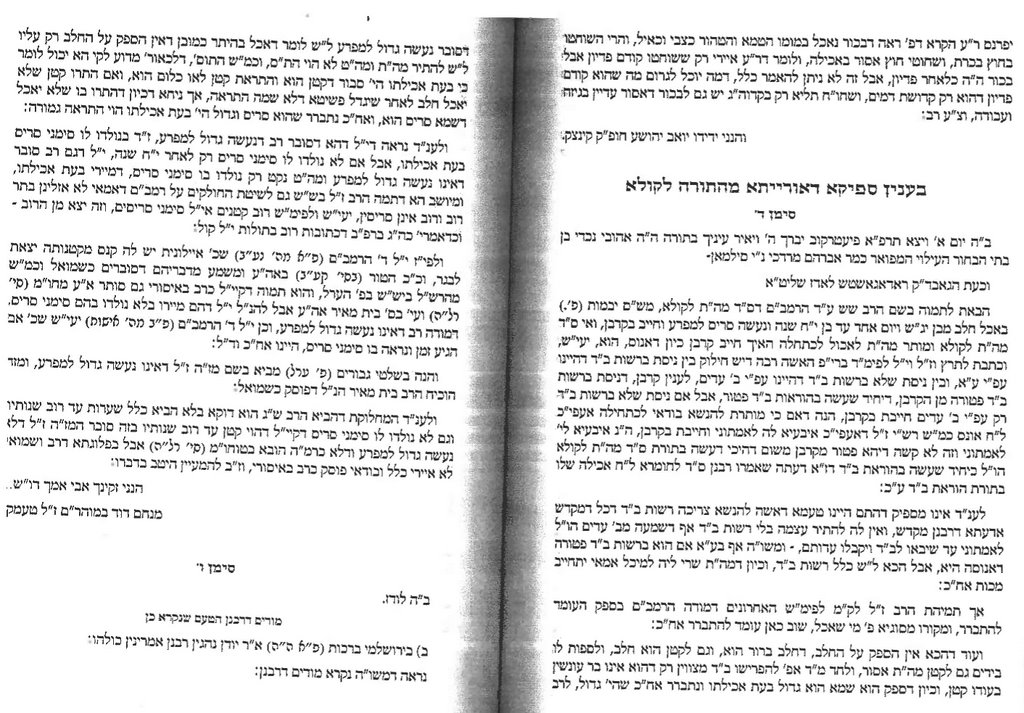
Now, to discuss our instance of censorship. One of the more well-known statements against the Besamim Rosh is by R. Avraham Bornstein (Sochaczew Rav) author of the Avnei Nezer and Eglei Tal. His statement was recorded in the book Piskei Teshuvot. The Piskei Teshuvot is a collection of interesting responsa, which have been abridged and notes added by the editor R. Avraham Pietrekovski. It was published in three volumes and included a fourth volume which contained comments from others about the work and was thus titled Divrei Chachamim. In the Divrei Chachamim, R. Nachum Kamikna wrote in to express his puzzlement at R. Pietrekovski’s mention, in one of his notes, of the Besamim Rosh. R. Kamikna includes the opinion of R. Bornstein on the entire Besamim Rosh issue.

R. Bornstein writes:

I believe that the person [the author and editor of the Besamim Rosh – R. Saul Berlin] is not one who is worthy of quoting any halakha in his name, any person who has a fear of heaven should not have the book Besamim Rosh in his house . . . I believe the book is worthy to be burnt [even] on Yom Kippur that falls on Shabbat.

Needless to say, this is not a ringing endorsement of the Besamim Rosh. But, in 2001, a reprint of the Piskei Teshuvot was done, with reset type and organized according the Shulhan Arukh’s divisions. For some reason, however, this teshuva does not appear. In the earlier editions it was number 5 in Divrei Chachamim in this edition the numbering skips from four to six.

While recently, some have attempted to rehabilitate the Besamim Rosh, most notably in the 1984 reprint, these attempts are not part of the mainstream and it does not appear the Besamim Rosh is any more accepted today than he was previously. This is not to say he is never quoted, only that most are aware of the storied history and the question of whether in fact it is representative of the Rosh. In fact, since 1984 no further attempts to reprint this work have materialized. Thus, in light of this, it is rather odd this particular teshuva has been removed.

In addition to my previous post on the Besamim Rosh, see Moshe Samet, “R. Shaul Berlin’s Besamim Rosh: Bibliography, Historiography and Ideology,” (Hebrew) Kiryat Sefer 48 (1973): 509-523; and upcoming posts at the Seforim blog.

Appendix:
Divrei Chachamim: Before/After


A Source for Rav Kook’s Orot Hateshuva Chapters 1 – 3

A Source for Rav Kook’s Orot Hateshuva
Chapters 1 – 3

By
Chaim Katz, Montreal
Rav Kook begins the
first chapter of his Orot Hateshuva [1] as follows:
We
find three categories of repentance: 1) natural repentance 2) faithful repentance
3) intellectual repentance.
את התשובה אנו מוצאים
בשלש מערכות: א) תשובה טבעית, ב) תשובה אמונית, ג) תשובה שכלית
He defines natural repentance:
(תשובה טבעית) הגופנית סובבת את כל העבירות נגד חוקי הטבע, המוסר והתורה, המקושרים עם חוקי
הטבע. שסוף כל הנהגה רעה הוא להביא מחלות ומכאובים . . . ואחרי הבירור שמתברר אצלו הדבר, שהוא בעצמו בהנהגתו הרעה אשם הוא בכל אותו דלדול החיים שבא לו, הרי הוא שם לב לתקן את המצב
The
natural physical repentance revolves around all sins against the laws of nature
ethics and Torah that are connected to the laws of nature. All misdeeds lead to
illness and pain . . . but after the clarification, when he clearly recognizes that
he alone through his own harmful behavior is responsible for the sickness he
feels, he turns his attention toward rectifying the problem.
Rav
Kook is describing a repentance that stems from a feeling of physical weakness
or illness. He also includes repentance of sins against natural ethics and
natural aspects of the Torah. A sin of ethics might be similar to the חסיד שוטה, who takes his devoutness to foolish
extremes (Sotah 20a). A sin in Torah might be one who fasts although he is
unable to handle fasting (Taanit 11b דלא מצי לצעורי נפשיה) [2].
R. Shneur Zalman of Liadi, in his
collection of sermons Likutei Torah [3], also recognizes three types of
repentance. Homiletically, he finds the three types in Ps. 34, 15.
סור מרע, ועשה
טוב, בקש שלום ורדפהו.
He also relates the
types
to three names of G-d that appear in the text of the berachos that we
say:
 ברוך
אתה ד’ אלוקינו  
According
to R. Shneur Zalman of Liadi, the first level of repentance relates to the Divine
name Elokim (In Hassidic thought, repentance (teshuva or return) is
taken literally as ‘returning to G-d’, not only as repentance from sin.) The mystics
of the 16th century connected the name Elokim to nature.
אלוקים בגימטריא הטבע
The word Elokim is numerically equivalent to the word for nature (hateva).
[4]
In the sermon, Elokim
is also related to ממלא כל עלמין, the immanence of G-d, which may have
something to do with the laws of nature.
R. Kook describes the second level of repentance as
follows:
אחרי התשובה הטבעית
באה האמונית, היא החיה בעולם
ממקור המסורת והדת
After the natural repentance comes a repentance based on faith. It subsists
in the world from a source of tradition and religion.
R. Shneur Zelman
of Liadi describes the second type of repentance as a return to the Divine
name Hashem, the Tetragrammaton. This
name signifies the transcendence of G-d, the name associated with the highest
degree of revelation, the name of G-d that was revealed at Sinai and that is
associated with the giving of the Torah.
Rav Kook’s third
level of repentance:
התשובה השכלית היא . . . הכרה ברורה, הבאה מהשקפת העולם
והחיים השלמה . . . היא מלאה כבר אור אין קץ
The
intellectual repentance . . . is a clear recognition that comes from an encompassing
world and life view. . . . It is a level filled with infinite light.
R. Shneur Zalman of Liadi describes the third level of as a return through
Torah study to the level of the Or En Sof, the infinite self-revelation
of G-d. It is a return to אתה
to Thou.
In
summary, R. Shneur Zalman discusses three types of teshuva, (although the
sources only speak about two types: תשובה מיראה , תשובה מאהבהYoma 86b). These three teshuva
categories form a progression. Rav Kook also speaks of a threefold progression:
a return based on nature, a return based on faith, and a return based on
intellect. [5]
R. Kook did study Likutei Torah. This is documented in a book called Mazkir HaRav
by R. Shimon Glicenstein (published in 1973) [6]. R. Glicenstein was Rav Kook’s
personal secretary during the years of the First World War, when Rav Kook
served as a Rabbi in London.
On page 10, R. Glicenstein writes:
One time on the eve of the holiday of Shavuot, I entered
the Rav’s room and I found him running back and forth like a young man. He was
holding Likutei Torah (the section on the Song of Songs) of the Alter
Rebbe (the Rav of Liadi) in his hand. With sublime ecstasy and great emotion, he
repeated a number of times: “Look, open Divine Inspiration springs out of each
and every line of these Hassidic essays and exegeses”.
מכל שורה ושורה שבמאמרי
ודרושי חסידות אלה מבצבץ רוח הקדש גלוי’
bcb
The second chapter of Orot Hatshuva is titled Sudden
Repentance and Gradual Repentance. The chapter consists of three short
paragraphs: the first describes the sudden teshuva as a sort of spiritual flare
that spontaneously shines its light on the soul. The second paragraph explains gradual
teshuva is terms of a constant effort to plod forward and improve oneself without
the benefit of spiritual inspiration.  
These ideas also find a parallel in the Likutei
Torah
[7]. R. Shneur Zalman of Liadi discusses
two levels of Divine service (not two levels of repentance). In one a spontaneous
spiritual arousal comes from above (itaruta de le-eyla) initiated by G-d as a
Divine kindness, without any preparation on man’s part. In the other (itaruta
de le-tata) man serves G-d with great exertion and effort, taming and refining his
own animal nature, without the benefit of any Divine encouragement.
Rav Kook’s third paragraph is difficult to understand.
Rav Kook begins by describing again the sudden repentance:
התשובה העליונה  באה מהברקה של הטוב הכללי של הטוב האלהי השורה בעולמות כולם
The sublime teshuva is a result of a flash of the general
good of the G-dly good, which permeates all worlds.
The paragraph then continues on a seemingly different
track.
והיושר והטוב שבנו
הלא הוא בא מהתאמתנו אל הכל, ואיך אפשר להיות קרוע מן הכל,
פרור משונה, מופרד כאבק דק שכלא חשב.
ומתוך הכרה זו, שהיא הכרה אלהית באמת,
באה תשובה מאהבה בחיי הפרט
ובחיי הכלל
The rightness and goodness within us, does it not come
from our symmetry with the whole. How can we be torn from the whole, like an
odd crumb, like insignificant specs of dust?
From this recognition, which is truthfully a G-dly
recognition, comes repentance from love in both the life of the individual and
the life of the society.
I have a feeling that this paragraph is also related to
something in Likutei Torah. R. Shneur Zalman of Liadi (in the sermon just mentioned)
relates that people complain to him because they feel a spirit of holiness that
arouses them to emotional prayer for a only a short duration of time (sometimes
for a few weeks). Afterwards the inspiration ceases completely and it’s as if
it never existed. He responds, that they should take advantage of those periods
of inspiration when they occur, not just to enjoy the pleasure of prayer, but
also to change their behavior and character for the better. The state of inspiration
will then return.
I
think Rav Kook, in his own way is dealing with the same issue. Obviously, the
goal is the sudden, inspired teshuvah, but how do we get there? How do we take
the exalted periods of awareness and inspiration and regulate them, so that
they are more deliberate, intentional and continuous. I can’t say I understand
the answer, but I think Rav Kook is saying that if we recognize that we are
part of the “whole” and not separate then we will get there.
bcb
In the third
chapter, Rav Kook, distinguishes between a detailed teshuva relating to
specific individual sins and a broad general teshuva related to no sin in particular.
He writes (in the second paragraph):
וישנה עוד הרגשת תשובה
סתמית כללית. אין חטא או חטאים של עבר עולים על לבו, אבל ככלל הוא מרגיש בקרבו שהוא
מדוכא מאד, שהוא מלא עון, שאין אור ד’ מאיר עליו, אין רוח נדיבה בקרבו, לבו אטום
There is another repentance emotion, which is broad and general. The person
is not conscious of any past sin or sins, but overall he feels crushed. He
feels that he’s full of sin. The G-dly light doesn’t enlighten him, he is not
awake; his heart is shut tight. 
The concept of a
teshuva that is independent of sin is also found in Likutei Torah:
התשובה אינה דוקא
במי שיש בידו עבירות ח”ו אלא אפילו בכל אדם, כי תשובה הוא להשיב את נפשו שירדה מטה מטה ונתלבשה בדברים גשמיים אל מקורה ושרשה
Repentance isn’t
only for those who have sinned (may it not happen), but it’s for everyone.
Teshuva is the return of the soul to its source and root, because the soul has
descended terribly low, and focuses itself on materialistic goals. [8]
R. Shneur Zalman of Liadi also discusses
the same symptoms as Rav Kook.
בזמן הבית הי’ הקב”ה
עמנו פנים אל פנים בלי שום מסך מבדיל   . . .
משא”כ עכשיו בגלות
מחיצה של ברזל מפסקת ונק’ חולת אהבה שנחלשו חושי אהבה ואומר על מר מתוק
When
the temple stood, when the Holy One blessed is He was with us face to face
without any concealment . . . However now in exile there’s an iron partition
that separates us. We are lovesick, meaning our love is weak. We don’t
distinguish bitter from sweet. 
כעת בגלות מחמת כי הלב
מטומטמת אין המח שליט עלי’ כ”כ
כי
עבירה מטמטמת לבו שלאדם ונקרא לב האבן
Now
in exile because the heart is shut down, the mind hardly can arouse it. Sin has
shut down the heart and it’s called a heart of stone. [9]
bcb
The
organization of the first three chapters of Orot Hateshuva, presents another
sort of problem: How are the types of teshuva in the three chapters related? Is
the intellectual teshuva of chapter one different from the sudden teshuva of
chapter two and different from the general teshuva of chapter three?
I suggest that
the arrangement of the three chapters follows the categories
of עולם שנה ונפש,
(which are found in Sefer Yetzirah). The first chapter examines natural return,
faithful and intellectual return. These are connected to נפש – one’s personality and understanding. The
second chapter deals with repentance and its relationship to time (שנה). Repentance
is either sudden or gradual. The third chapter speaks about a
return motivated by a specific sin or motivated by a general malaise. This can
possibly be associated with space/location (עולם); the world (or the specific sin) is
located somewhere outside of the person and motivates the person to return. Explanations based on the three dimensions of עולם שנה ונפש occur in a number of places in Likutei
Torah.
[10]

[1]
here, and here
[2]
I saw these two examples in Rav Kook’s Ein AY”H, (here).
In
the following paragraph, Rav Kook speaks about a natural spiritual, repentance
––pangs of remorse (if the sinner is an otherwise upright individual) that
motivate the sinner to perform teshuva.
[3] Likutei Torah Parshat Balak 73a. The sermon begins with the words מה טובו. There are
(shorter) versions of the sermon published in other collections. (here)
[4]
Quoted also in the second part of Tanya, (Shaar Hayichud Vhaemunah)
beginning of chapter 6. The statement is usually attributed to R. Moshe
Cordovero, (Pardes Rimonim)
[5] Possibly both R. Shneur Zalman of Liadi and R. Kook
relied on an earlier source that I’m unaware of. Maybe R. Kook and R. Shneur Zalman arrived at a similar
understanding independently.
[6] R. Tzvi Yehudah Kook wrote the introduction to the book. From the introduction,
it looks like R. Glicenstein had given R. Tzvi Yehudah his essays and notes so
that they could be published. (here)
[7] Parshat Vayikra
page 2b, on the words אדם
כי יקריב מכם (here).
[8] Shabbat Shuva page
66c and Balak page 75b.
[9] Parshat Re’eh page 26a, Shir ha Shirim   page 36a.
[10] Parshat Hukat
page 64d. Obviously, I don’t think that Rav Kook’s use of olam, shana, nefesh, (if
he’s in fact using that breakdown) comes specifically from Likutei Torah.


There is No Bracha on an Eclipse

There is No Bracha on an Eclipse
By Rabbi Michael J. Broyde
Rabbi Michael Broyde is a law
professor at Emory University School of Law and the Projects Director in its
Center for the Study of Law and Religion.  His most recent Torah sefer is
entitled “A Concise Code of Jewish Law For Converts”.  This letter was written to someone after a
shiur on why there is no bracha on seeing a solar eclipse.
1.      You are correct that I said that I thought there was no bracha on an eclipse.  I had not seen Rabbi Linzer’s teshuva at the time that told that to you this, as it was not circulating on the internet at the time that I prepared for my shiur and I did not see it until Sunday, the day after the shiur.  I try to cite as much as relevant in these classes and his thoughts are clearly relevant.  He is a stellar writer on interesting topics of halacha and I read his material consistently.  I had seen that Rabbi Eliezer Melamed in Peneni Halacha Laws of Brachot 15:6 and note 5 which does permit a bracha on an eclipse.
2.      Having said that, I would not change my mind at all in light of Rabbi Linzer’s teshuva and remain opposed to reciting a bracha over an eclipse for many reasons explained below.
3.      First, as many have noted, the giants of halacha are quite divided over the question of whether the listing in the Shulchan Aruch is paradigmatic or particular.  Some make no blessings other that for matters listed in the codes and other treat them as examples.  That dispute alone inspires me to be cautious, although I could be persuaded that the paradigmatic approach is correct and one could then make a bracha on a waterfall.  I have yet to see a clear proof that such a view is correct, but it does seem more intuitive.[1]  Yet, safek brachot lehakel is present.
4.      Second, and more importantly, if you look closely in the classical achronim, you see not a single achron who actually endorses saying a bracha on an eclipse.  Not a single one.  It is true that there is a dispute about whether the list in the Mishna is all inclusive or not (as many note, see Shar HaAyin 7:6), but even those who are of the view that the Mishnah’s list is merely examples, not a single achron actually endorses making a bracha on an eclipse as opposed to a volcano or some other natural wonder, which some clearly do permit a bracha on.  The group that favors expansive brachot on natural wonders endorse stalagmite caves, waterfalls, water geysers, volcanoes and many more: but not eclipses.  If you look, for example in Shar HaAyin 7:6 (the classical work on this topic) one sees this most clearly: even those who endorse making brachot on waterfalls, or other amazing facets of creation are uncertain נסתפק)) if one make a bracha on an eclipse, and we all know that when a posek is נסתפק, that posek does not make a bracha.[2]
a.       This contrast is made clear in the context of Rabbi Shmuel Halevi Wosner — who is the most clear and direct articulator of the view that list of wondrous sightings in the Shulchan Aruch are just examples, and one makes the bracha of oseh maaseh bereshit even on other wonders.  In Shar HaAyin page 431 he states directly that one makes a blessing on many wondrous things unlisted in the codes and he explains that “Volcanos are not present in our lands and thus are unmentioned in the Shulchan Aruch” and that it is “obvious” that one makes a blessing on them.  However, on eclipses he states “solar eclipses are mentioned a few times in the Gemera, and thus on the question of whether one needs to make a bracha when one sees them, needs more thought.[3]”  He does NOT endorse making a bracha on an eclipse. In fact, I am unaware of anyone other than Rabbis Melamed and Linzer who actually endorse the view in favor of making a bracha on an eclipse, (rather than merely ponders the possibility of such a bracha).  Rabbi Wozner’s point is important: this is not a modern issue – eclipses were well known for a few millennium, and silence in the Jewish Law codes is telling.  To the best of my knowledge the dispute about the eclipses is between two views: (1) Absolutely Not and (2) Maybe.  There is no (3) Yes view in the classical rabbinic literature for eclipses.  (That is why the listing of reasons why an eclipse might be different from other wonders below is important.)

5.      Why is an eclipse different from a stalagmite cave or a volcano?  I could think of a few reasons from a halachic perspective, even to those who believe that the Mishna’s list is not inclusive.

a.       Many perceive them to be a siman raah – a bad sign, either because of superstitious reasons or because darkness in the middle of the day is practically bad – and there is no blessing on bad omens (as Rabbi Moshe Feinstein is quoted in Mesorat Moshe 2:51).
b.      Because one sees nothing in an eclipse (as it is an absence of light, rather than a presence) and we do not make brachot on absences.
c.       Because the bracha of oseh maaseh breseshit does not apply to things whose existence can be mathematically predicted, but are merely rare: eclipses are not anomalies, but a product of the universes’ cycle of life, and more under the berkat hachama rule.
d.      Because full eclipses are exceedingly rare and partial eclipses are almost impossible to “see” without modern eclipse glasses (a 75% eclipse hardly is noticed on a functional level) and are naturally invisible.
e.       For other reasons that are less obvious related to the fact that these have to be wonders from “creation” and these are not from creation.
f.       Because some thought that eclipses were punishments and thus no blessing was ordained.[4]
6.      Based on all this, one can say that eclipses could be different from all other created natural anomalies as a matter of Jewish law and are not covered by the general idea of a wonder such that a blessing should be made. To my surprise, even as the primary source of the view that one can make a bracha on wonders beyond the Mishna’s list is Rabbi Wozner and he explicitly notes that eclipses are different from volcanoes, waterfalls, geysers and many other rare natural phenomena, the secondary codifiers of the last generation have completely missed this distinction.  Instead both Shar HaAyin 7:6 and Penenia Halacha Laws of Bracha 15:5 link the dispute about volcanoes and waterfalls with eclipses and state that one who permits a bracha for volcanoes and waterfalls would do so for eclipses as well, when in fact that is incorrect.  Eclipses were known in Talmudic times and yet no bracha was noted: that bothers Rabbi Shmuel Wozner, who permit a bracha on an erupting volcano, not to permit a bracha to be recited on an eclipse, by noting that he is uncertain if a bracha is proper.[5]
7.      Additionally, let me add a thought of my own about modern times and bracha’s over wonders.  The Shulchan Aruch OC 228:3 limits even the mountains that one can make a bracha on to such mountains in which the hand of our Creator is clear and apparent. (ולא על כל הרים וגבעות מברך, אלא דווקא על הרים וגבעות המשונים וניכרת גבורת הבורא בהם.)  I think in our modern times, with modern science explaining all of these events, no mountains or valleys ever meet the criterial of make it clear (to normal people) that God is in charge of the universe.  Based on this, I would not make any extensions of this halacha beyond its minimums recorded in the Shuchan Aruch because I think that the test for determining whether we can add to this list is and make a bracha is וניכרת גבורת הבורא בהם.  Given the secular environment we live in, I think no natural astrological events meets that bill in modern times so I only – at most — make such brachot on the things that the halachic tradition directly directs me to do, like lighting or thunder or great mountains and certain rivers. I would not make such a bracha on an erupting volcano or a solar eclipse, as seeing such does not cause normal people in my society to experience God.  (There are two formulations of my claim, each slightly different.  The first is experiential, in that I think that most people in my society do not sense any awe of God at an eclipse.  Second, even if any particular person does (and I do not doubt that some do), they cannot make the bracha since most people in America do not so sense God through these events and that is the halachic test found in the Shulchan Aruch.  The sense of wonder has to be obvious to normal people and that is lacking in the world we live in.
8.      Finally, all attempts to actually endorse making a bracha on an eclipse run directly against the combined force of both (1) the minhag, which is not to make a bracha and (2) the rule of ספק ברכות להקל. These two together make it difficult for any moreh horah to argue convincingly that there is clear proof that bracha should be made.
9.      I have consciously not engaged with Rabbi Linzer’s very worthwhile point (which I more or less agree with) that “we strive to bring our religious lives and our halakhic lives in sync” exactly because (as he himself notes) this calculus is limited to cases where there is a dispute between poskim about what to do.  Here, to the best of my knowledge, there is no dispute and since there is no classical halachic authority who actually says “yes make a bracha on an eclipse” there is no grounds to examining very important meta issues used to resolve disputes (since there is no dispute).
10.  Based on all of this, I would not make a bracha on an eclipse.
11.  Having said that, I am happy to endorse other forms of religions veneration for one who feels such wonder.
a.       One can certainly say this bracha without שם ומלכות.
b.      I am also somewhat comfortable with someone making this blessing in Aramaic (see Shulchan Aruch OC 167:10, 187:1 and 219:4) although I am aware of the view of Iggrot Moshe OC 4:20:27, but find the view of the Aruch Hashulchan OC 202:3 more analytically compelling.
c.       Both the suggestions of Rabbi Chaim David Ha-Levi (Responsa Aseh Lecha Rav, 150) that one recited va-yevarech david (Chronicles. 1:29:10) and adding “who performs acts of creation” at the end and of Rabbi David Lau, current Ashkenazic Chief Rabbi of Israel, to recite Tehillim 19 and 104 are completely reasonable as well.
d.      Other innovative non-bracha based solutions are also reasonable.
12.  On the other hand, those who attended an eclipse – I myself traveled to Rabun Georgia, an epicenter for the total eclipse and sat in total darkness at for three minutes in the middle of the day and did not feel any closer to the Almighty as Creator of the World during the eclipse than I did after or before — can feel free to engage in no innovative religious observance at all without feelings that they are deficient in any way.
13.  I welcome readers to direct me to a source written by an achron which directly discusses eclipses and permits a bracha.  (Please feel free to email me.) So far, I have only seen that the group that permits a bracha for an eclipse does so based on a putative ruling of Rabbi Wozner and others to permit such a bracha, which upon closer examination is not present.  I am willing to ponder the possibility that there is an achron who permits such a bracha even as others do not – that posek argues that all wonders deserve a bracha and the listing in paragraph 5 above about why eclipses are different from other wonders is incorrect – To the best of my knowledge, that is a theoretical position that is not actually adopted.

[1] I am inclined to the more expansive view because the formulation in the Beit Yosef in Tur OC 228.
[2] This is an important point.  Rabbi Wozner has the right as a morah horah to assert that he rules that the mishna’s list is not inclusive and that volcanoes get a bracha (which is exactly what he says, as does Rabbi Nissan Karletz in the same work on page 466).  When one asks him “how can he rule that a bracha needs to be recited, others disagree, and then the matter is in doubt”, Rabbi Wozner responds by stating that he sees no doubt and thus he feels a bracha should be recited.  When Rabbi Wozner states that he has doubt about this matter, he is being clear that this is exactly a case of doubt and no blessing should be recited.
[3] Let me add that eclipses are discussed in the rishonim and codifiers as well, with no mention of a bracha.  See Darchai Moshe on Tur OC 426 and the works cited by Rabbi Linzer in footnote 2 of his teshuva (see here).
[4] It is clear from the recounting of the Chafetz Chaim that he did not say a bracha on an eclipse.  See here.
[5] This is found both Shar HaAyin and Penine Halacha as well as Rabbi Linzer’ teshuva.  Shaar Haayin 7:6 is strict on the whole matter and does not permit a bracha practically on even volcanoes an water falls, so the mistake in that work – linking volcanoes and eclipses — is merely one of conceptual classification, but Peninia Halacha rules that המברך לא הפסיד (“one who makes the blessing is doing nothing wrong” for “volcanic eruptions, geyser, waterfalls and both lunar and solar eclipses” when it is clear to this writer that the source he is sighting – he cites Rabbi Wozner! – does not adopt that view.  (On page 466 of Shar HaAyin, Rabbi Nissan Karlitz is asked “Is the blessing oseh maaseh bereshit similar in that things that are wonders and not found in the Shulchan Aruch like an erupting volcano or a spouting geyser or other similar phenomena, also requiring a bracha” and Rabbi Karlitz answer “Logic indicates that such is the case also,” but no explicit discussion of eclipses, which could be different.


New Books from Biegeleisen

New Books from Biegeleisen

While Eliezer is in the midst of preparing a comprehensive list of new seforim issued in the past months, I wanted to provide a shorter list of new seforim that I have recently received from Biegeleisen.  All of these are of course available at Biegeleisen in Boro Park (and I assume elsewhere as well) and some will be reviewed in greater detail in the coming months. 

Batim le-Vadim, Yaakov Mosowitz, Beni Brak, 2008, 663 pp. a collection of laws and customs relating to marriage as well as the laws relating to mahzir gerushato.  The book covers both first marriages as well as second.

Sodei Humash ve-sha'ar, Students of Rebbenu Yehuda ha-Hassid, ed. Yaakov Stal, Jerusalem, 2009, 228 pp.  This is another work from the school of Yehudah ha-Hassid edited by R. Stal.  R. Stal's prior works in this area are excellent.  Eliezer has reviewed two here and here.

Kitzur Nahlat Shivah, Shmuel ha-Levi Segal & Asher Anshel Greenwald, ed. Yehezkel Shraga Shwartz, Beni Brak, 2009, 2 vols., 315, 649 pp.  This reprint, done by Otzar ha-Poskim, follows Otzar ha-Poskim's reprint of the full Nahlat Shivah.   This contains a short introduction as well as notes on the text. 

Pirush ha-Melitz Bentotam, Tzvi Fishbein, [n.p.], 2009, 567 pp.  A commentary on the Targum Yohnathan ben Uzzeil for the parshiyot Shemot Beshalach.  The commentary is divided into two parts, the first, beiurim is an straightforward explanation of the text, while the second, Iyunim, discusses the implications of the text in great detail providing both other rishonim's take as well as the relevant achronim.

Otzar Hemdat Yamim, David Shlomo Kosovitski-Schorr, Beni Brak, 2008, 885 pp. This work collects close to all the mentions of the controversial work Hemdat Yamim in other works.  Additionally, rather than just provide quotations, full pages are reproduced which is an added boon to the interested bibliographer.  Kosovitski-Schorr's stated purpose is to show that the author of Hemdat Yamim was active during the years 1599-1639.

Ve-Zarch ha-Shemesh, Shirah Devlisky, Beni Brak, 2008, 101 pp.  A collection of custom of R. Devlisky's congregation in Beni Brak with notes and sources for said customs.

Ma'aseh Rav, Jerusalem, 2009, 423, [102] pp.  This is a new edition of the Ma'aseh Rav which collects the customs of the Gra. This edition includes some additional notes and supposedly is a "critical edition."  They also include a photomechanical reproduction of the 1832 edition of the Ma'aseh Rav as well as the Tosefot Ma'aseh Rav.  Unfortunately, the editors seem to be unfamiliar with a few points about the 1832 edition.  First, they fail to include both title pages.  The 1832 edition contains two distinct title pages, only one is included. Second, and more importantly, Dr. Jordan Penkower has already suggested that the 1832 edition while the first edition chronologically in terms of publication date may not actually reflect the first edition of the Ma'aseh Rav.  Instead, according to Penkower as well as Yeshayahu Vinograd the bibliographer of all the Gra's works, the second edition, Lemberg, 1833 is actually the "mahdurah kama" of the Ma'aseh Rav.  See J. Penkower, "Minhag and Massorah: On the Recent Ashkenazic Custom of Double Vocalization of Zeikher Amalek," in Rimon Kasher, Moshe Zipor, Yitzhak Zafati, eds., Studies in Bible and Exegesis (Ramat Gan: Bar-Ilan University Press, 1997; Hebrew), 82-85; Y. Vinograd, Thesaurus of the Books of the Vilna Gaon, Kerem Eliahu, Jerusalem, 2003, entry 809.

Sefer haKol Bo, the critical edition of the Kol Bo has been completed in eight volumes bound in four volumes.

She'elot u-Teshuvot Rebi Akiva Yosef, Akiva Yosef Schlesinger, Jerusalem, 2008, 2 vols., 403, 397 pp.  The responsa of the eclectic R. Akiva Yosef Schlesinger on Orah Hayyim and Yoreh Deah with notes and an introduction.