Torah & Rationalism – Writings of the Gaon Rabbenu Aaron Chaim HaLevi Zimmerman zt”l

Torah & Rationalism – Writings of the Gaon Rabbenu Aaron Chaim HaLevi Zimmerman zt”l (Feldheim 2020, 216pp.)*

Ovadya Hoffman

Deviating from conventional book reviews I shall not enter into a discussion of the author – R. Chaim Zimmerman’s genius, schooling, breathtaking erudition, oeuvre, philosophies or his broader Weltanschauung. I leave that for the biographers, that is, if any will take up the challenge.[1] Nor does this survey qualify as a comprehensive book review as I will explain later on. 

First, a word on the book itself. When a posthumously published book appears any critical minded reader wonders where the material came from, in what condition it was, did the publishers do any editing at all to the materials etc.? These are very important questions with serious ramifications and any responsible publisher should want to provide as much detail as possible. Unfortunately, in the present book we are presented with a vague picture. The reader is only informed (Preface, viii) “The text presented includes redacted variants of articles published during the 1980s under the headline Torah and Logic.” No precise list of the publications’ previous appearances is given, a proper bibliography, no exact description of the redactions or even who committed the redactions – the editor, Moshe Avraham Landy, or R. Zimmerman himself. One example, which relates to the section I’d like to focus on, is Landy’s note on p. 131 n. 265 (duplicated in the Hebrew section, p. 174). He informs us that R. Zimmerman “compiled a page by page critique of Professor Ginzberg‘s A Commentary on the Palestinain Talmud that shows most of the sources quoted by Ginzberg are found explicitly in earlier lesser-known printed books on Talmud Yerushalmi; and any chiddush, or “original idea”, offered by Ginzberg could also be found in sefarim and books of previous rabbis and scholars. This critique was written about 1950, and for various reasons was not published. Some galley proofs and other remnants of this manuscript are in the archive of the collected writing of the Gaon Rabbenu… They are presented herein for the reader in the original Hebrew…” I am unsure if what is presented are pieces of a longer manuscript which runs “page by page” (on all three volumes of the Commentary and the posthumously published fourth volume) or if this is the complete critique which, in its current composition, only encompasses the first eighty or so pages of the first volume. Again, a precise description and an unequivocal report of the materials would have obviated any confusion. 

CHAPTER IX – The Falsity of Chochmas Yisrael

I shall focus on R. Zimmerman’s charges leveled at Professor Louis Ginzberg’s Perushim VeChiddushim BaYerushalmi (herein, “Commentary”); specially the explicated charges mentioned in this chapter as they are reflective of the criticisms in the Hebrew recension, “רצנזיה” (Appendix, 175ff.), which will not be treated in this essay. I do not think such a presentation is misrepresentative or fragmentary of R. Zimmerman’s complete critique since he himself maintained that “[f]or the intelligent reader, the following evidential examples should suffice” (p. 131). Additionally, I resisted from responding to the cryptic one-liner allegations sprinkled on the preceding pages (pp. 127-130) since I’m not at all sure to what precisely R. Zimmerman was referring to and are, supposedly, detailed only in the Hebrew section. I surmise that the citations to the Commentary referenced in the notes of those one-liners were provided (or, suggested) by the editor of the manuscript, either Landy or Rabbi Eliyahu M. Zelasko (cf. p. 175). Finally, to assay the buildup and the opinions expressed in the chapter of the wider “Falsity of Chochmas Yisrael” is more tedious and requires a much more in-depth systematic debate as it relates to their different schools of thought, principles and religious philosophies, which is entirely beyond the scope of this scrutiny. This review is not intended as a rejoinder or an exculpation of Chochmas Yisrael, its “truthfulness” or its fidelity to Halachah and tradition. In this brief register it is strictly Ginzberg’s [rabbinic] scholarship I attempt to address in light of R. Zimmerman’s allegations; not the man, his beliefs or his affiliated institution(s). Transliterations below follow the method employed in the book under review. Emphasis, in italics, are of the current writer. 

P. 127
He [Ginzberg] writes in his book that he developed a novel approach and a scientific method to Halachah.
These are Ginzberg’s actual words (English intro., viii):
In these volumes an attempt has been made to deal with the writings of the mishnaic-talmudic period as a unit and, within the framework of a commentary on the first treatise of the Palestinian Talmud, to present a novel approach to the study of this literature.
To the initiated with the Yerushalmi’s commentaries I think a tenable argument can be made that Ginzberg’s tomes are a unique attempt at approaching the study of Talmud Yerushalmi with modern methods through the very framework he delineated in his introductions. Alas, R. Zimmerman did not offer examples to the contrary, i.e. books predating Ginzberg which approached the Yerushalmi mirroring the latter’s methods. This is in stark contrast to Solomon Zeitlin’s perspective who wrote in his review of the Commentary: “It is the first and only serious rabbinic work published so far in this country. Ginzberg is the first to give us a thorough, scholarly treatment of the Palestinian Talmud from the old rabbinic and also scholarly point of view.” Zeitlin, not being one to ingratiate with embellishment, went so far to suggest “Solomon ibn Adret said there was only one in a generation who could understand the Palestinian Talmud. Prof. Ginzberg, I believe without exaggeration, has no equal in our generation and is one of the greatest authorities on the Palestinian Talmud since the time of the Gaon of Vilna.”[2] Among the many Roshe Yeshivot and rabbanim who respectfully referred to and/or corresponded with Ginzberg, mention should be made here of what R. Mordechai Gifter wrote to Ginzberg upon receiving a copy of the Commentary
זה כשבוע שהובא אוצר גדול לביתי הוא ספרו של כבודו “פירושים וחידושים בירושלמי”, ואתמול גמרתי העיון בכרך הראשון על שני פרקים הראשונים במס’ ברכות. ואף שאין כבודו צריך לדכוותי, לא אוכל להתאפק לומר לו “יישר חילו לאורייתא”, ואקוה שיזכה להו”ל ספרו על כל הירושלמי, להאיר עיני ההוגים בתלמוד זה. הספר גזל ממני הרבה שינה, ואקוה שיהיו לרצון לפניו הערות אחדות שמצאתי להעיר בדבריו[3]
P. 132 

R. Zimmerman introduced the question regarding the strength of the obligation to recite the paragraphs of the Shema section; is it Biblical or rabbinical and, if any, which paragraphs? He called attention to the Peri Chadash and Sha’agas Aryeh who offered their respective
“great pilpulim… The Sha’gas Aryeh in his great teshuvah [responsum] has a pilpul on the subject, where he quotes some pieces of the Peri Chadash and argues against them… Ginzberg writes in a very trivial and casual tone against these two renowned geonim… Ginzberg writes that these two geonim, despite all their lengthy pilpul, overlooked an explicit and open source in the Talmud Yerushalmi.”
Not only is this an overly exaggerated characterization of Ginzberg’s actual words, the irony is eyebrow raising as Ginzberg’s words are presented in the footnote and the readers can detect this themselves, save for the note which contains a truncated text of Peri Chadash and therefore gives a different impression of what Peri Chadash actually wrote and how he formulated his discussion. These are Ginzberg’s words [with emphasis on the phrasing under attack]:
האחרונים האריכו לפלפל אם למ”ד ק”ש מן התורה ב’ פרשיות הן מן התורה או רק פרשה ראשונה (עיין פרי חדש ס”ו [ע.ה.: צ”ל ס”ז], ושאגת אריה ס’, ב’) ולא העירו על דברי הירושלמי כאן, שכבר אמרנו בכמה מקומות שלהירושלמי ק”ש מן התורה, ומ”מ טרחו למצוא טעם למה אין צריך כוונה רק פרק ראשון ולא אמרו שפרק ראשון מן התורה ולכך צריך כוונה ופרק שני מדרבנן ולכן אינו צריך כוונה, וע”כ ששניהם מן התורה, ועיין ראש דבור הקודם, ואכמ”ל
First of all, such common stock phrases, in all of rabbinic literature, needs no elaboration other than to say that it is not perceived as an undermining and disdainful “very trivial and casual tone” (never mind the harsher verbiage, and no less from R. Hezkiah de Silva himself). 

After repeating this same stricture (p. 133) R. Zimmerman adds:
…it is astonishing that the academic “scientific scholar” Louis Ginzberg either did not understand the words of the Peri Chadash and Sha’agas Aryeh, or deliberately deceived to discredit them. The error of Ginzberg here is because in the same chapter of the Peri Chadash, the Peri Chadash himself quotes this Talmud Yerushalmi, and brings this very proof with respect to which Ginzberg claims that he “caught” the Peri Chadash and the Sha’agas Aryeh in overlooking the Talmud Yerushalmi. Of course, the Sha’agas Aryeh makes reference to the Peri Chadash, so obviously he does not have to repeat the proof from this Yerushalmi which is clearly stated by the Peri Chadash.
Let us inspect the Peri Chadash. He begins chapter 67 with a thorough exposition determining what the obligatory status is with regards to reading chapters of the Shema. After about eight long paragraphs he arrives at his own conclusion that the reading of both chapters are biblically mandated and suggests that Rambam’s words appear to evoke the same opinion. He writes:
מעתה נשאר לנו לברר הדעת השלישי’ והיא היותר אמיתי מכולן דפרש’ שמע ופרשת והיה אם שמוע השתי פרשיו’ הוו מן התור’… וכך מטין דברי הרמב”ם ז”ל… וזו היא דעתי ומסתייעא הדין סברא דילן מהא דגרסינן בפ’ היה קורא…
Moving on to a dissection of the respective topic in the Bavli in order to prove his opinion, Peri Chadash qualifies that there is a Tanaitic dispute if the reading of both also require intent (“kavannah”) or only one of the chapters and adduces support from a Tosefta, interpreting the two opinions to be debating this last question vis-à-vis intent. To further corroborate this interpretation Peri Chadash finally adds:
ובירושלמי אמרינן מה בין פ’ ראשון דבעי כוונ’ לפ’ שני דלא בעי כוונ’ ומשני לה, נמצא דהני תנאי ס”ל דשתי פרשיו’ ראשונו’ הוו מן התור’…
It seems it is quite reasonable, if not absolute, to understand Peri Chadash’s usage of the Yerushalmi only as support to his interpretation of the views in the Tosefta regarding intent as it relates to “דהני תנאי” of the Tosefta. In other words, Peri Chadash did not cite the Yerushalmi in order to settle the question regarding the status of the Shema passages. One would imagine that if it was his intention do so he would have introduced such a critical source much earlier in his discussion and devoted more than a brief quote of this Yerushalmi passage. It appears that Sha’agas Aryeh too understood the Peri Chadash in this vein since, in his responsum, he does not merely “make(s) reference to the Peri Chadash” – he systematically went through Peri Chadash’s proofs and refutes them one by one, yet he does not single out the Yerushalmi in attempt to disprove the proof from it.
PP. 134 

Before moving to this example it is important to present the relevant rabbinic materials. Briefly put, the Yerushalmi presents two opinions as to why one must have his feet together when praying. One of the two opinions learns this from the exegetical requirement of the Kohanim to walk heel-beside-toe (“עקב בצד גודל”). A mishnah in Yoma (2:1) tells us that prior to certain Temple regulations Kohanim would race up the ramp in order to merit doing a particular service. The Tosefos Yeshanim (Yoma 22a s.v. bezman) points to this contradiction; namely, how were the Kohanim permitted to run if it is indicated in the Yerushalmi that the Kohanim were required to walk heel-beside-toe? Dismissing the possibility that they ran heel-beside-toe (“ואין נראה לומר דרצין עקב בצד גודל קאמר”) Tosefos Yeshanim goes on to present what appears as two answers. Answer 1: “ושמא כיון שלא [היו] עדיין עסוקין בעבודה כמו בהולכת אברים לכבש יכולין לרוץ” (= since they had not yet been involved in a service, such as the delivering of the limbs via the ramp, they were allowed to run). Answer 2: “אי נמי רצין עקב בצד גודל שלא להראות כמו עושה כן אלא כי כן צריך לו לילך בשעת עבודה כדפי’”. One readily discerns that this reading is textually defective. On the margin of this folio in the standard Vilna edition, a gloss is brought closing with “וע’ ש”י” (= see Siah Yitzchak [Nunes Vaes, Jerusalem 1960, p. 293]), presenting a substantiated alternative reading which, for the sake of brevity, I will not get into other than to point out that the alternative phrase indicates that there is no second answer. Instead, the rest of the text is a further explanation of a particular, related Talmudic passage elsewhere. On the other hand, in R. Avigdor Arieli’s edition of the Tosefos Yeshanim (Jerusalem 1993, p.30) some text of Tosefos HaRosh is incorporated and such is the text given: “אי נמי רצין עקב בצד גודל [קאמר שהיו ממהרין ללכת בענין זה…]”. This answer seems to say that the Kohanim would hurriedly walk heel-beside-toe. The nuanced difference borne in this answer compels one to consider that Siah Yitzchak’s emendation is more likely. 

This now brings us to the commentary of R. Avraham Abba Schiff in his To’afos Re’em which R. Zimmerman uses to level charges against Ginzberg. Here is the pertinent text of R. Schiff:
…ובירושלמי… אמרו זהו שעומד ומתפלל צריך להשוות את רגליו כו’ ח”א כמלאכים וח”א ככהנים כו’ שהיו מהלכים עקב בצד גודל וגודל בצד עקב משמע משם דוקא וכ”כ התוס’ ישנים יומא שם עיי”ש שכ’ אי נמי רצין עקב בצד גודל שלא להראות כחו עושה כן אלא כי כן צריך לו לילך בשעת עבודה כדפי’ עכ”ל ודבריהם אלו אינם מובנים והנראה לי דט”ס יש שם וכנ”ל אי נמי רצין ועולין בכבש עקב כו’ ור”ל דמתני’ ה”ק היו רצין עד לכבש והולכין בכבש כדרכן עקב בצד גודל וזהו שסיימו בת”י שלא להראות כחו עושה כן כו’ פי’ במ”ש ועולין בכבש לא להראות כחן היו עולין לכבש דעולין בכבש כדרכן עקב בצד גודל אלא עיקר הקדמתן במ”ש היו רצין דהיינו עד לכבש…
R. Schiff likewise noted the textual difficulty of the Tosefos Yeshanim and therefore suggested a different reading. He proposed that the second answer means (reads) the Kohanim would run up until the ramp but from there they would walk heel-beside-toe. If this is the second answer it seems somewhat forced as its underlying rationale is presumably to restrict running when ascending the ramp, i.e. executing a designated service, and it is essentially the same as the first answer. 

Returning to R. Zimmerman, after he informs us of the aforementioned Tanaitic contradiction, he continues:
Tosefos Yeshanim… gives these two terutzim [solutions] to answer this contradiction. On the Sefer Yere’im… there is a perush [commentary] by the name To’afos Re’em where he brings all the bekiyus [referecnes] on this subject. He also writes this contradiction and explains both terutzim. And after he writes these two terutzim, he references the Tosefos Yeshanim, as quoted above.
Next, R. Zimmerman asserts that:
…with the claim of originality, Ginzberg answers the contradiction asked by the Rishonim and of Tosefos Yeshanim with these two solutions, not being aware that Tosefos Yeshanim himself wrote these two answers word for word.
Here too, Ginzberg’s text is presented and the reader can see that he nowhere asserts any claim of originality. He merely referenced the classic sources, including the Tosefos Yeshanim, and then paraphrased what some of the Rishonim asked and answered. The only phrase one can guess (or, read into) which R. Zimmerman based this imputation is where Ginzberg wrote, regarding the distinction of ascending the ramp when executing an actual part of the service, “והיה אפשר לומר”. But, this is borderline pedantic as any accustomed student of rabbinics does not expect an author to reiterate every time they allude to an aforementioned source. He essentially claimed that Ginzberg quoted the sources but “did not make the effort to look up the Tosefos Yeshanim, and he plagiarized the words of the To’afos Re’em… taking credit for himself, and taking for granted that no one will catch him in plagiarizing these two big “chiddushim” word for word from the To’afos Re’em.” By that token one must assume as well that the other sources which Ginzberg quoted and dealt with were also gotten from a different (albeit, unnamed) source. More importantly, it is not entirely clear that To’afos Re’em even spelled out both answers of Tosefos Yeshanim, precluding the possibility that Ginzberg plagiarized “word for word from the To’afos Re’em”. Never mind the strange notion that Ginzberg wouldn’t look up an explicit Tosefos Yeshanim which he cited and instead opted to quote an unclear formulation of the To’afos Re’em.

(The reference in p. 135 n. 279 to the Commentary should read: ‘עמוד 45’, and “שהרי על הלכה כהנים זו” should read ‘…הלכת כהנים זו’. For “keves” on p. 134, “keveṣ” or “kevesh” should be supplied.)
PP. 136
R. Zimmerman opined that with all the reference books on the Yerushalmi et al.
…if someone has in front of him all these sefarim when he learns Talmud Yerushalmi (he does not have to be an expert in Halachah), he could produce most of Ginzberg’s works.
Leaving aside this fantastic assumption and the certain debatable quality of the older reference books, one wonders if the careful inclusion of “most” was some admission that even with all reference books at one’s disposal, Ginzberg’s monumental ‘Legends of the Jews’, however, could certainly not have been produced by just anyone, not even today with our advanced digital databases. If this assumption is correct, one wonders how to reconcile the acknowledgment of Ginzberg’s singular erudition but then to accuse him of plagiarizing even known, classical sources.

PP. 137 

R. Zimmerman gave some examples to illustrate Ginzberg’s dependency on the various reference books and in particular Rabbi Dov Ber Ratner’s ‘Ahavas Tzion vi-Yerushalayim’ of which he alleges:
Ginzberg being aware that one may discover the obvious, that most of his references and citations are plagiarized from Ratner… and others, always tries to disqualify Ratner and others.[4]
I’m going to leave aside the obvious question as to the merit of such a claim, whether or not an author should always cite a reference book at every instance. Instead, I prefer to determine if there is any basis at all to the claim of deceit.

The first example of Ginzberg’s alleged attempt to disqualify Ratner’s work is R. Zimmerman’s oblique citation to the English introduction of the Commentary. Here are Ginzberg’s actual words:
The most important source for establishing a correct text are the numerous quotations… and one must be grateful to Baer Ratner (1852-1917) for collecting them in twelve volumes of his work… The parallels must however be used with great caution for the following reasons…
Ginzberg then continued to list three sound and ostensibly true critiques and words of caution.[5] Perhaps interpretation is in the eyes of the reader so suffice it to say there is no readily discernible attempt to “disqualify Ratner’s work”. Conversely, in Ginzberg’s Seride Yerushalmi, after he described the importance of collecting and collating quotes of Yerushalmi as found in Rishonim, he stated “וכבר התחיל במצוה הרב הגדול וכו’ כמוה”ר בער ראטנער נ”י בספרו יקר הערך ורב השבח ספר “אהבת ציון וירושלים” אשר בו העיר על גרסאות הירושלמי שבספרי הראשונים והאיר עיני לומר הירושלמי.”” (New York 1909, intro. IV). Such statements would be counterproductive and ineffective if attempting to disqualify a work.

IBID
He copies from Ratner verbatim without mentioning his name.
The reference is given to Commentary p. 54 where Ginzberg indeed quoted the same two passages from the Yalkut which Ratner quoted. Now, even before analyzing the material one must wonder if two authors cite the same classical and relevant sources is that sufficient to presume one copied from the other?[6] In any case, if one reads the detailed discussion of Ginzberg it is unmistakable that he independently studied and scrutinized the sources for he included much detail of which Ratner does not give the slightest mention. Furthermore, mention should be made of the fact that the referenced volume of Ratner was published in 1901 and the first volume of Ginzberg’s ‘Legends’, a work which had begun in 1903 was published in 1909 (JPS 2003[7], intro. XVI). There, in describing the distance between earth and heaven (the focus of the aforementioned Yalkut) Ginzberg referenced the Yerushalmi under discussion in addition to numerous other sources (ibid. p. 10 n. 31 & 32). Interestingly, he did not, however, cite the Yalkut which he later cited in his Commentary. With intent to minimize Ginzberg’s scholarship we can fault him for not referencing the Yalkut in the notes to his ‘Legends’. But, an obvious explanation can be, due to the enormous and difficult task in reworking all available ancient texts and incorporating them into a flowing narrative by necessity would require paraphrasing and omitting subtle Aggadic amplifications. The passage in the Yalkut, which Ginzberg expresses doubts per its original text, contains almost identical phrasing as the Yerushalmi and therefore added nothing for his sources. Had Ginzberg only known about the Yalkut passages from Ratner he should have referenced it in his ‘Legends’. This is, again, leaving aside the perplexing claim that someone who organized and authored the intricate, colossal and scholarly sources and discussions in the notes to the ‘Legends’ did not independently know the Yalkut, a primary text quoted throughout the ‘Legends’.

IBID
…he writes “many erred” because they did not know the sources, but the sources are written by Ratner…
Ginzberg commented that a particular passage of the Yerushalmi is found similarly in the Bavli, and while some Rishonim/Geonim quote the passage as it’s reflected in the Yerushalmi Ginzberg posited that their source was from the Bavli, unlike Ratner who quoted the parallels in the Sheëltot and BH”G and determined that their source was the Yerushalmi. Ginzberg concluded the brief comment by exclaiming
וטעו אלה שאמרו שבהג והשאלתות השתמשו כאן בירושלמי, עיין מה שכתבתי גואניקא א’, פד.
Ginzberg clearly was taking issue with what some erroneously assumed that the Yerushalmi was the common source for those two authorities, not that some did not know the sources. Besides for his objection being rather clear, when one examines the reference to Geonica they are met with a more detailed analysis of this error. As if it’s not explicit enough, there Ginzberg wrote:
“In his learned scholia… Ratner does not hesitate to attribute it to the Yerushalmi as Rabbi Aha’s source, and yet it can be readily demonstrated, from the words of the Sheëltot, that it goes back to the Babli.” 
P.138
Again, Ginzberg writes ‘Ratner did not indicate this source’, and this is an outright falsification, because in that same place Ratner quoted the source.
The reference here is to Commentary (p. 75 fn. 84). Ginzberg writes
לאוהבו של מלך שבא והרתיק על פתחו של מלך. במחזור ויטרי שי”ג (וראטנער לא העיר על מקור זה) גרס, תערו במקום פתחו, וזה יותר מדויק…
In the parenthesis, after “מקור זה”, a footnote reads
וכן לא העיר על הילקוט… אשכול… ושלחן ארבע שמביאים דברי הירושלמי על התכיפות
R. Zimmerman must have been referring to the Yalkut reference since Ratner (cited by R. Zimmerman) does not refer to Mahzor Vitri, Eshkol or Shulhan Shel Arba. Yet, even the Yalkut is only cited by Ratner on the preceding piece of Yerushalmi “מי שתוכף לסמיכה שחיטה”. On the piece under discussion, indicated by the caption of Ginzberg’s quote, Ratner only makes reference to the Amsterdam ed. of the Yerushalmi and did not note the textual variants contained in the Yalkut. Aside for this not being “an outright falsification”, the language used to quote Ginzberg is misleading. R. Zimmerman specifically referred to the footnote in Commentary, though it does not say there “Ratner did not indicate this source”; that exact phrasing is in the main text regarding the Mahzor Vitry which Ratner did not reference. The footnote says (if rendered in English) “he also did not indicate A, B and C.” If one were to object that A was indeed indicated by Ratner then a fairer phrasing would be something to the effect of “one of the sources was quoted by Ratner” thereby not wholly discrediting the author’s point. 

At this junction I’d like to refer to one piece produced in the Hebrew section (p. 211) as it directly relates to this piece. Ginzberg’s aforementioned text is quoted and then R. Zimmerman notes
מ”ש “במחזור ויטרי שי”ג גרס תערו במקום פתחו” לא היה ולא נברא. וזה לשונו [במחזור וויטרי] סימן י”ז [עמוד 13] א”ר חמי של מי שאינו סומך גאולה לתפלה למה הוא דומה לאוהבו של מלך שבא והרתיק על פתחו של מלך… וכו’. ואמנם הגירסא זו [תרעו ולא כמ”ש גינזבורג תערו] הובא בספר המנהיג [דיני תפלה, עמוד מ”ד, הוצאת מוסד הרב קוק] וכבר ציינה ראטנער [אהבת ציון וירושלים, צד 11] וזה המחבר זייף דברי ראטנער כדרכו. ואמנם כך פירשו שמה המחזור וויטרי, תרפ”ד, דף 31, כמו שציין גינזבורג אלא שהרי המחזור וויטרי סותר את עצמו…
Admittedly I’m unsure what to make of this protest. R. Zimmerman unabashedly quotes a second text from Mahzor Vitry, which Ginzberg was explicitly not referring to, and then impugns Ginzberg of quoting a spurious text from Mahzor Vitry (and plagiarizing from Ratner), despite R. Zimmerman’s subsequent acknowledgment that Mahzor Vitry does elsewhere contain the very text quoted by Ginzberg. Additionally, the bracketed words, which dismiss Ginzberg’s quote of “תערו”, are also disingenuous since Ginzberg was not referencing the Manhig’s text at all. This also brings us back to my earlier suspicion of the editor’s methods: Who inserted these erroneous brackets? Was R. Zimmerman being unfair or was the editor unmindful?

In summation, a pattern emerges before the reader which betrays a vendetta against Ginzberg; picayune criticisms and inflated accusations which don’t hold much water. Any time a reference provided by Ginzberg had been cited elsewhere it is automatically assumed to be stolen and any explanation offered is deemed unlearned, unless there is precedence to it then it is assumed to be plagiarized. It appears it was Ginzberg himself who was the object of R. Zimmerman’s attacks, while grasping at straws under the pretense of a scholarly critique. One cannot but wonder why R. Zimmerman did not publish these galleys while Ginzberg was alive, affording him the opportunity to respond. It is not as if R. Zimmerman was one to shy from polemicizing, as he famously engaged with R. Menachem M. Kasher over the International Date Line matter. Had R. Zimmerman published the materials while Ginzberg was still alive perhaps he, and its current readership, would have merited the author’s own rebuttal.[8]
___________
 
*My thanks to the editors at the Seforim Blog and R. Moshe Maimon for reviewing the paper and offering their suggestions.
[1] For a brief biographical sketch, see the journal Yeshurun (Israel 2012, Vol. 27, 855ff.).
[2] JQR (April 1943, p. 433).
[3] Marc B. Shapiro, Saul Lieberman and the Orthodox (Scranton 2006, p. 13 n. 45, 31-21; for R. Gifter see n. 117). It would not be out of place to note how R. Zimmerman addressed Prof. Saul Lieberman, 

לחד מתקיפי דורנו הגאון המופלא הבקי בכל מכמני התורה והחכמה
(Shapiro, ibid. p. 42), while Lieberman referred to Ginzberg
 
מרא דהלכתא ומרא דאגדתא הגר”ל גינצבורג
 
(Sinai, Jerusalem 5739, p. 225; repub. Mehkarim BeTorat Eretz Yisrael, Jerusalem 1991, p. 127). On a different occasion Lieberman estimated:
ודבר אחד מבליט את גינצבורג מתוך כל החכמים שקדמו לו. בספריהם של בעלי “חכמת ישראל”, ואפילו מן הגדולים שבהם, אתה מוצא לפעמים טעויות גסות בפירושן ובפשטן של הסוגיות אשר לפניהם. מה שאין כן אצל גינצבורג העומד למעלה מזה. בכל ספריו ומאמריו המרובים אין אף פעם טעויות ממין זה ודומה להן. ואין לזלזל בפרט חשוב זה, כי טעויות גסות מן המין הנ”ל פוסלות את כל הספר בעיני בני תורה והמחבר מאבד על-ידי זה את הסמכות ואת ההשפעה שלו. ועוד זאת: גינצבורג באחת מחוברותיו “תשובה בדבר יינות הכשרים והפסולים למצוה”… הראה את כוחו גם בפסק הלכה כאחד הרבנים הגדולים, ואף בני הישיבה שאין להם עסק עם חכמת ישראל רואים בו מתוך ספרו זה אחד משלהם, את העילוי מישיבת טלז וסלובודקה. 

(ibid., pp. 613-614)
[4] Noteworthy is Ratner’s own declaration that in preparation for his volume on mas. Rosh Hashanah he utilized Ginzberg’s Seride Yerushalmi on Rosh HaShanah:…היו לנגד עיני הספר היקר שרידי ירושלמי מאת הרב הגדול ר’ לוי גינצבורג מנויארק והשתמשתי בו במס’ רה”ש (Ahavas Tzion vi-Yerushalayim, Vilna 1911, Rosh HaShanah, petah davar). Indeed the two had maintained correspondence even prior to the publication of Seride Yerushalmi, as is evident from the letter Ratner quoted which he received from Ginzberg (Ahavas Tzion vi-Yerushalayim, Piotrków 1908, Pesahim p. 55) and in the subsequent volumes he continued to use Ginzberg’s Seride Yerushalmi and Geonica. Incidentally, one instance akin to the “trivial and casual tone” but in Ratner’s work which, with equal justice, should have awakened the ire of R. Zimmerman, Ratner wrote: המפרשים יגעו בזה לפרש, אבל הגי’ הנכונה בשרידי ירושלמי… (Ahavas Tzion vi-Yerushalayim, Vilna 1913, Bez. p. 10).
[5] Similar words of caution were likewise expressed a few years later by another contemporaneous eminent scholar and expert on Talmud Yerushalmi, Professor Saul Lieberman (HaYerushalmi Kiphshuto, N.Y. & Jerusalem 1995, intro. p. 24). The words of caution had already proven to be wise and advisory as Lieberman, earlier in his ‘Al HaYerushalmi’ (Jerusalem, 1929), in multiple instances called attention to some mistakes in Ahavas Tzion vi-Yerushalayim. Cf. also J.N. Epstein in Mehkarim BeSifrut HaTalmud uVeleshonot HaShamiot, Jerusalem 1988, Vol. 2 Part 1, p. 263 n. 1. More currently, Prof. Yaacov Sussmann acutely demonstrated the shortcomings of Ratner’s magnum opus in the journal Mada’ei HaYahadut (World Union of Jewish Studies 2002, vol. 41 pp. 23; my thanks to R. Eliezer Brodt for this last reference.)
[6] It would appear that the only distinction with regards to Ginzberg is that he belonged to the “Chochmas Yisreol” camp which R. Zimmerman frequently disparaged. Otherwise, what would prevent R. Zimmerman from leveling the same charges against R. Chaim Heller, a universally recognized talmid hacham and scholar par excellence, who compiled a collection of parallel sources of the Yerushalmi in his essays ‘HaMa’alot LeShlomo’ (LeShelomo, Berlin, 1910, 246ff.) and ‘A”D [‘Al Derech] Mesoret HaShas BeYerushalmi’ (LeDovid Zvi, Berlin 1914, 55ff.), both published after Ratner’s Ahavas Tzion vi-Yerushalayim? The same can be said for R. Ze’ev Wolf Rabinovitz’s ‘Sha’are Torath Eretz Israel’ (Jerusalem, 1940) who certainly made use of Ahavas Tzion vi-Yerushalayim but only seldom referenced it, as did R. Shlomo Goren in his ‘HaYerushalmi HaMefurash’ (Jerusalem, 1961). Is one to accuse them too of plagiarism in all the instances they could have quoted Ratner? Conversely, in his review of Prof. Ginzberg’s posthumously published fourth volume of the Commentary and R. Goren’s HaYerushalmi (Kirjath Sepher, Jerusalem, vol. 33 p. 199), Professor Avraham Goldberg noted the common sources often cited by both in drawing parallels between the Yerushalmi and other rabbinic texts, yet he apparently saw no oddity and did not go as far as to accuse the later of the two, R. Goren, of plagiarism, for obvious reason.
This point of common sources is of serious significance as it relates to multiple instances where R. Zimmerman alleges the charge of plagiarism. One in particular is found in the Hebrew section (199ff.) where R. Zimmerman claims that Ginzberg copied from Jehiel Bornstein and the texts of both of these figures is then presented side-by-side (in Bornstein’s text “היה ראוי לו” should read “היה נראה לי”; “את” in “את הכוכבים הסמוכים לארץ” should be omitted; “ג’ פעמים”should read “ג’ כוכבים”; “אולי ישיבני” should read “…ישיבנו”; “שיבאו השמש והריח” should read “…והירח”; “לא” in “לא נבעו להם” should be omitted; in Ginzberg’s text “ורבי חנינא כוונו” should read “ורבי ור’ חנינא כוונו”; “רבי ב’ דקים” should read “רק ב’ דקים”). The subject under discussion pertains to the solar and lunar rotations in calculating the time of twilight (ben hashmashot). R. Zimmerman points out that Bornstein had explained the Talmudic passage in an essay published in the journal ‘HaTekufah’ (Warsaw 5786) and Ginzberg copied his explanation, even including what Bornstein had inserted in parenthesis, except that the former Anglicized the word “refraction” [presumably to conceal the plagiarism]. In truth, there’s reason to believe that Ginzberg had seen Bornstein’s essay since he referenced Bornstein’s incipient essay in his ‘Legends’ (JPS Philadelphia 1968, VI p. 129 n. 758). However, since the objective was to explain a Talmudic passage, to offer “the simple peshat”, avouched by the titular “פירושים וחדושים”, is it incredulous that Ginzberg independently arrived at the same explanation? Did R. Goren, who suggested the same explanation in his HaYerushalmi (p. 8), also plagiarize from Bornstein or Ginzberg? The parenthesis in question are in fact a parenthetical explanatory gloss which would have rightfully been placed as such by any commentator expounding the given Talmudic passage and the usage of the word “refraction” is common locution for the subject under discussion. Let us not forget that Ginzberg was a highly competent mathematician to the extent that Albert Einstein was impressed with his knowledge in mathematics (cf. The Responsa of Professor Louis Ginzberg, N.Y. & Jerusalem 1996, intro. pp. 3, 15). In all likeliness, an individual of such caliber would have independently comprehended this passage, as did Bornstein. Furthermore, the collated texts of Ginzberg and Bornstein bear very dissimilar phraseology in their attempts to explain the passage. (See also Heshey Zelcer’s comparison of three later commentaries on this passage, Ḥakirah N.Y. 2004, vol. 1 p. 113).
[7] This edition of the Legends should be used with caution as there are numerous typographical and referential errors in the main text as well as in the notes. As with all publications, Ginzberg’s Commentary was at the mercy of its publishers and it too suffered corrupted passages, some of which he communicated to S. Petrushka (see below, fn. 8).
[8] For instance, Simcha Petrushka published in the Bitzaron periodical a letter which he had sent Ginzberg containing questions and notes on his Commentary. Upon receiving a letter in response to each of his claims, Petrushka had the letter published in the following Bitzaron issue (N.Y. 1945, vol. XII, 214ff.).

Judah Wistinetzky and Mishloach Manot to his American friends

Ari Kinsberg is one of the great young scholars of American Jewish History (under 40), as he has spent several years researching and editing the two-volume magisterial Hebrew Printing in America 1735-1926: A History and Annotated Bibliography (see Seforim blog reviews here and here).

In honor of Purim 5767 [2007], Ari has recently written about Judah Wistinetzky (1844-1908) and the latter’s Ayelet ha-Shahar, given as mishloach manot gift to his friends. For those of us who have not yet seen a copy of Ayelet ha-Shahar, Kinsberg provides a description of the small volume and also provides some biographical background to Judah Wistinetzky, highlighting the latter’s American connections. (For example: Did you know that he had arrived in America several years prior to publishing Sefer Hasidim in 1892?!?)

See here for Ari Kinsberg’s “A Litvish Maskil and His Literary Mishlo’ah Manot,” where he also provides a brief biography of Wistinetzky, based on Hebrew Printing in America (vol. 1, p. 376).


China and the Answer to the Last Quiz

China and the Answer to the Last Quiz
Marc B. Shapiro
I recently returned from China and one of my friends asked me if during my time there I found anything of relevance to the Seforim Blog. He did not mean the comment seriously, but in fact I did find something. Whenever I am in synagogues I make a point of examining their collection of books, as you never know what you might come across. In Beijing I was at the fabulous Chabad House and I found something that will be of interest to Seforim Blog readers. Before getting to that I need to mention that my time in Beijing was made doubly special as I was able to spend Shabbat with Rabbi Dr. Dror Fixler. In addition to being an outstanding award-winning scientist, he is also a fine Judaic scholar. Among his important publications are new translations from the Arabic of Maimonides’ commentary on the Mishnah to tractates Berakhot, Peah, and Avodah Zarah. Each volume is accompanied by Fixler’s learned notes. Fixler has also published numerous articles on various Torah themes, including on practical halakhic matters. See here.
Fixler is a student of R. Nachum Eliezer Rabinovitch, and I used some of the time we were together to clarify the details of R. Rabinovitch’s position that there is no halakhic prohibition in using an electronic key card on Shabbat,[1] or in walking through a door that opens electronically, or even using an electronic faucet where the water comes out when you put your hand under it. Without getting into the halakhic details, I think one thing is sure, namely, that the future will bring more such lenient decisions in this area. The changing circumstances of modern life will create enormous pressure for lenient decisions, as modern technology which helps us in so many ways also creates many problems regarding Shabbat. For example, how long until it will be impossible to access an apartment building in New York and other big cities without using a key card? The day is probably coming when private apartment doors will also use key cards, not to mention numerous other such Shabbat-problematic technological advances that will be unavoidable aspects of life in the future. Therefore, I believe that some future poskim will return to R. Shlomo Zalman Auerbach’s position that if there is no creation of heat or light, then technically there is no violation of Shabbat.
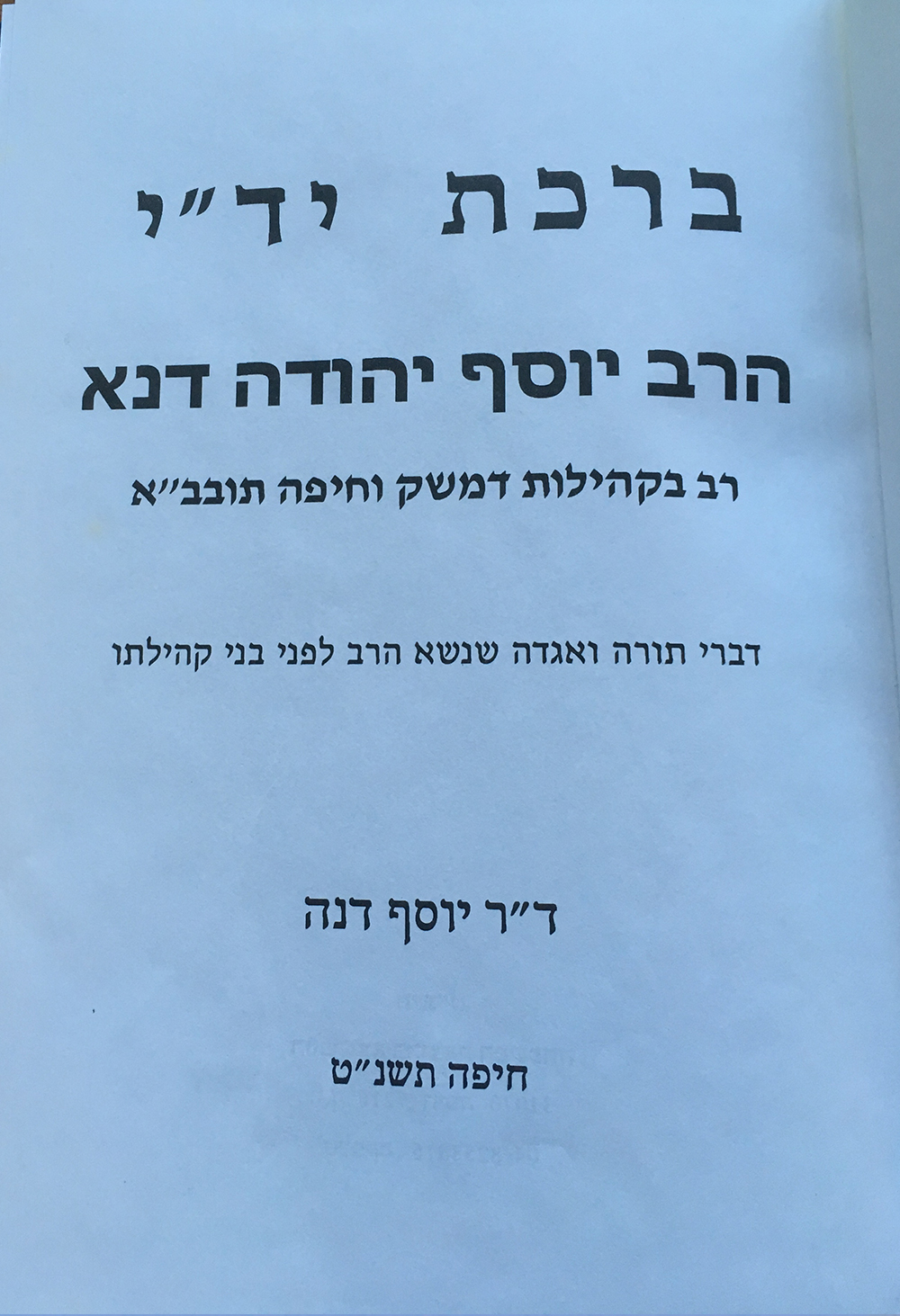
Getting back to the matter of seforim, while looking through the books at the Chabad House I saw Birkat Yadi by R. Joseph Judah Dana.
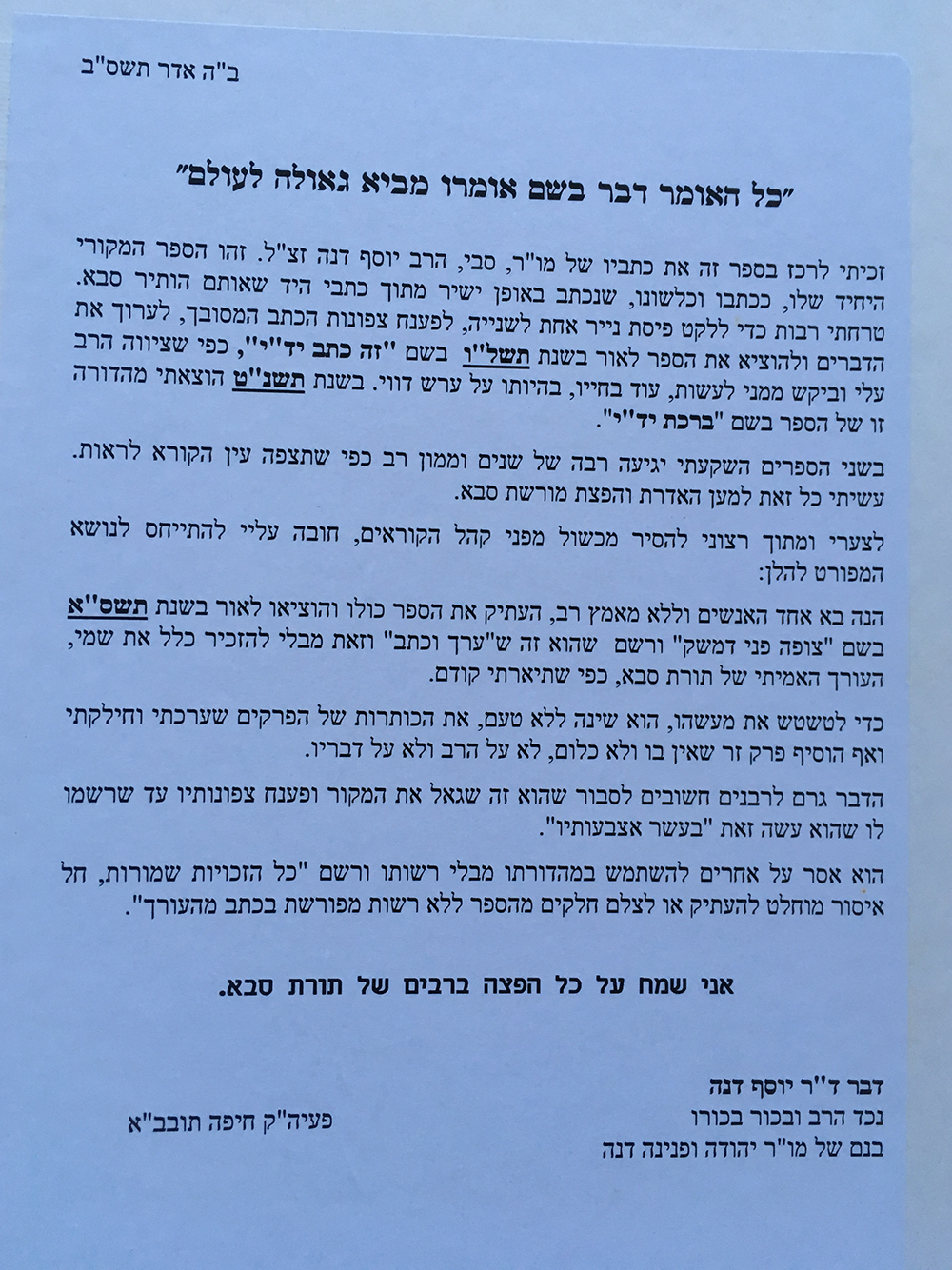
I had never before seen this book and it is not found on Otzar ha-Chochmah. Pasted on the inside cover is the following. (Unfortunately, the pictures I took came out blue on my phone.)
The book the editor, Prof. Joseph Dana, is referring to is Tzofeh Penei Damesek. Here is the title page.
Without getting into the accusation of plagiarism, there is something that is noteworthy about Tzofeh Penei Damesek, namely, that included among the approbations from great rabbis is a lengthy letter from Professor José Faur.
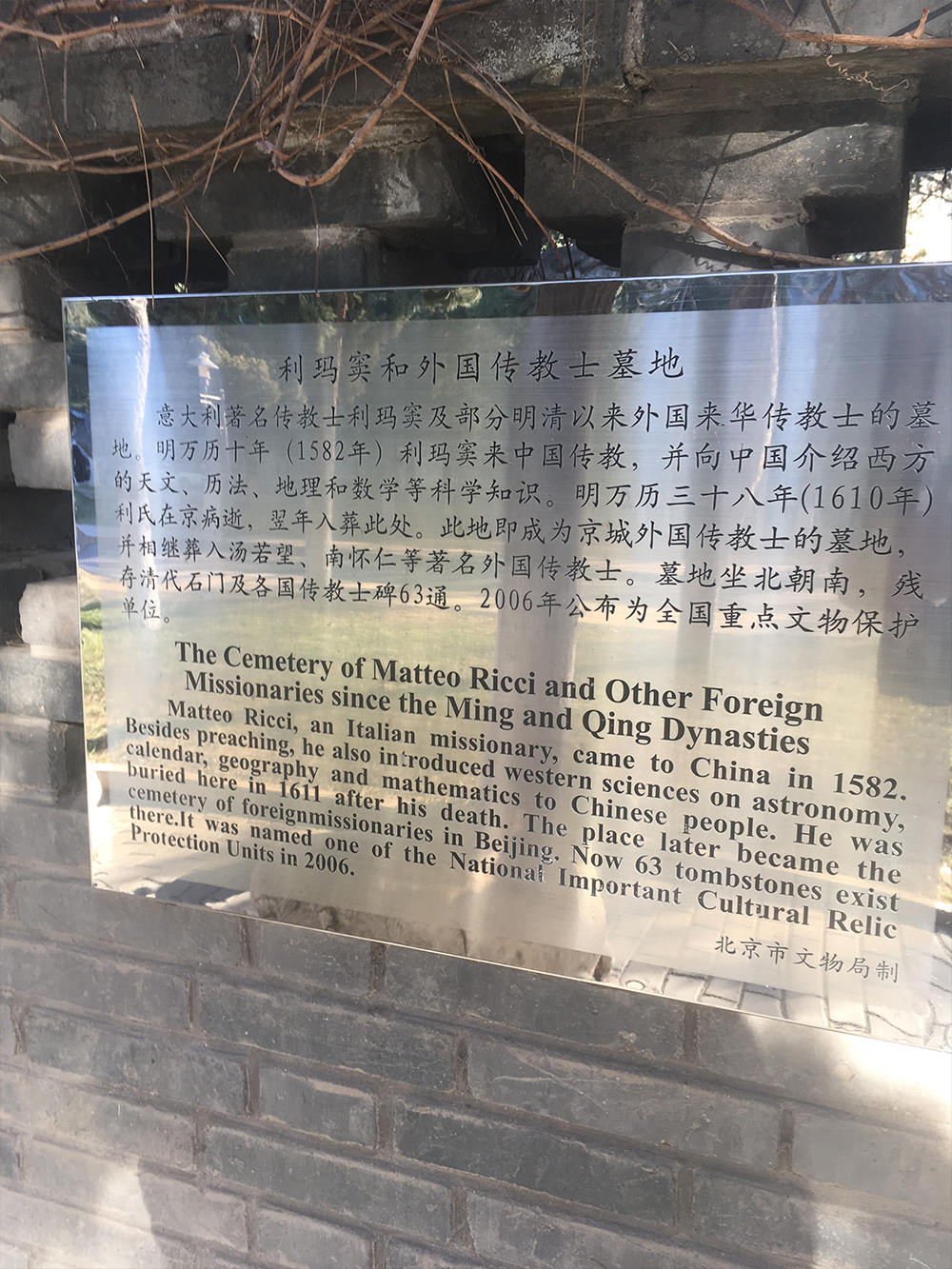
Let me share one other interesting thing about my recent trip to Beijing. It isn’t related to seforim but was of great interest to my colleagues at the University of Scranton, which is a Jesuit university.  The Friday night before arriving in Beijing I was in Hong Kong and learned that one of the people I was talking to at dinner shared my interest in Matteo Ricci (1552-1610), the famous Jesuit missionary to China. This man told me that years before he had visited Ricci’s grave and that it was worthwhile for me go see it. There is actually a Jewish connection here, for Ricci was asked if he would take over the position of rabbi of the Kaifeng Jewish community, but on the condition that he give up eating pork.[2] (Obviously the Jews of Kaifeng were not the most learned.)
I checked online and saw that Ricci’s grave, which is found in the first Christian cemetery in China, was indeed a site that some tourists had written about. However, in recent years it had become much harder to visit without being part of an organized group and arranging the visit ahead of time. The fact that the small cemetery is found on the grounds of a Communist party school is no doubt the reason for this. I was thus unsure whether they would allow me in, but my guide was able to convince them that I was harmless. If it were only so easy to get into some of the old Jewish cemeteries I have attempted to visit.
Here is the grave and the plaque put up nearby.
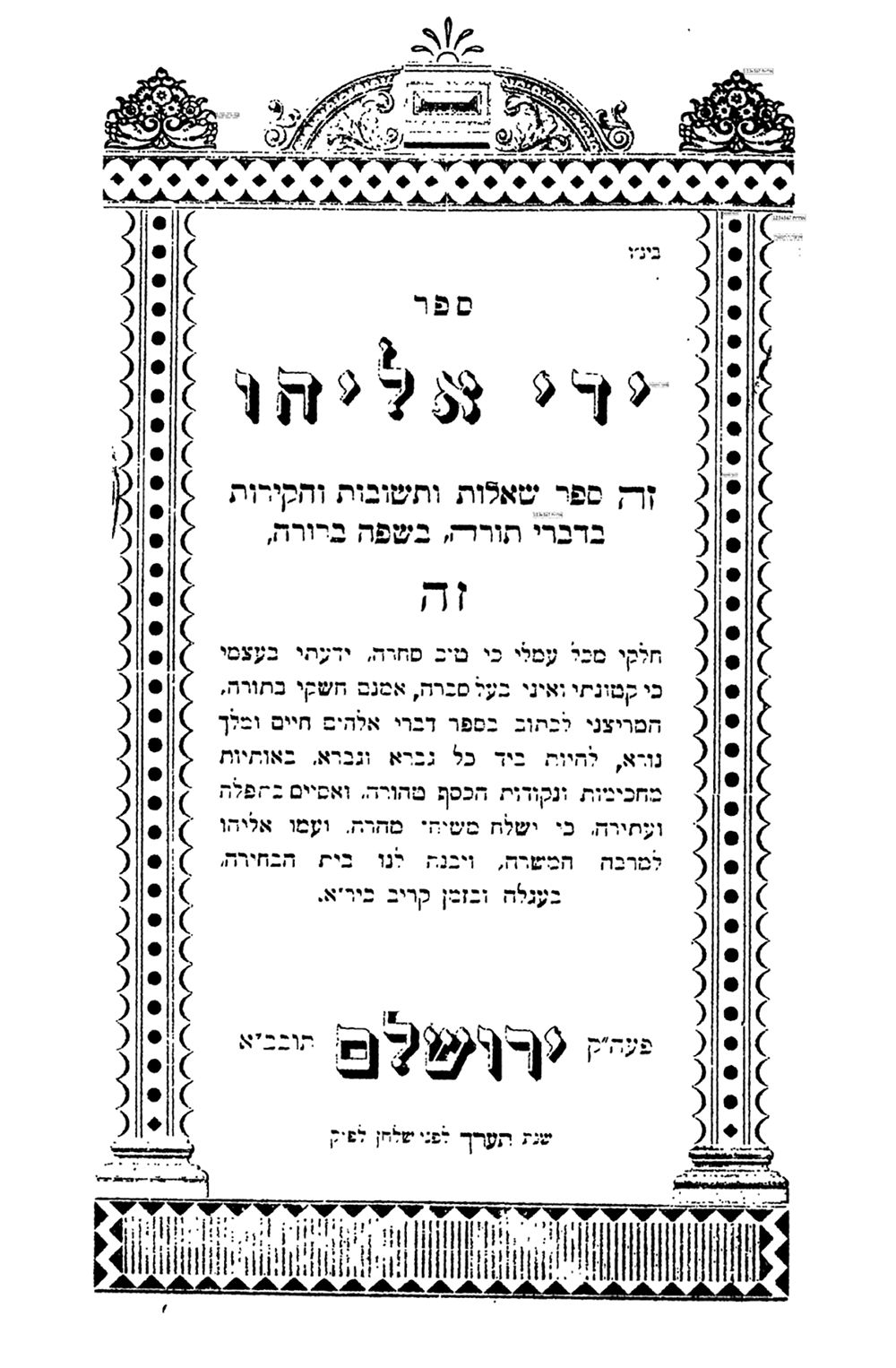
Concerning China there is a lot more I have to say, and I hope to publish a manuscript from a few hundred years ago regarding the Jews of China. For now, let me just note the following which will be of particular interest to Seforim Blog readers: There are two works of responsa that were published by rabbis who served in China. (I am not including Hong Kong which I will return to in a future post.) The first is R. Elijah Hazan’s Yedei Eliyahu. Here is the title page of volume 1.
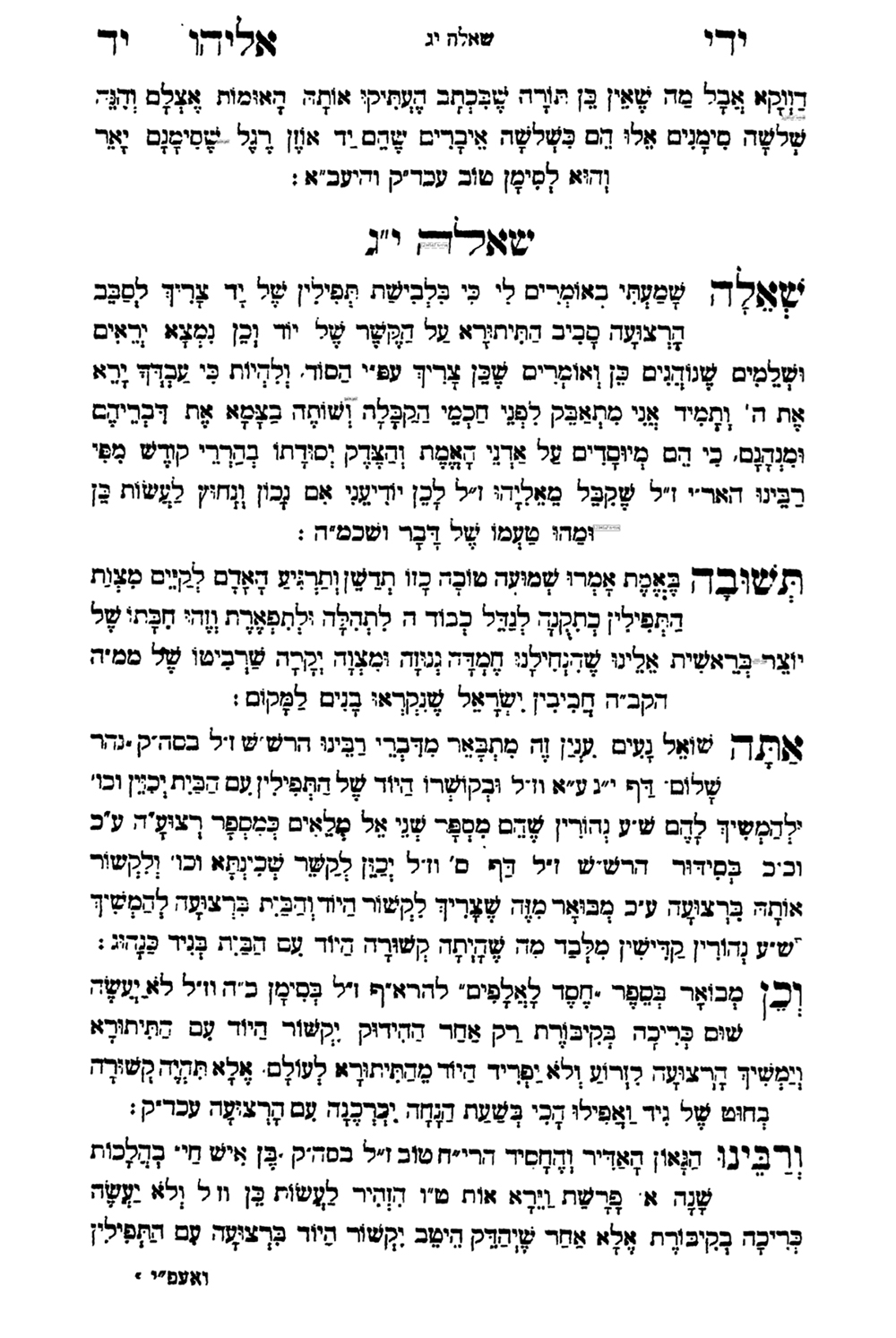
R. Hazan published three volumes in total. What makes his responsa very unusual, if not unique, is that the text is published complete with vowels. I don’t think I have ever seen another responsa collection published with vowels. Here is a sample page.
As R. Hazan explains in the introduction, he was the hazan in the Ohel Leah Synagogue in Hong Kong for fourteen years. Following this, for ten years he served as hazan at the Ohel Rachel Synagogue in Shanghai. Both of these synagogues still exist, but Ohel Rachel is now part of the Shanghai Educational Ministry and tourists are not permitted entry.
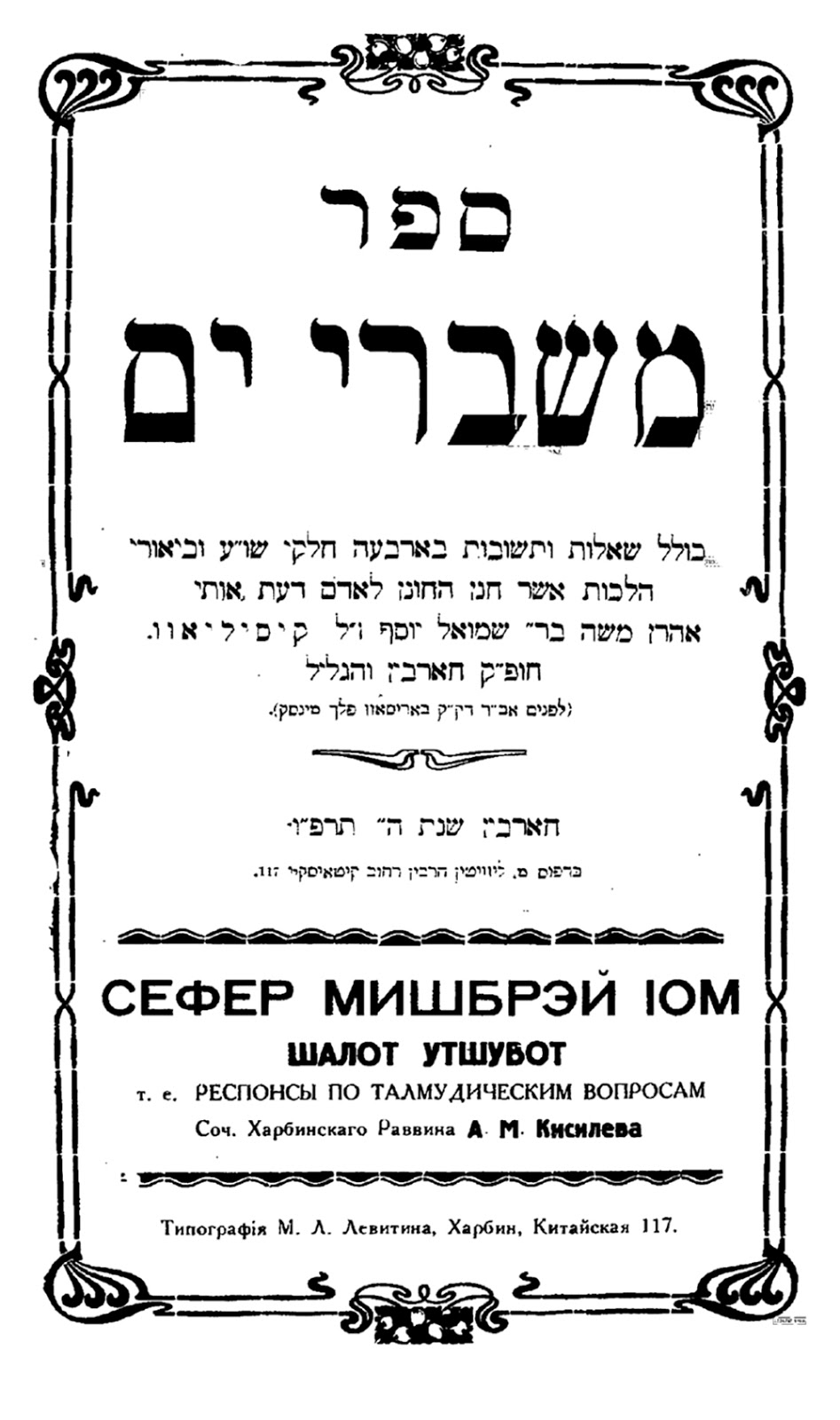
The second work of responsa by a rabbi in China is R. Aaron Moses Kiseleff’s Mishberei Yam. Here is the title page.
This book is significant not only because the author lived in China, but also because the book itself was printed in China in 1926, in the city of Harbin. Because of its proximity to Russia, Harbin attracted many Russian Jews and they were the ones who brought R. Kiseleff there. In the 1920s the Jewish population of Harbin was over 20,000.[3] As late as the 1940s there still was a Jewish day school in Harbin.[4]
Not long ago I saw that R. Gedaliah Felder, Yesodei Yeshurun: Shabbat, vol. 2, p. 216, refers to R. Kiseleff’s Mishberei Yam, and in a footnote writes:[5]
הספר הזה חשוב מאד כי זה הספר היחידי של הלכה שנדפס ברוסיא אחרי המהפכה, נדפס בשנת תרפ”ו.
No doubt because he saw the Russian writing on the title page of Mishberei Yam, R. Felder mistakenly assumed that Harbin is in Russia. He thus concluded falsely that Mishberei Yam is the only book on halakhah published in the Soviet Union. While this is incorrect, had he known the truth he could have kept the footnote but changed it to say that Mishberei Yam is important since it is the only original book on halakhah published in China.
R. Kiseleff served as rabbi in Harbin from 1913 until his death in 1949. After his death, his widow moved to Israel and published R. Kiseleff’s derashot, Imrei Shefer. Here is the title page which refers to R. Kiseleff as the chief rabbi of the Far East.
As explained in the introduction, R. Kiseleff was actually given this title in 1937 at a gathering of Far East Jewish communities.[6]
Herman Dicker writes as follows:[7]
Rabbi Kiseleff was a great Talmudic scholar who first came to Harbin when he was in his forties. He was born in Sores, Russia, in 1866 and as a child excelled in Jewish studies. He soon became known as the Vietker Ilui (wonder child), taking his name from the Yeshiva he attended as a youth. At sixteen, he transferred to the Yeshiva of Minsk, and, two years later, moved over to the Talmudic Center of Volozhin, where he studied with the famed Rabbi Chaim Soloveitchik. . . . Rabbi Kiseleff was ordained by Rabbi Chaim Ozer Grodzenski and then served as the rabbi of Borisoff from 1900-1913. In his final year at Borisoff, in 1913, Rabbi Kiseleff was called to Harbin and he accepted the post as spiritual head there at the gentle urging of the Lubavitcher Rebbe.
Within a short period of time, Rabbi Kiseleff won the love and admiration of the entire community and achieved a great deal in raising the spiritual level of this remote Jewish congregation. It was, therefore, fitting that in 1937 he was elected, unanimously, as Chief Rabbi by the General Conference of the Far Eastern Jewish Communities. . . .
In 1931, he published Nationalism and Judaism, a Russian-language volume of sermons and lectures on the significance of Judaism. . . . Rabbi Kiseleff enjoyed the friendship of all the religious and intellectual leaders of Manchuria, without regard to their nationality or faith, for they all admired him as a person and respected his vast knowledge in various areas of academic learning. At one time, he debated the “Merchant of Venice” and the image of Shylock with three university professors and to this day scores of men and women remember his brilliance and eloquence on that occasion.
There is a good deal of interesting material in R. Kiseleff’s Mishberei Yam, and let me call attention to just a few things. In no. 15, R. Kiseleff rules that if there is a non-Jew who wants to convert but the doctors tell him that it is dangerous for him to be circumcised, he still cannot be converted without a circumcision. In this responsum, R. Kiseleff also writes about how rabbis should avoid converting people who are not serious about being good Jews (although he assumes, as most rabbis did until recent years, that a conversion with such people would still be valid ex post facto).
ובכלל עלינו להתרחק בכל האפשר לקבל גרים כאלו שידוע שרוב הגרים הבאים להתגייר בימינו לא משום אהבתם לדת ישראל באמת רק על הרוב סבות אחרות בדבר משום אשה או דומה לזה ואף שמלמדים אותם לומר בפני ב”ד שאוהבים את דת ישראל ומטעמים ידועים אין אנו דוחים אותם שהרי בדיעבד גם בכה”ג הוי גר, אבל גרים כאלו יותר נוח לנו שאם נמצא אמתלא שלא לקבלם מהראוי להתרחק מזה, דאם בגרים אמתים אמרו חז”ל שקשים לישראל כספחת מה נענה לגרים גרורים כאלו שאין לבם לשמים כלל.
In no. 19 he discusses if a married woman becomes insane and has a child with someone other than her husband, if the child is a mamzer.
In no. 28 he responds to a rabbi in a Far East Russian community in which there were no Sabbath observant people other than the rabbi’s family. This created problems when it came to writing a get as one needs kosher witnesses and also the sofer cannot be a Sabbath violator. R. Kiseleff argues that since everyone in the town violates Shabbat, these people are not included under the halakhic definition of a “public Sabbath violator,” which means that one violates Shabbat in front of ten observant Jews. Therefore, none of the many gittin arranged by the questioning rabbi’s predecessor are to be regarded as pasul. At the end of his responsum, R. Kiseleff notes that in Siberia there is a big problem when it comes to gittin, as many places have no rabbi and the local shochet arranges the get. Needless to say, these shochetim were often not learned at all in this matter, and this could create major halakhic complications. R. Kiseleff therefore suggested that no one should be authorized to slaughter in Siberia until he learns the laws of gittin and is given an authorization to arrange gittin.
In nos. 29-30 he deals with a case of a man who gave a get and afterwards claimed that he was forced to do so, as he was beaten and the people beating him said that if he doesn’t give the get they will kill him. R. Kiseleff writes that the get is valid as the man would not have taken the threat seriously. In support of his assumption, he cites R. Moses Isserles who states with reference to a different case that Jews who threaten to kill another Jew are only trying to scare him, “as Jews are not murderers.”[8] R. Kiseleff sent his responsum to R. Meir Simhah of Dvinsk, and the latter disagreed with R. Kiseleff. R. Meir Simhah argued that contemporary “wild” young Jews are indeed capable of killing someone, and thus when threatened by them the man being pressured to authorize the get certainly would have taken this seriously.
דבחורי ישראל הפרוצים בזמנינו חשידי גם אשפ”ד
Here is another story about Harbin told by R. David Abraham Mandelbaum. In 1943 his father and his friend, both yeshiva students in Shanghai, came to Harbin where they visited the university. While there, and presumably in the library, they found on one of the tables a Sefat Emet on Kodashim. The two students were very surprised, since how did this book end up in such a far-away place? They grabbed the book and quickly exited.[9]
פתאום צדו עינים ספר קודש, המונח על אחד השולחנות. הבחורים המופתעים ניגשו ופתחו וגילו להפתעתם, שזהו הספר הק’ “שפת אמת” על סדר קדשים. התדהמה היתה עצומה, איך הגיע ספר קדוש זה למקום נידח, בעיר חארבין שבסין הרחוקה?! אפס, הם לא חשבו הרבה, שמו את הספר באמתחתם, והסתלקו חיש מהר מן המקום כמוצאי שלל רב.
The story as told is quite shocking to me and I am surprised that it was reported, for how was this not thievery? Presumably, the university acquired the book from one of the local Jews who donated it. Or perhaps at the time the yeshiva students were visiting the man who was studying the book had gone out to the restroom or he had left the book there from a previous visit. If such was the case, when the man returned he would have been very upset to find that his book was taken. It appears that the two yeshiva students simply felt that they had a right to take the book, as it did not belong in a Chinese institution.
This reminds me of how many years ago I walked into the library of the Jewish Theological Seminary and saw that they had installed an anti-theft system to prevent anyone from removing a book without it being checked out. Upon inquiring I was told that this was necessary as some people thought it was OK to take books from the library, as they felt that they were “liberating” the books from the clutches of those who had no right to them, that is, the Conservatives. I never took that claim seriously and always assumed that a thief is a thief, and the people stealing the books – no matter how big their kippot or how long their beards – did not have any religious justification worked out. Subsequent experiences have shown me that these sorts of thieves will steal from anyone if given the chance, even if it means pretending to be kollel students. (I won’t elaborate further, but some European readers will know what I am referring to). But in the case from Harbin, it seems obvious that the reason for taking the book was precisely because the yeshiva students felt that there was no reason for the Sefat Emet to be in a Chinese institution. As mentioned already, I do not see how this can be justified halakhically, as we are not talking about a Jewish book that was, for example, confiscated by the government for anti-Semitic reasons.[10]
After the yeshiva students returned to Shanghai with the Sefat Emet, it was then reprinted there. Here is the title page.
They also sent a copy of the book to R. Kiseleff, and here is the letter that accompanied the book.[11]
Interestingly, the copy of Sefat Emet that they used to reprint the book was missing some words. They therefore added by hand what they thought were the missing words. The following appears in R. David Abraham Mandelbaum, Giborei ha-Hayil, vol. 2, p. 107.
As is well known, when the Mir yeshiva reached Japan there was a lot of confusion about when to observe Shabbat and especially the upcoming Yom Kippur. Although there was already a local community there that observed Shabbat on Saturday, the Hazon Ish had informed the yeshiva that they must observe Shabbat on Sunday. R. Yehezkel Levenstein, the mashgiach of the Mir yeshiva, wrote to R. Kiseleff asking him specifically what to do about Yom Kippur, and he included a copy of the Hazon Ish’s letter explaining his reasoning. It is interesting that even after receiving the Hazon Ish’s letter R. Levenstein felt the need to consult with R Kiseleff, who was, as we have seen, regarded as the mara de-atra of the Far East.[12]
R. Kiseleff did not accept the Hazon Ish’s position. He told R. Levenstein that the question of Yom Kippur is no different than Shabbat, and they should keep the day that is currently being kept. R. Kiseleff was particularly worried that moving the Shabbat to Sunday, when it had previously been observed on Saturday, could lead to a lessening of Shabbat observance among the general Jewish population:
ורע עלי המעשה ששמעתי שמקצת מן הפליטים בקאבע קראו בתורה ביום א’ והתפללו תפלת שבת, ביחוד היא דרושה זהירות מרובה בענין זה בתבל כו’. ועתה כאשר נמצאו חרדים לדבר ד’ דוחים את השבת ליום א’ חג הנוצרים, יקל ענין שבת בעיניהם לגמרי, ויאמרו התירו פרושים את הדבר, ויצא מזה מכשול גדול אשר קשה יהי’ לתקן. לכן נלך מדרך זה חדש כזה אסור מן התורה בכל מקום . . . וכל המשנה ידו על התחתונה.
R. Aryeh Leib Malin also wrote to R. Kiseleff, and R. Kiseleff replied to him saying the same thing and sharply rejecting the Hazon Ish’s opinion.
בערב ש”ק העבר הרציתי מכתב להרב ר’ יחזקאל לעווינשטיין שליט”א בתשובה על מכתב הרב חזון איש, בו הודעתי טעמי ונימוקי שלא אסכים לפסק דינו על דבר דחיית יום השבת ביאפאן ליום א’ . . . כי דבריו בנוים על יסוד רעוע ובלתי ברור ומוסכם . . . ובלי ספק יגרום חלול שבת ותשתכח תורת שבת לגמרי . . . והריני מורה שיהודי יאפאן ישמרו שבת ומועדים ככל היהודים [במזרח הרחוק].
One wonders how R. Kiseleff would have reacted had he known that according to R. Simhah Zelig Rieger even in Harbin Jews should avoid Torah prohibitions on Sunday.[13] 

והרי הישראלים בחארבין שהיא מארץ חינא אינם מתנהגים כבעל המאור, נראה שלענין התפילה שהוא ענין דרבנן לא נשנה ממנהג הישראלים היושבים שם. ולענין איסור דאורייתא יש לחוש לדעת בעל המאור שהשבת מאוחרה לשל ירושלים

I earlier mentioned R. Kiseleff’s book of derashotImrei Shefer. In addition to the typical derashot one would expect in such a volume, it also includes eulogies for the Hafetz Hayyim and R. Kook. Regarding R. Kook, R. Kiseleff tells us that they were at the Volozhin yeshiva together and R. Kook was regarded then as one of the yeshiva’s outstanding students. He also records a talmudic question that R. Kook asked that R. Kiseleff tells us became the talk of all the students. Also included in the book are speeches R. Kiseleff gave on the twentieth and twenty-fifth anniversaries of Herzl’s death. He describes how thanks to Herzl many Jews who were entirely removed from Jewish life and ready to assimilate began to feel pride in their heritage and reconnect to their people.

Also included in the book are speeches he gave in honor of the Balfour Declaration and in memory of Nahum Sokolow and the victims of the 1929 massacres in the Land of Israel. Especially noteworthy is the speech found on p. 97, which celebrates the opening of the Hebrew University.
Many readers know about R. Kook’s speech on this occasion, and how he was attacked for supposedly applying to the university the verse, “For Torah shall forth from Zion, and the word of the Lord from Jerusalem” (Isaiah 2:3, Micah 4:2).[14] While R. Kook never used this verse with reference to the Hebrew University, R. Kiseleff did, as you can see from the above text.
* * * * *
In my post here I wrote:
It has been a while since I had a quiz, so here goes. In the current post I mentioned the prohibition of Torah study on Tisha be-Av. This is an example where the halakhah of Tisha be-Av is stricter than that of Yom Kippur. Many authorities rule that there is also something else that is forbidden on Tisha be-Av but permitted on Yom Kippur. Answers should be sent to me.
Many wrote to me that it is forbidden to greet someone on Tisha be-Av but not on Yom Kippur. Greeting is forbidden on Tisha be-Av due to the halakhot of mourning. However, this is forbidden according to everyone, and in the question I asked for an example of something that according to “many authorities” is forbidden on Tisha be-Av but permitted on Yom Kippur. If you pointed to something that is forbidden by “all” authorities (i.e., standard undisputed halakhah), this is not the correct answer.
A number of people also wrote to me that on Tisha be-Av one does not sit in a regular chair, unlike on Yom Kippur. Yet contrary to popular belief – and based on the emails I have received, it is indeed a quite popular belief – there is no halakhah that one must sit on the ground on Tisha be-Av. Rather, this is a minhag, not a law, and because it is a minhag we do not sit on the ground the entire day.[15]
The correct answer, which was sent to me by Brian Schwartz and Abe Lederer, is that many authorities hold that it forbidden to smell spices on Tisha be-Av, but this is not the case on Yom Kippur. In fact, smelling spices is recommended on Yom Kippur as a way to increase the number of blessings recited on this day, so that one can reach one hundred.[16]
While this is the answer I had in mind, Peretz Mochkin sent me another answer. If one has a seminal discharge on Yom Kippur, most poskim, including the Shulhan Arukh, Orah Hayyim 613:11, hold that he cannot go to the mikveh on this day. However, there are a number of significant authorities who hold that he may do so. When it comes to Tisha be-Av, there is agreement among halakhic authorities that it is forbidden to go to the mikveh after a seminal discharge.[17] However, this does not really answer the quiz question, since the question spoke of something that is permitted on Yom Kippur but forbidden on Tisha be-Av, and as noted, most poskim, at least in recent generations, forbid going to the mikveh on Yom Kippur in the case of a seminal discharge.[18]
________________________________
[1] I am aware of another posek who permits using an electronic key card on Shabbat, but requires covering up the green LED light. He explained to me that people feel good when they see the green light go on, and thus it cannot be regarded as a פסיק רישא דלא ניחא ליה. I wonder though, would other poskim agree that the feeling of satisfaction that the key works really be regarded as the sort of benefit that is considered as ניחא ליה? I think we usually assume that ניחא ליה is some sort of tangible benefit, like a light that goes on and allows you to see. In any event, the LED light is not a concern for R. Rabinovitch, and he does not require covering it up. R. Yitzhak Abadi only permits using an electronic key card on Yom Tov, and he too does not require covering up the LED light.
[2] See Donald Daniel Leslie, The Survival of the Chinese Jews: The Jewish Community of Kaifeng (Leiden, 1972), pp. 33-34; Jonathan D. Spence, The Memory Palace of Matteo Ricci (New York, 1983), p. 121.
[3] See Patrick Fuliang Shan, “‘A Proud and Creative Jewish Community’: The Harbin Diaspora, Jewish Memory and Sino-Israel Relations,” American Review of China Studies 9 (Fall 2008), p. 7. See also Joshua Fogel, “The Japanese and the Jews: A Comparative Analysis of Their Communities in Harbin, 1898-1930,” in Robert Bickers and Christian Henriot, eds., New Frontiers: Imperialism’s New Communities in East Asia, 1842-1935(Manchester, 2000), pp. 88-109
[4] See Zorah Warhaftig, Refugee and Survivor (Jerusalem, 19880, p. 208.
[5] Yesodei Yeshurun: Shabbat, vol. 2, p. 216.
[6] For the political background of these gatherings, see Herman Dicker, Wanderers and Settlers in the Far East (New York, 1962), pp. 45ff.; David Kranzler, Japanese, Nazis and Jews: The Jewish Refugee Comunity of Shanghai, 1938-1945 (Hoboken, 1988), pp. 220ff.
[7] Ibid., pp. 25-26. Much of what Dicker writes is taken word for word from the introduction to Imrei Shefer.
[8] Shulhan Arukh, Hoshen Mishpat, 236:1.
[9] David Avraham Mandelbaum, Giborei ha-Hayil (Bnei Brak, 2010), vol. 2, p. 105.
[10] The Hebrew manuscripts in the Vatican was an issue in the late 1980s, when the late Manfred Lehmann led a group, the Committee for the Recovery of Jewish Manuscripts, which insisted that the manuscripts be returned to the Jewish people by being donated to the National Library of Israel. See Lehmann, “The Story of the Hebrew Manuscripts in the Vatican Library,” available here. Nothing came of this venture and it does not seem like anyone at present has any interest in making an issue of the matter.
[11] From Mandelbaum, Giborei ha-Hayil, vol. 2, p. 109.
[12] See R. Yohanan ha-Kohen Schwadron, “Be-Inyan Kav ha-Ta’arikh,” Beit Aharon ve-Yisrael, Shevat-Adar 5770, p. 118. The complete letters of R. Kiseleff to R. Levenstein and R. Aryeh Leib Malin (mentioned later in the post) are found in R. Menahem Kasher, Kav ha-Taarikh ha-Yisraeli (Jerusalem, 1977), pp. 241-242.
[13] See his letter published in Talpiot 2 (1945), pp. 177-178.
[14] See my Changing the Immutable, pp. 143, 151.
[15] See e.g., here.
[16] See R. Yitzhak Yosef, Yalkut Yosef, Orah Hayyim 612:3. R. Yosef does cite a few sources that forbid smelling spices on Yom Kippur, but this viewpoint has never been accepted. I don’t think readers will be surprised to learn that there is an entire sefer devoted to the laws of smelling. The anonymously published 224-page Birkat ha-Reiahappeared in 2004. Here is the title page.
On pp. 196ff. he discusses the case of someone who has no sense of smell. The question is, can he make the blessing on besamim? The Shulhan Arukh, Orah Hayyim 297:5, rules that such a person can make the blessing on behalf of one who does not know how to make the blessing himself. This ruling was disputed by others, yet R. Jacob Reischer, Shevut Ya’akov, vol. 3, no. 20, defends the Shulhan Arukh, but as he says, not for R. Joseph Karo’s reason. R. Reischer argues that even though one without the sense of smell does not get any physical benefit from smelling something, his soul benefits. R. Reischer mentions that although the doctors reject the notion that the soul gets any benefit from this, their viewpoint can be disregarded because their scientific knowledge comes from “Aristotle and his companions.” R. Reischer died in 1733 and it is amazing that this is how he regarded the state of the study of medicine. Even more amazing, however, is that as he continues to attack modern science, R. Reischer adds that the non-Jewish scientists’ knowledge is based on the assumption that the earth is round, which contradicts the talmudic understanding and is thus to be rejected. How is it possible that in the eighteenth century R. Reischer believed that the earth was flat? 

The Vilna Gaon is also recorded as having held this opinion. See R. Joshua Heschel Levin, Aliyot Eliyahu (Jerusalem, 1989), p. 98 n. 82. This also appears to be what the Vilna Gaon is saying in his commentary to Tikunei Zohar (Vilna, 1867), p. 158a:

והוא יסוד הארץ שהיא רבועא כמ”ש מארבע כנפות הארץ ואמר בספרי הכנף לאפוקי עגול’ [עגולה]
See also R. Reuven Margaliyot’s note to Zohar, Vayikra, p. 10a, n. 10 (he mistakenly cites the Vilna Gaon’s comment as appearing in his commentary to Tikunei Zohar, p. 5b).
Did R. Zvi Elimelekh of Dinov, the Bnei Yisaskhar, think the earth was flat? Here is what he writes in his Devarim Nehmadim to Avot 5:1:
אין לחקור על היוצר כל למה ברא את העולם [בי’ מאמרות וגם] אין לחקור למה ברא את השמי’ כדוריי והארץ שטחיית וכיוצ’.
See here for a contemporary rabbi and author of seforim who believes the earth is flat.
[17] The only exceptions to this I have found are two unknown sources mentioned by R. Simhah Rabinowitz, Piskei Teshuvot, Orah Hayyim 554 note 58. These two sources are (תורת חיים (פעסט and קונטרס קודש ישראל 
[18] R. Joseph Hayyim, Rav Pealim, vol. 2, Orah Hayyim no. 61, states that among the medieval authorities, most held that it is permissible to to go to the mikveh on Yom Kippur after a seminal discharge: 

דהמתירים לטבול הם רוב מנין ורוב בנין


Romm Press, Haggadah Art, Controversial Books, and other Bibliographical Historica

Legacy Auctions: Romm Press, Haggadah Art, Controversial Books, and other Bibliographical Historica

Legacy Judaica’s fall auction is next week, September 13, and we wanted to highlight some bibliographical historica.  Lot 95 is Elbona shel Torah, (Berlin, 1929), by R. Shmuel Shraga Feigneshon, known as Safan ha-Sofer.  He helmed the operations of the Romm Press in Vilna.  During his 55-year tenure, he oversaw the publication of the monumental Vilna Shas, among numerous other canonical works that became the model for all subsequent editions. He wrote a history of the press which first appeared in part in the journal HaSofer (vol. 1 27-33 and vol. 2-3 46-57, 1954-55). It was then published in its entirety in Yahadut Lita vol. 1. 1959.  This biography was plagiarized in nearly every respect by the Yated Ne’eman.  It was a near-perfect reproduction (albeit in English rather than the original Hebrew), except that certain names and select passages were omitted presumably because they reference Jewish academics or other materials deemed objectional to Haredi audiences.

In Elbona shel Torah, (51-52), Shafan Ha-Sofer discusses the censorship of Jewish texts from non-Jewish authorities.  There were not only omissions but also additions to the text.  He identifies one of the angels mentioned in the supplications between the Shofar sets with Jesus.  He claims that “Yeshu Sa’ar ha-Pinim” is in fact Jesus of Nazareth.  Nonetheless, he notes that this passage was included in most mahzorim.  Indeed, in the first Romm edition of the Mahzor this angel appears.  He explains that after it was published a rabbi from Yemen, who was unfamiliar with the historic inclusion of the passage, was shocked when he came this passage.  He immediately set about issuing a ban on all the Romm books, classifying them within the category of a sefer torah of a heretic which is consigned to the fire.  But the ban was annulled after a Jerusalem rabbi intervened and explained to his clergy brother that in fact the Romm edition merely followed an accepted text. According to Shafan ha-Sofer, after this brush with what is described as potential financial ruin, later editions of the Vilna Mahzor omit Yeshu.

Two books feature on their title pages an immodest Venus rising.  The title page of R. Moshe Isserles, Torat ha-Hatat, Hanau, 1628, lot 33, depicts in the bottom center of page Venus with a loincloth.  Additionally, on the two sides of the pages two similarly exposed women appear in medieval costume. This particular title page was reused on at least three other books.  A similarly undressed woman appears on the title page of R. Isaac of Corbeil’s Amudei Golah, Cremona 1556, lot 1.

Naftali Hertz Wessley’s, Divrei Shalom ve-Emet, Berlin, 1782, lot 99, (volume 2), is the controversial work wherein he provides his educational program.  Although some of his other works secured the approbations of leading Orthodox rabbi, some of the more traditional rabbis were opposed to Wessley’s reforms advocated in Divrei. See our discussion here, and Moshe Samet, Hadash Assur min ha-Torah (Jerusalem, Carmel, 2005), 78-83; Edward Breuer, “Naphtali Herz Wessely and the Cultural Dislocations of an Eighteenth-Century Maskil,” in New Perspectives on the Haskalah, Shmuel Feiner and David Sorkin eds., (London, Littman Library, 2001), 27-47.. Wessley advocated for the inclusion of some secular studies, separate grades for children of different ages and abilities, and satisfying testing requirements. These and many others of his suggested reforms are now commonplace in Orthodox schools. He was interested in improving all aspects of Jewish education and chided his more acculturated Jews who only adopted his policies as they related to secular subjects but did not otherwise incorporate contemporary intellectual rigor to their Jewish studies. Copies of the originals of the work are rare.

Another book that aroused a controversy is R. Zechariah Yosef Rosenfeld of St. Louis’ work, Yosef Tikva, St. Louis, 1903.  Rosenfeld defends the use of machine manufactured matzot for Passover.  There is a significant literature regarding the use of these matzot, see Hayim Gartner, “Machine Matzah, the Halakhic Controversy as a Test Case for Defining Orthodoxy,” in Orthodox Judaism: New Perspectives, (Jerusalem, Magnes Press, 2006), 395-425 (Hebrew) and Jonathan Sarna, How Matzah Became Square: Manischewitz and the Development of Machine-Made Matzah in the United States, (New York, Touro College, 2005) .

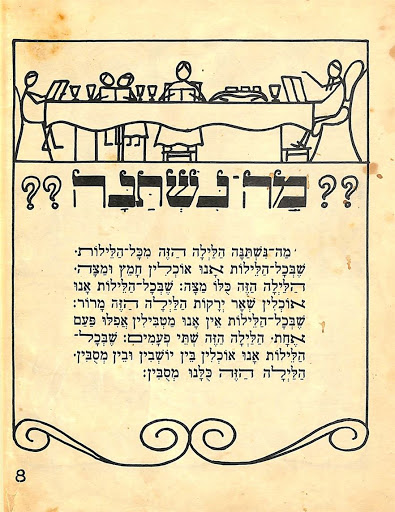
Another Passover item Yaakov Agam’s limited edition of the Haggadah, Paris, 1985, lot 138.  Agam adds a rich color palette to the otherwise spare style of the German illustrator, Otto Geismar. His 1928 haggadah uses minimalism to great effect and has a whimsical flair, yet at times the thick black ink figures are dark and foreboding.  Agam’s offers of a kaleidoscopic version of the haggada that is purely uplifting.


Otto Geismar, Berlin 1928

Yaakov Agam, Paris 1985

Aside from the books, one letter of note, Lot 182.  In 1933 letter from R. Hayim Ozer Grodzensky writes that he had proclaimed a fast in Vilna in response to the rise of Hitler and that “the new persecutions will cause the old to be forgotten.” Despite the fact that R. Ozer recognized almost immediately the threat of Hitler, during WWII he was not as prescient.  As late as March 1940, he was encouraging Jews to remain in Vilna. See Eliezer Rabinowitz, R. Hayim Ozer’s Prophesy for Vilna has Been Fulfilled,” Morgen Journal, May 8, 1940.

Two final items, both relate to the Volozhin yeshiva.  The first is a copy of Meil Tzedakah, Prague 1756, lot 158that belonged to R. Yosef Dov Soloveitchik, the Bet ha-Levi, and rosh ha-yeshiva of Volozhin.  The book also belonged to the Vilna rabbi, R. Abraham Pasveller, and R. Chaim Soloveitchik.  The second, lot 166, is a letter by the R. Naftali Berlin, Netziv, the Bet Ha-Levi’s co-Rosh ha-Yeshiva and eventual disputant.  He writes to the journal HaTzfirah (see these posts (herehere and here) regarding the Netziv and reading the contemporary press), regarding 1886 fire in Volozhin Yeshiva and the rebuilding efforts. Among other things, he sought to publicizes the names of donor and provided a list from memory.  Among the donors was Yisrael Brodsky. Although Brodsky was a major donor to the Volozhin Yeshiva and a highly acculturated Orthodox Jews, some have attempted to portray him otherwise.  See our post “For the Sake of Radin!  The Sugar Magnate’s Missing Yarmulke and a Zionist Revision.”


New Seforim and books 2014

New Seforim and books 2014
by Eliezer Brodt
Although the world, has been shifting more and more to E- books, seforim and books are still being printed in full force in the Jewish world. What follows is a list of new seforim and books I have seen around in the past few months. Some of the titles are brand new others are a bit older. I am well aware that there are new works worth mentioning that are not included. Due to lack of time I cannot keep track of every book of importance nor comment properly on each and every work. I just try to keep the list interesting. For some of the works listed I am able to provide a Table of contents or a sample feel free to email me at eliezerbrodt@gmail.com. I hope you enjoy!
ספרים
1.      פיוטים לארבע פרשיות, קרובץ לפורים עם פירוש רש”י ובית מדרשו [ניתן לקבל תוכן הענינים], רלט עמודים
2.      פירוש רש”י למסכת ראש השנה, מהדורה ביקורתית, מהדיר אהרן ארנד, מוסד ביאליק,
3.      ספר משלי עם פירוש הרוקח, מכ”י ע”י ר’ אליעזר שווארץ, רכב עמודים
4.      ספר המצות להרמב”ם, השגות הרמב”ן עם ביאורים והערות, שרשים, חלק א, ר’ שלמה אריאלי, שלט עמודים
5.      אהבה בתענוגים, לר’ משה בן יהודה חלק א מאמרים א-ז, איגוד העולמי למדעי היהדות, [מהדיר: אסתי אייזנמן], 355 עמודים
6.      פירושים פילוסופיים של רבי ידעיה הפניני, על מדרשי רבה, תנחומא, ספרי ופרקי דרבי אליעזר, מתוך כ”י, אוצרות המגברב, 351 עמודים
7.      תלמוד מסכות עדיות, למהר”ש סיריליאו, על פי כ”י, אהבת שלום, 73 + שיג עמודים [מצוין]
 I hope to return to this special work shortly.
8.      ר’ יעקב פראג’י, שו”ת מהרי”ף החדשות, מכ”י, מכון טוב מצרים, שפט עמודים
9.      ר’ אליעזר נחמן פואה, דרכי תשובה, על ענין התשובה עם קונטרס בקשות ווידויים כפי הזמן  על פי כ”י,  שפט עמודים [מצוין]
10.  תפארת ישראל, מגילת ספר על מגילת אסתר, להרשב”ץ האחרון [נדפס לראשונה בשנת שנ”א], שסג עמודים
11.  ר’ זאב וואלף אולסקר, חידושי הרז”ה, [אחד מגדולי חכמי הקלוז דבראד בזמן הנודע ביהודה],  ב’ חלקים, [מהדיר: ר’ אהרן וויס], חלק גדול על פי כת”י, חידושי מסכת ברכות, שיעורי תורה, דיני חדש, מכירת חמץ, הערות בשו”ע, [מצוין] כולל מבוא על הספר מאת דר’ מעוז כהנא, תרלא +רפג+117 עמודים, מכון זכרון אהרן
12.  הדרת קודש, מדרש הנעלם מגילת רות, גר”א, מהדיר: ר’ דוד קמנצקי, מוסד רב קוק, שמא עמודים
13.  ר’ ישראל איסורל מפאניוועז’, מנוחה וקדושה, תיח עמודים
A few years ago I wrote about this sefer and the censorship of various parts. This new editions is complete. What is interesting is that the censored edition had a Haskamah from Rabbi Shmuel Auerbach while the new edition is uncensored, based on the advice of Rabbi Steinman and Rabbi Chaim Kanievsky.
14.  ר’ יהודה ב”ר נתן הלוי, מחנה לויה, על הלכות שמחות למהר”ם מרוטנברג, מכון המאור, תקנט עמודים
15.  סדר הכנסת שבת מאת אדמו”ר הזקן, [זמנים], עם ביאור ר’ שלום דובער לוין, קלב עמודים
16.  ר’ אליהו הכהן האתמרי, בעל שבט מוסר, מגלה צפונות, שמות, [עם מפתחות], תרסב עמודים
17.  דרשות וחידושי רבי אליהו גוטמאכר, ויקרא, רסז עמודים
18.  יד דוד על התורה, רבי דוד אופנהיים, מכון נצח יעקב, שלח עמודים ומפתחות של סג עמודים
19.  תורת חכמי מיץ, מכ”י, ביאורים, חידושי סוגיות ודברי אגדה על פרשיות השבוע ועל המועדות, [מה’שאגת ארה’, יערות דבש, רבינו שמואל הילמן, רבינו אברהם ברודיא רבינו אהרן וורמסר עוד], שכח עמודים
20.  שו”ת נחל אשכול, כולל שו”ת מ’ ר’ צבי אויערבך, ורבו ר’ יעקב באמבערגער, וגם שו”ת עוללות אביעזר ופסקי דינים מאת ר’ יוסף זינצהיים, ושו”ת עזרי מקדש, מכון שמרי משמרת הקדש, שמד עמודים, [מצוין]
21.  משפט שלום, מהרש”ם, חושן משפט סי’ קעה-רלז, רמא- רצ, שני חלקים
22.  מהרש”ם, תכלת מרדכי מועדים, תפא עמודים
23.  צפנח פענח, על מסכת ברכות, מתוך גליונות הגמרא שלו, מכון המאור, תקכג עמודים
24.  ר’ אברהם יצחק הכהן קוק, לנבוכי הדור, [מצוין] ידיעות ספרים,  366 עמודים
25.  פנקס בית הדין בחרבת רבי יהודה החסיד מיסודו של מרן רבי שמואל סלנט, תרס”ב- תרפח, פסקים והכרעות דין בענייני הציבור והיחיד הוראות בענייני הלכה ומנהג, תקנות וחזקות, מכון הרב פרנק, שסח עמודים
26.  אוסף מכתבים ממרן בעל ‘ברכת שמואל’, נדפס ע”י ר’ קלמן רעדיש, סח עמודים
27.  ר’ אלחן ווסרמן, קונטרס דברי סופרים עם מילואי דעת סופרים, גליונות חזון איש וקהילות יעקב ומפתחות, שנב עמודים
28.  ר’ עובדיה יוסף, חזון עובדיה, שבת חלק ו, שסד עמודים
29.  ר’ רפאל בנימין פוזן, פרשגן, ביאורים ומקורות לתרגום אונקלוס, שמות, 780 עמודים, [מצוין]
30.  ר’ שמואל קמנצקי, קובץ הלכות חנוכה, רנ עמודים
31.  ר’ שמואל קמנצקי, קובץ הלכות שבת, א, תשפט עמודים
32.  ר’ מרדכי אשכנזי, שערי תפילה ומנהג, ביאורים בנוסח התפילה בסידור רבינו הזקן ובמנהגי התפילה, א, תפילות חול וברכת המזון, תקלח עמודים
33.  קנה בינה, מגן אברהם המבואר, הל’ שבת סי’ רמב-ש, תיד עמודים
34.  ר’ יצחק וויס, בינה לעתים חנוכה, קי עמודים
35.  אם הבנים שמחה [ראה כאן]
36.  ר’ מנחם שורץ, מנחת אליהו, עיונים בעמוק הפרשיות, בראשית, תתקי עמודים
37.  פסקי הגרי”ש, קובץ קיצור הלכות, או”ח, שנכתבו ע”י ר’ יוסף ישראלזון, ריג +63 עמודים
38.  חידושי מנחת שלמה, סוכה, לר’ שלמה זלמן אויערבאך, שיח עמודים
39.  ר’ יעקב בלויא, נדרי יעקב, הלכות נדרים ושבועות,  תלד עמודים
40.  ר’ דוד כהן, מזמור לדוד, מאמרים בסדר פרשיות התורה ומועדי השנה, חלק ב, תקנו עמודים
41.  ר’ יצחק שילת, רפואה הלכה וכוונות התורה, 278 עמודים [ניתן לקבל תוכן עינינים והקדמה]
42.  אנציקלופדיה תלמודית כרך לב [כפרות-כתבי קודש] [ניתן לקבל תוכן הענינים]
43.  אנציקלופדיה תלמודית כרך לג [כתובה – לא יומתו אבות על בנים] [ניתן לקבל תוכן הענינים]
44.  ישורון, קונטרס חנוכה ופורים תיד עמודים
45.  סידור אור השנים, לבעל הפרד”ס, ר’ אריה ליב עפשטיין, אהבת שלום, תתקצג עמודים
46.  סידור עליות אליהו אשכנז מהדורה שניה, 817 עמודים
47.  סידור אזור אליהו, כמנהג רבנו הגר”א ע”פ נוסח אשכנז, מהדורה תשיעית, [כיס]
48.  קובץ מאמרי טוביה פרשל לרגל מלאת השלשים לפטירתו, 149 עמודים
49.  קובץ מאמרי טוביה פרשל, כרך ב, 129 עמודים
50.  ספר בנות מלכים, עניני לידת הבת בהלכה ובאגדה, קס עמודים
51.  ר’ זאב זיכערמאן, אוצר פלאות התורה, שמות, תתקא עמודים
52.  ר’ שריה דבליצקי, תנאים טובים, תנאים בכוונת השמות הק’, נז עמודים
53.  ר’ יאיר עובדיה, קונטרס הלכה ומציאות בזמן הזה, כללים ביחס ההלכה כלפי המציאות, 75 עמודים
54.  ר’ דוד פלק כנור דוד, חדושים ובאורים בפיוטי זמירות שבת קודש, תצה עמודים
55.  ר’ ישראל מורגנשטרן, החמשל בשבת בזמנינו, קכ עמודים
56.  משוש דור ודור, מסכת חייו וקצות דרכיו בקודש של מרן רבנו יוסף שלום אלישיב זצוק”ל, חלק א, 442 עמודים
57.  ר’ דוד אברהם, מפיו אנו חיים, תולדות רבינו חיים פלאג’י, מכון ירושלים, שה עמודים
58.  ר’ בן ציון בערגמאן, מיכאל באחת, פרקי חייו  והליכותיו בקודש של רבנו מיכאל אליעזר הכהן פארשלעגער, תלמיד של ה’אבני נזר’, תלא עמודים [כולל מכתבים חשובים ועוד]
59.  ר’ נחום סילמן, אדרת שמואל, לקט הנהגות ופסקים של רבי שמואל סלנט, כולל קובץ ימי שמואל, פרקי חיים, תש”ן עמודים [ניתן לקבל דוגמא]
60.  מסורה ליוסף, עיונים במורשתו של ר’ יוסף קאפח, הלכה ומחשבה, חלק ח, 597 עמודים
61.  ר’ חיים קדם, נהג כצאן יוסף, משנתו החינוכית של הרה”ג יוסף קאפח, 219 עמודים
62.  ר’ מרדכי שפירא, דברות מרדכי, בדיני ברכת מעין שלש, קונטרס בענין אחיזת הבשמים בשמאל בהבדלה, רעח עמודים
63.  ר’ דוד יוסף, הלכה ברורה, ה’ אמירה לנכרי בשבת, ב’ חלקים
64.  ר’ יצחק אדלר, תדיר קודם, כללים ובירורי הלכה בדין תדיר ושאינו תדיר תדיר קודם, שפ עמודים הגדות
1.      הגדה של פסח מיטיב נגן, להגאון ר’ יעקב עמדין, עם הוספות מכתב יד המחבר [ניתן לקבל דוגמא], ר’ בומבך, כולל הדרשות ‘פסח גדול’ ו’שערי עזרה’.
2.      ר’ אליעזר אשכנזי הגדה של פסח עם פירוש מעשי ה’ החדש עם באורים והערות, מהדיר:  ר’ יהושע גאלדבערג, שלא עמדים
3.       הגדה של פסח, עם פירוש הגר”א כפי שהדפיס תלמידו רבי מנחם מענדיל משקלאוו עול פי דפוסים קדמונים, נערך ע”י ר’ חנן נובל, קפג עמודים + פירוש הגר”א לשיר השירים, צח עמודים
4.     רבי בנימין גיטעלסאהן, הגדה של פסח עם באור נגיד ונפיק, [נדפס לראשונה בתרס”ד בסיוע של האדר”ת], עם הרבה הוספות חדשות הערות ותיקונים שהעלה המחבר בכתב ידו בגליון שלו, נפדס ע”י ידידי ר’ שלום דזשייקאב, רנב עמודים [מצוין]
קבצים
1.      המעין גליון 208
2.      המעין גליון 209
3.      ישורון כרך ל [מצוין] [ניתן לקבל תוכן הענינים] [כולל בין השאר חומר חשוב על ר’ יעקב עמדין מכ”י וגם הרבה חומר מאת הגאון ר’ חיים לוין]

כידוע, לפני כמה שנים יצאה בהוצאת מאגנס ספר גדול ממדים ע”י ד”ר בנימין בראון בשם: ‘החזון איש’ הפוסק, המאמין המהפכה החרדית. הספר זכה לכמות חריגה של ביקורות, פנימיות וחיצוניות. לאחרונה גם קובץ ישורון הדפיס מאמר גדול על הספר ובקובץ החדש הגיב ד”ר בנימין וגם הכותב של המאמר הראשון, יהושע ענבל, הגיב לתגובה. בגלל חסר מקום בקובץ ישורון הדפיסו רק חלק של שני מאמרים אלו. באינטרנט עלו שני המאמרים השלמים, שאפשר לשולח למי שמבקש.
4.      אור ישראל גליון סח
5.      עץ חיים גליון כא
6.      מן הגנזים, ספר ראשון, ‘אוסף גנזים מתורתם של קדמונים גנזי ראשונים ותורת אחרונים דברי הלכה ואגדה, נדפסים לראשונה מתוך כתב יד, תטז עמודים
7.      קובץ אסיף, שנתון איגוד ישיבות ההסדר, ב’ חלקים, 413+414 עמודים, תלמודהלכה תנ”ך ומחשבה [מלא חומר חשוב]
8.     ארזים, גנזות וחידושי תורה, חלק ב מכון שובי נפשי, תתכב עמודים
מחקר וכדומה
1.      מסכת סוכה, פרקים ד-ה, משה בנוביץ, 802 עמודים
2.      אסופה, ארבעה מאמרים מאוצרות הר”ש אשכנזי שליט”א [‘העלם דבר וטעות סופר’, ‘הגונב מן הספר’, ‘הרמב”ם כמתרגם מלשון התלמוד ללשון המשנה’, ‘מילונות עברית כיצד’?], ערך והשלים והביא לבית הדפוס, יעקב ישראל סטל, בהשתתפות אליעזר יהודה בראדט, כריכה רכה, 166 עמודים.
3.      שלום רוזנברג, בעקבות הזמן היהודי, הפילוסופיה של לוח השנה, ידיעות ספרים, 383 עמודים
4.      אסופה ליוסף, קובץ מחקרים שי ליוסף הקר, מרכז זלמן שזר, [מצוין], ניתן לקבל תוכן ענינים, 596 עמודים
5.      גבורות ישעיהו, דרישות וחקירות אמרות ברורות על ישעיהו צבי וינוגרד, בהגיע לשנת הגבורות, נדפס במאה עותקים בלבד, 110 עמודים [ניתן לקבל תוכן ודוגמא]
6.      שליחות, מיכאל ויגודה, 1008 עמודים, המשפט העברי
7.      ר’ דוד משה מוסקוביץ, המבוא לספרי הרמב”ם, [פירוש המשניות, ספרי המצות, משנה תורה] ניתן לקבל דוגמא,
8.      אייל בן אליהו, בין גבולות, תחומי ארץ ישראל בתודעה היהודית בימי הבית השני, ובתקופת המשנה והתלמוד,  בן צבי,  348 עמודים, [מצוין]
9.      יעל לוין, תפילות לטבילה, 29 עמודים [ראה כאן] [להשיג אצל המחברת ylevine@013net.net]
10.  יוצרות רבי שמואל השלישי [מאה העשירית] ב’ חלקים, מהדירים: יוסף יהלום, נאויה קצומטה, בן צבי, 1139 עמודים
11.  קובץ על יד כרך כב [ניתן לקבל תוכן ענינים]
12.  יואל אליצור, מקום בפרשה, גיאוגרפיה ומשמעות במקרא, ידיעות ספרים, 480 עמודים, [מציון]
13.  זר רימונים, מחקרים במקרא ופרשנותו מוקדשים לפר’ רימון כשר, ניתן לקבל תוכן העינים, 640 עמודים
14.  משנת ארץ ישראל , שמואל וזאב ספראי, דמאי, 293 עמודים
15.  משנת ארץ ישראל שמואל וזאב ספראי, מעשרות ומעשר שני, 460 עמודים
16.  משנת ארץ ישראל, אבות, זאב ספראי, 390 עמודים
17.  תרביץ, פב חוברת א, [מצוין] [ניתן לקבל תוכן], 216 עמודים
18.  נטועים, גליון יח, 214 עמודים
19.  בד”ד 28
20.  דעת 76, עדות לאהרן, ספר היובל לכבוד ר’ אהרן ליכטנשטיין, הוצאת בר אילן, 304 עמודים
21.  ברכה זעק, ממעיינות ספר אלימה לר’ משה קורדובירו ומחקרים בקבלתו, אוניברסיטת בן גוריון, 262 עמודים.
22.  עמנואל טוב, ביקורת נוסח המקרא, מהדורה שנייה מורחבת ומתוקנת, נ+411+32 עמודים
23.  ליאורה אליאס בר לבב, מכילתא דרשב”י, פרשת נזיקין, נוסח מונחים מקורות ועריכה, בעריכת מנחם כהנא, מגנס, 392 עמודים
24.  שד”ל, הויכוח, ויכוח על חכמת הקבלה ועל קדמות ספר הזוהר, וקדמות הנקודות והטעמים, כרמל,41+ 142 עמודים
25.  יחיל צבן, ונפשו מאכל תאוה, מזון ומיניות בספרות ההשכלה, ספריית הילל בן חיים, 195 עמודים
26.  רחל אליאור, ישראל בעל שם טוב ובני דורו, שני חלקים הוצאת כרמל,
27.  מאה סיפורים חסר אחד, אגודת כתב יד ירושלים בפולקלור היהודי של ימי הביניים, עם מבוא והערות מאת עלי יסיף, אוניבריסיטת תל אביב, 351 עמודים
28.  רוני מירון, מלאך ההיסטוריה דמות העבר היהודי במאה העשרים, מגנס, 388 עמודים
29.  יצחק נתנאל גת, המכשף היהודי משואבך, משפטו של רב מדינת ברנדנבורג אנסבך צבי הריש פרנקל, ספריית הילל בן חיים, 211 עמודים
30.  טל קוגמן, המשכילים במדעים חינוך יהודי למדעים במרחב דובר הגרמנית בעת החדשה, מגנס 243 עמודים
31.  נעמי סילמן, המשמעות הסמלית של היין בתרבות היהודית, ספריית הילל בן חיים, 184 עמודים
32.  שמואל ורסס, המארג של בדיון ומציאות בספרותנו, מוסד ביאליק
33.  יהושע בלאו, בלשנות עברית, מוסד ביאליק
34.  יוסף פרל, מגלה טמירין, ההדיר על פי דפוס ראשון וכתבי-יד והוסיף מבוא וביאורים יונתן מאיר, מוסד ביאליק.  ג’ חלקים. כרכים ‘מגלת טמירין’ כולל 345  עמודים +מח עמודים; כרך ‘נספחים’ עמ’ 349-620;  כרך ‘חסידות מדומה’ עיונים בכתביו הסאטיריים של יוסף פרל, 316 עמודים.
35.  קרן חוה קירשנבום, ריהוט הבית במשנה, הוצאת בר אילן, 342 עמודים
36.  מאיר רוט, אורתודוקסיה הומאנית, מחשבת ההלכה של הרב פרופ’ אליעזר ברקוביץ, ספריית הילל בן חיים, 475 עמודים
37.  גלעד ששון, מלך והדיוט, יחסם של חז”ל לשלמה המלך, רסלינג, 243 עמודים
38.  יומנו של מוכתר בירושלים, קרות שכונות בית ישראל וסביבתה בכתביו של ר’ משה יקותיאל אלפרט [1938-1952], בעריכת פינסח אלפרט ודותן גורן, הוצאת אוניברסיטת בר אילן,414 עמודים
39.   אהרן סורסקי, אש התורה,  על ר’ אהרן קוטלר, ב’ חלקים
40.  ר’ משה סופר, המנהיג, תרפ”א- תשע”ד, פרקי מוסף ממסכת חיו המופלאה של מרן ר’ עובדיה יוסף, 525 עמודים
41.  ר’ יחיאל מיכל שטרן, מרן, תולדות חיין של מרן רבי עובדיה יוסף, שפג עמודים,
42.  ר’ דב אליאך, ובכל זאת שמך לא שכחנו, חלק ב, זכורות בני ישיבה שיחות אישיות עם בחורי ישבות של פעם, 399 עמודים
43.  ר’ אליהו מטוסוב, עין תחת עיון, כיצד חוקרים אישים בישראל, אודו הרמב”ם והצדיק רבי משה בן רבינו הזקן [כנגד דוד אסף ועוד], 202 עמודים
44.  שואף זורח, בסערות התקופה במערכה להעמדת הדת על תילה, מכון דעת תורה, 739 עמודים
45.  ר’ עובדיה חן, הכתב והמכתב, פרקי הדרכה והנחיה באמנות הכתיבה התורנית, [מהדורה שניה], תמד עמודים
46.  קתרסיס יט, [פורסמה תגובה של בנימין בראון למאמר הביקורת של פרופ’ שלמה זלמן הבלין שפורסמה בגליון הקודם של קתרסיס, וגם תגובה של שלמה זלמן הבלין לתגובה של בראון]  Available upon request
English
 
1.
Dialogue, 4, 305 pp.-
2.
Hakirah 16, 246+45 pp.
3.
Benjamin Richler, Guide to Hebrew
manuscript collections
, Second revised edition, Israel Academy of Sciences
and Humanities, 409 pp. [TOC available]
4.
Chaeran Y. Freeze & Jay Harris [editors], Everyday
Jewish life in Imperial Russia,
Select Documents, Brandeis University
Press, 635 pp
5.
Rabbi Daniel Mann, A Glimpse at Greatness,
A study in the work of Lomdus (Halachic Analysis), Eretz Hemdah, 262 pp.
This work deals with four great Achronim; the Machaneh Ephrayim, K’tzot
HaChoshen,
Rabbi Akiva Eiger, and the Minchat Chinuch. The author
provides a brief history of each one of these Achronim and then he delves into
their methods. He provides four samples of Torah of each one of these Achronim
with the background of the related sugyah and presents their methods clearly.
It’s a more in-depth version of Rav Zevin classic work Ishim Vishitos in
English. A Table of contents is available upon request.
6.
Rabbi Binyamin Lau, Jermiah, The fate of a
Prophet
, Maggid- Koren, 225 pp.
7.
Moshe Halbertal, Maimonides Life and
thought
, Princeton University Press, 385 pp.
8.
Rabbi Mordechai Trenk, Treasures,
Illuminating insights on esoteric Torah Topics, 244 pp
9.
Daniel Sperber, On the Relationship of
Mitzvot between man and his neighbor and man and his Maker
, Urim Press 221
pp.
10.
Rabbi Dovid Brofsky, Hilkhot Mo’adim,
Understanding the laws of the Festivals, Maggid-Koren, 753 pp.
11.
Rabbi Moshe Meiselman, Torah Chazal and
Science
, Israel book Shop, 887 pp.
12.
Rabbi J. David Bleich, The Philosophical
Quest of Philosophy, Ethics, Law and Halakhah
, Maggid-Koren, 434 pp. This
book is beautiful and will hopefully get its own post in the near future.


Asufah of Rabbi Shmuel Ashkenazi

New sefer announcement: Asufah of Rabbi Shmuel Ashkenazi
By Eliezer Brodt  
אסופה, ארבעה מאמרים מאוצרות הר”ש אשכנזי שליט”א [‘העלם דבר וטעות סופר’, ‘הגונב מן הספר’, ‘הרמב”ם כמתרגם מלשון התלמוד ללשון המשנה’, ‘מילונות עברית כיצד’?], ערך והשלים והביא לבית הדפוס, יעקב ישראל סטל, בהשתתפות אליעזר יהודה בראדט, כריכה רכה, 166 עמודים.
It is with great pleasure that I announce the release of another volume of Rabbi Shmuel Ashkenazi’s work- Asufah. As I have written in the past, we are trying to print the collected material Rabbi Ashkenazi has written over a seventy year period. Many additional volumes are ready to go to print, but we lack funds to
do so [any help would be greatly appreciated].
This new volume is composed of four articles. Two of these articles (no. 3 and 4) were printed in Leshonenu and Leshonenu L’Am, almost fifty years ago. A third article (no. 2) was partially printed in a recent volume of Yeshurun, and the fourth article (no. 1) was supposed to have been printed in the journal
Or Yisrael but was excluded from the volume right before printing.
The first article deals with mistakes that great people have made in their writings. The point of the collection is to show that anyone can make a mistake, however this does in no way detract from their greatness. This sampling is only a small part [18 samples] of a much larger collection of similar kinds of mistakes that we hope to print in the future.
The second article is a list of 85[!] cases of plagiarisms. It’s seventy two pages long and includes a very broad introduction on the subject. Hopefully this list will encourage others to collect similar instances and work to complete such a list.
The third article deals with the Rambam as a translator. As is well known, the Rambam wrote his classic work Yad Hachzakah in the Hebrew of the Mishna, as opposed to Talmudic Hebrew which is comprised of many Aramaic loanwords as well.  Thus, the Rambam had to translate many Aramaic terms into Hebrew. This article deals with this topic and shows many interesting points related to this.
The fourth article is a review of the popular Hebrew dictionary HaMilon HaChadash, by Avraham Even-Shoshan. This article was first published in 1967 in the language journal Leshonanu in three parts. Some of the material from these articles was added into later editions of the dictionary. There is a wealth of information in this article about words and expressions. Rabbi Ashkenazi had made a 12 page index for his own personal copy of the article; this index is published here for the first time in this volume. Additionally,
Rabbi Ashkenazi added many notes which he recorded over the years on the side of his copy of the article. All of the above addenda have been included in this printing.
 In sum, this volume is of importance to any person interested in the Jewish book or the Hebrew Language.
The book was printed in a limited run of 300 copies and is not being sold in retail stores. If one is interested in purchasing a copy he can do so either through me, or at Beigeleisen in the U.S. or Girsa in Jerusalem. The price of the book, including air mail shipping to the U.S., Canada or England is $24.
For a sample of this work or for any other information regarding this project, feel free to email me at: eliezerbrodt@gmail.com