Gems from Rav Herzog’s Archive (Part 1 of 2): Giyus, Professor Lieberman and More

Gems from Rav Herzog’s Archive (Part 1 of 2):
Giyus, Professor Lieberman and More
By Yaacov Sasson
A tremendous resource that will be of great interest to Seforim Blog’s readers has been made available to the public. The entire archive of the great Rav Yitzchak Eizik Halevi Herzog, Ashkenazi Chief Rabbi of Israel, has been scanned and is now available online.[1] The archive contains hundreds of files on a wide range of topics, including Rav Herzog’s Piskei Halacha and Torah novellae, extensive correspondence on Israeli politics, Rav Herzog’s efforts to save Jews of Europe, and much more. Each file is dedicated to a specific topic, and many of these files contain upwards of a hundred pages of material. In short, the archive is a veritable treasure trove, and will be of great interest to those who are students of Torah, Halacha and Jewish history. Much of Rav Herzog’s Torah has been published in his numerous seforim; however, there is a significant amount of unpublished material in the archive. The purpose of this article is to make readers aware of some of the gems found in the archive, in particular the significant unpublished material. I have only begun to look through the vast amount of material that is available, and I am certain that there is much more to be found. The following are a select number of documents and files that I think will be of interest to the Seforim blog’s readers.
Giyus Bnai Yeshivot
The archive contains an entire file dedicated to the always controversial issue of giyus bnai yeshivot, whether yeshiva students ought to be drafted to the army or exempted from the draft.[2] Within this file, there is an approximately 50-page kuntres written by Rav Herzog in 1948, dedicated to a halachic analysis of the topic. To the best of my knowledge, this very significant kuntres was never published, and it does not appear in any of Rav Herzog’s seforim.[3]
Rav Herzog addresses the issue in an extremely thorough manner, and deals with a wide variety of relevant sources and issues, such as the definition of milchemet mitzvah, and the words of the Rambam at the end of Hilchot Shemita VeYovel, among other issues. For example, on page 27, he discusses the possibility of milchemet mitzvah in the absence of a king, and concludes that milchemet mitzvah is still possible if the community of Jews living in Eretz Yisrael approves of the war. On page 12, Rav Herzog suggests, based on a diyuk, that the Rambam’s words at the end of Hilchot Shemita VeYovel exempting talmidei chachamim from waging war do not apply to a war of ezrat yisrael miyad tzar. (A similar reading of the Rambam was suggested by Rav Aharon Lichtenstein, in “The Ideology of Hesder” (Tradition Fall 1981), and was reprinted in Leaves of Faith Volume 1.) Rav Herzog also makes a fascinating contention (on page 2), that the British were the current-day manifestation of Esav, putting forward their split hoof and hypocritically claiming to seek justice, while quietly attempting to undermine the Jewish cause by supporting their enemies. It is obviously not feasible to summarize a 50 page kuntres in a single blog post; I will simply present Rav Herzog’s main conclusion. Rav Herzog suggests (pages 12 and 34) that yeshiva students should not be subject to giyus malei, full conscription, even during wartime. Rather, they should be subject to giyus chelki, partial conscription of a few hours a week, doing what Rav Herzog terms “hishtatfut” in the war effort, such as local shemira and the like.
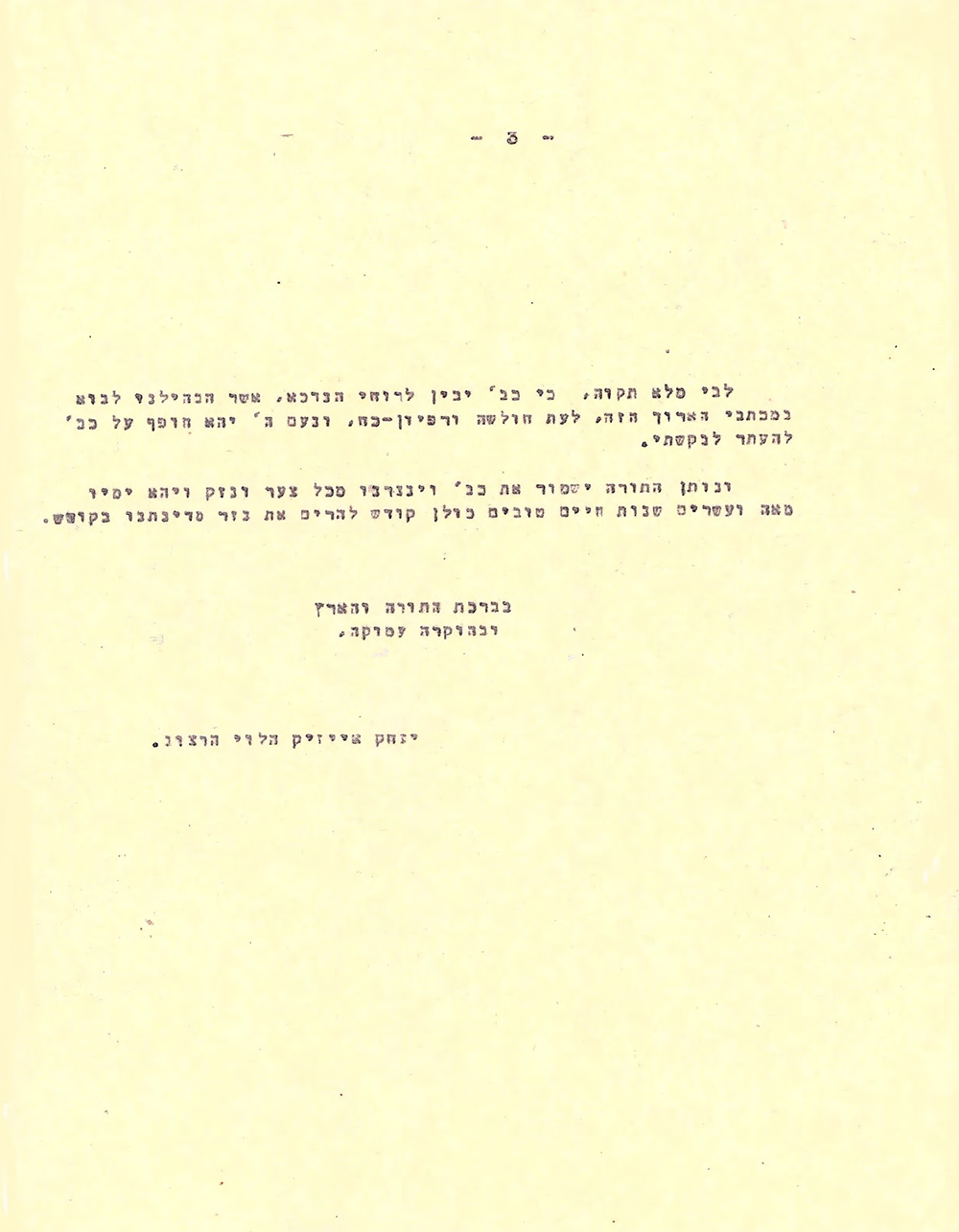
While this was Rav Herzog’s halachic conclusion in the kuntres, when the issue of forced conscription became a potential reality ten years later, Rav Herzog sent a heartfelt letter to Ben-Gurion, pleading for the exemption of bnai yeshivot, since they are already conscripted to the security of Torah and the heritage of Am Yisrael, and their Torah learning is a shield for Am Yisrael. This letter, which is found in the file of Rav Herzog’s correspondence with Ben-Gurion[4], appears below:
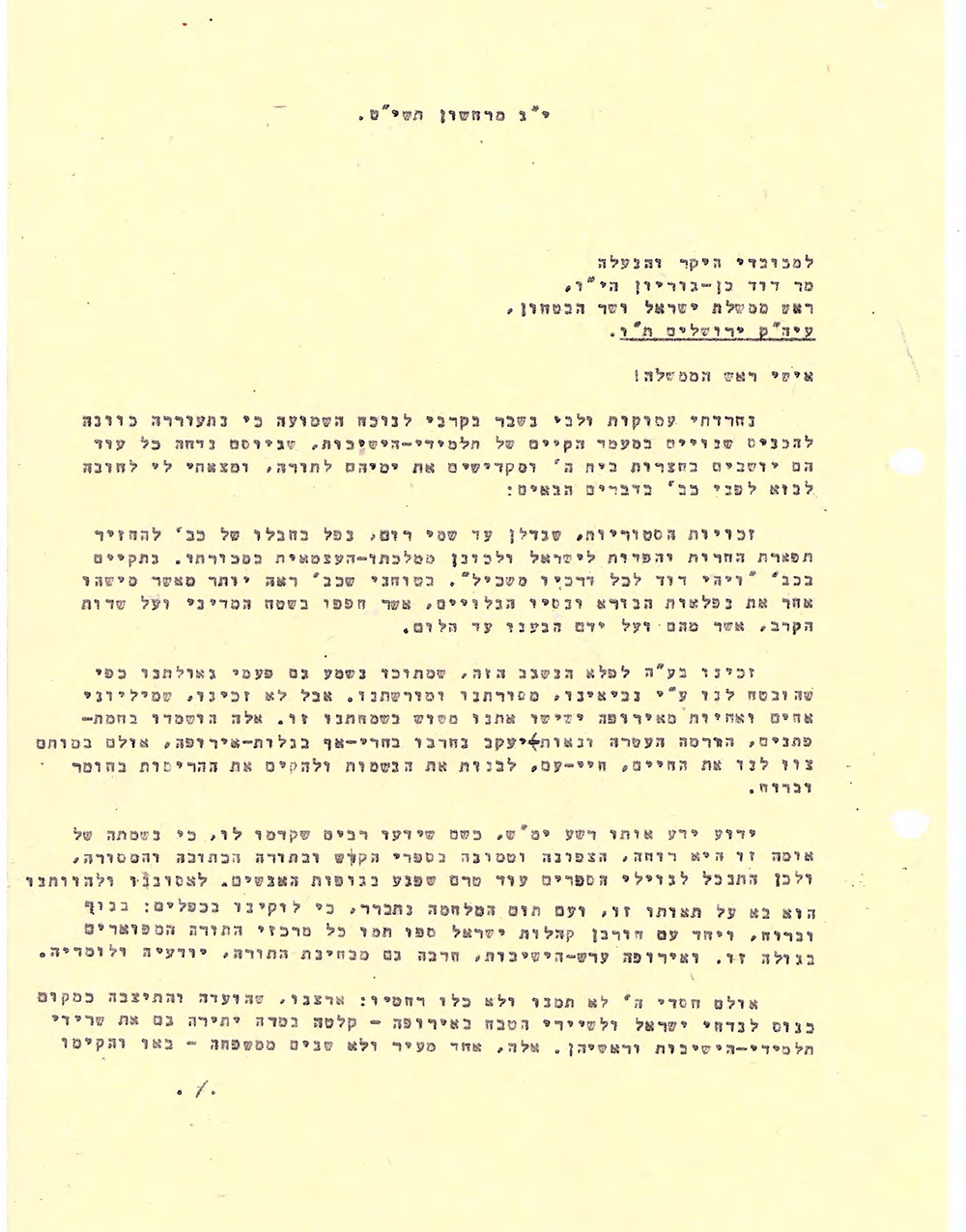
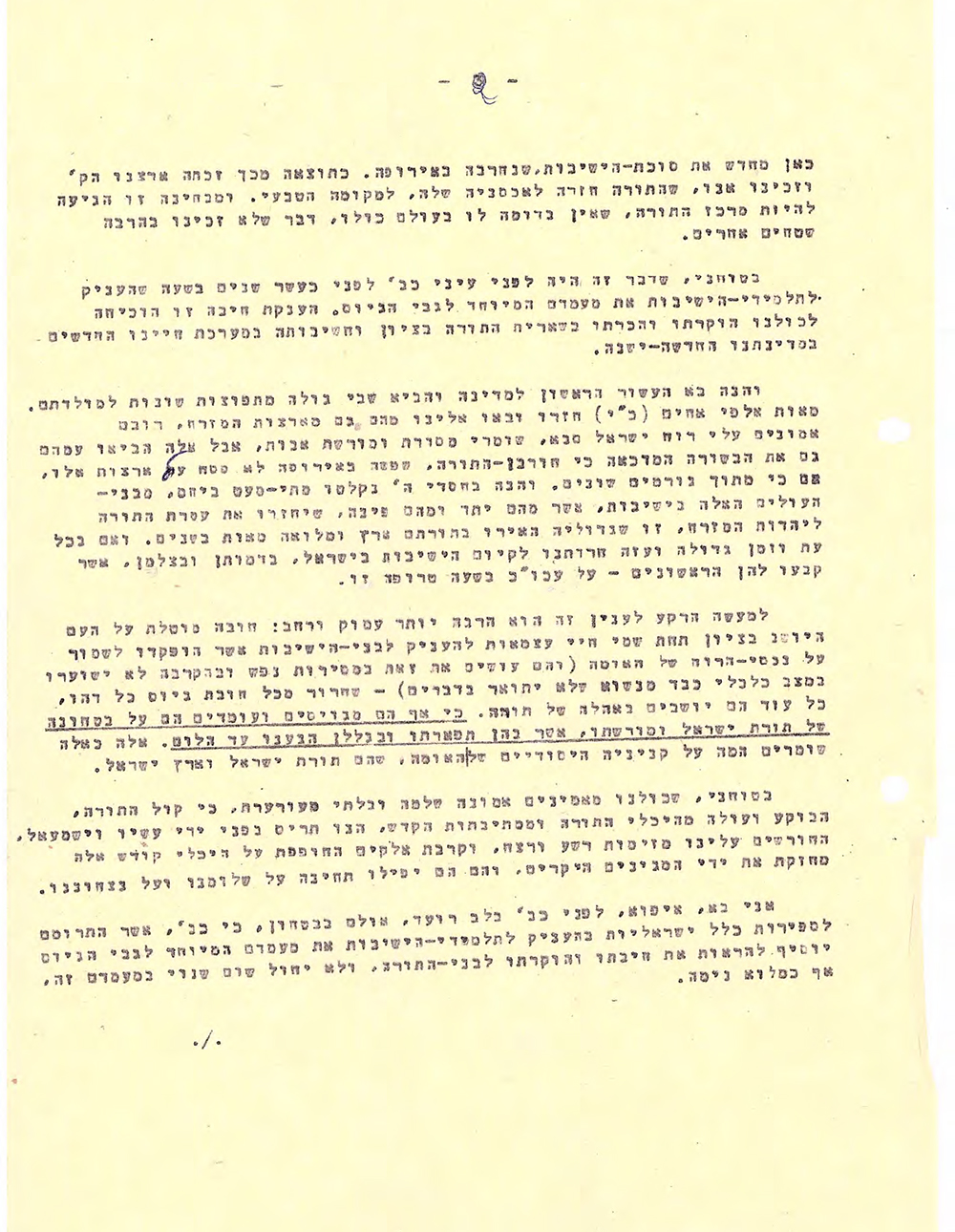
Another noteworthy document in the file on giyus bnai yeshivot is a 1948 telegram from the Roshei Yeshiva of the American yeshivot, expressing their shock at the possibility of giyus bnai yeshivot, and urging Rav Herzog and Rav Uziel to make sure that bnai yeshivot remain exempt from army service. The telegram appears below, as well as my transcription of the telegram into Hebrew:
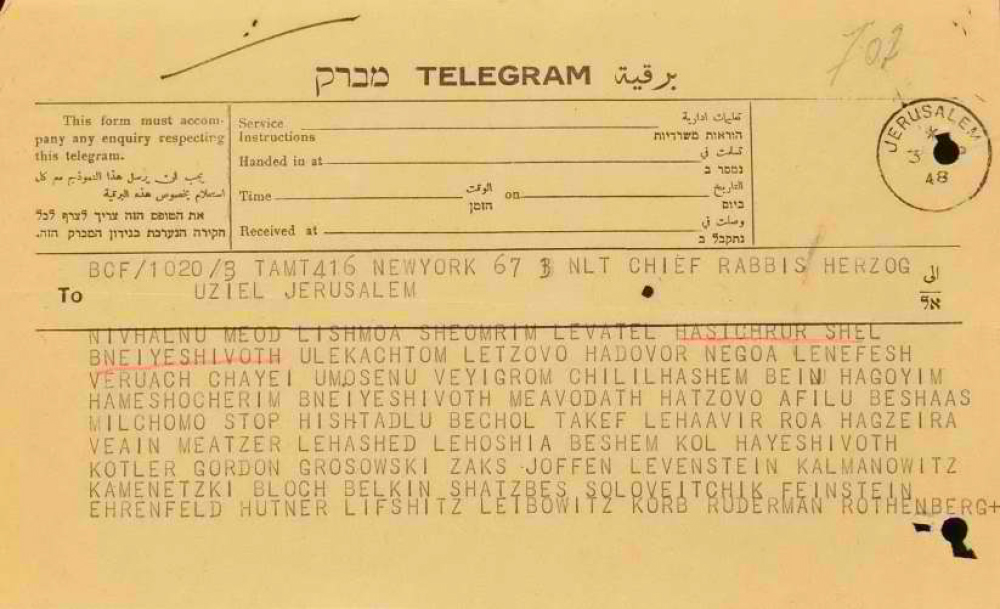
נבהלנו מאד לשמוע שאומרים לבטל השחרור של בני ישיבות ולקחתם לצבאהדבר נוגע לנפש ורוח חיי אומתנו ויגרום חילול השם בין הגויים המשחררים בני ישיבות מעבודת הצבא אפילו בשעת מלחמההשתדלו בכל תוקף להעביר רוע הגזירהואין מעצר להש[םלהושיעבשם כל הישיבות,

Kotler Gordon Grosowski Zaks Joffen Levenstein Kalmanowitz Kamenetzki Bloch Belkin Shatz[k]es Soloveitchik Feinstein Ehrenfeld Hutner Lifshitz Leibowitz Korb Ruderman Rothenberg[5]
The telegram is especially noteworthy because of the appearance of the names of the Charedi Roshei Yeshiva, such as Rav Aharon Kotler, Rav Reuven Grozovsky, Rav Moshe Feinstein etc. together with the names of the more modern Roshei Yeshiva of RIETS: the Rav, Rav Yosef Dov Soloveichik, and Dr. Samuel Belkin. Such collaboration would seem to be almost impossible in later years.
II Professor Saul Lieberman on Rav Herzog’s Torat Ha-Ohel
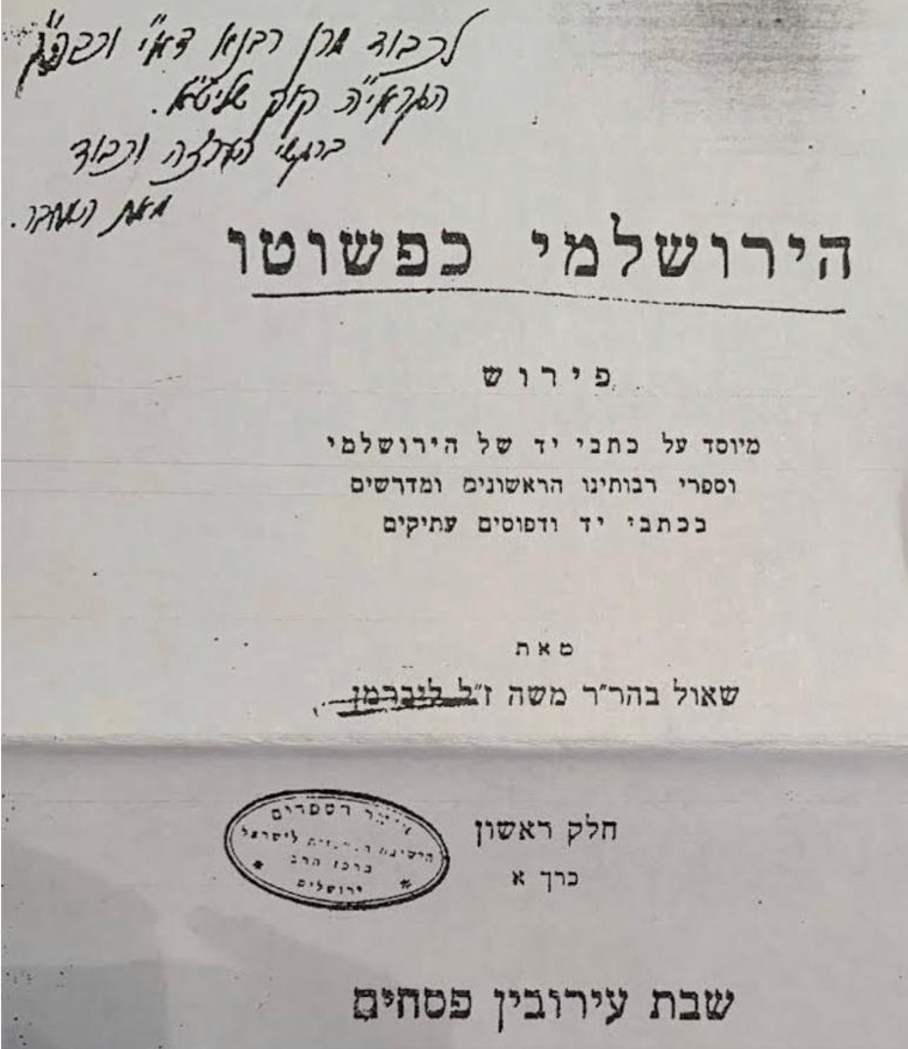
Rav Herzog maintained a close relationship with Professor Saul Lieberman, as Dr. Marc Shapiro has mentioned previously on the Seforim blog[6], and noted in his “Saul Lieberman and the Orthodox”, page 22.[7] It should therefore come as no surprise that Rav Herzog’s archive contains correspondence between him and Lieberman. The letter that appears below was sent by Lieberman to Rav Herzog, and contains Lieberman’s haarot on Rav Herzog’s Torat Ha-Ohel, his sefer on the Rambam’s Hilchot Sanhedrin.[8] In this letter, Lieberman first discusses the proper girsaot in the relevant Rambam and the gemara in Makot regarding minuy dayanim. He then addresses Rav Herzog’s question of how it could be possible that bnai noach have a more extensive obligation of dinim than do Yisrael,[9] and Lieberman offers an elegant yeshiva-style distinction between dinei yisrael and dinei bnai noach to answer the problem. (A similar distinction was offered by Rav Aharon Lichtenstein, in Beit Yitzchak 8, page 89, and reprinted in his Minchat Aviv.) He offhandedly mentions that Rav Menachem Kasher had recently “acquired” some of his material, and then bemoans the fact that RY”D is too involved in the ol ha-tzibur and is not dedicating himself sufficiently to his Torah study, although he has the potential to become the Gaon Ha-Dor.
Lieberman’s letter appears below, and a transcription appears in Appendix A.
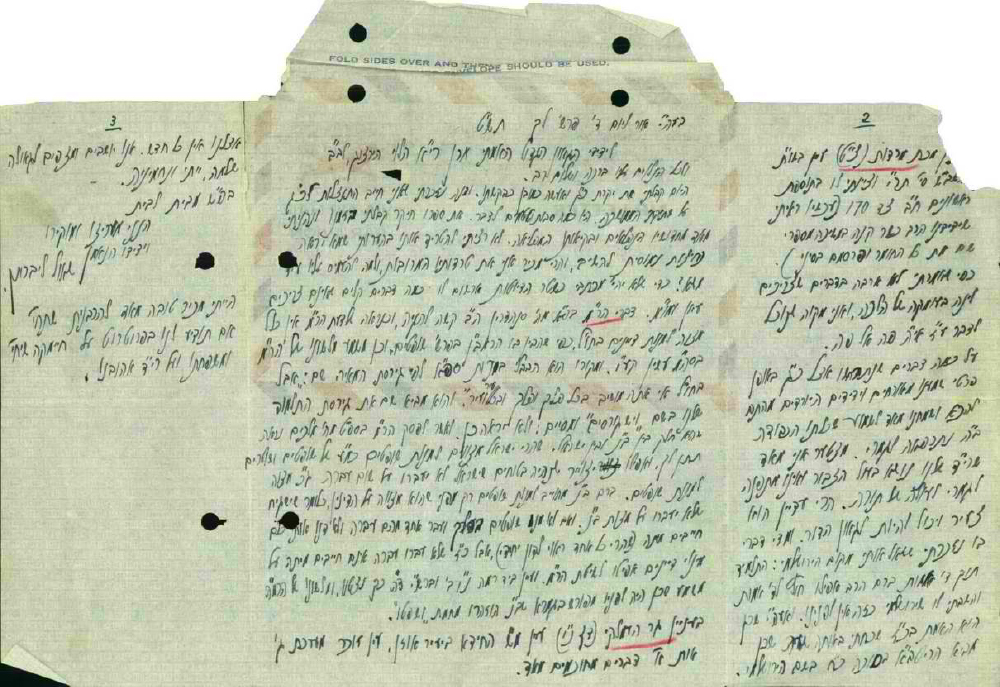
It is most likely that the RY”D to whom Lieberman referred was Rav Yaakov David Herzog, Rav Herzog’s son, as the context within the letter is dealing with Rav Herzog’s family. Rav Yaakov David had already published a scientific/critical edition of Mishnayot Brachot/Peah/Demai in 1945, at the young age of 24, and Lieberman wrote a Foreword to the volume.[10] Rav Yaakov David Herzog was eventually selected as Chief Rabbi of Great Britain in the 1960s, but declined the post due to his ill health.[11]
I also entertained the possibility that the RY”D to whom Lieberman referred is the Rav, Rav Yosef Dov Soloveichik. While this seems unlikely, it would fit nicely with the comments made by Rabbi Jacob Radin, as quoted by Rav Aaron Rakeffet[12], contrasting the Rav and Lieberman:
You know that I have attended classes in both the Seminary and the Yeshiva. I have studied with Professor Lieberman and the Rav. The Professor lectures a few times a week. He hurriedly finishes and rushes back to his research. Outside of his formal lectures, he is barely available to the students. On the other hand, the Rav is never alone. He has never finished a lecture on time. He always goes overtime. He remains in the classroom afterwards to carry on the Talmudic give and take with the students who cannot part from him. Even when he rises to leave, his disciples surround him and the discussion continues…This is the basic manifest difference between these two prodigious scholars.[13]
On Lieberman’s mention of Rav Kasher, this is the page that Lieberman referenced from Tosefet Rishonim:
And the page from Rav Kasher’s article in Sinai, Volume 18:
A number of the rather obscure sources in Rav Kasher’s lengthy footnote 2 appear to be taken from Lieberman’s Tosefet Rishonim.
III The Lieberman Ketuba
As is well-known, Lieberman introduced a new clause into the ketuba in the early 1950s in order to alleviate the aguna problem. The clause stipulated that the couple recognizes the authority of the beit din of the Rabbinical Assembly, and that upon dissolution of the marriage, the beit din would be empowered to administer penalties as it sees fit. The aim of these penalties would be to pressure the husband to give a get. In a number of letters from the 1950s (in a file regarding Even HaEzer issues[14]), Rav Herzog mentions that he himself came up with such an idea many years earlier when he was still Chief Rabbi of Ireland. He envisioned a separate document which would empower the beit din of London to administer financial penalties on a husband withholding a get. He mentions that he is unsure of Professor Lieberman came up with this idea himself, or if Lieberman actually got the idea from Rav Herzog.

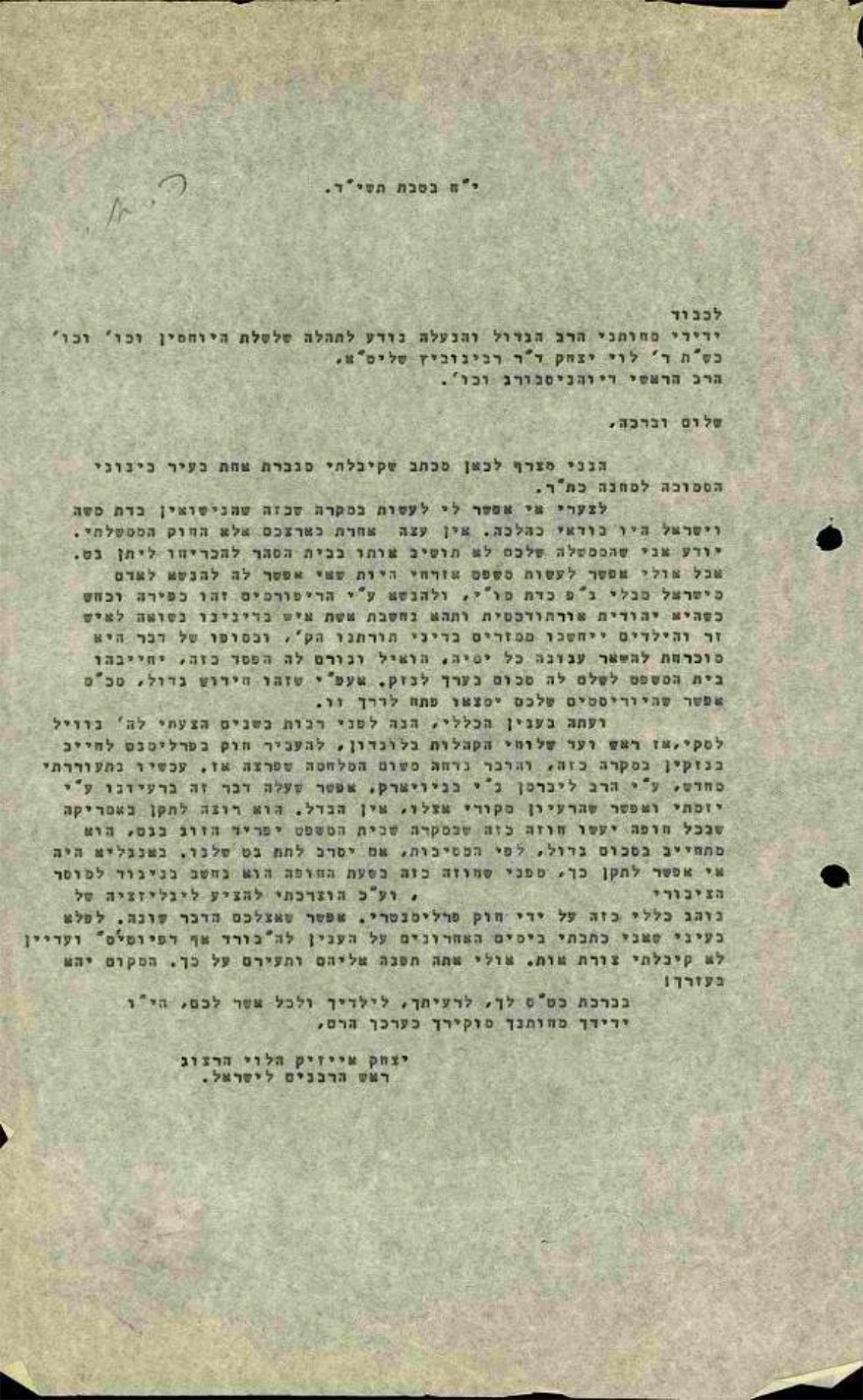
Rabbi Emanuel Rackman wrote that it was widely believed that the Lieberman clause was examined by Rav Herzog, and that he had no objections.[15] This belief is certainly false, as Rav Herzog penned a strong protest to the proposed addition to the ketuba.[16] Rav Herzog’s main protest was due to the authority granted to the Conservative beit din. It is possible that the root of this misconception (that Rav Herzog approved of the Lieberman clause) is the fact that Rav Herzog independently envisioned a similar document or agreement, and that he entertained the possibility that Lieberman actually got the idea from him.
IV The Epstein Proposal
Another fascinating exchange between Rav Herzog and Lieberman is found in Rav Herzog’s file dedicated to Reform[[17] and Conservative Jewry[18], and relates to the Rabbinical Assembly’s 1957 attempt to resuscitate the Epstein proposal. Rabbi Louis Epstein had proposed, in his 1930 book Hatzaa Lemaan Takanat Agunot, that every husband, at the time of marriage, ought to designate his wife as a shliach to deliver her own get, in order to eliminate the aguna problem in the case of a missing husband or a get-refuser. The proposal was never implemented, in large part due to Orthodox opposition. In May of 1957, the Rabbinical Assembly attempted to resuscitate the Epstein Proposal at their Annual Convention at the Concord Hotel in Kiamesha Lake, New York. However, this attempt to revive the Epstein proposal must be viewed in light of the politics within the Conservative movement at that time. The following is an excerpt from the Presidential Report of Rabbi Aaron Blumenthal at the Rabbinical Assembly Convention[19]:

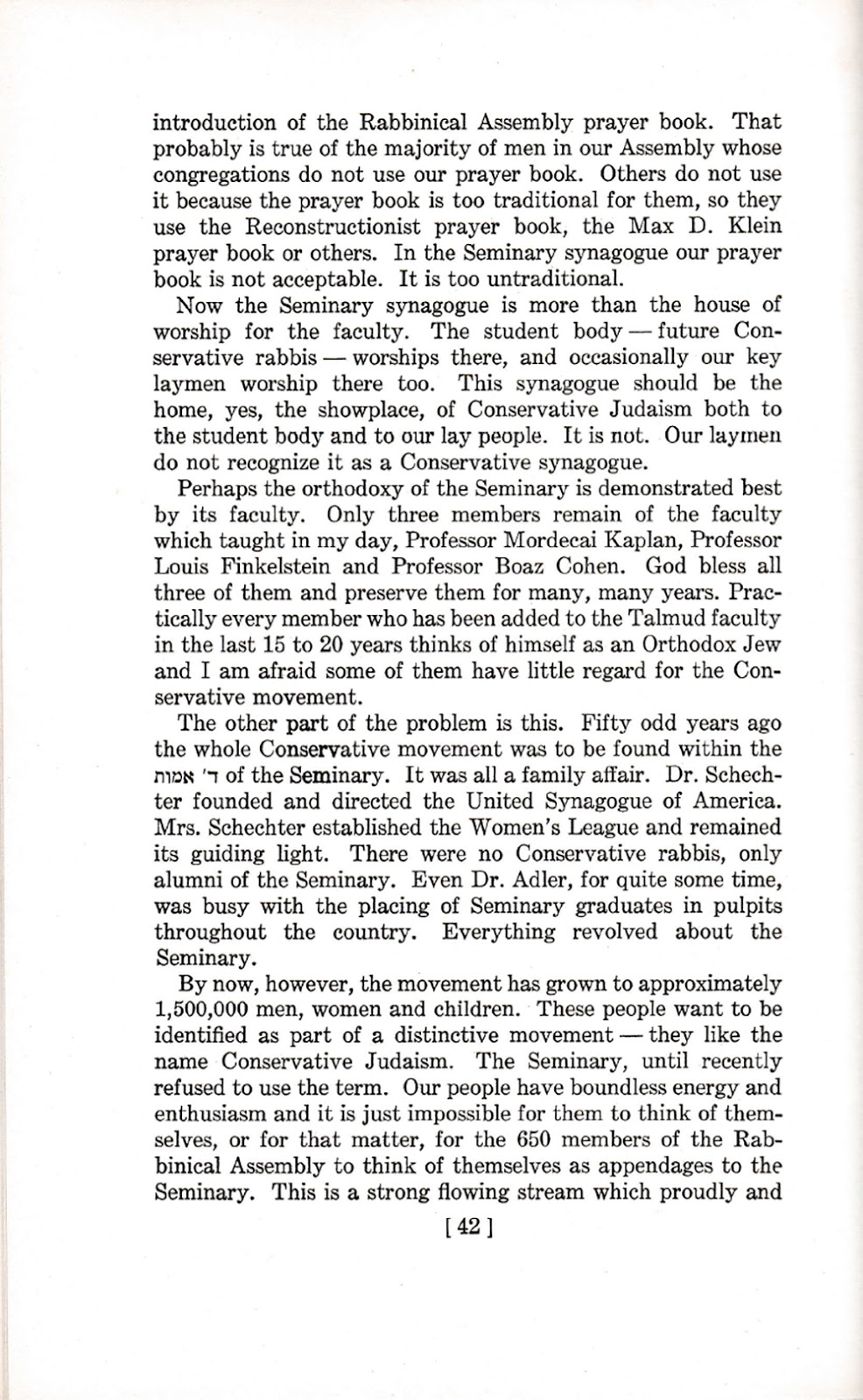
Note in particular Rabbi Blumenthal’s comments that the Seminary is an Orthodox institution, that its synagogue has separate seating and does not use the Rabbinical Assembly siddur, and that practically every faculty member added to the Talmud faculty in the last 15 to 20 years thinks of himself as an Orthodox Jew and has little regard for the Conservative movement. Given that Lieberman was the de-facto Rabbi of this synagogue, and that Lieberman ensured that the synagogue did not use the Rabbinical Assembly siddur, and that the synagogue maintained separate seating until Lieberman’s death[20], it would seem that Rabbi Blumenthal’s words were directed primarily at Lieberman, who arrived at the Seminary some 17 years prior.
It is against this backdrop that the Rabbinical Assembly passed a Resolution that the Rabbinical Assembly Committee on Jewish Law and Standards review the Epstein proposal and submit a plan for its implementation.
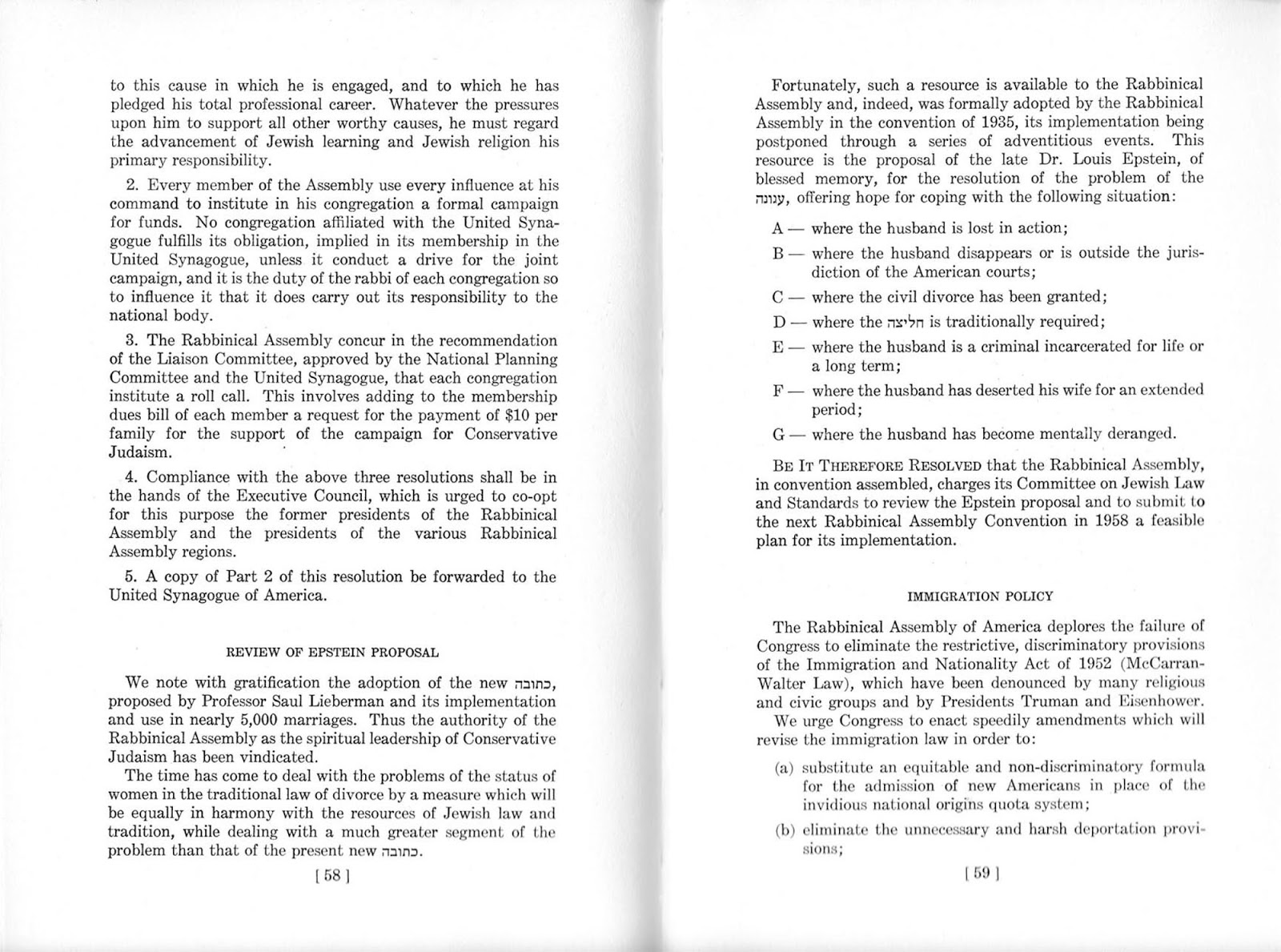
The report below from the National Jewish Post and Opinion makes clear that the left wing of Conservative Judaism felt that the Lieberman ketuba did not go far enough in addressing the aguna problem and therefore sought to institute the Epstein proposal. On the other hand, the more traditional wing of Conservative Judaism, led by Rabbi Louis Finkelstein, Chancellor of JTS, wanted the proposal referred to a joint committee made up of JTS faculty and RA members. Rabbi Blumenthal’s complaint about the Orthodox character of the Seminary faculty was not just an observation, but also a charge to the RA regarding the Epstein proposal, that they not allow the Seminary faculty to torpedo the proposal. Rabbi Finkelstein’s group lost the vote 92-88, in what was, in a sense, a repudiation of Lieberman’s Orthodox influence, and a rejection of his ketuba as too Orthodox and not impactful enough.[21] The majority of the RA membership was prepared to head in a more liberal direction.
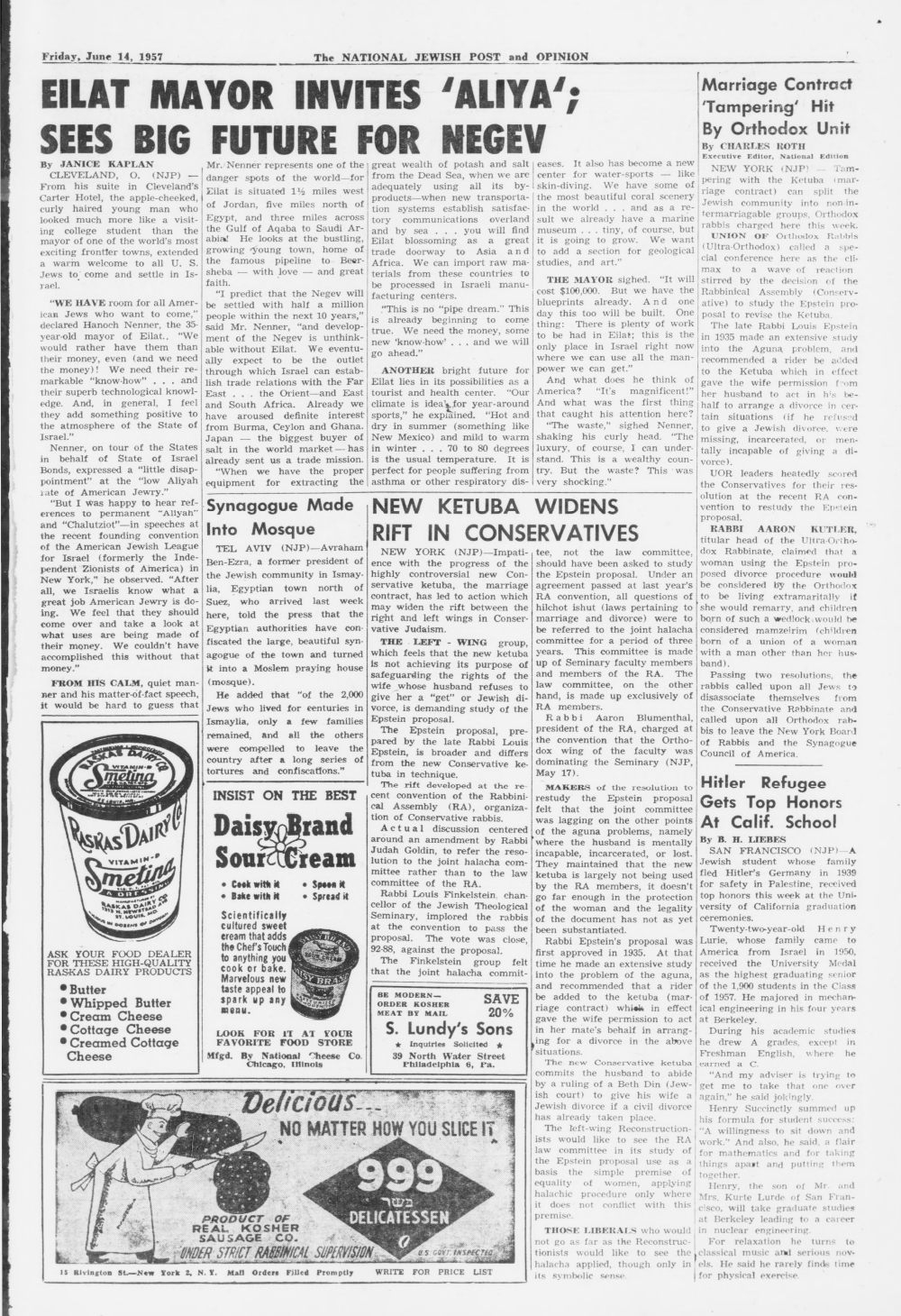
After the passage of the Rabbinical Assembly resolution, the Agudat HaRabbanim turned to Rav Herzog in the letter below, asking him to intervene and prevent this breach of kedushat hamishpacha beyisrael.[22] (It is not clear to me why they termed the Epstein proposal nisuin al tnay, or conditional marriage, which is a different attempted mechanism to prevent aguna situations.)
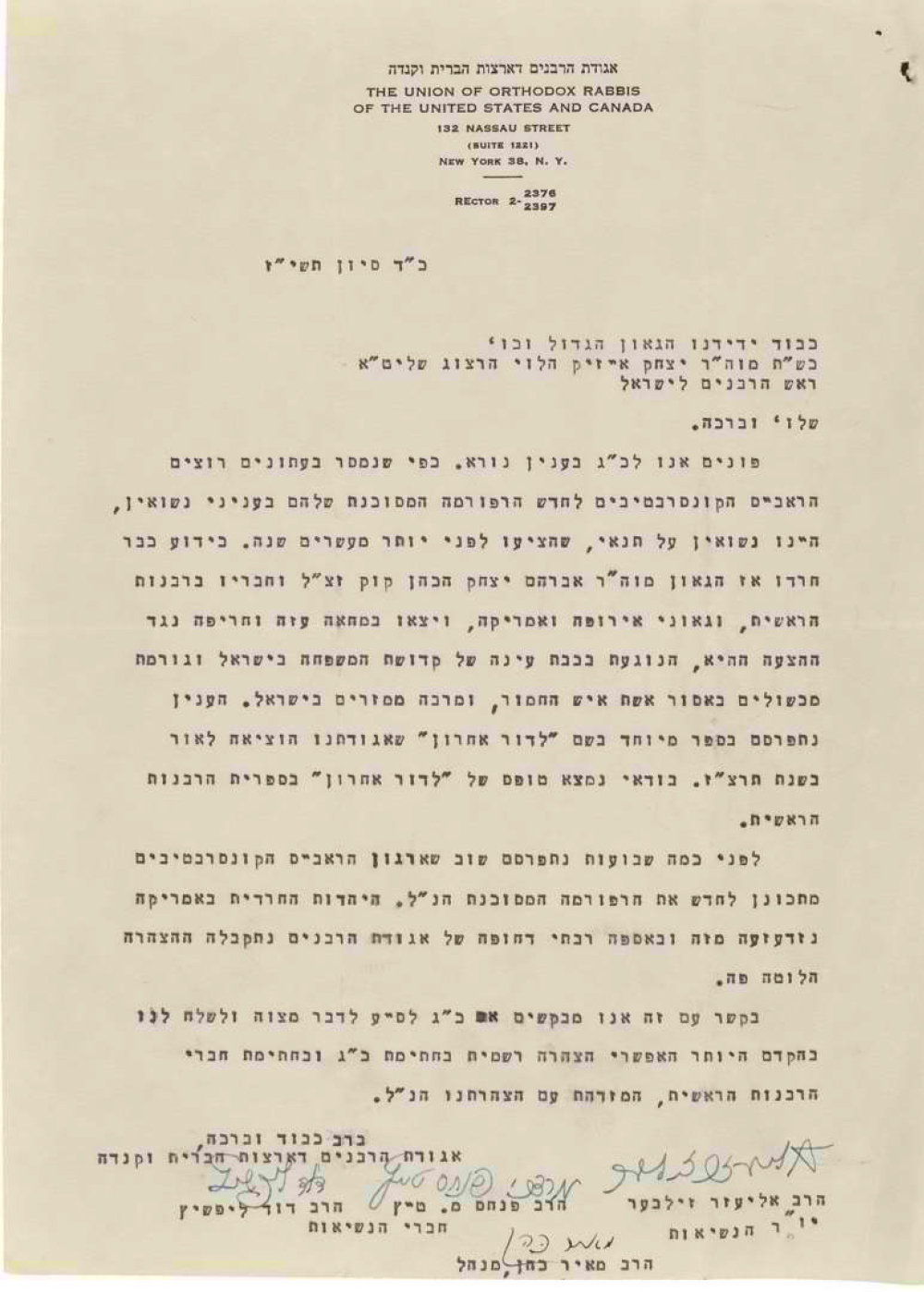
In response to the request of Agudat HaRabbanim, Rav Herzog turned to Lieberman in the letter below, asking him to intervene and prevent the implementation of the proposed nisuin al tnay.[23] (Rav Herzog apparently understood the proposal to be literally one of conditional marriage, and thus referred Lieberman to the book Ain Tnay Benisuin, rather than the book LeDor Acharon, mentioned in the Agudat HaRabbanim letter, which deals with the Epstein proposal.)
In response to Rav Herzog’s letter, Lieberman sent Rav Herzog the very fascinating letter below. (A transcription of this letter appears in Appendix B.) Lieberman tells Rav Herzog that the Orthodox Rabbis are simply looking for excuses to make machloket, that Rabbi Finkelstein strongly protested the re-introduction of the Epstein proposal (as we noted was reported in the National Jewish Post), and that the President of the Assembly (Rabbi Blumenthal) also denied the claim of the Agudat HaRabbanim. He then says that the entire purpose of his revised ketuba was to bury the possibility of the Epstein proposal! He also mentions that some Orthodox Rabbis have claimed that any wedding which uses the new ketuba is invalid, and the kiddushin are not tofsin. (I have been unable to find any documented source of a Rabbi who made such a claim. I would be indebted to any of the readers who could provide such a source.) Lieberman concludes by assuring Rav Herzog that he would be the first to protest the implementation of the Epstein proposal, and that such a nevala could never happen while he is at the Seminary.
Rabbi Blumenthal’s denial was in fact reported by the JTA.[24] He said that the Assembly only authorized a committee to re-study the problem.
Some points remain unclear to me, as Rabbi Finkelstein’s group did indeed lose the vote, and the RA did pass a resolution that the Rabbinical Assembly Committee on Jewish Law and Standards submit a plan for the implementation of the Epstein proposal. I find it hard to understand Rabbi Blumenthal’s denial, or how Lieberman could claim that the Orthodox Rabbis were simply seeking machloket, when the RA passed a resolution for implementation (even documented in the RA Proceedings), with the left-wing defeating the traditional wing.
(to be continued)
Appendix A
Letter from Lieberman to Rav Herzog about Torat Ha-Ohel
בע”ה אור ליום ד’ פרש’ לך תש”ט
לידידי הגאון הגדול האמתי מרן רי”א הלוי הירצוג, לב”ב ולכל הנלוים עליו שלום רב.
היום קבלתי את יקרת כ”ג ואעשה כמובן כבקשתו. והנה נזכרתי שאני חייב התנצלות לכ”ג על שתיקתי הממושכה. היו כמה סיבות וטעמים לדבר. את ספרו היקר קבלתי בזמנו ונהניתי מאד מחידושיו הנפלאים ובקיאותו המפליאה. לא רציתי להטריד אותו בהערותי שמא יראה נחיצות נמוסית להשיב, והרי מכיר אני את טרדותיו המרובות, ולמה להעמיס עליו עוד משא? כדי שלא יהי’ מכתבי כשטר הדיוטות ארשום לו כמה דברים קלים שאינם צריכים עיון ומו”מ. דברי הר”מ בפ”א מהל’ סנהדרין ה”ב קשה להגיה, וכנראה שלדעת הר”מ אין כלל מצוה למנות דיינים בחו”ל, כפי שהבין בו הרמב”ן בפרש’ שופטים, וכן משמע מלשונו של הר”מ בסה”מ עשין קע”ו ומקורו הוא הבבלי במכות ספ”א[25] לפי גירסת המאירי שם: “אבל בחו”ל אי אתה מושיב בכל פלך ופלך ובכל עיר ועיר.” והוא מביא שם את גירסת התלמוד שלנו בשם “ויש גורסים” ומסיים: ולא נראה כן. ואשר לפסק הר”מ בספ”ט מה’ מלכים נראה שהוא חלק בין ב”נ ובין ישראל. שהרי ישראל מצווים למנות שופטים כמ”ע של שופטים ושוטרים תתן לך, ואפילו יצוייר שנהיה בטוחים שישראל לא יעברו על שום עברה ג”כ מצוה למנות שופטים. ברם ב”נ מחוייב למנות שופטים רק מפני שהוא מצווה על הדינין, כלומר שישגיח שלא יעברו על מצות ב”נ. ואם לא מנה שופטים בפלך ועבר אחד מהם עברה ולא דנו אותו כלם חייבים מיתה (שהרי כל אחד ראוי לדון יחידי), אבל כ”ז שלא עברו עברה אינם חייבים מיתה על מינוי דיינים אפילו לשיטת הר”מ.[26] ועיין ביד רמה נו ע”ב וברש”י ד”ה כך נצטוו, ומלשונו של הרמ”ה משמע שכן היה לפניו מפורש בגמרא שבני נח הוזהרו מחמת “ושפטו.”
בענין גר העמלקי (דף נ”ו) עיין מ”ש החיד”א ביעיר אוזן, עין זוכר מערכת ג’ אות א’ דברים מחוכמים מאד.
[בעני]ן מכת מרדות (צ”ט) עיין בשו”ת [הר]שב”ש סי’ תר”י וציינתי לו בתוספת ראשונים ח”ב צד 170 (עכשיו ראיתי שידידנו הרב כשר קנה במשיכה מספרי שם את כל החומר ופרסמם בסיני.)
כפי שאמרתי לא ארבה בדברים שצריכים לינה בעומקה של הלכה, ואני מקוה שנוכל לדבר ע”ז אי”ה פה אל פה.
על כמה דברים שנתחדשו אצל כ”ג באופן פרטי שמענו מאורחים וידידים היורדים מהתם להכא ושמחנו מאד לשמוע שכלתו הכבודה ב”ה נתרפאה לגמרי. מצטער אני מאד שרי”ד[27] שלנו נושא בעול הצבור ואינו מתפנה לגמרי לעולה של תורה. הרי עדיין הוא צעיר ויכול להיות לגאון הדור. ומדי דברי בו נזכרתי ששאל אותי מקום הירושלמי: התלמיד תוך ד’ אמות ברם הרב אפילו חוץ לד’ אמות והשבתי לו שירושלמי כזה אין לפנינו. ואעפ”י שכן הוא האמת בכ”ז שכחתי באותה שעה שכן מביא הריטב”א בסוכה כ”ח בשם הירושלמי.
אצלנו אין כל חדש. אנו יושבים ומצפים לגאולה שלמה, ייתי ונחמיניה.
בפ”ש מבית לבית
הנני מעריצו ומוקירו וידידו הנאמן
שאול ליברמן
הייתי מכיר טובה מאד לרבנית שתחי’ אם תודיע לנו בפרוטרוט על חיימקה שיחי’ ומשפחתו ועל רי”ד אהובנו.[28]
Appendix B
Letter from Lieberman to Rav Herzog about the Epstein Proposal
בעה”י יום ה’ פרש’ מטות תשי”ז
לכבוד ידידינו הגאון הגדול האמיתי מרן הרי”א הלוי הירצוג הרב הראשי לא”י ברכה ושלום רב.
יקרת כ”ג מי’ תמוז הועברה אלי לכרם מרתה[29], ומאד מאד התפלאתי שכ”ג האמין לדיבת הרבנים כאן. אמנם בכנסיית הרבנים השמרנים דברו על עיון מחדש בשאלת תנאי בקידושין, אבל ד”ר פינקלשטיין יצא בכל תוקף נגד חידוש העיון. ונשיא הכנסיה הנ”ל הכחיש בעצמו את דיבת הרבנים. אבל הללו מחפשים רק אמתלאות למחלוקת. כל עניין הכתובה היה כדי לקבור לגמרי את שאלת התנאי. הסברתי להם שאם ליחיד אפשר פעם לחשוב ע”ז הרי לרבים אין הדבר בא כלל בחשבון שהתנאי יעשה ע”פ דין, וישתקע הדבר ולא יעלה שוב על הפרק. וכולם הסכימו ל[י]. עכשיו יש מהם שבאים בטענות ואומרים: הרי הרבנים הארתודוכסים טוענין שאף הכתובה נעשתה שלא כדין, ויש מהם (כלומר מהרבנים הארתודוקסים) שאמרו שהמתחתן בכתובה החדשה אין הקידושין תופסין, והאשה מותרת בלי גט (ממש לא יאומן כי יסופר! אבל לצערי נאמרו הדברים), א”כ הרי מוטב לעשות תנאי בקידושין, ולהפטר מכל שאלת העגונה בבת אחת. והנני מבטיח את כב”ג שאין לשמועה שום יסוד, אחרת הייתי אני בין הראשונים למחות, וכל זמן שאני בסמינר לא יתכן שיעשו נבלה כזו.
בפ”ש ובברכה לכל המשפ[חה]
בהערצה ובידידות
שאול [ליברמן]
[1] See here.
[2] See here.
[3] A short one-page summary of the kuntres appears in R’ Zorach Warhaftig’s Chuka Leyisrael, page 236. However, R’ Warhaftig neglects to mention that Rav Herzog advocated only giyus chelki.
[4] See here.
[5] Every name on the telegram is relatively well known, except for Rothenberg. I assume this is Rav Moshe Rothenberg, founder of Yeshivat Chachmei Lublin of Detroit. See Toldot Anshei Shem page 126, here.
[6] See here.
[7] For the following sections related to Lieberman, I made extensive use of Dr. Shapiro’s “Saul Lieberman and the Orthodox.”
[8] See here.
[9] Here in Yeriot Ha-Ohel 1.
[10] See here. Interestingly, Lieberman signed the Foreword as “Saul Lieberman, Dean, Harry Fischel Institute, Jerusalem”, even though Lieberman had been teaching in JTS for five years already. (In the Foreword, he notes that the publication of the volume coincided with Harry Fischel’s 80th birthday, in 1945.) In fact, Lieberman’s name appeared atop the Harry Fischel Institute’s stationery as late as 1949 (can be seen in Rav Herzog’s file on Machon Harry Fischel.) It would appear that Lieberman continued to serve in some capacity as Dean of the Harry Fischel Institute even after he left Israel to come to America. Incredibly, he held one foot in each world simultaneously, as Dean of the Harry Fischel Institute and Professor in JTS, a fact that has heretofore eluded his biographers. My good friend Rabbi Dovid Bashevkin reports in the name of Mr. Carmi Schwartz, Executive Vice President of the Council of Jewish Federations, that Lieberman willed most of his considerable life savings to the Harry Fischel Institute after his death, and not to JTS.
[11] See here.
[12] Mentor of Generations, page 119.
[13] For more on the Rav and Lieberman, see Rav Rakeffet’s “A Note on R. Saul Lieberman and the Rav”, in Tradition, Winter 2007. Also noteworthy is the following story that appears in Rav Hershel Schachter’s Mipninei Ha-rav:
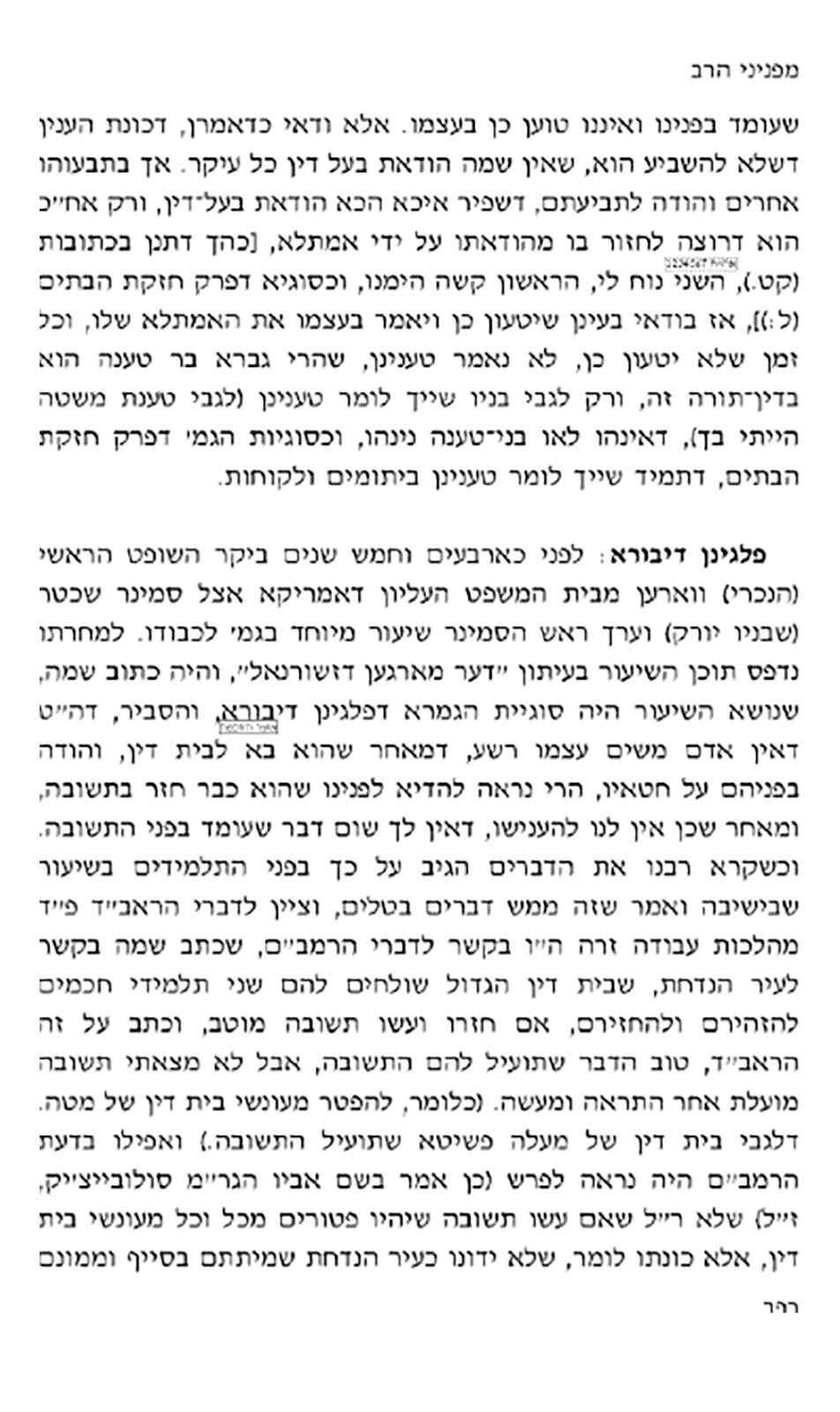
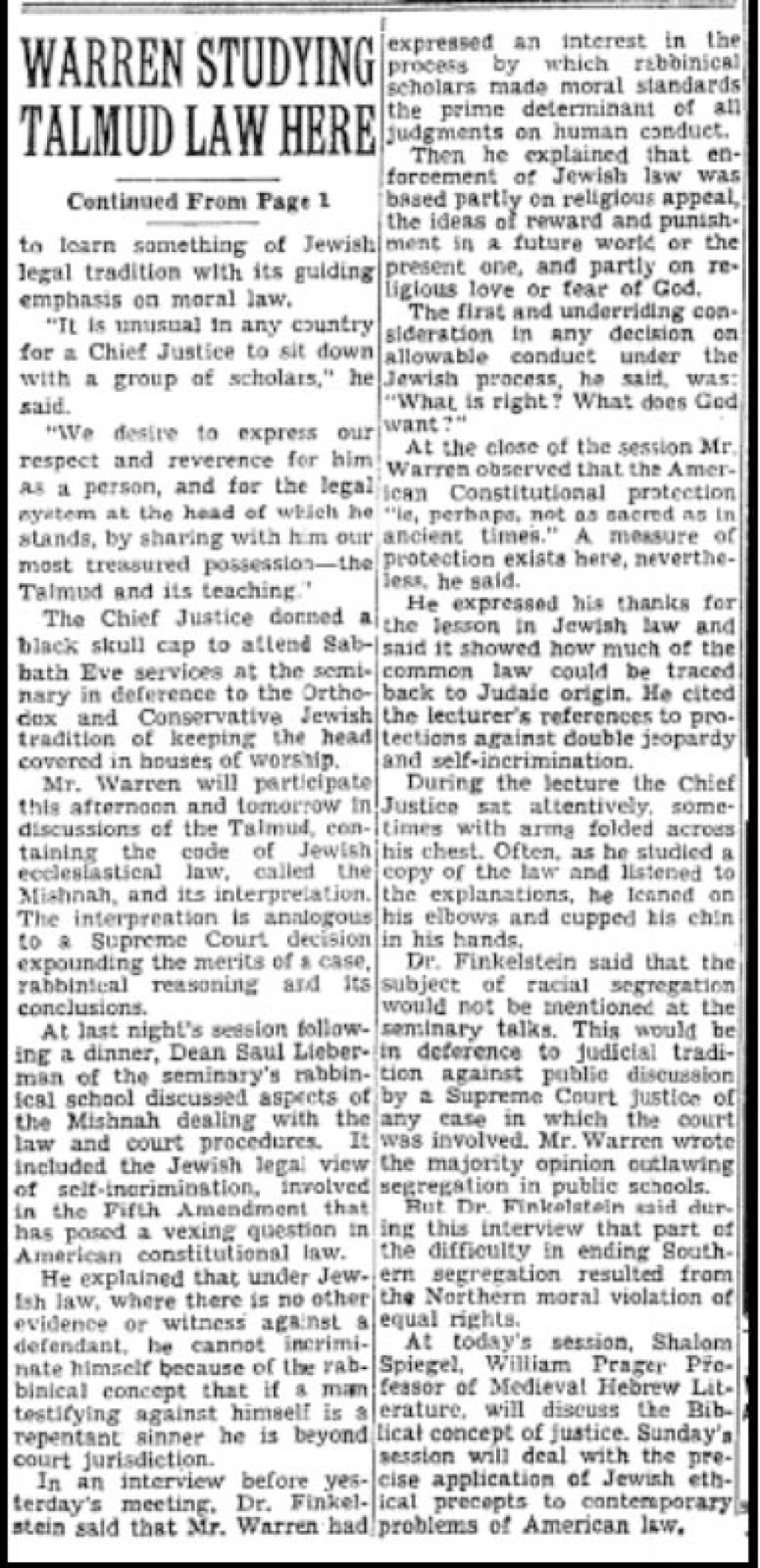
The head of the Seminary who gave the shiur with which the Rav disagreed so vehemently is none other than Lieberman. Warren’s visit to the Seminary was covered on the front page of the New York Times (September 14, 1957.) (For a humorous account of how Lieberman sipped tea through a sugar cube that weekend in the presence of former president Harry Truman, see “The Rabbi as Symbolic Exemplar” by Jack Bloom, page 37.) Here is the New York Times’ account of Lieberman’s shiur:
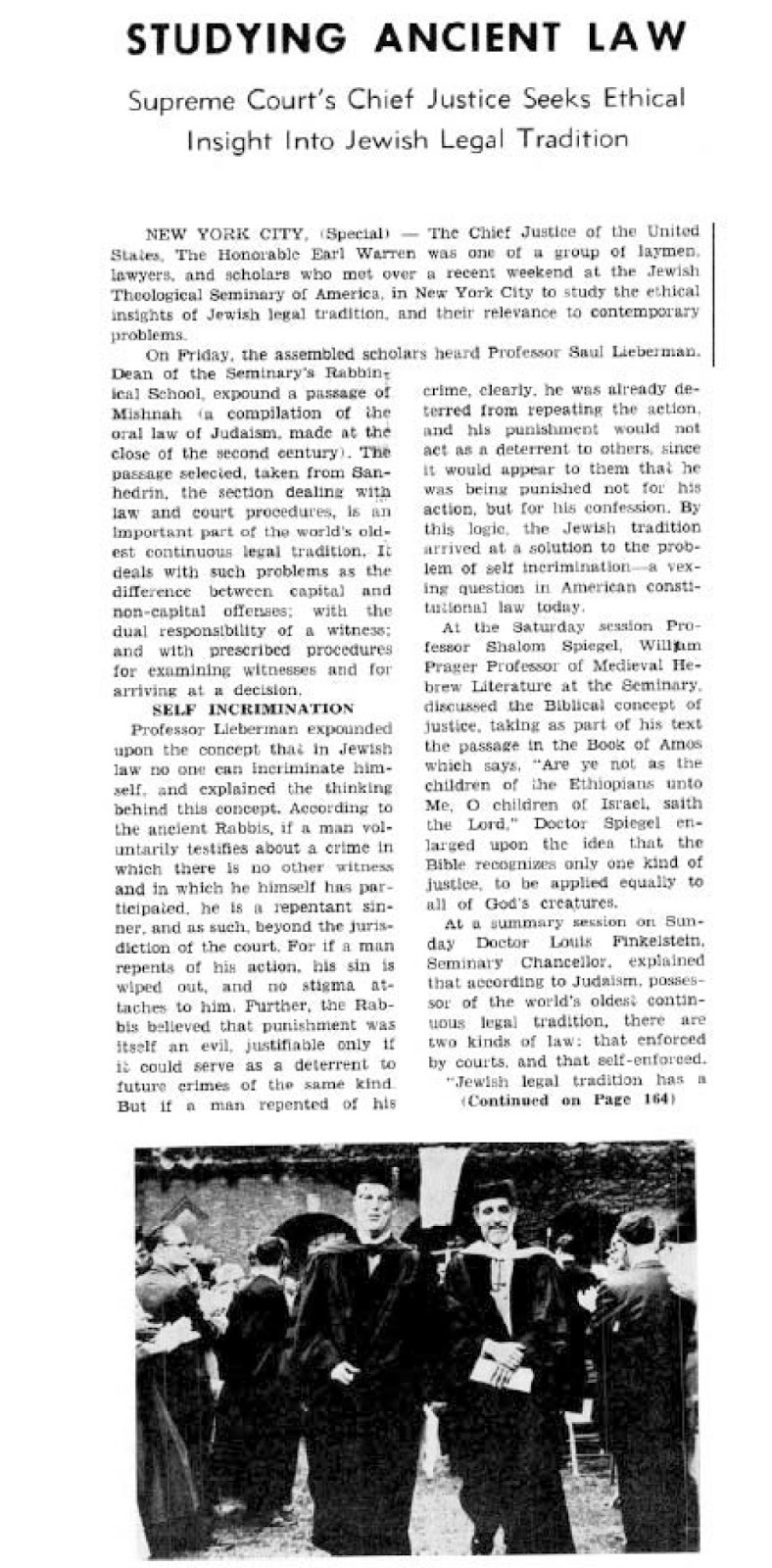
A similar account of the shiur appears in the Sentinel (September 26, 1957)
Regarding Lieberman’s suggestion that the principle of Ain Adam Meisim Atzmo Rasha is predicated on the presumption of teshuva, there appears to be another difficulty, in addition to that raised by the Rav. The gemara in Makot 13b states:
חייבי מיתות ב”ד אינו בכלל מלקות ארבעים שאם עשו תשובה אין ב”ד של מטה מוחלין להן
The gemara states explicitly that teshuva is not efficacious in absolving a sinner of capital punishment, which would seem to contradict Professor Lieberman’s thesis. My good friend Rabbi Dovid Bashevkin has offered the following original suggestion to resolve the problem. Professor Lieberman might have believed that the gemara in Makot which states that teshuva does not absolve capital punishment is referring to after gmar din, when the sinner has already been tried and sentenced. At that point, teshuva is no longer effectual. However, the principle of Ain Adam Meisim Atzmo Rasha applies before trial and sentencing, and teshuva would absolve a sinner before sentencing. This reading of the gemara in Makot is certainly plausible, although it does run contrary to the reading of the Noda B’Yehuda (Orach Chaim 34, s.v. ela), who assumes that the gemara is referring to before gmar din as well. Additionally, it would seem difficult to assume that a confession is indicative of teshuva if a sinner is aware that he can absolve himself of punishment by simply admitting his guilt in beit din. However, this approach would explain why the Rav raised a difficulty based on the words of the Raavad, and not the gemara in Makot, as the gemara in Makot is not a conclusive proof.
[14] See here.
[15] “Conflict and Consensus in Jewish Political Life”, page 120, also cited in “Saul Lieberman: the Man and his Work”, page 45. My thanks to my good friend Dr. Josh Lovinger for bringing this to my attention.
[16] Techuka leYisrael al pi Torah, volume 3 page 210.
[17] The correspondence in that file also shows the effort that Rav Herzog expended in an attempt to prevent the Reform movement from gaining any foothold whatsoever in Israel.
[18] See here.
[19] Proceedings of the Rabbinical Assembly of America 21, 57th Annual Convention (1957), pages 41-42.
[20] See here.
[21] National Jewish Post and Opinion, June 14, 1957.
[22] See also HapardesTamuz, 1957 for details of the protest arranged by Agudat HaRabbanim.
[23] This letter also appears in “Saul Lieberman and the Orthodox”, Hebrew section, page 6.
[24] See here.
[25] Makot 7a
[26] This would also answer the (similar) question of the Gvurot Ari in Makot 7a, s.v. UveChu”l.
[27] As mentioned, I believe that this refers to Rav Yaakov David Herzog.
[28] Future president of Israel, Chaim Herzog, and Rav Yaakov David Herzog.
[29] Martha’s Vineyard.


When was the Afar of the Para Adumah lost?

When was the Afar of the Para Adumah lost?
By Eliezer Brodt
A few years ago (2009) for Parshas Chukas I posted a chapter from my sefer Ben Kesseh Le’assur about when was the Afer of the Para Adumah lost. In 2010 I reprinted the chapter with many important additions in my work Likutei Eliezer. Here is the updated
chapter
as it appears in my Likutei Eliezer. Eventually I will update it even more. For recent footage of a Para Adumah, see
here. Both works are still available for purchase, for more information contact me at eliezerbrodt@gmail.com.
אימתי פסקה טהרת אפר פרה אדומה[1]
מאת אליעזר בראדט
הבאתי בפרק הקודם את דברי ר’ חיים ויטאל בענין קבלה מעשית, שהתנאים והאמוראים נהגו לעשות פעולות על ידי קבלה, משום שעדיין היה להם אפר פרה: “וזהו סוד שמוש פרקי היכלות שנשתמשו בו רבי נחוניא ורבי עקיבא ורבי ישמעאל ואנשי-כנסת-הגדולה, ואחר-כך נשכחו גם דרכי השמושים ההם. ועוד אחרת, כי נאבד טהרת אפר פרה בזמן האמוראים עד זמן אביי ורבא, כנזכר בתלמוד, ולכן לא נשתמשו מאז ואילך בעלית הפרדס…”[2]. בעקבות כך סברתי שכדאי להרחיב ולבאר מאיזה זמן פסקה טהרת אפר פרה.
א. תלמוד ירושלמי מוסר את אזהרת רב חייא לתלמידו רב: “רבי חייא רובא מפקד לרב: אין את יכיל מיכול כל שתא חולין בטהרה – אכול, ואם לאו – תהא אכיל שבעה יומין מן שתא”[3].
ושם גם נתבאר, שרובם של הראשונים הבינו, כי רב חייא הזהיר את תלמידו על אכילת חולין בטהרה, וכפשטות לשון הירושלמי. אולם עדיין לא נתברר כיצד סבר הרב שתלמידו יכול לעמוד במטלה זו? הרי בתקופתם כבר נחרב המקדש ולכאורה נחסר מהם גם אפרה של פרה אדומה שהזאת מימיה מטהרת מטומאת מת, וכיצד יאכל התלמיד חולין בטהרה?
ואכן מצאנו לר’ יהודה החסיד שהתייחס לבעייה זו בהקשר לאזהרת רב חייא האמורה. הוא כותב בספר חסידים:
רבי חייא צוה לרב לאכול חולין בטהרה, ואם אינו יכול כל השנה לאכול בטהרה, שיזהר שבעה ימים בשנה לאכול חולין בטהרה… כי חייב אדם לטהר עצמו ברגל, ‘ואת נבלתם תשקצו’ (ויקרא יא ח), שלא יגעו בהם, כדי שיוכלו לעשות קרבנות ולאכול; זהו בזמן שבית המקדש קיים. וצוה רב חייא לרב שיאכל בזמן הזה; אף-על-פי שטמאי מתים היו ואין אפר פרה, צוה לו להיות שבעה ימים בשנה אוכל חולין בטהרה[4].
היינו, ברור לו שבתקופת רב חייא כבר לא היה ניתן להטהר מטומאת מת, שלא היה ברשותם אפר פרה אדומה, ולמרות זאת הזהיר רב חייא את תלמידו שיאכל חולין בטהרה.
ב. אולם רבים מרבותינו הראשונים חלקו על דעתו של ר’ יהודה החסיד. הם סוברים שאפילו בתקופת האמוראים, מאות בשנים לאחר חורבן בית המקדש השני, היה מצוי עדיין אפר פרה אדומה בה נטהרו טמאי מתים. בעלי דעה זו נסמכו על כמה הוכחות[5]:
1. ירושלמי, שבת, פ”א ה”ג: “רבי חייא רובא מפקד לרב: אין את יכיל מיכול כל שתא חולין בטהרה – אכול, ואם לאו – תהא אכיל שבעה יומין מן שתא”. אכילת חולין בטהרה לא תתכן ללא טהרה מטומאת מת שבאמצעות אפר פרה אדומה, ולמרות זאת הוזהר רב – אמורא ארצישראלי בן הדור הראשון – לאכול חולין בטהרה, משמע, איפוא, שבימיו עדיין היה מצוי אפר פרה.
2. חולין קז ע”א-ע”ב: “איבעיא להו: מהו לאכול במפה? [כלומר, מהו לפרוש מפה על ידיו ולא יגע באוכלין ויאכל בלא נטילת-ידים?], מי חיישינן דלמא נגע, או לא? …כי סליק ר’ זירא, אשכחינהו לר’ אמי ור’ אסי דקאכלי בבלאי חמתות [הם חמתות בלויים, וכורכו ידיהם בהם ואכלו בלא נטילת ידים]… דאמר רב תחליפא בר אבימי אמר שמואל: התירו מפה לאוכלי תרומה [כי הכהנים זריזין הן ולא נגעי], ולא התירו מפה לאוכלי טהרות [הם אוכלי חוליהם בטהרה, לפי שאינם למודין להשמר כמו כהנים], ורבי אמי ורבי אסי כהנים הוו“. נמצאנו למדים, שבימי רב אמי ורב אסי, אמוראים מבני הדור השלישי, היה ניתן לאכול תרומה האסורה לטמאי מתים; הוה אומר, שבזמנם היה ניתן להטהר מטומאת מת!
3. נדה ו רע”ב[6]: “אי אמרת בשלמא לתרומה – היינו דהואי תרומה בימי רבי [הרי כמה שנים היה אחר החורבן, בסוף התנאים], אלא אי אמרת לקדש [=מֵי פרה אדומה] – קדש בימי רבי מי הואי?! כדעולא, דאמר עולא: חבריא מדכן בגלילא [פירוש: חבירים שבגליל מטהרים יינם לנסכים ושמנן למנחות, שמא יבנה בית המקדש בימיהם][7]; הכא נמי בימי רבי”. היינו, מדברי עולא על זמנו – הדור השלישי לאמוראים – שה’חברים’ היו מפיקים את יינם ושמנם בטהרה, משמע שבדורו היתה עדיין שכיחא הטהרה באפר פרה.
מרבית הראשונים שהסכימו על הִמצאות אפר פרה בזמן האמוראים סמכו שיטתם על אחד המקורות דלעיל, ואחדים מהם נסמכו על שני מקורות ויותר.
כבר רבן של ישראל, רש”י, בפירושו לאחד המקורות דלעיל (מס’ 3) כותב: “‘חבריא מדכן בגלילא’, [פירוש:] חבירים שבגליל מטהרים יינם לנסכים ושמנן למנחות, שמא יבנה בית המקדש בימיהם. ולעולא, קדש הוו[8]. כך שמעתי בחומר בקדש [חגיגה כה ע”א], וכך היא שנויה”. היינו, בימיו של עולא האמורא היה קיים עדיין ‘קודש’, הוא מֵי חטאת[9].
כיוצא בזה כותב תלמיד נכדו ר’ יצחק הזקן מגדולי בעלי התוספות, הוא ר’ ברוך ב”ר יצחק מגרמייזא, בעל ‘ספר התרומה’: “אפילו האמוראים, שהיו הרבה דורות אחר חורבן, היה להן אפר פרה. כדאמר פרק כל הבשר, גבי ר’ אמי ור’ אסי… ואי לא היה להם הזאה, מה מועיל כרכי ידייהו?”[10]. ואלו דברי בן דורו הצרפתי, ר’ שמשון משאנץ, מגדולי בעלי התוספות בדורו: “ובימי חכמים היו מזין בארץ-ישראל, כדאמרינן: חבריא מדכן בגלילא. אבל עכשיו בטלה אפר פרה”[11].
ודור לאחר מכן כותב ר’ ישעיה טראני, הרי”ד, שבזמן האמוראים “היה להם אפר פרה מקודם לכן בגליל, ואחר-כך נתיישבו הכותים באותה הרצועה, והיו נטהרים מטומאת מת בגליל”[12]. אלא שמעיון בתשובותיו נראה, שהוא הסכים לכך רק מחמת דוחק שדחקו:
עוד הבאתם לי ראיה דאפילו בבבל היו אוכלין חוליהן בטהרה, כדאמרינן התם: רב הונא בר חייא איצטריכא ליה שעתא וכו’. וגם מן הירושלמי, דהוה אכיל רב חולין בטהרה וכו’. אודיע לכם רבותיי, כי אמת, שלאחר חרבן עדיין היו נזהרין מן הטומאה… וקשיא לי, היכי מצי רב למיכל חולין בטהרה? והלא אחר החרבן היה! וכיון דבטל אפר פרה מי יטהר טמאי מתים שבישראל? ונראה לי לתרץ לפי הדחק, דאף-על-גב דחרב בית המקדש, היה להם עדיין אפר פרה, שהיה מתחלק לכל המשמרות, ועד שהספיק להם אותו האפר היו נטהרין בו טמאי מתים שבארץ ישראל. ותדע שהיו נזהרין בארץ-ישראל לאחר החורבן מטומאת מת… אלמא, דאפילו בימי רבי, שהיה לאחר החורבן, היו מדקדקים להיזהר מטומאת המת וטיהרו את קיני בימיו כשאר ארץ-ישראל, שלא תהא כארץ העמים… ורב דאשכחן בירושלמי, דהוה אכיל חולין בטהרה, נראה לי, דווקא כשהיה דר בארץ-ישראל קודם שירד לבבל, אבל לאחר שירד בבבל – לא היה יכול להזהר[13].
והרבה אתה למד מעקימת שפתיו “נראה לי לתרץ לפי הדחק“. שמכך יש להסיק כי לולא שהכריחו הנאמר בירושלמי הוא אפילו לא היה מסכים לקביעה שבדור הראשון של האמוראים היה קיים אפר פרה אדומה!
אולם שאר הראשונים לא ראו כל דוחק בקביעה זו, הן הראשונים שקדמו לר’ ישעיה טראני וכפי שהובא לעיל בסמוך, והן הראשונים שלאחריו כמו רמשה מקוצי הכותב: “שבימי האמוראים היו מפרישים שתי חלות בארץ-ישראל… כדאמרינן בנדה: חבריא מדכן בגלילא. שהיה להם עדיין אפר הפרה[14]
והסכים לדברים בן הדור שלאחריו, ר’ אשר ב”ר יחיאל, הראש : “דבימי האמוראים היו אוכלין תרומה טהורה בארץ-ישראל, כי היה להם אפר פרה. כדאמרינן: חבריא מדכן בגלילא. ולכך הצריכו גם בחוץ-לארץ להפריש חלת כהן, שלא תשתכח תורת חלה”[15]. ובעקבותיו צעד ר’ אשתורי הפרחי בעל ‘כפתור ופרח’: “ואמת, כי כשגלו לבבל הביאו עמהם אפר פרה… [ולאחר] חרבן, היה להם אפר פרה שנעשית בבית שני… [כדאמרינן:] חבריא מדכן בגלילא. וכן פרק כל הבשר: שמואל אשכחיה לרב דקא אכיל במפה… אשכחינהו לרבי אמי ולר’ אסי דקא אכלי בבלאי חמתות… [ד]התירו במפה לאוכלי תרומה ולא התירו במפה לאוכלי טהרות…”[16].
כל הנזכרים עד עתה הינם מבני אשכנז-צרפת פרט לר’ אשתורי הפרחי שמבני ספרד[17]. אמנם מצאנו לאחד משלהי ראשוני ספרד שאף הוא הסכים לכך. כוונתי לר’ שמעון דוראן, הרשב”ץ, הטוען, כי למרות שברשות אמוראי בבל היה אפר פרה, היא לא הועילה לטהרם משום שהיו קיימים בארץ העמים הטמאה, אך מתוך דבריו אתה למד שהוא מסכים שבארץ-ישראל באותה תקופה אכן נטהרו מטומאת מת באמצעות אפר פרה: “…מכל מקום, אף-על-פי שהיה לבני ארץ-ישראל הזאה, אפילו תאמר שעדיין היה להם אפר פרה בימי רב יוסף ורבא ורבינא ורב טובי, דבבבל היו, וארץ העמים גזרו עליה טומאה, לא הועילה להם הזאה…”[18].
מכל מקורות אלו עולה, במפורש או במרומז, שבימי האמוראים נהגה הטהרה באפר פרה בארץ-ישראל בלבד ולא גם בבבל[19], וזאת מהטעם הפשוט, שבאותו זמן כבר נגזרה טומאה על ארץ העמים[20] ולפיכך אפילו אם היה ברשות אמוראי בבל אפר פרה – לא היה באפשרותם להטהר באמצעותו, כי הוא נטמא. ואם ראשונים הסכימו שבימי האמוראים היה קיים אפר פרה ונטהרו בו, אחרונים, שסמכו על דבריהם ועל ראיותיהם – על אחת כמה וכמה.
ר’ אלעזר אזכרי בעל ‘ספר חרדים’, כותב: “שאפילו בזמן האמוראים היה להם אפר פרה מזמן בית שני”[21]. וכך בפירוש המשנה לר’ שלמה עדני, בעל ‘מלאכת שלמה’: “דהא אפילו
בימי האמוראים היה להם עדיין אפר פרה מזמן הבית
, כדאיתא בפרק קמא דנדה: חבריא מדכן בגלילא, וכל-שכן בימי התנאים”[22]. ולאחריו דן בנושא ריהודה רוזאניס : “יש לומר דסבירא להו, דבזמן האמוראים גם כן היה להם אפר הפרה, וכדאמרינן בפרק קמא דנדה, דמתמה תלמודא: ‘קדש בימי רבי מי הואי?!’, ומשני: ‘כדעולא, דאמר עולא: חברייא מדכן בגלילא’… ועל כן היו טהורים ממת, דאי לא איך היו מטהרים יין ושמן?! אלא ודאי, דהיה להם אפר הפרה. וזכורני שראיתי במקום אחד, דכשגלו לבבל הוליכו עמהם אפר הפרה”[23].
דברי בעל ‘משנה למלך’ נתפרסמו מאוד והביאו להרבה מרבותינו האחרונים לדון בנושא, וגם הם ברובם הסכימו על הִמצאות אפר פרה בזמן האמוראים, כמו: ר’ ישראל יעקב אלגזי [24]; ר‘ יעקב עמדין, היעב”ץ[25]; רחזקיה די סילוה, בעל ‘פרי חדש’[26]; ר’ יעקב מנשה[27]; ר’ יוסף שאול נתנזון[28]; ר’ אברהם הכהן, בעל ‘שיורי טהרה’[29]; ר’ עזרא אלטשולר[30], ר’ חיים סתהון, בעל ‘ארץ חיים’[31]; הרב יששכר תמר, מחבר ‘עלי תמר’[32]; הרב מרדכי פוגלמן[33], ועוד[34].
כל האחרונים שהסכימו על הִמצאות אפר פרה אדומה בזמן האמוראים, צעדו בעקבות הראשונים ואף הם סמכו שיטתם על אחד (או יותר) ממקורות חז”ל הרומזים זאת[35]. שונה מהם ר’ שמואל ויטאל אשר הלך בדרך חדשה ולא נודעה. לשיטתו, בהכרח שאפילו בדורות האמוראים האחרונים היה מצוי אפר פרה, שהרי על שני אמוראי התקופה, רב חנינא ורבא, מסופר, שבראו ‘גברא’ או ‘עגלא’ באמצעות צרופי האותיות שבספר יצירה, דבר שלדעתו לא יתכן לולא שנטהרו קודם לכן באפר פרה אדומה: “דבגמרא סנהדרין, פרק ז[36], וזה לשונו: ‘רבא ברא גברא… רב חנינא… מברי עגלא’… והיו בוראים אותו ב’ספר יצירה’… ולא היו יכולים לעשות המעשים האלו בטומאה אם לא בטהרת אפר פרה, כאשר הוא פשוט אצלנו”[37].
וכנראה, שזהו העומד ביסוד דברי אביו, ר’ חיים ויטאל, המסביר מדוע רק בתקופת התנאים והאמוראים הותר השימוש ב’קבלה מעשית’: “וזהו סוד שמוש פרקי היכלות שנשתמשו בו רבי נחוניא ורבי עקיבא ורבי ישמעאל ואנשי-כנסת-הגדולה, ואחר-כך נשתכחו גם דרכי השמושים ההם. ועוד אחרת, כי נאבד טהרת אפר פרה בזמן האמוראים עד זמן אביי ורבא, כנזכר בתלמוד, ולכן לא נשתמשו מאז ואילך בעלית הפרדס…”[38]. היינו, גם הוא מסכים שעד לאחר זמנם של אביי ורבא היה עדיין מצוי אפר פרה, שכנראה הוא הבין כי רבא לא היה יכול לברוא עגל באמצעות ספר יצירה ללא שנטהר קודם לכן מטומאת מת[39]. ודבריו שבהמשך, שמי שלא נטהר מטומאת מת אינו יכול להשתמש בקבלה מעשית[40], תומכים בסברא שהוא ובנו אמרו דבר אחד, כי אין לך קבלה מעשית יותר גדולה מבריאת ‘גברא’ או ‘עגל’ באמצעות צרופי השמות שבספר יצירה.
ג. בנוסף על מקורות חז”ל המכריחים שבזמן האמוראים היה עדיין מצוי אפר פרה אדומה, שהובאו לעיל, קיים גם נוסח מדוייק בירושלמי ממנו מוכח שבזמנם של רב חגי ורב ירמיה, אמוראים ארצישראלים מן הדור השני, הִטהרו באמצעות אפר פרה.
בתלמוד הירושלמי מסופר: “רבי חגיי ורבי ירמיה סלקון לבי חנוותא. קפץ רבי חגיי ובירך עליהן. אמר ליה רבי ירמיה: יאות עבדת! שכל המצות טעונות ברכה”[41]. מספר דברים טעונים ביאור במעשה זה: מהו ‘בי חנוותא’? מה שני אמוראים אלו עשו שם? על איזו מצווה בירך רבי חגי?
ר’ אלעזר אזכרי בעל ‘ספר חרדים’, כותב לפרש: “[משום ש]חייבין בית דין להעמיד שוטרים בכל מדינה ומדינה ובכל פלך ופלך שיהיו מחזירין על החנויות ומצדיקין את המאזנים ואת המדות ופוסקין השערים, וכל מי שנמצא עמו משקל חסר או מידה חסרה או מאזנים מקולקלין יש להם רשות להכותו כפי כוחו ולקנסו כפי ראות בית דין, לחזק הדבר… ור’ חגי ור’ ירמיה היו מקיימין מצווה זו, ואפשר שהם היו הממונים המחזירין על החנויות על פי בית דין… ובירך ‘אשר קדשנו לקדש המדות והמאזנים ולתקן השערים’, שכל המצוות טעונות ברכה”[42]. לעומתו, הסיע ר’ משה מרגליות את הענין לברכת הנהנין (ולא ברכת המצוות) שרב חגי בירך על הפירות שנמכרו באותם חנויות. הוא כותב בפירושו פני משה: “סלקון לבי חנותא, שמוכרין שם מיני פירות ומיני מגדים. קפץ רבי חגיי ובריך עליהן, ולא המתין עד שיביאם לביתו”[43].
ר’ יהושע בנבנשתי מפרש באופן אחר: “סלקון לבי חנוותא, היו עולים לירושלים ומקום היה בבית המקדש וחנוית שם ששם גלו סנהדרין, וכמ”ש בפ’ יום טוב של ראש השנה: גלו סנהדרין מלשכ’ הגזית לחניות ומחנויות לירושלים, והיינו בי חנוותא דקאמר הכא. קפץ רבי חגיי וברך עליהם, נראה שברך ברוך דיין האמת וקרע כדין, כמו שאמרו בפ’ ואלו מגלחין הרואה ערי יהודה וכו’ וא”ל… טוב עשית”[44].
ר’ זכריה פרנקל רצה לתקן נוסח הירושלמי מסברא: “נראה דצ”ל לגבי חתניתא, כלו’ עלו לבית חתונה לקיים מצות שמחת חתן וכלה, ובירך עליהן על החתן והכלה, פ’ אקב”ו לשמח חתן וכלה”[45].
נוסח הירושלמי שעמד לפני כל הפרשנים האלו היה: “לבי חנוותא“, והוא הכריחם לפרש כפי שפירשו. אולם למרות שנוסח זה מקויים בנוסח המפורסם של כתב יד ליידן[46], שנכתב בידי ר’ יחיאל ב”ר יקותיאל מן הענווים[47], מחבר ספר מעלות המדות וספר התניא, קיים לפנינו נוסח אחר בירושלמי כתב יד וותיקן: “סלקון למי חטאתה[48]. ולנוסח זה, שכנראה ראהו בכתב יד[49], הסכים ר’ שלמה סיריליו, ומבאר על-פיו את גוף המעשה:
‘סלקון למֵי חטאתא‘, כן מצאתי בספר מדוייק, והן מֵי חטאת, והיו עדיין נמצאין מי חטאת בזמן האמוראים, כדאמרינן בנדה פרק קמא: ‘מדכן בגלילא’, שהיו מתנהגים בטהרת הקדש כבימי הבית, להיות בקיאים בקידוש מי חטאת, כדי שיהיו מפרישין תרומה וחלה בטהרה, מטעם שהיה להן עדיין מֵי חטאת להזות עליהן[50].
נוסח זה מקויים גם מן הראשונים. אישר אותו ר אלעזר מוורמייזא, ה’רוקח’, הכותב: “כל המצות שהן חוקות וגזירה צריך לברך, שילוח הקן וראשית הגז ושאר מתנות כהונה, ירושלמי בפרק כיצד מברכין, גבי קידוש ואפר חטאת ולהזות: כל המצות טעונין ברכה”[51]. ואין לטעון ש”ערבך – ערבא צריך” ושיבוש נפל בספר הרוקח[52], כי רבו של האחרון – ר’ יהודה ב”ר קלונימוס משפיירא – גם סמך ידיו על נוסח זה כמפורש בחיבורו יחוסי תנאים ואמוראים: “ר’ חגאי ור’ ירמיה סלקין למֵי חטאתא, קפץ ר’ חגי ובירך עליהון”[53]. נמצא, שמסורת קדומה מאשרת את הנוסח “למֵי חטאתה”, והוא ככל הנראה האמיתי[54] (אלא שנשתבש באחת ההעתקות ל’בי חנוותא’[55]), וטעו כל אלו שלא הבינוהו ושללוהו[56]; וממנו עולה, שבימיו של ר’ חגי, אמורא ארצישראלי מן הדור השני, עדיין היו מִטהרים על-ידי אפר פרה אדומה.
ד. אולם לא כל המקורות מסכימים שההִטהרות באפר פרה היתה קיימת אף בזמן האמוראים; שמדברי כמה מהם עולה שבזמנם כבר בטלה טהרה מישראל.
בברייתא דמסכת נדה הובאו דברי ר’ חייא (אמורא ארצישראלי בן הדור הראשון) המעיד על זמנו: “אמר ר’ חייא רבה: והלא מצינו שאין לזבה טהרה והיא מטמא[ה] בכל שהן, ולאחר שפסק הדם על מִי תטהר? והרי חרב בית המקדש ובטל קרבנן של זבין ויולדות, ואין כאן פרה אדומה לכפר ולא כהן להזות, ומה נעשה שגרמו עונות, חרב בית מעווננו ונעשו בנות ישראל הפקר”[57].
מאמר זה של ר’ חייא אינו מצוי לפנינו כי אם בברייתא זו שרבים פקפקו בסמכותה, ויש אפילו שטענו שכותביה לא נמנו על שלומי אמוני ישראל[58]. ולפיכך מעניין להצביע על מאמר חז”ל נוסף המצוי במקור יחידאי שאינו נמנה על המקורות הקאנוניים, אשר גם הוא שולל את טהרת אפר פרה מתקופת האמוראים. כוונתי למדרש לקח טוב לר’ טוביה ב”ר אליעזר המביא את מאמרו של ר’ יוחנן הזהה למֶסֶר העולה מדברי רבו, ר’ חייא(!):
והיינו דאמר רבי יוחנן: מיום שחרב בית המקדש, אין טהרה ממת, ואין טומאה ממצורע. פירוש. אין טהרה ממת, אבל טומאה איכא; לפי שאין לנו אפר הפרה להזות. אבל טומאה ממצורע – ליכא כלל, שאין בהם מורה[59].
וכפי שפקפקו באמיתות הברייתא שהביאה את דברי ר’ חייא, כך היו שהסתפקו אם הדברים שיוחסו לר’ יוחנן אכן מוסמכים[60]. אך למרות זאת אנו יודעים שבדעת ר’ יהודה החסיד אכן הוסכם, שכבר בתחילת תקופת האמוראים, בדורו של רב חייא, לא נטהרו באפר פרה[61]. ושמא זוהי גם דעת ר’ מנחם המאירי המפרש (בניגוד לדעת שאר הראשונים[62]), כי דברי עולא ‘חברייא מדכן בגלילא’[63] כוונו על הזמן שבית המקדש היה קיים[64], ולכאורה הוכרח לכך משום שלא הסכים שבזמן האמוראים נהגה עדיין טהרת פרה אדומה[65].
גם יש מן האחרונים שצעדו בדרך זו. לר’ דוד אבן-זמרא, הרדב”ז, היה ברור ש”כמה זמן” לאחר חורבן בית המקדש, ועל-כל-פנים בתקופת האמוראים, כבר לא נטהרו באמצעות אפר פרה: “…והלא בימיו של רבי אמי לא היה להם אפר פרה, שהרי אחר חורבן הבית כמה זמן היה, ומה היה צריך לעשותה בטומאה?! אלא ודאי, אף-על-פי שהיו שם טמאי מתים, היו נזהרין משאר טומאות”[66].
והסכימו לדעה זו מעט אחרונים נוספים, כמו: ר’ מרדכי בענט[67]; רמאיר שמחה הכהן מדווינסק, בעל ‘משך חכמה’[68]; רמשה אריה ליב ליטש-רוזנבוים[69]. וגם אחד מחכמי הדור האחרון, הרב יקותיאל יהודה גרינוואלד האריך להוכיח נכונות דעה זו. יעויין בדבריו[70].
העירני מו”ח ר’ יהודה רוועל, שיש להביא ראיה מפיוט של ר’ אלעזר הקליר לפרשת פרה[71]. בסיום ברכת מגן בשחרית ‘אצולת אומן’, נאמר שם: “מקומו יגלה”, שפירושו לפי הפשט שהקב”ה יגלה מקומו של אפר פרה אדומה[72], הרי שבימי הקליר לא היה אפר פרה בנמצא. נמצא שלפי דעת התוספות ושאר ראשונים[73] שהקליר היה בימי התנאים, אנו למדים שפסקה אפר פרה עוד בימי התנאים. מיהו בפירוש במחזור מעגלי צדק פירש: “מקומה יגלה הקב”ה יגלה סודותיה ומעמקיה[74].
ה. נדלג עתה על יותר מאלף שנה קדימה, לזמנו של האריז”ל. אין לנו עדות מפורשת בת זמנו שהאריז”ל נטהר בהזהת אפר פרה, אלא שכך משער ר’ חיים יוסף דוד אזולאי, החיד”א, בהדגישו ש”לא ראיתי כתוב רמז מזה, ולא שמעתי”[75]. אמנם אנו יודעים שהאריז”ל ידע היכן נטמן אפר פרה[76] ואנו גם יודעים שהוא שקל להטהר בו כחלק מן התהליך להבאת הגאולה[77], דבר שלא ארע בסוף. הדברים נמסרו בחיבור המפורסם תולדות האר”י שהועלה על הכתב כששים שנה לאחר פטירת האריז”ל: “גם היה יוצא בכל ערב שבת עם החברים לקבל שבת… ויום אחד, בערב שבת, יצא עם החברים לקבל שבת כמנהגו. אמר לחברים: נלכה נא עתה לירושלים, ושם אני יודע היכן אפר פרה גנוז, ונזה עלינו ונטהר עצמינו מטומאת מת, ונבנה בית המקדש ונקריב קרבן שבת…”[78].
גם עדויות מאוחרות תומכות בעובדה שאפר פרה נטמן בירושלים, ומסורת שעברה מפה אל פה הצביעה על מיקומו המדוייק. על ר’ מנחם מנדל משקלוב היו “זקיני ירושלים מספרים שאמר: אם יצטרכו לאפר פרה של משה, יראה איפה הם”[79]. והיו גם שמצאו בירושלים את הכלים בהם אוכסן אפר הפרה בזמן הבית: “בחדשים העברו חפרו בחצר הבית-הכנסת… ומצאו בבור עמוק כדים קטנים בערך אצבע קטן אחד, וחקרו עליהם מה היה תכליתם. ומבינים אמרו, כי ודאי נעשה בהם אפר פרה האדומה; כי ידוע שיסוד בית-הכנסת הנ”ל הוא מזמן הבית השני. ואין להאריך”. כך סיפר ר’ יהוסף שווארץ ששהה בירושלים משנת תקצג[80].
בווילנא שנת תרפט הוציא ר’ שמואל דוד לעווין ספר בשם לשד השמן ובסופו קונטרס בשם לקדושת המקדש, ובו הוא דן בהיתר להיכנס בזמן הזה למקום המקדש, דאין לנו אפר פרה[81]. בשנת תרצ הדפיס ר’ שמואל דוד לעווין בפיעטרקוב חיבור נוסף בשם טהרת הקודש, שמטרתו לדון אם אפשר לעשות פרה בזמן הזה, כדי להיטהר בשביל להיכנס אל הקודש.
לסיום ענין זה של אפר פרה אדומה ראוי להביא את דברי ר’ יעקב ישראליג’ה: “איתא ברז”ל דאיזה מצוה שיהיה אשר נתבטלה מכח סיבת חוסר הזמן, מכל מקום דוגמתה לא נתבטלה לעולם ועד… נמצא שענין פרה נוהגת לעולם ועד בין בדיבר בין במעשה, הדיבור הוא לקרות בספר תורה בציבור והיא מצות עשה לקצת פוסקים, והמעשה שלה היא על ידי מצות צדקה בערב שבת זו להפריש איש איש כפי יכלתו לצדקה יתר על שאר הימים, ואין דבר המטהר את האדם מן הקליפות שהם אבי אבות הטומאה דרגא דומתא כמו מעשה צדקה…”[82]. לפיכך נראה שעל ידי לימוד נושא זה מקיימים קצת מענין פרה אדומה, כמו שנאמר: כל העוסק בפרשת קרבנות כאילו הקריב, ובשכר זאת נזכה לבית המקדש ולפרה אדומה במהרה בימינו.


[1] נדפס לראשונה בספרי בין כסה לעשור, ירושלים תשסח, עמ’ צז-קיא. מאז מצאתי חומר רב בנושא, ובגלל זיקתו לכמה נושאים בחיבור זה, ראיתי צורך להדפיס את כולו מחדש עם תוספות. [העריכה של פרק זה נעשה ע”י ידידי ר’ יעקב ישראל סטל]. המאמר מבוסס על חומר שאספתי בס”ד במשך השנים בדרך לימודי, ובנוסף לכך השתמשתי בכמה סיכומים שונים שנערכו על נושא זה, הם: ר’ מנחם קירשבוים, שו”ת מנחם משיב, ב, [בתוך: ציון למנחם, ניו יורק תשכה], סי’ יג אות כט עמ’ 61, 318; ר’ זאב וואלף לייטער, שו”ת בית דוד, ירושלים תשס, סי’ סד, ובמילואים לשם; ר’ ראובן מרגליות, נפש חיה, סי’ קנט, ס”ק יג; ר’ אהרן מגיד, בית אהרן, י, ערך ‘אפר פרה’, ניו-יורק תשלה, עמ’ תרפו-תרצ; הרב מרדכי פוגלמן, שו”ת בית מרדכי, ב, ירושלים תשלא, סי’ טו; הרב דוד אברהם מנדלבוים, פרדס יוסף החדש, פרשת חוקת, בני-ברק תשנו, עמ’ תשצו-תשצח; הרב דוד יואל ווייס, מגדים חדשים למסכת חגיגה, כה ע”א, ירושלים תשסו, עמ’ תקסג-תקסז; הנ”ל, מגדים חדשים למסכת ברכות, ה ע”ב, ירושלים תשסח, עמ’ סא-סד. וראה עוד: ד’ רעוול, ‘החלופים בין בני בבל ובין בני ארץ ישראל: מקורות ההלכה של הקראים’, חורב, חוברת א, ניו-יורק תרצד, עמ’ 10, הערה 18; י’ זוסמן, סוגיות בבליות לסדרים זרעים וטהרות, האוניברסיטה העברית, תשכט, עמ’ 313-312; ז’ עמר, ‘מתי פרצה טהרה יתירה בישראל ומתי פסקה?’, בד”ד, 17 (אלול תשסו), עמ’ 27-7, ובמיוחד בעמ’ 14-13. ידידי הרב מרדכי מנחם הוניג הפנני לשני המקורות האחרונים. כאן עסקתי בבירור אימתי פסקה אפר פרה. אבל מצאתי שר’ בנימין אשכנזי, נחלת בנימן, אמשטרדם תכב, מצוה י, אות כג-כו, דף יט ע”ב, כתב שאברהם אבינו היתה לו פרה אדומה: “שמעתי בשם מדרש אבל לא ראיתי דמפרש דאותן פכים קטנים שמסר יעקב נפשו עליהן, מה דהוי רחוק מן השכל מי שיש לו כמה עדרי צאן ובקר ימסור נפשו בסכנה בשביל שני פכים אשר דמי שויין שני פרוטות, אלא בהן היו אפר פרה חטאת לכך שם נפשו… להצילן… ומאין היה לו באותן פכים קטנים אפר חטאת, ש”מ דמאבותינו, הרי לנגד עיניך דהיה לאברהם אפר פרה אפר חטאת”. [וראה ר’ שלמה לוריא, מהרש”ל, יריעות שלמה, פראג שסט, פר’ וישלח, דף טז ע”ב, לענין פכים קטנים].
[2] שערי קדושה, חלק ג, שער ו, ירושלים תשמה, עמ’ צו.
[3] ירושלמי, שבת, פ”א ה”ג.
[4] ספר חסידים שעל-פי כת”י פארמה, הוצאת מקיצי נרדמים, סי’ תתרסט.
[5] לא הבאתי את כל הוכחותיהם, אלא רק את המרכזיות שבהם ואלו שהובאו בידי רבים [להוכחות נוספות שכלל לא נידונו אצל הראשונים, ראה: י’ זוסמן, סוגיות בבליות לסדרים זרעים וטהרות, האוניברסיטה העברית, תשכט, עמ’ 312. בנוסף לכך ישנן כמה הוכחות שהשתמשו באפר פרה בתקופת התנאים שפעלו לאחר חורבן הבית. ר’ אשתורי הפרחי (כפתור ופרח, פרק יג, ירושלים תשנז, עמ’ קלח) מציין שתי הוכחות לכך, ואחת מהן היא תוספתא, שביעית, מהדורת ר”ש ליברמן, ה ב: “אמר רבן שמעון בן גמליאל: אני ראיתי את שמעון בר כהנא שהיה שותה יין של תרומה בעכו”. ומדברי מדרש אחר משמע, שטהרת פרה אדומה נהגה אף לאחר חורבן בית המקדש: “…פרה אדומה שיהו טהורין, שאף-על-פי שבית המקדש חרב וקרבנות בטלו, פרת חטאת אינה בטילה“. כך הובא בספר פתרון תורה [ליקוט מדרשים פרסי משלהי תקופת הגאונים], מהדורת א”א אורבך, פרשת חקת, ירושלים תשלח, עמ’ 175. [חיבור זה הגדירו י’ זוסמן, ‘מפעלו המדעי של פרופסר אפרים אלימלך אורבך’, מוסף מדעי היהדות, ירושלים תשנג, עמ’ 107: “ליקוט המדרשים המיוחד במינו מבחינות הרבה“. וראה: R. Brody, The Geonim of Babylonia and the Shaping of .Medieval Jewish Culture, Yale University Press 1998. p. 241 ftnt. 22
אך אין להכריח ממדרש זה על תקופת האמוראים, כי יתכן שכל דבריו נאמרו על תקופת התנאים בלבד. וראה גם פרושי רבינו אליהו מלונדריש ופסקיו, מהדורת  מרדכי ליב זק”ש, פסקים מסדר זרעים, מסכת חלה סוף אות טו, ירושלים תשטז, עמ’ כו, “והיינו דווקא בימי התנאים שהיו מזין לטומאת מת”.
[6] המוסגר על-פי רש”י והענין שם.
[7] המאמר של עולא הובא גם בחגיגה כה ע”א. עיי”ש.
[8] והשווה לדבריו בתשובות רש”י, מהדורת אלפנביין, סי’ קפז.
[9] וגם לראשונים אחרים (פירוש רבינו חננאל, חגיגה כה ע”א; ספר הערוך, ערך ‘חבר’; חידושי הרשב”א, נדה ו ע”א) שביארו ש’חבריא מדכן בגלילא’ הוא, ש”היו עדיין מרגילין עצמן לטהר חוליהן בטהרת הקדש” (חידושי הרשב”א, שם), ולא כפירוש רש”י, עדיין יש להכריח שהם הסכימו שבזמנו של עולא היה עדיין מצוי אפר פרה, כי לולא ההִטהרות בו לא תתכן אכילת חולין בטהרה. והדברים פשוטים [לעצם פירוש שונה זה, ראה: ל’ גינצבורג, פירושים וחידושים בירושלמי, ב, ניו-יורק תשלא, עמ’ 83; הרב דוד יואל ווייס, מגדים חדשים לחגיגה כה ע”א, ירושלים תשסו, עמ’ תקסג]. וראה ר’ יצחק מאלצאן, שביתת השבת, ירושלים תרעג , מלאכת זורה, באר רחובות, דף ז ע”ב, סוף אות טז.
[10] ספר התרומה, הלכות ארץ ישראל, מהדורת י’ פרידמן, אשקלון תשסח, עמ’ 28.
[11] פירוש הר”ש משאנץ, חלה פ”ד מ”ח.
[12] תוספות הרי”ד, חגיגה כה ע”א.
[13] שו”ת הרי”ד, ירושלים תשכז, סי’ כה. שו”ת זה נדפס לראשונה מכת”י בשנת תשכז, אולם החיד”א ראהו בעודו בכתב-יד והעתיק ממנו את הנושא המדובר לספרו ברכי יוסף, או”ח, סי’ רמב, ס”ק ב. וראה גם דבריו בחיבורו מדבר קדמות, מערכת א, סעיף כו.
[14] סמ”ג, ישראל תשנא, עשין קמא, עמ’ שסח.
[15] רא”ש, חולין, פרק ח, סי’ ד. הביאו ר’ יוסף קארו, בית יוסף, או”ח, סי’ שכב. וראה עוד: הלכות קטנות לרא”ש, הלכות חלה, סימן יד.
[16] כפתור ופרח, ב, פרק יג, ירושלים תשנז, עמ’ קלח.
[17] אך ראה לעיל, הערה 9.
[18] שו”ת תשב”ץ, ג, סי’ ר.
[19] וכך גם מפורש בתוספות, בכורות כז ע”ב, ד”ה ‘וכי הזאה’. ראה שם.
[20] עי’ שבת טו ע”א ואילך, שגזרת הטומאה על ארץ העמים קדמה לחורבן בית המקדש השני.
[21] ספר חרדים, מצות התלויות בארץ, פרק מב, אות יד, ירושלים תשנ, עמ’ קפז.
[22] פירוש מלאכת שלמה, חלה, ד ח.
[23] משנה למלך, הלכות אבל, פרק ג הלכה א. בעל ‘משנה למלך’ זכר מקור המציין ש”שגלו לבבל הוליכו עמהם אפר הפרה” ולא זכר היכן, ובאו האחרונים (ראה במצויין לעיל, הערה 1) והחזירו לנו אבדתו, שהיא תוספתא, פרה, מהדורת צוקרמאנדל, ג ה: “ר’ שמעון אומר: עפרן [=אפר פרה] ירד עמהן לבבל ועלה. אמרו לו: והלא נטמא בארץ העמים? אמר להם: לא גזרו טומאה בארץ העמים אלא לאחר שעלו מן הגולה”. אולם עדיין לא הבנתי מה שייכותה של תוספתא זו לנושא שלפנינו, הרי שם מדובר על גלות בבל שלאחר חורבן בית ראשון, ומה ראייה
היא לטהרת אפר פרה בתקופת האמוראים שהייתה למעלה מ-500 שנה לאחר מכן? וגם לא יתכן לומר שאפר הפרה נשאר עד לזמנם וממנה הם נטהרו, כי בתקופת האמוראים כבר נגזרה על
בבל טומאת ארץ העמים (עי’ לעיל, הערה 20) וממילא נטמא האפר. סוף דבר, ראיית ה’משנה למלך’ מן התוספתא לא ברירא לי, וצע”ע. וכבר העירו על כך כמה מהמחברים המאוחרים, ראה: ל’ גינצבורג, פירושים וחידושים בירושלמי, ב, ניו-יורק תשלא, עמ’ 83; הרב י”י גרינוואלד, כל בו על אבלות, חלק שלישי (‘כתר כהונה’), סי’ ג, ניו-יורק תשיז, עמ’ 21-20 [אגב, הרב י”י גרינוואלד טוען נגד ה’משנה למלך’ גם מ’ירד עמהן לבבל ועלה‘ שבתוספתא, דמשמע, שכשחזרו גולי בבל ארצה העלו עמם את כל אפר פרה ולא נשאר ממנו בבבל כלום. אך אין זו טענה, כי יתכן שנוסחת ה’משנה למלך’ בתוספתא היתה כזו שבפירוש המשניות לר’ עובדיה מברטנורא: “דסבר ר’ יוסי, כשעלו בני הגולה היו בהם טהורים, שטהרו באפר הפרה שהורידו עמהם לבבל והעלו ממנו עמם” (פירוש רע”ב, פרה, ג ג). היינו, הם העלו רק חלק מן האפר, וחלקה נשאר שם].
[24] קהלת יעקב, מענה לשון, ח”ב (לשון חכמים), מערכת א, סי’ קיא, ירושלים תשס, דף ח ע”ב.
[25] שו”ת שאילת יעבץ, א, סי’ פט: “ואמנם חכמי התלמוד עדיין היה להם מֵי חטאת, כדאמרינן: חברייא מדכן בגלילא”.
[26] פרי חדש, או”ח, סי’ תרו.
[27] אהל יעקב, שאלוניקי תקצב, דף ח ע”ב.
[28] שו”ת שואל ומשיב, תליתאה, סי’ קכג.
[29] שיורי טהרה, מערכת א, סי’ נח.
[30] תקנת הארצות, בתוך: כתבי הגאון רבי עזרא אלטשולר, בני-ברק תשנז, עמ’ יב.
[31] ארץ חיים, ירושלים תשנ, סי’ תרו.
[32] עלי תמר, מועד א, אלון-שבות תשנב, עמ’ שצד, ד”ה ‘בע”ק טובלים’.
[33] שו”ת בית מרדכי, ב, ירושלים תשלא, סי’ טו עי”ש אריכות על הנושא.
[34] ראה: ר’ משה גאלדשטיין, תיקון עולם, מונקאטש תרצו, עמ’ קלז; ר’ דניאל שטיינשניידער, ילקוט דניאל, ניו יורק תשנב, דף א ע”ב;
ר’ ירוחם ליינער, תפארת ירוחם, חמ”ד תשסח, עמ’ קמד; ל’ גינצבורג, פירושים וחידושים בירושלמי, ב, ניו-יורק תשלא, עמ’ 84-83. ועי’ במקורות שצויינו לעיל, הערה 2, שם נסמנו ספרי אחרונים נוספים.
[35] ראה לעיל, ראש פרק ב.
[36] סנהדרין סה ע”ב.
[37] שו”ת באר מים חיים, סי’ פב, ירושלים תשכו, עמ’ רמד-רמה. אמנם דבריו תמוהים. הרי לפי כמה מסורות היו ראשונים ואחרונים שבראו אדם (‘גולם’), כמו: ר’ שלמה אבן-גבירול, ר’ יצחק ב”ר אברהם מדמפייר, רבינו תם, ר’ שמואל החסיד, ר’ אביגדור קרא, ר’ אליהו ‘בעל שם’ מחלם. וכי גם בתקופותיהם נטהרו באפר פרה?! [אכן ראוי לציין, שהפאלשים (יהודי חבש) היו מטהרים באפר פרה עוד באמצעה של תקופת הגאונים, מאות בשנים לאחר האמוראים. כך לפי סיפורו של אלדד הדני, בן הדור, ראה: ספר אלדד הדני, בתוך: א”מ הברמן (עורך), כתבי ראברהם אפשטיין, א, ירושלים תשי, עמ’ קעג. אלדד הדני התגורר בדרום-ערב. סמוך לשנת ד’תרמ יצא לבבל, מצרים וקירואן (צפון אפריקה), ובשנת ד’תרמג יצא לספרד וחזר לבבל. על הספר ‘אלדד הדני’ וסמכותו, ראה: ר’ דוד לוריא (הרד”ל), קדמות ספר הזוהר (נדפס ביחד עם ספרו של ר’ יצחק אייזיק חבר, מגן וצינה), ענף רביעי, ירושלים תשסה, עמ’ רסו; א’ אפשטיין, שם, מבוא]. מרבית המקורות המוסרים שהראשונים והאחרונים הנ”ל בראו אדם נאספו בידי ידידי הרב יעקב ישראל סטל במילואים לספר גימטריאות לרבינו יהודה החסיד שהוציא לאור, ראה: שם, ב, מילואים, מאמר צ, ירושלים תשסה, עמ’ תתקעט ואילך. וראה גם: מ’ אידל, גולם, ירושלים ותל-אביב תשנו. אלא שמעיני שני כותבים אלו נעלם שכך גם סופר על ר’ אביגדור קרא, ראה ר’ ידידיה טיאה ווייל, לבושי בדים, דרשה ט, ירושלים תשמח, עמ’ לז: “שמצינו רבא היה עושה גולם על-ידי ספר יצירה, וכן רב הושעיא ורב חנינא הוי עבדי עגלא תלתא בכל מעליתא שבתא, וגם קרוב לזמנינו, כמו ר’ אביגדור קרא ור’ אליה בעל שם… שעשו גולם לשמשם…”. וגם נעלם מהם מה שמסופר על ר’ נפתלי זצ”ל, בחיבור האנונימי כתב יושר, דף ג ע”ב: “או בגולם שעשה מהור”ר נפתלי זצ”ל אשר עפרו עדונו טמון וגנוז”, והכוונה לר’ נפתלי הכהן, כמו שהוכיח פרופ’ שניאור זלמן ליימן, ראה: S. Z. Leiman, The Golem of Prague in Recent Rabbinic Literature, Note 32, http://seforim.blogspot.com/2010/05/golem-of-prague-in-recent-rabbinic.html . על חיבור זה הרחבתי לעיל, עמ’ כב.
[38] שערי קדושה, חלק ג, שער ו, ירושלים תשמה, עמ’ צו.
[39] אלא שיש להבין מדוע הוא צרף את אביי לרבא, הרי אביי לא ברא באמצעות ספר יצירה. וכנראה שמשום רצונו לתחם תקופה הוא נקט ‘זמנם של אביי ורבא’ בחדא מחתא, ששניהם בני אותו הדור היו.
[40] בשערי קדושה, שם, הוא ממשיך וכותב: “וזהו סוד ענין קבלה מעשית. ולכן אסור להשתמש בה, כי בהכרח יתדבק גם ברע המתדבק בטוב, וחושב לטהר נפשו – ומטנפה, בסבת הרע ההוא; וגם אפילו שישיג, הוא אמת בתערובת שקר, ובפרט כי אין אפר פרה מצויה וטומאת הקליפות מתדבקות באדם המתקרב להשיג על ידי קבלה מעשית, ולכן שומר נפשו ירחק מהם“. כיוצא בכך הוא כותב בספרו שער רוח הקודש, שער ז, תיקון ג, ירושלים תרלד, דף יג: “כי בזמנם היה אפר פרה מצוי והיו נטהרים מכל הטומאות לגמרי, אבל אנחנו כולנו טמאי מת ואין לנו אפר פרה ליטהר מטומאת מת, ומה תועלת כשנטהר משאר הטומאות ודין טומאת מת במקומה עומדת?! ולכן אין לנו רשות בזמנים אלו להשתמש בשמות הקודש, והמשתמש בהם ענשו גדול”. [הדברים האחרונים הועתקו בידי מחברים שבאו אחריו, ראה: ר’ אברהם ראובן כ”ץ, ילקוט ראובני, ב, פרשת חקת, ווארשא תרמד, עמ’ 66; ר’ יצחק ב”ר חיים כץ, שלחן ערוך של רבינו יצחק לוריא, ניו-יורק תשיג, עמ’ 54; ר’ פנחס אליהו הורוויץ, ספר הברית, מאמר יא, פרק ג, ירושלים תשמא, דף קנה ע”א; ר’ יעקב מנשה, אהל יעקב, שאלוניקי תקצב, דף ח ע”ב; ר’ ראובן מרגליות (מהדיר), שו”ת מן השמים, ירושלים תשיז, עמ’ נד בהערות. וראה עוד: מ’ בניהו, תולדות האר”י, ירושלים תשכו, עמ’ 291]. ראה: ר’ יעקב הלל, קוטנרס תמים תהיה השלם, ירושלים תשנו [= שו”ת וישב הים, ירושלים תשנד, סי’ יג, עמ’ רס-רסב], עמ’ פט-צד, שמביא עוד מקומות בספרי רח”ו שדן בענין שימוש בקבלה מעשית. וראה הערתו של ר’ זאב אשכנזי על דברי רח”ו בהגהות וחידושים [בתוך: שערי קדושה], ירושלים תרפו, עמ’ נז אות ב. מעניין מה שמצינו בשבחי הבעש”ט (מהדורת א’ רובינשטין, ירושלים תשנב), עמ’ 46: “פעם אחד ביקש בן הרב את הבעש”ט שיוריד את שר התורה בכדי שיבינם איזה דבר. ודחה אותו הבעש”ט ואמר כי אם נטעה ח”ו בכוונה אז יכול להיות ח”ו סכנה ח”ו מפני העדר אפר פרה“. וראה לעיל שהרחבתי אם בעל שם טוב עשה שימוש בקבלה מעשית.
[41] ירושלמי, ברכות, פ”ו ה”א.
[42] פירוש מבעל ספר חרדים, ירושלמי שם. ר’ אליהו מפולדא (דף כה ע”א) כיון לפירוש זה מעצמו בפירושו שנדפס לראשונה באמשטרדם בשנת תע. פירושו של בעל החרדים נדפס לראשונה בזימיר בשנת תרך. [על פירוש מבעל ספר חרדים ראה ר’ שאול ליברמן, ‘משהו על מפרשים קדמונים לירושלמי’, ספר היובל לכבוד אלכסנדר מארכס, ניו-יורק תשי, עמ’ שד- שי [= מחקרים בתורת ארץ ישראל, ירושלים תשנא, עמ’ 313-319]. בהמשך דבריו דן החרדים בגוף הענין, כיצד ר’ חגי בירך על מצוות הצדקת המאזנים והמדות, דבר שלא שמענו עליו, ומסתייע ממנהגו של ר’ אליהו מלונדריש, מבעלי התוספות שבאנגליה: “…כן מצאתי לרבינו אליהו, שהיה מברך כשהיה נותן צדקה או מלוה לעני, וכן בכל המצות”. אלא שבעל ‘ספר חרדים’ חותם את הענין: “ולא נהגו כן העולם, אלא במקצת מצות מברכין, ובמקצת – אין מברכין. וכבר נשאל הרשב”א על הדבר, ונדחק לתת טעם מה נשתנה אלו מאלו”. פסקיו של ר’ אליהו מלונדריש נדפסו בימינו מכתב-יד, וענין זה מצוי שם בשינויים. ראה: פרושי רבינו אליהו מלונדריש ופסקיו, מהדורת מרדכי ליב זק”ש, פסקים לסדר זרעים, ברכות, ירושלים תשטז, עמ’ לב, וראה שם, עמ’ לג הערה 32. [ראה מ”ש י’ תא-שמע, התפילה האשכנזית הקדומה, ירושלים תשסג, עמ’ 9]. אולם רוב הראשונים לא הסכימו לשיטה זו, ולדוגמא בתשובתו הידועה של ר’ יוסף אבן פלאט (בן דורו של ר’ אברהם ב”ר יצחק אב”ד), הדנה על איזו מצוות מברכים, נמנו המצוות שעליהן אין לברך ואחת מהן היא “עשיית דין”: “[ש]אף-על-גב דמצות עשה היא, דכתיב (דברים א טז): ‘ושפטתם צדק’, לא מברכינן עלה, דילמא לא מקבלי בעלי דינין ההוא דינא עלייהו; אי נמי, מחלי להדדי מאי דתבעי, ומיעקר ליה עשה וליתיה כלל” (אבודרהם עם פירוש תהלה לדוד, א, ירושלים תשסא, עמ’ מג. תשובה זו שנדפסה, בשלמותה או בקיצורים שונים, במספר מקומות, נודעה בעיקר מתוך שנקבעה בספר אבודרהם. לפרסומים אחרים של תשובה זו, ראה: אבודרהם עם פירוש תהלה לדוד, הנ”ל, עמ’ לט, הערה קיא. והשווה: אבודרהם עם הערות ר’ חיים יהודה עהרענרייך, תל-אביב תשל [ד”צ], עמ’ עג; הרב מרדכי פוגלמן, שו”ת בית מרדכי, ב, ירושלים תשלא, סי’ כח; י’ שפיגל, עמודים בתולדות הספר העברי: כתיבה והעתקה, רמת גן תשסה, עמ’ 243). אלא שהאחרונים העירו על דברי האחרון מהנאמר בירושלמי דידן לפירושו של בעל ‘ספר חרדים’, ראה: ר’ ישראל משקלאוו, פאת השלחן, סי’ ג, ס”ק לח, ירושלים תשכח, דף יט ע”ב; מהר”ץ חיות, מטבע הברכות, סי’ ד [בתוך: כל כתבי מהר”ץ חיות, ב, ירושלים תשיח, עמ’ תקסב]; ר’ משה סופר, שו”ת חתם סופר, או”ח סי’ נד [אגב, שלושת המחברים האחרונים הללו הכירו פירוש זה מר’ אליהו מפולדא, ולא מבעל ספר חרדים. משום שפאת השלחן נדפס בצפת בשנת תקצו, לפני שנדפס פירושו של החרדים מכ”י. וגם הדיון בין החת”ס ומהר”ץ חיות נערך לפני שפירוש בעל החרדים נדפס]; ר’ נפתלי צבי יהודה ברלין, הנצי”ב, העמק שאלה על השאילתות, שאילתא טז, סוף הערה א, ירושלים תשכז, דף צח ע”ב; ר’ יהושע העשיל לעווין [נדפס בתוך: ר’ יהושע העשיל לעווין, עליות אליהו, ווילנא תרנב, עמ’ 32; הנ”ל, מראה יהושע, הערות על מעשה רב, נדפס בתוך: מעשה רב, ירושלים תשסט, עמ’ שלה. וראה: מ’ הרשקוביץ, רבי צבי הירש חיות, ירושלים תשסח, עמ’ תיח]; ר’ יוסף זכריה שטרן, שו”ת זכר יהוסף, סי’ עה; ר’ מאיר דן פלאצקי, כלי חמדה, ה, פרשת שופטים, פיעטרקוב תרצה, דף צז סע”א; ר’ ראובן מרגליות , מקור הברכה, חמוש”ד, עמ’ ו ועמ’ יח. וראה גם בהערותיו של ר’ חיים יהודה עהרענרייך על אבודרהם, תל-אביב תשל (ד”צ), עמ’ פא-פב, ובהערות תהלה לדוד לידידי החפץ בעילום שמו, על אבודרהם, ירושלים תשסא, עמ’ מג, הערה קכז.
[43] פירוש פני משה, ירושלמי שם.
[44] ר’ יהושע בנבנשת, שדה יהושע, קושטא תכב, דף מב ע”א. ר”א מפולדא, שם, העיר עליו: “ולא נהיר’ דמאי בירך על המצות שייך לומר כאן, וכי מפקיד לילך שם לראות גלות הסנהדרין”.
[45] ז’ פרנקל, פירוש לירושלמי זרעים, ירושלים תשלא, דף לה ע”א-ע”ב. דברי ז’ פרנקל הובאו אצל ר’ יוסף זכריה שטרן, שו”ת זכר יהוסף, סי’ עה, בשם רז”פ. אגב ראוי להזכיר כאן דבר מעורר עניין שראיתי אצל ר’ יחיאל יעקב וויינברג, בתוך: מ’ שפירא (מהדיר), כתבי הגאון רבי יחיאל יעקב וויינברג זצ”ל, ב, סקרנטון תשסג, עמ’ שמג: “יפנה נא לר’ אלחן הלפרן על העתקת דרכי המשנה… ועוד מתירא אני שהקנאים באנגליא יפגעו בו, שהם חושבים את רז”פ למין ואפיקורס לפי שר’ שמשון רפאל הירש יצא למלחמה נגדו”. וראה: M. Shapiro, Between The Yeshiva World and Modern Orthodox, Oregon 2002, p.204-205; M. Shapiro, Saul Lieberman and the Orthodox, Scranton 2006, p. 4-5. ואי”ה אחזור לדון בכל זה בקרוב. עוד מהלכים בדברי הירושלמי הללו, ראה: ר’ משה סופר, שו”ת חתם סופר, או”ח סי’ נד; ר’ יוסף זכריה שטרן, שו”ת זכר יהוסף, סי’ עה; ר’ בצלאל הרשושן, שושן בצלאל, ירושלים תרצח, דף נא ע”א. וראה ור’ דוד צבי רוטשטיין, מידת סדום, ירושלים תשנא, עמ’ 425-430.
[46] ראה: ר’ שאול ליברמן (מהדיר), תלמוד ירושלמי כתב יד ליידן, מהדורה פקסמילית של כתב-היד, ירושלים תשלא, עמ’ 43; תלמוד ירושלמי ע”פ כתב יד סקליגגר (ליידן), הוצאת האקדמיה ללשון העברית, ירושלים תשסא, עמ’ 49. [על כ”י ליידן ראה: ר’ שאול ליברמן, מחקרים בתורת ארץ ישראל, ירושלים תשנא, עמ’ 219-229; י’ זוסמן, ‘כתב יד ליידן של הירושלמי: לפני ולאחריו’, בר אילן – ספר השנה של אוניברסיטת בר אילן, כו-כז (תשנה), עמ’ 203-220; י’ פיינטוך, מסורות ונוסחאות בתלמוד, רמת גן תשמה, עמ’ 13-50].
[47] עליו ראה: י’ פיינטוך, מסורות ונוסחאות בתלמוד, רמת גן תשמה, עמ’ 51-76; י’ תא-שמע, כנסת מחקרים: עיונים בספרות הרבנית בימי הביניים, ג, ירושלים תשסו, עמ’ 70-75.
[48] תלמוד ירושלמי כתב יד וטיקן, ירושלים תשלא, עמ’ 77. קטע זה כבר נדפס ע”י ל’ גינצבורג, שרידי ירושלמי, ניו-יורק תרסט, עמ’ 350.
[49] הסגנון ‘כן מצאתי בספר מדוייק‘ נוטה לומר שכוונתו לכתב-יד של תלמוד ירושלמי ולא עותק של הירושלמי, דפוס ויניציאה שפג (שעמד לפני ר”ש סיריליו), שנרשמו עליו הגהות ותיקונים. ואכן כך הבין ר’ שאול ליברמן, ‘משהו על מפרשים קדמונים לירושלמי’, ספר היובל לכבוד אלכסנדר מארכס, ניו-יורק תשי, עמ’ שא [= מחקרים בתורת ארץ ישראל, ירושלים תשנא, עמ’ 310-311]. וראה גם: ע’ סמואל, מפעלו הפרשני והטקסטואלי של ר’ שלמה סיריליו לירושלמי זרעים, האוניברסיטה העברית, תשנח, עמ’ 122-121. יישר כוח לידידי הרב מרדכי מנחם הוניג על שהפנני למקור האחרון.
[50] תלמוד ירושלמי סדר זרעים עם פירוש נוסחא לר’ שלמה סיריליאו, מסכת ברכות, פרק ששי, ירושלים תשכז, דף קמב ע”א. וראה שם בפירוש אמונות יוסף, לר’ חיים דינקלס.
חיבור זה נדפס לראשונה מכ”י במינץ בשנת תרלה, ראה ע’ סמואל, מפעלו הפרשני והטקסטואלי של ר’ שלמה סיריליו לירושלמי זרעים, האוניברסיטה העברית, תשנח, עמ’ 74. הראשון שהביא דברים אלו לענין הירושלמי היה ר’ שלמה זלמן ממאהליב, ציון לנפש שלמה, ווילנא תרמא, עמ’ 11, ואחריו הביאום ר’ יוסף זכריה שטרן, שו”ת זכר יהוסף, ווראשא תרנט, סי’ עה; ר’ אברהם לונץ, בפירושו על הירושלמי, ירושלים תרסח, דף נז ע”ב.
[51] ספר רוקח, הלכות ברכות, סי’ שסו, ירושלים תשכז, עמ’ רנה. וכך בספר רוקח, כת”י פריז 363, ראה: ע’ סמואל (לעיל, הערה 49), עמ’ 121, הערה 72. ר’ אברהם לונץ בפירושו לירושלמי, ירושלים תרסח, דף נז ע”ב כבר העיר מדברי הרוקח.
[52] כטענתו של ר’ ישראל משקלאוו (פאת השלחן, סי’ ג, ס”ק לח, ירושלים תשכח, דף יט ע”ב), שלא הכיר את הנוסח ‘למי חטאתה’ משום מקור וראה את דברי ה’רוקח’ בלבד, ולפיכך סבר ששיבוש נפל שם ויש להקדים את המילים “קידוש ואפר חטאת ולהזות” לפני המילים “ירושלמי בפרק כיצד מברכין”. ראה שם.
[53] יחוסי תנאים ואמוראים, ערך ‘חייא’, ירושלים תשכג, עמ’ רפט.
[54] הסכימו לכך מרבית חוקרי הירושלמי בני דורינו, ראה: ל’ גינצבורג, פירושים וחידושים בירושלמי, ב, ניו-יורק תשלא, ס”ע 228; ג’ אלון, ‘תחומן של הלכות טהרה’, תרביץ, ט (תרצח), עמ’ 193; ר’ שאול ליברמן, על הירושלמי, ירושלים תרפט, עמ’ 46; הנ”ל, ‘משהו על מפרשים קדמונים לירושלמי’, ספר היובל לכבוד אלכסנדר מארכס, ניו-ירק תשי, עמ’ שא; ש’ ספראי, ספר ארץ ישראל, ה (תשיט), עמ’ 20 [=הנ”ל, בימי הבית ובימי המשנה, א, ירושלים תשנד, עמ’ 185-182]; א”א אורבך, בתוך: פתרון תורה, מהד’ א”א אורבך, פרשת חקת, ירושלים תשלח, עמ’ 175 הערה 42; הרב יששכר תמר, עלי תמר, זרעים א, תל-אביב תשלט, עמ’ רח-רט; י’ זוסמן, סוגיות בבליות לסדרים זרעים וטהרות, האוניברסיטה העברית, תשכט, עמ’ 314-310; ד’ שפרבר, מנהגי ישראל, ב, ירושלים תשנג, עמ’ קלז-קלח בהערות; ע’ סמואל (לעיל, הערה 49), עמ’ 122-121; א’ אדרת, מחורבן לתקומה, ירושלים
תשנח, עמ’ 176 בהערות. וראה ר’ דוד צבי רוטשטיין, מידת סדום, ירושלים תשנא, עמ’ 427-429
[55] ע’ סמואל (לעיל, הערה 49), עמ’ 121, מסביר כיצד נתגלגל ‘למי חטאתא’ ל’לבי חנוותא’: “…נראה, כי הנוסח ‘למי חטאתא’ הוא הנוסח המקורי. ככל הנראה, נתפצלה הטי”ת במילה ‘חטאתא’ לשניים וכך הפכה מילה זו מ’חטאתא’ ל’חנואתא’, ובעקבות זאת הוגהה המילה ‘מי’ ל’בי’, וכך נולד הצירוף ‘בי חנוואתא’ שאינו מקובל כלל בירושלמי”. אמנם בעיקרי הדברים קדמו ר’ יששכר תמר, עלי תמר, זרעים א, ברכות שם, תל-אביב תשלט, עמ’ רט, ד”ה ‘ר”ח ור”י סלקין'”. וראה ר’ דוד צבי רוטשטיין, מידת סדום, ירושלים תשנא, עמ’ 429 שכתב: “אכן בין השיבושים הרגילים בנוסח הירושלמי שלפנינו, והסיבות שגרמו לטעויות הסופרים, הן אות אחת שנחלקה לשתים”.
[56] כמו ב’ רטנר (אהבת ציון וירושלים, ברכות, ווילנא תרסא, עמ’ 136) המסכים לנוסח הדפוס למרות שהכיר את הנוסח שהביא ר”ש סיריליו: “ופשוט הוא גריסתנו לחנותא“. וראה כיוצא בזה במאמרו של הרב י”י גרינוואלד, ‘מספר הפרות, ומי שחטן ואם השתמשו ישראל באפר פרה לאחר החורבן’, אוצר החיים, ט (תרצג), עמ’ 160. והשווה: לעיל, הערה 52.
[57] ברייתא דמסכתא נדה, בתוך: תוספתא עתיקתא, מחלקה חמישית, מהדורת ח”מ הורוויץ, פפד”מ תרנ, עמ’ 15-14. ליקוטים מברייתא זו נדפסו לאחרונה בידי ע’ הלוי (מהדיר), ילקוט מדרשים, ג, צפת תשסה, עמ’ רג-רכו, והמאמר שלפנינו לא נכלל בליקוטים אלו [למקור האחרון העירני ידידי הרב יוסף מרדכי דובאוויק, ויישר כוחו]. ולגופו של הפיסקא הנוכחית,
ראה הערותיו של ר’ שאול ליברמן לספר מתיבות, מהדורת ב”מ לוין, ירושלים תרצד, עמ’ 116-115; הנ”ל, ספרי זוטא, ניו-יורק תשכח, עמ’ 64, הערה 238.
[58] אכן, כבר רב נסים גאון נזקק לברייתא זו בחיבורו ספר המעשיות [ראה: ש’ אברמסון, עניינות בספרות הגאונים, ירושלים תשלד, עמ’ 397. למקור חשוב זה הפנני הרב יעקב ישראל סטל. אבל ידידי הרב מרדכי מנחם הוניג העיר על כך שאין כל הוכחה שהוא עושה שימוש ישיר בברייתא זו, ייתכן ששניהם – רב נסים והברייתא – שאבו ממקור משותף[, וגם מספר ציטוטים הובאו מברייתא זו בספרי הראשונים, כמו הרמב”ן שהביא ממנה פיסקא אחת בפירושו לתורה (בראשית לא לה), וממנו העתיקוה ראשונים אחרים [כנראה מפירושו של הרמב”ן, ולא ישירות מן הברייתא, כמו רבינו בחיי, א, (מהדיר), רח”ד שעוועל, ירושלים תשנד, עמ’ רסט ; דרשות ר”י אבן שועיב, ירושלים תשנב, פר’ אחרי מות, עמ’ רעב; פירוש הטור על התורה, מהד’ י”ק רייניץ, ירושלים תשסו, עמ’ קנח; פירוש על התורה לרבנו יוסף מסרגוסה, פרשת ויצא, מהדורת א”ל פלדמן, ירושלים תשלג, עמ’ לז (הפנני לכך הרב יעקב ישראל סטל), שיחוסו לר’ יוסף מסרגוסה מוטעה והוא באמת לר’ יוסף חביבא בעל ‘נימוקי יוסף’, ראה: י”מ תא-שמע, הספרות הפרשנות לתלמוד, ירושלים תשסד, עמ’ 91; י”ש שפיגל, ‘ספר נמוקי יוסף לר’ יוסף חביבא’, סידרא, ד (תשמח), עמ’ 162-161; ר’ יצחק אבוהב, מנורת המאור, ירושלים תשכא, הנר השלישי, כלל ו: ח”ה פרק ד, עמ’ 377, בשם ברייתא במסכת נדה; ר’ מאיר אלדבי, נכד הרא”ש, שבילי אמונה, נתיב השלישי, השביל הראשון, דף כז ע”ב]. וראה ברשימת ספרים של ר’ יוסף ראש הסדר, בתוך: נ’ אלוני, הספריה היהודית בימי הביניים, ירושלים תשס”ו, עמ’ 333, שו’ 13, שמופיעה ברייתא דמסכת נדה (הפנני הרב מרדכי מנחם הוניג). וראה מה שכתב ר’ משה סופר, שו”ת חתם סופר, או”ח, סי’ כג: “לולי דברי הראב”ד הייתי אומר חומרת המקצעות הוא עפ”י מ”ש רמב”ן על התורה בפסוק לא אוכל לקום מפניך כי דרך נשים לי, וגם בפ’ נדה שהאומות הראשונים היו יודעים להזהר עוד שלא לדרוך על מקום דריכת כפות רגלי הנדה והיו נזהרים מהבל דבורה וכדומה הרחקות יתירות עפ”י ידיעתם בטבעיות שהוא ארס מזיק… הנה כי כן בזמננו אלה דאין שום אדם נזהר מזה, או דנשתנו הטבעיים והזמנים והמקומות או כיון שדשו בי’ רבים שומר פתאים ה’, בין כך ובין כך לעת כזאת אין כאן בית מיחוש בענין זה והמחמיר אינו אלא מן המתמיהים”. ר’ מרדכי גימפל יפה כבר ציין לשו”ת חתם סופר, ראה בפירושו לרמב”ן, תכלת מרדכי, ירושלים תרכה, עמ’ לג. ר’ מנחם איזנשטט בהערותיו על הרמב”ן שעל התורה, בשם זכרון יצחק, ניו-יורק תשיט, עמ’ רמה-רמו, כתב: “וע”כ אני אומר שגם הרמב”ן לא הביא בשום מקום הברייתא הזו להלכה, כיון שיסודה בעניני דרך ארץ, ובודאי ההרחקות האלו אינן אצל אומות העולם רק בימי ראיתה, שאין הטבע הזה צריך לימי ליבון ולטבילה… ולכן לא חששו הראשונים להזכיר ברייתא זו בהלכה”. [עיון בלשונותיו של ר’ מנחם איזנשטט (שספרו נדפס קודם מהדורת הרב שעוועל) ובציוניו של רח”ד שעוועל בהערותיו לפירוש התורה לרמב”ן, בראשית שם, ירושלים תשיט, עמ’ קעז, מראה שיש משהו בטענות של ר’ משה גריענס, קרן פני משה, ברוקלין תשמח, עמ’ יב, שרח”ד שעוועל נטל הרבה מהערותיו ולא הזכיר שמו עליהן]. על דברי הרמב”ן ראה: ר’ אברהם בן הגר”א (מהדיר), מדרש אגדת בראשית, מבוא, קראקא תרסג, עמ’ XLIV; הנ”ל, רב פעלים, הקדמה, ווארשא 1894, עמ’ 18; ר’ דוד לוריא (הרד”ל), קדמות ספר הזוהר (נדפס ביחד עם ספרו של ר’ יצחק אייזיק חבר, מגן וצינה), ענף חמישי, ירושלים תשסה, עמ’ רפד; ר’ יעקב שור, בעי חיי [נדפס בתוך: משנת יעקב, ירושלים תשנ], עמ’ נד; ר’ זאב וואלף לייטער, שו”ת בית דוד, ירושלים תשס, סי’ קכט; ר’ מנחם כשר, תורה שלמה, ירושלים תשנב, ויצא, עמ’ תתתלח, אות פב; ר’ מרדכי שפילמן, במכתבו שנדפס בסוף פירוש הרמב”ן על התורה עם הערותיו של ר’ מנחם איזנשטט, בשם זכרון יצחק, ניו-יורק תשיט, עמ’ תלז; ר’ אברהם ליפשיץ, עיונים בביאור על התורה לרבינו בחיי בן אשר, ירושלים עמ’ תשסא, עמ’ רמה-רמח. עם כל זאת, כל המעיין בברייתא זו יראה שרוח של מוזרות מרחפת עליה, וכבר דקדקו הנמושות והראו שהרבה ענינים משונים מצויים בה עד שקשה להאמין שהיא יצאה בטהרתה מבית המדרש. כך כותב, לדוגמא, א’ אפטוביצר (מחקרים בספרות הגאונים, ירושלים תשא, עמ’ 166): “יש בברייתא זו דברי הבל והבאי ובורות, עד שאי אפשר להאמין שהספר הוא מעשה ידי אחד מחכמי ישראל השלמים בתורתן ובדעתן” [והעתיק דבריו רח”ד שעוועל בהערותיו לפירוש התורה לרמב”ן, בראשית שם, מהדורתו, ירושלים תשיט, עמ’ קעז. אפס, בהשמטות ומילואים שהוסיף במהדורה שניה, ירושלים תשל, עמ’ תקמח, כתב רח”ד שעוועל: “אף כי חכם גדול היה ר’ אביגדור אפטוביצר, ונאמן רוח לתורה ולחכמה, נתפס כאן לסברא בעלמא, שלא שזפה עינו החדה כי הברייתא הזאת (ברייתא דמסכת נדה) היה עדות מוכחת עד כמה גידרו קדמונינו עצמם להתרחק מטומאת הנידה… ואף שלא היו הדורות נוהגים למעשה בכל החומרות הנזכרות בברייתא זו, הלא כבר כתב החתם סופר שאולי נשתנה הטבע או כיון שדשו ביה רבים שומר פתאים ה'”.]. ושנתיים קודם לכן קבע ר’ שאול ליברמן (שקיעין, ירושלים תרצט, עמ’ 22): “ברייתא זו נכתבה כנראה על ידי בן ארץ-ישראל שהיה שייך לכת שלא התנהגה כתורה וכהלכה… בברייתא זו מרובות דעות הקראים”. וראה הערותיו לספר מתיבות, מהדורת ב”מ לוין, ירושלים תרצד, עמ’ 116-115; הנ”ל, ספרי זוטא, ניו-יורק תשכח, עמ’ 64, הערה 238; הנ”ל, על הירושלמי, ירושלים תרפט, עמ’ 60; הנ”ל, בתוך:I. Gruenwald, Apocalyptic and Merkavah Mysticism, Leiden 1980, p. 241-243. והדברים מוסכמים בספרות המחקר לענפיה. ראה: י’ זוסמן (לעיל, הערה 1), עמ’ 311; הרב מנחם מנדל כשר (עורך), שרי האלף, א, ירושלים תשמד, עמ’ מט, מס’ 10; י”מ תא-שמע, מנהג אשכנז הקדמון, ירושלים תשנט, עמ’ 55; הנ”ל, התפילה האשכנזית הקדומה, ירושלים תשסג, עמ’ 209-208; י’ זימר, עולם כמנהגו נוהג, ירושלים תשנו, עמ’ 222 ואילך; א’ גרוסמן, חסידות ומורדות, ירושלים תשסא, עמ’ 49-51; ד’ שפרבר, מנהגי ישראל, א, ירושלים תשנג, עמ’ רל; הנ”ל (מהדיר), מסכת דרך ארץ זוטא, ירושלים תשנד, עמ’ 136; הנ”ל, דרכה של הלכה, ירושלים תשסז, עמ’ 192-185; י”ג וואלף, ‘בית הכנסת באשכנז: בין דימוי להלכה’, כנשיתא, ב, רמת-גן תשסג, עמ’ יט ואילך; פ’ רוט, ספר הפרדס: לדרכי היווצרותו של ילקוט הלכתי בימי הביניים (עבודת גמר), ניו-יורק תשסח, עמ’ 51-50; ח’ ברקוביץ, ‘המנהג במשנתו ההלכתית של הרב יאיר חיים בכרך’, מחקרים בתולדות יהודי אשכנז (ספר יובל לכבוד יצחק זימר), בעריכת ג’ בקון ואחרים, רמת-גן תשסח, עמ’ 49; L. Ginzberg, An Unknown Jewish Sect, New York 1976, p. 81;E. Kanarfogel, Peering through the Lattices, (Wayne  State University Press, 2000), pgs 127-130 ; ב’ הר-שפי, נשים בקיום מצוות בשנים 1050-1350: בין הלכה למנהג, עבודת דוקטור, האוניברסיטה העברית, תשסב, פרק ג, עמ’ 92 ואילך; מ”ע פרידמן, ‘הרחקת הנידה והמינות אצל הגאונים, הרמב”ם ובנו ר’ אברהם על-פי כתבי גניזת קהיר’, Maimonidean Studies 1 (1990) 1-21; Evyatar Marienberg, Nidda: Lorsque les juifs conceptualisent la menstruation, Paris 2003; Evyatar Marienberg, Niddah:Etudes sur la Baraita de Niddah et sur la conceptualization de la menstruation, Lille 2006; Samuel Israel Secunda, “Dashtana – ‘ki derekh nashim li’“: A study of the Babylonian rabbinic laws of menstruation in relation to corresponding Zoroastrian texts, Ph.D., Yeshiva University 2008 [לחמשת המקורות האחרונים הפנני ידידי הרב מרדכי מנחם הוניג]. אלא שחכמים בני דורנו שלא חבשו את ספסלי האקדמיה (ובכל זאת אינם נמנעים מלהשתמש בפרסומיה) לא הסכימו לדברים. כך כותב הרב ע’ הלוי שההדיר מחדש קטעים מברייתא זו: “שבאמת מדברי חז”ל היא ולא מכיתות אחרות, דלא כמו שכתבו כמה חוקרים, ואכ”מ לדון בזה” (ע’ הלוי [מהדיר], שם [לעיל, הערה 57], עמ’ רג). והרב מנחם אדלר (קונטרס בינה ודעת, בתוך: הנ”ל [מהדיר], דת הנשים, ירושלים תשנח, עמ’ נח; הנ”ל, חשמונאי ובניו, ירושלים תשסג, עמ’ קכג הערה 23) תוקף בחריפות כדרכו דעה זו [למקור האחרון הפנני הרב יוסף מרדכי דובאוויק]. יעויין בדבריהם. ראה: ר’ יוסף ב”ר משה, לקט יושר, ירושלים תשע, עמ’ ז, שמביא מרבו בעל תרומת הדשן : “שאין לישב על בית הכסא שאשתו נידה יושבת עליו”. ונראה שמקורו הוא מברייתא זו, ועי’ במקורות שהזכרתי לעיל בזה.
[59] מדרש לקח טוב, ב, פרשת תזריע, ווילנא תרמ, דף לה ע”ב.
[60] כבר העיר ר’ ירוחם פישל פערלא על המאמר שיוחס לר’ יוחנן: “שמקור מימרא זה לא מצאתי. ועיין ‘תשובת הגאונים שערי תשובה’, סי’ קעו” (‘הערות הגרי”פ פערלא על פסיקתא זוטרתא’, הדרום, יד [תשכא], עמ’ 202). והשווה: ר’ זאב וואלף לייטער (מהדיר), שו”ת שערי תשובה, מבוא, פיטסבורג תשו, עמ’ ג; הנ”ל, שו”ת ציון לנפש חיה, סי’ פא; ר’ יששכר תמר, עלי תמר, אלון שבות תשנב, שבת, עמ’ כ-כא. דברים מוחלטים כותב י’ זוסמן (לעיל, הערה 1), עמ’ 312: “ובודאי שאין למצוא שום רמז במקורות חז”ל למאמר המפוקפק שב’לקח טוב’, תזריע…”. והשווה לתמיהותיו של יעקב רייפמאנן: “אנה אמר ר’ יוחנן זה? ואיכה היה יכול לאומרו? הלא לאמוראים היה אפר פרה, ככתב בסוף ‘הלכות חלה’ אשר להרא”ש…. ור’ יוחנן היה עוד ראש האמוראים ודר בארץ-ישראל? ויותר קשה אומרו: ‘מיום שחרב בית המקדש’, הלא הרבה תנאים היו אחרי חורבן בית המקדש? ואם עוד לאמוראים היה אפר פרה – אף כי לתנאים!”. כן הוא תמה במכתבו לר’ עזריאל הילדסהיימר שהשיב לו, ראה בדבריו שפורסמו בהדרום, כא (תשכא), עמ’ 157-155. יתכן גם, שכל מאמר זה נכתב בתקופה מאוחרת כדי לנגח את דעת הקראים הסוברים, שטהרת פרה אדומה מועילה רק בזמן הבית, ולאחר חורבנו אין בכוחה לטהר הנטמא במת, והוא נטהר רק במי-מקווה! והדברים מסתברים לאור הידוע לנו כי ר’ טוביה ב”ר אליעזר בספרו לקח טוב מתפלמס רבות, בגלוי או בסתר, נגד שיטות הקראים, ראה: י”מ תא-שמע, מדרש לקח טוב – רקעו ואופיו, בתוך: הנ”ל, כנסת מחקרים: עיונים בספרות הרבנית בימי הביניים, ג, ירושלים תשסו, עמ’ 277-265. והשווה במיוחד ל’פירוש’ שהוקדש בלקח טוב למאמרו של ר’ יוחנן: “אין טהרה ממת, אבל טומאה איכא; לפי שאין לנו אפר הפרה להזות…”. היינו, הטמא נשאר בטומאתו מחמת חסרון אפר פרה, שהטבילה במי-מקווה אינה מועלת לו. [יישר כח לידידי הרב יעקב ישראל סטל על הערה זו]. על דעת הקראים בענין הטהרה מטומאת מת בזמן הבית ולאחר חורבנו, ראה לדוגמא, דברי אחד ממנהיגיהם, יהודה הדסי, אשכל הכפר, סי’ רפח, גוזלוו תקצו, דף קח ע”ד: “כי בימות המקדש, אזי מֵי נדה לעשותן, כי זריקתו למען נגיעת מקדש וקרבנותיו בקדושתו… ובגלות זו, לא הוכיחם האלהים במצוותו… והיום כן אפסו מקדש וקרבנותיו – אפס גם טהרת מֵי נדה בזריקתו, ורב לנו המים ברחיצתו… כי אפסו מֵי נדה, ובמים נטהר מטומאתינו בגלותנו“.
[61] עי’ לעיל, פרק א. ויתכן, שדעת ר’ יהודה החסיד הכותב “…וצוה רב חייא לרב שיאכל בזמן הזה; אף-על-פי שטמאי מתים היו ואין אפר פרה…” (עי’ לעיל, ליד הערה 4), נובעת מכך שברייתא דמסכת נדה היתה מוכרת לו והוא ידע שרב חייא העיד על זמנו ש”אין כאן פרה אדומה לכפר”. על שימושו של ר’ יהודה החסיד בברייתא זו, ראה: E. Kanarfogel, Peering through the Lattices, (Wayne State University Press, 2000), p. 255. ולכך שברייתא זו היתה מוכרת אף לתלמידי ר’ יהודה החסיד, ראה: קרנפוגל, שם, עמ’ 130-127; י”מ תא-שמע, התפילה האשכנזית הקדומה, ירושלים תשסג, עמ’ 209; י’ זימר, עולם כמנהגו נוהג, ירושלים תשנו, עמ’ 234-233.
[62] ראה לעיל, פרק ב.
[63] ראה לעיל, פרק ב, מס’ 3.
[64] ראה: בית הבחירה לחגיגה כה ע”א, ולנדה ו רע”ב.
[65] [יישר כח לידידי הרב יעקב ישראל סטל על הערה זו לפרש דברי הלקח טוב ור’ יהודה החסיד]. ראוי גם לציין, שלדעתו של ר’ יעקב נתנאל ווייל, בעל ‘קרבן נתנאל’, אף ר’ נסים ב”ר ראובן גירונדי סובר שבזמנם של האמוראים לא היה אפר פרה (אלא שהוא הסביר שכך היא דעתו של ה’מרדכי’, כי בטעות נדפסו על-שמו דברי הר”ן). דבריו מצויים בכמה מחיבוריו ובשנים מספרי צאצאיו, ראה: הגהות קרבן נתנאל על הרא”ש, ראש השנה, פרק ד, הערה ס; שם, יומא, פרק ח, סי’ כד, הערה צ; הגהות נתיב חיים על שלחן ערוך, או”ח, סי’ רמב; ספר זכרון דרור יקרא, בני-ברק תשסז, עמ’ קיט (בתוך חידושי בנו ר’ ידידיה טיאה ווייל); ר’ יעקב ווייל (אשכנז, נפטר תריב), תורת שבת, סי’ רמב, ס”ק י [והבאים אחריו העירו על כמה פרטים מוקשים העולים מדבריו, ראה: ר’ מאיר סאלאווייציק, המאיר לארץ, סלוצק תרעא, סי’ רמב; ר’ יהושע בוימל, שו”ת עמק הלכה, ח”ב, סי’ כד]. וראה: ר’ ירוחם ליינער, תפארת ירוחם, חמ”ד תשסח, עמ’ קמד.
[66] פירוש רדב”ז על הרמב”ם, הלכות ביכורים, פרק ח, הלכה יא.
[67] שו”ת פרשת מרדכי, סי’ ה, ד”ה ‘ובסי’ שכה’. הביא דבריו ר’ חיים חזקיהו מדיני, שדי חמד, א, מערכת אלף, כללים, סי’ קלח.
[68] ראה: אור שמח, הלכות קרבן פסח, פ”ז ה”ח.
[69] מתא דירושלים על ירושלמי, הקדמה, ד”ה ‘אלא א”כ’: “שנראה שלא סבירא ליה כן [להרמב”ם], שכתב תוך דבריו על סדר המשניות: הואיל ורבינו הקדוש סידר המשניות לאחר החורבן, וכבר בטלו טומאות וטהרות דאין לנו אפר פרה, והוי דינים אלו רק הלכתא למשיחא, לכך סידרם בסוף”. וראה: שדי חמד, שם.
[70] ראה: כל בו על אבילות, חלק שלישי (‘כתר כהונה’), סי’ ג, ניו-יורק תשיז, עמ’ 22-14. את תמצית דבריו כתב בשנים מפירסומיו הקודמים: ספרו המצב הכלכלי של חז”ל, ניו-יורק תרצו, עמ’ 162; מאמרו ‘מספר הפרות ומי שחטן, ואם השתמשו ישראל באפר פרה לאחר החורבן’, אוצר החיים, ט (תרצג), עמ’ 160.
[71] י’ דאווידזאן, אוצר השירה והפיוט, א, ניו יורק 1924, עמ’ 330.
[72] וכן הבין ר’ משה רוזנווסר, להודות ולהלל פיוטים, ירושלים תשסא, עמ’ רפא.
[73] תוספות חגיגה, דף יג ע”א, ד”ה ורגלי. וראה תוס’ רא”ש, שם. על עצם הענין ראה: מחזור ויטרי, א, נירנבערג תרפג, סי’ שכה דברים חשובים בכל זה; דרשות ר’ יהושע אבן
שועיב
, א, ירושלים תשנב, פר’ שמיני, עמ’ רמב; ר’ שמעון בר צמח, פירוש הרשב”ץ על ברכות, בני ברק תשנט, דף יא ע”א ד”ה והדבר, עמ’ מה (בדפי הספר); הנ”ל, מגן אבות, ירושלים תשסז, חלק שלישי, פרק ד, עמ’ 384; אבודרהם, ירושלים תשכג, ברכת השחר, עמ’ עא; ר’ אליהו ב”ר אלקנה קפשאלי, מאה שערים, א, ירושלים תשסא, שער חמישי, עמ’ כג; ר’ שמואל משער אריה: [בתוך: מ’ בניהו, יוסף בחירי, ירושלים תשנא], עמ’ תלד; ר’ צבי הירש קאיידנובר, קב הישר, ב, ירושלים תשנט, פרק פו, עמ’ תמא-תמב, וראה שם, בהערות קב ונקי; ר’ אלעזר פלעקלס, שו”ת תשובה מאהבה, פראג, סי’ א; ר’ אברהם בן הגר”א, רב פעלים, הקדמה, ווארשא 1894, עמ’ 125; ר’ שמחה מזאלאזיץ, בתוך: א’ יערי, מסעות ארץ ישראל, ירושלים תשנו, עמ’ 416; ר’ שלמה רפופורט, תולדות ר’ אלעזר הקליר [בתוך: תולדות גדולי ישראל, א, ירושלים תשכט], רי”ל צונץ, הדרשות בישראל, ירושלים תשנט, עמ’ 184-185, 490-495; ר’ אליקים המילזאהגי, ספר ראביה, אפון 1837, דף טו ע”ב-יט ע”ב; ר’ אליעזר לאנדסהוטה, עמודי העבודה, ברלין תריז, עמ’ 27-44; ר’ יוסף זכריה שטרן, שו”ת זכר יהוסף, א, ירושלים תשכח, סי’ יט, דף לג ע”א-לד ע”א; ר’ יעקב שור, מאיר עיני חכמים [בתוך: כתבי וחידושי הגאון ר’ יעקב שור זצ”ל, בני ברק תשנא], עמ’ קיט-קכא; הנ”ל, הערות עתים לבינה על ספר העתים, ירושלים תשמד, עמ’ 364-366; ר’ זאב וולף רבינוביץ, שערי תורת בבל, ירושלים תשכא, עמ’ 353; ר’ ישכר שלמה טייכטהאל, שו”ת משנת שכיר, ירושלים תשסח, סי’ קנא, עמ’ רצז; ר’ ברוך הלוי עפשטיין, מקור ברוך, א, ווילנא תרפח, עמ’ 772;  ר’ דוד יואל ווייס, מגדים חדשים לחגיגה יג ע”א, ירושלים תשסו, עמ’ רעח-רפ; ר’ חיים יהודה עהרענרייך, בהערותיו על אבודרהם, תל-אביב תשל (ד”צ), עמ’ רנט; ע’ פליישר, ‘עניינים קיליריים’, תרביץ נ, (תשמא) עמ’ 283-302; הערות תהלה לדוד לידידי החפץ בעילום שמו, על אבודרהם, ירושלים תשסא, עמ’ קע, הערה כב; ר’ מרדכי שפילמן, תפארת  צבי, ה, ניו-יורק תשנט, עמ’ תיח-תיט; הערות המהדיר, ר’ שמעון הורוויץ, במחזור ויטרי, א, נירנבערג תרפג, עמ’ 365-366 ; והערות ר’ אריה גולדשמידט, במחזור ויטרי, ג, ירושלים תשסט, עמ’ תשכח-תשל. למקור השם ‘קליר’ שנוגע לענייננו, ראה: הערוך, ערך קלר; ר’ ישעיה פיק, הפלאה שבערכין, ערך קלר; ר’ אהרן לעווין, ברכת אהרן, ירושלים תשנח, דף קלג ע”ב, מאמר רצז, ב. וראה: I. Marcus, Rituals of Childhood, Yale University Press 1996, p. 59-66; E. Kanarfogel, Peering through the Lattices, Wayne University Press 2000, p. 141. וראה: מאמר של ידידי ר’ ד’ רביניבץ המפויע כאן והביבליוגרפיה שם  http://seforim.blogspot.com/2009/09/eliezer-kallir-updated.html
[74] מחזור מעגלי צדק, סביוניטה שיז, ‘יוצר לפרשת פרה’, דף נ ע”ב. על חיבור זה ראה מ’ בניהו, הדפוס בקרימונה, ירושלים תשלא, עמ’ 141-178.
[75] אלו דבריו בספרו מדבר קדמות, מערכת א, סי’ כו: “ואני בעניותי פשיטא לי, דרבינו האר”י זצ”ל היה נטהר באפר פרה על ידי אליהו זכור לטוב ואז נחה עליו רוח הקודש להפליא. והגם כי לא ראיתי כתוב רמז מזה ולא שמעתי, אומר לי לבי, שהרב ז”ל היה מעלים הדבר העלם נמרץ, לרוב עונתנותו” [וראה גם דברי ר’ בצלאל הכהן: “ועיין ברא”ש… שהיה להם אז אפר פרה, וב’קרבן נתנאל’ בשם אריז”ל… ומכל מקום נראה, שלא נתגלה לכולם, כי אם לקצת מגדולי הדורות אז” (שו”ת ראשית ביכורים, ב, סי’ ב, ירושלים תשכט, עמ’ קיז. הדברים נדפסו קודם לכן בהערותיו לספר נתיבות עולם עם חידושים וביאורים מר’ צבי הירש קאצינעלינבוגין, ווילנא תריט, עמ’ 248)]. אמנם למרות שהחיד”א לא ראה כתוב כל רמז לדבריו, יש להסמיך להשערתו את דברי תלמידו הגדול של האריז”ל – ר’ חיים ויטאל, שה’עליה לפרדס’ ו’שימוש ההיכלות’ יתכנו רק לאחר הטהרות מאפר פרה (ראה לעיל, ליד הערות 38 ו-40 ובהן), אך ראה להלן, הערה 77. ולענין שטהרה על-ידי אפר פרה אדומה מביא ל”רוח הקודש להפליא”, הדברים מפורשים בברייתא המפורסמת שאמר ר’ פינחס בן יאיר: “זריזות מביאה לידי נקיות, ונקיות מביאה לידי טהרה, וטהרה מביאה לידי פרישות… וחסידות מביאה לידי רוח הקדש…” (משנה, סוטה, ט טו. המקבילות על נוסחותיהם הרבות נסמנו אצל: י”י סטל [מהדיר], ספר גימטריאות לר’ יהודה החסיד, א, אות א, ירושלים תשסה, עמ’ ב, בהערות. ראה שם; ר’ שאול ליברמן, ירושלמי כפשוטו, ירושלים תשסח, עמ’ 35-36; א’ א’ אורבך, חז”ל, פרקי אמונות ודעות, ירושלים תשלח, עמ’ 514-515 בהערות; וראה פירוש מסכת כלה רבתי לראב”ן הירחי, טבריא תרסו, עמ’ יח). השווה גם לדברי ר’ אלעזר מוורמייזא, ה’רוקח’, שהטהרה באמצעות אפר פרה מביאה להשגה גדולה בסודות התורה: “בבית ראשון, שהלוחות ושכינה וכרובים ואש דת, אש שדבר הדברות מתוכה היתה רבוצה על המזבח, ועדיין המלאכים שליוו את השכינה והתורה עדיין בארץ ומרחיבין הלבבות, וטהרות שנוהגות בארץ, ומצות שנוהגות בארץ – היתה תורה תמימה בארץ, והיו חורזין תורה ונביאים וכתובים עד שהאש מסבבן… כך ליושבי הארץ, דווקא בארץ-ישראל, וכשהיו דורשין – אורה עליהם, וכל עוף שפורח באויר עליהם היה נשרף. תורה שבארץ מכוונים, כמו שניתנה בהר סיני” (ספר השם, בתוך: א’ אייזנבך (מהדיר), ספרי הרא מגרמייזא בעל הרוקח, א, ירושלים תשסד, עמ’ צט-ק. למקור חשוב זה הפנני הרב יעקב ישראל סטל). אגב, דברי ה’רוקח’ נסובים על שלהי בית שני ולכל המאוחר על תקופת התנאים הסמוכה לאחר חורבן הבית (עי’ ירושלמי, חגיגה, ב א; ויק”ר, טז ד; סוכה כח ע”א, ודוק; והנאמר בתחילת הציטטה ‘בבית ראשון’ הוא ט”ס, וצ”ל: ‘בבית שני’), ולפיכך אין להוכיח מדברים אלו על המצאות אפר פרה אדומה בתקופת האמוראים.
[76] לכך שאף אפר פרה נטמן (אימתי?), ראה גם לר’ דוד פארדו, חסדי
דוד
לתוספתא, פרה, ג ד (מהדורת ירושלים תשלא, כרך תשיעי, עמ’ קיג
טו”ב): “…ולעת קץ, שיבוא משיחנו בס”ד, ואילהו ז”ל יגלה לנו
סתרי מטמונים, דאין ספק כי גם האפר נגנז תחת הקרקע, ככל שאר בי גזא דרחמנא,
עד עת רצון שיהיה במהרה בימינו אמן”.
[77] ולפיכך מקור מפורש זה סותר את השערת החיד”א (עי’ לעיל, הערה 75) שהאריז”ל היה רגיל להטהר באפר פרה אדומה.
וצ”ע.
[78] מ’ בניהו, תולדות האר”י, ירושלים תשכז, עמ’ 169-168,
וראה בהערות שם. מעשה זה הובא גם בספר חמדת ימים, שבת, דף מ, ושם ליתא ענין
האפר פרה, יעויין שם, וראה גם: ר’ דוד יואל ווייס, מגדים חדשים לחגיגה כה
ע”א, ירושלים תשסו, עמ’ תקסו.
[79] ר’ אריה ליב פרומקין, תולדות חכמי ירושלים, ג, ירושלים
תרפט, עמ’ 161. המקום שנטמן אפר פרה היה גם ידוע לאחרים, ראה: הרב יחזקאל פרנקל, רבינו
הקדוש משינאווא
, א, רמת-גן תשנג, עמ’ קמד.
[80] דברים אלו הוא כותב באחד מאגרותיו, ונדפס בידי א’ מורגנשטרן, גאולה
בדרך הטבע
, ירושלים תשנז, עמ’ 191 [אגב, שם, עמ’ 197, נדפס מכתב אחר בן התקופה
שלא נודע כותבו, בו נאמר: “גם בהכרח יהיה לנו אז אפר פרה, ומסתמא יתגלה [אפר
פרה] על-ידי אליהו הנביא זכור למטוב, וחז”ל אמרו, שאליהו יתגלה יום שלפני
ביאת המשיח”. למקום האחרון הפנני ידידי הרב שלום דזשייקאב, ויישר כוחו]. סח
לי ידידי הרב יחיאל גולדהבר שהוא מתעתד לכתוב מאמר מקיף על נושא זה,
ובאמתחתו מקורות שהכוונה לדשן מן המקדש.
[81] שם, עמ’ 105 ואילך. יש הרבה ספרים על ענין זה זה רשימה קצרה על הנושא: ר’ צבי הירש קלישר, דרישת ציון, ירושלים תשסב; ר’ חיים נאטהאנזהן, עבודה תמה, ישראל תשלב; ר’ יאקיל סאווע, קרנות המזבח, ירושלים תשסג; ר’ צבי פסח פרנק, מקדש מלך, ירושלים תשנז; ר’ בן ציון כ”ץ, ירושלים דדהבא, דראהאביטש תרע. וראה סיכום חשוב על כל הנושא אצל: Rabbi J. D. Bleich, Contemporary Halakhic Problems, 1, New York 1977, pp. 244-269.
[82] מעשה צדקה [נדפס בתוך:
ר’ יוסף דוד משאלוניקי, ימי דוד, ברוקלין תשסז], עמ’ ר.


Rabbi Adam Mintz: Rabbi Henkin and The First Heter Agunot in America

Rabbi Henkin and The First Heter Agunot in America
By Adam Mintz

The tragedy of the agunah, the woman who is unable to receive a get from her husband, has plagued the Jewish people since time immemorial. Rabbis and scholars throughout the centuries have contended with this issue in an attempt to free agunot to remarry. In the United States this issue was first formally addressed following World War I. European Jews soldiers, fighting on both sides of the war, were among those killed in battle. As soldiers are generally young, they often left childless widows who required a halitzah from the dead husband’s brother in order to remarry. A number of these brothers had immigrated to the United States where visas were difficult to acquire. Therefore, the Agudath HaRabbanim sent a letter to its membership in 1922 alerting them to this situation and offering assistance in helping these women acquire temporary visas to the United States thereby allowing these women to obtain a halitzah and to remarry.

With the growth of the American Jewish community in the early part of the twentieth century, Jews began to assimilate and the predicament of the Jewish wife whose husband had abandoned her to live with a non-Jewish woman became an ever increasing phenomenon.[1] Many rabbis attempted to free the Jewish wife to remarry, even though she was unable to find the husband and receive a get. Some of the solutions were based on broad institutional enactments, while others dealt with the problem on a case-by-case analysis. One of the principles underlying the foundation of much of this discussion is the halakhic status of civil marriages and of weddings performed by Reform rabbis. Rabbis Feinstein and Henkin disagreed about the status of these marriages and this disagreement played an important role in their view of the agunah problem. Understanding their particular views is vital for the understanding of the agunah issue and for the appreciation of the important roles that these two American rabbinic giants played on this issue.

Rabbi Henkin discussed this issue in a number of articles and teshuvot. His earliest treatment of civil marriage appears in a series of articles in Hapardes in 1934, where Rabbi Henkin argued that a civil marriage is considered a marriage according to Jewish law and that a get would be required to terminate such a marriage.[2] He explained that a couple is considered halakhically married even though they did not have a Jewish ceremony and do not intend to be married according to Jewish law. According to Rabbi Henkin, the validity of the marriage is achieved by the fact that the couple lives together as husband and wife. He added that the Jews who see them together as a couple satisfy the requirement of witnesses in establishing the halakhic status of the marriage. In an article in his book, Perushei Ibra, Rabbi Henkin explained the rational for his position through the comparison to a similar historical situation.[3] He quoted a fascinating responsum of Rivash, Rabbi Isaac ben Sheshet Perfet (1326-1408), communal rabbi in Algeria who had fled Spain following the anti-Jewish riots of 1391.[4] Rivash described that he was approached by a woman who had been a converso in Majorca. After she had escaped to North Africa she asked whether she could remarry even though she did not have a get from her first husband. She explained that she had been married by a priest after both she and her husband had been forced to convert to Christianity. After the marriage they had lived together as a married couple. The husband was not available to give her a get. Rivash decided in this case that the woman could remarry and did not require a get. Rabbi Henkin argued that Rivash’s case is unique as this couple was married by a priest and no longer lived among Jews. This situation, argued Rabbi Henkin, cannot be compared to the American situation where a man and woman are married by a civil authority and live together among Jews.

Rabbi Feinstein responded to Rabbi Henkin’s decision in a number of teshuvot in Iggerot Moshe. In the earliest teshuvah, dated June 28, 1959, Rabbi Feinstein argued that a civil marriage does not require termination via a get.[5] Rather, the couple can remarry even without a get. He explained that in the United States where people easily move in and out of relationships, the fact that a couple gets married in a civil ceremony and then lives together is not considered proof that they are married according to the halakhah. He relied on the precedent of Rivash and argued that American civil marriages can be equated to that situation of the fifteenth century. Interestingly, he wrote that even though the halakhah does not require a get, if it is possible for the wife to obtain a get she should follow the opinion of Rabbi Henkin and terminate the marriage through a get. It would appear that Rabbi Feinstein would agree that in a situation where the wife received a get she would not be able to marry a kohen.

Concerning a couple that was married by a Reform rabbi, Rabbi Feinstein wrote in a number of teshuvot that this wedding is not recognized according to the halakhah and a get is not required to terminate this marriage.[6] He explained that the only time the wedding would be valid is in a situation where there are two observant Jew who witness the ceremony. However, he claimed that even in that case the Reform rabbi often does not perform the marriage ceremony properly so the wedding would not be valid. Concerning the question of whether the fact that the couple lives together as husband and wife is a factor, Rabbi Feinstein wrote that a Reform ceremony is worse than a civil ceremony. A couple that gets married in a civil ceremony understands that this ceremony is not a Jewish one and that the fact that they live together binds them as a Jewish couple. However, a couple that is married in a Reform ceremony believes that this ceremony is a religious one and do not have the necessary intention of consummating the marriage when they live together. Nevertheless, he believed that if possible the woman should arrange to receive a get.[7]

In 1964, Rabbi Henkin wrote a letter to an unnamed rabbi who had ruled that a get is not needed to terminate a marriage when the ceremony had been performed by a Reform rabbi. Rabbi Henkin explained:

And the wonder of wonders, which makes one’s hair stand on edge, is that you are lenient regarding a marriage performed by a Reform rabbi. Is there really a need for an officiating rabbi? If a Jewish man says to a Jewish woman “you are mine” in front of witnesses, then she becomes his wife. And, if there are no witnesses at the ceremony, the fact that they live together as a married couple for many years is considered acceptable testimony. What difference does it make if the witnesses were Reform?[8]

Rabbi Henkin admonishes this unnamed rabbi that he must not allow other rabbis to rely on this incorrect lenient opinion.

Rabbis Feinstein and Henkin disagreed regarding both civil marriages and Reform ceremonies. While the issues are connected, they revolve around different considerations. Rabbi Feinstein looked at American society as a promiscuous one in which a man and woman living together did not reflect a relationship of commitment while Rabbi Henkin saw a more traditional society where relationships reflected commitment. It is fascinating that two Torah scholars who lived several blocks from one another could see American society so differently. The generation of rabbis and scholars who immigrated to the United States from Eastern Europe were forced to reconcile their recollections of the past with the realities of the present. That reconciliation took different forms for different rabbis.

It would appear that with regard to a couple married in a Reform ceremony, the differing rulings of these two Torah giants were based on their understanding of the Reform movement. Rabbi Feinstein believed that Reform rabbis were attempting to undermine halakhic Judaism and anything that they did was problematic and needed to be avoided. On the other hand, Rabbi Henkin, while rejecting the religious positions of the Reform movement, did not feel that the Reform rabbis were a threat to the Orthodox. Consequently he felt that whether a wedding was conducted by a Reform rabbi was immaterial. Rabbis Feinstein and Henkin disagreed as to the extent to which the Reform movement created a risk to the Orthodox movement.[9]

The positions of Rabbis Feinstein and Henkin had critical implications for the issue of agunah. According to Rabbi Feinstein, if a couple was married civilly or by a Reform rabbi and then the husband refused to give a get, the wife may remarry as this marriage is not considered halakhically valid. According to Rabbi Henkin, in such a situation, the woman would require a get. It would appear that Rabbi Henkin’s understanding of civil and Reform marriages stands as a serious impediment to the resolution of the agunah problem. However, in an article written in 1928, Rabbi Henkin alerted the community to the fact that he was very much concerned with the problem of the agunah and began by describing the current situation:

In the past few years the problem of the agunah has increased in Europe and here in America. This is a question that burns in the entire world as to what we can do for our sisters to save them from the chains of agunah when their husbands disappear…For this reason there have been leniencies suggested here [the termination of civil marriages without a get]. However, since we have proven that these leniencies have no basis in halakhah, these leniencies are really stringencies to destroy lives and such should not be done in Israel.[10]

According to Rabbi Henkin, since civil marriages require a get, to allow women to remarry without a get creates illegitimate children from the second marriage.

While Rabbi Henkin felt that this approach of terminating civil marriages without a get was not a legitimate one, he was deeply committed to trying to find an acceptable solution to the agunah problem. Accordingly, Rabbi Henkin was the first American rabbi to offer a proposal to solve the Agunah problem. This proposal was suggested in the above article written in 1928 soon after his arrival in the United States. Henkin noted that the problem of agunah, experienced by women whose husbands had disappeared or by women who were unable to receive the necessary halitzah, was “a daily occurrence,” and he made the following suggestion: at the time of the wedding the husband must authorize that a get may be written and delivered in the future. He must allow the get to be written to cover a number of situations including one in which the husband refuses to provide a get to his wife for three years. At that time, the claim would be brought to a central beit din (in the original proposal, he wrote that this should be the Jerusalem beit din) and, if the beit din agrees, then a get would be written even if the husband opposes the writing at that time. Rabbi Henkin called for this proposal to be discussed and voted upon in a meeting of rabbis and that if approved, it would remain the standard practice for fifty years.[11]

However, in 1930 a development impacted on Rabbi Henkin’s proposal before it had the chance to be acted upon. Rabbi Louis Epstein, a leading Conservative rabbi from Boston and the president of the Rabbinical Assembly and its Committee on Jewish Law, suggested that prior to every marriage, the husband should appoint his wife as an agent to execute a divorce on his behalf. Thus, if the husband disappears or refuses to grant the get, the wife can, in effect, divorce herself. In that same year, Rabbi Epstein published a volume entitled Hatza’ah Lemaan Takanat Agunot that attempted to prove the halakhic foundation for this proposal. In 1935, the Rabbinical Assembly, the rabbinic body of the Conservative movement, initially voted to accept this proposal.

In his volume, Rabbi Epstein described how he sent copies of his book to close to 1,000 rabbis asking for their opinions on his proposal. He explained that he received very few responses. While one of the letters was critical of his work, most of the letters were complimentary but argued that he could not proceed without the consensus of the leading halakhic authorities. He seemed encouraged by the nature of these responses inasmuch as they were not critical of his halakhic reasoning.[12] Among the letters that he received was a letter from Rabbi Henkin dated February 18, 1931. In this letter, Rabbi Henkin apologized for not having the time to study the book carefully. While Rabbi Henkin proceeded to make certain halakhic suggestions to Rabbi Epstein, the letter was in no way dismissive of his efforts. He even concluded the letter with the practical advice that if he wanted to send copies to all the rabbis of Europe as he proposed, it would become a very expensive undertaking.[13]

The Orthodox rabbinate responded to Rabbi Epstein’s proposal with disapproval and the Agudath HaRabbanim convened a meeting of rabbis during which various halakhic presentations were made arguing that Rabbi Epstein’s proposal was both impractical and halakhically unsound. In 1937, a volume was published by the Agudath HaRabbanim entitled Le’Dor Aharon which included correspondence from leading rabbis around the world opposing Rabbi Epstein’s proposal. In 1940, Rabbi Epstein published Le’Sheelat Ha-Agunah in which he attempted to support his view in light of the strong rabbinic opposition. The Orthodox rabbinate did not respond to this second volume and Rabbi Epstein’s proposal was never actually adopted in practice by the Conservative movement.[14]

Rabbi Henkin wrote an article that was included in Le’Dor Aharon.[15] In his lengthy essay, he explained his halakhic opposition to Rabbi Epstein’s proposal. Among other considerations, he concluded that it is nonsensical for the husband to appoint his wife to serve as the agent to write the get as she is the one who will be receiving the divorce.

Then he added:

“And I have already written that the reason that I have become involved in this battle is due to the fact that he [Rabbi Epstein] mentioned my proposal for the freeing of agunot … and I must escape from this comparison…My proposal was merely a suggestion and not meant as a halakhic decision…and when the volume Ain Tnai Be-Nisuin was published, I retracted from my position for even the greatest scholar has to follow the majority view.”[16]

Ain Tnai Be-Nisuin is a volume published in Vilna in 1930 by Judah Lubetsky, an Eastern European rabbinic scholar who served for many years as a rabbi in Paris. The volume was published in response to a decision by the Agudat Rabbanei Tzarfat in 1908 to allow a Jewish woman to remarry after a civil divorce based on a condition made at the time of the wedding that if the couple where to be divorced by the civil authorities then retroactively the original marriage would be nullified.[17] Rabbi Lubetsky collected letters from rabbinic scholars from around the world condemning this opinion and explaining that such a condition at the time of the marriage would not be valid and that the couple would still need a get.

Indeed, it would seem probable that in 1931 when Rabbi Henkin had written his initial letter to Rabbi Epstein he had not yet seen Ain Tnai Be-Nisuin and therefore did not reject Rabbi Epstein’s proposal at that time. By 1937, he had read Ain Tnai Be-Nisuin and felt compelled to both reject Rabbi Epstein’s proposal and to retract his own view. In the reprinted edition of Perushei Ibra, the pages that contain his initial proposal are bracketed with the words “hadru be” (I have retracted) written in the margin. While it is not clear whether this remarkable editorial decision was made by Rabbi Henkin or the editor of the later reprinted volume, it reflects both the seriousness and the sensitivity with which this issue was taken.

In the Iggerot Moshe, Rabbi Feinstein never made any reference to Rabbi Henkin’s proposal regarding agunot. While Rabbi Feinstein did not arrive in America until 1936 and may not have been aware of Rabbi Henkin’s proposal before it was retracted in 1937, Rabbi Henkin was well-known among Eastern European rabbis and his decisions would have been available to Rabbi Feinstein even before his arrival in New York.[18] However, there is another variable that must be considered to explain Rabbi Feinstein’s lack of reference to this proposal. Rabbis Feinstein and Henkin took different approaches to the attempt to solve the agunah problem. Rabbi Feinstein tried to free individual agunot as they approached him with their unique situations. As a posek, Rabbi Feinstein responded to individuals on a case by case basis and did not look for institutional policies. As a communal rabbi, Rabbi Henkin dealt both with individual cases and broad policies. His position concerning civil and Reform marriages was important for American Jewish life but did not impact on his institutional proposal for the resolution of the agunah problem. His agunah proposal was never enacted but nevertheless reflects the rabbinic approach that Rabbi Henkin embodied.

Rabbi Henkin’s proposal, although “officially” retracted, has been cited in halakhic literature since 1937. Rabbi Eliezer Berkovits, the foremost disciple of Rabbi Yehiel Yaakov Weinberg and a leading Jewish philosopher of the American Orthodox community, offered a resolution to the agunah problem in 1967 in a volume entitled Tnai Be-Nisuin u-ve-Get. In this volume he reviewed the history of halakhic literature concerning the validity of a conditional marriage and argued for the introduction of a conditional marriage to prevent the tragedy of agunah. At the end of the book, he referred to Rabbi Henkin’s retraction of his proposal in 1937. Rabbi Berkovits wrote “We revere Rabbi Henkin’s greatness and piety. Yet, one is not permitted to sway from the truth as it appears to him.”[19] Rabbi Menachem Kasher, in his critique of Rabbi Berkovits’ thesis, relied on the fact that Rabbi Henkin had rejected conditional marriages.[20] Rabbi Henkin, thirty years after he retracted his proposal, is still being utilized for both sides of this argument.

Finally, in an article in The Edah Journal in 2005, Rabbi Michael J. Broyde, an Atlanta-area rabbi, professor of law at the Emory University Law School and dayan in the Beth Din of America, offered a theoretical proposal to help free agunot. He explained that for the proposal to have any chance of acceptance among the rabbinic community it would need to combine three mechanisms into a single document:

“The three elements would be: conditions applied to the marriage (tenai be-kiddushin), authorization to give a get (harsha’ah), and broad communal ordinance to void a marriage (taqqanat ha-qahal)… Indeed, in the twentieth century alone, one can cite a list of luminary rabbinic authorities who have validated such agreements in one form or another, including Rabbi Yosef Eliyahu Henkin…”[21]

While this proposal is still only in the theoretical phase, Rabbi Henkin’s argument plays an important role in its formulation.

In the introduction to Perushei Ibra, Rabbi Henkin explained that he wrote this volume to correct the mistakes that have arisen in America in the area of marriage and divorce and to restore “the law to its proper foundations.”[22]

Rabbi Henkin’s innovation and courage continue to set a model in this difficult yet critical area.

Sources:
[1] One rabbi who tirelessly dealt with issues of husband desertion was Rabbi Shaul Yedidyah Shochet, author of the Responsa volumes Sefer Tiferet Yedidyah (St. Louis, 1920), where nearly two-thirds of the first volume relates to agunot and gittin. See Jeremy Bressman, “‘Hurled into a World of Freedom’: Marital Breakdown in the American Jewish Immigrant Community,” (unpublished seminar thesis, Columbia University, 2006), 18. I thank Menachem Butler for providing this source.
[2] Hapardes 8:6 (September, 1934): 3-4; Hapardes 8:7 (October, 1934): 7-10 and Hapardes 8:8 (November, 1934): 10-12, reprinted in Lev Ivra (New York, 1956), 12-20. For an extensive and well-researched analysis of the disagreement between Rabbis Feinstein and Henkin concerning both civil marriages and Reform ceremonies, see Norman Frimer and Dov Frimer, “Reform Marriages in Contemporary Halakhic Responsa,” Tradition 21:3 (Fall 1984): 7-39.
[3] Perushei Ibra (New York, 1943) pp. 87-117. Perushei Ibra was reprinted as the first volume of Kitvei Hagri’a Henkin (New York, 1981).
[4] Rivash, no. 4; For a brief discussion of this period, see Philippe Wolff, “The 1391 Pogrom in Spain: Social Crisis or Not?” Past & Present 50 (1971): 4-18.
[5] Iggerot Moshe (New York, 1961), Even Haezer I, no. 74.
[6] Iggerot Moshe Even Haezer I, no. 76.
[7] Iggerot Moshe, Even Haezer IV, no. 75.
[8] Hapardes 38:7 (October, 1964): 5-6 and reprinted in Kitvei Hagri’a Henkin vol. 2, pp. 123-125.
[9] Neither Rabbi Feinstein nor Rabbi Henkin discussed whether their decisions would be extended to a ceremony officiated by a Conservative rabbi. According to Rabbi Henkin there should be no difference. However, the question remains whether Rabbi Feinstein would have required a get to terminate a wedding officiated by a Conservative rabbi.
[10] Perushei Ibra, p. 110
[11] Perushei Ibra, pp. 110-117.
[12] Le-She’elat Ha-Agunot (New York, 1940), p. 16
[13] This letter can be found in Tzvi Gertner and Bezalel Karlinsky, “Ain Tnai Be’Nisuin,” Yeshurun 9 (2001): 888.
[14] See Moshe Meiselman, Jewish Women in Jewish Law (New York, 1978), 105-107, and Marc B. Shapiro, Saul Lieberman and the Orthodox (University of Scranton Press, 2006), 11-13, for various descriptions (and full documentation [!] in the latter source) of the events surrounding — and the Orthodox responses to — the Epstein proposal.
[15] Le’Dor Aharon (Brooklyn, NY, 1937), pp. 105-110.
[16] Le’Dor Aharon, p. 109
[17] The events leading to the writing of this volume are described in the introduction to Ain Tnai Be-Nisuin (Vilna, 1930), 11-15. According to a letter in the London Jewish Chronicle written by a longtime rabbinical judge on the London Beth Din, Ain Tnai Be-Nisuin first appeared in 1928. The reissued 1930 edition appeared in an enlarged edition with a new forward by Rabbi Hayyim Ozer Grodzensky. See Dayan Harris M. Lazarus, “Liberalism and Orthodoxy: The Problem of the Aguna,” London Jewish Chronicle (November 1, 1946), 11.
[18] Rabbi Aharon Kotler, who did not arrive in the United States until 1941, was aware and sharply critical of Rabbi Henkin’s proposal. See Mishnat Rabbi Aharon, vol 2 (Lakewood, NJ, 1985), no. 60. It is possible that Rabbi Kotler’s criticism influenced Rabbi Henkin’s decision to retract.
[19] Eliezer Berkovits, Tnai Be-Nisuin u-ve-Get (Jerusalem, 1967), p. 170.
[20] “Be-Inyan Tnai be-Nisuin,” Noam 12 (1970): 148. For a plethora of meticulous citations and a lucid description of the debate between Rabbis Berkovits and Kasher, see Marc B. Shapiro, Between the Yeshiva World and Modern Orthodoxy: The Life and Works of Rabbi Jehiel Jacob Weinberg 1884-1966 (Littman Library, 1999), 190-192, especially the extensively researched footnote 83.
[21] Michael J. Broyde, “Review Essay: An Unsuccessful Defense of the Bet Din of Rabbi Emanuel Rackman: The Tears of the Oppressed,” The Edah Journal 4:2 (Winter, 2005): 17, available here.
[22] Perushei Ibra, p. 16.


Kitniyot and Mechirat Chametz: Paradoxical Approaches to the Chametz Prohibition

Contemporary Rabbis don’t bother to interrogate the sources of law and custom; instead, their purpose is to traffic in chumrot and create new prohibitions. They are unable to appreciate their hypocrisy … on the one hand, they roar like a lion against those who are open to change and the reformists, that one cannot alter an iota from what the kadmonim imposed, while on the other hand, casually discard the kadmonim whenever the achronim create new chumrot and they fight with all their might…to impose these new prohibitions.”

R. Yitzhak Shmuel Reggio, Yalkut YaShaR, Gorizia 1854.

Kitniyot and Mechirat Chametz: Paradoxical Approaches to the Chametz Prohibition

By Dan Rabinowitz

Some Pesach rituals trace their history for millennia. Others are of more recent vintage and continue to evolve significantly without any indication of stopping. Two in that category define the contours of chametz prohibition, one expanding and the other contracting its perimeters. Each’s creation was itself a radical departure from the status quo. In both instances, rabbis readily overcame established legal precedent. But their methodologies differ substantially and, at times, are contradictory. Yet, the intersection between the two, mechirat chametz and kitniyot, remains unexplored, and their conflicts unresolved.[1]

Mechirat Chametz

The present-day practice of “mechirat chametz” consists of the pre-Pesach transference of the title to the Jew’s chametz to a non-Jew, and upon the conclusion of Pesach, the chametz reverts to the Jew at no cost. The Torah prohibits any relationship between a Jew and their chametz on Pesach. Aside from the usual restrictions against eating or otherwise enjoying a prohibited item, here, the Torah proscribes even possession. One must destroy their chametz. The Mishna (Pesachim, 21a) and Talmud (Pesachim 13a) recognize that one can avoid liability if they sell their chametz to a non-Jew. But those transactions were permanent and irreversible, and the chametz never returned to the Jew. The first instance of a reversible transaction appears in the Tosefta (Pesachim 2:6).

ישראל ונכרי שהיו באין בספינה וחמץ ביד ישראל הז מוכרו לנכרי ונותנו במתנה וחוזר ולוקח ממנו לאחר הפסח ובלבד שיתנו לו במתנה גמורה

A Jew and a non-Jew are boarding a ship on the eve of Pesach, and the Jew has chametz, he can gift it or sell it to the non-Jew and get it back afterward so long as it was an absolute gift.

The Jew is boarding a ship on Erev Pesach,[2] on a journey that will extend beyond the holiday. There is enough non-chametz for Pesach, but if he destroys his chametz now, he likely will not survive the remainder of the journey. Can one violate Pesach and keep the chametz?  If the chametz is necessary to survive Pesach, he can keep it and even eat it on the holiday. But does a future pikuah nefesh issue justify violating the law now? According to the Tosefta, a reversible transaction will avoid liability for the chametz, so long as it is “matanah gemurah,” an unconditional gift, and not matanah ‘al meant le-hachzer.   One can justify relying on pure legal formalism and comply with all the technical requirements of a transaction, even if the practical effect of this transaction is a nullity.  

Another version of the Tosefta seems to envision an even more restrictive view of the transaction.  In this version, in addition to the requirement that the transaction is a “matanah gemurah,” there is one more caveat, “u-belvad she-lo yarim,” “so long as it is not a trick.” [3]

According to Rav Amram Gaon (810-875) and Rishonim, “no trickery” codifies the implicit limitation of the Tosefta, that this solution is exceptional (expressed nautically) and can never become the norm. This approach remained the practice for hundreds of years, and there was no yearly mechirat chametz. The Rambam and the Rosh repeat the case described in the Tosefta, occurring on a ship, not in any other context. [4]

R. Yisrael Isserlein (1390-1460), in his collection Terumat HaDeshen, is the first recorded instance of a Jew seeking to avoid financial loss affirmatively engaging in the Tosefta’s solution. He discusses a case where someone owns a significant amount of chametz and would incur a loss if he destroys it. But there is a non-Jewish acquaintance that is willing to accept the chametz gift with the understanding that he will return it after Pesach. Isserlein permits this approach so long as it is a gift without explicit conditions. Isserlein does not limit the frequency of resorting to this approach.[5]    

The immediate impact, and rate of adoption, of his decision, remains unclear. Indeed, some question the historicity of Isserlein’s responsa. They claim that the issues described are theoretical and are not in response to actual queries or events.

In the 16th century, R. Yosef Karo (1488-1575) discusses the legal issue of the retrievable sale in his commentary on the Tur, Bet Yosef, and records Isserlein’s ruling in Shulchan Orach but does not indicate whether it was commonplace.  In his commentary on Shulchan Orach, R. Moshe Isserless (1530-1572) (Rema) is silent on this issue entirely and does not mention a yearly custom to sell chametz.  The first to widely apply this technique and significantly lower the requirements was R. Yoel Sirkes (1561-1640).  

With the introduction of propination laws in the 16th century and the rise of the arendtor, there was consolidation in the alcohol industry, shifting control from localized production by peasants to the ruling class. Many of those licenses were managed or leased to Jews. By the late 16th century, Jews in Poland and Lithuania were firmly entrenched in the alcohol industry.  For many non-Jews, arendtor and Jew were synonymous. According to one account, Jews held a monopoly on the entire alcohol trade in Cracow. This created an issue for Pesach.  While Isserlein and Karo, and many others accept that one can sell their chametz, they all explicitly require, like any standard transaction, that the non-Jew remove the chametz he bought. Karo, in Shulchan Orach, codifies the requirement that the chametz is “me-chutz le-bayit,” outside of the Jews’ control. The Jew’s house was chametz-free.  But it was impractical to remove the distillers’ chametz from their property because of the substantial amounts and the fear that with alcohol, the non-Jew might not return it. [6] 

Faced with these issues, Sirkes created a new approach to the sale. Mechirat chametz is not just chametz, he also counseled to sell the ground underneath the chametz. It effectively created non-Jewish property within the Jew’s home. The chametz was “me-chutz le-bayit,” but remained in situ.

Sirkes’ ingenious solution created another issue. When the sale was just for chametz (a transportable good), a monetary transaction, even a nominal one, sufficed. But a written contract is required to sell land to a non-Jew.  Rather than change the process for the sale of chametz and mandate a written contract, Sirkes relaxed the contractual requirement.  He reasoned that requiring a contract for mechirat chametz potentially created another economic issue. He explained that a written agreement might otherwise induce the non-Jew to think the Jew fully sold the chametz and might keep it! This would trigger significant losses, and Sirkes was willing to forego the contract entirely.  He justifies both the sale and the diminution of its legal requirements because of potential economic harm.[7]  

Sirkes’ solution generally relaxed the legal requirements, but he did add two new aspects to mechirat chametz.  First, one must explicitly acknowledge the deficiency of the sale and announce that “I am selling you the room where the chametz is for money and even though I didn’t write a contract.”  He explains that this formulation works according to Tur and R. Karo in Bet Yosef (Choshen Mishpat 194), even for a land sale. Left unmentioned is that Sirkes rejects that position in that same section.

Second, the Jew must give the non-Jew a key to the house. Without that, no external action signifies the chametz is not the Jews, and the sale is clearly a sham.  By the early twentieth century, R. Yisrael Meir Kagan, in his Mishna Berurah, further eroded the key requirement and nullified the need for it entirely for all intents and purposes.  Rather than a physical transfer of the key, the Mishna Berurah allows one merely to identify the key’s location. Like the chametz, the keys can remain in the Jew’s possession, on their regular hook, and in the Jew’s control. There is no independent source for this leniency.  Instead, according to R. Kagan, it is “pashut.” [8] 

The key requirement was not the only aspect of Sirkes’ formula that fell by the wayside. Almost immediately after Sirkes created his workaround, it was being degraded.  Both R. Avraham Gombiner (1635-82), in his Magen Avraham, and R. David HaLevi Segal, in his Turei Zahav, hold that even giving a key is unnecessary. Simply setting aside a place for the chametz is enough.  (Although it seems that the key’s association with mechirat chametz was so pervasive that people began to sell the key rather than the chametz.) [9]

Sirkes’ idea that one can include non-chametz items in the fictional sale was adopted in a different context, again because of the effect of the alcohol trade. At the time, most distilling occurred with rye. The process produced a significant amount of spent rye, while otherwise useless, could be turned into cattle feed. Jewish cattle farmers recognized that they needed to sell their animal feed, and they did so. But, without that feed, the animal’s health and well-being were affected, and it took them time to recover after Pesach. Thus, it became customary to sell not only the chametz but also the cow. Now the non-Jews could come and feed the now non-Jewish cattle their regular diet. While this was initially frowned upon by some, many ultimately accepted it. [10]

The Dispute in Jassy Regarding Modifications to the Process

Despite all of these changes, until the 19th century, one aspect of the sale remained consistent; the individual conducted it, and there was no public communal sale of everyone’s chametz. Yet, leaving it to the individual proved problematic. According to some, there were widespread issues of sales not conforming with the (then) acceptable formulations, inattention to the transaction details, and a general failure to consummate the sale. To accommodate those realities, another shift in the process occurred. The most conspicuous example of introducing the new approach occurred in Romania in the 1840s. R. Yosef Landau and R. Aaron Moshe Taub, two of the leading rabbis in the same city, Jassy, disagreed about the propriety of instituting this new method. Collectively, they published six titles and five books supporting their respective opinions. 

Additionally, Landau asked one of the most well-known legal authorities in the region, R. Shlomo Kluger (1785-1869), to adjudicate the dispute. He wrote a lengthy teshuva siding with Landau’s approach. Yet, this remained unsettled in his mind, and some years later, he retracted his position and agreed with Tauber.

R. Yosef Landau (1791-1853) came from a rabbinic family and, in his youth, studied with R. Levi Yitzhak of Bardichiv. He married young, and when his first wife died at 18, he remarried. His father-in-law was wealthy and generously supported Landau, enabling him to study full-time. At 22, he accepted the position as Liytin’s rabbi. In 1834, at the suggestion of the Ruzhiner Rebbe, Landau took the position of chief rabbi of Jassy.

Jassy (Iași) is today located within northeastern Romania, near the border with Moldovia. In 1565, it became the capital of the former principality of Moldovia and today is the second-largest city in Romania. Jassy had long been the spiritual center for Jews throughout Romania/Moldovia. By the early 19th century, it became a hub for Chasidim. In 1808, R. Yehoshua Heschel Shor, the Apter Rebbe, settled in Jassy.

The early to mid-19th century was arguably the high point of Jewish life in Jassy. At the opening of the century, there were less than 2,000 Jews. By 1838, there were almost 30,000 Jews, accounting for over 40% of the total population. Concurrent with the influx of Jews into Jassy was a general improvement of its finances, especially after the Russian Turkish peace of Adrianople in 1829. Jews played a sizeable role in the city’s overall commerce. They held monopiles to several industries, cattle, cheese, cereals, and dominated in others, such as banking, and owned most commercial buildings in the center of town.

While progress had been good for Jassy, it came with challenges. The combination of the sprawling populace and robust commercial market created complexities that required a revision to the process. After Landau arrived in Jassy, he instituted a new form of mechirat chametz. He established a system where individuals would no longer transact directly with a non-Jew. A handful of select people would buy everyone else’s chametz, and those designated ones would execute the final sale to the non-Jew. Appointing a few knowledgeable people ensured consistency and greater compliance.

Sometime before 1842, Landau published the rationale for this decision. There are no extant copies of that book, Seyag le-Torah, and consequently, the publication date has confused some bibliographers. Friedberg, and after him, Vinograd, date Seyag le-Torah to 1846, which would place it at the tail end of the controversy, its final book, published after three years of silence. But Shmuel Ashkenazi demonstrated that Seyag le-Torah is the first book published regarding the communal mechirat chametz controversy in Jassy and was printed around 1842. The rest of our discussion follows Ashkenazi’s reconstruction of the dispute. [11]

By 1842 Landau could no longer lead the community alone. He requested for the Jewish community to hire a second rabbi. With Landau’s blessing, R. Aaron Moshe Tauber (1787-1852), originally from Lviv, was engaged. Tauber also came from a storied rabbinic family and was the grandson of R. Yoel Sirkes. He also married into a wealthy family in Przemysl, Poland, and studied there for a few years after marriage. He began a relationship with R. Yaakov Meshulum Orenstein (author of the Yeshuot Ya’akov), then rabbi in Jaroslaw, about ten miles from Przemysl. Tauber eventually left Przemysl and returned to Lviv. By this time, Orenstein was the chief rabbi of Lviv, and he and Tauber reconnected. Tauber also began regularly studying with R. Shlomo Kluger, then rabbi in Kulykiv, on the outskirts of Lviv. In 1817, Kluger would leave Kukykiv for Brody, but Tauber remained until 1820. When he was 32, he took a position in the hamlet of Snyatyn, Ukraine, over 150 miles south of Lviv. In 1831, he made an unsuccessful bid for the chief rabbi of Óbuda (one of the three towns that merged in 1873 to form Budapest). In 1842, after 24 years in Snyatyn, Tauber moved further south to Jassy as the new co-rabbi.

Soon after arriving, he learned of Landau’s mechirat chametz process and disapproved. In a public address, Tauber criticized the practice but declined to take any more concrete action against it because he deemed it an entrenched and accepted custom. Nonetheless, he counseled those “who have the fear and trembling of God in their heart” to execute a private sale. According to Tauber, Landau started a whisper campaign that all private sales of chametz are ineffective. Nonetheless, Tauber “remained silent” and held himself back from a direct conflict with Landau.

By Pesach of 1843, all the gloves were off. Tauber claimed that he identified additional issues with the new procedure that convinced him he must act; otherwise, all Jassy’s Jews risked liability. On the eve of Pesach 1843, he published Modo’ah Rabba (An Important Announcement), identifying issues with Landau’s approach to a communal mechirat chametz. Landau had his response ready and published Mishmeret Seyag le-Torah defending his position in Seyag le-Torah within a month. A second title, Bitul Modo’ah (A Nullification of the Announcement), specifically addressed the issues Tauber raised in Modo’ah Rabba appeared at the end of the book. While Landau was formulating and printing his response, Tauber was working to explain his position further.

A short time later, Tauber published Hagu Segim (Remove the Detritus, based upon Misheli 25:4), offering additional evidence against the new practice. But, he wrote this before seeing Landau’s Mishmeret Seyag le-Torah and did not discuss its arguments. To address that, soon after, Tauber published another pamphlet, Hareset Mishmeret (Destroying the Guardian), that attempted to rebut Landau’s rejoinder of Tauber’s rejoinder of Landau’s original defense.

Meshmeret Seyag Le-Torah, Jassy, 1842

A few copies of Landau’s Mishmeret le-Seyag with Bitul Mo’dah and Tauber’s Hareset Mishmeret survive. There are no extant copies of the other books. Mishmeret le-Seyag/Bittul Mo’dah and Hareset Mishmeret are now available online. But both digital versions are flawed. The National Library of Israel’s copy of Hareset Mishmeret is damaged, and some text is lost. But Tauber autographed the final page of that copy.

Final leaf from National Library of Israel copy with Tauber’s signature

The issue with the copy of Mishmeret le-Seyag le-Torah on Hebrewbooks.org is more significant. There is no title page, and the text begins on the first page. Typically, the verso of the title-page is blank or contains copyright information. This copy was originally reproduced by Copy Corner.  In the pre-internet era, the Goldberg brothers photocopied rare and out of print books and bound them in a rudimentary hardcover and distributed them through Beigeleisen Books in Boro Park. Through their efforts thousands of seforim were accessible to the wider public at very reasonable prices.  For those without access to libraries with significant seforim collections, Copy Corner’s catalog stepped in to address that gap. When Copy Corner photocopied the books they added their publication information to the verso of the title page. Normally not an issue, here it results in a blank page with just the Copy Corner legend substituted for the second page of the text of Mishmeret le-Seyag le-Torah.

Hareset Mishmeret was the last public missive, but the two sides remained at loggerheads privately. Communal leaders unsuccessfully pressed for a resolution but eventually, the two reconciled. Love instigated the cessation of hostilities.

In 1846, R. Landau’s son, Mattityahu, married Tauber’s daughter. But the marriage almost didn’t happen. Not because of the controversy over mechirat chametz. Instead, the bride’s and groom’s mothers shared the same name, Hindi. Some view such a match as taboo. But the Ruzhiner Rebbe, R. Yisrael Friedman, endorsed the match. He reasoned that there is no prohibition here because neither mother uses her given name. They both go by “Rebbetzin.” [12]

Sometime before the intermarriage of the two families, Landau requested R. Shlomo Kluger’s assistance to resolve the dispute and determine which approach to adopt. Kluger’s reply begins that he is personally unacquainted with R. Landau but that Tauber is a childhood friend. Despite that friendship, Kluger sides with Landau.

Tauber only recently arrived in Jassy, the largest city in Moldovia, and was unwise to the realities of a big city. Kluger attributes Tauber’s objections to his naivety. Tauber spent the last twenty-two as the rabbi of the small town of Sniatyn, where there were around 2,000 Jews compared to Jassy’s 30,000. The traditional practice of private transactions might work in a town the size of Sniatyn, where Tauber was able to supervise the process. Jassy was a different animal. Landau was responding to those realities when he restructured mechirat chametz. Kluger was the rabbi of Brody, a substantial city of an estimated 15,000 Jews, and saw first-hand the challenges of a large and more cosmopolitan community. Like Landau, Kluger adopted the revised mechirat chametz. Indeed, he had already done so six years earlier! Over the next seven printed double-column pages, Kluger justifies his and Landau’s mechirat chametz ritual, concludes that Landau’s approach is correct, and describes it as “takanah Gedolah,” a worthy edict. Kluger, however, notes that he finds the whole episode distasteful and that he doesn’t have time to engage in these sorts of controversies and communicates his mystification that such a vicious dispute could arise over a “davar katan” like this.

Despite Kluger’s comprehensive defense of the communal mechirat chametz ceremony, he ultimately regretted that position. Kluger included an addendum when this responsum went to press in 1851. After seeing the effects of the new approach, he explained that he was reversing his stance. With the consolidation of mechirat chametz into a communal sale, an industry arose. Profiteers saw an opportunity and began competing for people to sell them their chametz. With money as their only motive, they were incredibly sloppy with the sales. With the single points of failure, there was often no legally recognized transfer, leaving countless people owning chametz on Pesach. Kluger disavowed his lengthy defense. He ascribed it to alternative motives, preserving Landau’s honor. Kluger concluded with the recommendation that every individual execute their own contract with the non-Jew, i.e., Tauber’s position.[13]

During that same period, R. Moshe Sofer, in a very lengthy responsum, supports preserving the less than 100-year-old practice of selling chametz and rebuffing the many reasons it seemingly conflicts with established Jewish law. Despite his leading the rallying cry of “hadash assur min ha-Torah,” Sofer, who rejects new approaches because of their novelty, unqualifiedly approved of mechirat chametz.

R. Ephraim Zalman Margolis wrote to Sofer and raised issues with the current process as it was nothing more than “ha-aramah” and that certainly selling one’s animal is prohibited. Sofer began by noting that there are instances where ha-aramah is permitted. Hazal crafted those exceptions because they recognized that “אין כל המקומות והזמנים שוים.” Ultimately, he concluded that despite the sham nature of the modern procedure, it is a fully-realized transaction that discharges ownership for purposes of chametz and even permits the Jew to sell their cattle with the chametz. [14]

Sometime after the widespread adoption of communal mechirat chametz, there was another revision to the practice. Now, the individual no longer sells his chametz to the rabbi and the individual never directly executes a sale. Instead, the individual approaches the rabbi not to sell him the chametz but appoint him an agent to sell it on their behalf.[15]

The most recent shift in mechirat chametz is that it is no longer de facto but de jure.  According to some, R. Shlomo Yosef Eliashiv among them, today, mechirat chametz is obligatory even if one destroyed their chametz. [16]  

(Bardak, recently satirized the contemporary practice, with all its details, in an episode that imagined a very sophisticated purchaser that presses their rights, legal and political.)

Kitniyot

The historical approach to mechirat chametz and the willingness to adapt biblical law to the realities of modern society stands in sharp contrast to another chametz-related issue, kitniyot. There is no doubt that the biblical prohibition against chametz did not include kitniyot. The Mishna and Talmud agree that it is permissible. At best, it is an Ashkenazi custom and/or edict whose earliest record is the 13th century and was never universally adopted by all Jews. Consequently, many rabbis explicitly rejected the prohibition as either a “minhag ta’ot” or even a “minhag shetut.” Yet, according to some, kitniyot is such a powerful legal concept that even in instances of severe famine, kitniyot remains prohibited. Kitniyot is even more pervasive now than ever before, with new items added yearly to the list. [17]

There have been attempts to repeal kitniyot custom since the 18th century, without significant success. In the case of the nascent Reform Judaism movement, like many other laws and customs, it overturned kitniyot without any specific halakhic justification. But the other attempts came with substantial legal analysis that supported removing the prohibition. Many raised economic arguments to justify reversing kitniyot. In the case of mechirat chametz, the initial beneficiaries of the sale were well-to-do Jews who held large amounts of chametz. The kitniyot restrictions mainly affected the poor who could not afford expensive matza and for whom kitniyot’s low cost would provide a more economically feasible alternative to satisfy their daily caloric needs.

R. Tzvi Ashkenazi, Chakham Tzvi (1656-1718), one of the leading rabbis in Western Europe, first articulated this argument. Chakham Tzvi concluded that the economic harm justifies removing the restriction. Nonetheless, he declined to act alone, and without others joining his approach, the rule remained in effect even in the communities he served. Likewise, his son, R. Yaakov Emden (1697-1776), agreed with removing the restriction against kitniyot but required consensus among rabbis to make any practical change. [18]

Eventually, beginning at the turn of the 19th century, a handful of communities in Western Europe acted upon the approach of Hakham Tzvi (in addition to marshaling other arguments) and abolished the prohibition against kitniyot.[19] The first to do so was a community under French control, the Consistory of Kingdom of Westphalia, created by Napoleon in 1807, today located in the north-western corner of Germany. The argument for the repeal was initially only on behalf of garrisoned soldiers in the area. They did not have access to large amounts of matzo, and permitting kitniyot would alleviate their hunger. Ultimately, the kitniyot repeal applied to all Jews in the area. Perhaps the most well-known rabbi involved, R. Menahem Mendel Steinhardt, authored a lengthy defense of the dispensation and many other changes and sent it to his close friend R. Wolf Heidenheim (1757-1832). Although Steinhardt specifically told Heidenheim to keep the letter private, Heidenheim believed that the analysis was too compelling to hold back from the public. Heidenheim went ahead and published it without consent at his own expense. He also appended some of his notes to the book. The book, Divrei Iggeret, published in 1812, contains one of the most cogent published arguments for the abolition of kitniyot. Nonetheless, Steinhardt’s defense was rejected by many.

Despite those rejections, in addition to Heidenheim, others continued to support him, if not his kitniyot position. His former havruta, R. Betzalel of Ronsburg (1760-1820), who provided a haskamah to Steinhardt’s responsa work, Divrei Menahem, still held him in high esteem long after Divrei Iggeret. He also secured two subsequent rabbinic positions in other Jewish communities. Others, however, cast him as a villain.

One recent book characterizes Steinhardt and others as “the wicked maskilim may their names be blotted out” and ascribes their motivations as solely driven “to disparage the kadmonim.” Rather than concern for the poor, according to the book, the true purpose of reversing the prohibition against kitniyot is to permit chametz on Pesach eventually. [20]

Heidenheim’s support troubled some because he is an accepted orthodox figure. One approach is to attribute Heideheim’s willingness to publish Divrei Iggeret as a favor to Steindhardt’s uncle, R. Yosef Steinhardt, with whom Heidenheim studied in his teens.[21] This explanation seems implausible. First, this approach ignores Heidenheim’s unreserved praise of the force of Menahem’s arguments. Heidenheim justified his decision to unilaterally publish Menahem’s letter so that “every honest, sensitive, and intelligent person will see that [Menahem’s] purpose is to teach Beni Yehuda avodat Hashem, to fear and love Him in the ways of truth and peace . . . and to respond to the detractors and support the poor and provide them as much food as possible.” Second, when Divrei Iggeret was published, Yosef Steinhardt had been dead thirty-six years, and when he passed, his nephew, Menachem, was only seven years old. Indeed, another author, Benyamin Shlomo Hamburger, highlights this lack of connection between uncle and nephew to diminish any family prestige that might inure to Menachem.

Likewise, Hamburger turns Menachem’s adoption of his uncle’s surname (and not the more traditional approach of using his birthplace, Hainesport, as the surname) into a liability. Hamburger sees this as a blatant example of carpetbagging, trading on his uncle’s reputation. Similarly, Hamburger delegitimates Menachem’s responsa work, Divrei Menachem, and describes it as entirely self-interested, simply “an attempt to get any rabbinic position.”

Although Steinhardt’s approach to kitniyot did not significantly alter the orthodox practice, he substantially changed Jewish liturgical practices despite attempts to marginalize him. Steinhardt’s Divrei Iggeret comprises ten letters, one of which is devoted to kitniyot. The other nine argued for changes to other Jewish practices. The seventh letter addresses the custom to recite the mourner’s Kaddish.

Until the 19th century, the accepted Ashkenazi custom was to have each mourner recite the Kaddish individually. Steinhardt argued for adopting the Sefardic tradition of all the mourners reciting Kaddish in unison. While some rejected that position as a change to the status quo, including R. Moshe Sofer, Steinhardt’s modification of the practice is today widely accepted. His opinion was first cited approvingly in the commentary to Shulchan Orach, Piskei Teshuva, with the instruction to review Divrei Iggeret for its compelling arguments. Many of those arguments mirror those Steinhardt relied upon for his repeal of kitniyot. Among those that kitniyot lacks Talmudic sources, the current restriction did more harm than good, the Sefardim already do it, and R. Emden theoretically permits its annulment.

Steinhardt first categorizes the entire kaddish ritual as a custom that “has absolutely no root or foundation.” He challenges any attempt to find early sources that support incorporating Kaddish into the standard prayers. Neither the Bavli nor Yerushalmi nor the “Rishonim” incorporate the practice. Steinhardt dismisses midrashic sources, presumably the Zohar Hadash (Achrei Mot, 112), as irrelevant to determining practice. Second, the current custom of assigning only one mourner to right to lead Kaddish is detrimental because it leads to fighting for priority and a general lack of decorum. Third, the modification is the standard practice amongst Sefardim. Fourth, in theory, R. Yaakov Emden’s willingness to overturn the Ashkenazi custom in favor of the Sefardic one. Fourth, he cites R. Moshe Hagiz’s that implies reciting kaddish unison is permitted. He concludes that despite canceling the historical practice, his position is also ancient.[23]

Steinhardt’s change was embraced by conventional rabbis, explicitly citing the Divrei Iggeret and incorporating the change into their codifications. For example, Kitzur Shulchan Orach, Ta’amei Minhagim, Kol Bo’ al Avelut, and the more recent Peni Barukh associate the change with Divrei Iggeret. R. Gavriel Zinner, in his work on the laws of mourning, Neta Gavriel, didn’t just cite the Divrei Iggeret; he reproduces the entire letter from “ha-Gaon Rebbi Mendel Steinhardt.”[24]

Hamburger is again troubled by the seeming approval of Menahem’s modification of Kaddish and asks, “how is it possible that Divrei Iggeret received such a positive reception that he became the source of this [new] law?” The answer: Steinhardt hoodwinked the Eastern European rabbis. They thought that the change occurred with the consent of all the German rabbis and was unaware that Menahem acted alone and his true purpose was radical reform. Left unexplained is why many of the same Eastern European rabbis were aware of his actual intentions when it came to kitniyot.[25]

Likewise, many of those same personalities that vigorously defended the retention and extension of the leniency of mechirat chametz refused to budge on the custom of kitniyot. Despite the lack of supporting evidence, R. Moshe Sofer held that repealing the kitniyot restriction is impossible because it is a universally accepted formal edict. Nonetheless, among his arguments in defense of mechirat chametz was that “any restriction that the Talmud does not explicitly mention we cannot decree that is prohibited.” [26]

R. Tzvi Hirsh Chajes defends the practice of mechirat chametz. He accepted that the justification for mechirat chametz is economic. Nonetheless, he rejects the elimination of kitniyot as a too substantial reformation of Jewish practice to allow, even though it too caused significant financial hardship. According to him, because the Reform movement abolished kitniyot, any other attempt is tainted and assumed to be driven by the same anti-Orthodox sentiments and must be rejected to maintain the status quo. Even though the first major successful attempt to remove kitniyot was not a Reform congregation but an Orthodox one, headed by notable Orthodox rabbis, who based their decision on the law. [27]

The practice of mechirat chametz significantly altered the landscape of Pesach compliance. Each stage of its evolution required creative solutions to contemporary issues as they arose. Rather than invoking the general rule that chametz demands a strict reading of the law, leniencies were repeatedly devised and were near-universally adopted. Indeed, R. Isserlein, in his responsum permitting mechirat chametz, rejects that principle’s applicability to mechirat chametz. With limited exception, until the 17th century, Jews complied with the straightforward reading of the Biblical restriction, “chametz shall not be found in your houses.” The changing economics of the 17th century forced the rabbis to confront a new reality where it was no longer financially possible to physically remove one’s chametz. One rabbi’s solution was universally adopted, altering the mechirat “chametz” to include a second sale, that of the land. In less than a century, his formulation proved insufficient to deal with the continuing changing reality. Other Rabbis instituted additional modifications to the process. Now there is no direct sale of chametz, and the mechirat chametz ritual consists of appointing an agent. Each of these changes required reliance on leniencies, and in nearly every instance, the modifications themselves created ancillary issues. Ultimately, rabbis overcame all the objections, and the mechirat chametz ceremony remains in full effect.[28]

Paradoxically, kitniyot, despite the many reasons marshaled against retaining the practice, each of these is ruled insufficient to justify repealing kitniyot. Instead, the principle of “the severity of the prohibition of chametz (leavened food) mandates rejecting leniencies” was applied to kitniyot (non-leavening foods) to justify its endless expansion and ignored for mechirat “chametz.” As of now, mechirat chametz does not apply to kitniyot, and the two practices remain isolated from one another, just as they have in their development and legal approach. Both, however, remain examples of the dynamic nature of Jewish practice even within Orthodoxy.

NOTES

[1] This article is not intended to provide a comprehensive survey of all the literature regarding mechirat chametz and kitniyot. The focus of the article is the historical modifications to the practices. For a general discussion regarding the history and application of mechirat chametz, see Shmuel Eliezer Stern, Mechirat Hametz ke-Hilkhato (Bene Brak: 1989); R. Shlomo Yosef Zevin, Ha-Mo’adim be-Halakha, vol. 2 (Jerusalem: Talmud HaYisraeli HaShalem, 1980), 294-304; Tuvia Friend, Mo’adim le-Simha, vol. 4 (Jerusalem: Otzar haPoskim, 2004), 151-223.

For a comprehensive discussion regarding kitniyot, see the recently published book by Yosef Ben Lulu, Kitniyot be-Pesach: Gilgulo ve-Hetatputhoto ha-Halakhtit ve-Historiyt shel Minhag Zeh be-Adat Yisrael ’ad Yamenu (Be’er Sheva: Dani Sefarim, 2021); see also our discussion, “Kitniyot and Stimulants: Coffee and Marijuana on Passover,” Seforim blog, March 9, 2010.
[2] The scenario of boarding on the eve of Pesach is problematic. The Tosefta prohibits boarding a ship within three days of Shabbat. Tosefta Shabbat 13:13. He is already in breach of one prohibition confirms that this is an extraordinary case.
[3] This is an alternative text and not a later interpolation. See Leiberman, Tosefta ke-Peshuto, Seder Mo’ad, vol. 4 (New York: JTS, 2002), 495-96. But R. Yosef Karo mistook this just to be the commentary of the BaHaG and not part of the text because otherwise, it would prohibit the then-current form of mechirat chametz. Karo dismissed “shelo yarim” as an independent requirement and treated it as simply a reiteration of the prohibition against an explicitly conditional gift. See R. Shlomo Yosef Zevin, Ha-Mo’adim be-Halakha, vol. 2 (Jerusalem: Talmud HaYisraeli HaShalem, 1980), 295.
[4] See Lieberman, id. at 496, collecting sources.
[5] See R. Israel Isserlein, Shmuel Avitan ed., Terumat ha-Deshen (Jerusalem: 1991), no. 120, 93. Of note is that Isserlein does explicitly cite the Tosefta as his source. Indeed, his “rayah” “prooftext” is a passage from Talmud Bavli (Gitten 20b). He argues that the Talmudic source generally recognizes a transaction even when the parties’ intent is for the recipient to return it. It is possible that he held the Tosfeta alone is insufficient justification for the broad applicability of a reversible gift. Instead, he needed to prove the general efficacy of this type of transaction.
[6] Gershon Hundert, Jews in Poland-Lithuania in the Eighteenth Century (Berkley: University of California Press, 2004), 14-15, 36-37; see generally, YIVO Encyclopedia, Tavernkeepers; Glenn Dynner, Yankel’s Tavern: Jews, Liquor, & Life in the Kingdom of Poland (Cambridge: Oxford University Press, 2013). Jews’ association with the liquor trade persists today in Poland. Since the 1980s, Kosher and “Jewish style” vodka has become popular with Poles. These vodkas are considered premium brands, allegedly so pure as to stave off any ill effects the next morning. See Andrew Ingall, “Making a Tsimes, Distilling a Performance: Vodka and Jewish Culture in Poland Today,” Gastronomica, 3 (1), (2003), 22-27.
[7] Sirkes assumes that a written contract is unnecessary. The contemporary practice of executing a written agreement occurred later. See Mechirat Chametz ke-Helkhato, 68-9.
[8] For a survey of sources requiring giving the key, see Mechirat Chametz ke-Hilkhato, 13n18. Mishna Berurah, 448:12 & Sha’arei Tzyion, id. He asserts that this position is alluded to in the Hemed Moshe. But the Hemed Moshe (448:6) discusses an instance where the non-Jew decides to return the keys to the Jew unilaterally. In that instance, the Jew does not violate the law. But this scenario still contemplates the Jew physically transferring the key to the non-Jew. There is no indication that the Jew can forego the entire transaction by simply referencing the existence of a key.

R. Yechiel Epstein (Arukh ha-Shulchan 448) also rules that the mere identification of the key’s location is sufficient to avoid liability. He also holds that he need not go alone if the non-Jew uses the key to access the room, not for chametz but to get something else. The Jew is permitted to accompany him to ensure the integrity of the goods.
[9] See Mechirat Chametz Ke-Hilkahto, 13.
[10] For an exhaustive collection of sources, see R. Yitzhak Eliezer Jacob’s 2003 book, Tevu’at be-Ko’ah Shor, devoted to the topic; see also Mehirat Hametz ke-Hilkhato, 30-31.
[11] See Yisrael Landau’s son, Mattityahu Landau, wrote a biography of his father. Toldot Yosef, (Bardichiv, 1908), 13-16; Shmuel Ashkenazi, “Ha-Mahloket bein Rabanei Yus be-Shenat 1843,” Ali Sefer, 4 (June 1977), 174-77. Iasi, Yivo Encyclopedia; Iasi, Pinkas Kehilot Romania.

For biographical information for Tauber, see Hayyim Nasson Dembitzer, Kelilat Yofei (Cracow, 1888), 151n1.
[12] Landau, Toldot Yosef, 15.
[13] Shlomo Kluger, Shu” T meha-Gaon Mofes ha-Dor R. Shlomo Kluger, in David Shlomo Eibsheuctz, Na’ot Desha (Lemberg: 1851) 3a-6b (at the back of the book). Avraham Binyamin Kluger, Shlomo Kluger’s son, published the book.

A few years later, another Pesach controversy, machine-made matza, also involved R. Shlomo Kluger. He was against using the new technology for Pesach. See Meir Hildesheimer and Yehoshua Lieberman, “The Controversy Surrounding Machine-made Matzot: Halakhic, Social, and Economic Repercussions,” Hebrew Union College Annual 75 (2004), 193-26.
[14] Shu’T Hatam Sofer, OH, 62.
[15] Like the other solutions, using an agent created its issues. But none were significant enough to undermine the efficacy or acceptance of the practice. See Mechirat Chametz ke-Hilkhato, 5-6, 110-19.
[16] See Mechirat Chametz ke-Hilkhato, 7. The legitimacy of the sale is of such force that even if someone completely ignores it and continues to eat and use their chametz, the sale is still effective for anything that remains. See R. Moshe Feinstein, Iggerot Moshe, Orach Hayim 1 (New York: 1959), 203 (no. 149).
[17] Ben Lulu, Kitniyot, 31-93.
[18] Yaakov Emden, Mor u-Ketiah, 453.
[19] Another early attempt to rescind kitniyot was the inclusion of a responsum in Besamim Rosh that alleges kitniyot source is from the Karaites. There is no basis for this assertion. On the contrary, the extant evidence demonstrates that Karaites affirmatively rejected any prohibition against kitniyot. See Ben Lulu, Kitniyot,173-75. See here for our previous discussions regarding the Besamim Rosh.
[20] Moadim LeSimcha 241-42
[21] See R. Nosson David Rabinowich, “Be-Mabat le-Ahor: Kamma he-Orot be-Inyan “Heter” Achilat Kitniyot be-Pesach,” Kovetz Etz Chaim 15(2011), pp. 345–348.
[22] Binyamin Shlomo Hamberger, Ha-Yeshiva ha-Ramah be-Feyorda: Ir Torah be-Dorom Germaniyah ve-Geon’eha (Bene Brak: Machon Moreshet Ashkenaz, 2010), 398-422.
[23] See Divrei Iggeret, no. 7, 10b-11a; Tzvi Hirsch Eisenstadt, Piskei Teshuva, Yoreh De’ah, 376:6.
[24] Gavriel Zinner, Neta Gavriel: Helkhot Avelut (Jerusalem: Congregation Nitei Gavriel, 2001), 344n2.
[25] Hamburger, Ha-Yeshiva, 412-417.
[26] For a discussion of R. Moshe Sofer’s position regarding kitniyot and his involvement in the controversy, see Ben Lulu, Kitniyot, 185-88.
[27] See Darkei ha-Hora’ah, chap. 2, Kol Kitvei MaHaRiTz, vol. 1, 223-225; Minhat Kenot, Kol Kitvei MaHaRiTz Hiyut, vol. 2, 975-1031.
[28] Some refrain from selling certain forms of chametz out of an abundance of caution, but the custom of the vast majority of Jews is to sell all types of chametz. See Mehirat Chametz, 5-6.


Preview of R. Shmuel Ashkenazi's Latest Work

Preview of R. Shmuel Ashkenazi’s Latest Work


One of the hidden giants of the seforim world both in ultra orthodox and academic circles is a man known as Rabbi Shmuel Askenazi. Professor Zev Gris writes about him:


אני ובני דורי נוכל להעיד על בור סיד שאין מחשב שידמה לו, כר’ שמואל אשכנזי גמלאי מפעל הביבליוגרפיה העברית”) הספר כסוכן תרבות מראשית הדפוס עד לעת החדשה, לימוד ודעת במחשבה יהודית (תשסו) עמ’ 257).


This man has authored many books and hundreds of articles in dozens of journals – both academic and charedi. Besides for authoring so much he has assisted many people in both circles helping in many areas of the Jewish literature. At times he is acknowledge and thanked and other times not. A few years back, a partial bibliography of his writings was printed in a work called Alfa Beta Kadmita de-Shmuel Zera. This book was a start of an attempt to print all of his writings in a multi-volume set. R. Askenazi has been writing and collection information on thousands of topics for close to seventy years. Unfortunately, he did not print much of what he gathered. The main reason for this omission is R. Ashkenzi’s “weakness” for incredible levels of perfection. When he printed his Alfa Beta Kadmita de-Shmuel Zera he proofread it seven times (the work is over 800 pages!). [If the editors of this blog attempted to emulate that level of perfection, there would be, perhaps, one post a year.]  Now to understand the significance of this one has to know that one of his many specialties is his incredible ability to find mistakes in grammar, typos and the like – a master proofreader. It is as if he has like a homing device built in as soon as he sees the printed text he notices the mistakes. Now after his sefer went to press he still found mistakes and it disturbed him greatly. He learned from this an important lesson which he already knew.


לא עליך המלאכה לגמור


For personal reasons the project that began a few years back was stopped by R. Askenazi. Two years ago the project was restarted again by others. He and these people have been working daily to prepare the writing for print. To date this project has gotten very far in preparing for print his writings. Two volumes of over five hundred pages are ready to go, a few more are almost near completion. The only thing holding back the printing is funds to print the volumes. No one is making money off the project the hope is that if enough funds to cover the printing of the first few are raised than the sales will hopefully be enough to cover the printing of the rest. We are talking about multiple volumes as this is one man’s writings of over seventy years. Not everything that he gathered is worth printing and heavy editing is done as with many of the available data bases what he gathered today is not worth much as a quick search on these data bases will find the same thing. The topics that these works deal with are virtually everything on some level, sources on expressions, minhaghim, dininm, evolvement of famous stories, bibliography corrections of authors encyclopedia style information on thousands of topics culled from thousands of seforim many very rare or unknown. There are also thousands of letters to authors and professor’s containing notes on their works additional sources of their work etc; In addition there are R. Askenazei notes on tefilah, piyut, Chumash, Shas, Zohar, and from other seforim that he marked down on the side. It is a work that almost anyone interested in the Jewish book will find many things to enjoy. I hope that you can help contribute I know very well that the financial times are very hard but even a little bit can assist this project move forward. For more information please e mail me at eliezerbrodt-at-gmail.com. We are printing here for the first time, a chapter from one of the books which is print ready.


כי הוו חלשי רבנן מגרסיהו, הוו אמרי מִלתא דבדיחותא


כתב ר’ משה בר’ מימון [הרמב”ם; ד’תתצח-תתקסה]: כמו שילאה הגוף בעשותו המלאכות הכבדות עד שינוח וינפש, ואז ישוב למזגו השוה – כן צריכה הנפש גם כן להתעסק במנוחת החושים, בעיון לפיתוחים ולענינים הנאים, עד שתסור ממנה הַלֵּאוּת. כמו שאמרו. כי הוו חלשי רבנן מגרסיהו, הוו אמרי מלתא דבדיחותא (שמונה פרקים, פרק ה, בהוצאת ‘ראשונים’, תל-אביב תשח, ס”ע קפד – ר”ע קפה).
וכבר נלאו חכמי לבב למצוא את מקור המאמר שהביא הרמב”ם[1]. ויש מי ששִׁער, שהיתה לפניו גרסא שונה בתלמוד הבבלי. כן כותב ר’ שאול ליברמן [תרנח-תשמג]: ונ”ל, שמקור הדברים הוא בבבלי תענית (דף ז ע”א): א”ל ר’ ירמיה לר’ זירא. ליתא מר ליתני. א”ל. חליש לבי ולא יכילנא. לימא מר מילתא דאגדתא וכו’. ואפשר, שלפני הרמב”ם היתה כאן הגירסא: מילתא דבדיחותא וכו’ (שקיעין, ירושלים תרצט, ראש עמ’ 83).
גם היו מחברים שהראו על מאמרים אחרים בתלמוד, ששמשו, לדעתם, כמקור לרמב”ם[2].
 
אמנם מצאנו בתלמוד ובמדרש כמה ענינים השיכים לבדיחותא בבית-המדרש:
א. אביי הוה יתיב קמיה דרבה. חזייה, דהוה קא בדח טובא, אמר: וגילו ברעדה כתיב! אמר ליה: אנא תפילין מנחנא. רבי ירמיה הוה יתיב קמיה דרבי זירא. חזייה דהוה קא בדח טובא. אמר ליה: בכל עצב יהיה מותר, כתיב! אמר ליה: אנא תפילין מנחנא (ברכות ל סע”ב)[3].
ב. אמר רב יוסף: חלמא טבא – אפילו לדידי בדיחותיה מפכחא ליה (ברכות נה סע”א). פירש רש”י: אפילו לדידי. שאני מאור עינים.
ג. כי הא דרבה, מקמי דפתח להו לרבנן אמר מילתא דבדיחותא. ובדחי רבנן. לסוף יתיב באימתא ופתח בשמעתא (שבת ל ע”ב; פסחים קיז ע”א)[4].
ד. אמר ליה רבינא לרבא. היינו רגל היינו בהמה! אמר ליה. תנא אבות וקתני תולדות. אלא מעתה, סיפא דקתני השן מועדת, מאי אבות ומאי תולדות איכא? הוה קמהדר ליה בבדיחותא, ואמר ליה. אנא שנאי חדא ואת שני חדא (בבא קמא יז רע”ב). פירש רש”י: הוה קמהדר ליה. רבא לרבינא. בבדיחותא. בשחוק. וא”ל אנא שנאי חדא, רישא. ואת שני [חדא]. סיפא.
ה. … אהדר ליה בבדיחותא. חלש דעתיה דרב ששת. אישתיק רב אחדבוי בר אמי ואתיקר תלמודיה. אתיא אימיה וקא בכיא קמיה. צוחה צוחה ולא אשגח בה. אמרה ליה. חזי להני חדיי דמצית מינייהו! בעא רחמי עליה ואיתסי (בבא בתרא ט ע”ב). פירש רש”י: הוה קמהדר ליה. רב אחדבוי לרב ששת בבדיחותא. לפי שהיה רב ששת נכשל בתשובותיו. אשתתק רב אחדבוי. נעשה אלם. אתיא אימיה. דרב ששת. צווחה קמיה. שיתפלל עליו. להני חדיי. הדדים הללו. חדיי תרגום של חזה. דמצית מינייהו. שינקת מהן. [עי’ שם בתוספות, ד”ה אתיא, שהכונה לאמו של רב אחדבוי, “והיא היתה מניקתו של רב ששת”. וכן פירש רבנו גרשום, שהכונה לאמו של רב אחדבוי, שהיתה מינקת של רב ששת.]
ו. רבי אבהו הוה רגיל דהוה קא דריש בשלשה מלכים. חלש. קביל עליה דלא דריש. כיון דאיתפח, הדר קא דריש. אמרי. לא קבילת עלך דלא דרשת בהו? אמר. אינהו מי הדרו בהו, דאנא אהדר בי … (סנהדרין קב סע”א). פירש רש”י: איהו מי הדרו בהו, מדרכם  הרעה, דאנא אהדר (לי) [בי]  מלדרוש …
ז. רבי היה יושב ודורש, ונתנמנם הצבור. בקש לעוררן. אמר. ילדה אשה אחת במצרים ששים רבוא בכרס אחת … זו יוכבד, שילדה את משה ששקול כנגד ששים רבוא של ישראל … (שיר השירים רבה א טו ג).
וביומא ט סע”ב: וריש לקיש מי משתעי בהדי רבה בר בר חנה?! ומה רבי אלעזר, דמרא דארעא דישראל הוה, ולא הוה משתעי ריש לקיש בהדיה, דמאן דמשתעי ריש לקיש בהדיה בשוק יהבו ליה עיסקא בלא סהדי, בהדי רבה בר בר חנה משתעי?! ופרשו בתוספות ישנים: לא הוה מישתעי ריש לקיש בהדיה. כלומר, לא היה פותח לדבר עמו בשום מילתא דבדיחותא – – –
השוה גם: בראשית רבה, נח ג (מהדורת תאודור-אלבק, עמ’ 621): ר’ עקיבה היה דורש, והציבור מתנמנם. ביקש לעוררן. אמר. מה ראת אסתר שתמלוך על קכז – – – . עי’ שם במנחת יהודה. וראה עוד ברכות כח ע”א (=ערובין כח רע”ב): רבי זירא כי הוה חליש מגירסיה, הוה אזיל ויתיב אפתחא דבי רבי נתן בר טובי[5]. אמר: כי חלפי רבנן[6], אז איקום מקמייהו ואקבל אגרא.
אך אין לראות בספורים אלו מקור המאמר כי הוו חלשי רבנן מגרסיהו, הוו אמרי מלתא דבדיחותא.
 
מאמרנו מצוי בספרי הראשונים שלאחר הרמב”ם, וכנראה, ממנו לקחוהו.
כן כותב ר’ יעקב בר’ אבא מרי אנטולי [סוף האלף החמישי]: … ההתמדה בדרישה ובעיון, מאין הפסק … היא רעה מאד. לפי שהשכל האנושי ישיגהו ליאות … עד שיבוא החכם לומר דברים לא טובים. ולפי הענין הזה היה דרך חכמי התלמוד לערב דברי שמחה ושחוק בדבריהם. כמו שמצאנו להם: כי הוו חלשי רבנן מגירסא, הוו אמרי מלי דבדיחותא … (מלמד התלמידים [נכתב לאחר ד’תתקצ], בראשית, ליק תרכו, דף ב, ראש ע”ב).
וכן בדברי ר’ לוי בן אברהם [המאה הראשונה לאלף זה]: ובדרש כִּוְּנוּ פעם לְהָשִׂישׂ וְחַזֵּק לב וְהַפְחִיד נמהרים (בתי הנפש והלחשים, מאמר א, בתוך: ידיעות המכון לחקר השירה העברית בירושלים, כרך חמישי, הוצאת שוקן, ברלין-ירושלים תרצט, עמ’ לז, חרוז רטז). ופירש המפרש: ובדרשות התלמוד יש קצת הגדות, לא היתה כונת אומרם כי אם להשׂישׂ ולשׂמח האנשים. כמו שאמרו ז”ל. כי חלשי רבנן מגרסייהו, הוו אמרין מילי דבדיחותא.
וכן כותב בן-דורו, ר’ מנחם בר’ שלמה המאירי [ה’ט-עה]: … לפעמים צריך שיכריח האדם עצמו, אף בחוץ מטבעו, לשנות בתכונת הדיבור, פעם … דרך שמחה ולשון הבאי. כאמרם ז”ל. כי חלשי רבנן מן גירסא, הוו אמרי מילי דבדיחותא (פרוש המאירי למשלי טו כג, פיורדא תרד, עמ’ 151).
ור’ הלל בר’ שמואל מוירונה, אף הוא בן הדור, האריך בענין: דע, כי כל דברי רבותינו ז”ל נחלקים לששה חלקים. החלק … החמישי, הוא קיבוץ דברי בדיחותא, כדי לשמח הלב ולהרחיבו, אחר שיגע החכם בעיון דק ובלמוד ההלכות החמורות והשִטוֹת העמוקות … אמנם החלק החמישי, שהוא כמו דברי בדיחותא מקצתו. כמו: אתריגו לפחמי[ן], ארקיעו (זהבים וכו’) [לזהבין, ועשו לי שני מגידי בעלטה (ערובין נג ע”ב)]. וכמו פלוני ופלוני היה משתעי לשון חכמה. כמו: עלת נקבת (בברא יכעון) [בכדא ידאון] נשריא לקיניהון (צריך לראות זאת) (ועלו בגערה) ועלז בנערה אחרונית עירנית חננית[7]. וכל דומה לזה. ויש רבים ממנו בתלמוד – אל תחשוב שהוא ענין בטל, אבל הוא דבר מועיל, בעבור כי היתה כוונתם בזה לשמח הלב ולהרחיבו, כדי שלא ישתבש ולא יחלש שכלם מרוב היגיעה הגדולה שהיו יגעים בלימוד התורה ובהלכות החמורות, כדי להוציא המסקנא על אמיתתה. וכי (הא) [הוו] חליש[י] מגרסתם (הוו) [היו] משככים רתיחתם ומפיגים עצמם במילי דבדיח[ו]תא, למען יתחדש כח שכלם (ויודכך) [ויזדכך] מוחם בשובם אל העסק. והיו צריכים לכך … ובעבור שלא היו רוצים להפסיק שמחתם בדברי בטלה, היו מדברים בלשון (תורה) [חידה] על צד טיול. וכל זה לשם שמים, להגדיל תורתם ולהאדירה … (תגמולי הנפש [השלימו בשנת ה’נא],  חלק שני,  ציון שני, ליק תרלד, דף כה-כו).
דברים דומים כותב ר’ שמואל צרצה, בהקדמת חבורו שכתב בשנת קכט: דע, כי חכם אחד כתב, כי האגדות הנמצאות בתלמוד ובמדרשות יתחלקו למינים רבים. יש מהם שאמרום ז”ל, כאשר אירע להם חולשה בהפלגת העיון, והכריחם הצורך לשמח הנפש ולהקל מעליהם היגיעה והעצבון, היו מדברים בשעות כאלה בדברי שמחה ובדיחותא. ולזה כונו רז”ל באמרם: כי הוו חלשי רבנן מגרסייהו, הוו מתעסקי במילי דבדיחותא. וכאשר יעיין המשכיל בדברים הנאמרים בתלמוד בזה הדרך, יבין בעין שכלו, שאין הכונה בדברים ההם לשום ידיעה בעולם זולתי הערת שמחה והטבת הנפש, להקל מעליהם יגיעת הלמוד וחזרת כחות הנפש לעניינם הראשון (ספר מכלל יופי, הקדמה. נדפס במאמרה של גתית הולצמן, סיני, קט [חורף תשנב], עמ’ מ-מא).
גם כאשר בא ר’ יהודה מוסקאטו [רצה-שנ] לבאר דעתו בסִבת האגדות, הוא מקדים להביא שתי דעות של קודמיו: וכי תשאלך נפשך: מה זאת אשר חכמים הגידו דברי מוסר והשכל דרך משל וחידה? – – – הנה זאת תשובתה באלו ובכיוצא בהם, אחרי הקדימי, כי נאמרו בזה דברים שונים: מהם – דכד הוו חלשי מגירסייהו, הוו עסקו במילי דבדיחותא; ומהם – שהיה זה כדי לחדד שכלם. אמנם, אענה אף אני חלקי לאמר – – – (נפוצות יהודה, דרוש השלושה-עשר, ויניציאה שמט; במהדורת ארץ-ישראל וניו-יורק תשס, דף קכ ע”ב).
ובדור שלפני ר’ מנחם המאירי ור’ הלל מוירונה, כותב רבנו יונה גירונדי [נפ’ ה’כד], הביא דבריו ר’ יוסף יעבץ בפירושו לאבות (ג יד): וכתב רבינו יונה ז”ל: הנה השי”ת נטע אזן באדם ויצר עין … יצר עינים, לראות ולהתעורר ולאחוז בחכמה ולהחזיק במלאכה, פן יאחזוהו ימי עוני; וכן העין, לעיין ולא לישן. הוא אומרו אל תאהב שנה פן תורש [משלי כ יג], וזה טעם שניהם, לסלק המונעים המטרידים אותו מעיונו בכל כחו, ולפי שאי-אפשר לעיין תמיד תחת היותנו בעלי חומר, כמו שאמרו ז”ל: כי הוו חלשי רבנן מגירסייהו הוו עסקי במילי דבדיחותא. עכ”ל ר’ יוסף יעבץ. נראה, שכן היה לפניו בפירוש רבנו יונה למשלי. ולפנינו ליתא.
אנו מוצאים את המאמר גם בשלהי תקופת הראשונים. כן כותב ר’ שמעון בן צמח דוראן [רשב”ץ; קכא-רד]: וכל מעשיך יהיו לשם שמים … וכשימצא גופו חלוש מהלימוד ויצטרך לטייל מעט בשווקים וברחובות, יכוין בזה כדי להרחיב לבו לשוב לתלמודו. וכמו שאמרו רז”ל. כי הוו רבנן חלישי מגרסייהו, הוו אמרי מילי דבדיחותא. וזהו ענין האגדות הזרות הנמצאות בתלמוד (מגן אבות, פרק ב, משנה יב, ליפציג תרטו, דף לד ע”ב)[8].
השוה גם דברי ר’ אברהם בן הרמב”ם [ד’תתקמו-תתקצח]: בחלק החמישי, דרשות, דברו בהם לשון הבאי ודמיון. החלק הזה בגמרא דפסחים [דף סב, סוף ע”ב]: אמר מר זוטרא. מאצל עד אצל הוה טעון ארבע מאות גמלי[9] … והדרשה היא על שני פסוקים אלו. ועל שני הדרכים לא יסור דרש זה מהיותו לשון הבאי, כי לא יתכן בעיני כל בעל דעה, שיש דרש על המקרא כולו משא ארבע מאות גמלי, וכל שכן על שני פסוקים. הילכך אינו אלא לשון הבאי. וכבר ביאר זה זולתינו (ברכת אברהם, ליק כתר, עמ’ 6; ובמהדורת ר”ר מרגליות, נספח לספרו של ר’ אברהם, מלחמות השם, ירושלים תשיג, עמ’ צב).
נוסח חדש לאגדה זו מצוי בפירוש, המיוחס לרש”י, לדברי הימים א, סוף פרק ח: ועוד אמרו חכמים בספר’ [בפסחים?]. ולאצל ששה בנים. תליסר אלפי גמלי טעוני מדרשות!
את הגדרת ה’אגדות הזרות’ שבתלמוד הבבלי כמִלי דבדיחותא אנו מוצאים גם אצל ר’ ידעיה בדרשי הפניני [ל-ק]: ואמנם ההגדות, וכל מה שבא מן הספורים הרבים בתלמוד ובמדרשות, ננהיגם על זה הדרך כלם. ונחלק אותם לפי זה לד חלקים – – – החלק השלישי. כל המאמרים המספרים בשום חדוש יוצא מן המנהג, ועל הכלל בשנוי אי זה טבע, שלא ימשך לנו ממנו שום תועלת מבואר באמונה או שום חזוק. אלא שיזכירו על צד הסִפוּר לבד, לתועלת הרוחת התלמידים וצורך הכנסתם במלי דבדיחותא, להניח מכובד העיון ועמל הגרסא. וזה בספורי רבה בר בר חנא [בבא בתרא עג ע”ב – עד ע”א], וזולתם מהדומים להם רבים (“כתב ההתנצלות, אשר שלח החכם אנבוניט אברם [=ידעיה בר אברהם בדרשי] לרשב”א“, בתוך: שו”ת הרשב”א, ח”א, סימן תיח, ירושלים תשנז, דף רכא סע”א – רכב רע”א).
ממנו לקח ר’ יצחק אברבנאל, אלא שהוא מחלק את האגדות לששה מינים. וזה לשונו: המין החמישי, מה שנזכר על צד הסיפור ממין הנמנעות, מבלי שימשך לנו ממנו שום תועלת מבואר באמונה, אלא שנזכר על צד הסיפור בלבד לתועלת הרווחת התלמידים, והצורך להכניסם במילי דבדיחותא, להניח להם מכובד העיון ועמל הגירסא, כסיפורי רבה בר בר חנא והדומה לו (ישועות משיחו, החלק השני, הקדמה, קניגסברג תרכא, דף יז ע”א).
וכתב ר’ אברהם אבן-עזרא [ד’תתמט/תתנ-תתקכז] בהקדמת פרוש התורה: מפרשי התורה הולכים על חמשה דרכים – – – הדרך הרביעית, קרובה אל הנקודה / ורדפו אחריה אגודה. זאת דרך החכמים / בארצות יונים ואדומים / שלא יביטו אל משקל מאזנים / רק יסמכו על דרך דרש, כלקח טוב ואור עינים – – – גם יש דרש להרויח נפש חלושה בהלכה קשה – – –[10].
וכן הוא כותב בהקדמת פרושו לאיכה: אנשי אמת יבינו מדרשי קדמונינו הצדיקים / שהם נוסדים על קשט וביציקת מדע יצוקים / וכל דבריהם כזהב וככסף שבעתים מזוקקים. / אכן, מדרשיה – אל דרכים רבים נחלקים: / מהם חידות וסודות ומשלים גבוהים עד שחקים / ומהם להרויח לבות נלאות בפרקים עמוקים / ומהם לאמן נכשלים ולמלאת הריקים – – –[11].
והשוה דברי הרשב”א: תחילה אעירך על ענין ההגדות שבאו בתלמוד ובמדרשים. דע, כי באו מהם בלשון עמוק, לסיבות רבות – – – ועוד יש להם סיבה אחרת, גילו אותה הם ז”ל בקצת המדרשים, והוא, כי לעתים היו החכמים דורשים ברבים ומאריכים בדברי תועלת, והיו העם ישנים, וכדי לעוררם היו אומרים להם דברים זרים, לבהלם ושיתעוררו משנתם – – – (חידושי הרשב”א, לרבינו שלמה ב”ר אברהם אדרת; פירושי ההגדות. יוצא לאור על פי כתבי יד … הערות ובאורים, מאת אריה ליבפלדמן, ירושלים תשנא, עמ’ נח-נט).
והובאו הדברים, בשמו, על ידי ר’ מאיר אלדבי, בספרו שבילי אמונה, הנתיב השמיני, ורשה תרמז, דף 166 רע”א.
 
גם מצאנו לרבותינו האחרונים שהביאו את המאמר הזה.
כן כותב הגאון יעב”ץ [תנח-תקלו]: … כי הנפש תלאה ותעכור המחשבה, בהתמדת עיון הדברים הכעורים, כמו שילאה הגוף בעשותו המלאכות הכבדות, עד שינוח וינפש, ואז ישוב למזגו השוה. כן צריכה הנפש גם כן להתעסק במנוחת החושים בעיון, לפתוחים ולענינים הנאים, עד שיסור ממנה הלאות, כמ”ש כי הוו חלשי רבנן מגרסייהו, הוו אמרי מילתא דבדיחותא (מגדל עוז, בית מדות, נוה חכם, חלון ב, סימן א, ורשה תרמז, דף 70, עמוד א).
והרי זה לשון הרמב”ם, בשמונה פרקים, שהבאנו בראש המאמר [שבתי וראיתי בפתיחה לחלון א: … נעתיק כאן משמנה הפרקים הידועים להר”מ ז”ל, שהקדים למס’ אבות, פרקים שנים … עכ”ל. למעשה העתיק מן הפרק הרביעי רק את חציו הראשון. ואולם את הפרק החמישי, העתיק כולו.]
אף כי לא שמענו עד עתה על מי שנהג בפועל כהמלצת מאמרנו, היו גם כאלה. אחד מהם הוא ר’ אברהם טריוויש, שבספרו, שהדפיס בשנת שיב, לאחר שהאריך במִלי דבדיחותא, שאין לסמוך להלכה על דעת הנשים, הוא כותב: – – – ויושבת תחת הלחי וקורה, בשבת, ומוציאה הרעלות והפארים / והצעד”ות והקשורים / ואומרת שם שיר השירים / ושם משׂחקת באגוז”ים עם נערים / ולא מחינן בידייהו, כמצות דברי סופרים / כי אפילו נמחה בידה, עשרים נשיאים וממשפחת רמים וגבורים / ועמנו מאתים חכמים מלכי רבנן ושרים / – כלנו לפניהן כעזים מאתים ותישים עשרים. וכד הוו חלשי רבנן מגירסייהו, הוו אמרי מילי דבדיחותא / ובתר הכי הדרי לשמעתא (ברכת אברהם, חלק ראשון, סימן נח, ויניציאה שיב, דף כג ע”א).
כאן הוא מוסיף: ובתר הכי הדרי לשמעתא. תוספת זו אינה במקורות קדומים והיא שלו. משום שקטע את פלפולו ההלכתי במִלי דבדיחותא, הוא מודיע שהוא חוזר לשמעתא.
וכן הוא נהג גם להלן. שם הוא מודיע במפורש את סִבת התעסקותו במִלי דבדיחותא. וזה לשונו: והנני אומר. דכד הוו חלשי רבנן מגירסייהו, הוו אמרי מילי דבדיחותא / ובתר הכי הדרי לשמעתייהו. אנן נמי נעביד הכי, דידענא, דמאן דיליף בסיפרא הדין, לימא עילואי: כמה ארכן הוא זה. ומשום הכי כתבית בכמה דוכתי – בפרט בשלשה חלקים ראשונים וגם באי זה מקומות מועטין בזה החלק הרביעי, גם בשאר חלקים דלקמן – מילי דבדיחותא, דלשמוחי לרבנן הוא דבעינא / והכא נמי לא שנא. כי בזה אמשוך לב הקוראים בדברי אריכותי / לו חכמו ישכילו זאת יבינו לאחריתי – – – (חלק רביעי, סימן קפח, דף קעא ע”א).
גם ר’ אפרים אליקים גצל מלזק [תקמ-תריד], נהג כך. וזה לשונו:
עתה באתי להוציא מלבן של שלשת הרבנים הללו[12], שלא יהיו להוטין עוד אחר כח המדמה שלהם – ובכבודן של רבנן דחלשי מגירסייהו, אסיים הגמטריאות במילתא דבדיחותא, ואכחד שלשת הרואים במחזות שוא ומדוחים אלו, בחזקת יד גימטריא אחת.
להתוודע ולהגלות! דאינהו לא חזו באספקלריא המאירה של הקלירי, אך מזלייהו חזי באספקלריא שאינה מאירה, בבואה דבבואה מדמות של עצמם. רצוני לומר, שהחרוז אנסיכה מלכי / לפניו בהתהלכי / אומצו בהמליכי, שעולה, לדעתם, כמספר אני אלעזר בירבי יעקב קיליר, 1164, עולה ממש:
אני שלמה יהודה ליב הכהן רפאפורט, 1164;
אני ליפמאן דאקטיר צונץ מברלין, 1164;
הקטן משה הלוי לאנדא מדפיס מפראג, 1164 – – –
ומי זה חסר-טעם, שישתגע לומר, שפיוט אנסיכה חיברו אחד משלשת הרבנים האלו, בעבור שעולה החרוז כחתימתם – – – עכ”ל רא”א מלזק (ראביה, אופן תקצג, דף יט ע”ג, סעיף ז).


[1] בהגהה שנדפסה בשולי גליון שמונה פרקים הנדפס בתלמוד בבלי, נאמר: לפי שעה לא ידעתי מקומו. ובשבת ל ע”ב איתא, דרבא מקמי דפתח להו לרבנן, אמר מילתא דבדיחותא וכו’. וכן כותב יעקב ריפמן: לא אדע מקום המאמר הזה. ובשבת ל ע”ב כתוב בדרך אחרת. יעויין שם (עיונים במשנת הראב”ע, בעריכת נפתלי בן-מנחם, ירושלים תשכב, עמ’ 29).


[2] כמו ר’ יודא ליב אינדעך, לאחר שמביא לשון רמב”ם, הוא מעיר: לשון זה לא מצינו בגמרא, אבל כונת הרמב”ם על שני מאמרי חז”ל, מברכות כח ע”א, ועירובין כח ע”ב: ר’ זירא כי הוי חליש מגירסיה וכו’. עי”ש. דמזה ראיה, דהנפש צריכה גם כן מנוחה מעבודתה, כמו הגוף. ומרבה דהכא [=שבת ל ע”ב], שמותר להתעסק במנוחת החושים בענינים נאים, כמו מילתא דבדיחותא וכדומה, עד שיסור מנפשו הליאות ותשוב למזגה (זהרי הש”ס, ח”א, לשבת ל ע”ב, לונדון תשלד, דף 88 רע”ב). ודבריו דחוקים, שכן בברכות וערובין, אמנם נזכר חליש מגירסיה, אך אין שם זכר לבדיחותא!


[3] ראה גם בהמשך (ל סע”ב – לא רע”א): מר בריה דרבינא עבד הלולא לבריה. חזנהו לרבנן דהוו קבדחי טובא. אייתי כסא דמוקרא, בת ארבע מאה זוזי, ותבר קמייהו, ואעציבו. רב אשי עבד הלולא לבריה. חזנהו לרבנן דהוו קא בדחי טובא. אייתי כסא דזוגיתא חיורתא ותבר קמייהו, ואעציבו.


[4] בספר הזוהר (תזריע, מז ע”ב), נזכר מאמר דומה: דאמר רבי שמעון לרבי אבא: תא חזי, רזא דמִלה, לא נהיר חכמתא דלעילא ולא אתנהיר אלא בגין שטותא דאתער מאתר אחרא, ואלמלא האי נהירו ורבו סגיא ויתיר לא הוה, ולא אתחזיא תועלתא דחכמתא – – – וכך לתתא, אלמלא לא הוה שטותא שכיח בעלמא, לא הוי חכמתא שכיח בעלמא. והיינו דרב המנונא סבא, כד הוה ילפין מניה חברייא רזי דחכמתא, הוה מסדר קמייהו פרקא דמלי דשטותא. בגין דייתי תועלתא לחכמתא בגיניה. הדא הוא דכתיב: יקר  מחכמה  מכבוד  סכלות  מעט [קהלת י א],  משום  דהיא תקונא דחכמתא ויקרא דחכמתא – – –
ור’ חיים הכהן מארם צובה מביא את הזוהר בתוספת באור: כדאיתא בזוהר, כי הא דרב המנונא סבא ע”ה, דהוה אמר פרקא דשטותא ובדחי חברייא, ואחר כך פותח בתורה (מקור חיים, ח”ג, הלכות פסח, סימן תמד, ס”ק ג, פיעטרקוב תרלח, דף מא ע”ד).


[5] בערובין: ויתיב אפיתחא דרב יהודה בר אמי.


[6] בערובין: כי נפקי ועיילי רבנן.


[7] ערובין, שם: אמהתא דבי רבי, כי הות משתעיא בלשון חכמה, אמרה הכי. עלת נקפת בכד; ידאון נשריא לקיניהון … רבי אלעאי … עלץ בנערה אהרונית אחרונית עירנית.


[8] דברי רשב”ץ הובאו במדרש שמואל, לַמִּשְׁנָה, במקוצר ובשנויי לשון. המחבר, ר’ שמואל די-אוזידה, מתנצל על כך וכותב: והואלתי לכתוב ולהאריך רוב דבריו של רשב”ץ ז”ל, ואף אם הוא האריך יותר ויותר, לפי שזה הוא עיקר גדול בהנהגת האדם ובכל פרטיו.
מאידך, הוסיף המעתיק, בתוך דברי רשב”ץ, שני חדושים משל עצמו, הבנוים על יסוד דברי רשב”ץ. הוא מודיע על כך בציון ‘ונ”ל הכותב’ (בראש החדוש הראשון) ובציון ‘ואני הכותב נ”ל’ (בראש החדוש השני). ונצטט את חדושו השני, הקשור יותר לעניננו: ואני הכותב נראה לי, שזה שאמר דוד המלך ע”ה: ואתהלכה ברחבה. כלומר, לטייל ברחבה, לפי שפקודיך דרשתי, וחליש דעתאי מן הגרסא, ולזה אני הולך לטייל. ולזה לא אמר ואהלך ברחבה, אלא ואתהלכה, מן ההתפעל, שהוא מורה על הטיול. וכמו שארז”ל כי הוו רבנן חלשי מגרסייהו אמרי מילי  דבדיחותא.  וזהו  ענין  ההגדות הנמצאות בגמרא – – –


[9] לפנינו: בין אצל לאצל טעינו ד מאה גמלי דדרשא. פירש רש”י: מאצל לאצל. שני מקראות הן, ופרשה גדולה ביניהן. ולאצל ששה בנים [ד”ה א ח לח], וקא חשיב ואזיל הבנים. וסיפא דפרשתא אלה בני אצל (ט מד).
אמנם בספר הערוך, ערך אצל: בגמ’ … בין אצל לאצל טעון ארבע מאה גמלי דרשא. פי’. פסוק בדברי הימים [א ח לח] הוא, ותחלתו אצל וסופו אצל. ואף על פי שקרובין זה לזה, הוי טעון ת גמלי דרשא.
וראה גם ספר מעריך, לר’ מנחם די לונזנו: ואני אומר. לא כי! אלא ב פסוקים דומים הם. אחד בסוף סימן ח, ואחד בסוף סימן ט. ובין זה לזה מה פסוקים, כמנין אדם. עכ”ל רמד”ל. ותמיהני, שהרי זה פירוש רש”י בפסחים!


[10] הביא דבריו ר’ יוסף יעבץ, בפֵרושו לאבות ג יד. עי”ש. וראה: יעקב ריפמן, עיונים במשנת הראב”ע, בעריכת נפתלי בן-מנחם, ירושלים תשכב, עמ’ 29-28.


[11] וראה: יעקב ריפמן, שם, עמ’ 48.


[12] שלמה יהודה הכהן רפופורט (שי”ר), ליפמן צונץ ומשה הלוי לנדא, שעל סמך גימטריא יחסו את הפיוט אנסיכה מלכי לר’ אלעזר הקלירי.


“I Do Not Understand a Single Word of What I Wrote in My Book”: Rav Kook, Saul Lieberman, and a Literary Mishlo’aḥ Manot Exchange

“‘I Do Not Understand a Single Word of What I Wrote in My Book’: Rav Kook, Saul Lieberman, and a Literary Mishlo’aḥ Manot Exchange”

By Aviad Hacohen

The festival of Purim, with its customs and traditions, has long constituted a broad and fertile field for a vast body of research, folklore, and ritual practice associated with the “Jewish carnival.”[1] The drinking of wine, the wearing of costumes (which have no foundation in early sources and, in the view of many scholars, were influenced by the Venetian carnival),[2] the use of noisemakers for the purpose of “blotting out Amalek,”[3] and the practice of mishlo’aḥ manot have all added layers of joy and exuberance to the festival, at times reaching the point of genuine revelry and even debauchery,[4] and giving rise in certain historical contexts to acts of mockery, hostility, and ritualized violence that have attracted sustained scholarly attention.[5]

Two of the day’s commandments explicitly mentioned in the Scroll of Esther are “the sending of portions, each man to his fellow, and gifts to the poor.”[6] Whereas the giving of charity to the poor assumed a more or less uniform form, the “sending of portions” became a platform for no small measure of creativity. Already in the Talmud,[7] it is related that the amora Rabbi Yehudah Nesi’ah (the grandson of the tanna Rabbi Yehudah ha-Nasi)[8] sent his colleague Rabbi Hoshaya an especially splendid mishlo’aḥ manot, consisting of choice veal and an entire jug of wine.

To this day, one may observe throughout Israel, particularly in Haredi concentrations, especially elaborate mishlo’aḥ manot, laden with assorted and varied food items, accompanied by ornate trays and crackling cellophane wrapping. Alongside the traditional commandment, in recent decades in particular, a rich vein of humor has developed portraying the familiar bottle of wine and dry cake as completing an entire “circuit” within the community, passed from hand to hand as a repeatedly re-gifted mishlo’aḥ manot, until it ultimately returns to its original sender.[9] In light of this reality, many today prefer to refrain from preparing an individualized mishlo’aḥ manot, much of whose content is ultimately discarded after the festival, and instead opt for a standardized communal mishlo’aḥ manot distributed collectively to members of the community. The funds thereby saved, rather than being expended on redundant food items and decorative packaging, are redirected toward a range of charitable and benevolent causes.

These contemporary developments, however, merely underscore a broader point: the commandment of mishlo’aḥ manot has long been characterized by considerable elasticity in both form and practice. Indeed, halakhic literature contains an extensive discussion concerning the question of how one may properly discharge one’s obligation with respect to this commandment. One of the more intriguing debates in this context concerns whether one may fulfill the obligation of mishlo’aḥ manot not through edible “portions,” but rather through “words of Torah,” by sending a book, each person to his fellow. There is, in fact, no small body of testimony regarding sages of Israel, such as Rabbi Shlomo Alkabetz and Rabbi Yehudah Aszod, who sent, as “mishlo’aḥ manot, each person to his fellow,” their own Torah novellae or scholarly compositions.[10]

This halakhic discussion is not merely theoretical. In the course of my research on Rabbi Professor Saul Lieberman (1898-1982),[11] I encountered a striking modern resonance of precisely this idea, one that illuminates the enduring cultural and intellectual valences of mishlo’aḥ manot beyond its strictly culinary expression. Although he arrived in Jerusalem at a relatively late age, being about twenty-nine, Lieberman quickly became integrated into Jerusalem’s intellectual milieu. As a member of the first cohort of students at the Institute of Jewish Studies at the Hebrew University on Mount Scopus (which had been founded only a few years earlier), he listened with great thirst to the teachings of the leading scholars in Jewish Studies and in classical studies, among them his teacher and master Professor Yaakov Naḥum Epstein,[12] Professor Shmuel Klein, and Professor Moshe Schwabe,[13] one of the foremost scholars of classical culture.

Alongside his academic studies, he soon acquired a reputation as an exceptionally great Torah scholar, for whom no secret of rabbinic literature was lo anīs lei, that is, nothing lay beyond him and nothing escaped his grasp. For many hours he would labor diligently over his learning, memorizing Mishnayot and Talmud – Bavli and Yerushalmi – by heart,[14] and within a few years he produced several exemplary works, such as On the Yerushalmi (1929) and The Talmud of Caesarea (1931), which to this day are regarded as foundational texts in the scholarly study of rabbinic literature.[15]

Upon the completion of his studies, Lieberman began teaching in the Talmud preparatory program of the Institute of Jewish Studies, while simultaneously devoting himself to the composition of The Yerushalmi According to Its Plain Meaning (Ha-Yerushalmi Ke-Peshuto) (1935), intended as a comprehensive commentary on the entire Jerusalem Talmud.

On the personal plane, life did not treat him kindly. A short time after his arrival in the Land of Israel, he was bereaved of his youthful wife, Rachel née Rabinowitz, daughter of the rabbi of Pinsk and a descendant of a distinguished rabbinic dynasty. Some time later, he married his second wife, Judith, likewise of illustrious lineage in her own right, the daughter of Rabbi Meir Berlin (later, Bar-Ilan), leader of the Mizrachi movement, and granddaughter of the Netziv of Volozhin. She accompanied him faithfully until the end of her days. The couple did not merit children, and Lieberman immersed himself in his learning.[16]

In the course of these years he became integrated into the “circle of Jerusalem sages,” forming close friendships with many of its members, among them the writer S.Y. Agnon[17]; the scholar Gershom Scholem[18]; the bookseller and proprietor of the Darom publishing house, Michl Rabinowitz; the educator Eliezer Meir Lifshitz; and the merchant and cultural patron Shlomo Zalman Schocken,[19] who in those days founded the Institute for the Study of Medieval Hebrew Poetry.[20]

One figure with whom Lieberman developed an especially close relationship was the Chief Rabbi of the Land of Israel, Rav Abraham Isaac Hacohen Kook. Rav Kook was revered by many members of the Yishuv, among them Berl Katznelson and S.Y. Agnon, and even by self-described “heretics” such as Gershom Scholem and Justice Haim Cohn, who in his youth studied Torah for a year in Rav Kook’s yeshiva together with his cousin, the journalist Azriel Carlebach.[21]

Despite the age gap between them (Rav Kook was twenty-seven years older than Lieberman), the two formed an exceptionally close bond, so much so that Rav Kook, despite being heavily burdened with unceasing rabbinic and public responsibilities, agreed to reserve a fixed hour each day to study in ḥavruta with Saul Lieberman the Tur on Ḥoshen Mishpat, together with Rabbi Joseph Karo’s Beit Yosef.[22]

Like many others, Lieberman, who would later come to be recognized as the greatest scholar of the Talmud in the twentieth century, continued to revere Rav Kook until his final days, and on more than one occasion cited his teachings. Thus, for example, in a letter dated 29 December 1981 to his younger colleague, Professor Ephraim E. Urbach, Lieberman opens with the following sentence:

“You wrote to me that ‘you were ill,’ and I was reminded of the words of Rav Kook, of blessed memory, who said: I prefer to hear ‘I was ill’ rather than ‘I was wealthy’….”[23]

According to a widespread Jerusalem legend, Lieberman and Rav Kook stipulated that they would not cancel their daily study session for any amount of money in the world, and that should either of them violate this condition, he would be required to pay a substantial “fine” to his counterpart. For Lieberman, whose daily schedule was relatively free, fulfilling this condition was easy. For Rav Kook, who in those days was already in poor health and burdened to exhaustion with the needs of the public, fulfilling it was far more difficult, almost impossible.

And indeed, on one such day Rav Kook was compelled to cancel the study session after being invited to serve as sandek at the circumcision of the child of one of Jerusalem’s notable residents. Lieberman, of course, did not forget the matter,[24] and resolved to vindicate the affront at an appropriate time.

In the late afternoon of the “Purim of the unwalled cities,” the fourteenth of Adar 5695 (1935), when Rav Kook was preoccupied with the final preparations for the reading of the Megillah that night in Jerusalem and with organizing the charity funds of matanot la-evyonim to be distributed the following day (for in Jerusalem Purim is celebrated on the fifteenth of Adar), Lieberman appeared unexpectedly at his home and demanded payment of the “fine”: one hour of study in exchange for the hour that had been cancelled several months earlier.

Rav Kook, who recognized the justice of the claim, had little choice. He set aside all his affairs, and the two sat and studied together for a full hour.

Thus far the story, which circulated in Jerusalem for many years. I confess that for a long time I regarded it as no more than a charming “urban legend,” one of those anecdotes that naturally crystallize around towering figures, depicting them not only in their greatness in Torah but also, in the manner of the early sages, as men of wit who knew how to tease one another with affectionate irony.

The story took root, and its echoes may be found in various books as well, albeit in an imprecise form, such as in the writings of Rabbi Moshe Tzvi Neria on Rav Kook.[25] The source material for Rabbi Neria’s account is preserved in his personal archive, now housed in the National Library of Israel, and includes a remarkable series of recollections that Lieberman shared with him in the summer of 1979.[26]

To my astonishment, however, two concrete pieces of evidence that have come to light in recent years in the course of my research on Lieberman do more than merely gesture toward the plausibility of the account. They substantially corroborate it. The first emerged many years ago in the main library of Yeshivat Mercaz HaRav – a library endowed in the name of Markus Cohn, the father of Arthur Cohn, the eminent Hollywood producer who passed away only recently.[27]

On the first volume of The Yerushalmi According to Its Plain Meaning (Ha-Yerushalmi Ke-Peshuto) (also the last, for Lieberman ultimately decided to abandon his projected commentary on the Yerushalmi and to turn instead to the Tosefta, on which he produced his monumental Tosefta Ke-Peshutah), there appears a dedication that Lieberman wrote to Rav Kook, composed, as was customary, in rabbinic idiom and in abbreviations:

“In honor of our master, the rabbi of the Land of Israel and of all the Diaspora, the Gaon Rav A.I.H. Kook, may he live a long and good life, with feelings of admiration and respect, from the author.”

Attention should be paid to the date on which these words were written. The work was published in 5695 (1935). Lieberman signed his introduction at the beginning of that year, on Sunday, 7 Tishrei 5695, between Rosh Ha-Shanah and Yom Kippur, corresponding to 16 September 1934.

Obviously, the printing also took a certain period, probably a few months.

Greater precision can be established regarding the date of publication. A notice announcing the appearance of Ha-Yerushalmi Ke-Peshuto was printed on the front page of Kol Yisrael, the organ of Agudat Israel in Jerusalem (edited by Rabbi Moshe Blau), on 8 Kislev 5695 (15 November 1934). The advertisement’s conspicuous placement on the newspaper’s front page indicates that the volume had only recently emerged from the press and was then being introduced to the reading public. It therefore provides a reliable terminus post quem for any presentation of the work to Rav Kook.

Lieberman therefore could not have presented the book to Rav Kook before that date. The possible window is accordingly narrow: from mid-November 1934 until the onset of Rav Kook’s final illness around Passover 5695 (April 1935). It is thus plausible that Lieberman brought the newly printed volume to him on the eve of Purim of that year, perhaps as mishlo’aḥ manot, or shortly beforehand, and that Rav Kook, in return, presented him with a copy of Rosh Milin bearing the distinctive Purim dedication.

Rav Kook passed away in Elul of that year. Approximately six months earlier, around Passover, he had contracted his final illness and was already confined to his deathbed in a state of severe suffering. Consequently, even had Lieberman wished to do so, he could only have presented him with the work during the brief period at the beginning of that year, from the book’s publication until Passover.

The second surprise came to my attention several years ago, when a friend sent me a photograph of the title page of Rav Kook’s small and enigmatic kabbalistic work, a copy of which was in his possession.

The work, Rosh Milin, on the Hebrew letters, was written in 1917, during Rav Kook’s exile in London in the course of the First World War.[28] Thus did Rav Kook write, in the affectionate dedication he inscribed to his young colleague and ḥavruta:

“A gift of true love to the chosen of my heart, Rabbi Saul Lieberman, may he live a long and good life. Abraham Isaac, the small [i.e., the humble one]. Purim of the unwalled cities, 5695 [1935].”

Anyone familiar with the dedications and expressions of esteem that Rav Kook addressed to various individuals, including leading Torah scholars, will recognize that the phrase he wrote to Lieberman, “true love to the chosen of my heart,” is striking in its exceptional character.

Incidentally, Gershom Scholem later related that, despite his expertise in Kabbalah, he did not succeed in understanding Rosh Milin. He further added – “on the testimony of trustworthy informants,” by which he meant his close friend Saul Lieberman (and he even recorded the remark in his personal copy of the book, now preserved in the National Library of Israel) – that Rav Kook himself told Lieberman:

“Regarding this book, the author [i.e., Rav Kook] said to my friend Saul Lieberman, shortly before his death – when he presented him with a copy as a gift – that he now does not understand a single word of what he wrote in it, even though at the time of writing he fully grasped the meaning and intent of the matters.”[29]

Although Lieberman was as far removed from engagement with Kabbalah as east is from west, he once gave memorable expression to this distance when asked to introduce a lecture by his close friend Gershom Scholem. Lieberman opened his remarks with an immortal quip about Scholem’s field of research, Kabbalah and Jewish mysticism: “Nonsense is nonsense, but the study of nonsense may be a science….”[30] Nevertheless, Rav Kook chose, of all his writings, to present Lieberman with this particular book as a gift, perhaps so that it might serve as a kind of “amulet,” or perhaps as an act of Purim mischief on the part of the aged rabbi; we cannot know.

The unusual date recorded in the dedication, “Purim of the unwalled cities, 5695,” suggests that the booklet was presented to Lieberman on that very occasion, when, according to the account, he chose to collect the aged Rav Kook’s “debt” during their joint study session, perhaps their last, on Purim of that year.

It is entirely plausible that on that occasion Lieberman brought Rav Kook his newly published work, The Yerushalmi According to Its Plain Meaning, and that in return Rav Kook presented him with mishlo’aḥ manot in the form of his small and enigmatic book.

Thus the Jerusalem legend seems to acquire flesh and sinew, and what once appeared to be no more than a charming anecdote may in fact preserve a genuine historical memory: a literary mishlo’aḥ manot exchanged between two towering figures, in which Torah, affection, and Purim playfulness were delicately intertwined.

Appendix A: Rabbi Moshe Tzvi Neria’s Archival Notes on Saul Lieberman’s Recollections of Rav Kook (Summer 1979)

The following translation is based on Rabbi Moshe Tzvi Neria’s handwritten notes preserved in his personal archive, currently housed in the National Library of Israel (Jerusalem). The notes record a conversation held during Summer 1979 in which Rabbi Professor Saul Lieberman recounted a series of episodes relating to Rav Abraham Isaac Hacohen Kook and the influence that Rav Kook exerted upon him. The material corresponds in its essentials to passages later published by Rabbi Neria, but the archival version preserves additional details and a more expansive formulation of Lieberman’s testimony.

Rabbi Neria was accustomed to preserving every scrap of paper containing substantive content that passed through his hands. Alongside newspaper clippings in which several articles about Lieberman appeared, Rabbi Neria preserved the remarks he heard directly from him in the summer of 5739 (1979). According to his account, Lieberman requested that he telephone him in the early morning (“from eight o’clock onward I disconnect the telephone, lock the door, and engage in my Talmudic study without interruptions”), and he did so.

Lieberman told Rabbi Neria that his first visit to Rav Abraham Isaac Hacohen Kook took place on the night of Shavuot:

“I heard that he was teaching Sefer ha-Mitzvot [i.e., Maimonides’ Book of the Commandments]. I came and sat down by the table. In the course of the study I made a remark, and the Rav answered me briefly. Later I made another remark, and again I received a brief reply. When I remarked upon his words a third time, the Rav turned to me and said: ‘Come in to me tomorrow.’ When I came after the festival, the Rav received me with great warmth, asked about my family, and it emerged that he knew several rabbis among my relatives. After a Torah conversation, he asked that I come to him frequently, and thus I did. On the way to the Rav’s visit to the Gerrer Rebbe (to R. Neḥemyah’le [??]), the Rav delayed at my apartment and became engrossed in a halakhic give-and-take concerning a matter I was then studying. I would come and present my novellae before him, ask about what had been difficult for me, and the like. His warm attitude toward me greatly encouraged me. He had a mystical influence upon me, even though I am far from mysticism. I had ‘tests,’ and he influenced me to remain in the study of Torah.”

Lieberman recounted to Rabbi Neria one such “test.” According to his account, a dispute arose between Rabbi Fishman [i.e., R. Yehudah Leib Maimon] and Bank Mizraḥi. The parties decided to submit to arbitration before attorney Mordechai Eliash. Lieberman represented Rabbi Fishman, whereas the bank was represented by attorney Mordechai Levanon. Rav Kook summoned Lieberman and instructed him to cease representing him in the arbitration:

“You have acquired a reputation for involving yourself in arbitration, and that will draw you away from your learning.”

Rabbi Neria further adds and cites in Lieberman’s name words of admiration and reverence for Rav Kook:

“Not only did his greatness in Torah exert influence – and he knew the entirety of Torah – but his entire personality. Matters of the people of Israel and the Land of Israel were not for him merely pathetic rhetoric; rather, they overflowed from his depths, from his hidden world, and there was something mystical in it. This was a figure overflowing with light, and his light would penetrate in its own ways… The Rav was an artist. Not merely a man with poetic sensibility, but truly an artist. In his writing there is a sacred grandeur. His words are like the tones of the shofar’s sound. The ease of his writing is astonishing, yet it is the result of abundant knowledge. They once told of a certain wealthy man who marveled at the request of a great painter to receive an enormous sum of money for a sketch he drew within ten minutes. ‘Not so,’ replied the painter; ‘I labored sixty years in order to attain an ability to draw in such a manner.’”

According to Rabbi Neria, Lieberman told him that he was occupied with printing Ḥasdei David, the commentary of R. David Pardo on the Tosefta, and that through printing his own work on Seder Ṭohorot he repaid his debt…

In this context Lieberman added:

“I also must repay a debt to the Rav [i.e., Kook]. He greatly encouraged me in the study of the Jerusalem Talmud. Several times I presented before him my Torah insights in elucidating difficult passages in the Jerusalem Talmud, and he took great pleasure in them.”

In response to Rabbi Neria’s question, “Was the Rav [i.e., Kook] as proficient in the Jerusalem Talmud as in the Babylonian?” Lieberman replied:

“The Rav was proficient in everything: Babylonian and Jerusalem Talmud, Tosefta and Midrashim, Rishonim and decisors. The Rav was the only one who encompassed the entirety of Torah, and this influenced his encompassing vision. The Rav’s vast scope contributed greatly to the richness of his personality. This was also the greatness of the Netziv, who knew the whole of Torah. I am deeply impressed by the Netziv. So too was R. Meir Simḥah [of Dvinsk, author of Or Sameaḥ].”

In this connection, Rabbi Neria cited words written by Rav Kook:

“The originality of the ‘ever-strengthening spring’ and the ‘river that does not cease’ (Avot, beginning of ch. 6) is the primary aspiration of one who engages in Torah for its own sake, which comes from divine cleaving. The inner spiritual bond with that which is all, the source of all, and beyond all. The desire filled with purity, which steadily intensifies to absorb the distilled essence of the supernal sap within the supernal realms—these are they who always seek the ennobled renewal in its vigorous force” (Iggerot ha-Ra’ayah, vol. 3, p. 4).

(“The Rav’s [i.e., Kook’s] vast scope contributed greatly to the richness of his personality. His opponents fought against him because they recognized his power, because they knew his greatness.”) According to Rabbi Neria, Lieberman described the Rav’s words as expressing a “sacred grandeur.”

Rabbi Neria further relates, in Lieberman’s name, that in the summer of 5690 (1930) Rabbi Moshe Ostrovsky came to the apartment where Rav Kook was staying in Kiryat Moshe in order to pressure him to agree to the compromise proposal then being circulated, according to which the people of Israel would relinquish part of their rights in the Land of Israel, including at the Western Wall. Lieberman was present. The visitor wished that he leave the room so that he could speak with Rav Kook privately; however, Rav Kook detained Lieberman and instructed him to continue sitting there.

Years later, after the passing of Rav Kook, Rabbi Neria heard at a memorial gathering held in the Jewish Agency building that Rav Kook had told Rabbi Ostrovsky:

“The people of Israel has not empowered any person to relinquish the Western Wall. If we relinquish it, the Holy One, blessed be He, will not wish to restore it to us.”

Rabbi Neria testifies that while he lived in Jerusalem in the 1930s, Rabbi Professor Saul Lieberman would customarily pray on the High Holy Days together with the students of Yeshivat Merkaz ha-Rav, who had established their place of prayer at Yeshivat Etz Ḥayyim in the Maḥaneh Yehudah neighborhood.

Among other matters, Rabbi Neria wrote down what he heard from Lieberman regarding his shared study with Rav Kook, and according to what is stated there. The accounts found in Rabbi Neria’s handwritten notes correspond in their essentials to what he later presented in his book.

Alongside them, I found in this archive and in additional archives details concerning Lieberman’s involvement, at the request of his friend (and relative) Rachel Yanait Ben-Zvi, wife of the late President Yitzḥak Ben-Zvi, in the establishment of a yeshivat hesder in Peki’in. Within this framework he approached Rabbi M. Z. Neria and asked him to assist in realizing the idea in practice. Concerning this episode I intend to write, God willing, elsewhere.

Notes

I would like to express my sincere gratitude to my friend and colleague Mr. Menachem Butler, who devoted considerable effort to translating and editing this article into English. I am also grateful for his valuable contributions, including bibliographical references and precise citations.

  1. See Harold Fisch, “Reading and Carnival: On the Semiotics of Purim,” Poetics Today, vol. 15, no. 1 (Spring 1994): 55-74.
  2. See, for example Yaakov Shmuel Spiegel, “Cross Dressing for Special Occasions,” in Joseph R. Hacker, Yosef Kaplan, and B.Z. Kedar, eds., Rishonim ve-Aharonim, From Sages to Savants: Studies Presented to Avraham Grossman (Jerusalem: Shazar, 2010), 329-352 (Hebrew), available here; and Gedalia Oberlander, “The Custom of Disguising Oneself on Purim,” Or Yisrael, vol. 2, no. 3 [#7] (April 1997):125-131 (Hebrew), available here; Moshe Leib Halberstadt, “Costumes on Purim and at Various Events,” Yerushatenu, vol. 5 (2011): 169-175 (Hebrew).
  3. See Shamma Friedman, “Erasing Haman,” Leshonenu, vol. 61, no. 3 (June 1998): 259-263 (Hebrew), available here; Daniel Sperber, “Destroying the Name of Haman,” Shana be-Shana, vol. 32 (2001): 203-211 (Hebrew), available here; and Daniel Sperber, How To Strike Haman (Jerusalem: The Wolfson Museum of Jewish Art, 2002; Hebrew), available here. For a comprehensive survey of the halakhic and historical sources concerning this custom, see Eliezer Brodt, “The Pros and Cons of Making Noise When Haman’s Name is Mentioned: A Historical Perspective (updated),” The Seforim Blog (22 March 2016), available here.
  4. See Dan Rabinowitz, “Purim, Mixed Dancing, and Kill Joys,” The Seforim Blog (6 March 2006), available here.
  5. See Elliott Horowitz, Reckless Rites: Purim and the Legacy of Jewish Violence (Princeton: Princeton University Press, 2006).
  6. Esther 9:22.
  7. Megillah 7a.
  8. See Alan Appelbaum, “Why the Rabbis of the Yerushalmi Called R. Judah Nesiah ‘a Great Man’?” Journal of Ancient Judaism, vol. 3, no. 3 (December 2012): 339-365.
  9. One can hardly help but wonder how long it will be before a kunṭres devoted to the halakhic parameters of re-gifting mishlo’aḥ manot appears, if indeed one has not already been published, systematically treating such questions as whether the initial recipient must effect a formal kinyan; whether the mitzvah requires that the gift be given mi-shelo (“from one’s own”); the respective roles of the giver’s kavvanah and the recipient’s awareness; the permissibility of re-gifting absent the donor’s consent (da‘at ba‘alim); whether the obligation may be discharged through an intermediary (shaliaḥ); whether one may fulfill the mitzvah with an item received earlier that same day; and whether a package that circulates through multiple hands constitutes mishlo’aḥ manot at all, or merely an elaborate exercise in communal redistribution, together with the host of subsidiary questions such a case inevitably generates.
  10. For more on this practice, see Meir Wunder, “Books as Mishlo’aḥ Manot,” Moriah, vol. 5, no. 5-6 [#53-54] (November 1973 – January 1974): 83-86 (Hebrew); and Tovia Preschel, “Mishlo’aḥ Manot of Books from Authors,” ha-Doar, vol. 53, no. 19 (8 March 1974): 295 (Hebrew).
  11. I am currently at work on a biography of Professor Saul Lieberman; for now, my earlier writings on him, see Aviad Hacohen, “Two Scholars Who Were in Our City: Correspondence between Saul Lieberman and Jacob David Abramsky,” ha-Tsofeh Literary Supplement (21 April 1984): 5 (Hebrew), available here; Aviad Hacohen, “Schlemiel, Schlimazel, and Nebbich: Letters from Saul Lieberman to Gershom and Fania Scholem,” Haaretz Literary Supplement (25 April 2000): H1 (Hebrew) , available here; Aviad Hacohen, “The Tannah from New York: A Selection of Professor Saul Lieberman’s Letters,” Jewish Studies, no. 42 (2003): 289-301 (Hebrew), available here; Aviad Hacohen, “Six Days and Seven Gates: Between Israeli President Izhak Navon and Professor Rabbi Saul Lieberman,” Oneg Shabbat (9 June 2023), available here; Aviad Hacohen, “Lieberman Kifshuto: Personal Letters Revealing the Sensitive and Playful Side of a Talmudic Genius, On the 40th Yahrzeit of Professor Saul Lieberman,” Makor Rishon, Sabbath Supplement, no. 1338: Parashat Tzav (31 March 2023): 8-11 (Hebrew), available here; Aviad Hacohen, “The Generation Did Not Appropriately and Duly Appreciate Mr. Schocken [Eulogy by Rabbi Prof. Saul Lieberman for Shlomo Zalman Schocken, March 1960],” Haaretz Literary Supplement (28 April 2024): 1 (Hebrew), available here; Aviad Hacohen, “The Story of the Rabbi Who Rejected the Maxim: ‘Torah Scholars Increase Peace in the World’,” Haaretz Literary Supplement (25 May 2023): 8 (Hebrew), available here; and Aviad Hacohen, “‘A Lithuanian Mind in Its Lithuanian Essence, From Volozhin to Jerusalem’: R. Shaul Lieberman’s Intellectual Kinship with the Legacy of Lithuanian Torah & Its Bearers,” in Martin S. Cohen, ed., Essays in Jewish Studies in Honor of Rabbi Prof. David Golinkin (Jerusalem: Schechter, 2025), 101-139 (Hebrew), available here.
  12. See Shmuel Glick and Menachem Katz, “‘A Threefold Cord’: On Saul Lieberman and His Relationship with the Hazon Ish and Jacob Nahum Epstein,” in Shmuel Glick, Evelyn M. Cohen, Angelo M. Piattelli, et al., eds., Meḥevah le-Menaḥem: Studies in Honor of Menahem Hayyim Schmelzer (Jerusalem: Schocken, 2019), 269-289 (Hebrew).
  13. See Saul Lieberman, “Ten Words,” in Texts and Studies (New York: Ktav, 1974), [1-20], where Lieberman refers explicitly to “my teacher, Prof. Moshe Schwabe, of blessed memory,” and describes Schwabe’s long-standing aspiration to produce a new dictionary of Greek and Latin loanwords in rabbinic literature. For the subsequent realization of this lexicographical program in systematic form, see Daniel Sperber, A Dictionary of Greek and Latin Legal Terms in Rabbinic Literature (Ramat-Gan: Bar-Ilan University Press, 1984); Daniel Sperber, My Rabbinic Loanwords Card Index of More Than a Half-Century: A Companion Volume to Professor Samuel Krauss’ Griechische und Lateinische Lehnwörter im Talmud, Midrasch und Targum, ed. Menachem Butler (Cambridge, MA: Shikey Press, 2022), esp. the introduction, available here, where Sperber describes the work as the product of “more than fifty-years of collection and research,” originally conceived as an annotated continuation of Krauss’s Lehnwörter, and acknowledges Lieberman’s personal role in encouraging his philological work, noting that Lieberman “adopted me as his disciple in this field.” Sperber also reproduces a letter of approbation from Lieberman dated 19 Shevat 5738 (27 January 1978), praising Sperber’s “objective evaluation of Krauss’s volume” and commending the “great progress” reflected in his conclusions.
  14. A fine “real-time” description of his path during those years appears in a letter written at the time by his father-in-law, Rabbi Meir Bar-Ilan, leader of the Mizrachi movement. Writing to his son Tuvia (a chemist and later the first Director-General of Bar-Ilan University) on 25 Marḥeshvan 5694 (5 November 1933), Bar-Ilan remarked“…And so, my dear, everything I have found here: outwardly nothing has changed in our home, but inwardly part of our apartment has been transformed into a beit midrash. For our Shaul sits and engages in Torah and scholarship with remarkable diligence. Your small room has been turned into a library, for Shaul has many books – among them items of precious value – and there he labors over them, if I am not mistaken, some ten hours a day and at night. Apart from those hours in which he teaches at the Teachers’ Seminary and at the university – only twice a week – he sits “over Torah and avodah.” He is engaged in writing a great book [this refers to Ha-Yerushalmi Kifshuto, published in 5695 (1935)], which, upon its completion and publication, will, it seems to me, renew a momentum among Talmudic circles and scholars of Israel with respect to the Jerusalem Talmud. Shaul is great – loftier than I had known – “full and overflowing” in an excellent measure; his knowledge is astonishing and his intellect clear, and beyond this he is an outstandingly diligent scholar. I do not know whether he will persist in his diligence, for it is possible that only on account of his literary work does he not divert his mind from his studies, but at present he continues his work with diligence and industriousness…”
  15. See, recently, Moshe Assis, Saul Lieberman’s Marginalia on Talmud Yerushalmi (Jerusalem: Carmel, 2022; Hebrew).
  16. On Judith Berlin Lieberman’s lineage, intellectual formation, and educational career, see Judith Berlin Lieberman, Autobiography and Reflections, eds. Menachem Butler and Abraham Lieberman (Cambridge, MA: Shikey Press, 2022), available here. See especially the autobiographical memoir (pp. 20-38) and the introductory essay by her nephew Hillel Halkin (pp. 15-19).
  17. See Aviad Hacohen, “‘Honey and Milk Are Under His Tongue, Yet Beneath It Burns a Blazing Fire’: On the Relationship between S.Y. Agnon and Saul Lieberman,” Haaretz Literary Supplement (6 October 2023): 7 (Hebrew), available here.
  18. See Aviad Hacohen, “Schlemiel, Schlimazel, and Nebbich – Letters from Saul Lieberman to Gershom and Fania Scholem,” Haaretz Literary Supplement (25 April 2000): H1 (Hebrew), available here.
  19. See Aviad Hacohen, “The Generation Did Not Appropriately and Duly Appreciate Mr. Schocken [Eulogy by Rabbi Prof. Saul Lieberman for Shlomo Zalman Schocken, March 1960],” Haaretz Literary Supplement (28 April 2024): 1 (Hebrew), available here.
  20. See, for example, Menahem Zulay, “The Research Institute for Hebrew Poetry,” Haaretz Literary Supplement (31 October 1947): 9 (Hebrew); and A.M. Habermann, “Salman Schocken and The Research Institute for Hebrew Poetry: On His Fifth Anniversary of His Death,” Haaretz Literary Supplement (17 July 1964): 13 (Hebrew).
  21. See Aviad Hacohen, “If every Sabbath were like Yom Kippur: An Interview with Haim Cohn,” Meimad, no. 17 (August 1999): 12-15 (Hebrew), available here; and Aviad Hacohen, “Apikores with Divine Grace – Review of ‘Being Jewish: Culture, Law, Religion, State’, by Haim Cohn,” ha-Tsofeh Literary Supplement (27 April 2007): 10, 13 (Hebrew), available here; and see also Azriel Carlebach, “The Rav Renowned for Halakhic Expertise,” Maariv Literary Supplement (19 February 1956): 4 (Hebrew), and Haim Cohn, “The Yeshiva of Rav Kook,” in Haim Cohn, A Personal Introduction: Autobiography, ed. Michal Smoira-Cohn (Kinneret: Dvir, 2005), 96-102 (Hebrew).
  22. Ari (Yitzchak) Chwat, “Rabbi Kook’s Connections with Prof. Rabbi Saul Lieberman as a Model for His Attitude Towards Critical Torah Research,” Tzohar, vol. 35 (2009): 59-66 (Hebrew), is especially important for situating the Rav Kook-Lieberman relationship within the broader question of Rav Kook’s principled openness to rigorous philological and historical methods in Torah study, and for treating Lieberman as a case study for the category Rav Kook termed ḥokhmat yisrael be-qedushatah. For further development of this concept, see Ari (Yitzchak) Chwat, “‘Hokhmat Yisrael in Its Holiness’: Rav Kook’s Vision for True Critical-Scientific Study,” Talelei Orot, vol. 13 (2007): 943-976 (Hebrew).
  23. The letter, preserved in the Professor Ephraim E. Urbach Archive at the National Library of Israel in Jerusalem, is scheduled for publication in my forthcoming volume, Pirkei Shaul, which, God willing, is expected to appear in the coming year.
  24. Many stories concerning Lieberman’s extraordinary powers of memory circulated among people already during his lifetime. One of the sages of Jerusalem, who sought to clarify the difference between Lieberman and other great Torah scholars endowed with remarkable mnemonic ability, described it as follows: “So-and-so, the gaon, knows the entire Talmud by heart. Say to him a particular word, and he will immediately tell you where it appears throughout the whole of the Talmud. Lieberman is greater than he: he can tell you with certainty that a particular word does not appear anywhere in the entire Talmud…”
  25. See Moshe Tzvi Neria, “From the Testimony of Rabbi Saul Lieberman,” in Likkutei ha-Ra’ayah, ed. Moshe Tzvi Neria, vol. 2 (Kefar ha-Ro’eh: 1990), 336–341 (Hebrew), which preserves a version of the Rosh Milin anecdote attributed to Lieberman (based on an interview conducted by Neria in Summer 1981), though without the later bibliographic framing and transmission history found in Scholem’s formulation. Neria’s presentation should also be situated within his broader editorial enterprise of collecting and disseminating Rav Kook-related reminiscences for a wide Hebrew readership, both in his books and in his ha-Tsofeh newspaper columns in the Religious Zionist press.
  26. For a translated excerpt from Rabbi Neria’s handwritten archival notes recording his 1979 conversation with Saul Lieberman, see Appendix A below.
  27. See Yair Sheleg, “King Arthur: Members of the Family of Arthur Cohn, Who Passed Away Last Week, Recount His Scrupulous Observance of the Sabbath Even on the Most Prestigious Stages, and His Profound Love for the State of Israel, Expressed Not Only Through Generous Donations,” Makor Rishon, Sabbath Supplement: Parashat Vayigash (25 December 2025; Hebrew), available here.
  28. See Aaron Ahrend, “About Rav Kook’s ‘Rosh Millin’,” Da’at, no. 27 (Summer 1991): 73-85 (Hebrew), available here; and Aaron Ahrend, “Further on Rav Kook’s ‘Rosh Millin’,” Sinai, vol. 110 (June – July 1992): 190-192 (Hebrew), available here.
  29. Zvi Leshem, “‘He Does Not Understand a Single Word of What He Wrote’: Gershom Scholem and Rabbi Abraham Isaac Hacohen Kook – A Story of a Marginal Note,” Ha-Safranim, Blog of the National Library of Israel (19 August 2019), available here and here.Rabbi Moshe Tzvi Neria transmitted these remarks in the name of Saul Lieberman himself. See Moshe Tzvi Neria, “From the Testimony of Rabbi Saul Lieberman,” in Likkutei ha-Ra’ayah, ed. Moshe Tzvi Neria, vol. 2 (Kefar ha-Ro’eh: 1990), 339 (Hebrew). On the affinity between the Rav Kook and Saul Lieberman, see ibid., pp. 92, 337-341, 369. From there also in Elijah J. Schochet and Solomon J. Spiro, Saul Lieberman: The Man and His Work (New York: Jewish Theological Seminary of America, 2005), 52-53, 101.
  30. See Daniel Abrams, “Defining Modern Academic Scholarship: Gershom Scholem and the Establishment of a New Discipline,” The Journal of Jewish Thought and Philosophy, vol. 9 (2000): 267-302, esp. 268n1, where he writes:“Lieberman’s statement has been circulating as an oral tradition amongst scholars and students of the Jewish Theological Seminary. The only printed reference to it I have found is offered by Joseph Dan in his “The Revelation of the Secret of the World: The Beginning of Jewish Mysticism in Late Antiquity” (Brown University Program in Judaic Studies, Occasional Paper Number 2, Providence 1992, p. 3): “We all know that mysticism is nonsense, but the history of mysticism is a science.” See however Lieberman’s article “How much Greek in Jewish Palestine,” Biblical and Other Studies, ed. A. Altmann, Cambridge, Mass. 1962, p. 135 [reprinted in Texts and Studies, New York 1974, p. 22), Lieberman offered the following formulation: “Nonsense is nonsense, but the history of nonsense is a very important science. In certain respects it is more revealing than the history of sciences based on reason.” (see also Mortimer Ostow, Ultimate Intimacy; the Psychodynamics of Jewish Mysticism, London 1995, p. 362) Lieberman apparently regretted his statement and wrote an appendix for Scholem’s Jewish Gnosticism based on these lectures.”