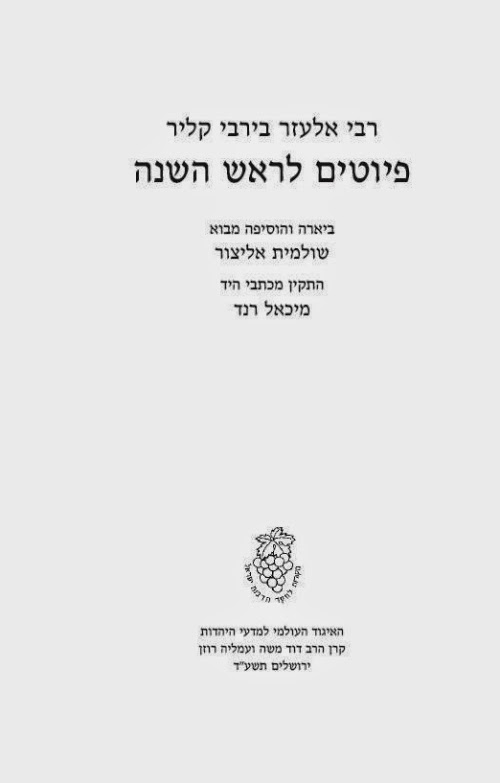
New Book Announcement: A critical edition of R’ El‘azar HaKalir’s Piyyutim of Rosh Hashanah, by Shulamit Elizur and Michael Rand

New Book Announcement: A critical edition of R’ El‘azar HaKalir’s Piyyutim of Rosh Hashanah, by Shulamit Elizur and Michael Rand
By Eliezer Brodt
רבי אלעזר בירבי קליר, פיוטים לראש השנה, ביארה והוסיפה מבוא, שולמית אליצור, התקין מכתבי היד מיכאל רנד, האיגוד העולמי למדעי היהדות, ירושלים תשע”ד, [מקורות לחקר תרבות ישראל, כרך יח], 718 עמודים.
I am very happy to announce the publication of an important work out just in time for Rosh Hashanah, a critical edition of all of R’ El‘azar HaKalir’s Piyyutim for Rosh Hashonah, by Shulamit Elizur and Michael Rand.
The importance of studying the Piutim before Yom Tov has been noted by many for example:
R’ Moshe Hakohen, nephew of the Rosh, writes in his work, Sefer Hamaskil:
מה טוב ומה נעים לעיין תמיד דבר בעתו בכל שבוע ושבוע בפירוש חומש ומחזור וסליחות ויוצרות ופיוטים וקינות ופרקי אבות ודברות והושענות וזכרנו ואגדת פסח ומערבים וגדול וקטן… [ספר חסידים, עמ’ עא].
[For an exact explanation of this passage and for general information about this work see the special article of Rabbi M. Honig in Yerushaseinu 1 (2007) pp. 196-240 especially p. 229].
A similar idea is found in the Mahril:
וכל אדם יחזור וילמוד התפלה והקרובץ מקודם להיות שגורים בפיו בר”ה בשעת התפלה [מהרי”ל עמ’ רעב].
The Taz writes:
ראה דבתפלה שצריך להבין בפי’ הדברים בפרט בפיוטים שחמור פירוש’ אם לא בנתינת דעה רבה עליהם ודאי צריך להסדיר תחלה ולא מהני לו ספר בזה וזה פשוט [ט”ז, סי’ ק ס”ק א].
In regard to the Piyutim by the Kalir, it’s worth quoting the Arizal, as mentioned by the Magen Avrohom:
האר”י ז”ל לא היה אומר פיוטים ופזמונים אלא מה שסדרו הראשונים כגון הקלירי שנתקנו ע”ד האמת, (הכוונות( [סי’ סח הקדמה].
Different aspects related to the Kalir have been dealt with here on the Seforim Blog; see Dan Rabinowitz’s article here which includes a bibliography about him. In addition to this, see Marc Shapiro’s article here and my article here, note 73.
The Kalir as described by Rabbi Joseph B. Soloveitchik
 
I would just like to quote one special passage of Rabbi Joseph B. Soloveitchik about the greatness of the Kalir. This passage is from the Koren Mesorat Harav Kinot (pp. 386-388) which is based on Rabb Jacob Schacter’s transcripts of the Rav’s Tisha B’Av sessions:
At this point, it would be useful to make some general observations about Rabbi Elazar Hakalir and the style of his piyutim, his religious poetry. The piyutim of Rabbi Elazar HaKalir, including his kinot, serve two purposes. The first is limmud, learning. Every sentence of the piyut quotes m’aamarei Hazal, teachings of the sages. The second purpose is tokhaha, rubuking the people for their misdeeds and instructing them in the proper way to act. These piyutim deal with reproach, repentance, petition and acknowledgment of God’s justice. The shali’ah Tzibbur was not merely a hazan, a cantor, but was one of the great scholars of the generation who was the principal mokhiah, moral critic of the people…
Rabbi Elazar HaKalir was a master of the Hebrew language and very creative in his use of Hebrew. If not for him, modern Hebrew could not have come into existence. Before HaKalir, the Hebrew language was very rigid. For example, the noun and verbs were fixed in their form. It was difficult to transform a verb into a noun or a noun into a verb, a simple matter in other languages…
But HaKalir made a critical contribution to the development of the Hebrew language by endowing the language with flexibility, thereby paving the way for the development of modern Hebrew. There were other early paytanim, composers of piyut, such as Yose ben Yose, but they were not as radical in their literary style as HaKalir.  HaKalir was the father of the paytanim, and he dared to do more than any other paytan.
As noted above, Rabbi Elazar haKalir’s piyutim served two purposes: limmud, study and tokhaha, rebuke. As for the element of study, one of the dimensions of HaKalir’s piyutim is that they are compilations of the statements of the sages. Most of us, who are expert in neither Hebrew nor aggadot Hazal, find HaKalir’s corpus of piyutim boring. But it is not boring at all; it is like a gold mine. His piyutim for Yom Tov explain the essence of the Yom Tov. The midrashim concerning Sukkot are replete with information about the sukka, etrog and lulav, and all the explanations in the Midrash, all the ta’amei sukka, the reasons for the sukka, all of the ma’amarei Hazal, are brought together in the HaKalir’s piyutim for the first day of Sukkot. Similarly, his piyutim for Rosh HaShana and Yom Kippur include all the homiletical literature concerning the statement in the Midrash, “On Rosh HaShana, Sarah, Rachel and Hanna, were remembered” (Bereshit Raba 73:1). If one were to study carefully and thoroughly the piyutim of Rabbi Elazar HaKalir for Rosh HaSahana, Yom Kippur, Sukkot, and Pesah, one would find many applicable halakot and the entire pertinent Midrash, including many  midrashim that are unknown to us from any other source.
It is quite possible that during the time of Roman and Byzantine rule in the land of Israel, the ruling authorities prohibited shiurim and afternoon lectures by Torah scholars and sent officers to the synagogues on Yom Tov afternoon to prevent the people from studying. Consequently, the rabbis introduced the study of Torah into the prayer service via piyutim, a subterfuge that eluded the authorities. The piyutim were deliberately written in a fashion that would make them difficult to understand, lest the officers recognize their true function and forbid their recitation. As previously noted, we do not know with certainty when Rabbi Elazar HaKalir lived. According to Tosafot (Hagiga 13a, s.v. veraglei hahayot), he was the tanna, Rabbi Elazar HaGadol, who lived in the second century, but according to other Rishonim, he was either an amora, or one of the early liturgical poets, from the sixth or seventh century. But his piyutim could certainly have served the purpose of integrating Torah study into the prayers in a way that would not have been obvious to the non-Jewish authorities.
Description of the work:
What follows is a description of this new work [sent around from the publishers of the book]
Rosh Hashana, the Day of Judgment, has been embellished with numerous fascinating liturgical poems (piyyutim). This book is devoted to the compositions that were written for Rosh Hashana by the illustrious poet R. El‘azar berabbi Qillir, who was active in the Land of Israel at the beginning of the seventh century. The piyyutim for Rosh Hashana are many and varied, and they adorn all of the special prayers for the festival. A number of these piyyutim are known and recited to this day in Ashkenazi congregations, while others are published here for the first time. Even those piyyutim that are known from the festival prayer books (mahzorim) are presented here in a new light. The present edition is primarily based not on European mahzorim, but on earlier fragments from the Cairo Genizah; on the basis of such early sources the editors have succeeded in adding new, original material to the known compositions—there is not one famous composition to which heretofore unpublished material has not been added, in some cases throwing new light on the entire work. Even in such cases, therefore, we are not merely offering old wine in new wineskins, but presenting a new blend that confers on the poetic compositions novel aspects, not previously brought to light.
This edition has been prepared on the basis of close to 400 manuscripts, and all of the variant readings have been given in the margins. An extensive commentary aids the reader in understanding the difficult idiom of the payyetan, identifying the many scriptural and midrashic sources that are woven into the piyyutim, and following the development of their themes. A general introduction treats various questions connected to the poems, from their attribution to the author and the reconstruction of the component parts of each composition, to the literary shaping of the material. In his piyyutim, R. El‘azar berabbi Qillir treats Rosh Hashana in all of its aspects: the Day of Judgment, the blowing of the shofar; the malkhiyot, zikhronot, and shofarot verses; the merit of the Fathers; and more. A number of compositions are specially intended for when Rosh Hashana falls on the Sabbath. Qillir’s unique method in the shaping of each of these themes is also clarified in the introduction. The complex web of interrelations between the piyyutim and their literary sources is elucidated as well; thus it has become clear, for example, that one of the piyyutim edited here for the first time throws new light on the famous poem, U-netane toqef qedushat ha-yom.
“O King, Remember [the ram] caught [by its] horn!” These few words from one of the piyyutim published in the book reveal the genius of the great payyetan. Here, R. El‘azar berabbi Qillir has succeeded in encapsulating in four words the three great themes that lie at the heart of the benedictions that are unique to Rosh Hashana—kingship, remembrance and the ram’s horn (shofar)—all in the
form of a prayer that beseeches God to remember for our sakes, on the Day of Judgment, the Binding of Isaac, symbolized by the ram whose horns are caught in the thicket. And if in four words the payyetan has managed to encapsulate such far-flung meanings, one can only imagine the riches contained in this enormous collection of R. El‘azarʼs writings for the Day of Judgment, which we now have before us.
About the authors:
Prof. Shulamit Elizur has been teaching since 1980 in the section for Medieval poetry and piyyut in the Department of Hebrew Literature at the Hebrew University of Jerusalem. She has published more than ten books and scores of articles, predominantly in the field of Genizah piyyut, but also devoted to Spanish Hebrew poetry and the development of various liturgical rites. A series of her books is devoted to the Late Eastern period of piyyut, and comprises an attempt to characterize the linguistic and literary developments attested during this phase on the basis of the production of critical editions of a number of its outstanding representatives. The present work is part of another series of her books devoted to the great Classical poets, among them R. El‘azar berabbi Qillir and R. Pinhas ha-Kohen.
Dr. Michael Rand specializes in Hebrew philology and piyyut. Since 2013, he has been Lecturer in Hebrew and Aramaic at the University of Cambridge. Dr. Rand acquired expertise with Genizah manuscripts over the course of a number of years of work in the section for piyyut and Medieval poetry of the Historical Hebrew Dictionary Project of the Academy of the Hebrew Language. He has devoted an extensive study to the grammar of the piyyutim of R. El‘azar berabbi Qillir; together with Jonathan Vardi, he has recently completed a soon-to-appear reconstruction of a copy of the Diwan of R. Shmuel ha-Nagid, the leaves of which are now scattered across various Genizah collections. He has also written many articles, among which are a number in which he has edited parts of the Qillirian corpus. In the present work, Dr. Rand is responsible for the paleographical aspects of the research: reading the manuscript sources, grouping them together (where relevant) and reconstructing thereby the larger units (quires, books) to which they belong, producing the apparatus of variant readings, and describing the manuscripts.
Purchasing information:
 
For a Table of Contents or more information about purchasing this work, feel free to contact me at Eliezerbrodt@gmail.com. Copies of this work will be arriving at Biegeleisen shortly.


Stolen Title Pages: The Case of An Unknown Contemporary Plagiarist

“Stolen Title Pages”:
The Case of An Unknown Contemporary Plagiarist*

The title of this post – “Stolen Title Pages” – is not mine, instead, I have borrowed it from Chaim Lieberman.[1] I have used this title because there are many forms of plagiarism – some, totally innocent – others involving lack of citation, borrowing a sentence here or there, but the plagiarism under discussion in this post is much worse than all of the above.[2] The plagiarism discussed in this post is limited to just changing the title page – that is, the entire book is the same with the only alteration being the name of the author and, at times, the title of the book. For example, if I republished Shakespeare’s Romeo and Juliet but instead of putting Shakespeare’s name I substituted mine.

The kabbalistic work on the holidays of the year, by R. Yitzhak Isaac ben Yoel HaKohen, Brit Kehunat Olam, was recently republished. This work was first published in 1796 in Lvov, and has been reprinted many times since then. In the introduction of this new edition, the publishers list the various printings of this work. But, they neglected to mention one reprint of this work. One can’t really fault them as this reprint was not published under the name Brit Kehunat Olam, nor did R. Yitzhak Isaac’s name appear anywhere in this reprint. Instead, although the book is word for word the same as Brit Kehunat Olam, a totally different title and a totally different author is given. As we shall see this is not the only time this person has taken someone else book for his own. This reprint which was done sometime around 2000 is instead titled Pardes haMo’adim ‘al Moadi Yisrael. The author is הצב”ר which, according to the many approbations he has received, is an abbreviation of R. Tzyion ben Ratson Lahat.

The Pardes haMo’adim contains approbations from R. Shimon Sherabi, the Rabbis of Kiryat Melachi – R. Hayyim Pinto and R. Yisrael Areyeh Gerstenkorn, R. Meshumar Tzubri, and R. Yisrael Sherabi. Some of these praise Lahat for his erudition in writing this work, others note his “great fear of sin,” but none of these haskamot note that every word in this book is plagiarized.

For purposes of accuracy, I must note, that Lahat did alter one thing aside from the title page. Perhaps in an effort to avoid detection he shifted the sections around. So, one can’t take page one and match it up, instead, you just need to find the section. This is not as hard as it would seem as Lahat used the same chapter headings as the original. So, for instance, the scan below you have the chapter titled מאמר מצות משוחים בשמן from both works. The newer type (on the right), without the commentary of the Sha’ar Shimon, is Lahat’s edition while the other (on the left) is the original.

Lest one think it is just that section or just the Brit Kehunat Olam that Lahat copied, I have provided another section – מאמר סכת שלם. Again you can see it is copied word for word. But, I also want to point out it is not just the Brit Kehunat Olam he copied but the commentary, Shem miShimon by R. Shimon Englander as well. As one can see, the notes on the bottom provide citations as well as further elucidations of the Brit Kehunat Olam. Although Lahat did not use footnotes – he used endnotes – they are the same as well.

I have provided below the pages from both Brit Kehunat Olam (on the left) which includes the Shem miShimon at the bottom. The other pages (to the right and bottom) are Lahat’s page from this section and the final page is Lahat’s notes which match up perfectly with the Shem miShimon.

As I mentioned above this is not the first time Lahat has stolen a prior work and substituted his name for that of the author. Instead, I have found at least two other times, where he did the same thing. In fact, one of the approbations for Pardes haMo’adim actually makes mention of this prior plagiarized work. This other work is Lahat’s book Minhagei haAriza”l. This work was published sometime after 1996. It contains four parts. Again, הצב”ר appears on the title page and all the approbations are written to R. Tzyion ben Ratson Lahat (as an aside his last name may actually be רווה [Ravah] as he dedicates this book to his brother Naftali bar Ratson Ravah). This work, with one slight change which I will discuss in a moment, is word for word from the book Minhagei haArizal haNikrah Petura d’Abba by R. Uri ben Asher Strizinitzer [3] first published in Jerusalem 1905.

This work takes fifth and the sixth sha’ar from R. Chaim Vital’s Shemonah She’arim which contain the bulk of the customs of R. Yitzhak Luria(Ari”ZaL). R. Strizinitzer, then includes his commentary, titled Beni Abba, which explains and offers sources for the customs of R. Yitzhak Luria. This work contains the approbation of R. Shalom Mordechi haKohen (the Braziner Rebbi). When he originally published this work, R. Strizinitzer did so anonymously. When he published a similar work Me’ori Tzion he revealed himself based upon an acrostic on the title page. The Meori Tzion was the fourth and final part of R. Strizinitzer’s work on the customs of R. Yitzhak Luria – as we shall see this was also copied. So R. Strizinitzer has three titles – Petura d’Abba, Beni Abba, and Meori Tzyion. The Petura d’Abba contains the portion from Shemonah She’arim and Beni Abba is Strizinitzer’s notes.

Now, we go to sometime after 1996, and a new book, again re-typeset, comes out with the title Minhagei HaAri”Zal with the three works Darkei Tzyion, Sha’ari Tzyion, and Me’ori Tzyion with הצב”ר’s name as the author.

The only thing Lahat did, however, was alter the titles of the first two sections, he didn’t even bother moving things around to avoid detection. In Lahat’s edition the Darkei Tzyion contains the portion from Shemonah She’arim and Sha’ari Tzyion contains the notes. Below, I have provided two pages, one from each book, to demonstrate the plagiarism.

In fact, in Strizinitzer’s book at the end he has “השמטות” – things he left out. Lahat, also has at the end things he left out – and coincidentally, they are the same as well. There is one other small change aside from the title page, and that is in the introduction. In Strizinitzer’s introduction at the end he explains why he decided to title his books as he did. Now, Lahat’s titles are different, so Lahat (left) removed that one line from the original introduction (right). The relevant passages are below.

Now, we return to the third title – Me’ori Tzyion, which Strizinitzer published separately in 1911,[4] and Lahat has included in this book. For this one, Lahat couldn’t be bothered with coming up with a new title so he uses the same title – perhaps to finally be able to say he really did copy everything perfectly. Both pages are below (Lahat, left; original, right).

Finally, we get to the at least the third example of Lahat’s stolen title pages. In this case it was fairly easy to locate the original. Lahat titled this work Pirush ‘al Birkat Kohanim, which as the title implies is a commentary and discussion about Birkat Kohanim. But, Lahat was kind and at the top of each page he has כה תברכו. This title כה תברכו is the same as a book published in 1881 in Solenika by R. Chaim Hemzi. And, it turns out not only is the title the same but the content is as well.


Lahat is by no means the first to merely switch the title pages – as I noted at the beginning of this post, Lieberman has examples of this phenomenon and there are other articles which discuss other instances of plagiarism as well.[5] What is perhaps unique about Lahat is that he seems to have done it more than once, in fact, I can not say for sure the rest of Lahat’s 13 (!) other books [6] are not merely copies as well. Additionally, many have assumed that in the digital age, when from the comfort of one’s home they can call up the card catalogs of almost every major library in the world and thousands books are available online or on one of hard drives – some of which are even searchable, this would have been detected. In fact not a single catalog entry in any library notes that these are copied – even when Lahat did not change the title of the book.

Further, aside from the approbation to Lahat’s Pardes haMo’adim, in his Minhagei haAriZal, Lahat includes approbations from his other works. Some of these are leading Rabbis who also have failed to detect their approbations are on stolen works. These Rabbis include (aside from those already mentioned above): R. Ovadia Yosef, R. Mayer Getz, R. Shalom Messas, R. Yosef Tzubeyri, and R. Tzion Tzubeyri.

Perhaps, now, this can be corrected and Lahat will cease stealing the works of others.

* Prior to posting I have attempted to locate Lahat without success. His books generally provide none of the standard information such as publisher/printer or any contact information.

Notes:
[1] Chaim Lieberman, Ohel Roch”el, vol. 1 (New York, 1980), 477-480, 529-531.

[2] There are no lack of examples, both real and imagined in this category. For one example of lack of proper citation, see R. Natan Neta Leiter, Tzyion l’Nefesh Hayyai (Jerusalem, 1964), no. 109.

[3] His surname comes from a town outside of Lvov.

[4] In some reprints of Strizinitzer’s Minhagi AriZal, Me’ori Tzyion is included.

[5] See Lieberman supra n. 1. Lieberman notes [p. 477] the case of Hemdat Tzvi, where the original was printed in 1876 and the stolen version with the same title was printed in 1879. However, he leaves out one worthwhile point. Although in the stolen version he knew enough to remove the original authors name, apparently he didn’t even read through the whole book as on p. 72b, the original author quotes his grandfather by name, and this same passage appears in the stolen version. Further, on p. 87, the original author includes a teshuva which he signs by name. In the stolen version it appears without change signed by the original author!). See also Kitvei Pinchas Turburg, ed. A. R. Malachi, 24-36; C. Leshem, Shabbat u’Mo’adi Yisrael (Tel Aviv, 1969), 379-409; Y. Sternhill, Kochavi Yitzhak (Brooklyn, 1969), Introductions to volumes I & II; Marc B. Shapiro, Saul Lieberman and the Orthodox (Scranton, 2006), 5 n. 9, discussing the example of Rabbi Nosson Dovid Rabinowich which was also discussed in a previous post at the Seforim blog; Shraga Abramson, “Chasad b’Ameirat Daver shelo b’Shem ‘Omro,” Sinai 112 (Nissan-Iyyar 1993): 1-24; Alei Sefer 16 (1990): 177-79; Moriah 83-84 (Adar I,1978) 79-80; A. Perls, “Das Plagium,” in Monatsschrift für Geschichte und Wissenschaft des Judentums / MGWJ 28 (1879): 305-322; R. Margolis, Shem Olam, Jerusalem, 1989, introduction.

Regarding the halakhic permissibility of plagiarism, see Nahum Visfish, Mishnat Zechuot haYotser (Jerusalem, 2002), esp. 95-115; Nahum Rakover, Zechut haYotsrim beMekorot haYehudim (Jerusalem, 1991), 17-72, a portion of which appeared as “Plagiarism of Torah Teachings,” Areshet 6 (1980): 222-226; and idem., “Plagiarism and the Obligation to Cite Sources: Aspects of Copyright Law in the Halakhah,” Dinei Yisrael 6 (1975): 93-120;

[6] There is one book which is particularly suspect, as Lahat’s book is titled מאיר לארץ and it is kabbalistic interpretations on ברכת המזון and there is another book with the same name on the same topic. Thus far, however, I have been unable to secure a copy to compare the two.


R. Isaac Arama, R. Kook, Mordecai Kaplan, and more

R. Isaac Arama, R. Kook, Mordecai Kaplan, and more
by Marc B. Shapiro
1. In the last post I discussed R. Isaac Arama. In his Conversos, Inquisition and the Expulsion of the Jews from Spain, p. 53, Norman Roth states that Arama was not a “great scholar.” If he means to say that Arama wasn’t a great talmudist (as has been stated about Ibn Ezra and Abarbanel), then perhaps he has a point (although I am sure this would be debated). But I don’t see how the title “great scholar” can be denied to Arama whose Akedat Yitzhak is a classic of Jewish literature and shows his vast knowledge.
Because the style of Akedat Yitzhak does not make it an easy read, many people avoid the work which is a shame as it is full of fascinating insights. One of his views that has often been quoted is that while it is true that individuals have free will, this is not the case for the Jewish people as a whole. It is built into the nature of the Jewish people that there can never be a time when the entire Jewish population rejects God.[1]
I think readers will also find it interesting that in discussing the role of women, he says that their second purpose (which he terms the lesser purpose – התכלית הקטן) is to have children.[2] However, the primary purpose of women is seen in the following quote, which I think is incredible when one considers how most medievals viewed women.
האחד מה שיורה עליו שם אשה כי מאיש לוקחה זאת וכמוהו תוכל להבין ולהשכיל בדברי שכל וחסידות כמו שעשו האמהות וכמה צדקניות ונביאות . . . ודאי עקר תולדותיהם של צדיקים מעשים טובים
How many contemporary Orthodox writers advocate the viewpoint that the primary purpose of women is to bear children, and that is where they find their fulfillment? Yet Arama rejects this completely. Arama’s understanding allows him to explain why Jacob was angered with Rachel when she said to him, “Give me children, or else I die.” (Gen. 30:1). Rachel didn’t realize that the main purpose of the righteous, and this also includes women, is good deeds. She mistakenly thought that her primary goal in life was to have children, and without that her life had no value. Jacob became angry since Rachel didn’t understand the basic point that the value of women is not simply dependent on how many children they can produce.[3]
It is well known that R. Meir Arama accused Abarbanel of plagiarizing from his father, R. Isaac. Abarbanel made heavy use of R. Abraham Bibago, and this also might be considered plagiarism (although much what we would regard as plagiarism today was not regarded as such in medieval times).[4] Abarbanel also used other writings without acknowledgment, such as R. Eleazar Ashkenazi ben Nathan ha-Bavli’s Tzafnat Paneah,[5] R. Nissim of Gerona’s Derashot,[6] and the medieval work Zekhut Adam.[7] R. Azariah de Rossi even accused Abarbanel of plagiarizing from Jerome.[8]
 מן הנראה כי גנוב הוא את החכם דון יצחק מדעת המעתיק לנוצרים בפרוש דניאל
In the introduction to his edition of Akedat Yitzhak, R. Hayyim Joseph Pollak mentions Abarbanel’s unacknowledged use of Arama’s work, and he is not sure what to make of it. In one case he refers to it as שגגה שיצא מלפני השליט. In general, he assumes that Abarbanel copied material from Arama for his own use, without intending to publish it. Yet by the time he published his own biblical commentaries he had forgotten that some sections of this work had come from Arama. Pollak also suggests, without any evidence whatsoever, that originally Abarbanel did mention Arama, yet these references were removed by others who had access to the manuscript. They did so in order to give greater glory to Abarbanel, so that he be given the credit for everything in the commentary.
השמיטו הם (או המעתיקים הבאים אחריהם) את שם בעל עקיד’ ז”ל מהמאמרים הלקוחים מאתו, בחשבם להרבות בזה כבוד הר”א ז”ל, אם יראו כל דברי ספרו כאילו הם ממנו לבד
Pollak’s defenses do not make much sense, and the best explanation is as mentioned, namely, that current standards of plagiarism are not like those found in medieval times.
Speaking of R. Isaac Arama, there are a number of references to him in the new edition of R. Raphael Berdugo’s commentary on the Torah, Mei Menuhot (I have mentioned R. Berdugo in a few prior posts). Here is the title page.

Here is page 918 of the commentary, where you can see that he quotes the Akedat Yitzhak who is criticizing Narboni.

On the top of the second column he refers to המדברים. The problem is that the editor doesn’t know what this term means (or for that matter, the word ההעברה),[9] and provides some fanciful explanation. However, just a little investigation would have revealed that the “Medabrim” are the Mutakallimun, that is, the followers of the Kalam. (Kalam means “word,” “conversation,” or “discourse”.) All one needs to do is open Ibn Tibbon’s translation of the Guide, and you will find lots of references to them. There is also a reference to them in Ibn Tibbon’s translation of Shemonah Perakim, ch. 6. 
The following appears in Guide 1:73 (Ibn Tibbon translation):
ההקדמה העשירית הוא זאת ההעברה אשר יזכרהו וזהו עמוד חכמת המדברים

The problem I am focusing on is not just that the editor did not recognize the term המדברים. It is that he should have been able to see that this was something he didn’t know, which in turn would lead him to investigate. This is a common problem, namely, it is not just that people don’t know, but that they don’t know that they don’t know.[10] What we should be able to expect, however, is that when an editor sees a term or expression that he doesn’t recognize, rather than engage in fanciful speculation he should actually consult with someone who might be able to understand the text.

Let me give another example of what I am referring to from the haredi world. This should not be taken as a general criticism of haredi editors. On the contrary, most of the best editions of rabbinic texts are edited by haredi scholars. They are experts in what they do and we all benefit. They, more than anyone else, are embarrassed when amateurs try to edit texts with all the errors they bring. (In a future post I will bring examples of mistakes by academic scholars in texts they edited, errors that could have been avoided had they consulted with real talmidei hakhamim.)

A few years ago a new edition of Maimonides’ ethical will, with an extensive commentary, was published. Here is a page from the work.
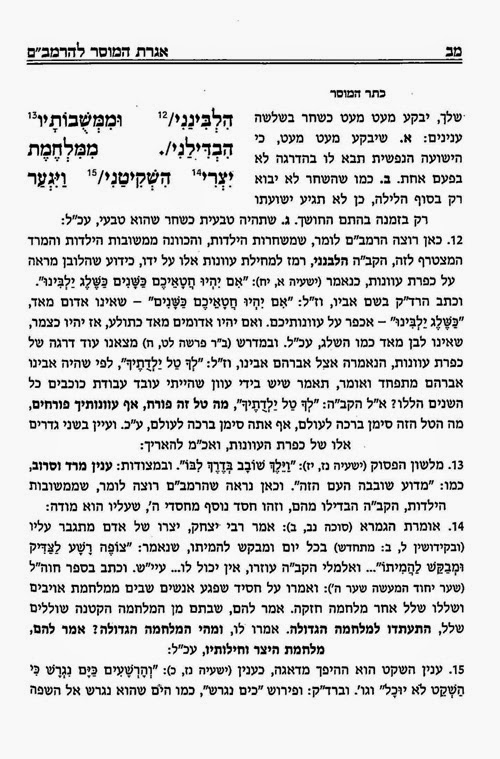
The only problem is that this supposed ethical will is a forgery, a fact recognized by R. Jacob Emden.[11] Actually, let me more exact; only the second part is a forgery, the part where Maimonides addresses his son R. Abraham and among other things tells him that the French scholars “don’t appear to recognize the Creator, blessed be He, except when they are ingesting boiled ox meat, seasoned in vinegar and garlic. . . . Generally, they have two wives, so that their minds are invariably fixed on sex, eating and drinking, and other sensual pleasures.”

The first part of the ethical will, before you come to דע בני אברהם, is not a forgery, but a case of mistaken identification. As noted by Israel Abrahams,[12] and more recently by R. Yitzhak Sheilat,[13] this first part is actually an ethical will of an Italian Jew directed towards his sons. He directs his words to them in the plural. Somehow, this ethical will got attached to the forged document of Maimonides, which of course is directed towards his son in the singular.[14]

In the introduction, the editor, R. Hillel Copperman, deals with the matter of the document’s authenticity.[15] He reports that he went to an unnamed great talmid hakham who told him in no uncertain terms that the ethical will was not written by Maimonides. When challenged that both R. Solomon Luria and the Hatam Sofer assumed that it was indeed written by Maimonides, this talmid hakham was not moved, and stated that they were both in error. It is not clear why the editor does not reveal the name of this talmid hakham. It could be that he is R. Shlomo Fisher, as later in the introduction the editor cites him by name, showing that R. Fisher was consulted in this matter.

After quoting from the anonymous talmid hakham, Copperman refers to numerous earlier sources that assume that the document was written by Maimonides, including various Mussar figures and also R. Aaron Kotler. He then cites R. Moses Samuel Shapiro that even though there might be difficulties with the work, one does not reject a tradition (that the document was authored by Maimonides) based on difficulties. Copperman then tells us that he asked R. Shmuel Auerbach who was uncertain about the matter. That is, the fact that earlier scholars assumed that the ethical will was written by Maimonides did not convince him of its authenticity.

Following this, Copperman went to R. Chaim Kanievsky. He was surprised to hear from R. Kanievsky that the latter had never seen or even heard of the ethical will! To say that this is difficult to believe is to put it mildly. It is indeed impossible to believe. One doesn’t need to be a great scholar to know of this work, which appears in various books and is referred to by numerous authors. Anyone who has been exposed to R. Kanievsky’s unparalleled wide-ranging knowledge knows that he is well aware of the ethical will and must also have reached an opinion about its authenticity, which for some reason he did not want to share with Copperman. Copperman himself raises this possibility but rejects it, seeing it as unlikely that R. Kanievsky would not tell him the truth.

חשבנו שמא לא רוצה הוא להיכנס לסוגיא זו, ומשנה מפני השלום. אך זה רחוק מאד בעינינו

All I would say is that while Copperman might regard this as unlikely, it is much more unlikely (actually, impossible) that a walking encyclopedia like R. Kanievsky has never even heard of the famous ethical will attributed to Maimonides.

Copperman then went to R. Steinman, and he tells us that it was clear to him that R. Steinman does not believe that the problems with the ethical will are enough to refute its authenticity. Yet he also tells us that R. Steinman referred to the matter of the Yerushalmi Kodashim, in order to show that something that even great rabbis originally regarded as authentic could later be shown to be a forgery. This latter point would appear to show that R. Steinman is not certain about the matter.

In seeking to determine if a document attributed to Maimonides is authentic, Copperman turns to the gedolim, the ones who determine Da’as Torah. Yet there are a number of people, some in the haredi world, who are experts in Maimonides’ writings, in particular, his letters and manuscripts. Shouldn’t they be the people to turn to? Shouldn’t Copperman have consulted with R. Yitzhak Sheilat or R. Shlomo Zalman Havlin, to give just two names? This is just one example of how some editors in the haredi world are simply not doing their job properly. It would be one thing to just reprint the ethical will without comment, but once Copperman writes an introduction to discuss its authenticity, how can he possibly assume that the matter will be settled simply by citing R. Steinman’s opinion, especially since R. Steinman would agree that he has no expert knowledge of this issue?

Let me return to Norman Roth, mentioned above and from whom the Seforim Blog recently had the privilege of publishing a post. He is a well-known expert in Spanish Jewish history. His footnotes in particular are always worth reading, as he uses them to correct all sorts of misconceptions. There are many supposed facts, continuously repeated, that actually have nothing to stand on, and throughout Roth’s works errors such as these are corrected. I mention this because I too might be a future subject of one of these footnotes. My book on censorship is currently with the publisher and I can’t make any further changes. In this book I deal with Ibn Ezra’s Iggeret Shabbat and discuss the controversy over whether it was directed against Rashbam. In a recent article which I just read, and thus could not refer to in my book, Roth sums up his position (which I think is unique) as follows: “In my opinion, it is highly unlikely that he [Ibn Ezra] ever went to England, and the “Sabbath letter” is surely a forgery.”[16] I am curious to hear what Ibn Ezra scholars have to say about Roth’s argument.

2. In my post here I quoted R. Nathan Lopes Cardozo’s rejection of dogma. He continues this theme in his recent article in Conversations 19 (Spring 2014). The article is titled “God is Relocating: A Critique of Contemporary Orthodoxy – Four Observations,” and I offer here a selection from it. Are there any other Orthodox (a term Cardozo rejects) rabbis who agree with the sentiments that follow?

The truth is that Jewish Orthodoxy (from the Greek orthos [“true” or “right”) and doxa (“opinion” or “belief”) never existed. Originally Judaism was highly unorthodox. Although it always believed in God and Torah, it never offered any specifics of what God meant or what Torah consisted of. That was left to speculation, never to be determined. The early Sages, as testified by the Talmud and philosophers, disagreed on some of the most fundamental issues of faith.

But over the years we wanted more certainty. We wanted it handed to us on a silver platter, so that we could avoid debates and live a life of religious comfort, apathy, and mediocrity. Influenced by other religions, we adopted the need for cast-iron certainty and psychological security. So we began to rewrite Judaism in a way that would fit into the notions of established religions – well-structured, with a good dose of dogma. What we did not realize is that by doing so, we misrepresented Judaism by losing sight of the plot, thus doing it a great disservice.

We need to realize that our epoch of uncertainty is in fact much more conducive to authentic Judaism than all the conviction we’ve had in previous generations. It forces us to rediscover what Judaism is really about and gives us the opportunity to rebuild where rebuilding is required and leave untouched what should remain untouched.

Tamar Ross is another liberal Orthodox thinker. Here are three separate passages from a recent article.[17]

It is precisely because of the importance of everyday “realist” assumptions in cementing religious commitment that so much effort is expended by religious conservatives in cordoning off some religious beliefs as off-bounds to demythologizing or re-interpretation. Because the notion of “truth” and religious commitment are so intimately connected in the human psyche, critical scrutiny of beliefs that appear indispensable to the system is sometimes held back by upholding the remote possibility that future investigation will overturn current impressions. When scientific discoveries or deeply felt moral intuitions render even such eventualities incredible, religious adherents may resort to deliberate bifurcation, conducting themselves in accordance with reason in the laboratory and in their everyday lives while preserving professions of faith in the synagogue and in formal allegiance to what are regarded by current halakhic consensus as unavoidable halakhic constraints. Irrespective of the difficulty some may have in granting legitimacy or persuasive value to such policies, it would be fair to say that a religious world-view lacking any claims of attunement to a reality beyond its self-contained universe of discourse will never match traditional belief in its ability to preserve the intensity of feeling generated by its models and paradigms and to transmit the passion of its message to future generations.

Given these precedents, we would do will to rid ourselves once and for all of the misnomer of Orthopraxy, often invoked in a pejorative sense in order to dismiss halakhically conformist behavior that is not grounded on acceptance of dogma in its literal sense. Any behavior externally conforming to that which is historically and sociologically identified with traditional halakhic practice indicates some form of belief or justification though it may not tally with the naive objectivism of strict correspondence theory.

Postmodern language theory can redeem modern Orthodoxy from its counter-productive attachment to naive objectivism. The epistemological modesty of non-foundationalism can help religious adherents move away from overly rigid definitions of doctrine and allow them to return to the pre-modern function of religion as providing a valuable universe of discourse and a compelling way of life. It can extricate them from a mindless and stultifying triumphalism and encourage the willingness to refine religious convictions by listening carefully to other points of view.

After reading Cardozo, Ross, and numerous others I have quoted in the past, the only conclusion that can be reached is that, despite what Centrist rabbis like to claim, it is certainly not dogma, Maimonidean or otherwise, that holds wider Orthodoxy together. 

In thinking about the place of dogma, people should pay close attention to the following passage from R. Kook (Shemonah Kevatzim 1:765). R. Kook tells us that even “heretics” can have a more profound belief than so-called Orthodox Jews, and are thus described by the verse from Habakkuk 2:4  צדיק באמונתו יחיה.

לפעמים ימצא כופר שיש לו אמונה חזקה, פנימית, מאירה, נובעת ממקור הקדושה העליונה, יותר מאלפי מאמינים קטני אמנה. דבר זה נוהג באישים פרטיים וכן בדורות, ועל כולם נאמר צדיק באמונתו יחיה
R. Kook’s new published volumes contain many important texts dealing with belief, and I have quoted a number of them in prior posts. Here are some more significant passages.

Kevatzim mi-Ketav Yad Kodsho, vol. 1, p. 182: R. Kook explains that there are two types of faith, one which is based on absolute truth, and one which he refers to as אמונה הסברית. This latter type of faith is not absolute but changes with the times. For example, in one generation one can base a belief on a certain notion (scientific, moral, etc.) while in another generation, such an approach cannot be used, because the underlying notion is no longer accepted, and to use it will be dangerous to faith. We can all think of examples where this is so, i.e., where an explanation used to strengthen faith, and which was successful in its time, today will turn people off from Judaism (for example, explanations for kashrut and circumcision, or various descriptions of women’s nature and their necessary subservience to men, used to explain women’s position in Judaism). Similarly, there are examples where years ago an explanation could not have been used because of its negative impact, while today it can have a positive impact (for example, using evolution in explaining Torah). R. Kook sees the notion he is expounding upon as alluded to in Maimonides’ famous conception of “necessary truths” (Guide 3:28). 

R. Kook’s point is very important as it tells us that while the core of belief remains absolute and unchanging, the way it is understood and expressed must change with the times. This explains why earlier rabbinic conceptions of Judaism are not always satisfying to moderns. Some people assume that the reason for this is because we are at a much lower level than earlier rabbinic greats. R. Kook’s point, however, is that everyone, in every era, is subject to the times, and even the earlier examples of אמונה הסברית  are only to be regarded as provisional. As mentioned, this is a very important point and it could be expanded at great length.

שתי דרכים לאמונה, האחת האמיתית המוחלטת, והשנית ההסברית. האחרונה משתנה היא לפי הזמנים. ישנם זמנים שאם יהיה איזה עיון מתפרסם ומוחזק, היה מזיק ליסוד דברי אמונה ברורים מצד האמת המוחלטת. ואחרי אשר העולם המדעי קבל צורה אחרת בהמשך הזמן, אבדה האמונה ההסברית ההיא את ערכה, וכבר לא מזיק כלל לשום רעיון אמוני מוחלט הפרסום של אותה ההנחה בעצמה, שהיתה בזמן העבר מזקת בפרסומה. והדברים הולכים עוד יותר, שמזדמן הדבר שצורה הסברית אחת היתה מחוייבת באיזה פרק מפרקי הזמן, עד שקבעה לה אז האמונה ההסברית את צורתה באופן מיוחד, ואחר כך יזיק דוקא אופן זה להאמונה המוחלטה, ושיש חיוב אז לפרסם את ההפך מהאמונה המוסברת אז. יסוד החילוק בין שני חלקי האמונה כבר רמז הרמב”ם, אמנם צריך אומץ לב מיוחד לעמוד בניסיון בעת חשיכה כזאת.

Tied in with this is R. Kook’s comment (Kevatzim, vol. 2, p. 167) that certain great truths can only be revealed together with falsehood, which protects the truth as it were.

ישנן אמתיות גדולות, שאינן יכולות להתגלות בעולם כי אם דוקא במעטה של שקר, ומעטה של שקר השומר את האמת נעטר גם הוא באור האמת. ופקוחי עינים יודעים להבדיל בין המעטה לעוטהו, ופחותי הנפש מביטים באור האמת בשביל מעטה השקר שלה, ונמוכי הדעת אינם מכבדים את האמת יותר מהכבוד הראוי למעטהו הנאהב אצלם לפי תכונתם הנמוכה.
One can easily come up with a number of examples of this. Just think of all the foolish talk about God and His nature. It seems that every preacher feels it is OK to talk about what God “wants”, about how God gets “angry”, or is “upset”, or is “pleased”, etc. A little thought will reveal that none of these descriptions of God can be true in an absolute sense, but since these descriptions are thought necessary in order for people to believe in the ultimate truths, i.e., the existence and providence of God, they are tolerated. (See Guide 3:28 for Maimonides’ discussion of “necessary truths”.)

Since I mentioned R. Isaac Arama earlier in this post, let me give an example of this from his writings.[18] Arama asks what is the point of the commandment to build a mishkan. It is not as if God is a physical being who needs a place to live. Yet in order that the masses have a God with whom they could feel connected, that is, a God who exercises providence, the Lord was prepared to compromise and allow them to believe that he actually was found in the mishkan. Here are some of Arama’s words:

כי באומרו ולא יכול משה לבוא אל אהל מועד ויתר להם הרחקת הגשמות למה שיורה שהיה שם דבר ממשיי המעכבו לבא לשם. וזה לפי שלא יראה להמון דבר של מציאות זולת זה. ובאומרו כי שכן עליו הענן ויתר אצלם ענין ההעתק ממקום למקום לקבל מהם שירות ועבודה כי בזה יסמוך לבם על השגחתו עליהם. ובאומרו וכבוד ה’ מלא את המשכן לא נשמר מהתקוממות במקום והיותו כמלך הקובע ישיבתו באמצע המלכות

Kevatzim mi-Ketav Yad Kodsho, vol. 2, p. 129: R. Kook tells us that true belief cannot exist without the possibility of unbelief
.
האמונה בטהרתה תצא דוקא על ידי אפשרות של כפירה בלא שום הגבלה

This is very similar to the sentiments expressed by R. Jehiel Jacob Weinberg.[19] What it means is that true faith is stormy, on the edge, as it were. There are easier paths, where one is perhaps guaranteed “peace of mind.” However, this cannot be regarded as authentic religious faith. Paradoxically, true faith, the faith that keeps you up at night, can easily turn into unbelief. R. Kook also explains, ibid., p. 149, that this true faith can only be developed through freedom of thought. That is, while obedience can be assured by closing off thought, one can never reach what R. Kook terms אור א-להים if one’s thought is controlled.

Even when unbelief does arise, R. Kook does not see this as all bad. As a kabbalist, he believes that there are sparks of holiness in everything, even in unbelief. According to R. Kook, when the unbelief is directed in an ethical direction, then this too can be seen as part of the search for God (ibid., p. 151). In other words, even the atheists are engaged in derishat ha-Shem when they work for the betterment of humanity, and it unfortunate that they do not realize this.

המהומה הכפרנית כל זמן שהיא עסוקה במגמות מוסריות הרי היא ממש דרישת ד’. המוסר והרחבתו, הגדלת ערכם של החיים, ענוגם ושאיפותיהם, הוא בעצמו דרישת ד’, יותר משארי דרישות הבאות ברחשי לב המתעוררים על פי איזה דמיונות פנימיות שאין בהם הטבה מעשית לסדרי החיים. מכל מקום אומללים הם בני אדם כל זמן שאינם יודעים שכל מה שהם עסוקים לרדוף אחריו במובן המוסרי ובקשת הטוב זהו דרישת ד’, ונהרה רבה תופיע עליהם כשיגלה להם רז זה.

R. Kook also sees other positive elements in unbelief (pp. 166, 167). There are people who assume that there is no afterlife, or any reward and punishment. The positive aspect of these mistaken beliefs is that the unbelievers’ good works are not performed in order to receive reward, but for their own sake. This is a very high level of service, something Jews realized long before Kant.

יצר הרע בא לאדם לפעמים להוכיח לו שאין לו תקוה לעולם הבא. – ידע נאמנה, שהוא עומד להתעלות במעלה גדולה מאד, עד שיהי’ עובד ד’ שלא על מנת לקבל פרס, כי אם מאהבה שכלית טהורה.

הכפירה בשכר ועונש מחנכת את הבריות לעשות טוב מצד עצם הטוב. וכל מה שיתרבו עושי טוב באמת, כן יתמעט ההכרח של מציאות רעיון הכפירה, שאיננו כי אם אמצעי תרבותי לזה המצב.

Even the very thought of God when engaged in the good is not the highest level, so again, paradoxically, unbelief prepares the ground for service on the highest level (ibid., p. 166).

הצורך לחשוב על דבר א-להים היא ירידה גדולה, שהיא דרושה לאדם בתור רפואה. הכפירה היא הכנה שלילית לצורך העילוי העליון שלא יהיה שום צורך לחשוב על דבר א-להות, כי אם עצם החיים יהיה אור א-להים

Finally, let me call attention to one more interesting point about faith. R. Jacob Wreschner, Seder Yaakov (Jerusalem, 2010), vol. 2, p. 425, records that he heard from his father that R. Yerucham Levovitz had religious doubts in his youth, and R. Isaac Blazer helped him overcome these. R. Wreschner states that it is no insult to a great figure to reveal this information, though he notes that R. Judah Zev Segal, when he tells this story, does not reveal who the subject is.[20]

Anyone who thinks about the place of belief in traditional Judaism is aware of the phenomenon called, for a lack of a better term, “orthopraxy.” Many people assume that this is a fairly recent phenomenon. Yet already in the nineteenth century R. Solomon Kluger wrote about people who were completely observant but did not have proper beliefs.[21] He sees these people as worse than typical sinners who actually violate prohibitions (he specifically mentions sexual prohibitions).

בימים הראשונים היה הרשעות במעשה. אם ראו באיש אחד שאינו פרוץ בעריות וכדומה ידעו שהוא כשר. לא כן עתה הרשעות תלוי בלב ויתכן שיהי’ מקיים כל התורה ובלבו ישים ארבו ויש בלבו שמץ אפיקרסת [!] והוא גרוע מן הרשעים הראשונים שהי’ בהם כמה חטאים

Someone who is attuned to R. Kook’s way of thinking will approach matters from a completely different perspective, and see the phenomenon of orthopraxy in a much more positive light. Consider the following: The so-called orthoprax individual does not have a traditional view about the Torah. Yet he does not use this as an excuse to live a secular life, what in yeshivah we referred to as a life of “hefkerut”. On the contrary, this individual chooses to bind himself to the Torah, to observe mitzvot, to “inconvenience” himself when it would be much easier to abandon it all. How is one to judge a person who, whatever his theology, makes enormous financial sacrifices to send his children to Jewish schools and happily gives to a variety of Orthodox causes? How is one to judge such a person who when stuck in a strange place for Shabbat asks the hotel clerk to open his door (as it is electronic) and refuses to carry a map on the unfamiliar street, a person who chooses to live on fruit because there is no kosher restaurant in the city he is visiting (to give just a few typical challenges that Orthodox and orthoprax Jews confront)?

R. Kook’s insights about the religious significance of the non-observant who were building the land of Israel must be multiplied many times over when dealing with completely observant Jews who sacrifice in so many ways for Torah and halakhah, even though their beliefs are not “Orthodox”. Yet this is a phenomenon which, as far as I know, R. Kook does not mention. Rather, he refers to those who because of their belief in biblical criticism rejected all observance. They assumed that if you don’t accept the divine origin of the mitzvot that there is no need to observe them. R. Kook rejected this assumption and argued that there is a good reason to observe mitzvot even if one does not have a traditional view of the Torah’s authorship.[22] I will flesh out R. Kook’s argument in the next post.

3. In an earlier post I referred to Mel Scult’s new book, The Radical American Judaism of Mordecai M. Kaplan. Scult discusses the burning of Kaplan’s siddur at an Agudas ha-Rabbonim gathering on June 12, 1945, at which Kaplan was himself also put in herem. The significance of this event can be seen in that there were over two hundred rabbis in attendance.[23]

Here is the text of the herem from Ha-Pardes, July 1945.

The sentence immediately before the text of the herem clearly implies that the burning of the book was part of the ceremony (and see also Ha-Pardes, Nov. 1945 p. 23). Thus, Jeffrey S. Gurock and Jacob J. Schacter had good reason to write as follows:

Scult, Judaism Faces the Twentieth Century, p. 420, n. 38, suggests that the act of book burning was unintentioned and not directed by the rabbinic leaders themselves, but all evidence cited above points to the contrary. This was clearly an official act, sanctioned by those assembled as a fitting and appropriate conclusion to a most serious and solemn deliberation.[24]

Zachary Silver, who has recently written a very nice article on the episode, available here, writes as follows:

Mel Scult’s biography of Kaplan mentions that the event occurred, but he does not believe that Agudat HaRabbanim burned the book as part of the formal ceremony. Rather, he says that the burning occurred incidentally at the back of the room. However, Agudat HaRabbanim’s documents illustrate that it was a previously scripted formula.[25]

This burning of a Jewish book, coming so soon after the end of the Holocaust and so much at odds with the American tradition of freedom of expression, horrified both Jews and non-Jews. The fact that the excommunication and burning were covered in The New York Times only made matters worse, and everyone assumed that this was an officially sanctioned action of Agudat ha-Rabbanim.

In writing about the event in his diary, Kaplan referred to “rabbinical gangsters who resort to nazi [!] methods in order to regain their authority.”[26] He later publicly stated as follows:

It is just too bad that men who call themselves rabbis should in this day and age resort to the barbarous procedure of outlawing a man without giving him a hearing, and to the Nazi practice of burning books that displease them. God save us from such leadership and from the disgrace it is likely to bring upon Jews.[27]

Responding to the horror aroused by the book-burning, Agudat ha-Rabbanim publicly declared that it had nothing to do with this action. It claimed that the burning was done independently by one of its members. Silver writes:

The Union of Orthodox Rabbis later disavowed responsibility for the book burning, claiming that the event was not a scheduled part of the ceremony but rather the act of one rabbi from the audience who acted on his own, after the service was completed. This version seems unlikely, however, since the article about the excommunication in HaPardes, the unofficial magazine of Agudat HaRabbanim, gives specific justification for the book burning as part of the ceremony and does so in halakhic terms. The more likely scenario is that, after witnessing the heated public reaction, Agudat Harabbanim chose to disavow responsibility for burning the siddur as a face-saving public relations move. Thus, by saying that the burning was not part of the planned activities, the Union of Orthodox Rabbis could attempt to refocus public attention on the greater issues of the heresy of Kaplan and the Conservative movement, rather than on a particularly unsettling segment of the ceremony, which itself evoked memories of Nazi ritual book burnings. Of course, the uproar implies that Agudat Ha-Rabbanim did not realize that most Americans would be troubled by a book burning in 1945 – a lapse of judgment that would manifest the extent by which the Union of Orthodox Rabbis had lost touch with contemporary currents in American culture.[28]

Years after the event, R. Norman Lamm reflected on the book burning.

If we want to win people over to Orthodoxy, we need to present ourselves as measured, mature, and moderate people with deep faith and the right practice, but we do not insult others and we do not damage or condemn them. Coming out with issurim [decrees that forbid particular actions] against everyone else is like another Fatwa. When I was younger there was a heretic by the name of Mordecai Kaplan, and the Agudas Harabbonim had this whole big book burning party. I thought it was ridiculous to have a book burning in the twentieth century. It didn’t make anybody decide to become more religious observant. Nobody who was reading his books said[,] “If important Orthodox rabbis burned them, we’re not going to read them.” If anything, it aroused interest in people who otherwise would not have wanted to read these books. But in addition, what it accomplished was that it got people to look at the Orthodox as fanatics. That’s no way to make friends and win people over to Orthodoxy.[29]

What we see from what I have quoted is that there is agreement that it was Agudat ha-Rabbanim that sanctioned the burning of the siddur.[30] Silver adds, “It is unclear who actually burned the siddur, as the report in HaPardes uses the passive voice.”

In fact, we do know who burnt the siddur, Based on this information, we can also determine that the other point that “everyone” knows, that it was Agudat ha-Rabbanim that sanctioned the burning, is incorrect.

In 1945 The Jewish Reconstructionist Foundation published a booklet, A Challenge to Freedom of Worship. I don’t know why, but this is a very rare publication. I have therefore uploaded it here. From this booklet, you get a sense of the great ill-will produced by the excommunication of Kaplan and the burning of his siddur. This is what appears on the very first page of the booklet.

I first saw this booklet shortly before R. Joseph Ralbag passed away. At that time he was not well and I could not schedule a time to speak with him. However, at my request R. Aryeh Ralbag asked his father some questions about the episode, and I can report the following from the late R. Joseph Ralbag. R. Ralbag did not decide on the spur of the moment to burn the siddur. Rather, he knew he was going to do this ahead of time and even discussed it with his future wife. Yet the other members of Agudat ha-Rabbanim were unaware of his plans until he lit the siddur on fire. In other words, this was an individual act by R. Ralbag and, as Agudat ha-Rabbanim would later state, it was not sanctioned by them. This testimony, from the main protagonist of the event, should finally settle the matter. (Although R. Ralbag denied burning the siddur in the telephone call referred to on the page printed above, this was obviously only said to protect himself after the controversy broke out. As indicated, hundreds of people saw him burn the siddur.[31])
One more interesting point about this episode is that Rav Tzair (Chaim Tchernowitz) claimed, in the course of an attack against Kaplan’s siddur, that according to halakhah it was forbidden to burn the work.[32] I would be curious to hear what some of the readers make of this.

שמה שהחכמים גזרו על ס”ת שכתבו מין שישרף, אינו אלא מפני שהשמות לא נכתבו בקדושה, ואפשר שנכתבו לשם ע”ז, אבל בנידון דידן הרי לא את כה”י של קפלן שרפו, אלא את הסידור, שסידר אותו יהודי תמים, שבידוע שלא כוון לשום דבר אחר כשסידר את אותיות השם, ובכן אסור היה לשרוף את האזכרות שבו. ובזה עשו הרבנים שלא כדין ששרפו את הסידור (אולם הם הודיעו שלא גזרו שריפה על הסידור אלא שצורבא מרבנן אחד שרפו על דעת עצמו)
4. Before his passing, R. David Hollander asked if I could review the memoir he had written. At the time he asked me, I was too busy to do so, but hoped that I would later have the opportunity. After Hollander’s death I was unable to find out what became of the memoir. (Hollander did not have any children who would have inherited it.) Perhaps a reader will be able to help in this matter.

5. Last year Yisrael Kashkin produced a nice poster of religious Zionist rabbis. You can see it here. He has recently produced the following poster of German rabbis.

You can order framed 8.5 x 14″ and laminated 8.5 x 14″ copies. The former are meant for a wall and the latter for a sukkah. Anyone interested should write to thetidesociety@gmail.com 
[1] Akedat Yitzhak, parashat Nitzavimsha’ar 99 (pp. 105ff). Speaking of free will, see also R Meir Simhah of Dvinsk, Meshekh Hokhmah, Introduction to Exodus, who states that Moses’ free will was also taken away from him.
שהשי”ת שלל ממנו הבחירה לגמרי ונשאר מוכרח כמלאכים.
See also his Or Sameah, Hilkhot Teshuvah, ch. 4, at the end of his lengthy essay on divine knowledge and free will. In his Introduction to Exodus, R. Meir Simhah also claims that Joshua’s free will was taken away.
גם ממנו שלל השי”ת הבחירה לגמרי כמו ממשה, שלא ישלול חלילה דבר מתורת משה
[2] Akedat Yitzhak, parashat Bereshit, sha’ar 9 (p. 92b).
[3] For another fascinating idea from Arama, see here that he did not believe that the book of Esther was written with ruah ha-kodesh. Rather, the work is a completely secular (i.e., pagan) text, translated into Hebrew, and this explains the omission of God’s name. The ruah ha-kodesh is only seen in the fact that Anshei Keneset ha-Gedolah removed all falsehood from the work. This passage from Arama comes from his introduction to the book of Esther which appears in the standard edition of Akedat Yitzhak, first published in the nineteenth century with a commentary by R. Hayyim Joseph Pollak. If you look at this edition you will find that while the introduction is by Arama, the actual commentary is by his son, R. Meir. This is also what is found in the 1573 Venice edition of Akedat Yitzhak. R. Isaac’s commentary to Esther appeared in the Constantinople, 1518 edition, and was not reprinted again until 1990. In 2005 Mossad ha-Rav Kook also published an edition of this commentary.
[4] Regarding both of these matters, see Menachem Kellner, trans. Principles of Faith (Rosh Amanah) (East Brunswick, N.J., 1982), p. 219 n. 65.
[5] See Abraham Epstein, Mi-Kadmoniyot ha-Yehudim, pp. 117 n. 2, 120.
[6] See R. Yehiel Goldhaber’s Purim 5773 article, “Bitul ha-Ra ha-Nif’al bi-Yemei ha-Purim,” p. 2
[7] See Senior Sachs’ introduction to Yehiel Brill, Yein Levanon (Paris, 1866).
[8] Meor Einayim (Vilna, 1866), vol. 2, ch. 38 (p. 25). Regarding Abarbanel, see also my post here where R. Soloveitchik is quoted as saying that he wouldn’t want Abarbanel as president of Yeshiva University. I have been informed that R. Ruderman did not like Abarbanel and that is why his biblical commentaries are not found in the Ner Israel beit midrash. I was told that the reason for this dislike was that Abarbanel rejects certain aggadic statements (sometimes in a harsh manner). Some have argued that Abarbanel was not a talmudist by pointing out that he apparently didn’t realize that Bnei Brak was a place, instead thinking that מסובין בבני ברק refers to the furniture the Sages were sitting on. See his commentary to the Passover Haggadah, s.v. מעשה בר’ אליעזר. Yet it is hard to imagine that Abarbanel did not know what Bnei Brak is, for it is mentioned a number of times in the Talmud, including the famous statement in Gittin 57b and Sanhedrin 96b that descendants of Haman studied Torah in Bnei Brak. It is also mentioned in the book of Joshua 19:45. Interestingly, R. Shem Tov Ibn Shem Tov, in his commentary on the Haggadah, seems to say that the name of the city is Brak, and Bnei refers to its inhabitants. See Otzar ha-Rishonim al Haggadah shel Pesah, ed. Holzer (Miami Beach, 2006), p. 20. As with Abarbanel, it is hard to imagine that R. Shem Tov did not know the earlier biblical and rabbinic passages from which it is clear that the city’s name is Bnei Brak. For more regarding Abarbanel, see the interesting discussion in R. Yisrael Veltz, Divrei Yisrael, vol. 2, Even ha-Ezer, no. 14, and see also Pardes Eliezer: Erusin ve-Nisuin (Brooklyn, 2010), pp. 176-177.
[9] In Pines’ translation from the Arabic (Guide 1:73) this is rendered “affirmation of admissibility,” and Maimonides explains (Guide 1:73): “They [the Mutakallimun] are of the opinion that everything that may be imagined is an admissible notion for the intellect.” In his note to the passage, R. Kafih states that Ibn Tibbon’s translation as ההעברה is inaccurate, and his version has ההתכנות.
[10] Plotinus refers to this as “two-fold ignorance”, which is also the “disease of the multitude.” See Yehudah Avida, Midrash ha-Melitzah ha-Ivrit (Jerusalem, 1938), p. 49. Of course, the one who has knowledge but because of this thinks that he knows it all is a fool. Here is the formulation of R. Yedai’ah ha-Penini, Mivhar ha-Peninim (Warsaw, 1864), p. 2 (no. 21):
ואמר האדם חכם בעודנו מבקש החכמה. וכאשר יחשוב שהגיע אל תכליתה הוא סכל
For the Arabic source of this formulation, see Yehudah Ratsaby, “Mekorotav ha-Araviyim shel ‘Mivhar ha-Peninim,’” Sinai 102 (1988), p. 113. In the years after Maimonides, the term כת המדברים was used by many, with a few different meanings. For example, in a letter to R. Solomon Luria, R. Moses Isserles writes as follows (She’elot u-Teshuvot ha-Rama, no. 7):

אינני מכת המדברים בעלי הלשון כי כבד פה ולשון אנכי

R. Pinhas Horowitz also refers to the Medabrim and provides this fanciful explanation of its meaning (Sefer ha-Berit, vol. 1, sec. 19, ch. 3):

מדברים ולא מבינים מה שמדברים
[11] See Mitpahat Sefarim (Lvov, 1870), pp. 71-72.
[12] Hebrew Ethical Wills (Philadelphia, 1926), pp. 101-102.
[13] See Iggerot ha-Rambam, vol. 2 pp. 697ff.
[14] In at least one letter Maimonides addresses a man in third person singular feminine, which was a respectful way of speaking in Arabic. See Iggerot ha-Rambam, ed. Sheilat, vol. 1, p. 420. Sheilat “corrected” the original so that the feminine references are now masculine. See also R. Joseph Zechariah Stern, Beur Hadash me-ha-Rav Yosef Zechariah Stern al Shir ha-Shirim (Vilna, 1875), pp. 7b-8a.
[15] Copperman tells us that it was only towards the completion of the project that some people mentioned to him that the work might not be authentic, and this is what led him to consult with various “gedolim”. This, too, is a sign of a problem, for if he had done his homework he would have learnt of this at the beginning of the project, not at the end.
[16] “Abraham Ibn Ezra – Highlights of His Life,” Iberia Judaica 4 (2010), p. 35.
[17] “Religious Belief in a Postmodern Age,” in Avi Sagi and Dov Schwartz, eds., Faith: Jewish Perspectives (Boston, 2013), pp. 217-218, 218 n. 32, 239.
[18] Akedat Yitzhak, Terumahsha’ar 48, pp. 148ff. The Hebrew quotation I cite comes from p. 152b. See the discussion of this text in Louis Jacobs, Judaism and Theology (London, 2005), pp. 60-61.
[19] See here.
[20] See Segal, Yir’ah ve-Da’at (Lakewood, 1989), vol. 2, p. 146 n. 14.
[21] Tuv Ta’am ve-Da’at, series 3, vol. 2, no. 87.
[22] See Kevatzim, pp. 124ff., 132ff.
[23] See Zachary Silver, “The Excommunication of Mordecai Kaplan,” American Jewish Archives 62 (2010), p. 23.
[24] A Modern Heretic and a Traditional Community (New York, 1997), p. 206 n. 14
[25] Silver, “The Excommunication of Mordecai Kaplan,” p. 40 n. 2.
[26] Quoted in Silver, “The Excommunication of Mordecai Kaplan,” p. 23.
[27] Quoted in Silver, “The Excommunication of Mordecai Kaplan,” p. 32.
[28] Silver, “The Excommunication of Mordecai Kaplan,” p. 24.
[29] Quoted in Silver, “The Excommunication of Mordecai Kaplan,” p. 39.
[30] Other sources could also be quoted in support of this assertion. The only source I have found that states otherwise is Simon Noveck, Milton Steinberg: Portrait of a Rabbi (New York, 1978), p. 183.
On June 12, 1945, a few days after the appearance of the Bublick review, the Union of Orthodox Rabbis of the United States and Canada held a special meeting at the McAlpin Hotel in New York to protest the new prayer book. Attended by more than two hundred rabbis, the gathering unanimously voted to issue a writ of excommunication against Mordecai Kaplan as the principal editor of the prayer book. With solemn ceremony, the entire audience rose and repeated, word by word, the text of the first psalm, after which the traditional ban was promulgated. Immediately thereafter, one member of the group suddenly took a copy of the “new heretical prayer book,” placed it on the speaker’s stand, and set fire to it. The Union later disavowed responsibility for the burning, maintaining that the action had been taken by a single rabbi after the formal meeting was over. All admitted, however, that no effort had been made by those present to prevent the prayer book from being burned.
The first Psalm begins “Happy is the man that hath not walked in the counsel of the wicked.”
[31] The page printed above quotes a text from the June 21, 1945 New York Times disavowing R. Ralbag’s action. However, there is no such passage in the New York Times. Perhaps it appeared in the Yiddish Jewish Morning Journal which also covered the event.
[32] Siddur Tefilah shel To’im u-Mat’im (New York, 1946), p. 4. This work used to be on hebrewbooks.org but was removed. You can now find it here.


Eliezer Brodt: A Behind The Scenes Look at Two New Editions: Part One

A Behind The Scenes Look at Two New Editions: Part One
by Rabbi Eliezer Brodt

A few weeks ago, while perusing through the new Seforim at the Girsa Seforim store in Jerusalem, I noticed a new מנחת פתים from ר’ מאיר אריק. At first I thought it was another plain old reprint of the original one. But a few friends tipped me off to it being much more than a reprint. So off I went to purchase the seforim. This is a short review what this version is exactly.

It’s a well known fact that, ר’ מאיר אריק left over a great deal of written works; as opposed to his brother ר’ פישל who was also a great gaon, but wrote nothing. One of his more famous works is the מנחת פתים on ד’ חלקי שלחן ערוך. The concept behind the sefer is a published listing of his comments on שלחן ערוך, some lengthy with the expected back and forth, others short with only references. Many of these citations are to rare seforim, or other not-usually available sources, all locally annotated with his tremendous בקיאות. One point of interest is his usage of new ראשונים such as the מאירי and אור זרוע. Anyone learning הלכה knows how valuable this work is- it does not require my personal הסכמה (who am I to even dare give it one!) as the work speaks for itself! The work on אורח חיים was reprinted a few times, most recently a few years ago by מכון עוז והדר. The part on יורה דעה חושן משפט ואבן העזר was also reprinted a few years ago in a photo-mechanical reproduction of the 5658 (1898). This new version only came out with two volumes so far – on אורח חיים ויורה דעה. The individuals responsible for its publishing have already proven themselves with the טל תורה החדש and שו”ת אמרי יושר (both the original editions as well as a new volume compiled from manuscripts and responsa published in rare journals) that they put out 10 years ago.

There are many great additions to this new version of the מנחת פתים. Firstly, over the years ר’ מאיר אריק had many additions to his מנחת פתים which he planned on printing. He never got around to it but right before WWII, two of his תלמידם gathered everything together including many manuscripts of his and they printed it, in Krakow in 1938. Being that it was right before the war it seems no copies survived the war – to the extant that no one seemed to even know about this edition. Miraculously, Rabbi Zweibel’s own Rosh Yeshivah had found a copy of this print from Krakow, and gave it to his student for reproduction! Aside from this, Rabbi Zweibel was privileged to see the actual שלחן ערוך thatר’ מאיר אריק used, which had many notes written in the margins. Further, he continued to track down other notes and novellas that ר’ מאיר אריק had written related to שלחן ערוך. All of this was included in this new edition. In addition, the editors did the kind favor of letting one know before each piece from where it comes from a manuscript or the Krakow edition etc. Almost every page contains a few new pieces so one can easily see how much exactly was added to this new printing. Along with all additions, the publisher included notes from two of his talmidim ר’ יהודה הורביץ andר’ צבי פרומר , famous for his work שו”ת ארץ צבי. They also separated all the תשובות that ר’ מאיר brings throughout the מנחת פתים from the body text, and put them in the back – so as not to confuse the user. In the back they include a תשובה from ר’ מאיר אריק to his תלמיד, הגאון ר’ משולם ראהט. Also included is an index of his other seforim, שו”ת אמרי יושר, ואמרי יושר חלק ג’ collating the topics relating to אורח חיים ויורה דעה (each index in its specific volume). All in all, this is a beautiful job and a good buy for those whose interests include these kind of seforim.


Genazym Auctions: Illustrations & the Friendship Between the Hazon Ish and R. Zevin

Genazym Auction:  Illustrations and the Friendship between the Hazon Ish and R. Zevin

The auction house, Genazym, is holding its third auction (the catalog is available here) this week Thursday, August 30th. This auction includes many Hassidic works, letters, autographs, early editions, and some impressive bindings.  Additionally, as at other auction houses, items are already appearing from the Lunzer/Valmadonna collection whose books were sold and auctioned in the past year. 

There are a few items that have aspects that go beyond their texts.  The book, Hok le-Yisrael, Prague, 1798, (lot 27) is notable for its unusual title page.  It contains Dovid and Shlomo (for a discussion of the inclusion of biblical figures on the title-page see here), with the head of Goliath at David’s feet.  David is shown lifting his shirt to expose his belly which is depicted as one of substantial girth.  It is unclear why the illustrator used that particular pose. The remainder of the illustration is unremarkable.  But the text of the title has its own quirk, where it is printed in a handwritten font, both the Hebrew and the German.   

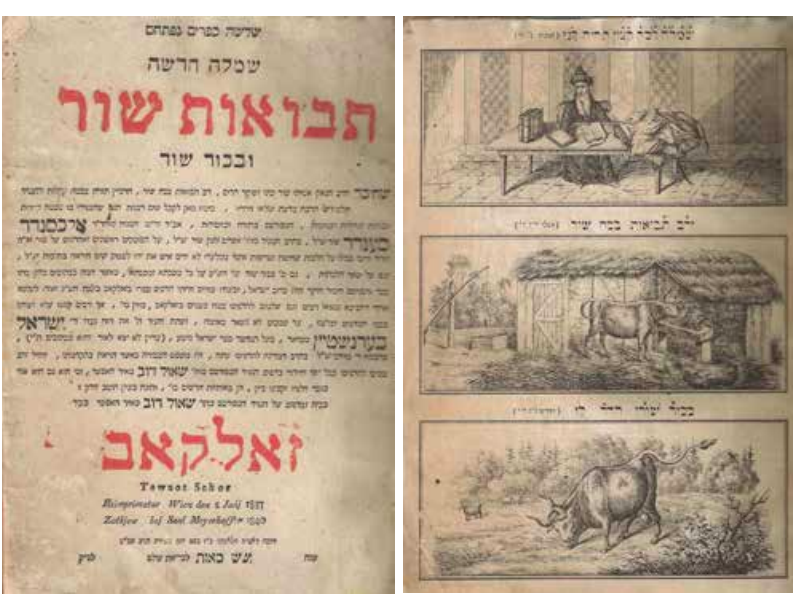
Just to mention one other unique illustrated item I recently came across about to be auctioned off in the forthcoming Genazym auction (lot 26). In a few copies of the 1840 printing of the classic work on Shecitah, Tevous Shor there is a very nice illustration connected to the title and name of the author. 
Some books are especially valued because of their legendary segulah powers.  Recently this has become even more commonplace with this genre expanding exponentially.[1]  At times the source for how these books fall into that genre are murky, but one that has a long history is Hayim ben Attar’s Or ha-Hayim.  The first edition, Venice 1742, (lot 49), in a very nice binding,  is highlighted for its segulah powers that include protection, healing, and children, and the study of it has the power to purify one’s soul. 

Returning to illustrations, a portrait of R. Dov Ber Meisles, the rabbi of Warsaw (and other cities), from 1891, is among the items.  This is not the only illustration that R Meisels appears.  During the late 1860s, there was substantial unrest in Poland when many sought to force the Tsar to bestow greater civil rights to the populace.  The clergy played a large role in this endeavor and R Meisels was among them.  This was viewed as an opportunity for Jews to be accepted by the population.  In this, Meisels had a profound impact and was among the main influencers of Marcus Jastrow to take part in the movement.  Meisels and Jastrow became very close.  When both were imprisoned for their activities, initially Jastrow was kept in isolation but when he was transferred to Meisels’ cell, Jastrow’s spirits were lifted and was able to deal with the remainder of his imprisonment.  In the end, both were expelled from Poland, although eventually permitted to return.  One of the most notable events during this period was the funeral of five protesters who were killed by government forces.  The funeral took place on Shabbos and both Jastrow and Meisles were in attendance.  Their participation is recorded in Aleksander Lesser’s painting, “Funeral of five victims of the demonstration in Warsaw in 1861.”In the center left, Meisels appears with a fur hat next to Jastrow in his canonicals.[2]   
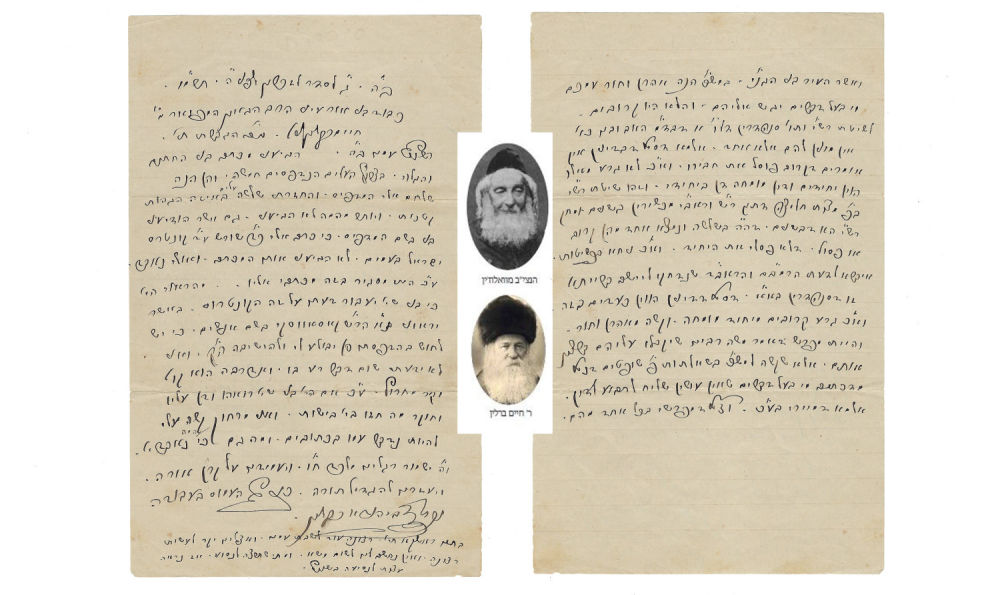
 Another item of ephemera is a letter from the Hazon Ish to R. Yosef Zevin (lot 68)(the envelope confirms that the addressee was R Zevin).  Although there is no doubt about R Zevin’s Zionist leanings, the Hazon Ish carried on a correspondence with him.[3] This is yet another letter showing the connection between R Zevin and the Hazon Ish. (For others, see Yehoshuah Levin, HaShakdan (Monsey: Tuvia’s, 2010), 117). R Zevin included a profile of Hazon Ish and his style of study in the book Ishim ve-Shitot. 

As we have shown in the past, one can learn all kinds of things from the information found in the writeups in the various auction catalogs including seeing actual clear copies of the manuscripts (lot 55). there is a letter of his from 1886 about his essay on Antisemitism called Shar Yisroel which he was about to print. He writes to his son to check it over as someone told him that perhaps some might get angry about and it would cause problems for him and the Yeshiva. This is not the only time that we find the Netziv nervous about his actions and that it would cause possible problems for the Yeshiva.

Two of R Yaakov Emden’s important works, Mitpahat Seforim and his Siddur, both of which are rare are up for sale (lots 75 & 76).  The first of edition of his siddur is critical to actually determining R. Emden’s opinions regarding the liturgy and its attendant customs.  This is so because although there are many alleged reprints of the Siddur, they, in fact, do not include the text that R Emden so carefully edited.  Only recently has the complete siddur been reprinted.  The Mitpahahat is R Emden’s well-known challenge to the Zohar, or parts of it.  Emden points to many passages that appear to be later than when R Shimon bar Yochi lived, the traditional author of the Zohar. R. Emden’s work was subject to some rebuttals, one is Moshe Kunitz Ben Yochi.  But some allege that Kunits freely borrowed from others and that his rebuttals fall short of the mark. 
One final item, also a siddur, is a first edition of Siddur R’ Shabsai MeiRushkov (lot 95) which is considered very rare starting bid is $50,000 and with a sale’s estimate of  $100,000.

[1] See Avraham Ya’ari, Mehkeri Sefer (Jerusalem:  Yehuda, 1958) who discussed a number of books that were written after the author experienced cataclysimic events. See also Eliezer Brodt’s article in the forthcoming Ami Magazine discussing the ubiquity of this phenomenon. 
[2] See Jastrow, “Baer Meisels, Chief Rabbi,” The Maccabean XI, 5 (Nov. 1906), 208-09; idem. XI, 6 (Dec. 1906), 246-48. For Jastrow’s activities during that time see Michael Galas, Rabbi Marcus Jastrow and His Vision for the Reform of Judaism:  A Study in the History of Judaism in the Nineteenth Century, trans. Anna Tilles (Boston:  Academic Studies Press, 2013), 70-88. Even at the end of his life, Jastrow was in America he still counted Meisel among those who influenced him.  See idem. 170.
[3] That is not to say that some didn’t try to write out R Zevin’s connection to Zionism.  See Jacob J. Schacter, “Facing the Truths of History,” Torah u-Madda Journal 8 (1998-1999): 223-24. 


Rabbi Yosef Tzvi Dunner (1913-2007), the final surviving musmakh of the Berlin Rabbinical Seminary

Rabbi Yosef Tzvi Dunner (1913-2007):
The Final Surviving Musmakh of the Berlin Rabbinical Seminary
by Menachem Butler

HaRav Yosef Tzvi Dunner, who recently passed away in London at the age of 94, was the scion of a prominent European rabbinical family and father and grandfather of noted British Orthodox rabbis, Rabbi Abba Dunner and Rabbi Pini Dunner, respectively. In a recent email correspondence with Professor Marc B. Shapiro, author of the landmark biographical study of Rabbi Yechiel Yaakov Weinberg[1] and several articles related to the leaders of the Berlin Rabbinical Seminary,[2] he informed me that Rabbi Yosef Tzvi Dunner was the final surviving musmakh of the Berlin Rabbinical Seminary (Orthodox).

In the April 12, 2007 edition of Hamodia: The Newspaper of Torah Jewry, there is a very nice obituary for Rabbi Dunner, (see PDF); however, it is interesting to note how they neglected to make mention of Rabbi Dunner’s studies at Berlin Rabbinical Seminary as they write:

At 19 he wanted to study in the yeshivos of Lithuania, but his father felt that due to the shortage of Rabbanim in Germany, it would be better for him to remain in the country and study in the beis medrash of Harav Yechiel Yaakov Weinberg, zt”l, author of Seridei Eish. For four years, the young Rav Yosef Tzvi studied in this beis medrash, where he was awarded semichah at a young age after astounding those testing him with his penetrating understanding of all four sections of the Shulchan Aruch. He was granted the title yoreh yoreh, yadin yadin.

Professor Shapiro further noted that

This appears to be the first time that the Berlin Rabbinical Seminary has been referred to as the Beis Medrash of R. Yechiel Yaakov Weinberg (with all that this implies). Next time they don’t want to mention that someone received semichah at RIETS, they can say he studied in the Beis Medrash of (supply the name).

For additional biographical information on Rabbi Dunner zt”l, see here and here.

Sources:
[1] Marc B. Shapiro, Between the Yeshiva World and Modern Orthodoxy: The Life and Works of Rabbi Jehiel Jacob Weinberg, 1884-1966 (London: Littman Library, 1999); For a brief discussion of the founding of the Hildesheimer Rabbinical Seminary of Berlin in 1873, see ibid., page 76. See also Michael Meyer, “The Establishment of Rabbinical Schools in Germany – A comparative Analysis” [Hebrew], in Immanuel Etkes, ed., Yeshivot and Battei Midrash (The Zalman Shazar Center for Jewish History and The Ben-Zion Dinur Center for Research in Jewish History, The Hebrew University, Jerusalem 2006), pp. 199-207.
[2] For an assortment of Shapiro’s article/reviews on leaders of the Hildesheimer Rabbinical Seminary of Berlin, see “Letters of Rabbi Jehiel Jacob Weinberg [Hebrew],” Ha-Ma’ayan 32 (Tammuz, 5752 [1992]): 6-20; Review of “David Ellenson, Rabbi Esriel Hildesheimer and the Creation of a Modern Jewish Orthodoxy,” Tradition 26 (Spring, 1992): 104-107; “The Autobiography of Rabbi Esriel Hildesheimer [Hebrew],” Alei Sefer 17 (1993): 149-150; “Letters of Rabbi David Zevi Hoffmann, Rabbi Moses Feinstein, and Rabbi Jehiel Jacob Weinberg [Hebrew],” Ha-Ma’ayan 34 (Tevet, 5754 [1994]): 9-20; “Rabbi David Zevi Hoffmann on Torah and Wissenschaft,” Torah u-Madda Journal 6 (1995-1996): 129-137; “Scholars and Friends: Rabbi Jehiel Jacob Weinberg and Professor Samuel Atlas,” Torah u-Madda Journal 7 (1997): 105-121; “Responsa and Letters of Rabbi David Zevi Hoffmann [Hebrew],” Ha-Ma’ayan 37 (Tammuz, 5757 [1997]): 1-14; “On Targum and Tradition: J. J. Weinberg, Paul Kahle and Exodus 4:22,” Henoch 19 (1997): 215-232; “Rabbi David Tsevi Hoffmann on Orthodox Involvement with the Hebrew University,” Tradition 33 (Spring, 1999): 88-93; “Understanding the Life and Works of Rabbi Jehiel Jacob Weinberg,” Algemeiner Journal (June 6, 2000); “Rabbi Esriel Hildesheimer’s Program of Torah u-Madda,” Torah u-Madda Journal 9 (2000): 76-86; “R. Jehiel Jacob Weinberg on the Limits of Halakhic Development,” Edah Journal 2:2 (2002; online at www.edah.org); “Thirteen Additional Letters by Rabbi Jehiel Jacob Weinberg [Hebrew],” Ha-Ma’ayan 45 (Tevet, 5765 [2005]): 1-17.