More on Chaim Bloch
More on Chaim Bloch
By Marc B. Shapiro
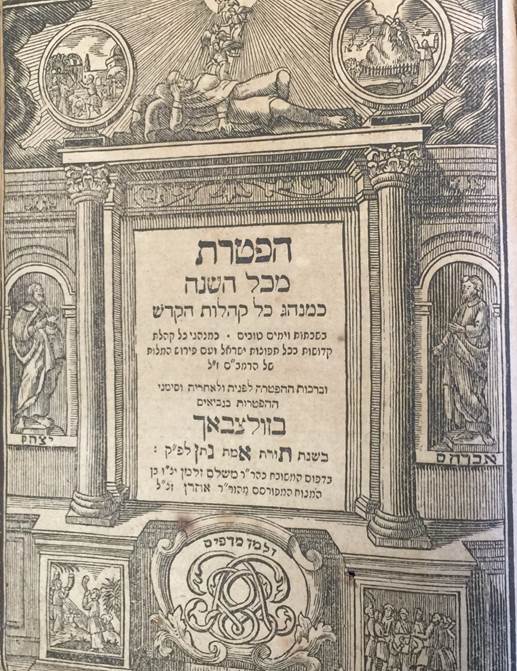
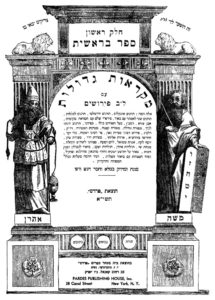
In a previous post I mentioned how the non-Jewish Austrian minister Leon Bilinski was descended from the rav of Posen, R. Samuel ben Moses Falkenfeld, the Beit Shmuel Aharon. More information about Bilinski’s Jewish roots is found in Chaim Bloch’s Ve-Da Mah she-Tashiv (New York, 1943), p. 74 n. 1. In general, I have found that when Bloch is reporting about other people’s biographies and history in general, he is very reliable. It is only when he is somehow involved in the story that he is full of lies.1 His Ve-Da Mah she-Tashiv is a good example. Here is the title page.
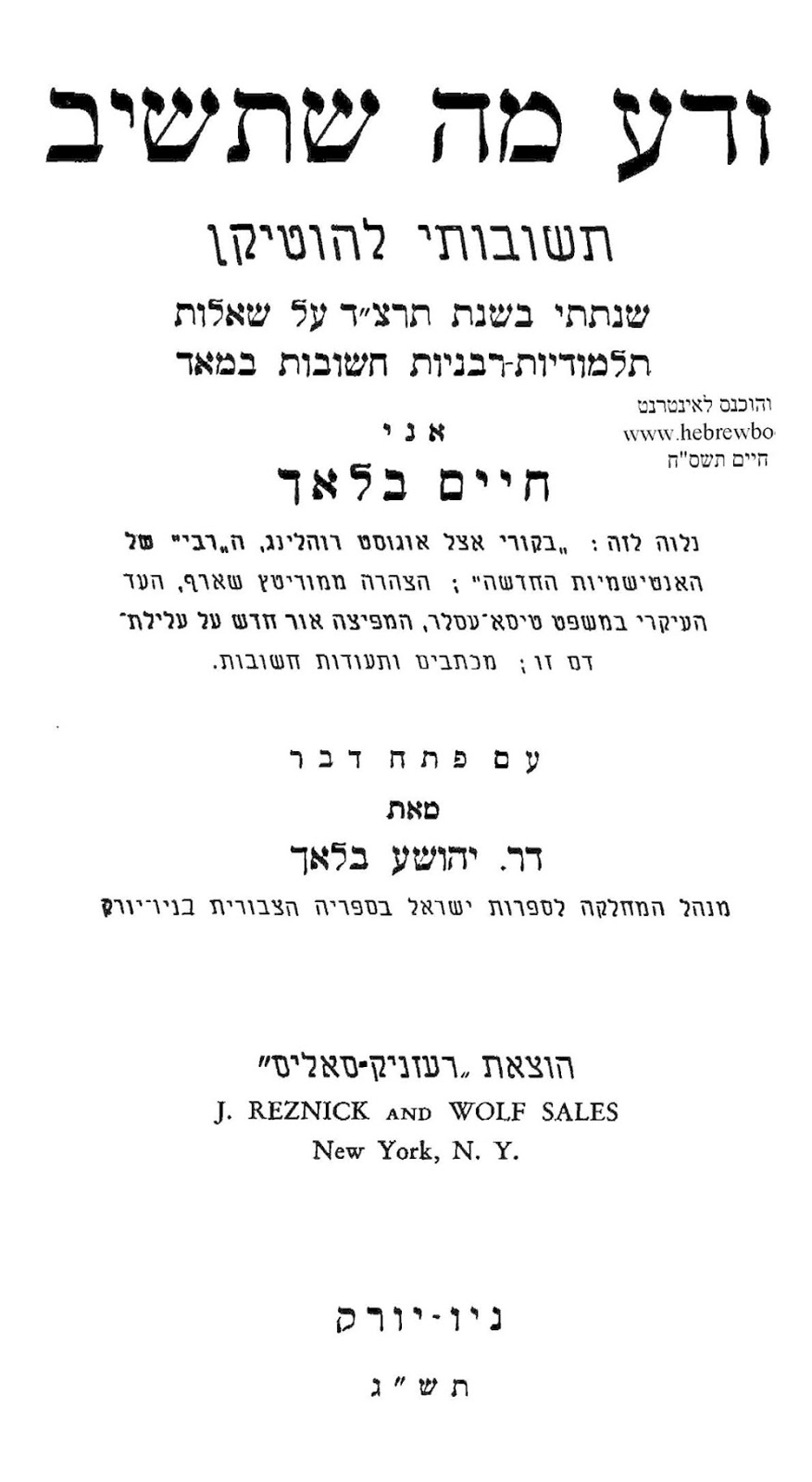
In this book he makes up an entire story that he was asked by an important Catholic figure to answer questions from the Vatican dealing with Judaism. The whole story is a fiction, as is so much else he writes about himself. As for Bilinski, Bloch tells us that he is in possession of Bilinski’s 1146 page (!) unpublished diary. As Bloch himself notes, he provided various scholars (e.g.., N. M. Gelber) with selections of this diary which they then used in their own works, thus misleading the world. In these selections, Bilinski comes off as a strong anti-Zionist, who even warns Herzl about how the Arabs will never accept a Jewish state in Palestine.2 In an article in the Herzl Year Book, Bloch published what he claimed was an 1893 letter from Herzl and uses this to prove that Herzl was interested in the Jewish problem already in 1893, a year before the 1894 Dreyfus trial which is usually cited as having turned Herzl to Jewish matters.3 Various scholars have cited this letter, as they understandably regard it as significant in understanding Herzl, but of course it is a forgery. Another way Bloch misled scholars, in particular Gelber, is with regard to an anonymous booklet that speaks of a return of the Jews to the Land of Israel and the establishment of a state.4 According to Billinski’s diary, so Bloch tells us, the author of this booklet was Benjamin Disraeli. Bilinski would certainly have been in a position to know this information, and therefore a number of people have been misled by this, thinking the diary authentic
Look how Bloch’s forgeries were able to have such an impact. I think, in the end, this is what gives the forger satisfaction, watching everyone taken in by his creation. In 1948 no one would have believed that Bloch was capable of this. In fact, if not for his blatant forgeries in Dovev Siftei Yeshenim, some people today would still assume that he is reliable. As the Talmud tells us, tafasta merubah lo tafasta! Bloch should have stuck with his smaller forgeries, because when he decided to publish complete volumes of forged material, that’s when people really began to take notice. It is therefore very surprising that no less a scholar than Robert S. Wistrich, who is aware of the accusations of forgery against Bloch, nevertheless cites material from Bloch’s Mi Natan li-Meshisah and states that in his opinion at least some of the material must be considered authentic. Why he thinks this he doesn’t tell us. The truth is that this book, like Dovev Siftei Yeshenim, is full of Bloch’s forgeries, and not only of rabbis but also of political leaders (including summaries of supposed letters from Bismark about Zionism!)5
Just to illustrate that you can’t judge people by appearances, here is a picture of Bloch, which previously appeared in Dr. Shnayer Leiman’s post on the Seforim Blog.6

Throughout Bloch’s various books, he quotes numerous letters from gedolim who were no longer alive, and none of these letters are found in his archives, currently kept at YIVO and the Leo Baeck Institute. In other words, he simply made up these letters, as he did with the entire volumes of anti-Zionist letters of gedolim that he published. The rule is that whenever Bloch cites a previously unpublished letter from someone, either addressed to himself or to another, and the author of the letter is no longer alive, you can assume that the letter is forged. We know this now, after Shmuel Weingarten’s exposé of Dovev Siftei Yeshenim.7 Yet the evidence was there all along, had people paid attention. But people had no reason to assumed that Bloch was not reliable. R. Joseph Elijah Henkin, however, who was involved in a terrible dispute with Bloch, did accuse Bloch of dishonesty, and pointed out that he would attribute quotes to rabbis who were no longer alive so that he couldn’t be contradicted. In the late 1930’s Bloch published a letter from R. Kook. R. Zvi Yehudah Kook was very skeptical of its authenticity and requested that Bloch send him a copy of it. Bloch replied that he was unable to do so since he had lost the original.8 This was Bloch’s pattern, and I assume that all of the many letters he published from leading rabbis and hasidic leaders, beginning in the early part of the twentieth century, are forgeries.9
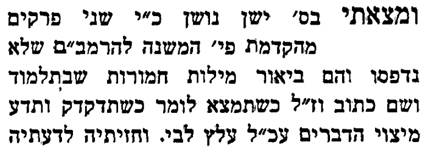
Here is another example of Bloch’s tendency to fabricate things. It comes from his Heikhal le-Divrei Chazal u-Fitgameihem (New York, 1948), p. 9. Everything he reports here is a fantasy. As with some of his other forgeries, Bloch is obviously motivated here by good intentions, but it is all complete nonsense.

Ve-Da Ma she-Tashiv also contains forged letters. I am certain that the letter of R. Chaim Ozer Grodzinski on pp. 52-53 is an example of this. Anyone can look at the style of R. Chaim Ozer’s many letters and see how he consistently used certain formulas in concluding his letters. Nowhere does R. Chaim Ozer conclude a letter with
ונזכה כולנו לראות בישועת עמנו במהרה
He does use the expression
ועיניהם תחזינה בישועת עמנו במהרה
and this is found in a letter that Bloch would have had access to, the letter of R. Chaim Ozer to Agudat ha-Rabbanim about the Louis Epstein proposal.10 I assume he used the concluding portion of this letter to help him create his forgery. But in other areas he wasn’t so careful. For example, in the supposed letter of R. Chaim Ozer to Bloch, he refers to the latter as a צנא מלא ספרא , yet this expression does not appear in R. Chaim Ozer’s other letters (based on Otzar ha-Hokhmah’s database, which only has the first edition of R. Chaim Ozer’s letters, not the expanded Iggerot R. Chaim Ozer.)
We should assume the same for all of the other letters in this book from people who were not alive when the book was written. It is fascinating that on p. 44 n. 1 Bloch refers to the anti-Zionist letters he would later publish in Dovev Siftei Yeshenim. Ve-Da Mah she-Tashiv was published in 1943 and the first volume of Dovev Siftei Yeshenim didn’t appear until 1959, meaning that this forgery was very long in the making, and Bloch was setting the stage for it many years prior.
There is more to say about this book, in particular his argument that there are passages in the Talmud that were inserted by heretics – a viewpoint earlier mentioned by R. Joseph Zvi Duenner, as I have pointed out elsewhere, see here.
I will leave that for another time, but to give you an example of what I am referring to, here is a passage from p. 39 (emphasis in the original):
אופינית היא “המעשיה” בר’ שמעון בן גמליאל “שהיה על גב מעלה בהר הבית וראה נכרית אחת נאה ביותר. אמר: מה רבו מעשיך ד'” (ע”ז כ ע”א) המאמר הזה זיוף . . . לא יעלה בדעתנו, שר’ שמעון בן גמליאל הביט על אשה, היינו הך, נכרית או ישראלי – לשם יפיה. ומצאתי עוד מאמר בשם רב, שזיופו עומד מחוץ לכל ספק: “בשעה שבקש נבוכדנצר לעשות לאותו צדיק (צדקיהו) כך, נמשכה ערלתו ש’ אמה והיתה מחזרת על כל המסבה כולה שנאמר: שבעת קלון מכבוד, שתה גם אתה והערל” (שבת קמט ע”ב). מלבד הנבול שבמאמר זה, הוא חסר טעם, ולא יתכן, שמפי רב יצאו הדברים.
I don’t know which position is “frummer”? To defend the honor of the sages and therefore deny that these “obscene” passages are authentic, or to defend the Talmud as we have it and thus have to deal with these passages.
Yet whatever the answer to this is, if Bloch were alive today, the haredi world would put him in herem for another reason. Here is what he writes on p. 38, with regard to how to view Aggadah in contrast to the halakhic sections of the Talmud. (What he says is nothing other than the Geonic and Spanish tradition, which is largely unknown in today’s yeshiva world.):
היא אינה נחשבת ליסוד קיומה של היהדות ויש לה אופי של ספר עם . . . לחלק האגדה נכנסו דברי מוסר ודרך ארץ, מליצות ובדיחות, סגולות ורפואות, אזהרות ועצות, פתרון חלומות ואגדות, שלהרבה מהם יש ערך גם מחוץ להיהדות. יתכן שהרבה הושפעו בעלי התלמוד בזה מהעמים שכניהם.
Also interesting is that in Ve-Da Mah she-Tashiv, p. 44 n. 1, he refers very positively to R. Henkin, something that would later change when their great battle began.
Bloch claimed that he had a close relationship with the great R. Judah Leib Zirelson of Kishinev (Speaking for myself, Zirelson’s greatest achievement had to have been standing up to the extreme anti-Zionist elements in Agudat Israel, led by R. Elhanan Wasserman and R. Aaron Kotler. They wanted the Agudah to officially oppose the creation of a Jewish state. Zirelson, as president of the 1937 Kenesiah Ha-Gedolah in Marienbad, was able to convince the Moetzet Gedolei ha-Torah to agree with his own position, which was not to oppose a state but to attempt to bring Torah values into it. See Ha-Pardes, Oct. 1937, p. 8). In this book, Bloch cites a number of things from Zirelson of which, again, I have no doubt that he has made them up. For example, can anyone imagine that Zirelson would offer the following Haskalah-Reformist interpretation that Bloch puts in his mouth (p. 34)?
יתכן שהיתה כוונתו של ר’ שמעון בן יוחאי, בחפשו יסוד במקרא שהנכרים אינם מטמאים באוהל, כדי שלא ימצאו הרומיים תואנות ואמתלאות חדשות על ישראל, ומאימת המלכות הורה כן.
Although I can’t go into it in any detail now, the truth is that we do on occasion find Haskalah-Reformist types of interpretation even in traditional sources,11 but since these are very rare and we have no evidence that Zirelson ever said what is attributed to him, I assume it is another of Bloch’s forgeries. In other words, as he did so often, Bloch attributed his own understanding to one of the great Torah sages.
In chapter fourteen of Ve-Da Mah She-Tashiv, where he stresses the need for honesty in one’s dealings with non-Jews, he claims that Zirelson told him about a Zoharic passage in parashat Lekh Lekha that states:
כל מאן דמשקר בהאי עלמא בערל כמאן דמשקר בשמיה דקוב”ה
This is a beautiful thought. The only problem is that it doesn’t exist anywhere in the Zohar. I am certain that Zirelson would never have misquoted the Zohar and that the mistake is Bloch’s. I assume that the mistake is unintentional, perhaps quoting from memory, since a great forger like Bloch would never have dared falsely attribute anything to the Zohar, the accuracy of which could easily be checked.
Here is the actual Zohar text (vol. 1, p. 93a):
דכל מאן דמשקר בהאי כמאן דמשקר בשמיה דקב”ה
If you examine the entire passage you will find that it has nothing to do with being honest, and the word משקר here does not mean “to lie”, but “to betray”. The text is actually speaking about berit milah and how one is obligated to treat it properly, especially דלא עייל ליה ברשותא אחרא, which certainly refers to refraining from having sex with non-Jewish women. What the text is saying is that if you have illicit sex you betray the mark of the circumcision, and this is like betraying God’s name.
Since I mentioned Haskalah-Reformist interpretations in traditional texts, let me note one of the most famous of these. In Shabbat 140b, R. Papa’s states that if one can drink beer but instead drinks wine, he violates the prohibition on baal tashchit. Maharsha explains that R. Papa said this because he was a beer salesman! What this apparently means is that R. Papa lied about the halakhah in order to drum up more business for himself. How else to interpret Maharsha’s explanation?
ורב פפא לטובת עצמו אמרה שהוא הי’ עושה שכר.
This explanation is, to be sure, quite shocking. If you want to stretch things a bit you can say that according to Maharsha, R. Papa didn’t consciously alter the halakhah to benefit himself, but since he was a beer maker he was unconsciously led to this position, as it would benefit him. This explanation – which could easily have been offered by Jacob Katz – is suggested by the noted Yemenite posek, R. Yitzhak Ratsaby12:
והנה כל העובר ישום וישרוק, היתכן כדבר הזה שרב פפא יפסוק הלכה משום ריוח ממונו?! . . . ובודאי גם לדעת מהרש”א לא יתכן שרב פפא יאמר פסקי הלכה רק מתוך נגיעה, חלילה לו. אלא היה זה כעין “שוחד סמוי”, שלא הרגיש בו הוא עצמו, שמתוך כך בא לידי טעות בהלכה זו. כמו שהכתוב צווח ואומר (שמות כג, ח): “כי השוחד יעוור פקחים ויסלף דברי צדיקים”, ועל דרך שמצינו בכתובות (קט, ב) בגדולי עולם שאמרו על עצמם שהשוחד היטה את ליבם.
I think most people will tell you that this sort of explanation, which points to unconscious factors influencing halakhic decisions, was not how people thought in the days of the Maharsha. I myself do not see this as an anachronistic explanation, as the Talmud, Ketubot 105b, already discusses precisely this sort of unconscious influence.13 I believe that this is also how we are to understand all the discussions about נוגע בדבר, and how it applies even to the greatest tzadikim. It is not that these people will consciously twist the truth, but that unconsciously this is what can happen. Presumably, this is also the meaning of Hullin 49a: ישמעאל כהנא מסייע כהני
I think this is also how we are to understand R. Moses Isserles, Yoreh Deah 242:36:
תלמיד חכם שאמר דבר הלכה בדבר השייך לדידיה . . . אין שומעין לדידיה דלמא מדמי דברים להדדי שאינן דומים
See also Ritva, Yevamot 77a:
דחיישינן שמא מתוך שנושא ונותן בהלכה כדי לקיים את דבריו אמר בדדמי כסבור שקיבל מרבו
I am not going to analyze the Maharsha in any depth, because either way you explain him, this is the exact sort of explanation that according to the Rav is heretical as it falls under the Rambam’s category of מכחיש מגידה.14 And it is not just the Rav who would be shocked by what Maharsha wrote. R. Yehoshua Heschel of Monistritch15 states:
ועל מאמר המהרש”א הזה צווחי קמאי
R. Abraham Vengrober16 says concerning the standard explanation of Maharsha (before offering a different understanding of his words):
ופריצי עמנו מצאנו בקעה לדבר סרה על רז”ל . . . גם רבינו המהרש”א ז”ל לא כיוון בזה ח”ו להכוונה אשר העולם סוברים שבשביל זה שהי’ מסחרו שבח את הדבר לטובת עצמו.
R. Samuel Strashun in his commentary to the passage takes strong issue with Maharsha, and R. Hayyim Hezekiah Medini17 is astounded by what Maharsha wrote:
הדבר תמוה לפרש דנחשד רב פפא לדבר שקר חלילה לטובת עצמו.
I assume it is only a matter of time before this explanation of Maharsha is deleted from a future printing.
Here is another example (Ta’anit 14a-14b):
In the time of R. Judah the Prince there was distress. He ordained thirteen fast days and their prayer was not answered. He thought of ordaining additional fasts but R. Ammi said to him, “Did not [the Sages] declare we should not trouble the community unduly.” Said R. Abba the son of R. Hiyya b. Abba, “R. Ammi [in saying this] was studying his own interests.”
Rashi explains R. Abba’s declaration:
לעצמו דרש: דלא אמר אלא לפי שהוא לא היה רוצה להתענות
If anyone other than Rashi wrote this, wouldn’t it be regarded as an example of מכחיש מגידה?
Here is another example, from the Jerusalem Talmud, Shabbat 6:1:
R. Abbahu in the name of R. Yohanan, “It is permitted for a man to teach Greek to his daughter, because such learning is an ornament for her” Simeon bar Ba heard and said, “It is because R. Abbahu wants to teach his daughter such that he has assigned the teaching to R. Yohanan.”
R. Abbahu responded quite sharply to Simeon bar Ba, proclaiming: “May a curse come upon me, if I did not hear it from R Yohanan.” But I am more interested in Simeon bar Ba’s accusation. He assumed that the great R. Abbahu would falsely attribute a halakhic ruling to an earlier sage in order that his daughter would benefit. When Geiger and Graetz said things like this, no one was surprised, and the Orthodox condemned them for these type of interpretations. Yet here you have a Haskalah-Reformist type of interpretation offered by one of the Sages.
Returning to Bloch, another example where he deceived the world is found in his Heikhal le-Divrei Hazal u-Fitgemeihem, pp. 591-592. In line with his apologetic approach to Jewish sources, he claims that he saw an old version of the Passover prayer Shefokh Hamotkha, that went as follows:
שפוך אהבתך על הגוים אשר ידעוך
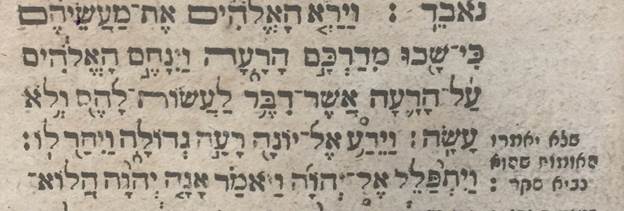
Even a great scholar such as Naftali Ben-Menachem was taken in by Bloch (and if you search online you will find a number of others who assume that Shefokh Ahavatkha is a real text, rather than another Bloch forgery18). Ben Menachem’s article appears in Mahanayim 80 (1963), and here is the page where he refers to Bloch’s version.

Incidentally, in Heikhal le-Divrei Hazal Bloch claims that he wrote about this version at length in his 1935 book Der Judenhass im Spiegel der Jahrtausende, and also printed a copy of the manuscript there. (In 1935 Bloch was living in Vienna.) Although he mentions this book in a couple of his other writings, there is no evidence that any such book ever appeared. Now we have the internet which allows us to check all the greatest libraries in a minute, yet in a prior era, simply mentioning that he had published such a book and that it contained a copy of the manuscript would have been enough to convince everyone. After all, it was not like people in the United States, England, or Palestine/Israel could easily check the holdings of libraries in Austria and Germany.
Meir Hershkovitz, in his fine book on R. Zvi Hirsch Chajes, also quotes Bloch a number of times. Bloch claimed to have seen unpublished material from Chajes and he included some of it in his Heikhal, but everything he mentions is fraudulent, and some of the comments are really outrageous. For example, on p. 565 he quotes Chajes as saying as follows about Rabbi Akiva19:
ר”ע מבני בניו של סיסרא היה ולמרות קדושת התורה ששלטה בו נשאר בו משהו מאופיו של סיסרא
(Some are probably wondering why I didn’t underline the first part as well, which states that R. Akiva was descended from Sisera. After all, in a few weeks Daf Yomi will reach Sanhedrin 96b and there you find the following, with no mention of R. Akiva: “Descendants of Sisera studied20 Torah in Jerusalem; descendants of Sennacherib taught Torah to the multitude. Who were these? Shemaya and Avtalion. Descendants of Haman studied Torah in Bnei Brak.” Yet numerous texts21 record a version of this passage that identifies R. Akiva as among the descendants of Sisera.)
What motivated Bloch to invent this negative comment about R. Akiva? I think that this too can be attributed to anti-Zionist motivations (an anonymous commenter on Soferim u-Seforim offered a similar explanation; see the link in n. 1). R. Akiva was associated with Bar Kokhba’s rebellion, and in the popular mind at least, this was a matter of pride for twentieth-century Jews. The thrust of the comment attributed to Chajes is to see this “warlike” aspect of R. Akiva as a throwback to Sisera. In other words, this is not something good. We see another example of Bloch’s anti-Zionism in his attempts to argue that a passage in Maimonides’ Letter on Astrology is not authentic. In this passage, Maimonides states that the Temple was destroyed and the Jews exiled because instead of focusing on “the art of military training and conquering lands,” they involved themselves with astrology, thinking it would help them. (Iggerot ha-Rambam, ed. Sheilat, vol. 2, p. 480) This passage was too “Zionistic” for Bloch, and not surprisingly he argues that it is a forged interpolation. See his article in Ha-Pardes 34 (April 1960), pp. 39-42, where once again it is Bloch who is the forger, citing a supposed letter from a Christian scholar to Dr. [Daviid?] Kaufmann and also telling us about the support he supposedly received from the Tchortkover Rebbe. (This Rebbe, incidentally, happened to be a one of the leading Agudah supporters of settlement in the Land of Israel.) One of Bloch’s major proofs that Maimonides could not have written this passage is his assumption that Maimonides was not impressed with R. Akiva’s support of Bar Kokhba. He bases this argument on Mishneh Torah, Hilkhot Melakhim 11:3. Yet Maimonides’ viewpoint in this matter is not enough for Bloch, and to achieve his purpose he has to actually find fault with R. Akiva’s character, something Maimonides would never do. Bloch even attacks some modern writers (such as Aaron Zeitlin and Hillel Seidman) who had stressed the contemporary significance of Maimonides’ words. In Bloch’s mind, by doing so they were showing the non-Jews that the Protocols of Elders of Zion were correct, namely, that Jews really did want to conquer the world! Bloch’s Neturei Karta side comes out very well in this article.
As a way of covering himself, so that people will believe the manuscripts of Chajes are authentic, Bloch states that he assumes that the material he is quoting from has survived in Israel, either with the family or at the National Library (Heikhal, pp. 520, 560). Yet in Hershkovitz, this supposition is stated as fact (Rabbi Zvi Hirsch Chajes, p. 438). It is quite surprising that Hershkowitz, who wrote such a comprehensive biography of Chajes, didn’t attempt to track down these manuscripts. Had he done so, he would have realized that they don’t exist.
* * *
This is a blog about seforim, but with Dan’s permission, in a future post I am going to write about the various blogs and news sites, both haredi and Modern Orthodox, that focus on Jewish matters (halakhah, hashkafah, etc.). In the last six months I have visited them a good deal, left a number of comments (some quite provocative and opposed to my own outlook [e.g., dealing with sexual abuse, Zionism, Daas Torah, Torah mi-Sinai, etc.], and always under a pseudonym) and gathered the reactions. I also corresponded with people I met on the sites and with various anonymous baalei ha-blogs. I tried to be a bit of a reporter, gathering information, and just like a reporter sometimes has to hide his identify, I felt that in this circumstance it was permissible, especially as almost everyone I was dealing with was also anonymous. We all know that the ability to be anonymous is basic to the internet (and there has been a good deal of discussion recently about whether this is a good idea). I also felt that if I got involved in a debate on a haredi or Modern Orthodox site, my name would be recognizable to some of the people and they might respond differently than if I was some anonymous person.
Most of the information is publicly available (as are my comments), but I won’t cite any names, as I am not interested in individuals but in some of the thought processes that I observed. As always, I will tie this in with seforim, especially the phenomenon of anonymous and pseudonymous (as opposed to pseudepigraphal) seforim and articles, and also discuss the modern anonymous halakhic questions that R. Yuval Sherlow has written about. (He has also published a couple of volumes of his answers to these questions.) How is Judaism perceived and portrayed when people can live in two worlds, the public one and the private anonymous world of the internet? What does it mean when most people who comment about controversial topics choose to do so under a pseudonym? I think that what I found also has implications to an issue I have been concerned with for a long time, namely, the value of private letters and conversations vs. published word in seeking to evaluate the personality of an individual. This directly relates to David Holzer’s book on the Rav and was also a topic that became a dispute between the late Prof. Twersky and myself when writing my dissertation on R. Weinberg–more on that to come.
I mention all this because I have a request: If anyone is aware of a similar study with regard to Christian or political blogs and websites, please let me know. As a friend commented to me when I told him about my project, “we all know that there are registered Democrats on the Upper West Side who secretly vote Republican, but in order not to scandalize their friends, will only post their true opinions anonymously.” Yet has anyone written about this? There are serious methodological issues that must be dealt with in any such inquiry.
* * *
My new Torah in Motion class begins this Monday. I invite all who are free on Monday nights at 9PM Eastern to join us. This semester we are covering R. Eliezer Berkovits, R. Chaim Ozer Grodzinski, R. Elijah Benamozegh and R. Joseph Messas. You can sign up for it here
If you want to watch or listen to previous classes, to get a sense of how they work, you can download them here.
1 For a recent discussion of Bloch, see here which contains a number of informative comments.
2 See Bloch, Mi Natan li-Meshisah Yaakov ve-Yisrael le-Vozezim (Bronx, n.d.), pp. 54ff.
3 “Herzl’s First Years of Struggle: Unknown Episodes and Personal Recollections” Herzl Year Book 3 (1960), pp. 77-90.
4 The booklet is found in N. M. Gelber, Tokhnit ha-Medinah ha-Yehudit le-Lord Beaconsfield (Tel Aviv, 1947), pp. 35ff. Gelber’s book is devoted to this booklet.
5 “Zionism and its Religious Critics in Fin-de-Siècle Vienna,” in S. Almog, et al., eds., Zionism and Religion (Hanover, 1998), pp. 150, 157 n. 45.
6 See here.
7 Mikhtavim Mezuyafim Neged ha-Tziyonut (Jerusalem, 1981).
8 See Weingarten, Mikhtavim, pp. 164-165. In Ha-Posek 11 (1950), p. 802, Bloch published another letter from R. Kook. It is also found in Heikhal le-Divrei Hazal u-Fitgamehem, p. 614. Again he tells us that he only has a copy of the letter, as the original was lost, and here too the letter in unquestionably a forgery. Bloch had R. Kook sign the letter עבד לעם קדוש , which he knew is found in numerous authentic letters. But the letter also contains the phrase כל יקר ראתה עיני , and this does not appear in any of the almost 2000 letters and responsa of R. Kook, as can be determined from the new database of R. Kook’s writings
9 I don’t know whether this also applies to halakhic writings, e.g., the supposed manuscript from R. Shalom Schwadron that came from Bloch and is published in R. Isaac Liebes, Beit Avi, vol. 3 no. 157. Incidentally, a few responsa after this, in no. 161, Liebes discusses whether a rabbinic organization could publicly advocate the institution of the death penalty, since it might happen that a Jew would also be sentenced to death (sound familiar?). Liebes begins his reply:
לא רק שמותר להתריע בכיוון זה רק מצוה לעורר את דעת העם את חומר הסכנה המרחפת על תושבי הארץ.
During the discussions about the Grossman execution, I looked at some of the haredi websites (until the comments made me sick). What I found interesting was the incredible level of ignorance of most of the writers, all of whom had been in yeshiva and many of whom had studied there for years. They were able to declare that a murderer can’t be executed unless he was observed by two kosher witnesses and was given warning, which they thought settled matters. Had these people known a bit of responsa literature, there would have understood how things worked in the real world, and especially what was done in the days of the rishonim. Do these people think that if a guy stood up in shul and opened fire with a machine gun, killing 20 people, that a Jewish court couldn’t execute him because he was never given a warning? Let’s continue with R. Liebes:
יש כח להבי”ד בזמן שרואין צורך השעה לענוש עונש מות אפילו בכל יום אפילו אם מן התורה פטורין הם כדי שעל ידי זה כל העם ישמעו וייראו ולא יזידון עוד.
As for the possibility that a Jewish man will be executed:
מצוה וחיוב לעורר את דעת הקהל להתריע את בתי המשפט שיראו להעביר בכל המדינה משפט מות ולענוש בכל החומר הרוצחים והפושעים ואת מדינתינו ארצות הברית אשר מאמינה בתנ”ך יכולים לשכנע אותה ולהראות לה עד היכן תוה”ק מקפידה לבער את רשעי הארץ בתור חיוב ומצוה. ומש”כ כת”ר לחשוש דלפעמים ימצא רוצח יהודי א”כ אנחנו נהיה אשמים במיתתו זה אינו כלום . . . מוכח מזה דהמחוייב מיתה עפ“י דין המלכות מותר למסרו להם מטעם דינא דמלכותא. מובן ממילא שכל דברינו מוסבים רק על המדינות שיש להם שוויון הזכויות לכל אזרחיה בלי שום אנטישמיות ושנאת ישראל ולכן אם ח”ו יהודי נתפס באיזה עון ופשע הרי הוא נידון כמו כל אזרחי המדינה.
Many who commented on the various sites were people who never opposed the death penalty before and do not oppose it now, yet they were anti-death penalty in this case because, quite simply, they think the death penalty is just fine except when it is a Jew being executed. They vote for all the right wing candidates and then have the chutzpah to complain when their man actually follows through on his support of capital punishment and doesn’t share their view that a supposed baal teshuvah (whose last meal on earth was a non-kosher chicken sandwich bought from the prison canteen) should not be executed. Some of them cited Sanhedrin 17a, סנהדרי שראו כולן לחובה פוטרין אותו , as if this had any relevance. First of all, this passage only means that he is not executed in the normal fashion, but he can certainly be executed as an emergency measure. In addition, some understand this passage to mean that if on the first day of deliberations all conclude that he is guilty, he is not condemned to death immediately but the case is revisited on the next day. If then, all find him guilty, he is executed. None of the commenters who mentioned this law quoted the view of R. Meir ha-Levi Abulafia (cited in many sources) and the Tosafot Hakhmei Anglia that the meaning of פוטרין אותו is ממהרין אותו להורגו . This understanding is praised by the Reisher Rav, R. Aharon Lewin, Ha-Derash ve-ha-Iyun, Deut. no. 119:5, and R. Baruch Epstein, Torah Temimah, Ex. 23:2. Epstein is convinced that this understanding is correct because otherwise היש לך חוטא גדול ונשכר מזה . For more on the subject, see Zorach Warhaftig, “Rov u-Miut be-Veit ha-Din,” in Itamar Warhaftig, ed., Minhah le-Ish (Jerusalem, 2001), pp. 100ff. See also R. Reuven Margaliot, Margaliyot ha-Yam, Sanhedrin 17a, no. 19, who cites the Tashbetz:
שהם ז”ל לא אמרו ב”ד שהסכימו כולם לחובה פטור, חלילה להם שיאמרו ככה, ואם על פי הרוב הורגים כל שכן ע”פ כולם ויותר טוב ויותר משובח הוא שיהיה הפסק דין מוסכם מהכל ולא שיהיה שום חולק.
There is a good deal more to say on this topic, but in the interests of space I will leave it for another time. Suffice it to say that as in all such matters one can find a variety of viewpoints. See e.g., R. Yair Hayyim Bacharach, Havot Yair, no. 146. Some poskim have even ruled that when a murderer has been sentenced to death it is forbidden to try and save him. See R. Nathan Leiter, Tziyun le-Nefesh Hayah, no. 121. (Others disagree, see e.g., Teshuvot Hatam Sofer, vol. 6, no. 14.) Obviously, such a ruling has no relevance to people who oppose the death penalty on principle, but it does speak directly to those who normally support it—as I daresay includes most, if not virtually all of the people who were commenting so outrageously on the haredi sites. Let me close by citing a responsum of R. Meir Zak in Teshuvot Eitan ha-Ezrahi, no. 45. What he said in the seventeenth century, in a case involving a Jewish murderer, is just as relevant today, and it is incredible how this responsum speaks to the Grossman case (he even uses the term “hillul ha-shem”!). Notice how he also includes the manhigei ha-dor in his criticism.
מאחר שניתן ביד גוים ערכאות הם יעשו בו משפט וידינו לא תהיה בו . . . ואפשר שעל נדון דידן נאמר מורידין מאחר שכתב הרב מהר”ד ה”ל האב”ד דק”ק ה”ל שדעתו לעשות כפרה והיה כל ימיו חוטא גדול ופושע, נאמר לישרי’ ביה גודא רבא ואף אם יאמר שרוצה לעשות תשובה ולפי דעתי על אלו אמרו חז”ל אין נחת רוח בתשובתן של רשעים להקב”ה כי ראה עצמו ביד גוים רוצה לרמות אותנו, אבל להפריז ממון לפדות אותו בשביל שאומר שרוצה לעשות תשובה זה הוא חילול השם שיאמרו אין עונש שפיכות דמים אצל יהודים נחשב חטא והיה אם גוי יהרוג ח”ו ליהודי ג”כ לא ידונו לעשות נקמה. ותמיד אני צועק ככרוכיא על מנהיגי הדור שכל גנב או חוטא שבא למאסר עושין השתדלות לפדות אותו ע”י שחדים דבר זה בעו”ה מרבה פשעים וגניבות כל א’ עושה מה שלבו חפץ ורבו פריצי הדור כאלו אנחנו רואים בעו”ה רוב גנבי ישראל ע”כ שלא לתת פרוטה לפוטרו ממות.
Isn’t it amazing that hundreds of years ago he was condemning the leaders who think that every thief or sinner who goes to jail should be the focus of pidyon shevuyim? From this responsum we learn that the warped values we have seen these last few years go back a long time. And what is one to make about his statement that the majority of thieves are Jewish? (using the language of Avodah Zarah 70a). I pray we never reach this point, although we probably have to do keriah over the fact that the Agudah spokesmen have been insistent in letters to the editor and in interviews that Orthodox Jews are not more dishonest than anyone else. In other words, no one, neither Jew nor non-Jew, even assumes anymore that being an Orthodox Jew means that you hold yourself to a high ethical standard. Their goal now is to convince the public that when it comes to obeying the law, Orthodox Jews (and their institutions) are simply no worse than everyone else. If that is not an indictment of our entire educational system, I don’t know what is.
For those interested in pursuing further the topic of Jewish murderers, here is a nineteenth-century responsum by the Moroccan R. Joseph Berdugo (Divrei Yosef no. 381).
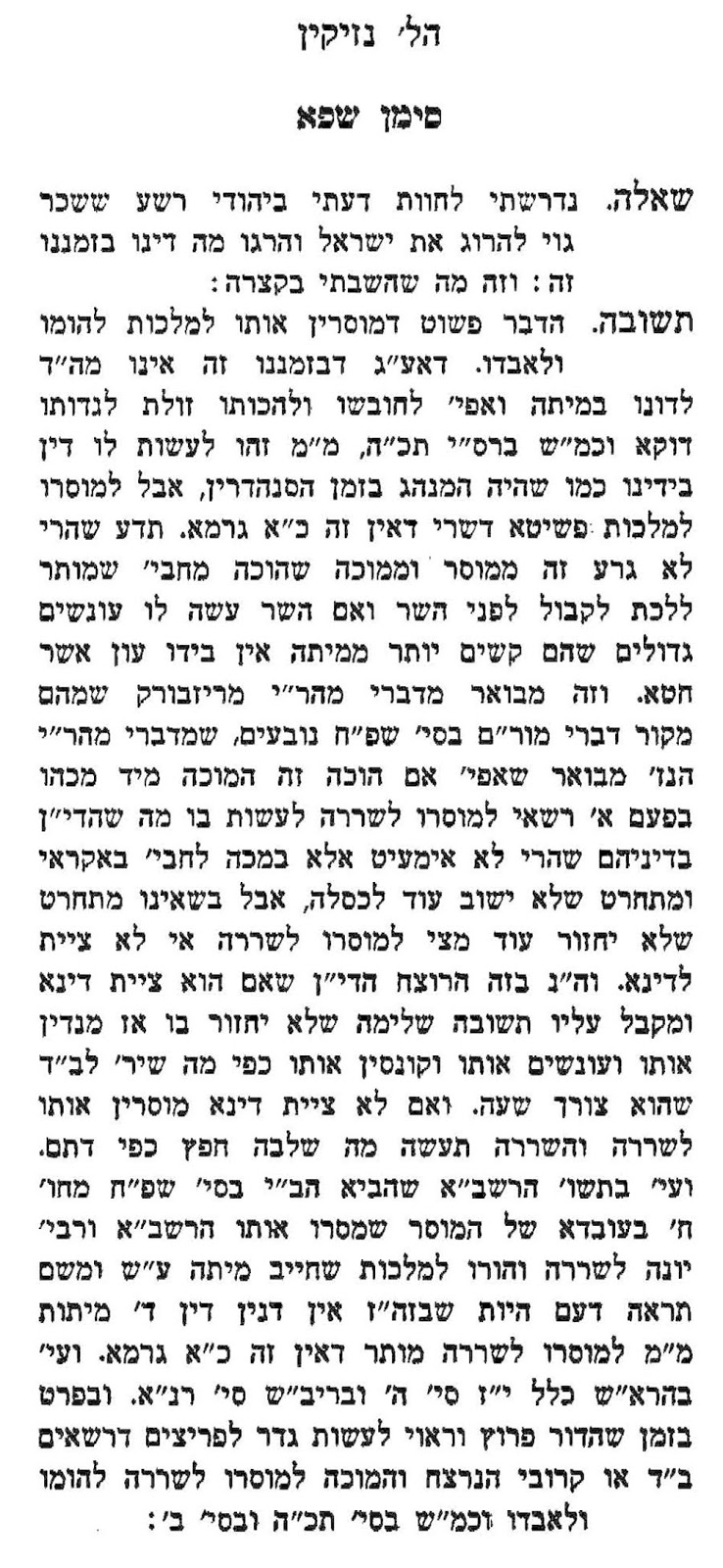
10 Le-Dor Aharon (Brooklyn, 1937), p. 36. In this letter R. Chaim Ozer uses the expression והנני חותם בברכה , and this also appears in his supposed letter to Bloch.
11 In my Studies in Maimonides, I tried to show that “academic” interpretations of Maimonides can also be found in the most traditional sources. The same thing can be done with regard to the Talmud, and Prof. Halivni has cited many examples of traditionalists who offered explanations of the sort he focuses on (Higher Criticism). When “academic” explanations are found in rishonim, even the most conservative will be hesitant to attack them. But that was not always the case a few hundred years ago. For example, R. Nissim writes as follows in his commentary on the Rif, Megillah 26a, s.v. zo divrei R. Menahem:
ודאמרינן במעמדות לאו דוקא ומשום אשגרת לישן נקטיה
(This same view is actually advocated by Ramban, as noted in Gilyon ha-Shas, Megillah 26a.) This was too much for R. David Pardo, Mikhtam le-David, Orah Hayyim no. 14:
מלבד הלחץ זה הדחק שסובל הדבר בעצמו לומר דהש”ס וכל הפוס’ מעתיקי הש”ס נקטו באשגרת לישן מלתא דשקרא ממש דבר זר ורחוק.
12 Pa’amei Yaakov, Adar II 5768, p. 108.
13 The Talmud deals there with how even the desire of one of the parties in a dispute to give a gift to a rabbi who will rule on the case impairs his objectivity. This talmudic passage provides all the explanation one needs to understand how so many learned rabbis remained silent as the Tropper scandal played out. If amoraim admitted that they couldn’t properly judge a matter if they had only been offered a gift, certainly one in our day who actually received such a gift is not capable of judging the case of his benefactor. The Steipler refused to take as much as a cigarette from one of his admirers whose case he was to judge, and continued to refuse gifts from this person even after the case was concluded. See Avraham Yeshayahu Kanievsky, Toldot Yaakov (Bnei Brak, 1995), p. 208.
With regard to the more troubling (and I believe rare) circumstance of rabbis who will actually lie to benefit themselves, I have a number of sources on this. For now, let me just cite the words of the Shulhan Arukh, Yoreh Deah 314:1:
הכהנים חשודים להטיל מום בבכור אפילו אם הוא חכם ויושב בישיבה
As for the sordid details of the Tropper scandal itself, and those who refused at first to believe what they heard with their own ears (not to mention the Elon scandal as well as others), here is what the hasidic master, R. Meshulam Feivish Heller (died 1794), had to say in an earlier era, a presumably holier era as yet uncontaminated by television and the internet (Yosher Divrei Emet [Jerusalem, 1974]), p. 113:
והלא ידוע ומפורסם שיש בעוה”ר כמה לומדים שהם בעלי ניאוף רח”ל, ובעלי עבירות ידועים.
R. Hayyim Eleazar Shapira, Divrei Torah 5:82, writes about
הרבנים ובפרט האדמורי”ם הגונבים דעת ולבות הבריות, וכל כונתם אך לטובתם, בעצמם בגופם ובשרם וממונם ותאותם.
This is what the Ropshitzer is reported to have said:
דעו כי קודם ביאת המשיח יתרבה כ”כ השקר בעולם עד שרב העיר יסע יחדו עם אשה נכריה בעגלה אחת, ורבים מבני העיר יאמרו אחריו אין קדוש כמוהו.
R. Isaiah Asher Zelig Margulies, Ashrei ha-Ish (Jerusalem, 1927), p. 49, who records the saying, assumes that the Gentile woman spoken of really means “heresy”, but I don’t know why it should not be understood literally. It is not like the Ropshitzer was confronted with many secularly educated rabbis that he would need to make such a statement. (I assume that Margulies was led to his assumption by Maimonides’ famous letter to R. Jonathan of Lunel, where he speaks of non-Torah studies—which for Margulies equals heresy—as being נשים נכריות . See Iggerot ha-Rambam, ed. Sheilat, vol. 2, p. 502.)
Since a concern with kavod is also so often present in the various scandals, the following comment by R. Elimelech of Lizhensk is noteworthy (quoted in Or Elimelekh [Jerusalem, 2003], no. 75):
מצוה עם כבוד גרוע יותר מעבירות ניאוף רח”ל.
14 See the text of the Rav’s lecture here.
15 See R. Aharon Perlow, Margaliyot ha-Shas al Masekhet Shabbat (Jerusalem, 2005), p. 471.
16 Likutei Avraham (Jerusalem, 1976), p. 319.
17 Sedei Hemed, ma’arekhet lamed, kelal 108.
18 See also Alan Brill’s recent post here.
19 For an example of genealogy in the reverse direction – i.e., from righteous to wicked, see Rashi to I Kings 10:1, where it very strangely states that Nebuchanezar was the son of Solomon and the Queen of Sheba. This only appears in the later printed editions of Rashi, and is cited in the name of R. Isaac Luria. It is difficult to know what to make of this. I find it hard to believe that the passage ever could have been meant literally, since Solomon lived some three hundred years before Nebuchadnezar. Even legends, if understood literally, have to make chronological sense. Perhaps it means that the origin of the later disaster involving Nebuchadnezar can be traced to Solomon involving himself with foreign women such as the Queen of Sheba. In other words, not that Solomon is the literal father of Nebuchadnezar, but rather he is his “ultimate cause”.
As for the ultimate origin of the notion that Solomon was Nebuchadnezar’s father, I have been unable to find any other source that records that this was stated by R. Isaac Luria. R. Menahem Azariah de Fano (1548-1620), Asarah Ma’amarot (Jerusalem, 2005), pp. 412-413 (Ma’amar Eim Kol Hai 2:23), states that Nebuchadnezar descended from Solomon. Two points are significant here. First, he does not say that Solomon is his father, and second, he does not attribute this to any source, which presumably means that it was a well-known kabbalistic idea. R. Jehiel ben Solomon Heilprin, Seder ha-Dorot, year 2935, states that according to a Midrash, Solomon fathered a daughter with the Queen, and Nebuchadnezar was her son. R. Hayyim Joseph David Azulai, Midbar Kedemot, ma’arekhet yod, no. 47, claims that Nebuchadnezar was descended from this daughter. See also R. Joseph Palache, Yosef et Ehav (n.p., 2005), ma’arekhet bet, no. 17.
20 למדו תורה . This should probably be read as לימדו תורה , “taught Torah”, since in the parallel text in Gittin 57b it has למדו תינוקות, which means “taught children”. See also Dikdukei Soferim, Sanhedrin 96b.
21 To give just one, here is a page from R. Nissim Gaon’s Sefer ha-Mafteah to Berakhot 27b.

Note how Jacob Goldenthal, the editor, assumes that it is actually Haman from whom R. Akiva is descended! Jacob Reifman agreed with this. See Iggeret Bikoret, ed. Ben Menahem (Jerusalem, 1969), p. 17. Louis Finkelstein, Akiba, p. 321 speaks of the R. Akiva-Sisera connection as a “legend widely repeated in medieval works.” He doesn’t seem to realize that the medieval works were citing from their texts of the Talmud. See also Dikdukei Soferim, Sanhedrin 96b, which cites one such manuscript.