Book Announcements: Five recent works

Book Announcements: Five recent works

By Eliezer Brodt

This post serves a dual purpose; first, to describe some new, very interesting seforim and thereby making the Seforim Blog readership aware of their recent publication. Second, to make these works available for purchase for those interested.

Part of the proceeds will be going to support the efforts of the Seforim Blog.

Contact me at Eliezerbrodt@gmail.com for more information about purchasing or for sample pages of these new works.

The first work I would like to mention is:

מאיר רפלד, המהרשל וספרו ים של שלמה, 288 עמודים

Dr. Meir Raffeld z”l authored a PhD on the Marshal and his work Yam Shel Shlomo in the Talmud Department of Bar Ilan University which was approved in 1991. Over the years, the work was quoted very often as it is the most comprehensive work on the Yam Shel Shlomo. The Yam Shel Shlomo is one of the most important Halachic works of the 16th century. Recently the Raffeld Family decided to print the PhD as a book. With the tremendous help of Dr. Aharon Ahrend, the work was just published. This work has in it the original PhD along with updates and corrections that Raffeld wrote over the years. It also has a thorough index and references to his articles related to the Marshal published in his work Netiv Meir.

Here is a ToC of the work:

The second work I would like to mention is

חסדי אבות, פירוש מסכת אבות לרבי דוד פרווינצאלו, (פעל סביב לשנת ש), מבוא 58 עמודים, תלד עמודים, מכתב יד, כולל מבוא מראה מקומות והערות על ידי פיעקב שמואל שפיגל

This volume was just published by Professor Yaakov Shmuel Spiegel, of Bar-Ilan University’s Talmud department, for the first time from manuscript on Massekhes Avos. This is the fifth work that Speigel has published on Avos from manuscript.

As I have written about him in the past:

Professor Spiegel is one of the most prolific writers on the Jewish academic scene, authoring of over 160 articles and 18 books (16 of those are publications for the first time of works which remained in manuscript). Many suspect that he knows the secrets of Hashba’st Hakulmos (automatic writing) (about which see here).

His articles cover an incredibly wide range of subjects related to many areas of Jewish Studies, including history of Rishonim, piyutim authored by Rishonim, bibliography and minhaghim, to name but a few. His uniqueness lies not only in the topics but also that his work has appeared in all types of publications running the gamut from academic journals such as Kiryat SeferTarbizSidraAlei Sefer, Assufot, TeudahKovetz Al Yad and also in many prominent Charedi rabbinic journals such as MechiltahYeshurunYerushasenuChitzei Giborim, Moriah, Sinai and Or Yisroel. It is hard to define his area of expertise, as in every area he writes about he appears to be an expert!

Worth noting that recently thanks to the hard work of a dear friend of mine, all of his published articles are available for free download here.

He has edited and printed from manuscript many works of Rishonim and Achronim on Massekhes Avos and the Haggadah Shel Pesach (and IYH some more are on the way)…

Another point of interest about Speigel is although he is an Academic and from the Mizrachi world, he is on very good terms with various Charedei scholars. Thus in some of his recent works he thanks Rabbi Shaul Alter, Rosh Yeshiva of Ger who has started reading and commenting about his material. This volume was also read by R’ Alter.

Reviews of other works of his on the Seforim Blog can be found here herehere, here, here and here.

Email me for a PDF of a sample of this new work.

The third work I would like to mention is:

רמשה הלל, חזון טברימון, תעודות מזויפות מבית היוצר של האחים טולידאנו מטבריה, 696 עמודים

A few weeks ago, the very prolific Rabbi Moshe Hillel [Son of Rabbi Yakov Hillel] released a PDF of his latest volume in his recent series of works dealing with exposing forgers and their forgeries titled חזון טברימון.

This volume is devoted to R’ Yakov Moshe Toldedano (1880-1960) and deals with various historical documents that he “discovered” and demonstrates that they are fake. This work is also a biography of Rabbi Toledano and explores various incidents in his life and possible motivations behind some of these forgeries. Similar to previous works in this series, this volume too is an incredible read, 696 pages! Bibliographers and people interested in the world of manuscripts will be sure to enjoy it.

Besides being released as a PDF, the volume was published in an extremely small limited editionFor a very short time, while supplies last, a few copies are available for purchase exclusively through me.

If you are just interested in a copy of the PDF of the work email me to send you a link.

Here is the ToC of the work:

The fourth work I would like to mention is

גיליונות הירושלמי של רבי שאול ליברמן, ג’ חלקים, 2564 עמודים, בעריכת פר’ משה עסיס

No words are really necessary to describe Rabbi Saul Lieberman to readers of the blog, but just in case, I will include one page from the classic article ‘Hamoreh’ written about him by the great Eliezer Shimshon Rosenthal:

This new work publishes for the first time Lieberman’s glosses written on the margins of six different editions of the Yerushalmi found in Lieberman’s library. The glosses were carefully collected and edited for publication by Professor Asis (himself one of the leading experts on the Yerushalmi).

A pdf of some Sample pages is available upon request.

The fifth volume I would like to mention is

  מעגל טוב, יומן מסע של החידא, חלק א, מהדיר: ראסף רביב, כולל הקדמה, 37 עמודים, + 275 עמודים  + נספח בענין החידא ומחבין ריעקב עמדין וריהונתן אייבשיץ, בעריכת ראסף רביב

On a personal note (for whatever that is worth) this work that has a special place in my heart as I have to date authored five articles about Maagal Tov and hope to IYH publish more.

A beautiful new edition was just published. The Sha’ar describes it as follows:

כולל המון תמונות, של מפות, אנשים, מקומות, כתבי ידות, יותר מאלף הערות שוליים, חלק אחד בשם ‘פלס מעגל’, הכולל ידיעות חשובות על האישים אשר עמם נפגש הרב, המאורעות השונים אשר פגש בדרכו, כתבי היד אשר ראה ועוד ועוד. וחלק שני בשם ‘המליץ בינותם’, יבאר את סגנונו של המליצי של הרב, ומראה מקומות לכל מטבעות לשונו במרחבי התנ”ך וספרות חז”ל

A brand-new annotated edition of the Chida’s famous Travel Diary, Volume one, 37 pp. intro, 275 pp. text, and an Appendix. It is a tall volume format, glossy paper, full of Illustrations, maps, pictures of people, places, and numerous images of manuscripts throughout the volume. It looks beautiful. The editor has two sections of notes. One section is devoted to deciphering all of the Chida’s Melitzos מליצות. The second section deals with the people whom he met, what he saw and much more.

The author is hard at work on the second part of the Travels.

Some readers of the blog will be familiar with a previous work of R’ Aviv, the fascinating Maaseh Tzadikim of R’ Avraham Kalfon (friend of the Chida) which he published for the first time from manuscript in 2009.

Just to note, an additional edition of the Chida’s Travels came out a few days later from Mechon Hame’or (800 pp.). This is volume fifty of the Mechon’s set of the Chida’s works that they have been publishing in the past few years.

This new edition is very useful; it does not have full Illustrations etc. like the previous one. However, I think that true seforim “addicts” need to own both. The Hamaor edition includes all the travels in one volume. It has useful notes (not as good as the first one). In addition, it has a lot of material related to the Chida, such as his listing of Hanhaghot, numerous stories he collected and seforim he owned. Some of this material was published here for the first time. It also has a section about the Chida and his seforim. 

Sample pages of both are available upon request.

To add to this earlier this year another volume was published called Kuntres Masaos (243 pp.) This material is also from manuscript and is dated and is Torah of his that he saw or discussed while traveling. Some of this was incorporated into his published seforim (some copies are still available for purchase).


Cemeteries and Response to Criticism

Cemeteries and Response to Criticism

Marc B. Shapiro

In my last post here I said that when it is safe, I will go to Baghdad to visit the grave of the Ben Ish Hai. I cannot find a picture of the Ben Ish Hai’s grave online, but you can see it in R. Yaakov Moshe Hillel’s beautifully produced recent book, Ben Ish Hai, p. 337. However, this is from the old cemetery in Baghdad, and because of a government order the remains in this cemetery were moved in the early 1960s. So it remains to be seen if the grave can now be located.[1] R. Hillel, p. 336 n. 480, claims that the precise location cannot be identified.

כיום, לא ניתן לזהות את קבריהם, בשל תנאי אקלים קשים השוררים בבבל אשר גרמו להתפוררות המצבות, ומחוסר רישום מדוייק של חלקות הקבורה.

Yet until we can go in and actually examine the spot, we cannot be certain if this is the case. There have been other examples of graves thought to have been lost, which have then been found. The best-known example is the grave of R. Israel Salanter, which was only located twenty years ago.[2]

While there is no doubt that the Ben Ish Hai was buried in Baghdad, there is also a tombstone for him on the Mount of Olives in Jerusalem.

According to a famous story, which is also told on the tombstone, the Ben Ish Hai’s body was not only magically transferred to Jerusalem on the day he died, but the grave-digger testified to burying him on the Mount of Olives and wanted payment for his labor.[3] I guess we can say that the Ben Ish Hai was buried three times: twice in Baghdad and once in Jerusalem.

It is hard to know whether the entire story of the burial in Jerusalem is a legend, or if there actually was a grave digger who figured out a way to make some money and invented the story to get paid for digging the grave. Assuming the latter is the case, the grave digger must have known his crowd, that not only would they be inclined to believe such a story, but that they would also not think of actually confirming the story by digging up the grave. Truth be told, it would have to be a very fearless grave digger to leave the grave empty, because one never knows if it will be opened, so it is possible that some unknown person is actually found beneath the tombstone. It is also possible that the grave digger did not have any bad intent, but just had a very vivid imagination. In any case, it is fascinating that such a tombstone exists in the most special Jewish cemetery, and even more incredible that there are people who actually believe that the Ben Ish Hai is buried there.

Supposedly, the Ben Ish Hai’s tombstone on the Mount of Olives is the only one that is standing upright, as all others are horizontal. (Maybe someone in Jerusalem can confirm this.) It is worth noting that R. Yitzhak Kaduri paid the grave in Jerusalem no mind, and even joked about it.[4] R. Shmuel Eliyahu has stated that while the Ben Ish Hai is buried in Baghdad, his spirit came to Jerusalem.[5]

Similar to the story with the Ben Ish Hai’s burial place, R. Abraham Joshua of Apt is buried in Medzhybizh, near the Baal Shem Tov’s grave, but there is a legend that angels carried his body to Tiberias, and there is a stone marking his grave there as well.[6]

This last summer I was in Marrakech, Morocco. In the local Jewish cemetery, R. Jacob Timsut is buried. Yet, “one month after the deceased rabbi was buried in Marrakech, a letter arrived from Jerusalem announcing the marvelous appearance of a tombstone with the name of Rabbi Ya’aqov Timsut in the well-known cemetery on the Mount of Olives.”[7] So once again, you can visit the tzaddik’s grave in its original spot or in Jerusalem.

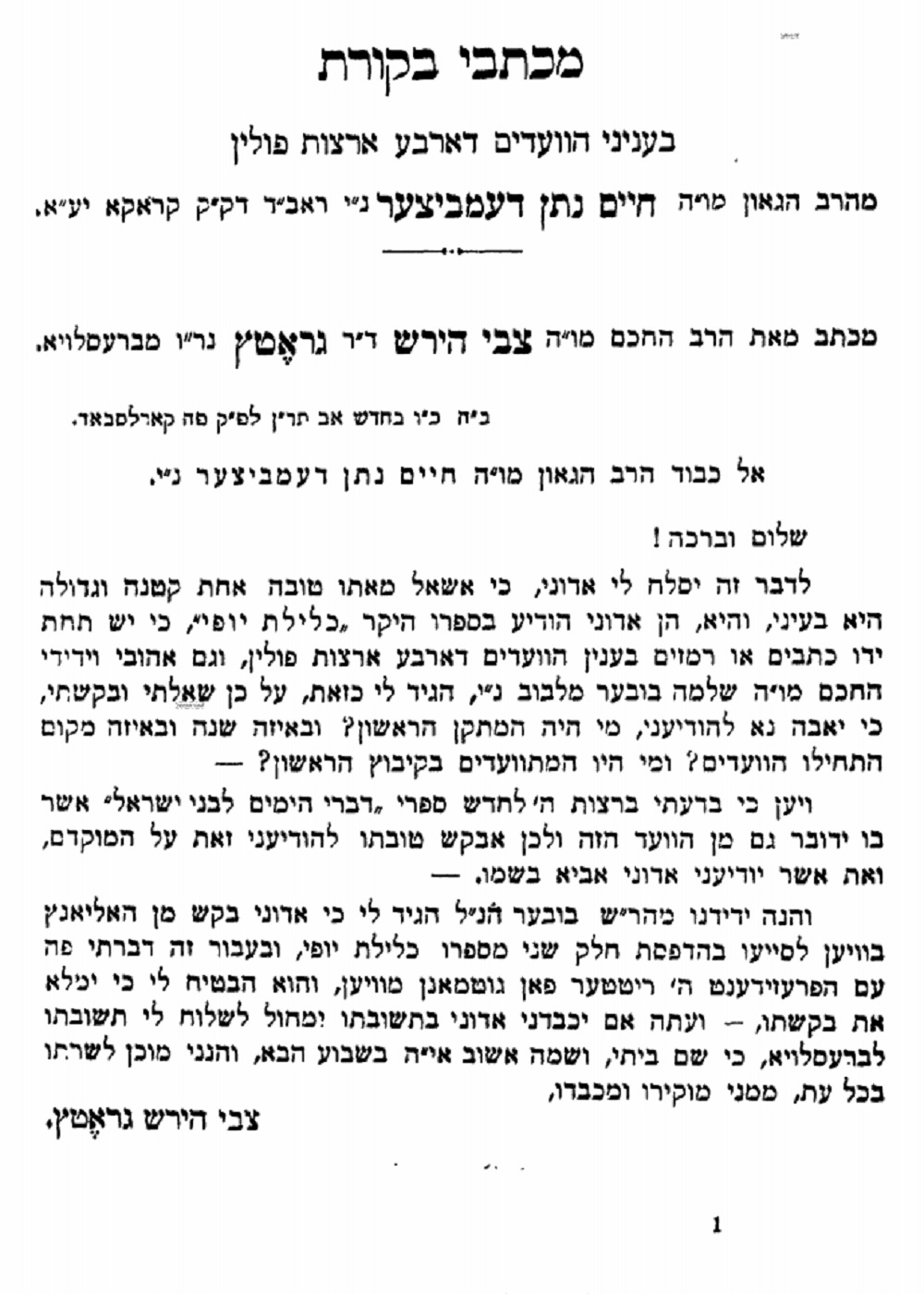
Regarding tombstones even though the deceased is not buried there, I must call attention to the fascinating comments of R. Hayyim Nathan Dembitzer (1820-1892). R. Dembitzer was a dayan in Cracow and author of the responsa volume Torat Hen. Yet his claim to fame is his historical writings. As a real historian, he was prepared to accept the truth from where it came, and it is significant that in his work Mikhtevei Bikoret (Cracow, 1892), he included correspondence with Heinrich Graetz. Here is the title page and the first two pages of this book.

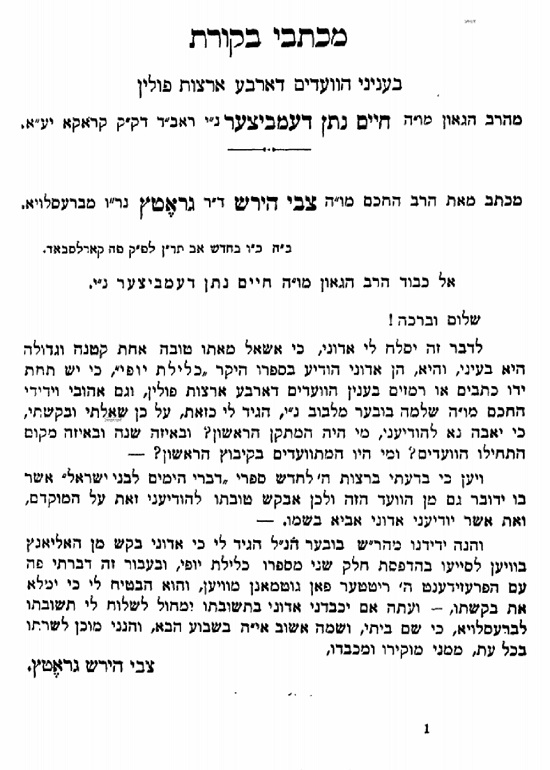
 

Look at how respectfully he refers to Graetz, which is the sort of thing that would have driven R. Samson Raphael Hirsch and R. Esriel Hildesheimer crazy.

Dembitzer’s respectful scholarly interactions with Graetz, in which he did not let religious differences interfere, is parallel to how certain important rabbinic figures related respectfully to Louis Ginzberg. I dealt with this matter in Saul Lieberman and the Orthodox, and it has also recently been discussed by R. Moshe Maimon.[8] Interestingly, in Mikhtevei Bikoret R. Dembitzer also includes correspondence with Nachum Sokolow.

Dembitzer’s two-volume Kelilat Yofi is focused on the rabbis of Lvov as well as other Polish rabbis, and is essential for anyone doing research on the Polish rabbinate. In this work, vol. 1 p. 41a, he mentions that Elyakim Carmoly had written that in earlier years in Lvov they would place tombstones in the cemetery for the deceased scholars of the city even if they had died and were buried elsewhere.

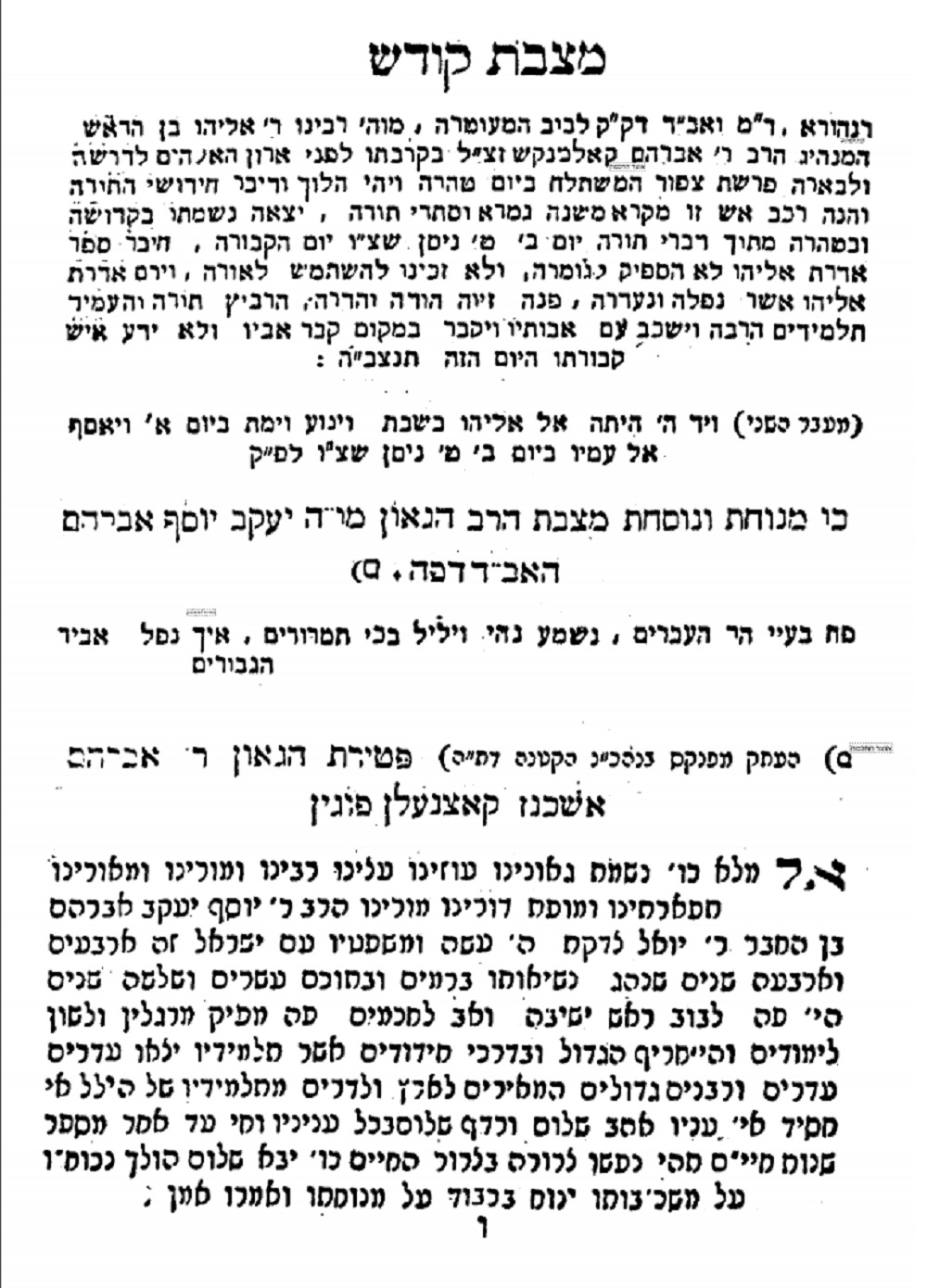
Dembitzer does not give an exact reference for Carmoly, only mentioning that his comment is in Ha-Karmel. Fortunately, I was able to find Carmoly’s article and it appears in Ha-Karmel, April 17, 1867, p. 302. Carmoly’s has two proofs for his contention. The first proof is that in R. Gavriel ben Naftali Hertz’s Matzevat Kodesh (Lemberg 1864), vol. 2, in the second half of the book (there is no pagination here), we find the following tombstone for R. Elijah Kalmankash, who served as rav of Lvov.

The tombstone explicitly states:

.וישכב עם אבותיו ויקבר במקום קבר אביו ולא ידע איש את קבורתו עד היום הזה

This is a clear proof that at least for this rabbi, a tombstone was placed in the ground even though he was not buried there.

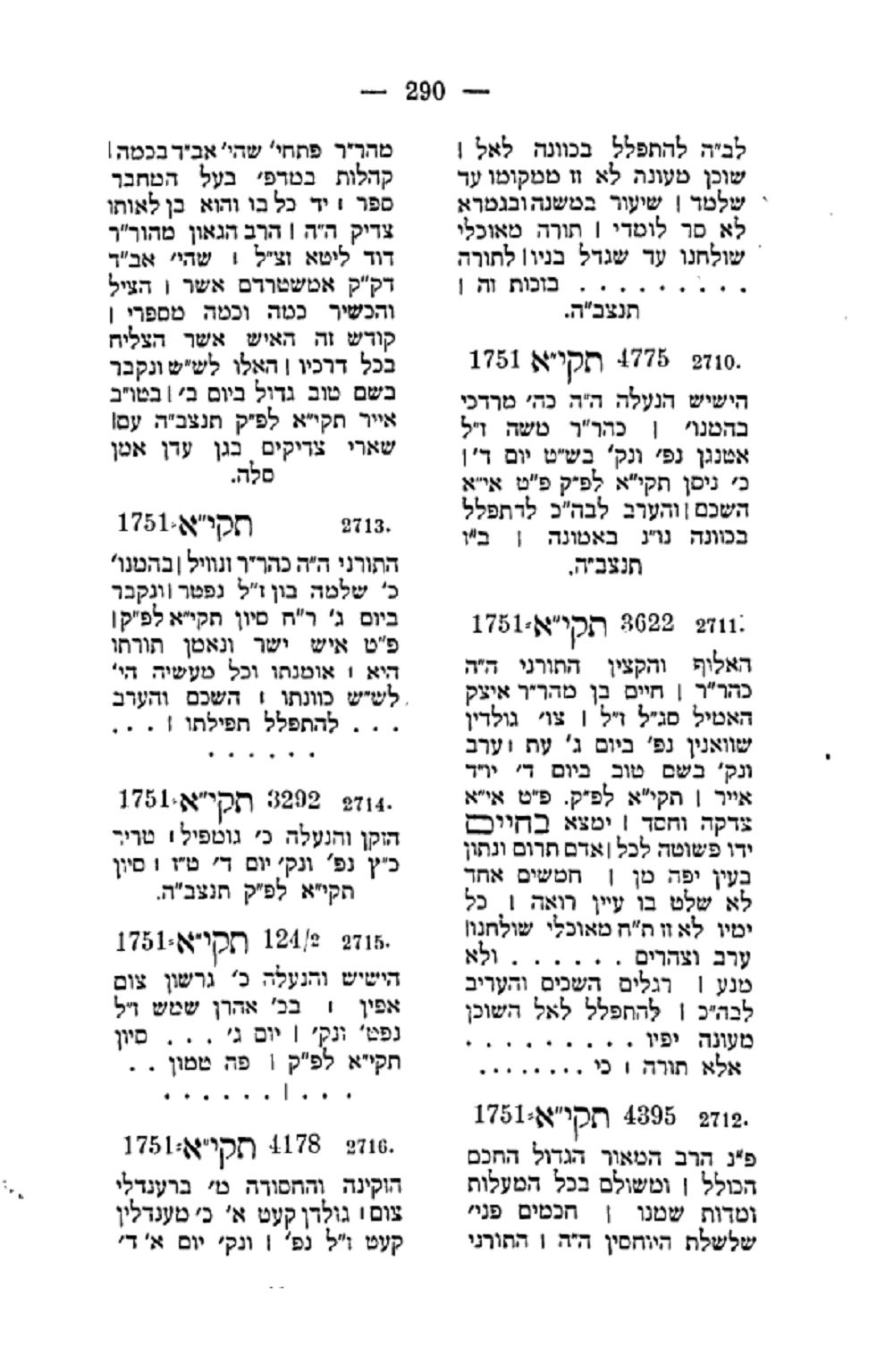
Carmoly also notes, as his second proof, that in Matzevat Kodesh, vol. 2, p. 22a, it records, from the Lvov cemetery the text of the tombstone of R. Petahiah, son of R. David Lida who was rav of Amsterdam. His date of death is given as 1721. Here is the text of the tombstone as recorded in Matzevat Kodesh.

(Following R. Petahiah’s tombstone, Matzevat Kodesh records the tombstones of another son and son-in-law of R. Lida.) However, Carmoly tells us that we know that R. Petahiah died and was buried in Frankfurt. R. Markus Horowitz in his Avnei Zikaron (Frankfurt, 1901), p. 290 (no. 2712), published many years after Carmoly’s article, records the text of his tombstone as follows.

As you can see, the date of death is 1751, thirty years later than the date given on the tombstone in Lvov. In other similar cases, I would say that we are dealing with two different people, but the specificity of the tombstone texts makes it hard to deny that they are both for the same person (and Petahiah was hardly a common name).[9] Carmoly’s conclusion is that the community of Lvov put up a tombstone for R. Petahiah to memorialize him, even though he was buried in Frankfurt. Neither Carmoly nor R. Dembitzer offer an explanation as to why the Lvov tombstone places his death thirty years too soon, but they would probably view this as just a simple error.

Dembitzer not only agrees with Carmoly in the case of R. Petahiah, but offers another example of this phenomenon. R. Zvi Hirsch ben Zekhariah Mendel had served as rav in Lvov, but later he was rav in Lublin and died there around 1700. However, there was a tombstone for him in Lvov which gave his date of death at 1655. R. Dembitzer does not explain the discrepancy of the dates of death, and presumably he would say that when the tombstone was put up in Lvov to honor the deceased former rav of the city (who was not buried there), they simply got the date of death wrong. Interestingly, Shlomo Tal accepted the statements of Carmoly and R. Dembitzer, and in summarizing their position speaks of “many fictitious tombstones.”[10]

Dembitzer also makes the astounding assertion that there are graves in the Lvov cemetery for rabbis who never existed! His proof is that there is a tombstone for a Rabbi Eliezer ben Moshe ha-Kohen Proops (פרופס), who is said to have been av beit din in Amsterdam before he came to Lvov. Yet R. Dembitzer states that no such person was av beit din in Amsterdam, and we thus see that the people who made the tombstones did so for rabbis who never existed![11]

כי גם זאת לפנים בלבוב, להקים ג”כ מצבות אבנים ולחקוק עליהם שמות חכמי ישראל אשר לא מתו ולא נקברו לא בלבוב, וגם לא במקומות אחרים, יען כי לא היו ולא נבראו ולא באו עוד לעולם . . . ומי לידינו יתקע אם לא עשו זכרונות במצבות אבנים כאלה גם לשאר גאונים אשר בדו מלבם וקראו בשמותם עלי אדמה, וקבעו גם כן זמן לפטירתם

This is a very strange assertion, and even if it is correct, it refers to one case only, while R. Dembitzer uses it to make a generalization. The only one I know who took note of R. Dembitzer’s assertions was R. Hayyim Eleazar Shapira in a letter to R. Leopold Greenwald.[12] R. Shapira rejects R. Dembitzer’s claim in a very sharp tone.

ולא יאומן כי יסופר כי מרב גדול בתורה יצאו דברי הבל כאלו אשר כל השומע ויודע יצחק להם, ליתן מצבות ומקום בעד אותן שאינם נקברים שם ולכתוב שקר גמור “פ”נ” על להד”ם ולהשחית הקרקע שלא נקברו שם אין כדאי להטפל בדברי ריק כאלו. ואם בשביל קושיות שמצאו כמו ב’ מצבות כמו שני יוסף בן שמעון בשתי עיירות כלומר בתי קברות הנה שערי תירוצים לא ננעלו ונמצאו באמת שנים ששמותיהן שוות או לא העתיקו המצבות במקום אחד כראוי

Shapira makes the obvious point that two people with the same name can be buried in different cemeteries without them being the same person. However, this does not explain how there can be two tombstones for R. Petahiah, the son of R. David Lida, or how there can be a tombstone for another rabbi in the Lvov cemetery when we know that he was buried elsewhere.

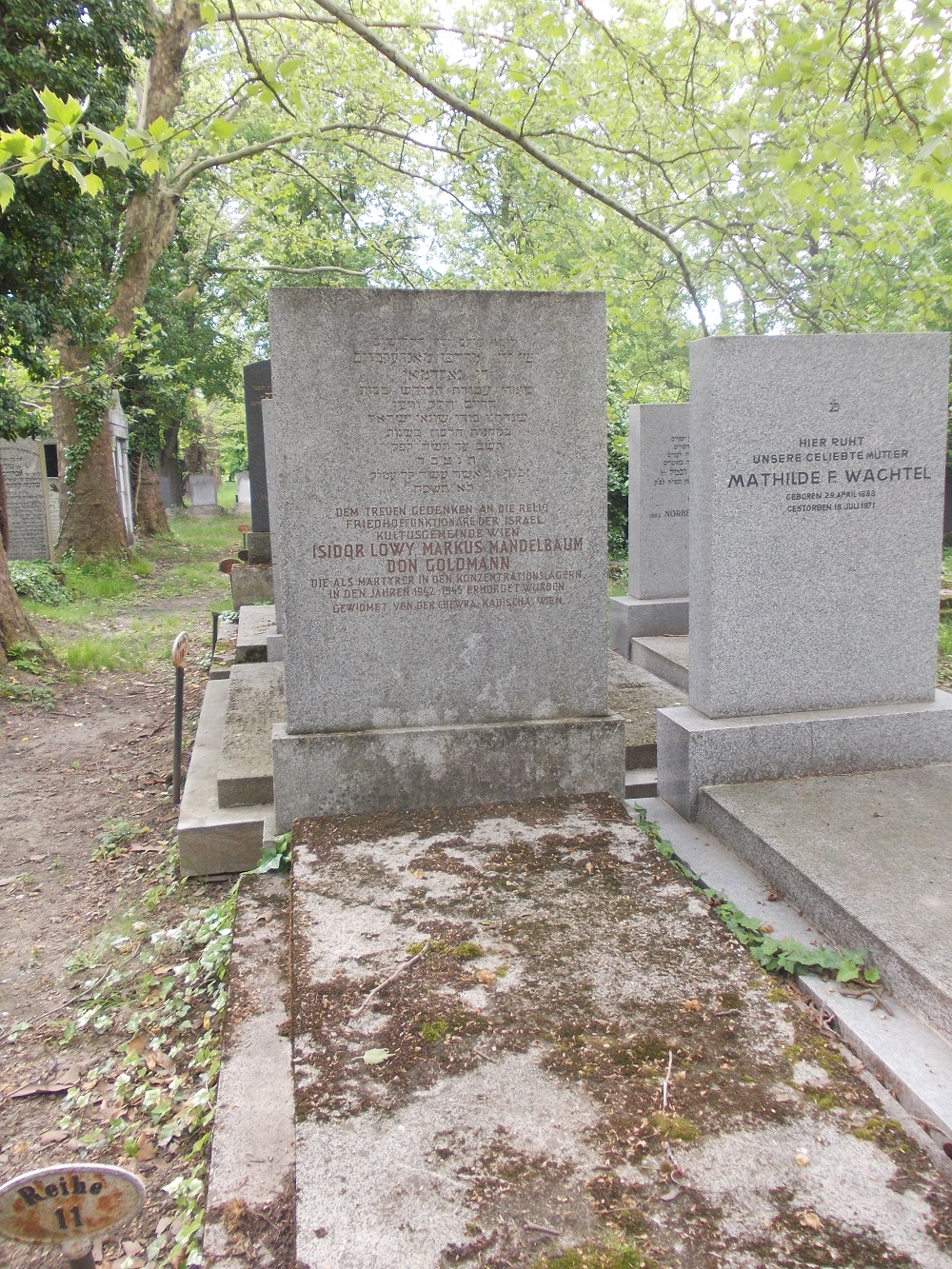
Regarding what we have discussed, I would only add that in the new Jewish cemetery in Vienna (the same one that R. Israel Friedman, the Chortkover Rebbe, is buried in), there is a tombstone for three members of the Chevra Kadisha who perished in the Holocaust. While it looks like a normal grave, none of the three men mentioned on the tombstone are actually buried there.[13] Here is the tombstone.

I owe this information and the picture to Dr. Tim Corbett, whose book on the Jewish cemeteries of Vienna will hopefully soon be published.

Since I just mentioned R. Hayyim Eleazar Shapira, let me mention something else he says that is fascinating. In the past two posts I discussed apostate rabbis. It is bad enough when an average person apostatizes, but for a rabbi to do so could have had terrible consequences on the community in that it could lead to many weak of heart to follow. Can anyone imagine, however, someone apostatizing as an act of teshuvah? It sounds crazy, but R. Shapira reported that he had it by tradition that such an incident happened in medieval times.[14]

The story he tells is that there was a popular preacher who in his public talks inserted all sorts of heretical ideas. After he was rebuked by one of the rabbis for preaching his heresies, the man confessed his sins and asked what he should do to repent. The rabbi told him that his repentance would not help, as for years he has gone from place to place spreading his heresy. How could he possibly repent for this? The rabbi said that what he must do is convert to Christianity. The Jewish world would then hear about this and this would remove the legitimacy from any of his sermons, as people would assume that even before his apostasy he was a heretic. Only by doing this could he destroy the impact he made with his earlier sermons.

Let me mention one final responsum for now. In the eighteenth century, R. Elijah Israel of Rhodes dealt with the case of someone who converted to Islam in Izmir, and then wished to come to Rhodes in order to return to Judaism.[15] Practicing Judaism after converting to Islam was illegal, and could endanger everyone in the community. The man was therefore warned not to come to Rhodes, where Muslim merchants might recognize him, but he ignored this warning. Making matters worse, the man had already once before converted to Islam and reverted to Judaism, meaning that there was no way that the Jewish community could have any dealings with him.

Israel permitted letting the authorities know about this man, as he was regarded as a danger to the community. The punishment for his “crime” of leaving Islam would have been severe and could even have included the death penalty, but R. Israel allowed informing the authorities as the man had the status of a rodef. He writes:

מי שמסכן רבים כגון שעוסק בזיופים במקום שהמלכיות מקפידות דינו כרודף ומותר למוסרו למלכות ע”כ וכ”ש וק”ו במי שהמיר דת ורוצה לחזור לדתו שההקפדה היא גדולה שהוא בזוי גדול לדעתם פן תצא כאש חמתם ח”ו ובערם ואין מכבה שמותר למוסרו כדי להציל את ישראל

* * * * * *

In the most recent issue of Dialogue 8 (2019), pp. 35-83, Rabbi Herschel Grossman published a lengthy review of my Limits of Orthodox Theology.[16] Normally I, like any author, would be very happy that so many years after a book’s appearance people are still interested in examining it and engaging with its arguments. Unfortunately, that is not the case with the present review which, it must be said, is nothing less than slanderous. Had the author taken issue with my interpretation of texts and shown why I am mistaken, this would have been a fine way to approach the book. It could be that I would even acknowledge that in some cases his understanding is preferable to mine. As readers of this blog know, I am perfectly willing to acknowledge when I have erred and am happy to credit those who called my attention to these errors. This is how scholarship is supposed to work, and anyone who writes, especially someone who writes a great deal using lots of different sources, will sometimes make a mistake. I myself have called attention to my own errors, without anyone prompting me, as I think it is important for all of us to be as exacting as we can.

However, this is not what the review is about, or, I should say, not what it is mainly about. In future posts I will come to the issue about how to interpret specific texts (and I will defend my readings), but first I must explain why I said that the review is slanderous. It is because Grossman accuses me of saying things that I never said, and throughout he misunderstands the purpose of the book, and of academic Jewish studies as a whole. In general, it is obvious from the review that although Grossman has never met me or even spoken to me, and I have never done him any wrong, he sees me as an enemy that he has to destroy.[17] With such a preconceived notion, it is no wonder that he comes to such incorrect conclusions as to what I am trying to say, and can write a review that is so mean-spirited and dripping with contempt. Based on e-mail correspondence with readers, I do not believe that anyone who has read the book will be taken in by the review’s distortions. However, those who haven’t read the book will probably come away with a false understanding, so it is important to clear this matter up before getting to any arguments over how to interpret particular sources.

Before going through the article itself, let’s look at the end where Grossman says that the book “falls short of its promise to prove that the Rambam was wrong in presenting his Principles as central to Judaism” (p. 83). I think everyone who has read the book knows that of all the things I try to do, one thing I do not do, and indeed it would have been incomprehensible to even imagine such a task, is attempt to prove that the Rambam was wrong. Even if I were a theologian, which I am not, I could not imagine myself ever trying to prove the Rambam (or R. Bahya, R. Saadiah, Ibn Ezra, etc. etc.) wrong. This is simply not how I operate.

The notion that I attempted to prove the Rambam wrong is so far from what I was trying to do in the book, that as mentioned, I don’t believe that anyone who actually read the book, or any of the other reviews, would have concluded as such. What they would have seen is that I try to show that the Rambam’s principles were disputed by others, and thus did not receive complete acceptance. I try to prove this point, but this is very different than trying to “prove that the Rambam was wrong.”

I don’t even know how one would be able to prove the Rambam, or any other Jewish thinker, “right or wrong” on theological matters. Is it possible to “prove” that creation was ex nihilo or from pre-existent matter, or can we ever “prove” that prayers should not be addressed to angels? Today, unlike in medieval times, most of us assume that by their very nature, theological discussions are not subject to “proof”. The most one can do is try to show which position makes more logical sense and is in line with biblical and rabbinic teachings.[18]

In his conclusion, Grossman also writes, in opposition to my supposed error, “that the Rambam’s Principles of Judaism remain the correct affirmation of Jewish belief.” Again, this sentence has nothing to do with my book, as it assumes that I claimed that the Rambam’s principles are incorrect. Had he understood what the book is about, and he wished to dispute with me, he would instead have written “that the Rambam’s Principles of Judaism are the generally accepted [or: halakhically binding, or: rabbinically sanctioned, etc.] affirmation of Jewish belief.”

Let us now start at the beginning. Grossman begins his review—and I will be going through it page by page responding to his attacks—by stating that “the academic approach to matters of Torah learning is radically different from that of the talmid chochom” (p. 36). This is an incorrect statement, as many followers of the academic approach are themselves talmidei hakhamim. What Grossman should have written is that the academic approach is different than the traditional approach. With regard to academic works, Grossman states: “Many of the conclusions of these works are at variance with accepted Torah teachings” (p. 35). No doubt that this is a true statement, but of course, the issue we will have to get into is what is the definition of “accepted Torah teachings.” As all readers of this blog are aware, R. Natan Slifkin’s books were banned because they were seen to be at variance with “accepted Torah teachings,” so the fundamental issue will be which teachings are supposedly accepted.

Grossman writes as follows in explaining the difference between a traditional Torah scholar and an academic scholar:

[For] the talmid chochom, a difficulty in the words of the authority creates a challenge for him to discover the true meaning of the authority. For many academics, a difficulty is proof that the authority is wrong (p. 36).

Grossman identifies me as one of the academics who try to show that an authority is wrong, so let us see whether this is indeed the case. He begins by stating about my book: “Its thrust is that the Rambam erred in codifying these Principles.” We have already seen this unbelievable distortion in his conclusion, as if one of my goals was to show that the Rambam was mistaken.

Grossman further states that “while some earlier scholars have disputed whether some of the Principles deserve to be listed as basic to Judaism . . . all have conceded that the tenets expressed by the Principles are correct” (p. 36). This statement is grossly inaccurate, as virtually every page of my book demonstrates (and in various blog posts I have also cited numerous authorities who disagree with certain of Maimonides’ principles).[19] Even if all of Grossman’s criticisms of particular points of mine are correct (and I will come back to this), it still leaves loads of sources at odds with the Rambam. The sentence is nothing less than shocking, since rather than acknowledging that other authorities disagreed with certain Principles of the Rambam, but claiming that these authorities’ views are to be rejected for one reason for another, Grossman states that “all have conceded” that the Rambam’s views are correct. It is hard to know how to reply to such a statement that completely disregards the truth that everyone can see with their own eyes.

In Limits, p. 26, I quoted the following from R. Bezalel Naor, who was repeating what he heard from R. Shlomo Fisher: “The truth, known to Torah scholars, is that Maimonides’ formulation of the tenets of Jewish belief is far from universally accepted.” R. Naor informed me that R. Fisher made this statement in explaining R. Judah he-Hasid’s view about post-Mosaic additions to the Torah. In other words, R. Judah he-Hasid’s view is not in line with Maimonides’ Principles, but this is not the only such example of Torah sages diverging from the Principles.

Grossman continues by stating that I conclude “that the Rambam’s formulation of the underlying beliefs of Judaism was his own innovation” (pp. 36-37). What does this sentence mean? Apparently, he wants the reader to think that I said that the Rambam just invented his Principles out of thin air, which is of course incorrect as I never said this. If the meaning is that the very notion of a list of doctrines formulated as Principles of Faith, with all that this entails, was the Rambam’s innovation, there is nothing controversial about this at all, and I discuss whether the Rambam was the first to do this and what led him to do so.

Grossman continues: “Even such basic tenets as the belief in God’s unity, or in God’s non-corporeality, says Shapiro, are the Rambam’s own assertions and subject to dispute, with no firm basis in the Torah or in Chazal” (p. 37). I never say that these tenets are the Rambam’s own assertion without any prior basis (as if the Rambam invented these ideas). When it comes to the belief in God’s unity, I state explicitly that no Jewish teacher has ever disputed this (although how they understood God’s “unity” was subject to dispute). As for God’s incorporeality, I will come back to this in greater detail in a later post, where I will also deal with R. Isaiah ben Elijah of Trani’s claim that divine incorporeality is not a principle of faith, as well as Maimonides’ view that in its simple meaning (but only in its simple meaning), the Torah itself teaches God’s corporeality (for the benefit of those people who at the beginning of their studies are not able to understand the profound concept of a deity without form). Since I will then analyze this matter in great detail, I do not want to get into it here. For now, I will simply say that in the book I discussed whether divine incorporeality was accepted by all Jews at all times, and if corporeal views of God can be found in the Talmud (as was stated by R. Isaiah ben Elijah of Trani).

On p. 37 Grossman writes:

Shapiro, who mocks the opinions of Rabbeynu Nissim, R. Moshe Feinstein, Chazon Ish, Arizal, and R. Ya’akov Emden, among others, goes one step beyond Kellner in his belief that he, Shapiro, is better able than Rambam to interpret explicit verses of the Torah (as we shall see below).

This is nothing less than slander since I never, not even once, mock the opinions of any of these great rabbis or anyone else. When I read this sentence, I had no clue what he was talking about, as this is not how I operate, and was shocked when I went to the sources he refers to. Let us look at what Grossman regards as “mocking”.

For my mocking of R. Nissim, he refers the reader to p. 84 in my book where I write that R. Nissim “puts forth the strange and original position that there is one particular angel before whom prostration is permitted.” This is mocking?[20]

For my “mocking” of R. Moshe Feinstein’s opinions he provides three sources.

On p. 101 n. 73, I discuss R. Moshe’s rejection of the authenticity of a passage in Avot de-Rabbi Nathan. I write that R. Moshe’s “rejection of the authenticity of this passage should be viewed as part of his pattern of discarding sources that do not fit in with his understanding. He does so even when the sources are neither contradicted by other writings of the authors involved nor by other versions of the text in question.” Where is the mocking?

On p. 157, I write: “Although R. Moses Feinstein was the greatest posek of his time, he seems to have had no knowledge of Maimonidean philosophy. He was therefore able to state that Maimonides believed in the protective power of holy names and the names of angels, as used in amulets.” Where is the mocking?[21]

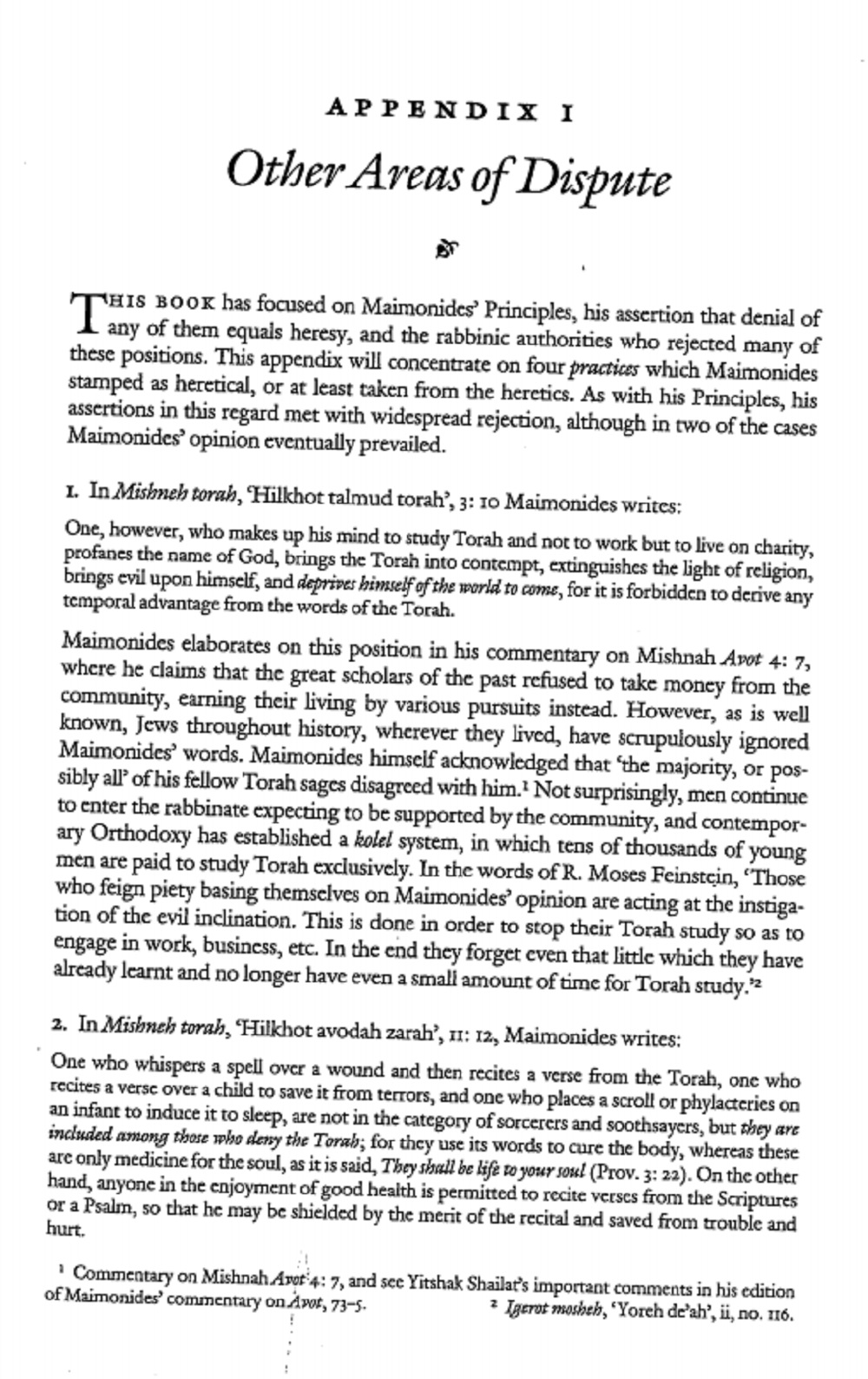
The last source where I am said to be mocking R. Moshe’s opinion is p. 159 of my book. Here is the page.

All I do here is cite R. Moshe’s comment about those who oppose kollels by citing the Rambam. I have also seen R. Moshe quoted as saying that it is noteworthy that those who oppose kollels based on the Rambam only adopt this one “humra” of the Rambam. The Rambam has lots of other humrot, yet people don’t adopt these stringencies. They only want to be “mahmir” in accordance with the Rambam so as not to support kollels. To say that I am mocking R. Moshe’s opinion is not only slander, it is completely incomprehensible.

Regarding the Hazon Ish, Grossman refers to p. 17. On this page I mention the views of many who held that the Thirteen Principles are the fundamentals of Judaism, and I include a passage from the Hazon Ish. I don’t see any mocking.[22] He also refers to p. 65 n. 124, where I mention a number of sages, including the Hazon Ish, who say that the Rambam’s view that belief in divine corporeality is heresy (Hilkhot Teshuvah 3:7) does not refer to someone who does not know any better, and thus the Rambam is not in dispute with Rabad who criticizes the Rambam on precisely this point. In response to those authorities who made this argument, I wrote: “They obviously never saw Guide I, 36, cited above, p. 48.” In this source, Maimonides specifically rejects the notion argued by the Hazon Ish and others that Maimonides is not speaking of the person who does not know any better. In fact, R. Kafih goes so far as to say, in his commentary to Hilkhot Teshuvah 3:7, that Maimonides saw Rabad’s comment and Guide 1:36 was written specifically in response to it, in order that people not assume that Rabad’s position can be regarded as theologically sound.

Regarding R. Isaac Luria, Grossman points to p. 90, where I write:

Finally, I must mention R. Isaac Luria’s view that Moses’ understanding of divine matters was inferior to that of certain kabbalists (including himself!). This notion is elaborated upon by R. Shneur Zalman of Lyady (1745-1813), who asks, “’How did Rabbi Isaac Luria, of blessed memory, apprehend more than he, and expound many themes dealing with the highest and most profound levels [penimiyut], even of many Sefirot.”

Again, I don’t know where there is any mocking. Incidentally, a reader has made a very good case that I am incorrect, and R. Isaac Luria and R. Shneur Zalman should not be cited as opposing Maimonides’ principle. In a future post, I will present this argument, which R. Chaim Rapoport told me he agrees with.

Regarding R. Emden, Grossman refers the reader to p. 16 n. 63. Nowhere in this note do I mock an opinion of R. Emden. What I do say is that his sexuality was complex. In retrospect, I regret including this comment, since it is not really relevant to the matter at hand. Yet there is no question that when it comes to sexual matters, there is something very much out of the ordinary, especially for rabbinic greats, in how R. Emden writes about these things. This is something that I believe is acknowledged by everyone who has studied R. Emden’s writings, including the most haredi among us, even if they won’t put such statements in writing. Mortimer Cohen, in his book on R. Emden, famously pointed to sexuality to explain how R. Emden could have attacked R. Eybeschütz the way he did, with such outrageous accusations. Still, I believe that Jacob J. Schacter is correct when he states: “[W]hile it is clear that Emden had a complex and contentious personality, all this emphasis on his sexuality is really irrelevant to his attack on Eybeschütz.”[23] I for one am not comfortable with psychological interpretations, even if in this case such an interpretation can be used as a limud zekhut for some of the shocking things R. Emden says, and if I was writing the book now I would leave out the passage mentioned above. Yet where is the mocking? The only mocking I see is how Grossman continuously mocks me.

Grossman writes: “Shapiro does not refrain from adducing explicit Talmudic passages as contradictions to the Rambam, presuming that the Rambam overlooked or ignored them, something which innumerable Talmudic scholars in past centuries have considered inconceivable” (pp. 37-38). In the book I never say that the Rambam overlooked talmudic passages. I do say that he did not accept the outlook of every talmudic passage (which Grossman terms, “ignored them”). The Rambam famously held that not every passage in the non-halakhic sections of the Talmud is binding.

Grossman continues:

Shapiro is unimpressed by all these arguments; nor is he averse to dismissing Rambam’s opinion based on his, Shapiro’s, own reading of a Talmudic passage, even where there is no doubt that the Rambam had a different reading for it. An academic, he obviously feels, is privileged to interpret the Talmud better than the Rambam was [!], even where this presumption leads to bizarre conclusions (p. 38).

The only thing that is bizarre here is Grossman’s statement, for I can assure everyone that in the book I do not engage in talmudic debate with the Rambam, dismiss the Rambam’s opinion, and think that I am able to interpret the Talmud better than the Rambam. If someone offers, say, a new interpretation of a talmudic passage, does this mean he thinks he can interpret the Talmud better than Rashi or the Rambam?

Another false statement is found on p. 38 where Grossman states: “Although he is to be commended for the amount of research he has invested into his work—the citations he has amassed are voluminous—it seems that many of the references were culled from secondary sources without examining the originals.” I can state with absolute certainty—and other than Grossman, I don’t think anyone else has ever raised such an accusation of scholarly malpractice—that I have examined every original source cited in the book. Not only that, but I have examined every source in every book I have published and in every blog post. I have never cited a source that I have not examined “inside” unless I indicate so. This does not mean that I have never misinterpreted a source, and in subsequent posts I will examine some examples where Grossman offers a different reading. But for now, suffice it to say that it is nothing less than slander to state that I included sources in the book that I did not examine myself (and this, by the way, was before the existence of the various digital databases. Librarians at JTS and YU can remember me as I was constantly there during the time I was writing the book.)

The final point for now is Grossman’s conclusion of the first part of his review:

To analyze the errors in this book would require a book in itself, nor is this the purpose of this article. The purpose is to show the lack of basis for Shapiro’s assertions (1) that the Rambam’s Principles have no basis in Talmudic literature; (2) that he created these Principles either to advance his philosophic conclusions or for polemic purposes; and (3) that many authorities thought the Principles “were wrong, pure and simple” (p. 38).

Point 1 is incorrect. I never state that the Rambam’s Principles have no basis in talmudic literature. Every single one of the Principles can find support in the Talmud (even if others might disagree with how to interpret the talmudic passages), and I cite examples of this in the book. What I do say is that the concept of Principles of Faith put forth by Maimonides, that one can commit endless sins but if he believes in the Principles he is still a Jew in good standing (albeit a sinning Jew) with a share in the World to Come, and if he denies or doubts even one of the Principles, even if he did not know any better and even if he fulfilled all the mitzvot, he does not have a share in the World to Come, such a concept is not found in talmudic literature. I am hardly the first to say this. Many of the Rambam’s rabbinic critics made this point, and as far as I know, all of the academic scholars who have studied the Rambam have said likewise. Furthermore, even if there are talmudic sources for the substance of Rambam’s Principles, this does not mean that there is compelling talmudic sources to explain why the Rambam categorized these particular beliefs as Principles, denial of which is heresy. Often, we must look to his philosophical assumptions, which he regarded as part and parcel of Torah, to explain why he raised certain beliefs to the level of Principles while others did not. We must also look to his philosophical assumptions to understand why he read certain talmudic passages the way he did, and was thus led to formulate his Principles in a certain fashion.

I would also like readers to examine the following statement by the rabbinic scholar, R. Reuven Amar.[24] Based on what Grossman writes, I assume that he will regard this as equally blasphemous to anything I have written.

דאם כי ודאי אין חכמת הרמב”ם ז”ל כשאר בעלי החכמה ובעלי הדעה וגדולה חכמתו ושיעור קומתו ולבו רחב כאולם בכל חכמה ומדע מ”מ בעיקרי האמונה אין דבריו כמפי הגבורה אחר שלא קיבלם איש מפי איש עד משה רבינו ע”ה כי אם משיקול דעתו ובינתו וכפי שהודה וכתב בעצמו בהקדמת ח”ג מהמורה נבוכים, בענין מעשה המרכבה ומעשה בראשית ועיין בזה במגדל עוז פ”א מיסודי התורה ה”י וכן ראיתי בספר שומר אמונים (להרב ר’ יוסף אירגס זצ”ל) בויכוח ראשון סעיף ח’ ט’ שהתבסס על זה

Regarding point 2, Grossman sees it as problematic to say that the Rambam created the Principles to advance his philosophical conclusions. Yet this is a perfectly reasonable approach. After all, wouldn’t the Rambam want the Jewish people to hold philosophical truths, and what better way to achieve this than to put these truths in the form of Principles of Faith that everyone has to know? This approach is commonly held among scholars of the Rambam. As for the accusation that I say that the Rambam created the Principles for polemical purposes, I never say that with regard to the Principles as a whole. I do say this about aspects of two of the Principles, and I will return to this in a future post. The fact that I am being attacked on this matter is ironic, as my approach is actually more conservative than what is found in almost all works of modern scholarship on the Rambam.

As for point 3, I do not say that “many authorities thought the Principles” were wrong. What I do say is that many authorities thought that individual Principles were mistaken. By writing “the Principles,” Grossman leads readers to think that I said that many authorities rejected the Principles in their entirety, but all readers of my book know that this is not the case.[25]

I want to conclude with the following from R. Mordechai Willig, which has some relevance to my discussion and which I think readers will find of interest.[26] R. Willig’s entire shiur is worth listening to, but for the purpose of this post I only want to cite one small section.

As we know, not all the Ikrei Emunah were etched in stone without any dispute from the beginning of time. . . . Are in fact the Rambam’s Thirteen Principles accepted le-halakhah for the last X hundred of years and you can’t go against it, or perhaps not? There are those therefore who are trying to get around certain of his Ikrim. The Sefer of Albo himself who wrote the Sefer Ikrim didn’t accept all the Thirteen of the Rambam. One might argue that we don’t really find anywhere to my knowledge significant dispute about the other Ikrim of the Rambam, but perhaps not all Thirteen were accepted, but we’ll call [it] Twelve and a Half. The first part of Ikkar number 5 was accepted, and the second part which is so complex, perhaps it never really was accepted. So there are Thirteen Principles but one of them, number 5, we only accept part of the Principle, not the entirety of the Principle. . . . It’s against the Rambam, but this half of that Principle was never accepted. But the rest was accepted.

In the next post I will continue with my response (and it looks like it will take many posts before I am finished, unless I first tire of this endeavor).


[1] Sipurim me-ha-Hayyim: Kitzur Shivhei ha-Ben Ish Hai (Jerusalem, 2009), p. 47.
[2] See here.
[3] See e.g., here.
[4] See R. Kaduri, Divrei Yitzhak, pp. 173-174.
[5] See here.
[6] See here.
[7] Yorma Bilu, Saints’ Impresarios: Dreamers, Healers, and Holy Men in Israel’s Urban Periphery, trans. Haim Watzman (Brighton, MA, 2010), p. 65.
[8] “Perek be-Hithavut ha-‘Olam ha-Torah’ be-Artzot ha-Berit le-Ahar ha-Milhamah,” Hakirah 26 (2019), pp. 31-52.
[9] See, however, Solomon Buber, Anshei Shem (Crakow, 1895), pp. 28-29, who is skeptical.
[10] Peri Hayyim (Tel Aviv, 1983), p. 149.
[11] Kelilat Yofi, pp. 41a-b. See also Buber, Anshei Shem, p. 32.
[12] Greenwald, Otzar Nehmad, p. 117.
[13] There is also a section of this cemetery where hundreds of Christians are buried. The Nazis refused to allow these people to be buried elsewhere as under the Nuremberg Laws they were regarded as Jewish (and halakhically, some of these people would indeed have been Jewish).
[14] Shapira, Divrei Torah, vol. 5, no. 27.
[15] Ugat Eliyahu (Livorno, 1730), no. 22
[16] Limits appeared in 2004. I wonder if it is only very negative reviews that come out so long after a book’s appearance. Another example is Haym Soloveitchik’s review of Isadore Twersky’s revised edition of Rabad of Posquiéres. The book appeared in 1980 and the review appeared in 1991. See Soloveitchik, “History of Halakhah – Methodological Issues: A Review essay of I. Twersky’s Rabad of Posquiéres,” Jewish History 5 (Spring 1991), pp. 75-124.
[17] Grossman did correspond with me and ask me questions which I tried to the best of my ability to answer. He also challenged some of what I said in his emails to me. Yet I have to say that I am quite hurt that he was not honest with me in this correspondence. On July 16, 2018, he began his correspondence with me by telling me that he was writing an article on the Thirteen Principles. In this email he also said that my book was well-written. (Buttering me up, I guess.) On July 17 he wrote to me: “Thank you for your communication! You are helping me tremendously.” I guess I was helping him to bury me. Also on this day he wrote to me about his article: “maybe you can help me with the writing!” I am sorry to see now that this was all part of a grand deception on his part.

In his email to me of October 11, 2018, Grossman wrote that he completed his article on the Thirteen Principles, “and have cited you in a few places.” Is this how an honest scholar operates, by deceiving the person he has been emailing with? I responded to his questions and explained how I view things, as I do with anyone who contacts me. I would have done the same thing had he been honest with me and told me that he was writing an article devoted to disputing my ideas. His friendly demeanor in his emails led me to assume that we were engaged in a form of scholarly collaboration in trying to understand important texts and ideas. So imagine my surprise to see that contrary to what he wrote to me that he cited me “in a few places,” the entire review is an attempt to tear me down. Furthermore, Grossman has been telling people that he wants his article to destroy my reputation as a scholar. What type of person treats his fellow Jew in this fashion?
[18] In a wide-ranging article which deals among other things with R. Kook’s view of heresy, the important scholar R Yoel Bin-Nun explains why R. Kook rejected the Rambam’s approach to heresy. R. Bin Nun also states that if you take what the Rambam says seriously, the Rambam himself, if he were alive today and saw how theological matters are no longer regarded as subject to conclusive proofs, would not regard people who disagreed with his Principles as heretics. In R. Bin Nun’s words (emphasis added):

שיטת הרמב”ם ברורה: יסוד שתלוי באמונה, ואין בו הוכחה שכלית, וכל החכמים מתווכים עליו, אי אפשר להגדיר את מי שאינו מאמין בו כ”כופר” או כ”מין”. עצם העובדה שהדבר נתון בוויכוח שכלי בין החכמים מאפשר ומחייב לבנות את עולם האמונה, אך אינו מאפשר לשפוט ולדון את הכופרים. רק ודאות שכלית מוחלטת מאפשרת לדון אדם כמזיד בשאלות של אמונה וידיעה

“Kahal Shogeg u-Mi she-Hezkato Shogeg o To’eh: Hiloniyim ve-Hiloniyut be-Halakhah,” Akdamot 10 (2000), p. 263.

In other words, according to R. Bin-Nun, based on the Rambam himself there is no justification today for calling people heretics because they reject one (or more) of the Thirteen Principles. (When he refers to hakhamim disputing matters, he is not referring to Torah scholars, but the general scientific-intellectual world.) Whether R. Bin Nun is correct in his analysis of the Rambam is not my purpose at present (and I do not find his position compelling). I only wish to show that this outstanding scholar presents a very tolerant view, one that rejects the Thirteen Principles as determining who is a heretic. I wonder, though, how far he would take this. Lots of scientists and philosophers argue for atheism, and there is no absolute proof for God’s existence. Does this mean that now even atheists are not to be regarded as heretics?
[19] For one example, R. Pinhas Lintop, see here. I write as follows in this post:

Naor calls attention to R. Lintop’s view of Maimonides’ Thirteen Principles. Unfortunately, I did not know of this when I wrote my book on the subject. R. Lintop is no fan of Maimonides’ concept of dogma or of Maimonides’ intellectualism in general. He rejects the notion that otherwise pious Jews can be condemned as heretics merely because they don’t accept Maimonides’ principles. He even makes the incredible statement that of the great rabbis, virtually all of them have, at the very least, been in doubt about one fundamental principle.

הנה לא הניח בן לאברהם . . . כמעט אין אחד מראשי חכמינו, החכמים הצדיקים כו’ כו’, אשר לא יטעה או יסתפק באחד משרשי הדת

Are we to regard them all as heretics? Obviously not, which in R. Lintop’s mind shows the futility of Maimonides’ theological exercise, which not only turned Judaism into a religion of catechism, but also indoctrinated people to believe that one who does not affirm certain dogmas is to be persecuted. According to R. Lintop, this is a complete divergence from the talmudic perspective.

Lintop further states that there is no point in dealing with supposed principles of faith that are not explicit in the Talmud.

הגידה נא, אחי, בלא משוא פנים, היש לנו עוד פנים לדון על דבר עקרים ויסודות את אשר לא נזכרו לנו בהדיא במשנה וגמרא?

As for Maimonides’ view that one who is mistaken when it comes to principles of faith is worse than one who actually commits even the worst sins, R. Lintop declares that “this view is very foreign to the spirit of the sages of the Talmud, who did not know philosophy.” As is to be expected, he also cites Rabad’s comment that people greater than Maimonides were mistaken when it came to the matter of God’s incorporeality.

[20] In R. Meir Mazuz’s recent Bayit Ne’eman, no. 196 (13 Shevat 5780), p. 2, he writes about the Ralbag:

וזו הסיבה שרלב”ג פירש דברים מוזרים

Does this mean that R. Mazuz was mocking Ralbag? R. Joseph Zechariah Stern writes (Zekher Yehosef, Even ha-Ezer, no. 61, p. 237):

ועיקר דברי חוט השני הוא נגד סוגיא דעלמא . . . ואשר בכלל דבריו זרים

Was R. Stern mocking anyone?

Eliezer Waldenberg writes about R. Abraham Halevi, author of Ginat Veradim (Tzitz Eliezer, vol. 8, no. 15, p. 80):

כי בתוך דברי התשובה שם וכן בתוך דברי התשובה שלפניה יש שם ג”כ דבריו [!] מוזרים מאד שכמעט קשה לשומעם

Was R. Waldenberg mocking anyone? And what about when rabbis use even harsher language, saying things like אינו נכון כלל? Does this mean that they are mocking the view they are rejecting? Everyone who studies rabbinic literature knows that nothing could be further from the truth. Stating that a view is strange or unusual, and even rejecting a view in harsh terms, has nothing to do with mocking.
[21] That rabbinic scholars often do not study Maimonides’ philosophy is nothing new. R. Jacob Emden noted that if the rabbinic scholars knew philosophy, they would have protested Maimonides’ proof for God’s existence in Mishneh Torah, Hilkhot Yesodei ha-Torah 1:5, as it is based on the eternity of the world. See Birat Migdal Oz (Warsaw, 1912), p. 20a:

כי הנה המופת הראשון שעשה ע”ז הדרוש בח”ב מס’ [מספרו] הנ”ל מתנועה נצחית תדיר’ (והיא שמצאה חן בעיניו והציגה לבדה עמנו פה בס’ המדע) לקוחה מאריסטו מניח הקדמות, לא יודה בה בעל הדת שהיא בנויה על פנת החדוש. לו ידעו הרבנים התלמודיים בפילוסיפיא לא היו שותקים לו בכאן

[22] Perhaps the “mocking” he sees is the beginning of the paragraph where I write:

To return to the point already mentioned above, if there is one thing Orthodox Jews the world over acknowledge, it is that Maimonides’ Thirteen Principles are the fundamentals of Jewish faith. The common knee-jerk reaction is that there is room for debate in matters of faith, as long as one does not contradict any of these principles.

I then cite a number of great figures who speak of the centrality of the Thirteen Principles (including the Hazon Ish). I used the expression “knee-jerk” as synonymous with “instinctive,” but even stronger, in that the reaction to any divergence from the Principles is strong and immediate, coming from a place of feeling which is prior to any intellectual reaction. Needless to say, there is no mocking.

Regarding statements about the centrality of the Thirteen Principles, let me repeat what I have said elsewhere, and which I will return to in future posts, that the expression “the Thirteen Principles” is more of a shorthand statement about correct belief rather than an affirmation of the Principles themselves in all of their particulars. To give an example of what I mean, it is easy to find statements of rabbis stating that one should not engage with ideas or texts that diverge from the Thirteen Principles. This is a shorthand way of saying that you should not study heresy. However, when the rabbis say that you should not study matters that diverge from the Principles, do any of them mean that you should not study Rashi’s commentary to Deuteronomy 34:5, as it presents a talmudic view about the authorship of the final verses of the Torah that is in opposition to Maimonides’ Eighth Principle? Certainly not, which shows that what Torah scholars mean when they speak of the “Thirteen Principles” is not necessarily what the masses understand by this.
[23] “Rabbi Jacob Emden: Life and Major Works” (unpublished doctoral dissertation, Harvard University, 1988)), p. 409.
[24] Re’ah Besamim, p. 40, appendix to his edition of Besamim Rosh (Jerusalem, 1984). Among R. Amar’s other works, mention should be made of his five volume Minhagei ha-Hida.
[25] In Limits, p. 4, I refer to “those scholars who thought that Maimonides’ Principles were wrong.” While in the context of the book, everyone knew that I meant “certain of Maimonides’ Principles” (namely, the ones I discuss), now that I see how the sentence could be misused by being quoted out of context, I wish that I had been more exacting in my language.
[26] See his shiur, “Selichos: Halacha, Hashkafa and Teshuva,” available here, at minute 45:30.


Bein hashemashot: A Reevaluation of the Texts Part IV

Bein hashemashot: A Reevaluation of the Texts Part IV
by: Dr. William Gewirtz

This is the last of four posts based on a forthcoming monograph by Dr. William Gewirtz that addresses the period of bein hashemashot, the most fundamental area of dispute in the area of zemanim.

The previous post summarized the main sections of the monograph; this post summarizes some of the areas of innovation and is followed by concluding observations.

Much of what was proposed tacitly made two basic assumptions:

 First, both halakhic practice and its conceptualization were influenced by the migration of Jews from the Middle East to Central and Northern Europe during a period when the impact of latitude on zemanim was not yet understood.
 Second, with the subsequent growth of clocks, increasingly, halakhic practice was specified using time in preference to observation of natural events.

It is probable that both of these factors were consequential. (Increasingly, time replaced observation as the basis for specifying halakhot. Preference for a time based halakhic rule (72 minutes, for example) over the underlying event from which the interval of time was derived has become increasingly common. More subjectively defined phenomena like misheyakir or the approximate boundary between a medium and a small star were less often utilized and, as a result, became less well understood.)

The PDF of the entire epilogue is attached. The epilogue includes a complete list of the innovations that have been proposed and a more extensive version of post 3. A subset of the innovations proposed and a concluding example and remarks follow below:

1. The dispute between the geonim and Rabbeinu Tam revolves around placing the interval of bein hashemashot, whose length is the time to walk ¾ mil, within the interval between sunset and tzait (kol) hakokhavim whose length is the time to walk 4 mil. It is normally assumed that:

 the opinion of the geonim places bein hashemashot at the start of the interval, while
 Rabbeinu Tam places it at its end.

Those two alternatives represent opposite extremes. Two modifications were suggested throughout:

 First, separate the dispute between the geonim and Rabbeinu Tam into two distinct components; the first concerns the beginning and the second the end of the bein hashemashot period, subject to a constraint on the length of the bein hashemashot interval.
 Second, assume that there are multiple hybrid / intermediate positions, bracketed by these two alternatives. (These positions might be more properly characterized as variants to the position of the geonim as they are all much closer to their bein hashemashot interval.)

This allows:

 an interpretation of the gemara in Shabbat similar or more likely identical to that of the overwhelmingly compelling position of the geonim relative to the end of the bein hashemashot period,

 while defining the beginning of bein hashemashot using a variant of the textual approach of the Shulchan Aruch and Rabbeinu Tam.

While I have not seen this conceptualization formulated explicitly (Throughout R. Kapach’s commentary on Mishneh Torah, however, he asserts that this is the position of Rambam.) in the classic halakhic literature, practice and a number of pragmatic opinions are supportive of such an approach. This approach impacted sections 5 – 8 and is central to many of the suggested innovations. The opposite implication:

 Anyone who rejects the start of Shabbat precisely at or even some number of minutes after sunset must embrace the approach of Rabbeinu Tam

which does not follow logically, is often found in the literature.
2. It is preferable to read the gemara in Shabbat assuming that all opinions vary insignificantly concerning the end of Shabbat; this is the opinion of almost all rishonim and independent of the position of Rabbeinu Tam. The gemara’s focus is primarily on the beginning of bein hashemashot on Friday evening, and that point is in dispute.

3. Modern practice, contemporary halakhic literature, as well as colloquial idiom, typically refers to time intervals calculated from sunset. Assuming that way of thinking when reading specific sources, we fail to consider that the gemara, various rishonim and achronim (we referenced R. Lorberbaum, R. Adler and R. Sofer) refer to intervals of time counting backward from the end of Shabbat as well, not always counting forward from sunset.

4. Rabbah’s interval, the time to walk ¾ mil, is more likely an upper bound on the length of bein hashemashot (the length of bein hashemashot in the summer) counting back from the point of chashekha versus a lower bound (the length of bein hashemashot in the spring) counting forward from sunset. Treating the gemara in Shabbat similar to the gemara in Pesachim as referring only to the (fall and) spring equinox is unnecessary when thinking of the interval as a practical upper bound. (First suggested by the Gaon in OC 261 and widely assumed in recent halakhic literature. Note while the gemara in Pesachim assumes an average that occurs at both the spring and fall equinox, the Gaon’s argument assumes, not an average, but a minimum and referring only to the spring, but not the fall equinox. No rishonim, who limit the gemara in Pesachim to the equinox periods in the fall and spring, make any such assertion with respect to the gemara in Shabbat. A maximum, as opposed to a minimum, would apply year round, as one might also conclude from the lack of commentary.) All the other measures in the gemara of chashekha, the appearance of the horizon, or the visibility of three stars apply year-round. Some of the arguments in favor of such a position include:

 The gemara in Shabbat is discussing Friday night and the beginning of bein hashemashot, as opposed to its end. If the time to walk ¾ of a mil were a minimum, counting forward from the beginning of bein hashemashot, it would address the end of bein hashemashot and the end of Shabbat, as opposed to its beginning.
 The three fractions of the time to walk a mil that are given as alternatives for the length of bein hashemashot would all have identical semantics counting back from the assumed point of chashekha.
 The interval of bein hashemashot is of practical consequence providing a useful upper-bound as opposed to a theoretical lower bound.
 If someone were countering the position of Rabi Yosi, who says bein hashemashot is instantaneous, it is more likely that he would say that it can be as long as opposed to as short as.

5. Shmuel’s assertion about 1, 2 and 3 stars is likely to mean that one star can still occur during daytime, but two stars only (If we assume that bein hashemashot begins 14 -15 minutes after sunset then “only” should be replaced with “almost always.” Though proposed by R. Kapach in his interpretation of Rambam, it would make Shmuel’s assertion slightly less useful. The suggested meaning of Shmuel’s statement is more elegant if we assume that bein hashemashot starts at most 12 – 13 minutes after sunset in the Middle East.) appear after the beginning of bein hashemashot (whose start may also precede the appearance of the first star) and three stars confirm that the transition to the next day has occurred.

6. Moving the beginning of bein hashemashot forward from sunset even according to Rabbah, a variant of the generally assumed opinion of the geonim, successively solves the following issues:

 at 4 – 5 minutes, the minimal time reported as the custom of Jerusalem as well as the opinion of R. Shneur Zalman of Liadi, the point when the sun disappears from the highest elevations around Jerusalem, Shmuel is consistent at least in a limited sense with R. Yosef while remaining completely inconsistent with Rabbah.
 at 6 minutes, the opinion of R. Chaim Volozhiner and the appearance of a single star in the spring to an expert observer, Shmuel is more easily consistent with R. Yosef but consistent with Rabbah only in a limited sense.
 at 7 – 15 minutes depending on a variety of factors, Shmuel is entirely consistent with Rabi Yehudah and the time to walk ¾ mil can be easily considered a practical upper bound.

7. While many equate and then struggle to resolve Rambam’s approach to Shabbat and Kiddush Hachodesh; I assume they are dissimilar. (Why so obvious an approach was not considered may be related to the assumption that safek chashekha and bein hashemashot are coincident. Though the two notions may be practically coincident, they are certainly not conceptually the same. For those following an opinion akin to the geonim for the end of Shabbat, they may not even be practically coincident. Within the halakhic literature there are differing opinions about the relationship between safek chashekha and bein hashemashot.) In both instances, Rambam considers chashekha as defining the end of a day. For a beit din declaring the beginning of a new month, Rambam sees no necessity to impose an interval of bein hashemashot. Thus, Rambam in hilkhot Kiddush Hachodesh states the halakha in (2:8) and then the recommended practice in (2:9). However, in hilkhot Shabbat, as noted in our opening paragraph, when dealing with a community, Rambam utilizes a notion of bein hashemashot, an interval that he defines practically as opposed to theoretically.

8. While the appearance of the horizon and the visibility of stars are difficult to reconcile with the opinion of Rabbeinu Tam, the argument between Abaye and Ravah, looking east and west at the same point in time, is most challenging. I cannot conceive of anyone in the Middle East detecting any change looking at the eastern sky 50 – 60 minutes after sunset. This is perhaps the greatest challenge to Rabbeinu Tam’s definition of the end of Shabbat.

9. It is probable that R. Adler’s 24/35 minute period of bein hashemashot is computed counting back from Rabbeinu Tam’s conceptual end of Shabbat. The alternatives, either counting back from the time that the Frankfurt community typically observed as the end of Shabbat or counting forward from any point in time, are less plausible. While this formulation faces textual challenges, other attempts to explain R. Adler’s opinion including that assumed by the editors referenced by Dr. Leiman as well as multiple suggestions of R. Benish face far more difficulty.

10. A number of recent essays on zemanim, including those by R. Kotler and R. Willig, suggest specific dependencies linking

 the dispute between the geonim and Rabbeinu Tam,
 the dispute whether shaot zemaniot are calculated from sunrise or from alot hashachar,
 and in the case of R. Willig even the time to walk a mil.

I see no such logical dependency and found that custom and / or authorities supported almost every possible combination of alternatives.

11. It is puzzling that when calculating the opinion of the Magen Avraham / Trumat Hadeshen attention to the impact of latitude and/or seasonality is rarely taken into account. In addition to morning zemanim, like the latest time for kriat shema, being earlier, this approach would also provide an alternative for plag haminkha (that many communities in US latitudes might find useful.) Similarly, adjusting alot hashachar would often imply an earlier start for those fast days that start at daybreak (particularly the 17th of Tammuz.) (While not a Magen Avraham specific issue since alot hashachar is applicable according to all opinions, invariance of the 72/90 minute interval is likely inherited from similar practice applied to the position of Rabbeinu Tam with respect to the end of Shabbat which then influenced the calculation of shaot zemaniot according to the Magen Avraham. (See summary for category 3. where this is further explained.) Though conceptually challenging in both contexts, a fixed 72/90 minutes does not create obvious observational issues, except for alot hashachar and only at latitudes further from the equator, like northern Europe.) That would avoid a practice that allows eating on the morning of a fast as late as (or even after) the time of misheyakir.

A concluding example:

The migration of Jews from the Middle East to other locations required adjustment in practice that often necessitated creating concrete concepts in areas that might have otherwise been left unexplored. That process contributed to a wealth of material with which many poskim have had to grapple. Both the categorization and the new approaches that have been proposed should make this vast halakhic literature more understandable.

As I mentioned in the preamble, criticism within the rabbinic literature has been muted, (There are a few very notable and important exceptions.) and potential inaccuracies have often not been identified and discussed adequately. As a result, it is impossible (perhaps even for great poskim who are unacquainted with astronomy or the impacts of season and /or latitude) to read the literature without intense effort.

Let me illustrate using the most widely followed posek of our times, and conclude with a few words, which I hope will be taken as they are meant. I choose R. Feinstein because I assume that many will conclude that if his responsa illustrate my concerns, I could have easily chosen any number of other poskim.

Consider five decisions of R. Feinstein:

1. In the New York area, Shabbat ends 50 minutes after sunset even in accordance with Rabbeinu Tam.
2. One can pray as early as 90 minutes before sunrise under special circumstances.
3. Perform a brit the following week on Wednesday, for example, for a baby born late Wednesday afternoon until 9 minutes after sunset.
4. In the New York area, allow specific activities forbidden only at a rabbinic level on the Shabbat until 40 minutes after sunset on Friday.
5. Unlike other zemanim, chatzot is always at the same time (that varies by location) and does not vary throughout the year.

Summarizing issues discussed previously, these tshuvot are challenging in six (R. Feinstein’s mention of the time to walk 4 mil as 96 minutes while given no practical consequence is also problematic.) different areas:

1. Like R. Pimential approach to Holland, R. Feinstein’s derivation of 50 minutes for New York, reasons by analogy on the appearance of stars, using Lithuania as his base for 72 minutes. Were R. Feinstein to have used Babylonia, certainly a more logical choice, he would undoubtedly have reached a radically different conclusion. R. Willig expresses a similar point, albeit less directly. (This issue was raised directly in a recent sefer by R. D. Heber, Shaarei Zemanim, page 90.) Generally, this psak is quoted without hesitation or comment. (Perhaps new meaning for the term chassid shoteh can be ascribed to the publishers of a sheet I picked up at the Kotel, that provide R. Feinstein’s 50 minute zman for New York for use in Jerusalem.)
2. As R. Feinstein is following the conceptual approach of Rabbeinu Tam, then the end of Shabbat and the time for alot hashachar ought to be treated identically. Instead, R. Feinstein:

 relies on a 22.5 versus 18 minute time to walk a mil for alot hashachar but never even suggests a 22.5 minutes based stringency for Shabbat,
 adjusts only Shabbat’s end but not alot hashachar based on latitude (R. Feinstein does briefly mention the possibility of latitude adjustments for alot hashachar in the tshuva but chooses not use it.) and
 never addresses the relationship between his rulings that, according to the opinion of Rabbeinu Tam that he is following, are conceptually linked.

3. Adjusting zemanim based on latitude to correlate to a physical occurrence like the appearance of stars or the degree of light is strongly supported. However, directly adjusting the time to walk a mil whose length is linked neither to latitude nor to season by location, has no logical basis and leads to conclusions that are in fundamental conflict with observation. (While there exists imprecise language in the literature prior to R. Feinstein that talks in terms of such adjustments, using it as a basis for a psak that reduces / equates 13.5 minutes to 9.375 minutes is inexplicable. As we have noted, this is logically equivalent to asserting a watch that moves 72 minutes in Lithuania, only moves 50 minutes in New York.)

4. Deriving the beginning of bein hashemashot by subtracting from the time that Shabbat ends is common in psak and rooted in the text of the gemara. However, it requires that the end of Shabbat be accurately established. The time that R. Feinstein uses for the end of Shabbat is his (and R. Y. M. Tukitzinsky’s) calculation that is among the most stringent methods for calculating what is already a stringency based on three small stars and not the point that the gemara uses, three medium stars. This is further impacted by R. Feinstein’s use of a “truncated / adjusted” time to walk ¾ mil of 9.375 minutes (as opposed to 13.5 minutes) for the New York area, resulting in a significant leniency. To be concrete, as opposed to the 40 minutes (50 minutes and subtracting 9.375 minutes for bein hashemashot) after sunset that R. Feinstein derives, three medium stars are visible approximately 27 – 32 minutes after sunset, safek chashekha and certainly bein hashemashot precedes that point by some number of minutes. Of course, R. Feinstein, operating within the framework of Rabbeinu Tam, may not consider 50 minutes as a stringency.

5. Chatzot varies slightly day to day (given the tilt of the earth in its orbit) according to the all methods for calculating the hours of the day; the variation is approximately 20 minutes in the New York area.

6. At a very fastidious level, R. Feinstein calculates adjustments based on latitude without regard for the non-linear relationships that exist between the duration of different sub-intervals of bein hashemashot.

In all but the third item above, R. Feinstein had an extensive literature from which to derive support. As was noted, R. Soloveitchik carefully recast the opinion Rabbeinu Tam to avoid these and other issues. However, he ended up with a conceptual approach to Rabbeinu Tam as well as a personal chumrah, which is almost unheard of in the halakhic literature and widely divergent from practice. However, given that this is an area with a long tradition of practice, great poskim, of which R. Feinstein is a unique example, exhibit an impeccable sense (In addition to or perhaps as a result of siyatta di’shemaya.) that guides them in how to decide. I remain struck by the accuracy of the psakim, independent of their problematic rationale. Let us reexamine the five decisions and how they might be alternatively justified:

1. Shabbat ends 50 minutes after sunset in the New York area. Despite this not being the conceptual opinion of Rabbeinu Tam, as R. Feinstein assumes, it is precisely the opinion of the geonim as calculated by R. Yechial Michal Tukitzinsky, the first major contemporary figure to write extensively on this topic combining knowledge of both halakha and astronomy. (R. Belsky’s (re)interpretation of R. Feinstein makes this correspondence precise. See the commentary supporting the www.myzmanim.com website.)
2. One can pray as early as 90 minutes before sunrise in special circumstances. A latitude and seasonal adjustment of 90 minutes provides a basis for yet greater leniency. Beyond the reliance on a 22.5 minute mil, 90 minutes in New York is close to both the scientific point of first light (approximately 90 to 120 minutes), and, more importantly, a latitude/season adjusted 72 minutes (approximately 80 to 110 minutes). The fact that R. Feinstein was willing to rule so differently on the end of the Shabbat and alot hashachar aligns with tradition, albeit in conflict with the conceptual viewpoint of Rabbeinu Tam.
3. Perform a brit the following week on Wednesday, for example, for a baby born late Wednesday afternoon until 9 minutes after sunset. Clearly, this psak is in perfect alignment with the views developed and similar to the tradition of Jerusalem over the generations that assumed that a baby born a few minutes after sunset has his brit on the same day the following week. (See Minhagei Eretz Yisrael by R. Yaakov Gliss, pages 102 and 282 who mentions 4 – 5 minutes and Zemanim Kehilkhatam by R. Boorstyn, chapter 2, section 1, footnote 7, who claims that R. Shmuel Salant, would rule that a baby born after sunset but before the call of the mugrab, seven to ten minutes after sunset, has his brit on the same day the following week.) Even rejecting Rabbeinu Tam’s late end of Shabbat based on the overwhelming arguments of the Gaon and others, a start to a day a few minutes after sunset is supported by generations of practice. Even R. Feinstein’s reliance on Rabbeinu Tam for a slightly delayed beginning to bein hashemashot is often rejected.
4. Allow specific activities forbidden only at a rabbinic level on the Shabbat until 40 minutes after sunset. Perhaps the most challenging given the undisputed assumption that the gemara meant bein hashemashot to extend back from three medium stars (a depression angle of about 6 degrees) versus R. Feinstein’s roughly 8.5 degrees and R. Feinstein’s use of a “truncated / adjusted” 9.375 minutes to walk ¾ mil. Nonetheless, being exceedingly liberal with respect to a rabbinic prohibition, especially, in the face of need, has a long tradition. Unfortunately, in most, if not all seasons of the year, 40 minutes after sunset, is well past the point of chashekha, in the New York area.
5. Chatzot is always at the same time. As with R. Feinstein’s 50 minutes, there is a need for seasonal adjustment. It appears, like a number of Rabbis who oppose this type of complexity in psak, R. Feinstein’s tradition was to use a single time.

On the first three rulings, R. Feinstein’s psak can be easily justified on other grounds. The last two are somewhat less critical and more problematic. However, it is often dangerous for Rabbis to apply or extend elements of R. Feinstein’s logic to other areas where zemanim are critical without his innate sense of psak.

Final Comments:

This monograph was intended to address seminal issues relevant to bein hashemashot without covering in depth many important sub-topics. Hopefully, the approach and observations will make this vast literature easier to study. While I did not want to address explicitly either philosophic issues or practical issues of psak, I suspect that my personal opinions on both are clear. I was strongly motivated to defend minhag Yisroel, a mimetic tradition that for many centuries, even until the Second World War, relied on the opinion of Rabbeinu Tam in many parts of Europe.

As I studied this topic, I was repeatedly revisiting three issues:

 If in ancient times, sunset, a very easily identified occurrence, was considered the precise starting time for Shabbat, how could it have ever been forgotten and / or abandoned? If Shabbat started sometime after sunset, then the position of Rabbeinu Tam and an overwhelming number of rishonim is more plausible. As Jews migrated northward, the required beginning to Shabbat separated even further from sunset, particularly if bein hashemashot was thought to have an unchanging maximum length – the time to walk ¾ of a mil.

 If observation challenged only Rabbeinu Tam’s opinion while leaving the approach of the geonim free of any issues, why did major figures living in southern Europe and even the Middle East, including Ramban and (likely) R. Yosef Caro, adhere to Rabbeinu Tam’s opinion?

 How could generations of practice that relied on the opinion of Rabbeinu Tam or some related variant be so easily discounted? In my mind, the modern bias to treat sunset as a given (and reject even R. Feinstein’s limited reliance on the position of Rabbeinu Tam) is unwarranted.

I hope that what I have written, at least partially, addresses these questions.

The approach developed posits that bein hashemashot begins after sunset, later than many assume, while its end is somewhat earlier than current practice. (R. Y. C. Sonnenfeld’s tshuva 33 (an approbation to a sefer on zemanim) on this topic is remarkably supportive. While speculating that we may have to wait for Elijah to defend the fundamental difficulties with Rabbeinu Tam’s end to bein hashemashot and Shabbat, he raises issues with the approach of the Gaon as to the beginning of bein hashemashot from texts of gemara that imply that the day extends past sunset. While suggesting that we follow both chumrot and stating a personal preference not to attempt to decide on a matter so long in dispute, he expresses hope that this will be clarified one day. I believe that I have taken a step in that direction. In any case, regardless of his suggested practice, like this monograph he raises issues with both the end time of Rabbeinu Tam and the start time of the geonim. While R. Sonnenfeld suggests that one adopt the stringencies of both positions, the approach developed and generations of practice often made use of the leniencies of a hybrid approach.) While some will contend that the criticism, suggested innovations, and conclusions do not exhibit sufficient deference to recent generations of psak, I hope that this monograph demonstrates a commitment to integrity, clarity, simplicity, consistency with basic astronomic observations, faithfulness to basic texts and respect for generations of halakhic insights and in particular, practice.

In summary, a fulsome defense for a later start to Shabbat is anchored on three points:

1. Mishetishkeh hakhamah refers to a point after sunset.

2. The time to walk ¾ of a mil is the maximum length of bein hashemashot not the minimum.

3. When applying the gemara’s interval of bein hashemashot to other locations, its length need not be extended.

The first is the preferred reading of the gemara in Shabbat according to most rishonim. The second is strongly supported by simple logic and arguably by the statement of Shmuel, though certainly at variance with the prevalent contemporary interpretation. The third is clearly debatable, but the viewpoint of some major poskim. All three are needed to defend fully historical practice. However, even the first, or certainly the first two points, should influence contemporary psak in extenuating circumstances.

Those familiar with R. Kapach’s approach to Rambam throughout Mishnah Torah, will recognize that his conclusions as to Rambam’s position on the twilight period and much of this monograph are consistent. While R. Kapach’s approach tacitly assumed stars, as opposed to darkness, as defining both the beginning and the end of bein hashemashot, something I believe that Rambam did not support, R. Kapach’s practical conclusions and insights into Rambam aligns Rambam across Mishnah Torah closely with the ideas that have been developed. (1. R. Kapach also insists on bein hashemashot beginning at 15 minutes after sunset, something we are not convinced that Rambam necessarily maintained. 2. As has been mentioned previously, objections to the approach of the geonim derive from sugyot where sunset does not appear to be a precise delimiter. Similarly, despite Rambam’s clear identification with the position of the geonim, some try to align his position with Rabbeinu Tam based on the fact that he did not consider sunset as critical as many assumed that an approach like that of the geonim had to maintain. As has been argued throughout this monograph, the “either-or” assumption of either Rabbeinu Tam or the geonim, without intermediate positions is an assumption that I find neither conclusive nor correct. 3. Building on R. Kapach’s approach, a future paper will attempt to demonstrate that Rambam maintained a hybrid / intermediate position, similar to the position of the geonim, consistent with the text of the gemara, astronomic observation and supportive of the approach taken in this monograph.)

It should also be clear, that while their rationales were entirely different, many poskim who in practice followed R. Pimential’s approach supported a position akin to what has been suggested throughout the monograph. In practice, they allowed work after sunset proper and awaited only three (small) stars, not a full 72 minutes. As well, they would never allow work on Friday, anywhere near as late as Rabbeinu Tam’s conceptual position would suggest.

Both the practice suggested by these poskim and R. Kapach’s interpretation of Rambam conceptually aligns with the approach developed throughout this monograph.

Clearly, in the study of zemanim, one has to “look up” as well as “look in.” Over the last few hundred years, careful observation of the skies has often been replaced with a fixation on time and timepieces. This contributed a false sense of accuracy as opposed to enhanced clarity to an already complex area.


Some More Assorted Comments, part 1

Some More Assorted Comments, part 1
by: Marc B. Shapiro
1. Following my last post, a number of people have corresponded with me about the issue of anti-Semitism and how it it sometimes self-inflicted because of Jewish actions that cause a hillul ha-Shem, meaning that we can’t always claim ידינו לא שפכו את הדם הזה. As many readers know, R. Jehiel Jacob Weinberg already pointed out that some anti-Semitism arises for precisely this reason. He was not the first. R. Israel Moses Hazan (Kerakh shel Romi, p. 4a), speaks of the bad impression given non-Jews by Jewish texts (and obviously also Jewish behavior):
שאנחנו מצד אמונתנו אנחנו מחוייבים להיות משחיתים הקיבוץ המדיני
See also the words of R. Solomon Alami, Iggeret ha-Mussar, ed. Haberman (Jerusalem, 1946), pp. 11-12:
עם היותנו עבדים נכבשים להם התלנו בם וחיללנו שם קודש א-להינו בקרבם כי הלכנו אתם באונאה ובמרמה וקבענו אותם בחוקים לא טובים בערמה עד אשר מאסונו והחזיקונו כגנבים ורמאים מנאפים עצרת בוגדים.
See also Maharsha to Ketubot 67a, which so accurately describes what we often face[1]:
ורבים בדור הזה שמקבצין עושר שלהם שלא באמונה ובחילול השם כגזילת עכו”ם ואח”כ מתנדבים מאותו ממון להיות להם כבוד בכל שנה ולתת להם ברכת מי שברך להיות להם שם ותפארת, ואין זה אלא מצוה הבאה בעבירה, ואין לעושר הזה מלח וקיום
(To understand the last words, see Ketubot 66b: מלח ממון חסר)
But there are limits to what we can do, and even if we were all complete tzadikim, it would not mean the end of anti-Semitism. Yet listen to a youthful passage recorded by Gershom Scholem in his diary in 1913. It is certainly an exaggeration, but in speaking of Jews living in the modern world (as opposed to the Shtetl) there is also some truth to it: “If Judaism were as Samson Raphael Hirsch thinks it should be, there wouldn’t be any such thing as anti-Semitism.”[2] As Hirsch taught, it is incumbent on us to show that we are a great benefit to society, and we cannot behave as if the rules, and the consequences of violating these rules, only apply to everyone else. ודי בזה.
2.  In my review of Gurock’s book (see here)  I referred to Aish HaTorah honoring intermarried people at its events. In fact, they were not the first Orthodox organization to do so, as one can see from R. Avraham Weinfeld’s Lev Avraham, no. 134, which dates from the early 1970’s.

If anyone knows which institution he is referring to, please share it. For some earlier comments of mine with regard to Orthodox views of intermarriage, see here.
In general, there have been some real changes in how Orthodoxy deals with the non-Orthodox, and Adam Ferziger has recently published a valuable article on the topic.[3] In reading the article, I was surprised to learn how even  haredi Orthodoxy has begun to expand the boundaries in dealing with non-Orthodox movements and institutions. It appears that the Reinman-Hirsch book was only one aspect of this change. Here is some of what Ferziger reports:
ASK [Atlanta Scholars Kollel], however, has demonstrated a willingness to meet its constituency on its own terms by running a biweekly introductory prayer service in one of Atlanta’s largest Reform houses of worship, Temple Sinai of Sandy Springs. To be sure, the meetings take place in a social hall rather than in the synagogue sanctuary, but this is a clear departure from the guidelines set down by Feinstein. Similarly, members of the Phoenix Community Kollel have taught classes at the community sponsored Hebrew High that is housed at the Reform Temple Chai. . . . [T]he head of Pittsburgh’s Kollel Jewish Learning Center, Rabbi Aaron Kagan, meets on a regular basis with his local rabbinic colleagues from Reform and Conservative synagogues to study Torah together. . . . Based in Palo Alto, California, the Jewish Study Network—one of the most dynamic and rapidly expanding of these kiruv kollels—does not limit its interdenominational contacts to private study. Its fellows work together with Conservative and Reform representatives to create new Jewish learning initiatives throughout the Bay Area and to offer their own programming in non-Orthodox synagogues. Rabbi Joey Felsen, head of the Jewish Study Network and a veteran of five years of full-time Torah study at Jerusalem’s venerable Mir yeshivah, made clear that he was not opposed to presenting Torah lectures in a non-Orthodox synagogue sanctuary, although he preferred to teach in the social hall. Indeed, according to Rabbi Yerachmiel Fried, leader of the highly successful Dallas Area Torah Association (DATA) Kollel and a well-respected halakhist, insofar as Jewish religious institutions were concerned the only boundary that remained hermetically sealed was his unwillingness to teach in a gay synagogue. . . . 
3. Here is the link to my recent article in Milin Havivin in which I published R. Eliezer Berkovits’ responsum permitting one to enter churches.[4] (R. Jeremy Rosen agrees with Berkovits. See here.)

In addition to the figures I mentioned who are known to have entered churches, the young scholar Chaim Landerer called my attention to the famed bibliophile, Judah David Eisenstein, who in his autobiography, Otzar Zikhronotai, testifies to entering churches on a few different occasions. These are mentioned by R. David Zvi Hillman in his article in the most recent Yerushatenu 4 (2010) as part of his effort to delegitimize Eisenstein, both from a scholarly as well as from a religious standpoint.[5] The article is actually twenty pages of excerpts from Eisenstein’s writings designed to accomplish this objective.
There is no question that Hillman accomplishes at least one of his goals, which is to show that Eisenstein often misinterpreted rabbinic texts. Yet for the life of me I can’t figure out what possible objection Hillman could find in some of what he records. For example, what is wrong with Eisenstein mentioning, in his autobiography, that as a young man he served on a jury (בית דין של שנים עשר), learnt to play the piano, to ride a horse, to swim [!], to sail, to fence and to play billiards? What does Hillman expect, that Eisenstein is supposed to say that his entire life was spent in a beit midrash, never once venturing out to enjoy what the world has to offer? Hillman also finds objectionable that Eisenstein mentions that he played chess on Shabbat and Yom Tov and that in general he liked sports as they strengthened his body. Hillman even notes that Eisenstein tells the reader how much he weighed at various times of his life, and here too, I can’t figure out what the sin. In my opinion, the craziest of Hillman’s criticisms focuses on the following passage in Eisenstein’s autobiography:
בשנת 1886 הייתי בין הראשונים שעלו במדרגות לראש פסל החרות ובשנת 1928 עליתי שם ע”י המכונה נושאת אנשים עד הראש ועד מאתים מדרגות עד הלפיד של החשמל שהוא גדול בכמות רבבות אלפים נרות.
Is it possible that Hillman has never heard of the Statue of Liberty and instead thinks that Eisenstein made a pilgrimage to some pagan temple?
Here is another of the passages Hillman strangely cites in order to criticize Eisenstein:
תרפ”ב ברלין. ציר ארה”ב ואשתו הושיטו ידם לי לברכני
But if you really want to see Hillman’s extremism, look at the following passage which he finds objectionable:
עין חרוד בעמק והוא מקום הטומאה לחיי המשפחה . . . שאכלו חמץ בפסח להכעיס . . . אנחנו מקוים כי גם החלוצים יטיבו את דרכם במשך הזמן ובפרט כי הורגלו לדבר עברית ויש בכח הלשון הקדש ובמאור שבה לבדה להחזירם תחת כנפי השכינה
There is no question that Eisenstein was naive in his hope that the Hebrew language would help bring people back to religion, but does this make him a bad person? Citing this passage to disqualify Eisenstein says more about Hillman than it does about Eisenstein. (I will return to Hillman in a future post.)
Here is another of Hillman’s criticisms, but this time of a scholarly nature:
“חוה”מ נקרא מועד קטן”. היש לזה מקור הוא [!] שהוא סברת כרסו של בעל האוצר?
We all know that Tractate Moed Katan deals with Hol ha-Moed. The reason the tractate is called such is presumably to distinguish it from the Order Moed. In fact, there is evidence that the original name of the tractate was Moed “and throughout this tractate the intermediate days are referred to as Mo’ed and not as hol ha-mo’ed.”[6]  It is because of this that Hillman is so dismissive of Eisenstein’s suggestion that Moed Katan can be understood as the “lesser holiday” and refer to hol ha-moed.
Yet Hillman spoke too fast in this case, because the great R. Aryeh Zvi Frommer, Eretz Zvi (Bnei Brak, 1988), pp 351ff, also assumes that hol ha-moed is referred to as Moed Katan. Here are two pages from his derashah.


Here is an article in R. Eliyahu Schlesinger’s Areshet Sefatenu (Jerusalem, 2005), vol. 1, pp. 16-17.


It is obvious that Schlesinger’s piece is taken from Frommer. In the introduction to Areshet Sefatenu, he tells the reader that he is going to be quoting ideas found in other sources, and that he is careful to acknowledge them, but if on occasion he forgets to do so we should excuse him. This doesn’t sit well with me. How can one copy another person’s words, include them in his book, and then forget to mention where he got it from? We are not talking about a source or two that someone saw in another’s book (and about which we can debate if one needs to cite the book that led him to these sources). Here we are talking about copying another rav’s hiddush.[7]
Returning to Eisenstein, he mentions how he was a member of the Freemasons. Hillman, of course, points to this as another of Eisenstein’s religious defects. Yet the issue of Freemasonry and traditional Judaism needs to be examined carefully to see if there is any conflict between the two. (To this day, the Church forbids all Catholics from becoming Masons.)  Interestingly, Chief Rabbi Israel Brodie of the United Kingdom was a well-known Mason (as was an unnamed nineteenth-century Orthodox rabbi in New York, who was even head of a lodge[8]). Rabbi Louis Jacobs told me about the time Brodie visited Manchester, where Jacobs was then the young rabbi of the city’s Central Synagogue. Jacobs and some of the other rabbis decided to play some mischief on Brodie. They told Rabbi Isaac Jacob Weiss, who was then serving as a dayan in Manchester (later he headed the Edah ha-Haredit), all about the strange practices of the Masons that Brodie took part in. Weiss was understandably shocked, and Jacobs told me how they later watched Weiss quiz Brodie about this, and how Brodie was put on the defensive and forced to explain how all the various Masonic practices were symbolic and had nothing to do with Avodah Zarah.
There is actually a responsum about Freemasonry in R. Isaac Akrish, Kiryat Arba (Jerusalem, 1876), no. 14. He only has negative things to say about it and sees it as “complete idolatry.” He also believes that the special terms used by the Masons are משמות הטומאה מהסט”א.
Akrish himself was quite an interesting character. Although we are not used to seeing real religious fanaticism in the Sephardic world, he was an exception. When someone in Constantinople opened a school that also had secular studies, Akrish burst into his house and, accompanied by shofar blasts, placed the man under herem. Understandably, this created enormous controversy, and led to the chief rabbi R. Chaim Palache placing Akrish in herem. This forced Akrish to leave the city and travel to the Land of Israel.[9]
If people today were aware of this story, I think it could help defuse the current controversy taking place in Israel. As I am sure all are aware, we have a situation where some Ashkenazic haredi schools are reluctant to accept Sephardim.[10] But the case of Akrish shows that there is no need for this discrimination, as we see from here that Sephardim can also be extreme and intolerant. If these schools would allow the Sephardim to enter, and if they are given the proper education, one can assume that they too can be properly molded. Many of them would even become real Sephardic Uncle Toms (to use the expression coined by one of my friends). You know the type, the ones who are so embarrassed by their heritage that they that can’t wait to speak Yiddish with Moroccan accents and to change their last names, the ones who instruct their sons not to wear a tallit until they are married, the ones who insist on having a yichud room at their wedding, and the list goes on. They have been recently referred to as “anusei Sefarad shel yameinu.”[11]
The truth is, and anyone who examines the writings of young Sephardic rabbis can testify to this, that there already is a great deal of extremism out there. For every R. Hayyim Amsalem, who tries to preserve the old Sephardic approach,[12] there are rabbis who write as if they are part of the Edah Haredit. To give just one example of many, here is the title page of a recent responsa volume by R. Eleazar Raz, Mi-Tziyon Orah (Jerusalem, 2007).

In Even-ha-Ezer no. 2, Raz discusses if a woman is permitted to attend parents’ night at her son’s school. In case people are wondering why she would have any interest in doing so, well, she is a mother and normally mothers want to know how their children are doing. The problem, of course, is that by attending she would be forcing the teacher to look at her, and unlike other poskim, Rabbi Raz holds that
דמצד עיקר ההלכה הסתכלות אסורה אפילו שאין מתכוין להנות ואין לו שום הרהור
In other words, only a quick glance at a woman is permitted, but not actually looking at her.[13] But Raz is even uncomfortable with this heter:
מיהו אעפ”כ אין ראוי לאדם לראות פני אשה “כלל”. והמחמיר במקום שאפשר ולא מקל אפילו בראיה בעלמא, “קדוש” יאמר לו. ובפרט שלדעת איזה פוסקים אסור אף ראיה בדרך העברה
With this type of attitude, there isn’t much hope that he will permit a mother to come to parents’ night. Here is his conclusion:
זאת תורת העולה, שנכון מאוד למנוע הנשים שלא תבאנה ל”אסיפת הורים”. וכבר יפה עשו ויפה נהגו בכמה ת”ת וביה”ס, ששירטו וביקשו: ש”לא יבואו אלא האבות”
Raz’s book was added to hebrewbooks.org in a recent update. Coincidentally, another of the books added at this time was Livyat Hen by Rabanit [14] Hena Kossowski. Here is the title page.
  

This book records her Torah thoughts. What interests me at present is the preface which mentions how she spoke before a large gathering in Volozhin at the establishment of a girl’s school. We are told that she was congratulated after her talk by one of the rabbis. In other words, she was not only speaking before the women. The preface also records that R. Joseph Kahaneman, Rosh Yeshiva of Ponovezh, liked to talk Torah with her. He even said “that he enjoys speaking with her in Torah matters more than with many well-known rabbis.”
I find this all very interesting: Raz doesn’t think that a mother is permitted to briefly speak to her son’s teacher to see how he is doing in school, while R. Kahaneman enjoyed his many conversations with Rabanit Kossowski. Haredi Orthodoxy has two directions in front of it when it comes to how women will be treated. Which way will it go?[15]
In reading Raz I wondered why he doesn’t suggest a simple solution, namely, to allow the mother to have a telephone conference.[16] Perhaps he also views this as forbidden. If so, he could have cited one of my favorite commentators, Joseph Ibn Caspi. (Are there any Twersky students who didn’t fall in love with Ibn Caspi?) In Mishneh Kesef, part 2, p. 55 (to Gen. 18:13), Ibn Caspi raises the question why the verse says that God spoke to Abraham and not to Sarah. He replies: “It is not proper for one who is exalted and holy to speak to women.” Perhaps we can identify a little medieval misogyny here, but what I find most fascinating about this passage is what comes directly after this: “And therefore, I have guarded myself from this all my life.”
Before anyone starts associating Ibn Caspi with the Vaad le-Tzeniut, let me disabuse you of this notion. Ibn Caspi avoiding women has nothing to do with halakhic humrot, but with a desire to remove himself from the “matter” that women represent, so that he can concentrate on the spiritual realm. As I have often explained, there is a reason why the Torah had to command procreation. Some people find this a strange commandment because certainly people would have done so without a specific mitzvah. Yet this commandment was not given for the average person but for those like Ibn Caspi, and I daresay Maimonides. Had it not been for the commandment then Judaism would also have developed an elitist class that thought, much like in Christianity and Buddhism, that avoidance of physical pleasures and the burden of parenthood is the way to get close to God. The philosophy of Ibn Caspi (and Maimonides) leads directly to at least the first assumption, and perhaps also the second. Therefore, by making procreation a commandment, the Torah ensures that even those who would choose to remove themselves from physicality so as to be bound to the spiritual, they too are still forced to be part of the physical world. The Torah is making sure that there is no spiritual caste system in Judaism, between those who succumb to the weakness of the flesh and marry, and those who are more “holy” and devote themselves only to spiritual things. For us, the spiritual can only be found together with the physical.
Nevertheless, where there is a will, there is a way, and Jews have a lot of ingenuity. Judaism therefore saw the development of its own form of asceticism which acknowledged that procreation had to be fulfilled, yet once the husband had fathered children the door was left open for real asceticism.[17] And if you are wondering, well doesn’t the husband have to satisfy his wife sexually? The answer given is that this is not applicable if the woman is agreeable to ending sexual life, in part or even in whole. As you can imagine, this opened up the door for all sorts of ascetic practices (think of Gerrer hasidim) on the assumption that the wives don’t mind, and when they married they agreed to this. Those who have read Gandhi’s autobiography will find this all familiar, and as with Gandhi’s wife, I can’t imagine that the wife of one of these Jewish men who chooses to live an ascetic life really has much of a say in the matter. After all, are they supposed to complain and by doing so show how selfish and lustful they are, while their husbands are trying to reach great spiritual heights?[18] The pressure on them to support their husbands in their spiritual path is enormous. It is precisely because of this that the Steipler had to write his famous letter on this matter, as he saw the contemporary ascetics as completely undermining Jewish sexual values and selfishly seeking to raise themselves in holiness at the expense of their wives.[19]

R. Yitzhak Abadi’s new sefer, Or Yitzhak vol. 2, has just appeared, and he too deals with this issue. (For those who know Abadi’s brilliance and originality, they will not be disappointed. I think the most radical responsum in the book is Orah Hayyim no. 166, where he permits one who forgot to turn off the refrigerator light before Shabbat to open and close it throughout Shabbat without doing anything special, not even a shinui.) Abadi is hardly a liberal when it comes to relations between the sexes. He does not even believe it is permitted to kiss an adopted child of the opposite sex (Or Yitzhak, vol. 1 Even ha-Ezer no. 4). In this responsum he also says that one can’t make a yeshiva dinner in which there will be mixed seating and you also cannot go to someone’s house for Shabbat if the wife and daughters sing zemirot. In his new volume, p. 250, he states that it is not permitted for a male photographer to take pictures of the women dancing at a wedding, and you must make sure to have a women photographer do that. He also tells us, vol. 2 p. 253, that he asked the Hazon Ish about shaking a woman’s hand. The Hazon Ish told him that it is yehareg ve-al ya’avor, and this is the viewpoint Abadi adopts.

Yet Abadi is also sensitive to the problems of intimacy for modern people. As he states, this was the motivating factor for his famous and controversial responsum in which he declares that today very few newlyweds need concern themselves with the issue of dam betulim (Or Yitzhak, vol. 1, Yoreh Deah no. 33. Abadi’s conclusion is rejected by R. Yehudah Herzl Henkin, Bnei Vanim, vol. 4 no. 14, in a responsum addressed to a חוקר אחד). So it is not surprising to see him deal with this in his new volume, Orah Hayyim no. 95. Here he shows that he is opposed to any sort of asceticism in marriage and asks why the modern day ascetics have to be more pious than the rabbis of the Talmud. As he states elsewhere in this responsum: איפה היא שמחת העונה. Most fascinating is the end of the responsum where he rejects the common view that the reason for washing one’s hands after sex is to get rid of the ruah ra’ah. Such a conception, which itself leads to a negative view of sex, is, as Abadi shows, a fairly recent development.

Despite Abadi’s efforts, we must admit that asceticism has a long tradition in Judaism. In a future post I will cite many more examples of it, as well as examples from the non-ascetic tradition. One that falls into the latter category is the story told in R. Shlomo of Karlin, Shema Shlomo (Jerusalem, 1956), no. 58 (p. 96). Here we read of a pious young hasidic man who as part of his conditions for marriage tells the woman suggested to him by the Maggid of Koznitz that he needed to have sex every day:

שהוא צריך תמיד בכל יום לאשה ואינו פרוש להמתין משבת לשבת

Needless to say, the woman was shocked, and all who are interested can consult the book to see how the Maggid convinced her that despite the man’s unusual demand, she should nevertheless agree to the match.
  
3. JOFA recently published Women and Men in Communal Prayer. This contains a complete translation of Daniel Sperber’s book on the subject, as well as the famous article of  Mendel Shapiro and the responses of Eliav Shochetman and Shlomo Riskin. On p. 322, Shochetman writes:
Among other sources R. M. Shapiro finds a basis for permitting women’s aliyyot outside the synagogue in an anonymous opinion quoted in Sefer ha-Batim. . . . Indeed, here we find a clear statement that one opinion considers women’s aliyyot problematic only in the context of public reading in a synagogue, whereas when a group prays at home, women may receive aliyyot.
In fact, there is also another source that permits women’s aliyot if done in a private minyan, yet none of the scholars who have dealt with the issue have mentioned it. Here is what the sixteenth-century R. Samuel Portaleone writes (Asupot 3, p. 199-200):
ולא נהגו היתר בינינו באשה כלל משום כבוד הצבור והצניעות, דלא אכשור דרי עכשו כבתחילה. ונערה שאין מקפידין להביאה לב”ה של אנשים, מותר להעלותה לס”ת ולהפטיר, אלא שלא נהגו כן. נפקא מינא בב”ה של יחידים שמותר. ואולי גם בזה לא נהגו משום שעכשו הנשים אינן נזהרות בכל מילי דצניעותא שהיה להן ליזהר, ומרבות שיחה עם האנשים, וסייג יש בדבר. לכן המקל יהיה מן המתמיהין.
Despite his final words, he leaves no doubt that women are permitted to receive an aliyah and read the haftarah.
I was happy to write a blurb for this book, but it was not included in its entirety. So here it is.
The proper role of women in the synagogue is an issue that Modern Orthodoxy has been struggling with for over forty years. While everyone agrees that halakhah has to guide all changes in synagogue practice, women’s changing self-perception and religious sentiment must be central to any discussion of synagogue life. In recent decades many avenues for Modern Orthodox women have been opened, and have achieved widespread communal support. Yet when it comes to a fuller participation in public prayer and reading of the Torah great conflict has ensued. In this provocative book, Rabbi Prof. Daniel Sperber, using his characteristic erudition, makes the case that in the twenty-first century it is time for women to be given their halakhic right, and be permitted to read from the Torah. Together with the responses of Rabbi Shlomo Riskin and Prof. Eliav Schochetman, this book is Torah study on the highest level, by scholars who thankfully choose to be engaged in an important issue affecting the Modern Orthodox world.[20]
4. In a previous post I quoted from the recently published writings of R. Kook. In the next post (or maybe the one after that), I will deal with more of these writings, and also discuss in detail R. Kook’s Li-Nevokhei ha-Dor. A number of people were curious as to how much from R. Kook still remains in manuscript. That is a great question, and I don’t have any definitive answer. Some years ago R. Avraham Shapiro spoke of 200,000 pages that hadn’t appeared in print. I am certain that this was a great exaggeration on R. Shapiro’s part, but hopefully not. For a long time the people who were in charge of R. Kook’s writings were able to stop publication of some of the most provocative material, as they held the position of the Gaon R. Yaakov Ben-Nichol that the people couldn’t handle the truth.[21] Thankfully, in recent years the embargo has been broken.
In the next post on R. Kook  I hope to also respond to some comments I was sent about R. Kook and sacrifices. For now, however, let me just say that when it comes to R. Kook’s ideas on vegetable sacrifices and vegetarianism in general, some of the most opposed to R. Kook’s views expressed themselves very similarly to the Daas Torah of R. Avraham Bunker.[22] I am sure this will make them very happy.
For those for whom every word from R. Kook is precious, you must get a hold of R. Moshe Tsuriel’s recently published Peninei ha-Rav, especially as it contains excerpts from an unpublished book of the Rav (which is how R. Kook is referred to in Israel). Tsuriel’s book is almost 800 pages long and is full of important material, in particular his hundreds of pages of articles (and there are also great pictures). I know I am going out on a limb to say this, and some might object and offer the name of Rabbi X or Professor Y, but I don’t think that there is anyone else in the world who knows the works of R. Kook as well as Tsuriel. I am not commenting here on his interpretations of R. Kook and comparing him in this regard to other scholars. I am only speaking of sheer mastery of the Rav’s works.  Tsuriel  has also published more of R. Kook’s writings than anyone else in our time. If that was all that Rav Tsuriel worked on, it would be an incredible achievement, but there is so much more. His other writings will, however, have to wait for a future post.
5. In a previous post (see here), I dealt with the “inflation” that is often seen in rabbinic titles. Among the sources I mentioned in this regard, I neglected to call attention to R. Yehudah Herzl Henkin’s Bnei Vanim, vol. 2, no. 35. While there are many sources that discuss the phenomenon, Henkin’s responsum is noteworthy for it has a practical aspect that concerns Jewish books, the focus of this blog. But before getting to that, Henkin points out that there is a distinction between הג”ר and הרה”ג in that the former is reserved for someone whose essence is that of a gaon, while the latter is for one whose essence is that of a rav. In other words, everyone gets הרה”ג but only a few get הג”ר. While not actually adhered to by all authors, if you pay attention you will find that this is indeed a common practice. In fact, I first noticed this years ago in the responsa of R. Ovadiah Yosef. When R. Ovadiah gives someone the title הרה”ג, it is a sign that he does not regard him as one of the outstanding authorities. R. Yitzhak Ratsaby also picked up on this. In Ner Yom Tov, p. 76, he writes:
ותמהני טובא נמי על הרב הטוען שליט”א, שכתב על בעל שושנת המלך הרב הגאון מלא, ועל מהרי”ץ בראשי תיבות הרה”ג, ואין ספק בעיני המבין והיודע, שאין זה במקרה. וכי יציבא בארעא וגיורא בשמי שמיא.
Returning to Rabbi Henkin’s responsum, he says that while it is understandable in writing to someone to use all sorts of exalted descriptions, even if undeserved, writing this way for publication is improper and causes people to regard someone as much greater than he really is. Henkin even states that this sort of exaggeration sometimes causes financial loss, since if a rabbi is described as a great gaon people will be led to buy his books. [23] In other words, this is false advertising, no different than if Toyota would tell the world that they make the safest cars. If I go out and buy a book because I am told that the author is a great scholar, and then I find out that the book is nothing special, who is going to reimburse me for the wasted money? It will certainly not be the person who passed out the high praise, and obviously not the publisher (as we saw when Rav Tzair tried to return a flawed book, see here).
In fact, long before Rav Tzair tried this, we are told that R. Eizel Harif (died 1873) stated that after he died he was going to take R. Ezekiel Landau to a heavenly beit din for causing him  monetary loss. It turns out that in his responsa(Noda bi-Yehudah, Even ha-Ezer, I, no. 74) R. Ezekiel gives all sorts of exalted titles to R. Isaac ben David of Constantinople, the author of a work entitled Divrei Emet. Here is its title page.

Upon reading what the Noda bi-Yehudah wrote, R. Eizel bought the book. Yet after examining it a bit, he realized that he had wasted his money, as there was nothing of value in this work. R. Hayyim Soloveitchik, however, pointed out that in one responsum the author made a valuable point, and that R. Eizel therefore had no case against R. Ezekiel.[24] This reminds me of something said by Jacob Neusner, when he was responding to attacks that he published too much and that in some of his books there was nothing of value. He replied that in every one of his books there was at least one significant thought. There might not be more than that, but there was at least one. In other words, if you learn even one thing from a book it has some value. Rare indeed are the books from which there is literally nothing to be learnt (but sometimes we come across these books also).
6. In a previous post, see here, I discussed the way some in the haredi world try to cover up R. Yerucham Gorelik’s association with YU, where he was a Rosh Yeshiva for so many years.[25] We recently saw another example of this. R. Yerucham’s son unfortunately passed away recently, and here is the way his death was reported on the haredi website Matzav.
It is with great sadness that we report the petirah of Rav Tzvi Abba Gorelick zt”l, rosh yeshiva of Yeshiva Gedolah Zichron Moshe of South Fallsburg, NY. Rav Gorelick’s most noted accomplishment was his leadership of Yeshiva Gedolah Zichron Moshe of South Fallsburg, where thousands of bochurim and yungeleit have grown in Torah and yiras Shomayim. The yeshiva was founded in 1969 in the Bronx and later relocated to South Fallsburg. Rav Gorelick was a son of Rav Yeruchom Gorelick zt”l, a talmid of the Brisker Rov zt”l who founded an elementary boys school and later a girls school, Bais Miriam, in the Bronx, and combined had an enrollment of over 800 students. The boys’ school was named Zichron Moshe after Moshe Alexander Gross z”l, a young man who was drafted into the Navy during World War II and whose ship sank during the D-Day invasion in 1944. As the neighborhood began to decline, Rav Gorelick looked for other places to move. The Laurel Park Hotel in South Fallsburg, NY, was available and Rav Gorelick decided to buy the property with money that he had from the yeshiva. In 1970, Rav Elya Ber Wachtfogel, a friend of Rav Gorelick, joined the hanhalla as rosh yeshiva. The rest is history, as the yeshiva grew and grew, becoming one of the most respected yeshivos in the world. To this day, bochurim from across the globe come to learn at Yeshiva Zichron Moshe. The yeshiva’s mosdos, under the direction of Rav Gorelick, burgeoned and currently consist of the yeshiva gedolah and mesivta, a premier kollel, as well as a cheder and Bais Yaakov elementary school. The passing of Rav Gorelick is a blow to the entire South Fallsburg Torah community and the greater Olam Hatorah. The levaya will be held tomorrow at 11 a.m. at Yeshiva Gedolah Zichron Moshe, located at 84 Laurel Park Road in South Fallsburg, NY. The aron will leave South Fallsburg at approximately 1:30 p.m. to JFK Airport, where the levaya will continue (exact time to be determined). Kevurah will take place in Eretz Yisroel.
In omitting any mention of R. Yerucham’s primary activity throughout his life, that of Rosh Yeshiva at RIETS, we have another example of the Big Lie seen so often in the haredi press. As with all such lies, if you repeat it enough times, eventually some people will begin to accept it. Unfortunately, there are many examples that can be brought to show that the Big Lie has been quite successful in the creation and popularization of numerous haredi myths, especially when it comes to issues relating to Zionism, the State of Israel, and especially R. Kook.

Here is a picture of R. Yerucham from his youth. It has appeared in a number of places. (I also thank David Eisen for sending me a copy of it.) The rabbi in the middle is R. Baruch Ber Leibowitz and the one on the right is R. Hanoch Eiges, the Marheshet.

[1] These last two sources are cited in H. Z. Reines, “Yahas ha-Yehudim le-Nokhrim,” Sura 4 (1964), p. 197.
[2] Lamentations of Youth (Cambridge, 2007), p. 25. See the index to locate other positive references to Hirsch. In later years Scholem had a much more negative view of Hirsch’s philosophy, referring to it as a “ghastly accomodation theology.” See The Messianic Idea in Judaism (New York, 1971), p. 329.
[3] “From Demonic Deviant to Drowning Brother: Reform Judaism in the Eyes of American Orthodoxy,” Jewish Social Studies 15 (Spring/Summer 2009), pp. 56–88.
[4] For my article from this journal on pilagshim, see here. For my article on the Frankfurt rabbinical dispute, see here.
[5] I will deal with R. Chaim Kanievsky’s criticisms of Eisenstein in the next post.
[6] Encyclopedia Judaica, s.v. Moed Katan.
[7] In a future post I will deal extensively with the phenomenon of plagiarism in seforim, an issue that goes back to medieval times. In the meantime, see this hilarious example of plagiarism from the internet age (called to my attention by David Assaf).
[8] See Yosef Goldman, Hebrew Printing, no. 1115. The book referred to by Goldman is David Moses Hermalin, Ha-Yehudim ve-ha-Bonim ha-Hofshim (New York, 1899).
[9] The story is briefly recounted in Shmuel Glick, Kuntres ha-Teshuvot he-Hadash (Jerusalem, 2007), vol. 2, no. 3482, who also provides references. This is not the only time that Palache came to the aid of one who was persecuted by extremists. After the rabbis of Aleppo burnt R. Elijah Benamozegh’s commentary on the Torah, Palache wrote to Benamozegh offering his support. See Ha-Levanon, July 3, 1872, p. 351. Interestingly, on this page in Ha-Levanon, Benamozegh states that according to Ibn Ezra there are post-Mosaic additions to the Torah, and he strongly rejects this viewpoint. I mention this because every now and then I get an e-mail from someone citing his rosh yeshiva or some other talmid chacham that it is impossible, and even laughable, to assert that Ibn Ezra believed this. For some of them, even to suggest this approaches heresy. If these people would simply disagree with the widespread assumption that Ibn Ezra held these radical views, that is fine, and I would very much like to hear their arguments. But generally, the people claiming as such have no idea what the issue is and make it seem like only an idiot (or a heretic) could accuse the great Rabbi Ibn Ezra of such an assumption. I already discussed how this is R. Yosef Reinman’s tactic. See here.

At the risk of being repetitive, let me say again that to assert that no one with any Torah knowledge could conclude that Ibn Ezra had these “critical” views not only shows an ignorance of the relevant literature, but also degrades numerous great Torah scholars. In Limits of Orthodox Theology I cite 26 rishonim and aharonim who understand Ibn Ezra as advocating a “critical” position, and we can now add Benamozegh to the list. There can also be little doubt R. Ezra of Gerona is referring to Ibn Ezra when he writes (Kitvei Ramban, p. 548):
והנה השמר על נפשך להיות מין, לאמור כי עזרא הסופר הוסיף בה בלבו [מלבו] בהעתקתו כמו והכנעני אז בארץ, והנה ערשו ערש ברזל כי זו היא כפירה גמורה
This passage was brought to my attention by Bezalel Naor, Ma’amar al Yishmael (Spring, Valley, 2008), p. 26. Another source that can be added to the list is R. Judah Halawa (fourteenth century), for he too identifies Ibn Ezra as holiding critical views. See his Imrei Shefer, ed. Hershler (Jerusalem, 1993), p. 335. Halawa doesn’t agree with Ibn Ezra in this matter, and writes:
וזה הדעת רחוק מדעת רבותינו שדעתם שכל התורה כלה מפי הש”י למשה
See also R. Solomon Judah Rapoport, Iggerot Shir (Przemysl, 1885), pp. 25-26.
While on the topic of Benamozegh, and since a recent post of mine dealt with Maimonides’ view of sacrifices, readers might find the way Benamozegh characterizes Maimonides’ approach interesting (Eimat Mafgia, vol. 1, p. 11a):
והטעם המדומה והמגונה לעבודת הקרבנות
[10] R. Yaakov Yosef was at the forefront of this issue, and encouraged the Sephardi parents to take their case to the secular courts. For a relevant video, see here
See also here for a video taken on June 23, 2010, which shows R. Yaakov’s supporters. At this event, one of the Sephardic rabbis from Emanuel appeared together with R. Yaakov. He attacked the Slonimer hasidim and said that there was no choice but to take the case to the Supreme court. According to one source, see here, he even stated that the Slonimers are worse than the Nazis! R. Yaakov how now (June 25, 2010) given his first radio interview explaining his position. See here.
[11] See Ha-Absurd: Al ha-Absurd ha-Gadol she-be-Yahasei Sefaradim ve-Ashkenazim u-Mah she-Beinehem  (Ashkelon, n.d.), p. 16.
[12] For Amsalem’s latest “bombshell,”, this time in opposition to “Torah only” as a lifestyle choice, see here.
In R. Meir Mazuz’ just published Arim Nisi: Gittin, p. 109 (first pagination), we see that he agrees with his student Amsalem.

כן מ”ש הרמב”ם שצריך להיות לת”ח מלאכה המפרנסת, אילו שמעו בקולו כמה צער היה נחסך לאברכים בזמננו, המצפים בכל חודש למילגה עלובה של נערי האוצר

It was only a matter of time before the haredi gedolim attacked Amsalem, and this has now come. Here is the placard that went up against him, and relates to his new book Zera Yisrael which argues for a more liberal approach to the concept of kabbalat mitzvot in conversion.

See here for the report in Yated Neeman, which even removes the title “rabbi” from Amsalem. See here where R Binyamin Lau argues that if R. Ovadiah Yosef sacks Amsalem, it will be the end of the Shas party and R. Ovadiah’s Sephardic revolution. For Amsalem’s website, see here.

Zera Yisrael appeared with haskamot from, among others, Rabbis Meir Mazuz (whom I regard as the gadol ha-dor), Zalman Nehemiah Goldberg, Shlomo Dichovsky, Shear Yashuv Cohen, Dov Lior, Yaakov Ariel, and Nachum Eliezer Rabinovitch. I am certain that the rabbis who condemned Amsalem have never seen his book, the second volume of which contains numerous responsa from great sages who, according to the placard, have the status of eino bar hora’ah. Unfortunately, the attack on Amsalem is just the latest example of haredi verbal assaults—others will call it bullying—on those who don’t “toe the line.” These attacks have become very popular in recent years, and the list of those targeted is already quite long. Since, to mention only Sephardic gedolim, R. Mazuz, R. Amar, R. Bakshi-Doron and even R. Ovadiah have been subjected to this, the attack on Amsalem was certainly not unexpected.
[13] Regarding looking at women, I think most people will be surprised by what Maimonides writes in his Commentary to Sanhedrin 7:4
ואשה שאינה נשואה מותר למי שאינה ערוה עליו ליהנות בהסתכלות בצורתה, ואין איסור בכך אלא בדרך הצניעות והפרישות מן המותר כדי שלא יכשל באסור
[14] This is how she is described on the title page. Incidentally, R. Hayyim Joseph David Azulai has an entry for “rabbanit” in his Shem ha-Gedolim. He lists there a few learned women. When Azulai uses the term rabbanit, it does not mean “rebbetzin” but “female rabbi”. I am sure that there are those who would object to Hida that these women were never “ordained”. Yet Hida also includes many others who were not ordained, but I don’t think anyone would take the title of “rabbi” away from them. One such figure was Moses ben Maimon.
I know that some in the Modern Orthodox world do not like the modern title “rabbanit” or “rebbetzin.” It bothers them that rebbetzins have a title which comes to them only by virtue of whom they married, and yet learned women who are not married to rabbis are not given any title. However, the practice of calling a woman by her husband’s title actually has biblical precedent. See Isaiah 8:3: “And I was intimate with the prophetess and she conceived.” Here Isaiah is speaking about his wife. As Radak and Ibn Ezra point out, the wife of a prophet is called a prophetess even if she herself never received prophecy. (Rashi, Is. 7:14, disagrees, but I think the peshat is in accord with Radak and Ibn Ezra.) Also, let us not forget the notion that אשת חבר כחבר, which in modern times I assume works in reverse as well. (As to why there is no obligation to stand up for a rebbetzin, as is done with her husband, see R. Yitzhak Yosef’s recent Shulhan ha-Maarekhet, vol. 2, p. 248, ma’arekhet heh no. 17. Here R. Yosef states that all agree that standing up for an אשת חבר is only midat hasidut and that there is no halakhic obligation. He also quotes that Hida that after the death of a rebbetzin’s husband, it might not even rise to midat hasidut. Yet in his Kitzur Shulhan Arukh 242:19, R. Yosef states the exact opposite: מצוה לקום מפני אשת חבר, ואפילו אחר מות בעלה מצוה לקום מפניה)
Would it be so hard for Modern Orthodoxy to come up with a title recognizing those women who are talmidot hakhamim? I am not referring to a title that has anything to do with the practicing rabbinate, as we have seen how divisive that is, but simply a way to acknowledge achievement (which would also bring the recipients certain practical benefits).
The RCA has recently reaffirmed its support for women’s Torah study: “In light of the opportunity created by advanced women’s learning, the Rabbinical Council of America encourages a diversity of halakhically and communally appropriate professional opportunities for learned, committed women, in the service of our collective mission to preserve and transmit our heritage.”
I am curious as to how this will work in the real world. Before this statement was issued, I was told by a learned woman that a Modern Orthodox high school refused to hire her to teach Talmud. They told her that they thought these positions should only be held by men. I wonder, would the typical Modern Orthodox high school, where girls are taught Talmud and halakhah by men, ever hire a woman to do this as well? And if yes, would she ever be allowed to teach these subjects to boys or to a co-ed class? If the answer is no, I think that this should be made very clear. It is not fair to encourage all these women to study advanced Talmud and halakhah if at the end of their studies they find that there is a glass ceiling. If it is true that there will be no jobs for them, then they should be told this up front.
The RCA should also explain what positions are “communally appropriate”. Is it ever appropriate for a woman to give a shiur in Humash to the community (men and women)? If yes, what about a shiur in Talmud or halakhah? If yes, can such a woman answer halakhic questions? The purpose of the advanced Talmud study programs for women at Stern and elsewhere should also be explained. Are they only Torah li-Shemah, or is there some expectation that these women will be given the opportunity to make use of their knowledge in the Jewish community? (For R. Nachum Eliezer Rabinovitch’s recent defense of the Yoatzot Halakah, see his Siah Nahum, no. 60. He even has no problem with the Yoatzot actually “poskining” she’elot)
Basically, Modern Orthodoxy opened up a can of worms when it sanctioned advanced Jewish education for women. It has not yet found the way to make this work without creating controversy on the one side and dashing expectations on the other.
               
[15] For sources on the permissibility of hearing a woman lecture, see the outstanding young scholar R. Yonatan Rosman’s Taher Libenu (Staten Island, 2009), pp. 138-139. Hardal Orthodoxy has many of the same issues as the haredim. I was surprised to see that R. Shmuel Eliyahu, Chief Rabbi of Safed and one of the leaders of the hardalim, who is extremely stringent in matters of tzeniut (to the extent that he holds that women’s pictures should not be published), actually sang before hundreds of young women. He did this during sefirah no less. Even though the event took place on Rosh Hodesh Iyar, since when does Rosh Hodesh affect the sefirah restrictions? Presumably, the heter was for kiruv purposes. See his performance here.
[16] He also doesn’t deal with Moed Katan 3:9, which shows that in Mishnaic days a woman led the wailing: “The woman speaks up and all respond after her.” Along these lines, it is very interesting to see how haredi and hardal authors deal with Ta’anit 4:8, which describes how young women in search of husbands would dance in front of the young men. (In a future post I will discuss whether they did so also on Yom Kippur or only on the 15th of Av.) Many assume that this didn’t raise any tzeniut problems, because in the days of the Second Temple the young men were at a much higher level than today. They could be trusted not to set their eyes on beauty but on spiritual traits, which were somehow best conveyed through the women’s dancing . . .
According to R. Shimon Schwab, in ancient days the women danced in circles, which was more modest than what occurs today. It was therefore permitted for the men to gaze upon them. See R. Yitzhak Abadi, Or Yitzhak, vol. 2, p. 251. You can be sure that today, no matter how modest the dancing, it would be regarded as a violation of tzeniut for the men to watch the women.
[17] To give just one example, see R. Hayyim Eleazar Wachs, Shem ve-She’erit le-Nefesh Hayah, no. 13, who discusses a “holy man” who was completely celibate with his wife for the last fifteen years of her life.
[18] Regarding how women were viewed as lustful, the Shulhan Arukh, Even ha-Ezer 22:18, states:
אלמנה אסורה לגדל כלב מפני החשד
Rashi, Avodah Zarah 22b s.v. lo,  explains the underlying Talmudic passage: שמא תתאוה ותרביענו עליה
This is, to put it mildly, not a very sympathetic view of woman’s nature, and I daresay that of the mentally deranged people who are into this stuff, a much higher percentage are men (as seems to be the case with all such perversions). Tosafot, Bava Metzia 71a s.v. lo, completely disregards Rashi’s reason, and assumes that there is no actual prohibition. According to Tosafot, there is a concern not with what the woman will actually do, but what people will say about her. From our perspective, this too is strange. We assume, with good reason, that when it comes to matters of sexual morality, the generations have declined, and yet today no one would ever dream of insinuating anything improper about someone who has a dog, even if the person is regarded as completely dissolute. I also can’t imagine any rabbi suggesting to a widow that she get rid of her dog, because what woman wouldn’t be insulted by such a request? Hundreds of years ago, R. Yitzhak Lampronte already noted that this law of the Shulhan Arukh was ignored. See Pahad Yitzhak, s.v. almanah, p. 73a:
והאידנא לא ראיתי מוחים באלמנה מלגדל כלב, אולי דעתה לא נחשדו ישראל על כך
Yet see R. Haggai Levy, Ginat ha-Egoz, no. 79, who rejects Lampronte, and states that even a female divorcee is forbidden to have a dog. I am curious, however, why there is no distinction made between owning a male or female dog.
[19] The letter is found in Orhot Rabbenu, vol. 5 pp. 29-31. Portions of it first appeared in print in R. Nathan Drazin’s 1989 book, Zivug min ha-Shamayim, pp. 110-111. Since Drazin is trying to present what he regards as a healthy attitude towards sex, it is understandable that he quotes the Steipler’s letter. Yet Drazin’s discussion is not entirely accurate. For example, in dealing with the somewhat ascetic approach of the Kitzur Shulhan Arukh, Drazin states that is directed towards
גדולי תורה אשר הגיעו לדרגה גבוהה ויכולים למצוא את סיפוקם במישור הרוחני, וכל זה בהסמכתה המלאה של האשה ובמחילה בלב שלם אך לא לאנשים בינוניים.
When confronted with the approach of the Kitzur Shulhan Arukh, the proper answer by Drazin should have been that this work represents a tradition that is not suitable for modern people, or that other gedolim disagree. But to state that something in the Kitzur Shulhan Arukh is directed towards gedolei Torah and not the masses is simply a distortion. The Kitzur Shulhan Arukh is the halakhic work for the masses par excellence, and has been printed hundreds of times in various languages. If there is any work which is not directed towards the gedolim, it is the Kitzur Shulhan Arukh.
With regard to the Kitzur, we can see a reflection of the decline in Jewish learning in that abridgements of the Abridged Shulhan Arukh were published. One such example is R. Israel Kanovitz, Hayyei ha-Yehudi (New York, 1929. This book describes itself as:  תמצית הס’ קצור ש”ע מהר”ש גנצפריד
In fact, this book was itself abridged. See Ve-Hai ba-Hem (Montevideo, 1956).
[20] Since it is a shame for anything written to go to waste, here is what I wrote in 2003 for the website hebrewbooks.org when it was still in its infancy. In those days the site only focused on American rabbis. Shortly after writing the letter, the focus of the website changed, meaning  my piece was no longer suitable. I publish it here for the sake of posterity
The history of Orthodox Judaism in the United States in the years before World War II still awaits careful study. Many, in fact, are under the misconception that until the 1930’s the United States lacked great Torah scholars. The truth is that already at the turn of the twentieth century, there were many outstanding Torah scholars who had settled here. Had they remained in Europe it is likely that some of them would now be well known in the Torah world. 
For a variety of reasons these rabbis were forced to leave Russia and Europe and travel to a new land. They ended up in communities throughout the country. Although it is hard to imagine it today, there were world-renowned scholars in such places as Omaha, Nebraska, Burlington, Vermont, and Hoboken, New Jersey. These were men who lived in the wrong place at the wrong time, and their communities did not appreciate the greatness that dwelled within them. The challenges of the new land were indeed difficult and unfortunately, many of these rabbis’ children did not follow the path of their fathers. 
The works of these rabbis, in addition to being major contributions to Torah literature, are also priceless historical documents. They reflect a time, unlike today, when Orthodoxy was on the defensive, appearing to many to be on its way out. After their deaths, these rabbis were forgotten as were their books. Thanks to the miracles of modern technology, and the indefatigable efforts of Chaim Rosenberg, this situation is being rectified. The Torah writings of these forgotten American rabbis are now being made available. Those who peruse these works will see the learning and dedication of our American sages. They will see how these rabbis grappled with challenging halakhic problems, and how they attempted to offer religious inspiration to their congregants. It is they, the “Gedolei America,” who laid the groundwork for Orthodoxy in the United States, and for this we are all grateful.
[21] See here.
[22] See here.
[23] For R. Yuval Sherlo’s recent pesak (which should have been obvious to anyone) that it is not regarded as lashon hara to negatively review a book, see here.
[24] See R. Zvi Schachter, Nefesh ha-Rav, pp. 234-235.
[25] In this post I quoted R. Mark Urkowitz’ recollection of how R. Gorelik viewed the importance of YU. Subsequently, Urkowitz wrote to me that he recalls just about verbatim the language of Gorelik. R. Yerucham prefaced the remark with something to the effect that he always makes negative comments about YU. He then added:
אבער איר זאלט וויסען אז דאס איז די איין אונד איין איינזיגער מקום תורה אין אמריקא ווייל נאר פון דא גייען די בחורים ארוים צו זעהן אז עס זאל בלייבען ידישקייט אין די לאנד


Sale: Databases of Hebrew Books

As in past years, in honor of Shavua ha-Sefer, there is a 30% sale on electronic databases of Hebrew books, including Otzar ha-Chochmah ver. 8, Otzrot ha-Torah ver. 6, Bar Ilan Responsa Project ver. 18 and DBS ver. 15.  All of which have been upgraded this year, some siginficantly.  30% Sale will be ending on June 13. Purchases can be made in installments. For more information please contact Moshie Flohr at (732) 363-4941 or (917) 456-7855.  Shipping, via USPS, is free for Seforim Blog readers.


An Unpublished 1966 Memorandum from Rabbi Aryeh Kaplan Answers Questions on Jewish Theology

An Unpublished 1966 Memorandum
from Rabbi Aryeh Kaplan Answers Questions on Jewish Theology

Marc B. Shapiro and Menachem Butler

Professor Marc B. Shapiro holds the Harry and Jeanette Weinberg Chair in Judaic Studies at the University of Scranton, and is the author of many books on Jewish history and theology. He is a frequent contributor at the Seforim blog.

Mr. Menachem Butler is Program Fellow for Jewish Legal Studies at The Julis-Rabinowitz Program on Jewish and Israeli Law at Harvard Law School. He is an Editor at Tablet Magazine and a Co-Editor at the Seforim Blog.

Over the last ten years Professor Alan Brill has written a series of blogposts, as well as a recent scholarly article on the perennially interesting, yet historically mysterious, rabbinic theologian, Rabbi Aryeh Kaplan (1934-1983).[1] It was from these posts that many have learned about what Kaplan was doing before he burst onto the wider Jewish literary scene in the early 1970s through his writings and public lectures. He passed away in 1983 at the age of 48.[2]

Rabbi Aryeh (Leonard M.) Kaplan was born in the Bronx in 1934, and studied at Mesivta Torah Vodaath in New York, and at the Mirrer Yeshiva in New York and in Jerusalem. In 1953, 20-year-old Aryeh Kaplan joined the group of students assembled by Rabbi Simcha Wasserman under the guidance of Rabbi Shmuel Kamenetsky to establish a yeshiva in Los Angeles,[3] and three years later in 1956 received his rabbinic ordination (Yoreh Yoreh, Yadin Yadin) from Rabbi Eliezer Yehuda Finkel of the Mirrer Yeshiva of Jerusalem, and from the Chief Rabbinate of the State of Israel. After receiving his ordination, Aryeh Kaplan began his undergraduate studies and, in 1961, earned a B.A. in physics from the University of Louisville, and two years later, an M.S. degree in Physics from the University of Maryland, in 1963. While studying towards his undergraduate degree, Aryeh Kaplan taught elementary school at the pluralistic Eliahu Academy in Louisville, and corresponded with Rabbi Moshe Feinstein about some of the challenges that he encountered.[4] He then worked for four years as a Nuclear Physicist at the National Bureau of Statistics in Washington DC.

In February 1965, Rabbi Kaplan and his wife and their two small children moved to Mason City, Iowa, where he was invited to serve as a pulpit rabbi at Adas Israel Synagogue, a non-Orthodox congregation with forty member families. It would be his first pulpit. He remained at that pulpit until July 1966. During his time in Mason City, Rabbi Kaplan and his wife were very active in all aspects of their synagogue activities. Rabbi Kaplan led services and delivered a sermon each week at the Friday Night Service at Adas Israel Synagogue, hosted a Talmud Torah and taught about Jewish tradition to the youth in the community. He was a member of the National Conference on Christians and Jews, and regularly hosted visiting religious groups to the synagogue and participated in interfaith meetings and on panels alongside religious leaders of other faiths. In all of his delivered remarks, Rabbi Kaplan would type out each sermon prior to its delivery and maintain copies of these addresses within his personal archives; to date, these sermons have not yet been published.

It was during Rabbi Kaplan’s time in Mason City that he authored a fascinating eleven-page-typescript memorandum, dated February 22, 1966, that, thanks to the research discovery of Menachem Butler, we are privileged to share with the readers of The Seforim Blog in the Appendix to this essay.[5]

Kaplan was responding to questions sent out by the B’nai B’rith Adult Jewish Education bureau in Washington DC on matters of basic Jewish theology.[6] We see from the letter that like many other rabbis who were serving in frontier communities, Kaplan maintained a camaraderie with those among the non-Jewish clergy. He was even a member of the “Ministerial Association,” and together with his wife was “founder and chairman of the local chapter of Ministerial Wives.” As one who often hosted non-Jewish groups at the synagogue, Kaplan was well equipped to place Jewish concepts and practices within a context that would make sense for Christians, and this is clearly seen in how he formulates his answers in the letter.

Although Rabbi Aryeh Kaplan’s memorandum is self-explanatory, there are a few points of theological interest that are worth calling attention to:

1. Right at the beginning, Kaplan notes that Jews have no official dogmas, and that in many cases Jewish opinions vary widely.

2. Kaplan states unequivocally that Maimonides does not believe in a literal resurrection. In support of this statement he cites Guide 2:27. If all we had were the Commentary on the Mishnah and the Guide, it would make sense to assume that when Maimonides refers to the Resurrection of the Dead that he intends immortality, not literal resurrection. Even the Mishneh Torah can be read this way, and Rabad, in his note on Hilkhot Teshuvah 8:2, criticizes Maimonides in this regard: “The words of this man appear to me to be similar to one who says that there is no resurrection for bodies, but only for souls.” Furthermore, in Hilkhot Teshuvah 3:6, in speaking of the heretics who have no share in the World to Come, Maimonides writes: והכופרים בתחית המתים וביאת הגואל, “Those who deny the Resurrection and the coming of the [messianic] redeemer.” Throughout his works Maimonides is clear that the ultimate reward is the spiritual World to Come. So how could he not mention among the heretics those who deny the World to Come, and only mention those who deny the Resurrection? It appeared obvious to many that when Maimonides wrote “resurrection of the dead” what he really meant is the spiritual “World to Come.”

As noted, if the works mentioned in the previous paragraph were all we had, then one would have good reason to conclude that for Maimonides resurrection of the dead means nothing other than the World to Come. Yet it is precisely because people came to this interpretation that Maimonides wrote his famous Letter on Resurrection in which he states emphatically that he indeed believes in a literal resurrection of the dead, after which the dead will die again and enjoy the spiritual World to Come. It is true that some have not been convinced by the Letter on Resurrection and see it as an apologetic letter that does not give us Maimonides’ true view, but such an approach means that one is accepting a significant level of esotericism in interpreting Maimonides, as we are not now concerned with a passage here or there but with an entire letter that one must assume was only written for the masses. Since Kaplan ignores what Maimonides says in his Letter on Resurrection, I think we must conclude that, at least when he wrote this letter, he did not regard it as reflecting Maimonides’ authentic view.[7] In Kaplan’s later works, there is no hint of such an approach to Maimonides.[8]

3. In discussing Jesus, Kaplan writes: “In this light, we can even regard the miracles ascribed to Jesus to be true, without undermining our own faith, since his message was not to the Jews at all.”[9]

APPENDIX:

Rabbi Aryeh Kaplan: Response to “Questions Christians Ask Jews” (1966)

[INSERT IMAGES 1-13]

Notes:

[1] See Alan Brill, “Aryeh Kaplan’s Quest for the Lost Jewish Traditions of Science, Psychology and Prophecy,” in Brian Ogren, ed., Kabbalah in America: Ancient Lore in the New World (Leiden: Brill, 2020), 211-232, available here. See also Tzvi Langermann, “‘Sefer Yesira,’ the Story of a Text in Search of Commentary,” Tablet Magazine (18 October 2017), available here.

[2] A complete biographical portrait of Rabbi Aryeh Kaplan remains a scholarly desideratum.

For appreciations of his writings, see “Rabbi Aryeh Kaplan: A Tribute,” in The Aryeh Kaplan Reader: The Gift He Left Behind (Brooklyn: Mesorah Publications, 1983), 13-17; Pinchas Stolper, “Rabbi Aryeh Kaplan z”l: An Appreciation,” Ten Da’at, vol. 1, no. 2 (Spring 1987): 8-9; Baruch Rabinowitz, “Annotated Bibliography of the Writings of Aryeh Kaplan, Part 1,” Ten Da’at, vol. 1, no. 2 (Spring 1987): 9-10; Baruch Rabinowitz, “Annotated Bibliography of the Writings of Aryeh Kaplan, Part 2,” Ten Da’at, vol. 2, no. 1 (Fall 1987): 21-22; and Pinchas Stolper, “Preface,” in Aryeh Kaplan, Immortality, Resurrection, and the Age of the Universe: A Kabbalistic View (Hoboken, NJ: Ktav Publishing House, 1993), ix-xi, among other writings.

[3] See Nosson Scherman, “Rabbi Mendel Weinbach zt”l and The Malbim,” in A Memorial Tribute to Rabbi Mendel Weinbach, zt”l (Jerusalem: Ohr Sameyach, 2014), 13-14, available here; as well as Nissan Wolpin, “The Yeshiva Comes to Melrose,” The Jewish Horizon (March 1954): 16-17.

[4] See responsum by Rabbi Moshe Feinstein as published in Shu”t Iggerot Moshe, Orah Hayyim, vol. 1 (New York: Noble Book Press, 1959), 159 (no. 98), dated 13 July 1955.

Discovery of additional correspondences between Rabbi Moshe Feinstein and Rabbi Aryeh Kaplan during those years would be of great scholarly interest and of immense historical value.

[5] Menachem Butler is also preparing for publication the typescript text of a sermon (“If This Springs From G*D…”) that Rabbi Kaplan delivered the previous month in January 1966, and where he reveals details about a conversation that he had with Dr. Robert Oppenheimer, director of the Los Alamos Project and father of the Atom Bomb.

[6] Menachem Butler writes two interesting details that, though beyond the narrow scope of this essay, are nonetheless of historical worthiness to consider when reading this memorandum:

Rabbi Aryeh Kaplan’s memorandum of February 1966 was written several months *prior* to the famous symposium of “The State of Jewish Belief:” hosted by Commentary in August 1966, and republished shortly-thereafter under the different title The Condition of Jewish Belief: A Symposium Compiled by the Editors of Commentary Magazine (New York: Macmillan, 1966), and reprinted more than two decades later in The Condition of Jewish Belief (Northvale, NJ: Jason Aronson, Inc., 1988). One wonders how Rabbi Aryeh Kaplan might have responded to the five questions sent by Commentary to 38 rabbis and scholars from around North America.

Returning to questions submitted by B’nai B’rith, it should be noted that the 21 questions were composed by Rabbi Morris Adler on behalf of the B’nai B’rith Adult Jewish Education bureau, a commission that he chaired from 1963-1966, and that he was murdered several weeks after the memorandum was submitted by Rabbi Aryeh Kaplan. It is for this reason that I believe that these responses had not been published.

The circumstances of Rabbi Adler’s assassination are that a gunman shot him multiple times during Shabbat morning services in front of hundreds of his congregants at his synagogue in Michigan. Rabbi Adler passed away from his wounds sustained in the attack nearly a month later. For a brief bibliographical portrait, see Pamela S. Nadell, Conservative Judaism in America: A Biographical Dictionary and Sourcebook (New York: Greenwood Press, 1988), 31-32; and for a full book-length account of the episode, see T.V. LoCicero, Murder in the Synagogue (Englewood Cliffs, N.J.: Prentice Hall, 1970), as well as his followup volume in T.V. LoCicero, Squelched: The Suppression of Murder in the Synagogue (New York: TLC Media, 2012), available to be ordered here.

[7] For brief discussion, see Isaiah Sonne, “A Scrutiny of the Charges of Forgery against Maimonides’ ‘Letter on Resurrection’,” Proceedings of the American Academy for Jewish Research, vol. 21 (1952): 101-117; see also Jacob I. Dienstag, “Maimonides’ ‘Treatise on Resurrection’ – A Bibliography of Editions, Translations, and Studies, Revised Edition,” in Jacob I. Dienstag, ed., Eschatology in Maimonidean Thought: Messianism, Resurrection, and the World to Come (New York: Ktav, 1983), 226-241, available here.

[8] See Aryeh Kaplan, Maimonides’ Principles: Fundamentals of Jewish Faith (New York: National Conference of Synagogue Youth, 1984), Aryeh Kaplan, Immortality, Resurrection, and the Age of the Universe: A Kabbalistic View (Hoboken, NJ: Ktav Publishing House, 1993), among other publications.

[9] The notion that in the past non-Jews have performed miracles much like the Jewish prophets needs further analysis, which Marc B. Shapiro will attempt in his forthcoming book on Rav Kook. As well, in Toledot Yeshu Jesus is described as performing miracles, but this is explained by Jesus having made use of God’s holy name.