R. Nathan Nata ben Moses Hannover: The Life and Works of an Illustrious and Tragic Figure

R. Nathan Nata ben Moses Hannover:
The Life and Works of an Illustrious and Tragic Figure
by
Marvin J. Heller[1]
Save me, O God; for the waters have come up to my soul. I sink in deep mire (yeven mezulah), where there is no standing; I have come into deep waters, and the flood sweeps over me. I am weary of my crying; my throat is parched; my eyes fail while I wait for my God. Those who hate me without cause are more than the hairs of my head; those who would destroy me, who are my enemies wrongfully, are mighty. (Psalms 69:2-4).
In 1683, R. Nathan Nata ben Moses Hannover, dayyan in Ungarisch Brod, was murdered while at prayers by a stray bullet fired by raiding Turkish troops. Thus was the untimely death of a multifaceted individual, author of highly valued and varied books, congregational rabbi and dayyan, who recorded the tribulations of late seventeenth century Jewry
Hannover’s birthplace and early background is uncertain. Varied locations and accounts are given for Hannover’s origin and early background. Nepi- Ghirondi suggests that Hannover was from Cracow and, based on references in Yeven Mezulah, that he was a student of the kabbalist R. Hayyim ben Abraham ha-Kohen (Tur Bareket c. 1585-1655). Moritz Steinschneider demurs, writing “Nostrum cum Natan Cracoviensi confundit Ghirondi,” that is, Ghirondi is in error and Hannover is not to be confused with R. Nathan of Cracow. William B. Helmreich writes that “Hannover was born in Ostrog, Volhynia in the early twenties of the seventeenth century.
According to Helmreich, Hannover’s parents left Germany at the end of the previous century when the Jews were expelled from Germany. He suggests that they likely lived in Hanover as it was common practice for Jews to take the name of the community in which they resided. He adds that Ostrog was a center of Torah studies and that after studying with his father, apparently a learned man, who perished in the Chmielnicki massacres, Hannover studied in the Ostrog yeshiva headed by R. Samuel Edels (Maharsha, 1555 – 1631). He is also reported to have learned Kabbalah with R. Samson Ostropoler of Polonnoye (Volhynia) who died on July 22, 1648 at the head of his community in the Chmielnicki massacres.[2]
Hannover married the daughter of R. Abraham of Zaslav, had two daughters, it is not known whether he had other children, and delivered sermons and discourses, often based on kabbalistic works. Hannover’s residence in Zaslav, Volhynia, apparently peaceful and untroubled, came to an end with the Chmielnicki massacres of 1648-49 (tah ve-tat), witnessed and recorded by him in Yeven Mezulah. He subsequently wandered throughout Europe, travelling from southeastern Poland to Germany, Amsterdam, Venice, Livorno (Leghorn), and Moldavia. In Venice, Hannover studied Lurianic Kabbalah with Italian and Safed kabbalists then in Italy. For a time, Hannover served as rabbi in Livorno, before accepting several positions in Eastern Europe, the last as dayyan in Ungarisch Brod, Moravia, where, he was murdered by a stray bullet while at prayers, as noted above.[3]
In explaining these peregrinations, David B. Ruderman writes that the many migrations of Jewish intellectuals at this time “especially the large and conspicuous movements of persecuted or economically deprived Jews, constituted a vital dimension of early modern Jewish culture,” citing Hannover as one of many examples.[4] This article, both historical and bibliographic in nature, will describe the books authored by Hannover and the presses that published them. We begin, however, with a brief background as to the events that preceded and caused Hannover’s itinerant life, and are described in detail in Yeven Mezulah.
I
Jewish life in the sixteenth and first half of the seventeenth century Poland was noticeably better than elsewhere in contemporary Christian Europe, resulting in considerable Jewish immigration to Poland, for example, Hannover’s family relocation from Germany to Poland. This is reflected in the correspondence and responsa of the time. Bernard D. Weinryb quotes from R. Moses Isserles (Rema, 1530-90) and R. Hayyim ben Bezalel (c. 1520–1588) to bring contemporary sources in support of this position. Two examples, the Rema and Hayyim ben Bezalel, respectively write,
In this country [Poland] there is no fierce hatred of us as in Germany. May it so continue until the advent of the Messiah.’ He also says: `You will be better off in this country . . . you have here peace of mind. . . .
It is known that, thank God, His people is in this land not despised and despoiled. Therefore a non-Jew coming to the Jewish street has respect for the public and is afraid to behave like a villain against Jews, while in Germany every Jew is wronged and oppressed the day long. . . .[5]
This is not to say that disabilities were not recognized and anti-Semitism was not present. Salo Wittmayer Baron writes, for example, that Jesuit colleges frequently became the centers of agitation and disturbances directed against the Jews. Jewish pedestrians passing the Jesuit college in Cracow were required to pay 4 groszy, if on horseback 6 groszy, and if passing with horse and buggy 12 groszy.[6] Nevertheless, Jewish life in Poland at the time was still understood to be better than elsewhere. All of this changed in 1648 with the Chmielnicki massacres of 1648–49 (gezerot taḥ ve-tat תחתט), led by Bogdan Chmielnicki (1595–1657) head of a Cossack and peasant uprising against Polish rule in the Ukraine in which the Cossacks and Tartars “acted with savage and unremitting cruelty against the Jews.” Chmielnicki is regarded as “one of the most sinister oppressors of the Jews of all generations.”[7]
The sources vary in their accounts of the number of victims. Among the sources quoted by Israel Zinberg those who perished are estimated by R. Mordecai of Kremsier (Le-Korot ha-Gezerot) at 120,000 and R. Samuel Feivish Feitel (Tit ha-Yaven) at 670,000.[8] In contrast, a contemporary writer, Shaul Stampfer, writes that “The number of Jewish lives lost and communities destroyed was immense. However, the impression of destruction was greater than the destruction itself” suggesting that the true number “appears to be no more than 18,000-20,000 out of a population of about 40,000.”[9]
Jonathon Israel, while noting that the Chmielnicki massacres of 1648 was “a horrific episode which dwarfed every other Jewish tragedy between 1492 and the Nazi Holocaust.” He concludes, in contrast to most other historians of the period, that it “was less a turning-point in the history of Polish Jewry than a brutal but relatively short interruption in its steady growth and expansion.” The traditional position that it was a “decisive turn for the worse” for Polish Jewry is, based on more recent research, to place “events in a misleading light.”[10]
In counterpoint, Simha Assaf quotes R. Shabbetai Sheftel Horowitz, son of R. Isaiah Horowitz (Ha-Shelah ha-Kadosh, c.1565–1630), who writes concerning gezerot taḥ ve-tat that the “third Churban (destruction of the Temple) done in our days in the years taḥ ve-tat . . . truly was comparable to the first and second Churban.” Assaf notes that from that time and on the Jews of Poland left to fill positions in the west, especially in Germany. In Poland communities remained depleted, impoverished, and even intellectually in decline until the nineteenth century.[11]
II
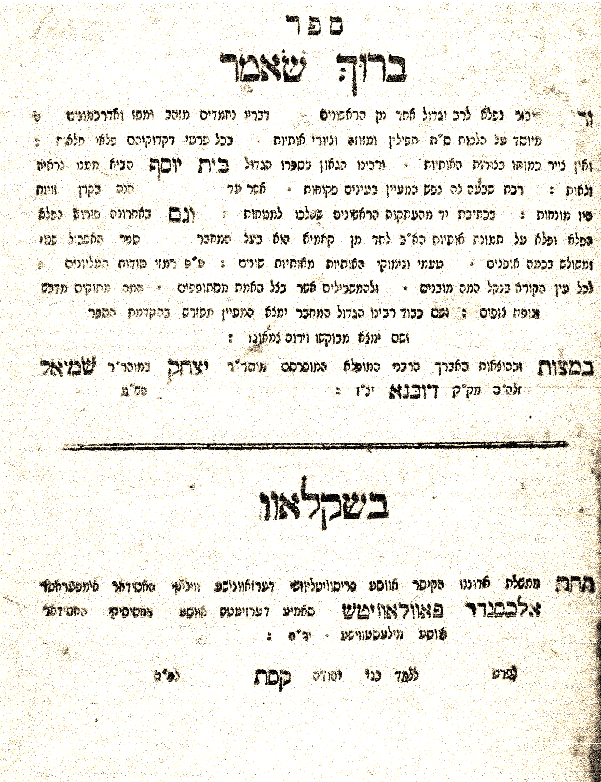
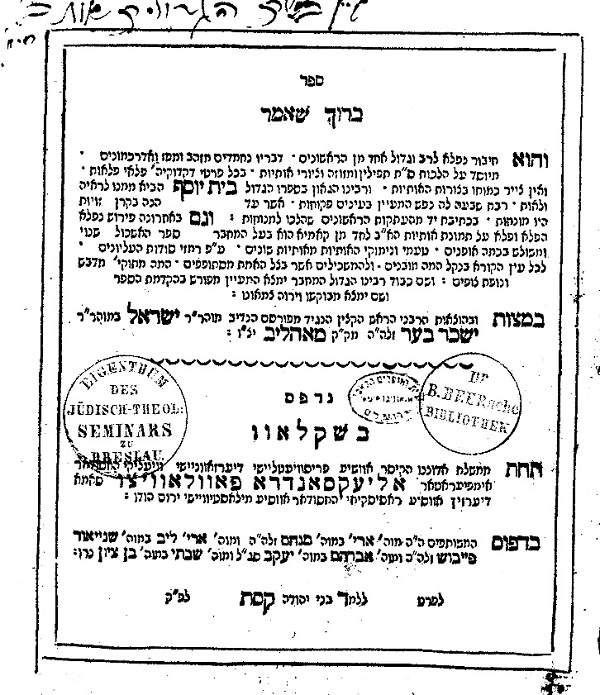
All of this is reflected in Hannover’s itinerant life and, as the chronicler of these events, in his Yeven Mezulah. Nevertheless Hannover’s first published work, Ta’amei Sukkah, is quite different. Based on a sermon delivered in Cracow in 1646 it was published in Amsterdam in 1652 at the press of Samuel bar Moses and Reuben bar Eliakim. In format it is a medium quarto (40: 12 ff.).[12] Samuel bar Moses ha-Levi was, together with Judah [Leib] ben Mordecai ben Mordecai [Gimpel] of Posen, the first Ashkenazi printers in Amsterdam. After their partnership ended in 1651, Samuel ben Moses continued to publish for a brief period in partnership with Reuben ben Eliakim of Mainz. Among their publications is Ta’amei Sukkah.
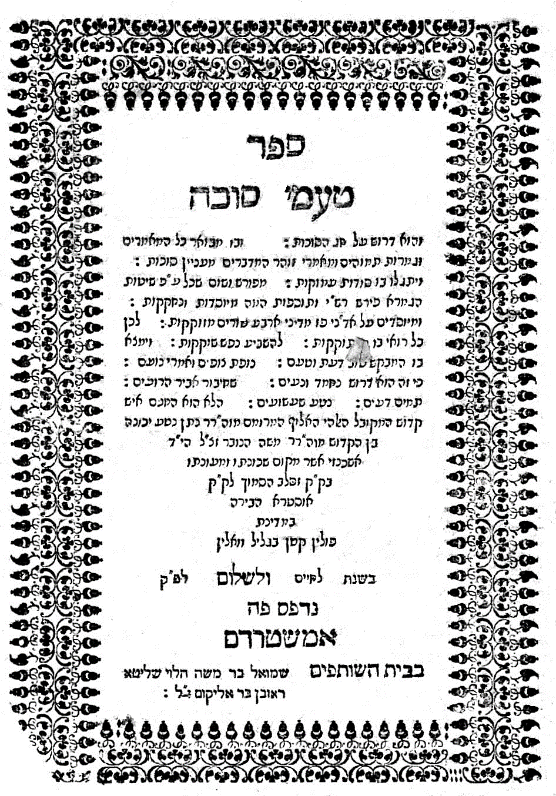
 
As the title-page makes clear, Ta’amei Sukkah is a discourse on the festival of Sukkot, explaining Talmudic statements by way of esoteric allusions. The title-page states that in the discourse,
are explained all of the hard-to-understand sayings and Talmudic adages, and the accounts in the Zohar related to Sukkot. In it are revealed deep esoterica, explained and made intelligible according to and based on the Talmud, Rashi, and Tosafot and; “set upon sockets of fine gold” (Song of Songs 5:15). . . . to satisfy the soul’s yearning. In it the seeker will find “good judgment and knowledge” (cf. Psalms 119:66), “the honeycomb” and “pleasant words” (Psalms 19:11, Proverbs 15:26, 16:24), for this is a treasured and desirable discourse. . . .
The title page is dated “to life and to peace ולשלום” (412 = 1652″; the colophon dates completion of the work to the month Menahem (Av) Zion and Israel “And this is the Torah וזאת התורה אשר (412 = July/August 1652) which Moses set before the people of Israel” (Deuteronomy 4:44). Hannover’s introduction (1b) follows. He emphasizes his youth and informs that he has written discourses on the entire Torah and festivals, entitled Neta Sha’ashu’im because it contains his name.
Lack of funds have prevented Hannover from publishing the entire work; therefore, at this time he is printing this discourse only, delivered in Cracow in 1646. Hannover’s plaint that due to a lack of funds he has been unable to publish the entire book and at this time is printing one discourse only, really just a pamphlet, that is, Ta’amei Sukkah, is not unique. Indeed, what makes Hannover different from other authors with like difficulties is that in contrast to the other authors, who are printing medium excerpts of their works in hopes of finding a patron to support publication of the larger tome, those authors are today unknown except for their medium works. Hannover, in contrast is relatively well known, if only because of his other published titles.[13]
Hannover entitles this discourse Ta’amei Sukkah because it is on Sukkah and the arba’ah minim; it explains wondrous midrashim and sayings in the Zohar and Talmud relating to Sukkot; and furthermore, the numerical value of Ta’amei טעמי (129) equals his name Nata נטע (129). The text follows, set in two columns in rabbinic type with leaders in square letters. Ta’amei Sukkah is a multi-faceted work with kabbalistic and midrashic content. Within the text are several headings in which Hannover notes that, based on the prior section, he will now explain a Midrash RabbahZohar, or other work, such as the Alshekh. At the end of Ta’amei Sukkah, after the colophon is a tail-piece, the bear pressmark.[14] Ta’amei Sukkah has been reprinted once, in Podgorze (1902).
III
The following year, continuing his peripatetic movements, Hannover was in Venice where he published Yeven Mezulah, his detailed chronicle of the horrific experiences of Polish Jewry during the Chmielnicki massacres of 1648-49 (tah ve-tat) in which, according to contemporary sources, as many as several hundred thousand Jews were murdered and hundreds of communities destroyed.[15] This, the first edition of Yeven Mezulah, is based on first person accounts taken from oral testimony and other contemporary works. It was printed at the Vendramin press in 1653, also in quarto format (40: 24 ff.). Founded in 1630 by Giovanni Vendramin this press, broke the monopoly enjoyed until then by Bragadin. For the first ten years the press operated under the name of its founder, but after his death it became known by the names Commissaria Vendramina and Stamparia Vendramina. The press eventually joined with that of Bragadin and the combined presses continued to operate well into the eighteenth century.[16]
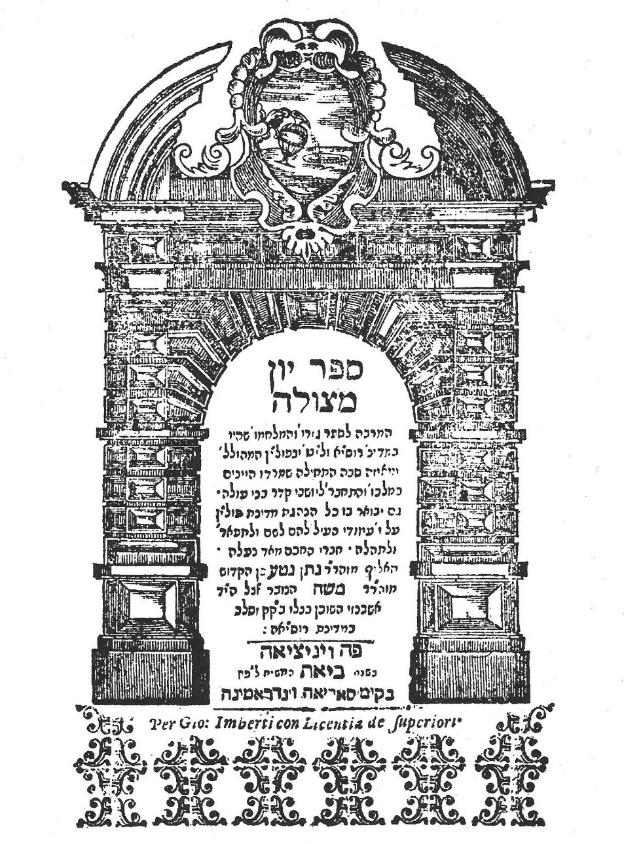
The title is from, “[I sink in] deep mire (yeven mezulah), [where there is no standing; I have come into deep waters, and the flood sweeps over me]” (Psalms 69:3). The title page, which has an architectural frame and is dated “coming ביאת (413 = 1653) of the Messiah,” states that it comes to relate the decrees and wars in the lands of Russia, Lithuania, and Poland. There is an introduction from Hannover, which begins,
I am the man who has seen affliction by the rod of his wrath” (Lamentations 3:1), when the Lord smote His people Israel, His first born. He cast down from Heaven to Earth His glory, the land of Poland, His delight. “Beautiful for situation, the joy of the whole earth” (Psalms 48:3) “The Lord has swallowed all the habitations of Jacob without pity” (Lamentations 2:2) “the lot of his inheritance” (Deuteronomy 3 2:9) “and remembered not his footstool in the day of his anger!” (Lamentations 2:1). All of this was foreseen by King David )may he rest in peace( when he prophesied the joining of the Kadarim (Tartars) and the Greeks to destroy Israel His chosen people in the year זאת (408 = 1648).
Hannover has entitled the work Yeven Mezulah because the events that transpired it are alluded to in Psalms. Also, yeven (yavanim – Greeks) refers to the Ukrainians, who belonged to the Greek Orthodox Church. Hannover writes that he has recorded both major and minor occurrences, all the decrees and persecutions, and their dates, so that families can calculate when their relatives perished. He also describes the customs of Polish Jewry, their religious devotion, based upon the pillars that support the world (ref. Avot 1:2, 18), and notes the high level of Torah scholarship, unmatched elsewhere. Yeven Mezulah has been described as “a complex work that recounts not only the cruel fate of Ukrainian Jewry, but also the socioeconomic and political factors that led up to the rebellion. . . . it is noteworthy that he is able to give details of various political and military developments within the Polish camp.”[17]
The introduction concludes with a request that the book be purchased to enable him to publish Neta Sha’ashu’im, a work that, as noted above, was never published. It then records in detail the tribulations that befell Eastern European Jewry, concluding with a description of the inner life of the Jews, how they lived in accordance with the pillars of Torah, Divine Service, charity, truth, justice, and peace, set forth in AvotYeven Mezulah is organized by community, describing what befell them, excepting an intermediate section on Chmielnicki. Two examples, the first a description of what occurred in 1Nemirow, relating how Chmielnicki and his followers gained entry by the ruse of flying Polish flags and thus passing themselves off as a relief force.
The people of the city were fully aware of this trickery, and nevertheless called to the Jews in the fortress: “Open the gate. This is a Polish army which has come to save you from the hands of your enemies . . . No sooner had the gates been opened than the Cossacks entered with drawn swords, and the townspeople too, armed with spears and scythes, and some only with clubs, and they killed the Jews in large numbers. Women and young girls were ravished, but some of the women and maidens jumped into the moat surrounding the fortress in order that the uncircumcised should not defile them. . . . but the Ukrainians swam after them with their swords and their scythes, and killed them in the water. Some of the enemy shot with their guns into the water, and killed them till the water became red with the blood of the slain. . . . The number of the slain and drowned in the holy community of Nemirow was about six thousand. They perished by all sorts of terrible deaths. . . . May God avenge their blood.
The second example, concerns R. Samson Ostropoler of Polonnoye (Volhynia), and his community,
Among them was a wise and understanding divinely inspired Kabbalist whose name was, Our Teacher and Master Rabbi Samson of the holy community of Ostropole. An angel would appear to him every day to teach him the mysteries of the Torah. . . . He preached frequently in the synagogue and exhorted the people to repent so that the evil would not come to pass. Accordingly all the communities repented sincerely but it did not avail, for the evil decree had already been sealed.
When the enemies and oppressors invaded the city, the above mentioned mystic and three hundred of the most prominent citizens, all dressed in shrouds, with prayer shawls over their heads, entered the synagogue and engaged in fervent prayer. When the enemies arrived they killed all of them upon the sacred ground of the synagogue, may God avenge their blood. Many hundreds who managed to survive were forced to change their faith and many hundreds were taken captive by the Tartars.[18]
A critical view of Yeven Mezulah is expressed by Edward Fram who writes that Hannover, in describing the massacre of Jews in Tulczyn, copied from other works, particularly Zok ha-Ittim, at times paraphrased those works, and “in some instances he took events said to have happened elsewhere and wove them into his own tale of Tulczyn,” without acknowledging his debt, melding them into his own tale of the massacre in Tulczyn. Fram suggests that Hannover did so because Zok ha-Ittim was not compelling enough to emphasize Jewish martyrdom and “place 1648 in the tradition of past tragedies, [therefore] a more resolute image of martyrdom would be necessary.”[19]
Nevertheless, Yeven Mezulah is regarded as the classic and most important work on tah ve-tat and has been frequently reprinted as well as having been translated into Yiddish, French, German, Russian, Polish, and English.
IV
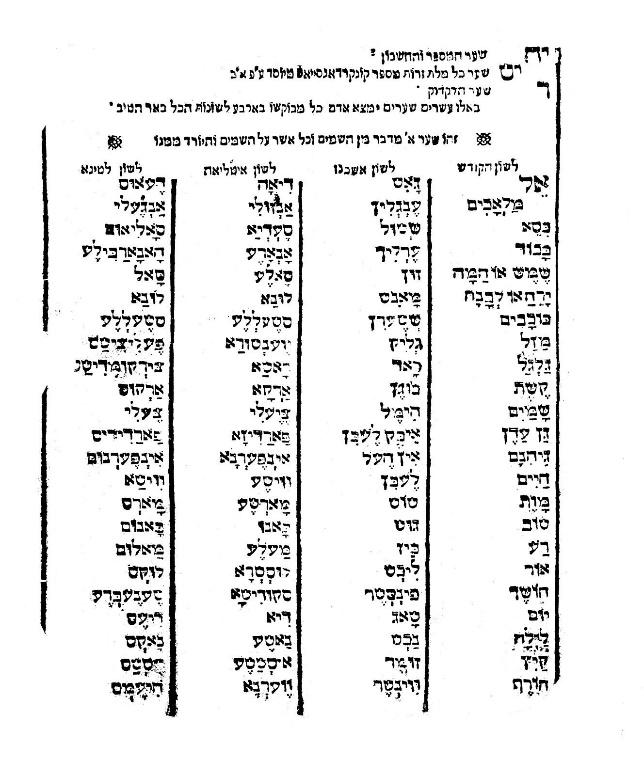
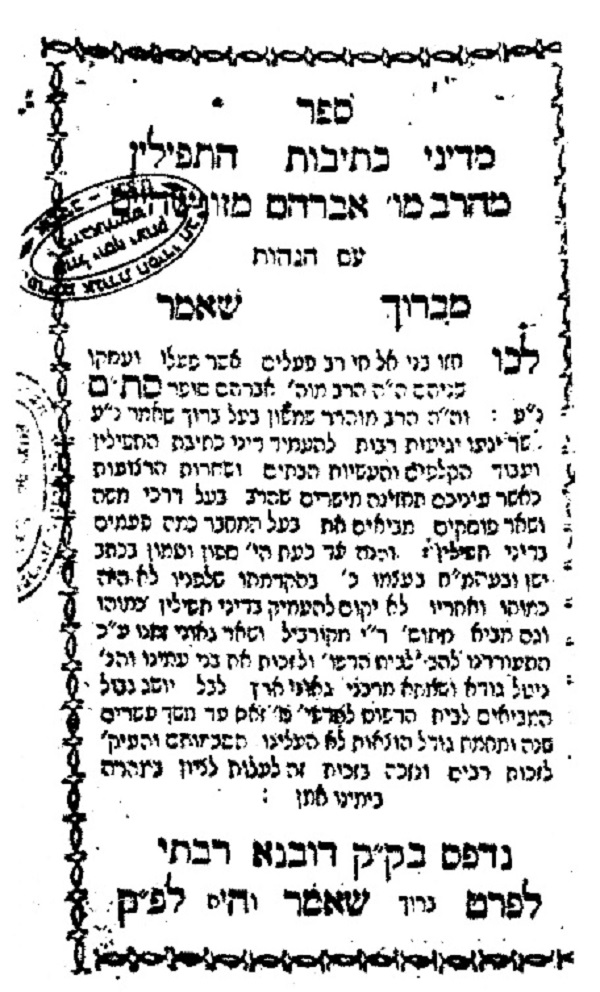
We next, in terms of Hannover’s publications, find him in Prague, where he published Safah Berurah, a popular four language, Hebrew-German-Latin-Italian, glossary for conversation and as a guidebook for travelers. Printed at the renowned press of the Benei Jacob Bak, opened as early as 1605. Safah Berurah is a medium format book (80: [44] ff.). The title is from, “For then I will convert the peoples to a clear language (safah berurah)” (Zephaniah 3:9). The title page states,
Behold, and see” (Lamentations 1:12) this new thing that was not before. The holy tongue (Hebrew), Ashkenaz, Italian, and Latin spread out flawlessly. It is good for women and men, the aged and elderly, adolescents and young, teacher and businessmen and also before the uneducated, who travel through all lands, “And you shall teach them to your children, speaking of them, so that your days may be multiplied” (cf. Deuteronomy 11:19,-21), and in this merit may He send to our Messiah speedily in our day. Amen Selah.
The Lord grant us the merit to come soon to the holy land הקדושה (420 = 1660).
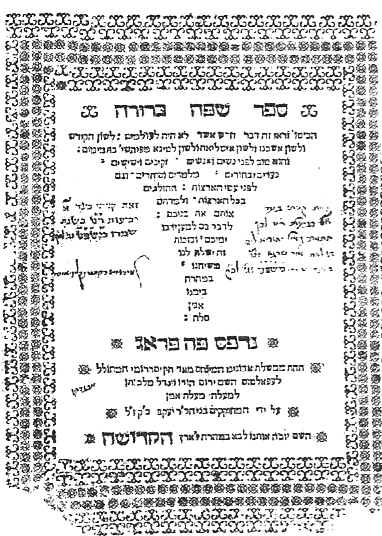
 
The introduction follows, in which Hannover repeats the description of the book from the title-page and adds that it is based on the words in the Torah, the twenty-four books of the Bible, and some words from the six Sedorim (Mishnayot). He follows “after the reapers” (Ruth 2:7), gleaning every strange word in the sheaf: from concordances, Mirkevet ha-Mishneh, and commentaries.[20] Safah Berurah is so entitled because from this straightforward work all four languages will be pure and clear. In the second paragraph, in a mediumer font, Hannover explains the structure of the work, and that the Ashkenaz is not, with rare exception, that of the gentiles but of the Jews (Yiddish), but that the Latin is of the highest order, in order to be able to speak before kings and nobles.
This is followed by a list of the twenty she’arim that make up Safah Berurah, that is, the divisions of the book, which is not alphabetic but by subject. This arrangement was apparently followed because Hannover believed that it would be more convenient for conversation to be able to locate words related by subject. The first two she’arim include terms dealing with the Divine and Torah; the next three with earthly objects; six through nine, fish, birds, animals and humans; continuing with material objects; such as clothing, jewelry, metal, arms, tools, nations, including proper forms of address, business, arithmetic, calendar, and grammar.
The approximately 2,000 words comprising the text follow, in four columns, from right to left, of Hebrew, Ashkenaz, Italian, and Latin, all in square vocalized Hebrew letters. At the end of the book are errata by language and a colophon in which Hannover thanks Gabriel Blanis and Jacob Szebrsziner for their assistance with the Italian and Latin, and notes that it was necessary to reduce the size of the glossary due to conditions in Poland, where there are no buyers.[21]
Safah Berurah has also been republished several times, beginning with an edition prepared by Jacob Koppel ben Wolf that included French at the press of Moses ben Abraham Mendes Coitinho (Amsterdam, 1701), and even an edition with Greek and Turkish (lacking place and date.[22]
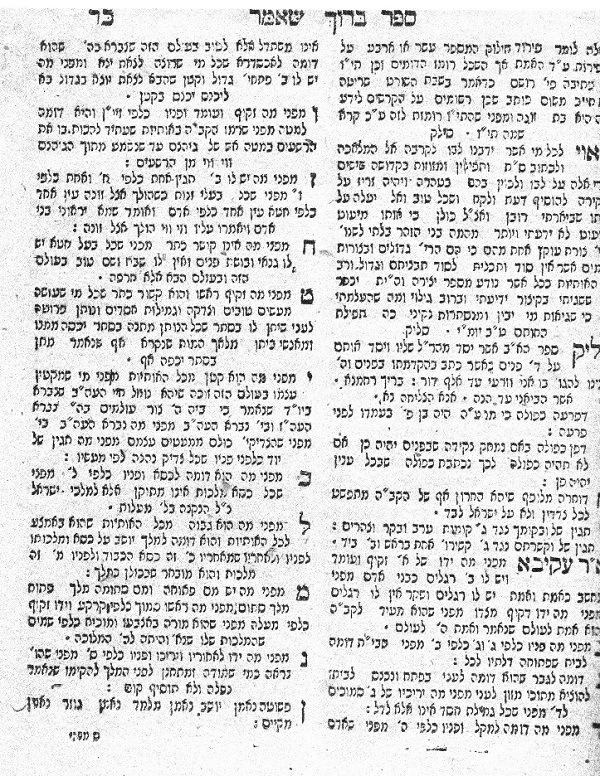
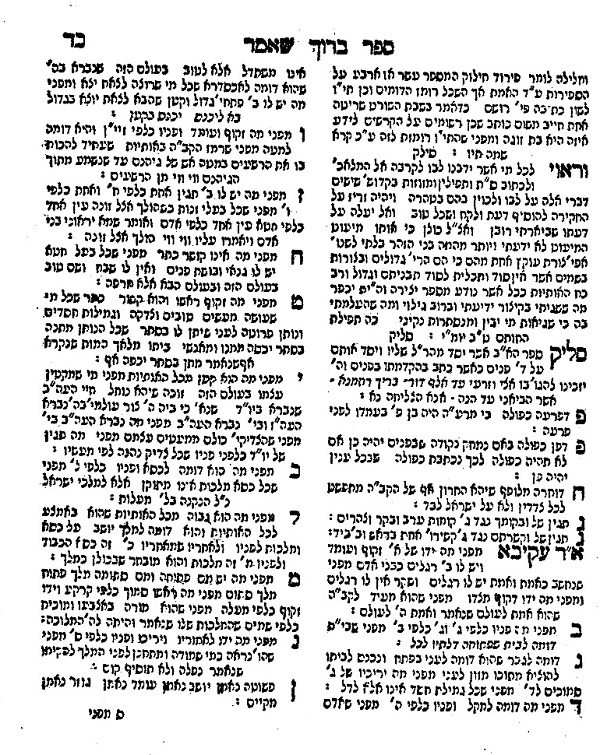
Sha’arei Ziyyon, Hannover’s, last published title, is a collection of Lurianic kabbalistic prayers, particularly for Tikkun Hazot (midnight prayers). First printed in Prague in the year “The trees of the Lord have their fill; the cedars of Lebanon, which he has planted ישבעו עצי י’י ארזי לבנון אשר נטע (422= 1662)” (Psalms 104:16), also at the press of Benei Jacob Bak. Sha’arei Ziyyon is a medium work set in octavo format (80: [38] ff.). The title is from “The Lord loves the gates of Zion (sha’arei Ziyyon) more than all the dwellings of Jacob” (Psalms 87:2).
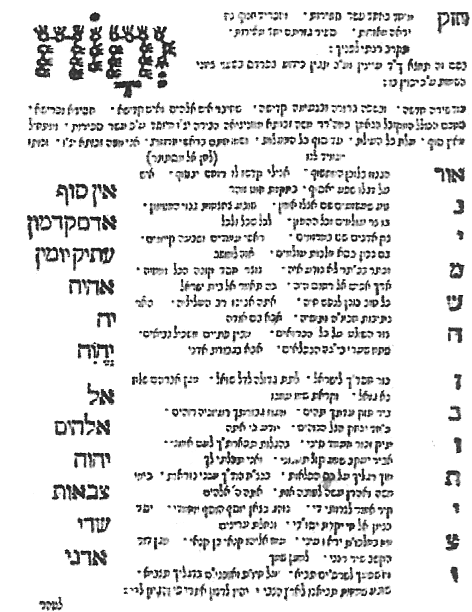
The following text and images are from the Amsterdam 1671 edition, published by Uri Phoebus ben Aaron ha-Levi in quarto in format (40: 54 ff.). Similar but not identical to the earlier Prague printing this edition is dated Rosh Hodesh Sivan 431 (Sunday, May 10, 1671). The title-page has an architectural frame with an eagle at the apex surrounds the text.[23] The text states,
These are the words of Kabbalah according to the scribes and according to the texts, Sefer Etz Hayyim, those who taste it merit life, written by the foremost student of the Godly rav, R. Isaac Luria, that is, R. Hayyim Vital. After him rose up students of his students and wrote this work (Sha’arei Ziyyon) . . .
The author sent his brother R. Mordecai Gumpricht ben Moses with many additional prayers and supplications, as can be seen . . .
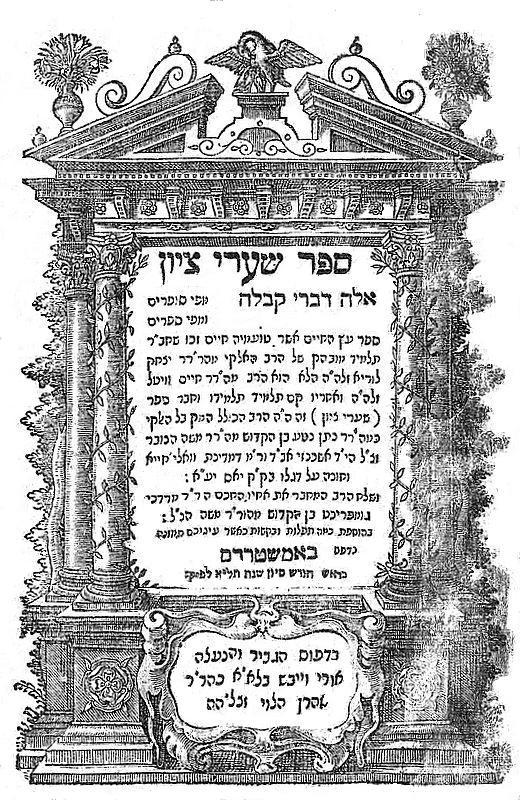
The title-page is followed by the approbations reprinted from the first Prague edition, from R. Nahman ben Meir Kohen of Keremenec, R. Samuel ben Meir of Ostrow, and R. Israel ben Aaron Benzion of Satanow. They are followed by Hannover’s introduction, which concludes with a description of the seven sha’arim comprising Sha’arei ZiyyonTikkun Hazot based on R. Hayyim Vital’s Etz ha-HayyimTikkun ha-Nefesh, to be said after Tikkun Hazot with Yedid NefeshTikkun ha-Tefillah according to Kabbalah; Tikkun Kriat ha-TorahTikkun Kriat Shema with the appropriate kavvanotTikkun shel Erev Rosh Hodesh; and Tikkun Malkhut on Rosh Ha-Shanah and Yom ha-Kippurim.
Text is in a single column in rabbinic type, with headers, initial phrases, and some limited text in square letters. The volume concludes with an epilogue dating the conclusion of the work to “half of (15) Kislev, ‘And he shall judge the world תבל (Tuesday, November 17, 1671) in righteousness’ (Psalms 9:9) and compassion.” Printing was supervised by Mordecai Gumpricht ben Moses, Hannover’s brother.[24]
Sha’arei Ziyyon is primarily a compilation of existing prayers assembled into one work. Prayers such as Ribbono shel Olam, recited today prior to the removal of the Torah from the Ark by R. Jeremiah of Wertheim and the Yehi Ratzon after the priestly blessing are taken from Sha’arei Ziyyon. This edition, as stated on the title-page, is much expanded from the first edition (80 38 ff.). It contains additional prayers, piyyutim, and supplications, some of considerable length, among them prayers for someone incarcerated, for those who are ill, and has verse for the dedication of a new Torah scroll in the synagogue.[25]
Gershom Scholem, in describing the influence of Kabbalah on Jewish life writes that one of the areas in which it had the greatest influence was prayer. Among the most influential books in this sphere was Sha’arei Ziyyon in which Lurianic doctrines “of man’s mission on earth, his connections with the power of the upper worlds, the transmigrations of his soul, and his striving to achieve tikkun were woven into prayers that could be appreciated and understood by everyone, or that at least could arouse everyone’s imagination and emotion.”[26]
The popularity of Sha’arei Ziyyon is such that it has been described by Sylvie-Anne Goldberg as “one of the most widely read books in the Jewish world.”[27] Indeed, Sha’arei Ziyyon was reprinted in Prague three times in the seventeenth century (1682, 1688, 1692), and three additional times within a decade, in Dyhernfurth ([1689]), Wilhermsdorf (1690) and Dessau (1698). The Bet Eked Sefarim enumerates fifty-four editions through 1917.[28]
Hannover’s life reflects the times in which he lived, both in the adversity and travail he faced but also in how he overcame them. Just as the Jews of mid-seventeenth century Europe had their lives uprooted but survived to rebuild thriving communities so too Hannover’s accomplishments stand out. Not only did he both live and survive to chronicle the struggles and turmoil of gezerot tah ve-tat in Yeven Metzulah but he also wrote such varied books as Safah Berurah, a lexicography, and Sha’arei Ziyyon, a liturgical work, all three important and much reprinted titles. In addition, Hannover was the author of Neta Sha’ashu’im, noted above; Neṭa Ne’eman, a Kabbalistic work; a discourse on Purim, extant in manuscript, and a commentary on Otiyyot de-Rabbi Akiva, no longer extant. In addition to the printed editions of his books Hannover’s works were sufficiently popular that they were often copied by hand and numerous manuscripts of his works are extant. KTIV, the International Collection of Digitized Hebrew Manuscripts records twenty-six entries under Nathan Hannover, the most popular being by far being Sha’arei Ziyyon.[29]
Despite experiencing suffering and tragedy, Nathan Nata Hannover survived to live a life of meaning and leave us a legacy of value. Yeven Metzulah concludes that the Jews who escaped from the swords of their enemies were treated with kindness in Moravia, Austria, Bohemia, Italy, and especially Germany, given food, drink, lodging, garments, and gifts “each according to his importance,”
May their justice appear before God to shield them and all Israel wherever they are congregated, so that Israel may dwell in peace and tranquility in their habitations. May their merit be counted for us and for our children, that the Lord should hearken to our cries and gather our dispersed from the four corners of the earth, and send us our righteous Messiah, speedily in our day. Amen, Selah..
 
Seforim Blog Editors’ note:
 
For more sources on the significance of the work Sha’arei Ziyyon see Eliezer Brodt’s post on the Seforim Blog here specifically the section headed שערי ציון. Footnote 33 has some more current Hebrew literature on the sefer, and also of interest is the appendix where Brodt has a whole new look at  the relationship between this work and the Magen Avraham.
 
In addition, it’s worth noting that a beautiful new edition of the Sha’arei Ziyyon was printed in 2012 based on the first edition, and the volume includes his Ta’amei Sukkah. The Yeven Mezulah also has also been reprinted a few times in recent years.
[1] I would like to express my appreciation to Eli Genauer for reading the article and his comments. Images are courtesy of the Library of Congress, the Jewish National and University Library, the Valmadonna Trust Library, Ozar ha-Hochmah, and of Virtual Judaica.
[2] Ḥananel Nepi, Mordecai Samuel Ghirondi, Toledot Gedolei Yisrael (Trieste, 1853), p. 270 [Hebrew]; Moritz Steinschneider, Catalogus Liborium Hebraeorum in Bibliotheca Bodleiana (CB, Berlin, 1852-60), col. 2044; and William B. Helmreich, forward to Nathan Nata Hannover, Abyss of Despair (Yeven Metzulah), translator Abraham J. Mesch, (New York, 1950; reprint, New Brunswick, London, 1983), pp. 13-15; Israel Zinberg, A History of Jewish Literature IV (New York, 1975), translated by Bernard Martin, pp. 122-23.
[3] Hersh Goldwurm, ed. The Early Acharonim (Brooklyn, 1989), p. 194; Mordechai Margalioth, ed., Encyclopedia of Great Men in Israel IV (Tel Aviv, 1986), cols. 1181-82 [Hebrew].
[4] David B. Ruderman, Early Modern Jewry: A New Cultural History (Princeton, N. J., 2011), pp. 41, 51.
[5] Bernard D. Weinryb, The Jews of Poland; a Social and Economic History of the Jewish Community in Poland from 1100 to 1800 (Philadelphia, 1972), p. 166.
[6] Salo Wittmayer Baron, A social and religious history of the Jews XVI (Philadelphia, 1976), p. 98.
[7] Shmuel Ettinger, “Chmielnicki (Khmelnitski), Bogdan,” Encyclopaedia Judaica, edited by Michael Berenbaum and Fred Skolnik, vol. 4 (2007), pp. 654-656.
[8] Zinberg, p. 122.
[9] Shaul Stampfer, “What Actually Happened to the Jews of Ukraine in 1648?” Jewish History, 17:2 (2003), pp. 221-222.
[10] Jonathon Israel, European Jewry in the Age of Mercantilism 1550-1750 (London ; Portland, Or, 1998) p. 99.
[11] Simha Assaf, “The Inner Life of Polish Jewry (Prior to the Period of the Haskalah” Be-Ohole Yaʻaḳov: Peraḳim me-hHaye ha-Tarbut shel ha-Yehudim bi-Yeme ha-Benayim (Jerusalem, 1943), p. 80 [Hebrew].
[12] L. Fuks and R. G. Fuks Mansfeld, Hebrew Typography in the Northern Netherlands 1585 – 1815 (Leiden, 1984-87), I p. 197 no. 275.
[13]  Concerning such medium books published as a prospectus see my “Books not Printed, Dreams not Realized,” in Further Studies in the Making of the Early Hebrew Book (Brill, Leiden/Boston, 2013), pp. 285-303.
[14] Concerning the varied usage of the bear pressmark see my “The Bear Motif on Eighteenth Century Hebrew Books” The Papers of the Bibliographical Society of America 102:3 (New York, N. Y., 2008), pp. 341-61, reprinted in Further Studies, pp. 57-76.
[15] Other contemporary works describing the horrors of tah ve-tat are R. Samuel Feivush ben Nathan Feitel’s Tit ha-Yaven (Venice, c. 1650), R. Meir ben Samuel of Shcherbreshin’s Zok ha-Ittim (Cracow, 1650), and R. Jacob ben ha-kodesh (the holy, suggesting that he was among the murdered) Simeon of Tomashov’s Ohel Ya’akov (Venice, 1662). The latter writing ““Light became darkness” (Job 18:6) for me, for they killed my wife and three sons, “and I lived in the land of Nod” (cf. Genesis 4:16) until 1656. In that year arose grievous troubles, old and also new, and I came uponmidat ha-din (strict justice) and “Disaster upon disaster” (Ezekiel 7:26), plunder after plunder, until finally I encountered pestilence, sword, famine, and captivity and every day was worse than before. Also to be noted are selihot commemorating tah ve-tat (1648-19) such as R. Gabriel ben Joshua Heschel Schlussburg’s Petah Teshuvah ([1651], Amsterdam) selihot and lamentation on the Jews massacred in tah ve-tat (written as a commentary on the book of Lamentations and R. Shabbetai ben Meir ha-Kohen (Shah)’s Selihot ve-Kinnot (Megillat Eifah, 1651, Amsterdam).
[16] David Amram, The Makers of Hebrew Books in Italy (Philadelphia, 1909, reprint London, 1963), p. 372; Joshua Bloch, “Venetian Printers of Hebrew Books,” in Hebrew Printing and Bibliography (New York, 1976), p. 86.

[17] Adam Teller, “Hannover, Natan Note,” YIVO Encyclopedia of Jews in Eastern Europe 1 (New Haven & London, 2008), p. 656.

[18] Both translations are from Mesch, pp. 51, 63-64 respectively.
[19] Edward Fram, “Creating a Tale of Martyrdom in Tulczyn, 1648,” Jewish History and Jewish MemoryEssays in Honor of Yosef Hayim Yerushalmi, ed. Elisheva Carlebach, John M. Efron, David N. Myers (Hanover, 1998), pp. 90-91.
[20] Mirkevet ha-Mishneh (Cracow, 1534), by Asher Anshel of Cracow, is a concordance and glossary of the Bible. Published by Samuel, Asher, and Elyakim, sons of Hayyim Halicz, it was the first Yiddish book printed in Poland. Concerning Mirkevet ha-Mishneh see Marvin J. Heller, The Sixteenth Century Hebrew Book: An Abridged Thesaurus I (Brill, Leiden, 2004), pp. 216-17.
[21] Shimeon Brisman, History and Guide to Judaic Dictionaries and Concordances (Hoboken, 2000), pp. 44-46.
[22] Ch. B. Friedberg, Bet Eked Sepharim, (Israel, n.d.), shin 2223 [Hebrew].
[23] “The Eagle Motif on 16th and 17th Century Hebrew Books,” Printing History, NS 17 (Syracuse, 2015), pp. 16-40.
[24] Fuks and R. G. Fuks Mansfeld, II pp. 263-64 no. 32.
[25] A. Z. Idelsohn, Jewish Liturgy and Its Development (1932, reprint New York, 1995), pp. 55, 80, 259.
[26] Gershom Scholem, Kabbalah (NewYork, 1973), p. 193.
[27] Sylvie-Anne Goldberg, Crossing the JabbokIllness and death in Ashkenazi Judaism in Sixteenth through Ninteenth-Century Prague (Berkeley, 1996), p. 88.
[28] Friedberg, Bet Eked Sepharimshin 2148.
[29] I would like to thank Eli Genauer for bringing this to my attention. The address for KTIV is http://web.nli.org.il/sites/nlis/en/manuscript.


The Image of the Menorah in the Early Printed Hebrew Book

The Image of the Menorah in the Early Printed Hebrew Book

By Dan Rabinowitz

The menorah is one of the most recognizable Jewish symbols. Today it has been adopted by the State of Israel as her official symbol, and throughout history there are numerous examples of its use. Coins, headstones, paintings and synagogue walls etchings, lamps, mosaics, manuscripts, and books, all provide examples of the widespread usage and mediums. Many of these examples have been addressed by scholars, but there is a lacuna regarding the depiction of the menorah in the Hebrew book.[1]

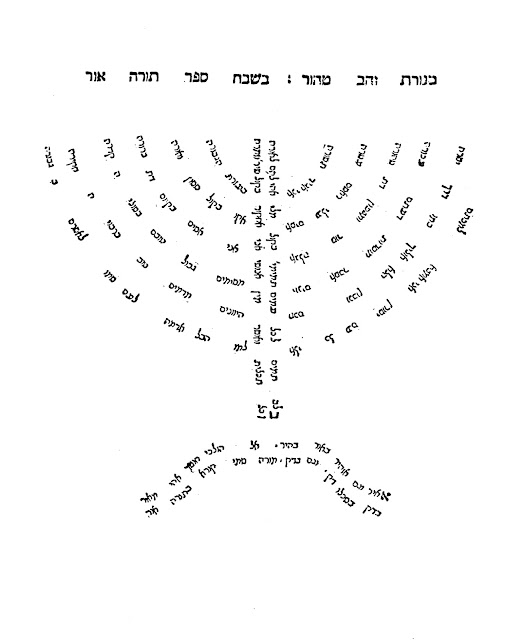
Despite that it is one of the most recognizable and ubiquitous symbols, the image of the menorah barely makes an appearance on Hebrew books. The first appearance of the menorah in a Hebrew book was Yosef Yikhya’s, Torah Or, Bologna, 1538. There is appears on the verso of the titlepage. The menorah is created via micrography and extols the value of the work. The designer even correctly places the menorah on a stand (and not a solid base as shown in the Arch of Titus). [2] 

From the inception of printing, Hebrew printers, like others, created and populated their works with their unique marks. These symbols served advertising for the publisher. Perhaps the only other symbol with such wide resonance and connection to the Jews as the Menorah is the star of David. There are over 200 printers’ marks, or emblems, close to 20 examples of the Magen David, and multiple appearances of other Jewish symbols, lions, David, Solomon, eagles, but two only of a menorah. [3]

Meir ben Jacob Parenzo, (aka Parentio, Parintz, or Maggius Parentinus), operated in Venice from 1545 until his death in 1575. He apprenticed in Daniel Bomberg’s printing shop, and in 1545 he began working for the Venetian printer, Cornelio Adelkind. Although most of his career was in the service of others, he did publish a handful of books on his own. He did not own a press and likely used Bomberg’s Press. All of these books bear Parenzo’s printers mark, a menorah. Whatever ambiguity there is about his surname, his personal name, Meir, alludes to lighting, thus a natural connection to the menorah. On either side of the menorah, “This is Meir’s menorah, he is the son of Yaakov Parenzo.”

Parnezo’s mark comprises around half of the title page. This grotesque design was called out for being unique among his contemporaries, but that it was “a pathetic bid for immortality.” As a measure of divine justice, according one scholar of Hebrew Italian printing, that “Meir Parenzo, notwithstanding his hope for immortality, is completely forgotten except for a small circle of Hebrew bibliographers, who, although conscious that the individual contributions of the men they commemorate are negligible in the great current of human affairs as it flows majestically down through the ages, nevertheless handing down (or transmitting) the knowledge of the existence of so many faithful men who have contributed their share to the enlightenment of the world.” [4] 

Another printer, also a Meir, incorporated the menorah into his mark, although on a much smaller scale. Meir ben Yaakob Ibn Ya’ir, here too, the surname, Ibn Ya’ir, references light. The menorah appears inside a border, flanked by olive trees surrounded by four verses, all mentioning either oil or light. Meir was active between 1552 and 1555. He published a few books abridged books on the laws of shehitah, as well as a work on Hebrew grammar, all exceedingly rare. [5]

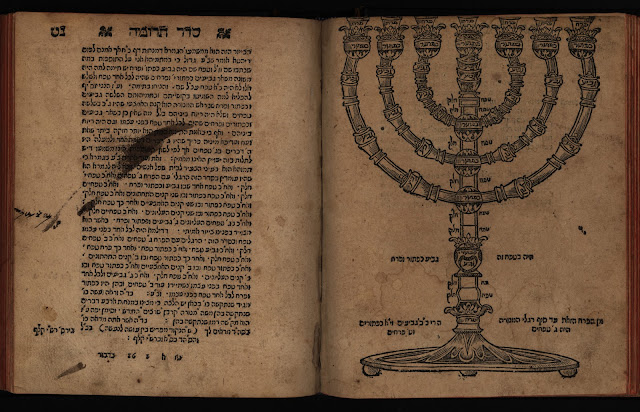
The menorah next makes an appearance in Moshe Cordovero’s, (1522-1570), first book, Pardes Rimonim. This illustration is not of the biblical menorah, rather it is a kabbalistic representation of the sefirot overlaid on the menorah frame. This illustration was printed in most subsequent editions of Pardes Rimonim, although not as an exact reprint of the first edition.

The first illustration of the menorah that was an attempt to depict and elucidate complexities of the biblical menorah only occurred in 1593. There were two books that include the illustration, Biurim and Omek Halakha.

R. Yaakov ben Shmuel Bunim Koppelman, (1555-1594) studied with R. Mordechai Jaffe, author of the Levush. In addition to traditional subjects, he was also well-versed in (my astronomy and mathematics. He published Omek Halakha in Cracow, 1593, a commentary on the Talmud. This slim volume of just 95 pages, is rich in illustrations, which appear on nearly every page. For example, there is a thirteen page an in-depth discussion of astrology with two full page diagrams of the lunar paths and many of the other pages include multiple illustrations. Koppelman includes a detailed diagram of the menorah with an accompanying commentary. [6]

The Biurim on Rashi was published in 1593 in Venice and attributed to R. Nathan Shapira. Shapira had died in 1577; his work includes three illustrations, the menorah, a map of Israel, and a diagram of how the spies carried the large bunch of grapes. This is the first Hebrew book to contain a map.

The book is one of the handful of examples of literary forgeries in Hebrew books. R. Shapira’s son, Yitzhak, published his father’s comments on Rashi in 1597 in a work titled Imrei Shefer. In the introduction he explains why there are two books that are attributed to his father on the same topic published within a few years of one another.

ואתם קדושי עליון אל תתמהו על החפץ שזה שתנים ימים יצא בדפוס איזה ביאורים הנקראים על שם הגאון אדוני אבי ז”ל, כי המציאוהו אנשים, אנשי בלי עול מלכות שמים, חיבור אשר מצאו, ומי יודע המחבר אם נער כתבו ורצו לתלותו באילן גדול אדני אבי ז”ל, חלילה לפה קדוש להוציא מפיו דברים אשר אין בהם ממש, כי הכל תוהו ובוהו ומזויף מתוכו, כלו עלו קמשונים כסו פניו חרולים. וכאשר הגיעו הספרים ההם בגלילות אלו הכרוז בהסכמת כל רבני ורשאי המדינות שלא ומכרו ויהיו בבל יראה ובבבל ימצא בכל ארצות אלו. ואשר קנו מהם יחזר להם המעות ולא ימצא בביתך עולה

[“Do not wonder why I am publishing what was published just two years ago, the Biurim, in my father’s name. As wicked people, people who found a book, a book which may have been written by a child. However, they wanted to use my father’s good name to publish their work. But, my father would never say such stupidities which appear in that book, their book is worthless and a forgery. When this was discovered all the Rabbis agreed that this book [Biurim] should be under a ban, no one should be allowed to keep it. Whomever purchased it should have their money returned, they should not allow a stumbling block into their home.”]

According to R. Shapiro’s son, the Biurim, is illicitly associated with his father. His son was not the only one to question the authenticity of the Biurim. R. Yissachar Bear Ellenburg in his Be’er Sheva and in his Tzedah L’Derekh states unequivocally that R. Shapiro did not write the Biurim.

The diagram of the menorah does not appear in Imrei Shefer. [7]

The diagram of the menorah appears in Yosef Da’at printed in Prague in 1609 by Rabbi Yosef ben Issachar Miklish (1580 -1654). He was a student of the Maharal of Prague and of Rabbi Ephraim Lonchitz, the author of the Klai Yakar. The purpose of the book was to correct errors in Rashi’s commentary. He used a 14th century manuscript to make those corrections. To better facilitate studying Rashi, the book includes illustrations including the menorah. This a full page with detailed descriptions of each part of the menorah. Interestingly, the base seems to combine two different approaches, one that has three legs and the other with a solid base. Miklish reproduces a solid base on top of three legs.

In 1656/57 Yalkut Shimoni with the commentary of Berit Avraham was published in Livorno, Italy. This one includes a menorah created via micrography, but unlike the others that appear at the front of the books, this one appears at the end. It is a colophon.

A unique example of the menorah appears in the 1684 edition of the Humash. It is the sole illustration on the title page. When the menorah appears on the title page, it is almost always in conjunction with other vessels or other symbols. This is perhaps the only instance of a stand-alone menorah on a title page.

The next appearance is the first time it illustrated a titlepage, in R. Shabbati ben Joseph Meshorer Bass’s (1641-1718), most well-known work, his commentary on Rashi, Siftei Hakhamim. This edition was published in Dyhernfurth, Germany at Bass’s press. This was the second edition of the work, (the first was published in 1680 in Amsterdam), and includes one of the most unusual Hebrew titlepages.

The titlepage depicts Moshe and Aaron, with the ark and other temple vessels, and prominently, and occupying the bottom third of the page, a menorah. Bass makes multiple luminary allusions on the title page. This edition includes

“.עם תרגום אנקלוס וביאור מאור הגדול רש״י ז״ל: ועליו מפרשי דבריו ככוכבים יזהירו: ובש״בעה נרות יאירו

The menorah makes another appearance on the next page. Like the Torah Or, Bass uses micrography, in praise of the book, to form the shape of the menorah.

Aside from the figurative arts there was also a musical component to the page. This is not surprising as Shabbati was a musician and singer, and a noted bassist singer, hence the “Meshorrer”/“Bass” surname. On the bottom of the page, in the left corner, appears “Az Yashir Moshe” the beginning of the one of the fundamental Jewish musical pieces, and musical notes appear at the bottom of the page, in what appears to be a composition of sorts. This is one of the few times musical notations appears in early Hebrew religious books. Another is Immanuel Hayi Ricci’s commentary on the Mishna, Hon Ashir, printed in Amsterdam in 1731. Appended to the end of the book are three songs, two set to music with notation.

Another menorah appears in Bass’s edition. On the next page, like the Torah Or, the menorah is comprised of micrography extoling this edition with the commentary. [8]

In 1694, R. Avraham Tzahalon published a portion of his grandfathers, R. Yom Tov Tzahalon’s (c. 1559-1638), responsa. R. Yom Tov was a child prodigy, only eighteen when he published his first work. That same year he was included in granting an approbation alongside R. Moshe Tarani (Mahrit) and R. Moshe Alschech. R. Yom Tov was no shrinking violet. And he had a dim view of R. Yosef Karo’s Shulhan Arukh. He belittled it, calling it only fit for children. The title page and the verso of the 1694 edition include depictions of the temple vessels and specifically the menorah. But his responsa do not discuss the temple vessels and this was included, “to beautify and embellish the title page of the book in a manner fit for print; the students illustrated holy concepts, the form of the Tabernacle and the Third Temple.” A rare of example of acknowledging the aesthetic beauty in the Hebrew book.

Three years later, the Italian scholar, Moshe Hafetz, (1663-1711), (aka Moses Gentili) published Hannukat ha-Bayit which discusses the Temple in great detail and includes numerous illustrations. Because of the illustrations, the book was printed in two parts. First all the text was printed with space left for the illustrations and illustrations were then added using etched copperplates.

His other work, Melekhet Mahshevet, includes his portrait, the first rabbinic portrait included in a Hebrew book, which is somewhat controversial because he is bareheaded. In a 19th century edition, a yarmulke was drawn on his head.[9]

The Bass titlepage served as the model for another lavishly illustrated titlepage. Although it served as a model, it was only a model and not a perfect facsimile. This was intentional. In this instance, the Menorah was the most important visual element of the titlepage and therefore is significantly larger than before and is in the center not the bottom of the page. Of course, this is because the book’s title includes menorah, Menorat haMeor. The book’s structure is based upon the biblical menorah and divided into seven parts, like the seven branches of the menorah. The title page was likely executed by the well-known engraver, Avraham ben Jacob, whose lavishly illustrated 1695 edition of the Haggadah, remains among the most remarkable illustrated haggadot and served as a model for dozens of other illustrated haggadot. Like in the Biruim, Jacob also produced a map, this one much more refined than the basic one in the Biruim. It is a large fold-out map of the Jews travels from Egypt to Israel. Most of his illustrations are copied from the Mathis Maren, a Christian, whose biblical illustrations were very popular. [10]

The illustration was reused by another Amsterdam printer, Solomon Proops, in 1723. Thus, this is one of the few instances of Hebrew titlepage images reflecting the title or the work itself rather than serving a mere ornamental purpose. The titlepage imagery was reused for a 1755 edition of the Torah. This time the menorah is significantly reduced in size.

While these menorahs depicted in Hebrew books, might differ in small details, they are consistent in depicting curved, and not straight, arm. Nearly every manuscript and all the archeological finds similarly depict the curved branches. Of late, this is subject to controversy. The Lubavitcher Rebbe heavily promoted his position that the arms of the biblical menorah were straight and not rounded. In the main, he based this on a manuscript in the Rambam’s hand that includes a depiction of the menorah with straight arms and the confirming testimony of his son that, according to Rambam, the arms were straight. This produced one of the more unusual exchanges in a haredi journal, in his instance, Or Yisrael, published in Monsey, New York. Those historic and documentary materials are used by R. Yisrael Yehuda Yakob, from Kollel Belz, as evidence against the Rebbe’s position. The article uses the mosaics in the 7th century Shalom al Yisrael Synagogue. The menorah is at the center of a large mosaic. The inscription near the mosaic indicates that the entire congregation, men, women, old and young, all took part in the creation of the mosaic. The Burnt House in Jerusalem’s Old City, that dates to the Second Temple period. Yakob then moves on to numismatic, citing a coin from the Hasmanoim period. Section three is then devoted to a discussion of the menorah on the Arch of Titus. Yakob references unidentified “hokrim” who posit that the base of the menorah was broken en route to Rome and was replaced with a base of a Roman creation. This explains why the base does not conform with the Rabbinic description and contains bas reliefs of various mythical and real animals. It was not the true one. Although unidentified, this position is that of the former Chief Rabbi of Israel, Rabbi Herzog as well as the nineteenth-century British Protestant academic, William Knight. Only in section four does Yakob turn to the more traditional Medieval Jewish commentaries. Ultimately, Yakob concludes that the rounded arms is the correct depictions and “justifies” the custom to draw it that way. Following the text, is a reproduction of the menorah from the second century synagogue, Dura Europas. A most unusual conclusion for a rabbinic article. (The image of the Dura Europos menorah actually depicts a straight arm menorah, that follows the Rebbe’s opinion. This is one of the only archeological examples of a straight arm menorah. The value of this image, however, is questionable. The menorah appears four times at Dura Europos. The straight arm one appears at the upper left corner of the opening for entrance. But, in the panel that specifically depicts the Mishkan and its vessels, there is a rounded arm menorah. While we don’t know what to attribute the differences to, it is more likely that greater care was placed in the accurate reproduction of the menorah within the context of the mishkan rather than were it serves as mere decoration.)

As would be expected, there was a rebuttal article that is more in line with the Haredi approach. The author concedes that his main objection is to Yakob’s approach, the “fundamental point which is almost litmus test of one’s religiosity: any evidence adduced from pictures and archeological evidence, God forbid, to rely upon these things or the conclusions of archeologists.” Although never directly discussed, presumably the author would dismiss the examples in the Hebrew book.[11]

* I would like to thank the bibliophile par excellence, Marvin Heller, for his assistance and close read of the article, and William Gross, whose library of objects and books is among the richest private collections, and provided most of the images, with credit to the Gross Family Collection. Many are available at the Center for Jewish Art website (https://cja.huji.ac.il/browser.php).

[1] See for example, Rachel Hachlili, The Menorah, The Seven-Armed Candelabrum (Leiden: Brill, 2001) who exhaustively catalogs the examples of menorah depictions but does not discuss the Hebrew book.
[2] For the history of the menorah, see Steven Fine’s comprehensive study, The Menorah, From the Bible to Modern Israel (Cambridge: Harvard University Press, 2016). Also see L. Yarden, The Tree of Light, A Study of the Menorah (Ithaca: Cornell University Press, 1971.
[3] Avraham Yaari, Degali Madfisim ha-Ivriyim (Jerusalem: Hebrew University Press, 1944), see index s.v. magen David and menorah; Yitzhak Yudlov, Degali Madfisim (Jerusalem: Old City Press, 2002); For examples of lions, eagles, and fish, see Marvin Heller, Essays on the Making of the Early Hebrew Book (Leiden: Brill, 2021), 5-84
[4] See Steinschnider, Catalogus Libr Hebr., col. 2984, no. 8761 (discussing his surname); Yaari, Degali, 128-29; Encyclopeadia Judaica, vol. 13 col. 101-02 (1996); David Amram, The Makers of Hebrew Books in Italy (London: Holland Press, 1963), 367-71.

Parenzo may have a second printers mark that only appears once, in the 1574 Bragadini edition of the Rambam. On the verso of the title page is, according to EJ, “a rather daring design” illustrating Venus hurling arrows at a seven-headed dragon. Unmentioned is Venus’ clothes, or lack thereof.

This mark is similar to the Cremona-Sabbioneta, printer, Vincenzo Conti’s mark, with the seven-headed hydra. His, however, has Hercules rather than Venus.

A nude Venus was also used by Allesandro Gardano for his printers mark. He only published one book, a pocket edition of the Shulhan Orakh in 1578. A naked Venus rising appears at the bottom.

Hans Jacob, who published in Hanau in the 1620s, also has a naked Venus rising from a seashell at the bottom of at least four works, R. Moshe Isserless, Torat Hatas, Sefer Mahril, and a Siddur.

For a detailed discussion of Parenzo’s printing activities, see A.M. Haberman, “Ha-madfeshim beni R’ Yaakov Parenzoni be-Veniztia,” in Areshet 1 (1959), 61-88.
[5] See Yudolov, Degali Madfisim (Jerusalem: Old City Press, 2002), 23-24.
[6] See Marvin Heller, “Jacob ben Samuel Bunim Koppelman: A Sixteenth Century Multi-Faceted Jewish Scholar,” Gutenberg-Jahrbuch (Mainz, 2018), pp. 195-207.
[7] Introduction Imrei Sefer, Lublin 1697 (on differences in the printings of the Imrei Shefer see Yudolov, Areshet, 6 (1981) 102 no. 7); Biurim, Venice 1693; R. E. Katzman, “Rabbi Nathan Nata Shapiro – Ha-Megaleh Amukot” in Yeshurun 13 (Elul 2002) 677-700; Introduction [R. E. Katzman], Seder Birkat HaMazon im Pirush shel R. Noson Shapiro, 2000 Renaissance Hebraica, 1-10.
[8] His original surname may have been Strimers. See Shimeon Brisman, A History and Guide to Judaic Bibliography (Cincinnati: Hebrew Union College Press, 1977), 267n.33. For additional biographical information see id. collecting sources.
[9] Dan Rabinowitz, “Yarlmuke: A Historic Cover-up?,” (here) Hakirah (4).
[10] Regarding the map, see Harold Brodsky, “The Seventeenth-Century Haggadah Map of Avraham Bar Yaacov,” in Jewish Art 19-20 (1993-1994): 149-157; David Stern, “Mapping the Redemption: Messianic Cartography in the 1695 Amsterdam Haggadah,” in Studia Rosenthaliana 42/43 (2010-2011), 43-63; Amir Cahanovitc, “Mappot be-haggadot pesah” (Masters thesis, Achva Academic College, 2015), 34-85. For a discussion of this edition and reproductions of some of its images and a comparison with Mathew Merian’s illustrations see Cecil Roth, “Ha-Haggadah ha-Metsuyyeret she-bi-Defus,” Areshet 3 (1961), 22-25; Yosef Hayim Yerushalmi, Haggadah and History (Philadelphia: The Jewish Publication Society, 2005), plates 59-62, 67, 69.
[11] See R. Yisrael Yehuda Yakob, “Tzurot Kani Menorah,” in Or Yisrael 18 () 131-139; R. Nahum Greenwald, “Kani Menorah Ketzad Havei,” in Or Yisrael 18 () 140-154.


[1]: א״ל הקב״ה … יודע אני כוונתו של אהרן היאך היתה לטובה On a Short Wedding Wish to the Lichtensteins from the Pen of Rabbi Jehiel Jacob Weinberg

[1]: א״ל הקב״ה … יודע אני כוונתו של אהרן היאך היתה לטובה
On a Short Wedding
Wish to the Lichtensteins from the Pen of Rabbi Jehiel Jacob Weinberg
By Shaul Seidler-Feller
I
Rabbi Aharon Lichtenstein, zts”l, the late, lamented, “irreplaceable”[2] gedol ha-dor of the Modern Orthodox and Religious Zionist communities,[3] has been characterized by those who knew him as a larger-than-life – indeed, angelic[4] – leader whose complete command of every facet of Torah learning was matched only by his sterling character and superlative (almost Hafets Hayyim-like) piety.[5] One of the things that struck me most, however, in listening to and reading several of the eulogies delivered or published after his passing was precisely how genuinely human this prince among men was in his personal and family life. Mrs. Esti Rosenberg, one of Rav Lichtenstein’s daughters and the head of the Stella K. Abraham Beit Midrash for Women – Migdal Oz, used the biblical metaphor of “a ladder set up on the earth, whose head reached unto heaven” (Gen. 28:12)[6] to capture how her father managed to radiate both a rarefied aura of sanctity and, crucially, a true humanity that extended to such mundane matters as doing most of the laundry in the house,[7] getting the kids ready in the mornings,[8] helping them with their homework in the evenings,[9] coming to learn with them after seder twice a week,[10] making sure to eat dinner with them almost every night,[11] washing the dishes after Shabbat had ended so that his kids would not fight over whose responsibility it was,[12] attending their performances in the Ezra youth group or at school,[13] teaching them how to ride a bike,[14] playing Scrabble and chess with them,[15] taking an interest in their friends,[16] buying them gifts and clothing during his visits to the States,[17] etc. – all of them activities that might be undertaken by normal devoted fathers but that I think we usually, rightly or wrongly, do not associate with people of Rav Lichtenstein’s intellectual caliber and spiritual stature. Indeed, in the words of Rabbi Avishai David, a student of Rav Aharon’s, “Rav Lichtenstein was a normal gadol ba-Torah, a very normal gadol ba-Torah.”[18]
And, of course, the same level of devotion was manifest in his relationship with his wife, Dr. Tovah Lichtenstein (nee Soloveitchik). Rav Aharon’s children reflected at the levayah on the mutual respect and unwavering support each partner showed the other,[19] while his students described some of the (ever-modest) manifestations of their affection for one another.[20] Dr. Lichtenstein herself summed it up best in a video produced in honor of her husband’s eightieth birthday when she said, “He invested both intellectually and emotionally in our children.[21] And he invested in our marriage as well – he was not only a family man but also a husband.”[22]
II
It is in this context, then, that I wish to digress for a moment and travel back in time to the Lichtensteins’ wedding, the point at which this whole story started, by way of a unique text discovered by Menachem Butler in a volume on the shelves of Yeshiva University’s Mendel Gottesman Library of Hebraica/Judaica. The year is 1959, and Rabbi Jehiel Jacob Weinberg (1884–1966), famed prewar rector of the Hildesheimer Rabbinical Seminary in Berlin and author of the Seridei esh compendium of responsa, halakhic novellae, and topical essays, is living out the last stage of his life in Montreux, Switzerland. Meanwhile, across the ocean in the United States, Rav Lichtenstein has just received semikhah from Yeshiva University’s Rabbi Isaac Elchanan Theological Seminary, having completed his doctorate in English literature at Harvard two years prior,[23] and is engaged to be married to Tovah Soloveitchik, daughter of Rabbi Joseph B. Soloveitchik, Rav Aharon’s rav muvhak.[24] The couple originally planned to wed Tuesday night, 22 Kislev 5720 (December 22, 1959), in the Dorothy Quincy Suite of the John Hancock Building in Boston, the bride’s hometown (see Fig. 1).[25]


 Fig. 1

In anticipation of the joyous occasion, to which he apparently could not arrive in person, Rav Weinberg sent an inscribed volume of Yad sha’ul,[26] a collection of essays compiled in memory of his beloved talmid muvhak (and the person primarily responsible for bringing him to Montreux in the first place),[27] Rabbi Saul Weingort (ca. 1914–1946),[28] who had passed away following a tragic train accident while on his way to deliver a shi‘ur at the yeshivah in Montreux.[29] Through some serendipitous twist of fate, it is this copy of the sefer which made its way into the open stacks of the Gottesman Library. The dedicatory text (see Fig. 2) and my translation thereof follow:

Fig. 2
מזכרת ידידות
ושי לחתונה
של הרה״ג ד״ר אהרן ליכטנשטיין
עב״ג
מרת טובה סולוביציק ילאי״ט
בתו
של גאון הדור ותפארתו
ידידי הגאון הגדול מאוה״ג
מהרי״ד הלוי סולוביציג [!][30] שליט״א
שתתקיים במז״ט ובשעה מוצלחת
בכ״ב לחודש כסליו שנת תש״כ
ויה״ר שהזוג היקר יתברך
ממעון הברכות בחיים ארוכים
טובים ומאושרים ומוצלחים בכל
דרכי חייהם, והבית אשר יוקם
,יהי׳ לשם ולתפארת בישראל
ולמקור עונג ושמחת עולמים
.להוריהם הדגולים
יחיאל יעקב וויינברג
מונתרה, ח׳ בכסליו, תש״כ

A gift and token of friendship presented on the occasion of the marriage of the ga’on, Rabbi Dr. Aharon Lichtenstein, to his soul mate, Ms. Tovah Soloveitchik[31] – may their years be long and good – the daughter of this generation’s pride and splendor, my friend, the great ga’on and Luminary of the Diaspora, our teacher, Rabbi Joseph B. ha-Levi Soloveitchik – may his years be long and good, amen – which is set to take place, under a lucky star and at an auspicious hour, on 22 Kislev [5]720. May it be His will that this precious couple be blessed from the Abode of Blessing with long, good, and joyous lives and with success in all of their endeavors. And may the home that they build be of fame and of glory in Israel [see I Chron. 22:5] and a source of eternal delight and happiness for their distinguished parents.
Jehiel Jacob Weinberg
Montreux, 8 Kislev [5]720 [December 9, 1959]

I think this text is historically significant for at least two reasons. First, while I am unaware of any subsequent contact between the Lichtensteins and Rav Weinberg following the wedding,[32][32] this message certainly attests to a longstanding relationship of mutual regard
between Rabbis Weinberg and Soloveitchik, two leading rashei yeshivah whose formative years were spent in both the Lithuanian yeshivah world and the German academy. We know from other sources that they first met while the Rav was a student at the University of Berlin in the 1920s; according to testimony cited by Rabbi Aaron Rakeffet-Rothkoff, the Rav audited classes at Rav Weinberg’s Seminary during the 1926–1927 academic year.[33] Their encounters extended well beyond the classroom, however,[34] and even though Rav Weinberg was generally not enamored of the Brisker derekh ha-limmud espoused by Rav Soloveitchik and his forebears,[35] these two intellectual powerhouses maintained a deep appreciation for one another throughout their lives[36] – as can certainly be seen in Rav Weinberg’s above inscription.

The second issue that I wish to discuss here relates to the date of the wedding itself. As of 8 Kislev 5720, Rav Weinberg, quite justifiably, thought that it would take place two weeks hence. However, that very evening, December 9 – the same night the Rav delivered the aforementioned (n. 35) hesped for his uncle, Rabbi Isaac Ze’ev Soloveitchik (1886–1959) – Rav Soloveitchik “informed his family that he had been diagnosed with colon cancer, and would be returning to Boston the next day for surgery. His daughter Tovah and her fiancé R. Aharon Lichtenstein postponed their wedding (which had been set to take place in the coming days) until a few weeks later, so that the Rav could participate.”[37] Thus, the wedding was not actually held until Tuesday night, 27 Tevet 5720 (January 26, 1960) (see Figs. 3 and 4),[38] something Rav Weinberg could not have predicted at the time he penned his wishes to the young couple.

Fig. 3


Fig. 4
III
In any case, returning to the present after our brief historical sojourn, it seems to me that, aside from all he taught us about avodat Hashem, lomdes, morality, and how to live as deeply committed Jews in the modern world, Rav Lichtenstein also modeled what it means to be a “totally devoted” family man.[39] As Rabbi Menachem Genack, who began his undergraduate studies at Yeshiva College when Rav Lichtenstein was already a rosh kolel in RIETS, remarked, “Rav Aharon’s gadlus batorah is well-known, but less celebrated is his gadlus as a father and as a son, his commitment and dedication to his family. Rav Aharon was always learning, but nevertheless managed to spend time with all of his children.”[40] Indeed, anyone who sees the pictures of Rav Aharon and his family featured in the aforementioned video will immediately understand what Rabbi Mayer Lichtenstein meant when he said that his father fulfilled the talmudic principle of ner hanukkah ve-ner beito, ner beito adif (Shabbat 23b).[41] With this background, it should not surprise us that, when asked, “What are you most proud of having accomplished during these years of service?” Rav Lichtenstein answered:

Looking back over
the past 50 years, what I am proudest of is what some would regard as being a
non-professional task. I’m proudest of having built, together with my wife, the
wonderful family that we have. It is a personal accomplishment, a social
accomplishment, and a contribution – through what they are giving and will
give, each in his or her own way – in service of the Ribbono shel Olam in the future.[42]

I think the lesson for us, his students, is clear. May we be zokheh to rise to the challenge of carrying forth all aspects of Rav Lichtenstein’s multifaceted legacy for many years to come.


*
I wish at the outset to express my appreciation to yedidi, Reb Menachem Butler, ne‘im me’assefei yisra’el, for furnishing me with the opportunity, as well as many of the bibliographical sources (including the primary text itself!) required, to compose this essay. Additional thanks go to his fellow editors at the Seforim Blog for their consideration of this piece and, generally, for their great service to the public in maintaining such an active and high-quality platform for the serious discussion of topics of Jewish interest. Finally, I am indebted to my friends Eliyahu Krakowski, Daniel Tabak, and Shlomo Zuckier for their editorial corrections and comments to earlier drafts of this piece which, taken together, improved it considerably.
[1]

[1] See Shemot
rabbah
(Vilna ed.) to Parashat
tetsavveh
37:2.

[2]

[2] Dr. David Berger quoted Rabbi Yosef Blau
as describing Rav Lichtenstein in this way and went on to characterize him in
similar terms here
(listen at about 1:04:40). Rabbi Ezra Schwartz said in effect the same thing here,
and in some ways went even further (listen at about 58:00).

[3]

[3] For evidence of how strongly his loss
has already been felt in the Modern Orthodox/Religious Zionist communities, one
need only peruse the ever-expanding number of articles and tributes that have
been cataloged on the Yeshivat Har Etzion websites here and here.

[4]

[4] One set of verses to which maspidim kept returning when describing
Rav Lichtenstein was those that appear in Malachi 2:5-7, together with the
rabbinic interpretation thereof: “If a given rabbi can be compared to an angel
of the Lord of Hosts, let them ask him to teach them Torah, and vice versa” (Hagigah 15b, Mo‘ed katan 17a). See the hespedim
of Rabbis Mayer Lichtenstein here
(listen at about 7:50), Mordechai Schnaidman here
(listen at about 23:00), and my friend Mordy Weisel here
(listen at about 5:05). Similarly, others have described him as angelic without
specific recourse to the verses in Malachi; see the hespedim of Rabbis Mosheh Lichtenstein here
(listen at about 9:25) and Avishai David here
(listen at about 1:03:25).

[5]

[5] So according to Rabbi Mordechai
Schnaidman here
(listen at about 16:00); see also Yosef Zvi Rimon, “Keitsad magdirim gedol dor?
JobKatif (May 4, 2015). Similarly,
Rabbi Ari Kahn compared Rav Lichtenstein to Rabbi Israel Salanter (1810–1883) here
(listen at about 9:00 and 48:55), and Mrs. Esti Rosenberg said that the stories
people tell about her father remind her of those told about Rabbi Aryeh Levin
(1885–1969); see her interview with Yair Sheleg: “Yaledah ahat mul 700 otobusim,” Shabbat: musaf le-torah, hagut, sifrut
ve-omanut
927 (May 15, 2015).

[6]

[6] See her hesped here
(listen at about 0:35 and 2:25).

[7]

[7] See the hesped of Mrs. Tanya Mittleman, Rav Lichtenstein’s youngest, here
(listen at about 10:15).

[8]

[8] See the hesped of Rabbi Nathaniel Helfgot here
(listen at about 46:55).

[9]

[9] See the hesped of my friend David Pruwer here
(watch at about 18:50).

[10]

[10] See the hespedim of Rabbis Mosheh Lichtenstein here
(listen at about 4:50), Mayer Lichtenstein here
(listen at about 12:35), and Assaf Bednarsh here
(listen at about 14:05), as well as the video produced in honor of Rav
Lichtenstein’s eightieth birthday here (watch at about
9:25 and 11:35) and that of a public conversation between Rabbi Benny Lau and
Rav Aharon and Dr. Tovah Lichtenstein on the topic of “Education and Family in
the Modern World” held in Ra’anana on May 13, 2012 here (watch at about
27:45 and 28:55). See also the recently-released essay “On Raising Children,” The Israel Koschitzky Virtual Beit Midrash
(May 2015), based on a sihah
delivered by Rav Lichtenstein in July 2007.

[11]

[11] See the video produced in honor of Rav
Lichtenstein’s eightieth birthday here (watch at about
11:25), as well as the hesped of Mrs.
Tanya Mittleman here
(listen at about 19:05) and Mrs. Esti Rosenberg’s interview with Yair Sheleg, “Yaledah ahat mul 700 otobusim.”

[12]

[12] See the hesped of Mrs. Tanya Mittleman here
(listen at about 11:00). Similarly, Rabbi Julius Berman relates in his hesped here
that when Rav Aharon would stay at his house during visits to the States, he
would always wash his own dishes when he had finished eating (listen at about
20:30).

[13]

[13] See the hespedim of Mrs. Esti Rosenberg here
(listen at about 3:05) and Mrs. Tanya Mittleman here
(listen at about 19:20), as well as the video produced in honor of Rav
Lichtenstein’s eightieth birthday here (watch at about
11:15).

[14]

[14] See the hesped of Rabbi Shay Lichtenstein here
(listen at about 23:00). See also the hesped
of David Pruwer here
(watch at about 18:45), as well as Rav Lichtenstein’s “On Raising Children.”

[15]

[15] On Scrabble, see the hesped of Rabbi Shay Lichtenstein here
(listen at about 4:40). On chess, see the video produced in honor of Rav
Lichtenstein’s eightieth birthday here (watch at about
12:20).

[16]

[16] See the hesped of Mrs. Tanya Mittleman here
(listen at about 19:10).

[17]

[17] Ibid. (listen at about 10:30).

[18]

[18] See his hesped here
(listen at about 16:50).

[19]

[19] See the hespedim of Rabbi Mayer Lichtenstein here
(listen at about 16:15 and 17:30), Mrs. Esti Rosenberg here
(listen at about 13:35 and 15:25), and Mrs. Tanya Mittleman here
(listen at about 21:30); see also that of my friend Noach Lerman here
(listen at about 37:35).

[20]

[20] Rabbi Assaf Bednarsh recounted here
that when Rav Lichtenstein would call his wife on the phone, he would address
her as “darling,” rather than “rebetsin” (listen at about 14:35). (Dr.
Lichtenstein herself reminisced here about how her
husband would sometimes jokingly address her as “Mrs. L.,” and she, in turn,
would call him “Reb Aharon” [watch at about 1:10]). Noach Lerman talked here
about how Rav Aharon would open the car door for his wife when they drove
somewhere (listen at about 34:25). Similarly, see the video here for a picture of
husband and wife going rafting together (watch at about 12:22) and, of course,
the dedication Rav Lichtenstein inscribed at the front of his two-volume Leaves of Faith (Jersey City, NJ: Ktav
Pub. House, 2003–2004): “To Tovah: With Appreciation and Admiration.”

For Rav Lichtenstein’s analysis of the Torah’s attitude
toward the institutions of marriage and family and how they square with more
modern conceptions, see his “Ha-mishpahah ba-halakhah,” in Mishpehot beit yisra’el: ha-mishpahah bi-tefisat ha-yahadut
(Jerusalem: Misrad ha-Hinnukh ve-ha-Tarbut – Ha-Mahlakah le-Tarbut Toranit,
1976), 13-30, esp. pp. 21-30; “Of Marriage: Relationship
and Relations
,” Tradition 39:2
(Summer 2005): 7-35, esp. pp. 10-13 (reprinted here
in Rivkah Blau, Gender Relationships in
Marriage and Out
[New York: Michael Scharf Publication Trust of the Yeshiva
University Press; Jersey City, NJ: Ktav Pub. House, 2007], 1-34, and in Aharon
Lichtenstein, Varieties of Jewish
Experience
[Jersey City, NJ: Ktav Pub. House, 2011], 1-37); and “On Raising Children.”
[21]

[21] In the course of the aforementioned (n.
10) public conversation on the topic of “Education and Family in the Modern
World” here, Dr. Lichtenstein
recalled that at the berit milah of
the couple’s firstborn son Mosheh, her father, Rabbi Joseph B. Soloveitchik
(1903–1993), sensing that Rav Lichtenstein harbored grand aspirations to save
the world, spoke about the importance of the father’s role in raising his
children and not leaving the job solely to his wife (watch at about 26:00). See
Rav Aharon’s parallel account in “On Raising Children,” as
well as his comment there that “I feel very strongly about the need for
personal attention in child-raising, and have tried to put it into practice.”

[22]

[22] Watch here at about 12:15.
Incidentally, during a different part of that same public event in Ra’anana,
available here, Rav
Lichtenstein commented on the role of children in strengthening the emotional
bond between partners (watch at about 35:15; see also 53:55).

[23]

[23] Shlomo Zuckier and Shalom Carmy, “An Introductory
Biographical Sketch of R. Aharon Lichtenstein
,” Tradition 47:4 (2015): 6-16, at p. 7. His dissertation would
eventually appear as Aharon Lichtenstein, Henry
More: The Rational Theology of a Cambridge Platonist
(Cambridge, MA:
Harvard University Press, 1962).

[24]

[24] According to my friend Jonathan Ziring, in
an e-mail communication dated May 28, 2015, the Lichtensteins first met, by
chance, at the home of Rabbi Ahron Soloveichik (1917–2001), the Rav’s brother
and another major influence on Rav Lichtenstein. The Rav would later encourage
Rav Aharon to court his daughter, and the rest, as they say, is history.

[25]

[25] Image courtesy of Naftali Balanson’s Facebook page, as brought
to my attention by Rabbi Jeffrey Saks.

[26]

[26] Jehiel Jacob Weinberg and Pinchas Biberfeld (eds.), Yad
sha’ul: sefer zikkaron a[l] sh[em] ha-rav d”r sha’ul weingort zts”l
(Tel Aviv: The
Widow of Saul Weingort, 1953).

[27]

[27] See Rav Weinberg’s memorial essay,
“Le-zikhro,” printed at the beginning of Yad
sha’ul
, pp. 3-19, at p. 13.

[28]

[28] The date of Rabbi Weingort’s birth seems
somewhat controversial. Rav Weinberg himself, in “Le-zikhro,” 4,
estimates that his student was born in either 5673 or 5674 (1913 or 1914),
whereas the frontmatter
of the Yad sha’ul volume gives the
precise date 12 Kislev 5675 (November 30, 1914); Marc B. Shapiro, Between the Yeshiva World and Modern Orthodoxy: The Life and Works of
Rabbi Jehiel Jacob Weinberg, 1884–1966
(London; Portland, OR: Littman
Library of Jewish Civilization, 1999), 161, claims he was born in 1915; and the website of the Yad Shaoul
kolel in Kokhav Ya’akov, opened in
2011 and dedicated in Rabbi Weingort’s memory, concurs with Shapiro.

[29]

[29] See Weinberg, “Le-zikhro,” 15.

[30]

[30] Most readers are probably familiar with
the more common Hebrew spelling of “Soloveitchik” with a final kof. Rav Weinberg, however, generally
preferred ending the name in a gimel
(except, strangely, in the case of the Rav’s daughter Tovah).

[31]

[31] Dr. Lichtenstein would go on to complete
her doctoral studies in social work at Bar-Ilan University following the
family’s arrival in Israel in 1971, writing her dissertation on “Genealogical
Bewilderment and Search Behavior: A Study of Adult Adoptees Who Search for
their Birth Parents” (1992). She is therefore referred to here without her
doctoral title.

[32]

[32] It should be noted that Rav Lichtenstein
served as coeditor of the rabbinic periodical Hadorom during the mid-1960s and, as such, may have been involved
in editing some of Rav Weinberg’s last publications to appear during his
lifetime. (For a partial bibliography of Rav Weinberg’s oeuvre, see Michael
Brocke and Julius Carlebach, Biographisches
Handbuch der Rabbiner: Teil 2: Rabbiner im Deutschen Reich, 1871–1945
, vol.
2 [Munich: K. G. Saur, 2009], 639-640 [no. 2657]. For a fuller inventory, see Shapiro,
Between the Yeshiva World and Modern Orthodoxy, 239-246.) Discovery and analysis of any
potential remaining correspondence between the two during this period remain
scholarly desiderata.

[33]

[33] See Aaron Rakeffet-Rothkoff, The Rav: The World of Rabbi Joseph B.
Soloveitchik
, ed. Joseph Epstein, vol. 1 (Hoboken, NJ: Ktav Pub. House,
1999), 27 with n. 13. Similarly, see Shalom Carmy, “R. Yehiel Weinberg’s Lecture on Academic Jewish
Scholarship
,” Tradition
24:4 (Summer 1989): 15-23, at p. 16.

[34]

[34] See Werner Silberstein, My Way from Berlin to Jerusalem, trans.
Batya Rabin (Jerusalem: Special Family Edition Published in Honor of the Author’s 95th
Birthday, 1994), 26-27, as quoted in Aaron Rakeffet-Rothkoff, “Rabbi Joseph B. Soloveitchik: The Early Years,” Tradition 30:4 (Summer 1996): 193-209,
at p. 197; idem, The Rav, 28; and idem, From
Washington Avenue to Washington Street
(Jerusalem; Lynbrook, NY: Gefen; New
York: OU Press, 2011), 108 (available here).

[35]

[35] See his letter to Rabbi Jacob Arieli of
Jerusalem composed sometime after 2 Nisan 5711 (April 8, 1951), as reproduced
in Jehiel Jacob Weinberg, Seridei esh:
she’elot u-teshuvot hiddushim u-bei’urim be-dinei orah hayyim ve-yoreh de‘ah
, vol. 2 (Jerusalem:
Mossad Harav Kook, 2003), 355-357 (sec. 144), at pp. 356-357; his letters to Dr. Gabriel Hayyim Cohn,
dated 27
Tevet 5725 (January 1, 1965) and 19 Kislev 5726 (December 13, 1965), as
reproduced in Jehiel Jacob Weinberg, Kitvei
ha-ga’on rabbi yehiʼel yaʻakov weinberg, zts”l
, ed. Marc B. Shapiro, vol. 2
(Scranton, PA: Marc B. Shapiro, 2003), 219 n. 4 (esp. the latter one); and the
beginning of the selection from his eulogy for Rabbi Weingort printed in Yad sha’ul, 16. For a partial translation of the Rav’s famous hesped “Mah dodekh mi-dod,” which
originally appeared in Hebrew in Hadoar
43:39 (September 27, 1963): 752-759 and is referred to by Rav Weinberg in the
last letter cited above, see Jeffrey Saks, “Rabbi Joseph B. Soloveitchik on the Brisker Method,” Tradition 33:2 (Winter 1999): 50-60.

For further discussion of these and similar sources, see
Judith Bleich, “Between East and West: Modernity and
Traditionalism in the Writings of Rabbi Yehi’el Ya’akov Weinberg
,” in Moshe Z. Sokol
(ed.), Engaging Modernity: Rabbinic
Leaders and the Challenge of the Twentieth Century
(Northvale, NJ;
Jerusalem: Jason Aronson Inc., 1997), 169-273, at p. 239; Marc B. Shapiro, “The Brisker Method Reconsidered,” Tradition 31:3 (Spring 1997): 78-102, at
p. 86, with n. 25; idem, Between the
Yeshiva World and Modern Orthodoxy
, 194-195, with nn. 95-98; and Nathan
Kamenetsky, Making of a Godol: A Study of
Episodes in the Lives of Great Torah Personalities
, vol. 1, 1st
ed. (Jerusalem: Hamesorah, 2002), 432-433. See also Rabbi Eliezer Berkovits’
assessment of his teacher’s derekh
ha-limmud
in “Rabbi Yechiel Yakob Weinberg zatsa”l: My Teacher and Master,” Tradition 8:2 (Summer 1966): 5-14, at
pp. 5-10. For Rav Lichtenstein’s own reflections on the types of criticisms of
the Brisker derekh expressed by Rav
Weinberg, see his “Torat Hesed and Torat Emet: Methodological Reflections,”
in idem, Leaves of Faith, 1:61-87,
esp. at pp. 78-83, as well as an earlier version of this essay cited in
Shapiro, “The Brisker Method Reconsidered,” 93-94. (I am indebted
to Eliyahu Krakowski for bringing the Kamenetsky and Lichtenstein references to
my attention.) See also Aharon Lichtenstein, “The Conceptual Approach to Torah
Learning: The Method and Its Prospects,” in idem, Leaves of Faith, 1:19-60, esp. at pp. 43-44, 48-50.
As an aside, and as far as I can tell, allusions to a
“Rabbi Moses Soloveitchik” in Rav Weinberg’s published works, excluding those made
in the above letters, generally refer not to the Rav’s father (1879–1941) but
to his Swiss first cousin (1915–1995), son of Rabbi Israel Gerson Soloveitchik
(1875–1941), son of Rabbi Hayyim Soloveitchik (1853–1918).
[36]

[36] Indeed, Rav Weinberg would consistently
refer to the Rav in writing by his honorific rabbinic handle, “Ha-g[a’on]
r[abbi] y[osef] d[ov],” or a variant thereof (as in our case); see his Seridei esh, 2:196-201 (sec. 78),
at p. 198 (dated 29 Adar 5716 [March 12, 1956]), and idem, Kitvei ha-ga’on rabbi yehiʼel yaʻakov weinberg, zts”l, 219 n. 4. According to Shapiro, Between the Yeshiva World and Modern
Orthodoxy
, 163, Rav Weinberg also contacted the Rav after the War to seek
his assistance during his long recovery.

For the Rav’s part, the postwar written
record with which I am familiar is a bit more reticent, although Rabbi Howard
Jachter reports the following in the context of a discussion of the prohibition
of kol ishah and Rav Weinberg’s
now-famous lenient ruling on the question:
Interestingly, I
asked Rav Yosef Dov Soloveitchik in July 1985 whether he agrees with this
ruling of Rav Weinberg. The Rav replied, “I agree with everything that he
wrote, except for his permission to stun animals before Shechita” (see volume
one of Teshuvot Seridei Eish). Rav Soloveitchik related his great appreciation
of Rav Yechiel Yaakov Weinberg. Rav Shalom Carmy later told me that Rav
Soloveitchik and Rav Weinberg had been close friends during the years that Rav
Soloveitchik studied in Berlin.
See Howard Jachter, “The Parameters of Kol Isha,” Kol Torah 11:17 (February 2, 2002).
For more on the shehitah controversy referred to here, see H. J. Zimmels, The Echo of the Nazi Holocaust in Rabbinic
Literature
(New York: Ktav Publishing House, Inc., 1977), 183-189; Bleich,
Between East and West,” 260-261, 271-272;
and Shapiro, Between the Yeshiva World
and Modern Orthodoxy
, 117-129, 192. For Rav Soloveitchik’s own involvement
in questions relating to the humane slaughter of animals, see Joseph B.
Soloveitchik, Community, Covenant and
Commitment: Selected Letters and Communications
, ed. Nathaniel Helfgot
(Jersey City, NJ: Toras HoRav Foundation, 2005), 61-67.
[37]

[37] Jeffrey Saks, “Rabbi Joseph B. Soloveitchik and the Israeli Chief
Rabbinate: Biographical Notes (1959–60)
,” BDD 17 (September 2006): 45-67, at p.
53.

[38]

[38] Fig. 3 is courtesy of Naftali Balanson’s
Facebook page, as
brought to my attention by Rabbi Jeffrey Saks. Fig. 4 derives from the video
produced in honor of Rav Lichtenstein’s eightieth birthday here (watch at about
1:03). (I am indebted to Rabbis Dov Karoll, Jeffrey Saks, and Reuven Ziegler
for confirming some of the details of the Lichtenstein wedding for me.)

[39]

[39] See the interview with Rabbi Dov Karoll
on Voice of Israel here
(listen at about 2:55). See also the hesped
of Rabbi Mosheh Lichtenstein here
(listen at about 5:15). Similarly, at a sheloshim
event held at the Hechal Shlomo Jewish Heritage Center in Jerusalem on May 18,
Mrs. Esti
Rosenberg, in speaking of her father’s self-identification with the Levites as
the prime exemplars of ovedei Hashem par excellence, commented that just as the
Levites were netunim netunim to Aaron
and his sons in Parashat be-midbar (Num.
3:9) (which also happened to be Rav Lichtenstein’s bar mitzvah parashah), so was Rav Aharon completely
dedicated to his family. See the video here (watch at about 11:40). And for a
visual representation of just how central avodat
Hashem
was to Rav Lichtenstein’s core identity, see the photograph of his matsevah posted to Yeshivat Har Etzion’s
Facebook page.

[40]

[40] From a forthcoming article to be published
in Jewish Action.

[41]

[41] See his hesped here
(listen at about 10:30).

[42]

[42] See Rav Lichtenstein’s interview with
Yaffi Spodek: “Reflecting
on 50 Years of Torah Leadership
,” the
YUNews blog
(October 11, 2011). Similarly, see this video produced in honor
of Rav Lichtenstein receiving the Israel Prize in 2014 (watch at about 10:20),
as well as the hespedim of Mrs. Esti
Rosenberg here
(listen
at about 8:45) and Rabbi Baruch Gigi here (listen at about 16:30) and the
former’s interview with Yair Sheleg, “Yaledah ahat mul 700 otobusim.” Finally, see Rav Lichtenstein’s sihahOn Raising Children,” where
he states unequivocally: “There are very few people about whom it can […]
genuinely be said that there is something objectively more important in their
life than raising children.”


Eliyahu Bachur in Isny

ELIYAHU BACHUR (1469 – 1549) IN ISNY
 by: Dan Yardeni

Dan Yardeni, an engineer by profession (Technion – Israel Institute of Technology, 1963), is entrepreneur specializing in cutting edge materials and materials production processes.

As sideline,  he researches problems in the history of Hebrew books printing and printers. He also contributes articles to the Culture and Literature sections of Haaretz and other Israeli newspapers. This is his first post at the Seforim blog.

A little street in Tel Aviv commemorates the personality of a colorful Jewish culture hero at the time of the Italian Renaissance, known as Eliah Levita by Christians and Eliyahu Bachur by Jews. While he considered himself primarily a linguist, he was also a teacher, translator, writer and editor, debater, poet, singer and humanist with a deep sense of social awareness, which he expressed in sharply worded satires. While all his life he was an observant Jew, he was also a close friend and teacher of the greatest Christian scholars of his day and became a foremost “cultural agent” between Judaism and Christianity.
Eliahu Bachur’s unusual name is due to the fact that he remained a bachelor for a long time, and later adopted the epithet in the sense of Bachur – Chosen (see his preface to Sefer HaBachur, Isny 1542 where he explains the name of the book and comments:  “…. היות שם כינויי משונה ובשם בחור מכונה …. ” ). He was born in southern Germany in 1469 and died and was buried in Venice at the age of 81, a rather advanced age at the time.
Most of his life he lived and worked in Italy. For a brief period of two and a half years, between 1540 and 1542, Eliyahu Bachur moved to the small town of Isny in the picturesque Allgäu region of southern Germany. Isny was at that time a a free self-governing city organized as a republic within the Holy Roman Empire, then under the rule of Charles V. Eliyahu Bachur was invited by the Christian reformer and Hebraist Paulus Fagius to work with him as editor and proofreader in the printing-house, which Fagius had founded in Isny. Despite the burden of his seventy-one years, Eliyahu accepted the invitation, left his home in Venice and crossed the Alps to live in that little town. Why did he do it? The large and world famous printing-house of Daniel Bomberg in Venice, where he had worked as an editor and proofreader for many years, ceased operating at that time and Fagius was offering him a good job and, most important, undertook to print  the books Eliyahu had written.
Eliyahu Bachur describes his journey to Isny at the end of his book ‘Tishbi,’ the first of his books to be published in the new printing-house. (The name of the book alludes to his name, Eliyahu). The book, printed in typical Ashkenazi Hebrew typography, constitutes a kind of dictionary describing 712 roots of Hebrew words. And so he writes in the preface to the book: “… I beg anyone, scholar or student who reads this book and finds a mistake or error, to note that it is the fruit of haste since I was in a hurry to reach this place and when I left my house the book was not yet finished, and as I was en route, crossing lands of raining hills and mountains I stood trembling, weighing matters up in my mind and writing them in my heart, and then, when I reached the inn, I opened my case, took out my notebook and wrote down the things which the Lord had put into my heart.”
We know of sixteen titles (sometimes in 2 editions, with and without Latin translation), which Eliyahu Bachur published in Isny. He may have printed more, of which no copies survived. Most of the time he was the only Jew in  that Christian town which was so devoutly Protestant that it did not allow Catholic Christians to reside within its walls. The contents of his books, and the texts which he wrote and appended to them, are of great interest still today. Most touching is the reflected conflict between his desire to publish the books he had written and the longing for his family and for Venice, the town where he had lived most of his life.
While being a deeply religious and observant Jew, Eliyahu Bachur displayed cultural openness to the Christian world. He did this in spite of the fierce opposition of rabbis, who regarded him with suspicion, as someone who was prepared to venture beyond the self-imposed barriers surrounding the Jewish scholarly community (See his preface to Masoret Ha-Massoret book printed in Venice 1938 and later). He also had the courage and intellectual honesty to admit that he had been helped in translating difficult Greek words to Hebrew by the learned Christian cardinal Egidio Viterbo, to whom he had taught Hebrew during his sojourn in Rome years earlier. He dared to state, in face of virulent opposition from leading orthodox rabbis, that the punctuation of the Hebrew language was a later invention and not as ancient as had been thought until then. In his rhyming introduction to his book ‘Tishbi,’ he challenged those who disagreed with him to react still in his lifetime:
“….. / כי אומנם לא שקר מילי / אם לא איפא מי יכזיבני / מה שגיתי יבין אותי / יכתוב לו ספר איש ריבי / אך יעשה זאת טרם אמות / כי מה אשיב אחרי שכבי / או ימות גם הוא כמוני / או ימתין לי עד שובי / …….”
“…Indeed my words are not a lie / So who will dispute me? / If I erred, please  show me where / And my rival may write his own opinion  / But let him do it before I die / Because once I died how could I reply? / Or possibly he too may meanwhile pass away / Or he might have to wait for my resurrection from the dead….”
Later, in a playful rhymed foreword, combining genuine modesty with an awareness of his own value, he added a well-known fable attributed to Pliny the Elder, which Eliyahu claims to remember from his youth:
“אפתחה במשל פי / אשר שמעתי בימי חרפי / כי היה באחד המקומות / אשר נקבו בשמות / אמן אחד צייר / וצייר צלם איש על נייר / והיה האיש ההוא / תם וישר / יפה תואר ומשוח בששר / וידביקהו על לוח עץ / ועל פתח ביתו היה אותו נועץ / להראות העמים והשרים את יופיו / כי כליל הוא מהדרו  וצבי עדיו / ויהי כאשר כל העם רואים / והנה בתוך הבאים / זקן אחד רצען / על משענתו נשען / וראה והביט גם הוא / אחרי כן פתח את פיהו / ויאמר הנני עומד משתאה / איך הצייר שגה ברואה / הלא תראו כי שרוך הנעל / הפוך למטה למעל / וכשמוע הצייר את זאת / יצא גם הוא לראות / וירא ויניע ראש / והודה ולא בוש / ויאמר צדקת אתה הזקן / אך הלילה המעוות אתקן / וכן תקנהו טרם הלך לישון / ולמחרתו הוציאו כמשפט הראשון / ויבוא הרצען שנית / ויוסף להביט בתבנית / ויאמר לצייר יפה תיקנת ועשית / אבל בדבר אחד שגית / כי רואה אני דבר נבזה / כי הברכיים אינם דומים זה לזה / האחד גדול והאחד קטן / ויאמר לו הצייר לך אל השטן / כי משרוך הנעל ולמעלה/ אין לך בחכמה חלק ונחלה / ויהי הרצען לבושה ולכלימה / ויפן וילך בחימה / וכן יראתי גם אני / שכמקרה הרצען יקרני / בעניין זה החיבור / רעה עלי ידובר / ויאמר אלי מי שהוא / מה לך פה אליהו / כלך למדברך אצל דקדוק ומסורות / אין לך עסק בנסתרות / אל תחמוד כבוד יותר מלימודך / ואל תנבל כסא כבודך / ולכן יראתי לקרב אל המלאכה / פן לא אראה בה סימן ברכה / אך רוחי הציקתני / ואש עצור בעצמותי ושרפתני / וכלכל לא יכולתי / ומאת השם עזר שאלתי / יצרף לי למעשה המחשבה / ויורני בדרך הטובה / כי מכיר אני את מקומי / שיותר מידי נטלתי גדולה  לעצמי / שמלאני לבי לפרש כל השורשים / אשר בשום מקום אינם מפורשים / ואף מאותם המפורשים כבר / אחדש בכל אחד איזה דבר / ורובם מן הגמרא ומדברי רבותינו / כגון בראשית רבא ותנחומא וילמדנו / ואף שבעוונותיי / כבר עברו רוב שנותיי / ולא ראיתי בטובה / בהוויות אביי ורבא / ולחכמים מעט שימשתי / ומשאם ומתנם לא בשתי ביקשתי / מכל מקום לבי לא מנעני / ובאגדות ובמדרשים יגעתי / להוציא מהם דברים חשוקים / ובפרושי ומדרשי הפסוקים / עד שרוב גירסתם היא לי ידועה / וזה יהיה לי לישועה / את הספר הזה לחבר / ולברר וללבן את אשר אדבר / …………/.
The fable tells the story of the famous Greek painter Apelles (a contemporary of Alexander the Great), and a cobbler,. Apelles drew a beautiful young man and pasted the painting on wooden board that he placed at his doorway to impress all passersby. Among them was an old cobbler, leaning on his cane. The cobbler gazed at the painting and commented: “I am surprised how the artist made such a mistake. You see, the shoelace goes upside down”. When the artist heard that, he went out to see, nodded his head and consented: “You are right, old man. But tonight I shall correct the mistake”. And so he did before going to sleep and the next day he hung the painting in place as before. And the old cobbler came again. He looked at the painting and told the artist: “Well done but there is still another mistake: the knees are not alike, one is bigger than the other”. The artist said then commented angrily: Go to hell. From the shoelace upwards you know nothing”. The cobbler was ridiculed by all around and turned away in a rage. And, says Eliahu Bachur, he is afraid that the same will happen to him with this book, the Tishbi”. Somebody will say: “What are you doing here? Go back to Hebrew grammar and Massoret. Don’t deal in what you don’t know and don’t ask to be honored in doing so“. Therefore, he was afraid to undertake that work, in which he might fail. However, he could not restrain himself and asked God for help in showing him the right way. Eliyahu adds that he knows his place and that he may be presumptuous in daring to explain all the Hebrew roots, which are not explained elsewhere, adding that even to those that had been explained, he was still bringing something new from the Gmara and other sources.
Particularly impressive is the friendship and mutual respect that developed between the old Jew and the Christian preacher Paulus Fagius in the course of their work together in Isny, about which Eliyahu writes in the foreword to the book:
“……..ובבואי הנה תהיתי בקנקנו ומצאתיו מלא ישן ולא הוגד לי החצי מחכמתו וידיעתו, ורבים שואבים מי תורתו, ודורש טוב לעמו, נאה דורש ונאה מפרש  ………..ובראותו הספר הזה אשר חיברתי והכיר רוב טובו ותועלתו, נזדרז מאד והעתיק אותו ללשון לאטין אשר קראו קדמונינו לשון רומי וחיבר שתי הלשונות יחד ונשים עיוננו עליו בכל מאמצי כוחנו, הוא מצד אחד ואני מצד אחר. ונקרא איש אל אלוהיו שיצליח את מלאכתנו ………”
“…And when I came hither I wondered about his character, and I found him full of wisdom, and I had not been informed about the breadth of his knowledge, and many come to learn from him, and he performs good deeds, in sickness and in health… And when he saw the book which I had written he recognized its worth, and hastened to translate it into Latin, which was the language of ancient Rome, and together we made connections between the two languages, he on the one hand and I on the other, and each one of us sought guidance and help from his God.” (my emphasis, D.Y.)
Being a devoted Christian Pastor, Fagius didn’t abandon his missionary vision and one of the books he printed in Isny, ‘The Book of Belief’ (Sefer Amana), is unmistakably a missionary tract. The book was published in two versions, Hebrew and Latin. In the introduction to the Hebrew edition Paulus Fagius wrote in Hebrew: “The Book of Belief is a goodly and pleasant book which was written by a wise Israelite a few years ago in order to teach and prove quite clearly that the belief of Messianic in the Lord the father, his son, and the holy spirit, and other things is entire, correct and without doubt…”. We can only imagine how uncomfortable Eliahu Bachur felt in proofreading this book.
Now, as was customary in those days when printers took pride in their work, Paulus Fagius placed a colophon at the end of the books he printed with his printer’s emblem, an elaborate and beautiful woodcut of a tree surrounded by verses, which he regarded as his motto in life. Among them was one verse, which appeared with slight variations in most of the books that were printed at Isny:תקוותי במשיח הנשלח שהוא עתיד לדון חיים ומתים “My hope is in the Messiah who was sent (נשלח) and who will judge the living and dead.”
As stated, ‘The Book of Belief’ appeared in Hebrew, apparently intended for the Jews, and in Latin for the Christians. The Latin version ends with the verse cited above, while at the end of the Hebrew version the printer’s emblem appears with a slight difference, which is not immediately discernible:
תקוותי במשיח הנשלך אשר הוא יבוא לדון את חיים ומתים
 
My hope is in the Messiah who was dismissed (הנשלך) and who will come to judge the living and dead.

There can be no doubt that this is no printer’s error but a subtle message sent by Eliyahu Bachur in his capacity as the book’s proofreader to his Jewish brethren down the ages, saying: “I have not betrayed. You know what I think about this”. I noticed this subtle difference when I examined the books, which are kept in the amazingly well preserved study of Paulus Fagius next to the Church of Saint Nicholas in Isny, where he preached nearly 500 years ago. When I brought it to the attention of the extremely kind priest who escorted me and who now occupies Fagius’s chair, he was very surprised and, I fear, somewhat offended. 

Eliyahu Bachur was attuned to the need to disseminate knowledge not only to the educated Jewish elite but also to the general Jewish community, men and women. Therefore, another book, which Eliyahu Bachur printed in Isny in the year 1541, was ‘Bovo d’Antona’, a popular adventure novel about knights, which he translated into the Judeo-German dialect, Ivri Teitsch (western Yiddish From the introduction he wrote to the book, we learn about the status of women in Jewish society at that time and about their reading habits. In rhymed introduction, he tells all righteous womenאיך אליה לוי דער שרייבר, דינר אלר ורומן וויבר” that there are women who complain that he does not print for them in Ivri Teitsch the books that he has written, and they are right. And since he has written eight or nine books in Hebrew and since he is now rather old, he wishes to publish all these books and poetry in Ivri-Teitsch. The first of which will be the “Bovo Buch,” which he translated from Italian thirty-four years earlier. Since this translation contains words in Italian, he will print a glossary at the end of the book explaining their meaning [and so he did, D.Y.]. Naturally he cannot transmit,the melody by which the book should be read. “איך זינג עש מיט איינם ועלשן גיזנק, קאן ער דרויף מכן איין ביסרן, זא הב ער דאנק” . He himself sings it in the Italian melody but everyone can adapt a better melody to the text, as he wishes. At the end of the book, Eliyahu Bachur adds that he hopes to print more books in Ivri Teitsch, but apparently he did not, or perhaps no copy has reached us. Of the ‘Bovo d’Antona’ book, only a single copy (Unicum) survives, which is preserved in the Zurich Public Library. However, the book was so popular at the time that its name has given rise to the expression that we use still today, “Bobe Meise” in the sense of silly, nonsense tale.
The book ‘Meturgaman’, (“Translator”), which Eliyahu Bachur composed and printed in Isny in 1542, was intended to be a dictionary which “Will explain all words, difficult and easy alike, which appear in the Aramaic translations of the bible and Talmud Yerushalmi”. To the book Eliyahu Bachur added a colophon, which sheds light on a touching side of his personality. In the colophon Eliyahu printed a delicate and sweet love song to his wife whom he had left behind in Venice:
“והנה מאחר שקפצה עלי הזיקנה / ואני  איש זקן וכבד מאד / ומידי יום יום תכהה עיני ונס ליחי / אשוב מצבא העבודה ולא אעבוד עוד / ואלך לי אל ארצי אשר יצאתי משם / היא מדינת וונציה/ ואמות בעירי עם אשתי הזקנה / ולא אניד עוד רגל ממנה / והיא תשת עלי עינה / ורק המוות יפריד ביני ובינה/ ואשב שם כל ימי חיותי/ ואשלים חיבור הספרים אשר החילותי/  אז אומר לאל אשר יצר אותי/  קח נא את חיי כי טוב מותי”.
The song is translated here without modifications or explanations, though the charming wording in Hebrew is lost:
“And since I became old and heavy, and each day my eye sight weakens and my strength is leaving me, I shall retire from work and go back to the homeland that I left, the land of Venice, and die there with my old wife, and I shall never move again from her, and she will keep an eye on me and only death shall part us, and I shall live there the rest of my life and complete the books which I have already started to write. Then I shall ask the Lord who created me: take my life, it is better that I die”.
And in another song below this one, the old scholar summarize his life and work in most touching words:
                           
“הלל אל אל המלך נאמן              אבינו האב הרחמן
שהחייני עד הגעתי                       עתה אל זה היום וזמן
היה איתי עד נטעתי                     זה הנטע נטע נעמן
בו נגלות כל המילות                    העבריות עם תרגומן
גם הוא מורה בגיליון                   איה תחנותן ומקומן
הוא כמליץ שהוא ממליץ              ובטוב מילין הוא מטעימן
ויי שוכן שמים                              וממנו דבר לא נטמן
ידע כי לא עשיתי זאת                 להיות נקרא רב או אמן
כי הנותן לכסיל כבוד                   כצרור אבן תוך ארגמן
לאל בלבד נאה כבוד                   ולזולתו הא ליכא מאן
הן לכבודו ולאהבתו                     בלבד רשמתי רישומן
אנא אלי לי ולאשתי                     החסד גם האמת מן
שהיא לא תהיה אלמנה               ואני לא אהיה אלמן
יחד נמות ובגן עדנות                  תוך חיקה אישן עד לזמן
יבוא הקץ ואזי נקיץ                     ולחיי עד יחד נזדמן
ובכך תמו גם נשלמו                    דברי השירה עד תומן
ואני אליה המחבר                       לפרט זאת השנה סימן

Praise the God, faithful king
Our merciful father

That kept me alive     To this date and time

Be with me till I plant   This pleasant plant
In which all Hebrew words are revealed
With their translation
And also indicate Where they are located,
Explaining them
In plain words.
God in heaven   From him nothing hides
He knows that I did not do that      To be called rabbi or scholar,
Because rendering honor to a fool Is like wrapping stone in expensive textile
Only God deserves honor Nobody else
And to his honor and love      I wrote what I wrote.
Please God, to me and my wife bestow grace and truth
That she will not become a widow   And I shall not become a widower
Together we shall die and in Garden of Eden    In her bosom I shall sleep until
End of time and then we shall awake  And for ever be together
And here ended and completed    This song
I Eliyhau the writer 
In the year …..

Eliyahu Bachur’s wish was only partly fulfilled. He returned to Venice after the short-lived printing house in Isny closed down, and even though he edited and proofread a few more books for printers who replaced Bomberg’s enterprise, his strength continued to weaken. His long time co-worker in the printing business, Cornelio Adelkind in a letter to the humanist Andrea Masius in 1547 calls Eliyahu איש ערירי (Lonely man) which implies that his wife passed away few years before him. Eliyahu Bachur died in the month of Shevat in the year Shin Tet (1549) and was buried in the old Jewish cemetery in the isle of Lido near Venice. The headstone on his grave is still to be seen. I visited his grave, put a little stone on it and read the engraved epitaph, which includes sophisticated wording and allusions in Hebrew. This and the fact that the epitaph does not refer to the day of his death may suggest that he composed the text himself:
ש”ט לפ”ק
ר’ אליהו הלוי בחור ומדקדק
הלא אבן בקיר תזעק ותהמה לכל עובר
עלי זאת ה-קבורה
עלי רבן-אשר נלקח ועלה בשמיים
אלי-יה ב-סערה
הלא הוא זה אשר האיר בדקדוק אפלתו
ושם אותו לאורה
שנת שט שט בחדש שבט בסופו, ונפשו ב
בצרור חיים צרורה
It was impossible to translate the delicate playing in words that is concealed through the epitaph. The text below is only a shadow of its poetic brilliance.
Shin Tet le Prat Katan
Rabbi Eliyahu Halevi Bachur And Grammarian
A stone from wall will cry and moan to every passer by
On this grave
On rabbi Eliyahu who went to heaven
To God by a storm
He is the one who lightened the darkness of [Hebrew] grammar
And put it to light
Year Shin Tet at the end of the month of Shevat and his soul
In the bonds of life be bound

תנצב”ה


An enigmatic Pseudo-Shklov edition of Barukh She’amar

An enigmatic Pseudo-Shklov edition of Barukh She’amar[1]

By Marvin J. Heller

A title-page describing the work as an 1820 Shklov press publication is indicative of an enigmatic pseudo-edition of Baruch She’amar, a halakhot work pertaining to Sefer Torah, tefillin, and mezuzot by R. Simeon bar Eliʻezer (d. c. 1360). The author of Barukh She’amar, R. Simeon bar Eliʻezer (d. c. 1360), was born in Saxony, Germany and died in Eretz Israel. Orphaned at the age of eight, Simeon was adopted and raised by R. Issachar, a scribe who taught Simeon his craftsmanship, at which Shimon developed such expertise that R. Solomon ben Jehiel Luria (Maharshal, c. 1510-1574) referred to Simeon as “the head of all scribes.”[2]

There is confusion as to the actual dates and places of printing of this imprint. The title-page clearly gives Shklov as the place of printing and dates it with the chronogram “[We must] teach the children of Judah the archer’s bow קסת [קשת] ללמד בני יהודה  (580 = 1820)” (II Samuel 1:18). However, to get the date 1820 the shin ש (300) in the verse has been replaced with a sameh ס (60) for the total of 580 = 1820. Nevertheless, bibliographic sources are in agreement that the publication place of the 1820 Barukh She’amar was Minkowce (Minkovtsy), a village in Podolia near Belarus in north-eastern Poland. However, there were earlier editions of Baruch She’amar issued in Dubno in 1796 and again in Shklov in 1804.

The two presses noted in conjunction with the printing of the subject editions of Baruch She-Amar are in Shklov and Minkowce (Minkovtsy). The former location, Shklov, is in the Mogilev region of Belaurus on the Dnieper river, approximately 410 km. from Vilna. It was home to a Jewish community dating to the late seventeenth century. A charter permitting Jewish settlement in Shklov was first received in 1668. Not long after, according to a visiting diplomat in 1699, Jews were “the richest and most influential class of people in the city.” By 1776 the Jewish population of Shkolov was 1,367. Shklov was an intellectual center as well as being an important commercial center in the late seventeenth and eighteenth centuries.[3] Hebrew presses in Shklov date to the late eighteenth century and as many as 226 Hebrew titles are attributed to that location until 1835. Minkowce, in contrast, is in the Kamenets-Podolski district of the Ukraine. A smaller community, its Jewish population in 1765 was 375. A Hebrew press was active there from 1795 to 1812, publishing almost forty titles.[4]


1804, Baruch She’amar, Courtesy of the National Library of Israel


1820, Baruch She’amar, Courtesy of Virtual Judaica

Entries in bibliographic works for Baruch She’amar consistently question the title-page of the 1820 edition’s place of publication when recording this work. Ch. B. Friedberg, in the Bet Eked Sefarim, records several editions of Baruch She’amar, among them [Minkowce 1795], Shklov 1804, and [Minkowce 1820]. In his Hebrew typography in Poland Friedberg records Baruch She’amar under Minkowce, 1796 and 1820 and under Shklov the 1804 edition of that work, dated קסת ללמד בני יהודה (564 = 1804). Vinograd, in the Thesaurus, lists a 1795 edition of Baruch She’amar referencing Friedberg, noting that it is questionable and an 1820 edition in which the title-page states Shklov, and in the entry for that work under the latter location has 1804 and 1820 entries, and for the 1820 edition referring the reader to Minkowce. Apart from these editions there was, as noted above, a prior 1796 Dubno imprint as well as several later editions.[5]

The text and format of the 1804 and 1820 editions are alike, both quartos (40: 32 ff.) and the title-pages of the two editions of Baruch She’amar even employ the same chronogram, modified to reflect the date of publication. Both title-pages credit R. Israel ben Issachar Ber from Ohilov for bringing the book to press, apparently the latter a repetition from the earlier printing. However, the 1804 Baruch She’amar names the printers as Aryeh ben Menahem, Aryeh Leib ben Schneer Feibush, Abraham ben Jacob, and Shabbetai ben Ziyyon as the printers. In contrast, the 1820 edition does not name the printer.

Abraham Yaari has entries for both Shklov and Minkowce in his bibliographical articles on those locations. In his article on Shklov he writes that a partial edition of Baruch She’amar had been printed previously in Dubno in 1796 and this, the 1804 edition, was the first complete printing of that work. He adds that Friedberg’s entries are in error and that the 1820 [Shklov] edition does not exist. Concerning the 1820 Minkowce edition, Yaari informs that there is an approbation from R. Judah Leib ben Zevi ha-Kohen Av Bet Din in Minkowce dated 11 Kislev 1820 (November 29, 1819) who refers to the earlier Minkowce printing and states that it is now being reprinted here, that is, in Minkowce. Yaari again takes issue with Friedberg, concluding “in truth, a complete edition was first printed in Shklov in 1804 (and based on that edition it was printed in Minkowce in 1820). A partial edition was printed in Dubno in 1796 and perhaps this is the reason for the errors.”[6]


1796, Barukh She’amar, Courtesy of the Library of Agudas Chassidei Chabad Ohel Yosef Yitzhak

While Yaari does appear to accurately summarize these editions he does not explain why the title-page of the 1820 Baruch She’amar clearly states Shklov as the place of printing rather than Minkowce. It is well known that in several instances the place of printing and the publication dates were modified to mislead the censor. However, that is not the case with other titles printed in both of our locations and the subject matter of Baruch She’amar on the halakhot pertaining to scribal arts is not one likely to attract the censor’s attention.

The printers of the 1820 edition removed the names of the printers from the 1804 title-page; it seems highly unlikely that they would have omitted correcting the publication place name. Moreover, even if in copying the title-page from the previous edition had been an oversight such an improbable error, if it  had occurred, would certainly have quickly necessitated a stop-press correction. Even if caught later it seems improbable that the publisher would have distributed the work as is. Moreover, it also seems improbable that this copy of the 1804 edition would have been subject to copyright restrictions. There is another important omission from the 1820 edition, that is, the editor, Israel ben Aryeh Leib’s apologia, at the end of the work.

There are, however, in addition to those noted above, significant likenesses between the two works. First, excepting the front matter and apologia, the texts are set, line for line, in an identical manner. Moreover, the fonts appear to be alike. The reader should compare the two like pages below and drew his/her own conclusion. Perchance, the Minkowce printer acquired remaining copies of the 1804 edition, added the new front and back matter and reissued the work. Why did he do so?


1804, Baruch She’amar, Courtesy of the National Library of Israel


1820, Baruch She’amar , Courtesy of Virtual Judaica

Perhaps, and this is highly speculative, he felt that publishing this edition of Baruch She’amar as a pseudo-Shklov publication would give it greater marketability. If so, that should also have been true as well of other Minkowce publications. Or maybe he simply did not want to put his name on someone else’s work. Finally, we are left with the question as to why R. Judah Leib ben Zevi ha-Kohen’s approbation, which helps identify the place of publication, was printed with Baruch She’amar. Possibly including the approbation was important for the reasons that approbations were obtained, and it certainly would have been unconscionable, having gotten the Av Bet Din‘s approbation, to not print it.

We are left with a teku (an unresolved question).

[1] I would like to thank Eli Amsel of Virtual Judaica for bringing the 1820 edition of Baruch She-amar to my attention and Eli Genauer for reading the article and for his corrections.
[2] Hirsch Goldwurm, ed., The Rishonim (Brooklyn, 1982), p. 147.
[3] The Encyclopedia of Jewish life Before and During the Holocaust, editor in chief, Shmuel Spector; consulting editor, Geoffrey Wigoder; foreword by Elie Wiesel II (New York, 2001), III p. 1170; Yeshayahu Vinograd, Thesaurus of the Hebrew Book. Part I Indexes. Books and Authors, Bibles, Prayers and Talmud, Subjects and Printers, Chronology and Languages, Honorees and Institutes. Part II Places of print sorted by Hebrew names of places where printed including author, subject, place, and year printed, name of printer, number of pages and format, with annotations and bibliographical references II (Jerusalem, 193-95), pp. 689-95 [Hebrew].
[4] The Encyclopedia of Jewish II (New York, 2001.). p. 826). Vinograd II pp.457-458.
[5] Ch. B. Friedberg, Bet Eked Sefarim (Tel Aviv, 1951), bet 1431 [Hebrew]; idem. History of Hebrew Typography in Poland from its beginning in the year 1534 and its development to the present. . . . Second Edition, Enlarged, improved and revised from the sources (\(Tel Aviv, 1950), pp. 91,121, 123 [Hebrew]; Yeshayahu Vinograd, Thesaurus of the Hebrew Book. Listing of Books Printed in Hebrew Letters Since the Beginning of Printing circa 1469 through 1863 II (Jerusalem, 1993-95), pp. 457, 458, 692, 694 [Hebrew].
[6] Avraham Yaari, “Hebrew Printing in Minkovtsy,” Kiryat Sefer 19 (1942-43), pp. 274-75 [Hebrew]; idem. “Hebrew Printing in Shklov,” KS 22 (1945-46), pp. 141-42 [Hebrew].


Apostomos Now: Contemporary Conjectures on a Classic Conundrum

Apostomos Now: Contemporary Conjectures on a Classic Conundrum

Aton M. Holzer
Aton.holzer@gmail.com
ORCID ID: 0000-0001-9852-3958
28 Binyamin, Beit Shemesh, Israel 9952200

The Mishnah in Ta’anit (4:6) puts forth a series of lists of five calamities that befell the Jews on each of two major fast days, the seventeenth of Tammuz and the ninth of Av, beginning in the days of Moses in the Wilderness and culminating after Bar Kochba:

חמשה דברים ארעו את אבותינו בשבעה-עשר בתמוז (וב) וחמשה בתשעה באב. בשבעה-עשר בתמוז נשתברו הלוחות ובטל התמיד והובקעה העיר ושרף אפיסטמוס את התורה והעמיד צלם בהיכל. בתשעה באב נגזר על אבותינו שלא יכנסו לארץ וחרב (את) הבית בראשונה ובשנייה [ו]נילכדה בית-תר ונחרשה העיר

Five matters occurred to our forefathers on the seventeenth of Tammuz, and five on the Ninth of Av. On the seventeenth of Tammuz the tablets were broken; the daily offering was nullified; the city was breached; Apistemos[1] burned a Torah scroll; and placed a statue in the hall (heikhal). On the Ninth of Av it was decreed upon our ancestors that they would not enter the Land; and the Temple was destroyed the first time, and the second time; and Beitar was captured; and the city was plowed.[2]

There is little mystery surrounding the five events of the ninth of Av; all of the events – the decree of the death of the generation after the return of the spies in Numbers 14, the destructions of the First and Second temples, the defeat of Bar Kochba at Beitar and the plowing of the city limits by Tineius Rufus in the founding of Aelia are well-documented events, even if some did not precisely occur on the ninth of the month.[3] All share a theme: the final stage of catastrophe, the coup de grâce to a generation’s hopes.

In contrast, the list for the seventeenth of Tammuz is shrouded in mystery.

1. While the date of Moses’ descent from Sinai with the Law (Exodus 32) is not given in Scripture, the Rabbinic calculation assigning it to the seventeenth of Tammuz, forty days after revelation on the seventh of Sivan – itself extrapolated from the text – is straightforward enough. Still, it is somewhat curious that the Mishnah selects the breaking of the Tablets, rather than the other dire events of that day – the crime of the creation of the Golden Calf, its immediate punishment in the execution of three thousand of its Israelite worshippers, or the removal of the peoples’ mysterious ‘adornments’ from Horeb, for example.

The nullification of the daily offering is mentioned in Josephus:
2. Titus now ordered the troops with him to raze Antonia to its foundations and create an easy way up for the whole of his army, while he himself brought Josephus into service. He had learnt that on this day — it was the seventeenth of Panemus (Tammuz)  — the so-called ‘continual sacrifice’ had ceased to be offered to God for lack of officiants, and that this was causing great distress to the people. (The Jewish War 6:93-94).

At first glance, this seems clearly the referent of the Mishnah. However, examination of evidence internal to Rabbinic sources – the Talmuds, early Rabbinic treatments of Daniel 12:11 and medieval commentators on both – yield five possible occasions for the cancellation of the tamid, beginning from the reign of Manasseh and spread over the subsequent seven centuries.[4] To be sure, the events surrounding the Second Temple’s destruction do constitute the fifth possibility, but that is a minor view, resting primarily on the evidence of yBerakhot 4:1 and yTa’anit 4:5. Vered Noam (pace Tal Ilan)[5] reads the Talmudic passages carefully and against Josephus and argues that those Yerushalmi sources are derivative from the parallel narrative in Bavli, which clearly reference an earlier period, and was only secondarily adapted to the context of the destruction of the Second Temple. The Bavli passage (bSotah 49b, bBava Kamma 82b, bMenahot 64b) reads:

The Sages taught: When the kings of the Hasmonean monarchy besieged each other, Hyrcanus was outside, and Aristobulus was inside. On each and every day they would lower dinars in a box, and [they] would send up daily offerings. A certain Elder was there who was familiar with Greek wisdom. He communicated to [them] by Greek wisdom. He said to them: As long as they are engaged in the service, they will not be delivered into your hands. On the following day, they lowered dinars in a box and they sent up a pig to them. Once it reached halfway up the wall, it inserted its hooves [and] Eretz Yisrael shuddered four hundred parasangs. They said at that time: Cursed is the person who raises pigs, and cursed is the person who teaches his son Greek wisdom. And with regard to that year, we learned: An incident in which the omer came from Gaggot Tzerifim, and the two loaves from the valley of Ein Sokher.

For this source, which appears thrice in Bavli, the dramatic event of cancellation of the tamid-offering is firmly linked with the waning days of Hasmonean rule. The placement of the event as second in the Mishnah’s list supports the contention that the identified event preceded those associated with the Great Revolt.

3. The linkage of the ‘breach of the city’ to the seventeenth of Tammuz is more problematic. With regard to the first commonwealth, Jeremiah (39:2) dates the breach of the walls of Jerusalem during the Babylonian conquest to the ninth of Tammuz. With regard to the second, Josephus describes various stages of conquest of the various walls of Jerusalem during the Roman siege under Titus, beginning with the seventh of Artemisius/Iyyar (War 5:302) and culminating near the end of Tammuz, with none actually occurring on the seventeenth of Tammuz.[6]

4. Rabbinic sources never elaborate upon details of the reported incident of the burning of ha-torah, ‘the Torah,’ by the mysterious Apistemos, who appears in Talmud manuscripts as Apostomos or occasionally Postomos (?posthumous). Yerushalmi (Ta’anit 4:5) attempts to clarify its whereabouts:

“Apostomos burned the Torah.” Where did he burn it? Rebbi Aḥa said, at the ford of Lydda. But the rabbis are saying, at the ford of Tarlosa.

In non-Rabbinic sources, the burning of Torah scrolls is recorded as early as the reign of Antiochus IV Epiphanes; in 1 Maccabees, it is a widespread phenomenon.

On the fifteenth day of Kislev in the 145th year he built an abomination of desolation on the altar, and they built pagan altars in the cities of Judah roundabout and offered up sacrifices at the doors of their houses and in the streets. They tore up and burnt the books of the Law that they found, and wherever they found someone with a book of the covenant, or if anyone insisted upon (observing) the Law, the royal judgment killed him. (1:54-57)

Josephus records the burning of a Torah during the procuratorship of Ventidius Cumanus (48-52 CE):

…This disaster was followed by another disturbance, this time caused by bandits. On the road up to Beth-horon an imperial servant called Stephen was set upon by bandits and robbed of the baggage he was carrying. Cumanus sent troops out round the neighbouring villages to arrest the inhabitants and bring them in to him, to be charged with failure to pursue and capture the robbers. In the course of this, a soldier found in one of the villages a copy of the book of sacred law, which he tore in pieces and threw into the fire. The Jews reacted with horror, as if it were their whole country which had gone up in flames. As soon as the word went out, religious fervour drew them together like a magnet, and they converged in a mass on Caesarea, insistent that Cumanus should not let this insult to their God and their law go unpunished. He could see that the crowd would not stop agitating until they received satisfaction, and thought it best to produce the offending soldier and order him to be led through the ranks of the complainants on his way to execution. (War 2.228-231)

The ancient city of Beth Horon (today Beit Ur al-Fauqa and Beit Ur al-Tahta) is about twenty-six kilometers east of Lod (Lydda), and the ‘road up to Beth Horon’ generally refers to the road running north from Jerusalem, not east from Lydda – so the if the referent of the Jerusalem Talmud is historical, the ‘ford’ (or straits, or passages) of Lydda (or of the mysterious ‘Tarlosa’[7]) is not a good match for this incident.

Rabbinic literature omits all of these, but records several other events at which a Torah scroll was burned; none involve a villain named Apostomos. In a list of sins committed by the Judean kings deemed wicked, some manuscripts of bSanhedrin 103b include:

Amon burned the Torah and sacrificed a gecko upon the altar.

A passage in bYevamot 16b describes:

And Rabbi Shmuel bar Naḥmani said Rabbi Yonatan said: What is which is written: “The adversary has spread out his hand upon all her treasures (Lamentations 1:10)? This is Ammon and Moab. When the gentiles entered the Sanctuary, all turned to the silver and the gold, and they turned to the scrolls of Torah. They said: this in which it is written: “An Ammonite and a Moabite shall not enter into the assembly of the Lord” (Deuteronomy 23:4)? Let it be burnt by fire.

“When the gentiles entered the sanctuary” can refer to any of at least four events: the Babylonian conquest in 586 BCE, the defilement of the sanctuary by Antiochus in 156 BCE, its destruction by Titus’s legions in 70 CE, or, the incursion of Pompey in 63 BCE:

the disappearance of a golden vine from the Temple when ‘the gentiles entered the sanctum’ (bYoma 21b, 39b) parallels Josephus’s report (Ant. 14.34-36) of Aristobulus’s gift of this particular Temple adornment to Pompey, right around the time that this gentile and his men indeed entered the sanctum.[8]

Other events recorded in Talmud and Midrash include the martyrdom of R. Hanina ben Teradyon, burned alive while wrapped in a Torah scroll, recorded in bAvodah Zarah 18a; and yTa’anit 4:5 records R. Simeon b. Gamaliel reporting precisely the same fate for the children in five hundred schools in the city of Betar, subsequent to its conquest under Hadrian.

Traditional commentators struggle to identify Apostomos – Antiochus? Hadrian? Some unknown Greek soldier? – and why the destruction of a Torah scroll – lamentable as it may be, but something rather common throughout Jewish history, even in Second Temple and Rabbinic sources, as we have seen – would rank among five reasons to establish a fast for all generations. Tif’eret Yisrael fixates upon the hey ha-yedi’a, the definite article, and suggest that the Torah scroll was a special one — the Torah of Ezra, which he suggests, based on Tractate Soferim 6:4, was in the sanctuary and served as the urtext for further copies; or else that Apostomos destroyed many Torahs, in an effort to eradicate Torah from the Jewish people. The 19th-century commentary Divrei Yirmiyahu (R. Jeremiah Löw) on Rambam (Hilkhot Ta’anit chap. 5) avers that the referent is the Torah of Moses, or Ezra. Imrei Da’at on the Mishnah (R. Nathan Lieberman) argues that regarding the Torah of Moses, this is impossible, as bSotah 9b writes of Moses and David that their enemies never exerted power over their handiwork.

5. The most prominent narrative in both Rabbinic sources and Josephus regarding the placing of an idol in the sanctuary refer to an event that almost did, but ultimately did not, occur: the emplacement of statues of the emperor in the Temple by Gaius Caligula, against the strenuous protest of the Jews – which was not implemented before his assassination. (War 2.184-203, Antiquities 18.256-309; Megillat Ta’anit 22 Shevat with Scholia, tSotah 13:6, et al.)

Given the violent reaction of the people to this initiative, and the record of the celebration of its thwarting with a holiday, it is unlikely that the actual emplacement of a statue in the Temple would be forgotten and thus absent from the historical record.[9] It thus remains to identify the incident with those actually documented to have installed an idol in the sanctuary precincts – the Judahite King Manasseh (II Kings 21:7), Antiochus Epiphanes (1 Maccabees 1:34), and probably Hadrian.[10] Complicating this is that some texts link this event to Apostomos (ve-he’emid, and he emplaced, rather than ve-hu’amad, and there was placed), including the best early Mishnah manuscript – MS Kaufmann A50 – which would necessarily restrict the identity of Apostomos to one of those three personalities. But Rabbinic literature elsewhere refers to each of those three by their proper names! And Antiochus, who appears rarely in early Rabbinic literature, in any case had a different Greek nickname — ἐπιμανής, epimanus, “the madman.”

Pompey and Circumstances

An innovative approach[11] was suggested some fifty years ago in an obscure Hebrew journal by Eliyahu Katz (1916-2004), a Rabbinic judge, poet and polymath who served as Chief Rabbi of pre-war Nitra, postwar Bratislava and from 1968 forward, Beersheba – but it received little attention, and suffers from some problems.

His theory focuses upon the incursion of Pompey into the Temple, mentioned earlier in brief. In greater detail: in 63 BCE, the armies under the command of Gnaeus Pompeius Magnus – Pompey the Great, finished his Senate-authorized task of pacifying belligerent Asia minor and Syria, and swung south and handily (and completely illegally) consumed civil war-torn Judea, killing thousands, abrogating the Roman Republic’s alliance with Hasmonean Judea. Josephus describes the events in his Jewish War and Antiquities of the Jews; in the latter, which relies mostly on pro-Roman sources1[12] (and in this passage, particularly the Pontic Greek geographer Strabo of Cappadocia[13]), he writes: (Ant. 14.4.3-5, Marcus translation)

And indeed when the city was taken, in the third month, on the Fast Day, in the hundred and seventy-ninth Olympiad, in the consulship of Gaius Antonius and Marcus Tullius Cicero, and the enemy rushed in and were slaughtering the Jews in the temple, those who were busied with the sacrifices none the less continued to perform the sacred ceremonies; nor were they compelled, either by fear for their lives or by the great number of those already slain, to run away, but thought it better to endure whatever they might have to suffer there beside the altars than to neglect any of the ordinances. And that this is not merely a story to set forth the praises of a fictitious piety, but the truth, is attested by all those who have narrated the exploits of Pompey, among them Strabo and Nicolas [of Damascus] and, in addition, Titus Livius, the author of a History of Rome.

Now when the siege-engine was brought up, the largest of the towers was shaken and fell, making a breach through which the enemy poured in; first among them was Cornelius Faustus, the son of Sulla, who with his soldiers mounted the wall, and after him the centurion Furius, with those who followed him, on the other side, and between them Fabius, another centurion, with a strong and compact body of men. And there was slaughter everywhere. For some of the Jews were slain by the Romans, and others by their fellows; and there were some who hurled themselves down the precipices, and setting fire to their houses, burned themselves within them, for they could not bear to accept their fate. And so of the Jews there fell some twelve thousand, but of the Romans only a very few. One of those taken captive was Absalom, the uncle and at the same time father-in-law of Aristobulus. And not light was the sin committed against the sanctuary, which before that time had never been entered or seen. For Pompey and not a few of his men went into it and saw what it was unlawful for any but the high priests to see. But though the golden table was there and the sacred lampstand and the libation vessels and a great quantity of spices, and beside these, in the treasury, the sacred moneys amounting to two thousand talents, he touched none of these because of piety, and in this respect also he acted in a manner worthy of his virtuous character. And on the morrow he instructed the temple servants to cleanse the temple and to offer the customary sacrifice to God, and he restored the high priesthood to Hyrcanus because in various ways he had been useful to him and particularly because he had prevented the Jews throughout the country from fighting on Aristobulus’ side; and those responsible for the war he executed by beheading. He also bestowed on Faustus and the others who had mounted the wall with alacrity fitting rewards for their bravery. And he made Jerusalem tributary to the Romans, and took from its inhabitants the cities of Coele-Syria which they had formerly subdued, and placed them under his own governor; and the entire nation, which before had raised itself so high, he confined within its own borders. He also rebuilt Gadara, which had been demolished a little while before, to please Demetrius the Gadarene, his freedman; and the other cities, Hippus, Scythopolis, Pella, Dium, Samaria, as well as Marisa, Azotus, Jamneia and Arethusa, he restored to their own inhabitants. And not only these cities in the interior, in addition to those that had been demolished, but also the coast cities of Gaza, Joppa, Dora and Straton’s Tower—this last city, which Herod refounded magnificently and adorned with harbours and temples, was later renamed Caesarea – all these Pompey set free and annexed them to the province.

For this misfortune which befell Jerusalem Hyrcanus and Aristobulus were responsible, because of their dissension, for we lost our freedom and became subject to the Romans, and the territory which we had gained by our arms and taken from the Syrians we were compelled to give back to them, and in addition the Romans exacted of us in a short space of time more than ten thousand talents and the royal power which had formerly been bestowed on those who were high priests by birth became the privilege of commoners.

Rabbi Katz identifies Apostomos with Pompey, on the basis of his replacement of Jewish law with Roman law after his conquest of Jerusalem, thus ‘burning the Torah’, figuratively speaking – and renders Apostomos as efes (Hebrew for null) tomus (Latin for book). He argues that Josephus’ “in the third month, on the Fast Day” refers the fast of the seventeenth of Tammuz. Tammuz is the fourth Jewish month – but he suggests that Josephus’ use of an ancient Judean numeral for ‘four,’ in boustrophedon, was mistaken for a Greek gamma. Josephus records Herod’s conquest of Jerusalem as occurring on the same day as Pompey’s (Ant. 14:16:4), and so Herod’s erection of a golden eagle on the great gate of the Temple (War 1:648–655, Ant. 17:6:2) can also be linked to the seventeenth of Tammuz.

The theory is supported by Sefer Yosippon, a tenth-century Hebrew Italian-Jewish history of the second Temple period that draws upon Josephus, the books of Maccabees, Midrash and Christian and Latin sources; in chapter 36 and 43, which treat Pompey’s and Herod’s siege, respectively, the dates of conquest of the Temple are given as the seventeenth of the fourth month – i.e., the seventeenth of Tammuz.

However, there are difficulties with this theory. For one thing, internal and external evidence points to the probability that the ‘third month’ properly refers to the third month of the siege, and that ‘the fast’ to which Josephus refers in the contexts of both Pompey and Herod is Yom Kippur.[14] In any case, observance of the fast of the seventeenth of Tammuz seems to have crystallized during the second century CE, well after the events and most likely the historian reporting them.[15] While Katz’s interpretation of a ‘figurative’ destruction of the Torah scroll seems a bit forced, it is not impossible to see in Yevamot 16b a reflection of the destruction of an actual scroll by Pompey’s men. But recent work suggests that the report of Herod’s installation of a golden eagle in the Temple is legendary.[16]

But perhaps Rabbi Katz was on to something.

  • If Pompey’s invasion of the Temple took place on Yom Kippur, in the third month of the siege, that would place the beginning of Pompey’s siege – which involved the ‘breach of the city’ from its very outset, by Hyrcanus’ men admitting Pompey’s forces into the city (War 1.143) – squarely in the latter part of the month of Tammuz. In that case, huvke’ah ha-ir refers not to the events of 586 BCE or 70 CE, but the initial incursion of Pompey’s army in Tammuz, maybe even 17 Tammuz, 63 BCE.
  • As far as butal ha-tamid: as seen above, Josephus takes pains to indicate that at no time during Pompey’s siege and even invasion was any part of the Temple service interrupted – but in the Rabbinic account, interruption of the tamid did indeed occur around the same time as Pompey’s arrival with Hyrcanus’s (or Pompey’s?) betrayal of the besieged Temple by supplying a pig for the tamid sacrifice.[17]
  • Admittedly, Heikhal in the Mishnah always refers to the sanctum of the Temple. But this is likely simply accidental; Heikhal properly refers to a kingly hall (cf. II Kings 20:18, Isaiah 39:7, Ezra 5:14, Psalms 45:9, 16, Proverbs 30:28, Daniel 1:4, II Chronicles 36:7), but the Mishnah has no interest in royal palaces. Pompey had built a world-famous Heikhal: the theater-temple complex constructed during his second consulship. The first permanent theater in Rome, Pompey’s theater was an imposing complex in which the Senate would sometimes meet, and where Caesar was assassinated. This hall, much like the heikhal melekh Bavel referenced in some of the aforementioned Biblical citations, included gardens, objects collected during Pompey’s campaigns, and fourteen statues commissioned of sculptor Coponius representing the populations (nationes) that Pompey had subdued;[18] these almost certainly included a statue representing Judea.[19] As such, the ‘emplacement of a statue in the hall’ may refer to Pompey’s concretization of the conquest of Judea.

Josephus has numerous Greek nicknames for various characters, particularly in his autobiography;[20] this is of a piece with his Greco-Roman milieu, in which proper names and surnames were often subjected to wordplay, and indeed Caesar himself puns on Pompey’s cognomen, magnus, in his writings.[21] Of Pompey’s conquest, Josephus writes in Against Apion,

One should also be particularly amazed at the great intelligence in what Apion goes on to say. For he says that it is evidence of the fact that we do not employ just laws or worship God as we should that [we do not govern,] but are subservient to other nations, one after another, and that we have experienced some misfortunes affecting our city… while we, being free, used to rule in addition over the surrounding cities for about 120 years up till the time of Pompey the Great; and when all the monarchs, on all sides, were hostile to the Romans, ours alone, because of their loyalty, were maintained as allies and friends. (2.11.125-134).[22]

One may detect here a complaint: Judea was unfailingly, singularly, loyal to Rome, and yet it took her freedom.

Pompeius, when encountered in a late Hellenistic milieu – where Semitic languages and Greek were spoken in equal measure – evokes the Aramaic ܦܘܼܡܵܐ (puma) and Hebrew פה, both words for mouth. Heinrich Ewald suggested that Apostomos be parsed αἰπύς στόμος, “big mouth,”[23] and this would fit Pompeius (mouth) Magnus (large) – the conqueror with a too-voracious appetite, who betrayed Judea’s loyalty by conquering and plundering it – כי אכל את יעקב ואת נוהו השמו.

  • Even the Biblical reference, the breaking of the tablets, resonates for an identification with Pompey:

So Judas chose Eupolemus the son of John of the Haqqoz clan and Jason the son of Eleazar and sent them to Rome to establish friendship and alliance with them, and to remove the yoke from them, for they saw that the kingdom of the Greeks was subjugating Israel into slavery. They went to Rome—and the trip is very long!—and entered the council and declared: “Judas, also known as Maccabaeus, and his brothers and the community of the Judeans have sent us to you to establish alliance and peace with you, so that we may be listed among your allies and friends.” This found favor in their eyes. And this is the copy of the letter, which they wrote in response on bronze tablets and sent to Jerusalem, so as to be a memorial there, among them, of the peace and alliance: Let it be well for the Romans and the people of the Judeans on sea and on land forever, and let sword and enmity be far from them. But if war is made upon Rome, first of all, or upon any of its allies in its entire realm, the people of the Judeans will fight together with them wholeheartedly, as far as opportunity prescribes to them. And they will neither give nor supply their enemies wheat, weapons, money, or ships—as Rome decided, and they will observe their obligations without receiving anything. In the same way, if the people of the Judeans is attacked first, the Romans will fight enthusiastically as its allies, as far as opportunity prescribes to them. Nor will they give to the allies (of the partner’s enemies) wheat, weapons, money, or ships, as Rome decided, and they will observe these obligations without duplicity. (-I Maccabees 8:17-28)[24]

Pompey’s betrayal of the treaty between the Hasmoneans and Rome in devouring the Judean state was nothing short of a shattering of the bronze tablets, the physical testament to the pact. It seems no coincidence that all aggadic treatments of the Tablets of the Law dilate on Exodus 32:16, ‘harut al ha-luhot’ – inscribed on the tablets – homiletically rendering it herut, freedom (Kallah Rabbati 8:2, Avot de-Rabbi Natan 2:3, bEruvin 54a, Exodus Rabbah 41:7, Leviticus Rabbah 18:3, Numbers Rabbah 10:8, Song of Songs Rabbah 8:6, et al.). Judean freedom ended on the seventeenth of Tammuz, when Pompey ‘broke’ the bronze tablets promising cooperation and non-aggression in exchange for loyalty.

  • The burning of the Torah – the definite article – indeed suggests a specific, known Torah scroll. In the Second Temple literature, outside of later Rabbinic sources, there is indeed one attestation of a known Torah scroll:

And they came with the gifts that had been sent and the remarkable parchments on which the legislation had been written in golden writing in Judean characters, the parchment being worked amazingly and the common joins constructed to be imperceptible. When the king saw the men, he inquired about the books. And when they uncovered them rolled up and they unrolled the parchments, pausing for a long time and prostrating himself about seven times, the king said, “I thank you, O Men, and even more the one who sent you, but mostly the God whose utterances these are.” (Letter of Aristeas 176-177)

The grand gold-lettered Sefer Torah from Elazar the high priest of Judea, from the Temple precincts, was the vorlage of the Septuagint, in this second Temple telling. The historicity of the Letter of Aristeas is, to be sure, problematic, to say the least; but the erstwhile existence of an urtext for the Septuagint is supported by most scholars,[25] and the ancient report that it was held in reverence is supported by writers centuries hence. Tertullian reports that in the library of Alexandria, the Septuagint was displayed along with the Hebrew original.[26] John Chrysostom writes that Ptolemy Philadelphus “deposited it [the Septuagint] in the Temple of Serapis . . . and even today the translated books of the prophets are still there.”[27]

The great library of Alexandria – the cultural crossroads of the ancient world – was destroyed when Caesar[28] set fire to the Egyptian fleet in the port at Alexandria, in the ‘straits of Lod’ – Lod, in Rabbinic parlance, also being a name for Egypt, after his son Ludim (Genesis 10:13).

Caesar was good to the Jews, and so even if the Rabbis knew that he was at fault – unlikely in the fog that surrounded the event in the historical record – they blamed the one who compelled Caesar’s stay in Egypt: Apostomos, Pompey. His ill-fated attempt to raise a force against Caesar in Ptolemaic Egypt set off a cascade of events resulting in the incineration of the Torah – the Pentateuch portion of the Septuagint and its vorlage, sent from the high priest of Judea in hoary antiquity, the crown jewel of the Egyptian Jewish community and potent symbol of its full integration and acceptance in the fabric of Ptolemaic Egyptian society from its outset. The subsequent century and a half of Alexandrian Jewish life was marked by anti-Semitic writings, pogroms and ultimately annihilation.

The destruction of the library was one of the most traumatic events in the history of the West, and highlights the manner in which the career of Pompey, the betrayal of an ally in the name of narrowly defined self-interest, was tragic both for the Jewish people, as well as Rome and Western civilization, to which the Hasmoneans had tethered their carriage.

Admittedly, much of the above is conjecture, and some is more than a bit far-fetched. Perhaps it is fitting that for one key villain in Judaism, the villain of Shiva Asar be-Tammuz, be he Pompey or someone else, the imprecation yimah shemo ve-zikhro – may his name and remembrance be erased – indeed was fulfilled!

[1] As it is vocalized in the MS Kaufmann A50 manuscript.
[2] Koren-Steinsaltz translation, from Sefaria, with modifications.
[3] See Yuval Shahar, “Rabbi Akiba and the Destruction of the Temple: The Establishment of the Fast Days” (Heb.), Zion 68:2 (2003), 145-165.
[4] Itamar Warhaftig, “On the Seventeenth of Tammuz the Daily-Offering was Cancelled – in the First Temple or the Second?” (Hebrew) HaMa’ayan 33:4 (1993), 6-14.
[5] Vered Noam, “The Fratricidal Hasmonean Conflict,” Josephus and the Rabbis, Vol. 1 (Heb), 318-340.
[6] See discussion in Shahar, “Rabbi Akiba,” 159-165.
[7] Ben Zion Luria challenges the common scholarly assumption that the referent is the site of the village of Talluza (Tira Luzah) since this village had been Samaritan throughout the Roman period; instead he identifies it with Bethel. Both are a considerable distance from Beth Horon. See his “And Apostomos Burned the Torah” (Heb.), Beit Mikra 32:4 (1987), 293-295.
[8] Daphne Baratz, “A Golden Vine/Garden in The Temple,” in Josephus and the Rabbis, Vol. 1 (Heb), 341-348.
[9] See Steven Fine, “Caligula and the Jews: Some Historiographic Reflections Occasioned by Gaius in Polychrome.” New Studies on the Portrait of Caligula in the Virginia Museum of Fine Arts (Brill, 2020), 100-104.‏
[10]  Étienne Nodet, “On the Destruction of the Jerusalem Temple’.” Rethinking the Jewish war (Peeters, 2021), 236-248.‏
[11] Eliyahu Katz, “Who Knows Five” (Heb.), Niv ha-Midrashiyah 10 (1972), 122-125.
[12] Jane Bellemore, “Josephus, Pompey and the Jews,” Historia: Zeitschrift für Alte Geschichte H. 48:1 (1999), 94-118.‏
[13] Alessandro Galimberti, “Josephus and Strabo: The reasons for a choice.” Making History: Josephus And Historical Method (Brill, 2007), 147-167.‏
[14] Nadav Sharon, “The Conquests of Jerusalem by Pompey and Herod: On Sabbath or ‘Sabbath of Sabbaths’?.” Jewish Studies Quarterly 21:3 (2014), 193-220.‏ To be sure, there is some difficulty regarding placing the account to Yom Kippur, since the tamid-offering on Yom Kippur is offered exclusively by the high priest, and it is unclear why so many others would be involved in the sacrificial rites on that day.
[15] Shahar, “Rabbi Akiva.”
[16] Jonathan Bourgel, “Herod’s golden eagle on the Temple gate: a reconsideration.” Journal of Jewish studies 72:1 (2021), 23-44.‏
[17] For Josephus, the referent is the Paschal sacrifice, four months before Pompey’s incursion.
[18] Eleonora Zampieri, Politics in the Monuments of Pompey the Great and Julius Caesar, Routledge, 2022), 64-65.
[19] James M. Scott, Bacchius Iudaeus: a denarius commemorating Pompey’s victory over Judea, (Vandenhoeck & Ruprecht, 2015), 34.
[20] I am indebted to Prof. Kenneth Atkinson for this insight.
[21] Lauren Donovan Ginsberg, “Great Expectations: Wordplay as Warfare in caesar’s Bellvm Civile,” The Classical Quarterly 73:1 (2023), 184-197.‏
[22] Translation by Barclay, in Mason, Flavius Josephus, 233-238.
[23] Although he connected the nickname with Antiochus Epiphanes. See Georg Heinrich August von Ewald, The history of Israel, Vol. 5, Transl. J. Estlin Carpenter (Longmans, Green and Co., 1874)‏, 293 note 2.
[24] Translation from Schwartz, 1 Maccabees, 284-285.
[25] Emanuel Tov, “The Septuagint.” The Literature of the Jewish People in the Period of the Second Temple and the Talmud, Volume 1 Mikra. (Brill, 1988), 161-188.‏
[26] Christophe Rico, “The destruction of the Library of Alexandria: A reassessment.” The Library of Alexandria: A cultural crossroads of the Ancient world (Polis, 2017), 293-330.‏
[27] Thomas Hendrickson, “The Serapeum: Dreams of the Daughter Library,” Classical Philology 111:4 (2016), 453-464.‏
[28] Rico, “The Destruction.”