Four Perplexing Words in Rashi

Four Perplexing Words in Rashi

By Eli Genauer

Shemot Perek 11, Pasuk 9:

(ט) וַיֹּאמֶר יְהוָה אֶל-מֹשֶׁה, לֹא-יִשְׁמַע אֲלֵיכֶם פַּרְעֹה–לְמַעַן רְבוֹת מוֹפְתַי, בְּאֶרֶץ מִצְרָיִם׃

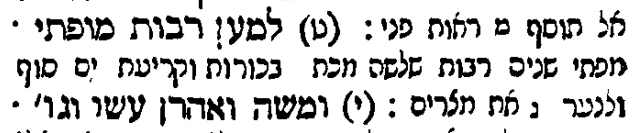
Al HaTorah (based on the manuscript Leipzig 1) records Rashi’s comment on למען רבות מופתי as follows:

רשי: למען רבות מופתי – מכת בכורות, וקריעת ים סוף, ולנער את מצרים.

Here is Leipzig 1:

Artscroll Sapirstein edition (Brooklyn 1994) adds the words “מופתי שנים, רבות שלשה” in brackets at the beginning.

The words appear without any type of parentheses in Mikraot Gedolot HaBahir 2005. Oz Vehadar HaMevuar also has the words without parentheses. [1][2] 

It seems then that in some newer editions, the words מופתי שנים, רבות שלשה are an integral part of Rashi’s comments. Oz Vehadar explains those words as follows:

But there is a perplexing issue with the presentation of Oz Vehadar. It explains the words “מופתי שנים רבות שלשה” based on Rav Ovadiah MiBartenura, in the sefer attributed him called עמר נקא. I expected to see the words “מופתי שנים רבות שלשה” in the portion quoted in עמר נקא but we don’t find them at all in the quotation from Rashi, rather it appears like this:

It is clear that those words were not in Rav Ovadiah’s text of Rashi.

It is also odd that Oz Vehadar Rashi HaMevuar would have those words as an integral part of Rashi because it acknowledges that those words are missing from the defusim rishonim and from the critical editions of Avraham Berliner: In Rome (רומא), Dfus Rishon (דפוס ראשון Reggio di Callabria) and Avraham Berliner (רא״ב Zechor L’Avraham Frankfurt a/M 1905) the (four)words are missing.”

Aside from the early editions just mentioned, the words “מופתי שנים רבות שלשה” are not found in Soncino 1487, Zamora 1487, Lisbon 1491 or Napoli 1492.[3]

Here is Zamora:

Rashi HaShalem ( Mechon Ariel, 4th Volume 1992)doesn’t have it or even comment on it.

Rav Eliyahu Mizrachi ( Sefer Mizrachi Venice 1527) has a long comment on Rashi but does not include those words in his citing of what Rashi said:

למען רבות מופתי מכת בכורות וקריעת ים סוף ולנער את מצרים.

Avraham Berliner who was cited above (Berlin 1867 and Frankfurt am Main 1905) does not have “מופתי שנים רבות שלשה” either:

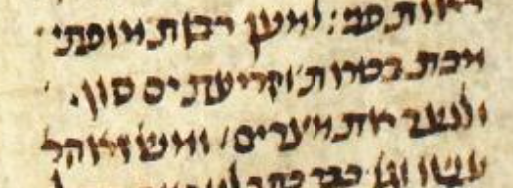
Most importantly, the words “מופתי שנים רבות שלשה” do not appear in any Rashi manuscript from the 40 I examined from 12th to the 15th century. As shown above, Leipzig 1 does not contain those words.[4]  Here is another example of an early manuscript without the words “מופתי שנים רבות שלשה”:

Berlin 1221

Based on not finding those words in any manuscript I examined, and the fact that the words were not recorded in any early printed edition, nor were they included by Berliner, nor do they appear in the Vienna 1859 Mikraot Gedolot of Shlomo Zalman Netter, nor mentioned in any way by Rashi HaShalem, I feel comfortable saying that the words“מופתי שנים רבות שלשה” most likely were not written by Rashi. So where did they come from and how did they get to be included in such prominent editions such as Artscroll (where they appear in brackets) and Oz VeHadar Rashi HaMevuar?

As mentioned, the words are not in any manuscript nor in any early printed edition of Rashi. Going forward in the history of printing, they don’t appear in any edition of Rashi all through the 1500’s and 1600’s including the important Bomberg Venice 1518 and 1526 Mikarot Gedolot, Rashi and Chizkuni Venice 1524, Venice 1538, and Sabionetta 1638.

Here is the important Rashi edition of Sabionetta 1557 where the four words are missing:

The first time that I found the extra words included in print is in Yosef Da’at (Prague 1609) Though ordinarily the author Rav Yosef ben Yissachar cites a source for his additions, here he does not.

He just says כן נראה לי –כנ״ל. It is unclear to me whether he had a manuscript which had the words “מופתי שנים רבות שלשה” or it was just his opinion that they be added to explain the words of Rashi which followed.

It does not appear in an edition of Rashi printed soon after Yosef Da’at, that of Amsterdam 1644:

Nor in the first edition of Siftei Chachamim of Amsterdam 1680 ( which often includes the edits of Yosef Da’at) or the Amsterdam Chumash of 1682.

It is not in Dhyenfurth 1693 nor in Berlin 1705 or Frankfurt an der Oder in 1728 and even later there in 1784. It is not in Fuerth 1841 or Vienna 1831 or Vienna 1859 (Netter) nor Warsaw 1861.

The first edition after the Yosef Da’at in which I found it was in Amsterdam 1749:

It is also in Amsterdam 1757:

Amsterdam 1797 has it also with no parentheses,

The words are included in the highly regarded edition of Zhitomir 1870:

It is also in Bait Dovid Lemberg 1909 w/o parentheses.

I find this case to be quite unusual. There are words that most likely were not written by Rashi which have made it into mainstream editions today. They appear because of a comment made by Yosef Da’at where it is not even clear if he meant them to be included in the text of Rashi. Normally when Yosef Da’at introduces some words, they are included in the first edition of Siftai Chachamim in 1680 but here they don’t show up until the mid-1700’s. They appear from then onwards in some editions and some do not have them. The very influential Mikraot Gedolot of Vienna and Warsaw do not have them. Those editions usually set the standard for those that followed but here that is not the case.

[1] Accessed through Otzar HaHochma which now temporarily has open access

[2] Oz VeHadar on page 2 of their forward to Breishit (2018) states that they used the Frankfurt AM edition of 1905 as their base text and to avoid confusion, they did not include parentheses. But they also say that they had Defusim Kedumim which they used to further edit the text. I believe that this is one case where they might have considered doing so as these words do not appear in any Defusim Kedumim nor in Avraham Berliner’s book of 1905 which they cite in this case.


[3] It differentiates Alkabetz (signified by באל׳) from Rome, Dfus Rishon and Berliner, but I found that portion the same there.


[4] The manuscripts are available through the Al HaTorah website at https://alhatorah.org/Commentators:Online_Rashi_Manuscripts. Here are a few more: 

Oxford CCC 165 (Neubauer 2440)- 12th century

Munich 5

Bodelian Library MS Oppenheim 34

Paris 155


R. Yitchak Al-fasi’s Anti-Qaraite Legislative Activity

R. Yitchak Al-fasi’s
Anti-Qaraite Legislative Activity
By Tzvi H. Adams
R. Yitchak Al-fasi (1013 – 1103) lived in North
Africa and Spain during the Golden Age of Qaraism. It is quite natural that we
find many instances of anti-Qaraite legislation in his writings.
Below are four such cases:
1) R. Al-fasi had the shofar blown on Shabbos
Rosh HaShanah in his beth din in Fez, Morocco. (See
discussion here: here). This
ruling and practice baffled many later authorities as it seems to contradict
the Talmud Rosh HaShanna 29b. R. Zerachiah Ha-Levi wrote about R. Al-fasi’s
opinion – וזה אחד מן המקומות המתמיהים הנמצאים בהלכות  (המאור הקטן ר”ה פ”ד).

When we consider that the Qaraites (of whom existed a large community in Fez)
did not blow a shofar at all on this holiday because such blowing is not
clearly written in the Torah, it is understandable why R. Al-fasi would desire
to have shofar blowing take place. Refraining from blowing the shofar would be
like surrendering to Qaraite views. We should also recall that Rosh HaShanah
can fall out on Shabbos as often as five times in ten years.
Aaron ben Elijah (1328-1369), a prominent
Qaraite theologian wrote:

The Rabbanites draw an analogy between the Day
of Trumpeting and the Day of Atonement which precedes the Year of the Jubilee,
of which it is written: Then shalt thou sound the horn of trumpeting in
the seventh month… on the Day of Atonement
(Lev. 25:9). They say
just as this trumpeting was done with horn, so also must the trumpeting on the
Day of Trumpeting have been done with a horn. (However), we have already
explained…. The Day of Trumpeting, therefore,
signifies nothing but the raising of the voice in song and praise, inasmuch as
there is no mention of a horn in connection with it. Moreover, why should we
draw an analogy between a thing which is obligatory every year, and one which
is obligatory only once in fifty years, the year of the
Jubilee?…                   
(from Leon Nemoy’s Karaite Anthology (1980) pg 173)

Read more on the Qaraite halacha here
2) R. Al-fasi was a key player in the
transition of the evening prayer from reshut to chova:
Summary: Since the close of the Talmud, the
accepted halacha had been תפילת ערבית רשות.
Towards the end of the tenth century the custom solidified amongst Qaraites to
pray only twice a day. To create a social divide, Rabbanite authorities
responded by requiring every Rabbanite follower to pray three times each day.
By attending synagogue three times a day one affirmed his allegiance to the
Rabbanite camp; also by praying more often than Qaraites, Rabbanites
distinguished themselves as being more holy and religious. The Franco-German
sages, distant from the Qaraite-Rabbanite scene, upheld the original halacha of
תפילת ערבית רשות.
Explanation: All early Gaonim ruled aravit
is optional (עיין בראשונים ברכות פרק תפלת השחר).
In early Qaraite times there were different views as to how many times a day
one should pray. Anan ben David, the early sectarian schismatic, believed that
only two prayers should be said: “Anan rejected the maariv – service, as being
only a Rabbinic innovation (See Brochos 27b), and prescribed two daily services
only in accordance with the times on which the Temidim were sacrificed” (Jacob
Mann, “Anan’s Liturgy and his half-yearly cycle of the reading of the law”, Karaite
Studies
(1971) edited by Philip Birnbaum pg. 285). R. Saadya Gaon
(882- 942), who had many interactions with Ananites, responded by requiring
Rabbanites to pray three times- he made maariv mandatory (chova).
This was only the opinion of the Ananites;
other sectarian Qaraite-like groups had other views as to the number of daily prayers
required. Later, in the mid-tenth century, R. Sherira Gaon (906-1006)
maintained the early gaonic psak that maariv
is reshut, but
wrote that one who does not daven maariv is a “poretz
geder
” (here).
Late in R. Sherira’s lifetime and in subsequent
years, the view among Qaraites was solidifying that only two daily prayers were
required. The Qaraite scholar, Levi ben Yefet, writes in his Sefer
ha-Miswot
(latter half of the 10th century),II pp.  501-502:
הדבור
בכמה זה השער- כבר נתחלפו בו ואשר עליו ההמון, כי הנה שתי תפלת בכל יום בקר וערב
שנאמר “ולעמוד בבקר בבקר להודות ולהלל ליוי וכן לערב”,… אשר יהיה זולת אלה הוא
נדבה…
ואמרו
מקצת חכמים כי חובה גם היא…ואלה הג’ תפלותיהם אשר זכר אותם דוד ע”ה “ערב ובקר
וצהרים אשיחה…” …. והקרוב עמי כי אלה הכתובים לא יורו על חיובה…
Shortly thereafter, R. Al-fasi (1013 – 1103)
further enforced the tri-daily prayer system by stating “והאידנא
נהוג עלמא לשוייה כחובה”. A Jew who belonged to the Rabbanite camp
distinguished himself from the Qaraites by attending synagogue three times a
day. I am preparing a lengthy paper on this topic – “The Transition of Aravit
from Reshut to Hova
a Rabbanite Response to Qaraism”.
3) R. Al-fasi participated in the anti-Qaraite
transition of minor fast days from being voluntary to mandatory.
Though the Gaonim and R. Chananel (990-1053)
explicitly say that not eating on the three minor fast days is the individual’s
choice (as per the Talmud’s ruling RH 18b- אין שמד ואין
שלום – רצו – מתענין, רצו – אין מתענין), R. Al-fasi chose to overlook this detail
about fast days in his halachic writings. The purpose of this intentional
omission was almost certainly to separate Rabbanites from the Qaraite community
who did not observe the Rabbanite fasting calendar.
Briefly, here is the sugya
in Rosh HaShannah 18b:
אמר ר”ש
חסידא מאי דכתיב (זכריה ח) כה אמר ה’ צבאות צום הרביעי וצום החמישי וצום השביעי
וצום העשירי יהיה לבית יהודה לששון ולשמחה קרי להו צום וקרי להו ששון ושמחה בזמן
שיש שלום יהיו לששון ולשמחה אין שלום צום אמר רב פפא הכי קאמר בזמן שיש שלום יהיו
לששון ולשמחה, יש (גזרת המלכות) שמד צום, אין (גזרת המלכות) שמד ואין שלום רצו
מתענין רצו אין מתענין
אי הכי ט”ב נמי אמר רב פפא שאני ט’ באב
הואיל והוכפלו בו צרות
The Gaonim:
– בזמן
הזה, בדורות הללו, שאין שמד ולא שלום, רצו מתענין לא רצו אין מתענין…. הילכך שלושת
צומות, מי שאינו
רוצה לצום אין בכך כלום
ואינו מחוייב בהן. (תשובות הגאונים גנזי
קדם ח”ג עמ’ 43)
R. Chananel:
שיש שלום
– כלומר כל זמן שבית המקדש קיים יהיה לששון ולשמחה. יש שמד – צום.  אין שמד
ואין שלום –  כגון עתה בזמן הזה, רצו מתענין רצו אין מתענין. וכיון שאם רצו
שלא להתענות בהן אין חובה עליהן
, לפיכך אין שלוחין יוצאין בהן.
(רבינו חננאל – ראש השנה יח, ב)
הרב
ברג’לוני ז”ל כתב מ”ט קבעום האידנא חובה? מפני שהם דברי קבלה … (שערי תשובה
סימן עז)

By the time of Ramban (1194–c. 1270) and later
authorities mandatory fasting was well established in Spain. (Rashba, though,
is an exception- he still considered the fasts optional.)
About the practice of the Qaraites, Levi ben
Yefet, writes in his Sefer ha-Miswot (latter half of the
10th century),III pg 452: Levi be writes
“צום הרביעי וצום החמישי וצום השביעי” וגו’. … והוא
העשירי מן החדש העשירי… והוא היום אשר סמך בו נבוכדנצאר על ירושלם והצר עליה
ובנה עליה דיק, שנאמר “ויהי בשנה התשיעית למלכו בחדש העשירי בעשור לחדש בא
נבכדנאצר מלך בבל וכל חילו” וגו’
והיום השני – והוא יום פתיחת המדינה, והוא היום התשיעי מן החדש הרביעי
שנאמר “בחדש הרביעי בתשעה לחדש ויחזק הרעב בעיר ולא היה לחם לעם הארץ ותבקע
העיר”.
והצום השלשי – הוא היום השביעי מן החדש החמישי מפני כי אמר בו
“בחדש החמישי בשבעה לחדש היא שנת תשע עשרה שנה למלך נבוכדנצר בא נבוזראדן רב
טבחים עמד לפני מלך בבל בירושלם, וישרוף את בית יוי”.
והצום הרביעי – הוא היום העשירי מזה החדש הה’ שנאמר “ובחדש
החמישי באחד לחדש” וגו’. והגרמתו וגם הגרמת היום הז’ הוא שריפת בית יוי מפני
כי אמר אחרי כל אחד מהם ” וישרוף את בית ה’ 
שני פעמים.
והצום הה’ – הוא יום כד’ מן החדש השביעי שנאמר “וביום עשרים
וארבעה לחדש נאספו בני ישראל בצום ובשקים” וגו’.
… ויש באלה הצומות חלוף. מהם בין הרבנים ובין הקראים, ומהם בין
הקראים ובין העננים,…
הדבור בצומות אשר יצומו אותם הרבנים … והוא יום
יז’ בתמוז ויום ט’ באב, ויום עשרה בטבת… ואולם לא נצום אותם עמהם…
Dr. Isaac Gottlieb summarizes (here):
The Karaite calendar does not take note of our
holidays of Hanukkah, Tu-b’Shvat… because these days are not mentioned in the
written Torah. Three of the four fast days associated with the destruction of
the First Temple are observed in Karaite tradition, but on different days from
us: the “fast of the fourth month,” which we observe on the 17th of Tamuz, they
mark on the 9th of Tamuz (cf. II Kings 25:3-4); instead of the Ninth of Av the
Karaites fast on the 7th and the 10th of Av (II Kings 25:8; Jer. 52:12-13);
instead of the Fast of Gedaliah, which we observe on the 3rd of Tishre, the
Karaites fast on the 24th of Tishre (Neh. 9:1). The fast on the 10th of Tevet
is the only one which they observe on the same date (Jer. 52:4-5). They do not
observe the Fast of Esther but celebrate Purim for two days, and on leap years
they only observe it in the first month of Adar.
Rabbi David Bar-Hayim’s view is that the
transformation from optional to mandatory fasting occurred because later
rishonim believed they lived in time of שמד
– hence fasting was obligatory. More recent authorities only cited the words of
these late rishonim and that perspective became the norm. Here is his
discussion of this topic: “The Four
Fasts and their Halakhic Status Today”.
Rabbi Bar-Hayim suggests that the situation
today (the political climate – war vs. peace) is not different than that of the
Gaonim and R. Chananel – אין שמד ואין שלום. 
This assessment has practical halachic implications. I suspect, though, that
the transformation was not only because of ‘wartimes versus peaceful times’ but
was also political and anti-Qaraite.
Rambam also omits this Talmudic leniency of רצו מתענין רצו אין מתענין. The Halachot
digest of R. Al-fasi and Mishnah Torah of Rambam were both intended
to replace Talmud study for the lay population. By ignoring the leniency of
permissibility of skipping the minor fasts, these sages made sure their general
readers would assume fasting is obligatory- thereby segregating them from the
Qaraite communities who did not fast on Rabbanite fast days.
The language used by R. Y Barzillai, “קבעום האידנא חובה”, is similar to that employed by R.
Yitzchak Al-fasi and others – “והאידנא נהוג עלמא לשוייה
כחובה” – in explaining why, in the eleventh century, Jews were
required to pray the evening prayer every night (עיין
ברכות פרק תפלת השחר). This may hint at the same reason for
change- to separate Rabbanites from Qaraites. See Case#2.
Furthermore, Sma”k 96 (R. Yitchak Corbeil- 13th
century France) and Kolbo Laws of Taanith (Provence
14th century) cite the Gemara רצו מתענין רצו אין מתענין
. These authors only cite practical matters- it is clear they still considered
the minor fasts optional. The great R. Tam was asked if a pregnant woman needs
to fast on the minor fasts. He responded by citing the Talmud – that these
fasts are optional (cited in Hagaath Maimoni Laws of Taanith 5).

These European sages lived far from Qaraites and therefore had no need to
respond to sectarian practices.
My suggestion – that the transformation of the
three minor fasts from being optional to mandatory was a reaction to Qaraism –
is novel and requires some more investigation and research…והמשך יבוא.
4) R. Yitchak Al-fasi, and his teacher, R.
Chananel, created a six hour waiting requirement between meat and dairy in the
early eleventh century – thereby limiting the social participation of
Rabbanites with Qaraites. This was not the common practice in Judaism until
their new legislation. I elaborated on this in “Waiting Six Hours for Dairy- A
Rabbanite Response to Qaraism” –  here.


Modena, Gilgul, and an Unpublished Letter

Someone in a comment to a recent post mentioned an article that appears in the latest issue of the journal Ets Hayyim. This journal is published by the “students and hassidim of Bobov.” [Supposedly this journal is a break-off of the excellent journal Kerem Shlomo.]
The journal is comprised of what most torah journals are today, there is a section publishing manuscripts hiddushei torah, general hiddushei torah, some articles on halacha etc. In this fourth and most recent issue there is an article that I think deserves wider dissemination.

R. Shmuel Aboab (1610-1694), author of the Davar Shmuel (as well as Sefer Zikrohonot, discussed here, and Tavat Dovid) was one of the leading rabbis in Italy and Europe of his day. He corresponded with numerous people, part of that correspondence was published in Davar Shmuel. Davar Shmuel, published posthumously by his son, was a mahdurah kama (first edition -that Spiegel doesn’t mention in his discussion regarding mahdurah kama/tinyana – although it is a printed book and not a manuscript), and does not include all R. Shmuel Aboab’s responsa (something that was not corrected in the latest reprint of the Davar Shmuel). For many years, a collection of R. Abaob’s letters (approximately 300!) were in the Montefiore Library and now they have passed into private hands. (These letters are mentioned in Hartwig Hirschfeld’s Descriptive Cataloue of the Hebrew Manuscripts in the Montefiore Library – but the Google books version is for some reason missing the relevant page.) According to the description provided in Ets Hayyim, many of these letters have never been published or used by scholars (see below for a discussion of this claim). In Ets Hayyim, they have published one of the letters in its entirety. A detailed introduction about the manuscript generally and R. Aboab is included. This was written by R. Betzalel Divlitski. R. Divlitski uses traditional as well as academic sources in his introduction. Also an index of all the letters from the Montefiore collection is provided that includes some important snippets of these letters. For instance, one letter (no. 125) includes information when R. Ya’akov Hagiz came to Italy, something, according to R. Divlitski, that was previously not definitively known (again, see infra for more on this claim). According to the index, this letter tells us R. Hagiz came to Italy in 1659 (see infra note 2 ). Moreover, the letter that is published is in no way pedestrian. Rather, it is about a controversial topic and takes, what can be seen, as a controversial position.

While the above comes from R. Divlitski’s introduction and notes, it is worthwhile pointing out some serious shortcomings in R. Divlitski’s comments. R. Divlitski claims that most of these letters have never been published. This is wrong, and R. Divlitski knows it is wrong. Most of these letters were published by Meir Benayahu in his Dor Echad B’Aretz. R. Divliksi is aware of Benahyahu’s work as he cites it throughout. Divliski also made the claim the letter discussing when R. Hagiz came to Italy [1] was unknown, while again Benayahu has it in his work and discusses its implications (Dor Echad pp. 304-5). [2] Moreover, although R. Divlitski is willing to use the book he is unwilling to say who actually wrote it. Thus, every time R. Divlitski cites Dor Echad he never mentions Benayahu’s name. Lest one think Benayahu is somehow “treif” (whatever that may mean), R. Shlomo Zalman Aurbach seem to have no problem with Benayahu and read Benayahu’s works. (See Benayahu, Yosef Becheiri, Jerusalem, 1991, p. 364, 380). [3]

A bit of history regarding Benayhu’s work – Dor Echad B’Aretz – published in Jerusalem, 1988. A while back Benayahu while traveling the world and discovered this excellent collection of letters of R. Shmuel Aboab. He even writes that he could not believe his luck on finding them – these untapped sources full of this incredible wealth of information.[4] He noted that they were extremely important for multiple areas. Therefore, Benahayu went ahead and started printing them in many different journals. These articles started appearing as early as 1954. He divided the letters into different topics, inter alia, history of Eretz Yisroel, seforim and Sabbatianism. In 1988 Benayahu collected many of these letters from these varied journals and added some more from this collection (over 100) and printed them in one volume – Dor Echad B’Aretz. In this volume he included a comprehensive history of R. Abaob and R. Moshe Zaccuto (as Benayahu is well-known for his comprehensive biographies and works). For some odd reason he did not print all the letters from this collection nor did he even print all the letters he had already published. It could be that he never noted this important letter (now published in Ets Hayyim) perhaps because he planed on coming to it in a future work as it is well known he has over thirty years worth of seforim in manuscript!

Turning back to the article, R. Divlitski is correct that the letter regarding Modena has never been published and is thus important. [It is unclear why Benayahu decided not to publish this letter.] Thus, what Diviltski should have done was prefaced his article stating that although much has been written on R. Aboab and on the letters formerly housed in the Montefiore Library and many were published by Benayahu, for some reason, a very important letter has thus far escaped publication and now to remedy that, the letter is now being published – now on to the actual letter.

The letter in question discusses the belief, or lack thereof, in gilgul (transmitigation of souls). This subject has been a hot topic for centuries and much has been written on it in general and will be the subject of a different post. [For now, see Kol Hanevuah from R. Dovid Hanazir pp. 230-36 for an excellent collection of material on this topic and see R. Reuven Margolis in Sharei Zohar, Bavaeh Metziah, 107a.]

One of the persons to have denied belief in gilgul was R. Yehudah Aryeh Modena in his work Ari Noham. While Modena explicitly denied gilgul, some questioned whether that was truly his position. The Hida, first in Shem HaGedolim and later on in his travelogue, Ma’agel Tov, (pg 113) Hida states that he saw Modena’s then unpublished autobiography and the Hida claimed that Modena wrote that he changed his opinion on gilgul because of an event he witnessed towards the end of his life. Joseph Michael Hayim in Or haHayyim (pg 443) mentions that he never found evidence of Modena’s change of heart in any manuscripts of Modena’s autobiography. [Divlitski alludes to Hayim, but like the other “academics” doesn’t cite to him or mention him explicitly.] Today, we have two printed editions of Modena’s autobiography and neither has any reference to Modena’s alleged change of heart. It is worth noting that the autobiography contains other fascinating material – much of which would not be considered flattering as it portrays Modena in a very human sense. Thus, in the Sefer HaTerumos published by Mechon Yerushalim with the commentary of the Gedulei Terumah, by R. Azariah Figo, a student of Modean, an amazing allegation is made to deal with Modena’s Autobiography. A. Goldschmidt in the introduction claims that because of the content of the Autobiography it is “a forgery.” The reason being “it is unconscionable that a qualified Talmid Hakham such as R. Yehuha Areyeh Modena [would write things] that [even] simple people would not want publicized.” (p. 25 n.8).

The letter now published in Ets Hayyim is not from Modena but instead from R. Aboab to R. Moshe Zacuto about R. Yehuda Areyeh Modena. [5] Specifically, R. Zacuto heard that R. Modena was denying and publicizing that gilgul was not a Jewish belief. R. Zacuto wanted to put Modena in herem or come out against him, and wrote to R. Aboab to get his opinion. As R. Divlitski demonstrates this letter is key to disproving the notion that although Modena initially did not believe in gilgul he changed his mind later. Due to the timing of this letter it appears that either literally at the end of Modena’s life he repudiated his belief on gilgul or, the more likely conclusion is that Modena never did.

In the letter, R. Aboab counsels against disputing Modena. R. Aboab makes a simple argument in that there are sources that dispute the claim of gilgul. Thus, there have been others who don’t believe. How then can we reconcile those positions with R. Aboab’s and R. Zacuto’s idea that gilgul is a central tenet – it must be that only worthy people appreciate and therefore believe in gilgul. It would be pointless to criticize someone for not believing when it is not really their fault.

Basically, this is a great article with important new material but proper credit is not given. Furthermore, as Divlitski notes, and in light of the fact Benayahu clearly has not yet published all these letters, hopefully, with this letter being published in Ets Hayyim someone will finally publish all these letters.

Notes:

This post is the product of the combined efforts of myself and R. Eliezer Brodt.

[1] For some reason it seems E. Carlebach did not use Dor Echad, although she does use Benayahu’s prior articles, and thus was unaware of Benayahu’s discussion of this particular letter. See Carlebach, The Pursuit of Heresy, New York, 1990, p. 21, 284 nn.11-12. Although Benayahu rejects using the dates of R. Hagiz’s works to place Hagiz in Italy, Carlebach does just that. See Benayahu, Dor Echad, pp. 304 and Carlebach, id. Additionally, Carlebach does not mention the letter discussed above that explicitly establishes Hagiz in Italy.

[2] For some reason Divlitski says the letter was written in 1659 while Benayahu says the letter was written in 1657. Additionally, Divlitski says that he can figure out who the recipient of the letter is, although “coincidentally” Benayahu uses the same materials to come to the same conclusion.

[3] This is not the only time Divlitksi leaves out the authors name. He also uses Tishby’s edition of Tzitz Novel Tzvi, but doesn’t mention Tishby.

[4] Divlitski uses similar language when discussing how important the letters are as an untapped resource.

[5] It is worth noting that Modena and Aboab corresponded directly see Benayahu, “Yediyah al Hadfasat Seforim vehafatzasm b’Italia” in Sinai, 34 pp. 157-58, 186-87.


The History and Dating of Onkelos

The History and Dating of Onkelos

By Israel Drazin
The Babylonian Talmud has the earliest report of the authorship and date of Targum Onkelos. It states that an individual named Onkelos composed the translation in the first third of the second century CE. Since the nineteenth century, scholars have generally rejected this recollection and dated the Targum, or its final redaction, in the third century CE. I will show that the proper date is more likely the late fourth or early fifth century CE. This dating is supported by seeing the consistent use of the targumist of the final version of tannaitic Midrashim that were not edited until the late fourth century.
The Traditional View and its Problems
The Babylonian talmudic scholars gave preference to the literal Aramaic translation of the Pentateuch, which they called targum didan (“our translation”), over other translations.[1] However, they had but a single unreliable memory of its author.
            A Palestinian Amora (in Megillah 3a) curiously states that Onkelos composed the authorized translation after it had been forgotten.
R. Jeremiah – or some say R. Hiyya b. Abba – also said: Onkelos the proselyte under the guidance of R. Eleazar and R. Joshua composed The Targum of the Pentateuch…. But did Onkelos the proselyte compose the targum to the Pentateuch? Has not R. Ika said in the name of R. Hananel who had it from Rab: What is meant by the text, “And they read in the book, in the law of God, with an interpretation, and they gave the sense, and caused them to understand the reading” (Nehemiah 8:8)? “And they read in the book, in the law of God” this indicates the [Hebrew] text; “with an interpretation”: this indicates the Targum; “and they gave the sense” this indicates the verse stops; “and caused them to understand the reading” this indicates the accentuation; or, according to another version, the Masoretic notes? – These had been forgotten, and were not established again.[2]
            The Babylonian Talmud states that Onkelos was the son of Kolonikos, who was the nephew of the Roman Emperor Titus. He converted to Judaism. Several miraculous stories are revealed about him.[3] These tales are virtually identical with those conveyed of the Greek translator Aquilas, and, as we shall see, were confusedly ascribed to Onkelos.[4] Thus, according to R. Jeremiah and the Babylonian Talmud, Targum Onkelos was composed about 130 CE.
            There are several serious problems with R. Jeremiah’s opinion. The Babylonian Talmud translates pentateuchal words eighteen times using the term u’m’targuminun, “and it is translated,” or “the Targum states.”[5] Despite R. Jeremiah’s view of authorship, in none of these instances is Onkelos mentioned by name. Midrashim use the same formula seventeen times and Onkelos is cited only once, in a late twelfth-century midrash (Numbers Rabbah 9).[6] An opinion is attributed to an individual called Onkelos only once in the Talmud. This opinion is in no way related to the Targum.[7]
            There is good authority confirming that Aquilas translated the Bible into Greek about 130 CE. There is, however, no corroboration for connecting the Aramaic translation currently called Targum Onkelos with a person named Onkelos other than the single statement in the
tractate Megillah. The talmudic sages, R. Jeremiah or R. Hiyya, obviously confused the two translations.[8] It is hardly possible that R. Eleazar and R. Joshua had two students with virtually identical names, both of whom were born of the same noble lineage under highly unusual circumstances, and both of whom underwent remarkably similar miraculous events.
            It is more likely that the redactors of the Babylonian Talmud did not know who composed their “authorized” or “officially accepted” translation. They recalled that the Jerusalem Talmud of several generations earlier had stated that Aquilas composed the authorized Greek translation. They ascribed their Aramaic version to him as well.[9]
            The only essential difference between the names of Onkelos and Aquilas in Hebrew script is the addition of the letter nun, a characteristic insertion in Babylonian Aramaic. Onkelos is thus a Babylonian equivalent of the name Aquilas.[10]
            There are indicators that suggest, although admittedly they do not prove, that Targum Onkelos could not have been composed in the second century. If Onkelos existed, aside from the unbelievable circumstance that both he and Aquilas underwent the same curious life experiences, there must have been some differences. Why is no difference mentioned in the two stories? Moreover, why is there no allusion to Onkelos in the Talmud, where the Targum is extolled? If the Babylonian talmudic rabbis knew the author of the Targum, we would expect that Onkelos’ name should have been cited whenever the Targum is mentioned.[11] If Onkelos was a noted Palestinian scholar of the second century, he should have been included in the Jerusalem Talmud whose final redaction occurred at the end of the fourth century. Further, if the author of the Targum was known, there should have been no need for the tradition of R. Jeremiah, and the Talmud should never have questioned this tradition.
            Even more significantly, if Onkelos composed the Targum in the second century, why is his name not mentioned in the tannaitic midrashim that were edited in the late fourth century? Jewish tradition is meticulous about naming the source of every teaching.[12] Furthermore, the Mishnah in the Babylonian Talmud, Megillah 8b, edited after the traditionally held composition date of the Onkelos Targum, quotes R. Simeon b. Gamaliel, who lived during and after the traditional composition date of Targum Onkelos. He identified only the Greek translation as being holy. The Mishnah knows nothing of Targum Onkelos. The Babylonian Talmud, Megillah 9b, comments upon this Mishnah and states in the name of R. Abbahu (circa 300 CE), who made his statement in the name of R. Johanan (circa 250 CE, both living several generations after the supposed composition of Targum Onkelos), that the halakhah follows R. Simeon b. Gamaliel.
Modern Scholarship
 
The problems that refute the talmudic view of the dating of Targum Onkelos also confront and refute the views of modern scholarship. Some writers, such as M. H. Goshen-Gottstein and B. Grossfeld, accept the talmudic dating.[13] Grossfeld, for example, maintains that Onkelos and Aquila are the same person, argues that the parallels between the Targum and the midrashim point to a common tradition upon which both genres of scriptural interpretations rest, and concludes that where the school of R. Akiba and R. Ishmael differ, Onkelos upholds the views of R. Akiba’s school. Grossfeld knew only 153 cases in the Pentateuch where Targum Onkelos and the tannaitic midrashim parallel each other. He attributes Onkelos’ translation to the Akiban school because he notes that in 19 of these 153 instances the Targum’s deviation were like those of R. Akiba. Grossfeld did not know that Targum Onkelos parallels the tannaitic Midrashim in 698 instances, as we will show, in just four of the pentateuchal books, and he did not analyze the parallels or take note of the frequent times that the targumist differed with the Akiban school (e.g. Exodus 21:3, 19; 22:3).
            Most scholars reject the Talmud’s date and assign the date of composition to the first half of the third century CE. They rely on references to the Targum in a volume on targumic traditions collected in Die Masorah zum Targum Onkelos,[14] which is said to have been composed in the first half of the third century CE.[15] There is no evidence of the time of composition of this Masorah and no certainty that many elements were not added at later dates. A second proof for the third century dating is the existence of non-halakhic material in the Targum. The argument is that later rabbis could not have authorized divergences from halakhah. These scholars fail to note that rabbinic tradition has always tolerated dissident opinions as to the peshat, the literal sense of the text. Contra-halakhic biblical interpretations occur in the early midrashim and the Talmuds, as well as in the later commentaries of Rashi, Rashbam, Ibn Ezra, Nachmanides, and others. There is no rabbinic statement indicating that Targum Onkelos has halakhic authority. The rabbis only forbade teachings which encourage “behavior” that is contrary to halakhah.
Dating Onkelos by means of the Tannaitic Midrashim
While studying, translating and commenting upon Targum Onkelos to the Pentateuch,[16] I noted the remarkable reliance of this Aramaic translation upon the present version of all of the tannaitic midrashim.[17] This has led us to date the Targum to a time following the final redaction of these midrashim.[18]
            I will illustrate this conclusion by focusing on the book of Numbers. A comparison of the words used in Targum Onkelos and Sifrei to Numbers shows the reliance of the author(s) of the Targum upon this late fourth-century midrash[19] and shows the many similarities between the two documents.[20] The findings are rather startling when one realizes that the two documents were not only written in different languages, but that their authors and editors, as will be seen, had totally different agendas. While space constraints restrict us from detailing the findings in the other pentateuchal books, we will also outline these findings briefly and show the consistency of the targumic borrowings.
            The method used in the following study of Numbers is relatively simple. Whenever the Onkelos translation replaces the biblical Hebrew word with a word that deviates from being an exact translation of the original, the tannaitic midrash is examined.
            We will see, for example, that there are five instances where our targumist relied on Sifrei to Numbers’ definitions. Sifrei defined words with what we may call a full definition formula: ein bakhal makom elah (‘there is no place that X means anything else but ‘Y’). Onkelos quotes Sifrei’s word definition each time this formula is used, except where the midrash differentiates dabeir, ‘speak’, from amar, ‘said’.[21]
            Similarly, Sifrei uses what we could call a short definition formula, in (‘There is no… but’), thirteen times.[22] Again, Onkelos incorporates Sifrei’s exact word or uses a synonym of the midrashic term in each instance. Thus, repeatedly and consistently, Onkelos defines the biblical terms exactly like the midrash whenever the midrash states that it is giving a definition. In each instance, the targumist used Sifrei as a dictionary.
            Additionally, our targumist repeats – one might even say “quotes” – Sifrei’s exact word in 53 other verses and is similar to the midrash an additional 35 times in the book of Numbers. Thus, when Onkelos parallels the midrash, it is more likely to repeat the midrash’s exact word than to use a synonym. These numbers are extraordinary since the Targum is an Aramaic translation and the midrash is a Hebrew documentary, and there is extant midrash on only a third of the biblical text.
            In total, Targum Onkelos parallels Sifrei to Numbers in 106 instances, in over a third of the verses where Sifrei has commentary. This is not happenstance. The Targum uses the word because the targumist drew it from the midrash.[23]
            The Onkelos targumist not only drew his translation, indeed his very words, from Sifrei to Numbers but did so as well with the tannaitic midrash Sifrei Zutta to Numbers.
 
            Sifrei Zutta does not use the full definition formula contained in Sifrei, but it has the short formula ein in five verses (7:3, 10:31, 11:3, 11:18 and 15:38). In each of these instances, our targumist deviates from the biblical text and uses an Aramaic synonym for Sifrei Zutta’s word.
            In addition, Onkelos quotes Sifrei Zutta’s exact word 61 times and is similar to the midrash 38 times. In total, the Targum parallels this midrash in 104 places.[24]
Lack of Similarities
 
Turning now to the opposite perspective, the following answers the question: why did the targumist not copy everything in the midrash and why did he include material not in the midrash? This will help us understand that the targumist consistently drew his material from the midrash and only failed to do so because of good reasons.
            As mentioned earlier, the targumist and the midrash compilers had different agendas. The targumist quotes the midrash when their purposes are the same, when the midrash translates the text’s simple meaning. He deviates from the midrash when the midrash goes beyond this task. He adds material that is not in the midrash when the midrash did not attempt to clarify the text’s meaning and his rendering does so.
            The following list catalogues some of the kinds of deviations inserted by the targumist to clarify the text that are not in Sifrei. These changes, which are explained in chapter 3 and in the author’s Targum Onkelos to Numbers, either did not concern the halakhic and aggadic-minded commentators of the midrash, or they are insertions that the compilers of the midrash did not feel compelled to add to every verse when they had already commented upon it elsewhere (e.g. Shekhinah or adding a preposition).[25]
Explaining the text with an Aramaic idiom
Replacing el, which means “God,” with “idol”
Changing the harsh “take” to the softer “lead”
Grammatical and tense replacements
Explanation of metaphors
Using words to avoid anthropomorphisms, such as memra
Treating a name as verb
Updating and thereby identifying a place name
Being more explicit than the Bible
Avoiding an anthropomorphism and anthropopathism
Changes to preserve Israelite honor
Changes to protect God’s honor
Removing redundancies
Replacing the plural Elohim with the Tetragrammaton
            Thus, the targumic insertions that are of not in the midrash are absent from the midrash because they do not concern the midrashic authors. Conversely, the targumist only incorporates Sifrei material that interprets biblical verses according to their literal meaning. He avoids using derash, interpretations trying to disclose the text’s hidden meaning, or where the midrash has halakhah, theology, legends, and parables.
            Examples of midrashic derash that Onkelos refrains from using are: the Massoretic Text’s (MT’s) “uncover the woman’s head” (Numbers 5:18) teaches that Israelite women should keep their heads covered. MT’s “place in her hands” (5:18) is required to tire her out so that she will repent. MT’s “two turtledoves and two young pigeons” (6:10) implies that people may not substitute turtledoves for pigeons or pigeons for turtledoves.
            Halakhic elements are on virtually every Sifrei page. They appear only rarely in the Aramaic translation, which also has contra-halakhic matter, and then only when they help readers understand the text’s simple meaning. MT’s “command” (5:2) is said to apply immediately and for future generations. MT’s “his sin” clarifies that one does not confess his father’s sins. MT’s “eyes” (5:11) excludes a blind person.
            Aside from its avoidance of anthropomorphisms, theology and morality are also generally absent from Onkelos, but abound in the midrash. Sifrei derives the lesson that strength is granted to those who are strong, and encouragement to those who are stout of heart (5:2), Aaron was righteous because he did exactly what Moses told him to do (8:1), and the Israelites were virtuous because they did what Moses instructed (9:1). Merit flows to the meritorious and humiliation to those who are disgraceful (9:1).
            Various legends and parables do not appear in Onkelos. For example, each of the seven days of preparing the Tabernacle, Moses set it up and then dismantled it (7:1). Aaron’s sons did not literally die before the Lord; they fell outside so as not to render the Tabernacle unclean. In fact, an angel sustained them after they had been struck with fire, helped them outside, and allowed them to fall in the courtyard (7:1). The Israelite desert leaders were the same individuals who were assigned as their supervisors while they were slaves in Egypt (7:3).
            In summary, the Onkelos targumist consistently drew the explanations and definitions from the late fourth century midrashim that helped explain the text’s simple meaning, and frequently even quoted the midrash. He ignored material that did not further this agenda. Thus he could not have composed his translation before the end of the fourth century.
Consistency With Other Biblical Books
 
The significant and unswerving reliance by Targum Onkelos on the tannaitic midrashim to Numbers to clarify the simple meaning of the biblical text also occurred in the other books of the Pentateuch. The Onkelos deviations from the literal Hebrew translation consistently reflect the late fourth century tannaitic midrashim in about a third of the verses where midrashic commentary are present.
Exodus
 
Although the tannaitic midrash Mekhilta d’R. Ishmael exists for only about fourteen Exodus chapters, Targum Onkelos deviates from rendering the biblical text literally 158 times. It consistently and remarkably uses midrashic words, including 95 instances where the targumist quotes the Mekhilta’s exact word, an average of eight times in each chapter. He parallels Mekhilta in more than thirty per cent of the verses where midrashic comments occur. This is startling since most of the midrash is derash, comments that are contrary to his purpose and which he avoids.
            The targumist never explains Exodus contrary to Mekhilta’s peshat, the text’s plain and explicit meaning. He uses all, or virtually all Mekhilta interpretations that are peshat and neglects only the Mekhilta’s derash, halakhah, theology, legends and parables, since the Targum, as we said, is a translation and not a commentary. The reverse is not true: He deviates to add clarifications that are not in Mekhilta since it was composed after this midrash.[26]
Leviticus
 
The findings for Numbers and Exodus are repeated in Leviticus and Deuteronomy: The targumist relied on the late fourth century tannaitic midrashim for the translation of the biblical text. His deviations in Leviticus parallel the midrash Sifra’s interpretation in 129 instances, including 82 times that he uses Sifra’s word. Again, he never explains Leviticus contrary to Sifra’s peshat, he incorporates all, or virtually all, of Sifra’s interpretations that are peshat and neglects its derash, halakhah, theology, legends and parables, and he has deviations that clarify the text that are not in Sifra.[27]
Deuteronomy
 
In Deuteronomy as well, Onkelos’ deviations remarkably reflect the late fourth century tannaitic midrash Sifrei’s interpretation in about a third of the verses in the less than half of Deuteronomy where there is extant midrash. The Targum deviates 201 times using words reflecting interpretations in Sifrei. This represents about thirty percent of Sifrei’s interpretations.
            A few statistics will demonstrate how remarkable this is. There are, for example, 489 verses in the first 17 chapters, the first half of Deuteronomy. Only 186 of these sentences, about 38 percent, have comments by Sifrei. The targumist’s deviations from a literal rendering of Deuteronomy parallel Sifrei in 56 passages (in 60 instances) or about thirty per cent. The sentences where he does not reflect Sifrei are all instances, as we noted previously, where the midrash has derash. Thus, again, Onkelos contains all of virtually all of the non-aggadic Sifrei material, and there is no instance where the Targum differs with this midrash except where the latter has derash or there is a scribal error in the Targum.[28]
Genesis
 
H. Albeck[29] noted that the author or authors of the fourth-century midrash Genesis Rabbah did not use Onkelos despite having difficulty in understanding verses that the targumist understood and translated. For example, Genesis Rabbah cites an incident where rabbis wanted to know the Aramaic equivalent of a biblical word and had to travel to a place where Aramaic was spoken, and they did not look at Onkelos where the word is explained in Aramaic. Albeck’s observations are supplemented in the author’s Targumic Studies.[30] We now know that the midrash’s authors could not have utilized Onkelos as a source because it did not exist when the midrash was composed.
Conclusion
 
My studies of the Targum Onkelos Aramaic translation of the Hebrew Bible compared the words used in the Aramaic translation when the translator did not render the Bible literally with the language used in the late fourth century midrashim. The study showed that Onkelos consistently used the language in the midrashim.  There were a total of 698 similarities between Targum Onkelos to the four biblical books that we studied (excluding Genesis) to the text contained in the five midrashic volumes that we analyzed, most of which were exact quotes.[31] The Targum parallels these midrashim in a third of the verses where there are midrashic comments. Since the targumist drew material from these volumes, his Targum Onkelos had to have been composed after the end of the fourth century CE.
Since the editors of the Babylonian Talmud had Targum Onkelos in hand and were unable to recall its author, it stands to reason that the Targum must have been completed before the editing of this Talmud began in the fifth century. Thus a dating of 400 CE is probably very close to the exact date of our Targum’s composition.
An afterword
 
It is worthwhile repeating the following from Targum Onkelos to Deuteronomy.
As to which composition, Sifrei or Targum Onkelos, is earlier there are four possibilities. First, Sifrei was composed after Targum Onkelos and follows an interpretative tradition that originated with or was incorporated into the Targum. This is possible, but in view of the subtle, concise, and often ambiguous nature of Targum Onkelos’s deviations, it is doubtful that the editor of Sifrei sat down, examined every deviation, found a reason for it, and then wrote an expansion of it, proving his point by citing the opinion of tannaitic sages who lived over a period of many generations. Furthermore, this would fail to explain Sifrei’s derash, the material in Targum Onkelos not included in Sifrei, the collection of divergent tannaitic views, and so forth.
            The second possibility is that both Sifrei and Targum Onkelos were composed during several generations, by a series of authors, with mutual borrowing, both basing their interpretations on the same rabbinic tradition, which was transmitted orally or which was in written form, but is no longer extant.
            Thirdly, it is similarly possible that both Sifrei and Targum Onkelos are based on an earlier, more expansive Targum that is no longer extant. While both (2) and (3) are possible, they are unlikely because of the remarkable and consistent parallels between the two documents and for the other reasons mentioned above. Furthermore, if Sifrei drew from a Targum, one would expect some mention of a Targum among the many other sources that are cited, but there is none in Sifrei.
            The fourth possibility is that Sifrei preceded Targum Onkelos and the author(s) of the Targum translated with “one finger in the MT and another in Sifrei.” This would explain the remarkable parallelism and the additional material in Targum Onkelos.
            The author recognizes that his late fourth or early fifth century CE date for Onkelos depends upon the generally accepted scholarly dating of the tannaitic midrashim. A point can be made that versions of these midrashim existed at an earlier time. The author would dismiss this idea because the targumist follows the present midrashic text consistently and must have used the final version. Another argument could insist upon the minority view of an earlier redaction date for the midrashim. In any event, however one dates the midrashim, the author’s contribution remains. The Onkelos targumist borrowed from the tannaitic midrashim and must be dated after them.’
Dr. Israel Drazin is the author of thirty-three books, twelve of which are on Targum Onkelos. His website is www.booksnthoughts.com


[1] The word
“Targum” means “translation”, “interpretation”, or “version.” See Targum
Onkelos to Genesis 42:23; Exodus 4:16, 7:1; Targum to II
Chronicles
32:31; and Targum Sheni to Esther 3:8, 7:5. The words
“Targum Onkelos,” as we shall see, denote “the Translation of Aquilas.”
In the Babylonian Talmud, Kiddushin 49a, Rabbi Judah said: “If
one translates a verse literally, he is a liar; if he adds thereto, he is a
blasphemer and a libeler. Then what is a proper translation? Our
translation.”
 
The first mention of Targum Onkelos after the Babylonian Talmud does not
occur until the seventh century. Sar Shalom in Sefer Shaarei Teshuvah,
ed. F. Hirsch (Leipzig. 1858), 29c, and Seder Rab Amram (1865), 29.
[2] The translation
is from The Babylonian Talmud, ed. I. Epstein, Soncino Press (London,
1938). This passage, it is important to note, is the only source for this
legend. The verse itself is discussed again in the Babylonian Talmud, Nedarim 37b. If Onkelos received
guidance from R. Eleazer and R. Joshua, who lived around 130 C.E, this opinion
would date the translation to the early part of the second century.
[3] In the
Babylonian Talmud, Avodah Zarah 11a
and Gittin 56a, b, and 57a. Cf. Tosefta Shabbat 7(8):18; Haggigah 3:2 and 3; and the midrashim Genesis Rabbah 70:5 and Tanchuma 41a, Mishpatim 3.
[4] The Jerusalem
Talmud, Megillah 1, 71c; Kiddushin 1, 59a; Haggigah 2:5, 77a. Although the contemporary English spelling is
Aquila, the name is Aquilas in Greek and Hebrew. Those familiar with rabbinic
studies will recall that errors in names frequently occur in the Talmud. While
writing this note, the author was studying the Babylonian Talmud Bava Kamma and found the following
errors in a few pages; R. Abba v. R. Abin in 112a; R. Ashi v. R. Assi in 112b,
113a, 114a; Rava v. Rabba in 114a, R. Huna v. R. Kahana in 114a, Rav v. Abbahu
in 114b; and the Talmud itself was unsure of a name in 114b.
[5] See M. M.
Kasher, Torah Shelemah 24 (Jerusalem, 1974), pages 155-161; and J.
Reifman, Sedeh Aram (Berlin, 1875), pages 8-10.
[6] See Kasher, op.
cit
., pages 195-238, and Reifman, op. cit., pages 12-14. Numbers Rabbah is hardly older than the
twelfth century. See The Jewish Encyclopedia, volume II, page 671, and Encyclopedia
Judaica
, volume 12, column 1261.
[7] Babylonian
Talmud, Bava Bathra 99a: “Onkelos the
proselyte said, the cherubim were of tza’atzu’im (image work) and their
faces were turned sideways, as a student who is leaving his teacher.” The
statement is somewhat obscure. It probably comments upon II Chronicles 3:10 (where the word is spelt with ayins) by
referring to a similar word in Isaiah
22:24 (spelt with alephs). Targum Jonathan translates the latter word
“son,” which suggests “student.” The reference to Onkelos is certainly
incorrect. There is no Targum Onkelos to either the Writings or the Prophets,
and Onkelos in the Pentateuch never translates “cherubim.” It always repeats
the biblical Hebrew word. It is possible that the Talmud is referring to
Jonathan ben Uzziel or Aquilas and not Onkelos.
[8] R. Jeremiah
lived about 350 CE and his teacher R. Hiyya b. Abba, a generation earlier. It
is likely that he did not make the statement that tradition attributes to him.
First of all, the talmudic tradition is itself uncertain as to who made the
statement. Secondly, since both R. Jeremiah and R. Hiyya b. Abba were scholars
of Eretz Israel and not Babylon; the tradition, if correct, probably referred
to the Eretz Israel Greek translation of Aquilas, and not the Babylonian
Aramaic translation of “our translation.” Thirdly, in the Babylonian Talmud, Megillah 9b, R. Hiyya b. Abba is clearly
speaking about the Greek Bible translation and seems to know nothing of the Aramaic
version.
[9] H. Graetz, History
of the Jews
(Philadelphia, 1893), volume 2, pages 387, 581, 582, argues
that the Aramaic translation “was made partly from that of Akylas (sic)
on account of its simplicity, and was called Targum Onkelos.” See the author’s Targum
Onkelos to Deuteronomy
(Ktav, 1982), pages 2, 14, 15, and A. E.
Silverstone, Aquila and Onkelos (Manchester University Press, 1970), and
other volumes cited therein.
[10] Note, for
example, that תגי and מדע in Palestinian Aramaic are תנגי and מנדע in Babylonian
Aramaic.  Another difference is that
Onkelos is spelt with an aleph and Aquilas with an ayin. Many
Palestinian words with an ayin were transposed in Babylonia to an aleph
because Babylonians had difficulty pronouncing laryngeals; for example, עד=אד.
[11] See notes 4 and
5, and related text.
[12] See for example
Mishnah Aboth 6: 6; Babylonian
Talmud, Yevamot 97a; Jerusalem
Talmud, Berachot 2:1 (4b). Also, many
talmudic discussions are based on the idea that Amoraim never dispute a subject
that was previously disputed in a Mishnah without citing the earlier dispute.
See for example Babylonian Talmud, Gittin
4a and 16b, middle of pages.
[13] M. H.
Goshen-Gottstein, “The Language of Targum Onkelos and the model of Literary
Diaglossia in Aramaic,” JNES 37 (1978), pages 169-179; B. Grossfield,
“Onqelos, Halakhah and the Halakhic Midrashim,” in D. R. G. Beattie and M.
McNamara (editors), The Aramaic bible (1994), pages 228-46.
[14] See edition by
A. Berliner (Leipzig, 1877).
[15] See for example
P. Kahle, The Cairo Geneiza (Oxford, 1959), pages191-228; H. Albeck, Jubilee
Volume to B. M. Lewin
(1940), pages 93-104; A. Diez Macho, Neophyti,
I: Genesis (1968), page 98;
Leopold Zunz, Die Gottesdienstlichen Vorträge der Juden (Berlin, 1832). These views and others
are discussed in I. Drazin, Targum Onkelos to Deuteronomy (Ktav, 1982),
pages 2-6, and B. Grossfeld, Targum Onqelos to Genesis (Michael Glazier,
1988), pages 30-35. No critical evaluation was ever made of Berliner’s Masorah and every modern author refers
to it without comment. The book and the conclusions drawn from it require
extensive study. It should be noted that there was or were early Aramaic
translations of parts of the Hebrew Bible, as confirmed by the fragments found
in Qumran. See J. T. Milik, Discoveries in the Judean Desert, Volume 6: Qumran
Grotte 4
, II: Tefillin, Mezuzot, et Targums (4Q128-4Q157) Oxford,
1977. The comparison between these finds and Onkelos are discussed in I.
Drazin’s Targum Onkelos to Leviticus (Ktav, 1994), pages 36, 146, 149,
151.
[16] With the
participation of the Center for Judaic Studies of the University of Denver, the
author published, through the Ktav Publishing House, Targum Onkelos to
Deuteronomy
in 1982, Targum Onkelos to Exodus in 1990, Targum
Onkelos to Leviticus
in 1993, and Targum Onkelos to Numbers in 1998.
Targum Onkelos to Genesis was written by Moses Aberbach and Bernard
Grossfeld, and was published in 1982. The latter authors ascribe a dating of
Onkelos “towards the end of the third century CE” (page 9).
[17] A tannaitic document
is one that transmits the views of the Jewish sages from the period of Hillel
to the compilation of the Mishnah. This period began about 20 BCE and ended
about 200 CE, although the documents may not have been committed to writing
until a later time. The tannaitic midrashim were not redacted until the end of
the fourth century.
    The tannaitic midrashim are Mekhilta deR. Ishmael and Mekhilta deR. Simeon b. Yochai to Exodus; Sifra to Leviticus; Sifrei and Sifrei Zutta to Numbers; and Sifrei and
Midrash Tannaim to Deuteronomy.
Each is individualistic in halakhic view,
style, and character.
    Although the tannaitic midrashim appear, by
their name, to have been composed during the tannaitic period, ending in the
early third century, later scholars are mentioned therein. The tannaitic
midrashim, in their present form, were unknown to the scholars in the two
Talmuds and must have been composed in Eretz Israel no earlier than the end of
the fourth century, after the completion of the Jerusalem Talmud. They were
unknown in the Jerusalem Talmud because they were not yet composed. They were
unknown in the Babylonian Talmud because of their composition in Eretz Israel.
See Encyclopedia Judaica for sources regarding the dating of each
midrash.
    J. Neusner, Midrash in Context (Fortress
Press, 1983), dates the tannaitic midrashim in the fifth and sixth centuries.
We will see in this study that (1) our targumist drew material from the
midrashim, which must have pre-existed the Targum, and (2) the scholars of the Babylonian
Talmud, composed and edited in the fifth and sixth century, mention our Targum
but did not know the name of its author. Therefore, the Targum must have been
composed before the Babylonian Talmud. Thus, a sixth-century date for the
composition of the midrashim is incorrect.
[18] This was done
first in the Deuteronomy volume in
pp. 8-10. This book showed the reliance of Onkelos upon the midrash Sifrei. The subsequent studies did the
same with the other midrashim.
[19] The midrash Sifrei to Numbers comments on parts of
nineteen of the thirty-six biblical chapters of Numbers (5-12; 15; 18-19; 25:1-13; 26:52-31:24; and 35:9-39), less
than a third of the biblical text. It contains a considerable amount of aggadah
and halakhah, items that Onkelos avoids, and has little narrative, areas
where Targum Onkelos deviations abound.
[20] Onkelos has
many Hebraisms because its audience’s language included many Hebrew words. They
were used in the translation whenever the Hebrew was more familiar or
understandable to the reader than the Aramaic equivalent. Similarly, although
the midrash was composed in Hebrew, there are many Aramaic words in it.
[21] שקר twice, 5:6; כיור, 5:17; יפרש used in
6:2 to help define גזר; equals Sifrei’s pisqahs
7, 10, and 23, respectively.
    The exception of דבר in 12:1 (=pisqah 99) is
understandable. Sifrei interprets דבר as “harsh
speech.” This is derash, a homiletical exposition, and not a true
definition; and Onkelos only translates according to the peshat, the
simple meaning of the text. Yet, even in this instance, although the Targum
does not quote the adjective “harsh,” it differentiates the two words,
rendering מלל
for “speak” and retaining אמר for the second.
[22] A chart of
these instances is in I. Drazin, “Dating Targum Onkelos by means of the
Tannaitic Midrashim,” Journal of Jewish
Studies
, Autumn 1999.
[23] The 106
instances are listed in the Journal of
Jewish Studies
article.
[24] Like Sifrei, Sifrei Zutta was composed at the
end of the fourth century CE. But, unlike the former, the latter disappeared
and only fragments were rediscovered in the Genizah, in Yalkut Shimoni, Midrash ha-Gadol, and other works. H. S. Horovitz
compiled these findings and published them in Sifrei al Sefer be-Midbar
VeSifrei Zutta
(1917). Later, J. N. Epstein published an additional large
fragment in Tarbiz 1/1 (1930). Sifrei
Zutta
contains many halakhot that are not mentioned elsewhere and many that
differ with those in the Mishnah. Its style and terminology are unique.
[25] These deviations
are identified and explained in the author’s Targum series. See Note 16. Targum
Onkelos’s understanding and use of peshat will be addressed in the next
chapter.
[26] See the
author’s Targum Onkelos to Exodus (Ktav), pages 8-11, 32-33, for
details.
[27] See the
author’s Targum Onkelos to Leviticus (Ktav), pages 9-11, 26-28, for
details.
[28] See the
author’s Targum Onkelos to Deuteronomy (Ktav), pages 9-10, 43-44, for
details.
[29] “Mekoroth
Ha-Bereshit Rabbah,” Einleitung und Register zu Berechit Rabba volume 3
(Jerusalem 1965), pages 44-54. Albeck did not reach the author’s discovery that
the Onkelos targumist took material from the tannaitic midrashim.
[30] See the
author’s Targumic Studies, “Analysis of Targum Onkelos Deviations to
Genesis” (University Microfilms International, 1981), pages 1-76.
[31] No study was
made of Bereshit Rabbah, Mekhilta deR.
Simeon b. Yochai
and Midrash Tannaim.
The author believes that more parallels will be found between Targum Onkelos
and the other tannaitic midrashim when these books are studied.


Franciscans and More; “Repulsive” Practices; Saul Lieberman, Abraham Joshua Heschel, and R. Jehiel Jacob Weinberg

Franciscans and More; “Repulsive” Practices; Saul Lieberman, Abraham Joshua Heschel, and R. Jehiel Jacob Weinberg

Marc B. Shapiro

1. Following up on what I wrote here and here about the term צעירים (Franciscans) and other expressions used with reference to Catholic religious orders, Brian Schwartz called my attention to a couple of relevant sources. In Milhemet Hovah (Constantinople, 1710), p. 14a, R. David Kimhi mentions a theological argument he had with one of the חכמי הצעירים. In Ginzei Nistarot (1868), vol. 2, p. 10, R. Jacob of Venice in his anti-Christian polemic mentions the צעירים and the דורשים (Dominicans). I also found a mention in the text of the Tortosa Disputation, ibid., p. 47. R. David Kimhi refers to the צעירים and the דורשים in his letter about the Maimonidean controversy found in Kovetz Teshuvot ha-Rambam ve-Igrotav, sec. 3 (Iggerot Kanaut), p. 4.[1]

There are no doubt many other such references in medieval texts and there is no need to elaborate any further. However, there is one other point worth noting. In the version of Nahmanides’ Disputation printed in Judah Eisenstein, Otzar Vikukhim, p. 89, it reads: וחכמי הצעירים והדורשים והחובלים. The last word, החובלים, is not found in the version published in Chavel’s edition. What does החובלים mean?

In his note Eisenstein tells us that החובלים are Cordeliers, which is how the Franciscans were called in France.[2] In fact, the Cordeliers were only one branch of the larger Franciscan order. The word cordelier refers to the rope that Franciscans wore around their waist.

חובלים, together with Cordeliers, appears in R. Avigdor Tzarfati’s Torah commentary:[3]

מכאן רמזה תורה אותן החובלים קירדליי”ש והייקופינ”ט ההולכים יחפים שעתידין להכעיס את ישראל

In this text we also have a new word, הייקופינ”ט. This is just an alternate spelling of the word יקופש. In Da’at Zekenim mi-Ba’alei ha-Tosafot, Deut. 32:21, it refers to החובלים ויקופש as people who bring trouble upon the Jews. So what does this word יקופש mean? In R. Aharon Yehoshua Pessin’s Midah ke-Neged Midah [4] he knows that החובלים refers to Franciscans and suggests that יקופש means “Capuchin.” However, the Capuchin order, which is a branch of the Franciscans, was only founded in the sixteenth century, so the Tosafists could not have mentioned it. יקופש actually refers to the Jacobins,[5] which is how the Dominicans were called in medieval France.

2. Readers might recall that in my post here I mentioned the late Dr. Shlomo Sprecher’s characterization of two segulot as “repulsive.”[6] I then cited another example of a segulah which I believe falls into this category (and see also my post here). However, the obvious point, which I mention here, is that what our generation regards as repulsive was not always regarded so in a different generation and culture.

Following the post in which I discussed Dr. Sprecher’s article, a few people sent me examples of things that were accepted in previous generations but today would be regarded as repulsive. Many of these examples are from general society and relate to standards of hygiene, food, etc., but a few came from Jewish texts as well. One reader sent me this interesting post by Tomer Persico that deals with the matter. He mentions, among other things, the following shocking remedy recorded in R. Hayyim Vital, Sefer ha-Peulot, p. 321, that appears to recommend a blatant halakhic violation. (It is doubly shocking when one remembers how seriously this sin is viewed in Lurianic Kabbalah, and this fact alone should perhaps lead us to reject the authenticity of the comment.)

לנכפה [לריפוי אדם הסובל ממחלת הנפילה], יקחו נער א’ [אחד] שמימיו לא ראה קרי ויוציאו ממנו שכבת זרע, ואותו הקרי ושכבת הזרע ימשחו בו שפתותיו של החולה ומעולם לא יחזור החולי ההוא

Jeremy Brown, in his recent National Jewish Book award winning volume, The Eleventh Plague: Jews and Pandemics from the Bible to COVID-19 (Oxford, 2023), p. 77, mentions another recommendation, this time to avoid bubonic plague. Among the ingredients to be consumed are “a little of the first urine” produced in the morning and “a small quantity of dried human feces, dissolved in wine or rose water, to be taken while fasting.”[7]

In the post here referred to above, I dealt with metzitzah ba-peh. Subsequently, I found that R. Leon Modena, in his response to the heretic Uriel da Costa, rejects the latter’s claim that metzitzah ba-peh is disgusting because the mouth speaks the word of God while the sexual organ is impure.[8] The medieval anti-Jewish polemicist, Raymond Martini, had earlier attacked metzitzah ba-peh as an “abominable act.”[9]

R. Moshe Mordechai Epstein has a perspective at odds with many other Lithuanian sages in seeing metzitzah as essential to the mitzvah of circumcision, not simply a medical procedure.[10] He also sees metzitzah ba-peh as crucial to the fulfilment of this mitzvah, again, in opposition to what was the standard approach in Lithuania (as opposed to among the Hasidim). As he puts it, if metzitzah ba-peh is not a basic part of the mitzvah, no one would have ever advocated such an action that, in any other circumstance, would be regarded as utterly repulsive.

אשאל שאלה מאלה האומרים כי מציצה היא רק משום סכנה, וע”כ די ברטית סמרטוטין, מאותם אשאל, נשער נא בנפשינו, אילו לא הי’ מצוה ולא הי’ נהוג אצלינו לעשות המציצה, ואחד הי’ רוצה לעשות המציצה בפה, בודאי היינו קוראים אחריו מלא כי אין לך מתועב יותר מזה ליקח אבר פצוע לתוך הפה. ומה גם אותו האבר. ולא עוד אלא למצוץ הדם, הלא הדבר גועל נפש ממש חלילה (אם אינה מצוה) . . . מי זה חסר לב יאמר כי הנהיגו דבר כזה בלי מצוה . . . בענין המציצה כאשר היא מצוה קדושה לתקן הנפש, אין בה גיעול ח”ו, קדושה וטהורה היא המצוה, אהובה וחביבה מרוממת רוחניות הנפש, אבל אילו לא הי’ מצוה רק הכשר כדי שלא יסתכן הולד מהדם, איך נוכל לומר שיהי’ נהוג בישראל ענין מתועב כזה, חלילה וחלילה. הלא האמת ברור לכל, כי המציצה היא מצוה קדושה בעצמה דוקא באופן הזה למצוץ דוקא בפה

3. In my last post here I spoke about Saul Lieberman, so let me add a few more points. In Tovia Preschel’s Ma’amrei Tuvyah, vol. 6, p. 231, he discusses Lieberman’s investigations into obscure words in rabbinic literature, and is reminded of how Sherlock Holmes can always find the answer:

כשאתה רואה אותו מצרף קו לקו ותג ותג להוכחה ברורה ומוריד מעל המלים את המסווה שמאחוריו מתחבאת משמעותן האמיתית – עולה בלבך המחשבה: הרי זה שרלוק הולמס, האמן-הבלש, של שפתנו

ואמנם נקראים כמה ממחקריו בענייני לשון כסיפורים של סר ארתור קונן דויל. דומה עליך שהנך רואה את שרלוק הולמס מרצה לידידו ועוזרו ואטסון כיצד סימנים ועקבות קטנים ובלתי-ברורים מוליכים אותו לפענוחו של תעלומות גדולות

ר’ שאול ליברמן – תורה למד בישיבות, חכמה קנה באוניברסיטאות – אך אמנות הבלשות מנין לו

Preschel then notes that in the little free time that Jabotinsky had, he liked to read detective stories. Preschel wonders, does Lieberman also do so? He adds that he was never brazen enough to ask Lieberman about this.

לפעמים אני הוגה בלבי: אולי גם ר’ שאול בין קוראי ספרות זו, עת הוא נח מעמלה של תורה, בשעה שאינה לא יום ולא לילה? אך עדיין לא העזתי לשאול אותו כל כך

Preschel’s insight is amazing. In Lieberman’s letter to Gershom Scholem, dated July 31, 1947,[11] Lieberman writes about how during the summer vacation, when he is away from New York and has free time, he reads detective stories![12]

ומכיוון שבכפר אני מתיר לעצמי לבטל קצת את הזמן הריני קורא לפעמים ספרות בלשית. וכשבא מאמרך לידי נמשכתי אחריו באותה מתיחות ממש כאילו אני קורא a detective story


Earlier in Ma’amrei Tuvyah, vol. 6, pp. 229-230, Preschel provides the answer to something I had thought about. If you look at a number of the title pages of Lieberman’s books you see that his name is in smaller print than that of his father.

Other than in Lieberman’s books, I don’t recall ever seeing this on a title page. Fortunately, Preschel asked Lieberman about this and Lieberman explained that this is “minhag Yisrael”. Lieberman showed Preschel what R. Hayyim Benveniste writes in Sheyarei Kenesset ha-GedolahTur, Yoreh Deah 240:8, that when one signs his name together with that of his father, yesh nohagim that the father’s name is written above as a sign of respect. What this means is that the father’s name written with bigger letters so that it stretches above the son’s name.

Here is the page in R. Benveniste’s work where he also provides an example.

Preschel concludes:

“פותח שערים” אני. אצבעותי מישמשו בהרבה ספרים. שערים רבים ראיתי. צא ובדוק אם תמצא מחברים שנהגו מנהג רם ונשגב זה בשערי ספריהם. ואם תמצא – מעטים הם, נער יספרם

Since we have been speaking about Lieberman, here is a treat for all the Lieberman fans: A letter from Lieberman to Abraham Joshua Heschel in which we see a bit of Lieberman’s mischievous humor.[13]

And while mentioning Heschel, here is another letter to him from R. Pinchas Biberfeld.[14]  

From this letter we learn something that until now was completely unknown, namely, that Heschel attended lectures of R. Jakob Freimann at the Berlin Rabbinical Seminary. In Edward Kaplan’s book on Heschel, Prophetic Witness, pp. 106, 256, he mentions that Heschel would frequently eat at Freimann’s house on Shabbat, and that Heschel contributed an article — his first academic publication — to the Freimann Festschrift.

R. Pinchas Biberfeld was the son of the legendary physician-rabbi Eduard Biberfeld, and he received semikhah from the Berlin Rabbinical Seminary. Here is a copy of his semikhah.[15]

The semikhah, dated Feb. 7, 1939, is signed by R. Jehiel Jacob Weinberg and R. Samuel Gruenberg. R. Weinberg was forced to leave Germany not long after this, and R. Gruenberg  and R. Biberfeld were fortunate to also get out and immigrate to Eretz Yisrael. While in Israel R. Biberfeld edited the Torah journal Ha-Ne’eman. You can read about him here on Wikipedia, and here is an interview he gave.

Biberfeld’s German name was Paul, and he was named after Paul von Hindenburg![16] People today often don’t realize how integrated into German society the German Orthodox were, and the naming of Paul Biberfeld is a great example of this.[17] In some ways, the German Orthodox were even more attached to their non-Jewish surroundings than today’s American Modern Orthodox, whose Americanness is usually expressed in a shared low culture with non-Jewish society (e.g., television, music, and sports), rather than in high culture and patriotism, both of which were part of the German Orthodox ethos.

R. Immanuel Jakobovits’s father was a well-known German rabbi, Julius Jakobovits, and yet he was comfortable naming his son after Immanuel Kant.[18] (R. Jakobovits’s Hebrew name was Yisrael.) In Michael Shashar, Lord Jakobovits in Conversation, pp. 10-11, Jakobovits explains (and it is obvious that he did not know the story of Paul Biberfeld’s name):

I may be the only rabbi in the world named after a non-Jew – Immanuel Kant, who was a native of Koenigsberg [where Jakobovits was born] and never left it.[19] The city was also known as “Kantstadt” [the city of Kant]. My father was one of Kant’s admirers, and when I was born he wanted to call me Israel, after one of his uncles, but at that time in Germany it was not acceptable to call a Jewish child Israel. Accordingly, he searched for a name beginning with I and ending with L, and so he gave me Kant’s name, Immanuel.

I don’t know why it was not acceptable in 1920s Germany for a Jewish child’s “secular” name to be Israel. 

Returning to Heschel, when he first came to the United States he was teaching at the Reform Hebrew Union College in Cincinnati. Here is a letter from Louis Ginzberg to Heschel that provides information that until now has not been known.[20]

From this letter, we see that Heschel was in discussions about a job at Dropsie College. Ginzberg urges him to accept this position if offered, and notes that the atmosphere at HUC was not in line with Heschel’s outlook. This never came to be, and Heschel accepted a position at the Jewish Theological Seminary in 1946 where he spent the rest of his life.

I think readers will find the next two letters of interest, as we see that Heschel was in discussions to teach at Yeshiva College and its Bernard Revel Graduate School.[21]

There are two other documents from the Heschel Archives that I would like to call attention to as they are of great historical interest. Unfortunately, they were not available to me when I wrote Between the Yeshiva World and Modern Orthodoxy. First, I must note that a few months ago the Jewish Historical Institute of Warsaw published a wartime list of rabbis in the Warsaw Ghetto. You can see it here. The list is not complete. For one, it does not mention R. Jehiel Jacob Weinberg, whom as I discuss in Between the Yeshiva World and Modern Orthodoxy was very involved in the Warsaw ghetto rabbinate and also served as the head of a committee to assist rabbis and yeshiva students. Also not mentioned in the Hebrew document is R. Kalonymous Kalman Shapiro, the Piaseczno Rebbe.

In a letter dated May 25, 1941, R. Weinberg wrote to Heschel from the Warsaw Ghetto.[22] Here is the envelope that R. Weinberg used. I include both sides of the envelope. As you can see, Heschel was living at Henry Street on the Lower East Side. Also note R. Weinberg’s address on the reverse as well as the Nazi stamp.

Here is the letter in which R. Weinberg asks Heschel for assistance with the emigration of rabbis in the ghetto. Because of German censorship, R. Weinberg’s letter had to be written in German. (We have other letters from R. Weinberg sent from the Ghetto and they too are written in German.)


It is interesting to see how R. Weinberg’s letter divides the rabbis between the truly outstanding and the others who, while also praised, are placed on a lower level. (R. Kalonymous Kalman Shapiro does not appear on the list.) While in the end, none of the rabbis were permitted to emigrate, the letter is clearly making a distinction between the rabbis. It is saying that if only limited opportunities to emigrate are available, that the order should be the rabbis in list 1, followed by list 2, and then list 3 and 4. This is a clear case where the greater rabbis were going to be saved first.[23]

The letter we have just seen, which is not addressed to a particular individual, and also the letter below, were sent to a number of people, not specifically to Heschel. You can see this in the letter below by how Heschel’s name is inserted at the beginning. Yet I have never seen other copies, which is why we have to be grateful that Heschel saved everything.

In a letter dated June 15, 1941, R. Weinberg again wrote to Heschel from the Warsaw Ghetto. Here are both sides of the envelope, followed by the letter, and this time R. Weinberg spelled the street name “Henry” correctly.


In this letter, R. Weinberg speaks about American Jewish assistance in sending money and food, and helping with emigration from Warsaw. The letter is accompanied by two lists, lengthier than what we saw in the first letter, divided again into what may be the more important figures and the others. But I am not certain if this is the significance of the division here, as there are some differences in how the names are divided in the two letters. 

On the first list here you can see R. Kalonymus Kalman Shapiro at no. 20, with his address — that we know from other sources as well — 5 Dzielna. Other than R. Weinberg, did any of the rabbis on the two lists survive?

* * * * * * *

[1] This letter is difficult to read, as the sage he degrades for informing on Maimonides to the Church may be R. Jonah Gerondi.
[2] See also Ben Yehudah’s dictionary, s.v. חובל; Dov Yarden, “Hovel Nazir Franciscani,” Leshonenu 18 (1953), pp. 179-180.
[3] Perushim u-Fesakim le-Rabbenu Avigdor ha-Tzarfati (Jerusalem, 1996), p. 445.
[4] (Jerusalem, 2009), p. 157 n. 20.
[5] See Leopold Zunz, 
Zur Geschichte und Literature (Berlin, 1845), p. 181.
[6] One of these 
segulot is that barren women should swallow the foreskin of newly circumcised boys in order to help them conceive a male child. For more sources on this practice, see Zev Wolf Zicherman, Otzar Pelaot ha-Torah, vol. 4, pp. 486-487. R. Yehoshua Mamon, Emek Yehoshua, vol. 1, Yoreh Deah, nos. 31-32, argues that this practice is forbidden according to Torah law. Regarding mohalim being buried with the foreskins they cut off, as a form of protection after death, see R. Joseph Messas, Otzar ha-Mikhtavim, vol. 2, no 986. Regarding women consuming the placenta, see R. Mordechai Lebhar, Menuhat Mordechai, no. 38.
[7] Regarding eating portions of a corpse and ground-up skull of non-Jews, and why rabbis permitted this, see my post here. Repulsive language is also noteworthy. R. Uri Feivish Hamburger, 
Urim ve-Tumim (London, 1707), p. 8a, first word of line 3, is the only example I know where a certain inappropriate word appears in a sefer. According to this source, even in the early eighteenth century the word was regarded as taboo.

It could be that this word is no longer really regarded as repulsive, only a little unseemly. It even appears in the title of eminent philosopher Harry G. Frankfurt’s #1 New York Times bestselling book, published by Princeton University Press. See here.

While Jews are obligated to speak in a dignified manner, there is an exception when it comes to speaking about idolatry. See Megillah 25b, where among other things it states: “It is permitted for a Jew to say to a gentile: Take your idol and put it in your shin tav [i.e., shet, buttocks].” This is the Koren translation and Soncino and Artscroll translate similarly. Yet I was very surprised to find that in Shabbat 41a Soncino twice translates כנגד פניו של מטה as “near his buttocks”, when it is obvious that the proper translation is “over his genitals”.
[8] 
Magen ve-Tzinah, p. 6b. Let me take this opportunity to correct a common error. R. Leon Modena called himself Yehudah Aryeh mi-Modena. But in Italian he called himself Leon Modena (not Leon de Modena). Modena himself tells us this. See Hayyei Yehudah, ed. Daniel Carpi (Tel Aviv, 1985), p. 33:

אני חותם עצמי בנוצרי ליאון מודינא דה ויניציאה‘, ולא דה מודינא‘, כי נשארה לנו העיר לכנוי ולא לארץ מולדתנווכן תמצא בחבורַי הנוצרים בדפוס

[9] See Lawrence Osborne, Poisoned Embrace: A Brief History of Sexual Pessimism (New York, 1993), p. 128. Regarding Martini, see Richard S. Harvey, “Raymundus Martini and the Pugio Fidei: A Survey of the Life and Works of a Medieval Controversialist” (unpublished masters dissertation, University College London), available here. Shimon Steinmetz pointed out to me that the famous non-Jewish Hebraist Johann Buxtorf (1564-1629), in his discussion of metzitzah, does not express any revulsion. He merely notes that this was not commanded by Moses. See hereIt would be interesting to examine how other Christian scholars and Jewish apostates of previous centuries described metzitzah.
[10] She’elot u-Teshuvot Levush Mordechai, no. 30. The expression he uses in the passage, קוראים אחריו מלא, comes from Jer. 12:6.
[11] The letter was published by Aviad Hacohen, “Ha-Tanna mi-New York,” Madaei ha-Yahadut 42 (5763-5764), p. 298.
[12] After I wrote this, I learned that R. Yitchak Roness made the exact same point. See here.
[13] The original is found in the Heschel Archives, Duke University, Box 2, Folder 2.
[14] The original is found in the Heschel Archives, Duke University, Box 10, Folder 3.
[15] The original is found in the Leo Baeck Institute; see here.
[16] See Mordechai Breuer, Modernity Within Tradition (New York, 1992), p. 480 n. 124. Breuer also mentions that a hasidic synagogue in Leipzig was renamed the “Hindenburg Synagogue.”
[17] See Jacob H. Sinason, The Rebbe : The Story of Rabbi Esriel Glei-Hildesheimer (New York, 1996), p. 128:

[Dr. Eduard Biberfeld] looked at the war against the Czar’s Russian empire as a kind of holy war against the dark forces responsible for the systematic persecution of Jews. He named one of his sons after the victorious German general, just as the Jews in Hellenistic times had called their children after Alexander the great. (Even to the extent of adopting Alexander as the Shem Hakodesh.)

The last sentence means that people with the name Alexander would be called up to the Torah with this name, as they would not have a corresponding Hebrew name as was often the case with German Orthodox Jews who had both a “secular” name and also a Hebrew name.
[18] Regarding Kant, Dr. Isaac Breuer had a picture of him on his wall, together with R. Samson Raphael Hirsch. I asked Breuer’s son, Prof. Mordechai Breuer, if the Holocaust had any effect on how he viewed Kant, who was, after all, an important part of German culture. As I expected, his answer was “no,” and even after the Holocaust the picture of Kant was not taken down.

The pictures on one’s walls obviously reflect an outlook. Alexander Altmann writes as follows about his father, R. Adolf Altmann, Rabbi of Trier:

Significantly, five pictures adorned his study, those of the “Hatam Sofer”, S.R. Hirsch, Graetz, Herzl and Mendelssohn, representing the orthodox tradition, old and new, Jewish History, the Zionist dream, and the philosophical quest respectively. These images had been the formative influences of his youth, and they continued to guide him.

Adolf Altmann (1879-1944), A Filial Memoir,” Leo Baeck Institute Year Book 26 (1981), p. 160.
[19] Although often repeated, this is actually incorrect. We know that Kant did leave Koenigsberg on a few occasions, including for his father’s funeral, but he never was more than 30 miles or so from his home. I mentioned this in one of my classes on R. Elijah Benamozegh, see here, while referring to the report the latter only left Livorno twice in his life.
[20] The original is found in the Heschel Archives, Duke University, Box 20, Folder 2.
[21] The originals are found in the Heschel Archives, Duke University, Box 22, Folder 2. These letters are referred to in Edward K. Kaplan, 
Spiritual Radical: Abraham Joshua Heschel in America, 1940-1972 (New Haven, 2007), pp. 61, 65.
[22] The Weinberg letters in are found in the Heschel Archives, Duke University, Box 22, Folder 2.
[23] For another example where rabbis (and their families) were chosen to be saved before others, see Steven Lapidus, “Memoirs of a Refugee: The Travels and Travails of Rabbi Pinchas Hirschprung,” Canadian Jewish Studies 27 (2019), pp. 73-74. Lapidus quotes from a letter from R. Oscar Fasman, at that time in Ottawa:

Here we are not dealing with only seventy individuals. These seventy embody a wealth of Jewish sacred learning, the like of which can no longer be duplicated, now that the European Yeshivoth are closed. In these people we have that intensive tradition of Torah which buoyed up the spirit of Israel. Thus, we are saving not merely people, but a holy culture which cannot be otherwise preserved. When the U.S. admitted Einstein, and not a million other very honest and good people who asked for admission, the principle was the same. It is certainly horrible to save only a few, but when one is faced with a problem of so ghastly a nature, he must find the courage to rescue what is more irreplaceable.


Where’s Shai Agnon?

In the latest issue of Yeshurun (a fuller review will be coming shortly), they published a letter from R. Y.M. Gordon to Shai Agnon. In light of this, an erudite reader, Yisroel Rottenberg, was kind enough to provide another instance where Agnon is quoted and in this instance, where Agnon’s name was then removed from a later edition.

In the Pirush Ba’al HaTurim al HaTorah by Y. Reinetz, in his introduction (p. 10) he relates the well-known story that R. Ya’akov composed the portion of his commentary “parparot” – numerologies and the like – in a single night. In the second edition (1971), he includes an endnote (p. 494) where he provides a source for this statement. He says (reproduced below)

בס’ “ספר סופר סיפור” לש”י עגנון דף ס”ח מובא סיפור זה בשם ספר קול דודי וז”ל פעם אחת הוכיח הרא”ש ז”ל את בנו ר’ יעקב בעל הטורים על שכל עיסוקיו אינם אלא בתורה שבעל פה בלבד אינו עוסק בתורה שבכתב. נתן הדברים אל לבו ובליל חמישי ישב כל הלילה וחיבר את ספרו על התורה

“in the book ‘Sefer, Sofer, Sippur’ from Sha”i Agnon p. 68 this story is recorded in the name of the work Kol Dodi [and then he provides a fuller accounting of the story]. . . .”

(second edition endnote – click to enlarge)

In the third edition (1974) of R. Reinetz’s book, there is a major change. Instead of relying upon the endnote, he has moved up part of the endnote to the text in the introduction. In this edition, the introduction (p. 10) contains a parenthetical, which reads (reproduced below):

כן מובא בס’ קול דודי וז”ל פעם אחת הוכיח הרא”ש זצ”ל את בנו ר’ יעקב בעל הטורים על שכל עיסוקיו אינם אלא בתורה שבע”פ בלבד אינו עוסק בתורה שבכתב. נתן הדברים אל לבו ובליל חמישי ישב כל הלילה וחיבר את ספרו על התורה

“this is brought in the Kol Dodi [and then he provides a fuller accounting of the story].”
(third edition introduction – click to enlarge)

While essentially the same, the words “In the book ‘Sefer, Sofer, Sippur’ from Sha”i Agnon” have somehow gone missing when the text appears in the introduction. Perhaps, in the course of the move, like socks, they were lost.