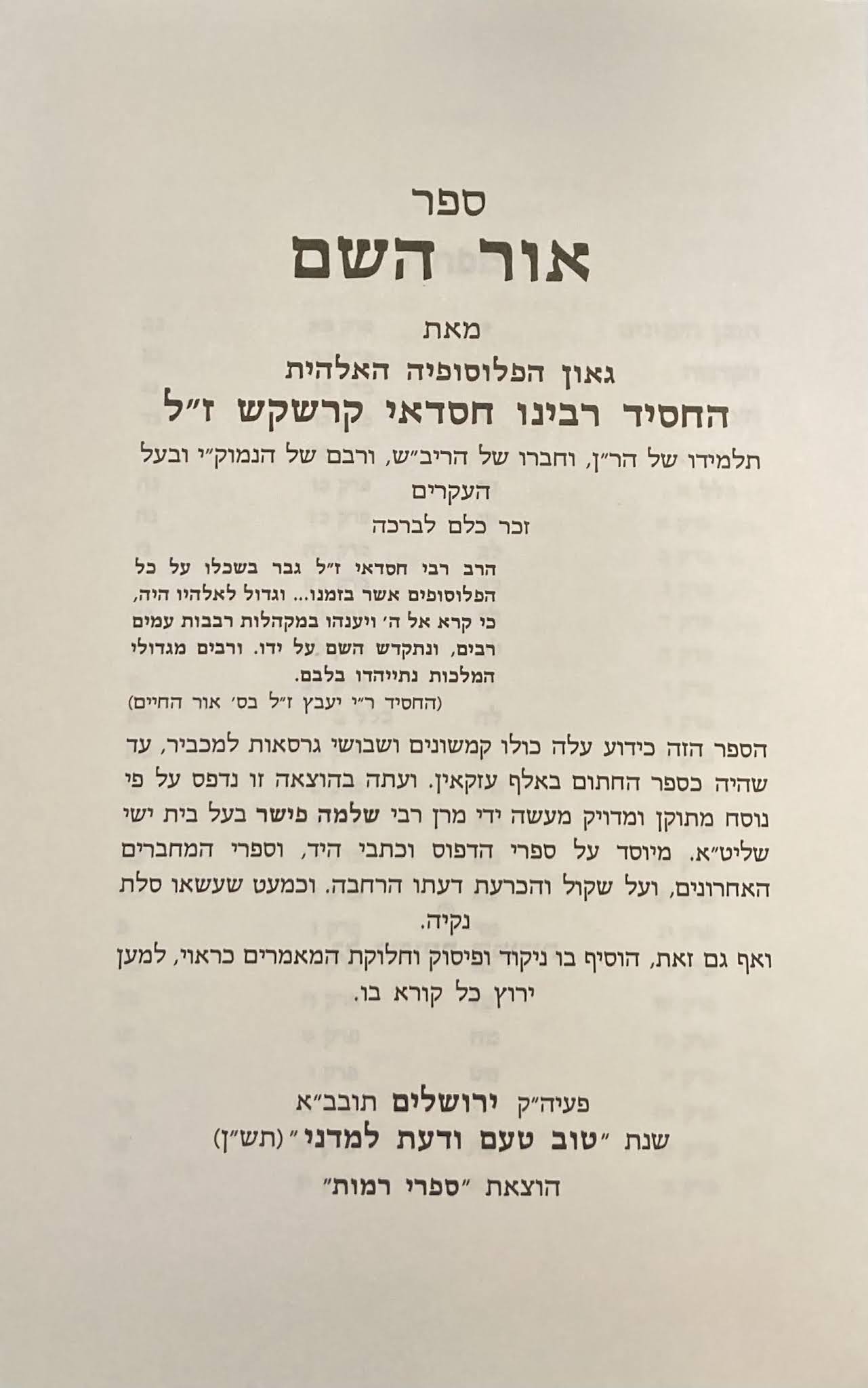
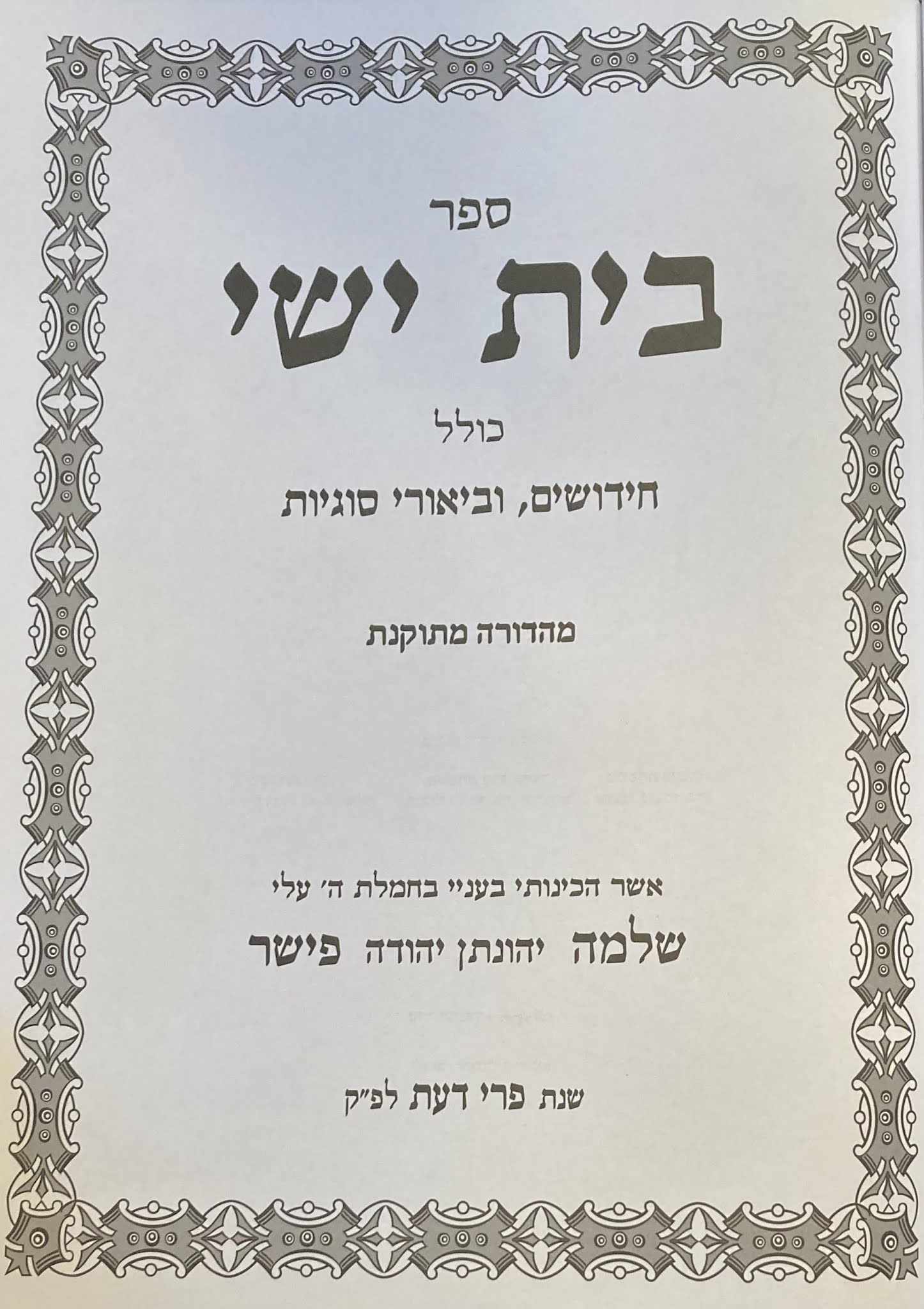
A Tale of Two Zionist Siddurim in Exile
A Tale of Two Zionist Siddurim in Exile
Seth (Avi) Kadish
Zionist Siddurim and Modern Orthodoxy
Modern Orthodoxy today, in America and throughout the diaspora, is largely a Zionist world. It is, in a sense, the English-speaking wing of Religious Zionism outside of Israel.[1] It is a world of synagogue communities with very close ties to Israel. Most people in Modern Orthodox synagogues have visited Israel, have family and friends who live in Israel, and support Israel. They see Israel as a blessing from God. They say prayers for the State of Israel and the IDF in their synagogues, and many of them celebrate Israel’s Independence Day with public prayers of thanks, including Hallel. At least some of these prayers are included in those siddurim which are designed for Modern Orthodox communities.
In this sense, a Modern Orthodox siddur is a Zionist siddur. But it is also invariably a bilingual siddur. Despite their love of Hebrew-speaking Israel, Modern Orthodox Jews are often uncomfortable with a siddur in Hebrew alone. Therefore, Modern Orthodox siddurim are typically published with introductions, translations, instructions and commentaries which are all in the vernacular. This format is so typical of the Modern Orthodox world that there is a small but competitive industry that produces and markets bilingual Modern Orthodox siddurim, and even a minor literature devoted to reviewing, evaluating and comparing them.
Even a Modern Orthodox Jew who makes ‘aliyah to Israel is likely to continue using a bilingual siddur. In Israel and abroad there is a much larger market for all-Hebrew siddurim, but most of those who prefer an all-Hebrew siddur are not Modern Orthodox Jews. Rather, they are native Israelis or haredim. That is why all-Hebrew, Zionist siddurim are usually published with native Israelis in mind, and sold mainly in Israel.
However, there have been exceptions to this rule. I am aware of two all-Hebrew, Zionist siddurim whose editors were Torah-observant scholars outside of Israel. These two siddurim were published, marketed and sold in pre-Holocaust Europe or in America, even though they contain no translation and their introductions, instructions and commentaries are all in modern Hebrew. The stories of these two siddurim and their editors reveal some important and moving aspects about Zionism since the dawn of the 20th century, including cultural movements and historical events that have largely been forgotten.
The publication of a siddur can reveal the soul of its publisher or point out the condition of communities, because a siddur is not just a prayerbook. Its core blessings and prayers have been the most basic component of oral Hebrew culture for thousands of years, and the same has been true for the siddur as a mass-produced physical book since the invention of printing. In many times and places the siddur was the Hebrew text most familiar to the majority of Jews, sometimes better known than the Bible itself. The two siddurim that we will discuss bear witness to the life of the Hebrew language over the past two centuries. They can help us understand the circumstances under which the Hebrew language has struggled or failed or been snuffed out, or to the contrary, where and when it lived and grew and flourished.
The two siddurim and their respective editors also highlight something fundamental and deeply traditional about Jewish prayer, which goes straight to the roots of the Torah. Namely that, in prayer, the nation of Israel stands before the God of Israel. Yet in order for Israel to stand before its God, it must first be a nation, an ‘am in Hebrew, which shares a language, a homeland and a common fate.[2]
1. Siddur Shirah Ḥadashah, edited by Ḥayyim David Rosenstein (Vilna, 1909)[3]
Siddur Shirah Ḥadashah was first published in Vilna, 1909. It was issued in the two versions that were most important to eastern European Jews, namely Ashkenaz and the hasidic Sefard. It was reprinted a great many times since then, and is still on the market to this very day.

The text of Siddur Shirah Ḥadashah is laid out with great care, and marked with modern punctuation. It is accompanied by concise instructions in vowelized Hebrew as well as a short commentary on the bottom of the page, also in vowelized Hebrew, which explains difficult words and phrases in the Hebrew prayers. Prayers in Aramaic (such as Berikh Shemeih and Yequm Purkan) are accompanied by translation into Hebrew. Shirah Ḥadashah is an appealing edition of the siddur and a pleasure to browse.
Who published a siddur like this in eastern Europe at the beginning of the 20th century, and why? Its editor, Ḥayyim David Rosenstein (1871-1934) lived his entire life in Minsk (Russia and then USSR, now the capital of Belarus), which had a Jewish majority at the turn of the 20th century. Rosenstein was a Torah scholar, a Hebraist, a Zionist activist and above all an educator. In Minsk he was known in Yiddish as Der Hoikhe Melamed (“the tall teacher”), which referred not just to his physical stature but also to the great esteem in which he was held by the people of the city. He was also known in literary circles by his Hebrew initials חד״ר (like cheder in Yiddish) or as חד”ר מד”ן (taking the first and last letters of his name).

Rosenstein was the founder and principal of a cheder in Minsk, but it was no ordinary cheder. It was rather called a ḥeder metukan in Hebrew, i.e. an “improved” cheder in that it included secular studies along with Torah study, and employed modern pedagogical techniques in all disciplines. It prepared its students as Jews and for success in the modern world. But above all, it taught the Hebrew language and other subjects not in Yiddish nor in Russian but rather in Hebrew (‘Ivrit be-‘Ivrit). Rosenstein’s Siddur Shirah Ḥadashah was designed for students in schools like his own. By 1903, there were 934 ḥadarim metukanim in Tzarist Russia. Siddur Shirah Ḥadashah became a bestseller not just among their students, but also among Hebrew-oriented Jews throughout Europe, and it was even exported to North America and to the Hebrew-speaking settlements in Ereẓ Yisra’el.
The ḥeder metukan was vociferously opposed by the traditionalists of the time, who sarcastically called it a cheder mesukan in the Ashkenazic pronunciation (i.e. “a dangerous cheder”).[4] The ḥeder metukan also raised the ire of assimilationists, who wanted Jews to learn Russian, drop their separate national identity and fully join Russian society. But the ḥeder metukan was most fiercely opposed by Jewish socialists and communists, who despised its traditional nature, its nationalist pretensions, and its promotion of Hebrew. In their view every nationality, including Jewish nationality, took a back seat to the international revolution of the proletariat. And if an ethnic Jewish culture was to be promoted, they argued, then that culture must be Yiddish culture. They saw Hebrew as the language of a repressive religious tradition, of privileged rabbis and scholars. It was not the mother tongue of the Jewish masses in Europe, and it must therefore not be part of a tolerated culture in a future communist country.
Despite all of this harsh opposition, Rosenstein’s ḥeder metukan in Minsk was highly successful following its founding in 1903. During its golden years, it educated many students who eventually made ‘aliyah and contributed to the rise of the State of Israel. Rosenstein’s son, Avraham, told the following story which illustrates something of the educational spirit of the school at its very best:
Years passed, and I was in the upper class of the cheder—in my father’s cheder. Some eighteen 10-year-olds were attending lessons on Torah and Nevi’im and Ketuvim, on Hebrew grammar, Mishnayot, on the early history of Israel. And all of it was, of course, in Hebrew: Hebrew in the lessons, Hebrew during recess, in conversations and in games. All of us were all proud of the fact that we were in Rosenstein’s cheder, myself among them. I felt no embarrassment, or, to the contrary, “privilege” or “advantage” over my fellow students because the teacher was my father … In his keen pedagogic instinct, my father gave me no cause to feel “privileged” or “near to the throne”—neither in my eyes nor in the eyes of my fellow students. [I was] one student among all the others, and there was an equal and fatherly attitude towards each and every one, in accordance with his attitude toward his studies.
Of all the classes, the ones in Tanakh are carved most deeply into my heart. My father immersed his entire soul and all of his enthusiasm in them, infecting all of us [students] as well. We would learn complete chapters by heart but felt no onus or burden in it.
I remember one episode extremely well from those school days.
One day we began to study the book of Proverbs, after we had learned a selection of Psalms. The “modern” commentaries we had sometimes resorted to, apart from Rashi and the “Meẓudot”, were the “Miqra Meforash” (“Explanatory Tanakh”) of Treves, Notik and Levin. For the Book of Proverbs, father told us, no Miqra Meforash had yet been published, so we would have to make due with the traditional commentaries and supplement them with father’s explanations, which we would jot down for ourselves.
Or if you want, added father with a smile, you may compose your own Miqra Meforash…
I do not recall how my classmates reacted to that “invitation,” but I certainly do recall that the words entered my heart and together with my friend David Lifshitz, an outstanding student in the class, we decided to take up the task—to compose an edition of the Book of Proverbs with a new commentary in the format of Miqra Meforash, based on the commentaries of my father and other commentaries that we had at our disposal…
When our plan was revealed to father, he smiled and asked, “So what shall you call your commentary?” Upon seeing the confusion in our eyes, he added, “Look carefully at Psalm 110, which we studied not long ago, perhaps you will find a suitable name there…”
Indeed, after we read and reread the psalm with care, David extracted from it the phrase טַל יַלְדוּת (“the dew of youth”), and we decided that this was surely what father had meant, for it was quite fitting to our work and the age of its “authors.”
For many weeks we worked in the evenings at the “sacred labor” of the commentary, writing and erasing and rewriting. David, who had a very fine hand, would copy inside a thick notebook, in large and handsome letters, the biblical text up to the middle of the page, and then I would copy, in small letters in the lower half, the exegesis we had worked out together, and all of it of course with full vowelization!
And so it was day after day and week after week, page after page and chapter after chapter.
What became of our “creation” inspired by father, whether it was completed or left unfinished—I cannot recall.[5]
In a footnote to the above story, Rosenstein’s son added the following: “I hope that this same dear friend, who is today Rabbi David Lifshitz, one of the heads of Yeshiva University in the United States, will not resent the exposure of these ‘youthful indiscretions’…”.[6]
Rosenstein’s three sons succeeded in making ‘aliyah to Ereẓ Yisra’el by 1925. For years they made strenuous efforts to bring their parents and sister. Finally, in 1934, they were able to secure official permission for them to leave the USSR, along with entry permits from British Mandate officials. Yet Rosenstein never saw Ereẓ Yisra’el.
After the Bolshevik revolution he continued to secretly teach Hebrew and engage in Zionist activities. His house was searched repeatedly for forbidden works in Hebrew. More than 60 unpublished manuscripts by Rosenstein—including a complete modern edition of ‘Ein Ya‘akov for Hebrew-speaking students—were confiscated by the Yevsektsiya or the Cheka and lost to posterity. The Soviet authorities arrested and tortured Rosenstein several times, but he always returned to teaching and writing in Hebrew. Weak and ill, he died in exile in Minsk in 1934, just before one of his sons was due to arrive from Ereẓ Yisra’el and bring home the rest of his family. His wife and daughter buried him in the Jewish cemetery of Minsk, shortly before they left for Ereẓ Yisra’el. No stone marks his grave. His wife is buried on the Mount of Olives.
Rosenstein’s writing following the revolution describes the plight of Jewish decency in an age of totalitarian terror. Today, when we hear the term anusim we mostly think of medieval Spain (conversos or Marranos), and when we mention “Prisoners of Zion” it usually refers to heroes from the 1970s and 80s. Yet there were Prisoners of Zion in the USSR ever since 1917, and Rosenstein was one. A posthumous collection of his surviving writings, based on notebooks brought home to Ereẓ Yisra’el by his wife and daughter following his death, contains short stories in Hebrew on subjects such as “Pesaḥ Anusim”—one Jew’s doomed attempt to hold a Passover seder with his wife behind closed doors instead of attending a mandatory Passover pork festival, complete with four cups of vodka, at the Yiddish cultural center (a former synagogue). Another story is about the daughter of a former dayyan (rabbinical judge) in Minsk who disobeyed her parents by attending a forbidden gathering of Zionist youth. This indiscretion empowered a Jewish officer in the Cheka to force her to be his consort and bear his child; the story ends with a clandestine circumcision. At the very same time, along with these terrifying themes, Rosenstein continued to write children’s stories and poems in Hebrew, as well as modern Hebrew editions of Torah texts and articles about pedagogy or wider issues in the Jewish world, until his dying day.
In 1949, Eshkol publishers of Jerusalem reissued Rosenstein’s Siddur Shirah Ḥadashah in an edition that was newly typeset, revised and expanded for use in the brand new State of Israel. The 1949 edition contains the Prayer for the State of Israel at the very end of the volume, and was one of the very first siddurim in the world to include it.

Shirah Ḥadashah has been reprinted in Israel many times. One later, undated edition includes not just the prayer for the state, but also prayers for Israel’s 3rd president Zalman Shazar (who was in office 1963-1973), for peace in the world, for remembering Holocaust victims on ‘Asarah be-Tevet, for fallen Israeli soldiers, for Israel’s Memorial Day and Independence Day, and the prayer for the well-being of IDF soldiers. Shirah Ḥadashah’s popularity began to diminish after Siddur Rinat Yisra’el was published 1970, as the latter quickly became the standard siddur in many of Israel’s Zionist synagogues, but it still continued to be used.[7]
When the founder of Eshkol publishers, Rabbi Yaakov Shaul Weinfeld, died in 1989, his sons divided the rights to its publications into two separate ḥaredi publishing houses. One of them is called Shai la-Mora, which continues to publish Siddur Shirah Ḥadashah to this day. However, its title page no longer credits Ḥayyim David Rosenstein, and all prayers related to the State of Israel have been removed.[8]

In a brief introduction to the 1949 edition, Eshkol publishers thanked the author’s son Avraham for editing the Israeli version of his father’s siddur, and for writing a Hebrew commentary to the newly added sections in the spirit of his late father’s work. The publisher’s acknowledgment is credited not to Avraham Rosenstein, but rather to “the teacher A. Even-Shoshan of Jerusalem.” The Hebraified version of “Rosenstein” was “Even-Shoshan,” the name which the family adopted in Ereẓ Yisra’el with the blessing of their father, who himself had used Even-Shoshan as a Hebrew pen name in his youth.[9] Avraham Even-Shoshan (1906-1984) was one of the great Hebrew lexicographers of the 20th century and author of the multivolume Even-Shoshan Dictionary. During his lifetime, Ḥayyim David Rosenstein expressed two unfulfilled literary desires to his children: He wanted Siddur Shirah Ḥadashah to be republished in a new edition, and he thought there was a great need for a new, accessible Hebrew-language dictionary. Both of these wishes were fulfilled by his son Avraham in Israel.

2. Siddur ‘Am Yisra’el, edited by Paltiel Birnbaum (New York, 1978)
Siddur ‘Am Yisra’el was published in New York, 1978 by Dr. Paltiel (Philip) Birnbaum (1901-1988).[10] It is an all-Hebrew version of Birnbaum’s best-selling Daily Prayer Book (Ha-Siddur Ha-Shalem), which was first published in 1949 and used widely by generations of American Jews. Most of the text consists of images that were reproduced mechanically from the Hebrew part of his earlier bilingual siddur, but in some places it was altered to conform with the Ashkenazic custom prevalent in Israeli synagogues.[11] The editor’s introduction is in Hebrew, as is sporadic commentary in the form of explanatory notes at the bottom of some of the pages.[12] The Prayer for the State of Israel—which appeared at the very end of Birnbaum’s original 1949 bilingual siddur, making it, too, one of the very first in the world to include it along with Siddur Shirah Ḥadashah that very same year—appears here within the Shabbat morning prayers right after the prayer for the government (outside of Israel),[13] and is immediately followed by the prayer for the IDF.

The end of the volume contains significant material that did not appear in the original siddur: prayers for Israel’s Independence Day (pp. 420-427); Torah readings for Shabbat afternoon, Monday and Thursday (pp. 428-459); two lists of holiday Torah readings, one for Israel and one for the diaspora (pp. 460-461); and “Months of the Year,” a summary of laws and customs in Hebrew (pp. 462-466).
The volume’s cover is dominated by the color blue, which reminds one of the Israeli flag. All writing on the cover (such as the volume’s title) is in black letters, which continue as black stripes surrounding an area of grey that wraps around to the back cover. The title of the volume on the front cover, namely Siddur ‘Am Yisra’el, connects via that orange area to further text on the back cover which reads: Ki attah shomea‘ tefillat ‘amekha Yisra’el be-raḥamim (“for You hear in mercy the prayer of Your nation Israel”). Birnbaum chose a title for his all-Hebrew siddur which emphasizes that Israel stands united before God in prayer.[14]

The most important fact about this volume, in terms of its public impact, is that it was never reissued. Unlike Siddur Shirah Ḥadashah, for which there was public appreciation expressed as market demand over several generations in Europe and Israel, Siddur ‘Am Yisra’el seems to have left no mark.[15] It is notable that in Rosenstein’s introduction to the original 1909 edition of Siddur Shirah Ḥadashah, he described the practical need which led him to produce a new siddur designed for use in schools. Birnbaum too, in the introductions to his successful bilingual editions of the siddur and the maḥzor, took pains to describe the widespread need for a new edition with clear instructions and a modern translation, accompanied by a clear and accurate Hebrew text with modern punctuation. But he mentions no such need in his introduction to Siddur ‘Am Yisra’el. This leads one to suspect that Birnbaum published his all-Hebrew siddur not in response to public demand, but rather out of a personal desire to see his siddur published in a purely Hebrew form, without material in a foreign tongue. The story of his life supports this suspicion.
Paltiel Birnbaum immigrated to the United States in 1920, at age nineteen, alone without his family. The village of Żarnowiec (Chernowitz), Poland, where he was born in 1901, was about half-Jewish at the time and highly traditional. Little is known about his childhood or education, except for an anecdote told by relatives which “remembers him sitting at night under the table with books and candles, always studying.” Birnbaum grew up in Rosenstein’s world, namely the centuries-old communities in eastern Europe whose many millions of Jews provided a thick, thriving Jewish environment that enabled Jewish and Hebraic culture to flourish. The young Birnbaum appears to have been an autodidact with a deep love for both the traditional and modern scholarship of his people. As a young man in America, he financed his undergraduate degree by tutoring Hebrew and Greek. His Ph.D. dissertation analyzed a Karaite commentary on Hosea in Judeo-Arabic.[16] His entire career indicates a love for his people’s literature and especially for the Hebrew language. 
Throughout much of his life in America, Birnbaum administered and taught in local community Hebrew Schools. He became famous as the editor and translator of bilingual prayer books, as well as the author of popular volumes in English that were designed to enlighten and inform the American Jewish masses. He was heartbroken that so many American Jews were bereft of their heritage: “We are losing our people because of ignorance,” he said. “People are ignorant of their ignorance.”[17]
Hebrew language and literature survived in 20th century America, but mostly within a small circle of intellectuals, along with some schools they established in which a small minority of American Jewish youth studied in Hebrew. Birnbaum was active in this somewhat lonely environment. He served on the board of the Histadrut Ivrit of America and contributed regularly to its journal Hadoar and other Hebrew literary forums that existed at the time. He also founded a Ḥug ‘Ivri (a social club for people to study Hebrew and speak it to each other) in his Wilmington, Delaware community, where he lived for 20 years.
Birnbaum’s first book aimed at a popular audience was an abridged version of Maimonides’ Mishneh Torah in vowelized and punctuated Hebrew, along with explanations of various Hebrew words, phrases and concepts in English at the bottom of the page (New York, 1944). A short, educational biography of Maimonides in vowelized Hebrew comes just before the text. Birnbaum hoped that this volume would enable its readers to access the original Hebrew text by Maimonides, so that it might be a window for them into the language and literature of Israel and serve them as a concise encyclopedia of Judaism. But years later, in 1967, he republished the very same Hebrew text with a full, facing English translation instead of brief explanations. Although Hebrew illiteracy was painful to him, Birnbaum was never stingy with his American Jewish audience. He provided them with any tool he could in his literary efforts to tackle their ignorance. Indeed, in a passionate Hebrew-language review of a book written in Hebrew on the story of the Hebrew language, Birnbaum remarked that “the main purpose of having precise translations is that they make it easier to understand the Hebrew original.” Even though his review made it clear, through lengthy citations, that there can be no Jewish future without Hebrew, Birnbaum nevertheless suggests that the book itself “should be published in English translation, so that people may know…”[18]
A full volume of Birnbaum’s collected writings in Hebrew entitled Peleitat Soferim was published by Mossad Harav Kook (Jerusalem, 1971). It contains numerous book reviews, biographical portraits of traditional and modern Jewish scholars of Judaica, and articles on other classic Judaica topics. But the final essay stands out. In it, Birnbaum passionately described his five-week visit to Israel following the Six Day War in 1967. It was his fifth trip, at a time long before Birthright, when the vast majority of American Jews never visited Israel even once in their lives. “This visit, my fifth to the Land of Israel, was an experience that I will never forget. This time I felt in every fiber of my being that I was treading the soil of the land of our fathers, the land of our longing, the goodly heritage, the source of our millennial culture…” Birnbaum wrote of the desperate need for olim[19] to fill the vast space he encountered from the Sinai desert to the Golan Heights.[20] He wondered whether Israel should deal with these precious places in terms of their history, the national longing of countless generations, or in terms of the practical need for defensible borders.[21] He further recounted the strange experience of being a Hebrew-speaking tourist in Israel: “A tourist who speaks fluent Hebrew is assumed to be a yored.[22] People immediately want to know where he learned such Hebrew. If an American citizen, for instance, speaks fluent Hebrew, residents of the State see that as a sign that he once resided in Israel and then left…”[23] He described his visit to Masada[24] and wrote at great length about his encounter with Samaritans, their history and their version of the Torah.[25] It is with this essay about his visit to Israel that Birnbaum chose to close the volume of his collected writings in Hebrew.
Siddur ‘Am Yisra’el was published a decade after that visit to Israel. To publish his siddur in an all-Hebrew version, with changes needed to make it suitable for use in Israel as well as America, seems to have been the realization of a dream for Birnbaum. Perhaps he felt that in 1978 there were already enough literate, observant, Zionist American Jews who might want to use such a siddur. Perhaps he hoped that his siddur would also be marketed in Israel. Yet given his outlook, it makes the most sense to view Birnbaum’s publication of Siddur ‘Am Yisra’el as an expression of Birnbaum’s ideal and of his dream, namely for the nation of Israel to know and love its own language and foundational texts with no need for crutches in a foreign tongue.
When Birnbaum died in 1988 he left no family, as he never married. But he did belong to an active Jewish community (the Jewish Center in Manhattan) and received a proper Jewish burial. The tombstone provided by his community contained very little Hebrew (not even his Hebrew name), and its English text was marred by three errors. In 2022, Yosef Lindell spearheaded an effort in cooperation with the Jewish Center to replace Birnbaum’s tombstone with a new one that would not only be more accurate, but also contain a small amount of elegant text in Hebrew and English to give tribute to his life’s work. The Hebrew sentence on the new tombstone reads, in translation, “He instructed the mouths of his nation so that they err not in their language nor falter in their speech.”[26] This beautiful rephrasing of an ancient prayer may be taken to refer not just to Birnbaum’s great care for language, Hebrew and English alike, but also to his love of Israel as a nation. “He instructed the mouths of his nation,” ‘ammo in Hebrew, referring to a man who devoted his life and his wisdom to his nation and its language, while simultaneously yearning for its land.

Prayer, Torah and Hebrew Nationhood
Throughout our history, when the communities of Israel in exile were either unemancipated or multitudinous, the Hebrew language had a chance to flourish. Before emancipation, Jews in most times and places were typically able to communicate in Hebrew as a matter of course, and did most of their writing in Hebrew. They spoke Hebrew when they encountered Jews who knew a different mother tongue, and sometimes even when there was no practical need. Hebrew was not their mother tongue, yet they became intimately familiar with it “at an extremely early and impressionable age.”[27] It was precisely this familiarity which enabled the revival of Hebrew as a mother tongue in modern times. As Cecil Roth is famously said to have put it, “Before Ben-Yehuda… Jews could speak Hebrew; after him, they did.”[28] The living reality of Hebrew in both of these stages was a remarkable achievement, and may well be considered miraculous, the former no less than the latter.
But in places and times where Jews were both emancipated and constituted a small minority, Hebrew was ultimately doomed. This was true for Jewish enlightenment in the 19th century, which took place in two different tongues. In Western Europe, where emancipated Jews were a small minority, the language of Jewish enlightenment was mostly German and its spirit strove “to wipe out any national memory of ‘Am Yisra’el.”[29] But in eastern Europe, where Jews largely remained unemancipated (or at least unintegrated), and where they often constituted a large minority and sometimes even a local majority, the Hebrew language was able to flourish. Hebrew continued to thrive in eastern Europe (outside of the USSR) right up until the Holocaust as the language of schools, youth movements, newspapers, journals, and books. It was evident to those who took part in this culture that they had no future in Europe, but only a minority escaped.[30]
In the modern, emancipated countries of the 19th century, even Orthodox rabbinic scholars quickly abandoned Hebrew as their natural language for discussing the Torah. Birnbaum cites an example of this from the book he reviewed on the history of Hebrew. Upon receiving a letter from Rabbi Samson Raphael Hirsch, written in German, the Italian-Jewish scholar Samuel David Luzzatto (Shadal) replied in haste on the very same day: “What has happened to the author of The Nineteen Letters? Has he turned into Geiger or Holdheim, that he writes to Shadal in the tongue of the North [=Germany], rather than the language of Judah and Jerusalem?”[31]


Hebrew ceased to be the language of Torah in the West, but not in the East. The difference was rooted in the continued sense of Israel as a nation, or lack thereof. One critical issue that was often debated—it is arguably the most important dilemma for Torah life in modern times—was what attitude the Torah demands towards Jews and Jewish movements when they openly rebel against tradition. Must Jews who are loyal to God and the Torah formally disengage from them? Or would that be an attack on the cohesion of Israel as a nation? In Germany, the practical question was whether a religious denomination now called “Orthodox Judaism,” once it received recognition from the government, must formally break off from the general Jewish community. Rabbinic debate on that issue took place in the form of open letters published in 1877 by Rabbi Seligman Baer Bamberger (against separation) and Rabbi Samson Raphael Hirsch (in favor).[32] Those open letters in literary German, on a critical topic with immense halakhic, hashkafic and practical repercussions, are closed books for nearly all Torah scholars today. In the end, Hirsch’s view was later embraced by most of the yeshivah world.
The same issue rose in eastern Europe, but in Hebrew. An editorial entitled “Right and Left” was published in the Hebrew-language newspaper Maḥziqei ha-Dat, which argued that in an age of anti-religious ideologies and rebellion against tradition, the only way for God-fearing Jews to uphold the Torah was to join together as a separate group and keep themselves far from evildoers.[33] But Rabbi Naftali Ẓvi Yehudah Berlin (the “Neẓiv”), head of the Volozhin Yeshivah and a supporter of Ḥovevei Ẓiyyon, responded that such a move would be “as destructive as swords to the body of the nation and its existence.” In the end it would also fail to uphold the Torah, because every real or seeming deviation would provide cause for endless internal warfare. In order for Israel to return to God, it must remain one nation. According to Neẓiv the correct thing to do, as in the past, was to live together with others and cooperate with them while working hard to spread Torah study and observance in every possible way (“On Right and Left” in Responsa Meishiv Davar I:44). His approach influenced not only his student, Rabbi Abraham Isaac Kook,[34] but has been typical of mainstream religious Zionist leaders for the past century.
The Jewish Hebraists in America have been described as follows: “Immigrants from Eastern Europe, they tended to be heder- and yeshiva-educated Jews who had embraced the achievements of modern Western culture while at the same time preserving an ardent commitment to Jewish tradition, the Hebrew language, and the national renaissance that was based in Zionism.”[35] That description fits Birnbaum like a glove to a hand. It was equally true for Hebraists who remained in Europe, like Rosenstein. Men such as these were quite comfortable among Orthodox rabbis, so long as they were not authoritarian in their attitudes and did not demand extreme rejection of modernity. They were similarly comfortable among secular Zionists, so long as the Jewish tradition and the Hebrew language could be promoted with pride within the Zionist movement. They respected serious Jewish scholarship, regardless of the scholar’s affiliations or his lifestyle.[36] Yet they were deeply opposed to modern Jewish ideologies which rejected the totality of Israel as a nation in time and in space. Such rejectionists included Bundists, radical Yiddishists, assimilationists, Reformists, and many of the Orthodox traditionalists.
Rosenstein expressed attitudes like these in journalistic essays, where he described the traditionalists, Zionists, and Reformists of Minsk in the early 20th century. In an essay entitled “On Those Who Slander the Zionists,”[37] he sarcastically described self-righteous Jews in Minsk who publicly derided all Zionists as violators of the Torah, while others demanded that Zionist rabbis and God-fearing Jews break away from Herzl’s Zionist Organisation. Rosenstein responded that those who selflessly come to the aid of beleaguered Jews in Minsk are invariably the Zionists—but never the traditionalists who berate them—and suggested that the beauty of the Zionist Organization lies precisely in the fact that its rabbis and freethinkers work together for the common good of the nation.[38] In another essay he described an effort to establish a liberal synagogue in Minsk (“like the Temples of the enlightened [Jews] in the Lands of the West”). Rosenstein mocked its builders for their cosmopolitan outlook, crude materialism, and utter lack of regard for the needs of Jews in Minsk who lived in dire poverty. At the very same time he wryly noted that such an effort would never have gotten off the ground if not for the unappealing and chaotic nature of the rest of the synagogues in Minsk.[39]
In 1927 there was an American Jewish Hebraist who found it was still possible to send issues of the Hebrew periodical Hadoar from the USA to the USSR. He mailed them to his brother in Minsk, who in turn shared them with Ḥayyim David Rosenstein. In a written response, Rosenstein expressed not just his gratitude for this kindness but also his admiration for Hebrew culture in America:
I’ll tell you the truth, that to me the young American [Hebrew] authors seem much better than the young authors of Ereẓ Yisra’el. But alas, alas for us, the inhabitants of the Soviet ghetto, who are withering away, wasting away for lack of inspiration or a new Hebrew word. Have mercy, dear man, and grant us at least some passages, to quench our terrible thirst for the word of the Lord. There are no longer any seekers of a teacher of Hebrew among us. The conditions of the place are the cause of this. There is no national content to fill the emptiness of our lives.[40]
Rosenstein’s impression of Hebrew culture in America, which he gleaned from afar in the pages of a journal, was poignant and hopeful at the time. But in the end, Hebrew “national content” was ultimately doomed by the warm embrace of America no less than by the cold fist of Soviet totalitarianism. The only place in today’s world where ‘Am Yisra’el can live its national life in its own language is the State of Israel.
In hindsight, the intense and generally positive struggle for the Hebrew language was a highly worthwhile cause and an enormous success. It would have been impossible to unify the Jews of Ereẓ Yisra’el, before and after 1948, and give them a sense of common nationhood, without the Hebrew language as a shared inheritance and subsequently as their spoken tongue. For Jewish immigration flowed into the country from every part of Europe, every corner of the Arab-Muslim world, and beyond. Each tide of immigration brought its own language, and Israel sounded like a Tower of Babel. The synthesizing factor was Hebrew, and its role in deepening the Jewish national spirit cannot be overestimated.[41]
Rosenstein and Birnbaum supported that struggle, and felt that the siddur had a central part to play in it. Yet it is striking that despite being the editors of prayer books, they both mentioned God infrequently in their writing.[42] Perhaps this reflects a kind of modesty, which made it hard for them to write about the sublime, or from a shared aversion to public displays or declarations of piety. Perhaps their very idea of God was somewhat Maimonidean or impersonal and therefore led to fewer words. But it surely had to do with what they saw as the desperate need of the hour: For Rosenstein and Birnbaum, there was a desperate need to strengthen the Jewish national spirit. They saw the siddur as the most basic expression of that spirit, since it expresses the age-old collective yearnings of Israel as a nation in exile, in its own language. Rosenstein and Birnbaum understood that no Jewish religious denomination—no matter how pious, scholarly, enlightened or virtuous it may be—can ever be called Israel. Nor can any Jewish ethnic flavor be thought of as a partner to the ancient covenant. In the siddur, it is the nation of Israel as a collective whole which stands before God in prayer. Rosenstein and Birnbaum appreciated that in order for there to be prayer to the God of Israel, one must first be able to speak of Israel itself. That is why the siddur was critical to them, as the most basic expression of national feeling in Hebrew.
The national life of Israel today is alive and vibrant. It is rich, resilient and strong even as it continues to face extraordinary threats coupled with immense animosity, like no other nation on earth. In order for the siddur to make sense in this reality, those who use it must turn back to the living, personal God of the Bible and Ḥazal who chose that living nation as His own. Rosenstein and Birnbaum correctly understood that the siddur expresses a common language, land, history and fate—critical elements which define many nations. But it is also much more: Quite unlike the harsh dichotomy between nationality and religion typical of the western world, the covenant between God and Israel lies at the heart of the historic national culture of ‘Am Yisra’el.[43] That covenant binds God no less than it obligates Israel. Now that Israel is a living reality, the prayers in the siddur have the potential to live again too, as they did in premodern times before emancipation. The prayers of a nation in exile can become the prayers of a nation that dwells in its land.[44] In fact, never before has the plain meaning of the entire book of Psalms and the extension of all its varied themes as found in the siddur been as literally true as they have become over the past two years. For the siddur to make literal and powerful sense, all it takes now is for communities of ‘Am Yisra’el to turn to the living God of Israel as the nation of the covenant.
Notes:
[1] I refer to “Religious Zionism” as a worldwide movement for well over a century, not to the current Israeli political party which adopted that title.
[2] The premodern sense of “Israel” as a nation, even in exile, is best understood in contrast to the widespread modern use of “Judaism” to signify a religion in the Christian or Protestant sense. For two excellent studies of the latter concept, and how it shaped Jewish identity and thought in modern times, see Leora Batnitzky, How Judaism Became a Religion: An Introduction to Modern Jewish Thought (Princeton University Press, 2011); Avraham Melamed, Dat: From Law to Religion—A History of a Formative Term (Tel Aviv, Hakibbutz Hameuchad: 2014) [Hebrew]. Also see below, n. 37.
[3] Unless otherwise stated, the biographical, historical and literary information in this section is taken from the posthumous edition of Rosenstein’s writings, along with introductions by family members and friends: Ketavim: Ma’amarim, Reshumot, Divrei Sifrut [=Essays and Memoirs] (Jerusalem: Kiryat Sefer, 1973). I also consulted Shelomoh Even-Shoshan, “Beit Avinu,” Mibifnim 46:4 (1984), pp. 548-553.
[4] Ketavim, p. 14. Haredi opposition to the ḥeder metukan had economic motives as well, because a major form of employment for traditionalists around the turn of the century was as teachers in the chadorim. On this point and on the history of the ḥeder metukan in general, including the information provided here, see Yossi Goldstein, “‘Ha-ḥeder ha-Metukan’ be-Rusya ke-Basis le-Ma‘arekhet ha-Ḥinnukh ha-Ẓiyyonit,” ‘Iyyunim be-Ḥinnukh 45 (1986): 147-157. More information on the ḥeder metukan is available in Hebrew via Yad Vashem. A first-hand description of the project’s initial goals can be found in a letter from Ḥayyim Nahman Bialik to Gershon Stavsky and Yaakov Weinberg in the year 1900, available at Project Ben-Yehuda. Also see M. Ẓ. Frank, “Ha-ḥeder ha-metukan be-Rechytsa,” in He-‘Avar le-Divrei ha-Yehudim veha-Yahadut be-Rusya (volume 16), ed. B. Ẓ. Katz (Tel-Aviv 1969), pp. 85-96.
[5] Ketavim, p. 19.
[6] Unfortunately, during my years at Yeshiva University, I did not know Rav Dovid Lifshitz z”l well, nor did I have any idea why he taught his shi‘urim in Hebrew. This story may shed light on part of the reason.
[7] It is possible that Siddur Rinat Yisra’el itself was partially inspired by Siddur Shirah Ḥadashah in its content (Hebrew commentary and translations) and even in its name (Rinah = Shirah); this suggestion appears in a discussion thread at Forum Otzar HaHochma.
[8] Over the years, sporadic protests against the use of Siddur Shirah Ḥadashah appeared in the ḥaredi press in Israel. A letter to the editor printed in She‘arim 3 (Elul 5735) castigates the siddur for a list of “‘inaccuracies’ which should really be called misrepresentations” and bemoaned its use in synagogues and yeshivot. A letter to Digleinu (Tishrei 5742) points out that the siddur’s editor was “a certain maskil of the previous generation, and in his preface, which was omitted in the new printing, he boasts that he is one of the founders of the ḥeder metukan (mesukan). His name is Ḥ. D. Rosenstein.” The letter concludes: “This volume, in my humble opinion, is in the category of sifrei minim (heretical works), and it is forbidden to purchase it or bring it into one’s home. And as many good people have failed in this matter, I have felt it my duty to call attention to it.” Here are the texts of these critical letters, via the same thread at Forum Otzar HaHochma (see previous note):


[9] Beit Avinu, pp. 551-552.|
[10] The dates provided here and further biographical information on Birnbaum found below are all based on a well-researched biographical sketch of Birnbaum’s life, including never-before published testimonies to his early life, provided by Yosef Lindell in “Dr. Philip Birnbaum’s Forgotten Ḥumash,” Ḥakirah 35 (Summer 2024), pp. 207-222 (at pp. 208-210). Other biographical facts mentioned below are also based upon Lindell’s fine work. However, despite several excellent essays on Birnbaum which have been published by Lindell and others in recent years, Birnbaum’s Zionism—as a key motivation for his scholarly and popular publications—has been underemphasized or omitted. The description here thus has a different emphasis, but there is nevertheless some unavoidable overlap.
[11] For instance, Siddur ‘Am Yisra’el instructs one to say Morid ha-Tal “during the summer in Ereẓ Yisra’el” (p. 42). Unfortunately, Birnbaum’s adaptation of his original siddur to Minhag Ereẓ Yisra’el was sporadic and incomplete. Apparently, too much text was cut and pasted “as is” from Ha-Siddur ha-Shalem, and wasn’t always changed where it needed to be. Some typical examples: Birnbaum failed to change ve-sabe’enu mi-tuvekha to ve-sabe‘enu mi-tuvah in the ‘Amidah (p. 44). He failed to add Birkat Kohanim, which is said daily in Israel, within the text of the ‘Amidah (e.g. pp. 47-48); instead he added a short note about it at the bottom of the page. He failed to indicate that the final blessing of the ‘Amidah is not changed to ‘oseih ha-shalom during the Ten Days of Repentance in Israel (p. 48). For a complete digital siddur based upon Birnbaum’s original Hebrew version, which fully represents Nosaḥ Ashkenaz in both its traditional and Israeli versions, see Hebrew Wikisource. For a complete list of places in that digital siddur where Birnbaum’s original text has been modified for this purpose, see here.
[12] The introduction is mostly new, not a translation of the English-language introduction to the bilingual Daily Prayer Book. Its first section emphasizes that the fixed community prayers are central to the shared culture of Israel. The second section is a short collection of talmudic maxims on prayer. The third and final section is the longest, a collection of notes by scholars over the generations on the text and procedure of the daily prayers. A number of the items in these three parts are already found in Birnbaum’s original introduction in English, but the Hebrew collection is richer. As for the explanatory notes in Hebrew at the bottom of many pages, they mostly parallel those found in English at the bottom of some of the pages in Birnbaum’s 1949 bilingual Daily Prayer Book, but are not direct translations. In particular, the English-language notes often provide information based on a Hebrew source for which a reference is provided, while in Hebrew that source is cited in its original language. As Yosef Lindell suggested to me in correspondence, Birnbaum may have felt that he could go more in depth with a Hebrew-speaking audience.
[13] In his original bilingual Daily Prayer Book, Birnbaum printed a prayer that was worded specifically for the government of the United States. It asks God to bless “the president and the vice-president and all the officers of this country” (p. 380). But in Siddur ‘Am Yisra’el the Hebrew text was cut down to a simple generic form: “all the officers of this country.” This formulation is artificial, because although it technically fits all countries it actually meets the needs of none. It seems to have been chosen as an easy yet ineffective way to allow the siddur to be used internationally.
[14] I am grateful to Rabbi Gabriel Kretzmer Seed for the color photo of the Siddur ‘Am Yisra’el’s cover. Note that the flash distorts the grey area, which appears more like orange in the photo.
[15] A number of factors may have contributed to the market failure of Siddur ‘Am Yisra’el. It was inappropriate for an Israeli market because it was only printed in Nosaḥ Ashkenaz—the custom of a minority of Ashkenazic synagogues in Israel—and was unsatisfactory in terms of the Israeli version of even that custom (above, n. 11). In addition, the market for a Zionist siddur in Israel had already been captured by Siddur Rinat Yisra’el (Jerusalem, 1970) which was issued in a more appropriate Ashkenazic version as well as a Sefard version. Then in 1981—just two years after the publication of Siddur ‘Am Yisra’el—Koren publishers issued the first edition of its own siddur, which was also quite popular and more appropriate for use in Israel than Birnbaum’s siddur. Overall, the Hebrew Publishing Company in New York, which marketed all of Birnbaum’s siddurim, never succeeded in penetrating the Israeli market, and was already in its waning years in America when it published Siddur ‘Am Yisra’el in 1979 (see Lindell, pp. 15-16, “The End of the Hebrew Publishing Company”). But the most important factor would seem to be the lack of an audience for a siddur of this type in America: Most American Jewish Zionists who used a traditional siddur preferred a bilingual one.
[16] The Arabic Commentary of Yefet ben ‘Ali the Karaite on the Book of Hosea. Edited from Eight Manuscripts and Provided with Critical Notes and an Introduction by Philip Birnbaum, Ph.D. (Philadelphia: Dropsie College, 1942); doctoral dissertation. He later edited Karaite Studies (New York: Hermon Press, 1971).
[17] Steve Lipman, “Birnbaum version: Bible purged of ‘thees’ and ‘thous’,” The Jewish Week (January 27, 1984), p. 24; cf. Lindell, pp. 5-6.
[18] “Teḥiyyat ha-Lashon ve-Hashpa‘atah” in Peleitat Soferim (Jerusalem, 1971), p. 309 (see the next paragraph regarding this book).
[19] Jewish immigrants to Israel (literally “those who ascend”).
[20] Ibid., pp. 312, 315.
[21] Ibid., p. 312.
[22] I.e. a former Israeli who has left Israel (literally “gone down”).
[23] Ibid., p. 315.
[24] Ibid., pp. 315-316.
[25] Ibid., pp. 317-320.
[26] On the rededication of Birnbaum’s gravestone, see Ari L. Goldman, “He wrote a beloved prayer book. But his gravestone misspelled his name” (Forward, July 19, 2022); Marla Brown Fogelman, “Bubby and Birnbaum” (Tablet, November 16, 2022). See Yosef Lindell’s blog for links to recordings of and about the rededication ceremony (here). All of these sources describe the new inscription as a reflection of Birnbaum’s great care for language, without mentioning his national feeling. Yet the traditional language which was chosen for the inscription (פיפיות עמו and לשונם) easily conveys that meaning too.
[27] See Cecil Roth, “Was Hebrew Ever a Dead Language?” in his Personalities and Events in Jewish History (Philadelphia: Jewish Publication Society, 1953), pp. 136-142 (at 136).
[28] The quotation from Roth is found in Jack Fellman, The Revival of a Classical Tongue: Eliezer Ben Yehuda and the Modern Hebrew Language (The Hague: Mouton, 1973), p. 139, but does not appear as cited there in Roth’s “Was Hebrew Ever a Dead Language?” I have not been able to locate its source.
[29] Birnbaum, Peleitat Soferim, p. 306.
[30] Those surviving Jews in modern times who continued to view themselves as ‘Am Yisra’el, managed to preserve just enough national spirit and power to allow for the State of Israel to arise. The Holocaust did not result in the rise of Israel, as is commonly thought today. Rather, Israel was just barely able to rise despite the Holocaust. Watch Yehuda Bauer, “Israel and the Holocaust: Debunking the Myth”.
[31] Birnbaum, Peleitat Soferim, pp. 306-307. This is a play on words, because Hirsh’s Hebrew title for The Nineteen Letters (Altona, 1836) was אגרות צפון.
[32] The open letters are also available via the National Library of Israel (Bamberger to Hirsch and Hirsch to Bamberger).
[33] I have not been able to locate the original editorial. Another version of the newspaper appears here.
[34] A discussion of Rav Kook’s early views on nationhood, universalism, morality and the challenges of modernity may be found in chapters 5-6 of Yehudah Mirsky’s Towards the Mystical Experience of Modernity: The Making of Rav Kook, 1865-1904 (Boston: Academic Studies Press, 2019), pp. 233-328.
[35] Michael Weingard, “The Last of the (Hebrew) Mohicans,” Commentary (March 2006), p. 2.
[36] In the “Acknowledgments” at the beginning of his original siddur (1949), Birnbaum thanks a number of scholars who assisted him with his work, beginning with Rabbi Ḥayyim Heller, who is followed by multiple figures associated with non-Orthodox institutions including several from the Jewish Theological Seminary (which was still a highly traditional institution at the time). The “Acknowledgments” page does not appear in the second edition (New York, 1977). On Birnbaum’s opposition to liturgical reform see below, n. 38.
[37] Ketavim, pp. 94-95.
[38] Precisely because Zionism was a national movement, it may be argued that out of all the many competing Jewish ideologies from a century ago, it had the greatest potential for compatibility with the traditional Torah of premodern times, or even to be a fulfillment of that Torah. On a practical level, Zionism in its very nature had room for the entire nation, including those who still strove to be loyal to the ancient covenant. It is therefore not surprising that some of the ḥadarim metukanim eventually joined the Mizrachi movement (founded in 1902).
According to Melamed (Dat, pp. 206-277), modern resistance to the concept of “Judaism” as a religion in the Christian or Protestant sense came simultaneously from the “Orthodox” and “National” (=Zionist) camps. In his analysis, he groups religious Zionists together with the “Orthodox” rather than the “Nationalists,” but the opposite approach might have yielded a richer discussion of Hebrew nationalism and its attitude towards the term dat. He also strives to be balanced in terms of anachronism: “They all criticized the Jews who turned Judaism into a religion for having been influenced by alien elements, while ignoring the fact that their own identification of the Jews as an ummah (nation or volk) in the modern sense of the term, is a product of European nationalism, a clear import from without, no less than the identification of Judaism as a ‘religion’ in the modern sense of the term” (p. 245). This is quite true as a matter of principle, yet not in terms of proportion: It would have been impossible for Melamed to write a volume that describes radical, extraordinary changes throughout history in the sense of Hebrew terms like ‘am or le’om, as he did for the word dat, precisely because even the modern meaning of the former terms has much stronger roots in Israel’s past. In other words, the anachronism is indeed “less” than for the word dat.
That the “Orthodox” and the “nationalists” were both able to reject “Judaism” quite easily as an anachronistic modern concept is best explained by their awareness of the historic term “Israel” in its premodern sense, and of the radical sense of otherness that its use conveyed over the ages. That term, and the ramifications of its use before modernity, are barely considered by Melamed and Batnitzky in their respective books (above, n. 2). In fact, nearly all modern writers routinely translate premodern occurrences of the Hebrew word Yisra’el as “Jew” or “Jews” or “the Jewish People” because modern languages like English typically leave them with no other option. Yet this anachronistic conversion of “Israel” to “Jews” is precisely what obscures the traditional outlook at the roots of both religious and secular Zionism, and even the very choice of “Israel” as the name for the state that rose in 1948.
In Christian Europe before emancipation, Jews and gentiles alike considered the Jews to be a separate nation, a disgraced nation that had been exiled and scattered around the world. Their disagreement was a theological one: Did God hate and reject that nation for its sins (the Christian position), or was that nation still beloved by God as “Israel” despite its failings and contrary to appearances (the Jewish position)? This explains why the term “Israel” was invariably used in Hebrew study, prayer, correspondence and formal writing over the ages: On the one hand, “Jew” was a pejorative term preferred by Christians (it implied betrayal). On the other hand, Jews before modern times made every effort to call themselves “Israel,” the still-proud name of their exiled nation and partner to the divine covenant.
[39] Ketavim, pp. 88-89. The text of Rosenstein’s siddur is entirely traditional, and basically identical to other eastern European siddurim in its day. There is no trace in his writing of a desire for liturgical change in the spirit of the times, just as he avoided modifying the original Hebrew language of other classic texts that he presented in modern Hebrew editions (this is the case for Beit Midrash [Vilna, 1906], Mishnah Berurah [Vilna, 1910] and presumably also for his lost edition of Ein Ya‘akov). In this he provides a contrast to Bialik and Ravnitsky’s Sefer ha-Aggadah (Odessa, 1912). He seems to have viewed the siddur as a national cultural treasure that one must learn to appreciate in its classic formulation. Thus, Reuven Gafni’s conjecture that the fully traditional nature of Rosenstein’s siddur may have been by dint of necessity does not seem correct (“Educational Prayer Books and Synagogues in the Land of Israel During the Mandate,” Dor le-Dor 26 [2013], pp. 433-465 [at p. 436]). Similarly, Birnbaum wrote: “The Siddur should never become a source of contention among any segment of our people. One must not fail to realize that the Siddur is a classic similar to the Bible and the Talmud, to which the terms orthodox, conservative or reform do not apply. Editors of the Siddur should not take liberties with the original, eliminating a phrase here and adding one there, each according to his own beliefs. Such a procedure is liable to breed as many different kinds of public worship as there are synagogues and temples. The danger of rising sects is obvious, sects that are likely to weaken still more our harassed people. The ever-increasing modifications in the text of the Siddur are apt to destroy this unique source book of Judaism, designed for old and young, scholars and laymen” (p. XIII; cf. Lindell, p. 14). In short, the root of this reticence for both of them alike seems to be a concern for national unity combined with a deep respect for national culture, which to their mind included the traditional siddur.
[40] Ketavim, p. 17.
[41] This paragraph is a restatement of Abram Leon Sachar, A History of the Jews (New York: Alfred A. Knopf, 1965), p. 410.
[42] In terms of Birnbaum, Yosef Lindell noticed this about his introduction to the Daily Prayer Book: “Birnbaum waxes poetic about the Siddur’s educational function, but entirely neglects to discuss how prayer facilitates communication with God. He only adds such a discussion in the second edition. One gets the impression that for Birnbaum, prayer was almost the siddur’s secondary function. Cultivating Jewish knowledge was more important” (ibid., p. 6). Not only is this observation quite true, but even in the discussion added to the second edition—which stresses the public aspect of prayer, its deeper meaning, the need for kavvanah, the importance of custom and the history of the siddur—communication with God is hardly central. The same is true of Birnbaum’s Hebrew introduction to Siddur ‘Am Yisra’el, of his essay Ha-Siddur ve-Lashon ha-Tefillot (Peleitat Soferim, pp. 77-106), and it is typical of the rest of his writing.
[43] That the Torah is the center of Israel’s national culture, which makes any distinction between religion and culture artificial at best, is typical in the outlook of early religious Zionists and of their pedagogical approaches. A bold statement to this effect may be found in Rabbi Chaim Hirschensohn’s introduction to his pedagogical manual for teachers of Talmud, Mosedot Torah shebe-‘Al Peh (Jerusalem, 1889). This approach further means that the written and oral Torah form the core of all Hebrew literature, including modern secular literature. On Hirschensohn see Melamed, Dat, pp. 235-238. A similar sentiment seems to have motivated Rosenstein, who in the year 1900 expressed his desire “to revive our language and return it to the days of its youth, when it was a language of qodesh and ḥol at once” (“Litḥiyyat ha-Safah” in Ketavim, pp. 20-22 [at p. 20]).
[44] The traditional view is that fixed public prayer took place throughout the Second Temple Era. Its content consisted of the same themes as in exilic times, but its wording reflected a pre-exilic reality. As Rabbi Shim‘on ben Ẓemaḥ Duran expressed it, “Our wording of prayer today is clearly not the same as how they prayed when the Temple stood. For we pray that that Kingdom of David be restored, that the Temple be rebuilt soon in our days, and that our scattered people be gathered together. But they would pray for the Kingdom of David to continue, for the Temple not to be destroyed, and for Israel not to be exiled from its land. Similarly, when the High Priest prayed the blessing reẓeh on the Day of Atonement, he did not pray using our words…” (Responsa II:161; cf. Ramban on Berakhot 49a). On the views of Duran and others as to whether rabbinic prayer is meant to be a fixed text or more of a general structure, see my Kavvana: Directing the Heart in Jewish Prayer (Northvale, NJ: Jason Aronson, 1997), pp. 257-357; “Each River and its Channel: Halakhic Attitudes Toward Liturgy” (Torah Musings, October 30, 2011).