Towards a Bibliography of seforim related to Shavous and Megilas Rus (new and old)


Towards a Bibliography of seforim related to Shavous and Megilas Rus (new and old)

By Eliezer Brodt

In this post I intend to start a list towards a more complete bibliography to the various seforim (new and old) and articles related to Shavous. I hope to update it much more in the future as my computer (with all my information just died).

When learning the Halachos of Shavous, one is struck how the Tur does not mention anything special for Shavous except for instructions related to davening and Keriyas Hatorah. The only custom he mentions that is unique to Shavous is saying Azharot. Rabbi Yosef Caro in both of his works, Beis Yosef and Shulchan Aruch pretty much follows in this path. In the Codes is not until the Rema that some of the famous customs related to this Yom Tov are brought down, such as the custom of placing flowers in shuls and houses, the custom of eating Milchigs and eating special lechem to remember the Shtei Halechem. Only afterwards through the writings of the Matteh Moshe, Knesses Hagedolah and especially the Magen Avraham are the other customs related to this Yom Tov brought forward, among  them, when exactly is one supposed to daven Maariv Shavous night, staying up the whole night learning, saying Akdamus, using a special Trope when leining the Aseres Hadibros,and leining Megilas Rus[1].

The first work worth mentioning, as its one of my all time favorites, is Rav Zevin’s Moadim Be-halacha. In this work he has four pieces, none of which needs my approval ! – related to Shavous. He has a general piece, one related to various issues about the Shtei Halechem, another related to Megilas Rus and one related to various aspects of Aseres Hadibros.

Regarding general aspects of Aseres Hadibros one should see the collection of articles in the volume called
Aseres  Hadibros
edited by B. Segal (Magnes Press, 1986) and the work
Aseres  Hadibros Ve-keriyas Shema
from Moshe Weinfeld (2001).

For a discussion of the special Trope used when leining the 
Aseres  Hadibros see the article from Amnon Shiloah in the volume
Aseres  Hadibros
edited by B. Segal. See also Rabbi Dovid Yitzchaki in the back of his edition of Luach Eresh pp. 524- 540; the series of articles of Y. Laufer (available here, here and here) [special thanks to my good friend Mr. Yisroel Israel for bringing this to my attention]; this article from Y. Ofer.

For discussion of the custom to stand during the leining of 
Aseres  Hadibros see this earlier post by Dan Rabinowitz available here and especially the sources listed at the end. To add to the usage of the Teshuvos Harambam mentioned there, see Rav Zevin, Moadim Be-halacha, p. 389-390. See also what I mention here, and also Rabbi Oberlander, Minhag Avosenu Beyadenu, pp.605-622.

Regarding Shtei Halechem see the excellent work Birchat Haaretz from Rabbi Y. Mashbaum available here.

Regarding the time when to daven Maariv Shavous night see Rabbi Binyomin Hamburger, Shorshei Minhag Ashkenaz, 4:344-369.

Regarding staying up Shavous night, see R. Hamburger, Shorshei Minhag Ashkenaz, 3:268-364, where he traces this minhag and deals with, at great length, the minhag of saying Tikun. See also Professor Moshe Chalamish, Ha-Kabalah, pp. 595- 612. See also J.D. Wilhelm, “Sidrei Tikkunim,” in Alei Ayin: Essays Presented to Salman Schocken (Jerusalem: Schocken 1948-1952), pp. 125-146, (Hebrew). Of course I must mention my good friend Menachem Butler’s favorite article relating to all this, Elliott Horowitz, “Coffee, Coffeehouses, and the Nocturnal Rituals of Early Modern Jewry,” AJS Review 14:1 (Spring 1989) pp. 17-46. For other Halachic issues related to staying up all night see the recent work, Ha-niyur Kol Ha-laylah.

Regarding saying Akdamot see this earlier post from Dan Rabinowitz available here. See also Rabbi Dovid Yitzchaki in the back of his edition of Luach Eresh, pp. 541-542. See also Jeffrey Hoffman, “Akdamut: History, Folklore, and Meaning,” Jewish Quarterly Review 99:2 (Spring 2009) pp. 161-183.

Regarding the custom of saying Azharot on Shavous see what I wrote here. I hope to update this post in the near future. Meanwhile, see what I wrote in Yeshurun 25:447-449.

Another area worth learning about is Bikurim. For this I recommend the volume of the Safrai Family from their series of Mishnas Eretz Yisrael.

Regarding the custom of placing flowers in Shul and at home, see the works of Rabbi Oberlander, Minhag Avosenu Beyadenu, pp. 573-604 and the collections of material found in Moadim Li-simcha and Pardes Eliezer.

Regarding the custom of eating Dairy on Shavous, much has been written. See the works of Rabbi Oberlander, Minhag Avosenu Beyadenu, pp. 623-647 and the collections of material found in Moadim Li-simcha and Pardes Eliezer. Recently Rabbi Moshe Dinin collected 160 reasons (!) for this custom in  Kuntres Matamei Moshe (2008). Even more recently Rabbi Yosef Ohev Zion printed a work called Yoma De-atzartah (2009) [thanks to Yissochor Hoffman for bringing this work to my attention]. For important discussion related to this topic see the articles of my friend Rabbi Yehudah Spitz available here and here.

Related to this one should read the great article by Aviad A. Stollman, “Halakhic Development as a Fusion of Hermeneutical Horizons: The Case of the Waiting Period Between Meat and Dairy,” AJS Review 28:2 (November 2005) pp. 1-30 (Hebrew) [expanded from his M.A. on Perek Kol Habassar.

Another custom that originally took place on Shavous was when a child turned three they used to conduct a special seder with eating cakes and reciting various pesukim and the like. This custom was dealt with by many; for a recent discussion of this topic, including sources, see my article in Yerushasenu 5 (2011), pp. 337-360. [A PDF is available upon request].

Another issue of interest worth mentioning related to Shavous is the plagiarism of the highly controversial Sefer Chemdas Yamim discussed many times on this blog (see here). Isaiah Tishbi in his various essays where he proves the plagiarism’s of the Chemdas uses many different topics related to Shavous. See the collection of his articles Chikrei Kabbalah Veshiluchoseh pp. 374-376 (regarding when to daven Maariv), 382-383 (which day was Matan Torah), pp. 389-391 (regarding standing during Aseret hadibrot), pp. 391-393 (regarding the Maggid visiting the Beis Yosef on Shavous night) and pp. 340-341 (regarding eating meat after milk).

Here is a listing of some general works related to Shavous that deal with many of the above aspects and more:

א. ר’ שלמה קלוגר, קהלת יעקב, ירושלים תשס”ו, תמז עמודים.

ב. ר’ פנחס שווארטץ, מנחה חדשה, תרצ”ז, נו עמודים.

ג. ר’ יצחק ווייס, בינה לעתים, בני ברק תשסד.

ד. ר’ שריה דבליצקי, קיצור הלכות מועדים, תשס”ו, פב עמודים.

ה. ר’ אבוגדר נבנצל, ירושלים במועדיה.

ו. ר’ עובדיה יוסף, חזון עובדיה, יום טוב, ירושלים תשס”ג.

ז. ר’ אהרן מיאסניק, מנחת אהרן, ירושלים תשס”ח, רצב עמודים.

ח. ר’ גדליה אבערלאנדער, מנהג אבותינו בידינו, מאנסי תשס”ו.

ט. פרדס אליעזר.

י. ר’ טוביה פריינד, מועדים לשמחה, ירושלים תשס”ח.

יא. ר’ יצחק טעסלער, פניני המנהג, מונסי תשס”ח, תצב עמודים, ספר זה כולל אלפי מקורות וס”ד פרקים על עניני החג.

יב. ר’ יוסף חיים אוהב ציון, יומא דעצרתא, ירושלים תשס”ח.

Over the centuries numerous works have been written explain this Megilah. Just to mention a few: until last year the best collection of Rishonim was in the Toras Chaim edition printed by Mossad Rav Kook. This edition has the commentaries of nine Rishonim printed based on manuscripts.

A few year ago the Even Yisrael company printed a nicely done edition which had a few Rishonim and Achronim. But I cannot offer an opinion if it does not have mistakes and the like. More recently they reprinted this, adding many more Rishonim and Achronim. If one is interested in buying any one volume related to Rus this is the best to buy for your money, as you get a bunch of commentaries all in one volume.

Another work worth mentioning is called Tosfos Haslem this is a collection from many different manuscripts of the Baalei Hatosfos on the Megilah.

Another work on Rus worth mentioning is the Shoresh Yeshai from Rabbi Shlomo Alkabetz. There are many editions of this work, but I recommend the one printed a few years ago edited by Rabbi Shmuel Askhkenazi, as it includes a very good introduction, many notes and some very useful indices.

Another beautiful work on Rus worth learning through is the Meshivos Nefesh from the Bach. This perush goes through everything related to the megilah very thoroughly. He also wrote a work on Rashi called Be’er Mayim. This work was printed many times.

Another work is the Torah Sheleimah continuing in the path of Rabbi Menachem Kasher’s Torah Sheleimah on the Torah, collecting the many Midrashim on the Megilah. However the great notes of Rav Kasher are definitely missed by many.

Another work I enjoyed on Rus was from Rabbi Yosef Zechariah Stern – one of my favorite Gedolim – his bekius here is simply remarkable (as it is in all his other works).

Another collection of useful works on Megilas Rus was printed a few years ago by my good friend Rabbi Moshe Hubner. The title of the volume is Uryan Toilessyah (314 pp.). This volume contains four works, the first being his own called Uryan Toilessyah. The style of this work is to deal with many of the issues that come up while learning the Megilah.The questions and answers are based on a very wide range of sources. He also includes many nice ideas of his own to various problems. It is very organized clear and to the point. He also printed three other earlier works, the first being Invei Hagefen first printed in 1863, the second being Rishon Mekor Hachaim first printed in 1697. He also reprinted some Teshuvos and articles related to Shavous from his grandfather Rabbi Shmuel Hubner, author of the Nimukei Shmuel. [A few copies of this work are still available; email me for more details].

This year a few more important works related to Megilas Rus were just printed. First worth mentioning is the Mikraot Gedolot Haketer from Bar Ilan. This series began a few years back and has fallen asleep for awhile. Last week the project “woke up” and five volumes were released in the small size. The point of this series is to offer the most accurate texts of various Rishonim on Tanach based on all the manuscripts.

Another excellent work just printed is the Eshkol Hakofer from Rabbi Avraham Sbba, author of the Tzeror Hamor (259 pp.). This work had been printed many years ago based on one manuscript but this edition is printed based on numerous manuscripts and contains many pieces not found in the printed edition. This work is simply beautifully done, with a nice introduction and many useful notes.

Another great work that just was printed for the first time was the Toldos Shlomo by  Rabbi Shlomo Kluger (436 pp.).

Another new work on Megilas Rus is called Megilas Rus Im Otzros Hameforshim (482 pp.) This work contains a few sections the first part contains separate extensive perushim on Targum, Rashi, Rav Yosef Kara and Ibn Ezra’s perushim. Besides for this, it contains an extensive peuish on the Megilah. Another section has in-depth lengthy discussions on various topics related to the Megilah, Rus and David Hamelech. As the bibliography at the end of the sefer shows it is based on many seforim.

Another work worth mentioning is the Ke-Motzo Shalal Rav on Rus and Shavuos. This work continues in the path of Rabbi Rosenthal’s earlier works on chumash and Yomim Tovim with the same name, collecting and presenting nice material, written clearly, and easy to understand related to Rus and Shavous from famous and less famous works.

Regarding whether or not to stand for the recitation of the Aseres Hadibros, see here. Thanks thanks for Yissachar Hoffman for sending me this. In the work Shiurei Rav Elyashiv on Berachos (p. 93) it says that he says its assur to stand based on this teshuvah of the Rambam. I will add that I davened for many years at Rav Elyashiv’s minyan on shabbos. I always wanted to see if he would sit or stand but he almost always got that aliya – until one time he did not and I was able to see that he indeed stayed seated!

[i] The Rema mentions this minhag earlier (490:9) but not in hilchos Shavous.


Shemot 2:1 – Did Rashi Include Miriam’s Advice to Her Father?

Shemot 2:1 – Did Rashi Include Miriam’s Advice to Her Father?

Eli Genauer

“Rashi’s choice of citations from the voluminous material of the Sages is in itself a commentary for those who understand the reasons he selected one or two opinions out of many”

Publisher’s Preface to the Artscroll Sapirstein Rashi on Shemos, (Brooklyn 1994) page ix

One of the most famous Medrashim in Sefer Shemot tells how six-year-old Miriam convinced her father Amram to re-marry her mother Yocheved. After the decree that all baby boys born would be thrown into the Nile, Amram separated himself from Yocheved, not wanting to have her give birth to a boy who would be killed immediately. Miriam confronted her father and said “Your action is worse than Pharoah’s. He only decreed against boys, and your action also includes the girls.” Amram agreed with Miriam and re-married Yocheved.

In many Chumashim, this story is included in the first Rashi of the 2nd chapter. It is in parentheses, starting with the words ״וחזר ולקחה״ and is ascribed to a “Rashi Yashan”.

This is how it is presented in the Oz VeHadar Chumash Beit HaKeneset (Jerusalem 2014)

It is also presented this way in the Artscroll Stone Chumash and the Artscroll Sapirstein Rashi.

But on the website Sefaria, the portion in parentheses is missing

ויקח את בת לוי. פָּרוּשׁ הָיָה מִמֶּנָּה מִפְּנֵי גְּזֵרַת פַּרְעֹה, וְהֶחֱזִירָהּ וְעָשָׂה בָהּ לִקּוּחִין שְׁנִיִּים, וְאַף הִיא נֶהֶפְכָה לִהְיוֹת נַעֲרָה; וּבַת קל שָׁנָה הָיְתָה, שֶׁנּוֹלְדָה בְּבוֹאָם לְמִצְרַיִם בֵּין הַחוֹמוֹת, וּמָאתַיִם וָעֶשֶׂר נִשְׁתַּהוּ שָׁם, וּכְשֶׁיָּצְאוּ הָיָה מֹשֶׁה בֶּן שְׁמוֹנִים שָׁנָה, אִם כֵּן כְּשֶׁנִּתְעַבְּרָה מִמֶּנּוּ הָיְתָה בַּת מֵאָה וּשְׁלוֹשִׁים וְקוֹרֵא אוֹתָהּ בַּת לֵוִי (עיּ סוטה יב, בבא בתרא קיט ושמות רבה):

Linguistically, the flow of the words in Sefaria makes more sense: פָּרוּשׁ הָיָה מִמֶּנָּה מִפְּנֵי גְּזֵרַת פַּרְעֹה, וְהֶחֱזִירָהּ וְעָשָׂה בָהּ לִקּוּחִין שְׁנִיִּים. Adding the words ״וחזר ולקחה״ duplicates the statement after the parentheses וְהֶחֱזִירָהּ וְעָשָׂה בָהּ לִקּוּחִין שְׁנִיִּים, and overall, the episode with Miriam seems to be an interruption in the words of Rashi.

It is therefore important to see whether this story appears in any of the manuscripts of Rashi that we have, and in the early printed editions. It would also be important to track down the source of the “Rashi Yashan.”

As far as Rashi manuscripts, I first checked one known as Leipzig 1, which to many scholars is the most accurate.[1] Here is how it is presented, and as you can see, it is missing the Miriam story

https://media.alhatorah.org/Parshanim/Rashi%20Leipzig/97.pdf

Transcribed it looks like this.

ויקח את בת לוי – פרוש היה ממנה מפני גזירת פרעה וחזר והחזירה ועשה בה ליקוחין שניים…..

The manuscript known as Oxford CCC 165 (Neubauer 2440) is also considered important because it may be the oldest Rashi manuscript we have (circa 1194). The Miriam story does not appear there either.

Munich 5, which contains the text of Rashi supplemented by other Medrashic comments, is considered important by some scholars because of its age.[2] The story is missing from from the actual text of Rashi פָּרוּשׁ הָיָה מִמֶּנָּה מִפְּנֵי גְּזֵרַת פַּרְעֹה, וְהֶחֱזִירָהּ וְעָשָׂה בָהּ לִקּוּחִין שְׁנִיִּים

It is recorded later on giving another viewpoint as to Miriam’s advice, i.e. that Miriam encouraged her father to re-marry because she had a prophetic vision that Yocheved would give birth to the redeemer of Israel.

There are many other manuscripts available on the internet. Al HaTorah includes links to over 60 manuscripts from the 12th century to the 15th century. https://alhatorah.org/Commentators:Online_Rashi_Manuscripts

They are known usually by the holding library. Aside from the ones shown above, they are known for example as Hamburg 13, Oxford-Bodley Opp. 34, London 26917, Berlin 1221, Berlin Qu 514, Florence Plut.III.03, Vatican Urbinati 1, Paris 155, Parma 2708, Parma 2868, and Parma 3081.

None of the over 40 manuscripts I checked includes this comment.

Rashi incunabula also do not contain the Miriam story, nor did I find it in any Chumash with Rashi in the 1500’s.[3]

Here are the texts in three incunabula[4]

Guadalajara Alkabetz 1476, Reggio di Calabria, 1475 Rome 1470

I have found Hijar 1490 to differ with other incunabula, but not here.

Here are some examples of the text of Rashi in printed editions of the 1500’s.

Here is the influential Sabionetta printed edition of Rashi of 1557

I have found Venice 1567 Cristoforo Zanetti to differ in places with other Chumashim, but not here.

There is also no comment on the text of Rashi including the Miriam story in any early of the Meforshai Rashi such as Riva, Rav Eliyahu Mizrahi and Gur Aryeh.[5]

I found the first reference to it in Yosef Da’at (Prague 1609), and it is ascribed to a “Rashi Klaf”:

Avraham Berliner leaves it out in both editions of Zechor L’Avraham (1868 and 1905) even though by 1905 he stated that he had seen 100 Rashi manuscripts.[6]

It was added later on into the text of Rashi albeit in parentheses and was ascribed to a Rashi Yashan. This is Hanau 1611-14. I do not know with certainty if its source was Yosef Da’at or a previously printed edition of Rashi.

It was not included in the Basel Mikraot Gedolot of 1618.

Afterwards we do find it in Menasseh ben Israel’s edition of Chumash of 1635:

But not in Benveniste’s 1644 Amsterdam edition of Rashi:

It was included in the first edition of Siftei Chachamim Amsterdam 1670. After that it was included in most printed editions, although not in all.

What is the source of this Drasha? Its main source is a Gemara in Sotah 12a

וַיֵּלֶךְ אִישׁ מִבֵּית לֵוִי לְהֵיכָן הָלַךְ אָמַר רַב יְהוּדָה בַּר זְבִינָא שֶׁהָלַךְ בַּעֲצַת בִּתּוֹ תָּנָא עַמְרָם גְּדוֹל הַדּוֹר הָיָה כֵּיוָן שֶׁרָאָה שֶׁאָמַר פַּרְעֹה הָרָשָׁע כׇּל הַבֵּן הַיִּלּוֹד הַיְאֹרָה תַּשְׁלִיכֻהוּ אָמַר לַשָּׁוְא אָנוּ עֲמֵלִין עָמַד וְגֵירַשׁ אֶת אִשְׁתּוֹ עָמְדוּ כּוּלָּן וְגֵירְשׁוּ אֶת נְשׁוֹתֵיהֶן אָמְרָה לוֹ בִּתּוֹ אַבָּא קָשָׁה גְּזֵירָתְךָ יוֹתֵר מִשֶּׁל פַּרְעֹה שֶׁפַּרְעֹה לֹא גָּזַר אֶלָּא עַל הַזְּכָרִים וְאַתָּה גָּזַרְתָּ עַל הַזְּכָרִים וְעַל הַנְּקֵיבוֹת ….. עָמַד וְהֶחְזִיר אֶת אִשְׁתּוֹ עָמְדוּ כּוּלָּן וְהֶחְזִירוּ אֶת נְשׁוֹתֵיהֶן וַיִּקַּח וַיַּחְזִור[7]

A similar idea is found in Medrash Rabbah 1:19

מדרש רבה על שמות א: יט.

וַיֵּלֶךְ אִישׁ מִבֵּית לֵוִי להיכן הלך אמר רבי יהודה בר רבי זבינא שהלך בעצת בתו תניא עמרם גדול הדור היה וכוּ’ וַיִּקַּח אֶת בַּת לֵוִי והחזיר לא נאמר אלא ויקח אמר רבי יהודה בר רבי זבינא שעשה לה מעשה לקוחים

In terms of scholarly editions, Rashi HaShalem Mechon Ariel (1992) does not include it. [8] Rashi HaShalem even goes out of its way to argue against including the Miriam story by writing “It appears to me that Rashi Davka did not cite the Drashot in Gemara Sotah…. because he only included items that are proven from ‘P’shat Ha’Katuv’”

Conclusion

It is important to know which sources Rashi chose not to include in his commentary. I believe that Rashi did not include the Miriam story in his commentary on Shemot 2:1. It was first cited by the Sefer Yosef Da’at which was written in 1609, who ascribed it to a Rashi Klaf which he had. Clearly it was there, but since it was unique among manuscripts or printed editions, I believe his manuscript had this story added to it sometime after Rashi. All scholarly editions today do not include it.

[1] From the Website Al HaTorah

https://alhatorah.org/Commentators:Rashi_Leipzig_1/1/en

The popularity of Rashi’s Torah commentary and the tendency of medieval scholars and copyists to add to it their marginal glosses combined to create enormous variation between different manuscripts and editions of the commentary…. On this backdrop, the importance of the Leipzig 1 (Universitätsbibliothek Leipzig, B.H.1) manuscript of Rashi can hardly be overstated. This manuscript was written in the 13th century by R. Makhir b. Karshavyah, who states that he produced it from a copy of the commentary transcribed and annotated by Rashi’s own secretary, R. Shemayah… MS Leipzig 1 is, thus, an extremely valuable textual witness which comes tantalizingly close to the original source….
[2] From the KTIV website in its description of Munich 5כמו כן מביא הרבה ממדרשי חזל והרבה מאד מתרגום יונתן
[3] Aside from the two editions shown below, I checked the following Rashi texts from the 1500’s and did not find the Miriam story

Bomberg Mikraot Gedolot 1518, Rashi Bomberg 1522, Rimini 1525, Bomberg Mikraot Gedolot 1524-26, Augsburg 1534, Rashi Bomberg 1538, Venice Giustiani 1548, Riva di Trento 1561, Venice Juan Di Gara 1567, Cracow 1587, Venice 1590

[4] Rashi HaMevuar (2016) confirms that the words are missing from other incunabula by writing בכל הדפוסים ליתא לתיבות אלה.”

[5] It is clear from Riva that the story was not included in Rashi because he quotes Rashi, and then adds the quotation from Sotah:
ויקח את בת לוי. פרשי פרוש היה ממנה מפני גזרת פרעה והחזירה וכבר הוא מפורש בפק דסוטה למה החזירה דאיתא התם וזל תנא עמרם גדול הדור היהb
[6] Berliner often includes text which he saw in Yosef Da’at from a Ktav Yad Yosef Miklosh had from 1293

עוד ספחתי אל ההערות את הנוסחאות אשר הביא בעל יוסף דעת מכי אחד אשר היה לפניו משנת נג לאלף הששי

The author of Yosef Da’at writes about a Klaf Yashan Noshan as follows”

ובפרט רשי קלף ישן נושןלערך שלוש מאות שנה ויותר שמצא בלובלין

[7] It is interesting to note that although Amram is described as a “Gadol HaDor,” Chazal were not hesitant to ascribe the winning argument to Miriam.
[8] Roedelheim 1860 does not contain the story in Rashi

Mosad HaRav Kook’s Torat Chaim in 2005 also does not include the story of Miriam nor does it make any reference to it in the footnotes. Yosef Hallel (Brooklyn 1987) does not comment on this Pasuk

The Mikraot Gedolot of Shlomo Zalman Netter (Vienna 1859) does include it in parentheses and since it was an influential edition, it was then probably included in many subsequent editions.


As The Kohen Exits The Sancta: A New Edition of Reb Zadok ha-Kohen of Lublin’s Tzidkat ha-Tzadik

:As The Kohen Exits The Sancta
A New Edition of Reb Zadok ha-Kohen of Lublin’s Tzidkat ha-Tzadik
By Josh Rosenfeld

Josh Rosenfeld is the Assistant Rabbi at Lincoln Square Synagogue and on the Judaic Studies Faculty at SAR High School.

This is his fourth contribution to the Seforim Blog.

Tzidkat ha-Tzaddik
Commentary, Notes, & Excurses Ne’imot Netzah by R. Aharon Moseson
2 Vols. 532 + 564 pp.
Arad: Makhon Ne’imot ha-Tzedek, 2015
“The Books of the ‘Kohen’, written by the very own hand of our Master, the Holy man of God, the Kohen Gadol, without peer, Reb Zadok ha-Kohen of Lublin, may his merit protect us… have taken an important place amongst the works of Jewish thought and Hasidut amongst the legions of those who seek God in every place. They serve as a magnet for all those who desire [to know] God, who find in it a veritable treasury of general instruction and guidance in the service of God – especially in the area of refining one’s character traits, and [his words] contain entire frameworks for understanding verses in Tanakh and sections of Rabbinic stories in the Talmud and Midrashic literature.”
With these words, R. Aharon Moseson introduces his impressive new edition of what is arguably the central work of the “Kohen,” Reb Zadok ha-Kohen of Lublin (1823-1900), Tzidkat ha-Tzadik.[1][1] There is much already written on Reb Zadok and various different aspects of his thought, such that it would be redundant for me to recapitulate here,[2][2] although before we discuss this particular work and it’s advantages over previous editions, it behooves us to spend a moment on the book Tzidkat ha-Tzadik itself.
If the rest of Reb Zadok’s writings can be described as a sort of “Beit Yosef for Hasidut” (language of R. Moseson in the preface, on page 11), Tzidkat ha-Tzadik can be said to be a Shulhan Arukh, a type of concentrated version of Reb Zadok’s general ideas. R. Moseson categorizes Reb Zadok’s chief concerns into the following eight general categories, into which almost every single section of Tzidkat ha-Tzadik fall: (1) Divine Foreknowledge and Free Will (2) Repentance (3) Prayer (4) ‘Guarding the Covenant’ and Rectifying the Failure to do so (5) Human Inability to Fully Overcome Desire (=Yetzer) (6) The Interplay Between Physical Desire and Anger (7) The Trials of Desire (8) Positive Hutzpah. The reader is directed to the end of the second volume, where a number of short essays deal with some of these topics more fully.
Tzidkat ha-Tzadik was first published by the son-in-law of Reb Zadok, R. Barukh Dovid ha-Kohen in Lublin, 1902. Since then, a number of different editions of the Sefer have appeared, some of them notably censored in a number of piska’ot, or sections.[3][3] Beginning with the Lublin, 1913 edition,[4][4] a Hasid by the name of R. Yisrael b. R. Yosef Yozel of Lublin added in source references that Reb Zadok omitted from the manuscript. Later, R. Abba Zvi Naiman of Ner Israel Rabbinical College in Baltimore published an index of the works of Reb Zadok, Mafte’ah Kitve Rebbe Zadok ha-Kohen mi-Lublin (2nd ed. Jerusalem, 2006), which aided locating particular topics and sources cited in Tzidkat ha-Tzadik along with many of Reb Zadok’s numerous other works. The most widely-used and available edition I know of today is the red-covered, anonymously printed Jerusalem, 1998 edition. This printing has a square (as opposed to “Rashi” script) typesetting and also contains a well done topical and source index in the back put together by one R. Chaim Hirsch.
About thirty years ago, Yeshivat Beit El began to publish editions of the Reb Zadok’s major works, with major additions of full quotations of the sources cited in the works, and limited indices and additional works cited for comparison and further study under the imprint of Yeshivat Har Bracha. According to the title page, their edition of Tzidkat ha-Tzadik was based off of the 1968 Jerusalem printing of R. Oded Kitov, which itself was based off of manuscript. The reason the printings are important to us, as we shall see, is because of the following statement in the Har Bracha Edition: “printed… with the addition of deleted sections copied from the very handwriting [of Reb Zadok] that have previously not been published” (Emphasis mine). All previous printings have omitted several passages from the text of Tzidkat ha-Tzadik save for the Har Bracha, 1987 Yad Eliyahu KiTov, and now, the Ne’imot Netzah editions. In the chart below, I have outlined the various censored passages, and their omissions across four printings.[5][5]
One of the central reasons R. Moseson cites in the preface for the decision to include the various passages that were censored in many previous editions is borne of necessity due to the misinterpretation and danger inherent in an untrained and loopy presentation of these potentially explosive passages by neophytes or worse, deliberate misrepresentation of the Kohen’s words.[7][7] It is for this reason that R. Moseson prints these passages in an edition that enjoys the approbations of venerable Haredi authorities, although only the first two previously censored sections (nos. 54, 69) enjoy the introductions and cautionary words discussed in the preface in this new volume.

All told, this new edition of Tzidkat ha-Tzadik truly pulls back the parokhet from what for many was previously a “closed book.” The explanations section, entitled Ne’imos Tzedek presents each section in a lucid, ArtScroll-esque manner, with the words of Reb Zadok bolded, and regular text filling in the various lacunae that typify this work, especially in the earlier sections. Footnotes and cross-references lead the reader to the parallel discussions in Reb Zadok’s other works. The often obscure references to Rabbinic, Zoharic, Halakhic, and Hasidic literature that underlie Reb Zadok’s writing are often presented in full, allowing the learner to fully grasp the paroxysm of religious revelation, the concentrated bursts of wisdom, founded upon a lifetime of deep Torah engagement that I believe is represented in each of Reb Zadok’s short passages in Tzidkat ha-Tzadik, as opposed to the protracted thematic presentations that are to be seen in some of Reb Zadok’s other works. Particularly helpful, especially for the latter sections of Tzidkat ha-Tzadik in which the passages become much longer, are paragraph headers containing short precis of the topic under discussion, and side notes that helpfully summarize key turns and points in the text of the elucidation. For whatever a neophyte dabbler in Reb Zadok’s works’ recommendation is worth, I enthusiastically encourage all those who desire to embrace and engage with the wisdom of the Kohen to explore this new, valuable edition of Tzidkat ha-Tzadik, and remain in tremendous appreciation of R. Moseson and Makhon Ne’imot Netzah’s scholarly efforts.

Notes:

I am deeply indebted and grateful to yedid nafshi Reb Menachem Butler and the editors of the Seforim Blog for the fantastic platform the blog serves as a virtual beis va’ad l’hakhamim and for their willingness to consider this and my previous short pieces for publication on it.
[1]

[1] While Reb Zadok’s written corpus is quite large, consisting of several original works written in his own hand, some point to the Torah she-Ba’al Peh (oral Tradition) of Peri Tzadik, a monumental 5 volume collection of Reb Zadok’s discourses on the Torah and Jewish calendar written by his students as the most comprehensive presentation of Reb Zadok’s thought. The Peri Tzadik is known as a “closed” book, due to the length and obscurity of the presentation of Reb Zadok’s discourses. Last February, a Talmid Hakham from Ashdod by the name of Y. Yakob began to release high-quality PDFs on the Otzar ha-Hokhmah forums with experimental, but extremely detailed and meticulously footnoted sections of Peri Tzadik, online here. To date, only a few sections of the discourses have received this treatment, and there is no indication from the representative of the author that there is a larger work in progress.

[2]

[2]  I am in full agreement with what yedidi Dovid Bashevkin, “Perpetual Prophecy: An Intellectual Tribute to Reb Zadok ha-Kohen of Lublin on his 110th Yahrzeit,” the Seforim blog (18 August 2010), available here, writes that “[t]he academic study of Reb Zadok is surely in debt to Prof. Yaakov Elman, who brought the thought of Reb Zadok to the English speaking academic world in a series of articles published over the past twenty-five years. His analysis of many of the central themes simultaneously charted new grounds in Hasidic scholarship and remain the standard from which subsequent scholarship on Reb Zadok is measured.” See Yaakov Elman, “R. Zadok Hakohen on the History of Halakah,” Tradition 21:4 (Fall 1985): 1-26; Yaakov Elman, “Reb Zadok Hakohen of Lublin on Prophecy in the Halakhic Process,” Jewish Law Association Studies 1 (1985): 1-16; Yaakov Elman, “The History of Gentile Wisdom According to R. Zadok ha-Kohen of Lublin,” Journal of Jewish Thought & Philosophy 3:1 (1993): 153-187; Yaakov Elman, “Progressive Derash and Retrospective Peshat: Nonhalakhic Considerations in Talmud Torah,” in Shalom Carmy, ed., Modern Scholarship in the Study of Torah: Contributions and Limitations (Northvale, NJ: Jason Aronson, 1996), 227-87; and Yaakov Elman, “The Rebirth of Omnisignificant Biblical Exegesis in the Nineteenth and Twentieth Centuries,” Jewish Studies Internet Journal 2 (2003): 199-249; and also Alan Brill, Thinking God: The Mysticism of Rabbi Zadok of Lublin (Jersey City, NJ: Ktav Publishing House, 2002). More recently, see Dovid Bashevkin, “Perpetual Prophecy: An Intellectual Tribute to Reb Zadok ha-Kohen of Lublin on his 110th Yahrzeit,” the Seforim blog (18
August 2010), available here; and Dovid Bashevkin, “A Radical Theology and a Traditional Community: On the Contemporary Application of Izbica-Lublin Hasidut in the Jewish Community,” Torah Musings (20 August 2015), available online here here. See, as well, the important work in Amira Liwer, “Oral Torah in the Writings of Reb Zadok ha-Kohen of Lublin,” (PhD dissertation, Hebrew University, 2006; Hebrew), and see, as well, her earlier work in Amira Liwer, “Paradoxical Themes in the Writings of Reb Zadok ha-Kohen of Lublin,” (MA thesis, Touro College, 1992; Hebrew), as well as in Me’At Latzadik: Anthology of Reb Zadok ha-Kohen, ed. Gershon Kitzis (Bayit Publishing, 2005), which contains essays from various Torah and Academic personalities in Israel on aspects of Reb Zadok Torah, including from R. R. Shimon Gershon Rosenberg (ShaGaR) and R. Yeshayahu Hadari.

Finally, for an attempt at a systematic presentation of Reb Zadok’s thinking on particular topics across his written corpus, see R. Hanokh Ben-Arza, Tevel be-Tzedek (2 vols.; Jerusalem: Yad Eliyahu Kitov, 1999). This attractive work culls from all of Reb Zadok’s works and weaves disparate statements into short, heavily footnoted essays in a clear presentation. There is also a beautiful approbation from R. Mordechai Eliyahu in the first volume.
[3]

[3] Contrary to the longer, essay-like format of some of Reb Zadok’s other works (exceptions include shorter expositions like Divre Halomot, which are usually printed along with one of the more expansive works), Tzidkat ha-Tzadik is written in an almost aphoristic form, consisting of paragraph-length Torah ideas, usually prefaced with an opening line that encapsulates the Teaching. There are 264 such sections in the Sefer.

[4]

[4] Photomechanical offset reproduction, B’nei Brak, 1973.

[5]

[5] In an expanded version of this short review I propose to compare and theorize the various reasons for the specific omissions. Most, but not all of the censored piska’ot and passages deal with the doctrine of determinism and sin, or matters related to p’gam ve-tikkun ha-berit. On the latter, see for example Brill, Thinking God, 181-184.

[6]

[6] R. Moseson cites, as he does in other instances “וכמה מדפיסים החזירוה ע״פ משהעתיק אחד ממקורבי רבינו מכב יד קדשו של רבינו זי״ע” and then refers the reader to Tzidkat ha-Tzadik ha-Malei (Yad Eliyahu Kitov, 1987) published by R. Avraham Eliyahu Mokotovsky (R. Eliyahu Kitov, 1912-1976, whose father was a close Hasid of Reb Zadok and), which I have been unable to locate a copy of, although it is cited by R. Moshe Wolfson in his Emunat Itekha vol. 1, p. 24 (Parshat Vayishlah) as his source for Tzidkat ha-Tzadik no. 54.
[7]

[7] Ne’imot Netzah ed., pp. 11-12. It seems that in note ב, R. Moseson perhaps casts shade on the Har Bracha edition in writing: אכן חדשים מקרוב באו והחזירו את השמטות אלו במהדורות שלהם ואכן בלי לבאר את יש מקום לסילוף גדול כאמור.


Mossad HaRav Kook Sale 2016

Mossad HaRav Kook Sale 2016
By Eliezer Brodt
For over thirty years, starting on Isru
Chag
of Pesach, Mossad HaRav Kook publishing house has made a big sale on
all of their publications, dropping prices considerably (some books are marked as low as 65% off). In recent years their practice has been to publish several new
titles in the few weeks prior to the sale; during the rest of the year not as many titles are printed. They also reprint some of their older out of print titles. Some years important works are printed; others not as much. This year they have printed many valuable works, as they did last year. (See here
for a review of some of last year’s titles.)
If you’re interested in a PDF of
their complete catalog email me at eliezerbrodt@gmail.com
As in previous years, I am offering
a service, for a small fee, to help one purchase seforim from this sale.–The
sale’s last day is Sunday. For more information about this, email me at
Eliezerbrodt-at-gmail.com. Part of the proceeds will be going to support the
efforts of the Seforim Blog
.
What follows is a list and brief
description of some of their newest titles.
1. ר’ אברהם אבן עזרא, ספר צחות, מהדיר: ר’ מרדכי
גודמן, עניני דקדוק בלשון הקדוש ופירוש פסוקים קשים לפי פשוטם ודקדוקם, רצח עמודים
2. ר’ אברהם אבן עזרא, ספר מאזנים, מהדיר: ר’ מרדכי
גודמן, עניני דקדוק בלשון הקדוש ופירוש פסוקים קשים לפי פשוטם ודקדוקם, רי עמודים
These
two volumes are critical editions of the Ibn Ezra works Sefer Tzachus
and Sefer Moznayim, based on manuscripts and include numerous
useful notes and indexes.
3. ר’ יוסף חיון, פירוש לתהלים מכ”י, תרסה עמודים
This
work printed once before in 1522. This edition is based on manuscripts. The
Pirush is by one of the talmidim of R’ Yitzchack Kanpanton and is more Peshat
oriented. It includes an introduction and notes.
4. ר’ משה איסרליש הרמ”א, תורת חטאת,על פי
כ”י ודפוס ראשון עם הערות, תמח עמודים
This
is a new edition of the Rama classic work Toras Chatas based upon an
hitherto unused manuscript. In the introduction the editor explains various
reasons for the significance of printing this edition, based on this new
manuscript.
5. חשבון הנפש, מהדורה מתוקנת עם הוספות רבות, 24+ קעה
עמודים
This
is yet another edition of the famous classic Musar book which has
“ties” to Benjamin Franklin (a subject I will hopefully return to).
This volume begins with a very good introduction and includes many useful notes
throughout the work. It also includes some new pieces from the author’s other
manuscripts.
6. ר’ אהרן מרקוס, קסת הסופר, פירוש על בראשית- לך לך,
כולל מפתחות, תנג עמודים
This
is a retyped version of R’ Aron Marcus’s work on Chumash. The rest of the work
is lost. Some are fans of his, others not (see my Likutei Eliezer, p.
63), but it is definitely an interesting read. This new edition includes an
index.
7. ר’ אברהם לנדא, צלותא דאברהם, תתקפז
עמודים
It’s
special news for many that this classic has been reprinted, as it has been
sought after by many for years since it was last in print. This work is one of
the best collections out there on Tefilah. It systematically deals with the
sources for the weekday siddur, based on a wide range of classic sources. It
also deals with the Nuschaos of Tefilah. This edition includes corrections and additions
to the previous versions. 
8. אוסף כתביו של דב זלוטניק, ב’ חלקים, 287+389
עמודים
This
is a collection of all of the late Professor Dov Zlotnick’s writings, in Hebrew
and English. Included are several articles about his teacher Professor Saul
Leiberman as well as a collection of various articles containing material from
the notes of his great teacher’s personal copies of seforim which Prof.
Zlotnick had published. In addition, this collection includes his book Pillar
of Iron: the Mishna
which has been out of print for some time along his
introduction to his edition of the Tractate of Mourning for Yale Press
(with some notes of his on the side).
9. ר’ ראובן רז, הרב קוק בין חסידים
למתנגדים, מפגש של שלושה עולמות ויחסם לציונות, 200 עמודים
Looking
at the title of the book and its table of contents it appears to have
interesting material related to topics such as R’ Kook and Chasidim, the Gra,
R’ Chaim Volozhiner, Ger Chasidus and more. Admittedly, I have not yet had
a chance to get deeper into the book.
10.ר’ נריה גוטל, שלמי שמחה, עיוני מועדים
וזמנים, 629 עמודים
This
work from R’ Gutel is a collection of his articles printed in numerous journals
spanning a wide range of topics. Many (including myself) are great fans of his,
especially from his classic work Histanut Hatvi’im B’Halacha.
Here
is a very accurate description of the work as it appears on the back:
יש שימצא
בה בקעה למדנית ויש שימצא בה ניתוח מחקרי, יש שיעדיף היבט הלכתי מעשי, ויש שיבכר
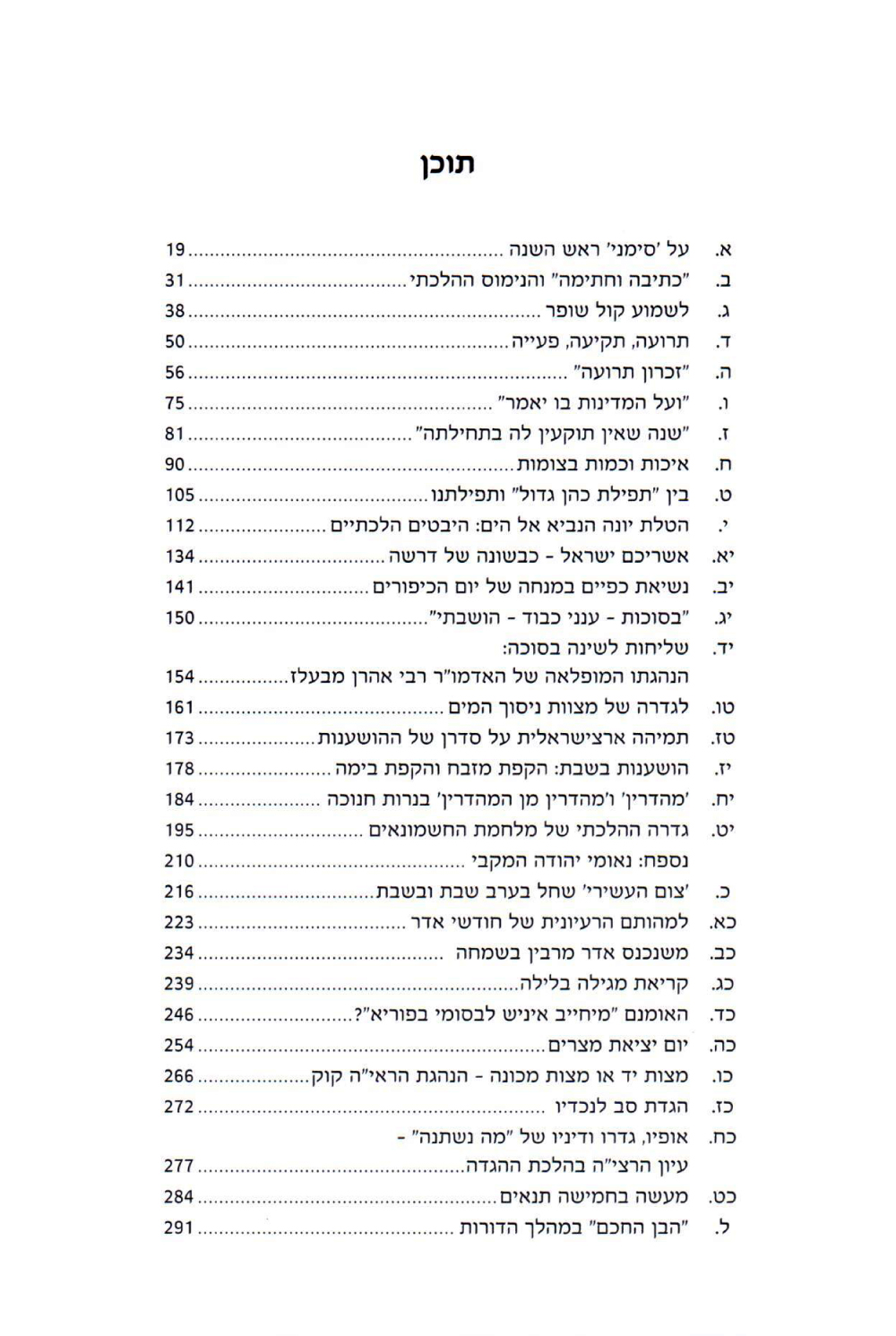
דווקא זווית הגותית אגדית פעמים שהמאמר בה בארוכה ופעמים שהוא בא דווקא  בקצרה וכן הלאה על דרך זה. לאחר פרסומם הראשון
עלו חלק מן המאמרים על שלחנם של גדולי ישראל, וזכו להארות הערות והתייחסויות מצדם
התגובות שבכתב הובאו בספר זה, והן מתפרסמות בו לראשונה יחד עם המאמרים שפורסמו זה
מכבר. בנוסף צורפו לספר זה מספר מאמרים שטרם ראו אור.
Here
is a scan of the table of contents to give one some sense of the wide range of
subjects:

11. ר’ איתם הנקין הי”ד, אש תמיד,
חידושים וביאורי דינים על סדר שלחן ערוך ומשנה ברורה, 369 עמודים
It’s
only been a few months since the terrible tragedy of the murder of R’ Eitam
Henkin and his wife. R’ Eitam was a special and unique person combining many
talents all in one. He was a great talmid chacham, Historian and talented writer all “wrapped
up” in one package. This work was something he had completed before his murder
and which he was very proud of. It received many impressive Haskomos which in
my opinion (for whatever it’s worth) are not exaggerated at all. He had the
unique ability to write clearly and concisely – penetrating to the heart of the
issue. This is a very valuable contribution to the world of Halacha
specifically Hilchos Shabbos. Sample pages are available upon request.


New seforim list with some random comments

New seforim list and some random comments By Eliezer Brodt This is a list of some of the recent seforim I have seen around during my seforim shopping. This is not an attempt to include everything or even close to that. I just like to list a wide variety of works. I note by some of these works that I can provide a table of contents if you request so, via emailing me at, Eliezerbrodt@gmail.com ספרים א. אוצר הגאונים מסכת בבא מציעא, מכון אופק ראה כאן. I will return to this work in a post shortly. ב. ראב”ן [ג’ חלקים] מהדיר: ר’ דוד דבליצקי [ניתן לקבל ה’מבוא’]. ג. מחזור כמנהג רומה- שונצין קזאל מיורי רמ”ו (1485-1486) מהדורת פקסימיליה, וחלק נוסף, קובץ מחקרים בערכית אנג’לו מרדכי פיאטלי, 170 עמודים. I will return to this work in a post shortly. ד. שלחן מלכים, יורה דעה, ר’ יצחק בואינו, מכון ירושלים. ה. אמת ליעקב, ר’ ישראל יעקב אלגאזי, על הלכות קריאת התורה, כולל ספרו, חוג הארץ על הלכות פורים כשחל בשבת לבני ירושלים, חזון למועד, דינים לבני חו”ל הבאים לארץ ישראל, ומפתחות, ש”ו + לד עמודים. ו. כתבי החיד”א: מורה באצבע צפורן שמיר קשר גדול כף אחת יוסף בסדר סנסן ליאיר שומר ישראל מכון אהבת שלום, עם הערות. ז. מגילת ספר, לר’ יעקב עמדין, מהדיר ר’ אברהם בומבך, רעא עמודים. [ניתן לקבל דוגמא של הספר]. This is the third time this famous work has been printed in Hebrew. This time the manuscript was consulted and many things from previous versions were corrected. This work contains a nice overview and many useful notes and an index of names. The editor is a known expert of Rav Yakov Emden’s writings and his notes are good. However this editor felt that he needed to edit the work and certain parts such what he writes about Reb Yonason Eybechutz and the like was removed, so once again a perfect edition remains a need. Of interest is the aeppendix at the end dealing with what the argument between Rav Emden and Eybeschuetz was about. This is another attempt to deal with this sad time in history. I will leave it up to the reader to decide if he is convinced by what he suggests. ח. שו”ת אור השנים לבעל ה’פרדס’- ר’ אריה לייב הלוי עפשטיין, קסה עמודים. כולל כמה ספרים של ר’ שריה דבליצקי, א. יראו עינינו, בענין תפלת ותיקן. ב. פאר יעקב, מצות תפילין וק’ על מצות תפלין כל היום. ג. הידורי תפלין. ד. פלגי מים, תענית גשמים וברכות גשמים בזמן הזה. ט. כתר ראש לר’ חיים מוואלאזין, עם מקורות ביאורים והערות, קמו עמודים+ 110 עמודים ועוד. This sefer looks beautiful but is lacking one thing: a proper introduction to enumerate what it exactly is adding to what we already have. For a partial introduction to this work see Rabbi Dovid Kamentsky’s article in the latest issue of Yeshurun 26 (2012), pp. 790-797. י. פנים יפות מהדורא תנינא, מכתב יד, תקא עמודים. This is a completely new work of the Haflaah’s, never before printed, which will help in the now famous ongoing debate about the Haflaah and his ties to Chassidim, especially in his written works. For recent articles on this topic See Rabbi Dovid Kamenetsky’s article in Yerushasenu 4 (2010), pp. 251-274 and Rabbi Yitzchak Weiss in one of the recent issues of Kovetz Beis Aharon Ve-Yisroel. [Email me if you would like to see these articles]. I have been told that there will be more on this in the near future. יא. תפילת הסופר, עניני תפילה, ממרן החתם סופר, קצט עמודים. יב. מנחת עני על התורה לבעל ה’ערוך לנר’, כולל מפתחות, ושאר הוסופות, תקלט עמודים. יג. שערי צדק, שער החצר, ר’ שמעון בן דוד, שני חלקים, בעניני ארץ ישראל, כולל מבוא, מפתחות והערות. יד. כתר תורה, ר’ מאיר מבארדיטשוב, בנו של בעל ה’קדושת לוי’, על התורה רמב”ם וש”ס ועוד, תלה עמודים. טו. ספר תהלים עם ביאור ‘תהילות יעקב’ לר’ יעקב פריימאן [מכת”י], שהיה רב בפוזן בברלין ועוד מקומות, מהדיר של הספר לקט יושר, 305 עמודים. טז. גנזים ושו”ת חזון איש, חלק ב, תכה עמודים. יז. הליכות חנוך, הוראות עובדות והנהגות מרן ר’ חנוך דוד פדוואר, בעל שו”ת חשב האפוד, שנג עמודים יח. תולדות נח, ר’ אליהו ברכה, בעניני שבע מצות בני נח בהלכה ואגדה, תתסג עמודים. יט. לאוקמי גירסא, ביצה- תיקונים והוספות ברש”י מכתבי יד, ר’ ישראל גרינבוים, לח עמודים, [ניתן לקבל דוגמא]. כ. ספר הזכרון בצאת ישראל, כולל גנוזות, תורת ראשי הישיבות וחכמי התורה, ומאמרי מוסר ודעת, על פסח, חול המועד, ספירת העומר ושבועות, תתמו עמודים. Of special interest to me was the few Teshuvot printed here from manuscript related to putting on Tefillin on Chol Hamoed. כא. חומש שמות עם פירוש ‘מעט צרי’ על תרגום אונקלוס. כב. התהלים המפורש, ר’ יעקב וינגרטן, תקסו עמודים ומבוא על עניני תהלים 137 עמודים. This work simply put is just beautifully done. כג. סנסן ליאיר ר’ מזוז, עניני פורים. כד. מגידים חדשים, ר’ דוד ווייס, ספר במדבר, תתיט עמודים. [מלא חומר חשוב ומעניין]. כה. חזון איש- שמונה עשרה שעות עם פירוש פשר חזון מר’ ישראל רוטנברג, קכה עמודים. כו. דרכי העיון, מאמרים בשיטת הלימוד, ר’ מאיר מזוז, רנא עמודים. כולל הערות על ספרים ‘עליות אליהו’ ו’תולדות אדם’. There is a lot to say about this sefer, hopefully I will have time to write it up in near the future. כז. כבודה של תורה, עובדות והלכיות מחיי ר’ רפאל שמואל ברנבוים, קפב עמודים. כח. והארץ לעולם עומדת, ר’ שלמה רוזנר, צז עמודים. כט. שיגרא דלישנא, הפתגם ומקורו ככתבו וכלשונו, ר’ אברהם מייזעלס, 95 עמודים. ל. קונטרס אור לגויים, ר’ יאיר עובדיה, ליקוט בעניני מעונן, מכשף, כתובת קעקע, חוקות הגויים ודרכי האמורי ורפואה מנכרי, 119 עמודים. לא. עיטוש להלכה [Sneezing] ר’ יששכר הופמן, פג עמודים. לב. איגרתא חדא, לר’ שריה דבליצקי,- דיני ביעור מעשרות, ברכות האילנות, פסח שחל בשבת, עירוב תבשילין, צ עמודים. לג. רמב”ם עפ פירוש יד פשוטה, שופטים [ג’ חלקים], ר’ נחום רבינוביץ. לד. מנחת אהרן, חג הפסח, ר’ אהרן מיאסניק, תנ עמודים. לה. עשן הכבשן, הבנת השואה לאור התורה סיבותיה ולימודיה, מלוקט מחיבורי ושיעורי רבי אביגדור מילר, ריז עמודים. לו. ימי פורים, ר’ דוד הכהן, תרלג עמודים. לז. הברת החסידים כללי עברי, ר’ נפתלי צבי דעמביצער, שלו עמודים+קח עמודים. ביאור הברת לשון הקודש למנהג בני פולין ואונגארן וסדר השתלשלות המבטא מימי קדם עד היום ויישוב דברי הפוסקים בכמה ענינים ובירור מבטא לשון הקודש על פי דקדוק. See page 307 in this work about quoting Shadal. לח. משיח כהלכה: קובץ דקדוקי תורה קונטרס פרק בשיר ספר מחברת התיגאן ספר חלק הדקדוק, ר’ אריאל הלוי. לט. פרקי אבות לפי פירוש רוח חיים של ר’ חיים מוולואז’ין, – ישעיהו ליבוביץ, 335 עמודים. מ. מכתב ישראל חלק ב מכתבים של ר’ ישראל אליהו ויינטרויב. מא. This volume is full of regular Torah of his on different topics the back has a few pages interesting stuff on random things. Just to mention three points he writes: קבר הגר”א, שאלתיו בנוגע לנסיעה לקברי רבותינו שמידי פעם עורכים נסיעות כאלו, שלכאורה אסור לצאת לחו”ל לצורך זה. והשיבני… כמו שללמוד תורה ולפרנסה מותר, כמו כן מי שיגע הרבה בכתבי הגר”א ז”ל יכול להבין מה שהוצאתי מההשתטחות על קברי הגר”א ז”ל… (עמ’ רצו). ירדית דורנו… המצב היום גרוע מאוד, כל אחד יכול לשבת עם המחשב על הסטנדר ואלפי ספרים עולים לו בלי מאמץ, ולא צריך להתייגע מה שלא היה אף פעם… (עמ’ רצח). אודות ספר מסילת ישרים ויכוח שהופיע בחמש עשרה שנים האחרונות, אמר לי מו”ר שלא לעיין בו משום שהוא מהדורא קמא של המסילת ישרים והדברים באים שם באופן של שאלה ותשובה, אשר זה מראה כביכול יש כאן אפשרות לצד אחר, וזה עושה נזקים, [ורק] המסילת ישרים [שלפנינו] ששם באו הדברים בצורה ברורה בלא שום צד אחר חלילה (עמ’ שח). קבצים א. ישורון כו, ניתן לקבל תוכן הענינים. Just to highlight some of the great looking sections 1. חידושי הריטב”א מסכת ביצה 2. עניני תפילה מספר המשכיל 3. פ’ הגדה של פסח לר”י גיקטיליא 4. ספר הגור על מכות מצרים 5. ק’ גבעת פנחס לזכרו של ר’ פנחס הירשפרונג, כולל זכרונות על רבו ר’ מאיר שפירא 6. ק’ פרי עץ חיים לזכרו ר’ אברהם יעקב זלזניק 7. ק’ אור זורח לזכרו רבי זרח שפירא כולל מכתבים ופסקים ממרן בעל החזון איש 8. להקים שם על נחלתו- על חידושי ר’ יהושע ליב דיסקין על התורה 9. אגרות הקודש ותולדות הגאון ר’ אפרים חרל”פ- ר’ דוד קנמצקי 10. תוס’ ותוס’ רא”ש על מסכת ביצה- ע”י ר’ משה מיימון 11. הלכות ברכת הראייה במסגרת הספר מעגל טוב לחיד”א, – ולענין ללכת לגן החיות ועוד, ממני אליעזר בראדט ב. מקבציאל, גליון לח, תתעט עמודים. Just to highlight some of the great looking sections 1. קטעי גניזה מפירוש הרא”ה למסכת ברכות. 2. נועם ה’ לר’ אברהם ב”ר אלעיזר הלוי 3. קונטרס אמרי דעת לר’ מנחם די לונזאני 4. פסקי תוס’ מסכת חולין 5. סבוב רבי פסתחיה מרגנשבורג (98 עמודים) 6. תולדות חכמי הדורות וחיבוריהם לר’ יצחק כדורי ג. המעין גליון 201 ד. היכל הבעל שם טוב, לג One article worth pointing out is related to Chasidus and the Mussar of Kelm including the writing of Rabbi Blch, Reb Yeruchem, Lev Eliyhau and Rav Dessler. ה. אור ישראל גליון סד Of special interest to me in this volume was the article of Rabbi Asher Miller which is a nice collection of comments on Rabbi Shmuel Ashkenazi’s recent work Alpha Beta Tenyusah DeShmuel Zeira. ו. עץ חיים גליון יז –ניתן לקבל תוכן הענינים. ז. היכלא, גליון ב’ בעניני פסח, שפא עמודים, ניתן לקבל תוכן הענינים. ח. סידרא, חלק כו ט. דעת חלק 71 מחקר א. מברכת משה, קובץ מאמרים במשנת הרמב”ם לכבודו של הרב נחום אליעזר רבינוביץ, ב’ חלקים, מעלה אדומים, ניתן לקבל תוכן הענינים. These two volumes are an excellent collection of material related to many aspects of the Rambam. ב. צמחי המקרא, זהר עמר, בחינה מחודשת לזיהוי כל הצמחים הנזכרים בתנ”ך לאור מקורות ישראל, והמחקר המדעי, 288 עמודים. ג. אשנב לספרות התשובות, שמואל גליק, 422 עמודים. This work is a very useful tool for understanding the Shut literature. ד. מחקרים בהלכה ובתולדותיה, שלום אלבק, הוצאת בר אילן, 210 עמודים. ה. גנזי חז”ל בספרות הקראית בימי הביניים, עפרה תירוש בקר, ב’ חלקים, כרך א’ עיונים פילולוגיים ובלשניים כרך ב מהדורה מדעית מוערת של הטקסטים. מוסד ביאליק. ו. מוצא העם העברי ואמונתו, אהרון תומר, מוסד ביאליק. ז. על דעת הקהל, ספר היובל לכבוד א’ רציצקי, שני חלקים מרכז זלמן שזר.


Rabbi Steinman and the Messiah, part 2

Rabbi Steinman and the Messiah, part 2

Marc B. Shapiro

Continued from here

1. R. Yehudah Herzl Henkin has a different perspective than what we have seen so far.[1] He rejects the notion that “waiting” for the Messiah means that one must believe that he can come at any second, for the Sages already said that the Messiah will not come at certain times. He writes:[2]

ובעיקר הענין הרביתי בראיות מן הגמרא שחז”ל לא ציפו שהמשיח יבוא בכל עת

Contrary to the Brisker Rav (whom he mentions by name), R. Henkin writes: “There is nothing in the Rambam requiring one to believe that the Messiah is ready to come at any moment.”[3] He claims that the Rambam’s real point is that one should not be at ease with the Messiah not having arrived, but rather one should be upset that he hasn’t yet come. A similar argument was made by R. Shmuel Yaakov Weinberg.[4] Unlike R. Shulzinger (see the previous post), R. Henkin does not find a problem with those who mentioned dates for the redemption (and this includes a few important figures[5]), since he suggests that the dates were never intended to be absolutely certain.

Yet R. Henkin adds that it is clear that the sages who gave dates for the Messiah—even if their suggested dates were not certain— did not have אמונה שלמה that the Messiah would come before the dates they predicted, and they obviously are not to be regarded as heretics. He sees this point as contradictory to the Brisker Rav’s claim (as it is usually understood) that one must hope for and await the Messiah’s arrival every day. R. Henkin’s explanation is certainly not in contradiction to the Rambam’s Principle. If the sages who gave dates for the Messiah did not deny that they could be wrong, and that the Messiah could come at any time, then they were not contradicting the Rambam’s Principle. The only thing they were contradicting is the version of the Principle in the siddur which adds the words באמונה שלמה. Yet these words not appear in the Rambam’s formulation.

R. Henkin adds that it is strange that the Brisker Rav would declare that anyone who does not have his understanding of the Twelfth Principle is a heretic, when his understanding is not explicitly found in the Torah, the Talmud, or the rishonim.[6]

ואפילו לדברי הגרי”ז שצריך להאמין שהנה ממש היום הזה הוא בא וכו’ עכ”ל, מן התימה על האי גאון וצדיק ז”ל להחזיק מי שאינו מאמין כן ככופר כיון שהדבר אינו מבואר לא במקרא ולא בחז”ל ולא בראשונים.

R. Henkin concludes that it is enough to believe that the Messiah will come even if you assume that he will not come today or tomorrow. He also cites his grandfather, R. Joseph Elijah Henkin, that “to wait for the coming of the Messiah” does not mean that you think he is ready to come at any instant.[7]

קושטא דמילתא המאמין באמונה שלמה בביאת המשיח ומחכה לו ומתאווה לבואו קדוש ייאמר לו אף על פי שסובר שלפי מאמרי חז”ל לא יבוא היום או מחר, וכן אמר מו”ז הגה”צ זצלה”ה שלחכות לביאת המשיח אין פירושו שעומד לבוא בכל רגע וכן עמא דבר.

In support of R. Henkin, we can cite R. Yohanan ben Torta, who when R. Akiva declared that Bar Kokhba was the Messiah, responded as follows: “Akiva, grass will be growing out of your cheeks and the Messiah will still not have come.”[8] As R. Meir Mazuz notes, R. Yohanan ben Torta believed in the concept of the Messiah, but he did not see any chance that the redemption would come in his generation.[9] In other words, he was not “actively waiting” for the Messiah.

R. Menachem Kasher has another approach. He understands Maimonides’ words that one must wait for the Messiah in a negative sense, namely, that if one despairs of the Messiah’s arrival he is in violation of Maimonides’ words, but not that there is a continuous obligation to wait for the Messiah’s arrival.[10] R. Yisrael Weinman also questions the Brisker Rav’s understanding (although he is not certain the Brisker Rav really said it), since according to some rishonim the Messiah cannot come on Shabbat and Yom Tov. He therefore assumes that it is enough to wait for the Messiah to arrive whenever he is able to come.[11]

R. Yaakov Nissan Rosenthal explains that the siddur’s version of Maimonides’ principle,

עם כל זה אחכה לו בכל יום שיבוא

does not mean that you must believe and expect every day that today is the day the Messiah will come. Rather, the meaning of בכל יום is that every day you must believe in the coming of the Messiah and await his arrival, whenever that will be.[12] He offered an example to illustrate this point: A man’s daughter married and moved to the Diaspora. The father waits every day for his daughter to return to Israel, but on every day he does not expect that all of a sudden he will hear a knock at his door and his daughter is standing there.[13]

אין המאמין מחכה דוקא שלפתע פתאום יבוא האדון אל היכלו באופן ניסי ושיודיעו לו שהיום בא המשיח, אך הוא כן מחכה בכל יום לביאת המשיח

Significantly, R. Shlomo Zalman Auerbach agreed with R. Rosenthal and didn’t even think this was a hiddush, but rather the simple meaning of the words אחכה לו בכל יום שיבוא. R. Rosenthal then tells about how he was at a meeting with R. Shlomo Zalman and other rabbis, and he presented his understanding. A few of the hasidic rebbes present started screaming that what he said was wrong and in contradiction to one of the Principles of Faith. R. Shlomo Zalman didn’t say a word. After the meeting R. Rosenthal asked R. Shlomo Zalman why he didn’t defend him from the attacks of the hasidic rebbes. R. Shlomo Zalman replied that you shouldn’t start up with Hasidim

עם חסידים לא צריך להתחיל

R. Rosenthal couldn’t recall if the following witticism was said to him by R. Shlomo Zalman or someone else later told it to him: In the Amidah we say: על הצדיקים ועל החסידים. We see that the word צדיקים goes before חסידים

כי לא “מתחילים” עם חסידים

It is noteworthy that according to the Vilna Gaon’s understanding, if the Messiah does not come in a “hastened” fashion (see Sanhedrin 98a), it certainly seems that no one would be able to hope for the Messiah to arrive in Tishrei. The reason I say this is because of how the Vilna Gaon describes the terrifying things that will happen if the Messiah arrives in its “due time,” and this is in Tishrei.[14]

אם חלילה לא יזכו ותהיה “בעתה” ואז אם היתה הגאולה בתשרי לא היה להם תקומה ח”ו ולא היו נשארים חלילה אלא אחד מעיר ושנים ממשפחה מפני שמדת הדין שולט בתשרי

Also of interest is the report of how R. Jacob Kamenetsky told someone that the Messiah would not be arriving soon. A certain man had been convinced by people in Chabad that the Rebbe would soon reveal himself as the Messiah, and this had led him to start observing Shabbat. However, R. Kamenetsky thought that it was important to uproot the man’s belief that the Messiah would soon be here, as he worried about the negative consequences to the man’s Judaism when the Messiah did not arrive as he had been expecting.[15]

אל תאמין להם. משיח, לצערנו, עדיין אינו עומד לבוא . . . [רי”ק הסביר לתלמידיו] מה שהשיגו אנשי חב”ד הוא הישג מדומה, שיצא שכרו בהפסדו. בעתיד הקרוב, כשיראה יהודי זה שההבטחה לא נתמלאה והמשיח לא הגיע, יתחיל שוב לחלל את השבת. יתרה מכך, עד עכשיו הוא האמין בתמימות מוחלטת בביאת המשיח, ואם יתאכזב, יפסיד את אחד היסודות החשובים ביהדות – האמונה בביאת המשיח.

Based on this, I think we can say that R. Kamenetsky did not expect the Messiah to arrive in the near future.

Some Jewish traditions speak of a great war that will occur before the coming of the Messiah, and even of the death of Messiah ben Joseph in this war.[16] Other traditions see this great war as occurring after the coming of the Messiah. R. Hayyim Soloveitchik is reported to have said that if the messianic era will bring even one Jewish death, then he doesn’t want it, and if we had a choice in the matter the halakhah would require us to reject the Messiah in such a circumstance. I wonder, therefore, if R. Hayyim was really able to look forward to the messianic era, knowing that its arrival would bring the possibility of Jewish death.

Here is how R. Hayyim is quoted by R. Dov Katz.[17]

מספרים בשמו של ר חיים סולובייצ’יק מבריסק, הגאון של הדור הקודם, שבימי המלחמה כשנפלו כל כך הרבה חללים בחזית המלחמה וסבלו כל כך הרבה, אמרו לו פעם בשיחה, שלוא היתה לכל הפחות מביאה המלחמה הזו את הגאולה, כי אז היה אולי כדאי הדבר. גער בהם ר’ חיים ואמר להם: “תדחינה מאות גאולות ואל תפול נפש אחת מישראל, כי אם היתה באה שאלה לפנינו שאם על ידי קרבן של אדם אחד יבא המשיח, בודאי שהיינו פוסקים שלא יבוא המשיח ולא תמות נפש אחת, כי הלא פיקוח נפש דוחה כל התורה כולה, ואף המשיח והגאולה בכלל.”

I have no reason to doubt the accuracy of this report. It is very much in line with what we know about R. Hayyim’s views both about the value of human life, and also about the downplaying of messianism. R. Joseph B. Soloveitchik stated: “To R. Chaim, a good chidush in Torah and Kodshim – if I may say so, perhaps I shouldn’t say it – was more important than the whole beis ha-mikdash, in his intuitive weighing.”[18] R. Soloveitchik had some hesitations about what he said, because he knew it would be shocking to people, but he said it anyway. R. David Holzer, in his note on this sentence, writes: “Obviously, the Rav is speaking derech guzma, just to express the concept.” Even if the Rav is exaggerating his point is clear, namely, that Torah study is much more important than what will take place in the future Temple.

I think the Rav’s point is that an Ish Halakhah is simply not interested in the messianic era in any practical way. He believes it will come (and thus fulfills Maimonides’ requirement), but he doesn’t focus on it, for he has everything he needs in a non-messianic world, namely, the study of Torah and the fulfillment of mitzvot. As for the study of Torah, as the Rav said, creating a chiddush about the laws of sacrifices is more important than the sacrifices themselves, because at the end of the day Torah study is the focus of our lives, not sacrifices which we have been without the last two thousand years.

Even though I said that I have no reason to doubt what is reported in the name of R. Hayyim, and this report is also cited by R. Ovadiah Yosef,[19] I must note that R. Eliyahu Zini completely rejects the reported statement which he sees as absolute nonsense.[20]

טענות אלו דברי תימא גדולים הן. הלא הן סותרות כל מלחמה יזומה, אף כל מלחמת מצוה, וכ”ש מלחמת רשות! ואם נקבל אותן, נצטרך לגזור אומר, שגם כבוש הארץ בזמן יהושע איסור גמור היה, ושהיה עדיף להשאר במדבר כדי לחסוך בחיי יהודים רבים. ואסור להאמין שגדול בישראל אמר דבר כזה, שהרי טענות מרגלים יש כאן, מסוג “ארץ אוכלת יושביה היא וכל העם אשר ראינו בתוכה אנשי מידות”. ואם נאמץ אותן, עלינו לומר שהיה אף אסור לצאת ממצרים, כי יציאת מצרים הביאה למות דור שלם, ולכן היה עדיף לדחות אפילו גאולת מצרים!

לכן אסור להאמין לעדות זו. וגדול כר’ חיים מבריסק לא יאמר דברי הבל כאלו ויש כאן הוצאת דיבה על גאון זה, ובפרט שעדות זו מוכחשת ממה שכתב במפורש ר’ חיים עצמו [שלפי ר’ חיים אין דין פיקוח נפש חל בשעת מלחמה], והבאנו אותה כבר פעמיים לעיל

I don’t believe that R. Zini’s words, which come from a right-wing religious Zionist perspective, create any difficulty in believing that which R. Hayyim is quoted as saying, namely, given the choice between a Messiah which will require the loss of human life or no Messiah, that he would prefers the latter. What about R. Zini’s point that according to what is reported in R. Hayyim’s name, that human life stands above all, that the concept of milhemet mitzvah makes no sense? I think the answer is clear, namely, that R. Hayyim obviously acknowledged that in a halakhically valid war, and certainly in a war commanded by God (such as to conquer the Land of Israel), human life will be lost and we cannot have “conscientious objection.” (It is, however, hard to imagine how R. Hayyim would have been able to support a milhemet reshut.) 

Yet there is no halakhic imperative to bring the Messiah, and if given a choice between the Messiah with loss of life or no Messiah, R. Hayyim would forego the Messiah. Given the choice between a Jewish state that will require the loss of life—even a state that functions according to halakhah—or no state, R. Hayyim would forego the state. This was one of the two reasons for the anti-Zionism of R. Isaac Zev Soloveitchik, namely, that the actions of the Zionists endangered Jewish life. His other reason was that he believed that the Zionists would persecute religious Jews in a Zionist controlled state.

To be continued

Excursus

The old question is why did rabbis give dates for the Messiah’s arrival when the Talmud, Sanhedrin 97b, states: “Blasted be the bones of those who calculate the end (i.e., the Messiah’s arrival).” Maimonides actually mentions a family tradition as to when prophecy will be renewed, and this will precede the messianic era. See Iggerot ha-Rambam, ed. Sheilat, vol. 1, pp. 152-153.

On the second day of the Ten Days of Penitence, one of the selihot we read (Tohelet Yisrael) states:

חשבון אחר חשבון עמך יפתור

“Thy people interpret reckoning after reckoning.” This refers to predicted dates of the Messiah’s arrival. R. Zev Wolf Leiter sees this as a proof that there is no prohibition in offering dates for the Messiah as long as one does not lose faith in the messianic principle if the projected date comes without the Messiah’s arrival. See his Kevod Melakhim, Hilkhot Melakhim 12:2, found here and on Otzar haChochma.

In agreement with R. Leiter’s perspective, R. Menasheh Grossberg, Shevet Menasheh, no. 46, also suggests that there is no problem in giving dates of the Messiah’s arrival, and what the Talmud is criticizing is those who, if the Messiah does not come on the predicted arrival date, would then deny the principle of messianic redemption. His proof for this interpretation is the passage that comes directly after what I quoted above from Sanhedrin 97b: “For they would say, since the predetermined time has arrived, and yet he has not come, he will never come.” Thus, we see that the Talmud itself explains the reason for the curse of those who predict the Messiah’s arrival, and it is because if the Messiah does not arrive at the predicted date it will lead to heresy in that people will completely deny the principle of the Messiah. R. Grossberg goes so far as to write:

הנה הראשונים שהיו כמלאכים או כבני אדם מאמינים באמונה שלמה להם ראוי לחשוב בקצין ולחקור באמונה

R. Joseph Kafih states that the reason why sages gave dates for the Messiah’s arrival, or in Maimonides’ case the renewal of prophecy, was only in order to strengthen the people, that they not despair of redemption. In other words, the sages themselves did not take the dates seriously, as the point of publicizing this information was for an entirely different purpose. In R. Kafih’s words:

לא פעל רבינו כפי ההלכה לכתחילה, אלא בכדי לעודד את העם

See Teshuvot ha-Rav Yosef Kafih le-Talmido Tamir Ratzon (Kiryat Ono, 2018), p. 389.

This is the very same reason Maimonides gives for R. Saadiah’s messianic calculations. Maimonides writes as follows in his Letter to Yemen (Abraham Halkin and David Hartman, Crisis and Leadership: Epistles of Maimonides [Philadelphia, 1985]), p. 116):

As for Rabbi Saadiah’s calculations, there are extenuating circumstances for them though he knew they were disallowed. For the Jews of his time were perplexed and misguided. The divine religion might have disappeared had he not encouraged the pusillanimous, and diffused, disseminated, and propagated by word of mouth and the pen a knowledge of its underlying principles. He believed, in all earnestness, that by means of the messianic calculations he would inspire the masses with hope to the Truth. Verily all his deeds were for the sake of heaven. Consequently, in view of the probity of his motives, which we have disclosed, one must not decry him for his messianic computations.

R. Meir Leibush Malbim also provided dates for the messianic era. He believed that the initial stage of the Redemption would be between 1868 and 1913. The Temple would be rebuilt in 1925, sacrifices would begin to be offered in 1928, and the resurrection of the dead would take place in 2203. See Noah Rosenbloom, Ha-Malbim (Jerusalem, 1988), pp. 159-160.

R. Judah Leib Maimon reports that his father asked the Malbim how he could offer such dates in opposition to the talmudic statement against this. He replied that the proscription against offering dates was only in the early years after the destruction of the Temple, when the path until the end was still long. However, as we are now close to the end of the Exile it is permitted to give dates. See Maimon, Le-Ma’an Tziyon le Ehesheh (Jerusalem, 1954), p. 19. The same answer in the name of the Malbim is found in R. Yissachar Dov Teichtal, Em ha-Banim Semehah (Jerusalem, 1998), pp. 150-151. In both sources, in order to offer a parable explaining his point, the Malbim tells the story of a father and son taking a long journey. At the beginning of the journey, when the son asks if they almost there, the father is annoyed with him. However, after much time on the road, when the father asks the coachman the same question, he explains to his son that now that they have journeyed far the question is appropriate. It is the same with the exile, the Malbim explains. At the beginning, it was improper to offer predictions of its end. However, now that we are almost near the end, it is OK to do so. (In the version of the story told by Maimon, the young son is none other than the Malbim himself, and the answer comes from his father.)

R. Jacob Isaac Horowitz, the Chozeh of Lublin, is quoted as saying that those who, based on hints in the Torah, predicted dates for the Messiah’s arrival were really just offering a strong suggestion to God that it is time for Him to redeem the Jews. This is just like a son does not explicitly tell his father that he is doing something wrong, but instead shows him the Torah source so his father can draw the proper conclusion.

כי עפ”י הלכה באם בן רואה לאב שאינו עושה חלילה כיאות אז משום כיבוד אב לא יוכל לומר לו שאינו עושה כשורה רק החיוב להראות לו הדין בתורה ופוסקים ולומר לו אבא כך כתוב בתורה (עיין יור”ד סימן ר”מ סעיף י”א מש”ס קידושין דף ל”ב) וכיון שאנו רוצים לחות דעתינו לאבינו שבשמים שירחם על בניו ויגאל אותנו בקרוב וכי אין מן היושר כביכול שיסבלו עוד עול גלות לכן צדיק הדורות מחדשים איזה קץ משיח ועושים על זה רמז באיזה פסוק בתנ”ך איך שבשנה זו יבוא משיח צדקינו והוא להראות לאבינו הבורא ית”ש אבא כך כתוב בתורה היינו דבאותו מקום בתוה”ק כתוב שבשנה זו יבוא משיח בב”א

See R. Moshe Menahem Mendel Walden, Or ha-Niflaot, p. 12a, included in Ohel ha-Rabbi (Petrokov, 1913); Mendel Piekarz, Ha-Hanhagah ha-Hasidit (Jerusalem, 1999), p. 190.

******************

2. In the last post I mentioned Elliot Wolfson’s argument that the Lubavitcher Rebbe’s secret teaching is that there will be no physical redeemer, but the messianic redemption is able to occur within each person. A number of people were surprised to hear about this, as there is, I believe, literally not one person in Chabad who accepts this argument. While I do not believe that Wolfson is correct, it is important to note that one does find in Hasidic thought the concept of inner redemption.[21] Although this is not intended to replace the ultimate physical redemption, these Hasidic teachings do turn passages in the Talmud on their head. For instance, R. Meir of Apta asks why we need to pray for redemption if God has promised that he will redeem us. He quotes the Chozeh of Lublin who said that the Talmud, Megillah 16a, mentions that if you repeat a teaching in the name of someone else, you “bring redemption to the world.” The Chozeh points out that this is difficult, as every page of the Talmud has someone repeating a teaching in the name of someone else, and yet the redemption still has not come. The Chozeh replies that the redemption being spoken about is a personal redemption, that one is delivered from his difficult circumstances. Similarly,  when we pray for redemption, it is a prayer for personal redemption.[22]

דהנה השי”ת הבטיח לנו לפדותינו ולגאלינו מהגלות המר, ולכאורה יפלא מה צורך להתפלל על הגאולה, ההוא אמר ולא יעשה. אך ששמעתי [!] מרבינו הקדוש מוהרי”י זצללה”ה מלובלין על הגמרא כל האומר דבר בשם אומרו מביא גאולה לעולם, והתמיה נשגבה, כי בגמרא מצינו ממש בכל דף שאומר התנא דבר בשם חבירו או בשם רבו, ומדוע עוד לא נושענו מהגלות. ותירץ, כי הבאת הגאולה הוא גאולה פרטית לאיש ישראל ממצוקותיו, כאשר אמרנו, ותקם בעוד לילה שבהגלות יוושעו ישראל ויקומו בהרחבה והרוחה, וע”ז אנו מתפללים, וזה בכלל גאולה

3. In recent months there have been a number of discussions about epidemics in Jewish history and how the rabbis responded. No one has yet cited what the great R. Elijah Klatzkin wrote.[23] You can see this in R. Klatzkin’s Miluim le-Sefer Devar Halakhah (Lublin 1923), pp. 126-128. For some reason, the copy of this book on Otzar haChochma is missing the second half of the book. However, the complete work is available on hebrewbooks.org here.

R. Klatzkin prints an open letter he wrote in 1916 to his community in Lublin, when they were suffering a typhus epidemic. It originally was published in Yiddish and Polish. He obviously thought it was important that his message should be preserved for posterity, and over a hundred years later what he says unfortunately remains relevant to us.

R. Klatzkin tells the community that he has to write to them, rather than speak to them, as due to the danger they can no longer gather together in the synagogue. He mentions that although the government established rules to keep people healthy, nevertheless there are many who are ignoring the laws. (To this I would add, the more things change the more they stay the same.)

R. Klatzkin stresses that the various government rules are also required according to the Torah, and one who violates the rules, which bring danger to him and his neighbors, “his sin is too great to bear.” R. Klatzkin expresses wonder that he needs to warn people about these matters, which relate to their health and the health of their families. What he observed over a hundred years ago has of course repeated itself in our time, when for incomprehensible reasons entire communities simply ignored basic health guidelines which allowed the virus to spread very quickly, leaving a terrible toll.

R. Klatzkin states that he wouldn’t need to warn people to watch over their money, so how is it that people treat their health with less concern than their money? He then turns to the issue of hillul ha-shem, and we see that in his day it was also the case that there were Jews who created a hillul ha-shem in how they responded to the crisis. R. Klatzkin notes that even repentance, Yom Kippur, and personal suffering do not atone for hillul ha-shem.[24] “If we would behave in accordance with the Torah, then we would be a light unto the nations and would sanctify the name of heaven and the honor of the holy Torah.” In R. Klatzkin’s day, one of the reasons for the spread of the epidemic was the unsanitary conditions that the poor lived in, and he concludes his letter by appealing to the wealthy to support the poor so they can improve their living conditions.

In his open letter R. Klatzkin states that he spoke about the issue of hillul ha-shem and kiddush ha-shem in his book אמ”ש. This refers to his responsa Imrei Shefer which appeared in 1896, and he has in mind no. 92 in this book. In this responsum he makes a number of noteworthy points. To begin with, R. Klatzkin makes very clear that when it comes to halakhah there is a great distinction between real idolaters and the nations among whom Jews currently live. He cites the Meiri to back up this position and the entire lengthy responsum is in support of this point.

ורבים טועים ומתעין עצמם לחשוב שכל מה שמבואר בספרים להחמיר בטעות ואונאת אינו יהודי הוא רק מפני איבה ובאמת לא כן הדבר והוא איסור גמור . . . ומזה מבואר דכל מקום שכתוב בטור ושו”ע עכו”ם היינו בדיוק עובדי כוכבים ממש ואינו מדבר כלל מהאומות שבזמנינו המאמינים בהשגחה ושכר ועונש וכמו שמפורש במאירי

This shows that he really means what he says, unlike other works that include a comment at the beginning of the book saying that any time non-Jews are referred to it means idolaters who live in places like India and China. Comments like this were never taken seriously. In fact, the very existence of these comments was said by R. Moshe Feinstein to be a proof, contrary to R. Solomon Luria, that one is allowed to alter Torah teachings in the face of danger.[25]

R. Klatzkin begins his responsum by calling attention to a passage in R. Joseph Albo, Sefer ha-Ikkarim 3:25, where Albo states that one is not allowed to charge interest to a ger toshav. The problem is that this contradicts an explicit Mishnah, Bava Metzia 5:6, as well as the talmudic explanation of this Mishnah, Bava Metzia 71a.[26] R. Klatzkin offers an original explanation that when the Talmud says that you can charge a ger toshav interest this refers to one who is wealthy, but if a ger toshav is poor, and he needs the money to survive, then he is not to be charged interest. Also significant is R. Klatzkin’s point that in this matter, and similar things, contemporary non-Jews who observe the Noahide laws fall into the category of ger toshav. He assumes that Christians are not to be regarded as idolaters, so they too fall into this category.

R. Klatzkin discusses R. Moses Isserles’ responsum in which he tries to find some justification for the practice in Moravia to drink non-Jewish wine.[27] R. Klatzkin suggests that this leniency arose due to theological reasons, because most of the inhabitants of Moravia were followers of Jan Hus (i.e., Hussites) who rejected many Catholic practices, including the veneration of images. In other words, they were distant from any “idolatrous” practices, and thus there was a reason in people’s minds why the prohibition on non-Jewish wine should not apply to them.

R. Klatzkin also takes up the issue of darkhei shalom. He cites the Talmud and Maimonides that when it comes to non-Jews – even idolaters – the Sages said to bury their dead, visit their sick, and support their poor because of darkhei shalom. After mentioning this, Maimonides also quotes Psalms 145:9: “The Lord is good to all; and His tender mercies are over all His works,” and Proverbs 3:17: “Her ways are ways of pleasantness, and all her paths are peace.”[28] R. Klatzkin derives from this that the expression מפני דרכי שלום does not mean that Jews behave a certain way to avoid non-Jewish enmity. Rather, it means that by Jews acquiring the trait of mercy for all people, there will be peace on Israel. He cites the Jerusalem Talmud, Eruvin 7:9, which states:

מפני מה מערבין בחצרות מפני דרכי שלום

In this passage it is obvious that darkhei shalom means something positive, to create neighborliness. R. Klatzkin claims that this is exactly what the expression means when dealing with non-Jews, He states that when Jews extend themselves for non-Jews in the ways mentioned by the Talmud, there will be real peace – in a positive sense – between Jews and non-Jews.[29]

ומוכח מזה דמ”ש מפני דרכי שלום, אין הכוונה שלא ינטרו שנאה לישראל, אלא דקאמר שעי”ז שידבקו ישראל במדת החמלה ורחמים על כל יציר נוצר, יהיה שלום לישראל . . . הרי דפירוש מפני דרכי שלום, היינו שעי”ז אוהבין זא”ז ונעשה ביניהם שלום אמת, וה”נ הפירוש שיהא שלום אמת עם העמים, כאשר ידבקו ללכת בדרכי ה’ המרחם על כל מעשיו

******************

3. In my last post I had a quiz with two questions. A number of people got one of the questions correct, but only a few individuals got them both correct. I won’t mention any names because one of those who answered correctly asked to remain anonymous.

The first question was: Where in Rashi’s commentary on the Talmud does he say that a certain individual knew all of Shas?

In Beitzah 24b s.v. ולערב, Rashi writes about R. Kalonymus ben Shabbetai of Rome who had journeyed from Rome to Worms:[30]

גם עתה בא אלי מכתב מגרמיי”ש שבא לשם אדם גדול זקן ויושב בישיבה מן רומא ושמו ר’ קלונימוס ובקי בכל הש”ס

I took this question from R. Shlomo Schneider, author of the responsa volume Divrei Shlomo. In a work that has not yet been published he has a number of “quiz questions,” and in future posts I will cite more of them.

In terms of “knowing Shas,” it is noteworthy that today we hear about different great rabbis who have completed Shas twenty or thirty times, or even more than this. Yet in earlier days we see that the achievements of great rabbis are described in much more limited fashion. R. Joseph Karo’s maggid said to him that he would finish Shas three times, and that was thought to be a great blessing.[31] This was not just the prediction of the maggid, as R. David Conforte quotes the grandson of R. Karo that when his grandfather was on his deathbed he, too, said that he merited to complete the Talmud three times.[32] R. Karo also testified as to how rare it was in his day for anyone to complete the Talmud:[33]

בדורות אלו לא ימצא מי שלמד כל התלמוד כי אם אחד מעיר

Of course, it must be noted that when R. Karo speaks of completing the Talmud he is not referring to daf yomi style, but rather an in-depth study of every page.

Just like with have seen with R. Karo, in a letter to R. Betzalel Ashkenazi, the author of Shitah Mekubetzet, R. Moses Galante of Safed (1620-1689) writes that he has finished the Talmud three times.[34]

In describing the unique greatness of his teacher, R. Nissim of Gerona, R. Isaac ben Sheshet states that he was expert in three sedarim of the Talmud. Today, saying this about a leading sage would not be viewed as a compliment, as what about the other three sedarim, is he not also an expert in them? But this is what the Rivash writes.[35]

ה’ צב-אות הותיר לנו שריד דַבָּר אחד לדור הוא מורנו הרב הגדול רבינו נסים נ”ר היה כאחד מהם לדעת טוב טעם ודת בקי בשלשה סדרים ודמו לי’ כמאן דמנחי בכיסתיה ודעתו רחבה מני ים ושכלו זך וישר אין ערוך אליו בכל חכמי ישראל

For the other quiz question, I asked about the letters שב that are found after the first and second set of shofar blasts. What is this about?

I was going to discuss this matter and present various sources. However, Moshe Babad alerted me to the existence of a comprehensive article that recently appeared on this very topic, and thus there is no need for me to go into any detail. The article is by R. Yehudah Aryeh Markson and appears in the journal Etz Hayyim 30 (Elul 5778), pp. 408-437 (it is not yet on Otzar haChochma). The title of the article is

שב בני שב – לגלגוליו של מנהג קדמון שנשתכח

R. Markson begins by noting that he, like everyone else, simply paid no mind to the word שב that appears together with tekiat ha-shofar. It was only after he was asked what the meaning of שב is that he investigated the matter. This led him to uncovering the story of what used to be a widespread minhag that for some reason simply disappeared and was almost entirely forgotten from Jewish communal memory (with the exception of a few “pure” German minyanim, such as KAJ in Washington Heights).

R. Markson mentions various explanations that have been offered for שב including the incorrect suggestion that it is one of the holy names that you need to have in mind before shofar blowing. Another incorrect explanation was offered by R. Simhah Bunim of Peshischa that שב is an abbreviation for שוטה בלאז – “Idiot, blow.” In other words, blow the shofar without any special kavvanot and just have in mind to fulfill the mitzvah. (I am sure that R. Simhah Bunim didn’t really think that this is the meaning of שב but was only offering a “midrashic” understanding. This is probably also the case with those who explain the letters to mean שוואנץ בלאז.) A third incorrect explanation is that שב is related to תשובה and is directed to the people to urge them to do teshuvah. A fourth incorrect explanation mentioned by R. Markson is that שב should be read שֵב, as in שב ועל תעשה, and the meaning is that the person who blows the shofar should cease his blowing and wait a bit before resuming the next set of shofar blasts. According to this explanation, the reason for waiting is to give him time for silent prayer or to separate the different groups of shofar blasts. R. Markson records other incorrect explanations as well.

The fourth explanation mentioned in the previous paragraph is closest to the truth, which, as R. Markson shows, has its origin in medieval Ashkenazic minhag where it is first mentioned by Maharil. The word שב should indeed be read שֵב, and it means “sit”. The one calling out the shofar sounds was telling the blower to sit down between the series of blasts. R. Markson, p. 426 n. 71, refers to Maharil as ‘אבי ומייסד מנהג אמירת ה’שב. However, I don’t know on what basis one can say this, as opposed to assuming that Maharil is simply recording a minhag that was already practiced in his day. After all, as R. Markson notes, R. Meir of Rothenburg records the practice of the shofar blower to sit between the series of blasts, though there is no mention of the shofar blower being told שב.

Why is the person blowing the shofar told to sit? R. Markson presents a variety of explanations such as to show that the three groups of shofar blasts are separate from each other, to show that these blasts are the tekiot di-meyushav, to give the shofar blower a chance to focus on teshuvah or just to rest, or to confuse the Satan.

*************

The Seforim Chatter podcasts are fascinating shows conducted by a skilled interviewer. I think Seforim Blog readers will especially enjoy the show focused on Dan Rabinowitz’s book on the Strashun Library. See here.

On December 24, 2020, 9pm Eastern Time, I will be giving a Zoom class on the topic: “Christmas Eve: Is it a Time for Torah Study?” Those interested can sign up here. Those who are interested in my continuing series of classes can sign up at Torah in Motion here, and you can also download my previous classes on the website. The current series is being placed on YouTube here.

Coming soon:

Rabbi Steinman and the Messiah, part 3

Fighting Over the Rav’s Legacy in the Algemeiner

Response to Criticism, part 4

*************

Notes


[1] Benei Vanim, vol. 3, pp. 181ff.

[2] Benei Vanim, vol. 3, p. 42.

[3] Benei Vanim, vol. 3, p. 182.

[4] See R. Yohanan Meir Bechhofer, Even Shetiyah (Ramat Beit Shemesh, 2005), p. 98:

ומו”ר זצ”ל חידש כי המלה “חכה”, אין פירושה להמתין, אלא ר”ל לקוות וליחל לבואו. ומה שבא רבינו לומר כאן הוא שכל יהודי חייב להרגיש בחסרון של העדר המשיח, ולקוות וליחל לבואו ולא להתיאש ממנו אף אם יתמהמה, ולא שאנו צריכים להיות ודאים שהוא יבוא בשעה הקרובה

[5] See Excursus.

[6] Benei Vanim, vol. 3, p. 182.

[7] Benei Vanim, vol. 3, p. 184.

[8] Yerushalmi, Ta’anit 4:5 (24a).

[9] Bayit Ne’eman, no. 222 (18 Av 5780), p. 2.

[10] Ha-Tekufah ha-Gedolah, p. 380.

[11] Mishnat Yisrael, p. 416. He concludes that if the Brisker Rav really said that which is attributed to him, then he retracts what he wrote.

[12] See, similarly, R. Mordechai Peterfreund, “Nusah Yud Gimmel Ikkarim va-‘Ani Ma’amin,’” Yeshurun 22 (2010), p. 711 (called to my attention by Nochum Shmaryohu Zajac).

[13] R. Nahum Stepansky, Ve-Aleihu Lo Yibol, vol. 3, pp. 369-370.

[14] Even Shelemah (Jerusalem, 2013) p. 177 (ch. 11). Many vocalize this as Even Shlomo, and I have also done so in the past. However, based on what the editor, R. Samuel Maltzan, writes in the introduction, it is clear that Even Shelemah is correct.

וקראתי שם הספר הזה אבן שלמה על שם ענינו כי הוא אבן שלמה וצדק לפלס בו דרכי העבודה, וגם ע”ש מרן הגר”א ז”ל אשר ממעינות חכמתו שאבתי בששון הדברים הקדושים האלה וכמ”ש בהקדמה לספר פאת השולחן בשם מרן הגר”א ז”ל כי שמו מרומז בתורה בפ’ כי תצא בתיבות אבן שלמה שהוא ראשי תיבות אליהו בן שלמה, וכמו שאל”ף הוא פל”א ונעלם כך תורתו נסתרת ונעלמת, ולכן שמו בהעלם בראשי תיבות.

This is also how the words are transliterated in Russian on the title page of the first edition (Vilna, 1873).

[15] Shlomo Lorincz, Bi-Mehitzatam (Jerusalem, 2008), vol. 2, p. 588.

[16] R. Judah Leib Landesberg, Hikrei Lev (Satmar, 1905), vol. 1, p. 67, suggests that the entire tradition of Messiah ben Joseph has been misunderstood, and that it really refers to Bar Kokhba. After his defeat, due to fear of the Romans the Sages did not wish to mention him by name. So instead they referred to Bar Kokhba as משיח בן יוסף, which should be understood as “Messiah of the son of Joseph,” and “son of Joseph” refers to R. Akiva, whose father’s name was Joseph. After mentioning this provocative idea, R. Landesberg immediately says that it should be retracted. But this is obviously done so as to prevent him from being attacked for his new idea, since if he really wanted it to be retracted, he would not have published it in the first place.

ויש מן החכמים כמו ר”י בן תורתא היה מקוראי תגר על בר כוכבא עד שאמר לר”ע: עקיבא! יעלה עשבים בלחייך ועדיין משיח לא יבא! אולם ר”ע לא שת לבו ולא השגיח לדבריהם, ובכל עוז עמד למשען לו וקרא עליו: דין הוא מלכא משיחא! ואחרי כי זה ב”כ עלה והצליח שנתיים ימים על במות ההצלחה, רק בהשתדלות ר’ עקיבא “בן יוסף”, נקרא אח”כ בפי חז”ל בשפה הנעלמה, כי יראו באמת לישא שמו על שפתיו מפחד הרומיים – משיח בן יוסף, ר”ל: משיח של “בן יוסף” יען רק ר’ עקיבא בן יוסף גדלוהו ורוממוהו והכתירוהו בכתר משיח – אמנם רק השערה בעלמא הוא התלוי’ בשערה ובדמיון. ועל כגון דא הנני אומר: אל תגעו במשיחי וחלילה לפרש נגד המסורה הטהורה שקודם ביאת המשיח צדקנו יתראה לפניו בהדר גאונו משיח בן יוסף.

[17] Divrei Hagut u-Reut (Jerusalem, 1979), vol. 1, p. 170.

[18] The Rav Thinking Aloud, pp. 174-175.

[19] Masa Ovadiah, p. 340.

[20] Eretz Hemdatenu, p. 131.

[21] See e.g., Gershom Scholem, The Messianic Idea in Judaism and Other Essays on Jewish Spirituality (New York, 1971), pp. 176-202. Regarding hasidic thinkers, Mendel Piekarz, Ha-Hanhagah ha-Hasidit, p. 320, calls attention to the interesting view of R. Shalom Perlow of the Koidanov hasidic dynasty. R. Perlow states that things are better now than they will be in the messianic era, because at present we have free will. Thus, we can perform mitzvot in the proper way, which will not be possible in the messianic era. He also states that the delay in the redemption is to lessen the birth pangs of the Messiah. In other words, it is good for the messianic era to be delayed. This delay also has spiritual benefits for those souls that need a tikun. There appears to be some real ambivalence here about the messianic era, and R. Perlow was not interested in “Moshiach now”. See his Shem Aharon (Warsaw, 1910; bound with R. Pinhas of Koretz, Midrash Pinhas he-Hadash), pp. 5-6:

הנה המון ישראל נכספים ומתגעגעים לביאת המשיח מצד ההטבה, ובאמת עתה יותר טוב, כי ברוחניות הלא ארז”ל ע”פ אשר תאמר אין לי בהם חפץ אלו ימות המשיח, וכוונתם שתתחלש [!] הבחירה והעיקר הוא הבחירה, ע”כ ארז”ל יפה  שעה אחת בתשובה ומעש”ט בעוה”ז מכל חיי העוה”ב, ורבי’ הק’ אמר קודם פטירתו על תורה ומצות קא בכינא, ואם על טובת הגשמיות הלא אם נעיין בדחז”ל התנהגות ביאת המשיח הלא אנשי’ כערכנו תסמר שערות ראשנו, אך באמת אין אנו צריכים להשגיח ע”ע כלל רק צריך לחכות ולצפות לגאולה בשביל שכינתו ית’ וכבוד שמו המחולל, והקב”ה כביכול אינו משגיח על כבוד שמו ומלכותו, ומאחר את הגאולה בשביל טובת ישראל ברוחני וגשמי, כי ידוע מספה”ק שע”י אריכות הגלות ואיחור המשיח יתמעט חבלי משיח, וגם ברוחני ידוע מס”צ אשר הקב”ה חשב מחשבות לבלתי ידח ממנו נידח, ע”כ הקב”ה חס על הנשמות שאינם מתוקנים שיתתקנו [!] קודם ביאת המשיח
 
Piekarz, Hasidut Polin (Jerusalem, 1990), p. 212, cites R. Israel Friedman of Chortkov, who cited his father, R. David Moses, the founder of the dynasty that the hasidic leaders don’t want the Messiah to come so quickly, as they still have a lot of spiritual work to do. See Ginzei Yisrael (Jerusalem, 1986), vol. 1, p. 167:
 
אקדים מה ששמעתי מכ”ק אאמו”ר הקדוש זצ”ל, שאמר פעם, אחר הסדר אומרים העולם, משיח כבר היה בא, לולא הצדיקים שאינם מניחים אותו לבוא. נבאו ולא ידעו מה נבאו. דהאמת היא כן, כי הנה כתיב (ש”ב יד, יד) “כי לא ידח ממנו נדח”, וע”כ הצדיקים חסים שאם יבא משיח קודם הבירור האמתי, מה נעשה איפוא עם הנשמות האלה, על כן מאחרים הם את ביאת המשיח, אולי בינתיים יתוקנו כל הנשמות
 

[22] Or la-Shamayim (Jerusalem, 2003), p. 214 (parashat Be-Hukotai).

[23] I also haven’t seen anyone refer to R. Isaac ben Todros (fourteenth century), who wrote a work Be’er Lahai dealing with a plague in Avignon. This was published in Jubelschrift zum Neunzigsten Geburtstag des Dr. L. Zunz (Berlin, 1884), pp. 91-126 (Hebrew section).

[24] Regarding hillul ha-shem, R. Menachem Genack has recently written:

What we are witnessing in parts of the Orthodox Jewish world today is the greatest desecration of God’s name — chillul Hashem — I have witnessed in my lifetime. Asked by friends outside our community to explain the actions of some within it, I have been at a complete loss. For some reason that I cannot fathom, parts of the Orthodox community today act as if the principle of pikuach nefesh no longer applies and disregard the government regulations enacted to protect their own lives and those of their neighbors.

For R. Mayer’s Twersky’s recent comments about Covid-19 and hillul ha-shem, see here.

[25] See Changing the Immutable, p. 42.

[26] See also Mishneh Torah, Hilkhot Malveh ve-Loveh 5:1.

[27] See Changing the Immutable, pp. 81-82.

[28] Mishneh Torah, Hilkhot Melakhim 10:12.

[29] The same idea is famously expressed by R. Isser Yehudah Unterman, Shevet mi-Yehudah, vol. 3, no. 70.

[30] See Avraham Grossman, Hakhmei Ashkenaz ha-Rishonim (Jerusalem, 1981), pp. 348ff.

[31] Maggid Meisharim (Petah Tikvah, 2000), p. 182 (parashat Va-Yakhel).

[32] Kore ha-Dorot (Modi’in Ilit, 2008), p. 128 (ch. 3).

[33] Avkat Rokhel, no. 202.

[34] Mikavtzi’el 37 (2011), p. 546. This is how the name of the journal is to be transliterated, and this is also how the Ben Ish Hai’s book מקבציאל is to be pronounced. Yet when the word appears in the Bible, 2 Sam. 23:20, it is written מקבצאל with a shewa under the צ, not a hirik. See the discussion here.

[35] She’elot u-Teshuvot ha-Rivash, no. 375.