A New Work about the Ramban’s Additions to his Commentary on the Torah

A New Work about the Ramban’s Additions to his Commentary on the Torah

By Eliezer Brodt

.תוספות רמבן לפירושו לתורה, שנכתבו בארץ ישראל, יוסף עופר, יהונתן יעקבס, מכללה הרצוג, והאיגוד העולמי למדעי היהדות, 718 עמודים

In this post I would like to explain what this work is about.

One of the most important Rishonim was Rabbi Moshe Ben Nachman, famously known as Ramban. Ramban was famous for numerous reasons and has been the subject of numerous works and articles.[1] This year alone two important works were written about him, one from Dr. Shalem Yahalom called Bein Gerona LeNarvonne, printed by the Ben Tzvi Institute and another one from Rabbi Yoel Florsheim called Pirushe HaRamban LeYerushalmi: Mavo, printed by Mossad Harav Kook.

One of Ramban’s most lasting achievements was his commentary on the Torah. This work is considered one of the most essential works ever written on the Chumash. Scholars debate when exactly he write this work, but it appears that he completed the commentary before he left Spain for Eretz Yisroel in 1269. For centuries this commentary has been one of the most studied works on Chumash. However, what is less known is that some time after he arrived in Eretz Yisroel he continued to update his work and sent numerous corrections and additions back his students in Spain.

Correcting and updating works was not an unusual phenomenon in the time of the Rishonim in the Middle ages, as Professor Yakov Spiegel has documented in his special book Amudim Betoldos Hasefer Haivri, Kesivah and Ha’atakah, and many authors at the time practiced this.

We find that R’ Yitzchak Di-min Acco already writes:

.וראיתי לבאר בו המדרש שכתב הרמב”ן ז”ל באחרית ימיו בארץ הצבי, בעיר עכו ת”ו בתשלום פירושו התורה אשר חברו [מאירת עינים, עמ’ שכז]\

Many knowledgeable people know of some pieces where Ramban clearly writes that when he arrived in Eretz Yisroel he realized he had erred in his commentary. One of the most famous of such pieces is what he writes in regard to the location of Kever Rochel[2]:

זה כתבתי תחילה, ועכשיו שזכיתי ובאתי אני לירושלם, שבח לאל הטוב והמטיב, ראיתי בעיני שאין מן קבורת רחל לבית לחם אפילו מיל. והנה הוכחש הפירוש הזה, וגם דברי מנחם. אבל הוא שם מדת הארץ כדברי רש”י, ואין בו תאר רק הסכמה כרוב השמות, והכ”ף לשמוש שלא נמדד בכוון… וכן ראיתי שאין קבורה ברמה ולא קרוב לה, אבל הרמה אשר לבנימן רחוק ממנה כארבע פרסאות, והרמה אשר בהר אפרים (ש”א א א) רחוק ממנה יותר משני ימים. על כן אני אומר שהכתוב שאומר קול ברמה נשמע .(ירמיה לא יד), מליצה כדרך משל… [רמב”ן בראשית לה:טז]\

A different correction to Ramban’s commentary was a letter found at the end of some of the manuscripts of his work, where he writes about the weight of the Biblical Shekel, retracting what he writes in his work on Chumash. Early mention of this letter can be found in the sefer Ha-ikryim

וכן העיד הרמב”ן ז”ל כי כשעלה לארץ ישראל מצא שם בעכו מטבע קדום של כסף שהיה רשום בו צנצנת המן ומטה אהרן שהיה כתוב סביבו כתב שלא ידע לקרותו, עד שהראו לכותיים לפי שהוא כתב עברי הקדום שנשאר אצל הכותיים, וקראו הכתב ההוא והיה כתוב בו שקל השקלים. ואלו הם הדברים שהגיה בסוף פירושו וששלח מארץ ישראל…[ספר העיקרים מאמר ג פרק טז]

This important letter was printed based on a few manuscripts by Rabbi Menachem Eisenstadt in the Talpiot journal in 1950. Rabbi Eisenstadt included an excellent introduction elaborating on the background about this letter and its importance. In 1955 Rabbi Yonah Martzbach was made aware of this article by Rabbi Kalman Kahana while he was preparing the entry ‘Dinar’ for the Encyclopedia Talmudit. He wrote a letter to Rabbi Eisenstadt with some minor comments and requested a copy of this article. A short while later Rabbi Eisenstadt responded thanking him for his comments.[3]

Ramban’s above mentioned letter has been dealt with at length by Rabbi Yakov Weiss in his Midos Umishklos Shel hatorah (pp. 96-97, 113-116) and by Rabbi Shmuel Reich in his Mesorat Hashekel (pp. 83-98).[4]

But no one realized just how many such corrections there were.

In 1852, and again in 1864, Moritz Steinschneider discovered that there were several manuscripts of Ramban’s commentary that had lists of numerous additions at the end of the work. However, he was not sure who authored them.

In 1950, Rabbi Eisenstadt [in the aforementioned article] mentions that in back of a manuscript of Ramban’s commentary there are additions to the pirush, which were written in Eretz Yisroel. In 1958, Rabbi Eisenstadt began printing his edition of Ramban’s commentary with the pirish called Zichron Yitzchak. In his notes throughout the work, he points out the various additions he found highlighted in the manuscript. Unfortunately he never completed his work and only the volume on Bereishis was printed.

In 1969, Rabbi Kalman Kahana printed an article which had a list of all the corrections and updates found in a few manuscripts of Ramban’s commentary. Rabbi Kahana’s list numbered at 134 corrections and additions to Ramban’s commentary. He also included explanations to some of these additions to show their significance in understanding various pieces of Ramban’s commentary. Rabbi Kahana reprinted this article in 1972 in his collection called Cheikar Veiun (volume three). After this article, the subject was barely discussed.

In the edition Ramban’s pirush, printed in 1985 by Rabbi Pinchas Lieberman, with his commentary Tuv Yerushlayim, I did not find that he makes any mention of Rabbi Kahana’s article.

In 2001, Rabbi Dvir began printing an edition of Ramban’s commentary with a super-commentary called Beis Hayayin. In the back of volume one, he reprints Rabbi Kahana’s article, however he barely deals with the topic throughout the sefer.

In 2004, Artscroll began printing a translation of Ramban’s pirush along with a super-commentary. In their introduction, the editors write that besides making use of various manuscripts for establishing their text of Ramban’s pirush, they also used Rabbi Kahana’s list and that they identify the corrected pieces of Ramban’s pirush throughout the work.

In 2006, Mechon Yerushalyim started printed an edition of Ramban’s commentary. In the beginning of their edition, they mention that Ramban added pieces to the commentary after he arrived in Eretz Yisroel and that they will identify those pieces. However, they do not mention the source for those identifications.

In 2009, Mechon Oz Vehadar began printing an edition of the Pirush with a super-commentary. In their Introduction (p. 26), the editors write that they also made use of Rabbi Kahana’s list:

אחרי שעלה רבינו לארץ ישראל הוסיף והגיה בפירושו בכמה מקומות, אשר נמצאו רק במקצת כתבי היד, הוספות אלו נדפסו ללא כל סימן היכר, ובמהדורותינו זיהינו אותם וציינו אליהם, כי לפעמים ההוספה של רבינו אינה נקראת בתוך שטף דבריו, והלומד מתקשה בשינוי הלשון [וגם כי לפעמים מה שהוסיף רבינו אינו אלא כאחד מן הפירושים שהביא מתחילה, ונראה כביכול שהכריע בהוספתו שלא כשאר פירושים, ועל כן חשוב לציין כי זו הוספה שנוספה לאחר מכן…] הוספות אלו ציינו על פי עבודתו ופרי יגיעת הר”ר קלמן כהנא ז”ל, שחקר ובירר ענין זה והדפיסו בחקר ועיון (ח”ג)

All of the above work was done based solely upon the 134 corrections listed by Rabbi Kahana.

In 1997, Hillel Novetsky submitted a paper to Professor David Berger titled “Nahmanides Amendments to his Commentary on the Torah”. In this paper Novetsky deals with what we can learn from these 134 additions to the Pirush and why Ramban added them in. Amongst the reasons for Ramban’s changes, Novetsky points to a firsthand knowledge of the geography of Eretz Yisroel, newly obtained literature (such as Pirush Rabbenu Chananel on Chumash) and general additions based on new thoughts and the like. Recently, Novetsky has returned to this topic, as can be seen here. He also put up online the numerous additions he found while going through the various manuscripts of the Pirush.[5] He discovered that there are actually much more than 134 updates and corrections. However he recommends checking back as not all of his information has been uploaded.

In 2005, Dr. Mordechai Sabato printed a lengthy article[6] dealing with Ramban’s additions to his commentary to Bereishis, showing that a study of the manuscripts shows there are more additions than the number published by Rabbi Kahana. He discovered what he believes are other pieces that were added into the work at a later time which were not included in the lists at the end of some of the manuscripts. In this study he also shows the importance of some of these additions.

Which brings us to the focus of our review Tosfot HaRamban LiPirusho LeTotrah. In this new work , Dr’s Yosef Ofer and Yonasan Jacobs deal with all of issues mentioned the above, and then some. In recent years these scholars have been working on Ramban’s additions, building off of Dr. Sabato’s work and lectures. In various articles they have added much to this subject. For example, see here and here. In this new work of theirs they collected over 300 additions and corrections by Ramban, based on over 50 manuscripts of Ramban’s commentary. Along with Dr. Sabato’s methods, they identified additional ways to note the additions within the Pirush. They were able to categorize the various manuscripts into two divisions; earlier versions and later versions. All this is elaborated carefully in their lengthy introduction to this work. They are able to show how they identified numerous new additions and corrections not found in the previous lists. Almost all of these additions and corrections can be found in the standard editions of the Pirush, however they are not identified as such. In many cases, these unmarked additions cause Ramban’s meaning to become unclear. In the current work, each piece of Ramban’s commentary where they note an addition or correction has been reprinted based on the manuscripts along with a standard academic apparatus of variant readings of the particular text. They then highlight the exact addition or correction made by Ramban to the piece. After laying this textual foundation, they then provide a well written, clear, and concise discussion about the particular piece, explaining why they believe Ramban amended the text in question or what he was adding to the original commentary. Numerous pieces of Ramban’s commentary, which were not properly understood until now, can now be more clearly grasped.

Based on these additions, Dr’s Ofer and Jacobs provide a very good summary in the introduction to their work of various aspects of Ramban’s life and his commentary, along with a section beneficial to understanding how Ramban wrote his work, such as the role played by the various newly obtained literature he saw in Eretz Yisroel and had become a part of his source material.

Also worth pointing out is their edition of the aforementioned letter where he writes about the weight of the Biblical Shekel, retracting what he writes in his work on Chumash based on all the manuscripts (pp. 337-342).

This work is very important and highly recommended for any serious student of Ramban’s commentary, who wishes to understand numerous hitherto fore unclear passages in the Pirush.

Interestingly enough, although the Chavel edition of the Ramban, printed by Mossad Rav Kook, is based on some manuscripts and is for itself an important contribution to the understanding of Ramban’s commentary,[7] while the editor does note that there are some new pieces in the manuscripts, he did not fully grasp their significance nor did he gauge the full sum of these changes. Although he first printed his work in 1960, he was apparently not aware of Rabbi Menachem Eisenstadt in the Talpiot journal in 1950, as is evident from his comments to the letter of the Ramban printed in the back of his edition of the Ramban Al Hatorah (pp. 507-508), despite the fact that though he does cite the entry ‘Dinar’ from the Encyclopedia Talmudit which itself quotes Rabbi Eisenstadt’s article a few times. What is even stranger is over the years Rabbi Chavel updated his edition of Ramban Al Hatorah numerous times, yet apparently he never heard of Rabbi Kalman Kahana’s article listing 134 corrections and additions.

Professor Ta-Shema notes about Ramban:

ותשומת הלב העיקירת במחקר הוסטה על עבר מעמדו של הרמב”ן בתחום חכמי הקבלה הספרדית המתחדשת, ובמעט גם לעבדותו בתחום פרשנות המקרא. המעט שכתב הרמב”ן בחכמת הקבלה, שאינו מצרטף ליותר מכריסר עמודים בסך הכול, לא חדל מלהעסיק את המחקר המדעי שנים רבות, ואילו עבודתו המקיפה בפרשנות התלמוד, המהווה את עיקר פרסומו והשפעתו בשעתו ולדורות לא זכה לעיון ביקורתי… [הספרות הפרשנית לתלמוד, ב, עמ’ 32]

Although some serious advances have been seen recently in the field of Ramban’s Talmudic Novella, especially by Dr’s Shalem Yahalom and Yoel Florsheim in their works mentioned in the beginning of this article, however much research still remains to be done.

Daniel Abrams, in an article first printed in the Jewish Studies Quarterly and then updated in his recent book Kabbalistic Manuscripts and Textual Theory (pp.215-218), outlines a project to print a proper edition of Ramban’s commentary on Torah, based upon all extant manuscripts and including all the known super-commentaries written on the work, both printed and those still in manuscript.[8] This would help reach a proper understanding of Ramban’s Pirush. Abrams’s main concern is with reaching a proper understanding of Ramban’s Torat HaKabalah, but as the bulk of the Pirush is not of a kabbalistic nature, such an edition would benefit everyone greatly. Unfortunately due to lack of funds nothing has yet happened with Abrams’s proposal.

Dr’s Ofer and Jacobs’s new work, based on the numerous extant manuscripts of the Pirush has definitely helped us in getting closer to a proper understanding of Ramban’s work on Torah.[9] We can only hope with time Abrams’s proposal will bear fruit.

For information on purchasing this work, contact me at: Eliezerbrodt@gmail.com Copies are available at Biegeleisen in New York. E-mail if you are interested in a table of contents or a PDF of Rabbi Kalman Kahana’s article.

[1] For a useful write up about the importance of the Ramban, see Yisroel M. Ta-Shema , Ha Safrut Haparshnit LiTalmud, 2, pp. 29-55. I am in middle of attempting to write a complete bibliography of all his writings and studies related to everything he wrote.
[3] On the location of Kever Rochel see Kaftor Vaferach [1:246-247; 2:69]; Tevuot HaAretz, pp. 131-135. See also Tosfot HaRamban LiPirusho LeTotrah, pp. 229-233, 287-292
[3] This article of Rabbi Eisenstadt was reprinted recently in his a collection of his writings called Minchat Tzvi, New York 2003, pp. 125-138. The letter of Rabbi Martzbach is also printed there (pp. 139-140) along with Rabbi Eisenstadt response. The letter of Rabbi Martzbach is also printed in Alei Yonah with some additions but without Rabbi Eisenstadt response (pp. 155-157). The Alei Yonah edition does not say to whom the letter was written to. They also edited out his request for a copy of the article.
[4] See also here.
[5] Thanks to Professor Haym Soloveitchik for pointing this out to me.
[6] Megadim 42 (2005), pp. 61-124.
[7] That is besides for the various criticism of the work, beyond the scope of this article. [See this earlier post].
[8] The recent edition of the Ramban printed by Mechon Yerushalayim is a far cry from what needs to be done for this purpose.
[9] See here for another article of Dr. Ofer which demonstrates the benefit of the manuscripts of the Ramban to reach an understanding of the Ramban.


Rav Shmuel Ashkenazi: a Hidden Genius

Rav Shmuel Ashkenazi: a Hidden Genius
By Eliezer Brodt

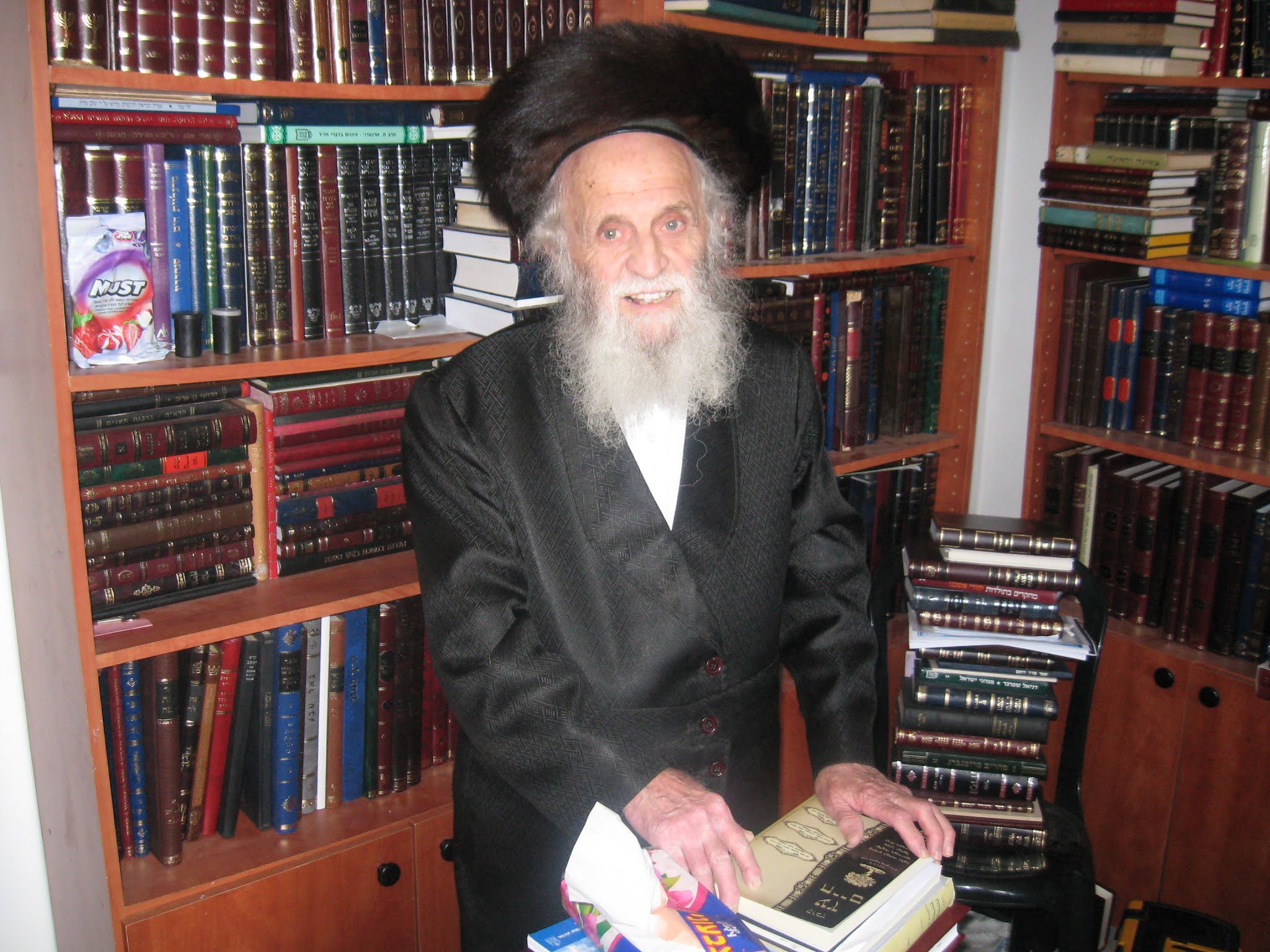
This Monday night is the first yahrzeit marking the passing of a unique Talmid Chacham, R’ Shmuel Ashkenazi of Yerushalayim, at the age of ninety-eight. R’ Shmuel was one of the hidden giants of the seforim world, in both ultra-orthodox and academic circles. I had the Zechus to learn much from him and in this article, I wish to describe this fascinating but hardly known Gaon and what we can learn from his life. An earlier abridged version of this article appeared in the Ami Magazine last year. IY”H in the future I will expand this essay.

One day back in 2000, while learning in the Mir as a Bochur, I was having a conversation with a friend, R’ Yaakov Yisrael Stahl, and R’ Shmuel Ashkenazi’s name came up, R’ Yaakov described him as an extraordinary Talmid Chacham. A little while later, during one of my daily seforim store trips I noticed a recent arrival, a very heavy sefer (844 pp.) with a peculiar title, Alfa Beta Kadmita de-Shmuel Zeira. I opened it up and immediately put two and two together, realizing that the author is the same R’ Shmuel Ashkenazi I just heard about. Upon purchasing it, I could not put it down. Learning through it I was immediately able to tell that my friend had not exaggerated in the slightest way. It appeared that this person knew literally everything about anything connected to Torah.

First Meeting

At the time, I had been working on researching and publishing my first article which dealt with tracing everything about the custom of not sleeping on Rosh Hashanah. One of the earliest sources quoted was in the name of a Yerushalmi which appeared to have been lost at some point. I had been searching all over for any information on this topic, and it was then that I noticed that R’ Ashkenazi was planning on writing about this topic in the next volume of his. I am not sure why but at the time I did not make an effort to speak with him about this. I returned to the US for a few years, and while in the US I drafted a letter to him listing all of my issues on this topic but I never got around to sending it. When I returned to Eretz Yisroel in 2004, one of the first of my planned stops was to visit R’ Shmuel Ashkenazi. Almost immediately upon returning a newly made friend, R’ Duvid Vieder, a Toldos Aharon Chossid who was close to R’ Ashkenazi, brought me into him to visit. From then on, I began to visit him regularly, this custom continued until a few weeks before the 2020 coronavirus lockdowns. At times I visited him once a week for an hour or so, other times once a month, other times I would speak to him on the phone.

I must preface my reminiscences by saying that, sadly, I did not heed the advice of the Chasam Sofer who told his children and talmidim that since he won’t be around forever, they should “chap arein” and listen to his stories. Unfortunately, this is not the first person with whom this has happened to me. I took for granted that Rav Ashkenazi would be around forever, (he did die at the age of 98!) and assumed I would always be able to ask him again for a particular story or an idea that he mentioned.

What was the connection?

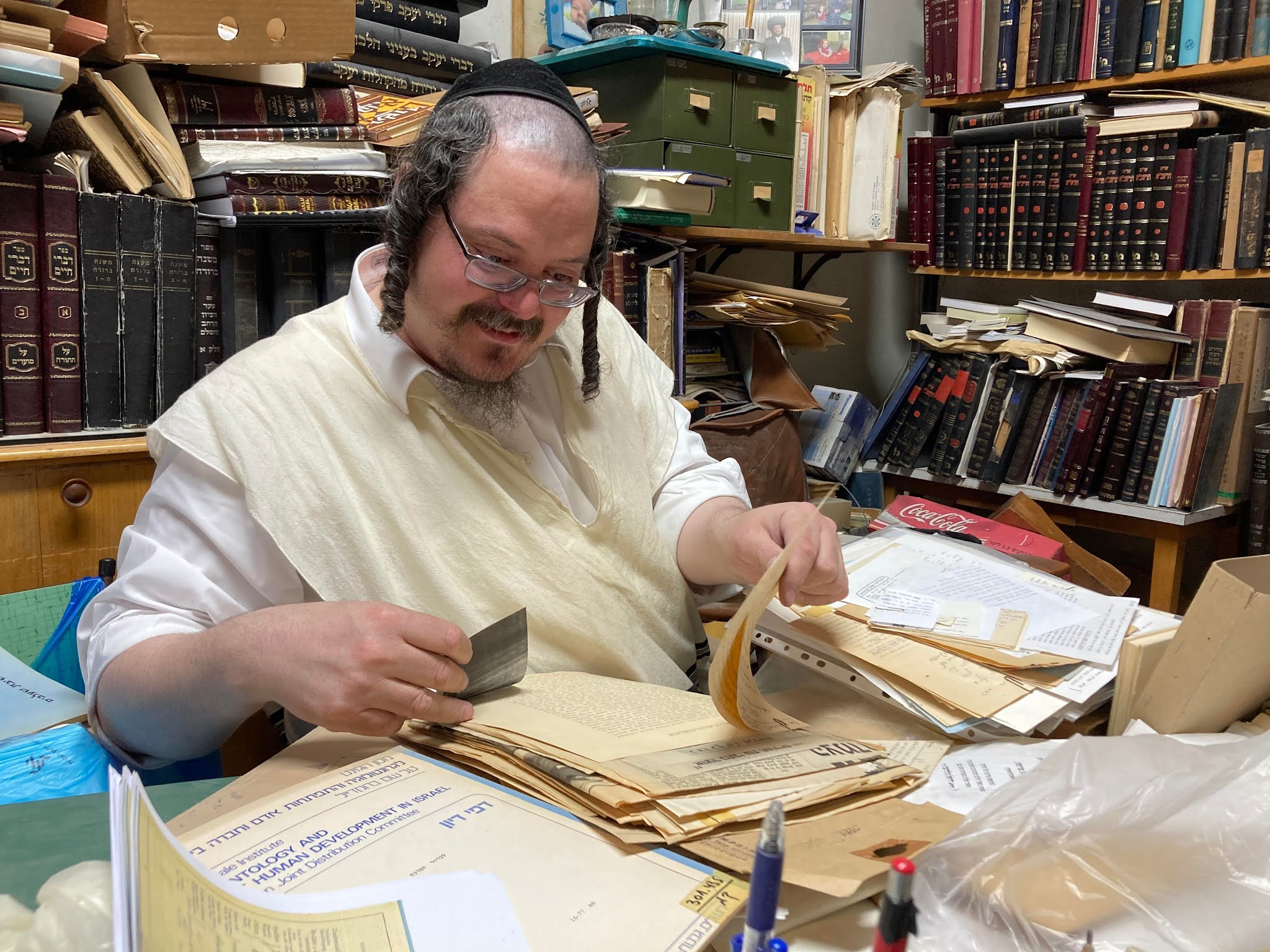
Basically, each visit I would prepare lists of questions to ask him. I would also bring him new seforim or articles (printed out in big letters, to help him read it easier). Sometimes when I would ask him something, he would say he is old and his head does not work, other times it was amazing what he remembered – on the spot. Sometimes he would pull down a file of material stored in – no jokes here – old cornflakes boxes.

I would then scan some of the material. Other times he offhand did not have anything to add on a particular topic but when looking at a particular sefer I would find a note written on the side or in a paper stored in the sefer that would be related to what I was searching. Other times I would find something else which was of great importance. Rarely did I leave his house empty handed. We both shared a love for seforim and information on a wide range of topics.

Love of Seforim

What drew me to him, and particular developed my relationship with him, was our shared love of seforim. I would update him on new seforim. At times he would ask me to purchase it for him or would borrow my copy for a bit. He told me numerous times how he enjoyed visiting and buying seforim from various shops for many years and that he started collecting when he was seven years old! Now he could not go to stores as he was too old; I got to know him when he was over eighty.

When I joined the editorial board of the journal Yeshurun, I would bring him each new volume as it was printed. Each visit he would ask me to check on the shelf where he kept them, to see if he was up to date and if needed, to update him with any missing volumes. A true lover of seforim, his face would lit up at each new volume. I would then point out some of the articles I thought he would enjoy and he would put in markers to read them.

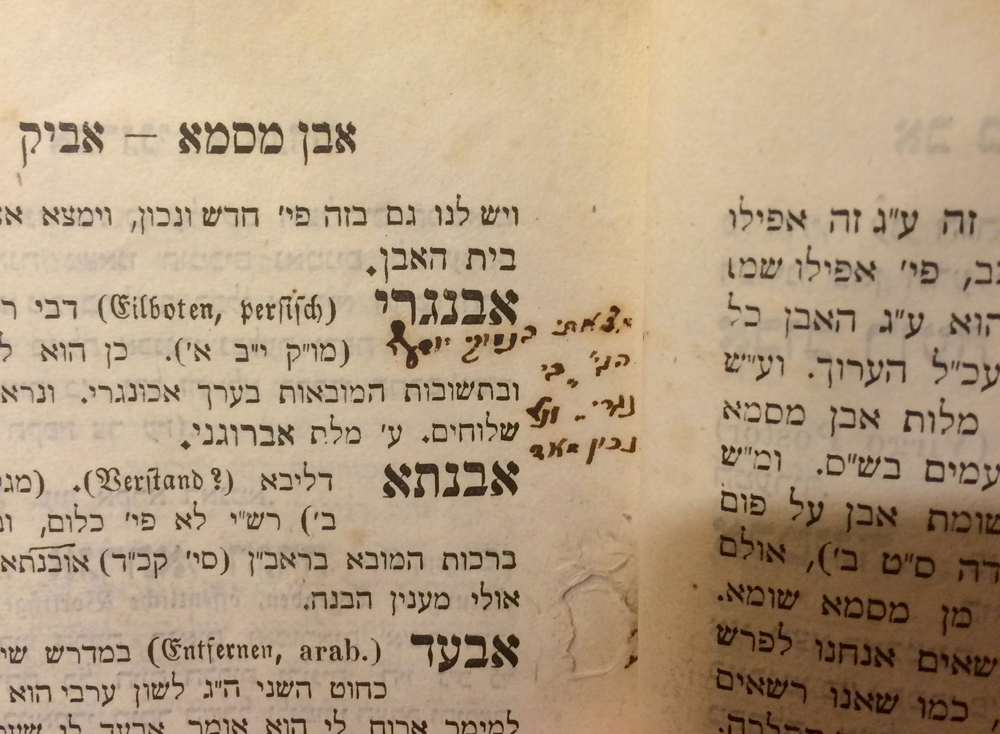
I always wondered if he read the various volumes of Yeshurun I brought him. After he was niftar, while going through his seforim, I found inserted in one rare book a small paper which he wrote: “for more information about this author see the article in Yeshurun”. Then in a different pen he added another cite from another issue from Yeshrun from a few years later.

This small story also demonstrates a bit of his methodology; he would collect all kinds of information and store them at times in a related sefer and would constantly update these notes.

His love for seforim was something unique, the glow on his face when he opened up a new sefer, especially of someone he was into, was simply priceless. He would look carefully at the Shaar and if it was a reprint of an older sefer he would immediately check if they included the front page of the older edition to compare. He had seforim in every space possible in the four rooms of his apartment, including his porch. Many visitors noticed how even his kitchen was lined with seforim!

Dikdueki Sofrim Haskomot

An interesting story happened with me and his library. While working on an article about the Dikdueki Sofrim I was unable to track down some recorded Haskomot that the author R’ R.N.N. Rabinowitz had received for the first edition of his work. I, along with other scholars, had searched numerous copies of the first edition, but with no luck. Late one night, I came to R’ Ashkenazi’s house and mentioned to him my problem. He said “show me the issue inside,” keeping with his custom to take care to always view the source material firsthand (Osiosi Machkemios – a topic he wrote a lot about). I took down his copy of the sefer, and lo and behold it was a first edition with the missing Haskamot! I published these missing Haskamot in my article on the Didukei Sofrim, and attributed this rare and miraculous find to his extraordinary library.

His History:

Where this unique Talmid Chacham came from is simply a mystery. He was born in Yerushalayim and lived in Batei Ungarn. He learned by Rav Yosef Tzvi Dushinsky of the Edah HaChareidis. Originally, his name was Deutsch but, at some point changed it to Ashkenazi. He had four children with his wife who died over forty years ago. Since then, he lived alone in his apartment near some of his children. His son did an excellent job of Kibud Av bringing him food every day and looking on him a few times a day. Yom Tov and Simchos he spent time with his family.

When I and others asked him, who was his Rebbe, he would just smile and say no one in particular. The truth is the Mishnah in Avos states: Knei Lecha Chaver. Aside from the simple peshat, Rashi explains this Mishnah by citing some who say it means via Seforim others commentators explain this as ‘buying a pen’ (see R’ Ashkenazi’s in-depth article on this for sources). R’ Ashkenazi employed all of these methods; his friends and teachers were his seforim and his pen.

R’ Ashkenazi was a short, quiet and unassuming person. Most, having seen him walking on the street, would never believe he was such an erudite Gaon. Many times, R’ Ashkenazi did not express much emotion except to give a pleasant smile and was friendly and polite in conversation. But there were times he got very excited; for example, when he recalled a good story from his younger years or something unique that he discovered years ago. He was very polite and was a real Yekeh; for example as soon as they bentched Rosh Chodesh Kislev his Menorah was already prepared in the window.

R’ Yechiel Goldhaber, a Talmid Chacham and author of numerous articles and seforim had a close relationship with R’ Ashkenazi for many years. He recalled when he was introduced to R’ Ashkenazi for the first time by his father-in-law, he thought to himself who is this simple looking man? He soon learned that this man was a master of all of Torah and swiftly became a close Talmid of his.

Many times, he would tell me he wishes he could come visit my library. In Later years he would spend his Yomim Tovim at his daughter. One Chol Hamoed Succos, when he was over ninety, he made the difficult trek from her house to mine in order to spend time in my library.

He would love to read everything he could get his hands on. I visited him at many different times of day, even late at night and I always found him learning a sefer – even when he was over ninety. He read everything newspapers, books – he was just curious about everything with an incredible thirst for knowledge.

I recall visiting him a few times when he eighty-five and noticed he was learning the Shelah Hakodosh very carefully. I asked him why (of course he had learned through this sefer numerous times before!) and he responded that someone is reprinting the sefer and asked him to go through the sefer and send comments. He therefore sat down to learn the whole sefer, line by line, after which he wrote a ten-page letter with his comments on the sefer.

Over time, I learned again and again that R’ Ashkenazi personally believed his purpose in this world was to help people with the incredible amounts of information that he had gathered over the years of intense learning. This incredible Middah can be seen in this light; he did not feel that he was the “owner” of this extraordinary wealth of information he had collected, and thus gave very willingly without any conditions. He never asked me to cite him when he gave me some rare source even – although I always told him I would; he just was so happy to help someone else.

He would collect and catalog much of what he read. He had all kinds of systems to file the information he had gathered over eighty plus years of learning. When he would read an important article in a magazine or journal, he would cut out the parts and store them in their appropriate place. He gathered information on thousands and thousands of subjects (not an exaggeration in any form) which had some connection to our rich heritage. What’s more astounding is that R’ Ashkenazi never used a computer or the internet; all of his erudition came about simple by learning through thousands of seforim; a great many of them rare or unknown.

Over the years he helped so many people and for many years after he retired, he would visit the National Library of Israel on Tuesdays, where throngs of people would line up in wait to speak with him about all kinds of subjects.

Many years ago, he received a call from a young chassidish Talmid Chacham living in Monsey who was starting to work on publishing a new edition of the classic historical work Seder Hadorot. He started asking him questions about various issues he had. Over many phone-calls R’ Ashkenazi answered many of his difficulties while training him in proper research and writing skills. This year some volumes finally were published (see here). And this was not a onetime occurrence – he helped so many more people. He used to remark to me that when he was younger so many people would come to visit him – until the late hours of the night.

He was an expert in so many different topics, whether it was the standard ones like Tanach, Chazal, Halacha, Minhag or Chassidus or less commonly studied subjects such as Tefilah, Piyut, Dikduk, Kabbalah, Philosophy, Machshavah, History and Bibliography. In all of these areas his expertise was remarkable.

His Uniqueness

A sample of his bekius; one time I noted that the Maharsha often quotes a “Sefer Yoshon Noshon” and asked if we have any idea which sefer this is? He immediately responded that he found it usually refers to R’ Todros Abulafiah’s Otzar Hakavod.

His incredible Bekius was bolstered by an almost photographic memory, as the following story demonstrates. Once someone used the Bar-Ilan Responsa search engine to locate a passage in the Tana DeBei Eliyahu to no avail. He went to ask R’ Ashkenazi who immediately told him where the passage could be found. Checking the Bar-Ilan text, it was discovered that when the sefer was being entered into their database the passage in question had been mistakenly omitted. I first heard this story from someone else, so to make sure it was accurate I asked him about it and he confirmed it. A similar story happened with him and a passage from the Shut Chasam Sofer.

A few years back a friend was working on publishing out an esoteric Rishon on Mesechet Megillah. He thought no one ever heard of this author and randomly mentioned this to R’ Ashkenazi – without batting an eyelash – replied “of course, and one can find material by this author in the work of Rav Shlomoh Alkabetz on Megillas Esther (Manos Halevi). The fellow was stunned in elation; he had just been gifted new and important material for his project.

This remarkable Bekius which even beat out computer search engines, was just one aspect that made him remarkable. He would receive numerous calls and letters from all over the world from people of all walks of life seeking his assistance in tracking down a statement. He had an incredible knowledge of all of Chazal. I do not just mean the “standards”; Bavli, Yerushalmi and Midrash – even all the numerous and very often almost unknown Midrashim printed over the years. He was also expert in what is known as the lost Midrashim. Over the years many Midrashim we had were lost but some traces of them can be found in various Piyutim, cited by Rishonim or in other obscure places. Through his incredible amounts of learning and his phenomenal memory he was able to recall so much in this field.

To illustrate this with some samples. A few years back someone who was editing for publication a never before printed pirush of a Rishon on Avos came across a few statements in the name of Chazal. This person, a Talmid Chacham in his own right and familiar with tracking down such material, could not locate sources for these statements. Immediately he penned a letter to R’ Ashkenazi. A few days after he received a letter from R’ Ashkenazi with various incredible sources for his questions. This was a very common occurrence.

Piyut, Tefilah and language

Earlier, I mentioned his expertise in Piyut, Tefilah and language. A bit of background is needed to explain this. Rabbi Joseph B. Soloveitchik, when describing Rabbi Elazar Hakalir’s greatness, (Koren Mesorat Harav Kinot (pp. 386-388) wrote the following:

The piyutim of Rabbi Elazar HaKalir, including his kinot, serve two purposes. The first is limmud, learning. Every sentence of the piyut quotes m’aamarei Chazal… The second purpose is tokhaha, rebuking the people for their misdeeds and instructing them in the proper way to act. These piyyutim deal with… repentance… acknowledgment of God’s justice. The shali’ah Tzibbur was not merely a chazan…, but was one of the great scholars of the generation who was the principal… moral critic of the people… Rabbi Elazar HaKalir was (also) a master of the Hebrew language and very creative in his use of Hebrew. If not for him, modern Hebrew could not have come into existence. Before HaKalir, the Hebrew language was very rigid. For example, the noun and verbs were fixed in their form… But HaKalir made a critical contribution to the development of the Hebrew language by endowing the language with flexibility… Rabbi Elazar haKalir’s piyutim served two purposes: limmud, study… As for the element of study, one of the dimensions of HaKalir’s piyyutim is that they are compilations of the statements of the sages. Most of us, who are expert in neither Hebrew nor aggadot Hazal, find HaKalir’s corpus of piyutim boring. But it is not boring at all; it is like a gold mine. His piyutim for Yom Tov explain the essence of the Yom Tov. The midrashim concerning Sukkot are replete with information about the sukka, etrog and lulav, and all the explanations in the Midrash, all the ta’amei sukka, the reasons for the sukka, all of the ma’amarei Hazal, are together in the HaKalir’s piyutim for the first day of Sukkot… If one were to study carefully and thoroughly the piyutim of Rabbi Elazar HaKalir for Rosh HaSahana, Yom Kippur, Sukkot, and Pesah, one would find many applicable halakhot and the entire pertinent Midrash, including many midrashim that are unknown to us from any other source.

Rav Ashkenazi was an expert on everything related to Tefilah and Piyut. He somehow read it all and retained it. But in addition, he was able to use his expertise in Chazal and Hebrew language to understand it on a much higher level and as a result was often contacted by the world experts on Tefilah and Piyut for his assistance. These requests came from experts such as Professor Shalom Speigel, Chaim Schirmann, Avraham Haberman, Ezra Fleischer and Daniel Goldschmidt who constantly sought his assistance while working on their Tefilah and Piyut related projects.

In an interview with Ami Magazine printed a few years back, Professor Shulamit Elitzur mentioned:

“there’s another amazing thing I find when doing research. I am constantly coming across midrashim that were lost to the ages… example, everyone knows that Haman was referred to as ‘the Agagi’ because Shaul allowed Agag to live one extra night, which allowed Haman’s ancestor to be born. However, the earliest makor we find in writing in the 16th century; this fact was discovered by Rav Shmuel Ashkenazi of Yerushalayim. But I found a ktav yad of a piyut about Purim that describes this very story and explains how Haman’s ancestor was born, which gives us a source from 1,000 years earlier! And there are many similar examples of lost midrashim being kept alive through unknown piyutim.”

R’ Ashkenazi wrote some articles on Piyut and Tefilah, but we have found much more among his papers and hopefully if I can raise enough funding all his fascinating material on Tefilah will come to light.

When the important Siddur Ezer Eliyahu (sponsored by his late friend Yeshaya Vinograd) was first printed, one can see R’ Ashkenazi’s name in the introduction, thanking him for his assistance (he assisted them for some of the later additions) and his great knowledge in this field.

I mentioned that he had an incredible knowledge of Dikduk and the Hebrew language and used it towards better understanding Piyut and Tefilah. He also authored articles on these subjects and in 1967, when reviewing an important dictionary, wrote a long article demonstrating this very point – and article that garnered much praise. He was very proud of this essay and mentioned it to me many times. A few years ago, I reprinted it with additions he had made in his own copy and a nine-page topical index.

One of the ways he developed this expertise was via learning Tanach so many times. He was an expert in Tanach and all the Rishonic commentaries (including the unknown ones); he even authored a small book of Riddles of Tanach.

He also used his extraordinary skills to become a master editor. However, in addition to the work he was born with an incredible innate sensitivity for text and language which made him one of the best editors out there. For many years he worked at the famous publishing house Mossad HaRav Kook, editing various works. He told me more than once how there was an expert there who would brag (jokingly) that after he read through an article it was impossible to find mistakes. The only person who could still find mistakes was R’ Ashkenazi. He had razor-sharp vision and could immediately spot a mistake.

Many times, I would bring an edited piece of mine to read. As soon as I put it down in front of him, he would take out a red pen and start marking it up and say to me “are you sure it’s been edited?”. He told me he had to mark up everything before he could read it properly, errata were so painful for him to see that it was hard for him to read something on Shabbos! He told me he was punished; when his work Alfa Beta Kadmita de-Shmuel Zeira came out, although he had edited it numerous times, he still found mistakes.

During his learning over the years, he found many people, great Gedolim as well as famous academics, had made mistakes, sometimes quite basic ones. At one point he printed two articles about this. However, he prefaced his articles that his intent was not to mock those who erred but to vividly illustrate that people are human and mistakes will happen. He was a master of humility and never held it over anyone that they did not know what he knew.

He was not only a great expert in all aspects of the Hebrew language but was an expert in Aramaic and Yiddish, both of which he displayed in various publications of his. Related to his expertise in Aramaic, which is very important for learning Gemara, is a very unique essay which he authored related to the Rambam as a translator of the Gemara. One of the world experts in old Yiddish is Professor Chava Turniansky, who has noted on many occasions that one of the people who have always helped her from her days as a student, was R’ Ashkenazi.

Related to this was another talent of his, which at first appears trivial; he was an expert on acronyms. This led to authoring a thesaurus of acronyms together with Dov Yardan, called Otzar Roshei Tevot, with a multitude of obscure and often almost impossible entries. His sensitivity to the text and work in the field of editing drew him to this field. Anyone who learns a lot, especially older material comes across abbreviations, and many times they cause great difficulty in understanding various passages. Abbreviations were employed in writing, sometimes as mnemonic devices and other times simply to save on printing costs. But over time many meanings were forgotten. This work is an extremely useful tool for solving this issue.

Ghostwriting

One day I was in a used bookstore and I noticed a small sefer titled Harif Umishnaso about the Rif. I recalled that this title appeared in the list in beginning of his work, Alfa Beta Kadmita de-Shmuel Zeira which listed out the various works he helped with over the years. I asked R. Ashkenazi if it’s worth buying and what his connection to the book was, as a different name appears on the cover.

R’ Ashkenazi replied “I can tell you it’s an important sefer and worthwhile to buy.” I noticed he was hesitant to continue the conversation. He then said “I will tell you something I did not tell anyone in over forty years – I wrote the whole sefer from beginning to end and it was one of the most important works I ever wrote.” The original plan was to for him to write a series of biographies on various Rishonim – in this book he already references a work on the Ri Migash – but due to a lack of funding this series was discontinued. However, not all of this remained unpenned; he wrote numerous entries in various encyclopedias. It turns out that R’ Ashkenazi had over fifteen different pen names!

I would like to elaborate on this work a bit more and thus cast further light upon R’ Ashkenazi’s uniqueness and greatness. The Rif’s Halachic work is one of the most important sources in Halacha, but what exactly makes it so unique has remained a mystery. R’ Ashkenazi sought to answer this question by collecting and collating all the authentic information we have about the Rif, from the Rif and from other Rishonim. He went through the Rif carefully examining what he did to each Gemara evaluating if remarks or material was added or not and to figure out why, allowing the reader to begin to understand the Rif’s significance. R’ Ashkenazi’s writing methods were honed to precision. He had an uncanny ability to utilize every piece of information without writing an extra letter and assemble it all in perfect order sans speculations commonly found in historical works. At times one does not need grand theories to understand something; just seeing all the known material in proper order helps one understand things. The wealth of material that Rav Ashkenazi commanded in producing this work is outstanding; this book was written in 1967 – long before any of the various search engines used today.

Haggadah Sheleimah

Similar to this is another work by R’ Ashkenazi, Haggadah Sheleimah. I hope to publish an article about this work in the near future, including the numerous additions R’ Ashkenazi found over the years and kept in his files. This work is highly unique for the following reasons. The collected bibliographies by Avraham Ya’ari and Yitzchak Yudlov bear witness to thousands of Haggados written throughout the generations in a multitude of styles, such as Pilpul, Peshat, Kabbalah, Derush and more. However, until 1955 there was no one work on the Haggadah which collected all the sources for each and every Halacha and minhag related to the Seder night. There was no volume which dealt with the various manuscripts of Geonim and Rishonim and at the same time to deal with the exact text of the Haggadah. Haggadah Sheleimah set out to fill those needs, and at the same time offer a running collection of Pirushim culled from over fifty different commentators focusing just on Peshat. In order to produce such an exacting work, it’s not good enough to just be a talented writer, one must also possess a keen understanding of all the material and relay this with incredible clarity. R’ Ashkenazi was such a person; one who sought out the simple Peshat, able to put this myriad of information together in so beautiful a fashion, and with tremendous clarity. His work in Haggadah Sheleimah is so clearly organized and always straight to the point that it is no wonder that to this day Haggadah Sheleimah remains a classic in both the Torah and Academic worlds.

Rav Ashkenazi once explained to me that one has to write precisely and to the point, not lengthily. He said he believed that one of the reasons Rashi’s works survived was due to his concise way it was written, as opposed to various works of Geonim which did not really survive as they were written in a much lengthier format.

Why didn’t he publish his material?

A few years ago, a partial bibliography of his writings was printed in his Alfa Beta Kadmita de-Shmuel Zeira. The listing is close to three hundred articles and seforim that he wrote or assisted in on some level. He started writing under various pen names over eighty years ago. The background to the publication of this volume was, as I mentioned previously, R’ Ashkenazi had been writing and collection information on thousands of topics for over eighty years. Unfortunately, he did not print much of what he gathered. The main reason for this was R. Ashkenazi’s “weakness”; he demanded incredible levels of perfection from himself. Although he strived for great perfection, nonetheless he stressed to me numerous times that he was mistaken in that approach and that I should not follow in his path. In his words it is better I print my work to the best of my current abilities and that worse comes to worse you can always reprint with additions and corrections. Over twenty years ago, R’ Teflinsky somehow convinced R’ Ashkenazi that his material needed to be printed. Together they began compiling some of his material for print, resulting in a volume over eight hundred pages!

After that experience both R’ Ashkenazi and R’ Teflinsky stopped, with no plans of continuing this project. A few years later my good friend, R’ Yaakov Yisrael Stahl and myself were able to convince him to continue. R’ Stahl took upon himself the daunting task to prepare the material for publishing; since, than three more volumes were printed.

Here is a small video clip of R’ Ashkenazi, when we brought him copies of the second and third volumes of his writings, ten years ago.

The topics that these works deal with cover, on some level, virtually everything; sources for expressions and idioms, for minhag, Halacha, the evolution of famous stories, bibliography, corrections of authors’ errors, encyclopedic style information on thousands of topics culled from thousands of seforim – many of them very rare or unknown. (A PDF of the Table of contents of this work is available upon request).

His Letters

Earlier I mentioned the story of someone who wrote him a letter seeking help. This was not a one-time occurrence. He authored well over a thousand such letters in response to such questions. Some requests were for sources to various Halachos or Minhagim, numerous others are various queries related to out rich literature. R’ Ashkenazi always invested his time to answer properly and clearly. Recently, R’ Stahl and I collected these letters for publication and the result is a three-volume set, available for purchase.

Over seventy years ago he purchased a typewriter which he used until his passing.

In an article written by the late Gaon R’ S. Deblitsky, he writes out various proper actions a Rav should “observe.” One of them is to respond to people who write to him, whether the issues are big or small. R’ Ashkenazi was very careful to try to respond promptly. Many people would send him their seforim after they were printed asking him for his comments. He would usually respond with a multi-page letter, beginning by thanking the author for sending it to him, then listing out some criticisms, usually written delicately, while adding all kinds of comments. He always tried to look to say something positive. Some people who heard of him through various channels over the years contacted him before they printed their works. Many times, he would write a collection of comments and corrections to such works. A sample listing of some of those works that benefited from him before going to print include recent editions of: Sefer Zechirah, Kav Hayasher, Sefer Hachayim and many others.

Thanks to the efforts of my special friend Menachem Butler, various academics wrote some praises about the significances of these letters; to partially quote one letter written by the esteemed Professor Shnayer Z. Leiman:

Reb Shmuel was

“bibliographer, bibliophile, and book collector, and his encyclopedic knowledge of all of Hebrew and Yiddish literature remains unparalleled in our time.” His collected writings are an intellectual treasure trove, “covering a wide range of topics in the field of Jewish Studies. Aside from his scholarly distinction, R. Shmuel Ashkenazi wrote in an elegant Hebrew with its own special charm. Not only did he advance discussion, but he did so in an aesthetically pleasing manner. Let it be said openly: this… set will enlighten every reader and will significantly advance scholarship. Anyone concerned with advancing the cause of quality Jewish scholarship will take special delight in the publication of these volumes…During his lifetime [Ashkenazi] corresponded with the greatest Jewish scholars and bibliographers the world over. They wrote to him, for only he could solve the countless historical and literary problems that stumped them…”

Another person to whom Menachem Butler reached out to via his numerous contacts was former editor of Mekizei Nirdamim’s journal Kabez Al Yad, Professor Shulamit Elizur of the Hebrew University of Jerusalem. In her aforementioned interview in Ami Magazine several years ago she said this:

“I am unequal to the task of adequately singing the praises of Rabbi Shmuel Ashkenazi, an erudite bibliophile. His familiarity with rabbinic writings from throughout Jewish history is unparalleled, and he is well-versed in the research literature of academic Jewish studies as well. I first met Rabbi Shmuel Ashkenazi through my teacher, the late Professor Ezra Fleischer. Prof. Fleischer, who was one of the greatest scholars of all time, would often chat with Rabbi Ashkenazi on scholarly topics, and he was careful to send Ashkenazi every article or book he published, knowing that in return he would receive enlightening comments on his work. When I began my own research, Prof. Fleischer instructed me in turn to send my publications to Rabbi Ashkenazi, and I too was privileged to learn a great deal from his comments. It once happened that I was searching for a particular midrashic theme which was alluded to in a liturgical poem (piyut), and although I consulted the leading scholars of Jerusalem who responded that it was a well-known homily, I was unable to locate its specific source. In my hour of need, I turned to Rabbi Ashkenazi, who immediately gave me several references. It emerged that every one of these references post-dated the piyut by almost a thousand years, and that this ancient tradition alluded to in the poem had been transmitted orally for that long period before being committed to writing in the later midrashim. Rabbi Shmuel Ashkenazi’s correspondence is a tremendous resource of Torah and scholarship. Every paragraph encapsulates a great deal in just a few words, and sometimes even with allusions whose explication require deep learning.”

Here is a short letter from Professor Gershom Scholem to R’ Ashkenazi:

Expressions and famous stories

In his writings some of the topics of these are about tracing expressions or the evolution of famous stories. Based on his knowledge, he was able to contribute a lot to these areas even editing some works on these topics.

One such story related to a supposed legend of a portrait of Moshe Rabbeinu which caused a great controversy over a century ago. In 1830, Rav Yisroel Lipschutz started printing his magnum opus, a commentary on the Mishnah titled Tiferes Yisroel. In the section on Maseches Kiddushin first printed in 1843, he brings a story about a king who lived in the time of Moshe, who, after hearing incredible things about this great leader, hired a painter to paint a picture of him so he could have his features analyzed by experts. The people who analyzed the picture reported that the person pictured was evil. The king went in person to visit Moshe Rabbeinu in the midbar and asked him how was it that an analysis of his pictures showed him to be of such wicked character. Moshe told him that the analysis was indeed true; however, after much work, he changed his character and became the great Moshe Rabbeinu.

In 1894 a booklet by the Vilkomir Maggid was printed railing against this story. This booklet presented numerous sources stating that Moshe Rabbeinu was born a kadosh and it was unthinkable to print such a story about him. Indeed, this story was censored out of the 1956 edition of the Tiferes Yisroel. In truth, this ancient legend can be found in various sources and in regard to different luminaries, some claiming it about Aristotle others, Socrates. In fact, R’ Ashkenazi documented it was long used in various Musar and Chasidus sefarim cited as an important lesson that one can change one’s born nature for the good, but not that it actually was true about Moshe Rabbeinu.

Another such story relates to a famous legend about the site where the Beis Hamikdash was built. Told in short, two brothers inherited a field, one brother had a family one did not. At the end of the harvest they divided up the wheat equally. That night the childless brother felt bad for his brother with a large family and said to himself “it’s unfair that while my brother needs more than I, we shared equally”, so he brought over from his pile to his brothers. The other brother thought that since his brother was childless, he should have a larger share of the crop, as consolation, so he added from his share to his brother’s. In the morning each brother realized their piles remained the same and this went on for two more nights. On the third night they met, realized each of their intentions was out of deep consideration for the other and hugged. Numerous people have searched for the early sources for this story. I decided to ask R’ Ashkenazi if he had any material on the subject. He found his file on the story and within was a letter from R’ Yudlov who had been asked by someone in the Education Ministry for the sources on this story. R’ Ashkenazi traced its first appearance in print to 1832 and from there he traced it to other sources.

Bibliography

I would like to conclude with just one more area in which R’ Ashkenazi was truly a legendary master: Bibliography. For many years, R’ Ashkenazi worked in the (now) National Library’s Bibliography of the Jewish Book Project. He also contributed to some of the important bibliographical works and journals written in the past century such as Kiryat Sefer, Otzar Sefer Haivri (Vinegrad) and Sifrei Yerushalyim Harishonim.

A few years back, while working on an article about the origins of eating Hamantaschen (see here), I found an important article from Dov Sadan containing sources on this topic. One of the sources was the interesting, controversial work Machberet Emanuel. I had a nice conversation with R’ Ashkenazi about this work – he had helped Dov Yardan prepare a critical edition of the work and even wrote a long book review on it (which he said he received a lot of Kovod for).

He mentioned two points of interest which will serve as a sample to some of his expertise. One, he noted that Emanuel of Rome wrote a commentary on sefer Mishlei. Interestingly, the preface to the Mishlei commentary sefer is signed Emanuel son of Yaakov, whereas Emanuel’s father’s name was Shlomo. Some have noted that this discrepancy and explained it is a mistake. R’ Ashkenazi suggested this was not a mistake, rather an intentional typo intended by the author to hide his connection to his controversial Machberes Emanuel. The second point he made to me was how the Chida writes in Shem Hagedolim that the best commentary to learn on Mishlei that by Emanuel of Rome. R’ Ashkenazi said he checked into the words of the Chida and he learned through all the works on Mishlei and concluded that the Chida was quite correct. He once had a dream to write a whole work on Mishlei, he even started to pen his comments in a special notebook, but the plans never worked out.

One final last story about R’ Ashkenazi’s bibliographic acumen. In 2009 my special friend Dr. S. Sprecher z”l (about him see this article on the seforim blog here) wished to reprint and distribute a small work called Tshuvah Be’Inyan Kriat HaKetubah, in honor of his son’s upcoming wedding, under that assumption that, just as the title page and the publisher’s introduction indicated, it represented an actual Halakhic Responsum issued in 1835 by the Chief Rabbi of Bialystok, one Rabbi Nechemiah. Sprecher wrote:

However, our close reading of this Tshuvah led us in an entirely different direction. To us, the work’s style manifested clear Maskilic echoes, and its arguments rejecting the binding nature of centuries-old Minhagim were clearly not in accord with 19th–century Halakhic thought. Our reaction was that the work must certainly be pseudepigraphal and could not have arisen from the pen of the Chief Rabbi of Bialystok. In fact, a quick perusal of the reference literature demonstrated that there never was any Chief Rabbi of Bialystok named Nechemiah.

At an impasse, we reached out to Professor Shnayer Z. Leiman, who suggested that the scholar most likely to solve the mystery would be the doyen of Israeli bibliographers, Rabbi Shmuel Ashkenazi. We were rewarded thanks to the tireless efforts of Eliezer Brodt who, on our behalf, pestered the aged Jerusalem sage until he successfully unmasked the name, but not quite the identity, of the author. Rabbi Ashkenazi concluded that the first line of the introductory poem that prefaced the Halakhic query contained the acrostic – “Meir Ish-Shalom”. (His initial contention was that this could not be the noted 19th–century Viennese scholar, Meir Ish-Shalom, because his heretofore known literary output began only some five years later, with his publication of the Sifre in 1864.)

Once Rabbi Ashkenazi had provided the key to the author’s name via the acrostic, it became apparent that all along the title page had been proclaiming that very same message. Let us recall the passage in Bavli Eruvin 13b where it is recorded that the celebrated Tanna, known to us as Rabbi Meir, was actually named Nehorai, according to one opinion; or alternatively, that both Meir and Nehorai were laudatory appellations reflecting his enlightening wisdom, whereas his actual name was Nechemiah. Recall also that the query first originated with Rabbi “Shalom” of Novgorod, and the word “shalom” appears twice more on the title page and is highlighted by the placement of a circle above one of its appearances.

In his copy of this work that Dr Sprecher printed for the Chasunah which I brought him, I found this paper inside:

A few weeks after R’ Ashkenazi’s Petirah the national library held a session devoted to him where Professor Zev Gries, Professor Chava Turniansky and R’ Yechiel Goldhaber spoke about him (here is a link to the whole session). I too had the privilege of being interviewed about him that night (Here is a link to my interview).

Publication of his writings

Last year, immediately after Rabbi Shmuel Ashkenazi was niftar I, along with my special friend Menachem Butler, initiated a campaign to raise funds to publish R. Ashkenazi’s letters via the Seforim blog. Baruch HaShem, and thanks to the help of some readers, enough money was raised to go to print and in the beginning of this past January copies of the book, coming in at over 1,700 pages, (three volumes!) arrived as announced (here). The Letters sold out in a few days. A second edition was printed right before Pesach (see here). Currently copies of the second edition are available for sale.

Future volumes

Already during the Shivah, R’ Stahl began going through the materials of R’ Ashkenazi to sort out what materials are print worthy.

Here is a picture of R’ Stahl taken during one such session which a friend of his humorously put side by side a famous picture of Solomon Schecter when working on Geniza documents.

We never imagined we would find so much print-worthy material that we were not previously aware of; at least eight volumes’ worth of prepared writings which we hope to print. Currently, we are in the process of categorizing the material. Among the topics are: Tefilah, Minhag, articles on Seforim and authors – and much, much more. As we sort and scan R’ Ashkenazi’s legacy, some material is already being sent out to be typed up for publication. Each of the above endeavors comes at a price, and every contribution to the cause helps greatly. IY”H in the near future I will make a more formal announcement with precise details regarding the works slated for print. Anyone wishing to help with funding this project can contact me at Eliezerbrodt@gmail.com


Finders Keepers? The Itinerant History of Strashun Library of Vilna, Pt I

Finders Keepers? The Itinerant
History of Strashun Library of Vilna

by Dan Rabinowitz
            Since the 1990s, the issue of reparation of items looted by the Nazis has become a high-profile issue, with numerous successful attempts at reuniting owners with their stolen possessions. The recent movie, Monuments Men, fictionalized the
Allies’ post-war efforts that led to the locating some of these looted treasures. While some of the best-known examples of these recovered treasures are related to art, gold, or Swiss bank accounts, Hebrew books were also part of the Nazi’s appropriation scheme and were included in the items recovered after World War II. Some of the books recovered belonged to a unique institution, the first Jewish public library, and tracing the journey of these books, up to present day, parallels that of its patrons, tortured, uncertain, and yet despite all odds, surviving.
 
Matisyahu Strashun the Library’s Architect and Founder
 
Matisyahu Strashun[1] was born in 1817 in Vilna.  His family was among the Vilna elite.  His father, Samuel Strashun (also known as Rashash), whose notes/annotations – he never published a stand-alone work – to numerous classic rabbinic works, including Midrash Raba, Mishna, and Maimonides’ Mishna Torah, and Talmud Bavli.[2]  In terms of breadth, the latter is most
impressive, as his notes cover nearly every single page[3] of the Talmud Bavli.[4]
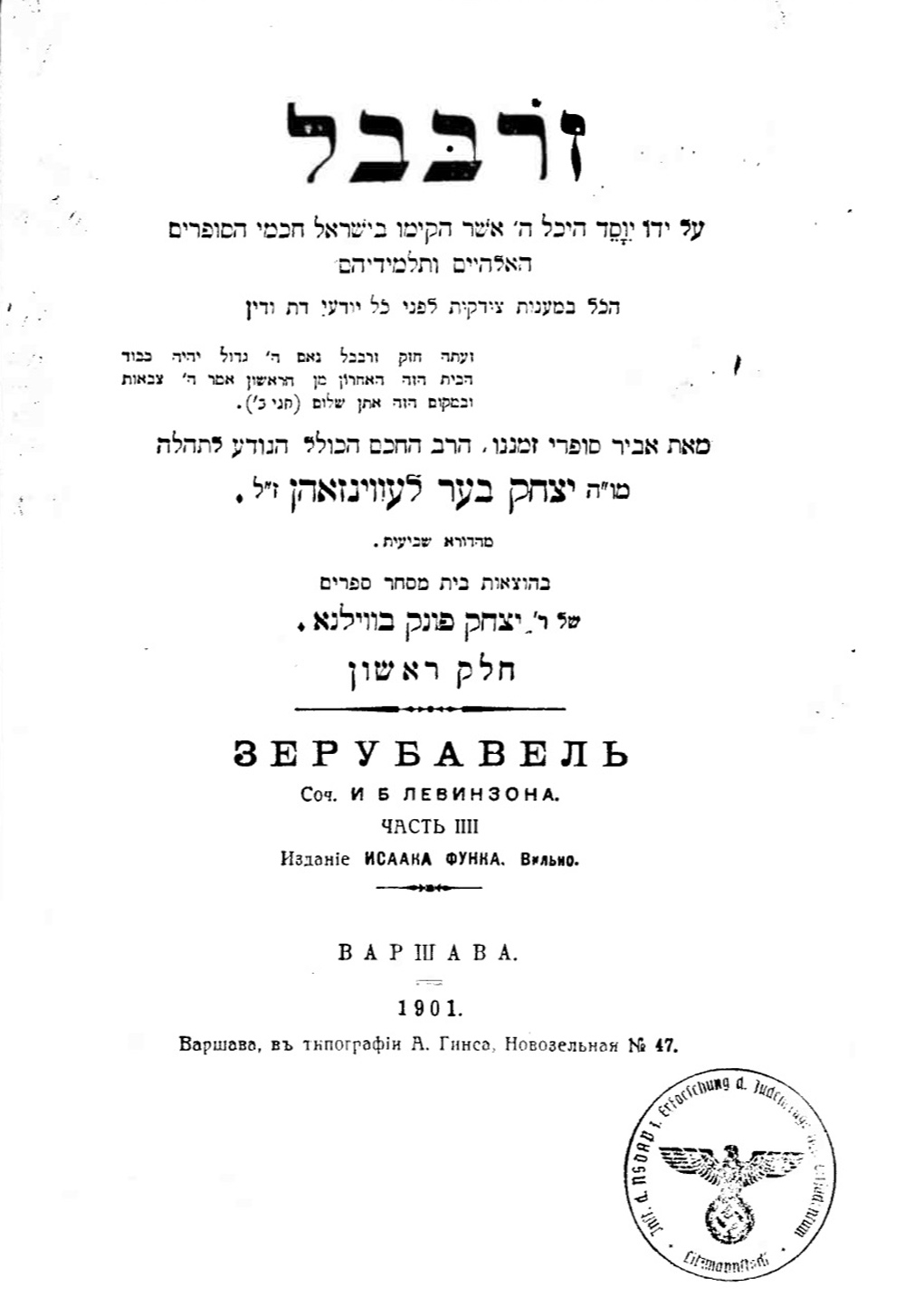
Matisyahu too was a Talmudist, his comments to Baba Batra and Eruvin are incorporated into the Vilna edition of Talmud Bavli, and was proficient in the entire corpus of rabbinic literature.[5] Matisyahu espoused views that were consistent with the haskalah movement.[6] For example, Matisyahu supported Max Lilienthal’s controversial attempt to reform “the Jewish educational system within the Pale Settlement,”[7] and Matisyahu help found and financially supported two schools in Vilna aligned with the haskalah.[8] Matisyahu corresponded with leaders of the haskalah movement, Isaac Ber Levinsohn, among others, and Strashun’s articles appeared in both rabbinic as well as haskalah newspapers and journals.[9] And, his home was a salon of sorts for traditionalists and the maskilim of Vilna.[10]
Strashun was independently wealthy and derived his substantial income from commercial and banking activities rather than rabbinic activities.  Yet he was considered a leader of the Vilna community.  He served on a number of communal institutions including the Vilna Tzedakah Gedolah.  And, at his death, he donated over 50,000 rubles to charity (approximately $1 million today). Leading Eastern European rabbis, R. Yitzhak Elchonon Spector and R. Jacob Joseph (later Chief Rabbi of
New York) among them, eulogized Strashun.[11] Posthumously, a street in Vilna was named after him.[12]
Throughout his life, he was an avid book collector, and, at the time of his death, amassed a collection of over 5,700 books and manuscripts.[13] His collection included incunabula, rare and controversial works (e.g. Me’or Eynaim), and manuscripts – from his father in addition to other authors. As reflected in his outlook during his lifetime, Strashun’s collection included rabbinic and haskalah works and books in non-Hebrew languages.[14]
During Strashun’s lifetime, numerous printing houses and bookstores populated Vilna, providing access to most contemporary books, including in languages other than Hebrew.[15]  But, unfortunately, we do not have much information regarding how and when Strashun amassed his collection that extended well beyond those contemporary books, beyond that when he traveled he took the opportunity to seek out and purchase books. For example, when he took therapeutic trips to the spa he also took that opportunity to seek out and purchasing books.  In addition to Strashun’s spa trips, in 1857 he went on a Rabbinic tour of Eastern Europe and visited R. Shlomo Yehuda Rappaport (Shi”r) in Prague and R. Tzvi Hirsch Chajes.[16] But, R. Rapahel Nathan Rabinowicz, a book dealer and noted book collector, commented after visiting Strashun that while Strashun’s collection was larger than Rabinowicz’s, his collection was richer in rare and older books.[17]


STRASHUN’S COPY OF SHIR’S EREKH MILIM


STRASHUN MARGINALIA TO EREKH MILIM
Creation of the Vilna Jewish Public Library
 
At his death in 1885, Strashun left no direct heirs.  He did, however, provide for the disposition of his library in his will.  In the past, those with large libraries had sold or left it to relatives,[18] Strashun elected a novel approach, rather than an individual or individuals he bequeathed his library to the Vilna Jewish community writ large, with instructions to establish a stand-alone public library.[19] His vision for the library was modeled on “the non-Jewish libraries that he saw [20] in the Diaspora.”[21] To that end, Strashun provided not only the books but also the funds to support the creation and sustainment of the library.[22]  Immediately the impact of this decision was apparent. At his funeral, among other enumerated good deeds and scholarship mentioned was, “the large library he left after death for the benefit of the community,” and which will “provide a
lasting legacy beyond that of any actual blood descendants.”[23]
            The creation of a public library out of Strashun’s personal collection was not a swift one, for seven years following Strashun’s death “the books remained under
lock and key” and were available only to those with special access.[24]  It remained in this state even though there were trustees and enough money to cover its operations.[25] Although the
library did not open to the public, the trustees were not idle during this time; and in 1889, published a complete catalog of Strashun’s collection.  His collection was comprised of 5,753 items, 63 of which contained marginalia in his hand.[26]
The Library is Open to the Public
 
In 1892, the Library was finally opened to the public. At the time, however, it remained in Strashun’s home.[27]  For years
after the library was opened to the public, in legal documents, the listed owner was not the Vilna community but one of the Library’s trustees. Although Strashun’s intent was clear – that the Library belonged to the community and not a trustee or any other individual – the Library’s legal status clouded that directive. In the late 1890s, there was a successful campaign to correct that issue, and the community becomes the sole owner of the Library, fulfilling Strashun’s wishes regarding ownership.[28]
The Library & Its Impact on the Vilna Community
 
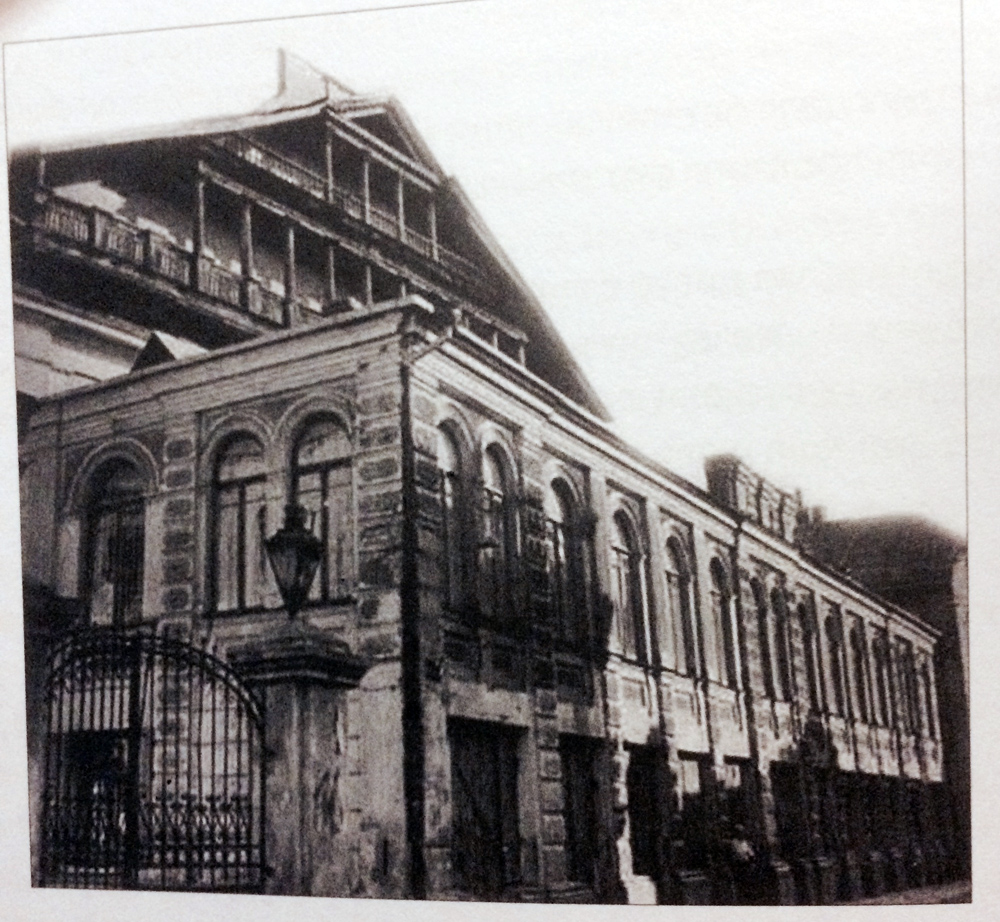
In 1902, the Library finally moved into a building of its own in the courtyard of the Great Synagogue of Vilna.[29]  From this
point forward, the Strashun Library would be one of Vilna’s most important institutions.
            The Strashun Library was a Jewish public institution and, to fulfill the needs of the public, additional steps were required beyond building and maintaining
infrastructure and clarifying ownership.
Specifically, although Strashun’s collection was substantial both in
terms of size and breadth, it was still the product of one man’s idea of a library.  For this reason, Hillel Noach Steinschneider, one of Vilna’s leading scholars and historians, pleaded with the public to donate books and ensure the completeness of the library and fulfill its mission of serving the entire community.  He acknowledged that Strashun amassed a very impressive private collection, but that for a public library his collection alone was insufficient because “it is lacking in books for people” whose interests did not align with Strashun’s.
That is, a public library is not only a place open for all but also one that provides value for all.  Consequently, the library’s composition must reflect the entirety of its audience and not a single collector. Apparently, this plea was successful,[30] many Vilna scholars donated their collections to the Library in addition to the general public, and, by the 1930s, the Library had grown to over 35,000 volumes.[31] Additionally, Vilna’s Tzedakah Gedolah organization also provided funds for acquisitions.  Books acquired through those funds contain a special stamp or receipt.
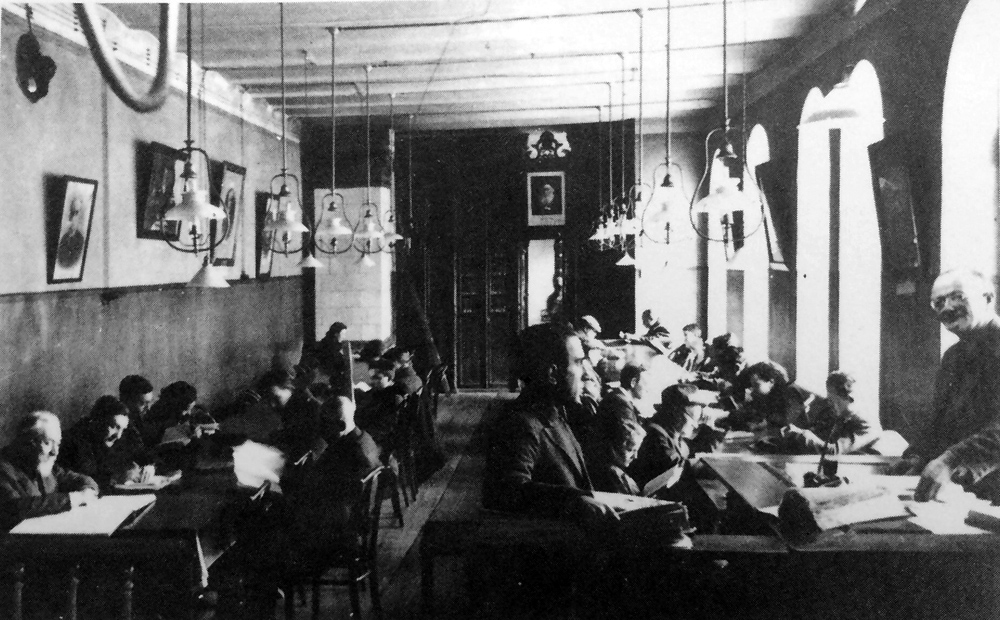
The Library was open seven days a week and became the central meeting location for the residents of Vilna.[32]  The Library’s visitors were representative of Strashun’s commitment to both traditional and modern ideas and ideals.  Patrons included “rabbis and talmudic scholars who were studying responsa and Halakhic
works” and who sat side-by-side with the “younger generation who were reading haskalah works.”[33] When dignitaries came to Vilna, the Strashun library
was a waypoint.[34]
 The intent was to have Herzl be the first visitor to the Library, however, the Russian government prohibited him appearing at the Library.[35]  Other famous Jewish personalities did visit and signed the guest book, known as the Golden Book, including Sholem Yankev Abramovitsh (Mendele Mokher Seforim), and Hayim Nachum Bialik, in addition to more traditionalists, R. David Friedman of Karlin, R. Shlomo Ha-kohen, and the Chafetz Chayim.[36] The Library was not only known for its visiting
Jewish celebrities, but also for its well-regarded holdings.  According to A.J. Heschel, it was the largest public Hebraic library in Eastern Europe reported holding over 40,000 volumes.[37]  On the one hand, the Strashun library was recognized as one of the greatest cultural institutions in Eastern Europe, on the other, like so many public institutions, the Library struggled to raise sufficient funds throughout the early part of the 20th century, consistently hampering its ability to maintain and build its
collections in addition to limiting its public access.[38]  But, it would not be funding that led to its demise but the Nazis and their campaign to appropriate Jewish cultural treasures.
The Nazi’s Looting of the Strashun Library
 
            During World War II, Vilna was occupied and controlled first by the Soviets, then the Lithuanian government, the Soviets again, and finally by the Germans.[39]  While under Lithuanian and Soviet rule, the Library had its share of challenges, but none
of those compared to the Nazi’s systematic campaign to identify, collect, and appropriate important Jewish treasures –specifically books – and, consequently, important libraries. The intent was that these pillaged libraries would supplement the already substantial Judaic holdings of Frankfort City Library.[40]  Immediately after the Nazis occupied Vilna, the Strashun Library as Vilna’s “oldest and perhaps most distinguished” library was identified as a target for this campaign.[41]
            Less than a month after occupying Vilna, the Nazis “enlisted” the Library’s librarian, Chakil Lunski, who had served in that capacity for over forty years, in addition to others, to select, identify and catalog important books including “the incunabula and manuscripts in the Strashun Library” to be sent back to Germany.[42]  Needless to say, Lunski was “distraught” that “he [was] supposed to help remove the treasures from ‘his’ Strashun Library that he protected for 45 years!”[43] Consequently, a number of books from the Strashun Library ended up in Frankfort, Germany.[44]


Post War Efforts to Reclaim Heirless Jewish Property 
 
            The Library’s building did not survive the war, but some of its books did.[45]  After WWII, the Allies recovered thousands of items the German’s looted and collected them at the Offenbach Depot outside of Frankfort.[46]  Much of what was recovered was likely heirless and the Allies faced with the dilemma of restitution. Initially, the Americans took the position that heirless property should return to the country from which it was looted.[47]  This position raised the specter of rare and important Judaica and Hebraica returning to Poland or even Germany.  This outcome was unacceptable to many Jews.[48]  Some elected to influence the fate of looted heirless books through traditional democratic means, others took matters into their own hands.[49]
Free For All? The Disposition of Other Significant European Libraries
 
The Strashun Library was by no means the only library identified at the Offenbach depot.  There were numerous other
libraries, both public and private that ended up at Offenbach, without any clear method of repatriation. This lack of clarity leads to inconsistent results at best.  Indeed, first-hand accounts of post-war Germany confirm the ad-hoc, doubtful legal grounds and sometimes completely lawless reparation regime in the post-war chaos.  In many instances, individuals made many of the decisions regarding disposition with little information and virtually to no oversight.
For example, Solomon B. Freehof, who himself amassed one of the greatest responsa collections in the 20th century, spent time in post-war Germany and encountered heirless property and describes attempts of repatriation. He indicates that
half of the heirless Jewish books recovered by the Allies went to the Jewish National and University Library (“JNUL”) at the Hebrew University (now the National Library of Israel),[50] which was “quite right” because some unnamed person or entity had determined “that clearly the [JNUL] should take the place of the vanished Jewish communities of Europe.”[51]
            Others agreed with Freehof that the natural repository for heirless books of European origin was the JNUL in Jerusalem.  Most notably, Judah Magnes, and the trustees of the JNUL wanted to recover and claim for the JNUL as much heirless Judaica as possible.  The JNUL dispatched Gershom Scholem, the eminent Kabbalah scholar, and bibliophile, to Europe to locate and return heirless property.  He discovered a significant number of important books and manuscripts in the Offenbach Depot
and did everything in his power, including employing very underhanded means, to repatriate items to Hebrew University.[52]
Initially, Scholem had a very difficult time securing authorization to even enter Germany and the Offenbach Depot.[53]  When he was eventually granted permission to view the contents of the Depot, it was with the explicit condition that he
could not remove any items.  But, for Scholem, some items proved too enticing.  Scholem identified a number of rare and important books and manuscripts.  He was concerned that if the disposition of these items were left to the Allied authorities the items would not end up in Jerusalem, but, instead, at the Jewish Theological Seminary, or some other institution, in the United States.  This was unacceptable to Scholem. To facilitate the transfer of these items to the JNUL, Scholem colluded with a Jewish American serviceman to smuggle the works out of Offenbach. Scholem placed the collection into five boxes but did not label
their contents and provided a fake name on the invoice.  The American serviceman personally ensured that the boxes were shipped to Paris, after which they were sent to the JNUL.  Eventually, the Allies found out about the theft, and demanded the return of the five boxes, even lodging a formal diplomatic complaint.  In the end, after much back and forth, the boxes remained at the JNUL.[54]
As germane here, eventually, the boxes’ content were cataloged and it was determined that a third of the works were not heirless – their ownership was clear and restitution was possible.[55]  Nevertheless, the content of the five boxes were incorporated into the JNUL.
Another example of unilateral ostensive benevolent restitution occurred with the “library of the prestigious Klaus synagogue of Mannheim, [that] ended up with U.S. Army Chaplin, Rabbi Henry Tavel.” Who, “on his own authority . . . shipped it to his alma mater, the Hebrew Union College in Cincinnati.”[56]
The Lost & Found: The Strashun Library Post-WWII
 
The determination regarding the disposition of the Strashun library after the Holocaust was no different from other heirless property, ad hoc and questionable.  Lucy Dawidowicz, worked for YIVO before WWII and spent time in Vilna.
After WWII, on behalf of the Jewish Distribution Committee after World War II, she went to the Offenbach Depot to assist with identification of heirless books.  Prior to coming to Offenbach, she had “promised [herself] that [she] would do [her] best to
safeguard the rights of possible owners and heirs.”[57]  And, when she came upon some of the remains of the YIVO collection,[58] she “was in a state of exaltation” and in a letter home wrote that she “had ‘a feeling akin to holiness, that [she] was touching something sacred.’”[59]
Dawidowicz also came upon books that she “could identify came from the Strashun Library.”  Whereupon she recalled “a
strange story” that the head of YIVO, Max Weinreich,[60] had told her “back in 1940.” Weinreich told her that during the brief period of time when the Soviets had returned Vilna to Lithuanian control, YIVO attempted to move its library out of Vilna.[61]  And, that “the trustees of the Strashun Library, also fearing for the sake of their library, asked the Vilna YIVO to ship [the Strashun Library] too.” Unfortunately, the shipment never occurred and both libraries remained in Vilna and ultimately plundered by the Nazis.
While the shipment never occurred, in Dawidowicz’s telling the attempted shipment was an irrevocable act with significant implications regarding the Library’s ownership.  She inferred that the Strashun trustees request to join the YIVO shipment also implicitly ceded ownership of the Strashun Library to YIVO. Thus, there she had no doubt regarding the proper disposition of the Strashun Library. Based entirely upon the “strange story” she heard, and even though according to her retelling the Strashun trustees had only intended YIVO to act as a shipper,[62] Dawidowicz told the Director of the Offenbach Depot that the heirless “remains of the Strashun Library ought to be considered as YIVO property.” She appealed to the Allied authorities and her position carried the day and the remnants of Strashun Library went to YIVO in New York.[63]
In a recent exhibit devoted to YIVO’s Strashun collection, the issue of the Strashun Library’s provenance is not discussed in any detail.  Instead, the book accompanying the exhibit simply states that all the remnants of the Strashun Library “were
rescued from the ruins of Europe and brought back to YIVO in New York in 1947.”[64] YIVO’s library catalog again implies that all the recovered books went to YIVO and links the disposition of the Strashun Library with that of YIVOs, the provenance note explains that “[t]he Strashun Collection, along with the YIVO Vilna collections, were liberated by the American Army, and
re-repatriated to YIVO in New York in April 1947.”[65]
            In reality, not all the remaining Strashun books went to YIVO, nor did everyone agree with the determination that YIVO was the rightful heir of the Strashun Library.
To be continued in Pt. II…


[1] For biographical information and sources see Tzvi Harkavy, Le-Heker Misphahot, (Jerusalem: Hotsa’at ha-Sefarim ha-Erets-Yisre’elit, 1953), 47-48 and n.79.
[2] A complete bibliography of his works, both published and unpublished, appears in Tzvi Harkavy, Le-Heker Misphahot, (Jerusalem: Hotsa’at ha-Sefarim ha-Erets-Yisre’elit, 1953), 45-46. Rashash’s comments on Rambam were printed in
Mekorei Rambam, first published in 1870 in Vilna, and while not a true stand-alone work, Rashash’s comments appear
alone, without the Rambam’s text.  See Mekorei ha-Rambam, Harkavy ed., (Jerusalem, Hatsa’at ha-Sefarim ha-Erets-Yisre’elit, 1957, Im ha-Madurah, and p. 59.
[3] For a list of the handful of pages he omitted, see Rafael Katzenellenbogen, Rash”sh le-Shitato, in Mekori Ha-Rambam Le-Rash”sh, ed. Harkavy, (Jerusalem, 1957), 64.
[4] For general biographical details on the Strashun family, see Frida Shor, From “Likute Shoshanim” to “The Paper Brigade” The Story of the Strashun Library in Vilna, (Tel Aviv: Ariel, 2012), 15-28, and the sources cited therein.  See also Shua Engelman, “Rabbi Samuel Strashun and his Haggahot on the Babylonian Talmud,” (PhD dissertation, Bar-Ilan University, 2009; Hebrew); regarding Samuel’s Talmudic annotations as compared to others, see Yaakov Shmuel Spiegel, Chapters in the History of the Jewish Book, Scholars & their Annotations (Ramat-Gan: Bar Ilan University, 2005), 421-22. Cf. Mordechai Zalkin, “Samuel and Mattiyahu Strashun: Between Tradition and Innovation,” in Mattiyahu Strashun, 1817-1885: Scholar, Leader, and Book Collector, (New York: YIVO Institute, 2001), 6-7.
[5] Moshe Shimon Anktokolski, Evel Kaved, infra n.12, 23.
[6] Mordechai Zalkin, “Samuel and Mattityahu Strashun: Between Tradition and Innovation,” in Yermiyahu Aharon Taub, ed., Mattityahu Strashun, 1817–1885: Scholar, Leader, and Book Collector (New York: YIVO Institute, 2001), 1-27. Samuel has made a very small number of comments that can be read to be consistent with ideas of the haskalah, but these do not approach Matisyahu’s active involvement with the movement, including his very public support of the movement.  Additionally, it is unclear if Samuel’s comments are simply limited to their specific context.
Indeed, the examples Zalkin provides regarding Samuel’s alignment with haskalah do not support Zalkin’s thesis. Id. at 25
n.10. First, Zalkin, cites Strashun’s comment in Gitten 6b, that “we find many amora’im who did not know how to read scripture” as proof of his “unorthodox” views.  But we find a similar statement from the medieval period.  See Tosefot, Bava Batra, 113a.  Zalkin’s second citation is to Rashas’s comments, Rosh ha-Shana 26a, “certain things that were uttered in a particular time and particular place are inserted by editors of the Talmud in their appropriate location in the text.” This misrepresents the Rashash.  Rashash is attempting to answer how the Talmudic sage, Levi, was unaware of an explicit verse as the TB in RH 26a implies.  Rashash explains that although there is no explicit mention of the time or place that this story occurred, Rashash posits that the story in Rosh Hashana occurred at the same time as another story with Levi, Yevamot 105a, where he had a moment of senility.
Rashash is not offering his opinion regarding the redaction of the Talmud, instead he is merely dating the story in Rosh ha-Shana. Finally, it is unclear the relevance of Zalkin’s third example, “you will find many contradictions between different locations is (sic) Rashi’s text.” Locating and alleging contradictions in Rashi is hardly remarkable.
[7] Zalkin, id., at 15.
[8] Shalom Pludermacher, Zikaron le-Hakham: Zeh Sefer Tolodot ha-Rav ha-Go’an, he-Hakham ha-Kollel Rabbi Matitayahu
Strashun Z’L
, in Mattiyahu Strashun, Matat-Ya, Haghot, Hidushim ve-He’arot Me’irot ‘al Midrash Raba Pri Eito Shel Matityahu Strahsun, (Vilna: The Widow and Brothers Romm, 1893), 15.
[9] A partial bibliography of Strashun’s articles appears in his Sefer Matat Yah (Vilna, 1893), 41-74 (Hebrew), available online here.  Reading, and certainly actively participating with, haskalah related newspapers was considered inconsistent with Ultra-Orthodox values and was grounds for expulsion from Volozhin Yeshiva. Shaul Stampfer, The Lithuanian Yeshiva, Revised & Expanded Edition,  (Jerusalem: The Zalman Shazar Center for Jewish History, 2005), 176.
[10] Aviva Astrinsky, “A Brief History of the Strashun Library,” in Yermiyahu Aharon Taub, ed., Mattityahu Strashun, 1817–1885: Scholar, Leader, and Book Collector (New York: YIVO Institute, 2001), i.
[11] Duberosh ben Aleksander Torsh, Me’arat ha-Makhpelah, shnei Hepadim . . ., (Warsaw, 1887), 50.
[12] Moshe Shimon Antokolski, Evel Kaved, (Vilna: be-Defus Avhram Tzvi Katzenellenbogen, 1886), 8; Tzvi Harkavy, Le-Heker Misphahot, supra n.1, 47.  During his lifetime he also donated to public institutions, among them, the yeshivot of Mir and Volozhin.  Id. at 24.
[13] Moshe Shimon Antokolski, Evel Kaved, supra n.12, 11.
[14] Mordechai Zalkin, supra n.6, 17-8.
[15] Hagit Cohen, At the Bookseller’s Shop, The Jewish Book Trade in Eastern Europe at the End of the Nineteenth Century,
(Jerusalem: The Hebrew University Magnes Press, 2006), 48-52.
[16] Shalom Pludermacher, Zikaron le-Hakham, 1893), 17. His meetings are reflected in Strashun’s ownership of their works.
See Likutei Shoshaim, nos. 386,1024,1178, 2522, 3352, 3650, 3781, 4377, 5399, 5592. Regarding other well-known Hebrew book collectors and their collections, see Alexander Marx, “Some Jewish Book Collectors,” in his Studies in Jewish History & Booklore, (New York, 1941), 198-237; Cecil Roth, “Famous Jewish Book Collections & Collectors,” in Essays in Jewish Booklore, (New York: Ktav Publishing House, 1971)330-35.
[17] “A Collection of Letter from Jewish Scholars to ShZH”H,” in Yad ve-Shem, reprinted in Yeshurun.
[18] David Oppenheimer’s library was the first library that was posthumously sold intact – to the Bodleian Library.  See
Alexander Marx, “Some Notes on the History of David Oppenheimer’s Library,” Revue des Études Juives 82 [=Israel Lévi
Festschrift] (1926): 451-460; Charles Duschinsky, “Rabbi David Oppenheimer: Glimpses of His Life and Activity, Derived from His Manuscripts in the Bodleian Library,” Jewish Quarterly Review 20:3 (January 1930): 217-247; Alexander Marx, “The History of David Oppenheimer’s Library,” in Studies in Jewish History and Booklore (New York: Jewish Theological Seminary of America, 1944), 238-255; and more recently in Joshua Teplitsky, “Between Court Jew and Jewish Court: David Oppenheim, The Prague Rabbinate, and Eighteenth-Century Jewish Political Culture (PhD dissertation, New York University, 2012); and Abraham Schischa, “Rabbinic Writings from the Collection of Rabbi David Oppenheim,” Yeshurun 31 (2014): 781-794 (Hebrew).
For other significant personal Hebrew libraries and their purchasing history, see Binyamin Richler, Hebrew Manuscripts: A
Treasured Legacy
(Clevland/Jerusalem: Ofeq Institute, 1990) 66-67.
[19] For earlier examples of private libraries see Nehemya Allony, The Jewish Library in the Middle Ages, Book Lists from the Cairo Genizah (Jerusalem:  Ben-Zvi Institute, 2006); S.D. Goitein, A Mediterranean Society (Berkley: University of California Press, 1967), vol. II, 206, 248; vol. V 3-4, 425.
[20] It is unclear whether Strashun meant this literally because while the 19th century witnessed the modern period of the public library, there were not any public libraries in Eastern Europe during Strashun’s lifetime.
[21] Shor, supra n. 4, at 26.
[22] Sefer Matat Yah, supra n. 9, at 35, listing Strashun’s bequests.
[23] Moshe Shimon Anktokolski, Evel Kaved, supra n.12, 17.
[24] Among those who had access during this time was Ya’akov Wallensky.  During this time, Wallensky was writing his supplement to Piskei Teshuvot on Yoreh De’ahPiskei Teshuvot itself is a collection of obscure and rare works discussing issues
appearing in Yoreh De’ah. Because Wallensky’s materials were even more obscure and rare, the only place he could access these was the Strashun Library. Ya’akov Wallensky, Daltei Teshuva, (Vilna, 1890), Introduction, 5-6, (link).
[25] Shor, supra n. 4, at 29
[26] Cf. Aviva Astrinsky, “A Brief History of the Strashun Library,” in Yermiyahu Aharon Taub, ed., Mattityahu Strashun, 1817–1885: Scholar, Leader, and Book Collector (New York: YIVO Institute, 2001), iii, who provides that his collection was only
comprised of 5,739 items.
[27] Shor, supra n. 4, at 29.  Regarding the conflicting reports of the Library’s locations during this period, see id., n.71.
[28] Shor, supra n.4, 32-3.
[29] While the Library moved to the new building in 1901, and its dedication ceremony occurred on April 14, 1902, it would not be until October 20, 1902, that the Library secured the necessary governmental permits to fully open to the public.  See Shor at 34-35.  The government license is reproduced in Layzer Ran, Jerusalem of Lithuania, vol. 2, (New York: Laureate Press, 1974),
346.
[30] Frida Shor, supra n.4, 51-65,174-87. See Berger, “The Strashun Library in Vilna,” in Zevi Scharfstein, ed., Hebrew Education and Culture in Europe Between the Two World Wars (New York: Ogen Publishing House of Histadrut HaIvrit BeAmerica, 1957), 513 (Hebrew), who discusses the varied subject matter of the Library’s collection.
[31] Id.
[32] According to one account, the Library had over 200 patrons daily, but only 100 seats, forcing people to share chairs and encounter waits of over a half-hour just to enter the Library.  Id. at 513.
[33] Ben Tzion Dinur, “Yerushalim de-Lita,” in Layzer Ran, Jerusalem of Lithuania, vol. 1 (New York: Laureate Press, 1974), XVI; but see the English translation of Dinur’s article that comingles the two groups and has both the Orthodox and younger generation studying “respona or modern Hebrew novels.”  Id. at XX.  It is unclear what accounts for this discrepancy in translation. Lucy S. Dawidwowicz, From That Place And Time, A Memoir 1938-1947, (New York: Bantam Books, 1991), 119, provides a remarkably similar account to Dinur’s (“On any day you could see, seated at the two long tables in the reading room,
venerable long-bearded men, wearing hats, studying Talmudic texts, elbow to elbow with bareheaded young men and even young women, bare-armed sometimes on warm days, studying their texts. The old men would sometimes mutter and grumble about what the world had come to. The young people would titter.”).
For a breakdown of the Library’s readership by type (i.e. students, academics and public intellectuals, workers, etc.), see Berger, supra n. 28, 514-15.
[34] See Shor, supra n. 4, 174, see also the description of David Wolfson’s Vilna visit, Israel Klausner, “The Zionist Movement in
Lithuania,” in Yahdut Lita (Tel Aviv: Am Hasefer Publishers, 1950), 522 (Hebrew). For a photo of one such visit, see Layzer Ran, Jerusalem of Lithuania, vol. 2 (New York: Laureate Press, 1974), 416.
[35] Shor, supra n. 4, 174-75.
[36] Berger, “The Strashun Library in Vilna,” at 519; Shor, MeLekutei, supra n. 4, 169; Khaykl Lunski in Yeshurin’s ‫ווילנע
(New York, 1935 – in Yiddish), p. 286-7
[37] Abraham Joshua Heschel, “Yerushalim de-Lita,” in Ran, Jerusalem, vol. I, XVII; David E. Fishman, The Rise of Modern Yiddish Culture (Pittsburgh, PA, University of Pittsburgh Press, 2005), 143, provides that the holdings of the Strashun Library prior to the Holocaust was comprised of “some forty thousand volumes.”
[38] See Shor, MeLekutei, 38-9; 42 (discussing a 1926 public appeal that the Library undertook where it described its financial condition as “dire and catastrophic”); id. at 43 (“The Strashun Library underwent many difficult financial periods throughout the nineteen years of Polish rule (10/9/1920- 9/19/1939).  But, it continued to major Vilna cultural institution.”).
[39] Shor, MeLekutei, 44-7.
[40] Sem C. Sutter, “The Lost Libraries of Vilna and the Frankfurt Institut zur Erforschung der Judenfrage,” in Lost Libraries, The Destruction of Great Book Collections Since Antiquity, ed. James Raven (New York: Palgrave Macmillan, 2004), 220-22.
[41] Id. at 223 & 224 discussing other Vilna Libraries that were targeted by the Nazis.  See also Dov Schidorsky, Burning Scrolls and Flying Letters (Jerusalem: Magnes Press, 2008), 165-201; David E. Fishman, The Rise of Modern Yiddish Culture (Pittsburgh, PA: University of Pittsburgh Press, 2005), 141-44; Frida Shor, supra n.4, 189-200.
[42] Sem C. Sutter, “The Lost Libraries of Vilna,” supra n.38, 224.
[43] Id. at 226.
[44] Berger, “The Strashun Library of Vilna,” at 517.  The books that were not deemed important we pulped or used as heating fuel. Schidorsky, supra 39, 182. The exact date of when the Strashun Library was transferred to Germany is unclear; however, it was some date after April 1943.  See David E. Fishman, supra n.39,173 n.9. Similarly unclear is the exact number of books that were sent to Frankfort.  Sem C. Sutter, “The Lost Libraries of Vilna,” supra n.38, 228.  But, according to Aviva Astrinsky, “almost all of the Strashun books were crated and shipped by rail to Germany.  Aviva Astrinsky, “Mattitayahu (Mathis) Strashun,” supra n.24, i.
[45] See Ran, Jerusalem, vol II, 522, for a photo of post-war building. For a discussion regarding the numbers of books that survived from the Strashun Library, see Frida Shor, supra n.4, 204-05.
[46]  Dov Schidorsky, supra n.39, 225, listing the countries and libraries who books were deposited at the Offenbach Depot. Sem C. Sutter, “The Lost Libraries of Vilna,” supra n.38, 229-32.
[47] Lisa Moses Leff, The Archive Thief: The Man who Salvaged French Jewish History in the Wake of the Holocaust (United
States:  Oxford University Press, 2015), 121.
[48]  Id. at 124-30, 136-40.
[49]  Id.
[50] Dov Schidorsky, supra n.39, 233, provides the numbers and location of heirless books returned by the Jewish Culture Reconstruction.  For a listing of U.S. institutions that received heirless cultural property from the Offenbach Depot, see Herman
Dicker, Of Learning and Libraries, The Seminary Library at One Hundred, (New York: The Jewish Theological Seminary, 1988), Appendix B. See also F.J. Hoogewoud, The Nazi Looting of Books and its American ‘Antithesis’. Selected Pictures
from the Offenbach Archival Depot’s Photographic History and Its Supplement,” Studia Rosenthaliana 26:1-2 (1992): 158-192; and F.J. Hoogewoud, “Dutch Jewish Ex Libris found among looted books in the Offenbach Archival Depot (1946),” in Chaya Brasz and Yosef Kaplan, eds., Dutch Jews as Perceived by Themselves and by Others (Leiden: Brill, 2001), 247-261.
[51] Solomon B. Freehof, On the Collecting of Jewish Books, (New York, NY: Society of Jewish Bibliophiles, [196-]), 17; regarding the books that Hebrew University received, and its efforts to locate and claim heirless works throughout Europe through its Otzrot Ha-Goleh committee, see Shlomo Shunami, About Libraries and Librarianship, (Jerusalem: Rubin Mass, 1969), 56-65; Zvi  Baras, A Century of Books, The Jewish National & University Library 1892-1992, (Jerusalem: Jewish National & Univ. Library,1992), nos. 94-101; Dov Schidorsky, supra n.39, 212-91.
[52] Dov Schidorsky, supra n. 39, 250-51.
[53] Id. at 248-50.  According to Scholem, Abraham Ya’ari, Scholem’s partner on behalf of Hebrew University and its Goleh ha-Otzrot program, returned to Israel, in part, because of the difficulty in securing the necessary authorizations to enter Germany.
Id. 248; 351.
[54] Id. at 250-51.
[55] Id. at 251 n.51.
[56] See  Druker, Of Learning and Libraries, 58.  Druker, however, concludes that Tavel’s unilateral decision “resulted in
no real harm.”  One wonders if any surviving heirs who had legal claims to the Manheim collection would reach the same conclusion.
[57] Lucy S. Dawidwowicz, From That Place And Time, A Memoir 1938-1947, (New York: Bantam Books,1991), 314-16.
[58] See David E. Fishman, supra n.39, 143-53 174 n.20, discussing the YIVO Library under the Nazis and its ultimate transfer to YIVO in New York.
[59] Id. at 318.
[60] For more information regarding Weinreich and YIVO, see id. at 126-39.
[61] Id.; for a fuller treatment of this attempt see Shor, From ‘“Likute Shoshanim”, 44.
[62] Aside from Dawidowicz’s telling, according to the documents that discuss YIVO’s efforts to save its library and the Strashun and the Lithuanian government’s response throughout this attempt, the Strashun Library is described as a Vilna community
library and not the property of one institution or another.  See Shor, From “Likutei Shoshanim”, at 44.
[63] Her argument has the perverse effect that the trustees attempt to save the library immediately resulted in completely losing control of the library.
[64] Aviva E. Astrinsky, Mattistyahu Strashun 1817-1885, Scholar, Leader, and Book Collector, YIVO, New York: 2001, ii, iv.  But, Astrinsky also indicates that YIVO recovered “a substantial part of the Strashun Library.”  Id. at i.  According to YIVO’s website, however, YIVO only received part of the Strashun Library and the remainder “were transferred to the library of the Hebrew University in Jerusalem. (link).
Similarly, Berger, “The Strashun Library in Vilna,” p. 517 claims that part of the Strashun Library went to YIVO and the other part to Hebrew University.
Beyond these unsupported statements, there is no evidence that any books from the Strashun Library were sent to the JNUL.  While the JNUL’s post-war efforts at obtaining heirless books are well documented, see supra, there is no mention of the Strashun Library.
Similarly, the JNUL catalog does not list any items whose provenance extends to the Strashun Library. It is possible that YIVO and Berger confused the JNUL with the Jerusalem Central Library discussed below.  Or simply conflated the Strashun Library with the numerous other European libraries that the JNUL successfully rescued.
[65] See, e.g., the YIVO catalog entry for Solomon Adret’s Hidushe Nidah leha-Rashba, Altona, [1737].


Simchas Torah and its Customs Including an Appendix from: R’ Chaim Zev Malinowitz Zt”l Celebrating Simchas Torah All Year Round

Simchas Torah and its customs
Including an Appendix From R’ Chaim Zev Malinowitz Zt”l
Celebrating Simchas Torah All Year Round

By Eliezer Brodt

At the end of the Yom Tov of Succos there is a special Yom Tov called Simchas Torah. While in Eretz Yisroel it’s celebrated on the eighth day of Succos, Shmini Atzeret; in Chutz L’Aretz it’s celebrated the day after Shmini Atzeret. Simchas Torah is a day of great Simcha and like all of our Yom Tovim is replete with its own unique customs. This article is in no way an attempt to cover all of the many aspects of this Yom Tov, but rather to touch upon some of its rich minhaghim, an intellectual smorgasbord of sorts.[1]

The Name of the Chag

The Tur and other Rishonim write that the reason behind the name Simchas Torah is that on this day we complete our weekly reading of the Torah and as such it is proper to be BeSimcha. The Tur also points out that the custom is to begin reading Parshos Bereishis on this day to prevent the Satan from denigrating the Jewish people.

The Hagahos Haminhagim on R’ Issac Tirnah’s Sefer Minhagim expands this point thusly: the Satan berates the Jews before Hashem with the claim that they study Torah but never complete it, and even when they finish the Torah, they do not begin their study anew.[2] Therefore, the minhag is to begin the Torah anew immediately upon its completion in order to preemptively silence the Satan from offering any critique.

The Tur continues by noting that in some communities many Piyutim are said, some of them having the custom to take out all of the Sifrei Torah from the Aron Kodesh while doing so. Other communities make a big Seudah to celebrate the Simcha of completing and starting the Torah anew.[3] From other Rishonim it appears that those responsible for the Seudah are the Choson Torah and Chosson Bereishis.[4]

The Rama adds to above explanation of the Simcha on Simchas Torah as a celebration of completing reading the Torah by correlating the minhag to circle the Bima with the Sifrei Torah to that with the Daled Minim on the earlier days of Succos.[5]

However, in a late-antiquity work called Chilukim Bein Bnei Bavel L’bein Bnei Eretz Yisroel we find that while Bnei Bavel celebrated Simchas Torah every year, the custom in Eretz Yisroel was to finish the Torah once every three and a half years (or so), and only then did they celebrate ‘Simchas Torah’.[6] This custom is mentioned by the Rambam who notes that most communities finished once a year but some had a custom to do so only once every three and a half years. The famous traveler, R’ Binyomin of Tudela, mentions[7] seeing these two customs still in practice in Egypt in the 1160’s-1170’s, as does R’ Avraham ben HaRambam a few years later.[8] [I deal with this last aspect in my Presentation on All Daf Here.]

Additional insight into this special day can be found in the Netziv who writes:

ובהעמק שאלה סוף סימן קע”א הראינו לדעת דסיום התורה הוא גם כן יום שמחה לישראל, ובסימן קמ”ו אות ה’ הכרחנו משיטת רבותינו התוספות, דזה שאומרים הלל ומברכים ביום שמחת תורה, אינו משום ספיקא דיומא של שמיני עצרת, אלא משום שמחת גמרה של תורה, והיינו משום דזהו כעין חנוכת בית המקדש. ונראה דמשום הכי משונה קריאת התורה דזה היום מדיני קריאת התורה בכל השנה, והיינו משום דהוא כמו יום חנוכת המזבח דמשונה הבאת הקרבנות מדיני הקרבנות בכל השנה, כמו שכתבתי לעיל ז’ י’ עיין שם, כן היום ביום סיום התורה משונה מנהגיה מכל השנה. ובאמת הוא זה בעת שאנחנו בגלות והשגחת ה’ עלינו על ידי ד’ אמות של הלכה הוא דבר אחד עם חנוכת המזבח בזמן שישראל בארץ ישראל ובית המקדש קיים, שהשגחת ה’ עלינו ושכינתו היה תלוי בעבודת בית המקדש, שמשום הכי כתיב בכרובים שעשה שלמה ופניהם לבית, ללמדנו שגם עיני ה’ וגם עינינו תלויות על הבית כמש”כ בפרשת תרומה ובפרשת פקודי. כך בזמן הזה סיום התורה והתחלתה הוא שמחת לבבנו. דרך כלל אין שמחת ישראל כמו בזמן שאנחנו עושים סיבה להשכין את אלהי ישראל בקרבנו, כי הוא חיינו הרחב דבר, פרשת בהעלותך, י:י אות (ב) ]9

Simcha and Dancing

One of the ways to find data and get a glimpse of how Yom Tovim were celebrated in the past is through personal memoirs and autobiographical accounts.

Rabbi Elozor Reich described Simchas Torah in Eretz Yisroel in 1953, while he was learning there, thus:

On Simchas Torah in Yerushalayim, Chevron is the center of attraction and hundreds of people pack the beis hamedrash for hakafos and the actual dancing is a showpiece here. The queue of spectators waiting to get into the gallery stretches for a distance. So as to enable them to dance with energy the oilam makes kiddush and has a snack straight after maariv, and in the morning session the hakafos are also preceded by dinner! Even though the chevron performance was outstanding with special shticklech and minhagim I must say that the simchah in Yeshivas Hamasmidim with a heimishe oilam appealed to me more. Just before Yom Tov ends the yeshiva makes a rekkidah which is joined by hundred’s and watched by hundreds more in a square near the yeshiva called Kikar Shabbos. It is near to the entrance to the Meah Shearim area and has been the scene of many battles against chillul Shabbos.[10]

Further on R’ Reich describes[11] Simchas Torah in 1954:

“On Simchas Torah all, or nearly all, Yerushalayim comes to Chevron. The art of singing and dancing has been developed to a fine degree and it is one of the sights of the year. One of the specialties is “Se’u she’arim rasheichem” when the sifrei Torah are taken out. The is a block of about a hundred jumping up and clapping over their heads in front of the aron kodesh, whilst behind them are seim-circle and semi-circle charging backwards and forwards to the magnificent tune. The hakafos ended at 2 a.m. but singing continued until 3:30. You must be wondering when we ate – well, Kiddush was made before Maariv and dinner was served all through the night and the oilam went down in groups. To return to Simchas Torah. In the morning the seder was davening until after mussaf and then dinner followed by hakafos which carried on until four, when after mincha the ulam went out to the main crossroads and several hundred watched by many more, continued enthusiastic rekidos (if not without alcoholic support) until well after nightfall, when the crowd danced up to the Brisker Rav shlit”a and back. What a sight!

Rabbi Reich’s lengthy descriptions grant us a rare glimpse of the Yerushalayim Yeshivah world in the 1950’s.

Rav Chaim Stein, Rosh Yeshivah of Telz kept a diary throughout his travels during World War II. It chronicles his great mesiras nefesh for whatever mitzvos he was able to perform during that bleak period. The entry on Simchas Torah in his home town in 1940 relates Yom Tov was celebrated with great simcha despite the foreboding and funereal atmosphere.[12]

In an account about Mir Yeshivah before the war we find:

בשמחת תורה היה שמח משהו משהו! ר’ ירוחם היה נוהג לתת בשמחת תורה שיחה קצרה בין כל הקפה להקפה. הבחורים רקדו ורקדו זמן ממושך, ואז בתום כל הקפה היו נאספים ליד הבימה, ור’ ירוחם התיישב ודיבר כעשר דקות עד רבע שעה… [שמך לא שכחנו, א, עמ’ 190-191].

In a different account of pre-World War Two life, we find many very familiar details:

Simchat Torah begins, there were processions… the reins are almost completely released. We start with the verse “You have learned to know” and at times the right of distributing to prominent townsmen the honor of reciting the appropriate selections, verse by verse, was sold for the benefit of the synagogue.Sometimes this led to quarrels and to a diminution of the honor, since the person buying the right would privilege only his own relatives and friends, which the town considered to be spiteful. Eventually, selling the right to distribute these verses was abandoned in our town. Then the synagogue official or officials begin to distribute the honor of carrying the Torahs in procession: First the kohanim and Levites, then the town dignitaries, and after them the others. And woe to the official who does not follow the rules of precedence, especially with the procession during which the verse “Helper of the weak” is recited.The cantor leads those holding the Torah scrolls and the children follow them, holding flags. They circle the bimah, then stop before the ark to sing and dance, and the first circuit is completed. And we dare not stop until seven circuits around the synagogue are completed. After the processions, members of the congregation are honored by being called up for the reading of the Torah,… and then people disperse to their homes to eat and to rejoice in the spirit of the holiday.”[13]

A Galician author details the tremendous Simcha felt on Simchas Torah, relating how everyone would visit the Chasan Torah, Chasasn Bereishis and other important members of the city to take part in a kiddush… and how during the Hakafah of ‘Ozer Dalim’ the simcha felt was incredible; in the main shul people from all backgrounds dancing together…[14]

Why is Dancing Permitted?

An important Halachic question that needs to be addressed is, how is all aforementioned dancing etc. permitted if the Halachah rules[15] is one may not dance on Yom Tov?

The Rama, in his Darchei Moshe (OH 699), cites a Maharik who quotes the Geonim as having ruled to permit dancing on Simchas Torah since it is for the Kovod of the Torah.[16]

It is worth noting that the original German Minhag was not[17] to perform any sort of Hakofos with the Sifrei Torah[18] or dancing on Simchas Torah, neither by night or by day!

However, The Arizal and Gra did dance with great Simcha with Sifrei Torah.[19] As the Chayay Adam writes:

והגר”א היה מקיף שבע פעמים ואמר הנוסח שנדפס בסידורים ואחר כך אתה הוא אלהינו, והאדרת והאמונה כמו שנדפס במחזורים, והיה מקיף ומרקד לפני הספר תורה בכל כחו [כלל קנג]

R’ Nochumka of Hordona would also show tremendous simcha on Simchas Torah and even sang special niggunim.[20]

R’ Yaakov Ettlinger writes that one should not say that it’s not befitting my Kovod and Kovod Hatorah, to dance as this was exactly the sin of Michal, Shaul’s daughter.[21] Since the Mishna Berurah cites this ruling,[22] it is quite interesting to find in his son R’ Aryeh’s glowing biography of his father, the Chafetz Chaim, a description of the Chafetz Chaim’s display of intense Simcha during the Hakofos; encouraging all present to take an active part, he himself danced with the Sifrei Torah each Hakafah… he also wanted everyone to get a chance to dance with the Torah and avoid fights.[23]

In Rav Chaim Stein’s World War II diaries (quoted above) he describes how in 1941 he and his friends danced with great simchah; having no Sefer Torah, they danced instead with Chumashim.[24]

In a similar vein, it is reported that R’ Meir Shapiro of Lublin would dance with Gemaras printed by the Slavita publishing house.[25] R’ Aryeh Kagan, son of the Chafetz Chaim, recalls how in his youth the children would dance with the Megilot of Neviyim, but this lead to physical fights among the children at which point the Chafetz Chaim gave his son R’ Aryeh a copy of the Semag to dance with, explaining to him this is an important work that included both the written and oral Torah.[26]

Which brings us to point regarding children and Simchas Torah.

Children and Simchas Torah[27]

It hardly bears saying that this Yom Tov was extremely special for children all over, and they took an active part in the singing and dancing. Thus we find quoted in the account above “the cantor leads those holding the Torah scrolls and the children follow them, holding flags”.

In another account we find:

Every child carried a paper flag or banner on which were painted a lion and hare and the words: “Be swift as a hare and strong as a lion to carry out the commandments of the Torah.” On the flag was perched a large red apple and on top of the apple a lit candle. I still picture all the townspeople gathered in the Beis Medrash , the Torah Scrolls taken out of the Holy Ark, the seven Hakafot (processional circuits) around the synagogue, the men taking turns in carrying the Torah Scrolls and the singing and the dancing. We children joined the processions and heard the Yiddish expression “Derlebt iber ah-yohr” (may you have a good year and be privileged to celebrate again next year) repeated over and over again.[28]

This minhag is noted as early as the Orach Hashulchan.[29] In 1824 a parody called the Sefer Hakundas (trickster) printed in Vilna. Through this parody we get a very interesting glimpse into Jewish life in those days. When talking about Simchas Torah he mentions the big flags carried by ‘the trickster’.[30]

There is a special minhag in Stolin that before the Hakofot they say the 13 Anei Mamin with the children in Yiddish. Rabbi Abish Shor points to early origins for this minhag.[31]

Children participated in numerous other ways and even receive Aliyot; some chicken out or are too young and just stay under the Talis during Kol HaNe-Aryim!

Dancing around a Bonfire

The Magan Avraham rules the following: it is prohibited to light Pulvyer to produce Noise as a form of Simcha. What is he referring to?

The answer is ‘Pulvyer’ is gunpowder and the sentence refers to a custom of making a fire, leaping over it and shooting gunpowder. As mentioned earlier, the custom in many German communities was not to dance with Sifrei Torah or to perform any sort of Hakofos. However, in an early account of life in Worms by Rav Yuzpeh Shamash (1604-1678) we find a lengthy description at how later on in the day, when the Chasan Torah and Chasan Bereishis would make their Seudah, they would light a big fire and eventually they would dance around it. The hagahos to R’ Yuzpeh sefer describe how the Pnei Yehoshua took part in one such fire, during his temporary residence in the city (1753-4).[32]

Interesting enough the Maharil (already quoted by the Darchei Moshe) relates how some children would take apart the Sucah and burn it on Simchas Torah in this fire. The Maharil’s father did not let him do it but the Maharil himself did allow the children do it because of simchas Yom Tov.[33]

Another item that was burned in this fire, according to R’ Pinchas Katzenelenbogen’s account in his fascinating autobiography, was the Shul’s sheimos.[34] Apparently at some point they began adding gun powder to the fire and this is what the Magan Avhrhom is referring to in his aforementioned prohibition.[35]

These are not the only minhaghim the children were involved in.

Fruit and Fruit throwing[36]

In R’ Binyamin Halevi’s Machzor Maagalei Tzedek (first printed in 1550) we find that the adults would give out fruits to the children.[37] Much later, we find this custom mentioned by Y. Gibralter in his memoirs of pre-World War II Kovno, describing how the Gabbai would give out fruit to the children.[38]

Certain Rishonim mention that the adults would through the fruit at the children. Eliyahu Raba says that Rabbenu Bechayah was against this, but he says there is a source for this custom in the Midrash. Although he does not give precise details to his source, it appears that he is referring to a midrash quoted in the Targum Sheini on Esther (3:8), which says that on Atzeres they would go to the roofs of their shuls and they would throw down stuff, which is then gathered. In Amsterdam in 1770 a commentary on this Targum was printed, which added in a few words to this Midrash, to wit that they threw down apples and grass. This is the source for many to show that spreading out grass on Shavuos is a very early minhag. However, the words apples and grass are absent in all earlier editions of Targum Sheini; neither do they appear in other midrashic works that quote this same midrash. Still, there are numerous early sources in the Rishonim to throw apples on Simchas Torah; some chassidim still do so today, understanding the word ‘Atzeres’ as referring to Sukkos-Shemini Atzeres and not Shavuos. Thus, this midrash is not a source for Shavuos but rather for Simchas Torah.[39]

In Rav Yuzpeh Shamash’s work on Worms, while discussing throwing fruit at the children, he describes how a non-Jewish woman bequeathed the Jewish Community her garden upon her death, on condition that they use her garden for the Simchas Torah fruit. R’ Yuzpeh writes that he saw fruit from this garden used.[40]

Related to this last point, this is not the only “involvement” of Goyim with Simchas Torah.

One of the more famous accounts is the British diarist Samuel Pepys’ unexpected visit to Congregation Shaar Hashamayim in London on Simchas Torah in 1663. In his diary entry for Wednesday, October 14th, he writes:

after dinner my wife and I, by Mr. Rawlinson’s conduct, to the Jewish Synagogue: where the men and boys in their vayles, and the women behind a lattice out of sight; and some things stand up, which I believe is their Law, in a press to which all coming in do bow; and at the putting on their vayles do say something, to which others that hear him do cry Amen, and the party do kiss his vayle. Their service all in a singing way, and in Hebrew. And anon their Laws that they take out of the press are carried by several men, four or five several burthens in all, and they do relieve one another; and whether it is that everyone desires to have the carrying of it, I cannot tell, thus they carried it round about the room while such a service is singing. And in the end they had a prayer for the King, which they pronounced his name in Portugal; but the prayer, like the rest, in Hebrew…”.[41]

Women

We now return our focus to the custom to throw fruit; according to some accounts, it was the women who threw the fruit. This in turn leads our attention to the role of women and Simchas Torah.

Rebbetzin Ginsburg, R. Yechezel Levenstein’s daughter, while describing Simchas Torah in Yeshivas Mir in Europe said: “the woman stood behind the mechitzos and watched”. However, I had heard that other witnesses of Simchas Torah in the Mir in Europe had said that the women were not relegated behind the Mechitzah.[42] While checking up the source of Rebbetzin Ginsburg’s interview, I saw that it’s a Hebrew version of an article originally printed in English in the book Daughters of Destiny (Artscroll). However, in the original English version it says, as I had heard from others: “The woman would stand in a corner of the bais medrash separated from the men and wait excitedly for the Hakofos to begin” (p.76). No mention of the woman standing behind a Mechetziah.

Elsewhere I found someone write about the Mir;

בשמחת תורה היה… מעמד זה היה מאד יפה… כל העיירה היתה באה גם נשות העיירה באו לחזות בשמחת תורה מעזרת הנשים… [שמך לא שכחנו, א, עמ’ 190-191].

There are few other sources from other communities that woman came in to the Beis hamedrash on this night to watch the dancing up close.[43] Rav Yuzpeh Shamash of Worms describes how the woman would gather in a circle outside of shul and sing with the wives of the Chasan Torah and Chasan Bereishis.[44] In Baghdad, R’ David Sasson relates a local custom involving woman; all of the shuls would leave the Sifrei Torah out and men and woman would go from shul to shul to kiss them.[45] We find a similar custom mentioned a bit earlier, in his letters, R’ Ovadia Bartenurah relates seeing women doing so on Yom Kippur and Hoshanah Rabah night.[46]

In yet another account we find as follows:

“Simhat Torah is considered the most joyous day in the Hebrew calendar. It is the holiday to commemorate the occasion when the reading of the Pentateuch is finished. On the eve of this day the cantor leads the hakafot as it encircles around the almemer, and girls as well as married women are permitted to take part in some of the exercises usually reserved for men in the bet hamidrash. Everyone lines up to kiss the Torah and to participate in the singing when the hakafot changes hands. The services of the following morning were a repetition of those of the evening before and were characterized by singing and dancing”.[47]

In an Italian work from 1801 we find:

חיפוש דשלושה ס”ת, שאנו עושים תכף אחר ערבית, וכשגמר… פותחים הארון הקודש ומוציאים הג’ ס”ת, וס”ת נותנים אותו למע’ הרב ויוצא עם הס”ת לעזרה, עם זקן א’ ללוות הס”ת כדי לזכות את הנשים שבאות לנשק התורה… [פינקסי קהילות אשכנזיות באיטליה, עמ’ 89]

One other point regarding woman and Simchas Torah; Rivkah Tiktiner (died in 1605), the first Jewish woman to write a complete work (Minkes Rivkah) composed a Yiddish song for Simchas Torah. Yaari suggested that this song was sung while the woman decorated the Sifrei Torah.[48]

Excessive Drinking[49]

By way of introduction to this topic, the Mishna Berurah writes here in his introduction to the Siman about Simchas Torah

מה שנוהגין באיזה מקומות שאחר מנחה של יום טוב ראשון קובעין עצמן לשתות עד הערב ולפעמים נמשך ד”ז עד שעה ויותר בלילה שלא כדין הוא מפני כמה טעמים א) דקי”ל בסימן צ”ט דאם שתה יין כדי רביעית אל יתפלל אף שיכול לדבר עדיין בפני המלך וה”ה אם שתה שאר משקין המשכרין עי”ש בסק”א ואפילו אם שותה שאר משקין שאין משכרין כיון שהגיע ספק חשיכה חל עליו חובת קידוש ואסור לטעום עד שיקדש ואפילו לאחר קידוש הלא מעוכב לאכול מחמת ק”ש של ערבית ואינו מותר רק טעימה בעלמא דהוא מיני פירות או פת כביצה ולא יותר אכן יש לחפש עליהם זכות דרבים מדכרי אהדדי ולא יבואו לשכוח תפלת ערבית אבל עכ”פ יש ליזהר שלא לשתות אז משקה המשכר ומבואר הכל לעיל בסצ”ט ס”ק א’ וב’:

The Source for this (even though the MB does not cite it here) is the Shulchan Shlomo (1771) who writes:

מה שנוהגין בכל י”ט אחר מנחה של יום ראשון שותין ומשתכרין מאוד שאסור לקבוע לשתות דבש או יין ע”ש לעיל ועוד דמשתכרין ואין יכולים לעשות הקידוש ובפרט בשמחת תורה כי אז אחר המנחה מסורין הפתקין מה שנחתם על כל כל השנה ואין להשיב לכן יזהר ללמוד באותו הזמן א”א או להתפלל או לדבר צרכי מצוה…

Then the Shulchan Shlomo writes: that when they would dance around the Bima there were many fights, oftentimes leading to violence especially as some offenders were drunk and people were jealous who got to hold the Torah first. To prevent any altercations, he suggested assigning the honors through Gorel.[50] He then concludes this siman by again encouraging people not to get drunk and fight.[51]

As mentioned, the Chosson Torah and Chosson Bereishis made a Kiddush for the town or shul. In different accounts it was held in shul before Mussaf. Numerous sources describe how the participants would become a bit tipsy and even drunk.[52]

Drunkenness had “Halacha ramifications” too. The Levush writes that although the Kohanim normally Duchen on Yom Tov[53] but as drunkenness is common on Simchas Torah, we do not Duchen on Simchas Torah!

The Mishna Berurah writes:

בא”ר כתב שבפראג נוהגין לעלות במוסף ויש עולין בשחרית וכל מקום לפי מנהגו ויזהרו שלא ישתו [סק יז]

The Menucha uKedusha writes:

תקנו לקדש על יןן טוב המשמח… לעבוד ה’ בשמחה, וכל זה לשתות מעט יותר מהרגלו עד לשמחה, וחס ושללום להשתכר אף בשמחת תורה, ואסור הוא! אבל המתקבצים בבית היין וששים ושמחים ומרקדים בשירים על מלוי תאותם, ובפיהם יתברכו לאמר לכבוד התורה, גונבים דעת של מעלה וסוברים שאין הקדוש ברוך הוא יודע עשתונותיהם [מנוחה וקדושה, עמ’ רעא].

Others got tipsy later on in the day. Pauline Wengeroff (b. 1833 in Minsk), writes:

“On simkhas torah this joy burst all bounds. On this day, you saw drunken Jews in the streets, something we otherwise only very rarely had occasion to experience. In our house, too, there was plenty of excitement. All kinds of drinks were prepared; the Jewish kitchen had to offer the best foods. Many guests were invited to lunch; the children and servants, too, were given full freedom, and strict discipline was abolished. My father, like all the guests, considered it a mitsve (a religious deed) to get tipsy at the table. My parents did not stop the young men when they danced and sang playfully, indeed wildly; Father even sang gaily along with them. Only the notes of the fiddle were missing, since the Jew was never allowed to touch a musical instrument on the festivals. There were also many religious table songs that made allusion to this joyful day and were sung in chorus. For my father, simkhas torah day had particular significance. As I have already said, my father’s main occupation was Talmud study, which he was even more eager to pursue whenever his business suffered losses. He would turn his back to the world, escape into his study room, and live only al hatauro ve‘al ho‘avaudo, as the Jew put it succinctly, that is, only in learning the laws and in prayer, which was the chief purpose of his life. Thus, from time to time, he would make a siyyum; such an event was celebrated very joyously and brought respect and honor, especially when it was a siyyum over the whole shas, that is, completing study of the entire Talmud, whose extent and unfathomable depth our sages compared to the ocean! My father used to keep his siyyum for a simkhas torah”.[54]

This account is of particular significance, as her father was R’ Yehudah Epstein, a talmid of R’ Dovid Tevel, author of Nachalas David; who was a talmid of R’ Chaim Volozhiner.[55]

In another account we find:

“After the processions, members of the congregation are honored by being called up for the reading of the Torah, … and then people disperse to their homes to eat and to rejoice in the spirit of the holiday. Again, the reins are loosened. People go from house to house and drink no end of liquor. Even those who have taken a vow of abstinence don’t abide by it strictly on this day; they get drunk and engage in all sorts of childish behavior, all in the name of rejoicing over the Torah”.[56]

See this special letter of R’ Zundel of Salant, Talmid of R’ Chaim Volozhiner from 1865 who wrote asking for Mechilah from a friend of his which happened when he was younger due to drinking in Yeshiva. The original letter was recently sold by Genazym Auction 8 (2020) item #90 for $4000.

While the Mishna Berurah is against getting drunk, he does encourage A seudah with Simcha quoting the Bikurei Yakov and others:

כתב הא”ר מבואר מהפוסקים דיש לשמוח לרבים בכל מה דאפשר בשמחה של מצוה ודלא כיש שמכין ודוחין אלו לאלו עד שהשמחה נהפך לתוגה ח”ו גם מתוך כך מונעין משמחה של מצוה ולכן יש לגעור בהן עכ”ל גם מהרי”ק בשורש ט’ האריך מאוד שלא לבטל שום מנהג שנהגו לכבוד שמחת התורה ע”ש ולכן רעה עושין בהרבה מקומות במה שביטלו מקרוב שלא לעשות משתה ושמחה בשמחת תורה אף גם ששמחין בשארי ימים וכל ימיהם כחגים ובעו”ה ביזוי כבוד התורה גרם זה שהתורה מונחת בקרן זוית ואין דורש ואין מבקש ומי יתן ישיב וירחם שבר ב”י ב”ב [בכורי יעקב]

R’ Avhrhom Zakheim writes in his memoirs, about Simchas Torah of Volozhin in 1874:

בשמחת תורה נערכה סעודה לכל התלמידים. אם מספרם לא היה גדול עשו את הסעודה בבית הנצי”ב, ואם היו תלמידים רבים ערכו את הסעודה בבית הישיבה. והנצי”ב היה נוהג ביום זה לשרת בעצמו את התלמידים, מגיש להם משקאות, עוגות ופרות. בסעודה היו מאריכים עד השקיעה. תיכף אחר הסעודה מהרו כל התלמידים לתפוס את החזקות. וזה דבר החזקה: כל תלמיד קנה לו זכות על מקום קבוע ללמודיו, והתפיסה נכללה מזה שהוא מהר על המקום שנתן עיניו בו, הניח את הגמרא על השלחן פתחה ולמד בה שעה קלה, וע”י כך קנה לו חזקה על מקומו לכל השנה. ומחר התחדשו הלמודים כסדרם על פסח… [נטעי איתן, ה, עמ’ 50]

Strange custom of Bowing

In 1921, Yitzchak Rivkind described a strange custom he saw when he was learning in Volozhin (after it was reopened and headed by R’ Rephael Shapiro); they would open the Aron when saying Aleinu and then, with the Niggun reserved for Mussaf of Yom Kippur, they would sing and bow on the floor exactly like we do on Rosh Hashonah and Yom Kippur. When he asked for the source of the Minhag he was told it comes from the Gra. Upon visiting Vilna, sometime after, he found the only place where this unique Minhag was observed was in the Gra’s Kloiz, and nowhere else in Vilna.[57]

In 1933, R’ Meir Bar-Ilan printed his memoirs in Yiddish; there he describes the great Simcha in Volozhin on Simchas Torah, both his father, the Netziv’s and the Talmidim’s. Amidst this recollection he relates that when they reached Aleinu the Aron was opened and then, with the Yom Kippur Mussaf Niggun, they would sing and bow on the floor exactly like we do on Rosh Hashona and Yom Kippur – just as Rivkind described.[58] Curiously, this custom is not mentioned in the Maaseh Rav or any of the other collections of the Gra’s Minhagim.

Recently, R’ Dovid Kamenetsky printed a very important manuscript related to the Maaseh Rav, which sheds light on how this important sefer of the Gra’s Minhaghim was written. The Gra had a very close talmid named R’ Saadyah who wrote down various customs he witnessed by his Rebbe, which formed the basis of the Maaseh Rav. He then embellished his work with material from other sources. The original work was recently discovered by Rabbi Kamenetsky who subsequently published it Within, we find that R’ Saadyah writes that on Rosh Hashonah and Yom Kippur the Gra would prostrate fully when saying Aleinu and did the same when saying Aleinu Simchas Torah night.

בר”ה וי”כ וש”י כשאומר הש”ץ זכרנו:… כשהגיע לכורעים הי’ כורע ונופל על אפיו בפשיטת ידים ורגלים וכן בשמחת תורה בלילה היו אומרים מזמורים ותפילות …בים ואח”כ היו נופלים על אפיה’ כנ”ל באימ[ה] בעלינו

Thus for the first time we have the exact source of the Gra’s and Volozhin custom in regards to Simchas Torah.[59]

In an incredible manuscript called Sefer LiKutim written in Vina during the life time of the Gra we find about RH and YK But not about ST:

הנה ראיתי הרבה ב”א מתמיהים על מנהג החסיד דקהלתינו בענין ההשתחואה ברה וביוהכ – שהוא משתחוה בפישוט ידים, לא כמנהג העולם. אבל אדרבה, הם מן המתמיהים, שהחסיד הנ”ל קיים דינא דגמרא, דאי’ בדף הנ”ל [מגילה ד’ כב] ע”ב דיליף מקרא, ד’השתחואה’ זו פישוט ידים ורגלים, ע”ש. רק על כל ישראל יש לדונו ג”כ לכף זכות, שא”א להם לעשות כן אא”כ נעשה לנו נס כמו שהיה בזמן שבהמ”ק היה קיים, שהיו עומדים צפופים ומשתחוים רווחים כי סדנא דארעא חד הוא, שבימים נוראים שחיוב להתפלל בכנופיא ובפרט ע”פ זוה”ק ובכל המדינות בב”כ ובבתי מדרשות דחוק מאוד [ספר הליקוטים, הובא ב’ישורון ו, עמ’ רמז-רמח].60

A possible explanation for this Minhag is when things were getting a bit wilder, i.e. too Lebidick, this served to remind those gathered of Kedushas Yom Tov. This is not the only Simchas Torah minhag based upon the Yomim Noraim; in one account we find: “The Musaf was chanted with the music of the New Year’s ritual”.[61]

Interesting we find in the memoirs[62] of R’ Avrohom Zakheim about Volozhin in 1874, where he describes the Simchas Beis HaShoeva as follows:[63]


Leining at night

Returning to the Night of Simchas Torah. After the dancing and after the Sifrei Torah are returned, Rav Isaac Tirna writes in his Sefer Minhagim that the custom was to again take out the Sifrei Torah and make sure they are prepared for the next day’s leining. However, the Rama both in his Darcei Moshe and in his Mapa writes they the minhag is not so; rather Parshas Nedarim was read. This statement is very puzzling for a few reasons: One there does not appear to be any early sources that mention such a custom; in point of fact, we never find any Leinig from the Torah at night the rest of the year.[64] Two, what does he mean by ‘Parshas Nedarim’? Three, does he mean to do so with a Beracha and call up others.

The Chayay Adam writes that in Prague they did not lein at night. In the various numerous collections of Minhaghim of German Jews we do not find any of them mentioning such a Leining. Neither did the Chasam Sofer Lein in his minyan.[65] The Orach Hashulchan says it’s a strange custom and thus many do not lein at night.[66] However, the Gra did do s [67] and R’ Efrayim Zalman Margolis brings it down in his classic work, Sharei Efrayim.[68]

A possible suggestion as to where this Minhag came from could be based on the fact that some Rishonim bring a custom that some had to finish leining the whole Torah on Simchas Torah night while some had the custom to do so Hoshana Rabbah at night (others did just Sefer Devaryim).[69] In a recent manuscript printed for the first time just a a year ago called Emek Succos we find that at the beginning of the fourteenth century there was a custom in Provence to Lein the whole Torah on Simchas Torah at night in front of the men, woman and children.[70] Most possibly this Minhag has to do with what the Rama brings and eventually they just leined only a small part.

Some other Halacha Questions

What happens when there are only Kohanim and Yisraelim that did not get an Aliyah do we call up a Levi that already got one?

So the Netziv writes once we do the five Aliyot than we do not need to call up the Levi again.

בעזהי”ת יום ה’ ה’ ניסן, תרמ”ג: להרב וכו’ מ’ אליהו ליבאן נ”י מו”צ בקאלאניע זאטישאק מכתב מע”כ מיום ב’ תזריע הגיע במועדו, ומחמת טרדות הימים נתאחר תשובתו, ועתה באתי בעזרו יתש

עוד שאל מע”כ נ”י בשמחת תורה שמרבים לקרות את כל הנמצאים בביהכ”נ, וקורין כ”פ כהן, ואם אין שם לוי שלא עלה לתורה אם יותר טוב לקרות עוד הפעם אותו לוי, או לקרות הכהן במקום לוי, זה הדין מבואר באו”ח (סי’ קל”ה ס”י) נהגי לקרות כהן אחר כהן בהפסק ישראל ביניהם, והקשה הב”י הרי יש לחוש לפגם השני, ויישב דקורא עוד הפעם ללוי בין הכהן וישראל, והקשו האחרונים אם אין שם לוי מה יעשו, ויישב המג”א דקורא הכהן פעמים, וסיים ואפשר לומר דכולי האי לא שרינן לקרות כהן באמצע ושיקרא פעמים, והט”ז יישב בא”א. הא כו”ע מודו שא”א לקרות את הלוי שקרא בראשונה עוד הפעם, והכי מוכח בטור שם שכתב בשם רב עמרם ובתר דקרי כהן לוי וישראל קרי מאן דבעי אי בעי כהן למיתני ומיקרי שפיר דמי, וכשאין שם כהן וקורא לישראל במקומו אומר במקום כהן כדי כו’, אבל העולה במקום לוי א”צ לומר במקום לוי כו’. ולכאורה אינו מובן היאך אפשר לעלות במקום לוי הלא הכהן קורא פעמים, אלא צ”ל דמיירי בפעם השני אחר שקרא ישראל שקורין כהן ואח”כ ישראל במקום לוי, כיון שאין שם לוי שלא קרא עדיין, וכך המנהג אצלנו בשת… ומרוב טרדא הנני בחותמי שים שלום וברכה יאושר חילו ויושבי בצלו ישאו ברכה לרגלו כנפשו ומשאלו וכנפש העמוס בעבודה: נפתלי צבי יהודא ברלין. [שות משיב דבר, ב ,סי’ מח].71

In addition, see the Mishna Berurah

במקום צורך ודחק וכו’ – כגון בשמחת תורה וכה”ג יש לסמוך דמיד שקרא ג’ קרואים הראשונים כהן לוי וישראל מותר לקרות אח”כ כהן או לוי וכמ”ש לעיל בדעת המחבר… [קלה ס”ק לז]

Chasan Torah

Much has written about different aspects of the Chasan torah.

Just to mention two sources:

R’ Efrayim Zalman Margolis writes in his, Sharei Efrayim

יש מקומות שנהגו לעשות חתן תורה אף הקטן פחות מבן יג שנה אך ברוב המקומות נוהגין סלסול בעצמם לכבוד גמרה של תורה ומהדרי’ שיהיה ת”ח הגון ועכ”פ אדם נכבד וגדול במקומו מחמת חשיבתו ועשרו וכך ראוי לעשות [שערי אפרים, שער ח’ אות סא].

Here is a Takanah from Prague 1823 from R’ Eleazar Fleckeles and his Beis Din[72]

Appendix:

By R’ Chaim Zev Malinowitz Zt”l

Celebrating Simchas Torah All Year Round[73]

Yes, I know that Sukkos is already over. Sorry, I am simply not ready to get back to the weekly parshah just yet. The month of Elul, Rosh Hashanah, Aseres Yemei Teshuvah, Shabbos Shuvah, Yom Kippur, preparing for Sukkos, Sukkos, Simchas Beis Hashoeivah, Hoshanah Rabbah, Shemini Atzeres, tefillas geshem, Simchas Torah… It is no small feat to return to “plain ordinary” life. On the other hand, that is exactly what Hashem wants of us. Moreover, the true test of what the Yamim Tovim did for us —did to us— is, of course, the manner we return to what most of our lives consist of —the routine, the standard, the customary. Are we different, did we gain anything more than pounds or inches to our waistlines? It is told that a Rebbe of mine, Hagaon Harav Mendel Kaplan zt”l, was asked the inevitable question, “Nu, Rebbe, how was Yom Tov?” His answer? “I don’t know, come back to me in about a year and I’ll be able to tell you.” Clearly, Reb Mendel had a definitive grasp of what a Yom Tov is and what is supposed to be accomplished through it.

Let us at least dwell on the last day of Yom Tov, Simchas Torah, on which we rejoiced with the Torah and our accomplishments in learning Torah.   This is a universal celebration, encompassing the more learned, the less learned, men, women and children. We rejoice with our communion with the wisdom and ratzon of Hashem, and with our ability to understand it with our human, finite minds and intelligence. Let us delve into this a bit deeper, and try to understand it on a more profound level.

It is really quite interesting that we are so insistent on immediately starting Bereishis after finishing Vezos Haberachah and Sefer Devarim. However, we do so, barely giving the ba’al koreh a chance to catch his breath. We have a Chasan Bereishis, as we have a Chasan Torah. The poem we sing to the Chasan Bereishis when we call him to the Torah speaks darkly in one line of the Satan trying to trip us up in the Heavenly Court if we would dare not start again upon finishing. What is that all about?

Hashem is perfect. That premise is absolutely true by definition, not by happenstance. Which makes it quite peculiar to find as we go through the Torah that —ostensibly— everything He seemed to want to happen —did not! From Adam’s original sin which changed the course of all of history, to Cain’s  inability to share a world with just four other people, to the Flood (which apparently has Hashem saying, “Ok, let’s try this again…”), to Bnei Yisrael’s sin at the very giving of the Torah, which resulted in the breaking of the original Tablets of the Ten Commandments resulting in their having to be “re-given.”, to the sin of the spies which irrevocably changed the history of Bnei Yisrael’s entry into their land, the land of Israel… Why is our history so peppered with doing it over again? Why is Hashem’s world always developing through second chances?

The answer lies in the very purpose of the world’s creation. Hashem said, “Na’aseh Adam,” “Let us make man.” This can be interpreted to mean that man actually shares in the creation. It is man’s input, humankind’s struggles, in which Hashem wants to be a partner in the development of history and humankind. We struggle, we attempt, we try, we fail, and we try again. Hashem is interested in the human struggle. Therefore, imperfection is perfect —for it is exactly and precisely what Hashem is looking for— for that indeed is human nature.

We do not have Torah in an ex-post facto situation. Hashem’s world is not a world of ex-post facto. Eretz Yisrael was not obtained in a second-class way. The failures of mankind are in effect their successes —if, of course, they repair that which they have wrought. For such a world manifests the handiwork of humankind, rather than one handed to humankind on a silver platter.

The Rambam (Hilchos Tefillah 13:8) makes clear that the reading of Vezos Haberachah on Simchas Torah is not simply because that is the end of the Torah and, after all, we are now concluding the Torah and celebrating Simchas Torah.  Rather, there is some aspect of parshas Vezos Haberachah that is inyana deyoma —a timely topic, having to do with the celebration of Simchas Torah. What would that be though?

I would suggest that the answer lies in the famous passuk at the beginning of the parshah, “Torah tzivah lanu Moshe, morashah Kehillas Yaakov.” “Moshe Rabbeinu commanded us concerning the Torah; it is a heritage for the Congregation of Jacob.” Rashi provides some context for this verse, explaining that despite the many persecutions, pogroms, expulsions, killings, attempted forced baptisms and all of the other forms of oppression that the Jewish people have endured; we still maintain the Torah, understanding that it is our heritage.

Now, the word morashah is closely related to the word yerushah —an inheritance. And what is a morashah if not an inheritance of sorts? However, the difference between the two is that an inheritance that I have received is mine, and I am free to do with it as I please. A heritage, a morashah, on the other hand, implies that I have something very unique and special to a particular group. Thus, even when I get it, I have a responsibility to future generations to maintain it and treasure it and make sure that it survives me, and is handed over intact to the future. Truly, the Torah is our morashah.

It is truly our Torah; it is ours to treasure, ours to maintain. Na’aseh —we too have a share in the Torah’s existence in this world. We had to go through the ordeal of the Golden Calf to get the luchos sheniyos (the second tablets). We had to survive centuries of persecution… but the reading of Simchas Torah is the statement that the Torah is indeed our morashah —and we have it in our peculiarly human way. We finish it and we immediately start it again. We may never relinquish our diligence in studying it and maintaining it. We have it as our morashah.

This is a truly inspiring and practical message to take with us into the sometimes cruel, sometimes just cold and indifferent world. Something to teach to and a message with which to inspire our children.

[1] This piece was originally written but not published in 2018. I updated it since then and hope to elaborate on it more in a future Hebrew version IYH.

For useful collections on this topic, the most comprehensive work on this day was written by the legendary expert on Seforim, Avraham Yaari, Simchas Torah (530 pp.) See also the Recently published comments of R’ Shmuel Ashkenazi, in Igrot Shmuel pp. 273-274, 291-293 to his Friend Avraham Yaari. Many later authors who wrote on the Chag seem to have “borrowed” material from Avraham Yaari and “forgot” to attribute it to him. A more recent, comprehensive work, written in a different style is called Simchas Torah from Rabbi Tzvi Varshner.

For general information see R’ Y. Reifmann, Shulchan HaKriyah, Berlin 1882, pp. 92a-99b; Rav Zvi Hirsch Grodzinsky, Mikraei Kodesh, 2, pp. 61-74; R’ S.Y. Zevin, HaMoadim BeHalacha, pp. 158-164; R’ Yechiel Goldhaber, Minhagei Hakehilot 2, pp. 153-182; R’ Ovadiah Yosef, Chazon Ovadiah (Sukkos), pp. 455-478; Luach HaHalachos Uminhaghim; R’ Deblitsky, Kitzur Hilchos HaMoadim (Sukkos), pp. 244-281; R’ Tchezner, Sharei Chag HaSukkos, pp. 273-305, 472-491; Rabbi Tuviah Freund, Moadim L’Simchah, 1, pp. 452-529; R’ Y. Mondshine, Otzar Minaghei Chabad, pp. 345-400; R’ Cohen, Olat Cohen (2014). See also the recently published manuscript by R’ Yakov Stahl [from 1359-1390] published in Yeshurun 37 (2017), pp. 167-199.
[2] In regards to when to do Shnayim mikra ve-echad targum See R’ Yismach, HaOtzar 20 (2019), pp. 244-289.
[3] Tur, no. 669. See Beis Yosef ibid.
[4] See Darchei Moshe ibid.
[5] For recent discussion about the Rama See R’ Shaul Bar ilan, HaMayan 239 (2022), pp. 54-68; Ibid, HaMayan 243 (2023), pp. 44-53.
[6] Chilukim Bein Bnei Bavel, no. 48. See R’ Ezra Altshuler’s comments on this chiluk. See also R’ Greenspan, Melches Machsheves, 2, pp. 353-355; R’ Greivisky, Bris Halevi, p. 480; the final piece of Meshech Chochma, V’Zos Habracha. For the most current bibliography on this work, see Rabbi Y.M. Dubovick, Yeshurun, 34, pp. 15-24.
[7] The Itinerary of Benjamin of Tudela, (Adler Ed.), p. 70.
[8] HaMaspik (Dana Ed.), p. 180.
[9] The following ideas were sent to me by my friend, R’ Benish Ginsburg based on ideas he heard from R’ Chaim Malinowitz (and can be found in his book R’ Benish Ginsburg, Ki BaSukkos Hoshavti, Insights into Sukkos, 2016, pp. 299-307): “Shemini Atzeres is a day on which one can achieve tremendous closeness to HaKadosh Baruch Hu... After achieving kedusha and tahara on Rosh Hashana and Yom Kippur, we experience the simcha of Sukkos, when we feel the hashra’as hashechina in the sukka. In the sukka, one is in the same dwelling, so to speak, as the Shechina. He is very close to Hashem. But there is an even higher level, and that level can be reached on Shemini Atzeres. I heard a mashal… from Rav Chaim Malinowitz… If you have a roommate in yeshiva, that creates closeness. After all, you share a room. But if your roommate is a family member, there is an extra level of love and connection. On Sukkos, we share a dwelling with Hashem, but on Shemini Atzeres, we become, in a sense, family with Hashem, “בנים למקום.” You don’t need any ma’aseh mitzva to help you focus on your simcha and closeness when you are with a family member, because the closeness is just there… However, Chazal understood that this is difficult for us. To focus on the special closeness without doing anything special… That is why the minhag developed to complete the Torah reading cycle so that we celebrate Simchas Torah on Shemini Atzeres. The way we express our highest level of closeness to HaKadosh Baruch Hu is through limud Torah and our dedication to limud Torah. On Shavuos, we celebrate kabbalas haTorah and the opportunity to learn. Shemini Atzeres is when we celebrate learning itself, as that is what helps us develop this direct connection with Hakadosh Baruch Hu. This is why we dance with the sifrei Torah on Simchas Torah. We are celebrating the special closeness with HaKadosh Baruch Hu that results from our limud Torah.
[10] A Treasure of Letters, pp. 57-58
[11]  A Treasure of Letters, pp. 148-149
[12] Mi-Telz Ad Telz, pp. 147-148.
[13] A Jewish Life on Three Continents, pp. 160-161
[14] Zichronos Av Ubno, p. 352
[15] See Rabbi Gedaliah Oberlander, Minhag Avoseinu B’yadeinu (Shonot), pp. 134-147.
[16] See Bikurei Yakov, 669:5,6,9; Rabbi Tzvi Varshner, Simchas Torah, pp. 41-46. See also VaYishma Koli, (Yaakov Spiegel Ed,) pp. 165-166.
[17] See R’ Geiger, Divrei Kohlet, p. 340. See Yerushaseynu 10 (2019), pp. 654-655.
[18] About the Amount of Sifrei torah and the origins of this aspect of ST See Yari, pp. 287-290; Yakov Spiegel, Moriah 37:7-9 (2019), pp. 49-61.
[19] See Maseh Rav, #232-233.
[20] Toldos Menachem, p. 41 see also ibid, p. 128. See Yari, pp.259-318.
[21] Bikurei Yakov, 669:9.
[22] Shar HaTzion, 669:10.
[23] Dugmah MeDarchei Avi, p. 33.
[24] Mi-Telz Ad Telz, p. 277. See also p. 319.
[25] Eleph Kesav, 2, p. 44.
[26] Dugmah MeDarchei Avi, p. 33. See also See also R’ Benish Ginsburg, Ki BaSukkos Hoshavti, Insights into Sukkos, 2016, pp. 328-331; R’ Asher Weiss, Minchas Asher, Sichos al HaMo’adim, pp. 225-226 (cited by R’ Ginsburg).
[27] See Yari, pp. 243-250; Tali Berner, Al Pi Darkom, pp. 237-240, 268-273.
[28] A. Gannes, Childhood in a Shtetl, p. 94-95.
[29] 154:11.
[30] Sefer HaKundas, p. 66. See also Hugo Mandelbaum, Jewish Life in the Village Communities of Southern Germany, p. 69. On flags, see R’ Shevat, L’Harim Es Hadegel; Aron Arend, Pirkei Mechkar LeYom Ha’atzmaut (1998), pp. 103-117.
[31] Ketavim, pp. 1216-1219.
[32] Minhaghim D’Kehal Vermeiza, (1988), pp. 229-232.
[33] See MaHaril, pp. 376-377; Bikurei Yakov, 669:5. On the significance of this passage in the MaHaril see R’ Peles, Sifri Maharil, p. 38, 399.
[34] Yesh Manchilin, pp.319-320. On the author see Maoz Kahana, From the Nodeh Be-Yehudah To the Chasam Sofer, pp.53-60,77-79.
[35] See Herman Pollack, Jewish Folkways in Germanic Lands (1648-1806), pp.174-177.
[36] This custom has been the subject of a many recent articles. See: A. Yaari, Toldos Chag Simchas Torah, pp.231-237; D. Sperber, Minhaghei Yisroel, 6, pp.140-154; R’ S. Hamberger, Shorshei Minhag Ashkenaz, 4, pp. 430-461; R’ Y. Goldhaver, Minhaghei Hakehilos, 2, pp. 147-152; R’ Y. Tessler, Hiechiel Habesht, issue 20, pp. 75-100; Or Yisroel, 41, p. 187.
[37] See Maglei Tzedek, p. 142.
[38] Yosor Yasrani, p. 110. See also Hugo Mandelbaum, Jewish Life in the Village Communities of Southern Germany, p.72.
[39] See My article in Ve-Hinneh Rivkah Yotzet, (2017), pp. 215-217.
[40] Minhaghim D’Kehal Vermeiza, (1988), pp. 228-229.
[41] The Diary of Samuel Pepys, vol. 4: 1663, eds. Robert Latham and William Matthews (London: HarperCollins, 2005), 334-336. My thanks to Menachem Butler for this source. See also Yaari, pp. 255-258 for more sources on this.
[42] Mi-pehem (p. 199) which is a collection of interviews with various Gedolim.
[43] See also Toldos Chag Simchas Torah. pp.251-252.
[44] Minhaghim D’Kehal Vermeiza, (1988), p. 220.
[45] Masseh Bavel, p. 227.
[46] Igros Eretz Yisroel, p. 106.
[47] Between Worlds, p. 93
[48] Toldos Chag Simchas Torah, p.464. This song was recently reprinted by Y. Levine with an introduction and a translation in Hebrew (Simchat Torah Leyad). On Rivkah Tiktiner, see Levine’s Introduction (ibid); Z. Gries, Hasefer Kesochen Tarbut, p.172. Meneket Rivkah, with Introduction of Frauke Von Rohden (2009).
[49] See the results of drunkenness in R’ Avhrhom Zakheim, Nitei Eytan 3 (1927), pp. 11-12.
[50] Shulchan Shlomo, 669:3-4
[51] About this important work see Yeshurun 35 (2016), pp. 788-814
[52] See Kotik, Ma Sherueti, p.330; David Daiches, Two Worlds, p. 127; A. S. Sachs, Worlds That Passed (Jewish Publication Society of America, 1928), pp. 198-204.
[53] See Zichronos Umesoras Al HaChasam Sofer, p. 203; Aderet, Tefilas Dovid, p. 147; R’ Yechiel Goldhaver, Minhagei Hakehilot 2, pp.169-170; Yaari, pp. 237-240; Rabbi Akiva Males, Friends Don’t Let Friends Drink and Dukhen: Birkat Kohanim and Simhat Torah in the Diaspora, Tradition 49:2 (2016), pp. 53-64. See also Hugo Mandelbaum, Jewish Life in the Village Communities of Southern Germany, p.71.
[54] Memoirs of a Grandmother, pp. 167-168.
[55] Her father authored an important work called Minchas Yehudah. On this work see S. Abramson, Sinai, 112 (1993), p. 1-24; N. Steinschneider, Ir Vilna, pp. 248-249.
[56] A Jewish Life on Three Continents, pp. 160-161.
[57] HaIvri, 10:35, (1921), pp. 6-7. See Yaari, p.366.
[58] MeVolozhin Ad Yerushlayim, 1, p. 115. See also Yeshurun 40 (2019). P. 775; HaTzadik R’ Shlomo Bloch, pp. 112-113, (cited in the Yeshurun article).
[59] See Toras Hagra, p. 212. On this work see: Toras Hagra, pp. 127-226.
[60] See also R’ Slutzki, Etz Efrayim, p. 4A; Yakov Spiegel, Moriah 38:10-12 (2023). Pp. 43-54.
[61] Between Worlds, p. 93
[62] Nitei Eytan 5 (1931), p. 50, quoted by Rabbi Feffer, Simchas Beis HaShoeva LeHagra, pp. 216-217.
[63] For discussion about the Gra and the tremendous Simcha in regards to the Simchas Beis HaShoeva See Rabbi Feffer, Simchas Beis HaShoeva LeHagra.
[64] See Yaari, pp. 194-203; Bikurei Yakov, 669:13; R’ Yechiel Goldhaver, Minhagei Hakehilot 2, pp.161-165, 271-277; Rabbi Gedaliah Oberlander, Minhag Avoseinu B’yadeinu, 1, pp.164-184; Rabbi Tzvi Varshner, Simchas Torah, pp. 47-49.
[65] Zichronos Umesoros Al HaChasam Sofer, p. 202.
[66] 669:2.
[67] Maaseh Rav, #230.
[68] See also Aderet, Tifelas Dovid, p. 110, 146.
[69] See my previous article in Ami Magazine “The Mysteries of Hoshana Rabbah”, for sources about this.
[70] See R’ Yakov Stahl, Ginzei Chag HaSuccos, p.95, 152.
[71] See the Luach Halachos Uminhaghim who brings this down, p. 155 and Rabbi Tzvi Varshner, Simchas Torah, pp. 208-212 challenges the Pesak of the Netziv.

This Particular Teshuvah of the Netziv is special to me. I heard it mentioned many times by my Rav, R’ Yisroel Reisman, growing up as a Teenager, along with the following beautiful story. R’’ Reisman was a Levi, he related:

“Twenty years ago, as I began developing a relationship with Rabbi Pam, an incident tozok place, on a Simchas Torah night at the Yeshiva. I had a she’eila, which would come up the next day. At a break in the hakafos, I asked Rabbi Pam this query. He replied that the question had been addressed by the Netziv, in his Meishiv Davar, but struggled to remember the response. (The sefer was then out of print, and not available at the Yeshiva.) After a few moments, his face lit up. He remembered the Netzivs ruling, and the Tur on which it was based. I was certainly satisfied, and returned to the hakafos. A little while later, as I was dancing, I felt a tap on my shoulder. It was Rabbi Pam. “Do you have a raincoat? Come. I have a Meishiv Davar at home. Let’s look up the teshuva (responsum).” I was surprised, and very excited to have the opportunity for such a close personal experience. I rushed to get my coat. As we were leaving, Rabbi Avrohom Talansky, a member of the Yeshiva staff, approached us. He had heard of my question. He told us that Rabb Yaakov Kamenetzky had been asked the she’eila, and had responded in the same manner. My heart sank. I thought our walk home was lost. Rabbi Pam politely thanked Rabbi Talansky and then – together -we went to his home, where we learned through the teshuva. It was exactly as he had said. Rabbi Pam’s Meishiv Davar was full of notations. Numerous teshuvos were marked off; he had listed others in the back cover. (Rabbi Pam enjoyed learning teshuva sefarim. His personal notes contain many pages of she’eilos tha crossed his path and the sefer in which he had come across a p’sak.) We learned through two other teshuvos before heading back to Yeshiva It was a wonderful experience but quite unusual. During the walk back to Yeshiva, I gently asked Rabbi Pam what had prompted him to walk home during the hakafos. Was he unsure if he had remembered the teshuva correctly? Rabbi Pam answered that the bachurim from the dorm had visited his home that day for a Simchas Yom Tov. Rabbi Pam had spoken of dedication to learning, and in particular, mentioned Reb Zalmen of Volozhin’s mesiras nefesh in traveling a distance to look up a teshuva. He explained, “Initially, I could not remember the teshuva. It disturbed me that, at that moment, I didn’t plan to go home to check the teshuva. I had just spoken about this! This is why I had to walk home to check the sefer. “A person must always be honest with himself. (Jewish Observer, 2001, pp. 15-16).”

[72] Published in Kerem Sholomo 8 (1985) (80), pp. 46-47. I found this in R’ Shmuel Ashkenazi’s copy of Avraham Yaari, Simchas Torah which he had received as a gift from Yaari in 1965.
[73] This is an article of the Rav’s published in a Local Newspaper a few years ago. Published here with Permission from the Malinowitz Family.
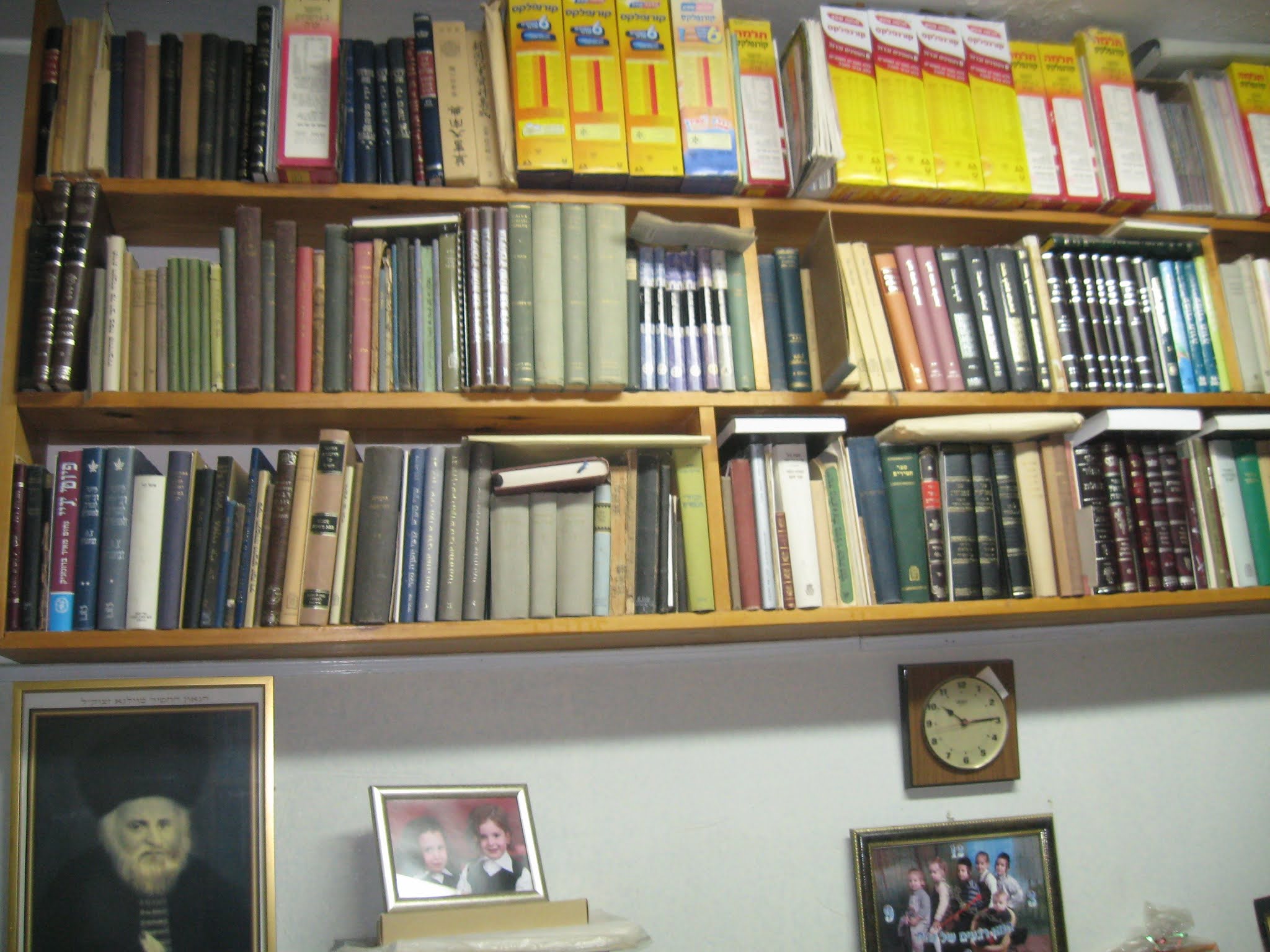

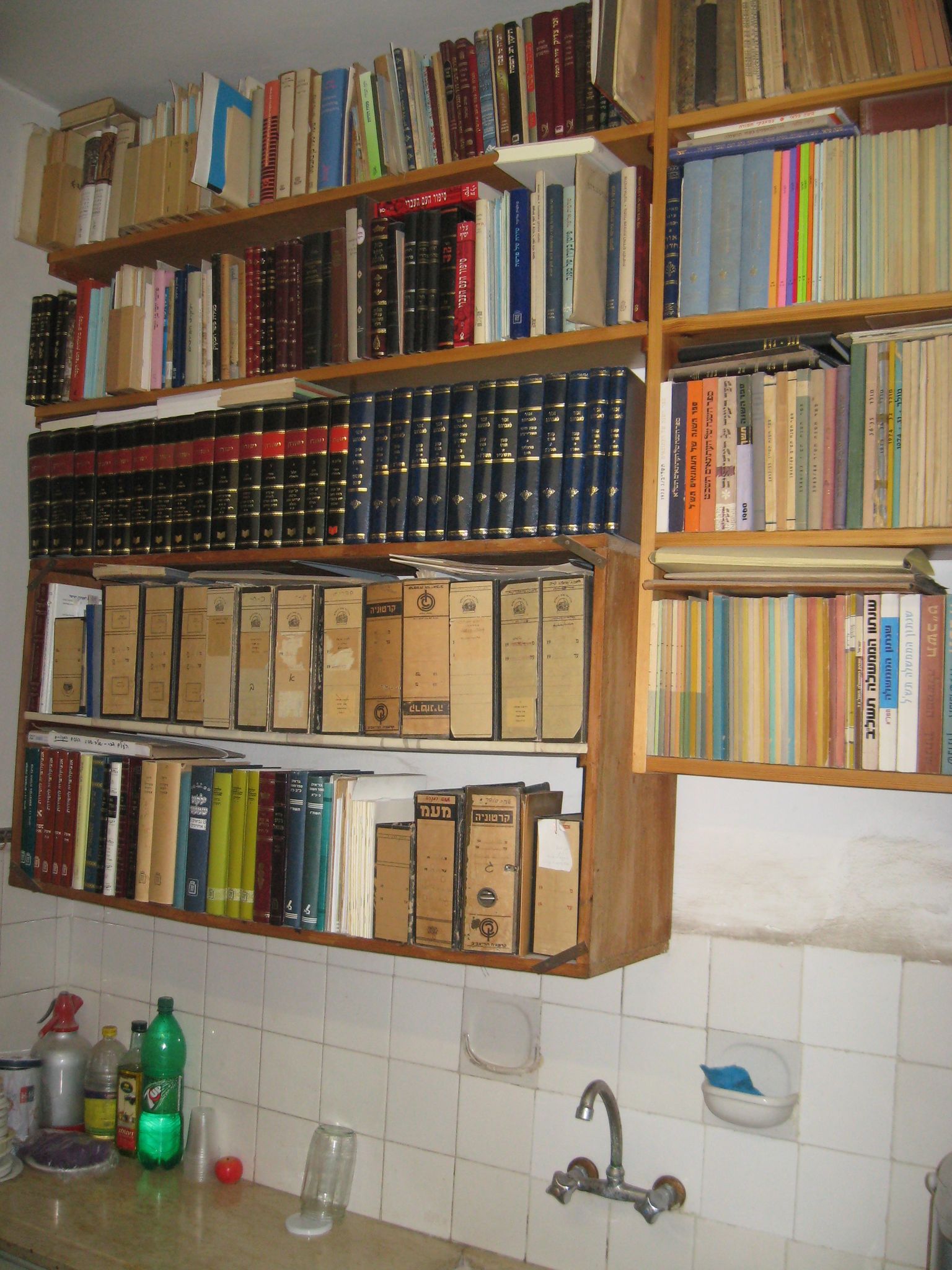

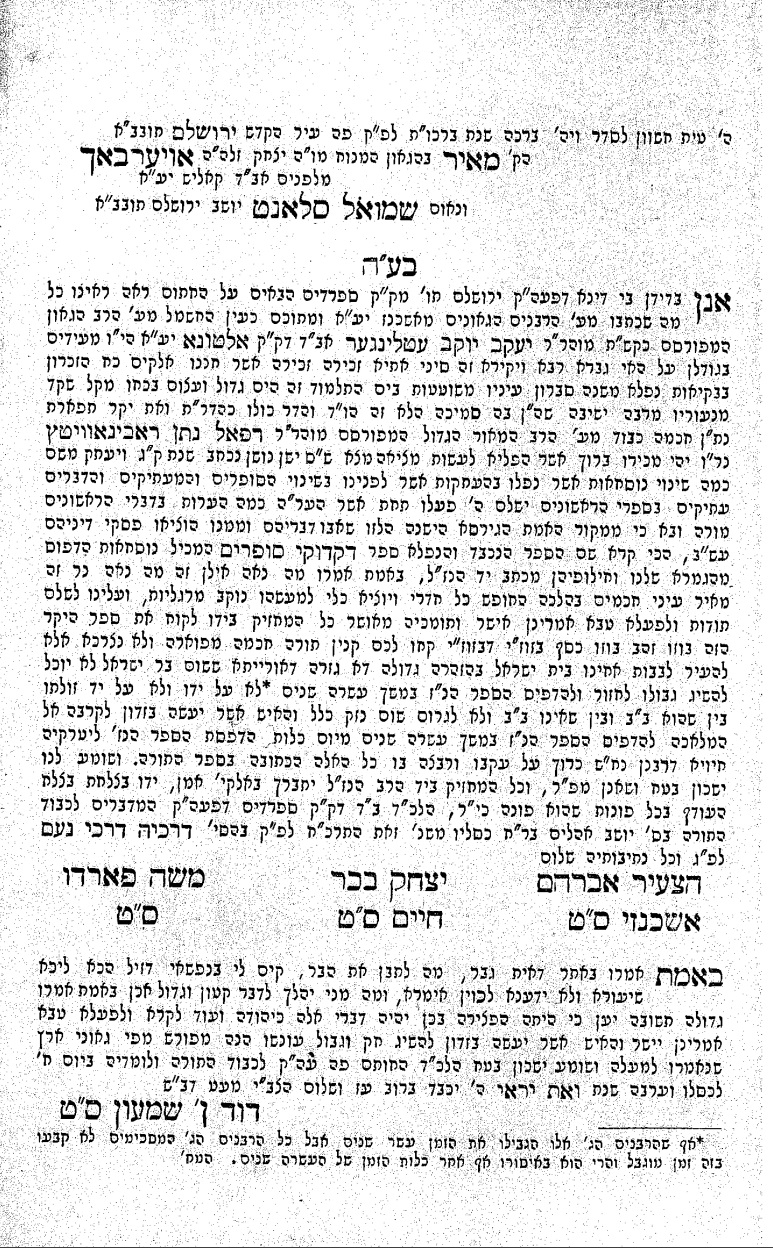
In Search of Memory:Towards an Understanding of Baladhur

In Search of Memory:
Towards An Understanding of the Baladhur
By Rabbi Eliezer Brodt

In a recent post at the Seforim blog, while reviewing R. Ovadiah Yosef’s recent work, Chazon Ovadia, I wrote as follows:

“R’ Ovadiah Yosef is world famous for his unbelievable memory, resulting in a tremendous bekius. I once joked that he must have had someone develop a computer program and attach it to his brain to help him retain so much information and recall it at all times.”

To this, one anonymous commenter wrote as follows:

“Actually, there is a (unconfirmed) shmu’a that R. Ovadya partook of the Jewish mythological memory-booster known as Balzar. It is mentioned in different sources as being very dangerous, but granted one survives, it leaves the one who ingested it with a superlative memory. (The Sefer Hakanah refers to this when it says: “chazor chazor, v’al titz’tarech l’balzar”). The Chida is said to have accidentaly ingested it as a child, and fortunately came away with only a few paralyzed fingers — and a great memory. I recently heard a “ma’aseh nora” regarding someone who recently attempted to track this (grass?) down and how min hashamayim he was stopped. Very scary.”

I would like to thank this anonymous commentator for giving me a great excuse to discuss this interesting topic of baladhur, the topic of the post below, which will elaborate on the anonymous above. I would like to explain some possibilities of what this baladhur is, whether or not it’s dangerous to use, and list various gedolim who have actually used it. I will be tracing this through early Jewish and Arabic works – some rather rare and unknown – and I will, as well, provide the background to the authors of those works.

Memory Improvement and Chazal:

Methods for improving memory has been around for a considerable amount of time. Chazal were very concerned with memory, as orignally Torah Shel Ba’al Peh was not allowed to be written. Thus, to ensure correct transmittal, a good memory was essential. Further, (and perhaps based in part on the above concern,) the Mishna in Avos (3:9) states if one forgets his learning, this “sin” is punishable by death. Indeed, throughout Chazal we find many different techniques to help one remember. For instance, the use of Asmachtos, according to some rishonim, is to aid memory. The use of simanim such as the one which appears in the Haggadah from R. Yehuda of Detsach-Adash-Beachav are also for purposes of memory. Many of these simanim are the subject of a recent sefer printed from manuscript of the Aderet called Miglat Samanim. [Additionally, there is an entire work devoted to explicating the simanim, Simanim HaShalem.] Aside from memory tools, we find many things one should refrain from eating or doing because it will cause one to forget. It is also commonplace, to find many different segulos (as opposed to ashmachtos and the like which have a rational connection to memory) to improve one’s memory. R. Yehudah Aryeh (Leon) Modena devoted an entire sefer to this topic, called Lev HaAreyeh. Recently, R. Chaim Kanievsky has also written a complete work on this topic. Even more recently, R. Lerner has devoted a part of his now bestseller (currently over ten printings) Shmirat Haguf VeHanefesh to this topic. This year R. Avraham Zion printed a very comprehensive work on the topic, Zekher Oseh, some 562 pages gathered from many sources (pgs. 323-324 helped me a bit in my preparation of this post).

Returning to the memory segulah, some mention ingesting baladhur as one such segulah. Baladhur became so popular that it even became used in a pisgam used to remind one to review ones learning.

Early Usage of baladhur:

The use of baladhur has early roots. R. Emmanuel Loew in his Die Flora Der Juden (Vol 2 pg 203) cites a source that attributes this discovery of Baladhur to Shlomo Hamelech. The Zohar Chadash relates a story where baladhur was eaten to help them understand Torah; referred to as balad on pg. 8b Margolis edition.

Professor Gerrit Bos has written a very comprehensive article tracing this baladhur, regarding how early one can find that it was used at all and in particular to improve ones memory[3]. Bos provides examples showing how Galen was aware of the baladhur, but the earliest specific reference to it can be found in the writings of Alexander of Tralles (mid-sixth century), with subsequent references found amongst the Arabic physicians Ibn Masawayh (d. 857), Sabur ibn Sahl (d. 869) and ibn Yahya al-Razi (d. 932).

Ibn al-Jazzar, a famous Arab physician (d. 980) and medical author, wrote a treatise entitled Risala Fi Al Nisyan Wa Ilajihi. This work is on “Forgetfulness and its Treatments.” “In 1995 Gerrit Bos printed a critical edition of this Arabic text and all the subsequent Hebrew translations of this work, with an excellent introduction and commentary. The title of this new volume is “Ibn Al-Jazzar on Forgetfulness and Its Treatment.” (This work had been translated into Hebrew many times.) Ibn al-Jazzar writes about baladhur several times – how to use it exactly to help ones memory (pg. 50, 52, 69-70). For more on this work see here.

We now turn to the Jewish sources advocating for the use of baladhur for improved memory. They include: R. Moshe Narboni,[4] R. Meir Aldabi (grandson of the Rosh), R. Yehudah Aryeh (Leon) Modena, R. Hayyim Vital and R. David de Silva (son of the Prei Chadesh). R. Hayyim Vital, besides for providing a recipe for baladhur[5], writes that there were people who used to give it to their sons every day for petihat lev.[6]

What is baladhur?

Chulsis:

Now that we have seen that there is a history to baladhur (and later on we will discuss specific examples of baladhur use), we must now turn to the question of what exactly baladhur is. Meir Benayahu cites “old people in Jerusalem” that baladhur is חלתית (chulsis). Chulsis appears frequently throughout Chazal including in the Mishna, Tosefta, Talmud Bavli and Yerushalmi. Many of these places are quoted by R. Moshe Perlman (Midrash Ha’Refuah, 1:80).[9] In Masekhet Shabbat, chulsis (140a) appears in a discussion about the permissibility of soaking it in water as a medical cure. The Yerushalmi (Shabbat 20:3) brings from Shmuel that chulsis is a healthy food.

The gemara in Chulin (58b) discusses whether swallowing chulsis renders a bird a treifah. Shmuel says it does, as it punctures the bird’s throat. But, the Talmud concludes that it depends whether it is the branch of the chulsis or it was swallowed in its liquid form. Additionally, the Yerushalmi in Shabbat records that R. Yehudah says that if someone eats chulsis on an empty stomach, he will start to burn up and his skin will start peeling. Rav Avuhah says he actually ate chulsis and luckily he was standing in water when he did so as the water cooled him down. From these sources it appears that chulsis is something very sharp physically, as it could harm the throat of a bird, and it also has a sharp effect on the body, i.e. raising one’s temperature.

The Rambam (hilkhot de’ot 4:8) writes that in the rainy season, one should eat a little bit of chulsis. The Avodat Hamelech in his comments on this Rambam references the two statements above discussing the effects of chulsis on body temperature. He most likely means to explain that the Rambam’s source to eat chulsis is based on the gemara in Shabbat that says it’s healthy, however his source to eat only eat a little bit is based on the gemara in Chulin that shows that eating a lot is dangerous.

R. Tanchum Yerushalmi writes that chulsis was a plant whose seeds are eaten for medical purposes (Ha’madreich Ha’maspek, pg. 151). Meiri writes that chulsis was used for heart problems, and R. Ovadiah Bartenurah writes that chulsis is something hot eaten by people in cold places (probably based on the above Rambam). [See also Arukh Hashalem, 3:421.]

Rashi in Shabbat (140a), Avodah Zarah (35b) and Chulin (58b) translates chulsis as לזר”א. Lazei Rashi does not know what this word means in old French (#1251), but לזר”א sounds like it’s our baladhur. The Rosh states explicitly that chulsis is in fact baladhur and there is nothing as sharp as baladhur (Avodah Zarah, 3:166). The Beit David accepts that this is the correct definition of chulsis (Yoreh Deah, #36). Rabbeinu Yerucham writes that the chulsis is the baladhur and although eating it does not pose a problem for hilkhot tereifah, it is prohibited for another reason – sakanat nefashot (Sefer Ha’dom Netiv 15:5, pg. 121b). We see from the above sources that the definition of the “old people” quoted by Meir Benayahu has some support.

The Shulhan Arukh writes that if a bird eats something that punctures its intestines, for example, a branch of chulsis, the bird is rendered a treifah (Yoreh Deah 51:4). The Prei Chadash, after quoting the Rabbeinu Yerucham, says that it can’t be that baladhur is deadly, as we know that people eat this baladhur and it helps the memory. According to the Prei Chadash, the method of eating baladhur was actually by means of a bird (I assume he means they ate birds that were feed the baladhur). He writes that although the gemara in Chulin says that it can dangerously raise one’s temperature, this was only when it was eaten on an empty stomach, as it states explicitly. The Tevos Shor disagrees with this and he says there is a printing mistake in the Rabbenu Yerucham. He meant to say that chulsis is, in fact, assur because it renders the bird a treifah. When he says it is dangerous, he is actually referring to a something else mentioned there, unrelated to chulsis. The Shulhan Gavoah writes that the chulsis is baladhur and he heard that baladhur is extremely sharp and dangerous to eat, but nonetheless improves ones memory. The Shulhan Gavoah brings that in his country, Salonkia (Thessaloniki), there was a great talmid hakham who was famous for his memory and he later found out that they said this memory was a result of his eating the baladhur. The Shulhan Gavoah writes he is not sure exactly what the connection is between baladhur and a bird, but it seems that they would feed a bird this baladhur before shehitah and than one eats this bird.

Chulsis, thus baladhur, is Coffee:

The Kanfei Yonah cites the work Otzar Ha-Hayyim who says the chulsis is coffee! The Kanfei Yonah writes that although we know that coffee is not so sharp, being that the Otzar Ha-Hayyim was a big hakham in his time, especially in medicine, we therefore must follow his opinion. Additionally, according to the Otzar Ha-Hayyim, baladhur is coffee. The Darkei Teshuvah cites the Maaseh Tuviah that chulsis is the actual coffee bean, but not in its more common ground state. The Malbim in his Alim Le’treufah (Rambam, hilkhot de’ot, #21) writes that it’s very hard to accept that chulsis is coffee, as chulsis is supposed to be extremely sharp and we know that coffee is not. (However, this truly really depends on the specific type of coffee, as there are both sharper and milder strains.) Furthermore, the Malbim notes that today people drink coffee on empty stomachs and nothing happens, whereas the gemara said that your skin starts peeling and one’s temperature rises. Therefore, he concludes it is an error to link coffee with chulsis.

The Segulat Yisrael dismisses the Malbim’s question from the gemara in Chulin that the statement that chulsis will cause one’s skin to peel and raise one’s temperature is only when chulsis is eaten alone – that is, without water. But as coffee is typically mixed together with water, that is the reason we don’t see this effect on people who drink coffee even on an empty stomach. Thus, the Segulat Yisrael concludes that coffee does help the memory a bit (pg. 33). This is then quoted in Shmirat Haguf VeHanefesh (2:794) to prove that coffee helps ones memory. The Da’at Torah writes that he experimented with coffee and never found it to be so sharp as to qualify for what the gemara is referring to so it can not be that it is chulsis[10].

Interestingly enough today medical studies show that coffee does help the memory (see here) although some of the sources seem to say it only helps women who drink coffee (see here). It is worth pointing out that that in the popular and excellent historical fiction work by David Liss, The Coffee Trader, one of the main characters, a woman, eats coffee and it has a profound effect on her.

It is clear that R. David de Silva did not think that baladhur is coffee as he has a special entry for the medical benefits of coffee in his Peri Megadim and he does not write its Baladhur. R. David de Silva knew what baladhur is as clear from the story with his grandfather (quoted soon).

R. Samuel Joseph Finn in his Ha’otzar explains that chulsis is Asa Foetida (2:93). R. Emmanuel Loew in his Die Flora Der Juden (3:454) translates it to mean Asa Foeitida. Dr. Katzenelson in his notes on the Midrash Refuah (pg. 147 is missing – by mistake – in the new reprint of this sefer) writes that chulsis is Asa goefida, and that Persians use it for spices. Professor Saul Lieberman also writes its Asa Foeitida (Tosefta Kifshutah, Shabbat, pg. 265 and Baba Kama, pg. 57). Yehudah Feilkeis, in his Hazomach Vhachai Bamishna (pg. 65), and Michael Sokoloff, in his Dictionary of Jewish Babylonian Aramic Of The Talmudic And Geonic Periods, translate chulsis to mean Asa Foeitida (pg. 456).

So it seems that chulsis is not the same as our baladhur.

So what is the baladhur?

R. Hayyim Vital writes baladhur is Anacardium. [5] Much later Ben Yehudah writes this same this baladhur is Anacorde (Milon, pg. 545 “Erech Baladhur”).

Gerrit Bos also documents that it is Anacardium which is the marking nut. Bos writes this is used even today in many medicines. Ibn Al Jazzar in his work on “Forgetfulness and its treatments” gives some exact recipes for this cure. R. Hayyim Vital gives an exact recipe for this baladhur. As noted above (at footnote three), Gerrit Bos brings different recipes for this cure.

People who used baladhur:

There is an old legend that the Rambam when he was twenty he had not learnt anything and he had been working somewhere. Than his master had to go out of town so he told him not to eat from the baladhur. When the master left Moshe ate the baladhur. and he became smart instantly (see Shivchei Harambam pg 76) [Of course this story is not true at all historically and is an embarrassment to the Rambam as much has been written on another such similar legend to this in regard to the youth of the Rambam in the past few months.]

R’ Avraham Kalifon, who knew the Chida personally [7], writes that the Chida, when he was young, ate baladhur. and as a result, the middle finger of his left hand became paralyzed (Sefer Hachida, pg. 185). Incidently Meir Benayahu writes that the Chida had an incredible memory; he remembered whatever he saw (Hachida, volume 1, pg. 91). Others that have used it include the Prei Chadash and R. Chaim Saton – the author of the Aretz Chaim (Benayahu Sinai ibd).

Dangers of using baladhur:

R Avrohum Gibson in his Omer Hashicha writes of a person who he knew who heard of the Baladhur.that it helps ones memory he went and used it incorrectly and died (pg 133). Benayhu brings that R. Chaim Saton mind was effected by his using of the baladhur.
R Yehudah Aryeh Modena writes that people try different ways to help their memories one of the ways is thru the baladhur. However he does not recommend it as it’s very dangerous he knew many people who lost their minds completely from using it (Lev Haryeh pg 13) [8]. R’ Yaakov Emden says that one should be careful not to use the baladhur. because it’s more likely that the person who takes it will lose their memory rather than gain memory (Migdal Oz, pg. 50).

Meir Benayhu printed a letter from a manuscript where the Jews from Fez asked R Yakov ibn Zor to write to R Yosef Konki that some of the Talmidi Chachmim who learn the whole day but forget some of what they learn had heard about the Baladhur. On the one hand they heard that it helps ones memory but on the other hand they heard that its dangerous if used incorrectly so they asked me to write to you R Yosef Konki being that they heard you use it successfully to explain how exactly does one use it. We do not have R Yosef Konki response (Sinai, 36, 1937, 67-70).

In the Prei Megadim of R. Dovid de Silva records an interesting story that happened with himself in regard to this baladhur. He had read somewhere the statement of Chazal that ‘Chazor, chazor val titztarech l’Baladhur’ [more on this soon] so he went and started to eat a lot of this baladhur. His mother saw this and went to ask her father R Refal Malchi who was a doctor if what her son is eating is healthy. R Refal came and saw what his grandson was eating he gave it to him – telling him how could you eat something you do not know about it its something that could make you lose your mind he told him it is lucky you did not eat it wet. He told him the only way you could eat it with it causing damage is to eat it with a bird [more on this soon] (pg 58-59). [These two great people, R Dovid and R Refal will be the subject of an upcoming post.] Interestingly enough Meir Benayhu brings an old rumor that R Dovid’s father the Prei Chadash used the baladhur.

Professor G. Bos brings many non-Jewish medical sources which also say how dangerous the incorrect use of baladhur could be. Bos even brings those who say that Galen died from using baladhur (pg 236). There was a 9th century Persian historian named Ahmad Ibn Yahya al-Baladhuri who lived at the court of the Chaliphs al-Mutawakkil and Al-Musta’in and was tutor to the son of al-Mutazz. He died in 892 as the result of using a drug called Baladhur, hence his name.

Recent Usage of baladhur:

In a recent printing of Lev Ha-Aryeh, R. E. Monzor writes (pg. 31 and on) that he asked his father and many experts in ancient seforim about this baladhur, and he was told that this refuah consists of a few different plants, and the mixture must be exact. He writes about R. Yaakov Katzin, who had a phenomenal memory. He writes that he remembers when he was young, that people heard of the baladhur, and there were three rabbanim who used it. These rabbanim went to consult someone who was an expert in the correct measurements of baladhur. After using it each one suffered from different side effects. One was cold even the summer and R. Yaakov Katzin (who was known for having an incredible memory), who was one of the three, had problems with his intestines. In the Or Torah Journal (Tishrei 5751): 10, there is another source which also claims that he heard that R. Yaakov Katzin used baladhur. In the same journal in a later issue (Tevet 5751): 280, there is a source which brings from R. Ovadiah Yosef that a rebbi of his, R. Eliyahu Lupas, went to purchase this baladhur and the seller told him that it does not really help.

Sources for the Pisgam, ‘Chazor, Chazor V’al Titztarech l’Baladhur’:

As I have mentioned earlier this baladhur, was used in a Pisgam (saying) to remind one to review his learnings. In regard to the sources and evolvement of this pisgam of ‘Chazor, Chazor V’al Titztarech l’Baladhur’. One of the first places to consult is as always the Alpah Beta Kadmita D’shemuel Zeirah of R. Shmuel Askenazi. R. Askenazi has a short comment about it (pg. 595) and than he writes more will be in the second volume. In the back of the sefer amongst the list of future topics he plans on writing about he mentions that this pisgam is one of the topics of the next sefer (pg. 842). For whatever reasons, as of now volume two is not happening. So I asked R. Askenazi if he could give me the material he was planning on printing but unfortunately thus far, he was unable to locate the material. So – as the saying goes – Bemokom Shein Ish, I will attempt to trace it a bit, in a similar style to R. Ashkenazi.

One of the first sources is found in a sefer recently printed from manuscript from R. Yosef Alashkar in his Marchevet Hamishna on the Mishneh in Avot (pg. 139) (see my forthcoming post at the Seforim blog on this topic) where he brings this quote חזור חזור ואל תצטרך לבלדור. R. Yosef Alashkar was a youngster during the Spanish Expulsion. A bit earlier, the Abarbanel in his commentary on Avot, entitled Nachalat Avot (pg. 351) brings this same exact quote. R. Tobias Cohen in his Ma’aseh Tuviah (pg. 133b) brings this quote but adds that it’s mentioned in the gemara. R. David de Silva, a younger contemporary of R. Tobias Cohen also quotes this statement saying it is from Chazal in his Peri Megadim (pg 59). R. Jacob Emden in Migdal Oz (pg. 100) brings the same quote except he says בלאזור. Professor Simha Assaf printed a letter from manuscript that a melamad in Italy who instructed his students רק חזור חזור טוב מבלאזור apparently this is alluding to our pisgam (Toldos Hachinch Byisroel 2:391). R. Yehezkel Feivel, in his Toldot Adam, writes “that there is a famous Mamaor that people say חזור חזור ואל תצריך לבלאזור (vol 1 pg 70).” Levinsohn in his Zerubavel already writes the source for this Toldot Adam is the Ma’aseh Tuviah (pg 42). This pisgam is also found in the Tiferet Yisrael to Avot 1:4.

Azariah de Rossi also alludes to our pisgam at the end of chapter 59 of Meor Einayim:
הטעמים שאינם אלא פרפראות להבנת הענינים ובלאדור נגד השכחה.

R. Yehudah Aryeh (Leon) Modena in Lev Ha-Aryeh brings it a bit different claiming, its from chazal הדור הדור ואל תצטרך לבל דור (pg 7).

R. David Pardo writes it a little different חזור חזור ואל תסתרך לב”ל הדו”ר (Shu”t Michtam LeDavid, Yoreh Deah, pg 87b).

The Da’at Torah writes this baladhur is what the Sefer Hakanah is talking about when he says חזור חזור ואל תצטרך לבלזור. From here the Sefer Hakanah is quoted by many amongst them R. Menachem Mendel Krengel (in his notes Menachim Zion on Shem Hagdolim (pg. 146, note 18), Sefer Hameshalim V’Hapisgamim (by C. Bialik and Y. Rivinski, pg. 167) and R. Lerner in his Shmirat Haguf VeHanefesh (2:794). However both Meir Benayahu and R. Shmuel Ashkenazi have pointed out that all these people are quoting it wrong, as the Sefer Hakanah does not talk about it, rather the author of the Sefer Hakanah does, in a different work of his, the Sefer Hapliah. However the Sefer Hapliah does not bring the pisgam the same way the Da’at Torah quotes it. Rather, he says חזור חזור יפה מבלזור. (Volume 2, pg. 17a)

Interestingly enough R. Yisrael Tayber writes in his book Mikveh Yisrael (which is a biography of the author of the Terumat HaDeshen) that the Terumat HaDeshen used to say this pisgam to his talmidim however, he brings no source for this statement (pg. 16). R. Tauber notes that the Ma’aseh Tuviah cites this quote from chazal. R. Yosef Halpern suggests that the Ma’aseh Tuviah is incorrect, because it is a Sefer Hakoneh not a chazal.[11] But then R. Haplern concludes that perhaps the Ma’aseh Tuviah is correct because the Sefer Hakoneh is a sefer of chazal (Kuntres Me’at Zri pgs. 8-9). Now, R. Yosef Halpern is incorrect for a few reasons first of all, the Ma’aseh Tuviah specifically says it found in the gemara second of all, its in the Sefer Hapliah and not in the sefer Hakoneh and third of all, most agree today that Sefer Hakoneh and Sefer Hapliah are much later from the times of the late rishonim.

Notes:

I would like to thank Professors Gerrit Bos and Zohar Amar for their helpful articles; to Manuscript boy and R. Motti Jackobwitz for their help with finding some references; and, as always, thank you to Dan Rabinowitz and Menachem Butler of the Seforim blog for all of their assistance, especially in helping tracking down some of the more obscure sources.

[1] R. Shabsei Donlo (1:80).

[2] Sori Haguf was a medical work written in the late thirteenth century. Less than a year ago, Professors Zohar Amar and Yael Buchman published part of this work. The piece about baladhur can be found on pages 163-164 of this edition. Not much is known about this work, though Professor Gerrit Bos and Resianne Fontaine have discussed this sefer in their “Medico-Philosophical Controversies in Nathan B. Yoel Falaquera’s ‘Sefer Sori ha-Guf’,” Jewish Quarterly Review 90:1-2 (July – October, 1999): 27-60.

[3] Gerrit Bos, “‘Balādhur’ (Marking-Nut): A Popular Medieval Drug for Strengthening Memory,” Bulletin of the School of Oriental and African Studies, University of London 59:2 (1996): 229-236. See this fantastic article for additional sources and complete citations.

[4] This work only in manuscript, for this quote, see Gerrit Bos, “Jewish Traditions on Strengthening Memory and Leone Modena’s Evaluation,” Jewish Studies Quarterly 2:1 (1995): 48. For more on this author in general, see Gerrit Bos, “R. Moshe Narboni, Philosopher and Physician: A Critical Analysis of Sefer Orah Hayyim,” Medieval Encounters 1:2 (1995): 219-251.

[5] R. Hayyim Vital, the most famous student of the Arizal, wrote many seforim, including a nearly unknown work on medicine and alchemy. It was briefly mentioned by Gershom Scholem. The alchemist section of this book was discussed by Raphael Patai in his book, Jewish Alchemists. Meir Benayahu discusses it in various places in his writings (amongst them in his book on the Ari). Gerrit Boss, “Hayyim Vital’s Kabbalah Ma‘asit we-Alkhimiyah (Practical Kabbalah and Alchemy), a Seventeenth Century ‘Book of Secrets’,” Journal of Jewish Thought and Philosophy 4 (1994): 55-112, wrote an extensive article on this book, and does an excellent job of putting each remedy into its proper categories, as the book is not published in proper order. More recently, Prof. Zohar Amar and Yael Buchman in Sinai 121 (1996): 231-238 and, idem., “Theory and practice in an essay by R. Hayyim Vital,” Sinai 125 (2000): 202-215, about the various halakhic aspects discussed in this work. After that, Yael Buchman wrote her doctorate on this work of R. Hayyim Vital, and a recent article, “A Kabbalist as Healer: The Medical Practice of Rabbi and Healer Hayyim Vital (1543-1620),” Korot: The Israel Journal of the History of Medicine and Science 17 (2003-2004): 7-30 (Hebrew). Less than a year ago, Buchman and Amar printed part of this book, calling it Refuah Maasios L’Rav Chaim Vital. The only part they printed was the medical portion that contains diseases and cures. The recipe for baladhur can be found on page 262 of Buchman and Amar edition. One hopes that they will print the rest of this work in the future. What makes this work very interesting is that we see that R. Hayyim Vital was a medical doctor of sorts, who gave remedies to people for all kinds of illnesses, in all areas of health, whether asthma, infertility, etc. Much of the advice was based on real medical advice that R. Hayyim Vital had read in various medical works, other pieces of advice were based on Segulos or the like. For more on this issue see, the excellent introduction of Amar and Buchman to Refuah Maasios L’Rav Chaim Vital; and Gerrit Boss, “Hayyim Vital’s Kabbalah Ma‘asit we-Alkhimiyah (Practical Kabbalah and Alchemy), a Seventeenth Century ‘Book of Secrets’,” Journal of Jewish Thought and Philosophy 4 (1994): 59-62.

[6] This piece is only in manuscript, its quoted by Gerrit Boss, “Hayyim Vital’s Kabbalah Ma‘asit we-Alkhimiyah (Practical Kabbalah and Alchemy), a Seventeenth Century ‘Book of Secrets’,” Journal of Jewish Thought and Philosophy 4 (1994): 78. The subject of “petihat lev” has been discussed much in recent literature. This concept of petihat lev is found in many different sources where people used to do all kinds of things to help with memory and understanding Torah enabling one to understand and recall the torah effortlessly. One example something done for petihat lev of this are the customs relating to the educational initiation ceremony of young boys still done today in many circles.

Professor Israel Ta-Shma published a piece, included in his Kneset Makcharim (1:1540), from a work written in 1294 called Sefer Hamaskil which gives us a little insight into this petihat lev, which says:

ומאותו היום שאכלו אדם הראשון ניתנו לו חדרדים בלבו לקבל כוח רוח עץ הדעת, שהוא רוח מעורבב מטוב ורע, ויש לו לאדם כמה חדרים בליבו, כל חדר ממונה על ממשלת חכמה אחת, חדר זה ממונה על מלאכת החרש… ובאמצעית הלב יש חדר גדול המקבל רוח שכל עץ הדעת ושותין ממנו שאר חדרים כולו. נסתם חדר אחר או שנים נסתמים ממונים עליהם, כאשר אתה רואה קצת בני אדם שהם סכלים בחכמות העולם והם חכמים גדולים בחכמת המלאכים. ובזמן שהחדר האמצעי כולו סתום, ואין הרוח יכול להתפשט מתמלא המוח עשן ומשתטה

Some general sources on petihat lev can be found in: Ivan G. Marcus, Rituals of Childhood, Jewish Acculturation in Medieval Europe (Yale University Press, 1998), 28; Ephraim Kanarfogel, Peering through the Lattices, Mystical, Magical and Pietistic Dimensions in the Tosafist Period (Wayne State University Press, 2000), 140-141, 156 and 237; and in the excellent article by Yuval Harrari, “‘The Opening of the Heart’: Magical Practices for Gaining Knowledge, Understanding and Good Memory in Judaism of Late Antiquity and Early Middle Ages,” in Shefa Tal: Studies in Jewish Thought and Culture presented to Bracha Sack, eds., Z. Gries, H. Kreisel, and B. Huss (Beer Sheva, 2004), 303–347.

[7] A younger contemporary of R. Hayyim Yosef David Azulai (the Chida), R. Avraham Kalfon (1735-1820) served as a rabbi in Luv. R. Avraham corresponded with the Chida for many years. Later on, he even visited him in Loriano for over a year. They had a close personal relationship. Through his sefarim, he mentions personal anecdotes and discussions he had with the Chida. He also quotes all of the Chida’s works. This piece, where R. Kalfon writes about the Chida using Baladhur, was printed by M. Benayahu in the Sefer Hachida (a collection of articles dealing with the Chida, pages 177-184) More recently, this piece was reprinted in a sefer Igrot V’Haskamot Rabbeinu Hachida (pages 133-134). This book is an excellent collection of letters of the Chida and history of the Chida. One problem with this book, is that in the introduction, the editor acknowledges different sources for helping him write the book, but he doesn’t give credit to his main source, the writings of Meir Benayahu. He does quote these writings extensively, but never uses Benayahu’s name.

R. Avraham Kalfon authored several works, including the small work titled Chayeh Avraham, a collection of reasons of various minhaghim related to Orah Hayyim and Yoreh Deah which he had gathered from many different sources. He authored another work entitled Leket Hakatsir on Orah Hayyim, which remained in manuscript form until a few years ago, when it was printed the first time in 1992. Leket Hakatsir is a large and excellent collection of material gathered from many sources on all topics relating to Orah Hayyim. R. Kalfon quotes many points that he had heard personally from the Chida. Unfortunately, this work is pretty much unused and unknown by our generation of halakhic authors. Nearly thirty years ago, Harvey Goldberg printed Higgid Mordechai (Jerusalem: Ben-Zvi Institute, 1978), from part of a work by R. Mordechai Cohen, entitled Koros Luv ve-Yehuda, and quotes many things from manuscripts of R. Avraham Kalfon.

[8] R. Yehuda Aryeh (Leon) Modena’s Lev Ha-Aryeh was completed in 1611. The idea of this work was to develop a course for memory improvement. In this short work, Modena brings down many ways of how people went about improving their memories, all types of scientific methods, medical methods and segulos for improving memory, and mnemonic systems. For a discussion of this work, see Howard E. Adelman, “Success and Failure in the Seventeenth-Century Ghetto of Venice: The Life and Thought of Leon Modena, 1571-1648,” (PhD dissertation, Brandeis University, 1985), 431-433, who writes that it is possible that Modena’s source was an edition printed in Venice, 1603. For an extensive discussion of Lev Ha-Aryeh, see Gerrit Bos, “Jewish Traditions on Strengthening Memory and Leone Modena’s Evaluation,” Jewish Studies Quarterly 2:1 (1995): 39-58. This work Lev Ha-Aryeh was recently reprinted by Mechon Shuvi Nafshi (2001)

[9] The Midrash Harefuah was written by R. Moshe Perlman, son of R. Yeruscham Leib Perlman (the Minsker Gadol), and is a three-volume-collection of all the health and medical related information that one can find in the Talmud Bavli and Yerushalmi, Tosefta and Zohar. It is incredible to see how much material R. Perlman was able to gather. More importantly, R. Perlman presents the information in an extremely organized manner and brings complete and exact quotations of each source and is careful to properly reference each citation. Additionally, in the footnotes R. Perlman has a brief explanation of some points from the text. This work was first printed in 1936 and a few months ago, thankfully, was reprinted in Jerusalem. R. Perlman writes, in the introduction, that he came to working on Midrash Harefuah while working on a completely different topic, and was going through the abovementioned sources in a systematic manner listing all of the statements that he needed. In working on this project, R. Perlman noticed the many statements throughout chazal about medical and health issues. He began gathering all of the sources – without knowing that others had previously done the same, and had he known, he would likely have not bothered to put Midrash Harefuah together. When he finished the work he went to bring it to a great medical expert Dr. Heindis, who, at first glance, told him not to bother printing the work, as much has already been written on this topic. Dr. Heindis then started to study the work in-depth and could not put it down. Dr. Heindis then asked R. Perlman to leave the work with him for several days. When Dr. Heindis returned the book to R. Perlman, he told him he was unaware that there was so much information in chazal on these topics and this is an important work. Before printing Midrash Harefuah, R. Perlman sent it to medical experts Drs. Katzenelson and Mazeyah for their comments, and their notes on many of the topics are printed in the back of each volume.

R. Meir Halpern, in his excellent work on the Minsker Gadol – the topic of a upcoming post at the Seforim blog – writes about his abovementioned student, R. Moshe Perlman, he was great in learning and eventually entered into a career of business, but did not waste any of his free time. His tremendous knowledge is evident from the work Medrash Harefuah (Hagadol Me-Minsk, pg 208).

[10] For more on chulsis and coffee: see the forthcoming work of R. Yechiel Golhavher (famous for his excellent work Minhaghai Hakehilos) on coffee.What is this sefer Otzar Ha-Hayyim that the Kanfei Yonah is quoting which writes chulsis is coffee? R. Yaakov Zahalon (1630-1693), a graduate of medical college in Rome, became a doctor at the age of twenty-six, and for several years, was also a Rav and Baal Darshan in Rome. He was very involved in the famous plague in the ghetto of Rome in 1656, which he describes at length in his work, Otzar Ha-Hayyim. He wrote many works, amongst them Margolios Tovos (available at HebrewBooks.org), which has prayers for different occasions; including those for a doctor to say before he treated a patient and for a darshan to recite before he spoke in public. R. Zahalon wrote a book called the Or Darshanim, a guide for darshanim on how to compose and deliver sermons. Twenty-years-ago, the work was printed with an extensive introduction and English translation by Henry Adler Sosland, A Guide for Preachers on Composing and Delivering Sermons: The Or Ha-Darshanim of Jacob Zahalon, A Seventeenth Century Italiam Preacher’s Manual (JTS Press, 1987).

However, R. Zahalon’s most famous work was the Otzar Ha-Hayyim, first printed in 1683. It was the first medical work whose original language was Hebrew. This work was intended to be an encyclopedia for the doctor and layman alike. He intended to discuss every aspect related to medical and health issues. Unfortunately, only part of this work was printed only one time, thus making it a very rare book. This definition of chulsis being coffee attributed to him can be found on page seven in the Otzar Ha-Hayyim. R. Zahalon included a whole section in his sefer to explain the fourth chapter of Rambam’s Mishneh Torah, Hilkhot Deot – all of the health related issues, including where this piece related to coffee can be found. Recently Professor Zohar Amar reprinted just this part of the work of the Otzar Ha-Hayyim called Shemirat Haberiut LeHa-Rambam including many additions from an autographed copy of R. Zahalon. One only hopes someone will reprint this whole work again.

For more on Zahalon, see David B. Ruderman, Jewish Thought and Scientific Discovery in Early Modern Europe (Wayne State University Press, 2001), 232-239. See also, J. Leibowitz, “R. Yaakov Zahalon, Man of Rome, His Poem in Honor of the Sabbath, 1687,” Scritti in Memoria di Enzo Sereni: Studies in the History of the Jews in Rome (Jerusalem 1970), 167-181. See also, Professor Zohar Amar in his introduction to his reprinted edition of the Otzar Ha-Hayyim- the part on the Rambam Hilkhot Deot called Shemirat Haberiut LeHa-Rambam.

The question is how this medical work came to R. Yonah Lansdorf. The answer is found by looking in his entry in the Chida’s Shem Hagedolim, where he writes that R. Yonah Landsdorf – besides for being a great Goan – was well versed in all chochmos (Erech Mil Tzedakah). In addition to R. Yonah Landsdorf quoting the Otzar Ha-Hayyim, at least one other goan used Otzar Ha-Hayyim and quotes this definition of chulsis being coffee. R. Yehezkel Feivel, famous for his Toldot Adam, also wrote a work on the Rambam’s Hilkhot Deot and Teshuva, entitled Mussar Haskel. In the beginning of chapter four of Hilkhot Deot (in a section called Loshon Chachamim), Feivel writes that he obtained a copy of the work Otzar Ha-Hayyim and will quote from it throughout the chapter. This explanation of the Lashon Chachamim is quoted by the Sefer Hakovetz in his comments on this Rambam (found in the back of most printings of the Mishneh Torah). R. Yehezkel Feivel and his various works will be discussed at greater length in a future post at the Seforim blog; for now, see the significant discussion in Edward Breuer, “The Haskalah in Vilna: R. Yehezkel Feivel’s ‘Toldot Adam’,” Torah u-Madda Journal 7(1997):15-40.

[11] Much has been written regarding the authorship of the Sefer Hakanah and Sefer Hapliah. Some attribute it to R. Avigdor Kra (see here). See also Sdei Chemed (vol. 9), Klalei HaPoskim V’HaHoraa (15:59), Shorshei Minhag Ashkenaz (3:375, notes 71-72), Chida in Shem Hagedolim (Erech Hakanah and Erech Hapliah , notes of Menachem Zion ibid, notes of Shimon Chanes in Rav Upalim of R. Avraham Ben Hagra (pg. 97), A. Marcus, Hachasidus (pg. 377), and Professor Israel Ta-Shma (Kneset Makcharim, 3:228).


Names of Seforim I

The names utilized for Seforim are rather unique. As opposed to most cultures who title their books based upon their content (think Da Vinci Code about a code Da Vinci did), Jewish book titles, for the most part, have no relationship to their content. Additionally, for many, the title of the books supersedes that of the actual author to such an extent that many authors are only known by their book titles. So while many are aware of the Shach and the Taz (shortened forms of the titles Siftei Kohen and Turei Zahav commentaries on the Shulhan Orakh most are not aware who actually wrote these works. Instead, one would say “(the) Shach says” etc. Now if we were to return the above titles, Siftei Kohen – the Lips of the Priest and the Turei Zahav the Pillars of Gold, from first glance one would assume the former is about Priests while the latter is about either metallurgy or perhaps some Indiana Jones like pillars.

Some have been critical of the use of such obscure titles for Jewish books. Isaac D’Israeli the father of Statesman Benjamin (Isaac was the one to remove himself and his family Benjamin included and convert them to Christianity after Isaac was angered over his synagogues dues) was highly critical of such titles, in his Curiosities of Literature he writes:

The Jewish and many oriental authors were fond of allegorical titles, which always indicate the most puerile age of taste. The titles were usually adapted to their obscure works. It might exercise an able enigmatist to explain their allusions; for we must understand by The Heart of Aaron,” that it is a commentary on several of the prophets. “The Bones of Joseph is an introduction to the Talmud. The Garden of Nuts, and The Golden Apples,” are theological questions, and The Pomegranate with its Flower,” is a treatise of ceremonies, not any more practised. Jortin gives a title, which he says of all the fantastical titles he can recollect, is one of the prettiest. A rabbin published a catalogue of rabbinical writers, and called it Labia Dormientium, from Cantic. vii. 9. Like the best wine of my beloved that goeth down sweetly, causing the lips of those that are asleep to speak. It hath a double meaning, of which he was not aware, for most of his rabbinical brethren talk very much like men in their sleep. Almost all their works bear such titles as bread,— gold, —silver, —roses, —eyes,— &c., in a word, anything that signifies nothing.

Isaac Reggio (perhaps it is the Isaacs) was equally critical, in his introduction to Delmigido’s Behinat HaDa’at. “Amongst the incorrect customs which has been exacerbated over time . . . when authors title their books with titles that do not speak to content, or at best they use titles which only hint to the books content which can only be decoded after reading the introduction . . . there are those who use titles which contain the authors name.” Reggio then proceeds to list some of thcategories those catagories. “There are those who use titles from the vessels in the Temple ארון עדות,מזבח הזהב, מנורת המאור, שלחן ארבע, זר זהב, קערת כסף or some use the clothing of the priest for titles שרשות גבלות, המצנפת, מעשה אפוד, משן אהרן, כליל תכלת,” and the list goes on.
Reggio mentions two catagories of interest, one the author placing his name (or hinting to it) and the other hinting to the content via an obscure title. As to the second there was such a book reviewed by the Jewish Chronicle (London)

Very wittily is the pun-title, City of Sihon (Heb: Ir Sichon), for a mathematical book by R. Joseph Zorphathi, alluding to Numb. xxi 27, “For Hesbon (reckonin [caculating]) is the City of Sihon.”

Jewish Chronicle (London), June 21, 1889, page 15

There are also similarly titled or pun titled books which are hinting at the name of the author. For instance authors whose name was Avrhom utilize puns on various verses relating to Avrohom. So we have the books Pesach haOhel (1691) which is referencing that Gen. 18:1; Yukach Na (1881); Sa’du Lebchem (1881) both referencing Gen. 18:4-5.
Then we have books which are not as creative and just use the persons name in the title. Perhaps the person to go wild with this theme was R. Hayyim Palaggi. Who wrote over 25 seforim and almost all carry the name Hayyim in the title. So we have Otzrot haHayyim, Genzi Hayyim, Darki Hayyim, U’Baharta B’Hayyim, Zechirah L’Hayyim, Huke’ Hayyim, Hayyim b’Yad, Hayyim V’Shalom etc. (you get the picture).
Asided from these we have other books which make reference to something that happened in the authors life, generally unrelated to content of the book. So we have Homat Aish (1799) a commentary on the Ibn Ezra’s song Tzama Nafshe which was written soon after the author lost his house and all to a fire. He decided to write this in the hope it would prevent a future fire. Or we have the various books written by blind people, Eynai Avrohom and the like which generally reference eyes or sight.
Aside from these curiosities, there is still the final one of substituting the authors name for that of his book. Menachem has a rather interesting story related to this practice here.

Perhaps the reason for this practice can be gleaned from the following story was told. There was a city which was filled with less than learned or interested people who were in need of a rabbi. However, when each candidate would come through they would be turned off by the populace. The town decided to do something about this and had commisioned tombstones with famous personages such as the Shach, Taz, Rama etc. and placed them in the graveyard. With the next candidate they made sure to tour the cemetary. Needless to say, although the rabbi had some misgivings he decided to take the job figuring if the Shach etc. were here it couldn’t be all that bad. After he accepted one of the townspeople took him aside and told him the truth immediately the Rabbi complained saying he was tricked. However, the town board explained he was not. As in the various cities where the Shach, Taz etc are actually buried they study their works and the Talmud says that when one studies the works their lips move – they are still alive. In this town, however, no one studies any of their wotrulyd they are truely dead here. Perhaps the idea that the Torah of the person is the most important thing and the authors derive life from that caused some to substitute their works.
Sources: Zlotkin, Shemot haSeforim and entire work devoted to the names of books; Y. S. Spiegel, Amudim b’Toldot HaSefer Haiviri, Ketiva v’Hataka, 384-428 discussing the use of the authors name in the title (Spiegel’s two volumes of Amudim are excellent and are a must read for anyone interested in the history of Seforim); for a list of books about various events, famine, jailing, blind people etc. see A. Yaari, Mekeri Sefer. [Thanks Menachem for the Jewish Chronicle (London) citation.]