Hakirah, Metzitzah, and More


Hakirah, Metzitzah
, and More
Marc B. Shapiro

Hakirah has performed a valuable service in dealing forthrightly with the matter of homosexuality. Issue no. 13 (2012) contains R. Chaim Rapoport’s “Judaism and Homosexuality: An Alternative Rabbinic View,” which I think is an outstanding presentation of the alternative to what has seemingly become the “official” haredi position in this matter. This “official” position is, in my opinion, so misguided that I would like to say a few words on the topic, since R. Rapoport did not go far enough in his criticism.
To remind readers, Hakirah no. 12 had a discussion on homosexuality with R. Shmuel Kamenetsky. This was followed by the publication of a document signed by many rabbis which follows R. Kamenetsky’s approach. It is available here. (The document is also signed by an assortment of mental health professionals,  rebbitzens and “community organizers”.)
There are so many problems with the approach found in this document (called a “Torah Declaration”), some already noted by R. Rapoport in his response to R. Kamenetsky, that it would take a lengthy piece to go through them all. Let me just call attention to a few points that I don’t think have been made yet. To begin with, while many rabbis have signed this document, including a number that I know personally, I have yet to speak to someone who actually believes what the document says, and this includes the people who have signed it! Many will regard what I have just said as pretty shocking, in that I have declared that people who signed the document do not believe what it says. Yet I know this to be true, at least with regard to some of the signatories (those that I know personally), and I suspect that other than R. Kamenetsky, it might be that no one who signed the document really believes what it says (and it wouldn’t be the first time that people sign declarations that they really don’t believe in).
Let me explain what I mean. According to the document,
Same-Sex Attractions Can Be Modified And Healed. From a Torah perspective, the question whether homosexual inclinations and behaviors are changeable is extremely relevant. . . . We emphatically reject the notion that a homosexually inclined person cannot overcome his or her inclination and desire. . . . The only viable course of action that is consistent with the Torah is therapy and teshuvah. The therapy consists of reinforcing the natural gender-identity of the individual by helping him or her understand and repair the emotional wounds that led to its disorientation and weakening, thus enabling the resumption and completion of the individual’s emotional development.
The ideas just quoted are the very foundation of the Torah Declaration, and as we see in his Hakirah interview, R. Kamenetsky has been convinced by the dubious proposition that homosexuals can change their sexual orientation. He goes so far as to say that “no one is born gay with an inability to change” (p. 34 [emphasis added]. Not long after the appearance of the interview and the Torah Declaration, the man most prominently identified with the notion that gays can change publicly rejected his earlier viewpoint.)
Whether people can change their sexual orientation is a scientific or psychological issue, no more and no less. The first objectionable point of R. Kamenetsky’s approach is turning this into a matter of theology. Indeed, R. Kamenetsky has created a new dogma in Orthodoxy. According to him, believing that a homosexual can change his orientation is a basic Torah value. The reason for this is stated in the document: “The Torah does not forbid something which is impossible to avoid. Abandoning people to lifelong loneliness and despair by denying all hope of overcoming and healing their same-sex attraction is heartlessly cruel. Such an attitude also violates the biblical prohibition in Vayikra (Leviticus) 19:14 “and you shall not place a stumbling block before the blind.”[1]
There you have it. Human beings are deciding what God can and cannot do and declaring that it is impossible for someone to be created with an inalterable homosexual nature. That this is completely incorrect is acknowledged by none other than the most extreme advocates of reparative therapy. They themselves acknowledge that there is a significant percentage of people who cannot change their orientation. They have never claimed that everyone can change. What the document gives us, therefore, is a theological statement that is rejected by all scientists and psychologists, including the ones who provide the very basis for reparative therapy. That itself should be reason enough to reject it. (On Nov. 29, 2012 the RCA acknowledged “the lack of scientifically rigorous studies that support the effectiveness of therapies to change sexual orientation.” See here.)
This relates to my point above that no one really believes what they signed. To those who doubt what I say, do the following experiment and report back if your results differ. Ask someone who signed the document if he really believes that every homosexual can change his sexual orientation. The answer you will get will be “Of course not everyone. You can never speak about everyone. But many (or most) can change.” In other words, the signatories will acknowledge that they diverge from the document on a basic point. You will have to ask them why they signed a document if they don’t accept everything it says, and the response will probably be that there is much about the document that they do accept, and that is why they signed it. But I repeat my point that this is an unusual document in that I don’t think that there is any signatory, with the possible exception of R. Kamenetsky, who accepts the Torah Declaration on Homosexuality in its entirety.

Furthermore, it is not a “liberal” idea to say that people can’t change their sexual inclinations. By looking at another example we can see that it is indeed nonsense to say that everyone can change their sexual orientation and recreate themselves as typical heterosexuals. There are some men who have strong urges for pedophilia. No matter what they do, and how much therapy they get, they can’t get rid of these urges. (I am obviously not comparing homosexuals with pedophiles, or implying that there is any connection between the two. I am only using the example of pedophiles to make a point.[2]
) If we adopt the theology of the Torah Declaration, it means that even hardened pedophiles, who have abused lots of children, can change, because God wouldn’t create someone without a possibility for a healthy sex life. Yet we know that this isn’t the case, and some people simply can’t change. They might be able to control their urges, but as they have told us again and again, the urges don’t go away. It is hardwired into them. (Is it perhaps the false theological notion expressed in the Torah Declaration that explains why yeshivot continued to allow known pedophiles to work? That is, did the rabbis assume that just because someone sexually abused children last week, there is no reason to think he can’t repent and cease to be a danger this week?)
And what about the people who are created with uncontrollable urges to kill? We know about these people, as they usually become murderers. And what about the people who are created with diseases that kill them before they are able to marry and have children, or the ones created without arms so they can’t wear arm tefillin[3]? In other words, sometimes people are created a certain way and they are not what we regard as normal. That is the world, and we simply can’t understand why things are the way they are. But one thing I would hope that we can agree on is if people can keep their faith in a good God even while knowing that some children are born with terrible illnesses that will cause their death, it certainly should not shake their faith to believe that some people are born with inalterable homosexual urges. A homosexual who can’t be changed hardly presents a challenge to theodicy the way a child with cancer does, so I can only wonder why the Torah Declaration feels that only the former is theologically untenable.
All traditional sources cited in support of the Torah Declaration’s assumption that people can change their orientation only refer to behavior. That is, it is an accepted belief that all people have the ability to control their behavior. Without this belief, the notion of a mitzvah doesn’t make sense. This distinction between orientation and behavior is so obvious that I don’t know how so many learned rabbis overlooked the document’s collapsing the two categories.
The more problematic element of the document, which I have already mentioned and which verges on the blasphemous, is that the Torah Declaration presumes to tell God what he can and cannot do. Based on the human intellects of the authors of the document, they establish as dogma that God would never create someone whose only sexual attraction is to his own gender. This is all very nice, but since when can humans dictate to God what he can and cannot do? If God “wants” to create a person who only has same-sex attraction, He can, and the proper response is silence, since we can’t understand why God would do that. Humans don’t have all the answers, and the Torah Declaration should stop pretending that we do. Whether homosexuality is nature or nurture is something the scientists and psychologists can discuss, but contrary to the document, all of the evidence is that there are plenty of people who cannot be “fixed.”
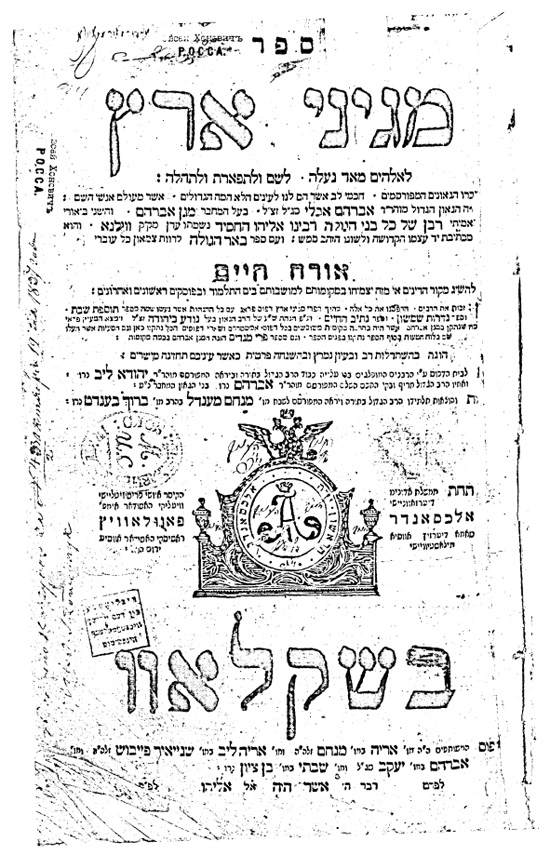
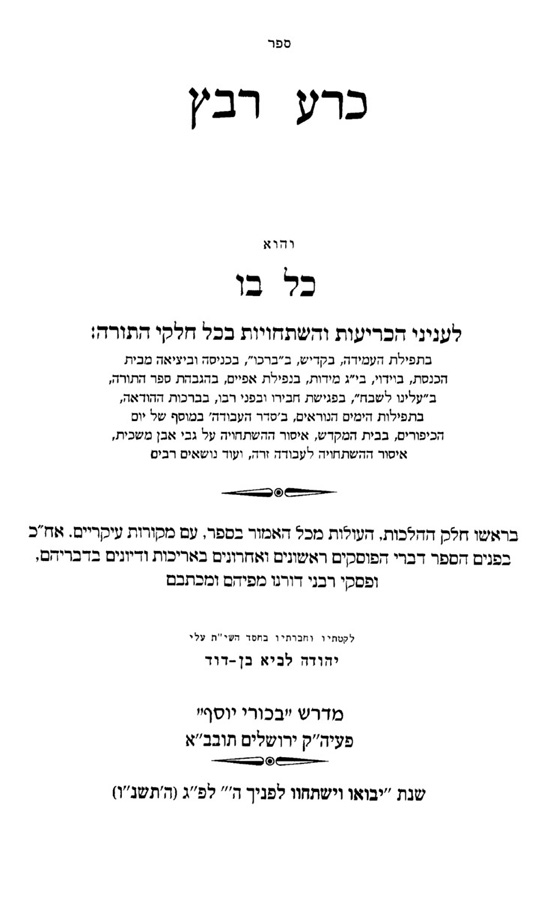
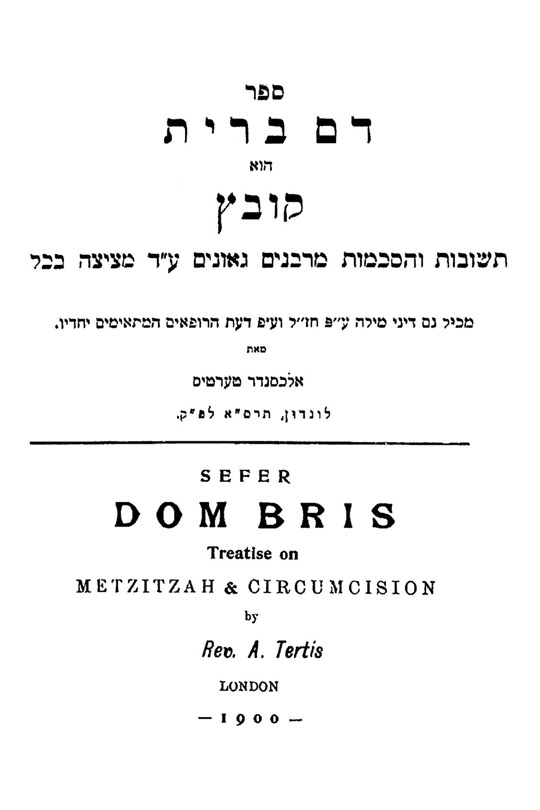
2. In my last post I mentioned that Agudat Israel has transformed itself into a lobbying organization. One of the areas they have been involved with is metzitzah ba-peh, so let me say a few things about this. It is really incredible how for many the debate around metzitzah ba-peh has become one in which the Modern Orthodox are one side, and the traditionalists on the other. I say this because the truth is that the virtually all of the rabbinic greats of Lithuania approved of metzitzah without oral contact. Alexander Tertis’ Dam Berit is a valuable resource that all interested in this matter must consult. Here is the title page.
On p. 33, R. Shlomo Cohen, the famed dayan of Vilna, says the following about metzitzah, which is very relevant to what we ourselves have seen (namely, the rejection of the firm opinions of countless doctors and scientists on the matter, all in the name of tradition).
דבר הזה אינו שייך לרבנים רק לרופאים המומחים ולכן אין לי מה להשיב על שאלתו
According to R. Shlomo, the question of how to perform metzitzah is entirely a medical issue, and the rabbis therefore have nothing to say on this matter, much like in all other halakhot dealing with medical issues the opinions of the doctors are determinative. (It hardly needs to be said that in matters of pikuah nefesh the opinions of thousands of experts, including the world’s most outstanding authorities, cannot be overruled by one idiosyncratic figure who appears to be motivated by non-scientific concerns.) 
Also of interest is that in 1906 R. Hayyim Ozer Grodzinski reported that in Vilna virtually all of the mohalim did metzitzah with a sponge. He wasn’t happy with this, but this was the reality.[4]
An interesting tidbit regarding metzitzah ba-peh is found in the Taz, Orah Hayyim 584:2. Here he mentions that he heard that R. Feivish of Cracow, when he circumcised on Rosh ha-Shanah, would not clean the blood out of his mouth. Rather, he would blow the shofar with the blood in his mouth so that the mitzvot of milah and shofar were joined.
Finally, for those who want to understand why it was only in the nineteenth century that metzitzah came to be regarded as central to the mitzvah of milah, Jacob Katz’s article “Polmos ha-Metzitzah” in his Ha-Halakhah ba-Metzar is crucial. In short, the centrality of metzitzah, and its description as a basic part of milah, is a product of the Orthodox defense of metzitzah in the face of Reform attacks. I think we are seeing something similar today. The digging in of haredi heels in defense of metzitzah ba-peh, complete with over-the-top rhetoric, is understandable (to a certain extent) and due precisely to the fact that it is an outside force that is threatening the practice. Had their own poskim suggested what the government is now insisting on, we would not have seen the same reaction. Yet it is still difficult for outsiders to grasp why some rabbinic leaders of these communities seem entirely oblivious to any medical dangers associated with the practice,  וסלחת לעונם כי רבנים המה
Let me say a few more things about metzitzah ba-peh. 

1. I saw on one of the blogs (I can’t locate it at present) that someone stated as self-evident that metzitzah ba-peh is only done with babies, not adults. The truth is that while the accepted opinion is indeed that metzitzah ba-peh is only done on babies (and maybe also on older child converts – I haven’t been able to find an answer to that), there are indeed opinions that even adult converts have to have metzitzah ba-peh performed on them. R. Moshe Klein (the son of R. Menasheh), Mishnat ha-Ger, p. 71, states without qualification that a convert has to have metzitzah, and if the mohel is afraid of catching a disease he should inquire of a posek if it can be done without the mouth. However, R. Yitzhak Yosef, Yalkut Yosef, Hilkhot Milah 6:1, rejects this viewpoint and states that there is no metzitzah, ba-peh or otherwise, with an adult convert.

2. According to R. Marcus Horovitz, Mateh Levi, vol. 2, Yoreh Deah no. 60, R. Samson Raphael Hirsch was prepared to accept the government’s abolishment of metzitzah without objection. It is difficult to square this assertion with Hirsch’s writings on the topic that show him as a strong defender of the practice.[5] Is it possible that Horovitz’s comment, meant as a criticism of Hirsch, reflects the difficult relationship these two men had?
3. In Iggerot Moshe, Yoreh Deah I, no. 223, R. Moshe Feinstein, in writing to a hasidic rebbe, expresses the standard viewpoint that metzitzah is only a medical procedure and has nothing to do with the mitzvah of milah. There is nothing surprising here. However, his correspondent had written otherwise, that metzitzah was an essential part of the mitzvah. In response to this, R. Moshe writes: חושב אני שהוא רק פליטת הקולמוס. The language R. Moshe uses implies that he did not know that among the hasidim metzitzah isindeed viewed as part of the mitzvah. Is it possible that R. Moshe was unaware of this? I don’t think so. It would appear, therefore, that the words I just quoted are a polite way of R. Moshe telling his correspondent that “what you wrote is without any substance.”
4. In 1994 R. Schachter’s Nefesh ha-Rav appeared. On p. 243 he states that R. Soloveitchik thought that today there is no need for metzitzah at all, not just metzitzah ba-peh. I remember how shocked I was when I read this, and was certain that it had to be wrong. As far as I know, no Orthodox authority has ever agreed to abandon metzitzah entirely, and I therefore couldn’t believe this report. My doubts were strengthened by the fact that R. Schachter quotes the Tiferet Yisrael as agreeing that metzitzah could be abandoned, when the truth is that the Tiferet YisraelShabbat 19:2, says the exact opposite, that metzitzah must be continued no matter what the doctors say.
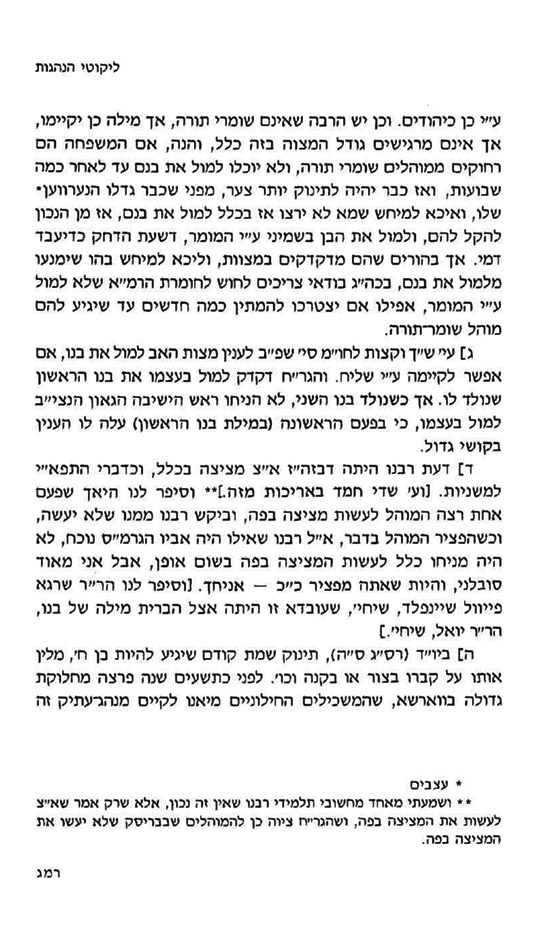
As part of this post I wanted to include this page of Nefesh ha-Rav, so I went to Otzar ha-Hokhmah to download a PDF. Here it is.

Lo and behold, the copy on Otzar ha-Hokhmah is the third edition published in 1999, and there is a note on this page in which R. Schachter states that he has been told that what he wrote was incorrect, and that R. Soloveitchik only opposed metzitzah ba-peh. This makes much more sense and is what I assumed all along, so I was happy to see that my suspicions were confirmed.

R. Schachter recently spoke publicly about metzitzah ba-peh, and he is entirely opposed to it.[6] You can listen to his talk here.
Some might be surprised to hear R. Schachter say, after explaining that the Sages followed the most advanced medicine of their times, “When we look back at Chazal, look at medical statements in the Gemara, we laugh. . . . So you look back in the Gemara, it’s ridiculous, but the Gemara, in the days of the Tannaim, they were following the latest information of the doctors of their generation, of the scientists of their generation.”
I have to say, however, that R. Schachter is mistaken in his description of how the Hasidim understand metzitzah ba-peh. He incorrectly assumes that no one really regards it as a basic part of the mitzvah, i.e., halakhah le-Moshe mi-Sinai. “You know and I know and we all know that it is not halakhah le-Moshe mi-Sinai.” He claims that all those who do say it is halakhah le-Moshe mi-Sinai are exaggerating for rhetorical purposes, much like the expression yehareg ve-al yaavor is used for all sorts of things but is not meant to be taken literally. (R. Schachter himself created a good deal of controversy a couple years ago when he said that the refusal to ordain women was a matter of yehareg ve-al yaavor.)
Finally, I would like to make a general statement about how many in the Modern Orthodox world have been relating to metzitzah ba-peh. There is no question that for those in this segment of Orthodoxy, metzitzah ba-peh should not be done, both for medical reasons and also, I have learnt, for aesthetic reasons. With regard to the latter point, there is a sense among many in the Modern Orthodox world, and I myself have heard this and seen it in writing, that metzitzah ba-peh is “disgusting”. I understand that this is how people feel, but it is an improper feeling. Until the nineteenth century, metzitzah ba-peh was universal at every circumcision. How can observant Jews regard a practice that was basic in every Jewish community of the world as “disgusting”? I understand that it doesn’t fit in with today’s aesthetic sense, and that itself is perhaps reason enough for people not to do metzitzah ba-peh. However, everyone should be careful to avoid any denigration of metzitzah ba-peh that does not originate in medical concerns.
Don’t get me wrong, as I don’t mean that every practice that we find in Jewish communities throughout history should get such a “pass”, but here we are talking about a universal practice over thousands of years. It can’t be denied that there were “repulsive” and “gruesome” practices in Jewish communities.[7] Here are two cited by Shlomo Sprecher in his article mentioned in note 6: 1. Barren women would swallow the foreskin of newly circumcised boys as a segulah so that they could become pregnant. 2. Epileptics drank a potion that contained a girl’s first menstrual blood as a segulah to cure them of their epilepsy.[8]
I recently found another bizarre segulah that also falls under the rubric of “repulsive”, and I think that it would probably also be regarded by law enforcement as a form of sexual abuse. It comes from R. Zvi Hirsch Kaidonover (1646-1712), Kav ha-Yashar, ch. 51. For obvious reasons I am not going to translate this into English.
ועוד סגולה נפלאה לתינוק הנולד שלא יקרה עליו חולי נכפה בר מינן, מיד כשנולד ישימו בפיו ברית קודש של תינוק ויהיה ניצול כל ימיו מחולי נכפה
3. Following one of my previous posts I had correspondence with a reader and the discussion turned to the issue of how much of rabbinic literature is inner directed, that is, from intellectuals to other intellectuals.[9] I assume that this was the mindset of the Sages, and this explains some texts that I don’t think would have been recorded had there been an expectation that the masses would ever see them. In particular, I have in mind the talmudic stories that do not reflect well on certain rabbis. If we understand these texts as scholars talking to other scholars, then it makes sense that they would criticize each other, and even make fun of one another.[10] People in a closed community (in this case, the rabbinic elite) converse with one another in a different way than when outsiders are allowed in.[11] The problem is when the masses are studying Talmud, as today, that they have a difficult time with these texts, and Artscroll needs to explain them in an appealing fashion.
Here is one example of the sort of story I am referring to, that I assume was designed for internal consumption only, as it doesn’t reflect well on one of the Sages who is portrayed as being quite rude and insensitive. Taanit 20a-20b:
Our Rabbis have taught: A man should always be gentle as the reed and never unyielding as the cedar. Once R. Eleazar son of R. Simeon was coming from Migdal Gedor, from the house of his teacher, and he was riding leisurely on his ass by the riverside and was feeling happy and elated because he had studied much Torah There chanced to meet him an exceedingly ugly man who greeted him, “Peace be upon you, Sir”. He, however, did not return his salutation but instead said to him, “Raca,1 how ugly you are. Are all your fellow citizens as ugly as you are?” The man replied: “I do not know, but go and tell the craftsman who made me, ‘How ugly is the vessel which you have made’.” When R. Eleazar realized that he had done wrong he dismounted from the ass and prostrated himself before the man and said to him, “I submit myself to you, forgive me”. The man replied: “I will not forgive you until you go to the craftsman who made me and say to him, ‘How ugly is the vessel which you have made’.” He [R. Eleazar] walked behind him until he reached his native city. When his fellow citizens came out to meet him greeting him with the words, “Peace be upon you O Teacher, O Master,” the man asked them, “Whom are you addressing thus”? They replied, “The man who is walking behind you.” Thereupon he exclaimed: “If this man is a teacher, may there not be any more like him in Israel”! The people then asked him: “Why”? He replied: “Such and such a thing has he done to me.” They said to him: “Nevertheless, forgive him, for he is a man greatly learned in the Torah.” The man replied: “For your sakes I will forgive him, but only on the condition that he does not act in the same manner in the future.” Soon after this R. Eleazar son of R. Simeon entered [the Beth Hamidrash] and expounded thus, A man should always be gentle as the reed and let him never be unyielding as the cedar. And for this reason the reed merited that of it should be made a pen for the writing of the Law, Phylacteries and Mezuzoth.[12]
It appears that we see a continuation of this internal conversation in post-talmudic times. For example, I don’t think the rishonim who so harshly criticize their colleagues — I am referring to the colleagues they respected — would speak this way in a derashah before the common man. However, in internal dialogue they exercised more freedom. I think this can also explain the strange way that R. Isaac of Corbeil, the author of Sefer Mitzvot Katan, is referred to. He is called בעל החוטם. According to tradition, he was called this לפי שהיו לו שערות על החוטם.[13] Here too, I think that this was a humorous nickname that his colleagues knew him as, but not something that the average person would be expected to use. (Those who went to BMT will probably recall how various rabbis would speak of “Whitey Horowitz”. I don’t recall students ever referring to R. Moshe Horowitz this way.)  
I came across another example of what appears to be “internal conversation” from modern times that I think readers will find interesting. Both are found in R. Pinchas Miller’s Olamo shel Abba. Miller’s father, R. Asher Anshel Yehudah Miller, was a posek and author of seforim. I can’t imagine that the following comment, cited in the name of R. Shmelke of Nikolsburg, was something Miller, or R. Shmelke, wanted the masses to hear. Rather, I assume that it was an insider’s joke, designed to be shared among colleagues.
Shabbat 118b states that if Israel observes two Sabbaths properly they will immediately be redeemed. R. Shmelke explained that this refers to Shabbat ha-Gadol and Shabbat Shuvah. It is traditional that on these Sabbaths the rabbis give derashot before the community. R. Shmelke added that the rabbis act as if what they are saying is original to themselves, even though they have taken it from others. The Sages say that if you repeat something in the name of one who said it, you bring redemption to the world (Avot 6:6). Based on this text in Avot, R. Shmelke explained the above talmudic passage as follows: “If Israel observes two Sabbaths properly”, that is, if the rabbis who give the derashot on Shabbat ha-Gadol and Shabbat Shuvah (“two Sabbaths”) actually acknowledge where they get their ideas from (“repeat something in the name of one who said it”), “immediately Israel will be redeemed” (p. 501). This is such a provocative text because not only does it accuse the rabbis of plagiarism, but it states that the redemption itself is being delayed because of their behavior. If it was repeated by the masses it would be regarded as terribly degrading of the rabbis, but seen as a somewhat playful “derashah” to be shared among rabbinic colleagues, it loses much of its sharpness.[14]
There is another interesting passage on p. 326, which despite being humorous, I would have also assumed could only be said among colleagues. Yet Miller’s son tells us that his father used to repeat the following in his derashah at weddings: We know that it is a mitzvah to help the bride and groom to rejoice, but the rabbis come to weddings and instead of doing this, they deliver a long derashah and speak words of mussar to the young couple and thus disturb their joy.[15] That is why at the sheva berakhot we state שמח תשמח רעים האהובים כשמחך יצירך בגן עדן מקדם. In other words, we wish the bride and groom that their joy should be complete like the joy Adam felt when Eve was created for him, because in their time, in the Garden of Eden, there were no rabbis around who were able to disturb their joy!
* * * *
4. I want to call attention to a book that has just appeared. Its English title is Jewish Thought and Jewish Belief and it is edited by Daniel J. Lasker. You can read more about it here. It is available for purchase at Bigeleisen.
This is just the latest in a series of valuable books published by Ben Gurion University Press as part of the Goldstein-Goren Library of Jewish Thought. The articles that I think readers of this blog will find particularly interesting are David Stern, “Rabbinics and Jewish Identity: An American Perspective;” David Shatz, “Nothing but the Tuth? Modern Orthodoxy and the Polemical Uses of History,” Baruch J. Schwartz, “Biblical Scholarship’s Contribution to the Concept of Mattan Torah Past and Present;” Menachem Kellner, “Between the Torah of Moses and the Torah of R. Elhanan;” Tovah Ganzel, “‘He who Restrains his Lips is Wise’ (Proverbs 10:19) – Is that Really True?” and the symposium on Jewish thought in Israeli education, with contributions from R Moshe Lichtenstein and Adina Bar Shalom (R. Ovadia Yosef’s daughter).
Here are a few selections from Shatz’s article:
To be clear, academics, I find, generally shun blogs that are aimed at a popular audience because the comments are often, if not generally, uninformed (and nasty). A few academics do read such blogs, but do not look at the comments. One result of academics largely staying out of blog discussions is that non-experts become viewed as experts. Even when academics join the discussion, the democratic atmosphere of the blog world allows non-experts to think of themselves as experts and therefore as equals of the academicians. Some laypersons, though, as I said earlier, are indeeed experts in certain areas of history.
(In this quotation, one could also substitute “rabbis” or perhaps better, “poskim”, for “academics”, and “areas of halakhah” for “areas of history.”) Shatz is specifically speaking about historians, and contrasting experts vs. non-experts in this area. Yet when it comes to the sort of things I often write about here, I can attest that it is usually non-academics who are the real experts. Time and again I am amazed at the vast knowledge of so many of the people who read this blog. As for the general phenomenon of blogs, there are many people who for whatever reason (usually lack of interest, ability, or patience) are not going to write lengthy articles. Yet they often have a great deal to contribute, much of which is very important to the world of scholarship (almost always in terms of uncovering unknown sources and correcting earlier errors, as opposed to offering new interpretations or original theories). Academics ignore this to their own loss.[16]
In my future book I refer to numerous blog posts, and posts from the Seforim Blog have already been mentioned in a number of scholarly publications. My own reason for writing posts is because most of the material I discuss is, I think, interesting and sometimes even important. While this material is often not of the sort that can be included in a typical article, the genre of the blog post suits them just perfectly. Speaking of the Seforim Blog in particular, its readership encompasses a very large percentage of English speaking traditionally learned Jews of all backgrounds, beliefs, and professions (from Reform rabbis to Roshei Yeshiva and poskim, and everything in between). Thanks again are due to Dan Rabinowitz for providing this unique and wonderful platform.
Here are two more quotes from Shatz:
Be the causes what they may, there is an intramural struggle among the Orthodox, a competition for the soul of Orthodox Judaism, and the primary weapon with which it is being waged is history. For Modern Orthodox Jews today, instead of history being a threat to belief, as in earlier periods, it has become a way of arguing for one version of Othodoxy over another. And it is used for polemical purposes far more than philosophy. There are today few Orthodox philosophers, but comparatively many Orthodox academically trained historians.
Can the Modern Orthodox explain why it is admissible for Hummash and the Sages (in aggadot) to write non-accurately and provide inspiration and memory, but inadmissible for those on the right to write in that genre?
My article in Jewish Thought and Jewish Belief is entitled “Is there a ‘Pesak’ for Jewish Thought.” Those who publish know that it is often the case that only after it is too late does one realize that one’s article or book omits something important. Here too that was the case. In the article I discuss Maimonides’ view in Guide 3:17 that there is no punishment without transgression. That is, he rejects the notion of yissurin shel ahavah. I note that Maimonides claims that this is the opinion “of the multitude of our scholars,” and he cites R. Ammi’s opinion in this regard from Shabbat 55a. What is significant is that later in the sugya the Talmud states that R. Ammi’s opinion was refuted. Maimonides ignores this rejection, and even states that R. Ammi’s opinion is the majority view. This illustrates how Maimonides felt free to reject a talmudic viewpoint in a non-halakhic matter, even when it seems that the opinion is deemed authoritative by the Talmud.
What I unfortunately neglected to mention is that in Guide 3:24 Maimonides also deals with yissurin shel ahavah. Here he acknowledges that there are talmudic sages who accept this notion, but he adds that his own opinion, i.e., the rejection of yissurin shel ahavah, “ought to be believed by every adherent of the Law who is endowed with intellect.” In our own language, we might say that this viewpoint should be obvious to anyone with “half a brain.” Yet this is quite a shocking statement when one considers that there were talmudic sages who had a different perspective. Did Maimonides regard them as lacking intellect?
Here is another point I would like to add: In my Limits of Orthodox Theology I argue that it is most unlikely that Maimonides would choose to establish something as a dogma if it was a matter of debate among the Sages. (If establishing dogma was simply part of the halakhic process, this would not be problematic.) I see that R. Shlomo Fisher apparently has the same perspective, as he writes in his Hiddushei Beit Yishai, no. 107 (p. 413):
וגוף הדברים שכתב הרמב”ם בפה”מ ועשאן עיקר גדול תמוהין מאד. חדא, אם הם עיקר גדול היכי פליג עלה ר’ יהודה.
The issue of deciding matters of hashkafah in a halakhic fashion has also recently been discussed by R. Yaakov Ariel in his new book Halakhah be-Yameinu, pp. 18ff. I have to say that the more I read by Ariel the more impressed I am, as everything he writes is carefully formulated and full of insight. He strikes me as very open-minded with a good grasp of Jewish philosophy. He is, of course, also an outstanding posek. I now understand why it was so important for the haredim, under R. Elyashiv’s lead, to prevent him from being elected Ashkenazic Chief Rabbi of the State of Israel. What the haredim wanted, and were successful in this, was to destroy the Chief Rabbinate as a force to be reckoned with. The way to do this was to make sure that its occupant would be nothing but a “crown rabbi”. That is, they wanted to appoint a chief rabbi who is a figurehead, who interacts with the government on behalf of the haredi leadership, who goes around the world speaking about Jewish topics to the masses, and who can deal with non-Jews. What they absolutely did not want in a chief rabbi was a figure who had any rabbinic standing and who could thus challenge haredi Daas Torah.
At a time when much of the right wing religious Zionist world appears to have gone off the deep end, R. Ariel stands as a voice of sanity. Be it his attack on Torat ha-Melekh (a book which I still plan on discussing) or his strong rejection (together with R. Aharon Lichtenstein and R. Nachum Rabinovitch) of the outrageous letter written by Rabbis Tau, Aviner and others in support of Moshe Katzav, or his defense of women voting (arguing that today R. Kook would not be opposed; Halakhah be-Yameinu, p. 189) he shows that right wing religious Zionism need not be identified with the craziness we have been accustomed to see in recent years. 
Let us return to his recent essay where he argues, in opposition to what I wrote in my article, that Maimonides often does “decide” in matters of hashkafah no different than in halakhah. To illustrate his point, Ariel notes that there is a dispute among the Sages about whether there are reasons for commandments. He claims that Maimonides מכריע ופוסק  in accord with the position that there are reasons. He concludes:
אף על פי שלדעתו כללי ההלכה אינם חלים בענייני אמונה, בכל זאת ניתן להכריע את האמונה על פי דרך הלימוד הנקוטה גם בהלכה.
The notion of a pesak emunah, if it is to be parallel to a pesak halakhah, would mean that after Maimonides gives his pesak, in his mind it is now forbidden to adopt the other viewpoint (just as when Maimonides rules that something is forbidden on Shabbat) .Yet where does Maimonides ever say that there is an obligation to accept his viewpoint about reasons for the commandments? What Maimonides does is show why his viewpoint is correct, and Ariel cites these sources. But just because Maimonides wants his readers to adopt his own viewpoint, in what way is this a “pesak emunah”? Maimonides is simply expressing his strongly held belief. He is not ruling alternative positions out of bounds, as he does in deciding halakhah. This appplies as well to the other examples Ariel brings to prove his point. All he has established is that Maimonides argues for a position in matters such as the nature of prophecy and providence, but that is far removed from the notion that Maimonides saw his opinions as halakhically binding. On the contrary, just because Maimonides tells us what he thinks the Torah’s position is in a matter such as providence, he had no expectation that the masses would (or in some cases even should) follow him in this, and he was fully tolerant of the masses holding to their errant opinions as long as the matter was not an authentic dogma.
5. I have now finished my book on censorship. I can’t say when it will appear as it still has to be properly edited, typset etc., but hopefully this won’t take too long. I have loads of interesting material that for various reasons I was unable to include in the book, so the Seforim Blog will give me a good opportunity to bring it to the public’s attention. Let me begin with something sent to me by Rodney Falk.
Professor Louis Henkin, the son of R. Joseph Elijah Henkin, died in 2010. Here is his obituary as it appeared in Ha-Modia.


Notice what is missing! The obituary won’t even mention who his father was. Had Louis Henkin been a businessman or a doctor this information would not have been excluded, of this there is no doubt. But it is considered a disgrace to R. Henkin’s memory that his son was an intellectual, one who lived the life of the mind, and yet he didn’t become a rav or a rosh yeshiva . People in the haredi world can understand how not everyone is cut out to be a rosh yeshiva or sit in kollel, and these “unfortunates” are therefore forced choose a profession. But apparently, the notion that one who has the brains and intellectual stamina to become a great scholar might choose to devote himself to non-Torah subjects borders on the blasphemous for Ha-Modia. As such, while Louis Henkin can be acknowledged for his achievements, he has to be severed from his father’s house (the same father who sent him and his two brothers to Yeshiva College).
I think Yoel Finkelman has put the matter quite well in discussing the larger issue of which this example is  part and parcel of:
Haredi writers of history claim to know better than the great rabbis of the past how the latter should have behaved. Those great rabbis do not serve as models for the present. Instead, the present and its ideology serve as models for the great rabbis. Haredi historiography becomes a tale of what observant Jews, and especially great rabbis, did, but only provided that these actions accord with, or can be made to accord with, current Haredi doctrine. The historians do not try to understand the gedolim; they stand over the gedolim. Haredi ideology of fealty to the great rabbis works at cross purposes with the sanitized history of those rabbis.[17]
6. Rabbi Jason Weiner, a fine musmach from Yeshivat Chovevei Torah, has recently published a Guide to Traditional Jewish Observance in a Hospital. Formerly assistant rabbi at the Young Israel of Century City, he now serves as Senior Rabbi and Manager of the Spiritual Care Department at Cedars-Sinai Medical Center in Los Angeles. The book comes with approbations from R. Asher Weiss and R. Yitzchok Weinberg, the Talner Rebbe, and the halakhot in the book have been reviewed by Rabbis Gershon Bess, Nachum Sauer, and Yosef Shuterman. The book can be downloaded here.
7. Some readers have asked me about upcoming shul lectures. Here is what is on my schedule through Passover.
Feb. 15-16: Sephardic Institute of Brooklyn
March 1-2: Beth Israel, Miami Beach
March 8-9: Shearith Israel, New York
March 15-16: Beth Israel, Omaha
If any readers are interested in having me speak at their shuls, please be in touch.
8. No one got the answer to the last quiz, so let me do it again. The winner gets a copy of one of the volumes of R. Hayyim Hirschensohn’s commentary on Rashi. If you know the answer to the question, send it to me at shapirom2 at scranton.edu.

What was the first Hebrew book published by a living author?
[1] What does this last sentence mean? How can an attitude violate a biblical prohibition?

[2] As a good illustration of changes in attitude in the last forty years, here is what R. Norman Lamm wrote in his classic article on homosexuality in the 1975 yearbook of the Encyclopaedia Judaica. Such a sentence would, today, be quite politically incorrect, and regarded by gays as incredibly offensive: “Were society to give its open or even tacit approval to homosexuality, it would invite more aggresiveness on the part of adult pederasts toward young people.” 
[3] R. Meir Schiff (Maharam Schiff) is unique in believing that one without arms should put the tefillin shel yad on the head, together with the tefillin shel rosh. This is the upshot of his comment to Gittin 58a.
[4] See R. Sinai Schiffer, “Mitzvat ha-Metzitzah,” p. 106 (printed together with R. Sinai Adler, Devar Sinai [Jerusalem, 1966])
[5] See Eliyahu Meir Klugman, Rabbi Samson Raphael Hirsch, pp. 292-293.
[6] “Following in the Footsteps of Our Fathers,” Nov. 13, 2012.
[7] The words are those of Shlomo Sprecher from his article on metzitzah in Hakirah 3 (2006), p. 51.
[8] Speaking of drinking, take a look at this strange passage. It appears in R. Hayyim Rabbi’s letter at the beginning of R. Haggai Ben Hananyah’s Nimukei Levi (Ashdod, 2008), p. 2. Add this to the long list of texts that I refuse to translate.
בדין חלב אשה. נשאלתי פעם, אם בזמן תשמיש עם אשתו, החלב שלה אסור עליו, או שבעל ואשתו כגופו, ואין בו דין של יונק שרץ. ובפרט לטעם שמא יינק מבהמה טמאה, ובאשתו כגופו שהתירו לו בשעת פיוס וכו’, לא גזרו בזה. ויתכן שמותר כדין פסיק רישיה בדרבנן. ובנידון כזה, שזה חשש גזירה, גם בניחא ליה יש מקום להתיר. כן נראה לכאורה.
[9] The previous post is found here.
In the comments, Yehudah Mirsky wrote:

Fwiw, as I recall, Steve Wald in his book on Eilu Ovrin shows that the genuinely awful am-haaretz passages in Pesachim are a later stammatic addition, and that Jeff Rubinstein argues has a chapter on this in his “The Culture of the Babylonian Talmud” where he argues both that that sugya in Pesachim is sui generis in Hazal and – interestingly – reflects the Stammaim’s needing to justify their very scholastic lifestyle vis-a-vis people who were working for a living. Rubinstein cautions that the whole sugya may have been intended as a series of private jokes and need not necessarily reflect actual social relations between the stammaim and their surrounding society.

[10] Yeshayahu Leibowitz quipped that the Sages must have had a good sense of humor, since they included the following passage in the Talmud: תלמידי חכמים מרבים שלום בעולם. See Sihot al Pirkei Ta’amei ha-Mitzvot (Jerusalem, 2003), p. 289. In all seriousness, however, there are indeed humorous passages in the Talmud, as pointed out by R. Moses Salmon, Netiv Moshe (Vienna, 1897), pp. 45-46. Here is one example he gives (Bava Batra 14a).:
The Rabbis said to R. Hamnuna: R. Ammi wrote four hundred scrolls of the Law. He said to them: Perhaps he copied out the verse  תורה צוה לנו משה
Salmon claims that anyone with a bit of sense can see that R. Hamnuna’s reply is a wisecrack made in response to the obvious exaggeration about R. Ammi.
Nehemiah Samuel Leibowitz states that even in the Zohar we have passages that show a humorous side. One of the many examples he points to is Zohar, Bereshit, p. 27a:
וימררו את חייהם בעבודה קשה בקושיא. בחומר קל וחומר. ובלבנים בלבון הלכתא. ובכל עבודה בשדה דא ברייתא. את כל עבודתם וגו’ דא משנה.
See Leibowitz, “Halatzot ve-Divrei Bikoret be-Sefer ha-Zohar,”Ha-Tzofeh le-Hokhmat Yisrael 11 (1927), pp. 33-45. For more on humor in the Talmud, see Yehoshua Ovsay, Ma’amarim u-Reshimot (New York, 1946), ch. 1; R. Mordechai Hacohen, “Humor, Satirah, u-Vedihah be-Fi Hazal,” Mahanayim 67 (5722), pp. 8-19.
[11] Such a community also establishes special rules for itself, of which I can cite many examples. Here is one, from R. Solomon Luria, Yam Shel Shlomo, Bava Kamma 8:49:
ואם חוזר בפעם השלישי א”כ הוא משולש בחטא, אזי אין מניחין כלל לפדותו מן המלקות אלא ילקה בב”ד ודיו, אם לא שהוא בר אורין שאין ראוי להלקותו
After all we have seen in the last few years, I am quite certain that today the average person would not accept that when it comes to criminal matters that the rabbis should be given special privileges and exemptions.
[12] See also Va-Yikra Rabbah 9:3 where it describes how R. Jannai called his host “a dog”, and then learnt how wrong he was.
[13] See the introduction to the Constantinople 1510 edition of the work, reprinted in the Jerusalem, 1960 edition.
[14] On p. 187 Miller offers a different perspective. Here he quotes another rabbi who said that if necessary it is OK for one to repeat another’s hiddushim in the Shabbat ha-Gadol derashah, because the Sages tell us (Pesahim 6a): שואלין ודורשין בהלכות פסח.  This means:
מותר “לשאול” מאחרים בשעת הדחק ולדרוש בהלכות פסח
[15] I am told that it is still the practice in certain communities for the rabbi to deliver a derashah at a wedding..
[16] I think in particular of S.’s wonderful blog On the Main Line, which routinely provides important, and until now unknown, primary sources that are vital to a wide range of areas of scholarship.
[17] Strictly Kosher Reading, p. 122.


New seforim and books

New seforim and books
By Eliezer Brodt
Here is a list of seforim and books I have seen around in the past few months. This is not an attempt to list everything or even close to it; rather it’s just a list of seforim and books on many random topics, which I have seen while shopping for seforim. I enumerated a few titles for which I have Table of Contents for. Please feel free to e-mail me for them.

ספרים:
א. פסקי הרי”ד מסכת נדה מכון תלמוד הישראלי
ב. האמונה ודעות לר’ סעדיה גאון עם פירוש של ר’ דוד הכהן [פרק א-ב] תפ עמודים
ג. דרשות ר’ זרחיה הלוי סלדין [תלמיד ר’ חסדאי קרשקש], אוניברסיטת בן גורין [מהדיר: ארי אקרמן], מבוא עז עמודים+ 186 עמודים
ד. קובץ על יד כרך כא [ניתן לקבל תוכן העניינים]
ה. שלושת חיבורי הדקדוק של ר’ יהודה חיוג’ במקורם הערבי ובתרגומם לעברית – מהדורה ביקורתית, עלי ותד, דניאל סיון
ו. מקראות גדולות כולל פי’ ר’ יצחק ב”ר יוסף דפירא, תלמיד הרשב”א, שמות, תעג עמודים + מפתחות, [משפחת הולצר] ניתן לקבל דוגמא
ז. חקי משפט על חושן משפט [חתן של המגן אברהם]
ח. ר’ יצחק בנימין וואלף, נחלת בנימין, ב’ חלקים, על תרי”ג מצות, כולל מפתחות [נדפס פעם ראשונה בשנת תמ”ב]
ט. בתי כהונה [חנוכה] עם הערות ר’ מנחם אדלר, רא עמודים
י. ר’ אברהם אנג’יל, פתוחי חותם, ביאור תיבת גם בפסוקי תנ”ך [נדפס לראשונה בשנת תקע”ט] [כולל בשולי הגליון פירושים ממאות ראשונים ואחרונים על מילת גם, נאסף על ידי ידידי ר’ משה היבנר], רכד עמודים, ניתן לקבל דוגמא של הספר.
יא. ר’ אברהם בן הגר”א, רב פעלים ונוספות, הוצאת מישר I will hopefully review this work shortly.
יב. דרשות וחידושי רבי אליהו גוטמכר מגריידיץ על התורה, בראשית [מכתב יד] שפב עמודים.
יג. ר’ אהרן אסאד, [בן של ר’ יהודה אסאד], אש דת, פרקי מחשבה ומאמרי השקפה מיוסדים על דברי קדמונינו הראשונים ואחרונים, תפד עמודים
יד. דברי מלכיאל חלק ח, חידושים על ש”ס, מוסד רב קוק
טו. ר’ שמואל שיטאווא, מנחת שבת על קיצור שלחן ערוך, שפח עמודים, +מפתחות.
טז. ר’ צבי פסח פרנק, מקראי קודש, שבת א, רצו עמודים
יז. ר’ יעקב פינק, תפארת יעקב, מאמרים הלכה ופרקי מחשבה רעינות לפרשיות השבוע ופרקי אבות, שצד עמודים
יח. ר’ ברוך רבינוביץ, בינת נבונים, השואה באספקלריה תורנית, 135 עמ’ מבוא, + רד עמודים
יט. ר’ אלישיב זצ”ל, הערות במסכת שבת חלק א, עמ’ תקמו עמודים.
כ. ר’ שלמה שוחט,  מילה שלמה על מצות מילה,  תשכה עמודים
כא. ר’ יאיר עובדיה, אור לגויים, הלכות עבודה זרה, 262 עמודים
כב. ר’ אהרן ליכטנשטיין, באור פניך יהלכון, מידועת וערכים בעבודת ה’ 295 עמודים, ידיעות ספרים
כג. ר’ שריה דבליצקי, תשובת השנה, התעוררות והנהגות ליום הלידה, וקו’ המעלות לכל השנה, עב עמודים.
כד.  ר’ אברהם רוזנטל, [בעל הסידרה ‘כמוצא שלל רב’] ורפואה קרובה לבוא,פניני הלכה ואגדה בעייני רפואה כולל שערי סגולות ותפילות לרפואה, תמח עמודים
כה. ר’ יהודה ארצי, יקח מצות אוצר על עניני הידור מצוה, 1079 עמודים.
כו. אגרות וכתבים דרך אמונה, ממרן הגר”ח קניבסקי, הוראות והנהגות ממרן החזון איש, ואגרות מן הגרי”ש אלישיב,
כז. מנשים באהל, לזכר נשמת הרבנית לאה אויערבאך, כולל קובץ הלכות ממרן הגרי”ש אלישיב, וחידושי ר’ שלמה זלמן אויערבאך על פרק במה מדליקין, אוסף חידושי תורה בעניני נשים במצות התורה, תקעא עמודים. ניתן לקבל תוכן העניינים.
כח. ר’ זאב זיכערמאן, אוצר פלאות התורה, בראשית, תרמ”א עמודים.    One day I will hopefully review this work.  
ורפואה קרובה לבוא 5מחקר
מחקר
א. ר’ שלמה זלמן הבלין, מסורות התורה שבעל פה, יסודותיה, עקרונותיה והגדרותיה, 632 עמודים, ניתן לקבל תוכן העניינים.  

This sefer simply put is incredible. It does not come with an index instead you get a disk of the sefer fully searchable.

ב. משנת ארץ ישראל ספראי- מסכת תרומות
ג. יצחק כהן אור שמח הלכה ומשפט, משנתו של הרב הרב מאיר שמחה הכהן על משנה תורה להרמב”ם, אוניברסיטת בן גורין, 408 עמודים  I will be reviewing this work shortly Bn.
ד. להכות שורש, הראי”ה קוק והקרן הקיימת לישראל, ר’ אברהם וסרמן ואיתם הנקין, 197 עמודים [כולל יותר מעשרים מכתבים של רב קוק חדשות שלא נדפסו וגם הרבה תמונות נדירים].
ה. עלה נעלה מענה לספר ויואל משה תשובות מפי ר’ שלמה אבינר, 278 עמודים
ו. אדר היקר, ר’ אברהם יצחק הכהן קוק על חתונ האדר”ת עם פירוש מר’ שלמה אבינר, 452 עמודים
ז. יוחנן סילמן, בין ללכת בדרכיו, ולשמע בקלו, הוראות הלכתיות כהנחיות או כציוויים, 480 עמודים, מכללת הרצוג
ח. מיכה גודמן, חלומו של הכוזרי, 380 עמודים
ט. אליעזר טרייטל, פרקי דרבי אליעזר, נוסח, עריכה ודוגמת סינופסיס של כתבי היד, יד בן צבי, 445 עמודים [ראה כאן]
י. רבי ראובן כץ, רבה של אם המושבות, מסכת חייו השזורה בתולדות הימים, 398 עמודים.
יא. חיים שלם, אי של אפשר, סיפור חייו של בנימין מינץ, הוצאת הכרמל, 559 עמודים.
יב. פנקס קהל קאסאלי מונפיראטו שמ”ט-תי”ח, בעריכת ראובן בונפיל ויצחק יודלוב, 556 עמודים, מגנס, [תוכן העניינים]
יג. הרפואה במקרא ובתלמוד, ד”ר יצחק (יוליוס) פרויס, 1022 עמודים, מגנס [תוכן העניינים]
יד. דוד הלבני, מקורות ומסורות, סנהדרין עד מסכת הוריות, מגנס, 416 עמודים.
טו. דורש טוב לעמו, הדרשן הדרשה וספרות הדרוש בתרבות היהודית, עורכים נחם אילן כרמי הורוביץ/ קימי קפלן, מרכז זלמן שזר, 242 עמודים
טז. יוסף דן, תולדות תורת הסוד, ימי הביניים, חלק ח, מרכז זלמן שזר, 488 עמודים.
יז. גנזי יוסף פרל, שמואל ורסס, מרכז זלמן שזר, 359 עמודים.
יח. אלתר ולנר, אומה במאבקיה, 439 עמודים, מוסד רב קוק
יט. יורם ארדר, דרכים  בהלכה הקראית הקדומה, 372 עמודים, ספריית הילל בן חיים, [כולל חומר חשוב על האבן עזרא]
כ. יונתן מאיר, שבחי רודקינסון, מיכאל לוי פרומקין גוקדינסון והחידות, ספריית הילל בן חיים
כא. חיי אשה ד”ר חנה קטן
כב. המעין גליון 204 ראה כאן
כג. חקירה 14 ראה כאן

English
Ephraim Kanarfogel, The Intellectual History and Rabbinic Culture of Medieval Ashkenaz (Detroit: Wayne State University Press, 2013), 600 pages
Yaacov Deutsch, Judaism in Christian Eyes, Oxford Press  304 pages

Michael T. Walton, Anthonius Margaritha and the Jewish Faith, Jewish life and Conversion in Sixteenth Century Germany, Detroit: Wayne State University Press, 2013) 242 pages
Eliyahu Stern, The Genius: Elijah of Vilna and the Making of Modern Judaism, Yale University Press, 336 pages


New Feature – Listing of New Seforim

As a service for those who either don’t have access or the time to browes the seforim stores to see what new has been printed I will now on a periodic basis list the seforim I have recently purchased/seen. The vast majority of these I will have seen/purchased will be from Biegeleisen books in Boropark (718) 436-1165.

At times I will have lenghter comments and some books I will just list and leave to the reader to investigate further.

1) The second volume of the Siddur Kol Ya’akov. This a newly set type of the classic Hassidic Siddur.
2) Pirush Mesacktat Avot l’Rebi Mattishayu HaYishari edited with an introduction by R. Ya’akov Shmuel Spiegel as well as an introduction by Dov Schwartz on R. Mattityahu’s philosophy based upon this commentary.
3) HaNehmadim miPaz a 862 page work on everything and everything having to do with mitzvah of writing a sefer Torah as well as Haknatat sefer Torah.
4) Hazar Rebi Yehudah HaHassid this discusses the Hurva Shul and includes some interesting historical pictures and documents relating to it. Which I think is being fully rebuilt now.
5) Rigshe Lev Tefilatam shel Nashim a book all about women’s prayer although not prayer groups. The implict point of the book, however, is to say that women should be ok without prayer groups or the like. The book inlcudes various “laws” applicable as well as all the myriad of scenarios one needs to come up with when writing a book of this type – can a woman pray where there is no mehitzha, what do if she slept through the proper time of prayer, etc.


Kaddish – His Will

Kaddish – His Will
Leor Jacobi

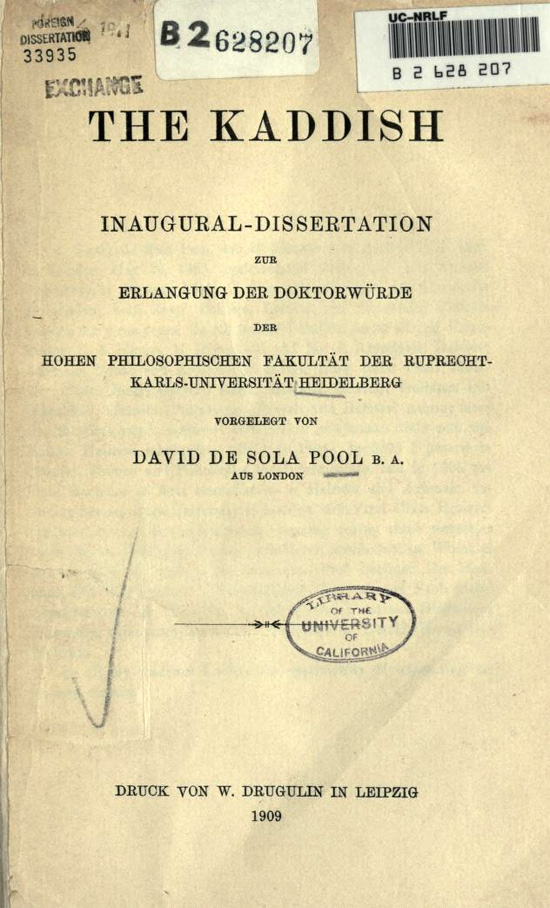
Note: I wrote the following essay outline several years ago, but shelved it upon discovering that most of its novelty and much more had already been published by David de Sola Pool over a hundred years ago.[1] On the sad occasion of the recent passing of my beloved mother I offer it now in her memory. Prayer and divinity were close to her heart. May our prayers be deepened by their study.

The Kaddish is one of the most familiar and repeated prayers in the liturgy. In various forms, it concludes both the main body of the prayer and smaller sections. It is also recited by mourners and upon the conclusion of learning a tractate or a sermon.
Despite, or perhaps due to its familiarity, few are aware of an alternate interpretation and syntax at the beginning of the Kaddish, accompanied by altering the pronunciation of one word slightly, but significantly. This study will describe and analyze these two interpretations and propose a third.
1. The “Standard” interpretation. R. Yehudah ben Yakar (Ramban’s teacher), Rokeah, and Avudraham all followed the standard interpretation. See R. Shmuel Eliezer Stern’s concise compilation of their perspectives.
2. The GRA’s interpretation
3. Alternate interpretation

1. The Standard Interpretation

…יִתְגַּדַּל וְיִתְקַדַּשׁ שְׁמֵהּ רַבָּא בְּעָלְמָא דִּי בְרָא כִרְעוּתֵהּ, וְיַמְלִיךְ מַלְכוּתֵהּ

May his great name be exalted and sanctified in the world which he created according to his will. And may his kingship reign …

The deity is not referred to directly, but his great name is to be exalted and sanctified in the very world which he himself created, according to his own will and volition. The fact that the world was created according to the will of the deity seems rather obvious, pshita. However, in the liturgy of the evening prayers, we find the divine will associated with the maintenance of the celestial bodies:


ברוך אתה … אשר בדברו מעריב ערבים בחכמה פותח שערים ובתבונה משנה עתים ומחליף את הזמנים ומסדר את הכוכבים במשמרותיהם ברקיע כרצונו

This may be referred to in the Kaddish. Perhaps the divine will is mentioned in the Kaddish to emphasize that the details of the physical world were planned by the creator, not happenstance, hence it is fitting to exalt and praise his great name.
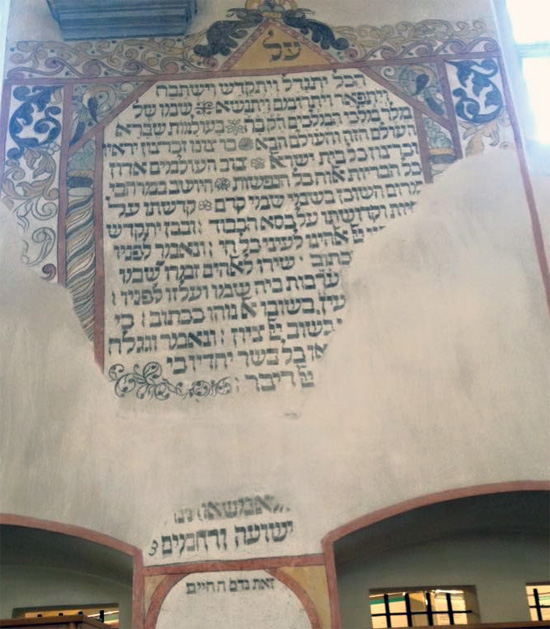
A more serious difficulty with this standard interpretation is found in the prayer על הכל based on the Kaddish which is recited upon removing the Sefer Torah from the Aron Ha-Kodesh. In modern prayerbooks it is found among the Sabbath prayers. In surviving synagogues of Tikocyn (טיקטין) and Krakow and in in other Polish synagogues the text was painted on the wall along with other “extra” prayers and sayings.[2] This prayer clearly parallels the Kaddish, but does not follow the standard interpretation, as will be explained in the next section. R. Yehudah ben Yakar (Ramban’s teacher), Rokeah, and Avudraham all followed the standard interpretation. See R. Shmuel Eliezer Stern’s concise compilation of their perspectives.

2. The GRA’s Interpretation
…יִתְגַּדַּל וְיִתְקַדַּשׁ שְׁמֵהּ רַבָּא בְּעָלְמָא דִּי בְרָא, כִּרְעוּתֵהּ, וְיַמְלִיךְ מַלְכוּתֵהּ

May his great name be exalted and sanctified, according to his will, in the world which he created. And may his kingship become regnant…

Notice the additional comma and the concomitant hard vocalization of the כּ with a dagesh in the following word: כִּרְעוּתֵהּ. Here the phrase “according to his will” refers back to the first clause of the preceding phrase, the exaltation and sanctification. It does not refer to the immediately preceding clause as per the standard interpretation.
The minor conceptual difficulty of the standard interpretation is now transformed into a deep and compelling concept. The purpose of the creation of the world was so that the creator’s name be exalted and sanctified within it.
This interpretation can be attributed to the Gaon, R. Elijah of Vilna, GRA in Ma’ase Rav 54, where it is noted that he was particular about the pronunciation of the hard כּ. GRA’s Diyyuqim b’nusḥey ha-tefilah v’ha-berakhot were first printed in the first edition of Shulhan Arukh with Biyur ha-GRA, Shklov 1803, and appear at the bottom of the first page of Priy Chodosh in later editions.

There, the concept it is explained more fully, with a proof is presented in the aforementioned על הכל prayer recited upon removing the Torah from the Ark:
עַל הַכּל יִתְגַּדַּל וְיִתְקַדַּשׁ וְיִשְׁתַּבַּח וְיִתְפָּאַר וְיִתְרומַם וְיִתְנַשּא שְׁמו שֶׁל מֶלֶךְ מַלְכֵי הַמְּלָכִים הַקָּדושׁ בָּרוּךְ הוּא. בָּעולָמות שֶׁבָּרָא הָעולָם הַזֶּה וְהָעולָם הַבָּא. כִּרְצונו וְכִרְצון יְרֵאָיו וְכִרְצון כָּל בֵּית יִשרָאֵל. צוּר הָעולָמִים אֲדון כָּל הַבְּרִיּות אֱלוהַּ כָּל הַנְּפָשׁות. הַיּושֵׁב בְּמֶרְחֲבֵי מָרום הַשּׁוכֵן בִּשְׁמֵי שְׁמֵי קֶדֶם. קְדֻשָּׁתו עַל הַחַיּות וּקְדֻשָּׁתו עַל כִּסֵּא הַכָּבוד
Note that this Hebrew prayer generally follows the structure of the Kaddish. However, the phrase “According to his will” is accompanied by “the will of those who fear him” and “the will of all of the house of Israel.” This cannot refer to the creation of the world, for mortals were not party to that event. Perhaps it refers to the post-facto consent of men. If so, it would differ conceptually with כרצונו, the will of the creator at the time of the creation. Also, stressing this point runs counter to the thrust of the prayer, exalting and praising the creator.

Wall of Tykocin synagogue, Poland, Leor Jacobi
This source suggests that an ancient tradition does not follow the standard interpretation. Furthermore, we find an association of the words כרצונו and יתגדל in Daniel 11:36, applied to an earthly king:

…וְעָשָׂה כִרְצוֹנוֹ הַמֶּלֶךְ וְיִתְרוֹמֵם וְיִתְגַּדֵּל עַל כָּל אֵל וְעַל אֵל אֵלִים יְדַבֵּר נִפְלָאוֹת

Some medieval prayer books do contain a hard כּ in כרעותיה. In the National Library of Israel there are examples from Provence, Italy, and Ashkenaz on microfilm. I refer to this interpretation as the GRA’s, although it probably preceded him by hundreds of years, because he related to the issue and is understood to have favored this interpretation. It should be noted that many early siddurim were not precise in following grammatical rules so the mere presence or absence of a dagesh should not in and of itself be taken as an indicator of syntax or interpretation.
GRA’s interpretation, while not well known, was endorsed somewhat in Arukh haShulhan 56 (where much of the previous discussion is found). GRA-oriented prayerbooks also reflect this interpretation via the punctuation, such as Siddur Vilna and Ezor Eliahu. However, Siddur Tefilat Yosef features the hard כִּ but without a comma before it, possibly a compromise approach: have it both ways or either way.
I now raise a couple of difficulties. The most striking aspect of this approach is its awkward word order. A much more straightforward formulation of GRA’s interpretation would be:

…יִתְגַּדַּל וְיִתְקַדַּשׁ שְׁמֵהּ רַבָּא. כִרְעוּתֵהּ, בְּעָלְמָא דִּי בְרָא, וְיַמְלִיךְ מַלְכוּתֵהּ

Perhaps the word כִּרְעוּתֵהּ was a later addition, hence not deemed proper to insert in the middle of the first phrase. In any case, GRA’s interpretation does not fit the text as well as the standard interpretation, where no re-ordering is required.
A minor difficulty with the GRA’s interpretation emerges upon comparison with the “Great Kaddish” recited upon the completion of a Tractate or Seder. The word כִּרְעוּתֵהּ does not appear in that text at all. This is explainable, and perhaps even necessary, according to the first interpretation, because the Great Kaddish does not refer to the creation of the world at all, but rather to the future redemption:
יִתְגַּדַּל וְיִתְקַדַּשׁ שְׁמֵהּ רַבָּא בְּעָלְמָא דִּי הוּא עָתִיד לְאִתְחַדְתָּא, וּלְאַחֲיָאה מֵתַיָּא, וּלְאַסָּקָא יַתְּהוֹן לְחַיֵּי עָלְמָא, וּלְמִבְנָא קַרְתָּא דִּי יְרוּשְלֵם, וּלְשַׁכְלְלָא הֵיכָלֵהּ בְּגַוָּהּ, וּלְמֶעֱקַר פּוּלְחָנָא נוּכְרָאָה מִן אַרְעָא, וּלְאָתָבָא פּוּלְחָנָא דִּי שְׁמַיָּא לְאַתְרָהּ, וְיַמְלִיך קוּדְשָׁא בְּרִיךְ הוּא בּמַלְכוּתֵה וִיקָרֵהּ בְּחַיֵּיכוֹן וּבְיוֹמֵיכוֹן וּבְחַיֵּי דְכָל בֵּית יִשְׂרָאֵל
However, if כִּרְעוּתֵהּ refers back to יִתְגַּדַּל וְיִתְקַדַּשׁ, as per GRA’s interpretation, the absence of the word in the Great Kaddish version is puzzling, or at least conspicuous. This suggests that כִּרְעוּתֵהּ refers back to בְּעָלְמָא דִּי בְרָא and hence, disappears in the Great Kaddish along with it.
To summarize so far, we have seen two competing interpretations of the same (orthographic) text of the Kaddish. Some evidence contradicts each of the two, with no clear tilt of the scales in favor of either. It seems to me more likely that the GRA’s interpretation would develop into the standard one in order to “correct the syntax” than the reverse direction. Lectio dificilior potior. This situation suggests exploring other alternatives.[3]

3. An Alternate Interpretation

…יִתְגַּדַּל וְיִתְקַדַּשׁ שְׁמֵהּ רַבָּא בְּעָלְמָא דִּי בְרָא, כִּרְעוּתֵהּ יַמְלִיךְ מַלְכוּתֵהּ

May his great name be exalted and sanctified in the world which he created. May his kingship become regnant according to his will …

Rather than throwing the word כִּרְעוּתֵהּ back to one clause or another of the previous phrase, in this interpretation the word applies to the text that follows, a prayer for the establishment of the divine kingdom.
This interpretation is aided by the omission of the ו in the word ימלך following the word כרעותיה. The emendation is minor, and we do find an early textual example from a manuscript in the Cairo Geniza, JTS ENA 1983.2:

The absence of the ו assists this interpretation but it does not in and of itself negate the others. However, the interpretation is also suggested by another rabbinic source. The על הכל prayer discussed previously appears to be a later adaptation, an earlier version of which appears in Masekhet Sofrim 14:6:

ועוד צריך לומר, על הכל יתגדל ויתקדש וישתבח ויתפאר ויתרומם ויתנשא ויתהדר ויתעלה ויתהלל ויתקלס שמו של מלך מלכי המלכים הקדוש ברוך הוא הנכבד והנורא בעולמות שברא בעולם הזה ובעולם הבא. כרצונו וכרצון יראיו וכרצון כל עמו בית ישראל תגלה ותראה מלכותו עלינו במהרה ובזמן קרוב, והוא יבנה ביתו בימינו ויחון פליטתינו ופליטת כל עמו בית ישראל בהמון רחמיו וברוב חסדיו לחן ולחסד ולרחמים לחיים ולשלום והוא ירחם עלינו ועל כל עמו בית ישראל בעבור שמו הגדול ואמרו אמן

I added some punctuation above and would translate part of the prayer literally as follows:

… in the worlds that he has created, this world and the next one. According to his will, the will of those in awe of him, and the will of his entire people, the house of Israel, his kingship shall be revealed and appear to us speedily and soon. He shall rebuild …

One may argue that, here too, the phrase: “According to his will…” refers back to the previous clause. In the adapted form that appears in prayer books, the phrase must be understood as referring back to the previous phrase, since the following phrase simply doesn’t appear. However, in this expanded and seemingly earlier form in Masekhet Sofrim, we would expect a connecting ו to follow the phrase, even more so than in the Kaddish itself, yet we do not find one. When על הכל was adapted from this prayer, the syntax was adjusted or corrupted.
The difficulty noted above in reconciling the GRA’s interpretation with the Great Kaddish is relieved via this approach, if not eliminated. The absent word כרעותיה is explained if the substantial additions in the Great Kaddish are an expansion[4] of כרעותיה.
May his great name be sanctified and exalted by the reign of his kingdom in the world he created, according to his will.
[1] David de Sola Pool, The Kaddish, Leipzig 1909, pp. 28, 33-35, 111-112. Among issues not covered here, see especially parallels in various verses and to the Christian Lord’s Prayer (Paternoster).
[2] In the “Isaac Shul” of Krakow על הכל was written in three different locations which have been restored and are all visible today. It may have moved from location to location at different periods and different layers were restored. Alternatively, it may have been painted in different locations for the convenience of the worshippers, so that they would not have to strain or move to another location during the procession after removing the Torah scroll from the Ark.
[3] My first attempt was to propose that the word כִּרְעוּתֵהּ is itself an erroneous later scribal addition. An ancient tradition maintains that one should bow during the Kaddish at several places. Sefer Kra’ Ravaṣ, by Rabbi Yehuda Lavi Ben-David is an excellent modern halakhic compendium of the various laws of bowing, accompanied with much original analysis.

The book lists no fewer than seventeen different opinions as to where exactly to do the bowing. Some medieval prayer books have a Hebrew instruction to bow written in the margin: כרע. These might have been misinterpreted as Aramaic and incorporated into the text of the Kaddish itself. However, since I have not located any significant textual evidence to support this theory, I mention it here solely for the reader’s edification and entertainment.
[4] If the third alternative is a genuine interpretation of the text of the Kaddish, and an early one, it could hypothetically have developed into the other interpretations.

First, the standard interpretation developed. The word כרעותיה was understood as referring back to the immediately preceding creation of the world and in tandem a ו was introduced verbally in וימלך. Alternatively, the Great Kaddish may have been composed or edited in accordance with the first, standard interpretation. This development may have been the result of a growing influence of the written texts, without vocalization and punctuation, as opposed to earlier oral forms which would have preserved the original interpretation.

Next, this new interpretation collided with the original, possibly in written form, with the ו in וימלך being introduced where the original interpretation was preserved orally along with the hard כּ of כרעותיה. This friction would have been resolved by artificially throwing back כרעותיה to the beginning of the first phrase, giving birth to the GRA’s interpretation.

Or כרעותיה originally went in both directions, following both GRA and the alternate interpretation, as De Sola Pool proposed (see note above).


Shnayer Leiman: Notes on Rabbinic Epitaphs I

Notes on Rabbinic Epitaphs: I
by Shnayer Leiman

The newly recovered tombstone of R. Yosef Trani (1568-1639), the Maharit, among the greatest of the early aharonim,[1] is a truly remarkable event. The discoverer, the noted bibliophile and book dealer R. Shlomo Epstein, had searched all the Jewish cemeteries in Istanbul (formerly: Constantinople), but could not locate the Maharit’s grave. On a recent visit to Safed, where he went to pray at the tomb of R, Moshe Alshekh (circa 1520-1593), he noticed nearby a fragmented, barely legible tombstone (see figure 1). As he began to decipher the text, he realized that it was the tombstone of none other than the Maharit. In fact, the Maharit died and was buried in Constantinople, but his sons later transferred his remains to Safed (as he had requested) so that he could be interred near his father, R. Moshe Trani (1500-1580), the Mabit.[2]


There is much to learn from tombstone inscriptions. Often they are the only source of precise information about an ancestor or about a gadol be-yisrael. Sadly, tombstones are often neglected, lost, or destroyed. Despite all the claims otherwise, we do not know where Rashi (d. 1105), Ibn Ezra (d. 1164), R. Eleazar b. Yehudah of Worms, author of Sefer Rokeah (d. circa 1230), or Don Isaac Abarbanel (d. 1508) are buried.[3] Moreover, no one took the trouble to copy their tombstone inscriptions – and they can no longer be recovered. In a much later period, the tombstone of R. Aryeh Leib b. Asher Gunzberg (d. 1785), noted author of the Sha’agat Aryeh, was destroyed.[4] Again, no one took the trouble to copy his tombstone inscription before it was destroyed – and it can no longer be recovered. Similarly, Sarah Schenierer’s (see figure 2)[5] headstone in Plaszow (a suburb of Krakow), erected in 1935 and destroyed by Nazi orders in 1942, was neither photographed nor copied during the seven years it stood undisturbed. When the stone was reset in 2003 (see figure 3), a newly invented text, based in part on eye-witness testimony, had to be prepared for it. We need to learn from these instances that it is crucial that we preserve Jewish cemeteries the world over, to the best of our ability. Moreover, tombstone inscriptions in particular need to be photographed while still legible, and – at least in the case of gedolei yisrael – restored or redone so that visitors can read and be inspired by what was said about those gedolei yisrael. When tombstones are restored, the original text is always preferable to a newly invented text. 

In my travels, I often photograph rabbinic epitaphs, and present some samples in this posting.

I. R. Akiva Eger (d. 1837).

There is no need to rehearse here biographical information about R. Akiva Eger.[6] Sadly, his grave in Poznan (formerly: Posen), which was still standing before World War II (see figure 4),[7] was destroyed by the Nazis. 

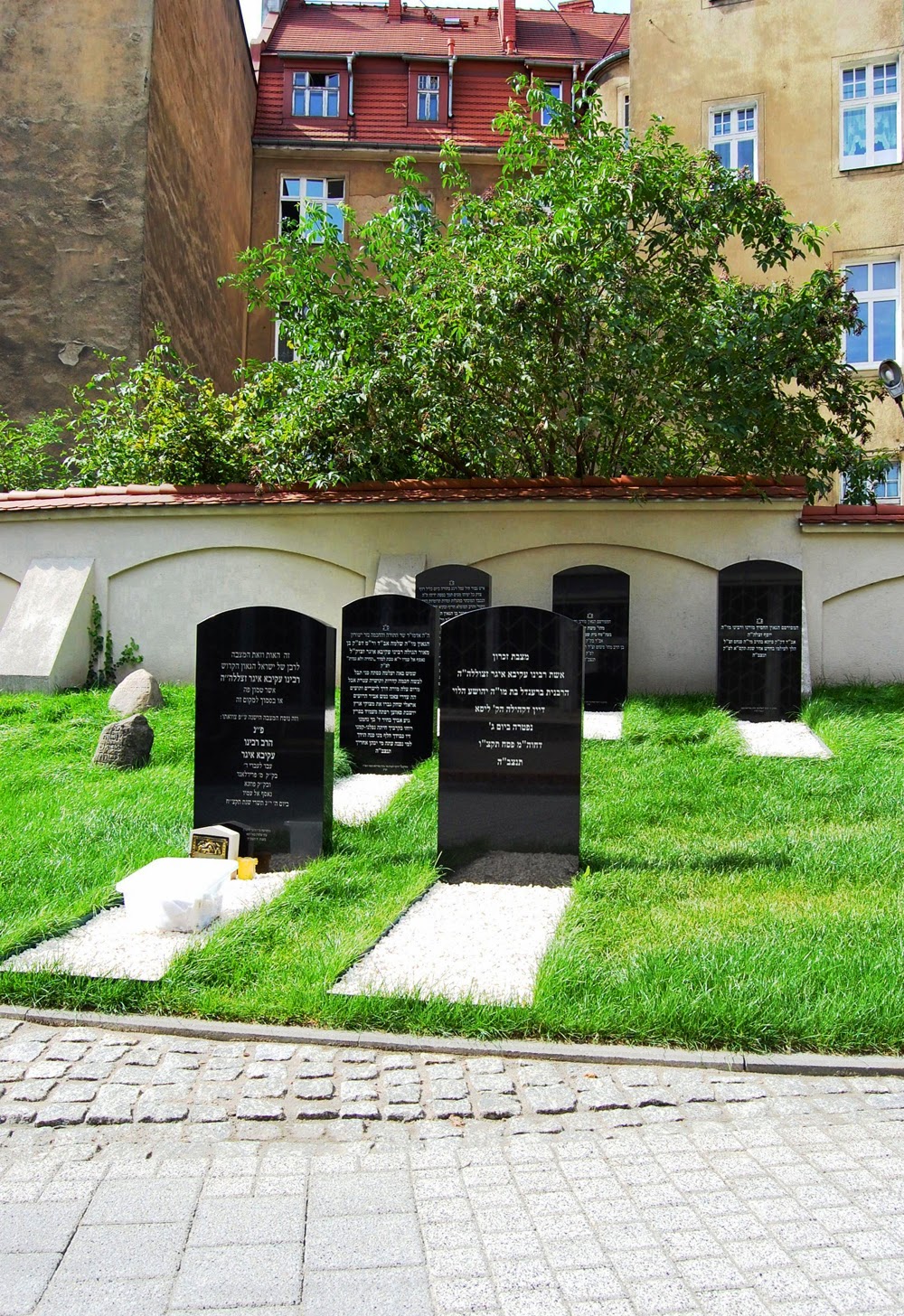
Tombstones from the Jewish cemetery were used to pave roads, and the nineteenth century Jewish cemetery itself – it opened in 1804 – was incorporated into Poznan’s Trade Fair grounds after the war.[8] Ultimately, a housing project and shopping center were built on the grounds of the Jewish cemetery, today at ul. Glogowska corner ul. Sniadeckich. Fortunately, the rabbinic section of the cemetery served as a parking lot (rather than as the foundation of an apartment house), and it was possible to transform the lot into a grassy knoll and to set new tombstones over the old graves (see figure 5). 

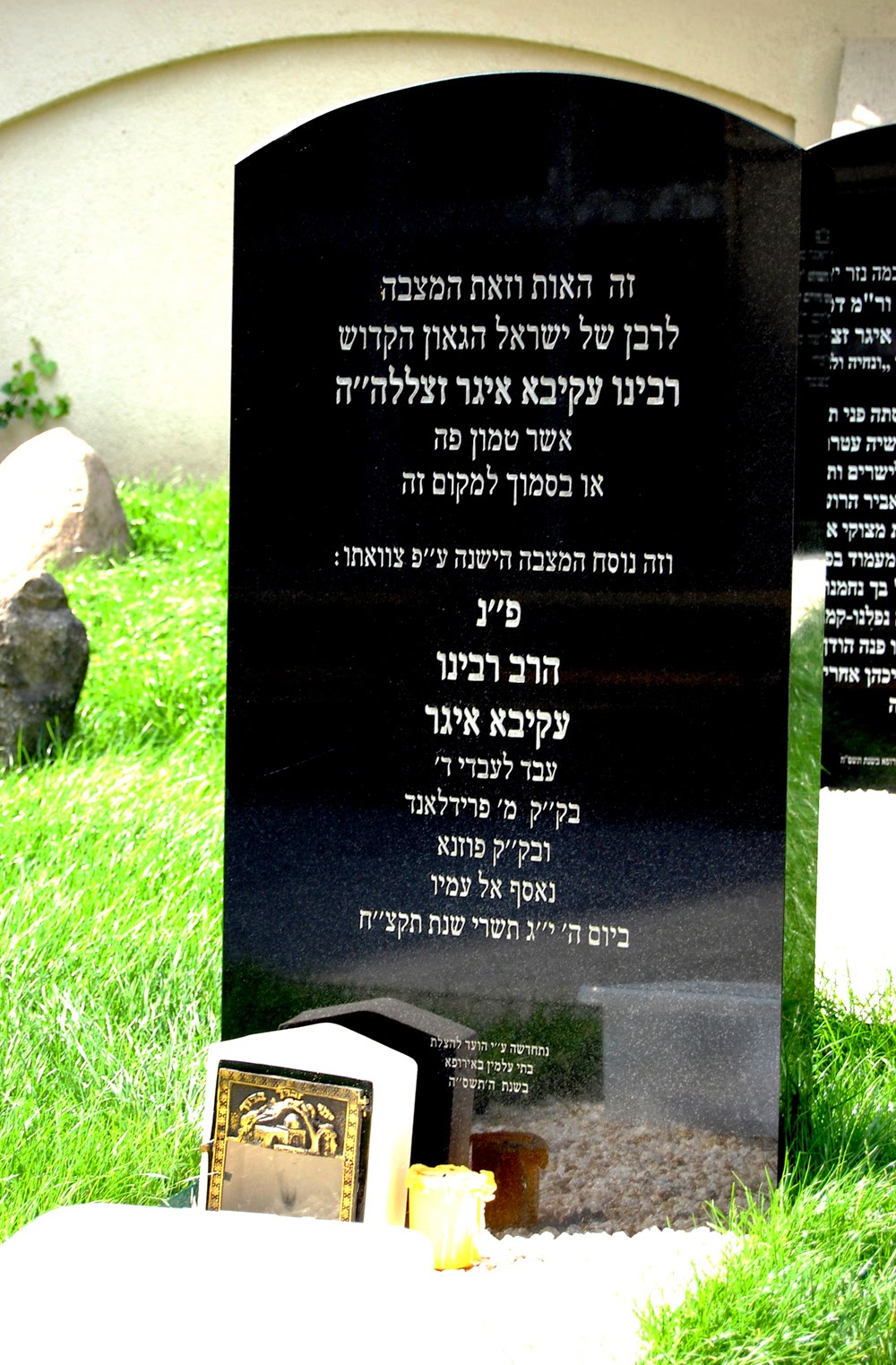
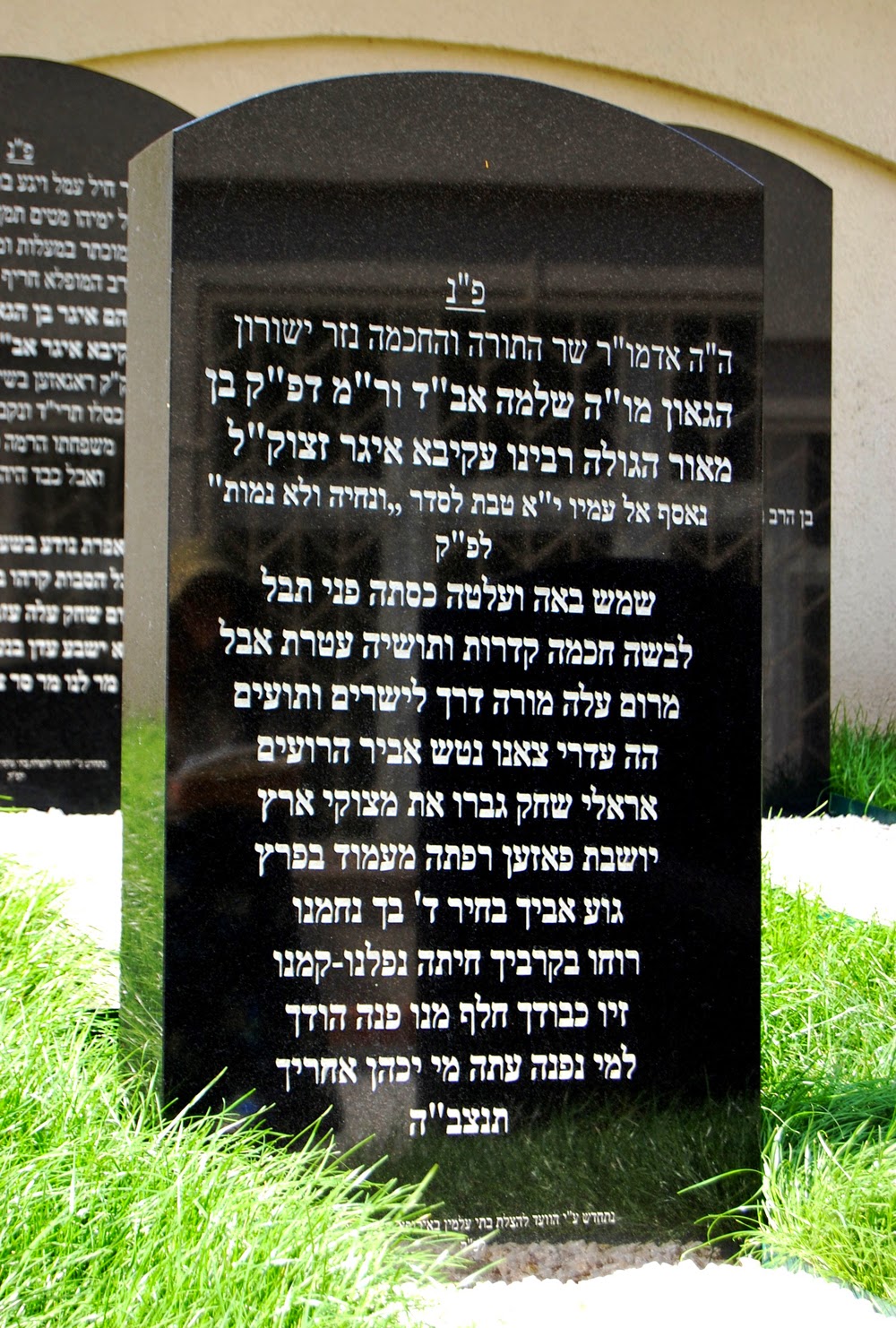
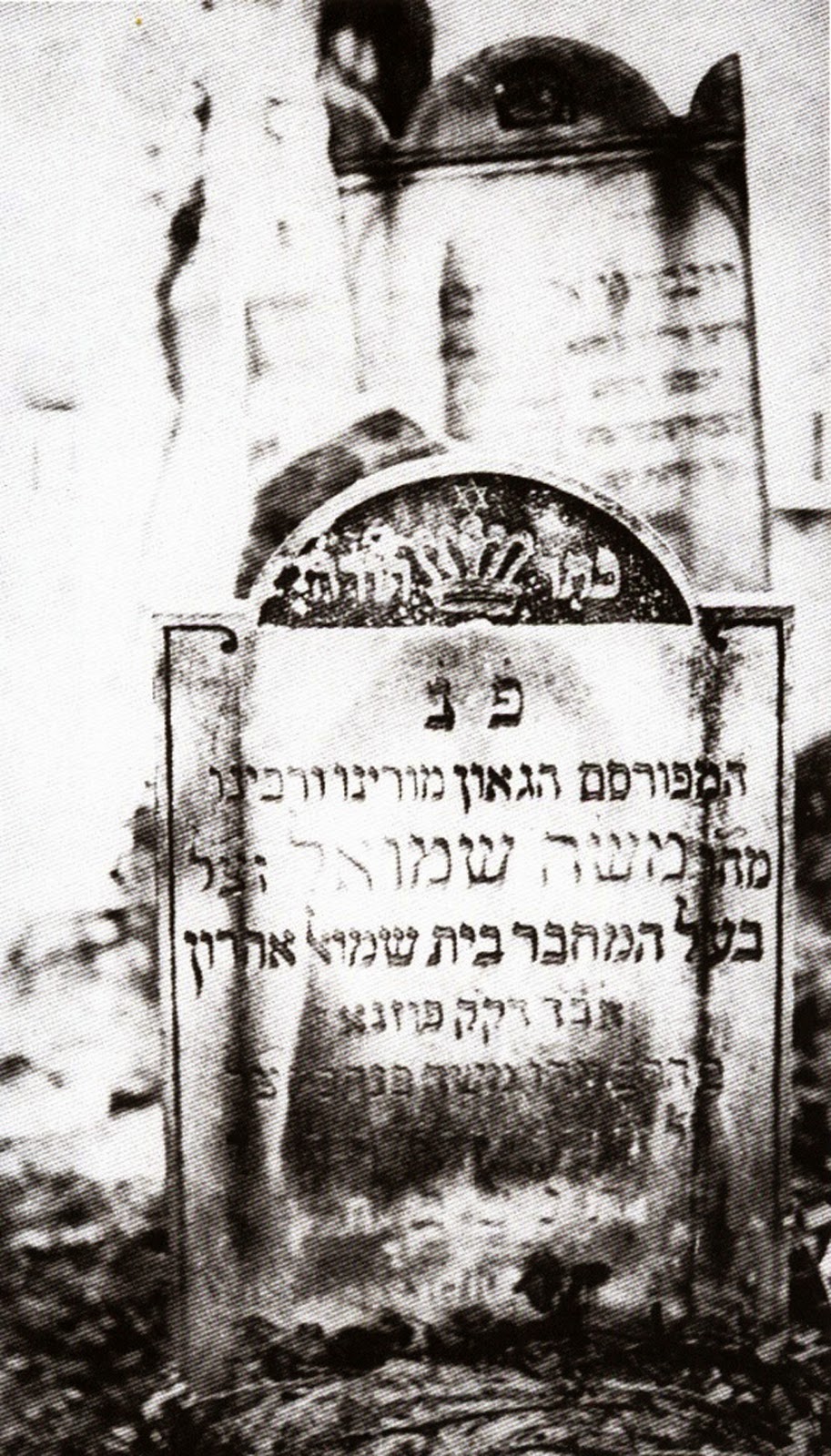
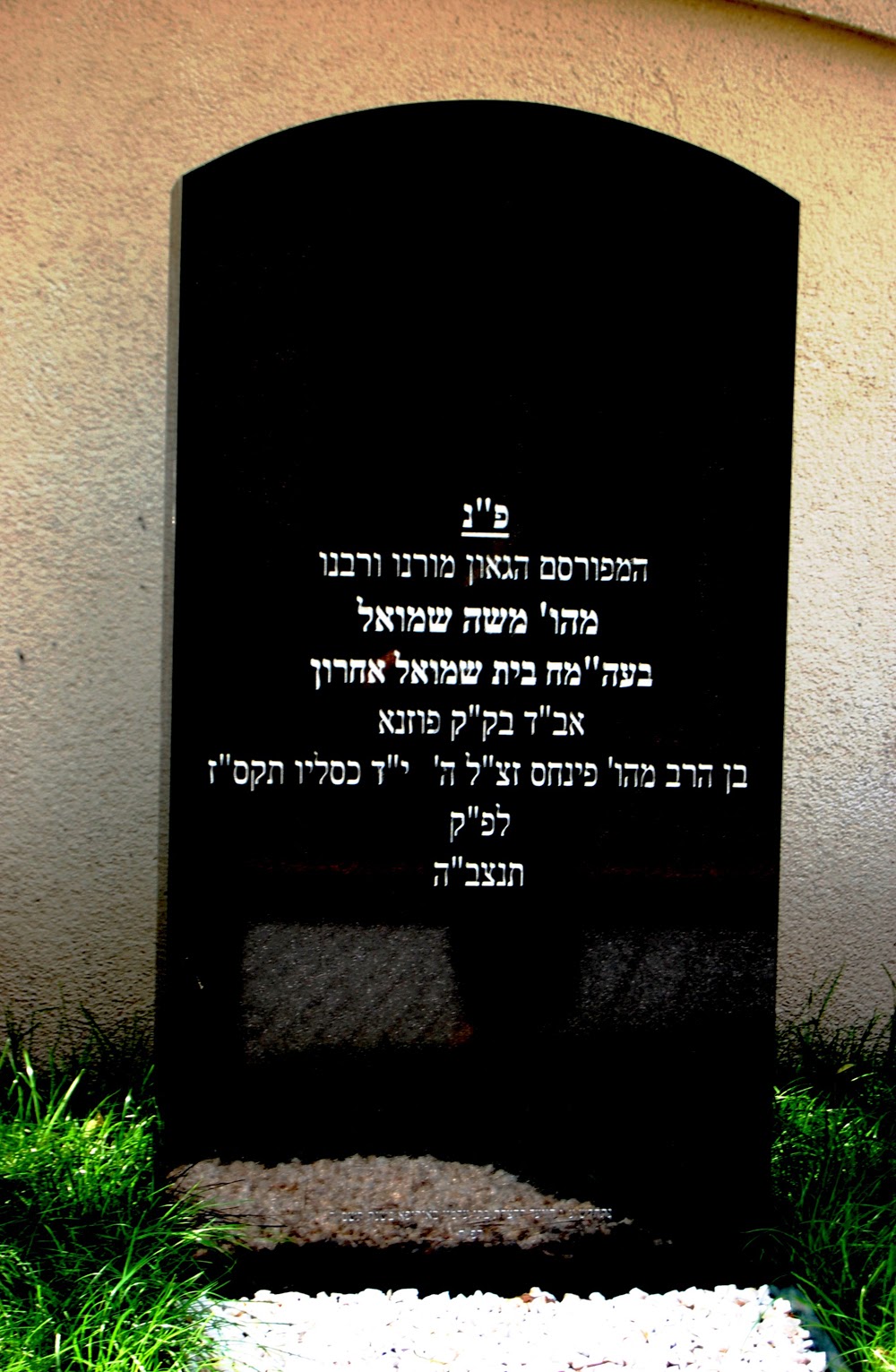
At best, the tombstones are approximately over the gravesites they describe. Even so, it is a great kiddush ha-Shem that this sacred site has been restored. The graves restored include R. Akiva Eger (see figure 6), his second wife Breindel (d. 1836), his son and successor R. Shlomo Eger (d. 1852; see figure 7), and his son R. Avraham Eger (d. 1854). Also restored were the graves of two predecessors of R. Akiva Eger as Chief Rabbi of Posen: R. Yosef b. Pinhas of Posen (son-in-law of R. Yehezkel Landau Prague; see figure 8), d. 1801, and R. Moshe Shmuel, author of בית שמואל אחרון, d. 1806 (see figures 9 and 10 for the original and the restored tombstone inscriptions).[9]

We would be remiss if we didn’t mention that R. Akiva Eger’s likeness is on permanent display in Poznan’s Town Hall (see figure 11). The excerpt in figure 11 is part of a larger mural painted by Julius Knorr (1810-1860) and entitled Marktplatz in Posen. The painting was done during the lifetime of R. Akiva Eger and was first displayed in 1838. R. Akiva Eger can be seen at the bottom right, walking with cane in hand and accompanied by the two other members of his rabbinic court.[10]

II. R. David Hoffmann (d. 1921).

The recent announcement that R. David Hoffmann’s פירוש על ספר שמות (based upon his lecture notes in German) is about to be published by Mosad Harav Kook has brought great joy to biblical and rabbinical scholars alike.[11] Yet another sefer by the Master! It matters not that more than a century has passed since he first taught Exodus at the Hildesheimer Rabbinical Seminary. Of course modern Bible scholarship has changed drastically in the interim. R. David Hoffmann’s commentary will not reflect modern archaelogical advance, will not grapple with the textual readings of the Dead Sea Scrolls, and will not deal with the latest philological discoveries of Semitic linguistics. But those who have read his commentaries on Genesis, Leviticus, and Deuteronomy, and learned from them, will know that regarding R. David Hoffmann “כל מקום שאתה מוצא דבריו עשה אזנך כאפרכסת.”[12] Master of the Oral Law, he of course read the Torah through rabbinic lenses. At the same time, he listened to dissenting voices, weighed all the evidence, and never disparaged others even as he dismissed their arguments. He always judged judiciously and graciously. And even when one disagrees with him, one always gains insight from his comments.

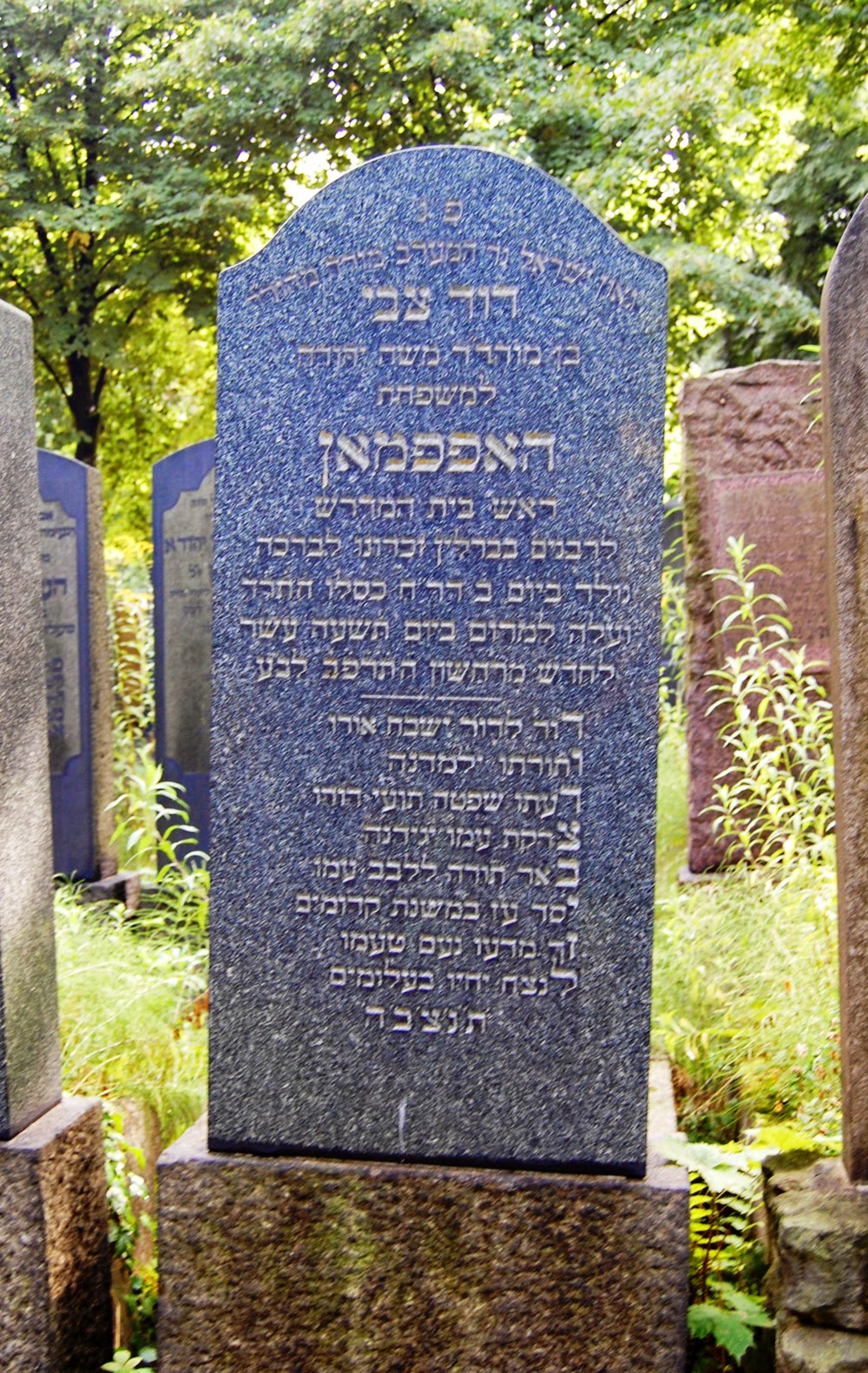
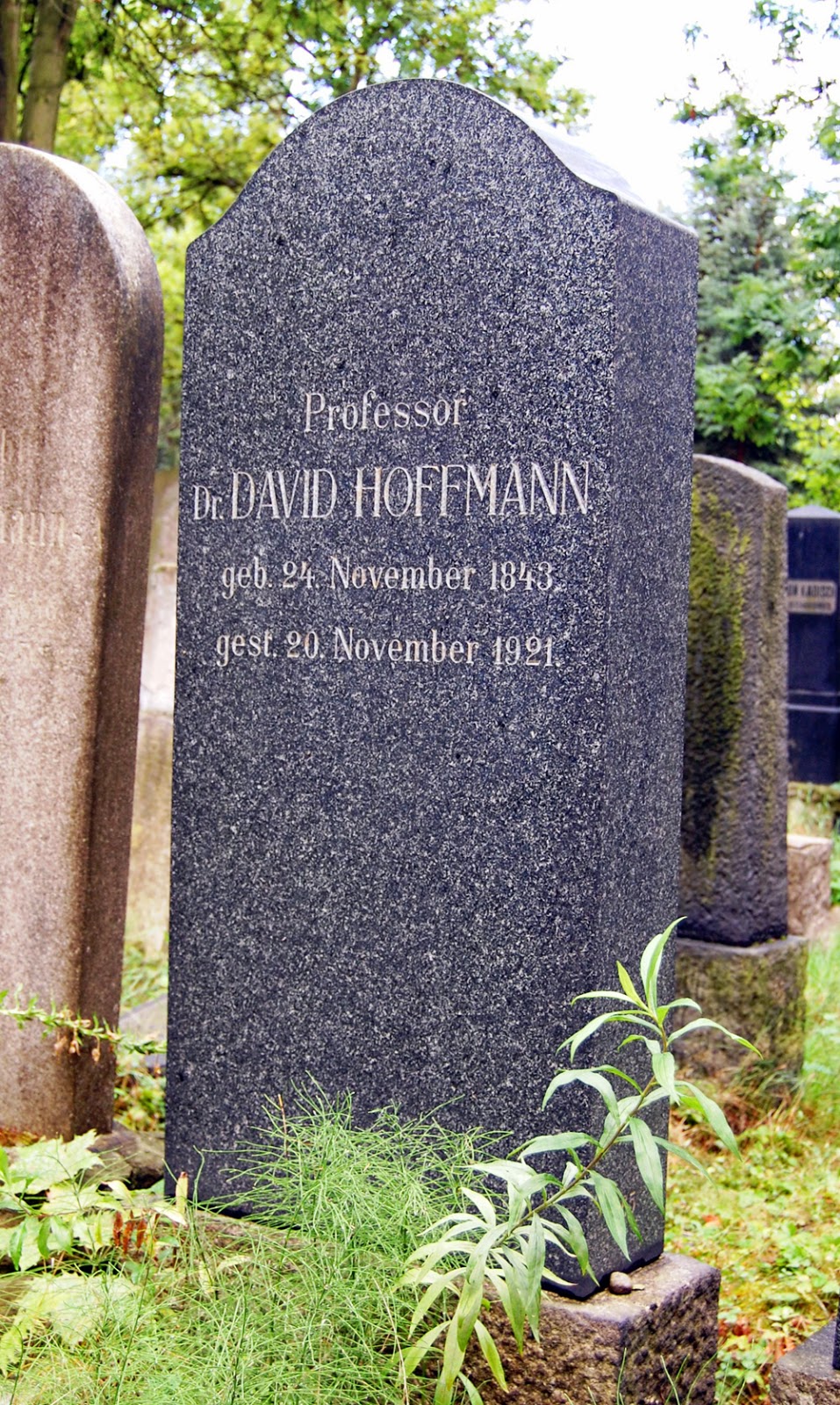
It is sad that this seminal figure, Rector and Rosh Yeshiva, Bible scholar and Posek, Literary Critic of the Mishnah and Restorer of Lost Tannaitic Midrashim, Defender of the Faith and Public Servant, has never been the subject of an intellectual biography worthy of the name.[13] Here we publish, apparently for the first time, his epitaph. R. David Hoffmann is buried in the Adass Jisroel cemetery in the Weissensee section of Berlin.

Obverse (see figure 12):

פ”נ
[גאון ישראל נר המערב מורה מהור”ר [14
דוד צבי
בן מוה”ר ר’ משה יהודה
למשפחת
האפפמאן
ראש בית המדרש
לרבנים בברלין זכרונו לברכה
נולד ביום ב’ דר”ח כסלו התר”ד
ועלה למרום ביום תשעה עשר
לחדש מרחשון ה’ תרפ”ב לב”ע
—————-
דור לדור ישבח אורו
ותורתו ילמדנה
דעתו שפטה תועי דורו
צדקת עמו יגידנה
באר תורה ללבב עמו
יסד עז במשנת קדומים
זך מדעו נעם טעמו
לנצח יחיו בעלומים
תנצב”ה
 

Reverse (see figure 14):

Professor
Dr. DAVID HOFFMANN
geb. 24. November 1843.
gest. 20. November 1921.

[1] According to R. Avraham Yeshayahu Karelitz (d. 1953), “גדול האחרונים הוא המהרי”ט.” See Z. Yabrov, מעשה איש, Bnei Brak, 2001, vol. 4, p. 90.
[2] See E. Zalman, “המהרי”ט קבור בצפת,” Qulmos 65 (2008), pp. 18-21. The photograph in figure 1 is taken from the Zalman essay.
[3] In the case of R. Eleazar b. Yehudah of Worms, he was certainly buried in the Worms Jewish cemetery, standing to this very day. The portion of the cemetery he was buried in was appropriated by the non-Jewish authorities. See R. Juspa Shammes, מעשה נסים, Amsterdam, 1696, p. 20.
[4] See N. Netter, “Les Anciens Cimetieres Israelites de Metz,” REJ 51(1905-6), pp. 280-281. Cf. S. Schwarzfuchs, (תנאי הרבנות של השאגת אריה בק”ק מיץ”,מוריה 15(1986″, pp. 81-90.
[5] The only extant authentic photograph of Sara Schenierer, which scholars in Israel and the United States have kept under wraps for years, was recently published in T. Lesniak, J. M. Malecki, J. Purchla, and A.B. Skotnicki, eds., Swiat przed katastrofa:Zydzi krakowscy w wudziestoleciu miedzywojennym (A World Before a Catastrophe: Krakow’s Jews Between the Wars), Krakow, 2007, p. 128 – and is reproduced here.
[6] See, e.g., Y. Strasser and A. Perl, eds., מאורן של ישראל: רבינו עקיבא איגר, New York, 1990, 2 vols. Cf. J.H. Sinason, The Gaon of Posen: A Portrait of Rabbi Akiva Guens-Eger , Jerusalem, 1991.
[7] Figure 4 is taken from T. Sztyma-Knasiecka, Miedzy tradycja a nowoczesnoscia: Zydi poznanscy w XIX i XX wieku, Poznan, 2006, p. 23.
[8] See Z. Pakula, , The Jews of Poznan, London, 2003, pp. 1-21 and 109. Cf. anonymous, “Jewish Poznan,” Poznan in Your Pocket, July-October 2008, p. 6.
[9] The photograph of the original tombstone inscription is taken from Sztyma-Knasiecka, p. 22.
[10] See Sinason, pp. 100-103; cf. Sztyma-Knasiecka, p. 13.
[11] See A. Wasserteil’s introduction to R. David Hoffmann, (שיעבוד בני ישראל במצרים, המעין 48(2008, number 3, p. 25.
[12] R. David Hoffmann used to apply this Talmudic phrase to the רש”ש, but it surely applies to Hoffmann as well. See his שו”ת מלמד להועיל, Frankfurt, 1932, vol. 3, §71. Cf. R. M. Roth, מבשר עזרא, Jerusalem, 1968, p. 167.
[13] Useful information can be gleaned from the following:
H.J. Bechtoldt, “David Hoffmann,” in his Die jüdische Bibelkritik im 19. Jahrhundert, Stuttgart, 1995, pp. 363-438; D. Ellenson and R. Jacobs, “Scholarship and Faith: David Hoffmann and his Relationship to Wissenschaft des Judentums,” Modern Judaism 8(1988), n.1, pp. 26-70; L. Ginzberg, Students Scholars and Saints, Philadelphia, 1928, pp. 252-262; L. Jung, The Path of a Pioneer, London, 1980, pp. 20-27; J. Marmorstein, “David Hoffmann, Defender of the Faith,” Tradition 8(1966), n.4, pp. 91-101; A. Marx, Essays in Jewish Biography, Philadelphia, 1947, pp. 185-222; Idem, Studies in Jewish History, New York, 1944, pp. 369-376; M. B. Shapiro, “Rabbi David Zevi Hoffmann on Torah and Wissenschaft,” Torah U-Madda Journal 6(1995-6), pp. 129-137; C. Tchernowitz, מסכת זכרונות, New York, 1945, pp. 244-264; and Y. Wolfsberg-Aviad, “David Hoffmann,” in L. Jung, ed., Guardians of Our Heritage, New York, 1958, pp. 363-419 (cf. Wolfsberg-Aviad’s דיוקנאות, Jerusalem, 1962, pp. 57-66). Much more bibliography can be added; the items listed here are intended to get the interested reader started.
[14] For the honorific title מורה מורנו, see figure 13, also from the Adass Jisroel cemetery. Cf. the very interesting responsum in שו”ת מהרש”ם 2:56.


A selection from Strictly Kosher Reading by Yoel Finkelman

The Seforim Blog is happy to present this selection from Yoel Finkelman’s recent book, Strictly Kosher Reading: Popular Literature and the Condition of Contemporary Orthodoxy.

Coalescence
The first function of Haredi popular literature involves the “coalescence” of the Jewish and the non-Jewish. In defining coalescence, Sylvia Barack Fishman distinguishes it from two other common ways of describing relationships between Judaism and general culture. First, “compartmentalization” involves a situation in which the Jewish tradition holds sway in its own spheres, such as the synagogue or Shabbat table, while non-Jewish culture dominates in other areas of life, such as the workplace or the theater. Despite its conceptual clarity, Fishman claims that “compartmentalization” does not accurately describe actual American Jewish practice, since contemporary American Jews are too Americanized and America is too welcoming of Judaism for such neat divisions to have much explanatory power. Second, “adaptation” involves a situation in which the Jewish and the non-Jewish exist side by side. Tension between the two remains, and the individual or community “privileges one or the other as the situation seems to demand.”[1] Adaptation, she explains, “implies a continuing awareness of difference” between Jewish and general values and an attempt to negotiate these differences.
Yet, claims Fishman, many American Jews have lost an awareness of differences between Jewish and American values.
During the process of coalescence… the ‘texts’ of two cultures, American and Jewish, are accessed simultaneously…. These values seem to coalesce or merge, and the resulting merged message or texts are perceived not as being American and Jewish values side by side, but as being a unified text, which is identified as authoritative Judaism…. Many American Jews – including some who are very knowledgeable and actively involved in Jewish life – no longer separate or are even conscious of the separation between the origins of these two texts.[2]
Haredi popular literature, like much of Haredi popular culture, seamlessly merges aspects of the Jewish tradition with contemporary American cultural norms and styles. In coalescence, normative Judaism becomes a hybrid or syncretic combination of the Jewish and the American, the traditional and the modern, the past and the present. For example, Haredi music takes its lyrics from traditional Jewish texts, but its musical style imitates contemporary pop music.[3] Haredi self-help books, as we shall discuss, present contemporary values of individualism, personal happiness, self-expression, and (according to some critics) self-absorption as Jewish values, supposedly in the self-improvement tradition of musar.[4] Haredi novels borrow literary genres and formulas from the general best-sellers and fill them with Haredi characters and values. [5]
Given Haredi commitment to isolationism and rejection of non-Haredi culture, Haredi coalescence seems surprising. Still, Haredi Jews are genuinely acculturated, and the same cultural forces that make a genre or idea popular among the general public make it popular among Haredi Jews as well. Community members may prefer a Haredi version of a literary genre, such that it will more precisely match their values and style. In addition, imitating the most contemporary styles helps make the tradition seem sophisticated and up-to-date. This allows Haredi Judaism to respond to modernity and its perceived anti-Orthodox biases on modernity’s own terms.[6]
Take the example of Yaakov Levinson’s book, The Jewish Guide to Natural Nutrition. According to Levinson, there are “Jewish roots to natural nutrition.” Holistic health and natural foods are presented as traditional Jewish values. Levinson works to “combine a system for healthy living and eating with a strong connection to our important Jewish heritage.” He rhetorically grounds his work in traditional Judaism, explaining that “Rambam’s [Maimonides’] medical writings contain the Jewish roots of today’s system of natural nutrition. Our modern approach is basically an extension of his main principles and teachings.” [7]
Yet, the author says little about Maimonides’ specific nutritional advice or his medieval biology, and Levinson quotes from Maimonides’ medical writings only very rarely. Instead, Levinson focuses on contemporary scientific concepts such as cholesterol, vitamins, and the USDA food pyramid. Maimonides does not serve as an authority on the workings of the body. Rather, he is an authoritative precedent for the borrowing of contemporary medical advice. Levinson is, to a great degree, aware of and articulate about the fact that the medical and nutritional advice he suggests does not come from Torah, but from modern science. He dances a cautious dance between the new and the old, the modern and the traditional. Maimonides’ “medical writings were based on Jewish Talmudic sources as well as on secular, non-Jewish teachings.”[8] In other words, Levinson argues that it is authentically and traditionally Jewish for today’s Haredi Jews to self-consciously adapt contemporary scientific theories, just as Maimonides did in his day. Maimonides is important to Levinson not as a source of information about eating and health, but as a figure whose very name and reputation can help make the book seem authentically Jewish and grounded in the tradition, even if the book’s content is not actually derived from his writings.
The dust jacket of The Jewish Guide to Natural Nutrition clearly articulates coalescence. The author’s biography on the dust jacket celebrates his extensive Torah studies as well as his accomplishments in the field of medicine. Photographs visually reinforce this. The front cover shows a professional studio photograph of a bearded man – presumably the author – carrying a large, attractive basket of fresh green apples and dressed in a clean white lab coat. The apples signify the value of natural and healthy eating, while the lab coat symbolizes the scientific validity and authority of the book’s nutritional suggestions. The back cover includes a parallel photo of the same man dressed in Hasidic garb carrying a stack of Maimonides’ halakhic writings. Science and Jewish religion, including both its mystical-Hasidic and its rationalistic-legal-Maimonidean strands, are not only compatible with one another, but mutually enforcing. The authority of science is backed, symbolically and visually, by Torah, and Torah leads to an appreciation of contemporary nutritional science. Not accidentally, the book opens with three almost identical approbations: two by well-known yeshiva deans and one by a professor at a Jerusalem medical school. The approbation from the medical doctor praises coalescence, in that the book “melds an expert’s view of nutrition and disease with its special implication and application to religious Jewish tradition.”[9]
Levinson’s coalescence goes further. He not only provides standard American nutritional advice for Haredi readers, but also claims that following that advice is fundamentally a spiritual experience and religious obligation. Here Levinson goes beyond his Maimonidean precedent. For Maimonides, maintaining one’s health is a means to an end, a requirement so that illness or weakness would not distract the
individual from the higher values of study and religious self-development. “It is impossible to understand or know anything of the knowledge of the Creator when one is ill. Therefore a person must distance himself from things which damage the body and a person should become accustomed to things which make one healthy.” For Levinson, in contrast, health is not merely a means toward a higher end; rather, there is an inherent “spirituality in eating.”[10] Combining kabbalistic language and basic biology of the digestive system, Levinson explains that healthy eating exemplifies a central religious goal of separating the “good” from the “evil” in creation. The “nutrients” are good and therefore associated with the holy “sparks” of the Kabbalah, while the “waste” is the evil, associated with the evil kabbalistic “husks.” “The separation of nutrients from waste in the act of eating has its spiritual counterpart in the extraction of the sparks of holiness which are contained in food. And is not the physical and spiritual separation of good from evil the very meaning of human existence?”[11]
Levinson also hints that the foods people eat and how they eat them are not value free, but exemplify their cultural identity. “Foods are much more than just a collection of nutrients; they are a wealth of influences and connotations…. The various religions use foods to connote their special approach to life.” Levinson’s health advice exemplifies this point, perhaps more clearly than he intended. While he intends to underscore the inherent spirituality, according to Judaism, in eating, he also implies that eating like an American means having absorbed American mores and sensibilities. He advocates a “healthier, lighter style of eating,” which became a virtual American infatuation in the nutrition discourse of late twentieth and early twenty-first centuries (even as Americans grew fatter).[12] Levinson’s concern with calorie counting, weight-loss, and balanced consumption of nutrients reflects the biological knowledge and cultural aesthetics of contemporary America, a community of plenty with an almost infinite variety of foods to choose from, with a deep concern with the long-term health impact of overeating, and an aesthetic that celebrates thinness. For almost all of human history, the central culinary dilemma facing humans involved procuring enough food to fend off starvation or at least chronic hunger. In contrast, Levinson and his American Haredi readership share with other middle-class Americans a challenge of negotiating an almost unlimited quantity and variety of food.[13] The late twentieth-century American infatuation with light, healthy eating, which Levinson exemplifies, supports values that Haredim and the general population share and which are reflected in their culinary culture and popular literature. Levinson’s book suggests that religious people, even those profoundly committed to a given canon, read and interpret their scripture and tradition not only in their own terms, but “in order to make sense of their lived experiences.”[14]
That Haredi Jews share a culinary culture with their neighbors, and that they follow the best medical and health advice available, are relatively unproblematic notions from a Haredi perspective. After all, the Jewish tradition for the most part supports the idea that Jews should seek quality medical treatment,[15] and Maimonides indeed advocated learning from the best available science. However, other examples of coalescence raise significant ideological and religious challenges.
For example, Haredi popular literature, like its devout Christian counterparts, adopts the modern notion of the “companionate marriage.” Here the coalescence appears in a matter of profound ideological and religious significance, since, as Helen Hardcare explains about Protestant Fundamentalists, the family is a “primary unit for ritual observance as well as an influential site of religious education and the transmission of religious knowledge from one generation to the next.”[16] Or, as one Haredi author puts it, “The Jewish family [is] a vital force in insuring our people’s continued existence.”[17] Popular Haredi works identify the Torah’s “timeless formula for marriage,” and contrast that with the “non-Jewish system” that is “floundering in its own confusion” and therefore “has nothing to offer the Jew.”[18] Yet, a brief historical comparison reveals how acculturated Haredi families have become, and how the Haredi popular literature coalesces by presenting the modern, monogamous, suburban nuclear family as part and parcel of the tradition.
Both the contemporary Haredi family and the pre-modern Ashkanazic one share a commitment to strict monogamy, as opposed to the polygamy of ancient Judaism and at least some of historical Sephardic culture. Yet, in pre-modern Ashkenaz, parents contracted marriages for their children, often with the help of professional matchmakers. When choosing a partner for their child, parents paid less attention to emotional or romantic compatibility and more to finding a spouse who could offer the greatest socio-economic advantage. Often, marriages were arranged, if not always consummated, when the children were in their mid-teens. This marriage was more of an economic agreement than a romantic one, certainly at the outset. The couple might continue to live with the bride’s family for some time, until they became financially and socially independent. In this constellation, “personal compatibility not to speak of romantic attachment [between the couple] were not taken into account at all.” [19] On occasion, feelings of love and mutual attraction would push a young couple to choose one another as marriage partners, but rabbis and community members saw this as a rebellion against communal values rather than a fulfillment of them.[20]
Today, Haredi couples, usually in their early 20s, care deeply about emotional compatibility and therefore search for marriage partners through dating. This period of courtship allows the young couple to determine if they are emotionally compatible and romantically suited. Under these circumstances, when courtship and emotional compatibility have become central to Haredi images of marriage, Haredi authors write dating guidebooks for such young people, providing “guidelines for dating and courtship,” so that the dating couple can most effectively determine if they share the same values, if they have the same expectations from married life, and if their “personalities” will enable “the couple to get along with each other.”[21]
Furthermore, for medieval Ashkenazic Jews the home was a center of economic life, because merchandise and services were produced in the home for the use of its residents as well as for trade with others. Women, though also mothers, played central roles in the medieval Jewish marketplace, at a time and place when parenthood was not considered a full-time endeavor and where raising children was perceived as requiring less moment-to-moment vigilance than it does today.
For contemporary Haredi rhetoric, in contrast, the “Jewish home” rather than being a locus of economic production, serves as a “haven in a heartless world,” a domestic shelter from the dangers of the marketplace and the outside culture.[22] It is a modern, middle-class, child-centered, nuclear family. In these families, rearing offspring, who require full-time attention and continuous nurturing, requires parents primarily and educators secondarily to be sensitive, vigilant, and loving toward children more or less on a constant basis. Women are, therefore, encouraged by Haredi literature to dedicate themselves first and foremost to being mothers and wives, and to go to work only if the family’s financial situation requires it.[23]
As numerous historians of both the Jewish and non-Jewish family have noted, these modern family patterns, in broad terms, developed with the rise of the middle class, under conditions of urbanization and industrialization.[24] In their popular literature, acculturated contemporary Haredim describe, analyze, and celebrate this modern family. In particular, Haredi popular literature celebrates one particular aspect of this modern family: what historians and sociologists have come to refer to as the “companionate marriage.” In this modern family, marriage ought to lead to self-fulfillment, happiness, and the satisfaction of the psychological need for friendship and emotional closeness.
The ideal of companionate marriage came to dominate discussions of marriage in twentieth-century America…. It elevated anticipation of achieving emotional, sexual, and interpersonal fulfillment in marriage. The goal of marriage was no longer financial security or a nice home but emotional and sexual fulfillment and compatibility. Though marriages were not expected to be conflict and tension free, it was hoped that disagreements could be overcome if husbands and wives talked about their feelings, recognized the existence of conflicts, and worked out their problems through close “communication.”[25]
The norm of the companionate marriage has penetrated Haredi circles, and Haredi books which guide couples to achieving that kind of relationship serve as prime examples of coalescence. For medieval Ashkenazic Jews, there was “an absence of any philosophy promising happiness in marriage.”[26] Today’s Haredi books on marriage view happiness and self-fulfillment as the central goals of married life. These works focus particularly on communication skills between couples, in order to assure that the couple will remain emotionally responsive to one another. “A healthy relationship is built on clear and honest communication. Listening, understanding and conversing all contribute to the empathy so vital to a marriage.”[27] Furthermore, “Marriage… creates the possibility of the closest emotional relationship that can exist between living beings, the love between husband and wife.” “Happiness in marriage” can be achieved by “building trust,… maintaining affection,… [and] creating intimacy.” Ultimately, “Marriage is a primary catalyst for the development of each partner’s individual potential to the utmost.”[28]
The adoption of the model of the companionate marriage relates closely to another very popular genre of Haredi popular literature, namely the parenting guide. Here, too, coalescence prevails, with these parenting guides presenting images of child rearing as part and parcel of the Jewish tradition. And here too the coalescence appears in discussions of central religious values: how to raise children to become Torah-observant and God-fearing Jews. Hence, one might expect a greater reliance on traditional sources and a more suspicious stance toward contemporary norms. Still, Haredi parenting guides, even those that claim to reject so-called “modern” approaches to parenting, adopt the strategy of coalescence and share much of their style and content with their non-Haredi counterparts.
Lawrence Kelemen’s parenting guide, To Kindle a Soul, for example, claims in the subtitle to contain “ancient wisdom.” “At the foot of a mountain in the Sinai desert, the Creator of the universe directly revealed His profound wisdom to approximately three million people…. Those present received… a comprehensive guide for raising great human beings.” The book attempts to describe “this ancient, Torah approach to education” which is “more comprehensive and effective… than any of the schools of child psychology I studied at university.” Kelemen describes the “significant” differences between these supposedly “ancient traditions” and the practices of contemporary parents.[29]
Yet Kelemen’s parenting approach fits neatly within late twentieth-century American parenting discourse, and it differs significantly from that of pre-modern Jewish sources. Kelemen combines an American religious-right critique of supposedly decadent American family life with a child-centered parenting approach advocated by endless American mass-market parenting guides in the 1990s. Criticism of American materialism and permissiveness; advocacy of limiting the mother’s time at work; polemics against spanking; emphasis on good nutrition, proper sleep time, and bedtime routine; concerns about the adverse impact of television viewing; claims to provide a “system” for raising moral children; and advocacy of “quality-time” for empathy and close communication between parents and children, all characterized American experts’ suggestions to worried middle-class parents at the end of the twentieth century. Even Kelemen’s claim that his approach derives from the Bible follows the pattern of American religious parenting guides. Indeed, the book’s unstated assumptions – that parenting is a full-time endeavor, and that parents should actively monitor their children’s moment-by-moment lives – typify experts’ advice and popular assumptions in America during the so-called “century of the child.” [30]
Not only does Kelemen’s approach match that of contemporary parenting experts, but it differs from traditional Jewish sources on the topic. While a complete history of Jewish approaches to children and family has yet to be written, it is enough in this context to note that traditional Jewish literature speaks of childhood and parenting in spotty and unsystematic ways, scattered in works focused on other topics.[31] This reflects a historical past in which families were considerably less child-centered than they are today, and parents learned how to parent more by imitation, instinct, face-to-face conversation, and osmosis than from the written word of experts. Pre-modern Jews did not write parenting manuals since they assumed that knowing how to parent was an intuitive or natural thing.[32]
Take the example of Kelemen’s approach to corporal punishment and spanking. This is a particularly important example because traditional sources do say quite a bit on the topic, and what do they say clashes rather dramatically with the approach of contemporary Haredi parenting literature. Kelemen polemicizes against corporal punishment of children, and even harsh verbal reprimands. Instead – reflecting both contemporary notions of individual autonomy and the voluntary nature of modern religious commitments, which make it difficult to coerce people into religious conformity – he insists that parents should calmly explain to their children what is proper and improper. Parents should then serve as living role models of the proper, hoping thereby to help children come to their own appreciation of and identification with the parents’ values. While Kelemen advocates setting clear and consistent boundaries on children’s behavior, he claims that enforcing those boundaries with violence and verbal harshness undermines the child’s respect for the parents and prevents children from being receptive to higher values. “Yelling and hitting usually flips [sic] children out of the learning mode… which is characterized by a relaxed and happy state that facilitates accepting the educator’s values… and into the obedience mode… which is characterized by a nervous, distrusting or rebellious state.” Spanking is part of an “authoritarian” approach typical of “dictatorships,” which leads to uninspired obedience in which youth do not come to identify with the values of the parents. Ultimately, “harshness” leads to “rebellion.” Kelemen also argues for the importance of parental affection. “Affection is more than just attention. Attention just requires being responsive to a child’s needs. Affection is the next step. It is warm and it is the most powerful medium we possess for communicating love.” Kelemen teaches that, “If we want to produce people with integrity, internally driven by a specific value system, we must utilize gentle means.”[33]
This advice stands in stark contrast to traditional Jewish sources on child rearing, which explain that spanking does not promote rebellion but prevents it. In a typical passage, the ancient Jewish text, Midrash Rabbah, quoting the book of Proverbs, relates that, “‘He who spares his rod hates his child.’ This teaches that preventing physical punishment (mardut) leads [the child] to bad culture.”[34] R. David Altschuler, the seventeenth century Galician author of the Biblical commentary Metzudat David, goes further in commenting on the same verse: “Do not refrain from making [your son] suffer even if you see that this is not effective, because there is hope that much reproof will be effective.”[35] Sources, particularly from early-modern Ashkenazi culture but from other contexts as well, openly polemicize against fatherly affection. For example, R. Alexander Ziskind of Grodno, the eighteenth century mystic, explained that, “Even though I had many sons, I never kissed even one of them, and never held them in my arms, and never spoke with them of frivolous things, God forbid.”[36] The seventeenth century rabbi, Yeshayahu Horowitz (the Shlah), states: “If the father rebukes his son early in his life with the staff… and uses fear while he is young… then he [the son] will be accustomed to fear his father always.… If in childhood the father displays great affection… then later when he matures he will not listen.… Mothers are… not to spare the rod but to strike their sons even if they scream.… Women who are compassionate with their children… murder them.”[37]
In the next chapter we will examine the complex ways in which Kelemen defends the idea that his approach derives from the ancient tradition. Here it is enough to note the way in which his book reflects the strategy of coalescence: identifying contemporary American values as being authentically Jewish. To Kindle a Soul, like other contemporary Haredi books on parenting, shares more with contemporary American mass-market parenting guides than it does with pre-modern Jewish sources on parenting. However, a close examination of other aspects of these works on families reveals that coalescence is not the whole story. Haredi works may borrow the companionate marriage and child-centered parenting from contemporary culture, but they borrow selectively. This leads to a second function of Haredi popular literature in mediating the tension between isolation and acculturation: filtering.
[1] Ibid.
[2] Ibid.
[3] Haym Soloveitchik, “Rupture and Reconstruction,” 75.
For internal Haredi discussion regarding this issue, see Mordechai Schiller,
“Chasidus in Song – Not for the Record,” The Jewish Observer
10:8 (March, 1975), 21; Breindy Leizerson, “Set the Record Straight,”
The Jewish Observer 20:4 (May, 1987), 40-41; Dovid Sears, “Who Took
the ‘Jewish’ Out of Jewish Music?,” The Jewish Observer 29:10
(January, 1997), 12-16; Yosef C. Golding, “How to Get the Entire Jewish Music
World Angry at Me… Or a Parent’s Guide to What Your Children Listen To,” The
Jewish Observer
40:4 (May, 2007), 36-37.
[4] Stolow, Orthodox by Design, 132-142; Andrew R.
Heinze, “The Americanization of ‘Mussar’: Abraham Twerski’s Twelve Steps,” Judaism
48:4 (1999), 450-469. On the self-absorption of this therapeutic self-help
literature, see Wendy Kaminer, I’m Dysfunctional, You’re Dysfunctional: The
Recovery Movement and Other Self-Help Fashions
(New York: Vintage Books,
1993).
[5] See below and Yoel Finkelman, “Medium and Message in
Contemporary Haredi Adventure Fiction,” The Torah U-Madda Journal 13 (2005), 50-87.
[6] The academic literature has focused on this trend
primarily regarding the development of Orthodox historiography. See below,
Chapter Four, n. 4.
[7] Yaakov Levinson, The Jewish Guide to Natural
Nutrition
(Jerusalem and New York: Feldheim, 1995), 4-5. Much of the
following analysis could be duplicated for the issue of The Jewish Observer
entitled “A Healthy and Productive Life as a Torah Jew,” 40:8 (November, 2007)
and for David J. Zulberg, The Life-Transforming Diet: Based on the Health
and Psychological Principles of Maimonides and Other Classical Sources

(Jerusalem and New York: Feldheim, 2007).
[8] Levinson, Natural Nutrition, 5. Zulberg, The
Life-Transforming Diet
, quotes more extensively from selected passages from
Maimonides’ medical writings, those in line with contemporary sensibilities.
[9] Unpaginated approbation of Prof. Leon Epstein.
[10] Maimonides, Mishneh Torah, Hilkhot De’ot,
4:1; Levinson, Natural Nutrition, 128.
[11] Levinson, Natural Nutrition, 136.
[12] Ibid., 4. Maimonides did advocate eating until not
fully satiated, though Levinson’s language, as noted, derives from modern, not
Maimonidean categories. See Maimonides, Mishneh Torah, Hilkhot De’ot,
4:2.
[13] Harvey Levenstein, Paradoxes of Plenty: A Social
History of Eating in Modern America
(New York and Oxford: Oxford University
Press, 1993), Chap. 16. For further reflections on the contemporary Orthodox
diet, see Brill, “Judaism in Culture,” 3 and Stolow, “Aesthetics/Ascetics:
Visual Piety and Pleasure in a Stricly Kosher Cookbook,” Postscripts 2:1
(2006), 5-28 (some of which also appears in his Orthodox by Design).
Levinson does not put as much emphasis as American general culture on the
aesthetic aspects of weight loss, perhaps because he does not perceive looking
attractive as a religious goal. In this, Zulberg’s The Life-Transforming
Diet
comes closer to the general American concern with body-image and
aesthetics.
[14] Molly Worthen, “Housewives of God,” The New York
Times Magazine
, November 12, 2010, available here  viewed November, 2010.
[15] See, for example, Shulhan ‘Arukh, Yoreh
De’ah
, 336:1. The ambivalence about seeking doctors, on the theory that divine
providence governs illness and heath, was generally of theoretical import only,
and usually did not have practical implications. See the commentary of the Taz,
ibid.
[16] Helen Hardcare, “The Impact of Fundamentalism on
Women, the Family, and Interpersonal Relations,” in Fundamentalisms and
Society
, Eds. Martin E. Marty and R. Scott Appleby (Chicago and London:
University of Chicago Press, 1993), 129. On similar Christian conflation of
modern notions of marriage with traditional ones, see James Davison Hunter, Evangelicalism:
The Coming Generation
(Chicago and London: University of Chicago Press,
1987), 76-93.
[17] Avraham Pam and Tzvi Baruch Hollander, “The Jewish
Family – In Its Glory and in Crisis,” The Jewish Observer 29:4 (May,
1996), 6.
[18] Yirmiyohu Abramov and Tehilla Abramov, Two Halves of
a Whole: Torah Guidelines for Marriage
(Southfield, MI: Targum/Feldheim,
1994), 158.
[19] Jacob Katz, Tradition and Crisis: Jewish Society
at the End of the Middle Ages
(New York: Schocken, 1971), 141-142.
Unfortunately, a systematic history of the Jewish family has yet to be written.
But see, Elisheva Baumgarten, Mothers and Children: Jewish Family Life in
Medieval Europe
(Princeton: Princeton University Press, 2004); ChaeRan
Freeze, Jewish Marriage and Divorce in Imperial Russia (Hanover, NH:
Brandies University Press, 2004); David Kraemer, Ed., The Jewish Family:
Metaphor and Memory
(New York and Oxford: Oxford University Press, 1989);
Avraham Grossman, Pious and Rebellious: Jewish Women in Medieval Europe,
Trans. Jonathan Chipman (Waltham, MA: Brandeis University Press, 2004), Chaps.
2-4.
[20] David Biale, Eros and the Jews (New York:
Basic Books, 1992), Chap. 3.
[21] Meir Winkler, Bayis Ne’eman b’Yisrael: Practical
Steps to Success in Marriage
(Jerusalem and New York: Feldheim, 1988), 53,
57.
[22] The expression comes from Christopher Lasch, Haven
in a Heartless World: The Family Besieged
(New York: Basic Books, 1977).
[23] Ironically, in the early modern period, the Haskalah,
rather than the tradition, called for marriages based on love and compatibility
rather than socio-economic advantage, and called to protect women from the
marketplace by carving out for them a domestic role in which they could spend
more of their time and energy on child-rearing. The central Jewish polemic
against marriage as a financial arrangement and against women’s role in the
workplace came from Haredi popular literature’s rhetorical enemies, the maskilim.
See Biale, Eros and the Jews, 159-161.
[24] Lawrence Stone, The Family, Sex, and Marriage in
England 1500-1800
(New York: Harper and Row, 1977); Steven Mintz and Susan
Kellogg, Domestic Revolutions: A Social History of American Family Life
(New York: Free Press, 1988).
[25] Mintz and Kellogg, Domestic Revoluations, 115,
describing the particular model of companionate marriage advocated by early
twentieth century progressives in America. Also see 186. Haredim, like these
progressives, advocate “divorce by mutual consent… on the grounds of incompatibility,”
at least as an unfortunate consequence of the failure of the companionate
marriage (ibid.). Yet, Haredim are less likely than these progressive to
support free use of contraception and open sex-education. Haredim also remain
attached to Victorian sensibilities that distinguish between the
feminine/domestic/secure sphere and the masculine/public/dangerous sphere, a
distinction against which progressives polemicized.
[26] Katz, Tradition and Crisis, 141-142.
[27] Abramov and Abramov, Two Halves, 65.
[28] Aharon Feldman, The River, the Kettle and the
Bird: A Torah Guide to Successful Marriage
(Israel: CSB Publications,
1987), 11; Radcliff, Aizer K’negdo: The Jewish Woman’s Guide to Happiness in
Marriage
(Southfield, MI: Targum/Feldheim, 1988), 11. Abramov and Abramov, Two
Halves
, 19. Also see Malka Kaganoff, Dear Kallah: A Practical Guide for
the New Bride
(Jerusalem and New York: Feldheim, 1993); Winkler, Bayis
Ne’eman
.
[29] Lawrence Kelemen, To Kindle a Soul: Ancient Wisdom
for Modern Parents and Teachers
(Southfield, MI: Targum Press and Leviathan
Press, 2001), 19-21. Some of Kelemen’s formulations, as well as one of the
book’s central metaphors – that parenting consists of “building” and “planting”
– come from the parenting guide of the twentieth-century Israeli Haredi rabbi,
Shlomo Wolbe, which Kelemen had been involved in translating into English.
Wolbe’s ideas themselves are influenced by modern psychological and cultural
categories, though the influence of modern psychology on contemporary
musaristis like Wolbe has yet to be studied, to the best of my knowledge. See
R. Shlomo Wolbe, Zeri’ah U’Vinyan BeHinnukh (Jerusalem: Feldheim, 1995),
23-24, and his Planting and Building: Raising a Jewish Child, Trans.
Leib [Lawrence] Kelmen (Jerusalem and New York: Feldheim, 2000).
[30] See Peter N. Stearns, Anxious Parents: A History
of Modern Childrearing in America
(New York and London: New York University
Press, 2003), and Ann Hulbert, Raising America: Experts, Parents, and a
Century of Advice About Children
(New York: Vintage Books, 2003), Chap. 11.
[31] On the difficulties in determining ancient Jewish
attitudes toward child rearing, see David Kraemer, “Images of Childhood and
Adolescence in Talmudic Literature,” in his Ed., The Jewish Family,
65-68.
[32] Baumgarten, Mothers and Children, 155.
[33] Kelemen, To Kindle a Soul, 129-152. Quotes
from 109, 130, 132-133.
[34] Shemot Rabbah, 1 s.v. Ve’eleh Shemot,
quoting Proverbs 13:24
[35] Also see B.T. Makkot, 8a, Bava Batra 21a;
Midrash Tehillim, Buber, 6; Midrash Tenaim, Devarim 25:3;
Rashi on Mishlei 13:24 and on 19:18; Rambam, Mishneh Torah, Hilkhot
Talmud Torah
, 2:2; Shulhan ‘Arukh, Yoreh De’ah, 240:20 and
Rama, 245:10; Sefer Hasidim, 302, cited in Baumgarten, Mothers and
Children
, 162; R. Yeshayahu Horowitz, Shenei Luhot HaBerit
(Jerusalem: n.p., 1975), Letter Daled, paragraph 23-32; The Gaon of Vilna, Even
Shelemah
(n.p.: n.d., n.d.), 6:4. When Shulhan ‘Arukh, Yoreh
De’ah
, 240:20 insists that one not beat his older children (according to
Rama, 22-24 years old), this is not due to any opposition to corporal
punishment per se, but, following his source (BT Mo’ed Qatan 17a),
because the son might retaliate and violate the more serious prohibition of
injuring one’s parent.
[36] R. Alexander Ziskind of Horodno in his ethical will,
quoted in Simhah Asaf, Meqorot LeToldot HaHinnukh BeYisrael (New York
and Jerusalem: Jewish Theological Seminary, 2002), Vol. 1, 688. Also see
Yitzchak ben Eliakim, author of Sefer Lev Tov (published in Prague in
1620), who insists that parents “not reveal their love [of their children] in
their presence because then the children would not fear them and would not obey
them.” Cited in Gerson David Hundert, “Jewish Children and Childhood
in Early Modern East Central Europe,” in Kraemer, Ed. The Jewish Family,
82. Also see the related sources quoted in Hundert, 83, and Ephraim Kanarfogel,
“Attitudes Toward Childhood in Medieval Jewish Society,” in Approaches
to Judaism in Medieval Times
, Ed. David R. Blumenthal (Chico, CA: Scholars
Press, 1985), Vol. 2, 1-34.
[37] Horowitz, Shnei Luhot HaBerit, Letter Daled,
para. 23-25.