On Libraries, Bibliophiles & Images: Taj Auction 13

On Libraries, Bibliophiles & Images: Taj Art Auctions 13

by Eliezer Brodt and Dan Rabinowitz

Taj Art Auctions will hold its 13th auction this Sunday, April 7th (the catalog is available here). The auction contains many items worth highlighting, especially those related to historic Jewish libraries, as well as other unique books and ephemera.

Recently, arguably, the most significant Jewish library reopened its doors. The National Library of Israel, housed at Hebrew University for decades, moved into its own building, designed by the starchitects Herzog & de Meuron, who count the Tate Modern among other outstanding projects. Books are integral to the Jewish experience, and the library’s location, next to some of the most important institutions of the Jewish state, the Knesset, the Israel Museum, and the Supreme Court, echoes that sentiment. The library’s ground floor houses the Jewish Studies reading room, which contains over 200,000 volumes. The library itself holds over four million books (and counting). These are now accessed by a quartet of robots that fetch requested books. There is even a window to watch them in action. The Scholem room has been transformed from its small, cramped quarters into a spacious room that houses the collections of several kabbalah scholars. Scholem’s desk is still present. There is a permanent exhibit of some of the library’s treasures, but that is only accessible on an official tour.

Nonetheless, it is undoubtedly worth seeking out. An exhibition of manuscripts of one the greatest privately held collections of Judaica, the Braginsky Collection, opens this month. While the National Library’s new building and collection are exceptional, many precursor Jewish libraries existed throughout the Jewish diaspora.

The oldest functioning Jewish library in the world is the Ets Haim Library in Amsterdam, dating from 1616. (An exhibition of its books was held at the National Library of Israel, then known as the Jewish National and University Library, in 1980). Its antiquity is tied to the date the school opened with the same name. This school became well-known for its unique curriculum and success in imparting that curriculum. Unlike the Central and Eastern European schools that almost immediately started studying Mishna and Talmud, the Talmud Torah applied a more systematic approach to Jewish literature. R. Shabbetai Seftil, the son of R. Yeshaya ha-Levi Horowitz (Shelah or Shelah ha-Kodesh), traveled from Frankfurt to Pozen via ship. That journey took him through Amsterdam, where he saw that the students’ studies operated in sequence. First, they studied the entire corpus of Tanakh and then completed the Mishha, and when they matured, they only began studying Talmud, and this approach contributed to their unique success. Seeing the benefits, he broke down crying, “Why don’t we follow the same approach in our countries [of Central and Eastern Europe]? Suppose only we could institute this throughout the Jewish communities. What would the harm be in first completing the Torah and Mishna until the student reaches thirteen and then begins Talmud? With that background, it will take only a year to become proficient in the intricacies of Talmud study, unlike our current approach that requires years to reach that level of fluency.”

In an example of the intertwining nature of the library and the school, the bibliographer R. Shabbetai Bass (1641-1718), who wrote the first Hebrew bibliography, Sifte Yeshenim (today, most well-known for this commentary on Rashi, Sifte Hakhim). Bass was born and lived in what is today the Czech Republic (Czechia). Around 1680, he went to Amsterdam to print Sifte Yeshenim. During that time, he visited the library and school and described the students as “students of giants: young children dancing like locusts and like so many lambs. To my eyes, they were giants, so well-versed in their knowledge of Torah and grammar. They could write Hebrew verse and poetry in meter and converse in clear Hebrew.” He also describes the unique aspect of the library. “Within the midrash, they have a special school, and there they have many books, and all the time they are in the yeshivah, this room is also open, and whoever wishes to study, anything he desires is lent to him. But not outside the beit midrash, even if he provides a large sum of money.”

From Ets Haim Bibliotheek Website

Among the Ets Hayim Library treasures is an Amsterdam print, the first Haggadah with copperplate illustrations. While illustrations in printed Haggados began with the Prague Haggadah of 1526, these were woodcuts. Copperplates, however, produce much finer illustrations. In 1695, the convert, Abraham ben Yaakov, designed and executed these copperplates, and the Haggadah was printed by the famed Amsterdam publisher, Proops. (Copperplates were already used in printing decades before the Haggadah. Perhaps one of the most significant recent examples is a 1635 copper etching by Rembrandt that the Jewish art scholar Simon Schama donated to the Rijksmuseum in Amsterdam last year.)  The illustrations are based on the Christian biblical illustrations of Mathis Marin. While most are innocuous, the temple image at the end of the Haggadah is topped with a cross. In addition to the fine illustrations, the Haggadah also contains a large foldout map of the Jews’s journeys from Egypt to Israel; it is among the first Jewish maps of the Holy Land.

The Ets Hayim Library holds a unique edition of this Haggadah, considered one of its most treasured books. First, it contains an extra title page. But, more importantly, it is hand colored. While the copperplates are a significant improvement, the coloring makes this an especially striking Haggadah. It is listed among 18 Highlights from the Es Haim: The Oldest Jewish Library in the World, published by the library in 2016. The book includes three full-page reproductions of various details of the Haggadah and smaller reproductions of other pages. There are only two other copies of this version. One is at the Hebrew Union College in Cincinnati, and the other is being auctioned at Taj Art Auctions (lot 89). The copy at the auction was a gift from the printer Solomon Proops.
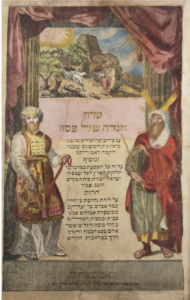
Similar images from the Haggadah’s title page were reused in Menoras ha-Me’or, Amsterdam, 1722, (lot 84), and the Amsterdam Haggadah final illustration of the Beis ha-Mikdash, that if one looks closely, the Christian cross was left intact from the original Mathis Marin illustration, also appears in the beautiful and unique title page adorning Birkas Shmuel, Frankfurt, 1782 (lot 152).
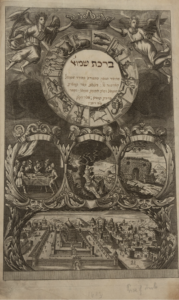
Birkas Shmuel, Frankfurt, 1782 Note the Cross on the Top of the Temple

Amsterdam was home to another significant library, the Rosenthaliana. It was collected in Hanover but eventually landed in Amsterdam. The catalog related to this library attests to the rarity of another book in this auction. This library was amassed by Eliezer (Leeser) Rosenthal (1794-1868). Born in Warsaw, he eventually traveled to Hanover, where he served as a Rabbi. His wife came from a wealthy family that allowed Rosenthal to indulge in his passion, book collecting. At their death, his library comprised more than 5,200 volumes, including twelve incunabula and numerous rare and unique books. After his death, his son, George, commissioned the bibliographer Meyer (Marcus) Roest to complete a bibliography of the library. It was published in two volumes in 1875 and reproduced in 1966. Roest’s work incorporated Rosenthal’s catalog of his library, Yodeah Sefer. Despite the many rare books in the collections, there was at least one book he could not procure, at least a complete copy. In his entry, 1524, for the Ibbur Shanim, Venice, 1679, he says that “it is a terrible loss, that my copy is incomplete, it is missing the last pages, my copy ends at page 95 … and is missing the calendric charts for 150 years, beginning from 1675, my copy is missing from 95 of these charts, from 1731 onward… This is a scarce (yekar mitzius) book and is not listed in R. Hayim Michael’s [Or Meir] or the Shem ha-Gedolim, or Di Rossi’s bibliography.” The National Library of Israel received a complete copy from the Valmaddona Trust, which was digitized and available online. (One can bid on four of the Valmadonna books, Talmud Bavli, Seder Zeriam, Lublin, 1618, lot 70 , as well as lots 12, 54, and 68). A complete copy of the book appears in the auction at lot 2. (For more on calendar books, see Elisheva Carlebach, Palaces of Time: Jewish Calendar and Culture in Early Modern Europe, and pp. 51-55 regarding Ibbur Shanim. His work is also a source for the Tu be-Shevat seder, see our post, “Is there a Rotten Apple in the Tu be-Shevat Basket“). The book has its own intersting history that is briefly described in the timely post, “Kitniyot and Mechirat Chametz: Paradoxical Approaches to the Chametz Prohibition.”

Yet another seminal Jewish library was that of R. Dovid Oppenheim (1664-1736), considered “the greatest Jewish bibliophile that ever lived.” (See Alexander Marx, Studies in Jewish History and Booklore, 213). Oppenheim started his rabbinic career in Moravia, moved to Prague, and was eventually elevated to Bohemia’s Chief Rabbi. At age 24, his library consisted of 480 books, and by 1711, his library stood at over 2,100 books, missing only 140 books from those listed in Shabbetai Bass’s bibliography of all Hebrew books. After his death (with some additions from his son, Yosef), the library rose to 4,500 printed books and 780 manuscripts. Although Oppenheim lived in Prague, the library was in Hanover. This was due to the heavy book censorship, which included the potential for confiscation by the authorities. Oppenheim visited his library, but perhaps because his time was limited, his works do not indicate that he was acquainted with the book’s contents. Instead, he should be considered a consummate bibliophile, and his collection consisted of rarities and special beautiful and unique copies, with a considerable number on blue paper. For example, there were 51 books printed on vellum, 40 of which he commissioned himself, out of about 200 known books printed on that medium until 1905.

After his death and multiple attempts to sell the library, it eventually went to the Bodleian Library at Oxford University. A complete history of the library was most recently accounted for by Joshua Teplitsky in his Prince of the Press: How One Collector Built History’s Most Enduring and Remarkable Jewish Library. But before its final resting place, there were a handful of catalogs of the library or various aspects of it. The first complete printed catalog of the library was issued in 1782 and was intended to elicit interest from potential Jewish and non-Jewish buyers. Thus, it contains two title pages, one in Hebrew and the other in Latin. This rare bibliophilic item is lot 156.

Finally, the auction also includes books from the library of R. Nachum Dov Ber Friedman, the Sadigur Rebbe. His library was recently described in Amudei Olam by R. Zusya Dinklos, pp. 419-39. Aside from traditional works, the library also held Haskalah works, as the one in lot 71.

Illustrated Books

We discussed Ibur Shanim, and in addition to its rarity, it is also among the small number of Hebrew books that contain illustrations. Because the book’s purpose was to elucidate and explain Hebrew calendrical calculations, including the determination of the tekufos (which he vehemently criticizes some Rishonim and others for dismissing them as old wives tales), there are a handful of tutorial images.
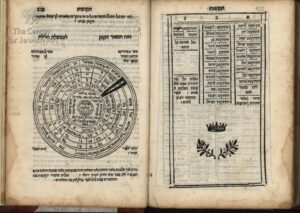
Ibur Shanim
Gross Family Collection

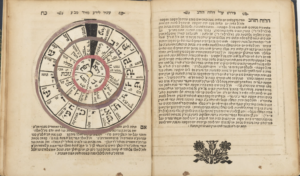
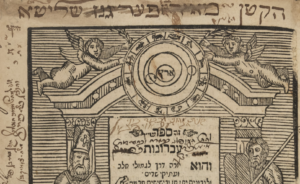
Likewise, Sefer ha-Ivronot, Offenbach, 1722 (lot 73) includes celestial images, in this instance, a movable wheel of the heavenly apparatuses. While there was some speculation that the title page image depicting a heliocentric universe was deliberately to align with the book’s contents, that is unlikely as the image was reused in at least three other books printed in Offenbach that are unrelated to astronomy.
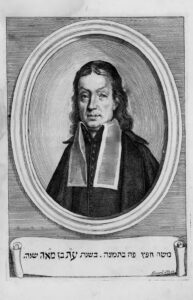
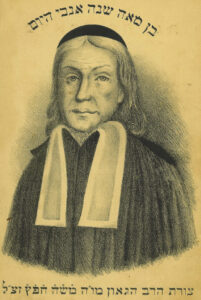
Moshe Hefetz, perhaps more well-known for the 19th-century modification of his portrait attached to the first edition of his Melechet Machshevet, which depicts him bare-headed, authored a book on the Bet ha-Mikdash, Haknukas ha-Bayis, 1696, (lot 20), within which several Temple elements are illustrated.
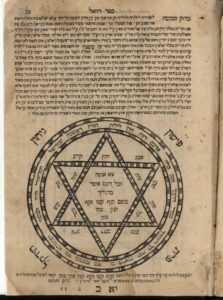
Two books contain eclectic images of the Jewish star. Igeret Ayelet Ahavim, Amsterdam, 1665 (lot 140) and the first edition, 170 Amsterdam, Raziel HaMalach, (lot 120) include unusual adaptations of the star. (For another kabbalistic rarity, lot 116, is the kabbalist, Rabbi Yosef Erges’ personal copy of the Rosh ha-Shana and Yom Kippur machzorim with his kabbalistic additions.)
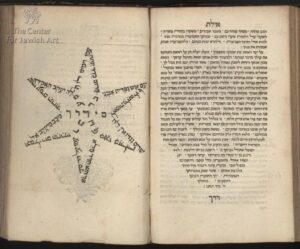
Iggeres Ayyeles Ahahuvim
From the Gross Family Collection

Razeil ha-Malakh
From the Gross Family Collection

There are a handful of artistic title pages, with at least two Greek gods, Hercules and Venus (see lots 10 and 48), and some potentially objectionable ones that Marc Shapiro discussed in his book Changing the Immutable (lots 64 & 78).

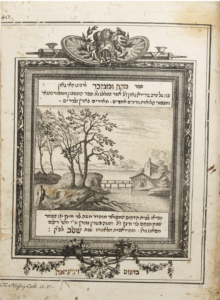
One of the most unusual title pages is a special one that its owner inserted into the book. The title page, taken from a non-Jewish architectural image by the 18th-century engraver Franz Carl Heissig, was filled in by hand with the book’s publication information (lot 5).
Finally, while censorship in Jewish books is somewhat common, undoing censorship is less common. Lot 62 is a unique copy of the Shu’T Maharshal that includes the otherwise expunged name of an informer. Other copies only refer to the person obliquely; this copy, although crossed out, the name is still visible. For more on this see Elchanan Reiner, “Lineage (Yihus) and Libel:  Mahral, the Bezalel Family, and the Nadler Affair,” in Elchanan Reiner, ed., Maharal: Biography, Doctrine, Influence, 101-26 (Hebrew).


Partnership Minyanim and More

Partnership Minyanim and More
Marc B. Shapiro

1. A few people have wanted me to comment on the recent debate between Rabbis Barry Freundel and Zev Farber about the so-called Partnership Minyanim in which women lead Kabbalat Shabbat. See here. The issue goes back to R. Freundel’s article in Tradition 44:2 (2011) on the topic. I was planning to respond to this article when it first appeared, and even wrote some pages, but I never completed the piece. Since the issue has once again surfaced, now is a good time to deal with it. Some of what I will say was also stated by an anonymous commenter on the Torah Musings blog, but both R. Zev Farber and Lazer Kaganovitch can testify that I sent them these points before the commenter posted anything, so I see no reason not to record my thoughts. (I should also note that this anonymous commenter, while pointing out errors and misreadings by R. Freundel, did not show proper respect in recording his criticisms.)
In his article, R. Freundel argues against the Partnership Minyanim with an original approach. Rather than summarize his viewpoint in my own words, this quotation sets forth his thesis, which the article attempts to prove:

In those communities which do not employ a Hazan for Kabbalat Shabbat, that lack would indicate that they view this liturgy as neither mandatory nor communal. Nonetheless, putting a woman (and maybe a child) into the role of Hazan would still be problematic. Adding a Hazan makes the prayer mandatory and communal but women and possibly children cannot lead a mandatory communal prayer. As a result, even in a setting that currently has no Hazan, the innovation of using a Hazan who cannot serve as a Hazan for communal prayer creates a halakhic dissonance that is unsustainable.
This is quite an argument and if it could be sustained, then it would be a significant contribution to the debate. However, in my opinion, and the opinion of everyone I know who has examined the issue, R. Freundel’s argument is completely unconvincing. There is simply no way that having a person read a few paragraphs of Psalms or more recent compositions before some other people makes the prayer “mandatory” and “communal.”
Before getting into some particulars of R. Freundel’s piece, let me offer a more general criticism. Reading the article I was troubled by the author’s need to come up with a halakhic argument to forbid that which pretty much everyone can see is not a halakhic matter at all (apart from possible halakhic concerns of tzeniut). Those who are in favor of Partnership Minyanim devote great efforts to show that there is no halakhic objection, and therefore these minyanim should be instituted, and R. Freundel is playing the same game, but from the other side. He feels that he needs to show why Partnership Minyanim are halakhically forbidden, and therefore shouldn’t be instituted.
The truth of the matter is that many of the most important things traditional Jews do and don’t do have nothing to do with halakhah. Something can be a bad idea, even a very bad idea, and deserve to be rejected even if there is no technical halakhic objection to it. As the Steipler wrote (Karyana de-Igarta [2011 ed.], vol. 2 no. 581):

יש כמה דברים שאין בכח החכם להורות איסור אע”פ שבאמת אינו נכון כלל
There are good reasons people can offer in opposition to Partnership Minyanim without falling into the “pan-halakhic” trap that everything you oppose has to be shown to be halakhically improper. Opponents of the Partnership Minyanim should be able to acknowledge that if non-bar mitzvah age boys are permitted to serve as a hazan for pesukei de-zimra or Kabbalat Shabbat then, apart from issues of tzeniut (in which I include kol ishah), there is no “technical” halakhic objection with women doing so as well. But as mentioned already, lack of a prohibition doesn’t necessarily make something a good idea. Plenty of synagogues will not let someone serve as a hazan if he is wearing jeans (or if he is not wearing a jacket or hat), yet this doesn’t mean that we need to find a technical halakhic objection for something which is at essence a matter of synagogue custom and propriety, and therefore does not need to be supported by halakhic sources. By the same token, I think we have reached the point whereby the typical Orthodox rabbi acknowledges (privately, at least) that there is no real halakhic objection to a woman rabbi, while at the same time continuing to oppose the concept (much like many oppose yoatzot halakhah). They oppose it because of how women rabbis will change the structure of traditional Judaism, change it in way they view as negative. This point can be made without using halakhic arguments that after a little investigation people will see don’t carry any weight. This is especially so in the Modern Orthodox world where there are women principals of Jewish day school, women synagogue presidents, women teachers of Talmud, women learning advanced halakhah, and no one bats an eye when a woman speaks in front of men.
For those who oppose things like women leading Kabbalat Shabbat, a weak halakhic argument is worse than no argument at all. The best tactic for the opponents is simply to keep the issue focused on what direction is best for Judaism. It is known that a number of great rabbis refused to provide halakhic reasons for particular decisions they gave, especially when the halakhic justification was weak. They chose this path precisely because they didn’t want these issues to become matters of halakhic debate, as there were other, even more important considerations guiding them. (In a future post I will give examples.) What R. Freundel’s article does is empower the proponents of Partnership Minyanim because they can rightfully say, “If this is the best our opponents can muster in terms of halakhic objections, then there really is no reason to oppose what we are doing.”
Now let’s turn to some particulars, as there are a couple of points in R. Freundel’s article that I would like to comment on. He writes:
The second oft-cited opinion in Rishonim is that of Nahmanides, who argues for obligatory twice a day recitations of the Amidah by women at Shaharit and Minha. The problem is that, despite the fact that the Mishna Berurah quotes this approach in the name of Ramban, I cannot find this opinion anywhere in Nahmanides’ writings. An examination of the section of Shulhan Arukh where Mishna Berurah makes this statement indicates that he is quoting R. Akiva Eiger.
There is a misunderstanding here. Here is the passage from the Mishnah Berurah 106:4 referred to by R. Freundel.

What the Mishnah Berurah is saying is that Nahmanides’ view is that prayer is a rabbinic commandment. The part about Anshei Keneset ha-Gedolah requiring the Amidah to be recited twice a day and that women are also obligated in this is not from Nahmanides. This is the Mishnah Berurah speaking. Contrary to what R. Freundel writes, the Mishnah Berurah is not quoting R. Akiva Eger.
           
In the next paragraph, Freundel writes:
R. Eiger cites Nahmanides from section 89 of Responsa Besamim Rosh. At one time this book was attributed to a variety of important scholars including Ramban, but now it is known to have been written by Isaac Molina in the 16th century. . . . Section 89 of Besamim Rosh tells us that women “in our area” are required to pray twice a day because “they have accepted this practice upon themselves.” This is hardly an indication that all Jewish women are required to recite the formal liturgy at Shaharit and Minha as Mishna Berurah claims.
Here is the responsum from Besamim Rosh.

It never uses the words “in our area”, and furthermore, the responsum is not from Nahmanides. It seems that R. Freundel makes the false assumption that at one time this book was attributed to Ramban because he thinks that R. Akiva Eger is citing a responsum of Ramban in Besamim Rosh. Yet Besamim Rosh was never attributed to Nahmanides nor to Isaac Molina.[1] The latter supposedly gathered the teshuvot (that is what it says on the title page, but this is part of Saul Berlin’s forgery). This means that R. Freundel’s critique of the Mishnah Berurah falls by the wayside, since the responsum in Besamim Rosh has nothing to do with the Ramban and thus nothing to do with the Mishnah Berurah’s point, which is derived from the Ramban. .

Here is the text from R. Akiva Eger.


In his heading he cites Ramban, but that is simply a quote from the Magen Avraham, and has nothing to do with the Besamim Rosh that he cites immediately following this. All R. Akiva Eger is doing by citing Besamim Rosh is providing another relevant text dealing with the issue under consideration, i.e., women and prayer. In R. Akiva Eger’s responsa, vol. 1, no. 9, he cites this same responsum in Besamim Rosh. (R. Akiva Eger thought that Besamim Rosh was an authentic work.[2]) 

However, how did R. Freundel ever assume that Besamim Rosh was citing Nahmanides? He never could have concluded this if he used the Machon Yerushalayim edition, which is the text I just used. He also could not have concluded this if he used one of the older editions of the Shulhan Arukh in which R. Akiva Eger’s note doesn’t even refer to Ramban. See here:

Yet here is the text as it appears in what used to be the standard edition of the Shulhan Arukh. In this edition there is a mistake in R. Akiva Eger’s text and it indeed has him stating that Nahmanides’ view is found in Besamim Rosh.

R. Freundel writes:
While all agree that women do not count towards adding Elokeinu, there is some debate about whether women can count among the three for zimmun. Nonetheless, even for those who say that women do count for the three no one suggests that a woman can lead if there are both men and women present. This is either because women’s obligation is rabbinic while men’s is Biblical or because the formal text of Birkat ha-Mazon contains references to certain mitsvot (e.g., circumcision) which are not applicable to women (emphasis added).
The passage I have underlined is incorrect. Ritva writes as follows[3]:

נשים חייבות בברכת המזון מן התורה, ולפיכך אשה מברכת לאיש על ידי זימון, או אם הוא עם הארץ להוציאו ידי חובתו כדרך שהאיש מוציאו.
See also R. Asher Ben Hayyim, Sefer ha-Pardes, ed. Blau (New York, 1984), pp. 176-177, and also the Hazon Ish, Orah Hayyim 30:8, who mentions that according to one approach in the rishonim גם הנשים רשאות לזמן כה”ג אם אין אנשים בקיאין . 

R. Yitzhak Yosef, Yalkut Yosef, Orah Hayyim 186:5, writes:
אשה שבירכה ברכת המזון ונתכוונה להוציא את האיש ידי חובתו, ושניהם אכלו כדי שביעה, בדיעבד יצא ידי חובה, ואינו צריך לחזור ולברך
A good discussion of the issue is found in R. Yehudah Herzl Henkin, Bnei Vanim, vol. 3, no. 1.[4]
R. Freundel writes:
The presence of a Hazan was essential to Magen Avot becoming a mandatory tefillah be-tsibburMagen Avot became mandatory with a Hazan. . . . If the presence of a Hazan makes a prayer mandatory, then Kabbalat Shabbat, which today has a Hazan in the vast majority of synagogues, is also mandatory.
I think R. Freundel has it all backwards. The presence of a hazan never made Magen Avot mandatory. Rather, when Magen Avot was made mandatory, it was required that there be a hazan. But what does this have to do with Kabbalat Shabbat which was never made mandatory by anyone?
R. Freundel writes:
R. Kook maintained that one who has heard the repetition of the Amidah on Rosh Hodesh thereby fulfilling his tefillah be-tsibbur requirement, but who must repeat his silent Amidah because he forgot Ya’ale ve-Yavo[,] counts among the six to whom four who previously prayed are added for recitation of devarim she-bi-kedushah. His repeat prayer constitutes tefillat rabbim in that venue, which is sufficient to count him in the majority of a tsibbur that has not yet prayed. Tefillat rabbim is, therefore, not a larger form of individual prayer, rather it is a diminished form of tefillah be-tsibbur and therefore, he counts because his is a minor act of communal prayer.
This description is incorrect as R. Kook does not “maintain” that which is being attributed to him. In his responsum, Orah Mishpat, no. 23, R. Kook presents both sides of the matter and concludes וצריך בירור. What this means is that he does not make a final decision. In any event, what does this have to do with someone such as a minor or a woman leading a prayer that is not obligatory?
The larger problem of R. Freundel’s article is that he makes assumptions which are simply not in accord with the practice of Jewish communities. For example, his argument leads to the conclusion that it should be forbidden (not just inappropriate, but forbidden) for someone under bar mitzvah age to lead any part of the service. Yet this is the practice in communities all over the world. Doesn’t every Modern Orthodox synagogue have a child lead Adon Olam? R. Freundel assumes that the only reason this can be permitted is because of hinnukh considerations. That is possible, but it is just as likely permitted precisely because there is no prohibition, and it is a nice thing to do. In other words, there is no default position that it is prohibited, from which one then needs to then find a way to permit.
The Beit Yosef, Orah Hayyim 53, discusses the practice of children leading the congregation in maariv and those who objected. He explains that the practice can be defended since there is no repetition of the Amidah, the hazan is not fulfilling anyone’s obligation for him, and maariv is also reshut. In other words, there are no considerations of hinnukh raised here, and for the Beit Yosef there is no default position that it is prohibited, and certainly no concept of tefillat rabbim, (which is mostly a hiddush of R. Freundel). It seems to be entirely a matter of synagogue etiquette, i.e., kevod ha-tzibbur, and if this can be overcome, then there is no halakhic problem. R. Yitzhak Zilberstein even argues that in an extreme circumstance (the particular case concerned a prison) one need not protest if a non-Jew leads the maariv service![5]
Let me stress that there is nothing wrong with R. Freundel coming up with a hiddush dealing with tefillat rabbim. However, a hiddush such as this cannot be the basis for forbidding a practice such as Partnership Minyanim. To see how far R. Freundel’s model takes him, in response to criticism he even stated that it is forbidden for a woman to recite tefillat ha-derekh on behalf of men and also to lead a communal recitation of Psalms. R. Freundel assumes that this is all tefillat rabbim and therefore forbidden for a woman to lead.
I have no doubt that if you ask the typical posek about a woman reciting tefillat ha-derekh or reading a Psalm before a mixed group of men and women, he will say it should not be done, for reasons of tzeniut or mesorah. But if you ask him if it is forbidden on account of tefillat rabbim, he won’t have a clue what you are talking about. Speaking historically, there is simply no such halakhic framework, and I find it hard to believe that people are going to be convinced that if some men and women sit down to read a few Psalms together (or a liturgical text of more recent vintage) that there is a prohibition for a woman to lead the recitation. (Again, I am not referring to tzeniut issues here.). Let me just remind readers that R. Ovadiah Yosef, relying on numerous rishonim, has ruled that if necessary a woman can read the Purim megillah for men (which might arise if no men know how to read it).[6] If the halakhically obligatory Megillah can be read by women for men, with none of the poskim saying a word about a concept of tefillat rabbim, then why should people accept that there is a prohibition for a woman to lead a group of men and women in recitation of a Psalm? (I realize that one can respond that reading the Megillah is not tefillah, but it would nevertheless be strange to permit a woman to read an entire book of the Bible before a group of men, and at the same time not allow her to read even a few verses from another book, i.e., Psalms.)
There is a good deal more to say about the phenomenon of Partnership Minyanim and the strange way they came about. Before Prof. Daniel Sperber got involved, the basis for them was an article written by an otherwise unknown rabbi in the Edah Journal. I can’t help but wonder about the halakhic methodology of changing traditional Jewish practice simply because a rabbi writes an article with some suggestions. If tomorrow a rabbi, any rabbi, writes an article arguing that in today’s day and age when men and women mix freely, that there is no need for a mehitzah in prayer (after all, it is not mentioned in the Shulhan Arukh), would that then give people carte blanche to remove the mehitzah? Had this not already been an issue between the Orthodox and Conservative, and thus of great symbolic significance, I am sure the mehitzah would already have been removed in liberal Orthodox synagogues. And what about counting women in the minyan? Halakhic arguments can be advanced for this as well. Is the only reason the liberal Orthodox don’t accept R. Ethan Tucker’s and R. Micha’el Rosenberg’s arguments[7] because of their non-affiliation with Orthodoxy? If an Orthodox rabbi had advanced the same argument as them, would it then be OK to move to complete halakhic egalitarianism?[8]
2. In a previous post I wrote about the dispute over whether there is pesak in hashkafah. Only recently did I see the following relevant statement of R. Soloveitchik, The Emergence of Ethical Man, p. 6 (emphasis added).
It is certain that the fathers of the Church and also the Jewish medieval scholars believed that the Bible preached this doctrine [the separateness of man from nature]. Medieval and even modern Jewish moralists have almost canonized this viewpoint and attributed to it apodictic validity. Yet the consensus of many, however great and distinguished, does not prove the truth or falseness of a particular belief.
In my article, I discussed some of the difficulties with the Hatam Sofer’s position that principles of faith can change with time, and are determined in a fashion no different than typical halakhic decisions. I argued that this understanding diverges from that of the rishonim. In R. Dovid Cohen’s recently published Ha-Emunah ha-Ne’emanah (Brooklyn, 2012), p. 41, he appears troubled by the Hatam Sofer’s approach.
                       
וקשה מאד להתאים דברי הח”ס שעיקרי הדת חשובים עיקרים שהכל צריכים להאמינם מפני ההכרעה שאז י”ל שהפורק עול שאינו רוצה לקבל ההכרעה נענש מטעם זה, אבל איך זה שייך לסברת האברבנאל והגרי”ז שמי שאינו מאמין אין לו התפיסה שיוכל להשיג עולם הבא האם ההשגה תלויה בהכרעה או במציאות של האמת והאם שייך לומר שלרב הלל יש חלק בעוה”ב והבא אחריו שסובר כוותיה אין לו חלק לעולם הבא שאינו יכל להשיג. . . . ועיין לקמן בעיקר ז’ שהערתי שמשמע מהאריז”ל ומבעל התניא שהם חולקים על החתם סופר ודו”ק.
What does the last word (abbreviation) mean, as it does not stand for ודוחק קצת, which is how it is usually understood? Furthermore, what are we to do with the expression והדברים ברורים ודו”ק that appears in Maharsha and elsewhere? I remember how in yeshiva we didn’t know what to make of this, since it obviously doesn’t  mean  ודוחק קצת. One rebbe told us that the abbreviation mark is a mistake and it should be read as  ודוק, that is, “examine it carefully” (like ודייק). It is also possible that the abbreviation stands for ודיק וקרא, although this meaning is not mentioned in Otzar Rashei Tevot. R. Meir Mazuz recounts that in Tunis they explained it: ואחר דרישה וחקירה קל. (Otzar Rashei Teivot has ודייק ותמצא קל). See his Lo Tashikh (Bnei Brak, 2005), p. 8 (first numbering). But he assumes that the real meaning is as I mentioned, i.e., ודייק.
Returning to R. Cohen’s book, it really requires a post of its own, as it contains all sorts of interesting things. Here is one example, from p. 127, where he suggests an interpretation of the Twelfth Principle of Maimonides according to which belief in a personal Messiah and other details in the Principle are not really  required beliefs.
וצ”ל שהעיקר הי”ב הוא גאולה באחרית הימים והכופר בזה הוא כופר גמור והפרטים שכתב הרמב”ם שיהיה משיח והוא מיו”ח של שלמה בן דוד אין זה מהעקרים שהכופר בהם אינו נחשב ככופר והוא חידוש עצום.
I only quote this for its novelty, as it is contradicted by Maimonides’ explicit words in the Principle. With reference to the detail of the Messiah’s genealogy, Maimonides states: “Included in this fundamental principle is that there will be no king of Israel except from David and from the seed of Solomon exclusively. Anyone who disputes concerning this family denies God and the words of His prophets.”
On p. 162 R. Cohen states that according to Maimonides even non-Jews are obligated to believe in the Thirteen Principles. He concludes his paragraph with ודו”ק, and again, it does not mean ודוחק קצת.
ועיין סוף פ”ח ממלכים שכתב וז”ל כי [כל] המקבל שבע מצות ונזהר לעשותן הרי זה מחסידי אומות העולם ויש לו חלק לעולם הבא. והוא שיקבל אותן ויעשה אותן מפני שצוה בהן הקב”ה בתורה והודיענו על ידי משה רבינו שבני נח מקודם נצטוו בהן. אבל אם עשאן מפני הכרע הדעת אין זה גר תושב ואינו מחסידי אומות העולם ולא מחכמיהם עכ”ל. ומשמע מכאן שהרמב”ם בא לכלול הגוים שהם חסידי אומות העולם שמאמינים בתורה, אבל אינם מאמינים בי”ג עיקרים שאין להם חלק לעוה”ב . . . הרי מוכח כנ”ל שגוי צריך להאמין בי”ג עקרים ודו”ק
Contrary to R. Cohen, when Maimonides speaks of righteous non-Jews being required to believe in the revelation at Sinai, this has nothing to do with acceptance of the complete Thirteen Principles.
One more point about R. Cohen’s book is that it is obvious that at times he is responding to what I wrote in The Limits of Orthodox Theology (and he also makes use of many of the sources I cite). While I am not mentioned by name (no surprise there) I am apparently included among the משמאילים referred to on p. 5 (see Limits, pp. 7-8).
Finally, let me add more comment about the Thirteen Principles. Just when I was about send in this post, I received the latest issue (Spring 2013) of the journal Conversations, published by Rabbi Marc Angel’s Institute for Jewish Ideas and Ideals. Each issue is a great read as it includes material from both well-known scholars as well as talented newcomers who have a lot to contribute and whose writings have often been real eye-openers for me.
Among the established writers in the new issue is R. Nathan Lopes Cardozo. If there is any contemporary writer in the Orthodox world who reminds me of the early Hasidic masters, the Kotzker, or even R. Jehiel Jacob Weinberg in his private moments,[9] it is R. Lopes Cardozo. Reading him one can sense how difficult it is for R. Lopes Cardozo to live in a world in which spiritual authenticity is in such short supply. As with his similar-minded predecessors, he too must protest, and the real perplexity is why so many others don’t join in this protest. The questions he asks, and what keeps him up at night, are exactly what should be on the mind of all thinking Orthodox Jews, even if one may disagree with the answers he gives.
His latest article, which appears in Conversations, is entitled “Lonely but Not Alone: An Autobiography by a Jew Who Should Never Have Been.” On p. 10 he writes:
It became clear to me that Judaism is based on the need for absolute questioning. I discovered that there are no absolute dogmas in Judaism, at least not in the way they are found within the Catholic Church. Maimonides’ famous Thirteen Principles of Faith, which are sung in nearly every synagogue on Friday nights, were never accepted as the final version of Jewish belief and were in fact heavily attacked and challenged by the greatest rabbinical authorities. Today, I see that Maimonides’ thirteen principles caused major damage to Judaism. It was the famous Professor Leon Roth who once remarked: “For this Hebrew of Hebrews had in many respects a Greek mind and through his sense of logic and his passion for precision, he brought Judaism into a doctrinal crisis, the echoes of which are with us yet” (Judaism, A Portrait, 1960, p. 122). How true! Judaism, while surely consisting of certain beliefs, is open to self-critique, debate, and ongoing discussions that have almost never been resolved. This spoke to my imagination. A religion with no dogmas, always open to new ideas! What could be better than that!

3. In a previous post I called attention to a bizarre segulah from R. Zvi Hirsch Kaidonover which I didn’t translate and which I suggested the police might regard as a form of sexual abuse. The text is as follows:
ועוד סגולה נפלאה לתינוק הנולד שלא יקרה עליו חולי נכפה בר מינן, מיד כשנולד ישימו בפיו ברית קודש של תינוק ויהיה ניצול כל ימיו מחולי נכפה
If you thought that this was strange, I guarantee that you will find the following, which was sent to me by a friend, even stranger.


The text comes from Meir Benayahu, Toldot ha-Ari (Jerusalem, 1967), pp. 224-225, and describes a “cure” recommended by R. Isaac Luria. The passage is too bizarre to translate. If the man who “came to the rescue” was just a man off the street it would be one thing. However, we see that it was none other than R. Moses Galante, a great sixteenth-century Torah scholar of the land of Israel who was given real semikhah by R. Joseph Karo. Even though the pre-modern mind was able to come up with all sorts of strange “cures”,  I would like to believe that the entire story is a fiction. But even if it never happened, the fact that people believed it happened tells us a great deal about their mindset.

On p. 110 n. 4, Benayahu cites the following text from R. Hayyim Vital (and note the shocking passage I have underlined):

בענין לילית ההורגות את הילדים מבן שמונה ימים ללידתם . . . נטיתי אז ושמתי אבר מילת נער קטן בפי הילד תכף כשנולד טרם שיינק . . . ואמנם פעמים אחרות עשיתי כל הנ”ל וגם דברים אחרים, שנבאר עתה, ולא ניזוק. ואלה הם: לשים אבר מילת אבי הנולד עצמו בפי הילד טרם שיינק
On p. 111 he records a story that once when a lion was about to attack R. Hayyim Ben Attar

גילה בריתו ברית קדש, וכשראה אותה האריה ברח מפניו . . . שמעולם לא ראה טפת קרי

All of these texts relate to the power of circumcision, a topic that is relevant to an earlier post here where I discussed the notion that Eliezer took an oath to Abraham by placing his hand on Abraham’s circumsision.

Returning to the first story quoted from Benayahu, there is no doubt that people can believe all sorts of strange things. There is currently a situation in London where a leading rabbi is charged with inappropriate contact with women. This rabbi denies the charges. However, he has admitted, so I am informed, that he did touch women in non-sexual ways, but this was done as part of his “therapy” which he claims was halakhically permitted. Now obviously we can’t have a situation where a male therapist, or  “therapist”, is arm wrestling or massaging his female patients. In fact, after everything we have seen these last few years, I think we can all agree that there can’t be any touching.

Imagine my surprise, therefore, when in the most recent volume of Ma’ayan Omer I came across the following text:


R. Ovadiah gives permission for a kabbalist to touch a woman as part of his kabbalistic healing. R. Ovadiah requires that he wear gloves when touching her, but this is still surprising, as once such a heter is given it is not too difficult to see where this can lead..

I didn’t know what to make of the words צריכה להתפשט. Does this mean that a woman can remove all her clothes if that’s what the kabbalist needs in order to complete the healing process? (According to news reports, the Breslov figure currently in the news for sexual impropriety operated in this way). I was certain it couldn’t mean this, but then what does it mean? I wrote to R. Avraham Yosef and here is his reply.

Even with R. Avraham’s explanations, both regarding the nature of the pesak and the limited removing of clothes, it is still very difficult to stomach. But I acknowledge that this is only because of my rationalist perspective and my assumption that virtually all of these “kabbalists” are more snake oil salesmen than anything else. (R. Yitzhak Kaduri, a real kabbalist, said that an authentic mekubal does not charge money for helping people, so that immediately knocks out some of the most popular “kabbalists” who make a very good living at their craft.) However, for one who believes that a kabbalist can heal just like a doctor, then all the heterim that apply to a male doctor, including touching a woman while healing her, would also apply to a kabbalist. Skeptical as I am, I wonder why such a powerful kabbalist can’t do his healing without touching the woman.[10]

[1] This information is available simply by googling “Besamim Rosh”, and the first two results are from Seforim Blog posts. The third result is Wikipedia which also states that Besamim Rosh is an eighteenth century forgery.
[2] This can be seen from how he cites the source, and see also his note to Shulhan Arukh, Even ha-Ezer 117, where he is explicit (this source was noted by one of the commenters on Torah Musings).
[3] Hilkhot Berakhot 7:2 (p. 106 in the Mossad ha-Rav Kook edition).
[4] R. Baruch Gigi, one of the roshei yeshiva of Yeshivat Har Etzion, believes that women saying birkat ha-mazon together with their families can be counted towards a mezuman. See Yonatan Gershon, “On Women Joining in a Zimmun,” Meorot 9 (2011), available here. I have yet to see this acted on in practice.
[5] Hashukei Hemed, Berakhot 51b. R. Zilberstein’s books contain some of the strangest cases. I don’t know whether these are actual cases or if people just ask him the strange questions knowing he will respond, or if perhaps even he makes up the questions so that he can then discuss the matter להגדיל תורה ולהאדירה
[6] See Yalkut Yosef, Dinei Keriat ha-Megillah, no. 12.
[7] See here.
[8] David Berger has recently alluded to Partnership Minyanim in his “Texts, Values, and Historical Change: Reflections on the Dynamics of Jewish Law,” in Michael J. Harris, et al., eds., Radical Responsibility: Celebrating the Thought of Chief Rabbi Lord Jonathan Sacks (Jerusalem, 2012). In referring to Haym Soloveitchik’s thesis in “Rupture and Reconstruction,” Berger writes (p. 204): “[S]ome of those who lionize the mimetic society as they savour the anti-haredi uses of Soloveitchik’s analysis are simultaneously impelled by feminist convictions to change generations of synagogue practice on the basis of textual analysis far more tenuous than the considerations that lead the traditionalist Orthodox to their usually more stringent deviations from the practices of the past. Affirmation or rejection of a mimetic ideal can depend very much on whose ox is being gored.”
[9] I think readers will appreciate this letter of R. Jehiel Jacob Weinberg. It first appeared in Mordechai Eliav and Yitzhak Rafael, eds., Sefer Shragai (Jerusalem, 1981), p. 275, and was reprinted in Ba’ayot Aktualiyot le-Or ha-Halakhah (Jerusalem, 1993), pp. 58-59. We are now sixty years after R. Weinberg wrote his letter, and not only have things not gotten better, but they have actually gotten much worse.

[10] In the recently published Mesorat Moshe, p. 612, it records that R. Moshe Feinstein responded as follows, after being told of a dentist who sexually assaulted female patients while they were sedated: אמר רבינו שממש פלא, דהלא זה כנגד החזקה שאומן לא “מרע אומנותו”. I don’t understand R. Moshe’s surprise, as he could say the same thing about teachers or anyone else who engages in this sort of behavior. Since we are dealing with people who are sick, there is no rational calculation for which you can apply the concept of מרע אומנותו. We have already seen numerous people who have destroyed their lives and their families by engaging in the sort of behavior, and taking the sort of risks, that simple self-interest would be enough to deter normal people from. (In a future post I will discuss other passages in Mesorat Moshe.) Also regarding sexual (and physical) abuse, R. Yosef Shalom Elyashiv writes, in discussing whether to inform the authorities (Kovetz Teshuvot, vol. 4, no. 198):
יש גם לשקול בגדר של ההתעוללות, שבהשקפה שלהם היא אחרת לגמרי משלנו
What does this mean? In what way is the religious Jewish approach to this matter superior to that found among non-Jews and non-religious Jews?

And finally, I found what I thought was a strange passage in R. Abraham Bornstein, Avnei Nezer, Even ha-Ezer no. 44. Much like Todd Akin, the Avnei Nezer thought that a woman couldn’t get pregnant through rape (unless . . . actually I would rather not explain it).

ואם היתה אנוסה מתחילה ועד סוף ולא רצתה בו כלל אי אפשר שתתעבר, רק שיש חשש שמא תחילה באונס וסופו ברצון . . . אלא ודאי כמ”ש משום דבאונס מתחלה ועד סוף אי אפשר שתתעבר

I have not found such a notion in any earlier rabbinic source. However, S. of On the Main Line called my attention to Rachel P. Maines, The Technology of Orgasm (Baltimore, 2009), pp. 51-52, from which we see that there was indeed a long-standing view that conception was not possible without female orgasm or at least desire.


Israel ben Shabtai [Hapstein]. ‘Avodat Yisrael – Book review by Bezalel Naor

Israel ben Shabtai [Hapstein]. ‘Avodat Yisrael (B’nei Berak: Pe’er mi-Kedoshim, 5773 / 2013). 66, 738 pages. 
Reviewed by Bezalel Naor 
Rabbi Israel ben Shabtai Hapstein, the Maggid of Kozienice (or more commonly, the “Kozhnitser Maggid”) (d. 1814) was a major figure in the third generation of East-European Hasidism founded by Rabbi Israel Ba’al Shem Tov, and specifically, a towering luminary within Polish Hasidism. Like his contemporary Rabbi Shneur Zalman of Liozhno (and later Liadi), Rabbi Israel studied under Rabbi Dov Baer, the Maggid of Mezritch (who led the Hasidic movement after the death of the founder, Ba’al Shem Tov). Unlike Rabbi Shneur Zalman, whose school of Hasidism, Habad, continues to this very day, Rabbi Israel founded no school and has no hasidim, no followers to speak of, today. 
The same goes for Rabbi Israel’s book. Whereas Rabbi Shneur Zalman’s most famous work, Tanya, has earned the sobriquet (at least among Habad Hasidim) “the written Torah of Hasidism” (“torah she-biketav shel hasidut”), relatively few have studied Rabbi Israel’s magnum opus, ‘Avodat Yisrael (Service of Israel), a commentary on the Pentateuch. Indicative of neglect in this respect, until today the book has been an example of poor typography. First published in 1842, ‘Avodat Yisrael has been reissued periodically with pitifully broken letters of “Rashi” script (today unfamiliar to Hebrew readers without rabbinic training). About now the cognoscenti will chime in, “Afilu sefer torah she-be-heikhal tsarikh mazal” (“Even a Torah scroll in the ark requires luck”) and “Habent sua fata libelli” (“Books have their fates”). 
Thankfully, this horrendous situation has now been remedied. Enter Pe’er mi-Kedoshim, a publishing concern headed by Rabbi Israel Menachem Alter, son of the present Rebbe of Gur. Pe’er mi-Kedoshim has committed itself to re-issuing the classic texts of Hasidic thought in deluxe, state-of-the-art editions. The Kozhnitser Maggid’s ‘Avodat Yisrael is the premier volume in a series envisioned to include: Degel Mahaneh Efraim by Ba’al Shem Tov’s grandson, Rabbi Moses Hayyim Ephraim of Sudylkow (next on the agenda); No’am Elimelekh by Rabbi Elimelekh of Lizhensk; Zot Zikaron by Rabbi Jacob Isaac Horowitz (the “Seer of Lublin”), et cetera. 
The book displays all the benefits that the modern age of Hebrew printing has brought to the sacred realm. The cursive “Rashi” script has been replaced by the square characters familiar to every Hebrew reader, which have then been provided with vowel points and modern punctuation. Sidebars caption the highlights of the Maggid’s comments. Footnotes reference sources in rabbinic and kabbalistic literature, as well as cross-referencing to parallel passages in the Maggid’s own works. As is customary, the book is preceded by “Toledot” (Biography) of the Author, and followed by “Maftehot” (Indices). (At present these indices are purely topical. It is hoped that in the future there will be included an index of the works cited by the Maggid, which will allow students of his thought a glimpse of his library, and the horizon of his intellectual and spiritual world.) 
Quoting the Psalmist, “Who can understand errors?” (Psalms 19:12), the Editors have encouraged readers to offer constructive criticism, including pointing out errata in the present printing. Let us take them up on their kind offer. 
In Parashat Bereshit, end s.v. vayyasem H’ le-Kayin ‘ot (6a), the Maggid observes “that there are times when miracles are performed by the Other Side, as we find in the Gemara, and in the Midrash, Parashat Toledot, that through Arginiton miracles were performed for Rabbi Judah the Prince and his companions, and the Omnipresent has many emissaries.” Where the Maggid alludes to an unspecified “Gemara,” the Editors have supplied within the text itself, within parentheses, “Me’ilah 17b.” If one consults the text of that passage in the Talmud Bavli, one discovers that it concerns miracles wrought by Ben Temalyon (name of a demon) for Rabbi Shim’on ben Yohai during his mission to Rome. When offered the demon’s help, rather than rebuffing him, Rabbi Shim’on resigned himself to accepting his intervention by saying: “Yavo’ ha-ness mi-kol makom.” (“Let the miracle come from any place.”) This statement of Rabbi Shim’on is similar in tenor to the Maggid’s conclusion: “Harbeh sheluhim la-Makom.” (“The Omnipresent has many emissaries.”) 
Clearly, the Editors have read the text of ‘Avodat Yisrael in a disjointed fashion, interpreting that the “Gemara” and the “Midrash, Parashat Toledot” refer to two different stories. My own reading of the situation is that the “Gemara” and the “Midrash, Parashat Toledot” refer to the identical story whereby Rabbi Judah the Prince and his companions were spared the imperial wrath of Diocletian through the intervention of the demon Arginiton (or in the version of the Yerushalmi, “Antigris”). The “Gemara” of course is not the Gemara Bavlit, but rather the Gemara Yerushalmit, and the reference is to the Talmud Yerushalmi at the end of the eighth chapter of Terumot. I rather like my suggested reading for two reasons. First, we are told in the biographical introduction to the book that Rabbi Hayyim of Volozhin attested that the Kozhnitser Maggid was “familiar with Talmud Yerushalmi” (“baki be-Shas Yerushalmi”) (p. 30). Second, in recent years, the Hasidic court of Gur has expended great energy in promoting the study of the hitherto neglected Talmud Yerushalmi, so I believe it especially appropriate that the edition of ’Avodat Yisrael under the guidance of Rabbi Israel Menachem Alter shelit”a offer this alternate solution to deciphering the Maggid’s cryptic reference to “the Gemara.” 
In Parashat Shemot, beginning s.v. ve-sham’u le-kolekha (91a), the Maggid writes that Moses was confronted with a conundrum. On the one hand, he was pressing for some kind of divine assurance that his mission to Egypt be crowned with success and that the Hebrews indeed hearken to his voice. On the other hand, he was concerned that by its very nature a divine guarantee would rob the Hebrews of their free will, forcing them into belief. The assumption is that the Hebrews were redeemed from Egypt in the merit of their faith or emunah. (See Exodus Rabbah, Beshalah [parashah 23] playing on the words “tashuri me-rosh Amanah” [Song of Songs 4:8].) It is a tribute to the originality of the Kozhnitser Maggid that while most Biblical commentators busied themselves with the philosophic problem of God’s hardening the heart of Pharaoh, thereby depriving him of the free will to respond affirmatively to the divine demands, the Maggid explored in the opposite direction the problem of preserving the Hebrews’ free will to disbelieve. The Maggid’s solution to the problem involves some rather esoteric doctrines of Kabbalah, namely “hanhagat gadlut” (“governance of greatness”) versus “hanhagat katnut” (“governance of smallness”), best left for the adept in Jewish mysticism. I would just point out for the record that the Editors missed a cue here. When the Maggid writes “’Ve-hen’ she-hu ahat,” he is clearly referencing the Talmud Bavli, Shabbat 31b: “She-ken bi-leshon yevani korin la-ahat ‘hen’.” (“Hen in Greek is one.”) 
In the section for the festival of Shavu’ot, s.v. u-Moshe ‘alah el ha-Elohim (200a), the Maggid writes: “Since all Israel prepared themselves for the sanctity of the Lord, and a leader is commensurate to his generation, therefore Moses was able to ascend above.” Now the crucial words, the key to understanding this thought, “u-parnas lefi doro” (“and a leader is commensurate to his generation”), have been emended by the Editors to: “kol ehad le-fi koho” (“each according to his ability”). Granted that in the old edition there was some fuzziness concerning these words (“u-parush lefi doro”), but they could still be made out simply by correcting “u-parush lefi doro” to “u-parnas lefi doro,” a well-known Hebrew adage. In the present version, one is at a loss to glean the Maggid’s meaning. (I see now that the wording “kol ehad lefi koho” does occur in the Warsaw 1878 edition of ‘Avodat Yisrael. Unfortunately, the edition I possess is without place or date. Unable to locate a copy of the editio princeps of 1842, I have no way of knowing which version occurs there.) 
In Parashat Mas’ei, end s.v. eleh mas’ei b’nei yisrael (240a), in regard to Tish’ah be-Av, the Maggid discusses the difference between the “batei gava’ei” (“inner chambers”) and the “batei bara’ei” (“outer chambers”), alluded to by the Rabbis in TB, Hagigah 5b. The Maggid’s remarks in this passage are consonant with what he wrote elsewhere in Ner Israel, his commentary to the Likkutim me-Rav Hai Gaon (2a): “In the outer chambers there is sadness and mourning, but for one who is able to ascend to the inner chambers, to the will of the Creator, blessed be He, certainly there is happiness.” (By the way, the kabbalists’ reading of the passage in Hagigah, while opposite Rashi’s, coincides with the version of Rabbenu Hananel. See Rabbi Solomon Elyashev, Hakdamot u-She’arim [Piotrkow, 1909], sha’ar 6, chap. 6, “avnei milu’im” [24b-27b].) 
In Parashat Devarim, end s.v. eleh ha-devarim (246a) there is a quote from Rabbi Isaac Luria’s commentary to the Idra Zuta. The Maggid supplies the exact page number: folio 120. The problem is that the passage does not occur there. The Editors have left the reference in the text untouched. At least in a footnote we should be told that the quote may be found in Rabbi Jacob Zemah, Kol ba-Ramah (Korets, 1785), 122a. (I am indebted to my dear friend Prof. Menachem Kallus for the correct address.) See also Rabbi Hayyim Vital, Sefer ha-Derushim (Jerusalem, 5756 /1996), 214 (left column); and Rabbi Shalom Buzaglo, Hadrat Melekh, 139a. 
In the section for Tu be-Av, s.v. meyuhasot she-bahen (256b-257a), the Maggid writes that there are times that ki-ve-yakhol (as it were), God so delights in Israel that He becomes as a young man (bahur). The Maggid writes that he has dealt with this in his commentary to the line in Avot (beginning Chap. 6), “Barukh she-bahar bahem u-be-mishnatam.” As the Editors point out, the comment is not to be found in the Maggid’s remarks on Avot. Instead, they refer us to a parallel passage in Re’eh, s.v. ve-hineh ha-Midrash (270a). By the same token, they might have referred us to Ner Israel (commentary to Likkutim me-Rav Hai Gaon), 4b: “Ve-nikra bahur ka-arazim…” 
In the section for Rosh ha-Shanah, there is a lengthy kabbalistic homily, the thrust of which is that on that day we ask the Holy One, blessed be He, to reinvest himself in the particular role of “Elohei Yisrael” (“God of Israel”). “The God of these [Jews] is asleep.” Which is to say, [the nations] were not foolish enough to assert that the Sibat Kol ha-Sibbot (Cause of All Causes) is in a state of slumber, only “the God of these [Jews],” in other words, this particular hanhagah (governance) referred to as “Elohei Yisrael” (the God of Israel) is in a state of sleep…and unconsciousness, and there is but “Elaha de-Elahaya” (the God of Gods). Based on this, you will understand the kavvanot (mystical meditations) of Rabbi Isaac Luria for Rosh Hashanah. We awaken Him with the shofar (ram’s horn). (‘Avodat Yisrael, 290b) The Editors duly noted the reference to Rabbi Hayyim Vital, Peri ‘Ets Hayyim, Sha’ar ha-Shofar, chap. 1. But what they should have noted is the following reference which would have been even more instructive: “Now in the days of Mordecai was the mystery of the time of dormita of Zeir Anpin, and the mystery that Haman said ‘There is (yeshno) one people spread and separated among the peoples’ [Esther 3:8]. The Rabbis, of blessed memory, commented on the word ‘yeshno,’ that Haman alleged ‘their God is asleep.’” (Rabbi Hayyim Vital, Sha’ar ha-Purim, beginning chap. 5) The Holy Maggid loaded the kavvanot of Purim on to the kavvanot of Rosh Ha-Shanah
The Kozhnitser Maggid was a preeminent halakhist (specializing in heter ‘agunot, permitting wives of missing husbands to remarry), kabbalist, thinker (penning commentaries to the works of Maharal of Prague), and statesman. With all that, the following anecdote sent a shiver down my spine: The Kozhnitser Maggid was on friendly terms with several prominent members of the Polish nobility. In the eighteenth century, Poland, dismembered and subjected to a tripartite division—whereby Prussia annexed the western portion of Poland; Austro-Hungary annexed Galicia in the south; and Russia annexed the east—simply ceased to exist. A certain Polish nobleman importuned the Maggid to intercede with Heaven on behalf of the Polish nation. The gentleman would not leave the Maggid’s home until promised Polish independence. Finally, the Maggid foretold that at a time in the future Poland would once again be a sovereign nation—for a span of “three shemitin” (three sabbatical cycles or 21 years). When the Jews of Warsaw were being subjected to aerial bombardment by the Luftwaffe in September of 1939, they recalled the Maggid’s prediction. In the aftermath of World War I, in 1918 to be precise, Poland once again declared its independence. Three shemitin had passed from 1918 until 1939. Warsaw capitulated to the Nazis on the eve of Sukkot, the yahrzeit of the Kozhnitser Maggid! This anecdote was told by a witness to Warsaw’s destruction, Rabbi Joseph Friedenson, editor of Dos Yiddishe Vort, the Yiddish magazine of Agudath Israel of America (“Toledot,” p. 37).


Lag B’Omer through the eyes of a Litvak in 1925

Lag B’Omer through the eyes of a Litvak in 1925[*]
By Shimon Szimonowitz


Dov Mayani (1903-1952)

A Static and Evolving Chag

Lag B’Omer has infiltrated Jewish culture as a bona fide holiday. While the day is celebrated throughout the Jewish world, it tends to take on added significance in Eretz Yisrael. This age-old disparity has seen a little easement, probably as a result of enhanced communication between the Promised Land and the rest of the world, but the difference is still obvious.

R. Chaim Elazar Shapira of Munkács[1] (1868-1937) states, as a point of fact, “It has been the custom for hundreds of years in the holy land, especially in Meron, to make se’udos accompanied by dancing and music on Lag B’Omer. He goes on to state that conversely, in Chutz L’Aretz, although Chasidim do make Se’udos, “to also have music and dancing as in Meron would be very bizarre[2] since it is not practiced in our lands.”[3] There is no question that a lot has changed since the publication of that Teshuva in 1922.[4]

The purpose of this article is to travel back in time and view Lag B’Omer through the eyes of a Lithuanian Yeshivah student studying in the Chevron Yeshivah in 1925. By comparing his attitude to the festivities to the ones prevalent currently, we can bear witness to the evolution that Lag B’Omer has undergone outside of Eretz Yisrael in the last hundred years. At the same time, it will underscore how little it has changed in Eretz Yisrael.

On his first Lag B’Omer in Eretz Yisrael,[5] in May of 1925, Dov Mayani (1903-1952)[6] penned a letter[7] to his close friend Ari Wohlgemuth[8] who was in Europe at the time.[9] In exquisite prose,[10] Mayani vividly describes the Lag B’Omer celebration in Eretz Yisrael. One can sense surprise and even a measure of bewilderment which Mayani in turn thought he would provoke in his friend back home as well.

Dr. Joseph Wohlgemuth – Ari’s father

On one hand, we see from this letter that very little has changed in almost a century regarding how Lag B’Omer is celebrated in Eretz Yisrael. On the other hand, we see how much has changed in the rest of the world. Today we are accustomed to the festivities in Meron and we see similar events taking place all over, even outside of Eretz Yisrael. What was entirely novel to a Lithuanian Yeshiva student and his German counterpart in 1925 has now become the norm in many circles.

The letter includes many other interesting and valuable tidbits of information regarding the Chevron Yeshiva,[11] but for the purpose of this article we will focus only on the portion concerning Lag B’Omer.

Presented below is a translation of said excerpt of the letter.


The letter

B’Ezras HaShem, Chevron Ir HaKodesh Tibaneh V’Sikonen, Tuesday- Behar Bechukosai

Chavivi!

[Following several handwritten pages concerning various important matters, Mayani continues…] Now I will write to you about our life [in Chevron] … Let me now go over to lighter matters.[12] Today is Lag B’Omer. Today is the day that the entire Yeshiva was desperately[13] waiting for, since they are now able to remove the mask[14] of hair which was covering their faces. You should know that here [in Eretz Yisrael] there are more stringent customs. Starting from Pesach, no man may raise a hand to touch his beard.[15] [The beard] grows and increases until it matures; the hair sprouts and there is no respite from it.[16]  Picture for yourself, that even mine [=my beard] got big and wide, and I already have an idea what I will look like in the future.

Dov Mayani with his friend Yitzchak Hutner in 1928

Rabbi Dov Mayani in his later years

And now on to the topic of the fires… You should know that here there is a custom of lighting a bonfire on Lag B’Omer. And what do they do? They light a bonfire and all the people of the moshav gather next to it and they sing and dance. The source of the custom seems to be in Kabala but it used to have a different character.[17]

Lag B’Omer is the Hilula [lit. a celebration] of Rabbi Shimon Bar Yochai, the anniversary of his death. It is brought in the Zohar that his disciples would come to his grave and light candles in his memory and they would spend the day as a quasi-holiday.[18] The Mekubalim in the days of the holy Ari z”l [R. Yitzchak Luria (1534-1572)] renewed the custom and through the influence of Chasidim and their entire sect[19] it was adopted by the entire nation. It is self-understood what kind of form it has already taken on by now…

On the day [of Lag B’Omer] they gather from the entire land [Eretz Yisrael], mostly from the Chasidim, Sefardim, and the Bucharim, at the grave of Rabbi Shimon Bar Yochai in Meron, near Tzefas, and they make a big fire and they light candles and oil; all that they can get their hands on.[20] They throw all kinds of clothes into the fire, expensive items, and notes with requests on them.[21] This custom, although opposed by many of the Gedolim, still remained strong, and the masses believe in it and in its powers[22] It used to be a Yom Tov of Chasidim and Anshei Ma’aseh, but now it has the character described above, and it is certainly not appropriate to be excited about it.

From all corners of the Land, they come with their sick children, and with the young ones which are to get a haircut for the first time[23] and the hair is then thrown into the fire etc. They break out in dances and circles.[24] In short, these festivities are celebrated with magnificence and splendor.[25]

Lighting of smaller fires is also done throughout the land. In Chevron the townspeople made a fire last night and they invited the entire Yeshiva. The Hanhala [management] of the Yeshiva itself with the Rav [Rabbi Moshe Mordechai Epstein (1866-1933)] at its helm didn’t respond to the invitation at all, and declared that it totally doesn’t recognize it [= the festivities]. But many of the Yeshiva students came to see, and I[26] too was among the onlookers.

They went climbed up on to the roof after Ma’ariv and lit a large bonfire at the center and sang a Chasidic song. The students of the Yeshiva joined in spontaneously and many of them danced around the fire. It was an amazing sight, albeit a bit wild and lacking Jewish flavor. In didn’t find favor in my eyes at all, but it was interesting to watch.

Mainly it was a Chag for their children[27] who went around with fireworks[28] in their hands and with beaming and shining faces.

Analysis

[1] “…here there are more stringent customs…”

Mayani comments that in Eretz Yisroel there are more stringent customs regarding shaving during Sefirah. In HaHar Hatov (p. 49) it is suggested in a footnote that it can be deduced from this comment that in Berlin [whence Wohlgemuth hailed] they were lax regarding the customs of the Sefirah days.

I believe this to be in error. It seems that Mayani was referring to the difference in custom between Lithuania and Eretz Yisroel. In Lithuania, religious Jews refrained from shaving only from Rosh Chodesh Iyar until Lag B’Omer [18 days] and then again from Lag B’Omer until the Sh’loshes Yemei Hagbala [13 days], thus never allowing the beard to grow too long. See Aruch HaShulchan (493:6) where he confirms this to be the custom in Lithuania”.[29] In Eretz Yisrael, the Yeshiva students felt compelled to conform to the local custom which was to observe Sefirah from Pesach until Lag B’Omer. Since they couldn’t shave from Erev Pesach, it forced them to grow their beard for twice as long as they had been accustomed to in Europe.

Regarding laxity with Sefirah, R. Eliezer Brodt pointed me in the direction of a letter dated May 10, 1938, in which Ernst Guggenheim, a French Yeshiva student who traveled to study in the Yeshiva in Mir, reports “everyone has a dirty beard, but in other yeshivot, like the one in Brisk, for example, the whole Yeshiva, with the Rosh Yeshiva in the lead, shaves during this period” (Letters from Mir: A Torah World in the Shadow of the Shoah pp. 127-128). Guggenheim writes again about his beard on May 29th (ibid p. 137) “I wear a quite gorgeous beard at this moment, six-week-old and cleaned on Lag B’Omer. It’s not simply a piece around the chin, but a collar à la Hirshler before he trimmed it. Moreover, soon I will make it disappear even though it is already popular at the Yeshiva.” See Nefesh HaRav p. 191.

[2] “Lag B’Omer is the Hilula of Rabbi Shimon Bar Yochai, the anniversary of his death”

Lag B’Omer is not mentioned anywhere in the Mishnah or Talmud. An early reference to it can be found in the name of R. Zerachya HaLevi of Gerona (c. 1125-1186). Accordingly, R. Zerachya was in possession of an old Sephardic manuscript of the Talmud which alludes to the fact that Rabbi Akiva’s disciples ceased to die on that date.[30] R. Menachem HaMeiri (1249 – 1306) is probably one of the earliest sources to explicitly mention the day of Lag B’Omer. [31] Despite that fact that these Provencal sages[32] do mention this day as the end of the mourning period, they do not mention it as a reason to celebrate it in any shape or form.

There is also very little in the classical Poskim regarding the origins of Lag B’Omer. R. Moshe Isserls (1520-1572), based on Maharil, simply states that one must ‘celebrate a bit’[33] on Lag B’Omer.[34] The Vilna Gaon (1720-1797) indicates that the reason for celebration is the fact that the disciples of Rabbi Akiva ceased to die on that day.[35] This would also appear to be the reason given by the Maharil. The problem is, as pointed out by R. Aryeh Leibish Balchubar (1801-1881), that the reason they stopped dying is because there were none left. Why would this be a reason to celebrate?[36]

R. Avraham Gombiner (c. 1635-1682) relates in the name of R. Chaim Vital (1542-1620), that someone once said Nachem [a prayer with an expression of mourning] on Lag B’Omer and was punished.[37] It would seem that this event was unrelated to Rabbi Shimon Bar Yochai or his place of burial. R. Aaron Alfandari (c. 1700–1774) questions this omission and points out that the reason why the man was punished is only because he said Nachem on the Hilula of Rabbi Shimon bar Yochai and not because it was Lag B’Omer… if it was because of Lag B’Omer”.[38] R. Menachem Mendel Auerbach (1620-1689) prefaces the abovementioned story by saying that it is the custom in Eretz Yisrael to visit the graves of Rabbi Shimon and his son Rabbi Elazar on Lag B’Omer. He identifies the anonymous man mentioned by R. Gombiner as a Rabbi Avrohom HaLevi, and adds that R. Yitzchak Luria delivered a message from Rabbi Shimon bar Yochai to R. Avrohom HaLevi, that the latter is going to be severely punished for saying Nachem on the day of “my happiness”.[39]

Regarding R. Alfandari’s argument that Lag B’Omer was not the reason for R. Avrohom Halevi’s punishment, but rather due to the Hilula of Rabbi Shimon bar Yochai, R. Chaim Yosef Dovid Azulai (Chida, 1724-1806) suggests that Lag B’Omer and Hilula of Rabbi Shimon are one and the same. In other words, the source of celebration on Lag B’Omer was the fact that it was the Hilula of Rabbi Shimon. Still, R. Alfandari viewed these as mutually exclusive. In any event R. Azulai also concedes that the opposition to saying Nachem was confined to the place of Rabbi Shimon’s burial. Interestingly enough, R. Azulai ends his remarks by praising R. Gombiner’s ambiguous wording since it leads to what he sees as a positive conclusion, that one should celebrate on Lag B’Omer regardless of whether he is at the gravesite of Rabbi Shimon or not. He merely points out that the intensity of the celebration is greater near the gravesite.

Although we now know that Lag B’Omer is the Hilula of Rabbi Shimon, we are still left in the dark regarding the exact reason for celebration. The most popular explanation is the one which Mayani mentions here, that it was the anniversary of Rabbi Shimon’s death. R. Azulai mentions this possibility, but elsewhere in his writings he questions it. R. Dovid Avitan in his notes on the Birkei Yosef, argues that R. Azulai’s conclusion was that it was not the anniversary of Rabbi Shimon bar Yochai’s death. This is corroborated by a more reliable manuscript of R. Shmuel Vital’s (1598 – 1677) writings. Instead R. Azulai suggests that perhaps Lag B’Omer was the day that Rabbi Shimon began studying Torah at the feet of Rabbi Akiva.

Lag B’Omer has confounded many halachic authorities throughout the generations.[40] For a more comprehensive treatment of this subject, the reader is referred to R. Eliezer Brodt’s Seforim Blog article: http://seforim.blogspot.co.il/2011/05/printing-mistake-and-mysterious-origins. and for a great lecture on the subject, Professor Shnayer Leiman’s the strange history of Lag B’Omer is strongly recommended.

[3] “…at the grave of Rabbi Shimon Bar Yochai in Meron, near Tzefas…”

It is safe to say that nowadays the name Meron garners instant recognition among most religious Jews. Yet in 1925 this was apparently not the case. Mayani felt compelled to identify Meron as being situated “near Tzefas.” The Chasam Sofer, in his teshuva about the Lag B’Omer festivities, writes that “they gather from all over in the holy city of Tzefas to celebrate the Hilula of Rabbi Shimon bar Yochai”.[41] Throughout the entire Teshuva he fails to mention Meron by name. While it is true that in those days they would gather from all over the Land and converge in Tzefas and then go on to Meron, as recorded by Rabbi Menachem Mendel of Kaminetz (1800-1873) in his Koros Ha’itim, it is still noteworthy that the Chasam Sofer does not mention the name of the town. When discussing the custom of gathering in Meron on Lag B’Omer, R. Aryeh Leibish Balchubar also feels a need to add that this takes place in the village Meron “which is near Tzefas”.[42]

[4]They throw all kinds of clothes into the fire, expensive items… opposed by many of the Gedolim…”

The custom of throwing expensive clothes into the fire in honor of Rabbi Shimon is well documented. One of the earliest descriptions available is found in a letter written by a student of R. Chaim Ben-Attar (1696-1743) in which he writes that R. Chaim went to Meron the day after Purim of 1742 and “lit many clothes” in honor of the Tanna.[43] R. Menachem Mendel of Kaminetz (1800-1873) is an early eyewitness who describes how this was practiced on Lag B’Omer itself. He relates that they would sell the honor of igniting the fire for a large sum of money and the one who bought it would take a large scarf in good wearing condition, light it, and throw it into a bowl of oil. Additional historical accounts of burning clothes are compiled in the introduction to the 2011 edition of R. Shmuel Heller’s Kevod Malachim.

This custom merited the ire of R. Yosef Shaul Nathanson (1808–1875). In a Teshuva concerning an event that took place in 1842, R. Nathanson writes that he has a lot to say about the custom of burning clothing in honor of Rabbi Shimon on Lag B’Omer. He maintains that “they are transgressing the prohibition against wasting[44]  and are engaging in superstitious practices[45] which are forbidden”. He adds that this custom was obviously not practiced in the days of the Ari z”l and he is certain that R. Yosef Karo would not have allowed it. R. Nathanson ends off by saying that he guarantees that if they were to take all that money [wasted on the burning of clothes] and use it to support the poor of Eretz Yisrael, Rabbi Shimon bar Yochai would derive much more pleasure from it.[46] These very sentiments are also expressed by the Sephardic Rishon L’Tzion, R. Rafael Yosef Chazan (c.1741 – 1820).[47]

In 1874 the Chief Rabbi of Tzefas, R. Shmuel Heller (1803-1884), authored a pamphlet named Kevod Malachim, in which he vehemently defended this practice and thereby encouraged its continuation despite of the abovementioned opposition. For a more comprehensive treatment of this fascinating subject, the reader is referred to Prof. Daniel Sperber’s Minhagei Yisroel vol. 8 pp. 72-83.

It is also possible that Mayani was referring to the Teshuva of R. Moshe Sofer (1762–1839) in which he takes issue in general with the festivities in Meron. According to R. Moshe Sofer, turning a day on which no miracle occurred into a Chag, constitutes a transgression of the commandment against adding to the Torah.[48]  Allusion to the lighting of the fires is treated with similar disapproval.[49]


Kever of Rabbi Shmuel Heller

[5] “It used to be a Yom Tov of Chasidim and Anshei Ma’aseh…”

Mayani obviously did some research on Lag B’Omer. In a letter dated April 25, more than a week before Lag B’Omer, he writes:

Here in the Land, Lag B’Omer, the anniversary of the death of Rabbi Shimon bar Yochai and many of his disciples, is a great Chag for the people of the Yishuv. Originally it was [intended] only for the Talmidim and people of a high caliber, but now ‘that there are scarcely any men of high caliber and there is an influx of big-mouths and strongmen’, it has lost it pure character. I heard from people in Jerusalem that very few of the very pious[50] visit the village of Meron on that day.[51]

This sentiment that Lag B’Omer used to be celebrated in a more spiritual manner in earlier times is found in some other sources as well. Among others, R. Nathanson (שואל ומשיב מהדורה חמישאה סימן לט) argues that in all probability back in the days of the Ari z”l, they would only learn by the graveside of Rabbi Shimon and recite prayers so that he should awaken the mercy of Heaven.

[6] “…sang a Chasidic song…”

From his letter one gets the sense that Mayani was a bit prejudiced against chasidim as was typical of a Lithuanian Misnaged. This happens to be far from the truth. On his farewell trip leaving Europe he stayed by a Chasid who was an Agudah leader and in addition to discussing with him Torah topics, Dov Mayani learned many Modzhitzer Nigunim during his stay. According to his daughter this encounter made a deep impression on Mayani’s musical style.[52] She also says that in general her father had an affinity toward Chasidus.[53]

Nevertheless, Mayani can be critical at times of what he called a “Chasid Shoteh”. In a letter describing his fellow passengers on the boat trip to Eretz Yisrael, Mayani describes a Belzer Chasid whose entire Judaism was encompassed in his sidelocks, his beard, his long gabardine, despised Lithuanians, and minimized interaction with any other kind of people (תמצא לו החברה חסיד בלזאי שוטה, אשר כל יהדותו בפאותיו וזקנו וקפוטתו תלויות, ושונא הליטווקים תכלית שנאה וממעט מכל שיח ושיג עם אנשים אחרים.). On the other hand, in that same letter, he describes a Chasid of Chabad in glowing terms, as someone he considers to be a Lamdan and an important man… (גם חסיד ליטאי, מחסידי חב”ד איש למדן וחשוב בעירתו אשר ירד מגדולתו ועשרו לרגל המלחמה ובעוד כוחו עמו עולה לארץ ללמד בה ולהאחז בה).

Later in his life he came even closer to Chasidus. His daughter Rivka states that despite his Lithuanian upbringing and education, her father possessed a Chasidic soul.[54] He especially appreciated the emphasis placed on music. In his later years, he became close to some Chasidic leaders such as R. Yisrael Alter (1895-1977) and R. Simcha Bunim Alter (1898-1992). He was even asked by the latter to deliver sermons in the Gerrer Yeshiva in Tel Aviv in 1941. He also forged a close relationship with R. Chaim Meir Hager of Viznitz (1887-1972) and Reb Arele Roth of Jerusalem (1894-1947), and even prayed with a Gartel given to him by R. Hager.[55]

[*] I would like to express my appreciation to Professor Shlomo Tikochinsky (See note below) and my friend Eliezer Brodt for providing me with important sources for this article. A tremendous debt of gratitude is owed to my mother for spending her precious time editing this article. I also need to mention my friends R. Eli Reisman and Binyamin Steinfeld for reviewing this document and offering insightful edits that have been incorporated in the final version. Many thanks also go to R. Shaul Goldman for reviewing it and contributing to its style and final form.
[1]  חלק ג סימן ס
[2] “כזרות יחשב”
[3]
“כיון שזהו אינו נוהג פה במדינתנו”
[4] Here the present Munkatcher Rebbe can be seen lighting a Lag B’omer fire and dancing in front of it. This is a clear deviation from the teshuva of his Grandfather, the Minchas Elazar. While one can be sure that he found good reason to institute the change, for our purposes this observation helps document the evolution of the Chag.

The same change has recently been observed in Satmar. The present Satmar Rebbe of Monroe is on record for having once spoken out against bonfires on Lag B’omer in Chutz La’aretz, saying that they are against the custom, yet he later reversed himself and instituted perhaps the biggest bonfire festivity outside of Eretz Yisroel. See here for more details and for a link to his original speech against bonfires. See also חידושי תורה מהר”א ט”ב תשס”א אמור/ל”ג בעומר p. 194 where the Rebbe writes:

וזה הענין מה שנוהגין גם בחוץ לארץ להדליק נרות ומאורות בלילה הזה…

[5] He arrived in Eretz Yisrael on the tenth day of Shevat 5685 (February 4th 1925).
[6] He was born Dov Karikstansky. In Yeshiva, he was nicknamed ‘Berel Grodner’ after his hometown Grodno. Shortly after arriving in Eretz Yisrael he Hebraized his surname to Mayani. See אעברה נא p. 71 for the story behind the name change.[7] The letter was transcribed in its original Hebrew and published by his daughter Rivka Monowitz in the digital supplement to her אעברה נא, called ההר הטוב. The letter begins on p. 46 of ההר הטוב. Pictures of the original letter were supplied to me by Professor Shlomo Tikochinsky who transcribed the letters published in ההר הטוב. Almost the entire portion of the letter presented here also appears in the original Hebrew in Tikochinsky’s latest and most fascinating book, למדנות מוסר ואליטיזם p. 243. Prof. Tikochinsky was also kind enough to supply me with the pictures of Dov Mayani.
[7] Ari studied together with Dov at the Slobodka Yeshiva in Europe. Later they studied together at the Berlin seminary where they both became attached to the legendary Rabbi Avraham Eliyahu Kaplan. Ari was from Berlin, where his father Dr. Joseph Wohlgemuth served as a professor of Talmud and Jewish philosophy at the Rabbinical Seminary. The younger Wohlgemuth was constantly struggling to reconcile his “Yekkeshe” upbringing with his Eastern European Lithuanian Mussar education. In this matter Dov and Ari were soulmates who worked together to synthesize these two different worlds. (See אעברה נא p. 127)
[8] Ari studied together with Dov at the Slobodka Yeshiva in Europe. Later they studied together at the Berlin seminary where they both became attached to the legendary Rabbi Avraham Eliyahu Kaplan. Ari was from Berlin, where his father Dr. Joseph Wohlgemuth served as a professor of Talmud and Jewish philosophy at the Rabbinical Seminary. The younger Wohlgemuth was constantly struggling to reconcile his “Yekkeshe” upbringing with his Eastern European Lithuanian Mussar education. In this matter Dov and Ari were soulmates who worked together to synthesize these two different worlds. (See אעברה נא p. 127)
[9]
We can assume that Ari was in his native Germany at the time. One can also glean this information from the last few lines of this letter. Dov writes to Ari that he and another student at the Yeshiva were debating whether Graetz’ book ‘Geschichte der Juden’ [History of the Jews] begins with the Exodus or only after Joshua conquered Eretz Yisroel. Dov says that he remembers reading a half a year ago in a Russian translation of the book about the Exodus, but his friend insists that the book only begins after they entered Eretz Yisroel. He asks Ari to take a look at the book and let him know who is right. It would seem that since Ari was in Berlin he was in the position to easily look up the answer.

For the benefit of the curious reader, it is worth noting that there was merit to both sides of the argument. Graetz begins with the crossing of the Jordan, but then goes back to describe the Exodus. See here.
[10] The letter was written in beautiful Hebrew. It is quite amazing that a Yeshiva student in 1925 mastered Modern Hebrew. See אעברה נא p. 34 for a discussion regarding how Mayani mastered the relatively new language.
[11] There are many interesting parts to the letter, but it is worth mentioning in particular Mayani’s description of Rav Isser Zalman Meltzer’s (1870 – 1953) visit to the yeshivah. Rav Isser Zalman was a brother-in-law of the Slobodka Rav and Rosh Yeshiva, Rav Moshe Mordechai Epstein. Mayani writes that Rav Isser Zalman came to spend the weekend in the city of Chevron to which his brother-in-law had just relocated from Slobodka. He describes an exciting shiur which Rav Isser Zalman delivered on Sunday. He adds that Rav Isser Zalman is a more outstanding Magid Shiur [ר”מ יותר מצויין] than his brother-in-law Rav Moshe Mordechai. He also praises Rav Isser Zalman’s personality by noting that he is a very gentle sweet person with a young spirit which draws his students. Mayani also shares that Rav Isser Zalman had a Yahrtzeit and davened all the Tefillos for the Amud. One cannot help but smile while reading that the musical Mayani admits that he “begrudgingly” (בדיעבד שבעתי מזה רב רצון) immensely enjoyed Rav Isser Zalman’s davening.
[12]
Earlier in the letter Mayani tells Wohlgemuth about how he spent the “יום הזכרון” dedicated in memory of their joint Rebbe, the legendary Rav Avraham Eliyahu Kaplan. In spite of the fact that the Alter of Slobodka had an unspoken agreement with Rav Avraham Eliyahu that the latter was not to attract Slobodka students to the Berlin Seminary, Mayani was attracted to R. Kaplan when he visited Slobodka and subsequently joined R. Kaplan in Berlin. This went against the Alter’s view that the Seminary was only for German-born students who grew up with a “Torah im Derech Eretz” upbringing. See אעברה נא p. 45.
 [13] “בכיליון עיניים”
[14] “מעטה”
[15] “לנגוע בזקנו”
[16]

Utilizing a clever play on the words of the prophet Yechezkel (16:7), Mayani writes:

“ויגדלו וירבו ויבואו בעדי עדים, השער צמח ואין נגדו עזרה”

[17] “ואף צביון לגמרי אחר היה לו”
[18] “ומא דפגרא”
[19] כת was a derogatory term used by Misnagdim when referring to Chasidim.
[20] “ל אשר ידם מגעת”
[21] “ופתקאות בקשה”
[22] “סגולות”
[23] This custom has many sources and is beyond the scope of this article.
[24] “מחול”
[25] “פאר והדר”
[26] “אני הקטן”
[27] In many sources, Lag B’Omer is described as a day focused on children. Among others see Minhagim of Worms (מנהגי וורמיישא ח”א אות צה וח”ב עמוד קע”ה) were it is described as a relaxed day in which the teachers provide their students with goodies.
[28] In the source, it says אבוקות קטנות – “Feuerwerke”. In HaHar Hatov it is mistakenly transcribed as “Feueraserke”.
[29] וכן המנהג שלנו.
[30] See Sefer HaManhig הלכות אירוסין ונישואין סימן קו.
[31] בית הבחירה יבמות סב, ב וע”ע תשב”ץ חלק א סימן קעח.
[32] R. Zerachya, Me’iri, Sefer Hamanhig were all from the Province. See also Kaftor V’Ferach (פרק ז עוד בענין טבריה) where another Provincial sage mentions Lag B’omer as the end of the mourning period.
[33] מרבים קצת שמחה ואין אומרים תחנון.
[34] רמ”א סימן תצג סעיף ב.
[35] ביאור הגר”א שם ד”ה ומרבים.
[36] שו”ת שם אריה סימן יד.
[37] מגן אברהם שם סעיף ב.
[38]  יד אהרן שם.
[39] עטרת זקנים שם.
[40]
R. Yosef Shaul Nathanson (שואל ומשיב מהדורה חמישאה סימן לט) questions why one would celebrate the anniversary of a Tanna’s death. He points out that on the anniversary of Moshe Rabbeinu’s death on the seventh of Adar it is customary to fast, so why would we celebrate on the anniversary of Rabbi Shimon’s death:

תמהתי דהרי אדרבא במות צדיק וחכם יש להתענות ואנו מתענין על מיתת צדיקים ואיך נעשה יום טוב במות רבינו הגדול רשב”י ז”ל ובמות מבחר היצורים משה רבינו ע”ה אנו עושין ז’ אדר בכל שנה ואם הזוהר קרא הלולא דרשב”י היינו לו שבודאי שמחה לו שהלך למנוחה אבל אותנו עזב לאנחה.

R. Aryeh Leibish Balchubar (שו”ת שם אריה סימן יד) penned a responsum in which he criticized the “newfangled” custom of turning a Yahrtzeit into a day of celebration. He insinuates that the Chasidim are responsible for what he sees as a deviation, and he chastised them for doing so:

בימים ההם ובזמן הזה החלו בני עמנו במקצת מחוזות, כמו וואלין פאדליא אוקריינא ועוד, לשלוח ידם במנהגים שנהגו בהם אבותינו ואבות אבותינו מעולם.. ועתה באתי לדבר על מה שכתב הרמ”א ביורה דעה ס”ס ת”ב בשם הרבה פוסקים קדמונים שמצוה להתענות יום שמת בו אביו או אמו… ומשנים קדמוניות נהגו כן כל מדינתנו והוא מנהג וותיקין שנתיסד מקדמונים ואין אדם רשאי לבטלו אם לא ע”פ אונס.

R. Balchubar writes that the Chasidim bring proof from the celebrations on Lag B’Omer that a Yartzeit is a cause for celebration. As can be expected he rejects their claim, by saying that it is not the reason why we celebrate Lag B’Omer:

ואומרים כי חלילה להתענות ביום מיתת הצדיק רק מצוה להרבות בשמחה וראייתם ממה שמרבים בשמחה בל”ג בעומר על קרב הצדיק בוצינא קדישא רשב”י כידוע שמתאספים שמה מכל הארצות ומדליקים שם הדלקות ומאורות רבות וששים ושמחים במקום מנוחתו בכפר מירון הסמוך לצפת. ואומרים בתר רשב”י אנן גררינן וממנו אנו לומדים לעשות כן להצדיקים האלה הקדושים אשר בארץ. ומה שנהגו עד כה להתענות ולהתאבל ביום זה, הוא נתקן רק לפני אנשי ההמון ואנשים פשוטים אשר צריכים להתאבל במיתתם, לא הצדיקים והחסידים המפורסמים אז הוא יום שמחתם כידוע מהמעשה בכתבים ובמגן אברהם וכו’ ומזה נתפשט המנהג הרע הזה כמעט בכל האנשים כי כל אחד יאמר אבי היה צדיק וחסיד וכו’ וכדי לבטל פטפוט דבריהם ושיחה בטלה שלהם נגד תורה שלמה שלנו…

After rejecting the possibility that a Yahrtzeit is a reason for celebrating, R. Balchubar continues with a lengthy discussion regarding the cause for celebration on Lag B’omer.
[41] שו”ת חתם סופר יורה דעה סימן רגל
[42] שו”ת שם אריה סימן יד
[43] אגרות ותשובות רבינו חיים בן עטר אגרת ז’
[44] בל תשחית
[45] דרכי אמורי
[46] שואל ומשיב מהדורה חמישאה סימן לט
[47] חקרי לב מהדורה בתרא יורה דעה סימן יא
[48] בל תוסיף
[49] שו”ת חתם סופר יורה דעה סימן רגל
[50] היראים
[51] ההר הטוב עמ’ 43-44.
[52] אעברה נא עמ’ 58
[53] שם עמ’ 63
[54] היה בעל נשמה חסידית
[55] אעברה נא עמ’ 262-263


Torah mi-Sinai and More

Torah mi-Sinai and More
by Marc B. Shapiro
1. Some people have requested that I do more posts on theological matters, as I have done in the past. So let me begin with what I think will be a three-part series on Torah mi-Sinai.
In a previous post, available here, I mentioned R. Shlomo Fisher’s rejection of R. Moshe Feinstein’s view that R. Yehudah he-Hasid’s “biblical criticism” was not authentic. As R. Fisher put it, R. Moshe assumed that even in the past everyone had to accept Maimonides’ principles, but that was not the case, and when it came to Mosaic authorship R. Yehudah he-Hasid disagreed with Maimonides. R. Uri Sharki has apparently also discussed this with R. Fisher, as he cites the latter as claiming that the issue of whether post-Mosaic additions are religiously objectionable is a dispute between the medieval Ashkenazic and Sephardic sages. See here
What this means is that in medieval Ashkenaz it was not regarded as heretical to posit post-Mosaic additions, while the opposite was the case in the Sephardic world (and this would explain why Ibn Ezra could only hint to his view). I am skeptical of this point, particularly because Ibn Ezra’s secrets are, in fact, explained openly by people who lived in the Sephardic world.[1] Yet Haym Soloveitchik has also recently made same point, and pointed to differences between Jews living in the Christian and Muslim worlds. His argument is that since medieval Ashkenazic Jews were not confronted with a theological challenge of the sort Jews dealt with in the Islamic world, where Jews were accused of altering the text of the Pentateuch, there was no assumption in medieval Europe that belief in what we know as Maimonides’ Eighth Principle was a binding doctrine of faith.
Here is some of what Soloveitchik wrote (the emphasis does not appear in the original):
One tanna had stated, simply and with no ado, that the last eight verses were of Divine origin but not of Mosaic authorship, and R. Yehudah he-Hasid added that there were several more verses that were not penned by Moses. Was such a position seen as being thoroughly mistaken? Most probably. Was it viewed as odd and non-conformist? Undoubtedly; though hardly more eccentric than R. Yehudah’s view that King David, to flesh out his book of Psalms, lifted from the text of the “original” Pentateuch many anonymous “psalms” that Moses had penned! Were these strange and misguided views, however, perceived as being in any way heretical or even dangerous? At that time and place, certainly not. They contained no concession to the surrounding culture, opened no Pandora’s Box of questions. Indeed, one can take the religious temperature of R. Yehudah he-Hasid’s explanation by the matter of fact way European medieval commentators (rishonim) treated the passages in Menahot and Bava Batra where the tannaitic dictum of Joshua’s authorship is brought.[2] In their world, these words did not abut any slippery slope of a “documentary hypothesis” or of “Jewish forgery”. No need, therefore, to reinterpret this passage or to forfend any untoward implications. What concerned R. Yehudah he-Hasid’s contemporaries, the Tosafists, in this statement were its practical halakhic implications for the Sabbath Torah readings, not its theological or dogmatic ones, for to them, as to R. Yehudah, there were none.[3]
Sharki, who is a leading kiruv figure in the Religious Zionist world, adds something quite amazing. From the standpoint of Ibn Ezra and R. Yehudah he-Hasid, which he sees as an acceptable approach, he writes that what is important is the belief that the Torah is true and from God.
 עיקר האמונה הוא להאמין שכל דברי התורה אמת ושהם מפי ה’
In other words, Mosaic authorship is not something people need to put such a focus on.
Sharki goes even further, stating that according to the Kuzari, post-Mosaic prophets could add to and delete material in the Torah. As support for this viewpoint, he cites an article by R. Yosef Kellner in Tzohar 22. (Kellner is a leading interpreter of R. Kook from the hardali camp.) I looked at Kellner’s article and found nothing that says this explicitly. However, I did find an interesting statement in Kellner’s article, and presumably this is what Sharki was referring to (although it still doesn’t say what Sharki claims it does):
אך לכוזרי, כמו לבה”ג, לא כל התרי”ג מצוות התגלו בסיני ההיסתורי, אם כי כולם דברי קבלה ממשה בסיני-הפנימי-נשמתי
This could be a very radical statement, depending on how it is interpreted. On the one hand, it could mean that some mitzvot in the Torah were actually established in a post-Mosaic era, but that is OK since these mitzvot arose from the spiritual wellsprings of Sinai. This is how Sharki must understand the passage. But I think it is obvious that Kellner doesn’t mean this at all, and the reference to the Halakhot Gedolot is the give-away. As is well known, the Halakhot Gedolot counts among the 613 commandments certain rabbinic laws. What the logic of this position is is not our concern at present. For our purposes what is important is that the Behag, and Kuzari, never say that  there are mitzvot in the Torah that are post-Mosaic, only that post-Mosaic mitzvot can be counted as part of the 613. There is an enormous difference between this understanding and the following, which is Sharki’s formulation:
לפי שיטת הכוזרי שגם הנביאים יכולים להוסיף או לגרוע בתורה, בניגוד לדעת הרמב”ם
David Halivni, Breaking the Tablets: Jewish Theology After the Shoah, p. 99 (called to my attention by Cemmie Green), states that according to R. Saadiah Gaon, “certain areas of the Law were originally more complete and more explicit in the Torah given by Moses to the people.” Here is the text he bases this statement on, found in Lewin’s introduction to Iggeret R. Sherira Gaon, p. X:
שבתורת משה אנו מוצאים הרבה ענינים הכתובים באריכות כמו למשל מעשה משכן, פרשת מלואים, פקודי ישראל וחנוכת המזבח. ובנגוד לזה כתובים בקצור נמרץ חוקי הזיבות, וחוקי עבור השנה נכללים רק במלת “אביב” גרידא, מה שהוא תמוה מאד אם לא נניח, שגם החוקים הללו היו כתובים באר היטיב אלא שאינם אצלינו בכתב אלא מסורים בעל פה.
It certainly does seem as if R. Saadiah is saying that some laws were removed from the Torah. Yet I also see how someone can argue that, contrary to Halivni, it does not say anything about these laws originally appearing in the Torah. It could be that he is only telling us that part of the “Oral Law” was written down in Moses’ day.
Assuming the latter explanation is what R. Saadiah means, there is good reason to assume that he was not being frank here. At a lecture at the University of Scranton, Prof. Daniel Lasker memorably stated that “all is fair in love and polemics.” If R. Saadiah issaying that part of the Oral Law was written down in Moses’ day, I believe he was twisting the truth as part of his battle with the Karaites. The Karaites were arguing that the Oral Law was not authentic, and R. Saadiah replied that not only was it authentic, but at least some of it was even written down in Moses’ day, thus precluding the sorts of errors that would arise from an oral tradition. R. Saadiah’s approach here would thus be no different than his claim that the calendar was the original way to determine the new moon, with sighting a later innovation. Already Maimonides declared that R. Saadiah did not really believe this, but found it useful to argue this way in the midst of a polemic against the Karaites.[4]
R. Yuval Sherlo was recently asked if it is acceptable to posit post-Mosaic authorship of passages of the Torah, following in the paths of R. Judah he-Hasid and Ibn Ezra.[5] Rather than reject the latter viewpoint, he claims that it is important to stress the ikkar ha-ikkarim, namely, that the authority of the Torah does not depend on who wrote it. What is crucial is that it was given by God. Even if there are verses that were written by someone else other than Moses, as was held by R. Judah he-Hasid and Ibn Ezra, this is not heresy, unless one assumes that these portions were not written through Divine Inspiration. Sherlo himself acknowledges that there is a good deal of evidence apparently pointing to the fact that some verses are post-Mosaic.
ישנם סימנים רבים בתורה שלכאורה מעידים על כך שחלק מפסוקי התורה נכתבו לאחר משה רבינו
 He concludes:
על כן, בשעה שמאמינים במוצא העליון המוחלט של כל פסוקי התורה אין איסור להרחיב את מה שאמרו חכמינו על הפסוקים האחרונים בתורה לעוד מקומות בתורה, בשל העיקרון הבסיסי הקיים בדברים אלה – התורה היא מוצא “פיו” המוחלט של ריבונו של עולם.
Needless to say, this is in direct contradiction to Maimonides’ Eighth Principle, and is an opening for Higher Biblical Criticism to enter the Orthodox world. For those who don’t read Hebrew, what Sherlo is saying is that Mosaic authorship does not matter, as long as one accepts that the Torah is divine. This is a huge theological step (a “game changer”), which for those who accept it entirely alters the playing field. This is such a break with the standard Orthodox view that I don’t know why Sherlo’s position has not received any publicity. Let me say it again, in case people haven’t been paying close attention: Sherlo’s argument permits Higher Criticism, as long as one asserts that the entire Torah is divinely inspired.
Sherlo is not some fringe figure. He is Rosh Yeshiva of the Hesder Yeshiva in Petah Tikva and a major personality in religious Zionism. (In the next installment of this series I will present further evidence that in some parts of the Modern Orthodox world the old taboo against Higher Criticism has begun to fade.)
Not surprisingly, Sherlo’s position was challenged by some commenters and he in turn defended what he wrote. Interestingly, one of the commenters writes about Ezra editing the Torah, and Sherlo does not reject this. Instead, he asserts that whoever arranged the Torah did it with prophecy that was the equal of Moses’ prophecy.
מי שסידר את התורה אף הוא עשה זאת בנבואה [!] התורה ולא בנבואה שהיא פחות מנבואת משה רבינו
In other words, Sherlo has adopted Rosenzweig’s point that “R”, instead of standing for “Redactor”, really means “Rabbenu.”[6]
When this formulation was challenged, since how could there be prophets of the level of Moses as this would contradict the Seventh Principle, Sherlo was unperturbed.
[שאלה] מה פירוש נביא שסדר את התורה עשה זאת בנבואת משה רבינו. האם היו עוד נביאים כמשה? הלא מעיקרי הדת שלא היו.
[תשובה] לפי הרמב“ם אלו עיקרי הדת. ברם, אפילו אמוראים סברו אחרת לגבי הפסוקים האחרונים בתורה
In other words, since there are amoraim who disagree with Maimonides’ Principle, it is not binding.[7]
In speaking of the Torah, Sherlo uses this provocative formulation (emphasis added):
ניסוח התורה הוא ניסוח שאנו מתייחסים אליו כולו כאילו כולו יצא מרבונו של עולם בדרגת “תורה” ולא בדרגה נמוכה ממנה.
One of the commenters asks as follows (and both of the possibilities he suggests are far from traditional):
הרב כותב כי “ניסוח התורה הוא ניסוח שאנו מתייחסים אליו כולו כאילו כולו יצא מריבונו של עולם”. האם זהו רק יחס שלנו, והיינו שיש לכתוב סמכות של תורה, או שבאמת אלוקים דיבר וסיעתו של עזרא כתבה?
Sherlo replies that he simply does not know, and that we don’t know what the Torah looked like in the years after it was given (until the days when the Torah she-ba’al peh was written down, and quotations of the Torah are found there). In other words, it might be significantly different than the Torah we have today:
אנחנו לא יודעים. יש חור שחור בתולדות מסירת התורה, כי אין לנו בדיוק מושג מה היה באלף השנים שבין מתן תורה לבין כתיבת התורה שבעל פה. לכן התנסחתי בנוסח זה.
In a previous post I already called attention to a comment by the great R. Solomon David Sassoon, who wrote as follows (Natan Hokhmah li-Shelomo, p. 106 [emphasis in original; I learnt of this passage from  R. Moshe Shamah]):

אבל אם יאמר פסוקים אלה נביא אחר כתב אותם מפי הגבורה ומודה שקטע זה הוא מן השמים ומפי הגבורה, אדם שאומר כך אינו נקרא אפיקורוס, מה שהגדיר אותו כאפיקורוס אינו זה שאמר שלא משה כתב את הקטע אלא בזה שהוא אומר שדבר שזה מדעתו ומפי עצמו אמרו ושאין זה מן השמים

This too can provide a religious justification for Biblical Criticism.

Let me make one more comment relating to Biblical Criticism. (There is, of course, more to say, but this can wait until the next installment.) Those who have read my posts know that I find it very interesting when Orthodox figures attack a position as foolish or heretical not knowing that this very position was stated by a great sage. If one was dealing with a detached academic, obviously heresy wouldn’t be a concern. And as for regarding a position as foolish, even if it is pointed out to the detached academic that, for example, Aristotle held this view, he would not retract from his statement that the position he criticized was foolish. It would just be an example where the great Aristotle adopted a foolish position. But in the Torah world, this sort of attitude is improper, so people are in a bind when they learn that the position they thought was foolish was actually held by a great sage.[8] In many cases I assume the people cannot change the way they think. They still think the position is foolish, but they can’t say this publicly anymore. Let me given an example of this relating to Biblical Criticism.

As is well-known, one of the arguments of early Biblical Criticism was that the “Book of the Law”, found by Hilkiah and given to Josiah (see 2 Kings 22 and 2 Chronicles 34), was actually the book of Deuteronomy, which the Critics assume to be the latest of the books of the Pentateuch.[9] They regard it as a pseudepigraphical document, attributed to Moses. In other words, it was a pious fraud created to provide the basis for Josiah’s reform. Readers can correct me if I’m wrong, but I don’t think that this theory has many advocates in recent scholarship. In any event, what concerns me here is that when rabbis and polemicists argue against Biblical Criticism, they often tear part the claim that Deuteronomy is the subject of the Josiah story. One can find lectures online where the speaker will mention this notion, and then reject it with great contempt. The attitude expressed is that anyone with any understanding of the Torah, or even of simple peshat of the relevant verses, would realize that Josiah story must be dealing with a complete Torah, not one book of the Pentateuch. Some go so far as to make it seem that only an idiot could conclude that Josiah is dealing with the book of Deuteronomy. For a traditionalist, this would appear to make perfect sense, since who ever heard of dividing the Torah into separate scrolls?[10]         
Yet if the people arguing so strongly against the Josiah-Deuteronomy connection would look at the version of the story in 2 Chron. 34, they would find something that would shock them. While verses 14 and 15 speak of finding ספר תורת ה’ ביד משה  and ספר התורה, the commentary attributed to Rashi understands this to mean משנה תורה, i.e., the book of Deuteronomy! In other words, the position of the Bible Critics as to which book was “found”,[11] and the position attacked so mercilessly by the opponents of the Biblical Critics, is in fact held by a rishon! I am not saying that this rishon is a proto-Biblical Critic, or that he denies the Mosaic authorship of Deuteronomy. But he does say that the book found, and which was read to Josiah and so affected him, was not the Torah itself, but only the book of Deuteronomy. I grant that this is an unusual position, but now that we have seen what this rishon holds, does this mean that this viewpoint now has to be treated with more respect, as opposed to the current treatment it gets at the hands of Orthodox polemicists?[12]
This notion, that the book Hilkiah found was Deuteronomy, is also advocated by R. Elijah Benamozegh. [13] Benamozegh states that if this viewpoint is correct, it means that from early on there was a practice to write the book of Deuteronomy separately from the rest of the Pentateuch. He also cites a rabbinic view that the Torah that the king carried was only the book of Deuteronomy.[14] Based upon this, he explains why the book found was brought to the king, since it was precisely this book that the king was obligated to write and carry with himself. Benamozegh concludes:
סוף דבר קרוב ונראה שהיו מעתיקים ס’ מ”ת בפ”ע כמו שנוכיח להבא בע”ה כי ספר תורת משה נכתבה בימי קדם חלקים ונתחים כל א’ בפ”ע, ובראש כל אתוון מה שהעידו רבותינו באומרם: תורה מגלה מגלה נתנה
2. Since in the previous section I referred to Ibn Ezra’s view on post-Mosaic additions to the Torah, let me say a little bit more about this. At the beginning of his commentary to Deuteronomy chapter 34, Ibn Ezra states that the last twelve verses of the Pentateuch were written by Joshua. The Talmud only offers this possibility concerning the last eight verses. The Kol Bo, Seder Tefillat ha-Moadot (ed. Avraham [Jerusalem, 1992), vol. 3, p. 220) writes:
ושמנה פסוקים אשר בזאת הברכה שהם מויעל משה עד ויהושע בן נון, יחיד קורא אותם.
The problem with this formulation is that there are twelve verses from ויעל משה (Deut. 34:1), not eight. I presume that instead of ויעל משה  the text should read וימת משה (Deut. 34:5), which is the eighth verse from the end and what the Talmud refers to. It is also possible that instead of stating “eight verses” it should read “twelve verses,” and the Kol Bo would then be agreeing with Ibn Ezra.[15]
In The Limits of Orthodox Theology I referred to Avat Nefesh, an anonymous medieval commentary on Ibn Ezra, as one of those who understood the latter as positing post-Mosaic additions. I had access to the Genesis portion of the commentary which appeared in William Gartig’s 1994 Hebrew Union College doctoral dissertation. A typescript of the complete commentary is now available on Otzar ha-Hokhmah, and this typescript pre-dates 1994. (In the preface to the typescript, the transcriber presents evidence that the author is R. Yedayah ha-Penini [ca. 1270-1340].)[16] In his commentary to Gen. 12:6, Avat Nefesh states that according to Ibn Ezra “many verses” in the Torah were only added after Moses’ death. He also notes that this is the focus of most of Ibn Ezra’s “secrets”.
כי כונתו שזה לא כתב משה אך נכתב אחר שנכבשה הארץ וכן דעתו בהרבה פסוקים ורוב סודותיו סובבים בזה כאשר אמר בראש אלה הדברים.
With the complete commentary we can also see what he says in Deut. 1:1. Here again he explains Ibn Ezra’s secret to be referring to post-Mosaic verses. Yet he also expresses his disagreement with Ibn Ezra and defends Mosaic authorship, although it is not clear if he is disagreeing in general or only with regard to the example he is discussing, where he explains why the expression בעבר הירדן is not an anachronism.
The principle by which Ibn Ezra determined that certain verses are post-Mosaic is if they contain what he regarded as clear anachronisms. All of the examples he gives in his commentary to Deut. 1:1 fall into this category. R. Joseph Bonfils famously argues that while Ibn Ezra acknowledged post-Mosaic additions of individual words and verses, which function as explanatory glosses, Ibn Ezra did not believe that there could be entire sections that are post-Mosaic. This is how Bonfils explains why Ibn Ezra, in his commentary to Gen. 36:31, responded so sharply to Yitzhaki’s suggestion that Gen. 36:31-39 is post-Mosaic:
וחלילה חלילה שהדבר עמו . . . וספרו ראוי להשרף
The problem with these verses is that they begin with the following: “And these are the kings that reigned in the land of Edom, before there reigned any king over the children of Israel.” Some viewed it is an anachronism to speak of the Israelite monarchy when still in the desert. As mentioned in The Limits of Orthodox Theology, R. Judah he-Hasid, R. Avigdor Katz, and according to one Tosafist collection also Rashbam identified these verses as post-Mosaic. As far as I can tell, there is no evidence to support Bonfil’s supposition that Ibn Ezra, for dogmatic reasons, denied that there could be post-Mosaic additions of entire sections. In the case of Gen. 36:31-39, there are internal reasons why Ibn Ezra would not see it as problematic, as he explains in his commentary.
Returning to Avat Nefesh, there is something else noteworthy in the commentary. He mentions that Ibn Ezra believes that “many verses” are post-Mosaic. Although Ibn Ezra himself doesn’t supply us with that many verses, once we assume that Ibn Ezra was guided by what he viewed as anachronisms in pointing to post-Mosaic additions, there is no reason to conclude that the examples he gives in his commentary to Deut. 1:1 exhaust the list. In support of Avat Nefesh’s point, let me mention the following: Ibn Ezra lists Gen. 12:6, “And the Canaanite was then in the land,” as one of the post-Mosaic additions. Understood according to their simple sense, these words can be seen as anachronistic as the Canaanites were still in the Land of Israel in the days of Moses. In other words, the words are written from the perspective of one living in a generation when there were no longer Canaanites in the Land of Israel. If these words are post-Mosaic, then the second half of Gen. 13:7 must also be post-Mosaic, as it says, “And the Canaanite and the Perizzite dwelt then in the land.” Just as Ibn Ezra didn’t feel it was necessary to spell out his view with regard to Gen. 13:7, so too, Avat Nefesh believes, there are other similar cases.
Avat Nefesh provides an example of this in his commentary to Num. 13:24, where he writes that according to Ibn Ezra (see his commentary, ibid.) at least some of what appears in this verse was written in the days of the Judges.
ר”ל שוירדוף עד דן נכתב לפי דעתו בימי השופטים שאז נקרא שם העיר דן כשם דן אביהם, כן כוונתו בנחל אשכול שנכתב אחרי כן בשמו שקראו הקורא
3. Let us now return to R. Shlomo Fisher, with whom we began this post. Despite coming from a very haredi background, he has close ties with the religious Zionist world. You can see many of his shiurim on www.yeshiva.org.il and here is his picture.
It is because of his ties with religious Zionists that R. Shach criticized him in conversation with R. Mordechai Elefant, late Rosh Yeshiva of the ITRI yeshiva, presumably as a way of pressuring R. Elefant to fire R. Fisher.

Here is how R. Elefant told the story, in his own words:

Rav Shlomo Fisher is a member of my faculty and one of the most brilliant talmudists of this generation. He was born and raised in the heart of Meah Shearim, but he has connections with religious Zionist institutions. I once came into Rav Shach, and he started calling Rav Shlomo a kalyekker [someone not firmly devoted to the purest Torah ideals]. I was annoyed, but I didn’t say anything. This happened a second time. I said to myself then, “If this happens again, I have to do something about it.” It happened again. So I went into Rav Shlomo’s room here in the yeshiva, and I took out a letter written by the Steipler in which he calls Rav Shlomo “pe’er ha-dor” (glory of the generation). Next time I went to Rav Shach, he said again that Rav Shlomo is a kalyekker. I said, “Rav Shach, listen to me. The Steipler is also a kalyekker.” He looked at me like I was crazy, but then I showed him the letter. I never heard any more complaints about Rav Shlomo. I told this to Rav Shlomo and it didn’t mean a thing to him. The only thing he cares about is understanding the Torah.
R. Elefant continued with the following story:
Then there was a time when a member of my own staff came to me with similar objections. He wanted me to get rid of Rav Shlomo. He quotes Bialik, Nietzsche, and all sorts of other things that are generally unacceptable in yeshivot.[17] I told him, “You’re right, but I’ve got one problem. You and me, we can teach these boys here how to understand Talmud. But there’s a lot more to education than that. Who’s going to teach these kids about purity, humility, and integrity? You? Me? That’s what we need Rav Shlomo for.” The guy chuckled and agreed with me.
I have previously mentioned that R. Fisher is, to my knowledge, the only gadol be-Yisrael who is also an expert in medieval Jewish philosophy. Many are disappointed that he does not take a public profile and express his views on issues of the day. If you are part of the group that studies with him every week, then you are fortunate to hear his views (which sometimes filter out). But what about the rest of the world?
A couple more stories R. Elefant told of his relationship with R. Shach are worth repeating. The two of them were close friends for decades, from before the time when R. Shach was recognized as the leader of the Lithuanian Torah world. That is why R. Elefant was able to speak to him in a way that others would never have dared.
Once R. Elefant was in Bnei Brak to give a shiur, and he went to visit R. Shach.
I went into Rav Shach’s room. He greeted me and asked what my lecture was about. I said, “Rav Shach, let’s be frank with each other. You don’t want to know what I lectured about, and I don’t want to know what you lectured about. I came here because you want to shoot the breeze.” His laugh was worth a million bucks to me.

The other story relates to a conflict between R. Shach and R. Yehudah Zev Segal of Manchester. R. Shach was upset with R. Segal because the latter didn’t accept R. Shach’s views which were creating great conflict between the yeshiva world and the hasidim.

Rav Shach heard that I was a friend of Rabbi Segal’s, so he told me he wanted to talk with me about him next time I was in Bnei Brak. It wasn’t too long before I was there, and Rav Shach asked me what I knew about Rabbi Segal. I told him, “I’ll tell you the truth. Rav Shach, you are the most powerful man in this world. You build governments, you break governments. What you say goes. People say about you “kocho ug’vuraso molei olam.” But Rabbi Segal is different. His opinion counts over there in the other world.Rav Shach’s attendants were dumbstruck. They couldn’t believe I had the nerve to say that to his face. But I didn’t meant to insult Rav Shach and he wasn’t fazed. He asked, “Do you really mean that?” I said I did, and after that he left Rabbi Segal alone.
Here is some of what R. Elefant said about Saul Lieberman.

When Lieberman came to Israel, the Brisker Rav acted like he was his best friend. They asked him why, and he had a one-word explanation, “mishpochoh.” They were cousins.

One of the Rav’s sons, I think it was Meir, got engaged to a girl from a family called Benedikt. I was invited to the engagement party. The Brisker Rav was sitting next to Saul Lieberman. I saw it. On Lieberman’s other side was the Mir Rosh Yeshiva, Reb Leizer Yehudah Finkel. That time Lieberman was persona non grata.
Here is another story from R. Elefant.
Lieberman was good friends with Rav Hutner. They were both students of Rav Kook, and they palled around in New York back in the fifties. They both used to go to the 42nd Street Library because there were lots of seforim there. Rav Hutner had a beard as black as coal back then. He wore a short jacket. Lieberman was once standing there in the library and who should come in but his friend, Rav Hutner. Lieberman says in Yiddish, “Here comes God’s dog.” Rav Hutner retorted, “Better to be a dog of God than to be a god to dogs.” Rav Hutner told me that one himself.
4. In a recent post on his blog, R. Daniel Eidensohn refers to my comment in this post where I suggested that the lenient attitude towards pedophilia in much of right wing Orthodoxy is due to the fact that the real trauma of sexual abuse is not something that one can learn about in traditional Jewish sources but comes to us from psychology, and as such is suspect in those circles that see psychology as a “non-Jewish” discipline. Let me offer another example that illustrates how today we take sexual abuse much more seriously than in previous years. Here is a responsum no. 378 from R. Joseph Hayyim’s Torah li-Shemah.

As you can see, the sexual abuse of a child under nine years old was not regarded by him as an earth-shattering violation (certainly not at the level of violating Shabbat or eating non-kosher food). While we regard child sexual abuse as one of the worst things imaginable, it is easy to see how someone whose only exposure to these matters would have been through traditional sources would not see it as such a terrible offense, namely, an offense that would require one turn the person into the police. In another responsum, Torah li-Shemah no. 441, R. Joseph Hayyim writes as follows regarding one who has sex with a child under nine years old:
והרי זה הבועל כמי שמשחית זרעו ע”ג עצם ואבנים
In other words, he sees this as an issue of wasting seed, without any cognizance of the terrible damage done to the child.[18] Responsa like this are important in showing how, with increased knowledge, attitudes have changed. What our generation regards as the most vile behavior was often seen in a very different light in previous generations. This is the only limud zekhut for those who in past years did not take sexual abuse seriously.
R. Ysoscher Katz also called my attention to a relevant discussion on a Yiddish site. See here. One of the matters discussed is a responsum of R. Yair Hayyim Bacharach, Havot Yair no. 108.

I think any modern person reading it will be surprised to see that there is no emotion shown, no reflection on the difficult circumstances of the girl. Everything is examined from a halakhic standpoint. But this again shows how differently we approach these sorts of matters than was the case years ago.
If sexual abuse is treated just like another sexual transgression, then the lenient approach some rabbis have adopted towards it makes sense. After all, shouldn’t a rabbi want to give a sinner the opportunity to repent? Sexual sins have always been regarded differently than kashrut or Shabbat violations. If a rebbe was seen eating a hamburger in McDonalds or driving on Shabbat he would immediately be fired, without any opportunity to repent. But more leeway is given when it comes to sexual sins, the reason being, no doubt, that everyone understands the power of the evil inclination in this area. A good illustration of my point is seen in R. Aaron Walkin, Zekan Aharon, vol. 2, no. 30.

The responsum deals with a shochet who was seen entering the home of a “loose” woman. R. Zalman Sorotzkin didn’t know what do about it and wrote to R. Walkin. R. Walkin refuses to disqualify the shochet, and tells R. Sorotzkin that even if there were two witnesses testifying to the matter it would not change his mind, since this would only turn the shochet into a mumar le-davar ehad! It is true that not all rabbis would have been as lenient as R. Walkin,[19] but the fact that this great posek ruled the way he did is quite significant.[20]

Finally, I am curious to hear what some of the lawyers reading this post have to say about the following: Some time ago, I was contacted by a man who wanted to talk to me about being an expert witness for the defense in the appeal of a sexual abuse conviction. The case is actually one of the worst we have seen. I was told that my role would only be to answer questions about sexual mores in the hasidic world, in particular, how they understand tzeniut. While I am far from an expert on this, not being from that world, the defense team wanted an academic on the stand. (Needless to say, there are academics who would also be much better choices than me.) .

Nothing came of this discussion, and I myself decided that I would have nothing to do with the case after learning the particulars, which are indeed sickening. My question is as follows: We know that defense lawyers are not personally tainted even if they represent horrible people. We recognize that this is their job. My sense is that people would not give the same leeway to an expert witness, and he would be viewed very negatively, as one who was helping to free a sexual abuser. Yet I would like to get some feedback from the lawyers. If I would have agreed to be called to the stand to answer general questions about halakhah and tzeniut, does the fact that I was part of the defense team’s strategy mean that I would be “helping” the defense? It was made clear to me that my role would be to simply to answer general questions and I would have nothing to do with the defendant per se. Another way of framing the question is, would it have been immoral for me to agree to this role if, after having examined the evidence, I was convinced that the defendant committed terrible crimes and  should remain in jail?  

5. For the runoff quiz I asked the following:

A. What is the first volume of responsa published in the lifetime of its author?
B. There is a verse in the book of Exodus which has a very strange vocalization of a word, found nowhere else in Tanach. (The word itself is also spelled in an unusual fashion, found only one other time in Tanach). The purpose of this vocalization is apparently in order to make a rhyme. What am I referring to?
Some got the answer to the first question, and others got the answer to the second question. But only one person, Peretz Mochkin, got the answers to both.
The answer to the first question is the responsa volume Binyamin Ze’ev (Venice, 1539), by R. Benjamin Ze’ev of Arta.
The answer to the second question is the word אתכה in Ex. 29:35. It is spelled and vocalized the way it is in order to rhyme with the word ככה that appears earlier in the sentence.
וְעָשִׂיתָ לְאַהֲרֹן וּלְבָנָיו, כָּכָה, כְּכֹל אֲשֶׁר-צִוִּיתִי, אֹתָכָה
One of the sources that refers to this text is Zev Grossman, Darkhei ha-Melitzah be-Sefer Tehillim. This is a very interesting book on aspects of grammar in Tanach. Here is the title page, with an approbation of sorts from William Chomsky. I don’t know of any other book that puts the approbation on the title page, and in this case the approbation is in English. (William Chomsky, incidentally, is the father of Noam Chomsky.)

One of the things Grossman points out in his book is that there are many examples of verses where we find words in non-grammatical forms in order that they rhyme. Here is just one example, from Psalms 5:8:
וַאֲנִי–בְּרֹב חַסְדְּךָ, אָבוֹא בֵיתֶךָ;    אֶשְׁתַּחֲוֶה אֶל-הֵיכַל-קָדְשְׁךָ, בְּיִרְאָתֶךָ
In context, the final word, ביראתך, means “in fear of you”, even though this is not grammatically correct. This form is used to make the rhyme, because if one were applying grammatical rules it would not be spelled this way.
At the end of the Hebrew section of the book, Grossman has a page listing his published books.

As you can see, he also produced a set of gedolim cards. When I was young, in the 1970s, there were gedolim cards. I know this because I collected them.[21] But I never imagined that they existed already in the early 1950s.
6. In my post of January 13, 2013, I wrote: “R. Meir Schiff (Maharam Schiff) is unique in believing that one without arms should put the tefillin shel yad on the head, together with the tefillin shel rosh. This is the upshot of his comment to Gittin 58a.” I saw this comment of Maharam Schiff many years ago, and unfortunately did not examine it carefully before adding this note. As R. Ezra Bick has correctly pointed out, Maharam Schiff is not speaking about wearing tefillin shel yad on the head to fulfill the mitzvah, but only stating that this is a respectful way to carry the tefillin shel yad if you have to remove it from your arm. This has no relevance to what I wrote about someone without arms (unless he has to carry the tefillin shel yad).

[1] In The Limits of Orthodox Theology I listed numerous rishonim and aharonim who understood Ibn Ezra’s hints to mean that there are post-Mosaic additions the Torah. I have added to this list in various blog posts, and we are now up to around thirty-five different sources. Yet until now I overlooked an important text, namely, a comment by Tosafot. See Tosafot ha-Shalem, ed. Gellis, to Gen. 12:6 (p. 14):
זהו אמרו ואם איננו כן יש לו סוד, כי כוונתו שזה לא כתבו משה אך נכתב אחר שנכבשה, וכן דעתו בהרבה פסוקים
Tosafot rejects this opinion, stating:
 ואנחנו לא ניאות בזה הדעת שכל התורה כתבה משה מפי ה’ בלא חילוק ושנוי.
It is significant that Tosafot does not refer to Ibn Ezra’s interpretation as heretical. For another source that assumes that Ibn Ezra believes that there are post-Mosaic additions in the Torah, see R. Aharon Friedman, Be-Har ha-Shem Yeraeh (Kerem be-Yavneh, 2009), p. 30.
[2] I am aware of no evidence that the rishonim in the Islamic world interpreted these passages in a fundamentally different way than the Ashkenazic rishonim. As noted in The Limits of Orthodox Theology, R. Joseph Ibn Migash openly accepted the viewpoint that Joshua wrote the last eight verses of the Torah.
[3] “Two Notes on the Commentary on the Torah of R. Yehudah he-Hasid,” in Michael A. Shmidman, ed. Turim (New York, 2008), pp. 245-246. In his just published The Intellectual History and Rabbinic Culture of Medieval Ashkenaz (Detroit, 2013), p. 32, Ephraim Kanarfogel writes: “The availability of this kind of interpretational freedom and variety also allowed Hasidei Ashkenaz to be comfortable with Ibn Ezra’s stipulation of verses that may have been added to the Torah after the revelation at Sinai.” 
[4] I deal with this in my forthcoming book, where the relevant citations will be found.
[5] See here
http://www.moreshet.co.il/web/shut/shut2.asp?id=68707
[6] Rosenzweig wrote: “We, however, take this R to stand not for Redactor but for rabbenu [our rabbi]. For whoever he was, and whatever text lay before him, he is our teacher, and his theology is our teaching.” See Dan Avnon, Martin Buber: The Hidden Dialogue (Lanham, 1998), p. 50.
[7] Sherlo’s answer is not clear. He was asked about the Seventh Principle, that Moses’ prophecy is superior to all others. Rather than replying to this, he answers that there were amoraim who did not think that Moses wrote the last verses of the Torah. This, however, relates to the Eighth Principle, not the Seventh. None of the amoraim who thought that Joshua wrote the last verses assumed that he was on Moses’ prophetic level, so Sherlo’s answer is really a non-sequitur.
[8] In recent years I have seen many examples of this. Some extreme statement or ban is attributed to a haredi gadol, and commenters on haredi news sites declare that Gadol X could never have made such a hurtful and counterproductive statement. These commenters argue that it must be the “askanim” who are responsible for this. (I specifically remember such arguments in the first few days after the ban on Making of a Godol was announced.) When a few days later it becomes clear that the statement is accurate, and was indeed made by the gadol, what then are these people to do, people who just a few days prior were so adamant in rejecting the position? 

People convincing themselves that their leaders could not really mean what they say is obviously not merely a haredi issue. Here is what Paul Veyne writes: “Under France’s Old Regime, people believed and wanted to believe in the king’s kindness and that the entire problem was the fault of his ministers. If this were not the case, all was lost, since one could not hope to expel the king the way one could remove a mere minister.” See Did the Greeks Believe in Their Myths (Chicago, 1988), p. 91.

[9] Regarding the Sefer Torah found by Hilkiah, R. Jacob Emden, Birat Migdal Oz (Zhitomir, 1874), p. 152a, claims that Josiah was unable to read the old Hebrew script in this Torah, and that is why it had to be read to him. For a rejection of this view, see R. Jacob Bachrach, Ha-Yahas la-Ketav Ashuri u-le-Toldotav (Warsaw, 1854), pp. 47-48.
[10] The division of the Pentateuch into different books is itself quite ancient. See R. Hayyim Hirschensohn, Seder la-Mikra (Jerusalem, 1933), vol. 1, p. 52.
[11] As mentioned already, the Bible Critics of whom I speak don’t really believe that it was “found”.
[12] There is another unusual tradition that appears in Yemenite texts according to which the entire Torah (and also the rest of the Bible) was forgotten by the Jews during the First Exile, and Ezra later reconstituted it from memory. See R. Saadiah ben David, Midrash ha-Beur, ed. Kafih, vol. 2, p. 676. See also here.
[13] Mavo le-Torah she-Baal Peh, ed. Zini (Jerusalem, 2002), pp. 25-26.
[14] See also Bezalel Naor, The Limit of Intellectual Freedom (Spring Valley, 2011), pp. 77, 253. In Deut. 17:18 it says about the king: וְהָיָה כְשִׁבְתּוֹ, עַל כִּסֵּא מַמְלַכְתּוֹ–וְכָתַב לוֹ אֶת-מִשְׁנֵה הַתּוֹרָה הַזֹּאת
For a rejection of the view that the words “Mishneh Torah” refer to Deuteronomy, see Bachrach, Ha-Yahas la-Ketav Ashuri u-le-Toldotav, p. 70.
I have often heard the notion expressed, in line with Ibn Ezra to Deut. 4:14, Nahmanides to Lev. 8:38 and in his introduction toDeuteronomy, and Abarbanel in his introduction to Deuteronomy, that all of the mitzvot were given at Sinai or soon after. I don’t think this is the simple meaning of the Torah. After all, there are loads of mitzvot in the book of Deuteronomy, and this was years after the revelation at Sinai. Apparently, Nahmanides’ viewpoint was motivated by his dogmatic assumption. R. Bahya ben Asher, Commentary to Gen. 24:22, and Radbaz did not share Nahmanides’ outlook, with Radbaz writing: ודברי [הרמב”ן] תימה הם בעיני. See She’elot u-Teshuvot ha-Radbaz, no. 2143. Radbaz has a very provocative formulation in this responsum, and I am not sure what to make of it.
אין הכי נמי שצוה במצוות רבות בערבות מואב וכמה מצוות מצינו שאמרן משה לישראל ולא נאמר בהם צו את בני ישראל או דבר אל בני ישראל אלא משה יושב ודורש והכל יודעין שהכל מפי הגבורה
The words משה יושב ודורש are found in Bava Batra 119b where it means that Moses was expounding on a certain biblical law. As these words are used here, however, they appear to mean that Moses generated new mitzvot by means his יושב ודורש. This is not the same as God directly informing Moses of these new commandments, and I don’t know any earlier source that portrays mitzvot as originating in this fashion. It is also contradicted by how Maimonides describes the revelation of the Torah in his Eighth Principle.
               
Yet I am not certain about this, since the passage immediately following the one quoted above seems to offer a different perspective: 
וכל המצוות המחודשות אשר במשנה תורה הקב”ה אמר למשה בערבות מואב ומשה אמרן לישראל בכלל שבאר להם המצוות אשר כבר נאמרו וכל מה שנתחדש בהם מפי הקב”ה הוא ומשה לא דרש דבר מדעתו.
[15] See R. Eliah Shapiro, Eliah Rabbah 669:17.
[16] Avat Nefesh is discussed here.
[17] One student told me that he would often cite Kierkegaard.
[18] Both of these responsa, and others as well, are analyzed by Dr. Yitzhak Hershkowitz in a forthcoming article. I thank him for sharing his article with me prior to publication.
[19] For more stringent rulings, see R. Yekutiel Yehudah Greenwald, Ha-Shohet ve-ha-Shehitah ve-Sifrut ha-Rabbanut (New York, 1955), pp. 86ff.
[20] In Between the Yeshiva World and Modern Orthodoxy, p. 211 n. 172, I refer to R. Walkin as R. Jehiel Jacob Weinberg’s “short lived successor to the rabbinate of Pilwishki.” Some have wondered how I know this information, and indeed there is nothing about this in Eliezer Katzman’s articles on R. Walkin in Yeshurun vols. 11 and 12. That R. Walkin was rav of Pilwishki is found in R. Weinberg’s article about the town in Kitvei R. Weinberg, vol. 2, p. 390. In a letter to R. Kook, R. Walkin asks his advice on whether he should accept the rabbinate of Pilwishki. See Iggerot la-Reiyah (Jerusalem, 1990), no. 151. The date given in R. Walkin’s letter to R. Kook is Heshvan 5684 (1923), but this can’t be correct, as by this time R. Walkin was the rav of Pinsk. The original must say תרפ”ב not  תרפ”ג.
[21] A few readers might remember my bar mitzvah party, where some of these gedolim pictures were turned into posters. Also, smaller blow-ups were placed on each table as the table identifier. While most of the posters were thrown out, I saved one. When I attended JEC in Elizabeth for high school, I brought in the poster made from this picture of R. Elchanan Wasserman, and hung it on my classroom wall..

Everyone in the class thought this was very nice. One day I came to school and the poster was gone. Someone told me that R. Pinchas Teitz had taken it down. I couldn’t for the life of me understand why he would do that. I didn’t know then what I know now, about how many people strongly opposed R. Elchanan’s viewpoints (e.g., R. Zvi Yehudah Kook wouldn’t allow R. Elchanan’s Kovetz Ma’amarim in Merkaz ha-Rav’s library. See Hilah Wolberstein, Mashmia Yeshuah [Or Etzion, 2010], pp. 192-193, 404). But even if I knew that, this would not have been a reason for R. Teitz to take down the poster. I went to see him, first to get my poster back, and also to understand why he took it down. He explained that since we had a minyan in the classroom, it was improper to have a picture of a man on the wall, even if this man was R. Elchanan.


Hebrew Printing in America 1735-1926 – Review II

The post below is a continuation from this prior post.

America posed some unique questions regarding marriage and divorce laws. In the early period of American Jewish history, many people were not erudite. In an apparent effort to help with this deficiency, in 1901, R. Dov Baer Abramowitz published his Sefer Ketubah. This book contains tear out, pro forma ketubot. Thus, the Rabbi could just rip one out whenever he needed to. (No. 588). Another work which dealt with marriage issues is a small pamphlet published in 1909. This dealt with the question of a man who was induced to marry a woman who was “mentally unbalanced.” The husband was allowed to marry a second wife via a heter me’ah rabbanim (the consent of one hundred rabbis). Typically, these 100 must come from different countries, however, here, for the first time, R. Rosenfeld, the author, “explained that it could be issued by American rabbis alone because ‘at one time [the United States] were separate countries. And even today each state is, to a certain extent, [a] separate [entity].'” (No. 1144).

While on the one hand there were many in America that were in the Jewish sense, illiterate, there were also those on the opposite end of the spectrum as it was, who published scholarly works. Dr. Louis Ginzberg, published in 1909 Seriedi HaYerushalmi min HaGeizah asher b’Mitzrayim. This book contained, as the title indicates, fragments from the Cairo Genizah which enabled Ginzberg to offer correction to the standard edition of the Jerusalem Talmud. It seems that this was deemed so important even outside the U.S. As “Ginzburg’s research was included – without attribution – in the Vilna 1922 edition of the Yerushalmi” (No. 606).

This copyright infringement was actually a two way street. In 1919, The Union of Orthodox Rabbis of the United States and Canada published, for the first time in America the complete Talmud. While this signaled a new era in the Jewish learning in the US, it seems that the publishers did not secure all necessary rights before embarking on this printing. Specifically, this edition is a photo-reproduction of the Romm, Vilna edition of the Talmud. This did not go unnoticed. “Moses Rosenberg wrote to R. Hayyim Ozer Grodzinski of Vilna on behalf of the Romm publishing house. He accused Agudath Harabbonim of reproducing the Romm edition without permission and requested that Agudath Harabbonim be summoned to a rabbinical court.” (No. 635). This letter is reproduced at the end of volume II of the work. (p. 1181). The end of the second volume contains many historical letters from Yosef Goldman’s collection. Additionally, there are photographs and autographs of some famous American Rabbis as well in this last section.

On the theme of lack of religious observance, there is no lack of books dealing with this. Moses Weinberger’s book, which Sarna translated into English, “People Walk on their Heads” is but one example. R. Elijah Kochin, Sefer Aderet Eliyahu (Pittsburgh, 1917) where he complains “the city of Pittsburgh is still hefker [anarchic] and it lacks everything necessary for the highest level of observance.” He decried the “accepted evil custom in this land which says that he who lies the most by bluffing, as it is called, is to be praised.” (No. 784).

Already in 1872, Nahum Streisand who I have no idea if any relation to the now woman singer Barbara, which would be rather ironic in light of the fact this book “contains an analysis of the rabbinic debate over the prohibition for a man to hear a woman singing. Streisand had originally sent its contents to Henry Vidaver after the latter issued a ruling permitting women to sing in the choir of his congregation, Bnai Jeshurun.” (No. 1091).

Other issues which came up include metzizha b’peh and whether one can use a sponge. See nos. 1117. In 1915 a book on circumcision was published which, in part dealt with metzizah b’peh by the milah board. This board was “recognized by the New York City Commissioner of Health . . . [who said] the educational value of such work as the Milah Board has done in this matter is of the greatest help to the City, and particularly to our department.” (No. 1158).

Another issue was the use of wine during Prohibition. Dr. Louis Ginzburg published a responsa which argued that grape juice was sufficient for ritual that would otherwise require wine. He did this as “during the era of Prohibition, the government granted special licenses allowing the sale for sacramental purposes. Some Jews abused these licenses.” Ginzburg, wanted to void the use of wine, thus obviating the need for such licenses. This responsa “elicited enough interest in the secular world to merit a press conference and coverage in a major newspaper [i.e. the New York Times].” (no. 1177).

This was not the only work influenced by Prohibition. Isidore Koplowitz published “Midrashic Exegetics on Wine and Strong Drink.” He endeavored to prove “that the Hebrew prophets and a host of Talmudic Rabbins, were outspoken in the great cause of prohibition.” No. 1179.

To be continued. . .