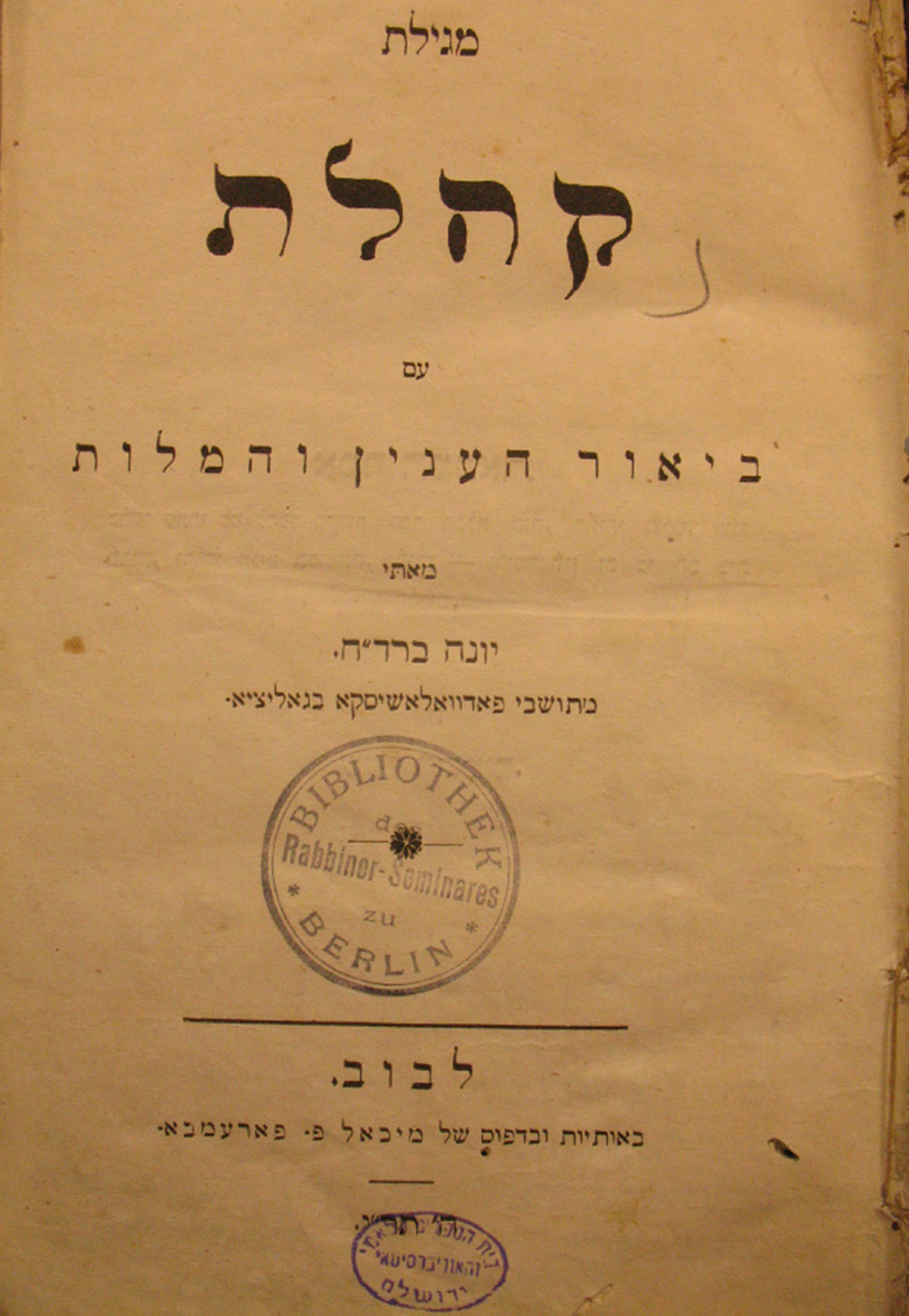
Who Wrote the Mekore Minhagim?

As I have previously discussed, there is a well known work on the sources and rationale for various customs titled Mekore Minhagim. Indeed, there are two works with that very same title – by two different authors – that cover the same material. The question is which author stole from the other? I hope that I can clear this up as there still appears to be a misconception about who is the plagiarizer.

First, a brief history about prior attempts to decipher who is the real author of Mekore Minhagim is in order. As I noted in my original post, the first edition of the sefer to come out was published in Berlin in 1846 with the author listed as R. Avrohom Lewysohn (1805-1861). That edition contained 100 questions and explanation about various customs. Then, in 1851, R. Yosef Finkelstein published under the same title a work with the very same information, but that contained only 41 of the 100 questions and explanations from the work published in 1846. Almost immediately, it was claimed that Finkelstein had plagiarized his work from Lewysohn. And if one had to guess – absent any additional information –it would appear that this is the case simply because Lewysohn’s work came out first; that is, unless Lewysohn could have read Finkelstein’s mind, the latter must be the plagiarizer.

But, this is not a simple case. Instead, the appearance of the plagiarism claims in a German periodical did not settle the issue. Thus, R. Lewysohn’s brother, Yehudah Leib Lewysohn, a Rabbi in Stockholm, after seeing Finkelstein’s name mentioned in a different capacity in the journal ha-Maggid, again pointed out that Finkelstein had plagiarized Mekore Minhagim from Lewysohn. R. Y.L. Lewysohn gave a run down of the controversy and included the fact that, eventually, the dispute was taken to court, which ultimately concluded that Finkelstein had plagiarized from Lewysohn. But, it seems that Finkelstein had someone swear on his behalf that he was indeed the author.

After R. Y.L. Lewysohn published that account, including the court case coverage, Finkelstein himself answered the charge in a later issue of ha-Maggid. Finkelstein claimed that he was indeed the author and Lewysohn had stolen from him. But, how to account for the fact his sefer came out later? Finkelstein claimed that as he was traveling through Germany, he stayed with Lewysohn and eventually showed him his (Finkelstein’s) manuscript of Mekore Minhagim. Lewysohn was extremely taken by this book. According to Finkelstein, Lewysohn must have copied his version and published it before Finkelstein was able to.

R. Y.L. Lewysohn responded – with a point by point rebuttal – that Finkelstein’s account was all untrue and challenged Finkelstein to go in front of a court again – but this never happened.

That is more or less a summary of the written record with respect to the controversy. So it seems there remains the possibility that Lewysohn did copy Finkelstein’s manuscript when they met in Berlin. And, in fact, many have come to Finkelstein’s defense. For instance, R. Tzvi Efraim Babad in Der Yid has an article where he uses the ha-Maggid article to show that Finkelstein was indeed the author. In particular, it seems that R. Babad didn’t like Lewysohn, as he was a German Rabbi and university educated, while Finkelstein was from a distinguished rabbinic Hungarian family. There is also an article in the latest Or Yisrael about this incident of plagiarism.

I think, however, that I can prove who the real author is. I can do so by using Finkelstein’s own defense from ha-Maggid to demonstrate that he, in fact, is the plagiarizer. As is many times the case, he created the noose by which to hang himself.

Finkelstein, in his defense, states as follows:

When I was in Prague I wrote the work “Rivid ha-Zahav” which discusses the laws of ritual slaughter and checking for imperfection of the lungs. Many great Rabbis praised this work amongst them the famous Gaon R. [Shlomo] Yehuda Leib Rapoport and, because so many people liked it, the book sold out and I had to publish it again. After this I published another book “Tzafnas Panach” on blemishes in the lungs [of an animal].

He then continues and discusses the “Mekore Minhagim” and how Lewysohn got it:

When I traveled to Germany to sell my book I stayed with [R. Lewysohn] . . . when he saw my work the ‘Mekore Minhagim,’ which I wrote in 1839, he asked to look at it.

From there Finkelstein posits that Lewysohn eventually copied it and printed it as his own.

So, now, in order to see who is actually right, we need to see if R. Finkelstein’s story works. The way to do this is to check the books that Finkelstein actually was selling. First, it is important to know that Finkelstein published three books aside from Mekore Minhagim. As mentioned above, he wrote Rivid ha-Zahav and Tzofnas Panach. In addition he published a book his father- in–law, R. Meir Avraham Csaba, wrote – Pri Tzadik. Pri Tzadik was published in 1839, Finkelstein’s first published work. Now, according to Finkelstein, in his response in ha-Maggid, he published Tzofnas Panach after he published Rivid ha-Zahav for the second time. So, that would make Tzofnas Panach the last book published. Also, according to Finkelstein there were two editions of Rivid ha-Zahav (these are the only editions of Rivid ha-Zahav) but when was Rivid ha-Zahav published? According to the title pages, one was published in Prague (1846) and the other in Ofen (1845). But, according to Finkelstein’s own testimony, these dates must be wrong — or at least one. The reason being, if you recall, is that Finkelstein said Rivid ha-Zahav was written in Prague and was praised by R. Rapoport -which you can see as there is an approbation from R. Rapoport. In particular, the first edition of Rivid ha-Zahav has this approbation according to Finkelstein’s own words. But, the only edition which has this approbation is the one with 1846 on the title page and the approbation itself is even dated the 6th of Av 5606 (1846). That means that, although the other edition of Rivid ha-Zahav states was published in 1845, in fact, it was published after the 6th of Av 5606. Which also means that Tzofnas Panach was also published sometime after the second edition of Rivid ha-Zahav was published.[1]

Now, for Finkelstein’s story to be true, he states that he was selling “his books” -“ספרי” that means his personal books. That means we can rule out Pri Tzadik as that was his father-in-law’s book and Finkelstein wouldn’t have called it “his.” So when did he travel to Germany to sell his books and to which books did he refer? Well, let’s take the earliest of his books – which according to what we have figured out – is the first edition of his Rivid ha-Zahav. That edition of the Rivid ha-Zahav had to have been published sometime after the 6th of Av, the time of the approbation. That doesn’t leave that much time in the year 5606, being that Av is the second to last month in the Jewish calendar. But, let’s say he had Rivid ha-Zahav published really fast and during the month of Av he was able to publish it and was already in Germany meeting up with Lewysohn. Well, and here comes the funny part, Lewysohn’s introduction to Mekore Minhagim (which is copied in Finkelstein’s as well) is dated 16th of Kislev 5606, which would be around December 1845. This, of course, means that if our calculations are correct and we take all of Finkelstein’s story as true, Lewysohn wrote the introduction at least ten months before Finkelstein ever came to town to sell his then, unpublished, Rivid ha-Zahav. Which means Finkelstein is a liar.

Thus, it would appear that we can now conclude who is the plagiarizer – Finkelstein. And, the fact is that Lewysohn is the real author of Mekore Minhagim.

Note:
[1] There is another reason the Tzafnas Panach must be the final book published although again according to the title page there is an earlier date. According to the title page it was printed in 1845, but now that we know the 1845 edition of Rivid ha-Zahav was in fact published after 1846 the Tzafnas Panach must also be published after that. This is so, because in the Rivid ha-Zahav with the title page which claims 1845 it also says the approbations for this will be published in my future work Tzafnas Panach (which in fact Tzafnas Panach includes). Thus, Tzafnas Panach must be after this second edition and thus must be after 1846 even though it claims an earlier date.

Sources: ha-Maggid No. 24 June 17, 1863 p. 192; No. 27, July 8, 1863, pp. 211-12; No. 36, September 9, 1863 pp. 283-84; No. 40, October 14, 1863, p. 316 (which are all available online here); R. Tzvi Ephraim Babad, “Printers, Copiers, Shasin, and Censor,” Der Yid 25 (Friday, September 22, 2000), section 2.


The Rogochover and More

The Rogochover and More

Marc B. Shapiro
In a recent Jewish Review of Books (Summer 2017), I published a translation of an interview R. Joseph Rozin, the Rogochover, gave to the New York Yiddish paper, Der morgen zhurnal. You can see the original interview here. The fact that the Rogochover agreed to the interview is itself significant. As is to be expected, the content of the interview is also of great interest.
In the preface to the interview, I mentioned that the Rogochover famously studied Torah on Tisha be-Av and when he was an avel, both of which are in violation of accepted halakhah. When he was once asked why, while sitting shiva, he learnt Torah, he is reported to have replied:[1]
ודאי, עבירה היא זו, וכשאקבל עונש על שאר עונותי יענישוני אף על עון זה, אבל אני אקבל באהבה וברצון את העונש על חטא זה, וכדאית היא התורה להלקות עליה
R. Yissachar Tamar cites an eye-witness who reported that the Rogochover said basically the same thing in explaining why he learnt on Tisha be-Av, and noted how wonderful it will be to be punished for studying Torah.[2]
ומה נעים לקבל צליפות על עסק התורה
The Hazon Ish was told that the Rogochover learnt Torah when he was in mourning and that he made another antinomian-like comment in justification of his behavior, namely, that he wants to be in the gehinom of those who learn Torah. The Hazon Ish replied that “this gehinom is the same gehinom for the other sins.”[3]
The various comments quoted in the name of the Rogochover show his great need for studying Torah, a need that simply did not allow him to put aside his Torah study, even when halakhah required it. Yet the antinomian implication of the Rogochover’s comments was too much to be ignored. R. Gavriel Zinner’s reaction after quoting the Rogochover is how many felt.[4]
ולא זכיתי להבין, הלא מי לנו גדול מחכמי הגמ’ שנפשם ג”כ חשקה בתורה ואפ”ה גזרו שבת”ב ובזמן אבל אסורים בלימוד התורה, ועוד שאחז”ל הלומד ע”מ שלא לעשות נוח לו שלא נברא.
It is thus to be expected that some authors deny that the Rogochover could have really said any of what I have quoted. And if he did say it, they feel that it must have been merely a joke or a comment not meant to be taken seriously, or that he did not want people to know the real reason he studied Torah while in avelut (namely, the Yerushalmi which will soon be mentioned).[5] R. Abraham Weinfeld goes so far as to say, with reference to one of the comments I have quoted that “It is forbidden to hear these words, and Heaven forbid to suspect that Rabban shel Yisrael [the Rogochover] would say this.”[6] 

Those who refuse to accept that the Rogochover meant what he said are forced to find a halakhic justification for his behavior, and indeed, when it comes to an avel studying Torah (and this would also apply to Tisha be-Av, the halakhot of which are not as stringent as those of personal mourning), there is a passage in the Yerushalmi, Moed Katan 3:5, that permits Torah study for one who has a great need.[7]  (This heter is not recorded in the Shulhan Arukh, but this would not have concerned the Rogochover.[8]) Yet it is important to remember that as far as we know the Rogochover never cited this passage in the Yerushalmi as justification for his studying Torah when he was sitting shiva.[9]

Now for something disappointing and even a bit shocking: Here are the two pages from R. Shlomo Yosef Zevin, Ishim ve-Shitot (Jerusalem, 2007), pp. 75-76, where you can see one of the“controversial” quotations (which as R. Zevin notes is taken from an article in Ha-Hed).

R. Menahem Kasher quoted the entire two pages from Ishim ve-Shitot in his Mefaneah Tzefunot (Jerusalem, 1976), pp. 1-2 in the note.
Look at the end of the first paragraph of the note on p. 2. The “problematic” quotation of the Rogochover, saying that he will happily be punished for his sin in studying Torah, as the Torah is worth it, has been deleted. Instead, the Rogochover is portrayed as explaining his behavior as due to the passage in the Yerushalmi. While all the other authors who discuss this matter and want to “defend” the Rogochover claim that his real reason for studying Torah was based on the Yerushalmi, in R. Kasher’s work this defense is not needed as now we have the Rogochover himself giving this explanation!

Yet the Rogochover never said this. R. Zevin’s text has been altered and a spurious comment put in the mouth of the Rogochover, By looking carefully at the text you can see that originally R. Zevin was quoted correctly. Notice how there is a space between the first and second paragraphs and how the false addition is a different size than the rest of the words. What appears to have happened is that the original continuation of the paragraph was whited out and the fraudulent words were substituted in its place. Yet this was done after everything was typeset so the evidence of the altering remains.
Look also at the third paragraph where it says
ההד, שם
However, this makes no sense as R. Zevin’s reference to Ha-Hed has been deleted. I do not see how anyone other than R. Kasher could have been responsible for this particular “editing.” 
As mentioned, many were troubled by the Rogochover’s antinomian-like comment.[10] Yet he is not the only one to speak like this. R. Joseph Hayyim (the Ben Ish Hai) in his Benayahu refers to an unnamed gaon who also learnt Torah when he was in avelut. When asked about this he did not refer to the Yerushalmi but answered in an antinomian fashion just like the Rogochover: “I know that I am violating the words of the Sages, and I know that on the day of judgment I will certainly be punished for this, but he [!] is prepared and willing to suffer and receive this punishment whatever it will be, because he is not able to withstand the pain of avoiding the study of Torah which is as difficult for him as death.”[11] Benayahu appeared in 1905. I do not think it is possible that at such an early date R. Joseph Hayyim could have heard a story about the Rogochover, so he must have had another great rabbi in mind.
The Lubavitcher Rebbe told a similar story.[12] When he was a youth, he had a teacher from Lithuania who lived in his home. He once found this teacher learning on Tisha be-Av. Young Menachem Mendel asked the teacher how is it that he was learning Torah on that day. The teacher replied: “When I come to the World to Come, I will be punished for one reason or another. I will be happy if I know that the reason I am being punished is because I learnt on Tisha be-Av.”[13]
The following subversive story with R. Israel of Ruzhin is also of interest, as it too shows a violation of accepted halakhah regarding Torah study on Tisha be-Av. It appears in R. Mordechai Hayyim of Slonim, Ma’amar Mordechai, vol. 2, p. 206.
הרה”ק מרוזין שהה פעם בימי בין המצרים במעינות המרפא, וביום צום תשעה באב אחר חצות היום, אמר לאחד מבני לוויתו שילמוד מסכתא משניות, ויעשה סיום בליל מוצאי התענית, ויסמכו על זה הקהל אשר שם ויאכלו בשר ואמר בלשו”ק: רבי שמואל קאמינקער אמר, שסיום מסכתא משניות חשוב כמו סיום מסכת גמרא, ועל רבי שמואל קאמינקער יכולין לסמוך כמו על אחד מגדולי הפוסקים. ועל האיסור ללמוד בתשעה באב אחר חצות, דאס נעם איך אויף מיר, און לאזן אידן עסן פלייש . . .

Returning to the interview with the Rogochover, he cites Maimonides who says that the word “Germany” is derived from the Hebrew word gerem, meaning “bone.”
Mishnah Negaim 2:1, in a passage that tells us how things used to be, says that Jews are neither black nor white, but in the middle (meaning, a Middle Eastern look). At the beginning of the Mishnah it speaks of a white spot that appears on a white man and on a black man. The word the Mishnah uses for “white man” is גרמני (German), and for “black man” it uses כושי. Germania was the Roman term for the area we call Germany, so it makes sense that the Mishnah, in describing a white man, would use that term.[14]
Apparently, Maimonides did not know the word גרמני. Thus, in his commentary to Negaim 2:1 he offers the explanation mentioned by the Rogochover, that גרמני is related to the word for bone. (In the interview, the Rogochover says that Maimonides refers to the Hebrew word גרם, but I wonder if this was a mistake on the interviewer’s part, as the word used by Maimonides is the Aramaic גרמא). Here is R. Kafih’s translation:
גרמני שם הלבן ביותר מיוחס אל העצם אשר שמו גרמא
Leaving aside the matter of the correct historical etymology, I wonder if Maimonides saw a problem with his explanation, namely, that for “black man” the Mishnah uses an ethnic identification, so one would expect it to also use such an identification in describing a white man. Furthermore, why would the Mishnah use an Aramaic word instead of the Hebrew עצם?
R. Elijah Benamozegh wonders how Maimonides did not realize what גרמני is referring to:[15]
והפלא על חכמת הרמב”ם שכתב כן ועשה עין של מעלה כאלו אינה רואה שדברי חז”ל מעידים ומגידים שגרמני שם אומה, לא זולת, ומה ענין לגרמא עצם בל’ ארמי?
R. Meir Mazuz asks, “How could Maimonides not have thought of this?” namely, that גרמני means German.[16] He explains that Maimonides was an Arabic speaker, and the way he knew Germany was by the term “Alemannia.” As such, when he saw the word גרמני in the Mishnah, since he did not know the term “Germany” he was forced to come up with a different explanation tying גרמני to “white.”[17]
What R. Mazuz did not know is that this explanation is not original to Maimonides and must reflect an earlier tradition.[18] I say this because R. Hillel ben Elyakim of Greece, who lived in the twelfth century (that is, contemporaneously with Maimonides) independently mentions this explanation. In his commentary to Torat Kohanim, ed. S. Kolodetzky, vol. 1, p. 190, he writes:
ומנלן גרמני הוי לבן כדגרסי’ בכל מקום גרמני מוכר כושי וכאן כושי מוכר גרמני דהיינו לבן דעצם מתרגמינן גרמא ועצם הוי לבן.
R. Hillel cites Bereshit Rabbah 86:3 which states: “Everywhere a white man (גרמני) sells a black man (כושי), while here a black man is selling a white man.” He also says דעצם מתרגמינן גרמא. If you look at Onkelos and Targum Ps. Jonathan to Genesis 2:23 this is exactly what you find.
When I found what R. Hillel wrote, I was quite excited, as I thought I had discovered something that no one else had taken notice of. Yet I later found that Jacob Nahum Epstein had already called attention to this in his notes to the commentary attributed to R. Hai Gaon to Seder Toharot (Berlin, 1921), p. 94 n. 32. He assumes that R. Hillel predates Maimonides:
ר”ה מארץ יון בפי’ ספרא דף קי”ג ב’ ור”מ אחריו הוציאוהו מן “גרמא”, עצם!
Returning to the Rogochover, everyone knows that the he put Maimonides above all other authorities. However, R. Zevin, Ishim ve-Shitot (Jerusalem, 2007), p. 125, calls attention to an example where in a practical halakhic matter the Rogochover rejected Maimonides’ view. See She’elot u-Teshuvot Tzafnat Paneah, vol. 1, no. 34:[19]
ואף דרבותינו הראשונים ז”ל וגם רבנו הגדול הרמב”ם לא ס”ל כן עפר אני תחת רגליו אך העיקר כמ”ש לדינא
The Rogochover’s sharp tongue is well known. For an example of how the Rogochover could even speak disrespectfully about the Tosafists, see Rav Tzair, Pirkei Hayyim (New York, 1954), p. 163.[20] Rav Tzair recalls how as a yeshiva student he went to meet the Rogochover where, we can only say, he was “blown away.” He writes:
אחר כך פנה אלי ואמר לי: ואתה בחור למה באת? יש לך קושיא, אמור! מלמלתי בבהלה את הקושיא שהיתה, כפי שאני זוכר, בתוספות של מסכת בבא מציעא, בדיני הפקר ומציאה. על זה השיב לי בבהלה כדרכו. הא, בתוספות? התוספות לא ידעו מה הם סחים; (“תוספות האט געפלוידערט”). נבהלתי, כמובן, לשמוע את הדיבורים הללו, ומלים נעתקו מפי. אמר לי, מה אתה נבהל? אני אראה לך כמה וכמה תוספות שלא הבינו את הגמרא, והתחיל להביא תלי תלים של דברי תוספות מכל הש”ס, והכל בעל פה, על פי הדף ודיבור המתחיל, ועירבב דבר אחד בשני ובבלי בירושלמי, עד שראה שראשי היה עלי כגלגל וחדלתי להבין את המשך הענינים.
Rav Tzair, ibid., p. 164, also mentions the Rogochover’s negative comment about R. Isaac Elhanan Spektor:
הנה הזקן יושב לו בקובנה וכותב ומדפיס וכותב ומדפיס עד אין סוף! מי מבקש זאת ממנו? כלום ספרים חסרים בעולם? הנה זקנך, ששמעתי עליו שהוא בעל-הוראה, יושב ופוסק שאלות. זה הכל מה שצריך. כל הרבנים הכותבים ספרים אינם יודעים בין ימינם לשמאלם.
Zvi Hirsch Masliansky, Maslianky’s Zikhroynes (New York, 1924), p. 107, who has a very negative view of the Rogochover, also records how he denigrated R. Isaac Elhanan as well as R. Samuel Mohilever and the Hibbat Zion movement. He further mentions that the Rogochover disparaged his own rebbe, R. Joseph Baer Soloveitchik:
צוזאמען מיט זיין גוואלדיגען זכרון, האט זיך ענטוויקעלט אין איהם זיין ווילדער עזות און חוצפה צו מבטל זיין אלע גאונים צוזאמען מיט זיין גרויסען רבי’ רבי יוסף בער.
See also R. Nathan Kamenetsky, Making of a Godol, pp. 743, 747, for other times that the Rogochover insulted R. Joseph Baer Soloveitchik. (On p. 744 Kamenetsky writes that the Rogochover received semikhah from R. Soloveitchik.)

Masliansky’s Hebrew autobiography is not an exact translation of the original Yiddish. (The English version is a translation from the Hebrew.) The Hebrew edition does not contain the passage just quoted. It also does not contain Masliansky’s concluding negative comment, p. 108:

ער האָט זיך צושריען און צוהיצט, און האָט צומישט און צופלאָנטערט פערשיעדענע ענינים, און ער האָט מיר אויסגעוויזען ווי א פאציענט פון א משוגעים הויז. איך האב אים נאָר ניט גענעטפערט; איך בין ארויס א פערטרויערטער און געדעקט: “אָט דאָס זיינען דיינע גאונים, מיין פאָלק ישראל!”
Kamenetsky, Making of a Godol, p. 747 n. b, mentions the Hebrew edition’s deletion of these “revolting lines of the original text.” We have a number of descriptions of the Rogochover from people who met him, and while all portray him as unusual, none have the negative spin of Masliansky. Perhaps it was the Rogochover’s anti-Zionism that turned Masliansky against him.  
R. Moshe Maimon called my attention to She’elot u-Teshuvot Tzafnat Paneah ha-Hadashot (Modi’in Ilit, 2012), vol. 2, p. 391 (unpaginated), where we see that in newly published material the Rogochover referred to the Vilna Gaon as “Rabbenu ha-Gra.” This is significant because in the interview I published the Rogochover was hardly complimentary to the Vilna Gaon.[21]
She’elot u-Teshuvot Tzafnat Paneah ha-Hadashot is quite an interesting publication and includes the Rogochover’s notes to some poems of R. Judah Halevi. It is not that the Rogochover had any great interest in Halevi’s poetry. However, the Rogochover was one of those people whose mind was such that he had something to say about everything he read.
I encourage anyone interested in the Rogochover to watch this wonderful video by Louis Jacobs. The Rogochover was one of Jacobs’ heroes, and somewhere he mentions that the Rogochover was one of the people he would have loved to have met.
Regarding Bialik’s visit with the Rogochover that I mentioned in the Jewish Review of Books article, Maimon called my attention to this article by Noah Zevuluni [22]. For more on the meeting of Bialik and the Rogochover, see Doar ha-Yom, Jan. 10, 1932, p. 2, and Davar, April 17, 1935, p. 16 (where it mistakenly states that Bialik said that you could make ten Einsteins out of one Rogochover. He actually said that you could make two Einsteins out of one Rogochover.). The last two sources were brought to my attention by R. Shimon Szimonowitz.
Yossi Newfeld called my attention to the following two works focused on the Rogochover: Regarding the Rogochover and the Lubavitcher Rebbe, there is an MA dissertation by Yisrael Ori Meitlis, “‘Ha-Lamdanut ha-Filosofit’ shel Rabbi Yosef Rozin bi-Derashotav shel Rabbi Menahem Mendel Schneersohn (ha-Rebbe mi-Lubavitch),” (Bar-Ilan University, 2013). There is also the volume Ha-Tzafnat Paneah be-Mishnat ha-Rebbe (Brooklyn, 2003). In a previous post I called attention to R. Dovber Schwartz’s wonderful book The Rogatchover Gaon.
It is often said that the Rebbe received semichah from the Rogochover, yet there is no documentary evidence of this. The origin of this notion might be the Rebbe’s mother, who stated as such. See the comprehensive and beautifully produced new book on the Rebbe by R. Boruch Oberlander and R. Elkanah Shmotkin, Early Years.
In my article I mentioned the Rogochover’s unique perspective on the halakhic status of civil marriage. Those interested in this topic should consult R. Menahem Mendel Tenenbaum, Nisuim Ezrahiyim be-Mishnato shel Ha-Rogochovi z”l (n.p., 1988). This book contains an analysis of six responsa of the Rogochover on the topic.
One final point I would like to make about the Rogochover relates to his view of secular studies. He was one of those who responded to R. Shimon Schwab’s query about the halakhic validity of the German Torah im Derekh Eretz approach.[23] You can find his letter in Ha-Ma’yan[24] 16 (Nisan 5736), pp. 1ff. Among the significant points he makes is that, following Maimonides, a father must teach his son “wisdom.” He derives this from Maimonides’ ruling in Mishneh Torah, Hilkhot Rotzeah 5:5:
הבן שהרג את אביו בשגגה גולה וכן האב שהרג את בנו בשגגה גולה על ידו. במה דברים אמורים בשהרגו שלא בשעת לימוד או שהיה מלמדו אומנות אחרת שאינו צריך לה. אבל אם ייסר את בנו כדי ללמדו תורה או חכמה או אומנות ומת פטור.
He adds, however, that instruction in “secular” subjects is not something that the community should be involved in, with the exception of medicine, astronomy, and the skills which allow one to take proper measurements, since all these matters have halakhic relevance. In other words, according to the Rogochover, while Jewish schools should teach these subjects, no other secular subjects (“wisdom”) should be taught by the schools, but the father should arrange private instruction for his son.
רואים דהרמב”ם ס”ל דגם חכמה מותר וצריך אב ללמוד לבנו אבל ציבור ודאי אסורים בשאר חכמות חוץ מן רפואה ותקפות [!] דשיך [!] לעבובר [צ”ל לעבור] וגמטרא [!] השייך למדידה דזה ג”כ בגדר דין.
He then refers to the Mekhilta, parashat Bo (ch. 18), which cites R. Judah ha-Nasi as saying that a father must teach his son ישוב המדינה. The Rogochover does not explain what yishuv ha-medinah means, just as he earlier does not explain what is meant by “wisdom,” but these terms obviously include the secular studies that are necessary to function properly in society.
The publication of this letter of the Rogochover was regarded as quite significant. Yet as far as I know, no one has pointed out that the main point of the letter had already appeared in print. In 1937 R. Judah Ari Wohlgemuth published Yesodot Hinukh ha-Dat le-Dor. On p. 250 he included the following comment of the Rogochover, found in the margin of Rogochover’s copy of the Mishneh Torah, Hilkhot Rotzeah 5:5.
נראה לי דר”ל שאר חכמות גם כן חייב האב ללמדו
Excursus 1
For another example of Maimonides offering a speculative etymology for a word he did not know, see his commentary to Yadayim 4:6 regarding the word המירם. In his commentary to Sanhedrin 10:1, Maimonides explains the term אפיקורוס as coming from an Aramaic word. This is surprising as Maimonides knew of the Greek philosopher Epicurus and refers to him in Guide I:73, II:13, 32, III:17. (Even if Maimonides had not heard of Epicurus when he wrote his commentary on the Mishnah, we know that he revised this work throughout his life and yet he never altered his explanation of אפיקורוס.) See Arukh Shalem, ed. Kohut (Vienna, 1878), s. v. אפיקורוס. See also R. Yitzhak Sheilat, Hakdamot ha-Rambam (Jerusalem, 1992) p. 185, who believes that Maimonides knew the real origin of the word but was only following the Talmud’s “midrashic” derivation of the term from the Aramaic word אפקירותא  (see Sanhedrin 100a). See also R. Hayyim Yehoshua Kasowski, Otzar Leshon ha-Mishnah, s.v. אפיקורוס:
וע”פ דמיון השם הזה אל הפעל פקר בארמית השתמשו בו לכנוי נרדף למין וצדוקי ובייתוסי
R. Simeon ben Zemah Duran, Magen Avot (Livorno, 1785), 1:2 (p. 4b), and the section of this work on Avot 2:14also called Magen Avot (Leipzig, 1855), and R. Joseph Albo, Sefer ha-Ikarim I:10, point to Epicurus as the origin of the term אפיקורוס.
In his commentary to Kelim 30:2 and Parah 1:3, Maimonides explains two Greek words with Hebrew etymologies. I see no reason to accept R. Kafih’s opinion, expressed in his notes ad loc., that in these cases Maimonides knew that the words were Greek and was simply offering a “remez.” In fact, in his commentary to Kelim 30:2 he writes explicitly:


והוא לדעתי מלה מורכבת  

If he was simply offering a “remez” he would not have written, “In my opinion,” followed by the etymology. At other times, however, it is possible that Maimonides knew that the words were Greek and he did not intend to offer a scientific etymology. This is the approach of Dror Fixler, who applies it even to the case from Kelim 30:2 just mentioned.[25]

R. Kafih is, of course, correct that the talmudic sages would at times offer a Hebrew etymology for a word that they knew was not Hebrew. The example he offers is Megillah 6a: “Why is it called Tiberias? Because it is situated in the very center of the land of Israel.” The Sages obviously knew that the city was named after a Roman emperor, and the Hebrew etymology can only be regarded as a form of midrash. Apart from modern scholarly sources that discuss the phenomenon of “judaizing” non-Hebrew words, see R. Jacob Emden, Lehem Nikudim, Avot 2:14:
וכן הוא מנהג החכמים ז”ל לגזור ממלות יוניות שמות ופעלים עברייים וארמיים.
R. Emden’s comment was precipitated by the word אפיקורוס which appears in Avot 2:14. R. Emden also mentions the word סנהדרין. See also R. Samuel Moses Rubenstein, Torat ha-Kabbalah (Warsaw, 1912), pp. 29ff. Some of R. Rubenstein’s examples are themselves speculative. For instance, he claims that the words בן דינאי in Kelim 5:10 are a “judaization” of the word “Bedouin.” 

R. Rubenstein notes a number of examples of post-talmudic authorities not realizing the real origin of a word and offering a Hebrew etymology. One of these appears in R. Ovadiah Bertinoro’s commentary to Sotah 9:11, where R. Bertinoro writes as follows regarding the Greek word “Sanhedrin.”

ונקראים סנהדרין ששונאים הדרת פנים בדין
(ש and ס are interchangeable.) Yet I wonder, is R. Rubenstein correct that R. Bertinoro is offering an actual Hebrew etymology for the word “Sanhedrin”? The passage just quoted might be no more than a “midrashic” etymology, which R. Bertinoro would acknowledge is not the real origin of the word. Jacob Reifman refers to R. Bertinoro’s etymology as a דרש רחוק מאד. See Reifman, Sanhedrin (Berditchev, 1888), p. 3. He then adds:
ולא אדע עתה מאין לקח, ואולי הוא אך יליד הר”ע עצמו
Reifman was unaware that this etymology is also recorded by R. Jacob Moelin, so it could not have been original to R. Bertinoro. See Sefer Maharil, ed. Spitzer (Jerusalem, 1989), p. 611.
Even if we conclude that the etymology mentioned by R. Moelin and R. Bertinoro was simply “midrashic,” there is no reason to assume that they knew that the word סנהדרין was Greek, knowledge of which was not common among Jews of their time and place. See R. Avigdor Tzarfati, Perushim u-Fesakim le-Rabbenu Avigdor ha-Tzarfati (Jerusalem, 1996), p. 233, who does not know the word’s Greek origin and writes:
ואני שמעתי סנהדרין לשון סני דרין פי’ שהיו שונאין דורונות
In this case, it does seem that R. Avigdor is offering what he thinks is the actual etymology of the word. R. Yom Tov Lippman Heller, Tosafot Yom Tov, beginning of Sanhedrin, writes that סנהדרין is an Aramaic word, so he too did not know its Greek origin.
Returning to R. Bertinoro, in his commentary to Avot 2:14 he offers an unscientific etymology of the word אפיקורוס, but he must have known who Epicurus was, so I assume that this is a “midrashic” etymology. 
לאפיקורוס: לשון הפקר שמבזה את התורה ומחשיבה כאילו היא הפקר. אי נמי משים עצמו כהפקר ואינו חס על נפשו לחוש שמא תבוא עליו רעה על שמבזה את התורה או לומדיה.
To turn to a different question, are there any examples in the Talmud where an etymology is not simply “midrashic” but intended to be taken seriously, and yet we know that it is mistaken? The Mishnah in Ketubot 15b mentions a “hinuma.” On 17b the Talmud asks what a hinuma is, and quotes R. Johanan who says: “A veil under which the bride [sometimes] slumbers (דמנמנה).” As Rashi explains, R. Johanan is making a connection between the word הינומא and מנמנה which itself is related to the word תנומה (slumber).[26]
ופעמים שמנמנמת בתוכו מתוך שאין עיניה מגולין ולכך נקרא הינומא על שם תנומה
The Arukh, s.v. הנמא, cites R. Hananel who states that hinuma is a Greek word. It is possible to understand R. Hananel as meaning that R. Johanan’s explanation was no more than a “midrashic” etymology. (This is on the assumption that he understood the passage as Rashi did.) However, this passage in R. Hananel also assumed a life of its own, as some saw it as providing support for the assumption that the Sages were not always correct in their etymologies. This matter has recently been discussed by Hanan Gafni in his fine book, “Peshutah shel Mishnah,” pp. 184ff., so there is no need for me to repeat what he has written.
Excursus 2
R. Raphael Mordechai Barishansky was shocked to read what the Rogochover said about the Vilna Gaon, as I think we all are. He responded strongly in an article in Der morgen zhurnal which was later reprinted in his Osef Mikhtavim Mehutavim (New York, 1952), pp. 167-169. Even though his words are strong, R. Barishansky shows great respect for the Rogochover. 

This is not the case with R. Abraham Aaron Yudelevitz whose attack on the Rogochover is quite sharp. It needs to be said, however, that this came after the Rogochover referred to R. Yudelevitz – who was himself an outstanding scholar – in a very negative way. In printing the Rogochover’s letter, R. Yudelevitz tells us that he cut out some of Rogochover’s harshest words, but we still get the picture. The Rogochover was responding to R. Yudelevitz’s novel view that halitzah can be done with an agent, and the Rogochover referred to R. Yudelevitz as a בן סורר ומורה. See R. Yudelevitz, Av be-Hokhmah (New York, 1927), p. 82. [27]

Here is some of what R. Yudelevitz said in response, ibid., pp. 83,85-86. The language is very sharp (and also refers to how the Rogochover rejected something the Vilna Gaon wrote):
פער פיו בזלזולים כהאשה בת בוזי היושבת בשוק ומוכרת עיגולים בשער האשפתות ואולתו כפרתו כי אין קץ לשטותו ולגאותו.
אבל הוא אינו חושש לזה, לא להרמב”ם ולא להשו”ע, כי הוא חושב כי עד שבא הוא לעולם לא היתה לישראל תורה כלל כי לא הבינו תורה מאומה וממנו התחילה התורה ובו תסיים וראוי היה לו לומר דכל מי שאינו אומר כמותו יתכן כי הוא עוד גאון אבל אינו עוד גאון עצום ויחיד בדור כמוהו, אבל גאות אדם תשפילנו כתיב לכן הוא בגאותו שחקים משפיל את עצמו כי אמר רק דברים פשוטים הגונים לבור ולא גאונות והאיש שאינו אומר כמוהו הוא פחות מתלמיד בור ולא שייך בו גדר זקן ממרא ורק הוא שאומר דברי בורות יכול להיות זקן ממרא ח”ו ובאמת כי כל התורה שלנו מונחת במוחו בכח זכרונו הנפלא אבל כח הבנתו קטנה מהכיל זה (כי כח הזכרון וכח הבנה באדם הם שני כחות נגדיים זה לזה כידוע), ולכן הוא מבולבל ומשוגע ומקיים מ”ע והיית משוגע בכל פרטיה ודקדוקיה כראוי לצדיק ובגודל חסידותיה הוא מבטל גם דברי הגר”א מווילנא זצ”ל והוא יושב בעינים על הדרך כי תורתו מלאה עינים, עיין עיין, אבל אינה ברה מאירת עינים רק סמיות עינים.
Regarding the Vilna Gaon, I know of only one other figure in the twentieth century who expressed a somewhat critical view of him and that is R. Nahum Ben-Horim. Here is his picture.
  
I found the picture on this website, which is an ongoing translation of the important eight volume Leksikon fun der nayer yidisher literatur, which contains over 7000 names. The translator is Professor Joshua Fogel who, you might be surprised to learn, is not a Yiddishist. He is a professor of Chinese and Japanese history at York University in Toronto. In addition to his numerous publications in Chinese and Japanese Studies (almost fifty books written, translated, or edited), he has also published four volumes on the Talmud. See here. I think readers will find the introduction to his book on Tractate Avodah Zarah particularly interesting. See here. Fogel is just one of the many people whose lives have been enriched by the ArtScroll translation of the Talmud.
Ben-Horim, the author of Hakhmei ha-Talmud (Jerusalem, 1922) on R. Yohanan ben Zakai (among other books), was a very minor figure, but it is interesting nonetheless to see what he had to say. The following is a letter that I found here in the Chaim Bloch papers at the Leo Baeck Institute, AR7155-7156, p. 950.
 

As you can see, he writes as follows about the Vilna Gaon.

והוא בעצמו היה רחוק מאורחא דמהימנותא והראיה כי רדף צדיקים תמימים באף והחרים אותם. הגר”א היה בעל שכל חריף וגאון בידיעות אולם הוא לא היה מעיילי בלא בר לפני ולפנים וטעה והטעה רבים.
When he writes that the Gaon was not מעיילי בלא בר לפני ולפנים, this is a disparaging remark which comes from Sanhedrin 97b and means that the Gaon was not among those “who enter [the heavenly court] without restriction.”
It is also shocking to see Ben-Horim write:
מי שיודע ללמוד מעט או הרבה אסור לו להיות טפש ובעל גאוה וכאלה היו רבים בין הראשונים.
Returning to R. Yudelevitz, here is a picture of him that I previously posted.
He is on the right and R. Gavriel Zev Margulies is on the left. The picture is from 1925 and was taken outside the White House. R. Yudelevitz and R. Margulies were part of a delegation that met with President Calvin Coolidge. For a detailed discussion of R. Yudelevitz and the halitzah controversy, see R. Yoel Hirsch’s Yiddish article here. For another informative article by Hirsch on R. Yudelevitz, see here.
Everyone assumes that the idea of halitzah with an agent originated with R. Yudelevitz. However, R. Isaac Raphael Ashkenazi, the rav of Ancona, refers to this notion in a responsum from 1884.[28] He mentions that the rabbi of Modena (whose name is not mentioned) suggested doing halitzah with an agent. R. Ashkenazi strongly rejects this suggestion:
כי דבר זה מתנגד לפשט הכתובים ולשורש המצוה כאשר יבין בנקל כל מבין
Regarding halitzah, you can see an actual ceremony here and here, with R. Aryeh Ralbag presiding.
* * * * * *
1. It has been a while since I had a quiz, so here goes. In the current post I mentioned the prohibition of Torah study on Tisha be-Av. This is an example where the halakhah of Tisha be-Av is stricter than that of Yom Kippur. Many authorities rule that there is also something else that is forbidden on Tisha be-Av but permitted on Yom Kippur. Answers should be sent to me.
2. In my last post I raised the question as to why Middot and Kinnim are the only Mishnaic tractates included in Daf Yomi. Menachem Kagan, himself a Daf Yomi magid shiur, wrote to me that only these tractates of the Mishnah are included in the Vilna Shas as if they are talmudic tractates, by which I mean that they continue the page numbers of other talmudic tractates. We do not know why these mishnaic tractates were included in the Vilna Shas in this fashion, but this is certainly the reason why they were included in Daf Yomi. As to why only Shekalim from the Jerusalem Talmud is included in Daf Yomi, Kagan correctly notes that by including Shekalim the entire order of Moed is complete.
3. Betzalel Shandelman sent me the title page of a vocalized edition of the Mishnah Berurah. As you can see, R. Moses Rivkes’ name is vocalized as Ravkash. Shandelman also sent me the title page of the Oz ve-Hadar edition of the Mishnah Berurah and it does the same thing. I have never seen this vocalization before and it is incorrect. His name was Rivkes, which is from the word Rivkah, supposedly the name of his mother. Similarly, R. Joel Sirkes was called this, as his mother’s name was Sarah. R. Moses Isserles was called this as his father’s name was Israel. The pattern is clear: Rivkes, Sirkes, Isserles.[29] In each case the final letter is a sin, not a shin.

4. Readers have sometimes asked for a list of places where I will be speaking. It happens that there are a number of places in the next couple of months.
December 1-2, 2017, Shaarey Zedek, Valley Village, CA.
December 15-16, 2017, Ohel Leah, Hong Kong

December 29-30, 2017, Shaare Shalom and Kingsway Jewish Center, Brooklyn. On Saturday night, Dec. 30, 7:30pm at Kingsway Jewish Center I will be speaking on “Are We Really One? Orthodox Separatism from Germany until Today.”

January 5-6, 2018, Young Israel of Holliswood, Queens
January 19-20, 2018, Skylake Synagogue, North Miami Beach.
I will also be at Majestic Retreats’ wonderful Passover program in Fort Lauderdale.

[1] R. Shlomo Yosef Zevin, Ishim ve-Shitot (Jerusalem, 2007), pp. 75-76. R. Zevin, p. 75, also mentions that the Rogochover learnt Torah on Tisha be-Av.
[2] Alei Tamar, Berakhot, vol. 1, p. 96b.
[3] Orhot Rabbenu: Ba’al ha-“Kehilot Ya’akov” (Bnei Brak, 2001), vol. 4, p. 184.
[4] Nit’ei Gavriel, Avelut, p. 551 (ch. 106). In his discussion, R. Zinner calls attention to the fascinating information in R. Hayyim Karlinsky, Ha-Rishon le-Shoshelet Brisk (Jerusalem, 1984), p. 321, that when R. Joseph Baer Soloveitchik (the Beit ha-Levi) was sitting shiva for his father, he wanted people to tell him Torah insights from his father. When asked if this is not forbidden as Torah study during avelut, R. Soloveitchik replied:
חידושי תורה של הנפטר לא זו בלבד שמותר לבנו האבל לשמוע, אלא אדרבה! מצוה לו לשמעו. שכן מלבד שיש בהם משום זכות לנשמתו של הנפטר . . . הרי הם מגדילים ומרבים את צערו ויגונו של האבל בהעריכו יותר את אבידתו הגדולה בפטירת אביו.
[5] See e.g., R. Avraham Yekutiel Ohev Tziyon, Ya’alat Hen, vol. 1, p. 290; R. Hayyim Kanievsky. Derekh Sihah (Bnei Brak, 2004), 487.
[6] R. Abraham Weinfeld, Lev Avraham, no. 98.
[7] See R. Chaim Rapoport, “Sipurim Temuhim . . .,” Hearot u-Veurim 33:2 (2013), pp. 55-67, for an excellent discussion of the matter.
[8] R. Joseph Karo cites the passage from the Yerushalmi in Beit YosefYoreh Deah 384, but adds that this view was not accepted. Shibolei ha-Leket, ed. Buber (Vilna, 1887), Hilkhot Semahot no. 26 (p. 177), appears to be the only rishon to accept the Yerushalmi’s position. See R. Ovadiah Yosef, Yabia Omer, vol. 2, Yoreh Deah no. 26:3.
[9] R. Hayyim Kanievsky. Derekh Sihah, p. 487, thinks that the Yerushalmi’s position is why the Rogochover studied Torah while sitting shiva, but he did not want to tell people that this was his reason, presumably, because this would seem haughty. There are examples of other great scholars who studied Torah while sitting shiva, and they indeed explained their behavior by citing the Yerushalmi. See e.g., R. David Falk, Be-Torato Yehegeh (Jerusalem, 2012), p. 76. Yet this still remains problematic for some. See e.g., R. Moshe Shulzinger, Peninei Rabenu Yehezkel (Zikhron Meir, 1992), vol. 1, p. 48, who cites an unnamed “gaon” who did not approve of using the heter of the Yerushalmi and commented:
איך אפשר שהדין הנפסק שאבל אסור בת”ת נאמר רק ליושבי קרנות, ולא לת”ח המבינים ומרגישים בתורה כי היא חייהם ולהוטים אחרי’, אתמהה.
It is reported that while sitting shiva, R. Hayyim Soloveitchik studied in depth those Torah subjects that are only permitted to be studied in a perfunctory way. See Kamenetsky, Making of a Godol, p. 932. Kamenetsky also quotes R. Joseph B. Soloveitchik that according to R. Hayyim study that is not in depth is not even regarded as Torah study
[10] Speaking of antinomianism, see Yehudah le-Kodsho (Tel Aviv, 2001), vol. 3, pp. 117-118, where the hasidic rebbe R. Shlomo Eger of Lublin writes to the Rogochover arguing that as long as some prayer is said in the morning in the זמן תפילה, one can recite the morning Amidah after this time: יכולין להתפלל אימת שירצה. Unfortunately, we do not have the Rogochover’s response to R. Eger, in which he certainly would have blasted this unprecedented suggestion.
[11] BenayahuBerakhot 24b (p. 8a(.
[12] See Rapoport, “Sipurim Temuhim,” (above, n. 16), pp. 63-64. See ibid., note 50, for the numerous places in the Rebbe’s works where the story is found.
[13] For an interesting hasidic passage that includes Tisha be-Av but focuses on fasting rather than learning Torah, and includes a shocking comment about the Anshei Keneset ha-Gedolah, see R. Abraham Yelin, Derekh Tzadikim (Petrokov, 1912), pp. 13b-14b (emphasis added):
ושמעתי מחסיד ישיש א’ שנסע להרה”ק ר’ יחזקאל מקאזמיר ז”ל שהוא היה מקיל גדול בתעניות, ואמר שאנשי כנסה”ג שתקנו התעניות מתביישין על שלא הסתכלו בדורות אלו, וסיפר כמה ענינים מקולותיו שהיה קשה לי לכתוב, ובשם רבינו הקדוש ז”ל מפאריסאב שמעתי שאמר בזה”ל מוזהר ועומד אני מהה”ק ר’ נתן דוד ז”ל משידלאווצע לדרוש ברבים ששום אשה שראויה עדיין לילד לא תתענה כ”א ביום הקדוש, ולכן עכ”פ אדרוש זאת לידידיי.
I will deal with fasting in my next post.
[14] See the Vilna Gaon’s commentary and Tiferet Yisrael, ad loc. See also the Vilna Gaon’s commentary to I Chron. 1:4.
[15] Em la-Mikra, Gen. 10:2.
[16] Bayit Ne’eman 41 (17 Kislev 5777), p. 2. R. Mazuz cites R. Benamozegh. See also R. Mazuz, Mi-Gedolei Yisrael, vol. 3, p. 55.
[17] See Excursus 1.
[18] Kohut, Arukh ha-Shalem, s.v. גרמן, also did not know this, as he writes:
הרמב”ם גוזרו מלשון גרם עצם, וקשה להלמו!
[19] There are two “volume 1” of the Tzafnat Paneah. The one I refer to is the volume published by Mrs. Rachel Citron, the Rogochover’s daughter.
[20] See Yair Borochov, Ha-Rogochovi (n.p., n.d.), p. 179, for a report that the Rogochover suggested that the head pains he suffered from were punishment for perhaps having treated rishonim and aharonim without the proper respect. There is something very strange in this book on p. 176, which is cited מפי השמועה (see sources on p. 419). Borochov states that the Rogochover’s opinion was that Muslims are worshipers of avodah zarah, as they worship the moon! This is so absurd that it is difficult to believe that the Rogochover could have said it. Borochov then states:
והגאון המשיך: הרמב”ם לא פסק שהם עובדי עבודה זרה, כיוון שהוא התגורר בארצות האיסלם ופסק כזה היה בגדר סכנה ופיקוח נפש.
It is simply impossible to believe that the Rogochover could have said something so outlandish.
[21] See Excursus 2.
[22] Regarding the Rogochover’s harsh comments about other great Torah scholars, and how he referred to these scholars,  Zevuluni writes:

  התבטאויותיו החריפות כלפי רבים מגדולי התורה בדורו ואף בדורות הקודמים, לא גרמו בדרך כלל למרירות ולנטירת  איבה . . . הוא היה נוהג לקרוא לגדולי הדור ואף בדורות הקודמים בשמותיהם הפרטיים

Zevuluni records the following story that he heard from the Rogochover. The Rogochover was once a dayan in a large monetary dispute. After a compromise was reached, the litigants put a significant amount of money on the table as payment to the dayanim. The other two dayanim refused to take the money and the Rogochover therefore took it all. He explained that the Talmud, Hagigah 4a, states: “Who is [deemed] an imbecile (shoteh)? One that destroys all that is given to him.” The Rogochover said that one would have expected the Talmud to say, “One that destroys all that he has” rather than “all that is given to him.” From here, the Rogochover stated, there is a proof that if someone gives you something and you refuse to accept it, that you are an imbecile. The Rogochover added, “I do not want to to included in this category.”

Kamenetsky, Making of a Godol, also records comments of the Rogochover about other Torah scholars. See e.g., p. 743 n. i, that in 1934 the Rogochover said that there is no one in Eretz Yisrael who knows how to learn.

Interestingly, on p. 739, Kamenetsky quotes his father that R. Hayyim Soloveitchik and R. David Friedman of Karlin were greater scholars than the Rogochover.

[23] I discuss this matter in Between the Yeshiva World and Modern Orthodoxy, pp. 152-153, and in “Torah im Derekh Eretz in the Shadow of Hitler,” Torah u-Madda Journal 14 (2006-2007), pp. 85-86.
[24] In Modern Hebrew the word מעין is pronounced ma’ayan, as if there is a patah under the ayin. In reality, there is a sheva under the ayin. See Yehoshua Blau, “Al ha-Mivneh ha-Murkav shel ha-Ivrit ha-Hadashah le-Umat ha-Ivrit she-ba-Mikra,”Leshonenu 54 (2000), pp. 105-106.
[25] See Fixler, “Perush ha-Rambam le-Milim ha-Yevaniyot she-ba-Mishnah,” Asif 2: Tanakh u-Mahashavah (2015), pp. 384-393.
[26] Rashi’s explanation is not without problems. See R. Weinberg, Seridei Esh, vol. 3, p. 87.
[27] R. Elijah David Rabinowitz-Teomim also was very critical of the Rogochover, yet any such comments have been censored in his published writings. However, one passage was published from manuscript in Shmuel Koll, Ehad be-Doro (Tel Aviv, 1970), vol. 1, p. 202:

 והרב ר’ יוסף ראזין נ”י הנקרא הראגאצובער מדינאבורג, אמר שדברי הח”ס הם דברי שטות – ונבהלתי לשמוע קלות הדעת ממי שהוא רב יושב כסאות למשפט הוראה לדבר דברים כאלה על אור עולם הח”ס ז”ל, אשר בצדקתו ורוחב לבבו כפתחו של אולם הוא כאחד הראשונים ומי כמוהו מורה בכל חדרי תורה, ובעוה”ר רבו הקופצים בראש שלא למדו כל צרכן, ולא שימשו כל עיקר שמוש ת”ח, אשר לחד מ”ד עדיין הוא ע”ה כבברכות מ”ז ב’, חבל על דאית לי’ דרתא ותרעה לדרתי’ ל”ע, ואף למאן דל”ל גם דרתא
[28] VaYa’an Yitzhak, Even ha-Ezer, no. 15.
[29] When I say “the pattern” I mean the pronunciation of the first syllable, as Isserles was actually probably pronounced “Israls.” The final “s” is a possessive so Moses Israls (Isserles) = “Moses of Israel”, Joel Sirkes = “Joel of Sirka (Sarah), and Moses Rivkes = “Moses of Rivkah.” See R. Hayyim Yitzhak Cohen’s letter in Or Yisrael 45 (Tishrei 5767), p. 252. Other surnames that come from a female progenitor are, as Shimon Steinmetz reminded me, Chajes, Edels, and Pesseles. I assume that Perles is also to be included in this list. I do not know about the name Fleckeles, but there is a place in Germany called Fleckl, so that might be the origin.


Rav Ovadia Yosef, ZT”L

Dear Seforim Blog readers,
This past Monday an era ended. As many prominent rabbonim mentioned, during the levaya of Rav Ovadia Yosef, there was the era of Tannaim, the era of AmoraimGeonimRishonimAchronim and the era of Rav Ovadia Meor Yisroel. Each one of us merited living in his generation. He was the Moshe Rabbeinu of our generation (Sukkah 39a), not merely in personal greatness but characteristically as well. He acquired the Torah reaching great heights, nevertheless descended from his league and set it before the nation – the young and the old, the learned and the uninformed. With all his responsibilities, he was attentive to the nations needs. Moshe Rabbeinu merited having the Torah ascribed to him by sacrificing his life for it (Mechiltah, 17); Rav Ovadia devoted his last energy for its flourishing.
The void left by the passing of Rav Ovadia ob”m is felt throughout the Jewish nation. Eulogies throughout the world are being given illustrating the nation’s emotions. In Israel, one yeshiva has even been collaborating with a well known radio channel in arranging for the completion of Talmud Bavli every day of the shiva. It connects the masses and furthers Rav Ovadia’s mission: spreading Torah. Our Torah is great but so is our nation. By uniting as one, no feat is too great for us. Over time, that is essentially how Rav Ovadia grew to be who he came to be and that was how he spread the Torah. Page after page, sefer after sefer. A shiur in this neighborhood and ashiur in that country. The establishment of Jewish schools in different countries for our brethren lacking Jewish identity. Responsa upon responsa he aided the nation in coping with all the various circumstances we faced. It is how he produced such significant seforim, and it is how he systematically rebuilt Sephardic Jewry and impacted World Jewry. His love for each individual, the tears shed for every Jewish child, soldier or aguna all served as the life lesson we sought. Let us all exercise our unique potential and devote some time, however minimal, and begin to reflect his life’s mission.
A study initiative of Talmud Bavli and Mishnayot is ongoing in the Diaspora. An uplifting siyum will be held on the shloshim (November 5, 2013, אור לב’ כסלו) in the Tri-state area, in memory of Rav Ovadia. An updated list of available masechtot and perakimcan be viewed here. Anyone wishing to partake in this project or to request additional (sub)divisions not listed can email requests directly to SiyumforRavOY74@gmail.comDue to the disproportionate requests for particular materials (dafim, perakim, masechtot) all divisions will be reserved upon first-come first-serve basis. A second cycle will begin once the first is completed.


Legacy Judaica: Astrological Title Pages, R. Hutner, and Other Items of Note

Legacy Judaica‘s Spring auction is on May 8, 2022. The catalog includes some especially rare first editions, Siddur ha-Shelah, (no. 119), Mesilat Yesharim (no. 45), a volume of the Bomberg edition of the Talmud (lot 10), and some other items of interest.

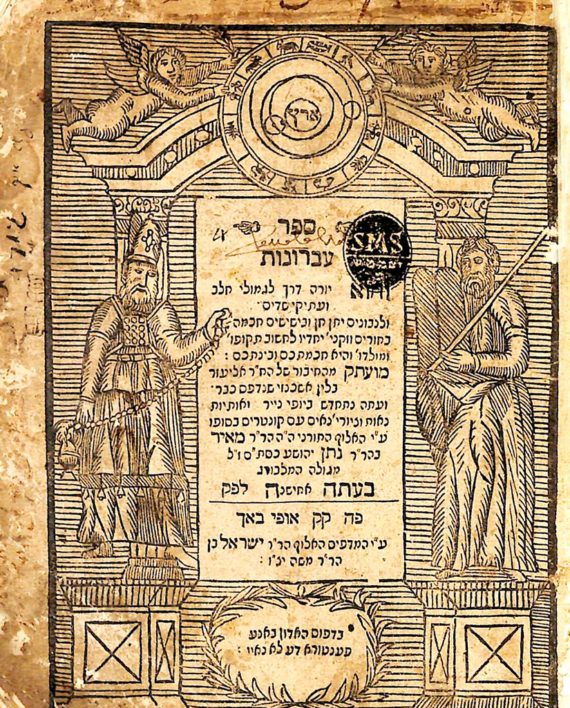
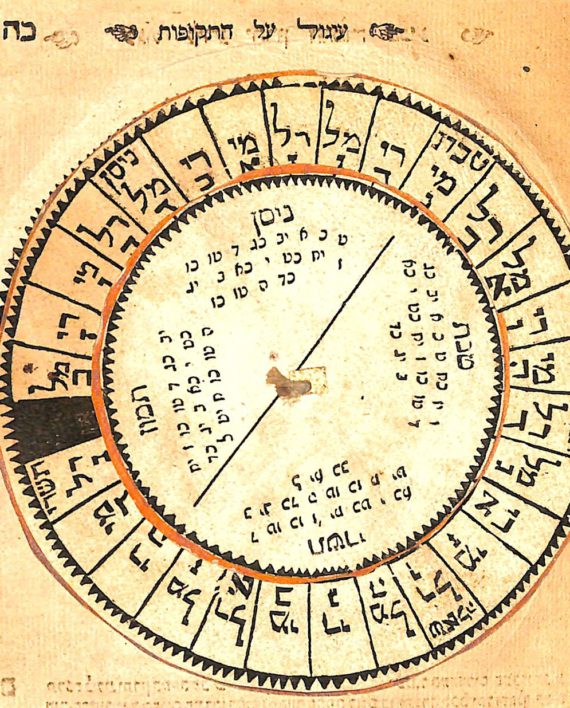
Sefer Evronot, Offenbach, 1722, (lot no. 63) is an unusual Hebrew book because it includes paper cut-outs that are reattached to the book and form an interstellar calculator allowing precise determination of the calendar. Despite the celestial nature of the work, at the top center of the title page, held aloft by putti, is a depiction of the universe. The earth is in the center, but unlike a geocentric approach with the sun circling the earth, there is no reference to the sun, only the planets. The image depicts the orb system of planets and pre-dates even Copernicus’s theory. (See, Ariel Cohen, “The Celestial Host, the Calendar, and Jewish Art,” in Written in the Stars: Art and Symbolism of the Zodiac, ed. Iris Fishof (Jerusalem: Israel Museum, 2001), 18). Israel ben Meir (his father was a noted publisher) and his non-Jewish partner, Bonaventura de Launoy, published the book. (See Marvin Heller, Essays in the Making of the Hebrew Book (Leiden: Brill, 2021), 273-92).

Auction 10 Batch 2 #18b Sefer Ibronos

The Sefer Evronot is not the book for which this title page was designed. Instead, Israel first used the illustration on Abraham ben Hiya’s, Tzurat ha-Arets (Offenbach, 1720). The image is appropriate for the book as it also discusses the solar system’s depiction. This is one of the earliest examples of a title page illustration allusion to the book’s contents and not serving an aesthetic purpose.

Tzurat Ha-Aretz, from the Gross Family Collection

A similar illustration to the title page’s celestial illustration appears in the book. 58a. But the one in the book is less sophisticated than the title page; that one contains a very detailed zodiac. Although it was specifically created for a Hebrew book it didn’t stop the ubiquitous error of depicting Aaron with a bishop’s miter, this time with a cross clearly visible. The Moses and Aaron theme title page first appeared in 1610 in Hanua. One year later, it was used in another book, Nishmat Adam, (lot no. 11), although that one does not have a cross.

The zodiac title page illustration appears on at least two other of Israel’s books that have no association with celestial ideas: a commentary on Birkat ha-Mazon and Zemirot, Mateh Yehuda, (Offenbach,1721) and a Haggadah with the commentary Zera Yehuda (Offenbach, 1721). Israel printed over 40 books, and it is unclear why he decided to use it on these two books that seemingly have no relationship to the image.

There are two items related to R. Hutner’s Torat ha-Nazir. Lot 70, is the first edition published in softcover format in Kovno in 1932. This is the only edition that R. Kook’s approbation appears. The later editions of Torat HaNazir remove it. In some editions, all the approbations are removed and in others, R. Chaim Ozer’s was retained. (although the printers did not alter the original heading, “Letters of the Ge’onim.” See Marc Shapiro, Changing the Immutable (Oxford: Littman, 2015), 157-160.

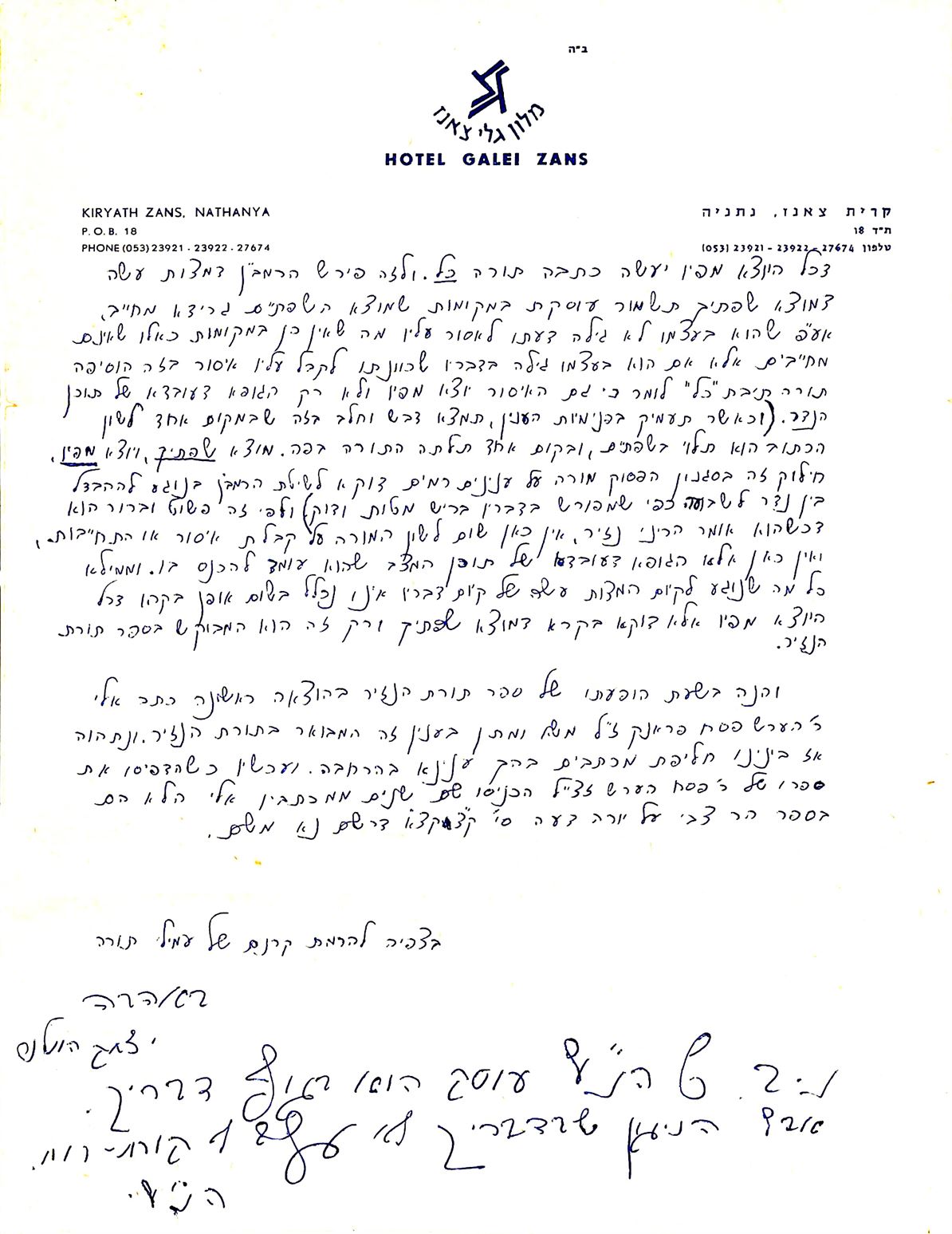
Another item related to the Torat Ha-Nazir is a letter to an unidentified correspondent (lot 236). Apparently, R. Hunter chanced upon that person’s copy of Torat ha-Nazir with their notes. One of which took issue with R. Hutner’s approach, and he defended himself. R. Hutner added a postscript that the tone was inappropriate whatever the objections (in the margins).

Lot 223 is a letter from R. Chaim Ozer regarding cremation.  Although today after the Holocaust it seems difficult to imagine cremation widely accepted by Jews, in the early 20th century, some Orthodox rabbis permitted cremation.  R. Ozer’s letter discusses one the main works, Hayyi Olam.

Lot 77 is two broadsides. One is from a list of Rabbis against Heichal Shlomo, against attending a convention. These Rabbis consistently opposed the creation of Heichal Shlomo and the idea of a Central Organization that controlled and spoke for all Orthodox Jews. The Heichal Shlomo board discussed how best to respond to those objections. Ultimately, Zerach Warhftig, argued against responding as they tried to engage and even discuss changing the name but received no response. (See Protocols of the Merkaz HaRuchani HaOlami, January 28, 1958).

The inauguration of Heichal Shlomo occurred on Lag Be’Omer, 1958, to great pomp and circumstance. The mayor held a cocktail party in the garden, and the gentleman was told to wear suits and hats.

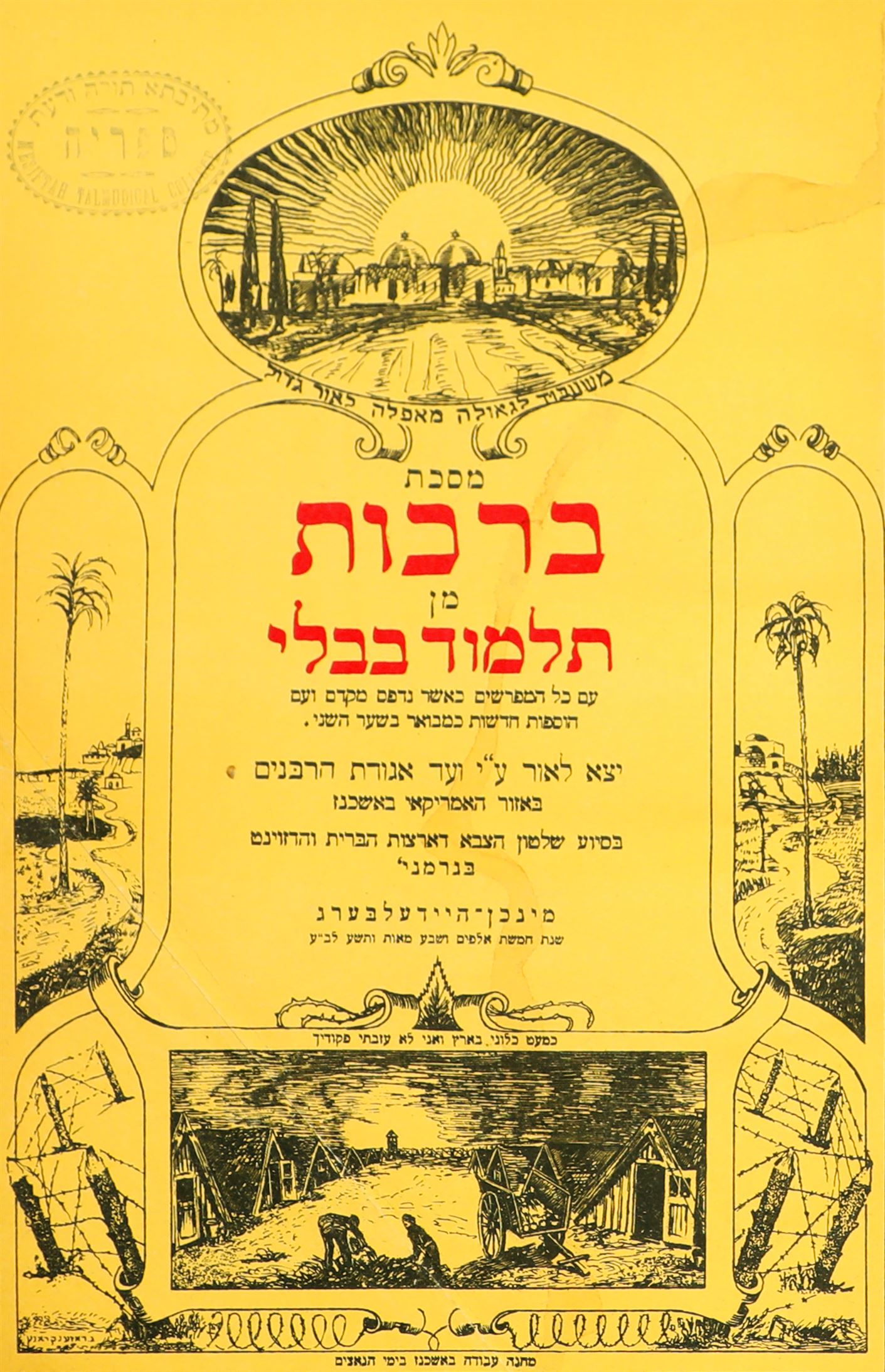
There are both editions of the “Survivors Talmud.” (lots 160 & 161).The first edition, published in Munich in1946, only included Nedarim and Kiddushin. In 1948, the American Army published a complete edition of the Talmud. These are the only editions of the Talmud that any government published before the establishment of the State of Israel. There are three introductions, one in English and two in Hebrew. The English one reads in part:

This edition of the Talmud is dedicated to the United States Army. This Army played a major role in the rescue of the Jewish people from total annihilation and after the defeat of Hitler bore the major burden of sustaining the DPs of the Jewish faith. This special edition of the Talmud published in the very land where, but a short time ago, everything Jewish and Jewish inspiration was an anathema, will remain a symbol of the indestructibility of the Torah. […]

Rabbi Samuel A. Snieg, Chief Rabbi of the United States Zone, “Dedication.”

Munich, Germany, 1948 edition of the Talmud printed under the supervision of the Procurement Division, European Quartermaster General Depot, United States Army.

Interesting personal copies one is R. Chaim Ozer’s Achiezer with his inscription (lot 176), R. Chaim Keanievsky’s personal siddur (lot 181), and R. Yaakov Loberbaum’s, the author of the Nesivot ha-Mishpat, copy of Shev Shema’ata (lot 183) and R Chaim Berlin (item 182) a rare volume of Shut Harshaba that R Hirsch got as a gift from his father (item 179) and two items from the Beis Halevi’s Library (items 192 &194) [One with unpublished glosses].


The Anatomy of an Auction: A Previously Undissected Body of Literature on the History of the Jews and Postmortem Dissection

The Anatomy of an Auction: A Previously Undissected Body of Literature on the History of the Jews and Postmortem Dissection

 Rabbi Edward Reichman, MD 

The issue of autopsy and postmortem dissection has been exhaustively explored in halakhic literature.[1] If I were to ask where and when we find the first halakhic discussion about this topic, the immediate response would invariably be the teshuva of the Noda biYehuda, from the late eighteenth century.[2] It may be time to rewrite the medical halakhah history books. On Sunday, May 21 Genazym Auction House held its fifteenth auction. Lot #133 was a work entitled Pachad Yitzchak.

There are multiple works throughout history that bear the title Pachad Yitzchak. The modern reader will surely think of the work of Rav Yitzchak Hutner. The reader of this blog may also think of the first multi-volume halakhic encyclopedia, authored by Rabbi Dr. Yitzchak Lampronti (1679-1756). The volume offered for auction by Genazym is an earlier lesser-known composition of the same name by Yitzchak Hayyim Kohen me-haHazzanim (AKA Isaac Vita Cantarini)[3] published in 1685. 

Buried in Cantarini’s obscure work, in a section peripheral to the main theme of the book, we find a vivid and poetic description of a tragic incident relating to anatomical dissection.[4] Viewed in isolation, this incident merits historical attention due to its gravity. Yet, it merely reflects a much larger historical chapter about the Jews and postmortem dissection which long preceded the time of the Noda biYehuda and has remained largely undissected until now. But first a word about this work, its provenance and its author. 

The Work- Pachad Yitzchak (Amsterdam, 1685)[5]

The main subject of this work is the tale, told in poetic fashion, of the miraculous salvation of the Jewish congregation of Padua during the Austrian-Ottoman War in the year 1684. War erupted between the Austrian and Ottoman Empires in the year 1684 over the city of Buda (today part of Budapest). The virulently anti-Semitic Christian ruler of Padua spread a libel accusing the Jews of supporting the Muslim Turks in their battle against the Austrian Empire. His incitement caused an enraged crowd to break into the Padua Ghetto, yet the Jews miraculously persuaded the Venetian government to subdue the outburst. The Jews of Padua declared the 10th day of Elul as their Second Purim in gratitude for their miraculous salvation. This holiday was celebrated for many generations thereafter. 

However, the work also includes many additional unknown details of the history of the Jewish community and its rabbis. It is from this aspect of the book that we draw our discussion. 

Provenance

Regarding the item’s provenance, it was previously part of the William Gross Family Collection,[6] a significant portion of which has been recently sold at auction by both Kedem[7] and Genazym auction houses. Gross is a well-known prominent collector of Judaica and Hebraica and the selling of his collection is of historic significance. To see the collection of precious items united under one roof now become redistributed and disseminated across the world necessitates a moment of pause and reflection. Yet, this is the life cycle in the world of bibliophilia.[8] For centuries, passionate bibliophiles spent lifetimes amassing extraordinary and unique collections, only to have them subsequently sold piecemeal (for a variety of reasons) while still alive, or by less passionate heirs after death. Sometimes, however, collections are sold en bloc. An allusion to one such example is the image which appears on the bottom of the title page of the copy of Pachad Yitzchak sold at auction.  

This stamp, which is not mentioned in the catalogue description, indicates that this volume was previously part of the collection of Professor Lelio Della Torre. Della Torre was an Italian Jewish scholar of the nineteenth century, and prolific author, who served as a professor of Talmud and rabbinics at the rabbinical seminary in Padua, where Shadal also taught, from 1829 until his death in 1871. During this time, he was an avid collector of Hebraica. David Kaufmann, himself a renowned scholar and bibliophile, sought to procure Delle Torre’s collection upon the latter’s death. Kaufmann not only acquired Della Torre’s collection, but also that of Marco Mortara, a student of Shadal, and later Chief Rabbi of Mantua. Mortara’s collection in turn contained the library of Samuel Della Volta, whose life, work and library we discussed in this blog.[9]  All of these collections are now housed in the Hungarian Academy of Sciences Library in Budapest, to which Kaufmann bequeathed his library. This volume from Della Torre’s library somehow escaped the grasp of Kaufmann and traversed a different path, ultimately landing instead in the Gross Family Collection.[10]

The Author- Yitzchak Hayyim Cantarini (1644-1723)[11]

The Cantorini family were a prominent family of Kohanim who were also associated with the cantorial profession – hence the name Cantarini, or MinHaHazanim, as their Hebrew name reflects. Isaac Cantarini graduated from the University of Padua Medical School on February 11, 1664, one of many Cantarinis who earned their medical degrees from the university.[12] He authored a number of congratulatory poems in honor of Padua medical graduates.

After graduated from Padua, Cantarini went on to become a leading figure in Italian Jewry. He is considered one of the greatest Torah sages of his time, and his responsa have been published in both Yitzhak Lampronti’s Pachad Yitzhak and Samson Morpurgho’s Shemesh Tzedakah.[13] Cantarini wrote halakhic, historical, and homiletic works, as well as medical treatises in Latin. He was a poet, author, physician, and consummate orator; non-Jewish clergy and lay people attended his Shabbat sermons. In the year 5460 there were so many non-Jewish visitors in synagogue when he spoke that the regulars had to ascend to the women’s section (ezrat nashim) to pray.[14] He was a teacher of both Rabbi Moshe Hayyim Luzzatto (Ramchal),[15] as well as Rabbi Yitzchak Lampronti.

Non-Jews sought Cantarini’s sage advice as well, as evidenced by his correspondence with the Christian intellectual Theophilio Ungar.[16]

Cantarini was known by his initials יחכם. He was also quite adept at word play, and Shadal mentions but one small example of his utilizing the acronym of his name in the introduction to a kinah he composed upon the passing of Rabbi Yehuda Briel:[17]

Shadal takes a stab at solving the riddle.

A Fearful Story in Pachad Yitzchak

The following story appears in the pages of Pachad Yitzchak.[18] On the 17th of Shevat 5440 (שנת מ”ת as per Cantarini), a young man by the name of Hananel (AKA Graziadio) Levi[19] died in the Ghetto. His body was prepared for burial, but in the interim, a band of raucous students from the University of Padua stormed the Ghetto, kidnapped the body, and whisked it away to the anatomy room in preparation for dissection and medical student instruction. The Jewish community was in an uproar, riots ensued, and all political channels were pursued to secure the return of the body. When initial efforts failed, some members of the Jewish community on their own initiative attempted unsuccessfully to enter the anatomy lecture hall under cover of night to procure the body. Ultimately, after one week, negotiations succeeded, and the Jews were promised by the University that they needn’t worry about similar infractions in the future, and that the bodies of the Jewish community would no longer be forcefully taken for anatomical dissection. 

Anatomy, the Jews, and the University of Padua- An Undissected Body of Literature

This frightening incident recounted in Pachad Yitzchak is significant in its own right, but here we situate it as part of a much larger narrative of anatomy, the Jews and the University of Padua, which began over a century earlier.

Since the Middle Ages, individual Jewish students experienced numerous hurdles to the completion of their medical training, many rooted in discrimination and antisemitism. It was sometime around the 16thcentury, however, as the result of the synchroneity of two major historical developments, that Jews, as a group, first encountered a new major challenge to their medical education. This challenge, unlike any previous, did not originate with their non-Jewish colleagues or institutions, but was self-imposed by the Jews. Its consequences however were no less severe.

In the beginning of the fifteenth century, the University of Padua became the first European university to officially allow admission of Jewish students for medical training.[20] This policy led to a gradual influx of Jewish students and the creation for the first time in history of a significant Jewish presence and recognizable entity in a consistent fashion on a university campus.[21] This positive development for the broader Jewish community[22] unwittingly evoked unanticipated consequences.

Simultaneous with the expansion of the Jewish community in Padua, a young professor on campus was quietly revolutionizing the study of anatomy. Andreas Vesalius, who arrived in Padua in 1537, began to hold frequent public and private anatomical displays and approached the study of human anatomical dissection in a systematic fashion not previously attempted.[23] He would later come to be known as the founder of modern anatomy. With his innovations came the expansion of the anatomy course in Padua. Anatomy became identified from then on as the most essential course in medical training, and Vesalius, along with the University of Padua, were leading the revolution. 

The Ramifications of Vesalius’ Contribution for the Jewish Community

Vesalius’s work formalized and expanded the teaching of human anatomy at the University of Padua, as well as at medical schools throughout the world. With the expansion of the course came the necessity to supply more cadavers for the dissection tables. To procure cadavers for the anatomy course, the university turned to both the judicial system as well as its students and their communities. Executed criminals served as one steady source of cadavers, but this did not suffice. 

Grave robbing became commonplace in order to supplement the source of bodies. The practice was even encouraged by Vesalius and, though technically illegal, was unofficially tolerated by the government. A ducal document from 1549, during Vesalius’s tenure in Padua, condemns grave robbing,[24] but the ever-present fear and reality of the practice also affecting the Jewish cemeteries.[25] Indeed, one scholar has suggested that one of the historiated letters in the Fabrica specifically depicts a scene of the grave robbing of a body from a Jewish cemetery.[26]

The scene depicts putti (cherubic figures common in Renaissance art) removing a body from a grave. The “o” on the flag held by one of the putti was the symbol Jews were required to wear on their clothing and may reflect that this was a Jewish cemetery depicted.

The emphasis on anatomy begun by Vesalius would continue long into the future. Soon the university would further invest in this venture by building the first example in the world of a permanent anatomical theater, completed in 1595 (after the death of Vesalius), created for teaching anatomy through the dissection of corpses. The theater still stands to this day. 

The supply of cadavers was a perennial challenge for the medical school, and as a result, the university sought additional creative ways to address the issue. At some stage they instituted each community which sent medical students for training at the university would be required to provide a certain number of bodies for the dissection table.[27] The Jewish community, like others on campus, was expected to provide cadavers for the yearly anatomy course. However, the Jewish students and community took issue with this expectation. As elated as Jews were to walk the halls of a premier university for the first time in history, this privilege would not compel the abrogation of ancient Torah principles. Jewish law forbids the dissection of the human body after death absent mitigating circumstances yielding direct and immediate life-saving benefit from the procedure.[28] The prohibitions of desecrating and deriving benefit from the corpse, as well as the obligation to bury the body preclude routine dissection or autopsy. 

This refusal of the Jews to provide bodies sparked outcry from both the university and its students. The tension created from this conflict would play out over centuries. It is reflected, for example, in multiple recorded incidents of Padua medical students attempting to kidnap Jewish bodies to provide for the anatomy course.[29] Although we have no starting date, already in the earliest Vesalian and post-Vesalian days in Padua a compromise was struck with the Jewish community providing a hefty financial compensation to absolve them from the cadaver obligation. However, this was not a one-time incident, and the anatomy issue persisted, with frequent renegotiation of terms over the years and increased tension resurfacing periodically. Despite the Senate’s repeated pronouncements, frequently the graves in the Jewish cemetery were violated. It was not uncommon for gravely ill patients to be transported out of Padua for fear of being dissected upon their death.[30] The Jews were compelled to construct secret hiding places in the Ghetto where the bodies could be concealed until the funeral. Often, they buried the dead under the cover of night to avoid the dissection table.[31]

One would have expected to find halakhic responsa from 16th and 17th century Italy discussing this topic, but the extant halakhic literature is silent. The first cases discussing autopsy only surface in the late 18th century. We do however find reference to this ongoing issue in the Padua Jewish community archives as well as in the administrative records of the city and University of Padua. We share these documents here, many for the first time. While not enshrined in the extant responsa literature, this community response to anatomical dissection surely reflects the considered rabbinic opinion and halakhic analyses of the local Padua rabbinate, to whom the community deferred on such matters. Prominent rabbis who served the Padua community, or were connected with the medical students during the period under discussion include Maharam Padua (1482-1565), Rabbi Yehuda Arye de Modena (1571-1648) and Rabbi Yehuda Briel (1643-1722), Rabbi Dr. Isaac Hayyim Cantarini (1644-1723), Rabbi Dr. Isaac Lampronti (1679-1756), and Rabbi Dr. Shimshon Morpurgo (1681-174), among others, and it is more than likely that they were involved, to some extent, in the discussions of the Jewish community regarding the provision of bodies to the medical school. 

The Padua Jewish Community Archives[32] 1624-1626

The Jewish community archives of Padua contain at least five entries from 1624 to 1626, discussed below, which directly address the anatomy issue. Daniel Carpi, the scholar of Italian Jewish history who transcribed and edited the archives, noted that since the Jews first settled in Padua the medical students requested from the Jewish community to provide to the university a specific percentage of Jewish bodies for use in the teaching of anatomy. The Jews refused and arranged a compromise to pay an annual ransom to absolve them from this obligation. However, the tension related to this matter never ceased, be it because the university continually raised the fee, or because they sometimes would only suffice with the supply of actual corpses for dissection. 

It is in this context that a tragic incident occurred in 1624 which frightened even the non-Jewish community. A group of students, led by a young anatomy professor, interrupted a Jewish funeral procession and attempted to kidnap the body. The agreement discussed in the first archival entry below appears to come on the heels of this incident in the hopes of preventing similar occurrences in the future.

April 19, 1624 (entry #545) compromise with the students during the season/days of dissection

In that the spirit of God has enlightened the esteemed philosopher Senior Cesare Cremonin to declare freedom (from dissection) for our deceased, through the continued annual designated payment to the students of the College of Arts, generation after generation. As a result, they are obligated to allow us to properly bury our dead during the season of dissection, lest anyone fear. Any violators will be fined, and they have coordinated with us to obtain from the government permission for a required fine for all who violate this agreement in a way amenable and sufficient for our needs. The aforementioned master Cesare and Yehudah Katz have already spoken on this matter and have begun discussion regarding the amount the Jewish community is willing to pay for this privilege. Therefore, to facilitate successful completion of these dealings, which will result in a salvation for our community, we present a parti to designate two members of our community,[33] even though they are not members of the committee, to negotiate directly with the aforementioned esteemed philosopher a sum which will then be presented to the community and the committee for a majority vote. 

Subsequent entries reflect the lengthy process of negotiation, implementation, and enforcement. A follow up entry from July 15, 1624 (entry # 554) states that the negotiations had been completed and a sum had been agreed upon with the government representative. The request is to approve the amount and facilitate payment. 

 An entry in the Padua University Archives from December 28, 1624 (pictured below) sheds a slightly different light on the negotiations, which may not have been officially ratified by the university.[34]

Here the university confirms an earlier privilege granted to the Jewish community by which those Jews studying medicine were granted free access to the anatomical theater, and the corpses of deceased Jews were to be left untouched by anatomical dissections due to strong religious objections to the procedure. For this privilege the Jews paid an annual sum of 100 Venetian pounds. The entry concludes, “the final decision on this proposal was delayed until the arrival of the “perillustris domini syndic.”[35] Parenthetically, this reveals that the agreements between the Jewish community and the university regarding Jewish cadavers date back to an earlier time.

An entry in the Jewish community archives some three weeks later (Entry # 566- January 21, 1625) corroborates the delayed decision of the university. It reiterates the need to arrive at an agreement between the Jewish community and the university to prevent the taking of Jewish bodies. A maximum fee of ten Ducat is set. This may have been a counteroffer to the much higher request of 100 ducats and explains why a specific number is mentioned here but not previously. 

May 17, 1626 (Entry #616)
Yet another entry reveals a creative solution to prevent grave robbing during the semester of anatomy.

Regarding designating two community representatives with the power to negotiate with Aharon Altarini to allow temporary burial[36] on his property (for community members) during anatomy season. They are granted permission to spend as much as necessary to appease those who oppose this practice.

While grave robbing was typically done secretly under the cover of night, some claims for Jewish bodies were more brazen. The entry of November 15, 1626 (Entry # 627) mentions a disturbing incident (mikre bilti tahor) of the interference of the medical students of Padua with the Jewish funeral procession of the wife of Moshe Fano (miPano). The incident, reminiscent of earlier similar episodes, appears to have been minor and fortunately did not escalate. Nonetheless, it precipitated another plea to find a long-term compromise with the university regarding the anatomy issue.

The Decree of 1672[37]

 On November 23, 1672, there was a decree reaffirming the Jews’ exemption from providing bodies for dissection and warning those who attempt to disturb the funerals or graves of members of the Jewish community. This decree appears in Jewish and governmental documents discussed below. It is unknown to me if or whether a specific historical event precipitated this reaffirmation.

The Case of Graziadio Levi and the Riots of 1679 

Here we position the story from Cantarini’s Pachad Yitzchak, occurring over a century after Vesalius’ expansion of the field of human anatomy with its subsequent creation of major halakhic and social problems for the Jewish community and its medical students. The event described by Cantarini which transpired in 1679[38] may have been the tipping point which led to a more serious and sustained response from the university. Following the death of a young Jew, Graziadio Levi, armed students stormed the Jewish ghetto in great numbers, kidnapped the corpse and brought it to the medical school in preparation for dissection. Riots ensued[39] and much effort was marshaled to rescue the body and provide a proper Jewish burial. The incident led to the issuance of a ducal letter dated February 27 of that year which rued the incident and emphatically reaffirmed the commitment by the university to protect Jewish corpses.[40]  As we have discussed, the events surrounding that fateful night in 1679 were recorded for posterity by Isaac Hayyim Cantarini in his Pachad Yitzchak. In the context of his recounting of the Levi affair, Cantarini mentions the earlier decree from November 23, 1672, protecting the bodies of the community from dissection. 

A record of the full 1679 decree is found in the Padua Civic Archives,[41] a copy of which I procured and present below. The name of Graziadio Levi is explicitly mentioned in the decree.

Ciscato transcribed the full text of the decree.[42]

The Central Archives of the History of the Jewish People possesses yet another record of the anatomy decrees. This unadorned document is a certified “copia” of the two decrees of 1672 and 1679.[43]

This was perhaps intended for archival records as opposed to public display. 

University (Governmental) Decrees Regarding Jewish Cadavers from 1672 to 1721

The Central Archives of the History of the Jewish People possesses yet another document, even more remarkable, related to the Padua anatomy decrees.[44] It includes not only one or even two decrees, but appears to be a summary or record of multiple decrees on the subject of cadavers, anatomy training at the medical school of Padua, and the Jewish community, spanning from 1672-1721. It includes the decrees of November 23, 1672, and February 27, 1679, as well as others. Furthermore, the presentation of these decrees, as an attractive broadside with calligraphy and illustrated header, indicates that it was likely intended for public display.[45]

Conclusion

In an obscure work published in 1685, recently offered for auction, appears an account of a tragic event involving the Jewish community and the dissection of human cadavers at the University of Padua. We have placed this seemingly isolated incident into a much broader historical context, fleshing out this chapter with new supportive archival material. For hundreds of years, beginning in the late sixteenth century, the Jewish community negotiated with the university for the right not to have Jewish bodies used for the anatomy course. There is no question that the local rabbinate of Padua must have been involved in these discussions and negotiations, though to what extent remains unknown. Refusal of the Jewish community to provide cadavers for dissection created major problems for both the many Jewish medical students who attended the university as well as for the Jewish community at large. The Jewish community’s restrictive position was premised entirely on halakhic grounds and would not have been sustainable throughout this lengthy period without significant rabbinic backing and support. Thus, while the extant published literature on autopsy begins with the Noda biYehudah in the late eighteenth century, there is little doubt that the halakhic discourse on the topic of anatomical dissection began long before.[46]

[1] For general discussions on anatomy and autopsy in Jewish law, see Kalman Kahana, “The Dissection of the Dead in Jewish Law: A Bibliography,” (Hebrew) haMa’ayan 7 (Tevet, 5727), 45-72; Avraham Steinberg, HaRefuah KiHalakhah 6 (Jerusalem, 2017), 512-550; Zev Farber and Irving Greenberg, “Autopsies I: A Survey of the Debate,” in Zev Farber, ed., Halakhic Realities (Maggid Books: Jerusalem, 2017), 323-417.
[2] For a discussion of the historical context of this teshuva, see Edward Reichman, “A Tale of Two Stones,” in The Anatomy of Halakha (Maggid/OU/YU Presses, 2022),
[3] Cantarini and Lampronti share at least one thing in common. They are both graduates of the University of Padua Medical School. Indeed, the passage in Cantarini’s work upon which I draw relates directly to the medical training at the university.
[4] This incident we describe transpired years before the so-called Purim of Buda (or Padua).
[5] The description of the work is drawn from the William Gross Collection Item Description, which is reproduced in the Genazym catalogue. See also M. Heller, The Seventeenth Century Hebrew Book (Brill, 2011), 1077.
[6] On Gross and his collection, see Shalom Sabar, Emile Schrijver, and Falk Wiesemann, Windows on Jewish Worlds: Essays in Honor of William Gross, Collector of Judaica on the Occasion of his Eightieth Birthday (Zutphen: Walburg Pers bv., 2019).
[7] In Kedem’s recent auction of items from the Gross Family Collection (Auction 92, May 2, 2023) we find two items of medical historical interest, one less obvious than the other. The first item is Mikne Avram (Venice, 1523), a Hebrew grammar work written by Avraham de Balmes (Auction 92, Part 1, Lot 4). De Balmes was a physician and his medical diploma from Naples, from the auspicious year of 1492, is the oldest extant Jewish medical diploma, now housed in the Braginsky Collection. On this diploma see, Giancarlo Lacerenza and Vera Schwarz-Ricci, “Il Diploma di Dottorato in Medicina di Avraham ben Me’ir de Balmes (Naploli 1492),” Sefer Yuhasin 2(2014), 163-193. De Balmes was also a student of Yehuda Messer Leon, who has been mentioned numerous times on this blog. Less known is that De Balmes is considered to be the first physician in history to perform a human-to-human blood transfusion. His patient was none other than Pope Innocent VIII. De Balmes transfused blood from three young boys, each of whom was paid a ducat, and infused the blood into the veins of the Pope. According to different reports, the Pontiff “either died or recovered.” See H. M. Brown, “Beginning of Intravenous Medication,” Annals of Medical History 1:2 (1917). Shortly thereafter we find him working in the printing press of Daniel Bomberg.  De Balmes was an expert in Hebrew language and grammar and was sought after by Christians for instruction. Mikne Avramwas published posthumously. A scholarly edition of this work was recently published placing it in the context of contemporaneous linguistic scholarship. See Dror Ben Arye, Mikneh Avram by Avraham de Balmes (Hebrew) (Ramat Gan, Bar Ilan University Press, 2022).

The second item (Auction 92, Part 2, Lot 115) is the spectacular medical diploma of Moshe ben Gershon Tilche from the University of Padua Medical School (1687), which we discussed in Edward Reichman, “Jews, Medicine and the University of Padua: A Behind the Scenes Tour of a New Exhibit at the Jewish Museum of Padua (November 2, 2022- December 31, 2022),” Seforim Blog (https://seforimblog.com), December 1, 2022.
[8] For a lament about the sale and loss of access to great Jewish book collections, see E. Reichman, “The Lost Library by Dan Rabinowitz and the ‘Burial of Souls’ by Yehuda Leib Katznelson: Different Expressions of the Same Sentiment,” The Seforim Blog (April 3, 2019), available at https://seforimblog.com/2019/04/the-lost-library-by-dan-rabinowitz-and-the-burial-of-souls-by-yehuda-leib-katznelson-different-expressions-of-the-same-sentiment/.
[9] E. Reichman, “Samuel Vita Della Volta (1772-1853): An Underappreciated Bibliophile and his Medical ‘Diploma’tic Journey,” Seforim Blog (https://seforimblog.com), November 5, 2021.
[10] When Kaufmann transferred Mortara’s library from Italy to Budapest a number of volumes were also “lost” on the way. See Asher Salah, “La Biblioteca di Marco Mortara,” in Mauro Perani and Ermanno Finzi, eds., Nuovi Studi in Onore di Marco Mortara nel Secondo Centenario della Nascita (Firenze: Giuntina, 2016), 149-168, esp. 157.
[11] On Cantarini, see, Harry A. Savitz, Profiles of Erudite Jewish Physicians and Scholars (Spertus College of Judaica Press, 1973), 25-28; C. Facchini, “Icone in sinagoga: emblemi e imprese nella predicazione barocca di I.H. Cantarini”, in Materia Giudaica, 7 (2002), 124–144. I thank Professor David Ruderman for this last reference. Cantarini’s Jewish legal responsa were published in both Yitzḥak Lampronti’s Paḥad Yitzḥak and Samson Morpurgo’s Shemesh Tzedakah. For his correspondence with the Christian intellectual Theophilo Ungar, see Y. Blumenfeld, Otzar Nehmad 3 (Vienna, 1860), 128-50.  For the definitive work on the Cantarini family, see Marco Osimo, Narrazione della Strage Compiuta nel 1547 Contro gli Ebrei d’Asolo e Cenni Biografici della Famiglia Koen-Cantarini (Casale-Monferrato, 1875). For a comprehensive bibliography on Cantarini, see Asher Salah, La Republique des Lettres: Rabbins, Ecrivains et Medecins, Juifs en Italie au XVIIIe Siecle (Brill: Leiden, 2007), 120-124.
[12] Modena and Morpurgo, Medici, 118; see D. Ruderman, Jewish Though and Scientific Discovery in Early Modern Europe (Yale University Press, 1995), 113-114, regarding families with multiple graduates from the university.
[13] On Morpurgo, See Edward Reichman, “The Illustrated Life of an Illustrious Renaissance Jew: Rabbi Dr. Shimshon Morpurgo (1681-1740),” Seforim Blog (https://seforimblog.com), June 22, 2021.
[14] S. Y. Glicksberg, Ha-Derashah Be-Yisrael (Mosad HaRav Kook, 5700), 203-20.
[15] Ramhal wrote a eulogy for Cantarini. See R. Moshe Hayim Luzzatto, Sefer Ha-Shirim, ed. Y. Zemora (Mosad HaRav Kook, 5710), 4.
[16] This correspondence was published by Shadal. See Y. Blumenfeld, Otzar Nehmad 3 (Vienna, 1860), 128-50.
[17] Ibid.
[18] 45a- 46a.
[19] I discovered a wedding poem written a number of years earlier Graziadio (Hananel) Levi, assumedly the same person, for the wedding of Saul Lustro and Allegra Barukh in 1676. See JTS Library B (NS)CR2.
[20] The university admitted non-Catholics, which included, for example, both Protestants and Jews. On the history of the Jews and the University of Padua, see Edward Reichman, “How Jews of Yesteryear Celebrated Graduation from Medical School: Congratulatory Poems for Jewish Medical Graduates in the 17th and 18th Centuries- An Unrecognized Genre,” Seforim Blog (https://seforimblog.com), May 29, 2022; idem, “Jews, Medicine and the University of Padua: A Behind the Scenes Tour of a New Exhibit at the Jewish Museum of Padua (November 2, 2022- December 31, 2022),” Seforim Blog (https://seforimblog.com), December 1, 2022.
[21] The University of Montpellier was sporadically frequented by Jews in the Middle Ages, but does not compare to Padua, where Jews attended in far greater numbers and had their own student organizations.
[22] To be sure there were residual discriminatory practices towards the Jews at the university. In addition, while the Italian Jewish community viewed this development in a positive light, the Jewish communities in Poland and Germany were more concerned about the possible assimilation of the Jewish students and dilution and diminution of Torah study.
[23] We discuss the relationship of Vesalius to the Jews in Edward Reichman, The Anatomy of Jewish Law (Maggid/OU/YU Press, 2022).
[24] See Ciscato, Gli Ebrei in Padova, p. 297. Later documents, as discussed below, address body snatching in the Jewish community specifically.
[25] Carpi, op. cit., parti 616, discusses a request to delay burial during the season of anatomy at the medical school to preclude grave robbing.
[26] Jeffrey Levine, “Jewish History in Vesalius’s Fabrica,” September 17, 2014 (https://jmlevinemd.com/jewish-history-vesalius-fabrica/).
[27] Paul Grendler, The Universities of the Italian Renaissance (Johns Hopkins University Press, 2004).
[28] See Steinberg, Avraham Steinberg, HaRefuah KiHalakhah 6 (Jerusalem, 2017), 512-550. I realize it may be anachronistic to mention these specific halakhic concerns or formulation, as these were developed later in history starting with Rabbi Yechezkel Landau. Nonetheless, they are halakhic prohibitions and obligations that apply to dissection.
[29] For more on the history of anatomy and graverobbing in rabbinic literature, see Edward Reichman, The Anatomy of Jewish Law (Maggid/OU/YU Press, 2022).
[30] This practice might have violated the prohibition of moving a goses, the halachic equivalent to a “dying person.” A similar question was posed to Rabbi Moshe Stern: Could one move a critically ill patient out of the hospital for fear that, upon his death, his body would be taken for autopsy and dissection without family consent? Rabbi Stern ruled in the negative. See his Be’er Moshe 8, nos. 239, 240, 241, 243. Likewise, Rabbi Moshe Lemberger was asked whether a Kohen physician could expose himself to tum’ah in order to establish cause of death and prevent a likely autopsy. Rabbi Lemberger argues that the Kohen must do so, as this case is akin to a met mitzvah (one who dies without family or friends to bury him). See Lemberger, Ateret Moshe, Yoreh De’ah 2:244.
[31] Hebraische Bibliographie 16 (1876), p. 37.
[32] See Daniel Carpi, Minutes Book of the Council of the Jewish Community of Padua Volume Two: 1603-1630 (Israel Academy of Sciences and Humanities, 1979). All references to the Padua Jewish community archives are from this source. I thank Pia Settimi for kindly bringing these documents to my attention. See also Ciscato, 209-212.
[33] According to Pia Settimi, one of these was Avraham Catalano, who would later coordinate the community response to the plague in Padua in 1631 and author the diary Olam Hafukh about the experience.
[34] ASUPd, ms. 655, f. 13r. I thank Francesco Piovan, Chief Archivist of the University of Padua Archives, for procuring a copy of this document for me.
[35] I am unsure to whom this refers.
[36] The idea of temporary burial was suggested and debated by some prominent rabbinic authorities in the nineteenth century regarding the situation in Cincinnati, OH where graverobbing was rampant. See Reichman, Anatomy of Jewish Law, op. cit., 223-226.
[37] See below for discussion of this decree.
[38] Cantarini lists the Hebrew date of the event as 17 Shevat, 5440. Standard Hebrew date converters place this in 1680, but the Italian decrees all clearly place the year at 1679.
[39] There were broader political issues at play during these riots which are discussed by Cantarini.
[40] See Ciscato, Gli Ebrei in Padova, pp. 299–300; Hebraische Bibliographie 16 (1876), 37. The latter reference discusses an unpublished manuscript by Chaim (Vital) Moshe ben Elisha Cantarini that details this incident. I have been unsuccessful in locating this manuscript. Cantarini, member of an illustrious Italian family comprising many rabbi/physicians, graduated from the medical school in Padua and apparently taught in a yeshiva there as well. As discussed in this essay, this incident is described in great detail by his relative Isaac Chaim Cantarini in the latter’s Pachad Yitzchak.
[41] Archivio civico antico Ducali volume 13 carta 3r. I thank Antonella Ortis for her assistance in procuring this document.
[42] Ciscato, 299. The date of this decree is February 27, 1679. He lists the location as Ducali, Reg. N. N. 123 c. I r.
[43] Ducale: Che sia conservata agli ebrei la facoltà di eseguire le sepolture secondo il loro rito (Emessa in seguito alle proteste degli ebrei contro gli studenti di Anatomia). IT-Pa-47-ovs, Padova – Jewish Community 1679. I thank Ariel Viterbo of the National Library of Israel for bringing this document, as well as the others from the Central Archives, to my attention, and I thank Yochai ben Ghedalia, Yael Franklin and Tami from the Central Archives of the History of the Jewish People for so kindly providing copies of these documents.
[44] 206 Pergamena interessantissima concernente le violazioni di cadaveri degli israeliti che si permettevano gli studenti col pretesto  degli studi anatomici ” =IT-Pa 126 ovs. This broadside does not appear to have been mentioned by Ciscato or Roth, though the decrees were known to them. The Central Archives has another catalogue entry on the dissection of Jewish cadavers in Padua- Sulle violazioni dei cadaveri degli israeliti che si permettevano gli studenti col pretesto degli studi anatomici.  Archivio della Comunità di Padova, n. 206. 8 frames. HM-5157. This is a (poor) microfilm copy of the above broadside, thought the Archives does not identify it as such.
[45] Though he had not seen this document before, Francesco Piovan, the Chief Archivist of the University of Padua remarked, “As far as I can tell from the image, it’s just a summary of laws and decrees. Such summaries (even in print) of private documents and legal norms were quite normal: they can be found, for example, in processual documents. The interesting fact is that your document looks like a kind of ‘manifesto’ (placard), written in beautiful handwriting, and perhaps to be displayed, hung in a frame or fixed on a wooden tablet. In short, it seems destined for public viewing.”
[46] As a postscript, despite the religious limitation of providing bodies for dissection, there was at least some evidence of the interest and fascination amongst the Jews with the new discipline of human anatomy. When Padua’s anatomical theater was first built in 1595, the benches were not only occupied by the registered Jewish medical students, there is record of Jews from the community (non-students) attending dissections. See Cynthia Klestinec, “A History of Anatomy Theaters in Sixteenth Century Padua,” Journal of the History of Medicine and Allied Sciences 59:3 (2004), n. 74. Furthermore, years after the publication of Pachad Yitzchak, when a young Abraham Levi was visiting Padua on his travels, his guide, our very same Rabbi Dr. Isaac Cantarini, as part of showcasing the highlights of the community, included a visit to an anatomy lesson where a cadaver was dissected. Shmuel Feiner, The Jewish Eighteenth Century: A Jewish Biography, 1700-1750 (Indiana University Press, 2020), 242.


Plagiarism, Halakhic Paradox, and the Malbim on Kohelet

Plagiarism, Halakhic Paradox, and the Malbim on Kohelet
by
Marc B. Shapiro
1. A story recently appeared alleging plagiarism in the writings of R. Yonah Metzger.[1] Such accusations are nothing new and the topic of plagiarism in rabbinic history is of great interest to me. Many of the scholars of Jewish bibliography have also written about the phenomenon,[2] and a good deal on the topic has appeared on the Seforim Blog.[3] Suffice it to say that every generation has had problems in this regard, and we see even see apparent instances of it in the Talmud.[4] The examples range from taking another’s ideas (including one’s teacher[5]), to copying sections of another work, to reprinting an entire book and changing the title page.[6] It is interesting that R. Moses Sofer, unlike others, is reported not to have been troubled by people plagiarizing from him. As he put it, he doesn’t mind if they attach his hiddushim to their names, as long as they don’t attribute their own hiddushim to him.[7]
R. Isaac Sternhell, in the introduction to his Kokhvei Yitzhak, vol. 1, gives a good illustration of how widespread the problem of plagiarism has been in explaining why R. Joseph Karo and R. Moses Isserles don’t mention anything in the Shulhan Arukh about the obligation to repeat a Torah teaching in the name of one who said it (itself of great importance, not to mention the geneivat da’at involved if one doesn’t give proper credit [8]). R. Sternhell states that that since so many people plagiarize, including תלמידי חכמים שיראתם קודמת לחכמתם, therefore, just like it is a mitzvah to say that which people will listen to, so too it is best to be quiet about something they won’t pay attention to [9]. R. Sternhell reports that this reason was actually given by R. Yissachar Dov Rokeah of Belz in explanation of why there is nothing in the Shulhan Arukh about the prohibition of leshon hara.[10]
והם מתוך שחששו מלהביא קטרוג על כלל ישראל התעלמו מדינים אלה בפסקי הלכה והשמיטום. ובכך קיימו דברי הנביא עמוס (ה’ ג’) והמשכיל בעת ההיא ידום
R. Sternhell then lists a few books that plagiarized, and the books from which they stole. The problem is that he only identifies the plagiarizing books by their initials, which makes identifying them quite hard.
Today we have Otzar ha-Hokhmah which makes spotting plagiarism easier. Let me share with you one example. I am a long time reader of the journal Or Torah, which is where so many of R. Meir Mazuz’s writings have been published. In Tamuz 5758 an article appeared by a certain R. Daniel Weitzman. Here are the first two pages. On the second page there is something suspicious, which I don’t know if anyone other than me would take notice of. He cites R. Weinberg’s famous responsum on abortion but instead of citing it from Seridei Esh, he refers to an earlier appearance in Ha-Pardes. This sort of thing immediately sets off bells for me, since how would a rabbi in Israel in the pre-hebrewbooks.org and pre-Otzar ha-Hokhmah era have access to a thirty-year-old issue of Ha-Pardes? How would he ever come to that? In fact, if you look at the article, it seems that he doesn’t even know what Ha-Pardes is, referring to it as Pardes. The title he gives to R. Weinberg’s article is also not correct and is taken from the source he plagiarized from.


Now compare what Weitzman wrote with what appears in R. Shmuel Hayyim Katz’s Devar Shmuel (Los Angeles, 1986).


Weitzman has not just plagiarized, but he has copied word for word from Katz. Needless to say, I was quite distressed when I saw this. Since it is rare that someone plagiarizes only once, I decided to check Weitzman’s other articles that appeared in Or Torah.

Here is an article from Tamuz 5757 (first page, but here is a link to the complete article).

This article is also plagiarized from R. Katz’s Devar Shmuel.

And here Weitzman’s article from Or Torah, Av 5758, and it too is plagiarized from R. Katz’s Devar Shmuel.


Here are the pages from Devar Shmuel:

With the aid of Otzar ha-Hokhmah I was able to find the following. Here is the first page of Weitzman’s article that appears in Or Torah, Heshvan 5761.

It is taken almost word for word from R. Mordechai Friedman’s Pores Mapah (Brooklyn, 1997).


Pores Mapah is not a well-known book (although it has much to recommend it), and having been published in the U.S. was probably hard to come by in Israel. This is the perfect sort of book for an Israeli to plagiarize from, and years ago it would have been virtually impossible for anyone to realize what had happened. Yet with Otzar ha-Hokhmah I was able to locate the plagiarism in a matter of seconds.
I think the explanation for plagiarisms like this is simply because people are greedy. They not only want that which they can achieve, but want to take from others as well. To once again cite the Gaon R. Mizrach-Etz, “a man’s got to know his limitations.”
Yet I must also note are cases of men who plagiarized in their early years but later became great Torah scholars, showing that a youthful error need not determine the course of one’s subsequent development.[11]
Sometimes, what appears to be a plagiarism has a much simpler explanation.[12] Here is a page from R. Moses Teitlebaum’s Heshiv Moshe, no. 87.

Compare this responsum with what appears in R. Abraham Bornstein, Avnei NezerHoshen MishpatLikutei Teshuvot no. 101. The responsa are basically identical except for the dates and addressee.

What is going on here? I think it is obvious that R. Bornstein had a handwritten copy of the responsum, which he presumably copied out of Heshiv Moshe, a work published in 1866. After his death the one who put together his responsa did not realize that this was a responsum of R. Moses Teitelbaum, so he published it adding Bornstein’s signature and a new date. He also assumed that when the original responsum referred to the questioner as ש”נ it meant שינאווי when in fact it means שיאיר נרו or שיחיה נצח. Furthermore, in the original responsum it states דבר זה מתורת משה ילמדני which is an allusion to the one being asked the question, R. Moses Teitelbaum. Yet this was overlooked when the responsum was included in the Avnei Nezer.

Here is another example of what has been alleged to be plagiarism.[13] It is a passage from the Beur Halakhah, 494, s.v. מבחודש השלישי.


Now look at the Shulhan Arukh ha-Rav, 494:8-11, and you can see that it has been copied word for word, even though at the end of the Beur Halakhah it states: זהו תמצית דברי האחרונים


What to make of this? One of the commenters on the site that calls attention to this text sees here an indication that the Hafetz Hayyim’s son was also involved in the writing of the Mishnah Berurah (as he claimed), since the Hafetz Hayyim himself would not do such a thing. Yet matters are more complicated than this, as there are also other places where the Mishnah Berurah copies word for word from the Shulhan Arukh ha-Rav (and presumably from others sources as well).[14] Are we to assume that these were all inserted by his son?

It appears that the Hafetz Hayyim’s conception of what was proper in using earlier sources differed from what is accepted today, much like standards were also different in medieval times. Furthermore, since the Hafetz Hayyim writes זהו תמצית דברי האחרונים, even from a contemporary perspective we are not dealing with plagiarism. But the question is – and I don’t have the answer – why in some places the Hafetz Hayyim did not indicate when he was taking material from the Shulhan Arukh ha-Rav. He does mention in the introduction that the Shulhan Arukh ha-Rav is one of the sources from which his own commentary derives its material, and he constantly refers to it, so why in this case is there no indication of his source? Maybe one of the readers can answer if the Shulhan Arukh ha-Rav is unusual in this regard, or if this is done with other sources as well. As far as I know, we don’t yet have an edition of the Mishnah Berurah that provides all the sources used in the text.
2. In Ha-Ma’ayan, Tishrei 5771 and Tevet 5771 there are articles on the idea of “Halakhic Paradox” by R. Michael Avraham and R. Meir Bareli. You can see Ha-Ma’ayan online here.
Here is another halakhic paradox that I found in the journal Ohel Yitzhak, Sivan 5668, p. 4b. Take a look at R. Menahem Ratner’s second question. I tried to actually put what he is asking into English but was unsuccessful as my mind kept going in circles. As with all such cases, and one immediately thinks of Zeno’s paradoxes, the problem is to determine if we are indeed dealing with a real paradox or if the paradox is only apparent. So I ask those readers who want to try to get their head around what Ratner is saying, is this a real paradox or is he missing something?

3. In the past few years there were many topics I wanted to get to, but simply didn’t have the time. These matters are not much in the news now so I won’t discuss them in detail as I had originally hoped to. However, I will make a few comments as I think readers will still find the topics of interest.
Let’s start with the commentary of the Malbim on Kohelet that was published in 2008. Here is the title page.

Understandably, there was much excitement when this book appeared since it is quite an event when an unknown commentary of such a major figure is discovered. However, the excitement was short-lived, as it soon became known that the commentary was not by the Malbim but by a nineteenth-century maskil, Jonah Bardah. Even more embarrassing for the publisher, Machon Oz ve-Hadar, is that Bardah’s commentary even appeared in print in 1850. Here are the title pages.


This would be bad no matter who the publisher was, but the fact that Machon Oz ve-Hadar is from New Square, which is as far removed from Haskalah imaginable, makes the mistake drip with irony.
How did such a blunder happen? Today, it seems that everyone is looking for unknown material to publish. There are a number of journals that devote a good deal of space to this, and I often wonder what will happen when we run out of unpublished documents. With this mindset you can imagine how excited the publisher was when he was informed that someone had located a previously unknown commentary by the Malbim. The assumption that this was the Malbim’s text was due to the similarity between the method of commentary in the newly discovered work and other commentaries of the Malbim. Without careful examination, the Kohelet commentary was published and this would in turn lead to great embarrassment, not to mention a lot of wasted time and money.
The story of this mistake is found in a document entitled Sheker Soferim. Here is the title page.

(A softened version of this article appeared in Yeshurun 25 [2011], pp. 724ff., and there the author’s name is revealed: R. Avraham Yeshaya Zecharish.[15]) This is really a damning document as it shows that the publisher had already been told that the handwriting of the commentary was not that of Malbim. I am not going to say that the publisher knowingly printed a fraud in order to profit by the Malbim’s name. But I think it is obvious that that the publisher’s great desire to publish the work caused him ignore what he had been told and to instead rely on his own “experts.” Whoever edited the work also showed his (their?) ignorance, since when the commentary referred to רמבמ”ן , not knowing that this referred to Mendelssohn the text was “corrected” to read רמב”ן!
Despite my sense that there was no intentional fraudulence in this publication, I don’t entirely discount the possibility that the publisher knew the commentary was not by Malbim but printed it anyway. I say this because as shown in Sheker Soferim there is one passage in the commentary where the “Malbim” claims that there is a mistake in the biblical text. The editors censored this passage, and this to be expected as from a haredi perspective such a comment is heretical. But if so, could the publisher actually believe that the Malbim wrote that which was censored?
Lest people think that things like this don’t have real effects in the world, let me just note that, as pointed out by Eliezer Brodt, an entire chapter of a doctoral dissertation is devoted to the false Malbim commentary on Kohelet.[16] Just think of how many hours were devoted to this dissertation chapter, all of which were wasted.
While Zecharish points to various “problematic” elements of the commentary that the publisher should have been aware of, he misses one right on the first page.

The notes at the bottom of the page are found in the original manuscript and publication. Here is the page.

In the commentary to the first verse the “Malbim” explains how the beginning of biblical books, where the author is introduced, is written by a later person.
.ואדמה כי לא יטעה כל משכיל לחשוב אשר המחבר בעצמו דיבר אלה הדברים
In the note the “Malbim” adds:
.עיין בהראב”ע בהתחלת ספר דברים
The beginning of Deuteronomy states: “These are the words which Moses spoke unto all Israel beyond the Jordan.” Upon these words Ibn Ezra introduces his “secret of the twelve” which focuses on post-Mosaic additions to the Torah. It is incredible that while the “Malbim’s” intention is crystal clear, namely, that the beginning of Deuteronomy was written after Moses, the editors didn’t catch this and see anything problematic in the comment, a comment that would never have been made by the Malbim.[17]
——

[1] See here. For former French Chief Rabbi Gilles Bernheim’s plagiarism, see the statement in First Things available here.
I think this sentence, from the article, is particularly apt:

One of the perversions of our era is to make a god of intellectual property. Most commentators described Bernheim as “stealing” words and sentences. This is wrongheaded. Plagiarism is a sin against truth, not property. It’s first and foremost a kind of lying, not a kind of stealing. He violated our trust by speaking in a voice that was not his own, which is why in this and other cases of plagiarism the writer loses intellectual and moral authority broadly.

The importance of our spiritual leaders speaking the truth cannot be stressed enough. R. Kook writes about how forces of heresy were strengthened when people saw unethical behavior among בעלי תורה ואמונה. See Eder ha-Yekar, p. 43.
R. Joseph Ibn Caspi explains at length how a prophet, who models himself on God who is called א-ל האמת, always speaks the truth, even when speaking to his wife and children (!). See Shulhan ha-Kesef, ed. Kasher (Jerusalem, 1996), pp. 146, 163. This is so important to Ibn Caspi that he deals with a number of biblical examples where it appears that a prophet did not speak truthfully, and he argues that the meaning is not what appears at first glance. The one case where he acknowledges that we are dealing with a lie is Jacob telling Isaac, “I am Esau your firstborn” (Gen 27:19). Yet this does not affect Ibn Caspi’s thesis because he claims, p. 150, that when Jacob told this lie he was not yet a prophet.
.הנה כחש אבל עדין לא הגיע למדרגת הנבואה עד היותו בדרך חרן וראה הסולם
After his discussion about prophets and how they were always truthful, Ibn Caspi concludes, p. 163, that this is also how a חכם should behave. Our rabbis now stand in place of the prophets of old, thus they too much be paragons of truth.
With regard to Ibn Caspi’s Shulhan ha-Kesef, I would like to make one further point. In a previous post, see here, I discussed how, according to Ibn Caspi, the Torah contains statements that are not actually true, but were believed as such by the ancients. We see another example of this in Shulhan Kesef, p. 147, where he writes, in seeking to explain an example where it appears a prophet lied:
.כי הנביא שם משותף וכבר הרחיב הכתוב ואמר “חנניה הנביא” בסתם
What Ibn Caspi is saying is that even though the Bible refers to someone as a prophet, this doesn’t mean he was really a prophet. It could be that he is referred to as such because this is what the people believed, even though the people were incorrect. In other words, the Bible incorporates the incorrect view of the people in its narrative. The proof he brings is from Jeremiah 28 where Hananiah is referred to as a prophet but in reality he was a fraud.
[2] See most recently Shmuel Ashkenazi, “Ha-Gonev min ha-Sefer,” Yeshurun 25 (2011), pp. 675-690.
[3] See here.
[4] See e.g., Bekhorot 31b, Menahot 93b; R. Moses Zweig, Ohel Moshe, vol. 1, no. 41. The fact that the Sages had this problem in their own day is probably also why they stressed the importance of proper attribution. This is pointed out by R. Nathan Neta Olevski, Hayei Olam Nata (Jerusalem,1995), p. 241:
מזה נראה כי גם בימיהם כבר פשתה המספחת להתגדר בגנבי גנובי את תורת אחרים ולכן ראו חז”ל להגדיל ערך המשתמר מזה ולחשוב דבר זה בין המ”ח דברים שהתורה נקנית בהן
[5] See e.g., R. Yekutiel Yehudah Greenwald, Mekorot le-Korot Yisrael (n.p., 1934), p. 48.
[6] See e.g., Nahum Rakover, Zekhut ha-Yotzrim bi-Mekorot ha-Yehudi’im (Jerusalem, 1991), pp. 38ff.
[7] Otzrot ha-Sofer 14 (5764), p. 91:
.זה אני מוחל לכם אם אתם אומרים חידושיי בשמכם, אבל אם אתם אומרים חידושים שלכם בשמי זה אינני מוחל לכם
For a communal rabbi, who was expected to prepare his own derashot, it was unacceptable to inform his listeners that he was using material from others. However, R. Asher Anshel Yehudah Miller, Olamo shel Abba (Jerusalem, 1984), p. 187, reported one tongue-in-cheek justification of this practice if due to circumstances beyond his control the rabbi was unable to properly prepare for his Shabbat ha-Gadol derashah. Since the Talmud, Pesahim 6a, states שואלין ודורשין בהלכות פסח, one can derive from this that מותר “לשאול” מאחרים בשעת הדחק ולדרוש בהלכות פסח
[8] I mention geneivat da’at, yet according to some one who plagiarizes actually violates the prohibition against actual geneivah. See R. Yaakov Avraham Cohen, Emek ha-Mishpat, vol. 4, nos. 2, 24; R. Yaakov Hayyim Sofer, Hadar Yaakov, vol. 5, no. 38. R. Isaiah Horowitz, Shenei Luhot ha-BeritMasekhet Shevuot, no. 71, writes about plagiarism:  יותר גזילה מגזילת ממון
R. Eleazar Kalir states that the plagiarizer violates a positive commandment. See Havot Yair (Vilna, 1912; printed as the second part of the Malbim’s Eretz Hemdah), p. 26a:
ואומרים חידושי תורה מה שלא עמלו בו רק מפי השמועה שמעו ואומרים משמיה דנפשם ועוברים על עשה . . . שכך אמרו כל האומר דבר בשם אומרו מביא גאולה לעולם
See also the very harsh comments of R. Joseph Hayyim David Azulai in his Berit Olam to Sefer Hasidim, no. 224, which should be enough to scare away at least some of the plagiarizers:
אם כותב ספר וגנב תורת אחרים . . . בחצי ימיו יעזבנו ואחריתו יבא בגלגול אחר ויהיה נבל ויהיה מזולזל כי נבל הוא ונבלה עמו. רחמנא ליצלן
[9] Robert Klein called my attention to the final part of R. Solomon Ephraim Luntshitz’s introduction to his Keli Yekar, where he suspects that some of the commentators who preceded him were guilty of plagiarism. See also his Olelot Ephraim, at the end of the introduction, where he claims that all the plagiarisms are delaying the arrival of the Messiah. He plays on the verse עשות ספרים הרבה אין קץ  and explains that since so many new books are full of plagiarisms, עשיית ספרים הרבה גורם איחור קץ הימים.
R. Solomon Alkabetz, Manot ha-Levi (Lvov, 1911), p. 91b, also refers to the plagiarizers of his day. I called attention to R. Eliyahu Schlesinger’s plagiarism in my review of Avi Sagi’s and Zvi Zohar’s book on conversion, available here. See p. 9 n. 29. See also my post from June 25, 2010, available here, where I cite another case of plagiarism from Schlesinger. I found these examples by chance, and I am sure that if I were to carefully examine the latter’s writings I would come up with more. Yet there doesn’t seem to be much point in doing so, since in the haredi world there simply is no accountability in matters like this.
A number of scholars have discussed plagiarism with regard to Abarbanel, and I hope to return to this. For now, let me just note the following. In his introduction to Trei Asar, p. 13, Abarbanel explicitly denies that he plagiarized, while at the same time accusing R. David Kimhi of doing so.
שהמובחרים והטובים מהפירושים שזכר רבי דוד קמחי מדבר [!] הראב”ע לקחה [!], עם היות שלא זכרם בשמו ואני איחס כל דבר לאומרו פן אהיה ממגנבי דברים
At the end of his commentary to Amos, he repeats the accusation:
ומה שפירש עוד בהלא כבני כושיים בשם אביו הנה הוא לקוח מדברי הרב רבי אברהם בן עזרא ומה לו לגנוב דברים
See R. Dovberish Tursch, Moznei Tzedek (Warsaw, 1905), p. 195; Abraham Lipshitz, Pirkei Iyun be-Mishnat Rabbi Avraham Ibn Ezra (Jerusalem, 1982), p. 131.
[10] It is hard to take this explanation seriously. Talking during the repetition of the Amidah has always been common, yet rather than omit mention of this matter, the Shulhan ArukhOrah Hayyim 124:6, writes:
לא ישיח שיחת חולין בשעה שש”צ חוזר התפלה ואם שח הוא חוטא וגדול עונו מנשוא וגוערים בו
R. Zvi Yehudah Kook reported that his grandfather, R. Shlomo Zalman Kook, once strongly rebuked someone for talking during the repetition of the Amidah. When it was pointed out to him that דברי חכמים בנחת נשמעים, he replied that the Shulhan Arukh uses the word גוערים and that does not mean a gentle suggestion but a sharp rebuke. See R. Yair Uriel, Be-Shipulei ha-Gelimah (n.p., 2012), p. 32. (The story immediately following this one is also of interest. It records that R. Zvi Yehudah opposed the common practice [at least in America] of singing אשמנו בגדנו:
יש לומר את הדברים ברצינות, בצער ובכאב, ולא מתאימה לזה שירה 
It seems that R. Abraham Isaac Kook followed in the path of his father. See ibid., pp. 58-59, for the famous story of how R. Kook, while rav in Bausk, once slapped a “macher” in the face when he insulted R. Zelig Reuven Bengis. (The story is told in great detail in R. Moshe Zvi Neriyah, Sihot ha-Re’iyah [Tel Aviv, 1979], ch. 22.) R. Kook later explained that he did not slap the man in a fit of anger, but was of completely sound mind and did it in order to follow the Sages’ prescription of how to respond to one who degrades a Torah scholar:
“וכך אמר: “דינא הכי, מי ששומע זילותא של צורבא מרבנן צריך למחות
All I would say is that one must be careful with who one slaps. R. Yekutiel Yehudah Greenwald, Li-Felagot Yisrael be-Ungaryah (Deva, 1929), p. 25, records a story from mid-eighteenth-century Hungary where in the synagogue and in front of the congregation the head of the community slapped the rabbi in the face. This was the last straw for the rabbi (who was really a phony), and he, his wife, and children converted to Christianity.
R. Naphtali Zvi Judah Berlin would occasionally slap a student in the face. On one occasion it even led to a noisy protest by the students. Because the students refused to back down, the Netziv unable able to deliver his shiur. This led to him making a public apology to the students, which they happily accepted. See M. Eisenstadt, “Revolutzyah bi-‘Yeshivah,’” Ha-Tzefirah, June 2, 1916, pp. 1-2 (referred to by Shaul Stampfer, Lithuanian Yeshivas of the Ninteenth Century [Oxford, 2012], p. 113).
Since we are on the subject of slapping in the face, and since I mentioned R. Yitzhak Zilberstein in my last post, here is something else from his Hashukei Hemed on Bava Kamma, pp. 492-493.


I think it is quite interesting that he takes it as a given that policemen in Israel will beat thieves until they confess. Is there any truth to this at all? He himself thinks it is good that thieves be given a good slap in the face.

There are many more examples I could cite of people being slapped in the face, including by rabbis. One thing that is clear is that face-slapping has gone out of style.. It is like fainting, which was common in old movies. But when was the last time you saw a woman faint? It just doesn’t happen anymore.
Returning to R. Bengis, it is noteworthy that he and R. Kook were great friends from their days in Volozhin.  See the booklet Or Reuven (Jerusalem, 2011), which is devoted to their relationship R. Bengis’ letters to R. Kook in Iggerot la-Rei’yah show that he regarded R. Kook as rav of Jerusalem and chief rabbi of the Land of Israel. Only after R. Kook’s death did R. Bengis become Rosh Av Beit Din of the Edah Haredit in Jerusalem. His life-long admiration for R. Kook, even in his new position with the Edah Haredit, is, of course, not usually mentioned in haredi discussions of him. Since in the past I have criticized Yeshurun for its conscious distortions (all in the service of the haredi cause), let me now praise it for including the following in vol. 12 (2003), p. 156 n. 35.

Rabbi Nathan Kamenetsky, Making of a Godol, pp. 305-306, reports in the name of R. Yosef Buxbaum that R. Bengis knew the poetry of Pushkin. (He also quotes a report that R. Bengis did not know Russian and when tested by a government official to ensure that secular studies were being taught in Volozhin, he just repeated the page of Pushkin from memory which he had prepared ahead of time by having another student read it for him. This strikes me as an apologetic attempt to “kasher” R. Bengis, as followers of the Edah Haredit will not take kindly to the knowledge that R. Bengis knew Russian poetry.)
For a recent discussion of R. Bengis and his brother, who went by the name of “Ben Da’at”, see here.
According to an unpublished collection of Brisker stories in my possession, R. Velvel Soloveitchik said about R. Bengis that just because one is a great talmid hakham does not mean that he is also a leader. Perhaps R. Velvel had this view of R. Bengis because the latter’s extremist credentials left something to be desired.
[11] Marvin J. Heller, Studies in the Making of the Early Hebrew Book (Leiden and Boston, 2008), p. 204, writes as follows about R. David Lida: “I would suggest, and this is highly speculative and certainly not a justification, that Lida’s acts of literary piracy were youthful improprieties, albeit of a most serious nature. A young man, inexperienced, perhaps immature, from whom much was expected, hoping to impress others and to further a burgeoning career, erred and claimed authorship of works he had not written, but rather discovered in manuscript.”
[12] The following example, with some of the explanations I give, is found here.
[13] This too was noted here.
[14] In a comment to my last post, someone wrote:

“The part about Anshei Keneset ha-Gedolah requiring the Amidah to be recited twice a day and that women are also obligated in this is not from Nahmanides. This is the Mishnah Berurah speaking.”

Actually, these are the words of the Shulchan Aruch HaRav (או”ח קו,ב), quoted here verbatim.

This practice of the MB citing whole paragraphs from the SAH – without attributing the author – is common throughout the his work, in leads many times to run-on sentences and disambiguation such as the one at hand.

[15] See also the online discussion here.
[16] “Ha-Sinonomyah bi-Leshon ha-Mikra al Pi Shitat Malbim,” (unpublished doctoral dissertation, Bar Ilan University, 2009).
[17] See here where I mention how R. Yosef Reinman also didn’t know anything about Ibn Ezra’s “critical” views. In the post I also discuss the controversy regarding Reinman co-authoring a book with a Reform rabbi. In the introduction to his Avir Yosef (Lakewood, 2008), Reinman defends himself.