Lectures on Hagadah Shel Pesach and about Hagaon Rav Chaim Kanievsky ZTZ”L’s Seforim

Lectures on Hagadah Shel Pesach and about Hagaon Rav Chaim Kanievsky ZTZ”l’s Seforim

By Eliezer Brodt

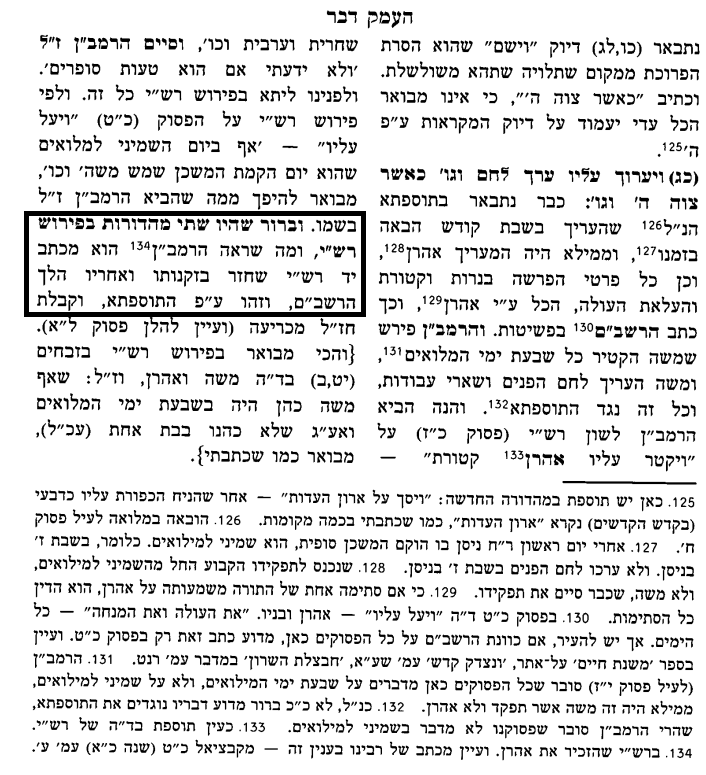
Earlier this week I had a conversation with Rabbi Moshe Schwed of All Daf, about the Hagadah. Topics included: how many Hagadas there are in existence, various works on the development on the Pesach Seder, and seforim devoted to the Halachos of the Seder, by Rishonim and Achronim. It concluded with a short discussion about illustrated Hagadas and the reasons behind them, available here. It is also available for viewing here and here.

In addition, here are the first three episodes of a new video series that I recently started with Rabbi Moshe Schwed of All Daf. The series is devoted to the seforim of Hagaon Rav Chaim Kanievsky Ztz’l.

In the first episode, I discuss Kiryat Melech, R’ Chaim’s sefer on the Rambam. The second one is about his work on the Marsha, Orchos Chaim, and more. The third episode is devoted to a sefer called Nachal Eitan. I hope to continue with this series right after Pesach.

 It is available for viewing here [1,2,3] and here. Here is a link to a folder with the videos (it also includes only audio files of the presentations).

.Feedback or comments of any sort are appreciated


Legacy Judaica Auction March 6th: A Sampling of Forgeries and other Eclectic Lots

Legacy Judaica‘s next auction will occur on March 6, 2018.  The 220 lots include very rare books such as the first edition of the Yerushalmi and a letter from R. Tzvi Ashkenazi (Hakham Tzvi) (the entire catalog can be accessed here), there are many other interesting books and letters.
Conditional marriage has been applied since at least the talmudic period if not early.  The exact circumstances and necessary predicates have evolved over time and especially in the modern period when marriage and divorce were slowly wrested from the exclusive control of the clergy and the state began to involve itself permitting some to circumvent the religious process entirely, the issue of annulments became acuter.  Annulments were among the only methods that would free a woman whose husband proceed to receive a secular divorce but not a religious one.  In France, in the early 20th century a scheme to make conditional marriage the norm and avoid later issues was proposed.  But this met with fierce opposition from many rabbis, and to counter that proposal in 1930 in Vilna a book, Ein Tenie be-Nissuin, that contained signatures of 400 rabbis was published in protest.  The book also contains an introduction by the leading Posek, R. Chaim Ozer.  (Lot 21).  
Another contemporary controversy related to something much older, the Talmud Yerushalmi. In the first decade of the 20th century, Shlomo Friedlander published a few volumes from the Kodshim order that hereto had never been published (lot 47).  Allegedly these were from a manuscript, but many doubted their authenticity. R. Meir Don Plotski, the author of the biblical commentary, Kli Hemdah, devoted an entire book, Sha’lu Shelom Yerushalim, (lot 43) to disproving that Friedlander’s edition was legitimate. (Dr. Shlomo Sprecher Zt”L reprinted the book in 1991 with a new introduction and a biography of R Poltski).  Friedlander also published less controversial books including his commentary on the Tosefta (lot 48). 
Although not controversial, another attempt to link the present with the past is a curious book, Sefer ha-Brit ha-Hadash, written by Uziel Haga of Boston (lot 130).  He petitioned and received permission from President McKinley to accompany the U.S. military on a tour of China.  Haga’s purpose was to see first hand and document the lifestyles and customs of Chinese Jews.  Among other items, he asserted that the Jews Kaifeng in the Hunan Province are descendants of the Ten Tribes. If his identification is correct, that may explain Jews’ affinity for Chinese cuisine.  Haga never made it back from China, he was imprisoned and killed by the Boxers.   Although Haga’s book was printed in Pietrekov, one book, Mishberi Yam, (lot 131) was published in China.  
Returning to forgeries, the compendium of R. Zechariah Yeshayahu Yolles, Ha-Torah veha-Hayyim, (lot 24), includes his Dover Mesharim that disproves the attribution of a certain work to R. Mordechai Yaffa (Levush).  Yolles’ position was vehemently disputed by R. Moshe Sofer (although Yolles defended him in a different controversy) and Sofer’s letter appears in this volume.  The book is also noteworthy because it includes a portrait of Yolles in the frontispiece.  
Among the books with distinguished owners include a copy of Mishnei Torah that belonged to R. Yosef Dov Soloveitchik, (Beis HaLevi) (lot 151) and R. Hayim Volozhiner’s copy of Mesorot Seyag le-Torah. Most of R. Hayim’s library was destroyed in a fire, but this book had been on loan to R. Yaakov of Ivenitz, and thus was spared the fate of the rest of books.  (Regarding the two bibliographical topics of fire and lending, see Abraham Ya’ari, Mehkerei Sefer, 47-54 (discussing books printed after the author was saved from fire) and 179-97 (discussing book lending)). As an aside, the Mesorot Seyag le-Torah also likely contains material that is misattributed to its author.  See Wolf Heidenheim, Me’or Eynayim, comments to Exodus 27:17.


Eli Genauer: Breishit 9:18 – Noach’s Family or Noach’s Drunkenness?

Breishit 9:18 – Noach’s Family or Noach’s Drunkenness?

Eli Genauer


וַיִּֽהְי֣וּ בְנֵי־נֹ֗חַ הַיֹּֽצְאִים֙ מִן־הַתֵּבָ֔ה שֵׁ֖ם וְחָ֣ם וָיָ֑פֶת וְחָ֕ם ה֖וּא אֲבִ֥י כְנָֽעַן׃

“The sons of Noach who came out of the ark were Shem, Cham, and Yefet; and Cham was the father of Canaan.”

Rashi:

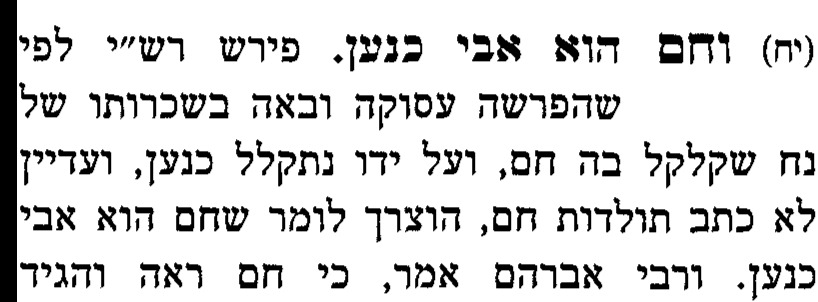
וחם הוא אבי כנען. לָמָּה הֻצְרַךְ לוֹמַר כָּאן? לְפִי שֶׁהַפָּרָשָׁה עֲסוּקָה וּבָאָה בְּשִׁכְרוּתוֹ שֶׁל נֹחַ שֶׁקִּלְקֵל בָּה חָם וְעַל יָדוֹ נִתְקַלֵּל כְּנַעַן, וַעֲדַיִן לֹא כָתַב תּוֹלְדוֹת חָם, וְלֹא יָדַעְנוּ שֶׁכְּנַעַן בְּנוֹ – לְפִיכָךְ הֻצְרַךְ לוֹמַר כָּאן וְחָם הוּא אֲבִי כְנָעַן:

AND CHAM IS THE FATHER OF CANAAN – Why is it necessary to mention this here? Because this section goes on to deal with the account of Noah’s drunkenness when Cham sinned, and through him, Canaan was cursed. Now, as the generations of Cham have not yet been mentioned, we therefore would not know that Canaan was his son. Therefore, it was necessary to state here that “Cham is the father of Canaan”.

This is how it appears in the Artscroll Elucidated Rashi[1]:

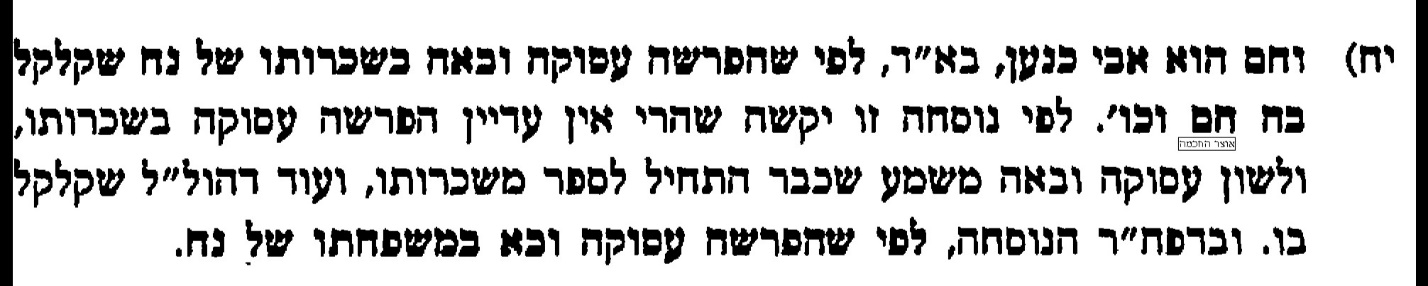
Yet the author of the Sefer Yosef Da’at (Prague 1609) writes that he had a Rashi manuscript and other Sefarim which substituted the word “במשפחתו “for the word” בְּשִׁכְרוּתוֹ”. He also writes that it was the Nusach of Ramban ( when quoting this Rashi).

בדבור המתחיל וחם הוא אבי כו׳, נכתב בצדו על מלת ״בשכרותו״ שבפנינו, וברש״י קלף בס״א (בספרים אחרים) במשפחתו של נח. והיא נוסחאות הרמב״ן ז״ל.

The text of Rashi would then read:

וחם הוא אבי כנען. לָמָּה הֻצְרַךְ לוֹמַר כָּאן? לְפִי שֶׁהַפָּרָשָׁה עֲסוּקָה וּבָאָה במשפחתו שֶׁל נֹחַ שֶׁקִּלְקֵל בָּה חָם וְעַל יָדוֹ נִתְקַלֵּל כְּנַעַן…..

Why is it necessary to mention this here? Because this section goes on to deal with the account of Noah’s family when Cham sinned, and through him, Canaan was cursed…

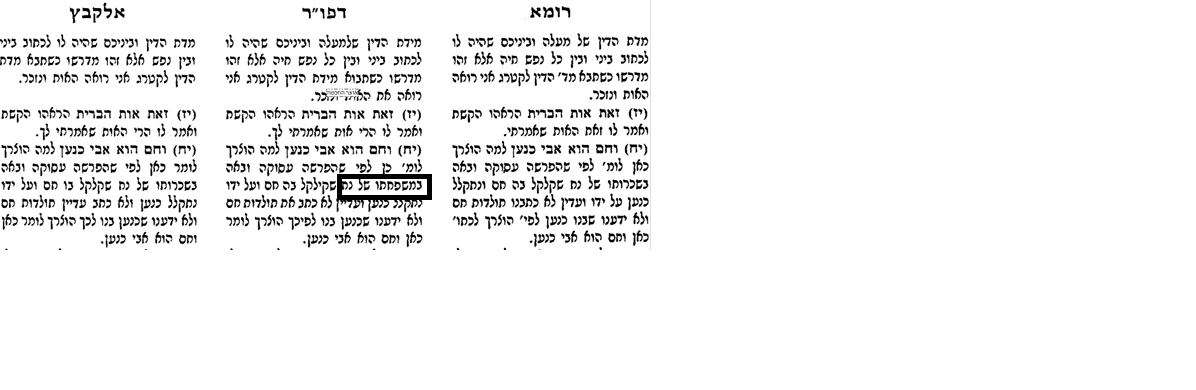
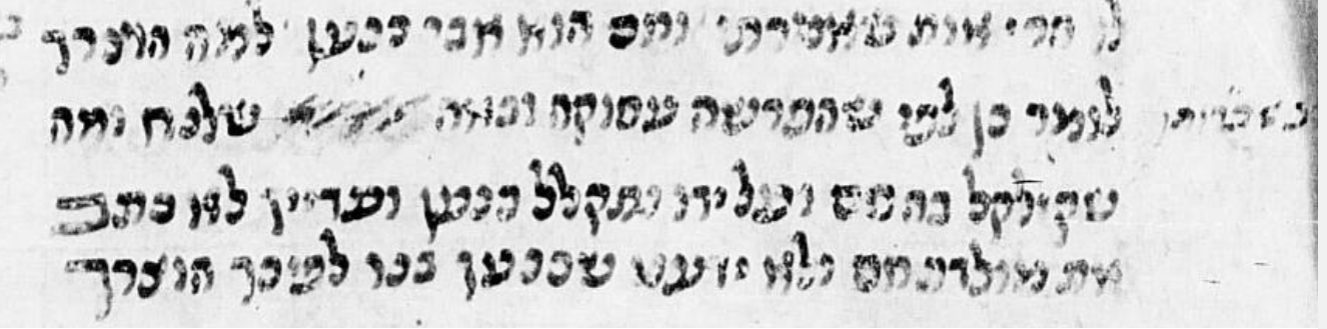
As mentioned by Yosef Da’at, one of the Eidei Nusach for having the word במשפחתו is Ramban, who quotes Rashi’s comment. The website Al Hatorah notes, that this Nusach appears in the following Ramban manuscripts: Parma 3255, Munich 138, Fulda 2, Paris 222, and Paris 223. It also appears that way in the first printed edition of Ramban, that of Rome (printed before 1490).

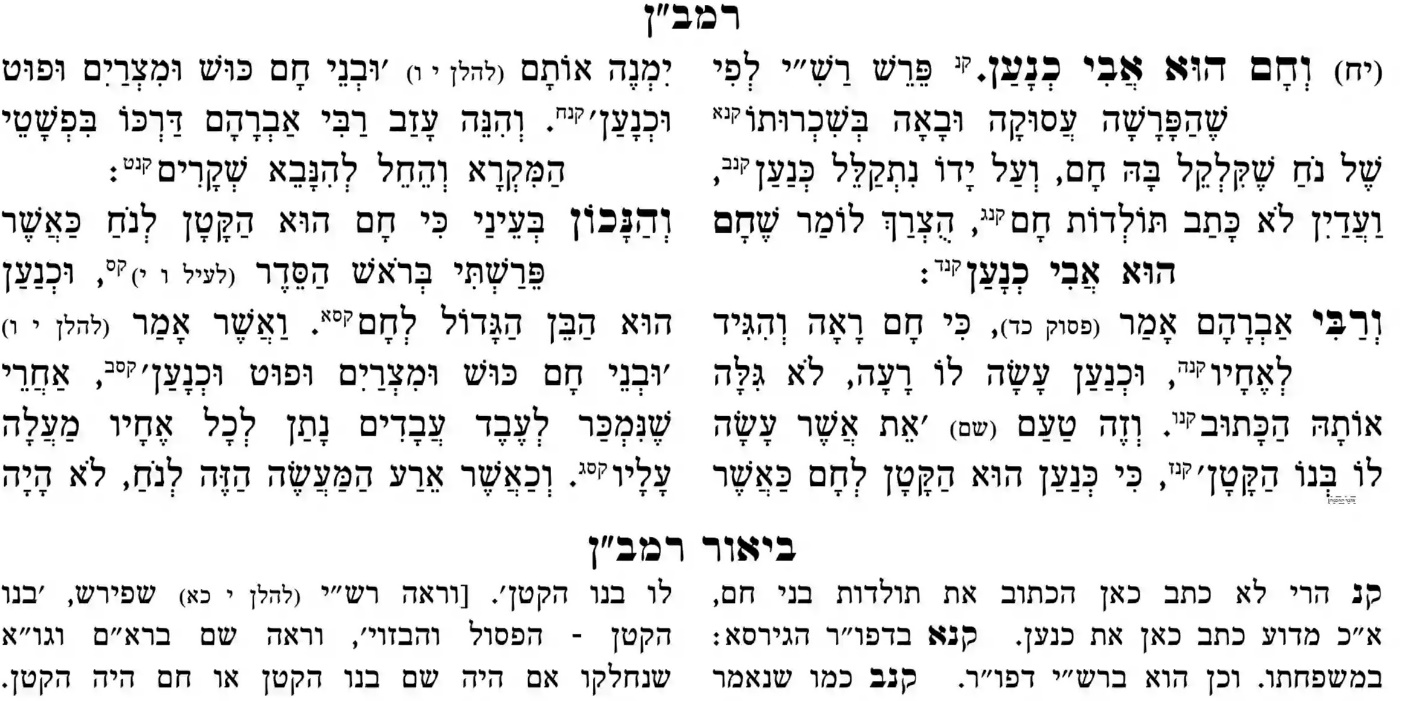
This is the Ramban manuscript known as Munich 138 where Ramban quotes Rashi:

Here is the text of Ramban in the Rome edition where he writes(פ׳(רוש) ר״ש (למה:

Al Hatorah also notes that the word במשפחתו, appears in the text of a Rashi manuscript, Parma 3115, (which it seems was close to the text with which the Ramban worked) before it was “corrected”.

וכן בכ”י פרמא 3115 של פירוש רש”י (שהוא כנראה קרוב לנוסח שעמד בפני רמב”ן) לפני שתוקן בין השיטין

Ktav Yad Parma 3115, for Rashi:

Al Hatorah then notes that most Rashi manuscripts have בְּשִׁכְרוּתוֹ

בכ”י רומא 44, פרמא 2978, דפוס ליסבון: “בשכרותו”, וכן ברוב כ”י של רש”י.

Parma 2978 is the Ramban on Noach which has “בשכרותו”:

For Rashi on this Pasuk ,Al HaTorah records that most Rashi manuscripts have בְּשִׁכְרוּתוֹ, but Regio di Calabria, as quoted by Ramban and the Rashi manuscript Parma 3115, have it as במשפחתו.

וחם הוא אבי כנען – למה הוצרך לומר כאן. לפי שהפרשה עסוקה בשכרותו של נח שקלקל בה חם, ועל ידו נתקלל כנען, ועדיין לא כתב תולדות חם, ולא ידענו שכנען בנו. לפיכך הוצרך לומר כאן: וחם הוא אבי כנען.

ב. כן בכ״י אוקספורד 165, מינכן 5, אוקספורד 34, לונדון 26917, ברלין 1221, דפוס רומא.

דפוס ריגייו: ״במשפחתו״, וכן מופיע בפירוש רמב״ן כאן ברוב עדי הנוסח, בכ״י פרמא 3115

. אפשר שכך היה הנוסח גם בכ״י המבורג 13.

In Zechor L’Avraham (Berlin 1867 and Frankfurt am Main 1905), there is no indication of alternative Nusach. Avraham Berliner does not mention the alternative Nusach of Yosef Daat, the Dfus Rishon or the Girsa of Ramban:

In Yosef Hallel (Brooklyn 1987), Rabbi Brachfeld notes that the Dfus Rishon of Regio Callabrio (1475) has the word במשפּחתו. He does not note that it is the Lashon of the Ramban but seems to think that במשפחתו is a better reading because of his questions on the use of בְּשִׁכְרוּתוֹ:

In Rashi HaShalem Mechon Ariel ( Jerusalem 1987), there is no indication of another Girsa but in the back of the Sefer, it does have it as part of Defusim Rishonim:

Defusim Rishonim:

Guadalajara (1476) Reggio di Calabrio (1475) Rome (1470)

It is interesting to note that the Alkbetz edition is what is known as the Mahadura Sefardit ( according to Professor Yeshayahu Sonne and Dr Yitzchak Penkower), and yet it has בשכרותו. The same goes with Hijar(1490), which generally copies Alkabetz.

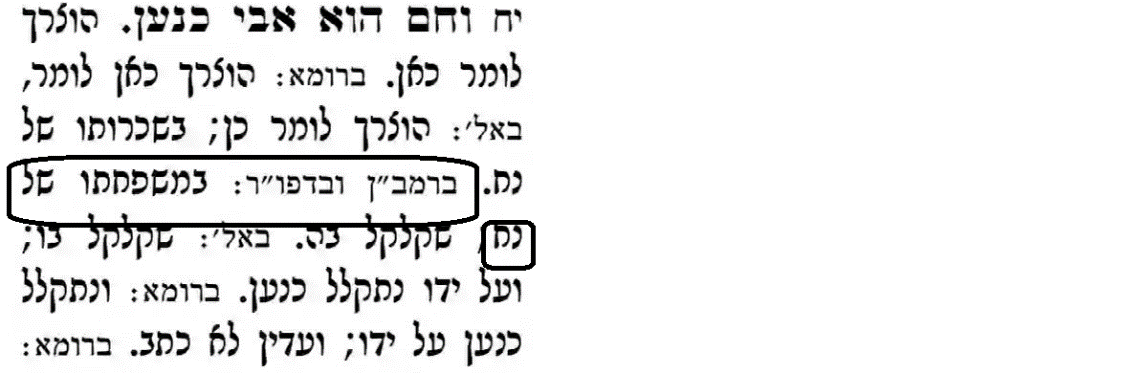
Oz Vehadar Rashi HaMevuar 2008, has במשפחתו in the back in Chilufai Girsaot, noting that it is the Girsa of Ramban and the Dfus Rishon:


Rabbi Isaac Chavel in his edition of Rashi ( Mosad HaRav Kook – 2007 edition) notes that Defus Rishon of Rashi (Regio di Calabria) has ,במשפחתו and this Lashon also appears in the text of Ramban as he quotes Rashi. He also says about the use of the word “במשפחתו” that is more correct (“וכן נראה”) based on the Lashon of the Midrash Agadah which places the emphasis on familial relationships of Noach:

What do the manuscripts indicate:

Oxford CCC 165 (Neubauer 2440) – 12th century

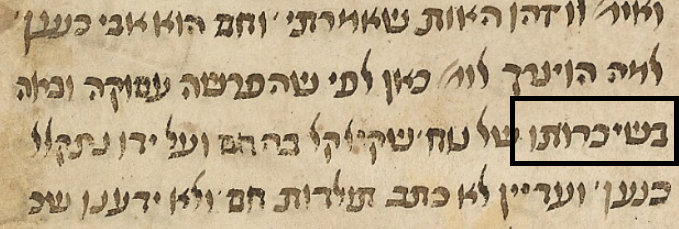
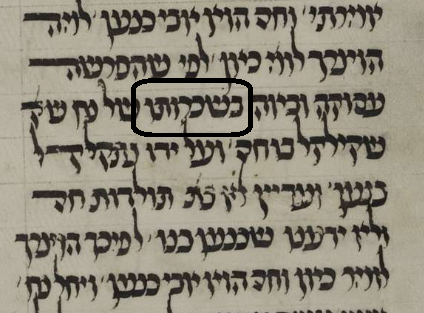
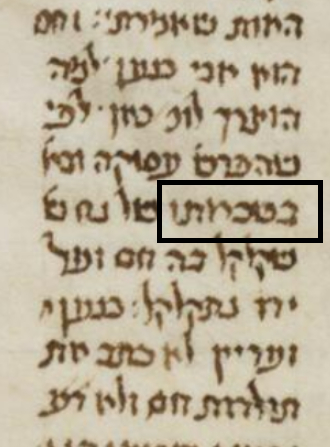
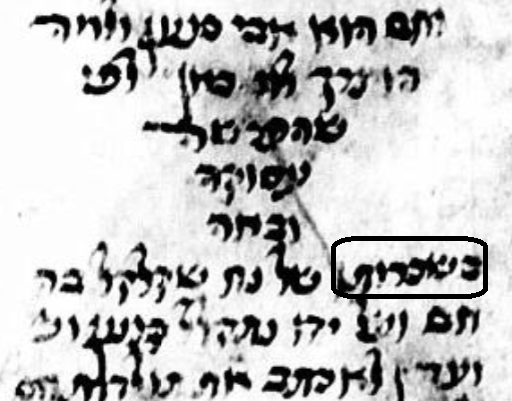
Hamburg 13 (1265), has the word in question rubbed out and changed to בְּשִׁכְרוּתו on the side. It might have originally said במשפחתו:

Oxford-Bodley Opp. 34 (Neubauer 186):

London 26917 (Neubauer 168) (1272):

Berlin 1221:

Vatican Urbinati 1 (1294):

Nuernberg 5 (1297):

How did the text of Rashi in printed editions evolve over time?

The Dfus Rishon of Regio di Calabrio recorded it as במשפחתו. As mentioned, Yosef Da’at noted במשפחתו as a variant reading in a Rashi Klaf and in ,ספרים אחרים and bolstered it with it being the Nusach of Ramban:

בדבור המתחיל וחם הוא אבי כו׳, נכתב בצדו על מלת ״בשכרותו״ שבפנינו, וברש״י קלף בס״א (בספרים אחרים) במשפחתו של נח. והיא נוסחאות הרמב״ן ז״ל.

Hanau 1611-1614, regularly included the Girsaot of Yosef Da’at so we would have expected it to have had בְּשִׁכְרוּתוֹ and then in parentheses have Sefarim Achairim as במשפחתו. But is doesn’t, and that sealed the fate of that Nusach in terms of it becoming a mainstream Girsa of Sefarim Achairim:

The Netziv in Shemot 40:23 cites a comment of the Ramban in which he quotes Rashi and says that our text of Rashi is different. He proposes that there were two Mahdurot of Rashi, of which Ramban had the first Mahadura and we have the second one. In that second Mahadura, Rashi reversed himself from what he said in the first Mahadura. It is possible that this occurred here- in the first Mahadura, Rashi wrote במשפחתו and that is the Mahadura which Ramban had. Later on, Rashi changed it to בְּשִׁכְרוּתו and that has become the standard Girsa:

Conclusion:

There is a lot of ammunition for the Girsa being במשפחתו:

  1. It is in Dfus Rishon, (indicating either inclusion in a manuscript or taken from Ramban)
  2. It is the Lashon of the Ramban, (this is the main argument)
  3. It has logic behind it (Rabbi Chavel’s and Yosef Hallel’s comments)
  4. It is attested to by Yosef Da’at as being in a manuscript
  5. Parma 3115 originally had “במשפחתו”
  6. Hamburg 13 was altered and could have said במשפחתו

But it did not survive as an alternative Girsa of ספרים אחרים today mainly because the influential edition of Hanau (1611-1614) did not include it.

Sidenote:

Many editions of the Ramban today still attribute the word בְּשִׁכְרוּתוֹ to Rashi even though it is clear that the original Ramban had במשפחתו. This was most likely done to make it conform with the accepted Nusach of Rashi.

Here is Oz Vehadar Jerusalem on Ramban 2015 which has בְּשִׁכְרוּתוֹ but says it is במשפחתו in Defus Rishon:

Here is Peirush HaRamban with Peirush Menachem Tziyon printed in 2019 which also has בְּשִׁכְרוּתוֹ:

  1. There is no comment on this Rashi in the Siftei Yeshainim section


Some Notes on Censorship of Hebrew Books

Some Notes on Censorship of Hebrew Books

by Norman Roth

Habent sua fata libelli (Books have their fate)

One of the tragedies of the Inquisition and the Expulsions – both from Spain and Portugal– which has received very little attention is the destruction and loss of Hebrew manuscripts and books. Since the printing of Hebrew books in Spain began many years before the Expulsion, this loss involved printed books as well as manuscripts. Indeed, due to these losses, since only fragments survive of some of the earliest examples of Hebrew printing in Spain it may be impossible to ever know with certainty when this printing actually began. [1]

The edict of Expulsion (1492) caught the Jews of Spain completely by surprise. Even though extensions were granted, it was not always possible to arrange for the transport of books, perhaps especially for the several thousand Jews of northern Castile who had to make their way on foot across the border into Portugal. [2] Many of the Jewish exiles of 1492 returned from Portugal and North Africa in that year and in 1493, as well as later years, to be baptized and live again in Spain. Fernando and Isabel permitted these conversos to keep Hebrew and Arabic books as long as they were not about the Jewish law or glosses and commentaries to the Bible, or, specifically mentioned, the Talmud or prayer books. A Jew of Borja who returned after the Expulsion and converted to Christianity reported that a Jewish cofradía (religious brotherhood) of that town had left 55 books valued at 4,000 jaqueses, but he wanted no part of the books because he had converted.[3]

Portugal

Isaac Ibn Faraj, one of the exiles from Portugal, reported that the king had ordered that all the books which the Jews had brought with them from Spain were to be collected and burned. Nonetheless, not all books were, in fact, burned. Another source reveals that long after the Jews were expelled from Portugal, the king of Morocco sent Jewish delegates there, one of whom was a qabalist who asked permission to see a famous biblical manuscript brought by the Jews from Spain, and this manuscript was among the books seized by the king and kept in a “synagogue filled with books.”[4]

Levi Ibn Shem Tov and his two brothers, apparently the great-grandsons of the Spanish qabalist Shem Tov b. Joseph (not, as usually stated, Shem Tov b. Shem Tov), advised King Manoel to seize all the Jewish books. Their intention had also been to burn the Sefer ha-emunot of their great-grandfather, because of his criticism of Maimonides, but they became afraid because of an order of the king not to burn any Jewish books, and therefore they hid the book in a synagogue in Lisbon. When the Jews were expelled from Portugal, those Jews who had been appointed by the king to search out and seize all books discovered this hidden manuscript and brought it, along with portions of the yet-unpublished Zohar, to Turkey (these men were Moses Zarco, Isaac Barjilun, Moses Mindeh [?], and apparently Solomon Ibn Verga, author of the semi-fictitious chronicle Shevet Yehudah). This undeniably accurate testimony appears to contradict the eyewitness account of Ibn Faraj mentioned earlier. Either he was confused, or else the king issued contradictory orders at different times.[5]

Italy

In 1533 the Talmud was, once again, condemned to the flames in Italy, and with it also legal codes or summaries derived from the Talmud. As in Spain and Portugal, censorship of all Jewish books was under the jurisdiction of the Inquisition. In 1568 a second, more sweeping, destruction of Hebrew books was carried out. Not only Jews, but even Christians, who dared to print such prohibited Hebrew books were subject to punishment, such as exile in the case of Jews, or loss of license in the case of Christians. Rabbi Judah Lerma, perhaps the first Sefardic author who so declared himself, proudly, on the title page of his book, published his Lehem Yehudah, a commentary on Avot, in Sabionetta (1554).

In his introduction to the work, printed by Tuviah Foa, he states he had already had it printed in the previous year, but the decree consigning to the flames the Talmud and Jacob Ibn Habib’s famous anthology of the talmudic agadah had also caught his work, as well as the laws of Isaac al-Fasi, and the entire edition of 1500 copies of his book (a very large printing for the time) was burned. (Later he was able to purchase, at great cost, one copy which had been saved by Gentiles; if that copy had survived until today it would certainly be the rarest Hebrew book in the world.)

David Conforte (1618-1685) also briefly cited this introduction, noting that his maternal grandfather Yequtiel Azuz, a grammarian and qabalist who lived in Italy, lost his own copy of the Talmud in the burning which took place in the same year. Ironically, a later Judah Lerma, a rabbi in Belgrade, an apparent descendant of Judah Lerma, also lost most of the edition of his own responsa in a fire in that city (ca.1650), but at least that was a natural disaster. [6]

Shortly after the burning of the Talmud, Rabbi Samuel de Medina of Salonica, who already had news of the event, wrote that because of this, and the general religious persecution taking place in Italy, any Jew who remains there “without doubt shows no fear for his soul or his Torah,” for were it not so how would a Jew dare remain there? Furthermore, he wrote, it is impossible even to study Torah (Talmud) in Italy. Therefore, all Italian Jews should come to the Ottoman empire to live, since “the soul and body and also possessions are immeasurably safer in this kingdom.”[7]

Marranos and Censorship

In addition to this loss of manuscripts and books, the invention of printing brought with it a new fear, that of censorship. Much has been written about the censorship of Hebrew books at the hands of Christians, but less known is the “internal” censorship practiced particularly by “Marranos,” or descendants of those who converted to Christianity and then decided to become Jews. They often brought with them the inherited Catholic condemnation of people (excommunication, as in the case of Spinoza) and of books which they judged to be offensive.

Amsterdam. Some descendants of Portuguese Jews who had converted to Christianity eventually fled to Italy, where they decided to go to Amsterdam and convert to Judaism. One of the most famous of these was Miguel (Daniel Levi) de Barrios (1635-1701), who was one of the greatest literary figures of the time. He was publicly condemned for visiting “a land of idolatry” (Spain, or Portugal?) and for public profanation of the Sabbath. The publication of his allegorical masterpiece Coro de las musas (1672) was immediately condemned by the Mahamad (official council of the Jewish community). Even more serious was the reaction to his next work, Harmonia del mundo (1674), which was prohibited altogether and was denounced by the famous Rabbi Jacob Sasportas (who led the campaign against Shabetai Sevi) as “converting our Torah into a profane book, making of it a poetic version.” In 1690 his Arbol de vidas [sic; the error is perhaps due to an unconscious influence of the Hebrew plural hayim, “life”) appeared and was also immediately condemned, or more specifically the “conclusions” he appended to it were condemned. The Mahamad prohibited anyone possessing, selling or giving a copy of it to any other Jew on pain of excommunication. Finally, in 1697 he was again condemned for writing a letter to the magistrate of Hamburg which the Mahamad considered potentially injurious to the “Nation” (the community). Thus did the “Nation” honor one of its greatest writers. [8]

Germany. Already in the latter part of the sixteenth century we find mention of some few Portuguese “new Christian” merchants in Germany. One of the most important cities where these “Marranos” settled was Hamburg. In 1612 a five-year contract was made by the Senate of Hamburg with the “Portuguese Nation” (the Marranos) granting them freedom of trade and residence, but stipulating that no synagogue was to be maintained nor were they to “offend” the Christian religion. They could bury their dead in Altona or wherever they chose. The population was not to exceed 150 individuals. In 1617 the original contract with the Senate was renewed for another five years, in return for a payment of 2,000 marks, and again in 1623.[9]

Having grown up and been educated in such an atmosphere of fear and intimidation in Portugal, it is perhaps not surprising that Marranos, new converts to Judaism, applied hardly less intolerant measures of censorship within their own communities. For example, the “offensive” books of Manuel de Pina (a Jew) were ordered burned by the Sefardic communities of Amsterdam and of Hamburg (1656). In 1666 the Mahamad of Hamburg ordered copies of Moses Gideon Abudiente’s book Fin de los dias (“End of days”) sealed and locked in the community safe “until the time for which we hope arrives;” i.e., until the “end of days”! Furthermore, it was decided to impose a fine on any member of the community who kept a book which did not have the “Imprimatur” (!) of the Mahamad.[10]

England. In 1664 the Saar Asamaim (Sha ar ha-Shamayim) synagogue enacted the Escamot or Acuerdos adapted from those of Amsterdam. In turn, these ordinances were adopted by the communities of Recife (Brazil), Curaçao and New Amsterdam (New York). These enactments included a prohibition on the printing of books in Hebrew, Ladino, or any other language without the approval of the Mahamad.[11]

Italy. Fear of the Inquisition and of general problems which could be caused by negative references to Spain led to Jewish censorship even of the liturgy. Thus, the Sefardic mahzor printed in Venice in 1519 (second edition in 1524) already omitted the Spanish Hebrew lamentations referring to the attacks on the Jewish communities in 1391;[12] nor was any reference to the Expulsion permitted. In a prayer book, Imrey Naim, published probably by Menasseh b. Israel (Amsterdam, 1628-30), appeared a poem which seems to be a general lamentation on Jewish suffering, but which Bernstein has shown is found in its original form in the prayer book for fasts, Arbaah Ta’aniyot, printed in Venice in 1671, when there was no longer fear of an Inquisition. There, in fact, the prayer is a lamentation on the Expulsion.[13]

No doubt there are other examples of Jewish “self-censorship” in this period, but it is hoped that this brief introduction will serve to arouse interest in the topic.

Notes

[1] For information on early printing, and fragments of talmudic tractates, in Spain and Portugal, see my Dictionary of Iberian Jewish and Converso Authors (Madrid, Salamanca, 2007), pp. 39-40 (Nos. 35-37), pp. 56-58 (Nos. 86-101. The second edition of the Torah commentary of Moses b. Nahman (“Nahmanides”) was also printed at Lisbon, 1489.
[2] On censorship of Hebrew books in Spain already before the Inquisition, books owned by conversos, etc., see my Conversos, Inquisition, and the Expulsion of the Jews from Spain (Madison, University of Wisconsin Press, 1995; revised and updated paper ed., 2002), index; seeespecially p. 103, Jews called upon to examine Heb. books owned by conversos, and p. 242.
[3] Miguel Angel Motis Dolader, Expulsión de los judíos del reino de Aragón (Zaragoza, 1990), vol. 2, pp. 338-39.
[4] Elijah Capsali, Seder Eliyahu zuta, ed. Aryeh Shmuelevitz, Shlomo Simonsohn, and MeirBenayahu (Jerusalem, 1975-83), vol.1, p. 238.
[5] Text edited from Ms. by Meir Benayahu in Sefunot 11 [1971-78]: 261, and cf. there p. 234 onLevi Ibn Shem Tov, and p. 246 on Isaac Barjilun, or Barceloni. He and Moses Zarco may have been the important tailors in Portugal, the former the court tailor of João II, mentioned in Maria Jose Pimenta Ferres Tavares, Os judeus em Portugal no século XV (Lisbon,1982-84) vol. 1, pp. 156, 252, 361 and 301. On the Jewish official Judas Barceloni at that time, see ibid. vol. 2, p. 669.
[6] See Abraham Yaari, Meqahrei sefer (Jerusalem, 1958), p. 360, citing the full introduction of Judah Lerma’s commentary; Conforte, Qore ha-dorot (Berlin, 1846; photo rpt. Jerusalem, 1969), pp. 40b and 51b. As have virtually all scholars, Yaari ignored Conforte, and therefore did not mention the second Judah Lerma in his own discussion of books lost in fires (p. 47 ff.).
[7] She’elot u-teshuvot, hoshen mishpat (Salonica, 1595), No. 303; cited in Meir Benayahu, ha-Yahasim she-vein yehudei Yavan le-yehudei Italiah (Tel-Aviv, 1980), pp. 93-94 (my translation);see there also for other important material relating to this and to censorship, pp. 95-97.
[8] See the excerpt of Arbol de la vida in Barrios, Poesía religiosa, ed. Kenneth R. Scholberg (Madrid [Ohio State University Press], s.a. [1962]), p. 99.
[9] Alfredo Cassuto, “Contribução para a história dos judeus portugueses em Hamburg,” Biblos (Coimbra University) 9 (1933): 661; see also Hermann Kellenbenz, Sephardim an der unteren Elbe (Wiesbaden, 1958 [ Vierteljahrschrift für Sozial- und Wirtsschaftsgeschichte No. 40] ), pp. 31-32.
[10] “Protocols” (of the Sefardic of Hamburg); summarized in Jahrbuch der jüdisch- literarischen Gesellschaft 6 (1909); 7 (1909); 10 (1915); 11 (1916); see 7: 183; 11: 27-28.
[11] Miriam Bodian, “The Escamot of the Spanish-Portuguese Jewish Community of London, 1664,” Michael 9 (1985): 23-24, No. 30 (text; in [barbaric] Spanish). Earlier editions and studies are Lionel Barnett, ed., El libro de acuerdos (Oxford, 1931), and N. Laski, The Laws and Charities of the Spanish and Portuguese JewsCongregation of London (1952).
[12] For these, see the translations in the journal Iberia Judaica 3 (2011): 77-113.
[13] Simon Bernstein, ed. #Al naharot Sefarad (Tel-Aviv, 1956), pp. 23, 25, 26-28.


New Auction House – Genazym

New Auction House – Genazym
by  Dan Rabinowitz, Eliezer Brodt


There is a new auction house, Genazym, that is holding
its inaugural auction next week Monday, December 25th.  The
catalog is available here.  The majority of the material are letters
and other ephemera with a few dozen books. The books include a number with
vellum bindings (71-75).  Appreciation of bindings has been brought to
fore with the recent wider availability of books from the Valmadonna collection
after it was broken up; a collection that was known for its exquisite bindings.[1] 

Books with illustrations form another group, including heretical
images.  The title-page of the first edition of R. Yedidia Shlomo of
Norzi’s commentary on the biblical mesorah, Minhat Shai, Mantua,
1742-44 (76), includes Moses with horns, but more offensive is the depiction
of God with a human face.   The images on the title page are various
biblical vignettes and in the one for the resurrection of the “dry
bones” that appears in Yehkezkel, God is shown as an old man with a white
beard. [2] Another title-page containing non-Jewish imagery is the Smikhat
Hakhamim
, Frankfurt, 1704-06 (87).  Its title page is replete with
mythological (?) or Christian (?) imagery. [3] 

The illustration on the Minchat Shai title page. Note that this is from another copy, not the one on auction.

The kabbalistic work, Raziel haMalach, (77) contains
illustrations of various amulets with various mythical
creatures. [4] Another book with mystical images is the Emek Halakha,
Cracow 1598, (80). Less sensational images, of ships and fauna,
appear in the first Hebrew book to describe America, Iggeret Orkhot
Olam
, Prague 1793, (83). [5] R. Tovia ha-Rofeh’s Ma’ase Tovia,
Venice, 1707, (95) contains an elaborate illustration that compares the human
organs with various parts of a house or building. [6]

Of note for its rarity is (88), a first printing of R’ Moshe Chaim Luzzatto’s Derech Tevunot, Amsterdam 1742. The copy is a miniature, and was owned by the great collector Elkan Nathan Adler.

Among the
most controversial books in the history of Jewish literatures the forged Yerushalmi on Kodshim, (likely) written by
Shlomo Yehudah Friedlander (98).  There are two versions of the book, one
printed on thick paper and, on a second title page, Friedlander is referred to as
a doctor.  The other version is printed on poor paper and lacks the
(presumably bogus) academic credential.  The theory behind
the variants is that one was targeted at academic institutions
and the other at traditional Jews. [7]  Here is what it looked like:

Here are highlights from some of the letters for sale:

– There are some very interesting manuscript letters from the Chasam Sofer (46), R’ Chaim Sanzer (28) and R’ Meir Premishlan (37) .
– Letters from some of previous generations Litvish gedolim, like R’ Meir Simcha of Dvinsk (Meshech Chocham) (4), R’ Chaim Soloveitchik (2), R’ Raphael Shapiro (6), Chafetz Chaim (10), R’ Shimon Shkop (8), R’ Elchanan Wasserman (1), and the Brisker Rav (3). Many of these letters contain important historical information not found in other sources.
– Also of note are important, extremely rare and lengthy documents from the Rogatchover Gaon (5) and R’ Mordechai Gimpel Yaffe (9) related to the shemita and heter mechira controversies. Another letter of note is from the Minchas Elazar (29) in regard to the inheritance of R’ Alfandri.
[1] Portions of the Valmadonna Trust Collection were auctioned at Kestenbaum
& Co. and Sotheby’s. hereherehere. Regarding the source of those books see here.
[2] The title, Minhat Shai, was imposed by the
printer.  Norzi referred to the work as Goder Peretz.  See
Jordan Penkower, “The First Printed Edition of Nozri’s Introduction to Minhat
Shai, Pisa 1819,” Quntres 1:1 (Winter 2009), 9
n2.  The introduction to Minhat Shai was printed
long after the work itself.  See Penkower, idem.  Moses crowned with horns appears in the earliest
depiction of him to adorn a Hebrew book’s title page.  See “Aaron the
Jewish Bishop,” here.
[3] A very similar title-page appears in two other books,
the first edition of the Teshuvot ha-Bah and Beit
Ahron
.  Regarding the usage of these title-pages, see Dan
Rabinowitz, “The Two Versions of the Bach’s Responsa, Frankfurt Edition of
1697,” Alei Sefer 21 (2010) 99-111.
[4] David Hanegbi, “The Printed Hebrew Book as a Talisman
and Ritual Object: A Historical and Bibliographical Study in Sefer Razi’el
ha-Malakh and its Editions,” (Ramat Gan:  MA Thesis, Bar-Ilan
University, 2014).  Regarding the prevalence of mythical creatures in
human society see Kathryn Schulz, “Fantastic Beasts and How to Rank
Them,” New Yorker, Nov. 6, 2017 (here).  
[5] David Ruderman, The World of a
Renaissance Jew:  The Life and Thought of Abraham ben Mordecai
Farissol
 (Cincinati:  Hebrew Union College, 1981). 
[6] The book and specifically the image under discussion
was recently analyzed by Etienne Lepicard, “An Alternative to the Cosmic and
Mechanic Metaphors for the Human Body? The House Illustration in Ma’ashe
Tuviyah 
(1708),” Medical History 52 (2008), 93-105.
[7] For an extensive bibliography of the literature discussing
Friedlander’s edition, see Eliezer Brodt, “Tziyunim u-Meluim le’Mador ‘Netiah
Soferim’
Yeshurun 24 (2011) 454-455.


The Vilna Gaon, Part 1: How Modern Was He?

The Vilna Gaon, Part 1 How Modern Was He?
by Marc B. Shapiro
Eliyahu Stern, The Genius: Elijah of Vilna and the Making of Modern Judaism (New Haven, 2013)
Eliyahu Stern has set for himself a daunting task and argues his case with conviction. He intends to correct a widespread assumption shared not only by the general public, but by the scholarly community as well. According to this narrative, the Vilna Gaon (hereafter the Gaon) should not be seen as a traditionalist defender of the past, but actually a modern Jew and one who helped usher in the modern era in Jewish history. In Stern’s words, “I [have] come to believe that [Jacob] Katz’s and [Michael K.] Silber’s notion of tradition and traditionalism fails to explain the experience of the overwhelming majority of eighteenth- and nineteenth-century eastern European Jews who did not spend their days either combating the Western European secular pursuit of science, philosophy and mathematics or holding onto the same political and social structures of their sixteenth- and seventeenth-century ancestors. Katz and Silber might have been right about [R. Moses] Sofer. . . . But figures such as the Gaon of Vilna or Hayyim of Volozhin (the Gaon’s student and Sofer’s contemporary), who did not express hostility toward modernity, elude their grasp” (p. 7).
This is quite a claim, and it would be a major revision of the historical picture if Stern could prove the point. Stern also argues that the Gaon’s notes to the sixteenth-century legal code Shulhan Arukh were influential in Jews moving away from a “code-based learning culture supported by the kehilah” (p. 11).[1]

By focusing on Talmud study for its own sake rather than for the sake of determining the halakhah, a paradigm shift occurred in which commentary replaced code. This occurred at the very time that the yeshiva took the place of the kehilah, as seen in the establishment of the Volozhin yeshiva by the Gaon’s disciple, R. Hayyim. Thus, the hierarchy of religious authority was restructured, which leads to what Stern refers to as “religious privatization” (p. 11). As he sees it, “The Volozhin yeshiva was founded not in opposition to the cultural and intellectual upheavals of the nineteenth century. It was itself built on the most modern of assumptions, the separation of public and private spheres” (p. 141). Stern even makes the bold claim that in certain respects the Gaon was more modern than Mendelssohn, arguing that “it was the Gaon’s hermeneutic idealism that called into question the canons of rabbinic authority, while Mendelssohn tirelessly defended the historical legitimacy of the rabbinic tradition to German-speaking audiences” (p. 64). In seeking to turn the Gaon into a more modern Jew, one who is not, as standard scholarship assumes, an opponent of philosophy, Stern even argues that the Gaon did not believe in “demons, magic, [and] charms” (p. 129).[2]
After mentioning that the Gaon is embodied in the Jewish residents of Tel Aviv and New York, who live as though they are majorities, Stern concludes his book with this striking assertion: “From the birth of the State of Israel, to the Jews’ involvement in radical anti-statist modern political movements, to the creation of a robust vibrant Jewish life in the United States, Jewish modernity derives much of its intellectual dynamism, social confidence, and political assertiveness from an astonishing source: the brilliant writings and untamed personality of Elijah ben Solomon” (p. 171).
As with all revisionist theses there is bound to be reluctance to accept a new paradigm. The successful revisionist thesis is the one able to withstand the initial skepticism. Does Stern’s thesis fall into this category? Despite his enthusiastic and tempting arguments, I am not convinced. Reading the book, I could not help wonder if, for example, drawing contrasts with the thought of Leibniz offers any real insight into the thought of the Gaon. We know that the Gaon was fearless in emending rabbinic texts, but for Stern, “Elijah’s emendation project addresses the charge that Leibnizian idealism leaves no room for the possibility of progress, redemption, and critique. . . .  Elijah embroidered the theological concept of evil around the idea of textual error” (p. 61). Isn’t this reading too much into what the Gaon had in mind? Why does the approach of the Gaon have to be given such theological weight that Stern can conclude that “emendation is the path toward redemption and a restored original harmony” (p. 62)?[3]

In another example of his revisionist approach, Stern argues that the Gaon did not oppose philosophy. Rather, “Elijah’s problem with Maimonides revolves around issues of linguistics, interpretation, and hermeneutics and not whether it is permissible to read secular philosophy” (p. 130). As noted already, Stern also assumes that the Gaon did not really believe in “demons, magic, charms and other irrational objects” (p. 129). There is no question in my mind that Stern is in error here. Because the Gaon was a traditional Jew, whose approach to the classical rabbinic texts was not influenced by rationalist philosophy, this is precisely why he believed in demons, magic, and charms. The only reason to reject these things, as did Maimonides, is because one is influenced by rationalist thought.
I see no evidence that the Gaon was influenced in any substantial way by such knowledge, and his occasional use of Aristotelian terminology does not by itself indicate real influence. Furthermore, everything in his writings leads one to believe that when it came to the occult his mental universe was no different than the great rabbis of his time and subsequent to him, for whom demons did indeed exist. In his famous attack on Maimonides, found in his comment to Shulhan Arukh, Yoreh Deah 179:13, he specifically mentioned the efficacy of magic, and contrary to Stern this is to be taken literally.[4]

In fact, a few notes later, 179:26-28, which are not mentioned by Stern, the Gaon again wrote about demons, mentioned that one is permitted to consult with them if it is not the Sabbath, and cited talmudic and midrashic texts that show humans interacting with demons.[5] The Gaon’s position in this matter does not need to be explained. Pretty much every traditional Jew in his day believed in demons, and he did as well. It is Maimonides’ opinion that is not traditional.
Stern leaves it as an open question whether the Vilna Gaon called philosophy “accursed” (p. 245). This is obviously an important issue, since if Stern is correct that the Gaon was not really opposed to philosophy, one would not expect him to use the word “accursed.” Yet there is no doubt that the Gaon did indeed use this word. It appears in the first printing of the Gaon’s commentary to the Shulhan Arukh, and its authenticity was attested to by R. Samuel Luria who examined that actual manuscript. Only later was the word removed by the publisher. Contrary to what Stern states, Samuel Joseph Fuenn, Matisyahu Strashun, and Hillel-Noah Maggid Steinschneider do not claim that later editors put in this phrase. The one to make this assertion was R. Zvi Hirsch Katzenellenbogen, and he was hardly a neutral observer.[6]

Several other issues emerge in the book. Stern quotes Aliyot Eliyahu as stating that before the age of thirteen the Gaon was “studying books on engineering for half an hour a day” (p. 38). I am not sure why Stern mentions anything about “thirteen,” as the text is explicit that he was around eight years old. Furthermore, the text says nothing about “engineering.” Rather, it states that the Gaon studied astronomy (tekhunah).

Stern writes that the Gaon “rejected outright” the Shulhan Arukh (p. 60). This is a strange statement being that the Gaon wrote a commentary on the Shulhan Arukh. Furthermore, this commentary was designed to show the earlier rabbinic sources upon which the Shulhan Arukh‘s laws were based. It is true that there are many times when the Gaon disagreed with the Shulhan Arukh. However, what is significant with the Gaon is precisely that he accepted the Shulhan Arukh. He had the stature to reject it had he chosen, and to write his own code, yet he did the exact opposite. By attaching his notes to the Shulhan Arukh he was affirming the work. He personally did not need the Shulhan Arukh and would decide halakhah from the Talmud and rishonim. But when the Shulhan Arukh decided the halakhah correctly, he was content to show the sources for the law, meaning that the work had value and that is why he affirmed it.[7]

Contrary to Stern (pp. 77-78), there is no evidence that the Gaon was influenced by Elijah Levita and the Gaon never mentioned him. When the Gaon wrote that the Masorah disagreed with the Talmud, he was referring to how to spell certain words, and this formulation comes from the Tosafists. He was not in any way identifying with Levita’s notion that the Hebrew vowels originated in post-talmudic times, and was certainly not addressing “the veracity of the cantillations of the Bible” (p. 78). When the Gaon’s son cited Levita, he was also not referring to his view of the vowels, only of the spelling of words.
I do not know what Stern means by “following Nachmanides, the Gaon argues that the book of Deuteronomy was written later than the other four books of the Bible” (p. 80). Quite apart from Nahmanides, this position is found in Gittin 60a, where one view is that the Torah was given “scroll by scroll.” Also on p. 80, Stern states that “the Gaon, in contrast, builds on the historical position laid down by Ibn Ezra that the last verses, though inspired by Moses, were actually ‘arranged’ by Joshua.” This has nothing to do with Ibn Ezra as the Talmud already contains the view that the last verses were written by Joshua (saying nothing about being “inspired” by Moses. [Ibn Ezra also says nothing about the last verses being “inspired” by Moses])
On page 133, Stern quotes a passage from the introduction to R. Judah Epstein’s Minhat Yehudah (Warsaw, 1877) where he writes of “thousands who came to study and the miracle it would take for one to emerge with any teaching ability.” In the Hebrew the final words are “yatza le-hora’ah.” This has nothing to do with teaching but refers to the ability to decide halakhic questions. The expression originates in Kohelet Rabbah 7:49.
Finally, he writes that “when the Volozhin yeshiva opened its doors in 1802, it was the first time that young men from all economic and social backgrounds were afforded the opportunity to study” (p. 150, see also p. 162). I know of no evidence to support this assertion. Both before the Volozhin yeshiva’s opening and after, opportunities for study were limited to those who could afford to support a child away from home, and give up the income he would bring in for the family.
Even though I am not convinced by Stern’s thesis, there is no doubt that this book is filled with learning and insight and has understandably created a good deal of excitement. To appreciate Stern’s efforts and ingenuity, one must read very carefully, and this reading will be rewarded in many ways.
******
The review you have just read (with the exception of notes 1-5, 7, and one sentence in brackets) appeared on the H-Judaic listserv on July 19, 2013. In the review I was limited in terms of space and I also could not use Hebrew. So let me now add some additional points and corrections that could not be included in the original. Before doing so I want to stress that I enjoyed Stern’s book a great deal, and I also learnt much from it. The Gaon’s scholarship is so wide-ranging that anyone who attempts such a daunting task as to write on him must be commended.[8]

Stern should also feel gratified that so many people have chosen to use their precious time to write about his book, even if they disagree with him.
Stern’s first chapter, which puts the Gaon and Vilna in historical perspective, was particularly interesting to me. How many people, for instance, are aware of the following (p. 70): “The roughly 5,500 Jews in and around Vilna (Wojewoda) made up nearly 30 percent of the population, and the 3,500 to 4,000 Jews living within Vilna proper formed an overwhelming majority of the local population.”
I strongly recommend that people read the book, if only to see how the talented author attempts to create a completely new perspective on the Gaon. Almost every page of Stern’s book raises issues that I can comment on, and I could easily have written a hundred page post. I agree with much in the book, and can cite sources in support of a number of points Stern makes. Yet this does not change the fact that I was not convinced by his major arguments. Rather than cite all the things I agree with, let me offer some more comments correcting errors, or offering different interpretations, as well as some tangential observations.
P. 14. Stern tells us that the Gaon’s mother was from Slutzk, and on p. 181 he cites a source that supposedly claims that the Gaon was also born in Slutzk. Yet this is incorrect. The town referred to is not Slutzk but סעלץ. This is the shtetl Selets (or Selcz) around 150 kilometers south-east of Brisk.[9]

This information is also found in the Encyclopaedia Judaica entry on the Gaon. There is another Selets in Belorussia, some eight hundred kilometers away,[10] but this is not the town associated with the Gaon. There is no actual proof that the Gaon was born in Selets, but that was the tradition of the town.[11]
P. 15. Stern records how the Gaon wanted to study medicine but was discouraged by his father who wanted his son to devote himself to Torah study. I don’t know if this has any relationship to the Gaon’s unusual (but not unique) view in opposition to using doctors as opposed to turning to God. According to one report, the Gaon only had this view when it came to internal medical problems, but not external ones (e.g., a burn).[12]
P. 17. Stern mentions the report by R. Samuel Luria that the Gaon travelled throughout Europe to find rabbinic manuscripts. Among the legends of these travels is one recorded in the name of R. Joseph Hayyim Sonnenfeld, quoting R. Joshua Leib Diskin, that when the Gaon visited the Munich library and saw the famous manuscript of the Talmud, he said that he would give all the money in the world in order to put it in genizah, because this Talmud was only R. Ashi’s first version (and thus of no authority). This story appears in Menahem Mendel Gerlitz’s Mara de-Ar’a Yisrael (Jerusalem, 1969), vol. 1, p. 57 n. 49. I can’t say whether or not R. Sonnenfeld ever made this comment (and Gerlitz’s book in general is quite unreliable). What I can say is that the story never happened as described for the simple reason that the manuscript only arrived in Munich in 1806, as noted by R. Raphael Rabbinovicz in the introduction to Dikdukei Soferim, vol. 1, p. 35.[13]
P. 44. “He [the Gaon] and his students reinterpreted a strand of kabbalah developed by Abraham Abulafia. . . . Elijah’s circle borrowed heavily from his ideas regarding the mathematical underpinnings of the world.” Unfortunately, this influence is never sufficiently explained and there is confusion about an important text. Thus, Stern writes:
As Menachem Mendel of Shklov wrote, “The word cheshbon [calculus] comes from the word machshava [thought] and this [calculus] is the first form that emerges from the essence of thought.”[14]
To begin with, I don’t know why cheshbon should be translated as “calculus.” I assume it means mathematics.[15]  But that is a minor point, as the general meaning of the passage is clear and R. Menahem Mendel of Shklov tells us that this approach was shared by the Gaon. The more important point, however, is that the sentence quoted as having been stated by R. Menahem Mendel was not stated by him at all. R. Menahem Mendel tells us explicitly that the sentence comes from an early book, one that predates R. Isaac Luria. What we learn from Moshe Idel is that this is actually a quotation from Abulafia.[16] Yet this information does not appear in Stern’s book, even though it would have strengthened his case.
Stern also states: “Elijah’s son Avraham approvingly cites the much-maligned Abulafia, and bestows the honorific “z”l” (the Hebrew acronym for “may his memory be blessed”) on the controversial medieval thinker.”
Here is the page in R. Avraham’s Rav Pealim.
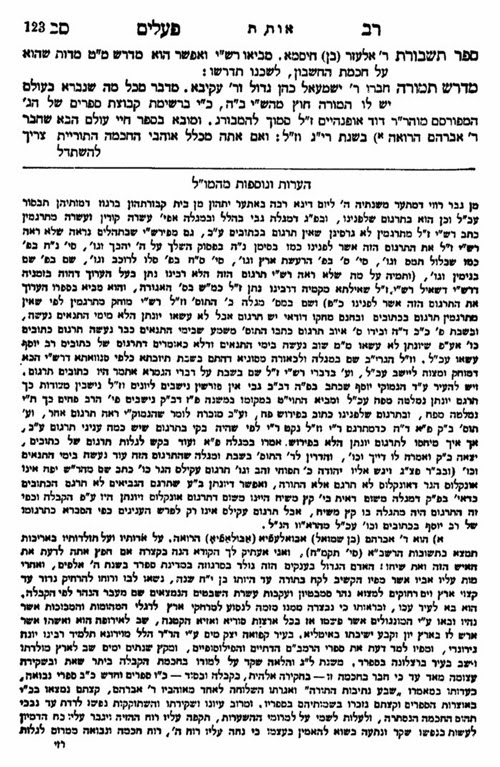
Unfortunately, Stern must have read too quickly and instead of וז”ל [= וזה לשונו] he read the abbreviation as ז”ל, or perhaps he mistakenly connected the ז”ל on the previous line to ר’ אברהם הרואה
Pp. 44ff. Stern argues that according to the Gaon, matter existed eternally and the world was created from this eternal matter. If this was the case, it would be quite significant. Yet I believe that Stern misunderstands what the Gaon is saying. Stern himself quotes the Gaon as explaining that creation means “created from that which exists above.” As I see it, what this means is that matter “found” in the Divine was brought into the world, e.g., through emanation. But this is not the same as speaking of eternal matter, even eternal matter that is lacking form, as these exist apart from God.
With regard to the Gaon and creation, see also R. David Luria’s commentary to Pirkei de-Rabbi Eliezer, ch. 51 n. 17, where he cites a manuscript comment of the Gaon that the world is eternally created. This same viewpoint is shared by R. Hayyim of Volozhin, Nefesh ha-Hayyim ch. 13. I don’t see how this can be reconciled with the Gaon’s comment at the beginning of Aderet Eliyahu that time itself is a creation, and he further speaks of an actual moment of the world’s creation:
בראשית: ב’ הוא ב’ הזמניי. כמו ביום. מפני שהזמן עצמו נברא והב’ מורה על עת הבריאה שהיה בחלק הראשון מהזמן הנברא
If matter is eternal, as Stern claims, or even eternally created, then time is also eternal. But this is clearly not what the Gaon says in the text just quoted.
P. 80. Stern notes that the Gaon’s interpretation of the Mishnah was not bound to how the Talmud explained matters. This is correct, and many people have written on the matter. I mention this only to call attention to the comments of the great genius, R. Meshulam Roth, in his Kol Mevasser, vol. 2, pp. 120-121, 128-129, who felt constrained to argue against this notion. I think it will be obvious to readers that R. Roth’s interpretations of the Gaon are based on his own dogmatic assumption, which he states explicitly, that it is unacceptable to interpret the Mishnah in a way that diverges from the talmudic interpretation.

P. 97. Stern writes:

Contrast Elijah’s vision with the picture of intimacy expressed by Rabbi Pinchas of Korzec (1726-1791): “Prayer is like intercourse with the Divine Presence. At the beginning of intercourse there are motions. Similarly, there is a need for motion in prayer. One should move when beginning to pray. Later on, one can stand without moving, attached to the Divine Presence with a powerful bond. As a result of the motions alone one can attain dvekut.”
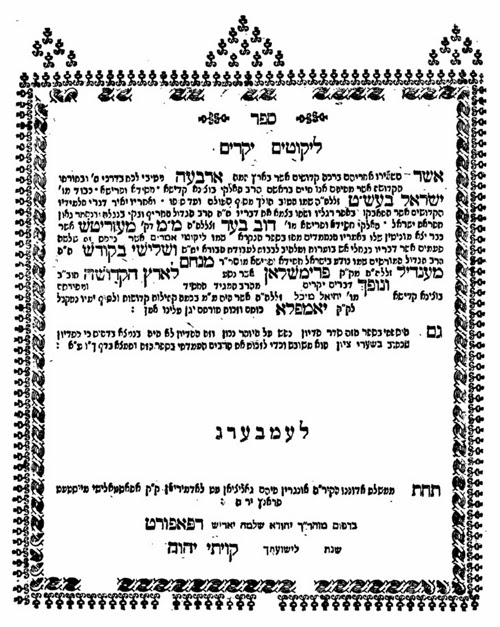
In the note the source for this quotation is given as Likutim Yekarim, 18, and the bibliography tells us that the edition used is Lemberg, 1792 (the first edition). Yet there is some confusion here. R. Pinchas of Koretz indeed wrote a book entitled Likutim Yekarim, but the book where the passage cited comes from is another Likutim Yekarim, one that records the teachings of other early Hasidic teachers. Here is the title page.
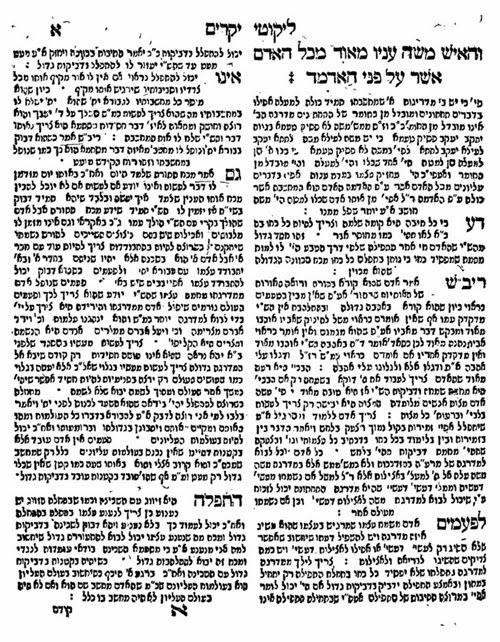
Furthermore, the reader looking at page 18 in the first edition of (the correct) Likutim Yekarim will not find anything, as the text is on page 1a. In the 1974 edition the text is found in section 18, but as far as I can tell, these sections were only added in this edition.[17]
Here is the relevant page from the first edition, and the comment referred to is in the last paragraph. The last sentence of the translation quoted above (“As a result . . .”) is not an accurate rendering of the Hebrew sentence that begins מכח מה שמנענע
P. 102: “While it is doubtful that Elijah endorsed or defended Eibeschuetz’s or Luzzatto’s Sabbatian tendencies, he never publicly condemned their works.” Instead of the word “doubtful,” which leaves some room for question, the sentence should say that “it is certain that Elijah never endorsed or defended . . .” I leave aside for now the question of why Stern is so certain that Luzzatto had Sabbatian tendencies, and simply note that the Gaon would have rejected such an assumption in the strongest terms. The Eibeschuetz case is more complicated,[18] but I don’t understand how “Eibeschuetz’s Sabbatian proclivities were revealed when his son Wolff was unmasked as a closet Sabbatian” (p. 99). Since when do the actions of a son determine the stance of a father?
Let us now return to the issue of the Gaon’s view of philosophy, which was mentioned earlier in this post, and when I refer to philosophy I have in mind rationalism. Stern, p. 129, argues that the Gaon was not opposed to philosophy and as evidence for this proposition notes that the Gaon uses Aristotelian terms, cites the Guide once in his Aderet Eliyahu, and procured a copy of Aristotle’s Ethics. He then writes, “This evidence has led some to suggest that Elijah objected to a materialistic or epicurean lifestyle often associated with philosophy, but not to philosophy’s heuristic value.”
While I think that Stern is indeed correct that the Gaon saw heuristic value in philosophy, I was still quite surprised when I read this sentence, since I had never heard of anyone who argued that the Gaon’s only concern with philosophy was the materialistic lifestyle associated with it. When I looked in Stern’s note (p. 246 n. 55) it didn’t help. This is what appears in the note:
See Moshe Philip, ed., Sefer Mishlei im Biur ha-Gra (Petach Tikvah: 2001), 441 and Eliyahu Stern, “Philosophy and Dissimulation in Elijah of Vilna’s Writings and Legacy,” Revue Internationale de Philosophie (forthcoming). On Elijah reading Aristotle, see his letter to Rabbi Shaul of Amsterdam recorded in Tzvi ha-Levi Horowitz, Kitvei ha-Geonim (Warsaw: 1938 [should be 1928]), 3-10.
I don’t know what is intended by the first reference, as there is a typo since the volume does not contain 441 pages. Stern’s forthcoming article can only be discussed when it appears in print, but the book under review does not give any reference to others who argued that the Gaon had no substantive opposition to philosophy. Also, contrary to what Stern states here, the Gaon did not write to R. Saul of Amsterdam asking him to send him the Ethics. The letter Stern refers to was actually written by the Gaon’s brother, R. Yissakhar Ber.[19]

See Kitvei ha-Geonim, p. 4a. On p. 44, Stern states that the letter was written by both the Gaon and his brother. This, I think, is closer to the truth. I say this because the Gaon’s brother requested לקנות בשבילנו ולשלוח לנו, although this could also just be the writing style he used. However, there are lots of reasons why people read books, and this alone does not mean that one is positively inclined to a subject. The greatest of all Jewish philosophers, Maimonides, tells us that he read all the works of Sabian idolatry that he could get his hands on (Guide 3:29). It would also be more significant if instead of the Ethics, the book requested of R. Saul of Amsterdam was Aristotle’s Metaphysics. But I don’t want to make too much of this, since I am convinced by Stern that the Gaon saw some value with philosophy. But contrary to Stern, I would add that the Gaon also saw great dangers in philosophy.
In the note directly following the one just referred to, Stern concludes based upon the introduction of R. Menahem Mendel of Shklov to the Gaon’s commentary to Avot and R. Israel of Shklov’s introduction to his Peat ha-Shulhan that “Elijah was secretly positively inclined to the study of philosophy.” He again refers to his forthcoming article where he develops this point. As mentioned already, discussion of this article must wait until it appears in print. In the meantime, however, it is difficult to accept this point without a clear articulation of what exactly Stern means by “study of philosophy”, since in R. Israel of Shklov’s introduction to Peat ha-Shulhan he writes as follows:
ועל חכמת הפילוסופי’ אמר [הגר”א] שלמד אותה לתכליתה ולא הוציא ממנה רק ב’ דברים טובים . . . והשאר צריך להשליכה החוצה.
R. Israel of Shklov also notes that the Gaon knew חכמת הכישוף which contradicts Stern’s statement that according to the Gaon “references to demons, magic, charms, and other irrational objects and ideas cannot be ignored—though not per se because he thinks they actually exist.” (p. 129).
See also Ma’aseh Rav (Jerusalem, 1906), Siah Eliyahu, p. 21b (no. 61(, which states that the Gaon would not study R. Bahya Ibn Paquda’s philosophically based Sha’ar ha-Yihud (in the Hovot ha-Levavot):
והי’ מחבב הגר”א ז”ל ס’ מנורת המאור וס’ חובת הלבבות זולת שער היחוד ובמקום שער היחוד הי’ אומר שילמדו בס’ הכוזרי הראשון שהוא קדוש וטהור ועיקרי אמונת ישראל ותורה תלוין בו.
There is another passage that is relevant, but as far as I know has not been cited in any of the scholarly discussions about the Gaon and philosophy. R. Hillel Rivlin, Kol ha-Tor (Bnei Brak, 1969), ch. 5:2, quotes the Gaon as saying the following about philosophy, and you can’t get any clearer than this:
את חכמת הפילוסיפיה למדה לתכליתה ולא מצא בה כי אם דברים אחדים שמקורם לוקח מחז”ל ועל השאר אמר, שאין בה לא הגיון ולא צדק ומיוסדת על אפיקורסות אווילית.

As mentioned, you can’t get any clearer than this, but I realize that this is not the Gaon speaking but rather a student, so it is possible to argue that he, and also R. Israel of Shklov, didn’t properly portray their teacher.
The passage that creates so many problems for Stern’s thesis is found in the Gaon’s commentary to Yoreh Deah 179:13. In this text, the Gaon famously attacks Maimonides for being led astray by “accursed philosophy.”
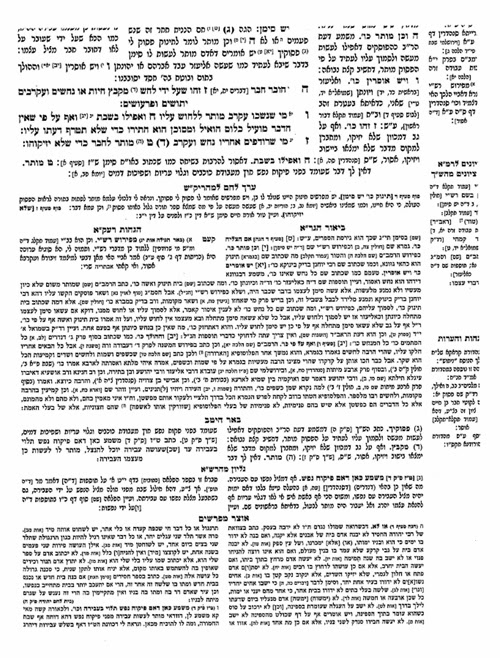
Stern argues that the Gaon does not oppose the study of (even rationalist) philosophy per se. Rather, his opposition is directed at how “a philosophical approach may ignore linguistic nuance” (p. 129). I think this is very unlikely, and it appears to me that Stern is trying to force his interpretation into the words of the Gaon when the more likely, and natural, interpretation is that the Gaon indeed opposes the study of (rationalist) philosophy.[20] (On p. 130 Stern claims that the Gaon was not opposed to the study of “secular philosophy” which is an even more far-reaching claim.) Beyond what the Gaon writes in his comment on the Shulhan Arukh, there is the way he writes it, which unfortunately is not reflected in Stern’s translation. Here is how Stern renders the first part of the text:

All those who came after Maimonides differed [because they did not use his rational allegorical interpretive technique]. For many times we find magical incantations mentioned in the Talmud. Maimonides and philosophers claimed that such magical writings and incantations, and devils, are all false. However, he [Maimonides] was already reprimanded for such an interpretation. For we have found many accounts in the Talmud about magical incantations and writings. . . . Philosophy is mistaken in a majority of cases when it interprets the Talmud in a superficial manner and destroys the sensus literalis of the text. But one should not think that I in any way, Heaven forbid, actually believe in them or in what they stand for.
In this comment the Gaon writes:

והוא נמשך אחר הפלוסופיא הארורה         .
This means that Maimonides “followed after the accursed philosophy.” However, Stern mistakenly translates these words: “Maimonides and philosophers claimed.”
Later in his comment the Gaon writes:

והפלסופיא הטתו ברוב לקחה לפרש הגמרא הכל בדרך הלציי
Stern translates this as “Philosophy is mistaken in a majority of cases when it interprets the Talmud in a superficial manner.” This too is a incorrect translation. What the Gaon is saying is that philosophy misled Maimonides to falsely explain the Talmud. So again, we see the great dangers of philosophy, and how it was able to lead astray even Maimonides. (There is nothing in the Gaon’s comment about “a majority of cases”). The final words quoted from the Gaon, בדרך הלציי, do not mean “superficial manner.” They mean “in a figurative sense.”
What can we say about the Gaon and Maimonides’ Guide? Although I hadn’t investigated the matter properly, for awhile I thought that the Gaon didn’t study the Guide in a serious manner. Anyone who reads Stern will see that this is incorrect. In fact, the Guide was even studied in Vilna during the Gaon’s time. The following passage from Aliyot Eliyahu (Vilna, 1892), p. 13a, should have been cited in the text by Stern as exhibit no. 1, as it is a strong piece of evidence in support of his position. For some reason, it is only summarized in a note (p. 246 n. 58):
וסיפר לי הרב כו’ הישיש מ’ ישראל גארדאן רב בווילנא (אשר היה מכיר היטב את הגאון נ”ע ודירתו היה בחומת אביו וקודם פטירתו היה דר הגאון בחצר בהכנ”ס) אשר היה נכנס ויוצא כפעם בפעם בבית הגאון נ”ע ושמע פ”א אשר בא הרב ר’ טרייטיל ז”ל לפני הגאון והרעיש על אשר ראו עיניו שאנשים קבעו למודם בבהמ”ד בספר מורה נבוכים וביקש שהגאון ימחה בידם והגאון השיבו בחרי אף ואמר ומי יעיז לדבר נגד כבוד הרמב”ם וספרו אשר מי יתנני ואהיה עמו במחיצתו בגן עדן.
There is no question that this report complicates the picture and shows that the Gaon’s view of the Guide was more complex than often portrayed. We see from it that unlike others, the Gaon, despite his strong criticism of Maimonides and general opposition to rationalist philosophy, nevertheless believed that the Guide had value and qualified scholars should not be prevented from studying it. 
After quoting this passage in Aliyot Eliyahu, R. Shlomo Korah adds, “There is a story about someone who asked his rebbe if it is permitted to study the Guide. He replied, ‘The Rambam permits it —הרמב”ם מתיר ”.[21]
Alan Brill has also made the case that the Gaon saw value in philosophy and calls attention to the fact that in a text attributed to the Gaon, there is a summary of a section of the Guide. See his “Auxiliary to Hokhmah: The Writings of the Vilna Gaon and Philosophical Terminology, in Moshe Hallamish, et al., eds., Ha-Gra u-Veit Midrasho (Ramat Gan, 2003), p. 10. This shows that philosophy has value, as I too acknowledge, but this has nothing to do with rationalism, which the Gaon strongly opposed.

It is also worth noting that R. Shneur Zalman of Lyady, in responding to the reported theological objections that the Gaon expressed about early hasidut, wrote as follows[22]:

ומי יתן ידעתיו ואנחהו ואערכה לפניו משפטינו להסיר מעלינו כל תלונותיו וטענותיו הפילוסיפיות אשר הלך בעקבותיהם, לפי דברי תלמידיו הנ”ל, לחקור אלקות בשכל אנושי
In other words, and this is really ironic, R. Shneur Zalman assumes that Gaon was led astray by philosophy and that explains his objections![23]

The reason I had my mistaken assumption that the Gaon didn’t study the Guide in any significant way was because the Gaon didn’t refer to it in his commentary to the Shulhan Arukh, even when he had the opportunity, such as in his note to Yoreh Deah 179:13. Another place where he could have referred to the Guide is in the very first halakhah in Orah Hayyim. R. Moses Isserles is quoting from Maimonides’ Guide, and rather than refer the reader to this, the Gaon offers sources for the Rama’s formulation from rabbinic literature. Yet even before reading Stern’s book I should have seen that the Rama in Darkhei Moshe tells us that he is quoting the Guide, and one should assume that the Gaon saw this text.
This is how R. Isserles begins the Darkhei Moshe (and he begins the Shulhan Arukh similarly):
כתב הרמב”ם בספר מורה הנבוכים חלק ג’ פרק נב שמיד שאדם ניעור משנתו בבוקר מיד יחשוב בלבו לפני מי הוא שוכב וידע שהמלך מלכי המלכים הקב”ה יתעלה חופף עליו שנאמר (ישעיה ו, ג) ) מלא כל הארץ כבודו.
R. Isserles quotes Maimonides as saying that as soon as you wake up in the morning you should think about God. Yet if you look at Guide 3:52 that he is quoting you find something interesting. Here is the passage in Ibn Tibbon’s translation (which is what the Rama used).
מי שיבחר בשלמות האנושי ושיהיה איש הא-להים באמת יעור משינתו וידע שהמלך הגדול המחופף עליו והדבק עמו תמיד הוא גדול מכל מלך בשר ודם ואילו היה דוד ושלמה, והמלך ההוא הדבק המחופף הוא השכל השופע עלינו שהוא הדבוק אשר בינינו ובין הש”י . . . וכבר ידעת הזהירם מלכת בקומה זקופה, משום מלא כל הארץ כבודו.
Where does the Rama get his formulation that as soon as one awakes – מיד שאדם ניעור משנתו – he should think of God? It comes from Maimonides’ words we just read: יעור משינתו. As pointed out by Raphael Speyer,[24] it seems that the Rama simply misunderstood what Maimonides (in Ibn Tibbon’s translation) was saying. The words יעיר משינתו have nothing to do with awakening from sleep in any literal sense. Rather, the expression simply refers to people who are figuratively awakening from their slumber and can now recognize God’s presence. Therefore, there was no need for the Rama in seeking to make his point to include anything about getting up in the morning.
In the Datche’s editor’s response to Speyer, he pointed out another problem with the Rama’s formulation. While the Rama writes of  מלך מלכי המלכים הקב”ה יתעלה חופף עליו, this is not what Maimonides says. According to Maimonides, “this king who cleaves to him and accompanies him is the intellect that overflows toward us and is the bond between us and Him, may He be exalted.” In other words, Maimonides is speaking about the Active Intellect yet the Rama turns this into God Himself. It is because of things like this that Yeshayahu Leibowitz was led to declare that the Rama “didn’t understand philosophy and didn’t understand the Guide of the Perplexed.” He also referred to the Rama’s Torat ha-Olah as a work of “pseudo-philosophy.”[25]

This might seem like an unfair statement, and I am sure that Yonah Ben Sasson would reject it,[26] but consider the following. No one could be regarded as a rabbinic scholar if all he studied was the Mishneh Torah, without examining the talmudic passages upon which the Mishneh Torah is based. In fact, I think all would agree that one can’t really understand the Mishneh Torah without knowing the talmudic sources. By the same token, one can’t really understand the Guide without knowing the Aristotelian sources upon which so much of Maimonides’ words are based. Yet the Rama tells us, in his famous letter to R. Solomon Luria,[27] that he never actually studied Aristotle and his only knowledge of him comes from Maimonides’ Guide and other Jewish sources.
כי אף שהבאתי מקצת דברי אריסטו מעידני עלי שמים וארץ שכל ימי לא עסקתי בשום ספר מספריו רק מה שעסקתי בספר המורה שיגעתי בו ומצאתי ת”ל [תהלה לא-ל] ושאר ספרי הטבע כשער השמים וכדומיהין, שחברו חז”ל ומהם כתבתי מה שכתבתי מדברי אריסטו.
Interestingly, I found one place, Torat ha-Olah 3:47, where the Rama speaks very disrespectfully of Maimonides’ philosophical knowledge, referring to it as foolishness.

ואין לך סכלות חכמתו גדולה מזה
Nevertheless, the Gaon placed the Rama together with Maimonides in his other sharp criticism of the latter[28]:

אבל לא ראו את הפרדס, לא הוא [הרמ”א] ולא הרמב”ם


To be continued
* * * *

Information about my summer trips to Spain, Central Europe, and Italy will be available soon. Anyone interested should check out the Torah in Motion website. Marc Glickman, one of the participants on last year’s tour to Central Europe, described it as follows: “It was great to meet Marc and he was a fantastic guide. The trip was like a living Seforim Blog post (I follow his posts religiously).” Thank you Marc!

Also for those interested, I will be speaking on R. Ovadiah Yosef at Ohab Zedek in NYC on December 17 at 8:15pm. 
[1] Regarding how influential the Gaon was on Lithuanian rabbinic scholarship, see Gil Perl, The Pillar of Volozhin: Rabbi Naftali Zvi Yehuda Berlin and the World of Nineteenth-Century Lithuanian Torah Scholarship (Boston, 2012), pp. 127ff. Perl disputes with Immanuel Etkes and Shaul Stampfer who have argued that the Gaon’s influence has been exaggerated. In terms of the Gaon’s influence on Jewish practice, R. Yaakov Kamenetsky claimed that there were only two places in Lithuania that followed the Gaon’s minhagim, and one of these places was the Gaon’s beit midrash/synagogue (kloiz) in Vilna. See R. Yehoshua Geldzahler, Kodshei Yehoshua (Jerusalem, 1999), vol. 5, p. 1758 (Geldzahler forgot the second place mentioned by R. Kamenetsky.) See also Nathan Kamenetsky, Making of a Godol (Jerusalem, 2002), vol. 1, p. 655.
[2] “In Elijah’s view, references to demons, magic, charms, and other irrational objects and ideas cannot be ignored—though not per se because he thinks they actually exist. (Elijah’s admirer Menashe Illya [1767-1831] recalled ‘that according to his memory,’ Elijah actually ‘criticized those who interpreted Midrash according its [!] literal sense when the Midrash went against reason.’) Elijah’s criticism against Maimonides was based on the belief that one cannot simply deny or gloss over the anti-rational elements that consistently appear in rabbinic literature. Either they belong in the text or they do not; if they do belong, they must be explained. By not including or explaining them, Elijah contends, Maimonides and ‘philosophers’ fail to take seriously the very words and signs that make up the rabbinic tradition.”
[3] In R. Isaac Herzog’s letter about the authority of the Zohar, published by me in Milin Havivin 5 (2010-2011), he quotes R. Abba Werner as saying the following about the Gaon (p. 16):
שהגר”א בבאורו על הזוהר הוא המבקר היותר קשה על הטקסט של הזוהר
R. Mordechai Friedman called my attention to R. Hanokh Ehrentreu, Iyunim be-Divrei Hazal u-ve-Leshonam (Jerusalem, 1978), pp. 184ff., where Ehrentreu prefers a textual emendation of R. Wolf Heidenheim over the emendation suggested by the Gaon. Since I will be dealing with R. Chaim Kanievsky in the next installment, let me mention that he has a tradition that R. Hayyim of Volozhin stated that one of the Gaon’s emendations was mistaken: הגר”א טעה. See R. Hayyim Shalom Segal, Berurei Hayyim (Bnei Brak, 2004), vol. 3, p. 924.
[4] In Aderet Eliyahu to Nahum 3:4, the Gaon writes:
בשלשה דברים ישחית איש את רעהו  . . .  בכשפים: במיני קטורת ממשיכים כחות העליונות אשר מקושרים בלבות בני אדם
[5] See also Aderet Eliyahu to Numbers 23:22 and Hosea 2:20 for other discussions of demons. In Yahel Or (Vilna, 1882), p. 38b (second numbering), the Gaon writes:
 ואמרו כי אמן של שדים נעמי [צ”ל נעמה] הולידה אותן מהנפילים לכן חציין מצד אביהן דומה למלה”ש ומצד אמן לב”א

[6] See Samuel Joseph Fuenn, Kiryah Ne’emanah  (Vilna, 1860), p. 160. In Stern’s book the page number is mistakenly given as p. 169.
[7] Regarding the Gaon and the Shulhan Arukh, see R. Yaakov Hayyim Sofer, Menuhat Shalom (Jerusalem, 2003), vol. 11, pp. 51-52, who shows that because the Gaon did not have access to the early editions of the work, he mistakenly assumed that a word stated by R. Joseph Karo really belonged to R. Moses Isserles. Although there is no question that Sofer is correct, since we are dealing with the Gaon, here is how Sofer prefaces his correction (which also includes the claim that a reference offered by the Gaon is incorrect).
אמנם עם שאיני כדאי כלל וכלל, עפר יעקב, אומר אני אחר נטילת הרשות, שדברי קדשו של רבינו הגדול הגר”א ז”ל, שגבו ממני, ובאפיסותי לא זכיתי להבין דברות קדשו של הגר”א ז”ל.

[8] Regarding the Gaon, many interesting articles appear in Yeshurun 5 (1999) and 6 (1999). R. Dovid Yitzchaki’s contribution, “Havanat Divrei ha-Gra al Da’at Omram,” Yeshurun 5, pp. 502-537, is of particular value. Jacob Israel Dienstag’s bibliography of writings by and about the Gaon is still worth consulting. See Talpiot 4 (1949), pp. 269-356.
[9] See here.
[10] See here.
[11] See Ha-Levanon, Sep. 18, 1872, p. 26.
[12] See R. Moshe Zuriel, Otzrot ha-Gra (Bnei Brak, 2000),  pp. 242f.
[13] See R. Yaakov Wreschner, Seder Yaakov (Jerusalem, 2010), vol. 1, p. 35 (first pagination).
[14] Derekh ha-Kodesh (Jerusalem, 1999), p. 4.
[15] Stern himself translates it as “math” on p. 198 n. 19. Regarding mathematics, in the next post (or maybe the one after) I will defend Stern’s reading of a passage in opposition to the critique of Bezalel Naor here.
[16] See Idel, “Bein ha-Kabbalah ha-Nevuit le-Kabalat R. Menahem Mendel mi-Shklov,” in Moshe Halamish, et  al., eds., Ha-Gra u-Veit Midrasho (Ramat Gan, 2003), p. 174-175.
[17] The text were are discussing is also found in Tzava’at ha-Rivash (Brooklyn, 1998), p. 28 no. 68.
[18] See Sid Z. Leiman, “When a Rabbi is Accused of Heresy: The Stance of the Vilna Gaon in the Emden-Eibschuetz Controversy,” in Ezra Fleischer, et al., eds. Meah Shearim: Studies in Medieval Jewish Spiritual Life in Memory of Isadore Twersky (Jerusalem, 2001), pp. 251-263.
[19] The Gaon had five brothers. See Chaim Freedman, Eliyahu’s Branches (Teaneck, 1997), p. 12.
[20] Let us not forget that the Gaon claimed to have had visions of Jacob and Elijah. This comes from a text written by the Gaon and recorded by R. Hayyim of Volozhin in his introduction to the Gaon’s commentary to Sifre de-Tzeniuta. R. Hayyim also reports that the Gaon said that before he was thirteen years old he started to make a golem, before he concluded that Heaven did not want him to continue. The Gaon further told R. Hayyim that he was visited by R. Shimon Ben Yohai and R. Isaac Luria. All of these things are not characteristic of one with a positive attitude towards philosophy.
[21] Sefat Melekh, vol. 1 (commentary to Mishneh Torah, Sefer ha-Mada [Bnei Brak, 1998], p. 53. R. Korah, Sephardic Chief Rabbi of Bnei Brak, is one of the few Yemenites (are there any others?) who studied under R. Aaron Kotler. See his recollections at the beginning of his Haggadah shel Pesah (2003).
[22] David Zvi Hillman, ed., Iggerot Ba’al ha-Tanya u-Venei Doro (Jerusalem, 1953), p. 97.
[23] See R. Matisyahu Strashun, Mivhar Ketavim (Jerusalem, 1969), p. 125 n. 1.
[24] Datche 55 (17 Av 5769), p. 6.
[25] See his Sihot al Pirkei Ta’amei ha-Mitzvot (Jerusalem, 2003), pp. 723-724.
[26] See his Mishnato ha-Iyunit shel Ha-Rama (Jerusalem, 1984).
[27] She’elot u-Teshuvot ha-Rama, ed. Siev (Jerusalem, 1971), no. 7.
[28] Shulhan Arukh, Yoreh Deah 246:18.